Tibetan Esoteric Qigong
Tibetan Esoteric Qigong Research Association, Chinese Qigong Science Research Society
Table of Contents
Part One: Overview of Buddhist Practice Methods
- Tracing the Origins of Buddhist Practice Methods …
- The Qigong Craze and Buddhist Studies ……(6)
- Buddhist Chan (Meditation) Practices …………(11)
- Hinayana Buddhist Chan Practices ……………(13)
- Mahayana Buddhist Chan Practices …………(19)
- Vajrayana Buddhist Practice Methods ……………(23)
Part Two: Tibetan Esoteric Qigong and Its Origins
- Tibetan Esoteric Buddhism and Tibetan Esoteric Qigong …
- Tibetan Historical Legends and the Phenomena of Tibetan Esoteric Practice ……………(35)
- Tibetan Esoteric Buddhism and P.S.I. Research …
- The Tibetan Esoteric “Tummo Meditation” and the Wondrous Phenomena of Dumo ………………(39)
- The Bon Religion’s Mysterious “Water-Fire Practice” ……
- The Classical Tibetan Esoteric Qigong System of Om-Ah-Hum …
- “Great Perfection” (Dzogchen) and “Great Seal” (Mahamudra) …………………(43)
- The Tantric Discussion of “Channels” (Nadis) …(55)
- The Supreme Yoga View of Mind and Prana (Vital Breath) ……(60)
Part Three: Research on Tibetan Esoteric Qigong …(69)
- The Human Biological Field and Tibetan Esoteric Yoga … …(71)
- Sudden Enlightenment, Bindus (Mingdian), and the Biological Quantum Field ………………(76)
- Trechö, Thögal, and Bindus ………(78)
- Stimulation of Internal Power — External Power ……(81)
- Longevity — Rainbow Body Transformation ……(85)
- Categories of Channels and Prana in Tibetan Esoteric Qigong …
- The “Pyramid” Effect Empowered by Tibetan Esoteric Practice Methods ……………(92) …(95)
- Symbolic Yoga and Right-Brain Memory ……(.98)
- Sound Waves and Tibetan Esoteric Qigong …
Part Four: Methods of Tibetan Esoteric Qigong Cultivation …(105)
- The Full Lotus Posture Practice Method …(112)
- The “A-Syllable Visualization” Transcendental Memory Method …(114)
- The Vajra Method of Counting Breaths …
- The Supreme Yoga Vajrayana Qigong Cultivation Method …(125)
- “Vajra Fist” …(127)
- Cultivating the “Vase Breath” ……(130)
- The “Vajra Recitation” Practice Method ……(132)
- The Supreme Yoga Method for Activating Spiritual Energy and Warming the Body ……(137)
- The “Great Perfection” (Dzogchen) Practice Method ……(140)
- Tsongkhapa’s Method of Cultivating Tranquility (Śamatha) ”
(All rights reserved. Unauthorized reproduction is strictly prohibited.)
Part One
Overview of Buddhist Practice Methods
1. Tracing the Origins of Buddhist Qigong Methods
The term “qigong” has only recently become a familiar expression in traditional Chinese medical therapy. Its association with Buddhism would seem to be something never before proposed by earlier scholars. Qigong is closely related to the Daoist practices of expelling and drawing in the breath (tuna) and guided stretching (daoyin), and these Daoist practices of breath expulsion and guided stretching are in turn closely related to the Buddhist practices of regulating the breath (tiaoxi) and regulating the body (tiaoshen). For example, the Yunji Qiqian records: “The six methods of expelling the breath—chui, hu, xi, he, xu, and si—are all exhalations… Chui removes heat, hu removes wind, xi removes cold, he directs qi downward, xu disperses stagnation, and si relieves exhaustion.” Leng Qian of the Ming dynasty summarized this as: “For the liver, the xu sound with eyes glaring wide; for the lungs, the he sound with both hands raised aloft; for the heart, the he sound with hands clasped at the crown; for the kidneys, the chui sound embracing the knees level; for spleen ailments, the hu sound with lips pursed; for guest-heat in the triple burner, lying down with the xi sound brings peace.” This is identical in method to the treatment of meditation disorders described in the Xiao Zhiguan Liu Miaomen (Lesser Cessation-and-Contemplation: The Six Subtle Gates). The Xiao Zhiguan verse states: “The heart corresponds to hu, the kidneys to chui; the spleen to hu, the lungs to si—the sages all know this. When the liver grows hot, the syllable xu arrives; where the triple burner is congested, one need only say xi.” When investigated as to the lineage from which this derives, it is merely attributed to “what a teacher said.” Whether this method originated from Daoism or from Buddhism, the Great Master Zhiyi did not state explicitly, but it was adopted by Daoist practitioners. That there is a definite relationship between Buddhist and Daoist qigong is beyond doubt.
Indian yoga masters, Buddhism, and Daoism have, in this field of learning, mutual causal connections and mutual interpenetration that leave traces worth investigating. The Huangdi Neijing (Yellow Emperor’s Inner Canon), as a classic work of Chinese medicine, long ago forged an indissoluble bond with Daoism. Qigong practitioners have been reluctant to speak of Daoism, and even more reluctant to speak of Buddhism—each has his own reasons. But that qigong derives from both Buddhism and Daoism is truly beyond denial. As for those within Buddhism, they generally regard qigong as something either kept secret and not disclosed, or taboo and not discussed, or dismissed and ignored, on the grounds that it prolongs life and strengthens the body, thereby increasing attachment to the body.
Fundamentally, from the perspective of the essential purpose of the Chan school, the goal is to point directly to the human mind—to illuminate the mind and see one’s nature. The four great elements are originally empty; the five aggregates are without self. Therefore, if one were to go into a meditation hall and ask about qigong, it is likely that veteran Chan practitioners would not even converse with you. However, a person who has genuinely illuminated the mind and seen their nature must necessarily possess qigong.
“From samadhi, wisdom is born.” Illuminating the mind and seeing one’s nature pertains to the domain of wisdom (prajña). If this wisdom comes from genuine inquiry and real practice, it must necessarily be grounded in a relatively deep foundation of meditative concentration (chan ding). The qigong practices of breath expulsion and guided stretching also connect with the fundamental techniques of regulating the body and regulating the breath that form the entry point to Buddhist meditative concentration studies. It is impossible that a person of accomplishment in the Chan school would completely lack training in these areas. Nevertheless, the chan of meditative concentration and the chan of the Chan school cannot, after all, be conflated. The chan of meditative concentration was formerly called chanfa (chan methods), also called Tathagata-chan. When Shakyamuni taught his disciples, there were only two disciplines: meditation and recitation. Recitation meant memorizing the Tripitaka—the Sutras, Vinaya, and Abhidharma—which at that time had not yet been committed to written texts. Meditation meant practicing concentration. The methods by which Buddhist disciples practiced concentration were called chan methods. Beginning with An Shigao, these were transmitted to China; those who achieved accomplishment in chan methods were included under the category of “Practitioners of Meditation” (Xichan) in the Biographies of Eminent Monks. Their attainments varied vastly, and many could be described as extraordinary powers and remarkable abilities. When Bodhidharma came from the West, he singly raised the direct pointing upward—pointing directly to the human mind, seeing one’s nature and becoming a Buddha, without establishing written words—correcting the flaw of chasing chapters and picking sentences. Yet he did not instruct people to abandon the practice of meditative concentration. However, the transmission of chan methods gradually declined, came to be regarded as a lesser vehicle, and received little attention. Tathagata-chan thus became an underground current, submerged by Patriarch-chan. But in India it continued to be transmitted and evolved, becoming the study of yoga. Today, when speaking of Buddhist meditative concentration, one should seek it across the various schools of both the Great and Lesser Vehicles, and not limit oneself to the Chan school alone.
Qigong treats illnesses of the human body. Chan methods primarily regulate a person’s physiological functions. Pathological changes in physiology can affect psychology, and pathological changes in psychology can also affect physiology. Among the most fundamental practices of chan methods—the five meditations for stilling the mind (pañca-śamathā; meditation on impurity, meditation on loving-kindness and compassion, meditation on dependent origination, meditation on analysis of the elements, and mindfulness of breathing—they respectively counteract greed, anger, ignorance, the view of self, and scattered distraction). Among these, meditation on impurity and mindfulness of breathing are most intimately related to the human body, and within chan methods they are called the “two great gates of nectar” (amṛta-dvāra). In particular, the evolution of mindfulness of breathing gave rise to the countless profound meditation practices within the study of yoga.
Meditative concentration also enables a person to dispel illness and prolong life. The modern scholar Guo Yuanxing wrote an article entitled “Buddhist Teachings and Longevity,” published in the 1982 issue of Fayin magazine, put out by the Buddhist Association of China. He drew upon the “Table of Birth and Death Years of Eminent Monks,” appended to Liang Tingcan’s Table of Birth and Death Years of Famous Persons Throughout History; together with his own additions, it totaled 571 individuals, of whom 12 lived over one hundred years, 42 over ninety, 142 over eighty, and 361 over seventy, accounting for
63.7%; 433 were over sixty-five, accounting for 75.8%. The author pointed out that the longevity of these eminent monks was by no means due to a life of ease and comfort. He cited the percentage of long-lived eminent monks and compared it with the percentage of long-lived emperors, finding it exceeded the latter by more than tenfold. Emperors, who enjoyed the highest level of material life and tried every possible means to pursue immortality, compared with eminent monks who lived frugally and arduously and disregarded life and death—the disparity in outcomes is so stark. Taking Western industrialized nations as a comparison, the percentage of people over sixty-five is at most 15.6%, which is still far from the 75.8% found among Chinese eminent monks.
That the study of meditative concentration in Buddhism can lead to longevity is certain. However, the primary purpose of meditative concentration studies is not limited to producing longevity—this again is where meditative concentration differs from qigong. Longevity is a by-product of meditative concentration studies. The true product is illuminating the mind and seeing one’s nature, which belongs to the domain of wisdom studies. Only through meditative concentration can wisdom arise. A person who has achieved great awakening in the Chan school must necessarily have exerted effort in meditative concentration.
The Mahāvibhāṣā Śāstra speaks of the “four bases of spiritual power” (ṛddhipāda). What are the “four bases of spiritual power”? They are “aspiration (chanda), diligence (vīrya), mind (citta), and contemplation (mīmāṃsā).” “Mind” is “cessation” (śamatha). “Aspiration” is “love and joy.” “Diligence” is energetic and unremitting practice. Through the spirit of love and joy, and with the perseverance of energetic and unremitting effort, one practices mind-and-contemplation (i.e., cessation-and-contemplation, śamatha-vipaśyanā), and can thereby generate various extraordinary powers—“supernatural abilities” (abhijñā)—hence the name “bases of spiritual power.” The Venerable Maudgalyāyana, in the Dharmaskandhapāda Śāstra he composed, extensively explained that the four bases of spiritual power all proceed from the cessation of evil and the cultivation of good. Therefore, the starting point of qigong is morality. Any school of qigong that can benefit the world and extend people’s lives must proceed from a foundation of morality. The Yijing (Book of Changes) says: “The movement of Heaven is full of vigor; the superior person strives ceaselessly to strengthen himself.” The inscription on the basin of King Tang says: “If you can make yourself new one day, do so day after day, and yet again every day.” It is precisely this ceaseless self-strengthening, this inexhaustible potential for ever-renewed renewal, that propels the continuous sublimation of the mind and character, enabling a person to achieve a high degree of purification and balanced development of both body and mind, becoming “vast, upright qi.”
Regarding mental focus (yishou, “guarding the intention”), from the perspective of the inner body, the Buddhist practice of scanning the body (xunshen guan) is also extremely diverse in its forms. It analyzes from skin, hair, nails, blood, flesh, bones, and joints all the way to the five viscera and six bowels, like an anatomist—it does not merely hold the attention on a single point, but rather there is nowhere that is not attended to. Beyond the commonly focused upper and lower dantian, the regions along the circuit of the Ren and Du meridians are all within the system of focus. It does not speak of
the heavenly cycles are contained within it. Although Buddhism regards the meditation on counting breaths as a great gate of sweet dew, what is counted is not the coarse wind of inhalation and exhalation, but the luminosity that serves as the object of consciousness. The pathways through which the luminosity enters and exits pervade the entire body and are not limited to the nasal passages; the focus of attention likewise pervades the entire body and is not confined to a single point. Moreover, it is not limited to the interior of the body but extends to the exterior. Gathered in, it resides in a single mote of dust; dispersed, it pervades the entire world. One may also focus on nothing at all, letting the mind dwell in empty space; one may also [perceive] the myriad phenomena arrayed in endless layers upon layers. One may even dwell where there is nothing to dwell upon. In the human body this can generate a kind of physiological energy, which is also the source of longevity. The Buddhist scriptures say: “One thought abides, one kalpa also abides.” As long as a person can, in the space of a single thought, halt the passing of the stream of life, one can likewise slow the passing of the stream of life.
2. The Qigong Craze and Buddhist Studies
From the early 1980s to the present, the number of qigong practitioners nationwide has exceeded twenty million, and the wave has spread overseas. China’s qigong craze has not only enabled millions of people to cure illness, strengthen body and mind through traditional training methods, and apply these methods in social domains such as medicine, physical education, music, calligraphy, military training, and education. More importantly, qigong has delivered an enormous impact and impetus upon the fields of science and philosophy. The personal experiences and practical efficacies of qigong cultivation, along with the wondrous facts of extraordinary psychic functions, have prompted people to reflect deeply on the relationship between mind and body, between mind and matter, to re-recognize and unearth the treasures of Eastern civilization, and to seek new modes of thought and new scientific systems. Farsighted members of the scientific community, with great ambition, have taken research into qigong and extraordinary functions as a breakthrough point for a scientific revolution, endeavoring to explain qigong and extraordinary-function phenomena from multiple perspectives including physics, biology, chemistry, psychology, medicine, quantum mechanics, systems theory, information theory, and cybernetics, striving to secure a leading position in the field of somatic science in the twenty-first century. The physicist Qian Xuesen has called qigong “the highest technology of our era” and advocates the establishment of a “phenomenological qigong studies.” The Chairman of the Chinese Qigong
Science Research Society, Zhang Zhenhuan, has called for the promotion of the development of dialectical materialism through qigong research. The scientific study of qigong has brought a fresh vitality to China’s scientific and intellectual circles.
The qigong craze has also opened a window prompting people to re-recognize Buddhist studies, attracting people to appreciate the precious heritage of Buddhism — the Buddhist cultivation methods.
The term “qigong” originally derives from Daoism and originally referred to the category of cultivation practices called “qi ingestion” that regulate the qi of breath. In modern times, “qigong,” as a craft of refining qi, has circulated in the martial arts and medical communities. The “qi” of “refining qi,” from the Daoist perspective, refers not only to the breath but more principally to the “original qi” (yuanqi) that serves as the vital kinetic energy of human life and the primordial source of all things. In the modern qigong craze, as people’s understanding of qigong has continuously deepened, the scope encompassed by “qigong” has in fact become quite broad. From the perspective that qigong involves breath regulation and internal qi effects during practice, “qigong” can include the cultivation practices of the Buddhist, Daoist, and Confucian schools as well as Indian yoga. In recent years, the qigong community has gradually unified its understanding of qigong around the principle that the regulation and control of mind and intention is primary. For example, the editorial department of Eastern Qigong (Dongfang Qigong) defines qigong as: “Through the practice of inwardly directed application of consciousness (regulating the mind, tiaoxin), one enhances the ability to regulate, control, and employ one’s own life activities, so as to achieve harmony of body and mind (the internal environment) and unity of heaven and humanity (the external environment).” Qigong in this sense is in fact closest in meaning to the Indian word “yoga,” and thus some have advocated that the English translation of “qigong” should be “Chinese yoga.”
The era of Shakyamuni Buddha corresponded to the Spring and Autumn period in China. At that time, the Chinese Confucian view of the cosmos was “heaven is round, earth is square,” whereas Shakyamuni Buddha’s view was that of “three thousand great thousand worlds.” He said: The world we inhabit is called the “Saha World”; worlds like this, assembled one by one, form a small chiliocosm; one thousand small chiliocosms form a medium chiliocosm; one thousand medium chiliocosms form a great chiliocosm; and the sky contains three thousand great chiliocosms. He further said: Each world is empty above, below, left, and right, and each world passes through four periods — formation, abiding, destruction, and annihilation — which closely resembles the accounts of astronomy. Additionally he said: A cup of raw water contains eighty-four thousand organisms. When we examine a cup of cold
water under a microscope, there are indeed countless microorganisms. Why could Shakyamuni Buddha see what ordinary people cannot see? Because through spiritual cultivation, that is, through having developed extraordinary functions — namely the “divine eye” (tianyan tong) among the so-called supernatural powers (the six abhijñā) — he could perceive things that ordinary people cannot see.
Buddhism can be said to be established upon the wisdom the Buddha attained through meditation (chan si). It inherited and developed ancient Indian yoga, making meditative concentration (ding, Skt. samādhi) an extremely important subject in cultivation practice. Shakyamuni may not have known what “qigong” was, but his attainment of Buddhahood was intimately connected to his profound meditative power. From the process of Shakyamuni’s enlightenment, one can readily identify certain things similar to those experienced by modern practitioners. For example, legend has it that the Buddha was encircled by a halo of light, that is, the “light of wisdom” (huiguang) appeared. Practitioners of a certain level of attainment would not find this kind of light unfamiliar. As another example, Shakyamuni, in deep meditation, forgot everything, including his own existence — the four elements all being empty, the mind like a bright mirror. This is a characteristic feature of Buddhist cultivation methods. From a psychological perspective, this is an effective method for eliminating all distracting thoughts. Shakyamuni also assigned to his disciples, according to their different temperaments, the most suitable modes of cultivation, so that after training they were radiant in spirit and of extraordinary complexion.
Since the introduction of Buddhist studies of meditative concentration into China at the end of the Eastern Han dynasty, the patriarchs of various schools have developed and enriched them, making them increasingly diverse and colorful, so that they have become one of the essences of Chinese culture. The Buddhist science of meditative concentration, especially the Chan (Zen) school’s singular approach, has exerted an enormous influence and impetus upon the traditional learning of the Chinese Confucian and Daoist schools, contributing to the maturation of Daoist internal alchemy (neidan) since the late Tang dynasty and the establishment of Neo-Confucianism (lixue) and the school of mind (xinxue) in the Song and Ming dynasties. The Shaolin martial arts, created by Buddhist Chan monks and infused with Chan principles, stand as the foremost of China’s martial arts world. The various cultivation practices circulating among the common people all incorporate the theories and therapeutic methods of Buddhism, Daoism, and Tibetan medicine; their relationship with Buddhist studies and meditative concentration is even deeper.
The influence of Buddhist meditative-concentration studies on modern qigong is profound and far-reaching. What is called modern qigong is nothing other than the inheritance and development of the traditional practices of various schools. Modern qigong classifies Buddhist meditative concentration as one of the six major traditions of Chinese traditional qigong (Buddhist, Daoist, Confucian, medical, martial arts, and folk):
- Honoring Buddhist samadhi studies as a precious legacy of ancient qigong and a major wellspring of modern qigong studies. At present, many qigong enthusiasts, qigong masters, and scientific researchers are “exploring the treasures of the dragon palace.” Among Buddhist meditation methods, the yoga of Tibetan esoteric Buddhism receives the greatest attention from the qigong community. In February of this year, the Tibetan Esoteric Qigong Research Association, under the Chinese Qigong Science Research Society, was established in Beijing, marking the entry of Buddhist samadhi studies into the arena of science. The relationship between Buddhism and qigong is also a matter of close concern to people of insight within the Buddhist community. They hold that, viewed from the perspective of modern science, the doctrines and precepts of Buddhism are almost without exception related to qigong, and that the methods of cultivation advocated by Buddhism are, in essence, the necessary paths that all qigong practitioners must follow. The samadhi studies among the Buddhist Three Learnings and the dhyana-paramita among the Six Paramitas are, in substance, qigong—and moreover, advanced qigong.
The inheritance of Buddhist samadhi studies by modern qigong is principally manifested in the following aspects:
(1) Methods of healing. The Buddhist methods of healing through meditation—such as placing the mind on the dantian, attending to the diseased area or to the feet, the Six-Syllable Breath, and contemplation by imagined visualization—have all been inherited by the qigong and medical communities, becoming fundamental methods of qigong healing and widely applied in clinical practice.
(2) Approaches and essentials of cultivating samatha. As early as the beginning of this century, the lay Buddhist Jiang Weiqiao introduced the Buddhist Six Wondrous Gates and worldly dhyana as methods for health cultivation and physical fitness to the broader society. Even today, the Buddhist approaches to cultivating samatha—such as breath-counting, attending to one point, and resting awareness on the middle—remain the most important and most commonly practiced methods of “stillness practice” (jinggong) in the qigong community. Other Buddhist approaches to cultivating samatha have almost all had their religious content stripped away and been adapted into qigong methods for entering quiescence. For example, reciting the Buddha’s name and mantras were transformed into “the method of silently repeating phrases”; visualizing Buddha images and the forms of yidam deities was transformed into “the method of imagining pleasing scenes”; visualizing the radiant light of Buddhas and bodhisattvas was transformed into “the method of channeling qi” and “the method of imagining the radiance of the sun and moon”; and sutra recitation was transformed into “the qigong recitation method,” and so forth. Certain Buddhist disciplines that had traditionally been transmitted in secret among itinerant monks—such as “Shaolin internal qi external emission qigong”—have also been made public.
The essentials of regulating the body, regulating the breath, and regulating the mind from Buddhist samadhi studies; the methods for controlling the mind and gathering one’s thoughts; the methods for countering
torpor and restlessness; the sequential stages of entering samadhi; the physical and mental changes that occur during stillness and meditation; and the key points for correcting deviations—all of these have been universally absorbed by the various schools of qigong and have become common knowledge in qigong practice. Many terms from Buddhist samadhi studies—such as “visualization” (guanxiang), “no-thought” (wunian), “the eight sensations” (bachu), “central channel” (zhongmai), “bindu” (mingdian), and “entering samādhi”—have become commonly used vocabulary in qigong.
(3) Preparatory practices for cultivating samadhi. Buddhism emphasizes that ethical discipline (sila) is the foundation of samadhi; this has been tacitly accepted by the qigong community to a certain extent. Many qigong schools and lineages, at the outset of practice, emphasize “valuing virtue”—that is, taking moral cultivation as a prerequisite for qigong practice. Buddhism teaches that the practice of dhyana can make a person’s mind gentle and pliant, gradually freeing them from coarse and base desires, so that their character naturally tends toward nobility. This function of dhyana is gradually being recognized by the qigong community, which lists moral refinement and the reform of character as one of the benefits of qigong. Buddhism regards few desires and even freedom from desire as important conditions for accomplishment in dhyana practice; this point too has been adopted by the qigong community, with the principle that practice requires restraint of desires becoming a commonly advocated essential across all schools. Furthermore, the requirements regarding environment, time, and other conditions for dhyana practice are broadly accepted by the qigong community.
(4) Regarding the pursuit of wisdom. Buddhist studies speak of wisdom arising from samadhi, and regard the attainment of wisdom as the highest goal of dhyana practice. This has also been inherited by the qigong community, so that qigong practice is no longer limited to healing and fitness, but takes the attainment of wisdom as the aim of the advanced stage of practice. This “wisdom” primarily refers to the enhancement of intelligence and the development of latent potential. As for the means of qigong research, some have proposed that the primary method should be the inward-seeking method (neiqiufa) of qigong practice—introspective observation during qigong exercise. In fact, this has long been done within dhyana practice.
In summary, Buddhist samadhi studies—and in particular the teachings on cultivating samadhi—have been critically inherited by qigong studies in many respects, from preparatory practices, approaches, essentials, and verification of experiences, to effects and theories. The personal experiences of millions of people through qigong practice, and their contemplation of the unsolved mysteries of qigong’s effects and extraordinary powers, inevitably lead them to regard the ancient wisdom of Buddhism in a new light. The efficacy that Buddhism attributes to dhyana—healing and fitness, purifying the human mind, and even miraculous functions—is continuously being confirmed by qigong practice and by phenomena of extraordinary abilities. When qigong practice reaches its pinnacle and one seeks to advance further, what principles should one follow? The Buddhist teachings on the Four Dhyana and Eight Samadhis, and the Nine Sequential
Samadhis, with their system of progressive advancement level by level, have long provided the answer.
Modern qigong is indeed deeply related to Buddhist studies, yet it still differs from Buddhism in essence. From the perspective of Buddhist studies, modern qigong belongs only to worldly dharmas. Even when certain methods of Buddhist supramundane dhyana have been absorbed by qigong, the supramundane religious content has been removed. This, of course, represents a secularization of Buddhist meditation methods. At the same time, the development of modern qigong poses a challenge to Buddhist studies. The qigong community declares: the era in which qigong developed primarily within religion for a long time has ended, and it has entered a new stage of scientization. Breaking away from religion and moving toward the path of science is indeed the inevitable trend in the development of qigong and yoga. Although Buddhist samadhi studies have developed for nearly three thousand years, they have, after all, labored within ancient societies, progressing slowly. Their methods are confined to individual introspective seeking during seated meditation, lacking the rigor of modern scientific experimental methods. In terms of meditation methods, Buddhism primarily advocates what qigong calls “stillness practice” (jinggong), and does not elaborate much on “dynamic practice” (donggong), which is more readily accessible to the general public. Buddhism has its own healing science (cikitsā-vidyā), dhyana healing methods, and healing siddhis. However, Buddhist meditation medical theory appears rather antiquated when compared with the significant strides modern qigong has made in the medical field. Modern qigong research employs a variety of experimental tools and draws upon multiple scientific theories—Chinese and Western medicine, quantum mechanics, physics, chemistry, and others—to explain the mechanisms of qigong and extraordinary abilities. These approaches appear closer to modern science than the experiential descriptions and philosophical interpretations of Buddhist studies, and are more persuasive to modern people. Inventions such as the “electronic qigong master” and the “artificial qigong stimulation device” apply mechanical technology to simulating qigong healing and assisting practice, which is also quite inspiring for Buddhism’s approach of relying solely on mind and intention in meditation practice.
Apart from the esoteric methods of the “Anuttara Yoga Tantra,” which gradually flourished after the eighth century CE, Buddhist scriptures generally do not discuss “qigong.” However, the “dhyana samadhi” spoken of in Buddhism—from its methodological
In terms of their methods, principles, and objective effects, most can be classified within the scope of qigong or contain elements of qigong.
Buddhism regards meditative concentration (chan ding) as an essential path for transcending the cycle of birth and death and entering “nirvāṇa.” This of course belongs to religious faith and differs in purpose from ancient health cultivation and the qigong practiced by people today. Nevertheless, Buddhism also employs meditative concentration as a form of practice for psychological training, holding that it can enable one to attain “lightness and ease of body and mind” and thereby constantly enjoy peace and happiness, that it makes a person’s mind easier to regulate and control, that it makes behavior more readily conform to ethical standards, and that it serves as a pathway for investigating the mysteries of the world of body and mind — all of which share common ground with modern qigong. As for using the cultivation of meditative concentration to cure illness, build health, and prolong life, this too is listed among the effects of Buddhist meditative concentration.
Buddhist meditation developed on the foundation of ancient Indian yogic techniques. When Śākyamuni, the founder of Buddhism, first left the household life to pursue the spiritual path, he initially practiced traditional yoga and attained the profound state of concentration known as “neither perception nor non-perception.” The Buddhist science of meditation that he established claims to differ qualitatively from all non-Buddhist schools of yoga and qigong. Its outstanding characteristics are principally manifested in the following three respects:
-
Buddhist meditation emphasizes that “moral discipline is the foundation of concentration,” regarding the observance of precepts as a prerequisite for cultivating concentration. Precepts (śīla) constitute the Buddhist codes of religious morality and the disciplinary rules of communal monastic life, principally including not killing, not stealing, not engaging in sexual misconduct, and not lying. Buddhism holds that a person who cannot restrain their conduct according to the norms indicated by the precepts has no basis for cultivating concentration; even if they achieve some modest success in qigong, they will ultimately find it difficult to avoid “catching fire and entering demons” (deviation and possession), and will instead be harmed by qigong. Buddhist cultivation of concentration particularly emphasizes the regulation and even elimination of desire, regarding the elimination of desire as a necessary condition for entering profound states of concentration — this is also an important reason why Buddhism advocates leaving the household life. Although Buddhist precepts are religious in nature, the emphasis on moral cultivation as a prerequisite for meditation is well worth the attention of the qigong community.
-
Buddhist meditation emphasizes the simultaneous cultivation of concentration and wisdom, the united practice of “calming” (śamatha) and “insight” (vipaśyanā). Meditative concentration — in Sanskrit “dhyāna,” meaning “quiet contemplation” — encompasses two aspects: calming and insight. Calming, Sanskrit “śamatha,” means steadily fixing the mind on a single object so as to attain mental settledness and cessation of thoughts. Insight, Sanskrit “vipaśyanā,” means contemplative analysis and illuminating examination, specifically referring to the use of the Buddhist philosophical perspective to contemplate and analyze. Buddhism states that calming and insight 12..
are like the two wings of a bird or the two wheels of a cart — neither can be neglected. Only when calming and insight are practiced together does it constitute genuine Buddhist meditation. Buddhism further states: “Through concentration, wisdom arises; through wisdom, the afflictions are severed.” The purpose of meditative concentration is to obtain “wisdom”; the purpose of obtaining wisdom is to sever the afflictions; and within meditative concentration itself, one must also use “wisdom” to cultivate insight. “Wisdom” is divided into three types: that born of hearing, that born of reflection, and that born of cultivation. To understand and accept the philosophical perspectives contained in the Buddhist scriptures and treatises is to attain “wisdom born of hearing,” also called understanding — it is the foundation for cultivating insight. This philosophical perspective essentially rests on the principle that all dharmas arise through dependent origination (the aggregation of conditions) and are therefore empty (lacking any permanent, unchanging, independent entity). When one uses the wisdom born of hearing to cultivate calming and insight and thereby attains a certain degree of meditative experience, the wisdom thus obtained is called “wisdom born of reflection,” also known as “awakening.” When one proceeds to cultivate from what has been “awakened,” and as the state of concentration deepens, one attains what is called a direct intuition transcending ordinary consciousness — this is “wisdom born of cultivation,” and it alone constitutes the true wisdom capable of severing the afflictions.
- Buddhist meditation excels at regulating the mind and emphasizes the cultivation of innate nature. Buddhist philosophy may be said to be built upon the subjective experience of meditative concentration; it values spirit and takes materiality lightly. Its methods of meditation emphasize the regulation of mind, and in this respect it may be called foremost among all schools.
The traditions of Buddhist meditation are numerous and may be broadly divided into three major schools: Hīnayāna Buddhist meditation, Mahāyāna Buddhist meditation, and Vajrayāna (Esoteric School) Buddhist practices. Within each school there are multiple types of meditation and lineages.
4. Hīnayāna Buddhist Meditation
Hīnayāna Buddhism prevails in Southeast Asia and in the Dai (Tai) regions of Yunnan province in China, and takes as its aim the individual’s liberation from the cycle of birth and death. It is therefore called the “Lesser Vehicle” by Mahāyāna Buddhism, which takes the “universal salvation of all beings” as its aim. The meditation methods of the various Hīnayāna schools are broadly consistent, comprising two categories: “worldly meditation” and “supramundane meditation.”
1. Worldly Meditation
This belongs to the traditional Indian meditative methods absorbed by Buddhism. Buddhism holds that although the states of such meditation deepen progressively from shallow to profound, the concentrated mind still arises and ceases, and does not transcend the realm of consciousness; it therefore cannot achieve the Buddhist
goal of transcending birth and death, and is hence called worldly meditation. It is also said that this type of meditation is not unique to Buddhism: non-Buddhist schools of yoga and qigong likewise ascend through the stages of such meditation, and the various meditation methods of all Buddhist schools similarly use these stages as their pathway of entry and exit.
“Worldly meditation” consists of five types: the Six Sublime Gates, the Four Dhyānas and Eight Concentrations, the Four Immeasurable Minds contemplation, the Penetrating Illumination meditation, and the Sixteen Special Qualities contemplation. Among these, the Four Dhyānas and Eight Concentrations serve as the progressive ladder from shallow to deep.
The Four Dhyānas refer to the progressively deepening First Dhyāna, Second Dhyāna, Third Dhyāna, and Fourth Dhyāna. When these are combined with the still deeper concentrations — the Base of Boundless Space Concentration, the Base of Boundless Consciousness Concentration, the Base of Nothingness Concentration, and the Base of Neither Perception Nor Non-Perception Concentration — they are collectively called the Four Dhyānas and Four Concentrations, or the Four Dhyānas and Eight Concentrations. Buddhism particularly regards the First, Second, Third, and Fourth Dhyānas as the foundation for cultivating all forms of meditation, calling them the “Four Fundamental Dhyānas.”
The gateways for entering the Four Dhyānas and Eight Concentrations are five: the mindfulness-of-breathing contemplation, the contemplation of impurity, the contemplation of loving-kindness, the contemplation of dependent origination, and the contemplation of recollecting the Buddha. These are called the “Five Gates of Meditation,” and the first — mindfulness of breathing — is the principal one. Therefore, entering through the contemplation of breath is generally considered the hallmark of worldly meditation.
Mindfulness of breathing, in Sanskrit “ānāpāna,” means “mindfulness of holding the breath.” Its method is divided into six steps — counting, following, settling, observing, returning, and purifying — and is also called the “Six Sublime Gates.” First, counting the breath: after sitting in the cross-legged posture and completing the regulation of the body, gradually regulate the breath so that inhalation and exhalation are natural, deep, and fine, without obstruction or sound. Then gather the mind and collect your attention, focusing on the breath, and silently count in the mind: one count for each breath cycle, counting from one to ten, then starting again from one. Second, following the breath: when counting the breath has become proficient and the mind no longer wanders, and you feel that counting is coarse and no longer wish to count, abandon the counting and let the mind only gently observe the breath, following it as it goes out and comes in. Third, settling: when the practice of following deepens, the mind gradually becomes still and naturally ceases to think of the breath, abiding in a tranquil state free of any thought — this is called settling. Fourth, observing: when the mind has long abided in settling, it is prone to become drowsy and sleepy; at that point one should immediately arouse alertness, rouse one’s spirits, and illuminate and examine the mind and breath, then return to settling — this is called observing. Fifth, returning: if observing is practiced for too long, the mind tends to become scattered and restless; at that point one should return to the beginning and practice counting and following again, then return to settling — this is called returning. Sixth, purifying: when, through practicing as described above, the skill becomes fully mature and the mind can abide for a long time in settling without giving rise to scattering or drowsiness, one thereby enters the Four Dhyānas and Eight Concentrations — this is called purifying. The Six Sublime Gates constitute an easy-to-learn and easy-to-teach stillness practice that is safe and free of harmful side effects; it contains no religious content whatsoever, its effects are quite excellent, and it is suitable for wide promotion.
Practicing contemplations such as the Six Wondrous Gates, the mind shifts from scatteredness to gradual non-scatteredness; this is called “coarse abiding.” Afterwards, the mind naturally becomes bright and pure, the body also naturally becomes upright and straight, neither fatigued nor pained; this is called “fine abiding.” From this, with deepening skill, one enters samadhi as soon as one sits, and may even sit for several days or months, but within the samadhi one still consciously feels the body, hands, and feet. This is called “Kamadhatu samadhi” (samadhi of the desire realm), which serves as the stepping stone into the Four Dhyana and Eight Samadhis. When the skill of Kamadhatu samadhi deepens further, suddenly body and mind become empty and expansive, no longer seeing the head, hands, bed, or seat, and the mind is like empty space. This is called “Kamadhatu Access Concentration” (the unattained ground of the desire realm). According to Buddhist doctrine, reaching this point marks the entry into the innate realm, attaining innate qi. Within this samadhi, one may see various illusory phenomena, such as seeing immortals or buddhas, or attain transcendent awareness and prescience resembling supernatural powers; this is an over-brightness of the samadhi mind. Or, the mind may be dark, dull, and unknowing, like sleep; this is an over-darkness of the samadhi mind. Both brightness and darkness are biased defects that should be promptly abandoned so that one can further deepen into the Four Dhyana and Eight Samadhis.
The Four Dhyana, fully called the “Four Dhyana of the Rupadhatu (form realm),” is a samadhi state free from the desires for food, sex, and sleep, but where a material body still exists. As the skill of Kamadhatu Access Concentration deepens, within the emptiness and stillness, one gradually becomes aware of the body, like a cloud or a shadow, and naturally gives rise to sensations of moving, itching, coolness, warmth, lightness, heaviness, roughness, and smoothness, known as the “Eight Touches.” Buddhism states that the Eight Touches and even the Sixteen Touches are reactions that occur when the fine material system of the “Rupadhatu” is formed within the coarse material body of the “Kamadhatu.” When the Eight Touches arise, happiness such as stillness, emptiness, and bright purity—never before experienced—is born alongside them. Among them, the bliss of coolness is foremost, likened to entering a cool pool on a very hot day. The practitioner’s initial taste of this bliss and resulting joy is the main characteristic of entering the First Dhyana. By frequently entering the First Dhyana, one no longer needs sleep, and greed, lust, anger, and so on naturally cease to arise; this is known as “pure detachment from desire.” In the First Dhyana, there are sensations of the Eight Touches generated by the body as well as conscious discrimination of the Eight Touches, so the mind is not yet entirely still. Thus it is called “Samadhi with Awareness and Observation.” “Samadhi” is a Sanskrit word meaning “concentration.”
Those who attain the First Dhyana and advance their skill further abandon the mind of awareness and observation of the First Dhyana. Passing through the transitional Access Concentration between the First and Second Dhyana, they enter the Second Dhyana. The Second Dhyana is separated from awareness and observation; from this point upward, it is called “Samadhi without Awareness and Observation.” Although the Second Dhyana is separated from the bliss of the Eight Touches generated by the body, the inner mind naturally gives rise to bright, tranquil joy and happiness. It is likened to emerging from a dark room and seeing brightness. Its profound inner joy surpasses the touch-bliss of the First Dhyana, and thus it is named “Joy-associated Dhyana.”
Since the Second Dhyana is associated with joy, the samadhi mind is not yet considered completely still. By discarding this joyful mind and continuing to practice, one can pass through the Access Concentration between the Second and Third Dhyana and enter the Third Dhyana. The greatest characteristic of this Dhyana is bliss. Buddhism says that for one entering the Third Dhyana, bliss emanates from within, like a spring gushing ceaselessly. The mind is clear and pure, and the bliss permeates every pore of the entire body. It is the highest among worldly bliss, and thus the Third Dhyana is named “Bliss-associated Dhyana.”
Since the Third Dhyana experiences bliss, the samadhi mind is also not perfectly still. By abandoning this bliss and continuing to practice, one can transcend the Access Concentration between the Third and Fourth Dhyana and enter the Fourth Dhyana. In this Dhyana, body and mind are free from the disturbances of pain and bliss, and breathing also ceases. It is named “Equanimity-associated Dhyana.” The samadhi mind of the Fourth Dhyana is the most empty, bright, and still. Those who frequently enter this Dhyana remain undisturbed in their samadhi mind even when experiencing circumstances and handling affairs; movement and stillness are identical. Buddhism says that upon the samadhi mind of the Fourth Dhyana, cultivating the five supernatural powers and the Buddhist supramundane path are all easily accomplished. Thus, the Fourth Dhyana is called the “True Worldly Samadhi.”
In the Fourth Dhyana, by abandoning the concept of the body’s existence and contemplating boundless empty space, one can enter the “Samadhi of the Realm of Space.” In this samadhi, one sees only vast empty space. By abandoning the contemplation of boundless empty space and observing only the inner mind, one can enter the “Samadhi of the Realm of Consciousness.” In this samadhi, one sees nothing at all but one’s own mind, vast and boundless, arising and ceasing with every thought. By abandoning discrimination of one’s own mind and contemplating only nothingness, one enters the “Samadhi of the Realm of Nothingness.” In this samadhi, one sees nothing except nothingness, and all the meridians in the body also cease their activity. By abandoning the concept of “nothingness,” one can enter the “Samadhi of the Realm of Neither Perception nor Non-Perception,” which is the highest of the worldly dhyana. In this samadhi, one neither sees existence nor non-existence, and the mind does not contemplate anything; hence it is called “non-perception.” Yet, there still remains the concept and awareness of the mind not contemplating anything; hence it is called “nor non-perception.” From the Samadhi of the Realm of Space to the Samadhi of the Realm of Neither Perception nor Non-Perception, one does not perceive the existence of a body in samadhi; thus they are called the “Four Formless (immaterial body) Samadhis.”
Is there a limit to the samadhi states of qigong? What states will appear as the skill continuously deepens? What changes will occur in body and mind? The Buddhist theory of the Four Dhyana and Eight Samadhis has long provided a detailed explanation. Among today’s accomplished qigong practitioners, it is not difficult to find examples of those who can reach the Kamadhatu samadhi and Kamadhatu Access Concentration described by Buddhism, but those who enter the First Dhyana or above are already rare. Although samadhi states at the Second Dhyana and above are difficult to verify, considering the verifiability of the lower dhyana like Kamadhatu samadhi described in Buddhism, as well as the concrete and detailed descriptions of profound samadhi states, it is very likely that these are samadhi states that predecessors once achieved.
The “Sixteen Special Contemplations” within the worldly dhyana of Buddhism is also a dhyana practice that enters through breath contemplation. The practice is divided into sixteen steps. Because it is explained in greater detail and depth than the Six Wondrous Gates, it is called “Special.” Its sixteen steps are: 1. Knowing the breath entering; 2. Knowing the breath exiting; 3. Knowing the length of the breath; 4. The breath permeating the body; 5. Eliminating various bodily activities (ignoring the dhyana touches within the body); 6. Experiencing joy (entering the Second Dhyana); 7. Experiencing bliss (entering the Third Dhyana); 8. Experiencing various mental activities; 9. The mind generating joy; 10. The mind gathering in; 11. The mind abiding in liberation; 12. Contemplating impermanence; 13. Contemplating emission and dispersion; 14. Contemplating detachment from desire; 15. Contemplating cessation; 16. Contemplating abandonment.
The “Penetrating Brightness Dhyana” in worldly dhyana, although it also enters through breath contemplation, requires simultaneous contemplation of breath, form (body), and mind right at the beginning of entry. Its contemplation of the mind is bright and sharp, hence it is called Penetrating Brightness. It is also said that because the contemplation of the mind is bright and sharp in this dhyana, one may attain the five supernatural powers upon entering the First Dhyana; thus it is called Penetrating Brightness.
The “Four Immeasurable Minds Contemplation” in worldly dhyana is generally practiced after entering the Fourth Dhyana. It is a special dhyana contemplation that uses religious moral concepts as the object of contemplation. Contemplating the happiness and well-being of immeasurable sentient beings is called the Immeasurable Mind of Loving-kindness Contemplation; contemplating the removal of suffering for immeasurable sentient beings is called the Immeasurable Mind of Compassion Contemplation; contemplating the joy of immeasurable sentient beings leaving suffering and attaining happiness is called the Immeasurable Mind of Sympathetic Joy Contemplation; if sorrow and joy become excessive, they can easily lead to psychological imbalance, and promptly abandoning excessive sorrow and joy is called the Immeasurable Mind of Equanimity Contemplation. Although this dhyana contemplation is permeated with religious ethics, maintaining concentrated contemplation in a still samadhi mind for a long time will inevitably generate qigong effects. It is said that those who accomplish the Immeasurable Mind of Loving-kindness Contemplation can subdue venomous insects and fierce beasts with their intention, and can even transmit their loving-kindness to others, extinguishing their thoughts of killing and hatred.
Buddhism also says that on the basis of the Fourth Dhyana samadhi mind, single-mindedly visualizing light can attain the “Divine Eye Power,” transcending obstacles of time and space to observe all coarse and fine material phenomena; single-mindedly contemplating sounds can attain the “Divine Ear Power,” transcending obstacles to hear all sounds; single-mindedly contemplating past and future events can attain the “Knowledge of Past Lives Power,” knowing one’s own and others’ past and future; single-mindedly contemplating mental thoughts can attain the “Knowledge of Others’ Minds Power,” perceiving the thoughts of others; single-mindedly contemplating the emptiness of the body can attain the “Miraculous Powers,”
capable of flight and transformation. The Buddhist tradition holds that all five of the above superknowledges may be attained by both Buddhist and non-Buddhist practitioners of meditative concentration when the requisite conditions are fulfilled. Although the superknowledges obtained through meditation are difficult to verify, there are indeed people today who possess extrasensory abilities such as clairvoyance and precognition, similar to what Buddhism describes as superknowledges. This shows that the accounts of eminent monks displaying superknowledges recorded in historical materials need not be entirely fabricated. The Buddhist theory of attaining superknowledges through meditation provides methods and theories for researching extraordinary human functions and is of considerable reference value.
2. World-Transcending Meditation
Buddhism holds that this type of meditation is unique to Buddhism; only by practicing this type of meditation can one sever afflictions and transcend birth and death, hence it is called “world-transcending meditation.” World-transcending meditation comprises nine kinds: the Nine Contemplations, Eight Recollections, Ten Reflections, Eight Liberations, Eight Spheres of Mastery, Ten Spheres of Totality, Nine Sequential Concentrations, Lion’s Swift Samadhi, and Transcendent Samadhi. It takes the Nine Sequential Concentrations as the progressive ladder for deepening attainment, impurity contemplation as its primary gateway, and the contemplation of form — certain configurations both within and outside the body — as its principal characteristic. World-transcending meditation carries a pronounced religious character.
The three contemplations of the Nine Contemplations, Eight Recollections, and Ten Reflections within world-transcending meditation are guided by the Buddhist religious worldview that “all existence is suffering.” One begins concretely with “impurity contemplation,” starting from the big toes of one’s own feet and proceeding from bottom to top, sequentially visualizing the body and all its internal contents as filthy and impure, even visualizing one’s own body transforming into a corpse, decomposing until it is burned to ash. Each contemplation must be clearly and vividly perceived, so as to sever attachment to and craving for the physical body. This type of meditation is characterized by the negation of human life, hence it is called “destructive contemplation of phenomena.” Buddhism states that entering through this type of meditation, one can deeply enter the four dhyana absorptions and the eight concentrations; because it is guided by the religious worldview, upon entering the access concentration of the desire realm, one can already obtain the “contemplative wisdom” capable of severing afflictions.
The Eight Liberations begin from impurity contemplation as the gateway and attain desire-realm concentration, then one applies the Buddhist religious philosophy of suffering, emptiness, impermanence, and non-self to cultivate contemplation, turning away from the relatively shallow concentration states attained and advancing to deeper concentration states.
Through the Eight Liberations, one sequentially turns away from lower levels of concentration and ascends to higher levels. After finally transcending the Summit of the Realm of Neither Perception Nor Non-Perception — the highest level of the four dhyana absorptions and eight concentrations — Buddhism holds that one has passed beyond the
arising-and-ceasing realm of worldly meditation and entered the “Cessation of Perception and Feeling Concentration,” attainable exclusively within Buddhism. In this concentration, sensation and conceptualization both cease to function, and the body’s life activities nearly come to a halt, yet it is not death — one can still emerge from concentration. Buddhism holds that this concentration state constitutes the realm that transcends birth and death, and only sages who have attained “seeing the path” (Skt. darśana-mārga) or above within Buddhism can reach it.
The Eight Spheres of Mastery enter through impurity contemplation and contemplate four kinds of light-color: blue, yellow, red, and white. The Ten Spheres of Totality, building upon the Eight Spheres of Mastery, contemplate each of the four colors — blue, yellow, red, and white — and each of the “six great elements” — earth, water, fire, wind, space, and consciousness — as pervading all places. The aim is to train the mind so that it becomes freely self-determined, achieving the ability to transform matter at will.
The Nine Sequential Concentrations enter through the Six Wondrous Gates or impurity contemplation and the like, sequentially deepening, rising step by step, entering level by level into the first, second, third, and fourth dhyana absorptions, the four formless concentrations, and finally reaching the Cessation of Perception and Feeling Concentration — altogether traversing nine tiers, hence the name “Nine Sequential Concentrations.” The Nine Sequential Concentrations must be practiced in gradual sequence; one may not skip stages.
Lion’s Swift Samadhi is practiced after the Nine Sequential Concentrations have been mastered, further refining them to proficiency: one can proceed sequentially from the first dhyana swiftly into the Cessation of Perception and Feeling Concentration, and from the Cessation of Perception and Feeling Concentration swiftly return in sequence to the first dhyana, advancing and retreating with swift ease, like a lion’s swift pounce, nimble and free — hence the name.
Transcendent Samadhi is practiced after Lion’s Swift Samadhi has been mastered, further refining it to proficiency. One practices freely transcending the progressive ladder of the Nine Sequential Concentrations from shallow to deep, entering and exiting any single concentration swiftly at will. It is said that only a Buddha can attain the state of freely and swiftly entering and exiting any one of the Nine Sequential Concentrations.
5. Mahayana Buddhist Meditation
Mahayana Buddhism began to flourish and spread in India from the first century CE, and was transmitted northward to China, Korea, Japan, and other regions. Mahayana takes as its mission “delivering all sentient beings so that all may together become Buddhas,” hence it calls itself the Great Vehicle. Mahayana Buddhism developed and changed over time, giving rise to many schools, and its meditation practices are likewise
many and varied. In Indian Mahayana Buddhism, the Madhyamaka school and the Yogacara school flourished in succession. The meditation methods of both schools are based on Hinayana Buddhist meditation methods, with the primary emphasis on using their own respective religious-philosophical perspectives to contemplate the “true mark of reality.”
Among Chinese Mahayana Buddhist meditation methods, the three principal schools are the Tiantai school, the Chan school, and the Pure Land school.
1. Tiantai School’s Cessation-Contemplation
The Tiantai school’s cessation-contemplation (Ch. zhiguan) was founded by Huisi and Zhiyi during the Chen and Sui dynasties. This school classifies the meditation practices it teaches into three categories:
The first is Gradual Cessation-Contemplation. This refers to using Mahayana Buddhist philosophical perspectives to gradually practice the Hinayana Buddhist Six Wondrous Gates, four dhyana absorptions and eight concentrations, and so on. It belongs to the traditional meditation methods of Indian Mahayana.
The second is Perfect and Sudden Cessation-Contemplation. This is a type of meditation originated by the Tiantai school itself, using what the school calls the most consummate Buddhist philosophical perspectives — “one mind contemplating three truths,” “one thought encompassing three thousand realms,” and so on — to cultivate the samadhi of thusness, with the return-contemplation of one’s own mind as the essential point. The specific practice methods further divide into four kinds of samadhi: (1) Constantly Seated Samadhi, also called One-Practice Samadhi, in which for ninety days one remains constantly seated without rising, with the mind single-pointedly fixed on thusness; (2) Constantly Walking Samadhi, also called Buddha-Mindfulness Samadhi or Pratyutpanna Samadhi, in which for ninety days one circumambulates while walking, single-pointedly reciting the Buddha’s name; (3) Half-Walking Half-Seated Samadhi, also called Lotus Samadhi, in which for twenty-one days one alternates between walking and sitting, exclusively reciting the Lotus Sutra; (4) Neither-Walking-Nor-Seated Samadhi, also called Spontaneous Awareness Samadhi, which is not limited by time or day, not restricted to sitting or standing — at any time and in any place, one spontaneously contemplates one’s own mind and keeps it fixed on thusness.
The third is Indeterminate Cessation-Contemplation, namely the Six Wondrous Gates. The Tiantai school states that this qigong practice, depending on the wisdom through which one contemplates, can become different kinds of meditation. If one merely uses the fourth step, “contemplation,” as mindfulness observation of the breath, then it becomes worldly meditation; if one uses “contemplation” as contemplating the body as impure and contemplating emptiness and non-self, then it becomes world-transcending meditation; if one uses what the Tiantai school calls “perfect contemplation” to turn back and contemplate the nature of mind, then it becomes the “supreme world-transcending meditation” capable of accomplishing buddhahood.
Among the various Mahayana schools, the Tiantai school’s system of meditation study is the most extensive, and its discourses on meditation methods are the most detailed and thorough. Zhiyi wrote the Lesser Cessation-Contemplation, The Sequential Dharma Gates of the Perfection of Meditation,
Liu Miao Men (The Six Sublime Gates) and other specialized treatises on Chan, in which the essential points of regulating the body, regulating the breath, and regulating the mind in seated meditation are clearly set forth. Also discussed are the various physical and mental responses that arise, the essentials for preventing deviation and correcting errors, and the methods of using the six-syllable breath, the twelve kinds of breath, and other qigong techniques for curing illness. He is truly a master of Buddhist Chan studies.
2. The Chan of the Chan School
The Chan School is the Buddhist sect most richly endowed with Chinese characteristics. From the mid-Tang dynasty onward, it gradually became the mainstream and representative of Chinese Buddhism. Although the Chan School takes its name from “Chan,” its so-called Chan is not equivalent to the dhyana spoken of in general Buddhism. Rather, it takes as its aim “illuminating the mind and seeing one’s nature” and attaining direct “wisdom.” The Platform Sūtra of the Sixth Patriarch states that Hongren, the Fifth Patriarch of the Chan School, “spoke only of seeing one’s nature, and not of meditation and liberation.”
The Chan School holds that Buddha-nature and tathatā (True Thusness) are none other than the inherent essence of one’s own mind. However, ordinary people are all deluded by restless “false thoughts” arising in thought after thought, unaware of their own mind’s Buddha-nature. As long as one is willing to apply the methods of this school, one can achieve “sudden enlightenment” in a single instant of thought and see the Buddha-nature of one’s own mind (“seeing one’s nature”). After seeing one’s nature, one maintains and protects the true nature thus perceived in every thought throughout daily life, never allowing it to be lost, and cultivates the Great Vehicle’s “Six Perfections.” In this way, one can rapidly attain Buddhahood.
The Chan of the Chan School is vastly different from qigong, and also differs from general Buddhist meditation practices. However, the Chan School proclaims that “samādhi and wisdom are one,” saying that at the moment of seeing one’s nature and attaining wisdom, the mind is already in samādhi — this reflects its religious-philosophical outlook. Chan practitioners also primarily engage in seated meditation and often enter deeply into the four dhyānas and eight samādhis, manifesting qigong-like effects. Therefore, the Chan of the Chan School at the very least contains qigong-related content.
The meditation cultivated by the Chan School belongs to the Tathatā Samādhi and the Ekavyūha Samādhi (One-Practice Samādhi). The “wall-gazing” (biguan) practice of Bodhidharma, the First Patriarch of the Chan School, who spent “nine years facing a wall” in a stone cave at Shaolin Monastery on Mount Song, is precisely the Tathatā Samādhi and Ekavyūha Samādhi described in the Buddhist Awakening of Faith in the Mahāyāna. The method consists of not dwelling on anything, dissolving all distinctions between self and other, between Buddha and oneself, letting the mind stand like a wall — neither inclining toward thoughts of existence nor toward thoughts of emptiness — and abiding thus for a long time, thereby merging seamlessly with tathatā. This is a profound meditative practice that engages deep philosophical principles and produces results quite rapidly.
By the time the Chan School reached the Fifth Patriarch Hongren, it divided into the Northern and Southern schools under his disciples. The Northern School under Shenxiu emphasized seated meditation to generate wisdom through samādhi, and was therefore called the Gradual Method. The Southern School under Huineng emphasized the unity of samādhi and wisdom leading to sudden enlightenment, and was not bound to the form of seated meditation. Huineng explained the essence of practicing Ekavyūha Samādhi as knowing and perceiving everything while the mind remains unstained and unattached — this he called “no-thought” (wunian). He taught people to deal with circumstances and handle affairs at all times and in all places without generating thoughts that discriminate between persons, self, right, and wrong, without giving rise to greed, anger, and the like, and to maintain the luminous, unperturbed “original mind” without confusion.
After two or three generations of transmission, Huineng’s Southern Chan divided into five houses: Linji, Weiyang, Caodong, Yunmen, and Fayan. The Chan methods of the five houses were largely similar, mostly employing the method of “investigation” (canjiu), called “can chan” (investigating Chan). By the Northern Song dynasty, only the Linji and Caodong houses remained among the five, and their Chan methods differed. The Linji House emphasized fierce investigation and intense effort, teaching people to hold the question of what “true nature” or “one’s original face before one’s parents were born” really is — placing this doubt in the chest, maintaining it without confusion, in hopes of one day suddenly achieving “sudden enlightenment.” After Dahui Zonggao of the Southern Song, the Linji investigation method gradually formalized into “Kanhua Chan” (Chan of Observing the Critical Phrase). This method takes a key phrase from an ancient Chan anecdote as a “gong’an” (public case), such as “Where does one return?”, “Who am I?”, or “Where does one go after death and cremation?” One is taught to hold firmly to this phrase without letting go, generating “doubt” (yiqing) from it — an unresolved question in the mind — holding fast to the mass of doubt, neither scattering nor interrupting, exerting effort to the utmost. It is said that in a single instant one will transcend the four dhyānas and eight samādhis and suddenly see the “true nature.” The Caodong House had always emphasized quiet contemplation and silent illumination, valuing seated meditation. By the time of Zhengjue in the Southern Song, the “Silent Illumination” (Mozhao) Chan was advocated, teaching practitioners in seated meditation not to think of anything (silence) while also not falling into torpor (illumination) — simultaneous stillness and illumination. This is in fact the same as the “wall-gazing” practiced by Bodhidharma.
The Chan School opposes seeking the Buddha externally, does not emphasize elaborate argumentation, and directs people to regulate their own minds wherever they may be. It is a distinctive religion with profound and far-reaching influence. In recent decades, Chan has spread westward to Europe and America, where it has been widely applied as a mind-regulation technique in the arts, athletics, accounting work, and daily life, effectively separated from its religious context. As a traditional Chan study containing qigong factors, it nonetheless offers much in qigong that is worthy of adoption.
3. The Buddha-Recitation Chan of the Pure Land School
The Pure Land School takes as its guiding principle the recitation of the name of Amitābha Buddha in order to seek rebirth in the Western Land of Ultimate Bliss after death. It is deeply colored by devotional faith and has been the most widely practiced tradition since the Song dynasty.
The primary practice of the Pure Land School is nianfo (Buddha-recitation). Buddha-recitation includes multiple methods such as reciting the name of Amitābha Buddha, contemplating his physical form, contemplating his radiance, and contemplating his dharmakāya (Dharma Body), among which the vocal recitation of the Buddha’s name is the most popular. In Mahāyāna doctrine, “Buddha” is actually another name for ultimate reality (shixiang) and tathatā; therefore, Buddha-recitation is also a gateway to entering Ekavyūha Samādhi, or may itself constitute Ekavyūha Samādhi. It is said that by reverently reciting (whether aloud or silently) “Āmítuófó” with a single-pointed, unwavering mind, without allowing any interruption, and after a long time, then turning inward to observe one’s own mind, one enters Ekavyūha Samādhi.
Those who practice Buddha-recitation in the Pure Land School firmly believe that Amitābha Buddha and the Land of Ultimate Bliss truly exist in the West. This is of course a matter of religious faith, unrelated to qigong. However, single-pointed, unwavering recitation of the Buddha’s name, as well as visualizing radiance and the Buddha’s form, will objectively and undoubtedly produce qigong effects. Moreover, “Āmítuófó” carries the meaning of Infinite Light and Infinite Life. When recited, it naturally leads one to associate it with light and longevity, producing a self-suggestive effect, thereby achieving results in curing illness, strengthening the body, and even extending one’s lifespan.
6. Vajrayāna Buddhist Practice Methods
The Vajrayāna, also known as the Mantra Vehicle and the Esoteric School, is a sect within Mahāyāna Buddhism. It gradually flourished in India from the seventh century onward and was subsequently transmitted northward to the Tang dynasty, Japan, Tibet (Tubo), and other regions. In terms of its historical development, it is generally divided into an early and a later period. Among the early Esoteric masters who came from India to China to transmit the teachings were Vajrabodhi and Śubhakarasiṃha during the Kaiyuan era of the Tang dynasty, as well as Amoghavajra, who was of Indian origin but raised in China. Amoghavajra traveled to Ceylon to study Esoteric Buddhism and translated Esoteric scriptures. However, all these figures focused on ritual procedures and mantra recitation, with very little mention of qigong. The Chan Essentials of the Fearless Tripiṭaka Master (Wuwei Sanzang Chanyao) records only the following method and effects:
“One who wishes to enter samādhi, when first beginning to study, should cut off all sense objects, set aside all distracting activities, and dwell alone in a quiet place… Sit upright with the body properly aligned in the half-lotus posture, placing the right over the left (referring to the hands), without needing to form the full lotus.”
(that is, the full lotus posture). The full lotus posture is often painful, and if the mind clings to the sensation of pain, it is difficult to achieve samadhi. For those who have been able to sit in the full lotus from the beginning, it is most excellent. One may keep the head upright and look straight ahead; the eyes should not be opened too wide, nor should they be completely closed. If they are wide open, the mind scatters; if closed, one becomes drowsy. Do not attend to external objects; this concludes the settling of the seat. … Next, one should learn to regulate the breath. In regulating the breath, one first visualizes the inhaled and exhaled breath flowing and permeating through every single joint and meridian within one’s own body, and then slowly exhaling it through the mouth. One further visualizes this breath as being white as snow and moist as milk, and one must be aware of its distance [of extension]; then one slowly inhales it through the nose, allowing it to permeate the entire body, extending thoroughly throughout even the joints and meridians. The exhalation and inhalation should each be done in this manner three times. Performing this breath regulation ensures the body is free from ailments, and conditions such as cold, heat, and wind are all brought to comfort.”
The Tibetan Esoteric Buddhism transmitted during the Early Dissemination1 consisted only of the two divisions of Action and Performance2. Its important scriptures, such as the Suṣiddhi Sūtra of the Action division and the Subāhu-paripṛcchā Sūtra, as well as the Mahāvairocana-abhisaṃbodhi-vikur-vita-adhiṣṭhāna Sūtra (commonly known as the Mahāvairocana Sūtra) of the Performance division, are also all present in the Chinese Buddhist canon. Therefore, it can be said that regarding the esoteric Buddhism of the early period, whether transmitted in the Han regions or in Tibet, apart from its complex rituals and heavy emphasis on formalities, it was largely similar to the śamatha-vipaśyanā (calm-abiding and insight) or Chan meditation of exoteric Buddhism3. What is commonly referred to as Eastern Esotericism (Japanese esoteric Buddhism) does not fall outside this scope either. It was only later that physical cultivation gradually came to be emphasized.
The difference between the exoteric and esoteric schools lies in this: exoteric Buddhism seeks to eliminate attachments and afflictions solely from the level of thought or psychology. Later esoteric Buddhism, however, held that thought or psychology cannot be completely separated from physiology. To eradicate attachments or afflictions solely through thought or psychology, while sometimes capable of producing positive effects, is not absolutely effective, because thought or psychology is restricted by physiology. If the physiological function is neglected, it may diminish the efficacy of the practice. Therefore, esoteric Buddhism advocates the cultivation of physiology—that is, it places emphasis on physical training. When practicing the dharma, esoteric Buddhism also requires the recitation of mantras, which also differs from Mahayana exoteric Buddhism.
Since esoteric Buddhism emphasizes physical training, the study of the body’s internal structure becomes necessary. It refers to the navel, heart, throat, and crown as the four cakra-wheels, and the pathways of the vital breath as the three channels. It depicts their shapes, explains their functions, and elucidates the pathways through which they flow and abide.
The methods of the Vajrayana (Diamond Vehicle) Buddhism can roughly be divided into two major categories: the earlier transmitted lower three yogas, and the later popular Anuttarayoga (Supreme Yoga).
1. The Lower Three Yogas
Tibetan Buddhism categorizes the esoteric teachings transmitted in its early period into three divisions: the Action (Kriya) division, the Performance (Carya) division, and the Yoga division, collectively known as the Lower Three Yogas. These yogas all utilize the recitation of mantras through the “correspondence of the Three Mysteries” as the primary meditative practice, taking the “meditation on pure bodhicitta” as the foundation of cultivation. The meditations practiced are further divided into two types: Yoga with Form and Yoga without Form. The mantra recitation of the Three Mysteries correspondence and the meditation on pure bodhicitta both belong to “Yoga with Form.”
Meditation on pure bodhicitta is also known as the Moon Disc Meditation. Pure bodhicitta is what Mahayana Buddhism calls true nature or Buddha-nature. Esoteric Buddhism personifies its nature, likening it to a full moon, adopting the symbolic meanings of purity, perfect luminosity, and radiant whiteness to instruct practitioners in visualization. The practitioner visualizes a bright moon about one foot in diameter at a distance of about four feet in front of them, focusing the mind on the visualization without letting it scatter, until the moon is clearly seen. Then, one visualizes this moon disc gradually expanding until it fills the entire universe. When emerging from the meditative state, one slowly shrinks it back to its original size and draws it back into one’s own heart. This is, in fact, a highly effective stillness practice.
The mantra recitation of the Three Mysteries correspondence refers to the meditator sitting in the posture of the “yidam” (the revered Buddha or Bodhisattva of devotion), forming the yidam’s “mudra” (hand gesture) with the hands, reciting the yidam’s true mantra (mantra) with the mouth, and visualizing the yidam’s form or the Sanskrit syllables of its mantra with the mind. In this way, the practitioner’s body, speech, and mind correspond with those of the yidam. It is said that if one visualizes and practices this for a long time, the practitioner’s body, speech, and mind will gradually transform into the body, speech, and mind of the yidam, achieving “Becoming a Buddha in this very body.” The “true mantra” recited by the meditator is a type of Sanskrit phrase, its meaning being a concentrated summary of the name or vows of the Buddha or Bodhisattva, or of Buddhist philosophy. The true mantra is further condensed into a single Sanskrit letter used to represent
everything about the yidam, which is called the “seed syllable” (bīja), serving as the primary object of visualization during mantra recitation. There are many methods for the mantra recitation of the Three Mysteries correspondence. Generally speaking, the Yoga of the Action division emphasizes visualizing the form of the yidam in front of oneself; within the yidam’s heart is a moon disc, upon which the true mantras and seed syllables are arranged, and one mentally focuses on the yidam while silently reciting the mantra. The Yoga of the Performance division involves visualizing the yidam in front, while also visualizing oneself as the yidam; during recitation, one visualizes the true mantras and seed syllables of the opposite yidam entering one’s own body, and then exiting to return to the yidam, repeating this cycle, which is called “entering me, I entering.” The Yoga division focuses mainly on visualizing oneself as the yidam, with a moon disc in the heart arranged with true mantras and seed syllables, and one mentally focuses on the Sanskrit letters of the true mantras in the heart’s moon disc while reciting. In all three divisions of yoga, at the beginning of sitting for mantra recitation, emphasis is placed on regulating the breath to make it even, ensuring that the mantra recitation is properly synchronized with the breath.
When the practice of Yoga with Form reaches the point where one can vividly see the visualized yidam and mantra syllables at will, it is called “accomplishment” (siddhi). At that stage, one should continue to practice the higher “Yoga without Form.” According to the explanations of esoteric Buddhist patriarchs Kūkai of Japan and Tsongkhapa of Tibet, once Yoga with Form is successfully accomplished, turning inward to observe one’s own mind reveals that thoughts are stilled and the mind is empty, naturally entering Yoga without Form. Esoteric Buddhism states that only when both Yoga with Form and Yoga without Form are successfully cultivated can one prolong one’s lifespan and even attain supernatural powers; if one only accomplishes Yoga with Form, it can only produce the effect of curing illnesses.
2. Anuttarayoga (Supreme Yoga)
The theories and practices of Anuttarayoga differ significantly from those of other Buddhist schools (including the lower three esoteric divisions). It places extreme emphasis on cultivating the body and refining the breath, and advocates dual cultivation between male and female practitioners. According to the Tibetan Nyingma tradition, the practices of Anuttarayoga are divided into three parts: the Generation Stage (Utpatti-krama), the Completion Stage (Saṃpanna-krama), and the Great Perfection (Dzogchen).
The Generation Stage, also translated as the “Development Part,” is the preparation for the formal practice of Anuttarayoga. It is somewhat similar to the meditative methods of the preceding three yoga divisions. One visualizes oneself as the yidam, with a moon disc in the heart, upon which is the yidam’s “seed syllable.” This is called the “Samadhi of Mindful Observation and Gradual Absorption.”
The Completion Stage focuses primarily on cultivating the body and refining the breath, with the objective of drawing all the vital breaths (prana) of the entire body to enter, abide, and dissolve into the “central channel.” The methods employed include Vase Breathing, Tummo, and Vajra Recitation. Anuttarayoga holds that after deep proficiency is achieved in the practices of Vase Breathing, Vajra Recitation, and Tummo, drawing the breath into the central
channel, one spontaneously enters a profound state of samadhi, the mind is empty and thoughts are quiescent, and the “luminosity” of one’s self-nature naturally manifests, attaining the meditative experience of luminosity-emptiness, bliss, and non-thought.
The theory of this division of esoteric Buddhism —The Great Perfection (Dzogchen) method is transmitted by the Nyingma school (Red Sect) of Tibetan Buddhism— is roughly similar to that of the Chan and Tiantai schools of Han China, holding that one’s own mind is originally pure and perfect, fully endowed with everything and manifesting everything, which is called the “Great Perfection.” Its specific practice is divided into the preliminary practices and the main practice. The preliminary practices involve cultivating the body and refining qi, gathering qi into the central channel, which is roughly the same as the preceding practice of the Completion Stage, but at the same time, one practices contemplating the mind; this contemplation method is similar to the “Perfect and Sudden Ceasing and Contemplation” of the Tiantai school. The main practice includes methods such as “Trekchö” and “Tögal.”
Part Two
Tibetan Esoteric Qigong and Its Origins
Tibetan esoteric Buddhism may also be called the Vajrayana, the Vidyadhara Vehicle, and the Mantra Vehicle. Although Tibetan esoteric Buddhism includes the four divisions of Kriya (Action), Charya (Performance), Yoga, and Anuttara-yoga (Supreme Yoga), it places special emphasis on the practices of Anuttara-yoga. Indian Buddhist esotericism was formed by Buddhism absorbing and sublimating the Hatha Yoga of Indian Brahmanism. It was introduced to Tibet in China around the mid-7th century AD. After its introduction, it permeated and dissolved some forms of the original Tibetan religion, and merged with the thought of the Chan (Zen) School from inland China, forming Tibetan Buddhist esotericism. Tibetan esotericism was introduced to inland China during the Yuan, Ming, and Qing dynasties, but its scope was limited to the imperial court. Over the past sixty years and more, eminent masters from Kham and Tibet have continuously come to inland China, and Tibetan esoteric Buddhism has gained relatively wide circulation among the people. Scholars in Hong Kong and Taiwan have divided the transmission of Tibetan esotericism into three stages, from shallow to deep, citing three representative figures: Dorje Jampel, Norla, and Gongkar.
The earliest is primarily the Venerable Dorje Jampel of Lhomon in Tibet (Gelugpa). He transmitted many generation-stage (Kye-rim) teachings, and later translated over a hundred practices into Chinese, published as The Ocean of Vehicle Dharmas. Although it covered a relatively broad area, it mostly consisted of the first three yoga divisions. After him, the Xikang Norla Hutuktu Unempty Ocean (32nd Patriarch of the Nyingma sect), came inland and transmitted many practices of the Supreme Secret division. Because he fled alone to the Han region as a refugee and did not carry the root tantras (esoteric scriptures), he orally transmitted the general meaning, which was recorded by his disciples into writing. Finally, the Xikang Gongkar Hutuktu Dharma Lion (39th Patriarch of the Kagyu sect) arrived fully laden with Tibetan scriptures and supreme root tantras. In the four cities of Chongqing, Shanghai, Nanjing, and Kunming, he bestowed empowerments and transmitted the pinnacle of the Nine Yanas of Buddhism, the Dharani (the Dharani is also the Great Perfection Heart Essence, the Yangti). With the assistance of translators such as Fanzun, Mankong, Chen Jibo, Hu Yacheng, and Zhang Chengji, he translated no fewer than a hundred varieties of Tibetan Anuttara Yoga root tantras into Chinese, including yidam practices, Dharma protectors, empowerment rituals, activity practices, fire offering (homa) rituals, and retreat methods. He further transmitted the essential oral instructions of the Six Yogas of the completion stage, as well as Mahamudra and the Great Perfection. He also compiled the Handbook of Inner and Outer Secret Precepts, concisely explaining the exoteric teachings of Tibet’s
Four Sectarian Views and the Supreme Secret Vehicle’s Determining Views. In the article A Comparative Study of Various Mahamudras written by the Hong Kong and Taiwanese Tibetologist Liu Shuozhi, a total of 42 Chinese translations of Mahamudra were collected. Among them, 20 are from the Yuan dynasty’s Collection of Essential Paths of the Great Vehicle, which are simplified, meaning-based translations. The 20 translated by Gongkar in the Han region are all essential texts of the Nyingma and Kagyu sects; they are magnificent and can be verified against Tibetan originals. These root tantras and writings provided the conditions of the Dharma treasure for the training of Vajracharyas 4 of the Supreme Secret Vehicle. Objectively, this allowed ordinary Buddhists to understand the importance of the perfect integration of exoteric and esoteric teachings, while also leaving many valuable qigong methods for the qigong community. Despite the publication of so many Chinese-translated Tibetan esoteric root tantras and Chinese writings on the market, it is still not easy for people to get a full view of Tibetan esotericism. The biggest reason is that esoteric Buddhism pays special attention to master-to-disciple transmission. The esoteric school views the guru as the concentrated embodiment of the Three Jewels, placing the guru at the head of the Four Jewels. Without the transmission of a guru, it is impossible to obtain the essential secrets of practice. A guru entrusts a transmission through an empowerment ceremony, representing the formal succession of the Dharma; at the same time, it also serves as a kind of “external stimulation” for the successor. Therefore, esoteric Buddhism attaches great importance to empowerment. Esoteric empowerments are divided into four levels, representing four different stages in the sequence of practice.
The first level is called the Vase Empowerment, which belongs to the body empowerment, causing the disciple to attain the “Precious Child-Vase Body.” The Vase Empowerment internally includes five empowerments: (1) The Precious Vase Empowerment transforms the water element’s karmic breath into the water element’s wisdom breath. (2) The Precious Crown Empowerment transforms the earth element’s karmic breath into the earth element’s wisdom breath. (3) The Vajra Empowerment transforms the fire element’s karmic breath into the fire element’s wisdom breath. (4) The Bell Empowerment transforms the wind element’s karmic breath into the wind element’s wisdom breath. (5) The Name Empowerment transforms the space element’s karmic breath into the space element’s wisdom breath. A practitioner who has received these five empowerments can practice the generation stage and various activity rituals, accomplishing the unfoldment of the Tathagatagarbha (Buddha-nature) psychologically.
The second level is called the Secret Empowerment. A practitioner who has received this level of empowerment can practice the Six Yogas within the completion stage, particularly the practices of channels (tsa), winds (lung), and drops (tigle), accomplishing the unfoldment of the Tathagatagarbha physiologically. At this time, it has three effects: (1) It treats and regulates the five klesha (affliction) channels of the human body, thereby revealing the
inherently complete Vajra body channels. (2) It treats and regulates the various winds (qi) of the human body, manifesting the inherently complete wisdom wind. (3) It treats and regulates the drops (tigle) in the human body that have been contaminated by habitual tendencies, turning them into the inherently complete, genuinely veritable drops.
The third level is called the Wisdom Empowerment. It causes the wisdom wind to enter the central channel, striking the wisdom drops to sequentially unfold the practitioner’s six chakras. The six chakras are located at the practitioner’s six places: the secret place, the brain, the heart, the throat, and the crown. The practitioner’s supernormal abilities manifest as infinite strength, softness and smoothness, entering fire without burning, entering water without drowning, swift feet and a light body, the freedom of flight, a completely transparent body, various colorful light flames, and becoming invisible to others, among other varied phenomena. This empowerment is a very important component in the Supreme Secret Esoteric School, and the patriarchs of various sects have written treatises on it. The founder of the Gelug school (Yellow Sect), the great Tsongkhapa (1357–1419), held that this gives rise to “bliss-emptiness” and makes one “a suitable vessel for cultivating the luminous stage of the fourth [that is, the fourth empowerment].” Therefore, the conditions for this empowerment are also extremely strict; the practitioner must have achieved actual attainments in qigong practice during the second level of empowerment before formally receiving it.
The fourth level is the Ultimate Truth Empowerment. The Nyingma sect calls it the Great Perfection Empowerment, the Kagyu sect calls it the Mahamudra Empowerment, and the Gelugpa call it the Word Empowerment. This empowerment can be described as the level of mind cultivation, because from the first to the third empowerment, the practitioner’s inherent Tathagatagarbha has been sequentially unfolded, and the layers of obstacles encountered have been cleared away one by one. However, the tathāgatagarbha itself still possesses the tenth subtle obstacle, which can be cleared through the practice of this level of empowerment.
The four levels of empowerment introduced here lean heavily towards the aspect of qigong. Others, in terms of Buddhist terminology and levels of realization, fall outside the scope of this text and are omitted.
After understanding the four levels of empowerment in Tibetan esoteric Buddhism, it will be clear that Tibetan esoteric qigong falls within the scope of the first, second, and third empowerments. Tummo concentration (also known as the Wrathful Mother) is the foremost part of the four root methods within the Six Yogas. Before practicing Tummo, one should clearly understand the characteristics (nature and marks) of body, mind, channels, chakras, winds, and drops: (1) The characteristics of the body are divided into the gross body, the subtle body, and the extremely subtle body. (2) The characteristics of the mind are divided into the gross mind, the subtle mind, and the extremely subtle mind.
(3) In terms of the characteristics of channels (nadi), they are divided into: the central channel, the three channels, the five channels, the eight channels, the twelve channels, the thirty-two channels, the hidden channels, the seventy-two channels, the one hundred and twenty main channels, the seventy-two thousand channels, the disease-producing channels, and the subtle channels. (4) In terms of the characteristics of chakras, they are divided into: the four chakras, the five chakras, the six chakras, the eight chakras, and the joint chakras. (5) In terms of the characteristics of qi (prana/vayu), they are divided into: the life-sustaining qi, the downward-voiding qi, the upward-moving qi, the parallel-abiding qi, and the all-pervading qi (the above belong to the root qi); the naga qi, the elephant qi, the seahorse qi, the deva qi, and the decisive-acting qi (the above belong to the branch qi). (6) In terms of the characteristics of drops (bindu), they are divided into: the non-conceptual drops, the delusory drops, and the substantial drops.
Only after understanding these characteristics can one formally enter the cultivation of qi, channels, and drops. The first step is to secure what is unsecured; the second step is to make what is secured firm; the third step is to make what is firm increase. One must follow the oral instructions transmitted by the guru at every step, otherwise it is very dangerous for deviations to occur. When Milarepa was practicing tummo (inner heat) meditation in a snow mountain cave, his visiting disciples saw his miraculous transformations. He told his disciples: “Anyone who has attained mastery of mind and wind, their four great elements of earth, water, fire, and wind, along with their eyes, ears, nose, tongue, body, and mind, and form, sound, smell, taste, touch, and phenomena—these twelve are all mastered. Therefore, all kinds of transformations of their body can be achieved.” The “mastery of mind and wind” mentioned here refers to the “non-duality of mind and wind,” which is the highest cultivation method in Tibetan esoteric Buddhism.
Because folks in the inland do not understand Tibetan esoteric Buddhism and are influenced by old notebook novels, they think that Nyingmapa (Red Sect) lamas who practice qigong talk about supernatural powers and can swallow swords, spit fire, move mountains, and drain seas. The Gelugpa (Yellow Sect) emphasizes chanting scriptures and upholding precepts. In fact, regardless of the sects such as Red, Flower (Sakya), White (Kagyu), and Yellow in Tibetan esoteric Buddhism, the tantras they rely on all originate from the Indian lineage, and fundamentally there is no difference. The difference lies in the “view” (understanding). For example, the Red, Flower, and White sects focus on qi, channels, and drops, while the Yellow sect focuses on chanting. However, the Extensive Commentary on the Stages of the Mantra Path written by Tsongkhapa, the founder of the Yellow sect, consists of twenty-two volumes in total, and the last three volumes are exclusively devoted to qi, channels, and drops. The Yellow sect believes that one must first have experiential realizations in chanting and visualization before advancing to the cultivation of qi, channels, and drops, which can minimize deviations. This principle is also very important!
When it comes to the phenomena of Tibetan esoteric qigong (i.e., extraordinary functional phenomena), people naturally associate it with the “Roof of the World”—the mysterious land of the Kham-Tibet Plateau in our country. The culture of this region emerged and developed along with the introduction of Buddhism. In the mid-seventh century, the Indian Buddhist esoteric (Vajrayana) master Padmasambhava went to Tibet to propagate the Dharma. It is widely said that he manifested many miraculous transformations and subjugated all the demons and spirits of the eight classes.5 In Tibet, he is called the greatest mantra master. The Nyingma sect (Red Sect) is the oldest sect in the history of Tibetan esoteric Buddhism, and it reveres Padmasambhava as its first patriarch.
The second patriarch of the Kagyu sect (White Sect), Milarepa (1052–1153), also has a widespread influence among the Tibetan people, and is universally recognized as a great yogi of “accomplishment in one body.” The miraculous powers he manifested, such as summoning hail to subdue demons, miraculous transformations, and fasting, are widely circulated in legends.
The second patriarch of the Karma Kagyu sect, Karma Pakshi (1204–1283), was a fourth-generation disciple of Milarepa. In Tibetan Buddhist legends, he is a figure with supernatural powers second only to Padmasambhava. People call him “Zhuqin,” meaning a great accomplisher. He could manifest many miraculous wonders, such as water escape (i.e., entering the water and becoming invisible), flying through the air, and leaving footprints on solid rock with his feet. Even Kublai Khan, the founder of the Yuan dynasty, had to admit that Karma Pakshi was a notch higher than his revered Imperial Preceptor Phagpa.6
The phenomena of Tibetan esoteric qigong are not only recorded in past official local histories of Tibet, but also reflected in the famous long heroic epic The Epic of King Gesar, which was mainly compiled and copied by Nyingma lamas and passed down from generation to generation.
The epic Gesar describes that on the eve of Gesar’s descent [to the world], his mother Gormo
once sang: “The throat, the heart center, and the navel are the unmoving three channel-chakras. The two channel-chakras of the fontanelle and the private parts, these are the doors for coming and going. Passing through the fontanelle at the crown of the head, coming from here is a good auspicious connection. The guru has already bestowed blessings, the doors of the five channel-chakras are without difference.” The basic content of this mnemonic verse is consistent with the theory discovered through practice by past masters of Tibetan esoteric Buddhism, which holds that there exists a central channel in the human body. This channel stands upright between the perineum area and the Baihui area. Regarding this, Teacher Wang Xingxian from Northwest Institute for Nationalities has had an experiential realization during his qigong practice: he felt that sometimes, from the perineum to the Mingmen, Yuzhen, and then to the Baihui, it was as if a tough and resilient leather strap was being pulled from both ends along the spine, sometimes thick and sometimes thin, especially when standing and entering a state of quiescence, it became even more obvious. Tibetan esoteric qigong emphasizes that only through cultivation, bringing all other channel-chakras back to this main central channel, can one cure diseases and prolong life. It is not without reason that the mnemonic verse in the epic calls this a “good auspicious connection.” The epic also mentions many “methods of uniting compassion and wisdom” and so on. Gesar, Chotung, and others in the epic are all great masters who practiced Tibetan esoteric qigong.
Throughout Tibetan history, every clan traces its ancestors back to the heavens: descending as fairies to beget sons. Many Tibetan historical materials and legends also record and circulate some phenomena of Tibetan esoteric qigong. For example: the five supernatural powers, extraordinary divine strength, curing diseases and prolonging life, summoning wind and calling rain, etc. For another example: the bards who narrate and sing the epic King Gesar in Tibet, such as Zhapa and Yumei, are completely illiterate, but they can fluently sing fifty or sixty volumes of King Gesar, amounting to tens of millions of words; Cairang Wangdui, a 57-year-old from Tanggula Township, Golmud City, Qinghai Province, cannot read a single word but can sing and recite more than 120 volumes of King Gesar. They all possess astonishing memory. There are also many people like Ada who can draw out viruses, bacteria, and the like from the bodies of patients. As for those who have attained realization in Tibetan esoteric Buddhism achieving the rainbow body, they are even more innumerable.
Taking recent examples, in 1883 (the Yin-Water Sheep year of the Tibetan calendar), the great accomplisher Rigzin Pema Dudul achieved the rainbow body. After this, when his disciple Rangrik achieved the rainbow body at Mindrolling Monastery, he left behind only a single small fingernail. It was later respectfully invited to Dokham, where it remains to this day. In 1937 (the Yin-Fire
in the Year of the Ox), Lodrö Gyaltsen, the representative of Dokerling Dratsang’s Drakpa Tashi Wöser, also attained rainbow body transformation two years after Tashi Wöser had done so. In 1952 (Tibetan calendar, Male Water Dragon Year), Zhang Guohua, then Party Secretary of the Tibet Autonomous Region, and the guru Tuden Nima personally witnessed Sonam Namgyal, a native of Yilong in Derge, attain the rainbow body transformation. In addition, when great adept Sönam Namkha Dorjé, Chapu Dajiumé Ngödrup Wangpo, and wheel-holder Jampel Dewé Nyima passed away, they emitted sound and light, shaking heaven and earth in wondrous spectacle; most were transformed by light until only one chi (approximately one foot) in length remained, or they left behind sacred relics and sharira. In 1980, in Rarchu Do, Jiabei District, Gonjo County, Qamdo Prefecture, Tibet, Adha Lam, and in Kaitong Township, Emda District, Tsawé County, Yüla, upon passing away, shrank to twenty and fifty centimeters respectively.
The above is merely a glimpse through a tube at the paranormal phenomena of Tibetan esoteric Buddhism — seeing only one spot. China’s Tibetan esoteric materials relating to paranormal abilities are exceedingly rich and have attracted the attention of advanced nations worldwide.
- Tibetan Esoteric Buddhism and P.S.I. Research
Research into paranormal human abilities has been conducted in countries such as Britain and the United States for over a hundred years; they collectively term paranormal human phenomena “P.S.I.” The science that studies these phenomena is called parapsychology. Many scientists abroad, when researching P.S.I., believe that P.S.I. is not acquired after birth but is a supernatural capacity inherent from birth — an indescribable latent ability that can receive information without relying on the five senses, transcending time and space, as well as a “perception” of extrasensory type, possessing the power of telekinesis that can move objects without mechanical or other tools, and exert influence upon the external environment.
Looking across the world scientific community, many people have joined in the exploration and pursuit of the potential of mental power. Dr. Roger Sperry, the renowned neurobiologist at the California Institute of Technology, once received the 1981 Nobel Prize in Medicine for his detailed theory decomposing the functions of the two hemispheres of the human brain.
He believes: “The human self is a new or important kind of substance, appearing only in the physically layered structural organization of the brain, controlling the mechanical functions of every part of the brain’s total of ten billion nerve cells.” Dr. John von Neumann, the famous mathematician who once devised precise mathematical theorems laying the foundation for the emerging field of quantum mechanics, also proposed a startling new theory: “The human body may possess a non-material conscious self that controls the physical brain and remotely controls matter.” Dr. Fritz London, the renowned physicist, said: “Von Neumann’s subtle quantum theory reveals that physical entities are nothing but creations of human thought; the true reality is thought and intention.” Dr. David Bohm, professor of physics at Birkbeck College, London, also firmly believes that human mental power can grasp and control higher forms of real existence — a theory that conventional traditional science denies and is unwilling to accept. Dr. Bohm believes that typical model-based science has entered a dangerous “dead end.” This is because it analyzes experience into separate fragments; humanity’s relentless classification of all experiences has decomposed the originally seamless fabric of material reality into scattered individual events. Therefore, only through the creation of a new, transcendent science can “mind” escape from its self-imposed prison.
However, this supernatural, innate latent ability that people possess generally can only be brought forth when external forces stimulate and activate internal forces. The fact that the practice of Tibetan esoteric qigong can produce paranormal abilities demonstrates that Tibetan esoteric Buddhism plays a role that cannot be ignored in uncovering the mysteries of human body science and life science. Due to political, ethnic, linguistic, geographical, historical, and other reasons, Tibetan esoteric Buddhism has primarily circulated in the Khampa and Tibetan regions. As international cultural exchange becomes increasingly frequent, the number of people in the Soviet Union, Europe, and America researching P.S.I. through Tibetan esoteric Buddhism is growing, with particular emphasis on yogic esoteric methods. Over the past fifty years, Tibetan studies have developed rapidly internationally, and over the past twenty years in particular, a “Tibetology fever” has surged. According to incomplete statistics, many renowned institutions of higher learning abroad have established courses in Tibetan
language, religion, history, medicine, astronomy, and culture. Dozens of journals publish research results in Tibetan studies; there are hundreds of publications related to Tibetan studies research, as well as international Tibetan studies academic organizations and conferences, and many new Tibetologists have emerged in various countries. Besides Britain and France, Japan and Italy are also showing great potential to surpass their predecessors, while the United States and the Soviet Union are rapidly catching up. The Soviet Union has established more than thirty paranormal research institutes from 1959 to the present. The United States has successively established paranormal research institutes at Stanford University, the University of Virginia, the University of California, and Harvard University, expending astonishing amounts of funding each year.
4. The Tibetan Esoteric “Tummo Meditation” and the Wondrous Phenomena of Dumo
Tummo meditation is based upon “vital energy” (qi), utilizing the innate nature of the fire element within one’s own body to produce its effects. At advanced stages, it becomes a paranormal ability known as “Fire Radiance Samadhi” (huo guang san mei). It is said that when Gongga Rinpoche (i.e., Guru Gongga) practiced “Tumo Meditation” (tuo huo ding, Inner Fire Meditation) at Mount Minya Gongga, all snow within ten meters outdoors completely melted. Generally, those who practice “Tumo Meditation” can all resist cold. According to Düga Rinpoche (a tulku from Lijiang, Yunnan), those who undertake sealed retreat to practice qigong at Pelpung Monastery (Babang Si) in Derge do so for a period of three years and three months per retreat session. When emerging from retreat, the guru tests your retreat achievements in a total of three items. The first item is to test how well you have cultivated your “Tumo Meditation.” For this examination, the retreatant is told to remove all upper and lower garments, wearing only a short skirt around the waist, and a lama holds his hand as they walk three circumambulations around Pelpung Monastery, testing his degree of cold resistance. Pelpung Monastery is situated on a plateau at four thousand meters altitude; in winter, snow over two feet deep accumulates around the monastery, and temperatures drop to twenty or thirty degrees below zero Celsius. The entire monastery compound covers several thousand square meters. To walk such a long distance under such cold conditions, if one’s “Inner Fire” had not reached a certain level, one could not endure it.
Furthermore, Professor Zeng Shengyan (who served as the confidential secretary to the provincial government of Xikang prior to Liberation) recounted that when he was living in Kangding, he knew of a lama who could emit fire from his navel to light the lamps offered before the Buddha. This is the advanced stage of “Zhuo Huo Ding” (Tummo), the effect generated by the Fire Radiance Samadhi.
Also, prior to Liberation, there was a lama in Kangding named Yixi Yangpo, commonly known as the Mad Lama. The Dalai Lama had someone deliver a gold-threaded kasaya as a reward for him. This was an extremely precious kasaya woven with gold threads inside. He placed the kasaya on his left palm and laughed: “How am I worthy of wearing such a precious kasaya? Let me offer it to Heaven!” After saying this, he slapped his left palm with his right hand; fire immediately burst from his palm, burning the kasaya to ashes in an instant. This is the effect of the Fire Radiance Samadhi.
Nowadays, one no longer hears of people who have achieved the Fire Radiance Samadhi. Although many people practice “Zhuo Huo Ding” (Tummo), those who achieve significant results are rarely seen. To practice “Zhuo Huo Ding,” not only must one first practice the “Nine-Section Buddha Wind” and “Vase Breathing,” but one must also be able to suspend the breath during meditation to reach a state of deep samadhi. Only then can “Zhuo Huo Ding” exert a profound effect.
Once the “Fire Radiance Samadhi” is successfully cultivated, one can emit fire at will anywhere, just as Yixi Yangpo mentioned above. As another example, Lama Langjie from Dege was staying in a mountain cave. Several people went into the cave to visit him, and they temporarily wanted to drink tea. They asked him where the water was. He pointed to an iron pot nearby and said, “Go fetch water from outside the cave and boil it!”
Seeing the pot resting on a pile of ashes, they followed his instructions, took the pot outside, filled it to the brim with water from the mountain spring outside the cave, and brought it back in. The group placed the pot on the ashes, turned back, and asked him, “Where is the fire?” He smiled and pointed at the ashes, saying, “Isn’t there fire right there?” Everyone looked and saw clearly that it was just a pile of cold ashes; there was not a single trace of fire! They said to him again: “There are only ashes here, no fire!”
He muttered, “There is clearly fire, yet you insist there is none.” Saying this, he stood up, walked to the pot, lowered his head to look at the bottom of the pot, and simultaneously blew air from his mouth toward the bottom of the pot.
Strangely enough, after he had blown just a few breaths, smoke began to rise from the bottom of the pot. As he continuously blew, the bottom of the pot grew redder and redder, and before long, the water was boiling.
This is also a ready example of the “Fire Radiance Samadhi.” There are still many such examples in Tibetan areas, too numerous to mention.
The Yoga Psychic Heat Body-Warming Method is the first of the “Six Yogas of Supreme Yoga,” and it is the method for practicing Zhuo Huo Ding. In Tibetan, it is called Dummo (Tummo), meaning special heat. It can also be described as a method of generating a psychic heat to warm the body. The term Dummo refers to: drawing “qi” from the infinite “qi” of heaven and earth (the “qi” referred to here is equivalent to the “qi” spoken of in our qigong), storing this “qi” within the human body, and transforming it into a subtle, fire-like energy, causing it to produce a psycho-physical stream of heat within the body that permeates the entire body and circulates through the meridians or channels of the various nerves.
A practitioner must persist in long-term practice to achieve any success. From the very beginning, one must practice wearing fewer clothes, not lighting fires for warmth, and not wearing thick clothing made of fur or wool. One must also abstain from sexual activity, because Dummo is primarily about transforming sexual energy into heat energy. According to traditional Tibetan requirements, one should not practice indoors or near residential areas, but rather in mountain caves. Beginners practice in the morning before sunrise, as that is when the magnetic currents of nature and the earth are least disturbed. Once one has mastered this practice, it can be performed at any time and in any place.
Once a practitioner has grasped the basics, they can generate a psychic heat, that is, gradually causing the entire body to become warm. This subtle, fire-like energy, accompanied by an extremely pleasurable warm current, begins to permeate all parts of the body. Ultimately, one can train to the point of being able to withstand severe cold even when wearing only a single layer of clothing, or even when completely naked.
When the probationary practice period ends and the student is confident they have achieved success, the master will sometimes test their level and the degree of skill they have attained. In the 1930s, Madame David-Néel reported on this as follows:
On a freezing, severe winter night, those who were confident in their ability to successfully endure this test were taken to a riverside or lakeside. If all the rivers in the area had frozen over, a hole was chipped in the ice. A moonlit night with strong winds (a common occurrence in Tibet during winter) was chosen to conduct the test.
The practitioner sat cross-legged and bare-bodied on the icy, snowy ground. Each person soaked a piece of cloth in the ice water until it was thoroughly drenched, then wrapped it around their body, using the heat generated by their own body to dry the cloth. Once the cloth was dried, it was soaked again in the ice water and wrapped around the body. This process was repeated until dawn. Whoever dried the cloth the most times was the winner.
The size of these cloth pieces varied; some were very small, only slightly larger than a washcloth, while others were as large as a bedsheet. The general requirement was that one must dry at least three ice-water-soaked cloths to qualify for the title of mastering the Dummo method. This meant that one could wear a single, white cotton garment and be called a “Repa.” “Repa” means one who wears a cotton cloth garment. Milarepa7 was a great Tibetan yogi8. “Mila” was his name, and the addition of the word “Repa” indicated that he had already mastered the art of Dummo under the guidance of his guru, Marpa. It is said that eight of Milarepa’s senior disciples were also “Repas.”
Another method to test the degree of heat a yogi’s body could produce was to have him sit naked in the snow. The amount of snow melted underneath and around his body indicated the degree of heat energy he was capable of generating.
Among some of the Dummo masters living in seclusion in Tibet, many were descendants of Milarepa’s lineage and belonged to the single-cotton-cloth level. Several Europeans have also coincidentally encountered such ascetics, confirming that the master yogis in Tibet are indeed fearless of the bitter cold.
unafraid of the extreme low temperatures that frequently occur in the high Himalayan alpine regions.
Indians also know of tummo. In India, tummo is considered a component of Surya-Chandra Yoga. In the summer of 1918, Madame David-Néel accompanied a group of naked Indian ascetics on a journey, spending several weeks together. They had all come from the scorching plains of India. They gathered in Srinagar (Srinagar is located at 74° 49′ E, 34° 05′ N — translator’s note), where thousands of pilgrims from all parts of India converged — men and women, people of different castes — traveling together. They passed through the ice- and snow-covered Himalayan mountains of Kashmir on a pilgrimage to the Amarnath water cave. There, the most sacred idol is a colossal naturally formed ice lingam. It is regarded by Shiva (the lord of the world) as the most sacred symbol. Among the pilgrims, some ascemics wore no clothing at all except for a tight loincloth. At an altitude of ten thousand feet in the mountains, the nights were extremely cold. Yet the ascetics still did not wear clothes. A few ascetics remained completely naked even while crossing glaciers. Throughout the entire pilgrimage they never wore clothes. Other ascetics put on a very thin cloth garment either before crossing the glacier or after arriving at the ice cave. Those of lesser accomplishment wrapped themselves in a felt blanket they had previously used to wrap food.
Additionally, at Rikhikesh on the Ganges, Madame David-Néel once had the opportunity to witness a demonstration by a yogi of resistance to extreme high temperatures. A naked yogi sat on scorching hot sand at noon under a blazing sun. He was surrounded by four roaring fires of burning cow dung and dry wood, the fire piles only a few feet away from him. The fierce sun beat directly down on his uncovered head, constituting a fifth fire (yoga calls the fifth fire Pancha Dhuni). He faced such flames without any fear, and indeed came to no harm. Many Europeans, not only in India and Ceylon (i.e., Sri Lanka), but also in the South Sea islands and other places, have seen and verified cases of people who are unafraid of fire and untroubled by heat, and have also witnessed fire-walking rituals. At the “devil dance” ceremonies in Ceylon, the devil dancers
walk calmly over fire; not only that, they also hold fire in their hands without being burned. All these examples demonstrate that yogis who have undergone training similar to tummo possess astonishing powers of resistance to both heat and cold.
5. The Bon Religion’s Mysterious “Water and Fire Practice”
The Bon religion is prevalent in areas such as Baqen, Nyerong, and Dingqen in the Tibet Autonomous Region. The Bon religion (Black teaching) was originally the indigenous religion of Tibet. After Indian Buddhist esotericism was transmitted to the Tibetan region, it absorbed some of the Bon religion’s practice-oriented forms that emphasized practical cultivation over theory. The Bon religion later became one of the schools of Tibetan Buddhism.
Teacher Wang Shoumin, by a chance opportunity, witnessed a Bon practice called “Waqukuo.” If this term is translated into Chinese by meaning, it might be called “Water and Fire Practice.” The following is a factual record of portions of the event:
Three stones supported a large copper cauldron approximately eighty centimeters in diameter. The cauldron was filled with clean water. Beneath the cauldron were placed oil-wood (called “Chemo” in Tibetan, a small oil-bearing shrub). Once ignited, two sturdy men holding the leather fire-tubes (bellows) unique to pastoral areas continuously blew air into the fire, constantly adding more wood. After roughly two hours or more, they finally brought the full pot of water to a boil (the local elevation is approximately 4,200 meters, and the boiling point of water is approximately 90 degrees Celsius).
At this point, a lama in his thirties wearing a purple kasaya approached the copper cauldron and calmly immersed both hands into the boiling water. After a moment, he withdrew his hands from the water and tossed into it figures of a divine bird, a bird’s egg, and a divine ox, all shaped beforehand from butter. It took over three minutes before the lama used his hands to retrieve them one by one from the boiling water, placing them on a wooden rack that had been set up in advance.
At this time, firewood was still being added beneath the cauldron, and the water was still rolling and boiling. The lama picked up a long, large yak tail, dipped it fully into the steaming boiling water, and flung the water onto the herdsmen who had long since bared their upper bodies and were waiting around the perimeter. Seeing this scene, one’s body recoiled involuntarily, stepping back several paces. But every person who was splashed by the boiling water was all smiles, as if nothing had happened. Afterward, I asked one of them: “Were you scalded?” He replied: “Cool and refreshing — absolutely wonderful.”
The lama set down the yak tail, then with one hand retrieved from the roaring flames a hatchet (without a handle) that had already been heated glowing red. He inserted his index finger into the hole meant for the axe handle, knocked off the fire-ash on the stones supporting the cauldron, and with his other hand pulled out a woolen cord, threading it through the hatchet hole. The woolen cord was remarkably fire-resistant and remained completely intact. Then, gripping both ends of the cord, he suspended the red-hot hatchet and, in the manner of a consecration touch, circled the hatchet over the heads of the people bowing low all around. He then tossed the hatchet into the copper cauldron, immediately hearing a sizzling “quenching” sound.
At this point, the lama again pulled from the fire several glowing red river stones, placing them on his left palm. With his right hand he grabbed a handful of tsampa (the staple food of the Tibetan region, equivalent to roasted flour of China’s northwest) and scattered it onto the stones. Instantly a red flame and acrid smell curled up. Then, supporting the stones in his hand, he circled them over the people’s heads. The stones gradually turned from red to dark, and he tossed them into the water. He again pulled several glowing-red stones from the fire, sprinkled tsampa on them, ignited flames, and then circled them over the people’s heads once more. This was done a total of four times.
When the ritual concluded, the lama broke the butter birds and ox into pieces and, together with the heated stones and boiling water, distributed them to the herders who had long been waiting around the perimeter (the water was collected by people into various small bottles). They said all of these could cure illness.
The Bon religion emphasizes practical cultivation. In the local Tibetan dialect this is called “Dzhalung” (meaning approximately equivalent to qigong). It is said that after a practitioner has trained for one hundred days, on a frigid dawn in the first month of the Tibetan calendar, they bare their upper body and sit on the roof of a house (local dwellings are all flat-topped earthen houses). Another person drapes a cloth garment soaked in ice water over them, and it dries in an instant. Those accomplished in the practice can dry seven wet garments in succession. At that time, the outdoor temperature was generally below minus 20 degrees Celsius.
6. The Classical Tibetan Esoteric Qigong System of Oṃ Āḥ Hūṃ
Tantric qigong is an important component of Buddhist qigong. According to the classification found in the classical studies of Tibetan esoteric Buddhism (transliterated from Tibetan as the Nyingma system), the study of Buddhist cultivation methods is divided into nine levels in total: three levels of the exoteric division, three levels of the middle yoga of the esoteric division, and three levels of the advanced yoga. However, based on investigations conducted in the Kham Tibetan region by certain Buddhist masters from Shanghai during the mid-1950s, it was discovered that there are at least two additional levels above the advanced yoga division, which may be termed the super-advanced yoga division. In this way, for the Tantric qigong tradition alone, there are as many as eleven to twelve levels available for excavation and systematic organization.
In 1982, an engineer traveled to the Garzê Tibetan area of Sichuan Province on an investigative trip. With the assistance of Zhuba, Moza, and Sherab Özer, members of the Prefectural Committee of the Chinese People’s Political Consultative Conference, as well as Daji and Tongzong, members of the Kangding County Committee, and Rigu, a member of the Dêgê County Committee, he had the good fortune to study a portion of the Nyingma qigong of Tibetan esoteric Buddhism — the Oṃ Āḥ Hūṃ system.
The characteristics of the classical Tibetan esoteric qigong Oṃ Āḥ Hūṃ system are now introduced:
1. The Realm of Intention Takes the Maximum Value
In the cultivation methods of every school and lineage, the ancients all taught “refining the spirit to return to the void” and “the unity of heaven and humanity.” This demonstrates that every school’s method requires the body and mind to open up, so that the heart and mind encompass and interpenetrate heaven and earth. However, because people’s understanding of the scope of heaven and earth differs — and especially because the lower-zone range for drawing qi is limited to only several feet into the ground — a vast amount of the universe’s energy is wasted and has never been developed or utilized. The Nyingma qigong of Tibetan esoteric Buddhism requires a person’s intention (yìnian) to extend to every level of the cosmos, drawing energy from the vast and profound expanse of universal space. This demonstrates its relatively elevated qigong realm.
2. Utilizing the Optimal Channel of the Human Body for Absorbing Cosmic Energy
For over a thousand years, because humanity did not recognize the inherent openness of the ren (Conception) and du (Governing) qi channels, the result was that “one hundred days of foundation-building” required three years before the microcosmic orbit (zhoutian) could be opened. Yet over the past decade, as people gradually recognized that the ren–du qi pathways are originally already open, and by “using intention to guide qi,” the time records for opening the microcosmic orbit
have been broken year by year. However, the circuitous pathway of the ren–du network is both winding and tortuous, and also narrow with many constrictions, making it quite unsuitable for rapidly exchanging energy and information with the external world. The past masters of Tibetan esoteric Buddhism discovered through practice that the human body still contains another central channel (zhongmai) that is more spacious, straight, and whose diameter is adjustable. It stands erect between the baihui (Hundred Convergences) region and the huiyin (Perineum) region of the human body, running longitudinally through the five chakras (wulun) and the three dantian. This discovery found the optimal channel for the human body to absorb cosmic energy, enabling great development in Tibetan esoteric qigong, and allowing a large number of advanced qigong masters to be trained stably and continuously.
3. Emphasizing the Role of the Central Channel’s Master Bright Drops
In research on the human energy field abroad, it was discovered that the human body possesses seven energy vortices distributed along the spinal column. This coincides exactly with the horizontal arrangement of the five chakras of the central channel in Tibetan esoteric Buddhism. However, their understanding derives from surface measurements, and they believe these five energy vortices are distributed along the spine. Tibetan esoteric qigong researchers, through training, discovered that only by returning all five chakras to the master wheel of the central channel, centered on the human body’s physical cavity, can the immense functions of health preservation, longevity extension, and healing of illness be brought into full play. In Tibetan esoteric Buddhism these energy vortices are called the central channel’s master bright drops (zhumingdian), and there are detailed diagrams of their five-layer structure describing them, indicating that they are filled with life substance, life energy, and also filled with organic intelligent information.
4. Achieving Cosmic Resonance through the “Oṃ Āḥ Hūṃ” Sound Frequencies
In the scriptures of Tibetan esoteric qigong and biocybernetics, it has been summarized and discovered that three sound frequency calls — “Oṃ Āḥ Hūṃ” — are the most commonly used, and are called the Three Syllable Brightness, or the Vajra Verse, and even the Three Syllable Dhāraṇī (meaning the comprehensive summary, the master directive, and the master password), intending a call to infinite time and infinite luminosity. Tibetan esoteric Buddhism emphasizes emitting the corresponding Oṃ, Āḥ, and Hūṃ calls from the three chakras of the crown, throat, and heart within the central channel as daily practice. Before training every day, students must carry out this practice without fail, rain or shine. For example, when beginning the study of the Great Perfection (Dzogchen) method, it is stipulated that each student must chant at least 600,000 recitations as a preliminary course of systematic ordering. It now appears that these three syllables are essentially sound frequencies that regulate the body’s internal qi in order to achieve resonance with the primordial qi (yuanqi) of the universe. It is a method of a supremely elevated level,
yet simple in its practice.
5. Causing Internal Qi to Retrograde toward High-Energy, High-Frequency States
The biochemical process of an ordinary person’s entire life is: internal qi flows from a high-energy spectrum toward a low-energy spectrum. This ordered flow of qi and its mutual transformation with the body’s ordered structure constitutes natural human aging, which qigong practitioners call “following the pattern, one becomes ordinary.”
Tibetan esoteric methods promote the human body’s internal qi to turn from low energy toward high energy, to rise from low frequency to high frequency — this is the cultivation of “reversing the pattern, one becomes a sage.” The reason Tibetan esoteric qigong is called high-energy qigong also lies in the fact that at the time of the practitioner’s passing, they can use a mutational mode, enabling themselves, within an intense biochemical reaction, to instantaneously release all the internal qi stored in every biological molecule of the body’s structure. Tibetan esoteric Buddhism calls this “rainbow body transformation” (honghua). A large number of both official and unofficial historical records in Tibet’s documented history contain records of this phenomenon. Rainbow body transformation is carried out by masters who have achieved success in their cultivation, in a state of joy, prior awareness, and self-control. These cultivations are the retrogradation of internal qi from low energy to high energy, from low frequency to high frequency — a process of continuous sublimation of the body’s essence (jing), qi, and spirit (shen).
Practitioners of Tibetan esoteric studies, from very early times, divided the complex and dynamic world into two levels for study: the state of dependent origination (matter-state) and the state of emptiness of nature (field-state), holding that the microcosm of the human body should likewise have two corresponding states: the solid-state body and the field-state body, as two corresponding forms. The field-state body is the ordering of the human body’s own energy field into complete unity with the cosmic energy field, realizing the cosmic energy field’s adjustment of one’s own energy field, and producing a full resonance of identical frequency, identical amplitude, and identical direction between one’s own energy field and the cosmic energy field. Therefore, Tibetan esoteric qigong can be described as a discipline that, through cultivation practice, achieves control over the mutual transformation between the two states of life.
7. “Great Perfection” and “Great Seal”
The Tibetan esoteric “Great Perfection” (Dzogchen) is the great method of the Supreme Yoga division of Tibetan esoteric Buddhism. Its original name is Mahā Sandhi
Mahā Sandhi Yoga, that is, Mahāyoga. It is transmitted by the Nyingma sect (Red Sect) of Tibetan esoteric Buddhism. Its methods are divided into two steps: “Trekchö” and “Thödgal”. “Trekchö” means immediate cutoff. The key to practice is to maintain the meditative experience gained from the preliminary practices without letting the mind scatter; one does not visualize or recite, nor does one observe the mind to seek the mind, but rather lets body and mind go, relaxed and natural. This is quite similar to the “One-Practice Samadhi” of the Southern School of Chan Buddhism. “Thödgal” means sudden transcendence, generally practiced in a seated posture, with the essential point being to gaze into empty space without mental discrimination. The main objective of the “Great Perfection” is to mobilize the universal energy field through the human body, which is a magnetic biological energy field; that is, utilizing the latent power of the human mind to emit information, and coordinated with the vase breath qigong method, to absorb the light energy from the sun, which is a cosmic energy radiation field, in order to increase the energy of the human body’s own field and maintain the balance of internal qi within the organism. According to the Profound Inner Meaning of Tibetan Esotericism: the qi circulating within the central channel is called life-force qi (prana). Its functions can be divided into wisdom qi, which specifically manages information, and functional qi, which specifically mobilizes external radiation fields. Functional qi possesses physical properties such as sound, light, force, and electromagnetism. Because it also serves to command and control other information codes, it possesses a certain degree of controllability. Wisdom qi, on the other hand, can generate the light of wisdom. The practice process of the “Great Perfection” is entirely a process of regulating wisdom qi and functional qi. Detailed practice methods are found in Part Four of this book. The “Mahamudra” transmitted by the Kagyu sect (White Sect) and the Sakya sect (Variegated Sect) of Tibetan esoteric Buddhism also belongs to this category. Its core practice methods are divided into sudden and gradual approaches, both emphasizing seated practice, but it cultivates the mind rather than the qi. The sudden method is somewhat similar to the Great Perfection’s “Trekchö”: thinking of nothing, yet not deliberately gathering the mind, striving to be natural, relaxed, and expansive. The gradual method consists of four yogas from shallow to deep: First, One-Pointed Yoga, gathering the intention to focus on a single point. This involves focusing on the breath to practice vase breath qigong, focusing on a small object, or focusing on a Buddha image, aiming to make the mind one-pointed and gradually achieve a state of stillness. Second, Non-Elaboration Yoga. After practicing One-Pointed Yoga to reach a state of mental stillness and settled thought, one turns inward to observe the mind, thereby entering an empty, still meditative state and “understanding the mind and seeing its true nature.” Third, One-Flavor Yoga. In daily life, one maintains the previously attained settled mind without disruption, viewing everything seen as illusory and dreamlike, gradually reaching a state where movement and stillness are non-dual, and mind and environment are non-dual. Fourth, Non-Cultivation Yoga. Once the stage of non-duality of movement and stillness is reached, there is no need for visualization or gathering the mind; not giving rise to any thought of gathering the mind is itself meditative practice, which is called “the practice of non-practice.”
The Mahamudra method emphasizes the oral transmission of instructions between master and disciple and “transmitting mind with mind.” The ancestral masters of this lineage have left many oral verses on regulating the mind, which are highly valuable for reference. There are three methods for practicing Mahamudra:
- Body Stillness: The Great Khenpo Tsatsha Tseten said: “Body stillness means the body relies on the seven-point sitting posture to untie the channel knots, so that pure breath can infuse the nectar of bodhi, easily giving rise to pliancy, joy, and the manifestation of the luminous body. Alternatively, the legs may be crossed, and the body’s limbs left to their natural state; sitting, lying, leaning, or upright are all acceptable—this is the physical protocol. Stillness means the body can extinguish all afflictions, likened to a vajra, unmoved by anything pure or impure, like Mount Sumeru. Abiding in the natural state means abiding in its original suchness, removed from environments of good and evil, letting things naturally arise and cease according to the dharma-nature; this is called abiding in the natural state of body stillness.” Body stillness is the foundation of practicing Mahamudra. The Sutra of Manifesting the Awakening of Bodhi by Vairocana states: “Sit upright in the vajra cross-legged posture, focusing the mind solely on the single Mahamudra.” That is to say, sit in the vajra cross-legged posture, hold the meditation mudra below the navel, keep the spine straight, spread the shoulders level, tuck the chin slightly to curve the neck, and press the tongue against the upper palate. Generally, consciousness follows the sense faculties; because the eye faculty is easily distracted, the eyes must remain unmoving, unblinking, and not glancing sideways, with a visual span of about two feet. This is called the Seven-Point Sitting Posture of Vairocana.
- Speech Stillness: Speech stillness mainly involves practicing qi. Drubwang said: “Exhaling turbid qi daily, or even observing silence, is called mouth stillness. The mouth may remain motionless or naturally relaxed. Turbid qi is expelled through the nine-section wind, serving as a convenient method for beginners to regulate the breath. Next is observing silence, letting the inhalation and exhalation of breath occur naturally.” Tsatsha Tseten said: “Speech stillness means practicing the Nine-Section Buddha Wind, letting the breath flow in and out naturally, neither rushed nor slow, or holding the central qi. Stillness means staying away from frivolous speech, eliminating the four faults of speech, and not falling into practices like chanting mantras in Sanskrit, like a speech vajra. Abiding in the natural state means giving rise to originally pure, extinguished, stained, or pure speech, letting the breath flow in and out naturally without conceptual fabrication or differentiation; this is called abiding in the natural state of speech stillness.” There are four methods for practicing qi in speech stillness:
(1) Relying on the Nine-Section Buddha Wind: inhaling clear qi and exhaling turbid qi. (2) Relying on Vajra Recitation: causing qi to circulate throughout the entire body. (3) Relying on Vase Breath: drawing qi into the central channel. (4) Relying on Vajra Varahi Boxing: regulating the channels of the throat chakra, heart chakra, and navel chakra, and checking whether the entire network of channels is unobstructed. 3. Mind Stillness: This is the high-degree integration of qi and intention. Tsatsha Tseten said: “Mind stillness means continuous, deep contemplation, clinging to the defiled portion of the eight consciousnesses as the self, which gives rise to the two obscurations of self and phenomena, flowing through birth and death without rest, experiencing infinite suffering. If one carefully and truthfully observes, internally the body’s senses—skin, flesh, bone, blood, nails, hair, etc.; externally the six sensory objects—form, sound, smell, taste, etc.; and the eight consciousnesses generated by the gathering of internal and external conditions; all are unfindable. Its true nature is both empty and existent, far from extremes such as is and is not, eternalism and nihilism, and attachment to existence and non-existence. It is like empty space, quiet and profoundly still, merely letting all phenomena manifest and extinguish on their own. Abiding in the natural state means resting within mind stillness, allowing its essential nature to arise and cease spontaneously without tightening, loosening, seeking, or examining, and without differentiating it as empty or existent, eternalistic or nihilistic. One should be like a nursing infant, peaceful and naturally at ease; this is called abiding in the natural state of mind stillness.” “By relying on the natural state of the above three stillnesses to practice the luminous nature of one’s own mind, this view transcends everything, practicing within the naked suchness of the empty nature of all phenomena; hence it is called the Great Practice Method, and also the Mahamudra Method.” There are two methods for practicing qi in mind stillness: A. Relying on drops (bindu): the white drop above descends like nectar to the dantian, and the red drop below generates fire and rises upward, meeting at the dantian. B. Relying on gentle qi: that is, gentle vase breath, with subtle and natural breathing. The final stage of mind stillness focuses heavily on the practice of intention; therefore, the ancestral masters and great adepts of past generations possess important oral instructions and teachings. Tsatsha Tseten’s oral instruction: Space free from thought is the empty essence; Cut off conceptual differentiation and observe the fundamental mind. Rest spontaneously upon this fundamental mind; This spontaneous resting is the nature of the mind.
Oral Instructions of Master Gonga: Do not cultivate, do not adjust, do not scatter.
The Yueshi Jing (Surpassing the World Sutra) states: If you clearly realize that your own body is itself the Buddha, there is no other place to seek the Buddha.
Tilopa said: Do not think, do not ponder, do not seek or examine; do not grasp at conditions, do not cultivate—let things be naturally as they are.
Tilopa’s supremely essential and wondrous heart-of-heart verses, orally transmitted on the Great Seal (Mahāmudrā), state: Transcending worldly wisdom, there is nothing to be done.
Candrarahada (Moonlight Youth) said: Abide without scattering—this is the path of all Buddhas.
Yamadabu (Gampopa) said: When the mind is not adjusted, it is naturally luminous; when water is not stirred, it is naturally clear.
Tilopa said: Your own mind is pure—do not adjust it; do not accept, do not reject, let things be naturally as they are.
Great Master Padmasambhava said: The root of all dharmas is precisely one’s own mind; abiding in it, one fulfills all meaning. Merely relying on body and speech has no real substance; therefore, one should single-mindedly contemplate one’s own mind.
He also said: The essential nature of delusion is precisely emptiness; the emptiness of self-nature is the cessation of delusion. Emptiness and deluded thoughts are originally non-dual—this is the primordial Dharmakāya. If one has already recognized the essential nature of movement, one can apprehend the self-nature of delusion. Walking, standing, sitting, and lying down are all within it; prostration and recitation are all permissible.
Guocangba said: When the mind does not scatter, this is non-cultivation; abide in non-cultivation without scattering.
Master Gonga said: “What is called the Root Great Seal (Mahāmudrā) is the fundamental nature of mind of all sentient beings, which is identical to that of the Buddha,
equal and undifferentiated, originally pure and eternally abiding. Although through sudden non-recognition ignorance arises, the true nature of mind remains luminous, self-luminous, and pure.
What is called the Path Great Seal is to revere and faithfully follow one’s master, thereby hearing the Dharma; through hearing, to reflect in accordance with right reasoning, attaining decisive correct view; and then to practice in accordance with right reasoning—this is the Path Great Seal.
As a result of hearing, reflection, and practice, when one suddenly breaks through and ultimately penetrates, realizing the wondrous wisdom of fundamental awareness—this is the Fruit Great Seal.
Master Gonga also said: “One must be adept at contemplating without contemplating, grasping at conditions without grasping at conditions, cultivating without cultivating—this is skillful contemplation and cultivation. Furthermore, one must abide without abiding; only then is it skillful abiding. One must depart without departing; only then is it skillful departure. One must accomplish without accomplishing; only then is it perfect accomplishment. One must realize without realizing; only then is it true realization. Only in this way can it be the path of Great Perfection and Bodhi.”
The instructions described above constitute the final stage of the Great Seal (Mahāmudrā). Upon reaching this state, extraordinary abilities naturally arise, and various supernatural powers manifest.
The stages of Great Seal practice:
-
One-Pointed Yoga: When one is able, throughout the six periods of day and night, to abide in the present single thought, no longer perceiving any distinction between day and night or between persons and objects—this is the realization of One-Pointed Yoga.
-
Beyond Elaboration Yoga: If one realizes the luminous essence of one’s own mind, transcending all elaborations such as eternalism and nihilism, letting things arise and cease naturally as they are—then this is the realization of Beyond Elaboration Yoga.
-
One-Flavor Yoga: Exercising great compassion without conditions, constantly liberating all beings, eternally abiding in the world, throughout the entire extent of saṃsāra, universally saving sentient beings—this is the realization of One-Flavor Yoga.
-
Non-Cultivation Yoga: When merit and wisdom are consummately fulfilled, the Three Bodies are attained, all that needed to be done is accomplished, the work of transformation and guidance is complete, luminous nature is thus
and thus, stillness and illumination are non-dual, there is no cultivation and nothing to realize—one ascends to the supreme ground. This is the realization of Non-Cultivation Yoga.
Yoga is a Sanskrit word meaning “correspondence” or “integration.” Those of the highest capacity need not necessarily follow the above sequence—once one thing is penetrated, all is penetrated.
The Great Seal (Mahāmudrā) differs from the Chan school’s “investigating Chan” (canchan), “investigating the huatou” (can huatou), and the “Four Dhyānas and Eight Samādhis.” It also differs from the practice of “śamatha-vipaśyanā” (stopping and contemplating), or the practice of the “samādhi of non-perception.” It can be said to be a part of the “Great Perfection” (Dzogchen)—and moreover, its most essential part. It encompasses both the Great Perfection’s “Trekchö” (cutting through, instantaneous cessation) and “Tögal” (leaping over, spontaneous accomplishment), as well as the Wind Division and the Emptiness Division. The Wind Division of the Great Perfection is the practice of qi; the Emptiness Division of the Great Perfection is the contemplation of emptiness. “Trekchö” can also be described as the nature of emptiness; “Tögal” can also be described as wisdom.
In the Śūraṅgama Sūtra, there is a passage where the Buddha asks King Prasenajit: “As you now look at this Ganges River, is the faculty of seeing that sees it the same as when you looked at the river in your childhood?” The king replied: “No difference, World-Honored One.” The Buddha said: “Great King, though your face is wrinkled, the essential nature of this faculty of seeing has not wrinkled. That which wrinkles undergoes change; that which does not wrinkle does not change. That which changes will perish; that which does not change is fundamentally without arising or ceasing.” The Great Seal method is precisely the method of cultivating this “seeing of one’s nature”—that is, cultivating the special substance that is neither arising nor ceasing, neither defiled nor pure, neither increasing nor decreasing: Buddha-nature. By contrast, ordinary material substances, according to the Buddhist scriptures, are constantly changing, constantly arising and perishing.
Most people consider Buddhism to be idealistic. In fact, Buddhism is not an idealist philosophy, nor is it a mechanistic materialism; rather, it is a doctrine of Consciousness-Only (vijñāna-mātra). What is meant by “consciousness” is the unified entity of mind and matter. The sixth consciousness in Buddhism is the mental consciousness. Buddhism speaks of eight consciousnesses: in addition to the six consciousnesses of eye, ear, nose, tongue, body, and mind, there are the seventh consciousness, the manas consciousness, and the eighth consciousness, the ālaya consciousness. For example, when a person sees a woman, this is the functioning of the first consciousness, the eye consciousness. It then passes into the sixth consciousness, the mental consciousness, where one knows it is a woman, and moreover a very beautiful woman. Thereafter arises the desire to love her, to obtain her, to possess her—this is the function of the seventh consciousness, the manas consciousness. The manas consciousness is simply the word “I,” and the manas consciousness itself arises from within the eighth consciousness, the ālaya consciousness. The eighth consciousness is also called the “storehouse consciousness,” like a warehouse containing countless seeds. These seeds, influenced and perfumed by actions, are constantly undergoing
change. As the saying goes: “Seeds produce manifest activity; manifest activity perfumes the seeds.” Seeds are divided into the “perceiving aspect” (jianfen, darśana-bhāga) and the “objective or appearance aspect” (xiangfen, nimitta-bhāga). The “object aspect” is imperishable matter; the “perceiving aspect” is its functional capacity. In the practice of the Great Seal, ultimately even the eighth consciousness must be seen as empty; only then does the Great Perfect Mirror Wisdom arise.
The Great Seal method frequently employs the method of unity of opposites to resolve problems of thought and to contemplate emptiness and break through emptiness. Examples include form and emptiness, emptiness and existence, true and false, life and death, right and wrong, eternal and impermanent, defiled and pure, arising and ceasing, increasing and decreasing, accepting and rejecting, cause and condition, cause and effect, delusion and emptiness, the six sense faculties and the six sense objects, wisdom and ignorance, and so on. Additionally, the method of negation of negation is frequently used in practice, enabling advancement from the beginning stage to the intermediate stage, and from the intermediate stage to the advanced stage. At the same time, great importance is attached to the method of quantitative change leading to qualitative change: by accumulating a great quantity of practice, ultimately the qualitative transformation of “sudden awakening” (dunwu) is produced.
8. Tibetan Esoteric Buddhism on “Channel Pathways”
Later Tantric Buddhism placed great emphasis on physical training. In the Anuttara Yoga Tantra, the practices of qi (breath-energy), channels (nāḍī), and bindu (essential drops) are discussed, and the three passageways for the entry and exit of breath—the three channel pathways—are summarized. The channel pathways are the foundation for the practice of qi and bindu.
After Indian Buddhist Tantra was transmitted to China, the Buddhist scriptures of successive dynasties all contained discussions of channel pathways.
During the reign of Emperor Zhenzong of the Song Dynasty, Fahu translated the Great Compassion Void-Wisdom Vajra Great Teaching King Ritual Manual Sūtra (Danbei Kongzhi Jingang Dajiao Wang Yigui Jing), in which four wheel-channels are set forth in fascicle one:
“The Dharma Body Wheel has the appearance of eight spokes; the Sambhoga Body Wheel has sixteen spokes; the Nirmana Body Wheel has the appearance of sixty-four petals; the Great Bliss Wheel has thirty-two spokes.”
What is here called the “Dharma Body Wheel” is also called the “Heart Wheel”; its eight-spoke appearance represents eight channels. The “Sambhoga Body Wheel” is also called the “Navel Wheel”; it has sixteen channels. The “Nirmana Body Wheel” is,
The “navel wheel” has sixty-four channels. The “Great Bliss Wheel,” that is, the “crown wheel,” has thirty-two channels. It can be seen that the esoteric Buddhist scriptures elaborated during the Song dynasty already contained materials on Supreme Yoga.
In the Essential Collection of the Great Vehicle Path (Dasheng Yaodao Miji), translated during the Dade to Zhizheng reigns of the Yuan dynasty①, the three channels are quite explicitly set forth. Chapter One of that work states:
“Regarding the so-called three channels: first, the central Awa-duti channel; second, the right-side Lala-na channel; third, the left Hu-yu-ma-na channel. … Regarding the so-called four wheels: first, the navel Transformation Wheel, with eight inner channels and sixty-four outer channels; second, the heart Dharma Wheel, with four inner channels and eight outer channels; third, the throat Reward Wheel, with eight inner channels and sixteen outer channels; fourth, the crown Great Bliss Wheel, with eight inner channels and thirty-two outer channels. These are called the four wheel-channel pathways.”
This passage treats the three channels—central, right, and left—alongside the four wheel-channels of navel, heart, throat, and crown.
The channels described above can be roughly divided into the following three categories.
(1) The number and function of the channels: “The body has a total of seventy-two thousand channels, of which the principal ones number one hundred and twenty (i.e., the four wheel-channel pathways); the most important number twenty-four, and the most essential are the three channels (i.e., the central channel and the left and right channels). … The commentary states that the channels are the vehicle ridden by wind (i.e., breath), and serve as the primary support of consciousness. The heart Dharma Wheel has eight channels, the throat Enjoyment Wheel has sixteen channels, the crown Great Bliss Wheel has thirty-two channels, and the navel Transformation Wheel has sixty-four channels. Among them, those that serve as the cause for the increase and stable abiding of the twenty-four constituents of the body, such as the nails, are therefore said to be the twenty-four principal channels located at the crown and other places.”
① According to Lü Cheng’s Introduction to the Three Chinese-Translated Books of Tibetan Esoteric Buddhism.
(2) The distinction among the thirty-two channels of the crown wheel: “Among the thirty-two channels, apart from the last five channels beginning with the Sanxuan-mu channel (among these five, the one governing sight is called the Sanxuan-mu channel; the one governing hearing is the Wang-mu channel; the one governing
smell is the Jia-mu channel; the one governing taste is the Mengli channel; and the one governing subtle sensation is the Po-mo-mu channel), and apart from the three channels of left, right, and center, the remaining twenty-four channels reside at the twenty-four locations such as the crown, and constitute the channels of body, speech, and mind (this means that the twenty-four channels on a person’s head are distributed across twenty-four locations, governing movement, thought, and speech).” “The Po-mo-mu channel merges and intermingles with the central channel, extending from the tip of the tongue down to the navel region; this is the time channel.” “The Sanxuan-mu and the other four channels are the four directional channels, each dividing into two, thus forming eight channels. These eight channels then transform into twenty-four channels.”
(3) The locations of the three channels: “How do the three channels abide? As the Shouhui Sui Lun (Commentary on the teachings) states: The channel called Awuduti (i.e., the central channel) runs from the crown protuberance to the mani (i.e., the tip of the male organ) and to the soles of the feet. At the crown protuberance, crown, throat, heart, navel, secret wheel (i.e., the perineum), and mani center, it has branches numbering four, thirty-two, sixteen, eight, sixty-four, thirty-two, and eight respectively, in sequence. At the lotus (i.e., the female organ) and the Bhaga wheel, it forms knot-like shapes. It also states: Lalana (i.e., the right channel) and Rasana (i.e., the left channel) and other channels, from the crown wheel above down to the secret place, bind together like iron chains, wrapping around the Awuduti channel and abiding there.”
Elevating physiological function to a position of importance is a characteristic feature of later-stage esoteric Buddhism. Later-stage esoteric Buddhism holds that one should cultivate from the levels of qi, channels, and bindu (drops), first strengthening the body and bringing about marked physiological changes, attaining a level of health and longevity that exceeds that of ordinary people, in order to accumulate the provisions of physical constitution for practice. Only then can one realize the nature of mind and see its essence in advanced practice. Because the lineages of Tibetan esoteric Buddhism differ, the explanations of the channels also differ. For example, works such as the Extensive Commentary on the Stages of the Esoteric Path by Tsongkhapa, founder of the Yellow Hat school; the Root Verses on the Profound Inner Meaning of the White Hat Kagyu school; and the Secret Notes on the Essential Teachings of the Great Perfection Meditation Rest of the Red Hat Nyingma school, all differ slightly in their discussions of the two questions of the origin, terminus, and interrelationship of the three channels. For instance, the important scripture of the (White Hat Kagyu school), the Root Verses on the Profound Inner Meaning, describes the routes through which the three channels flow as follows:
“From the secret place up to the crown wheel, this is the Awaduti channel, briefly called the life-channel of all sentient beings. As for the two channels on its left and right, they separate at the navel and curve upward along the waist; upon reaching the heart region they spread out again, and after passing behind the ribs they reach the throat; from the neck they rise again to the crown wheel, and from there they reach the two nostrils.”
This passage explains the flow routes of the three channels.
The important scripture of the Red Hat (Nyingma) school, the Secret Notes on the Essential Teachings of the Great Perfection Meditation Rest, states:
“Mind depends on the body; the root of the body is the channels①; within the channels are qi and bindu, thus qi and bindu depend on the channels, and the channels in turn depend on the body. … At the crown is the Great Bliss Wheel (located eight finger-widths back from the hairline), shaped like an umbrella, with thirty-two spokes around its circumference. At the throat is the Enjoyment Wheel, shaped like an inverted umbrella, with sixteen spokes around its circumference. At the heart is the Dharma Body Wheel, also like an umbrella, with eight spokes around its circumference. At the navel is the Transformation Body Wheel, also like an inverted umbrella, with sixty-four spokes around its circumference. The four wheels—two facing downward and two facing upward—are at the crown, throat, heart, and navel. Furthermore, within the body is the central channel, straight as a pillar, piercing through all four wheels. This channel complex consists of three: the central one is blue (the original note says: in Tibetan called Wuma, but there are also translations as Gundama); the right one is white (the original note says: Ruma); the left one is red (the original note says: Jiangma). The three channels stand side by side, with the central one thick and the lateral ones fine, rising from the secret place below and reaching up to the crown of the head, covered by the Great Bliss Wheel.”
The book Tibetan Yoga and Secret Doctrines, also known as The Seven Treasuries, was translated and edited by Dr. Evans-Wentz of England. It includes seven Tibetan esoteric Buddhist root tantras translated from Tibetan into English, along with research, explanations, and practical experiences by Evans-Wentz and others. Evans-Wentz held that much of what is found in these seven books stands independent of philosophical and religious value systems, and possesses significance for the anthropology of human culture. The third book in this collection is the Six Yogas of Naropa of Supreme Yoga, composed by the twenty-fourth lineage holder of the White Hat (Kagyu) school, Lama Pema Karpo. Evans-Wentz, together with his Tibetan esoteric Vajra master Lama Kazi Dawa Samdup, translated these six yogas into English. The Six Yogas of Naropa of Supreme Yoga provides a detailed description of the characteristics of the central channel and the channel wheels. The book describes the central channel as follows:
① The Great Perfection Vast Inner Essence Preliminary Stage Rules states: “The central channel rises from four fingers below the navel and emerges through the gateway of the Great Bliss Wheel at the crown.” The Vajra Varahi Generation and Completion Stage Ritual states: “The confluence of the three channels below the navel is called the Dharma-Production Palace.” Note: The Dharma-Production Palace is the Tibetan term for the lower dantian; its location is four fingers below the navel.
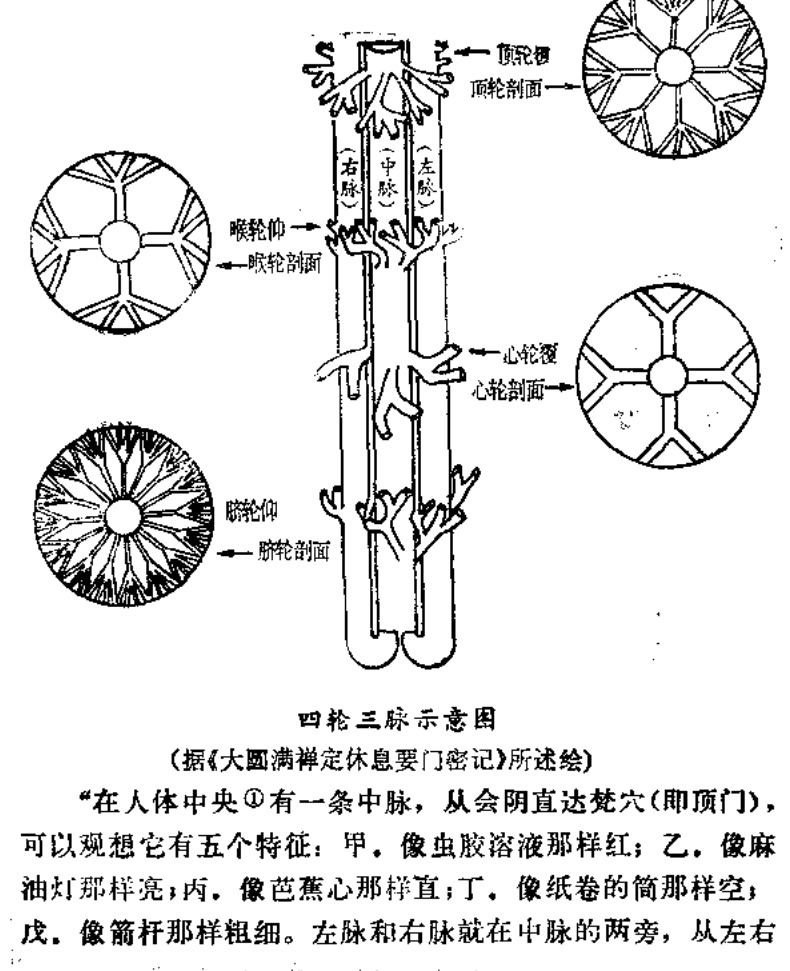
Crown Chakra Cross-section of the Crown Chakra Left Channel (Middle Channel) Throat Chakra (facing upward) → Cross-section of the Throat Chakra Heart Chakra (facing downward) Cross-section of the Heart Chakra Navel Chakra (facing upward) Cross-section of the Navel Chakra Schematic Diagram of the Four Chakras and Three Channels (Drawn according to the descriptions in the Secret Notes on the Essential Gates of the Great Perfection Meditation Rest) “In the center of the human body① there is a central channel, leading directly from the perineum to the Brahma aperture (the crown of the head). It can be visualized as having five characteristics: A. Red like a shellac solution; B. Bright like a sesame oil lamp; C. Straight like the core of a banana tree; D. Empty like a rolled paper cylinder; E. With a thickness like an arrow shaft. The left channel and the right channel are located on either side of the central channel, coming from the left and right…
nostrils, ascending into the brain① and then branching down along both sides of the central channel, merging with the central channel four finger-widths below the navel.”② This description is relatively detailed and clear. Based on the above discussions by masters of Tibetan esoteric Buddhism, the existence of the central channel is certain. However, this central channel is neither the central nervous system, nor the yellow channel, nor the Governing Vessel. The central channel is an independent passageway separate from the aforementioned channel systems. In Tibetan Buddhism, “Anuttara Yoga” occupies the highest position among the four classes of tantra. One of its major characteristics is its emphasis on cultivating the body and refining qi, which differs considerably from other Buddhist schools, including the lower three classes of tantra, and is similar to the path of the “dual cultivation of nature and life” in Daoist internal alchemy. Anuttara Yoga uses a unique theory of body, mind, and qi as the theoretical basis for yoga practice. It was established on the foundation of traditional Indian medical theories of the human body, guided by the esoteric Buddhist doctrine of the “dependent origination of the six elements,” and based on the sensations and effects experienced by yoga practitioners during their practice.
1. Body, Mind, and Mind-Qi
Proceeding from the esoteric philosophical view that “form and mind are non-dual” and the “six elements (earth, water, fire, wind, space, and consciousness) are unobstructed,” Anuttara Yoga holds that body and mind are mutually dependent and an inseparable unity. The body is the material basis of the mind, and the mind is the conscious center of the body. To adequately explain the secret of human life as seen through yogic introspection, both body and mind must be observed across levels. Anuttara Yoga generally divides body and mind into three levels from coarse to subtle. At each level, body and mind exist in a dialectical relationship of inseparable unity.
First Level: Coarse Body and Coarse Mind. The coarse body refers to the body of flesh and blood aggregated by the “four elements” of earth, water, fire, and wind.
The coarse mind refers to the sensations generated by the five sensory organs—eyes, ears, nose, tongue, and body—in response to their objects, as well as the psychological activities of the sixth consciousness, such as perception, concepts, imagination, thinking, dreams, and emotions. Both coarse body and coarse mind are known and perceived by ordinary people, hence they are called coarse. The coarse body serves as the shallow physiological mechanism that generates the coarse mind. Second Level: Subtle Body and Subtle Mind. For the average person, the subtle body refers to the subtle physiological mechanism composed of qi, channels, and bindus (bright drops), roughly equivalent to what is today called a life field or physiological energy. The subtle mind refers to the latent mental functions beneath the layer of consciousness that contain instinctual desires, ego attachments, the will to live, and behavioral tendencies. The subtle body and subtle mind cannot be seen by the physical eye, nor are they self-observed by the consciousness of ordinary people, hence they are called subtle. Although the subtle body is invisible, it is the driving force for the survival of the coarse body; although the subtle mind is minute, it often acts as the latent potential for the arising of coarse mental consciousness. The subtle body and subtle mind are also mutually dependent; the subtle mind must have the subtle body as its foundation. Although the subtle body and subtle mind are minute, it is not difficult for practitioners of yoga and qigong to observe their existence. Third Level: Extremely Subtle Wind and Mind. The extremely subtle wind is the most subtle form of energy or field. Because it lacks a fixed form, it is called wind, or the Dharmakaya (Truth Body). The extremely subtle mind is the essence of mind, latent beneath the coarse mind and subtle mind, which transcends consciousness, instinctual desires, and ego attachments. It is also called the Body of Light, or Self-nature—which is the “nature” seen in the Chan (Zen) school’s “illuminating the mind and seeing one’s true nature.” The extremely subtle wind and mind are non-dual and inseparable; they are the root of human life and soul, difficult for ordinary people and average practitioners of yoga and qigong to know or see. It is said that only in a state of extremely deep meditation, when “both the subject and the object are forgotten,” can one see it oneself. Although body and mind can be observed on three levels, they are actually an integrated whole. When the coarse body and mind are active, it is the subtle body and mind, and ultimately the extremely subtle wind and mind, that are functioning. However, the coarse mind is sometimes interrupted, such as during deep sleep or fainting, whereas the subtle mind never ceases. As long as a single breath remains, the subtle body is propelling the organism’s operation, and the will to live, contained within the subtle mind, is exerting its effect. As for the extremely subtle wind and mind, they remain eternally abiding and unmoving. From the perspective of Anuttara Yoga, human beings are inherently born into the conflict between body and mind. The mind-body conflict is primarily manifested as the division between consciousness and the coarse body, the subtle body-mind, and the extremely subtle wind-mind.
fractured. Consciousness and the gross body are not in correspondence: for instance, the gross body often develops illnesses that consciousness does not wish for. Consciousness and the subtle body-mind are also not in correspondence: the winds and channels do not necessarily obey the directives of consciousness, and the coarse desires born of instinctual impulses — themselves products of the subtle mind — frequently stand in opposition to reason. Consciousness and the subtlest wind-mind are even more often not in correspondence: the consciousness of ordinary persons scatters and shifts ceaselessly, bound by conceptual discrimination, unable to see the Ever-abiding, unmoving subtlest wind-mind within. In Highest Yoga Tantra, this constant non-correspondence between consciousness and the subtlest wind-mind is the source of birth, aging, sickness, and death. Resolving this contradiction constitutes the primary aim of cultivation. The word “yoga” in Highest Yoga Tantra means “correspondence” — that is, regulating one’s own mind so that consciousness corresponds with the subtlest wind-mind.
Within the contradictions of body and mind, the contradiction between consciousness and the winds of the subtle body constitutes a mind-wind contradiction, which may be called the principal contradiction among all body-mind contradictions. Highest Yoga Tantra likens the relationship between mind and wind to that of a person and a fierce horse: the wind is what the mind rides, yet it does not necessarily submit to the mind’s governance. For most people, the mind is often unsettled; when the mind is chaotic, the winds become chaotic, and when the winds are chaotic, the mind becomes chaotic. When the mind cannot direct the winds and the winds do not follow the mind’s command, physiological and psychological disharmony results, leading to numerous illnesses and premature death. But if a person masters the essential techniques and trains diligently, they can subdue the fierce horse. Consciousness can not only control desires through reason and govern action, but also possesses the ability to reflect inwardly and illuminate the subtle body-mind and the subtlest wind-mind. Through self-cultivation via yogic practice, one can bring about the correspondence of mind and wind, so that the winds follow the mind’s command — becoming an excellent rider who skillfully handles the fierce horse of wind.
2. Channels, Winds, and Bindus
The channels (nadi), winds (prana), and bindus (bindu) that constitute the subtle body are what one must understand for the body-cultivation and wind-training of Highest Yoga Tantra.
Channels are the pathways through which winds circulate, roughly equivalent to what Chinese medicine calls meridians (jingluo). Highest Yoga Tantra states that the human body has seventy-two thousand channels, distributed throughout the entire body, each with its own function. For yogic practice, the most important are the central, left, and right channels at the body’s center. In an ordinary person, the central channel is as thick as a wheat stalk; its upper end passes through the crown of the head at the Baihui point (Hundred Convergences), curving forward down to the space between the eyebrows, while its lower end passes below the navel and opens at the perineum. Four fingers below the navel along the central channel, there is the “Muladhara,” where the primal origin of life was first planted — the fundamental spiritual center, also called the Womb of Dharma-generation. The central channel arises from this point, and the entire frame of the body grows from it. The central channel is the hub of human life, yet it is mostly flattened, contracted, and obstructed, like
a dried sheep’s intestine. The left and right channels flank the central channel at a distance of about two fingers from it. Their upper ends pass behind the ears and respectively open at the left and right nostrils. Their lower ends meet the central channel four fingers below the navel (corresponding to the Qihai point of Chinese medicine). The left and right channels respectively serve as the central pathways for the circulation of essence and blood.
At five locations — the crown, throat, heart, navel, and perineum — the three channels intertwine into knots, called channel knots. At each of the five channel knots, with the central channel as the axis, eight to sixty-four subsidiary channels radiate outward like the spokes of a wheel, hence the name “Five Wheels” (chakra). The Five Wheels are the crucial sites for body-cultivation and wind-training, analogous to the dantian of Daoism. To open the channel knots at the Five Wheels and cause all winds to enter the central channel is the essential method of wind-training in Highest Yoga Tantra.
Winds are roughly equivalent to what Chinese medicine and qigong studies call qi. They are generally divided into two categories: root winds and branch winds. The root winds are of five types: (1) The Life-Sustaining Wind, which is the foundation of human life and the energy source of all other winds, roughly equivalent to the true primordial qi spoken of in Chinese medicine and Daoism. It is primarily generated at the junction of the three channels, four fingers below the navel. (2) The Downward-Moving Wind, which functions to circulate essence and blood downward and to facilitate urination and defecation. It arises above the perineum. (3) The Upward-Moving Wind, which functions to propel qi and blood upward. It arises to the southeast of the heart. (4) The Equalizing Wind (Samana), which functions to digest food and transport nutrients. It arises to the east of the heart. (5) The Pervasive Wind (Vyana), which pervades the entire body and serves as the basis of all physical movement. It arises to the south of the heart.
The branch winds are also of five types: (1) The Moving Wind, also called the Dragon Wind, which travels through the eyes and produces visual perception. (2) The Circulating Wind, also called the Turtle Wind, which travels through the ears and produces auditory perception. (3) The Upright Wind, also called the Sea-Horse Wind, which travels through the nose and produces olfactory perception. (4) The Supreme Wind, also called the Deva Wind, which travels through the tongue and produces gustatory perception. (5) The Decisive Wind, also called the Wealth-Generating Wind, which travels through the body and produces tactile perception.
Wind is the kinetic energy of life. If it becomes disordered or obstructed, illness will inevitably arise. In particular, if the Life-Sustaining Wind is even slightly disordered, it can cause unconsciousness, madness, and even death. If a branch wind is obstructed, the corresponding sensory function will be lost.
Bindus, also translated as “true essence” or “true fluid,” carry the meaning of “essence” — referring to the essence that can generate life and
spirit. Bindus are primarily divided into three types: the Bindu Free from Conceptual Elaboration, the Indestructible Bindu, and the Material Bindu. The Bindu Free from Conceptual Elaboration is the ineffable spiritual essence — the very substance of the subtlest wind-mind. The Indestructible Bindu is the life-origin inherited from the reproductive essence of father and mother. That which comes from the father’s essence is called the White Bodhicitta, primarily residing at the crown wheel; that which comes from the mother is called the Red Bodhicitta, primarily residing at the heart wheel. The Indestructible Bindu permanently dwells in the central channel as the foundation of human life; it remains indestructible throughout one’s entire lifetime. It moves up and down within the central channel in accordance with changes in mental activity: during sleep it is called the Mind True Fluid; during dreams, the Reprieve True Fluid; during waking, the Reverent True Fluid; when sexual desire is intense, the Wisdom True Fluid. The Material Bindu consists of fluid substances with physical form, divided into pure and impure types. The pure type consists of essence-blood and fluids transformed from the essence of food and drink; the impure type consists of excretions such as sweat, mucus, and urine.
Channels, winds, and bindus integrate to form the subtle body and are mutually inseparable. The channels serve as pathways for the winds; among them, the central channel is the locus of the Indestructible Bindu, and the Indestructible Bindu is the foundation from which winds are generated.
3. Regulating the Body and Cultivating the Wind
According to Highest Yoga Tantra, since mind and wind depend upon each other, when the mind is regulated, the wind is naturally regulated; when the mind is settled, the wind is naturally settled. Yogic practice does not necessarily have to begin with wind cultivation — methods of Highest Yoga Tantra such as “Mahamudra” cultivate the mind without cultivating the wind, taking the direct realization of the subtlest wind-mind as the essential point. But conversely, when the wind is regulated, the mind is also regulated; when the wind is settled, the mind is also settled. The effectiveness of mind cultivation must also be measured by the degree to which the wind follows the mind’s command. Moreover, for most people, beginning with wind cultivation is easier to master and produces faster results; therefore, practitioners of Highest Yoga Tantra generally begin with cultivating the channels and winds.
Whether one begins with mind cultivation or wind cultivation, regulating the body is of primary importance. Highest Yoga Tantra holds that when the body is regulated, the wind is regulated; when the wind is regulated, the mind is settled. Among all the schools of Buddhism, Highest Yoga Tantra places the greatest emphasis on the body, regarding the body as the basis for attaining Buddhahood and considering the failure to care for one’s body a violation of precepts. Diet must ensure adequate nutrition, and the living environment should strive for hygiene and comfort.
Body regulation is primarily through seated meditation, with four postures: the Vajra Seat, the Elephant Seat, the Lion Seat, and the Sage Seat.
In addition to these four seated postures, Highest Yoga Tantra also employs a special Vajra Standing posture, and during
wind cultivation, supplements these with fist methods and dance, in order to facilitate the circulation of qi and blood and to enhance the effects of stillness practice.
After the body is regulated, one generally proceeds to cultivate the channels and winds. Wind cultivation includes methods such as the Vajra Counting-Breath Method, Vajra Recitation, Treasure Vessel Breath, and Inner Fire Meditation (Tummo). Beginners mostly practice the Vajra Counting-Breath Method.
Part Three
Research on Tibetan Esoteric Qigong
1. The Human Biological Field and Tibetan Esoteric Yoga
A field is a scope of action, such as an electric field, a magnetic field, a gravitational field, and so forth. A biological field is the scope of action of animals and plants. In the past, it was only recognized that animals and plants have a scope of action involving the intake and excretion of solid, liquid, and gaseous substances. Although the spatial range of gas breathing and material exchange with the surrounding environment is relatively broad, its spatial scope is still very limited. In recent years, science magazines have reported that animal bodies all emit various kinds of light, and have published images of various luminescence from animals captured across different wavelengths: mice emit blue light, tigers emit orange light, and so on. Another article reported that, with the exception of the neck having no radiation waves, all other parts of the human body radiate various electromagnetic waves, with the fingertips and the brain emitting the most. Obviously, the human body’s infrared radiation, biological currents, brain waves, and so forth, coexist alongside the existence of life activities. Among these, the field of short-wave radiation is, of course, even broader, potentially extending into outer space.
From natural science, we can know that infrasound has a tremendous effect. Animals such as jellyfish can foresee the arrival of major storms and earthquakes because they can detect infrasound in advance. Currently, advanced nations are researching a highly lethal infrasound weapon; this weapon uses infrasound of a certain frequency and intensity to damage human internal organs, yet the human ear remains completely unaware of it. Across the entire electromagnetic spectrum, the human eye can only see the narrow band of visible light; the human eye cannot see the infrared, as well as short, medium, and long radio waves, which have longer wavelengths than visible light. However, animals sensitive to infrared light, such as cats, mice, and owls, can fly, forage, and move about in the dark of night just as they do in daylight. Bands with shorter wavelengths than visible light, such as ultraviolet rays, X-rays, and gamma rays, are also completely invisible to the human eye. If photographs are taken using film that is only sensitive to infrared light, the scenery seen will be completely different from that captured by ordinary film.
Similarly, if one were to use photographic film sensitive only to ultraviolet light, X-rays, and so forth, the scenes captured would each be different yet again. From this we can know that the world we inhabit contains many substances imperceptible to ordinary people; it is a multi-layered world. Just as in the past we were never aware of the existence of substances such as magnetic fields and ultraviolet light, so too, in terms of hearing, the human ear can only detect sound waves, whereas ultrasonic waves and infrasonic waves, which have wide applications, exist yet go unheard. The other senses—smell, taste, touch, and thought—each have analogous differences.
Human understanding of nature is limited, and understanding of oneself is even more limited. However, a person who has practiced Tibetan esoteric Buddhist methods for many years, while in a qigong state, genuinely perceives the existence of the central channel. They feel a tubular passageway extending from the Baihui acupoint above to the Huiyin acupoint below, together with five circular discs (located respectively at the crown, throat, heart, navel, and perineum) clasped together by this tube and spinning rapidly, while from within this tube numerous rays are continuously emitted toward the plane of these discs. This experience demonstrates from one perspective that the human body is in fact a complex bio-electromagnetic field. Some have regarded the channels as a bio-electromagnetic field, and the central channel as the trajectory of electromagnetic movement within this bio-electromagnetic field. The chakras (channel-wheels), then, are the directional trajectories of magnetic field lines revolving at high speed around the central channel. If this hypothesis holds, then the central channel is a conductor carrying the movement of electric charge, and the chakras represent the direction of force. The relationship between the central channel and the chakras may thus approximate the relationship between the direction of electric current and magnetic field lines. Viewed in this way, the central region of the human body is a kind of field state of the body’s bio-electricity. In other words, this kind of human biological field may endow a person with an innate latent potential. Accordingly, if qigong can be used to excavate the latent potential of the human body, it can greatly expand and enhance the capacity and scope of a person’s faculties of seeing, hearing, awareness, and knowing. When the brain enters a high-energy state, it can penetrate into a holographic, multi-layered world, and intelligence will be greatly elevated.
The “six abhijñā” (six supernatural powers) discussed in Buddhism are: the divine eye, the divine ear, and the power of miraculous transformation (i.e., the power of instantaneous travel)—these three pertain to capacity; telepathy (reading others’ minds), the knowledge of past lives (the ability to clearly know
events of the distant past and future), and the destruction of all defilements—these three pertain to wisdom. In summary, supernatural powers are nothing other than wisdom and capability. What is called a supernatural power is simply wisdom and capability that surpass the ordinary. In fact, one of the differences among various types of organisms is that each type of organism exists at a different “energy level.” Furthermore, a person’s different emotions—joy, anger, sorrow, delight, and other psychological states—can immediately affect the biochemistry within cells throughout the entire body, causing them to produce various substances, some beneficial and some harmful. This was confirmed as early as the 1930s through experiments in medical and psychological sciences. In the practice of meditative concentration (samādhi), esoteric methods, yoga, and qigong, the dominant factor is concentration (ding 定); from concentration wisdom arises, leading to the elevation of energy levels, and even to “sudden transcendence.” In essence, this is merely the manifestation of human instinct to varying degrees. If the excavation of latent potential can reach a state of complete totality and ultimate perfection, then one abides in the highest and most optimal functional state: “One merely restores one’s original nature; not a single new dharma is added.” The essence of the biological field lies precisely in this.
2. Sudden Enlightenment, Bindus, and the Biological Quantum Field
Those who practice Tibetan esoteric Buddhist methods experience phenomena such as bindus (bright drops, mingdian) and sudden enlightenment. The mechanisms behind these phenomena are extremely complex. Yet they ultimately arise from within the human brain, which involves the application of disciplines such as neurophysiology and bioenergetics.
1. Sudden Enlightenment and Neurophysiology. When practitioners of Tibetan esoteric Buddhist methods reach an advanced stage, sometimes their thinking suddenly opens up or internal visualization effects appear. These phenomena resemble the “awakening” (enlightenment) of the Chan school, but the awakening discussed by these two schools differs in nature, and the content of the experience is not the same. In recent years, some scientists abroad have taken an interest in the question of sudden enlightenment. For example, Nobel laureate B. Josephson practiced relevant methods and proposed that sudden enlightenment is the result of the consciousness field being free from interference, allowing inherent intelligence to flash forth.
The physiological background of conscious activity is: brain cells are stimulated by relevant signals, and neural pathways transmit electrical potentials and pulses. The human brain has approximately one hundred billion nerve cells, roughly equal to the number of stars in our Milky Way galaxy. During the embryonic development stage, the growth rate of brain cells is two hundred and fifty thousand per minute. Each brain cell has a different morphology, each contains genetic material and genetic information, and each has thousands of neural pathways for incoming signals. When nerve cells in a certain region are stimulated by relevant signals, they generate “action potentials,” transmitting pulse signals along relevant pathways, thereby producing corresponding activities of conscious awareness.
Generally speaking, activities of conscious awareness are infinitely varied, but in summary they amount to nothing more than perceptual cognition and rational cognition. Therefore, the electrical potentials, pulses, and signal-transmitting pathways of the human brain broadly share certain common fundamental patterns. An orderly thought activity typically must pass through many disorderly thought processes. This dissipates a great deal of brain energy, thereby affecting various structures and functions within the human body. Brain energy encompasses two aspects: from a macroscopic perspective, it is the measurable brain electrical energy, generated by potassium and sodium ions inside and outside the brain cell membrane crossing the cell membrane; from a microscopic perspective, it is the “biological quantum field,” which may be generated by relevant particles within the nuclei of brain cells.
The information at the moment of sudden enlightenment may not be transmitted by brain waves traveling through neural pathways; it may instead be transmitted by the oscillation waves of the aforementioned quantum field. When the internal practice of Tibetan esoteric Buddhism is very deep, the nervous system is in a state of minimal excitation, and the consciousness field is like a vacuum. Modern physicists point out that a vacuum is not empty at all; it harbors latent excitation effects. From this it can be hypothesized that when the consciousness field is free from interference, and under the continued influence of Tibetan esoteric internal practice, relevant particles within the nuclei of brain cells may be excited, generating quantum waves that transmit information derived from inherent intelligence. This may be the mechanism of sudden enlightenment—though, of course, this is merely an analogical approach. Every person inherently possesses latent intelligence; in terms of physical mechanism, intelligence must also have a material basis. Although the nature of this material is unclear, it appears to be a product transmitted from generation to generation through successive reproductive cells.
Clearly, the attainment of sudden enlightenment in Tibetan esoteric Buddhism is not agonized deliberation or deliberate pursuit, but rather the state of all
Rather, it is the spontaneous result that arises when all conditions have subsided and the time is ripe. The source of its information is not the various signals circulating in the external world, but rather latent inherent intelligence. Western neurophysiologists have been researching thinking activity, advancing along the direction of neural electrical potential impulses, for a very long time. Yet the fundamental question of why the human brain thinks at all remains far from resolved, and research on sudden enlightenment has not even been placed on the agenda. With the practice of Tibetan esoteric inner cultivation as a foundation, it may be possible to find a new pathway for exploring these questions.
2. Bindus and Biological High-Energy
The nervous system and the neural pathways that transmit signals were discovered through anatomy and electroencephalographic measurement techniques. In the vicinity of the nervous system there is the meridian system, in which “vital energy” sensing has been confirmed through qigong introspection and acupuncture. Between the Conception and Governing Vessels of the meridian system, there is a vertical central channel extending from the heart Brahma-aperture to the cranial apex Brahma-aperture, through which bindus travel — this is the hub experienced in the practice of Tibetan esoteric inner cultivation. These three systems possess different structures and functions, governing human life from the macroscopic to the microscopic level; therefore they are closely related to the consciousness field.
According to I. Prigogine’s dissipative structure theory, it is known that any living system has an “energy flow” passing through it that serves a necessary function, ultimately reaching a stable state and possessing a new structure adapted to the environment. The energy flow used by neural pathways to transmit sensory and consciousness signals is brain electrical energy. The energy flow in the meridian system may be related to “ions” in the vicinity of cell membranes and high-energy substances within cell nuclei; it is conventionally given the designation “vital energy,” though its chemical composition and physical mechanism remain unclear. The bindu traveling within the central channel is an unknown form of biological energy, possibly related to high-energy substances within brain cell nuclei. This energy source is not only the source of the bindu’s luminous energy but also the source of the bindu’s intelligence. The unification of intelligence and luminous energy within the bindu may represent an advanced form of human life.
In terms of an individual’s life, the origin of the bindu may be related to heredity. When sperm and egg cells unite, the above-mentioned unity latent within each of them combines again to form a new bindu, representing a new life. The bindu can be regarded as the energy source of the
“biophoton quantum field.” After its birth, it travels between heart and brain in succession with the development of the neural plate, neural tube, and embryo. During the formation of the neural tube, the six sensory-cognitive zones also form in succession. They may have an intrinsic connection with the bindu, because the various structures and functions within the human body are closely interrelated. From this it can be inferred that the bindu may control all activities of the six sensory-cognitive zones. The renowned neurophysiologist F.H.C. Crick held that a system as complex and sensitive as the brain must possess a comprehensive control center. It appears that what he contemplated touches upon questions of Tibetan esoteric inner cultivation.
- Tibetan Esoteric Inner Cultivation and Quantum Cybernetics The foregoing discussion, following modern scientific theory, has inferred the reality of sudden enlightenment and the bindu’s existence, and has indicated that the mechanisms of both may be related to “biological quantum field theory.” This is only one side of the problem. The principal reason that Tibetan esoteric inner cultivation is supremely excellent is that, on the basis of self-controlling the three karmas of body, speech, and mind, it receives the support of the “cosmic bio-ecological field.” The objectivity of this situation can be analogized through “quantum cybernetics,” though direct scientific proof is very difficult. Quantum cybernetics is an interdisciplinary discipline born in recent years; it studies, from a microscopic perspective, the changes in a system’s state under the control of external energy. The level of external energy a system can receive is related to its own foundation. When the foundational energy level reaches a certain degree, if it continues to be strengthened, then the external energy level it can sustain becomes even higher.
Facts demonstrate that there are inexhaustible “bio-ecological quantum fields” in the universe, each forever oscillating and radiating energy at a certain frequency. Anyone who wishes to attain the supreme accomplishments of Tibetan esoteric inner cultivation can obtain support from relevant energies in the universe. The human body is inherently an open thermodynamic system and must absorb energy and information from the outside. Due to improper control under ordinary circumstances, and under the influence of the three karmas of body, speech, and mind, the nervous system is frequently excited and consumes energy, so that the luminous energy of the bindu is disturbed, dissipated, and obscured. Conversely, if one can practice Tibetan esoteric inner cultivation, controlling the three karmas of body, speech, and mind, allowing the nervous system to remain in a minimally excited state, energy consumption decreases and the metabolic rate is lowered. Under these conditions, the bindu is no longer disturbed and regains its luminosity, forming a biophoton quantum field that travels
within the central channel. This lays the foundation for the supreme accomplishments of Tibetan esoteric inner cultivation.
In order to receive the support of the cosmic bio-ecological quantum field, besides inner cultivation, one must also perform beneficial outer deeds for society through body, speech, and mind, because inner cultivation is the necessary condition for receiving external energy support, while outer deeds are the sufficient condition. When inner and outer cultivation couple and reach a higher energy level, the bindu becomes even more luminous, oscillating at a certain frequency. If the oscillation frequency of the bindu matches the radiation frequency of the cosmic bio-ecological quantum field, and the Brahma-aperture is truly opened, then the radiation energy of the bio-ecological quantum field naturally enters the central channel through the Brahma-aperture, superimposing upon the luminous energy of the bindu and resonating, thereby attaining the supreme accomplishments of Tibetan esoteric Buddhism. Although this hypothesis cannot currently be verified scientifically, it demonstrates the possibility of such phenomena to a certain extent. The human body does not absorb all external energy through the mouth and nose; for energies radiated by the bio-ecological quantum field, the cranial apex Brahma-aperture is an important channel.
Conversely, if the Brahma-aperture is not opened, the central channel is not cleared, and the bindu is not luminous, then despite the cosmic bio-ecological quantum field radiating energy at all times and in all places, the human body is unable to absorb it — this is the greatest loss in one’s own life. Furthermore, although the methods of Tibetan esoteric cultivation are supremely excellent and produce rapid results, one must have firm faith, sincere aspiration, and deep practice, so that the foundation of inner and outer cultivation is profound and deep; only then can accomplishment be achieved. Otherwise, merely seeking techniques without establishing the foundation, hoping for quick success, is impossible and may even cause problems. This situation is analogous to an astronaut riding a rocket to fly to the moon. If one’s own physiological functions cannot adapt to the high-speed flight produced by the rocket’s high energy, danger will ensue. Therefore, the gradual practice of inner and outer cultivation to reach a certain energy level is the necessary foundation for studying Tibetan esoteric Buddhism and achieving accomplishment.
Although the actual effects of Tibetan esoteric inner cultivation are not currently detectable by scientific instruments, in order to uncover and research these problems, one should, on the basis of elevating frontier science, put forward certain hypotheses and conduct theoretical exploration. These hypotheses set aside current neurophysiological methods and do not follow the path of brain electrical fields and brain magnetic fields. However, considering that effects such as the bindu and sudden enlightenment cannot arise apart from the brain, one proceeds from
explored the bio-nature energy source within cell nuclei from a microscopic perspective. This energy source is related to sperm and egg cells, and it contains the genetic material that stimulates luminous energy and intelligence. As for what exactly this genetic material is, that is of course another extremely complex question, requiring comprehensive research from various fields.
3. Khregs-chod, Thod-gal, and Bindus
The cultivation of the Tibetan esoteric “Great Perfection” (Dzogchen) practice is divided into two steps: Khregs-chod (彻却) and Thod-gal (脱噶). Khregs-chod means “abrupt cutting off,” equivalent to the supreme meditation attainment, belonging to the cultivation of samadhi. Thod-gal means “sudden transcendence,” equivalent to the unsurpassed wisdom practice, belonging to the cultivation of light. When observing the light of Thod-gal, one must have the foundation of Khregs-chod samadhi in order to perceive the microscopic world within samadhi, that is, to see the various different “bindus” (明点, luminous points) in cosmic space.
Khregs-chod belongs to “stong-pa” (东巴), meaning emptiness; Thod-gal belongs to “snang-ba” (囊瓦), meaning luminous appearance. “Stong-pa” represents the moon, and “snang-ba” represents the sun. The “bindus” exist in cosmic space and can be seen under sunlight. “Bindus” may be fixed and motionless, or they may have small circles within large circles; some are shaped like wheels, some like necklaces, and others move up, down, left, and right. These moving bindus are like birds soaring in the sky. When first observed, they are very tiny and elusive, but as one’s samadhi deepens, the bindus gradually enlarge. Some of them are like rainbows, with their colors arranged in a definite pattern. In the center of the bindu there is another bindu, mostly white in color; red, yellow, and blue are less common, and green is the rarest. The brightness of bindus is generally like that of an electric lamp, and some are resplendent with golden light. Jigme Puntsok Rinpoche (即甲色上师, Kyabje Rinpoche) once used a prism—a modern scientific research instrument—to teach disciples to observe the luminous colors of the universe, demonstrating the scientific nature and authenticity of bindu observation. When Master Genzao watched a science educational film about the atomic bomb, he saw from the screen that the luminous colors after the atomic bomb explosion were extremely similar to the “bindus” he had seen while practicing Thod-gal.
This shows that “bindus” are not some baseless fantasy, but truly existing substances that can be seen through observation.
The macroscopic cosmos contains bindus, which are called outer bindus; however, “bindus” exist not only in space but also on the human body. The microscopic human body—this small universe—also contains “bindus,” which are called inner bindus. Associate Professor Zhu Yufu had profound experiences while practicing the Khregs-chod and Thod-gal of the Great Perfection. His inner experiences during “initial samadhi” were as follows: he felt his body and consciousness gradually entering samadhi, and the hundreds of millions of various cells within his body were like countless small magnets, all being brought into orderly arrangement. At this time, the qi and blood throughout his body also gradually became orderly. The speed and depth of this transition from stillness to samadhi depend on each person’s level of attainment. Its breadth and depth also change accordingly—the whole body seems to be enveloped in a layer of mist, with a sense of concentration, density, and thickness. Sometimes it feels like being in water, sinking and floating from time to time. That membranous layer attached all around is elastic and can contract and disperse in response to thought. Sometimes it gathers into points, the sense of “I” disappears, and only thought remains, condensed within a small point. The physical body no longer exists; only the small point (i.e., the inner bindu) can rise and descend along the central channel. On several occasions, he tried to push the small point out from the navel chakra through the central channel and out through the crown of the head to connect with the outer bindus in space, but each time the connection failed to be made and it was drawn back. During the push, he could hear the sound of skull bones moving, and several times he felt the hair on his crown standing upright and slightly moving… afterward, the top of his head felt uncomfortable, as if an iron helmet had been clamped onto his head. If the method is properly applied and the level of attainment deepens day by day, the inner “bindu” will break out of the human body and connect with the cosmic outer “bindu.”
So, what effect would there be if one’s own inner “bindu” connects with the cosmic outer “bindu”? From the perspective of modern systems science, the human being is a giant system situated within the entire cosmos, and such a giant system is mutually connected with the surrounding cosmos. The minor efficacy of practicing Thod-gal and observing bindus is that one can utilize cosmic energy to cure illness and prolong life. Associate Professor Zhu Yufu had previously suffered from various diseases including cervical bone spurs (osteophytes), chronic sinusitis, bilateral lung expansion, interstitial lesions, and multiple gallstones, which affected his studies and work. Since he began practicing, hospital examinations have confirmed that he is basically cured. He is now full of energy and his vital force has multiplied many times over.
Letting cosmic “bindus” enter one’s own body at will, or letting one’s own “bindu” enter the cosmos—this is a higher level of Tibetan esoteric practice. Many predecessors and modern Tibetan esoteric masters have made valuable explorations, and many wondrous phenomena have appeared. How can inner and outer “bindus” be connected? The master bindu located within the central channel of the human body is the control sphere for the human body’s life information. Through this control mechanism within the body, a person can emit energy toward the cosmos and also absorb energy from the cosmic field, realizing the connection of inner and outer “bindus.”
The fission of atoms or particles can produce enormous energy. Of course, such fission requires a series of external conditions including high temperature and high pressure. However, in recent years, through various qigong scientific experiments, it has been proven that the extraordinary “heaven-human effect” and the emission of information can also produce unexpectedly high-temperature and high-pressure effects, and can transmit control information to distant locations through thought. By analogy, practicing the Tibetan esoteric Great Perfection can also control the exchange and replenishment of energy between the inner “bindu” within the human body and the outer “bindu” of the cosmos, thereby producing photoelectric and photothermal effects within the body, and especially producing physiological and biochemical effects. This “energy source” of nature can be described as inexhaustible and endlessly renewable. Moreover, it is “impartial” to all humanity on Earth. In order to equip oneself with the conditions for such “ignition” between inner and outer “bindus,” one must diligently cultivate the treasure left by predecessors for later generations—the Tibetan esoteric Great Perfection practice.
4. The Activation of Internal Power — External Power
The activation of internal power is an issue that has drawn attention in qigong circles and has become one of the topics of greatest interest to people. It encompasses two aspects: the continuous growth of energy and the permanent non-degeneration of energy. Tibetan esoteric Buddhism grounds both the attainment of resonance (yoga) and the achievement of realization in the empowerment (adhiṣṭhāna) of the guru. In qigong terminology, this means that the activation of internal power must rely on external power.
In Tibetan esoteric Buddhism, this external force is “bestowed” (加) upon the practitioner by the guru, while “received and upheld” (持) means the practitioner must, under the conditions in which external force stimulates internal force, continue to cultivate without interruption. Only when “bestowing” and “receiving” thus correspond can one’s latent potential be activated.
Qigong and Buddhist cultivation are identical in that both rely on the power of the mind to produce effects. The mind is the most active and changeable element—a single thought can travel a hundred and eight thousand li. If one applies mental power improperly during practice, deviations easily arise, manifesting directly in body and mind. Therefore, some strange illnesses cannot be cured by medicine; an illness of the heart still requires medicine for the heart. Since a guru of Tibetan esoteric Buddhism must be one who has attained accomplishment in the practice of unsurpassed yoga, not only can he teach methods suited to the student’s aptitude and progress and promptly correct deviations, but he can also emit energy toward the student, causing their qi and channels to open rapidly. The student can receive tremendous energy to increase their practice power and eliminate obstacles. For this reason, Tibetan esoteric Buddhism places great importance on the qualifications required of a guru and on the establishment of the guru-disciple relationship; a relatively long period of observation is required, and once the guru-disciple relationship is established, it cannot be undone. No matter how exacting the guru may be toward the disciple, the disciple should mentally regard all of the guru’s behavior toward them as an act of empowerment (加持). In truth, the ultimate benefit of the disciple’s reverence for the guru still returns to the disciple himself. That is to say, the transmission of energy produces a chain reaction. This can also be explained using the principles of modern information theory, cybernetics, and the synchronization effects of biological fields.
What has been discussed above concerns the action of the teacher’s external force upon the practitioner’s internal force. In addition, there are cases of extraordinary abilities arising after a person has been struck by a sudden external force—such as a heavy object or electric power—and revived after being declared dead. This likewise falls under the category of external force stimulating internal force, but the external force here is different from that described previously. The effects produced, however, do share certain similarities. For example, the world-renowned psychic Uri Geller can bend or break metal cutlery at a distance, make clocks run fast or slow, cause computers to stop working, read other people’s thoughts, foresee others’ good or ill fortune, accelerate radioactive counters, perform non-ocular vision, weaken magnetometers, and deflect compass needles from the north-south poles. In his own account, he described how his abilities came about:
As a child, he was struck face-upward by a ball of silvery light in the sky, sending him to the ground. After a violent pain in his head, he lost consciousness, and upon waking, this energy had emerged. ①
Another example: In March 1978, near Donetsk in Ukraine, USSR, a 37-year-old female crane operator at a mine named Volobuyeva unfortunately came into contact with a 380-volt electric current. She was pronounced dead and placed in the morgue for two days. Upon regaining consciousness, she developed superhuman vision—the ability to see through the internal organs of the human body and to diagnose illnesses that others had overlooked. ② In Rochester, on the shore of Lake Ontario in New York, USA, a 30-year-old mechanic named Tom Sawyer was crushed across his abdomen by a small truck while at work. His heart had already stopped beating in the ambulance, but he was later revived. After regaining consciousness, he had undergone tremendous changes in three aspects: physical, intellectual, and spiritual. Sawyer, who had no foundation in physics whatsoever, suddenly became passionately obsessed with physics—especially quantum mechanics—and went on to earn a bachelor’s degree in physics. He believed that at the moment of the accident, he had instantaneously merged with a mysterious light, and thereby felt he had already grasped the entirety of physics. His time at university was merely a matter of recovering these pieces of knowledge from memory one segment at a time! ③
The above three examples all involve external force striking and stimulating internal force to produce extraordinary abilities. When Western scientists discuss this issue, they attempt to use Indian yogic phenomena to explain why external causes turn toward internal ones. The “Kundalini awakening state” of Indian yoga holds that between the base of the human spine and the center of the pelvis there lies an enormous reservoir of energy—this is “Kundalini,” the “Serpent of Life.” It can be awakened through yogic methods, enabling one to merge with the mysterious sphere of light. This constitutes the theory of internal force breaking through the chakras. However, they have not yet gone deeper into the study of the unsurpassed yoga Vajrayana of Indian Buddhism. Judging from the various phenomena above, if we provisionally regard “Kundalini,” this “Serpent of Life,” as the internal force possessed by a person, then this internal force requires both one’s own cultivation to awaken it and the stimulation of an external force to make it soar.
① Uri Geller’s own account, translated by Lu Jinlin and Tan Shuwang, My Special Abilities (我的特异功能). ② See Jiefang Daily (解放日报), June 16, 1987. ③ Compiled and translated by Xia Xingen, “What Is It Like to Be Near Death?” (濒临死亡究属何样), Shanghai Translation News (上海译报), January 4, 1838 [as printed].
5. Longevity — Rainbow Body Transformation
Tibetan esoteric Buddhist yogic qigong regards the “Great Perfection Heart Essence” (大圆满心髓), secretly transmitted by the Nyingma school (Red Sect), as the supreme method. Those who cultivate this method and attain a relatively profound level of accomplishment will generally manifest two notable results: first, extreme longevity combined with a light, healthy body and a youthful, childlike countenance; second, rainbow body transformation at the time of death—a supreme miracle that captivates the imagination most profoundly.
Health and longevity are, of course, general goals attainable by qigong health cultivators of all schools in our country. In particular, the brilliant examples set by Daoist qigong in the area of nourishing life and extending longevity have been praised by all for thousands of years. However, because Tibetan esoteric Buddhist yogic methods have rarely been transmitted to the interior regions for a long time, the magnificent accomplishments of the Nyingma school’s “Great Perfection” in the area of longevity and health preservation, along with its extraordinary techniques and wondrous effects that differ from interior qigong, have been even less widely known.
The “Great Perfection” trains the body by absorbing the energy of sunlight. Its method differs greatly from the Daoist method of absorbing the essence of the sun. Daoism takes wuwei (non-action) and internal nourishment as the orthodox practice for cultivating the internal elixir, while absorbing the sun’s essence at dawn when the sun first rises serves as an auxiliary practice. The “Great Perfection” is primarily conducted under sunlight, but it does not aim to draw in the refined essence of sunlight. Instead, one faces the direction of the sun, concentrates the mind and quietly contemplates the luminous points (明点, bindu) of the universe, while simultaneously emitting corresponding coded information through mental power. The energy of sunlight then continuously dissolves into and is stored within the body (for details, see the “Great Perfection” practice method later). Modern scientific research has demonstrated that the movement of life endows all living things with biological energy fields. The human body, as a giant system, is no exception. The strength of the human energy field is intimately related to one’s state of health. Through qigong training (i.e., the absorption of the universal energy field), the human biological energy field can be strengthened,
thereby strengthening the human body’s immune system, improving the ability to prevent and resist disease, bringing physical and mental health, delaying aging, and extending lifespan.
Regarding longevity, viewed from the perspective of relativity, a clock in a gravitational field runs relatively slower than an identical clock unaffected by gravity, and within any specific region, the stronger the gravitational field, the slower the clock runs. This effect is called “time dilation” or “time elongation.” General relativity yields the same result for clocks governed by any gravitational force and of any construction. According to this result, a person who travels for a long period in a high-speed spacecraft through space should, upon returning to the Earth’s surface, be much younger than the twin brother who remained on Earth the whole time. This is because the astronaut’s biological clock and all of his physiological processes proceed much more slowly than those of a person remaining on Earth. Admittedly, for this effect to become apparent, the spacecraft’s speed must approach the speed of light, and such high-speed craft cannot be manufactured at present. However, a large number of experiments in qigong science both in China and abroad have proven that practitioners in a state of deep relaxation experience a slowing of various physiological rhythms such as respiration and heartbeat. Outstanding qigong masters can reduce their breathing frequency to as low as one or two breaths per minute. An Indian yogi was once sealed in an airtight coffin and buried underground for eight days, yet emerged completely unharmed. According to relevant domestic reports: when a static-electric probe device was used to test a qigong master who was actively emitting qi, an electrostatic concentration signal was detected at a distance of fifty millimeters from his head, and a magnetic probe detected a remarkably strong magnetic field. This powerful magnetic field actually exceeded the instrument’s measurement range, not only causing the instrument to emit loud sounds but even destroying the recording pen. The above research proves that practicing qigong can enhance the human body’s bioenergy field, producing a self-induced biological-clock-slowing effect, and the resulting relative elongation of life time necessarily leads to longevity. The Nyingma school of Tibetan esoteric Buddhism’s “Great Perfection” (Dzogchen) practice cultivates the body by continuously and abundantly absorbing solar energy. It can tremendously strengthen the human energy field, and therefore achieves even greater accomplishments in health, longevity, and life extension.
Both legends and documented records of Tibetan esoteric Buddhism contain many examples of longevity. For example, it is said that the Nyingma
school’s revered master Padmasambhava (Guru Rinpoche) was born in 482 BCE (eighteen years after the death of Laozi), entered Tibet to transmit the teachings around the mid-seventh century CE, and departed Tibet several decades later. His lifespan was exceptionally long. The great master Milarepa was born in 1052 and remained alive until 1153. Furthermore, according to a statistical study by Sonam Döndrub of the Institute of Religious Studies at the Tibet Academy of Social Sciences, on the rainbow-body accomplishments of forty Nyingma school scholars, the youngest among them was over eighty years of age, the oldest reached over 140 years, and many cases exceeded one hundred years of age. These examples demonstrate that the Tibetan esoteric “Great Perfection” is truly extraordinary in promoting human health and longevity. It should be disseminated as widely as other qigong methods.
The supreme accomplishment of the Nyingma school of Tibetan esoteric Buddhism is the rainbow body. In the research materials of a qigong researcher who traveled to Kangding, Sichuan for field investigation and personally received teachings and empowerment from a great Nyingma master, the marvel of the rainbow body at the time of death is recorded: the one who attains the rainbow body, while seated in meditation, continuously emits light from the body; as the light is emitted, the physical form continually shrinks; through shrinking, it gradually disappears, until in the end only the fingernails and hair remain. As the flesh body emits light and shrinks, a radiant red glow appears swirling in the sky above the person’s crown. There are also those of a lesser attainment, whose flesh body, while emitting light, shrinks to a certain extent (one or two feet, or two to three feet) and then ceases to emit light and shrink further; the remaining form becomes as hard as iron.
Why does the human body emit red light during the rainbow-body transformation? This requires first understanding what light is. Modern physics research has proven that light is nothing other than the propagation of an electromagnetic field. When we heat all matter to high temperatures, it will emit light; this phenomenon originates from the electrical structure of matter. At high temperatures, the charged particles within matter, especially electrons, undergo intense and rapid motion, producing rapidly varying electromagnetic fields, thereby causing the propagation of the field to spread outward at the speed of light into space—this is the emitted light.
Chemical analysis proves that the long-chain macromolecular structures constituting the living cells of the human body are primarily composed of four elements: carbon, hydrogen, oxygen, and nitrogen (along with some other trace elements such as iron, phosphorus, calcium, magnesium, etc.). The atoms of these elements share many similarities with non-biological atoms. When non-living matter acquires a certain amount of energy (such as
heat and light), it produces propagation of an electromagnetic field and emits light. Living organisms, through their own life processes, can likewise produce propagation of an electromagnetic field (i.e., a bioenergy field) and emit light. Therefore, the human body itself is a luminous body. Abroad, there is a photographic technique called Kirlian photography; when used to photograph people, it reveals a layer of blue light-halo on the body’s surface. It is only because this luminescence is extremely faint that it cannot be seen by the naked human eye. However, the yogic practitioners of the Nyingma school of Tibetan esoteric Buddhism, in the course of their practice of the “Great Perfection,” continuously and abundantly absorb solar light energy. After decades or even upward of a century of rich accumulation, how immense must the energy stored within their bodies be! This quantitative accumulation will inevitably lead to a qualitative transformation. Once a supreme yogi’s practice reaches complete fulfillment, he can issue an activation command through an information code regulated by mental power, releasing all the solar energy stored within the body. When this tremendous energy “erupts,” it can “melt” and decompose the body’s tissue cells (this is an extremely complex physicochemical process), and simultaneously cause the atoms of all elements constituting the human body, having acquired enormous energy, to produce propagation of an electromagnetic field, thereby causing the body to emit light. At this point, the person’s own bioenergy field has already merged seamlessly with all intelligent information, forming a field-state body. The field-state body possesses powerful field energy, which Esoteric Buddhism calls Infinite Life and Infinite Light; its field energy can extend to any spacetime region of the universe. According to the aforementioned clock-slowing effect, when light passes through a strong gravitational field, the vibration frequency of the light wave decreases, the wavelength correspondingly increases, and the spectral line shifts toward the red end (among visible light, red light has the lowest frequency and the longest wavelength). This is the gravitational redshift of relativity. When the light emitted by the rainbow-body practitioner’s flesh body and the external light rays pass through the field-state body, the redshift effect produced by its powerful field energy causes a magnificent spectacle of swirling red light to appear in the sky above the practitioner.
So then, after the rainbow body transformation, when the physical form has disappeared, where has the mass of the flesh body gone? According to Einstein’s theory of relativity—the principle of mass-energy equivalence—when the mass possessed by matter is converted into energy, the lost mass m equals the total energy E converted from it divided by the square of the speed of light c, that is, E = mc². Here, energy has already become a special form of existence of matter’s mass,
form, and mass, in a certain sense, is also energy. During the process of rainbow body realization, practitioners of Anuttara Yoga transform some of the mass of their physical body into light energy. Beyond this, no other form of massive energy release has been observed. From this it may be inferred that the physical body of the one who attains the rainbow body is decomposed to the molecular or atomic level, with its mass “evaporating” away, ultimately leaving only visible residual matter — hair and nails.
From this it can be seen that the extraordinary effects of the Nyingma lineage of Tibetan esoteric qigong can be brought within the framework of relativity for recognition and investigation. However, what physical and chemical reactions actually occur during the “evaporation” process of the physical body in rainbow body realization remains unknown. Given the current level of scientific development, the deeper significance of rainbow body realization cannot yet be explained.
6. Categories of Channels and Qi in Tibetan Esoteric Qigong
The foundation of practice is one’s own channels and qi. What is cultivated in practice is the function and wondrous method of life. The result of practice is a body free of illness and pain, a mind at peace and joyful, and ultimately the attainment of longevity and happiness.
The human body is composed of three things: channels, qi, and bindus. On the pathways of the channels, one must know the patterns of the channels. If one does not know the forms and locations of the channels in the human body, one cannot know the locations of qi. If one does not know the locations of qi, it is difficult to grasp the key points through which qi circulates. Therefore, one must first understand the categories of channels.
The categories of channels described in medical texts refer to channels that are relatively obvious and commonly shared in the bodies of ordinary people. Additionally, there are the categories of channels described in tantra sections such as the Kālacakra, determined by the nature of the vajra body. First, the channels commonly manifested in the human body as described in medical texts are of three types: water channels, blood channels, and qi channels.
Water channels extend downward from the head through the spinal cord and its branches; they are white channels. Blood channels rise upward from the center of the body, like a red agate pillar, and belong to the category of veins among the black and white channels.
Qi channels and blood channels travel together, running parallel upward with the black and white channels. The qi-blood channels are red and belong to the category of arteries.
All channels are only of these three types. These three types of channels are also the channels of life. The total number of channels is seventy-two thousand. Among them, the white water channels number twenty-four thousand, the black blood channel veins number twenty-four thousand, and the red blood channel arteries number twenty-four thousand.
Channels first form in the mother’s womb, then in the middle stage they form and grow into the intermediate natural channels that do not disappear. The main trunks of the channels, the branches of the channels, and the fine channels are all interconnected. Therefore, there are four types of channels upon which life depends.
- Forming channels. When any person first takes shape in the mother’s womb, three channels branch out from the center of the embryonic body. One of these channels forms the human brain above, and relying on the brain it exists. Through this, the body has two types of diseases that arise from its own nature: they dwell in the upper part and are formed in the upper part. The cause of this illness is the nature of earth and water, which falls downward from the upper part, producing diseases of the kidneys, lower back, and legs. Another channel rises from the center of the body straight upward like a pillar, forming the black life channel — the blood channel vein. Anger, formed by the hot qi of blood and bile, exists in dependence upon the blood of the life channel. From this arises the nature of bile heat; through this causal relationship, anger dwells in the middle. Although fire exists in the lower part, it burns upward; this is due to natural law. When bile heat is excessive, pain occurs primarily in the head and upper body.
Another channel goes downward, forming the secret places of men and women. From this arise the qi of the nature of both cold and heat. Through this causal relationship and its basis, it dwells in the lower part. Although qi resides in the lower part, it pervades the entire body and circulates throughout the entire body, thereby giving rise to all kinds of illness and pain.
-
Life channels are three. The tantra sections state that these three are the central channel, the left channel, and the right channel. In Tibetan medical texts, the white life channel, the black life channel, and the red life channel are called the three channels. In reality, the central channel, the left channel, and the right channel are not different from the life channels of the human body; they dwell in one place.
-
The channel of wisdom is the central channel among all channels; it is the life channel of all channels. The Rāhu channel is the foundation upon which life depends, and is therefore called the life channel. All qi channels carry the ceaseless qi. The working qi is the root of all qi and is the qi of great life. These two blend together like water and milk, and are also a component that sustains life; therefore, they are called the life channel.
- The great channels of the human body are four. The first channel is the root channel that manifests toward the sense bases and sense objects — that is, the five sense faculties of the eye and so forth: the eye can see forms, the ear can hear sounds, the nose can smell odors, the tongue can distinguish flavors, and the body can touch objects. The main channel that produces these functions exists within the brain, like a sovereign king. There are also fine channels corresponding to oneself, to lineage, and to function. The largest fine channels number thirty-two. From these fine channels, still finer channels branch out, possessing lesser power and function. Such channels number five hundred in total, surrounding the fine channels and coordinating with the primary functions. They serve to activate the contact of the five sense faculties with the five sense objects. They serve as beneficial assistants capable of discerning the finest details of external objects.
The second channel is the channel that makes the memory faculty function with greater clarity. The memory faculty, or mental faculty, is the main channel that relies on this faculty to clarify the six consciousnesses. In the center of the chest exists what is called the well-intentioned channel, which functions like a sovereign king in enabling memory and clarity. The fine channels that coordinate with its type and function number eight larger ones. From these eight channels, five hundred fine channels branch out and surround them, enabling the memory faculty to clearly perceive external objects.
The third channel is the channel that forms the five aggregates of the human body. The channel that initially forms the five aggregates of the body — once the body is fully generated and formed, it relies on the navel cakra to complete the activities of formation and development — is the king of channels. The king of channels, together with the fine channels that coordinate with its own type and function, has sixty-four larger fine channels. From these channels, five hundred fine channels further subdivide and surround them, all intersecting and coordinating to carry out their functions.
The fourth channel is the channel that perpetuates and enhances the lineage. Relying on form, it constantly performs the work of perpetuating the lineage. The largest fine channels on this channel number thirty-two. From these, five hundred fine channels branch out and mutually surround them. The main channels and their functions coordinate to carry out their activities.
The centers of the above-mentioned channel wheels and their branching fine channels — and the still finer fine channels — are directly interconnected within and without, above and below throughout the body, forming a network of channels that pervades the entire body. These channels are active throughout the body. Within them are the pathways through which the original qi and other qi travel. Relying on these, the body is able to survive. These channels are also the channels of life. Whether a person survives or perishes all
These [channels] are associated with whether these channels are active or inactive. The prana that depends on these channels forms the initially arisen vajra body, extending into the alaya-consciousness (the eighth consciousness) within the red sun, and depends upon this consciousness. From this arises the activity of the active mind. The prana of the great life-force forms the life of sentient beings possessing body-consciousness and the characteristic of warmth. Here it divides into two categories: wisdom prana and karma prana. The wisdom prana is further divided into two portions: one resides within the central channel of life, performing the function of sustaining life; the other joins together with the karma prana, constantly entering and exiting through the nostrils. The activities of body, speech, and mind are entirely preceded by the stirring of prana. Thus, the branch pranas born from the great life-force prana travel within the aforementioned channel-wheels, thereby pervading the entire body and giving rise to all activities of arising, abiding, decay, and cessation. Therefore, when one wishes to attain free activity, one must first exhale, inhale, and retain the breath through the nostrils. One must train this entering, exiting, and retained breath, and then sequentially rely upon the oral instructions for holding the breath to hold the root pranas—that is, to hold the pranas of the five great elements (namely the upward-moving prana, downward-moving prana, pervading prana, evenly-abiding prana, and life-root prana). Among these, the life-root prana is especially important, possessing the function of sustaining the lifespan. When the life-root prana is severed, the person dies. Therefore, the central channel is the life root, and the life root is the central channel. One must control the branch pranas of the lion’s liberation. Regarding prana, one must attain self-mastery. Having thus attained the power to abide and to drive the channel-prana, one trains the various pranas to enter the key acupoints, subduing the impure pranas and making the channels pass through straight and unobstructed. When the channels pass through straight and unobstructed, the prana also passes through straight and unobstructed. The channel-prana can serve as the driving force for forming the body’s organic structure. Relying upon this organic structure, the human body can remain free from illness and can prevent disease. If illness has arisen, it can also be expelled through the nostrils and the minute pores of the fine channels and body hair, thereby curing the illness. Relying upon this power, the body becomes strong and healthy: the face is radiant, as though smeared with oil; the body is light; the legs are swift; all bodily pain is completely cleared; one is healthy and free from disease; moreover, wisdom increases, the mind is open and magnanimous, comfortable and joyful, and one’s lifespan can be extended. In particular, there are methods whereby the life-force prana does not leak outward but is maintained within the body for a long time. Relying upon this method, one can generate the capacity to sustain longevity.
The verse of longevity says:
Possessing the life-root channels and prana, Use the supreme method to control them; Free from illness, long life, joyful and healthy, One can attain the supreme fruit and achieve perfection.
7. The Meridians of Tibetan Esoteric “Great Perfection” Sitting Postures and Mudras
Although the methods of practice in Tibetan esoteric Buddhism belong to Buddhist cultivation methods, they do not neglect the effects of prolonging life and dispelling illness and demonic afflictions for the practitioner. The preparatory practices of the Esoteric School require the cultivation of an indestructible vajra body, also called cultivating the foundation of merit and accumulating provisions. This method primarily aims at strengthening the constitution and opening wisdom and intelligence. For example, the integration of the three aspects in Tibetan esoteric Buddhism—regulating the mind, regulating the body, and regulating the breath—belongs to this category. These three aspects complement one another, with regulating the mind (i.e., subduing the mind) as the primary focus, cultivating both merit and wisdom together.
The method of regulating the body in Tibetan esoteric Buddhism is primarily through seated meditation, yet the meditation postures differ from those of other qigong practices. They can be roughly divided into the following four types:
-
Vajra Seat (i.e., lotus posture), which can be further divided into full lotus and half lotus: Full lotus is also called double-cross-legged, meaning one sits with both legs folded and crossed, placing the left foot on the right knee and the right foot on top of the left knee. One sits like a bow, the waist slightly bowed forward, both hands joined in greeting or forming a mudra, the eyelids lowered so that one sees only the tip of the nose, much like the cross-legged sitting of Chan meditation. Half lotus is also called single-cross-legged, meaning one sits with both legs folded, placing the right foot on top of the left knee, or the left foot on top of the right knee—either is acceptable. The body posture is the same as in the full lotus. This seat is the comprehensive body posture of the Esoteric School.
-
Elephant Seat, also called the Dharmakaya Seat. Like an elephant lying down, the two soles of the feet touch each other, the chest is thrust outward, the waist is held straight, the four fingers and thumbs of both hands are placed between the two feet, the head is slightly bowed, somewhat resembling a squatting posture. The efficacy of this sitting method is that it can press the stirring prana downward; the straight waist makes the upright prana comfortable; the slightly bowed head causes deluded thoughts to cease of themselves; placing the four fingers and thumbs between the two feet
harmonizes the four great elements.
-
Lion Seat, also known as the Sambhogakaya Seat. With the posture of a lion, both knees are brought together and kneel on the ground, the chest is brought close to the knees, both elbows rest on the ground, both palms are placed together to support the cheeks, both heels are joined together and tucked beneath the thighs, both soles stand upright, and both toes are curled backward to touch the ground. Bringing the knees close to the chest makes the heat prana pleasant and comfortable; resting the elbows on the ground harmonizes the yin and yang pranas; supporting the cheeks with the palms causes the coarse prana to cease of itself; standing the soles upright with the toes curled balances torpor and excitation.
-
Sage Seat, also known as the Nirmanakaya Seat. Sitting like a golden sage, both knees and both soles are brought together in a squatting position, the soles tread firmly on the ground, the chest touches both knees, the lower abdomen is slightly hollowed, the head is slightly bowed, the body is held straight, and both elbows cross left and right, pressing on both knees. Squatting with both knees harmonizes the prana and channels of the entire body; treading both soles on the ground presses down the forces of water and fire; keeping the waist straight makes the prana of the regulated mind flow smoothly and return to its original nature; bringing both knees close to the chest causes the “fire element” prana within the body to blaze as wisdom (wisdom fire); the slightly hollowed lower abdomen causes deluded thoughts to cease of themselves; crossing both hands and pressing on the knees can eliminate heat illnesses.
The above four sitting postures are called regulating the body, and they are also the prerequisite conditions for practicing the Great Perfection method and subduing the mind. That is to say, to practice the Tibetan esoteric Great Perfection method, one must first learn the sitting postures. Among them, the Vajra Seat method can draw the prana of the left and right channels into the central channel, can draw the five pranas of earth, water, fire, wind, and space into the central channel, and can draw the life-root prana into the central channel. It can eliminate illnesses arising from prana practice and can untie all channel knots.
Another important aspect of regulating the body in Tibetan esoteric Buddhism is the forming of mudras. The mudras of Tibetan esoteric Buddhism can be roughly divided into two categories: dharma mudras and symbolic mudras. Dharma mudras are not transmitted externally; those who receive the guru’s secret transmission of dharma mudras are very few, demonstrating the solemnity of the esoteric lineage transmission. Symbolic mudras include: syllable-visualization mudra, vajra mudra, vajra fist, great lotus mudra, and others. The regulation of breath in Tibetan esoteric Buddhism mainly consists of practicing vase breathing or the nine-stage purification breath.
When practicing the “Great Perfection” method, the main supplementary practice is vase breathing, using the mind to guide light. Using three different lights—white, red, and blue—to form different streams of light particles, the light of the cosmic radiation field is guided in by the mind, brought to the head, and then made to reach the entire body. According to traditional Chinese medicine,
According to traditional Chinese medical theory, the head is the chief of the three yang, and the three yang constitute the Greater Yang (Taiyang). From the crown of the head down to the nape, all belong to the domain of the Foot-Taiyang meridian. Each of the five sense organs of the human body has its own correspondence: the two cheeks belong to the kidneys; the two eyes are the orifices of the liver; the two nostrils are the orifices of the lungs; the spleen opens into the mouth; the heart opens into the tongue; and the kidneys open into the ears. When external qi enters the human body and photons from the radiation field enter the body, various mudras (hand seals) promote the movement of photons and external qi along the twelve meridians, infusing qi and blood throughout every part of the human body. The directional pattern of the twelve meridians is summarized in the “Chapter on the Order and Disorder of the Fat and the Thin” (Ni Shun Fei Shou Pian) of the Ling Shu (Spiritual Pivot). It states:
“The three yin meridians of the hand run from the organs to the hand; the three yang meridians of the hand run from the hand to the head; the three yang meridians of the foot run from the head to the foot; the three yin meridians of the foot run from the foot to the abdomen.”
This means that among the twelve meridians, the three yin meridians of the hand begin their circulation in the chest region, passing through the upper arm to reach the fingertips; the three yang meridians of the hand begin at the fingertips (immediately following the terminal points of the three yin meridians of the hand) and ascend along the arm and upper arm9 to the head and face; the three yang meridians of the foot descend from the head and face (immediately following the terminal points of the three yang meridians of the hand), passing through the trunk and lower extremities to end between the toes; the three yin meridians of the foot ascend from between the toes (immediately following the terminal points of the three yang meridians of the foot) to end in the chest and abdomen. The three yin meridians of the hand are distributed along the inner aspect of the arm and upper arm. Specifically: Taiyin is anterior, Jueyin is in the middle, and Shaoyin is posterior. The three yang meridians of the hand are distributed along the outer aspect of the arm and upper arm. Specifically: Yangming is anterior, Shaoyang is in the middle, and Taiyang is posterior. The three yang meridians of the foot descend from the head and face. In the trunk region: Taiyang runs along the back of the body, Yangming runs along the front of the body, and Shaoyang runs along the sides of the body. In the lower extremities, they circulate along the lateral aspect of the thigh and shin. Specifically: Yangming is anterior, Shaoyang is in the middle, and Taiyang is posterior. The three yin meridians of the foot circulate along the inner aspect of the thigh in the lower extremities, ascending into the abdomen and chest. Specifically, below eight cun above the medial malleolus: Jueyin is anterior, Taiyin is in the middle, and Shaoyin is posterior. Above eight cun, Jueyin and Taiyin cross, so Taiyin becomes anterior, Jueyin is in the middle, and Shaoyin remains posterior.
Traditional Chinese medicine meridian theory points out that the “Shaoshang” point at the outer side of the index-finger nail belongs to the Hand-Taiyin Lung Meridian; the “Shangyang” point belongs to the Hand-Yangming Large Intestine Meridian;
the “Zhongchong” point at the tip of the middle finger belongs to the Hand-Jueyin Pericardium Meridian; the “Shaochong” point at the outer side of the little fingernail belongs to the Hand-Shaoyin Heart Meridian; the “Shaoze” point on the inner side of the little finger belongs to the Hand-Taiyang Small Intestine Meridian; and the “Guanchong” point at the outer side of the ring fingernail belongs to the Hand-Shaoyang Triple Burner (Sanjiao) Meridian. The pathways of the twelve meridians demonstrate that during practice, mudras can help the practitioner connect the six meridians and mutually infuse qi, which is beneficial for clearing the heart, opening lung qi, strengthening the small intestine, and unblocking the triple burner, thereby enhancing the body’s adaptive capacity to the external environment and the body’s own self-regulating ability.
In summary, the “Great Perfection” (Dzogchen) practice, through regulating the body, forming mudras, and visualizing light—using intention to guide light, combining thought-guided visualization with photoelectric guidance, and cultivating qi until the abdominal chakra (cakra) rises like a mound—can cause qi and light to produce transformations of jing (essence), qi (vital energy), and shen (spirit) within the human body. It further raises the body’s yang qi, warms and nourishes the five zang organs and six fu organs, and through cultivation of both qi and intention, leads to abundant essence, sufficient qi and blood, and clarity of spirit. As the Huangdi Neijing (Yellow Emperor’s Inner Classic) states: “When spirit is guarded within, whence can illness arise? Diligently cultivate qi for one hundred days to replenish deficiency.” When the qi and blood of the five zang and six fu organs flourish, the goal of prolonging life and extending the years is achieved, and the indestructible vajra body is forged.
8. The “Pyramid” Effect under the Blessing of Tibetan Esoteric Practices
In 1984, Japanese scholars Shinohara Eiichi and Seto Akira published an article exploring the pyramid effect. They made a square-based pyramid model from cardboard (base side length 160 millimeters, height 125 millimeters). A small sake cup was placed at the center of the pyramid and filled one-third with water each evening. The water was removed the following morning and consumed immediately. It was claimed that long-term consumption had effects in preventing cancer and other diseases. This was thought to be caused by the concentration and focusing of cosmic energy into the water.10
Teacher Ye Zhong of Jinshan County, Shanghai, drew inspiration from the above material: if the “pyramid” structure indeed possesses a focusing function, then by applying Tibetan esoteric blessing to the pyramid and directly infusing it into the human body, certain benefits would surely arise. In order to explore whether this hypothesis could be established, beginning in September 1987, the following three experiments were conducted:
Experiment One: Observation of the Effect of Esoteric Blessing versus No Blessing on Water Temperature and pH Value in Cups Inside Pyramids
Date: September 2, 1987 (Lunar calendar: 7th day of the 7th month)
Method: Cardboard was used to construct 10 pyramids according to the data of Shinohara and Seto, divided into two groups, Group A and Group B. The 5 pyramids in Group A were blessed with Tibetan esoteric methods: each pyramid had four sides, and on each side was affixed a colored circular disc, 20 millimeters in diameter, painted with white, red, and blue, or red, yellow, and blue (these colors all carry profound esoteric significance). In addition, on the lower portion of two of the sides, the Great Perfection Heart Mantra and the Amitabha Heart Mantra were inscribed.
The 5 pyramids in Group B received no esoteric blessing.
At 8:00 p.m., the two groups of pyramids were arranged side by side on a table. Twelve small sake cups were taken, each filled with 10 milliliters of distilled water and placed inside the pyramids. The remaining two cups were placed on either side of the pyramid cluster as blank controls. The water temperature inside the cups was measured at 8:00 a.m. the following morning.
Results: Room temperature was 18.3°C. The water temperature in both Group A and Group B was 18.0°C. The blank control water temperature was 18.2°C, indicating a temperature difference of 0.2°C between inside and outside the pyramids. (In the experiment of Shinohara and Seto, the temperature difference between water inside and outside the pyramids was 0.4°C.)
On January 7, 1988, the pharmaceutical preparation room of Jinshan County Central Hospital assisted in testing the pH value of the distilled water in the cups.
The method of preparing the test solution was the same as above.
Results: Group A pH value 6.82, Group B pH value 7.06. The blank control pH value outside the pyramids was 7.
On January 8, 1988, the test was repeated.
Results: Group A pH value 6.82, Group B pH value 7.28. The blank control pH value outside the pyramids was 7.26.
Conclusion of Experiment One: Whether or not esoteric blessing was applied had no effect on the water temperature inside the pyramids, but it did have a definite effect on the pH value of the water.
Experiment Two: Observation of the Effects of a Tantra-Empowered Pyramid on the Human Body
Date: October 2, 1987 (lunar 8th month, 10th day), 7:00 PM.
Method: (1) Eight volunteers (4 male, 4 female) sat upright on stools facing due south. A tantra-empowered pyramid was placed over each person’s head, with the apex perpendicular to the crown point (Baihui). The orientation of the pyramid’s faces: East = red, South = blue, West = three colors, North = white. After one minute, each volunteer’s personal sensations were recorded.
Results: Aside from one 45-year-old male volunteer who reported no special sensation, the remaining seven all felt a force rushing straight from inside the pyramid into the crown point. Thereafter, a subtle, cool, yin sensation appeared on the right side of the head (West, three colors), gradually extending downward. One of them, a 60-year-old female volunteer, actually felt an electric, numbing sensation mixed with a sense of heaviness shooting straight into her heart. She could not endure it for a time, so the pyramid was immediately removed, and the sensation promptly disappeared.
(2) The facilitator then changed the orientation of the pyramid’s faces and retested. The same results were obtained, but the cool sensation shifted according to the different positions of the three-color face.
Evaluation: On November 20, 1987, at 4:00 PM, after testing, Teacher Lian Ying considered that this sensation was like receiving a master’s empowerment (abhisheka). After testing, Teacher Zhou Xingqing, a qigong master at the Shanghai Qigong Rehabilitation Research Center, said: “There was an indescribable force pouring straight down from the Baihui acupoint.” On November 30 (lunar 9th month, 10th day), after testing, Teacher Kong Xide said: his body had become enveloped, and suddenly his torso disappeared, leaving only his four limbs.
Experimental Conclusion: A tantra-empowered pyramid can produce certain responses in the human body. Upon testing, 10 cases (including the three teachers) had sensed responses; 1 case had no response.
Experiment Three: Observation of the Therapeutic Effects of a Tantra-Empowered Pyramid on Patients
Beginning in October 1987, tantra-empowered pyramids were provided one after another to 10 volunteers suffering from various illnesses (1 post-surgery lung cancer, 1 post-surgery stomach cancer, 1 mycosis fungoides granuloma of the skin, 1 lymphosarcoma, 1 liver cancer, 3 hypertension with heart disease, 1 viral myocarditis, 1 chronic colitis). They were instructed to follow the rules described above: drink the empowered water (gongfa shui) every morning, or place the pyramid on the head to receive treatment from the external force. Through
a very brief period of observation and follow-up, the patients’ subjective symptoms appeared to improve. However, it is difficult to reach a final conclusion. This article can only present two cases of immediate effectiveness:
Case One: Mr. Ge, male, 62 years old. After post-surgical chemotherapy for lung cancer, he had become completely bald. After persistently drinking the empowered water every morning for two months, short hair has now grown back.
Case Two: Mr. Wang, male, 34 years old, influenza. Chief complaint: head distension, nasal congestion, and muscle pain for two days. When he came to my home to discuss the principles and methods of qigong, the pyramid effect was mentioned. In a state of half-belief, he agreed to be tested. The Amitabha Heart Mantra face of the pyramid was placed directly in front of him. Before long, he felt a mass of hot qi lingering at his forehead. At that point, the head distension ceased, the nasal congestion disappeared, and his heart filled with joy.
Discussion and Summary:
The above experiments are merely a preliminary investigation into the “pyramid” effect empowered by Tibetan esoteric qigong methods. From the experiments, it can be seen that it has a definite influence on the pH of water. It also has certain effects on the human body. In terms of treating illness, because the number of cases is too small and the observation period too short, it is still difficult to reach a final conclusion.
Regarding the mechanism of the pyramid effect, opinions vary widely and there is currently no definitive conclusion. It is indeed difficult to clarify its effects, and gradual exploration through continuous practice will be needed in the future.
9. Saguna Yoga and Right-Brain Memory
Psychologists believe there are three methods of human memory: (1) rote mechanical memorization; (2) associative memorization, in which several things are linked in space and time so as to be retained; (3) logical memorization, in which a certain meaning is assigned to things so as to retain them. The capacity for mechanical memorization declines with age. If one trains memory solely through rote memorization, it will instead cause memory to deteriorate.
In fact, the three elements that govern the latent capacity of the human brain are: action, speech, and emotion. Appropriate physical exercise or walking can activate the body’s functions; an optimal amount of oxygen is supplied to the brain via the blood, which helps improve brain function. That speech is an element for enhancing the vitality of the cerebral cortex is self-evident. Yet in modern life—office automation, traffic congestion, competition for exams and promotions, family disputes, and the like—anxiety, irritability, and anger arise constantly. A troubled and confused mind makes the brain even less nimble, and both memory and judgment decline markedly. Conversely, if the autonomic nervous system is in a state of stability and the mind is as calm as water, memory can be strengthened.
According to a report by a Canadian brain surgeon: once a certain thing has been memorized by the human brain, its memory trace remains in the brain and will not be forgotten. Psychological experimental research on short-term memory and certain hypnosis experiments support his view. However, because the human brain constantly receives new information, old information gets covered over—one cannot recall it. Therefore, so-called good memory is simply the ability to immediately bring forth the thing one wishes to recall. Brain physiology and neuropsychology hold that memory has four processes: first, fixing the information, namely “registration”; second, “retention”; third, “recall”; fourth, “recognition” of previously registered information. Therefore, true memory lies in the method of thinking: the more the brain is used, the more nerve impulses are generated; that is, the impulses are reinforced in certain neural circuit loops within the brain, and information transmitted through them can then flow without obstruction. Just as the principle that water flows slowly in a clogged river channel, when the brain is used regularly, the nerve cells are active, the impulses flow freely, the registered impressions are clear and deep, retention is long-lasting, and the speed of recall and recognition of information is relatively accelerated as well.
The functions of the left and right hemispheres of the human brain were experimentally demonstrated in the 1970s: the left brain possesses logical and linguistic functions such as the comprehension, analysis, and reasoning of language or written text. The right brain, on the other hand, is responsible for perceptual functions involving imagery and non-linguistic stimuli, such as rhythm, tempo, and pattern recognition. From this perspective, the left brain is the dominant hemisphere, playing the primary
role. However, many facts indicate that true memory capacity depends on the functions of the right brain. (1) First, the right brain directly perceives stimulating objects; (2) Listening to music and sounds is the responsibility of the right brain; (3) Neurophysiological experiments show that memories retained through impressions (a right-brain function) are one million times greater than memories retained through language (a left-brain function); (4) The creativity and foresight behind some genius inventions and discoveries first appear as “leaping” impressions. A flash of the right brain’s spark of intelligence occurs, and the left brain catches up to systematize and pragmaticize it. Seen in this way, true memory capacity depends on the functions of the right brain.
Speaking of the functions of the right brain, one cannot help but think of the Sagopa (Symbolic Yoga) of Vajrayana Buddhist practices. Symbolic Yoga includes the Pure Bodhicitta Visualization and the Yoga of the Three Secrets (body, speech, and mind). The Pure Bodhicitta Visualization has the practitioner visualize a pure, bright, and immaculate full moon, serving as an excellent stillness practice. As mentioned at the beginning of this article, modern people live under immense mental pressure; if they can practice this technique, smooth out their tangled thoughts, calm their minds, and settle their nature, they will certainly be able to maintain good memory. Looking further at the Yoga of the Three Secrets, it first requires correspondence between body and speech. The body, speech, and mind govern human actions, language, and emotions. Sitting in meditation and forming mudras adjusts the meridians throughout the entire body and promotes the blood supply to the brain; reciting mantras aloud strengthens linguistic ability and enhances the vitality of the cerebral cortex. In short, the Secret of Body and the Secret of Speech create a mental state highly suitable for unlocking the brain’s latent potential. Visualizing the yidam (meditational deity) or the Sanskrit syllables of a mantra exercises the capacity for imaginal thinking, thereby strengthening the right brain’s impression-based memory.
From the previous narrative regarding memory traces, it can also be seen that in the Yoga of the Three Secrets, the repeated recitation of mantras keeps the brain cells frequently reinforced by impulses, making them more active. Moreover, the more brain impulses there are, the smoother the neural circuits become. This enhances the brain’s ability to “recall” or “recognize” previously memorized stimulus information, meaning the brain’s memory capacity improves. From this, it can be argued that the various methods of Symbolic Yoga greatly stimulate the functions of the human right brain. And from the preceding analysis of left and right brain functions, the right brain can store a quantity of impression-based memories vastly larger than that of language-based memories; the right brain’s imaginal thinking also possesses creative power and other advantageous functions superior to the left brain’s logical thinking.
Therefore, it can also be argued that the wellspring of human memory capacity lies in the right brain. Symbolic Yoga stimulates, reinforces, and harmonizes the right brain’s imaginal thinking operations, helping the brain improve focus and strengthen memory.
10. Sound Waves and Tibetan Esoteric Qigong
When sound propagates through the air, it takes the form of a longitudinal wave, hence it is called a sound wave. Sound waves originate from the vibration of a sounding body. Its characteristic is penetrability; its speed is 332 meters per second; it can pass through solids, liquids, and gases; and it correspondingly changes its propagation direction based on different densities, possessing refractive properties when density is high. Additionally, the radiation of a sound wave carries a frequency; the higher the frequency, the greater the energy. However, when sound waves of differing frequencies and intensities are combined irregularly or monotonously, they form noise pollution. Noise usually makes people highly uncomfortable, causing a variety of ailments such as a pricking sensation in the ears, elevated blood pressure, and impaired hearing. There are also sound waves beneficial to the human body, one of which is ultrasound. Ultrasound possesses excellent directionality, penetrability, refractivity, and high frequency, and is widely used in the treatment of certain diseases.
From the above introduction regarding sound waves, it can be seen that utilizing the penetrability and refractivity of sound waves to drive the circulation of internal qi—achieving the effect of “the intent arrives, the sound arrives, the qi arrives,” which means using sound to lead qi, and qi exiting and entering following the intent and sound—is a special type of qigong therapy. The special cultivation method of Tibetan esoteric qigong—the Sound Production Method—is exactly such a practice.
The Huangdi Neijing (Yellow Emperor’s Inner Canon) states: “The five viscera possess sounds, and each sound has its tone. Humans have five tones, namely Gong, Shang, Jiao, Zheng, and Yu. Their sounds are grand yet harmonious, light yet vigorous, deep yet profound. If the ‘sound’ is disordered, disease lies in the liver; if ‘Zheng’ is disordered, disease lies in the heart; if ‘Yu’ is disordered, disease lies in the kidneys. If the five tones are disordered, the five diseases arise.” Diagnosing illness through vocal production is ancient medical experience. It demonstrates that sound,
vocal production, and the ailments and treatments of the five viscera are closely interrelated.
Similarly, the Sound Production Method of Tibetan esoteric qigong is also closely related to the Three Treasures of the human body—jing (essence), qi (vital breath), and shen (spirit). For example, there is the three-syllable vocal method of “Hung,” “Ha,” and “Hei.” “Hung” is a gathering throat tone; its booming sound is deafening like thunder. Its sound is deep, powerful, and solid; it can lead all other sounds and penetrate through all parts of the body; it is the sound of jing (essence). “Ha” is an open-mouth throat tone; the tongue drops to the lower jaw, using the heart to mobilize the qi of the lungs, stomach, and other internal organs; it is the sound of qi (vital breath). “Hei” is a slightly open-mouth throat tone, an upward-rushing sound. Its timbre is sharp, crisp, and pulling upward; the crown of the head will feel numb and cool. This sound rushes directly upward along the central meridian to the crown, “summoning open the Heavenly Gate,” connecting the qi of heaven and earth; it is the sound of shen (spirit). Through the practice of these three sounds, one can make the spirit full and the internal qi smoothly flow; it is the foundational practice of the Tibetan esoteric qigong Sound Production Method.
People who have visited the highlands of Kham, Amdo, and U-Tsang, or those who have seen this mysterious land on film and television, will have seen enormous characters composed of six differently colored Tibetan letters carved into the peaks of high mountains and the sides of deep ravines and canyons. This is the Six-Syllable Mantra.
The Six-Syllable Mantra is the mantra of Tibetan esoteric Buddhism. In Tibet, whether monastic or lay, people continuously recite the Six-Syllable Mantra whether sitting, lying down, or walking. This mantra is also written on many rooftops and walls, displaying an immense and inconceivable spiritual power. From the perspective of Tibetan esoteric qigong, reciting the Six-Syllable Mantra is a method of sound production. The sounds produced by reciting the mantra are intimately connected to the five viscera, six bowels, and meridians throughout the entire body:
The syllable “Om” (Weng) belongs to the gate of the “A” syllable; it is the head of all letters and the beginning of the six syllables. Its sound originates from the Shengfagong acupoint (the intersection of the left, right, and central meridians), rises along the central meridian to the throat, and exits the nasal cavity with the mouth slightly gathered. The sound rises to the head, swirls within the mouth, and fills the seven orifices. If one has an eye ailment, one can expel the breath with the eyes open; if one has hearing loss, the sound can vibrate the ear to expel deafness; if one has rhinitis, one can cover one nostril and expel the breath. As for dizziness, brain swelling, headaches, and migraines, one must guide the qi that has risen to the head to be expelled downward. (See below). The syllable “Ma” is an open-mouth throat tone. When initiating the sound, the upper and lower lips first close and then open; the sound vibrates the throat, causing the Tiantu acupoint (CV22) to feel numb, rippling down the arms so that even the centers of the palms go numb. It is suitable for laryngitis, coughing, scapular pain, and arm pain. The syllable “Ni” is a tongue-tip tone, focused on
heart. When producing this sound, both arms are embraced toward the chest; the sound resonates in the chest-heart region and reflects into the palms, causing a tingling sensation in the palms. It is suitable for illnesses such as palpitations and chest tightness—diseases of the lung and chest internal organs. The syllable “Pā” is a labial sound: first close the mouth, then open it, with both palms facing the abdomen. Internal qi penetrates from front to back through the lower dantian, producing a sensation of warmth in the lower back. It is suitable for disorders of the lumbar spine, kidneys, and related areas. The syllable “Dza” is pronounced with the mouth slightly open; it is a sublingual sound directed downward. Internal qi circulates along the belt meridian (daimai), and the lower abdomen experiences a vibrating sensation. It is suitable for lower-jiao diseases such as enteritis, abdominal pain, and diarrhea. The two sounds “Hūm Dza” are connected: “Hūm” draws qi upward to reach the throat, then turns downward to produce the “Dza” sound, which is a retroflex sound. The mouth is slightly open; the sound travels downward along both legs directly to the soles of the feet, with both knees slightly bent. It is suitable for lower-limb ailments such as leg pain and joint pain, and also serves as the closing sound and downward-discharging function of the six syllables. The above constitutes the six-syllable proper sounds, which are relatively gentle—suitable for both tonification and drainage—and primarily address diseases caused by cold qi. When the condition involves inflammatory heat rising upward, the six syllables should change from the forward sequence (i.e., proper sounds) to the reverse sequence (i.e., modified sounds). Modified sounds are mostly expulsive breath sounds: cooling qi dispels heat and can counteract heat conditions. “U” is the modified sound of “Ōm”: the mouth is left with only a slit to produce the sound, which can eliminate liver-fire excess and redness of the eyes, and is also effective for mouth and tongue ulcers. “M” is the modified sound of “Mā”: the original open-mouth sound becomes a closed-mouth labial sound, suitable for vexing heat and incessant coughing. “Lu” is the modified sound of “Nī”: it is a rounded-lip sound. “Nī” has a tendency to descend, whereas “Lu” has a tendency to ascend; therefore, “Nī” descends heart-fire, while “Lu” clears lung-heat. “Bu” is the modified sound of “Pā”: the mouth shape is a closed-mouth labial sound, which can resolve heat in the spleen and stomach. “Pu” is the modified sound of “Na”: the mouth shape is the same as the above modified sound; it addresses constipation. The syllable “Hūm” does not change. The modified sound of “Dza” is the same as the aforementioned proper sound, but instead of being a retroflex sound, it is a tongue-tip sound. This sound penetrates heaven and earth and expels all disease and pathogenic factors. (When the six-syllable sounds are produced, they should be gentle and at a middle pitch; the longer the duration of voicing, the faster the effect. As for the three-sound vocal method described earlier, the volume should be somewhat louder.)
From the above, it can be seen that the six-syllable true mantra—one syllable, one sound—each has its own domain, using sound to guide qi to the corresponding parts of the human body, from head to foot. This not only demonstrates that Tibetan vocalization possesses characteristics such as rotation and vibration, giving it great advantages over other languages in qigong vocal methods, but also shows that the combination of sound and qi can form a mixed gas
stream with a very high ultrasonic frequency. This mixed stream is not only faster but also has greater penetrating power, and it shifts from hot to cold and from cold to hot, enhancing the fluidity of qi. Furthermore, this mixed stream has a relatively high density and possesses refractive properties; it expels a larger amount of turbid qi, thereby correspondingly reducing oxygen consumption (when emitting external qi to treat others, one can avoid excessive depletion of one’s own physical energy). All of these have special effects on the treatment of disease. Therefore, it can be held that the Tibetan esoteric qigong vocal method is a special practice that combines sound and qi with remarkable efficacy, and its characteristics reveal yet another extraordinary distinction of Tibetan esoteric qigong.
Part Four
Methods of Practice in Tibetan Esoteric Qigong
1. Cross-Legged Sitting Posture Qigong
The Cross-Legged Sitting Posture Qigong (Jié jiāfūzuò shì gōngfǎ) is a Buddhist qigong method. It was compiled and created by Mr. Ruan Yinchang.
Mr. Ruan was a Buddhist scholar and a researcher of the Zhouyi (Book of Changes). His Daoist title was Master Mishan, and his lay Buddhist name was Miaojue Jushi. He authored works including Zaohua Tong (Compendium of Creation) and Daxue Xinyi (A New Interpretation of the Great Learning), synthesizing the qigong methods of the Buddhist, Daoist, and Confucian schools. Mr. Ruan practiced qigong for several decades and possessed profound attainment: he sat in place of lying down to sleep, his body was robust and healthy, his methods were meticulous, and his level of realization was very deep. He widely disseminated his teachings. Mr. Liu Peiwen studied under his master beginning at age sixteen, training for two years. He followed his master’s methods, pondering and practicing them for over twenty years, and deeply benefited from them. Now nearing sixty years of age, his health remains no less vigorous than when he was in his twenties. The method is now presented to qigong enthusiasts.
This practice primarily employs a seated posture. When sitting, one places the insteps of both feet upon the left and right thighs respectively; this is called the full lotus sitting posture (quán jiāfūzuò). Placing one foot — either left or right — upon one thigh — either left or right — is called the half lotus sitting posture (bàn jiāfūzuò). Within the full lotus posture, there are two further designations: the “auspicious seat” (jíxiángzuò) and the “subduing-mara seat” (xiángmózuò). First placing the right foot upon the left thigh, then placing the left foot upon the right thigh, is called the “subduing-mara seat”; the reverse arrangement is the “auspicious seat.” The full lotus posture is commonly known as the “heavenly-plate seat” (tiānpánzuò) or “double-plate seat” (shuāngpánzuò). This manner of sitting provides a stable base and an empty and agile upper body; its health-strengthening effects are excellent. However, it is relatively difficult. Beginners find it hard to get into the posture and soon feel soreness in the ankles and knee joints, as well as numbness in the legs. It may not be easily mastered by the elderly or those of weak constitution. For this reason, beginners to this practice should first adopt the “human-plate seat” (rénpánzuò), that is, the natural cross-legged sitting posture in which both legs are crossed in the shape of the character 人 (rén, “person”). Once this has become habitual and consolidated, one then proceeds to practice the “earth-plate seat” (dìpánzuò), which is the half lotus posture — placing the left leg over the right, or the right leg over the left — commonly called the “single-plate seat” (dānpánzuò). Only after a foundation has been established should one practice the full lotus posture. This process requires two to three years.
This practice is not a Tibetan esoteric Buddhist method. However, it belongs to the Buddhist family of qigong methods, and is simple and easy to practice. Hence it is recommended to readers. — The Editor
Sitting in the full lotus posture requires that, once seated, one be peaceful, stable, settled, and firm — so that even if Mount Tai were to collapse before one’s eyes, one’s expression would not change, and even if great beauty dazzled before one’s eyes, one’s heart would not waver. One should remain composed and self-possessed, and persist in practice. In terms of mind, one should clear away distracting thoughts and achieve a high degree of concentration. The practice should progressively reach three levels of attainment: the first is “receiving qi according to one’s inherent nature, not being moved by external things”; the second is “one thought replacing ten thousand thoughts, clear and luminous, qi like spirit”; the third is “roaming freely beyond the human realm, casting off the mortal shell like a cicada shedding its skin,” attaining a state of formlessness and signlessness, soundlessness and shapelessness — the utmost state of emptiness and stillness. These three levels are described in detail below.
The first focal point of this practice, in terms of mental intention, is “departure from desire” (líyù), that is, casting off one’s own various desires. The emphasis is on subduing the afflictions and distracting thoughts within the mind, so that the mind does not attach itself to external circumstances, does not pursue worldly desires, does not cling to the distinction between self and other, and does not calculate gain and loss — thereby achieving a high degree of purification of the mind. Only on the basis of this preliminary regulation of mind and departure from desire may one proceed further in practice.
The method of practice begins with the regulation of three things: body, breath, and mind. Regulating the body (tiáoshēn) involves: proper positioning of the feet — jiā refers to the sole of the foot, fū refers to the instep — in either the full lotus or half lotus posture; proper placement of the hands — placing the left palm upon the right palm, or vice versa. If the ten fingers are interlocked, this is called “the dharma and the mechanism as one” (fǎjī yīrú), signifying the will of the practitioner. Proper alignment of the body — the body should be stable, upright, comfortable, and harmonious, overcoming any sense of tension. Proper alignment of the head and neck — so that the nose is aligned with the navel, neither leaning to either side, neither lowered nor raised. Proper positioning of the mouth and eyes — close the mouth and close the eyes, with the tongue touching the upper palate, without exertion. Regulating the breath (tiáoxī) does not strictly follow the six wondrous gates of the Buddhist Tiantai school — “counting, following, stopping, contemplating, turning, and purifying” (shǔ, suí, zhǐ, guān, huán, jìng) — but rather requires that the breathing be subtle and light, as if present yet as if absent, continuous and unbroken, barely existent. There should be no sound of wind, no obstruction of panting, no coarse breathing. If any of these three faulty breath patterns persists, the breath is not properly regulated. Regulating the breath requires relaxing the body, letting the breathing flow naturally, the breath being continuous and unobstructed in its flow; then distracting thoughts will not arise and the mind will easily settle. Regulating the mind (tiáoxīn) involves subduing disordered thoughts so they do not arise — one may either fix attention on the tip of the nose or on the center of the navel — so that the mind does not scatter, does not become drowsy, does not become agitated, but rests on a single point, clearing away all distracting thoughts. The practice proceeds step by step. Generally, one passes through three stages, advancing from the elementary level to a relatively advanced level, achieving the effects of preventing and treating illness, strengthening the body, and prolonging life. These are described separately below:
A. Receiving Qi According to One’s Inherent Nature, Not Being Moved by External Things
Sit in the half lotus posture, with the feet properly positioned and sealed, and clarify the thoughts. Perform the pure-water body-washing method (traditionally called “Guanyin Sprinkling Purity Method”). Visualize a stream of pure, warm water from the sky pouring down from on high, flowing from the crown of the head to the soles of the feet, washing the entire body from top to bottom. Coordinate with the exhalation (the inhalation need not be attended to). Imagine that all illnesses, afflictions, pains, and impurities throughout the entire body are washed clean by the pure water from head to foot. Repeat this three times in succession. After the washing, one should experience four sensations: lightness, comfort, pleasure, and warmth. Next, fix attention on the area between the Qihai (CV6) and Shimen (CV5) acupoints, approximately two cun below the navel (also referred to as the dantian). Coordinate with the breathing: on exhalation, mentally intend the qi to slowly expand and push forward from the center of the dantian toward the front wall of the abdominal cavity, while the abdominal wall slightly expands outward; on inhalation, mentally intend the qi to retract from the front of the abdominal cavity toward the back, while the abdominal wall slightly draws inward. Thus, in a soft, slow, fine, and even manner — one exhalation and one inhalation, one expansion and one contraction — the mental intention and the breathing are kept in unison. One such exhalation and inhalation is called one “breath” (xī). Let the breathing be entirely natural, without the slightest obstruction or strain. Gradually adjust the breathing to become deep, long, quiet, and solid:
-
Deep: The intended pathway of the breath should go deep. During inhalation, slightly exert effort to draw in the abdomen and concentrate the spirit at the dantian; during exhalation, slowly relax the lower abdomen, feeling the qi diffuse around the abdomen with a slight sense of expansion.
-
Long: The duration of each breath should be extended. During breathing, one should inwardly gaze at the dantian, slowly drawing in and finely releasing. Keep the abdomen warm, not cold; the qi moist, not dry; neither strained nor neglected.
-
Quiet: The manner of breathing should be still. Close the mouth and gather the nose [breath]; slow, quiet, fine, and even — so that breathing upon a mirror leaves no trace of moisture, and a feather held near the nose does not show the slightest movement.
-
Solid: The power of the breath should be substantial. Qi gathered at the dantian produces a sensation of abundance and vastness. One feels the upper body empty and agile, the lower body heavy and solid — subtle and continuous, with breath as if without breath. This is what is called “empty the heart, fill the abdomen.”
When guarding the aperture and regulating the breath achieve deep, long, quiet, and solid qualities, then heart and kidney interact, yin and yang naturally harmonize, and the innate primal qi (yuánqì) evaporates and rises — the ancients called this “embryonic breathing” (tāixī). At this stage, with each breath pattern, one feels a swirling vapor ascending and descending. Even if the mouth and nose are sealed, the primal qi still naturally enters and exits — entering without accumulation, exiting without dispersion. The body feels loose and comfortable, suddenly clear and still, and the whole body experiences a sensation of softness, pleasantness, and delight. Thereafter, the primal qi gradually ascends into the Clay Palace (níwángōng) in the center of the brain. One suddenly feels a pure, luminous qi rush straight up to the ancestral aperture (zǔqiào), and the ears and eyes suddenly experience a great radiance, distinctly different from the ordinary state. Once “embryonic breathing” has been activated, the primal qi merges and transforms with the breath; with each exhalation [and inhalation] —
Yuanqi enters the dantian; with one inhalation, yuanqi enters the brain. One exhalation and one inhalation form a Ren–Du (Conception Vessel–Governing Vessel) circulation, known in ancient times as the “Small Heavenly Circuit.” This is called restoring the circulation of innate yuanqi. Once the skill becomes thoroughly proficient, yuanqi reaches directly to the four limbs and hundreds of bones, to every joint and aperture throughout the entire body. The qi mechanism flows smoothly; bones and joints are cleared and unblocked, penetrating everywhere without the slightest gap, entering every pore. Wherever there is illness or discomfort, it is cleared and repaired by yuanqi, gradually restoring health. When qi thus circulate throughout the entire body without cease, the ancients called it the “Great Heavenly Circuit.” This lays a solid foundation for continuing to practice the various methods that follow. Therefore, this step is the first step within the “Lotus Sitting Practice” and is a foundational skill of utmost importance.
B. One Thought Replaces Ten Thousand Thoughts; Clear and Radiant Qi Is Like Spirit
The posture remains the half-lotus sit, but the upper leg should be moved as far as possible to the left or right side, passing the “Xuanzhong point” (three cun above the ankle bone), and resting upon the thigh, to lay the groundwork for the full lotus sit. All other postural details are as previously described. After sitting, perform the Relaxation and Quiescence Practice.
(1) White Cloud Covering the Crown Method: Imagine that from high above, a strand of pure, bright white cloud descends onto the crown of the head and flows down along all sides, completely enveloping and sealing the five sense organs, seven orifices, and the entire body. It gradually permeates from above, below, left, and right into the body’s interior, condensing and gathering at the dantian below the navel to form a small mass of qi. After holding the intention and guarding it for a while, the qi mass gradually expands outward from the dantian in all directions, filling the entire body, the four limbs, and hundreds of bones. Pause briefly and visualize this body as pure white and luminous throughout, crystal-clear and transparent, without the slightest blemish. Then gather the spirit and collect the qi, drawing it into the dantian below the navel, storing it densely and tightly, so that not a single thread leaks out. Maintain a state of mental stillness without dispersion, qi congealed without dissipating, essence consolidated without leakage—an internal inhibitory state in which inner thoughts do not go out and outer thoughts do not enter. Let spirit and breath depend on each other, intention and qi become one; the breath phases become deep, long, quiet, and solid. The four gates are gathered inward and focused upon the dantian. Thereupon yuanqi becomes abundantly integrated, producing a circulating sensation of penetrating the Ren vessel and threading through the Du vessel. Sustaining this state achieves the requirements of this practice. From here, proceed to practice the following two methods:
(2) Pore Opening and Closing Method: Gather the spirit and hold the intention, drawing qi back to its root at the dantian below the navel. On inhalation, visualize yuanqi gathering and condensing from all parts of the body toward the dantian (the dantian area naturally draws inward). Then naturally hold the breath for a brief moment. On exhalation, simultaneously visualize yuanqi diffusing and filling from the dantian below the navel to all parts of the body (it is best not to diffuse it toward the head,
so that the head remains empty and spirited). After exhalation, again naturally hold the breath briefly. Over time, with each exhalation and inhalation, it is as though waves of warm qi diffuse evenly throughout the entire body—gentle, soft, and extremely comfortable. On this foundation, further harmonize mind and breath, attentively listening to the heart sound (the sound of the heartbeat). Coordinate each exhalation and inhalation with the rhythm of the heart sound (or coordinate two to three heart sounds with each exhalation and inhalation—either is acceptable). On exhalation, visualize yuanqi passing through the entire body and pushing open the pores; on inhalation, visualize all the pores of the body drawing in pure natural qi, permeating the body and returning to the dantian. The pores of the entire body, following the beating of the heart sound, open and close, exhale and inhale (at this point, breathing is merely a subtle intentional activity). Mind and breath become utterly still and tranquil; qi and blood surge audibly. Old teachings call this the “Method of Long Gazing for Longevity.” When stopping practice, perform the Qi Returning to the Origin closing method: using the dantian as the center, draw thirty-six circles from left to right, from small to large, then twenty-four circles from large to small, from right to left, guiding the qi back to the dantian.
(3) Qi Penetrating the Bones Method: Settle the spirit and circulate qi at the dantian below the navel. Guide the internal qi to the tailbone, then lift the qi along the spine up to the Baihui point at the crown of the head. Pause briefly. Internally observe the entire skeletal anatomy, and using intention to guide the qi (coordinated with exhalation), slowly descend from the crown downward along the center of the bone marrow to the tips of both feet. Then, using intention, slowly guide the qi back from the tips of the toes along the original route to return to the crown. Repeat this upward and downward passage, gradually deepening and lengthening the breath. After extended practice, the breath deeply penetrates the bone marrow, opening all joints and apertures throughout the body, so that above and below, inside and outside, everything flows without obstruction. This can eliminate hidden ailments and is of great benefit to health. When stopping practice, use the Flat Circle Vertical Column closing method: guide the qi by intention from the crown to the center of the dantian below the navel. Along the waistline area, using the dantian as the central axis point, rotate in circles—rising to the throat above and descending to the perineum below—forming a cylindrical body. Rotate fifty times from left to right, and also rotate fifty times in the reverse direction. While rotating, it is as though a cylinder is turning at the center. After completing the rotations, use intention to simultaneously compress the top and bottom ends of this column toward the middle, transforming it into a single point that submerges into the dantian below the navel. Hold firmly for three breaths, then cease practice.
These two methods can increase yuanqi, causing it to go from faint to concentrated, from shallow to deep, achieving the effect of qi collecting into the bones, thereby laying the foundation for the advanced practice of internal breathing in the next stage.
C. Roaming Free Beyond the World, Shedding the Mortal Shell Like a Cicada Emerging from the Dust
Posture: Assume the full lotus sitting posture, with both soles facing upward. Suspend the crown, tuck the chin, seal the lips, lower the eyelids, gather the spirit for internal contemplation, and press the hands together in a mudra, resting them before the dantian below the navel. This forms the full lotus sitting posture with the “five centers” (the crown, the centers of both hands, and the centers of both feet) facing upward.
(1) Embracing the Bright Jewel Method: After performing the Relaxation and Quiescence induction method, gather the spirit and collect the qi at the dantian below the navel, so that qi and breath blend together, the breathing becoming extremely subtle. Imagine that your body is surrounded by a large azure-blue sphere; your body is suspended sitting at the center of the sphere, with blue light enveloping you on all sides. At this time, the hundred vessels are filled with harmony; there is a field of pure light. Apart from the beating of the heart sound and extremely faint breathing, there is nothing else—you have entered a state of profound stillness. At this point, on exhalation, visualize the clear qi from the upper end of the sphere passing directly through the crown gate, penetrating the central palace, and reaching the lower end. On inhalation, the clear qi from the left and right sides of the sphere converges toward the central palace. One penetration, one convergence—above, below, left, and right, all is transparent and unobstructed, light and ethereal, spirit empty and body still. Instantly, a field of white light appears before the eyes, merging into oneness with oneself. A moment later, a brilliantly golden sphere of fire floats and shimmers up and down before the eyes. The ancients called this “Awakening Light.” This phenomenon generally does not last long; sometimes it appears and disappears fleetingly, and sometimes it lasts longer, depending on the depth of one’s practice. However, one should not deliberately pursue it. If stopping practice, simply use the Flat Circle closing method (as described above) to close.
(2) Precious Vase Breath-Retention Method: The posture and the relaxation–stillness induction method are as described above. During practice, imagine a bright, pure full moon suspended high above the crown of your head, shining upon you so that your body becomes clear, cool, bright, and pure. In an instant, it transforms into five-colored radiance, condensing into crystal-clear nectar that pours in through the crown gate, passing directly through your central palace and reaching the perineum, where it divides into two streams that travel to the Yongquan points at the centers of the left and right soles. Visualize that wherever the nectar reaches, all illness, pain, affliction, and melancholy are thoroughly and completely flushed out and expelled through the pores of the entire body, leaving the whole body clean, clear, and pure, untainted by a single speck of dust. At this point, again visualize this nectar descending from the crown above and rising back up from the tips of the toes below, simultaneously converging and settling at the dantian below the navel. After drawing in the breath, seal the upper and lower gates so that internal qi does not leak outward and external qi does not penetrate inward. Suspend the breathing through the mouth and nose; the longer you can hold, the better. When you can no longer endure it, exhale only slightly through the nose with intention—do not expel it completely. At this time, visualize that within the spine
There is a conduit, slowly seeping the remaining qi into the tube, gradually disappearing, and it must not scatter outward. This practice requires a high level of skill, relying entirely on internal dantian breathing, which is extremely fine and continuous. Over time, it can reach a high realm of clear spirit and quiet qi, empty and ethereal without physical body, enduring endlessly. The training method of retention breathing must proceed step by step. The initial practice time should not be too long. If dizziness occurs after practice, it should be promptly corrected with the “Pouring Qi Method.” With long and diligent practice, one will gradually comprehend the Way of Qigong profoundly.
A few explanations:
(1) The Full Lotus Posture (commonly known as the Double Cross-Legged Skill), although simple in movement, to meet the requirement of “five centers facing the sky,” must progress from simple to difficult. First, sit well in the Half Lotus Posture (commonly known as Single Cross-legged, but the overlapping method of the legs requires that the overlapping point of the upper and lower legs must pass the ankle bone). Proceed step by step; it cannot be accomplished in one stroke. If numbness in the feet or aching pain in the knees occurs after practice, you can apply techniques such as massage, tapping, and acupoint pressing to the painful areas yourself, or tightly grasp the knees with both hands and hold firmly to relieve it. Over time, the numbness and pain will disappear, the limbs will feel as if bound [with lightness], and after sitting, you will feel light, agile, and as if flying. (2) The above practices can either be practiced sequentially, or you can choose one or two of them to practice consistently. (3) Generally, after practicing for one or two months or a longer period, phenomena such as increased saliva, warm qi, borborygmus, passing gas, cold, heat, numbness, itching, lightness, heaviness, distension, and pain will appear. These are all normal reactions to qigong practice. There is no need to fear; one should let nature take its course. (4) This practice can also be combined with walking, standing, and lying postures. The methods of intention and breath regulation can be applied to these postures. Among them, the “Pore Opening and Closing Method,” “Qi Penetrating the Bones Method,” “Embracing the Bright Jewel Method,” and “Precious Vase Breath Retention Method” can also be used for “Slow Walking Qigong.” In short, the wondrous application lies in a single mind.
“A-Syllable Contemplation” Transcendental Memory Method
The “A-Syllable Contemplation” is a meditation method (i.e., closing the eyes and thinking quietly) that stimulates the functions of the subconscious mind. It belongs to the Pure Bodhicitta Contemplation of the Lower Three Yogas (also known as Yoga with Signs). The syllable “A” is the origin of all sounds and pervades all sounds. The syllable “A” is also the “inner self,” representing the Alaya-vijnana (the eighth consciousness) spoken of in Buddhism. In the poem by the Tang dynasty poet Li Shangyin: “The body has no colorful phoenix’s double flying wings, but the heart has a spiritual rhinoceros horn that connects at one point,” the “spiritual rhinoceros horn” is approximately a subconscious function. This method is simple, easy to practice, and anyone can do it.
First, prepare a hanging chart, 40 centimeters in both length and width, with an “A,” a lotus, and a moon drawn on it. The “A” syllable is in Sanskrit. As shown in the figure below:
Hang this chart on the wall. The practitioner sits about 60 centimeters away from this chart, and adjusts the body into the Seven-Limb
Posture (eyes slightly open and unblinking, both eyes gazing at the tip of the nose). The height of the chart should be appropriate so that the practitioner views the “A,” lotus, and moon directly in the center. The room must be quiet, and the lighting should be soft.
Step One: First, clearly visualize the “A” (the A syllable emits pure white light), lotus, and moon on the chart, distinctly and clearly. Along with the exhalation and inhalation, mentally recite the “A” syllable. Step Two: Visualize within your own body the A syllable, lotus flower, and moon disc, shining brightly white and clear. Imagine that your body is originally generated from this A syllable, allowing the light of the A syllable to permeate your entire body. Step Three: Visualize the A syllable in front of you entering your body. The moon outside the body merges with the moon inside the body, and your own mind coexists with the A syllable, lotus flower, and moon disc in your heart, becoming one entity. Step Four: Visualize the universe itself becoming the “A” syllable, with all phenomena contained within it. The practitioner thereby enters a vast world, feeling that their own breathing is identical to the breathing of the universe, and that heaven, earth, nature, and the practitioner merge into one body. Finally, restore the A, lotus, and moon to their original size, and quietly and slowly end the meditative absorption.
This contemplation method envisions a direct connection between humans and the universe, with the person bathing in the spiritual qi of the universe. The more times you contemplate, the stronger your imaginal thinking ability becomes; it activates the brain, greatly increases memory, and is a highly effective transcendental memory method. There are also some other extraordinary effects that the practitioner can experience personally.
Vajra Breath Counting Method
The Vajra Breath Counting Method is a foundational practice of Tibetan esoteric qigong and also the beginner’s method for cultivating qi channels. This method of circulating qi and regulating breath is also called “Wind Yoga” in later esoteric texts. Tsongkhapa states in Volume 21 of The Great Exposition of the Stages of the Secret Mantra: “For those whose breaths are harmonized, through the gateways of the three channels there are 21,600 breaths in one day and night.” The Yoga and Secret Doctrines of Tibet also states, “Tibetan masters and Indian masters alike believe that in each 24-hour day and night, there are a total of 21,600 breaths (one exhalation and one inhalation counts as one breath), which means 900 breaths per hour, and 15 breaths per minute.” This is very close to the physiological claim of an average of 16 to 18 breaths per minute.
Anuttara Yoga often states: if the body does not move, the channels do not move; if the channels do not move, the qi does not move; if the qi does not move, the mind does not move. Therefore, regulating the body takes stillness as its essence. Thus, at the beginning of practice, the body is regulated first. The practice posture is primarily the sitting posture. According to each person’s physical condition, the environment of the meditation location, and the time of meditation, sitting postures such as the Dharma Body Seat, the Sambhoga Body Seat, and the Nirmana Body Seat are adopted 11. In all of them, keeping the spine naturally straight is essential. Among the various sitting postures, the Seven-Limb Posture is the most frequently used. This posture is the common Full Lotus Posture used in Buddhism. It has seven main points, hence it is called the “Seven-Limb Posture”: (1) Sit in the full lotus posture; (2) The Mudra of Equanimity (both hands overlapped, left below and right above, with the two thumbs resting against the outer side of the base of the index fingers, also known as the Samadhi Mudra) is placed below the navel; (3) The spine is straight and the shoulders are spread; (4) The chin is tucked in towards the throat; (5) The tongue rests against the upper palate; The above five points enable the various channels to connect, the body to be settled, and the qi to abide, which is called Body Quiescence. (6) Speech Quiescence: first, exhale turbid qi from the mouth, next abstain from speaking, and let the breathing occur naturally; (7) Mind Quiescence: the mind does not recall the past, does not think of the future, and does not generate distinctions regarding present internal and external environments, nor does it deliberately make the mind empty and void.
This method consists of six steps: counting, following, ceasing, observing, reversing, and purifying. (1) Counting means silently counting one’s own breaths, from one to twenty-one thousand six hundred. If there is any error or confusion, one starts counting again from the beginning. (2) Once the counting is consistently without error, one shifts to observing the in-and-out of the breath. When the breath enters, one observes it being drawn in from five feet in front of the face into the nose, passing through the throat, heart, and navel, descending to the perineum, and permeating the entire body. When exhaling, the mind follows the breath out through the nostrils to five feet in front of the face. One should furthermore visualize a bluish-gray breath-point the size of a pea between the eyebrows, or at the tip of the nose, or within the navel, slowly exhaled with the breath and then inhaled back to the area between the eyebrows, the tip of the nose, or the navel. After practicing for a long time, the entire body will feel extremely refreshed and blissful. This is called the following-breath contemplation. (3) Once the following-breath practice is fully accomplished, one advances to contemplating that the inhaled breath dwells at the navel, or pervades the entire body. This is called ceasing. (4) Once the ceasing practice is proficient, one shifts to contemplating that the in-going and out-going breaths possess five colors—red, yellow, blue, white, and green—without mixing or confusion. This is called observing. (5) Once the observing practice is proficient, one shifts to visualizing a breath-point of extremely vivid white, the size of a mustard seed, between the eyebrows. One may also visualize this breath-point on the head or at other locations on the body, concentrating one’s attention. Over time, one can attain the benefits of a body that is light and supple, and speech that is powerful. This is called reversing. (6) When the reversing practice deepens, the breath gradually becomes subtle, deep, and long; the mind becomes empty and thoughts grow still. This is called purifying.
The Vajra Breath-Counting Method differs from the Exoteric Six Wondrous Gates’ “counting” in approximately three respects: (1) The twenty-one thousand six hundred breaths of one full day and night are divided into separate sessions for practice. (2) The in-going and out-going breath is gradually lengthened. (3) When the breath is extended to a considerable length, the body experiences bliss and ease, and “one is no longer aware of the internal and external movement of breath; the breath can abide wherever it settles.” However, the Extensive Commentary on the Stages of the Esoteric Path (Guanglun), fascicle twenty-one, states: “One should always, upon rising in the morning, count the winds one thousand times; therefore, the wind yoga should constantly abide in samadhi.” Consequently, one need only sit quietly and count the breaths for one hour each day—there is no need to count breaths from morning to night—and the efficacy will still be great. Master Tsongkhapa said: “Counting one thousand times every morning without interruption will certainly destroy untimely, violent death.” These words demonstrate that wind yoga can preserve health and extend life.
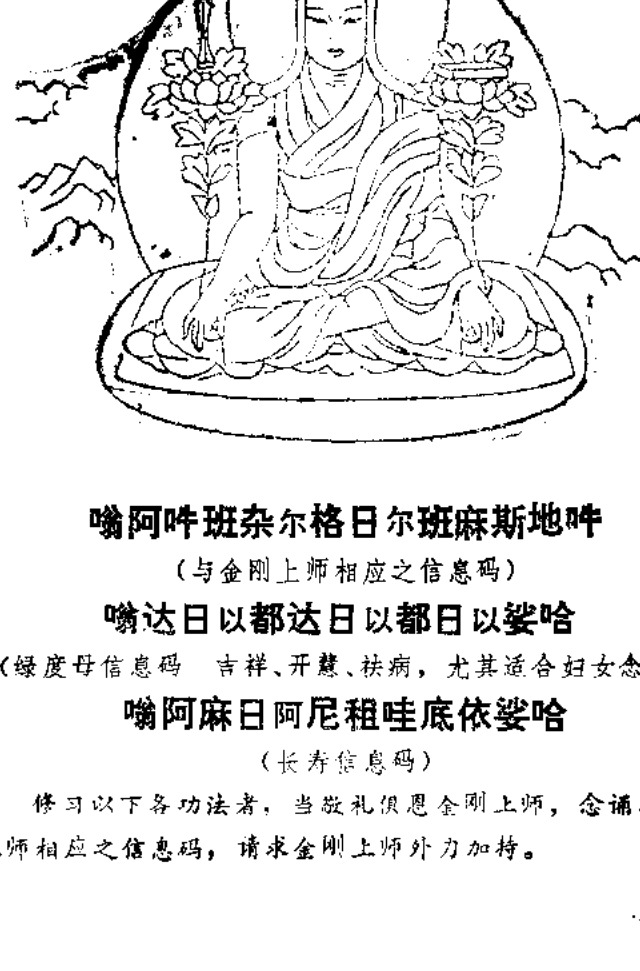
OṀ AḤ HŪṂ VAJRA GURU PADMA SIDDHI HŪṂ (Information code for attunement with the Vajra Guru)
OṀ TĀRE TUTTĀRE TURE SVĀHĀ (Green Tārā information code — auspiciousness, opening of wisdom, dispelling of illness; especially suitable for women to recite)
OṀ AMARAṆI JĪVANTAYE SVĀHĀ (Long-life information code)
Those who practice the following methods should pay homage to the Vajra Guru of all kindness, recite the information code for attunement with the Vajra Guru, and request the Vajra Guru’s external empowerment and blessing.
This qigong cultivation method is a fundamental practice within Tibetan esoteric qigong. Its effects manifest quickly, and it also serves as an important foundational practice for cultivating other Tibetan esoteric methods. This method primarily utilizes the wind element (lung) among the five elements of Tibetan esoteric Buddhism to practice. This practice mainly cultivates “qi,” “channels (tsa),” and “bindus (tigle).” It is divided into two steps: cultivating qi, and cultivating the channels and bindus. Beginners must cultivate step by step and must not practice everything at once. Only after the first step has been cultivated to proficiency may one proceed to the next step. Otherwise, it will be of no benefit and may even cause harm.
Points of attention for this practice: Do not practice during the zi and wu hours (noon and 11:00 p.m. to 1:00 a.m.); all other times are acceptable. However, practicing at dawn when the sun first rises is optimal. Do not practice when overly full or overly hungry (because overfullness makes the channels hard, while excessive hunger makes the channels soft). Do not practice when the body is fatigued, when thoughts are scattered, or when the mind is restless and irritable. Do not practice in places with smoke (because smoke renders the air impure; practitioners should also quit smoking, otherwise the central channel will not easily open).
First cultivate the “Nine-Stage Wind”
Sit quietly in the seven-point posture, the seating method being the same as before. However, for both hands—first draw both thumbs inward and press each firmly against the base of the ring finger to stabilize the body’s channels. Wrap the remaining four fingers over the thumb, gripping tightly into fists, and place both fists palms upward on the respective thighs at the groin. Once seated, eliminate distracting thoughts, and in a state of no-thought, perform deep breathing twenty-one times.
Step One
(1) Right nostril three winds: ① The body is in the seven-point posture with both hands gripping fists as before. Extend the index finger of the left hand (the right hand remains still), keeping the other four fingers still in a fist, and place it on the left knee. Then, using the tip of the index finger, starting from the midpoint of the left knee, draw an imaginary straight line upward along the left thigh and the side of the left chest, lifting until reaching the left nipple. At this point, the upper arm must be level with the shoulder.
② Then, using the upper arm, forcefully clamp downward and inward, striking the left side of your own chest once. After striking, extend the hand straight out to the direct left, level with the shoulder. (At this point, the index finger is still extended and the other four fingers remain in a fist. The knuckle-eye faces upward.)
③ Then bend the elbow and draw it inward (the upper arm does not move), so that the index fingertip points toward the left temple. Then, using this index fingertip on the left side of your face, make a hand gesture tracing a half-circle from the upper-rear to the upper-front. After tracing, press the index fingertip over the left nostril. When pressing, the palm faces outward.
④ Then, using the opposite nostril (i.e., the right nostril), slowly and forcefully expel air three times. While expelling, visualize that the expelled air is all black smoke transformed from illness-qi, afflictions, and the like.
⑤ After expelling, use the index fingertip to trace a straight line down the body from the left nostril along the left corner of the mouth, the left chest and nipple, and the left thigh. Then the left hand returns to its original position, with the fist palm pressing downward on the thigh at the groin.
(2) Left nostril three winds:
Same as (1), only the hand and nostril switch to the other side.
(3) Both nostrils together three winds:
Same posture as before. Expel air three times simultaneously through both nostrils.
After completing Step One, relax the muscles, release the fists and place the palms on both knees. Rest briefly, then begin Step Two.
Step Two
Maintain the resting seated posture from the end of “Step One.” Relax the ten fingers and lightly place the palms on both knees.
(1) Visualize that throughout boundless empty space, there is immeasurable and limitless five-colored rainbow-radiance qi, like a celestial rainbow, bright and luminous, extraordinarily beautiful. Then, using both nostrils, inhale this five-colored qi (red, yellow, blue, white, green) with utmost slowness and effort. While inhaling, use the ten fingers of both hands to slowly lift from the knees along both thighs up to the groin. After lifting to that position, make fists and assume the “seven-point posture.”
(2) After inhaling fully, swallow saliva once, using the saliva to press the inhaled colored qi down into the “dantian” inside the abdomen (i.e., four fingers below the navel). At this point, retain the qi without releasing it and sit quietly. The longer the breath retention, the better. However, for beginners who cannot retain the breath for long, do not force it. You should act according to your own capacity; forcing retention will certainly cause great harm to the body.
(3) When you can no longer retain the breath as above, you must slowly release the air. When releasing, keep the mouth tightly closed, slowly relax both fists, extend the ten fingers straight, and lower both hands along both legs. As you lower them, slowly release the air while visualizing that the “black qi” within the body is entirely expelled through the nostrils and through the pores of the entire body and the fingertips of all ten fingers (it must not be expelled through the mouth). Lower both hands until they reach the tops of both knees. At that position, the base of both palms should press firmly against the knees, while the centers of both palms are lifted and hollow, so as not to touch the knees. At the same time, forcefully extend all ten fingers straight and release the air.
(4) After releasing the air, relax all the muscles of the whole body, and loosen the mouth and tongue (i.e., the lips are not tightly closed, the tongue does not touch the upper palate). Let go of all conditions.
Abandon all thoughts. Form the meditation mudra with both hands, motionless and still. Body and mind should be completely at ease and unconstrained. One should sit quietly in this manner and cultivate the “Mahāmudrā” (body still, speech still, mind still). The duration of the quiet sitting is determined at the practitioner’s own discretion.
(5) Each time you practice this Step Two, you should perform it at least seven or twenty-one times. After completion, relax the muscles. Like a lion’s roar, extend both arms straight, loosen the ten fingers, press and place both palms on both knees, open the mouth and vocalize to stop the breath. Shake and sway both shoulders and the whole body, performing the “lion’s roar” shaking several times. After shaking, rub both hands, both fists, both feet, the face, and so on, to invigorate the entire body.
(6) After rubbing, rest briefly, and you may conclude and descend from the seat.
You should cultivate with concentrated dedication continuously, without missing a single day, for at least three weeks. After three weeks, if you feel:
① Illness and pain have diminished, and you can sit for long periods without feeling weary, or the body does not feel pain.
② During or after practice, body and mind feel very light, peaceful, and comfortable. You do not wish to leave the seat and feel as though you want to
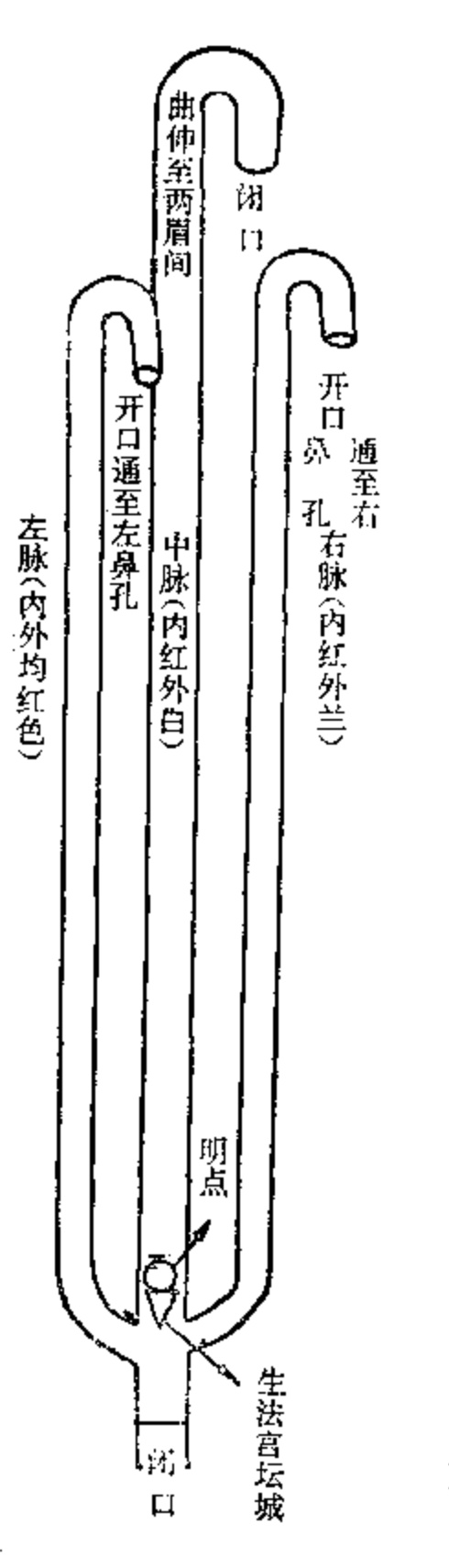
sit again. ③ Only after the skill of breath retention can be sustained for a long time may you proceed to the next step. Otherwise, you must not proceed, but should redouble your efforts and diligently cultivate this step. If this step is connected and practiced in sequence with the next step of “channels” and “bindus,” then the “lion’s roar” shaking described above in sections (5) and (6) should be moved to the end of Step Two and is not done here. Once the cultivation of “guiding qi” has become proficient, you may proceed to cultivate the “channels” and “bindus.”
Left channel (red both inside and outside) Central channel (red inside, white outside)
Next, cultivate the “channels” and “bindus”
If this practice is cultivated independently and not combined with the preceding first step of cultivating “qi,” then you should follow the procedure described in the first step’s chapter on cultivating “qi” above: perform the “seven-point posture,” the “Nine-Stage Wind,” and cultivate the “Mahāmudrā” at least three times (or optionally seven or twenty-one times). If practiced in sequence with the previous step, then since these actions have already been performed in the previous step, they need not be repeated here to avoid redundancy, and you may proceed directly to the following sections.
Bindu
(1) Visualize the three channels—In the “seven-point posture,” visualize within your own body, at the “dantian” four fingers below the navel, the emergence of three channels (as shown in the diagram on this page), all standing parallel and upright, growing straight upward until they reach the crown of the head. The channels are all round, transparent, hollow, and emit rainbow-colored radiance, like three rainbow neon light tubes. The central channel is slightly [wider]
coarse, about the size of a thumb, while the left and right channels are thinner, about the size of a pinky finger. The inner walls of the three channels are all red. For the outer walls, the central channel is white, the left channel is red, and the right channel is blue. After the three channels grow to the top of the head, they all curve and extend forward and downward again; specifically, the central channel extends to the point between the eyebrows. Its top opening is sealed and closed. The left and right channels respectively extend to the left and right nostrils, and their top openings are open and unsealed, directly connecting to the two nostrils. The bottom ends of the three channels are all interconnected (they connect at a point about half an inch above the end of the central channel). For the shape, see the diagram on the previous page. The bottom end of the central channel is sealed and closed. Because the left and right channels connect to the central channel, their openings connect to the central channel.
(2) Visualizing the Bindu: Once the three channels are visualized clearly, visualize the “bindu” within the channels. The visualization method is as follows: Within the cavity of the central channel at the confluence of the three channels inside the abdomen, four fingers below the navel, there is a fiery red, flat, triangular mandala (i.e., the Dharma-generating Palace). Inside the mandala, a fierce fire is burning, radiating in all directions, exceptionally red and hot. The light is all five-colored, and the flames shoot upward, going straight up into the cavity of the central channel. Above this light is a very smooth, white, light and easily moved, brightly shining small round sphere, about the size of a pea, which can freely and arbitrarily float, roll, and slide up and down within the central channel. (This smooth small sphere is the “bindu.” The practitioner must visualize it extremely clearly.)
(3) Cultivating the “Bindu” Body in the “Seven-Point Sitting Posture.” ① Visualize that boundless and infinite five-colored rainbow radiance fills all of empty space. Then, slowly inhale this five-colored qi with both nostrils as deeply as possible. The qi will follow the left and right channels and enter the central channel. When it enters the central channel, the “bindu” will be flushed up, rising straight to the space between the eyebrows, and then falling back down to its original place in the “Dharma-generating Palace.” After falling, it rises again to the space between the eyebrows, and falls again to the original place. Repeating this rising and falling back and forth, after one inhalation, you should hold your breath and visualize at least three risings and fallings; more is even better. (For beginners, if their breath-holding skill is insufficient and they cannot visualize it three times, they may do as many as they can manage; they must absolutely not force it. Furthermore, when the “bindu” rises and falls, after a practitioner has cultivated this for a long time, they may consciously hear: like a round bead rolling up and down inside an iron tube, making a “sha-luo” “sha-luo” sound.)
② When you reach the point where you can no longer hold your breath as above, and you need to exhale, you should immediately exhale slowly. The exhalation method is the same as described in the previous step, “Circulating Qi” section. ③ After exhaling, form the Samadhi Mudra with your hands, let go of all worldly attachments, think no single thought, and sit quietly to cultivate the “Mahamudra” (the length of time is determined freely by the practitioner). ④ Performing the above four items—inhalation, holding the breath to cultivate the “bindu,” exhalation, and “Mahamudra”—each once, constitutes one complete session of cultivating the “bindu.” The practitioner should cultivate this at least three times per sitting, or up to seven times, twenty-one times, or more if possible for better results. ⑤ After completing the above, if you need to continue practicing the “Vajra Fist,” then proceed to it. If not continuing, perform the “Lion’s Roar” to shake the body, then rub and wipe the hands, feet, and face, relax the muscles and meridians, and only then can you end the session. Do not end the session hastily.
5. “Vajra Fist”
The Vajra Fist is also known as the Vajra Yogini Fist Method. There are three sets in total, condensed from the essence of the “Thirty-Six Sets of Methods of Vajra Yogini,” and they are the essence of this fist method. These three sets of fist methods must be completed within a single breath. You must absolutely not exhale or inhale midway; otherwise, not only will it be unbeneficial, but it will also harm the body. Therefore, one must be able to hold their breath for a long time, based on the foundation of practicing the previous qigong method—the Supreme Yoga Vajra Vehicle Qigong Cultivation Method—before they can proceed to perform this full set of Vajra Fists.
First Set of Fist Methods: (1) Body in the “Seven-Point Sitting Posture,” and inhale the five-colored qi (same as the previous qigong method). (2) After inhaling fully, turn both palms upward, extend and spread the ten fingers, and raise them straight forward and to the left and right, level with the shoulders, forming a straight horizontal line (the character “一” “one”). (3) Turn your right hand to the left, and use your right palm to strike the left palm once. After striking, the right hand immediately makes the posture of forcefully drawing a bow and arrow. Forcefully and slowly retract the five fingers from left to right along the left arm and front chest (the left hand remains raised horizontally and motionless). When retracting to the right side of the chest and the right shoulder joint, clench the right hand into a fist (thumb inside, the other four fingers outside), and forcefully press the right upper arm downward to strike the right side of the chest once. (4) After striking, extend the ten fingers of the right hand again, raise it horizontally to the right, and return to the original straight horizontal line. After returning, immediately switch to the left hand and use the same method as above to clap the palms and strike the left side of the chest once each.
Repeat the above alternately left and right, performing each three times. When doing this, the head and body must be straight and upright, and must not bend or move. The characteristic of this fist method is rapidity, like the swiftness of shooting an arrow.
Second Set of Fist Methods:
(1) Sitting posture is the same as before. (2) Clench both hands into fists (fist style same as above) and extend them straight forward, raised horizontally. (The eye of the fist faces upward, and the palm faces inward). (3) After raising them horizontally, immediately retract both fists, and use the eyes of both fists to forcefully strike the chest area (on both sides of the Naohong acupoint) once. After striking, forcefully press both upper arms downward to strike both sides of the chest once. (4) After striking, with both hands still clenched into fists, raise them horizontally straight forward, returning to the original horizontal raised posture.
Repeat the above three times. When doing this, the head and body must be straight and upright without bending or moving. The characteristic of this fist method: as rapid as a bird flying and leaping.
Third Set of Fist Methods: (1) Sitting posture is same as before. (2) Clench both hands into fists (fist style same as before), palms facing upward, and raise them horizontally to the left and right, forming a straight horizontal line. (3) Bend the right forearm (upper arm remains motionless), and forcefully strike your right shoulder with the eye of the fist once. After striking, return to the straight horizontal line. (4) Do the same with the left forearm, then return to the original position.
Repeat the above three times. When doing this, the head and body must be straight and upright without bending or moving. The characteristic of this fist method: immensely powerful and fierce, breaking through obstacles in all directions.
After finishing the three fists, keep both hands clenched in front of the chest to form the crossed embracing posture of Vajradhara Buddha for a moment. Then turn this crossed embracing posture outward from the inside. After turning, immediately begin to exhale slowly, while loosening the fists and extending the ten fingers straight, quickly separating the hands and extending them straight downward and forward. At the same time, loosen both feet and sit casually. Visualize the “black qi” all over the body being released from the tips of the ten fingers, the pores of the whole body, and the nose (do not exhale through the mouth). After relaxing, perform the “Lion’s Roar,” shake the whole body, rub the palms, face, and feet, relax the muscles, and then end the session.
The efficacy of the Vajra Fist lies in eliminating illnesses, unblocking and opening the meridians, making the meridians clear and tranquil. But you must pay attention: you must complete these three sets of fists in a single breath.
Later-period esoteric Buddhism speaks of five qi: the upward-moving qi, the downward-moving qi, the all-pervading qi, the evenly-abiding qi, and the life-root qi. The upward-moving qi is related to the actions of the eyes, ears, nose, and tongue; if it is too excessive, it gives rise to illnesses such as dizziness and thirst. The downward-moving qi is related to urination and defecation; if insufficient, it can cause constipation or heaviness in both legs. The all-pervading qi is related to the movement of the four limbs; if deficient, it causes spasms and coldness in the hands and feet. If the evenly-abiding qi is unsteady, symptoms such as indigestion, nocturnal emissions, and insomnia arise. If the life-root qi is not regulated, there is danger to life. Methods of regulation: if the upward-moving qi is too excessive, focus attention on the heart or navel region to bring the qi downward; if the downward-moving qi is insufficient, one may practice vase breathing, visualize the qi of both feet entering the central channel, or practice physical exercises (quanfa), lifting the qi of both feet upward to abide at the navel; if the all-pervading qi develops problems, visualize the breath filling the tips of the fingers of both hands and the toes of both feet; if the evenly-abiding qi has issues, focus attention on the dantian; the method for regulating the life-root qi is to visualize nectar (ganlu) filling the heart region, which is said to consolidate the life-root qi. However, the main purpose of regulating the five qi is to bring them into the central channel. To bring the five qi into the central channel, although there are various visualizations and auxiliary physical exercises, the most fundamental method is “practicing vase breathing.” Once “vase breathing” is accomplished, the five qi enter the central channel, and the circulation of breath and blood throughout the entire body can fully obey the commands of the central nervous system, achieving appropriate regulation, and all illnesses naturally dissolve away.
Treasure Vessel Breathing is also translated as Vase-Shaped Qigong. Preparation for practice: sitting or standing are both acceptable. Loosen the belt, collar, and cuffs; do not wear a hat. In the seated posture, the two fists may be placed palms-up on the upper thighs. First enter stillness; the four great elements are all empty. Regulate the breath through the nose; breathing regulation primarily uses the left nostril (the left nostril has a greater volume of breathing).
Treasure Vessel Breathing cultivates four phases of breath: Drawing Breath — at a distance of approximately sixteen finger-widths in front of the body, visualize a wheel of spiritual breath encircling, and gently and slowly draw in the breath through both nostrils. It must be full and complete, filling the lung cavity all the way down to
the lowest end of the lungs. At the same time, contract the abdominal muscles, causing the diaphragm to rise, and lift the anus, so that the upper qi presses downward and the lower qi is drawn upward. The two qi meet at a point four finger-widths below the navel. The movement of qi is like a mound, and is also like water filling a vessel. After the qi is full, allow the vase breath to diffuse throughout the entire body, filling every pore. This is called Filling Breath. When the Filling Breath has been extended to a considerable degree, one may draw in several more short breaths, making both lungs and the entire body tight, full, and balanced. This is called Equalizing Breath. When the breath is full and equalized, maintain it without leakage for as long as one can hold it. Then, through both nostrils, first exhale gently and slowly, then somewhat more forcefully, and finally burst forth in one rush, like an arrow being shot. The pores of the entire body simultaneously release the vase breath. This is called Shooting Breath. However, a small amount of breath should be retained; do not let it be exhausted to the last drop.
This method may be practiced whether walking, standing, sitting, or lying down. One should keep the vase breath constantly undispersed. If the right nostril takes in too much air, one may lie on the left side to adjust. Those who specialize in practicing vase breathing should subsequently practice the Vajra Yogini exercises (quanfa) to make the vase breath full and firm.
Precautions for practicing Treasure Vessel Breathing:
(1) When first learning, do not force it in any way, and do not breathe through the mouth. Do not practice in places with smoke or poor air quality.
(2) Do not practice during the zi and wu hours (11 PM–1 AM and 11 AM–1 PM). All other times are acceptable.
(3) Do not practice when excessively hungry or excessively full.
(4) This method of holding breath is forceful and intense, and is suitable for those who have achieved accomplishment in the Vajra Counting Breath method. During practice, take care to press the qi downward; do not let it rush upward. Otherwise, side effects such as headache and toothache may occur.
Effects of Treasure Vessel Breathing: After extended practice, the qi becomes abundant and the mind becomes still. The qi gradually enters the central channel. At the dharma-originating palace four finger-widths below the navel (the confluence of the left, central, and right channels), a bindu (mingdian, bright drop) appears — a red orb of light. Within the navel chakra, one strongly feels the qi moving like a mound, and the bindu that appears gradually enlarges. Thereafter, one may use intention to guide the bindu from the navel chakra through the central channel, slowly ascending, passing through the throat chakra to reach the crown gate. Finally it surges out of the crown gate, manifesting as a red wheel of light. This wheel of light is the bindu within the body; abroad it is called the Aura. Practicing Treasure Vessel Breathing is most effective for promoting longevity. To increase the efficacy of Treasure Vessel Breathing, one may also add the practice of “Vajra Recitation.” After accomplishing
Treasure Vessel Breathing, the practitioner can use this practice in conjunction with the “Great Perfection” (Dzogchen) practice. In addition, practicing Treasure Vessel Breathing is the foundation for cultivating “Tummo Meditation”. If vase breathing can be cultivated to the level of the four meditative absorptions (si tan ding), extraordinary abilities will emerge.
Vajra Recitation is the primary method of supreme yoga for cultivating the breath and channels. This method requires visualizing the central channel, silently reciting the secret mantra in coordination with the in-, abiding-, and out-breaths, and simultaneously visualizing the Sanskrit letters of the secret mantra clearly and visibly. The Tibetan esoteric schools — Red, White, Flower, and Yellow — each differ in their methods of practicing “Vajra Recitation.” There are five types of Vajra Recitation for the root qi and five types for the branch qi. This book introduces only one.
The method of practicing Vajra Recitation is: (1) Enter stillness. Form a mudra with both hands: cross the middle and index fingers of both hands and press them downward, holding the mudra before the chest, then raise it above the crown of the head. First expel one breath of stale qi. Then inhale and hold the breath (pressing the inhaled breath to four finger-widths below the navel). Simultaneously visualize the syllable “OM” at the forehead of the vajra guru emitting white light, as brilliant as crystal, infusing the practitioner’s crown chakra (at the upper forehead and anterior crown). Finally, slowly exhale the held breath through the nostrils. The body will suddenly feel incomparably pure, and all the channels of the entire body will be unobstructed.
(2) Join the palms together. Cross the index and ring fingers of both hands and press them downward, forming the mudra at the throat chakra. First expel one breath of stale qi, then inhale and hold the breath. Simultaneously visualize the syllable “AH” at the throat of the vajra guru emitting red light, as radiantly brilliant as a blooming red lotus, infusing the practitioner’s throat chakra. Finally, slowly exhale the held breath through the nostrils. One will suddenly feel that the mouth and the incoming and outgoing breath are all pure.
(3) Join the fingers. Only the little fingers and thumbs are held together; the other three fingers are crossed and pressed downward, forming the mudra at the heart chakra. First expel one breath of stale qi, then inhale and press the inhaled breath to four finger-widths below the navel (i.e., the dharma-originating palace where the left, central, and right channels converge). Hold the breath, and simultaneously visualize the syllable “HUM” in the heart of the vajra guru emitting blue light, as pure blue and clear as the sky, infusing the practitioner’s heart chakra. One will suddenly feel the mind is like a bright mirror. Then proceed to the next step.
(4) With the mudra unchanged, when the held breath can no longer be retained, slowly exhale through the nostrils. Simultaneously,
Visualize that a second blue “Hūṃ” syllable emerges from the heart of the Vajra Guru. This “Hūṃ” syllable, swift as a flying arrow, enters the practitioner’s heart. One instantly feels the “Hūṃ” syllable merge with one’s own mind, indivisible and identical—pure and self-sovereign—and likewise indivisible and identical with the Vajra Guru, in perfect resonance.
The “Oṃ Āḥ Hūṃ” Vajra Recitation may be practiced during all six periods of the day and night. It may be practiced while sitting, lying down, or walking. Only while seated may one cultivate the correspondence of the Three Secrets—that is, reciting orally, visualizing mentally the “Oṃ Āḥ Hūṃ,” and forming the mudrā with the hands—so as to achieve harmony across the three channels of audio frequency, light spectrum, and resonance.
The purpose of practicing Vajra Recitation and other qigong methods in Anuttarayoga is to train the ability to use consciousness to control the internal qi, causing the qi to enter the central channel, achieving the non-duality of mind and qi, so that qi is directed by the mind. (Vase Breathing also has this effect.) Those who, to varying degrees, achieve the ability to direct qi by mind can not only use qi to attack illness, dispel disease, strengthen the body, and prolong life, but can also emit information to heal others. If the qi enters and abides in the central channel, at that time respiration ceases, and the circulation of internal qi also tends toward cessation; the subtlest wind-mind will then naturally manifest. Those in whom the qi constantly abides in the central channel undergo a qualitative change in the subtle-body mechanism, forming a high-energy psycho-spiritual field with the central channel as its axis. It is said that they will thereby attain various kinds of supernatural powers.
Anuttarayoga also places great emphasis on cultivating the mind. Cultivating the mind is, in reality, self-psychological training. One uses consciousness to modulate the coarse mind, and consciously observes certain precepts: one must revere the Vajra Guru, hold loving-kindness toward others, must not despise or harm one’s own body, must not doubt that one’s own nature is originally pure, must not discuss how other qigong methods, qigong masters, or practitioners fare, and so forth. Upholding fine moral character is the fundamental practice of mind-regulation in Anuttarayoga, and is also a necessary prerequisite for regulating the body and cultivating the qi. On this foundation, if one practices Vajra Recitation and other methods and realizes the subtlest wind-mind, one will possess a reliable master of autonomous psychology, able to calmly and clearly observe one’s own coarse and subtle mental activities, keeping the mind constantly composed and relaxed. At this stage, one need only maintain the subtlest wind-mind without letting it be lost—this is cultivating the mind. In studying Tibetan esoteric qigong, one must proceed step by step in proper sequence. One must first practice the Vajra Counting-Breath Method, the Vajrayāna Qigong Practice Method, and Vase Breathing. Only after the central channel is about to open or has already opened may one proceed to practice the central-channel qigong of Vajra Recitation.
8. Anuttarayoga Psychic Heat-Generation Method
Practicing Vase Breathing can cause the body to generate warmth; those who achieve accomplishment in Vajra Recitation and Vase Breathing can also cause the Caṇḍālī fire at the navel to ignite naturally. In order to make this heat-fire grow, one must practice the Anuttarayoga Psychic Heat-Generation Method, also called “Caṇḍālī Samādhi” or “Caṇḍālī” (the Wrathful Mother).
The Dashu Yaodao Miji states: “What is Caṇḍālī Samādhi? The answer: Caṇḍālī means sudden and fierce. In Sanskrit it is called Caṇḍālī, translated into Chinese as ‘sudden-fierce,’ which is the meaning of sudden and fierce. When one who practices enters Caṇḍālī Samādhi, great heat arises, and four joys are born.¹ Everything seen and heard is experienced as great bliss. Non-discriminating wisdom arises, and one attains the accomplishment of Mahāmudrā in this very body.”
There are many methods for practicing Caṇḍālī Samādhi. The Dashu Yaodao Miji lists ten kinds. The common approach is, on the foundation of Vase Breathing, to visualize at the point four fingers below the navel a spark of fire the size of a mustard seed or small bean, blazing with intensely hot light; or to visualize at four fingers below the navel a short A syllable as fine as the tip of a horse’s tail hair, radiating blazing hot warmth. After visualizing in this way for a period of time, because one is practicing on the foundation of Vase Breathing, the area below the navel will feel unbearably hot. After consolidating this for a further period, one raises it upward through the central channel, from the navel chakra all the way to the crown chakra; the entire body will generate warmth and bliss, and body and mind will become exceedingly joyful. At the same time, this can also untie the channel knots and melt the bindu, causing it to pervade the entire body. At this stage, considerable changes may occur physiologically. It is said that the most easily occurring phenomena are: the body is constantly warm, one does not fear cold in winter, and both digestive power and memory are enhanced.
The Kagyu school’s Ganges Mahāmudrā Direct Instruction states: “Through the essential gateways of bindu, qi, and channels, using many branch skillful means to hold the mind… one’s lifespan is long, black hair grows, the appearance becomes full and rounded like the moon, one’s radiance shines forth, and one’s strength becomes great as a lion’s.” The Extensive Commentary on the Stages of the Path of Mantra, Volume 22, also states: “Fiercely blazing and melting the bodhicitta (i.e., the bindu), binding it so that it does not fall—
¹ That is, initial joy, supreme joy, joy of detachment, and coemergent joy. When the feeling of bliss is slight, it is initial joy; when the feeling of bliss is great, it is supreme joy. When bliss becomes non-conceptual, it is the joy of detachment. When contact with objects yields the experience of the non-duality of emptiness and bliss, it is coemergent joy.
—one thereby gives rise to the attainments of the four joys of ascending and descending. After this, the divine body shall arise.” This shows the greatness of its efficacy.
Practice method: (1) Visualize the outer coarse body as empty: The practitioner visualizes their own body as a red, empty sac—even the fingernails and toenails, down to their very tips, are hollow inside, containing nothing, like a red balloon inflated with air to the utmost (its skin-membrane extremely thin), with red translucence both inside and out. At first, visualize this red balloon as equal in size to one’s own body; then visualize it gradually growing larger: like a house, like a pavilion, like a mountain, and ultimately expanding to the entire universe. After the entire universe has been encompassed without remainder, one focuses the mind single-pointedly and abides in this visualization. After some time, one then visualizes the body gradually shrinking, finally becoming as small as a sesame seed, and then even smaller than a tiny sesame grain. Although its volume is infinitesimal, the inside and outside of the body and all its parts must still be distinctly and clearly apprehended one by one. After that, one focuses single-pointedly on this thought and abides in this visualization for a further period of time.
(2) Visualize the inner subtle body as empty: The body is the size of an ordinary person. Visualize the central channel that has already been cultivated within the body. It reaches upward to the crown of the head and downward to the private region. The central channel is red like the color of moistened cinnabar (painting pigment), bright as a butter-lamp, straight as the trunk of a banana tree, and hollow like a paper-rolled tube. The thickness of the channel does not exceed that of an arrow shaft. Then visualize the central channel gradually enlarging—like a staff, like a pillar, like a house, like a mountain—until all the phenomena of the entire universe can be contained within it. At the same time, one should also visualize one’s own body gradually enlarging until there is nothing beyond it, the entire body being empty. The central channel pathway, down to the tips of the fingernails and toenails, is all full and unobstructed. Then gradually shrink as in (1). The channel is visualized as finer than one-hundredth of a single hair—so fine that the inner emptiness of the body reaches the point of “unable to be depicted, unable to be seen, unable to be dwelt upon.”
(3) Visualize the body’s protective wheel: Sit in the seven-point posture. Expel all stale breath from the body completely, then proceed as in Vase Breathing. When exhaling, visualize countless, measureless five-colored (red, yellow, blue, white, green) rays of light radiating outward from each and every pore, filling the air. When inhaling, visualize countless, measureless five-colored rays of light being drawn in through each pore, filling the body. This visualization of the five-colored light going out and coming in is performed for seven rounds each. Then visualize the five-colored rays of light transforming into—
The “Hūṃ” syllable, the “Hūṃ” syllable appears in five colors, entering and leaving the body through each and every pore along with the breath. This is also done for seven rounds. Then visualize that these five-colored “Hūṃ” syllables, each and every one, transform into countless, limitless wrathful vajras of five body colors (the right hand brandishes a five-pronged vajra, the left hand clenches into a fist at the chest, the right leg is slightly kneeling while standing, manifesting an extremely wrathful and fearsome appearance), each no larger than a tiny sesame seed. Visualize these five-colored tiny vajras exiting and entering through the pores of the entire body along with the breath, for seven rounds. Finally, visualize that every pore of the entire body is garrisoned with these five-colored tiny vajras. Each one faces outward, standing within the pores like sentinels guarding a gateway. At this point, the practitioner receives protection.
(4) Visualization of the Left and Right Channels: On both sides of the central channel, visualize the left and right channels. They lead upward from the left and right nostrils, ascend into the brain, branch downward along both sides of the central channel, and merge with the central channel four finger-widths below the navel. Visualize these left and right channels as hollow. First in the left channel, then in the right channel, visualize strings of tiny red syllable beads (sixteen on the left, thirty-four on the right), forming a continuous strand that exits and enters with the breath. However, there are only two openings for exiting and entering: it exits through the nostrils and enters through the secret place. With single-pointed focus, visualize the strands of red syllable beads in the left and right channels, alternating left and right as they exit and enter, synchronized with alternating left and right breathing. This is the method of building the channel; only when the channel is built can the water flow.
(5) Visualization of Inner Heat: The sitting posture and procedure are the same as the previous Nine-Stage Wind (however, during the three breaths through the right nostril, do not press the left nostril; instead, turn the head from right to left. When breathing through the left nostril, do the opposite). This must be done for three rounds, totaling twenty-seven breaths. In the first round, the sound of the breath is extremely faint, almost inaudible. In the second round, the breath can be heard, and at the same time, twist the body to enable the breath to fill the lungs. Hence, this round of breathing is also called “Twisting Breath.” Next, practice the four-phase Vase Breathing method (detailed previously). The essential points are: visualize the spiritual breath entering; bend the neck forward like an iron hook; inflate the chest cavity like a water pot; hold the breath evenly and firmly throughout the body like a fully drawn bowstring; and exhale the breath like a released arrow. These four phases of breathing must be properly coordinated and performed in sequence to constitute a complete yogic breath. Otherwise, it will actually be harmful. After this, repeat the above methods with increased force. Its primary effect is to make the breath continuous and fill the entire body. The more spiritual breath enters the body, the easier it is for spiritual heat to arise. Furthermore, the channels and chakras can fully absorb the vital essence within the spiritual breath, and the inhalation and exhalation cause the vital essence inside and outside the body to vibrate and
intensify, mixing and blending together, thereby strengthening the body’s ability to absorb vital essence. The above constitutes the external spiritual heat.
(6) Internal Spiritual Heat: Focus on visualizing the four chakras, which are like the wheels of a cart or the canopy of an umbrella. Further visualize the central channel as hollow, red, transparent, straight, and upright. Visualize the Mūlādhāra chakra (Root Spirit-Center Chakra) four finger-widths below the navel within the central channel, and also visualize both the upper and lower ends of the central channel as being flat-tipped. Immediately adjacent to both sides of the central channel are the left and right channels, as fine as a lamb’s intestine. Then visualize that the three channels all connect to the crown chakra (also known as the Thousand-Petaled Lotus Terrace). Next, visualize the throat chakra, heart chakra, and navel chakra. The number of branch channels for each chakra, and whether they face upward or downward, are as previously described on page 59. The minor branch channels of each chakra should be visualized in the shape of an umbrella’s ribs or the spokes of a wheel, with the central channel serving as the handle and axle. All of this must be visualized clearly and distinctly.
(7) Half-”A” Syllable Spiritual Heat Visualization: This is the primary practice for regulating and harnessing the vital essence of body and mind, also known as the Principal Practice for Generating Spiritual Heat. First, at the junction where the three channels meet four finger-widths below the navel, visualize a half-”A” syllable, as fine as a hair and only half a finger-width in length. Its color is brownish-red. It flutters, emitting a thumping sound like wind blowing on a rope, and produces a sensation of heat. Next, at the crown chakra, within the center of the Thousand-Petaled Lotus Terrace (the central channel), visualize the “Haṃ” syllable, white in color, resembling the state of yearning for nectar. Then, perform Vase Breathing, drawing the vital essence into the left and right channels. The vital essence descends, expands, and bulges into the base of the central channel, pushing upward to touch the previously visualized half-”A” syllable, which is as fine as a hair. This causes the half-”A” syllable to thicken, and its heat becomes a vivid, bright red. During this visualization, it must be supplemented by the corresponding even-breath method of Vase Breathing. When exhaling, simultaneously visualize a blue “vital essence stream” emerging from the central channel, exiting along with the breath. When holding the breath, visualize that the red half-”A” syllable—a red bodhicitta bindu—transforms into a flame, half a finger-width long, with a sharp pointed tip, blazing and burning upward (when first visualizing, the light and flame should be directed downward to prevent adverse effects). This flame shares the four characteristics of the central channel: straight, bright, red, and empty. This flame rotates swiftly, spinning ceaselessly like a spindle. With each inhalation into the body, this flame rises by half a finger-width (the flame ascends; the fire does not ascend, otherwise numerous maladies will arise). After eight breaths, it rises to the navel chakra. After another ten breaths, the spiritual heat fills every branch channel diverging from the central channel at the navel chakra. After another ten breaths, this spiritual heat flame descends, filling every part of the lower body with spiritual heat, reaching all the way down
to the very tips of the toes. After another ten breaths, the flame blazes upward again, reaching the heart chakra. After another ten breaths, it reaches the throat chakra. After another ten breaths, it reaches the crown chakra. After another ten breaths, it enters the Thousand-Petaled Lotus Terrace. The “Haṃ” syllable (the white bodhicitta bindu) within the central channel at the Thousand-Petaled Lotus Terrace (the crown chakra) is melted by the power of the spiritual heat, and the bodhi “moon-fluid” drips and descends, gradually attaining the wondrous state of a divine cow bestowing sacred milk (the half-”A” syllable joins with the “Haṃ” syllable; yin and yang unite, causing nectar to descend). The “moon-fluid” drips downward, suffusing all the channels and points of the crown chakra; after another ten breaths, it permeates all the channels and points of the throat chakra; after another ten breaths, it permeates all the centers of the heart chakra; after another ten breaths, it permeates all the centers of the navel chakra; after another ten breaths, there is no part of the entire body, from top to bottom, that is not thoroughly permeated, down to the tips of the fingers and toes. At this point, an immense bliss spontaneously arises, known as the “Four Joys.” This wondrous method of spiritual heat and milk-nectar requires a total of one hundred and eight breaths. Beginners must practice it six times a day and night. Later, this can be reduced to four times, while the duration of breath retention should be gradually lengthened. Every day, apart from sleeping and eating, one must constantly practice this without interruption. The practitioner will thereby be able to eliminate disease, aging, and various other physiological losses.
The crux of this practice lies in cultivating “stability” (samādhi). Only after achieving accomplishment in the previously mentioned Nine-Stage Wind, Vajra Recitation, and Vase Breathing can one undertake it.
9. The “Great Perfection” Method
Also known as the “Heart Essence of the Great Perfection” (Dzogchen Nyingthig). The “Great Perfection” (Dzogchen) is unique to the Nyingma school (Red Sect) of Tibetan esoteric Buddhism, and is also the highest practice of the Nyingma school. Its main methods are Trekchö (khregs chod) and Tögal. “Great Perfection” holds that the cosmic energy field is the source of the body’s energy field; the cosmic energy field can exchange energy with the human energy field; and a person can mobilize the cosmic energy field to maintain balance of the internal qi within the body. Therefore, it is also called the External Mind Section method.
Selection of practice time: The practice of Trekchö differs by the four seasons. Morning, just as the sun rises (when the first rays appear, or just as it emerges above the horizon), is ideal. If practicing at dusk, it is best when the sun is setting low (as the sun descends the mountain, or after the sunset when the evening glow fills the sky), so as to avoid intense sunlight damaging the eyes. There is no time restriction for the practice of Tögal.
Selection of location: In rural areas, suitable spots include beside cliffs, near woods, at field edges, open ground, or meadows. In cities, one should choose balconies, rooftops, athletic grounds, or parks, so as to be free from the interference of noise and other sounds, forming an external environment of “single-pointed concentration without distraction.”
Posture: There are two types—standing practice and sitting practice. When standing, the two legs should be naturally separated in an at-ease stance. Both eyes gaze intently at the sun. Avoid wearing tight-collared clothing or trousers, so as not to obstruct the circulation of qi. If simultaneously combined with the Vase Breath (Bao Ping Qi) method, one may adopt the Vajra Seat, Elephant Seat, Lion Seat, Immortal Seat, and other postures (see pp. 89–90 of this book). For both standing and sitting, one should loosen the belt to facilitate the movement of qi, and to avoid excessive accumulation of qi in the abdomen, which over time can cause illness.
(1) The Trekchö Method: This primarily uses intention to guide light. Syllables of three different luminous colors—white, red, and blue—are used to draw the light (i.e., energy) of the cosmic energy field into the head, and then throughout the entire body, enhancing one’s own energy field. Before practicing, one must first still the mind and regulate the body. First practice the Vase Breath method; once a certain degree of meditative stability is attained, then gaze intently at the sunlight. However, the duration should be brief. Face the direction of the sun’s rising or setting.
First, many luminous points and luminous circles appear shimmering in the sky in that direction (white, red, azure-blue, and green; mostly white, least green). These are the external bindus (luminous points). After observing the bindus clearly, next visualize a white, radiant AḤ (阿) syllable flying out from the crown of the skull. Use intention to push it into the external bindus (i.e., the cosmic bindus) that have been observed, merging with them into one. Then use intention to draw this syllable back into the crown of the skull. This may be repeated many times. (The above is the practice method for the first month.) Beginning in the second month, continue to circulate qi and gaze intently at the sun, so that circular halos of light appear in the air. Then visualize a radiant red HRĪḤ (日阿) syllable rising from between the eyebrows, merging with the external bindus observed in the sky, and then draw this syllable back between the eyebrows. In the third month, proceed as before. After observing the circular halos of light, visualize a blue HŪṂ (吽) syllable rising from the tip of the nose. This syllable is blue and radiates light continuously. After this syllable merges with the external bindus, draw it back to the tip of the nose.
Notes: ① This practice is best begun only after one has attained a certain degree of results in the Vase Breath and Vajra Recitation practices. ② When practicing this method, it is best to recite “OṂ ĀḤ HŪṂ” (Vajra Recitation) more than one thousand times each day. ③ During the three-month practice period, one must perform the practice once each morning and evening—in effect completing sixty full sessions; rainy and overcast days on which practice cannot be done must be deducted. ④ During practice, one should strengthen meditative stability and persevere. Do not become attached to the observed visual phenomena, and understand clearly that there is no difference between the inside and outside of body and mind. Through the power of luminosity, continually advance, thereby merging into the cosmic information field.
(2) The Tögal Method: Standing or sitting are both acceptable. For sitting, the Vajra Seat, Lion Seat, Elephant Seat, or Immortal Seat may all be used. There is no time restriction. When the sun is present, one may face the direction of the sunlight, offset from the sun at a 30° angle (whether left, right, above, or below). One must not look directly at the sun, as it will damage the eyes. Practice for three years, twice daily. As one’s practice deepens, the daily observation time may be extended.
This method centers on observing bindus—Tögal means bindu—hence it is also called “observing Tögal.” It is divided into three stages; only after achieving results in one stage does one proceed to the next, gradually completing all stages. Stage One: First observe minute bindus, bindus moving up and down, and small bindus; subsequently observe large bindus and stationary bindus. The observed bindus may have large bindus enclosing small bindus; the bindus flash like garlands of jewels, some resembling jeweled necklaces. Eventually, one can observe halos of light composed of five-colored rainbows in the sky, within the center of which
great luminosity radiates. These are encircled and draped with garlands and necklaces, forming a maṇḍala—this is the cosmic energy radiation field. Stage Two: Observe bindus on overcast days. Stage Three: Either observe bindus under candlelight or lamplight, or observe cosmic bindus in the dark of night, or observe bindus beside the moon on a moonlit night. Observing bindus in darkness can reveal a beautiful scene like “a myriad of lantern lights shimmering on a river in summer.”
When practicing this method, one must still strengthen meditative stability, and must coordinate the Vase Breath to circulate qi and observe the light. After achieving accomplishment in this practice, one can perceive in depth both the microcosmic world and the macrocosmic world.
Earlier, in the section on “Practicing the Vase Breath,” it was mentioned that upon accomplishment of the Vase Breath, a bindu—a red light sphere (i.e., the Red Bodhicitta)—appears in the central channel (avadhūtī). Through intention, it is guided via the central channel to rise slowly, finally emerging through the crown aperture. Then, using the power of intention, this bindu is made to gradually expand, manifesting as a red light wheel. After observing Tögal and perceiving the cosmic energy radiation field, use intention to push this red light wheel into the cosmic energy radiation field. Thereby, the inner and outer bindus merge. Then, using intention to guide, draw the bindu (light wheel) within the cosmic energy radiation field back into one’s own crown wheel (uṣṇīṣa-cakra). This stage of practice is called “Great Perfection.” The meaning is that this stage of practice enables the human body to further absorb large quantities of energy from the energy radiation fields of the sun and other sources, so that the practitioner merges indivisibly with the cosmos and the natural world, with no difference between the inside and outside of body and mind, manifesting the inherent nature and latent potential that a person possesses, thereby attaining a state of fully complete and perfect wisdom. In history, many accomplished practitioners of the “Great Perfection” manifested the miracle of the Rainbow Body (jālu) at the time of death. However, this stage of practice can only be undertaken after achieving the greatest accomplishment in the Vase Breath practice, and after attaining experiential realization (nyams) and accomplishment in the practice of Trekchö and Tögal, under the blessing (adhiṣṭhāna) of a Vajra Guru.
10. Tsongkhapa’s Method of Cultivating Śamatha
Tsongkhapa (1357–1419), founder of the Gelug school (Yellow Sect) of Tibetan Buddhism, was an eminent monk of profound Buddhist learning and prodigious literary output. Inheriting the traditions of Indian and Tibetan Buddhism, he took “śamatha and vipaśyanā” (calm abiding and insight) as the central practice of Buddhist cultivators, synthesizing the essentials of all meditative concentrations. In his renowned works such as the Lamrim Chenmo (Great Treatise on the Stages of the Path to Enlightenment), the Lamrim Düdon (Concise Treatise on the Stages of the Path), and the Ngagrim Chenmo (Great Treatise on the Stages of Mantra), he drew extensively from numerous sūtras and śāstras related to meditative concentration, as well as the meditation experiences of Indian and Tibetan meditators of various lineages. Based on his own experiential understanding of meditation, he discriminated and analyzed these teachings, systematically expounding the essential methods of cultivating śamatha and vipaśyanā in both the Exoteric (Sūtra) and Esoteric (Mantra) vehicles of Buddhism, thereby establishing his own distinctive school of śamatha-vipaśyanā study.
The seated meditation practiced by Buddhists encompasses two aspects: śamatha (stopping) and vipaśyanā (contemplation). Śamatha is the Chinese rendering of the Sanskrit term śamatha, meaning the continuous settling of the mind upon a single object so as to attain quiescent stillness of thought. The Ratnamegha Sūtra explains “śamatha” as “one-pointedness of mind” — the mind focused exclusively on a single object. The śamatha that focuses on a single [object] and enters into stillness is, from the perspective of modern qigong studies, undoubtedly a form of static practice (jinggong) within qigong. Tsongkhapa drew widely on sources and provided detailed evidence, systematically presenting a rather profound set of theories and methods — covering the conditions, sequential stages, specific techniques, essential points of mastery, and the standards for accomplishing śamatha — which may be called a treasure among China’s ancient qigong heritage.
Following the Indian Buddhist tradition of meditative training, Tsongkhapa took the elimination of the five faults and the cultivation of eight antidotes as the comprehensive framework for the sequence and essential points of śamatha cultivation.
(1) When first practicing the “preliminaries” (sngon ‘gro), laziness is the primary fault, and the desire to practice serves as the antidote. The preliminaries refer to the necessary preparations before cultivating śamatha; these are the prerequisite conditions for whether śamatha practice can succeed. Following what is stated in Maitreya’s Mahāyāna-sūtrālaṃkāra and other texts, Tsongkhapa held that one must first fully possess six requisites: ① Dwelling in a conducive place — residing in a location where food and clothing are easily obtained, free from disturbance by wild beasts or enemies, not prone to disease, with few people about by day and quiet silence at night, accompanied by meditation friends of compatible aspiration who can offer mutual assistance. ② Few desires — not pursuing food, clothing, fame, or profit. ③ Contentment — being at peace with a simple, plain life. ④ Cutting off miscellaneous affairs — focusing exclusively on meditation practice. ⑤ Upholding precepts — following the Buddhist moral codes, refraining from killing, stealing, sexual misconduct, lying, and other actions that harm others for self-benefit. ⑥ Eliminating craving and other pursuits and recollections detrimental to seated meditation.
Among the six great requisites, because one has an urgent need and aspiration for meditation practice, one can therefore actively and conscientiously practice with diligence, without laziness or discouragement — this is the key to success in cultivating śamatha. If one lacks the conscientiousness and aspiration for meditation, one lacks the requisites for śamatha. Even if one practices, laziness will surely arise. For this, there are four antidotal methods: ① The mind of aspiration — rectifying one’s purpose in meditation and generating a desire to practice. ② The mind of diligence — rousing the will to strive vigorously, with courage and perseverance. ③ The mind of faith — hearing of examples of meditation accomplishment, recognizing the benefits of meditation, and strengthening one’s faith in the practice. ④ The mind of resolve — reflecting on the benefits of meditative concentration for oneself and others, and generating the aspiration to achieve accomplishment.
Tsongkhapa emphasized that one must first rectify one’s purpose in cultivating śamatha — practicing meditation for the benefit of oneself and others and for the deliverance of all sentient beings. While this stems from a religious standpoint, it is not without instructive significance for some people who practice qigong for the sake of fame, profit, or competitive dominance.
(2) During the actual cultivation of śamatha, losing the instruction (the object of focus and the essentials of meditation) constitutes a fault; it should be counteracted with “mindfulness” (smṛti).
The main practice of śamatha is tethering the mind to focus on a single object, not allowing it to become scattered, distracted, or lost. At the beginning of śamatha practice, one must properly regulate the body and the breath. For regulating the body, the cross-legged sitting posture is primary; for regulating the breath, the standard is that breathing should be soundless, not coarse, forceful, rapid, or rough. The in- and out-breaths must reach a state of being imperceptible, naturally fine and even without deliberate attention.
The objects of focus for śamatha described in Buddhism include the “five-gate meditation” of contemplation of impurity, contemplation of loving-kindness, contemplation of dependent origination, contemplation of the analysis of elements, and mindfulness of breathing — each suited to a particular type of person. For example, those with strong desire are suited to contemplation of impurity; those prone to anger are suited to contemplation of loving-kindness; those highly scattered are suited to mindfulness of breathing,
and so forth. Following the teaching of the Indian master Bhadanta Bodhibhadra, Tsongkhapa classified the objects of focus for śamatha in both the Exoteric and Esoteric vehicles into two types: internal and external. There are two kinds of internal objects: first, contemplating the body — as in the Exoteric contemplation of the body as impurity (contemplation of impurity) and mindfulness of breathing, or in the Esoteric visualization of oneself in the form of a “yi dam” (tutelary deity); second, contemplating phenomena dependent on the body — as in the Exoteric contemplation of the breath, or in the Esoteric contemplation of drops (tigle), luminosity, subtle signs, bliss, and so forth. External objects are divided into ordinary and superior types. Ordinary objects include things like grass, wood, and stones; Tsongkhapa did not endorse this approach, but most advocated that beginners should enter through contemplating a superior object — the form of the Buddha. When visualizing the Buddha’s form, one first places a selected painting or statue before oneself, commits its appearance firmly to memory, and then closes the eyes to recall and imagine it, making the image clearly manifest. Beginners may first visualize a small portion such as the head and face; once that portion is visualized clearly, one then proceeds to visualize the remaining parts and eventually the entire body — this makes successful visualization easier. Tsongkhapa emphasized that beginners must focus exclusively on a single object and must absolutely not switch the object of visualization. If during seated meditation a different image arises in consciousness than the one being contemplated, one must on no account follow after it; one should immediately abandon it and tether the mind to the original object of focus.
The greatest fault during śamatha practice is forgetting the object of contemplation; “mindfulness” (smṛti) is the essential antidote. Tsongkhapa explained the meaning of “mindfulness” as “definite knowing” (nges shes), encompassing two aspects: first, focusing on the object of contemplation without distraction, clearly and distinctly — this is called “right mindfulness”; second, clearly and consciously recognizing whether the mind has strayed, has not strayed, is about to stray, or is not straying — this is called “right awareness” (samprajanya). “Definite knowing” is the primary psychological characteristic of entering meditative absorption. If during seated meditation the mind lacks definite knowing and consciousness is blurred — merely dwelling in a daze — then even if the mind is limpid and undisturbed, because it lacks powerful right mindfulness, it cannot dispel subtle “sinking” (laya) and cannot be called right concentration. Even if one does not tether the mind to an object with form but cultivates “non-discursive” practice, one must still employ the essential point of sustaining the mind with mindfulness: first causing the mind to be non-discursive toward objects, then causing the mind to abide in the mindfulness of non-discursiveness without scattering, thereby entering the right concentration of non-discursiveness — yet even here, one never departs from “definite knowing.”
(3) When the mind abides in concentration, excitement (auddhatya) and sinking (laya) are great faults; they should be counteracted with “right awareness” (samprajanya).
(4) When excitement and sinking arise, failing to eliminate them immediately is a great fault; this should be counteracted with “application of will” (cetanā). Concentration, the Sanskrit samādhi, refers to the mind’s continuous focused abiding on a single object.
does not scatter. When a practitioner of meditation achieves the ability to enter meditative concentration even for short periods, restlessness (auddhatya) and sinking (laya) then become the great obstacles to deepening right concentration. Tsongkhapa’s discussion of this problem is of the greatest value for qigong studies. In Volume 15 of his Great Treatise on the Stages of the Path to Enlightenment (Bodhi Patha Lamrim), he quotes the Abhidharmasamuccaya to explain: “What is restlessness? It is the turning of the mind toward attractive objects, a state of mental non-stillness belonging to the category of attachment.” Restlessness refers to the arising of distracting thoughts that obstruct entry into concentration, caused by visualizing beloved objects and the associative thoughts they trigger; these belong to the category of craving and attachment. This is divided into two types, coarse and subtle: coarse restlessness refers to the sudden arising of thoughts of craving and desire for external objects; subtle restlessness refers to the imminent appearance in the mind of images of friends, relatives, or pleasing sounds, sights, and other objects. Sinking “means that the mind’s power to hold to the object of focus has slackened or is not fully clear.” It is like entering a dark room and being unable to see clearly. This too is divided into coarse and subtle: in coarse sinking, although the mind has not scattered from the object of focus, it lacks the power of clarity and is merely still and calm; in subtle sinking, although the mind is clear and pure, it lacks the power of firm understanding toward the object of focus, being slightly low and slack. Sinking is different from drowsiness (styāna); drowsiness is like being half-asleep, with the mind lacking clarity and purity, whereas in sinking the mind is still clear and pure — it is simply not sufficiently clear regarding the object of focus. Restlessness obstructs the mind’s abiding on a single object; sinking obstructs clarity toward the object of focus. Both are great obstacles to deepening right concentration. Restlessness is easy to recognize, while sinking is difficult to detect. Among those who practice qigong today, there are many who have fallen into sinking yet believe themselves to have entered concentration.
Tsongkhapa states that the common causes producing the two obstacles of restlessness and sinking are: failing to properly guard the “six sense doors” of eye, ear, nose, tongue, body, and mind; eating too much or too little; not practicing “wakefulness concentration” during the first and last watches of the night; and not knowing what constitutes right concentration. The specific causes of restlessness include craving for external objects, fixing the mind too intensely on the object of meditation, and not practicing concentration with single-minded dedication. The specific causes of sinking include excessive sleep, the mind being too slack toward the object of meditation, imbalance between quiescence (śamatha) and insight (vipaśyanā) with overemphasis on quiescence, the mind lacking delight in the object of meditation, and the mind being drawn too far inward.
Tsongkhapa emphasizes that during meditation one must constantly arouse right mindfulness (smṛti), maintaining awareness of the signs of the two obstacles of sinking and restlessness — when they are about to arise, when they have already arisen, and when they have not yet arisen. This is the essential method for preventing and treating sinking and restlessness, and is called “right awareness” (samprajanya). If sinking or restlessness has already arisen, one must immediately eliminate it: “The superior practitioner blocks it head-on; the middling practitioner eliminates it the moment it arises; the inferior practitioner must also cut it off not long after it has arisen.” If one is aware of them yet fails to eliminate them, and falls into sinking or restlessness, the habit becomes entrenched over time and is extremely difficult to correct, leaving no hope of entering concentration. The key to eliminating
sinking and restlessness is “contemplation” (cetanā), that is, examining and observing, then cutting off and abandoning them, and alerting one’s mind to focus on the object of meditation. If the sinking or restlessness is heavy and difficult to cure, persisting for a long time without being eliminated and returning again and again, one should temporarily cease practicing quiescence and concentrate exclusively on applying the antidote. When restlessness is severe, one should contemplate repulsive objects in order to extinguish thoughts of craving and attachment. When sinking is severe, one should think of the benefits of meditation and the positive meaning of human life in order to rouse one’s mind; or one may contemplate the light of the sun, moon, or other luminous objects; or wash the face with cold water; or stand up and practice walking meditation (caṅkrama) for a period of time, and then sit down again to practice quiescence once the spirit has been refreshed. There are also two visualization methods specifically for treating sinking and restlessness. The first is “the yoga of blending wind-mind with space”: visualize a white dot the size of a sparrow’s egg at the navel, which leaps out through the crown of the head and merges with space; the mind focuses on space, abiding motionless. This method specifically treats sinking. The second is the method of counting breaths to forcefully cut off restlessness: gather the mind and count breaths, counting one number for each inhalation and exhalation, counting from one to five, then starting over from one, gradually increasing to ten breaths, fifteen breaths, and twenty-five breaths per count. Alternatively, visualize the upper wind as white, inhaling it through the nose and pressing it gradually downward, while simultaneously drawing the yellow lower wind gradually upward, pressing the two winds — upper and lower — together at the navel so they merge, and holding the breath for a long time without exhaling. This is called “vase breathing” (kumbhaka). By repeating this process, the mind gradually becomes still and restlessness naturally subsides.
Volume 6 of the Concise Treatise on the Stages of the Path to Enlightenment states that when practicing quiescence one should skillfully regulate the mind so that its tension and relaxation are well-balanced. If one applies the mind with improper measure — fixing it too intensely on the object of focus — restlessness easily arises; if one applies the mind too slackly and loosely, sinking easily arises. One should carefully adjust and find an appropriate, balanced degree for holding the mind. The duration of each session should follow one’s own power of concentration naturally. Beginners have little power of concentration and should keep sessions short but numerous, so as to avoid the mind becoming chaotic from prolonged sitting, which would make one disinclined to practice next time. If one’s power of concentration is great and one is able to counteract sinking and restlessness, one may follow naturally and sitting for a long period is also fine. When ill, one should focus exclusively on treating the illness, and resume visualizing the original object of focus after recovery; it is not advisable to force oneself to practice quiescence while sick.
(5) When subtle sinking and restlessness have already been eliminated and one can sustain entry into concentration, deliberately arousing the mind to gather one’s thoughts becomes a fault, and one should counteract it with “equanimity” (upekṣā). Equanimity means relaxing and letting go of the mind, without deliberately applying effort to examine and contemplate. This so-called equanimity does not mean abandoning the previously held object of focus — one must still maintain clear, focused attention on the object. Rather, having already reached a state of concentration that is focused and undistracted, clear and unwavering, it is simply no longer necessary to deliberately
apply mental effort to contemplate and meditate.
Regarding the stages of entering concentration through the practice of quiescence, Tsongkhapa, based on Indian source texts such as the Treatise on Six-Door Instruction in Meditation, divides them into nine “abidings of mind” (sthitimanas). The nine abidings of mind are respectively accomplished through six powers (bala) and are divided into four stages of “mental application” (manaskāra).
① Inner Abiding (adhyātmaṃ sthitaṃ): Through the “power of hearing” — having learned the essential methods of practicing quiescence through listening to teachings — one sits and practices quiescence, gathering the mind and focusing on a support. One’s power of concentration is still small, distractions are many, and one feels distracting thoughts arising ceaselessly, like a flowing river.
② Continuous Abiding (saṃprasthitaṃ): Through diligent and repeated practice, one applies the “power of reflection” to arouse right mindfulness, gradually improving. One becomes able to focus on the object of concentration for brief periods without mental scattering. At this point, one feels distracting thoughts are like the water of a mountain stream, appearing and disappearing from time to time.
The above two abidings of mind involve many distractions and little power of concentration; one must exert effort to gather the mind. This is called the “stage of effortful mental application.”
③ Settled Abiding (avasthāpanaṃ): Through the “power of mindfulness,” one constantly recollects the object of focus. The power of concentration gradually increases, and when distracting thoughts arise one can quickly detect them and gather the mind back to the object of focus.
④ Close Abiding (upasthāpanaṃ): Through the “power of mindfulness,” one gathers the mind, progressing further than before. When sinking or restlessness arises, one can immediately detect and counteract it.
In the above two abidings of mind, one gradually becomes able to gather the mind without scattering. One feels the mind is like water in a deep pool — with no wind, no waves arise — yet there are still times when it is stirred by the winds of sinking and restlessness and is not yet clear and still. One feels fatigued from counteracting sinking and restlessness.
⑤ Taming (damanaṃ): Through the “power of right awareness,” one can tame sinking and restlessness, gathering the mind so it remains motionless, entering concentration for relatively long periods. One experiences the joy and bliss of entering concentration and naturally delights in practicing meditation.
⑥ Pacifying (śamanaṃ): Through the “power of right awareness,” one gathers the mind into concentration, extinguishing feelings of aversion toward practice, and the mind becomes yet more pacified.
⑦ Fully Pacifying (vyupaśamanaṃ): Through the “power of diligence,” one practices energetically and perseveres without interruption. The power of concentration increases further, and one’s ability to master one’s emotions strengthens. During sitting, one can eliminate craving, grief, drowsiness, and other afflictions.
From the third abiding of mind up to this point, although one can sustain entry into concentration during sitting, the concentrated mind is still at times interrupted by sinking and restlessness. Hence this is called the “stage of mental application with intermittent operation.”
⑧ Single-Pointed Focus (ekotīkaraṇaṃ): Through the “power of diligence,” one practices energetically and without interruption, becoming able to enter concentration at will. Although distracting thoughts may still occasionally arise, they are eliminated the moment they appear. One still needs to rouse one’s mind with effort, yet sinking and restlessness can no longer cause
an interruption. The meditative mind remains continuously stable, and sinking and restlessness cannot interrupt it; hence it is called “the stage of uninterrupted operation.”
⑨ Equanimous Retention (等持): Through the “power of sustained practice” (中习力) of continuous diligent cultivation, the meditative attainment becomes fully mature, reaching a state in which one need not make deliberate effort to gather the mind yet can enter concentration at will and remain unmoving for long periods. This is called “the stage of effortless operation.”
Tsongkhapa points out: when a practitioner of meditation reaches the ninth mental abiding of equanimous retention, one can enter meditative concentration at will for extended periods, so that even walking, standing, sitting, and lying down remain in accord with the concentrated mind. If one has not yet attained “pliancy” (轻安), however, one still belongs to what Buddhism calls the lowest level—the “desire-realm concentration” (欲界定). One has not yet crossed the threshold of the “nine successive concentrations” (九次第定); it is merely called “mental application in harmony with śamatha” and cannot yet be called true śamatha. Śamatha belongs to the “preliminary concentration prior to the first dhyāna” (初禅未到地定), which transcends the desire-realm concentration, and is marked by two major criteria: one-pointedness of mind (心一境性) and pliancy. Pliancy includes both mental and physical aspects. Mental pliancy refers to the capacity of the self-governing mind—the ability to free oneself from the disturbances of unwholesome emotions such as craving and anger, so that the mind is unmoved by objects and at all times remains stable, joyful, and open. When mental pliancy is attained, a wind (qi) that naturally induces physical pliancy arises; generally, the crown of the head first experiences a sensation resembling heaviness yet without any discomfort, and gradually the qi fills and permeates the entire body, the body becoming extremely comfortable, blissful, and light, whereby mental pliancy increases still further. When physical and mental pliancy are first attained, because one experiences unprecedented bliss for the first time, the mind is stirred and elated; thereafter it gradually becomes calm and steady, yet the pliancy does not diminish. The wind that Tsongkhapa describes as capable of inducing physical pliancy is roughly equivalent to what Daoist internal alchemy (內丹學) calls pre-natal qi (先天炁). When a practitioner of meditation attains physical and mental pliancy together with one-pointedness of mind and thereby accomplishes “cessation” (止), the body and mind undergo a qualitative transformation, obtaining great benefit and great fruition, making life happy and joyful—what Buddhism calls “dwelling in the bliss of the present dharma” (現法樂住). For those who practice qigong today, to reach such a state is no easy matter.
Tsongkhapa holds that śamatha is a common and necessary path for practitioners of all schools of Buddhism, both exoteric and esoteric, as well as for all cultivators outside of Buddhism. To enter deeply into advanced meditative states such as the four dhyānas and eight concentrations, to obtain the five superknowledges, or even to attain what Buddhism calls the wisdom capable of severing afflictions, one must take śamatha as the minimum foundation. However, śamatha alone can only bring physical and mental pliancy and cure illness; the practice of śamatha alone cannot achieve the Buddhist goal of transcending the cycle of birth and death and going beyond the worldly realm.
To achieve this goal, Tsongkhapa holds that on the basis of the concentrated mind of śamatha one must cultivate “insight”—in Sanskrit, vipassanā (Vipasanā)—contemplating and analyzing with the philosophical view centered on the Buddhist teaching of “no-self” (無我), before one can transcend the realm of worldly meditative concentration and accord with the true nature of the universe. Although the cultivation of insight also contains elements relevant to qigong, it must be led by a religious-philosophical perspective and involves the core theoretical issues of Buddhist studies. Tsongkhapa’s discourse on this subject constitutes the essence of his writings. The principal aspects of this question go beyond the scope of qigong, and therefore will not be elaborated further.
Do no evil, perform all good.
May practitioners, through this merit:
Enjoy auspicious fortune, perfect freedom!
Footnotes
-
The Early Dissemination refers to the period from Songtsen Gampo, who pioneered Tibetan culture, until right before King Langdarma, who persecuted the dharma, ascended the throne. This corresponds roughly to the period from Emperor Taizong to Emperor Wuzong of the Tang Dynasty, spanning over two hundred years. ↩
-
Namely, the Action (Kriya) division and the Performance (Carya) division. These are the lower two of the four divisions of esoteric teachings, placing a heavier emphasis on rituals and recitation. ↩
-
“Exoteric” is spoken of in contrast to “Esoteric.” Exoteric Buddhism refers to the Buddhist schools outside of esoteric Buddhism. Because it lacks secret transmissions or obscure formalities, it is called exoteric. ↩
-
A Vajracharya is a Vajra Master (Vajra Guru). ↩
-
Written by the Fifth Dalai Lama, translated by Guo Heqing: Records of Tibetan Kings and Ministers. ↩
-
Ibid. ↩
-
Milarepa was the second Tibetan patriarch of the Kagyu school of Tibetan esoteric Buddhism. He received the practice of the “Naruo Six Yogas” translated by Marpa and was a great master of yoga self-mastery. —Editor’s note. ↩
-
Yogi refers to a follower of yoga and one who practices yogic methods. —Editor’s note. ↩
-
Nao (臑): In traditional Chinese medicine, the prominent muscle on the anterior side between the shoulder and elbow, near the armpit. —Editor’s note ↩
-
See Proceedings of the Representative Congress of the China Society for Research on Human Body Science (1987), p. 78. ↩
-
For details, see pages 89–90 of this book. ↩