Original publication
Original title: Świat mego ducha i wizje przyszłości
Author: Stefan Ossowiecki
Publication year: 1933
Original language: Polish
Publisher: Dom Książki Polskiej S. A., Warsaw
Source file MD5:033afb4ecb6afc3390369af73af6d4b3
Source records: Original 1933 scan; Polish transcription.
Editorial note: This translation follows the 1933 edition. Its three printed errata have been applied in the text and are reproduced in their original position. Page references in the book and its contents refer to the original printed pagination. Historical claims, quotations, and opinions are translated as stated in the source.
Original Cover
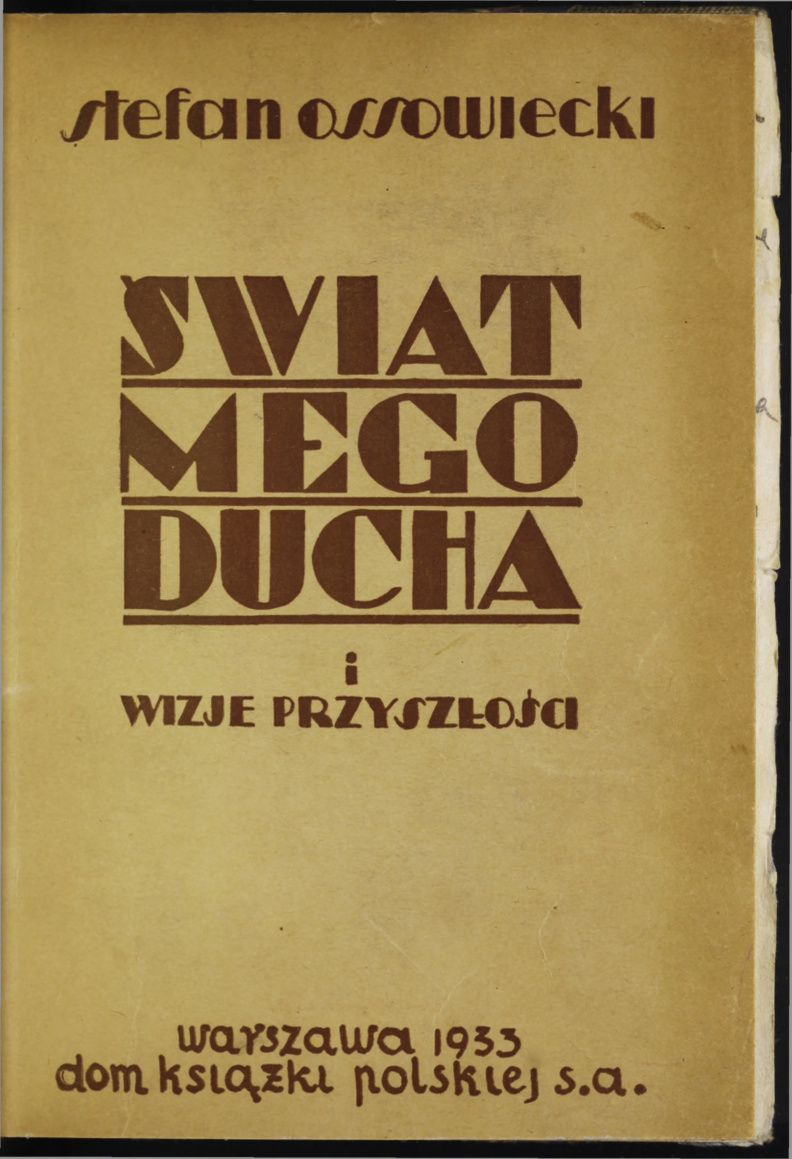
Stefan Ossowiecki
THE WORLD OF MY SPIRIT and VISIONS OF THE FUTURE
Warsaw 1933
Dom Książki Polskiej S. A.
Cover designed by ANNA MIERNOWSKA.
Half-Title and Inscription
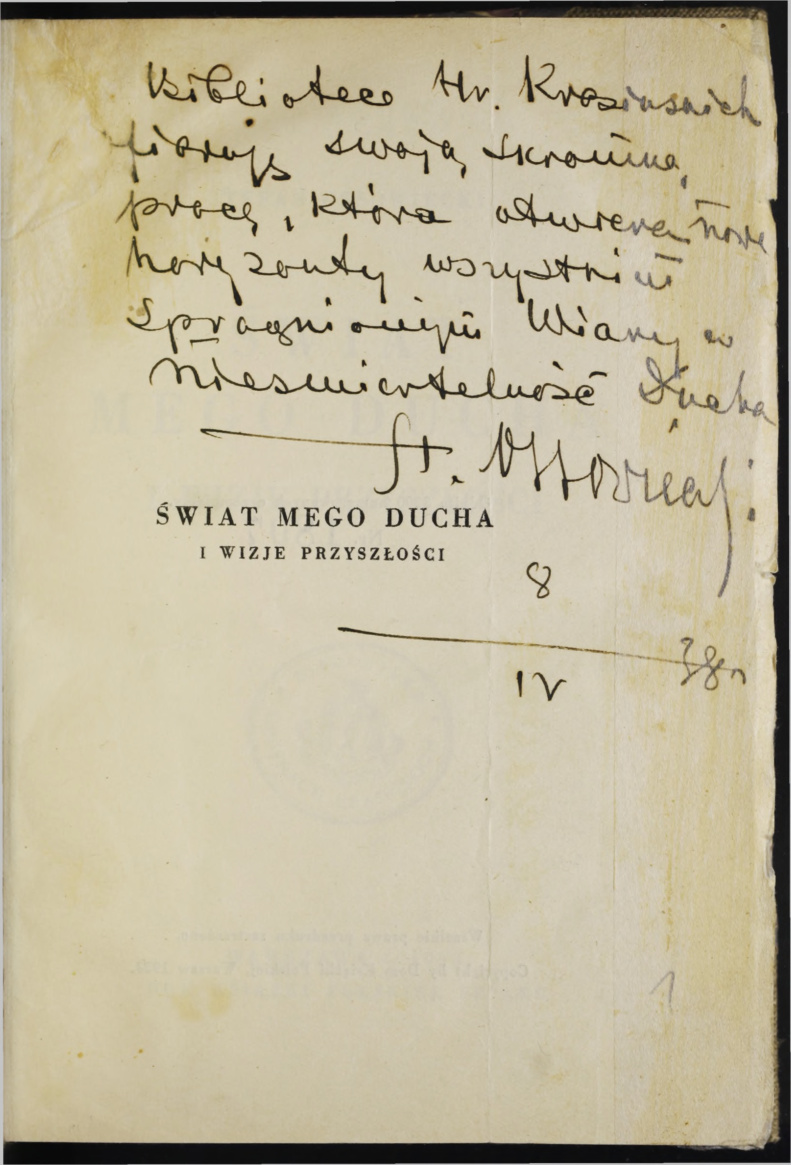
THE WORLD OF MY SPIRIT
AND VISIONS OF THE FUTURE
Translator’s note: The source copy bears a handwritten dedication. A tentative reading is: “To the Library of the Counts Krasiński I offer my modest work, which opens new horizons to all who thirst for faith in the immortality of the Spirit.” The signature reads “St. Ossowiecki,” and the date appears to be 8 April 1938. The facsimile preserves the handwriting where the reading is uncertain.
3,200 numbered copies printed.
No. 1807
All rights of reprinting reserved.
Copyright by Dom Książki Polskiej, Warsaw 1933.
Title Page
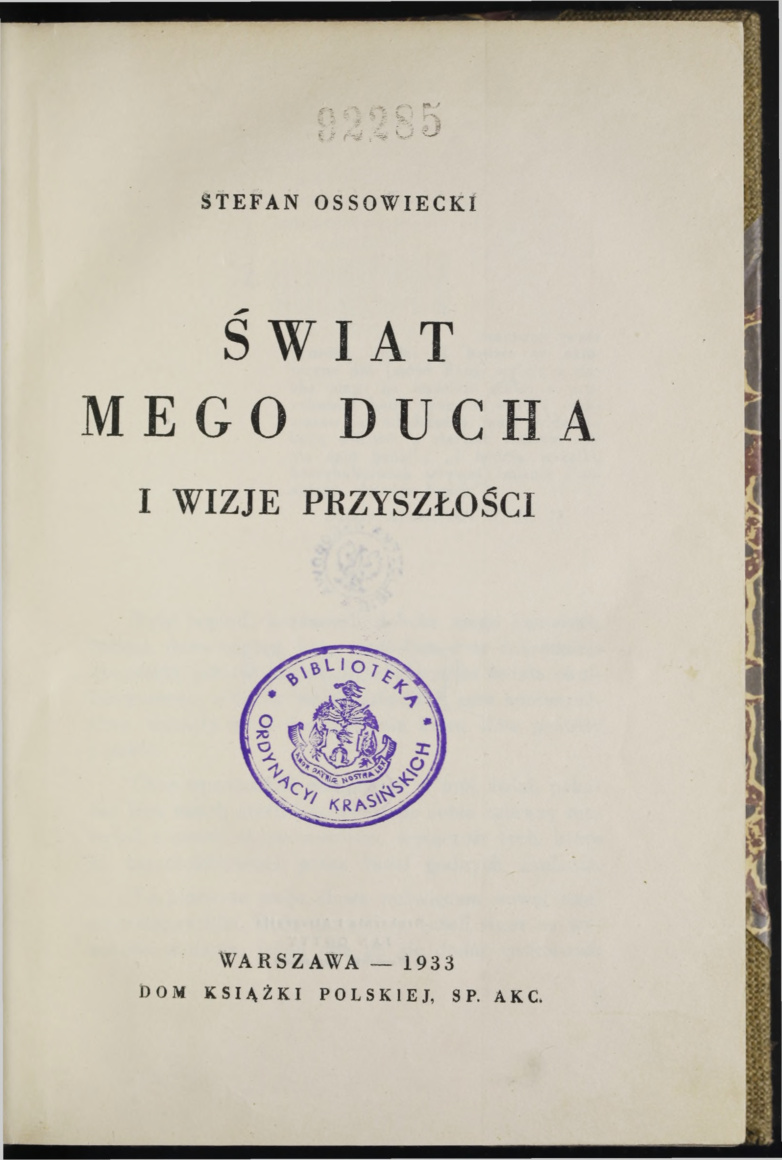
STEFAN OSSOWIECKI
THE WORLD OF MY SPIRIT
AND VISIONS OF THE FUTURE
WARSAW 1933
DOM KSIĄŻKI POLSKIEJ, JOINT-STOCK COMPANY
Printing and Lithography
JAN COTTY
Warsaw, 7 Kapucyńska Street.
Part One
“But this is that which was spoken by the prophet Joel: And it shall come to pass in the last days, saith the Lord, I will pour out of my Spirit upon all flesh: and your sons and your daughters shall prophesy, and your young men shall see visions, and your old men shall dream dreams” … “And whosoever shall call upon the name of the Lord shall be saved.”
Acts of the Apostles, Chapter II, 17.
I
So many legends circulating about my name, the thousands of experiments I have performed, and all the various rumours that drift across the surface of the occult world, as well as among the broad masses of society, have compelled me to write a few truthful words about myself.
I wish to bring everyone into my world, to show a moving picture of my thoughts, and to leave behind a collection of material from my experiments, exclusively those recorded by trustworthy people.
I dedicate these first words of mine to the new science of metapsychics. I shall be happy if I prove equal to the task, if I succeed in adding anything new to the treasury of material so long collected and still being gathered, which ought by now to shed a little light upon that great and mighty world, and upon those regions of it that we neither see nor feel because our senses are too limited: a far more interesting world, which exists, in which we live, and with which we are intimately connected.
I begin by trying, as far as I can, to bring the Reader onto the plane of my feelings and views. I shall write accessibly and simply, so that everyone may understand. I shall speak of what I personally feel, of the Universe as it is reflected in my consciousness and revealed through my own distinctive intuition.
Let me say at the outset that I have avoided studying those particular philosophers and psychologists who develop these fields and devote themselves to questions concerning the mysteries of the spirit. I try to follow my own path through life.
I believe that I stand on sound and certain ground, and I write what I myself firmly believe.
Yet before I begin the book of my own experiences, I cannot pass over a few people close to me, friends who have played an important part in my spiritual life and exerted a great influence upon me. From the bottom of my heart I say to them: God reward you! I give their names: Professor Charles Richet, Professor Gustav Geley, and the poet Józef Jankowski.
I wrote this book in bursts that broke from the depths of my spirit under the burden of great suffering: that suffering which sometimes falls upon you too, my Friends and Readers, like a suffocating nightmare, whenever you face other people with enthusiasm, sincerity
and goodwill beyond the bounds of convention and the greyness and tedium of life.
Pain created this book; it ought therefore to show people the way to master the pain of the world.
Through it I should like to trace the guiding lines for the construction of the great edifice that the One Spirit is raising through the ceaseless evolution of forms.
I should like it to become an incentive to spiritual creativity for all those who have already attained higher consciousness.
This is a book that drives things forward, a spark that kindles and sets aflame humanity’s coming longings and hopes.
The human mind has no bounds. It is stirred by constant unrest and a hard struggle for tomorrow; nevertheless, everything that happens in nature has its causes in the Great Spirit. He is the alpha and omega of all things.
We can already observe the beginning of His workings in the spermatozoon, the first germ of a human being. It flies into space in the form of a projectile with a long tail, carrying within it the principle of immortality. The man projects it, seemingly without thought, yet guided by the consciousness of the One Spirit. At that moment, whether he acts under the influence of love, sensuality, or some other impulse, the man is fundamentally always only an instrument subject to nature’s hidden command, although he thinks of nothing then but his own satisfaction.
Yet at this moment a great thing occurs. The projectile strikes that wall, and if it succeeds in overcoming the obstacles and reaches the interior: IMMORTALITY IS WON!
The same thing happens, in complete analogy, with us, with our entire life, with the life of the universe, its beginning and its end.
Everything is governed by the higher will, the will of the One Spirit.
I know this from inward experience. My sight can reach far, far back, and with a greater effort of will I can look upon the world through the eyes of the Spirit. But to enter such a state of vision I must first overcome my consciousness, checkmate the everyday consciousness of my “I.”
This great, immeasurable Spirit has a portion of Himself in everything that lives in the world, in human beings, animals, plants, and stones; and this portion is called the soul.
This great Spirit is eternal, self-created, immortal, almighty, subject to no limitations of time or space.
Humanity feels Him within itself only through conscience. He is, as it were, saturated with solar energy.
I believe that once, millions of years ago, owing to all manner of cosmic causes, a mighty cataclysm shook the universe, so terribly powerful that with our limited senses we are unable to fathom its extent. As a result of this cataclysm, particles broke away from the sun, and others again from them. This was the origin of motion, which in its gradual transformations subsequently gave shape to the earth, the moon, the planets, and the stars, upon various planes of space. All the stars are, as it were, suspended in a void and travel along strictly determined orbits. They are like solitary fiery ships, almost never meeting one another upon a boundless ocean. In perpetual motion, they assumed an ellipsoidal form. In time the surface of the earth began to cool. Atmospheric water falling upon its surface formed oceans and rivers, while simultaneously that same cataclysm was reflected in an analogous upheaval within the deepest being of the Great Spirit, who animated the detached particles of the earth, moon, planets, and stars. On those atmospheric planes where life could exist, nature came into being.
I shall speak here only of the earth, although I firmly believe in the existence of life on other planets as well. I have even performed interesting experiments concerning the existence of life there, but I do not intend to write about them, for I wish to be as exact as possible in the realm of my experiences, even the mystical ones, and to keep here to definite forms.
Returning to my visions of the world’s origin, I maintain that the earth came to life upon contact with the sphere of the Spirit, while that Spirit never for a moment lost the strictest command of Himself. He revealed Himself in the most varied manifestations of life, assuming a variety of forms, and clothed Himself in the covering of matter. From that moment evolution begins, and the most relentless struggle between soul and body. I shall speak only of humanity: there begins the struggle of the soul freeing itself, longing to return to the Spirit.
The Old Testament mentions that the whole earth was originally covered with water. Over long periods of years, changes took place in the globe and the earth dried out in part; yet the soil still retained moisture and brought forth vegetation of unheard-of size and shape.
The enormous dimensions of these creations of the earth, in the worlds of flora and fauna, corresponded to the stature of primitive people. The First Book of Moses, Chapter IV, verse 4, says: “and there shall be giants upon the earth in those days.” And in Chapter II of the same book, Moses, the initiated Egyptian priest and renewer of the Jewish nation, says in verse 6: “but a mist went up from the earth, and watered the whole face of the ground.”
Most interesting, however, is the fact that Moses mentions four rivers that flowed out of the legendary paradise, from the original immense spring. For in Chapter II of Genesis, verse 10, we read: “And a river went out of Eden to water the garden; and from thence it divided into four rivers.” This strange saying may be understood literally, but it seems to me that the symbol of the four rivers contains, rather, the age-old mystery of the world. Whenever I speak of the four epochs of humanity, I always have before my eyes that mysterious symbol of the four rivers in
Genesis, in which humanity, through continual changes of form, proceeds towards its final transformation into a higher, indestructible form. Along this wondrous path it passes through four stages of development, corresponding to the four elements of nature. First, then, humanity in its original shapes, drawing its life from water, like everything upon earth. Next, humanity of the element of earthly matter, whose culminating point in the history of the world is manifesting itself at present. The people of these first two epochs are still beings whose bodies are subject to decay: people of the elements of water and earth.
But a mighty transformation still lies ahead of us, when we enter the epoch of the element of fire, when humanity begins to acquire new faculties, this time in different forms. Millennia are approaching in which the element of fire will refashion the forms of organic life, and thus the form of the human body, into the radiant human form. And finally, in the last period of the evolution of earthly matter, in the epoch of the element of air, having passed through the epochs of water, earth, and fire, humanity, with its faculties brought into harmony, will rise to the highest level of existence: the winged human being. These four phases of development correspond to the ancient symbols of the four Gospels: Matthew (the man, the element of water), Luke (the bull, the element of earth), Mark (the lion, the element of fire), and John (the eagle, the element of air). And then the mysterious guiding words of the inspired St John, author of the Apocalypse, will be fulfilled: “Then I saw a new heaven, for the first heaven and the first earth had passed away, and there was no more sea.” “And God shall wipe away every tear from their eyes, and there shall be no more death, neither sorrow, nor crying, nor pain, for the former things have passed away.” (Apocalypse XXI, 1, 4.)
Thus humanity lives through four epochs, after which, I believe, our soul will return to the One Spirit, the Greatest of the great.
Throughout those four epochs the fierce struggle of the spirit freeing itself will continue. It will be terrible, and so powerful that over millions of years our form undergoes profound change. The first epoch is our life in the forms of aquatic monsters. Even today the physical remnants that disappear over the ages have not yet vanished. Thus we have traces of gills upon our faces, webbing between the fingers and toes of our hands and feet, and certain teeth in our jaws that are a remnant of the fish epoch. As a result of studies of the phylogenetic development of teeth, human dentition is regarded as a remnant, through slow evolution, of the dentition of vertebrate animals: fish.
The second epoch is the epoch of quadrupedal animal-men. Its remnants are the ever-diminishing tail and the changes in the spinal column and ribs.
The third epoch is that of the radiant human being, and the last is that of the human being attaining psychic and spiritual development. I think that in this epoch humanity will live in superconsciousness, that is, in the consciousness of the One Spirit, of which I shall speak at length here. Thus, through constant striving upwards, the animal-man is gradually transformed into a human being animated by an immortal breath.
Primitive man, whom Moses calls a “living soul” in Chapter II, verse 7, of Genesis, that is, vegetative man, organically bound to the world of plants and animals, reaches in his gradual evolution the moment when his organism becomes sufficiently perfect to absorb the immortal divine principle. And then man changes from a living soul into a “life-giving spirit,” as the initiated prophet says; and the human Spirit, in unceasing struggle, through the torments of suffering, becomes a being freed from the bonds of space and time.
St Paul gives this revelation in his second epistle to the Corinthians, Chapter XV, verse 45: “The first man became a life-giving soul, and the last a reviving spirit.” And further he says: “the first man is earthly, the second man is from heaven.”
II
I have written of the origin of the earth, of man, and of the four epochs; now I wish to speak of the outstanding figures of the mighty Spirit: five giants and Christ, the God-Man. I shall do so in a few very broad strokes.
These are figures of the highest psychic intensity, figures beyond history. The first five gave us the conception of the existence of gods, an idea that passed gradually into the conception of the One Almighty Spirit-God. They are: Orpheus, the great initiate and founder of the Greek religion, of whom Pythagoras and Plato spoke as a divine man. At the moment of death he cried: “I die, but the gods live.” Next, Krishna, founder of the national religion of India, whose genius gave the world an idea of great significance: that God is incarnate in man. “Human knowledge is vanity; all its good deeds are but illusion if man does not know how to bind them to God. God loves the humble in heart and spirit; He needs nothing else. Only infinity and boundlessness can comprehend infinity. God alone can comprehend God.” Then Buddha, founder of the religion of renunciation and mercy, which to this day has the greatest number of followers among all the religions of the world. After him appears Moses, who first paved the way towards the religious unity of nations by creating the One Spirit-God. “I am that I am” (Ehejej aszer Ehejej). In his final moments Moses, the great prophet, turned to all those around him and said: “Israelites, you have betrayed your God; be scattered to the four corners of the earth.” Just before his death he spoke these last words: “Return to Israel, and when the time comes, the Eternal One will raise up for you a prophet like me from among your brethren, and will put His words into his mouth, and that prophet will proclaim to you everything that the Eternal One commands him.”
Here I must stress that I am by no means speaking as an antisemite or an enemy of the Jewish religion, for it is my profound conviction that every temple is only a gateway through which humanity ought to pass. Through this gateway runs the road to what I conceive as the highest temple of the One Spirit: the temple of Christ.
I am deeply convinced that very many of the sons of Israel already feel the necessity of uniting spiritually with the humanity of the whole world.
I shall not delve into this world of thought, into the sphere of Israel’s religion, but I cannot remain silent, for I sense the approaching moment when an inner voice will arise in the consciousness of the Israelites, guided by the Higher Will and coming from above, and show them the path they should take for the victory of peace on earth among all humanity, for the pursuit of shared ideals in life; for only universal cooperation and mutual respect, in an atmosphere of the deepest faith, can bring the peace we need and happiness upon earth.
Nineteen hundred years have passed since Christ departed. Is that not a considerable span of time?
Why has the supreme tribunal of the Israelites, composed of the wisest people, rabbis, tsaddikim, and other sages of Israel, not yet assembled? Why has this great nation not yet awakened to the awareness that the time has come to reflect, to examine the case and the judgment passed upon Christ?
Have the words of Moses not been fulfilled: “Israel has betrayed its God; let it be scattered to the four corners”? Has this not happened? Are the Jews not a nation wandering over the whole globe? Can this go on for long, and is it normal? Yet Moses said, “Return to Israel,” and we see that the Jews are already beginning, little by little, to return to Palestine, their age-old homeland. Finally, did Moses not clearly foretell the coming of the Messiah into the world, and is that Messiah not Christ, who will unite everyone spiritually in the same temple? For in the Book of Zohar, composed 2,000 years before the birth of Christ, we read: “There shall come a Messiah, son of Joseph, who will struggle for the good of humanity but will be overcome; nevertheless he will prepare the way for the Messiah, son of David, who will save humanity.”
The announcement of the coming of this subsequent Messiah was the reason why the Jews did not acknowledge Christ the Lord; yet He is the son of Joseph and comes precisely from the house of David.
Because of His brief sojourn on earth, Christ did not live to see the fruits of His beautiful idea. Yet we see that over nineteen centuries it has taken an ever greater hold upon the whole world, which is one more eloquent proof that Christ the Lord alone is the Messiah foretold by the prophets, and that His mighty idea of love will reign over the entire globe.
Only under these conditions will peace on earth and the apotheosis of love of one’s neighbour arise. That moment must come, and the sooner it does, the sooner Christ’s supranationalism will prevail, rather than that amoral
Bolshevik supranationalism which is a great misfortune for the whole world and its culture. Bolshevism, as an emphatically pagan movement, manifests itself in characteristically destructive forms. Its leader was Lenin, who entered the arena of history with a pentagram in his hand instead of a cross. Once the Cross led hundreds of thousands of warriors eastwards: as we know, these were the crusading armies fighting “for Christ” (pro Christo). Today the Lenins wish to lead armies westwards. Lenin is an emissary of the Antichrist against whom Christ warned us. He is the instrument of terrible secret forces that are trying to overthrow the Cross as the symbol of Christian faith. But they will not succeed. In his prophecies in The Undivine Comedy, Krasiński foretold this entire movement and its ending in the victory of the Cross.
I believe that this struggle must end in that way, and then the Cross will once more reign and shine throughout the world as the sole symbol of faith and universal brotherhood. For Christ said: “I shall build my church, and the gates of hell shall not prevail against it.” Is this not an express command of the Eternal One, the One Spirit, God, for you Israelites, of which Moses spoke in the last moments of his life: “And he shall proclaim to you everything that the Eternal One commands him”?
I should also like to say a few words about Muhammad, the founder of Islam, the faith that proclaims the unity of God and seeks to establish universal peace. Islam means peace. “Lailaha illallach”: “There is no god but God.” Surrender to the Divine will and union with God are the highest aim of the religion of Islam, and therein lies its principal tenet. The first chapter of the Koran, called the Opening, reads: “Praise be to God, gracious and merciful, Lord of the Worlds.” According to Islam, the life to come is only a continuation of earthly life. According to the Koran, humanity forms one family. “O people, We have created you all from one man and one woman, and have made you tribes and families, that you may know one another.”
Finally, the last figure of an Enlightener: Christ-God, who, dying in the agony of death and looking upon His executioners, cries: “Father, forgive them, for they know not what they do!” This is the unique, supreme example of love of one’s neighbour.
Christ is the greatest initiate, of ideal purity and boundless goodness; more than this, He is the God-Man.
The subconsciousness of the prophets who preceded Christ drew deeply upon the source of the Spirit for all its wisdom and power of thought, always dwelling in His consciousness. Chiefly thanks to them, the mystery within the universe of humanity and all nature was unveiled: it was understood that there must be unity in the Universe, and the Cross was acknowledged as the symbol of love.
Christ dies upon the Cross with love for all humanity, and in His crucifixion humanity is crucified: upon that same Cross the whole world hangs. From this come the torments, the hard lot of man, and the ordeals he endures throughout his life.
Christ showed, and established in human consciousness, that suffering alone brings the psychic shock that refines the workings of the subconsciousness, thereby uniting us at such moments with the absolute through superconsciousness. In this, I believe, lie the drama of our life and the tragedy of man, but only in the limited human understanding of them. Through his experiences and sufferings a person rises spiritually and acquires a desire to work; that work is then better, more fruitful, and strengthens him psychically and physically. Work alone raises humanity to the heights.
The Universe is only the breath of a single Idea of the Eternal God in its infinite manifestations. The whole evolution of man, and the wisdom of our life, lie in understanding the Most Holy Trinity. In the Name of the Father: this is the primal cause of the Universe, that unity of Spirit from which the existence of humanity began. In the Name of the Son: this is Christ the Man-God, who lived in the full consciousness of the One Spirit and who, through His example, through supreme love, showed us the road to true happiness on earth. In the Name of the Holy Spirit: this is the third plane, upon which a small part of humanity already stands, namely, those who already understand this; the larger remainder exists as yet only in a state of potentiality, and thus awaits the coming of the Master before it can shake off the psychosis of historical torpor.
Those who stand upon this plane already see the victory of the supranational idea, but not of that brutal communist idea which has been artificially induced, like an inoculation from humanity’s diseased organism. It is a somewhat different idea, founded upon Christ’s principles of spiritual universality within humanity’s newly emerging organism. Finally, Amen: this is the return to the same Spirit from whom the world began.
Today the world is passing through a great moment of a certain disorientation: it is passing, namely, through the moment of nationalism’s victory. Each nation is freeing itself into a form independent of the others, but only for a short time: these are already the final eruptions of that force. The agony of the old order will last hundreds of years yet, but what do those hundreds mean in the history of humanity’s evolution? We stand on the eve of new forms of life. Life has overtaken, as though outgrown, these forms; they are already tottering. The old world is falling, and a new human being is born, completely different, robust: an egoist.
His spiritual world is already different; he is less and less connected with the past. Neither literature nor poetry nor all those marvellous works of art carry him away as they once did; he draws further and further from them. The apostles of Polish and Western European literature are already a matter of indifference to him; he strives for other, different ideals. He is interested only in what overcomes the sense of time and space; along that path he seeks contact with all the nations of the world. Sport and its feats absorb him most; he remembers the first names and surnames of the world’s record-holders, and knows when, where, and what victory each has won. In this today lies the substance of the younger generation’s life.
The younger generation does not, of course, neglect the duty of studying whatever it chooses in order to earn its bread in the future; yet it studies without great enthusiasm, rather solely from necessity. Young people today read a great deal and even know quite a lot. I am speaking of their life outside school and their studies, when they are free of duties and devote their time to their own pleasure; and that pleasure is exclusively sport in all its forms, supranational sport, uniting all nations in the struggle for precedence, in the fierce rivalry for the laurel of victory of one nation over another. The movement in this direction is highly significant. It corresponds entirely to the spirit of the age in which we live, bringing us closer to the fourth epoch, the epoch of the spirit.
For this final evolution of the human soul, there is an intuitive need for a prior transformation of physical matter, in the broadest sense of that word and in the broadest meaning of this thought of mine, so as to prepare for the new forms of life, all the more because changes in man’s physical form depend upon these changes. And all this consciously strives towards the full realization of the ideal for which the human soul, unknown to us, is striving: the realization upon earth of a true kingdom of peace.
At present evil has taken possession of the world, for it nests upon the lowest planes of the astral world, and its effect upon man at this moment is very powerful. Today there is almost no spiritual concentration or power of resistance left. Man submits to influences and has grown weak in spirit; elemental forces carry him away, while larvae and lower beings living around us bring so much discord, hatred, and evil into our lives that under this shock a person feels deeply at odds with his surroundings and himself. Life becomes an ever greater burden to him, and that is precisely why there have never been so many suicides as there are now. Older, serious, decent people voluntarily depart from the world; and how many abandon their families and homes, never to return! How many instances of this fatal state I have experienced over the last few years! I count hundreds of cases in which people have lost their psychic equilibrium. They leave their wives and children, indifferent to those closest to them; and when I have them beside me, I am simply astonished at their callousness and most terrible egoism. They try to forget everything and think exclusively of themselves.
This is a very characteristic feature of the present age, and unfortunately it cannot be otherwise.
I have spoken here of people afflicted by this cataclysm: weak, irresolute, unbalanced individuals; people without character, ill and exhausted by the terrible struggle for existence, susceptible to influences and deprived of psychic equilibrium. Let me point out that many strong and psychically healthy individuals, too, cannot endure this life, this atmosphere of misfortune and worry, living among those whom fate has struck down. This category of people is doomed to die out.
Today we have another movement, in an entirely different direction. It is a healthy tendency, emerging in the consciousness of all humanity: the spirit of the human being of the future, newly born, who wishes to master the world and is now shaking off the traditions of past centuries. This human being demands other forms of life; he will take command of the whole world, and humanity’s future will belong to him. The world ought already to be preparing intuitively for a new life and for the creation of another system for all humanity, with a single Code and a single Chamber of Justice.
The moment is approaching to summon the most powerful legal minds, above all the jurists who are architects of humanity’s legal forms. To work out common forms, the authority of arbitration should already be introduced gradually, together with a proclamation by all humanity of its inviolability. Above all, the independence of judges must prevail, for only under these conditions is respect possible for the law and for those who will judge impartially. Only then can there be complete peace and order in the world. The same must happen in relation to other forms of life, namely visas, customs duties, currency, and other manifestations of coexistence among nations.
The system must be based upon general prosperity and ought to protect the citizen’s property. If a nation is wealthy, it also has a strong government and a treasury full of gold. Statism ruins nations. That is no longer living, but merely vegetating.
Only when life is established upon these foundations can we proceed to other important matters, including the one that is already on the agenda of mature consciousness, the most important and most delicate question of all: the disarmament of nations.
Half of national budgets goes towards organizing the armed forces; disarmament will therefore be the greatest blessing and relief for humanity. All nations strive towards it with all their strength. For the idea of disarmament to triumph, there must first be stability of gold throughout the world and security in the internal life of nations. Today we can already see the direction in which these forces of thought and their changes are finding understanding, and from where all this will go out into the world: only the League of Nations, or some other institution of that kind, will govern the world in the future. Goodwill alone is needed, and humanity’s genius will assuredly prevail.
The founding of the League of Nations is the first stage in the evolution of the nations’ energy towards the triumph of peace and happiness on earth, towards the victory of love of one’s neighbour. I do not think it possible to go against nature and its laws; therefore, until humanity realizes and understands that this is the sole path indicated by the Spirit, that chaos will prevail. This is no longer a crisis, but something immeasurably greater: a cataclysm! It takes possession of nations and imposes upon their consciousness new watchwords of equality, justice, and love. The last of these will prevail; it must pass through the evolution of the Church and the victory of faith in the One God.
The first substantial foundations for this were worked out at Versailles: recognition of the limitation of armaments and the consolidation of peace. The most important basis for the idea of peace is work, in the most varied branches of specialist and spiritual knowledge. Thus, creative, constructive work, and also work to rebuild the idea of coexistence among all nations. Through cosmic waves the echo of the League of Nations’ idea, of its mission, slowly, slowly, yet with increasing strength, spreads these dispositions which humanity is already absorbing subconsciously; from humanity they will then enter triumphantly into the consciousness of nations, to the eternal fame and glory of the One Spirit.
Humanity is more subject to instincts than to intelligence; in its aspirations it is guided more by feelings than by reason. Through feelings and instinct the higher Self leads man blindly towards perfection. Today the world is tossing about in chaotic attempts to repair social life. Yet all the remedies proposed by various doctrinaires are insufficient. The disease is universal, and the path of reform will reach its goal only if representatives of all fundamental worldviews, even those most opposed to one another today, meet upon it.
Socialism, nationalism, fascism, Bolshevism, the dictatorship of individuals, the dictatorship of the proletariat, parliamentarism: these are detached fragments and momentary flashes illuminating the dark horizon of societies’ future.
For reform to be lasting, the representatives of politics, science, and religion must bring to light a foundation common to all humanity. That is to say, to save civilization entangled in the modern crisis, it is necessary to define clearly and distinctly the universal goal towards which all nations, willing or not, must strive.
There is a universal force that has laid out in advance a higher plan according to which the history of social life unfolds. This plan is independent of the transient doctrines, more or less successful, born in the heads of various reformers of the world. The universal plan marked out beforehand for humanity is bound to the law of nature according to which the whole terrestrial globe and the universe undergo gradual evolution. It is contained in the mystery of the intuited law governing the manifestation of cosmic forces, that is, in the mystery of the Cross. Only in the Cross, as the symbol of the purification of the elements in nature and the purification of man’s faculties, is there salvation for today’s tottering civilization. Therefore Christ’s Cross must be brought to the forefront of the approaching programme of general reform.
When I mentioned Christ’s all-embracing role here in fragments of thought and broad outlines of ideas, I was aware that this God-Man is a phenomenon not only religious, but cosmic and social. Christ must today be brought into the forum of the world’s political deliberations. If He has not hitherto been officially acknowledged as the supreme Reformer of the social order, therein lies a fundamental error which exacts its revenge before our eyes in all the economic failures and catastrophes, and in the spiritual bankruptcy, that we are now experiencing.
Let the greatest learned men of our time assemble: educators, philosophers, natural scientists, priests of different faiths, engineers, and creators of various social systems. Let them try honestly to answer this question: can the world today be saved without the law of Christ?
Then surely the figure of the greatest Genius and Enlightener humanity has produced, the figure of the Son of God, will be acknowledged by the entire world. His programme will become a bridge upon which the Semite, the Catholic, the Protestant, the Frenchman, the American, the German, the Englishman, and the Slav will join hands: all faiths and all races, for a happy coexistence, for their common salvation.
III
I shall now turn to my analysis of man, his soul, psyche, and aura, to my own experiences, and to the material, unfortunately only partly collected, from various records signed by a number of scholars of European renown and by distinguished people. I shall not describe experiments that are not attested by signatures.
I shall try to explain these supernatural phenomena and make known the method I have followed for twenty-five years, which was shown to me by the remarkable yogi and clairvoyant Wróbel of Gomel, in the Mogilev region. I owe a great deal to this man, and shall write of him later, for I recall my encounter with Wróbel, who was very well known in Russia, as one of the most interesting and outstanding events of my life. I have also met many people in Poland who knew him and always spoke of him with great reverence.
Scattered throughout the world are a few people who seemingly do not stand out from those around them; yet among them are incomparably higher individuals mingled with the crowd. Often, indeed usually, we know little about them.
Some are solitary, modest, and absorbed in their inner life; others take part in life’s storms and gales, associating with people without losing the inward quality of their divinity. These chosen ones are relatively few; we call them masters. They are like antennae linking the multitude with superconsciousness. These masters are the guides of the world and the dispensers of the Spirit’s immeasurable treasures, people generally of profound knowledge, guardians of the health of human souls: they are sages. Their wisdom is higher, while their subconsciousness constitutes a power that draws this wisdom from the consciousness of the One Spirit. They sometimes become leaders of nations, governing unseen and seeking no publicity, yet their influence is enormous.
The ordinary person has a mind trained by schooling. Universities, polytechnics, and other institutions of learning put understanding into his head; from them, therefore, he draws his culture and knowledge. There is a great difference between these people and the masters. The wisdom of the masters flows from a higher book: from the consciousness of the One Spirit. It is of divine origin. Henceforth, as a higher being, a master will live the life of the higher Spirit, without losing the individual qualities that were his upon earth.
Among the masters are people of the most varied faiths, scattered throughout the earth. They have mastered the direction of the universe and work out syntheses of life independently of inventors and adepts of technology, who use microscopes and the other instruments available to them in their specialities. The masters attain their knowledge by another route, namely frequent concentration, which allows them to draw from the source of the highest wisdom: the consciousness of the One Spirit.
They transmit the wisdom they have acquired to humanity in the most diverse fields, for which they sometimes appear, in the sense of our technical training, to have had no preparation whatever. This explains, among other things, the striking fact that most inventions of genius have been made through the inspiration of people seemingly without the scientific preparation for them.
Thus Henrik Ibsen, the Norwegian dramatist of genius, wrote his first literary attempts in moments free from his duties in the Grünstadt pharmacy. He was a pharmacist.
Morsee, the inventor of the telegraph, was a mason and had no academic education.
Faradey, the celebrated physicist whose experiments laid the foundations of present-day electrical engineering, was the son of a blacksmith; he learned bookbinding, and only later became Professor Davy’s laboratory assistant.
Lat discovered the dynamo-electric principles. He was a manufacturer of measuring rules in London.
Franklin, the inventor of the lightning conductor, was not a learned electrical engineer but a printer.
Herszel, the famous astronomer, was a professional musician.
Spinoza, the famous philosopher, earned his living grinding optical lenses.
Nicolaus Copernicus, the astronomer of genius, was a humble Catholic priest.
Edison, inventor of the phonograph, electric light bulbs, and many other things, was first a newspaper vendor and later printed newspapers.
Montgolfière was a paper manufacturer and the inventor of the air balloon.
Count Zeppelin, a cavalry officer, was not one of the learned theoreticians of flight.
Dageure, one of the inventors of photography, was not a chemist at all, but a painter.
Gagnard, inventor of the mechanical loom, was a weaver.
Murdach, inventor of illuminating gas, was by no means a scientific luminary.
Teofil Gamma, a carpenter and model-maker, built the first practical machine for electric lighting.
Newkomon and Covley, the first a glazier and the second an iron merchant, were the first to build a steam engine, an atmospheric one; James Watt, the son of a shopkeeper, only subsequently improved it.
Georg Stefenson, inventor of the steam locomotive, was an ordinary brakeman in a coal mine, the son of a mine stoker, and had no schooling.
All those mentioned above were people of genius. All their marvellous creative material passed into the hands of people of science, people of practical and theoretical knowledge, into various chemical, electrical, and mechanical laboratories, and to researchers in the relevant scientific fields. For the astronomer who points out the planets to us can study their courses and perform mathematical calculations, yet cannot say what guides those stars. So it is in every branch of knowledge. Science is slowly advancing towards the great Idea of Unity.
The latest discoveries indicate that the unity of forces is the fundamental principle and source of the harmony of the Universe. This energy, which constitutes the cause of the Universe’s life, is its sole substance and is indestructible. Putting on the garments of matter in various forms, it may be liquid, gaseous, or solid, or manifest itself as electricity, heat, magnetism, or light; and every manifestation represents an expression of the thought and will of the One Spirit. This energy gravitates towards the sun, for it is a part of it, and it alone is truly life upon earth. Matter is this same energy. It, and it alone, is eternal, and is subject to the Higher
Power of the Will of the Consciousness of the One, who commands and governs it.
As soon as that day arrives, that moment when experimental science, by electrochemical and physical means, approaches the discovery of ways to split the atom, my idea, which I develop throughout the whole of this book, THE IDEA OF RETURN TO THE ONE SPIRIT, will be understood. Its beginning is the understanding of the words “In the Name of the Father,” and its end the word “Amen.”
The immeasurable universe, which human thought cannot encompass, is charged with atoms of ether in a dynamic state, permeating it as air molecules permeate the earth’s atmosphere. ETHER constitutes, as it were, the body of the One Spirit. It is everywhere, penetrates everything, and all nature, beginning with man, is saturated with it. Within and through it pass the most varied waves: sound waves, thermal waves (waves passing only through air), electrical waves, X-rays, light waves, the recently discovered cosmic rays, and many, many others of which humanity has as yet no conception, for human genius has not yet had time to discover them. Atoms of ether move at a dizzying speed of about 300,000 kilometres or more per second. The length of waves and their undulations vary enormously. There are also waves that carry HUMAN THOUGHT upon their surface. Man’s sensitive receiving apparatus picks them up, and then there arise the phenomena of telepathy, suggestion, and the imposition of the will of individuals, whether of genius or ordinary.
I am, however, deeply convinced that clairvoyance is a somewhat different matter.
At the moment of crossing the boundary of consciousness, already dwelling in the consciousness of the One Spirit and holding an object from the place to which I should like to transport myself, I use that object as an Ariadne’s thread. Saturated with atoms of the ether into which I have already entered, for everything is permeated by this ether, I use that object as my guide in the sphere beyond time and space. It soon shows me all the circumstances that have attended it, which, I believe, although inaccessible to normal sight, are FOREVER IMPRINTED in that ether in the form of places, people, objects, actions, and movements. This is a difficult matter to explain at all. For it is impossible, with the instruments of the senses, space, and time, to express things beyond the senses, spaceless and timeless, clairvoyant visions appearing in an eternal present. Our speech is spatial; to understand this phenomenon and become convinced of it, one would have to reach into the depths of clairvoyance, to be a clairvoyant oneself.
I am deeply convinced that in moments of intense creative ecstasy great writers detached themselves, as it were, from the earth, lost their own consciousness, and entered the realm of the consciousness of the One Spirit. Then whole sequences of moving pictures of bygone ages passed before their imagination, and the gifted pen transferred these visions to paper to hand them down to posterity as an immortal work.
For me personally there is no doubt that in moments of inspiration Henryk Sienkiewicz saw all those wonderful scenes from Quo Vadis and the spirited or courageous adventures of the heroes of the Trilogy, and that it was chiefly thanks to these visions that literary works of mighty value arose.
Of course, such a gift of penetrating the consciousness of the One Spirit falls only to chosen individuals, talents of overwhelming power whose creative work exceeds the ordinary human measure.
People who were drowning and were rescued declare that at the moment of drowning, in one single instant, when their consciousness was checkmated, they saw in the smallest details the image of their entire life upon a single plane of the present. This is the result of the utmost tension of their psychophysical forces, a state which the clairvoyant produces within himself.
It has been thought that the same occurs at the moment of death, provided that a flash of encompassing consciousness is present. A person then enters the supersensory world, the world of eternal simultaneity, and the remaining flash of consciousness is capable of grasping this phenomenon.
The clairvoyant creates this state of tension within himself by his own power.
I have met people who heard sounds in the air; I knew them personally. People generally regarded them dismissively as abnormal, almost as madmen. And then, many years later, human genius gives us radio, capable of reproducing not only sounds, melodies, words, and so forth vibrating at the present moment, but also, as some believe, those that sounded hundreds of years ago, coming from times unknown. The same may be said of clairvoyance. Encompassing the universe in one’s vision, one can pause and concentrate one’s sight upon any place, if one possesses an object from there that will readily carry one’s inward sight to that region. Even now human genius is working to create instruments by means of which it will be possible to see at a distance.
I am convinced that before long the epoch-making moment will come when human genius, through the power of the greatest inspiration, will begin to reproduce, through some sensitive photographic plate, human astral experiences drawn from the depths of the spirit. If I see such plates, and they assuredly exist, then someday there will appear such a sensitive material plate, or some suitable receiving apparatus, by means of which everyone will be able to behold the whole history of nations, the life of Christ, and many other great moments in humanity’s past life, beyond time and space.
Sound has already been mastered, and sound from the past is on the way to being mastered.
Waves of thought will be picked up by the receiver, man’s mystery will be disclosed, and the veil that still separates us today from that other world will partly fall. Then there will come victory over time and space, and it will be the victory of the Idea of the One Spirit.
IV
Returning to a consideration of man’s psychic apparatus, I must stress that it is very complicated. I divide it into three spiritual phases: subconsciousness, consciousness, and superconsciousness. Subconsciousness is that state of the human psyche, that psychic apparatus of the individual, which unknowingly draws the necessary material from the consciousness of the One Spirit, taking it in quantities dependent upon the plane of spiritual development on which that person stands. By comparison with the soil, subconsciousness is, as it were, the seed it receives, and what grows the subconsciousness later casts forth into a person’s consciousness as something already ripe. Very often, especially during my student days, while studying chemistry or mathematics, I had moments when I could not understand something. It troubled me; I tormented myself in vain. Then everything was forgotten, until suddenly, independently of me and for no known reason, a clear thought flashed forth, and I received the solution to the mathematical problem or the explanation of the chemical formula ready-made in my consciousness. Time plays no part here: the unconscious work went on for several days, for a longer or shorter time, and the solution was ready. Subconsciousness can join directly with superconsciousness; consciousness stands in the way, for it obstructs and drowns out all the work of the subconsciousness. Very often the subconsciousness is powerful, so strong that consciousness can scarcely keep pace with reproducing its mature thoughts. A person is then sometimes lazy, not because he has had this fault from birth, but because the subtle work of the subconsciousness exhausts him and often makes him incapable of living. In such cases he feels unconsciously that the work of the subconsciousness continues and is approaching completion. When the balance between consciousness and subconsciousness is disturbed, a certain abnormality of the psyche arises, which may even lead a person to madness. Hence so much unhappiness in people’s life together, particularly apparent in our own times.
As for consciousness, it is the form of the human psyche in which resides an understanding of the epoch in which a person lives, depending, of course, upon the measure of his spiritual development. Consciousness has its own “I”; this “I” has its first name and surname, its sense of tradition, its kinship, and its sense of individual existence. It is, as it were, a helmsman upon the cosmic ocean: it leads a person through life, fills itself with knowledge, serves him in living, and provides the material means of existence. Consciousness is not the psychic perfection of the individual; on the contrary, it conceals from him the road to the One Spirit and obstructs the union of subconsciousness with superconsciousness, of which I shall write further. In general, subconsciousness is the principal factor determining a person’s fate, his successes or disappointments in life. Geniuses had the least of this consciousness of their own “I,” possessing instead a mighty subconsciousness, and thus conformed to the “I” of the consciousness of the One Spirit.
Now a few words about superconsciousness, at least as I personally understand it. I have already written that the soul is connected with superconsciousness, that is, with the consciousness of the One Spirit, and thus with the source of all wisdom proceeding from God. For me Christ has always been the mightiest Man-God, the Most Perfect of the most perfect, whose consciousness was the consciousness of the One Spirit. He alone showed us the true path of life, towards the highest perfection a human being can attain, towards the source of the highest love that can possibly exist: a love that, in these ghastly times, will not be understood and felt by everyone. There is a definite road to superconsciousness. I have understood a method by whose application every person is capable of developing within himself the possibility of crossing this boundary, namely through autosuggestion directed at his own consciousness; and here lies the heart of the matter. I have worked on the method for twenty-five years, and the first to show it to me was the Semitic yogi Wróbel, of whom I have written and whom I shall mention again here. I shall say a few words about what this method consists of and how one succeeds in attaining the possibility of crossing this boundary.
Among people there are three categories of those who can easily cross that boundary: people of genius, providential people, and those who from birth possess a sixth sense, or the gift of clairvoyance. To a certain extent I include myself in the last category. People of genius sometimes cross the boundary: some inner energy, whether cosmic or of another kind, carries them beyond the bounds of consciousness. At such a moment all that is divine and is won from there, whether in art, painting, sculpture, architecture, literature, poetry, or some other field, all that is marvellous and great, is attained by way of subconsciousness. Only afterwards does such a person’s consciousness recreate from the material thus drawn the forms described above, which remain here upon earth as works of great significance and pass into immortality. Everyone who comes into contact with them feels that unearthly power so strongly reflected in them, leaving an indelible impression. We sometimes say of a person with the gift of eloquence that he speaks “by the grace of God”; and indeed, during his speech a moment may arise when this energy carries him beyond the bounds of consciousness, and then he has an electrifying effect upon his listeners. He then masters the situation very easily and can lead crowds wherever he wishes, and his will becomes the will of a master.
Providential people are individuals who through their lives have attracted the attention of the masses: people who vigorously promote some idea in which they have come to believe with the greatest reverence and energy, an energy that has stirred the thoughts of nations and arouses admiration for these people. The returning energy of the masses flows towards such a person through cosmic waves; his psychic apparatus receives these forces, and it is they that carry him beyond the boundary of consciousness. At such a moment he submits to the “I” of superconsciousness, and his will, in part no longer his own, fulfils higher,
Divine ordinances that influence the fate of the nation and of all humanity. Such people, without knowing it themselves, execute the higher will of the One Spirit. Let this wave of energy turn away, and the person too returns to his position as an ordinary man.
Nations bring forth their apostles; intuition leads them, and the feeling of enthusiasm helps. I shall give a few examples here from the lives of great people of genius. As soon as they attain these heights, they have no other aspirations than to master humanity; they wish to stand at the head of nations, and so forth. These historical figures pass unknowingly through life, but their principal, higher task has always been to unite humanity and lead nations to the sole road of the One Spirit. Julius Caesar strove to become emperor of the nations; he even had himself acknowledged as high priest. He was the first, at an assembly before the senate, to pronounce upon the immortality of the soul and the existence of the One Spirit, God. The principal purpose of the temples of Memphis, Delphi, and Eleusis was the teaching of the unity of Spirit-God.
When Alexander the Great marched against the Israelites, indignant that they would not acknowledge him as their lord while Darius, to whom they had sworn obedience, was still alive, Jaddus, the high priest then ruling, ordered public prayers and sacrifices to implore divine protection. God appeared to him in a dream and commanded that the streets be strewn with flowers, the city gates opened, and all the priests, dressed in white, go out to meet the hero who was to be feared.
The command was carried out, and the entire procession went out of the city to a place called Sapha, where they awaited Alexander the Great’s approach. The Syrians and Phoenicians accompanying Alexander, knowing his anger, had no doubt that a terrible punishment awaited the high priest, that Jerusalem would be destroyed like Tyre, and inwardly they rejoiced at the misfortune of others. This action made an impression upon the commander’s mind, for as soon as he saw the high priest, upon whose golden tiara the name of God was inscribed, he advanced towards him and bent to the ground, paying homage to the great Name. Then he greeted Jaddus with the greatest respect, and the priests surrounded the monarch, wishing him good fortune. Astonishment knew no bounds. Only Parmenion ventured to ask how it could be that Alexander, to whom the whole world bowed, should himself bow before Israel’s high priest. He replied: “I bowed my head, but before God, whose priest I myself am.” Thus Alexander was already beginning to feel that God’s will was to be his will. When this great commander was planning his expedition to Asia, he saw the same man in a dream, in the same clothing. The man appeared to him and said that he should fear nothing but boldly cross the Hellespont, for God would lead him and grant him victory. The king added that in the high priest he had recognized precisely that man: he had the same bearing, the same expression, the same clothing. Here, therefore, was visible proof of God’s will. It is impossible to think that Aristotle’s pupil could have believed blindly in the prophecies of Greek mythology without sensing beyond them the One Spirit-
God, or that, when setting out upon the Asian expedition, he did not regard himself as His instrument on earth. It is also known that Alexander the Great dreamed of uniting all nations, of moving them into Asia, and from Asia into Europe.
A second historical example comes from the life of another man of genius, Napoleon: “The nineteenth century should create the nationalist idea, and the twentieth century bring about the realization of my idea.” [French quotation, translated:] “Everyone acknowledges that we are at the dawn of a new age, that we are witnessing the birth of a new civilization whose very delivery appears exceedingly painful. The grave events of recent years, the chaos of anarchy that has resulted from them on the different continents, mark the transition between the world that is collapsing and another that is being born before our eyes.” [The book’s Polish rendering, translated:] (Everyone understands that we stand on the eve of a new era, that we are witnessing the rise of a new civilization whose birth appears to be painful. The grave events that have occurred over the last few years, and the chaos and anarchy resulting from them, mark the transition from a world that is collapsing to another, new world arising before our eyes.)
In the final moments of his life Napoleon issued an appeal to all nations, with the watchword that all should unite in national unity, in a spirit of freedom, culture, and flourishing development. Napoleon dreamed of a federation of nations. Almost in the last days of his stay on the island of St Helena, he portrayed his inner world in the following words: [French quotation, translated:] “In this way Europe would soon truly have made but a single people, and everyone, travelling everywhere, would always have found himself in the common part… This aggregation will come sooner or later by force of circumstances; the impulse has been given, and I do not think that after my fall and the disappearance of my system any other great equilibrium will be possible in Europe than the aggregation and confederation of the great peoples.” [The book’s Polish rendering, translated:] (In this way Europe would in fact form only one nation, and everyone travelling anywhere would always find himself in his shared homeland. This consolidation will come sooner or later by force of circumstances; the impulse has already been given, and I do not think that after my fall and the disappearance of my system any other equilibrium will be possible in Europe than the union and confederation of all the great nations.) Napoleon believed in the One Spirit-God; believing in the idea of a federation of nations, he could not but believe in God. He walked the heights of the spirit, and the higher will guided him.
In reply to Laplace, who was a sceptic, he said: [French quotation, translated:] “More than anyone, you ought willingly to admit that God exists, since you have explored the accounts of creation more deeply than many others. If we cannot truly see God with our own eyes, it is because He has set bounds to our intelligence.” [The book’s Polish rendering, translated:] (“More than anyone you ought to believe in the existence of God, because more than others you have deepened your knowledge of creation. If we cannot actually see God with our own eyes, it is only because He has set limits to our intelligence.”) Confined to the bed from which he would never rise again, Napoleon said in the hardest moments of his life: [French quotation, translated:] “I have never doubted God, for even if my reason is incapable of comprehending Him, my intuition convinces me of His existence; my observation has always been in harmony with feeling.” [The book’s Polish rendering, translated:] (“I have never doubted the existence of God, for although reason is incapable of comprehending Him, my intuition convinces me of His existence; my constitution has always harmonized with this feeling.”) Napoleon speaks of intuition; and what does intuition mean in people of genius? It is his higher sight. He felt the will of the One Spirit and understood well that this will alone led him in the direction of the Spirit. He was only the instrument of its will.
One more very eloquent example:
Attila, driven out of Gaul, approaches Italy in the year 452. Universal panic prevailed. Milan, Verona, Mantua, and Piacenza, destroyed, marked, as it were, the invader’s triumphal march. The despairing peoples cast themselves upon God’s mercy. Then Leo I, the Pope, went out to meet Attila with words of truth and warning upon his lips. Attila withdrew. The saving of Rome must therefore be attributed solely to the Pope’s spiritual authority and his higher power.
Another example of a providential instrument is King Louis IX, the holy patron of France, venerated in his homeland, endowed with extraordinary qualities of heart and mind, and known for his crusading expeditions to Egypt and the Holy Land. The king’s steadfastness and holiness impressed his enemies. He died in 1270. Throughout his life he was an instrument of the will of the One Spirit, and he died with these words upon his lips:
“I hasten, Lord, to Thy house; I shall adore Thee in Thy temple and shall know Thy Name.”
After the last world war, the mighty, immortal figure of President W. Wilson came to the forefront.
His subconsciousness drew from the heights of the consciousness of the One Spirit the sense of the necessity of a union of nations.
He expressed the aspiration of the present moment: peace. He introduced into the consciousness of all humanity the watchwords of supranationalism and the freedom of nations.
He proclaimed the same principles not only in relation to democracy but chiefly in the relations between states and nations.
The late Aristide Briand, too, was a champion of these lofty watchwords in the League of Nations.
Returning from all this to man’s psychic superconsciousness, we see that at historical moments a single higher will appears, leading everyone, each and all, in one direction, towards the reconciliation of all humanity, carrying human souls away and drawing them towards itself. Out of a thousand historical examples I have mentioned a few to which I paid particular attention.
In the third category of people who cross the boundary, I include to some extent those who possess in a certain measure the same abilities with which I too am endowed, namely the gift of clairvoyance, as people call it, although I personally dislike that designation very much. Whenever I read about myself and am called a clairvoyant, I feel a certain unpleasant distaste.
I have come to the conviction that the more clearly a person comes to know nature and the meaning of life around him, the more strongly the majesty of the Great Spirit rises in his imagination, the closer he comes to understanding his own destiny upon earth, and the more painfully he is struck by the banality of human life, by the baseness around him, the envy and pride which are, unfortunately, traits of the present-day human character. All this occurs at a moment when the feeling of brotherhood between one person and another has already awakened.
The conception of the universe and the conception of supranationalism have already become firmly established in human consciousness.
V
I wish once more to portray the evolution of humanity in very condensed forms of my thoughts, and with this to conclude my journey into the regions of my personal feelings and views on this subject.
Lux ex Oriente! [“Light from the East!”] Unquestionably this great evolutionary path leads from east to west, for there one feels the mighty movement of the Spirit embracing every nation: the nation as a separate organism with its own subconsciousness and consciousness.
Let us say at once that the centuries-long movement of the Light from the East ended a little less than two thousand years ago in Palestine, as the last and final Light of Lights, the religion of Christ; and that from then on its influence upon the formation of the West begins. Along with the development of European civilization, it marks out humanity’s final goal and destiny, the goal of rebirth and the creation of man anew. (“Oportet vos denuo nosci,” St John XI.)1
This religion is the alpha and omega of life, the sole solution to its reality as the word in God and man. We shall now show in a few sentences some successive links in the movement of this Great One Spirit.
Let us begin, for example, with noble Greece. The genius of that nation and its marvellous past radiate over the whole world to this day. The Greece of Socrates, Plato, Pythagoras, Orpheus, and Homer gave birth to the eternal ideals of Goodness, Truth, and Beauty. The direction of that nation’s higher will is firmly defined. Its subconsciousness drew much thought-energy from the consciousness of the One Spirit, filling its consciousness with the most varied thoughts in every direction. Finally a critical moment arrives. This surcharged energy seeks an outlet; the nation’s consciousness chooses some hero whom it raises beyond the bounds of the consciousness of the masses. He becomes an instrument of the will of the One Spirit. In Greece the nation acknowledged Alexander of Macedon as such a chosen one.
The first higher psychic impulse leads this man towards victory over the whole world. This thought already dwells within him and takes possession of his spirit. He must now follow the path indicated until his spirit weakens. He therefore proceeds in dependence upon the consciousness of the One Spirit, aware of his historical role, for he feels he must fulfil it, leading victorious armies into various regions and directions of the world.
Blood flows abundantly; millions of men perish; women temporarily take men’s places in their occupations. This blood is nothing other than discharged energy that had blocked the way to the One Spirit. At such moments the role of woman reveals itself. The woman who stands at the lowest level of her intellect and psychic and spiritual development launches herself into a world of the most terrible debauchery. A second type spends her time at dances, possessed by a frenzy of dancing. She dances at home, in the streets, in the house, at various gatherings, in cabarets, and wherever she can, almost undressed in a man’s arms, in close contact with him. The third category, women spiritually higher, self-sacrificing and standing upon the heights of morality, are those who with great devotion give their lives for the ideals of nations, the Fatherland, the family, and love of their neighbour. All these women, broadly speaking, at moments of cataclysm, moral and psychic upheaval, like the men, are physically drawn very strongly towards one another.
At such times predominantly boys are born; in percentage terms, they may be reckoned at approximately 80–90 per cent of the total number of births. After a few years girls are born, and their marriages produce a generation of an entirely different measure, full of creative powers. Then writers, artists, poets, and everything connected with creativity are born. These generations in turn produce others, a flowering of mystical and occult powers, and we see an ever further step in the direction of the Spirit. This higher will moves westwards, penetrates Egypt, Persia, and Asia Minor, and finally comes the flowering of Roman history. In the creative epoch appear AUGUSTUS and JULIUS CAESAR; an explosion, a psychic eruption: NERO. Then Spain, France, the creative epoch: HENRY IV, LOUIS XIV; the eruption: NAPOLEON. Next comes Germany, the creative epoch: FREDERICK THE GREAT, BISMARCK; the eruption: WILHELM II. At present cataclysms are approaching in England and America, then China and Japan, and finally the victory of the Slav nations, led by Poland and the Czechs.
All the moods and expectations in the consciousness of Europeans are turning into terrible visions of Europe’s destruction, and the leading minds of our civilization are already sounding the alarm today, fearful of tomorrow. Yet this great error, this terrible misunderstanding, this psychosis that is taking hold of us, must be torn from the consciousness of the public.
Europe is approaching not destruction but a flowering unprecedented in history. Twentieth-century Europe, watered with the blood of civilized nations from their latest mutual struggles, will emerge onto the world stage after a momentary apathy and torpor, once again victorious and dominant. Only then will it shine forth, realizing the age-old desire of the nations of the world as a Universal State, at the end of the present century, in the face of an ever more threatening storm approaching from the East. The energy of Europeans will blaze into a great power, encompassing the entire world in the flames of a new, victorious civilization. Technical genius and the instinct for a saving supranationalism will triumph at that moment in the arena of European social transformations, and only then will the long-awaited and long-desired Spirit appear, embodied in an extraordinary man.
He will be the Leader, the solar King-Spirit of a united Europe!
The days of triumph of the renewed European civilization will not last long, for thunder from the East and the muffled rumbling of the approaching storm will reach the ears of the old world as the herald of a new era. After its final flashes Europe will begin to fade, and hundreds of millions of Asians will rush upon the West, tearing apart the inheritance of past centuries. The epoch of the East will begin, of fire, of a new element setting alight and destroying the former humanity of the North and West; and in the thousand-year tangle of history, in the terrible struggle of two elements, the worlds of East and West, new values of a new civilization will appear, of which our imagination today can have no conception… The cradle of higher spiritual forces and their first source is the East. The West has transformed itself into other, more material forms. It has less imagination and flights of inspiration, for it has conformed to strictly defined forms of life, continually moving in the direction of gold, iron, and steel.
The East developed differently from the West, which remains in the fire of constant revolutions. But are human beings the makers of revolutions? No! Revolution employs human forces for its higher plans. Napoleon, Alexander of Macedon, Wilhelm II, and many others were only executors of a higher destiny. The secret of the West lies chiefly in the predominance of its Spirit. No political or social formula can wholly contain this Spirit. The East has already begun to seethe under the demoralizing influence of the West: Afghanistan is in the hands and under the rule of Bolshevism; India is in turmoil; Siam is in the fire of revolution; in Japan and China there is still no peace; in the Muslim countries they dethrone the sultan, the Khedive, and the Shah.
The West is slowly poisoning the East with its doctrines, spreading the revolutionary spirit. Into the spiritually religious civilization of the East comes political civilization from the West. That is why Gandhi opposes it in such a fanatical manner.
This great patriot, revered today by the whole nation, disregards European forms and does not abandon his national dress or customs even at the English court, as though wishing thereby to show that he stands guard over the traditions of the East.
Is he right? Should the East not accept the form and principles of the Cross, abandoning polytheism among its 300 million people?
The transformations of the Spirit have become unsettled. The old forms of the world and of political systems have trembled. Parliamentarism has faltered; fascism, Hitlerism, Leninism, and all manner of dictatorships have arisen. As I have already written, a new human being is being born, and a new generation is beginning to seek a higher truth: it desires the Spirit, it longs for Him!
Life rushes forward at a dizzying pace. It conquers time and space through railways, aviation, radio, and cinema. The human psyche changes; human consciousness ferments in a mighty movement; days fly with the speed of a locomotive, an aeroplane, radio waves…
In this mad psychic movement we shorten our stay upon earth; we have not a moment to collect ourselves. These cosmic waves carry us towards the abyss. We seek salvation in sport, we stupefy ourselves, yet intuitively man today already realizes clearly within himself that he must stop for a moment. Humanity must come to its senses! Only through religious meditation, through faith in the One Spirit, can humanity still save itself. We must strive with all our strength towards moral and religious perfection. No earthly force, no tyranny, neither sword, cannon, nor poison gas, has the power to overcome the Spirit!
We must strive for universal peace, for it is the fundamental condition of all inner life.
The modern civilization of all nations now requires this. Yet that peace will not come before humanity comes to its senses. Only then will life follow a normal path; man’s psyche will begin to change, and time will once more become longer. Only under these conditions will a person find a moment to reflect upon the true substance and purpose of his destiny. Then he will also remember that twenty centuries ago the world’s greatest sociologist, Christ, already gave the sole fundamental solution to all social conflicts, in the Gospel of universal brotherhood in the One Father!
The cradle of human longing for God, as I have already written, is the East, the cradle of the world’s great religions. In the strength of its Spirit lies a hidden power that should find outward expression in new universal forms. Let the King-Spirit but appear there, and His supreme will shall send this cataclysm and universal transformation. The revenge of the East will be merciless and terrible. The cataclysm will shake every nation, and only then will supranationalism take possession of humanity. This will be the final stage of Christ’s victory.
Such is the fate of all civilization…
In one region of the globe the energy of the collective soul grows; cultures arise and, after a time, perish to make room for new civilizations, which in turn refashion different manifestations of the eternally enduring and eternally yearning Spirit of Humanity. After centuries the time will come when our entire earth, steeped in the blood of dying and newborn civilizations, will at last prepare a great family embracing the whole globe. Then the messenger of the One Spirit will descend as victor to earth, to a reborn humanity. Man’s shed blood will be purified through the blood of the Saviour of the world, and then the forms of our existence will be different, freed from the crushing bonds of capricious and ever-changing matter.
Whereas in former times blood flowed for the conquest of as much land as possible and the subjugation of nations, today the chief victories move in the opposite direction, along the path of nations separating from one another and becoming national entities. Unfortunately, before peace arrives, much more blood will be shed.
We stand on the eve of a whole series of wars. Egypt, India, Ireland, the Slovaks, Ukraine, and many other nations must free themselves, and all this will continue until justice and the complete independence of nations prevail throughout the universe.
The first people, as the Bible tells us, built a tall tower where Babylon stands. The tower already touched heaven, but the winds came to the aid of the Gods and it had to fall; its ruins were called Babel. At that time all people spoke one language and shared a common faith. The Old Testament states that when this tower had been built and touched heaven, God came down, looked upon the city and the nations that had built it, differentiated their languages, and scattered the people to every corner of the earth.
Today one may boldly proclaim that a mighty tower of humanity has long been under construction, but this time one that no force will destroy: the tower of Christ. The nationalist generations will serve as its foundation.
Only under conditions of general contentment and peace can higher love triumph. Upon this foundation supranationalism will be built, with one faith and a common language, with its own consciousness and subconsciousness. And this subconsciousness will unite with the consciousness of the One Spirit. Atoms will disintegrate, energy will be released, and this Great Spirit will fill the world with Himself.
In this lie the meaning of life and the striving towards the final transformation of the terrestrial globe.
The whole earth, and with it every form of existence, is moving towards transformation into a subtler mode of being; and man is not approaching annihilation, although his body apparently perishes. The inward organism, which metapsychics today calls the astral body, will manifest itself in new conditions of life during this wondrous and violent transformation, or universal dematerialization; and in this way man will rise again. In this lies the greatest mystery of the Christian religion: the resurrection of the body. At that moment when the atoms disintegrate, the essential substance of man, both the living and the so-called dead, will manifest itself. The physical body will disappear, and the etheric body will be revealed. Towards this the higher will of the consciousness of the One Spirit strives; towards this all the nations of the world unknowingly advance. In this lies the higher plan of the Spirit and the return of souls to the Eternal Spirit.
I do not know whether I have succeeded in portraying the world of my spirit as I have felt it. I do not know whether I have been understood. For everyone seeks eternal truth upon earth, and everyone has his own view of the world. I do not wish to impose my view upon anyone. Humanity advances slowly along the shores of its spiritual life. If, despite this, I have succeeded in guiding even a small handful of people, among those who wander and have already lost faith in themselves and their own strength, onto the one true road to the One Spirit, I shall feel happy and shall tell myself that I have fulfilled my mission upon earth.
VI
I spoke of superconsciousness and strayed so far from the guiding line of my book that I must return to its fundamental thoughts. For I was to indicate the method I have applied for twenty-five years, through which I arrived at ways of overcoming the difficulties of crossing the boundary of consciousness, in order to go further and further into the consciousness of the One Spirit.
First, then, I try to recreate some object in my imagination, and once I have it before me as it is in nature, my consciousness thereby submits to autosuggestion and becomes insensible. All the while I try to keep this object before my eyes, and once I see the object, landscape, or person that interests me, the forms of the object I had before my eyes begin to disappear. Then I experience great psychic satisfaction, advancing ever further into the cosmos of the universe.
Immense horizons and visions arise before my eyes. It is enough to take some object, and at that very moment it carries me to those places upon which I have directed all my attention and with which it has been in contact. During such moments I lose my sense of time and space, my temperature rises, my heart beats faster, and as I look I have the impression that I am already there on the spot. The more strength I put into seeing, the less clearly I see the reality surrounding me. On several occasions when transporting myself to America I have had very unpleasant moments; nervousness, as well as fear that the experiment may fail, affects my psyche adversely. At times I had the feeling that I would not be able to return immediately from America. For a few moments I experienced the fear of whether I would return. A second incident occurred in the Engineers’ Hall, when I was performing a public experiment. I transported myself to Spain, and after mastering my nervousness and completing the experiment, an hour passed before I returned to my normal state. Continual visions, images, and sensations became confused and interwoven with my real surroundings and reality.
After every sitting I lose my sense of time for a certain period; sometimes this lasts several days. If I do not write something down, I shall certainly forget it, for my memory temporarily weakens. In our lives, particularly during the last few decades, we feel that even while alive we are waging a struggle against the sense of time and space. Moreover, human genius continually advances in this direction, overcoming time and space ever more powerfully. Feet, carriages, trains, ships, motorcars, aeroplanes, the telegraph, the telephone, then the cinematograph, which in a few hours gives us a view of the entire world, and finally radio, which brings us closest to another person, accomplish this work. Time and space are being overcome: is this not the victory of the One Spirit?
Through its experiences, in the struggle against time, the human psyche undergoes a kind of evolution that affects the human form. The whole psyche too will be different. And is our body not a living laboratory? Chemistry will turn towards nutrition; we shall no longer need the excessive quantity of food we have required hitherto. The organs of the stomach, liver, and intestines must change. The brain, heart, and nerves will predominate. Life will lengthen. At present we eat away our health in order to obtain what the organism needs. Habitually, in the search for these elements, we consume too much of what is harmful, slowly poisoning our organism, and the result is various diseases and, of course, premature death.
Old age and disease are the liberation of the Spirit. Most often man himself is the cause of the shortening of his life. If he wishes to remain longer upon earth, he should never bind himself to the past or painfully recall those close to him who have already departed into the beyond. The human soul far exceeds the form in which it dwells, and its every thought is motion, travelling into space with extraordinary speed on the shortest waves. If that thought is directed towards someone, it will touch him, just as it will touch one who has departed and who for a certain time still remains invisibly in contact with our world. Life is in constant struggle with death. From the moment it entered captivity, the soul has been in unceasing struggle with matter. It is possible to prevent this to some degree; understanding this struggle is the task of psychiatrists and hypnotists who work in this direction, to stimulate through suggestion or other means the energy that sustains the organism. The human form resembles a radio apparatus. As wires and electrical or other energy play their part in radio, so it is with man, and his brain is nothing other than an instrument of the Spirit. Every steam engine is an instrument of steam; but just as steam by itself will neither pull railway carriages nor move ships, so the spirit will not perform a mental function without the brain. It is also known that the brain, as the spirit’s principal instrument, must be closely connected with the organs of the senses, which serve it in receiving external impressions. These nerve fibres, like telegraph wires, transmit ceaseless messages from the brain to the whole organism and back again. This highly complicated apparatus is governed by the Great Spirit. He improves and shapes it according to His judgment and that of the soul which gravitates towards Him. He poured in the immortal spirit; He formed for Himself a body, its forms, and all the parts of the organs He needs.
VII
I have already written much about man; now I shall turn to his form and the matter of which he is composed, and indicate what I believe that matter to be. I maintain that matter is formed from an innumerable quantity of atoms, which in turn arise from energy and are, as it were, the little bricks of cells. I shall not speak of the latter, but shall try as accessibly as possible to bring Readers into this great world of atoms, and thus attempt to explain what the aura is and whence it arose.
Every atom consists of positive and negative electrical charges. The structure of the atom resembles a planetary system in miniature: its interior is occupied, as it were, by a tiny sun, around which electrons like planets revolve. The nucleus has a positive electrical charge (+), the electrons a negative one (−); they attract one another. Electrons travel in orbits around the nucleus, like planets around the sun, and the number of positive charges equals the number of negative charges, which means that the entire atom is electrically neutral. Insofar as I can enter into the perception of them, I can confidently say that atoms have no fixed shapes. The electrons are in frenzied motion. Around the atoms the electrons are accompanied by other bodies: photons. As soon as electrons jump from one orbit to another, photons are immediately emitted, and in my opinion photons are the aura that I can perceive. It arises with every disturbance in the movement of electrons, and these disturbances are brought about by all manner of states of the human psyche, particularly at the greatest and strongest spiritual tension, in the moments of crossing the boundary of consciousness and entering superconsciousness, or the consciousness of the One Spirit. Every disposition has its own colour of aura and manifests itself as a disturbance of electrons, from which photons are then emitted in colours dependent upon that disposition.
During concentration of thought, the aura is green. And indeed we observe in everyday life that green has the most calming effect upon the nervous system, or the human psyche: meadows, fields, and gardens in their greenery; for games requiring focus or concentration of thought, green cloths on tables, billiard tables, and so forth. In moments of fatigue a person intuitively longs to be among greenery.
With a creative disposition, the aura is blue; the sky is blue, for blue disposes a person towards creative moods, poetry, art, and so forth.
With a mystical or occult disposition, the aura is violet. The clergy wear violet, and everything connected with mysticism harmonizes strangely with the colour violet.
With an erotic disposition, with ardent, passionate love, the aura is red. Thus, wherever elemental passions surge: the red banners of socialists and communists; the red cloths in matadors’ hands during bullfights in Spain; the colouring of women’s lips with a red pencil to arouse, unconsciously, desire in a man; red lanterns in seaport cities; and so forth.
A yellow aura means disease, and finally a white one, death.
There are whole theories of Professor Charcot and Dr Mendelson, who treat the nervously and mentally ill with colours. It is not without reason that in pictures and paintings from the lives of Christ, Moses, and many saints we see rays in the shape of a radiant halo. This circular form is a projection of the aura’s radiation, proceeding from the back towards the head. It is white because Christ, Moses, and the Apostles of the One Spirit often dwelt in the psychic state of Divine superconsciousness. They were already immortal during their lives, like people departing from this world, who also have a white aura, since their immortality manifests itself at the moment of departure, at the moment of the soul’s liberation.
It very often happens that when someone departs from this world and at such a moment thinks of another person to whom he had something to say, or whom he urgently wished to see but did not manage to, then at the moment of the spirit’s liberation, at the moment of departure, when he has already lost the sense of time and space and stands beyond the bounds of his consciousness, he appears before the person of whom he was thinking and whom he wished to see. This appearance lasts barely a few seconds. Here I must give an authentic incident of which I was an indirect witness.
In December 1928, the day after an interesting experiment described in this book as No. 36, in which the now-deceased Stanisław Przybyszewski was among the participants, I went early in the morning to the distinguished writer, who was then living at the Castle, in the wing called “Under the Tin Roof.”
Przybyszewski was still in bed and immediately told me the following:
“I had a strange night. I was sleeping soundly when suddenly something woke me and brought me to full awareness. As I looked around the room, I saw the novelist Reymont leaning over beside my bed. I sprang up and asked how he could have got in here, but he gave me no answer and turned towards the door. I ran after him, but on the way he disappeared. I checked the door and found it locked. I noticed the time on the clock. Under the impression of this apparition I could not get to sleep again for a long while.”
When we both began to reflect upon this fact, we came to the conclusion that Reymont, who was then seriously ill, must certainly have died that night, and in his last moment had probably wished to reconcile himself with Przybyszewski. For I should explain that at that time relations between these two distinguished writers were cool for some reason.
As it turned out, Reymont died that same night, at precisely the same time as he appeared to Przybyszewski.
I am deeply convinced that their contemporaries saw the aura above the heads of the Apostles of the One Spirit. I see it, and therefore I believe that they too could have seen it.
This aura rises, as it were, from the back; its colours shimmer. The human body is not composed of radioactive elements; there is no radium or polonium in it. Photon radiation has a luminous character connected with light waves. Colours depend upon the dimensions of the waves; every wavelength corresponds to a certain colour, and our eye normally responds to waves of a definite length.
My ability to respond to waves extends beyond the bounds of normal vision, which is why I see the aura. The equilibrium of material forms depends upon the action of electrical forces of attraction: the nucleus in atoms gravitates towards the sun, the electrons towards the atoms, and so forth. This motion and gravitation are the principle of matter.
I have given the Reader, as far as I could, a picture of my way of thinking. Let me add that the presence of an aura is a very rare phenomenon, for it is visible only under quite exceptional conditions, at moments of the greatest psychic tension. To the extent of my ability and understanding, I have given an account of the aura’s origin, while noting that it can never be seen in sunlight or electric light.
Before going further, I should like to say a few words about the white aura, a phenomenon I often see.
Even as a student at the Institute of Technology I perceived it, and at first could not understand its nature; I even thought it was nothing but a defect of my sight. I consulted several ophthalmologists in Moscow. One very well-known physician, Professor Gilius, pronounced that I had Dalton’s disease. I even began treatment. I was terrified, yet had a presentiment that they were all mistaken, and discontinued the treatment. Quite by chance I noticed that whenever I saw a white aura emerging from someone, that person died the same day or, at the latest, the next. I checked this often, and the result was always the same.
I then understood that the white aura is the departure of the etheric body, which veils the departure of the astral body. I feel this, and maintain that all the nuclei then seem to merge into one, and from that moment the person’s psychic equilibrium is lost: he dies. I have had hundreds of verified examples in my life.
At the moment when the nuclei’s gravitation towards the sun is broken, the person falls; he is no more, and the soul departs into the beyond.
A ray of sunlight is white. Through optical methods and various instruments one can produce a spectrum of all colours; for this reason we see the rainbow in the sky. It is known that the colour white does not exist, just as the white aura is only the departure of the etheric body, which consists of various waves of different lengths. Each wavelength has its own colour, while the movement of all the colours gives the colour white, corresponding to the blending of all psychic dispositions into a unity, which also manifests itself as the higher Self, but already on the other side of human life.
I shall not name all the people, known or unknown to me, whom I warned of their approaching end upon earth. One of many such cases became well known in Warsaw.
One day I was riding in the lift with Count Zygmunt Wielopolski at the Hotel Bristol. The Count greeted me and expressed his pleasure, for he was due to leave for London within days as Poland’s minister plenipotentiary to England. He was in the full flower of his years and in good spirits. To my great horror I saw a white aura above his head. I parted from Wielopolski, but, under the impression of the phenomenon I had seen, told at least ten people of this man’s approaching death. Indeed, that same day, between nine and ten o’clock, Count Wielopolski died. The same happened with Count A. Potulicki, with Wołowicz, with the lawyer Ejsmond, and with many, many others.
VIII
Before turning to the experimental section, I shall say a few words about metapsychics, modern occultism, myself and my life, the development of my psyche towards clairvoyance, and how these abilities developed within me.
The experiments I shall describe here are only a small part of the whole. I shall cite only those that were recorded. Of the others, which I could count in thousands, I shall not speak, for at the time I did not consider that making records of them might ever be necessary to me. Today I regret this, for each of these experiments in one way or another confirms my views upon the philosophy of life and strengthens everything I have written here.
One need only cross the boundary of consciousness, but do so consciously, for various fortune-tellers, diviners, and similar people using a crystal ball, cards, black coffee, and so forth do more or less the same thing unconsciously. Why, for example, do the Gypsy people possess the gift of looking into the future and the past? Because they have no history of their own, and thus the consciousness of this people has no limitations. They say what they think and feel at a given moment. The same may be said of dervishes. They dance until they are so exhausted that they fall powerless; at such moments their consciousness is checkmated, and they begin to prophesy.
Unfortunately, many people devote themselves to professional practice, but very few are spiritually prepared for it. Perhaps in no other field, therefore, is there such a great number of charlatans and dilettantes, discouraging learned people who would like to study these questions from faith in esoteric matters.
Nevertheless, much has already been done towards a deeper understanding of this branch of knowledge. Institutes for psychical research have arisen in many cities, and in Paris the International Metapsychic Institute has existed for twelve years. Its founders were Jean Mayer and the scholars Dr Professor Gustav Geley and the world-famous Professor Charles Richet. I owe these men a very great deal, and am bound to them by warm friendship. Unfortunately Gustav Geley is no more. He met a tragic death while leaving Warsaw for England by aeroplane. He had come to visit me and was my guest. We performed many experiments together; he examined my metapsychic ability in detail, and accounts of these experiments may be found in his works and in those of Professors Richet, Osty, Schrenk-Notzing, and others. I felt Gustav Geley’s death keenly, and in him science lost an important experimenter and scholar. His place at the Metapsychic Institute in Paris was taken by Professor Dr Osty.
Three international congresses have been devoted to metapsychics in recent years: in Copenhagen, Warsaw, and Paris. The Warsaw congress was held within the University, and the Paris one at the Sorbonne. The very choice of these institutions indicates the atmosphere in which the congresses took place and the importance that scholars of positive science attach to this young discipline.
Where did the word “metapsychics” itself originate? In 1905 Professor Charles Richet gave it this name at a meeting of the S.P.R. in London, while even earlier Professor W. Lutosławski at the Jagiellonian University had also called the study of the supernormal human psyche “metapsychics.” Ch. Richet could not have known of this; the two events occurred quite independently.
Metapsychic manifestations may be objective or subjective. The former comprise external phenomena perceptible through the senses; the latter are phenomena for which we do not yet possess a sensory receiver. My own faculties are among them.
Of the scholars devoted to the study of metapsychics, I shall mention names famous throughout the world: Williams Crooks, Charles Richet, Sir Oliver Lodge, Professor E. Osty, Gustav Geley, Professor Sudre, Reichenbach, Schrenk-Notzing, Senator Santokwidino, Lombroso, Williams James, Fr. Mayers, J. Ochorowicz, Hans Driesch, Flammarion, and many others. Until quite recently, like every new branch of knowledge, metapsychics had to win its rightful place among the positive sciences, at the cost, moreover, of many sacrifices; and it must still do so. But was Galileo not imprisoned merely because he wished to prove the earth’s revolution around the sun? Did Lavoisier not declare, contrary to the general body of scholars, that stones do not fall from the sky because there are no stones in the sky? Did Charles Richet not perform experiments in aviation, and was he not considered a madman for these calculations? Unfortunately, even today, though to a much lesser extent, scepticism prevails towards the phenomena of clairvoyance, suggestion, and magnetism.
It was not without reason that I named the people who devoted themselves to metapsychics. One must not be a sceptic; one must investigate and be surprised at nothing. Do we have an exact conception of what energy, electricity, or heat is? And what is the force of gravitation? Every day, at every moment, we deal with these things; do they surprise us today? We now treat these phenomena seriously and wait patiently for the moment when science will explain them all to us. Let us therefore be equally patient towards metapsychics, this newborn science. We must approach it with cautious judgment and reverence, and await the results of scientific research.
A tiny window has already opened before us onto the invisible world, a great and marvellous world. In writing of the invisible world, I cannot fail to mention an event of recent times.
I had a very welcome guest at my home, at the time when I lived at 5 Piękna Street. On 4 May 1925 Marshal Piłsudski honoured me with a visit. I performed several interesting experiments with him, which I shall describe in the appropriate chapter. That day I received a photograph from the Marshal as a keepsake, with the dedication: “To Mr Stefan Ossowiecki, in remembrance of our conversations, in understanding that which is not, yet is.” It should be noted that Marshal Piłsudski has a great gift of intuition, believes in the invisible world and in presentiments, and takes a great interest in the realm of the human psyche.
More and more light is coming into the field of metapsychic science. One step more, and then another, and the mighty invisible world will become clear to us; and metapsychics is precisely the bridge that will make it accessible to man. For there is only one world, just as there is only One Spirit.
IX
In today’s so-called occult movement, the connection with the ancient knowledge of the initiates has in fact been broken. What occultists today call secret knowledge is an artificial assemblage of the most diverse findings from parapsychology, entangled in a disorderly chaos with remnants of the old traditions of true esoteric knowledge. Theosophy, metapsychics, American and Indian yogism, European Mazdaznan: all this needs to be put in order and systematically joined into one great synthesis, for in its present state modern esotericism does more harm than good. Only a truly initiated person, that is, one who possesses an understanding of the supreme law of creation, can rend the veils of the astral world with impunity; but he can never attain initiation through bookish gymnastics of the mind. True initiation is, above all, inward transformation: a spiritual transformation that creates a higher consciousness and causes a person to begin to understand the purpose of life, himself, and all nature.
One cannot break into the sanctuary and the mystery of life with impunity. In ancient alchemy there was an unbending law commanding one first to purify one’s own “I,” and only then permitting entry into nature’s deepest secrets. Today’s occultist is most often a bookish scholar who has, and can have, nothing in common with true creative initiation. For he generally seeks only thrills and curiosities that promise him a supposed advantage over his neighbour. Such is the modern magician, puffed up with his learning but at bottom a hollow bell without substance or heart. The greatest harm to present-day occultism, however, is done by various practitioners of so-called secret knowledge: hypnotists, palmists, and similar modern magicians who have distorted the ancient traditions of understanding human character. Some tragic change has occurred in humanity’s psyche. Technology and an excess of intellectualism have driven out the old synthetic wisdom and advancement in the sacred mysteries of the highest knowledge of life.
Today’s knowledge, based upon intellectualism and experiment, has gone out into the street profaned, for it has become accessible alike to the hero and the criminal. Not everything may be given to everyone. The person of today has forgotten this injunction of the supreme Sage: “Cast not pearls before swine, lest they turn against you, fall upon you, and devour you.” And who knows whether this profanation of nature’s mysteries, this brutal intrusion by modern technology into the most subtle vibrations of matter, whether this apparent triumph of the modern intellect, may not become the beginning of a catastrophe unparalleled in the history of the modern world.
The ancient Atlanteans unleashed the forces of the elements and, unable to master them, perished; today we resemble them. We are threatened with collapse, for our civilization too has broken brutally into nature’s mysteries without sufficiently cultivating the morality of heart and spirit. Flying through the air and cleaving the underwater depths, the people of the twentieth century regard themselves today as the conquerors of nature, while in truth they are spiritual bankrupts, egoists in a bloody struggle for existence, blinded by themselves, cold, and empty-hearted. Their aeroplanes, submarines, radio, and wireless telegraphs, which, guided by a noble will, could become the glory of life, may in the not-distant future be a curse, when hatred and greed unleash a new war in which all this technology becomes instruments of death, not life.
Part Two
Professor Charles Richet’s opinion of the experiments with Stefan Ossowiecki, expressed in the Revue Métapsychique and at the University of Paris:
[French quotation, translated:]
“For me, as also for Geley, the certainty that there was no fraud is as strong as the certainty we should require to condemn a man to death.”
Charles Richet.
I
Now, turning to the actual section on experiments and the development of my faculties, I shall write about myself, my life, and my experiences.
I was born in Moscow; my family comes from the Mogilev region. My father, a chemical engineer and technologist, was for several years an assistant to Professor Mendeleev, creator of the periodic system of the elements. Many years later my father established a large chemical factory in Moscow; after his death in 1914 I took charge of these works. I graduated from the Third Cadet Corps in Moscow at the age of seventeen and immediately afterwards took the competitive entrance examination for the St Petersburg Institute of Technology. I completed my studies there in 1899 as an engineer-technologist. After obtaining my diploma,
I went to Frankfurt am Main, where I spent a year and a half gaining practical experience in the Cassela factories. After returning to Russia I began to work in factories, and later in the management of my own chemical works and in the chemical industry’s benzene-aniline factories. My mother was distinguished by extraordinary intuition, and my sister Wiktorja Jacynowa, wife of the late General Jacyna, after the death of her only son, brought forth under the influence of nervous shock an exceptional talent for sculpture. Critics considered it all the more interesting because it had no foundation in any school, but had suddenly sprung forth through intuition and my sister’s inborn feeling for the rhythm of lines and forms. I write of this only because it is an interesting psychological example for everyone: talents slumber within us; we need only find a way to bring them to the surface.
Already as a boy of fourteen I had telepathic abilities. When I was a student at the Institute of Technology, this faculty developed into mediumistic abilities, and then all manner of phenomena in this field occurred in my presence. Many of my fellow students, such as the engineers Ryszard Kaszuba, Arlitewicz, and others, witnessed these phenomena. I mention them because they live in Warsaw. At these sittings objects moved, in full light as well as in darkness. For example, in the presence of the engineer Arlitowicz, while I was sitting at a table, a pencil wrote in Greek, a language unknown to me. There were a great many such experiments.
When I was in my final year at the Institute of Technology, these abilities began to manifest themselves in entirely different, telekinetic forms: by effort of will alone I could move distant objects. This period of my life was the most interesting; abilities of this kind developed ever more strongly. I was bound with cords and put in a long shirt with long sleeves, which were tied behind my back. I lay on the ground unable to move, for my legs too were tightly bound at the ankles, and in this restrained condition I could move the heaviest objects. I pulled down clothes, moved marble figures or other heavy objects, and took pictures from walls. I could move all these objects very quickly, for within half a minute or a minute of concentrating my will I was already drawing them towards me. This period continued into 1919. A considerable number of witnesses to these experiments in Warsaw still remain: Karol Zdziechowski, Konstanty Biskupski, Colonel Tadeusz Żółkiewski, Count Emeryk Czapski, Mr Chludziński, a deputy to the Sejm, and many, many others.
The last experiment in drawing objects towards me took place at Mrs Olesza’s home before a whole company of people. While bound, I moved a very heavy palm tree from its position; and in the presence of several people, among them Konstanty Biskupski, Dominik Łempicki, and Colonel Żółkiewski, while tightly bound and lying on the floor, I drew an enormous clock made up of various parts off the mantelpiece within one and a half minutes. I drew it towards me from a distance of three metres, perhaps more. It stood one metre above the floor, and from there, very deftly and smoothly, it seemed to float down beside me with all its parts. I performed hundreds of such experiments in Russia and was widely known and admired for them. During similar sittings there were many instances of hysteria among both women and men.
I shall try to explain the technique of these experiments as far as possible. Sitting or standing, I was powerless; to perform them I had to lie down, with my entire body supported by the floor, a sofa, or a bed. At such moments I made an immense effort of will, of extraordinary concentration. The equivalent of the energy I expended in bringing myself into this almost cataleptic state was the cosmic energy that then filled me from outside, and it was through this that I moved or lifted objects. This effort could last only a single moment; if it continued longer, I lost my strength and the object fell. Complete silence was a necessary condition for the experiment to succeed; no one was to move during it. My task was then, by one mighty effort, to lift the given object or move it towards me. This cost a great deal of exertion, and afterwards I was so exhausted that for a few moments I lay almost unconscious. Today I understand the power of faith and the miracles that can be performed. Prayer and ecstatic contemplation of the mysteries of faith release an enormous quantity of energy from a person; in return, as its equivalent, his being is filled by a mighty cosmic energy, whose precise nature is unknown to us and whose force can work miracles. It can heal diseased bodies and completely transform a person’s psyche. This also explains the influence exerted by talismans and amulets. An aviator is reluctant to take to the air unless he has an amulet given him for luck by someone close to him. He is seized by uneasiness if he has forgotten his mascot, and feels more confident when he has it with him.
In the last days of his life, already lying in bed and speaking his thoughts aloud, Napoleon tried to recall when, and from what moment of his life, his chain of successes had begun to break. He remembered the moment when, at a grand court ball, he had given the wife of the ambassador Count Schwarzenberg an amulet from which he had never parted throughout his life. At the moment he recalled this fact, he cried out, to the astonishment of those present: “Scarab, scarab!” [French: “scarabé, scarabé!”] For at the beginning of his dazzling career, during his stay in Egypt, he had been given for luck a green stone in the form of a scarab. He had made it into a pin, and from the moment he parted with it, fortune ceased to favour him. I could give hundreds of examples from the lives of people who would not admit that they believed in amulets. A few years ago, while in Bydgoszcz, I met Colonel Borejsza, commander of an aviation regiment. He invited me to dinner at the officers’ mess, of the Fourth Aviation Regiment if I am not mistaken. During dinner, in the presence of some fifteen officers, I brought up the significance of amulets, and it turned out that each of them, not excluding Colonel Borejsza, had some amulet with him, whether in his pocket or on his wrist.
Another interesting example from my personal recollections. The distinguished Polish traveller, General Grąbczewski, former ataman of the Astrakhan Cossack troops and a friend of mine, told me of an interesting incident in India during his travels through Kashmir. While leading a Russian expedition of the Imperial Geographical Society, he and the whole expedition were detained for a considerable time in Kashmir by the British authorities because not all his papers were in order. During this enforced stay General Grąbczewski became friends with the Maharaja of Nepal and visited him almost every day. The two grew so close that when General Grąbczewski had to take leave of the Maharaja, the latter offered him three minutes in which to ask anything he wished, and promised to grant his request. Grąbczewski remembered that while visiting the underground chambers of the Maharaja’s palace, he had seen an old Indian kneeling, chained to a wall. This made a terrible impression upon him, all the stronger when he learned the reasons for the old man’s torment. It turned out that the chained Indian belonged to a sect of priests and, in a moment of excessive candour, had foretold his ruler’s approaching illness and death. For these predictions he had been condemned to imprisonment for life. General Grąbczewski now availed himself of his right in response to the Maharaja’s kindness and asked that the prisoner be pardoned. The Maharaja, surprised by the modesty of the request, agreed immediately, but stipulated that the General take the Indian away with him. On the evening before the expedition’s departure, crowds of Indians surrounded the house, and several priests emerged from the crowd to thank the General for his exceptionally good deed, asking him to accept as a keepsake a necklace with three hanging amulets. In presenting the necklace, they explained in their speech that they were giving it to ensure him a fortunate destiny, for within the stones of the amulets they had enclosed success for Grąbczewski in every sphere of his life. And indeed the General never parted with the amulet. He enjoyed much happiness and success, but from the moment the amulet was stolen, everything collapsed, and misfortunes befell him one after another. In 1919, when he returned to Poland, the old man still spoke to me of this with great emotion, as the strongest impression he had experienced in his life.
An eloquent example of the power of amulets’ influence is the famous story of the tomb of Tuth-Ankh-Ammon.
Tuth-Ankh-Ammon was a Pharaoh of the Eighteenth Dynasty who died at the age of twenty-five in 1325 before the Birth of Christ. He was the son-in-law and second successor of Amonophis IV, who left Thebes to suppress the powerful priests of Ammon and founded a new capital at El-Amarna. Tuth-Ankh-Ammon returned to Thebes and restored the worship of Ammon in all its former splendour. Thanks to the discovery of his tomb in 1922 by Lord Carnavon and Howard Carter, a multitude of objects of immense archaeological interest came to light: his bed, personal furnishings, clothing, and so forth. All these are in special rooms of the museum in Cairo.
These objects are on display with one exception, a most intriguing item: the famous scarab upon which a formula of a curse was engraved, the cause of so many misfortunes, is missing. The scarab disappeared with the involvement of the official Egyptologists. Consecrated by a special magical ceremony, it is a talisman, an amulet of great importance, created to watch over the mortal remains of the deceased Pharaoh. The violation of royal tombs containing treasures, precious objects, and ornaments was already known in the days of Tuth-Ankh-Ammon, but this guardian scarab had another task to fulfil as well.
The Egyptians embalmed their dead, believing in the resurrection of the physical body. They regarded the violation of a tomb not only as sacrilege, but were also convinced that if anything happened to the physical remains of the deceased, it would prevent the soul’s return to the body on the day of resurrection. They therefore resorted to various means of concealing access to the tombs. Among other things, this great scarab was placed in Tuth-Ankh-Ammon’s tomb, specially consecrated and threatening death not only to anyone who violated it, but also to his entire family.
These extraordinary precautions in concealing the entrances to tombs explain why it was not until 1922 that Lord Carnavon and Howard Carter found the entrance to Tuth-Ankh-Ammon’s burial chamber. Indeed, the entrance lay beneath the passage leading to another royal tomb, and it did not occur to the searchers to dig in that place. One can imagine Carter’s satisfaction when he finally came upon the entrance to the passage he had sought. His joy was simply boundless when he found himself in two burial chambers, one containing the long-sought sarcophagus, the other a multitude of priceless furnishings, ornaments, and objects. The famous scarab in question was attached to a thread hanging from the ceiling above the sarcophagus. Carter, no longer able to restrain his joy, raised his stick and struck the scarab with it…
Would that God had stayed him from that blow, so pregnant with terrible consequences! The power bound by enchantment within the scarab was released by the vibrations the blow produced in the astral world. The curse became reality, and the effects of these astral vibrations upon the physical plane were only a matter of time. Already twenty-one people have died from the scarab’s destructive and vengeful influence. Not only did Lord Carnavon and his wife die within a short time of the tomb’s discovery, but also many members of the immediate families of Lord Carnavon and Howard Carter.
I give here the names of all those who were struck by the curse and paid with their lives for violating the secrets of Tuth-Ankh-Ammon’s tomb.
-
Lord Carnavon, who provided the money for the investigation of the tomb and was present at its opening. He died suddenly a few weeks later.
-
Archibald Douglas was the man who photographed the mummy by means of X-rays. He died shortly afterwards.
-
Professor Lafleur of McGill University in Canada, one of the first visitors to the tomb. He died soon afterwards.
-
Evelyn-White, who assisted in the investigations. He committed suicide, leaving a letter in which he stated: “The Pharaoh’s revenge pursues me.”
-
Mr Benedite, a French archaeologist, died shortly afterwards.
-
Mr Casanova, an Italian archaeologist, was present during the investigations. He died before long.
-
Colonel Herbert, an American millionaire, brother-in-law of Lord Carnavon, present at the opening of the tomb. He died suddenly of unexplained causes.
-
Jay Gould, an American millionaire, one of the first to visit the tomb in Lord Carnavon’s company. He died shortly afterwards.
-
Prince Ali Fatmy Bey, an Egyptian and one of Egypt’s foremost notables, visited the opened tomb. He was murdered a few days later in mysterious circumstances.
-
The Prince’s secretary, Ali, who accompanied him on the visit to the tomb. He died before long.
-
Miss Greely, an American woman of good society who took a special interest in the tomb and possessed objects from it. She committed suicide without any apparent reason.
-
Dr Carver, one of those present when the entrance to the tomb was broken open. He died in a motor accident.
13–18. Six archaeologists and journalists who devoted a particularly great deal of time to investigating and describing Tuth-Ankh-Ammon’s tomb. One committed suicide, two died in accidents, and the details of the deaths of the remaining three are unknown to me.
-
Captain Richard Bethell, son of the heir of Lord Westbury, who participated in the investigations at Luxor. He was found dead in bed at a club in Bath, a seaside town in England, although the previous day he had enjoyed perfectly good health. The cause of his death was not explained.
-
Lord Westbury, an old man of seventy-three, father of the Captain Bethel I have mentioned. He committed suicide by jumping from a window of his house in London. He left a letter beginning with the words: “I can no longer endure the Pharaoh’s curse, which continually hangs over me.”
-
A noteworthy matter. On 26 February 1930 an eight-year-old child dies after being run over by
the hearse carrying Lord Westbury’s body. It is truly unknown how this child came to be drawn into the circle of that terrible curse.
At the foot of the pyramid of Giza, near the Sphinx, the tomb of some high priest, containing several chambers, was discovered; it is the largest tomb of the Old Empire found so far. A high priest of the goddess Nekhb was laid in this tomb during the Third Dynasty. Now a thief who broke into the sarcophagus hewn in the rock fell dead.
If an object is saturated with strong vibrations of the events connected with it, then the person who receives the amulet comes into contact with that object’s aura. For this reason there are objects that bring good or ill fortune. They seem not to lose contact with the person who held them in his hands.
I had an interesting experience a few years ago in Kraków. I had come to that city for the first time and was the guest of Mr Szczepański, editor of the Kurjer Ilustrowany. That evening I performed two experiments, one with the well-known playwright Count Karol Rostworowski. He took a ring from his finger and placed it in my hand. Evidently there is contact between a person and an object that belonged to him, for, holding the ring, I began to speak simultaneously of the lives of Rostworowski’s father and mother. I said that both were dead and gave the causes of their deaths. It immediately emerged that from two rings which his parents had worn, Count Rostworowski had made a single one, which he wore as a keepsake. The second incident was likewise exceedingly interesting. I met Mr Ryszard Ordyński, a man very well known in artistic circles. He took a beautiful, very broad ring from his finger and placed it in my hands. I transported myself at once and saw that he had received it from a certain famous singer. I described his appearance, adding that the ring had been bought from an antique dealer. The singer was with his wife backstage at a large theatre, and on taking leave of Ordyński gave him this gift as a remembrance of their artistic work together. I also declared that the artist was at that very moment mortally ill. Ordyński had at one time been a director at the Metropolitan Opera in New York; he had received the ring from Caruso, who had bought it in an antique shop, and a few days after our conversation news arrived of the distinguished singer’s death. I was happy that I had managed, in so extraordinary a way, to see Caruso still alive. My dream had been to hear his wonderful voice; unfortunately things turned out otherwise.
Returning to amulets, I must note that the greatest part is played here by faith that the given object ought to bring good fortune. This phrase, “ought to bring good fortune,” is a suggestion, and from suggestion is born an energy that is beneficial, even miracle-working. Through the same suggestion people are healed by drawing forth this subtle and all-powerful energy. The distinguished Dr Coué created an entire system of treatment, famous throughout the world today. An enormous sanatorium bearing his name has been established. If objects can be moved by means of energy, whether cosmic or of some other kind, then a mighty force must be hidden within it: naturally invisible, but unquestionably existent, which science cannot yet investigate and define.
This energy has a dynamic character. To me it is entirely understandable that its influence upon the human psyche may be great and that each of us may possess it to a certain degree.
The energy of these forces temporarily paralyses the consciousness of a given individual, imposing an alien thought upon it.
Such an unfortunate person, deprived for a time of his own will, may even go so far as suicide or murder, depending upon the strength of the burst of energy directed at him by another will.
Under the influence of suggestion the most dreadful things occur in everyday life. It sometimes brings misfortune into married life; it sets people against one another.
Objects too can be subjected to suggestion, enclosing within them for a shorter or longer time a certain quantity of positive or negative energy.
Under the influence of suggestion such an object often contains a curse, a thought of doing harm, illness, or even death; but it also sometimes brings good fortune, and is then an invaluable amulet.
In general, amulets contain an enclosed energy of suggestion composed of a certain number of atoms, which I call psychons, capable of acting upon a person positively or negatively, in accordance with the intention of whoever induces the suggestion.
This wave of suggestion penetrates through the subconsciousness into the consciousness of the given individual and acts destructively, or else gives him a great deal of another’s strength, raising his intellect and giving him faith in his own powers, sometimes helping him towards victory in life.
Erotic love too is a certain kind of suggestion.
The stronger will, whether of the man or the woman, takes possession of the weaker subconsciousness, until finally, through the force of suggestion, it takes its victim captive.
All this happens upon the foundation of the law of attraction between the opposite sexes.
Against this background arises the age-old emotional play of women towards men and vice versa. Here lie the origins of Romeo, Juliet, and Carmen, and the source of the substance of all manner of novels, romances, melodies, sculptures, and paintings; human imagination has idealized in the most beautiful forms the relationship and shared life of the two sexes.
The basis of amulets’ influence upon an individual’s fate is not only suggestion but also the concentration of certain cosmic vibrations… This occurs when the amulet consists of a purified, crystallized substance, as is particularly the case with precious stones.
This explains the extraordinary tradition, full of mysteries, that the high priest of Egypt and Israel wore upon his breast a plate composed of twelve precious stones: sardius, topaz, emerald, carbuncle, sapphire, diamond, opal, agate, amethyst, chrysolite, onyx, and jasper. What was the mystery contained in these twelve stones?
Powerful minds have occupied themselves with this problem. Among them the great thirteenth-century scholar and Doctor of the Catholic Church, Albert the Great, explains the significance of these precious stones in his commentaries upon the Apocalypse. In his opinion these stones contained twelve fundamental manifestations of the human psyche; they represented twelve different qualities striving towards perfection. These stones were always symbols of virtues, never of human vices. Thus, for example, emerald signified purity; jasper, strength of will and steadfastness of character; carbuncle, love; sapphire, elevation and inspiration in prayer; and so forth.
These jewels represented in reality the twelve fundamental cosmic vibrations. Authorities as great as Clement of Alexandria write of this mystery, in his work published in Greek under the title Stromates; and later Athanasius Kircher, in the work entitled Aedypus Aegyptiacus, published in the seventeenth century.
These scholars maintain that the high priests of the ancient cults, which contained traditional esoteric knowledge and the mystery of the structure of matter, knew the connection between a given person’s individual vibrations and the special cosmic vibrations corresponding to that individual.
These twelve precious stones therefore contained vibrations corresponding to the twelve fundamental human types. From this arose the astrological traditions recommending that a person wear one stone or another, depending upon the time in the zodiacal cycle when he came into the world.
We thus see that the ancient wisdom of the initiates acknowledged the existence of actual physical vibrations contained in amulets in the form of precious stones.
In everyday life we continually encounter the effect upon our organism and psyche of various vibrations contained in the aura of the people around us, in the climate of a given place, and even in the inanimate objects with which we come into contact. ALL THIS VIBRATES, GIVING OFF CERTAIN EMANATIONS THAT ACT POSITIVELY OR NEGATIVELY UPON OUR ORGANISM AND OUR PSYCHE.
This hypothesis accords entirely with the conceptions of the latest knowledge of the structure of matter, of the ceaseless circulation of electrons around the nucleus, that is, of atoms, and consequently of the continual emission of a certain quantity of energy radiating from everywhere.
EVERYTHING TRULY LIVES; EVEN APPARENTLY INANIMATE OBJECTS VIBRATE INTO SPACE, GIVING OFF CHARACTERISTIC EMANATIONS PECULIAR TO THEM ALONE.
That is why it is so important in everyday life to approach EVERYTHING AROUND US WITH GOODWILL.
Every current of irritation in our treatment not only of people, but even of inanimate objects, arouses a certain disturbance and resistance in what surrounds us. In this way we ourselves draw towards us the causes of failure: real causes, although contained within the world of invisible vibrations.
Every impulse of goodwill and of harmonious, serene thought directed towards everything around us repays us a hundredfold; for then, in return, we receive the same kind of harmonious energies flowing towards us from everywhere.
WE SATURATE OURSELVES WITH WHAT WE RADIATE.
This is the principle of love of one’s neighbour in the broadest sense of the word. The most important principle, determining our destiny.
In our daily dealings with people, in those grey everyday struggles, in the so-called small things of life, let us continually apply this supreme principle of treating our surroundings with goodwill, and every day we shall receive a new store of refreshing energy.
Then, to our astonishment, we shall find that our well-being, and even our lot, begins to change for the better. We shall feel ever greater inward joy from seemingly the smallest causes, and the expansion of our life will increase every day.
THERE IS NO OTHER SECRET OF SUCCESS THAN CONSCIOUSLY SENDING OUT, TO EVERYTHING AROUND US, BENEVOLENT CURRENTS OF OUR CONCENTRATED WILL.
In this way every person, even an evil one, can be overcome most quickly, and all the objects around us will become, as it were, TALISMANS, increasing our happiness every day.
What further spiritual or psychic treasures lie within the sanctuary of higher knowledge! How much work and initiation are needed to bring these sacred materials to light little by little, to understand and erect the great edifice that has been continually under construction for millions of years!
My telekinetic powers have left me entirely, having been transformed into the gift of clairvoyance. This moment of transition to other forms of the higher psyche is very interesting. I maintain that the same cosmic energy that I commanded at will, and by means of which I could lift objects, those very waves, are today the energy by which I project my vision without limitations of space and time, embracing the invisible universe with my far-reaching sight.
II.
I shall now begin the section dealing with my experiments in clairvoyance. All the guiding principles of my thought, and the experiments I include in this book, prove that our soul is connected with the consciousness of the One Spirit, that this is the only road along which the Will of the One Spirit leads us. And all the paths lead only toward this road: toward the consciousness of THE ONE SPIRIT.
I have already mentioned several times the name of the Semite
Wróbel; I should like to set down a few recollections of him. He was an elderly initiate. He spent almost his entire life in the East, then returned to his native country, never to leave it again. When I met him, he was seventy-six. This old man had a great influence on my psyche; he was my sincere friend, and it was he who showed me how to exercise and develop my faculties. This was many years ago, when, still a third-year student, I went for practical training at the great Dobrush paper mill. Its director was the late engineer Antoni Stulgiński. It stood some seven kilometres from Gomel. When I arrived at Gomel and was to continue toward Dobrush by narrow-gauge railway, the train had not yet come, leaving me with two hours that I did not know how to spend. I approached the stationmaster, who pointed me toward Wróbel as a local curiosity and gave me his address. I became interested in this man and wanted to meet him.
Wróbel lived in a small wooden house in the outskirts. Being very old, he no longer rose from his bed; he lay dressed in a black robe resembling a monk’s habit. He had a handsome, Semitic face with a long grey beard. His gaze immediately penetrated my inner world, and he told me at once what my name was and why I had come. He transported himself to Moscow and described my whole life in the minutest detail, dwelling on its more interesting stages. He was the first to explain to me what an aura meant, and declared that I, too, was one of those who could see it. He also stressed my supernatural powers and foretold that my name would become well known in later years. He spoke of my future and my past, and I must admit that everything has so far come true. He was an extraordinary man.
During the two months of my practical training at the factory, I visited him twice a week. During these visits Wróbel received no one else, devoting the time exclusively to me. I met many people at his house, for curious visitors came there from all over Russia; he welcomed everyone kindly, and they all spoke of him with great reverence. Wróbel told me much about the future of Russia, the world war, and the resurrection of Poland. His knowledge was founded on the Hebrew Kabbalah.
I regretted having to leave Gomel and being unable to benefit further from his school of initiation. At that time he had two other pupils: Mr Jan Jarkowski, an engineer and a very gifted man, author of the excellent book Universal Gravitation, who came to visit him from St Petersburg; and General Szendzikowski, a professor at the Academy of Law in St Petersburg.
The first experience that convinced me that my visions were reality rather than fantasy was an incident involving a beautiful young woman whom I did not know.
While travelling abroad, I stopped for a few days in Frankfurt am Main, a city associated in my mind with memories of earlier days, when, as a young chemical engineer, I had undergone practical training in one of the largest chemical factories. I wanted to visit my old friends and acquaintances there. I stayed at the Frankfurter Hoff hotel. Contrary to my original plans, my stay in the city was unexpectedly prolonged. On the evening of my arrival I went straight down to the dining room. Two ladies were seated at the table next to mine. One was older, with traces of past beauty; as I later learned, she was the world-famous singer Madame B. The other was young, delicate, and fascinatingly beautiful. For a long time I could not take my eyes off her, but around this beauty hovered an aura of tragedy so hopeless and terrible that it was only through it, as through a mourning veil, that I could see the stranger’s exquisite, sorrow-shadowed features. The sombre wings of death hovered over that wonderful head. My thoughts and gaze turned toward the beautiful lady with such inner intensity that it must have attracted the ladies’ attention, although they seemed to see no one and to take an interest in nothing. After dinner they rose and left.
I do not know, nor can I determine, whether it was because of her exceptional appearance, peculiarly romantic in its sorrow, or for reasons of a psychic nature; nevertheless, I felt some quite extraordinary threads of connection between her and myself. We met twice a day, at lunch and dinner, and although we had not been introduced, as these encounters continued the course of her life passed like a film before my inward sight.
I felt her whole past as intensely as though I myself had lived through the drama with her. When my unknown lady entered with her companion, I looked upon her as someone close to me, broken by a terrible fate, and I would have given anything to help her.
The date of my departure had long since passed; days lengthened into weeks, and I remained in Frankfurt solely to see her and await the moment when she would enter the room with a step so light and airy that it seemed to float.
Then suddenly, one day, she did not come. I learned that she was about to leave. At once the thought came to me: write to her. It was surely the strangest letter she had ever received, a letter about her life, her fate, and her tragedy. I wrote of what I saw. First, how she had fallen hopelessly in love, with all her soul, heart, and body, with a young aristocrat and magnate; how her fiancé’s father had placed obstacles in their way; how much suffering and effort it had cost her to overcome those obstacles; how at last the father had died, and she had become the wife of the man she loved. A wonderful time on the French Riviera, an enchanting dream of love… I see a road high in the mountains, suspended above the blue abyss of the sea, between Nice and Cannes… I see a car that he is driving, and that strikes a rock at a bend; and then death, death. The terrible end of a brief blue fairy tale, and mourning that has fallen like a veil over this whole wonderful, young, blossoming life.
I wrote my letter all night, and it seemed as though someone invisible were doing it for me. I wrote in French.
At the end I asked only one thing: if she considered what I had written to be true, would she come down to the dining room for dinner one last time that evening? I would not approach her. To confess the truth, I did not even wish an acquaintance made in the ordinary, commonplace social manner to profane, as it were, the profound and extraordinary inward intimacy that had invisibly formed between us. If, however, she did not come down, I should have proof that I had been mistaken; in that case I apologized in advance for this intrusion into her life, while thanking her warmly for the unforgettable moments I had been able to experience in spirit because of her.
I sent the letter by the hotel bellboy and waited with a pounding heart for ten o’clock. At nine I was already in my place, glancing at the door every few moments. Suddenly, for the first time, I was genuinely distressed to see my friend Count Bielowski enter the restaurant; he had arrived from Moscow that evening. He joined me at my table, and there was no end to the conversation, questions, and reminiscences. All at once I started: my unknown lady stood in the doorway with her companion. Meeting my gaze, she looked at me as though unable to take her eyes away.
“But that acquaintance of yours is beautiful. You know her? Is there perhaps something between you?” my friend asked.
I denied it as categorically as possible, and my behaviour confirmed the truth of my words. I was tormented by the thought that she would soon leave, and forever. Indeed, she was preparing to go.
Then, at a certain moment, I saw that she was looking at me. She sat with her head slightly bowed and resting on her hand, with an inexpressible look of melancholy and hopelessness. Her exquisite hand, pale and slender as in a master’s portrait, nestled against her cheek, holding a handkerchief, a scrap of cambric with a mourning border. My eyes clung to those hands, and I could not turn them away. She was beautiful with that mysterious, silent beauty of hers. Her eyes looked out with such sadness that I seemed to hear the words:
“Who are you, stranger, unknown man? By what right do you enter the most secret sanctuary of my heart? What has brought you onto my sorrowful path? Can it be… that He sent you?”
She spoke not a word of this. At a certain moment she rose and left the room with her companion. Without a word I followed her with my eyes. It was as though a part of myself were departing with her.
At the lift, where the bellboy was already waiting, she paused for a moment and turned her head toward me once again, giving me a very long and infinitely sad look.
I had lost sight of her forever, for by the following morning I was to be far away. To my great surprise, I received a note that morning. It was an invitation from the unknown lady to come to their suite. I went with a pounding heart, but she was no longer there. I found only her companion, who told me that my letter had moved her young friend beyond expression. She had given it her own interpretation: it was her husband’s spirit that had inspired me to write.
She therefore took this as a summons from the dead man to go immediately to his grave, and that was what she had done. She had left by the morning train for Bavaria, where her husband was buried.
I have never forgotten my unknown lady, perhaps precisely because this strangest of romances unfolded on a purely psychic plane. Only things that happen in the realm of the spirit can preserve an unsullied beauty.
I have devoted much space to this recollection and allowed myself to be carried away by sentiment. Indeed, that event always moves me in the same way.
It was my first romantic love, and also the first incident that convinced me that my psyche possessed a strange gift for penetrating the veils of time and space through the influence of concentrated thought. From then on I began to develop this faculty more deeply and systematically. The rest of my experiments, however, I shall describe only from the factual point of view. I do not include the experiments in clairvoyance made in Russia, for lack of any corroborating documents.
Experiment No. 1
In 1928 I had the honour of receiving His Excellency Archbishop Ropp in my home. He asked me to perform an interesting experiment. I readily agreed to fulfil the wish of my distinguished guest, for whom I had always felt deep reverence.
I quote here the account of the experiment that His Excellency was kind enough to give me.
His Excellency the Archbishop writes: “I have acquaintances in the country who, as happens increasingly often nowadays, were already suffering financial difficulties in 1928. In a meadow near their manor house there is a round, excavated pond. The earth dug out of it and thrown into the middle has formed a sort of little island, on which a tree, now very large, and various bushes are growing.
“According to local rumour, it was dug by Tatar prisoners long ago, and there is treasure beneath the tree.
“I suggested to the owner that he send me some object from the island, which I would give to Mr Ossowiecki, who might be able to say something about it. Some time later I was sent a piece of bark from the tree growing on the island.
“I took it to Mr Ossowiecki. When I handed him the bark, he was delighted and said, ‘This will be something entirely new.’ He took the bark in his hand and, after a short while, described with the greatest accuracy how the tree stood alone on an island, from which the manor house could be seen: a white house, with something like a park behind it, or rather a group of enormous trees. Leaving the manor house, one goes to the left along a road beside which, on the right, there is a chapel, though not a church; then one passes the farm buildings, and beyond them lies the meadow where the tree grows.
“To my question, ‘What is there closer by?’ he replied, ‘Something black; it is not water, only earth, and some more bushes.’ I asked further, ‘Is there anything beneath the tree?’ He said, ‘I see nothing; there is nothing there.’
“Now I affirm that Mr Ossowiecki had never been to this place, and probably does not know its name to this day. I told him nothing at the time, and during the experiment my thoughts were directed solely toward whether anything was hidden beneath the tree.
“Mr Ossowiecki’s description of the place corresponded so exactly to the truth that one had the impression that he had been there and seen everything from the tree.
“I enclose a little plan of the place.”
(Signed) Edward Ropp
Archbishop of Mogilev.
Warsaw, 15 November 1932.
Experiment No. 2
The first experiment to attract widespread attention in Warsaw was the one concerning the brooch of Mrs Glass, wife of a former Supreme Court judge. After the experiment, Mrs Glass, greatly impressed, described the whole incident in the minutest detail in a letter to the International Metapsychic Institute in Paris, addressed to its director, Professor G. Geley. I quote the letter, translated into Polish:
Dear Professor,
I have the honour of informing you of a veritable miracle performed by Mr Ossowiecki in Warsaw.
On Monday morning, 6 June, I lost a brooch in the street.
That same afternoon I visited General Krieger’s wife, Mr Ossowiecki’s mother. My brother, the engineer Bondy, accompanied me and witnessed what I am about to relate.
Suddenly Mr Ossowiecki came in, and my brother, who was a friend of his, immediately introduced him to me. I expressed my pleasure at meeting a person endowed with such powerful occult faculties. Mr Ossowiecki began to tell us extremely interesting things, to which, of course, I listened with the greatest interest. When there was a moment’s silence, I said to him, “You know, I lost a brooch today. Could you tell me anything about it? But if you feel tired or not in the right mood, please do not trouble yourself.” “No, no,” he replied… “I can tell you. You left it at home, in a box. It is a round gold brooch with a stone in the middle. You wore it three days ago. It is an object of extraordinary value to you.”
“No,” I objected, “that is not the one I mean.” (I must add that Mr Ossowiecki had described another brooch of mine with precise accuracy. I used to keep both this brooch and the lost one in the same box.) “I am sorry,” he replied, “that I did not guess correctly. I feel tired.” “Very well, then; let us say no more about it.” “Oh, certainly not. I shall try to concentrate my thoughts. I should just like to have to hand some tangible object that was connected with the lost brooch. So it was pinned here, to this dress.” Mr Ossowiecki placed his hand on my bodice at the spot I indicated, and after a few seconds said, “Yes, I see it clearly… elongated in shape, gold, very light, an antique; it is precious to you as a family keepsake. I could draw it, I see it so clearly. It is decorated with something shaped like ears, and consists of two parts that overlap like interlaced fingers.” “What you are saying is extraordinary! It would be hard to describe it better! It really does look like interlaced fingers! Wonderful!” To this Mr Ossowiecki replied, “I see it, now I see… You lost it somewhere very far from here.” (Indeed, I was then four kilometres away.) “A short, dark-haired man, modestly dressed, with a tiny clipped black moustache, bends down to pick it up. It will be very difficult to recover it. Try placing an advertisement in the newspapers.” I was dazzled by this precise description, which left no room to doubt that Mr Ossowiecki really had the brooch before his eyes.
Having thanked him warmly for the exceptional good fortune of meeting such a man, I said goodbye and left.
The following evening my brother came to see me, calling out from the doorway, “A miracle, a real miracle! Your brooch has been found! Mr Ossowiecki telephoned me and asked you to be at Mrs Jacyna’s, the general’s wife, tomorrow at five in the afternoon.” (She is his sister.) “He will be there too, and will return the brooch to you himself.” The next day, 7 June,2 I went with my brother to Mrs Jacyna’s. We found a large gathering there. I asked
Mr Ossowiecki, “Well, have you got my brooch?” I was very agitated. “Do not worry; we shall see in a moment.” And he handed me my own brooch, the very same one. It is hard to call this anything but a miracle. I turned pale and could not utter a word. “How, in what way did you find it?” I asked at last, deeply moved. Those present who were listening to the conversation were also greatly impressed.
Mr Ossowiecki simply told us what had happened: “The next day I met that gentleman. A short, dark-haired man with a tiny clipped moustache; I recognized him at once. I spoke to him, and by that evening I had received from him the brooch that I now return to you.”
I cannot express how moved I was. I thanked Mr Ossowiecki warmly, no longer for finding the brooch, but for the good fortune that had come to me. Since that moment I have never parted with that beautiful, old-fashioned brooch. I wear it as a talisman.
And this extraordinary yet modest man spares neither his precious time nor his efforts in serving others, quite selflessly. Through his gift he does much good, without any personal gain.
I admit that this account is somewhat too long, but I could not avoid that, as I wished it to contain every detail.
Please forgive my style, which is far from correct. Kindly accept the assurance of my sincere esteem.
(Signed) Alice de Glass, née de Bondy.
Experiment No. 3
I performed an interesting experiment with General Sosnkowski, the former Minister of War. I recall it with great pleasure, for I have always felt a particular liking and respect for the general.
This was many years ago. I had been invited to dinner with Prince and Princess Woroniecki. Several people were present: the minister’s aide-de-camp, Cavalry Captain Humnicki; Count Plater, who was doing his military service in the minister’s office; Princess Woroniecka, the hostess’s daughter; and myself.
During dinner Minister Sosnkowski asked me what he was thinking about at that moment. I answered, “About Plater.” I sensed at once that Plater had been ill the day before and unable to report for duty, and had therefore written a letter about his illness; the minister wanted to know whether Plater had really been ill. The mood was merry; it was more a joke on the minister’s part than a genuine wish to verify the matter. I came to Plater’s defence, for he had indeed been ill. After dinner the minister wrote a question on a scrap of paper. Holding the scrap in his hand, he asked for an answer to the question. I placed my hand on the paper and, after a few minutes of concentration, said the following: “The coat Cavalry Captain Humnicki is wearing was cut and sewn by an unskilled Jewish tailor; making this coat cost 6,000 Polish marks.” (This took place during the inflation.) The experiment succeeded, for these words answered precisely the question the general had written.
One day, while visiting me at my apartment in Trębacka Street, General Sosnkowski said that he was very anxious for me to perform an experiment with a sealed letter he had received from the then Chief of State, Józef Piłsudski, with the Marshal’s wish that I read it without opening the envelope. I readily agreed.
We fixed a day to meet at eight in the evening at the home of my sister, General Jacyna’s wife. Present at the session were General Sosnkowski, Minister of War; the Marshal’s private secretary, Mr Czesław Świrski; Mrs Jacyna; Princess Woroniecka; and Mrs Neuman.
I took the Marshal’s letter in my hands. After a short while I transported myself to the Belweder. I saw the Marshal there, leaning against a piece of furniture; by the window I saw a military man standing. As it later turned out, this was General Sosnkowski himself. The Marshal was writing numbers, bent over the surface of his desk. I had to concentrate my energy with the utmost exertion of will in order to see exactly which numbers he was writing. I saw “2 — 4 — 5 — 7,” and between them the letters “l, l.” I said aloud, in front of everyone, what I could see.
General Sosnkowski regarded the result of this experiment rather sceptically, for, as it turned out, the Marshal had mentioned to him at the time that he liked Krasiński’s poetry; hence the general supposed that the Marshal’s letter would contain poetry rather than numbers. This remark of the general’s greatly disconcerted me. I struggled for nearly an hour until, once again, with unshakable certainty, I saw that the letter contained only numbers and letters. I therefore asked the minister to telephone the Belweder immediately to verify my vision. I need hardly add how anxious I was for this particular experiment to succeed. The Marshal himself came to the telephone, and what joy I felt when he confirmed that the sealed letter did indeed contain the numbers and letters I had mentioned. It was, in fact, a formula for an opening in chess, the Marshal’s favourite game. The Chief of State ordered the envelope, which he had personally sealed with his signet ring, to be delivered to him at the Belweder the following day, so that he could open it with his own hands. He reportedly did so during dinner. The experiment belonged strictly to the domain of clairvoyance. It is confirmed by a record signed by the Chief of State’s aide-de-camp and private secretary, Lieutenant Cz. Świrski. I quote it:
“This took place in the presence of Mrs Jacyna, Mr Ossowiecki’s sister; Mrs Neuman; Princess Woroniecka, wife of Michał; the Minister of Military Affairs, General Sosnkowski; General Jacyna, Aide-de-Camp General to the Chief of State; Lieutenant Łaszkiewicz, General Jacyna’s aide-de-camp; and the undersigned. As soon as Mr Ossowiecki had read the contents of the letter, I telephoned the Belweder in the presence of the persons named above. The Chief of State, who was very interested in this experiment, personally confirmed that the contents of the sheet had been read correctly and that the engineer Ossowiecki had made no mistake. Only on the following day was the letter unsealed by the Chief of State.
“At the same time the engineer Ossowiecki drew a plan of the Chief of State’s apartment in the Belweder, where he had never been, described the furniture and its arrangement, and gave a description of the table from which Marshal Piłsudski had taken a sheet of writing paper. This experiment took place in General Jacyna’s apartment at 39 Ujazdowskie Avenue.
“Warsaw, December 1920.”
Signed: Lieutenant Cz. Świrski,
Aide-de-camp and Chief Secretary to the Chief of State.
Experiment No. 4
Since the experiment described above, the Marshal and I had often discussed metapsychic matters. We performed the next experiment much later. It was of an entirely different nature, however, and all the more interesting because it established the extent to which the Marshal was endowed with extraordinary faculties of this kind. Mr Prystor came to tell me that Marshal Piłsudski intended to visit me at six o’clock that same day. At the appointed time the Marshal did indeed arrive. He proposed that we perform a joint experiment as follows: at precisely midnight we were both to collect ourselves and concentrate as intensely as possible, each in his own home. In this state of deep concentration, during the first eight minutes I was to utter a sentence, with the thought that the Marshal should hear it. This was to be followed by a ten-minute interval, and finally I was to concentrate for eight minutes to hear the words transmitted by the Marshal.
As agreed, I lay down before twelve o’clock, taking a notebook and pencil with me. Just as I was beginning to see the Marshal telepathically, my wife unexpectedly entered the room. Having been told nothing about it, she shrugged and said aloud, “Not asleep again? More experiments? Isn’t it a waste of electricity?” Then, simply to make some reply, I uttered the following sentence without thinking: “I don’t know why my left arm hurts so much.” I quote my wife’s answer, because the Marshal heard these words too: “If we go on living in this damp hole, we’ll both ruin our health.”
At the time we lived on the ground floor at 5 Piękna Street, and it was indeed rather damp there.
I was deeply distressed, for this conversation had taken up the time the Marshal had allotted to the experiment. I supposed that our experiment had failed. The next morning Colonel Wieniawa-Długoszowski visited me and told me to come to Minister Patek’s apartment in Kanonja Street, where I was to meet the Marshal. I went there at the appointed hour. The Marshal received me courteously and said, “I heard, I heard: the left arm hurts very, very much, and then some reply from another person, and the word ‘hole.’”
Experiment No. 5
The third experiment consisted in each of us writing down the words transmitted by the other. This too produced the best possible results, and Marshal Piłsudski came to tell me so. Such precision of perception struck me as extraordinary. There is no doubt that the Marshal is endowed with exceptional faculties.
Experiment No. 6
A few years ago I performed a very interesting experiment with Professor Leon Petrażycki. He was a man of strictly positive science, and the experiment we performed together was, as he put it, something catastrophic for him. He came to me in a highly sceptical frame of mind. He brought a word and a drawing on a scrap of paper. He had put this paper into an envelope he had prepared himself; the envelope was firmly sealed, and he would not even let me take it in my hands. I held the envelope together with him, but I had to touch it. Wishing to put me off the scent, Petrażycki asked whether one could write about objects in the room where we were. I replied that what he had written concerned an object outside. It was some kind of tree; the drawing resembled a birch, and even above the drawing itself the word “Birch” was written.
The professor was pleased and distressed at the same time, for he could not explain the mystery of this experiment to himself. He asked how I saw it. I explained that at the moment of such an experiment I joined with the consciousness of the One Spirit. I agreed with him that this experiment was rather telepathic in nature, while from telepathy to clairvoyance there is only a single step.
Very often during experiments I ask those around me not to think about the matter in question or make any conjectures, because then I can easily be led onto false tracks and follow the course of someone else’s thoughts. I then become stuck and cannot pass beyond the boundary of my consciousness. What is peculiar here, however, is that I very quickly realize that I am going astray and am not on the path of vision. I find it easiest to perform experiments in the absence of the people who approach me with a request, for they most often have their own ideas about the matter and can interfere with me through their conjectures.
A year later Professor Petrażycki visited me again. He was in great distress over his life. He said he was tired of life, and that these phenomena he could not understand tormented him, because they contradicted his convictions and could not be reconciled with them. He reminded me of our experiment and declared that he would never have believed it had he not been personally convinced.
Experiment No. 7
To describe the experiment performed in the company of the well-known writer Mr Stanisław Szpotański, I shall quote here part of his article entitled “Clairvoyance,” published in the monthly Świat on 16 May 1931.
“Among clairvoyants, I know above all Stefan Ossowiecki, with whom I have talked a great deal and spent much time. He has told me many things of importance to me, which I believe, but about which I shall not write, because I could not apply to them the method set out above. I do, however, have two facts that are striking in their clarity and have been verified with the utmost rigour.
“The first: I want to obtain information about a man of whom I know nothing. I take a scrap cut from his clothing and go to Ossowiecki. Ossowiecki holds it in his hand for a long time. I see that he is struggling and exerting himself, and finally he says, ‘This does not belong to him. He has never worn it. I feel nothing from it.’ ‘But I assure you there can be no mistake here,’ I declare. ‘This came from his clothing.’ ‘No,’ Ossowiecki replies, ‘certainly not.’
“I return home, where everyone, like myself, was convinced there was no mistake. And what turns out to be the case? It was actually a piece of lining from my own old overcoat, given to me by mistake.
“If we hypothesize that a clairvoyant can telepathically sense the feelings and state of consciousness of the person with whom he is speaking, then my feelings and my state of consciousness contained something entirely different. I think this fact is worth recording.3
Experiment No. 9
“The second: I am talking to Ossowiecki on a second occasion, after which he says to me:
“‘Now I should like to test myself. Give me some drawing.’ I go into the next room. On a visiting card I draw an isosceles triangle and put a cross in the middle. I place this card in a thick, lined envelope. I seal the envelope. There is no possibility of seeing the drawing through it. Besides, Ossowiecki does not look at the envelope. He takes it in his hand and puts his hands behind his back. After a moment he says, ‘A geometrical figure.’ At this I prompt him in my thoughts: a circle, a circle, a circle! And I imagine a circle with all my strength. ‘Have you a pencil?’ he asks. ‘Here you are.’ He takes the pencil and draws an isosceles triangle on the envelope; then, after a moment’s thought: ‘There is something in the middle, like a little star.’ And he draws a little cross.
“After these two experiments I could tell myself that I had observed and established clairvoyance with sufficient rigour.
“Since the personality of the clairvoyant himself is very important, I shall say a few words about Mr Stefan Ossowiecki, as objectively as possible, that is, without being guided in any way by my own great friendship and affection for him, and I shall say them solely in connection with his gift or faculty. Ossowiecki has a clear mind and a straightforward manner of thinking; an engineer by profession, he has very lively and noble emotional responses, and is easily taken in, though more through his innate kindness than through any inability to form a judgement of another person. He is endowed with a rich imagination, but one devoid of any trace of abnormality. A man normal in every manifestation of his psyche, entirely normal both spiritually and physically. And here, it seems to me, lies the mystery of why his innate faculty of clairvoyance has manifested itself in him so purely and so powerfully, placing him at the head of today’s celebrated clairvoyants, and prompting serious studies of him by scholars of such authority as Dr Geley and Professor Richet.”
What I like best, and find easiest, is transporting myself over a distance at the moment when a particular event is taking place. I have performed very many experiments of this kind. Transporting myself backward, that is, after the event has occurred, is much more difficult. One must then expend more energy, cross the boundary of consciousness, and find the trace of psychic plates. Once I grasp such a trace, things are easier for me; I then see without error. I can then speak boldly, and I say what happened in the past.
I shall begin with those experiments involving the vision of an action taking place at the same time, and tell what I see at the moment when I give myself over to the experiment.
Experiment No. 10
On 9 November 1931 I was in a restaurant with Mrs Zofja Świda, Baroness Marja Lüder, and Mr Stanisław Gurzyński. Baroness Lüder began asking me to transport myself to Riga, her birthplace, because she was anxious about her mother’s health. I agreed with real pleasure, and very quickly made the usual initial effort. That is, I re-created the object for myself in space, dimmed my consciousness, and with extraordinary speed transported myself to her parents’
apartment; after five minutes I was already able to speak. I shall not myself describe what I said and what I saw, but shall quote here the record drawn up by the people present at the experiment and attested by their signatures:
“On 9 November 1931, in Warsaw, the engineer Mr Stefan Ossowiecki, while with us in a restaurant, used his supernatural gift of clairvoyance during the conversation to transport himself to Riga in Latvia, to the apartment of Baroness Lüder’s parents, Mr and Mrs Bluhmen, at 58 Mühlenstrasse, which was unknown to him. He described it with complete accuracy, as though he were there. Not a single detail was omitted: the position and external appearance of the house years ago and now, the layout of the apartment, the number of rooms, and even the smallest objects in them. In addition, Mr Stefan Ossowiecki gave a detailed characterization of the people living there, who were entirely unknown to him, not even omitting the old maidservant who usually wore soft slippers, or the faithful dog.
“He said, among other things, that Mrs Bluhmen suffered from kidney trouble and, feeling unwell that evening, had left the supper table early and gone to bed; and that a gentleman with a bad leg, who limped, had visited Mr Bluhmen. The only detail Mrs Lüder denied was Mr Ossowiecki’s assertion that an embroidered rug hung over the bed in her room. As these last three facts could not be confirmed immediately, inquiries were made by letter to Riga, and it was established that: (1) in accordance with Mr St.
Ossowiecki’s statement, on the evening of 9 November Mrs Bluhmen had felt ill and left the supper table to lie down; (2) the gentleman who limped had visited Mr Bluhmen that same afternoon; and (3) after Mrs Lüder’s departure from Riga, a French schoolteacher had moved into her room and hung the rug in question above the bed, of which Mrs Lüder knew nothing.
“We attest with our own hands to the truth of this record.
“(Signed) Zofja Świda, née Skibińska
“(Signed) Marja Lüder, née Bluhmen
“(Signed) Dr Stanisław Gurzyński”
Experiment No. 11
On 5 February 1932 M. Mohuczy approached me with a cousin, Mr Piotr Szawernowski, asking me to say whether their relative, Mr Szawernowski’s brother, who had gone to the Belgian Congo in Africa, was alive. They had heard nothing from him for many months, although they had approached the consulate several times; it too had no news of him.
I agreed to perform an experiment. I took his latest letters in my hands, and after a few minutes transported myself. I see him lying in white clothing on a hospital bed. He looks very ill: a yellow complexion, his mouth open, a large tooth protruding on the left side. I told his relatives that he was alive, and that his thoughts were absorbed with returning to his country as soon as the illness had passed. I also mentioned that he had written to them asking for money for the journey and to pay his debts.
Only a few days later, on 10 February, I received a letter from M. Mohuczy thanking me for everything I had done for them. I quote the letter verbatim:
“Dear Mr Ossowiecki! In February I approached you with my cousin, Mr Piotr Szawernowski, about his missing brother, Włodzimierz, who had gone to the Belgian Congo in Africa. For several months we had had no news of him, despite repeated inquiries at the Belgian Consulate. Our family was therefore very anxious about his fate, especially since, as you said, he had indeed recently been ill with fever. We wanted to establish whether he was alive, and for that reason approached you to ask for any news of him. Now we have indeed received a letter. Mr Szawernowski has in fact been through a serious illness, but he is alive, though very exhausted. He was in hospital and is now returning to Europe on his doctors’ instructions. The detail about one large tooth protruding on the right side corresponds entirely to reality.4
“We thank you most warmly for putting our minds at rest and for the information about a person dear to us, which corresponds entirely to the truth. I send you the assurance of my gratitude and sincere esteem.
“(Signed) M. Mohuczy”
Experiment No. 12
In January 1932 I was approached by Mr A. Chmieleński, a final-year student at the Polytechnic and chairman of the Civil Engineering Students’ Society. Something very distressing had happened in their society. On the change of committee he had taken over all the books, cash, and other things; but when he came in a few days later to conduct business, it emerged that all the books had disappeared. He therefore asked me to indicate where they were and who had committed the theft. I am always glad to help young people, so I immediately agreed to perform an experiment. I saw a student whom I would be able to recognize at any time; I described where the rooms were, what they looked like, and where the tables stood. I saw new books in the drawer on the left-hand side of the first large table, and torn books thrown in two places behind the bookcases. These papers might have lain there unnoticed for many years. A few days later, on 14 March,5 I received a letter from the Civil Engineering Students’ Society of Warsaw Polytechnic, dated 14 March 1932, No. 307/32, with the following contents:
“We have the honour of thanking you warmly, Sir, for the assistance you were kind enough to give us in the investigation concerning the disappearance of the Society’s treasury accounts. Your valuable indications enabled us to find these documents, which otherwise would have remained undiscovered for a long time.
“We take the liberty of enclosing an account of the conversations that our Society’s chairman, our fellow student A. Chmieleński, held with you.
“On behalf of the Committee (under the Society’s seal)
“Chairman (Signed) A. Chmieleński
“Secretary (Signed) K. Szymański”
“Account of the discovery of the treasury accounts of the Civil Engineering Students’ Society by the engineer Stefan Ossowiecki.
“On 13 January 1932 the Civil Engineering Students’ Society’s accounting records disappeared: a cashbook, an American-style bookkeeping ledger, and a book of receipts for incoming payments.
“As our searches did not produce the desired result, and for obvious reasons we were particularly anxious to recover the documents, we decided to ask the engineer Stefan Ossowiecki for help.
“The engineer Stefan Ossowiecki received me very kindly and promised his help, but asked me to provide him with letters from the people who had either handled the above-mentioned accounting records or were suspected by us of having stolen them.
“I therefore obtained handwriting from the former treasurer, the former chairman, and the bookkeeper, and took these letters to the engineer Stefan Ossowiecki. He took each sample of handwriting in turn in his hand and described in detail the appearance and characters of the persons mentioned above, which, with minor deviations, corresponded to reality.
“He then briefly described the Society’s premises, their location, and those furnishings in them that were directly connected with the stolen documents. Namely, there were three bookcases in the room, with books visible from outside because their fronts were glazed; there were four tables in a row, but these were not ordinary tables, having special flaps that covered them at the back, forming a kind of little cupboard. This detail, and certain others concerning the bookcases, I verified successfully only later, for when visiting Mr Stefan Ossowiecki I had not been sure of them.
“He next explained that the documents had been kept in the unlocked left-hand drawer of one of these tables. At this point he broke off his explanation and declared with surprise that he could see the documents in the drawer.
“I explained that there were already new cashbooks there, which were what he saw.
“The engineer Stefan Ossowiecki then stated that the stolen documents had certainly not been taken out of the Polytechnic’s main building, and directed us to look behind the bookcases in our rooms.
“The next day I asked my fellow students Sławosz Borowski and Wiktor Ostrowski to join me, and with them subjected the Society’s premises, and particularly the library bookcases, to a thorough inspection, which was entirely successful. As Ossowiecki had said, we found both cashbooks thrown behind the bookcases; the receipt book and the final pages of both ledgers, which had been torn out, were missing, however.
“As the engineer Stefan Ossowiecki explained to me, these had been carried away in pockets and thrown into the lavatory.
“Asked what the purpose of destroying the documents had been and who had done it, the engineer Stefan Ossowiecki would not give a definite answer, though he supposed that it had been an act of revenge. As for the offender’s identity, he maintained complete discretion, not wishing to contribute to ruining his life.
“Warsaw, 14 January 1932.
“Witnesses: Chairman of the Civil Engineering Students’ Society
“(Signed) A. Chmieleński
“(Signed) S. Borowski
“(Signed) W. Ostrowski”
I met the student who had committed the theft described above twice. I wanted to stop him and point out that this act could weigh heavily upon his future life.
Experiment No. 13
Many years ago, women employed at the Postal Savings Bank in Warsaw came to me and stated that 6,000 shares had disappeared from the vault. Some of the women working there were suspected of the theft, and it was proposed to dismiss them all. They therefore came to me in tears, begging me to save their honour. I agreed, although I usually avoided experiments of this kind. For why expose oneself to unpleasantness? I do not make a profession of this, nor do I take payment; the desire to help is the sole principal reason for experiments of this kind. In this case I felt sorry for the ladies. I did what I could for them and identified the culprit in the theft, who was the very inspector responsible for checking the cash and securities. I described exactly how many people worked in the vault, where each of them sat, and when and how the securities had been taken. The investigation lasted many months, and some of the securities were found on the stock exchange in Lwów. All my words were confirmed, and the man I had indicated was indeed the culprit. I performed several more experiments for the Postal Savings Bank, which I shall neither write about nor mention.
Experiment No. 14
One of the most interesting experiments I have ever performed was conducted in 1928 with the eminent professor and president of the world Organization of Labour, the American Barrington Emerson. I think it was in April.
Emerson came to Warsaw and was most anxious to meet me. We met in the home of the former Mayor of Warsaw, Mr Piotr Drzewiecki, a very capable and well-known engineer who had graduated from the same institution of higher education as I had. This older colleague of mine was one of the most zealous workers in the field of labour organization in Poland. Thus I met Mr Emerson at a tea party Mr Drzewiecki held in his honour.
That same evening I was invited to the Hotel Europejski, where he occupied two rooms. Professor Kanegisser was also there, and several foreign colleagues of his who had come to the congress on labour organization. I do not remember their names, however. The first experiment I performed with Mr Emerson in front of his guests was to read a drawing composed of geometrical lines, which he drew in the bathroom with the door closed. He folded this drawing several times and sealed it in a thick envelope. While he was drawing, I told him not to draw anything too complicated, for I could see that he intended to draw a head. This was correct, so he changed the drawing. When Mr Emerson brought the envelope, within five minutes I took a pencil and began to draw. It was a circle, a triangle, and a square; the figures stood side by side.
Emerson was delighted and astonished, and it made such an impression on him that he could not regain his composure for a long time.
In a good frame of mind, I sat down beside him and, holding his hand, began to speak about his whole life. I also spoke of his private affairs, so much so that he did not even wish everyone to hear. Only the engineer Drzewiecki, who was taking down the record, and Professor Kanegisser remained.
I transported myself to his home in America, where his daughter was about to give birth and preparations had been made for it. He was astonished and showed me a telegram he had received that day. Everything I said corresponded to reality. There were tears in his eyes when I spoke of the distress he had suffered because of a friend whom he had trusted with all his soul, and who had disappointed him, causing him to lose a large part of his fortune.
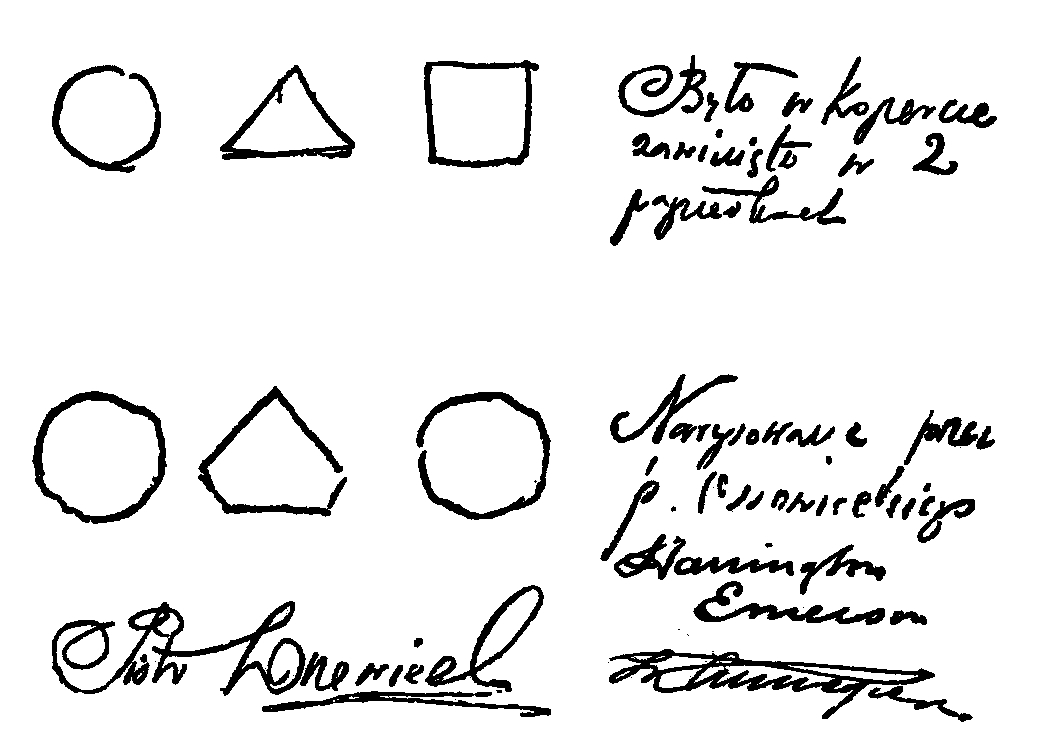
Figure p. 130. Hand-drawn shapes with handwritten Russian notes and signatures
Translated labels: circle; triangle; square; [illegible: handwritten Russian note, roughly ‘Taken … in 2 …’]; [illegible: handwritten Russian note, possibly ‘Round shapes … Harrington Emerson’]; [illegible: handwritten signature]
Handwritten labels: “Was in the envelope, wrapped in 2 sheets of paper”; “Drawn by Mr Ossowiecki.”6
I also spoke of his son, who was very different from his father and whose chief passion was aviation. All this lasted several hours. Emerson, who as an Anglo-American was sober and cool in temperament, became moved and kissed me. After this experiment, however, I felt uncomfortable, and for two hours I could not come to myself. Visions of the ocean, America, tall buildings, and Emerson’s entire family kept passing through my mind. This exhausted me so much that I had to take a car and go to Wilanów to recover my senses a little. At that time I forgot which street I lived in and the number of the house. Little by little I regained my spiritual balance; at two o’clock in the morning I was home.
On 20 May 1928 I received a letter from Mr Emerson, written aboard the ship Berangerja. I quote the contents of this correspondence, which Mr Piotr Drzewiecki can attest to. The letter, translated into Polish, reads verbatim as follows:
“Dear Mr Ossowiecki,
“After making arrangements with you at Mr Piotr Drzewiecki’s home, where you promised to perform an experiment for me in the realm of the sixth sense, we met in my room at the Hotel Europejski. In this field I was neither a sceptic nor a believer, but for forty years I had studied and investigated this science. Thus, when I was introduced to you at a social gathering in the home of the engineer Mr Piotr Drzewiecki, the former Mayor of Warsaw, I was very happy, especially as you agreed to give me a few hours of your time. We met in my room at eight in the evening. During the first part of our meeting there were five people besides myself, and in the second only four of us remained: you, the engineer Drzewiecki, Professor Kanegisser, and myself.
“At your request I went into the adjoining room to draw three geometrical figures on my card. Originally, as you rightly said, I had intended to draw a head.
“I wrapped this card several times in paper and sealed it in an envelope. You took the envelope from me and held it behind you for several minutes in such a way that only we could see it. We were all sitting around you. At the outset you remarked that ‘at first I had intended something else, but had changed it.’ Indeed so. Then you said that you saw three geometrical figures: a circle, a triangle, and a third figure whose outlines you could not quite grasp, something like a square, or even a circle. Then suddenly you saw a square, although you drew a circle. At your request the engineer Mr Piotr Drzewiecki opened the envelope, and once again everything agreed. You devoted the second part of the experiment, in the presence only of Mr Kanegisser, the engineer Drzewiecki, and myself, to describing the course of my entire life from the beginning. You did so with extraordinary accuracy. Thus you said that I had married young and lost two small children, a boy and a girl; that I had soon divorced, and who had been the cause of my divorce. You said that I had brought my first wife from another country, young and pretty. It is all true. How I had begun my career, having a university education, as a lawyer, but later radically changed my occupation. True! You described my home as being outside the centre of New York, with a beautiful view of the water and surrounded by a park. I lived in a house with three upper storeys. Entirely true. The engineer Mr Drzewiecki visited me at my home, 135 Riverside Drive in New York, in a tall apartment building, but was invited to dine at the Columbia Yacht Club in Riverside Park, a few steps from my apartment on Riverside Drive. It is also true that my wife and I generally dine at this Columbia Yacht Club. I found your description of my apartment, the furniture in several rooms, the portraits, and the books accurate. You told me that I had a son who was an engineer and aviator, and three daughters by my second wife, two of them married; my wife’s disposition and character were accurately described. You said that I had brought her from very far away to New York, where she was not at present, but that I would soon see her again. You accurately described my estrangement from my brother, with whom I had long been on very affectionate terms.
“Thus the whole, in respect both of the sequence and accuracy of the events and of the identity of the figures, was entirely in accordance with the actual state of affairs.
“The general grasp of the above-mentioned experiments was extraordinary, and only occasionally indefinite in particular details. It was evident that you had entered the path of my life and were reading my thoughts as clearly as most people hear music or see a motion picture: far more clearly than a person distinguishes tastes or smells. Meeting you was a great pleasure, and only thanks to you was I able to witness the finest, most serious, and most interesting experiment of my life.”
With sincere esteem and affection,
(Signed) Barrington Emerson
Aboard the ship Berangerja.
Whenever Mr Emerson subsequently came to Warsaw, we always met. I performed further experiments with him, but these were rather confidential. All these experiments belonged to the strict domain of clairvoyance.
Experiment No. 15
I performed an interesting experiment with another American, Mr Ob.-Deyk, a representative of the Morgan financial group. This took place in the presence of several people: Mr A. Jaroszewicz, Michał Lewin, and Count Zornekau. Ob.-Deyk was very interested in the problem of the human psyche. When he learned about me and made my acquaintance, he earnestly requested an experiment in metapsychics. I readily agreed. I performed one by reading a letter inside a closed envelope, and another, more interesting to me, by transporting myself to America. The first proceeded as follows: Mr Ob.-Deyk went to the other end of the dining room. This took place at the Oaza, between four and five o’clock, when few people were there. He drew a tiny house, a garden, a little tree in front of the house, and the roof of the house, partly covered in iron. I performed the experiment within a minute. As soon as he brought the sealed envelope, I immediately drew on its other side what had been sketched inside. Mr Ob.-Deyk was frightened and amazed. Later I began speaking about his life, his wife who was waiting for him in Paris, his beloved little dachshund with yellow ears, his whole family, and the illness of a child, his daughter’s little son, who had fallen ill in America. I described the whole apartment in the minutest detail; he was utterly disconcerted. That same day he sent a telegram to his wife in Paris and received a reply that his daughter’s child had indeed contracted some serious illness and was in their home under his daughter’s care. I described her appearance and that of the nurse, a tall, stout person. The next day I received a note from him expressing admiration and confirming that everything I had said corresponded to reality. The following witnesses confirmed this experiment: Antoni Jaroszewicz, Michał Jaroszewicz, Michał Lewin, and Count Zornekau.
Experiment No. 16
I performed two experiments with Mr Stefan Rzewuski, vice-president of the Physico-Psychical Society. They, too, belonged strictly to the domain of clairvoyance. I shall describe them as they were presented in his article in the supplement to Kurjer Ilustrowany, No. 290, Metapsychic Section.
“I conducted the experiments described below with Mr
Stefan Ossowiecki on 18 May 1932. I have not published them before now because the eminent clairvoyant had promised to perform several further experiments with me, different from those already made, but intended in a sense to continue and supplement them, to crown them, so to speak. I attached great importance to this continuation. Experiments designed in the way I proposed had never been conducted with Mr Ossowiecki, nor, so far as is known, with anyone at all; if successful, they might perhaps shed some light on the problems of ‘psychometry.’ Moreover, I intended to conduct them under very rigorous conditions.
“The experiment I shall describe here was intended, as far as possible, to exclude the telepathic hypothesis.
“I prepared two sets of thirty slips of paper each, identical within each set in size and quality of paper. The slips to be used in the experiments were to be drawn at random from the two sets. Before coming to Mr Ossowiecki, I wrote in ink on each slip an equation containing three letters7 and taking the form of one of the four arithmetical operations; for example, 3 − 8 = 5, 12 − 9 = 7, 4 × 2 = 10, 0 ÷ 5 = 6, and so on. As will appear below, the results of the operations were in principle required to be incorrect, and I wrote down the supposed result after covering the left-hand terms of the equation on the slip.
“I prepared the second set in the same way, with the sole difference that instead of the digits from 0 to 9, I wrote the consecutive numbers from 1 to 35. All the slips were marked with my initials. I brought each of the two
sets to Mr Ossowiecki in a separate sealed envelope. No one knew about the intended experiments, not even the engineer Mr Ossowiecki himself, whom I had come to see on an entirely different matter. I had prepared the experiment, somewhat improvised, in haste, simply in case the opportunity arose, not knowing whether Mr Ossowiecki would agree to it. On arriving, I told him only that the proposed experiment was a certain modification of those previously conducted with him, and that it involved merely stating the contents of a slip of paper in a closed envelope. No one apart from Mr Ossowiecki and myself was in the room during the experiments; only the maid came in. Having opened the envelope containing the first set of slips, I drew one at random, without looking, and, keeping it concealed in my clenched hand, put it into a separate envelope taken from a packet I had brought with me. The envelope was of white paper; it was completely impossible to read through it, even against the light, the numbers written on the slip folded in four.
“Moreover, the numbers overlapped one another. Under these conditions I had no idea what was on the slip, and Mr Ossowiecki’s supposed hypersensitivity of touch would have been of little use. The engineer Ossowiecki took the envelope and, while seated, held it in his left hand, now at the back, now behind himself, now with his hand resting on his leg, all the time gazing somewhere ahead of him. After a moment he rang for the maid and gave her instructions concerning a lady who had arrived during my visit, asking her to
wait. Two and a half minutes after the envelope had been handed to him, Mr Ossowiecki began to say, with pauses, the following:
“‘I see some digits. I see a seven, two zeros; no, it is an eight. And this was not written by a mathematician: something strange; not a mathematician.’
“At this point Mr Ossowiecki took from me the paper on which I had been making notes and wrote on it, or rather drew in large figures: seven, a multiplication sign, eight, equals six. The whole experiment lasted four and a half minutes. Taking the untouched envelope back from Mr Ossowiecki’s hands, I opened it, removed the slip myself, and unfolded it. I established that it bore, in my handwriting: seven, a multiplication sign, eight, equals six (7 × 8 = 6), and that the initials I had placed there were in their proper position. After this experiment I told Mr Ossowiecki how and for what purpose I had prepared the slip, adding that I had a second, somewhat different set. Mr Ossowiecki agreed to perform another experiment.
Experiment No. 17
“Holding the envelope, Mr Ossowiecki, probably in connection with the previous experiment, said to me:
“‘I have a seven in my mind… it is so hard for me to say at once. Yes, I have a seven. Now I see a five, I see a three. Five, three, there is also a one. One and eight.’
“Here Mr Ossowiecki took the paper from me, saying, ‘Now I shall write.’ And he wrote: 5 × 3 = 18. This experiment also lasted four and a half minutes. Curious about the result, Mr Stefan Ossowiecki himself opened the envelope before my eyes and took out the slip. As he gradually unfolded it, we checked the numbers together, one after another, along with the multiplication sign. On the slip, marked with my initials, was written in my hand: ‘5 × 3 = 18.’ The splendid results of both experiments, merely one among this famous man’s many triumphs, testify that Mr Stefan Ossowiecki does not need telepathy to decipher the contents of a text unknown to him.”
(Signed) Stefan Rzewuski
Vice-President of the Psycho-Physical Society.
Experiment No. 18
I performed a very interesting and unusual experiment on 27 May 1926 at the Royal Castle. It was described in the periodical published by the President of the Psycho-Physical Society, Mr Prosper Szmurło.
“When, in the spring of this year, I learned that during conservation work at the Royal Castle in Warsaw a dungeon that had been walled up for many years had been discovered, I immediately approached the director of works at the state buildings of the Republic of Poland, Professor Kazimierz Skórewicz, the architect. Having obtained his kind consent, I proposed that our clairvoyant, the engineer Stefan Ossowiecki, already known throughout the world, conduct an experiment there.
“In my opinion the dungeon in question was suitable for an experiment because no human being had entered it for many years, and even after it had been opened up, the general public had had no access and only a small number of people had seen it.
“The engineer Stefan Ossowiecki took an interest in my proposal and, as always when scientific purposes were involved, despite his many occupations did not refuse to test his extraordinary faculties there. On the appointed day, 27 May 1926, I called on the eminent psychometrist together with the secretary of the Psycho-Physical Society, Mr Stefan Rzewuski, and we went together to the Castle. There, having been notified, other members of the Society’s committee were already waiting for us: Admiral W. Kłaczkowski and Mr J. Bakierowski; Mr Wł. Reych was also present.
“We all called on Professor Skórewicz, who lived in the Castle. He personally led us through a series of castle chambers to the dungeon, situated beneath the dismantled floor of one of them. Down a ladder brought specially for the purpose we descended one by one, lighting our way with an electric lamp. We saw unplastered walls built of large bricks of a thickness no longer encountered today. The walls, however, were covered with a layer of clay and sand. The engineer Stefan Ossowiecki knelt beside the wall on a coat laid on a stone, resting his palm against one of the bricks, and immediately began to speak: ‘This is a prison, a prison; here on the walls the poor condemned men drew coats of arms and gallows with nails or a sharp stone.’ The hardened sand and clay were cleaned off part of this wall, and indeed at a person’s height we saw in places various marks, more or less deeply scratched, probably with a nail or a fragment of stone. Bringing the electric lamp closer, since it was completely dark, we made out coats of arms, letters, and gallows, traces of the dungeon’s former occupants. Ossowiecki was already concentrating. We looked at a watch, which showed 6:50. The engineer Ossowiecki remained silent; finally, after ten minutes, at seven o’clock, he began to speak in fragments, with pauses, while the two of us took notes…
“‘Now I see, I see people… there were two of them… One is bald, with a long beard, wearing clothes with a red collar and red cuffs. It was he who carved that sign, the gallows.’ (The psychometrist’s palm was resting on it at the time.) ‘Here was the entrance, a door high up, and from there’ (he pointed) ‘the prisoners were lowered. They were brought by soldiers in armour, with long pikes and strange helmets. Above it was round’ (a vault)… ‘how black it is there… as though covered in soot… I also see elongated openings in the wall that let in air… Some iron bars…’ (He pointed.) ‘There was something like a recess in which a guard sat. There’ (he pointed) ‘I see many armed men with pikes. Some steps.’ (Indeed, on inspection, steps were found.) ‘Food was lowered this way… they stood against the wall… they waited… It was a very, very long time ago. So many impressions, images; it is hard to express everything. One man lay here, in only a shirt and trousers, without boots; sometimes many of them lay here, about six to eight people. Farther over there’ (he pointed) ‘is some long, low passage, a tunnel; one almost has to crawl on one’s belly, and there was water there.’ (Indeed, closer examination revealed a narrow passage leading to the wall. Professor Skórewicz said that in the period of which Mr Ossowiecki was speaking, there had been water there: the Vistula.)
“Ossowiecki continued: ‘I see a monk in a black cloak, with his neck uncovered. I have the impression that he was taking leave of and blessing the condemned men as they were led from there to their deaths.’ (Indeed, at the place indicated there appeared to be a walled-up doorway, from which a long corridor ran to the left and emerged into the room beside the dungeon.) ‘And here, behind the wall’ (beside which the psychometrist was sitting), ‘you may still find something: I see something made of metal, it shines; a helmet, I think… something else… I cannot go on; I am tired.’
“We ended the experiment; the watch showed 7:15. We all went to Professor Skórewicz’s apartment in the Castle to read and sign the notes, now kept in the archives of the Warsaw Psycho-Physical Society.
“The engineer Ossowiecki added a few small details to what he had said in the dungeon and drew a shield with a gold border or inlay, of the kind he had seen the soldiers carrying.
“Professor Skórewicz stated that the engineer Ossowiecki had described the Castle as it was at the end of the fourteenth century, in the days of the Dukes of Mazovia, when most of the present buildings did not yet exist. The dungeon where the experiment took place lies beneath the old ‘Castle Tower.’ Nobles sentenced to confinement ‘in the tower’ were held there. The Vistula, which later changed its bed, then flowed right beside the castle walls, and precisely where the engineer Ossowiecki indicated there had probably been some secret passage from the river through the walls, as described by the psychometrist. At that time the tower was separated from the actual castle of the Dukes of Mazovia by a courtyard, now occupied by castle chambers, in which, of course, the armed castle guard already mentioned by the engineer Ossowiecki would usually have been stationed. Steps must certainly have led up to the defensive wall joining the tower to the castle; these too were mentioned by the engineer Ossowiecki. The above record was signed by all the persons named.”
I have performed several experiments of this kind; the remoteness of the period plays no part at all in such experiments. At first I begin to see as though through a dark veil, then increasingly clearly, until at last reality fades away, and then I am fully in command of the situation.
Experiment No. 19
On 19 November 1928 Deputy Public Prosecutor Olgierd Missuna approached me with an earnest request that I devote a little time to a good acquaintance of his. She was very anxious about the fate of her father, of whom there had been no news whatever for a very long time, and therefore wished to know whether he was alive and what had become of him. The lady was Irena Szarska. I agreed, appointing the Café Europejska as the meeting place on 21 November at twelve noon. I quote the record of the experiment below:
“On 21 November 1928, at a table in the Café Europejska, in the presence of Miss Irena Szarska, the engineer Mr Steinbrich, Mr Leszek Antecki, and Mr Olgierd Missuna, the engineer Mr Ossowiecki performed the following experiment. Miss Irena Szarska was wearing a large, carved gold ring with a stylized frog. Mr Ossowiecki took an interest in this ring, took it in his hands, and examined it with curiosity. After a moment, urged by those present to say something about the ring, he began to speak.
“It should be noted that the engineer Mr Ossowiecki was introduced to Miss Szarska that day; he had never seen her before and had heard nothing about her.
“‘This ring,’ the engineer Ossowiecki began, ‘comes from somewhere far away, as though from China or Japan. You received it from someone very close to you, a man. You received this ring a long time ago, from your father. Yes, from your father… Your father, I see him, is alive. He is a man with a very forceful, an exceptionally forceful face. Accustomed to giving orders. I see him in uniform, something like a naval uniform. Your father has no hair on his head. He is shaved. I see a scar on his face, as though from a bullet.’
“The engineer Ossowiecki pointed to his right cheek. Miss Szarska confirmed everything he said.
“The engineer Ossowiecki continued: ‘And there is another, smaller scar beside his nose.’ Ossowiecki hesitated, fell silent for a moment, and turned the ring in his hand. Those present were astonished.
“‘Now I see him clearly. He is very far away, at sea. Somewhere between America and Asia. He thinks about you a great deal. At this moment he is aboard a ship. He is eating breakfast, something red, like ham. He has a boil on his neck. His neck is wrapped in a cloth. He is talking to someone, scolding him. The ship is carrying a cargo of tea in chests wrapped in some kind of matting. On the side of the vessel I see an inscription. It is the ship’s name. Strange; I do not understand… I clearly see five letters, one above another. But it is not in English; they are letters I do not understand. It is a Chinese inscription. Yes! Your father is thinking about you. He wants to come to Poland and take you to China. He will arrive in about a month. He is already on his way.’
“The experiment ended here. We attest by our own signatures to the truth of the above and its agreement with reality.
“(Signed) Deputy Public Prosecutor O. Missuna
“(Signed) Jan Steinbrich, engineer
“(Signed) L. Antecki
“I further certify that Miss Irena Szarska’s father is a captain in the Chinese fleet; that in January 1929 he did indeed come to Warsaw and confirmed the accuracy of the circumstances given by the engineer Ossowiecki. I personally saw Captain Szarski.
“Ossowiecki described his appearance with complete accuracy, down to the scars. He had indeed been carrying a shipment of tea on a Chinese merchant ship. In February 1929 Captain Szarski left with his daughter for Shanghai, where he remains to this day.
“Warsaw, 17 January 1930.
“(Signed) Deputy Public Prosecutor O. Missuna”
Experiment No. 20
In February 1930, on a day I do not remember, Mr G. Godejski, a very good acquaintance of mine, a composer and a man of great kindness, approached me and asked me to receive him together with his mother, whose surname from her first marriage was Korwin-Milewska.
They asked me to perform an experiment and say whether her son, Ryszard Korwin-Milewski, was alive. Mrs Milewska supposed that he had died, since she had received no news from him for several years. I could not refuse to perform the experiment, and with real pleasure took Ryszard Korwin-Milewski’s letter in my hands. After a few moments my sight was with him at sea. I immediately declared with joy that her son was alive, that he was at that moment at sea, carrying out certain duties. He was aboard a French ship on the ocean, full of health and vigour. I said that his mother would hear news of him very soon. His mother was overjoyed that her son was alive. A few weeks later I received a letter from Mr G. Godejski informing me that everything I had said about Korwin-
Milewski had been confirmed with the greatest accuracy. I quote the contents of the letter:
“Dear Sir,
“When, in the first days of February, my mother approached you, knowing your extraordinary abilities to read events at a distance, to ask for information about the fate of Ryszard Korwin-Milewski, her elder son from her first marriage, who had given no news of himself for a number of years, you said that you saw him alive, as a sailor serving on a large ship on the ocean, and that we would soon receive news of this. A few days later we received an official reply to an inquiry addressed, through the kindness of Professor Henryk Mościcki, to the Consul of the Republic of Poland in Paris toward the end of last year.
“This letter, a copy of which I enclose, astonishingly confirmed all the details you had given. I should now like to convey, along with my admiration for your unheard-of supernatural faculties, the assurance of my deepest gratitude and respect.
“Yours most respectfully,
“(Signed) G. Godejski
“1 enclosure.”
Copy.
Consulate General of the Republic of Poland in Paris, 19 rue Alphonse de Neuville, No. 7984 (R. P.) 30.
Paris, 12 February 1930.
To Professor
Henryk Mościcki
Ministry of Foreign Affairs
Historical and Research Department
Warsaw.
Dear Professor,
According to the inquiries conducted into the matter of Mr Ryszard Korwin-Milewski, his present address is: 19 rue de Doures, Bordeaux. Mr Milewski is serving on the French ship Rousillon of the Transatlantic Shipping Company.
In forwarding this information in accordance with your wishes, I beg you, dear Professor, to accept the assurance of my respect and esteem.
For the Consul General,
(Signed) Wiesław Dąbrowski
Experiment No. 21
One day I was invited by a colonel in the French army, Mr de Mazarat, a professor of artillery at the Higher War College, to dine at the restaurant of the Hotel Europejski. The other guest was Mr Charpentier, the League of Nations delegate in Warsaw, who wished to meet me.
The atmosphere was very cordial, and the conversation was chiefly about metapsychics. Mazarat was well known in the circles of our metapsychic institutions. He himself possessed considerable magnetic power, and his attitude toward me was very serious. Colonel Mazarat was particularly anxious for me to meet Mr Charpentier, who was a layman and a great sceptic. During dinner Mr Charpentier said that if he could see something in the domain of clairvoyance, he would be grateful to me all his life. It would be his greatest happiness to be convinced and to change his sceptical attitude toward these questions. I wanted to convince him, and I was in a good frame of mind. I therefore asked him to leave the dining room and write or draw something. Only Mr Mazarat remained with me. I told him in the minutest detail what Charpentier was doing, that he was drawing, and what he was drawing. When Charpentier returned, I repeated before both gentlemen what I had said previously. Charpentier confirmed everything in great astonishment and thanked me warmly. That same day Charpentier sent a letter to the Metapsychic Institute in Paris with the following contents:
[French original, translated into English.]
“Invited by Major de Mazarat along with Mr Stefan Ossowiecki, whom I did not know, the three of us were having lunch at the Hôtel de l’Europe in Warsaw.
“The conversation turned to the phenomena of clairvoyance produced by Mr Ossowiecki, who suddenly said to me: ‘But you do not look very convinced, and if you are willing, we shall perform a little demonstration experiment. Leave the room, conceal yourself wherever you like, make any drawing on a card, put it in an envelope, and bring it back to me: I shall tell you everything you have done.’
“I left the restaurant and installed myself at the back of the hotel’s cloakroom, in a very secluded corner about twenty metres from our table, from which two very thick walls separated us. When I returned, Mr Ossowiecki and Major de Mazarat were continuing their lunch and conversation. I handed the firmly sealed envelope to Mr Ossowiecki, who immediately said, holding it beneath the table: ‘It is a very small drawing… there is a long tail, all twisted… it is a mouse… I shall sketch it for you.’ Having asked Major de Mazarat for paper and a pencil, he made the sketch below. Before opening the envelope to compare the two drawings, he added: ‘You were at the back of the cloakroom; I followed you. You did not sit down; you were kneeling on a stool, drawing on a little table. At first you thought of making something round.’ (My intention had indeed been to draw a cat curled up asleep, its head between its paws.) ‘You enjoyed yourself drawing the mouse’s tail, and the paws required more of your attention.’
“The envelope was then opened to show the drawing I had made.
“The resemblance is truly very curious in its imitation of the general lines, and above all of the tail, as well as in Mr Ossowiecki’s evident intention to draw the paws carefully, just as I had done myself.
“Finally, I must admit that, point by point, Mr Ossowiecki repeated to me everything I had done and thought during my absence from the restaurant; his entire account was accurate. Moreover, Major de Mazarat certified to me that Mr Ossowiecki had continued talking and eating lunch normally while awaiting my return. Everything was perfect; I was deeply moved by the impression it made.”
(Signature)

Drawing by Mr Charpentier. Drawing by St. Ossowiecki.
Translation [the book’s Polish rendering, translated into English]:
“I was invited by Colonel de Mazarat, together with Mr Ossowiecki, whom I did not know, to lunch at the Hotel Europejski. There were three of us.
“The conversation concerned the phenomena of clairvoyance produced by Mr Ossowiecki, who said to me at a certain moment: ‘You do not look like a believer. If you very much wish it, we shall perform a little experiment. Leave the room and go wherever you like. Please make a drawing on a slip of paper, put it in a sealed envelope, and I shall tell you what has been drawn, what you did during that time, and where you were.’
“I left the restaurant and went to the hotel’s cloakroom, to a very secluded corner some twenty metres from our table, from which two thick walls separated us. When I returned to the room, Colonel de Mazarat and Mr Ossowiecki were talking and continuing their lunch. I handed over the sealed envelope, and Mr Ossowiecki immediately said, holding it under the table: ‘A tiny drawing… a long, curled tail… it is a mouse… I shall draw it for you.’ He asked Colonel de Mazarat for a piece of paper and a pencil, and drew a mouse exactly like the one drawn on the paper inside the sealed envelope. The envelope was opened, and the two drawings could be compared. Ossowiecki added: ‘You went to the cloakroom; I followed your every movement the whole time. You did not sit down, but knelt on a stool, drawing on a tiny table. At first you intended to draw something round.’ (I had indeed intended to draw a sleeping cat curled up in a ball, with its head between its paws.) ‘You were amused while drawing the mouse’s tail, and paid particular attention to the paws.’ The envelope was unsealed to show my drawing. The resemblance was very curious in the imitation of the main lines, especially the tail, as well as in Mr Ossowiecki’s intention to draw the mouse’s paws carefully, which corresponded exactly to my drawing. I must admit that Mr Ossowiecki described in the minutest detail everything I had done during my brief absence. He even told me what I had been thinking at the time. Everything corresponded entirely to reality. I must also add that Colonel de Mazarat confirmed that throughout this time Ossowiecki had not left his place at the table and had been engaged in conversation with the colonel.
“Everything succeeded splendidly, and I was moved by it.
“(Signed) G. Charpentier
“League of Nations Delegate in Warsaw.”
I have performed a great many experiments in connection with the search for missing people. These experiments are of a most confidential nature. Although I have a whole series of records and letters of thanks, in such cases I have always been asked for discretion. I recently conducted an experiment of this kind that ended very successfully. I shall describe it without giving the surname of the person concerned, because this particular experiment is especially interesting for psychometry and for those who devote themselves to this science. I shall quote the contents of the letter I received without giving the full surname or the date. It concerned Major X’s missing son.
Experiment No. 22
“On returning home from Suwałki in June 19…, we did not find our son at home. Our orderly said that he had supposedly gone by boat to Bielany. Our son had been away from home for three days. At last we found a letter from him in which he informed us that he had left home to go out into the world, and asked us not to look for him.
“We therefore approached the engineer Mr Stefan
Ossowiecki, who knew our son well. We gave Mr Ossowiecki our son’s letter and asked for any explanation he could offer. Holding the letter in his hand, Mr Stefan Ossowiecki told us that he now saw our son in Warsaw, and that he could see how on Monday and Tuesday he had walked around the city all night, unable to find a place to sleep and without a penny in his pocket. Mr Ossowiecki told us that he saw our son walking now in the neighbourhood of Kolonja Staszica, now beneath Poniatowski Bridge, now in Filtrowa Street, now in Powązki; he saw that his feet were badly chafed all over, for he had not taken his boots off for several days in succession. On Tuesday he had met a young man wearing large spectacles, who lent him money, while another gave him a letter and helped him leave Warsaw for a factory town. There had been a moment during the young boy’s experiences over those few days when he wanted to take his own life, to shoot himself, but now that thought was far from his mind. The boy must return home any day. A few days later our son returned, and his account of what he had been doing during those days confirmed in the minutest detail everything the engineer Mr Stefan Ossowiecki had told us. It made a great impression on us.”
(The major’s signature.)
Experiment No. 23
A second case, no less interesting. Professor Dr Żebrowski approached me with an earnest request on behalf of Mrs Lewicka, whose family was in Warsaw except for two sons who had remained in Russia and had given no sign of life for many years. As a mother, she begged me to say whether her sons were alive. I agreed to perform an experiment.
One day I went with Dr Żebrowski to see Mrs Lewicka, who lived in Belwederska Street. I was given the boys’ two caps and two suits of clothes. I transported myself very quickly and saw the elder son’s death. He had died in hospital of typhus, while the other was already on his return journey to Poland. I described the boy’s whole journey, which was being made chiefly on foot. I roughly calculated when he might reach Warsaw. I told his mother that he should probably be home within two to three months. The mother’s joy knew no bounds. Indeed, after two months her son returned home. A few weeks later young Lewicki, his sister Dr Lewicka, and Mrs Dangel visited me. Lewicki confirmed the details of his journey, which corresponded entirely to my description.
I have very rarely taken part in matters involving the courts. I avoid and do not wish to play the role of a detective or Sherlock Holmes, and always resist as best I can; nevertheless, circumstances have led me to take part in several such cases.
Experiment No. 24
I performed one of these experiments with the present public prosecutor of the District Court, in a criminal case. It concerned the murder of five defenceless people. The experiment was very interesting. I indicated the route by which the criminals had entered the poor peasant cottage. They had come in through the thatched roof, in which a hole was found, and had escaped through the door. All five inhabitants of the cottage had been killed with revolver shots: an eighteen-year-old girl, her fifty-year-old mother, the girl’s nineteen-year-old fiancé, and two children.
During the experiment I held the girl’s bloodstained ring and her mother’s kerchief in my hand. Before leaving for the scene of the crime, I drew the position of the house and its surroundings. I indicated that the house stood on a road beside the highway, that on the other side of the highway lay a fairly sparse wood, and beyond the wood a scattered village. I added that the bandits lived in this village: two young men whose chief object was to kill the young girl, because she would marry neither of them. It was revenge, and this lay behind the whole tragedy.
The next day, when we all went to the scene of the crime, I described how this terrible crime had unfolded, and also indicated that some distance away lay the lock from a stolen casket. Indeed, when Detective Simon ran in that direction, he found a small lock there. I further stated that to the right of the house, on a nearby hill, the bandits had rested after the murder, drunk vodka, and eaten, and that a small empty vodka bottle and the paper in which the food had been wrapped were still there. In fact, a small vodka bottle and paper soiled with food remains were found. The bandits were caught, and I recognized them by their appearance.
Experiment No. 25
On 27 August 1932 Naval Captain Baron Kruzensztern approached me with a request to perform an experiment with him, which he describes in the letter quoted below:
Dear Sir,
At my request you agreed to perform an experiment with me, which proceeded as follows:
Taking a piece of paper, I went into the adjoining room with the intention of drawing a house. Then I changed my mind and wanted to draw a head; then I changed my mind a second time and drew a vase. I began the drawing with two circles, which I joined by lines at the sides.
Having sealed the envelope, I returned to the room where you were and handed you the sealed envelope.
You took the sealed envelope in your hands and, holding it behind your back, drew an almost identical vase on paper within a minute.
You then added that I had originally intended to draw a house, which you also drew, and then a head, but had changed my mind a second time and drawn a vase, beginning the drawing with two circles.
Wanda Badior was present at this experiment and, like myself, was deeply impressed by this extraordinary gift.
Yours most sincerely,
(Signed) Baron N. Kruzensztern
(Signed) Wanda Badior
Experiment No. 26
I also performed an experiment with Public Prosecutor Sima. Documents in the Nowiński–Ginzburg case had disappeared from the District Court. Suspicion might have been directed along an entirely false track, so I readily agreed to perform an experiment. I went to the Court after business hours, concentrated, and said that the documents were in the Court building, but on the first floor, and that during the move some of the documents had been left in their former place. This proved to be the case, and the documents were found.
Experiment No. 27
I performed several more experiments in judicial matters, but shall not write about them. I shall now quote an interesting experimental record entitled “The Mysterious Disappearance of the Well-Known Lawyer X.”
I shall not write about my impressions, but shall merely quote verbatim this document, signed by Mr Bach., one of the best detectives in Poland.
“In the winter of 1931, at seven in the morning, a sharp ring of the telephone woke me. On the telephone was an acquaintance of mine, Mr S., the deputy investigating judge, who asked me to come immediately to Świętokrzyska Street on a matter that could not wait. I need hardly add that half an hour later I was there. In the apartment of the well-known lawyer Mr X., I found his wife and daughter in despair. As I learned, the lawyer X. had left home the previous morning in a state of extreme agitation and had not returned.
“First of all I asked whether the reason for his sudden disappearance was known. I suspected that some woman was involved, but was assured that this was out of the question. In the course of further questioning, however, I established that the missing lawyer liked gambling and was consequently in financial difficulties. The missing man had wide connections and was a good acquaintance of the present chief of security, who, on learning of his disappearance, instructed the river police to search discreetly for a drowned man’s body in the Vistula. The object was to prevent news of his disappearance from reaching the press. I personally did not believe that the missing man had committed suicide, and although at ten in the morning a letter arrived by post for his wife, in which he wrote that he was taking his own life, giving his reckless conduct as the reason, I nevertheless persisted in believing that he had not yet carried out his mad act. Learning that the missing man was also acquainted with the engineer Mr Stefan
Ossowiecki, well known throughout Poland and abroad, who had already done me several services and in whose powers I firmly believe, I decided to ask him for help. Taking the missing lawyer’s pyjamas, I therefore went with the deputy investigating judge to his apartment in Polna Street.
“The engineer Ossowiecki would not let me explain what the matter actually was. Taking the pyjamas, after a brief moment of reflection he began:
“‘The missing man left home yesterday morning, with a few złotys on him. He went to some people near Marszałkowska Street and wanted to borrow money there. He left them in a state of extreme agitation. For several hours he wandered aimlessly around the city. In the afternoon he went to one of the side streets off Nowy Świat. There is an old house there; on the second floor of the rear wing lives a woman of about forty, tall and blonde. She is a woman with a past. The missing man went to her. From the entrance hall, directly opposite the front door, is a little room with a couch in it. The missing man sat in this room with the woman who occupied the apartment. He received some money from her and left her apartment after several hours. At about eleven at night I see him in a bar opposite the Main Railway Station, eating frankfurters, with a glass of beer before him. Around midnight he went onto the platform, his hat pulled down over his forehead and his overcoat collar turned up. He boarded a long-distance train. He is sitting in a third-class compartment. In the compartment are a priest and two ladies… I see him on the train, but he did not travel to the terminus; he got off along the way. He got out at a station where there is a long railway bridge. It is dark, and the missing man is struggling inwardly. He wants to part with life. He lacks the courage. He walks beside the bridge, throws himself into the water, lies on the ground, but he is still alive; he will live.’
“I asked this famous man whether he could tell me the name of the station where the missing man had got off. Despite his efforts, however, he could not tell me. Since the train to Gdańsk, near which there is a well-known gambling establishment, leaves Warsaw at 11:55 at night, I supposed that the missing man, being a gambler, wanted to try his luck once more and stake his life on one last card. This contradicted the celebrated clairvoyant’s statement that the missing man had got off along the way.
“First of all I decided to find, at any cost, the apartment near Nowy Świat where the blonde woman with a past was supposed to live, since it had been established that after leaving home the missing man had indeed gone to his relatives in Mazowiecka Street to seek a loan. Because his relative was ill, he had received no money. It was entirely as Mr Ossowiecki had said. As the missing man was legal adviser to a bank, after leaving the engineer Ossowiecki’s apartment I went to that bank and succeeded in establishing that he frequently received telephone calls from a woman and also telephoned her very often. A colleague of the missing man, who shared an office with him, recalled the telephone number he often rang. It was therefore not difficult to establish through directory inquiries who owned that telephone. It turned out that the subscriber was a woman of about forty, living in Traugutta Street, on the second floor of the rear wing of an old house; directly opposite the entrance door was a little room with a couch. When I questioned the occupant of the apartment, she admitted that the missing man had visited her, borrowed money from her, and left, but she did not know where he had gone. Now believing the engineer Mr Stefan Ossowiecki completely, since everything had been confirmed to the letter, I decided to set off toward Gdańsk that same evening, and did so.
“Having satisfied myself that the engineer Mr Ossowiecki’s prediction had been entirely borne out, and that without knowing anything about the occupant of the apartment in Traugutta Street, without knowing her or ever having set eyes on her, he had given me the most exact description of her appearance and a detailed layout of the apartment, even the room in which the missing lawyer had sat, I decided to continue in precisely the direction indicated by Mr St. Ossowiecki. On the way to Gdańsk I asked the railway staff near which station there was a long railway bridge. I was told that, apart from Tczew, there was such a bridge at the station near Grudziądz. I decided to get off at Grudziądz and try my luck. Perhaps I would find him here? I risked nothing, for if I failed to find him I could continue by the next train.
“Here too, most fortunately, the engineer Mr St. Ossowiecki’s prediction was entirely fulfilled. I found him in Grudziądz; he had already been taken to the Hotel Polski in the market square. It turned out that Mr X. had indeed intended to commit suicide. For this purpose, after leaving the train he had walked to the railway bridge, spent a long time walking beside it, and finally thrown himself off. Fortunately for him, however, he had caught on the ice as he fell, losing consciousness and coming to himself only after a considerable time. He had been brought to the hotel and put to bed; his feet were frostbitten. It was there that I found him.
“I freely admit that I owe this miraculous discovery solely to Mr St. Ossowiecki, whose gift is entirely incomprehensible to me as a layman. I admire him! This was the second session I had with Mr Ossowiecki. The first had also involved his identifying a woman, who was found cut up in a suitcase; that was many years ago. I have no words to express my admiration for his supernatural powers, and owe him much gratitude for the help he has given me for a second time.”
Experiment No. 28
Present:
The former Deputy Minister of Communications in Russia under the tsarist regime, senator and professor at the Institute of Roads and Communications, M. Tugan-Baranowski, after performing several experiments with me and under the impression they made upon him, wrote a letter to Paris, to the International
Metapsychic Institute. I give the text of this letter below:
[French original, translated into English.]
M. N. Tugan Baranowski.
To the Director of the Metapsychic Institute.
“Although I have rarely met Mr Ossowiecki, I have nevertheless had occasion to witness certain manifestations of his faculty for reading the contents of a sealed envelope, or contents enclosed in any other opaque material.
“1. The first time, in 1921, while visiting Mr Ossowiecki, after a conversation on various subjects I asked him to let me witness one of his experiments in reading a sealed letter. Mr Ossowiecki proposed that I write something on my visiting card and give it to him in an envelope.
“Having withdrawn to one side, I wrote 102, then folded my visiting card, sealed the envelope, and handed it to him.
“The engineer Mr Ossowiecki took the envelope and, holding it behind his back, said immediately that there was a three-digit number on the card. He then named the second digit, ‘0,’ then the first, ‘1,’ and finally the third, ‘2,’ remarking at the same time that this last digit was difficult to decipher. On opening the envelope, it turned out that the ink had formed a blot on that digit.
“2. One day, at some friends’ house, sitting very far from Mr Ossowiecki, I wrote his surname on a piece of paper, then put the paper into a thick envelope.
“Mr Stefan Ossowiecki placed it on the table and put his hand over it. Two minutes later he said: ‘There is a word of ten letters written here. You were thinking of me…’ A few moments later he added: ‘It is my name.’
“3. At the same friends’ house, Mr Gloor, the representative of the Swiss Red Cross, brought an envelope and asked Mr Ossowiecki to read its contents. After holding it in his hands for quite a long time, the latter said: ‘I see a sort of office… a bank, but you have put money in it… one pound sterling.’ Indeed, inside two thick sealed envelopes was a one-pound banknote.
“4. In my apartment I gave Mr Stefan Ossowiecki a wallet, taking it from a drawer. Holding it in his hands in front of me, Mr Ossowiecki asked whether I drew, for there was a pen drawing in the wallet showing a bearded man. I replied that I did not draw and that there was no drawing in the wallet. But on opening it and examining the papers, I found on the back of a sheet of paper a sketch of a bearded man, drawn by myself and very poorly executed. Mr Stefan Ossowiecki made a mistake only once. The word ‘non’ [‘no’] had been written, and he said: ‘A number of three to three digits, with a zero in the middle.’8 I must add that if I had not personally observed this faculty of Mr St. Ossowiecki with great attention, I would not believe in it, so far does it
surpass all the possibilities I had hitherto been able to admit.
“(Signed) M. Tugan Baranowski.
“Former senator and professor at the Institute of Engineers of Roads and Communications in St Petersburg.”
The letter quoted above reads as follows in literal translation [the book’s Polish rendering, translated into English]:
M. N. Tugan Baranowski.
To the Director of the Metapsychic Institute.
“Although I rarely met Mr Ossowiecki, I nevertheless had occasion to witness some manifestations of his gift for reading the contents of a sealed envelope or of any other opaque object.
“1. The first time, in 1921, while visiting Mr Ossowiecki, after a conversation on various subjects I asked him to let me be present at the reading of a sealed letter. Mr Ossowiecki proposed that I write something on my visiting card and give it to him in a sealed envelope.
“Having withdrawn to one side, I wrote ‘102,’ put the visiting card into the envelope, and handed it to him after sealing it.
“The engineer Mr Ossowiecki took the envelope and, holding it behind his back, immediately said that there was a number of three digits on the card. He then named the second digit, ‘0,’ then the first, ‘1,’ and finally the third, ‘2,’ remarking at the same time that this last one was not very legible. Indeed, on opening the envelope it turned out that there was an inkblot on this numeral.
“2. One day, while at some friends’ house and sitting at a distance from Mr Ossowiecki, I wrote his surname on paper and put the paper into a thick envelope. Mr Ossowiecki laid it on the table and covered it with his hand. Two minutes later he said: ‘A word of ten letters is written here. You were thinking about me…’ A few moments later he added: ‘It is my surname.’
“3. At the same friends’ house, Mr Gloor, the representative of the Swiss Red Cross, brought an envelope with him and asked Mr Ossowiecki to read its contents. After holding the envelope for a considerable time, Mr Ossowiecki said: ‘I see something like an office… a bank… But you have put money in it, one pound sterling.’ Indeed, there was a one-pound banknote in two thick envelopes.
“4. In my apartment I handed Mr Ossowiecki a wallet I had taken from a drawer. Holding it in his hands, Mr Ossowiecki asked whether I drew, because there was a pen drawing in the wallet showing a man with a beard. I replied that I did not draw and that there was no drawing there. But on opening the wallet and looking through the papers, I found on the reverse of one of the sheets a drawing I had made of a bearded man, poorly executed, as it happened. Mr Stefan Ossowiecki made a mistake only once. The word ‘nie’ [‘no’] was written, and he said: ‘A number consisting of three digits, with a zero in the middle.’
“I must add that had I not personally observed Mr Ossowiecki’s gift with great attention, I would not have believed in it at all, so far does it exceed the possibilities I could have imagined until that moment.
“(Signed) M. Tugan Baranowski
“Former senator and professor at the Institute of Roads and Communications in St Petersburg.
“Warsaw, 10 July 1929.”
Experiment No. 29
In October 1930 I had guests from Stockholm. Professor Dr Kallenberg came specially to see me with a lady who was a correspondent for Swedish newspapers. I am always ready to be of service to visiting guests, especially people of science, and never refuse them. These guests brought prepared material for experiments from Stockholm. There were two sealed envelopes, one of them quite thick. After a long conversation with the professor about metapsychic subjects, I became convinced that he possessed considerable knowledge in this field. We began the experiment. This took place at the Hotel Bristol. First I took the heavier envelope in my hands, and after five minutes began to speak. I transported myself to a balcony and saw two people. Professor Kallenberg did not know what was in the envelope I held, since it had been prepared in Stockholm by a docent. He had arranged it this way to avoid the phenomenon of telepathy. The professor began to write down my words, which were as follows:
“There is a photograph here, taken from a photograph; a young girl with long blonde hair stands by a window, dressed in white. This is on a veranda. Behind her are flowers, and beside her sits a young man with a smiling face, one leg crossed over the other.”
After the experiment Dr Kallenberg opened the envelope and, to his astonishment and my great satisfaction, found in it a photograph of himself, a reproduction of which is shown below.9 I was mistaken on only one point: the young man seated there was the doctor himself, who was in fact elderly. Everything else corresponded entirely to reality. The record, written in German, reads:
“The test with this card was very successful. It was indeed a photograph of a photograph. It was very interesting and correctly stated.”
(Signed) K. Kallenberg
Doctor of Medicine, Stockholm in summer, Wisley.
Translation of the above [the book’s Polish rendering, translated into English]: “The test with this photograph was very successful. It was indeed a photograph of a photograph. It was very interesting and accurately stated.”
(Signed) K. Kallenberg
Doctor of Medicine, Stockholm in summer, Wisley.
The second experiment was less interesting. I performed it for Professor Kallenberg’s travelling companion.
She handed me an envelope she had prepared. After a few minutes I began to speak: “The envelope contains a sheet of letterhead from Dr Kallenberg’s sanatorium, entirely blank; there is only some printing or advertising on it.” My words corresponded to reality.
Experiment No. 30
While passing through Paris in 1926, I telephoned Professor Osty, director of the Metapsychic Institute, to tell him of my arrival. Professor Osty, who lived at the Institute, had a visitor from Rome that evening: Mr R. Santoliquido, a doctor of medicine, professor and senator, and also president of the International Metapsychic Institute, who had long wished to meet me.
Professor Osty urged me to come and spend the evening with them. At nine o’clock I was therefore already at the Metapsychic Institute, in Professor Osty’s apartment. After tea we went into the drawing room. I was extremely interested in Mr Santoliquido, a man of great culture. Our conversation chiefly concerned metapsychic subjects. I myself proposed performing an experiment, which delighted him greatly. I took him by the hand and after a moment began to speak. I described his apartment and the pictures hanging on the drawing-room wall, and expressed my surprise that at his age he lived so high up without a lift. I also said that he had one son, who had caused much worry because he had not wanted to follow the path chosen by his father, but had chosen an artistic career and was now an eminent actor. I then asked Mr Santoliquido to write or draw something on paper. Professor Osty and I went into the adjoining room. Osty confirms this experiment in his article in Revue Metapsychique in these words:
“He remained under my supervision, with his back turned toward the drawing-room door.” After a few moments Santoliquido asked me to come into the drawing room. Osty continues: “I handed him a sealed, opaque envelope.” Taking the envelope and holding it behind my back, I began to say: “You have written only one word in Italian, your son’s name… Fran… Francesco.” I took a piece of paper and tried to write the name in the same handwriting. Professor Santoliquido thanked me warmly for performing these experiments, drove me home, and continued talking with me for a long time at my hotel.
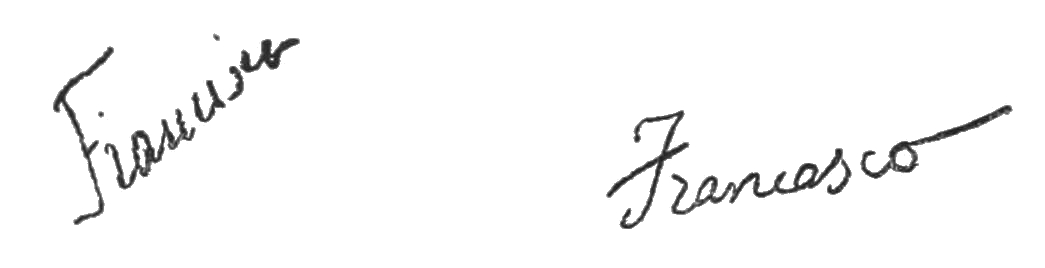
Drawing by St. Ossowiecki. Drawing by Professor Santoliquido.
Experiment No. 31
On 13 November 1931 I was visited by the Reverend Leslie J. Belton, who held a high ecclesiastical office in England. His visiting card bore the inscription “Aberdeen Uniterien Church.” He made a very favourable impression on me as a man of great culture, wise and well read. I was happy to find that his philosophy of life corresponded to my own views. He came during the day, and we remained together until late in the evening. We performed an experiment, the drawing from which I reproduce below.
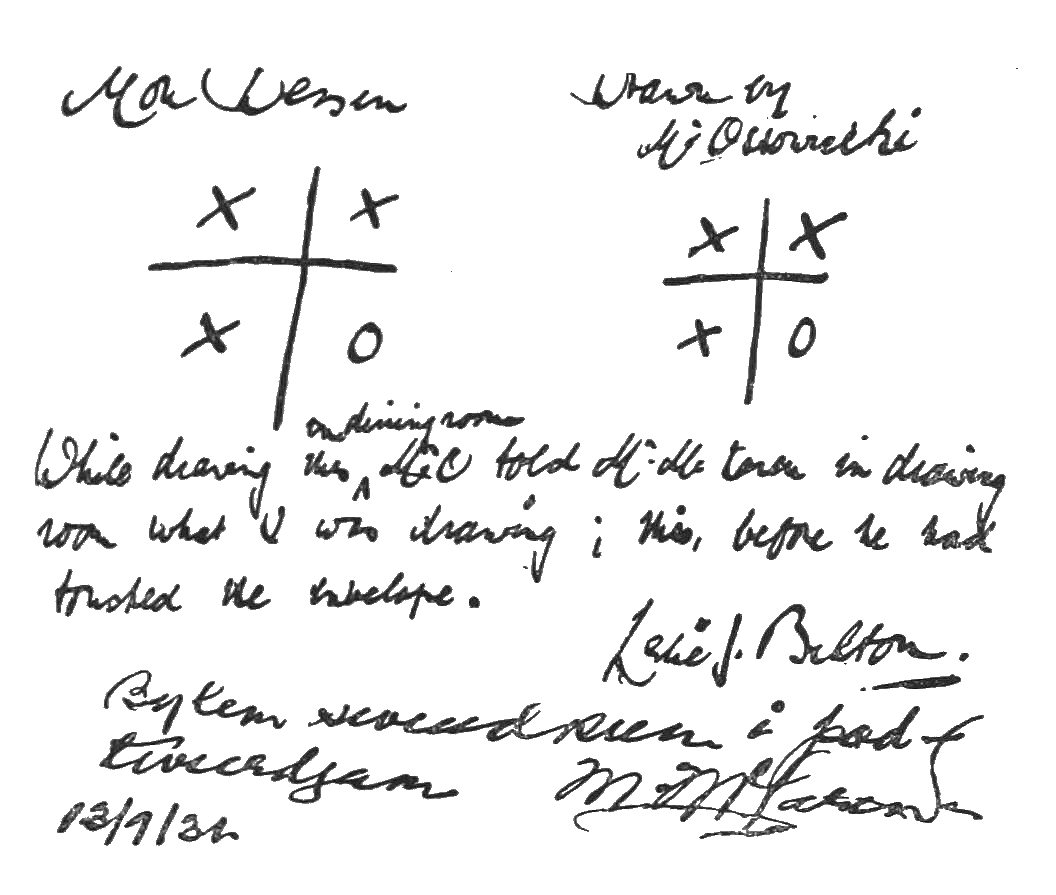
Figure p. 172. Handwritten tic-tac-toe demonstration note
Translated labels: [illegible handwritten name]; X; O; [illegible handwritten note]; Katherine Balton [signature]; 13/9/34
[Handwritten English labels: “My design” and “Drawn by Mr Ossowiecki.” The partly indistinct English attestation includes “… what I was drawing; this, before he had touched the envelope,” and is signed “Leslie J. Belton.” Polish handwritten note, translated: “I was at the same time a witness and interpreter.” The handwritten date appears to read 13/11/32, differing from 13 November 1931 in the printed narrative. The remaining handwriting and signature are preserved in the facsimile.]
The first was drawn by him, the second deciphered by me from a closed envelope. Mr Belton was also accompanied by a friend, an Englishman who spoke Polish, and who likewise signed beneath the drawing as a witness.
Experiment No. 32
At the end of November 1930 I was invited to dinner by Mr and Mrs Gałecki. At the table I sat next to Mr Alfons Kühn, the Minister of Communications. He became extremely interested in reading the contents of sealed envelopes, and we later spoke about metapsychics and the aura. Wishing to give Mr Kühn pleasure, I agreed to perform an experiment after dinner. The minister drew a triangle with a circle inside it. I drew a triangle with a circle inside it in exactly the same proportions. This experiment lasted barely two minutes, and I performed it while holding the sealed envelope containing the above-mentioned drawing in my hand.
Experiment No. 33
The following evening at the Metapsychic Society, 81 Wspólna Street, after a séance with Sabina Churamowicz, the daughter of the engineer Piotr Drzewiecki, the former mayor, approached me and asked me to perform an experiment with an excavated object she had brought. Four people were present, among them Dr Czubryński, who took down the record. I was handed the excavated object. After five minutes of concentration I began to speak:
“It comes from a tomb in which some great man was buried together with eating vessels. It comes from the Greek coast. Your father brought it, having bought the object from an antiquities dealer where strings of beads were hanging. He paid money for the excavated object.”
It turned out that this was exactly how the object had been purchased.
Experiment No. 34
In November of the same year I performed an experiment with the eminent pianist Artur Rubinstein and the well-known violinist Mr Paweł Kochański. This took place at the home of Mr and Mrs Mayer. I read a drawing made by Mr A. Rubinstein that was inside a sealed envelope. I reproduced this drawing on the reverse of the envelope.
Experiment No. 35
That same year, again at the hospitable home of Mr and Mrs Mayer, I performed a much more interesting experiment of an entirely different kind. Several people were there, among them the composer Mr K. Szymanowski, director of the Conservatory; the pianist Professor Drzewiecki; Mr Ordyński; and Osterwa, the well-known actor. I had a very interesting task to carry out. Namely, at eight o’clock I was to bring the eminent pianist Leonid Orłow to us within eight minutes, who had been invited to Praga that evening, to Dr Jastrzębski’s, I think.
I made a great effort of will. Mr Osterwa held a watch throughout, while I said what I saw. I saw Orłow leaving and getting into a car, and then I connected with him. Orłow felt tired and very much wanted to go home. At last I prevailed. The eighth minute was nearly up, and we all rushed toward the stairs. Osterwa and I stood on the stairs with the watch in hand. What was our astonishment when Leonid Orłow came hurrying, almost running, into the apartment and told us that, on leaving Mr and Mrs Jastrzębski’s house, very tired, he had intended to return home, but did not himself know what had happened: some violent force had drawn him to Mr and Mrs Mayer’s apartment; now he was calm again. The experiment had succeeded.
Experiment No. 36
In November 1928 the Spiritualists’ Circle organized a lecture by our guest Aleksander Brianczaninow, vice-president of the International Spiritualists’ Society, on the subject “The Union in the West of All Countries for an Ideological Struggle against the Materialistic Views of the Age.” The paper was delivered in French, with great oratorical eloquence, in one of the larger halls of the Association of Technicians. It provoked a lively discussion, after which, as the gathering was about to disperse, one of the participants addressed those present and asked them to stay, as the engineer Stefan Ossowiecki had offered to perform an experiment in reading a letter inside a sealed envelope that had been handed to him by Mr Sokołowski, vice-president of the Metapsychic Institute. The envelope had been addressed in Spanish to the engineer Ossowiecki by Dr Cobo Martinez.
Everyone present gladly took advantage of the opportunity, for I seldom agree to perform experiments in a crowded hall, and in this instance there were several hundred people present. Mr A. Brianczaninow and H. Karpiński took down the record, which reads:
“Mr Ossowiecki sits at a table surrounded by the people who subsequently signed the record of the session. Mr Ossowiecki places his hand on the envelope and sits motionless, his head raised, gazing ahead. He asks for the light to be dimmed. It is immediately dimmed, but Mr Ossowiecki’s concentrated and tense face can be seen perfectly. After fifteen minutes, which pass in the almost absolute silence of expectation, he begins to speak in a slightly stifled voice and broken sentences. He is in Spain; he sees a house among greenery and flowers. He is inside this house, in a study with many books. He sees a man seated at a desk. He describes exactly what the man looks like and what he is doing. He sees his soul plunged in despair after the loss of a child… He sees the gentleman cutting pieces of green paper and putting them into an envelope. ‘There is no letter in this envelope,’ says the engineer Ossowiecki. For a long time he cannot determine what it is. He asks for paper and a pencil and begins to draw.
“And when the mysterious envelope was opened, astonishment seized those present, for they found in it not only those pieces of green paper, but also a white card bearing signs corresponding exactly to those St. Ossowiecki had drawn, as the reader may verify by comparing the reproductions of the card that lay in the sealed envelope between two opaque pieces of green paper, and of the drawing Ossowiecki made. We also give the record of this meeting, which made a powerful impression on those present. The Metapsychic Institute will send this record to Spain to verify whether the description of Dr Cobo’s house, which Ossowiecki saw from Warsaw, corresponds to reality.
“Record of the experiment conducted by the engineer Stefan Ossowiecki on the 29th of last month, in the hall of the Association of Technicians in Czackiego Street.
“The engineer Mr Ossowiecki is seated in the company of Professor Chojecki; Fryze, editor of Kurjer Poranny; Kotarbiński; Dr Wojnowski; Dr Sokołowski; Stanisław Przybyszewski; Kazimierz Stabrowski; A. Brianczaninow; J. Tomaszewski; General Jacyna; President H. Karpiński; and Stanisław Brzostowski.
“Mr Ossowiecki holds in his hands, which rest on the table, a letter sent from Spain in a white envelope sealed with eight wax seals. The letter is from Dr Teodiselo Cobo Martinez, a doctor of medicine. It is known that Dr Cobo recently lost a daughter and is deeply distressed by it. The envelope and seals were found to be intact. The lights in the hall have been dimmed. Everything can nevertheless be seen clearly. The experiment begins at 10:15. At 10:25 Mr Ossowiecki says:
“‘A letter from Spain. I see this yellowish-white house, with two upper storeys, an entrance through a little garden, and much greenery on the right; stone steps all around; the entrance is on the right side. The dwelling of a man who is not well off. Then, in the study, the moment when he writes this letter, not a letter. A short, dark-haired man, an open forehead, very lively, dressed in black; six o’clock, an entrance hall alongside… His wife passes through; he is distressed by a terrible tragedy, he has suffered the loss of a child, a little girl. His wife expecting another. A boy has already been born; they wanted a girl. Masses of books all around, leather seats, not new. While he was writing this letter, a gentleman came in; they talked. Beside the study is a narrow vestibule, from which one enters a tiny room, glass, a veranda facing the garden, many flowers and much greenery.
“‘There is someone else’s child with them. His wife is thirty-two, with dark hair and a sharp nose, dressed in black; something black hangs around her neck: little cubes.10
“‘The master of the house, the doctor, has scissors on the table; he is cutting paper, holding papers. It is not a letter, only something written. A man of science, he studies a great deal, has completed degrees in several disciplines, and possesses encyclopaedic knowledge.’
“Mr Ossowiecki asks for paper and a pencil and continues: ‘Masses of books all around, a black oak table, everything around the doctor’s figure in perfect order. All sorts of psychic questions, the search for truth and for the paths of the dead, beloved little girl. His wife also suffers greatly. There is much energy and inner strength in him, but he is not the sort of man who could give something of himself to the world: an encyclopaedist, about forty years old. His face looks tired. He has gone to the table and begins to write, bent over it. He cuts little pieces of green paper; the seal is ready on the table. I see what he is drawing and how.’
“Mr Ossowiecki draws on a pad handed to him by one of those present. ‘He wanted to draw a circle in a square, then a face, and ended with a dot.’ (Mr Ossowiecki draws.) ‘He gets up, lights a cigarette, returns to the table, takes a pencil or a pen, and writes a question; he draws a large T. He writes something here; there are two questions, questions in the field of metapsychics. He asks me whether I believe in telepathy. At the top it is written in French. Someone else is in the room, an older man. The question: “Do you believe in telepathy?” The second: do I believe in life beyond the grave? An apartment of four, six rooms.’
“The record was taken down by Mr T. Sokołowski. No abridgements, crossings-out, or corrections were made. When the envelope was cut open, a sheet of white paper was found, folded in two and enclosed between three rectangular pieces of paper, two of them green. On the white sheet, the drawing and written sentences corresponded in the minutest detail to Mr Ossowiecki’s drawing.”
After the experiment a letter was written to Dr Teodiselo Cobo Martinez, with the record enclosed, containing everything I had said about him and everything I had seen. The seals with which the doctor’s letter had been sealed were returned to him. On the reverse of each I wrote my name, as did Mr A. Brianczaninow and T. Sokołowski.
After two months I received news from Chiclana de Segura, Jean Espano, Portillo No. 2.
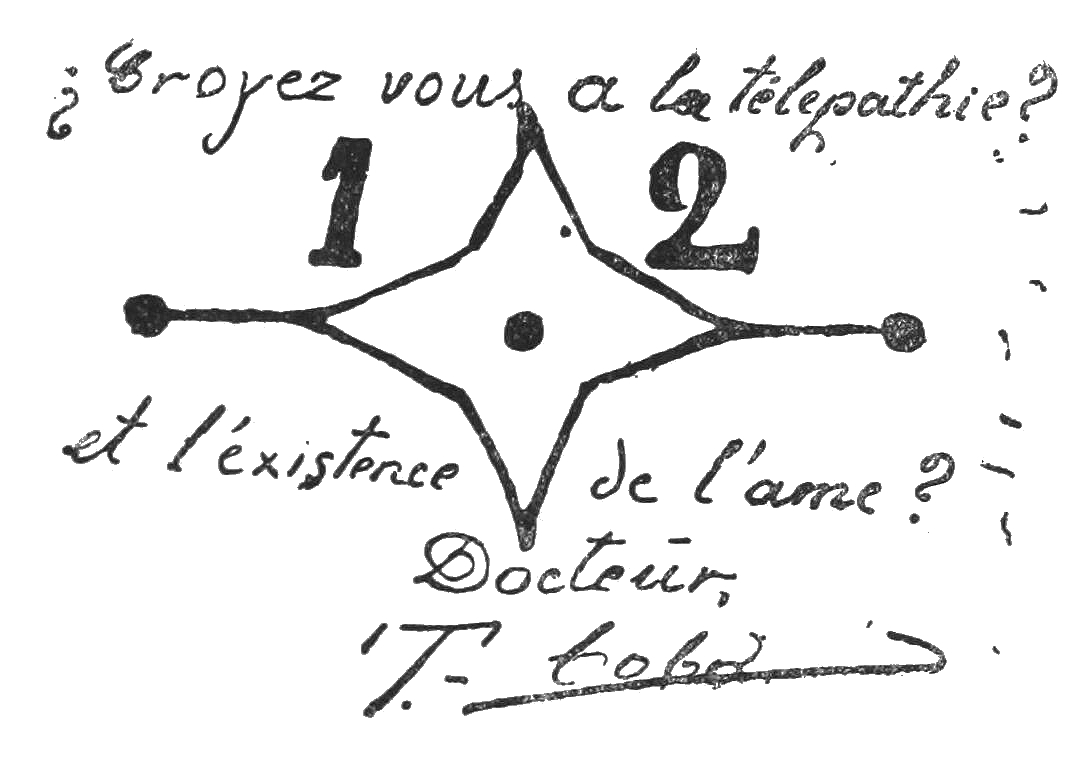
Drawing by Dr Cobo Martinez.
[French handwritten text, translated: “Do you believe in telepathy? And in the existence of the soul?” “Doctor T. Cobo.”]
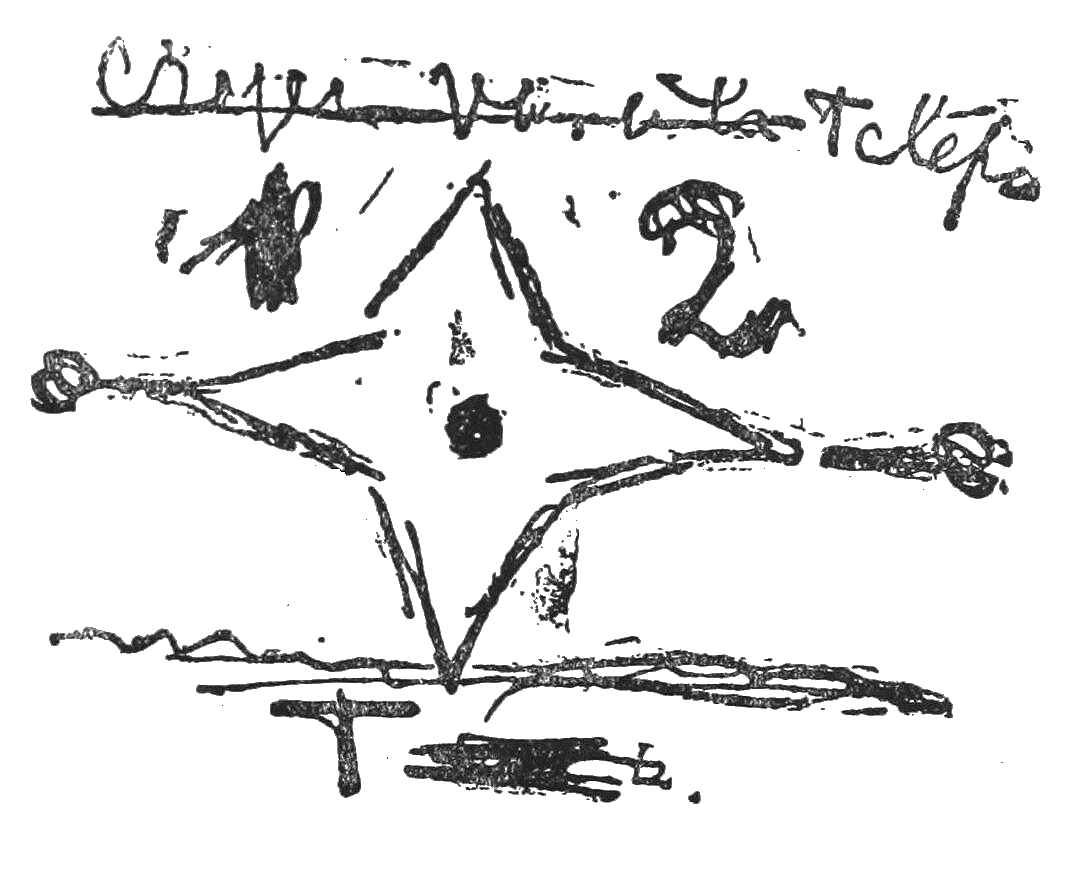
Figure p. 180. Sketch of a winged rotor scheme
Translated labels: Scheme [illegible] wing [illegible]; 1; 2; T
Drawing by St. Ossowiecki.
Mr T. Cobo Martinez writes to me personally and to the Metapsychic Institute in Warsaw. His letter to me reads:
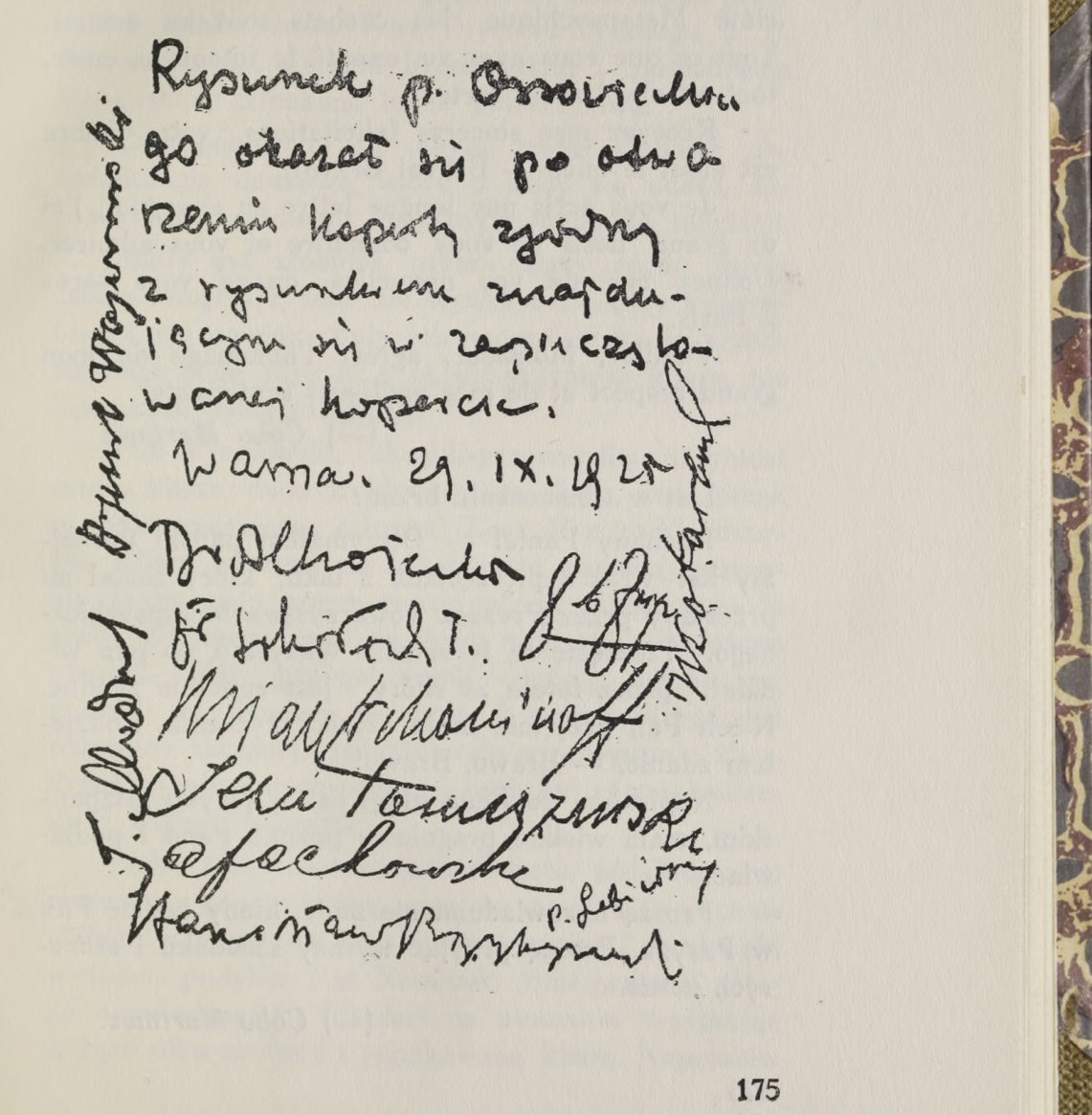
[Polish handwritten attestation, translated: “After the envelope was opened, Mr Ossowiecki’s drawing proved to agree with the drawing contained in the sealed envelope.” The place is Warsaw; the date appears to read 29 IX 1925 (29 September 1925). This differs from November 1928 in the printed introduction to Experiment No. 36 and December 1928 in the earlier reference to it. The readings have not been reconciled. The signatures are reproduced in the facsimile.]
“My dear Sir! I have just received your kind letter, together with the wax seals sent to me by your kind president of the Metapsychical Society. The seals are the same. Everything you saw, except the leather armchair, is absolutely correct.
“Please accept my sincere congratulations. Your stamp is mine too.11 Bravo! Bravo!
“I am writing you a long letter in Spanish. I have a great desire to meet you and to admire you. Send me news of yourself when you are in Paris.
“Please accept, Sir, the expression of my great respect and my warmest regards.”
(Signed) Cobo Martinez
The letter in translation reads:
My dear Sir! I have received your kind letter, together with the wax seals, which was sent to me by the President of the Metapsychical Society. The seals are the same. Everything you saw, apart from the leather armchair, is entirely correct. Please accept my sincere good wishes. I share your opinion. Bravo, bravo!
I have written you a long letter in Spanish; I have a great desire to meet you and to admire you.
Please let me know when you will be in Paris. Please accept my respects and sincere regards.
(Signed) Cobo Martinez
Experiment No. 37
On 15 May 1926, at six o’clock in the evening, the President of the Psycho-Physical Society, Mr. P. Szmurło, came to see me with Messrs. Jerzy Proniewski and Stanisław Rzewuski, a member of the same Society.
They proposed that I undertake an interesting scientific experiment which, if successful, would rule out the existence of telepathy in this particular case.
Four photographs were to be taken by four different people, but not developed. The photographers were not to tell me what the photographs represented, while those bringing the plates would not know their contents.
Mr. Proniewski, a chemist and natural scientist, brought four plates, two taken by himself and two by Mr. Bakierowski, a member of the Psycho-Physical Society. The plates were wrapped in red paper, then in black paper, tied up tightly, and placed in a cardboard box, which was tied up a second time and sealed. When the preparations were complete, these gentlemen came to see me, bringing all the equipment needed to develop the plates as well. In addition to the people named above, Mr. Olgierd Missuna was also present.
The cardboard box was opened, and I took the first plate that came to hand, wrapped, as I have mentioned, in red and black paper and enclosed in a small box. Mr. Rzewuski kept the record of this experiment. I sat on an ottoman, holding the undeveloped, wrapped plate in my hand. Opposite me sat Mr. Szmurło. I began to speak. I quote Mr. Rzewuski’s record.
“A difficult task. I do not like conducting experiments with objects of the nature of printed matter. This photograph was taken indoors. I see a richly furnished drawing room, many works of art, framed portraits, but I cannot understand what this could have to do with a castle on a hill. At the moment the photograph was taken, I see three people, a lady and two gentlemen. There is no light there. I see as though through a mist. I see a tall young man, thin, with a long face; the other is short, with a round face. One gives the impression of a robust man, the other is more delicate, weaker, in military uniform. What can this castle and this hill mean? What has one to do with the other? I keep seeing them. A lovely room: portraits, a desk; I see a sculpture, and the same castle again. My head aches. It is a pity that all the glass plates are together. Other things become confused before my eyes.”
I began the experiment at 7:14 and finished it at 7:42 in the evening. The sitting thus lasted twenty-eight minutes. We were all intensely interested in the result. We covered the windows and switched on a red electric lamp. We took out the plate that I had held in my hand all this time. We began to develop it. To our great astonishment, it was a photograph of a picture hanging in the drawing room. The painting was by the well-known artist Laszenko and belonged to Mr. M. Bakierowski, who had taken the photograph. The subject of the picture was a hill with a castle on it, the very one I had spoken of and had been seeing all the time.
The next day Mr. Szmurło telephoned Mr. Bakierowski. It turned out that his younger brother, a military man in uniform, tall and long-faced, had helped him take the photograph. Mr. Bakierowski himself is short. While the photograph was being taken, their mother had come into the room several times.
There were a great many pictures and works of art in the drawing room. Everything I saw and spoke of corresponded to reality in the smallest detail. This experiment made an enormous impression at the Metapsychical Institute in Paris. It belonged strictly to the domain of clairvoyance.
Experiment No. 38
These were the last two experiments conducted with the late Dr. Geley. After carrying them out, Professor Geley left by aeroplane for a metapsychical conference in London. Unfortunately, the aircraft met with an accident in which Professor Geley was killed on the spot, three kilometres from Warsaw. I lost a true and devoted friend, and science a distinguished scholar. His works De l’inconscient au conscient [From the Unconscious to the Conscious] and L’ectoplasme et la clairvoyance [Ectoplasm and Clairvoyance] made his name immortal. Below I give a photograph of Professor Geley in the company of the well-known medium Mr. Teofil Modrzejewski, whose pseudonym is “Kluski,” and myself. A second photograph shows the mourners walking in his funeral procession.
I owe Professor Geley a very great deal. He was the initiator of all the international metapsychical congresses, and it was he who brought me into contact with a whole series of world-famous scientists, foremost among them Professor C. Richet. I owe the great popularity of my name abroad to him. He was a man of great qualities of heart and spirit, an outstanding physician, a man of profound learning. It was thanks to him that the International Metapsychical Institute was founded in Paris.
On the evening before Professor Geley’s departure, prompted by an unpleasant foreboding, I asked him to postpone his journey. He would not agree, however, maintaining that the conference in London could not be postponed. The following morning, therefore, despite the unfavourable weather, Mr. S. and I accompanied the professor to the airfield. The airline then belonged to the Romanian-Polish company.
While talking to the pilot who was to fly him, Professor Geley showed the airman the contents of his suitcase. They were indeed unusual, for it contained plaster casts taken from the forms of a spirit during a spiritualist sitting with Mr. Modrzejewski as medium. This made such a powerful impression on the airman that, despite the fine he faced, he absolutely refused to go.
I then once again urgently begged the professor to put off the flight. Alas, in vain!
Suddenly an aeroplane arrived at the airfield from Prague in Czechoslovakia, with the pilot Mroczkowski, who undertook to take the professor to Prague; the aircraft, however, was in such a condition that it was unfit for the journey. During the negotiations with Mroczkowski, a second aircraft arrived with a French pilot, Clement. Professor Geley therefore addressed his request to him, and it was immediately and gladly granted, for Clement had left his sweetheart in Prague and was happy to return to her.
He accordingly told the mechanic to clean the machine at once, and after drinking a cup of coffee and resting briefly, he himself was ready to leave. I was so upset by my evil forebodings, by the obstacles piling up before this journey, and by Professor Geley’s obstinacy, that I left Mr. S. there and returned home without waiting for the moment of departure. At about two in the afternoon, while dining at the Hotel Europejski, I received the sad news of the disaster. We immediately drove to the airfield, to the site of the accident, where the shattered aircraft lay with two bodies: that of Professor Geley, whose skull had had its top cut off by the propeller, and that of the pilot Clement. The bodies were taken to the mortuary and then to St. John’s Cathedral. I informed Mrs. Geley of the tragedy. She came to Warsaw to collect her husband’s remains. Mrs. Geley was not only her husband’s companion in life, but a true friend and support in his work.
I now turn to the description of the experiments conducted in Professor Geley’s company. As they were described in the Revue Metapsychique for 1924, I give them in translation:
“I brought three photographic plates,” says Professor Geley, “measuring 13 × 18, exposed but not developed. Each was in a sealed black envelope, placed inside another large envelope, which was gummed shut.
“All this had been prepared at my instructions by Mr. M. Jaques, a photographer with a studio at 62 Avenue Bosquet, Paris. I did not know what was in them. On the backs of the outer envelopes I made asymmetrical marks in invisible ink, to make it impossible to open an envelope secretly. These precautions were unnecessary, however, since the unbroken seal guaranteed the contents. Besides, if light had penetrated the envelope, the plate would have been ruined at once. I took one of the plates and handed it to Ossowiecki.
“This took place on 4 June 1924 at six in the evening. We were by the Vistula at Wilanów, sitting on the bank and catching crayfish. Ossowiecki took the plate and concentrated. After ten minutes he began to speak:
“‘This is a photograph taken inside a dwelling, not outdoors. There are two people in the room. A young girl took some object from the room and went out. She is blonde or light brown-haired, not very tall…
“‘I see: it is a photograph of a young woman, but not a living one; rather, a photograph of a portrait. I have the impression that she is posing calmly. She has a narrow face and her hair is parted in the middle. The man who made this portrait was very nervous, dark-haired, with a small clipped moustache and quite a thick head of hair. The photograph was taken between one and three o’clock. There are many pictures and portraits in the room. I see something like a group sculpted in marble or bronze; it is dark.’ (A very long silence; commonplace conversation.) Ossowiecki continues: ‘I see those two gentlemen again. The street is not very busy; it is roughly on the third floor. One of these gentlemen is in a hurry. He leaves immediately after the photograph is taken. The other puts the plates into a black envelope. I have the impression that it is this second man who did everything. The first is pale and tired. A woman predominates in the photograph.’”
Record signed by Dr. Gustave Geley.
The circumstances of Geley’s tragic death reduced the possibility of verifying this extraordinary experiment. After her painful journey to Warsaw, Mrs. Geley took three broken plates out of the suitcase; they had, however, remained in their envelopes. Fortunately, the only one that had remained intact was the one Ossowiecki had held in his hands and on which Professor Geley had made a mark.
In October 1924, at the Metapsychical Institute, Mrs. Geley handed it to the photographer, Mr. M. Jaques, and to Dr. Osty, who had taken Professor Geley’s place at the Institute. M. Jaques recognized it as the plate he had given Professor Geley in June 1924, and saw that the paper, envelopes, and seals were untouched. After Mrs. Geley read the record written by her husband, Mr. Jaques remarked that this description corresponded exactly to one of the photographs he had given the professor. Below are Mr. Ossowiecki’s statements and Mr. Jaques’s comments.
Ossowiecki stated:
This is a photograph taken indoors, not outdoors. — Exactly right.
Two people are in the room. — Exactly right.
A young girl took some object and went out. — Exactly right. That was my daughter.
She is blonde or brown-haired, of medium height. — Exactly right.
Of medium build. — Exactly right.
I see: it is a photograph of a woman, but not from life; it is a photograph of a portrait. I have the impression that she posed calmly. — Exactly: I photographed the photograph shown below.
The gentleman who did this is very nervous, dark-haired, with a small clipped moustache and a thick head of hair. — Correct, except for the hair, which is of medium thickness.
The photograph was taken between one and three. — Correct.
There are many pictures and portraits in the room. — Many photographs and portraits hang in the room.
I see something like a group sculpted in marble or bronze; it is dark. — This group is on the first floor, in my apartment, not in the studio.
I see these two gentlemen again. — Yes, my operator and myself.
The street is not busy. — Yes, Avenue Bosquet.
It is roughly on the third floor. — No, on the ground floor.
One of these gentlemen is in a hurry. — The operator.
He leaves immediately after the photograph is taken. — Possibly.
The other puts the plate into a black envelope. — Yes, that was I.
I have the impression that this second man did everything. — Yes, I had more work to do than the operator.
The second gentleman is pale and tired. — Yes, that is the operator.
He is pale and looks tired.
Signed: M. Jaques.
Experiment No. 39
I quote an article by Professor Szmurło published in one of the Kraków newspapers. The experiment described here is of an entirely different character. I have, admittedly, carried out more experiments of this kind.
“Engineer Stefan Ossowiecki, with whom I have been on friendly terms for a number of years and have often experimented, once told me that, when he wishes, he can compel even a complete stranger, seen for the first time, to approach him or to perform some action, from a distance. He even told me of several such instances. I frankly admit that, in view of my own opinion already expressed above, I was fairly sympathetic to this; shortly afterwards, however, about two years ago, I had an opportunity to see for myself.
“On one occasion Engineer Ossowiecki and I arranged to attend a performance by a Polish fakir. This performance, preceded by a rather dull concert and appearances by singers and dancers, was to take place at the circus building on Ordynacka Street in Warsaw at eight in the evening, but, as usual, it began very late. We arrived punctually, so we had quite a lot of time for conversation. Taking the opportunity, I gave Engineer Ossowiecki a sealed envelope whose contents I knew, asking him to be so kind as to tell me something about the author of the letter. ‘Very well, I shall try, though I doubt whether I shall succeed under these conditions. Do you happen to know who that is?’ he added, pointing to someone unknown to me who was just passing us, a tall lady of about thirty. She then entered a box some twenty metres away, greeting the company already waiting for her there. ‘I have no idea,’ I replied. ‘I am seeing her for the first time.’
“‘An interesting type. Who might she be?’ said Engineer Ossowiecki.
“The orchestra interrupted further conversation.
“‘An interesting type. Who might she be?’ said Engineer Ossowiecki. He turned my envelope over in his hands, occasionally glancing towards the box in which the lady sat sideways to us, never looking our way. During the interval before the next number, Engineer Ossowiecki returned the envelope, explaining that he was not in the right mood just then and would prefer to put it off until later. Nevertheless, he gave a few accurate details about the author of the letter, his appearance, and so forth, then resumed the conversation about the lady.
“‘That lady interests me enough that I should like to conduct an experiment with her. I shall compel her to make our acquaintance of her own accord. You will see something new for yourself.’
“‘But, my dear engineer, under these conditions, with that deafening orchestra and no possibility of concentrating, it is bound to fail.’
“‘I have been working in that direction for a long time already,’ Ossowiecki replied.
“During the interval the lady passed us. We saw that she had first said goodbye to her companions and appeared to be leaving the circus altogether.
“‘Well, it cannot be helped. The experiment has failed!’ the engineer sighed.
“Yet scarcely a couple of minutes had passed when a porter approached Engineer Ossowiecki and whispered: ‘Sir, someone is waiting for you in the vestibule and asks you to come out for a moment.’
“‘For me? Who can it be?’ said Engineer Ossowiecki, and followed the porter. A minute later he returned in the company of that lady and introduced her to me, saying:
“‘Well? It succeeded after all! I persuaded the lady to return, although she had already said goodbye to her acquaintances in the box, so that you could see for yourself. I apologized to her and explained that we had been discussing an interesting experiment.’
“The lady told us that, while still at the circus, she had begun to feel an inexplicable desire to make the acquaintance of Engineer Ossowiecki, whom she not only did not know even by name, but had never seen before. Walking towards Nowy Świat, she suddenly felt that she would know no peace until she had carried out her intention. After some inner struggle, and contrary to every convention, she had asked for Engineer Ossowiecki to be called out, pointing from behind a curtain to the box where we were sitting. When he came, she was embarrassed and did not know how to explain her conduct. Only when Engineer Ossowiecki explained that it was a test of telesuggestion did she feel reassured.
“After a brief, pleasant conversation, since the performance had just ended, we said goodbye to our new acquaintance, who, as it turned out, was a lady of society. Engineer Ossowiecki and I made our way home, discussing animatedly this faculty of his, which had been unknown to me until then. I admit I was astonished. To influence someone, especially a person seen for the first time, without hypnosis, without putting them to sleep, even without verbal suggestion, is an exceedingly rare faculty, attributed to fakirs and yogis in India and almost entirely unknown in Europe. This was the first time I had seen anything of the kind, and remains the only time in my life.”
(Signed) Prosper Szmurło.
Experiment No. 40
On 3 June 1932 I received a letter in French from the counsellor of the legation of the Republic of Chile. I quote this letter in a literal translation.
“My dear Friend,
“I shall be happy if my experience of your extraordinary faculties in the domain of clairvoyance should ever prove useful. Metapsychical knowledge can derive no greater benefit than from my setting out here the details of every particular that makes up the moment when you cross the boundary of consciousness to go no one knows where and ‘see’ at an impossible distance, in darkness guarded by a thousand locks, as in a fairy tale. And so everything you see, however small, is interesting, and what you draw from superconsciousness always proves true. You speak with perfect naturalness about what you see, and those mysterious eyes roam about, always gathering real impressions, as has been proved so many times by experiments conducted before men of learning and even the most inveterate disbelievers in clairvoyance.
“I shall try here, with very great pleasure, to revive as accurately as possible the delightfully interesting moments of the afternoon we spent together at my home in May of last year, which you were kind enough to spend with my friends and me. I attach particular importance to that day. Although I have witnessed experiments just as interesting as the one I am about to describe, on this occasion you saw even more clearly than usual, if one may put it that way.
“After lunch in the company of a Norwegian lady, Unni Langaard, who was visiting Warsaw and whose interest in clairvoyance you were satisfying by answering countless questions, you were even in a good enough frame of mind to ‘see’ with your mysterious vision. You asked the lady to give you a letter, perhaps from her husband, who ought at that moment to have been in Oslo. Without a word in reply, Mrs. Langaard immediately brought a letter, which you took in your hands. You touched it as one does when trying to identify a kind of fabric. Your face soon lit up, and you knew so many things that your uninterrupted account lasted more than an hour and would be impossible to repeat, particularly as you spoke so quickly that we did not even have a moment to confirm each statement, profoundly astonished that you were speaking of Oslo, where I had lived for six years, until the end of 1930.
“‘Ah yes, I see your husband, tall, slender, etc., etc.’ And you sketched his portrait in an astonishing manner, specifying such details that Mrs. L., amazed, nervously confirmed them, saying: ‘Yes… yes… that is true. How? My God!’ Details about his teeth [text missing in the original printing]12 hairstyle, and, drawing with your finger, you traced the line of Mr. Langaard’s nose. Then you said: ‘I see him at the moment of writing this letter. He is in his office. But what is this building… so large? I see broad stone stairs, broad halls, many pictures. It is a museum…’ Those were more or less your words. You were not mistaken. Mr. Langaard, who is an art critic in Norway, holds a senior position at the National Gallery in Oslo, where he has his office.
“After giving many details about the moment when the letter was written, you continued:
“‘Now I am entering your home. I see a light-coloured house. You live on the second floor… on the
third. There is a corridor in which I see bookcases. I go farther down this corridor… This is the drawing room; on the left is a grand piano… I see many pictures here too…’ At that moment you stood up to show with your hand the pose of a woman in a painting that hung there, which I knew as a picture from Mr. Langaard’s collection. It was all extraordinarily accurate. You even spoke of my friend’s artistic inclinations and went back to the days when he wished to devote himself to an artistic career, for which he had a particular bent.
“‘I do not suppose I am revealing any of the Langaards’ family secrets.’ You were extraordinary; you had transported yourself entirely to Oslo.
“‘In the same building,’ you continued, ‘lives your mother-in-law… I see her: she is tall, stout, and wears a wig.’
“I knew Mrs. Langaard, and I admit I did not know this detail, but the colour of her hair had often caught my attention. Our friend Unni left the room laughing to fetch a handkerchief.
“You did not make a single mistake in speaking of the surroundings of this Norwegian lady, whom you were seeing for the first time.
“You returned the letter to Mrs. Langaard. It was then apparent that you were excited, despite the calm and natural manner you had maintained throughout.
“We went on to speak of something else, when you suddenly turned to Mrs. L., asking her to let you have the letter for another moment, since you had never been to Norway and would like to see Oslo.
“‘Ah yes, I see a square with a green-roofed church, your “Vore Fraelsers Kirke.” Opposite it is a statue, a man in a strange costume, something historical…’
“It was Christian IV of the Danish dynasty.
“Then you gave us details about the National Theatre, the place where it had been built, and the statues of Ibsen and Björnsen. You even noticed the Norwegians’ weakness for boasting about the surroundings of their city, and said: ‘How beautiful it is… the sea… the fjords… the islands… the trees…’ As the conversation continued, now seeing my homeland too, you said: ‘Your president will soon fall, together with his system.’
“And indeed, a month later Ibanez’s government fell.
“All those who believe in clairvoyance, and those who do not, would have found this day exceptionally interesting.
“I could bear witness to more than one such experiment carried out by you. I hope you see equally clearly that I have set out the facts precisely, without emphasizing my extraordinary admiration for your gift and the true friendship I feel for you.”
(Signed) Francisco Madrid.
Experiment No. 41
Experiment conducted by Dr. G. Geley with Mr. Ossowiecki in June–July 1924.
Preparation of the envelope: on a quarter-sheet of white paper I wrote the following sentence in invisible ink: “There is neither philosophy, nor atheism, nor materialism; it is a question of facts… Pasteur.”
(I received the invisible ink from my colleague and friend Mr. M. Warcollier, a chemical engineer.)
I folded the paper so that the writing was entirely on the inside. I then tore some grey paper and slipped the written sheet between two pieces of the grey paper.
I placed all this in an envelope bearing the initials I.M.I.
I gum the envelope shut and apply my personal wax seal to it. In addition, I seal the left side of the envelope with ten small pieces of paper. These pieces of paper were pasted on asymmetrically, and between them I drew lines in invisible ink.
A sheet prepared in this way could not be read by any underhand means. After the experiment, it will be enough for me to check whether the asymmetrical lines drawn in invisible ink join up and match, if I wish to ascertain that the envelope has not been opened.
I need not add that I kept the secret, as did Mr. M. Warcollier, who knew that I was to conduct an experiment.
Mr. Ossowiecki suspects absolutely nothing and can know nothing. I make these preparations in my study a few days before my departure. Once prepared, the document was locked in the safe until the day I left.
The experiment took place on 22 June at half past five in the afternoon, at Mr. Ossowiecki’s home.
After ten minutes, Mr. Ossowiecki, holding the envelope, began to speak: “It is something coloured; there are even several colours. I have the impression that it is a second, coloured envelope. It was specially prepared. It does not have the proper shape of an envelope. It is shaped like an ordinary piece of paper folded in two. The edges are uneven. Inside is white paper folded in two. The second envelope has a strange colour, dark grey, greenish, khaki.” At this moment O. exchanges a few words with one of the gentlemen present, who is leaving. O. sees him out, having put the envelope on the table in front of me, returns, and takes it up again.
“There is something that hinders me. It is not ordinary writing; it is something… I see nothing. As though there were nothing there… There is another man who collaborated in this experiment. You spoke with someone. I see this man; he has a moustache and a great head of hair. He reminds me a little of Sudre. You had a conversation with him in the evening, at five, six, or seven o’clock. He is a little taller than Sudre.”
(All these details are accurate. At this point we have to go out because of a visit. I interrupt the experiment, take the letter, and put it in my pocket.)
Two days later, during dinner, Ossowiecki suddenly says to me:
“I saw nothing written on that paper enclosed in that opaque envelope. It is as though the paper were blank, but I have the impression that something was written on it in invisible ink. What do you call that in French?”
I reply: “Sympathetic ink.”
“Yes, yes!” O. exclaims. “It is a sentence written in sympathetic ink.”
“Very good,” I say. “All that remains is for you to read its contents.”
For reasons beyond my control, this experiment was not resumed until 6 July at four in the afternoon.
Several people were talking in the drawing room; someone was playing the piano.
After some time, Ossowiecki says:
“It is not a drawing. There are two or three lines of writing… It is not a question, but something like an exclamation. There is an exclamation mark at the end; something serious, something about humanity… The man who gave you the sympathetic ink is very young, or rather looks young for his age.” (Correct.) “You were interrupted while preparing the experiment. I see you leaving your study and returning.”
This detail is accurate. I was interrupted and called to the library. I recall that I was displeased at leaving the document unsealed. But I told myself that surely no one would enter the study, and even if someone did, he would still be unable to read the invisible ink.
O. makes an effort, raising the letter to his forehead. I ask: “Does the piano not disturb you?” O. replies: “Quite the contrary… I see the gesture you made as you wrote and made the exclamation mark. But I do not see what is written… I have never had such difficulty. It is too difficult. It is not your own thought. It is borrowed from some writer. A quotation taken from a book. It was not prepared beforehand… After a moment’s thought you copied it from a book that was at hand… Perhaps I shall see it through the book, which I can see.” (He indicates its size, width, and length by gestures. This is correct.)
In a low voice: “God… something about God.”
O. searches, making visible but fruitless efforts.
At last he says: “It is very Christian, very great… Creation…”
At this point, seeing that he is tired by the length of the sitting, which has lasted more than an hour, and sensing that he is going astray, misled by the thought of God, I say: “No, you are following thought rather than intuition; you are reasoning and merely losing your way. Look at the signature.”
O. replies: “You are right. But I do not see; I cannot get to the point of seeing. Yet I feel it is not a living author. It is a short name, six letters.”
I say: “Almost.”
O. resumes: “Five—no, seven, yes, seven letters.” I reply: “Yes.” O. continues: “Seven letters, yes, certainly; the first is ‘R.’” (I do not answer.) “I see you writing, but I cannot grasp the meaning of your movements… God is not the first word. God is there, but not connected with humanity and nature. It concerns rather the feeling of humanity… There are two thoughts in your sentence…” At this point I am compelled to interrupt the experiment because of an appointment.
7 July, four in the afternoon.
Despite prolonged efforts, lasting more than an hour, O. cannot read the letter. He keeps repeating that he sees me writing and sees the book from which the quotation was taken. Yet he cannot grasp the invisible writing and its meaning. He has only the firm conviction that it concerns God and that there are two thoughts in it. Ossowiecki could say nothing more.
I go into the next room and write on a piece of paper: “It is not a question of ideism, or atheism, or spiritualism; it is a question of facts. Pasteur.” I fold the paper in four. I put it in an envelope, seal it, and return, handing it to O.
Very quickly, holding this new letter in his left hand behind his back, he says:
“There is the word atheism… It is not a question of atheism, or God…” (He gives the impression of reading in space, still holding the letter behind his back and calling forth each word. He loses the thread and catches it again.) “It is not a question of atheism or God, spiritualism or materialism… The word God is not there, but the word deism is…” I reply: “Very good.” But Ossowiecki, exhausted, could not finish it.
I count this among the most interesting experiments I have carried out, because I was able to see all the circumstances in which the letter had been prepared. Thus I saw Geley writing and taking up a book; I saw that book distinctly, and the colour of the paper in which the letter was placed. Yet I could not read the writing traced in invisible ink. This is the best proof that in the experiments I conduct, clairvoyance takes place without the participation of telepathy.
Experiment No. 42
This experiment, conducted with Professor Szmurło’s participation, was described by him in an article published in the Kurjer Ilustrowany, which I quote below:
“A second incident concerns me personally. In the summer of 1924, a few weeks after the tragic death of Dr. Gustav Geley, director of the International Metapsychical Institute in Paris, who, as is well known, was killed in an aeroplane accident on 14 July while returning from Warsaw, and whom I had photographed for my Society at Engineer Stefan Ossowiecki’s apartment ten days before his death, the latter, who had been a friend of the deceased, asked me to photograph him too, in the same pose and format and under the same lighting conditions as his departed friend, for he wished to put both photographs on his desk. Naturally, I readily agreed to perform this small service for the likeable psychometrist, to whom I owed a debt of gratitude for a series of experiments he had previously conducted for me.
“At the appointed day and hour I arrived with my camera at the clairvoyant’s apartment, and naturally did not find him at home. Engineer Ossowiecki is not distinguished by punctuality; quite the contrary, he is known for his absent-mindedness. Supposing that he was late and would soon arrive, I set up the camera with the help of Mr. St. Rzewuski, the Society’s secretary, who had come with me, drew the curtains where necessary, positioned the chair, and so forth… Yet Mr. Ossowiecki did not return. After an hour’s wait, being in a hurry to dine and attend to business, we packed up the camera, tripod, and so on. We leave, and in the gateway meet Engineer Ossowiecki.
“‘Ah, whom do I see? Good day, gentlemen. What is the news? What are you carrying?’ our smiling host greeted us.
“‘We have waited here for you for a whole hour to take the photograph you asked for,’ I replied, somewhat irritated.
“‘Photograph me? Ah, of course. But was it to be today? I thought it was next Sunday. I completely forgot. I am terribly sorry. But never mind, let us go back, have dinner together, and take the photograph.’ ‘No, it is too late now. I cannot spare any more time today; I am in a hurry. Goodbye,’ I replied, and took leave of Engineer Ossowiecki.
“After dinner I went to see my friend Count Wł. Komar, who was then living on the first floor at 39 Ujazdowska Street. After half an hour’s conversation I went into a small room adjoining the entrance hall to telephone Colonel N. Okołowicz about a matter, and shut the door behind me. Just as I was finishing the conversation and about to hang up the receiver, the door suddenly opened and Engineer Ossowiecki stood in it.
“‘What are you doing here?’ I exclaimed in astonishment.
“‘I found you after all!’ replied St. O. with a smile, shaking my hand.
“‘What, you were looking for me? But how could you know I was here?’ I asked, unable to recover from my amazement.
“‘You see, I felt so bad that my forgetfulness had kept you waiting so long that I decided to see you again today, arrange another time, and have a little chat. At my home I asked them to show me the chair you had sat on. I sat on it for a moment, then went after you. I sensed how you walked along Piękna Street, then turned left into Aleje Ujazdowskie and entered a building, going up to the first floor. I found the building easily enough, and here I am. Very simple,’ Engineer Ossowiecki explained.
“‘But how did you get in without ringing?’ ‘The door was open,’ the clairvoyant replied.
“Indeed, as I later learned, Count Komar was expecting other guests besides myself, and, fearing that he might not hear the bell from the fourth or fifth room, the apartment having twelve rooms, and the servants having the day off because it was Sunday, he had deliberately left the door unlocked. There have been very many extremely interesting occurrences of this kind, testifying to the extraordinary faculties of Engineer St. Ossowiecki. I shall confine myself, however, to citing only these two, which I know about in detail, regretting that most of them, which might be important contributions for investigators of metapsychics, will probably be lost for ever, since they are usually neither formally recorded nor noted anywhere, and survive for a time in fallible human memory.”
(Signed) P. Szmurło
President of the Psycho-Physical Society
Experiment No. 43
In 1928 I went to Kraków for the Christmas holidays. I simply wanted a few days’ rest, but I was so surrounded by people there and received so many invitations that by the third day I already wanted to escape.
At the Raczyńskis’, good friends of mine, I met the editor, Mr. Szczerbiński, who invited me to his home for the evening. I had the pleasure of meeting the whole family. After supper, in the presence of many invited guests, I decided to conduct an experiment. From among those present I chose Mr. Karol Hubert Rostworowski, the poet and playwright, and Wodzinowski, the painter. I asked Mr. Wodzinowski to draw or write something on a slip of paper, then put it in an envelope and seal it.
Mr. Wodzinowski went into the next room, closed the door, and took a visiting card from his wallet. As he was about to draw some caricature or a woman’s face on it, I was already with him in thought, and felt that it would be difficult for me to draw this beautiful young woman, for I am no artist and could not copy such a drawing as Wodzinowski already had before his imagination. I called out loudly: ‘Only not the little head you are thinking of! Please hurry.’
Mr. Wodzinowski abandoned his original intention and, thus hurried by me, sketched the eagle reproduced here, then put the card into a coloured envelope.
I took the envelope and handed it to someone, I do not remember whom, asking that it be sewn through with thread so as to make it impossible to open it and take out the drawing. I took the envelope, sewn through in this way, into my hands and, holding it behind my back, asked for a piece of paper and a pencil. After a few seconds I called out: ‘I see wings!’ and with quick movements made the drawing reproduced here.
“Something like an angel?” I said. “But I do not see clearly… a head?”
“No, there is no head,” Mr. Wodzinowski replied.
“I do not see clearly,” I said, and handed back the sheet with my drawing and the envelope.
While in the adjoining room, Mr. Wodzinowski had taken out a photograph of a young woman and thought about her, but had drawn an eagle. I therefore drew something like an eagle with the outline of a woman’s head. Unfortunately, this experiment belonged rather to the domain of telepathy than of clairvoyance.
In his article in the Kurjer Ilustrowany, on the subject of this experiment, the editor Szczerbiński explained it as follows: “In this case one may assume that there was a mental and telepathic transfer of an image existing in Mr. W.’s mind into the mind of Engineer O.”
As subsequently emerged from Mr. W.’s words, he had indeed intended to draw the head of a woman he knew well.
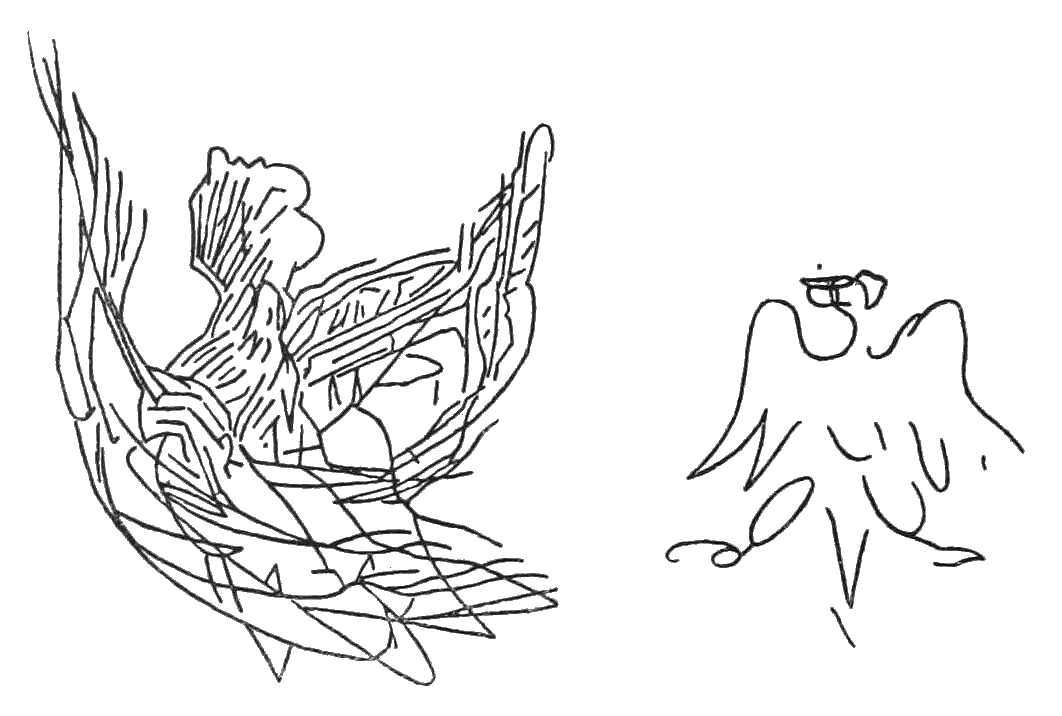
Drawing by Stef. Ossowiecki. Drawing by Prof. Wodzinowski.
I conducted the second experiment, which I have already mentioned, with the distinguished poet Karol Rostworowski. The editor, Mr. Szczerbiński, writes of it:
“An experiment conducted with family rings, which the distinguished poet Karol Hubert Rostworowski took off his finger and handed to Ossowiecki, did, however, testify to psychometric faculties. About each ring Ossowiecki correctly gave several details relating to its former owners; yet it was characteristic that he confused their histories and connected details relating to one with the other ring.”
In my opinion there was nothing strange in this, since Rostworowski’s father and mother had simultaneously worn this ring made from two rings. Mr. Rostworowski had made one ring out of these two, and wore it constantly. All the memories of one and the other had merged into a single memory of both together, and this was what I felt as well.
Experiment No. 44
In November 1931, through Count J. Wielopolski, I made the acquaintance of Mr. Konrad Strauss, a visitor from Berlin interested in the metapsychical sciences. Mr. Górzyński joined our company; we were sitting together at the Adria café. I became interested in this new acquaintance and began to transport myself into his past. This became increasingly easy, until at last I had fully grasped the story of his life. I began to speak. I shall not repeat the substance of what I said then, but merely quote his letter, written in German and translated into Polish:
Berlin, No. 63, Nettelseckstr. 20.
Dear Mr. Ossowiecki! I have received word that you wish to include in your book a description of the experiment conducted in Warsaw in November 1931. I am most happy to comply with this wish, and truthfully make the following public statement:
It was late in the evening at the Adria bar when Count Wielopolski introduced me to you. (Mr. Ossowiecki had not previously known me, either personally or by hearsay.) Besides Count Wielopolski, Mr. Górzyński was also at our table, listening to the conversation. As I had always been interested in metapsychical questions, I immediately asked Mr. Ossowiecki several questions. Mr. Ossowiecki then took me by the hand, while I laid photographs of my parents before him, face down on the table. Mr. Ossowiecki then began to speak: “You live in Berlin, but have not lived there long. You were born in a town not far from Berlin, lying between Berlin and Warsaw.” True, for I was born in Frankfurt an der Oder. “Your parents, who are still living, still reside in that town.” (True.) “The town lies on a river and has a beautiful church with a tall tower; beside the church is a little green square. The church is very old; there used to be a monastery attached to it.” (True.) “Near that church is the house in which you were born.” (Yes, on Scharnstr.) “You are about thirty-three years old, have travelled a great deal in your life, and are deeply interested in the fine arts.” (True.) “At present you are an only son, but you had a sibling, namely a brother who died quite a long time ago.” (He subsequently corrected himself.) “He was killed in the war by a shot to the head.” (True.) “Your mother always wanted a third child, a daughter. On your mother’s side you have French blood in your veins. Your father is still very vigorous and active. For some time, however, he has suffered from diabetes; the sugar content in his system fluctuates between two and four per cent.” (True; the doctor recommended taking a cure at the spa of Preschdorf.) “He also suffers a little from his liver and heart.” (True.) “I see your Berlin apartment quite clearly. Your entrance is by what are called the ‘back stairs.’” (Yes, on the first floor, but with a high ground floor beneath it.) “There are many bookshelves in your room. Above the sofa I see a dark landscape in oils.” (True; it is a Dutch landscape.)
That same evening Mr. St. Ossowiecki gave many more interesting details from my past, although naturally, in a place full of music, noise, and people, these things might have disturbed him. Despite this, Mr. Ossowiecki was evidently in a very favourable state, for I could attest that, out of a hundred facts, ninety-five per cent were entirely true. In concluding my account, I take the opportunity to thank Mr. Ossowiecki most warmly once again for his kindness and his interesting experiments.
With friendly regards,
(Signed) Konrad Strauss
Art historian
Experiment No. 45
One evening I was invited to the home of Professor K. Stołychwo, the well-known anthropologist. I was to meet Mr. Władysław Witwicki, Professor of Psychology at the University of Warsaw, there. Besides him and our hosts, Dr. Artur Chojecki, a lecturer at the University of Warsaw, was present. I wished to repeat with them an experiment I had conducted at the Metapsychical Institute in Paris, where it had been very successful.
Sixty slips of paper, measuring 7 × 6 cm, were scattered on the table. Professor Witwicki and Dr. Chojecki were each to sign one of these slips and write down any number. I went into the next room, where I remained under the observation of Mr. and Mrs. Stołychwo throughout. Once the slips had been mixed, it was impossible for anyone to find his own in the ordinary way. I was invited into the room; I merely touched Professor Witwicki’s hand and clothing, and that was already enough for me to find the slip on the reverse of which the number and name had been written, that is, the slip he had held in his hands the longest. The slips had been so thoroughly mixed that even those who had written on them could no longer find them. For six to eight minutes I searched the air for the most subtle current that can possibly exist in space. There was silence in the room. At last I sensed a faint current and stretched my hands in that direction.
“Here is the slip, this is certainly it. The first digit is 2, the second 7. It is your slip, Professor. Please take it.”
The professor took the slip. It was the very one, for on the other side were Professor Witwicki’s name and the number 27. Once I have the direction in my hand, it is easy for me to go back a little and catch the moment when the professor wrote the number 27. I did the same with Professor Chojecki. I indicated his slip and the number written on it, which I do not remember at this moment. It was, however, the very slip he had held in his hand, and the same number I had written down.
Experiment No. 46
I conducted this experiment with Professor Stołychwo on the same evening as the preceding one.
In the other room the professor wrote an entire sentence on a piece of paper. He folded the paper, measuring 10 × 15 cm, several times and placed it in a grey envelope, which he gummed shut. No one knew what was on the slip. I was observed by everyone present and felt the thoughts of each of them. I held the envelope in my hand for a few minutes and began to speak: “The first word you wrote was ‘who’… something has been taken… A strange thing, this object that is written about. It can be liquid or in the form of a gas, a very light liquid. What is it? I can say no more; I am exhausted.”
The slip read: “Who stole the alcohol?”
In 1929, in the German periodical Zentralblatt für Okkultism of 6 October, Professor Witwicki gives an exact account of the two experiments above, which have in fact been quoted here according to the wording of his article.
Experiment No. 47
The experiment I shall now describe was no less interesting. It took place at the Hotel Europejski. Present were Mr. Jodko, former Minister of the Republic of Poland in Constantinople; Minister Nuksza, the Latvian envoy; and Mr. P. Szmurło, President of the Psycho-Physical Society.
Mr. Szmurło, always inventive in his experiments, left the hotel room, while I remained under the close observation of the other two gentlemen. Mr. Jodko kept the record. Mr. Szmurło took a book to use as a writing surface, as well as a thick, dark envelope and a piece of paper. The door of the room was closed. I say to those present:
“Mr. Szmurło stopped for a moment by the door. He is thinking out a drawing; now he has it. He goes to the right, to the very end of the corridor, where there is a stool. He has sat down on it, taken the book, put the paper on it, and is beginning to draw. He has finished the drawing, put it in the envelope, sealed it, and is returning.”
Indeed, Mr. Szmurło returns and gives me the sealed envelope. I say to him:
“You have drawn something sharp, like two crossed broadswords, with an arrow in the middle pointing upwards.”
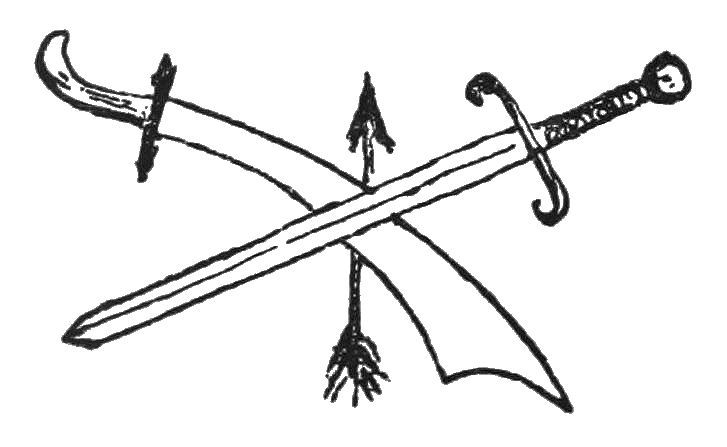
Figure p. 215. Crossed Scimitar, Sword and Arrow
A curved scimitar and a straight sword cross diagonally with an arrow pointing upward behind them.
Drawing by Mr. Szmurło
I began to draw. I began the drawing with the same lines as President Szmurło had.
All those present unanimously declared that this was an experiment based not on telepathy, but strictly on psychometry.
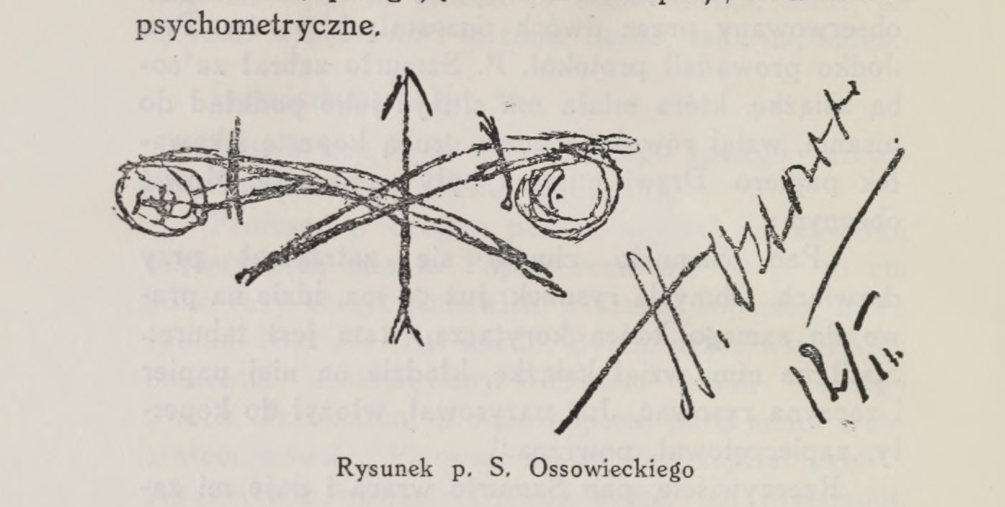
Figure p. 216. Drawing by Mr. S. Ossowiecki
Translated labels: Drawing by Mr. S. Ossowiecki; [illegible] signature; [illegible] date
Drawing by Mr. S. Ossowiecki
From the moment Mr. Szmurło left the room, every word of mine was entered in the record. I was not mistaken in anything; I saw Mr. Szmurło as though I were walking behind him. This experiment was very successful. The record of it is in the archives of the Psycho-Physical Society in Warsaw.
Experiment No. 48
One day, a few years ago, Engineer Andrzej Wierzbicki came to see me. At the time I lived at 5 Piękna Street. My acquaintance was greatly troubled because an important financial document had disappeared from the wallet he always carried with him. I took the wallet in my hands and told him that the document had not been in it, for it had disappeared from the side pocket of his clothes. I proposed that we go at once to check, and that the document would still be found. We went to the bank where Mr. Wierzbicki had remained until four o’clock on the day preceding the document’s disappearance, and then walked to the offices of the Borkowski Brothers’ Company, for I knew that it was there, while he was taking off his overcoat, that the envelope containing the document had fallen out. On the strength of my words, Mr. Wierzbicki spoke sharply to the attendant, declaring that he had dropped an envelope in that spot while removing his overcoat and that it had not yet been returned to him. It turned out that another attendant had been there the previous day, a man who lived in Praga and was not in the office just then. His drawer was opened, however, and what did we find? Right on top lay the envelope with the missing document. I must add that I had described precisely the appearance of the attendant who picked up the envelope.
Experiment No. 49
This took place on 27 November 1925 with Dr. Antoni Czubryński. I was handed a piece of dried mud wrapped in a rag. After the experiment, Mr. Czubryński informed me that this piece of mud had been brought from the underground chambers of the temple of Mithras beneath the Church of St. Praxedes in Rome. Here is what I said about it:
“A place violently destroyed. Under this building are cellars where many things have been hidden. Weapons were stored there. Lower down, something is hidden on the right; it is not known what. It is not a many-storeyed house, but a white building with one upper floor, in a separate district. Meetings took place there, attended by men and women. It is something like a church; everyone seems to be singing.”
Experiment No. 50
This experiment, also with Dr. A. Czubryński, took place on 1 November 1925.
I am handed a piece of some kind of stone, grey in colour and relatively large. After a few moments I began to speak:
“How well I see it! How interesting it is! Enormous rocks and great chasms. Great, extraordinary meadows, as though some unusual yellow grass grew on them. What is this? Level expanses, expanses without stones, with a violet tint; rocks, rocks, and then level expanses again. Some strange trees, tall, like cypresses, black and hard, with branches tangled at the top. A whole forest of strange trees. There seems to be some movement here. Something is moving, something transparent: figures resembling human forms, but completely transparent. I cannot penetrate their world. Vast spaces… How wonderful it all is. Now I return to those great giants. Giants seem to have collided, rusty, iron-coloured. A fragment flies through space at terrible speed. As though a piece had broken off some globe; it flies and scatters into tiny pieces. It falls in various directions. Holes form in the earth; the flying pieces bury themselves in the ground.”
After the experiment, Dr. Czubryński told me that the stone I had held was a meteorite. No sitting has exhausted me spiritually and physically as much as the one with this meteorite. I lost a great deal of energy during this experiment, manifested in an enormous drop in temperature. I lived through magnificent moments beyond all comparison.
Experiment No. 51
3 January 1926, at 10:35 in the morning.
I was handed a piece of stone resembling marble, wrapped in a rag. As I later learned from Dr. Czubryński, it was a piece of stone from the ruins of the temple of Castor and Pollux. Everything I said on the subject accorded with the nature of the stone itself and the history of the period of antiquity when the temple existed. After holding this piece of marble for a moment, I began to speak:
“An enormous building, columns… six to eight… a triangle at the top. The tops of the columns are ornamentally finished. A high platform before the exit, reliefs. The pieces I am holding come from a column, not from the foundations. Sculpture on the plinth, standing figures at the ends. Allegorical animals; I do not see clearly, but it seems like a bull, with great flaring nostrils. A group beneath it: a reclining man with powerful muscles holds the bull. Inside, something like columns embedded in the walls. In the middle of the building, a raised place with steps leading up to it. Above the altar, a dome; other domes extend from it. Stone vessels so large that they could hold several people. None of this remains. The base of the altar has a sculpture representing a woman with a pitcher on her head. Enormous windows admitting much light. The walls of the temple are covered with reliefs. About twenty steps lead to the main altar. On the left stand men dressed in grey robes, or perhaps white. They keep bowing. Their hands are joined on their chests, but not crossed. All look towards the man praying. Their heads are raised. They carry towards an urn something like a lamb wrapped in white robes.”
I could copy out the entire record here, but I do not wish to bore the reader, for this is not a lecture on archaeology. The experiment as such was very interesting. I do not know whether it was a vision; in any case, it was called forth by means of the marble stone held in my hand.
Experiment No. 52
Present: Dr. Antoni Czubryński and Dr. Feliks Gałęzowski.
I was handed a package containing several pieces of some kind of crust. After the experiment, I learned from Dr. Czubryński that it was a piece of volcanic lava from inside the crater of Vesuvius, taken from there on 6 August 1924.
After ten minutes of great concentration, I declare:
“I begin to see some plants. I see water, a great deal of water, a light-coloured shore, far away in southern lands. It is not a river, but water without end. A mass of white stones, white buildings with columns on the shore. I see extraordinary ruins, as though buried in clay or earth. A city that no longer exists. How interesting… A city buried as though by terrible cataclysms, much earth, fountains, square houses. Many plants… This too is a plant, buried under some sandy mass. This is what buried the city. I keep seeing the same thing, everything grey, grey and white.”
Mr. Czubryński’s record states, among other things:
“I thought Mr. Stefan Ossowiecki would describe a geological phenomenon here, and say that it was a volcanic eruption, or alternatively the interior of the earth, from which the substance in question came; his attention, however, followed the phenomenon brought about by the effects of the eruption. The engineer was very tired; his hands were cold. Before the sitting, during it, and after its completion, Mr. Ossowiecki’s eyes were examined by the ophthalmologist Dr. Feliks Gałęzowski, who found no changes in them. From this we conclude that in clairvoyance Mr. Stefan Ossowiecki sees not with his eyes, but by means of some other energy emanating in waves from the nerves.”
(Signed) A. Czubryński.
Experiment No. 53
My first meeting with Charles Richet took place in Moscow during the war, and the second during his visit to Poland. I was introduced to him once again by Prince Stefan Lubomirski, who held a reception in the visitor’s honour at the Hunting Club in Warsaw. At this supper I met Professor Dr. Geley, who played a great part in my metapsychical life. Present then, besides Professor Geley, were Professor Richet, Zygmunt Plater, Professor Dr. Watraszewski, Prince St. Lubomirski, Count Raczyński, Professor Gravier, Geo-Lange, and myself. As a memento of that evening, Charles T. Richet left a letter signed by himself and by all the Frenchmen and Poles present. Its contents are as follows:
“To my dear Polish compatriots, a remembrance of this gracious evening of 25 April 1921.”
Professor Geley described this experiment in the May 1921 issue of the Revue Metapsychique, in the form of a record which I quote below in translation:
“Mr. M. Geo-Lange sat opposite me, far from St. Ossowiecki. Mr. Geo-Lange wrote in English: ‘I consider you are wonderful,’ put it in an envelope, sealed it, and handed it to St. Ossowiecki. All eyes were fixed on St. Ossowiecki. After a few moments Mr. Ossowiecki said: ‘This is written in English. Unfortunately, I do not know that language.’ Mr. Lange exclaimed: ‘It is extraordinary!’ Mr. Ossowiecki continues: ‘I see one letter missing, and then a word of eight letters that begins with c. o. n. s., then a word something like vendret’ (which was ‘wonderful’), ‘and then your a…’”
During this experiment I was very agitated, since it was the first time I had conducted one in this company; I also suffered from stage fright, which hindered me. The experiment was only half successful and gave me no satisfaction.
Experiment No. 54
This took place at the Hotel Europejski. Professor Richet wrote something on paper and sealed it. He handed it to me. After six minutes of concentration I began to speak:
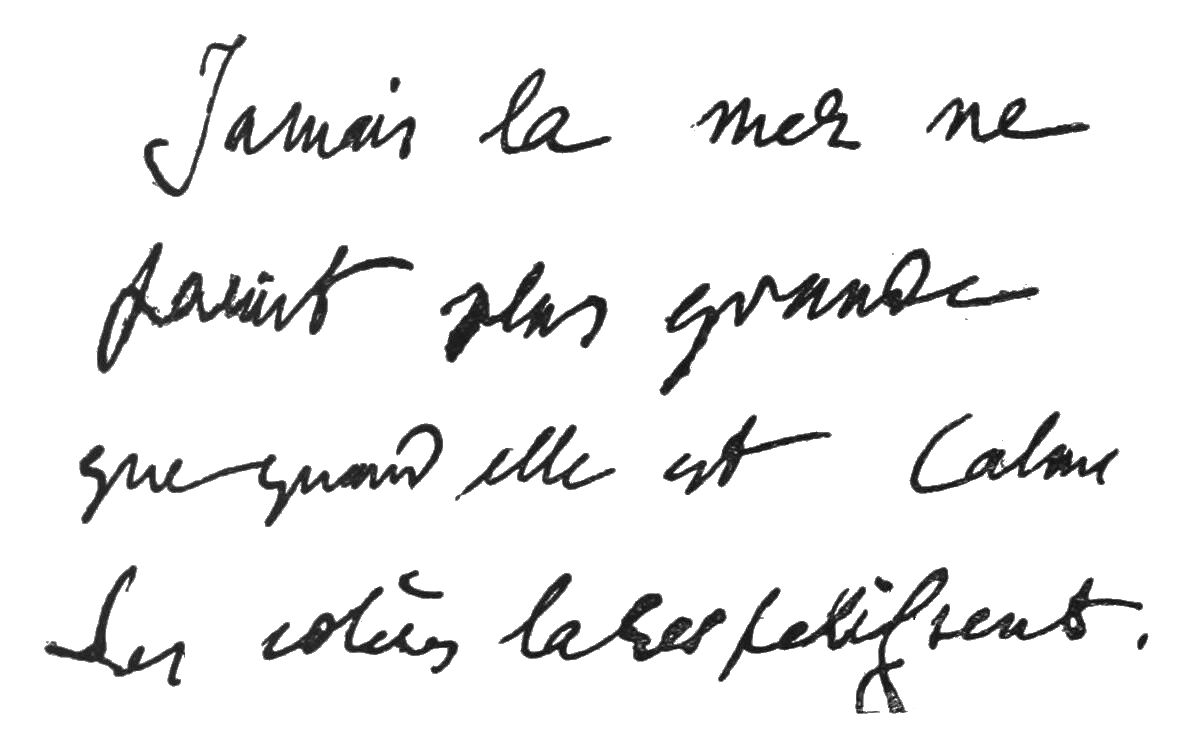
Translation of the handwritten text: “The sea never seems greater than when it is calm. Its fits of anger make it smaller.”13
“It is not a question. I see a great, great deal of seawater.” (Richet says: “Very good!”) “It is something very difficult. Some idea of yours.” (The professor replies again: “Good!”) “[Translated from the French:] ‘The sea was never so vast as’—[translated from the printed Polish:] the sea was never so vast…
I cannot put it together.” (Richet says: “Excellent, excellent, it is extraordinary!”) “The sea so vast when it is completely calm.”
This experiment was difficult, and I was greatly hindered by the fact that Professor Richet, as an investigator, never took his eyes off me for a moment, which prevented me from being entirely myself.
Experiment No. 55
Present: Professor G. Geley. At St. Ossowiecki’s apartment, 1 May 1924. Professor Geley writes:
“I gave St. Ossowiecki a sealed letter that Professor Charles Richet had handed to me.”
Ossowiecki declares:
“This speaks of a Mrs. Berger. The letter was written by a man of fifty. It is a reply to a letter from Mr. Richet. The letter did not come from Paris, but from a seaside town, and concerns some business. It contains an invitation for Mrs. Berger, who is thirty-three and married. The letter was written by a very musical man. There is an invitation here for both of you.”
The only error in what I said was that the letter came from Berlin, not from a seaside town. The rest was correct. It was an invitation to hold several lectures for the benefit of a couple of societies. It also said that those invited would be Mrs. Berger’s guests. Mrs. Berger’s age and the description of her were entirely accurate.
Experiment No. 56
Present: the President of the Psycho-Physical Society, Professor P. Szmurło; General Trzemeski, deputy director of the Sanitary Department of the M.S.W.; and the Latvian Minister, Martini Nuksza, with his wife.
The Psycho-Physical Society in Warsaw wished to conduct a psychometric experiment under conditions that would completely eliminate the possibility of telepathy. Professor Szmurło was entrusted with keeping the record.
To carry out this kind of experiment, the Society’s Committee decided to ask just one person to prepare the experimental material; yet even that person was not to know which particular material would come into the hands of Engineer St. Ossowiecki.
For this reason we approached someone who was not even a member of the Psycho-Physical Society, namely Mr. Marjan Wawrzeniecki, the well-known painter, who also took an interest in archaeology and anthropology and did not know Mr. Ossowiecki. Mr. Wawrzeniecki was to place several objects in different little boxes of the same shape, with the same design on the surface. A numbered slip was to be put into each box. Sealed envelopes contained the numbers corresponding to the objects, together with descriptions of them. In the parcel Mr. W. has four boxes of identical dimensions and a packet of cotton wool.
On 1 February 1923, Mr. M. Wawrzeniecki returned these four boxes to us, tied crosswise with string sealed with his signet, and four envelopes, also sealed and numbered 1, 2, 3, and 4. All these objects were locked away.
On 28 February we approached Engineer St. Ossowiecki, asking him to appoint an evening for the experiment. On 10 March we received a reply in which Mr. Ossowiecki informed us that he would be waiting at his apartment on 12 March at eight in the evening. Wawrzeniecki was not informed in advance.
On the appointed day we went to Engineer Ossowiecki’s home in the company of our vice-president, Dr. General J. Trzemeski, head of the Sanitary Department of the M.S.W. Besides Mr. Ossowiecki, those present were Mr. M. Nuksza, Minister of Latvia, with his wife, and Mr. Szmurło.
The engineer picked up one of the little boxes at random, wrapped in several pieces of paper, tied, and sealed with wax, and sat on the sofa beside me. I kept writing down everything Mr. Ossowiecki said.
“It is a black box. In it are about twelve photographic plates; one is broken. They were all taken out by a slender lady who likes music. The box came from the vicinity of Chmielna Street in Warsaw, and was made abroad, in Germany. On the lid of the box is a label in the Egyptian style. I see a factory, a room; many girls are working. At present there are no plates in the box. It contains a grey object of fired clay; it is part of some object, a fragment. How ancient it is, hundreds of years old. It is a fragment of a broken prehistoric urn. I see that too; I shall draw its shape.” Mr. Ossowiecki described its shape. “They found it deep in the ground. I see something else in the box. I do not understand what this box has to do with a pharmacy. I see where this cotton wool was bought; that lady bought it in a pharmacy on Marszałkowska Street.”
The experiment lasted fifty minutes, and before the box was opened, Mr. Ossowiecki drew in pen the outlines of the object, and even the design on it. We undid the paper, wax, and strings, and what was our astonishment: a black box from which, a few months earlier, I had taken several plates from the firm of Szalay on Chmielna Street in Warsaw. This box had been given to me by a slender woman, a shop assistant. As I subsequently learned, she plays the piano. There had been thirteen transparency plates, 8½ × 8½, in the box. The plates came from the German Ernemann factory in Dresden. The label showed a woman’s head, Isis, in the Egyptian style. In the box we found a fragment of an urn with a design identical to the one drawn by Mr. Ossowiecki, of the same size and shape. The box bore the number 2, so we took the envelope marked with the same number and read its contents.
“A fragment of a prehistoric urn found by Mr. Wawrzeniecki in 1904 in the vicinity of Warsaw.”
The cotton wool in which the fragment of the urn had been wrapped was bought by the lady in a pharmacy on Marszałkowska Street.
We count this among the most interesting and scientifically serious experiments, for it is purely psychometric and permits the factor of telepathy to be ruled out completely. Mr. Ossowiecki described everything from the beginning, from the moment the box was made: where the plates were purchased, whence and by whom the cotton wool was brought, and finally he described and drew the excavated fragment in the minutest detail, identifying it as part of an urn. Neither I nor General Trzemeski could even have imagined that Mr. Ossowiecki would carry out the experiment in such detail. We supposed that he would rather describe the object inside the closed box. It was a great surprise to us. Suggestion is out of the question in this instance. Mr. Ossowiecki’s faculties are truly universal.”
Signed: President of the Psycho-Physical Society
P. Szmurło.
Vice-President of the Psycho-Physical Society
General Trzemeski.
Experiment No. 57
Present: Dr. B. Bilski, St. Ziejewski, S. Sokulski, J. Miernowski, E. Wiche. The record was kept by St. Ziejewski.
On 2 June 1929 we were the guests of the president of The Humanistic Club, an Indian called Raja Jai Prithvi Bahadur Singh of Nepal. This took place at the Hotel Europejski in Warsaw. I write “we were guests” because I had asked several friends to accompany me. Also present was the brother of the Maharaja of Nepal’s wife, a young Indian who had recently completed his studies at Oxford, Rama Taja Shum Shere Jung Bahadur Rama of Nepal.
After a prolonged conversation with the Indians, I began to enter Bahadur Rama’s past. I spoke of his life and experiences. He was immensely astonished by this, for everything agreed with reality. Bahadur also wished me to say who his father had been and what his name was. I asked him to concentrate, go to the other end of the room, and write down his father’s name. How astonished he was when, after placing my hand on the paper bearing the name and concentrating for three minutes, I said: “Daragwa.” His astonishment increased when I said that his father had been a governor and commander of the troops.
The next day both Indians paid me a visit. I held a reception in their honour, and since then I have been in close contact with them.
Below I give Mr. Stanisław Ziejewski’s statement concerning the above experiment:
“I certify that everything Engineer Stefan Ossowiecki has written in connection with the experiment at the Hotel Europejski on 2 June 1929 corresponds exactly to the contents of the record. I shall add that an initial had been drawn by one of the Indians and enclosed in a sealed envelope, and that Mr. St. Ossowiecki drew it after a moment’s reflection. When the envelopes were opened, it proved to be the same drawing as the one that had been sealed inside.”
(Signed) St. Ziejewski.
Experiment No. 58
In December 1927 I conducted an interesting experiment with Mr. Zakrzewski, former president of the Court of Appeal in Poznań. It took place at the Warsaw restaurant Pod Bachusem. Mr. Zakrzewski was very interested in the faculties of my spirit and asked me to conduct an experiment with him. I agreed, for I liked him a great deal.
He therefore left the table for a moment, drew a wallet from his pocket, and took a paper out of it, then returned, asking me to tell him what it was. After concentrating for a few minutes, holding the paper in my hand and being closely watched by several people present, which I must admit was not particularly pleasant, I replied: “It is some kind of printed document. It was signed by a gentleman aged forty-five to forty-seven, dark-haired, with a tiny black beard. He holds an important position.”
After a few moments I took a pen and wrote his name in the same handwriting as appeared on the document. It was the name of the former Minister of Justice, Mr. Makowski.
Experiment No. 59
Below I give an experiment described by the vice-president of the Metapsychical Society in Warsaw, Dr. T. E. Sokołowski, M.D.
2 February 1923, Warsaw, 5 Próżna Street, apartment 3.
Present: Engineer Ossowiecki, General Józef Rybak, Mrs. W. Sokołowska, Dr. T. E. Sokołowski.
General Rybak, who had never participated in metapsychical experiments and was negatively disposed towards them, hands Engineer Ossowiecki a note he has written himself, enclosed in an opaque envelope gummed shut. Without looking at the letter, Ossowiecki says after a moment: “The figure of the Marshal is taking shape before me. You were thinking of him as you wrote. You know about it, but you are asking. The Marshal was to have left yesterday evening or this morning; he has not gone far.”
When the envelope was opened, the question written in General Rybak’s hand was read: “Is the Marshal in Warsaw?”
(Signed) Józef Rybak, General.
(Signed) W. Sokołowska
(Signed) Dr. T. E. Sokołowski
Experiment No. 60
This, too, was recorded by Dr. E. T. Sokołowski, as follows:
25 May 1923, Warsaw, 5 Próżna Street, apartment 3.
Present: Engineer Ossowiecki, Mr. Chamski, Mr. Szajkiewicz, Dr. T. E. Sokołowski.
Messrs. Chamski and Szajkiewicz are seeing Engineer Ossowiecki for the first time in their lives.
Mr. Chamski hands Engineer Ossowiecki his nickel watch with a single case cover and asks what is underneath the cover. Ossowiecki talks about indifferent matters for some fifteen minutes and glances at the watch, which he holds in his hand all the time; at last he declares that he sees nothing. Dr. Sokołowski suggests that O. may be tired from the preceding experiments and proposes breaking off the test. At the very last moment, however, Ossowiecki draws back the hand with which he is returning the watch to Chamski, holds it over the table for a moment, and says: “No, there is definitely nothing there. On the inner cover a kind of circle and a number are engraved; apart from that there is nothing!”
Chamski declares that he recently left the watch to have a glass fitted, and forbade the watchmaker to open the cover, beneath which a keepsake lock of hair had been placed. The lock must therefore be under the cover. Mr. Ch. opens the nickel cover with difficulty, but the hair is not there; on the inner cover, however, there are a circle and a number.14
Of those present, only Mr. Chamski knew that this lock had been in the watch, and he was entirely certain that the hair was still in place.
(Signed) Adam Chamski,
(Signed) M. Szajkiewicz,
(Signed) Dr. T. E. Sokołowski.
If we suppose a telepathic process between Ossowiecki and Chamski in this case, thought-transference could only have produced a mistaken answer from Ossowiecki, because Chamski was convinced that the lock was in the watch and could only have transmitted that thought-content to Ossowiecki.
The clairvoyant’s moment of hesitation should be attributed precisely to the conflict caused by the discrepancy between what Ossowiecki saw and the suggestion of Chamski’s thought.
It was thus a typical case of seeing through an opaque barrier, for an explanation of this experiment by means of so-called télépathie à trois, three-person telepathy, is highly improbable here.
Similar cases can also be explained by the ectoplasmic hypothesis that I put forward and sought to substantiate in a paper delivered in Paris at the Third International Congress of Psychical Research in 1927, entitled “Essai d’explication des phénomènes de Télépathie et de Psychoscopie” [“An Attempt to Explain the Phenomena of Telepathy and Psychoscopy”].
(Signed) T. E. Sokołowski, M.D.
Experiment No. 61
On 11 May 1924 a sitting took place in Warsaw, on Aleje Ujazdowskie, at Professor Antoni Ponikowski’s apartment. Engineer Przybyszewski and his wife were also present. Engineer Z. Przybyszewski kept the record.
The sitting covered several points assembled beforehand, concerning various property matters, confirmation of the death of a close person, and missing persons or objects. These materials had previously been collected by Engineer Przybyszewski. Since our hosts, Mr. and Mrs. Ponikowski, were attending such a clairvoyance experiment by Mr. O. for the first time, the initiative in opening the sitting was left to them, without any prompting as to what kind of experiment it should be.
Mr. Ponikowski went into one of the more distant rooms, where he wrote a few words in pencil on a visiting card. No one else was there, and no one knew the contents of the card. Mr. Ponikowski returned to the room where everyone was gathered and handed the sealed envelope to Mr. O., who further asked Mrs. Ponikowska to sew the envelope shut. Not content with this, Mr. O. himself sewed through it in twelve more places, piercing the text. The sitting began. Below I give Mr. O.’s words.
“It is not a drawing, because that is easier for me. I do not know why I am in Poznań. No, in Warsaw. Aleja Róż… I am, I am; wait, a woman, not a priest.
“A woman in a black dress with a violet-red sash.
“She stops before the porch of No. 6. The Potulickis, Grzybowskis, and Załęskis live there, second floor on the right…” A moment’s silence.
“It is a bishop, a pleasant face. His name is Adolf. He was here recently. You”—he turns to Mr. and Mrs. Ponikowski—“have seen him. Why did you”—to Mr. Ponikowski—“think of writing his surname? Is he not in Poznań? Not very tall. Forty-two or forty-three years old. He is the representative of some organization… Dalbor… no, six or seven letters. I see him clearly; I do not know him. A violet little cap”—a zucchetto—“a violet sash, forty-three or forty-four years old. You wrote his first name:
Adolf. He is not a military bishop. No, you wrote more: first name, surname, house number.” Pause.
“He has something to do with scholarly organizations, with libraries, with archives. The surname is perhaps Samogitian… Lithuanian, indistinct. Something like Lithuanian. Something like Dokurek”—do-ku-rek—“no, indistinct.
“I see him; he lives there and has one room in that apartment.”
Mr. Ossowiecki put the envelope aside, still explaining that the name must certainly have been written indistinctly.
Those assembled open the envelope. Inside is Professor Ponikowski’s visiting card, on the reverse of which is written in pencil:
“Bishop Adolf Szelążek, 6 Aleja Róż.” The bishop’s surname was indeed written indistinctly.
During the experiment Mr. Ossowiecki impatiently crumpled the envelope.
To open the letter after the experiment, it was necessary to cut the thread with which the envelope had been sewn through.
The actual facts were as follows: Bishop Szelążek used to visit the office of the Department of Religious Denominations of the Ministry of Education, opposite the Ponikowskis’ apartment.
The bishop was then living at 6 Aleja Róż and had a large library in his apartment.
Experiment No. 62
On the same day, that is, 11 May 1924, a second experiment took place, concerning two letters: one was in an open envelope with a Russian postage stamp, while the other, sealed, had been handed over by Mr. Michał Ślósarski.
At ten in the evening Mr. Ossowiecki began to speak.
“This takes me to 6–8 Szkolna Street, to the years 1915, 1916. Was he in the Russian army?”
A long pause. “This other letter is confusing me.” (He takes the second letter in his hands.) “I have a grievance against you.”
A two-minute pause. The second, sealed letter was put aside.
Without taking it in his hands, Ossowiecki says:
“Write: Witold”—a long pause—“Ślósarski… in the years at the beginning of the war, 1914–15, reserve ensign in the Orenburg regiment… I see barracks in the Vilnius region… Some name becomes mixed up with him: Gunrach, Gundelach, Witold… Stanisław… no, Stanisławowicz”—son of Stanisław—“he wrote to Ślósarski, his brother, before his death, his last letter, to 8 Szkolna Street. Soon afterwards he went into battle. I see a small town, little houses with trees in front of them; women in white beside him… Sisters of Mercy. He died after an illness.”
A longer pause.
“Ślósarski, a technological engineer, has a technical bureau or an office. His brother wrote to him to reassure their mother. The letter was short. He perished, wounded during an attack. I see what he looks like: brown-haired; he has a mother and sister. He perished in 1915; he wrote the letter from a hospital.
“He died in terrible agony, near Orsha.”
The letter was indeed from Engineer Ślósarski’s brother, and its contents were reassuring. Engineer Ślósarski did in fact work as co-owner of a private firm and lives at 8 Szkolna Street in Warsaw. Although he was not present, he can confirm by his signature that his brother was indeed wounded and died in hospital.
Experiment No. 63
This experiment, like the two preceding ones, also took place on 11 May 1924.
Almost immediately, without ceasing to speak of Ślósarski, Mr. Ossowiecki placed his hand on the second letter, supplied by Engineer Przybyszewski and concerning Engineer Albrecht.
“Now I shall speak about this one.
“He is a man of genius, wise, and could have gone far but for his premature death.
“He has some close connection with your sister,” he says, turning to Mrs. Przybyszewska.
It should be added that Engineer Przybyszewski had not told Mr. O. beforehand that the letter concerned his brother-in-law.
“He left one child, but not here.
“He died at the age of forty. None of his close family was present at his death.”
The above information about Engineer Albrecht’s death agrees with the information subsequently received from Russia from the deceased’s colleagues and subordinates, as well as with further particulars concerning Mr. A.’s death given to the family by a trustworthy person, the head of the State Solicitor’s Office in Vilnius, Mr. Adolf Kopeć. According to these, Albrecht was shot when General Yudenich was approaching Petersburg.
Experiment No. 64
Finally, the last experiment of the evening. At 11:10 a small wrapped object was handed over, tied with string and sealed. It had been supplied by Engineer Oxiński, who was absent. Only Engineer Przybyszewski had been informed of what it had formerly contained; no one present knew what was inside it at that moment.
Immediately upon taking the object in his hands, Mr. O. said:
“Stolen; I shall take it home with me…” After a moment: “It is a stolen man’s gold watch! Do you know anything, Madam?
“I see one thing.”
Several minutes of concentration. Mr. Ossowiecki seems to look above the heads of those present. At 11:13 he begins speaking again: “The box is empty, but on the left I see a slip of paper… I shall tell you a very unpleasant, sad story… I am compelled to tell you about it. There was a gold watch in this box, with initials on it. On the left side of a printed slip, the whole story of the watch is written in ink. Today is 11 May 1924, and the watch was stolen in the summer from the apartment, unfortunately by someone very close. He is a relative of his. He was in the apartment at the time. His financial position was very difficult, so he had to sell the watch.”
The above was completely confirmed, as Engineer Oxiński’s suspicions subsequently made clear. When the package was opened, it turned out that there was no watch in it, but a printed slip was found in a little compartment, with writing in ink on its blank side.
Experiment No. 65
I give this experiment as described by Professor Chojecki, a former lecturer at the University of Warsaw:
Despite knowing Mr. Stefan Ossowiecki for a fairly long time, and despite the kindness he showed me, I had the opportunity to conduct only a few experiments with him, but these under conditions of complete rigour. I give here a description of one such experiment.
Wishing to exclude the possibility of telepathy, I decided to give Mr. Ossowiecki a text to “read” whose contents I did not myself know, nor from whom it came. For this purpose, at the office where I once worked, namely the Ministry of Foreign Affairs, I asked six people to write a short sentence and then place the slip in an envelope. I put the six envelopes thus obtained inside other envelopes, sealed them, and took them to Mr. Ossowiecki. I emphasize that the envelopes were identical. Mr. Ossowiecki selected one of them, squeezing it in his hand, then pressing it to his forehead, until finally, after about a quarter of an hour, he says: “It speaks of silver and gold; it is a proverb.” We then opened the envelope and found the sentence: “Speech is silver, silence is golden.” Mr. O. added: “This sentence was written by a young, lively woman who had never married; she wrote it standing up, leaning against a desk.” (I verified the accuracy of this information the next day. Mr. O.’s only mistake was in saying that the person in question had never married, for she was a divorcée.)
Experiment No. 66
Immediately after the experiment described above, Mr. O. suggested: “Now write something yourself. I feel it will go even better.” I then wrote the first line of Dante’s Divine Comedy: “Nel mezzo del cammin di nostra vita” [“In the middle of the journey of our life”]. Mr. Ossowiecki took the little slip together with my hand and squeezed them for a while, then said: “This is written in Italian. I like that language very much. First it speaks of some ‘Nella,’ and it ends with the words ‘nostra vita.’” “That is enough for me,” I replied. We ended the experiment there.
Experiment No. 67
I was invited by Mrs. Bohomolec, who wished to introduce me to a young English scholar, Mr. Vorstelman. Since I had also been due to meet Mr. Vorstelman at Mrs. Bohomolec’s two weeks before this visit, that is, on 15 September 1932, he had prepared a sealed envelope for the experiment. When he handed me the envelope, I said: “This drawing was made two weeks ago.” Taking a pencil, I drew a cross, and in each of its arms a design, which I reproduce below beside Mr. Vorstelman’s drawing. To the young scholar’s astonishment, I told him that before making this cross he had intended to draw a circle, which he fully confirmed.
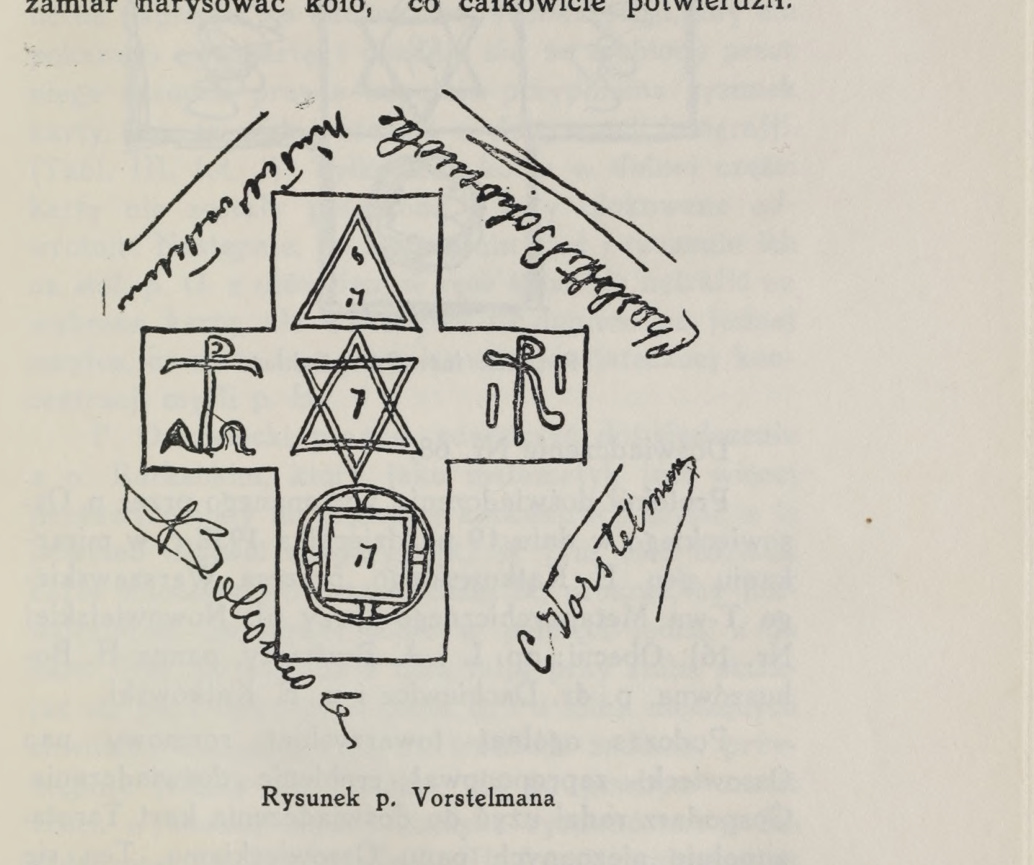
Figure p. 241. Hand-drawn mystical cross diagram
Translated labels: Drawing by Mr. Vorstelman; [illegible]
Drawing by Mr. Vorstelman
The following day I received a kind letter from Mr. C. Vorstelman, expressing his great gratitude for the experiment.
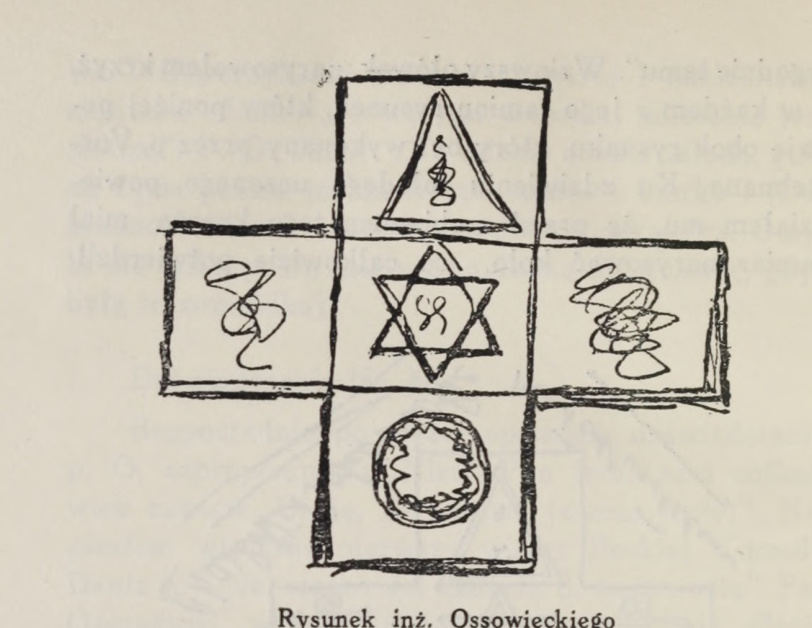
Drawing by Engineer Ossowiecki
Experiment No. 68
Record of the experiment carried out by Mr. Ossowiecki on 19 October 1932 at the apartment of General E. Kątkowski, president of the Warsaw Metapsychical Society, at 16 Nowowiejska Street. Present: I. and A. Burkacki, Miss H. Bohuszówna, Dr. Dackiewicz, and Mr. E. Kątkowski.
During general social conversation, Mr. Ossowiecki suggested conducting an experiment. Our host advises using Tarot cards, which are entirely unknown to Mr. Ossowiecki. He agrees, and the experiment is begun at once. Mr. Ossowiecki asks Miss B. to take one of the fifty-six Tarot cards spread on the table and, without showing it to anyone, examine it carefully. He sits down at the table and falls deep into thought, trying to enter Miss B.’s mind.
After a moment he asks for a piece of paper and a pencil, then, with his eyes half closed, begins to draw something on the paper. When he has finished the drawing, he asks to be shown the card, and it turns out that his drawing bears an almost exact resemblance to the design on the card, as can also be seen from the attached photograph (Plate III, photograph 1). Only the three circles in the lower part of the card were not joined together and were placed the other way round. Next, after the cards have been shuffled and thrown on the table, Mr. O., with a pencil in his hand, tries to find the chosen card, but does so only after one mistake, which may be attributed to insufficient concentration on the part of Miss B.
Mr. Ossowiecki wishes to repeat the experiment with Mr. Burkacki, who, as a mathematician, is more accustomed to deep mental concentration, and this should make the experiment easier. For this purpose he fans out the cards before Mr. B., asking him to commit one of the fifty-six cards to memory as quickly as possible. He himself sits at the table with the whole pack, trying to penetrate Mr. B.’s thought. After several exhausting moments, complaining of the difficulty of the task, he nevertheless begins to draw, but after a time throws aside the sketch he has made and starts a new drawing. The attached photograph (Plate III, photograph 2) shows the chosen card and the two sketches of it made by Mr. O. As we see, the first sketch is very similar to the card, but the second is considerably more accurate in the arrangement of the cups. The experiment of pointing to the card with a pencil is repeated and succeeds at once. This ended the extraordinarily interesting and successful experiment in reading another person’s thought. We attest its authenticity by our signatures.
Mr. Ossowiecki further asked Mr. Burkacki, who was psychically connected with the design of the card, to indicate its position on the table without thinking and without looking for it. Mr. Burkacki immediately pointed to a card, and it was indeed the same one that Mr. Ossowiecki had drawn.
Experiment No. 69
I have very often had visions, and still do. I shall therefore describe here one very interesting vision, thanks to which I had the fortunate opportunity to save several people’s lives.
It was at the end of June 1923. While working in my study and feeling somewhat tired, I settled comfortably back in my armchair and transported myself with the eyes of the spirit, casting my visionary gaze into space. Looking at the Vistula, I noticed at one point several men drowning near the Poniatowski Bridge, on the Praga side. I was clearly aware that I was seeing an event that had yet to take place there. It seemed as though the Vistula’s shifting currents had seized several men who were struggling fiercely against a whirlpool.
Wishing at all costs to avert this terrible accident, I immediately ran out of the house, took a cab—I then lived at 11 Trębacka Street—and drove to the bank of the Vistula. Here, without losing a moment, I jumped into a boat and told the boatman to take me towards the bathers, who were a considerable distance away. When I had drawn near them, I told the boatman to take the boat among the men, who were already drowning; these were their last efforts, their faces contorted. The boatman absolutely refused to approach them, fearing that they would overturn the boat and drag us into the depths of the river. Only a generous tip persuaded him to steer towards the drowning men. With some effort I managed to save three of them, who turned out to be soldiers of the 30th Regiment. I hauled them into the boat by force, for they were already very weak. I wanted to save the fourth, but unfortunately he was too far away. While I was saving the other three, he disappeared beneath the water. For a long time I could not forget his terrible eyes, in which approaching death was already reflected.
I also quote here the statement of three people who witnessed that miraculous and tragic moment.
“In 1923, on a hot day towards the end of June, at about five or six in the afternoon, we were sitting on the bank of the Vistula to the right of the Poniatowski Bridge. On the other side, towards Praga, a group of men, later found to be soldiers, were bathing. Their cheerful cries reached us across the river. At one moment we saw a rather stout man approaching the bank nervously and rapidly. It was Mr. Stefan Ossowiecki, whom we knew by sight. We had the impression that Mr. Ossowiecki was in a great hurry, for he had just arrived at the riverbank in a cab and jumped into one of the nearest boats—the bridge had not yet been rebuilt—then immediately put off towards the opposite bank, where the soldiers were bathing. At that same moment we noticed some confusion among the bathers, and could see quite clearly that several had come upon deep water and were beginning to drown. At precisely that moment Mr. Ossowiecki drew up and, with the boatman’s help, saved the lives of three drowning men; the fourth, unfortunately, sank. My wife, Count Antoni Jundziłł, and I witnessed this fortunate rescue.
“When some time later we became acquainted with Mr. St. Ossowiecki, and I reminded him of his part in rescuing the drowning men, he told us that he had had a vision, that he had found himself on the bank of the Vistula and got into a boat under some inner command that compelled him to abandon the work he was doing at home and go immediately to the Vistula to help the drowning men.”
(Signed) Zenon Koziełł
Judge of the Warsaw District Court
Experiment No. 70
In the experimental section of my book I must also mention several extremely interesting and significant experiments that are very dangerous to health and life.
These consist of appearing in the astral body without losing contact with the physical body. I have carried out seven such experiments in Poland, of which I shall recount two.
I conducted the first in the presence of Professor Geley, who persuaded me to undertake experiments of this kind.
For this experiment I chose Mrs. Leszczyńska, an actress at the Polski Theatre, now Mrs. Jackowska. I invited myself to visit Mrs. Leszczyńska for the evening, and throughout the visit I studied the details of the apartment, absorbing the atmosphere around me as much as I could. I must point out that I did not warn Mrs. L. at all that I intended to conduct an experiment with her. Between ten and eleven in the evening I returned home, where Professor Geley and Mrs. W. were already waiting for me. On the table I noticed a syringe prepared with camphor, which, I must admit, did not make a pleasant impression on me. I then lived at 11 Trębacka Street, and Mrs. Leszczyńska at 34 Smolna Street.
I settled comfortably in a deep armchair and began to act upon my consciousness by suggestion, holding a crystal ball before my eyes. At that moment I tried with all my strength to recreate the interior of Mrs. L.’s apartment and its mistress. I did this with such effort that I completely lost consciousness of my “I,” and in that same instant I was already in Mrs. L.’s room.
Mrs. L. began shouting: “Ossowiecki! Ossowiecki! Ossowiecki!” As far as I remember she cried out three times, sprang from sleep, came to herself, and switched on the electric light. This lasted several long moments. My whole form seemed to float in the air; I could feel neither hands nor feet. I could not utter a word, and a fear of death seized me at the thought of how I would return, and whether I would return at all. Quite distinctly, more distinctly than if it had been in reality, I saw Mrs. L. and her entire room. After a moment I slowly began to wake. Geley already had the camphor syringe in his hand, for my heart was ceasing to beat. At last I came to myself and began telling him everything I had seen and felt.
We telephoned Mrs. L. the next morning. Mr. Geley invited her and me to a restaurant at noon. Mrs. L. was deeply impressed by the unexpected apparition. She recounted everything in detail as it had happened, and it agreed entirely with the account I had given Professor Geley immediately after the experiment.
We went straight to Mrs. L.’s apartment, where I pointed out precisely which wall I had entered through and where I had stood, which also corresponded to reality. I paid for this experiment with a fortnight’s illness, for as a result of going out in the astral body I had lost a great deal of phosphorus; my bones and head ached, and I also suffered from heart trouble.
Experiment No. 71
I conducted the second experiment in dematerialization with Mr. and Mrs. Byszewski.
I shall not describe this occurrence myself, but merely quote the record drawn up by Engineer Stanisław Byszewski:
In the winter of 1921 I had occasion to meet Engineer Stefan Ossowiecki more frequently in society, although I had in fact known him almost since childhood.
At one public entertainment we spent more time with Mr. Ossowiecki, and my wife had an opportunity to talk with him at greater length about clairvoyance, which interested her.
After returning home, I was awakened in the night by a sudden cry from my wife, who told me that a moment earlier she had awakened with the clearest sensation of someone’s presence in the room, and stated that she had seen Mr. Ossowiecki there.
We would have paid no attention to this dreamlike illusion, had it not been for the fact that the next day, on meeting us at the Hotel Europejski, Mr. Ossowiecki declared: “And I was at your home last night.”
He then described in detail our entire apartment, the bedroom, the furniture, the kind of lamp, and other small particulars, and I must emphasize that he had never been to our home before.
I attest by my signature the authenticity of this event, incomprehensible to us.
(Signed) Stanisław Byszewski,
Technological Engineer.
22 October 1932.
Experiment No. 72
I also conducted a very interesting experiment with the distinguished tenor D. Smirnov.
After one of his concerts, Mr. A. Jaroszewicz gave a supper in his honour. The mood was very cheerful. During supper Smirnov asked me to tell him what awaited him in the near future.
After concentrating for a few minutes, being in a very favourable state, I easily transported myself into his world and told him: “You will divorce your wife. You will be invited to America for several concerts, and there you will meet a woman, a Russian, with whom you will fall in love and whom you will marry soon afterwards. Her name will be Lidja.” Smirnov emphatically denied it, maintaining that this was impossible, since he was not planning to go to America and had no intention of marrying a second time.
Two years later, in 1929, he came to Warsaw again. My prediction, it turned out, had been fulfilled. He had been to America, where he sang for several months, met a Russian woman named Lidja, and fell in love with her, as a result of which he divorced his first wife and married for the second time.
Here is Mr. A. Jaroszewicz’s brief statement:
“I confirm that everything Mr. St. Ossowiecki has written about Smirnov and his prediction that the singer would divorce his wife and marry a second time, to a Russian woman named Lidja whom he would meet in America, came true in the fullest detail.”
(Signed) Antoni Jaroszewicz.
Experiment No. 73
I conducted an interesting experiment with the distinguished singer Titta Ruffo on 20 March 1930. It was after his concert in Warsaw.
During supper he turned to me, asking me to transport myself into his past and say which day in his life had made the strongest impression on him, according to his memories.
After an effort of will I told him that he had married for a second time, but that the two marriages had something in common.
When his first wife, whom he loved deeply, was dying after an operation, she asked him before her death to sing her favourite romance to her. He had to do it, for it was her last wish. There followed a terrible moment of farewell, which he can never forget.
Very soon after his wife’s death, he married her daughter.
My words made an enormous impression on Titta Ruffo. He thanked me warmly, deeply moved by the experiment.
The next day he sent me his photograph with the inscription: “To the illustrious scientist, with admiration.”
Titta Ruffo.
Experiment No. 74
Here is another proof that the clairvoyant’s sight can penetrate across a great distance.
On 7 January 1927 General Alfred Toretto, former inspector of the armed forces of the Kingdom of Italy, came to see me. He was extremely interested in questions of psychometry. During his stay in Warsaw he had studied much in this direction, and at last wished to meet me, since he wanted to see for himself whether clairvoyance existed.
I was very concentrated that evening when General Toretto asked me: “Could you perhaps describe my home in Italy?” After a certain spiritual effort I then transported myself to his native region and saw the villa in which the general lived, the arrangement of the rooms, and their furniture and objects.
I began describing the details. Among other things, I saw a distinctive feature: in one of the rooms in the general’s home I noticed numerous books placed in wall niches instead of on shelves. When I gave this detail, the general, astonished and almost frightened, began to confirm that my vision agreed entirely with reality.
I then began to describe his late wife’s room, pointing out that it had remained untouched since her death, and that the needlework and beautiful cloths made by her own hands remained undisturbed in their places to preserve her memory.
I went on to describe the general’s family relationships, mentioning disagreements as well as the particular affections that bound him to those close to him.
The general confirmed all this as true. To strengthen belief in clairvoyance still further, General Toretto proposed the following experiment to me:
“Please go into the next room, and I shall write a certain word on a visiting card without saying it aloud. In the presence of witnesses we shall put this card in an envelope and seal it. You will then return and, without opening the envelope, try to read what has been written.”
I agreed to the general’s proposal… I went into the adjoining drawing room. The door of the boudoir where the company remained was closed.
After some time I was asked to return. One of the ladies taking part handed me a sealed envelope.
I took it in my hand, and after a moment of concentration I saw the word “Mussolini” written on General Toretto’s visiting card. I therefore seized a pencil and, preserving the general’s distinctive handwriting, in particular the two long s’s, wrote the word in an identical manner on a piece of paper. The envelope was opened, and, to the company’s astonishment, the two inscriptions were found to be entirely identical. Thus once again I had seen with the eye of the spirit what was hidden from physical sight.
The following people witnessed this experiment and signed the record: Mrs. O. Lewandowska, Mrs. Nuksza, the minister’s wife, General Alfredo Toretto, and the Rev. C. Oraczewski, a man of genius endowed with great intuition, as I have often had occasion to establish.
“As an eyewitness, I attest everything Engineer Ossowiecki reports above concerning his experiment with General Toretto. I was astonished to see the precision with which Ossowiecki described events and facts inaccessible to the eye of an ordinary man. General Toretto was likewise astonished and emphatically stated that, from the moment of this extraordinary experiment, he had become a man who looked differently upon spiritual phenomena.”
(Signed) The Rev. Oraczewski.
Experiment No. 75
One day I was sent a copy of the monthly journal of Spiritual Knowledge called Hejnał, published in Wisła in Cieszyn Silesia, with an invitation to subscribe. I became interested in the journal and its editor, transported myself to Wisła, and saw his figure. I described him in detail in a letter sent to him with my best wishes. I shall quote here my second letter to the editor of Hejnał, and a few words of his published together with my letter in No. 12 of that journal for 1929.
(Letter 2)
My dear Editor!
I do not know whether you received the letter I sent a few days ago. Having received no answer, I write again and once more ask you to add me to the number of regular subscribers. I should be very happy to see your journal prosper.
I see you from afar. Something connects you with Syria. Your whole figure, with the long beard of an Assyrian: tall, with black eyes that look deep into the human soul.
You have suffered much in your life and almost became the victim of forces that fought against you through a woman.
More courage, and onward on your way!
Engineer St. Ossowiecki.
“I shall write later about the history of these letters and the circumstances in which I received them. For the present I merely note that I was quite astonished after reading them, especially the second letter, in which Mr. O., in a few words, described my outward appearance and the true background of my struggles in life in the minutest detail, although he had never previously seen or heard of me, nor had there been any exchange of letters between us. I had merely sent the first issue of Hejnał, without any written additions.
“And indeed, I have suffered much in my life and almost became the victim of demonic forces that fought against me through a woman. Fortunately, Providence sent me help in time in the person of the female clairvoyant A. P., to whom I owe my deliverance today.
“The above letters are historical documents testifying to the outstanding clairvoyant faculties of Engineer St. Osowiecki, known at home and abroad, to whom we send through these pages our heartfelt wishes for further fruitful work in fathoming and spreading the truths of the spirit.”
Experiment No. 76
On the evening of 23 November 1932 I was invited to Mrs. Zofja Świdowa’s home, where, in a small circle of my friends, at the request of Mr. Stanisław Szpotański, the well-known writer, I was to carry out an interesting experiment. Below I give the record of it word for word.
“At ten in the evening, at Mrs. Zofja Świdowa’s apartment at 3 Bracka Street, Mr. Stanisław Szpotański handed Engineer Stefan Ossowiecki an envelope sealed with a special glue, containing a letter wrapped in a double layer of paper. Present were the lady of the house, Mrs. Irena Skibińska, Baroness Marja Lüder, and Mr. Leon Skibiński. This envelope had been sealed several weeks before by Mr. Szpotański in the presence of witnesses.
“After taking the envelope in his hand, Mr. Ossowiecki declared, after a little while, that he saw in it a postcard reproducing a painting by a painter not from Poland. On the postcard he sees a standing figure of Adam Mickiewicz. Besides Mickiewicz there is a second male figure, a great man on a white horse. In the upper left is a large white cross radiating in all directions.
“According to Mr. Ossowiecki, there is no address on the other side of the postcard.
“The entire picture is on a black background; only the figure on horseback is bright and luminous and points with his hand towards the radiant cross. Mr. Ossowiecki declared that he did not know who this second figure was.
“He told those present that this postcard had been sent to Mr. Szpotański by some man from another city. The surroundings of the sender were noteworthy, very interesting.
“Mr. Ossowiecki emphasizes several times that there is a large cross in the upper left. Also certain details, such as the cross, the white horse, and the place where Mickiewicz stands. Mr. Ossowiecki draws the figure on horseback on paper.
“When the sealed envelope was opened, a postcard was found inside, wrapped and pasted into several sheets of paper, corresponding exactly to Mr. Ossowiecki’s description. Mr. Szpotański states that it had been sent to him several weeks earlier from Bydgoszcz by Mr. K. One side of this postcard shows a reproduction in black of Fossombrone’s well-known painting entitled ‘A. Towiański.’ The picture represents Towiański on a white horse, pointing with his raised, outstretched hand towards a large white cross on the left, radiating in all directions. Just behind the horse, on the left, stands Adam Mickiewicz. On the reverse of the postcard is a quatrain in small print referring to Mickiewicz, which Mr. Ossowiecki mentioned, and a few words written to Mr. Szpotański, which Mr. Ossowiecki did not notice. There is indeed no address, however, since the postcard was sent in an envelope. As for the noteworthy ‘surroundings’ relating to the sender, it should be stated that a series of autograph signatures had been made by a group of followers of Towiański. The record was drawn up on the basis of notes by Stanisław Szpotański. Mr. Ossowiecki’s notes and the identified postcard are attached to the record. The witnesses to the experiment were:
(Signed) Zofja Świdowa
(Signed) Irena Skibińska
(Signed) Marja Lueder,
(Signed) Stanisław Szpotański
(Signed) Engineer Leon Skibiński.
Experiment No. 77
Complying with Mrs. Irena Skibińska’s request, I immediately decided to conduct a second experiment, whose record I likewise quote.
Immediately after this experiment, Mrs. Irena Skibińska hands Mr. Ossowiecki a sealed envelope.
After concentrating for a few moments, Mr. Ossowiecki says:
“I see a sentence written in French.” He takes a piece of paper and writes:
“Le Roi de Rome
1811–1832.”
[“The King of Rome, 1811–1832.”]
Mr. Ossowiecki wrote precisely the same thing, and, stranger still, not only were the contents identical, but the handwriting was graphically the same as well: small and feminine.
(Signed) Irena Skibińska,
(Signed) Zofja Świdowa,
(Signed) Marja Lueder
(Signed) Stanisław Szpotański,
(Signed) Engineer Leon Skibiński.
Warsaw, 23 November 1932.
Experiment No. 78
On 12 November 1932, at the apartment of Mr. A. Gravier, professor at the Warsaw Polytechnic and the Higher School of Architecture in Warsaw, I conducted an experiment in the presence of several other people, described by the professor as follows:
“On Monday, 12 November 1932, Mr. Stefan Ossowiecki paid a visit to my home in Warsaw, during which, quite unexpectedly and spontaneously, a very interesting metapsychical experiment was conducted.
“It took place in the presence of my wife, Mrs. Marja, and of Mrs. Zofja Fortini, Mrs. Marja Szymanowska, and Miss Jadwiga Fortini.
“Mr. Ossowiecki had come to discuss various business matters with me; afterwards the persons named above arrived, and the conversation turned to metapsychical subjects.
“Mr. Ossowiecki himself proposed several experiments, namely with playing cards: finding, among two packs, a card thought of, without manipulation by hand.
“The experiments in this field succeeded well.
“Then Mr. Ossowiecki proposes to read the history of any object he touches.
“It then occurs to me to ask him about the history of a certain coin that I keep as a memento of another fine sitting.
“Mr. Ossowiecki takes the coin in his hand and looks ahead for a moment, as though into empty space, without breaking off his conversation with us, then declares:
“‘Many people have held this coin in their hands; it will be difficult for me to speak about it.’
“I ask Mr. Ossowiecki to recount the latest events in the coin’s history before it came into my possession.
“Mr. Ossowiecki continues:
“‘This coin was in the ground for a long time, together with others,’ and, after a moment:
“‘Why, this is very interesting, uncanny. I see that this coin was brought to you at a metapsychical sitting, in its second part, after the interval.’
“This was strictly true.
“Although the history of the coin was known to everyone present except Mrs. Szymanowska, no one says anything, denies anything, or assents by word or gesture, complying in this with my wish.
“After a moment Mr. Ossowiecki adds:
“‘Why, this is very interesting, incredibly interesting. A phantom brought this coin.’
“This corresponded to reality; everyone continues to remain silent.
“Mr. Ossowiecki goes on to describe precisely the apparition’s appearance and who it was, namely, supposedly, my aunt. He says that she was a very good, very pleasant person with a well-known surname.
“Indeed, this apparition had often manifested in my home during the lifetime of the medium Guzik. The coin was given to me at my request to have a keepsake, and was taken from my garden, where it had been buried in the earth.
“In conclusion Mr. Ossowiecki adds:
“‘This coin was a good-luck talisman that you should never part with.’
“This experiment can be explained by telepathy, although Mr. Ossowiecki is indisputably a truly phenomenal clairvoyant, as he has demonstrated in countless other successful experiments.”
(Signed) A. Granier
Professor, Engineer, Architect.
Copy of a letter.
Experiment No. 79
My dear Mr. Stefan!
I hasten by this means to communicate the happy news to you, my dear Sir, in confirmation of your supernatural power of clairvoyance, and with inexpressible pleasure to send you the assurance that everything you were kind enough to tell us during the sitting held at my mother’s home in Warsaw, at 30 Sienna Street, on 15 September 1923, has been verified by me and agrees with reality in the minutest detail, namely:
- The guests were indeed present in the number you indicated, on that day and at the hour you specified.
- The quarrel between little Stefcia and the old nurse in the corridor, and its cause, also took place; the colours of the clothes they wore that day likewise agree.
- The little boy, the son of the municipal secretary, did indeed bring a letter, and at the hour you specified.
- As for the bracelet, it was found among the thick leaves on a branch of the lilac bush you indicated, in front of the bedroom window.
- As for all your other small but no less characteristic observations, which so strikingly characterize the might of the supernatural power hidden within you, my dear Mr. Stefan, they too agree, and not a single mistake on your part was discovered.
Sending a handshake, I enclose expressions of sincere admiration and the deepest esteem.
(Signed) Jan Alfons Kimaczyński.
Record.
On 15 September 1926, at five in the afternoon, a sitting with Engineer Stefan Ossowiecki took place in Warsaw at 30 Sienna Street. Besides Mr. Ossowiecki, those present were the lady of the house, Mrs. Marja Kimaczyńska, with her daughter Klementyna; Mrs. Józefa Moniuszko, the judge’s wife; the late Major-General Antoni Listowski; and a few other people. The lady of the house’s son, Mr. Jan Alfons Kimaczyński, acted as secretary. The purpose of the sitting was to ascertain what had happened to a missing keepsake bracelet and, if possible, to find it. For this purpose Mr. Ossowiecki was handed a small box in which the missing bracelet had formerly been kept. After concentrating for a few minutes, Engineer Ossowiecki took the judge’s wife’s hands, and at the same moment those present noticed a strange change in his features. A moment before his expression had been very lively and cheerful, but suddenly it assumed a look of boundless inner calm. Speaking sentence after sentence, certain of what he saw, Mr. O. gave us the impression that, although physically present with us, in spirit he was somewhere very far away, beyond the walls of the apartment. We did not have to wait long for these facts, for a moment later Mr. Ossowiecki began to travel to the place from which the judge’s wife had come. He described her reason for visiting Warsaw and her state of health with the utmost accuracy. He stated that she lived not in Warsaw but in the country, three or four hours from Warsaw by train, and that the estate itself was a dozen or more kilometres from the railway station. Her husband, a judge, despite the late hour, was at that moment holding court in a nearby town, to which he travelled in a linijka, a light carriage. He went on to point out that, in going to the estate, one had to turn off the highway onto an unpaved side road, and that right beside the manor house lay a large boulder that caused travellers a good deal of trouble; the judge’s wife intended to use it as a gravestone for her deceased mother. Everything agreed with reality, and as the sitting continued, those who knew the estate and the life that usually bustled within it were positively overwhelmed by further details that were nothing short of revelatory. Engineer Ossowiecki asked for a sheet of paper and a pencil, and a moment later sketched the entire building and the orchards adjoining it on the right and left with the greatest accuracy. After a moment those present again had the impression that Engineer Ossowiecki was going up the steps and entering the veranda, first drawing the shape of the windows and giving as a detail that he saw peacock feathers in the corners of the veranda. Continuing into the next rooms, he stopped beside a small medicine cabinet, remarking that on the day of her departure the judge’s wife had given ether-based drops to a “very sickly woman,” the estate manager’s wife, which also agreed with reality. He then began to speak of the people he saw at that moment on the estate: the owners’ small children at play. He gave their sexes and ages, which he confirmed a moment later from photographs handed to him. He also sees a little boy who has brought a letter, and says that the house is generally very noisy at that moment because of an unexpected gathering of guests. He described with the greatest accuracy the outward and spiritual character of every person beneath that roof. Continuing towards the intended object of his search, he entered a corridor, noting that it was dark, that rooms lay on either side, and to whom they belonged. As a further detail, he stated that at that moment he saw a little servant girl named “Stefcia” quarrelling with an old nurse dressed in an ash-grey blouse and a skirt of the same colour, with warm slippers on her feet. At the end of the little corridor he sees a door whose panes are pasted over with coloured, opaque paper. This door leads to the room where the judge’s wife likes to spend time with her husband, but it is not the bedroom—it was indeed her boudoir—for that lies beyond the next door. At this moment, with an entirely decisive movement, as though he had entered there, he reached for the box lying beside us on the ottoman, which had been handed to him at the start of the sitting, and, his face already brightening, said in a full voice: “I see the bracelet. It is a thick wrought-gold chain of old workmanship. It is hanging on a lilac bush outside the window in front of the bedroom. The bracelet slipped out of a pocket and fell unnoticed while the maid was shaking something out. Just search carefully there, and the bracelet will be found.” The sitting ended. It had lasted twenty-five minutes, and everything Engineer Ossowiecki had seen during that time and had related to us with such precision, down to the details, surpassed our boldest expectations and even overcame the late General Listowski’s determined scepticism.
Jan Alfons Kimaczyński.
Warsaw, 15 September 1923.
Experiment No. 80
Engineer Stefan Ambrożewicz states that on 21 November 1932 he handed Mr. Ossowiecki a ring, asking him to say where it came from. Without looking at it, Mr. O. held it in his palm and began to speak:
“You have not had this ring long, about a year or a year and a half. You were given it—no, you bought it somewhere far away in the East, in a town by the sea. I see many people in the old part of the town, something like a market. You bought it there and did not pay much for it (here he indicated the exact amount).
The setting of this ring is later, but the stone is very old and is an amulet. It has an inscription engraved on it in Sanskrit or Turkish; I find it difficult to read. This stone brings good luck, and it is well that you bought it. You were choosing between this stone and another, a green one.”
The actual circumstances in which I acquired the ring were as follows:
When I was in Constantinople a year and a half ago, I visited a bazaar and became interested in some old rings. The seller offered several, and I liked two: one was the one I bought, while the other was green.
Engineer Stefan Ambrożewicz.
Head of the Architecture Department of the Warsaw Municipal Administration.
III.
At this point I must also cite views on the gift of clairvoyance drawn from experiments conducted with me by scholars of the stature of Prof. Dr. Geley, Prof. Charles Richet, Prof. Dr. Neumann, and Dr. Mackenzie, selected from among the many of different nationalities who investigated this matter, constructing their own theories on the basis of the experimental material they obtained and drawing various, sometimes mutually contradictory, conclusions.
Their views diverged from mine, and often disagree with one another as well. Yet all these scholars, as the Reader will himself observe, ultimately concluded that the gift of clairvoyance, regardless of the forms in which it manifests itself, is a purely psychic phenomenon, distinct from and independent of the normal senses, the apparatus that receives those impressions of the external world accessible to it.
Some, like Prof. Richet, suppose the existence of a sixth sense through which clairvoyance manifests itself; others, like the deeply lamented Prof. Dr. Geley, derive its origin from a Divine source.
One thing I can say: since the appearance of the works from which I quote extracts, I have gone considerably further; through the conscious work of the spirit I have attained a higher stage in the development of this faculty. In the present book I have given an account of the past. I now look to the future, confident that by exerting my will I shall be able to attain the highest stage, which is conscious vision on the plane of the eternal present.
(Extracts from the work of Prof. Dr. Gustave Geley, Director of the International Metapsychic Institute in Paris.)
Ectoplasm and Clairvoyance
During the Metapsychic Congress held in Warsaw in August and September 1923, I carried out a series of experiments, reported by the distinguished scholar Dr. Gustave Geley as follows:
“To carry out a ‘crucial’ experiment with Mr. Stefan Ossowiecki, the SOCIETY FOR PSYCHICAL RESEARCH entrusted a certain document to its representative at the Warsaw congress, Mr. DINGWALL, a distinguished metapsychic researcher, who had himself been partly responsible for preparing the document.
To eliminate the phenomenon of thought-reading as far as possible, Mr. Dingwall declined to take an active part in the experiment. After sealing the document, he handed it to Dr. de SCHRENK-NOTZING, who went with Prof. Sudre and me to Mr. Ossowiecki’s apartment on 30 August 1923 at nine in the evening.
At our host’s request, we began the experiments at once, over tea.
Besides the S.P.R. document already mentioned, Dr. de Schrenk-Notzing had with him two letters received from congress participants, written and sealed that same evening after dinner at the Hotel Europejski.
Mr. O. took all three letters, turned them over several times in his hand, and finally chose the S.P.R. letter, the only one in a gray envelope. The other two were in white envelopes. (The Reader will understand the importance of these small details in what follows.)
Holding the document in his tightly clenched hands, O. concentrated and began walking about the room. We did not lose sight of him for a moment. At last he spoke in broken sentences, with long pauses, while I wrote down his words in sequence.
“I sense a restaurant… the Hotel Europejski… You did not write this (he meant Dr. de Schrenk-Notzing). Someone else did… A man whom I could describe… The letter I am holding (the S.P.R. document) is enclosed in several envelopes…
It is a letter, and at the same time it is not a letter…
I see something greenish… made of cardboard…
But those other letters (the white ones) are from the Hotel Europejski… I see a foreigner, aged 34–35… A man of few words, rather stout. You spoke to him.
The letter I am holding was prepared for me… I cannot understand. I see red… something red… colors.
I do not know why I see a little bottle… a study decorated with woodcarvings, large, somewhat dark… It is your study (he addresses Dr. de Schrenk-Notzing; a detailed and accurate description of the study follows).
There is a drawing in the letter, made by someone who is not an artist. Along with this bottle there is something red…
Probably the third envelope is red…
A square is drawn in the corner of the sheet.
The bottle is drawn very unskillfully.
I see! I see!”
At this moment he seizes a pen and draws (drawing: the outline of a banner, with the outline of a bottle on the left. At the bottom right, the date 1.9 Aug. 23).
“There is something written before the date 1923.
Also something on the reverse that I cannot read.
I see two men who wrote the white letters. One of them is the stout man mentioned before. The other resembles the secretary of the congress (Mr. Vett).”
Prof. Dr. de Schrenk-Notzing then speaks, declaring this to be true. In fact, the writer of one of the white letters is Mr. Neumann, a distinguished physician practicing in Baden-Baden, and of the other, Mr. Vett. Both are staying at the Hotel Europejski.
“Before the year, a date or the name of some town… The handwriting is more a woman’s than a man’s…”
Dr. Schrenk asks: “In what language?”
O. answers, “In French,” and adds:
“The bottle is slightly tilted. Without a cork… Drawn in a few thin strokes.
The packet was prepared in this way: 1. On the outside, a gray envelope… 2. A dark, greenish envelope… 3. A red envelope.
Then a small white sheet of paper, folded in two, with the drawing inside.”
Despite our impatience, we decide to return the document to Mr. Dingwall intact and unopened. Dr. de Schrenk did so that same evening.
On the third day, after reporting his experiment with Willy Sch., Dr. de Schrenk decided to report the experiment conducted with Mr. O. to the congress and submit it for verification.
I then read the foregoing record and reproduced on the blackboard the drawing made by Mr. Ossowiecki.
Mr. Dingwall showed the participants the packet, intact and sealed.
He described the means adopted to ensure that the packet had not been unsealed.
He stated that inside was a small sheet of paper folded in two and placed in a first envelope, which was in a second, and the second in a third, gray envelope, sealed.
Furthermore, the packet had been pierced in four places with a very fine needle, so that if the envelopes were taken out, the holes would no longer coincide or allow light to pass through.
Finally, he added that the precautions described guaranteed absolute certainty, and he vouched that the packet had not been opened.
The moment of opening was awaited impatiently. There was a profound silence in the crowded university hall. Mr. Ossowiecki, pale and somewhat nervous, was visibly moved.
Slowly, carefully, methodically, Mr. Dingwall slit the first envelope with a penknife. He took a second, greenish-black envelope out of it, and from that, in the same way, a third, red one. Applause broke out.
He then slit this last envelope and took out the small sheet of paper folded in two.
(Drawing: the outline of a banner. Against it, the outline of a slightly tilted bottle. At the bottom right, the inscription: Aug. 22 1923.)
He showed its contents and copied them on the blackboard beside Mr. Ossowiecki’s drawing. The drawings proved to be absolutely identical. On the reverse of the drawing was a sentence written in French, which the clairvoyant, as he himself stated, had been unable to read: [Translated from the French:] “The vineyards of the Rhine, the Moselle, and Burgundy produce excellent wine.” ([Translated from the printed Polish rendering:] “The vineyards of the Rhine, the Moselle, and Burgundy supply excellent wine.”)
The date beside Mr. O.’s drawing was incomplete. The original bore 22 Aug. 1923. But O. had stated precisely: “Before the indication of the year 1923 there is something I cannot read. A date, or the name of a town.”
Those assembled rose from their seats. Every gaze turned toward Mr. O.
Loud, enthusiastic applause broke out. Dr. de Schrenk-Notzing exclaimed: “Thank you! In the name of science, thank you!”
This beautiful and decisive experiment supplements our many observations of the Polish clairvoyant’s astonishing faculty.
Dingwall’s Account of the Precautions Taken
The Sealed Envelope
I prepared the envelope, which I sealed on the afternoon of 22 August 1923. No one was with me, and no one knew what I had written and drawn on the little sheet inside, measuring 17.5 × 11 cm. Before placing the sheet in the first envelope, I had written at the top:
“The vineyards of the Rhine, the Moselle, and Burgundy produce excellent wine.”
At the bottom of the sheet I dashed off a very primitive sketch intended to suggest the idea of a bottle without giving an accurate picture of one. I sketched a kind of frame consisting of three lines, the left edge of the sheet forming the fourth. Within the lower rectangle I wrote: Aug. 22. 1923.
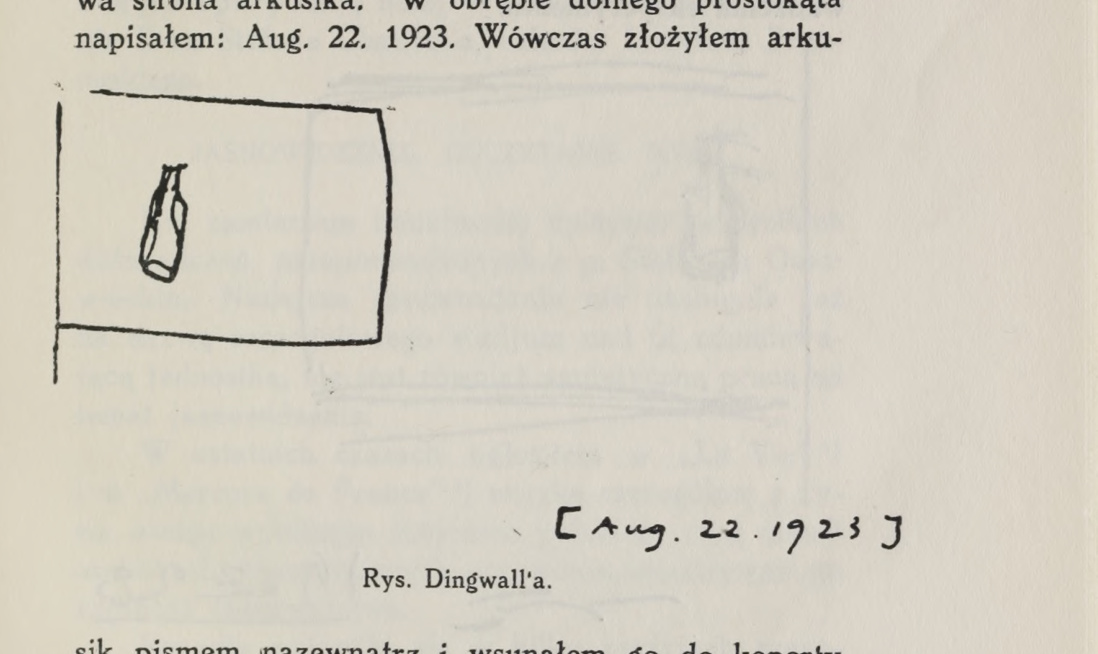
Dingwall’s drawing.
Then I folded the sheet with the writing outward and slipped it into an envelope of matte red paper measuring about 11.5 × 9 cm. The writing was on the front side, and the sketch on the back side of the envelope. I put this envelope, ungummed, into a matte black envelope, which I in turn placed, likewise ungummed, in a closely fitting envelope of gray paper. I gummed this one shut and sealed it at the bottom
(with a wax seal). I pierced this packet of envelopes at the four corners and put it aside until my departure for Warsaw. There I kept the document locked in my suitcase, or carried it in my coat pocket between the pages of my passport, until the moment I handed it to Dr. de Schrenk-Notzing for the experiment.
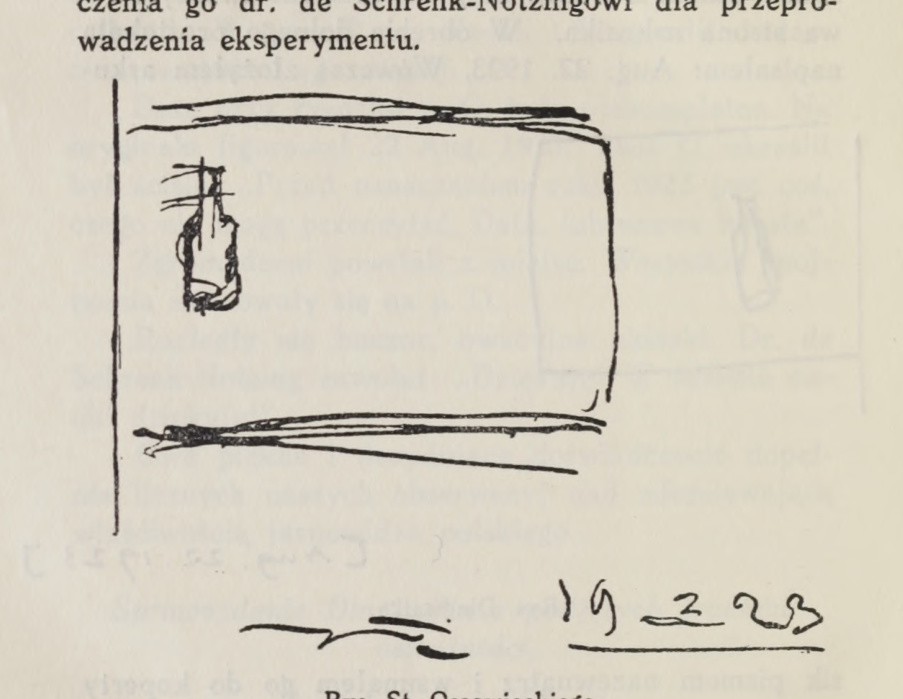
Figure p. 274. Sketch of a Bottle in a Room
Translated labels: czenia go dr. de Schrenk-Notzingowi dla przeprowadzenia eksperymentu; 1938; Rys. St. Ossowskiego
St. Ossowiecki’s drawing.
A few months before the congress in Warsaw mentioned above, I received an invitation from the Metapsychic Institute to visit Paris. I left on 6 June 1923. Dr. G. Geley was waiting for my arrival at the station. In the evening we all gathered at the International
Metapsychic Institute for a magnificent banquet attended by a large and select company of distinguished scholars, writers headed by Marcel Prévost, and a number of people interested in metapsychic questions.
We began the experiments at once. I give their description below in a translation of the report by Dr. Stefan Chauvet, a member of the Institut de France.
Clairvoyance, Thought-Reading
I have no intention of describing all the experiments conducted with Mr. Stefan Ossowiecki. Nor does the present report deserve to be called a detailed study of this astonishing individual; neither is it a synthetic work on clairvoyance.
Recently, in La Vie15 and Mercure de France,16 I published a collection of details from the life of this distinguished Polish engineer, together with my personal views, necessarily hypothetical, on the faculty of clairvoyance.
Furthermore, an extensive account of the experiments conducted in Warsaw
by Prof. Richet, Dr. G. Geley, the Chief of State, Marshal Piłsudski, Mrs. Glass, and others appeared in several issues of La Revue Metapsychique.
Finally, the latest issue summarized the extraordinary results of experiments carried out at the recent International Metapsychic Congress.
I shall therefore confine myself, with Mr. S. Ossowiecki’s consent17 and at Dr. G. Geley’s request, to summarizing without comment the experiments conducted at the International Metapsychic Institute in June, during the celebrated Polish medium’s visit of several days to Paris.
A. Experiment of 12 June 1923.
At five that afternoon I received word from Dr. Geley of Mr. S. Ossowiecki’s unexpected arrival, with a request to come to the Institute that evening, where he was to spend a few hours. At that very moment I was giving medical advice to the wife of one of my colleagues. I was unwell myself, troubled by the aftereffects of a wound received in the war. At first I intended to excuse myself, telephoning to say that I could not come. But I reconsidered. After all, this was my only opportunity to meet this astonishing medium.
Hoping that a double dose of aspirin would relieve the troublesome pain, I decided to wait. A little later it occurred to me that an opportunity to conduct an experiment might even arise during the evening, and I wished to prepare a suitable document. When the consultation was over, I told my patient about this and asked her, in my absence and without telling me afterward, to write a few lines on a sheet of paper, then wrap it in a piece of tinfoil I supplied, slip it into an envelope for visiting cards, seal it with wax, and stamp it with a seal I had brought. I left the consulting room and returned when everything was finished. As she handed me the envelope, the patient explained that, not having noticed the seal I had set out in time, she had pressed the obverse of a one-franc coin into the two circles of wax.
I thanked her. The patient left. Some time later I learned from her that she had intended to write down a general thought devoid of personal elements, and had finally decided to choose one of Epictetus’s maxims from a volume lying on my desk, beside several medical books, two works on prehistoric research, and five others dealing with the Moi tribes, Elamite art, the Hittites, the Inca tribes, and, lastly, the exploration of Lake Chad.
When I looked at the little packet prepared by my patient, I was struck by the somewhat commonplace appearance of those “good-luck” seals, so I covered them with a layer of fresh wax into which I pressed a Neo-Babylonian seal depicting sacred maces and a Chaldean priest paying homage to the moon (Sin). I stress that the new layer of wax completely covered the earlier seals, making it impossible to notice that wax had been applied twice.
I then lay down for three hours to relieve the pain that troubled me.
At about eight in the evening I went to the Institute. I was still suffering acutely. I gave no outward sign of it, thanks to a self-control acquired long before… and not altogether voluntarily.
About twelve people had already gathered at the Institute, and it so happened that I was not introduced to Mr. Ossowiecki. While waiting for a few more guests to arrive, we gathered around a large table. Mr. Ossowiecki was at one end, with a lady whom I did not know on his right. I found myself opposite him. Soon small groups formed and conversation began. My nearest neighbor was Prof. Vallé, with whom I entered into a fairly lively conversation. A little later, when it was announced that all the invited guests had assembled downstairs, we rose, and those present went out one by one through a door beside the corner of the table where Mr. O. sat. Disregarding repeated requests that he go first, he remained by the door, as though wishing to bring up the rear. From the places occupied by Prof. Vallé and me, it followed that we two should leave last. To my genuine astonishment, as I approached the exit, Mr. O., greatly excited, came quickly up to me, took me by the arms, and said: “I do not know you, and I know nothing about you. But from the very beginning of the gathering I noticed you and felt irresistibly drawn toward you. I cannot express what I felt. Several times I asked my neighbors about you, but none of them knows you. Then I began reading your thoughts and became aware of the full depth of your intelligence; I penetrated your whole soul, your whole life.” (There followed an appraisal of the intellectual and ethical qualities of my self, which I omit as being of no interest.)
“I feel a sincere and profound intellectual and moral sympathy for you. You take an interest in everything and work too much. For many years you pursued a chosen goal; you would have reached it and risen very high, but the loss of your health shattered your life. You suffer intensely and constantly, and you struggle with an extraordinarily tenacious energy. A moment ago, while you were talking, I sensed that you were suffering acutely, although it did not show outwardly. I advise you not to overwork as you have done… it exhausts you. Despite your hard life, despite a certain slowing of your development caused by ill health, you will nevertheless be able to fulfill your destiny, but you must not kill yourself slowly and systematically. I have the impression that your health may still improve, and I shall help in that direction. I sense what is wrong with you. Allow me to touch your head, and I shall tell you what happened and where the source of your suffering lies.” I agreed. Mr. Ossowiecki took my head in both hands and began examining the neck and the back of the head with particular attention. This took place before several people who had turned back and formed a circle around us. Mr. O. was nervous; his hands trembled, and his eyes seemed to wander in an indefinite space. Suddenly he exclaimed: “Now I know… I see what is wrong with you. You were wounded in the war by a piece of shrapnel; death passed close to you… wait… wait… I shall tell you where you were wounded: here, in the neck; you suffer greatly… Here is the focus of severe congestion and thickening… This is where treatment is needed… just here…” He indicated the whole lower part of the back of the head.
I confess that I was speechless with astonishment. Quite apart from Mr. O.’s appraisal of my psychic nature and his predictions for my future, I must state that this diagnosis of my physical suffering agreed most precisely with the truth. I repeat that Mr. O. did not know me at all, had never heard of me, and did not know that we should meet that evening; absolutely no one had given him any information about me, and I made a painstaking investigation of this point. Nor could the scar on my neck from the wound have served as a clue: it was small, moreover, and hidden beneath my collar. I should explain that my wound was caused by the rear part of a shrapnel shell, which did not penetrate deeply into the body and acted only through the force of the shock (a violent blow). A few minutes later I questioned the lady who had been sitting on Mr. O.’s right. She answered that
Mr. O. had asked her, and likewise his neighbor on the left, who I was… She had been unable to tell him. She added that from that moment Mr. O. had not stopped gazing at me18 and talking about me, repeating several times that he sensed how acutely I suffered, that he had penetrated my brain to its depths, that he wished to meet me, and so forth. That was why he had stopped at the door to wait for me.
During the conversation with Mr. O. described above, Dr. Geley came up to him and said that everyone assembled downstairs was waiting impatiently for him. But Mr. O., excited to the utmost, would not hear of it. “No, please leave me in peace for a moment. I feel a deep sympathy for you, and I want to carry out my first experiment with you.” A few more people came up. Suddenly Mr. Ossowiecki turned to me: “Please give me your visiting card.” After reading it, he returned it to me. “Crumple it in your hands; yes, that is right. Now please go into the next room and draw something on it… put it in an envelope and seal it. When you have finished, call me. I shall remain here meanwhile.”
I did as he directed. There was a footman in the adjoining room, whom I asked for an envelope. Left alone, I began preparing to
dash off some sort of sketch. Unfortunately, it is well known that at moments when one has to write a dedication in a hurry, or simply any sentence at all, even to try out a fountain pen, the richest inventiveness always fails. Worse still, through the door I had shut I heard Mr. O.’s voice: “Quickly, Doctor… They are coming for me, they want me to go downstairs… Draw anything at all… After all, this is only a private experiment between you and me.” Two seconds later he called again: “Quickly, quickly… And beside the drawing please write some personal sentence.” Taken so unawares, without a moment to think, I found myself in considerable difficulty, all the more because Mr. O.’s words continually distracted my thoughts from the subject. At first I intended to draw a boat, since I wanted a simple, distinctive drawing that would be easy to copy in case Mr. O. was not very skillful with a pencil.
From an experimental point of view, it is most inadvisable to draw, for instance, faces whose distinctive qualities lie entirely in the particular features one gives them. Considering the actual difficulties that even professional artists have in capturing the likeness of a person, whom they can nevertheless inspect at close quarters as often as they please, one obviously cannot demand that a medium, even one endowed with the richest and most powerful clairvoyant faculty, should notice the minute details of the features in a picture and reproduce them, especially if he cannot draw. This difficulty is further increased by the fact that, for the most part, the people who sketch difficult drawings for experimental purposes and choose an unfortunate subject, such as a head or a diagram of a machine intelligible only to an engineer, cannot draw either.
Just as I was about to draw the boat, Mr. O. called from the other room: “Please make it a personal drawing, about something that concerns you.” This increased my embarrassment. As I was thinking my hardest, the pain I felt suddenly grew more intense. This paroxysm caused a momentary weakening of my hidden reserves of potential energy and brought together a series of subconscious ideas, producing in turn the thought of sketching a cross. Probably the following process of reasoning took place in my subconscious ‘self’: “It is unbearable, after all, to be forced to suffer continually… and above all, not to be able to do what I have resolved to do, or what interests me. Continual disappointments… unceasing pain… This is not a life, it is a veritable Golgotha.” And so an image appeared on the surface of my consciousness: the idea of a cross. I began to draw it. But instead of a cross with solid arms, I sketched one with hollow side arms and a hollow upper portion. I finished by sketching the horizontal branches. Furthermore, instead of drawing the arms on either side of the upright, I carried the upper and lower lines of both arms right across it.
From the point of view of drawing this was, of course, heresy, but I committed it with a certain awareness, wishing to introduce a small additional difficulty into the experiment.
As I hurriedly finished the drawing, Mr. O. called again: “Please add a sentence with some personal content… Please hurry.” The associations of ideas I have already mentioned suggested words that could serve as an explanation of the drawing: “My life.” I would have preferred to write something else, but Mr. O. kept pressing me, so I really had to hurry. Finally, I told myself that it did not matter after all, since this was merely a small, entirely personal experiment, the proceedings of which were to remain forever a secret between Mr. O. and myself.
I put the card in the envelope, first making certain that it was completely opaque. I sealed it and, as agreed, told Mr. O. that he could come in.
Mr. O. first asked for a needle and thread. When they were brought, he tied a knot in the thread and, without telling me what he intended to do, began passing the needle through the envelope in different directions. He repeated this ‘procedure’ five or six times. I watched his movements and the lines gradually formed by the black thread intently. To my indescribable astonishment, after a time I noticed that it was successively marking on the envelope, exactly as in my drawing, the upper upright of the cross, then the right arm and the upper line of the left. I asked myself whether Mr. O. could already see the drawing and wished to reproduce it with the black thread. A moment later, however, on reaching the end of the left arm of the cross, instead of joining the upright horizontally and thus completing the cross, the thread ran down toward the lower part of the upright.
In complete silence I watched this already astonishing reproduction take shape. What was most striking was that Mr. Ossowiecki, involuntarily and before beginning the actual reading, had managed to reproduce the drawing with the thread, as though his hand were guided by elements drawn from the psychic depths of the unconscious. At last Mr. Ossowiecki took the envelope in his right hand, placed that hand behind his back, and began pacing the room, showing signs of great excitement, visible also in a characteristic contraction of his features, with his gaze fixed in the distance. He said hurriedly: “I am beginning to see… it will go well… quickly, quickly…” But at that very moment someone came again, begging him to join the invited guests. He answered: “I am carrying out an experiment with the doctor… It will take just another moment; please do not disturb me.” Finally, yielding to persistent persuasion, “Please come… Everyone is waiting… The experiment with the doctor can be finished later… Now please come, even for a short while,” he agreed to go downstairs, first returning the envelope to me.
In the Institute’s great hall he was introduced to the large gathering. He bowed and conversed politely, but one could see that in reality he was “absent-minded, though present.” Soon Dr. G. Geley brought him to Marcel Prévost, who was holding a mysterious little bag, and asked him to carry out an experiment with the documents it contained. Mr. O. refused, however, both then and later, so the secret remained forever shut up in the bag.
Let me note in passing a curious trait of this extraordinary medium. When he feels tired or simply disinclined, and in this respect he is strongly influenced by the impression certain people make on him; when he wishes to conduct an experiment with someone present; or, finally, when positive results begin to appear and Mr. O. senses that he has not yet exhausted all the possibilities offered by the object of the experiment, then this man, usually kindly disposed toward others, warmly obliging and eager to please those around him, becomes inexorable. No pleas or entreaties can then induce him to change his position or begin an experiment with another person chosen in advance for the purpose. At one of the later gatherings, which I shall report below, he ‘attached himself’ to Mr. d’Anglars for the entire evening and would not hear of conducting an experiment with anyone else.
Now, too, in response to Dr. Geley’s urgent entreaties, Mr. O. kept replying that he wanted first of all to conduct an experiment with me. He signaled to me and slipped into the other room. Fearing that this would be the evening’s only experiment, Dr. Geley asked my permission for a few people to be present. I gave it reluctantly, since both the drawing I had made and its verbal commentary were intended as the subject of a strictly personal, rather than an official, trial. On the other hand, Mr. O. was impatient for the result and would not let me waste time changing the document. I realized, moreover, that if the results proved positive, I would have absolutely no right to withhold them from the scientific inquiry that interested us, on the pretext that personal factors were involved which I would have preferred not to disclose.
I therefore resigned myself to my fate. And, I confess, my only remaining hope was that Mr. O. would after all be unable to see my drawing; indeed, I was almost convinced of it. In any case, he did not wish to conduct the experiment with me before a larger company. At first he agreed only to the presence of Prof. Vallé, and then of Dr. Osty. On entering the drawing room he had already been intimidated by the influx of invited participants, whom he had not expected at all. Under an impression that acted rather unfavorably on his psyche, he preferred to remain in a smaller company. Only with difficulty was he persuaded to admit Marcel Prévost to the chosen group; Dr. Geley, on the other hand, he invited on his own initiative.
When these comings and goings, which irritated the medium excessively, were at last over, Mr. O. asked me for the envelope and held it, immediately placing his hands behind his back. He then paced about the room. His flushed face seemed to express uncertainty and fear; the veins at his temples swelled markedly, his eyes took on a strange expression, and his hands trembled a little. Amid the general silence, he interrupted his intense mental concentration for a moment and said to us: “You gentlemen may talk, even loudly; it does not disturb me. Silence disturbs me rather more, and being looked at most of all. It intimidates me, and then I cannot detach myself from my surroundings to ‘see within myself,’ to ‘see ideally.’”
From then on we exchanged a few words from time to time, without ceasing to watch the medium’s movements closely.
Suddenly Mr. O. exclaimed rapidly:
“Now I can see… Yes, I see… At first you intended to make another drawing. You abandoned it (strictly true) and made this one instead. A strange drawing. It represents a cross, but different from those usually seen. Give me a pencil; I shall draw it.”
Given a sheet of white paper and a pencil, Mr. O. drew the upright without hesitation, then the two horizontal arms of the cross. A moment later he hesitated and said: “That is not all; there is something else here. I think something runs across it… Yes, across it, like this.” And he joined the upper lines of the two arms with a line passing through the upright of the cross; he began to do the same with the lower line. Then he took up the envelope again, turned it over in his hands, and declared:
“Under the cross there is an inscription, a sentence of two words. They are not words, but rather letters… Badly written… It looks like a word made up of a single letter. No, no, that is not it yet… I cannot make it out. It is not clear enough…”
The experiment was over. I broke the thread and opened the envelope.
On my visiting card was a hollow cross, exactly like the one Mr. O. had drawn, even of the same size.
One has only to glance at the photograph, a life-size, unretouched photograph of the two documents, which I pasted together, for the resemblance to be obvious. It is also easy to see that Mr. O. indicated the lower cross-line correctly. His failure to finish it was by no means due to uncertainty of vision, for a moment earlier he had drawn the upper line without hesitation, but rather to something like the laziness that often overtakes painters when, making a rapid sketch, they are content merely to suggest an intended movement, that is, a line in simplified abbreviation. Indeed, referring to the upper line he had drawn, Mr. O. declared, after beginning the lower one: “And there too,” meaning, “And there too it runs across.”
Several of those present at the experiment could not read the sentence I had written in great haste under the circumstances already described. It is therefore not surprising that deciphering it also caused Mr. O. difficulty. I note that in subsequent experiments he read more clearly and carefully written texts perfectly. In concluding my discussion of this matter, I cannot pass over the fact that he did, after all, perceive them in part. One had only to look closely at the inscription to notice that the words “ma vie” (“my life”) were written in separate strokes, forming, as it were, three components. This may explain why Mr. O. saw alternately two words and three, without being able to be entirely certain.
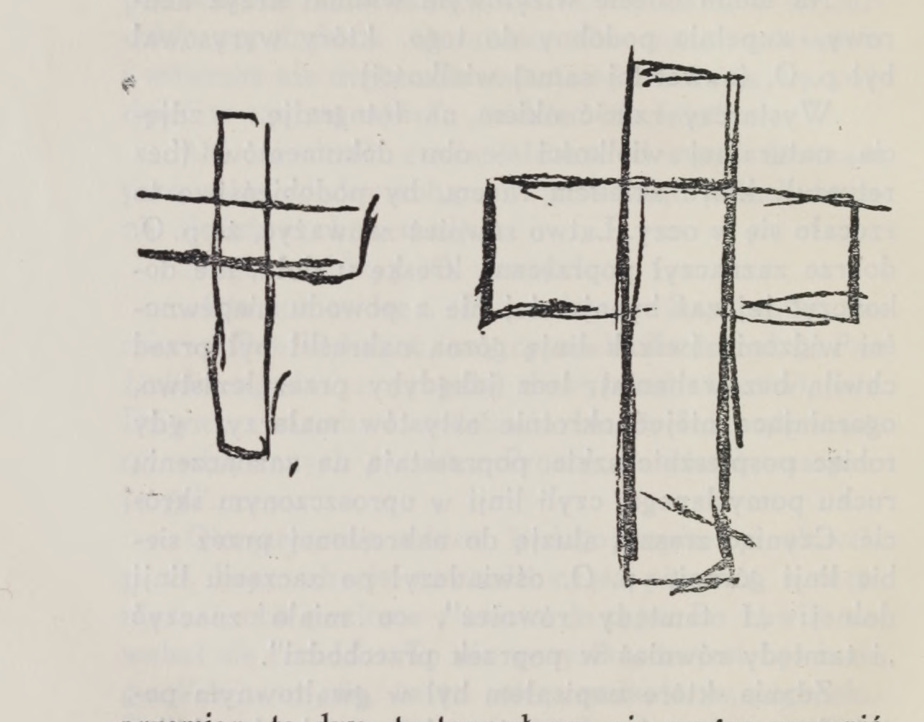
Figure p. 290. Two Hand-drawn Cross Sketches
Two rough freehand cross drawings side by side, each formed by intersecting vertical and horizontal strokes with sketchy overlapping lines, the right one larger than the left.
Moreover, these three components appeared to him as “words that are not really words”… “something like letters.” In this case, reading was also accompanied by another difficulty. Although Mr. O. speaks French fairly fluently, he does not have in Poland, where he lives permanently, the opportunity of continually deciphering illegibly written texts, an ‘exercise’ in which he might acquire considerable practice if he lived permanently in France.
After the conclusion of this first experiment, at which Drs. Geley and Osty, Marcel Prévost, Prof. Vallé, and of course I myself were present, we went to the waiting company to report its course.
A few moments later, Mr. O. felt unwell and, without attracting anyone’s attention, withdrew to the adjoining room. He told me that it was a slight indisposition caused by the excessive mental effort he had made in his desire that the first experiment conducted in Paris should succeed as well as possible. He recovered very quickly, however, and we began a conversation on various topics in fields that interested us. Following a chain of associations, I mentioned that, in anticipation of an experiment, I had prepared a suitable document beforehand. Mr. O. suddenly said: “Please give it to me.”
I handed him the little packet. He took it without looking at it. He enclosed it in his clenched hand, which he immediately placed behind his back. And he said at once:
“I see two coins… They are franc coins, French, yes, French. They get in my way; I cannot see anything… And yet I see a little sheet of paper and a sentence written by a woman… aged 30, 35, a tall brunette, elegant, intelligent. She was divorced; now she is married to a doctor. She is looking at various objects on a desk, some of them from distant, exotic countries… old antiquities. She is wondering what to write. She has chosen a thought, something impersonal, lofty, ideal.”
We were interrupted at this point. Mr. O. returned the packet to me, promising that “we shall finish later.” But that evening another experiment absorbed him entirely, and at the next gathering a series of experiments with one person, Mr. d’Anglars. Thus, simply for reasons beyond his control, he was unable to complete this astonishing demonstration of the gift of clairvoyance.
I therefore decided to open the packet and read the aphorism of Epictetus it contained.
Everything Mr. O. said about this was strictly true, with the exception of my patient’s age: she was 38, not 30–35. Apart from that, the clairvoyant mentioned everything with precise accuracy: the divorce, the remarriage, her outward appearance, her characteristic spiritual qualities, the opening and cursory examination of books on scientific and artistic subjects, concerning various distant countries and ancient periods, the choice of a lofty thought, and even the initial impressions made in the wax with a one-franc coin. One has only to look at the photograph of the seals in question to notice that other seals are hidden beneath them. I stress particularly that Mr. O. never once glanced at the packet I handed him. Furthermore, it is easy to understand that someone fond of objects such as a seal depicting a Chaldean priest paying homage to the moon-god Sin would certainly not wish to use an ordinary coin as a second seal. Besides, Mr. O. saw the seal used by the person who had composed the word, rather than the other one used by me. It must be admitted that these are facts truly worthy of reflection.
As I mentioned, the arrival of other people interrupted the course of our second experiment. A little later he was introduced to the Marquise B.,19 with whom he conducted a new experiment with excellent results. I shall relate it briefly, relying on what I have already said about the conditions under which Mr. O. usually works.
Mr. O. asked Mrs. X. to write a sentence on a small sheet of paper.
She went into the other room and considered what to write. A short time later, after the brilliantly successful experiment was over, she told me:
“It is hard to imagine how impoverished our inventiveness becomes when we have to write any sentence at all under such conditions. I confess that I simply wanted to write: ‘What is your wife’s name?’ Mr. O., who was then on the other side of the door, called out:
‘No, not that… Please write something personal. Something concerning yourself.’
Until then I had not believed in clairvoyance. I was all the more astonished that Mr. O. had so precisely
guessed my thought. And I wrote: ‘Shall I make the long journey this winter that I so greatly desire?’”
But let us return to the experiment.
Scarcely had he taken the envelope in his hand when Mr. O. said:
“Yes, you will make that journey.”
She looked at him questioningly. He added:
“This is what you wrote: ‘Will I indeed make the long journey this winter that I so greatly desire?’”
Apart from a slight change of wording at the beginning of the sentence,20 the experiment was a complete success. As Mrs. X., as delighted as she was astonished, thanked Mr. O. warmly, he declared that he could tell her some other interesting things. He said that “she wishes to go to Egypt… She was there three years ago and retained indelible memories of it. Several times she has wished to return, but her son’s state of health stood in the way. This time she wishes to leave in December, but her intention will be thwarted for the same reason. Eventually her son will recover, and then she will be able to carry out her plan.”
Apart from the last point, which concerned the future, Mr. Ossowiecki’s words were strictly true. I note that he did not know Mrs. X. and knew nothing about her.
He did not stop there. He withdrew with Mrs. X. from the rest of the company and, to her growing
astonishment, recounted a series of facts from her life known to no one. I soon learned from Mrs. X. herself that he had revealed not only facts that no one but she could know, but also her hidden, unrealized thoughts, which had remained forever in the realm of wishes. Unfortunately I cannot relate this part of the experiment because of its strictly confidential nature.
Everything I have said above indicates the exceptional importance of the three successful experiments that took place at the Institute on 12 June 1923. I have given the detailed conditions in which they took place, and Mr. Ossowiecki’s procedure and behavior, which might appear rather ‘stereotyped’ to people who have attended a certain number of experiments, in order to bring out a series of nuances and apparently minor incidents that emphasize the value of the facts we are studying.
This necessarily lengthy report has a further purpose. It is intended to enable those who have not had the opportunity to take part in experiments and sittings of this kind to appreciate their significance accurately and understand their astonishing characteristics. Wishing to be precise, I have reported the facts known to me without any concern for giving them a literary form or classifying them, retaining an arbitrary chronology and the lack of connection between the statements made.
In studying such extraordinary phenomena, one feels an absolute need to become as fully acquainted as possible with every circumstance connected with them, to reduce their elements to a minimum, and to narrow as far as possible the circle of mystery they contain. There can, of course, be no question of penetrating their determinism, which will probably never reach our consciousness.
Yet one would like to know something of their imperceptible side, that is, to penetrate what goes on in Mr. O.’s mind and is accessible to his powers of analysis. I could not ask him about this during the experiments, since he was constantly besieged with congratulations and questions. Moreover, he was tired; around us was a feverish and, it must be admitted, indefinably oppressive atmosphere, conditions by no means favorable for conducting a psychological ‘questionnaire.’
On the other hand, Mr. O. kindly placed his confidence in me as a physician, an extraordinary courtesy from someone who had the power to make an ‘indiscreet’ analysis of my psyche. This allowed me, after some time, to put a series of methodically arranged questions to him in the quiet of my consulting room, concerning what he could know about himself.
The results of this inquiry appeared in Mercure de France,21 together with a series of investigations I personally conducted into the psychology of the gift of clairvoyance in general. I therefore consider it unnecessary to return to these matters.
B. Experiment of 15 June 1923.
Three days after the experiments discussed above, another sitting took place, again at the Institute. Mr. O. was very tired. He agreed to come only on condition that no one should ask him to conduct experiments. Yet after making the acquaintance of one of those attending, Mr. d’Anglars, he wished to try. At Mr. O.’s request and in his absence, Mr. d’Anglars wrote a few words on his visiting card, which he then slipped into an envelope. After a brief interval Mr. O. spoke the sentence that had been written:
“Where shall I be a year from now?”
This success revived and excited him and made him forget his fatigue. He asked Mr. d’Anglars to write another sentence and make a drawing on a piece of paper, which was to be put into an envelope. Mr. d’Anglars went to a separate room and complied. Mr. O. then came there with several people, among them Mr. G., General Ferrier, Mr. de Bourg, Dr. Geley, Mr. H. Lazzaro, Dr. Schneider, and myself. Scarcely had he touched the envelope handed to him when Mr. O. turned to Mr. d’Anglars with an exclamation:
“I see… But is it possible?… I see the same sentence as a moment ago: ‘Where shall I be a year from now?’ Yes, the same… Is it possible?”
Recovering from the confusion and astonishment that had seized him, Mr. d’Anglars answered:
“Indeed, that sentence is there.”
This is what had happened: Mr. d’Anglars had made on his visiting card the drawing to be described below, having previously thought of another drawing. Then, absorbed above all by this new part of the experiment, he had written the same sentence again, perhaps somewhat subconsciously. This fact obviously made the reading considerably more difficult for Mr. O. and increased the value of its accuracy.
After this small incident Mr. O. continued the experiment, and a few seconds later declared:
“I see the first drawing you intended to make, then abandoned… There are triangles… interlaced triangles. You made a different, peculiar drawing. A human head, a strange head. There is a hat… No, it is not a hat, but rather something like a cap, though not an ordinary cap. It is a little like a Tyrolean hat. It is made, well… like this.”
Mr. O. took a pencil and without hesitation drew a head, then a hat, of the same size. The envelope was opened; it contained the visiting card with the inscription quoted above and the drawing, likewise of the same size. A comparison immediately establishes: 1. The identity of the two drawings in character and dimensions; 2. The difficulty of reproducing the drawing accurately, further increased by the fact that the original drawing’s execution left much to be desired; 3. The appearance of the hat, which, as Mr. O. described it perfectly, was something between a Tyrolean hat and a cap, conceived and drawn inaccurately, which presented a considerable difficulty to the experimenter; 4. Lastly, it should be noted that before making this drawing Mr. d’Anglars had intended to draw interlaced triangles.
That evening the same thing happened as had occurred three days earlier with Mrs. X. and myself. Mr. O. told Mr. d’Anglars that he could reveal much more to him, and would not leave his side for a moment. In vain did Dr. Geley and others ask him to conduct an experiment with someone else. He refused politely but firmly. Probably in such cases he senses a mysterious psychic bond linking him to that particular person and no other, with whom he is certain of success in an experiment and does not wish to break off, like an author who feels a surge of inspiration and will not allow himself to be drawn away from his manuscript. In any case, he then withdrew with Mr. d’Anglars for half an hour and related a series of facts concerning the past, present, and future. The time for verifying the last of these has not yet come. Mr. d’Anglars did not wish to relate the past and present events because of their strictly personal nature, but declared that they agreed absolutely with the truth, which was all the more astonishing since some could have been known to no one but himself.
Such is the faithful, detailed description of the extraordinary experiments with the faculty of clairvoyance conducted by Mr. O. on 12 and 15 June 1923 at the International Metapsychic Institute and personally checked by me.
(Signed) Dr. Stephen Chauvet,
Member of the Institute.
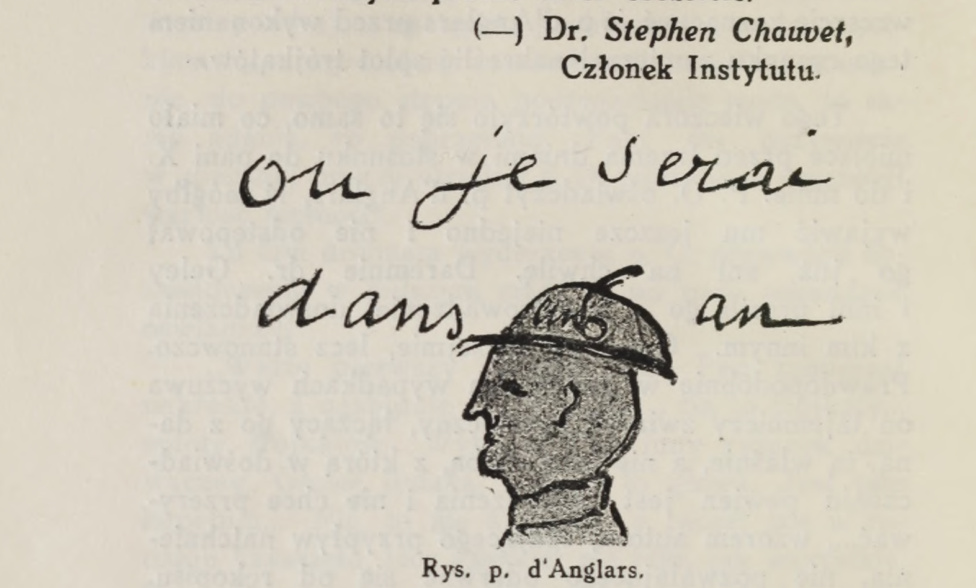
Figure p. 300. Handwritten note with soldier’s profile sketch
Translated labels: (—) Dr. Stephen Chauvet,; Członek Instytutu.; ou je serai dans un an; Rys. p. d’Anglars.
Mr. d’Anglars’s drawing.
Handwritten inscription, translated from the French: “Where shall I be a year from now?”
And here is a series of earlier experiments, reported by Dr. Gustave Geley as follows:
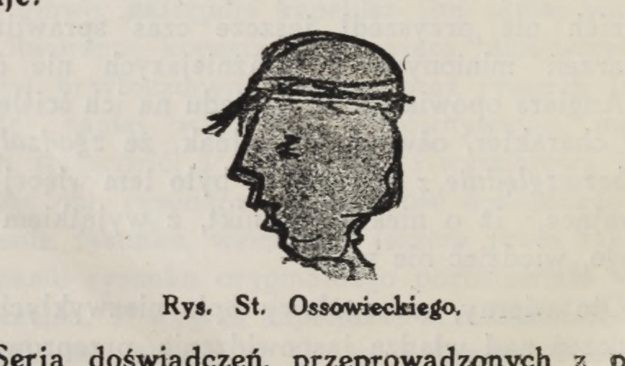
St. Ossowiecki’s drawing.
The series of experiments conducted with Mr. O. during my stay in Warsaw in September
1921 fully confirmed the results of the experiments held in April with the participation of Prof. Richet and myself.
I presented Mr. O. with a series of documents, prepared beforehand in his absence. They consisted of sealed envelopes, each containing something to be read. The written slip was wrapped in several sheets of opaque paper, so that any possibility of deciphering it by ordinary means was excluded.
One such slip was not placed in an envelope, but enclosed in a thick lead tube.
Of the documents handed to Mr. O., some had been prepared by me; others had been entrusted to me by friends of the clairvoyant whom I did not know. I had no idea of the papers’ contents. In what follows I shall indicate which of the slips intended for reading were known to me and which were entirely unfamiliar.
The experiments took place under extremely varied conditions. Mr. O. was very busy, which made it impossible to arrange regular sittings. I therefore made use only of chance meetings at friends’ homes, in a restaurant, at materialization sittings, and so forth, to hand him the sealed envelopes.
Throughout the experiment I did not lose sight of the clairvoyant for a moment. He took the envelope in his hand, concentrated his thoughts, paced about the room, and after five, ten, or at most fifteen minutes stated its contents accurately.
Reading the sheet placed in the lead tube took longer. Mr. O. managed this only after two sittings, and at the cost of tremendous effort.
Out of ten experiments, eight were completely successful;
one was partially successful;
one failed entirely.
Below I give their description in chronological order, and then add a few remarks on the mysterious faculty Mr. O. possesses.
Experiment 1. (21 September 1921, at eleven in the evening.)
After dinner at friends’ house, I handed Mr. O., in their presence, the letters prepared beforehand which I had brought with me.
There were eight sealed envelopes whose contents I knew, one entrusted to me by Mr. Sudre, another by Mr. Magnin, and four by my wife.
The contents of the last six were an absolute secret to me.
I offered them all to the clairvoyant. He drew out one, seemingly without choosing. I recognized, from its being different from the others, that it belonged to Mr. Sudre or Mr. Magnin. Beyond that I knew nothing.
Mr. O. held it in his hand for a moment. He began striding about the drawing room. He sat down, then rose again. He concentrated his thoughts with visible effort. At last he began speaking words which I noted down as I heard them.
“Something very short… A few words…”
(Several minutes’ silence.)
“A man wrote this.”
(A short silence.)
“It speaks of Poland.”
(A very brief silence.)
“That is all. Unsigned.”
I then opened the envelope and read the inscription inside the card folded in four:
“Success in Warsaw.”
I must add that I had been thinking of something entirely different. The letter came from Mr. Magnin.
Experiment II. (4 September 1921, at Prince Lubomirski’s home, six in the afternoon.)
After a materialization sitting with the medium Guzik, I handed Mr. O. a packet of letters. He selected an envelope which I knew came from Mr. Sudre. I had absolutely no knowledge of what it contained.
Below I set out the inscription hidden in the envelope, opened immediately after the experiment, beside Mr. O.’s words, noted down as they were spoken.
Sealed letter:
“Man is only a reed, the weakest in nature, but he is a thinking reed” (pensant). Pascal.
Mr. O.’s words:
“This concerns humanity, or rather man. He is the stupidest creature, something of man. I intuitively sense stupidity. It is a proverb. The thoughts of one of the
most outstanding individuals of past centuries. I would say Pascal. Man is weak, a frail reed… but… weakness, and also the most pensive reed… (sic: pensif).”22
A twofold lesson may be drawn from these first two experiments:
-
As I have already mentioned, I had no idea what the envelopes entrusted to me by Messrs. Magnin and Sudre contained. The clairvoyant could therefore not have learned their contents by reading my thoughts. On the other hand, Mr. O. did not know my collaborators, which makes the hypothesis of spiritual and mental communion immensely complicated.
-
These two experiments also seem to show that the phenomenon here is not perception through opaque objects. For the clairvoyant forms a clear conception of what the envelopes contain, but one that does not agree exactly with the written text. He gives a strikingly faithful interpretation, but it is sometimes only approximate and occasionally even contains errors. This duality in the clairvoyant faculty is confirmed by the following experiments:
Experiment III. (21 September, at Prince Lubomirski’s home. Conditions as in Experiment II.)
I recognized from the envelope that Mr. Ossowiecki had chosen one of the two letters prepared by me.
I did not know which, however. I unsealed it when the clairvoyant stopped speaking.
Sheet to be read:
- An Oriental landscape. 2. A drawing of a fish. 3. The sound of bells. 4. The scent of mimosa. 5. Long live Poland!
Mr. O.’s words:
“This is something longer. A man wrote this. Chaos, something so chaotic that I cannot find my bearings! Four, five thoughts… A veritable jumble of thoughts. Something large. Something that swims. I see work on a fish resembling a crucian carp.
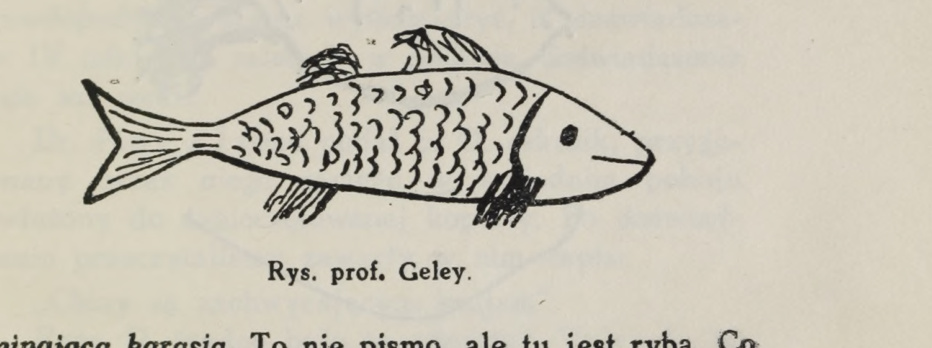
Prof. Geley’s drawing.
It is not writing, but there is a fish here. What can this fish have in common with Poland? I cannot understand it. It is a cry: ‘Long live Poland!’ I even smell a delightful scent… a wonderful scent…” (Mr. Ossowiecki seems to revel in an intoxicating fragrance.) “There is also something from nature here. There is something else, some three things in this jumble. I see a fish; I shall draw it.” (He draws it.) “Why the scent? Why Poland? There are numbers: 1, 2, 3, 4, 5. Something from nature… I see nothing more…”
In the end, of the five ideas set down on the sheet, Mr. Ossowiecki read three, those numbered 2, 4, and 5.
He did not notice idea No. 3 at all. He read idea No. 1 very imprecisely.
On the other hand, he was irresistibly possessed by the thought of the fish; it is curious, however, that the drawing he made does not resemble mine.
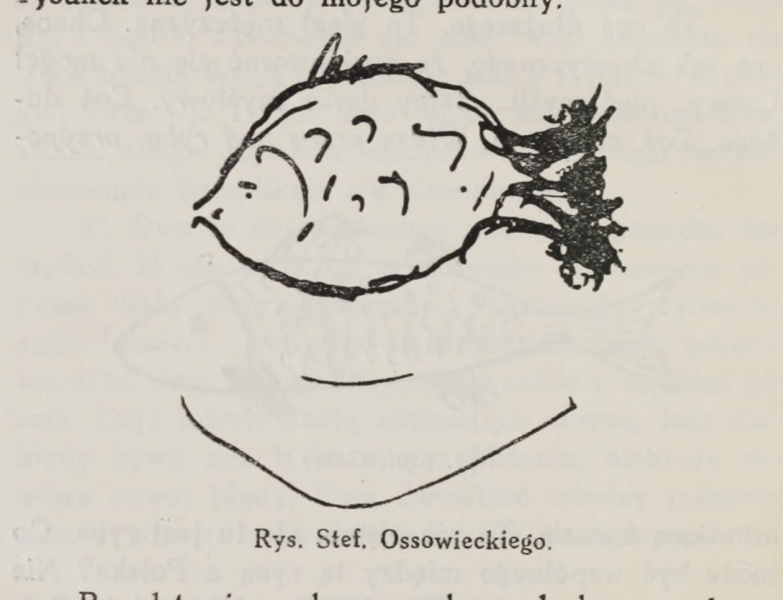
Figure p. 306. Sketch of a Fish by Ossowiecki
Translated labels: Rys. Stef. Ossowieckiego.; [illegible]
Stef. Ossowiecki’s drawing.
It represents a broad, flat fish facing left. I, however, drew a long-shaped fish facing right. Idea No. 1 aroused in him an olfactory association, which he expressed without saying, however, that he smelled mimosa.
He expressed idea No. 5 completely and accurately.
Throughout the evening he spent with me, Mr. Ossowiecki remained preoccupied with the drawing of the fish.
Experiments IV, V, VI.
On the occasion of an international medical congress in Warsaw, several participants became interested in Mr. Ossowiecki’s gift of clairvoyance. They wished to arrange a test.
At Prince S. Lubomirski’s invitation, eight of them gathered in his drawing room at five in the afternoon. (I forgot to note the date.)
Mr. Ossowiecki, whose constitution is hypersensitive and who is therefore exceedingly susceptible, was genuinely moved when faced with this august assembly of medical authorities. He clearly had ‘stage fright.’ This probably explains why Experiment IV was only half successful, and the fifth failed altogether.
Dr. Piery of Lyon handed Mr. O. a small sheet of paper which he himself had prepared in the next room and placed in a sealed envelope. After the experiment we read the inscription it contained:
“China is a delightful country.”
Mr. O. found it difficult to read. Ten minutes passed before he declared: “It is something very short.
“Not a question, but a statement made by you.
“It speaks of Poland.
“Poland is a delightful country.”
Asked the reason for this confusion between Poland and China, he attributed it to the emotion he felt in the presence of the medical jury and to the fact that, exceptionally, instead of relying as usual solely and exclusively on intuition, he had introduced an element of reflection into his attempt to read. He distinctly received the impression of the words “is a delightful country,” and by reflection arrived at the conclusion that this probably referred to Poland.
It should be borne in mind that during the conversation preceding the experiment, the physicians who had come from France expressed delight at the warm, hospitable welcome they had received in Poland.
Mr. O. then went into the next room with Dr. Bergeret of Paris. The latter handed him a sealed envelope without saying what it contained. He stated in general terms that Mr. O. had read it incorrectly.
After this unsuccessful attempt, Dr. Gliksman of Warsaw likewise prepared a slip of paper in an envelope and offered it to Mr. O. under the same conditions as Dr. Bergeret had done. As he was about to hand it to him, Mr. O. said:
“No… no… Keep it in your hand.”
He laid his right palm on the hand of Dr. Gliksman, who held the document, and very quickly declared:
“It speaks of love… it concerns a child… It speaks of love going through the world… like a Gypsy child… of everything.”
The inscription actually read:
“Love is a Gypsy child.”
Experiment VII. (23 and 24 September.)
After dinner in a restaurant I handed Mr. O. one of the sheets prepared by my wife. I did not know their contents. He said at once:
“A woman wrote this… Your wife… There are congratulations and an invitation. Tomorrow I shall read it more precisely. Keep the letter.”
The next day, when we were at Prince Lubomirski’s, I handed him the same document. I give its contents alongside the account spoken by Mr. O.
My wife’s letter.
Mr. Ossowiecki.
Dear Sir,
I congratulate you on possessing so astonishing a gift, and thank you sincerely for enabling my husband to examine and study it. I hope you will not deny us the pleasure of a visit from you in Paris soon. Meanwhile, along with my sincere congratulations, please accept the expression of my true esteem.
Paris, 22 August 1921.
Mr. O.’s words:
“This letter was written by a woman aged…” (he gives my wife’s age exactly). “It is a letter to me… Something cordial… The writer’s own thoughts, expressing admiration and good wishes… She wrote it in the presence of one of her daughters, on the second floor. She looks tired… She wrote in a study containing chairs upholstered in dark leather… The letter was written on 22 August. This lady is delighted with me, is glad to have made my acquaintance, and hopes to see me soon… The letter was written between four and five in the afternoon.”
Everything agrees with the truth except the leather-upholstered chairs, which are, however, in the adjoining room, where, I note, my wife spent most of that day. The letter was indeed written between four and five in the afternoon on 22 August, on the second floor, in the presence of one of our daughters.
That day my wife was very tired.
Experiment VIII. (25 September 1921, at the home of mutual friends.)
Mr. Sudre had sent me another sheet of paper in a sealed envelope, its contents unknown to me. He had only warned me that this was an entirely new experiment.
I handed the envelope to Mr. O.
After ten minutes, squeezing the envelope in his hand, he declared:
“This concerns me. It is someone who wanted to meet me.” (A long silence, an atmosphere of nervous expectation.)
Mr. O. makes intense efforts. After ten or fifteen minutes he declares:
“It is very difficult for me today… There is something… something… I cannot make it out, for I have the impression that it is something printed…
“I was mistaken a moment ago; it did not concern me, but the person who sent this letter was thinking of me while writing. Hence the mistake… The person wanted to find out whether I would read this printed text. And I cannot read print…
“It took place…” (the preparation of the sheet) “at six in the evening. At a table. There was a woman beside him.”
“The print is very small.”
In the envelope I opened, I found a leaf torn from a book, bearing several lines printed in small type. I then said to Mr. O.: “Please describe the man and woman you saw.”
Mr. O.’s answer:
“Second floor, on the left. He has no beard, only a small mustache. Aged 38–40. Slender, very delicate in build. He is not bald (sic); his hair is parted.
“She is stout but not tall. Not blonde. It was she who suggested the idea of this test to him. They have two children, a son and a daughter.”
I answered that everything was true.23 But of the children, only the daughter had been born. The woman’s figure was distorted because she was expecting to give birth within the next few days.
Mr. O. exclaimed: “She will have a son; I am certain. You may write and tell them.”
Three days later the prediction came true.
Mrs. Sudre received my letter, posted on the 26th, on the day after her delivery.
Experiment IX. (27 September, at six in the evening, at Prince Lubomirski’s home.)
I handed Mr. O. the second of the sheets I had prepared, in an envelope. Its contents were of course known to me, and ran as follows:
“An elephant bathing in the Ganges was attacked by a crocodile, which bit off its trunk.”
Wishing to ascertain whether my conscious thought could influence Mr. Ossowiecki’s clairvoyance and help him read the inscription, I tried to picture the scene described as intensely as possible. The result proved to be quite the opposite. Mr. Ossowiecki was visibly struggling with difficulties and began pacing about the room, showing great nervousness. At last, after about twenty minutes, he declared:
“I have the impression of being in a zoological garden. Some sort of struggle…
“I have the impression of a zoological garden. I see some enormous animal. It is an elephant. Is this elephant not in the water? I see it swimming in the water. Something is happening to its trunk… I see blood…”
At this point Mr. Ossowiecki, very nervous and tired, asked: “Is there anything else?”
My answer: “Good, but that is not all yet.” At this Mr. Ossowiecki raised his voice:
“Wait… Is it not wounded in the trunk?”
“Excellent,” I replied, adding: “You mentioned a struggle; excellent.” Mr. Ossowiecki interrupted me: “Yes, a struggle with a crocodile.”
Experiment X.
This is the experiment with the lead tube. It was devised and put into effect by Count Guy de Bourg de Bozas. He had a lead tube made with walls three centimeters thick. He asked our friend Mr. Stanisław Jelski and a lady of his acquaintance, who was leaving Warsaw that same day, to place in the tube a slip bearing an inscription whose contents were unknown to any of us. The originator of the idea handed me the tube after having its opening soldered shut.
The first attempt took place on 28 September, in a restaurant after a substantial meal.
Mr. Ossowiecki then said:
“A woman wrote this. There is something here concerning nature… something connected with man and with feeling. Something at the center of creation. Written under unusual conditions.”
I asked the clairvoyant whether the tube could be sawn open. “No,” he replied. “Let us wait… this does not satisfy me. I want a second sitting.”
It therefore took place at Prince Lubomirski’s on 30 September at 18:00 (six in the afternoon), in the presence of Count and Countess Tarnowski, myself, Commandant Stabile, a military physician attached to the French Mission, Major
Camus, Mr. Stanisław Jelski, Prince Stefan Lubomirski, and Prof. Geley.
With difficulty and effort at first, then seemingly with greater ease, Mr. Ossowiecki spoke:
“Creation… great creative activity… nature…” (A long silence.)
“A powerful man is involved here. The nation feels that he is one of the greatest men of the century…
“I cannot understand… I see two things… an inscription… An inscription written by a woman. There is a drawing too.
“The drawing represents a man with a luxuriant mustache and bushy eyebrows. He has no nose.
“He is dressed in military uniform.
“He resembles Piłsudski.
“The inscription in French reads:
“‘This man fears nothing… in politics or in any field… like a knight…’”
The tube was immediately sawn open in the participants’ presence (see Plate IV, Figure 3). I unfolded the sheet taken from it. It contained a schematic silhouette of Marshal Piłsudski, with a luxuriant mustache, bushy eyebrows, no nose, and dressed in military uniform.
Beneath the drawing was the inscription:
“The knight without fear and without reproach.”
What theoretical conclusions can be drawn from these facts?
In this brief report we shall take into account not only the latest series of ten experiments, but also the earlier experiments conducted by Prof. Richet and myself.
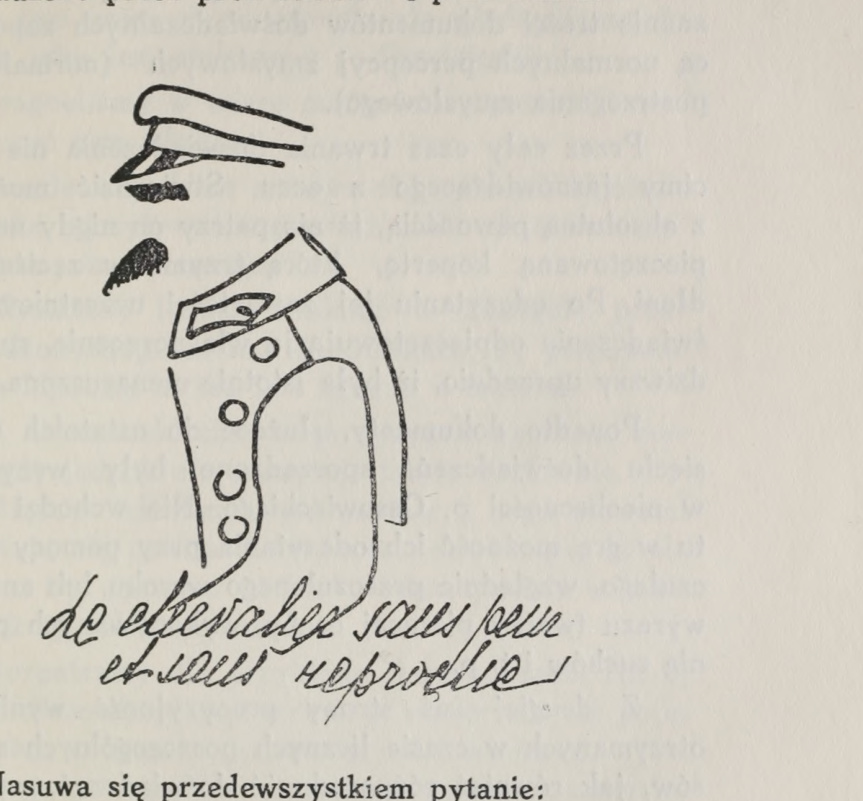
Figure p. 315. Caricature of a man in a peaked cap
Translated labels: de chevalier sans peur et sans reproche; Jasuwa się przedewszystkiem pytanie:
Handwritten inscription, translated from the French: “The knight without fear and without reproach.”
The first question that arises is:
Do these experiments establish that the engineer Mr. Stefan Ossowiecki is endowed with a genuine gift of clairvoyance?
The answer is unequivocally: “Yes.”
We have before us evidence that is simple and at the same time profoundly convincing.
There can be no question here of fraud or illusion.
The sittings take place in daylight. Every means has been adopted to make it impossible to learn the contents of the experimental documents through normal sensory perceptions (normal perception by the senses).
Throughout the experiment we do not lose sight of the clairvoyant. We can affirm with absolute certainty that he never looks at the sealed envelope he holds in his clenched hand. After its contents have been read, the participants in the experiment unseal it themselves, first checking that it is indeed intact.
Furthermore, the documents used in the last ten experiments were all prepared in Mr. Ossowiecki’s absence. The possibility of his reading them with the aid of hypersensitive or abnormally acute vision, or by analyzing the writer’s facial expression, movements, and so on, therefore does not enter into consideration.
On the other hand, the precision of the results obtained during numerous individual sittings, as well as the variety of the experiments, excludes any likelihood of the hypothesis of a ‘favorable coincidence.’
It follows that Mr. Ossowiecki possesses an unquestionable, genuine gift of clairvoyance.
We also note that these experiments may be repeated any number of times and are almost always successful. Thus the entirely groundless, yet continually and thoughtlessly repeated objection that metapsychic phenomena are unscientific because they cannot be repeated at will falls away of itself in relation to the clairvoyant faculty with which Mr. Ossowiecki is endowed.
We wished, as far as possible, to examine and explain this faculty.
The first hypothesis that comes to mind is an ability to read through opaque objects without the aid of sight.
Yet one has only to examine the details of our experiments to be convinced that this hypothesis does not agree with the facts.
Mr. Ossowiecki grasps the written thoughts precisely, but never reads the text word for word.
Certain discrepancies appear between the texts of the documents and his words, proving that there can be no question here of an ability to read by any supernormal means.
Let us consider Experiment No. 3 as an example.
Mr. Ossowiecki formed in his mind the idea of a fish, or rather of a drawing representing a fish. Of this he is certain. Yet he does not see the drawing itself that gives this idea tangible form. He fails to perceive it to such an extent that he himself draws the fish in an entirely different way.
I note, however, that at one of the sittings in April Mr. Ossowiecki could not ‘read’ a letter written in English. A curious contradiction arises here: if the clairvoyant forms a conception of a thought rather than an image of its graphic form as expressed in writing, it would seem that he ought to read English words as easily as he reads French texts.
There is a mystery here that ought to be explained. In my opinion, however, it is not difficult to draw from the whole complex of observed facts the general conclusion that Mr. Ossowiecki’s faculty is something other than a mere ability to read through opaque objects.
Is thought-reading involved here, or spiritual and mental communion?
As an easy and attractive hypothesis, this will naturally find the largest number of supporters. Yet when we examine it closely, we shall see that serious doubts and difficulties arise.
First of all, there can be no question of reading conscious thoughts.
Mr. Ossowiecki read letters whose contents were known and unknown with equal ease. It was precisely the slip used in Experiment No. 9 that he managed to read with the greatest difficulty. And I note once more that my mind was intensely concentrated on the scene described.24 This mental effort of mine plainly hindered him.
If an ability to read thoughts were involved, one would have to assume that incidental factors of time, space, and relations with the writer were irrelevant. Mr. Ossowiecki demonstrated
possession of this gift to an equally strong degree when reading slips written by me, by someone close to me, my wife, or by two acquaintances of mine then in Paris, whom he himself did not know.
There is another difficulty.
If we are dealing with a faculty for reading thoughts, why is Mr. Ossowiecki unable to read a slip written in a language he does not know?
And why can he not read printed writing? I recall Experiment No. 8. No one knew the contents of the printed leaf. In a dark room Mr. Sudre had slipped into the envelope a page torn at random from a volume of poetry, without knowing what it contained.
One might suppose that Mr. Ossowiecki was unable to read it because its contents had not been reflected in Mr. Sudre’s mind. Concrete facts contradict this oversimplified interpretation.
In my presence, an acquaintance of mine once handed Mr. Ossowiecki a sealed envelope containing a slip which he had written himself, on a typewriter. He had written it himself, and therefore knew what it contained. Nevertheless, the experiment failed completely. Mr. Ossowiecki simply declared: “It is something typewritten, and I can read only living handwriting.”25
The thought-reading hypothesis is therefore not as simple and convincing as it may seem from a superficial point of view.
Could this, then, be direct clairvoyance? It is difficult to answer.
Clairvoyance is a faculty that manifests itself independently of any external circumstances, of time, space, or obstacles. A faculty rising above all laws, physical as well as psychic; a power bordering on omniscience, almost on divinity.
It is easy to understand that the clairvoyant faculty with which Mr. Ossowiecki is endowed does not embrace so broad a scope or rise to such heights of power. Despite its astonishing characteristics, it is subject to obstacles that are simply trivial, such as the incidental character of the writing supplied for reading, printed writing, and so on.
It is undoubtedly a variety of that limited clairvoyance known to science as psychometry. The process of reading the writing itself can be broken down into the following elements:
- There is a certain pictorial conception of the writing, but without the act of reading in the strict sense. Mr. Ossowiecki seems able to perceive the general contents of the writing and to use this perception to penetrate it more deeply.
On receiving a document in English, for example, Mr. Ossowiecki declares: “It is in English. I do not know English, but I can say that it begins with an isolated letter… then comes a longer word beginning with C. O. N. S., then two short words, and lastly another longer one, resembling the word ‘vendredi’ [‘Friday’] in its arrangement.” I recall that the inscription read: “I consider you are wonderful.”26
Thus the clairvoyant has certain points of support, certain signposts by which he guides himself. This first, very imprecise vision enables him to enter into contact with the author of the writing.
Mr. Ossowiecki can then describe that person, grasp the person’s characteristic qualities, and perceive the surroundings. At the same time, he senses his way into the time and place at which the slip was written, and thus intuitively learns, more or less accurately, the contents of the writing.
It follows from the foregoing that the gift of clairvoyance in this case falls within the category of psychometric phenomena.
This interpretation, however, is not sufficient.
Despite numerous outstanding works, and I have particularly in mind Bozzano’s studies of psychometry, this form of clairvoyance still raises many doubts and unresolved problems.
For the moment we refrain from any comment, yet we have certain indications from which we may hope that Mr. Ossowiecki’s astonishing faculty will allow us in the future to lift a corner of the veil of mystery.
(Signed) Dr. G. Geley.
Third Series of Experiments
(April–May 1932.)
(An article by Dr. Charles Richet, published in Revue Metapsychique.)
Decisive Experiments in Cryptesthesia (Clairvoyance)
I.
The experiments conducted with Mr. Stefan Ossowiecki by Dr. Geley and myself are of such great importance that they absolutely demanded repetition.27
We therefore repeated them in Warsaw. The results obtained satisfied us completely. We secured concrete evidence that Mr. Ossowiecki’s clairvoyance belongs among constant phenomena, varying only in its degree of intensity and in the speed and ease of its manifestation.
Moreover, a methodical analysis of this latest series leads us to important conclusions about the mechanism of this astonishing and undeniable cryptesthesia.
Experiment I. Wednesday, 19 April, in Warsaw, in the room I occupied at the Hotel Europejski. Present: Dr. Geley, Mr. Ossowiecki, and myself.
We blindfold Mr. Ossowiecki. Dr. Geley makes a drawing. Mr. Ossowiecki makes fruitless efforts to reproduce it, but we do not press him at all. We explain that this experiment, with the eyes blindfolded, which seemed advisable for proving the fact of clairvoyance, would not be conclusive even if successful, since one can never be entirely certain that the blindfold has covered the eyes completely. It is therefore better to use sealed envelopes.
Mr. Ossowiecki asked me to make a drawing in such a way as to exclude any possibility of his glimpsing it, and to put it into a sealed envelope.
I go to the opposite end of the room, which measures six meters in length. Dr. Geley is in the middle of the room. I turn my back on Mr. Ossowiecki and, with a fountain pen, make on a small sheet of paper the first drawing that comes into my head, without selection: a crude, asymmetrical cross, with four little circles of unequal size in the center, arranged so that if connected by lines they would form approximately a square. No preceding event could have brought this drawing to mind. From where he stood, Mr. Ossowiecki could at most have realized that making the drawing took me about twenty-five seconds. Without turning around, I folded the sheet in four; the drawing, having been sketched in one of the little squares, was not itself folded across. Still at the same distance, with Mr. Ossowiecki and me at opposite ends of the room and Dr. Geley between us, I put this sheet, folded in four, into a gummed envelope, which I carefully sealed and handed to Mr. Ossowiecki. After about a minute, having crumpled it in his hand, he declared that there was a cross drawn inside. “Excellent,” I said. He added: “A cross with sharp ends and stars. I shall copy it.” He made the drawing at once. On opening the undamaged envelope, I established the identity of the two drawings.
Mr. Ossowiecki had absolutely no knowledge of what I had drawn. Even the suspicion that Dr. Geley might have helped him would be irrelevant, since he too could have known nothing.
Three hypotheses therefore arise:
(a) The possibility that the paper was transparent. This supposition falls away when we consider that the sheet was folded in four and enclosed in an envelope. The room was dimly lit by a single ceiling lamp burning rather faintly. There was no mirror in the part of the room where I stood. And finally, Mr. Ossowiecki did not look at the paper; at most he glanced at it fleetingly. He held, touched, and crumpled it, keeping his hand behind his back almost continually.
(b) Chance. The easiest of the existing suppositions, which can be adopted for every experiment without exception, but which ultimately leads to absurdity.
(c) There remains only the hypothesis of cryptesthesia, clairvoyance, hyperesthesia, hypersensitivity. The experiment described above does not allow us to infer whether a telepathic element is involved. The possibility exists.
The further experiments, however, provide irrefutable and final proof that Mr. Ossowiecki’s gift of clairvoyance has nothing in common with telepathy.
Experiment II. Outstanding in every respect, and susceptible of commentary of great significance.
On the day of my departure for Warsaw, Mrs. A. de Noailles, the distinguished poet, sent to my home in Paris three opaque envelopes, sealed with the gum used for ordinary envelopes, each containing a few lines in her handwriting, whose contents I did not know, and numbered 1, 2, and 3. I showed them to Mr. Ossowiecki on 19 April. He selected envelope No. 3 and declared that he was not in the right disposition that evening. I therefore put all three into my wallet and handed him envelope No. 3, chosen by the medium, the next day, 20 April.
Mr. Ossowiecki began crumpling it feverishly. This went on for some time. Dr. Geley and I kept our eyes on the envelope. Mr. Ossowiecki knew that it contained writing by Mrs. de Noailles, whom he did not know personally.
After a while he began describing various details concerning her and the circumstances in which the slip had been written, generally accurately, but without going far beyond the perceptiveness of a person of average intelligence.
The experiment took place at the Hotel Europejski, in Mr. Ossowiecki’s apartment.
For three-quarters of an hour Mr. Ossowiecki crumpled the unopened envelope in his hand.28 Dr. Geley and I did not lose sight of him for a moment. Here are the clairvoyant’s words, reproduced exactly:
“There is nothing about me here.” (That is, this slip says nothing concerning me.) “A great French poet wrote this. There is something of nature in it. The inspiration of a great French poet. I would say Rostand. Something from Chantecler. Speaking of Chantecler, he writes something about a cock. It is an image of light in the night. I see a strong light in the night… and I see Rostand with a beautiful line from Chantecler.”
Mr. Ossowiecki spoke these words fairly quickly, then fell into a prolonged silence. He began crumpling the envelope again. Finally he declared:
“The mistake concerning myself comes from the fact that one of those other letters speaks of me. And these papers were together.
“There is something else as well.”
Again there is a long interval of concentrated silence. Crumpling the envelope ever harder, Mr. Ossowiecki tears it for a distance of about one millimeter. This is of no importance, however, if we consider that: 1. There can be no question of seeing anything inside the envelope through so small a slit; 2. Nothing can be taken out of the envelope; 3. Mr. Ossowiecki never once looked at the envelope, giving the impression that he was using touch alone; 4. He had revealed the essential contents of the writing before this minute, superficial tear in the envelope occurred.
After about half an hour Mr. Ossowiecki declares:
“The images of night and light came first… before Rostand’s name.
“There is something else there, on that sheet… There are two lines… in prose… a word, and two lines beneath it.”
And he returns the envelope to us intact apart from the minute tear we have mentioned.
(Facsimile on p. 53 of Dr. Geley’s work.)
[Translated from the French:]
“It is at night that it is beautiful to believe in the light.”
Edmond Rostand.
“A line found in Chantecler and spoken by the cock.”
[Translated from the printed Polish rendering:]
(“It is precisely at night that it is beautiful to believe in the light.”)
Edmund Rostand.
A line found in the play Chantecler, spoken by the cock.
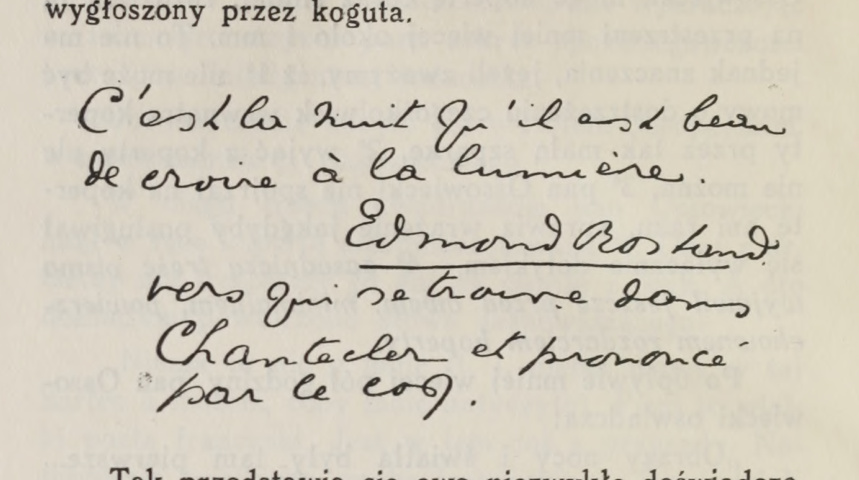
Such was this extraordinary experiment, described minutely in all its details and incomparably precise.29
It is immediately evident that there can be no question here of collective suggestion (collusion) or illusion. No one could have known what the envelope contained except Mrs. de Noailles, who was then in Paris. This sealed envelope of opaque paper, across the back of which I had drawn an ink line, I took from my jacket pocket for the first time in order to hand it to Mr. Ossowiecki. Holding it in his hand, he remained with us throughout, in full light, while Dr. Geley and I never took our eyes off him for a moment. Ungumming the envelope, taking out and reading the sheet, and sealing the envelope again would have required a long, difficult, and complicated manipulation. Even had those present been in league with the medium, they could not have hidden the envelope, substituted another exactly like it (where would they have obtained it?), and then returned the proper envelope to Mr. Ossowiecki after unsealing it, reading its contents, and sealing it again.
All these suppositions are utterly lacking in common sense.
Dr. Geley and I alike are certain that there was no trace of fraud in this case, to the degree of certainty we would require in order to pronounce a death sentence in good conscience.
I pass over a series of other perfectly successful experiments in which Mr. Ossowiecki displayed an undeniable and extraordinary gift of clairvoyance through hidden perception (clairvoyance cryptesthésique, cryptesthetic clairvoyance).
I must add that during the experiments our senses were sharpened, our attention concentrated, and our vigilance heightened. Thus the possibility of hallucination or collective illusion falls away of itself.
Two hypotheses remain: chance, or a special, unexplained form of hypersensitivity, known in present-day scientific terminology as cryptesthesia, hidden perception, and belonging to the field of metapsychic phenomena.
I wish to dismiss the chance hypothesis by a methodical analysis of probability.
The probability that the sentence hidden in the envelope was a fragment of a poetic work: approximately 1/2.
The probability that the writer chose a line by Rostand: 1/100.
That the line was an extract from Chantecler: 1/10.
That the particular line about night and light was chosen: 1/2,000.
That Rostand’s name stood beneath the quotation, and two lines of prose beneath that: 1/100.
That the subject of those two lines of prose was Chantecler and the cock: 1/100.
In all, we obtain a probability expressed by 1/10 raised to the eleventh power, and thus equivalent to an unquestionable moral certainty.
Experiment III. This experiment, no less convincing, also provides numerous and exceedingly valuable explanations concerning the conditions and modes in which cryptesthesia manifests itself.
At my request, sent by telegram, Sara Bernhardt sent me a letter in Warsaw which Mr. Ossowiecki was to read through its sealed envelope. The postman handed it to me personally in the lobby of the Hotel Europejski. Without opening or unsealing it, I told Mr. Ossowiecki that Sara Bernhardt was its author.
He read it with great difficulty, after about two and a half hours.
Concerning the subject of the letter and the circumstances in which it was written, the clairvoyant gave a few details of little distinctive character, not exceeding what a normal person of average powers of observation might have noticed.
The letter as such, however, he described with real precision: “Life… life… life…” (He repeated the word three times.) “Four or five lines… and at the bottom Sara Bernhardt’s signature… a signature sloping upward.” This is true, but it should be borne in mind that Mr. Ossowiecki might have seen a facsimile of the great artist’s signature in some periodical.
“Life seems wretched.” (He repeated the word “wretched” two or three times.) “It speaks of humanity… of life and humanity, but the word ‘humanity’ is not there. There is a thought connected with the thought of life and humanity… For there is a great deal of hatred… No… there is no hatred, there is only… there is only… oh, a very difficult word… so peculiarly French that I cannot pronounce it… It consists of eight letters. Then an exclamation mark.”
Before opening the tightly sealed letter in its absolutely opaque envelope, which I verified by examining it successively in reflected light, direct light, and transmitted light, I recorded, as evidence of authenticity, the words constituting Mr. Ossowiecki’s final conclusion:
“Life seems wretched, for there is only hatred (no… not hatred, but an incomprehensible word consisting of eight letters). Signature: Sara Bernhardt.”
The actual inscription read:
[Translated from the printed Polish rendering:]
“Life seems beautiful to us because we know it is transitory!”
[Translated from the French:]
“Life seems beautiful to us because we know it to be ephemeral!
Sara Bernhardt.”
Let us calculate the probabilities:
The probability of prose rather than poetry: 1/2.
Of a length of four or five lines: 1/2.
Of the signature S. B.: 1/2.
The probability of the word “life,” difficult to calculate precisely: 1/1,000.
The probability of the words “seems”: 1/1,000; but since Mr. Ossowiecki did not read the word “us,” let us take the fraction 1/1,000.
There remains the word “beautiful” (belle), incorrectly read as “wretched.” Yet there is so great a resemblance between the groups of letters “humble” and “belle” in French that this cannot be regarded as an absolute error. The clairvoyant, one might say, read it approximately; it therefore cannot be counted as an error or an inaccuracy. Next comes “because” (parce que). Its probability may be taken as 1/1,000.
Mr. Ossowiecki did not know the word “éphémère,” transitory. He told us this after the sheet had been taken from the envelope. We asked several Poles with a perfectly good knowledge of French whether they understood it. They answered that they did not. Now, the probability of a French word unknown to Mr. Ossowiecki is only 1/100; that of an exclamation mark following it, 1/10; that of the unknown word consisting of eight letters, 1/10.
As a final result, we may take 1/10 to the tenth power for this estimate of probability.
A few zeros more or a few less could in no way change our conclusion. There can be no question of chance here. Common sense convinces us of this more forcefully than this necessarily very imprecise calculation.
Experiment IV was conducted under somewhat different conditions.
Several participants vied with one another in giving Mr. Ossowiecki numbers and words to guess, without observing scientific rigor at all. On the whole, Mr. Ossowiecki performed his task excellently.
Then, at a considerable distance from him, I wrote on a scrap of paper the word “TOI” (“you”), of course in such a way that no one could see and read it. I crumpled the scrap and twisted it into a ball, which Mr. Ossowiecki concealed in the hollow of his hand, resting in mine.
After four minutes he declared: “It is a number.” I remained silent. “Something very short.” I continued to remain silent. “It is a word.” I neither moved nor spoke. The clairvoyant then added: “I see the letter ‘T.’” He even specified further: “There are two little strokes on the crossbar of the T.” This was strictly true, for I had drawn them to make the letter T easier to read. I said: “Very good.” Mr. Ossowiecki then said: “There is a number, zero.” “Very good.” He added: “There is a one.” And he added in a whisper: “It is not MOI (‘I’).” I pretended not to hear. “Give me a sheet of paper… I should like to write it.” He wrote “TOI.”
Only then did I straighten out the much-crumpled slip, twisted into a ball, which Mr. Ossowiecki held in the hollow of his hand.
On the assumption that Ossowiecki might have spoken a word consisting of two, three, four, five, or six letters, we can calculate the probability as 1/5. Considering that he did not know whether it was a letter or a number, it is 1/(25 + 10); and assuming that zero and one can equally well be read as letters or numbers, it decreases to 1/(27 + 6), that is, 1/33, rounded to 1/10 because of the existence of the less frequently occurring letters K, W, and Z. Thus the probability of uttering the letter T is 1/30. For the letter O, the probability is 1/15, since the same graphic sign serves to express both the letter and zero. The probability of one is likewise 1/15. Thus the formula for the overall probability is as follows:
(1/15) × (1/30) × (1/15) = 1/675,000, that is, absolute certainty. To read “TOI” by chance, Mr. Ossowiecki would have had to submit to 675,000 experiments.30
He certainly could not have read this slip in a normal way, or found any clue in my movements and gestures. An absurdity bordering on madness.
It follows that we are dealing with cryptesthesia. There can be no question of telepathy in the foregoing experiment. Mr. Ossowiecki did not guess the word TOI (“you”); he took the O he read for zero and the letter I for one.
A phenomenon of hypersensitivity, but not visual or retinal hypersensitivity. Let us remember that the slip was crumpled and twisted into a ball in a way that excluded any possibility of reading it.
Thus, hypersensitivity of the sense of touch.
Let us briefly examine the experiments described, which are exceedingly instructive.
We dismiss the question of chance as absurd. The overall probability of success in these four cases is 1/10 to the twenty-fifth power. There is nothing to discuss.
There is no question of collusion or illusion. I was by no means under the influence of hallucination or hypnosis. I did not take my eyes off Mr. Ossowiecki or the documents he was to read for a moment.
There remains, therefore, only the possibility of a hyperesthesia fundamentally different from heightened sensitivity of the normal senses, and therefore something essentially different from sensory hyperesthesia. It is a new phenomenon which I have called cryptesthesia, or sensitivity to unknown, hidden stimuli: a true sixth sense, latent.
The four experiments under discussion give us valuable indications for understanding what this sense actually is and how it manifests itself.
- Every possibility of telepathy must be excluded here, that is, the simultaneous vibration of two brains, since the contents of the documents we used for two of the experiments were entirely unknown to us.
If, on the other hand, we defined telepathy as the transmission of cerebral vibrations, in this case those of Mrs. de Noailles and Sara Bernhard, over a distance of two thousand kilometers, we should extend this faculty to incredibly broad limits. Besides, telepathy is as difficult to explain as clairvoyance without a telepathic element. It ought to operate with all letters, except letters from the dead, since there must always be someone on the globe who knows the contents of a given letter, and a telepathic thought whose transmission requires several days. Moreover, in Mr. Ossowiecki’s case, telepathy would concern not the letter’s contents but its graphic form. Nonsense.
- The hypothesis of visual, or retinal, hypersensitivity rests on stronger foundations. Yet I cannot accept this either, considering that throughout his concentration Mr. Ossowiecki crumpled the envelopes in his hands, turned them in every direction, and rubbed them vigorously, as though wishing to form an image of the written letters by touching them with his fingers. The question also arises: how could he have read the word TOI, crumpled and illegible?
Presumably the visual hypersensitivity would here be so extraordinarily intense and acute that it would already fall outside the bounds of normal psychophysiological forms. It would already be a phenomenon in the field of metapsychics.
- Everything we have been able to observe and establish supports the hypothesis that Mr. Ossowiecki becomes aware of the slips he reads through touch. He makes continual efforts, touching, squeezing, and crumpling the envelopes. His divinatory sensitivity manifests itself through his fingers and skin, rather than through sight, hearing, or smell.
We are therefore dealing with a highly intense and as yet incomprehensible CRYPTESTHESIA OF TOUCH.
Let us suppose that writing, as such, contains a distinct element beyond its characteristic outward features accessible to the normal senses. In every line of ‘living’ handwriting there really is something more, something completely unknown, something other than the marks traced on the paper. It may be an emanation, which I have called a pragmatic emanation, acting on our complex of hidden stimuli, on our cryptesthesia, and bringing about perception of the given phenomenon. It would be something like the breath of water hidden deep underground that guides the movements of the water-diviner’s ‘magic’ rod. If we accept this hypothesis, we must acknowledge that in Mr. Ossowiecki’s experiment the envelope could not obstruct the action of emanations of this kind, pragmatic emanations, capable of penetrating not only paper but also lead tubes and the barriers of the thickest walls and masonry. Here too, hypersensitivity, tactile or visual, would be involved, responding not to mechanical or light vibrations but to vibrations from an unknown domain.
In any case, Mr. Ossowiecki is sensitive not to the communication of the thought contained in the inscription, but to the graphic signs expressing that thought. As he reads, he pays attention to the arrangement of the lines and signature, to exclamation marks, and so forth. He read the word “toi” as though it contained a one and a zero. The word “humble” (“wretched”) has nothing in common in meaning with “belle” (“beautiful”); there is only a resemblance in their graphic form. Mr. Ossowiecki did not understand “éphémère” (“transitory”), not knowing it in its French form, but he noticed that it consisted of eight letters. Thus he grasped its graphic form, not its meaning.31
The foregoing explanation, however, has only provisional value.
It does not convince Mr. Ossowiecki. Further experiments will enable us to advance in our understanding of these phenomena.
(Signed) Ch. Richet.
Prof. Geley’s Article in Revue Metapsychique
(Further experiments and the conclusions drawn from them.)
Prof. Richet described the experiments we conducted in Warsaw with our friend Mr. Stefan Ossowiecki as decisive.
And they are indeed decisive in every respect.
In their number, accuracy, and rigor; in the ease and certainty with which they can be controlled, excluding every possibility of illusion or mystification.
Also of great significance is the possibility of repeating them at will. (And they are almost always successful.)
After Prof. Richet’s departure in April 1922, I held a series of further sittings with Mr. Ossowiecki. All were successful.
Unfortunately, my time was limited, and, on the other hand, I did not wish to take excessive advantage of the kindness of my friend, who was overburdened with work and weighed down by many cares. I was therefore unable to carry out all the experiments I had planned.
In the present article I confine myself to describing just one experiment undertaken after Prof. Richet’s departure, since it is the logical continuation of those this scholar reported in the latest issue of Revue Metapsychique.
My teacher handed me one of the sealed letters entrusted to him by Mrs. de Noailles. The sheet was enclosed in a double envelope. The outer envelope tore slightly as the professor took it from his pocket. He therefore advised me to put the intact inner envelope, containing the document to be read, into a new envelope, which was to be gummed shut (sealed).
I followed these instructions precisely. I took the envelope out of my overcoat’s inside pocket for the first time in order to hand it to Mr. Ossowiecki.
We made a first attempt at the experiment in my room at the Hotel Europejski on 4 May 1922 at four in the afternoon. Holding the envelope in his hand, Mr. Ossowiecki began concentrating his thoughts, and after a quarter of an hour said: “Now I see, I know… This evening I shall say what is in this letter.”
He returned the envelope to me intact, and I put it back in my pocket.
At nine that evening we went to a meeting of the Polish Society for Psychical Research, attended by eighty to a hundred people. With Mr. Ossowiecki’s consent, I proposed carrying out the intended experiment before those assembled, prior to the meeting proper. My proposal was enthusiastically accepted. I handed the letter to Mr. Ossowiecki.
He began to speak after only five to seven minutes. He described Mrs. de Noailles’s appearance and home, giving details which I did not verify, then said:
“In this letter she is thinking of a genius of our time, namely Richet. She feels a lively sympathy for him. She declares that Richet’s genius is equal to his great heart. She has signed with her first name and surname and underlined the signature. She wrote this at about five or six in the afternoon.”
I opened the envelope in the presence of those assembled. This is what it contained:
[Translated from the French:]
“Professor Charles Richet is as moving through the sublime qualities of his heart as through his scientific genius.”
[Translated from the printed Polish rendering:]
(“Professor Charles Richet moves us both by the sublime qualities of his heart and by his scientific genius.”)
Signed Anna de Noailles.
Mr. Ossowiecki’s gift of clairvoyance is not limited to learning the contents of inscriptions and documents enclosed in sealed envelopes or opaque cases. Above all, it manifests itself as a ‘psychometric’ faculty far surpassing all the phenomena hitherto known and recorded in the annals of metapsychics.
I was present at several such experiments, whose results filled me with astonishment.
(My experiments in psychometry are still incomplete, so I defer their description until a new series of investigations in this field has been carried out.)
Mr. Ossowiecki has repeatedly managed to find lost or stolen objects. Having entered into contact with a person who had lost something, after a brief period of intense concentration he could indicate where the object was, the circumstances in which it had been lost, and describe the person who had found it or had committed the theft, and so on.
Principal Points That May Help Explain the Phenomenon
To understand the nature of the faculty with which Mr. Ossowiecki is endowed, one must examine every variety of his clairvoyance and take account of every individual fact.
From the investigations we conducted on the basis of three series of experiments, the following conclusions may be drawn:
Positive findings.32
- Mr. Ossowiecki easily reads writing through a sealed envelope in a manner inaccessible to normal sensory perception. The nature and degree of the obstacles placed in the way of this perception have no influence on his clairvoyant ability.
Even lead plates three centimeters thick, or several sheets of opaque paper folded in two, are no barrier here. The nature of the obstacle seems to be of no great significance. The difficulties Mr. Ossowiecki experienced when wishing to read the document enclosed in a lead tube were identical with those that prevented him from immediately reading Mrs. de Noailles’s writing enclosed in an ordinary envelope.
-
Mr. Ossowiecki reads documents prepared in his absence as easily as those written in the room in which he was present at the same time.
-
Whether the people present at the experiment know the contents of the document being read or know nothing about them is of no significance to the clairvoyant.
-
In certain cases, such as those described by Prof. Richet, Mr. Ossowiecki’s clairvoyance
enables him to grasp the graphic form rather than the contents of the documents presented for reading. In other cases, conversely, the clairvoyant attends primarily to the contents, leaving the graphic form in the background: the experiment with the drawing of the fish.
- Mr. Ossowiecki’s gift of clairvoyance manifests itself not only in reading written and concealed documents, but through other objects, psychometry, and sometimes even without the aid of concrete material objects, the ability to find lost objects.
Negative findings.
First, as regards the final elimination of the hypothesis of thought-reading and telepathy, it falls away of itself, as Prof. Richet rightly states in his latest article and as I demonstrated in issue No. 8 of Revue Metapsychique for 1921. Any doubts arising on this point will be removed by rereading the description of the experiments conducted.
Are we dealing here with a phenomenon of perceiving graphic features through an extraordinarily high degree of sensory hypersensitivity, probably of the sense of touch, as Prof. Richet supposes?
Personally, I could raise certain objections to this hypothesis, since it does not adequately explain, for instance, the experiment with the lead tube, psychometric phenomena, and so forth. It explains some experiments, but not all. Its explanation is therefore incomplete.
I prefer humbly to admit that at present the mechanism of clairvoyance has not yet been explained.
We nevertheless wished to learn Mr. Ossowiecki’s own opinion. At our request he sent us the following exceedingly interesting and valuable documents of self-observation:
“I shall try to answer your question: What impressions do I experience while reading writing through a sealed envelope?
“In my opinion, Prof. Richet’s supposition does not explain the matter adequately. It is possible that at such moments I am unconsciously under the influence of a kind of hypersensitivity, but I am convinced that something else is also involved. These are the phenomena that then take place within my ‘self’:
“From the very first moment I cease reasoning and concentrate my entire psychic effort as intensely as possible on spiritual sensations. I owe my ability to bring myself into this state to an unshakable faith in the Unity of the Spirit among humanity. I then enter a distinct state of spirit, and I see everything and hear beyond space and time.
“As you know, I have repeatedly succeeded in finding lost objects through clairvoyance. Such a case occurred two weeks ago; I shall send you an account of it separately.
“When reading writing through sealed envelopes, finding lost objects, or producing ‘psychometric’ phenomena, I always experience more or less the same feelings.
“Naturally, I lose a certain amount of inner energy in the process. My temperature is then elevated and my heart beats irregularly. These phenomena confirm the supposition that as soon as I cease reasoning, something like electric currents arise and run through my limbs for a time.
“This lasts a while, after which genuine clairvoyance takes hold of me, and images form, most often visions of the past. I see the person who composed the document in question and know what that person wrote. I see the object in question at the moment it is lost, and every detail accompanying the event. Or, holding an object in my hand, I sense its history. The vision is misty, and an extremely concentrated effort is needed to perceive certain moments and scenes in all their detail.
“Sometimes a few minutes suffice to bring about the clairvoyant state; at other times I must wait long hours for it. This depends to a great extent on the surroundings, for disbelief, skepticism, and even attention concentrated too intensely on me make it difficult or even impossible for me to read the document or for the sensation to appear. During the sitting held in your presence at the Metapsychic
Institute in Warsaw, I undoubtedly owed the ease and speed with which I read the two documents presented to me to the favorable atmosphere and the friendly disposition of those around me.
“These, dear Doctor, are the results of my analysis of experiments on myself. You have noticed that I sometimes make mistakes. I am far from perfection, which I nevertheless hope to attain, one day… Please believe that my words rest on mature reasoning, on the combined work of mind and heart.
“May my words therefore make your work easier, work that opens a bright path into the future. Please accept the expression of my warmest friendship.”
(Signed) Stefan Ossowiecki.
These documents of self-observation are exceedingly valuable here. They confirm our conviction that the gift of clairvoyance is something absolutely independent of sensory faculties and impossible to grasp by any of the methods of reasoning known to us.
Like other metaphysical faculties, clairvoyance has nothing in common with the physiological processes of thought and conscious intelligence.
It arises outside and above the world of organic phenomena, independently of the functioning of cerebral neurons.
On the other hand, owing to the astonishing power it contains, which, as Mr.
Ossowiecki rightly states, frees it from the bounds of space and time, clairvoyance appears to us as something bordering on divinity, a sensation, a mark of the divine element dwelling in every living being.
We anticipate the objection that this divine faculty, if we may speak of divinity, is of no practical use, since, apart from very rare exceptions, it escapes our conscious will; and that it ought, moreover, to manifest itself in a higher, more transcendental form than through reading writing in sealed envelopes or finding lost objects.
To this we answer:
- The fact that, at the present stage of evolution, clairvoyance manifests itself almost exclusively in the depths of the superconscious, and sporadically, is of no significance to us.
It is not the practical side of clairvoyance we wish to discuss here, but its philosophical significance, which is of primary importance. Like all metapsychic faculties, clairvoyance gives a new answer to the eternal question, “What is a living being?”, an answer that defies the conception classical psychophysiology has formed in us. For it proves that a living individual is something other than, and something more than, an organism alone.
Although clairvoyance manifests itself subconsciously at the present stage of development, we nevertheless have grounds for supposing that it embraces the domain of consciousness in later phases of development.
- Clairvoyance, which in the normal conditions of life manifests itself only in a few exceptional individuals endowed with this faculty, probably exists potentially in the psyche of all living beings.
Great discoveries, inventions, and important ideas are undoubtedly consequences of manifestations of clairvoyant intuition. Reasoning and experience play here only the role of factors that utilize, verify, and control, and in some cases stimulate, the process of clairvoyance.
Moreover, clairvoyance is not the exclusive privilege of man. Who knows whether it does not manifest itself still more strongly in the instincts of animals, even those at the lowest stage of development, such as insects?
It probably belongs among the creative elements in the genesis of the major animal groups and their principal instincts.
At the origin of these groups and instincts, a primal, active moment of clairvoyance seems to manifest itself.
I shall not dwell longer on these assertions, which I tried to prove in my work De l’Inconscient au conscient [French title, translated: From the Unconscious to the Conscious] (printed Polish rendering, translated: From the Unknown to the Conscious). If they are correct, clairvoyance ceases to be merely an interesting metaphysical occurrence, and appears to us instead as one of the most important factors in humanity’s development and progress, one of the fundamental forces moving it along its path toward ever higher stages of evolution.
Professor Richet’s Reply
In discussing the hypothesis of tactile hypersensitivity, challenged by Dr. Geley and by the engineer Mr. Ossowiecki himself, I was far from convinced of its correctness. I regarded it not as the most appropriate, but simply as the least inappropriate among many. I agree entirely with Dr. Geley and Mr. Ossowiecki that this working hypothesis does not cast sufficient light on the phenomenon. To investigate the latter, however, we must apply a comparative method, setting normal sensitivity beside that special sensitivity by virtue of which Mr. Ossowiecki can read graphic signs, and sometimes even the contents of writing, through a sealed envelope.
Every stimulation of our mental faculties that leads to knowledge of reality seems to result from the action of a vibratory force coming from outside. There is no effect without a cause. If external stimuli did not exist, our sensitivity would remain hidden and latent; this is a fact beyond doubt.
Equally undeniable, in my opinion, is the fact that THERE EXIST VIBRATIONS COMING FROM OUTSIDE, UNKNOWN TO US, WHICH ACT UPON OUR MENTAL FACULTIES. How do they reach these faculties? That is precisely the question difficult to resolve in the present embryonic state of metapsychic knowledge.
For the moment I pass over the possible existence of a new form of sensitivity, with organs for receiving external stimuli and reacting to their influence that are entirely unknown to us, in order to connect this manifestation of extraordinarily magnified sensitivity with phenomena produced in our animal organism.
Classical psychophysiology, which we must after all take into account, teaches that we perceive the external world through the action of five organs: the optic nerve for sight, the auditory nerve for hearing, the olfactory nerve for smell, the gustatory nerves for taste, and finally the peripheral nerves of the skin and even the internal organs for the sense of touch. Instead, therefore, of arbitrarily forming a conception of unknown, problematic forms of sensitivity, we should consider whether normal consciousness can supply at least partial explanations.
It is easy to establish that when at work Mr. Ossowiecki does not perceive the documents given him to decipher through sight, hearing, smell, or taste. He pays more attention to the graphic signs than to the contents of the writing he reads;
more precisely, he perceives each of these components in part.
How? He does not listen, sniff, or look; he simply crumples and squeezes the object of the experiment feverishly in his hand.
Everything happens as though his conception of the envelope’s contents were formed by a specific tactile sensitivity. This may be only an appearance, but in any case it is one that cannot be denied.
First of all, however, we must agree on the meaning of the term ‘tactile sensitivity.’ That established in Mr. Ossowiecki differs so greatly from normal tactile sensitivity that we must unhesitatingly class it among NEW phenomena.
Compared with normal tactile sensitivity, it has increased in a ratio no longer of one to a hundred, but of one to a hundred thousand, if not more.
I repeat that I put forward this hypothesis of magnified tactile hypersensitivity for want of another, more suitable one. Yet I base it not only on Mr. Ossowiecki’s movements but also on his words (Revue Metapsychique, 1922, p. 251). Wishing, for instance, to find a lost brooch, he declares: “I should like to have at hand some material object connected with the brooch.” And he touched with his fingers the place on the dress where the brooch had been fastened. Dr. Geley’s experiment, consisting of enclosing a written slip in a lead tube, which Mr. Ossowiecki nevertheless managed to read, can be perfectly reconciled with the hypersensitivity hypothesis. For if the clairvoyant senses written signs through a sealed envelope with the aid of a refined sense of touch, we have no reason to suppose that this hypersensitivity would have to fail if, for example, a metal envelope were substituted for a paper one.
Dr. Geley asserts, somewhat too boldly, that “this faculty has nothing in common with the functioning of cerebral neurons.” I cannot agree. I find it difficult to see a divine faculty here; indeed, the term ‘divine’ is wholly incomprehensible to me. I prefer instead to accept the existence of a specific faculty of the nervous system. It matters little that I do not know its modes of manifestation.
It is enough for me to establish that, AS IT SEEMS, it reaches the clairvoyant’s consciousness through the sense of touch. Reasoning in this way, and without advancing the hypothesis of a new psychic function, I prefer to content myself with attributing to functions that undoubtedly exist and are known a capacity for multiplication within the widest possible limits.
It is still too early to construct theories. We must confine ourselves to the facts, whose astonishing extraordinariness will fully compensate us for voluntarily renouncing the desire to draw uncertain theoretical generalizations from them.
Signature: (Signed) Charles Richet.
Charles Richet: The Sixth Sense
[Title translated from the French: Le Sixième Sens.]
Page 17.
We live within a sphere of infinitely numerous vibrations. Yet only some of them act upon our normal senses, giving us no more than a general, roughly sketched conception of the external world.
THROUGH A SMALL AND NARROW WINDOW WE LOOK UPON THE IMMENSITY OF THE UNIVERSE.
We can speak only of known vibrations, those which human genius has already succeeded in penetrating. Yet they constitute barely a many-millionth part of the vibrations whose existence has not yet reached our consciousness.
One thing may be established beyond doubt. Around us there exist vibratory forces, infinitely great and infinitely small, of which our consciousness is ignorant solely for lack of suitable organs to convey and perceive them.
Of course this does not irrefutably prove the existence of a sixth sense. On the other hand, it gives unshakable certainty that THE EXISTENCE OF A SIXTH SENSE IS POSSIBLE.
Page 231. The hypothesis of visual or tactile hypersensitivity does not suffice to explain Mr. Ossowiecki’s ability to read writing through a sealed envelope. For instance, it does not shed the slightest light on the motives that may have prompted the clairvoyant, after reading the sentence I had written about the sea, to ask me: “Is this your own thought?”
Page 69. After conducting a series of experiments with Mr. Ossowiecki, I came to the conclusion that he can be placed in the category of the great classical sensitives, such as Mrs. Piper, Mrs. Briffaut, Mrs. Léonard, Vandam, Rees, Kahn, and Pascal Fortuny.
Page 160. All doubts as to the existence of a sixth sense are removed by the results of a series of experiments conducted with Mr. Ossowiecki.
Mr. Ossowiecki is not a professional medium. He is a Pole of noble birth, an engineer. He submits to experiments without remuneration.
The observations I give below are as convincing as the others and fully confirm them.
I first met Mr. Ossowiecki in Warsaw in April 1921, at dinner in a small circle of close friends. At the end of dinner he gave my friends Dr. Geley and Geo Lange clear proofs of his gift of clairvoyance. I invited him to the Hotel Europejski to conduct experiments with him without witnesses. He readily agreed. Taking every precaution to prevent him from reading my writing, I wrote on a small sheet of paper, which I immediately slipped into a sealed envelope, the sentence:
[Translated from the French:]
“The sea never seems greater than when it is calm. Its fits of anger make it smaller.”
[Translated from the printed Polish rendering:]
(“The sea never seems so great as when it is calm. Its rages diminish it.”)
Crumpling the envelope in his hand, Mr. Ossowiecki said: “I see a great deal of water.” (I replied: “Excellent.”) “It is something difficult; it is not a question, some thought of your own.” (Excellent, splendid.) “The sea is never so great as… I cannot piece it together…” (Excellent, astonishing.) “The sea is so great that beside its movements…”
This experiment succeeded precisely, not only because Mr. Ossowiecki sensed the thought about the greatness of the sea that I had set down, but also because he added those astonishing words: “It is some thought of your own.” In fact, the sentence about the sea which I handed to Mr. Ossowiecki in a sealed envelope had previously been written by me in a work not yet published, a little collection of thoughts jotted down at random.
Furthermore, Mr. Ossowiecki read without error, likewise through a sealed envelope, a four-digit number I had written. (The probability of chance: 1 in 10,000.)
I had received and read two letters. Without choosing, I wished to give one of them to Mr. Ossowiecki to decipher through the envelope. He felt tired, however, and preferred to postpone the experiment until the next day. Since I was leaving the following day,
Dr. Geley conducted it on 1 May. Neither he nor Mr. Ossowiecki knew the contents of the writing. Mr. Ossowiecki said without hesitation: “Mrs. Berger; it speaks of a certain Mrs. Berger. This letter was written by a man aged fifty. An invitation from a seaside place. Mrs. Berger is thirty-three and married. The letter was written hurriedly, in a disorderly way. Its author is a musical man.”
This was indeed so. My friend Mr. Berger of Berlin had sent me a hastily and disorderly written invitation to give a series of lectures in Berlin, and offered me hospitality with his wife.
Of course, Mr. Ossowiecki’s interpretation was not free from errors. Berlin is not on the sea. The clairvoyant did not mention the lectures. Yet what he said about Mrs. Berger, together with the fact that he deciphered the name Berger at all, suffices to remove every possibility of a chance coincidence.
Finding himself alone with Mr. Ossowiecki, Dr. Geley wrote a few words and slipped the sheet into an envelope of very thick paper. This is what the clairvoyant said as he crumpled it in his hand:
“It is not a question… It is like a feeling of prayer. Something very profound, the cry of the wounded, of the slain. No… not that… Nothing arouses so much emotion as the call to prayer… To whom? To a certain caste of people… Mazzi…”
And the sentence written by Dr. Geley read:
[Translated from the French:] “Nothing is more moving than the call to prayer by the muezzins.”
Page 247. The external world produces vibrations around us. Some are accessible to our sensory perception; others can be detected only with instruments precisely constructed for the purpose; still others, the subtlest, act only upon the psyche of certain individuals, revealing to them fragments of hidden reality.
There undoubtedly exist still others, inaccessible either to our sensory perception, to registration by the most sensitive known instruments, or to the sixth sense of hypersensitive individuals.
The mechanical world known to us, consisting of atoms, electrons, stars, planets, animals, microbes, chemical reactions, heat, and electricity, may constitute no more than a minute part of existing reality. We are undoubtedly surrounded by other, distinct forces and powers. Who knows whether these immaterial worlds do not direct our destinies?
We shall never know these forces, neither we nor succeeding generations. Yet we must not deny that they may exist.
Page 243. The sixth sense, that “narrow window open upon the immensity of the universe,” is far more complex than we might suppose from appearances. The phenomena through which it manifests itself strike us, indeed frighten us, by their variety. It is enough to cite three among many and draw attention to their absolute distinctness. Mrs. Wheatcroft and her son simultaneously perceive an apparition moving across the room; Mrs. Piper divines that forty years earlier her uncle had been in danger of drowning; Mr. Ossowiecki reads lines by Rostand, enclosed in a sealed envelope, which no one present knew had been written down.
Page 247. In experiments with Mr. Ossowiecki, one is struck by a curious mixture of the ability to read writing visually and the ability to experience and express a general impression. While undoubtedly reading the given writing, Mr. Ossowiecki simultaneously forms a conception of its contents. For instance, holding Mrs. de Noailles’s writing in his hand, he gives this conception his first attention: “A great French poet, something of nature,” which does not in the least prevent him from seeing the arrangement of the letters. On the other hand, he does not understand the contents of Sara Bernhardt’s writing. He sees the written sentence, sees the word éphémère, transitory, and cannot understand it, yet knows that it consists of eight letters. He even notices the presence of an exclamation mark.
Page 229. The functioning of the sixth sense does not require the aid of a material, tangible object, visible and seen. Such an object may, especially for hypersensitive individuals, become a factor facilitating clairvoyance, but it is not an indispensable condition.
Page 217. As strong as it is intense, Mr. Ossowiecki’s cryptesthesia possesses the extraordinary characteristic of being amenable to experiment, found only in individuals endowed with hypersensitivity of a higher order, Mrs. Piper and Forthuny, as well as the characteristic of mathematical precision.
Dr. Wilhelm NEUMAN (Baden-Baden).
The Gift of Clairvoyance and the Clairvoyant Stefan Ossowiecki
[Translated from the German title: “On Clairvoyance and the Clairvoyant Stefan Ossowiecki.”]
The first experiment I conducted with Mr. Ossowiecki took place as follows:
About eight people were present. Mr. Ossowiecki asked me to write a few words on a small sheet of paper. I went alone into the next room, without witnesses. I took a visiting card from my pocket. I considered for a moment. The thought came to me of a few courteous words addressed to the clairvoyant. I had noticed his extraordinary kindness and wished to write something about it, but wanted to avoid repeating the conventional phrases which, I was sure, he had often heard already.
I therefore simply drew a heart like that on a playing card, the ace of hearts, and put the card into an envelope, which I gummed shut and slipped into a second envelope. I sealed this one too and sewed the whole thing together with thread. There could be no question of opening it unnoticed. The paper of both envelopes was completely opaque.
I handed the envelope to the clairvoyant. He did not look at it at all. He held it for some time at his side, then behind his back. Everyone present watched him closely. The room was brightly lit. After five minutes he said:
“You wrote this with a kindly thought of me.” There followed a brief silence: “Have you a pencil?” And on the outer envelope he rapidly drew the ace of hearts.
I regard this experiment and the three that followed, see the account in Dr. Geley’s work,33 as typical. In each of these four experiments, four distinct kinds of clairvoyance seem to manifest themselves, which will probably in time make it possible to analyze this extraordinarily complicated psychic faculty. Even today we must avoid advancing excessively bold hypotheses. Yet the desire to explain unknown phenomena is always part of human nature. I therefore wish at least to summarize my own view of the matter, formed on the basis of the experiments mentioned. I note first of all that I do not suppose there is a fundamental difference between telepathy and clairvoyance. In my opinion, telepathy is one form of clairvoyance as a general phenomenon, directly a relation of communication between two distinct consciousnesses. Clairvoyance, on the other hand, embraces and contains the relations of a ‘clairvoyant consciousness’ to every circumstance, manifestation, and object, conscious or unconscious, near or distant, present or past. We repeatedly encounter the unfounded view that telepathy may be compared to wireless telegraphy or Röntgen rays. This would need to be proved,
however, and no one has managed to do so. On the other hand, it cannot now be categorically asserted that clairvoyance, like the complex of metapsychic phenomena of which it forms a part, has no point of contact with physical phenomena, especially insofar as questions of time, space, and the manifestation of matter as force are involved.
In any case, the theory of ‘involuntary signs,’ so often cited in interpretations of the gift of ‘thought-reading,’ must be discarded. It has nothing in common with clairvoyance. This ‘thought-reading’ in the strict sense consists in skillfully picking up involuntary whispers, movements of the eyes and eyelids, changes in bodily position, breathing, and so forth. The experiments with Mr. Ossowiecki I have mentioned, perhaps with the exception of the first, clearly prove that an entirely distinct factor is involved. Even that experiment with the ace of hearts does so in a way that almost eliminates the possibility of an auxiliary element of unconscious gestures, reflexes, and so on.
The experiments conducted in Warsaw greatly undermined my skepticism. They proved that clairvoyance undeniably exists and that for us physicians it ought to become the subject of precise research, as a key to resolving many an intricate problem in psychology, psychiatry, biology, and physiology.
Between Mr. Ossowiecki and other known clairvoyants I noticed a difference consisting in the extraordinary precision he shows in responding to hidden stimuli and expressing himself. When he cannot achieve the desired result, he says so openly and does not seek ‘rescue’ in vague conjectures and suppositions. He reproduces drawings and writes words read clairvoyantly in a manner that leaves not the slightest doubt. And he does so with astonishing accuracy. Here is an example. I had unintentionally drawn the ace of hearts mentioned above asymmetrically: the left half was slightly larger and had an angular outline, while the right was smaller and rounded. Even these small details were taken into account in Mr. Ossowiecki’s graphic reproduction. One might suppose chance to be involved if this precision were not a constantly recurring phenomenon. For Mr. Ossowiecki likewise reproduced the almost imperceptible peculiarities of the drawing of the bottle, its slight tilt to the right and lack of a cork, and of other drawings.
IV.
William MACKENZIE and Wilhelm NEUMANN.
Second International Metapsychic Congress in Warsaw
28 July–5 September 1923.
Among the most interesting and extraordinary moments were the experiments conducted with Mr. Stefan Ossowiecki under the strictest conditions of control, allowing no room for doubt.
Mr. Ossowiecki, a magnate, a gentleman in the full sense of the word, a man of great heart and a great clairvoyant, endowed with a positively captivating faculty for penetrating realms inaccessible to others, seems to read thoughts and objects alike with extraordinary power, speed, and certainty.
One evening, on coming to an establishment with me and several other people, he ‘read in my eyes’ and gave a detailed description, lasting about ten minutes, of a member of my family, my house, and its surroundings. He had never been to my home and had never seen that person. This is an example of ‘thought-reading.’ As an example of ‘seeing hidden things,’ I give the following highly characteristic fact:
I carefully prepared twelve identical sheets of paper and slipped them into twelve identical opaque envelopes. On each sheet I wrote the name of one of my correspondents, whom I asked to return the document to me in the same envelope after using it for the experiment. The inscriptions were to be written by people unknown to me. I shuffled these twelve envelopes several times in such a way as to make it impossible to recognize whom each came from. For lack of time, unfortunately, I could not conduct this experiment myself in Warsaw. I hope to complete it in the spring, in Italy. But the worthy engineer Ossowiecki nevertheless wished to give me at least a foretaste of it, as he put it. One evening, in the presence of several people, he suddenly said to me: “Take out that packet of envelopes you keep carrying with you.” I did so, and Ossowiecki began to touch all the envelopes in turn, and finally handed one back to me that had no special significance for me, saying: “This comes from a woman; it concerns someone else among us. It certainly comes from a woman.” When opened, it proved to be Dr Neumann’s envelope, containing a sentence written at his request by a lady I did not know. I should note that of all my correspondents, Dr Neumann alone, that “someone else among us,” was then in Warsaw. Ossowiecki described Dr Neumann’s acquaintance, and the place and circumstances in which the document for the experiment had been written, with the greatest exactness.
The scholar William Mackenzie was elected president of the International Metapsychic Congress in Warsaw. Of his writings in the field of metapsychics, the best known is Metapsychica moderna, fenomeni medianici e problemi del subconsciente [Modern Metapsychics: Mediumistic Phenomena and Problems of the Subconscious].
V
I am bringing my modest work to a close.
I place in the Readers’ hands all the material I have collected from my experiments. I have opened before you the interior of the temple of my spirit, which is a fragment of the great power constituted by the Spirit of the Universe. As best I could, I have shown you that all the paths of masters, geniuses, leaders of a higher order, providential people, and those who through mastery of their Spirit have attained clairvoyance lead humanity onto the great road towards the One Spirit.
The consciousness of the One Spirit is unlimited. His Supreme Will governs, in the strictest sense of the word.
Through masters, people of genius, providential people, and conscious clairvoyants, this Will casts into humanity’s consciousness, through superconsciousness, higher intuition, the idea, the thought, of the universal reconciliation of all nations. This higher idea is already ripening in humanity’s subconsciousness, but this will continue for many thousands of years yet.
The One Spirit will, however, finally prevail and absorb into Himself the soul of all humanity.
Human forms will mingle with the earth, the movement of the whole planetary system will stop, and the sun’s energy will absorb every other energy. The most terrible things will occur: the earth, the moon, and all the planets will lose their equilibrium. This may happen at any moment, and we must always be prepared for it. But it will not yet be the end of spiritual life. Here in the Spirit our life will continue for a long time; once more we shall free ourselves from the astral world, and then, then a whole succession of further liberations awaits us, until the kingdom of the One Spirit opens before us.
Only then will the individualism of our “I,” of our consciousness, disappear for ever, and the principle of divinity that is in each of us will unite ever more closely with the One Spirit. So long as we retain in our consciousness the sense of time and space, which is precisely the foundation of mathematics, whose forms embrace all the phenomena of everyday life and all nature, so long shall we remain merely ordinary human beings.
Time and space should be regarded only as purely subjective forms of perception. This sense will slowly begin to be subdued in our consciousness through aviation, radio, cinema, and so forth. The psyche will change profoundly. The sense of the universe, that world of the spirit to which every person has access in consciousness according to his spiritual development, is already beyond the bounds of time and space: the more I encompass the universe in my consciousness, the more powerfully it effaces the sense of time and space. The conscious clairvoyant, subduing his consciousness through superconsciousness, has overcome the sense of time and space. Having overcome them, he sees everything. Human reason strives towards perfection, and absolute perfection exists only in the One Spirit.
I awaken you all from spiritual torpor, everyone without distinction of class, origin, religion, or nationality. The burden of life, materialism, the terrible and ever-worsening struggle for existence, this form in which we live and which chokes us, this garment of pessimism that oppresses us all ever more severely: all this we must overcome in the Name of the Spirit.
We must come to our senses! Let us rise! More power of resistance! We must not give in! More faith in our own strength and the power of the Spirit, more hope for a better future, and above all more of Christ’s love, the one true force that raises the world! Spread it everywhere, in every place. Make the supreme effort of will, and then before your eyes will arise another world, marvellous, greater, and far more interesting, which we do not see today because it is temporarily closed and inaccessible to us, but which is the true substance of our existence.
We must remember that our life will pass like a single moment. Before we have time to look around, the world beyond is already drawing us towards itself.
At every moment of his life a person ought to be prepared to depart from this vale. Our destiny is entirely different, far more exalted, while here we waste time; we have not enough of it to prepare ourselves worthily for that solemn moment.
We do this only when the clock of death is already striking.
The meaning of our life is death; our whole earthly existence is filled with death. From the moment of birth a person already slowly begins to die. For our resurrection we must pass through death. The Cross is the symbol of death; it is also the symbol of resurrection.
Since this life is only a halt and a preparation for further travel and better prospects of life, we ought, as good travellers, to keep this goal in view and devote our strength chiefly to it.
The meaning of the whole philosophy of life will thus resolve itself into a very simple matter: subordinating temporal life to the prospects of the life to come, and subordinating man’s automatic principle, his reason and will, to the principle of the universal Spirit and the guiding Spirit, God. This is expressed completely in the daily injunction of the Lord’s Prayer: THY WILL BE DONE.
I must stress clearly that my fundamental conception of the world’s One Spirit is not synonymous with the deification of nature. The One Spirit is a manifestation of the activity of one of the three Persons of God, One in the Holy Trinity. It is the activity of the Spirit transforming all nature with His Divine breath. At the same time the Son of God and God the Father act ceaselessly upon the whole universe.
Nature is not God, although it belongs to God, just as the human body is not the human being, although it belongs to him. The deification of nature, the identification of purified and completely harmonized material substance with the Deity, will constitute the gravest error of the coming age.
Humanity, possessed by delusions of grandeur because of its sporadic triumphs over nature through powerful technical inventions, will increasingly identify the physical energy of the universe with the essence of God and the One Spirit. This will be an error that may lead modern humanity to catastrophe. The equilibrium of collective life in the so-called civilized world will be upset: on one side the supposed power of increasingly triumphant technology, on the other the lack of inward happiness, of will, and of strong characters. This disharmony in the average type of modern person will upset the balance of our civilization. It may bring about a period of chaos unprecedented in history. People, dazzled by the power of technology, will stand terrified before the growing emptiness of their own hearts.
Only the elevation of the values of humanity’s spiritual life can build a bridge between the world’s disintegrating economy and politics and the age-old yearning of today’s hearts, longing yet enclosed in egoism.
Finally, I note that every person may become convinced of the consciousness of the One Spirit not only through meditative inquiry but through the inward evolution of his own spirit. Every effort towards goodness, every selfless thought, every true beauty manifested by our will brings us closer to that One Spirit and gives us an ever greater measure of solace.
My task is to cast forth a handful of thoughts that may stimulate a healthy view of the world. And I call healthy that consciousness which sees a reason for existence and strengthens the conviction that it is worth living, suffering, falling, and rising, because this road leads to the overcoming of chaos.
I wish to strengthen in every Reader the power of the will in the struggle with evil. I have suffered much and reflected much myself; therefore everyone who seeks liberation is close to me.
VI
I am convinced that objections will pour forth as this book is read; it is always so. But I shall explain my thought and intention to you, Readers.
I did not seek to create a new philosophical system, for the world has enough of them. Nor did I have in mind the spreading of propaganda flattering this or that social group. In the flights of a free Spirit, spreading the wings of a person freed, at least in moments of inspiration, from the bonds that fetter him, I wished to reach into the very depths of universal human longing. I wanted to raise the pitch of the weary will of today’s world. I wish to kindle even a modest lamp to light the road for all people of goodwill.
Let the philosopher, the systematizer, and the scholar therefore have no grievance against me. In reading this book, let him cast off, if only for a moment, the ballast of a ready-made doctrine.
People of our time walk amid universal chaos, burdened by so much accumulated foolishness and suggestion that day by day this common ballast is felt ever more heavily as the curse of man’s selfish nature.
Those who wish to refresh the oppressive modern atmosphere can do so only through a spontaneous outpouring of feeling and thought from the depths of a moved heart. I too wish to belong among those people striving to refresh the mood of humanity today, battered and crushed by the struggle for existence: a modest man and a servant of all who seek reconciliation and common ground for human hearts and minds.
The book I have written therefore makes no claim to be regarded as a systematically formulated doctrine. The first, theoretical part can constitute only a point of departure for further systematization of the problem of clairvoyance.
The second, experimental part may, in our age of laboratory precision, provide material from which general conclusions can be drawn.
That I leave to the specialists, philosophers and psychologists.
I WISH TO GIVE INSPIRATION DRAWN FROM THE DEPTHS OF MY SPIRIT. I ENTER THE CIRCLE OF THE WORLD’S EXPERIENCES LIKE A SENSITIVE PHOTOGRAPHIC PLATE, CAPTURING IN MOMENTS OF GREAT ILLUMINATION THAT WHICH REIGNS BEYOND TIME AND SPACE.
And I ask you, Readers, as you read the thoughts contained in this book, to be willing, if only for a moment but every day, to look upon all people without exception as your brothers, bound by the same bond of birth and death as yourselves.
Then embrace in your imagination those millions upon millions of hearts trembling with pain, full of the human sufferings common to us all.
The longing to master space and time, from the simplest, most primitive minds to the most refined, is also common to us all. Let this suffering and this universal human longing be the driving force in the development of your spirit.
PRESERVE YOUR INDIVIDUAL NATIONAL AFFECTIONS, BUT AT THE SAME TIME LISTEN TO THE EVER LOUDER NOTE OF THE ASPIRATIONS OF ALL HUMANITY.
Errata
On page 16, line 10 from the top: printed “Zohr”; should read “Zohar.”
On page 35, line 3 from the bottom: printed “Then there will come the victory of time and space”; should read “Then there will come victory over time and space.”
On page 74, line 8 from the bottom: printed “creator of the theory of atoms”; should read “creator of the periodic system of the elements.”
Contents of the Chapters
Part I
I. Introduction. A glance at the origin of the Earth and Man. Four phases of humanity’s development. — 5
II. Founders and great initiates of Religion: Orpheus, Krishna, Buddha, Moses, Muhammad. Their common Idea acknowledging the One God. Christ, God and Man. The evolution of the human Spirit. — 13
III. Geniuses. The idea of the unity of the Universe. The foundation of clairvoyance and telepathy. — 27
IV. Man’s psychic apparatus. Subconsciousness, consciousness, and superconsciousness. — 36
V. The Great One Spirit. The role of East and West in the history of humanity. The triumph of Good over Evil. — 46
VI. The victory of the Spirit over time and space. — 56
VII. Matter and Aura. — 60
VIII. A few words on the nature of Metapsychics. — 66
IX. The contemporary occult movement. — 71
Part II
I. Autobiography. Amulets and their significance. Psychons. — 74
II. Experiments in clairvoyance attested by records. — 92
III. The views of the scientific world upon my experiments. Professor Charles Richet, Professor Gustave Geley, Professor Osty, and others. — 260
IV. Statements and experiments of Professors Mackenzie and W. Neumann. — 357
V. My view of the end of the world. — 359
VI. To the Readers. — 364
Plate I
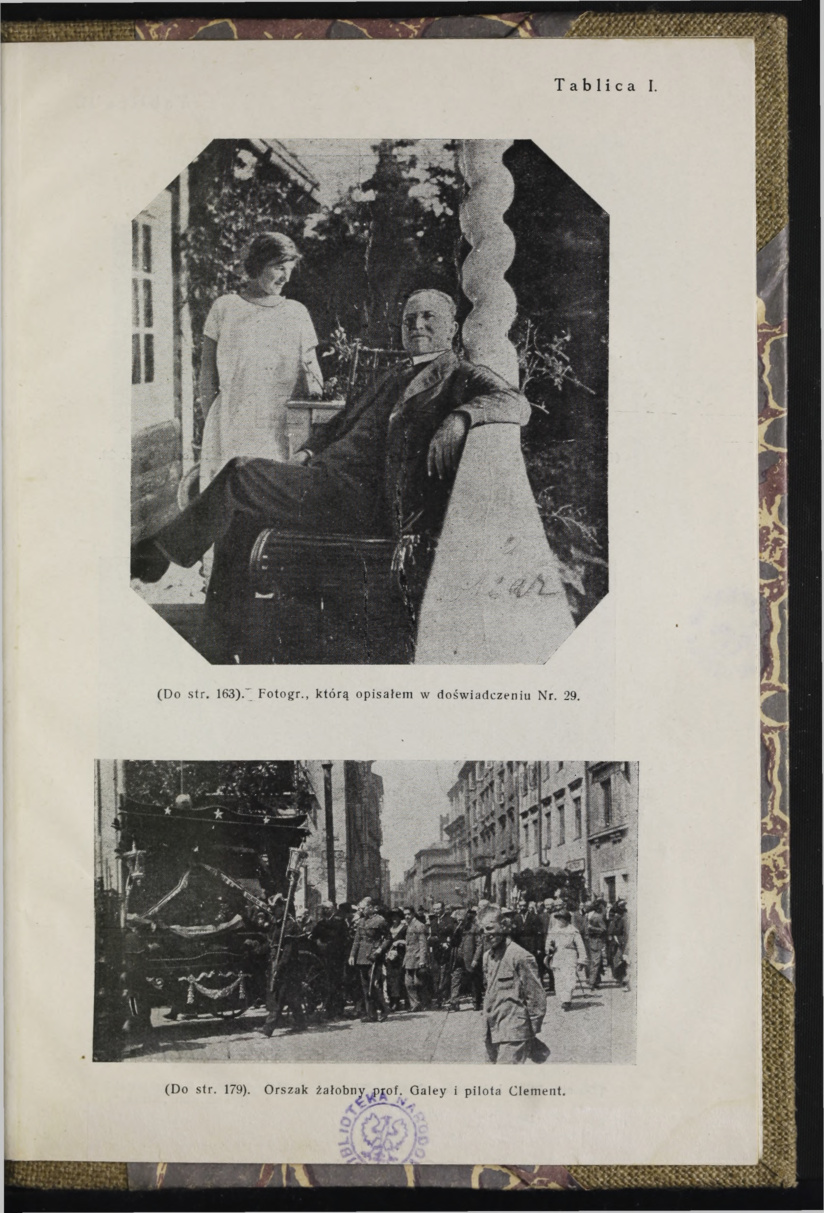
Top: (For page 163.) Photograph that I described in Experiment No. 29.
Bottom: (For page 179.) Funeral procession of Professor Geley and the pilot Clement.34
Plate II
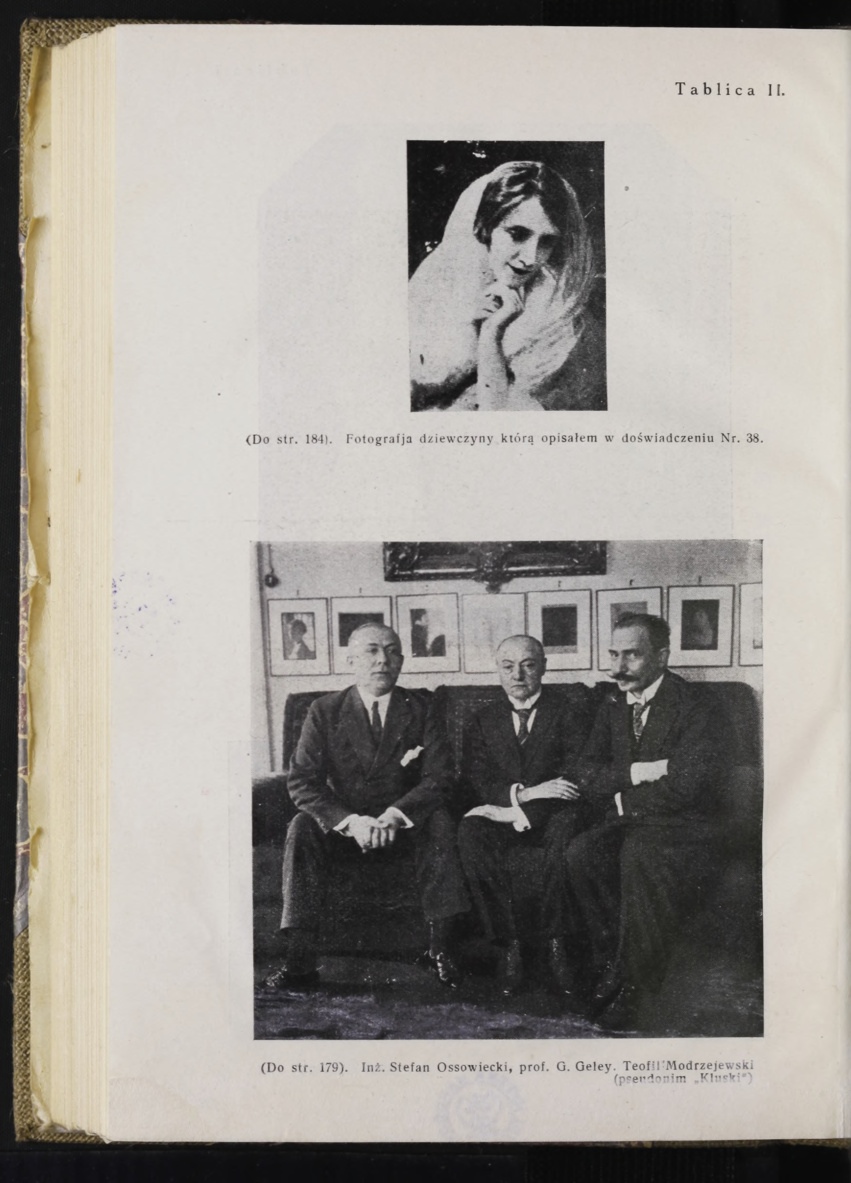
Top: (For page 184.) Photograph of the girl I described in Experiment No. 38.
Bottom: (For page 179.) Engineer Stefan Ossowiecki, Professor G. Geley, Teofil Modrzejewski (pseudonym “Kluski”).
Plate III
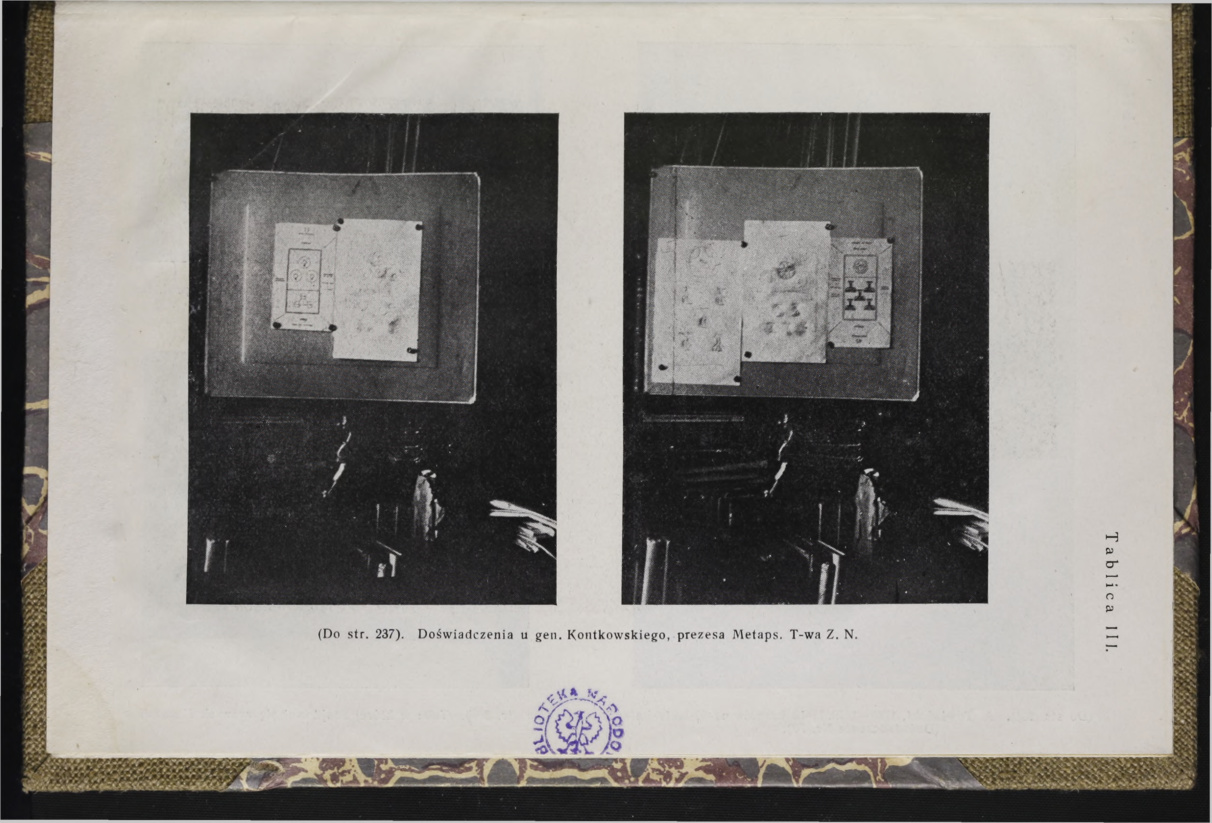
(For page 237.) Experiments at General Kontkowski’s, president of the Metapsychic Society Z. N.
Plate IV
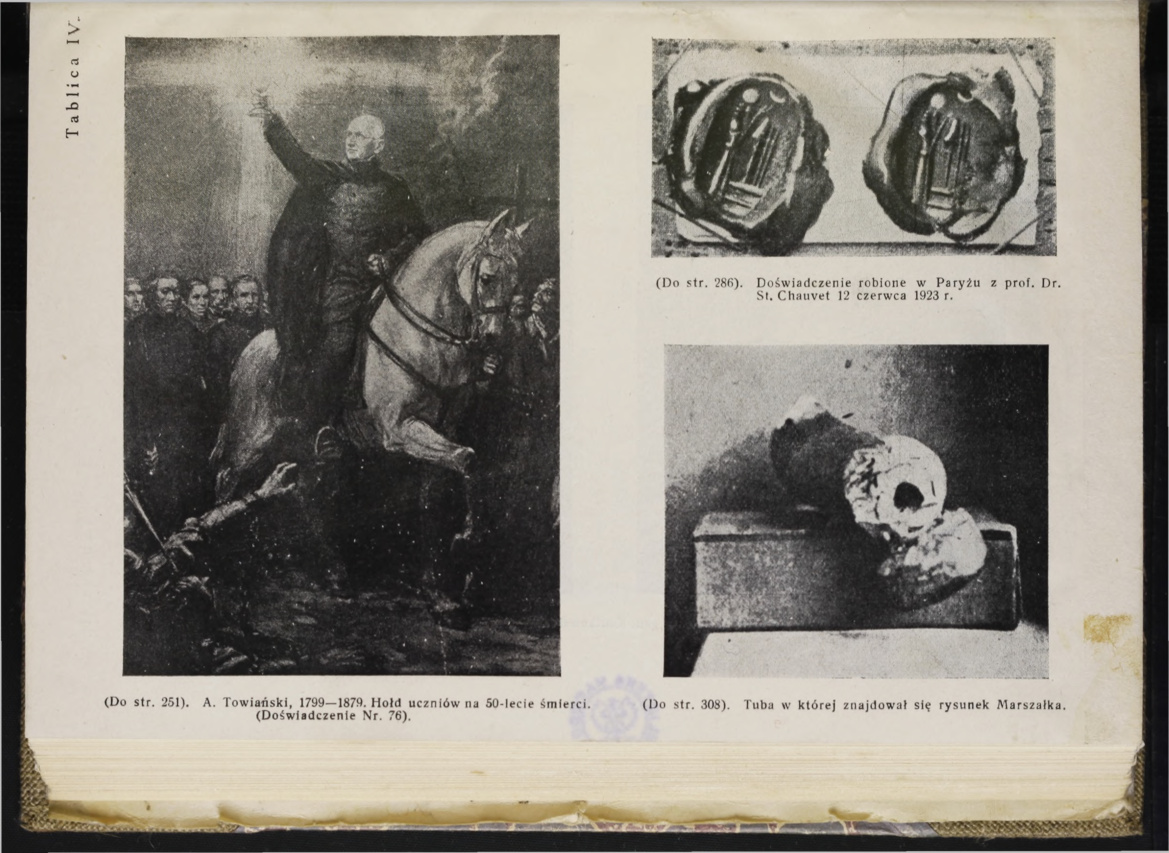
Left: (For page 251.) A. Towiański, 1799–1879. His disciples’ tribute on the fiftieth anniversary of his death. (Experiment No. 76.)
Upper right: (For page 286.) Experiment performed in Paris with Professor Dr St. Chauvet on 12 June 1923.
Lower right: (For page 308.) Tube in which the Marshal’s drawing was contained.
Printer’s Device
Printing and Lithography
JAN COTTY
Warsaw, 7 Kapucyńska Street.
Footnotes
-
Translator’s note: The printed Latin has nosci, “to be known,” so its literal meaning is “You must be known anew.” In this discussion of rebirth, nasci, “to be born,” appears to be intended. The printed chapter reference is retained. ↩
-
Translator’s note: The letter begins with Monday, 6 June, then describes “the following evening” and another “next day,” here dated 7 June. This chronology is printed in the source and has not been reconciled. ↩
-
Translator’s note: The original numbering passes directly from Experiment No. 7 to No. 9; there is no heading numbered 8 here. ↩
-
Translator’s note: The preceding narrative says “left,” while the quoted letter says “right.” Both readings follow the printed source. ↩
-
Translator’s note: The source gives January for the initial approach, describes this letter of 14 March as arriving “a few days later,” and dates the enclosed witness record 14 January 1932. All these dates and the stated interval are retained. ↩
-
Translator’s note: Legible signatures in the facsimile include “Piotr Drzewiecki” and “Harrington Emerson.” The latter differs from the printed “Barrington” in the narrative and letter signature. The remaining signature is preserved in the facsimile without a conjectural transcription. ↩
-
Translator’s note: The original prints “letters” here, although the examples use numbers. ↩
-
Translator’s note: The French original prints “de trois à trois chiffres” (“of three to three digits”). The separate Polish version below reads “a number consisting of three digits.” ↩
-
Translator’s note: The photograph is reproduced in Plate I at the end of the book, whose caption refers to printed page 163, this page of the narrative. ↩
-
Translator’s note: The printed word kostki can mean small cubes or small bones. The neck ornament gives some support to “little cubes,” but the text does not settle the object’s shape or material. ↩
-
Translator’s note: The French wording here is “votre timbre est aussi le mien.” “Stamp” is a literal rendering of the ambiguous word “timbre,” which can also mean “tone”; the intended sense is unclear. The printed Polish rendering below instead says “I share your opinion.” ↩
-
Wikisource editorial note: A printing error; part of the text is missing. ↩
-
Translator’s note: The compressed handwriting of the second sentence is not entirely distinct. The reading “Ses colères la rapetissent” (“Its fits of anger make it smaller”) follows the clear printed repetition on PDF page 356. ↩
-
The watchmaker probably opened the back cover of the watch, contrary to instructions, and the hair fell out unnoticed. ↩
-
La Vie, 1 September 1923. “The Mysterious Possibilities of the Human ‘Self’” (French title, translated: “The Mysterious Possibilities of the Human Being”). ↩
-
Le Mercure de France, 1 October 1923. “The Element of the Marvelous in Man” (French title, translated: “The Marvelous in Man”). ↩
-
Until now, Mr. Ossowiecki has not wished to publish the story of his life. Recently he changed his mind of his own accord, wishing to serve the cause of metapsychics, and entrusted me with the publication of his memoirs. They will appear shortly. (Dr. Chauvet’s note.) ↩
-
As I have already mentioned, my attention at the time was entirely directed toward Prof. Vallé, and I was not looking toward Mr. O. I therefore could not have noticed that his gaze was continually fixed on me. ↩
-
For simplicity, we shall call her Mrs. X. hereafter. ↩
-
A purely formal change, peculiar to French: “Ferai-je” and “Est-ce que je ferai.” Two forms with an identical meaning: “Shall I do/make…?” ↩
-
Dr. Chauvet: Le Merveilleux Humain (French title, translated: “The Marvelous in Man”; printed Polish rendering, translated: “The Element of the Marvelous in Man”), Mercure de France, 1 October 1923. ↩
-
The difference of meaning in French: pensant, thinking; pensif, pensive, lost in thought. ↩
-
I learned later that the idea and initiative for carrying out this test had in fact not come from Mrs. Sudre. ↩
-
During the sittings Mr. Ossowiecki constantly repeated: “Please talk. Please do not think.” ↩
-
This occurred in 1921. Changes have now taken place in my psyche, and I can read printed writing as easily as handwriting. (Author’s note.) ↩
-
[The printed Polish rendering, translated:] “I consider you to be a wonderful man.” ↩
-
After my departure from Warsaw, Dr. Geley conducted a number of further experiments. While not surpassing mine in conclusiveness, they are nevertheless no less conclusive. We attained the same degree of certainty. ↩
-
At the places where the envelope is sealed, I had previously drawn several lines which, if it were unsealed, could not possibly be rejoined so precisely that the opening and resealing would escape notice. ↩
-
As an interesting detail, we give five sentences written by people present, who challenged Mr. Ossowiecki as though to a tournament: 1. Criticism is easy; art is difficult. 2. I should like to return to Menton. 3. One should be neither excessively satisfied nor dissatisfied with oneself. 4. How sad it is that inanimate objects outlast man. 5. Truly, it is a great happiness to be Mr. Ossowiecki’s friend. As could have been foreseen even without this superfluous verification, no ‘chance’ could have brought it about that the five people present at the experiment wrote sentences having anything in common with the contents of the document prepared by Mrs. de Noailles. Had 10,000 people taken part in the experiment, the result would undoubtedly have remained unchanged. ↩
-
Translator’s note: The numerical values and arithmetic in this passage are reproduced as printed. ↩
-
All the more so since it appears, though this has not yet been finally established, that Mr. Ossowiecki cannot read printed or typewritten writing through a sealed envelope. This fact deserves confirmation. ↩
-
I give here the personal impressions I received successively during the experiments. ↩
-
(a) The bottle; (b) Marshal Piłsudski; (c) Mrs. Glass’s recovered brooch. ↩
-
Translator’s note: The printed caption spells Geley’s name “Galey.” ↩