Original publication
Original title: 撓場的科學
Author: Si-Chen Lee (李嗣涔)
Publication year: 2020
Original language: Chinese (source metadata zh-CN)
Source file MD5:890690cd724d5e3c443d42bddbe55838
Si-Chen Lee
Author’s Preface: The Secret Tesla Never Told — The Torsion Field
Former President of National Taiwan University 
Nikola Tesla was born in 1856 in a small town of the Austrian Empire, within what is today the Republic of Croatia. In 1882, he was employed as an engineer at the Paris branch of the American inventor Thomas Alva Edison. Due to his outstanding performance, he was recommended by his local supervisor to the New York headquarters to work under Edison on generator technology. However, he soon fell out with Edison, resigned, and set out on his own. The polyphase alternating-current motor he invented, paired with alternating-current generators, was promoted and commercialized through the Westinghouse Electric Company, establishing the fundamental power-generation model of modern electric utilities: generating alternating current and using transformers to raise the voltage, transmitting it over long distances with low losses, and then stepping down the voltage for consumers to use. This of course also dealt a crushing blow to the direct-current generator technology Edison had developed, leading to a deep and bitter enmity between the two men.
Today, whenever we want to use electrical appliances such as lights, computers, televisions, refrigerators, and washing machines, we need only plug into a power outlet and flip a switch to enjoy the conveniences of electric civilization. The invention of this pivotal polyphase alternating-current motor is owed to a miraculous ability Tesla possessed. From childhood, he would generate visual imagery in his brain — what we now call “opening the heavenly eye,” meaning he had extraordinary perceptual abilities and could hear sounds from far away. Whenever he encountered any problem, such as designing a new motor, an answer would often appear as if by divine assistance, presenting itself in visual form upon his heavenly eye. Even more remarkably, he could make the motor run. If it did not run smoothly, it meant there was a design flaw, and he could modify the design on the heavenly eye until it ran successfully. As a result, any design that ran successfully on the heavenly eye was guaranteed to work once a mold was made and the physical machine was built. This enabled him to invent the polyphase alternating-current motor.
After Tesla rose to fame, until his death in 1943 at the age of eighty-six, he frequently put forward bizarre ideas over those decades that far exceeded the understanding of the conventional world of his time. For example, he claimed that his invention, the Tesla coil, could receive messages transmitted by extraterrestrials, and therefore he wanted to develop a death ray weapon to counter an alien invasion and prevent the destruction of humanity. He also received a message — that the Earth would experience a greenhouse effect, and that after the Arctic ice melted, floods would submerge cities; therefore, free energy should be extracted from the environment to solve the atmospheric pollution caused by burning fossil fuels. His various ideas were far ahead of what his era could accept, and he did not leave behind any physical completed machines, such as a death ray weapon, to verify these ideas. In addition, after his death, the United States government confiscated the large quantity of documents he left behind for a very long time, while his commercial rival Edison continuously vilified and suppressed him. As a result, Tesla’s deeds were gradually forgotten by people.
It was not until the 1990s that some of the documents Tesla left behind reemerged in the world and triggered a number of mysterious events. Some fragments were recorded from memory by former owners and made public, reigniting the Tesla craze.
I have studied extraordinary perceptual abilities for more than twenty-five years. In the most recent ten years, in order to understand the mystery of these abilities, I developed a model of complex spacetime to explain the true reality of the universe and the physics of consciousness such as the heavenly eye. Over the course of twenty-five years of research, I too have encountered phenomena such as interstellar communication, the search for extraterrestrials, and extracting energy from the vacuum — just as Tesla did in his later years. I can therefore appreciate the excitement and shock Tesla felt upon discovering these phenomena. However, since the two greatest theories of the twentieth century — the General Theory of Relativity of 1915 and Quantum Mechanics of the 1920s — were only established one after another in his middle to later years, time was no longer on his side; he was unable to comprehend these new theories or apply them to the mysterious phenomena he had discovered.
But we are now in the twenty-first century, more than a hundred years since Tesla’s original discoveries, and science has made great progress. Some of the phenomena that felt mysterious at the time can now be explained by science. Therefore, in this book I attempt to use the science of the past hundred years — especially the discovery and physical properties of the torsion field within the General Theory of Relativity, and the interpretation of consciousness in Quantum Mechanics — to explain the secrets that Tesla never told and could not have told in his time. In particular, the discovery of the torsion field’s ability to traverse the boundary between the yin and yang realms not only allows one to grasp how to draw energy from the spirit realm and reveals the scientific basis of traditional Chinese fengshui, but also begins to illuminate the principles behind the Daoist art of Qi Men Dun Jia and Zhuge Liang’s deployment of the Eight Trigrams formation. I hope this new knowledge can somewhat make up for the past regrets of Tesla enthusiasts, and also heralds the imminent rise of a torsion-field civilization in the twenty-first century.
In Chapter 3 of my other book, The Science of Qigong, I have already given a detailed introduction to the discovery and history of the torsion field. I also provided the changes in the nuclear magnetic resonance spectra of the oxygen isotope O17 within water molecule clusters after deionized water was irradiated by a torsion field passing through different objects, such as wet filter paper, metallic aluminum, molybdenum, and stainless steel materials. This proves the existence of the physical torsion field and its penetrating properties, and it is determined to have physical penetration characteristics similar to those of a crystal’s qi field, thereby concluding that the essence of the physical qi field, such as external qi, in traditional Chinese qigong is the torsion field. Therefore, in this book, I will use qi field and torsion field interchangeably, because they are the same physical phenomenon. I will also present experimental evidence to demonstrate the many amazing and interesting properties of the torsion field. It can be said that this book is version 2.0 of the story of the torsion field.
Chapter 1: Tesla’s Supernatural Abilities and the Rise of the Electric Power Industry
Tesla invented the polyphase alternating current motor at the end of the nineteenth century,
which led to the rise of modern electrical civilization.
His extraordinary life originated from his extraordinary supernatural abilities,
including eidetic memory and the ability to open the heavenly eye.
His creative inventions seemed as though aided by heaven,
but in reality, they came from another world—the spiritual world.
The Supernatural Abilities of the Genius of the Century, Tesla
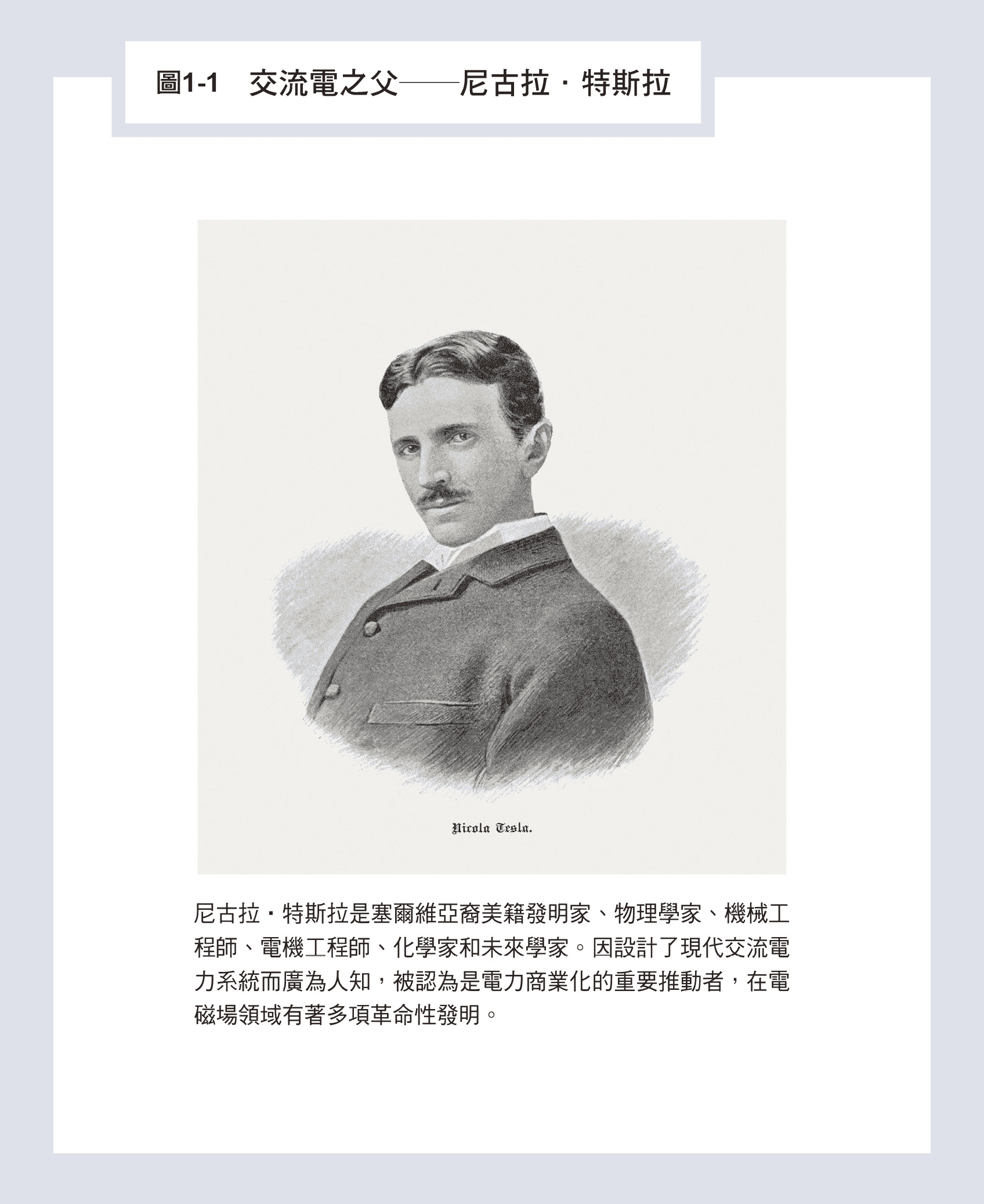
As shown in Figure 1-1, Nikola Tesla was born in 1856 in a small town in the Austrian Empire in Eastern Europe, within present-day Republic of Croatia. Tesla’s father was an Eastern Orthodox priest and also a writer. He had an older brother and three older sisters, and his interest in invention was perhaps influenced by his mother, because as he was growing up, his mother would often make small household items in her spare time from housework.
According to Tesla’s autobiography, he loved to read when he was a child and could memorize the contents of an entire book. The main reason was that his brain possessed the ability of eidetic memory; when reading a book, he could take a picture of each page of text just like taking a photograph and store it in his brain’s memory bank. When he needed to recite a certain page, he could pull that page out of the memory bank and present it on his brain’s visual screen, just like an ordinary photograph. In this way, he could read it out loud just by looking at the photograph, and the appearance of these images would bring him waves of inspiration.
Tesla also said that he was often sick when he was a child. This so-called sickness consisted of flashes of light appearing before his eyes so intense that they were blinding, followed by visual images. Sometimes these images were related to a word or an idea he had just thought of, or when he encountered a specific problem, the answer would suddenly appear in the image. Sometimes he could even hear distant sounds, or simply by hearing the name of an item, the actual detailed structure of the item would appear in the image.
In modern psychological research on the phenomenon of “synesthesia,” similar phenomena have been reported, wherein the sensations of the five senses can interchange. For example, hearing a sound might cause one to see colors or images; seeing certain words might cause one to smell different scents, and so on. Even more remarkably, Tesla could present the new machines he designed on his mental screen in meticulous detail, and then use his thoughts to make the machine run. If it did not run smoothly, such as if the machine got stuck, it meant there was a problem with the design. He would then modify the design in his brain until it ran successfully, and only then would he draw out the machine’s structure and make a mold to create a physical machine. Usually, it succeeded on the first try.

Synesthesia, the Displayed Special Talent
I have met a few people with synesthesia in my life, two of whom were very special. They also made me understand what incredible manifestations people with this ability can have, just like Tesla.
The first was the science fiction writer Ni Kuang. In August 2002, I stepped down from the position of Vice President for Academic Affairs at National Taiwan University. Six years of administrative work led me to decide to go to Stanford University in Silicon Valley, California, USA, for a sabbatical to recharge in the second half of the year. Ni Kuang lived in San Francisco at the time, not far from Stanford University. Through the introduction of my junior alumnus from NTU’s Department of Electrical Engineering, who is also a science fiction writer, Dr. Yeh Li-hua, I had the opportunity to visit Ni Kuang’s home.
His home faces the San Francisco Bay, near the Golden Gate Bridge, and the design of the house is very cool—at night, the roof can open up to view the night scenery of the bay and the stars in the sky. He claims to be the author who has written the most Chinese characters (over sixty million characters). Starting from the first manuscript he submitted in Hong Kong at age seventeen, he has never once had a manuscript rejected. When writing his Wisely series of novels, he could write an entire book in a single day, at an astonishing speed. The reason is that whenever he read any novel, a screen would appear in his brain, presenting the characters and stories described in the novel’s text in a cinematic way within his mind. The reverse was equally true: when a drama began playing in his mind, he simply had to pick up a pen and write down the plot of the drama as it was, so he could finish a book in a day without needing to spend any time devising the plot himself. This means his stories were downloaded by the celestial eye from another world. Therefore, he once told me that after rewriting the early martial arts novels written by Jin Yong, they read better, whereas those of us who are ordinary people felt that after the revisions, our original memories were disrupted and the stories became worse. This was because in his early years, Jin Yong, in order to meet deadlines for the martial arts novels serialized in his daily newspaper Ming Pao, failed to pay attention to the chronological order of many scenes and plot points, resulting in contradictions between earlier and later passages. Once these contradictory plot elements were corrected, the movie in Ni Kuang’s brain appeared much smoother and far more reasonable.
The second person with synesthesia was a student who took my course. In June 2013, after I stepped down as president of National Taiwan University and was free of pressure, I decided to turn the results of my thirty years of research on qigong and extraordinary abilities into a course for interested students to take as an elective. After more than two years of planning, by 2016, I offered a course titled “Special Topics in Human Potential” in the Department of Electrical Engineering and the graduate institute. Since experiments were required, including telepathy and clairvoyance experiments, and space in the experimental venue was limited, only thirty-six students could be accepted each semester. In the first two years, several hundred students would pre-register during course selection each time, causing quite a sensation, but the number of people who were actually able to take the course was indeed quite small.
In 2017, a graduate student from the Department of Electrical Engineering, Student Lin, came to take the course. From the very first experiment when class began, she displayed extraordinary abilities, with a very high accuracy rate in telepathy experiments. It was only from the assignments she wrote that I discovered she possessed the ability of synesthesia. It turned out that she too, upon hearing music, would see a screen appear in her mind and begin playing a movie, with the content of the movie becoming rich and colorful depending on the different pieces of music. She had previously taken a music appreciation course, and her analysis of how musical compositions inspire the mind was so deep, nuanced, and thorough that her instructors were often astonished, considering her a prodigy. She had assumed that everyone else was the same as her, and it was only after taking my course that she realized how unique she was, possessing the ability of synesthesia, completely different from others.
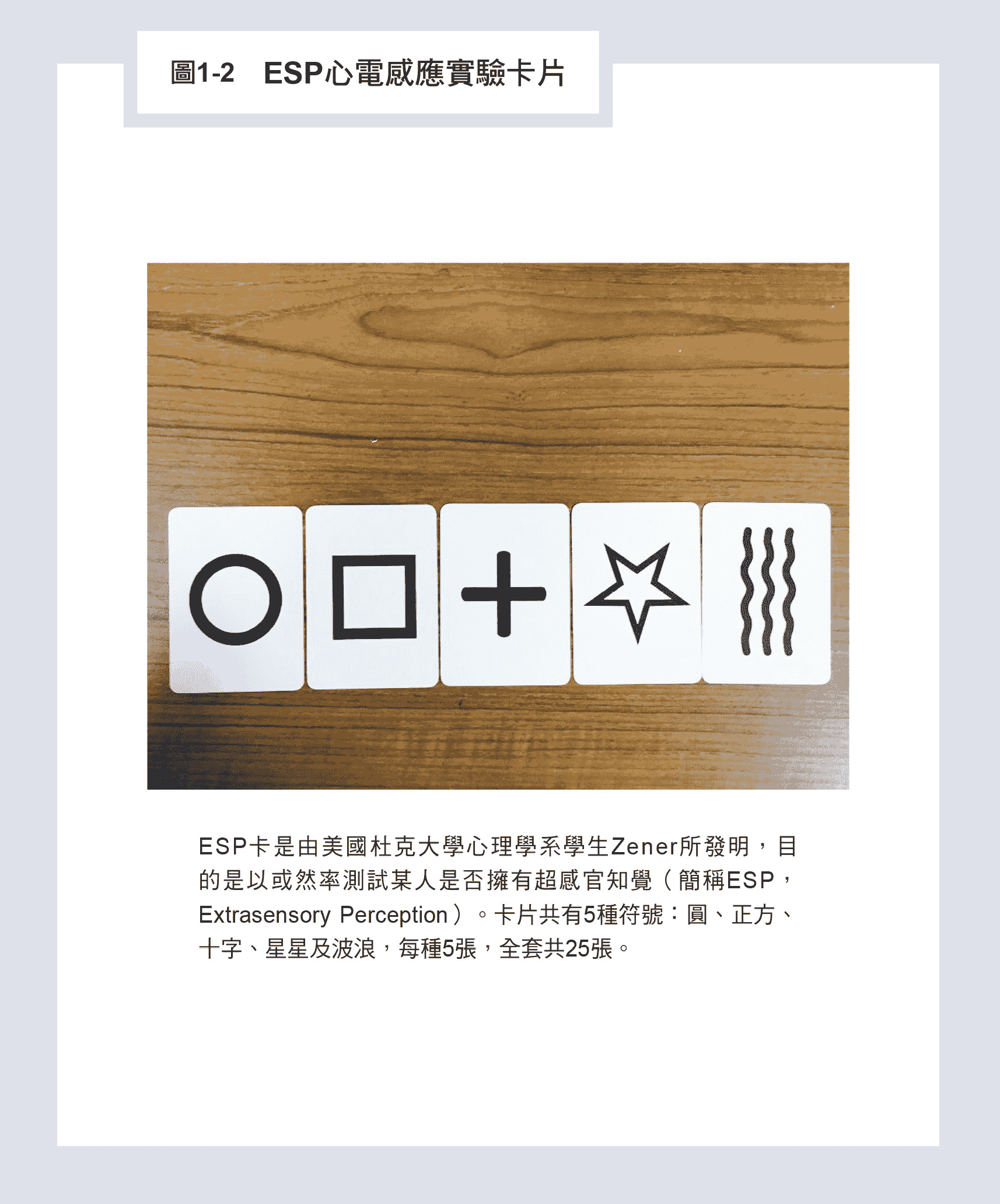
When conducting telepathy experiments in class, I had everyone sit quietly and empty their minds for one minute to sense, then randomly draw one card from five ESP cards (see Figure 1-2) provided by a partner, and send the signal to her. Out of one hundred experiments over the entire semester, she was correct forty-nine times, whereas the average probability of a typical student guessing correctly was one in five, which would be twenty times. Her statistical significance exceeded seven standard deviations, meaning she possessed some form of telepathic ability that transcends space and time.
This extraordinary ability allowed her, when reading history or classical texts, to accurately judge what these historical figures were thinking, what emotions they might have had, and what actions they would take, based solely on fragments of dialogue and scene descriptions—and her judgments were consistent with subsequent developments in history. Therefore, her former Chinese literature teacher especially appreciated her analysis of classical texts. Not only could she explain the meaning of the text, she could also explain the author’s state of mind while writing and the circumstances at the time, which her teacher found to be a genuine pleasure.
Because Student Lin possessed the synesthetic ability, her judgment of people’s minds was comparatively keen, so during debate competitions or when negotiating with others, she could immediately grasp the meaning behind the other party’s words, directly know what the other party was thinking, and predict what they would say next. Sometimes she could even directly predict what the other party would use as the finale of the debate or as a bargaining chip in negotiations, and then directly strike at the opponent’s weakness. Therefore, regardless of the occasion, she would be appointed as the lead speaker or as the deputy providing analysis and formulating strategies. I believe Tesla also possessed, to some extent, similar experiences and abilities.
How to Know Whether You Have Image Visualization Ability?
For someone like me who researches extraordinary abilities, when I read Tesla’s autobiography twenty years ago, I could tell at a glance that Tesla possessed two types of abilities. The first was “photographic memory” ability—the capacity to memorize pictures and text he had seen in a photographic manner. The second, the flashes he described, followed by the image visualization that appeared, was in fact the phenomenon of “opening the celestial eye.”
Just as in our finger-reading experiments, the children must wait until the celestial eye in the brain opens before they can see, within the celestial eye, the text written or the figures drawn on the folded paper strips. Moreover, we found that in the few seconds before the celestial eye opens, voltages of several tens of millivolts can be measured from the palms at the base of the index fingers of both hands of the children, indicating that there is a discharge phenomenon occurring inside the brain, triggering nerve impulses that are transmitted to the palms. At the same time, this discharge process also triggers the formation of the celestial eye, causing an image resembling a television screen to appear in the brain.
This is very similar to Tesla’s process of first seeing an intense flash (brain discharge) and then an image appearing. Therefore, this phenomenon is not an illness, but rather a precursor to the emergence of extraordinary abilities—Tesla himself had misunderstood it. As for whether people with photographic memory or an opened celestial eye are common in the population: How can you know whether you possess image visualization? Can this ability be trained?
Image memory, in the traditional Daoist practice of cultivating oneself to become an immortal, is called “visualization.” This means generating images in the brain out of nothing based on past memory—for example, closing one’s eyes and imagining a fish swimming back and forth, or a horse galloping across a plain. When an ordinary person closes their eyes, there is a visual persistence phenomenon. After this visual persistence phenomenon disappears, everything is pitch black, and nothing can be seen; one only sees the faint light from the environment filtering through the eyelids. Visualization is the re-activation of images stored in the brain’s neural network memory, presenting them vividly and lifelike, just as if one were seeing them with one’s own eyes upon opening them. Once this visualization ability is mastered, one can develop the ability of image memory.
People who are born with image memory ability exist in large numbers among painters and architects. In fact, for a painter to paint well, in addition to proficient painting technique, image memory ability is also very important. Their brain can look at the real scene from memory while painting at the same time, saving a great deal of effort—the arrangement of light and shadow can simply be viewed directly. I know many painters who possess this ability. Architects are the same; if the building they design can take form in the brain and be rotated, examined transparently from different angles—above, below, left, and right—then naturally the design will be more perfect. Of course, there are also a small number of people like Tesla who are born with image memory ability.
Twenty years ago, a visiting professor from Duke University in the United States came to see me. He had grown up in Taiwan and had graduated from National Taiwan University’s College of Medicine. Two days before the joint university entrance examination, he dreamed of a mathematics exam paper. He spent two days working through the problems. When he entered the examination hall and looked, it was indeed the exam paper he had dreamed about, and he quickly completed it. Since forty minutes had to pass before one could submit the paper, he lay down on the desk to sleep. The exam proctor even came over to wake him up. The mathematics problems were particularly difficult that year, and he scored over ninety points. During the first semester of freshman calculus, the teacher surveyed the students’ joint examination mathematics scores on the first day of class. It turned out that even in the top-choice medical program, most students’ mathematics scores were below passing; he was the only one who scored above ninety. So the teacher told him to leave and that he did not need to attend calculus class. He indeed never attended class after that, and the teacher gave him a semester grade of ninety-five.
He said that he possessed image memory ability. When he was an intern doctor at the medical school, he could remember every X-ray film he had seen. When discussing cases, he could retrieve them from his memory bank and analyze them with perfect clarity without having to look up the original records.
After going to the United States to study and teach, he served as an editor for a medical journal for over ten years. Whenever a paper was submitted, he could search his memory bank for potential reviewers with no effort at all, so the editor-in-chief would not let him leave for over ten years. Later, a fund investing in the biomedical industry recruited him, and he created substantial profits for the company. He was therefore appointed as the CEO of the Asia-Pacific regional branch, also overseeing Taiwan operations. When he returned to Taiwan, he made a special trip to visit me and share his legendary story.
In my thirty years of researching extraordinary human abilities, I have designed a simple method. By doing the experiment once, you can determine whether you possess image memory ability.
Please take a piece of fruit, such as an apple, place it in front of you, and gaze at it for fifteen seconds. Then close your eyes. After the visual persistence phenomenon disappears, try to visualize the apple. The color and three-dimensional shape of the visualized apple must be exactly the same as what you originally saw. If you are not sure whether it is exactly the same, you may open your eyes and look at the apple again for fifteen seconds before trying once more.
I have also found that children who received speed-reading or visualization training from a young age still retain their image memory ability when they grow up. Among the students who have taken my “Special Topics in Human Potential” course, quite a few still retain their image memory ability into their twenties thanks to their childhood training.
Can the Ability to Open the Heavenly Eye Be Trained? ①
In July 1996, I myself opened my first children’s potential training class for the first time, wanting to verify the claims made by research institutions in mainland China that children could be trained to develop finger-reading ability. Subsequently, I ran training classes every summer, training children for two hours a day over four days, continuing until 2004. In total, I held nine classes, and a grand total of 176 children completed the four-day training. Among them, 41 demonstrated significant finger-reading ability—approximately 23 percent exhibited quite high levels of function (statistical probability of error P < 0.05). Among them, 33 (approximately 19 percent) demonstrated major function (statistical probability of error P < 0.001). The age distribution showed that those from eight to eleven years old all had very high function, while those after age twelve no longer did; there were fewer of them.
These children who exhibited high-level functional responses would all tell you that a television screen opens in their brain. The color of the text or pattern first appears on the screen, and then the text or pattern appears part by part on the screen until the correct answer finally appears. In other words, children must open their heavenly eye before they can read with their fingers or ears; without opening the heavenly eye, it is impossible to produce correct answers.
Experience over the past several decades has shown that finger or ear reading ability is mainly concentrated in children under thirteen to fifteen years of age. It is generally believed that this is because the brain’s pineal gland begins to calcify between ages thirteen and fifteen. The question is, the heavenly eye does not seem to be located in the pineal gland, but rather five to ten centimeters behind the pineal gland. This seems to suggest that young people over the age of fifteen still have the opportunity to develop finger or ear reading ability.
From 2016 to 2017, I also attempted, in the Department of Electrical Engineering at National Taiwan University, to develop the ability of reading characters with the ear in approximately one hundred NTU undergraduate and graduate students in their twenties. Using only two training sessions of half an hour each, supplemented by self-training with visual imagery outside of class, three percent of the students also developed the ability to read characters with their ears. This result was very exciting — it turns out that even for those over the age of fifteen, we still have a chance to open the Heavenly Eye through training and develop the ability to read with the ear.
Twenty-five years of research experience tell me that anyone who has opened the Heavenly Eye, after repeated training and becoming familiar with how to control it, will develop all kinds of extraordinary abilities. Just as children, after mastering the ability to read characters with their fingers, can develop psychokinesis — bending wires inside a box or snapping matches without touching them — they can also develop abilities resembling the Five Supernatural Powers, such as “clairvoyance,” the ability to see distant scenery or people; “clairaudience,” the ability to hear distant sounds; “telepathy,” the ability to sense the thoughts of others through mental telepathy; “knowledge of past and future,” the ability to foresee the future and know the past; “astral travel,” the ability to roam the earth freely, coming and going at will; “reading with fingers and ears,” where the five senses become interchangeable; plus “psychokinesis,” the power to transform all things through thought and to transport objects over a thousand miles — dazzling and incredible②.
However, some individuals with extraordinary abilities can achieve these things without opening the Heavenly Eye. For example, many folk spiritual healers can communicate, negotiate, and bargain with the attached spirit afflicting a patient, reaching mutually acceptable conditions, and then request the spirit to leave so as to achieve the goal of curing the illness. The spiritual healer has not opened the Heavenly Eye, but his soul seems able to easily leave the body and enter the spirit realm, communicating directly with the attached spirit, and can also uncover the patient’s past history and the grievances between the patient and the attached spirit. I know a person with extraordinary abilities in Beijing who claims not to have opened the Heavenly Eye, but is able to find traces of a perpetrator’s past actions from the spirit realm to solve major cases, and has therefore received attention from the relevant authorities.
Is Possessing Extraordinary Abilities a Blessing or a Curse?
For a person who possesses extraordinary abilities, besides performing for the appreciation of ordinary people and gaining remuneration or recognition, what other uses are there? For the person with the ability themselves, is it a good thing or a bad thing?
I will first cite two individuals with extraordinary abilities from the Three Kingdoms period in history as examples. The first is Zuo Ci, a person of great ability under Cao Cao who could retrieve objects from a thousand miles away; the second is Zhuge Liang, the chancellor of Shu Han, who possessed lesser abilities.
The Book of the Later Han, Chapter 80, “Biographies of Adepts and Arts (Part II),” records many adepts with extraordinary abilities from the late Eastern Han dynasty. Some entered the court as officials, while the majority were commoners who had achieved success in cultivation, leaving behind widely celebrated deeds.
Zuo Ci, courtesy name Yuanfang, was a native of Lujiang. He had supernatural powers from childhood. From astrological signs he predicted that the Han dynasty’s destiny was nearing its end, that the national fortune was declining, and that great chaos would soon engulf the realm. He therefore began to study the Dao and became deeply proficient in the “Mystical Gate Escaping Technique” (Qimen Dunjia), able to command ghosts and spirits to transport objects across a thousand miles. He later served under Cao Cao, who held the office of Minister of Works.
Once, when Cao Cao was leading his civil and military officials on an inspection tour, at mealtime he said to his entourage: “Today I have prepared fine delicacies to entertain you all, but we are lacking the sea bass from the Song River of Wu.” Zuo Ci replied: “That is easily done.” He asked someone to bring a copper basin filled with water, baited a hook on a bamboo pole, and fished in the basin. In a short while, he caught a sea bass. Cao Cao clapped his hands and laughed heartily, but the other officials present were all greatly astonished. Cao Cao said: “One fish is not enough for everyone to eat — can you catch some more?” Zuo Ci then changed the bait and fished again, and soon caught many more fish, all over three feet long, fresh and lovely. Cao Cao ordered them cooked to serve to the officials.
Then Cao Cao posed another challenge: “Now that we have fish, it is a pity we have no fresh ginger from the land of Shu.” Zuo Ci replied: “That too can be obtained.” With that, he produced the ginger. Cao Cao was by nature suspicious and feared that Zuo Ci had simply obtained it from somewhere nearby, but it was later confirmed to be ginger from the state of Shu.
On another occasion, Cao Cao went to inspect the outskirts of the capital, accompanied by over a hundred followers. Zuo Ci brought one sheng of wine and one jin of meat, and personally served wine and food to everyone. As a result, all the officials ate their fill and became drunk. Cao Cao found this strange and sent people to investigate nearby shops, only to discover that all the meat and wine from every shop had vanished — all transported away by Zuo Ci using his magical arts. This aroused Cao Cao’s vigilance, as he realized that this person possessed great supernatural powers and was therefore very dangerous. Moreover, Zuo Ci once advised Cao Cao to yield the chancellor’s position to Liu Bei, which provoked Cao Cao’s murderous intent. But Zuo Ci passed through walls and barriers, making him impossible to find anywhere. Sometimes everyone seen in the marketplace appeared to look like Zuo Ci; at other times, he hid among a flock of sheep, making every sheep adopt the same posture so that his position could not be distinguished. In the end, his whereabouts became unknown. Thus, great extraordinary abilities can sometimes bring great calamity upon oneself — they are very dangerous indeed.
During the Three Kingdoms period, another person who possessed minor extraordinary abilities was Zhuge Liang. He was well-versed in astronomy and geography, and deeply proficient in the Mystical Gate Escaping Technique and the Yin-Yang Eight Trigrams. Not only could he devise strategies within his command tent and divide the realm into three kingdoms to carry out grand plans, but in the Battle of Red Cliffs he also borrowed the east wind to defeat Cao Cao, and later set up the Eight Trigrams Formation, trapping the Eastern Wu army of a hundred thousand troops. Every one of these feats demonstrated his seemingly divine abilities.
Although some people claim that the Romance of the Three Kingdoms is a novel and not official history, and that the official history, the Records of the Three Kingdoms written by Chen Shou, does not record these events, official history is written by the victors. Although Chen Shou was a native of Shu, after Shu was conquered, he served as an official in the Western Jin dynasty, and the history he wrote had to conform to the Western Jin perspective. Shu Han was the enemy of the former dynasty of Wei — how could he praise the wisdom and martial valor of the enemy? After all, they had failed, and “we” are the victors and interpreters of history. I believe in the folk interpretations — those are the histories that were not deliberately excised.
Therefore, the conclusion after surveying history is: developing major abilities poses dangers to the gifted individuals themselves; developing minor abilities, when they can be applied within the gifted individual’s professional field, enables strategic mastery, elevating the professional field to a new level and entering a new realm, which is of genuine help to the advancement of human civilization.
Just like Tesla, he had minor extraordinary abilities and could open his Heavenly Eye. Within the Heavenly Eye, he designed the polyphase alternating current motor, and could even attempt to rotate the motor to test whether the design was correct. As a result, the polyphase AC motor he invented transformed human civilization from then on, ushering in the age of electricity and dispelling the inconveniences that the sunless night had brought to humanity.
Should Extraordinary Abilities Be Trained from Childhood?
Since minor extraordinary abilities have the effect of elevating human civilization, then should a person cultivate extraordinary abilities from childhood, such as finger-reading ability, or find a way to do so after growing up? Answers can be sought from historical experience.
Mainland China first discovered in 1979 that finger-reading ability could be developed through short-term training. Over the past forty years, a large body of experiments has proven that a considerable proportion of children aged seven to fifteen can develop extraordinary abilities such as finger-reading or ear-hearing through training. However, maintaining this ability is quite difficult because it requires uninterrupted practice. Once children advance to middle school or high school, it is very difficult for them to continue practicing under the pressure of school advancement. My twenty-five years of research experience with extraordinary abilities have revealed that only a very few of the children who originally developed extraordinary abilities such as finger-reading were able to apply those abilities in their professions after growing up. One is a Ms. Huang, trained under Mainland China’s “Bian Que Project” back then. She possesses X-ray vision and is currently practicing medicine in France (as a Western medical doctor, not a Chinese medicine doctor). Her medical skills allow her to see directly through the human body, and her accomplishments naturally far surpass those of her peer physicians.
The purpose of the “Bian Que Project” was to cultivate extraordinary abilities in children so that they would go on to study medicine when they grew up and become divine physicians like Bian Que. Ms. Huang indeed accomplished this, but she is also the only successful case I know of from Mainland China.
Another is Ms. T, whom I have cultivated for nearly twenty years. She was born with finger-reading ability, and a master from the spirit world had been guiding her since childhood. But the ability that ultimately proved helpful to her profession was the ability to communicate with animals. This ability was taught to her by a second master who appeared when she was an undergraduate at National Taiwan University. The process was extraordinary and fascinating, giving me great inspiration. She currently works as a veterinarian at an animal hospital in Los Angeles, USA, and her medical skills naturally far surpass those of her colleagues.
When Ms. T was a child, she once visited a zoo. When she reached the monkey enclosure, she suddenly heard one monkey say to another: “Do you want to come to my house to play?” The other monkey replied: “Okay!” She then watched the two monkeys hold hands and hop away together into a cave behind. After returning home, she also understood some things a bird father was teaching his bird child. However, this ability to communicate with animals only lasted for three months before it disappeared. This experience was something she cherished deeply, and from then on she made up her mind to become a veterinarian when she grew up, to relieve animals of their pain and suffering.
This is like the remarkable figure Gongye Chang, who lived over two thousand five hundred years ago in Shandong Province. Legend has it that he could understand the language of birds and was imprisoned because of it. Later, he too was acquitted because he understood bird language, and he even rendered meritorious service for the state. He was deeply appreciated by his teacher Confucius and ultimately married Confucius’s daughter.
In September 2001, Ms. T returned from the United States to Taiwan to attend university. She had originally wanted to apply to NTU’s Department of Veterinary Medicine, but at that time the department did not accept foreign students, so she had to enroll in NTU’s Department of Animal Science as a U.S. citizen. However, because she had returned to NTU, I was able to conduct finger-reading experiments with her once a month. By June 2004, when she left NTU and returned to the University of California, Davis, to continue her undergraduate studies, I had already accumulated a large amount of data on wandering the spirit world. All of these experimental records are included in the book The Science of the Spirit World.
Since childhood, Ms. T had a master in the spirit world caring for and guiding her. Between 2001 and 2003, we also conversed with this master through finger-reading experiments, asking various questions about the universe, human civilization, and extraterrestrials, and the answers are recorded in the book Unbelievable II: In Search of the Gods’ Website. One of the questions we asked was: “When will Ms. T be able to recover her ability to communicate with animals?” The master’s answer was: “Do not rush.” At the time, I was anxious to death. She was already in university and would soon go to the United States to attend veterinary school. When exactly would she be able to recover and understand what animals were saying?
Ms. T’s second master in the spirit world made an extraordinary entrance into our finger-reading experiment at NTU’s Department of Electrical Engineering on January 1, 2004, announcing his identity and formally taking Ms. T as his disciple. After that, Ms. T began diligently practicing meditation and the technique of communicating with animals every day. By the end of that year, she had already mastered the basic techniques and was able to converse with some animals.
Ten years later, after Miss T graduated from the School of Veterinary Medicine at Purdue University in the United States in 2013 and obtained her license to become a fully qualified veterinarian in the state of California, I invited her in March 2014 to give a lecture at the School of Veterinary Medicine at National Taiwan University. The Department of Veterinary Medicine, which had once rejected her admission, had by then been elevated to a School of Veterinary Professional Studies. She cited six cases to illustrate the phenomena she had observed in treating animals, including: a dog that had swallowed a tennis ball which became stuck in its esophagus, but which could not be detected on X-rays—after she asked and found this out, the problem was quickly resolved; a cat with unstoppable coughing, for which formal examinations could find no cause—upon inquiry, it turned out that a toy the family had given it to play with had been swept into a corner during cleaning, causing the cat to be displeased. Then, the animal hospital and classmates brought out pets for Miss T to see. One of them, a groundhog, had not eaten for a week, causing its owner great concern. After Miss T’s consultation, it turned out that the groundhog had pain in its mouth, caused by its canine teeth having been ground down.
One classmate brought the family cat, which had recently been meowing incessantly every day, causing the owner great concern. When she asked the cat, the cat said it had given birth to three kittens and was in the process of teaching them. The owner immediately confirmed that the cat had indeed just given birth to three kittens. This also shows that cats possess the concept of the number three, which is truly astonishing. Dr. Dolittle, who could understand animals speaking in the novel, has now appeared in the real world. One truly looks forward to what new face veterinary medicine will present in its future development.
The ability to open the Heavenly Eye, in addition to being innate, can sometimes also be developed as a paranormal ability after surviving a great disaster or a serious illness.
There is a major entrepreneur in our country who, when he was young, was once struck by lightning and lost consciousness for half an hour. After waking up, he developed the ability of the Heavenly Eye and could foresee the future. In business, he was invincible and unstoppable. Often, while dreaming, just like Tesla, many new concepts and new machine designs would appear to him. After verification by the engineering companies under his umbrella, he would immediately apply for patents. Although he had never studied any engineering-related knowledge in school, the number of engineering patents he obtained exceeded seven hundred, leaving any academic professor far behind. Of course, the easiest way to open the Heavenly Eye is through meditation and related training, which also highlights the importance of our training methods.
Developing Modern Zhuge Liangs or Teslas
In recent years, I have discovered through my “Special Topics in Human Potential” course that adults over the age of twenty can also develop the minor ability of reading characters with their ears, just like Miss T, who only developed her ability to communicate with animals after the age of twenty.
Therefore, I propose a new idea: directly train adults who already possess professional capabilities to develop the ability of the Heavenly Eye. I call this plan and ambition the “Zhuge Liang Project” or the “Tesla Project”—that is, developing modern Zhuge Liangs or Teslas, utilizing their Heavenly Eyes to elevate the level of their professional fields and to enter a new civilization for humanity.
① Please refer to The Science of the Spiritual Realm.
② Please refer to Paranormal Ability? Or Latent Potential?.
Tesla and the Electric Power Industry
In 1875, at the age of nineteen, Tesla entered the Department of Electrical Engineering at the Austrian Institute of Technology. After studying for three years, he left the school and went to work at a company as an assistant engineer for one year. During this period, he suffered from a nervous breakdown. Later, under his father’s persuasion, he enrolled in the summer of 1880 at Charles-Ferdinand University in Prague, where he was deeply influenced by the physicist Ernst Mach.
Mach became famous for his research on supersonic motion. He strongly emphasized the importance of empiricism and positivism in scientific research, laying the foundation for the development of philosophy of science. Tesla was deeply inspired by Mach; his inner experiences of the Heavenly Eye could greatly assist him in conducting scientific empirical research. Unfortunately, he studied for only one semester before leaving school due to his father’s passing. He found a position working in the telegraph department of the National Telephone Company in Budapest, the capital of Hungary. His genius led him to be promoted within a year to the company’s chief electrical engineer. He developed the country’s first telephone system and also invented the component now known as the microphone.
In 1882, Tesla joined the Paris branch of the American inventor Edison, where the main business was promoting lighting systems, including incandescent lamps and power supply systems. At the time, Edison used low-voltage (110V) direct current power supply. Tesla’s genius so impressed his superiors that they introduced him to Edison. In 1884, Tesla crossed the Atlantic to New York to report to Edison, and from then on remained in America until his death fifty-nine years later in 1943.
Tesla relied on his paranormal abilities and had always been self-assured. When he encountered the stubborn and authoritative Edison, who firmly believed that “genius is one percent inspiration plus ninety-nine percent perspiration,” conflict between the two was inevitable. Tesla once said, “If Edison could think a little more, then ninety percent of the effort would be unnecessary.” He assumed that others, like himself, could also open the Heavenly Eye to create new inventions in the brain, so the two were bound to be incompatible as fire and water.
Legend has it that Edison once promised Tesla that if he could improve the company’s direct current generators, he would give him a reward of 250,000 dollars; at the time, Tesla’s salary was eighteen dollars per week. Later, Tesla believed he had succeeded, but Edison considered it to be nothing more than a joke, so why take it seriously? He merely raised Tesla’s salary to twenty-five dollars per week, and Tesla resigned in a fit of rage. For a year, he made a living digging trenches and repairing electrical cables on the streets of New York.
Even under such difficult living conditions, his celestial eye conveyed to him the concept of a polyphase alternating current motor based on a rotating magnetic field. After designing it in his mind and running it successfully, he convinced friends to invest and applied for a patent, and finally successfully demonstrated the technology. This breakthrough invention was quickly noticed by the entrepreneur George Westinghouse, founder of the Westinghouse Electric Company, who was at the time using alternating current power generation technology developed in continental Europe for lighting, competing with Edison’s direct current technology.
Alternating current inherently held an advantage. Alternating current could use a transformer to first step up the generated voltage and lower the current for long-distance transmission, reducing the electrical energy loss caused by wire resistance, and then step the voltage down for use at the user’s end. Doing this could easily expand the distribution area of users and increase the number of users, thereby reducing the cost of power generation. With Tesla’s highly efficient alternating current motor technology, Westinghouse Electric was like a tiger with wings. Using high-efficiency motors to drive generators could lower power generation costs even further, and it quickly defeated Edison’s direct current technology to monopolize the market, becoming the standard for the electric power industry.
In 1895, the Westinghouse Company built the unprecedentedly giant Niagara Falls hydroelectric power plant. Ten turbine-driven generators could generate 50,000 horsepower. The voltage was stepped up to 22,000 volts by transformers and transmitted to Buffalo, 43 kilometers away.
At this moment, alternating current achieved a decisive victory. Tesla also obtained substantial profits from this, allowing him to proceed with his next grand ambition—wireless power transmission.
Chapter 2 Wireless Power Transmission and Tesla’s Lost Files
After Tesla passed away, the notes that had recorded his innovative ideas were seized by the United States government and disappeared. In the 1990s, these disappeared files suddenly appeared on the market and caused a sensation. With the progress of the times, some of his ideas from that time, such as the greenhouse effect, have been confirmed by modern science.
Discovery and Application of Electromagnetic Waves
British scientist James Clerk Maxwell published his “A Dynamical Theory of the Electromagnetic Field” in 1865, laying the theoretical foundation for electromagnetic waves. These equations, in which electric and magnetic fields interact with each other, were later organized by other scientists into four equations, collectively known as Maxwell’s equations.
In his equations, a wave of mutually excited electromagnetic oscillation was predicted, called an electromagnetic wave. The speed of the electromagnetic wave calculated from the physical quantities used in the equations, such as the vacuum permittivity and magnetic permeability, surprisingly matched the speed of light previously measured in science, indirectly proving that light is a kind of electromagnetic wave. This groundbreaking discovery sparked the interest of many scientists at the time, who began to look for lower-frequency light, that is, electromagnetic waves invisible to the human eye.
In 1888, a young German professor named Heinrich Hertz, only thirty years old, designed a set of spark gap discharge① transmitters and receivers, experimentally proving the existence of electromagnetic waves and demonstrating the methods of transmission and reception. Ever since Hertz discovered electromagnetic waves, many creative inventors in Europe and the United States began to explore the applications of electromagnetic waves. Two of the more famous ones were Marconi in Italy and Tesla in the United States.
Guglielmo Marconi came from a noble family that owned a vast whiskey industry. He had a great interest in electricity since childhood, and at the age of twenty, he became fascinated with applying electromagnetic waves and began conducting wireless communication experiments using them. Later, he persuaded his parents to support him and brought his self-designed wireless communication equipment to London to develop his business. In December 1901, he finally succeeded in transmitting Morse code carried by radio waves from the southwest of the United Kingdom across the Atlantic Ocean to a receiving station in the town of St. John’s, Newfoundland, Canada, 2,800 kilometers away. This shocked the world and ushered in the century of long-distance radio wave communication.
①A transient gas discharge phenomenon in which a flash appears and a sound is emitted between positively and negatively charged regions with a high potential difference.
Tesla, Enchanted by Wireless Power Transmission
In 1888, having just arrived in the United States a few years prior, Tesla learned of Hertz’s discovery of electromagnetic waves and also became fascinated by them, beginning his research. However, the direction he took was different from Marconi’s; it was not for communication, but rather he wanted to use them to transmit electrical energy—that is, wireless power transmission. At that time, the electric power industry was just in its infancy, and ordinary households were beginning to use electrical appliances; [with wireless power,] things like electric lights and telephones would not require massive investments to construct a tangible power grid infrastructure, allowing various emerging industries that use electricity to reduce costs and be promoted more easily.
For the new technologies we face in the twenty-first century, over a hundred years later today, this concept remains a forward-looking creative idea.
Consider this: the greatest bottleneck of mobile devices in modern technology is insufficient battery power. When the batteries inside the mobile phones or computers we carry run out of power, these devices become like useless objects—calling to heaven gets no response, calling to earth gets no answer—all information is locked inside the device, unable to communicate with the outside world. At such times, what is most needed is wireless power transmission, which can directly charge the battery and resolve the problem. Unfortunately, this problem has remained unsolved for over a hundred years, which also means that Tesla, without theoretical support, prematurely leapt into a problem that would require more than a century to have any hope of being solved—naturally this would lead to the fate of failure.
Ordinary power transmission requires two wires: one with high voltage and one with low voltage, allowing current to flow from high voltage to low voltage. For safety reasons, modern wires also have a ground wire connected to the lower-voltage wire, which is why electrical outlets have three prongs, among which the thick round prong is the ground.
Tesla must have known very early on that the Earth can conduct electricity, and therefore the ground can serve as the grounded pole of the electricity. But what about the other pole? Was it to be sent out via electromagnetic waves? He also knew that the efficiency of converting electrical power into electromagnetic waves was not high, making it very difficult to achieve large-scale power transmission. Therefore, without building fundamental power grid infrastructure, it was necessary to use air as the channel. His idea was to use ultraviolet light to ionize air molecules, opening an ion-conducting channel through the air, and use high-voltage discharge to send electrical energy out through the ion channel without needing ordinary wires, using the ground as the grounding return path. He envisioned using low-frequency alternating current, which could be transmitted over very long distances.
In 1899, to realize his concept, he established his laboratory in Colorado Springs, Colorado, USA, and began conducting experiments starting June 1, studying the possibility of large-scale electrical conduction through the air. We can see a diagram of his experiments on the internet①, where the discharge phenomenon pierces through the air to form turbulent lightning.
This experiment ended half a year later on January 7, 1900. He left Colorado and returned to New York to start anew, beginning true wireless power transmission. That year, he raised $150,000 and built a huge tower near New York, claiming it could transmit electrical power directly from New York to Paris, France. Following the model of his Colorado experiments, he built a transatlantic Wardenclyffe communication facility, but after three years, having produced no significant research results and having exhausted his funds, the project died a natural death.
Twenty-five years later, in 1915, Tesla filed a lawsuit in U.S. courts challenging Marconi’s wireless communication patent, asserting that he had completed wireless radio communication one year earlier than Marconi. But he ultimately lost the lawsuit, and from then on, the credit for wireless communication in history belonged exclusively to Marconi.
① A diagram of Tesla’s laboratory in Colorado Springs, Colorado, USA, illustrating his research on electrical conductivity.
The Inspiration of the Tesla Coil
Tesla’s Experimental Journal
Tesla once claimed that precisely during the period of his experiments in Colorado Springs, he received many signals and messages from extraterrestrials, which gave rise to more than forty years of fantastic legends and stories surrounding Tesla. In his laboratory journal over those six months, he recorded the dates and detailed descriptions of the experiments conducted each day, with entries every day or every few days, recorded in considerable detail, from which one can follow his progress.
After Tesla’s passing, since he had never married and had no children, his nephew won a lawsuit to obtain these journals and some patent documents, which were later donated to the Yugoslav government and placed in the Tesla Museum, subsequently built in the capital city of Belgrade. Of course, many other documents, such as notebooks recording his innovative ideas, were seized by the U.S. government and disappeared. Fifty years later, in the 1990s, some of these disappeared documents suddenly appeared on the market and caused a sensation.
I remember in the second half of 2002, I took a sabbatical from National Taiwan University and returned to my alma mater where I earned my doctorate—the Department of Electrical Engineering at Stanford University in the United States—for further study. At that time, I was conducting experiments on finger reading, roaming through different divine websites within the information field, and had also visited different advanced extraterrestrial civilizations possessing instantaneous technology①. Therefore, I was extremely curious about Tesla having received signals from extraterrestrials as early as the late nineteenth century, and wanted to understand the circumstances and details.
To my excitement, shortly after arriving at Stanford University, I discovered that the physics library next door to the electrical engineering department actually had a copy of Tesla’s experimental journal from that era. I immediately borrowed it and carefully read through it over a week or two, hoping to find the signals Tesla had recorded as being sent by extraterrestrials. The result was a great disappointment. The entire book was devoted to recording the different-frequency electromagnetic oscillation phenomena that resulted from Tesla adjusting resistors (R), inductors (L), and capacitors (C) to form circuits—equivalent to what is taught today in the basic RLC circuits covered in the required sophomore-year course “Circuit Theory” in university electrical engineering departments.
Of course, in the late nineteenth century during Tesla’s era, these circuits were the newest and most advanced knowledge, but this had absolutely nothing to do with receiving signals sent by extraterrestrials. The most famous of these circuits is the “Tesla coil”, as shown in Figure 2-1. If you go to the YouTube website to search for videos of Tesla coils ②, you can see all kinds of different coils. Usually, when two coils are working, not only will they emit lightning to connect with each other, but they will also excite the atmosphere to produce music. You can listen to it; it is very interesting.
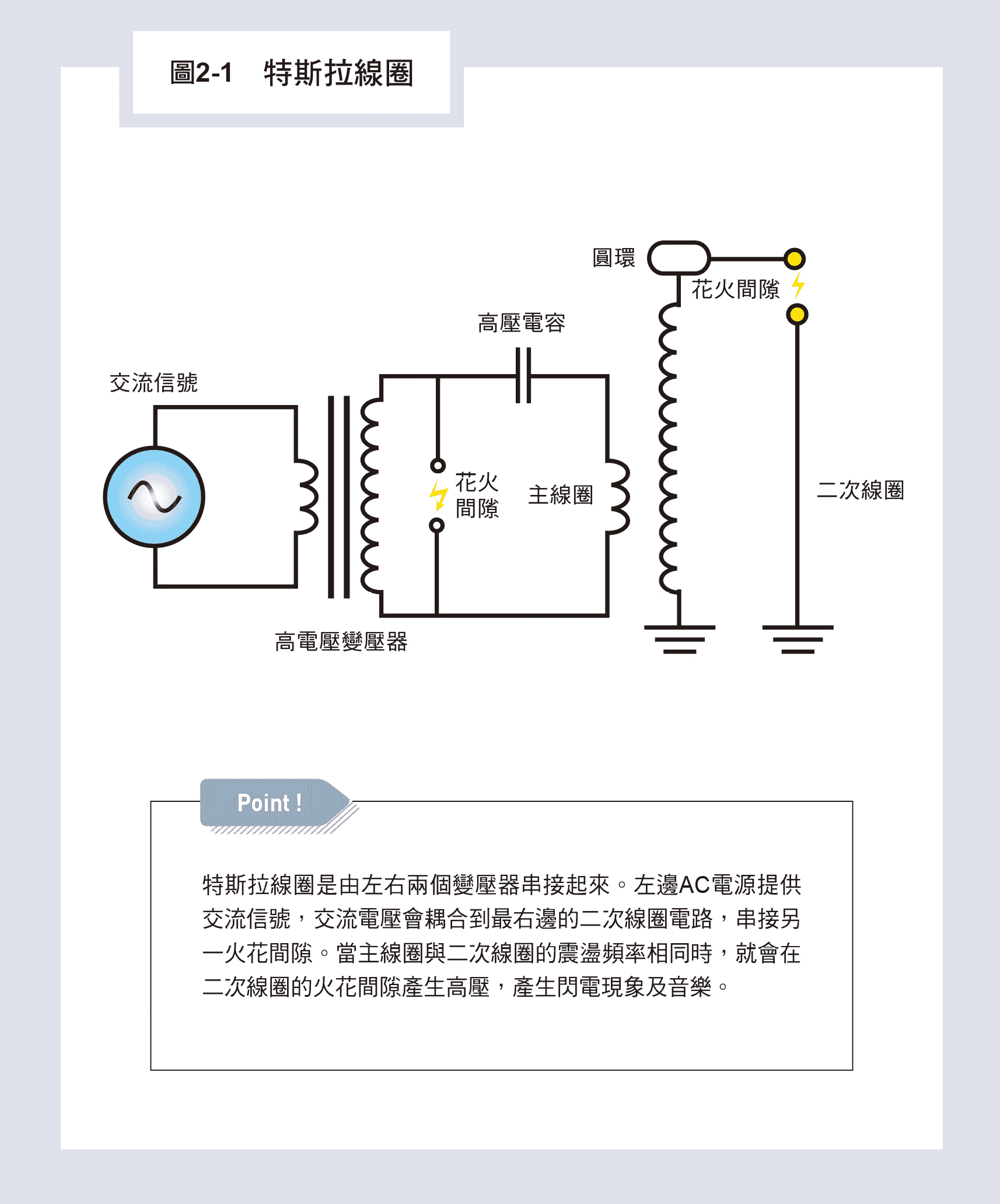
The Tesla coil is actually composed of two transformers connected in series from left to right. The AC power supply on the left provides the alternating current signal; it is an ignition coil that amplifies the voltage via a transformer and couples it to the primary coil circuit of the right transformer. A capacitor that can withstand high voltage is placed in the circuit to store electric charge, raising the voltage high enough to break through the air insulation layer of the spark gap and discharge, generating an LC circuit oscillating current. The frequency (f) of this alternating oscillating current is determined by the inductance (L) and capacitance (C), which is approximately from a few hundred Hertz (Hz) to tens of kilohertz (KHz), belonging to the audible sound range (20 to 20,000 Hertz). The alternating voltage will be coupled to the rightmost secondary coil circuit, which means the RLC circuit will be connected in series with another spark gap. When the oscillation frequencies of the primary coil and the secondary coil are the same, high voltage will be generated at the spark gap of the secondary coil, breaking down the air insulation to produce lightning phenomena and music. In his laboratory in Colorado Springs back then, Tesla could generate a high voltage of 100 million volts, causing the breakdown of air insulation to produce chaotic and massive lightning phenomena.
The phenomenon of this high-voltage coil discharge actually produced another physical phenomenon—the torsion field. However, it was not until over a hundred years later in 2013 that this was derived from general relativity by my student, Dr. Liang Wei-Jie ③; it was a physical phenomenon that Tesla could not understand at the time.
Later, I also discovered that the torsion field can travel between the yin and yang worlds, bringing information and energy from the spiritual world to the material real-number world, cracking the mysteries of traditional Chinese Daoist feng shui and Qi Men Dun Jia. I will introduce this part in detail in Chapter 4.
Did Tesla Once Receive Radio Signals from Extraterrestrials?
More than ten years later, in 2014, I finally bought Tesla’s journals online, allowing me to carefully study his notes and the annotations added by later generations.
It turns out that during the half-year experiment in Colorado, Tesla would occasionally receive sets of repetitive pulse signals from his coil receiver, which were completely different from the chaotic signals caused by storms or noise on Earth. These signals sometimes consisted of one, two, to four peaks per set, showing regular signals. At that time, Tesla strongly suspected that these were meaningful signals emitted from Venus or Mars. He guessed that this was evidence of local extraterrestrials attempting to contact Earth’s civilization. However, later scientists believed that Tesla might have received radio signals generated by Jupiter’s plasma torus.
The Last Thirty Years of Tesla’s Life
Starting in 1914, Tesla was already 58 years old. He gradually began to show symptoms of obsessive-compulsive disorder, and the condition became increasingly severe. He was obsessed with the number three; for example, before entering a building, he would first walk three circles around the nearby streets; when eating, he would request a stack of three folded napkins to be placed next to his plate. Medicine in that era did not understand obsessive-compulsive disorder and had no way to treat it. Therefore, some people thought Tesla was crazy, which of course also damaged his remaining reputation. He never married and lived alone in a hotel, relying on delayed patent royalties from the Westinghouse Company to make a living.
In August 1917, Tesla established the relationship between power and frequency for the world’s first radar prototype. This principle assisted French engineers in manufacturing France’s first radar system in 1934.
In the 1920s, Tesla was said to have negotiated with the British government to build a “death ray” system, but it was ultimately halted due to Tesla’s political attitude.
Finally, Tesla passed away in a hotel in New York in January 1943 at the age of 86. This was right during World War II. He left behind dozens of boxes of documents. Except for laboratory journals and some patent documents and other materials, which his nephew obtained through a lawsuit and had forwarded to the Yugoslav government, the other documents were declared top secret materials after the US War Department at the time contacted the Federal Bureau of Investigation, and two truckloads of materials were completely confiscated. It was not until thirty years later that some of the materials suddenly appeared on the market for auction. After another twenty-plus years, these materials were finally organized into books and published, causing a sensation.
① Please refer to Chapter 6 of The Science of the Spiritual World.
② For a video of a Tesla coil exciting the atmosphere to produce music, please see the link below.
③ Reference: W. C. Liang and S. C. Lee, 2013,“Vorticity, Gyroscopic Precession, and Spin-curvature Force”, Phys. Rev. D. 87, 044024.
Secrets in Tesla’s Lost Files
In 1976, a New York book dealer named M. P. Bornes auctioned four boxes of documents in Newark, New Jersey, which were purchased by Dale Alfrey for twenty-five U.S. dollars.
After returning home, Alfrey briefly browsed through these documents and discovered that they were the personal papers of Nikola Tesla, recording many of his ideas. In those days, not many people knew who Tesla was, and he guessed they were probably the notes of a science fiction writer, because what he read was so incredible that they could not possibly be true. He had little interest in these science fiction documents, so he placed the four boxes of files in a basement storage room, thinking he would read through them slowly later when he had time.
Unfortunately, by the time he had time to look at them, more than twenty years had passed, and the documents had seriously deteriorated in the damp basement—the paper had yellowed and the ink had faded. He decided to reproduce the contents of the documents before it was too late to save them, and then he was astonished to find that these files revealed the secret life journey of the scientist Tesla from childhood onward, content that had never been recorded in any biography written after his death.
During the summer of 1997, Alfrey had finished reading Tesla’s four boxes of documents and was preparing to begin scanning the documents into a computer and storing them on computer disks. He noticed that there were no sketches of machines Tesla had designed among the documents, and the records were incomplete, but the documents contained entries dated by year, month, and day, with many pages skipped in between. He therefore believed that many more Tesla documents might still be held by the U.S. government or forgotten in people’s basements. He consequently posted messages online hoping to find more Tesla documents, which obviously attracted the attention of many people interested in Tesla’s files, including groups prepared to make the documents disappear.
One day in September 1997, Alfrey’s wife and children went to Manhattan, New York, and he stayed home alone doing research, scanning Tesla’s documents. That evening he received a phone call from someone who identified himself as Jay Kowski, expressing interest in the documents he possessed. Shortly after, the call was disconnected, and at the same time he heard the doorbell ring. When he went to answer the door, he found it was already open. Three men were standing on the porch, all wearing identical black suits, white shirts, and black ties, looking very much like funeral home attendants. One of them seemed to know him well and could even call him by name directly, hoping he would not mind letting them into the house. Although the man kept addressing him by name and seemed familiar with him, Alfrey could not recall having seen this person anywhere, and so he began to worry whether these three men were part of a criminal syndicate.
The man continued speaking to him: “We want to buy the old boxes and documents you possess. These documents do not belong to you and are of no use to you; on the contrary, they will bring you trouble.”
At this, Alfrey began to feel terrified—these three men were not really interested in buying the materials; they wanted to take them away.
The man continued to tell him in slow, clear words: “No matter what you do, you cannot stop us from taking your materials. You and your family had better give us what we need, otherwise people will disappear because of this.” The man stood directly in front of Alfrey, gazing at him with calm, pitch-black eyes, making him unable to move or speak. At that moment, the three men suddenly turned together and quickly ran off the porch, vanishing into the night.
A moment later, Alfrey suddenly snapped out of his daze and rushed out the door to look for the three men, but there was no car in the yard, and the street outside was completely silent—the three men had simply disappeared. He hurriedly rushed back to his home study, only to discover that the four boxes containing Tesla’s journals and documents, as well as the data disks storing his materials, had all vanished. The data on the computer’s hard drive had also been entirely erased, and even the Tesla-related magazine materials he had collected over many years had been swept clean. Obviously, the three men at the door were merely a decoy, intended to draw him away from the study while others entered it and stole all the materials.
It took Alfrey several months to return to normal. He began to record, bit by bit from his memory of past research, the materials he could remember, which became the subject matter of several later books, for example, The Lost Journals of Nicolas Tesla by Tim Swartz.
In these documents, Tesla had mentioned that his invention, the Tesla coil, could receive messages transmitted by extraterrestrials—as previously described, these were regular pulsed signals, not earthly noise. Eventually, he could even hear incoming voices telling him that the Earth’s temperature was rising due to man-made pollutants entering the atmosphere, which would ultimately melt the Arctic ice cap, causing sea levels to rise and inundate coastal cities such as New York. This is what everyone would come to know a hundred years later, by the end of the twentieth century, as the atmospheric greenhouse effect.
These warnings also inspired Tesla to conceive of inventing a form of energy that did not rely on fossil fuels, which could reduce the degree of atmospheric pollution. Accordingly, in the 1890s, he claimed to have designed a motor that did not use gasoline but could drive an automobile. This motor could operate and drive the automobile without any energy input, directly using the electricity generated by the automobile itself, violating the law of conservation of energy. Many people later attempted to replicate this and applied for U.S. patents, but because they could not explain the source of the energy, they were rejected by the Patent Office.
Furthermore, he gradually suspected that aliens not only existed but also intended to come to Earth, and therefore he wanted to develop death ray weapons to resist alien invasion and prevent humanity from being destroyed. He also proposed concepts of anti-gravity and flying saucers—how to use electricity to create anti-gravity. His various ideas were far ahead of what his era could accept, and since he did not leave behind any physically completed machines, such as a vacuum energy extraction motor or a death ray weapon, to verify his views, many of these ideas were regarded by the world as science fiction and not taken seriously.
However, with the progress of the times, his idea of the greenhouse effect has already been confirmed by modern science. Other ideas, such as the existence of enormous zero-point energy in a vacuum ①, have also been predicted by quantum mechanics. Motors that extract energy from vacuum zero-point energy also have a small number of patents and cases, which I have personally participated in, and I know that vacuum energy extraction is an achievable fact. The only requirement is the use of the properties of spacetime-distorting torsion fields—physics that Tesla did not live long enough to learn about.
As for the story of communicating with aliens, I provide a detailed introduction in Chapter 6 of The Science of the Spiritual Realm, and even present archaeological evidence proving that aliens from the constellation Cygnus visited Earth five to six thousand years ago. It can be said that the various ideas Tesla recorded that were considered incredible by people of his time have gradually been proven correct in some cases, while others await confirmation from future research results. Among these ideas, there is one involving a physical force field—the “torsion field”—a phenomenon not understood in Tesla’s era, and the central focus of this book, to explore what miraculous properties the torsion field possesses that may answer part of Tesla’s secrets.
Voice Communication with Aliens
Among Tesla’s lost documents, it is mentioned that during his 1899 experiments in Colorado Springs, the receiver coils he designed would sometimes receive regularly pulsed signals, distinctly different from terrestrial storms or noise, leading him to suspect they were electromagnetic wave signals sent by extraterrestrial intelligent beings to make contact with humanity. However, an increasing number of subsequent documents record that Tesla received voice communications from aliens informing him of the trend of global warming. This point requires detailed analysis—what exactly was going on?
If the voice communication was received as electromagnetic waves through Tesla’s coils, then a technical difficulty arises: communication requires an encoding method mutually accepted by both parties in order to upload signals and download decodings. Aliens in that era could not possibly have had a jointly agreed-upon encoding method with humans, yet an advanced alien civilization could use consciousness to communicate directly with other consciousnesses, without barriers of language or writing.
Therefore, I believe this was told to Tesla directly by spirits or aliens encountered through his celestial eye, and had nothing to do with the electromagnetic pulses received by the coils. And a consciousness possessing advanced scientific knowledge would not be a traditional high-level spirit. Based on my years of experimentation with extraordinary sensory functions, I judge that it was aliens from a high-level civilization who directly informed Tesla through the celestial eye.
Extracting Free Energy from the Environment
When Tesla was young, while working in Paris in 1883, he was already pondering how to extract energy from the environment to do work. He read the judgment of the British master of thermodynamics, Lord Kelvin, that it was impossible to build a thermodynamic mechanism to extract heat from the environment to do work. So he conceived a method using a very long metal wire extending from the Earth into space; since space is colder than the Earth, the temperature difference would cause an electric current to flow from the hot end to the cold end, and he could utilize Earth’s thermal energy to create an electric current to do work, continuing until the Earth cooled to the same temperature as space.
However, because he was busy in the following years applying his invented polyphase generators and motors to the electrical power industry, it was not until 1889 that he had time to consider how to extract environmental energy. At that time, quite a few patents also claimed to achieve the same thing, with energy sources including sunlight converted into electrical energy—what are now called solar cells—and some patents drew on radiation energy from space, such as cosmic rays and other forms of energy.
What Tesla envisioned was a different method. In 1893, he applied for a patent for a coil for electromagnets to extract environmental energy. This coil design was highly unusual; unlike a conventional coil where a single wire is wound around a circular long tube, this coil used two wires wound side by side around the tube, with the end of one wire connected to the beginning of the other wire, so that the currents in the two wires were of equal magnitude and opposite direction. He claimed that this design could store greater energy but did not explain the underlying physical principle.
For those of us engaged in torsion field research, it is immediately apparent that this design is in fact a type of torsion field generator structure. The magnetic field produced by electric current flowing through the coil would induce a torsion field that distorts spacetime. The torsion field can penetrate into imaginary space, bringing the energy stored there out into real space, causing a generator to produce more energy than the input energy. Therefore, this type of generator does not require fuel.
The law of conservation of energy applies only to the real-number material world. When energy from the imaginary-number world is injected, it can of course break the conservation of energy in the real-number world, but the law of conservation of energy still holds when the two worlds are combined.
In the next chapter, we will begin introducing the crystal qi field, that is, the physical properties of the torsion field, the penetrating properties of various attractors, and the phenomenon of qi conduction. We will prove that the torsion field can travel between the yin and yang realms, and can project the energy of the spirit world from imaginary-number spacetime into real-number spacetime, thereby producing an amplification phenomenon.
① Refers to the fact that energy actually still exists in a vacuum.
Chapter 3 The “Torsion Field” That Tesla Did Not Live to Know About
The force produced by the torsion field is weaker than universal gravitation, yet it is a miraculous power.
It originally belonged to a part of general relativity,
but was neglected by Einstein at the time,
until the 1920s, when it was incorporated by the French physicist Cartan,
supplementing it into a more complete theory of relativity.
After the 1960s,
it was taken seriously by Russian scientists and highly developed.
The Emergence of the Term “Torsion Field”
1990: Observing “External Qi” Through Miraculous Qigong
When I was studying for my Ph.D. in electrical engineering at Stanford University in the United States in the 1970s, my research topic was semiconductor materials and devices, and I had to be familiar with quantum mechanics, modern physics, solid-state physics, and semiconductor device physics. When I returned to teach in the Department of Electrical Engineering at National Taiwan University in 1982, I also offered these courses for students to take, striving to collect as many relevant books and reference materials as possible to compile lecture notes, and I was very familiar with the relevant theories. I myself also wrote a Chinese-language textbook, Physics of Semiconductor Devices, which won the 20th Golden Tripod Award, and I was adept at applying this physics knowledge.
By 1987, in response to the call of Mr. Chen Lu-an, who was then chairman of the National Science Council, I participated in the qigong research project led by the National Science Council. At that time, I was very curious about the external qi of qigong, but it was not until 1990 that I had the opportunity to conduct external qi experiments with Master Li, who was invited by the National Science Council. He directed killing qi from his palm at a sealed test tube fifteen centimeters away for two to five minutes, and as a result, the chromosomes of the fibroblast cells cultured inside broke one after another, and the rate of protein synthesis dropped by forty percent. This left me completely baffled. Did the external qi contain shock waves or ultraviolet light? Otherwise, how could energy break chromosomes? But ultraviolet light would also injure the master’s palm, yet the master’s palm was completely unharmed, and long-wavelength shock waves causing damage to micrometer-scale molecules would also be far too difficult. So what exactly was the physical nature of external qi? Was it a fifth force field beyond gravitation, electromagnetic force, the strong force, and the weak force? Based on my physics knowledge at the time, I was at a complete loss and had absolutely no concept of it; I could only keep the question in my heart, waiting for the right opportunity to understand it.
1999: Discovery of the Information Field (the Spirit World)
Starting in 1993, I engaged in research on human paranormal abilities such as finger reading and psychokinesis, and trained several adolescents with fairly good abilities, such as Miss T and little Miss Wang, who could conduct quite in-depth research on the finger-reading phenomenon ①. From 1996 to 2000, I collaborated for many years on psychokinesis experiments with Professor Shen Jinchuan of the Institute of Human Body Science at China University of Geosciences on the mainland and with the specially gifted individual Ms. Sun Chulin, for example, bringing dead peanuts back to life within thirty-six minutes, regenerating and sprouting 2.8 centimeters ②.
In 1999, when the president of the Physical Society of Taiwan brought over a dozen professors of physics and psychology to my laboratory to verify the finger-reading phenomenon, I met Dr. Chen from the National Synchrotron Radiation Research Center. He was also the first scientist to use the character “佛” (Buddha) to test Miss T’s finger reading and thereby discover anomalous phenomena. Through this, we jointly discovered that besides the material universe of the four-dimensional spacetime we are familiar with, there also exists an information field (the spirit world) full of consciousness, filled with various highly intelligent consciousnesses and information websites. Every religion has its own information website, with rich, colorful, and diverse content.
It turned out that beyond the material world, there also exists a spirit world, a world of consciousness. The former is hardware and the latter is software; only when hardware and software are united do they form a complete life.
At the time, Dr. Chen considered finding a physical tool to communicate with the deities or masters of the spirit world, bringing the spirit world into the domain of modern physics for study. The question was: what physical tool could be used to communicate with the spirit world? He found some information from websites and believed that using a powerful crystal qi field could possibly break through the barrier between the two worlds and communicate with the other world.
At the time, Dr. Chen served at the Synchrotron Radiation Research Center of the National Applied Research Laboratories and was skilled at fabricating precision equipment. Starting in 2000, he made various crystal qi field generators and qi field detectors, wanting to measure the strength and shape of these qi fields, but no matter how these magnetic field, superconducting, or electronic detectors were designed, they could not detect any qi signal. Miss T had paranormal abilities; her palm was sensitive to qi fields and she could feel the strength and shape of the crystal qi field. Therefore, she became the best detector for us to study the physical properties of the crystal qi field. However, because human sensation can only rely on subjective comparison and cannot achieve objective quantification, the results could only serve as qualitative reference, pointing out a direction for research, so that when a detector capable of actually measuring the signal could be produced in the future, it could be rapidly verified.
2004: The Torsion Field Suddenly Appears
In January 2004, I traveled to Beijing with Ms. Wu Mei-yun, editor-in-chief of Echo Publishing House, to visit Professor Shen Jinchuan and Ms. Sun Chulin of the Institute of Human Body Science at China University of Geosciences, with the aim of co-authoring a book in the form of a dialogue discussing the history and results of the various extraordinary special abilities the two had researched over the previous twenty years, for the reference of the world. My collaboration with Professor Shen and Ms. Sun had already ended at the close of the year 2000, and we had not seen each other for many years. The moment we met, Professor Shen handed me two articles written by Professor Jiang Xingliu of Beihang University, introducing a field that the former Soviet Union had researched over the past fifty years—the “torsion field.” Good heavens! I had never even heard of this term and had no idea what it was. We conversed during the day, recording our talks, and rested in the evening. I took advantage of the evening to find time to read through the articles. To my surprise, the more I read, the more shocked and excited I became. I could not wait and read through them four or five times in succession, as if a new world had opened up before me.
It turned out that the torsion field was not a new concept at all. As early as 1915, when Einstein proposed the “General Theory of Relativity,” he held that the geometric properties of time and space are determined by the energy and momentum of objects, and that the existence of mass causes the curvature of spacetime. However, in order to simplify the mathematics, he set the torsion of spacetime—that is, the torsion field—to zero, and thus the General Theory of Relativity is a torsion-free theory of gravity. If the curvature of spacetime is equivalent to producing universal gravitation, then the torsion of spacetime (as shown in Figure 3-1) is of course equivalent to producing torsional force, but this force field was discarded by Einstein. In 1922, the French mathematical physicist Élie Joseph Cartan incorporated spin angular momentum carrying the torsion (torsion field) of spacetime into the General Theory of Relativity, supplementing it into a more complete theory of relativity, but this did not receive the attention it deserved.
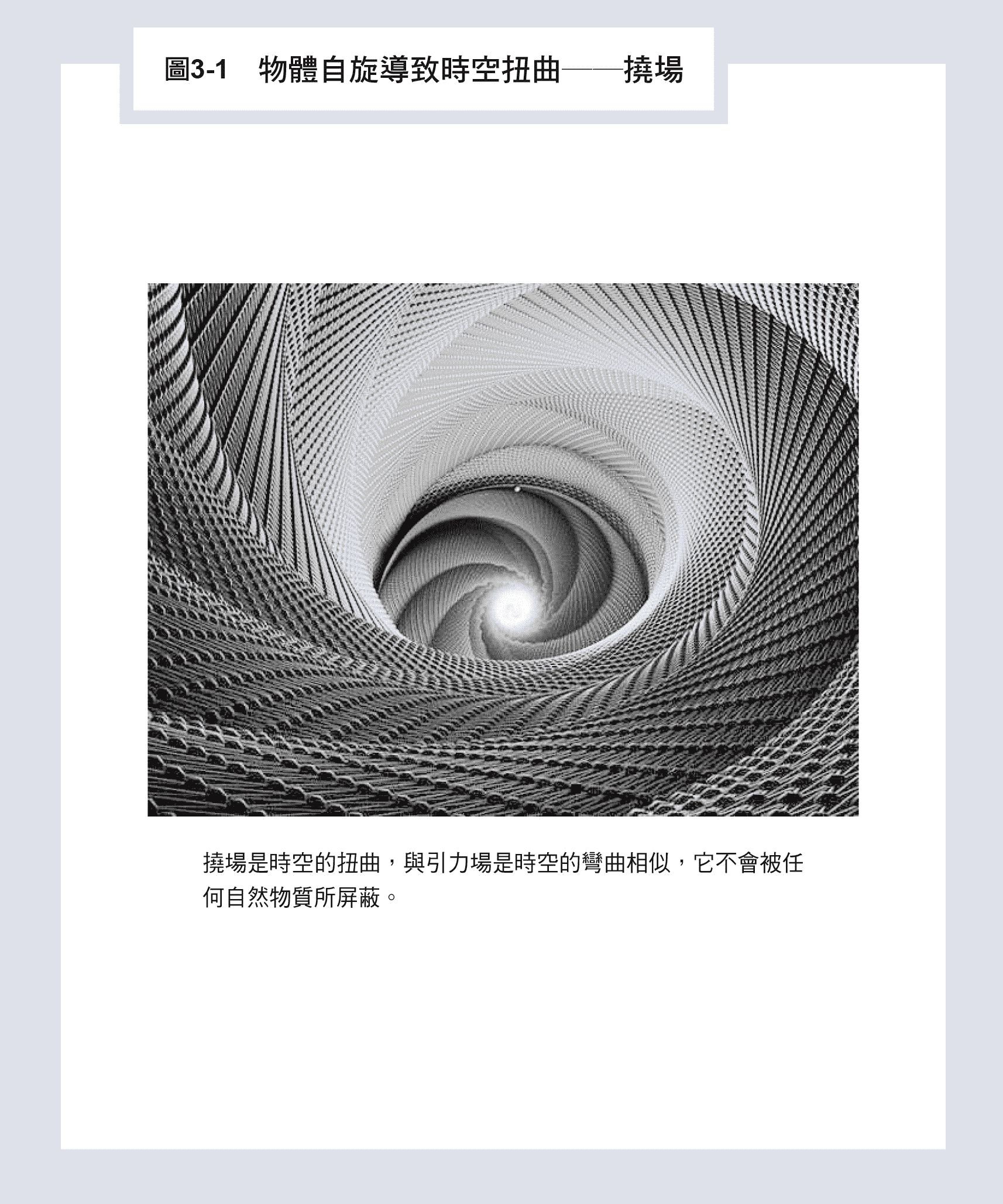
Starting from the 1960s, Russian scientists conducted in-depth theoretical and experimental research on torsion fields, arriving at several important physical properties of torsion fields:
 The torsion field is a torsion of spacetime, similar to how the gravitational field is a curvature of spacetime; it cannot be shielded by any natural material. For example, a wall between two objects does not shield gravity, and presumably should not shield the torsion field either. Therefore, when it propagates through natural matter, it does not lose energy, though it can be scattered; its effect only changes the spin state of matter.
 The propagation of the torsion field in four-dimensional spacetime is not limited by the light cone; that is, its speed exceeds the speed of light, and it can transmit not only to the future but also to the past.
 After the torsion field source is removed, the spatial spin structure is still retained at that location; that is, the torsion field has a residual effect.
These physical properties of the torsion field described by Russian scientists were astonishingly identical to what we had come to understand about the crystal qi field after three years of research. I immediately realized that the crystal qi field is the torsion field; the fifth force field had revealed itself. All that remained was to design experiments to confirm it.
The torsion field, belonging to the General Theory of Relativity, is virtually unknown, yet it is the most wondrous force field, one that can bring forth the energy of the spiritual realm.
① Please refer to The Science of the Spiritual Realm.
② Please refer to Special Abilities? Or Latent Abilities?.
The Crystal Qi Field Is the Torsion Field
In 2016, I wrote and published the book The Science of Qigong, in which I compiled extensive statistics on the physiological phenomena of the body when a person practices qigong, and classified them into two categories—the “resonance state” and the “meditative state”—both closely related to the alpha waves in the brain.
We found that the situation in which brain alpha waves increase substantially during qigong practice is called the “resonance state,” a phenomenon in which the brain’s alpha waves resonate with the body’s meridian acupoints. The situation in which brain alpha waves are suppressed and disappear during qigong practice is called the “meditative state.” We also figured out how to use the “rapid counting” method to stimulate the resonance between brain alpha waves and the body’s meridian acupoints within a few minutes, producing the effects of “qi gathering at the Dantian” or “qi traveling along the Ren meridian.” As for the most puzzling aspect of qigong—the “external qi” or the “qi field” of crystals—what physical phenomenon is this physical “qi field”?
In Chapter 3 of The Science of Qigong, I provided an introduction, offering two sets of experimental data for comparison to confirm that the crystal qi field is the torsion field.
The first set of experimental methods used a torsion field generator designed by Sphilman, an engineer from the former Soviet republic of Kazakhstan, to irradiate deionized water with a torsion field for three minutes, and then used a nuclear magnetic resonance (NMR) instrument to measure the changes in water molecular cluster size, so as to investigate the effects on the torsion field as it passed through different obstructing objects (as shown in Figure 3-2).
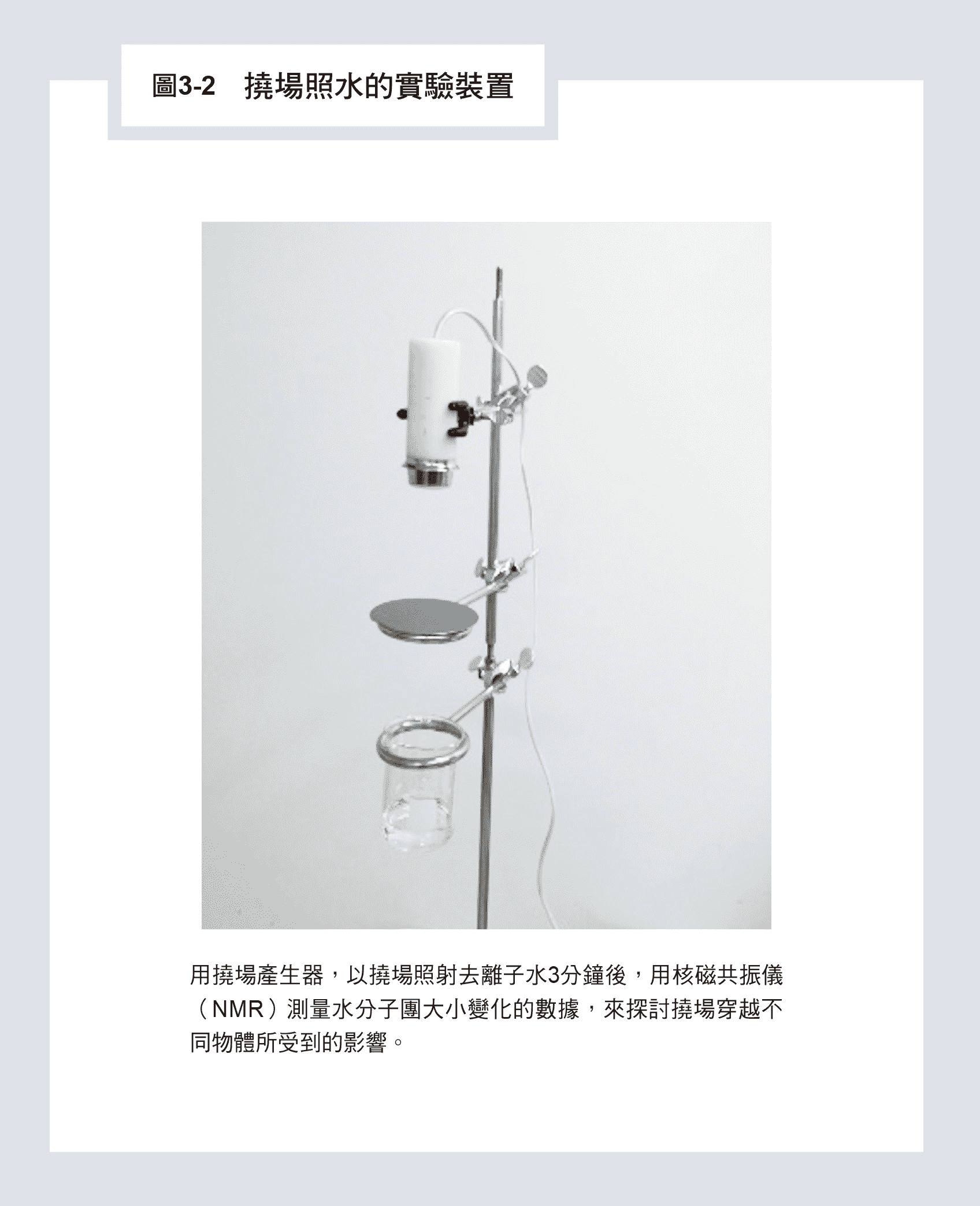
The second set of experiments involved allowing the crystal qi field to pass through a barrier—such as metal, paper, glass, semiconductor, or various other materials—and having Miss T sense it, to see how the intensity and shape of the qi field changed with a barrier present compared to when there was none.
Very quickly, we discovered that aluminum foil or a two-centimeter-thick aluminum plate could not block the qi field. The qi field passed through completely unaffected, indicating that the qi field does not contain electromagnetic waves; otherwise, it would have been severely attenuated by the aluminum plate. Stainless steel containing iron atoms (non-magnetic) or the metal molybdenum would transform the qi field from a static small dot into a prickly, dynamic qi field.
The most incredible thing is that a sheet of paper normally does not block the qi field, but when the paper gets wet after absorbing water, it completely absorbs the qi field. This precisely matches what Guo Pu of the Jin dynasty said: “Qi stops at the boundary of water.” If you remove the blades of a fan, then plug it in and spin it, and project the crystal qi field outward from the center of the rotating shaft, the result is that the qi field disperses and becomes very long, which also matches Guo Pu’s statement: “Qi scatters when it encounters wind.” Preliminary experiments thus confirmed the ancients’ descriptions of qi.
From experiments on irradiating water with the torsion field, we also discovered the same phenomenon: water-soaked filter paper can block the passage of the torsion field, a two-centimeter-thick aluminum plate has no effect on the torsion field whatsoever, while stainless steel or the metal molybdenum both affect the passage of the torsion field, producing the same changes in water molecular clusters.
Since both sets of experiments exhibited the same behavior of penetrating objects, we concluded that the crystal’s qi field is precisely the torsion field discovered in general relativity — a force field produced by the warping of spacetime.
Two Lines of Russian Torsion Field Research — Sphilman vs. Akimov
Sphilman’s Line of Torsion Field Research
In 2004, I found Sphilman, an engineer from the former Soviet Republic of Kazakhstan, through a website. I purchased the torsion field generator he designed, as shown in Figure 3-3, including front and side photographs and the core ring-shaped magnet, and began experiments on irradiating water with the torsion field, gradually coming to understand step by step the principles behind the torsion field generator. The book Scientific Qigong, which I wrote in 2016, was also based on experimental results obtained using this type of torsion field generator.
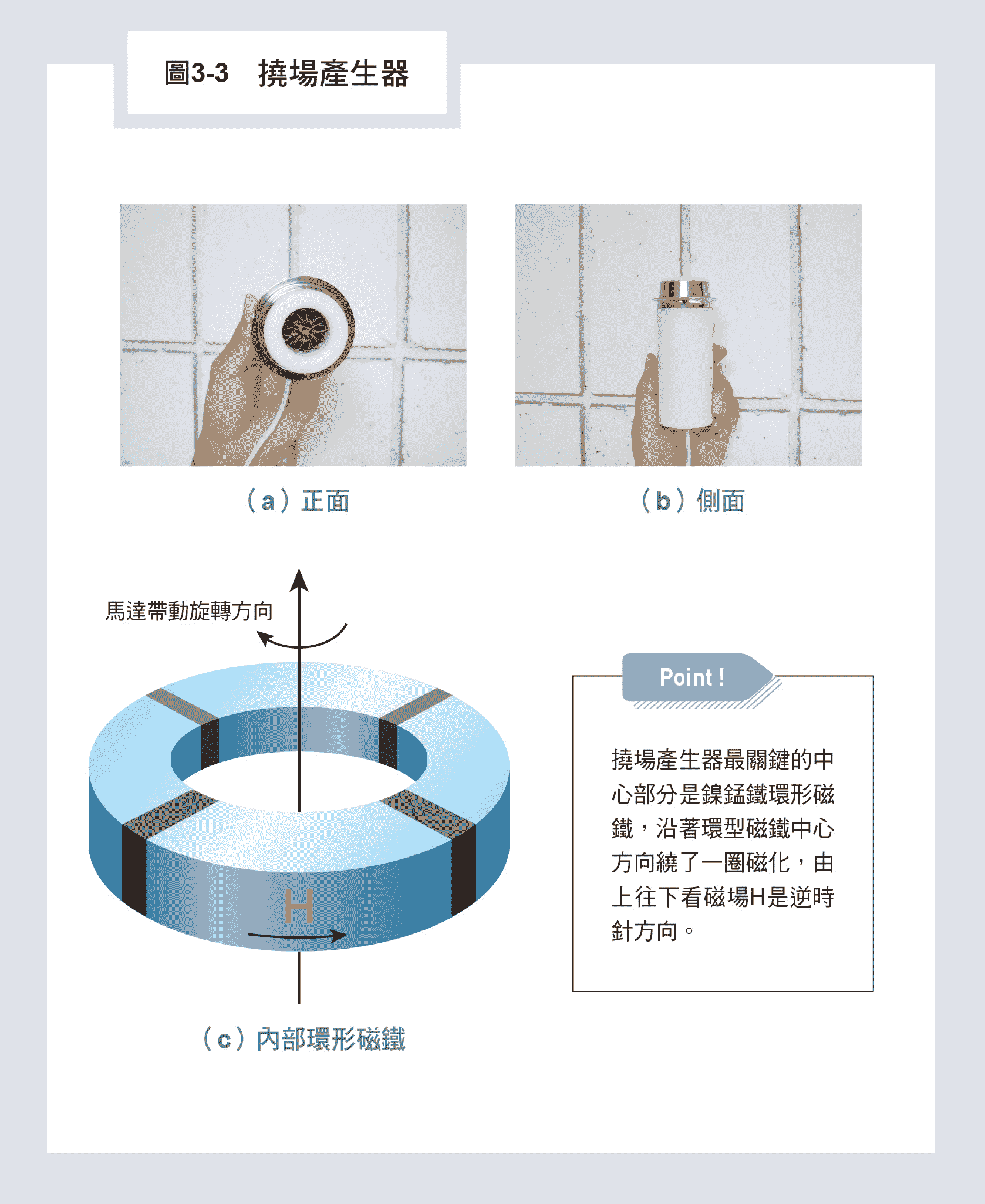
The most critical central component of the torsion field generator is a nickel-manganese-iron ring magnet, magnetized along one loop in the central direction of the ring magnet, as shown in Figure 3-3(c). Viewed from above, the magnetic field H runs in a counterclockwise direction. If the magnetic ring is driven by a CD-ROM motor to rotate in a clockwise direction, as shown in Figure 3-3(c), which is opposite to the magnetic field direction, this is called a right-handed torsion field; if it rotates in a counterclockwise direction, in the same direction as the magnetic field, this is called a left-handed torsion field. The physical principle by which this rotating magnet produces a torsion field along the central axis direction was derived by my student Dr. Liang Wei-Jie from the Einstein-Cartan theory of general relativity, and was published in early 2013 in the internationally renowned physics journal Physical Review D, listed in the references of Chapter 2 of this book.
The key point of this paper is to prove that if the spin angular momentum of an electron couples with the large rotational orbit executed by the electron itself, it produces a propagable torsion field. In atomic physics, there is a well-known “spin-orbit interaction” that considers the effect of electromagnetic fields coupling the electron spin with the large rotational orbit. However, traditional textbooks do not consider general relativity, and therefore are unaware that this interaction also produces another field, called the torsion field.
Intuitively speaking, the local magnetic molecules within the magnet all align their spins neatly along the center of the magnet to form a large ring. According to the discussion of “one object, two manifestations” in Chapter 4 of my book The Science of the Spiritual World, assuming that a particle’s spin is a channel between the two worlds of yin and yang, it can create micro-holes in real-number spacetime. When these micro-holes connect along the center of the ring magnet, they form a circular hole. When the magnet rotates rapidly at speeds exceeding three thousand revolutions per minute, the spacetime torn by the circular micro-holes twists the nearby spacetime to rotate along with it, forming an axial sword of distorted spacetime whose influence can extend two to three meters. Meridian-sensitive functional individuals can feel the stinging sensation caused by the torsion field with their palms. Therefore, more than ten years of theoretical and experimental research have convinced me that the coupling of electron spin to the electron’s large orbital rotation tearing spacetime is the most fundamental physics for producing torsion fields.
Reflections on Meeting Sphilman in Person
In October 2018, I was invited to attend the International Forum on Energy Medicine and Life and Health in Langfang City, Hebei Province (a city located between Beijing and Tianjin). At the conference, I met the manufacturer of the torsion field generator — Kazakhstan’s Sphilman — for the first time.
He was already quite advanced in age. Regrettably, he only spoke Russian and could not speak English, so communication was only possible through an interpreter. It turned out that they, the old-school torsion field researchers, were all disciples of Dr. N.A. Kozyrev, the representative figure of early Russian torsion field research.
Kozyrev believed that the invariants of a particle are usually accompanied by a physical field. For example, a particle’s “mass” is invariably accompanied by a “gravitational field,” and its “electric charge” is invariably accompanied by an “electromagnetic field.” Therefore, “spin” should also invariably be accompanied by a “spin field,” which is the “torsion field.” However, when the torsion field is stationary, its strength is proportional to the gravitational constant G multiplied by Planck’s constant h, and is therefore 1027 times weaker than gravitation. Gravitation is already the weakest force; a torsion field that is 1027 times weaker than gravitation is extremely difficult to measure.
However, the torsion fields accompanying the spin of electrons and atomic nuclei will combine to form the torsion field of the entire atom. The torsion fields of different atoms within a molecule will further combine to form the torsion field of the molecule. The synthesis of the torsion fields of all atoms in a solid will form the torsion field of the solid. Therefore, although the torsion field is very weak, every object—including you and me, tools, articles, and so on—has a large torsion field structure in spacetime, comparable in scale to the volume of the object.
Under most circumstances, there is no fixed phase relationship between the torsion fields of atom and atom, and the torsion fields of a large number of atoms will cancel one another out, so no macroscopic torsion field is produced. Therefore, although a torsion field accompanies them, it cannot be measured and is very difficult to perceive. For this reason, he believed that the field emitted by the generator he had built was one whose power he himself could feel to be very strong, and that it could not be called a “torsion field” but rather should be called an “Axial field”—a field produced along the central axis direction.
I told him that our theory had already proven, through general relativity, that electron spin angular momentum combined with large-scale orbital rotation can emit a torsion field, which is precisely the field produced by the equipment he invented. Because it tears apart spacetime, its force is very strong, and moreover the experiments on irradiating water also demonstrated that the torsion field is very strong—not the weak torsion field they had previously assumed it to be.
From Sphilman’s understanding and reactions, I deeply felt that every torsion field expert is limited by past experience and ideas, and their views differ greatly.
Akimov’s Line of Torsion Field Research
As early as 2004, I noticed that there was more than one type of Russian torsion field generator. Besides Sphilman’s rotating magnet torsion field generator, there was another type designed by A.E. Akimov, an academician of the Russian Academy of Natural Sciences, using an electromagnetic oscillation circuit as the torsion field generator. It is comparatively simple, with fixed magnets but no rotating magnet component, as shown in the exterior and internal circuit photographs in Figure 3-4. This also made me wonder: could there be different types of torsion fields?
In 2016, I completed the complex and lengthy three-year experiments on irradiating water with the Sphilman torsion field generator, proving that the properties of the torsion field are identical to those of the qi field of crystal, and then wrote the book Scientific Qigong, publishing the experimental data in the book. I believed that the torsion field had already been established as requiring electron spin combined with large-scale high-speed rotation to tear apart spacetime for its production, and that Sphilman’s approach was correct.
In 2017, I had the opportunity to attend a symposium in Beijing to discuss the various physical properties of torsion fields. A young engineer named Gao Peng, who had worked for many years with Director Shen Jinchuan of the Institute of Human Science at China University of Geosciences, collaborating on the development of various electronic devices to generate and detect torsion fields, told me astonishing news. He said that Russia holds an international conference on torsion fields every year, convening experts—primarily from the former Soviet Union—who conducted scientific research on torsion fields to discuss progress in torsion field research. He had attended and found that every time it was the same: they split into two factions and argued endlessly, having argued for decades.
He belonged to the Akimov faction, because designing electronic circuits was relatively simple for him, and he could quickly build one himself. He had also used the Akimov torsion field transmitter to conduct, together with Professor Mark Krinker of the City University of New York, a long-distance communication experiment spanning several thousand kilometers from Beijing to New York. Both parties used the same photograph as the initiation address for torsion field transmission and as a locator for receiving the torsion field, and they presented their successful signal reception results at the symposium.
At the time, I felt somewhat shocked. If this were true, did it mean that producing a torsion field did not require tearing apart spacetime? Or was there some new principle at work that I did not know about?
This gave me a certain sense of crisis. There were evidently some physical properties of torsion fields that I had not yet fully figured out. Yet I also knew that if this paper were accurate, it might represent the first experiment in human torsion field communication—just as Marconi’s first transatlantic communication using electromagnetic waves was a tremendous achievement. Although electromagnetic waves had been able to accomplish the same thing as early as 1901, torsion field communication could serve as a tool for interstellar communication, and in the future would far surpass the capability of electromagnetic waves, which are limited by the speed of light. We will discuss this point in more detail in Chapter 5.
The Akimov Torsion Field Generator Is Similar to the Tesla Coil
Figures 3-4(a) and 3-4(b) show the exterior and internal circuit diagram of the Akimov torsion field generator. It mainly consists of a stationary magnet whose magnetic field extends upward into an inductor (L), coupled in series with a capacitor (C) to form an RLC oscillation circuit, bearing a certain resemblance to the second coil in the Tesla coil construction introduced earlier in Chapter 2.
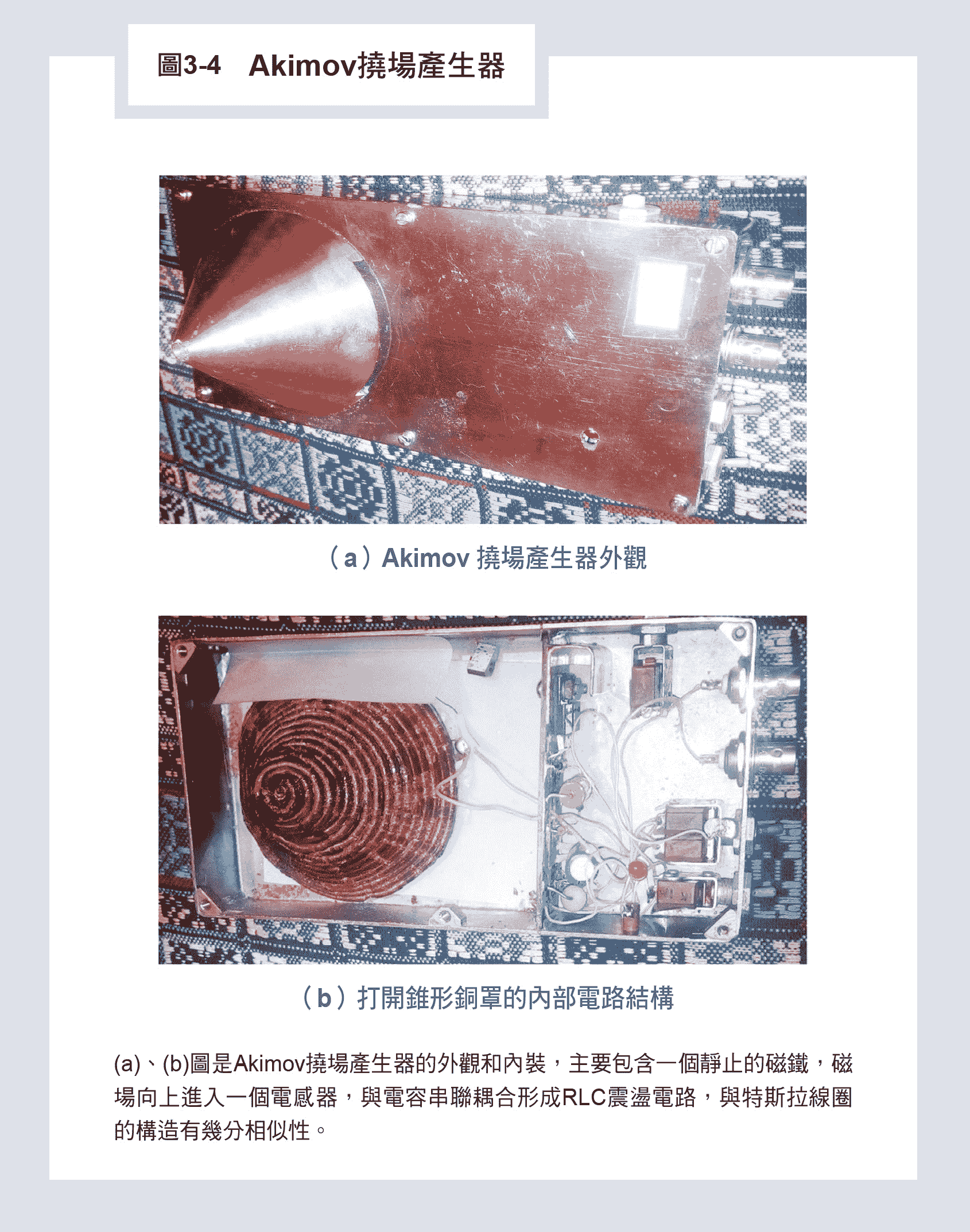
One day in April 2019, I was thinking about homeopathic preparations—why an aqueous solution containing a virus, after each dilution to one-tenth concentration, repeatedly diluted over a dozen or twenty times, would, under the influence of the Earth’s magnetic field of 0.5 gauss, actually produce radio waves of several tens to several hundred hertz, so that the information of the virus would then remain in the water for use in homeopathy, serving as information water for treating illness①.
The production of radio waves must be related to ions in the aqueous solution rotating around the magnetic field, and the frequency of rotation determines the frequency of the emitted electromagnetic waves. Suddenly, in a flash of insight, I realized that the magnetic field does two things to electrons or ions:
As shown in Figure 3-5, first, the red spin magnetic moment of the electron (or ion), that is, the direction opposite to the spin angular momentum S_p, will tilt toward or align with the magnetic field direction; second, the electron will rotate in the direction perpendicular to the magnetic field, that is, revolve around the magnetic field at a certain frequency. If the rotation frequency is the same as the magnetic field frequency, cyclotron resonance will occur, and a large amount of magnetic field energy will be transferred to the electron. Is this motion of the electron not exactly the mechanism for generating torsion fields theoretically derived by Dr. Wei-Jie Liang? This is because the electron’s spin angular momentum combined with large-scale orbital rotational motion can produce a torsion field.
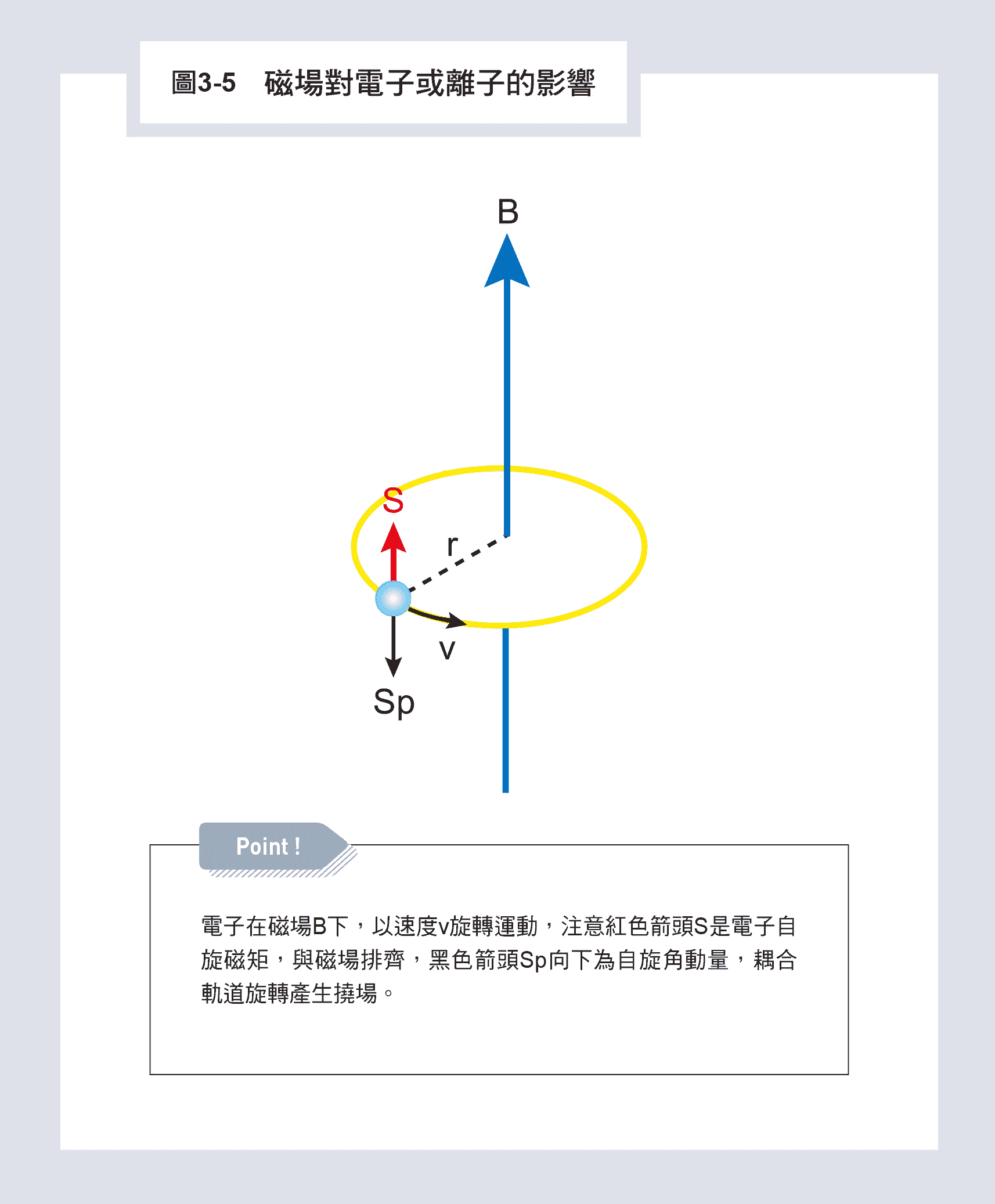
I suddenly realized that a helical conducting coil, that is, an ordinary inductor, if properly designed, can be made into a torsion field generator. The current rotates and flows rapidly within the coil, continuously producing a magnetic field along the center of the coil, causing the spin of the flowing electrons to align. If a magnet is added in the middle of the coil, the effect is even better. The spin angular momentum of these electrons will cut out countless orderly micro-hole channels in real-number spacetime, and combined with the rapid revolution around the coil, it will tear open large chunks of spacetime holes—this is the torsion field.
I breathed a great sigh of relief. It turns out that the principle of the Arkimov torsion field generator and the principle of the Sphilman torsion field generator are completely the same. Both are produced by electrons with neatly aligned spins undergoing rapid large-orbit rotational motion. The two principles are unified, and there is no longer any contradiction.
This also brings to mind the coil Tesla designed back in the day. In 1893, he applied for a patent for an electromagnetic coil used to extract energy from the environment. It was basically a torsion field generator, capable of producing a torsion field and projecting it outward, crossing the boundary between yin and yang to draw energy from the spiritual realm and channel it into generators in the real-number world, causing the collapse of the law of conservation of energy in the material world. As a result, it was rejected by modern science, which espouses materialism.
①Please refer to Chapter 4 of The Scientific Qigong, regarding the content on Nan’s desensitization therapy.
The Magical Properties of the Crystal Qi Field
Crystals themselves carry a qi field, which can be sensed by most people who are meridian-sensitive. The main reason is that the crystal structure of quartz is a trigonal crystal system structure (as shown in Figure 3-6), consisting of three helices (tetrahedra of different colors) intertwined with each other. Each colored regular tetrahedron is a small SiO4 crystal, with a silicon atom (Si) at the center and oxygen atoms (O) at the four corners. Averaged over the entire quartz crystal, the atoms form a silicon dioxide crystal (SiO2). This regular helical structure has the potential to produce a macroscopic torsion field. However, the qi field produced by the crystal itself is very weak and difficult to use for experiments, so it must be strengthened.
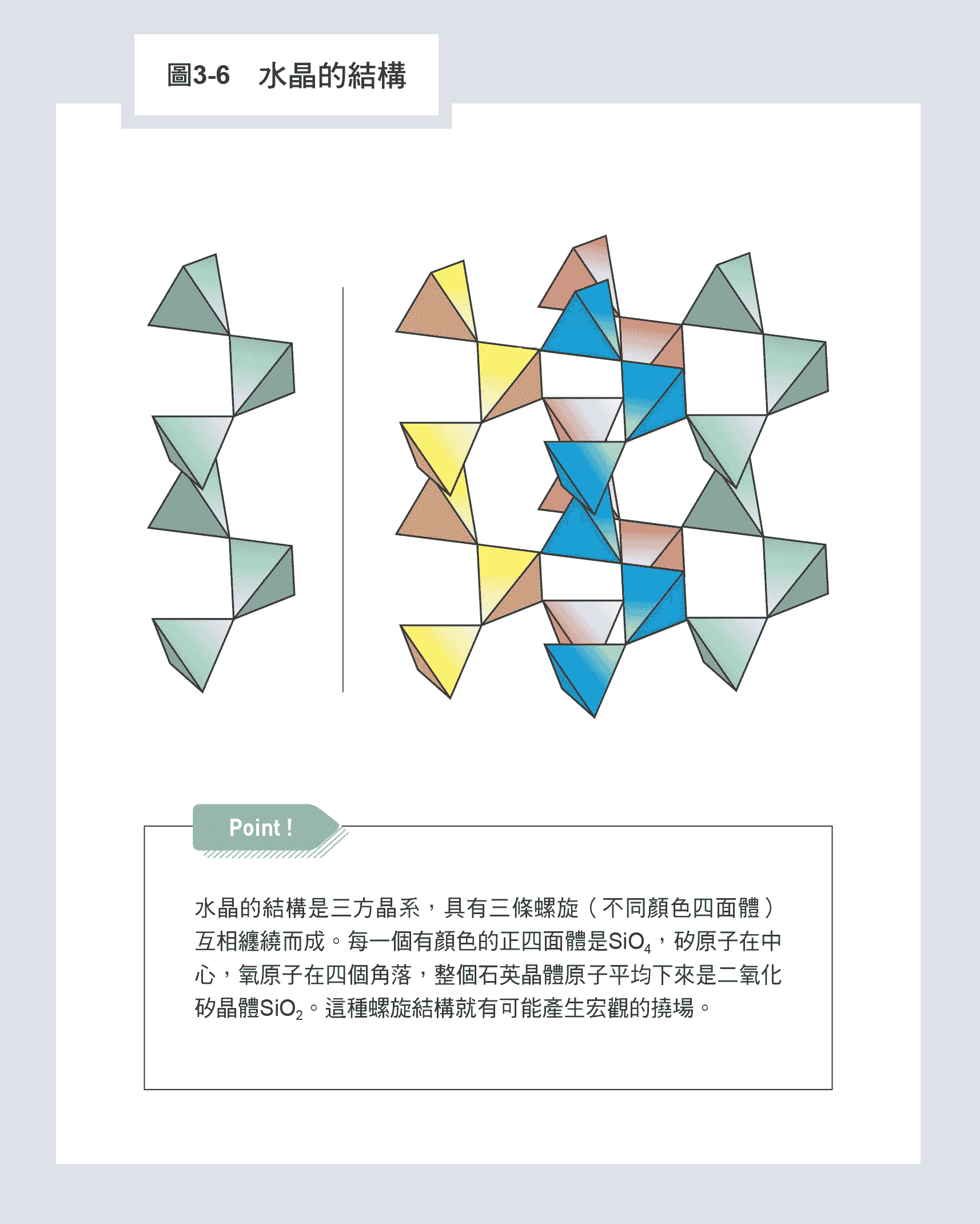
The experiment designer chose Czech moldavite, which has a very strong but disordered qi field, as the source, and fixed it to the wider end of a crystal rod cut into a dodecahedral tip, as shown in Figure 3-7(a). As the qi field passes through the helical structure of the crystal molecules, it is modulated and focused to form a cylindrical vortex spacetime structure that can be emitted from the crystal, perceived by sensitive psychics as a small dot.
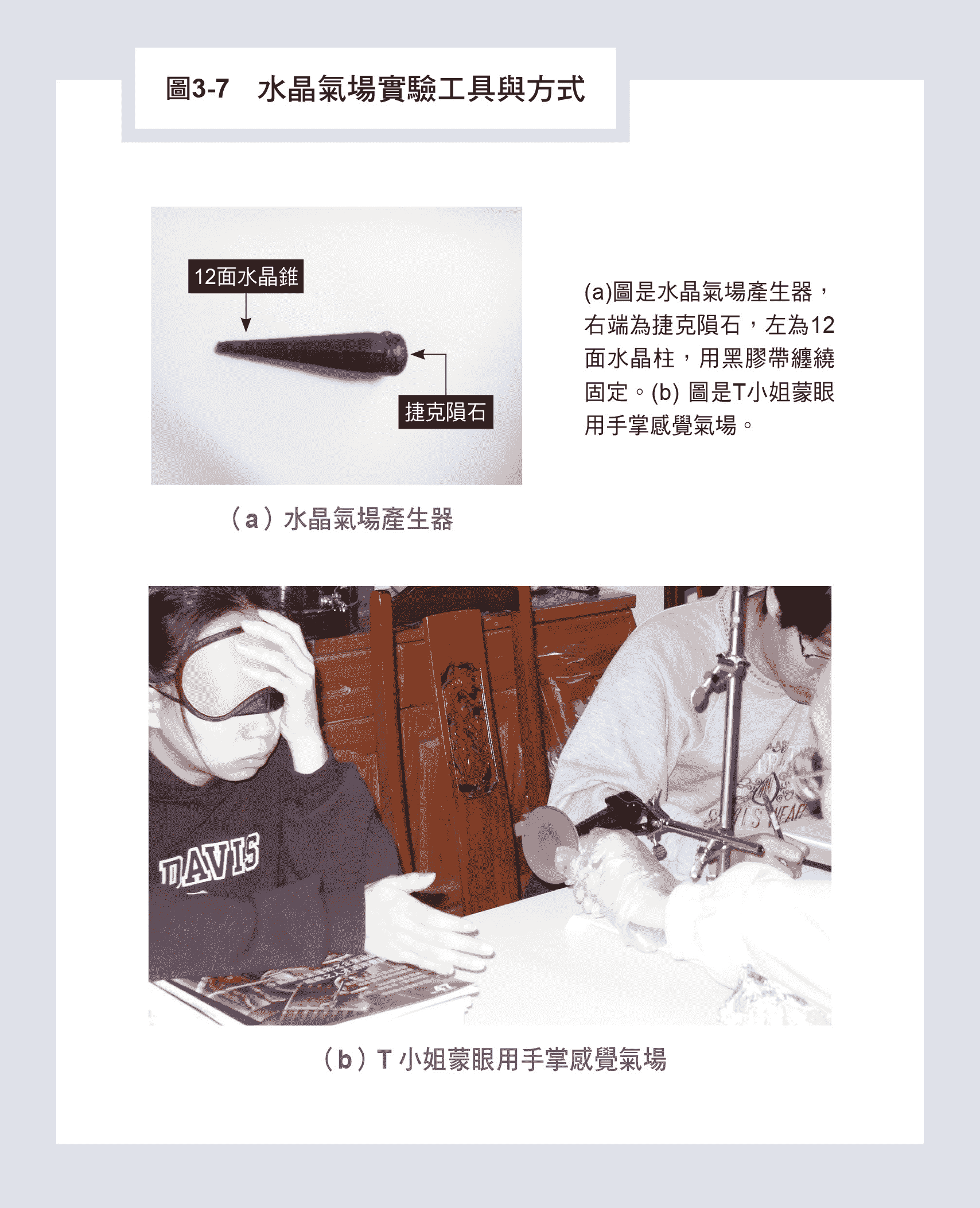
Why does moldavite produce a disordered qi field? This is also related to particle spin. Because the interior of the moldavite contains magnetic atoms arranged in a disordered manner, their magnetic fields cancel each other out and cannot produce an externally measurable magnetic field. However, the inner electron spins of the magnetic atoms are neatly aligned, and the excessive spin angular momentum tears through spacetime to form vortex torsion fields, that is, a disordered qi field. In Chapter 3 of The Scientific Qigong, we presented a large amount of nuclear magnetic resonance data showing water molecules after being irradiated by torsion fields, from which we have already deduced that the crystal qi field is a torsion field. This will not be repeated here. What follows will demonstrate some of the magical properties of the crystal qi field.
The Attraction and Amplification of the Crystal Qi Field by the Character “Buddha”
Does the crystal qi field have any other interesting physical properties? This requires Miss T, who has the ability of finger reading, to sense it.
First, we need a crystal qi field generator, provided by Dr. Chen from the Synchrotron Radiation Center. He used a piece of Czech moldavite as the qi field emission source, fixed with black tape to the rear of a crystal column cut into a dodecahedral cone, as shown in Figure 3-7(a). This crystal column can focus the qi emitted by the Czech moldavite, projecting it outward like a laser, with the diameter of the qi beam approximately the size of the crystal cone opening, which is five millimeters (mm).
During the experiment, the crystal qi field generator was mounted horizontally on a support stand. Miss T wore an opaque eye mask and used her right palm at a distance of about thirty centimeters from the generator, first sensing the shape and strength of the qi field. Then the experimenter placed a shielding object to block the crystal qi field, as shown in Figure 3-7(b). Miss T would report the changes in the strength and shape of the qi field. If the sensing was uncertain, the experiment would be repeated several times.
To verify Miss T’s accuracy in sensing changes in qi field strength—for example, if the field strength passing through a certain object decreased from ten to six—after conducting many experiments, we would randomly retest the same object again without letting Miss T know, and only confirm the result when it was consistent.
According to Miss T’s sensing, the cylindrical qi field of the crystal generator extends about ninety centimeters in length, and within ninety centimeters the field strength is very uniform.
In the past, when Miss T conducted finger-reading experiments, she discovered that certain religious words and characters—such as Buddha, Guanyin, Bodhisattva, Jesus, and similar terms—would cause her to see visions in her brain’s third eye, such as bright light, luminous figures, crosses, and hearing laughter. We call these “sacred vocabulary.”
We found that when a crystal qi field passes through white paper, or through ordinary characters written on paper, it remains unaffected, passing straight through with no reduction in intensity. However, when the crystal qi field passes through a sacred word such as the character “Buddha” (佛), it transforms into a large circle, as shown in Figures 3-8(a) and 3-8(b), and even feels warm, indicating that the energy has become stronger and its range has expanded.
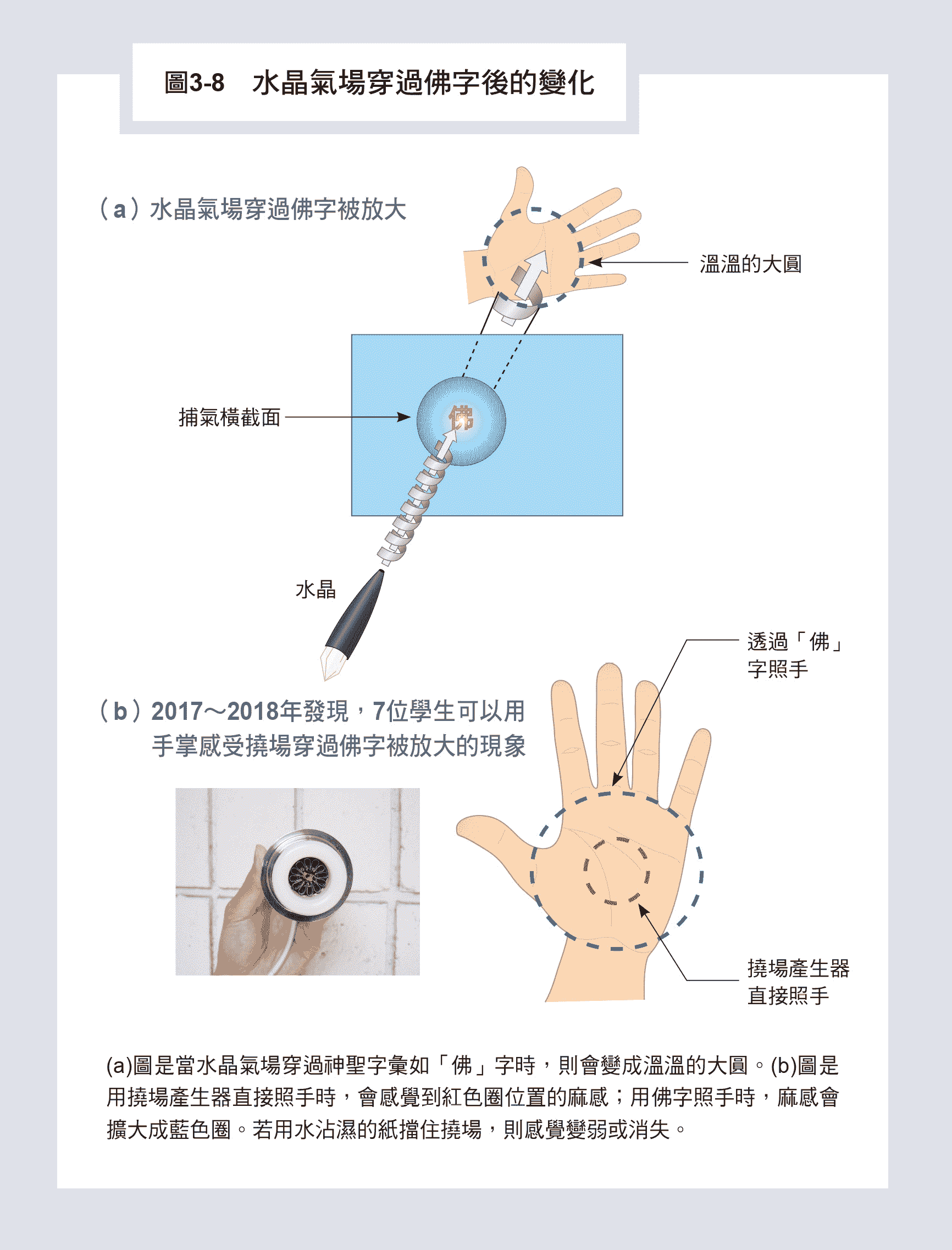
We moved a crystal around the character “Buddha” to test the qi field, and found that within the area surrounding the character “Buddha”—within a range of one character width in any direction—the same effect occurred: the qi field could be felt transforming into a large circle and becoming stronger. In other words, we can define a qi-capturing cross-section for the character “Buddha”; as long as the qi field passes through this cross-section, it will be captured by the character “Buddha,” producing the same effect. I will explain the reason for this clearly in Chapter 4.
Can this amplification effect be felt by other people?
From 2016 to 2019, in the course “Special Topics in Human Potential” that I taught in the Department of Electrical Engineering at National Taiwan University, I would test the students’ sensitivity to torsion fields. The method was to have all students close their eyes and place their left and right palms separately, 20 to 30 centimeters beneath an activated torsion field generator, for about thirty seconds. If anyone felt any special sensations—such as numbness, coolness, a breeze, or any dynamic sensation—they would be selected for further experiments.
After four semesters of testing approximately 150 people, roughly 15 to 20 percent of the students were sensitive to torsion fields and experienced some sensations. About 5 percent of the students were quite sensitive to torsion fields; not only could they sense the size, range, and strength of the torsion field, but the sensation would also trigger a numbness that traveled along the Pericardium Meridian from the Zhongchong acupoint all the way to the Quze acupoint at the elbow joint (as shown in Figure 3-9).
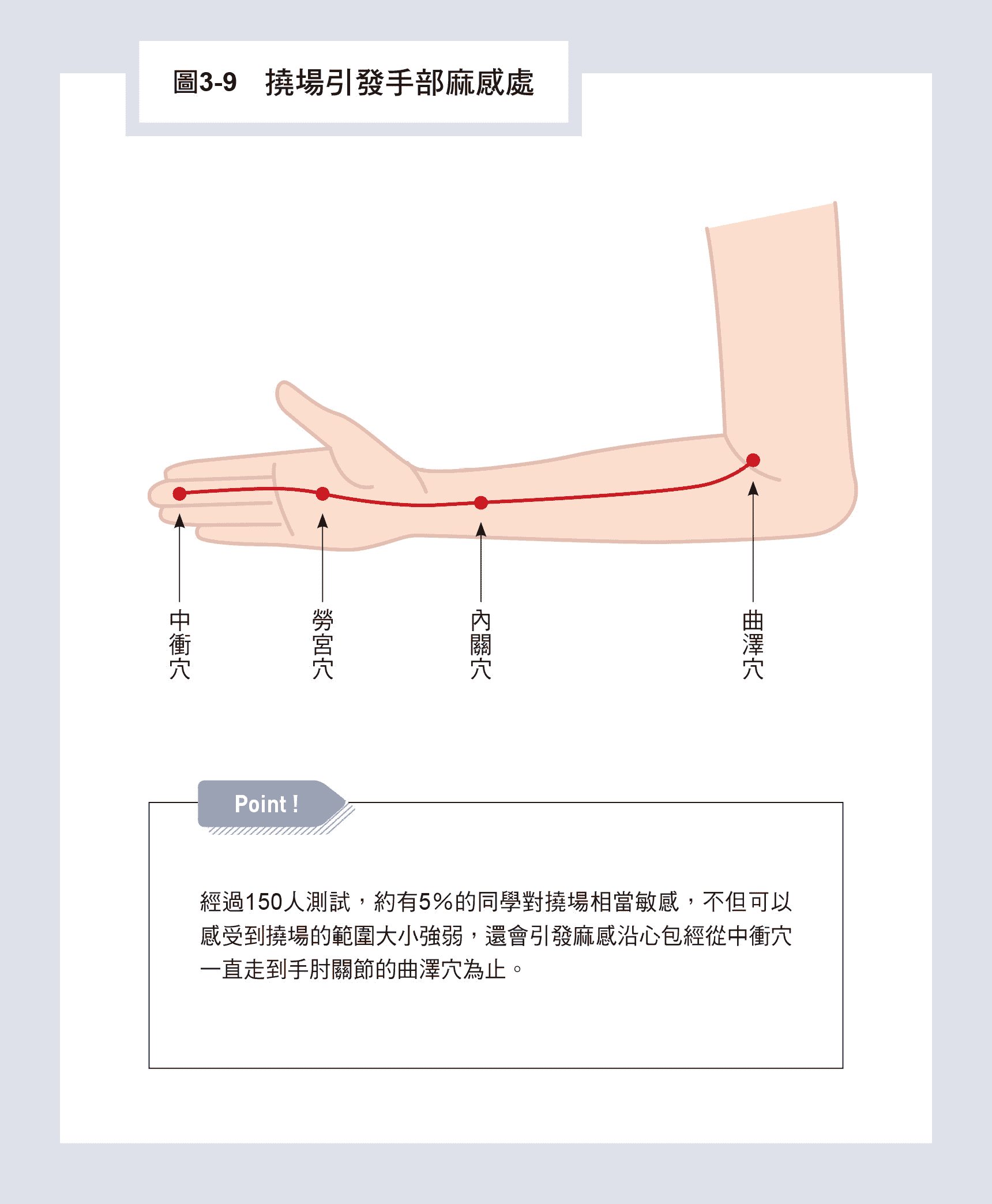
This helped me understand that each person in the population reacts differently to the degree to which their meridians are distorted by torsion fields. Most people are meridian-insensitive; one-sixth to one-fifth are meridian-sensitive; and only one-twentieth are extremely meridian-sensitive. This also explains that detecting torsion fields requires meridian-sensitive individuals to perceive them—Miss T is one such person.
Over the course of two years, we identified seven extremely meridian-sensitive students and discovered that simply placing a sheet of paper moistened with water to block the torsion field would weaken or even eliminate the sensation of the torsion field—meaning that water absorbs the torsion field. When the torsion field was directed straight at the hand, students could feel a circular red area of numbness in the palm, as shown in Figure 3-8(b). But after the torsion field passed through the character “Buddha” (note: the students had their eyes closed and did not know what we had done), they were astonished: why had the red circle area been enlarged into a blue circle area, extending beyond the palm, and why had the sensation become stronger? This fully confirmed the results of the experiments Miss T conducted in the early 2000s using the crystal qi field, once again proving that the crystal qi field is indeed a torsion field.
In the past two years, through Associate Professor Ren Quansheng of Peking University, it was discovered that the fourth phase of water can serve as a torsion field detector, without relying on human perception. After two years of using the fourth phase of water as a detector to measure torsion fields, extensive experiments have confirmed that torsion fields passing through the character “Buddha” are indeed amplified.
In Chapter 4 of The Science of Qigong, I discussed the phenomena of qi conductors and attractors. That is, when we write the character “Buddha” on a narrow, elongated strip of paper, and the size of the character “Buddha” exceeds more than half the width of the strip, something magical happens, as shown in Figure 3-10.
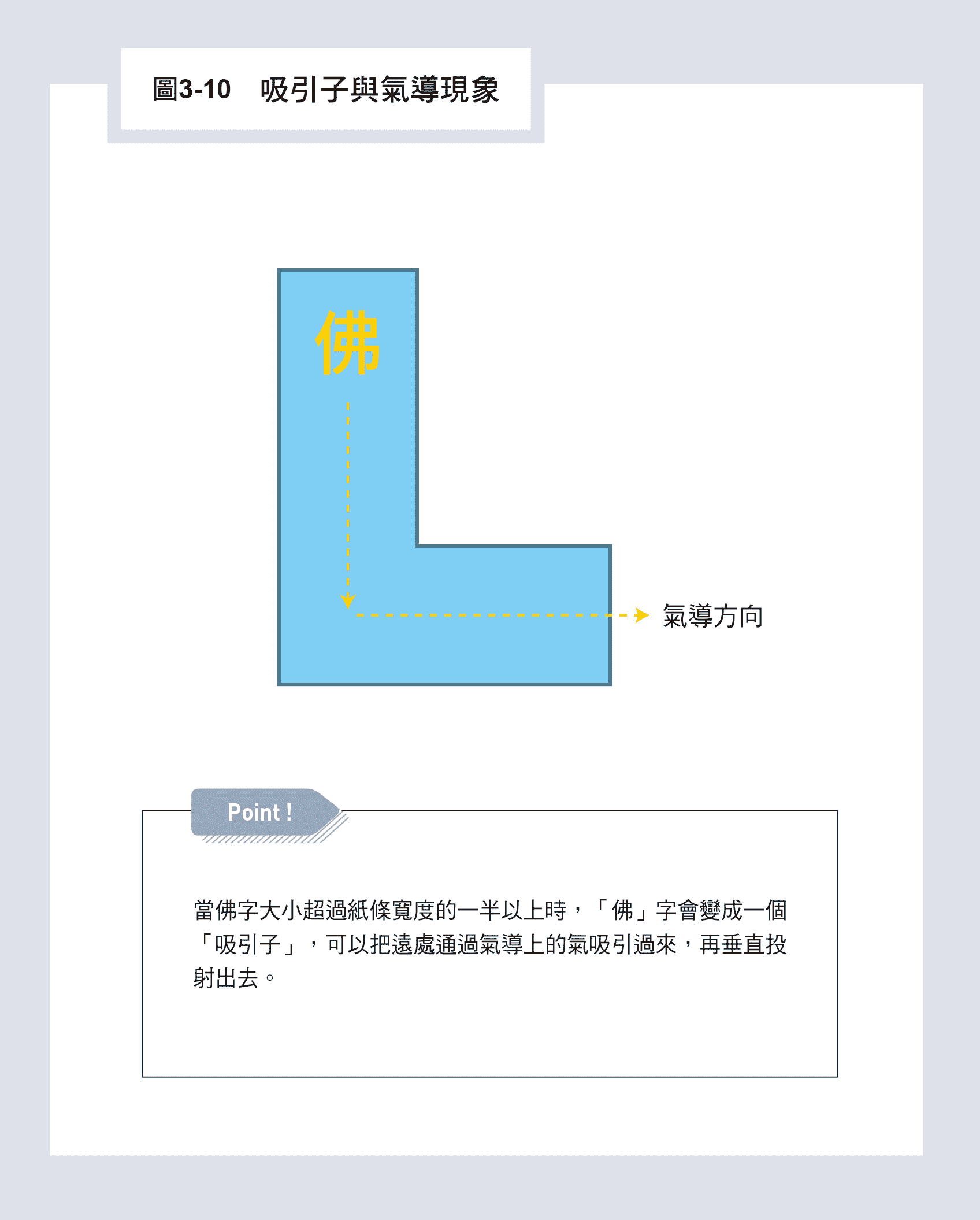
The qi-capturing cross-section of the character “Buddha” expands along the paper strip to the other end, causing the entire strip to become a qi conductor, while the character “Buddha” becomes an “attractor.” Its swirling space-time structure has been forced to expand across the entire qi conductor, enabling it to draw in qi from afar that passes along the qi conductor, and then project it outward perpendicularly.
At this point, a question immediately arises: which other sacred vocabulary would produce the same phenomenon?
The Amplification Ability of the Character “Buddha” After Its Qi-Capturing Cross-Section Is Damaged and Restored
The qi-capturing cross-section of the character “Buddha” is nine times the size of the character itself—three times the length and three times the width. If it is damaged by other text or patterns, or cut and then restored, what changes would occur in its ability to amplify the crystal qi field? This is a question well worth investigating.
Figure 3-11 shows the results of the experiment. The first row shows the qi field directed at a handwritten character “Buddha”: the sensation is a circle that has become stronger and larger—the qi field has been amplified. The second row shows a horizontal line drawn with a ballpoint pen beneath the character “Buddha,” slightly longer than the character itself; after the qi field passes through, it becomes a semicircle—only the upper half is felt, while the lower half has been destroyed. The third row shows the result when the horizontal line beneath the character “Buddha” is covered over with white correction tape, so that the paper once again appears to show a clean and complete character “Buddha.” However, the sensation of the qi field passing through remains semicircular and does not return to a large circle, indicating that the circular qi field has already been destroyed. This demonstrates that repair and covering in the material world cannot compensate for the damage to the character “Buddha” in the imaginary-number space-time (the spiritual realm), and also indicates that the qi field can detect the space-time information of the spiritual realm.
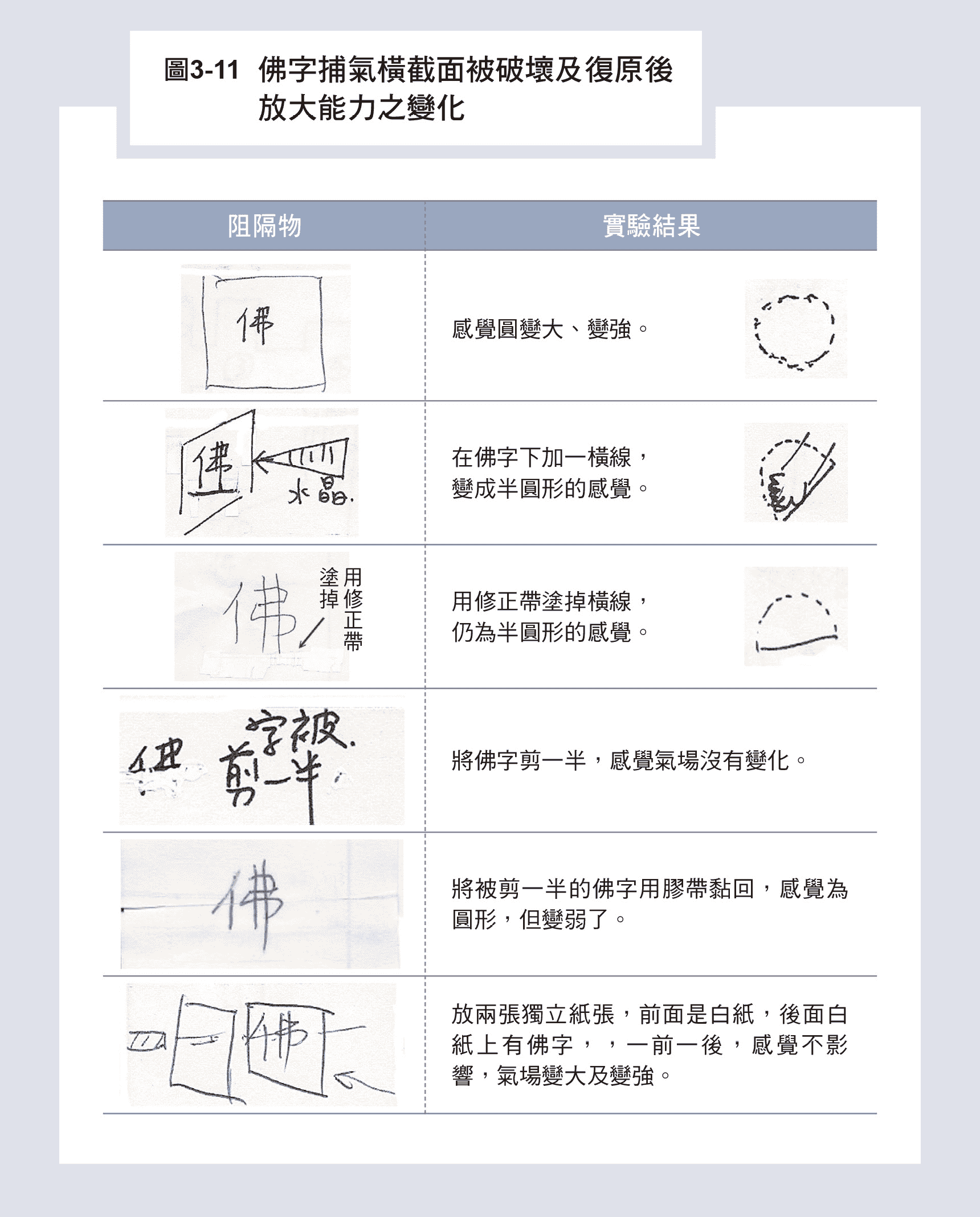
The fourth column shows the character 佛 cut in half; of course the amplifying effect disappears, and the qi field passes through without any change. Next, the fifth column shows the cut character 佛 reattached with transparent tape, appearing the same as the original character 佛. When the crystal qi field irradiated it, the sensation again became circular, but the intensity was weaker than the original uncut version. This indicates that once the character 佛 has been damaged, some harm has already been done, though this harm exists mainly not in this real-number material world but in another world. I will explain the reasons in detail in Chapter 4. The sixth column places another sheet of white paper in front of the character 佛 as a barrier. The result was that it did not exert any blocking function; the qi field could still pass directly through, and due to the character 佛 written on the second sheet, the sensation became larger and stronger.
The Attractive Force of Other Sacred Words on the Crystal Qi Field
The sacred word “佛” (Buddha) is an attractor of the qi field, capable of attracting the qi field that passes through a qi guide so that it tends toward the character 佛 and shoots forward, as shown in Figure 3-12.
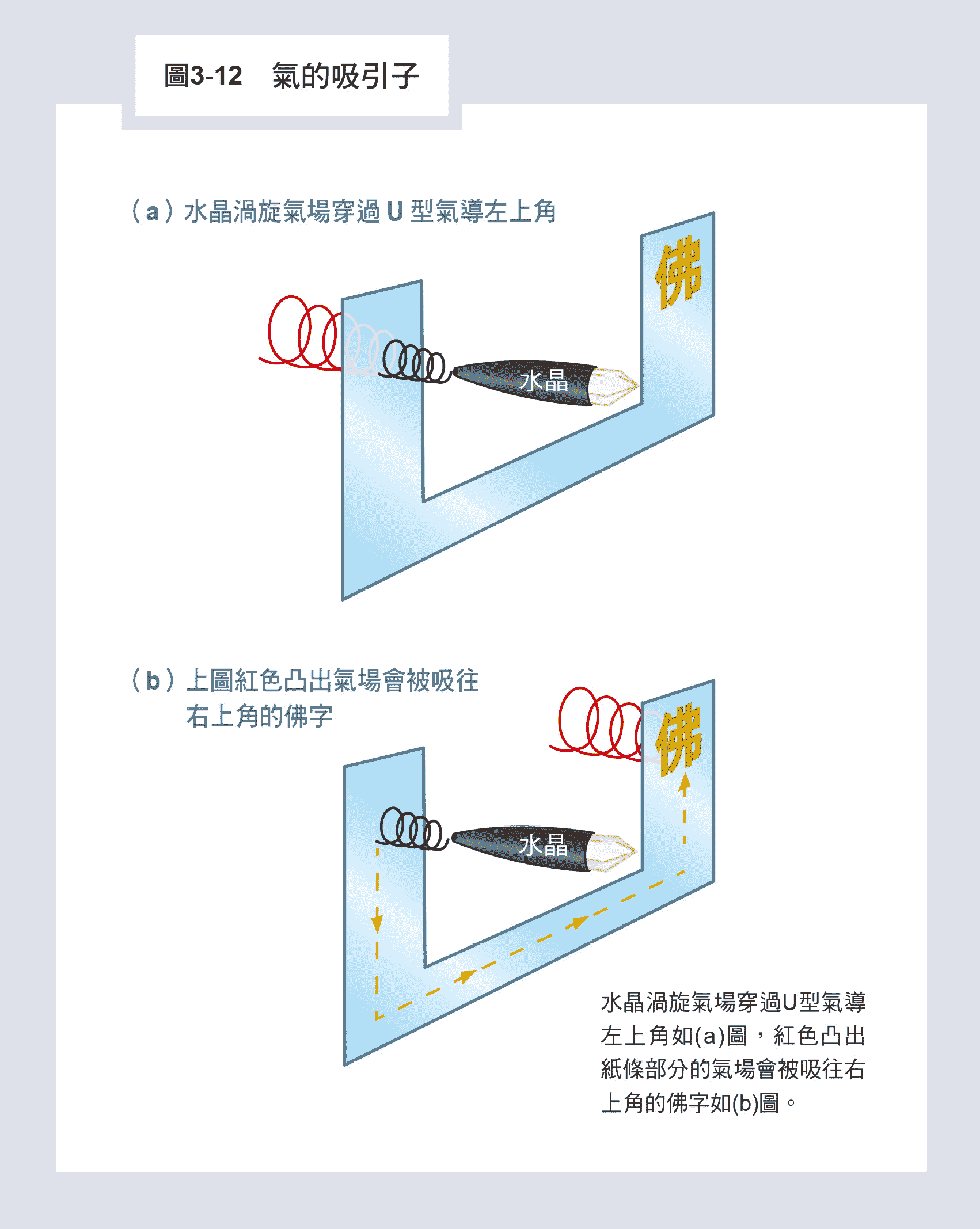
Figure 3-12(a) shows a crystal qi field directed at the upper-left corner of a U-shaped qi guide, with the character 佛 written at the upper-right corner. Because the size of the character exceeds half the width of the qi guide, it forms an attractor. Figure 3-12(a) shows the vortex qi field just emerging from the upper-left corner of the paper surface; the portion emerging from the paper strip is represented by a red spiral. This red portion, as shown in Figure 3-12(b), is attracted by the large vortex torsion field of the character 佛 at the upper-right corner, and travels along the U-shaped qi guide to reach the character 佛, where it is expelled outward. This process of movement is perceived by the palm of a functional person such as Miss T.
Seeing the response of the character 佛 here raises the next question: besides the character 佛, are there other sacred words that also have similar effects of amplifying and attracting the qi field?
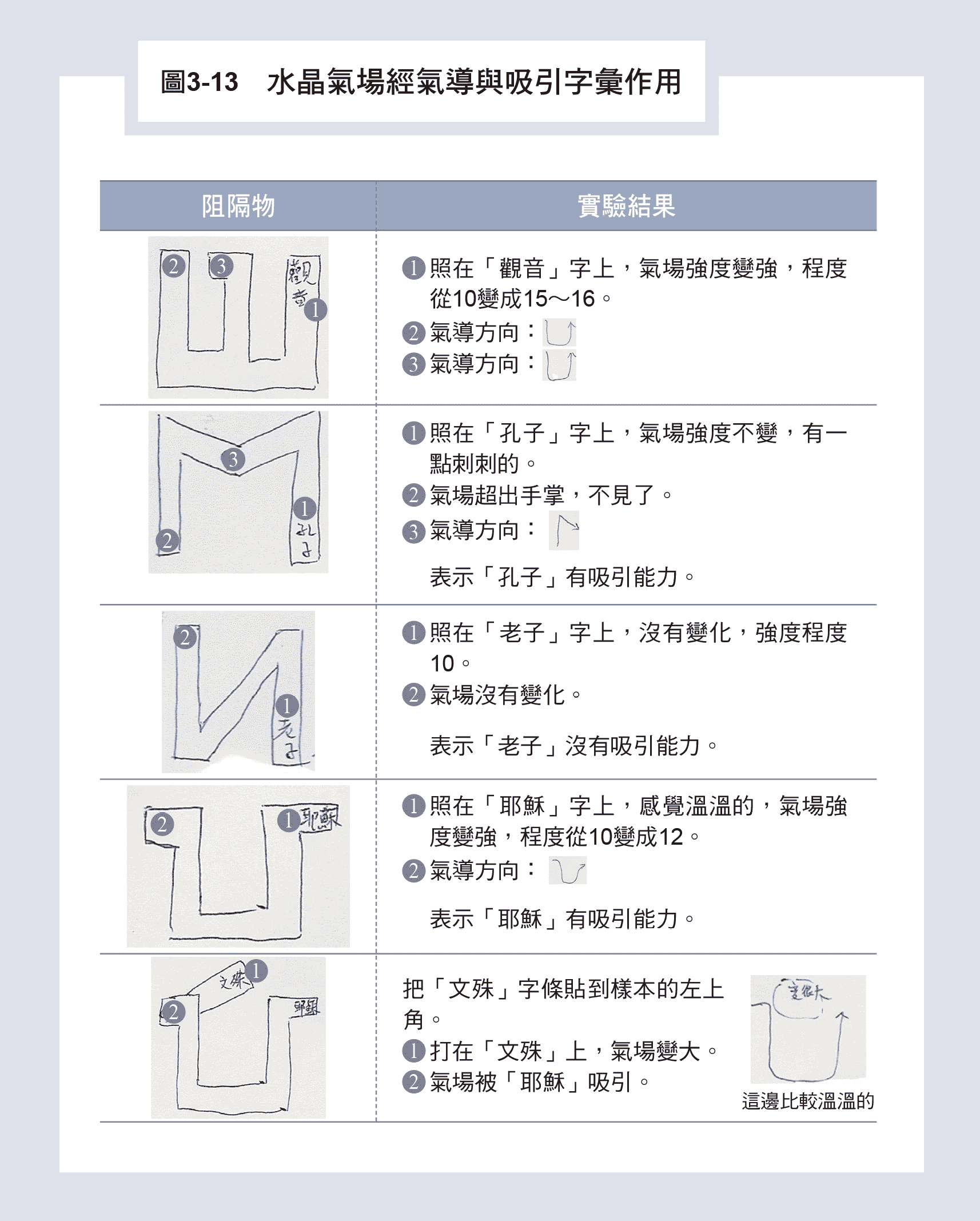
Figure 3-13 shows a normal mountain-shaped, U-shaped, or M-shaped qi guide. In the first row, the characters “觀音” (Guanyin) are written at the upper-right corner of the mountain-shaped qi guide. Their size exceeds half the width of the paper strip, forming an attractor. When the crystal qi field strikes the position of the characters “觀音” at the upper-right corner, the qi field becomes stronger, increasing from an original intensity of ten to fifteen or sixteen, indicating that the characters “觀音” can also amplify the qi field. If it strikes the positions in the blue circles or , the qi field is attracted by the attractor formed by the characters “觀音” and travels along the U-shaped qi guide toward the characters “觀音.” The U-shaped trajectories shown by the experimental results and represent the sensations felt by the palm of Miss T.
In the second row, the characters “孔子” (Confucius) are written at the lower-right corner of the M-shaped qi guide. If the qi field is directed straight at the characters “孔子,” the qi field becomes dynamic, with a prickly sensation, but there is no amplifying effect; it only modulates from a static to a dynamic qi field. If the qi field strikes , the qi field sensation exceeds the palm and disappears. If the crystal qi field irradiates the middle position of the M-shaped qi guide, the qi field is attracted by the characters “孔子,” first going upward and then downward to the lower-right corner. It turns out that the sacred word “孔子” also has attractive force.
However, the characters “老子” (Laozi) in the third row show no response at all. Not only does the qi field intensity remain unchanged when irradiating the characters “老子,” but there is also no modulation from static to dynamic, indicating that this word also produces no attractive force. I suspect that on that particular day, “老子” was not present on his website, because Miss T’s responses when recognizing the characters “孔子” and “老子” through finger reading were nearly identical—both involved a dark human figure appearing on the homepage of their respective websites.
Next, in the fourth row, the characters “耶穌” (Jesus) are written at the upper-right corner of the U-shaped qi guide. This also has an amplifying effect on the qi field and can attract the qi field striking the position at the upper-left corner, causing it to travel along the U-shaped channel toward the upper-right corner.
Later, I attached a small paper strip with the characters “文殊” (Manjushri) to the upper-left side of the U-shaped qi guide in the fourth row, as shown in the fifth row. The result was that “文殊” can also amplify the qi field. The qi field striking position is pulled by two attractors: “文殊” pulls a portion of the qi field to amplify it, while “耶穌” pulls another portion along the U-shaped qi guide to the upper-right corner.
Therefore, the conclusion is that any sacred word that induces a change in the qi field—such as amplifying the qi field, or transforming the qi field from static to dynamic—is an attractor, and will attract the qi field to pass through the qi guide and tend toward the sacred word.
Patterns That Cause the Qi Field to Move
We have already discovered that attractors formed by sacred words can attract the qi field to move. The next question is: are there other words or patterns that can trigger the movement of the qi field? Subsequent experiments indeed found that there are, as shown in Figure 3-14.
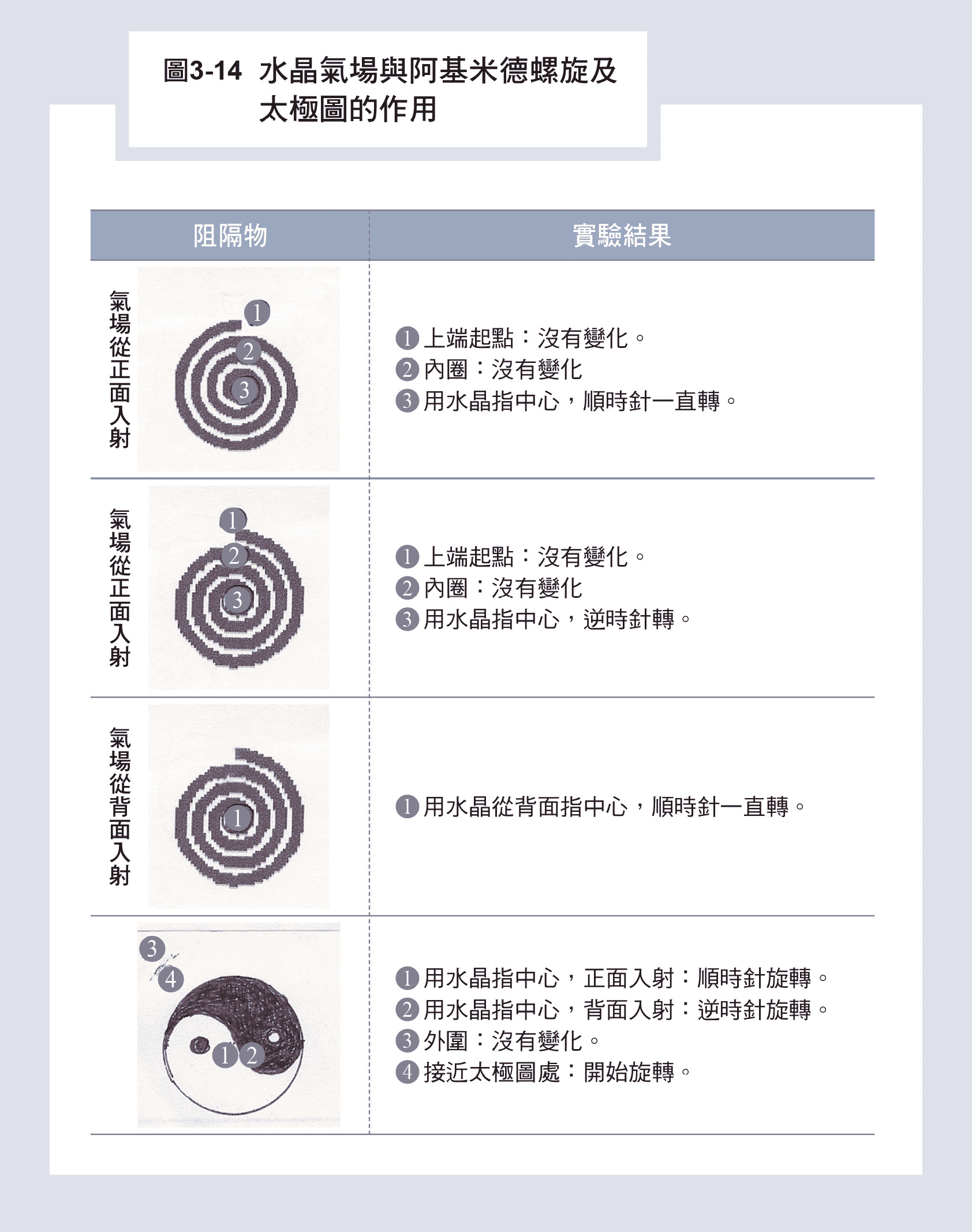
The first three diagrams in Figure 3-14 are all left-rotating and right-rotating Archimedean spirals drawn on paper by computer. The first row of experiments uses a right-rotating Archimedean spiral; when the qi field strikes the outer area at and the inner-ring area at , the qi field is unaffected. However, when the qi field strikes the central position at , the qi field is carried by the spiral, continuously rotating clockwise from inside to outside.
The second row of experiments uses a left-rotating Archimedean spiral, and the results are the same: only when the qi field strikes the central position at will the qi field be carried by the spiral, rotating counterclockwise from inside to outside.
As shown in the third row of experiments, if the entry is changed to come from the center of the back, the qi field will reverse to clockwise rotation. But if the qi field strikes concentric circles of three different radii, no position including the center is affected, and no rotation occurs.
This indicates that the qi field is closely coupled with spiral structures rather than circular structures, and also implies that the qi field itself possesses a spiral structure.
In the fourth row of experiments, the final Taiji diagram also induces qi field rotation. When the qi field strikes the center of the Taiji diagram, it rotates toward the fish-eye of yin or yang, indicating that the fish-eye is a passage between yin and yang, and this vortex passage can attract the qi field toward it.
The World’s First Qi Oscillator
From the preceding experiments, we can see how sacred words can be used to achieve amplification, conduction, and attraction of the qi field by attractors. Therefore, following the principle of electronic circuit oscillators, qi can be amplified and fed back to produce oscillation, thereby creating a qi oscillator. Any electronic circuit, including computers, mobile phones, and instruments, requires electronic oscillators to generate signals of different frequencies.
Figure 3-15 is the world’s first “qi oscillator.” The crystal qi field passes through three consecutive amplifications by the character 佛 (Buddha), striking a ring-shaped qi guide made of paper strips. Where the crystal qi field passes through the qi guide, the character 佛 is written, with a size exceeding half the width of the qi guide. This character 佛 not only serves the function of a first-stage amplifier for the qi field, but also plays the role of an attractor, drawing back the qi field that has been amplified by the character 佛 and has struck the paper ring on the opposite side, thereby generating feedback. Thus, after the qi field is amplified by consecutive characters 佛 and strikes the qi guide, it is drawn back to the first character 佛, then emitted forward to continue the amplification and feedback process. Eventually, when the degree to which the qi is amplified exceeds the degree of loss along the way, qi oscillation will form, and no external qi source input will be needed anymore.
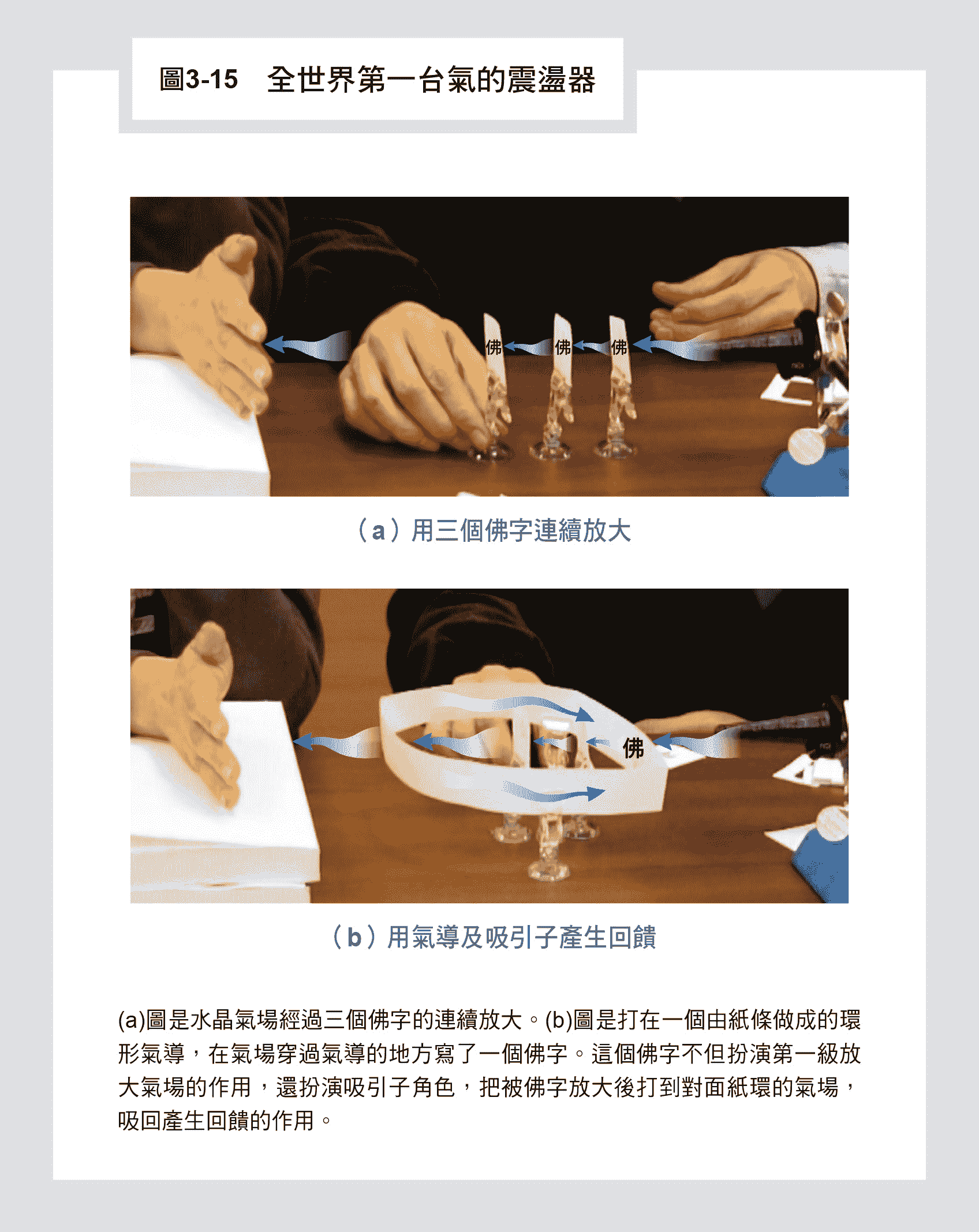
According to Miss T’s sensation when touching the qi field with her hand, the entire qi field becomes very large, confined within a few centimeters inside the qi guide ring and along the path of the consecutive characters 佛, while the qi field outside the qi guide is very small. I believe this is the world’s first qi oscillator, and from here on, instruments can be designed and qi fields controlled to perform logical operations. The question is: where does the amplified qi field energy come from?
One day, while I was pondering this question, I suddenly realized that this energy obviously comes from the spirit realm of imaginary-number spacetime. I had inadvertently invented a void-energy extractor and opened a door. Although the energy extracted now is still very small, as the technology matures, we can achieve the goal of vacuum energy extraction just as Tesla spoke of. A new civilization, a new world of energy, has already unfolded before us.
Chapter 4 The Torsion Field Shuttling Between Yin and Yang — Decoding Daoist Feng Shui, the Bagua, and Formations
Traditional Chinese feng shui
is precisely about dealing with the geometric structures formed by the arrangement of objects in environmental and domestic settings,
and using wind or water to adjust the position and magnitude of the qi field.
Because the qi field can bore into the void,
the behavior of the torsion field shuttling between yin and yang
is the scientific basis of traditional Chinese feng shui.
The Origin of Feng Shui
Guo Pu of the Jin Dynasty was the first person in Chinese history to propose the concept of feng shui. He held that “qi rides the wind and scatters; it meets water and stops. The ancients gathered it so it would not scatter, and channeled it so it would have a stopping place; therefore it is called feng shui (wind-water).” He advocated that between heaven and earth there exists a current of qi: when it encounters wind, it is blown away and scatters; when it encounters water, it comes to a halt. Therefore, feng shui is about selecting terrain and topography—for example, a house should have a mountain behind it to more easily block the wind so as not to scatter the qi; it is best to have a pond in front of the house, using water to gather the qi within the living space.
The Jin Dynasty Daoist Ge Hong said: “People are within qi, and qi is within people.” The Song of Righteous Qi states: “Between heaven and earth there is righteous qi, diversely endowed in flowing forms.” If this kind of qi exists, and is unrelated to the physiological and psychological states of the human body, then it should also be a kind of physical force field. From then on, the Chinese gradually came to firmly believe in feng shui, holding that a person’s fortune and misfortune, and even career prospects, would be influenced by the orientation, environment, scale, and form of their dwelling or ancestral graves.
With the evolution of history, the knowledge of feng shui gradually evolved into two forms:
The first is “environmental feng shui,” which is the environmental geography of gathering and stopping qi. For example, the entrance of a house should face south to receive more ample sunlight; a house must not be located at a T-shaped intersection (a road collision); a house must not be sandwiched between two tall buildings; the vicinity of a house must not have sharp-cornered symbols formed by chimneys, utility poles, and signboards pointing toward it, and so forth.
The best choice for a dwelling is “Vermilion Bird in front, Black Tortoise behind”: a pond in front is called the Vermilion Bird, and hills behind are called the Black Tortoise; “Azure Dragon on the left, White Tiger on the right”: flowing water on the left is called the Azure Dragon, and a long road on the right is called the White Tiger. The terrain should be low in the east and high in the west, high in the back and low in the front; those that meet the above conditions are the best choices for a residential home; this type of dwelling signifies the emergence of officials and nobility, brings flourishing descendants and prosperity, and is a household of prosperity and abundance.
Some of the rules of this environmental feng shui are simple principles that modern science can explain. For example, gathering qi in a living space makes the residents healthy and energetic, so their careers and studies naturally develop easily, and they attain glory and wealth; a house located at a road intersection is prone to traffic accidents; if located between two tall buildings, there will be wind shear phenomena, and so on, all of which are disadvantageous to the residents. However, most of the rules still cannot be explained by currently known modern science.
The second type is “folkloric feng shui,” which uses the selection of the orientation, environment, scale, internal layout, and construction dates of dwellings and ancestral graves to regulate qi and predict the future prospects of the residents. A large part of this involves principles that modern science cannot yet understand.
After the advancement of science, feng shui came to be regarded as superstition and gradually declined. Like traditional Chinese medicine, most people no longer believe in it; only a few people, based on their own experience or ancestral teachings, still firmly believe in it. The qi described by Guo Pu shares similar properties with the torsion field we discussed in Chapter 3. For example, the torsion field is absorbed by water (“stopping at the boundary of water”), and the qi field of a crystal is elongated when passing through rotating fan blades (“scattering when encountering wind”). Therefore, I realized that to unlock the mystery of feng shui, there are still three levels of problems to solve:
One must clearly understand the scientific properties of the torsion field.
One must understand the true reality of this universe.
One must understand what role the torsion field plays in the real universe.
In Chapter 3, we already described some of the scientific properties of the torsion field. As for the answers to the other two aspects, let me explain them one by one.
The Eight Trigrams and Array Formation
Confucius said: “At fifty, I began to study the Yi,” and he composed the two chapters of the Xici (Great Treatise) commentary to explain the Yijing (Book of Changes). The realm of the Yi lies in the trigram images and trigram numbers, which can connect upward to astronomy and downward to geography, extending even to fortune-telling, physiognomy, and foreknowledge of the unknown.
Confucius believed that one must reach the age of fifty before accumulating sufficient life experience and wisdom to begin studying the Yijing. The Yijing that Confucius referred to is generally considered to be the Zhouyi (Changes of Zhou), which is a record of King Wen of Zhou’s insights from studying the Yijing while imprisoned by King Zhou of Shang. The teachings of the hundred schools of thought during the Spring and Autumn and Warring States periods all originated from this book.
According to legend, there was the Lianshan Yi during the time of Shennong, and the Guicang Yi during the time of the Yellow Emperor. Both of these versions of the Yi have been lost for a long time. It is said that traditional Chinese medicine, feng shui (kanyu), and Daoist practices may be products of the combination of the Lianshan Yi and the Guicang Yi.
Within the Yijing there is a symbolic system consisting of the eight trigrams. The eight trigrams are paired with each other to generate the sixty-four hexagrams. Its most remarkable and celebrated feature is that it can be used for fortune-telling and physiognomy, enabling foreknowledge of the unknown.
I know many people who have gone to Hong Kong to see Mr. Dong, the “Iron Plate Divination” master. After returning, they all told me that the Iron Plate Divination was extremely accurate—almost frighteningly so—even able to calculate the surnames of girlfriends they had dated decades ago in their youth.
In the age of science, how should we understand the Yijing? Are the eight trigrams merely digital combinations of zero and one? Just as Chapter 42 of the Daodejing states: “The Dao gives birth to one, one gives birth to two, two gives birth to three, and three gives birth to all things.” Can the combinations of the eight trigrams with three lines each truly generate all things in the universe?
In this chapter, I will provide evidence showing that the miraculous properties of the eight trigrams do not reside in this material world of real numbers, but are hidden in the virtual images of another world—the spirit world—and the key connecting the two worlds is the “torsion field.” Therefore, the torsion field is the key that unlocks the secrets of the Yijing. Another mystery related to the eight trigrams of the Yijing is the Daoist art of array formation. Zhuge Liang’s creation of the Eight Formation Diagram is recorded in the Records of the Three Kingdoms, Book of Shu, Biography of Zhuge Liang: “Liang was by nature skilled in ingenious thinking; he deduced and developed the art of war and created the Eight Formation Diagram.” The Eight Formation Diagram is universally acknowledged as a superlative battle formation, highly esteemed for over a thousand years. When Lu Xun burned Liu Bei’s linked camps spanning seven hundred li, Kongming cleverly deployed the Eight Formation Diagram, arranging stones into a stone formation, and then, according to the Dunjia system, divided it into eight gates—Life, Injury, Rest, Obstruction, Prospect, Death, Alarm, and Opening—incorporating the arrangement of the eight trigrams and integrating astronomy and geography. Its power was so great that it was said to be able to withstand a hundred thousand elite soldiers, and Zhuge Liang deployed it at the gateway to Shu in Hubei. It is said that the main characteristic of the Eight Formation Diagram is that it changes at every moment, and the nature of these changes causes anyone who enters to become lost within it.
When we were young and read martial arts novels, we often encountered such scenes and felt great admiration and longing. But the learning involved here is profound. A few years ago, when I reached the age of sixty—already ten years past the age at which Confucius began studying the Yi—I was still muddled and had no clue, not knowing how to set up an array. It was not until after I passed the age of sixty-four, after using the torsion field in experiments to deeply understand the dynamic behavior of the virtual images of the eight trigrams in the spirit world, that my Daoist friend suddenly taught me to set up a battle formation using the eight trigrams. This allowed my understanding of array formations to advance by leaps and bounds, and I began to comprehend the scientific basis of array formation, which I will introduce in the final section of this chapter.
Next, we must first understand the true reality of the universe before we can understand the miraculous properties of the torsion field.
Complex Space-Time and the Quantum Mind
Please refer to my 2018 book The Science of the Spirit World, which describes the process and theoretical content of two major hypotheses I proposed regarding the real universe. At that time, these two major hypotheses were proposed in order to uniformly explain the anomalous phenomena appearing in the large, medium, and small scales of space-time in the universe. For example, in the large-scale universe, twenty-three percent of the energy turns out to be dark matter, seventy-three percent of the energy is dark energy, and the normal material world accounts for only four percent of the energy in the universe; in the small-scale quantum physics of the nanoscale, information transmission between quantum entanglements exceeds the speed of light, violating Einstein’s theory of relativity; in medium-scale paranormal human abilities such as finger reading and psychokinesis, the phenomena cannot be understood by modern science at all.
In 2014, I proposed a unified framework and two hypotheses as its foundation for understanding the real universe. The first hypothesis of this unified framework is: the universe we exist in is actually an eight-dimensional complex space-time. Besides the four-dimensional real space-time that our ordinary senses can perceive—which is traditionally called the “Yang realm” (realm of the living)—there also exists a four-dimensional imaginary space-time, which is traditionally called the “Yin realm” (realm of the dead), filled with various consciousness and information websites.
Although the real and the imaginary are closely related, being the real part and the imaginary part of the same complex number, there exists a real-imaginary barrier between them (the separation of Yin and Yang), and they are linked only through special space-time points of many different scales. These linking points are all vortex-shaped space-time structures—that is, the fish-eye structure on the three-dimensional Tai Chi diagram. Connection between the two space-times must pass through the vortex space-time structure of the fish eye.
For matter in real space to break through the real-imaginary barrier and enter imaginary space, the keys are: first, its size must be far smaller than the aperture of the vortex opening, and it must happen to strike the entrance of the linking point’s passageway; the second method is that, as long as matter enters the state of a complex matter wave or quantum field, it can tunnel into imaginary space-time. This also resolves the ninety-year-old mystery of quantum mechanics: why the wave functions of particles solved from the Dirac equation, or the quantum fields in quantum field theory, are all complex functions. In the past, no one understood the meaning of the complex numbers; they merely interpreted the product of a complex function and its complex conjugate as the probability of finding the particle or field at position r and time t.
I believe that this complex matter wave is the key to entering imaginary space-time. At this point, the size of the matter is no longer important; the quantum wave can leak through the very small-aperture vortex space-time linking point (funnel opening) to enter imaginary space-time.
My second hypothesis is: the imaginary number i in the complex quantum field or quantum wave function is “consciousness.” One can say that the appearance of the imaginary number i in the complex quantum field or quantum wave function “brings consciousness into physics,” and also tells us that as long as an object enters a quantum state, “all things possess spirit.” This is the emergence of the quantum mind.
When matter such as elementary particles, photons, or objects enters microscopic or macroscopic quantum states, matter waves appear. At this point, the matter waves will bore into imaginary space-time. In imaginary space-time, the state wave velocity of the quantum can be far higher than the speed of light, quickly spreading across vast space, and can also capture information from the past and the future. The complex wave function makes it impossible to precisely measure the dynamic properties of a particle, such as position and momentum, in real space, because it travels through both real and imaginary space-time; one can only know the probability of its appearance at position r. One can say that the concept of complex space-time thoroughly resolves the confusion about the ontology of quantum mechanics that has perplexed the world for nearly ninety years—that is, the question of “what exactly is the nature of the quantum world?” that quantum mechanics describes.
Finger Reading and Torsion Field Sensing Are Physical Mechanisms of Different Worlds
Finger reading is the third eye scanning the virtual images of the spirit world, while torsion field sensing is the perception of distorted space-time in the material world. Since the real universe is composed of eight-dimensional complex space-time, with both real and imaginary parts, each being a four-dimensional space-time structure, I believe that the passageway between real space-time and imaginary space-time is through vortex-like space-time breaches formed by the spin of particles. Since all objects in real space are composed of atoms, and every elementary particle within each atom has spin and thus a channel leading to imaginary space-time, a breach-formed virtual image will appear in imaginary space-time. This is the combination of the spin channels at their exits in the void; its shape is exactly the same as the real object, thus forming the phenomenon of “one object, two images.”
Any object in real space-time has an identically shaped structure in both the real and imaginary spaces. Energy forms in the void that do not contain spin channels cannot communicate with real space, and therefore will not produce real images; they are pure energy belonging to dark matter and consciousness. However, if they contain a spin space-time structure, the exit of that channel will merely form an image (ghost image) in real space-time with no material substance present.
The structure of words and objects in the void plays an important role in finger reading and psychokinesis. We propose possible mechanisms for finger reading and psychokinesis: for any paranormal ability to succeed, a “third eye” must appear in the brain of the gifted individual. Based on judgment, the third eye is a state in which the physiological saline in a certain part of the brain enters a quantum state, generates its own consciousness, and leaks through the spin channel into imaginary space-time, scanning and bringing back to the third eye the virtual images rather than the real images of characters or patterns.
When finger reading identifies sacred vocabulary, such as “Buddha,” “Guanyin Bodhisattva,” “Jesus,” “Medicine Buddha,” “Maitreya Buddha,” and so on, their virtual images have already been modified by the consciousness of these sacred figures in the void into different structures such as large circles, multiple rows of small circles, crosses, and the like. Since the virtual images of these words have already been altered by the deities, during finger reading, when the Heavenly Eye scans the virtual images, it does not see the words but instead sees the altered images, such as circular bright light, luminous figures, or the worlds connected to the images, such as the homepage of a deity’s website, or other worlds in the void. The conclusion, therefore, is that the images seen by the Heavenly Eye during finger reading are the virtual images of the imaginary-number spacetime.
The psychic Ms. T’s sensing of torsion fields or crystal qi fields involves a different mechanism. First, she does not need to open the Heavenly Eye when sensing crystal qi fields, so it is the brain sensing changes in real-number space produced by torsion fields passing through obstructing objects, rather than the void information felt through the Heavenly Eye scanning virtual images. The question is: what kind of physiological mechanism does her brain use to sense these modulated torsion fields in real-number space?
In Chapter Three, I mentioned that from 2016 to 2017, we discovered several psychics who were sensitive to the torsion fields produced by torsion field generators. One of them was a master’s-degree graduate student surnamed Wang. After the Laogong acupoint on his palm was irradiated by the torsion field emitted from a torsion field generator, a sensation of numbness would appear, traveling along the Pericardium Meridian from the Zhongchong acupoint to the Quze acupoint at the elbow, and then remaining at the Quze acupoint with a very strong residual effect, requiring seven or eight hours after returning home to completely eliminate the numbness. In addition, irradiating the Laogong acupoint with a crystal qi field also produced numbness, but because the intensity was very weak, it would disappear after only about forty to fifty seconds. This indicates that the torsion field passing through the Laogong acupoint distorts the spacetime structure of the Pericardium Meridian, and this distorted information is carried by electrical signals through the nervous system into the brain, where it is perceived as numbness. Therefore, we can understand that the meridians are the primary detectors for detecting torsion fields, but it is mainly people with extremely meridian-sensitive constitutions who can more easily detect them.
Ms. T and Mr. Wang belong to the small minority of people with extremely meridian-sensitive constitutions. The sensation produced after Ms. T’s Laogong acupoint is irradiated by a crystal qi field lingers for only a few seconds before disappearing, while Mr. Wang’s residual effect at the Laogong acupoint changes according to the strength of the irradiation source: the numbness after irradiation with a weak crystal lasts fifty seconds, while the numbness after irradiation with a strong torsion field generator can last up to eight hours. However, for most people, it is impossible to feel the interaction between the torsion field and the nervous system.
From this we understand that when conducting finger reading experiments, the psychic’s Heavenly Eye opens to scan the void images of the words, sending them back to the brain where the soul and the sixth consciousness collaborate to see the virtual images; whereas when sensing qi fields, it is the result of the meridians in the psychic’s hands detecting the torsion-field-distorted spacetime and its interaction with the nervous system. But what is the relationship between qi fields and virtual images? Can we explore the dynamic and static behaviors of the void, or measure virtual images?
Discovering That Torsion Fields Can Traverse Between the Yin and Yang Realms
In 2000, the reason we began conducting experiments with crystal qi fields was that we saw an American website claiming: if a crystal qi field is strong enough, it can break through the barrier between the material world and the spirit world and communicate with masters in the spirit world. Therefore, the qi field is a physical communication tool that can bridge the two worlds of yin and yang. However, after more than ten years of experiments, we still had not been able to find a reliable detector to verify this claim. Unexpectedly, when using crystal qi fields to pass through sacred words or sacred patterns such as the traditional Eight Trigrams, we found evidence proving that qi fields can not only traverse between the yin and yang realms but also project the static or dynamic behavior of the virtual image—the dual manifestation of a single pattern—back into the material world of real-number spacetime, where it can be sensed by psychics.
This significant discovery led us to understand that the miraculous properties of sacred vocabulary and the Eight Trigrams of the I Ching do not exist in the material real-number world, but are hidden within the virtual images of the spirit world in imaginary-number spacetime.
From this, we can begin to understand that the scientific basis of feng shui is related to the dynamic behavior of objects’ virtual images in the void; the secrets of the Daoist manipulation of spacetime structures, using Qi Men Dun Jia to lay out formations, have also had their mysterious veil lifted. Using qi fields to penetrate the void and extract usable energy becomes a not-so-difficult scientific operation. Some of the miraculous science-fiction stories predicted by Tesla in the early twentieth century seem likely to be gradually realized by science before the middle of the twenty-first century.
The Revelation of Sacred Vocabulary
When the psychic Ms. T uses finger reading to view sacred vocabulary, words such as “Buddha,” “Maitreya Buddha,” “Medicine Buddha,” and so on produce extraordinary visions.
As shown in Figure 4-1, when Ms. T views “Buddha” and “Maitreya Buddha,” she sees a large bright circle, which is the homepage image of each respective website. The second row shows that Ms. T sees the second page of the “Maitreya Buddha” website as six small bright circles arranged in a ring (as shown in Figure 1), and the third page shows the small ring of circles rotating clockwise by one full turn (as shown in Figure 2).
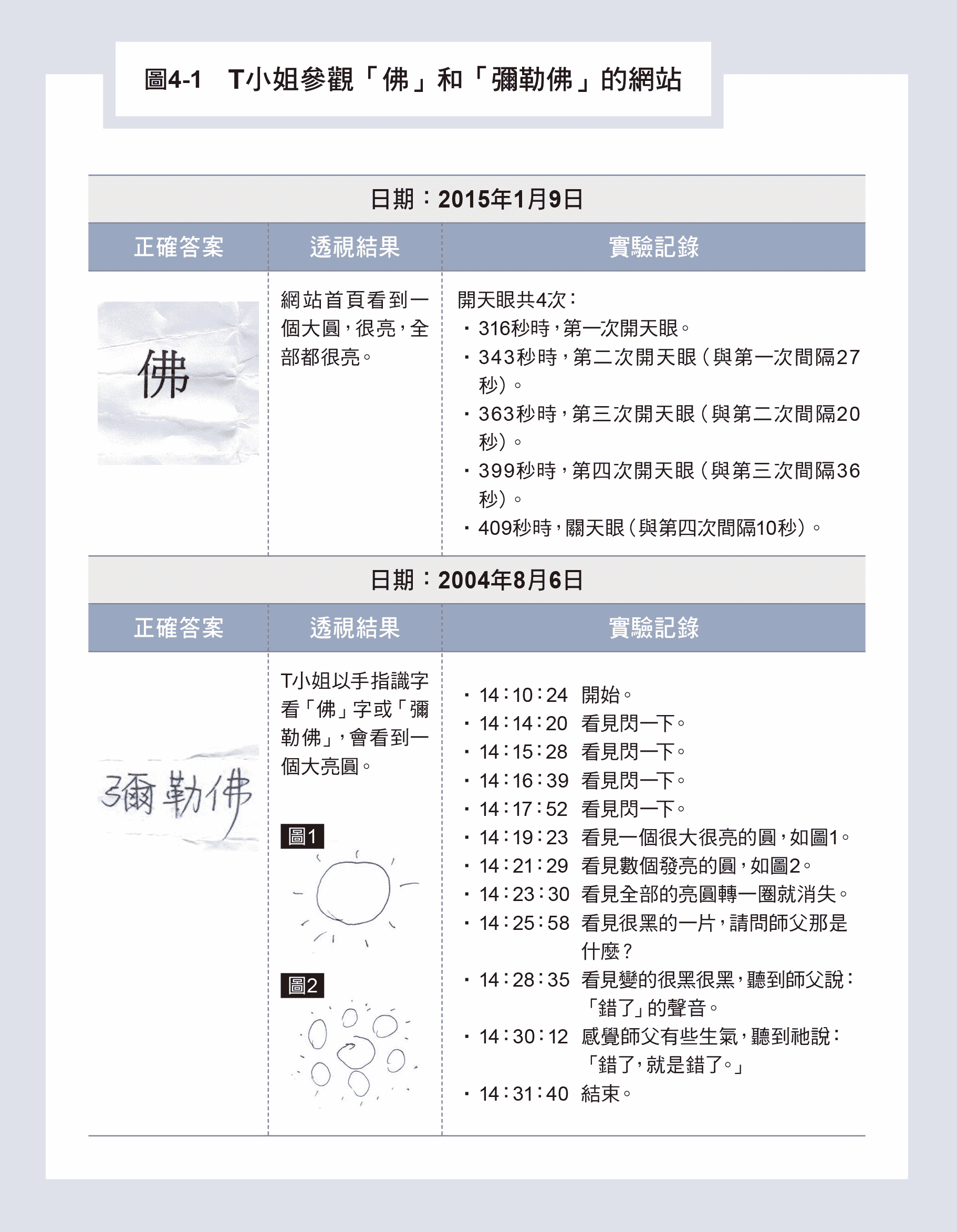
When viewing “Medicine Buddha,” as shown in Figure 4-2, Ms. T sees small bright circles arranged in neat rows of five per row, where each small bright circle is a medicinal garden within the Medicine Buddha’s website, containing various different informational medicinal herbs.
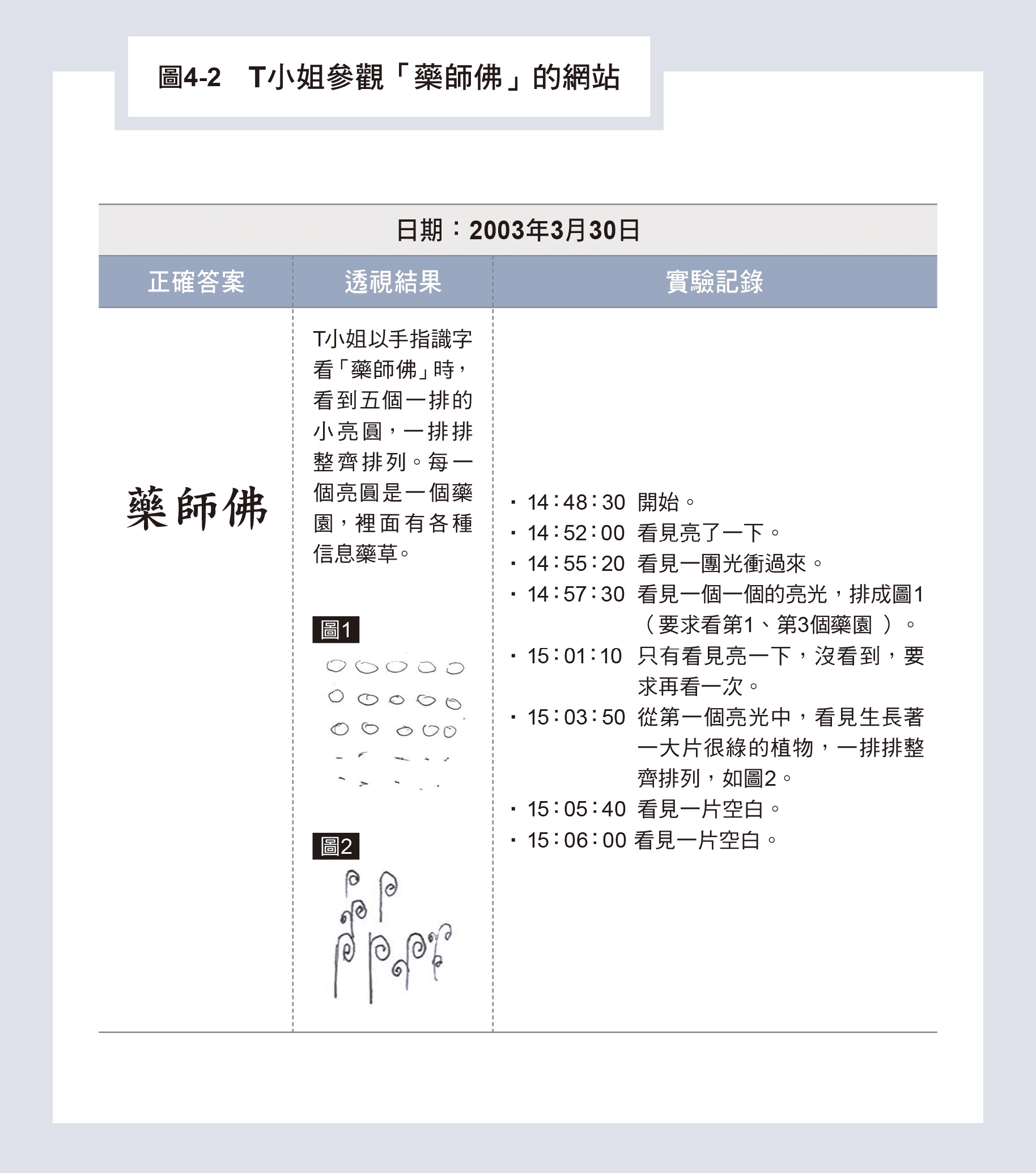
When Miss T came to sense the crystal qi field passing through the character “佛” (Buddha), as shown in Figure 3-8(a) of Chapter 3, she would feel the crystal qi field transform into a large circle, and its power would become stronger, surprisingly identical to the virtual image of the character 佛 in the void. This indicates that the virtual image of the character 佛 in the spirit world of imaginary-number space-time is no longer “one object, two manifestations,” but has been transformed into a large circular vortex, which is also the homepage image of Buddha on the spirit world website.
It appears that the torsion field was magnified by the large circular virtual image of the vortex of the character 佛 and projected into real-number space-time, where it was sensed by the meridians of Miss T’s palm. This indicates that when the crystal qi field strikes the character 佛, part of the qi field penetrates into the void, while the remaining portion continues to propagate in real-number space; the portion that penetrates the void is magnified, and through real-imaginary entanglement, the qi field in real-number space is also magnified.
When the crystal qi field was used to irradiate the Laogong acupoint on Miss T’s palm through the two terms “彌勒佛” (Maitreya Buddha) or “藥師佛” (Medicine Buddha), the results are as shown in Figure 4-3.
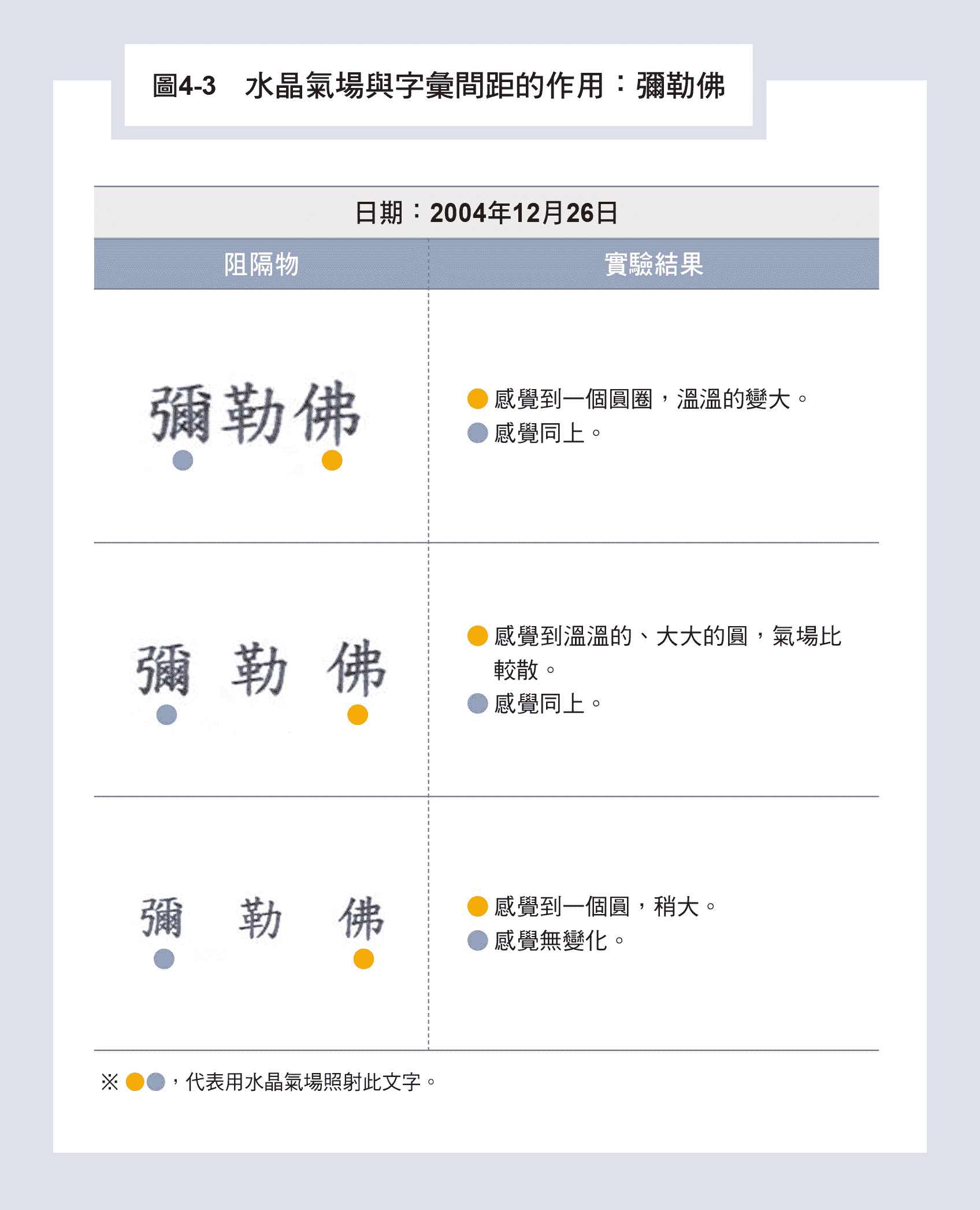
When there is no space between the three characters of “彌勒佛,” or only one space, as shown in the first and second rows of Figure 4-3, then regardless of whether the crystal qi field irradiates the character “佛” or the character “彌,” the sensation is of transformation into a large circle with some warmth, indicating that the signal has become larger and stronger.
However, when there are two spaces between the three characters of “彌勒佛,” as shown in the third row of Figure 4-3, only irradiating the character “佛” produces the transformation into a large circle, while irradiating the character “彌” produces no change. This indicates that the spatial structure of these three characters has already separated; the character “彌” and the character “佛” are no longer linked, becoming ordinary characters that no longer affect the qi field.
This also indicates that the spatial range each character can influence is within the range of one character above, below, to the left, and to the right of that character.
When the crystal qi field irradiated “藥師佛,” the sensation was of prickling and a slight movement to the right, as shown in Figure 4-4.
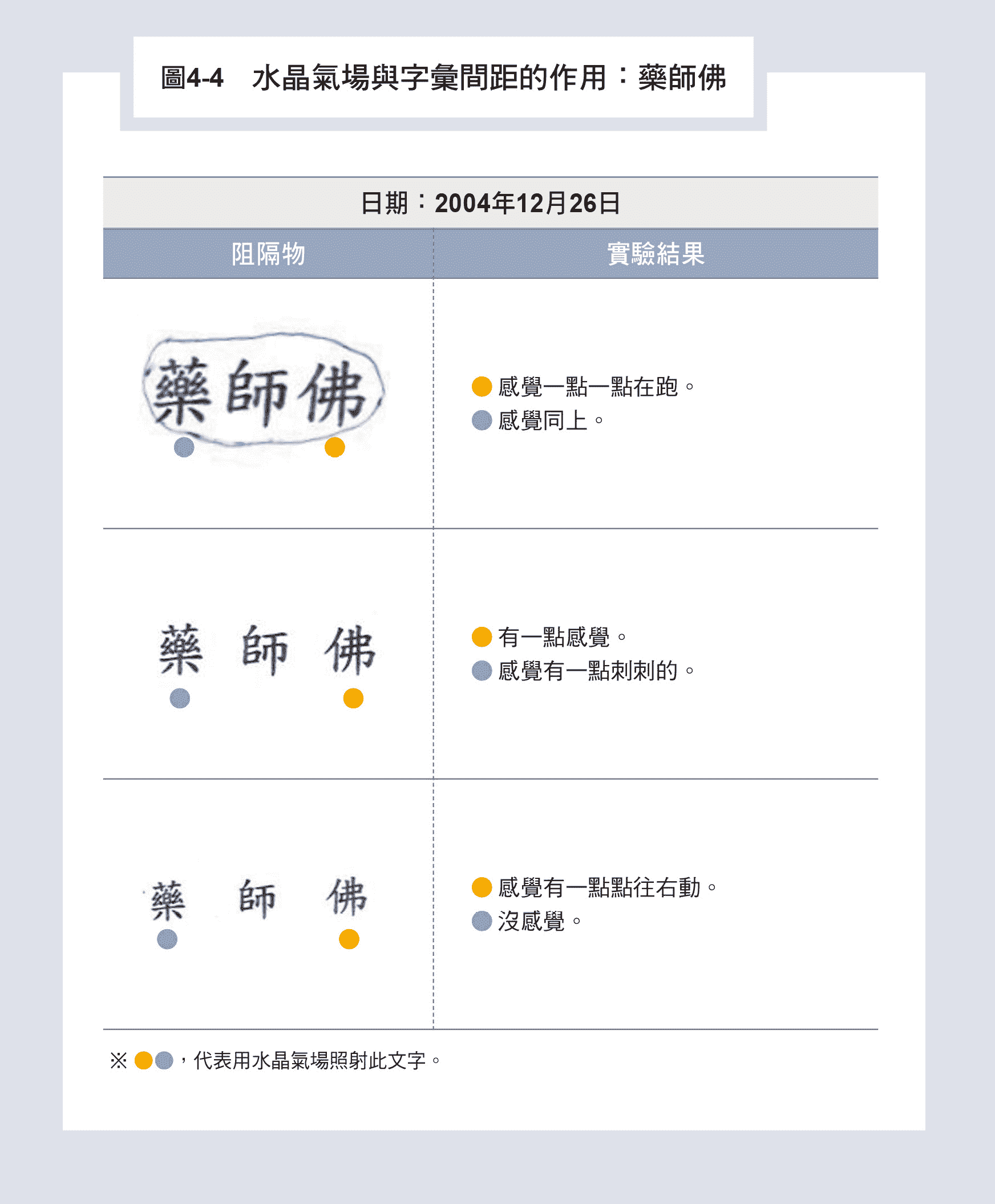
This experiment was completed in December 2004. At the time, I did not yet understand the significance of this experiment. It was not until 2016 that I suddenly realized this was the qi field scanning row upon row of neatly arranged small circular medicinal gardens within the Medicine Buddha’s medicine garden in the void. Since each medicinal garden is a rotating small vortex space-time structure, like individual small attractors, they can draw the qi field in. Therefore, the slightly prickly qi field that Miss T felt consisted of constantly rotating small space-time awls, which would move from one small circle to the next.
From these penetration experiments with sacred characters, we understand that the crystal qi field can project the virtual images of sacred characters — such as the large circular or row-of-small-circles space-time structures — into real-number space-time, where the person with special abilities senses the changes through their meridians. This also shows that when the qi field strikes sacred characters, part of the qi field can penetrate into the void through the spin channels within the sacred characters’ text, and begin scanning the virtual images within the sacred characters that have been altered by divine spirits. If the virtual image has a circular vortex structure, then the qi field will be strengthened by the vortex, or its position will be shifted by being carried along by another circular vortex space-time structure nearby.
These small portions of qi field that penetrate into the void and the qi field that remains in real-number space are tightly entangled together, changing synchronously and mutually influencing each other. This can be called the “real-imaginary entanglement” of the qi field.
Hand-drawn Mysterious Bagua Patterns
Besides sacred characters, are there other patterns that can similarly produce phenomena of yin-yang entanglement when the crystal qi field passes through them? In fact, there are quite a few patterns that can produce such effects.
Let us use the Bagua patterns to illustrate. Before 2014, all Bagua patterns used in experiments were drawn with a ballpoint pen held by hand on five-by-five-centimeter white paper, guided along a ruler. Therefore, no computer printing was used, and no attention was paid to the relationship between the size of the pattern and the size of the paper. Figure 4-5 shows one such instance of using the crystal qi field to pass through a Bagua pattern, as sensed by Miss T.
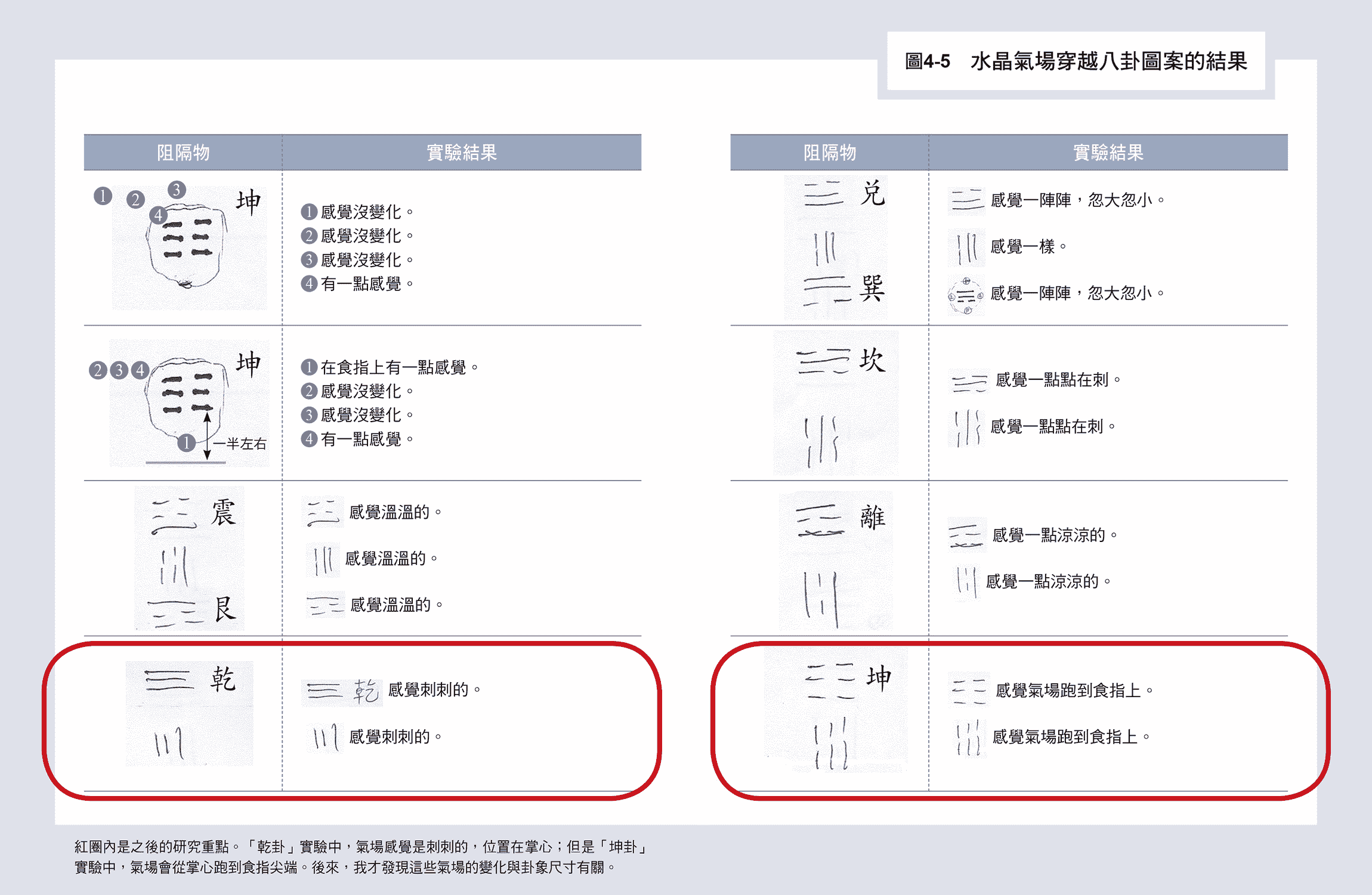
It is quite obvious that the Zhen trigram " " in the left column, third row, and the inverted Gen trigram "
 " in the third row produce a warm sensation, indicating signal enhancement. The Zhen trigram and the Gen trigram react completely identically; even when rotated ninety degrees, the reaction is exactly the same, indicating that the pattern is independent of angle.
The Li trigram " " in the right column, third row, produces a cool sensation, indicating signal attenuation, while all the other trigrams produce a dynamic sensation. For example, the Dui trigram "
 " in the right column, first row, and the inverted Xun trigram "
 " produce a pulsating sensation of alternating between large and small, similarly showing that the Dui trigram and the Xun trigram react completely identically; even when rotated ninety degrees, the reaction is exactly the same, indicating that the pattern is independent of angle.
The Kan trigram " " in the right column, second row, produces a slightly prickling sensation.
Among these, the most noteworthy are the Qian trigram " " in the last row of the left column within the red circle, and the Kun trigram "
 " in the fourth row of the right column, which also became the focus of subsequent research. The sensation of the Qian trigram is prickly, and the qi field was originally located at the center of the palm, but after passing through the Kun trigram, the qi field would move from the center of the palm to the tip of the index finger. At the time, I did not understand the meaning of these sensations.
Experiments sometimes could not be repeated, because at the time we did not know that there had to be a certain ratio between the pattern size and the background paper size in order for the virtual image of the background paper not to interfere with the motion behavior of the virtual image of the Eight Trigrams. It was not until experiments after 2014 that these issues were gradually clarified.

What are the geometric specifications of the Qian trigram?
How should three straight lines be drawn to constitute the Qian trigram? In order to determine the geometric specifications of the Qian trigram, we fixed the length of all three yang lines of the Qian trigram at one centimeter, adjusting the distance between the yang lines from 0.3 centimeters to 1.5 centimeters, and adjusting the distances from the upper and lower lines to the central yang line to be symmetric or asymmetric, to measure Miss T’s responses to the crystal qi field passing through these patterns. This experiment is shown in Figure 4-6.
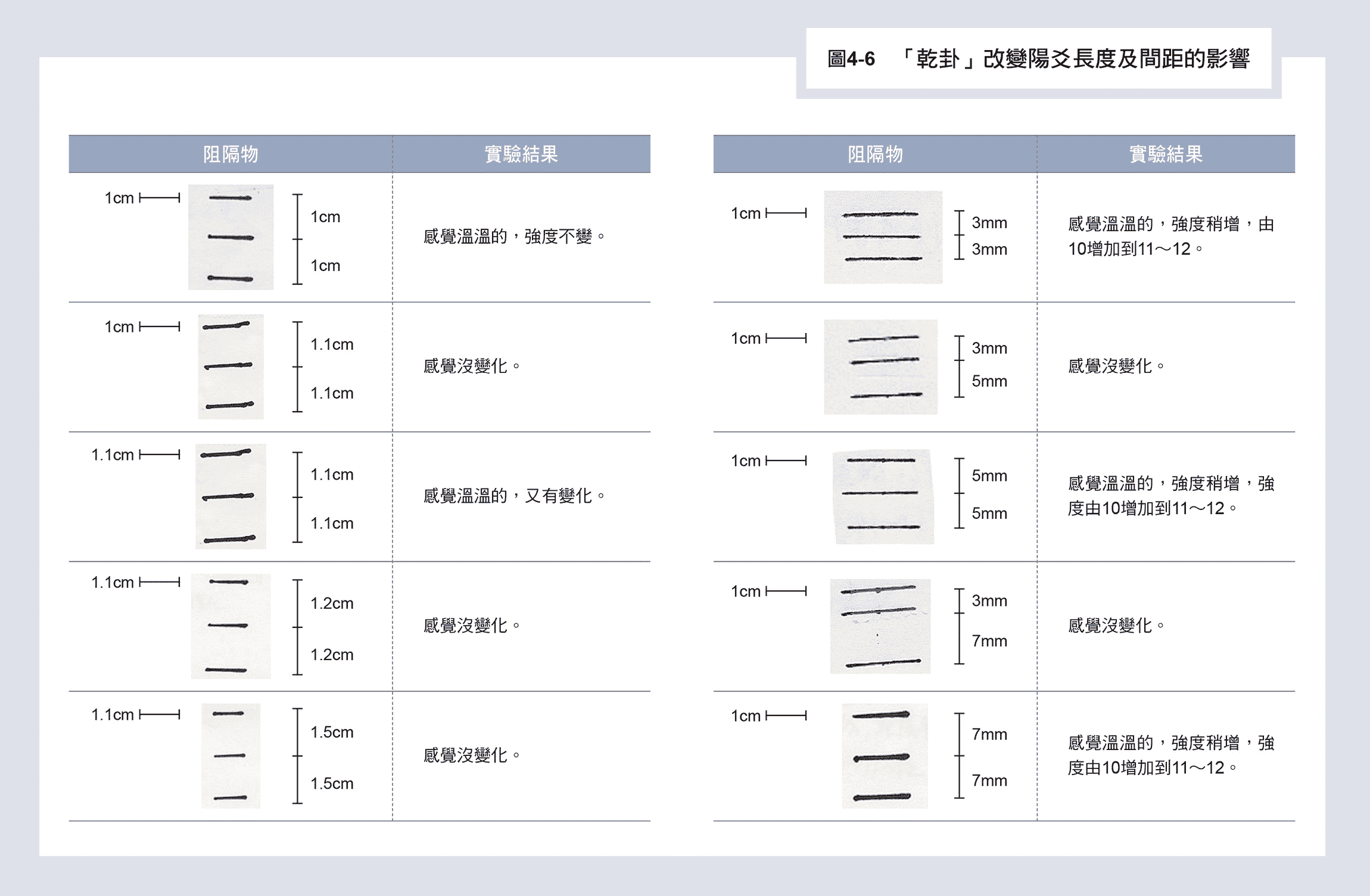
We discovered after 2016 that samples prepared in different years with different formats or sizes would produce somewhat inconsistent reactions, because the size of the sample’s background paper would interfere with the behavior of the qi field passing through the Eight Trigrams patterns. However, within a single experiment, the paper and pattern sizes were fixed, and therefore the experiments were reliable.
The results of this experiment clearly showed that a normal Qian trigram would cause the qi field to strengthen by approximately ten to twenty percent, with the intensity increasing from ten to eleven or twelve, and the qi field would also become warm, having an amplifying effect. As long as the distances from the upper and lower lines to the central yang line were asymmetric, such as three millimeters versus five millimeters, or three millimeters versus seven millimeters, as in the second and fourth rows of the right column, the qi field enhancement effect disappeared, indicating that these two patterns no longer represented the Qian trigram. However, once symmetry was restored, such as five millimeters versus five millimeters, or seven millimeters versus seven millimeters, as shown in the third and fifth rows of the right column, the qi field enhancement effect reappeared.
When the distances from the upper and lower yang lines to the central yang line were one centimeter, the same as the yang line length, the qi field no longer strengthened, but felt slightly warm, indicating that this pattern was approaching the geometric boundary of the Qian trigram, as shown in the first row of the left column. Sure enough, when the distances from the upper and lower yang lines to the central yang line were 1.1 centimeters, the qi field enhancement effect disappeared, as shown in the second row of the left column. However, when the spacing was adjusted to 1.1 centimeters and the yang line length was changed to 1.1 centimeters, as shown in the third row of the left column, the qi field enhancement effect was restored. From this, we can draw a simple conclusion to define the geometric structure of the Qian trigram.
Assume that three parallel lines of equal length are placed adjacent to each other, with length D. If the distances between adjacent lines are S1 and S2, and they satisfy S1 = S2 < D; then the geometric structure of these three lines represents the Qian trigram. It turns out that the Qian trigram has structural geometric specifications, and one cannot just casually draw three lines.

What are the geometric specifications of the Kun trigram?
First, we can regard the Kun trigram "" as two Qian trigrams "" placed side by side. Therefore, each of the two Qian trigrams must follow its own specifications, as discussed previously. But what role does the distance between them play?
To investigate this question, we fixed the lengths of the six yin lines on the left and right at five millimeters, and changed the distances between the left and right, or upper and lower, groups of three yin lines. Figure 4-7 shows the results of the interaction between the crystal qi field and Kun trigrams of different geometric shapes drawn by hand using a ballpoint pen.
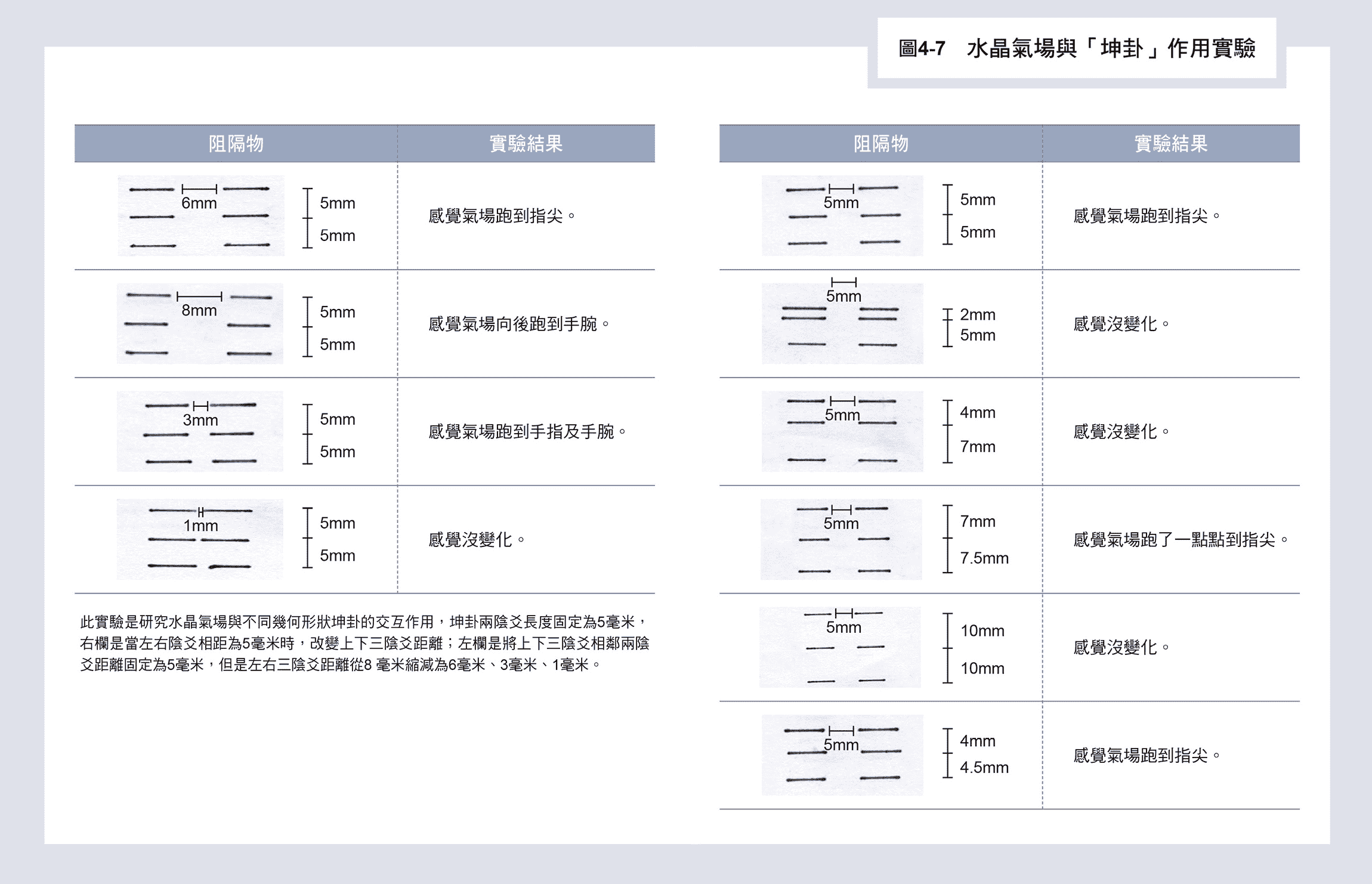
The six rows of experiments in the right column show the results when the left and right yin lines were spaced five millimeters apart, while changing the distances between adjacent yin lines among the upper and lower three yin lines to be symmetric or asymmetric, or only symmetric but with distances longer than the five-millimeter yin lines. The other rows in the left column show the results of fixing the distance between adjacent yin lines among the left and right three yin lines at five millimeters, but changing the distance between the left and right three yin lines, reducing it from eight millimeters to six millimeters, three millimeters, or one millimeter.
As we expected, as long as the two small Qian trigrams of the Kun trigram were asymmetric, as shown in the second row (two millimeters versus five millimeters) and third row (four millimeters versus seven millimeters) of the right column in Figure 4-7. Or, when the symmetric line-to-line distances were equal to or greater than one centimeter, as shown in the fifth row, the Kun trigram effect (the phenomenon of the qi field moving to the fingertip) would disappear.
In the fourth row of the right column, the two small Qian trigrams were not perfectly symmetric, at seven millimeters versus 7.5 millimeters, which also exceeded the length of a single line at five millimeters. At this point, the qi field moved slightly to the fingertip, indicating that there was still a slight Kun trigram effect.
In the sixth row of the right column, the two small Qian trigrams were not perfectly symmetric, at four millimeters versus 4.5 millimeters, but the Kun trigram was completely unaffected, and the qi field still moved forward to the fingertip.
Starting from the first row of the left column in Figure 4-7, when the distance between the two small Qian trigrams is changed to six millimeters, the Kun trigram is unaffected, and the qi field still runs forward to the fingertip.
In the second row of the left column, the distance between the two small Qian trigrams is increased to eight millimeters, and the qi field reverses direction, running backward to the wrist.
In the third row of the left column, the distance between the two small Qian trigrams is reduced to three millimeters, and the qi field reaches both the fingertip and the wrist, apparently splitting into two streams of qi — one running forward to the fingertip, the other running backward to the wrist. In the fourth row of the left column, the distance between the two small Qian trigrams is further reduced to one millimeter; the qi field remains unchanged, and the Kun trigram effect disappears.
Overall, it appears that the two Qian trigrams within the Kun trigram interact according to the distance between the yin lines, thereby producing a pushing effect.
Interaction of the Qi Field with Computer-Printed Qian and Kun Trigrams
From the above experiments, we learned that the Qian and Kun trigrams produce very strong interactions with the crystal qi field, but hand-drawn trigrams are relatively irregular and reproducibility is problematic. Therefore, after 2014, we switched to using computer-printed Qian and Kun trigrams for experiments. At the same time, it occurred to us that we should understand what the virtual images of the Qian and Kun trigrams look like. Would they exhibit dynamic behavior?
While I was considering the issue of symmetry in the spacing between Qian trigrams, I happened to encounter the former president of New York University in the United States, who mentioned that NYU was going to establish a branch campus in Shanghai. According to the law, university required courses must include a philosophy course, and one of the selectable contents was the Dao De Jing. He said that some statements in Chapter 42 of the Dao De Jing did not make sense, such as “The Dao gives birth to one, one gives birth to two, two gives birth to three, three gives birth to all things.” The digital world is composed of 0 and 1, so it should be two that gives birth to all things, not three. His remark reminded me that the Qian trigram has three straight lines, and the eight trigrams give birth to all images — why three lines rather than two?
One morning, after waking up, I was lying in bed thinking about the rules of the Qian trigram. Two yang lines of length L, upper and lower, create two imprints in spacetime separated by a distance of 2L. If a third yang line of the same length L is added, placed exactly in the middle, its range of influence is its own length: L above and L below, just touching the upper and lower lines. This kind of influence, pulling on the upper and lower lines, should cause the Qian trigram to start rotating, as shown in Figure 4-8.
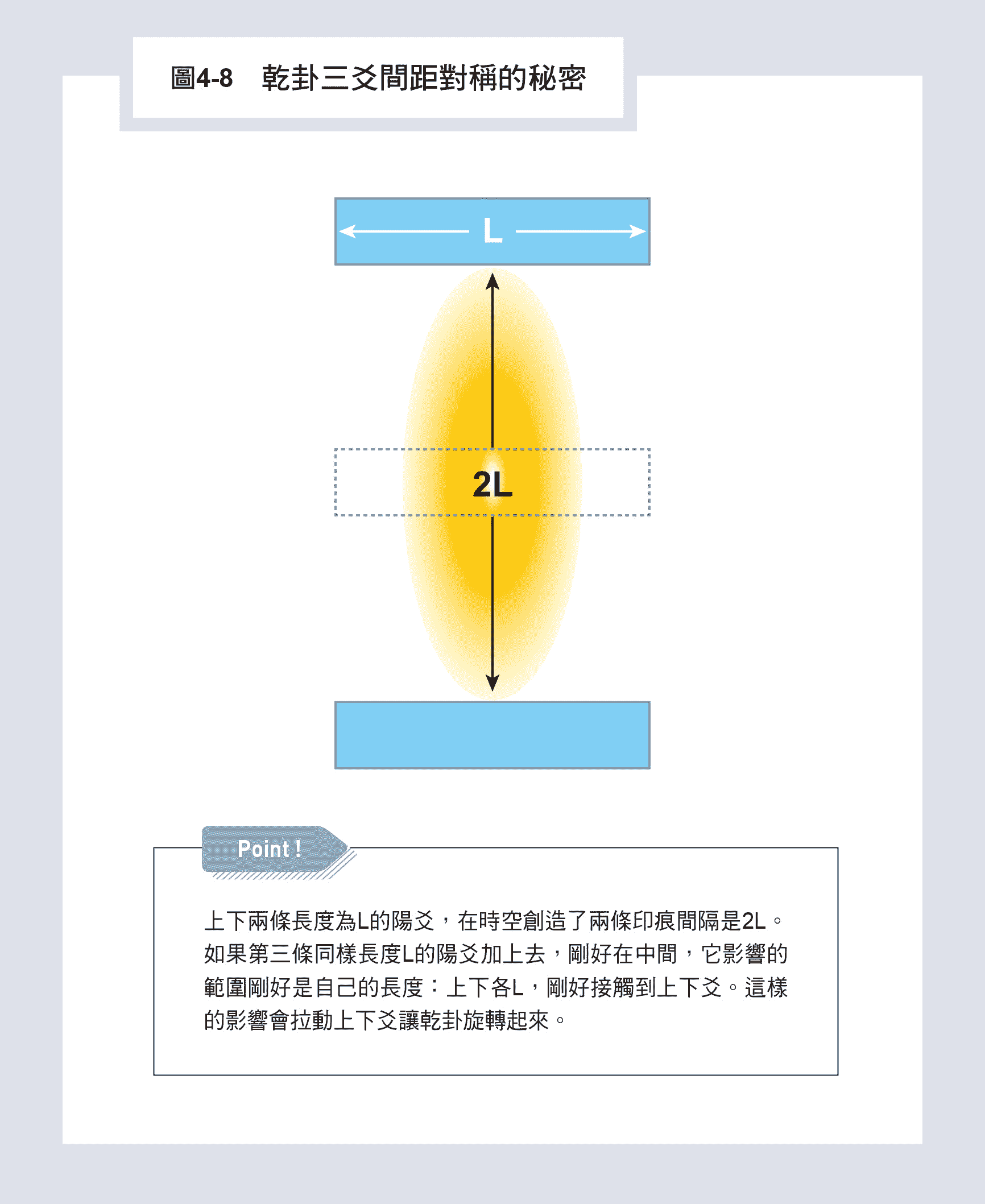
Therefore, I asked Ms. T to use finger reading to identify the virtual images of the two trigrams, with the results shown in Figures 4-9 and 4-10.
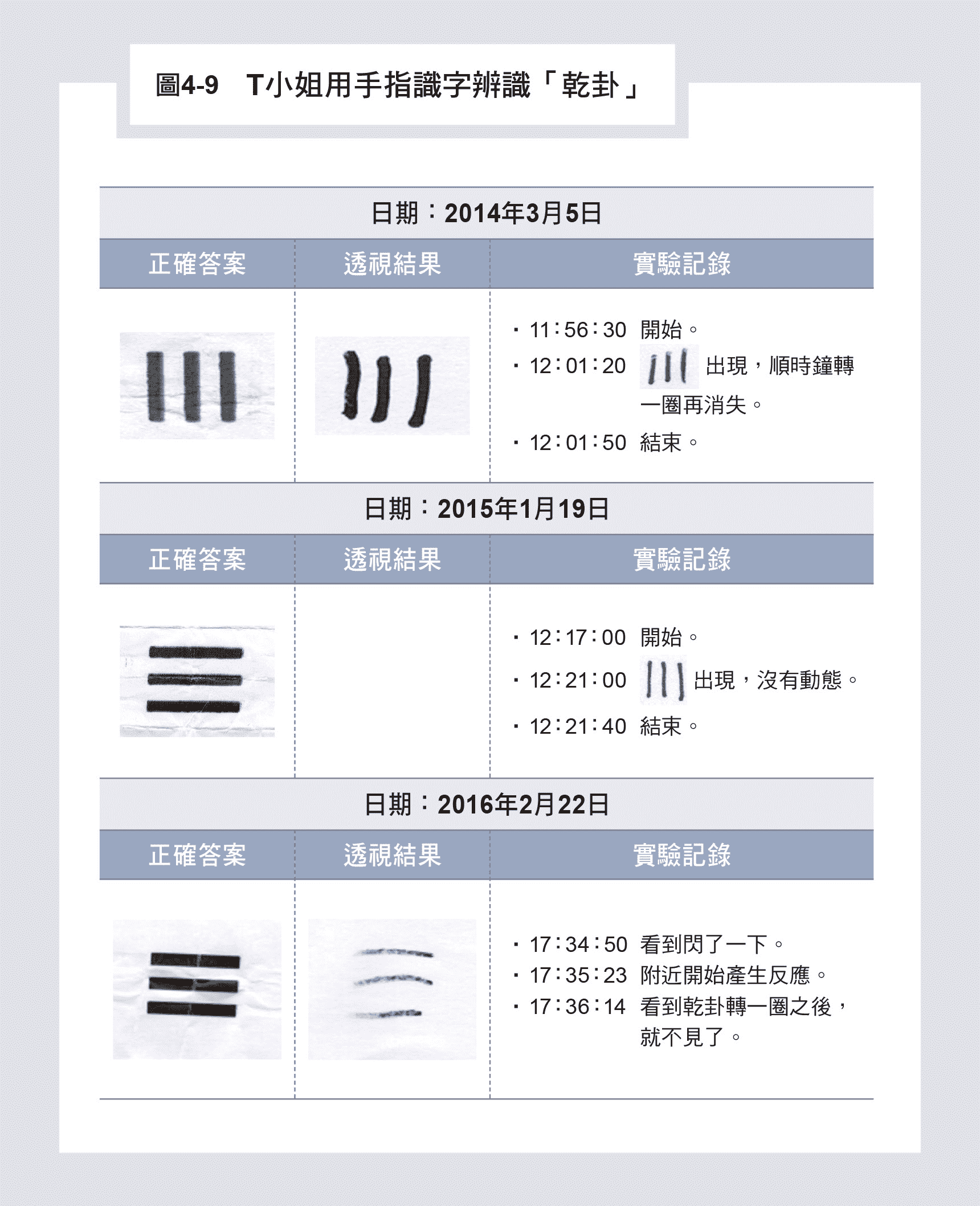
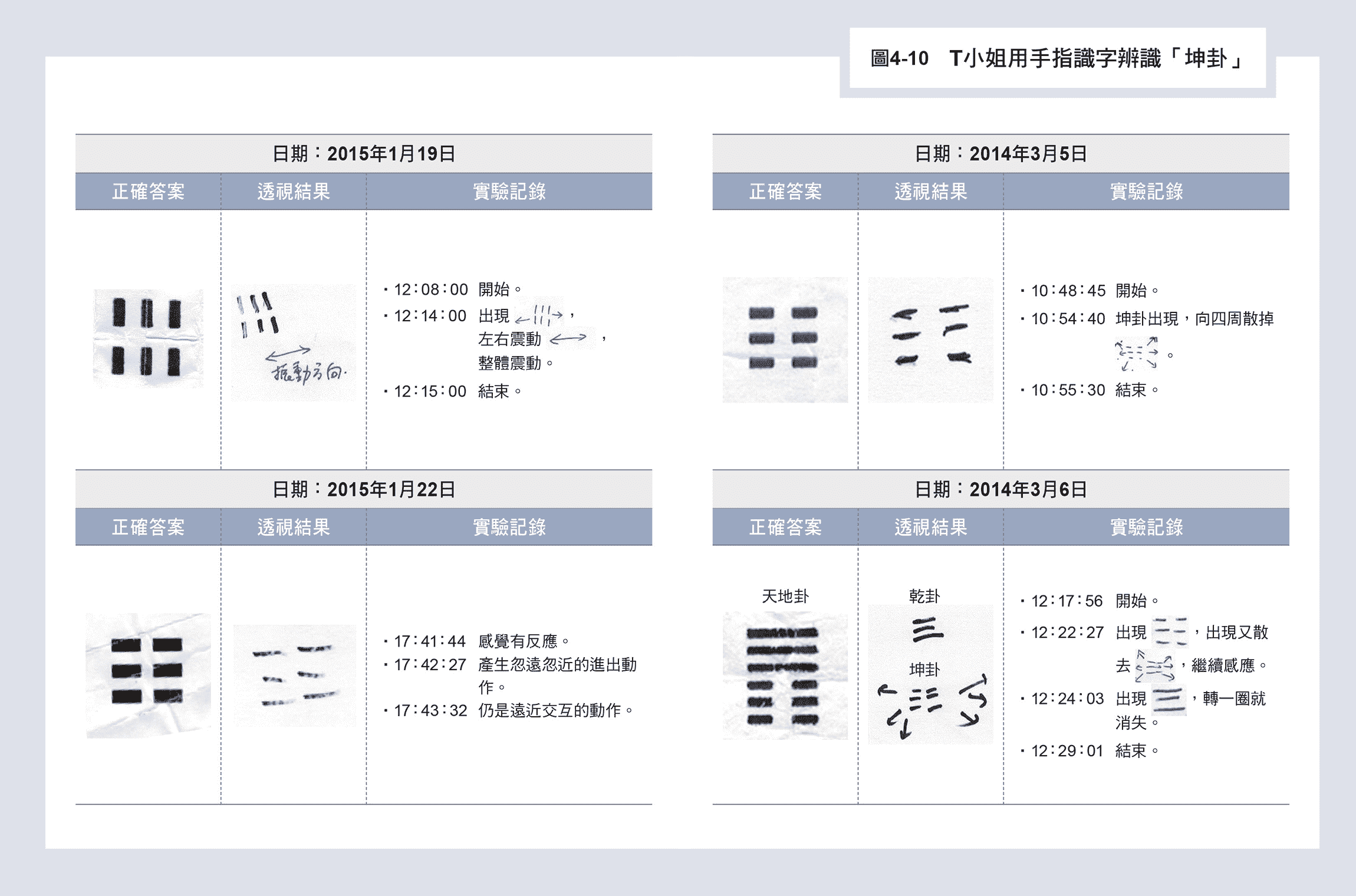
In 2014, when we first experimented with the Qian trigram, as shown in the first row of Figure 4-9, after the virtual image of the Qian trigram appeared in the Celestial Eye, it indeed rotated one full turn clockwise and then disappeared. I was extremely excited that my prediction had come true. In the Heaven-Earth trigram in the second row of the right column of Figure 4-10, after the Qian trigram was scanned into the Celestial Eye, it also rotated one full turn clockwise and disappeared, indicating that the virtual image of the Qian trigram has a tendency to rotate clockwise.
However, when the same experiment was conducted in 2015, as shown in the second row of Figure 4-9, the virtual image of the Qian trigram did not rotate, which was deeply puzzling.
Later, I noticed that the Qian trigram pattern seemed too large, exceeding one-third of the five-by-five square centimeter background paper size, which meant that the virtual image of the Qian trigram might exceed the virtual image size of the background paper, causing the rotation of the Qian trigram’s virtual image to be interfered with by the square virtual image of the background paper.
Sure enough, in 2016 we reduced the size of the Qian trigram on the paper, as shown in the third row of Figure 4-9, and the virtual image of the Qian trigram indeed rotated one full turn in the Celestial Eye and then disappeared. This indicates that the motion of the virtual image can be interfered with by the virtual image shape of the background paper.
The first row of the right column of Figure 4-10 shows the experimental results when Ms. T used finger reading to identify the Kun trigram. The Kun trigram is composed of two adjacent small Qian trigrams, and each small Qian trigram should theoretically rotate clockwise on its own. At this point, the virtual images of the six lines would interfere with each other and jam the rotation, resulting in the two small Qian trigrams pushing against each other and exploding apart. In the second row, after the Kun trigram at the bottom of the Heaven-Earth trigram was scanned into the Celestial Eye, the six yin lines also exploded apart. However, the first row of the left column shows a finger reading experiment conducted on January 19, 2015: after the Kun trigram entered the Celestial Eye, it did not explode apart but instead oscillated left and right, oscillating as a whole.
On January 22, the finger reading experiment with the Kun trigram was repeated. This time, after the Kun trigram entered the Celestial Eye, it produced a back-and-forth motion, moving nearer and farther away, as if the six yin lines were about to explode apart, but upon hitting the border of the background paper’s virtual image, they bounced back and continued oscillating. This behavior explains the behavior of the crystal qi field passing through the Kun trigram in Figure 4-7: the portion of the qi field striking the Kun trigram penetrates into the void, and the exploding behavior of the Kun trigram’s virtual image carries the real-spacetime qi field forward to the fingertip, or backward to the wrist area.
What kind of dynamic behavior would be produced when the crystal qi field passes through computer-printed Qian or Kun trigrams?
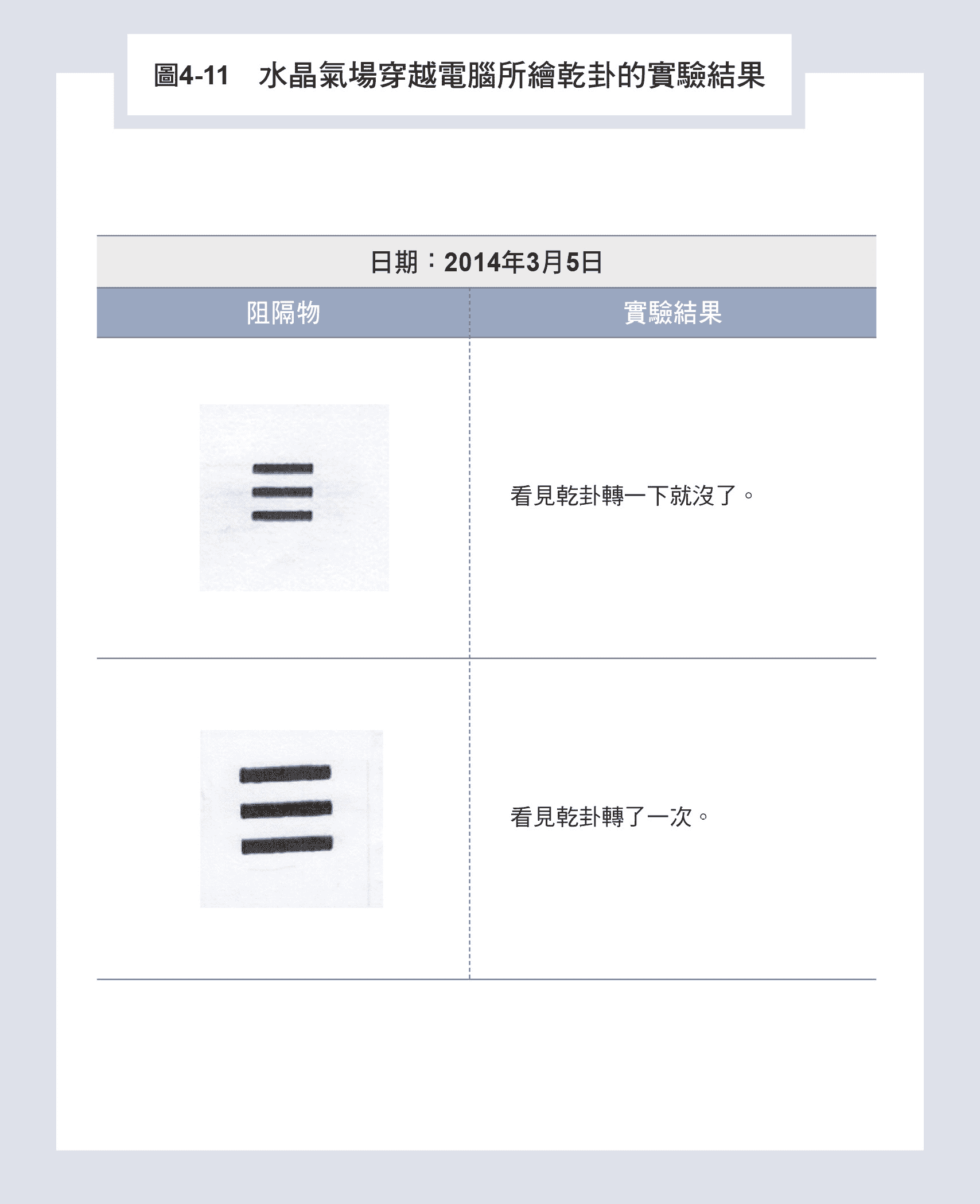
Figure 4-11 shows the results of testing two different-sized Qian trigrams in 2014. Both rotated one full turn clockwise, exactly the same as the finger reading results. This indicates that after the crystal qi field strikes the Qian trigram, a portion of the qi field penetrates into the void, interacts with the virtual image of the Qian trigram, and begins rotating clockwise. Through real-virtual entanglement, it drives the qi field in real spacetime to also rotate one full turn clockwise. What an astonishing result — we have lifted a corner of the mysterious veil of the eight trigrams.
During the 2016 experiments, we noticed the influence of the background paper shape, so in addition to using square paper, we also began using circular paper with a diameter of five centimeters, as shown in Figure 4-12.
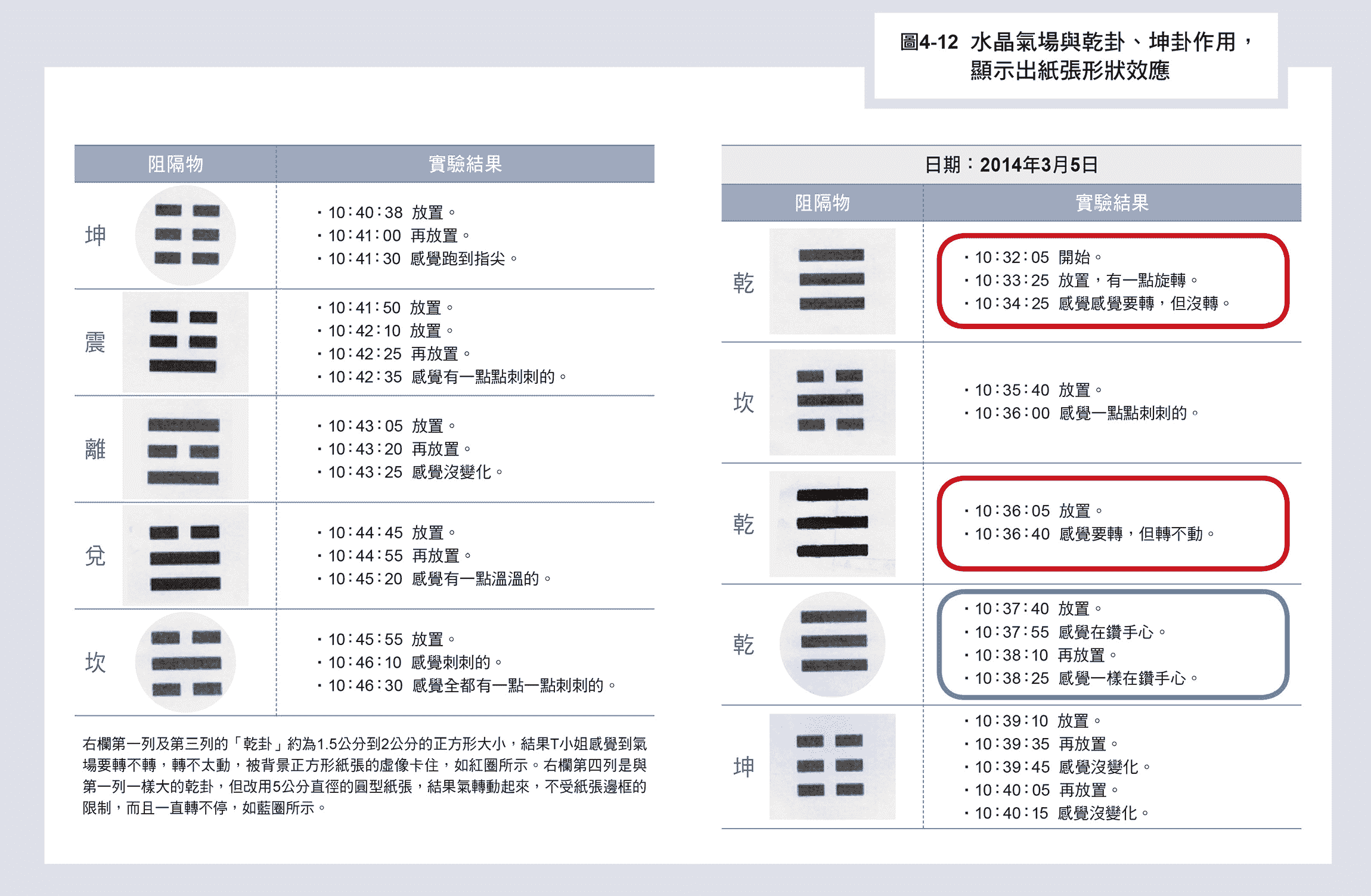
The first and third rows of the right column use square paper, with the Qian trigram being approximately a 1.5 cm to 2 cm square in size. As a result, Miss T felt the qi field struggling to rotate, barely able to turn, apparently caught by the virtual image of the square background paper, as shown by the red circle.
The fourth row of the right column uses a Qian trigram of the same size as the first row above, but changed to circular paper with a diameter of five centimeters. As a result, the qi rotated freely, unconstrained by the paper’s border, and kept spinning without stopping, giving the sensation of drilling into the palm, as shown by the blue circle.
The fifth row of the right column has a Kun trigram on a square, but there was no reaction, no explosive behavior. However, when the first row of the left column was changed to circular background paper, the qi field rushed forward to the fingertips. This indicates that once the border effect is removed, the Kun trigram will explode and carry the qi field toward the index finger.
This also explains why in Figure 4-5, the qi field passing through the small Qian trigram drawn with a ballpoint pen felt prickly. Because the Qian trigram was too small to touch the background paper, the qi field penetrated into the void, carrying the virtual image of the Qian trigram and continuously spinning, which produced the prickly sensation.
Dynamic Behaviors Elicited by Other Bagua Figures
Above, we studied in detail the dynamic behaviors of the Qian and Kun trigrams in the void, as well as the changes after the crystal qi field passes through these two trigrams. This allowed us to understand that the mystery of the Bagua is hidden within imaginary space. Do the remaining six trigrams exhibit similar behaviors?
First, let us look at the experimental results of the Kan trigram in finger reading, as shown in Figure 4-13. The 2014 experiment was not successful; the virtual image of the Kan trigram showed no movement in the Heavenly Eye. However, in the experiment on January 19, 2015, after the Kan trigram appeared, it moved in small circles, as if going round and round.
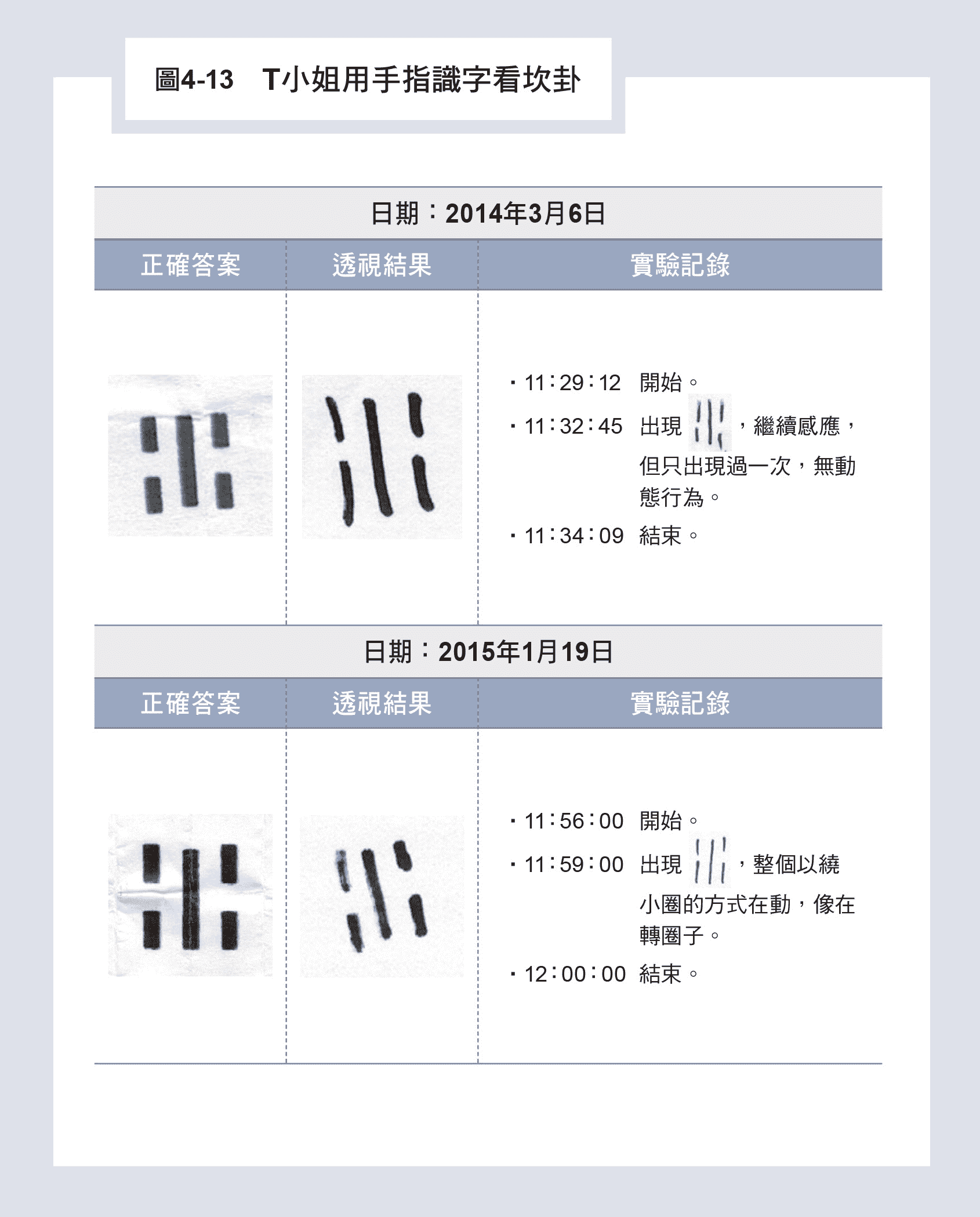
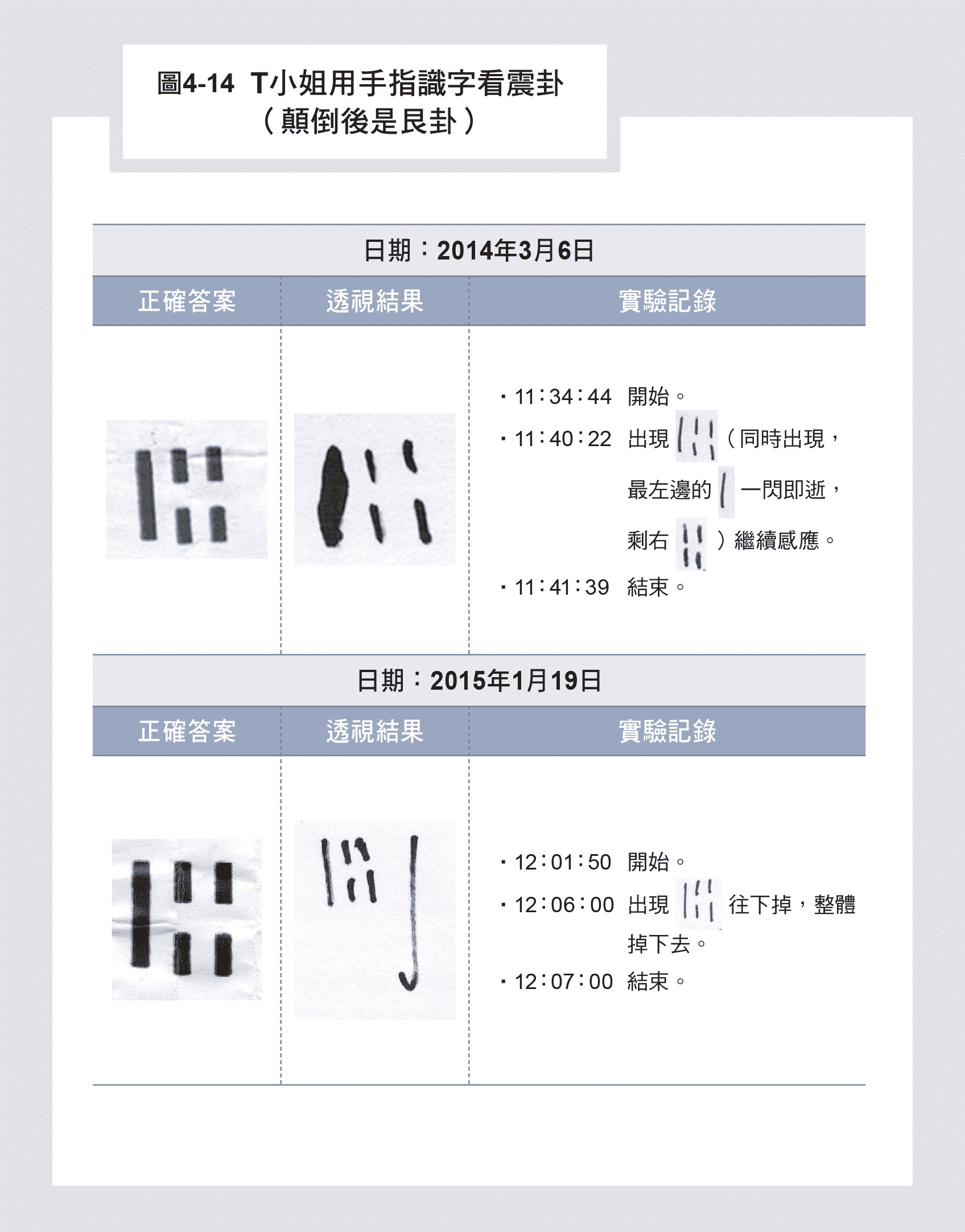
Figure 4-14 shows the experimental results when Miss T used finger reading to view the Zhen trigram (when inverted, it becomes the Gen trigram). The result of the first experiment on March 6, 2014, was very unusual: after the virtual image of the Zhen trigram appeared in the Heavenly Eye, the yang line on the left suddenly disappeared and ran away, leaving only the two yin lines on the right.
After the experiment on January 19, 2015, it was finally understood: the virtual image of the Zhen trigram moves together with the yang line. The previous year’s experiment had the yang line moving, but the two yin lines beside it failed to keep up. The other three trigrams — “Li,” “Xun,” and “Dui” — could not be successfully observed for dynamic behavior in finger reading experiments. However, through the crystal qi field passing through these trigram figures, the dynamic behaviors of all the Bagua virtual images in the spiritual realm were observed in their entirety.
For example, in the first row of the right column in Figure 4-5, when the qi field passes through the “Xun” trigram, or the “Dui” trigram rotated 180 degrees, it produces a dynamic behavior of pulsing, growing larger and smaller in waves. In the third row of the right column, passing through the “Li” trigram, Miss T would feel a cool sensation — all show changes. In Figure 4-12, one can also see that the qi field passing through the “Dui” trigram becomes warm, and passing through the “Kan” trigram becomes prickly, indicating that the qi field is rotating.
Daoist Array Formations
From these dynamic behaviors of the Bagua in the void, we can understand how ancient Daoists set up array formations to produce dynamic behaviors of space-time. Through the qi field passing through the formation or the arrangement of objects in space, and then projecting into the material real-number space, people with meridian sensitivity can perceive it. This is the scientific basis of feng shui and the scientific principle behind Qi Men Dun Jia array formations.
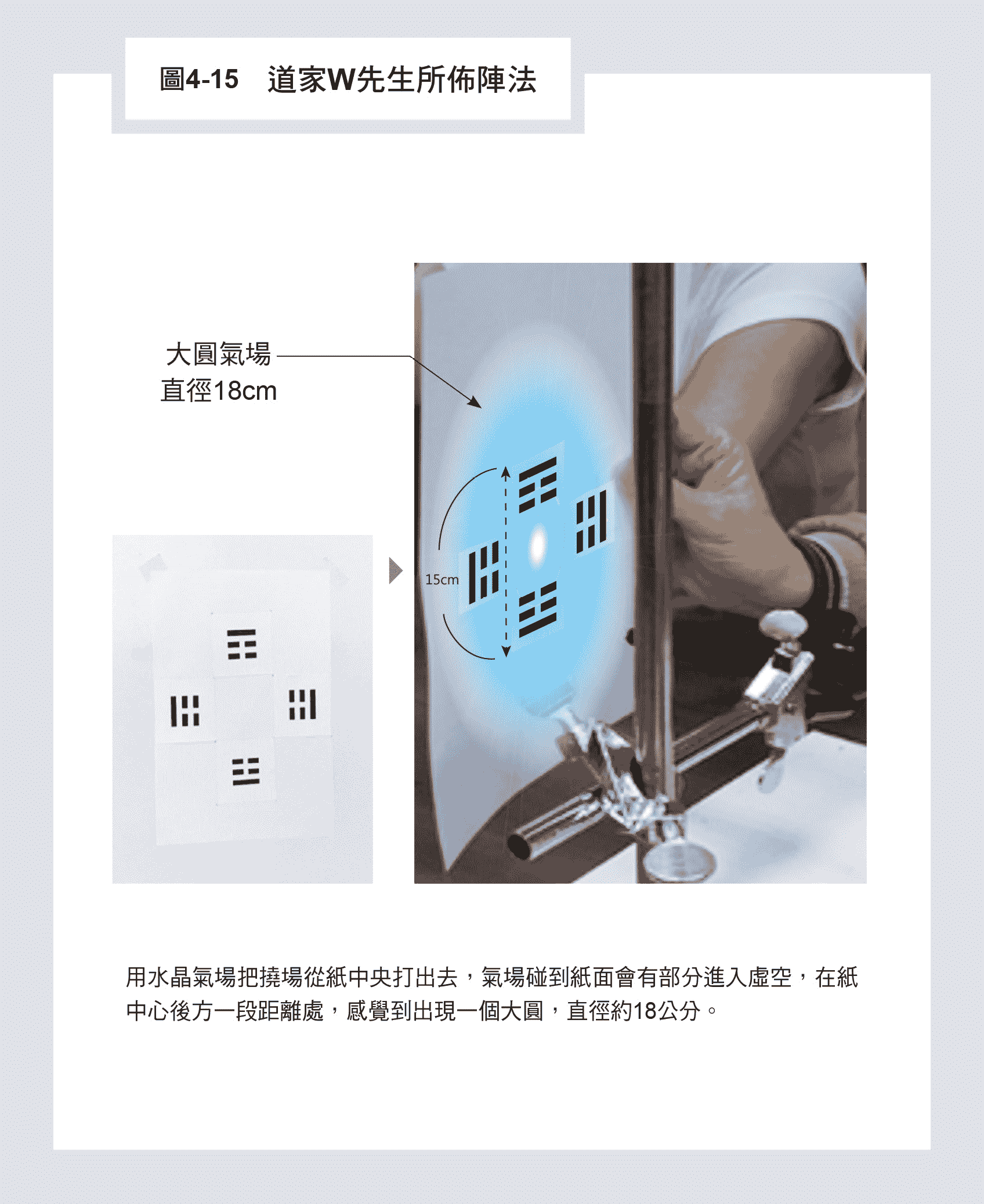
Figure 4-15 shows the first array formation taught to me by my friend, Daoist Mr. W. On a five-by-five square centimeter paper, four Zhen trigrams are printed and pasted at the corners of a cross shape from top to bottom, each rotated ninety degrees in sequence. Each arm of the cross is fifteen centimeters long.
We used a crystal qi field or a torsion field generator to project the torsion field outward from the center of the paper. When the qi field encounters the paper surface, part of it enters the void, driven by the yang line of the Zhen trigram’s virtual image to move together — first to the right, then downward, then to the left, and then upward — completing one full rotation. At a certain distance behind the center of the paper, a large circular qi field is formed, approximately eighteen centimeters in diameter. People who are extremely meridian-sensitive can all feel this round qi field in space. This was the first time in my life that I actually observed and verified a space-time array formation. The projected qi field produced a qi field structure consistent with the theory. The knowledge by which Daoists have manipulated space for a millennium is hereby decoded.
From the evidence provided in this chapter, we clearly understand that the torsion field — that is, the crystal qi field — can traverse between the yin and yang realms, communicating between the two worlds.
From this, we understand that traditional Chinese feng shui deals with the geometric structures formed by the arrangement of objects in the environment and home, using wind or water to adjust the position and size of the qi field. Because the qi field can bore into the void, projecting the dynamic behaviors of the geometric structures formed by the virtual images of objects in the void into the material real-number space-time, I believe the qi field also brings different consciousness entities or information from the past and future from the void into the yang realm of the material world, causing different sensory responses in the bodies of relevant individuals, thereby producing outcomes of good fortune, misfortune, disaster, and blessing. Therefore, I believe the behavior of the torsion field traversing between yin and yang is the scientific foundation of traditional Chinese feng shui.
Chapter 5: The Torsion Civilization of the Twenty-First Century
At the end of the nineteenth century, Tesla invented the polyphase alternating current motor,
which catalyzed the development of twentieth-century electrical civilization.
He also proposed several innovative concepts that were at the time considered science fiction.
These concepts based on torsion field effects,
along with the invention of torsion field detectors,
will bring about a torsion force civilization in the twenty-first century.
The Interaction of the Qi Field with Molecular Models and Geometric Structures
In Chapters Three and Four, we saw the results after a crystal qi field passed through sacred characters, spiral patterns, and bagua diagrams, and discovered the mysterious property that the qi field can traverse between the yin and yang realms. It turns out that when the qi field strikes written characters or diagrams on paper, a portion of the qi field tunnels into the spirit realm, triggering dynamic behavior in the virtual images of these characters and diagrams. These spirit-realm dynamic qi fields become entangled with the qi field that remains in the real-number space of the physical realm—in physical terminology, this is called “real-virtual entanglement.” Therefore, the behavior in the spirit realm can be projected back onto the qi field in real-number space, where it is perceived by functional individuals, allowing us to understand the behavior of the virtual images of these geometric patterns in the spirit realm.
This makes us very curious to learn more about geometric questions in the spirit realm. For example, do the virtual images of molecular models with different structures exhibit different dynamic behaviors? Do they follow certain rules? For the same type of molecule but with different sizes, will their virtual images produce the same or different dynamic behaviors?
Figure 5-1 shows experimental photographs of Miss T perceiving the crystal qi field passing through different molecular models. She wore a blindfold, so she did not know what molecular model we placed in the middle. The same molecule was repeatedly placed two to three times until she was certain her perception was clear, at which point the trial was considered complete. Next, we will discuss the experimental results one by one to see whether we can derive some common principles.
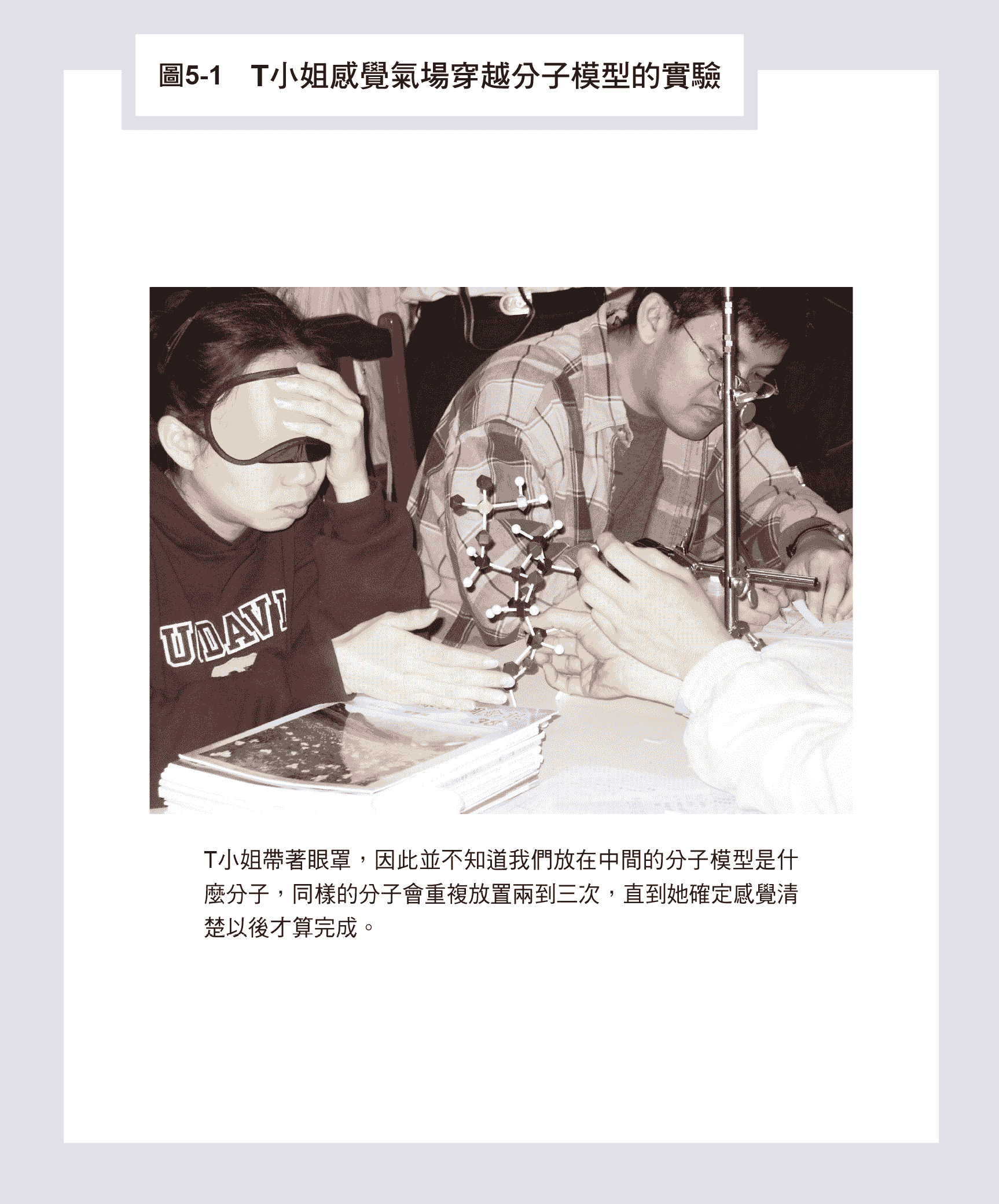
Simple Molecular Models and Pyramid Structures
First, we attempted to use simple molecular models such as ethanol/alcohol (C2H5OH) and methane (CH4), and paper geometric structures such as a pyramid and a large DNA model (forty centimeters long, fourteen centimeters in diameter), as shown in Figure 5-2.
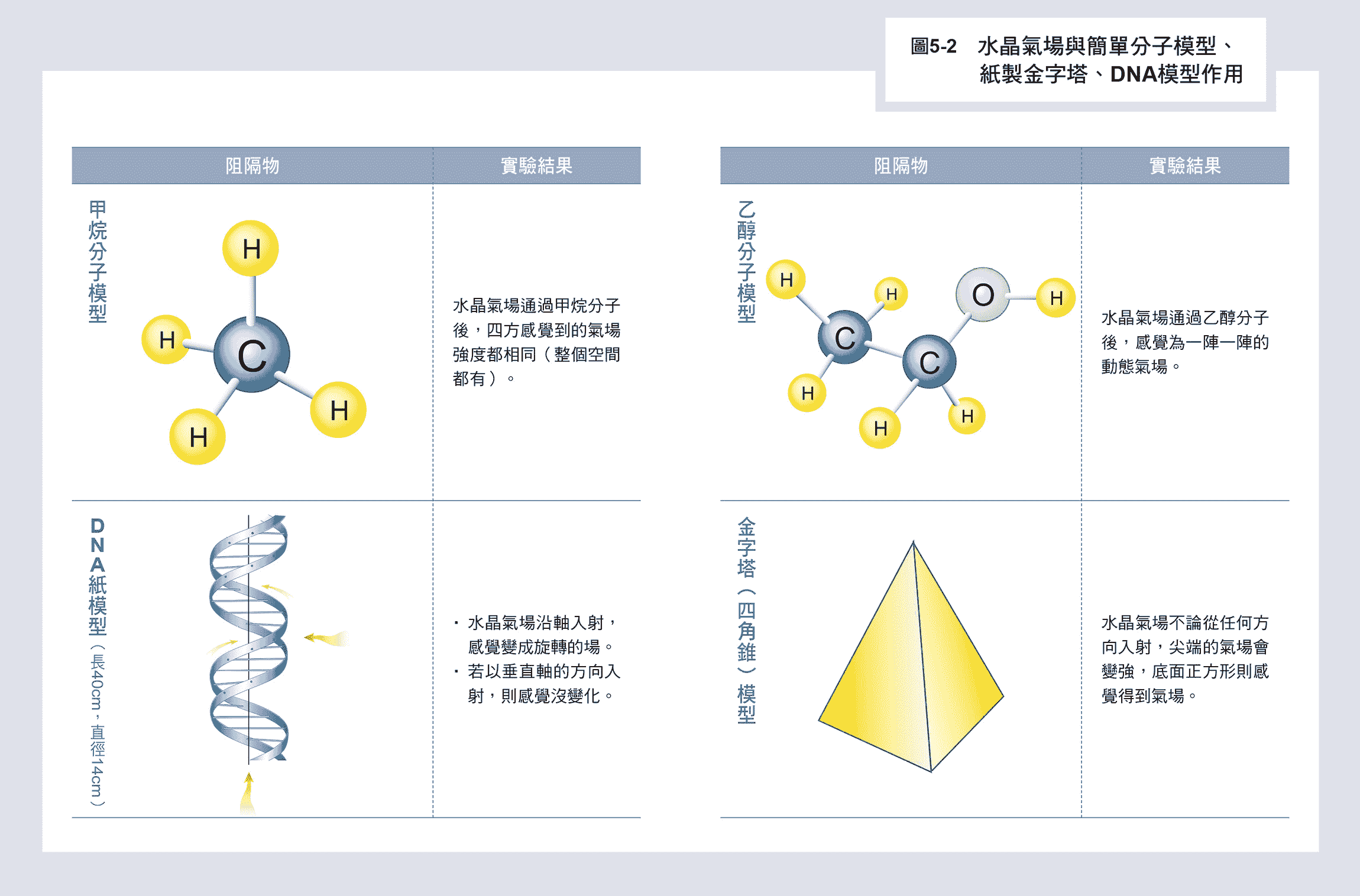
As shown in the first row of the right column of Figure 5-2, the qi field passing through the ethanol molecule changes from a static single point into a pulsating dynamic qi field; however, when passing through the regular tetrahedral methane molecule in the first row of the left column (with the carbon atom at the center of the regular tetrahedron and the four hydrogen atoms at the four corners of the regular tetrahedron), the qi field expands spherically outward with the carbon atom as its core, and she sensed that the qi field diffused uniformly in all directions with equal intensity. This indicates that a spherically symmetric molecule gives rise to a spherically symmetric qi field distribution. In the ethanol molecule, the main-axis chemical bond of the carbon–carbon–oxygen three atoms at an angle of roughly slightly more than one hundred degrees, combined with the effects of five carbon–hydrogen and one oxygen–hydrogen peripheral chemical bonds, causes the qi field to be scattered back and forth by different atoms, turning it into a pulsating dynamic qi field. Clearly, the geometric structure of the molecule determines the spatial distribution pattern of the qi field.
The second row of the right column of Figure 5-2 shows a paper pyramid, which geometrically is a square pyramid with a square base. We found that when using the crystal qi field, regardless of the direction from which it enters the pyramid, the outgoing qi field has only two directions: one is a relatively stronger emission from the apex of the pyramid, and the other is a relatively weaker qi field emitted uniformly from the square base of the pyramid. This tells us that the direction pointed to by the apex of the pyramid is meaningful. Once the qi field tunnels into the void of the spirit realm, it can travel along this direction at superluminal speed toward the depths of the universe. Some books researching the secrets of pyramids claim that the constellation pointed to by the apex of a pyramid is used for communication with extraterrestrials of that constellation, which seems to make some sense. I have also read many books claiming that placing food inside a pyramid can slow down the rate of molding or decay. Although I have not conducted similar experiments, I have seen some science fair projects by elementary and middle school students that partially confirm these phenomena. I suspect this is related to the distribution of the qi field inside the pyramid.
The last experiment in Figure 5-2 is the paper DNA model in the second row of the left column, with a diameter of fourteen centimeters and a length of forty centimeters. If the qi field enters along the DNA axis, the qi field rotates following the direction of the DNA’s rotation, similar to what was shown in Figure 3-14 of Chapter Three, where the qi field rotates along an Archimedean spiral. If the qi field enters perpendicular to the DNA axis, it is completely unaffected and passes straight through.
Protein Molecular Models
In this section, we consider the interaction of five protein molecular models with the qi field, as shown in Figure 5-3.
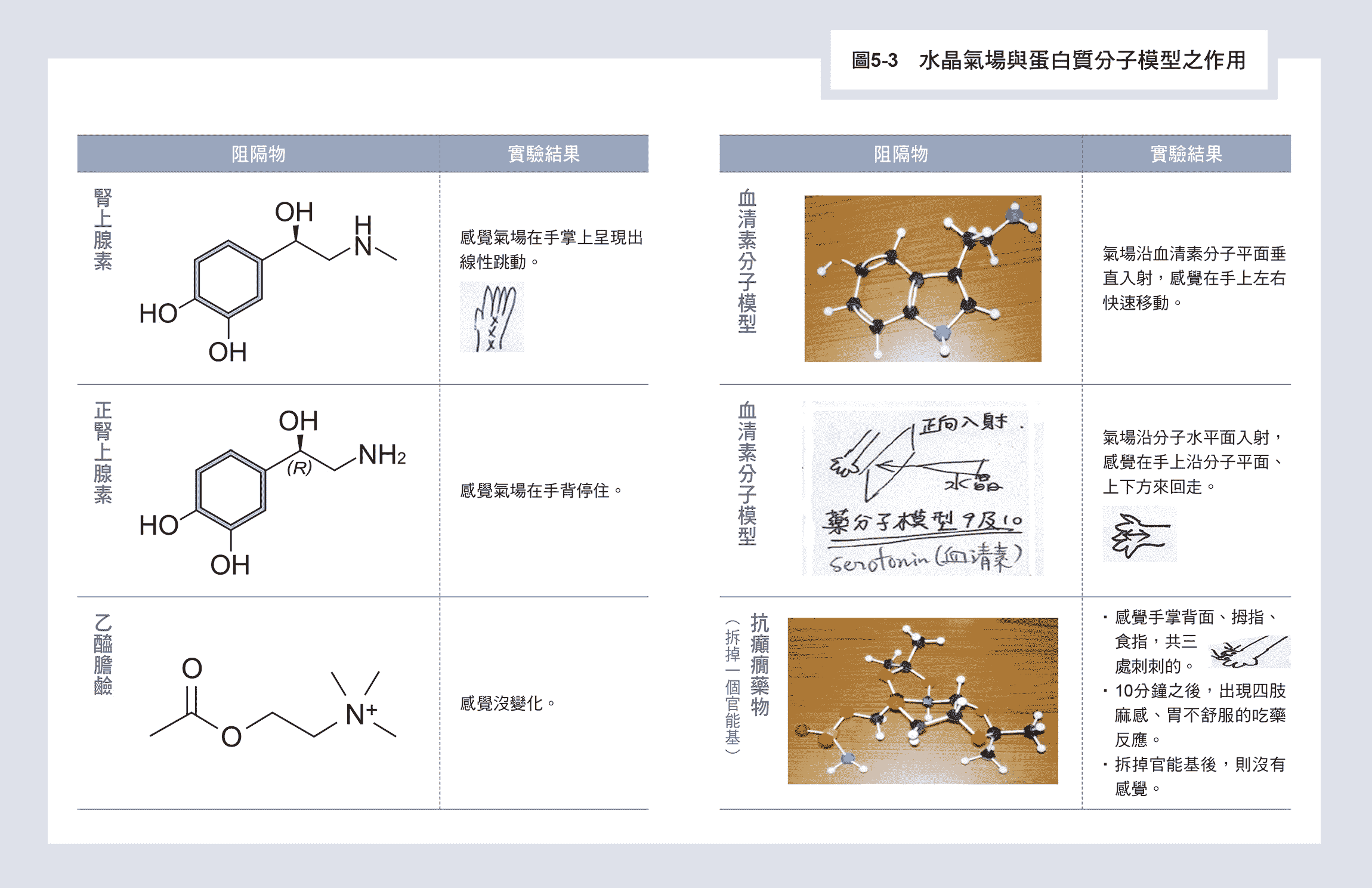
The first row of the right column of Figure 5-3 shows the serotonin (Serotonin) molecular model. Serotonin is a benzene bicyclic neurotransmitter, mainly found in the gastrointestinal tract, blood platelets, and central nervous system of animals. It is widely regarded as a contributor to feelings of well-being and happiness. If the qi field enters perpendicular to the molecular plane, the qi field is modulated into a dynamic state, sweeping back and forth along the plane. If the qi field enters parallel to the plane, the result is that the qi field moves back and forth above and below the molecular plane—in both cases becoming dynamic behavior, as shown in the second row of the right column of Figure 5-3.
In the right column, the third row is the molecular model of the antiepileptic drug Topiramate, made by a neurologist, and also a drug he commonly uses to treat epilepsy patients. Miss T’s reaction was extremely peculiar: in addition to a tingling sensation in her thumb, index finger, and the back of her hand, after removing one functional group, the tingling sensation disappeared. Ten minutes after the experiment, she experienced numbness in all four limbs and stomach discomfort. The neurologist standing nearby immediately said this was a drug reaction! Truly astonishing — we had merely used the qi field to project the information of the molecular model onto Miss T’s palm, yet she actually exhibited a drug reaction. The size of this molecular model was ten million times larger than the real drug molecule, but this did not affect its action on the body. This tells us a major secret within the human body: biochemical actions in physiology arise from the geometric structural information of molecules and have nothing to do with molecular size. Medicine does not necessarily have to be taken orally; as long as the spatial geometric structural information of the medicine is delivered into the body via the qi field, a drug reaction will occur. This has tremendous inspirational implications for our future use of medicines to treat illness.
Figure 5-3, left column, rows one through three, display three molecules — adrenaline (epinephrine), noradrenaline (norepinephrine), and acetylcholine — and their interaction with the qi field.
The adrenaline in the first row of the left column in Figure 5-3 is a hormone and neurotransmitter released by the adrenal glands. Adrenaline increases the contractile force of the heart, causes vasodilation in the blood vessels of the heart, liver, and muscles, and vasoconstriction in the blood vessels of the skin and mucous membranes; it is a hormone secreted by people or animals encountering danger. The adrenaline molecule causes the qi field to exhibit linear dotted pulsations from the palm to the wrist; the noradrenaline in the second row is an adrenergic receptor agonist that constricts blood vessels and raises blood pressure, and it causes the qi field pulsation to stop on the back of the hand. The acetylcholine in the third row is a neurotransmitter that, after being released from the terminals of nerve axons, crosses the synaptic cleft and binds with receptors on the cell membrane of the postsynaptic neuron or the motor endplate. From the experimental results, it was found that acetylcholine has no effect on the qi field. It appears that molecular structures playing a hormonal role all cause the qi field to pulsate, perhaps along the axis of the amine ring molecule.
Regarding the effect of molecular size, we have another set of data to illustrate this, as shown in Figure 5-4: the dopamine molecular model, whether a small model made by 3D printing or a large model assembled from plastic balls and rods, has exactly the same shape, differing only in size by more than twenty-five times. After the qi field passes through both types of molecules, it jumps around in many places on the palm, with completely identical reactions.
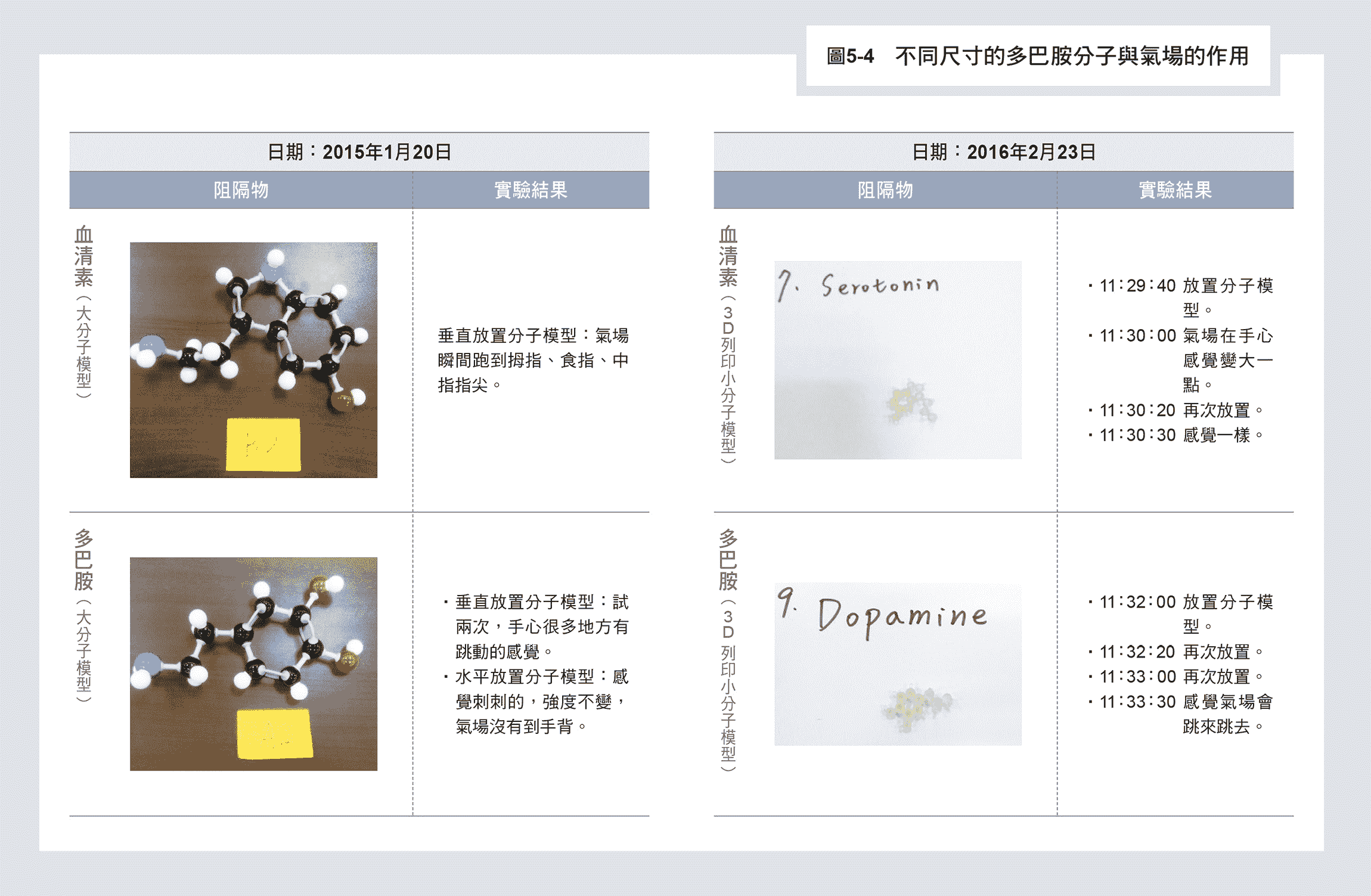
Therefore, geometric structure is the sovereign principle of biochemical reactions, and it has nothing to do with size. This also implies that in imaginary-number space, the principle of interaction between the qi field and geometric structure is “form resonating with form” — as long as the geometric structure is the same, rather than the absolute size being the same, the same pattern of reaction will be produced.
We tested the reactions of many amino acid and protein molecular models on the qi field, and ultimately arrived at three conclusions:
Amino acid structures containing benzene rings within the molecule carry special information.
Single-ring amine-base types such as dopamine or adrenaline carry information that triggers qi field pulsation (the pulsation of the qi field is felt from the fingers to the palm).
Double-ring amine-base types, similar to purine-class molecules such as serotonin, tryptophan, and melatonin, scan the qi field to the fingertips, producing a tingling sensation. This indicates that the qi field striking the molecular model penetrates the virtual image of the single benzene ring in the void, leading to pulsation of the qi field, while the virtual image of the double-ring amine base leads to an expanded qi field, driving the qi field of the real-number world to move back and forth or expand to the fingertips at the boundary of the palm, resulting in the tingling sensation.
Crystal Models and Real Objects Produce the Same Reactions
Solids in the material world are all composed of atoms. If the arrangement of atoms in a solid is periodic, it forms a crystal. How do these crystals interact with the qi field? We also conducted some experiments to understand the unit cell models of crystals and the crystals themselves, as shown in Figure 5-5.
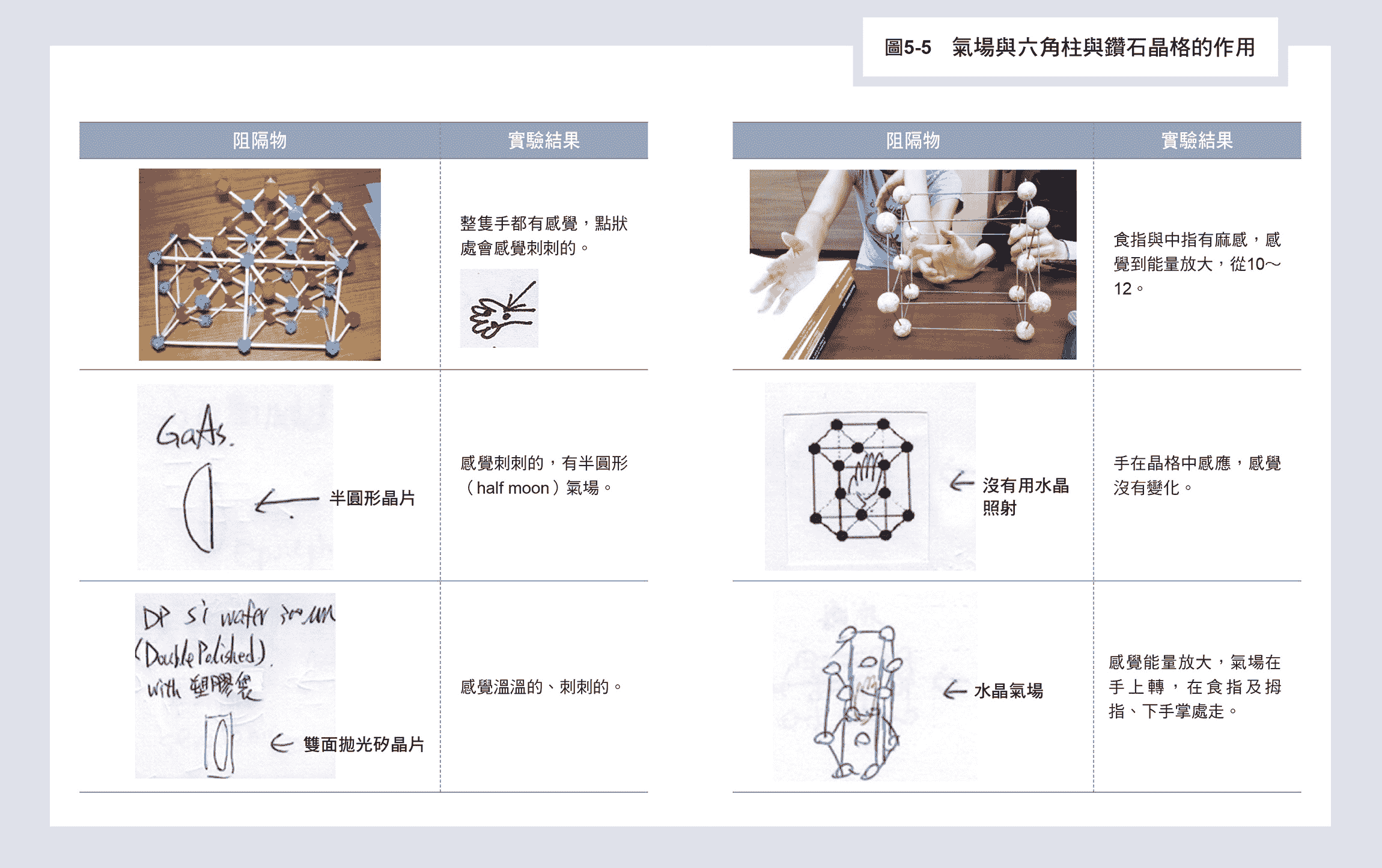
The right column shows the reaction of a hexagonal prism unit cell. The base of the hexagonal prism is a regular hexagon, with each side of equal length and interior angles of one hundred twenty degrees. There is one atom at the center of the hexagon, and the C-axis perpendicular to the base is relatively long. When the qi field is incident along directions parallel or perpendicular to the C-axis, as shown in the first or third row, the qi field intensity is amplified, causing numbness in the index finger, thumb, or middle finger. It turns out that the hexagonal prism lattice also amplifies the qi field, just like the sacred vocabulary. If there is no incident qi field, as shown in the second row, the sensation remains unchanged. This indicates that an appropriate three-dimensional spatial geometric structure can also scatter the qi field, causing it to oscillate back and forth and produce an amplification effect.
The left column of Figure 5-5 shows the lattices and physical objects of important semiconductor materials based on the diamond structure. The first row is the III–V compound semiconductor material gallium arsenide (GaAs), which can be used for high-speed and optoelectronic semiconductor devices. Its structure is based on the diamond structure, with each lattice point placing a pair of arsenic (blue) and gallium (red) atoms as the basis. When the qi field passes through the 3D model of the lattice atoms (alternating red and blue), the hand feels prickly sensations everywhere. If the qi field passes through a piece of crescent-shaped real gallium arsenide wafer, as shown in the second row, the result is the same — the hand feels a crescent-shaped prickly sensation, and the response is completely identical. This once again confirms that regardless of how much the model sizes differ, the same structure leads to the same qi field distribution. The third row is a double-side polished semiconductor silicon wafer; silicon is the most important material for integrated circuits and has a true diamond structure — changing the alternating red and blue atom model in the first row to a single color gives the atomic structure of silicon. As a result, when the qi field passes through the silicon wafer, one also feels a prickly, warm sensation, seemingly with a slight amplification effect. The prickly sensation indicates that the qi field scattered by striking the lattice atoms produces interfering vortex-like micro-qi-fields that prick the palm like small awls.
Next, let us look at the interaction between the qi field and the body-centered cubic lattice, as shown in the first row of Figure 5-6. The body-centered cubic is a cubic lattice with equal length, width, and height, with all pairwise angles at ninety degrees, and an atom at the center of the cube, hence the name “body-centered cubic.”
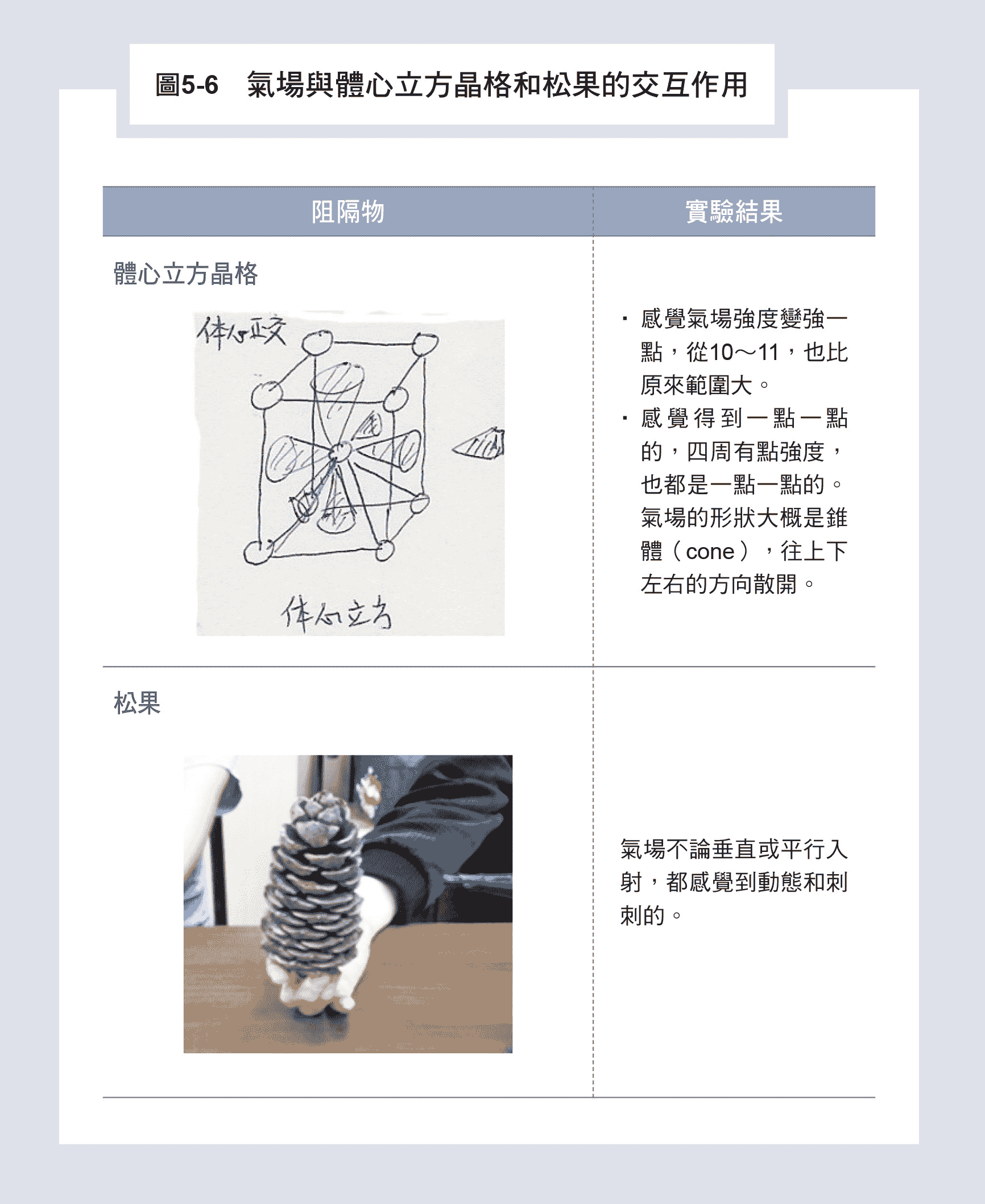
When the qi field strikes the lattice, conical qi field distributions appear in the six directions — above and below, left and right, front and back — of the central atom, and the intensity also becomes slightly stronger, by about ten percent.
The second row of Figure 5-6 shows the experiment of the qi field passing through a large pinecone. The pinecone serves as a substitute model for the pineal gland inside the brain, and its three-dimensional geometric structure is similar to that of the pineal gland. The result is that regardless of whether the qi field is directed vertically or parallel to the pinecone’s axis, it becomes dynamic and prickly in sensation. This also tells us: the brain’s pineal gland will produce strong interactions with the qi field that shuttles between yin and yang.
The Key-and-Lock Principle of Drug Molecules in Treating Disease
The genetic material DNA within human cells is composed of four types of molecules: Adenine, Thymine, Guanine, and Cytosine, abbreviated as A, T, G, and C, where the AT and GC molecules pair up in twos, and their molecular shapes are complementary, as shown in Figure 5-7.
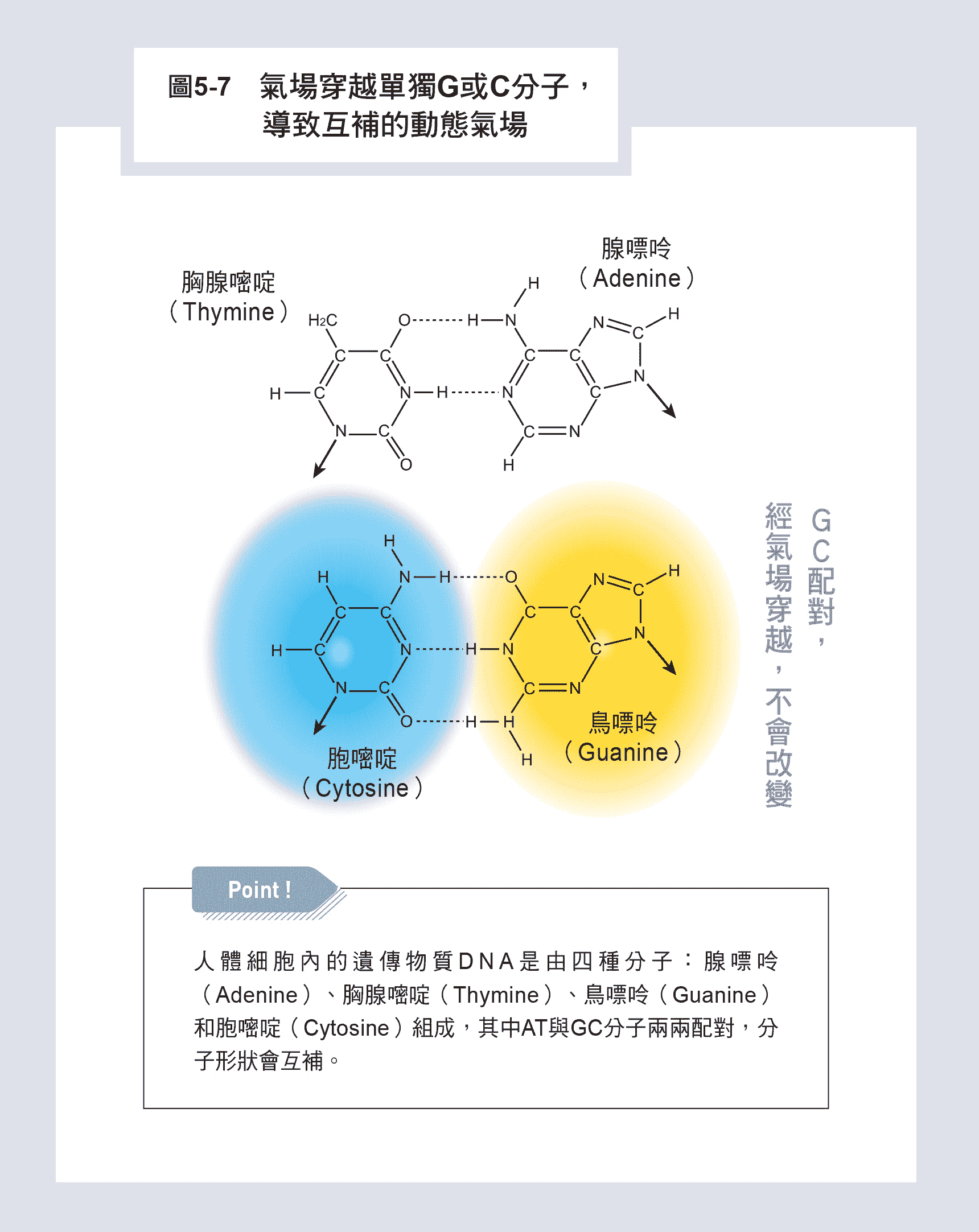
When we use the crystal qi field to pass through a single G molecule model (a double-ring base molecule), we can feel no sensation at the center of the palm, but the five fingers around the periphery of the palm will have sensations, as if the qi field’s range has expanded to the periphery; switching to a single C molecule (a single-ring base molecule), the qi field passing through will cause a relatively stronger sensation at the center of the palm. Clearly, the two are exactly complementary in their scattering of the qi field — one at the periphery of the palm and one at the center of the palm. Next, we combine the two molecules GC into the connected structure found within DNA, and the result is that the qi field passing through the combined molecules is not the sum of the two causing disturbance across the entire palm, but rather it becomes calm and peaceful, with no sensation of disturbance at all. This is truly an astonishing moment — it turns out that the key-and-lock principle of biochemical reactions is to bring two complementary spacetime structures together to smooth out the defects in spacetime, restoring complete, flat spacetime, and thereby resolving the system operational problems caused by the dynamic spacetime arising from spacetime defects. This also explains the principle of how drugs can cure diseases.
The molecular X information mentioned in my book The Science of Qigong is precisely this kind of information associated with the molecular spacetime complementary structure. As for single A or T molecule models, they do not scatter the qi field at all, and the combined result of A and T molecules is the same — they have no ability to scatter the qi field. From the crystal qi field detection results, it appears that the G and C molecules possess greater symbolic power to scatter the qi field than A and T, which may be related to the fact that within the GC molecule, the six-membered ring base has a C=O structure on one side and a special C-NH2 structure on the other side. In fact, DNA segments with high GC content are also segments with high gene content and high translation activity, that is, good DNA segments.
From these experimental data, we begin to understand that when the qi field strikes a crystal, part of it penetrates into the void, is scattered and reorganized by the periodic atomic virtual images, then burrows back into real space, where it is perceived by the meridians of the palm. Therefore, the arrangement of different objects in the material world within real space will all affect the distribution of the qi field, and thereby affect the human body.
In the past, most of us did not believe in feng shui, considering it superstition, and did not pay attention to the placement positions of furniture in offices or homes. But from our experimental results, the geometric shapes and the symmetry or asymmetry of furniture placement positions will obviously affect the movement of qi, creating different qi field distributions, which may also have different effects on human health. So what should ordinary people do? Where can they find a reliable feng shui master to come look at their office or home? In fact, fifteen to twenty percent of people in the population are meridian-sensitive types who have some perception of qi fields, so they can adjust the positions of furniture in their own homes or offices and simply feel for a comfortable qi field. I believe that in the future, as torsion field research deepens, the problem of torsion field scattering should be gradually simulated by computers, and perhaps in the future, computer feng shui designers will become a very popular profession.
The Reason Why the Qi Field “Stops at the Boundary of Water”
We began conducting experiments on qi fields passing through different objects in the year 2000, and immediately discovered that a single sheet of water-soaked paper could completely absorb qi. This experiment was subsequently confirmed by other meridian-sensitive students enrolled in the course and by NMR (nuclear magnetic resonance) experiments. However, from the very beginning we could not fully understand: how does water absorb a qi field and store it within the water? In what form does it exist?
In 2013, we began conducting research on torsion-field-irradiated water, using nuclear magnetic resonance technology to measure changes in the size of water molecule clusters after the water had been irradiated by a torsion field for three minutes. We conducted all our experiments in the Chemistry Department’s NMR laboratory, performing experiments once a week, completing a total of over one hundred experiments over the course of more than two years. My research collaborator Dr. Cai gradually discovered during the experiments that if the wires of the torsion field generator were left hanging on the experimental aluminum rack, close to the water in the experimental cup, the results were unexpectedly different from when the wires were pulled over to the wall, far away from the water in the cup. This gave us a terrible headache: why would water, after absorbing a torsion field, interact with the wires in the surrounding environment?
Later, while conducting qi field experiments with Miss T, we discovered that if two cups of water were placed too close together—within five centimeters—the two cups of water appeared to exchange qi field information. This indicates that the qi field absorbed by water is not confined within the interior of the water but diffuses into the surrounding area. This explained why the arrangement of the environment would affect changes in the size of molecular clusters in the water. Qi can traverse the boundary between yin and yang realms and enter the void. Thus, I gradually came to understand that the reason a qi field is completely absorbed upon passing through water is that when the qi field strikes the water, it entirely enters the void.
Since a water molecule (as shown in Figure 5-8) is a chemical compound of two hydrogen atoms and one oxygen atom (H2O), the H-O chemical bond has two electrons with opposite spins, forming a three-dimensional Taiji structure with two fish eyes, through which a torsion field can pass in and out, traversing the boundary between yin and yang realms. However, the hydrogen nucleus has only one proton spin and thus only one passage between the yin and yang realms, making it a one-way street that only permits exit and not entry. Like a one-way valve sieve, when a torsion field strikes into water, it is governed by the one-way valve and entirely enters the void and disappears. Naturally, the torsion field that has entered the void will interact with the void images of objects in the surrounding environment, thereby interfering with the experimental results. Through these experiments, we truly came to understand the physical reason behind the saying “qi stops when it encounters water”—because it has all entered the void.
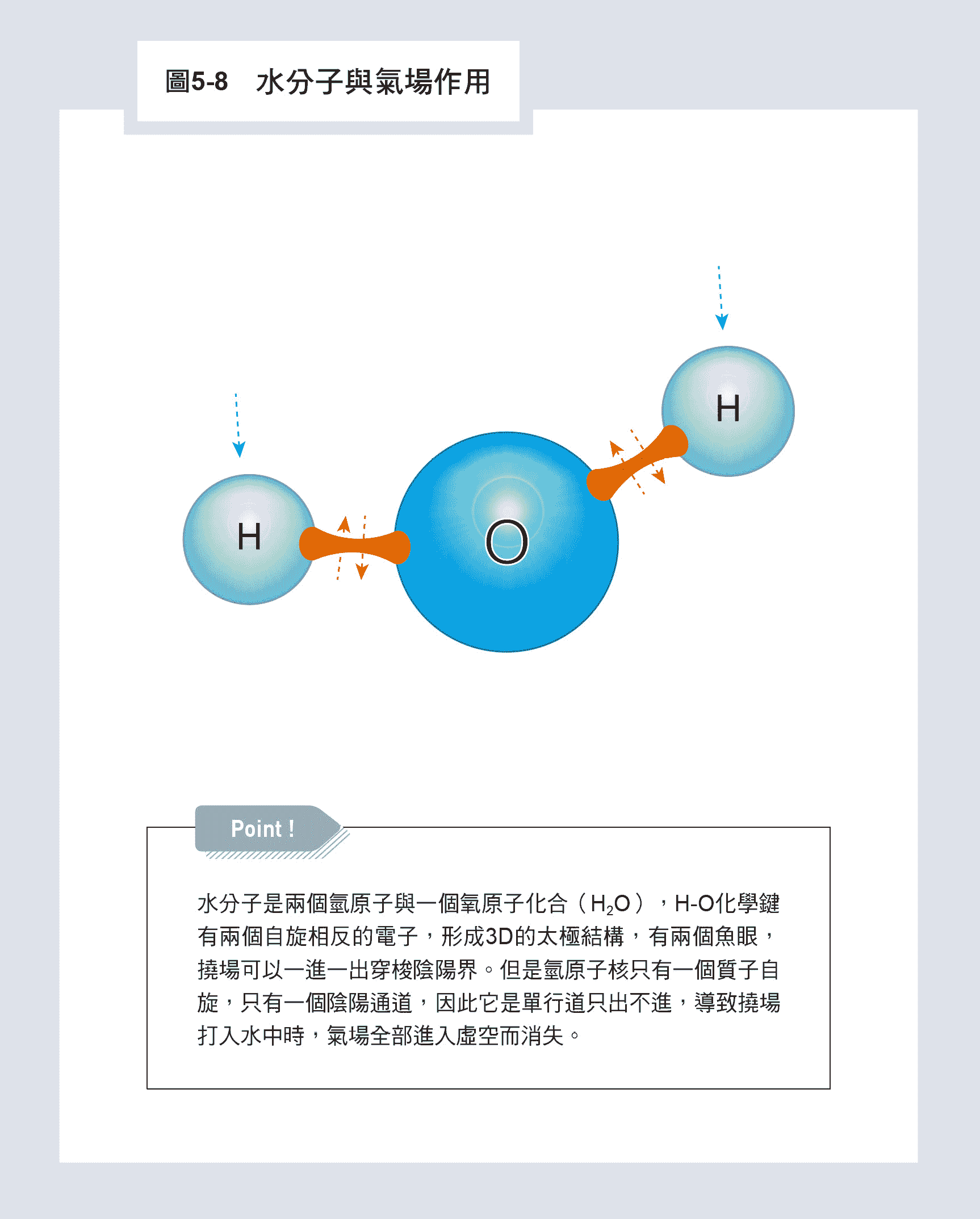
Physical Agriculture: The Future Replacing Chemical Agriculture
Agriculture is the foundation upon which human society depends for survival. After the mid-nineteenth century, the development of technology brought about the Industrial Revolution; machines replaced human labor, and human civilization advanced day by day, but the environment was gradually degraded. Agriculture, which for thousands of years followed the rhythm of working at sunrise and resting at sunset, has encountered the same problems. Under decades of improper use of chemical materials including fertilizers and insecticides, the environment upon which humanity depends for survival has been deeply damaged, water quality has deteriorated, and the soil has lost its vitality. In particular, the improper application of chemical pesticides has led to ecological imbalance, loss of control over diseases, pests, and weeds, and unexplained deaths of pollinating bees. Under this vicious cycle, humanity continues to continuously develop and apply new types of chemicals in hopes of controlling diseases, pests, and weeds, but the results are entirely counterproductive. Under these circumstances, where coexistence with living organisms cannot be followed, environmental degradation has accelerated even more rapidly. One can say that the twentieth century was the century of “chemical agriculture,” and it also brought about the disaster of environmental destruction.
Agriculture is currently in a transitional period from “chemical agriculture” toward “ecological, environmentally friendly, and healthy agriculture.” We should consider how to achieve the goals of increased yield, improved quality, and reduced pests and diseases under pollution-free conditions. Ideally, the impact of pests and diseases could be reduced without the use of chemical pesticides and fertilizers, while simultaneously maintaining the normal quantities and vitality of beneficial microorganisms and beneficial insects in the environment and ecosystem. Therefore, we can begin to consider using physical methods to gather and concentrate qi to achieve this goal.
Professor Chang Ching-Sen of the Department of Horticulture and Landscape Architecture at National Taiwan University, who has collaborated with me, called this concept “physical agriculture.” It is truly a remarkable direction of innovation. The concrete method of implementation is to “use Feng Shui layout to achieve crop health management”—studying the qi fields of different geometric patterns and Feng Shui layouts, and their interrelationships with changes in the microbial communities as well as beneficial and pest insects in the cultivation environment.

What is displayed in Figure 5-9 is one of the results. Professor Chang selected two types of plants to represent one yin and one yang: the yang plant is green mint, and the yin plant is purple Alternanthera. They were planted together in two different patterns to form circles of the same size, with identical diameters and fixed areas, as shown in the first row of figures in the right column. The two plants were planted on June 19 of a certain year. The first was planted in the pattern of a Taiji diagram, and the second was planted as two semicircles, with green mint on one side and purple Alternanthera on the other. From the changes in the images from top to bottom, one can observe the growth of the plants over time. After pruning on July 25, one can see the growth situation on July 31: the two types of plants planted in the Taiji diagram pattern maintained full, round shapes without encroaching on each other; the plants in the small fish eye circles were not invaded by the large quantities of the other type of plant surrounding them. However, the two types of plants planted as two semicircles were prone to deformation and missing sections, with situations of mutual competition appearing.
Since during the summer months of July and August, the mint on the south side grew more vigorously in both patterns, the experiment was concluded on August 12. From this, it can be seen that the qi field created by the geometric structure of the Taiji is conducive to harmonious coexistence among different species.
In order to repeatedly verify the influence of geometric patterns on plant growth, Professor Zhang once planted herbal plants such as lemon basil and purple basil in winter, or spearmint and peppermint in summer, using a Taiji diagram, a right-handed spiral, or a pattern combining two semicircles. The results consistently showed that the Taiji diagram and the right-handed spiral pattern had a significant positive effect on the survival rate, growth amount, and vigorous performance of the herbal plants. This also indicates that for agricultural cultivation, it is best not to use simple linear planting methods, but rather to switch to patterns that can gather and concentrate qi, or cause the qi field to rotate, as the harvest may be better.
When the aforementioned herbal plants were instead planted using Five Elements patterns, the Five Elements Metal (semicircle) and Five Elements Wood (slender rectangle) showed the best performance in terms of plant survival rate, growth condition, and antioxidant active components, especially in the Ferric Reducing Antioxidant Power (FRAP) performance. Those planted in the Five Elements Fire pattern (triangle) performed the worst.
Using Five Elements colored sticky boards (white, yellow, green, dark blue, black, red, brown) to attract insects in tea gardens also yielded beneficial insect trials. Since the experiment was conducted outside the active period of the small green leafhopper (May to July), the attraction effect was not good, but the black sticky board treatment attracted slightly more insects; yellow showed a significant difference in attracting ladybugs.
I also collaborated with Professor Zhang Zuliang of the Department of Horticulture and Landscape Architecture at National Taiwan University to grow plants in different trigram configurations, placed in different orientations, to study changes in plant growth status and total leaf vegetable yield. Professor Zhang designed containers in the shape of the yin and yang lines of the Eight Trigrams, as shown in Figure 5-10(a), and then combined the yin and yang line containers to form the trigram configurations of the Eight Trigrams, placed in the experimental field of the Department of Horticulture, to cultivate lettuce as an experiment, as shown in Figure 5-10(b).
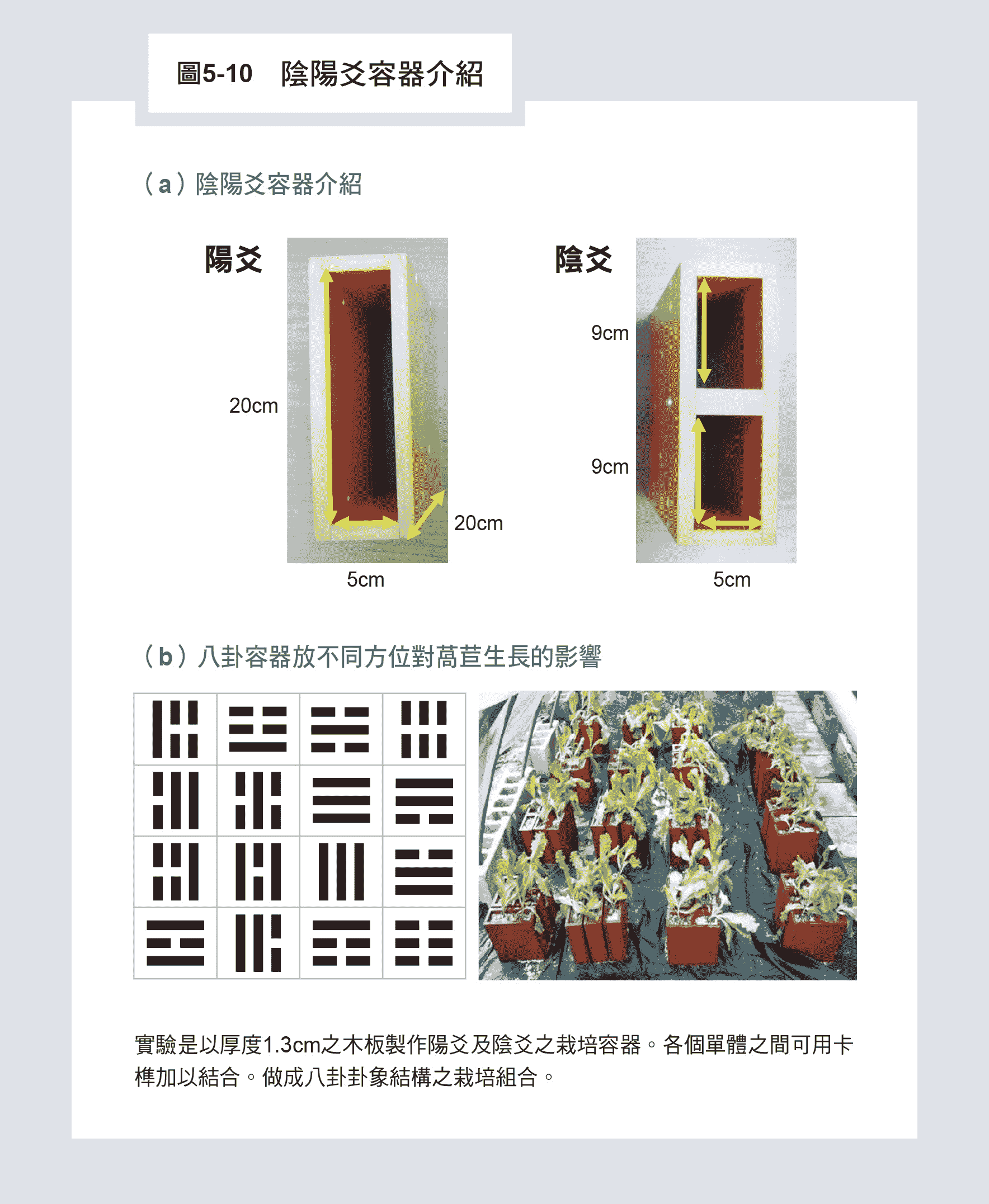
In October 2014, Professor Zhang planted one hundred fifty-six curled leaf lettuce plug tray seedlings, transplanted into a geometric pattern of the Eight Trigrams composed of yin-line and yang-line pots. They were harvested after thirty days of planting, and the number of leaves, above-ground part① length, and above-ground part fresh weight② were investigated. The final statistical results, including a split-plot factorial experiment analysis of line type (yin, yang) and orientation (horizontal, vertical), showed that a single factor (such as line type or orientation) had no significant effect on the above-ground growth of the lettuce. However, the interactive effect after combining line type and orientation had a significant influence on the fresh weight and dry weight of the above-ground parts of the lettuce. Furthermore, the trigram configuration had a significant effect on the above-ground growth of the lettuce—except for leaf number, above-ground length, fresh weight, and dry weight were all significantly affected.
This result also demonstrates that the spatial-orientation combination of trigram configurations is not superstition, but indeed possesses a physical effect. Moreover, the interactive inductive effect after combining trigram configuration and orientation had a significant influence on all investigation items for above-ground lettuce growth, which tells us that when planting crops, facing different directions requires planting with geometric patterns of different trigram configurations. Other studies, such as tea tree planting and insect pest control, also revealed some interesting phenomena. I believe that “physical agriculture” is an innovative direction worth considering for agricultural science and technology in the twenty-first century.
①Plant growth includes above-ground and below-ground parts. Stems, leaves, flowers, fruits, buds, etc., located above the ground surface, constitute the above-ground parts; roots extending into the soil constitute the below-ground parts.
②The weight measured immediately after collection of fresh, living plants.
Torsion Fields Can Serve as a Tool for Interstellar Communication
In Chapter 3, I already introduced how, in 2018, engineer Gao Peng in Beijing used an Akimov torsion field transmitter to conduct a long-distance communication experiment over several thousand kilometers from Beijing to New York with Professor Mark Krinker of the City University of New York. Both used the same photograph as the starting address for torsion field transmission and as the locator for receiving the torsion field. Although electromagnetic wave communication accomplished the same thing a hundred years ago, the torsion field possesses a characteristic that electromagnetic waves do not have: torsion fields penetrate into the spirit world. Once they penetrate the spirit world, they are no longer subject to the speed-of-light limitation on information transmission imposed by general relativity in real-number spacetime and the material world, and can propagate through the universe at speeds far exceeding the speed of light.
In my book The Science of the Spiritual World, I discussed how a person with special abilities used consciousness to visit an extraterrestrial civilization 438 light-years away to observe extraterrestrials, taking only one to two seconds. This indicates that the speed of her celestial-eye consciousness is at least 107 times faster than the speed of light, arriving instantaneously. The remaining question is: communication technology requires common standards. At the very beginning, of course, the simplest technology would be adopted, just as when the telegraph was invented, one could use Morse code with one long and one short signal to represent one and zero. Just as in digital technology, “two gives rise to three, three gives rise to all things,” and communication could begin. But the question arises again: who can go negotiate common technical standards with extraterrestrials? Obviously, one must find a person with special abilities who has knowledge of electronic technology, open the celestial eye, go directly to the extraterrestrial planet, and communicate with extraterrestrials through telepathy, thereby eliminating the need for spoken or written language. Otherwise, one would first have to learn the extraterrestrial language, which would be far too difficult. As for the question of positioning—that is, in the vast universe, how we can aim at each other to concentrate energy, so as to avoid the signal energy being too weak and the noise too strong to be transmitted—fortunately, the spiritual realm has its own set of correspondence principles: “mutual resonance of forms.” As long as the geometric structures are completely identical, or are complementary structures like a key and a lock, regardless of size, they will mutually attract and find each other. This is also the reason why Gao Peng and Professor Mark Krinker used the same photograph to conduct torsion field communication. After the torsion field strikes the sender’s photograph, it can penetrate into the spiritual realm, carrying the virtual image of this photograph to search within the spiritual realm for the virtual image of the receiver’s identical photograph. Due to “mutual resonance of forms,” it arrives instantaneously, requiring almost no time. Then the torsion field passes through the photograph’s virtual image and returns to the real-number material world, carrying the transmitted signal that can then be detected by a detector. I believe that after the 2040s, we will have the opportunity to begin using torsion fields to initiate communication with extraterrestrial civilizations.
Torsion Field Detectors: Welcoming the Arrival of Torsion Force Civilization
To welcome the arrival of torsion force civilization, the most crucial key in science is to find a detector for the torsion field, to measure the torsion field that is invisible and not easily perceived. Russian scientists spent decades measuring torsion fields but found it extremely difficult. They primarily experimented with the Akimov torsion field generator, and I believe they were still measuring the magnitude of the electromagnetic field of the coil that accompanies the generation of the torsion field, rather than directly measuring the strength of the torsion field itself.
As for the torsion field produced by the Sphilman torsion field generator, a breakthrough discovery was made in 2016: Professor Ren Quansheng of Peking University found that the exclusion zone of water (Exclusion Zone, abbreviated EZ) appeared to be able to detect the strength of the torsion field.
Everyone knows that water has three phases: solid, liquid, and gas. In 2006, Professor G.H. Pollack of the University of Washington in the United States provided convincing evidence ①, proposing that water exists in a fourth phase, which is a type of water with a regular structure. Although there has been significant controversy, and other models have been proposed over more than a decade, the fourth phase of water remains the mainstream view.
Professor Pollack discovered that when a hydrophilic polymer film with a negatively charged surface (Nafion film) is inserted into deionized water in which small negatively charged nanoscale plastic spheres (approximately 500 nanometers in diameter) are immersed, within a few minutes the nanospheres near the Nafion film surface are all pushed away, and a transparent exclusion zone appears, several hundred micrometers wide, approximately five to ten times the width of a human hair. As shown in the top view in Figure 5-11, light illuminates from below the white Teflon water-containing box upward; the black portions are the nanospheres, densely packed and opaque, while the faintly luminous exclusion zone develops on both sides of the Nafion film.
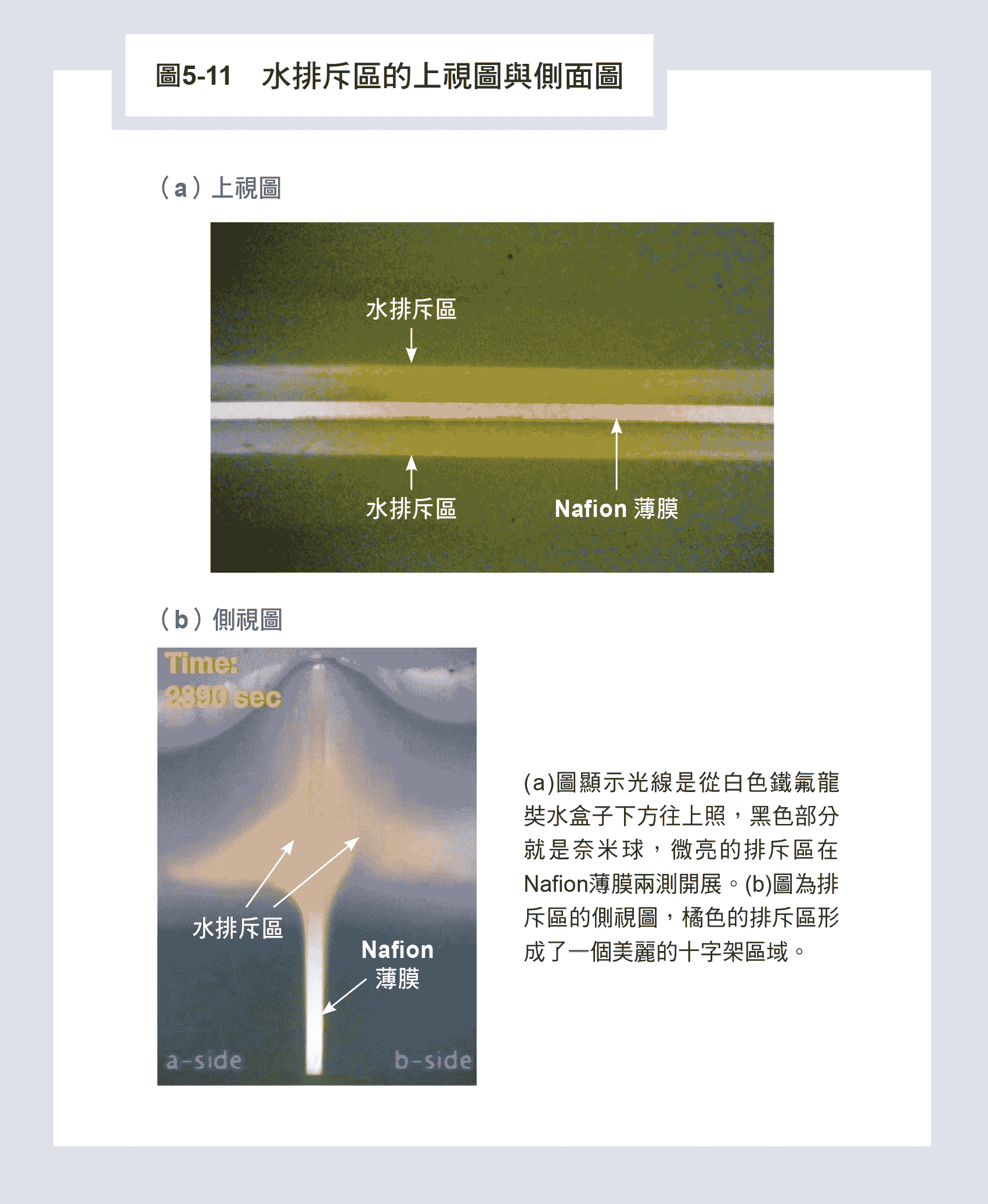
Most remarkably, according to Professor Pollack’s findings, the exclusion zone of water expels hydrogen ions to the outer periphery while retaining hydroxide negative ions (OH-) within. The positive and negative charges are blocked by the regularly arranged, densely packed crystalline lattice of the exclusion zone water, preventing them from attracting and approaching each other to neutralize. The positive and negative charges each accumulate, thus forming a battery, to which external wires can be connected to the positive and negative charge regions for generating electricity.
When Ms. T, a person with special abilities, performs finger-reading experiments, at the moment her brain opens the celestial eye, a voltage of approximately twenty to forty millivolts (mV) is produced at the base of the index fingers on both the left and right palms. Sometimes the voltage persists for as long as two minutes, as if the entire brain has become a battery, sending voltage through nerves to the hands. This makes me strongly suspect that the celestial eye in the brain is precisely the phenomenon whereby physiological saline in a certain region of the brain is guided by hydrophilic cell membranes into the fourth phase of water, producing a battery effect. The localized voltage causes the density of the water exclusion zone to increase until it enters the quantum state of Bose–Einstein condensation ②, thereby producing the celestial eye.
My laboratory began researching the exclusion zone of water in 2018. In addition to conventionally using a microscope to observe the width changes of the water exclusion zone from above the liquid surface, as shown in the top view of Figure 5-11, we simultaneously used a second microscope to observe the lateral expansion of the exclusion zone near the Nafion membrane. The entire process was controlled by a computer to take synchronized photos once per second, which were then compared with each other.
As a result, we found that the lateral profile of the exclusion zone presented a spectacular sight. As shown in the side view of Figure 5-11, the orange exclusion zone formed a beautiful cross-shaped region. The orange color was emitted by impurities within the Nafion membrane under illumination. Originally, the orange light was confined to propagate within the membrane waveguide, but after the appearance of the fourth-phase structured water, which has a higher density, it caused the light to penetrate the membrane and shoot into the exclusion zone, allowing us to see the cross-shaped exclusion zone.
Sure enough, as discovered by Professor Ren of Peking University, irradiating the water exclusion zone with a torsion field for forty minutes causes the exclusion zone to expand by ten to twenty-five percent. A right-handed torsion field is stronger than a left-handed one, resulting in a wider expansion. When a left-handed torsion field first passes through the Chinese character for Buddha (佛) and then shines on the water exclusion zone, the width astonishingly increases to about thirty percent. This also confirms the phenomenon described in previous chapters, where meridian-sensitive subjects felt that the character for Buddha amplified the qi field.
In the future, if torsion field detectors can be made into panels like computer LCD screens, the strength and distribution of torsion fields can be directly visualized, and feng shui layout will become so simple that it becomes a part of daily life.
①Reference: Zheng, J.; Chin, W.; Pollack, G.H. Advancesin Colloid and Interface Science 2006, 127, 19-27.
②This refers to a gaseous, superfluid state of matter that bosonic atoms exhibit when cooled to near absolute zero, predicted in the 1920s by physicists Satyendra Nath Bose and Albert Einstein.
Fulfilling Tesla’s Unfinished Ideal — Extracting Energy from the Void
In the last section of Chapter 3, I introduced the “qi oscillator” that I unintentionally invented, which turned out to be a void energy extractor, except that the energy it can extract is very limited, and it currently cannot demonstrate any real practical use.
In 2016, I met President Lin of a small electrical machinery company in Kaohsiung and Professor Chen from National Sun Yat-sen University. They collaborated to develop a generator with an eight-electrode rotor, and the design was extremely unusual. President Lin had previously fallen ill and began practicing qigong and meditation. After paying attention to his nutrition for a period of time, he recovered. Later, while he continued to meditate, he downloaded the design for this generator from the spiritual realm.
On the stator of a typical generator, the number of winding turns in each slot is the same. However, he adopted the design of the traditional Chinese Luoshu, where the total number of winding turns for two opposing slots is fixed, for example, at ten turns, but the eight opposing slots for each pole are arranged sequentially as nine plus one, eight plus two, seven plus three, and four plus six turns; the generator is driven by a motor, and the generated electricity is sent to the load. The amazing thing is that, within a certain operating frequency range, the power output to the load is actually higher than the power input to the motor.
President Lin and Professor Chen visited various domestic motor and generator experts, and even went to the Ministry of Science and Technology, which is responsible for national technological development, to report their results and seek support. However, with a single sentence, “This violates the law of conservation of energy,” they had to return in disgrace. Finally, seeing that I am a scholar who specializes in experiments on bizarre forces and chaotic spirits, they thought perhaps we could have a conversation, and they came to me for an evaluation.
I suggested that they conduct a series of actual road test experiments to verify it. They were to use current standard batteries on a scooter to test how many kilometers it would take for the voltage to drop below forty-nine volts and require recharging. As a result, it needed recharging after running for forty kilometers. Then, I asked them to connect the newly invented generator in series with the standard batteries to serve as a rechargeable power system, which should improve the battery’s efficiency, and then do the road test again. At that time, I suggested that they only run it up to eighty kilometers, absolutely not exceeding it by too much, so that others would not completely disbelieve it.
Finally, they brought the detailed experimental results to show me, and they had meticulously recorded the relationship between the battery voltage changes and the mileage using instruments from beginning to end. When the scooter finished running eighty kilometers, the battery connected in series with the generator invented through qi still had a voltage of fifty-five volts, indicating that it could continue to run, but this was already twice the maximum distance that a normal standard battery could possibly operate. This was the actual situation I saw after personally participating in the experiment, which made me extremely excited. Unfortunately, President Lin passed away due to illness in 2019. He handed over the generator patents he had obtained from home and abroad, along with the remaining R&D work, to his family and three or four professors from several universities in Kaohsiung City to continue development, hoping that one day this technology could truly be introduced to the world.
The power generated by this kind of torsion field tearing apart space-time is also the world that Tesla “fantasized” about over a hundred years ago, and it has already presented itself before my eyes. It is clearly evident that the new torsion force civilization of the twenty-first century has unfolded before me.

PopSci 11 The Science of the Torsion Field: Solving Tesla’s unsolved mysteries, revealing the principles of feng shui, and piloting a new era of human development in extracting energy from the spiritual realm and interstellar communication! Author | Si-Chen Lee
Deputy Managing Editor | Wei-Xuan Zheng
Managing Editor|Liu Ruwen
Art Director|Lan Xiuting
Cover Design|Li Huiyun
Interior Layout|Chen Yutong
Interior Illustrations|Peng Xiuwen
Marketing Manager|Zhang Yushan
Marketing Planner|Zhou Chuanya
Publisher|Zhang Huiming
Editor-in-Chief|Zeng Yaqing
Publishing House|Sun Color Culture Co., Ltd.
Address|8th Floor, No. 33, Lane 513, Ruiguang Road, Neihu District, Taipei City
Contact|TEL: 8797-1234 FAX: 8797-1688
Website|www.suncolor.com.tw
Postal Remittance|Account Number: 14319060 Account Name: Sun Color Culture Co., Ltd.
Edition Release Date|November 6, 2020
All rights reserved. No part of this text or images may be reproduced without permission.
All rights reserved.
The product names or images featured in this book are for illustrative purposes only and are not used as trademarks. The intellectual property rights of the original product trademarks belong to their respective rights holders.
◎Cover image credits:
vchal/Shutterstock.com
kazumi miyamoto/Shutterstock.com
ZU_09/ iStock.com
Note: The URLs provided in this book are intended for use solely with this book. Anyone who reproduces or repurposes them without authorization shall bear full legal responsibility.