Original publication
Original title: 靈界的科學
Author: Si-Chen Lee (李嗣涔)
Publication year: 2018
Original language: Chinese (Traditional; source metadata zh-TW)
Source file MD5:01cee442b466ccec863bacc20e10f862
Si-Chen Lee
 |
|---|
Recommendation Preface
Yang Ding-yi
I have known Professor Si-Chen Lee for nearly twenty years. Back then, he was the Dean of Academic Affairs at National Taiwan University. A certain affinity gave us the opportunity to converse. Unexpectedly, once we began talking, the discussion covered the wondrous mysteries of life in every detail—from the multiple levels of latent potential in the human body, to biological superconductors, all the way to high-speed spiral fields, supernatural powers, ESP (extrasensory perception), the function of water, crystals, amorphous elemental states, and so on.
In the past, I rarely shared these topics with others. After all, most experts are too busy even with conventional science, let alone non-conventional science. Moreover, there have never been many people interested in this kind of non-conventional science. Among those who are interested, those who can truly grasp it are exceedingly few. Without a solid interdisciplinary scientific foundation, one cannot go deeply into it.
In the course of our sharing, I fully experienced that Professor Lee was not only open-minded and extremely quick in his thinking, but also deeply enthusiastic about these topics, and moreover very sincere. And so, the two of us became good friends. Even after he became President of National Taiwan University, we kept in touch. Professor Lee also continually shared with me the latest developments and results of his research. In my memory, every time we met, we were like two children, completely absorbed in the topics under discussion, setting everything else aside.
In fact, the existence prior to matter (which can also be called subtle energy, the power of the mind, or even dark matter or dark energy), from my personal experience over many years, is composed of high-speed spiral fields. This mechanism can explain all phenomena that people perceive as “unexpected,” including supernatural powers and ESP.
However, I also knew at the same time that without the relevant equipment and instruments, researching these topics would not be easy. At that time, I also helped Professor Lee find a relevant piece of Russian equipment, trusting that through his relentless scientific spirit, he would naturally find the interface between the material and the non-material, and even build a bridge.
As a scientist, I find the most remarkable thing is that Professor Lee, despite his extremely heavy administrative responsibilities, was still able to maintain a high degree of focus on his research. This alone makes him the finest role model for today’s young people.
Professor Lee’s new work, The Science of the Spiritual Realm, considerably reflects the scientific spirit I have noticed. In this non-conventional field of science, he rejects nothing and has no conceptual obstacles—this in itself reflects his extraordinary intellect, and he personally conducts experiments to verify or overturn ideas. Scientific research can also move beyond existing frameworks. I believe this spirit is precisely what our people need most at present.
Of course, from my personal perspective, the full potential of life is something that every one of us possesses; it is by no means limited to the levels of intellect, the brain, or ESP. This infinitely vast intelligence—what I have in the past called wisdom—is something you and I both have, and it is always waiting for us to find it. This is also something I have wanted to share with everyone through every opportunity over many years.
I hope that readers, through Professor Lee’s new book, will come to appreciate that life holds all sorts of wondrous mysteries that we ordinary people could never imagine. May this inspiration lead you to continue your quest, and ultimately to arrive at the heart. What I mean is—your own heart, the still heart, the heart of great wisdom.
Author’s Preface: Opening Pandora’s Box of Cosmic Truth—Complex Spacetime
Professor Si-Chen Lee, Department of Electrical Engineering, National Taiwan University
On April 27, 2018, I traveled to Tucson, Arizona, USA, to attend “The Science of Consciousness 2018” international conference. This was my second visit to Tucson, following my trip there in 2002 with members of the Chinese Society for Life Electromagnetic Science to attend a parapsychology symposium—a span of sixteen years between the two visits.
I recall that when I came in 2002, I was there to report on the new findings from our finger-reading experiments of 1999—namely, that when children used finger-reading to identify sacred characters, such as “Buddha,” “Bodhisattva,” “Jesus,” and other religion-related words, they could not see these words but instead saw bright light, luminous figures, crosses, and other visions, thereby discovering another world. At the time, we called this world the “information field” or the “spiritual realm.” After the conference, I submitted these findings to the online journal The International Journal of Healing and Caring, using scientific methods to prove the existence of the spiritual realm.
Sixteen years later, this time I brought a new theory to explain the physical mechanisms behind these miraculous phenomena. I first published this theory in 2014 in the domestic journal Buddhism and Science, written in Chinese with an English abstract. This time, after years of refinement, I published the full paper in English. The paper employed two hypotheses:
The first hypothesis: This universe is composed of an eight-dimensional complex spacetime. Four dimensions are real spacetime, which is the material world, commonly known as the “yang realm”; the other four dimensions are imaginary spacetime, commonly known as the “yin realm” or the spiritual realm. I integrated the information field and spiritual realm structure that I discovered in 1999 into an imaginary spacetime, combined with the real spacetime of our material world, to form a true image of the universe—“complex spacetime.”
The second hypothesis: The imaginary number i of the complex quantum state represents consciousness. Therefore, consciousness is a quantum phenomenon, which can be called quantum mind.
What shocked me was that among the nearly two hundred papers presented at the conference, a team led by physicist Dr. Elizabeth Rauscher also proposed a physical model in which the true nature of the universe is an eight-dimensional complex spacetime. Watching her proudly and radiantly declare when presenting her paper that under the eight-dimensional spacetime model, the mysteries of quantum mechanics such as the nonlocality of quantum entanglement can be perfectly explained, I felt boundless excitement. Finally, there was another physics team in the world that had proposed a complex spacetime exactly the same as my first hypothesis, while the second hypothesis had not yet been proposed by any other team.
I deeply felt that the veil of the real universe was lifted by us in 1999, structured by me theoretically in 2014, and would only begin to be seriously considered by the physics community starting in 2018. I believe the Pandora’s box of the true nature of the universe has been opened to the physics community. This conference gave me the opportunity to understand what fields are currently included in the international scientific research on consciousness. After compiling statistics, they can be roughly divided into the following six topics:
1. Molecular and Quantum Biology
Starting in 1994, the physics of consciousness began to emerge. Physicist Sir Roger Penrose of the University of Oxford, UK, and orthopedic physician Stuart Hameroff of the University of Arizona, USA, jointly proposed the physics of consciousness, arguing that the basis of consciousness does not lie in neural action potentials, but occurs when the material of microtubules, which serve a skeletal function within neurons, enters an ordered quantum state. The walls of brain neurons are composed of many nanoscale microtubules (~fourteen nanometers) that can form quantum states.
When sensory organs receive stimuli and input them into the brain’s neural network, an ordered quantum state is produced, which is a superposition of different quantum states. As time passes, the external environment such as gravity will influence the evolution of these quantum states. The gravitational energy difference E between substances in different states, caused by their distribution in different spacetimes, equals the spacetime interval S between the two states (physical constants such as the speed of light and the gravitational constant are set to one), and then the superposition state will collapse and manifest as a single definite state. Consciousness is produced during objective reduction (OR), that is, when the quantum state spreads to the point where changes in gravity satisfy certain orchestrated conditions, the macroscopic quantum wave will objectively collapse, abbreviated as “Orch OR.” At the instant the macroscopic quantum state collapses, the brain’s consciousness is produced; then a small portion of the microtubules begins to enter the quantum state again, and consciousness gradually disappears. Waiting for the next objective reduction mechanism to produce new consciousness, the brain’s thoughts thus come wave after wave, in an endless cycle.
I believe their model is already close to the essence of consciousness, but conversely, the production of consciousness occurs when the superposed quantum state is formed, and disappears during objective reduction. Because the superposed quantum state is a complex state, at that point the imaginary-number consciousness can scan the neural network architecture that has entered the quantum state, producing the content of consciousness such as memory, thought, judgment, and action. Sometimes experiences embedded in the neural network generate inhibitory forces, keeping us from being impulsive and offering suggestions to limit actions.
2. Panpsychism
More and more neuroscientists and philosophers no longer believe in the materialist view that the material brain is primary and that consciousness is a property emerging from the operation of complex neural networks, making it secondary. Instead, they have begun to believe that subjective characteristics such as feeling and awareness are fundamental properties of any object itself, and have given them a name—“qualia.” This viewpoint is called Panpsychism.
However, Panpsychism also encounters three major difficulties:
(1) Do basic particles such as quarks, electrons, atoms, and molecules possess “qualia”?
(2) To what extent must the “qualia” of these tiny atoms and molecules aggregate before consciousness that can be experienced emerges? This problem is also called the combination problem.
(3) How does the brain combine these primitive “qualia” to form the consciousness that each person can experience?
Under my complex spacetime consciousness model, the consciousness of any object that enters a complex quantum state will appear. Therefore, as long as it enters a quantum state, “all things have spirit,” providing a scientific foundation for Panpsychism.
3. Consciousness Altered by Anesthesia and Psychedelics
When certain drugs are introduced into the human body, they alter human consciousness. For example, anesthetics cause a person to lose consciousness, and taking hallucinogens such as dimethyltryptamine (DMT) alters one’s state of consciousness and produces hallucinations. Therefore, studying how these drug molecules affect neural transmission in the brain, which neurotransmitter receptors they bind to, and which parts of the brain they affect is of great help in understanding how consciousness arises and where in the brain it is produced.
A preliminary conclusion in the scientific community is that drugs interrupt some of the long-distance information connections within the brain’s neural networks. Normally, the brain processes input information in a modular fashion, with feedback networks connecting different modules, so consciousness is the result of the combined functioning of these modules. Anesthesia causes loss of consciousness primarily because the feedback networks are severed, whereas hallucinations involve a more complex process. My theory of the sixth consciousness of the brain holds that the soul scans the spatiotemporal structure of firing neural networks to produce consciousness; since the brain’s connectivity networks are altered by anesthesia or hallucinogenic drugs, the content of consciousness will of course change accordingly.
IV. Research on Dreaming and Meditation
During sleep, consciousness is lost, but during dreaming, consciousness appears to become active again. Similarly, during meditation, consciousness is relatively less active. Therefore, analyzing brainwaves under these states, or the changes in resting-state networks in brain magnetic resonance imaging scans, can lead to a deeper understanding of the nature of consciousness.
V. Linguistics and Inner Speech
For most people, it is the temporal lobe of the left brain that controls language, and it is also the motor area of the left brain that controls the right hand; only 1.5 percent of people use the right brain to control language. Since right-hand-dominant individuals constitute the majority, the competition between motor function and language control for the neural regions of the left brain results in the language areas of a small number of people being forced to spread across several scattered regions or even shift to the right brain. This causes some people to hear inner voices, as though someone is speaking to them, leading to a diagnosis of mental illness—this is the price of humanity’s development of language.
VI. Whether AI Will Develop Consciousness
Artificial intelligence is advancing at a rapid pace, making AlphaGo invincible at Go and defeating the world Go champion. Many routine jobs will also be replaced by robots. What most people worry about even more is whether robots will develop consciousness like that of humans, thereby threatening human survival.
The British physicist Roger Penrose, who was also one of the two scientists who first proposed the physical phenomenon of consciousness in 1994, uses an example from playing chess to explain why he believes this will not happen. The game in question was a draw, and anyone with even a little experience playing chess could see the result at a glance. However, when he input the position into “Deep Blue,” the most powerful program among chess software, it could not reach a conclusion. This was because the program design had not accounted for this kind of draw situation. In other words, the program could not exercise its own judgment. From this he concluded that AI will not independently develop consciousness. According to my model of consciousness, AI has not entered a complex-number quantum state; since no imaginary numbers arise, consciousness will not be produced either.
Looking at these research topics, my theories of complex-number spacetime and consciousness can offer very profound insights to answer these questions. I sincerely believe that this universe has already lifted its mysterious veil, and it only awaits more scientists to join in clarifying its true face.
In this book, I attempt to use two models—complex-number spacetime and quantum consciousness—to explain all the mysteries of the universe at large, medium, and small scales, such as dark matter, dark energy, faster-than-light quantum entanglement, extraordinary human abilities, and the nature of consciousness, in the hope of achieving a deeper understanding of the true nature of the universe.
It has been twenty-five years since I began researching extraordinary abilities in 1993 up to the present. Aside from an eight-year hiatus during which I suspended research, for the remaining seventeen years I wish to thank several scholars and entrepreneurs for their financial support of my research projects, which allowed research viewed as superstitious nonsense to continue. The first is Academician Li Yiyuan of Academia Sinica, who invited me to participate in his group project at Academia Sinica; the second is Chairman Yang Ding-yi of Chang Gung University; and the third is President Yin Yen-liang of the Ruentex Group. All three supported research projects during the course of my work, enabling me to make great breakthroughs in both experiment and theory. The support of President Yin in particular led to enormous breakthroughs in my theoretical work, and I express my deepest gratitude here. In addition, the functional practitioner Takahashi Mai, Professor Shen Jinchuan, Sun Chulin, and many children whom I trained to develop functional abilities, along with their parents, gave me great assistance and inspiration. I acknowledge them all with gratitude here.
Furthermore, Professor Zhu Nianlin of the Department of Physics at Yunnan University authorized me to use his experimental photographs of psychokinetically snapping matches; Professor Shen Jinchuan and Ms. Sun Chulin authorized me to use the photograph from the homepage of the Laozi website; and Director Fang Qin of the Hubei Provincial Museum authorized me to use the photograph of the stone carving with the sun god motif from the museum’s collection. I extend my deepest thanks to all of them as well.
Chapter 1: Where Is the Spiritual Realm?
Under the witness of nearly ten scholars from the domestic physics community,
it was discovered that beyond the material world of the four-dimensional spacetime in which we exist,
there appears to be yet another world.
At that time, I called this world the information field,
which is commonly known as the spiritual realm.
Major Discoveries at the End of the Twentieth Century Regarding Large-Scale Cosmic Mysteries: Dark Energy, Dark Matter
At the end of the twentieth century, in 1998, two groups of astronomers announced a groundbreaking discovery: our universe is filled with a form of energy that can resist the gravitational attraction between galaxies, causing the universe to expand at an accelerating rate. This energy is called dark energy, and it was selected by Science, one of the most important scientific journals of the time, as that year’s “Breakthrough of Science.” Five years later, in 2003, the American Wilkinson Microwave Anisotropy Probe (WAMP)[1] used data obtained from measuring the cosmic microwave background radiation, combined with other data such as information on over a million galaxies obtained from the Sloan Digital Sky Survey (SDSS)[2], to once again confirm that the universe possesses a large amount of dark energy. This was also selected by Science journal in 2003 as that year’s “Breakthrough of Science.”
The Universe Is Filled with Vast Amounts of Dark Energy
Approximately 13.6 billion years ago, the universe emerged from chaos through the explosion of the Big Bang, producing time and space. The ejected energy was transformed into elementary particles, atoms, and molecules, leading to the appearance of material nebulae. The gravitational attraction among nebulae would gradually slow the rate of expansion from the original explosion of spacetime. However, physicists observing the starry sky discovered that the light intensity of variable stars[3] within galaxies receding from us was weaker than the predicted intensity, meaning their distances were even farther than we had predicted, and their speed of departure from us was faster than predicted, indicating that “the universe is expanding at an accelerating rate.” And in a mere thirteen years, the 2011 Nobel Prize in Physics was awarded to three physicists who led the discovery of the phenomenon of the accelerating expansion of the universe—S. Perlmutter, B. P. Schmidt, and A. G. Riess. This dark energy unexpectedly accounts for seventy-three percent of the energy of the universe and possesses the property of repulsive force[4].
In addition, starting in the 1970s, cosmological physicists discovered, from the phenomenon that the rotational speed of spiral galaxies does not decrease even at the edges of the galaxies, that the universe contains large amounts of dark matter, which possesses the property of gravitational force and accounts for twenty-three percent of the energy of the universe. By contrast, normal energy—that is, the energy understood by the science we currently know—accounts for only four percent of the energy of the universe. This indicates that our understanding of the large-scale real universe is completely unclear. “What exactly is the physical nature of dark matter and dark energy?”—this has become the greatest mystery of the large-scale universe.
Editor’s Note 1: The Wilkinson Microwave Anisotropy Probe (WMAP) is an artificial satellite of the National Aeronautics and Space Administration (NASA), whose purpose is to detect the residual radiation temperature from four hundred thousand years after the cosmic Big Bang. Editor’s Note 2: The Sloan Digital Sky Survey (SDSS) uses a telescope with a diameter of 2.5 meters in New Mexico, USA, to conduct a sky survey of the Northern Hemisphere sky. It can capture images of the entire Northern Hemisphere sky, allowing us to understand the distances and evolution of galaxies. Editor’s Note 3: Variable star refers to a star whose brightness and electromagnetic radiation are unstable and frequently accompanied by other physical changes. Editor’s Note 4: Repulsive force refers to a force by which objects repel each other, opposite to gravitational force.
A Major Discovery Concerning the Small-Scale Mysteries of the Universe—Superluminal Quantum Entanglement
Quantum mechanics, which describes the quantum world at minute scales, is one of the two most successful physical theories of the twentieth century, used to describe the world of elementary particles, atoms, and molecules; the other theory is relativity, used to describe the gravity of the universe. Today’s internet, mobile phone, and computer civilization is the result of the development of quantum mechanics. However, the nature of the quantum world described by quantum mechanics, such as the controversies arising from the Copenhagen interpretation[1], has still not been entirely satisfactory even after ninety years, right up to the present day. The three greatest controversies are:
First, the wave function solution Ψ( ,t)[2] describing particle behavior, or the quantum field in quantum field theory, are all complex-valued functions. In the past, no one understood the meaning of complex numbers, because complex numbers cannot be measured; physical quantities that can be measured must be real numbers.
Second, the motion of any particle or object must satisfy the Schrödinger equation or the Dirac equation, which is a deterministic equation. That is, at time zero, if the position and velocity of a particle are known, then at time t, the position and velocity of the particle can be calculated. However, the Copenhagen interpretation treats the square of the wave function as the probability of the particle’s appearance, which is extremely unreasonable.
The third and most serious issue is the discovery of the superluminal quantum entanglement[3] phenomenon. Two linked quantum systems, in a state of indeterminate and chaotic superposition, regardless of how far apart they are—as soon as one or a portion of them is measured by an instrument and its state is determined, the other is also instantly determined. The transmission of information between them far exceeds the speed of light, violating the conclusion of relativity—that the speed of light is the upper limit of all velocities. Therefore, Einstein proposed the EPR paradox[4], criticizing it as “spooky action at a distance.”
From this it can be seen that the nanoscale universe that pervades our lives is also full of mysteries, waiting for us to unravel them one by one.
Editor’s Note 1: The Copenhagen Interpretation is an interpretation of quantum mechanics. According to the Copenhagen Interpretation, in quantum mechanics, observation creates reality; without observation, a quantum system exists in a superposition state. Editor’s Note 2: Ψ (
A Major Discovery at the Universe’s Medium Scale — The Information Field (The Spiritual Realm)
The second earth-shattering discovery at the end of the twentieth century occurred in 1999 in the field of finger-reading research on human paranormal abilities.
Human paranormal abilities such as telepathy, remote viewing, and psychokinesis have been extensively documented throughout history since ancient times. They are mysteries occurring in the human body at the universe’s medium scale. Formal scientific research in the West began in 1882 in England, under the name parapsychology. To this day, despite 130 years of research and the publication of a large body of scientific literature, it still does not receive attention from the mainstream scientific community, especially the physics community.
Research in the East mainly began in 1979 in mainland China, with studies on paranormal abilities such as finger and ear reading and psychokinesis. Similarly, because the finger-reading phenomenon transcends the framework of modern science and cannot be explained by modern science, it has not been taken seriously by the mainstream scientific community. However, its importance is no less than that of dark energy and dark matter — indeed, it may surpass them.
Finger Reading and Psychokinesis Are Macroscopic Mind-Matter Unity
Beginning in 1996, I replicated the results of research conducted in mainland China since 1979 on training children in finger reading and psychokinesis. After repeatedly testing the finger-reading abilities of dozens of young people aged nine to seventeen, I confirmed that they could use their fingers to touch folded paper strips containing text or images, and see these texts or images in their minds.
The appearance of the text and images sometimes occurred part by part in sequence, and sometimes the entire character or image would appear simultaneously on a screen within the brain (the third eye). Once finger-reading ability was trained to proficiency, a small number of children could be trained in psychokinesis, bending iron wires with thought. We believe that the emergence of these finger-reading and psychokinesis abilities is a macroscopic phenomenon of mind-matter unity.
Then in 1999, we made a major discovery. Under the witness of nearly ten scholars from the domestic physics community, we found that when using certain special characters related to religion or sacred figures in history, such as “佛” (Buddha), “菩萨” (Bodhisattva), “耶稣” (Jesus), “孔子” (Confucius), “老子” (Laozi), “唵嘛呢叭咪吽” (Om Mani Padme Hum), or symbols such as “卍” and the Taiji diagram, these young people would see bright light with their third eye in their brains, or luminous human figures, temples, and crosses. Sometimes they would see dark human shadows or hear sounds — completely different from the results of more than eight hundred finger-reading trials conducted previously. However, once a sacred term was destroyed — for example, by deleting a stroke from the character 佛, or adding an extra stroke to make it into the character 彿 — the anomalous phenomena disappeared, and they would only see the damaged term. This phenomenon corresponds to the concept of a web address in the internet world. Sacred terms are web addresses that can link to a website, suggesting that beyond this world, there seems to exist an informational network world.
To confirm that these phenomena were not hallucinations produced by the brain due to the children’s reverent awareness of deities and buddhas, we switched to testing with sacred terms in Tibetan, Hebrew, and other scripts the children did not recognize. The results were the same — anomalous phenomena occurred, and they saw bright lights, luminous figures, and the like. Once a sacred term was damaged, the anomalous phenomena disappeared, and the children could only see the damaged term. This confirmed that the anomalous phenomena were not hallucinations produced by the brain.
After 1999, through another five years of experimentation, we discovered that beyond the four-dimensional spatiotemporal material world we inhabit, there appears to exist another world. At the time, I called this world the Information Field — what is commonly known as the spiritual realm. Because within it there exist many highly intelligent divine spirits, one can connect to their websites and even enter to visit. This Information Field appears to be composed of different informational websites, and sacred terms are the web addresses that connect to the corresponding informational websites.
As for whether, during finger reading, one can link to the website by clicking on this web address and retrieve information, this also depends on the functional capacity of the child’s brain. This function is like a web browser. Children with high functionality have a high accuracy rate in finger reading, indicating that their browser version is very new and can display information from various websites. Children with poorer functionality have an older browser version in their brains and can only access websites with older-version information, so the number of sacred terms that can produce anomalous phenomena is fewer. From these observations, we began to understand that the material universe and the world of the Information Field together constitute an intricately complex network world.
The Four Great Mysteries Revealed by Research on Extraordinary Functions
I began researching finger reading, an extraordinary function, in 1993, and right from the start I observed a phenomenon: for finger reading to succeed, the child’s brain must first open the “third eye,” that is, the heavenly eye.
When the heavenly eye opens, it is like a television screen image suddenly being turned on inside the brain, which will block normal vision. Then colors or character shapes can be seen. After appearing for a while, the heavenly eye will disappear and then open again, displaying the characters or patterns step by step.
At that time, I had not studied neurophysiology, so I went to the bookstores near National Taiwan University, bought all the textbooks I could find, and took them home to study carefully. I thought, “Are there light-sensitive cells in the fingertips?” I searched the literature for years but could not find an answer. Moreover, our paper balls were usually placed in a dark bag; there was absolutely no light in the bag, or at most extremely weak light. Basically, there was no light source, so how could the signals of darkness be sent to the brain to be seen? More importantly, some children did not touch the paper at all, separated only by a plastic box, and could still see it. Obviously, the signals did not pass through the visual nervous system of the eyes. Why, then, could the brain first see the colors, and then see the character shapes step by step? After several years of pondering, my understanding of the principle of finger reading remained stuck in a rut, unable to advance even a single step. Finally, I decided to abandon modern neurophysiology, because it was of no help in understanding finger reading.
Abandoning the Framework of Modern Science to Start a New Exploration
In 1995, I met Ms. Sun Chulin, a high-functioning individual from the Institute of Human Body Science at China University of Geosciences. She possesses over sixty different types of psychokinesis. To understand her potential, one can refer to the book Is It Latent Potential or Extraordinary Function? According to her, for extraordinary functions to succeed, the heavenly eye must first be opened, and then the target object, such as a peanut, a coin, or a spoon, is brought into the heavenly eye to communicate with the target object, manipulate it, and change the target object with thought. When the changes in the heavenly eye are complete, the signals are then sent back to the physical target object. After waiting for the changes in the target object to be completed, the psychokinesis is successful. Therefore, without opening the heavenly eye, it is absolutely impossible to produce psychokinesis. Seeing her dumbfounding experimental results, I knew that psychokinesis could not be understood using Newtonian mechanics. It was necessary to abandon the framework of modern science and start fresh to have any hope of truly figuring out the physical mechanisms of extraordinary functions. Thus, four great mysteries that needed to be solved gradually formed in my mind:
Mystery 1: What are the physical and physiological mechanisms of the heavenly eye? What is the difference between the heavenly eye and ordinary consciousness? Why do extraordinary functions require the opening of the heavenly eye to succeed? Mystery 2: In the phenomena of finger reading and psychokinesis, what is the channel through which the heavenly eye scans and transmits signals? Mystery 3: What role does the spiritual realm play in the process of these extraordinary function operations? Where is the real spiritual realm? Mystery 4: Are dark matter, dark energy, the quantum mystery, consciousness, and extraordinary functions different phenomena? Or is there a unified framework that can explain all phenomena?
The Life Revelation of the 2012 Doomsday
The 2012 doomsday theory was a legend and rumor concerning the eschatology of the Earth. It claimed that the Mayan calendar, which had a cycle lasting 5,126 years in the ancient Mayan civilization of the Americas, would end in 2012. Therefore, it prophesied that the Earth, the world, and human society would undergo global catastrophic changes within a few days before and after December 21, 2012. This claim, combined with rumors of solar storms and the reversal of the Earth’s magnetic poles, became a wildly sensational event among the public in December 2012.
Of course, the Earth ultimately passed through these days safe and sound, debunking this legend. However, one explanation used to interpret this legend won my deep approval: the doomsday theory did not mean the Earth would be destroyed, but rather that the Earth would leap forward to discard all past civilization, like the death of yesterday. Starting in 2012, humanity would awaken from a relatively backward civilization and gradually elevate to a realm of higher consciousness and civilization.
The Inspiration of Information Water
In 1999, due to finger reading research, I discovered the spiritual realm. In July 2000, I compiled my twelve years of research results, starting from 1988, on qigong and extraordinary functions such as finger reading, consciousness micro-carving, and biological consciousness engineering into a book: Unbelievable: A Scientist Explores the Mysterious Information Field.
One day, two months after publication, a colleague of mine, Professor Tang from the Department of Business Administration, came to ask me if I would be interested in meeting. He said that Wang Ruihua, the daughter of Chairman Wang Yongqing, and her husband, Dr. Yang Dingyi, Chairman of Chang Gung Biotechnology, had read my book, found it very interesting, and wanted to invite me to a meal so we could chat. At that time, I was eager to share my discoveries with anyone interested, so naturally I agreed quickly.
Upon meeting them, I found that Dr. Yang and his wife were both very young, probably only in their early forties at the time. Dr. Yang first gave me a few papers he had published in the world’s top journals, Science and Nature, during his immunology research at Rockefeller University in the 1980s. These described the mechanism by which white blood cells produce a special protein weapon, “perforin,” to kill tumor cells and cells infected by viruses. I thought his purpose was to tell me that he was not just a businessman doing business, but a highly specialized scholar and scientist. Therefore, I recounted in detail to both of them my extraordinary encounters over the past twelve years and everything I had seen and heard while conducting extraordinary functions research, including the discovery of the information field.
After Dr. Yang listened quietly, he said lightly, “Let me also tell you about some of my research.” The story I heard next was simply bizarre. Not only was there exploration of the information field, it was deeper and more fundamental than what I had discovered. He specifically asked me some questions about the properties of water, especially the wondrous properties of specially treated water, such as a superfluid state [1] climbing out of a cup’s walls and walking toward you as if possessing consciousness—something I had never heard of. He also told me some knowledge about water passed down from ancient Egypt. Dr. Yang also let me experience a product made from such water, and dropped a drop on my tongue. I felt that as soon as this drop of water touched my tongue, it instantly disappeared beneath the skin of the tongue and did not stay on the tongue for any period of time. According to Dr. Yang, sometimes a single drop of water could cure some difficult and complicated diseases. In addition, he also mentioned the miraculous effects of trace elements. These phenomena and stories truly left me dumbfounded, and I could not sleep for several days after returning home, but since I was a layman and unable to verify it, I could only keep it in my heart.
Two years later, I once let a Taoist friend, Mr. W, try a drop from this bottle of water. Unexpectedly, five minutes later he actually began to doze off. He said this drop of water drilled directly from his tongue into the consciousness center of his brain, turning off his consciousness and making him drowsy. Another time, I let a spiritual healing teacher who treated karmic diseases try a drop. She felt this drop of water hover in the esophagus near the chest, moving up and down as if conscious, waiting for an opportunity to drill into the brain. This made me extremely curious about this bottle of water, but I also could not understand this special phenomenon any further.
How is the superconscious heavenly eye formed?
Starting in 2000, I became interested in patients using spiritual healing methods to treat illnesses. That year, by a fortunate coincidence, I met a spiritual healer and personally observed the spiritual healing process, which made me begin to believe in the existence of karmic reincarnation. Many illnesses are actually karmic obstacle illnesses, originating from the karmic forces accumulated over many past lives. Therefore, starting in 2004, I began the practice of repentance prostrations, doing one round of 108 prostrations every day, dedicating the merit of the repentance to the karmic creditors of my past lives. After finishing this practice, I would then begin the day’s activities, eat breakfast, wash up, and prepare to go to work.
I remember that on December 28, 2011, right after finishing the repentance prostrations that morning, a sudden flash of inspiration gave me a thought—twelve years ago in 2000, Dr. Yang Ding-yi told me about the wondrous properties of water, and the special water product he gave me might be the cause of the heavenly eye. A few days later, entering New Year’s Day 2012, I suddenly felt as if enlightened. Regarding the mysteries of extraordinary human abilities such as finger reading and telekinesis that had troubled me for twenty years, a theoretical breakthrough seemed to have opened up, and I could finally begin to take a small step forward.
Our brains, like our bodies, are filled with physiological saline water, accounting for about 70%. If a small part of the physiological saline water in the brain enters a special superconducting state or quantum state under the stimulation of the fingers touching a paper ball, the heavenly eye is formed. The remaining question is, how does this heavenly eye make contact with the outside world, such as a paper ball or a target object? Is it through the fingers or other channels? If it is remote character recognition, where the paper ball is placed at a distance from the body and the hands are not used to touch it at all, how should this be explained? At the time, I guessed that perhaps the heavenly eye forms a macroscopic quantum wave that passes out of the human body and surrounds the paper ball or target object, forcing the paper ball or target object into a mind-matter unity state. At this point, sending information to the brain allows for character recognition, and when the brain uses consciousness to control the target object, telekinesis can be produced. But then I could not figure out the method by which the quantum wave forces other objects into a quantum state.
In mid-2012, I read an article written by Professor Zhu Nianlin of the Department of Physics at Yunnan University, describing the results of his experiments in training children in telekinesis, which gave me profound inspiration. He put matches in an opaque plastic box and had a child use telekinesis remotely to transport the matches out of the box. After successfully moving them out, it was unknown where they had been moved to, as if they had entered a hidden state space and disappeared without a trace. After waiting for a period of time, he asked the child to move the matches back. The child, who had opened the heavenly eye, simply said: “The matches have appeared, they are flying over,” but no one could see the matches. The child used their hand to strike the flying matches, and even said that the matches would dodge, as if the matches had developed consciousness. But once hit, the matches would materialize and fall to the ground. From this, it can be known that the matches transported out through consciousness are hidden in the information field or the spiritual realm. Only the heavenly eye can see them; the normal eyes of ordinary people cannot see them. Therefore, Professor Zhu called the information field the “hidden state space.” Because the information field is a world of consciousness, the matches in the information field seemed to have consciousness and could dodge people’s slaps.
Moreover, the heavenly eye seems to be able to send target objects into the information field to hide them, allowing the information of these matches to fly freely in the information field. Once impacted, they will materialize and manifest in the physical world. However, when I solved the problem of where the target objects were hiding, it raised even more questions. For instance, regarding the channel through which the heavenly eye sends target objects into the spiritual realm, I was still unclear. Where is the spiritual realm?
Editor’s Note 1: Superfluid state. When a substance such as helium is below the critical temperature of 2.15K, its liquid enters a macroscopic quantum state and flows without friction, which is called the superfluid state.
The Real Universe, Containing Real Space and Imaginary Space
In early 2013, my research interest turned to the Nan Desensitization Therapy [1], as I attempted to understand why, after a patient held an informational water preparation of an allergen while undergoing meridian unblocking and stimulation of over a dozen key acupoints, avoiding contact with the allergen for a single day could eliminate the body’s allergic reactions. The key was to demonstrate that the biochemical reaction between antigen and antibody molecules does not require direct contact; rather, the spatiotemporal structural X-information of the molecules can pass through walls and barriers to be accomplished via an alternative pathway.
In June 2013, I stepped down as President of National Taiwan University and took a one-year sabbatical, finally having time to properly organize all the theoretical reflections on extraordinary human functions and the true reality of the cosmos that I had developed since 2012 into a relatively complete and coherent framework. That year was truly delightful; I felt as though I had returned to my university days, immersed in the atmosphere of puzzle-solving whether walking, standing, sitting, or lying down. Often, new ideas would come to me upon waking in the morning—as the saying goes, what one thinks about by day, one dreams of by night.
The Real Universe Is a Complex Spacetime
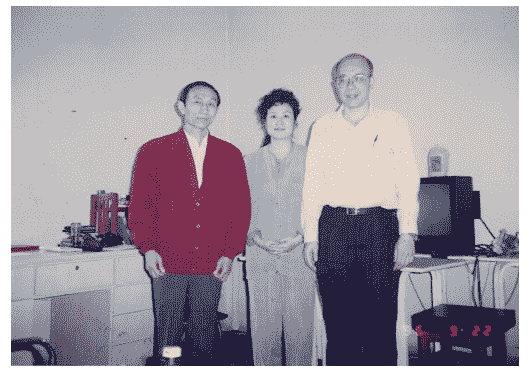
In 1995, I traveled to Beijing to visit Professor Shen Jinchuan of the Institute of Human Body Science at China University of Geosciences and the highly gifted individual Ms. Sun Chulin (as shown in Figure 1-1 on the following page), and collaborated on research into extraordinary human functions for four years. As a result, I recommended to Ms. Wu Meiyun, Editor-in-Chief of ECHO Magazine, that a book be published. Ms. Wu twice invited me to Beijing, in 2001 and 2004, to engage in dialogue with Professor Shen Jinchuan and Ms. Sun Chulin, discussing Sun Chulin’s sixty types of extraordinary human functions, her developmental history, the emergence and operational details of her abilities, and the theoretical framework of extraordinary human functions, among other topics.
The manuscript was completed in early 2005, but unfortunately, I assumed the presidency of National Taiwan University in June 2005, making it inconvenient to publish books in this area. I therefore requested that the book be published only after I stepped down as President of NTU, and Editor-in-Chief Wu agreed. As a result, the wait lasted eight years.
Less than three months after I stepped down as President of NTU at the end of June 2013, Editor-in-Chief Wu sent me the manuscript completed in 2001 in early September for me to proofread.
Seeing the dialogue transcript from thirteen years ago, I could not help but feel a surge of complex emotions. Research on extraordinary human functions, because it falls outside the framework of modern science, must endure the bullying and oppression of mainstream science. This is no different from the religious oppression faced by Galileo four hundred years ago—except that he faced the death penalty, while what I face are various forms of attack from the mainstream scientific community.
Figure 1-1 Exploring Research on Extraordinary Human Functions with Professor Shen Jinchuan and Ms. Sun Chulin
 |
|---|
| In September 1995, I visited Beijing for the first time to meet with Professor Shen Jinchuan and extraordinary-function individual Ms. Sun Chulin at the Institute of Human Body Science, China University of Geosciences, and viewed the research results they had achieved over many years. |
This included the period during my candidacy for the presidency of NTU, when outsiders used the media, academic journals, and even mobilized criticism from a Nobel laureate to suppress me. After I was elected president, they continued to provoke incidents for over a year, using the pretext of investigating pseudoscience to cause trouble for my students’ theses. The various forms of harassment and interference are sufficient to be recorded in history, bearing witness to the conduct of the mainstream scientific community of this era.
During the proofreading process, I was startled to discover that during the 2001 dialogues [2], I had already proposed the concept of real-number space and imaginary-number space.
In the world of physics, quantities such as length and time can be measured, and all measurable physical quantities are real numbers—that is, the material world is a real-number space. However, the particles described by quantum mechanics, which emerged in the 1920s in the twentieth century, are represented by a wave function. Unfortunately, the wave function is a complex number, containing both a real part and an imaginary part. When physicists saw this result, they were quite perplexed: how could the wave function describing an actual particle turn out to be a complex number that cannot be measured? They therefore squared this complex number to convert it back into a real number, representing the probability of the particle’s appearance. But if the particle is truly described by the complex wave function, involving both a real-number space and an imaginary-number space, then this implies that in addition to the material world of the real-number space in which we reside, there also exists an imaginary-number space that is conjugate to the real-number space and that we cannot measure. Seeing this, I had a sudden flash of insight.
The information field we discovered in 1999 while conducting finger-reading experiments is in fact the imaginary-number spacetime. It turns out that our real universe is a complex-number spacetime, comprising both real and imaginary parts. I had formed this concept around 2000, but had not continued to refine and perfect the model.
The Formation of the Quantum Mind Concept
In November 2013, I was invited to Kunming, Yunnan, to attend the Second Academic Symposium on the Human-Heaven Perspective. This was one of the few conferences held on the Chinese mainland related to extraordinary human function research after the suppression of Falun Gong in 1999 had caused research into extraordinary abilities to stagnate for more than a decade. Many of the papers presented discussed more than thirty years of extraordinary-ability research conducted on the mainland. At the conference I encountered many old friends who had worked on this research more than twenty years earlier; most of the researchers had already retired.
One of them, Professor Wu Banghui of the Department of Physics at Sichuan University, mentioned in her lecture that around 1980 she had proposed that the complex number i in the quantum wave function represents consciousness. She wrote to Qian Xuesen [3] to present this concept and received his encouragement, but ultimately the idea could not be developed further and was abandoned.
Hearing her presentation was truly like being struck by five bolts of lightning. The information field I discovered is precisely imaginary spacetime, which is filled with consciousness, spirits, and information websites. For example, after a match enters imaginary spacetime, it will also develop consciousness and can dodge a person’s swats. Does this not clearly indicate that the imaginary number i represents consciousness? At this moment, the concept of a quantum mind or quantum consciousness arose naturally in my mind. It turns out that consciousness simply refers to the appearance of a quantum state; all things possess spirit. As long as an object enters a macroscopic quantum state, the imaginary number appears, and consciousness emerges. The truth of this universe was ready to be revealed.
After returning from Kunming, I accelerated the process of constructing the theory, proposing that the two major hypotheses of “complex spacetime” and “quantum mind” are the keys to cracking the mystery of the universe. The remaining questions were: “How does one enter imaginary spacetime?” and “Where is the spiritual realm?“.
On December 24, near the end of 2013, I invited my Daoist friend Mr. W to dinner and mentioned to him the rapid progress I had made in recent months on the theoretical framework of complex spacetime and the quantum mind. However, my biggest trouble was: where exactly is the passage from real space to imaginary space?
He reminded me that the traditional Chinese Taiji diagram is actually a three-dimensional sphere, with the Yin and Yang realms each occupying half, achieving balance through the exchange of energy via the fish eyes. Suddenly, he enlightened me regarding the problem of how real spacetime and imaginary spacetime communicate within the complex spacetime theoretical framework: they must communicate through a vortex-like spacetime structure, allowing information to pass from Yin to Yang, or from Yang to Yin. The most probable vortex passage should be the spin of the particle; we only discovered its physical principles in published general relativity literature half a year later.
Because every elementary particle, including quarks, electrons, protons, and neutrons, possesses spin, and the spin direction is either up or down. The spin angular momentum[4], regardless of mass, is always ћ/2, where ћ is Planck’s constant divided by 2π. Therefore, every particle has a passage into the void; these passages are ubiquitous.
On January 6, 2014, I submitted the formal paper, “Complex Spacetime: A Unified Framework for Explaining Dark Matter, Dark Energy, Consciousness, and Extraordinary Functions”[5], to the domestic academic journal Buddhism and Science. It was accepted and published in March 2014.
Editor’s Note 1: Nan’s Allergy Elimination Therapy. This therapy first uses muscle testing to identify the allergens causing the body’s allergic reactions. Then, after twenty minutes of meridian scraping and acupoint massage treatment, as long as there is no further contact with the allergens over the following twenty-four hours, the allergy can be completely eliminated and health restored. For a detailed discussion, please see Scientific Qigong. Editor’s Note 2: Master dialogue on “Extraordinary Functions or Latent Potential?“. Please see Are They Extraordinary Functions? Or Latent Potential?, page 174. Editor’s Note 3: Qian Xuesen. A native of Hangzhou, Zhejiang Province, a world-renowned scientist, Chinese aerodynamicist, and academician of the Academy of Sciences and the Chinese Academy of Engineering. Editor’s Note 4: Spin angular momentum. In 1928, British physicist Dirac confirmed that every elementary particle possesses spin angular momentum. No matter how large the particle’s mass is, the magnitude of the angular momentum of spin up or spin down is one-half of ћ, where ћ is Planck’s constant divided by 2π. Editor’s Note 5: “Complex Spacetime: A Unified Framework for Explaining Dark Matter, Dark Energy, Consciousness, and Extraordinary Functions.” Please see the journal Buddhism and Science, Volume 15, Issue 1, pages 13 to 28.
Proposing Two Major Hypotheses: Complex Spacetime and the Quantum Mind
In the paper “Complex Spacetime: A Unified Framework for Explaining Dark Matter, Dark Energy, Consciousness, and Extraordinary Functions,” I proposed two major hypotheses:
First Hypothesis: Complex Spacetime
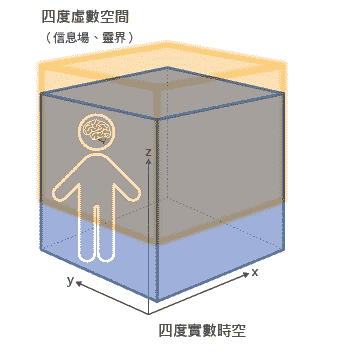
The real universe is actually an eight-dimensional complex spacetime. In addition to the currently known four-dimensional real spacetime (the Yang realm), there also exists a four-dimensional imaginary spacetime filled with consciousness and information (which can be called the information field, the Yin realm, or the spiritual realm) (as shown in Figure 1-2).
Why use eight dimensions instead of eleven dimensions like superstring theory[1]? The primary factor considered is balance; Yin and Yang must be balanced. Otherwise, like an unbalanced chemical reaction, a dynamic reaction will proceed until balance is reached. Since real space has length, width, and height, plus time, making it a four-dimensional spacetime, naturally imaginary spacetime must also be four-dimensional. This concept of a dual world has a long-standing heritage in the Chinese systems of Confucianism, Buddhism, and Daoism. The West has also transformed it into political and religious institutions; for example, kings manage the secular affairs of the people, while popes manage the spiritual affairs of the people.
Figure 1-2 The universe is an eight-dimensional complex spacetime
 |
|---|
| The eight-dimensional complex spacetime is composed of a four-dimensional real spacetime and a four-dimensional imaginary spacetime. The four-dimensional real spacetime is the “Yang realm,” and the four-dimensional imaginary spacetime is the “Yin realm” (the spiritual realm). The soul within the human brain can cross between the real and imaginary realms. |
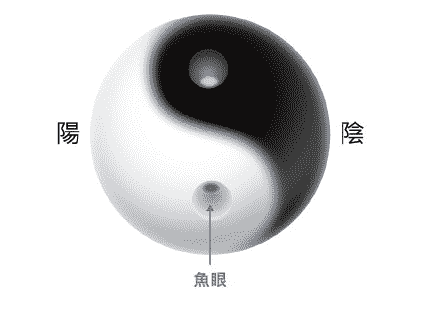
Although real spacetime and imaginary spacetime are closely related, being the real and imaginary parts of the same complex spacetime, there exists a real-imaginary barrier between them (the separation between Yin and Yang). They exchange energy only through special spacetime points of various scales. These connection points are all vortex-like spacetime structures, which are also the fish eye structures in the Taiji diagram within three-dimensional space (as shown in Figure 1-3).
I assume that real-number spacetime and imaginary-number spacetime are precisely the yang and yin that the Taiji diagram attempts to describe; the two generate and constrain each other, and their energies communicate through the fish eyes (the vortex spacetime structure). Therefore, there are many fish eyes with vortex structures in both real-number and imaginary-number spacetime that can connect with the other spacetime, allowing energy to be exchanged. Unless matter is smaller than the vortex size or enters a special state, it cannot cross through at will.
Ordinary matter exists in four-dimensional real-number spacetime and can be located by four coordinates (x, y, z, t) to describe its motion. However, when matter such as elementary particles, photons, or objects enters a microscopic or macroscopic quantum state and must be described by a complex field, once a complex matter wave appears, the matter wave is no longer constrained by the vortex size and can tunnel through the vortex connection points into imaginary-number spacetime.
Figure 1-3 In Taiji spacetime, the fish eyes are the vortex channels through which yin and yang communicate
 |
|---|
| In the spacetime structure of the 3D Taiji, the fish eyes are the vortex channels through which yin and yang communicate. Only through the vortex spacetime structure of countless fish eyes can communication between the yin and yang realms be achieved. |
In imaginary-number spacetime, the wave velocity u of a matter wave and the velocity v of an object in real-number spacetime satisfy the equation uv = c², where c is the speed of light. When the velocity of an object in real-number spacetime is less than the speed of light (v < c), then the wave velocity of the matter wave in imaginary-number spacetime will be greater than the speed of light (u > c). Therefore, a matter wave in the quantum state can propagate rapidly throughout the vast imaginary-number space and can also access information from the past and the future. At this point, the greatest change is that the conscious component (the imaginary part) of matter is awakened. I believe that the consciousness, spirits, and countless information websites in imaginary-number spacetime all possess energy, equivalent to the existence of mass, and that this mass is precisely dark matter, possessing the property of gravity. Dark energy is generally considered to be provided by the cosmological constant in general relativity—that is, the repulsive force generated by vacuum energy. I believe that in complex spacetime, real-number spacetime and imaginary-number spacetime are tightly bound together through an enormous number of vortex connection points. The expansion of imaginary-number spacetime can drive the accelerated expansion of real-number space, leading to the appearance of dark energy. Therefore, the existence of imaginary-number spacetime answers the third puzzle I posed: “Where is the spiritual realm?” It also offers answers to large-scale cosmic mysteries such as “What exactly are dark matter and dark energy?”
Second Hypothesis: Quantum Mind
The scientific hypothesis of “quantum mind” that I propose holds that consciousness is a quantum phenomenon. Since imaginary-number spacetime is filled with consciousness and information websites, i is merely a symbol in mathematics, but in physics it represents consciousness. Therefore, I believe that the appearance of the imaginary number i in complex quantum fields or quantum wave functions brings consciousness into physics. Quantum mechanics had already brought consciousness into physics; it simply did not explore or explain it in this direction. The imaginary part is related to consciousness—this is the meaning of quantum mind.
There are two keys for matter in real-number space to break through the barrier between real and imaginary and enter imaginary-number space:
The first way is that the size of the matter must be far smaller than the aperture of the spin vortex opening, and it must happen to strike the channel opening of a connection point, thereby entering imaginary-number spacetime and disappearing. It will then reappear at a different time and at a different location through the exit of another vortex connection point. This is similar to the mysterious disappearances of airplanes or ships in the Bermuda Triangle.
The second way is that as long as matter enters a complex matter wave or quantum field state—once it appears—it can permeate into imaginary-number spacetime. I believe that this complex matter wave is the key to entering imaginary-number spacetime. At this point, the size of the matter is no longer important; the quantum wave can permeate and tunnel through vortex spacetime connection points (funnel openings) with very small apertures to enter imaginary-number spacetime. Because the velocity of a quantum matter wave in imaginary-number spacetime can be far greater than the speed of light (u > c), the quantum can rapidly propagate through vast space and can also access information from past and future times. Photons are special: their velocity in real-number space and their wave velocity in imaginary-number space are both the speed of light c.
The wave function in complex spacetime makes it impossible to precisely measure the dynamical properties of a particle, such as position and momentum, in real-number space, because it traverses between real-number and imaginary-number spacetime. In imaginary-number space, it undergoes random collisions with the virtual images of all matter; therefore, upon measurement, when the complex wave function collapses back into real-number spacetime, only the probability of its appearing at position r can be known. The phenomenon of quantum entanglement generated by two quanta occurs in imaginary-number spacetime, because they both bore through the spin channels into the void. In the void, the exchange and conduction of information can exceed the speed of light; therefore, superluminal quantum entanglement information does not violate the theory of relativity. Thus, the concept of complex spacetime thoroughly resolves the ontological perplexity regarding quantum mechanics that has persisted for nearly a century—namely, the question “What exactly is the nature of the quantum world that quantum mechanics describes?”
Editor’s Note 1 Superstring Theory. Superstring theory holds that the matter composing the world, including atoms, electrons, quarks, and so on, is not composed of solid substance but is constituted by the vibrations of “strings,” the fundamental units of all things. The different modes of vibration of a “string” form different particles, and particles in turn constitute the world. Moreover, the vibration of strings is a transformation from energy into solid substance, so the essence of all things is merely vibrating energy. In the past, humanity’s exploration of dimensions extended only to the fourth dimension. After the birth of superstring theory, humanity’s understanding of dimensions became ten spatial dimensions plus one temporal dimension, that is, eleven-dimensional spacetime. Human beings live in three-dimensional space and therefore cannot perceive the existence of higher dimensions, just as we cannot hear ultrasound or see infrared light.
Particle Spin Can Tear Spacetime and Connect the Yin and Yang Realms
Every particle has spin, which is a property of electrons measured before the development of quantum mechanics in the 1920s, and there are only two possibilities: one spin up and one spin down. The magnitude of the spin angular momentum is ћ/2, where ћ is Planck’s constant divided by 2π. Physicists at the time attempted to use a classical picture to explain the phenomenon of spin.
If the mass of an electron is known and its size can be estimated, treating it as a classical solid sphere allows one to calculate how fast the electron must rotate to produce the experimentally measured spin angular momentum. The result revealed that the speed of rotation must exceed the speed of light, violating the theory of relativity. Therefore, under the warning of the great physicist Pauli, mainstream physicists fell silent from then on, believing that electron spin is a purely quantum phenomenon with no classical picture.
Of course, the relativistic quantum mechanics derived by the British physicist Dirac in 1928 automatically yielded that the spin angular momentum of a particle is only up or down, with a magnitude of ћ/2, consistent with experiments. This further deepened the belief that spin is a quantum phenomenon. However, a few non-mainstream physicists also proved that spin is the rotational behavior of an energetic quantum wave in the Dirac field, which somewhat restored part of the classical picture.
In 2013, the Russian general relativity master Alexander Burinskii proposed that spin, due to the excessive rotation (superluminal) of the particle, tears spacetime to carve out a singular ring opening, forming two pieces of fractured spacetime. This act of tearing spacetime opens a channel between the Yin and Yang worlds.
Originally, the Yang realm and the Yin realm are like two sides of a piece of paper. This piece of paper is infinitely large, and Yin and Yang do not interact. However, as long as a small hole is drilled in the paper or a small slit is cut, a Yin-Yang channel appears. If a chemical bond has two electrons, one spin up and one spin up, then two slits will be torn, and spacetime will split into four pieces. In an extremely small space, the four pieces of fractured spacetime must be connected in pairs to maintain a stable spacetime structure. Burinskii claimed that they would be connected in the manner of a Mobius Strip (as shown in Figure 1-4).
When the head and tail of a rectangular strip of paper are connected normally, it forms a circle with a width. But when connecting the head and tail, if one end is turned 180 degrees before connecting, it forms a Mobius strip. The model shown in Figure 1-4 is the 3D geometric structure of a Mobius strip formed by strips of paper with different length-to-width ratios.
Obviously, when the length-to-width ratio is equal to 4, the 3D topological structure formed is a 3D Tai Chi diagram, with two openings, one pointing up and one pointing down, representing the results caused by two different spins: one from Yang to Yin, and the other from Yin to Yang. This also explains the Pauli exclusion principle in quantum mechanics—why the spins of two electrons in the same orbit must be different. This is because only in this way can a stable Tai Chi spacetime structure, as well as a stable molecular structure, be formed.
Figure 1-4 3D Mobius Strip
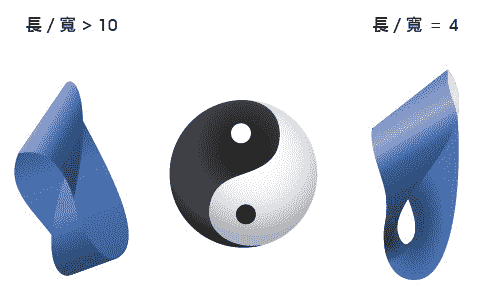 |
|---|
| Turn one end of a rectangular strip of paper by 180˚ and connect the head and tail to form a Mobius strip. When the length-to-width ratio of the paper strip equals 4, the resulting structure is like a 3D Tai Chi diagram, with two openings, one pointing up and one pointing down, representing one from Yang to Yin, and the other from Yin to Yang. |
The nano-scale vortex spacetime structure is the spin of fundamental particles, having only two states: up and down. One spirals from Yang into Yin, and the other spirals from Yin into Yang. This explains why a quantum orbital in a space only allows two electrons with opposite spins, because they can form a stable three-dimensional Tai Chi spacetime structure. This also explains the physical cause of the Pauli exclusion principle in quantum mechanics, because putting two electrons with the same spin in a spatial orbital would cause an unstable spacetime structure.
On March 21, 2013, the European Space Agency (ESA) website released the cosmic microwave background radiation data collected by the Planck satellite over five years [1]. This is the residual distributed energy from about 400,000 years after the Big Bang explosion that gave birth to the universe 13.6 billion years ago, after the initial dust had dispersed enough for electromagnetic radiation to travel outward into the universe. This map shows two abnormal features: one is an asymmetry in the temperature between the two hemispheres, with the southern hemisphere being slightly hotter; the other is the appearance of a circular cold spot in the southern hemisphere. Looking closely, this map actually displays a macroscopic Tai Chi diagram, where the cold spot is the fish eye, clearly showing that real-number spacetime erupted from imaginary-number spacetime. Of course, modern cosmology believes that our universe erupted from vacuum energy; although the name is different, in essence, it is similarly produced from the void.
On September 11, 2015, astrophysicists from the National Aeronautics and Space Administration (NASA) discovered a double black hole star system [2] whose generation rate is one hundred times that of the Milky Way galaxy where our solar system is located. The conceptual images released by major media are the result of the interaction of two black holes located at the fish eye positions of a flat Tai Chi diagram, indicating that a massive amount of energy is generated near the black holes. This also shows that the Tai Chi spacetime structure produces many anomalous phenomena.
In summary, the two major hypotheses proposed—complex spacetime and the quantum mind—can begin to reasonably explain dark matter, dark energy, the enigmas of quantum mechanics, and the nature of consciousness. The fourth of the four great scientific mysteries triggered by parapsychology research seems to have found an answer. However, how are we to understand the mystery of “extrasensory perception” at the universe’s medium scale? This will have to wait until Chapter 4 for discussion.
Editor’s Note 1
 |
|---|
| Cosmic microwave background radiation data |
Editor’s Note 2
 |
|---|
| NASA discovers double black hole star |
Chapter 2: Experimental Revelations of Recognizing Characters with Ears and Fingers
If one day,
we could teach the blind to “see” with their fingers or ears,
to use the sense of touch to replace the eyes,
then in human society, the disability of “blindness” would no longer exist.
Discovering Human Potential — Recognizing Characters with Ears and Fingers
The eyes can take in the colorful world, the ears can hear the various sounds made by insects, fish, birds, beasts, and nature, and the fingers can feel the smoothness or roughness, the coldness or heat of an object’s surface. These abilities are the basic abilities possessed by ordinary people and are not at all remarkable. However, if one can “see” patterns with the fingers, and can also “see” patterns with the ears, armpits, or knees, this would mean that tactile signals have traveled to the visual region of the brain’s center, and the significance of this would be extraordinary.
When the Blind Read Braille, Tactile Signals Engage the Visual System
In April 1996, the British journal Nature published an article. The research group of Dr. Norihiro Sadato from Japan’s National Institute for Physiological Sciences used positron emission tomography (PET) and measurements of regional cerebral blood flow and discovered that when blind persons experienced with Braille used their fingers to touch the raised characters of Braille, excitatory responses occurred in the visual cortex areas of both the left and right hemispheres of the brain. This was the first time the scientific community discovered that when blind persons touch Braille, tactile signals are transmitted to the visual cortex, resulting in the phenomenon of cross-modal interaction between different sensory signals.
However, Dr. Sadato and his colleagues also discovered simultaneously that when the blind persons were not reading Braille but instead touching a uniform field of raised dots, the tactile signals were not transmitted to the visual cortex. Furthermore, when normal persons touched Braille, blood flow in the visual cortex decreased; the visual area was not activated but was instead inhibited. This is consistent with what brain scientists had previously understood: the five senses do not communicate with one another. When the eyes go blind, it does not cause hearing or touch to be impaired, and damage to hearing does not affect the world observed by the eyes.
Discovering Children Who Can Recognize Characters with Their Ears
However, as early as 1979, in Dazu County, Sichuan Province, an eleven-year-old boy named Tang Yu was discovered to possess the ability to recognize characters with his ear. If a character was written casually on a small piece of paper, and then the paper was folded or crumpled into a small ball and stuffed into his ear, he could see the character in his mind within a few minutes.
After this incident was reported by local newspapers in Sichuan Province, it aroused great interest among many people. Teachers at elementary schools throughout various regions of Sichuan Province began testing their students in class to see whether they had such abilities. Within less than a year, various localities in Sichuan reported one after another children with the ability to “hear” characters, numbering in the hundreds.
These results attracted the interest of Associate Professor Chen Shouliang of the Department of Biology at Peking University. At the end of 1979, he opened a children’s potential training class at Peking University, with forty children aged five to fourteen signing up to participate, each undergoing experiments for varying numbers of days. The results showed that among the fifteen children who participated in four or more days of training, eighty percent developed finger-reading abilities; the other children who received three or fewer days of training showed poorer results. On average, a total of sixteen children developed finger-reading abilities.
In 1980, Professor Tian Weishun and others at Hangzhou University conducted four-hour induction tests on 1,222 students from four elementary schools and four middle schools in Hangzhou. The results showed that the highest rate of finger-reading ability, reaching twenty percent, occurred among nine-year-old children. As age increased or decreased, the proportion of children exhibiting finger-reading ability declined. Among ten- and eleven-year-old children, the rate of those exhibiting the ability was approximately fourteen percent; among twelve-year-old children, the rate was seven percent; among thirteen-year-old children, the rate was four percent; among the 150 students aged fourteen and above, only one exhibited the reading ability, as shown in Figure 2-1 below.
This shows that as we grow older and acquire more knowledge, as the pineal gland of the brain gradually calcifies, the likelihood of developing finger-reading ability becomes lower and lower.
Figure 2-1: Test results of finger-reading ability among elementary and middle school students
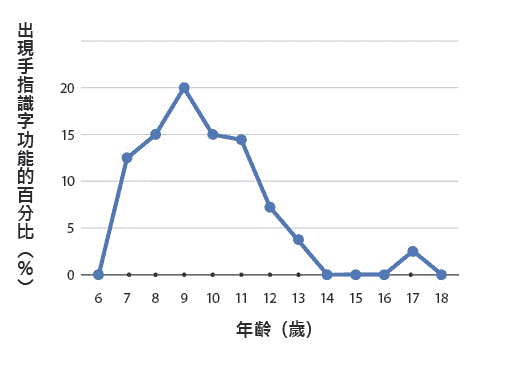 |
|---|
| In 1980, Professor Tian Weishun and others conducted four-hour induction tests on 1,222 students from four elementary schools and four middle schools in Hangzhou. The results showed that nine-year-old children had the highest rate of exhibiting finger-reading ability. |
Shao Laisheng and others, from the Shanghai Municipal University Human Body Science Joint Research Group, beginning in 1982, held “Extrasensory Perception Induction Training Classes” for students and teachers at various institutions of higher education in Shanghai as well as workers in the region. As a result, they found that among people with relatively low levels of education, successful induction was comparatively easier, and the rate of improvement in extrasensory abilities was also faster.
For example, in January 1986, the subjects of their training were eleven male and female workers, ranging in age from eighteen to twenty years old. Two had an elementary school education, and nine had a junior high school education. They trained for one hour each day, for a total of eighteen days of training. The result was that by the final day, not only had every person developed the ability to recognize characters, but they had also mastered the latent ability to bend objects enclosed in a box through psychokinesis at a distance; the most powerful among them could even snap iron wires and teleport them to distant locations. All of these concrete experimental data demonstrate that the human latent ability of finger reading does indeed exist.
Finger Reading: Breaking Through the Cognitive Boundaries of Modern Brain Science
Fingers can feel out characters? Ears can recognize patterns? Anyone hearing of such things for the first time will inevitably scoff and dismiss them as the work of spirits and superstition. In 1987, when I first began participating in the qigong research launched by the National Science Council, I held precisely the same attitude. As my qigong research deepened and I came into contact with an increasing number of scientific papers and reports from mainland Chinese and Japanese media, I gradually came to feel that these phenomena might not only be unrelated to spirits and superstition, but could in fact represent the cutting edge of human body science. Nevertheless, I still hoped to personally conduct experiments to verify this.
My First Encounter with Someone Who Could Read with Their Fingers
The first person I encountered who possessed the ability of finger reading was an eleven-year-old girl named Mai Takahashi, in 1993. Mai Takahashi’s father was Japanese and her mother was Taiwanese. After attending an elementary school in Taichung through the fifth grade, she immigrated to the United States. Because her maternal grandparents were in Taiwan, she would return to Taiwan every year to visit relatives.
When Mai Takahashi was ten years old, her mother saw a report on Japanese television about finger reading and decided to let her try it. To their surprise, they discovered that she indeed possessed this ability. Her mother, excited and taking the matter very seriously, had her practice several times every day. Thus, by the time we first met, her finger reading ability was already very stable.
I recall that our first meeting took place on the afternoon of August 17, 1993, during the summer vacation, at a friend’s home in Taichung. Mai Takahashi, who had returned to Taiwan to visit family, wore her hair in a long ponytail, dressed in denim shorts and a short-sleeved shirt, and was brought over by her mother and maternal grandparents. With her delicate features, she appeared somewhat shy facing strangers; when asked questions, she would only nod or shake her head, occasionally whispering a few words to her mother and grandmother.
When we began the experiment, I first went to the dining table in the adjacent room and wrote twenty slips of paper using pens of different colors, then folded each slip several times, making sure that no trace of any character could be seen from the outside. I then brought them into the living room, where a friend who was present selected one at random and handed it to Mai Takahashi. Thus no one knew the contents.
After Mai Takahashi received the folded paper with her right hand, she felt it for thirteen minutes without seeing anything. At that point, her mother brought out a dark green cloth sleeve with a thin nylon cord threaded along its upper edge. She slipped Mai Takahashi’s right hand into the cloth sleeve, then pulled the thin cord at the opening tight so that it fit snugly against her wrist, and tied a bow at the wrist.
According to Mai Takahashi’s mother, this was originally used during Mai Takahashi’s character recognition training to prevent her from opening the folded paper or peeking at it from the outside. Over time, she had grown accustomed to it, and without the cloth sleeve, she actually found it more difficult to “see” the characters.
I had brought a V8 video camera and recorded the movements of her face and hands throughout the entire process. Perhaps feeling more confident after the cloth sleeve was added, she simply sat on the sofa, looking around here and there. Her left hand occasionally squeezed the folded paper inside the cloth sleeve. In less than a minute and a half, she said, “I see a brown character tian (田).” She wrote the character 田 on a blank sheet of paper. When we opened the slip, it turned out to be a red character “田.” The shape of the character was entirely correct; the color was slightly off (as shown in Figure 2-2 on page 70).
After that, we conducted three more experiments. In the second experiment, the slip of paper was covered with a white paper box, and then both hands were placed over the white paper box. She first saw the character “日” (sun), then saw the character “月” (moon) on the right, and knew it was the character “明” (bright) — entirely correct. In the third experiment, her hand was placed in the cloth sleeve; at one minute and twenty seconds, she saw a black character “天” (sky) — entirely correct. In the fourth experiment, her hand was placed in the cloth sleeve and the folded paper was additionally secured with tape. After fifteen minutes, she still could not see anything and gave up. In the fifth experiment, she did not wear the cloth sleeve; after thirteen minutes, she was still unable to see anything and gave up. Out of a total of five experiments, three were successful and two failed.
At the time, I did not understand the reasons for the failures, but I felt that a sixty percent success rate was somewhat incredible. This was because the characters or patterns chosen to be written down had no restrictions whatsoever. If each experiment had been purely a matter of guessing, the probability of a correct guess would have been roughly greater than one in a thousand. Moreover, the setting was one of complete double-blind conditions — no one present knew the answer on the slip of paper held in Mai Takahashi’s hand.
Figure 2-2: Results of Mai Takahashi’s finger reading experiment at age 11
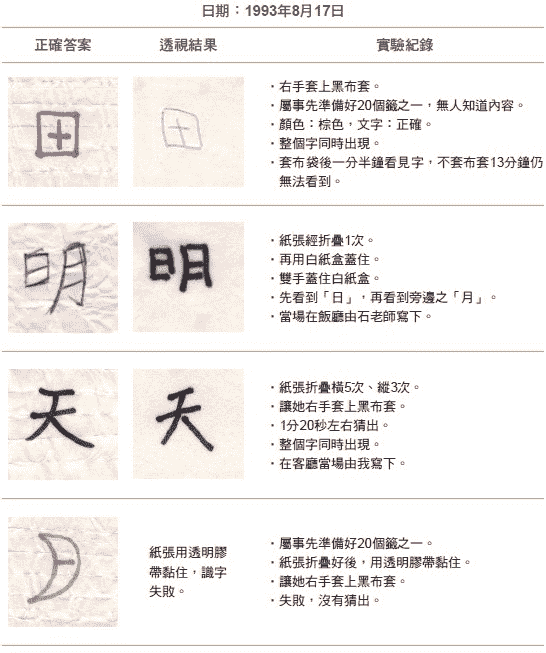 |
|---|
On the way back to Taipei, I was filled with astonishment and doubt. Yet five experimental samples were still too few to confirm the authenticity of this phenomenon. But if finger reading was real, what was the mechanism of signal transmission? A phenomenon that challenged the cognitive boundaries of modern brain science had already emerged before my eyes.
Expert Testimony: The Scientific Verification Process of Finger Reading
After our first encounter, we took advantage of Miss Takahashi’s opportunities to return home for family visits, each time using two to four days to conduct detailed research on her finger-reading ability. The first session was in October 1993, the second in August 1994, the third in September 1995, the fourth in May 1996, and the fifth in August 1997.
Preparing the Experimental Items for Finger Reading
Before the formal experiments, we first had to prepare the test items. In the first and second sessions, we cut rectangular white paper strips measuring five centimeters by ten centimeters, then used red, green, blue, and black felt-tip pens to write single-color or multi-color characters on the strips, including single or multiple Chinese characters, English letters, drawn patterns, or written equations. The strips were then folded along the long edge and rolled from the center outward at a width of 0.6 to 0.8 centimeters, folded six times to form a slender paper roll five centimeters long, and then folded inward once more at the one-third points. This was done to ensure that the completed paper wad absolutely could not reveal any character or color from its exterior appearance. Sometimes, tape was additionally applied to the outside, or an additional sheet of paper was used for wrapping.
In each session, we prepared more than fifty paper wads, which guests present at the experiment wrote and folded on the spot in another room. For the third and fourth sessions, rectangular paper strips measuring three centimeters by ten centimeters were cut, with one end trimmed into a pointed cone shape. When folding, the folding began from the pointed cone end and proceeded toward the other end, with the aim of determining whether the finger recognition of the pattern’s orientation proceeded from inside to outside or from outside to inside.
The Experimental Process Under Expert Testimony
At each experimental session, the observing professors, students, doctors, or interested individuals present—including reporters—numbered more than ten, and one or two video cameras recorded from different angles to document the details of the experiment.
During the second and third sessions, an infrared camera was used to record the temperature of the hand and to observe her hand’s movements while touching the paper wad inside the cloth sleeve or black box.
At the start of the experiment, I would casually ask someone present to choose any paper wad and hand it to Miss Takahashi. No one knew the contents of the paper wad, thereby achieving a double-blind effect. After Miss Takahashi received the paper wad in her right hand, in most cases a dark cloth sleeve was placed over her right hand. The sleeve opening had a drawstring that could be tightened and tied at the elbow, as shown in the experimental photograph on page 96 below. The residual light inside the cloth sleeve was only one ten-thousandth of ordinary white light or room lighting. Sometimes a black paper box was additionally placed over the cloth sleeve, reducing the residual light intensity by more than another hundredfold. At this point, the paper wad could be said to be in complete darkness, making it impossible to directly see the colors or any characters or patterns on the paper through the eyes.
In the one hundred experiments of the first three sessions, twenty-five times Miss Takahashi wore an eye mask to block light, in order to understand the role played by the eyes in the finger-reading process. In some experiments, no eye mask was worn, but the experiments were conducted in a dark room where the residual light was also only one ten-thousandth of that when the lights were on. Once the cloth sleeve was tied, timing began, and when Miss Takahashi claimed to “see” a color or character, timing was stopped. At this point, the young girl would select the felt-tip pen of the color she had seen, write down the answer on white paper, and describe the scene she had witnessed. I would ask those present to assist in removing the cloth sleeve, open the paper wad for comparison, and record in detail the conditions that occurred during the experiment. Sometimes, the young girl was asked to write out the order in which the characters appeared, stroke by stroke.
Beyond Finger Reading: Reading Characters with the Ears
Miss Zhu was a child with the ability to read characters with her ears, among those I personally experimented on. The process by which her extraordinary ability emerged was quite remarkable.
During the summer vacation of 1994, Miss Zhu, then a third-grade student at Guangfu Elementary School in Taipei City, joined five other classmates on a tour group trip to mainland China. While visiting Shanghai Jiao Tong University, they happened to encounter the university holding a training class to develop children’s ear-reading abilities. Seeing Taiwanese children visiting, they invited everyone to join the training.
Miss Zhu placed the first paper wad in her ear and spent over forty minutes before she could see it, but the answer was wrong. She then inserted another paper wad, and after more than ten minutes she saw it again—this time completely correct. Incredibly, from then on, not only could she read characters with her ears, but she could also read with her fingers. She could even read the characters on a paper wad placed inside an opaque film canister simply by touching the canister.
Among the five classmates who traveled together, another classmate also developed the reading ability, though with a higher error rate. This demonstrates that among children under twelve years old, finger or ear reading ability is quite prevalent.
Verifying the Ear-Reading Ability
After returning to Taiwan, several television stations invited the girls to appear on programs to demonstrate their finger-reading abilities. I too learned of this young girl’s existence only after seeing the television program, and so in April 1995 I invited her to National Taiwan University for more rigorous experiments.
It was a Sunday morning. Her mother brought her and her younger sister to the laboratory. According to her mother, she did not normally practice, but whenever she wanted to “see,” she could “see.” So we randomly selected one from among dozens of pre-prepared paper wads and began the experiment. Of course, no one present knew the contents of the paper wad.
I could only see her eyes gazing straight ahead, as if she had fallen into deep thought, her two hands constantly turning and pressing and rubbing the paper ball. After ten minutes and thirty seconds, she gave a slight smile, nodded, and said she could see it. She then picked up a green pen and wrote the character 「弓」 on the paper. The result was completely correct (as shown in the first row of Figure 2-3 on the left). The sequence in which the character form appeared in her mind was also that one part would appear and then disappear, then appear again. These characters would come together like a jigsaw puzzle, then scatter and reassemble, and were not stable. I speculated that this was because she did not normally practice and was not familiar with the technique.
Figure 2-3: Results of the character recognition experiment of little Miss Zhu
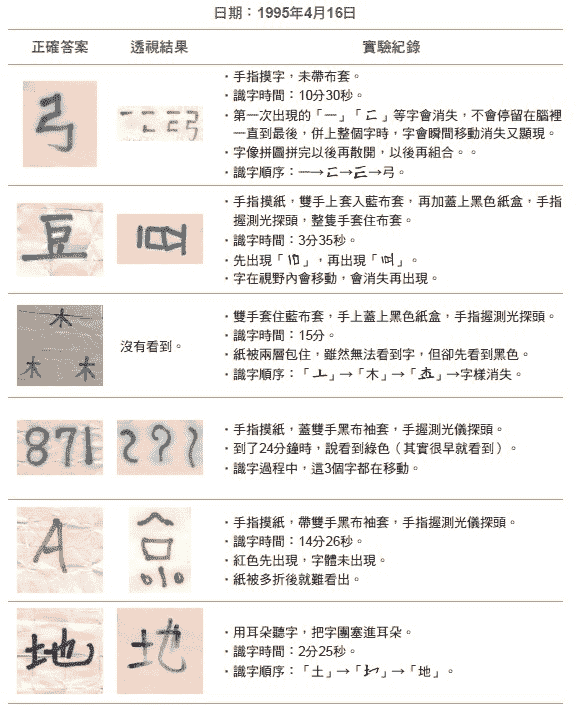 |
|---|
In the second experiment, she was asked to look at the blue character 「豆」. She saw it after only three minutes and thirty-five seconds, but it was rotated ninety degrees, becoming a horizontally lying 「豆」, as shown in the second row of Figure 2-3 on the preceding page. This indicates that the character would move, scatter, and reassemble on the screen in her mind, and was still not stable. Next, the third experiment (as shown in the third row of Figure 2-3) took fifteen minutes, the fourth (as shown in the fourth row of Figure 2-3) took twenty-four minutes, and the fifth (as shown in the fifth row of Figure 2-3) took fifteen minutes. In each case, she either did not see the character completely or had added some content herself. By this time it was nearly noon, and little Miss Zhu was somewhat tired and impatient, so we tried once more with reading characters by ear (as shown in the last row of Figure 2-3). The result was that she saw the black character 「地」 in only two minutes and twenty-five seconds, and the answer was completely correct.
For little Miss Zhu, the character recognition function was just for fun, and she had more difficulty adapting to prolonged rigorous testing, including requirements such as being recorded by a camera, wearing cloth sleeves on her hands, and holding a photometer probe. Therefore, it was not until February 1997 that we had the opportunity to conduct a second test on her. Surprisingly, although little Miss Zhu did not practice normally, her finger reading function seemed even stronger two years later. For ordinary simple character recognition experiments, she could see the character in two or three minutes, but it was still not stable. This differs from the general phenomenon that “functions will degenerate without practice,” indicating that she possessed character recognition functions in multiple regions, which may be innate.
The Special Physiological Mechanism That Opens the Mind’s Eye
When little Miss Takahashi performed finger reading, her right hand had to be covered with a cloth sleeve or enclosed in a black paper box for her to see quickly and correctly. This had originally been used by her mother during training to prevent her from opening the paper ball or peeking at it from outside. Over time, she grew accustomed to it, and without wearing the cloth sleeve, she found it harder to “see” the characters.
For example, in the total of one hundred experiments over the first three rounds, in ninety-one of them, she wore a cloth sleeve on her hand or simply had both hands enclosed in the black box. Of these, fifty-five were completely correct, representing a sixty percent success rate in character recognition. In twenty of them, the color was correct but the character form was not seen completely; in ten of them, the character form was completely correct but the color was wrong; complete failure occurred only six times. However, in the remaining nine instances where both hands were completely uncovered, the character recognition results did not yield a single completely correct answer, and instead there were five complete failures. Clearly, covering both hands was a key factor in the success of little Miss Takahashi’s finger reading.
Using the Hand to “Touch” the Paper Ball in the Darkness
How exactly did her right hand touch the paper ball inside the cloth sleeve? During the second round of experiments in August 1994, we thought of using an infrared camera to film the movements of her hands inside the black box. Since the hand has temperature and produces a large amount of blackbody radiation wavelengths in the infrared range, even though the visible light inside the black box was very weak and could not be captured by an ordinary camera, an infrared camera could clearly show the movements of the hand. Sure enough, from the screen we could clearly observe that little Miss Takahashi continuously flipped the paper ball with both hands and touched the creased edges of the paper ball, but did not open it. Moreover, the light inside the box was only one ten-thousandth of normal brightness, and even if she had looked with her eyes, she would not have been able to see.
Why was it that little Miss Takahashi could not “see” the character forms without wearing the cloth sleeve? We gained a clue from the infrared camera screen. The colors of the image on the screen represented temperature. Under the condition of not wearing the cloth sleeve, we found that the temperature of little Miss Takahashi’s hand back and fingers would rapidly rise from the blue twenty-eight degrees Celsius to above the yellow thirty-four degrees Celsius within three minutes. Under such conditions, even after more than thirty minutes, she could not see the image. However, at this point, if she held a can of ice-cold soda to lower her hand temperature to below thirty degrees Celsius, she would see the image after one minute and twenty-five seconds. In order to understand the reason for the rise in hand temperature, we conducted the following experiment:
First, during the first experiment she did not wear the cloth sleeve, and after holding the paper ball for three minutes, her hand temperature rose above thirty-four degrees Celsius. At this point, we covered both her hands with the black box, removed the black box after two minutes, and read the temperature of the back of her hand directly from the infrared camera, finding that it had dropped to thirty-two degrees. Two minutes and thirty seconds after covering both hands with the black box, she had already seen the image. When the black box was opened, we found that her hand temperature had dropped below twenty-nine degrees Celsius. Clearly, covering with the black box had the effect of lowering the palm temperature.
Analyzed from a physics perspective, with the original room temperature at twenty-five degrees, placing a paper box near the palm would cause the temperature inside the box to be heated by the hand temperature and rise higher than the environmental temperature of twenty-five degrees. The rise in temperature inside the paper box would in turn cause the hand temperature to be slightly higher than at room temperature. However, the hand temperature actually dropped by more than five degrees, which was clearly an effect of psychological factors.
Once little Miss Takahashi took off the cloth cover, she would become nervous due to a lack of confidence, causing her hand temperature to rise, making success difficult. Therefore we learned that when training children to develop the finger reading ability, we must create a relaxed atmosphere and eliminate their tension in order to produce better results.
Psychological Stability Is Required to Open the Heavenly Eye
As shown in the first row of Figure 2-4 on page 83, in the first experiment, little Miss Takahashi’s hands were not covered with the black box, so she could not see the pattern the whole time. At about the seventh minute, the black box was placed over her hands, and after four minutes and thirty-eight seconds she saw the pattern.
In the second experiment, she initially wore no eye mask and no cloth cover. After five minutes and fifty-four seconds she put on a black eye mask, but by the nine-minute mark she still could not see anything. So at nine minutes and twenty-five seconds, her hands were covered with a black paper shield that had a hole, which was then immediately replaced with a fully black paper shield without any hole, and after another one minute and twenty-three seconds she saw it, though the result was slightly incorrect.
In the third experiment, with the lights on, she started without wearing a cloth cover. After ten minutes she could not see anything, so we turned off the lights. After another ten minutes she still could not see anything, and by then the temperature of her hands had exceeded thirty-five degrees Celsius. At this point we used ice cubes to cool both hands down, wiped off the water droplets on her hands, and let her continue rubbing the paper ball. As a result, she saw the pattern after four minutes and twenty-five seconds.
In the fourth experiment, with the lights on, she wore no cloth cover and no black box on her hands. After fourteen minutes she could not see anything, but five minutes and eight seconds after the black box was placed over her hands, she was able to see the pattern, and the reading result was completely correct.
These experimental results clearly demonstrate that wearing a cloth cover or placing a black box over the hands can stabilize little Miss Takahashi’s psychological state, causing the capillaries in her palms to constrict and lowering the temperature, which leads to a special physiological mechanism that allows her to open the heavenly eye in her brain and scan the paper ball in her hands, sending the information back to the brain.
Figure 2-4 Reading results of little Miss Takahashi under different conditions
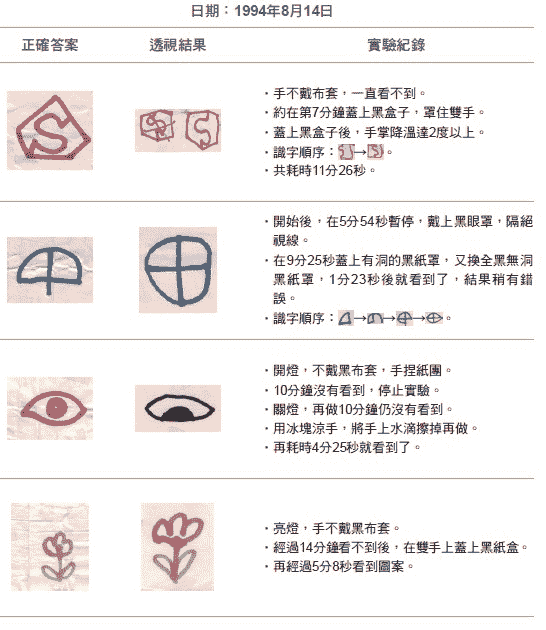 |
|---|
Watching Television in the Brain — Understanding the Sequence of Heavenly Eye Scanning
How are the signals obtained by the fingers touching the paper ball presented in the brain?
According to research from Peking University and Fudan University in mainland China, as well as the personal accounts of some individuals with extraordinary abilities, the process is largely the same: first, a screen appears in the mind. The pattern, the color of the paper, or the shape of the paper ball first appears on the screen, sometimes disappearing and reappearing. Then the colors converge to form the pattern, or the paper ball gradually opens and closes again, and finally the complete character is stretched out, just like watching television. This phenomenon of a screen appearing in the brain and displaying a pattern is called the “screen effect,” and many scholars also refer to it as “opening the heavenly eye.”
Take little Miss Takahashi as an example: the appearance of characters or patterns occurs one part after another, and the very first time the screen appears, it always displays the color of the text. For instance, the results of the experiment conducted on October 27, 1993 (as shown in Figure 2-5 on page 86). In the first experiment, she was asked to read the red character “茹.” After the heavenly eye opened for the first time, a field of red appeared on the screen in her mind. Then the red disappeared. After waiting a while, when the screen appeared for the second time, there was a red character “口” on it, and then the screen disappeared again. When the screen appeared for the third time, the character “女” appeared to the left of the red “口” — that is, the red character “如” appeared — and in an instant it disappeared again. When the screen appeared for the fourth time, the entire red character “茹” appeared, and after a moment it disappeared. When the screen appeared for the fifth time, it was the red character “茹,” and she knew she had seen everything. At that point she picked up a red pen and wrote the answer.
Sometimes, the characters or patterns she saw were not complete. If the pattern appearing on the screen twice in a row showed no new changes, she would think she had seen everything, when in fact some information had not yet appeared. The second row of Figure 2-5 shows an example where she had not seen everything completely. The characters on the paper strip were “WATER,” but what she saw was “TEP” — she only saw the last three letters, mistaking R for P, because the downward stroke of R had not yet appeared. Next, in the third experiment, as shown in the third row with the blue characters “料理,” the reading result was completely correct.
Figure 2-5 Finger reading experiment of Mai Takahashi
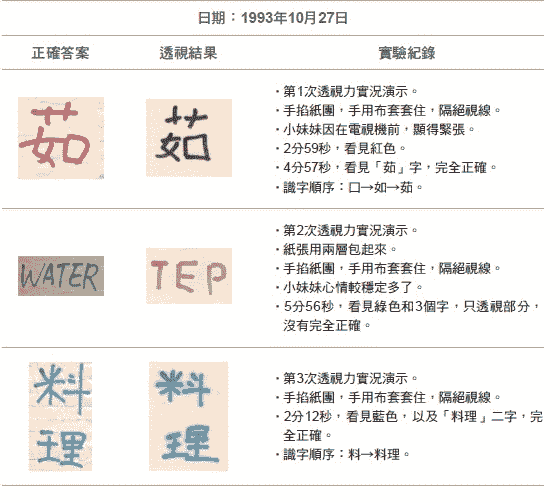 |
|---|
In 2016, we conducted further tests on Mai Takahashi’s ability to identify colors and characters through finger reading (as shown in Figure 2-6 below). The correct answer on the paper, the character “位,” was written with three colored pens — black, red, and blue — and the clairvoyant reading result was completely correct.
When the heavenly eye opened for the first time, she saw a field of black, indicating that the black information of the left-side radical “亻” (single-person radical) of the character “位” had been scanned into the heavenly eye. At 9:26:52, when the heavenly eye opened for the second time, she still saw two colors — red on top and blue below — indicating that the red and blue color information of the right half of the character “位” had been scanned into the heavenly eye. Red on top and blue below indicated that the order of the colors was correct and that they had not mixed. She then assembled the character “位” in the sequence red, black, and blue, and the final clairvoyant reading result was completely correct. These procedures demonstrate the mechanism of heavenly eye scanning, providing rich detail for our later explanation in Chapter 4 of the physical process of finger reading.
Figure 2-6 Finger reading experiment of Mai Takahashi
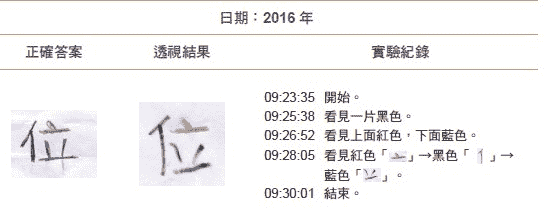 |
|---|
The Brightness and Dimness of Light Affects Color Recognition Function
Young Miss Takahashi’s finger-reading experiments were conducted under extremely weak light conditions inside a cloth sleeve, yet they could produce color responses fully consistent with those of retinal nerves under strong light. So did her eyes actually see light? The effect on finger recognition of patterns is worth investigating.
Without Light, the Heavenly Eye Cannot Recognize Colors
We used wearing eye masks or conducting experiments in a darkroom to isolate the role of the eyes. To avoid interfering with data analysis under different experimental conditions, we only considered experiments in which the characters appeared in Young Miss Takahashi’s mind.
The results showed that under the condition of having the lights on and not wearing an eye mask, all fifty-three trials of single-color pattern recognition yielded completely correct colors. Once the eye mask was put on, four out of twenty-one trials had color errors, reaching an error rate of nineteen percent. In the three trials conducted in the darkroom, although the shapes were correct, the colors were all wrong.
From this it can be understood that if the eyes see light, it does indeed help with color recognition. The main reason is: because the bright light seen by normal eyes is sent into the brain to illuminate the screen, thereby producing color perception. If the eyes are covered with an eye mask or are in a darkroom with no bright light sent into the brain, the screen is completely dark, and when the Heavenly Eye scans in the color information on the paper, it naturally cannot produce a sensation of color, but shape information appears without needing illumination from bright light.
The Brain’s Cognitive Habits Affect Finger-Reading Results
During the experiments, we discovered an interesting phenomenon: cognitive psychology apparently affects the experimental results. For example, on one occasion we asked Young Miss Takahashi to recognize the green character 「线」, in which the lower part of the 「系」 radical on the left side of the originally written character was cursively written with only a single stroke, but Young Miss Takahashi first saw the four dots beneath the character 热, then saw the silk radical on the left, and what finally appeared on the Heavenly Eye was the character 丝 with three dots added below (as shown in the first row of Figure 2-7 on the left). In another case, she read the English word “HAPPY” as “Happy,” and “SUN” as “Sun.” Originally written entirely in capital letters, they were all perceived as having only the first letter capitalized and the rest in lowercase, consistent with her usual writing habits. It is obvious that the textual information must first pass through the brain’s memory regions for comparison, then be transformed based on past cultural experience before being displayed on the screen, which results in some distortion.
Figure 2-7: Mai Takahashi’s cognition interfered with finger-reading results
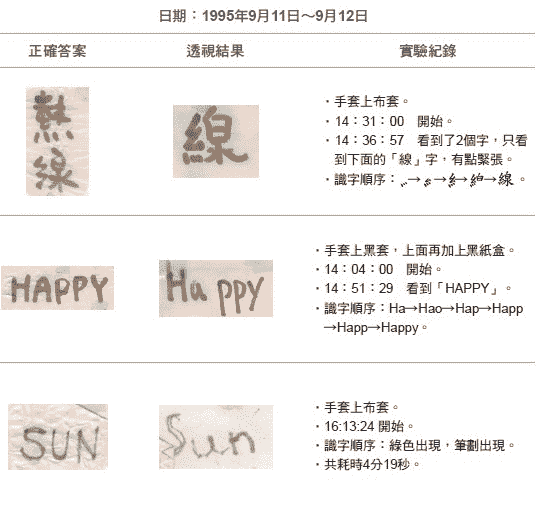 |
|---|
Another interesting phenomenon had a decisive influence on our later explanation of the physical mechanism of finger-reading (as shown in Figure 2-8 on the left). For example, in the first-row case, we wrote the two characters 「王后」 on white paper, but cut a hole where the 口 radical at the bottom of the character 后 was located. On the Heavenly Eye, the position corresponding to the 口 character showed a black frame, indicating that the part of the paper that does not emit light appears black at the corresponding position on the screen.
In the second-row case, the 口 radical of the character 「吃」 in the two characters 「吃讨」 was cut open and folded back behind the paper strip. From the front, it appeared as 「乞讨」. The paper was then folded for finger-reading, and what appeared on the Heavenly Eye was 「吃讨」 — the answer was not wrong.
In the third-row case, a small piece of wide black tape that does not emit or reflect light was affixed to the paper, and it appeared black from the Heavenly Eye.
We also conducted experiments by writing characters on transparent paper. Young Miss Takahashi found that the background of the screen became a mass of black, unlike the usual bright white background. However, when a sheet of white paper was placed behind the transparent paper and folded together, the background became bright again. This shows that using transparent paper, like cutting holes or using black tape, seems unable to provide a brightness signal to the Heavenly Eye, indicating that patterns unable to provide brightness or color signals to the eyes will also appear black on the Heavenly Eye.
Figure 2-8: Results of cutting holes or affixing black tape on paper during finger-reading
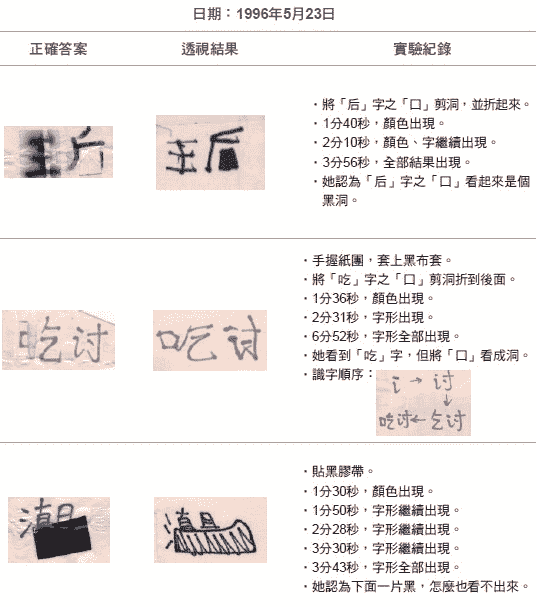 |
|---|
Physiological Changes in the Body When the Heavenly Eye Opens
When the screen of the Heavenly Eye appears, does the highly functional person’s body undergo physiological changes? The answer is affirmative.
The Voltage in the Hand and the Opening of the Heavenly Eye Screen Are Mutually Causally Related
During the third and fourth rounds of experiments with Young Miss Takahashi in 1995 and 1996, to measure the voltage changes in her two hands, we attached an electrode to each of her hands and directly recorded the variation of the voltage difference between her two hands over time. The experimental setup is shown in the two photographs at the top of Figure 2-9 on page ninety-six.
During the experiment, Young Miss Takahashi held a button in her hand. She pressed it once when the Heavenly Eye appeared and twice when it disappeared. Some of the experimental results are shown by the orange curve at the bottom of Figure 2-9.
As a result, we found that about two seconds before the Heavenly Eye appeared, voltage began to appear in both hands, and then a spike voltage of about twenty to sixty millivolts (mV) appeared, as shown by the black diagonal line in the lower chart in Figure 2-9. This period of time is called the “incubation time.” Next, from the opening of the Heavenly Eye to its disappearance lasted only one to two seconds—that is, the Heavenly Eye flashed by instantaneously, very briefly—and during this time, characters would “appear” in her brain to be “seen.”
It was not until 2002, after her abilities had strengthened, that the Heavenly Eye could remain open for ten to twenty seconds, and the voltage in both hands could also be maintained for several tens of seconds, consistent with the opening and closing time of the Heavenly Eye. Obviously, the electrical discharge in the brain causes voltage to be generated in the palms, which bears a certain causal relationship with the appearance of the screen in the brain. These data let us understand the sequence of the appearance and disappearance of the Heavenly Eye and the occurrence of the voltage difference in both hands.
Figure 2-9 Voltage changes during finger reading
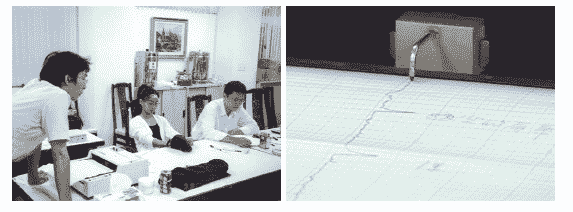 |
|---|
| During finger reading, electrodes were attached to Mai Takahashi’s hands to measure voltage, which was simultaneously traced on recording paper. |
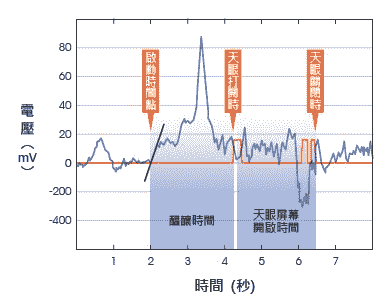 |
|---|
| Two seconds before the Heavenly Eye appeared, a spike voltage of about 20–60 millivolts appeared in both hands, as shown by the black diagonal line; this is the “incubation time.” From the opening of the Heavenly Eye to its disappearance lasted only 1–2 seconds, during which she would see characters in her brain. |
Objective Experiments Under Subjective Perception
In the fifth round of experiments in 1997, we went to the Department of Neurology and Vascular Medicine at Veterans General Hospital to conduct a cerebral blood flow test, using Doppler ultrasound probes attached to the left and right temples of the head (as shown in Figure 2-10 below).
As a result, it was found that when little Miss Takahashi used her right hand to read characters, before seeing the screen, the blood flow velocity in the right middle cerebral artery dropped substantially by twenty percent (as shown in Figure 2-11 on the next page). The blood flow velocity in the left hemisphere of the brain surged from eighty centimeters per second (80 cm/sec) to one hundred centimeters per second (100 cm/sec) twenty seconds after the experiment began, then dropped back to eighty centimeters per second (80 cm/sec).
Figure 2-10 Measuring the blood flow velocity of the cerebral arteries of Mai Takahashi at Veterans General Hospital
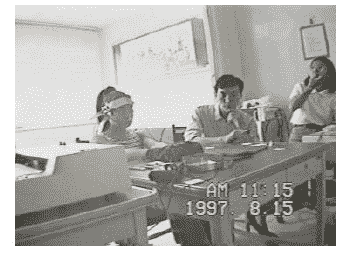 |
|---|
| Using Doppler ultrasound probes, attached to the left and right temples of Mai Takahashi’s head. |
Figure 2-11 Changes in blood flow velocity of the left and right cerebral arteries during finger reading with the right hand
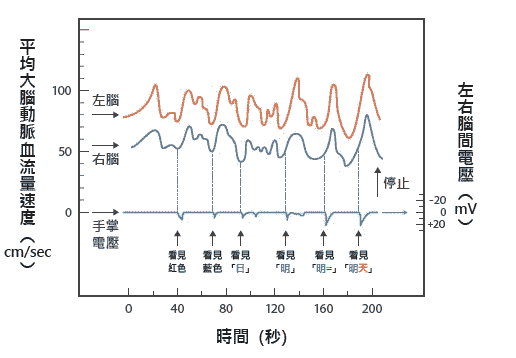 |
|---|
| During reading, the first thing to appear on the screen was the color red. When the screen opened the second time, she saw blue. Next she saw the blue character “日”; the blue character “明”; the red character “二” appeared to the right of the blue “明”; finally “明天” appeared and the session ended. The clairvoyant result was completely correct. |
This indicates that brain activity dropped from high to low; after remaining at that level for about fifteen seconds, it began to rebound. At the moment when blood flow dropped to its lowest point and began to rebound, a voltage pulse of about ten millivolts (mV) appeared in both palms, with the right hand showing positive voltage. Then the screen appeared; the first thing to appear on the screen was the color red, after which the blood flow velocity rebounded to a high point and began to repeat the process of declining and rebounding. Whenever the blood flow velocity dropped to its lowest point, voltage would appear in the hands, followed by the opening of the screen, and she could see a portion of the pattern. When the screen opened the second time, she saw blue, indicating that there were two colors of patterns on this piece of paper—red and blue; next she saw the blue character “日,” the blue character “明,” and the red character “二” appearing to the right of the blue “明,” after which “明天” appeared and the session ended. The clairvoyant result was completely correct.
When little Miss Takahashi switched to using her left hand to read characters, the blood flow in the left middle cerebral artery rose substantially by about twenty percent, and during the rising process a voltage pulse appeared in both hands, with the left hand voltage being positive. Therefore, although the screen effect is a subjective perceptual process, the accompanying physiological changes can be measured with instruments.
Later, we also went to Shin Kong Hospital to measure the changes in brain waves during finger reading (as shown in Figure 2-12 on the next page). The results measured are shown in Figure 2-13 on page 101; the first and second rows are brain wave distribution maps across the entire brain under different experimental conditions.
The third row shows the frequency spectra of brain waves from the occipital region of the brain (the visual processing area) after Fourier transformation. The horizontal axis is frequency, and the vertical axis is intensity. For the average person, frequencies of fourteen to thirty hertz are β waves, eight to thirteen hertz are α waves, four to seven hertz are θ waves, and below four hertz are δ waves.
Figure 2-12 Measuring brain waves of Mai Takahashi during finger reading at Shin Kong Hospital
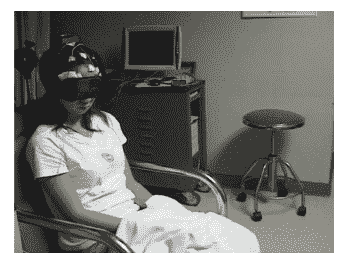 |
|---|
Looking at the first image on the far left of the third row, this is the condition of eyes closed (EC, eye closed), in which the red α waves are very strong, the same as for an average person. The second image is of eyes closed while doing arithmetic (EC, cal), for example when calculating twenty-seven multiplied by thirty-five; the α waves are slightly disturbed and decrease a little. The third image is of eyes closed while imagining scenery (EC, image), for example imagining the scenery of Sun Moon Lake; the red α waves are slightly disturbed again and decrease a little more.
The fourth and fifth images show the eyes open and attentively looking at the external scene (EO, focus) or casually looking around (EO, nofocus); the red α-wave amplitude is severely disrupted and nearly disappears. The sixth image shows the eyes opened just barely enough to make out external words or scenes (EO, smalleyes); the α-wave is also severely disrupted and disappears. In the seventh and eighth images, as long as an eye mask is worn, whether the eyes are closed or open and no external scene can be seen, the α-wave becomes very strong.
Figure 2-13 Brainwave distribution and spectrograms during finger-reading under different conditions
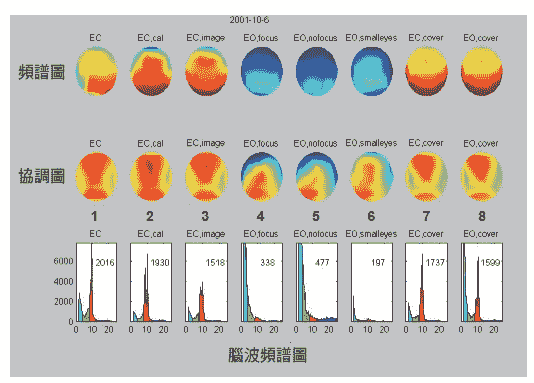 |
|---|
| From the 7th and 8th images in the bottom row, it can be seen that when Takahashi used finger-reading to see the text or patterns on the paper, her eyes were not open and she could not see the external scene, and therefore the α-wave became very strong. |
These phenomena tell us that the α-wave is a strict physiological indicator that allows us to determine whether the subject has seen the external scene. What we wanted to prove was that when Takahashi used finger-reading to see the text or patterns on the paper, her eyes were not open, and therefore the α-wave would become very strong.
Figure 2-14 on the left shows the experimental results, which are the brainwave spectrograms from the occipital regions O1 and O2 and the temporal regions T5 and T6 of the brain during finger-reading. Each line represents ten seconds of data; the red peaks are the α-wave amplitude; the yellow interval is the incubation period, when voltage appears in both hands; and the purple interval is the opening of the Heavenly Eye period. It is clear that during the opening of the Heavenly Eye, the α-wave amplitude in her brain remained very large without decreasing, indicating that her eyes were closed and she could not see external text or patterns, yet the Heavenly Eye could see the correct patterns.
Measuring Activity in Various Brain Regions of a Highly Capable Person
In 1998, we also used functional magnetic resonance imaging (fMRI) technology to measure the activity in various brain regions of Miss Takahashi during finger-reading (as shown in Figure 2-15 on page 104), and divided the brain into twelve slender intervals separated by purple lines, including regions such as the thalamus, pineal gland, and corpus callosum.
Figure 2-14 Brainwave spectrograms during finger-reading
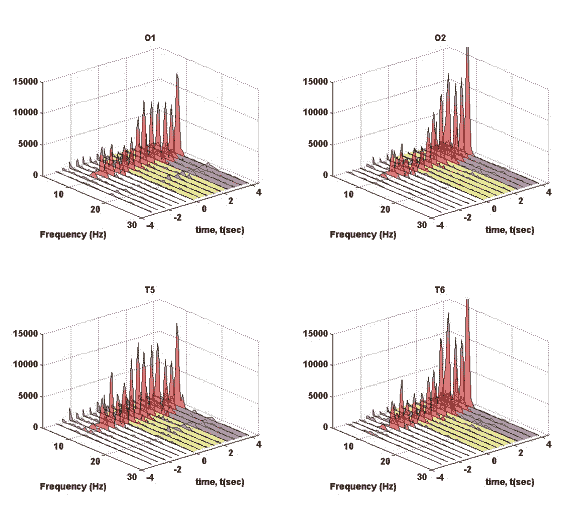 |
|---|
| The red peaks are the α-wave amplitude; yellow is the incubation period; purple is the opening of the Heavenly Eye period. From the figure, it can be seen that during the opening of the Heavenly Eye, the α-wave amplitude in Takahashi’s brain remained very large, indicating that her eyes were closed, yet the Heavenly Eye could see the correct patterns. |
Figure 2-15 Using fMRI to measure activity in various brain regions during finger-reading
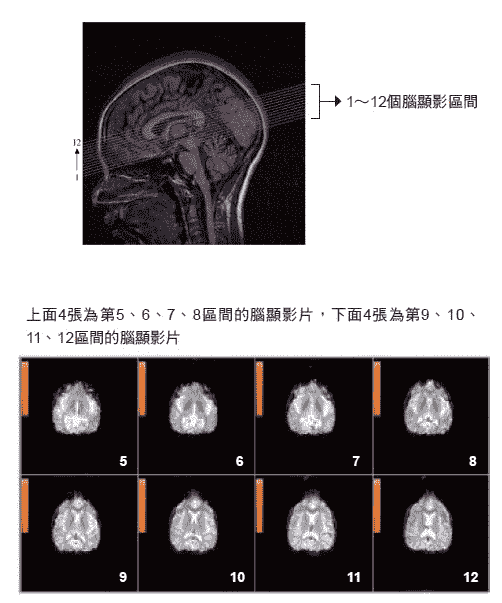 |
|---|
| The red regions are the areas with the greatest signal changes before and after the opening of the Heavenly Eye. From the 7th brain scan, it can be seen that the left-brain auditory region showed changes; from the 8th scan onward, some regions in the central part of the brain showed very large changes. |
Takahashi operated a button with one hand, pressing it once when the Heavenly Eye opened as a signal to assist in data analysis.
As shown in the scans at the bottom of Figure 2-15 on the right, the upper row consists of the four slices of regions five, six, seven, and eight; the lower row consists of the four slices of regions nine, ten, eleven, and twelve, along with the signal change graphs before and after the opening of the Heavenly Eye; the red regions indicate the larger changes. Clearly, starting from the seventh slice, changes appeared in the left-brain auditory region, and from the eighth slice onward, some regions in the central area showed very large changes.
In Figure 2-16 below, the graph displayed within the blue region of the brain shows the actual signal changes in the eighth red slice. In the graph on the right, the orange markers indicate the button-press signal recorded when Mai Takahashi’s Heavenly Eye opened; the Heavenly Eye was opened twice in total; the vertical axis is the percentage change in the fMRI signal when the Heavenly Eye opened.
Figure 2-16 Percentage change in fMRI signal before and after the opening of the Heavenly Eye within the blue region of the brain
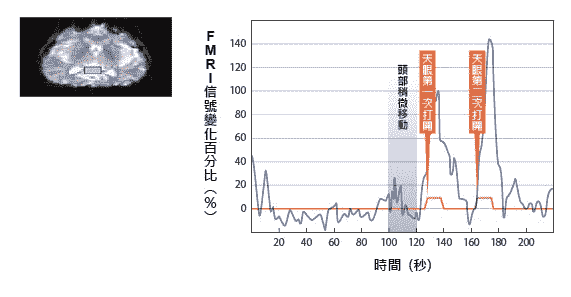 |
|---|
| The blue interval in the chart indicates a period when the head moved slightly, but it is unrelated to the time of the first opening of the Heavenly Eye. During the second opening of the Heavenly Eye, the signal change reached 140%. |
During the second opening of the Heavenly Eye, her signal change reached as high as one hundred forty percent, more than fifty times the normal signal change of one to three percent. During the first measurement, none of the experts believed this data and all assumed that her head had moved. However, further analysis revealed that the time when her head moved slightly was not the time of the second opening of the Heavenly Eye, as indicated by the blue interval. Later, when the experiment was conducted a second time, the signal response was equally enormous, which finally convinced everyone that this was a genuine signal. Although the signal changes in the ninth and tenth brain slices in Figure 2-15 on page 104 were smaller, they were still much larger than normal signals, so we tentatively determined that the location where the Heavenly Eye opens is at the red circle in Figure 2-17 below, very close to the posterior cingulate cortex (PCC) region of the brain.
Figure 2-17 The region with the strongest fMRI signal response during the opening of the Heavenly Eye
 |
|---|
| The red circle indicates the response location during the opening of the Heavenly Eye, which appears to be very close to the posterior cingulate cortex in the brain. |
Finger Reading Ability Can Be Developed Through Training
In July 1996, I opened my first children’s potential development training class for the first time, wishing to verify the claim made by research institutions in mainland China that children could be trained to develop finger reading ability. Fifteen children between the ages of seven and thirteen signed up to participate. After four days of training, two hours per day, three children actually developed finger reading ability, accounting for 20 percent of all the children, including a young girl surnamed Wang who simultaneously possessed both reading and psychokinetic abilities.
Subsequently, I opened training classes every summer, training children for four days at two hours per day. I continued offering classes through 2004, for a total of nine sessions. In June 2005, because I assumed the position of President of National Taiwan University, in order to avoid controversy I stopped offering the classes from then on. A master’s student I had supervised continued the work—Teacher Qiu, at Yilan Songshan Elementary School—until last year, still opening a class every summer.
In the nine classes I held from 1996 to 2004, a total of 176 children completed the four-day training. Of these, 41 displayed significant finger reading ability (statistical error probability P > 0.05), meaning approximately 23 percent of the children demonstrated higher-level functioning. Among them, 33 children, approximately 19 percent, displayed high-level functioning ability (statistical error probability P > 0.001). Their age distribution is shown in Figure 2-18 on the left: children aged eight to eleven showed a very high proportion of high-level functioning, while after age twelve it no longer worked, and the numbers were smaller.
These facts show that, after a short period of training, a considerable proportion of children can send the tactile signals from their fingers during reading back to the visual region of the brain, reorganizing them into meaningful images. These phenomena pose a severe challenge to the modern understanding of brain function.
Figure 2-18: Age distribution of the 41 children who demonstrated finger reading ability across 9 training classes
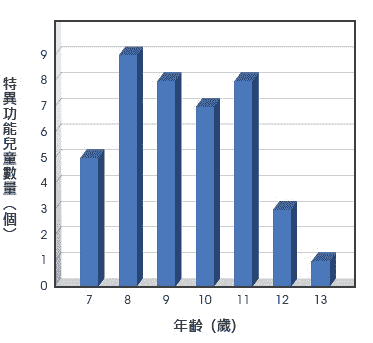 |
|---|
| Children aged 8–11 showed a very high proportion of high-level functioning; after age 12, it no longer worked, and the numbers were smaller. |
Responses to the Results of Finger Reading Experiments
After I discovered in 1993 that the young girl Mai Takahashi possessed finger reading ability, a television program from China Television came to my laboratory to film the experimental process and broadcast two episodes on television. I often wondered whether any elementary school teacher, after watching the episodes, would be inspired to try testing the abilities of the children in their own class and then report the results to me. It was not until December 2002, when I was on sabbatical at Stanford University in the United States, that one day I opened my email and saw the following letter:
Dear Professor Lee: I am an elementary school teacher. Eight years ago, by chance, I learned that you were engaged in research on human body potentials. So, I boldly invited the students in my class (fifth graders) to conduct an experiment together on “hearing words with the ear.” Sure enough, results that astonished me appeared. Some students were truly able to hear words with their ears. Eight years later, I conducted the same experiment again (for about fifteen minutes). This time, the class I was teaching was sixth graders. Similarly, a few students (six or seven) were able to guess the text on the slips of paper stuffed into their ears. Yet these children had never received any training in human body potentials, yet they were still able to demonstrate the same ability. I personally find this quite fascinating. On impulse, I am writing this letter to share it with you. I truly should not be taking up your precious time to read this letter, and I sincerely ask for your understanding. Best wishes for peace, A humble little elementary school teacher
Tears filled my eyes on the spot. There really was a “great” elementary school teacher who, after watching the television program in 1994, conducted this experiment and obtained positive results, and eight years later repeated the experiment and still obtained positive results. Nature revealed Its true face to a sincere seeker of the Way.
After returning from the United States, I found this teacher—Teacher Lai Junxian from Taipei Municipal Bai Ling Elementary School. I brought four children from his class who had demonstrated the ability to my laboratory for testing, and sure enough, they all had reading ability of varying degrees. These children were all born with it naturally, without having undergone any training.
Those Over Fifteen Years Old Can Still Develop Their Potential
Finger or ear reading ability is mainly concentrated in children under thirteen to fifteen years old. It is generally believed that this is because the brain’s pineal gland begins to calcify between the ages of thirteen and fifteen. The problem is that the celestial eye does not seem to be located in the pineal gland, but rather five to ten centimeters behind the pineal gland, which seems to suggest that young people still have the opportunity to develop finger or ear reading ability. In 2016 and 2017, I also attempted to develop the potential of approximately one hundred National Taiwan University undergraduates and graduate students in their twenties in the Department of Electrical Engineering. With only two training sessions of thirty minutes each, plus self-training in visual imagery outside of class, 3 percent of the students also developed ear reading ability, which was exhilarating. It turns out that even those over fifteen years old still have the opportunity to develop ear reading ability.
Finger reading and ear hearing of words represent a major breakthrough in human body science. For example: if a blind person could be taught to “see” with their fingers or ears, using touch to replace the eyes, then the disability of “blindness” would no longer exist in human society. If we could discover the mechanism by which tactile signals are transmitted and reorganized and replicate it with a machine, then such a machine would become the most powerful new-generation medical diagnostic instrument, capable of easily visualizing the surfaces of internal organs within the body.
Discovering the Existence of Psychokinetic Power
Little Miss Wang is one of the children I personally trained who possesses the ability of finger reading, and she is also the only child I trained who developed psychokinetic power.
In July 1996, she enrolled in a children’s finger reading training class. As a result, after one hour and three experiments on the first day, functional responses appeared. In the experiments over the following three days, her reading accuracy rate reached over seventy percent.
In order to determine the effect of practice frequency on the reading function, I arranged a plan of training for one half-day, approximately three hours, each month, and asked Little Miss Wang’s mother to bring her for training. The result showed that during the first month after training, in August, she was highly enthusiastic and it was summer vacation, so she practiced the function frequently, and her reading accuracy could be maintained above fifty percent. However, after school started in September, she entered the fifth grade of elementary school. Besides studying, she also participated in many activities and had no time to practice finger reading. Her function declined significantly, and by October the reading function had completely disappeared.
To restore her function, I took advantage of the winter vacation in February 1997 to conduct another four days of intensive training. As a result, Little Miss Wang’s function was restored on the very first day, with a reading accuracy rate of over seventy percent. This state was maintained for two months. By mid-April, due to neglect of practice, it declined to an accuracy rate of ten percent. I had no choice but to have her restore it again through intensive training at the end of July during the summer vacation. I also discussed with her parents about having her practice for half an hour every day, treating it like practicing piano or painting, cultivating it as a skill. I also asked her to correct her posture. Previously, she would lie with her head down and eyes closed to read; this needed to be corrected to raising her head and keeping her eyes open. As a result, after a period of practice, not only did she correct her posture, but her reading function also became stronger and stronger. This illustrates the phenomenon that ordinary children “regress without practice.” However, this does not apply to children with innate abilities, such as Little Miss Takahashi.
The Third Eye Is a Perceptual Ability Beyond the Five Senses
Is the physiological process of this finger reading transmitted to the brain via touch, and then passed through the limbic system to permeate the visual center, where it is converted into visual perception? We placed a folded paper strip inside a completely light-tight film canister and had Little Miss Wang touch the canister to practice. At first, she could not “see” anything, but after four or five training sessions, she could gradually see blurry images, but it seemed as if there was a layer of fog blocking the way. As the number of training sessions increased, the fog gradually dissipated, and what she saw became clearer and clearer. Then I folded the paper strip, wrapped it in a layer of aluminum foil, and placed it inside the film canister. Little Miss Wang also could not see anything at first, but after a few days of training, she gradually began to see.
After the layers of obstruction by the film canister and aluminum foil, the sense of touch had long lost its direct connection with the paper. Yet the brain’s perceptual clairvoyant ability could still penetrate through numerous obstacles and extract the information on the paper in an environment with no light. This must be another type of perceptual ability beyond the five normal sensory capacities (sight, hearing, smell, taste, and touch). Since a screen appears in the brain during reading and the heavenly eye opens, this indicates that it is the function of a third eye beyond the two eyes, which can be called the “third eye.”
Psychokinesis: The Astonishing Power of Mind Over Matter
According to the experience of various research institutions in mainland China in training children’s finger reading, when children are trained to the point where their heavenly eye can penetrate through numerous obstacles, and can even establish a connection channel to bring information from the paper into the heavenly eye without touching the paper strip while physically separated from it, they can begin training to reverse the information channel, using intention to manipulate information and produce changes, then sending it back to the object to generate psychokinetic power.
In January 1998, Little Miss Wang’s heavenly eye could already penetrate film canisters and aluminum foil to extract the text information on paper strips wrapped in aluminum foil. Therefore, I began training her psychokinetic power. I placed a piece of iron wire inside a film canister. She held the canister in her hand, brought the iron wire into her heavenly eye, and used her intention to bend the iron wire. If it would not bend, she would imagine in her heavenly eye using tools such as hands, scissors, or pliers to bend it.
On May 17, 1998, under strict experimental conditions—including sealing the film canister containing the iron wire with a seal and having the experimenter sign their name—the result was that Little Miss Wang attempted to bend a small piece of iron wire into a triangle within nineteen minutes. When the film canister was finally opened, as shown by the arrow in Figure 2-19 on the left, the iron wire had indeed been bent in two places. However, because her psychokinetic control was not yet good enough, the two bends were not on the same plane and deviated somewhat from the plane. This force was clearly not a force of Newtonian mechanics, but the power of intention. Nature once again demonstrated its mysterious power.
Professor Zhu Nianlin and Professor Luo Xin of the Department of Physics at Yunnan University in mainland China began training children’s finger reading abilities in 1979. Once the finger reading ability became proficient, they began training them in psychokinesis. They were pioneers in the study of extraordinary human abilities. After the Falun Gong incident in 1999, training stopped for more than ten years; after 2010, Professor Zhu gradually resumed the training work.
I remember that after stepping down as president of National Taiwan University in June 2013, I attended the Human-Heaven Perspective Symposium at Yunnan University in October. There I heard Professor Zhu present a paper reporting the results of children’s psychokinesis training, which were breathtaking. As shown in Figure 2-20 on the left, one child trained by Professor Zhu imagined using scissors to cut a match sealed inside an opaque plastic box into five or six pieces. The entire process was monitored on video. When the box was opened after the experiment, the match had indeed been cut into short sections, and the broken surfaces bore traces of having been cut with scissors. This shows the astonishing power of psychokinesis—the realization of what the mind imagines.
Figure 2-19 Little Miss Wang Using Psychokinesis
 |
|---|
| As shown by the arrow, the young girl Wang used psychokinetic power to bend a small piece of iron wire sealed inside a film canister. |
Figure 2-20 Professor Zhu Nianlin of Yunnan University’s psychokinesis experiment
 |
|---|
| A highly functional child used mental power to cut a matchstick placed inside an opaque plastic box into five or six pieces. |
America’s Jedi Camp ── Six in Ten Children’s Latent Abilities Are Developed
In September 2002, I used a half-year sabbatical to pursue further studies for six months in the Department of Electrical Engineering at Stanford University in the United States, serving as a visiting professor for half a year. Not only did I enjoy California’s warm sunshine and genial climate, but I also saw quite a few friends and students I had not met in over twenty years. Thinking back to the time after graduation from university, most of my classmates went abroad for further study, each going their separate ways and scattering across the United States; meeting up was not easy, unlike students nowadays, who are the exact opposite—most stay in Taiwan. Times change, and this also bears witness to Taiwan’s economic growth and progress over the past twenty years, which has significantly narrowed the gap with the United States.
In 1982, I completed my studies and returned home, joining my home department, the Department of Electrical Engineering at National Taiwan University, as a faculty member. At the time, the trend of going abroad was still prevalent. Most of the students I taught in the first few years also went abroad, and many have already established fine careers and accomplishments in the United States. Right in the Department of Electrical Engineering at Stanford University, where I was a visiting professor, there was a female student I had previously taught serving as a professor. Professor Meng’s research lab was in the same building as mine, and we ran into each other every week.
These friends and students knew I was conducting research on “extraordinary abilities” and wanted to hear the details, so two public lectures were arranged in the Bay Area to discuss qigong, finger reading, psychokinesis, the information field, and divine spirits. Each was held at a Chinese restaurant, with dinner followed by a lecture. Each time over ten tables were set, with over a hundred people attending. Many friends and students who had not seen each other in years met again on these occasions, and the overall response afterward was quite positive.
Professor Meng and her classmate KC were clearly fascinated by the “finger reading” phenomenon and kept urging me to also hold a finger reading training camp in the Bay Area. Their classmates’ children were roughly between six and thirteen years old, exactly the age most conducive to developing these abilities. To be honest, my interest was not great, because these children’s family backgrounds were too homogeneous. Unlike the children trained in Taiwan, who came from a wide range of sources, I thought the proportion of these children who would develop abilities would probably be low. KC was relentless, continually persuading me via email and preparing most of the logistical work. Finally, just one week before the scheduled start, while I had returned to Taiwan to host an international conference, the venue for the training camp was confirmed—in a conference room of the Department of Electrical Engineering at Stanford University.
KC’s classmates helped recruit children to sign up. In the end, he mobilized classmates’ children and his wife’s music class students, totaling twenty-one participants for the training camp. All of these children were born in the United States; most had studied Chinese, though their knowledge was limited. Some children, like Kevin, felt the content sounded boring upon hearing about it and were unwilling to participate. His mother tried every kind of persuasion, but he remained unmoved. Then his mother hit upon an idea and told Kevin this was a “Jedi Camp.” Kevin was a fan of the movie Star Wars, and the moment he heard it was Jedi training, he immediately and gladly agreed, arriving at the training camp happily and full of hope.
My training has a standard procedure. First, I spend half an hour introducing the “finger reading” phenomenon to the parents and children to strengthen their confidence. Then we meditate for ten minutes to calm the children’s minds and attempt mental imaging to assess their imaginative ability. After that, the training begins.
To my surprise, including Kevin, five children developed the ability on the very first day. News spread quickly in the Bay Area. Over the following days, some parents showed up upon hearing the news and brought their children to join, while others dropped out due to other commitments. Over four days, only fifteen children attended from beginning to end without absence. Of these, nine children demonstrated finger reading ability—a proportion as high as sixty percent, far exceeding my highest record of thirty-five percent from training in Taiwan. I could hardly believe it. The parents were buzzing with discussion and marveling in amazement—it turned out finger reading was real. I also suddenly realized that I was like Yoda, the Jedi master from Star Wars.
Magnetic Fields, the Effect on Finger Reading
In February 2003, after I concluded my visiting position at Stanford University and returned home, KC continued training the most capable child, Kevin, on weekends. In mid-March, KC sent me an email telling me he had discovered a peculiar phenomenon: when Kevin was doing finger reading, if he held a magnet in his hand, the image seen in his mind would be magnified. I found this very surprising and also very exciting. I had been engaged in finger reading research for nearly ten years and had never imagined that an extraordinary phenomenon would interact with a physical magnetic field.
To verify this observation, on April 20 and 23, 2003, I invited Miss T and little girl Xu to repeat this experiment. Miss T’s experimental results are shown in Figure 2-21 on the next page. As expected, when there was no magnetic field, the characters seen by the Heavenly Eye felt about the same size as normal characters. However, when the sample was pressed against the S pole, the characters seen by the Heavenly Eye were magnified, and the characters of the sample pressed against the N pole were slightly reduced; when the magnetic field reached 4KG (4,000 Gauss), the numbers seen through clairvoyance would expand beyond the screen range of the Heavenly Eye. Figure 2-22 on page 123 shows the experimental results of little girl Xu. Sure enough, in the absence of a magnetic field, the characters seen by the Heavenly Eye were about the same size as normal characters, but when the sample was pressed against the S pole, the characters seen by the Heavenly Eye were magnified, and when pressed against the N pole, the characters were slightly reduced. This experiment confirms that the south pole, the S pole, will magnify the characters of the Heavenly Eye. What is the principle behind this phenomenon?
Figure 2-21: Miss T’s finger-reading experiment with the sample pressed against the S pole and N pole of the magnet
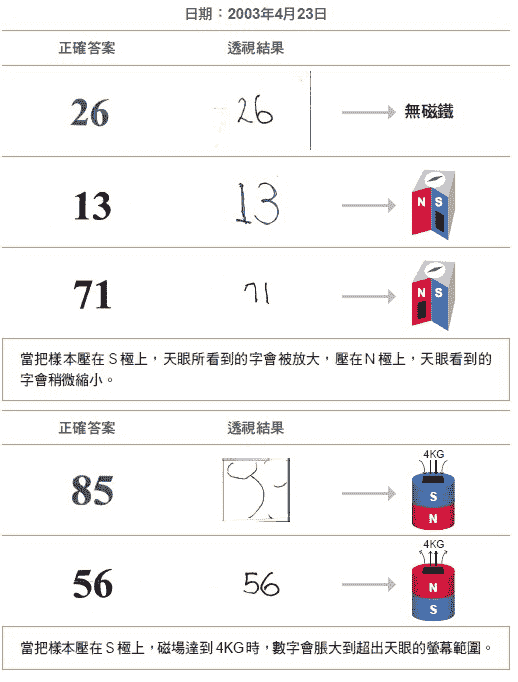 |
|---|
In Chapter 4, I will present evidence proving that the Heavenly Eye will drill into the void to scan the virtual image of an object. Therefore, the magnetic field of the S pole will obviously drill into the void and interact with the Heavenly Eye in the void. The magnetic field of a magnet is generated by the spin of magnetic atoms. The spin angular momentum will punch a hole in real-number spacetime, and based on the “law of conservation of angular momentum”, the magnetic moment is opposite to the direction of the spin angular momentum. Therefore, the S pole faces the hole, causing a part of the magnetic field to penetrate into the void, while the N pole faces away from the hole, so most of the magnetic field is confined to real-number spacetime, resulting in a weaker interaction with the Heavenly Eye.
Figure 2-22: The magnetic effect during little girl Xu’s finger-reading
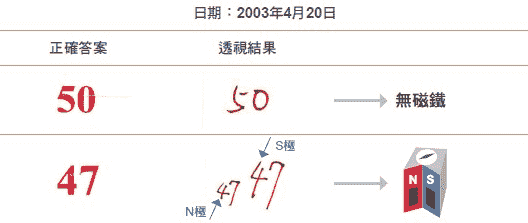 |
|---|
| When there is no magnetic field, the characters seen by the Heavenly Eye feel about the same size as normal characters. When the sample is pressed against the S pole, the characters seen by the Heavenly Eye will be magnified, and when pressed against the N pole, the characters will be slightly reduced. |
Chapter 3: Discovering Imaginary-Number Spacetime and Visiting Divine Websites
Through finger-reading,
the three children all produced extraordinary visions when recognizing the character “Buddha”.
Under the witness of many physicists,
the mysterious veil of the spiritual realm was suddenly lifted.
What a soul-stirring dramatic effect.
Facing the Challenge of the Physical Society
In 1997, I had been conducting finger-reading experiments for four years, and had successfully opened classes to train children in finger-reading. Several children had developed finger-reading abilities, showing that this phenomenon is a universally existing latent ability of the human body.
At that time, the China Times invited me to write a column called “Top Secrets of the Human Body”, with one article per week. So I started from Western parapsychology and Eastern qigong, writing all the way to the modern discoveries of ear-reading, finger-reading, and extraordinary functions, totaling more than forty articles. Unexpectedly, this offended some scholars in the physics community, who believed that I was publicly disseminating phenomena of strange forces and chaotic spirits, confusing the public and causing a negative impact. As a result, for many years afterward, they would take various opportunities to make trouble for me.
By 1999, the Physical Society could finally bear it no longer and decided to come to my laboratory to conduct finger-reading experiments in person. And they set forth two conditions: First, they would prepare the experimental samples; I said there was no problem, only that the samples had to follow some specifications. Second, a large classroom had to be prepared, because the Physical Society would announce it on their website and many people would come. This was also no problem, because Conference Room 142 in NTU’s Electrical Engineering Building II, which I usually used, was already very large and could accommodate thirty or forty people without any issue.
The experiment was scheduled to be conducted for three days, from August 26 to 28. Facing the Physical Society’s provocative challenge, to avoid the children getting temporarily sick, being in a bad mood, or having conditions that prevented them from performing on the day of the experiment, I specially arranged three children to meet the challenge, including Miss T, little girl Wang, and little boy Chen. Their finger-reading proficiency varied, from strong to weak. However, I never expected that an unbelievable phenomenon would appear on the very first day of the experiment, something never seen before.
Discovering the Extraordinary Nature of the Character “Buddha”
At about 2:30 p.m. on August 26, the president of the Physical Society brought over a dozen physics professors and two psychology professors, carrying a large box of about 100 samples, to Conference Room 142 of NTU’s Electrical Engineering Building II, and began the experiment according to the established rules. At first, Miss T’s experiment proceeded very smoothly. She could see most of the samples. From a probability standpoint, it was simply impossible to guess; moreover, she had not seen any of the samples at all, so she had no way to guess. However, she could not see some specially processed samples, like paper wads wrapped in lead boxes. The other two children also read some slips of paper correctly, showing that the finger-reading function had a certain universality. Everyone was convinced by the experiment that the finger-reading phenomenon truly existed and was not a deception. Everyone was immersed in a joyous atmosphere.
At about 4:00 p.m., Professor Chen from the Physics Department, who was present, suddenly gave Miss T a newly written sample of his, as shown in the first row on the left in Figure 3-1.
As a result, Miss T saw the blue character “Light”. When it was opened and looked at, the correct answer was the two characters “Buddha Light”. She had missed the character “Buddha”.
Professor Chen pointed at the character “佛” and said, “This character is very extraordinary; she probably cannot see it.” I immediately replied that she sometimes misses characters when reading, which is nothing remarkable, and we should just try again.
After a while, Professor Chen gave her another folded paper. The experiment began at 4:29 p.m., as shown in the second column of Figure 3-1. Each time a voltage appeared on her palm, indicating that the Heavenly Eye had opened once, we recorded the time and the scene she saw.
She first saw something flash past. At 4:34, she saw a person sparkling with light on the screen. At 4:37, she saw “the luminous person seemed to be smiling at me,” and then all the screens disappeared.
Standing to the side, I was utterly bewildered. How could such an unprecedented scene appear? She could not see any characters at all—only bright light and a luminous person. I quickly opened the sample to take a look, and it turned out to be the character “佛.” For a moment, the entire audience erupted, whispering to each other, not knowing what had happened. I only felt shock—extreme shock—as if a mysterious world had opened up before us.
Figure 3-1: Records before and after Miss T’s first sighting of anomalous phenomena
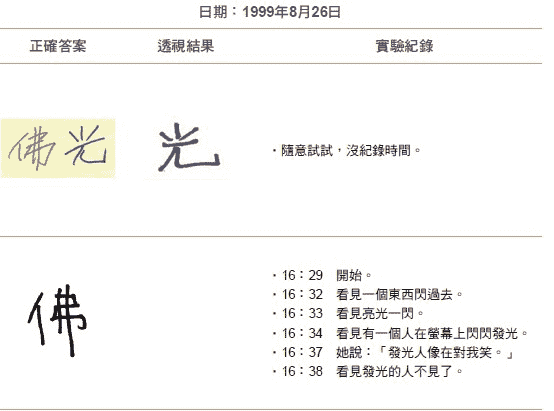 |
|---|
Later I often thought about it. By August 1999, I had already conducted six years and over six hundred experiments with Miss T, yet it had never occurred to me to try religious vocabulary. Of course, it was also fortunate that we had never tried it before, which was why, when the Physics Society came to challenge us, it actually helped us confirm the existence of the spiritual realm and produced such a tremendous dramatic effect.
On the second day of experiments, starting from August 27, I decided to replace all samples with religious vocabulary to see what other interesting results we could find.
The morning experiment results are shown in Figure 3-2 on the left. Three experiments were conducted. The afternoon experiment results are shown in Figure 3-3 on page 134, where three experiments were also conducted. The first morning experiment began at 10:30, as shown in the first column of Figure 3-2. Miss T drew a row of strange symbols within seven minutes. Upon opening the sample for comparison, apart from the first three symbols, everything else was completely correct. It turned out to be Tibetan script, only reversed. The second experiment began at 10:40, as shown in the second column of Figure 3-2. Quickly, a very bright screen appeared in her mind, and then when the Heavenly Eye opened, in addition to the bright screen, she also heard a sound—a resonant laughter that sounded extremely joyful. Finally, only the bright screen remained, and the experiment ended. Upon opening the sample, it was the character “佛.” I felt extremely happy because the experiment could be reproduced—encountering the character “佛” would always produce a field of brightness along with anomalous phenomena. This indicated that it was not a momentary failure of the brain’s Heavenly Eye, but rather that a genuinely wondrous change was taking place. The third experiment began at 10:49, as shown in the third column. Within five minutes, she wrote out E=mc², completely correct, with no anomalous phenomena appearing at all, indicating that this formula is not a sacred vocabulary term.
Figure 3-2: Sacred vocabulary experiment results from the morning of 8/27
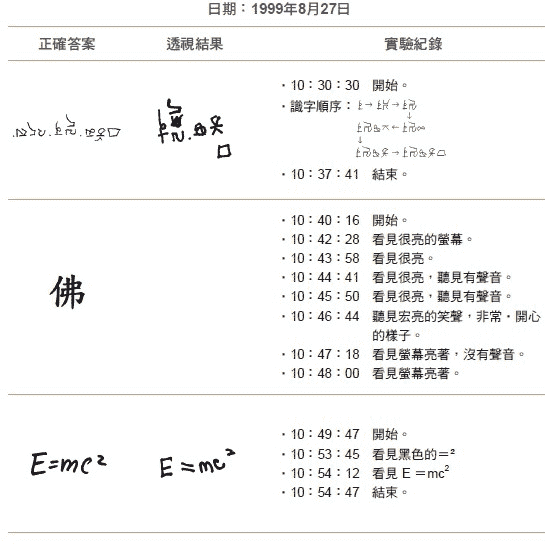 |
|---|
At 4:43 p.m., we began the first experiment, as shown in the first column of Figure 3-3 on page 134. In four minutes, she drew a fish, basically correct, except that the fish’s mouth in the sample was originally pointed, whereas she drew it as a rounded arc. The second experiment began at 4:48, as shown in the second column. Very quickly, within three minutes, a bright screen appeared. I thought it was probably a sacred vocabulary term again. Then an astonishing scene occurred: Miss T looked up at Professor Zeng of the Tsing Hua University Physics Department, who was standing three meters in front of her, and said that a luminous person was standing beside him with a hand resting on his shoulder. Then she looked at me, standing next to the signal recorder, and said that the luminous person had moved to between me and Professor Chen, and was looking down at the recorder, smiling. Startled, I quickly looked at the recorder beside me but could see nothing at all. Then the experiment ended. I opened the sample and saw that it was again the character “佛.” My mind became very certain: sacred vocabulary must trigger anomalous phenomena.
During the third experiment, the sample was provided by a physicist who was present. He had come after hearing about our work, and after watching for a while, he felt that the experiment had some aspects that were not rigorous enough. From the time we randomly selected the folded paper and placed it in Miss T’s hands, to the time we put on the black cloth cover and secured the straps, approximately twenty seconds elapsed. He suspected that during this time, Miss T could faintly see the characters through the back of the folded paper—that she was peeking, and that there was no genuine finger-reading phenomenon. Of course, we normally used two sheets of paper wrapped tightly, so the back was not visible. Still, this was a reasonable suspicion that had to be ruled out through rigorous experimentation. In the past, we had used an infrared camera to observe Miss T’s finger-reading process inside the dark bag, confirming that she merely stroked the edges of the folded paper strips and could see the contents inside without unfolding the strips.
This time, the physicist used a Feynman diagram [1] for verification. He drew many circles, making it so that even if one looked at the folded paper strip from the back for twenty seconds, it was absolutely impossible to count how many circles there were. This was a brilliant design. Miss T took only five minutes to draw it out. The physicist counted and said there were nine circles. Opening the sample to take a look, he said he himself had only drawn eight circles, meaning Miss T had drawn one extra. Professor Chen, standing to the side, looked carefully and said that was incorrect; she had also drawn nine circles. It was just that the first one had too much red ink and became a solid circle. Eight hollow circles plus one solid circle made nine circles, exactly the same as what Miss T had drawn. After debating for a while, the two reached a consensus: nine circles was correct. I broke out in a cold sweat. I knew that Miss T’s Heavenly Eye at that time could only open for two seconds, flashing by in an instant. How could she have had time to count clearly how many circles there were? I asked her, “Did you actually count them?” She replied, “I didn’t count them. A voice told me it was nine.” This voice belonged to her master in the spiritual realm who had been taking care of her for many years. Seeing that someone in the human world was trying to bully her, he secretly helped her out.
Editor’s Note 1: Feynman diagram - A visualized method created by American physicist Richard Feynman, which conveniently presents the processes of various particle interactions in a quantum field.
Figure 3-3: Results of the sacred vocabulary experiment on the afternoon of 8/27
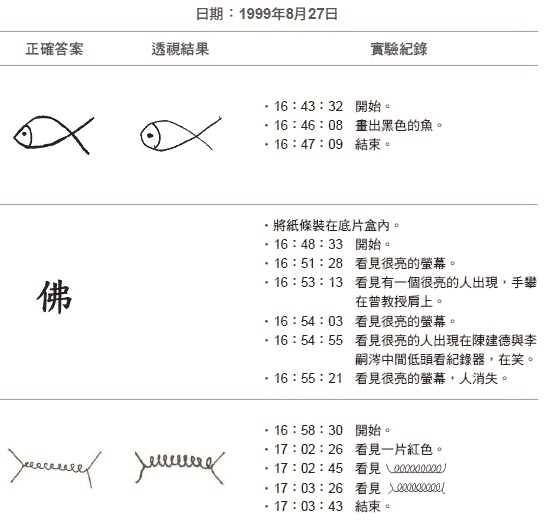 |
|---|
On the third day of the experiment, August 28th, new phenomena appeared again. Figure 3-4 on page 136 shows the experiment conducted in the morning. The first experiment started at 10:26 AM, and the results are shown in the first row. At first, a bright pink flower appeared on the screen of the Heavenly Eye in the brain. It seemed to be floating, looking like a relatively large lotus flower. Someone was standing on the lotus flower, looking very bright, like a girl wearing white clothes, as if it were Guanyin Bodhisattva. I opened the paper slip and saw the two characters “菩萨” (Bodhisattva), so “Bodhisattva” is also a sacred vocabulary word.
Next, the second experiment started at 10:38 AM, and the results are shown in the second row of Figure 3-4 on page 136.
Three minutes later, a white and bright background appeared on the Heavenly Eye screen. Then, the Buddhist “卍” (swastika) symbol appeared. The background was filled with light, indicating that this was a sample belonging to sacred vocabulary.
I compiled the results from these three days regarding vocabulary containing the character “佛” (Buddha), as shown in Figure 3-5 on page 137.
When experimenting with “佛光” (Buddha light), only the character “光” (light) was seen; when experimenting with “佛山” (Foshan), only the character “山” (mountain) was seen, and the character “佛” could not be seen in either case; when I experimented with “比佛利山庄” (Beverly Hills), only “比利山庄” was seen, and the character “佛” could not be seen either; when experimenting with “佛米级” (femtometer), brightness appeared to the left of the black character “米”; when experimenting with “埃佛勒斯峰” (Mount Everest), the black characters “勒” and “斯” were seen, followed by a patch of brightness. On the Heavenly Eye screen, all other characters were visible, but upon encountering the character “佛”, there was a patch of bright light, demonstrating the supreme sacredness of the character “佛”.
Figure 3-4: Results of the sacred vocabulary experiment on the morning of 8/28
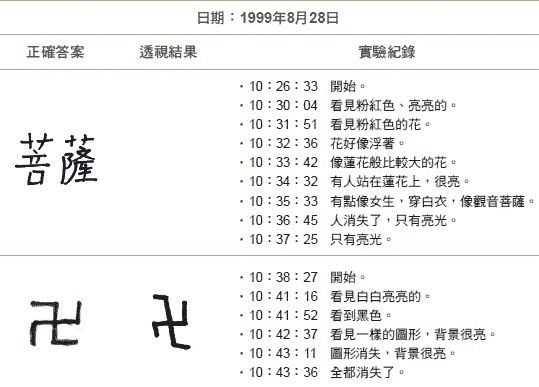 |
|---|
Figure 3-5: Compilation of experiments related to the character “佛”
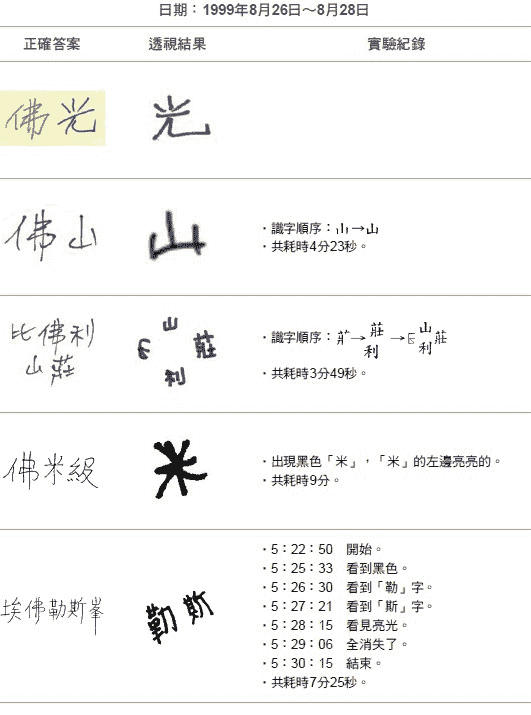 |
|---|
Everyone’s latent “functional version” is different
Between August 26th and 27th during the experiments, besides Miss T, what were the results of the other two children—little girl Wang and little boy Chen—when using finger-reading to look at the character “佛”?
Figure 3-6 on the left shows the experimental results of little girl Wang. Her finger-reading ability had already become so proficient that she could manifest psychokinesis. When testing the character “佛” for the first time on August 26th, a phenomenon also appeared, as shown in the first row of Figure 3-6. She saw a person standing at the main entrance of a temple.
When trying the character “佛” again the next day, the result was that she saw a blurry figure speaking with a Taiwanese accent, telling her to keep it up. She felt as if she had seen his face before. We later concluded that it might have been her deceased maternal grandfather.
Figure 3-7 on page 140 shows the results of little boy Chen’s tests. During the experiment, ordinary characters were used for testing at first, and the resulting answers were sometimes right and sometimes wrong. Except for getting the blue character “步” (step) wrong, all other characters were correct. When little boy Chen looked at the character “佛”, he saw a monk wearing a black jacket walking out, with the character “佛” written on the white shirt underneath. When he saw the character “佛”, he felt as if he had also watched a movie. Therefore, the character “佛” causing phenomena is a universal phenomenon for those who possess the ability of finger-reading.
Figure 3-6: The phenomena seen by little girl Wang when experimenting with the character “佛”
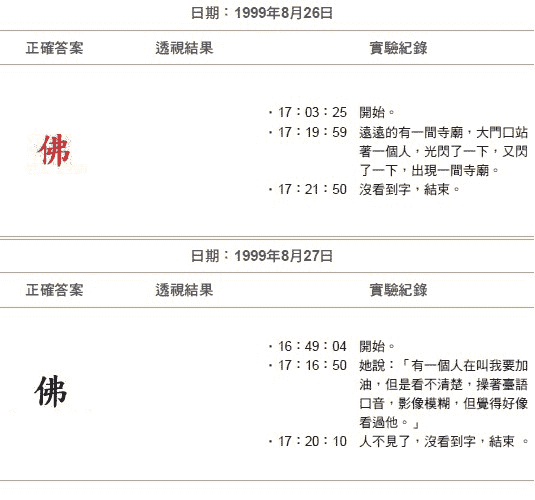 |
|---|
Figure 3-7: The phenomena seen by little boy Chen when experimenting with the character “佛”
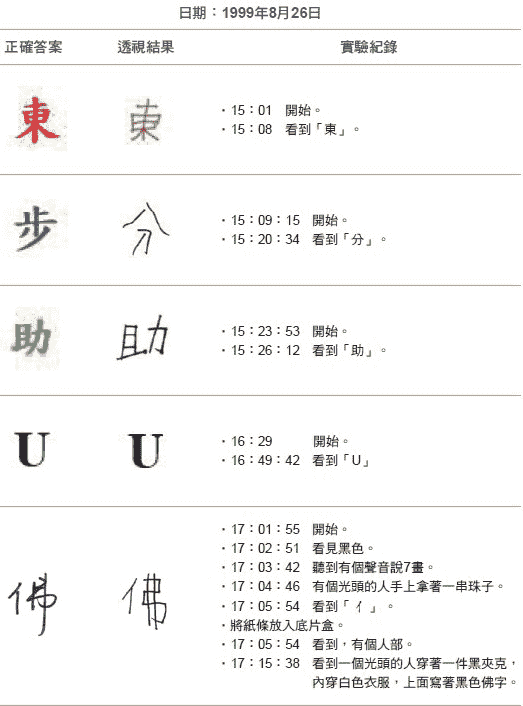 |
|---|
In October 2013, when I went to Kunming to attend the 2nd “Academic Conference on the Perspective of Heaven and Humanity” to report these extraordinary results, colleagues from mainland China still did not quite believe it. They had started researching finger-reading more than a decade earlier than us, so how is it that they had never discovered the information field or the spiritual realm, yet allowed us latecomers to make the discovery?
However, since 2014, Yunnan University in Kunming on the mainland and Yangzhou University in Jiangsu have both observed similar phenomena when training children in finger reading. When they viewed the character “Buddha” (佛), a luminous bodhisattva appeared; when they viewed “Taishang Laojun,” an immortal appeared standing on top of a cloud. This confirmed our findings, and it had taken nearly fifteen years.
Why did different people see different visions when viewing the same character “Buddha”? Later, when Ms. Sun Chulin, a high-functioning individual on the mainland, conducted experiments with the character “Buddha,” I realized that this was like a web browser — it depended on the level of the practitioner’s ability.
Those with high abilities have a very new browser version and can see newer, more in-depth content. For example, Ms. Sun possessed over sixty kinds of inconceivable psychokinetic abilities. When she viewed the character “Buddha,” she would see ten thousand rays of golden light, spinning like a vortex and growing ever brighter; when she viewed “Foshan,” she would see a crystal-clear, translucent glazed mountain, exceedingly beautiful. Miss T, however, when viewing the two characters “Foshan,” could only see the character “mountain” and could not see “Buddha” or the light, indicating that her browser version was older. Therefore, children who had just developed their abilities could not see visions when viewing the character “Buddha”; they had to wait until their abilities had advanced to a certain level before they could see visions such as bright lights and luminous figures.
Discovering the Information Websites and URLs of Deities
To continue identifying which characters were sacred characters, we tried various Buddhist deities, with results as shown in Figure 3-8 on the left. The first row shows the result when testing the characters “Amitabha Buddha”: a bright screen was seen, and sounds were heard but not clearly; the second row shows the result when testing the characters “Medicine Buddha”: not only was a bright screen seen, but the scent of Chinese herbal medicine was also detected; the third row shows the result when the character “Buddha” was deleted, leaving “Medicine Master” — the visions disappeared, and the two characters “Medicine Master” could be seen; the fourth row shows the result when testing the characters “Maitreya Buddha”: a very bright screen was seen.
Obviously, all the Buddhas are sacred characters. Therefore, high-functioning individuals can see very bright screens, hear sounds, and smell scents.
To understand the consequences of reading distorted versions of the character “Buddha,” we damaged the character, as shown in Figure 3-9 on page 144: from deleting a stroke or a line, to changing the radical, separating the character from its components, or adding a stroke to change it into the character “彿” — as a result, all visions disappeared, and the high-functioning individuals could only see the damaged characters.
Figure 3-8: Imagery perceived when using “various Buddhas” for finger reading
 |
|---|
Figure 3-9: Experimental results after the character “Buddha” is damaged
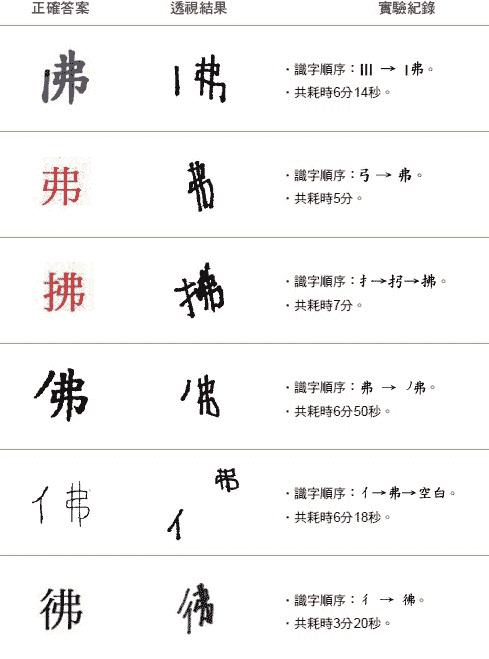 |
|---|
This phenomenon strongly suggests that the character “Buddha” is a URL. The celestial eye can scan this URL and connect to the Buddha’s website to see visions; once the URL is damaged, it becomes an ordinary character, and the celestial eye can no longer connect to the website — it can only see the damaged character. It seems as though beyond this material world there exists an information field, or one might say a spiritual realm, filled with deities and their websites. By using finger reading to identify URLs, we have the opportunity to connect to these websites and browse their pages. After 2014, I began calling this information field or spiritual realm imaginary-number spacetime. It turns out that imaginary-number spacetime is like a networked world, filled with consciousness, deities, and the websites they have created, and the URLs linking to the websites are the sacred names of the deities.
Is It a Brain Hallucination, or an External Information Field?
Of course, some people would question whether the visions seen by children using the celestial eye might simply be brain hallucinations. Out of their reverence for sacred figures, when scanning these characters with the celestial eye, they might — like dreaming — produce various hallucinations to accommodate their feelings of reverence. This possibility had to be ruled out through experimentation, and so the simplest method was to use characters that the children did not recognize.
To Connect to Foreign Deities’ Websites, One Must Use the Original Language
When we conducted experiments on sacred figures of Esoteric Buddhism, we noticed a phenomenon, as shown in Figure 3-10 on the left. Whether it was Nagarjuna Bodhisattva or Padmasambhava — those sages who founded Esoteric Buddhism — or protective deities of Esoteric Buddhism such as the Two-Armed Black-Robed Vajra, in the finger-reading experiments, characters would appear without any visions.
Figure 3-10: Experimental results using Chinese sacred vocabulary of Esoteric Buddhism
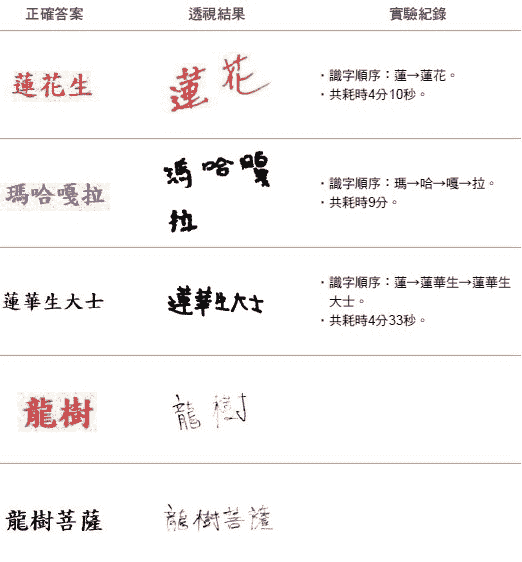 |
|---|
This troubled us for quite some time, as we did not know why the deities of Esoteric Buddhism would not allow Miss T to connect to their websites.
Until one day, I suddenly realized that practitioners of Esoteric Buddhism were all Tibetans; they did not understand Chinese. Therefore, their web addresses must be written in Tibetan rather than in Chinese. So I went to consult a Tibetan language expert and obtained the Tibetan writing. Of course, Miss T did not understand Tibetan. The left figure 3-11 on page 150 and figure 3-12 on page 150 are the results of the experiment. The first row in figure 3-11 is the Tibetan script for Mahakala; the two-armed Black Cloak Vajra is the guardian deity of Esoteric Buddhism. As a result, Miss T did not see written characters, but instead a vision appeared in her mind and she saw a glowing screen. To be certain, I cut off the last three characters, as shown in the second row of figure 3-11. This was not disrespect toward Mahakala, but rather conducting scientific research. As a result, Miss T did not see a vision, but instead traced out the Tibetan characters stroke by stroke. It is obvious that the original Tibetan text was a web address; whether you recognize it or not is unimportant—what matters is that it allows the Heavenly Eye to directly connect to Mahakala’s website. The damaged Tibetan text, however, was no longer a web address, and therefore could be recognized in its entirety. The three rows in figure 3-12 on page 150 are all the Tibetan script for Padmasambhava, which allowed the Heavenly Eye to connect to a website with bright light.
Figure 3-11 Experimental results using the Tibetan script for Mahakala
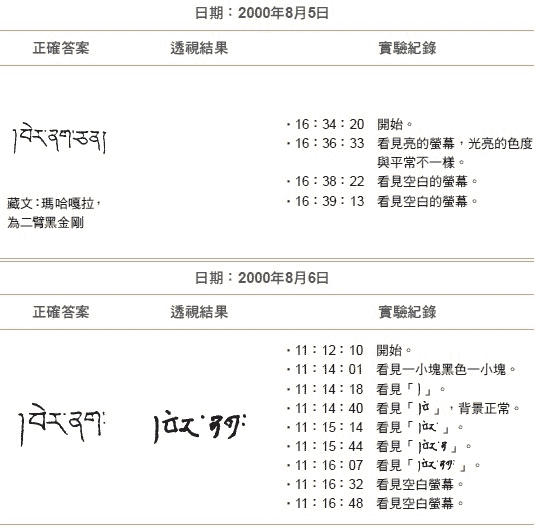 |
|---|
Figure 3-12 Experimental results using the Tibetan script for Padmasambhava
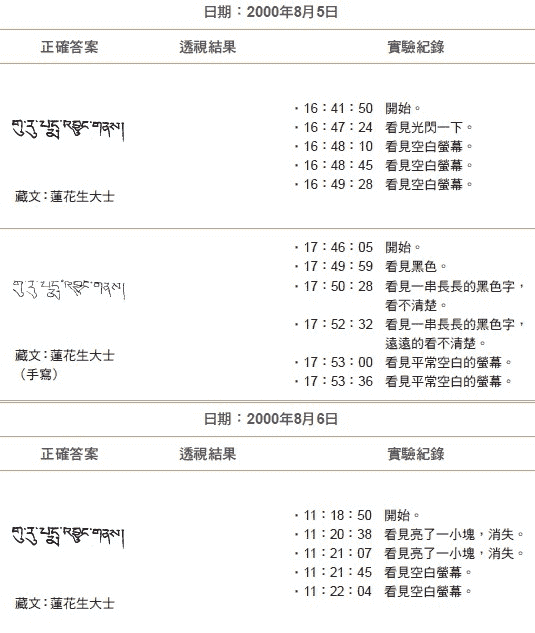 |
|---|
Using the Name of God, Points of Light Appear
Figure 3-13 on page 152 is the test using sacred Hebrew vocabulary by Miss T; of course, Miss T did not recognize Hebrew. This was when Moses encountered God on the mountain and was told to lead the Hebrews out of Egypt. He asked God who He was. God replied in Hebrew: “I am God.”
As shown in the figure, in the experimental results from December 29, 2000, Miss T saw that the brightness of the screen was extremely strong, connecting to the website of the God of the Hebrews. When the experiment was repeated in 2002, the result was a row of small, point-like lights.
From these experiments, it is clearly proven that whether the functional person recognizes the sacred vocabulary or not is unimportant. What matters is that using sacred vocabulary allows the Heavenly Eye to connect to a sacred website. This indicates that visions are not hallucinations of the brain, but rather that another world of networks exists—a website filled with information. This is the spiritual realm; this is imaginary space-time.
Figure 3-13 Experimental results using Hebrew
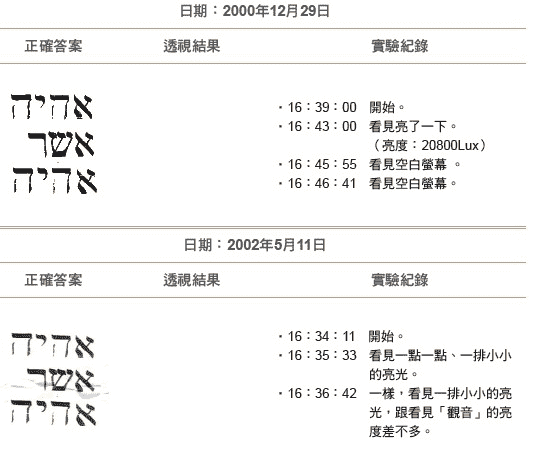 |
|---|
Visiting the Websites of Heaven and the Medicine Buddha
Since deities and spirits all have websites in the spiritual realm, and the content of ordinary websites in the human world is very rich, then the websites of the spiritual realm, being entirely created by the mind, may have even richer content available for consciousness to visit. Therefore, we wanted to take a tour of the websites of deities and spirits. The problem was that all sacred vocabulary could connect to the homepage of a mystical website, but each time we saw the bright light and bright figures of the homepage, seeing them too many times became uninteresting. How could we enter other web pages? I thought we could follow the format already used in the human world: after the homepage’s web address, add a slash, then write the sub-page’s web address.
Seeing a Luminous Cross
On January 13, 2002, we asked Miss T to use finger reading to recognize “Jesus/SAM,” as shown in the first row of figure 3-14 on page 155.
Jesus is the web address of heaven’s homepage. SAM is an abbreviation for Samuel. According to the Websters dictionary, Samuel in Hebrew means “name of God.” Therefore, our purpose in going to heaven was to hope to see God. As a result, she first saw a green cross. The cross was empty and very bright behind it. It looked like a large gate and should be the homepage of heaven.
I asked her to try walking into the gate of the cross. She walked toward the cross. The cross was very large, but she could not enter. I suddenly thought of the story of “Ali Baba and the Forty Thieves,” where one must speak a secret phrase like “Open Sesame!” to get in. Since I was not a Christian, I did not know what the secret phrase was, but Christians say “Amen” after finishing their prayers, which seemed like a secret phrase. So I asked Miss T to say “Amen.” As a result, as soon as she said “Amen,” all the bright light and the cross disappeared. It turned out that “Amen” is a closing phrase, said when communication with God is completed and it is time to end. So I went to consult a Christian about what I should say. He suggested saying “Hallelujah,” praising the Lord!
Therefore, during the experiment on February 28, I added “Hallelujah” after “Jesus/SAM.” As a result, Miss T still could not enter when she arrived at the gate of the cross. I asked her to recite “Hallelujah.” As a result, the cross passed through and went around her body, and her whole body was bathed in radiance. She then came out through the back door. I then wondered whether one had to believe in Christianity for heaven to allow Miss T to enter?
On May 11, we once again used “耶稣” for a character-recognition experiment, again connecting to the bright gate of the cross, as shown in the third row of figure 3-14 on the previous page, but she still could not enter. This question would not be resolved until two years later, on August 7, 2004. It turns out that just as one cannot casually visit someone else’s home, the websites of deities and spirits are just like those in the human world: one must first make an appointment, register, or ask permission, and only when the other party agrees can one enter and visit.
Figure 3-14 Miss T’s attempt to connect to the website of heaven
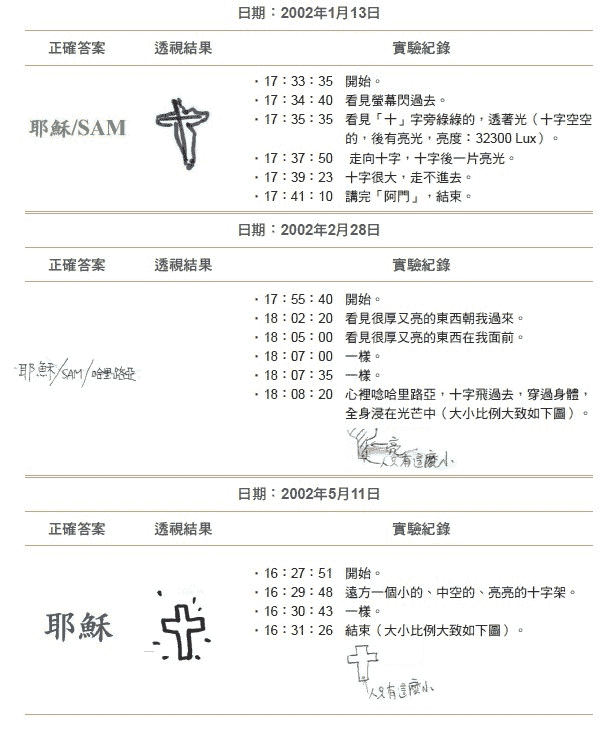 |
|---|
As shown in Figure 3-15 below, we wrote “Jesus” on a slip of paper, added a diagonal line, and asked the question “Can one enter heaven?” As a result, the bright guardian figure allowed Miss T to enter heaven through her celestial eye. She saw a glowing path, with a group of luminous people behind it, appearing very serene and peaceful—they were probably all angels.
From this we learned the rules for visiting deity websites, and from then on we could roam the websites of the various gods.
Figure 3-15: The content of Miss T’s first visit to the heaven website
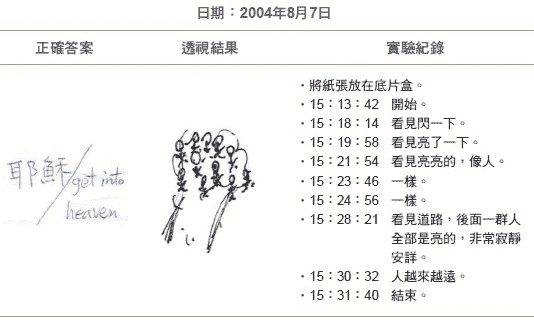 |
|---|
Visiting the Medicine Buddha’s Herb Garden
On September 29, 2002, we attempted to visit the Medicine Buddha’s website.
Miss T’s celestial eye immediately connected to the Medicine Buddha’s homepage, as shown in image 1 at the top of Figure 3-16 on the next page: there were five bright circles in a row, with rows extending downward one after another. The brightness of the circles in the middle was weaker, perhaps because the light from the center illuminated the outside. She then silently thought, “May I go in and look?” At that moment, a tall, bright figure appeared (about five to six times the size of an ordinary person) and asked, “Which one do you want to see?” I guessed that this tall, bright figure was the Medicine Buddha. Miss T answered, “The eighth one.” With one gesture from the Medicine Buddha, Miss T saw a botanical garden, shimmering with golden light, composed of the plants shown in image 2 in the middle of Figure 3-16. Next, Miss T asked again, “May I see another one (herb garden)? The sixth one.” The Medicine Buddha said, “The last one; you cannot see any more,” and with one gesture she saw another botanical garden, as shown in image 3 at the bottom of Figure 3-16. Vine-like plants hung down from above, soft, semi-transparent, drifting back and forth, with glowing tips—looking at them felt extremely beautiful. Miss T then asked, “May I go in and see those beautiful scenes without touching the paper slip?” The Medicine Buddha replied, “Yes, but I may not necessarily be there.” He was too polite—when guests came, he wanted to receive them personally. Actually, we hoped he would not need to receive us personally; having a disciple guide us would be sufficient. Miss T then asked the Medicine Buddha, “Could you tell me the names of the sixth and eighth herb gardens?” The Medicine Buddha replied, “Even if I told you, you would not know; I will not say.” He probably felt that our level was too low and that we were unfamiliar with spiritual realm affairs, and so did not want to tell us.
Figure 3-16: First visit to the Medicine Buddha’s herb garden
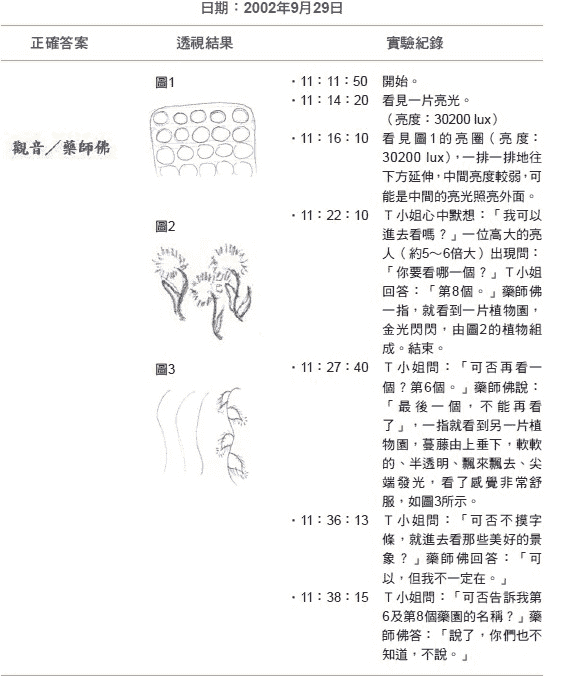 |
|---|
On March 30, 2003, we went again to visit the Medicine Buddha’s first herb garden. The experimental results are shown in Figure 3-17 on the next page.
On the screen of the mind’s celestial eye, only a mass of light was seen rushing toward Miss T—individual bright lights arranged in rows of five.
Miss T requested to see the first and third herb gardens, but the result was only a brief flash of light; nothing was seen.
Miss T requested to look again, and as a result, from the first bright light there appeared a field of all-green plants, as drawn in image 2 at the bottom of Figure 3-17. A large patch of very green plants was growing—ferns with two circles, one on the left and one on the right. The circles were larger on the right and smaller on the left, neatly arranged row after row.
On October 28, 2003, we again visited one of the Medicine Buddha’s herb gardens, as shown in the second row of Figure 3-17. Miss T first saw a field of bright light. After entering the herb garden, she saw dots of bright light arranged row after row, like ferns, but with only one circle. Below the circle was a bright point, and then she saw another field of bright light.
Figure 3-17: Visiting different herb gardens of the Medicine Buddha
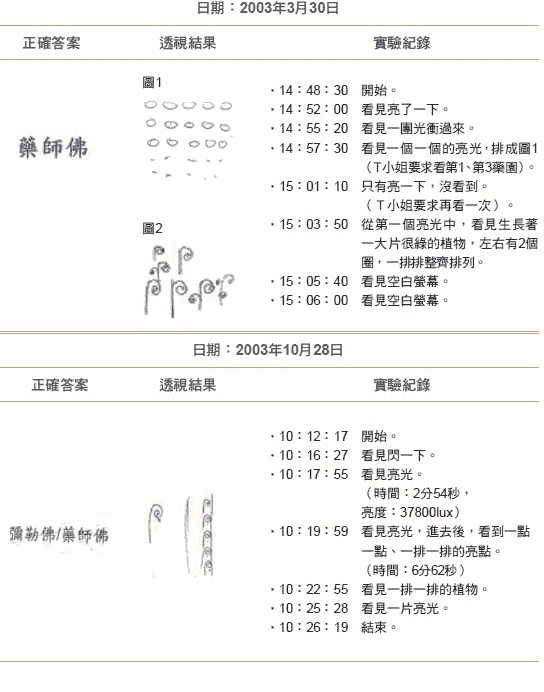 |
|---|
On March 28, 2003, Miss T went again to the Medicine Buddha’s website. This time she visited the medicine shop, as shown in Figure 3-18 on the next page.
Miss T first saw bright light before entering the website. She then asked the Medicine Buddha, “May I see the sixth or seventh row of herb gardens?” The Medicine Buddha replied, “Alright!”
Miss T asked again, “May I gather herbs?” The Medicine Buddha replied, “Not yet.”
Miss T asked again, “May I see the medicine shop?” The Medicine Buddha replied, “Of course!”
The Medicine Buddha then led his disciples and Miss T into the medicine shop. Inside, everything was shimmering with golden light—medicine cabinets and medicine bottles, all filled with information medicines.
Miss T asked, “May I take some medicine?” The Medicine Buddha replied, “You do not need it right now.”
Miss T said, “Professor Chen is sick and needs medicine.” The Medicine Buddha replied, “Try taking this one!”
Miss T said, “But I cannot take it down.”
Then suddenly, every one of us present smelled the scent of Chinese herbal medicine permeating the laboratory. This should have been the Chinese herbal medicine information from the Medicine Buddha’s website, transmitted through Miss T’s celestial eye and dispersed outward.
Miss T tried once more and said helplessly, “It’s too far; I cannot reach it.” We thought, “Perhaps the time has not yet come.”
Figure 3-18: Visiting the medicine shop on the Medicine Buddha’s website
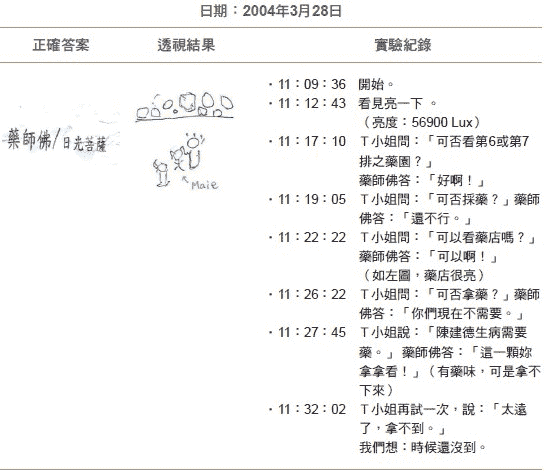 |
|---|
On August 8, 2004, when Miss T went to visit the Medicine Buddha’s website, she encountered other spiritual entities, as shown in Figure 3-19 below. First, she saw the screen of her celestial eye flash brightly, then she saw a cluster of bright plants and a person who was not emitting light—very thin, wearing a bamboo hat, gathering plants. Miss T asked him, “Where do you live?” He did not answer.
Miss T asked again: “Why did you come to gather medicine?” That person then rubbed their stomach, indicating stomach discomfort. Then the screen flashed, and Miss T was driven out of the medicine garden and could no longer enter. She tried again but still could not enter, and the experiment ended. Obviously that spirit did not like her asking questions about this and that, and drove her out of the medicine garden.
Figure 3-19 While visiting the Medicine Buddha’s medicine garden, encountering other spirits
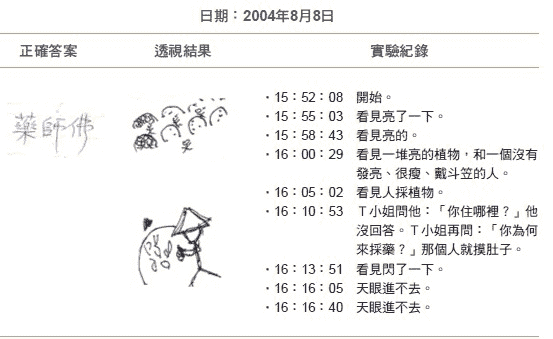 |
|---|
Heavenly Gardens, Named with Holy Names from the Bible
When we conducted experiments on Miss T touring divine websites, we used double-blind experiments. The host of each experiment would prepare ten samples, representing visits to different divine websites; during the formal experiment, a third party would randomly draw one sample, so no one knew which divine website was being visited — neither Miss T, the host, nor the person selecting the sample knew. During the experiment, only the scenes Miss T saw were recorded, and after the experiment was completed, the sample was not opened immediately but set aside. Only after all ten samples were completely finished were the samples opened one by one.
Accidentally Entering the Heavenly Website
What is shown on page 166, Figure 3-20, was a very special experience on December 24, 2004.
First, Miss T saw the screen light up briefly, then saw a cluster of human shadow, like a gatekeeper. And it seemed she heard a sound, but not very clearly. Then, she heard a voice asking: “Which one?” in English. Upon seeing this, I immediately guessed that we had connected to the Medicine Buddha website, because it seemed that only the Medicine Buddha website had many medicine gardens, requiring the question: “Which one?” Miss T answered: “First!”, indicating the first medicine garden. Then, she saw a person shake their head, indicating it was not allowed, so Miss T answered: “Any one!” Then, she heard that person say angrily: “No, you have to pick one,” meaning she could not be casual and must choose one. I suggested from the side to choose the tenth medicine garden, but unexpectedly that person replied: “No, it’s wrong! You have to give a name.” I thought to myself, last time we asked for a name, you wouldn’t tell us either, so how could we give a name? How strange.
So Miss T answered that she didn’t know, and to just show her any one. As a result, the heavenly eye flashed, and she heard a voice say: “OK, maybe just a little bit.” As a result, Miss T saw a bright stream of water, with white misty banks. Miss T asked: “That’s it?” That person answered: “A lot more, Today, That’s it!”
When I opened the sample and looked, I was greatly surprised — this was not the Medicine Buddha website, but the Heavenly website. It turns out that Heaven names its gardens with names, unlike the Medicine Buddha website which names its gardens with numbers. Although I am not a Christian, I at least know that there is a garden in Heaven, and that is the Garden of Edan.
Figure 3-20 Miss T discovered it was Heaven only after visiting a certain divine website
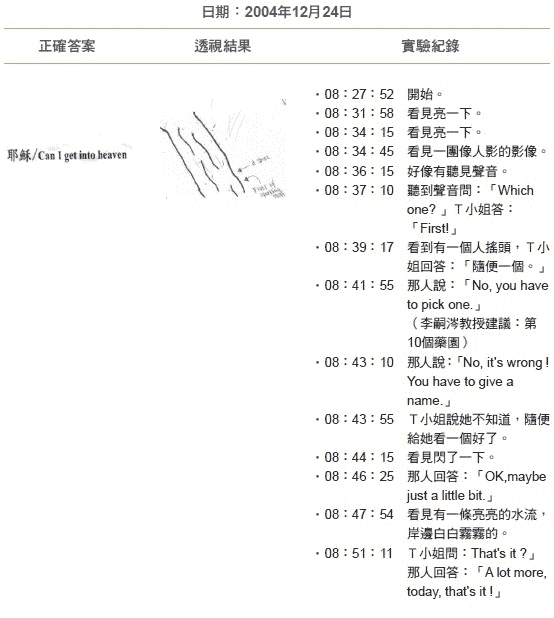 |
|---|
Revisiting the Garden of Eden
However, the experience of going to the Garden of Eden again had to wait ten years to be realized, because I became president of National Taiwan University in 2005, and to avoid controversy, I had to wait until June 2013, after I stepped down as president of NTU, before resuming the finger-reading experiments.
On March 6, 2014, Miss T attempted to visit the Garden of Eden. The sample I used was written “Jesus / Can I get into Garden of Edan.” This time it went very smoothly with no one blocking the way; she entered the Garden of Eden in one try, as shown in Figure 3-21 below. Miss T saw a landscape — the lower half was entirely very bright, with extremely beautiful blue-green blended colors; the upper half was pale golden. The entire scene was extraordinarily beautiful, and then there was no more image and it ended.
Figure 3-21 Miss T visiting Heaven’s Garden of Eden
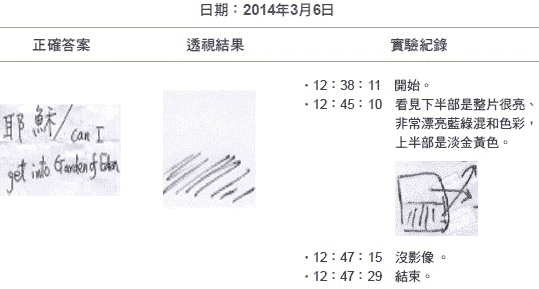 |
|---|
So the Garden of Eden is still in Heaven. I hope that in the future we can also visit the gardens of other prophets or angels. We are not Christians, but as long as we ask politely and courteously and receive permission, the gatekeepers of Heaven will let us enter to visit Heaven, unlike earthly Christianity which sometimes is hostile toward non-believers. This should not have been Jesus’s original attitude.
One very interesting thing discovered in the experiments is that using the Chinese word “Jesus” (耶稣) always connects to Heaven, indicating that it is a sacred vocabulary word. I suspect this is because the pronunciation of “Jesus” in Chinese is close to the original pronunciation. The mother tongue Jesus used was Aramaic. Aramaic is still used in some areas of southern Syria today, and the Aramaic pronunciation of “Jesus” (Yeshua) is quite close to the Chinese.
Visiting the Websites of the Buddhas of the Western Pure Land
Entering the Buddha’s Realm
On December 24, 2004, we asked Miss T to attempt, through a finger-reading experiment, to visit Amitabha Buddha’s Western Pure Land of Ultimate Bliss, so we first made an appointment, as shown in the first row of Figure 3-22 on the next page.
The sample we used was “Amitabha Buddha / Make an appointment to enter the Buddha’s realm.” Amitabha Buddha’s reply was: “Tomorrow.” The next day, December 25, we entered the Buddha’s realm as agreed, as shown in the second row of Figure 3-22. The sample we used was “Amitabha Buddha / Enter the Buddha’s realm as agreed,” so that we would not abruptly barge in and cause Amitabha Buddha to be displeased. As a result, Miss T’s celestial eye flashed once starting from 9:03, and from 9:06 it kept flashing and flashing continuously, indicating great instability and an inability to enter the Buddha’s realm. It was not until 9:08 that she successfully entered the Buddha’s realm.
Figure 3-22 Miss T visits Amitabha Buddha’s website
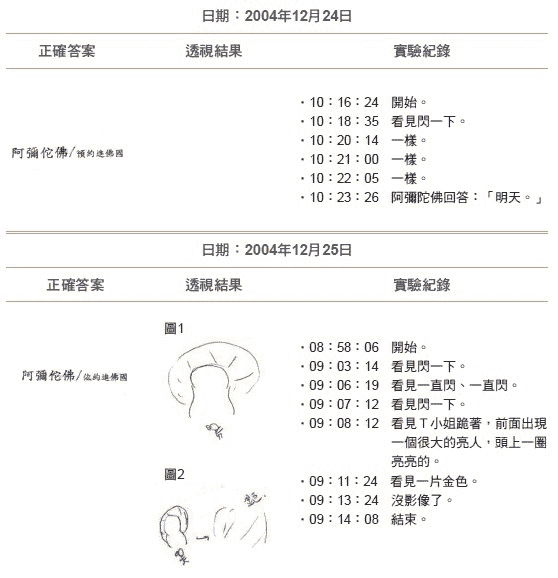 |
|---|
In her celestial eye, Miss T saw herself kneeling, with a very large bright person seated in front of her (a bright circle hung behind the person’s head), just like the Amitabha Buddha portraits we often see. Miss T was not even as tall as the bright person’s toe. Then, the tall, bright person stood up and led tiny her into the Buddha’s realm, after which the Buddha’s realm transformed into a world of gold, and the entire process came to an end.
It turns out that the Western Pure Land of Ultimate Bliss is a golden world, with Amitabha Buddha presiding within it.
Wanting to Visit Maitreya Buddha’s Website
On August 6, 2004, we asked Miss T to attempt, through a finger-reading experiment, to visit Maitreya Buddha’s website, so we first made an appointment, as shown in the first row of Figure 3-23 on the next page. The sample we used was “Maitreya Buddha / Make an appointment to enter the Buddha’s realm.” Maitreya Buddha’s reply was: “Maybe,” as if not particularly welcoming toward us.
However, that same afternoon we tried again to connect to Maitreya Buddha’s website, but because it was a double-blind experiment, we did not know that we were connecting to Maitreya Buddha’s website.
The experiment began at 2:10 p.m., but for seven minutes the celestial eye screen merely flashed once, flashed once, or lit up briefly. At 2:19 p.m., a very large and bright circle was seen, followed by several luminous circles, six arranged in a ring. I thought we had connected to the Medicine Buddha’s website, which was why there were several small bright circles. Four minutes later, Miss T saw all the bright circles rotate once clockwise before they all disappeared. So we discussed how what we saw this time at the Medicine Buddha’s website was different from before.
Figure 3-23 Miss T visits Maitreya Buddha’s website
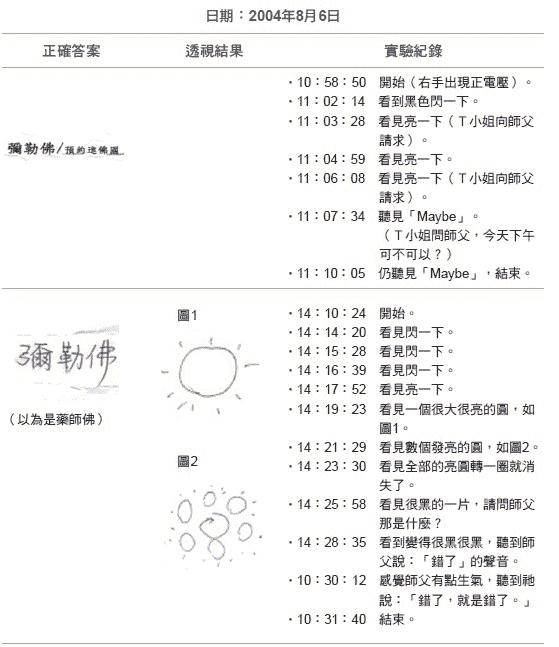 |
|---|
At 2:25 p.m., on the celestial eye screen, Miss T saw a patch of blackness. Miss T asked her master in the heavens: “What is that?” Then the celestial eye screen became very, very dark, and she heard her master’s voice saying “Wrong,” sounding somewhat angry. Finally she heard her master say: “Wrong is just wrong,” and it ended.
When we opened the sample to take a look, it turned out to be Maitreya Buddha, not Medicine Buddha. No wonder when we were discussing the Medicine Buddha, our master angrily said: “Wrong.”
Visiting Avalokiteśvara Bodhisattva’s Website
On December 24, 2004, we wanted to visit Avalokiteśvara Bodhisattva’s website, so we went to make an appointment. The sample Miss T used was “Guanyin / Make an appointment to enter Guanyin’s website,” as shown in the first row of Figure 3-24 on page 175.
The experiment began at 9:40 a.m., and eight minutes later, her celestial eye lit up briefly. At 9:53, she saw a white, thin, and tall person standing on top of something, saying: “A little later.” Then the figure drifted away, and added: “A little later today.” And that was the end.
Clearly, the one who came was Avalokiteśvara Bodhisattva standing on top of something (I guessed it should be a lotus), but she was too busy today, so she first went to respond to cries and relieve suffering. Our experiment was not so urgent; it would be fine to come a little later today.
The next day, December 25, we used the sample “Guanyin / Enter Guanyin’s website as agreed” as scheduled, to let Miss T enter Guanyin’s website for a visit, as shown in the second row of Figure 3-24 on the left.
The experiment began at 9:17 a.m. At the twenty-first minute, her celestial eye lit up briefly. At the twenty-third minute, Miss T saw through her celestial eye that she was following the thin, tall person dressed in white through a place densely covered with lotuses, walking to the shore of a pond filled with lotuses. Then Guanyin floated onto a lotus and sat in meditation, similar to the Guanyin-seated-on-a-lotus images we commonly see. The experiment ended at 9:26. So in Guanyin’s realm, whether on land or on water, lotuses densely cover everything; it is a world of lotuses.
Figure 3-24 Miss T visits Avalokiteśvara Bodhisattva’s website
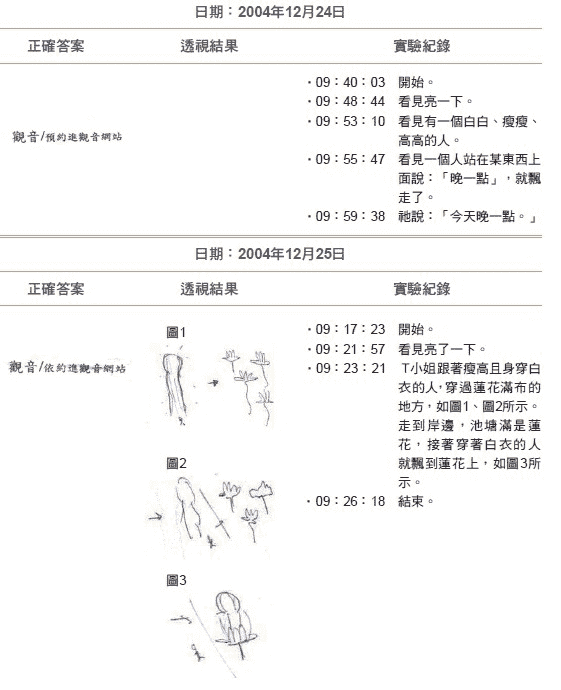 |
|---|
Visiting Mañjuśrī Bodhisattva’s Website
On December 25, 2004, we also made an appointment and entered Mañjuśrī Bodhisattva’s website, as shown in Figure 3-25 on the left.
The experiment began at 9:45 a.m. Four minutes later, Miss T’s Heavenly Eye flashed once. After another two minutes, the Heavenly Eye lit up again, and she saw something bright, but it ran away. At 9:54 a.m., there was a faintly glowing object on the wall, densely packed inside, arranged very neatly. At 9:57 a.m., Miss T saw a finger pointing at the writing on the wall, which should have been the finger of Manjushri Bodhisattva. Then, a string of beads emerged, and within each bead there was a cluster of written characters. At 10:02 a.m., all the scenes disappeared, and the experiment ended.
Therefore, the walls of Manjushri Bodhisattva’s website are covered with densely packed Buddhist scriptures. Manjushri represents wisdom, and Buddhist scriptures are all recorded on the website, so a person of high functional ability would have the opportunity to download these original Buddhist scriptures to the human world.
Figure 3-25 Miss T observes Manjushri Bodhisattva’s website
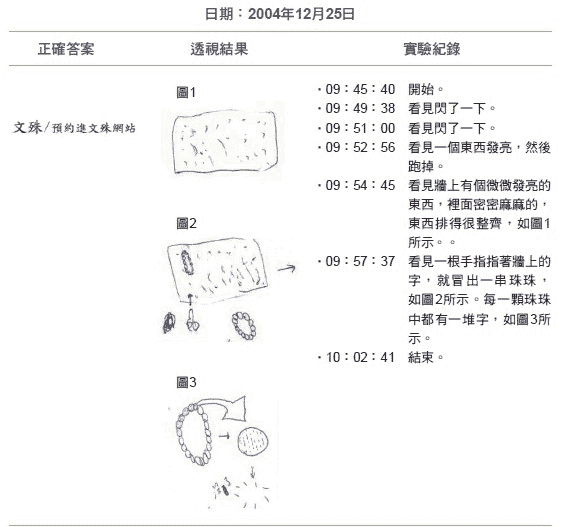 |
|---|
Encountering Sages — Entering the Websites of Laozi and Confucius
When we conducted the finger-reading experiment on August 5, 2000, and tested Miss T with the word “Laozi” for the first time, she first saw a dark human figure in her Heavenly Eye, with a normal background. Then the figure disappeared, and the two characters “Laozi” appeared. After that, it worked every time without fail — whenever she encountered the two characters “Laozi,” a dark human figure would always appear first, followed by the two characters “Laozi,” as shown in the first and fourth rows of Figure 3-26 on the left. Since seeing such visions indicates that the characters “Laozi” are sacred vocabulary, we can use finger-reading to connect to his website in the information field.
In fact, it is not surprising that Laozi has a website in the information field. From the content of Chapter 25 of the Dao De Jing, we can see this: “There was something formed from chaos, born before Heaven and Earth. Silent and empty, standing alone and unchanging, revolving ceaselessly, it can be called the mother of the world. I do not know its name; I call it the Dao…” Laozi knew that before Heaven and Earth appeared, there existed a kind of amalgam, extremely still and unchanging, ceaselessly in motion, the source from which all things in the world were generated. He did not know the name of this amalgam, so he called it “Dao.” This “Dao” is very much like the “God” worshipped in Western religions — the mother of all things in the universe. I conjecture that this is precisely the “imaginary-number spacetime” that we have discovered.
Figure 3-26 Experiments with the characters “Laozi” and “Confucius”
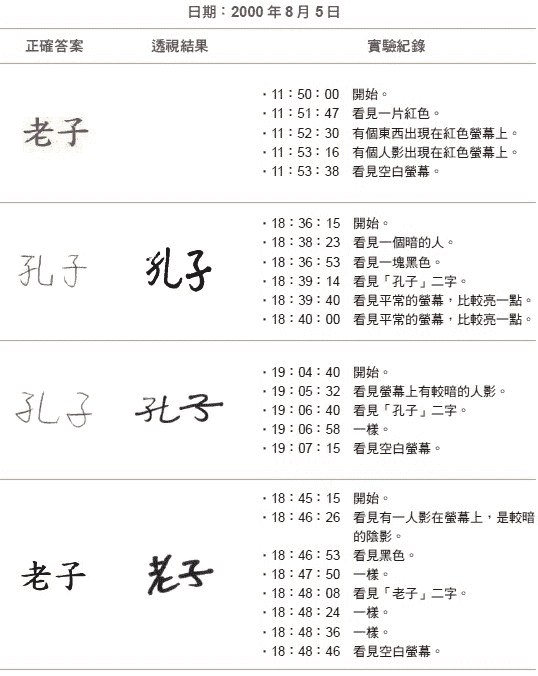 |
|---|
Laozi obviously practiced cultivation. From the realm described in the Dao De Jing — “Attain the ultimate emptiness, hold fast to the truest stillness…” — we can see that Laozi deeply grasped the essence of cultivation practice. Therefore, it is a natural result that he cultivated to an advanced stage and was able to connect to imaginary-number spacetime, and it should come as no surprise that he was able to create a website in imaginary-number spacetime.
It is just that the image he presents in Miss T’s Heavenly Eye is a dark human figure, unlike the characters “Buddha,” “Bodhisattva,” “Ji Gong,” or “Jesus,” which elicit bright light, a luminous human figure, or a bright cross of light — as if his realm were somewhat lesser, closer to the human realm, and not belonging to the domain of gods and buddhas.
If we compare a person’s level of cultivation to the stages from kindergarten, elementary school, all the way to a master’s or doctoral degree, I conjecture that Laozi’s level of cultivation may have reached the high school or university stage, still some distance away from the master’s or doctoral level of gods and buddhas. Therefore, only a dark human figure appears, rather than a luminous one.
Thoughtography: Photographing the Images in the Heavenly Eye
Professor Shen Jinchuan of the Institute of Human Body Science at China University of Geosciences in Beijing and the functional person Ms. Sun Chulin collaborated for a period of time on “thoughtography” experiments.
They placed rectangular Polaroid film in a camera, but instead of using the camera lens, they blocked the outward-facing exposure side with a steel plate. During the experiment, Ms. Sun placed her palm on the steel plate and projected the image from her mind’s Heavenly Eye directly onto the topmost sheet of Polaroid film in the camera. Upon success, the film was pulled out of the camera, and after waiting one minute for development, the protective sleeve was peeled off the film, and the image appeared on the film.
Over five years, they successfully took hundreds of thoughtography photographs, some of which were photographs of Laozi.
According to Ms. Sun, after she called out the two characters “Laozi” in her mind, some images flew into her Heavenly Eye. She could not see them very clearly, but could vaguely make out an elderly man with a beard and sparse hair, either standing or sitting, either practicing martial arts or meditating, in various postures. She selected a meditating posture and projected it onto the Polaroid film. Professor Shen gave me a copy of these thoughtography photographs, as shown in Figure 3-27 on the next page. When I saw it, I was greatly excited — in the photograph, against a field of yellow radiance, the silhouette of an elderly man meditating was set off. Was this not the “dark human figure” that Miss T had seen through the two characters “Laozi”?
Ms. Sun, through intention, and Miss T, through finger-reading, both connected, via the keyword “Laozi,” to Laozi’s website in the information field and saw the content of its homepage. How fortunate we are — without having developed any functional abilities ourselves — to be able, within our lifetimes, to see the homepage of Laozi’s website in the information field through thoughtography experiments.
Figure 3-27 Thoughtography image of Laozi meditating
 |
|---|
| Through “thoughtography,” an image of Laozi was captured. An elderly man can be faintly seen meditating. |
The Apparition of Confucius
Laozi himself practiced cultivation and also established a website in imaginary-number space-time. What about Confucius?
In Chapter 21 of the “Yong Ye” chapter of the Analects, the Master said: “To attend to the duties proper to the people, to respect the spirits and gods while keeping them at a distance—this may be called wisdom.” In Chapter 20 of the “Shu Er” chapter of the Analects, the Master said: “The Master did not speak of: strange powers, disorderly spirits.” Most people believe that Confucius did not believe in spirits and gods. Therefore, when in August 2000 we conducted a finger-reading experiment and tested Miss T with the word “Confucius” for the first time, she unexpectedly saw a vision, which greatly astonished us.
In her heavenly eye, she first saw a dark human figure, then the figure disappeared, and then the two characters “Confucius” appeared. Unexpectedly, the process of the vision’s appearance was entirely identical to the results of the experiment with the two characters “Laozi.” After that, it worked every time without fail—whenever the two characters “Confucius” were encountered, a dark human figure would first appear, followed by the two characters “Confucius.”
It turns out that Confucius had also established a website in the information field, and his status in the information field appears to be exactly the same as Laozi’s.
We then tested “Mencius” and “Zhuangzi,” and the results produced no visions at all; both vocabulary words were written out directly, which indicates that the Second Sage did not measure up. It seems that only the founder of a major school of thought possesses sufficient power to establish a website in the information field. What exactly is going on here? Did Confucius himself also cultivate to the supreme realm and thereby establish a website? Or was it caused by what the psychologist Jung called the “collective unconscious”—that is, the Chinese people’s collective faith and worship of Confucius shaped a website in the information field?
Did Confucius Really Not Believe in Spirits and Gods?
Did Confucius really not believe in spirits and gods? In Chapter 33 of the “Shu Er” chapter of the Analects, it is mentioned that once when Confucius was ill, Zilu wanted to pray for him. Confucius asked in return: “Did you really do so?” Zilu said: “I prayed to the spirits and gods above and below, in all directions.” Confucius then said: “Then I have been praying for a long time already.” Evidently, in Confucius’s time, illness required working at the level of higher mind-nature and information, and adjusting the adverse condition back to proper order could cure the illness. They apparently believed in the existence of a metaphysical world.
Confucius, in composing the Commentary on the Appended Phrases, wrote: “What is above form is called the Way; what is below form is called the implement.” The human body, implements, animals, and plants belong to the implement realm below form, and above the implements there is also a metaphysical world (the Way).
According to Professor Song Guangyu of Fo Guang University’s new book An Interpretation of the Heart of the Analects, there is a further elaboration. For example, studying the Analects always begins with the “Xue Er” chapter, but what is one supposed to learn? Is it to study the Book of Odes and the Book of History, which were the only texts available at the time, or is it to study “the affairs of the sage”? According to the traditional Confucian ideal of “inner sagehood and outward kingship,” one should be studying the affairs of the sage. Inner sagehood means that one’s mind should possess the acute and clear perception of the ancient sage-kings; outward kingship means using this perceptual ability to discern the operating principles of the external universe—that is, using the “Way” to govern the state. In modern scientific language, the Confucian method of learning is to communicate with the information field and then draw upon the wisdom of heaven and earth to govern the state.
So what about “respect the spirits and gods while keeping them at a distance” and “the Master did not speak of strange powers, disorderly spirits”?
The arrangement of the various chapters and sections in the Analects follows a logical relationship between what precedes and follows; a single statement sometimes resonates with its context above and below. Confucius said: “To attend to the duties proper to the people, to respect the spirits and gods while keeping them at a distance—this may be called wisdom.” This refers to doing well what ought to be done, respecting the spirits and gods while not relying entirely on them, and maintaining one’s own space for reflection—this is “wisdom.” The entire statement does not deny the existence of spirits and gods at all; it merely says one should not rely completely on them. Furthermore, “The Master did not speak of strange powers, disorderly spirits” echoes the passage above: “I am not one who was born knowing things; I am one who loves the past and is diligent in seeking knowledge.” Confucius described his own trait: “I was not born understanding so many things; rather, in a state of mental stability and clarity, I acutely perceived various matters and phenomena, and thereby came to know so much.” Confucius meant that when appealing to a settled mind-nature and engaging in prolonged, acute observation, one must be especially careful not to make reckless claims about “strange powers, disorderly spirits.” It was in the context of echoing the passage above that one should refrain from speaking recklessly about strange powers and disorderly spirits; this did not deny the existence of spirits and gods.
It turns out that what Confucius taught us was not only the kingly way of the human world, but also the learning of the unity of heaven and humanity, the learning of communicating with the information field. Moreover, he seemed able to extract information from the information field, so naturally his possession of a website in the information field follows as a matter of course.
Revelations of Folk Deities
Do Divine Spirits Arise from the Collective Unconscious, or Do They Truly Exist?
Temples are found everywhere in Taiwan, ranging from large-scale Buddhist monasteries and Daoist temples to small roadside shrines, enshrining all manner of local deities and receiving the long-term worship of hundreds and thousands of devotees. Do they truly have websites established in the information field? Can we connect to their websites’ homepages by identifying keywords through finger reading? Do their websites have passwords or firewalls? Through Miss T’s finger-reading experiments, we obtained some preliminary results.
The sacred vocabulary words from which visions can be seen in the heavenly eye are as follows:
Guandi (the God of War): First there is a solemn feeling, and then the characters appear.
Yuhuang Dadi (the Jade Emperor): A slightly bright screen appears.
Wenchang Dijun, who presides over the registers of human officialdom and scholarly degrees: Dark and white patterns appear on the screen.
Mazu: A somewhat bright person is seen.
Jigong (the Mad Monk): A bright person or a bright screen is seen, with a degree of brightness only slightly lower than that of a Buddha or Bodhisattva.
Bodhidharma, the First Patriarch of the Chan School: A somewhat bright screen is seen, different from anything seen before.
Among these vocabulary terms, “Guan Gong” was a great general of the state of Shu during the Three Kingdoms period. He himself had no record of having achieved the Dao through cultivation. Later, during a war with the state of Wu, he was captured by Lü Meng and died unyielding. He was later conferred the title “Holy Lord Emperor Guan” by subsequent emperors, and temples were built for him to receive popular worship and veneration, lasting for over a thousand years to the present. His website in the information field does not seem to have been constructed by his own spiritual power, but rather appears to have been shaped by the collective consciousness of the Chinese nation.
“Lord Wenchang” was originally Lord Zitong, surnamed Zhang, named Yazi, who resided at Mount Qiqu in Sichuan. He served the Jin dynasty and died in battle; people built a temple for him. During the Tang and Song dynasties, he was repeatedly conferred the title Prince Yingxian. Daoists say that Zitong presided over the affairs of the Wenchang Bureau and the registers of human officialdom, hence the Yuan dynasty additionally conferred upon him the title Lord Emperor. All of this arose from Daoist embellishment. However, in history, Lord Wenchang was deeply revered by scholars, and to this day he remains favored by many examination candidates. Whenever the joint examination season arrives, many candidates still flock to Lord Wenchang’s temples to worship and pray for success in their exams. It appears that the website of “Lord Wenchang” was likewise shaped by the collective consciousness of the nation.
From this we may infer that if some deity spirits, like Buddhas and Bodhisattvas, possess vast supernatural powers and have the ability to establish their own websites, combined with large-scale worship from the human realm, a snowball effect may form, creating super websites.
We also noticed that Miss T was unable to connect to the websites of many Daoist immortals or perfected beings, such as the Eight Immortals, Zhang Sanfeng, Sima Chengzhen [1], and others, which puzzled us for a long time. Gradually, I came to feel there are two reasons:
First, maintaining a website is extremely labor-intensive, requiring people to modify layouts, answer questions, and update information. However, typical Daoist practitioners are all wandering immortals, attending only to their own cultivation and living apart from society. They rarely have large numbers of disciples, making it difficult to build a website and even more difficult to maintain one. Therefore, they may simply have no website at all.
Second, upon consulting a genuine contemporary Daoist priest, Mr. W, I learned that it might be because we do not know the passwords to the websites. Daoism holds that heaven and earth are in reality interwoven with yin and yang, preserved eternally through subtle balance. This is not something ordinary people should know, for otherwise it would easily disturb the balance of heaven and earth, potentially causing great disasters. Therefore, they do not build websites, lest they casually allow those who have opened their heavenly eye yet lack virtue to know too many of heaven and earth’s secrets.
Communicating with Heaven Requires Sincerity and an Upright Mind
We also discovered that the writing of a deity’s name must be neat and proper, and must not be written carelessly. For example, once a researcher participating in the finger-reading experiments wrote the term “Mazu,” but with a large “Ma” and small “zu” — the character “Ma” was six times larger than the character “zu.” As a result, the luminous figure Miss T saw looked different from the normal “Mazu.”
It turns out that the shape of sacred vocabulary also plays an important role in connecting to the web. Different character forms evidently reorganize the content of the web page during connection, or distort the transmitted information.
Fortunately, Mazu is a sea goddess, a Bodhisattva who rescues from suffering and calamity, and perhaps does not mind much that her web address was deliberately distorted. If it had been an evil demon, the consequences might have been bad. When communicating with Heaven, one must be sincere and upright in mind, and write sacred vocabulary properly and respectfully to ensure safety.
Editor’s Note 1: Sima Chengzhen — the twelfth lineage holder of the Maoshan branch of the Supreme Clarity school of Daoism.
Ten Years Later, Revisiting the Websites of the Buddhas
Through our finger-reading experiments, we discovered that imaginary space-time is filled with the websites of deity spirits. As long as one finds the correct web address, one can connect to the website’s home page. However, to enter the website and view other pages, one must first make an appointment. With the webmaster’s consent, one may visit at the agreed-upon time. When the webmaster is available, they will even receive visitors in person, and sometimes one encounters other spirits who have also come to visit.
Our experiments of using finger-reading with Miss T to journey through the websites of the various deities came to a halt in 2004, because in June 2005 I assumed the position of President of National Taiwan University, and to avoid causing public controversy, I stopped the experiments. It was not until June 2013, after I had stepped down as President of National Taiwan University, that I gradually began to resume related experiments. However, it was not until February 2016, after a full twelve years had passed, that I resumed the experiments of visiting the websites of the various deities.
After more than a decade, Miss T had already graduated from the School of Veterinary Medicine at Purdue University in the United States and was a formally licensed veterinarian practicing in California, able to communicate directly with animals. Her spiritual abilities had advanced significantly compared to ten years earlier, and the scenes she saw and her relationships with the various Buddhas were no longer the same as before. Let us use the visits to the websites of “Medicine Buddha,” “Amitabha,” and “Guanyin” as illustrations, as shown in Figure 3-28 on the next page.
The experiment began at 3:27 PM on February 22, 2016, as shown in the first row of Figure 3-28 on the next page.
Miss T’s heavenly eye flashed once each at two minutes and eight minutes, followed by a very deep field of brightness, but with nothing in it. This continued for two minutes. At 3:37 PM, she still could not see anything. At that point, Miss T heard Medicine Buddha speak in Chinese: “Let you feel.” Six minutes later, she felt the left side of her head go numb and become uncomfortable, and we decided to stop the experiment. Medicine Buddha wanted Miss T to experience it through feeling, rather than letting her view the medicine garden.
The next day, February 23, we visited Amitabha’s Western Pure Land of Ultimate Bliss, as shown in the second row of Figure 3-28.
The experiment began at 16:09 in the afternoon. One minute later, Miss T saw a very bright shadow; at 16:12 she saw a very bright, very large form that filled the entire screen, which we thought must be Amitabha Buddha. One minute later, she saw a bright figure far in the distance. Miss T asked, “May I greet you?” The bright figure shrank and departed, and the experiment ended. Evidently Miss T had approached the radiant and gigantic Amitabha Buddha, but after only one glimpse, Amitabha Buddha receded into the distance. Unlike in 2004 (as shown in Figure 3-22 on page 170), when Miss T was kneeling before Amitabha Buddha, not even reaching the height of His toes, in a comparatively humble posture.
Figure 3-28 Miss T once again visits the websites of the Buddhas
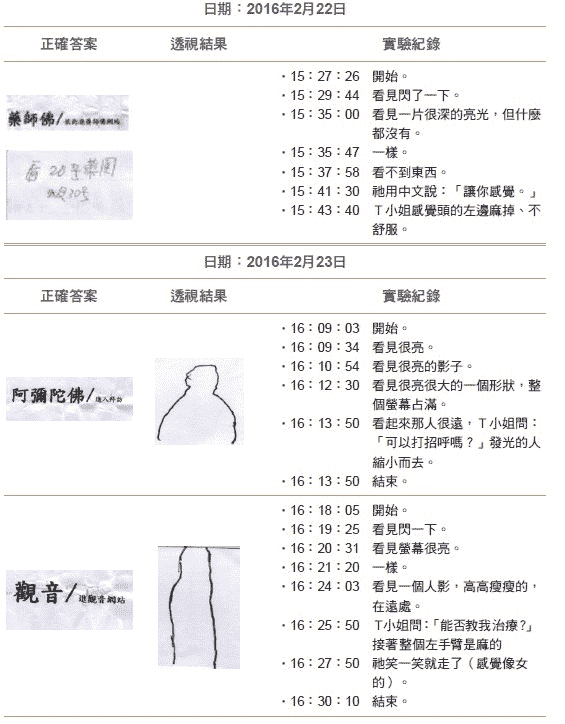 |
|---|
On the same day, Miss T also visited the website of Guanyin Bodhisattva, as shown in the third column of Figure 3-28 on the right.
The experiment began at 16:18 in the afternoon. Two minutes later, through her celestial eye she saw the screen grow very bright; at 16:24, she saw a figure, tall and thin, far in the distance; a minute later she saw Him again, and Miss T asked: “Can you teach me healing?” She then felt her entire left arm go numb; at 16:27, the bright figure smiled and left (it felt like a female), and the experiment ended. That bright figure was tall and thin, and was likely Guanyin Bodhisattva. At this point, Miss T used her numb left hand to touch Dr. Chen, who was present and had been suffering from back pain for over a month.
The next day I asked Dr. Chen how the effect was. He said that his back pain had gone away last night and no longer hurt; he had been cured by the wondrous power exercised by Guanyin Bodhisattva. Clearly, Miss T’s status was now closer to that of the Buddhas, unlike ten years earlier when she had been comparatively humble.
In summary, from ancient times to the present, various religions in both East and West have known of the existence of the spiritual realm. I, beginning on August 26, 1999, in the finger reading experiments brought by the Physics Society to challenge us, accidentally discovered the existence of the spiritual realm because we tested the character fo (佛, Buddha), creating a dramatic and shocking effect. At the time, in order to avoid the reflexive opposition that the term “spiritual realm” would provoke from the mainstream scientific community, I substituted it with “information field”; it was not until 2014, in order to construct the real-image complex spacetime of the universe, that I changed “information field” to “imaginary-number spacetime.”
CHAPTER 4: ONE OBJECT, TWO APPEARANCES AND THE PRINCIPLES OF EXTRAORDINARY ABILITIES
Particle spin splits spacetime,
creating the mysterious phenomenon of “one object, two appearances.”
It turns out that any object also has an identical virtual image in the void;
the celestial eye is scanning this virtual image.
Exploring the Physical Mechanisms of Extraordinary Abilities
In Chapter 1 I proposed a new model of the universe, holding that the real universe is an eight-dimensional complex spacetime. Besides the four-dimensional real-number spacetime with which we are familiar (three-dimensional space and one-dimensional time)—that is, the “yang world” ( realm of the living)—there is also a four-dimensional imaginary-number spacetime alongside it, which is the “yin world” ( realm of the dead), the world of consciousness.
I also proposed a physics of consciousness, arguing that the mind is a quantum phenomenon. Quantum states must be described by complex-valued functions, and the appearance of the imaginary number i represents the emergence of consciousness. Therefore, the quantum state is a state in which matter enters a mind-matter unity.
From this unified framework, we can explain large-scale mysteries of the universe, such as the nature of dark matter and dark energy. We can also truly understand small-scale quantum mechanical mysteries, such as how the deterministic Schrödinger equation yields probability distributions for particles, and how quantum entanglement transmits information between two quanta at superluminal speed. As for mid-scale mysteries of the universe, such as the unimaginable phenomena of finger reading and psychokinesis in extraordinary abilities, how can we use the new model of the universe to explain them? The key step that must first be understood is: how does the celestial eye search for the slip of paper or the object to be manipulated, transmitting this external information back to the brain so that the brain’s consciousness can see or manipulate it?
Unlocking the Mysterious Phenomenon of “One Object, Two Appearances”
Before 2014, my conjecture was that the celestial eye, being a quantum phenomenon, would pass out of the brain, diffuse through the body to the slip of paper held in the hand, or pass out of the body to reach an object separated from the body, enveloping them and compelling them to enter a mind-matter unity, then transmitting back the desired information. But as to how a slip of paper or an object could be compelled to enter a quantum state, I thought back and forth, searching through all existing scientific papers, yet could not find any possible physical mechanism.
After I proposed the complex space-time in 2014, in order to find a channel of communication between real-number and imaginary-number space-time, I boldly hypothesized that the two space-times are connected by countless large and small vortex channels. Two adjacent positive and reverse channels (one going from real to imaginary, the other from imaginary to real) would form a three-dimensional Taiji structure, in which the fish-eye portion is the channel, and the smallest channel is the spin of elementary particles. Since all objects in real-number space are composed of atoms, and every elementary particle in an atom also has spin and thus a channel leading to imaginary-number space-time, a virtual image of identical shape will appear in imaginary-number space-time. This virtual image is a combination of the exits of spin channels in the void, and its shape is exactly the same as the physical object, thus giving rise to the mysterious phenomenon of “one object, two images.” Any object in real-number space-time has a structure of identical shape in imaginary-number space-time. Later I gradually realized that this void structure unexpectedly plays an important and crucial role in finger reading and the action of psychokinesis.
The left figure 4-1(a) shows a glass bottle in real-number space, and the left figure 4-1(b) shows the virtual image formed by the combination of the void exits of the spin channels within the atoms constituting the glass bottle. The two have identical or complementary shapes. Therefore, “one object, two images” means: any object in real-number space-time has a structure of identical shape in both the real and imaginary spaces. Only sacred words are exceptions, such as: “Buddha,” “Guanyin Bodhisattva,” “Jesus,” “Medicine Buddha,” “Maitreya Buddha,” and so on. Their virtual images have already been modified by the consciousness of these sacred figures in the void into different structures such as large circles, multiple rows of small circles, crosses, and so forth.
Similarly, we must ask: will objects or energy forms in the void also produce real images in real-number space-time?
I believe it depends on the structural form of the energy. If the energy form in the void does not contain spin channels and cannot communicate with real-number space, then it will not produce a real image; it is pure energy belonging to dark matter and consciousness. But if it contains a spin space-time structure, its channel exit will merely form an image (a ghost image) with no material existence in real-number space-time.
When conducting finger reading or psychokinesis experiments, after the subject opens the Heavenly Eye, the quantum state of the Heavenly Eye enters imaginary-number space-time to scan the virtual images of words or objects, and brings them back to the Heavenly Eye to form images, which are then recognized by the perception center of the brain. To truly understand the physical mechanism of finger reading, one must first understand the physical mechanism of normal binocular vision, which will be discussed next.
Figure 4-1 The coexistence of the real and the virtual in “one object, two images”
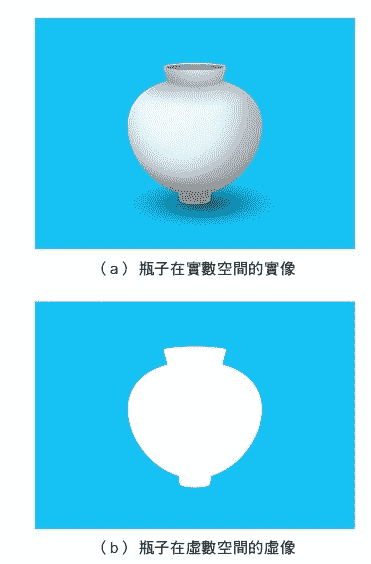 |
|---|
| Any object in real-number space-time has a structure of identical shape in imaginary-number space-time. |
The Physiological Mechanism of Normal Vision
According to modern physiology, the visual process by which the brain sees external scenes first requires a light source. The light source emits visible light photons (electromagnetic waves) that strike a scene and reflect into the eye; or the scene itself emits light, emitting photons or electromagnetic waves, where different frequencies represent different colors and energies. These photons are absorbed by rhodopsin molecules on the cell walls of cone or rod cells in the retina. After absorbing a photon, the rhodopsin molecule changes shape and pops off the cell wall, triggering a nerve pulse signal sent to the brain. The signal undergoes preliminary processing in the occipital lobe of the brain directly behind the eyes, and is then sent to other visual areas of the brain for processing, and finally delivered to the visual cortex, where it is perceived to produce vision, as shown in the left figure 4-2.
There are three types of cone cells, each perceiving photons of different wavelength bands of color. Experts in general neurophysiology believe that the brain’s perception of color is formed by mixing the signals received from the three types of cone cells.
Figure 4-2 The physiological mechanism for producing normal vision
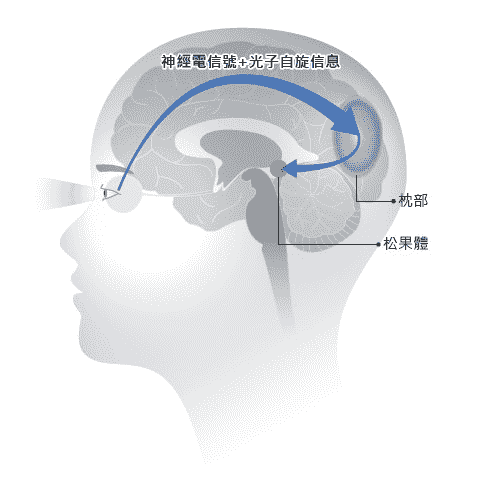 |
|---|
| The eye receives photons from a scene, triggering a nerve pulse signal sent to the occipital lobe of the brain for preliminary processing, then sent to other visual areas of the brain, and finally to the visual cortex, where it is perceived to produce vision. |
However, the results of finger reading or ear reading experiments show that the Heavenly Eye can likewise see the colors and shapes of text, but without any need whatsoever for the process of photon absorption by cone or rod cells on the retina leading to neural electrical signal conduction. This fact clearly indicates that even in normal vision, the production of color or visual perception actually relies on another channel, rather than the single transmission mechanism of neural electrical signals described by modern neurophysiology.
In other words, normal vision actually relies on two channels for transmitting visual signals. One is the neural electrical signal channel described by modern neurophysiology; but unfortunately, the central perception area of the brain is not interpreting the combination of different neural current signals in the brain, but rather is interpreting another kind of information carried by the neural electrical signals—“photon spin residual information”—and thereby perceiving color and producing vision.
In the next section I will propose the essence of this other kind of information, which can uniformly explain why both types of vision can perceive color and character shapes.
Patterns Observed from Finger Reading Experiments
Based on a large body of past literature, as well as the results of our own finger-reading experiments, several patterns of experimental success can be observed. Any theory seeking to explain the finger-reading phenomenon must first account for these patterns:
Pattern 1
When the Celestial Eye appears in the brain, in the vast majority of cases it blocks normal vision. That is, the normal scene of the room the child is looking at is suddenly obscured by the appearance of the Celestial Eye, and the background disappears. A few other children sometimes find that the characters in the Celestial Eye screen overlap with normal vision—for example, they see the characters as if pasted on the opposite wall, or appearing on the faces of the older brothers or older sisters taking notes.
Pattern 2
If the characters are colored, when the Celestial Eye opens, the colors are often seen first. Different colors may appear simultaneously, arranged on the same screen, or may appear in the Celestial Eye over several separate instances. Each time, one or more colors appear first, followed by the colored characters, appearing part by part on the Celestial Eye, as shown in Figure 2-6 of Chapter 2 (please see page eighty-seven).
Pattern 3
When the subject wears a blindfold covering both eyes, although the shapes of the characters can still be seen, the error rate for color identification increases. When experiments are conducted in a dark room, blurry character shapes can be seen, but no colors are visible at all. This indicates that the normal eyes perceiving light, and using that light information to illuminate the Celestial Eye, is a necessary condition for successful color identification.
Pattern 4
Sometimes external spirits will come to the experimental site and interfere with the experimental results, causing the characters seen by the subject to flip, jump, invert, or be missing parts.
Pattern 5
Only when reading sacred vocabulary can the vocabulary not be seen; instead, bright light or luminous figures are seen, and one can connect to the website homepage of sacred figures in the void. Subjects with weaker abilities will connect to different worlds and see different scenes, but cannot see the sacred vocabulary.
Pattern 6
If a hole is cut in the paper, the Celestial Eye will see a black frame at the location of the hole, as shown in Figure 2-8 of Chapter 2 (please see page ninety-three).
Opening the Celestial Eye Blocks Normal Vision
Using functional magnetic resonance imaging (fMRI) technology to measure the brain functional images of Ms. T during finger reading, we found that the most likely location of the Celestial Eye is in the posterior cingulate cortex (PCC) of the brain. This is the main component of the default mode network (DMN) when the brain is in a resting state, and it is also the part responsible for brain cognition, as shown by the red circle in Figure 4-3 on the next page.
This region is located between the occipital lobe at the back of the brain and the pineal gland, which Descartes believed to be in charge of vision. This explains the phenomenon whereby the Celestial Eye blocks normal vision as soon as it opens, because the normal visual information from the occipital lobe is blocked by the Celestial Eye at the PCC region and cannot be transmitted to the visual center (perhaps the pineal gland).
Figure 4-3 The Location of the Celestial Eye in the Brain
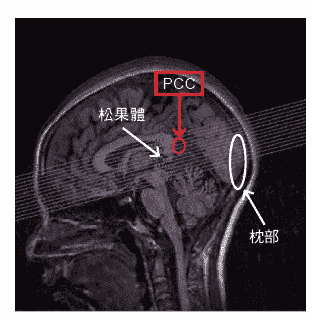 |
|---|
| Because the Celestial Eye opens, the normal visual information from the occipital lobe is blocked by the Celestial Eye’s location in the posterior cingulate cortex (PCC) region (shown by the red circle) and cannot be transmitted to the visual center, the Celestial Eye blocks normal vision as soon as it opens. |
The Celestial Eye Scans Virtual Images, Not Real Images
Before 2015, I had always believed that the Celestial Eye scanned the real images of objects. It was not until I proposed the framework of complex spacetime in 2014 and derived the concept of “one object, two images” that new questions immediately arose. Since the images of an object in real-number and imaginary-number spacetime are completely identical, does the Celestial Eye actually scan the real image or the virtual image of the text and patterns on the paper?
The Celestial Eye Scans Virtual Images, Which Is Why It Can Be Interfered with by Spirits
It was not until the finger-reading experiment on January 20, 2015, that I confirmed it scans virtual images.
As shown in the first row of Figure 4-4 on page two hundred nine, after Ms. T began the experiment at 3:27 p.m., she was unable to open her Celestial Eye and could not see any characters, but felt something strange. At 3:35 p.m., the Celestial Eye opened, but the screen was shaking violently. Ms. T sensed that a spirit body stood behind her, interfering with her experiment, but the spirit body existed in the void and we could not see anything. The experiment was therefore ended at 3:44 p.m.
The next experiment began at 3:46 p.m., as shown in the second row of Figure 4-4.
When the Celestial Eye opened at 3:48 p.m., the screen was still being interfered with, though somewhat less so. At 3:49 p.m., the Celestial Eye saw the letter “J” shaking all over, and then saw the two letters “E” and “V” shaking erratically. Ms. T felt that this was interference from a spirit brought by someone in the audience present.
It is evident that the spirit body exists in the void, and only when the Celestial Eye penetrates into the void to scan virtual images can it be interfered with by spirits in the void. It was the spirit body that was flicking the virtual images of the English letters, causing the letters “J,” “E,” and “V” to shake erratically. From these experimental results, we confirmed that the Celestial Eye penetrates into the void to scan virtual images, rather than scanning real images in real-number space.
Figure 4-4 Ms. T’s Finger-Reading Experiment Interfered with by an External Spirit
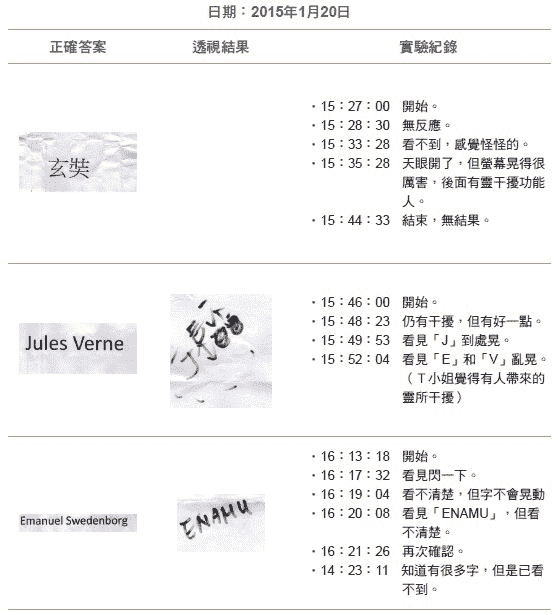 |
|---|
The Second Pathway for Producing Vision ── Residual Information of Photon Spin
Since the third rule of finger reading states: having the functional person’s normal eyes see bright light is a necessary factor for the success of color recognition in finger reading. The bright light seen by both eyes can illuminate the screen of the Heavenly Eye within the brain. Therefore, the photons themselves must carry information related to color, and can directly interact with the screen of the Heavenly Eye, causing the Heavenly Eye to light up, rather than indirectly illuminating the Heavenly Eye through neural electrical signals.
I believe that the production of normal vision requires two types of signals, as shown in Figure 4-5(a) on the left: one signal is real and the other is virtual. The first type of real-number information is the neural electrical signal well known in modern neurophysiology, but it merely plays the role of a carrier, bringing another, more important type of spin torsion-field information from the virtual image to the brain’s neural centers for perception.
Figure 4-5 The True Mechanism of Normal Vision
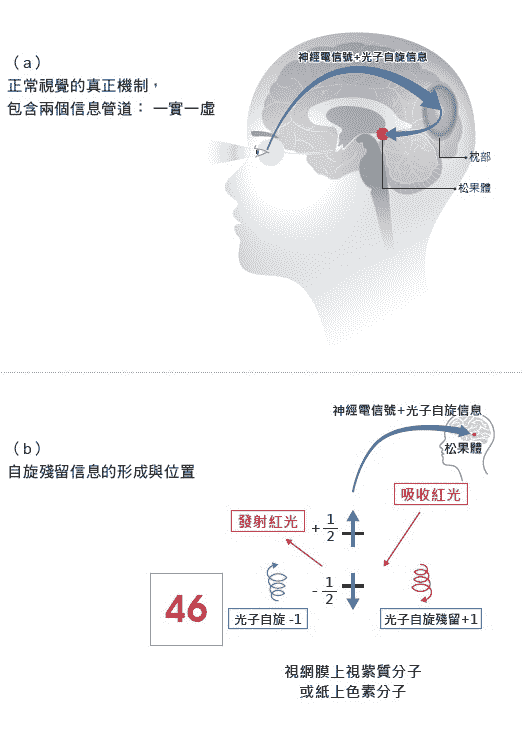 |
|---|
I believe that the central perception region of the brain may be what Descartes called the pineal gland, which houses the soul. It is interpreting another type of information, namely the spin torsion-field information carried by photons (spin 1). This spin torsion-field information is a vortex-like spacetime structure, whose torsion is determined by the frequency of the electromagnetic wave. In photon information, frequency represents color and energy. These photons are absorbed by the spin -1/2 orbitals of rhodopsin molecules within the cone or rod cells of the retina, changing to +1/2, and the absorbed energy is then converted into neural electrical signals sent to the brain.
After incident photons entering the eye are absorbed and disappear by the rhodopsin molecules within the rod or cone cells, the spin +1 torsion-field vortex spacetime structure does not immediately vanish. It still remains in the vicinity of the local rhodopsin molecules, as shown in Figure 4-5(b) on the preceding page. This residual information of the spin torsion field, carrying frequency information, crosses the boundary between the yin and yang realms, is carried by the subsequently generated neural electrical signal into the brain, and is ultimately delivered to the perception region of the visual center (the pineal gland).
Therefore, what the visual consciousness center is truly interpreting is the residual information of the spin torsion field. Spins of different torsion rates are perceived as different colors. This mechanism can be used to explain the principle of finger reading, as shown in Figure 4-6 on the left.
Figure 4-6 The Physical Mechanism of Finger Reading
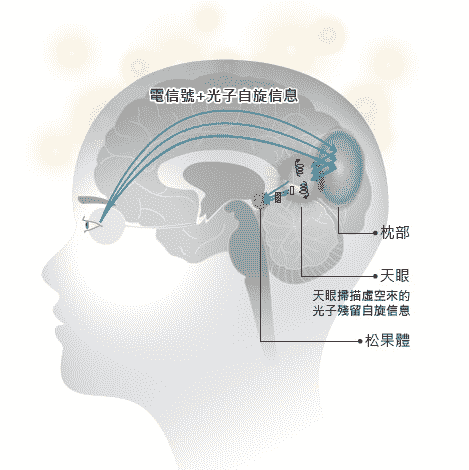 |
|---|
| In the void, spins of different torsion rates are perceived as different colors. What the consciousness center (the pineal gland) is truly interpreting is the residual information of the spin torsion field, which is how it can perceive the existence of color. |
I believe that the Heavenly Eye is a macroscopic quantum state entered locally by the physiological saline solution in the brain in the region of the posterior cingulate cortex (PCC). The Heavenly Eye blocks the signals of normal vision, including the neural electrical signals sent in by both eyes and the spin residual information they carry. At this time, the complex quantum wave generated by the Heavenly Eye enters the imaginary-number space through molecular spin channels, scanning the virtual-image structure of the text on the paper.
Therefore, for colored characters, such as the red number 46 on the paper in Figure 4-5(b) on page 211, in real-number space, its red pigment molecules continuously absorb and emit red photons (spin 1). Every time a spin -1 photon is emitted (the pigment molecule’s own spin changes from +1/2 to -1/2), a spin +1 residual information is left behind, crossing the boundary between the yin and yang realms and remaining in the vicinity of the pigment molecule. Thus, the vicinity of the pigment molecule is filled with the spin torsion-field residual information of red photons. This spin, slicing through spacetime, can still communicate with the void.
Since during experiments the folded paper is placed in a dark bag, at this point the photons have already disappeared. Only the spin residual information can communicate with the void. Therefore, when the Heavenly Eye’s quantum wave scans the void character shape, it first scans the residual color spin information back to the Heavenly Eye. Because in real-number spacetime there is no matter (photons have already disappeared) to bind it, when the Heavenly Eye opens for the first time, a field of a single color appears, or different colors arranged on a single frame, as shown in Figure 2-6 of Chapter 2 (see page 87). Sometimes one color is scanned back at a time, requiring the Heavenly Eye to open several times before all the different colors are scanned and transmitted back. Then, the spacetime structural information of the character shape is scanned and transmitted back part by part, and the spin color information begins to arrange itself in correspondence with the positions of the shape information.
At this point, if the normal eyes have not seen bright light, the character shapes of the Heavenly Eye are dim and colorless. When the abundant spin torsion-field residual information of various colors carried in the bright light seen by the normal eyes is sent through the Heavenly Eye to the pineal gland for perception, it will be blocked by the Heavenly Eye and unable to pass through. At this moment, something miraculous happens, namely: the spin information scanned back by the Heavenly Eye from the folded paper, if it has the same frequency as the spin residual information sent to the pineal gland from the bright light seen by the normal eyes, will produce a resonance reaction.
For example, in an external scene, if the red bright-light spin information at the Heavenly Eye region encounters the residual red-light spin information from the paper, a strong resonance will be produced, which can pass through the Heavenly Eye and allow the perception of the pineal gland to see a field of red light. If there is a hole in the paper, the Heavenly Eye has no scanned-back color-light residual information in that region, and the bright-light information seen by the normal eyes will be blocked by the Heavenly Eye. No resonance will be produced to allow passage, and the perception region of the pineal gland will only see a black hole.
When recognizing sacred characters through finger reading, such as “Buddha,” “Guanyin Bodhisattva,” “Jesus,” “Medicine Buddha,” “Maitreya Buddha,” and so on, their virtual images have already been modified by the consciousness of these sacred figures in the void into structures such as large circles, multiple rows of small circles, and crosses, consistent with the homepage of the divine-spirit website. Since the virtual images of these characters have already been altered by divine spirits, during finger reading, when the celestial eye scans the virtual image, one does not see the characters; instead, one sees the altered images such as circular bright light, bright figures, or the homepage of the divine-spirit website connected to the images, or other worlds of the void.
The Operating Mechanism of Psychokinesis
Based on the results of our psychokinesis experiments with highly functional individuals, the following patterns can be derived:
Pattern 1: The prerequisite for successful psychokinesis is to first bring the information of the object to be acted upon into the celestial eye. For example, in an experiment of bringing a peanut back to life and causing it to sprout, the virtual image information of the peanut must first be brought into the celestial eye. At this point, the consciousness of the peanut appears, and its opinion must be sought as to whether it consents to the experiment. If the peanut consents, one can issue the command “return to life,” and the molecules inside the peanut begin to rotate counterclockwise, from the outside inward, until they turn into the center, and the peanut returns to life. Then one gives the command to “sprout,” and the molecules inside the peanut begin to rotate clockwise from the inside outward, and the peanut’s sprout gradually grows forth. After it has fully grown, the virtual image in the celestial eye is sent back to the physical peanut, enabling the peanut to actually sprout. Pattern 2: When using psychokinesis to bend or cut iron wire or matches, or to write on a match, tools must be used. These tools can be created in the celestial eye through intention, and the completed work is then sent back to the physical object, whereupon the physical object begins to change, as shown in Figure 2-20 of Chapter 2 (see page 117). The children trained by Professor Zhu Nianlin of Yunnan University sealed a match inside an opaque plastic box. The celestial eye scanned the virtual image of the match into the brain, then imagined a pair of scissors, used the scissors to cut the match into five or six pieces, and then sent the image of the cut match from the celestial eye back to the match in the box. When the experiment was completed and the box was opened, the match had indeed been cut into five or six pieces.
Similarly, the celestial eye first scans the virtual image of the object back into the brain. The virtual image of the object represents consciousness. When the consciousness of the object is awakened, it enters a state of unity of mind and matter. These objects in the unity of mind and matter can be teleported over distances by intention in the imaginary-number space-time, a function called teleportation, and can also be manipulated into various different forms. When the functional individual manipulates and changes the virtual image of the object and sends it back to the physical object—that is, when the unity-of-mind-and-matter state collapses and returns to the material state—the physical object will gradually change into the resultant state operated on by the celestial eye.
All Physical Objects Have a Passage to Imaginary-Number Space-Time
All objects in real-number space are composed of atoms, and every fundamental particle within an atom has spin and a passage to imaginary-number space-time. Therefore, a virtual image will appear in imaginary-number space-time, which is a combination of the void exits of the spin passages, and its shape is exactly the same as the physical object. Therefore, “one object, two images” means that any object in real-number space-time has a structure of identical shape in both the real and the imaginary spaces. Energy forms in the void that do not contain spin passages and cannot communicate with real-number space will not produce a real image; they are pure energy belonging to dark matter and consciousness. However, if they contain a spin space-time structure, the exit of the passage will merely form an image without material existence (a ghost image) in real-number space-time. The void structures of characters and objects play an important role in finger reading and psychokinesis. We propose a possible mechanism for finger reading and psychokinesis that can explain the riddle of extraordinary functions appearing in the human body at the universe’s medium scale.
Chapter 5: The Scientific Mysteries of Mind and Consciousness
Everyone has a “self-consciousness.”
Every day when going to sleep, the “I” disappears.
Every morning when waking up, the “I” returns again.
It seems as though there is no great change.
What is the physical phenomenon of this “I”?
Exploring the Last Frontier of Science — Consciousness
Everyone has a consciousness of self: “I” am different from others. Every day when going to sleep, the “I” disappears, but every morning when waking up, the “I” returns again, as though there has been no significant change. What exactly is the physical essence of this “I”?
Under the shadow cast by the materialist philosophy over modern science’s explanation of the universe, physicists and physicians have kept a respectful distance from physical explanations of the brain and mind. They consider consciousness to be secondary—merely an emergent property of the complex neural networks of the material brain, which is primary—and not possessing independence. For example, when two hydrogen atoms and one oxygen atom combine into a water molecule, water is essential for life, but its physical and chemical properties, such as boiling point, freezing point, and dielectric constant, are completely different from those of hydrogen atoms or oxygen atoms; they are new properties emergent from the complex three-atom composite system. Consciousness is even more complex than chemical reactions, and therefore does not fall within the scope of physical research. So when a person dies and the material brain is destroyed, consciousness also vanishes. Therefore, scientists have always made excuses, saying: consciousness is the last frontier of science, and have refrained from dealing with it. Thus, before the 1990s, mind and consciousness belonged to the domains of psychology and philosophy.
In the early twentieth century, the renowned psychologist Carl Gustav Jung proposed that the core of consciousness is the Ego, and divided it into two types. The first personality is the soul, which governs the sensations of the five sense organs, temperament, and the various emotions and desires; the second personality is the sixth consciousness, which is influenced by education, environment, culture, and memory. The Yogācāra school of Buddhism, developed over two thousand years, analyzes the structure of brain consciousness, dividing it into eight consciousnesses: including the six consciousnesses of form, sound, smell, taste, touch, and dharma, the seventh consciousness manas, and the eighth consciousness ālaya.
A Physical Interpretation of Consciousness
Beginning in 1994, the physics of consciousness began to emerge. British physicist Roger Penrose and orthopedic physician Stuart Hameroff of the University of Arizona jointly proposed the physics of consciousness, arguing that the basis of consciousness lies not in neural action potentials, but rather occurs when the material of microtubules, which serve a skeletal function within neurons, enters an ordered quantum state.
The walls of brain neurons are composed of many microtubules capable of producing a quantum tunneling effect [1]. When sensory stimuli are input, an ordered quantum state is produced, and moreover it is a superposition state [2] of different quantum states. As time passes, external environmental factors such as gravity influence the evolution of these quantum states. Because matter in different states is distributed across different spacetime, this leads to a gravitational energy difference E, equal to the spacetime interval S between the two states (physical constants such as the speed of light and the universal gravitational constant are set to 1), and the superposition state collapses to manifest a single definite state. Consciousness is produced at the moment of Objective Reduction (OR). That is, when the quantum state spreads to the point where changes in gravity satisfy certain orchestrated conditions, the macroscopic quantum wave objectively collapses (Orchestrated Objective Reduction), abbreviated as the Orch OR mechanism.
At the instant the macroscopic quantum state collapses, the brain’s consciousness is produced. Then a small portion of the microtubules begins to enter a quantum state again, and consciousness gradually disappears, awaiting the next Orch OR mechanism to generate new consciousness. Therefore, the brain’s thoughts come wave after wave, in an endless cycle.
I believe their model has already approached the essence of consciousness; however, the opposite is true: the production of consciousness occurs when the superposition quantum state is formed, and it disappears during objective reduction.
Because the superposition quantum state is a complex-number state, at that point the imaginary-number consciousness can scan the neural network architecture that has entered the quantum state, producing the content of consciousness such as: memory, thought, judgment, and action. Sometimes experiences embedded in the neural network generate an inhibitory force, preventing us from acting impulsively, or offering suggestions and constraining actions. Sometimes the quantum wave dives into the void, allowing us to gain inspiration while roaming through cosmic spacetime, generating innovative thoughts. And after the quantum wave undergoes objective reduction, it returns to real-number space operations, awaiting the next occurrence of an ordered quantum state in the microtubules—that is, the emergence of consciousness.
After more than twenty years of development and experimental investigation, this model has gained acceptance from an increasing number of scholars. Of course, there are also scholars who oppose it, such as the philosopher Davis Chalmers of New York University. At the “2018 The Science of Consciousness” conference held in Tucson, Arizona, in April 2018, he challenged the objective reduction mechanism with simple logic, arguing that it is incomplete as an explanation for consciousness and requires revision.
My consciousness theory originated in 2013, as described in Chapter 1 of this book (see page 36). In 2014, I proposed two major hypotheses about the real universe, the second of which was quantum mind, holding that consciousness is a quantum phenomenon that can be described by a complex-number function. The appearance of the imaginary number i signifies that consciousness has emerged, so I strongly support the hypothesis of Penrose and Hameroff—that neural microtubules enter a quantum state—which may serve as the physiological basis for my proposal of quantum mind.
However, my theory holds that consciousness is produced only when matter is in a quantum state, whereas the collapse of the quantum state causing the Orch OR mechanism actually leads to the disappearance of consciousness, rather than its production. Therefore, when I heard philosopher Chalmers’s criticism of the Orch OR mechanism at the “Science of Consciousness” conference in April 2018, I was extremely excited. After the conference, I wrote a letter to Professor Chalmers expressing my support and submitted a paper.
However, consciousness is merely an abstract concept and must have content. For example, I get angry and scold people, I understand compassion and love others, I can think rationally, I can calculate, I can remember things that happened before, I can decide on my next action, and I have a stubborn and reclusive personality—all of these have rich content. The question is: in what physical form is the content of these consciousnesses presented? Can a complex-number wave function express this content? How can Jung’s first and second personalities, and the Buddhist eight consciousnesses, be presented in terms of quantum mind? Let us first review how philosophy and psychology interpret consciousness.
Editor’s Note 1 Quantum Tunneling (Quantum Tunnelling Effect): According to quantum mechanics, microscopic particles possess wave-like properties, and phenomena such as electrons and other microscopic particles being able to pass through “walls” that they would normally be unable to penetrate. Editor’s Note 2 Quantum Superposition (Superposition State): Quantum mechanics holds that the motion and states of microscopic entities are uncertain; if extended to the macroscopic world, all uncertain entities can be considered to exist in a superposition of multiple states.
Western Philosophy’s Understanding of Consciousness
The concept of Western philosophy of mind begins with René Descartes’s Mind-Brain Dualism.
Descartes himself was a man of many talents. Born at the end of the sixteenth century in 1596 and deceased in 1650, he was a renowned French philosopher, mathematician, and physicist. He made important contributions to the development of modern mathematics; because he formulated the geometric coordinate system, he is regarded as the father of analytic geometry. He left behind the famous saying, “I think, therefore I am,” put forward the doctrine of “universal doubt,” and is the founder of modern Western philosophy. His philosophical thought deeply influenced several generations of Europeans after him and pioneered rationalist philosophy.
Descartes maintained that mind and matter are two distinct substances. “Mind” refers to a thinking subject, namely the “soul” lodged in the brain’s pineal gland, which controls thought, memory, action, emotion, and so forth in daily life; “matter” refers to all the spatial, tangible external things encountered in daily life, including the brain.
However, such an account has difficulty explaining the interaction between mind and matter. For instance, the mind affects the body and can direct actions, and inner melancholy can lead to bodily illness. Under this framework, in order to resolve the contradiction that the mind affects the body, the Mind-Body Identity Theory (Main-Body Identity Theory) was further developed, holding that the mind is something produced by the brain and therefore is fundamentally the same thing; yet it is very difficult to reduce the mind to the brain—for example, how can love, hate, thought, and personality be decomposed into the firing behavior of neural networks?
To answer these difficulties, some held that although both mind and matter arise from material substance, they have completely different and irreducible properties, and thus Property Dualism was developed. Even more extreme was the development of Materialism, which holds that only the brain is substance and primary, whereas the mind is a phenomenon derived from the brain’s complex system, secondary and non-fundamental; when a person dies and the brain disappears, consciousness naturally disappears as well. Or Idealism, which holds that only the mind is substantial consciousness and primary, while matter is a product fashioned by the mind. Yet Idealism was quickly put to the test by the real world: if you desire an apple in your mind, of course an apple will not appear out of nothing; pure Idealism is obviously untenable in the material world. Of course, the subsequent development of the physical sciences gradually pushed Materialism to the summit of philosophy, seemingly making it the supreme guiding principle for interpreting this universe.
Western Psychology’s Understanding of the Mind
Among modern scientific inquiries into consciousness, the early twentieth-century psychologist Carl Gustav Jung pursued the most in-depth research. His doctoral dissertation studied his psychically gifted cousin, and in his middle and later years he himself had psychic experiences; consequently he had a special feeling for the spiritual realm or the collective unconscious. His depiction of the vast inner world of the human psyche earned him praise as the Columbus who discovered the world of the soul.
As described in Murray Stein’s Jung’s Map of the Soul, the foremost characteristic of human consciousness is the “Ego.” Consciousness is the waking state, and its center is the “I”; it is the gateway into the vast inner domain that we call the psyche.
Jung, in his work Aion, defined the ego as follows: “It seems to be the center of the field of consciousness; given that it constitutes the empirical personality, the ego is the subject of all personal conscious acts.”
The ego refers to the individual’s possessing an experience that constitutes a center of will, desire, reflection, and action. The relationship between the contents of the psyche and the ego forms the criterion of consciousness. The ego is the subject that represents psychic contents; it is a mirror through which the psyche can see and know itself, and the degree to which psychic contents such as feelings, thoughts, perceptions, or fantasies are grasped and reflected by the ego is the degree to which they are conscious and belong to consciousness.
The unconscious beyond consciousness is not merely what is unknown; it is “the unknown at the level of the psyche.” Once it surfaces into consciousness, it is no different from known psychic contents. The unconscious contains all psychic contents outside consciousness; the ego is a specific content of consciousness, meaning that consciousness is a broader field whose contents include more than just the ego.
Consciousness is awareness; it is a waking state, a state of observing and recording surrounding and internal activities. The contents of consciousness, such as thoughts, memories, emotions, familiar imagery, persons, and faces, are in fact more illusory and fragile than consciousness itself. For example, a person may possess consciousness but completely lose their memory. Consciousness is like a room surrounding the mental contents that temporarily reside within it. Consciousness precedes the ego, and the ego becomes its ultimate center.
Personality No. 1 and Personality No. 2
The ego is fundamentally not a content acquired by consciousness; it has always been ready-made and innate, not a product developed under nourishment, growth, or learning. Every infant is born with it; otherwise, they would be congenitally blind, deaf, or mentally retarded.
Jung’s description of the psyche posits that among many different contents of consciousness, there is a contact network, all of which directly or indirectly link different conscious contents to the central organism of the ego.
The ego is the locus of decision-making and free will; it prioritizes based on conscious contents and generates actions.
After the human ego and consciousness develop to a certain stage, they are gradually defined and shaped by the cultural world of personal growth and education. This is an ego structure surrounding the central ego. Through interactions with family members and school education, children gradually integrate into the culture and learn its forms and habits, and this layer of the ego becomes increasingly thick. Jung referred to these two characteristics of the ego as “Personality No. 1” and “Personality No. 2”.
Personality No. 1 is the innate core ego, relatively silent, similar to the “Original Spirit” (Yuanshen) described in Daoism, or what is generally called the “soul”. It possesses the five basic awareness capacities of sight, hearing, smell, taste, and touch, as well as personality and emotions, such as the seven passions and six desires, and can also control simple body movements, much like the capacities possessed by a newborn infant.
Modern psychology refers to Personality No. 1 as “phenomenal” or “extraordinary” consciousness (Phenomenal Consciousness). Personality No. 1 is more intuitive, possesses joy, anger, sorrow, and happiness, is emotional and artistic, and can grasp the overall situation. Personality No. 1 resembles the functions of the right brain.
The ego of Personality No. 2, on the other hand, is structured by the brain through learning. Through the growth of the brain’s neural networks and interactive feedback with the outside world, new connections are formed, producing awareness and memory of various internal thoughts, and it will evolve over time. The ego level learned through culture, family, school, and environment from birth through the growth process is more active and extroverted, and is a part of Personality No. 1’s ego executing bodily functions. Personality No. 2 is constantly dealing with the realities of daily life, such as various chaotic thoughts, memories, problem-solving, and generating actions, similar to the “Conscious Spirit” (Shishen) described in Daoism, gradually wrapping around Personality No. 1 to become thick and solid. It both plans for the future and worries about the future, and regrets the past. The daily psyche of Personality No. 2 constantly judges, imagines, remembers, reviews the past, is controlled by various cultures, environments, and norms, and conforms to society, much like the functions of the left brain. Modern psychology calls this “access” consciousness (Access Consciousness), which, like a computer, follows logical procedures.
Ego consciousness is the surface layer of the psyche, subject to disturbances generated by collisions between the individual and the external environment, as well as conditioned by emotional responses. However, there are many disturbing factors that are not external, but rather endogenous impacts, that is, the interferences of the “unconscious” or “subconscious”. The unconscious is divided into the personal unconscious and the collective unconscious, and the personal unconscious is filled with a wide variety of complexes. Perhaps related to past-life experiences, they can surface into consciousness through hypnotic regression. The collective unconscious or the Self is a theoretical framework gradually developed by Jung after he had psychic experiences.
The Buddhist Yogacara School’s Understanding of Consciousness
The Buddhist classic Samyukta Agama proposes the concepts of the six sense roots, six sense objects, and six consciousnesses to understand consciousness.
The six sense roots are the eyes, ears, nose, tongue, body, and brain, which are the sensory organs used for the six types of awareness; the six sense objects are the physical and physiological signals received by the six senses, such as color (form objects), sound (sound objects), fragrance (fragrance objects), taste (taste objects), pressure and temperature (touch objects), etc., which produce the six consciousnesses, and also imply the awareness produced by the brain interpreting these signals.
The mental objects (Dharma objects), however, are produced after interacting with the mental root (the brain), so the mental objects are the five experiences (called “consciousness” in Buddhism) produced after the first five senses interact with the first five sensory objects. After being integrated by the brain, this produces cognition (which is consciousness, or called the sixth consciousness). Because individuals have different long-standing experiential habits and cognitions, encountering the same situation results in different feelings for each person.
The Yogacara theory holds that neither mind nor matter is the sole entity; this world is neither materialistic nor idealistic. But neither is it a dualism where both mind and matter are entities. Yogacara theory holds that the only entity in this world is the “Alaya consciousness”. Both mind and matter are created by the “Alaya consciousness”, so mind and matter are equivalent; matter is not more fundamental than mind. But is the “Alaya consciousness” a pure consciousness? If the answer is “yes”, then there would be no difference from idealism. Therefore, the “Alaya consciousness” is a state of unity of mind and matter, being neither mind nor matter.
The Physics of Consciousness
How can the quantum mind model I proposed in Chapter 1 be used to explain these frameworks constructed throughout the history of philosophy and psychology?
I believe that consciousness in the brain is a quantum phenomenon, just as neural microtubule bundles couple [1] into a macroscopic quantum state, which can be described by complex-valued functions. The appearance of the imaginary number i indicates the emergence of consciousness, but the problem is that consciousness is merely an abstract concept. In reality, consciousness has rich content—for example, I can engage in logical and rational thinking, perform mathematical calculations, recall events that happened in the past, decide on my next course of action, and I have a stubborn and reclusive personality, and so on—all of which have rich substantive content. In what physical manner is this content represented? Can a complex wave function express this content?
One day in 2014, while carefully observing how the complex wave function Ψ(,t) describes the behavior of a particle at position r and time t, a sudden question arose: what role do the real part function R and the imaginary part function Im actually play in consciousness?
Ψ( ,t) = R(,t) + i Im(,t)
From the perspective of the Copenhagen interpretation of quantum mechanics, R² + Im² represents the probability of the particle’s appearance—that is, the geometric distribution of the probability of the particle appearing in real space. It seems that this geometric distribution in real space represents the content of consciousness; in other words, the spacetime deformation (curved or twisted geometric structures) caused by the real part is the content of the mind, and the complex quantum state of mind-matter unity formed when imaginary abstract consciousness scans the deformed real-number spacetime constitutes the content of the mind. What is miraculous is that what determines the spatial geometric distribution of an object is general relativity, while imaginary consciousness comes from quantum mechanics. Therefore, the physical phenomena described after combining the spacetime structures of quantum mechanics and general relativity turn out to be precisely the content of consciousness. It turns out that the final frontier of science lies in the unification of general relativity and quantum mechanics.
How to Explain the First Personality and the Second Personality?
Each person’s self-awareness (Ego)—that is, the first personality—is innate and can be called the soul. It seems to be, like the divine spirits of imaginary spacetime, the imaginary part of the quantum mind, with no real-number material component, and therefore it cannot be seen, touched, or measured in the real world. Nevertheless, the soul still has complex content—for example, personality, hobbies, loves and hates, desires, and much more—much of which is innate.
I believe the real-number part of the quantum soul is not composed of matter with mass, but rather is a large, complex spacetime geometric structure composed of many tiny spin-vortex spacetimes. This spinning spacetime structure is scanned by imaginary consciousness to produce mental content such as personality, preferences, loves, and hates. For example, a person with a very stubborn and inflexible personality has a spin spacetime structure in the real part of their soul that is like a pine tree, not easily bent; a person with a smooth and adaptable personality who knows how to change with circumstances has a real part of their soul that is like a willow tree, able to bend with the wind. This part is in fact also the physical essence of the seventh consciousness in Buddhism, the manas consciousness (the sense of self). The manas consciousness hides in a corner within the soul, reincarnating along with the soul, and also belongs to the domain of the subconscious.
The sensations of the five senses—vision, hearing, smell, taste, and touch—are innate abilities of the soul’s awareness, not skills that can be acquired through learning. They are therefore called “perceivable” or “extraordinary” consciousness. Infants are born with these abilities; otherwise, they would have congenital defects such as being born blind or deaf.
How exactly these five senses operate is addressed in modern neurophysiology with detailed anatomical and neurophysiological inferences. But just as in the discussion of finger-reading phenomena in Chapter 4, in order to explain the miraculous finger-reading phenomenon, we discovered that normal binocular vision actually contains two signals: one is the neural electrical signal described by neurophysiology, but it does not provide information for the soul’s awareness; its main function is to carry the other, true signal that produces vision—the residual spin torsion field information left behind after photons are absorbed and disappear by the retinal rhodopsin molecules. The curl of the torsion field determines the colors the soul sees. The wavelength is typically in the visible light range, between 450 and 750 nanometers, and the spatial distribution of the spin information determines the shape of the text or pattern.
By the same logic, smell and taste also involve receptor molecules in the nose and tongue transmitting two types of signals to the brain: one is a neural electrical signal, carrying another signal—the residual spin torsion field information of a photon that causes the vibration of a certain critical molecular bond of the molecule producing the taste. The wavelength falls within the infrared detectable range of 3 to 10 micrometers.
Hearing involves the hair cells in the cochlea of the ear transmitting two types of signals to the brain. In addition to the neural electrical signal transmitted by the inner hair cells, it also carries a second signal—a spacetime distortion signal caused by the high-speed mechanical expansion-and-contraction oscillations of the motor protein molecule (Prestin) within the outer hair cells. Therefore, the tonal melody the soul hears comes from the latter, not from the neural electrical signal.
Touch signals also come through two pathways, one fast and one slow. The fast one is the transmission of neural electrical signals; for example, the A-β, A-δ, and C nerves within the dermis can sense temperature variations, while hair follicles and Merkel cells can perceive the magnitude of touch and pressure.
Pain is transmitted by coarse nerves and is controlled by pain gates within the spinal cord. However, research on phantom limb pain has found that an amputee patient can still feel severe pain in a body part that no longer exists. Orthodox medicine generally believes this is pain caused by the brain’s central nervous system sensing that neural signals are not being transmitted smoothly to the corresponding area of the nonexistent limb. But phantom limb pain can be treated with infrared light irradiation, bringing relief by targeting the area of severe pain in the nonexistent limb. In reality, there are no nerves at all in the site of severe pain, yet irradiating these areas with infrared light can actually alleviate the pain. This leads us to understand that pain has another transmission pathway, but one that is very slow—this pathway is the human body’s meridian system. If the meridians develop spatiotemporal structural distortions, this can lead to chronic pain. The key lies in the information transmitted by the “ziwu liuzhu” phenomenon produced by the body’s twenty-four-hour rhythm. This information is called “qi” in Chinese medicine. As the twelve meridians cycle through one meridian every two hours, the information about meridian distortion and obstruction is carried into the brain’s soul, producing the sensation of pain.
In Chapter 5 of my book The Science of Qigong, I provide a detailed introduction to the “Nan’s Allergy Removal Therapy,” which can eliminate allergies twenty-four hours a day by utilizing the phenomenon of qi circulating through the meridians in the “ziwu liuzhu” pattern.
From these analyses we know: The first-personality soul is a cluster of quantum consciousness, primarily composed of imaginary-number components, while its real-number part is filled with geometric structures formed by various residual spin-information, representing personality, the seven emotions and six desires, and the different spin-information of varying torsion sent in by the five senses. It produces vision, smell, and taste, and distorts the vibrating spatiotemporal structure, causing us to experience pain or hearing. The soul learns to control various neural systems during infancy, and its interface is called “po.” Once the skill becomes proficient, po descends into the subconscious and no longer enters the scope of the second personality (the sixth consciousness) discussed below—for example, controlling the sympathetic and parasympathetic nerves of the autonomic nervous system is no longer something the sixth consciousness can govern.
Jung’s second personality, in terms of the Buddhist Consciousness-Only theory, corresponds to the sixth consciousness, which is acquired through learning. The brain’s neural network connections gradually increase or are modified over time as they are stimulated by experiences learned from culture, education, and the environment, becoming increasingly complex. Vast amounts of memory, logic, and experiential knowledge are all embedded within the network. Whenever external stimuli to the five senses are sent into the brain, the brain begins to comprehend, think, and compare with experience to make judgments and take action. At this point, the network formed by the brain’s neural discharges constitutes a three-dimensional geometric architecture. Therefore, the macroscopic quantum mind formed by large numbers of microtubules within the network scans this complex three-dimensional geometric architecture, producing judgments and actions—this constitutes the physical and physiological basis of the sixth consciousness. The memory, logic, and judgment you are using right now as you read this book are also mostly governed by the sixth consciousness within the brain.
How to Explain the Subconscious, Manas Consciousness, Alaya Consciousness, and the Heavenly Eye?
The subconscious or unconscious beyond consciousness is not merely the unknown; it is the “unknown at the level of the mind.” Once it surfaces into consciousness, it is no different from known mental content. The unconscious encompasses all mental content outside of consciousness. Generally speaking, the soul of a newborn infant must learn to handle and master all the neural systems related to survival—for example, crying when hungry or uncomfortable, expressing itself to attract adults’ attention in order to solve immediate problems. As the child gradually grows older, it must learn to stand, walk, manipulate toys, learn to pronounce words and speak, understand what others mean, and have its behavior corrected. As the things the soul must learn and control become increasingly complex and diverse, the most efficient approach is to divide the soul into different departments with a division of labor. One small portion controls the nervous system for limb balance and movement, another small portion governs the nervous system for language and pronunciation, and yet another controls logical computation and cognition. Between the soul and the neural systems of different functions, multiple efficient interfaces inevitably form. I call this interface “po”—which is precisely what Chinese Daoism refers to as “hun and po.” Once the control of “po” reaches mastery and proficiency, it descends from consciousness into the subconscious, no longer receiving conscious attention, in order to lighten the soul’s burden.
Take riding a bicycle, for example. Once you learn how to balance your body, you never need to pay attention to this matter again for the rest of your life. As soon as you get on a bicycle, you can ride it. The subconscious can automatically balance the body and control the pedaling to move forward. Driving is the same—sometimes you can do other things while driving, though distraction is dangerous and best avoided. This also shows that if one’s childhood habits are poor, once they fall into the subconscious, they become difficult to change.
The most wondrous aspect of the subconscious is the seventh consciousness, Manas consciousness, which is the root of a person’s personality. It originates from past-life experiences and can only be brought forth through hypnosis or flower essence therapy. Its physical basis resides in the geometric spatial structure of the spin torsion field in the real-number part of the quantum soul. If a person’s personality is very awkward and twisted, it means that this geometric structure is pitted and uneven—neither smooth nor beautiful.
Buddhism often says that a human body is difficult to obtain and urges people to use the human body for spiritual cultivation. This most likely means using the feedback from cultivation to modify the geometric structure of the real-number part of the quantum soul, cultivating it into a beautiful and smooth geometric form to escape the cycle of rebirth.
As mentioned earlier, a necessary condition for extraordinary abilities to succeed is that the brain must open the Heavenly Eye. The Heavenly Eye is neither the soul of the first personality nor the sixth consciousness of the second personality. It is the third eye, belonging to another kind of quantum phenomenon. I believe it is a macroscopic quantum state entered by the physiological saline in some part of the brain due to stimulation, as explained in Chapter 1.
Once the Celestial Eye is formed, it can tunnel into imaginary-number space-time, roam the visible and invisible realms, and bring back images of the void for the soul to see. Therefore, if the eighth consciousness of the Consciousness-Only school, the “ālaya-consciousness,” is taken as the complex-number mind of quantum theory—that is, the soul plus the Celestial Eye—then all the contradictions arising from mind-body dualism or monism faced by the philosophy of mind can be readily resolved.
The complex-number quantum mind contains both a “matter” component (real numbers) and a “consciousness” part (imaginary numbers); the two cooperate to constitute the content of the mind. When matter enters the quantum state of a matter wave, its imaginary-number consciousness is awakened and enters a state of unity of mind and matter—that is, the state of the “ālaya-consciousness.” At that point mind and matter are equivalent; matter is no more fundamental than mind. When the quantum wave collapses and it returns to the state of matter, the mind contracts, becomes latent, and disappears, turning into a pure object.
Therefore, the idealist claim that “all is created by the mind” occurs only in the imaginary-number space-time filled with consciousness. The real-number material world is a materialist world. Only when an object enters a quantum state and the phenomenon of unity of mind and matter arises does the mind appear.
Figure 5-1 Structure of the Mind
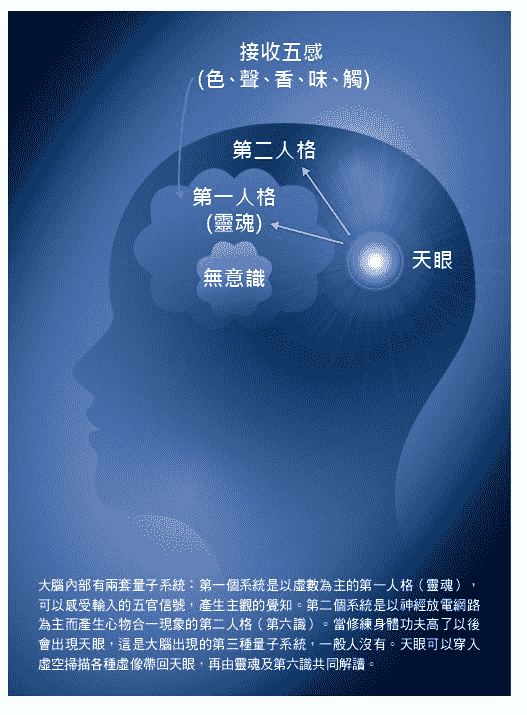 |
|---|
The structure of the entire brain-mind is as shown in Figure 5-1 on the next page.
Thus, there are generally two sets of quantum systems inside our brain: The first system is the first personality (the soul), dominated by imaginary numbers; it can sense input signals from the five physical senses, produce subjective awareness and the seven emotions and six desires, and scan various residual spin geometric structures inside, displaying personality. The second system is the second personality (the sixth consciousness), dominated by the neural discharge network and capable of producing the phenomenon of unity of mind and matter. After one’s practice of bodily disciplines reaches a high level, the Celestial Eye will appear; this is a third quantum system arising in the brain, which ordinary people do not have. The Celestial Eye can penetrate the void, scan various virtual images and bring them back to the Celestial Eye screen, where they are then jointly interpreted through the coordination of the soul and the sixth consciousness.
From the results of reading words with fingers shown in Chapter 2, Figure 2-7 (please see page ninety-one), it can be seen that for samples bearing uppercase red English words such as “HAPPY,” after the virtual image is scanned back by the Celestial Eye, the soul sees the color as red. The sixth consciousness, based on past learning experience, keeps the first English letter as uppercase H, but changes the subsequent English letters to lowercase, resulting in reading it as the red word “Happy.”
Editor’s Note 1: Coupling — In physics, refers to the phenomenon whereby two or more systems or two types of motion influence and thus join each other through interaction.
The Structure of the Mind Revealed by Hypnotism or Hypnotherapy
Hypnotism is a process in which a hypnotist uses verbal suggestion or other means to induce a special state in the subject’s psyche. At this time, the subject eliminates the various spontaneous and disordered thoughts of the ordinary state, and the mind presents a state of silence. If the hypnotist then issues various suggestions, the subject will faithfully carry them out without hesitation, exhibiting various phenomena of being hypnotized.
The suggestions given by the hypnotist to the subject not only temporarily affect the subject’s psyche and body; after the subject wakes up, or even some time after waking, the influence of the suggestion’s power will still persist. Therefore, hypnotherapy is used by some psychiatrists to treat mental illnesses. For example, the American doctor Brian L. Weiss’s Many Lives, Many Masters: The True Story of a Prominent Psychiatrist, His Young Patient, and the Past-Life Therapy That Changed Both Their Lives and the Taiwanese doctor Chen Sheng-Ying’s Conversations with the Spirit: The Mysteries of Past Lives, Dreams, and the Subconscious use hypnosis to lead patients back to past lives, to understand the root causes of their present-life problems, and thereby bring about relief from their conditions.
Hypnosis Awakens the First Personality (the Soul)
There are many theories regarding the principles of hypnosis, among which the more important one is the “second personality theory (latent psyche theory).” That is, applying Jung’s theory, it holds that in addition to the first personality (the soul), a person also has a second personality (the sixth consciousness). The sixth consciousness is responsible for handling daily disordered thoughts, solving problems, taking action, and other mental activities. Hypnosis puts the sixth consciousness into a sleep state, allowing the first personality (the soul) to begin exerting its function and to control bodily activities. Because the first personality is in charge of the awareness of the five physical senses, it can directly accept the verbal commands issued by the hypnotist and require the body to make various simple responsive movements, like an infant, but it is not allowed to wake up; only when the hypnotist orders it to wake up will the subject awaken. After waking up, the subject’s sixth consciousness will not remember the commands or the bodily activities at all. Sometimes, under verbal suggestion, it can even produce anomalous abilities such as remote viewing and remote sensing. If the hypnotist asks the subject to remember the entire process, then after waking up the subject will remember the content of the remote viewing and remote sensing.
These hypnotic phenomena reveal that the innate first personality (soul) contains hidden memories and experiences from past lives, which are not known to the sixth consciousness and do not appear in the mental consciousness of the sixth consciousness under ordinary daily-life conditions. The hypnotist’s suggestions also reside hidden within the soul, controlling the sixth consciousness without being known to it. When we sleep, the mental consciousness of the sixth consciousness disappears, allowing the first personality, the soul, to begin its activity, so these past-life memories may appear during dreams. However, certain traumatic past-life experiences will gradually trigger similar physical or mental problems. These hidden memories and experiences are very likely what constitutes the category of the unconscious, or what are called “complexes” within the unconscious. The sixth consciousness begins accumulating from the moment of our birth and gradually thickens through cultural education, various environmental factors, and emotional impacts. The thoughts, activities, emotions, conflicts, and so forth that we process every day mainly rely on the sixth consciousness (equivalent to the CEO of the human body), while the first personality, the soul, remains hidden behind the scenes (the chairman of the human body), emerging only when major decision-making issues arise to handle them jointly with the sixth consciousness. The sixth consciousness is completely unaware of the existence of the “unconscious” hidden within the first personality, yet when it makes many decisions, it is subject to interference from the unconscious, or is indirectly directed by the first personality, the soul.
The hypnotist uses verbal suggestions to calm the subject, focusing the mind to suppress other thoughts and sensations and relax the entire body’s muscles—that is, to reduce the chaotic quantum field of the brain’s constant processes of creation and collapse—allowing the mental consciousness of the sixth consciousness to relax from its tense state and enter a resting, sleep-like state, yet without truly falling asleep. Hearing remains alert, but at this point the first personality, the soul, takes control of the overall situation.
Past-life regression therapy is the process by which the hypnotist uses language to guide the subject’s mind backward through time, progressively regressing from the present to infancy, and even into the mother’s womb. This layer of consciousness envelops the past-life memories and experiences within the unconscious, and therefore as the mind regresses further back, it can return to past lives to uncover problems and obtain answers, thereby adjusting the structure of the unconscious and resolving the illness.
The Five Senses Can Be Perceived by the Soul
The five senses are tools that can communicate directly with the soul, which is why we often say “the eyes are the windows to the soul,” meaning that in everyday life the five types of awareness—“form, sound, fragrance, taste, and touch”—received by the five sensory organs are interpreted through the soul. When extrasensory functions are activated, the moment the functional person’s heavenly eye opens, normal visual signals are blocked. At this point, the soul begins to use the heavenly eye to enter the void, scanning virtual images and bringing them back to the heavenly eye for interpretation by the soul. Using brain imaging technology (fMRI), one can observe that when the functional person’s heavenly eye opens, the auditory region is activated, and sounds from the void can be heard.
I believe that when a hypnotic subject enters the hypnotic state, the sixth consciousness is turned off, and the soul can communicate directly with the operator through hearing, but unlike the sixth consciousness—which, based on experiences stored in the brain’s networks, would engage in logical reasoning and talk back or resist—the soul has no consciousness of resistance and will fully accept commands. The soul can directly control the body, performing simple actions as required by the hypnotist and accepting the operator’s suggestions, which will continue to interfere with the subject’s rational thinking and judgment even after the sixth consciousness awakens.
True Awareness Comes from the Soul
From analyzing the perceptual experiences of the five senses and the physical mechanisms of finger reading, we discovered that each of the five senses sends two signals—one real and one virtual—into the brain. One is a real-valued neural electrical pulse signal, which is what modern neurophysiology describes as the signal believed to generate awareness. In reality, the neural pulse signal has no direct relationship with awareness; it merely plays the role of a carrier, bringing another piece of spin torsion field residual information that roams the interface between yin and yang to the soul, so that the soul can perceive the sensations of the five senses.
Under the framework of complex spacetime, modern neurophysiology has told us only half the story—only the story of the material world. The other half of the story, which is the mechanism that gives rise to true awareness, eludes touch and sight, occurring on another interface between the void and real space.
Chapter 6 New Technology for Interstellar Communication—The Search for Extraterrestrials
The key reason alien advanced civilizations are technologically ahead of Earth is that aliens have mastered the physics of consciousness, enabling them to build instruments that imitate the heavenly eye, freely enter and exit imaginary space to roam the universe, and simultaneously create instantaneous technology.
The model for humanity’s future learning lies among the countless alien advanced civilizations in the heavens.
The Search for Extraterrestrial Intelligence Program
Whether extraterrestrial civilizations exist is a question held in the mind of every person on Earth. The Milky Way galaxy contains hundreds of billions of stars and an even greater number of planets. To say that Earth is the only planet in the galaxy where life exists, and that no other evolved life exists, is truly unreasonable.
Over the past twenty years, the development of astronomical survey projects (Panoramic Survey Telescope and Rapid Response System, abbreviated as Pan-STARRS) has identified an increasing number of planets with environments similar to Earth’s—possessing liquid water and suitable temperatures—capable of nurturing life systems similar to Earth’s. Therefore, the existence of extraterrestrial civilizations seems increasingly beyond doubt to the general public.
In fact, the 1977 science fiction film Close Encounters of the Third Kind, directed by the great Hollywood director Steven Spielberg, is one of the milestones of science fiction films about contact with extraterrestrials. Not only because of its special influence, but also because Close Encounters of the Third Kind depicted extraterrestrials as gentle and friendly, which was very different from other earlier films. In 1982, the film E.T. about an extraterrestrial coming to Earth, also directed by Steven Spielberg, was an even bigger global sensation and also triggered a wave of enthusiasm among scientists to search for extraterrestrials.
From the 1980s to the 1990s, Harvard University in the United States began the Search for ExtraTerrestrial Intelligence (abbreviated as SETI). In 1992, the U.S. government once subsidized the National Aeronautics and Space Administration (NASA) to conduct the SETI project for a year, which was later defunded by the Senate. During this period, to increase the speed of computer computation, grid computing technology was also developed, calling on all individuals interested in astronomy to connect their personal computers to the internet while sleeping at night, allowing SETI headquarters to partition the sky data scanned by radio telescopes and separately utilize hundreds of thousands, or even millions, of computers to perform calculations individually, thereby drastically improving the efficiency of analyzing data. I remember that my daughter, who was in high school at the time, joined this project, turning on her computer every night to connect to the internet to do her part. However, this project ended in failure because no meaningful radio signals could be found.
In 2015, Russian internet-investment billionaire Yuri Milner, to commemorate the first Russian cosmonaut to enter space, Yuri Alekseyevich Gagarin, at the time of his own birth in 1962, donated 100 million USD to British Cambridge University physicist Stephen William Hawking to lead the search for extraterrestrials project. This included designing a nanosail, carrying a miniature camera, accelerated by laser light to head toward the star closest to the Sun—Alpha Centauri—to take photos and transmit them back to Earth, estimated to take twenty years. Just imagine, Alpha Centauri is 4.3 light-years away from Earth; transmitting a signal using radio waves would take 8.6 years for a round trip. Not to mention more distant stars, which would take even longer. That is to say, using radio waves to communicate with extraterrestrials is a meaningless endeavor, unless a faster method is found.
The problem is that Einstein’s theory of relativity states that the fastest speed in our universe is the speed of light; if one wants to exceed the speed of light, the problem seems unsolvable. However, the imaginary space-time we discovered, which is the spiritual realm, has no restrictions on time, space, or speed. It seems that utilizing the spiritual realm is the only way to solve interstellar communication.
Another task of the search for extraterrestrials project is to use radio telescopes to search for meaningful radio wave signals in space, similar to the SETI project from over thirty years ago. The problem is that human civilization on Earth only saw Guglielmo Marconi invent the technology to communicate across the Atlantic using radio waves in 1901; therefore, civilizations before the 19th century could not have been contacted using radio waves. More than a hundred years later, humanity might discover even more advanced communication tools, such as quantum or torsion field communication, which can traverse the void for interstellar communication, instead of using electromagnetic waves. Therefore, using radio telescopes, it is only possible to find civilizations that use electromagnetic waves as their primary communication tool just as humans do now; civilizations that are more advanced or more primitive cannot be found at all.
Using the Celestial Eye to Search for Extraterrestrials
In June 2002, we thought about using the celestial eye to traverse the void and visit advanced civilization worlds far away, but how were we to do it?
We thought we could earnestly request the help of Miss T’s master in the spiritual realm to guide Miss T’s celestial eye consciousness to find the location of the advanced civilizations and to observe the living conditions of extraterrestrials. So on June 2, we began the experiment, writing questions on slips of paper, which Miss T sent to her master in the spiritual realm via finger-reading, as shown in the first row of Figure 6-1 on the next page.
Miss T asked: “Master, could you introduce an extraterrestrial to contact us? Do we need to use the information field as a medium, and then go through the celestial eye?”
Three minutes after the finger-reading, Miss T’s celestial eye opened, and the question was sent out; after another three minutes, the Master appeared in the celestial eye, nodding to express agreement, and then complained about us in English: “Are you guys not satisfied? (Are you guys still not satisfied?)”, indicating that I have already told you so many secrets and you still come to bother me.
Figure 6-1 Using finger-reading to make a request to Miss T’s Master to visit an extraterrestrial civilization
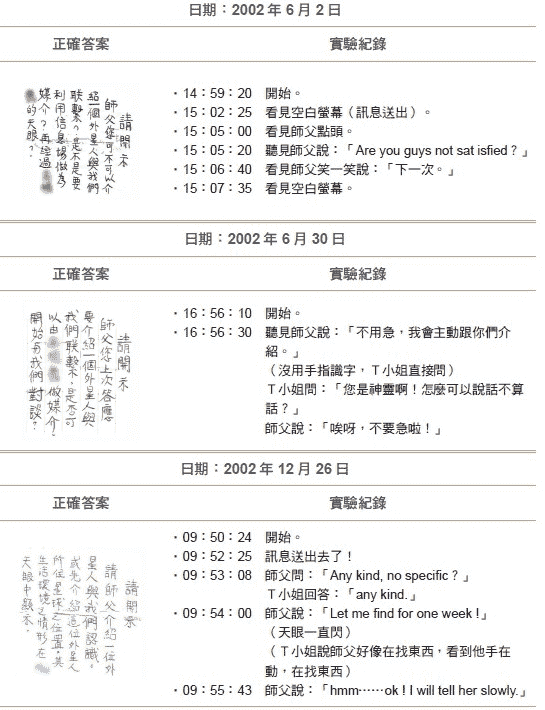 |
|---|
I hurriedly flattered the Master, saying: “You possess great virtue and great power, with boundless magical abilities; we are sincerely seeking the Way and want to search for extraterrestrials, please help us!”
One minute later, He smiled and said: “Next time.” The experiment then ended.
When June 30 arrived, we conducted the finger-reading experiment again, writing the question on a slip of paper.
Miss T asked: “Master, last time you promised to introduce an extraterrestrial to contact us. Can we begin conversing with them now?”
The Master said: “No rush, I will take the initiative to introduce them to you.”
Clearly he had forgotten, and we began to scold the Master.
Miss T asked: “You are a divine spirit! How can you go back on your word?”
The Master said: “Oh my, don’t be anxious!”
I could hear that he was getting a bit angry, so I did not dare push further, lest he become truly angry and refuse to take us to contact the extraterrestrials.
After waiting half a year, the Master still had not taken the initiative to make an introduction, so on December 26, 2002, we conducted another finger-reading experiment, writing questions on slips of paper.
Miss T asked: “Please, Master, introduce an extraterrestrial for us to meet, or first introduce the location of the planet where this extraterrestrial lives, with the circumstances of its living environment displayed in the Heavenly Eye.” Three minutes later, the answer came.
The Master answered: “Any kind? no specific?”
The Master had agreed! In my wild elation I immediately responded: “no specific!” The moment I said it, I regretted it; I should have gone to see a planet with an advanced civilization, as there was no need to go see again a world where dinosaurs reigned supreme. One minute later, the Master’s answer came.
The Master answered: “Let me find for one week!” He needed a week’s time to search.
Then I noticed that the voltage measured on Miss T’s palm kept producing one pulse after another, indicating that the Heavenly Eye was flashing continuously. I asked what was going on. Miss T said she saw the Master’s hand moving, as if searching for something. I guessed that he was swiping through a galactic star map on a touchscreen tablet in the void, looking for a planet suitable for us to visit, just as when we spin a globe to find the location of a certain country on Earth. Sure enough, one minute and forty seconds later, the Master’s answer came.
The Master answered: “hmm……ok! I will tell her slowly.”
He had already found one, but would let Miss T see it slowly.
Sure enough, at the end of 2002, the Master took Miss T’s consciousness to visit an extraterrestrial civilization. Miss T drew the extraterrestrial, as shown on the left in Figure 6-2 below. The extraterrestrial she saw had two eyes, two nostrils, one mouth, and two ears but no ear pinnae, with two hands and two feet, but the hands had only three fingers, one of which had an enormous fingertip, just like the extraterrestrial in the movie E.T. directed by the great Hollywood director Steven Spielberg. I suddenly wondered whether Steven Spielberg, like us, had also seen extraterrestrials.
Miss T described the extraterrestrial she saw to us: “Can’t see the feet,” “moves really fast,” “skin is very dark and somewhat shiny, like wearing a layer of outer coating,” “on his head it seems there is an antenna, because I noticed the extraterrestrial had no mobile phone but was talking to himself, as if communicating.”
It was not until more than ten years later that I understood why the extraterrestrial’s feet could not be seen, and why they moved so fast. It was because they wore walkers on their feet, enabling them to move back and forth rapidly.
Next, Miss T saw a fashionable tree covered in sparkling lights, as shown on the right in Figure 6-2 below. The surroundings of the tree were completely dark, with no sunlight, like nighttime. This was quite similar to the habit in Earth’s human civilization of hanging lights on trees at night.
Figure 6-2: The extraterrestrial and tree seen by Miss T
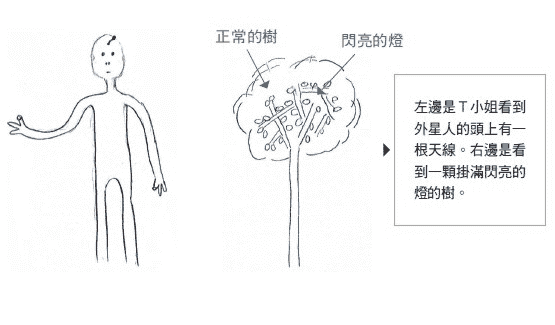 |
|---|
Later, Miss T saw a machine like a magic box, as shown on the left in Figure 6-3 below. She saw the extraterrestrial typing on a keyboard with its fingers, when suddenly something came out of the magic box. The extraterrestrial immediately put this object into its mouth and ate it; it was too fast to see clearly.
So we asked the Master what the purpose of this machine was. The Master answered: “This is what they invented, can obtain anything.”
Wow! Was this not Doraemon’s (the robot cat Dingdang’s) Anywhere Machine? I suddenly began to wonder whether Doraemon’s author, Fujiko F. Fujio, had also visited an extraterrestrial planet. Apparently, after the extraterrestrial input the name of a food, the food was dispensed and swallowed by the extraterrestrial in one bite.
Then, Miss T went outside to an open area and saw many three-legged machines, as shown on the right in Figure 6-3 below. So we asked the Master what the purpose of this machine was. The Master answered: “Transportation vehicle.” It was like a small flying saucer.
Figure 6-3: The extraterrestrial machines seen by Miss T
 |
|---|
| On the left is the magic box machine, which can allow the extraterrestrial to obtain anything. On the right is a transportation vehicle like a small flying saucer. |
After the visit, I began to ask the Master, through Miss T, some questions about this planetary civilization.
I asked: “Is the planet where this extraterrestrial lives within our Milky Way galaxy?”
The Master answered: “YES!”
I asked: “In which constellation is it?” I unfolded a star chart.
The Master answered in succession: “Twenty, Thirty. Go up and little left. Pretty close.”
Twenty, Thirty refers to right ascension and declination on the celestial sphere, as shown in Figure 6-4 on page 261. The location of this planet is in the constellation Cygnus. Nearby is the Summer Triangle formed by Vega, Altair, and Deneb. Later, I used the Sky-6 constellation software employed by the astrophysics community, continuously zooming in on the nearby star clusters, and then through Miss T’s celestial eye, the Master identified it as a planet of a medium-sized star 438 light-years from Earth—meaning that a round trip of electromagnetic waves would take 876 years. If an electromagnetic wave signal had been sent from the Song dynasty to say hello, the reply would only be received now. This once again demonstrates that using electromagnetic waves for interstellar communication is utterly meaningless.
I continued to ask the Master questions through Miss T.
I asked: “What is the level of their technology? Can they enter the information field and come to Earth?”
The Master answered: “Better than yours. Yes! They can come to Earth; they have come many times.”
I asked: “Is the food they eat different from ours?”
The Master answered: “Yup! Different.”
I asked: “Are their genetic genes also DNA?”
The Master answered: “They also have these things.”
I asked: “Next time they come to Earth, can I receive them?”
The Master answered: “Haha! Not that easy. The timing isn’t right.”
I thought for a long time about why the timing wasn’t right. Later I finally figured it out: if news broke today that aliens were coming to Earth, Earth’s civilization might immediately collapse. Aliens capable of traversing the barriers of space and time to arrive here would obviously have technology far more advanced than ours; the people of Earth would be absolutely no match, and the entire society would rapidly disintegrate out of fear. When would their arrival on Earth not cause fear? Only when humanity’s wearable technology has developed to the point of eliminating mobile phones, with each person using one or two antennae on their head in place of a phone. At that point, the aliens from Cygnus could come; they could blend invisibly into the crowds, and no one would know—thereby relatively avoiding panic and chaos.
Figure 6-4. The location of the planet inhabited by the aliens
 |
|---|
| The small red dot in the figure marks the location of the aliens’ planet, which is in the constellation Cygnus within our Milky Way galaxy. |
Independent Verification of the Alien World
Of course, the alien world seen by Miss T alone through the celestial eye could not convince others, so independent verification was needed. I therefore went to the Institute of Human Body Science at China University of Geosciences in Beijing, where I found Professor Shen Jinchuan and the highly gifted individual Ms. Sun Chulin to repeat this experiment.
Ms. Sun’s miraculous and astonishing psychokinetic powers can be found in the book Is It Latent Potential? Or Extrasensory Perception? Her abilities are so powerful that she does not need the Master’s assistance; she can roam the universe on her own. She also did not know Miss T and was unaware of the experiments we had previously conducted. So I brought a star chart and asked her to visit the alien civilization in Cygnus to see the aliens with one antenna on their heads. Unexpectedly, she turned her head, paused for two seconds, and said she saw them. I calculated that in two seconds her celestial-eye consciousness had traveled 438 light-years round trip, meaning that the speed of consciousness in the spiritual realm is at least 3 × 10⁷ times the speed of light.
However, Ms. Sun said: “The aliens I see have two antennae on their heads, not one.”
I said: “Last time we clearly saw one. How did it become two? Could it be a mistake?”
Ms. Sun merely turned her head again, and her celestial-eye consciousness made another trip to the alien world.
Ms. Sun said: “I asked the aliens, ‘Last time Professor Li saw you with one antenna; why do you now have two?’ The aliens told me: ‘Look—one antenna retracts into the head, so only one remains.‘”
I asked: “How do they communicate? Do they use language?”
She said: “No, it’s all telepathy.”
Now a new situation arose. Although Ms. Sun confirmed that the aliens had one antenna on their heads, sometimes there were two, which also needed repeated verification. After returning to Taipei, I also asked Miss T to visit the planet in Cygnus again to check whether it was really as Ms. Sun described—that sometimes the aliens had two antennae on their heads and sometimes one.
On March 28, 2004, during a finger-reading experiment, Miss T’s celestial-eye consciousness followed the Master to the alien world in Cygnus. She discovered that the Master could speak with the aliens. The aliens would momentarily have two antennae on their heads, then only one—indicating that the aliens could communicate with the Master of the spiritual realm, far surpassing us humans. Later they went to another place where a group of aliens all had two antennae and were looking up at something. Then they went to a room with a screen, in which there were three to four aliens, but the screen could not be seen clearly. So I asked Miss T to ask the Master: when do the aliens have only one antenna on their heads, and when do they have two? The Master replied: “When they need to receive signals, they have two antennae.”
This left me extremely perplexed. Alien technology is far superior to humanity’s, so why go to the unnecessary trouble of using two antennae—one to transmit and one to receive? The mobile phones we humans use need only one antenna to both transmit and receive. It is truly bizarre.
A few months later, I suddenly realized that I had gotten it wrong. What the Master called receiving signals was receiving signals of consciousness, not electromagnetic wave signals. It turned out that the aliens had long understood the physics of consciousness and therefore manufactured a consciousness antenna, inserted into the head to communicate directly with the aliens’ consciousness, which could be used for interstellar communication and for communicating with deities and spirits, with powerful efficacy. The other antenna should be an ordinary electromagnetic wave antenna, used for communication within the planet. This also explained why, when the Master was communicating with the aliens, one antenna—that is, the consciousness antenna—would extend and retract; when consciousness was not in use, only the electromagnetic wave antenna remained.
On January 1, 2004, we went to the eighth floor of the Xiaofeng Memorial Hall at Chinese Culture University to conduct finger-reading experiments. Miss T’s Celestial Eye consciousness once again followed the Master to visit the alien civilization of the constellation Cygnus, as shown at the top of Figure 6-5 on page 266. She saw a large screen with aliens lined up neatly watching a red-orange sphere on the screen and talking. Importantly, the tips of the antennas on top of their heads were lit up, like round spheres, as shown in the drawing in the middle of Figure 6-5. I asked Miss T to question the Master.
Miss T asked: “What is the screen doing?”
The Master answered: “You can see any planet in the universe.”
Wow! This might be this planet’s space agency. The consciousness technology developed by the aliens could already tune in any planet in the universe onto the screen, allowing the aliens to comment and discuss whether to go explore it. I suddenly thought of whether Earth could be tuned onto their screen, letting them see Earth’s civilization and arousing their interest in coming to Earth to explore.
Miss T instantly saw a blue Earth appear on the screen. The aliens suddenly poured in, moving rapidly, instantly lining up in rows, with the antennas on top of their heads lit up. Miss T asked the Master whether the screen could be zoomed in, and the Master instantly disappeared. She saw the images of Earth continuously zooming in, and the aliens’ voices grew louder and louder. Suddenly, Miss T saw a red roof appear: it was a red main beam supported from below by two pairs of red short beams forming triangles—that was the roof of the Xiaoming Memorial Hall, as shown in the photo at the very bottom of Figure 6-5 on the next page. I realized that the aliens’ screen image was approaching our laboratory, so I immediately ordered all the students present to wave and greet the aliens. I believe the aliens saw us, but fourteen years have passed and there is still not the slightest sign that they have any interest in Earth.
Figure 6-5 Miss T observes aliens gathering
 |
|---|
| Miss T saw the aliens lined up neatly watching a red-orange sphere on the screen. Importantly, the tips of the antennas on top of the aliens’ heads were lit up, like round spheres. |
 |
|---|
| The red roof that Miss T saw on the aliens’ screen is the roof of the Xiaoming Memorial Hall at Chinese Culture University. |
At the end of 2014, the Hubei Provincial Museum transported its signature artifacts to the National Museum of History in Taipei for an exhibition called the “Mount Wudang Exhibition,” displaying Chinese historical artifacts unearthed in Hubei Province from successive dynasties as well as various artifacts related to the Daoist heritage of Mount Wudang. I found an afternoon to visit together with my wife. The first stone stele at the entrance (as shown in Figure 6-6) caught my attention. This rectangular stone stele was unearthed in Zigui County, Hubei Province (the hometown of Qu Yuan), and dates to between 4,700 and 5,800 years ago—that is, 200 to 1,300 years before the Yellow Emperor. It is called China’s first evidence of early people worshipping the Sun God, because at the upper center of the stele there is a sun-like object, and it is referred to as the Sun God Pattern Stone Stele.
Figure 6-6 China’s first unearthed Sun God pattern stone carving
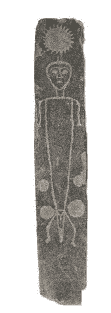 |
|---|
| The Sun God in the stone stele looks much like a human, except that there is a pointed object on top of the head, just like the aliens from Cygnus seen during the character-recognition experiments. |
The Sun God looks much like a human, except that there is a pointed object on top of the head. Archaeologists do not know what it is. The Sun God has a frame attached to his feet, and the fireball on top of his head also falls around his body. When I looked carefully, I was greatly encouraged—isn’t this the alien from Cygnus?
The pointed object on the head is an antenna, and the fireball at the tip of the antenna is a discharge phenomenon of the consciousness antenna, which can be used for interstellar communication or communication with deities and spirits.
After returning home, I immediately asked Miss T and Ms. Sun Chulin to look at what the feet of the Cygnus aliens actually looked like. Both reported that the aliens wore a walker on their feet, rapidly swinging back and forth like a metronome, making it difficult to see clearly. I immediately understood that this was an extremely significant archaeological discovery, proving that the Cygnus aliens had come to Zigui more than five thousand years ago, apparently passing on some of their scientific and technological achievements to the local people, which thenceforth became part of Chinese culture. Exactly which part this was can be studied in detail in the future.
The two antennas, fireballs, and walkers they saw on the aliens suddenly made me realize that this was the prototype of Nezha in the Investiture of the Gods (Fengshen Yanyi). Nezha treads on Wind-and-Fire Wheels and has two topknots on his head. It turns out that the immortals of early legends may have been microcosms of aliens. Suddenly I developed boundless reverence for myths and legends. The aliens who first entered civilization arrived on Earth and displayed their high technology, being regarded by early people as immortals and leaving behind legends.
It turns out that Earth is not a closed living system. High-tech aliens may have long since come to Earth and conducted many experiments, including genetic modification experiments, just as we humans are doing now. This led me to begin doubting Darwin’s theory of evolution. The theory of evolution has a basic underlying assumption, namely: “Earth is a closed living system, without interference from extraterrestrial intelligent systems.” Clearly, this assumption has already collapsed.
The Alien Civilization in Plato’s The Republic
In 2004, Ms. Sun Chulin, a high-functioning individual at China University of Geosciences, was guided by her extraterrestrial master on a tour of several alien civilizations. One of these civilizations turned out to be exactly the world described by Plato in his work The Republic, as shown in Figure 6-7 on the left. This planet is a planet of the star SAO 100012 in the constellation Orion, located 197.79 light-years away from Earth.
The aliens had very short hands and feet; their feet were square, and their bodies were encased in metal shells, as shown in the upper left of Figure 6-7. The center shows the houses the aliens lived in, and the bottom shows their means of transportation. Judging from the color of the metal, there were three types: gold, silver, and copper. The gold-shelled people were the fewest and appeared to have the highest status, followed by the silver-shelled, while the copper-shelled people were the most numerous and appeared to have the lowest status. The aliens wearing gold shells seemed to be kings and nobles, those wearing silver shells were like warriors and the ruling class, and those wearing copper shells were like commoners. To verify whether this observation was accurate, I asked Ms. T to visit the same planet to observe. Indeed, she also saw aliens everywhere still wearing metal shells and even at war. When they were sick, the copper shells of the aliens would turn green, as if verdigris had formed.
In Plato’s work The Republic, there is a passage describing the ideal form of social composition: society must consist of some people infused with gold, some infused with silver, and some infused with copper, and ideally they should not be mixed. In the 1980s, this passage sparked a cultural debate on the Stanford University campus in the United States, with critics arguing that Plato advocated classism, which was unsuitable for modern society, and there was a proposal to remove The Republic from the campus and prohibit its use as a textbook for general education. However, this passage shows that 2,400 years ago, Plato may have, just like us, used individuals with opened heavenly eyes to tour alien civilizations, hoping to find a form of society that could serve as a model for human learning. He wrote it into his work, influencing Western civilization for up to 2,000 years.
So where are the paradigms for human learning? They are among the countless advanced alien civilizations in the sky.
Figure 6-7: The aliens of the Orion SAO 100012 star system
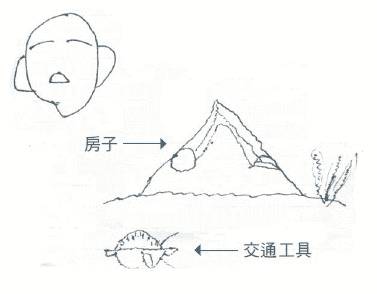 |
|---|
| The upper left shows the aliens, the center shows the aliens’ houses, and the bottom shows the aliens’ means of transportation. |
Alien Instantaneous Technology
Among the five advanced alien civilizations Ms. Sun Chulin visited, it was discovered that the aliens had all developed “instantaneous technology”—that is, with a wave of a small rod or a snap of the fingers, objects would instantly appear. The heavenly eyes of both Ms. Sun Chulin and Ms. T had visited the Coma Berenices SAO 82313 star system, and the aliens they saw all had an antenna on their heads, very similar to the aliens of the Cygnus constellation, as shown in Figure 6-8 on the left. Whenever they wanted something, they simply needed to wave a small rod, much like the fairies in Western mythology who, with a tap of a magic wand, could make objects appear. It turns out that both Chinese and Western mythology were transmitting the advanced technology of high-tech aliens. Humans at the time could not do such things themselves and could only regard them as immortals.
Figure 6-8: The aliens in the Coma Berenices SAO 82313 star system. The left was drawn by Ms. Sun, and the right was drawn by Ms. T.
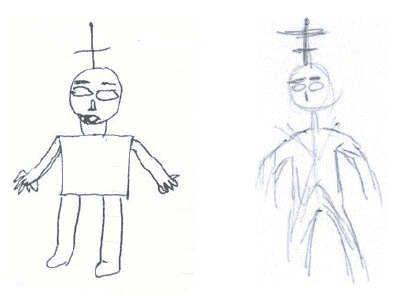 |
|---|
| The aliens that Ms. Sun and Ms. T saw when they visited the Coma Berenices SAO 82313 star system; both had an antenna on their heads, very similar to the aliens of the Cygnus constellation. |
New Alien Communication Technology
From the instantaneous technology invented by aliens, we understand that because aliens understand the physics of consciousness, they are able to create consciousness antennas that allow consciousness to penetrate the void. Not only can they travel through the universe and communicate with spirits, but in the void they can also “manifest whatever they desire,” creating anything and then materializing it, instantly creating objects in real-number space, thus achieving instantaneous technology.
If we humans want to establish contact with them, we must at least find tools capable of tunneling into the void. Fortunately, our modern technology offers at least two tools we can use: one is quantum entanglement, and the other is the torsion field—that is, the field of spacetime distortion. Both can penetrate the void.
Quantum entanglement cannot use two-photon entanglement, because in the void its speed would still be the speed of light. It is necessary to use two-atom entanglement; located in real-number space with slow speed, its relative speed entering the void can far exceed the speed of light, achieving the goal of interstellar communication. Of course, before communicating, both parties must establish a communication standard; otherwise, it would be utterly impossible to transmit or receive meaningful signals.
The first set of communication standards must rely on individuals with extraordinary abilities, such as Ms. Sun Chulin, to communicate directly with extraterrestrials and establish a standard similar to Morse code. Once a standard is established, it can be used just as, forty years ago when we were studying abroad in the United States, we all used telegrams to communicate quickly with our families, and telegrams used Morse code. Once interstellar communication technology matures and consciousness translators are gradually developed, it will be possible to converse directly with extraterrestrials. Another type of torsion field communication will have to wait for my future book to explain how it can be achieved.
The Future Direction of Modern Civilization
The two models I have proposed — complex spacetime and the imaginary number representing consciousness — have already constructed a unified explanatory platform for the mysteries of the universe at large, medium, and small scales. In this book, I have attempted to use this platform to propose explanations for these mysteries. Although they may not be entirely correct, they have at least opened a door. I hope that interested readers can use this platform to explain the difficult problems encountered in your own fields of work. I believe this understanding has already pointed out the direction of modern civilization’s development and will lead us to find extraterrestrials.
The Science of the Spiritual Realm
Author: Si-Chen Lee
Publisher: Sun Color Culture Co., Ltd.
E-book production date: November 2018
All rights reserved. Any infringement will be prosecuted.