Original publication
Original title: Les Phénomènes d’autoscopie
Author: Paul Sollier
Publication year: 1903
Original language: French
Source file MD5:e4f458eb0adccb3b7c31c5ef0504f356
Source edition: Internet Archive, University of Michigan copy digitized by Google.

The Phenomena of Autoscopy
Other Works by Paul Sollier
Librairie Félix Alcan
Psychology of the Idiot and the Imbecile (Psychologie de l’idiot et de l’imbécile). One octavo volume in the Bibliothèque de philosophie contemporaine, with 12 plates outside the text. Second edition, 1902. 5 francs.
Translated into German by P. Brie, with a preface by Professor Pelman; 1891. Translated into Polish by Goldbaum; 1893.
Genesis and Nature of Hysteria: Clinical and Experimental Research in Psychophysiology (Genèse et nature de l’hystérie: Recherches cliniques et expérimentales de psycho-physiologie). Two substantial octavo volumes. 1897. 20 francs.
The Problem of Memory: An Essay in Psychomechanics (Le Problème de la mémoire: Essai de psycho-mécanique). 1900. One octavo volume in the Bibliothèque de philosophie contemporaine. 3 francs 75 centimes.
Spanish translation in preparation.
Hysteria and Its Treatment (L’hystérie et son traitement). One sextodecimo volume in the Collection médicale, bound in boards. 1901. 4 francs.
The Role of Heredity in Alcoholism (Du rôle de l’hérédité dans l’alcoolisme). One volume of 216 pages. Delahaye et Lecrosnier, publishers. Paris, 1888.
Translated into English; New York, 1890.
A Course in Hygiene: A Practical Manual for the Sick-Nurse and the Nurse (Cours d’hygiène: Manuel pratique de la garde-malade et de l’infirmière). Sixth edition. One volume of 164 pages. Offices of Le Progrès médical. Paris, 1888.
Disorders of Memory (Les troubles de la mémoire). Second edition. One duodecimo volume of 262 pages, with 36 figures. Rueff, publisher. Paris, 1901.
A Practical Guide to Mental Diseases: Semiology, Prognosis, Indications (Guide pratique des maladies mentales: Séméiologie, pronostic, indications). One volume of 511 pages. G. Masson, publisher. Paris, 1893.
“Idiocy,” in Twentieth Century Practice of Medicine. Wood and Co., publishers. New York, 1897.
Translated into Italian by P. Parise; Florence, 1903.
“Treatment of Idiocy” (Traitement de l’idiotie), in A. Robin’s Traité de thérapeutique. Rueff, publisher. Paris, 1897.
Studies on Morphine Addiction and Its Treatment (Études sur la morphinomanie et son traitement), 1894–1899.
Translated into Russian; 1899.
The Phenomena of Autoscopy
By Dr. Paul Sollier
Physician to the Sanatorium of Boulogne-sur-Seine
Professor at the Université Nouvelle of Brussels
Paris
Félix Alcan, Publisher
Formerly the Librairie Germer Baillière et Cie
108, Boulevard Saint-Germain, 108
All rights reserved.
Preface
The phenomena that form the subject of this little volume present themselves in two forms. One, external, was already known under the name of autoscopic hallucinations and is now accepted by everyone.
The other, internal, is entirely new and, although of the same nature as the first, aroused smiles of disbelief as soon as the first cases were published. These facts have been denied, as new facts that disturb familiar conceptions are always denied. We need only recall here that the center of speech discovered by Broca was still not accepted seven years later by Vulpian himself. It is much easier to deny facts than to try to observe them, and I shall permit myself to say to those who deny them a priori, without taking the trouble to place themselves under the same experimental conditions as those who discovered them, that they are not following the rules of scientific method. Nothing could be simpler, however, for these conditions have been published without reservation for several years and are very easy to reproduce.
For my part, free from all preconceived ideas and an enemy of every scientific dogma, I have applied to the study of these phenomena, still rare, to be sure, but now numerous enough for their determining conditions to be established, all my attention, all the critical skepticism, and all the scrupulous care without which experiments in general, and experiments upon psychological facts in particular, are open to question.
These phenomena open new horizons, first upon the unconscious and then upon the mechanism of the mental functions. They shed light especially upon the conditions of normal consciousness and of suggestion. Strictly speaking, they do not clash with accepted ideas, although that would be no reason to keep silent about them; they are merely new, which is quite enough to trouble certain minds.
I publish them as they presented themselves to me and to others before me, indicating as precisely as possible the conditions of their development. What must be set against them, therefore, is not more or less seductive reasoning, but experiments to check them, conducted under these same conditions. Irony or systematic denial are not scientific demonstrations.
P. S.
Definitions
Normally, we have only a very faint representation of ourselves, whether we consider our postures, our gait, our gestures, and our facial expressions, that is, our outward person, or whether we consider our various organs in their functional changes, that is, our inward person.
When we picture our outward person, either as a whole or in its constituent parts, at rest or in motion, we do so only through the memory of visual images: direct images for regions accessible to our sight, or indirect ones, through mirrors, photographs, statues, and so forth, for those outside our field of vision. Even for the former, it is more difficult to imagine them with our eyes closed in their actual form than to picture them in other people. A painter can make someone else’s portrait from memory much better than his own.
As for our inward person, our representation of it is much vaguer still. In consciousness it corresponds to a general notion formed by the memory of all our internal, coenesthetic impressions, which fall far short of the degree of clarity and awareness of our external sensations. It is a rather confused feeling, even when intense, as in cases where there is pain in an organ, rather than a precise representation; and although we can, to some extent, realize where our various functions are situated, nothing enables us to picture their organs.
Yet there are cases in which a representation of our outward person is possible. It is then projected outside us in the form of a genuine hallucination, a deuteroscopic, or better, an autoscopic hallucination. Rare though they are, these cases are well known today, and there is no dispute about them. Despite the visual appearance of the phenomenon, moreover, it is not a visual hallucination in the strict sense, but a purely coenesthetic hallucination, as we shall establish further on.
Rarer, newer, and for that very reason more disputed, and even denied by some, are the cases in which there is a representation of all or part of our inward person, in which the subject clearly perceives within himself certain of his organs in their form, position, structure, and functioning. This is exactly the same phenomenon as the preceding one and, like it, is of a coenesthetic order. The sole difference between the two is that in one there is objectification and externalization of the coenesthetic sensation, whereas in the other there is no outward projection.
In both cases, what is fundamental, in short, is the act of representing one’s own person: either the outward person, and consequently seen from outside, or the inward person, and consequently seen from within. We can thus see that there is not really a hallucination in the first case; as in the second, there is only a coenesthetic sensation to which the subject, through a mechanism we shall examine later, gives a form in order to represent it to himself. By thus being given a form, the purely coenesthetic phenomenon takes on an apparently visual character. This character is very aptly conveyed by the root scop, and the term autoscopic hallucination would be perfectly appropriate if a hallucinatory phenomenon were really involved.
In the representation of the internal organs, this hallucinatory aspect disappears, and the first author to describe them, Comar, gave these phenomena the name phenomena of self-representation, to make clear that only a representation was involved. In reality, however, it is no more a representation than a hallucination; it is a coenesthetic sensation that gives the subject knowledge of his form, either outward or inward, a knowledge expressed through a kind of visualization inherent in the very notion of form. The term autoscopy therefore seems to me much more appropriate in both cases. It has the advantage of already being applied to some of the phenomena we are about to describe, and thus of being more familiar. Moreover, it is enough to add the adjective external or internal to distinguish its two essential varieties: external autoscopy, corresponding to autoscopic hallucinations, that is, to the apperception of our outward person; and internal autoscopy, applying to the apperception of our internal organs, that is, of our inward person.
We shall study them in turn, examining the conditions under which they occur, their relations to one another, their true nature, the interpretation of their mechanism, the criticisms they arouse, and their consequences from the psychological standpoint.
I. External Autoscopy
Historical Account
This consists in seeing oneself in front of oneself. The history of this phenomenon is very short. It cannot be described as wholly pathological, for it has appeared too transiently and too incidentally in individuals who, moreover, were presumably not ill. The earliest mention of it is probably found in Aristotle,1 who speaks of a man who saw his own image coming toward him when he went for a walk. Wigan2 cites an intelligent man who had the power to summon his own image before him; he laughed on seeing his double, who always laughed too. He eventually began arguing with this double, who sometimes refuted his arguments. Here we find something analogous to certain psychomotor hallucinations in the insane.
Michéa,3 following Nider, reports the case of a man who constantly saw his double, even in bed.
But it is Brierre de Boismont4 who gives this phenomenon the name deuteroscopy, which the German psychiatrists were already giving it. He regards it as a variety of illusion. He recalls that “in the mountains of Scotland and in certain parts of Germany, people still believe in the reality of a marvelous apparition said to portend approaching death. Outside oneself, one sees another self, a figure entirely like one’s own in height, features, gestures, and clothing.”
This kind of hallucination would therefore not seem very rare, since it is sufficiently familiar to the public to give rise to a legend. And indeed, certain famous men have been subject to it. Goethe5 relates that after a parting that had greatly saddened him, he saw, “not with the eyes of the flesh, but with those of the mind, a horseman advancing along the same road as himself; it was he himself; he was wearing a gray coat edged with gold braid, such as he had never worn.” He shook himself to dispel this hallucination, which disappeared.
Let us note the aptness of Goethe’s distinction between the eyes of the flesh and those of the mind. It clearly proves that he grasped the true difference between the autoscopic phenomenon and ordinary visual hallucination. The subject’s impression is entirely different in the two cases.
Shelley also saw his own person, which sometimes spoke to him. But the poet who displayed external autoscopy most clearly is certainly Musset, who described it perfectly in La Nuit de décembre and must have experienced it in the most moving circumstances of his life, when he says:
When I was a schoolboy,
One evening I stayed awake
In our deserted room.
A poor child dressed in black
Came and sat before my table,
Resembling me like a brother.His face was sad and beautiful:
By the light of my lamp,
He came to read in my open book.
He leaned his brow upon his hand
And stayed until the following day,
Thoughtful, with a gentle smile.
This figure appears to him at the various stages of his eventful life:
I remembered him so well
That I always recognized him
At every moment of my life.
It is a strange vision;
And yet, angel or demon,
Everywhere I saw this friendly shade.…
Wherever I wanted to sleep,
Wherever I wanted to die,
Wherever I touched the earth,
A wretched man dressed in black
Came and sat along my path,
Resembling me like a brother.…
And the poet asks himself:
Who are you, then, who are you, my brother,
Who appear only on the day of tears?
One of our most illustrious contemporary novelists, Guy de Maupassant, was also subject to it, in two forms we shall have occasion to distinguish: the positive and the negative form. One of his close friends told me that in 1889, that is, at the time when he was entering general paralysis, he had had this hallucination very distinctly one afternoon and had related it to him that same evening.
Seated at his writing table in his study, where his servant had orders never to enter while he was writing, he seemed to hear his door open. He turned around and was no little surprised to see his own person enter, sit down opposite him with his head in his hand, and begin dictating everything he was writing. When he had finished and stood up, the hallucination disappeared. Moreover, this author’s Le Horla is only a sketch of the coenesthetic hallucination we are describing here. G. de Maupassant relates, indeed, that he constantly felt it near him, that it entered into him, but he could not distinguish it or see it. In the present case, he had the true autoscopic hallucination, which clearly shows its relationship to the other cases in which there is only a coenesthetic sensation.
Unfortunately, as in most cases, it is impossible to know what physical disturbances, whether of general sensation or otherwise, accompanied the phenomenon.
Lasègue6 encountered it in a patient with subacute alcoholism.
It was Féré who, as early as 1891,7 proposed the name autoscopic or mirror hallucination. He observes that this name is preferable to the deuteroscopy used by Brierre de Boismont, and the broader adjective autoscopic is itself preferable to mirror, for although the subject often sees himself as in a mirror, he may sometimes also see himself with attributes other than those of the present moment.
He reports the case of a physician who was diabetic and had cancer of the bladder, of which he died. “Several months before his death, when he was already walking with difficulty and had profuse hematuria, he was in the corridor of a house he was entering for the first time when he stopped abruptly at the sight of his image, which he thought was reflected in a mirror. Since then, the same hallucination recurred frequently, generally toward evening, in his own house. It did not reappear after he became permanently bedridden. In every instance, the vision reproduced his posture and gestures.”
This is mirror hallucination in the strict sense.
In 1893, Roubinovitch8 cites the case of a woman who suddenly saw herself as in a three-panel mirror.
Despite these various cases, external autoscopy has not been the subject of any comprehensive study; even the case reports are rather summary, and they are, moreover, rare enough that the Society for Psychical Research recorded only seven cases in its survey of hallucinations.
In 1898, Féré9 returned to this question with a most interesting case, which I think it useful to reproduce here almost in full, for the issue of the journal in which it appeared is virtually impossible to find.
O…, aged 22, son of an epileptic, short, infantile. Convulsions in childhood. Intellectually backward; a convulsive attack following drunkenness. Since then, fits of weeping and suffocation, insomnia, and nightmares that leave him anxious upon waking. Great fatigue on getting up in the morning, a kind of state of unconsciousness from which he emerged only after exercising for some time. Clumsy at everything outside his usual duties.
Six months later, a severe fright. Afterward, nights disturbed by sudden awakenings caused by amplified visions of the previous day’s scene. He falls asleep at three o’clock, and when he wakes in the morning he feels his eyelids rise with difficulty, especially on the right, and his entire right side numb and cold, heavy as lead, difficult to move. The same disturbances of movement and sensation on the left, but less marked. By rubbing and stimulating himself, the numbness disappeared and movement returned. He rubbed his eyes and was then startled to see before him a boy who resembled him as closely as possible, feature for feature, but dressed in a musketeer’s costume. Then everything disappeared.
But every morning the same phenomena recurred; the vision recurred only if he
rubbed his eyes. Despite the bromide he took to sleep, the same disturbances continued.
Right-sided hemianesthesia affecting general sensation and the special senses. Tender point at the eighth and ninth dorsal vertebrae. Diminished voluntary movement on the right. Diminished stereognostic sense. Poor appetite; meals followed by congestion of the head.
Persistence for several weeks despite treatment. The morning hallucination could be induced by pressure upon either eye alone, and it seemed to be seen equally distinctly by both. When anteroposterior pressure sufficient to induce the hallucination was applied to one or both eyes, or when the axis of one eye was deflected by lateral pressure, doubling of the image was induced. The image was about four to five meters away. Objects passing farther away did not disturb the view of it; those passing close by interrupted it.
At the age of fourteen or fifteen, he had read a large number of swashbuckling novels, and several musketeer scenes in which he assigned himself a role had entered his dreams. He recognized the costume appearing in the hallucination as one that had long figured in his nocturnal visions.
When he regained weight six weeks later and the disturbances began to diminish, the hallucination disappeared within five or six days. The numbness and paresis of the limbs and the heaviness of the eyelids gradually diminished. During the four and a half months of subsequent observation, the stigmata persisted, but sleep was almost normal.
The coincidence between the hallucinatory phenomena and the morning paralysis was therefore evident; nor is there any doubt about the role of pressure upon the eyeballs in provoking them.
Despite these last observations, Féré says at the beginning of his article that the phenomenon cannot be connected with a corresponding somatic state. The fact that the hallucination appeared in the morning during the period when O… was numb and paretic on the right side, indicating a profound disturbance of sensation, and that it ceased to appear when the paralytic disturbances disappeared and sleep became more normal, are nevertheless proof of its relationship to the somatic disturbances. Moreover, M. Féré gives no interpretation of the nature of the phenomenon.
M. Lemaître10 has reported three new cases, one of them a negative hallucination. Unfortunately, they are very complex and accompanied by other hallucinations, ecstasies, and so forth, so that, interesting though they are, they cannot provide us with the elements needed to understand the mechanism of external autoscopy.
Before him and after Féré, I observed a fairly large number of cases, twelve, which I communicated11 to the Société de psychologie. They represent almost all the degrees and different varieties of the phenomenon. The conditions under which I was able to observe them allowed me, in certain cases, to establish how they were produced and their relationship to disturbances of sensation, particularly anesthesia.
Cases
Case I
In the first case, the patient was a young woman of twenty-three, Gabrielle L…, who, after becoming obsessed at eighteen with the idea that she was too fat, subsequently developed ideas of persecution, followed by confusion of ideas with hallucinations of all the senses. After the acute state had passed, there persisted auditory hallucinations: several voices speaking ill of her together, confusedly and indistinctly; psychomotor verbal hallucinations that she experienced either in her head or in her chest, and which she herself called the echo of her thought, because they said everything she was thinking at the same time as she did; and mistaken interpretations, imagining that people were watching her, criticizing her in the street, and finding her odd. Apparently, during her acute hallucinatory attack, she had had disturbances of general sensation of a hysterical character. But during all the time I observed her myself, she displayed none. She was, moreover, perfectly aware of her disturbances, for which she herself sought a cure, and which in fact disappeared one after another. In the last phase of her convalescence, when all the hallucinations had disappeared, she twice experienced the phenomenon of autoscopic hallucination, which was unfamiliar to her and made a rather strong impression upon her. She was walking quietly in Paris when suddenly her own image rose up before her, about two or three meters away, dressed exactly like herself. It was true mirror hallucination. It lasted a few moments and disappeared. A short time afterward, waking in the middle of the night, she perceived beside her bed the outline of a woman whom she did not recognize and thought was her nurse. As she woke more fully to make sure, the vision disappeared.
What happened at the time of the first hallucination? I was unable to establish this. As for the second, the conditions of its appearance upon waking, and of its disappearance as soon as awakening was complete, should be compared with Féré’s case, in which the periodic autoscopic hallucination occurred at the beginning of the morning awakening.
This young woman had never had visual hallucinations, which, moreover, are never encountered in the delusional forms of persecution. As in almost all the cases reported, the phenomenon occurred only once in its complete form, and a second time in a much attenuated form.
Case II
In the second case, the patient was a woman with severe hysteria, Marie T…, with multiple disturbances of sensation, both general and of the special senses and viscera, and frequent, profound changes of personality. At nightfall, never during the day, she perceived about three meters12 in front of her a phantom resembling her, but smaller and dressed like her. This frightened her; she stopped, and if she was alone, it sometimes lasted an hour. Then the phantom turned to the right, always, keeping its distance, and disappeared behind her. “It is,” she says, “like a shadow turning with the sun.” It troubled her and prevented her from breathing. The autoscopic phantom disappeared as soon as there was light. “If there was none,” she says, “I went off into the realm of dreams.” Indeed, as soon as she has been in darkness for some time, she becomes completely anesthetic and develops contractures while changing personality, as I have observed many times.
Here the phenomenon is more complex. The vision is in motion, and disturbances of general sensation and of personality occur that may be very marked. Again, the hallucination arises when impressions become less vivid, at nightfall, when under this influence the subject grows torpid and more profoundly anesthetic. It thus coincides once more with a state of diminished personal consciousness, as in the case of incomplete awakening; it is the same twilight state of consciousness that favors it, if it does not actually produce it.
In the following four cases, the hallucination occurred under analogous conditions and in a manner showing that this variety of hallucination cannot be associated with visual hallucinations in the strict sense, but rather with coenesthetic hallucinations, and is only a form of doubling of personality.
Case III
In one of them, the patient was again a young woman with hysteria, aged twenty-six, Marguerite L…, with chiefly visceral manifestations (anorexia, vomiting, attacks of suffocation) and disturbances of personality and character. She has a nonvisual autoscopic hallucination, if I may put it that way, although these two adjectives seem at odds together, in two circumstances: either at night when she wakes, or during the day when she has a strong emotion that causes her to lose all sensation and plunges her into a state of very vague consciousness, from which she scarcely emerges except through an attack.
She herself describes the phenomenon as follows:
“I sometimes see myself, but above all I feel myself.” This seeing occurs only in cases of emotion. “I feel someone being drawn out of me, as though my limbs were being stretched to form others. The last time it happened, when my father came back from Paris, the sensation was so strong that I joked about it, saying: ‘I am in Father Adam’s position when his wife was being taken out of his rib.’ The person is absolutely like me, and it is I who do not recognize myself in a mirror. She speaks exactly like me but is always of the opposite opinion, and I hear her in my head. She is always hot, and at night I have the feeling that she pulls my covers off to cover herself. The last times this happened were in bed, as I came out of sleep. I do not see this second person for very long, when I do see her, but above all I feel her in my head, preventing me from speaking so that she can say the opposite of what I think. This persists for whole days and exasperates me when I have to speak with someone. It leaves my head feeling wooden for a long time.”
In this case, autoscopic hallucination in the strict sense is combined with purely coenesthetic hallucination and doubling of the self. The three phenomena take one another’s place and combine, thus showing their identity of nature.
Case IV
In another case, the patient was a young woman of twenty-eight with visceral hysteria, hypochondriacal interpretations, and disturbances of muscular sensation and coenesthesia, whom I awakened from her cerebral torpor by my mechanical procedure13 combined with hypnosis. During the restoration of her coenesthesia and personality, she was seized more than once at night by phenomena analogous to the preceding ones. “All night,” she told me, “I felt as if I were two people; it is as though I were watching my own sleep, as though I saw myself sleeping, and I did not recognize myself. This morning I could not manage to wake up. I got up; when I lay back down on the bed, it seemed to me that the person I used to be appeared to me and mocked me. I answered her that that person was dead, that she no longer existed. And it is true that I have been dead ever since I fell ill.”
“The other person mocked me, and I could not imagine that she was the same as the person of today, whom I felt to be dead. I no longer knew what that former person was. Then I was burning everywhere, especially in my stomach, my head, and my whole chest; my heart was leaping painfully. My legs especially seemed to stretch out indefinitely. Then I went back over my whole life during the two years before my illness. I saw everything again as clearly as possible, the good days and the bad. I even saw my clothes again. You cannot imagine how distressing it is not to recognize oneself, and to struggle like this against another person within oneself.”
Here the antagonism between the two persons, the subject and her double, and the difference the subject observes between herself and this double, arise from the regression of personality, which throws the subject back to the period before her illness and thus makes her picture what she was then, in good health, comparing it with what she is today, ill and indeed unrecognizable.
She later had an autoscopic hallucination in the mirror form as well. Awakened from her hysterical state by my usual method, she had one day reached an almost normal state; and indeed she attained it at the following session of cerebral awakening. After this session, that very evening, she experienced the impression of seeing herself in front of her as if looking into a mirror, and instinctively would have stepped backward had she not reasoned with herself. This lasted almost the whole evening.
Case V
In the third case of this series, the patient was a man of forty with the hypochondriacal form of hysteria, chiefly with disturbances of coenesthesia and muscular sensation, a feeling of fatigue in the lower limbs that was sometimes rather painful, and bouts of respiratory oppression. Frequently at night he wakes with a little anxiety, and he seems to feel another man exactly like himself lying on him and weighing upon him, or stretched out beside him and continually pulling off his covers. He feels him rather than sees him. More precisely, he represents him to himself as identical with himself and often attributes to him the pains he feels in his head or legs. He is, moreover, perfectly aware that this is not real and that it is a nervous disturbance. The phenomenon occurs only at night.
Case VI
The last case closely resembles this one. The subject, a woman of twenty-five with severe hysteria, Claudine B…, with predominantly visceral manifestations, subject to hallucinations of memory and changes of personality, saw herself at night lying beside herself. It seemed to her that she herself was made of wood or stone, and her double mocked her, insulted her, and reproached her for being ill. Now, she was completely anesthetic, but to an extremely marked degree in the viscera, and she always maintained that she had no heart, literally and figuratively, loved no one, and was as if dead or made of stone. Emotional anesthesia was indeed very pronounced.
In these four cases, the phenomenon is above all coenesthetic. The subject feels near him a person identical with himself, and may go no farther than this. He recognizes that person, in a sense, as one would recognize an object in darkness by touching it. Sometimes, however, he amplifies this coenesthetic sensation through a kind of visualization, just as certain people endowed with a rather vivid visual imagination visually represent objects described to them or which they touch without seeing. I dwell upon these simple phenomena because they will later enable us to understand and interpret internal autoscopy more easily.
Case VII
The analogy between autoscopic hallucination and doubling of personality is clearly shown in the following case. The patient is a girl of seventeen with hysteria, Dinah M…, with variable disturbances of general sensation, ecstasies, and changes of personality. As far back as she can remember, she has always felt two selves within her. They converse in the pit of the stomach. One argues for, the other against, and she witnesses their debates. Moreover, from the age of ten she has seen in dreams a figure dressed in black, with splendid eyes that fascinated her. She felt completely subjugated by him but attached no idea to it. For the past six months, on the contrary, during which she has had ecstatic or spasmodic attacks, she has seen him again, and her feeling has changed. Under various influences, she has come to abhor marriage and love, chiefly because she fears she will not be happy. When she reflects upon this subject, the figure appears to her: he is in complete agreement with her ideas; he says exquisite words of love to her, such as she has never heard; she answers in the same manner; she sees his eyes, which fascinate her; she feels fear and pleasure at the same time; he draws her irresistibly; she feels him envelop her entirely; she feels his touch. He speaks to her, and she hears him through her ear. She is then in a state of reverie and even of sleep; she knows it would cease if she woke, but she cannot open her eyes.
Examining her at that moment, I found that she was anesthetic everywhere. Nevertheless, if she is touched or pricked, she knows something is being done to her, but does not know what. She makes movements, knows she makes them, and at the same time says she is convinced she does not. It seems to her that her body is floating in space and is very light; her head seems empty; she has lost the notion of time and is very happy. She becomes emotionally insensible to the whole external world. She explains to me that there are four persons in her: first, the two voices that argue opposing sides within her; the third, who witnesses their debate, is herself; and finally the externalized, objectified figure, who is at once a stranger to her and yet also herself, for he is mentally identical with her.
There is therefore doubling in every respect: doubling of the sensory personality, for she feels and believes she does not feel; doubling of the intellectual personality, in the two contradictory epigastric voices; and doubling of the emotional personality, in herself and the objectified, externalized figure, who does not resemble her physically, but whom she knows to be herself and who is identical with her in feeling.
Although the hallucination does not represent the subject physically, I believe it may therefore still be called autoscopic, since there is a representation of the subject in the mental sense. This case clearly shows the relationship between autoscopic hallucination and doubling of personality, and its coenesthetic rather than visual origin.
It is rather remarkable to find in this instance, as in a few others, the “young man dressed in black” from Musset’s La Nuit de décembre, which I recalled above.
Case VIII
The eighth case is none other than that of Guy de Maupassant, which I cited earlier.
Case IX
The ninth case is one of the most interesting and characteristic, for I was able to follow it over several days, at any moment, and saw the autoscopic phenomenon arise and disappear before my eyes.
The patient was a young woman of twenty-eight addicted to high doses of morphine. During withdrawal from morphine, she displayed, as happens fairly often, phenomena of hysteria, manifestations of which had in fact gone unrecognized for many years. In this instance, these disturbances consisted of attacks of generalized contracture with loss of consciousness and generalized anesthesia, without any change in the pulse. When the contracture ceases under the influence of passive movements, she passes through a cataleptic phase. When she emerges from these attacks, her head feels constricted and the tips of her fingers tingle. She then displays very marked automatism: if a word or a phrase that strikes her is spoken, she becomes obsessed with it and repeats it to herself almost indefinitely. Her whole body is anesthetic.
The following night she seems to doze off, but in reality she is in a slightly cataleptic state, as can be ascertained by changing the position of her limbs. Suddenly she complains and makes a gesture of pushing someone away. She then says there is a person beside her who is entirely herself, lying as she is, and that she has to move back to make room for her. “It is annoying,” she says, “to be double like that.” This person is smaller and younger than she is. She does not see her feet, which are hidden, moreover, by her blue dress, ending in a kind of twist. She cannot do anything unless this person does it first, and in the morning she tells me she could not sleep because the other had to sleep first and would not.
During the morning she seems to become absorbed for a moment; her gaze grows fixed, she closes her eyes, and again makes a gesture of pushing something away, saying: “I do not want her to come back; her dress is too long, she makes me cold; they really ought to give her a shower to warm her up.”
When I blow upon her eyes and address her somewhat loudly, she shakes herself and again becomes aware of what is going on around her, but retains the impression of her double, whom she still sees and feels beside her. She immediately tells me: “She is unbearable, she is always there; she had to go first in everything, in sleeping, in moving. That is why I could not sleep. I had to wait. I am not pretty if she resembles me.” Her head is heavy; sometimes she feels the other’s head very close to her, but chiefly she sees her in front of her, falling upon her; she feels her to be very light; it is chiefly her dress that makes her cold. After she has been speaking to me like this for a few minutes, with her eyes open and apparently awake, noticing that she is still insensible, I have the idea of blowing into her eyes while energetically telling her to wake up. She starts, looks at me, and only then seems to see me: “Oh, good morning, were you there?” she says. She feels her double much less. I then insist, close her eyes, and blow upon them again, ordering her to wake. She stretches her limbs and trunk, yawns, and has a much clearer gaze. She still imagines that I have only just arrived and that she is seeing me for the first time. She still sees her double but sees neither her arms nor her feet. Now, I find that she is beginning to recover sensation in her arms and legs, and that she now feels it when she is pinched. But her trunk and head are still anesthetic.
I repeat the same experiment once more, putting my hand over her eyes and ordering her to wake up. The same reactions of awakening occur, after which sensation in the arms and legs is much more acute, except in the hands and feet, where the muscular sense has not returned. She remembers her hallucinations of the night perfectly.
During the day the hallucination persists, but is rather faint. The following night she has it again with intensity. The next morning, after an attack of contracture, I make her wake, that is, recover more sensation. It reappears in the limbs and most of the trunk. Only the upper part of the chest and the head remain insensible. Now, she scarcely sees her double any longer; it is vaporous and floats far above her.
In the afternoon anesthesia reappears in the legs and forearms. She has again lost the muscular sense there, and there is a tendency to catalepsy, for as she walks she keeps her foot suspended in the air without realizing it. On the other hand, sensation in the trunk has extended and spread throughout the neck. She is moved to another room, and from that moment ceases to see her double. In the evening, sensation has reappeared in the legs and forearms, and during the night the double does not return.
The next day she even has difficulty remembering and picturing it. Sensation has returned almost everywhere. She has another attack of contracture in the morning, on emerging from which she is much more awake and much more sensitive everywhere. Two days later, sensation has returned completely, even in the head, and since then the hallucination has never recurred. The patient then explained to me that the blue dress she saw on the double was one she had worn as a girl, at about fifteen, and that her double also wore her hair as she had then, with gold barrettes. There had thus been, in the autoscopic hallucination, a regression of her personality of the kind I have described in patients with hysteria who lose or recover their coenesthesia.
The relationship between the coenesthetic disturbances and the autoscopic hallucination in this subject is clearly demonstrated, for it disappeared only on the day when thoracic sensation returned. This is itself linked to visceral sensation, which for us is the most abundant source of coenesthetic impressions and the basis of our sense of physical personality. The return or absence of sensation in the limbs did not, in fact, seem to have any influence. It was only the return of thoracic sensation that made the hallucination disappear.
I subsequently obtained a further confirming test of this. Under the influence of an episode of morphine elimination, some time later, this patient again had a few minor attacks, with yawning, a feeling of internal chilling, sensations of constriction and needle-pricks in the brain, and slight anesthesia and analgesia, chiefly in the trunk and extremities of the limbs. At these moments she can picture her former hallucination very well, but the disturbances are nevertheless too slight for the autoscopic phenomenon to recur.
The patient, moreover, never again saw her double in this form corresponding to her earlier personality. But subsequently, some months later, it happened several times that she had mirror hallucination in the strict sense and saw herself, in the very clothes she was wearing that day, as she opened her bedroom door or turned abruptly in a corridor. For a time she even felt some apprehension about it, the impression of thus seeing oneself in a room one expects to find empty being particularly unpleasant and somewhat distressing.
Case X
Here, finally, is a last case in which there was both external and internal autoscopy.
The patient was a young woman of twenty-two, Jeanne S…, with severe hysteria, whom I cured by my procedure of cerebral awakening through mechanotherapy and stimulation of general bodily sensation, the special senses, and visceral sensation. For the moment I shall report only what concerns her external autoscopy, reserving the detailed account of her internal autoscopy for later. Here I wish only to point out the coexistence of the two forms of autoscopy, to make their identity of nature quite clear and thereby show the singular contradiction of those who accept external autoscopy and deny internal autoscopy, without seeing that it is absolutely the same phenomenon and that the difference between the two concerns only the parts of the body perceived by the subject.
In this young woman, the phenomena of internal autoscopy had already appeared extremely clearly during her cerebral awakening, and this was almost complete when she experienced external autoscopy in the following circumstances.
One evening, as she was sitting near a table with a small lamp upon it, doing nothing and daydreaming, she suddenly saw herself as in a mirror: it was she herself who explained it to me in this way. She had the same clothes, the same hands, and the same face. But what frightened her most was seeing her eyes staring at her in alarm. She saw herself breathing and living in unison with herself. It was a perfect mirror hallucination. She uttered no word. She no longer knows what she felt then. “I do not know what I felt,” she says, “it was as though it were I who had been opposite.” As I remarked above, here again it is the true self that seems to be outside. And thinking of those eyes with their frightened look, she reflected to me that her own must have had the same expression at that very moment, for she was very frightened. This lasted about an hour; then everything became black, and she found herself back in her armchair, aching and trembling all over.
Case XI
At a still lesser degree, I observed, as it were, an outline of the phenomenon in the following form, in a highly intelligent young woman with a nervous disorder. One day, as she was about to enter an attic, she had the violent impression that if she went in, she would see herself there. This impression upset her so much that she called one of her female relatives to her aid and took refuge beside her, and never again dared enter that attic. From then on, she had a whole series of phobias of every kind, which disappeared only after several years, leaving her still very nervous and impressionable. Neither this apprehension nor any kind of hallucination ever recurred.
Negative Autoscopy
Finally, external autoscopy can even assume a negative form. Just as one can have positive autoscopy, as we have just seen it at different degrees, consisting in seeing oneself as in a mirror, or in seeing a phantom one feels to be identical with oneself, and indeed so identical that one regards it as one’s own person, while our actual body no longer represents our true self, one can also look into a mirror and fail to see oneself there.
Case XII
Guy de Maupassant also had this hallucination and described it in Le Horla. It is a rather curious circumstance to find it in him after what I have related above. The coexistence in him of mirror autoscopic hallucination, simple coenesthetic hallucination, and this one tends to show the relationship between these three varieties of hallucination.
I cited a case to the Société médico-psychologique14 under the name of loss of mirror vision, in a fourteen-year-old boy with hysteria who had, moreover, displayed no other hallucinations. One day, while washing and dressing and looking into the mirror of his wardrobe to put on his tie, he suddenly felt as though two hammer blows had struck his temples and ceased to see himself in the mirror. Nor did he see the furniture reflected there. To him, the mirror appeared like a pane of window glass. He saw everything around him, but as though there were a little smoke in the air, and the outlines of objects were somewhat indistinct. After about half an hour, he again felt as though two hammer blows had struck his temples, and the negative hallucination ceased, at the same time as his vision became clear again.
M. Lemaître15 also reports an example in a boy of thirteen, apparently not hysterical, but subject to ecstasies and numerous, varied hallucinations. Sensation was not examined.
Facing a mirror, he often ceases to see himself but instead finds himself before all sorts of scenes and unknown figures, until either he suddenly sees his image again or notices with astonishment that he has moved.
This case is not entirely pure, for hallucinatory images replace the subject’s reflected image in the mirror.
We can therefore already establish a first division within external autoscopy, distinguishing the positive and the negative form.
In the first, the subject sees himself or recognizes himself in the phantom he perceives opposite or near him. In the second, he does not see himself when he looks into a mirror.
Let us now examine how the phenomenon occurs in the two cases. In negative autoscopy, the number of observations is too small for anything precise to be said. It is a rare phenomenon, which I have witnessed only once. It seems to appear unexpectedly and transiently. The subjects do not seem particularly frightened by it, but astonished.
With what disturbances is it associated? In the case I personally observed, the boy who had displayed it had felt, at the moment of its appearance and disappearance, as though two hammer blows were striking his temples. In the other two, no coinciding physical disturbance, painful or otherwise, is reported. The explanation of this phenomenon is therefore very obscure. It can only be compared with the negative hallucinations induced by suggestion in certain patients with hysteria. But the interpretation of these hallucinations itself has not been established.
All that can be said is that, in two of the three known cases, negative autoscopy coincided with the other forms of positive autoscopy, which allows us to suppose that these phenomena are of the same order, of the same nature.
Positive Autoscopy
Positive autoscopy is better known in its manifestations and easier to interpret.
Every degree may occur, from the mere impression that one is about to find oneself face to face with oneself, to the clear vision of one’s image as if one saw oneself in a mirror.
According to the form of the phenomenon, the conditions of its appearance and persistence vary. When the subject perceives himself before him as in a mirror, the appearance is usually abrupt and unexpected, and lasts only a very short time. He is, moreover, generally incapable of estimating the duration of the phenomenon, which ordinarily arises in a moment of distraction or deep reflection, and surprises him enough that he attends only to its outward manifestation. Any stimulus is sufficient to make it disappear.
When the subject sees himself with attributes different from those he currently has, the phenomenon ordinarily lasts much longer and may persist for hours, with variations in intensity. The same is true when the double is only felt beside oneself.
The phenomenon almost always appears in the evening, at nightfall, or during the night in rooms dimly lit by lamps and night-lights. It also appears upon waking, when impressions from outside are not yet clearly perceived, and there is still a slight drowsiness, a certain cerebral torpor. These conditions should be compared with those M. Régis describes in dream hallucinations. It is also seen to occur during reverie. Thus, what seems fundamental to its emergence is the weakening of consciousness and general sensation.
The distance at which the phantom appears or is felt varies greatly. Sometimes it is a few meters in front of oneself, sometimes right against oneself. Sometimes the phantom walks toward the subject and suddenly vanishes; sometimes it turns around him before disappearing; at other times it moves beside him, reproducing all his movements.
Most often the autoscopic figure is mute. Sometimes, however, as we have seen, there may be a dialogue between the two selves. In that case they are ordinarily in contradiction. Sometimes the exchange of words takes the form of psychic hallucinations, sometimes the psychomotor form.
In what guise does the autoscopic phantom appear? In three different forms. In the first case, the subject sees himself before him as though he perceived himself in a mirror. He has the same face and the same clothes as those he is wearing at present. This is mirror autoscopy in the strict sense, formerly mirror hallucination. There is physical, material, and mental identity between the subject and the phantom. In the second case, mental identity alone exists; the physical resemblance of the face may be preserved, but not always; and as for resemblance in attributes and clothing, it does not exist. Sometimes it is a figure dressed in black who “resembles the subject like a brother”; sometimes the figure’s costume is that of some hero of a novel who once struck the subject’s imagination; sometimes it is clothing he himself actually wore in the past. In the last case, the subject sees himself again mentally and physically as he was at that time.
But the subject may see a figure who resembles him neither in physique, nor in sex, nor in clothing, but who is mentally identical with him and whom he recognizes as himself. This form, which might be called dissimilar autoscopy, corresponds to what was designated deuteroscopic hallucination.
We may compare it with what M. Féré described16
under the name of altruistic hallucination, of which he reported three cases. “Here is what it consists of; examples show it better than a long description. First, an epileptic who, following his convulsive attacks, often has a certain degree of paresis on the right side, at the same time has a delirium in which he says: ‘Give him a cigarette, light it; the poor fellow has no right hand; rub his hand, his fingers are tingling.’ Second, a young man with typhoid fever, in an apparently waking and healthy state, repeats with perfect composure: ‘Give him something to drink, he is very thirsty, he is lying very uncomfortably.’ Third, a woman who has just died following prolonged suppuration said a few days before her death, without having displayed any other mental disturbance: ‘I cannot get up to urinate, but he will get up in my place.’”
M. Féré says this kind of hallucination differs from autoscopic hallucination, but he gives no explanation of it. For my part, I believe, on the contrary, that it is of the same nature and belongs to the last form of external autoscopy. In this last case, even the vision of a figure identical with or dissimilar to the subject no longer exists. But he feels that figure to be identical with himself, to be himself.
Here it is the coenesthetic sense alone that comes into play, and although the term autoscopy may seem out of place without any phenomenon of vision intervening, I believe we can retain it by adding the adjective coenesthetic, so as not to give different names to phenomena we shall shortly see to be of the same essence, in which the coenesthetic element is precisely what is fundamental, while the visual element is only secondary.
We have encountered this form in a number of the cases we have reported. The subject does not see his double, but feels it beside him and recognizes it as identical with himself physically and mentally. It is noteworthy that in this case it is the double that seems to the subject to be his true self: it commands him, pulls off his covers if he is in bed, and prevents him from moving or sleeping unless it does so itself. This also happens in Féré’s altruistic hallucination; it is also encountered fairly often in hemiplegic patients who imagine they feel their own person beside them on the unaffected side. In cases of purely coenesthetic autoscopy, too, it is the healthy self that is represented by the phantom or double.
This observation may be compared with what we encounter in certain women with hysteria who have a doubling of the self and speak of themselves in the third person, as of a stranger, and in whom the doubling even reaches such an intensity that the two selves converse with one another and the former healthy self abuses the present sick self, as I have seen many times.
Classification
We can summarize the three forms of positive autoscopy in the following scheme:
- Mirror autoscopy (formerly mirror hallucination). The phantom is identical with the subject as he is at present.
- Dissimilar autoscopy (formerly deuteroscopic hallucination). The phantom differs from the subject in its outward attributes but is mentally identical with him.
- Coenesthetic autoscopy. The double is felt but not seen, and is recognized as identical with the subject.
Let us now try to understand the nature of the phenomenon, and to that end investigate the conditions under which it occurs.
In the great majority of cases, we know it only from the subjects’ accounts, and they are naturally incapable of telling us anything beyond what they have seen or felt. Nevertheless, certain observations can already set us on the right track. First, the phenomenon ordinarily appears either in cases of great distraction and concentration upon oneself, or in cases in which there is more or less extensive anesthesia. It is, indeed, most often encountered in patients with hysteria, and Féré’s observations, Lemaître’s, and my own agree in this respect. We may therefore think that disturbances of sensation, and particularly of coenesthesia, must play some part in it.
This expectation is confirmed when we see, in the same subject, the coincident doubling of personality ordinarily observed in hysteria, a doubling based upon disturbances of general sensation and chiefly of visceral and deep sensation, of coenesthesia, in a word.
But the rare cases in which the development of the phenomena could be followed directly provide remarkable confirmation of these suppositions. In this respect, M. Féré’s case and my own, in which I was able to make a confirming test at the moment when autoscopy disappeared, bring out the relationship between it and disturbances of general sensation, and of coenesthesia in particular.
This is not a visual phenomenon; it is not a true hallucination, still less a visual hallucination. It is a coenesthetic phenomenon and a genuine objectified sensation, either in visual form combined with coenesthetic form, or in coenesthetic form alone. It is the last that is truly fundamental, for it can exist alone, while the other two cannot appear without it.
The subject himself adds outward attributes to the coenesthetic representation, or, better, the coenesthetic sensation he has of himself. He outwardly objectifies his coenesthetic sense. He then clothes this objectification either in his present outward attributes or in his mental attributes alone. In either case, he always recognizes the phantom as identical with his own person: whether it resembles him in face and clothing (mirror autoscopy), or only in face and he dresses it in fanciful costumes that have habitually haunted his imagination; whether it resembles him mentally alone, which he obviously cannot recognize by sight; or, finally, whether he does not see it but feels it to be physically and mentally identical with himself.
The role of vision is therefore entirely secondary and would not suffice to give the subject the impression that the phantom he sees near him is his own person. At most, he might hesitate in the case of mirror autoscopy. But he would say to himself only that he was in the presence of someone resembling him in face and clothing; he would not have the immediate feeling that it was he himself standing before him. In cases of dissimilar autoscopy, the hesitation would be still greater, and when there is not even a resemblance of the face, the identification of the phantom with oneself would be quite incomprehensible. All the more so when the double is not seen, but only felt beside oneself. How, in this case, can identification with the self be immediate, unless it is because this self is perceiving itself?
It is therefore the coenesthetic sense that is fundamental in autoscopy; it is this sense that is objectified and externalized, and thereby takes on the appearance of a hallucination. By the very fact that the subject externalizes it from himself, placing it in space outside him, he gives it either a visual form or a merely tactile form, so to speak, because of our habit of representing objects in space in one or the other of these two forms, which are most often even combined, associated, and impossible to distinguish or separate. Here, the form in which the subject perceives his own person outside himself is only a way of conceiving it in accordance with our mental habits. It is added to the coenesthetic sensation to complete it. It is by means of images supplied by memory or imagination that the subject constructs his figure, whose fundamental substance is supplied by coenesthesia, which gives him at once the sense of his physical personality and of his mental personality. These elements, added to the autoscopic phenomenon by memory and imagination, in no way alter its true nature, its purely coenesthetic origin. Nor does this amplification that the subject gives his coenesthetic sensation deprive it of its reality. If I insist upon this point despite its obviousness, it is because we shall find the same facts again in connection with internal autoscopy, and because, by a singular contradiction, those who doubt it use this amplification to see in it a phenomenon of imagination, of autosuggestion on the subject’s part.
We are obliged to use visual or tactile modes of expression to give an account of our coenesthetic sensations, because until now we did not know that we could perceive the forms of objects in space otherwise than through sight and touch, and that coenesthesia could also perceive them and furnish representations of them, like those of the other senses.
This is a new notion that it is important to emphasize, and which will doubtless help us to understand many psychological phenomena, and in particular the formation and changes of personality. Coenesthesia thus appears to us as analogous to tactile sensation, with this sole difference: it informs us of the internal changes in our organism, just as the other informs us of changes upon our external surface under the action of the outside world. Usually very vague, it can nevertheless attain great precision and intensity in certain cases, and the sensations it supplies can, like those of all the other senses, be objectified in the form of very clear representations: either by projecting themselves outward, as in external autoscopy, or by giving us knowledge of the internal parts of our organism, as in internal autoscopy, which we shall now examine.
II. Internal Autoscopy
If, instead of outwardly objectifying the general feeling one has of oneself, which constitutes what we have just studied under the name of external autoscopy, one perceives oneself only in part and becomes aware of one’s internal organs in their shape, position, structure, and functioning, we have what I have called internal autoscopy. The only difference between the two lies, as I said earlier, in the fact of objectification, which exists in one and not in the other. It is obvious that if I project outward the feeling I have of my entire person, I represent it to myself as it is externally, as I am accustomed to conceiving and knowing it. If, on the contrary, this externalization does not occur, it can only be my internal organs whose impressions, transmitted to my cerebral cortex, I objectify within myself. Thus this phenomenon already appears to us to be identical in both cases. If I add that in certain cases subjects, after thus becoming aware of their organs and locating them in their true positions through internal autoscopy, objectify these internal sensations outside themselves as in external autoscopy, and that in other cases the two forms of autoscopy are seen to coincide, it will be understood why this identity seems to us difficult to doubt.
This power of thus seeing within ourselves is not an entirely new fact. In the physiological state it sometimes occurs during the unconsciousness of sleep, in the form of what have been called premonitory dreams. The subject sees himself afflicted with a local disorder that has not yet manifested itself in the waking state, and that only breaks out later. But, leaving aside these facts, which might be open to discussion, there is one circumstance in which the phenomenon of internal autoscopy occurs in a very characteristic manner: hypnotic sleep, particularly under certain conditions that we shall have to analyze later.
The early magnetizers had, moreover, reported it, like so many other facts that their excessively fanciful interpretations helped consign to oblivion. Baron du Potet, for example, in his Leçons sur le magnétisme (p. 43), quotes the following words of Count de Rederer concerning the state of hypnotized subjects: “The eyes are closed and no longer see, but he possesses a sight that may be called inward, a sight of the organization of his body, of his magnetizer’s body, and of the persons with whom he is put in rapport. He sees its different parts, but successively, and as he directs his attention to them he distinguishes their structure, shapes, and colors.”
There is doubtless exaggeration when he speaks of the subject’s vision of the organism of people who approach him, but as regards that of his own organism, the facts we are about to examine place it, I believe, beyond doubt.
In the same work du Potet also reports an observation (p. 403) in which the phenomenon of internal autoscopy is mentioned, but incidentally. “Give an account,” the experimenter says to a hypnotized subject, “of your somnambulistic foreknowledge, of your visions.” “I could not,” he replies; “the objects of which I am told present themselves to me like a picture; I see them, I know them.” “Then you see the inside of your body?” “Perfectly.”
In my work on La Genèse et la Nature de l’Hystérie,17 I showed that hysterical subjects,
when they recover the sensation of their organs during hypnotic sleep, are aware of all the changes taking place in them, and that the brain itself behaves in this respect like all the other viscera: its frontal portion, which I have called the psychical brain, being aware of the changes occurring in the centers of the middle and posterior portions, which, by contrast, I have called the organic brain. I further showed that when the organs are affected by anesthesia, the subject can act on them voluntarily, and that the smooth muscles, which in the normal state, during conscious wakefulness, are considered to lie outside the action of the will, are on the contrary subject to it during hypnotic sleep, provided that the organs to which they belong exhibit some degree of anesthesia and diminished or arrested functioning. As soon as the organ has recovered its normal sensation and its full functioning, the subject ceases to be aware of its position and the state of its functioning, except in a very vague way, as we are in the normal waking state, and likewise ceases to be able to act voluntarily on the smooth muscles.
It emerges from all the facts I have reported that during hypnotic sleep, under the influence of the restoration of sensation, whether of the limbs or the viscera, the subject is conscious of all the changes in his organism of which, in the normal state, he is unconscious, and that under these same conditions he can, thanks to this consciousness of his organism, act on its functioning and stimulate it, not only by means of his striated, voluntary muscles, but also by means of his smooth muscles, considered to be outside the control of his will, as indeed they are in the normal state.
But the honor of having described and published the earliest, most characteristic and irrefutable cases of internal autoscopy belongs to Dr. Comar. They confirm and complete my own observations, and cast new light not only on the mechanism of hysterical phenomena, but still more on cerebral physiology and psychology.
Since these observations of Dr. Comar were made in the course of treating hysteria by the method I have described, and under conditions identical to those in which I myself had observed the facts recalled above, I ask leave to say in a few words what hysteria consists of, and what the method I have advocated to remove its manifestations and stigmata consists of. This is, moreover, indispensable to understanding what follows.
Hysteria consists in a fundamental disturbance of the cerebral cortex, which may be regarded as a kind of sleep, of torpor, ranging from a simple diminution in the functioning of the cortical centers to their complete arrest. This torpor, of which patients become aware only when it varies in degree, increasing and above all decreasing, manifests itself objectively through changes in the functions dependent on the affected centers, and through alterations of sensation. These alterations of sensation are constant, and according to their degree, and above all according to the parts of the organism exhibiting them, whether accessible to direct examination, like the limbs, or inaccessible, like the viscera, they manifest themselves objectively or subjectively. Variations in the extent of the cortical centers affected by hysterical torpor, in the intensity of this torpor, and in the associations of the various affected centers explain all the varieties, all the sometimes so changeable and complex forms encountered in hysteria. I have, moreover, summarized this conception in the following definition of hysteria: “Hysteria is a physical, functional disturbance of the brain, consisting in a localized or generalized, temporary or permanent torpor or sleep of the cerebral centers, and consequently manifesting itself, according to the centers affected, through vasomotor and trophic manifestations, visceral manifestations, manifestations of the special senses and of general bodily sensation, motor manifestations, and finally psychical manifestations; and, according to its variations, degree, and duration, through transient attacks, permanent stigmata, or paroxysmal manifestations. Subjects with established hysteria are merely vigilambulists, whose state of sleep is more or less deep, more or less extensive.”18
It follows from this conception, confirmed by numerous cases both of my own and of other authors, that hysterical disturbances disappear when the subject is awakened from this sleep, when he is brought out of this torpor. This is what clinical observation and experimentation clearly demonstrate. When, by one of the procedures I shall describe, a hysterical subject is awakened, he is seen to recover sensation in all its forms. This restoration of the various forms of sensation is accompanied by motor, sensory, and psychical phenomena governed by an absolute causal determination that nothing can influence. Motor and sensory phenomena, both subjective and objective, correspond with perfect parallelism to the functional state of the limbs, the viscera, and the brain.
If awakening the hysterical subject causes disturbances of sensation and function to disappear, the restoration of sensation and functional activity
by various procedures likewise brings about awakening. The two things are therefore equivalent. But since it is rare to be able to bring about awakening at once through a strong stimulus, whether physical or psychical, it is simpler, especially in pronounced cases, to proceed through partial and successive restorations of sensation and function.
There are several procedures for achieving this. Either one produces a general reaction through a change of surroundings, isolation, a new discipline in daily life, bed rest, and overfeeding. Or one awakens the functions, and the sensation associated with those functions, through stimuli that are local in their application but in reality act through the centripetal pathways on the cerebral centers themselves: such are the procedures of reeducating movements, stimulation by means of faradic electricity, and above all mechanotherapy in the form of resistance exercises, first employing forced passive movements to obtain the initial awakening of motor and sensory activity.
Finally, when these procedures are insufficient, one must resort to restoring sensation under hypnosis. Once the subject is put to sleep as deeply as possible, which is easy, moreover, since he is already in a state of vigilambulism and often falls completely asleep spontaneously under the mere influence of the exercises he is made to perform to restore his sensation, it is enough to order him either to feel or to awaken, while preventing him from reopening his eyes, for motor and sensory reactions to appear and functions to return to normal. One may act on the whole at once, but it is preferable to proceed progressively, beginning with the limbs, then the viscera, and ending with the brain.
What happens is, in short, no different from what occurs when an ordinary sleeper is awakened by being forcefully ordered to wake up. He is subjected to a violent verbal stimulus. The sleeper stretches, half opens his eyes, shakes himself, rubs his eyes, and becomes conscious of things only after a more or less lengthy interval. In a hysterical subject in a state of complete vigilambulism, things happen in the same way, but since the torpor is much deeper, and above all much more longstanding, the reactions are much stronger and much longer; awakening takes place much more slowly.
There is no more suggestion in one case than in the other, as some have claimed. The order to awaken is not a suggestion but a stimulus of a particular kind, and this is so true that other stimuli, such as local or general mechanical stimuli, without there ever having been the slightest warning of what is to be obtained, and sometimes even unexpectedly, without the operator thinking of it, suffice to produce the same effect, as I have found experimentally many times. Thus regression of the personality generally occurs when it is not expected, and unfolds without its being possible in any way to check it or disturb its chronological order. One can even merely set the nervous system in action, and the phenomena of the awakening of its functioning develop by themselves, sometimes for several hours, without any need for intervention.
It would, moreover, be very difficult to suggest anything about their past lives to subjects whose life events are more or less completely unknown to one, and who generally take care to conceal those events that have most disturbed their personality. On the other hand, the first times the phenomena of awakening occurred, no one knew of them, and I was incapable of foreseeing them. It was on seeing their constancy, their causal determination, and their development independent of any outside influence that I had to recognize that they were purely phenomena of a physiological order.
But the principle I recalled above, which is fundamental, according to which subjects in hysterical vigilambulism, while under hypnosis and in the course of the restoration of their sensation, act voluntarily on organs and functions that in the normal state lie outside the action and control of the will, here provides the key to this so-called suggestion, which no one explains and to which everything that is not understood is ascribed. It follows, in fact, that since the subject is conscious of what is unconscious in the normal state, and can act voluntarily on what normally lies outside his will, he merely performs acts that are normally impossible for us, but that are as simple for him as raising an arm when we are told to do so. This is because he represents to himself both the organ on which he is to act and the thing he is commanded to do. I shall return later to the consequences, from the standpoint of suggestion, of these facts, which are among the easiest to demonstrate experimentally, and which one is astonished to see criticized without being checked or reproduced, although I have given the experimental technique in detail and subjects in whom they may be observed are encountered at every turn. Yet one has no right to criticize and fail to recognize experimental facts as long as one has not reproduced them oneself.
That said, let us turn to the facts. I shall first recall those of Dr. Comar, to whom belongs the honor of having studied the earliest of them with the greatest precision and detail.
Case I (Dr. Comar)19
In May 1898 I was treating a young hysterical woman of eighteen who had come to consult me with total anesthesia and in a state of complete vigilambulism. She was one of the first patients I treated by the method of my friend Dr. Sollier. I therefore first awakened sensation in her limbs, and then in her viscera. One day I was rather surprised to hear my patient, who was under hypnosis and whom I was making feel her heart, say to me word for word the following, which I noted down as she spoke: “How oddly it is made; it looks like something made of rubber; it gets wider, then it gets longer, and inside there are sorts of little pockets that open, close again, and work like valves, letting liquid pass from one pocket into another.” She then spoke of the other sensations she was experiencing: “It is beating in my head at the same time as in my chest,” and with her finger she pointed to a spot on her skull midway along the median line. “Oh! But it bothers me very much, and the hair in the middle of my head is touching my heart! Will it always stay there?” She then reported sensations of anguish and imminent death, described to me the symptoms of angina pectoris, with sensations of heaviness and cramp in the
left arm, and suddenly had the impression “that her heart was going back into her chest and lodging in her side, head downward,” adding, “But I do not know whether that is really its place.” She then felt its beating more distinctly, saying, “A moment ago it was only beating below, at the tip, and now it is beating above as well.” She made a few remarks and finally reported a feeling of well-being, awakening shortly afterward. I then asked her about what she had experienced. She looked at me in surprise. “Why, nothing,” she said; “but now I am very well, much better than usual, and it seems to me that I am alive; yes, there is something new in me.” And that was all.
“I had been,” Comar adds, “very astonished by these facts, but until now I have not wished to make any allusion to them in the observations I have had occasion to publish. I thought that on this occasion I had encountered an educated hysterical patient (she had, in fact, studied quite seriously), and I had supposed that what she told me under hypnosis might be nothing more than the result of reminiscences. She had formerly learned the position, shape, and functions of the heart, and when her thoughts were directed toward this organ during sleep, what she had learned earlier came back to her mind. Such was the interpretation I initially gave these facts; one thing had surprised me, however: the sensation she experienced at the top of her skull while feeling her heart.
“I therefore waited for other similar cases.”
Case II (Dr. Comar)
“Last year,” Comar continues, “and again quite recently, I treated for several months two other patients in a state of complete vigilambulism, with total anesthesia of peripheral and visceral sensation and of the special senses, and witnessed similar, but still much more curious, phenomena… One of my patients, who had no education at all and was a simple country girl, had formerly been treated for coxalgia; while under hypnosis and feeling the affected leg, she said to me: ‘But I can see perfectly well what my joint is like; it is not diseased: they were mistaken; it is simply rusty; there is liquid inside, but not enough to make it work properly; and then there are cords around it that are too tight’ (she was thus alluding to her muscles in contracture; perhaps she also saw her articular ligaments); ‘I am going to loosen these cords, and then I shall be able to walk.’
“She had therefore distinctly seen her joint, and herself observed that there was no lesion inside it; in fact, once sensation had returned she was able to walk very well, which she had not done for years.
“On another day, while feeling her lower abdomen, the same patient said to me: ‘How funny this thing I have here in the middle is; I did not know it was made like that.’ ‘What?’ I asked. ‘Why, here in my lower abdomen I have a sort of pear with its point downward, and from the top, on each side, strings run out and come here’ (she indicates the abdominal wall) ‘and turn; there are several wrapped in the folds of a veil, and in one of the folds there is something like a little hazelnut; it is curious.’
“This time I could not invoke reminiscence of things learned in the past to explain these facts, for it is unlikely that a little girl would have been taught the anatomical configuration of the genital organs; it was therefore necessary to admit that hysterical subjects could, in certain cases, have a clear awareness of the shape of their internal organs. The same patient then described to me the configuration of her heart and of her stomach, which, she said, ‘had the shape of a large pouch set a little askew, with openings at the top and bottom.’ She also described her bladder, ‘into which two little tubes came and from which another, much shorter one, went out.’ One day, while feeling her stomach, she even asked me ‘whether she should feel the little folds too.’ ‘But what little folds?’ ‘All those inside, where there are little grains with openings.’
“She therefore saw not only her stomach but its mucous membrane, with its folds and glands.”
Case III (Dr. Comar)
“Finally, at this very moment I have occasion to observe another patient who, as will be seen, possesses to a still higher degree a very clear perception of her organs, anatomically and physiologically. Thus, while feeling her abdomen, she tells me, like the first patient, that she feels a pear-shaped mass; she describes her ligaments and ovaries, and suddenly exclaims: ‘But what I feel in my lower abdomen awakens painful spots in my chest: it seems to me that my breasts are swelling; there is a connection between those two things; they correspond!’
“I tell her to feel her lower abdomen still more. She answers: ‘But the more I feel it, the more my breasts hurt,’ and adds: ‘It changes me not only physically but mentally too. I am no longer the same; I am completely transformed from head to foot; it seems to me that I was only a child, and I am becoming a woman; I no longer exist in the same way;
my character is changing too, and I feel that in this state I really am my actual age!’
“I come, finally, to a fact that seemed to me still more extraordinary. One day, while feeling her heart, this same patient described to me not only its shape, position, and size, but also her entire circulation: ‘I have valves in my heart,’ she said, ‘and from one side, at the top, a large tube comes out, curves around, and then descends through the middle of my body. Other tubes come out of this tube: here, look,’ she added. ‘But how do you see that?’ I asked. ‘In front of me’ (she hesitated); ‘oh! No, it seems to be inside me, but I have tubes everywhere; it is very bothersome; they go through my arms.’ And as she said this, she traced for me exactly, with the tip of her left index finger on her right arm, the course of her brachial artery and its division into the radial and ulnar arteries; on her hand she traced her palmar arch and the collateral vessels of the fingers. She then similarly described the arteries of her leg, and said this: ‘These tubes get smaller and smaller, and there are quantities of them everywhere.’ She stops for a moment, seems to look more attentively, and continues: ‘But the most curious thing is that after those ones, which get smaller and smaller, there are others that get bigger and bigger and go back up toward my heart.’ And she then describes her entire venous circulation, still finding these tubes bothersome. I tell her to feel still more, and how astonished I am to hear her say these words, which I write down rapidly as she speaks: ‘You see, in my heart there is a liquid that goes from the heart into the large tubes, then into the small ones; this liquid immediately comes back through other, larger tubes; then finally it comes back to the heart, from which it goes out again, but it is always the same liquid circulating; it never stops. Oh! I do not want to any more; it bothers me too much: now all my tubes are beating; it beats everywhere in my limbs, in my body, in my head; it beats very regularly, but it is still very bothersome.’ She calms down; the feeling of discomfort seems to diminish. She sits up in bed (her eyes still closed), seems to gaze at her radial artery at the wrist with deep attention, and ‘finds this little tube that beats, and that one can feel better than the others, very funny.’ Up to this point, therefore, she has first felt her heart, her vessels, the arteries and then the veins; finally she has felt the heartbeat, a liquid, and then the arterial pulsations. But it is not yet over, and she says to me: ‘Look inside my tubes; there are two things moving about.’ ‘What do you mean, two things? What are you trying to say?’ ‘Yes, I am sure of it; I see them clearly: first there is an entirely white liquid, and in this liquid there is a considerable quantity of very little red things, almost round, but not quite: they are flat, and the little red things swim in the white liquid!’ (Verbatim.) ‘And all of that keeps me alive. I am well now; I am really alive: it is as though I had life circulating inside me.’ She had therefore seen within herself the white blood and the red corpuscles.
“This same patient, who had just described her circulation to me so distinctly, subsequently described all her organs as she recovered visceral sensation: lungs, stomach, large and small intestine, kidneys, liver, and pancreas. She described them by following their outlines with her finger on herself as she felt them. I emphasize the words on herself, for a few days later she described her sensations to me in an entirely different way, and the fact seemed to me worth noting for its curiosity. She had successively recovered peripheral, muscular, visceral, and special-sense sensation, and I had reached the head. ‘Feel your brain!’ I said. She searches for a moment and asks me: ‘But where?’ ‘What do you mean?’ ‘Where must I feel it, in front or behind?’ She therefore had the sensation that this was not a matter of indifference. ‘Behind,’ I said. She then rocks her head, reports the usual sensations of pulling and cracking, then suddenly stops, sits up in bed, and says to me word for word: ‘Look, I feel my head quite well at the back, and I see my whole body there in front of me. It is very curious; do you see it? There is a head, and below it a column with rings; circles come out of this column and form a cage; on either side, inside the cage, there are two large red sponges; on the left side there is also an organ from which large tubes come out; underneath, a partition, and on the right, do you see there?’ (And her finger keeps pointing ahead at this individual whom she believes she sees.) ‘On the right there is a sort of large sponge, thicker than the one just now, and on the other side a large pouch, behind which there is something elongated in shape; finally, a long tube, large at first, then smaller and curved around itself several times; on either side of the column there are also two little, rather flat things with rounded ends, from which tubes come out and lead into a little pouch right at the bottom, and behind the pouch there is something else.’ (In this summary description, she was therefore speaking of her lungs, heart, liver, stomach, pancreas, kidney, ureter, bladder, intestine, and uterus.) ‘Finally, above and below, there are large limbs that move.’ (At this moment she herself moves her arms and legs.) ‘It is very funny; it looks as if the limbs are pulled by strings that lead to…’ She stops, seems to search, and resumes: ‘But where do all these strings go? There are some all around me; I am as though enveloped in a network; there are countless numbers of them; they make everything work, and they lead into the column, and from there it comes into my head.’ She stops speaking again, continues making movements, and resumes: ‘But I also feel my brain in front, and everything inside me leads there’ (she points to her forehead). ‘That is where I feel little compartments, and in the middle, there’ (she puts her finger above the root of her nose), ‘there, I will.’ ‘What?’ I ask. ‘Yes, I will; it is I who am there, and I now remember a host of very old things; all my memories are there in front; it also seems to me that I have had two existences; in one I grew up without realizing it, like a machine; I was asleep or dreaming, I am not exactly sure; I came to you, and there I became quite little again’ (in fact, while recovering sensation she once underwent a regression of her personality to the age of three), ‘and little by little I grew up again; you rebuilt me piece by piece; I began to live as other people must live, as I ought always to have lived, but I am not used to it, and it will be very difficult for me to live like that: I see too many new things at once; I also remember too many things. In short, now I really am myself; before, I was only a machine doing everything others wanted. Today I live, I am myself, I have a will.’ At that moment she opens her eyes and awakens by herself, without my having said a single word to her.”
Dr. Comar concludes as follows:
“I have already had occasion to describe a large part of these phenomena (the general reactions accompanying the restoration of sensation), so I shall not dwell on them today. I shall merely point out the three quite distinct phases of this return toward the normal state: (1) When, in the hypnotic state, this patient recovered sensation in each of her organs individually, she gave an exact description of it, and even described its anatomical constitution (as I have explained for her heart and vessels), seeming to follow this description on herself, seeing each of her organs within herself; (2) when, having recovered peripheral and visceral sensation, she reached that of the brain, she described to me (while feeling her posterior brain) her entire organism in a more schematic fashion, this time externalizing her whole being and seeing it before her as a whole; (3) finally, once this whole being was constituted, she had the sensation of her entire nervous system, and, at the same time ceasing to see her own body before her, referred all the sensations experienced to herself, precisely at the moment when she felt her anterior brain, no longer speaking of the different organs, but for the first time being conscious of her own personality, and speaking only of psychical phenomena: memory, will, the idea of the self.”
Dr. Comar would draw no conclusion and offer no interpretation of these phenomena. Only after mature reflection, after subjecting them to the strictest criticism from the standpoint of the conditions under which they had occurred, did he decide to publish them just as they were.
However astonishing they were at first sight, these phenomena did not seem so to me on reflection. They were, in fact, in a sense only the most intense degree of what I had reported in my research on the genesis and nature of hysteria, when I established the sensations associated with the various phases in the return of sensation to anesthetic organs. I showed, on the one hand, that in this case the subject is aware of the changes occurring in these organs and can act voluntarily on his smooth muscles and his secretions while he is subconscious; and, on the other, that the organs recovering sensation, that is to say, whose cortical center resumes its activity, exhibit sensorimotor reactions, at first of a general kind and then of a kind specific to each organ, so that the subject recognizes this organ and feels its position and dimensions in a vague and bothersome manner, until, through the complete return of sensation, he no longer feels it as isolated from the rest of his organism and is no longer separately aware of it.
But although I had reported these facts, which occur constantly in the cerebral awakening of hysterical subjects, I had never seen them carried to the point of giving the subject an idea of the intimate, even microscopic, structure of his organs. Today I am convinced that I must several times have passed by similar cases.
I had only to wait for one to present itself spontaneously in order to observe it. But they are rare, and the wait was rather long. I was no longer thinking of it when a case came under my observation that is perhaps the most complete of all. I shall report it by copying the notes taken from day to day, as the phenomena unfolded before my eyes, so as to avoid any subsequent imaginative amplification.
Case IV
The patient is a young woman of twenty-two, Jeanne, severely hysterical since the age of fifteen, who had been taken for a consumptive and treated as such because of a persistent cough, bouts of fever, painful spots in the chest, and anorexia. At one point she began to have persistent contractures of the legs, and sometimes of the arms, attacks of pseudo-angina pectoris, and unmistakable hysterical attacks, which finally led her to seek treatment for her hysteria. This alone was responsible, as the subsequent course demonstrated. Complete insomnia, generalized anesthesia, intensely painful spots, attacks, contractures, persistent anorexia, amnesia, visual and auditory hallucinations, etc.: it was the complete picture of major hysteria and of what I have called hysterical vigilambulism. She had reached this state gradually after various incidents in her life that had made a strong impression on her, each of which had been followed by a worsening of her condition. At first there had been a mystical exaltation with a nun in the convent where she lived; then a fall from a horse in which she had nearly been killed; next a kind of indecent assault, not carried through, moreover, and probably magnified in her imagination, but of which she retained an extreme terror and an unconquerable shame; finally the death of her father, whom she adored, soon followed by a serious operation that her mother had had to undergo and that might endanger her life.
Awakened from her vigilambulism through the gradual restoration of sensation under hypnosis, this young woman appears sufficiently recovered to resume family life. Yet, although she eats adequately, she has not recovered her appetite; her sleep is still often disturbed, and although her sensation seems to have become almost normal again, she loses it far too easily; moreover, she has not recovered her taste for life. All her functions are observed to be operating at a minimum.
After two months she is obliged to resume treatment. I then undertake to awaken her sensation more deeply, and particularly her coenesthesia and visceral sensation. Only then did I observe phenomena of autoscopy for the first time. These had all the more value in this young woman because previously, when I had not been thinking of it, I had been able to establish that she was completely ignorant of the structure of the human body.
During a session for awakening sensation, after recovering that of her lower limbs, she reaches the abdomen. Suddenly she complains of a sharp pain on the left that makes her draw her thigh up against her abdomen and contorts her face. I ask what is wrong. “It is a tube that hurts me.” “What tube?” I ask. “It goes from there to there” (with her hand she shows me the course from the ovary to the uterus). “What is inside this tube?” “Nothing at the moment.” “When is there something, then?” “When I am unwell” (menstruating). “What is there then?” “Blood.” “How do you see it, then?” “Inside me.” “Yes, but how? Before your eyes? As though it were a person?” “No.” “In your head? In imagination?” “No; as if I had eyes in my belly: I feel it.”
She was therefore seeing the left Fallopian tube.
After a while the pain ceases. She then relaxes. But suddenly there is another pain in the lower abdomen. “What is wrong now?” “There is a skin blocking the tube down below; it is stretching; it is going to burst.” “What is this skin? What is it like?” “Thin; it closes the tube,” she answers. “What tube? What is in this tube?” “Nothing at the moment; it is when I am unwell, the blood that flows.”
She has just described the vagina and the hymen. At the same time she feels a sharp pain in her head, at the vertex, at the point I have indicated as the seat of the center for the genital organs. The pain is soon followed by the sensations of pulling and of cool liquid flowing that accompany the return to activity of the torpid cerebral centers. All pain in the abdomen then subsides. She has the feeling that everything there is being put back in order, and she then ceases to see the tubes she has just spoken of.
But, continuing the awakening of sensation in the abdomen, she soon complains of another pain, this time at the level of the left ovary, and exclaims: “Oh! A little bag that is going to burst!” “A little bag?” I say, in the tone of someone who does not understand. “What is inside?” “Little… little… grains…; it is stretching; it is going to burst.” “How big is this bag?” “It is not big.” “But tell me more: is it like an egg?” “No, smaller.” “Like a sparrow’s egg?” “No, bigger.” “Like a walnut, an almond?” “Yes, yes, an almond.” “And the grains?” “There are small ones and bigger ones.”
It is worth noting that among all the comparisons for the size of the ovary she chose precisely the customary one. But she saw not only her ovary; she also saw the ova it contains. It should further be noted that it is only on the left, the painful side, the side on which she had had a contracture of the leg, that she thus sees her lower abdominal organs while recovering sensation in them.
But that is not all. Soon, in the same session, she feels another pain, this time low down in the middle of her abdomen. There she again feels a tube, small but very thick. “That is what bleeds when I am unwell,” she says. It seems to her that it is being driven into her like a wedge. She again has pain at the top of her head (the genital center near the center for the lower limbs). She then tells me: “All that was stiff, and it was connected with my legs.” At this moment she “sees” her legs and “her feet with their toes.”
She then feels well and tells me that something is flowing in her head. She points out the exact spot with her finger and says: “I only have a little head there.” In fact, this is the only spot, together with the Rolandic area of the lower limbs, that has sensation.
Once she feels her whole lower abdomen, I awaken her by blowing on her eyes. She notices immediately that her legs are well and that her abdomen is no longer the same, that it is more supple and softer, which surprises her. Her head also feels well, but at only one point, the one that has recovered sensation.
The next day, since she has tired herself a little and her abdomen has again become somewhat painful and less sensitive, I put her to sleep for another session to restore sensation. She begins to feel her lower abdomen again, but very rapidly. Afterward she feels little tubes dilating throughout her limbs: “They are probably the veins,” she says; “something warm is flowing inside… it is probably blood… yes, it is blood.” “Then they were tight, since they are dilating?” “Yes, but I did not notice it.” “Since when have they been tight?” “Since I was frightened of that man” (an allusion to the indecent assault of which she had been the victim); “…it tightened down below, and in my head it made a hole” (the cortical center corresponding to the genital organs had stopped functioning). Now she feels “a little piece of her head like a piece of calf’s brain; it is not shaped like a head; it is only a piece of the head, with folds; she does not see the rest.” Sensation in the skull has returned precisely at this level, especially on the left.
Going over the scene of the alleged assault, she tells me that she felt the tube in the middle of her abdomen (the uterus) lengthen and twist and remain tight, as did the whole abdomen. Since then it has always remained like that, except for a time in 1898 when she was riding a bicycle. But it would return at night, as though her lower abdomen were being twisted.
From that moment a psychological change took place in her. Everything relating to love in books pains and horrifies her. Previously it was quite the opposite: she almost swooned. Now it made her feel both good and bad, like a contradiction between two things, and at the same time as a general feeling of well-being she felt a pain in the lower abdomen.
Several times, while recovering abdominal sensation, some of which she would lose between sessions under one influence or another, she thus saw her left ovary, the Fallopian tube, and the uterus again. And each time it is worth noting that when she reached normal sensation and no longer felt discomfort in the abdomen, she completely forgot what she had thus seen, and no longer understood what I meant when I asked what had become of the tubes, pipes, and little bags she had spoken of.
This patient had a hysterical cough that had been regarded as due to pulmonary tuberculosis, for which she had been treated with cautery points and sent to the South of France. One day, while restoring her respiratory sensation under hypnosis, she begins to cough and suddenly exclaims: “Oh! There” (she places her hand on the left side of her chest), “I have something like a branch of coral; there are two little mushrooms where the air will not go in.” I ask why she does not feel a branch of coral, that is, her bronchial tree, on the right. “But I cannot,” she tells me, “because air comes into me there.” Then she puts her hand on her heart: “Oh! It is doing well, my heart; I feel blood going into it; oh!” (she moans painfully) “there are four little pillows weighing on my sides.” “What is that?” “I do not know; it is blood, blood coming into me… it is bursting… little, very little balls… oh, those little balls want to pass through.” “Where?” “Why, into a tube.” “What do you mean?” “Why, they are balls that want to pass through, little balls of blood passing under my heart… Now there are little balls of blood going up inside me through a tube… it is warm… it hurts… it comes up to there” (she points to her heart); “…it comes up from a big thing folded there” (she points to her abdomen; this folded thing is probably the intestine); “…it goes into the heart… I feel the coral thing being pulled; that ought to be scraped; I would like cold air to unblock all of it” (she takes deep breaths). “All that is connected in my head, that sort of big thing that is folded, folded there” (she points to her abdomen). “What is inside?” “There are, I do not know what they are called… little mouths.” “What are those little mouths for?” “I do not know.”
It does indeed seem to be her intestine and the openings of the glands.
Again, still more distinctly and very rapidly, she feels her Fallopian tubes, her ovaries, and the hymen: “Oh! I no longer see anything in my body except that little skin;… it is getting wider, and that twisted tube” (the uterus) “wants to straighten itself out… Everything is calming down; I feel something like warm water in there” (the lower abdomen; the usual sensation at the end of the return of sensation). “…And my head is well… oh! My arms, my legs, they are comfortable.” Her heart has become larger, but the branch of coral is still there. I insist that she feel still more. Her whole body quivers, and she feels something like a cold liquid flowing through her head, while the inside of her body burns. Gradually the coral becomes smaller; there are fewer branches, and then only one little blocked place remains (at the top of the lung); there are things like granulations where the air cannot enter. She says she has never felt a branch of coral on the right; now, on that side auscultation has never revealed any respiratory change, whereas on the left signs of tuberculosis had been thought to be present. “The little corner became blocked a month ago; I felt it while sleeping at home after an attack, but it had already grown; it is the little things from my cold” (the mucus) “that have no room to pass because it was tight in my head.” “Feel better,” I say. She coughs: “But it is attached to the cord.” “What cord?” “Why, the coral one; there were places where it was in tubes, and others where it was in cords… Oh! My head, if only it could stay like this; it is too good!” She coughs a little, and at the same time feels something like liquid flowing through her left temple (the respiratory cortical center). “It is good,” she says, “but that is what always wants to get blocked.”
In another session, in which I have her recover sensation throughout her body, on reaching the end and just as she is about to awaken she suddenly exclaims: “Oh! What are you making me do? What are these tubes where something is flowing in my neck?” (Her vessels.) “…Oh! I see my skeleton!” “How so?” “I feel what is attached to it; I could give all the dimensions of the things inside me.” “And the head?” “I feel the inside of my head.” “What is it like?” “It is a lot of little things moving;
“Oh! I see my face from inside; it is dreadful, yet I recognize it; it is as though I saw it under the skin from behind.” Eventually she sees only the inside of her forehead, and then feels “all her ideas in their places, clear and firmly associated; her brain more solid and more resistant.”
Some time later she has her period and experiences an emotion that, though pleasant, disturbs her and makes her lose a little sensation. I put her to sleep and tell her to recover it herself through the usual exercises. She stretches her limbs and trunk. She feels her left Fallopian tube blocked and the blood unable to pass (in fact, her period has almost stopped). When sensation has become normal again, when pressure no longer causes pain and the abdominal wall has its normal sensation, she no longer knows what is being discussed when I speak of the “pipe” by which she designates her Fallopian tube. I shall return later to this rapid forgetting.
Soon afterward she begins to feel “little holes” in her forehead. “They are very small, but I see them bigger; I do not see them, no, but I feel them.” “What is inside?” “Little threads that cross one another, like a fabric.” “What shape are they?” “With angles and points.” “Where are they?” “There” (she points to the center of her forehead). “Only there?” “Oh! When it comes back to life it brings back a host of images, memories that want to go and join the others.” “Where?” “In the same place, I know, but it seems to me to be somewhere else.” “What does it do when it comes back to life?” “It is this” (she points to her forehead) “that is torpid; it is stretching; they are memories I have lost that want to return; it is this that went to sleep. Oh! Those eyes” (those of the man who assaulted her) “that put me to sleep; he told me: you must…
How did I go into that house? I did try to shake myself out of it… oh! I am falling asleep.”
She passes her hand over her forehead, throws her head back, arches her back, then suddenly relaxes and says: “Little machines that have opened up around here.” “What are these little machines?” “Little machines that were asleep.” “What was inside?” “A little hole, round, with points.” “What, a brush?” “Like needles; the little chambers”20 (these are the little holes of a moment ago) “that are asleep are stuck together; they are constricted.” “What are they for?” “They are for me to think; those little corners are continually tightening and relaxing, like a vibrating machine, except for the ones that are asleep and stay quite still.” “Where, then, are the images you were telling me about?” “Inside the little holes; when the little points begin to move, to vibrate, it brings the image before my eyes; when the image comes I no longer see a little hole; it takes up the whole forehead, but I know it is inside there, since that is where it comes from… But the images are attached by threads here” (she points to her occiput at the level of the optic lobes), “because when they are asleep I feel nothing there; but when they are going to come with their colors, I feel a pulling behind, and in front it begins to work on the spot, to move, to vibrate.”
Is it not indeed the cerebral cells to which these words refer? She continues to relax; her face is calm and rested: “I no longer see anything but a soft thing inside my forehead; I feel something like
currents inside; it is in this soft thing that these little chambers are.” “Are there many?” “Oh! So many!” “Do they form a thick layer?” “There are several layers.” “All the same size?” “No, some are more open… Oh! It is starting to work again!” (She moves her head, shaking it rapidly and throwing it backward.) “…The little chambers I did not see are starting to work; those little ones are crushed; they no longer have a shape; they no longer have the shape of the others… Oh! That little bag on the left in my belly that is crushed” (the ovary); “it pulls in my head, there” (the vertex, at the point I regard as the genital center). “What connection is there between those two things?” I ask. “If it had not started to work there” (she points to her forehead), “it would not have disturbed that” (the genital center). “What do you see?” (Her face is contracted as though she were afraid.) “Always his eyes; I must struggle against them; they put me to sleep.”
She stiffens. At the same time as her genital center becomes active again, she therefore sees the scene that formerly upset her, and her ovary, which corresponds to it. This is one of the many examples demonstrating the mechanism of the fixed idea in hysteria, where it is the consequence, not the cause, of the functional state.
But soon she exclaims: “Oh! That speed!” “What?” “The trembling of the little holes; they are all trembling to catch up with the others that have kept working, so that everything will be together; that did not happen when it was asleep.” She relaxes all over and has a blissful expression; she takes deep breaths. “There are no more little holes; it is as though cool water were flowing through my forehead.” “What is flowing?” “Nothing, but it feels cold to me compared with before; when it stops being too hard” (the brain), “it feels cold.”
I insist that she feel still better. She shakes her head rapidly and takes deep breaths: “Oh! There are like two little mouths in my left side, where blood is flowing; they open and close; in one it goes out and in the other it comes in” (at the same time she presses her hand to the vertex, at the level of the cardiac center. Is it the heart valves that she feels?); “…it hurts in my side… it opens up, it is good; it tickles me on the left, inside; I am cold in there” (she begins to cough and rubs her left temple, at the level of what I regard as the respiratory cortical center). She then scratches her whole head and quivers all over: “Oh! Everything is flowing away” (return of complete cutaneous sensation). “And in the head?” “It makes a great noise; all of it is starting to move.” “What?” “Inside there” (she holds her head); “I cannot think any more; I am afraid; I do not know what it is doing to me; it is very strange” (she pants, clasps her forehead in her hand, stiffens, then relaxes). “And now?” I ask. “Where are we? I do not know what I am coming out of; I only know that I am with you; it is as if I were coming out of a hole and out of several things at once… oh! How light my head is!… Yes, out of several things at once in my head…” (she relaxes several times); “what I see now is strange; I could draw myself without looking at myself.” “How so? Draw your portrait?” “Oh! No, the things I have in my body.” “For example?” I ask in an incredulous tone. “Look at this broad thing” (she takes hold of her throat) “that goes downward, where the air passes, that divides into several branches and twigs… and then something like a bag” (the stomach, which she points out to me with her finger), “and over here” (the abdomen) “something like a tube folded back on itself, and here” (the lower abdomen) “something like a triangle, and from each of the corners two tubes longer than my finger, and on each side two little bags… I cannot describe it, but I could draw it… is all that inside me?… And then another little canal like a bag ending in a point… and then I see something like cords over it, like a fabric; it is soft, but not very… Oh! But there are smaller ones under my skin… they are hollow; I feel something flowing inside… ah! It is blood… ah! It flows everywhere… I can see where my bones are… I feel blood in all my fingers; it goes back up and enters my chest.” “And in your head, what do you feel?” “I feel more of a warmth; it is good; it is no warmer than a moment ago, but it is because I have these little things” (the holes, the chambers) “that feel the warmth… Oh! Those big cords there” (the carotids, on which she places her finger; the cords of a moment ago were therefore vessels too); “…oh! I am well; I am thirsty; it pulls there” (the stomach); “that is what makes me hungry… ah! But I have the thing for breathing… now I can see nothing but my blood.” “What is it like?” “It is like little corpuscles.” “Have you seen pictures of them?” “Oh! No, how horrible! I would not want to… They run through the arms and legs in little channels.” “And the liquid, what color is it?” “I cannot see, because there is no light.” “And the corpuscles?” “Not those either.” “How do you see them?” “I see them in the shadows.” “What shape are they?” “They are not exactly round.” “Then?” But she does not answer; she stretches, sighs, passes her hand over her forehead, and says: “I would like to wake up.” “What is keeping you asleep?” “It is the forehead.” “What is still there, then?” “Nothing, but I lack the strength. What tires me is that my thoughts, I think them with my whole body; you will laugh, with my hands, my feet, my whole body.” “But surely it is in the brain?” “Yes, but my whole body goes with my brain; when I have a thought, I think it in my head, but I feel it everywhere.”
She tells me that everything is awake; she passes her hand over her forehead; everything clears up. She opens her eyes, closes them again, looks at me without seeming to recognize me, closes her eyes once more, makes a general effort with her whole body, stiffening and then suddenly relaxing, and then awakens quite well and quite normal.
On yet another occasion she presented similar phenomena following a slight loss of sensation and a session to restore sensation, but very rapidly and much more incompletely.
Thus this young woman, under conditions that we shall have occasion to define more precisely later, was able to represent to herself, or even, to put it better, to see her vessels, her heart, her blood, her lungs and bronchi as far as the pulmonary vesicles, her intestines, her ovaries, her Fallopian tubes and uterus, together with the vagina and hymen, her muscles and tendons, her skeleton including that of the face, and finally her brain. Nor was she aware only of the external forms and macroscopic structure of these organs. There were some, such as the ovary and the brain, whose microscopic constitution she described.
This young woman remained very well for two years, when her mother became seriously ill. It was necessary to tell her that her mother would die shortly. On hearing this news, she lost sensation and tended to develop contractures as before. For some time already she had been sleeping very badly, rising several times each night to care for her mother, very anxious and wishing to conceal it. Unable to imagine that her mother might die, discouraged by the medical efforts (it was a breast cancer that was spreading throughout the body), she felt that everything was abandoning her and that it was no longer worth struggling for herself alone. These were all ideas she had had formerly and had ceased to have since her recovery. She had no appetite and, though forcing herself to eat, was losing weight. I put her to sleep and have her recover sensation, with no thought, moreover, of experimentation or observation of any kind. At the end of the session I insist that she feel her stomach thoroughly. She immediately has contractions there, then shivers and exclaims: “Oh! All those little things going so fast!” “What things?” I ask. “I do not know; they open and close; they are very, very small; there are thousands of them.” “What are they like?” “They are like little mouths.” “Where are they?” “Inside my stomach; I do not know how to describe it.” Then these sensations disappear; she has gurgling in her stomach, which she feels hollowing out. Finally she feels completely well and awakens as usual.
Was it not a description of the openings of the gastric glands that she gave me there? And should this not be compared with Dr. Comar’s observation, in which his subject saw her stomach and the little folds of the mucous membrane “where there were little grains with openings”?
It is this young patient who is the subject of Case X of external autoscopy, thus demonstrating the close connection between the two forms of autoscopy. She also exemplifies all the varieties of autoscopy, for she experienced mirror autoscopy, internal autoscopy, and externalized internal autoscopy, if I may put it so, when she saw her organs as though she were looking at herself from inside her body.
Case V
Here is another case, less complete, but no less clear at a certain moment. The patient is a woman of twenty-six, G…, with severe hysteria, long-established anorexia, vomiting, attacks of various kinds, and complete vigilambulism in which she had been immersed for several years. The onset, moreover, dated from early childhood, for in the course of her recovery she regressed in personality and in the revival of memories as far as the day she took her first steps. What had contributed particularly to worsening her condition in recent years were, on the one hand, sexual emotions against which she struggled greatly in her mind, and two indecent assaults to which, it must be said, she had offered only rather weak resistance. But she had concealed them from her family, and, since she had been pursued to some extent by the men responsible, she lived in continual fear.
I put her to sleep with the greatest ease, as indeed is the case with all complete vigilambulists, since they are really in a state of hysterical sleep with their eyes open, and gradually made her recover sensation. She had nearly reached the end of her regression of personality and of the restoration of her general and special sensations, and I was not at all thinking of seeking phenomena of autoscopy in her, of which she had shown me no beginnings. One day, while asleep in order to feel the organs of the lower abdomen again, at a certain moment she tells me that it seems to her there is something large that wants to come out. I attach little importance to this sensation, which I have previously reported as one of those observed during the restoration of sensation in the uterus. But after a few movements of the lower abdomen, G… tells me that on the right side of her lower abdomen she sees something like a beet or a large egg that wants to come out. I ask her to explain: “It is in the tube where one gives douches, you know; it is this long” (she shows me her index finger; it is therefore her vagina that she is designating in this way), “and then there is something closing it, like a skin stretched across, like this, slanting” (she shows me the exact position of the hymen), “and above it, inside the tube, there is this thing that wants to come out; it is pushing on it.” “What color is this beet?” “It is dull white; it has something like a skin as thick as a finger over it… It is going to make a big hole when it comes out… but I cannot prevent it now.” She continues making expulsive efforts, and suddenly: “Oh! It feels strange there; it lasts for a flash; there is a shooting pain; it starts on the right above the hip, goes down, then goes back up on the left; it does me good; it opens me up, relaxes me… I see my whole inside as if I were there; I see my womb now; it is between my bladder and my intestine.” “Do you see them?” “Yes, I see my inside as though my skin had been stripped off.” “Do you see the other organs like that too?” “Oh! Yes, I have two bunches of grapes there” (the lungs), “and there is a curve there” (and with her finger she traces the course of the large intestine); “…there too” (she puts her hand on her breast) “I have bunches of grapes, but they are not the same shape” (the glands); “they are like separate grapes; in the bunches of grapes inside” (the lungs), “they are as if attached to the bunch.”
As she recovers more sensation, she finally ceases to distinguish anything: “Everything is in place.”
In a later session she feels her stomach again, with all the usual reactions; at the same time she traces its shape on herself. She then feels her respiratory apparatus again. It is no longer two bunches of grapes that she sees; it is a large tube with two branches (the trachea and bronchi).
At another moment she shakes her head rapidly. I ask her what she feels. “You do not know,” she tells me, “my head is too small to put everything I have to put inside it. It is too small for what I think; I have a big brain, bigger than my head can hold; it is pushing against the bones there” (she points to her forehead) “and there” (the occiput); “it is getting bigger; it is bigger on the right; I see it.” “How?” “I see the brain; it makes little things like this” (she draws winding lines in the air), “like macaroni, but bigger… with red filaments, like little threads, very, very fine, and they are redder on the left than on the right; the brain ‘crawls,’ and the threads do too, more on the left than on the right.” “Does it ‘crawl’ fast?”
“That depends; when I have a lot to think about, it goes very fast; there are places where it goes faster; it is redder too; that is when I think; on the left I see clearly what I think; it is distinct; but on the right I find it hard to think; I have to search; it is as though in a fog.” “What are these filaments?” “They are like hairs; it looks as if there is blood inside; there are many on the left, and they move, but not many on the right.” “Do you see the same thing on both sides?” “Very clearly on the left, but not on the right; my brain is very anemic on that side.” “How do you know?” “I feel it clearly; it will not work like the other side… I feel very clearly that it runs into my arm and leg, into my eye too.” “Where is it in the brain?” She points to the right side of her head: “It is the right arm and the leg.” I then press on the right Rolandic area: no reaction. I next press, without saying anything, on the left: “Oh! That is strange,” she says; “I am mistaken; my right arm is there, yes” (she herself puts her finger there, then moves it higher), “yes, and my leg there.” “And the eye?” “Oh! It is there” (she puts her finger on the occiput).
In another session, in which she feels her abdomen still more deeply, she tells me: “I see clearly inside, as though I were there.” “What?” “My beet” (the uterus); “you know, it is not red; it is white; it is shriveled like an old apple; it is squeezed by my bladder, which is too big; I shall be cured when it has cracked all the way up to the top of my head” (the position I have indicated for the genital cortical center); “everything is tight and twisted like a corkscrew in my belly… In the douching tube” (the vagina), “there is something stretching, which is almost closed, a little drumskin” (the hymen).
Once I ask whether she sees the other parts of her body: “When I look there; I see inside my chest, inside my head, if I want.” “What do you see with inside your body?” “With my eyes; it is as though I were opened up; I can see what is happening; in my belly it is as though I had glass instead of skin; I see through it; in my chest I see inside; it is not the same thing; in my head it is reflected as in a mirror; I do not see the real thing; I see it as in a mirror” (this explains why she had initially been mistaken earlier when she told me that her right limbs corresponded to the right side, and it also demonstrates that there is no deception or reminiscence, but that the subject judges from her present impressions). “What do you see in your head?” “The brain.” “How?” “As though I could see all around it and then inside; I see it moving: the more I think, the faster it moves; but not the right side; it moves less… The things I see best, I see in front of my forehead… When I was little, to remember a lesson I wrote my dates on my forehead as though on paper, and saw them again by closing my eyes. To wake at the right time, I write on my forehead, and I wake at the right time.” (She shows me how, and with her right hand writes 7¾ upside down on her forehead.)21 As for the abdomen, she sees it as though she were in front of it; as for the head, she indicates with her hand that she has something like a screen in her head on which everything is reproduced. “Oh! I can see well inside myself today,” she tells me, “and then I can do what is needed properly.”
Case VI
In the third case that I had occasion to observe, the patient was a young woman of twenty with severe hysteria, brought to me for convulsive attacks, bouts of barking, hysterical cough, anorexia, and hallucinatory episodes in which she saw her recently deceased mother, whose memory haunted her. But all these manifestations had merely been aggravated by this last circumstance. In reality, she had been ill since the age of thirteen, the time of puberty. She had then developed a passion for a young man who visited her parents’ house and was much older than she. She loved him not only in her mind but also experienced voluptuous sensations in his presence. She dreamed only of him, and during her attacks she constantly saw him. It was only after her mother’s death that she had had attacks in which that death played a part. She had concealed her passion from everyone, but when this young man married, she was greatly distressed, and the nervous manifestations developed.
She was completely anesthetic and vigilambulistic when I first saw her, and I subjected her to treatment by awakening sensation. I pass over the phases of this treatment, during which, in the various awakening sessions, she regressed in personality to the age of thirteen, the date of her passion. She successively recovered sensation and functioning in all her organs. The most resistant was the genital apparatus, particularly the left ovary, which was the seat of a very persistent painful spot. She retained anesthesia of the lower abdomen for a very long time, and as long as this existed, the fixed idea of her young man persisted too. From the day sensation began to reappear, the idea of the young man disappeared. Whenever anesthesia occurred for any reason, and particularly at the time of menstruation, the idea immediately reappeared. This is one of the finest examples of the relationship between hysterical fixed ideas and the state of organic sensation.
During the restoration of sensation in the different organs, she never displayed autoscopy. In contrast, when it came to the internal genital apparatus, whose sensation had been affected longest and most deeply, she displayed it very clearly. At first she experienced only the ordinary sensations of pulling, of being pulled apart, of tearing, of strings pulling from the abdomen into the thighs, of knots dissolving in the abdomen. Sensation even seemed to have become normal again in the lower abdomen, and the fixed idea connected with it no longer appeared, when, in a session during which I sought to perfect her sensation still further, she began to experience phenomena she had never yet shown me. She feels something like a little bag, a little balloon, in the middle of her lower abdomen, with strings pulling it downward, and knots. She cannot describe exactly what she sees, but says: “It is strange; it seems to me that I see inside my belly as though it were in front of me, in the air.” “But how can you see inside your belly?” I ask. “I do not know; it is as though I had eyes inside my belly.” Several times in later sessions she had the same sensations and used the same expressions. She never experienced this for the other parts of her body, for the other organs, less anesthetic than the genital apparatus. When, at the end of a session in which she had thus had the impression that she saw the inside of her abdomen as though it had been before her, under her eyes, I spoke to her again of this impression just as she was about to awaken completely, she no longer knew what I meant.
It is, in short, a very attenuated case, whose value lies only in comparison with the others, in helping us understand certain aspects of these curious phenomena.
Case VII
Finally, I was able to observe a fourth case, which in certain respects is of particular interest from the standpoint of the conditions and mechanism of the phenomenon. Its peculiar feature is that it occurred at a moment when I was far from expecting it, and furthermore that the patient experienced it in the waking state, rather than, like the preceding patients, during sessions of cerebral awakening under hypnosis. It was also accompanied by an impulse to draw what the patient felt and saw within herself, which gave me the opportunity to grasp how subjects transform their coenesthetic sensations into visual representations, and how they add representations of color to them.
The circumstances in which the phenomenon occurred are of considerable importance.
The patient is a young woman of twenty-eight, long subject to phenomena that had been taken for neurasthenia: anorexia, attacks of anguish with suffocation and feelings of losing consciousness, inability to perform mental work, numbness of the limbs, headaches, painful spots in the back and abdomen, patchy anesthesia, insomnia, nightmares, and distressing awakenings when she does sleep a little. Hers is a very definite case of hysteria. Through bed rest, overfeeding, and isolation, she first recovers a large part of her sensation, regaining strength, sleep, and appetite. Under these influences alone she also spontaneously undergoes regression of her personality, recalling despite herself her childhood and people of former days of whom she no longer thought, and almost forgetting her present state as a married woman. To complete this awakening of the physical and psychical functions, I subject her to mechanotherapy in the waking state, for she was very apprehensive of hypnotic sleep. Under this influence the awakening becomes more pronounced, and her hysteria increasingly disappears. Normal sleep has returned; her appetite is excellent; she is cheerful and active, takes an interest in everything again, and is aware of everything happening within her, whereas formerly everything seemed vague to her and frightened her for that very reason. In short, she is doing as well as possible and returns home, apparently cured.
She is a woman of very lively imagination, who represents things to herself chiefly in visual form; she also has associations of smells with her memories; sometimes a memory evokes the smell, sometimes the smell evokes a memory. She has never shown a doubling of her physical personality, but as she emerged from her hysteria she felt something like two voices in her head, one on the right of the nape, which she calls instinct (the unconscious), the other on the left, which she calls reason. This doubling became more pronounced after her return to normal life. She observes that it is the voice of instinct that does not mislead her, that always tells her what she can usefully do. It speaks very loudly, while the other speaks slowly and hesitantly. If she follows the advice of the latter, she is always mistaken. In short, she is conscious of her unconscious, and this is not without interest for us to note. Formerly, when she was ill and subconscious, she could not distinguish between the unconscious and the conscious, since the latter did not exist. Today she is perfectly aware that she acts at times consciously, from reasoned and conscious motives, or, on the contrary, unconsciously.
After tiring her left arm, she is again seized with suffocation, heaviness and numbness of the left arm, and discomfort in the heart. She begins to sleep less well, feels her activity slowing down and sadness invading her again, and returns for treatment under my direction. I find anesthesia of the left arm, shoulder, and cardiac region, together with an anesthetic patch painful on pressure at the vertex, that is, at the cardiac cortical center. She has, however, retained general sensation in the rest of her body, which seems normal. Her general condition is good; sleep is lighter; appetite less keen.
I think this is not a relapse, but that the work of awakening the brain had not been completely finished the first time, hence the sensation of psychological doubling of which she had not dared to speak to me before leaving, and which she admitted only on her return. It was therefore only necessary to stimulate this awakening of the brain in its deepest parts. This time she consents to be put to sleep. But I put her only into a very light state of hypnosis, sufficient nevertheless for her, when I order her to awaken completely while preventing her from opening her eyes, immediately to present all the usual motor and sensory reactions of the awakening of sensation.
She shakes her head for hours, stretches, yawns, etc. After a few sessions she feels her head freer and more sensitive everywhere. At the same time the two voices, instinct and reason, disappear. When she wants to reflect, she explains to me “that she closes her eyes, descends into herself, and is surprised by the way she becomes aware of her acts and ideas.” She no longer feels any doubling; “she descends directly into her innermost self as she has never done before.” But at the same time “she perceives great changes in her way of seeing things. It seems to her that before she always judged them superficially. Today, on the contrary, she feels she has great insight. Things that formerly would hardly have attracted her attention prompt reflections in her; she seeks their reasons and sees them in their various aspects. She does not wish to see many people; she prefers to grasp herself in her entirety, for it is an entirely new sensation for her to know herself thus in her depths.”
Through the restoration of cerebral activity, through this more complete and deeper cerebral awakening, she thus becomes increasingly conscious of herself. The hallucinations, which were merely the manifestation of her doubling, disappear at the same time. Now everything becomes unified: the continuity of her psychological person is established. She can connect the conscious, which had been the weaker, with the unconscious, which she felt to be stronger within her; she can start from the present conscious sensation and descend into her innermost self; she thus traverses a much more extensive range of her self. In parallel, she feels her judgments changing; her character has more insight; she is more balanced, more in control of herself, because motives appear more clearly and in greater number to her, both for ideas and for acts.
Formerly she believed herself free to govern herself; she is astonished to see her unconscious work on its own with more precision and accuracy than her reason. Today, when everything is becoming conscious again, she begins once more to believe herself in control of herself and no longer a machine as she had been. Yet this impression that everything within her works according to a determined mechanism appears clearly to her, and, very religious and strongly committed to spiritualist philosophy though she is, she cannot help remarking: “But then we are nothing but machines!”
I had therefore not been mistaken in thinking that this young woman’s condition was not a relapse, but the continuation of the cerebral work of complete awakening.
It was after a long session, at the end of which she had awakened spontaneously, that she first presented phenomena of internal autoscopy.
At first she did not dare to confide them to me, for fear of appearing ridiculous, and first told my intern about them.
They consisted in the following. It seems to her that in certain parts of the brain, precisely those in which, before the awakening session, she had more or less marked anesthesia, she feels and sees little cones of various shapes, larger or smaller, but in reality very small, and bristling all over with intermingled filaments. These filaments are greenish-white or wine-colored. They are hard and stiff, and surrounded by a mesh of what look like very numerous, very tangled little veins. “What is it?” I asked. “I do not know; it is a sensation, I think.” She sees this when she closes her eyes and shakes her head to awaken it. All these cones are rigid, and when she shakes her head during awakening sessions “they move, move, then they soften; they become like gelatin”; they melt and finally disappear, and she no longer sees anything. Then she feels well and feels her head free and clear. Beneath these cones lies a mass; “that is what I call my brain,” she says; “it is inert.” To have her be more precise, I draw the following figure and ask her whether that is indeed what she means.
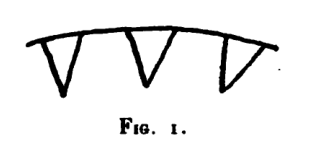
Figure 1. Curved line with three triangular teeth
A downward-curving arc with three V-shaped teeth hanging beneath it.
Figure 1.
Then she takes the pencil from me and makes the following drawing:
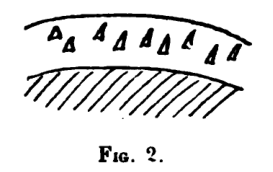
Figure 2. Hatched ground with scattered tufts or plants
Translated labels: [illegible]
Figure 2.
I think it is difficult not to recognize here the structure of the brain with its cortex, its cells, and its white matter. It is worth noting that this lady, although educated, has never concerned herself with questions of physiology or medicine. She knows nothing of the brain “except the brains she eats.” I try to get her to tell me indirectly whether she has seen sections of the brain or descriptions of cerebral cells. But she has never seen any, and, moreover, in speaking to me of her little cones, she has not tried to compare them with cerebral cells. What is more, what she describes to me as her brain, this inert mass beneath the cones, is only the white matter. I shall add that she did not dare speak to me of these phenomena, and that their appearance coincides with the end of cerebral awakening, as is the rule in the other observations.
In a later session of general awakening she again experiences discomfort in the chest, painful spots in the stomach, abortive regurgitations, stomach spasms, etc.; in short, all the usual signs of awakening of the gastric cortical center, which was one of the centers affected longest, since her digestive disturbances and anorexia go back several years, though they had never reached great intensity.
Now, the next day, after sleeping very well during the night, from the moment she awakens she is obsessed by the idea of drawing what she sees within herself when she closes her eyes and concentrates her thoughts on herself.
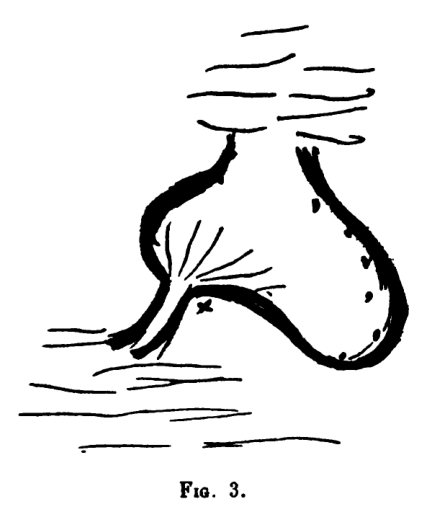
Figure 3. Sketch of a bulbous gourd-shaped plant
A hand-drawn sketch of a bulbous, pear-shaped body with radiating lines near a narrow neck and dashed dots on the right side, surrounded by horizontal strokes suggesting ground or water; no text labels besides the figure number.
Figure 3.
She makes a dozen drawings, closing her eyes and only opening them for a moment to draw what she sees and feels. First she makes circles, because she “sees and feels a ball in the middle of herself,” and finally arrives at this drawing, which represents a stomach.
But she does not say that it is her stomach. She says: “I see what I have in the center of me; it has little balls inside, like little knobs; it is soft; I do not know what it is” (these are the little dots in her drawing). “I do not know whether I have put this tube in the right place” (the beginning of her intestine); “it may be a little higher,” she says. She points out the cardia to me: “That is where it contracts when I belch; I see neither the beginning nor the end of that” (she indicates the esophagus); “it sways about inside me.”
I ask her whether she saw what color it was: “I tried,” she says, “to picture what color it is; it seems to me to be the color of the underside of the tongue, with veins like that.”
This answer is evidence of her sincerity, had I been able to doubt it. She does not, in fact, conceal from me that she tried to picture the color, and she is not definite; it merely seems to her that it was of a certain kind.
It should be noted that she is intelligent and educated enough to have seen pictures of stomachs, and that she draws fairly well.
Now, she did not draw a stomach at the first attempt; she was obsessed by the need to draw what she saw “at the center of herself.”
And even once she has drawn it, she does not utter the word stomach or intestine, but uses the words “it” and “tube,” like the other subjects. Moreover, she did not draw it as one ordinarily sees it in books, but as it is actually situated, as she feels and sees it. Drawing it brought her relief.
After this session she also saw her brain again, but at only one point, on top, at the vertex. Now, in this region a zone of painful hyperesthesia is observed, as always happens when sensation is returning and before it is entirely normal. On this subject she tells me: “I see it as though in a liquid; yet one does not have water in one’s head, and I see it only where I am in pain.”
I question her about the way in which she can see inside herself, and here is our dialogue word for word concerning her vision of her stomach: “How, then, do you see it?” “Why, inside me.” “Yes, but how, as with your eyes?” “Yes, I see and I feel too.” (She stops, closes her eyes, and makes the gesture of feeling an object between her hands.) “When I take an object in my hands with my eyes closed, at the same time as I feel it, I see it; well, it is the same thing.”
I would point out that this is the interpretation I had given of the phenomenon in my article in the Revue philosophique, written before I had observed this patient.
After another awakening session, she tells me that she has seen the shape of her stomach, and that the inner skin is not like skin, but smooth and shining. “And the color, how did you see it?” I ask. “Why, as I saw the stomach.” “But you were telling me that you represented it to yourself, that you saw it as one sees an object one feels with one’s eyes closed, that you felt it rather; how, then, do you see its color? Did you see it spontaneously, like the shape?” “Oh! No, it was by thinking about it so much that I tried to see the color, and the only likeness I could find was the underside of the tongue.”
It is therefore through a kind of amplification of her imagination, through a need to complete her visual representation, that she gives color to that visual representation, just as she also translates her coenesthetic sensation into a visual form.
Some time later she gave me further proof of this in connection with her heart. Since she was suffering from it, I had made her feel it again. The day after the session she said to me: “Something happened to me last night that frightened me very much. I do not know how to explain it to you; I seemed to feel my heart outside my chest, as though I had held it in my hands” (and she made the gesture at the same time); “it was like a red, bloody mass; I know perfectly well it was not so, but I had the sensation of it; it was very unpleasant, and it lasted a good hour, before I fell asleep.” Although less precise than in the case of the stomach, the phenomenon is indeed the same.
This observation is of the greatest interest, for it casts new light on the question of how subjects transform their coenesthetic sensations into visual representations, and how they can say that they see the color of the organs they represent to themselves.
New observations by Dr. Comar have provided further clarification of this aspect of the question, while also showing that these are indeed sensations originating in the organs themselves, acting in this case in the manner of organs of touch.
But first I wish to report three other cases, one due to Dr. Buvat22 and another to Dr. Vial (of Marseille), which Dr. Bain, a pupil of Dr. Comar, reported in his interesting thesis, L’Auto-représentation chez les hystériques (1903), adding a case that he had personally observed.
Case VIII
Here is Dr. Buvat’s observation. The only criticism that could be made of it is that his subject uses terms that are too technical, but this is explained by the fact that she lived for quite a long time with a pharmacist, who, moreover, made her addicted to morphine like himself. But when one compares it with the other cases, any suspicions that this way of expressing herself might inspire vanish of themselves, so complete is the identity of her reactions with those found in all the subjects who have displayed autoscopy.
Célestine, aged twenty-nine, enters Villejuif on 25 June 1901, in M. Briand’s service, with the following certificates: “Mental degeneration with morphine addiction for twelve years; oddities, eccentricities; wishes to be cured of her passion for morphine.”
(Garnier.)
“Mental degeneration with morphine addiction, melancholic depression, and suicidal tendency.”
(Magnan.)
The patient never sleeps.
Anorexia is almost complete, except for salad dressed with vinegar, and pepper; memory is slow and uncertain, her gaze fixed, and the visual field appears greatly contracted; the patient starts at the slightest call. Morphine was withdrawn on 21 June without causing distressing reactions. Complete and profound anesthesia of the whole frontal region and the entire left half of the body; on the right, cuff-like anesthesia and zones of hypoesthesia alternating with zones of complete anesthesia. We find numerous painful points in the iliac fossae, behind the malleoli, at the heads of the fibulae, at the roots of the thighs, over the adductors, and in the mid-dorsal region: pressure at these points provokes the beginnings of an arc-de-cercle (arching of the body). The patient breathes with difficulty; she has a weight on her chest; her breathing seems very superficial; the knee reflexes are greatly exaggerated; menstruation is irregular.
Here are the details she gave us about her childhood at the time of her discharge, when she could be considered cured.
Her antecedents include both neuropathic and tuberculous heredity. Her grandmother committed suicide; her mother died of tuberculosis; her father was hysterical and died of tuberculosis. Three hysterical sisters.
From the age of six she dreams a great deal and has somnambulistic episodes that oblige her to leave boarding school. She returns home, where she shows such sudden fits of anger and such oddities that the physician does not hesitate to classify these manifestations as hysteria.
At nine, after a reprimand from her mother, she wishes to kill herself by throwing herself out of the window; she is sent to the country, to her grandmother, and witnesses the latter’s suicide: the first attack appears on this occasion.
She returns to her mother’s; she is ten; her mother dies. On the day of the death the patient cannot weep, but feels very ill at ease; when her mother is put in the coffin, she understands that she will never see her again, suddenly falls backward, and does not regain consciousness until the third or fourth day.
From this point her memories are somewhat confused; she knows only that she no longer wishes to listen to anyone, not even her father, who considers placing her in a reformatory; the physician opposes it.
Menstruation begins at eleven; at fourteen she becomes the mistress of a pharmacist, until she is fourteen and a half. He leaves her because she is too nervous, fearing that he will become so through contact with her. This pharmacist accustomed her to morphine; they injected one another. After their separation the patient retains the morphine habit; at one period she takes 1.50 grams a day. It was to have her morphine addiction treated that she presented herself at the infirmary of the Dépôt.
On 20 July she has recovered from her withdrawal from morphine, and we begin to treat her hysterical manifestations by Sollier’s method.
We put the right foot through passive movements of extension and flexion; during these maneuvers the patient falls asleep spontaneously and continues by herself the movements we had been making her perform. The whole series of reactions described by Sollier and the authors who have employed his method unfolds; we shall not dwell on recounting them. In this way we have her recover her lower limbs segment by segment. On 26 July 1901 we begin the abdomen; by pressure at a point in the right iliac fossa we induce hypnosis; we urge the patient to awaken her whole abdomen. She presents the characteristic reactions, the to-and-fro movements of the abdomen observed in the complete attack, but here confined to the abdomen as in a partial attack. As we urge her to feel more, to awaken her abdomen completely, the patient, who until then had been giving a few moans, suddenly exclaims: “How strange the belly is… a point of bone… then the uterus corresponding to the ovaries… the uterus is split; it is a little oval, pinkish red… there is a gut behind the uterus, a big gut; it is dirty, dirty; it is for the feces; it ends at the anus; it is disgusting; seeing it makes me sick…” Then the patient falls silent. We test sensation and find complete anesthesia generalized throughout the body; the strongest pricks produce no reaction, whereas the lower abdomen is the seat of exquisitely acute sensation. “Awaken still more.” After a moment the patient begins again: “Oh! That heap of guts, how many there are on the right; they look healthier, clearer; the skin is not dull; they are not the same color; there are little red vessels with blood; little white vessels; they are all connected together and they are not the same color… There is a little fine, imperceptible skin covering all of it… there is water moving among all these guts; some have a strange shape; they make little circles… Why does the left side not look like the right? They are duller… the left side hurts me more; it is not made like the right; it is dull… It is when one breathes that they form big worms… going up toward the stomach, the gut gets thinner…” Then the patient falls silent; she continues her movements, accompanied by moans, for some time longer. We tell her to rest; she remains under hypnosis, retaining very marked sensation over the entire abdominal wall and deep anesthesia everywhere else. A little later we tell her to awaken her whole chest; we press on her left mammary point. The patient stretches and puts herself in a position favorable to expanding her chest; she takes deep breaths, complains of pain, then after a moment says: “I see my lungs… it is as though there are creatures gnawing at me on the left, but not on the right… but on the left it is not whole… and then all that is hollow… it is empty; it hurts… it is oddly made; it looks like sponge.”
When we move on to the heart, the patient complains of excruciating pain in the precordial region; her pulse becomes rapid and beats at 128. “Feel more!” Suddenly, breaking off in the midst of a moan, she says: “…The tip of my heart is diseased; it is not as big as a sheep’s heart… there is a big vein… but why does the blood not come out at the tip? It all goes through the top” (with a gesture she sketches the aortic arch). “…Those are not veins inside; it looks like little white skin; it is very, very fine; one could take some to sew with;… these threads are not attached to the flesh… there is so much blood in there; it is a beautiful dark red… Oh! How it hangs from threads; it looks as if it is going to swing; it goes bang, bang, but it is not the heart, it is the blood flowing in… Ah! It is not working properly; that is why it hurts me… there is a skin covering the heart… and then there are so many little veins around it…”
While she speaks, we ascertain that sensation is extremely fine in the precordial region and the thorax, preserved over the abdomen, and completely abolished over the rest of the body. But what we cannot convey by faithfully transcribing the patient’s remarks under hypnosis is her facial expression, showing in turn astonishment, disgust, and curiosity, and the slowness of her speech, as though she were searching for words to express what she sees.
We urge her to awaken completely; she continues the movements for some time, then tells us she feels her whole abdomen and chest well; she stretches, begins an attack, and awakens rubbing her eyes. We leave her; a little later we find that she has not the slightest idea of it; her education, moreover, is very rudimentary.
In the following days we continued the sessions of partial awakening, and did so for several months. The patient very rapidly lost the sensation she had recovered, so that it was frequently necessary to repeat what had already been done. Never again, during the subsequent awakening sessions, did she display self-representation, even when we worked again on thoracic and abdominal sensation. In September, while she is working on her chest, she is seized with a persistent fit of coughing. We press at the end of, and a little above, the tip of the left eyebrow, in the temporal region; the coughing fit increases, and the patient exclaims: “You are suffocating me; you are pressing on my chest; let me breathe; you are hurting me…” When the fit ceases, mere pressure at this point brings the cough back. This fact corroborates what Sollier has written on cerebral localizations.
When we had finished with the trunk, viscera, and limbs, we proceeded to awaken the head. We witnessed a regression of the personality, not in a single session but in several, seventeen years backward: the patient found herself at the age of twelve, reliving all the periods of her eventful life with a complete doubling of her personality. It would take us too far to give, even in abridgment, the patient’s history, which we witnessed as though we held a telephone receiver and were listening to only one side of a conversation. There were scenes from the life of a poor working woman who prostitutes herself to live and, being ill, takes to morphine; implicated in thefts, she stands trial twice and serves a one-year prison sentence at Saint-Lazare and then Nanterre; scenes with her family, scenes in the workshop, scenes with passing lovers, hours of temporary prosperity followed by hours of misery, life at Saint-Lazare and Nanterre. In January 1902 the patient left the asylum at her own request, greatly improved if not cured: she had gained a great deal of weight, slept spontaneously at night, was active, and worked. At our request she wrote an account in which she retraced all the incidents of her life; this account verified all the information she had given us under hypnosis while recovering cerebral sensation.
In his thesis Dr. Bain judiciously adds the following reflections on this case: “It is not without reason that we have reproduced the curriculum vitae of this unfortunate woman. From it we derive the conviction that she could not previously have learned the anatomical details found in her description. Apart from the few scientific words (ovary, uterus) that her association with her pharmacist at the age of fourteen may have left her, her education appears to us most rudimentary: moreover, it is not generally through contact with a pharmacist that one acquires very precise anatomical notions. Later we shall draw conclusions from this against the hypothesis of a phenomenon of memory.”
Case IX
Here now is Dr. Vial’s case, which, though less detailed, is no less characteristic, and in which we find expressions and phenomena that fully corroborate everything we have seen thus far. This agreement would truly be very extraordinary if these were merely, as some maintain, phenomena of imagination or memory, if not even, as others have gone so far as to assert, deception and playacting.
Mme P…, aged thirty-two. A heavily burdened hereditary history from the nervous standpoint.
Congenital hysteria. Convulsions at the age of one. Fairly good childhood. At sixteen, following a great fright, typical chloro-anemia, which Vial rightly does not hesitate to connect with hysterical vasomotor disturbances. She marries at twenty-two. Her financial circumstances change; she falls into poverty. Severe syncopal attacks then occur (cardiac hysteria). Her husband becomes an employee in a theater; this occupation arouses ideas of jealousy in the patient. Recently (1900–1901), she has been treated by several physicians for tuberculous softening of the left lung apex.
Dr. Vial subjected his patient to progressive restoration of sensation under hypnosis. On reaching the heart, she said these very words to him: “I see there” (the cardiac region) “two pockets on the left and two on the right. There is no communication from right to left. Black liquid comes up from here” (the hepatic region), “goes into the pockets on the right, then comes into the chest and goes down into the pockets on the left. Why!” she added, “the liquid has turned red…”
While she was awakening her left lung: “I feel,” she said, “cords holding my lung to the vault; I see them, those cords that prevent me from breathing properly; on the right I do not see them.”
“Several times the patient reported the same sensations, and always when I reached the same precise point in restoring sensation. In anesthesia or in the awakened state, my patient has always assured me that she knew nothing of the condition of her heart or her lung.
“I must add that in her, as in many others, I have often observed the sensation of a painful course along the nerves, especially the pneumogastric nerve. It seemed, and all my patients are unanimous on this point, that they had a line of fire running from one place to another, thus describing to me the nerve’s course, and the line of fire ceased when sensation in the organ had returned.
“I shall mention,” Vial adds, “in connection with the work of restoring sensation in Mme P…, that I have never seen comparable motor reactions in intensity and amplitude. Moreover, in her work I took her back to the age of one; she suckled, then she had her convulsion on the way there and on the way back, by which I mean in both the regression and the progression of her personality.”
Case X
In Dr. Bain’s case, the patient is a young woman of twenty-two, a nurse, suffering from major hysteria with attacks, whose onset probably goes back to early childhood, and who, at the time she was observed and treated by him, presented the following phenomena. I give the floor to Dr. Bain.
She has hemianesthesia of the entire left side; very marked hypoesthesia on the right. Very numerous painful points scattered almost everywhere. Contraction of the visual field, particularly marked on the left. Complete loss of smell and taste, and insensibility of the buccal and pharyngeal mucous membrane. Torpor extending to almost all the viscera. Marked slowing of all physiological functions. Anorexia. Constipation. Extremely painful menstruation. Complete loss of natural sleep. On the other hand, since sessions of suggestion she has acquired the habit of hypnosis, which occurs spontaneously in her.
Following a violent emotion she can no longer do her work.
On 6 August 1902 we begin restoring sensation under hypnosis, starting with the most urgent organ, the stomach. Her anorexia was, in fact, absolute.
She has difficulty awakening this organ because, she says, there is filth inside: there is a kind of liquid the color of oil, and then the walls are covered with something dirty. I order her to expel all these contents downward, into her intestine. “It will not pass,” she says; “it is as though blocked.” At the same time she brings up a mouthful of mucus mixed with bile.
Once her stomach is empty, its walls appear to her as though burned.
Around her stomach she sees “something large that has branches and goes away I do not know where, toward the chest.” Immediately after this first session she eats, which she had not done for three days.
The next day we undertake restoration of sensation in the lower limb, beginning with the left foot, to which I impart a few forced movements. “It pulls and burns in her head,” and with her finger she points to the level of the upper right Rolandic region. “Awaken it more,” I say. “My bones hurt,” she says. “How many are there?” “Oh! Many…” “But how many?” She counts on her fingers: “I see nine; I can see plenty of others, though, but I cannot distinguish them.” “Look at them and tell me how many there are.” She begins to move her foot again, which is her way of looking, then, after counting again, tells me: “I can clearly see sixteen bones; but there are still others; try as I may, I cannot distinguish the others.”
The following day I have her repeat what she did the day before, which is quickly done, then we approach the right foot. The same reactions as for the left foot; but, with the best will in the world, she distinguishes only fourteen bones here.
While working on her stomach again, she shows us with her finger, on her skin, the level of the cardia and that of the pylorus, and with her index finger traces the outline of the organ for me, with a depression, a reentrant angle, at the greater curvature. Verification of this anatomical arrangement would be interesting if it were possible.
Later she spoke to me again of tubes running from her kidney to the bladder; she called these latter organs by their names, moreover, and gave me no details about them.
While working on her left ear, she described to me “a little skin that stretched as though ready to burst when she strained; behind this skin there was a sort of place with little bones inside, and it communicated with the mouth.”
Finally, while awakening her left lung, she told me that low down there was a place into which the air did not enter. It was not the same color as elsewhere; it was “as though dried up, and there was hardly any blood inside.”
Once she was awake, we examined her by auscultation and percussion without finding anything characteristic. She told us that she had formerly had an inflammation of the chest, and a blistering plaster had been applied at the place indicated.
Such is the whole of the self-representation this patient presented to us. It is a rather rudimentary case. When we questioned her concerning several other organs, the intestine, bladder, ovaries, and uterus, she gave us this answer: “I see without seeing; I cannot say.” We awakened all her sensation in about twenty sessions. During the first few days she lost it again easily and rapidly, but we taught her to recover it herself, which she did in a quarter of an hour on awakening every morning. After so short a time she was already eating with appetite, sleeping a little, had no more painful points, had satisfactory sensation and painless menstruation, was more awake and alert, and performed her duties to her employers’ satisfaction.
Two months after this treatment she was admitted as a nurse to the Salpêtrière, after undergoing a medical examination that had detected no stigma of hysteria in her.
I come finally to Dr. Comar’s extremely interesting cases.23
Case XI
A severely hysterical patient, M…, whom I was treating by mechanotherapy with the aim of awakening sensation, was suddenly seized with fever. Her temperature gradually rose to 40°, the patient’s only symptom being a painful sensation in the right iliac region. No abdominal distension, no nausea, no vomiting, no constipation. In the absence of any sign that could explain this temperature, I remained expectant, thinking that I was dealing with a hysterical fever with peritonism localized in the cecal region. As a precaution I confined myself to prescribing a liquid diet and continuous ice on the abdomen. This febrile state lasted three weeks, with gradual defervescence. During this state the patient, while under hypnosis, spoke to me several times of the little skin surrounding her intestines, which was very red, particularly at one spot. Since the phenomena had abated under the influence of rest and ice, the patient got out of bed, but did not resume a normal diet. As a precaution I kept her on liquids, when, after a few days, the same events recurred, this time with more definite symptoms: nausea, abdominal distension, constipation, lancinating pain at the appendix, and fever, the chart of which follows (Fig. 4).
On the day the fever reached 40°, I had the patient placed in cool baths. The movements this provoked exacerbated the pain and on the third day brought on a paroxysmal attack, during which the patient told me that she saw the little skin redder than the first time, and that the little end of the intestine, above all, was very diseased. I took advantage of her hypnotic state to question her and ask what she was thus seeing. “I cannot see the little end clearly; I do not know where it ends.” “Why do you not see it?” “I cannot see it because I do not feel it; my intestine and the skin enveloping it, I see them because I have felt them, but that little end I have never felt.” “Well,” I said, “feel it.” She made abdominal movements accompanied by sharp pains and interrupted by cries and words that I transcribe.
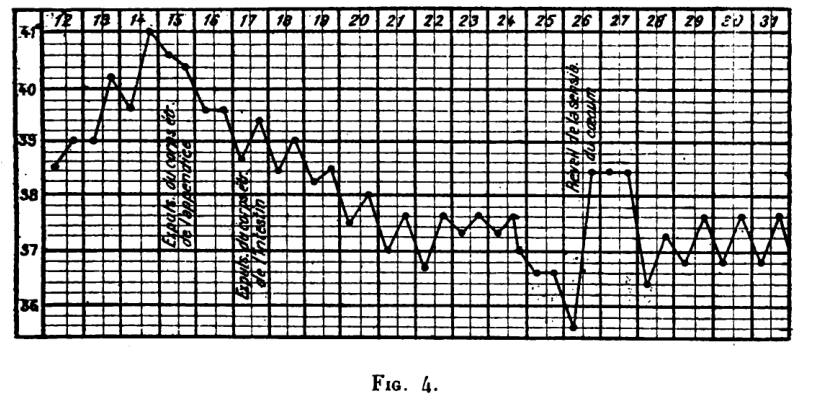
Figure 4. Fever chart with relapse of pleurisy
Translated labels: 12; 13; 14; 15; 16; 17; 18; 19; 20; 21; 22; 23; 24; 25; 26; 27; 28; 29; 30; 31; 41; 40; 39; 38; 37; 36; Choc de cœur, etc. ou tuberculose (cardiac shock, etc. or tuberculosis); Épanchement pleurétique ou pleurésie (pleural effusion or pleurisy); Reprise pleurétique du coton (pleural relapse)
Figure 4.24
“Oh! But it is going to break through; it is very thin; the little skin sticks; it is double, and between its surfaces there is a sort of dirty, thick liquid; it sticks and comes unstuck when I move, but it is going to tear everything away; it is like having a whitlow on one’s finger; it suppurates; that is what gives me this fever, and all around that point it is red; the whole little skin is red throughout the abdomen, but especially on the right.” “Feel more…” The movements increase, the pain seems more intense, and she tells me: “Oh! The little end is full of filth; oh! How dirty it is! But all that has been in there for a long time. That is what has
hurt me, and it cannot get out.” “Feel more.” “Oh! I see the end now.” She makes a more vigorous movement and suddenly stops with a cry: “Oh! It pricks me.” “What?” “Why, there is something in the end.” “What?” “I cannot see very well, because it is surrounded by a lot of filth; but it hurts me very much; I do not dare move any more; I am afraid it will burst.” “What?” I ask. “Why, the little end; there is something pointed inside that has irritated it, but it is surrounded by filth, and I cannot see clearly what it is; so if I move, I am afraid the point will pierce my intestine.” “Well,” I tell her, “go on feeling, gently, and take care that it does not pierce through.” She then continues, gently and as though cautiously, the abdominal movements she had been making until then to feel her intestine, and suddenly says to me: “But it is moving; the whole little end of the intestine is wriggling like a worm, and that makes what is inside move; it is shifting… it is coming up… But it scrapes me as it passes… ah! It is coming out of the little end; it is in the large intestine!”
She continues making a few movements and stops “because her abdomen hurts too much.” I judged it unnecessary to go further that day, fearing, since the patient stopped of her own accord, that I might bring on more serious complications, and judging it preferable to follow her rather than guide her. Since I had no proof that what she said was false, I thought I should accept it as true, if only as a precaution. That evening the temperature had not only ceased to rise, but had fallen by two-tenths of a degree. The next day I nevertheless put the patient under hypnosis and asked whether she still saw her intestine. “Yes,” she told me, “and the little point that hurt me is still in the same place as yesterday.” “Well,” I said, “awaken your intestine.” She then makes fresh movements and tells me that her whole intestine is moving, that the little point is shifting, and that the filth around it is less thick. “Feel more.” A moment later she tells me: “I am beginning to see better, but I only see one end; it looks like a piece of bone; it is pointed at one end and wider at the other; it is about a centimeter long.” She then indicates the region corresponding to the transverse colon as the location of this object. “Feel more.” The movements continue… “Where do you see it now?” “There,” she shows with her finger, indicating the left iliac fossa. “Are you sure?” “But I see it very clearly.” “Well then, stop, and do not try to feel any more.” And I immediately had a water enema administered to her while she was still asleep. I had the expelled matter filtered, and found in it a little piece of bone of the shape and dimensions shown below.
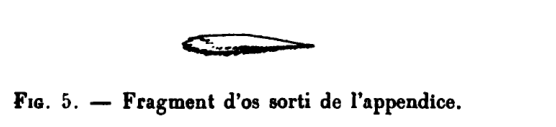
Figure 5. Fragment of bone expelled from the appendix.
Once the enema had been expelled, I asked the patient whether she still saw her little point. “Why, no,” she told me; “it went away with the water I have just passed.”
From that day the temperature gradually fell. Questioned at various times under hypnosis, the patient successively told me that the little skin (the peritoneum) was less red, and that the filth sticking its two surfaces together was disappearing little by little. She seemed to follow, day by day, the diminution of the peritoneal inflammation and the resorption of the exudate. There was only a slight rise in temperature on the day I made her recover sensation in the whole cecum; perhaps on that day I had brought back a little peritoneal inflammation at the place that had been most inflamed, at the level of the appendix.
While anticipating and refuting the objections that may be made concerning this fact, Dr. Comar rightly emphasizes the appearance of his patient’s temperature curve, which in no way resembles the so-called fever of autosuggestion. He then gives the following account concerning the same patient.
One day, after eating an ice-cream bombe at her meal, this patient reported a painful sensation in the stomach and herself told me, thus making no attempt to deceive me, that she believed she had swallowed something, but was not certain of it (I point out here that at the time this patient had anesthesia of the buccal and pharyngeal mucous membrane). I immediately put her to sleep and asked whether she had really swallowed a foreign body. “Yes,” she told me; “I see it; it is in my stomach; it is a little piece of lead.” “How,” I asked, “do you see that it is lead?” “Oh! I do not see that, but it is heavy; it does not float in my stomach, and when I make movements I have difficulty making it move; so, since I ate my ice cream and nearly swallowed a piece of the mold, I suppose it is another piece that I did not see and that I swallowed. But what I see very clearly is the size of this little point and its shape. It is about a centimeter long and more pointed at one end than the other; it is in my stomach.” “Well,” I said, “do not be afraid; it will go away by itself.” And I awakened her. The next day I put her to sleep again. Under hypnosis I asked whether the little piece of lead she had swallowed had gone and whether she still saw it, telling her that it must now be in the intestine. “No, it is still in my stomach; it was too heavy; it has only changed position and fallen between two little folds; it does not move any more; it moves a little only when I make great efforts…”
I said nothing to the patient and had her swallow a gram of ipecac then and there, while still asleep. I remained beside her, and a quarter of an hour later she vomited before me the little piece of lead in question, of the shape shown below and corresponding exactly to the description she had given.
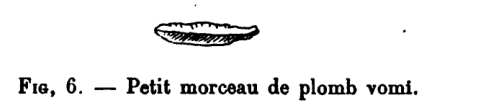
Figure 6. Small piece of vomited lead
A single shaded illustration of a small elongated object (a piece of lead) centered above its caption.
Figure 6. Small piece of lead vomited up.
Questioned afterward, she answered that she no longer saw anything.
Some time later Dr. Comar questioned this patient about the way she saw what was inside her, both foreign bodies and organs. “Do you see them as you see with your eyes when you look at an object?” “Oh! Certainly not; I see them, but not in the same way. First, it tires my head much more than when I see with my eyes. When I want to manage to see a place inside me, the nerves of the part I want to see pull at the corresponding part of my head.” “What do you mean?” “Well, all parts of my body have a corresponding part in my head. If one is asleep, the other is asleep too. Thus you know perfectly well that when I feel my legs, it pulls at the back of my head; my heart pulls in the middle of my head! Well, if I want to see my heart, I have to feel it at the same time in my head. I see an organ only if it awakens at the same time in my head; otherwise I see it very badly, and even, if it is quite torpid, I do not see it at all.” “Then when you no longer feel an organ, when you have finished feeling it, you no longer see it?” “Oh! Yes, when I have already felt it well, I still see it, but less. It is true that what happens then is very curious: I see it without seeing it; it is more as though I remember having seen it. But whenever I want to look inside myself, it tires me a great deal.” “But do you see colors?” “I do not know; it seems to me that I do. Thus, when the little skin of my belly” (the peritoneum) “is irritated, I can see clearly that it is red. When I passed blood in my urine, I could clearly see that what was in my bladder was blood and nothing else… All I know for certain is that when I look at a point in my body, it immediately pulls in my head.”
Case XII
The second observation is just as interesting and likewise concerns an ingested foreign body.
In March 1902 the patient in question had swallowed a pin that she had put in her mouth while asleep. Every effort, every attempt to make her pass it had failed, or else the pin had been passed without the patient’s knowledge and had gone unnoticed. Her stools had been watched and examined for more than a month; then, since the patient made no complaint, the surveillance had ceased, and the pin was no longer mentioned. So little was it mentioned that when the patient was brought to me four months later for the hysterical manifestations she presented, neither she nor her family even told me of the incident with the pin.
Once again this was a severely hysterical vigilambulist, in whom I did not hesitate to employ the method of treatment that had given me such good results. This patient exhibited in particular a mania for swallowing under hypnosis all the small objects that came to hand. One day (October 1902), when in the course of a session I was telling her to awaken sensation in her intestine, to feel it, she suddenly stopped, saying that she could not go on “because it pricked her.” I thought that she was thus expressing one of the painful manifestations caused by the awakening of sensation, and I insisted. She made a few more movements and stopped again, saying “that it really hurt her too much, that it pricked her too much.” “What?” “I cannot see clearly, but it is pointed; it must be a little pin I swallowed two months ago.” “Feel more, and be careful.” She then makes less extensive and less rapid movements, mainly localized on one side, and after a few minutes tells me: “But I can see very clearly; it is not the little pin I swallowed two months ago; it is the one I swallowed six months ago; I recognize it, but I really thought I had passed it long ago.” “How do you recognize it? You can see it, then?” “Oh! Yes, it was much bigger than the other, and I recognize it clearly; it is long, nearly three centimeters, but it is stuck into my intestine in such a way that it will no longer be able to come out, and I now see that by making those movements just now I drove it in farther. I am in great pain.”
I interrupted the scene; this took place on a Thursday. On awakening the patient complained of great pain on one side of her abdomen, and of a very painful pricking sensation; she asked me what was wrong with her, or what I had done to her, and said nothing whatever about her pin. I then questioned her, asking, among other things, why I had never been told about this fact. She answered that it was of no importance and that, after seven months, the pin must have come out long ago. I kept her lying down all day, with a liquid diet and ice on the abdomen.
The next day I put the patient to sleep again and question her once more. As on the previous day, she describes the dimensions and exact position of the pin. I then ask whether she can move it. She makes a few movements and tells me that it is very difficult, for every movement drives it in farther. “I would have to make my intestine move in the opposite direction,” she tells me, “and that is very difficult.” “Try.” She makes other movements and tells me: “It is moving; I have moved it a centimeter; it is beginning to come out, but it is bleeding, and I do not dare move any more.”
I end the session. A bad day, with hiccups, nausea, and a sensation of pain and heat in the abdomen.
On the third day I put her to sleep again. She describes to me “the whole inside of her abdomen as red, and at the site of the puncture, the head of the pin has made a little hole and become stuck in it.” I ask her to describe the exact position of the pin and whether she sees it well enough to draw its position for me with a pencil. “Yes,” she says. I give her a pencil and paper, and under hypnosis, without a moment’s hesitation, she makes the drawing below, explaining to me that the head of the pin is above, and that it passes through the intestinal wall without, however, penetrating its whole thickness, then emerges below for about a centimeter.
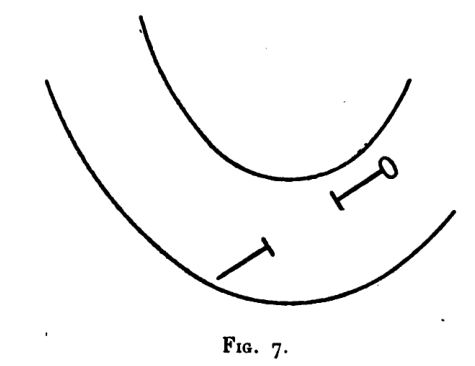
Figure 7. Two curved surfaces with small markers
Two nested concentric curved lines with small T-shaped and looped markers placed between and on the curves, no arrows or text.
Figure 7.
She even takes her bedsheet and folds it over her finger to explain better how the pin is embedded: “It passes,” she tells me, “beneath the little thin skin surrounding the intestine; fortunately it does not pass through that too, or my intestine would be perforated.” (The pin is therefore embedded in the thickness of the wall; it has passed through the mucous and muscular coats, sparing the serous coat, and a centimeter lower down it emerges again into the interior of the intestinal tube, as the patient’s drawing clearly shows.) I ask her again whether it is in the large intestine. “You can plainly see that it is not,” she tells me, pointing to her drawing. And in fact she has indeed drawn a loop of small intestine.
I stop, for she is in too much pain. I let her rest, and during the day continue the liquid diet and ice on the abdomen.
The next day, another session. I tell her to move the pin from the place it occupies. She makes efforts that seem very painful, proceeding with great caution. From her explanations I understand that she is obliged to make her intestine perform antiperistaltic contractions. She describes to me all the successive positions the pin takes, all the movements it makes: it pricks into her again, catches, turns, moves, strikes the wall, etc. Finally, after about a quarter of an hour, the pin has come out and is now free in the intestine. “But,” she adds, “I must make it go down, because it has stayed in that place so long that it might tend to return there, and I had too much trouble getting it out to start again.”
She tells me that “the puncture site is bleeding a little, and that it makes a wound.” I end the session. On the fifth day I begin again; the pin has traveled along with the liquids the patient has taken. She tells me it has passed into the large intestine. Finally, on the sixth day, I put her to sleep and tell her to move the pin forward.
She continues to make abdominal movements, but at the end tells me she is afraid that the pin will stick into the end of the intestine. I have an enema administered to facilitate its expulsion. At that moment she tells me that the water does indeed reach the pin and carries it along, and at last she passes the pin, which corresponded exactly to her description, saying: “There it is; it has come out!” The pin’s surface had lost its polish through contact with the intestinal fluids.
I awaken the patient and show it to her; she does not hesitate for a second: “That is indeed the one,” she says.
…In the following days, under hypnosis, the patient described to me the progress of healing of the little wound caused by the pin. Serous fluid had been deposited on the ulcerated spot and had turned into a very thin, soft little crust. “I must not eat,” she said, “for the smallest fragment of food would carry away my crust, and my intestine would be perforated, not quite, however, because there is still the little skin surrounding it; but it is very red, and I am very afraid that it will be perforated too.” It was indeed perforated, despite absolute immobility and abstention from food. Then the crust became half detached, but fortunately finally adhered again. At last, after a few days, healing took place, the peritoneal inflammation diminished, and the patient was soon able to resume a normal diet, telling me that there remained only a little scar and a small depression in the intestinal wall where the pinhead had pressed for so long.
Since then the patient has resumed her work and has never again complained of her intestine.
Questioned by Comar, like the preceding patient, about the way she saw, she answered him in these exact words: “When I want to see, I have only to follow the nerves that start from the corresponding point in my head and go down my back and finally reach the place I want to see; but I do not see them as with my eyes… There are places I cannot see clearly; it has to start from my head, where I feel it at the same time. When I feel an organ well, I no longer see it. Thus you made me feel my legs; I saw them, I saw inside them; now that I feel them well, I no longer see them in the same way; I see only their surface with my eyes. What I do not feel a little, I do not see; first I must have found where, in my body and in my head, the organ I want to see is…”
“But when you saw the pin in your intestine, how did you see it?” “Before, I did not feel my abdomen; I saw nothing; when I began to feel, I began to see. Now, one day, 17 October” (it was indeed exactly on 17 October that she told me she saw the pin), “I felt my intestine better, and then I clearly saw the entire pin.” “You saw it?” “That is to say, I felt that there was something in my intestine. Then I looked in my head with the nerves of my eyes, the nerves behind my eyes, and at the place in my head corresponding to my intestine I saw something like a shadow on a veil, a black line shaped like a pin, and at the same time as I saw that in my head, I felt it in my abdomen.”
And Dr. Comar ends with these few reflections on the possible interpretation of these phenomena, so singular in appearance, in which experimental verification has been made of the reality of the sensations experienced by the subjects and of their sincerity: “I repeat that I have transcribed the words of my two patients verbatim. Both, in short, told me the same thing. Their words seem to me to provide an explanation of the phenomenon described. The patients first feel, and then interpret the phenomena of sensation.
“Perhaps, however, there is a more complex phenomenon that remains unexplained, and that was imperfectly expressed by my second patient when she spoke to me, in connection with the pin, of her impression of a black line being projected onto a veil. Are there elements here of another interpretation of these abnormal phenomena? Perhaps they would then consist of two successive phases, of which the first would certainly be a disturbance of peripheral sensation transmitted to the cerebral centers, and the second an interpretation made by the patient, in which memory and subsequently acquired knowledge would come into play. In short, alongside a phenomenon of sensation, anesthesia or hyperesthesia, there is a special phenomenon of cerebral coenesthesia.”
Such are the facts. It now remains for us to interpret their mechanism, and, beforehand, to examine critically the conditions under which they arise.
III. Critical Examination of Internal Autoscopy
I have made a point of giving in full the case reports published by other authors and of reproducing, without changing anything, the descriptions of the patients I was able to observe myself and the conversations I had with them, transcribed as they took place, so as to avoid any subsequent illusion on my part concerning the explanations they gave me.
Let us now examine the facts as a whole.
Cases in Which Autoscopy Is Encountered
In all the cases reported above, the patients were women with severe hysteria (so far autoscopy has been seen only in women, but nothing warrants the belief that it is peculiar to them), suffering from multiple, long-standing manifestations, particularly visceral disturbances. In all the cases there was very profound, or at least very persistent, anesthesia, and a more or less complete loss of function in the organs represented autoscopically. Neither in the apparently waking state nor in hypnosis were the subjects aware of the organs concerned or of their functioning. One could say that this functioning took place solely through the lower centers, but that the influence of the higher, cortical centers no longer existed, either to moderate or accelerate this functioning, or simply to receive an impression, however slight, from the organic changes resulting from it.
These were therefore, in short, cases that were not only long-standing but in which the fundamental hysterical disturbance was very profound. It should be noted, moreover, that it had appeared in young, developing subjects in whom this development had been singularly arrested. The very generalization of the hysterical disturbances, and still more their fixed character, show how intense the disorder was. We shall therefore not be surprised that these phenomena of autoscopy are relatively rare, all the more so since the method of treating hysteria, cerebral awakening, that made their discovery possible is of relatively recent date (1897), and the cases in which they have been encountered are themselves rather rare.
Conditions and Time of the Phenomenon’s Appearance
It was during cerebral awakening, bringing about the restoration of sensation together with the return of organic activity, that internal autoscopy first appeared. I had thought that it occurred only during hypnotic sleep, at the very moment when the various reactions accompanying cerebral awakening were produced. And indeed, this is what is most often observed. But the last case I reported (Case VII) shows, on the contrary, that the autoscopic phenomenon may perfectly well persist after the subject has emerged from hypnosis, if the cortical centers upon which the perceived organ depends have not yet fully awakened; or even occur outside the hypnotic state, but always under the influence of the awakening of cerebral sensation.
There are, however, two points to bring out. The first is that, despite the now considerable number of cases in which cerebral awakening has occurred with all the motor, general and special sensory, and intellectual reactions I described in my works on the genesis and treatment of hysteria, and despite the intensity of some of these cases, I have encountered true, complete autoscopy, such as exists in the examples above, only very rarely. From the comparative examination I have made of all these cases, I believe I can conclude that they were more serious, more inveterate, and above all more intense than all the others. This emerges not only from the multiplicity, intensity, and generalization of the morbid phenomena, but chiefly from the persistence of certain ones and the length of treatment they required. It is by this fixed character, this persistence of certain functional disturbances, that the intensity of the illness can best be measured, for the same multiplicity and generalization of disturbances may be seen in other cases in which the restoration of functions and the return to a normal physical and mental state take place with great ease and, once achieved, persist without much effort. In all these cases, on the contrary, there was a fixity of the phenomena and a readiness to relapse that were at times discouraging.
It follows from this observation that autoscopy is encountered only when the hysterical state has assumed a particular character of intensity and, above all, fixity.
The second point to consider is much more interesting and important. It concerns the moment at which the phenomenon appears. Nothing enables us to foresee it in a subject. It appears when one least expects it. All our subjects behaved in the same way in this respect. After seeming to recover their sensation and normal functioning completely, after appearing definitively out of danger, with nothing remaining but to consolidate their condition, suddenly, in the course of a general cerebral awakening intended to perfect anything that might still remain a little below normal, they begin to display new subjective reactions and at the same time to describe certain of their organs in an entirely characteristic manner, not only in their outward conformation but in their most intimate, even microscopic, structure, as the preceding case reports have shown.
It thus seems to be as their functioning, the activity of their cortical centers, is being perfected that the phenomenon occurs. It is as though, after they had recovered sufficient activity of the cortical centers to perceive the changes taking place in them under the influence of organic functioning, this activity revived in all its intensity, and the power of representation, linked to this activity within relatively narrow limits that nevertheless suffice for consciousness to exist, extended to the whole substance of the organs, to all the changes, however minute, occurring within their tissues. There seems to be an increase in this power of representation, both in intensity and in extent.
In truth, when one reflects upon it, perhaps there is no reason to be so surprised. From the standpoint of our subjectivity, everything is, in short, only a matter of degree; and there may be less difference between our habitually conscious and supposedly normal, very confused perceptions of our organic functioning and those we encounter in the phenomenon of autoscopy, so clear and applying to such delicate anatomical elements, than between the different degrees of visual, auditory, or tactile activity that exist among different individuals.
Organs Capable of Autoscopic Representation
Reading the various case reports shows that no organ escapes autoscopy. The subjects were indeed able to represent to themselves the arrangement and structure, microscopic in some cases, of all the organs: lungs, stomach, intestine, internal genital organs, breasts, brain, heart and blood vessels, muscles and joints, and the blood itself. In all subjects, it was the organs that had displayed the most marked pathological disturbances that were the object of the most complete and most delicate phenomena of autoscopy.
There is, moreover, no reason why all organs should not be capable of autoscopy, for it is quite certain that the whole organism is linked to the cortex, that every point of this organism is projected upon the cortex, and that the latter contains centers of perception, and consequently of representation, upon which all organic functions depend. This conception is universally accepted today, and I shall have occasion to return to it in connection with the anatomical and physiological explanation of the phenomenon.
Mode of Representation in Autoscopy
How do subjects represent to themselves the organs they describe in this way when functioning reappears together with conscious sensation? Is it a visual sensation or a coenesthetic sensation? Do they see them inside or outside themselves?
At first it seems to be a kind of inner vision, for the subjects say they really “see.” But they also often add that they “feel” what they describe, as blind people might, for example. This vision is sometimes internal, sometimes externalized.
One says it is as though he has eyes in his belly; another draws his organs in space with his finger as he describes them; another sees himself as in a mirror, or as though looking at himself from within, and sees, for example, his face beneath the skin like a mask viewed from behind; yet another will say that he sees himself as though transparent. In the same subject, these different ways of “seeing” may also be observed successively or simultaneously, even for the different organs under consideration.
This diversity seems to me to show that what is involved is not a phenomenon of vision in the strict sense, which would in any case be incomprehensible, but a phenomenon of representation based upon coenesthetic sensations arising from the organ, or, more precisely, referred to the organ whose center is recovering its activity. The phenomenon takes place not in the visual center, but in the visceral centers.
In my opinion, something analogous occurs to what happens when, with our eyes closed, we describe an unfamiliar object that we explore by touch. We transform our tactile sensations into visual representations and describe the object from this visual representation. In reality, there is no vision in the strict sense. Similarly, here, the activation of our organic centers awakens coenesthetic representations that we refer to the periphery, to the organs themselves; it is these coenesthetic representations, ordinarily unconscious and merged into the mass of our bodily feelings, that we transform into visual representations.
Such was the explanation I had thought I could give of this visual amplification, if I may call it that, of coenesthetic sensations, when clinical observation spontaneously undertook to demonstrate its soundness to me. In Case VII, indeed, the patient herself used the comparison I had made with what happens when, with our eyes closed, we try to picture the form of an object we are touching. One of Dr. Comar’s subjects spoke in the same sense.
Whether the subject locates his representation at the level of the organ itself that is involved, or projects it outside himself, in the form of a hallucination, so to speak, is of no importance. It is a question of the mental procedure he uses, and the very intensity of the representation has nothing to do with it. Returning to the comparison made just now with what we do when we try to picture an unfamiliar object we are feeling with our eyes closed, we observe that some people picture it in the very place it occupies, others outside and without contact with themselves, and others again sometimes in one way, sometimes in another. It is scarcely until the end, when they have gained complete knowledge of it, that they project its representation into space in a manner quite independent of the object itself. The same is true of our subjects, who may display one or the other mode of representation and who, at the end, sometimes also have complete external autoscopy.
These observations show once more, as I have already said, that there was no difference in nature between internal and external autoscopy. It is simply a question of whether or not the coenesthetic sensation is projected outward, and whether this sensation is localized to certain organs or generalized throughout the organism. And this is so evident that one can see not only internal autoscopy alternating with external autoscopy in the same subject, but also the former changing into the latter during the subject’s progress toward complete cerebral awakening. I therefore do not understand how one can deny or admit one without denying or admitting the other. Yet this is what happened, without those who were skeptical about internal autoscopy, while not doubting autoscopic hallucinations, that is, external autoscopy, suspecting their contradiction.
Special Terms Used by the Subjects
One thing is immediately striking when we hear these subjects describe what they see within themselves: their language, the expressions they use, the circumlocutions and comparisons they employ. They almost never say a technical word or use the proper expression, even for things they ought to know. Muscles and tendons are cords; blood vessels too are “cords” or “strings,” and then, as the sensation becomes more definite, they become “pipes with something flowing through them”; the ovary is a “little bag” containing “grains”; the Fallopian tubes are “pipes”; the vagina too is a “large pipe”; the uterus is also a pipe, with very thick walls; the hymen is a little “skin”; the bronchi are “branches of coral” that gradually become hollowed into channels to let the air pass; the lungs are a “bunch of grapes”; the liver and spleen are “sponges”; the stomach is a “pouch,” a “bag”; the intestine a “long pipe”; the breasts are “bunches” too, but no longer like those of the lung; the brain cells are “little compartments with points, with something soft inside,” “little cones.” One never hears them call things by their scientific or common names. It seems as though these were new, unknown things to them. Their impressions are indeed so new that they could not refer them to anything known to them, which, moreover, like the identity of the terms used by all, proves their sincerity.
In questioning them, I always tried to make them be more precise without using any expression that might recall former anatomical notions. I acted as though I did not understand what they meant to tell me. I never saw one tell me that what they were describing was this or that organ. At most they would come to say: it must be such-and-such an organ. But they did not assert it. They almost avoided using the exact terms. The number of cases is now great enough to show that in this constant manner of expression, among subjects of very different upbringing and education, there is something other than chance or pure coincidence.
This may seem surprising at first. Everyone, even without formal studies, may have seen lungs, a heart, a brain, intestines, and so forth, if only at a butcher’s. It is therefore singular that the subject who sees these different organs within himself autoscopically does not recognize them and, in describing them, does not look for comparisons with what he already knows in animals or may have seen in illustrations.
I shall dwell upon this point, which is of great importance for the truthfulness of the subjects and the value to be assigned to their descriptions.
I can explain this peculiarity to myself only in the following way. First, the return of sensation does not immediately give a notion of the complete organ. It is little by little, in parts rather than as a whole, that this notion appears. The subject therefore cannot refer the impressions he experiences to anything known, any more than someone unfamiliar with anatomy, if shown a microscopic preparation of lung, could say that it was lung; he could only describe what he saw and compare it with familiar things in the external world, to make himself understood in his description. Indeed, it is only when the entire organ has recovered its functioning and sensation, that is, when its cortical center has resumed its full activity, that the subject realizes that what he has just felt is this or that organ; until then, everything he perceived of it was so different from what he knew of it that he could not attribute it to that organ, and to convey an idea of it he was obliged to borrow comparisons from quite different objects.
Secondly, the subject has never before felt what he is then experiencing. He is therefore himself surprised; he wonders, and asks, what it is and what it relates to. It is something new and unexpected, bearing no relation to his habitual sensations. It is therefore not surprising that he does not know how to refer the sensations he experiences, which are due to a quite special kind of functioning, to this or that organ, such as the ovary or uterus, which he has never perceived in an isolated and precise manner.
Degrees of Autoscopy
It should be noted that autoscopy concerns, so to speak, not so much an organ as a whole, its morphology, as its intimate structure, its elements. In this respect, when reading the case reports, one is astonished to see the degree of minuteness the phenomenon can attain; and perhaps the most curious cases are those in which my subjects described their brain cells, the ovaries with their ova, or those of Dr. Comar, one of whose subjects described blood as a white liquid in which small, flattened red grains circulate.
On this subject, how can this vision of colors take place? This is a point that seems difficult to explain. Yet it cannot be denied, and many subjects have displayed it. It seems plausible to me to admit that, since this vision of colors occurs at a moment when the subject recognizes which organ is involved, his knowledge or recollections of it may lead him to amplify what he feels with what he knows. This is a phenomenon that occurs very frequently even in normal people. The responses of certain subjects in this respect seem to confirm this interpretation. The colorless vision of the organs, which has been added to coenesthetic perception to complete it through the mechanism I indicated just now, does not suffice for them. All my subjects, let us not forget, were visual types; some even to such a degree that they had colored hearing. It is therefore not surprising to see them amplify and complete their visual representations with colors. They “make an effort” to find this color, as I was told by the patient in Case VII who felt driven to draw what she felt in the middle of her body. That the subject should then recognize the organ, now perceived very distinctly in its form, position, and structure, and apply to it the conscious or unconscious knowledge he possesses about it, is very possible and even probable.
But I wish to point out that it is only at the end of internal autoscopy, in a few cases and for certain organs only, that colors are added.
Although some patients spoke of the color of the blood and the mucous membrane of the stomach, none indicated that of the ova, the glands of the stomach, the bronchi, the arteries and veins, or any organs whose color in the living body is little known or unknown to them. Almost all, on the contrary, spoke of the color of blood, which everyone knows.
We must indeed distinguish, within these phenomena, the different periods of their development, their different degrees. At the beginning of the phenomenon, the subject reports only strange sensations, which he expresses by saying it is “as if there were this or that thing inside him.” Then the impression becomes more precise. He perceives something that he compares with an ordinary object resembling it more or less. Next, the perception is very clear: not only does he feel, he sees what is within him, but without recognizing what it really is. Finally he recognizes it, but always with a kind of doubt; he never dares acknowledge what he believes it to be. He then deliberately tries to form a complete idea of it, and since the coenesthetic sensation now appears in a visual form, it is natural that he should apply to it, perhaps unconsciously, a color he knows or believes to be appropriate to the organ represented. We should therefore not infer from this voluntary and imaginative amplification that the rest of the phenomenon is deception, or that the whole is an effect of pure imagination.
Dr. Comar’s latest cases, involving foreign bodies in the stomach and intestine, in which proof of their actual existence could be obtained, demonstrate that internal autoscopy applies not only to the organism but also to the foreign bodies contained within it.
Is there reason to be surprised at this when we know that people with foreign bodies in their joints can judge their size perfectly? Why should the intestinal mucous membrane not perceive the shape of a pin, a fishbone, or a fragment of bone embedded in it?
These observations confirm the comparison I made at the beginning of the preceding chapter between general tactile sensation and coenesthesia. There is in reality no difference between the two, except in the distinctness of one and the habitual dullness of the other. But with respect to the information they can give us about the external world, the two modes of sensation are entirely comparable. In this particular case, a foreign body behaves toward the internal organs as any object in the external world behaves toward the surface of the body.
Through autoscopy, then, subjects can gain knowledge of objects in contact with the organs, and of the organs themselves in the smallest details of their structure, even microscopic details, even of their constituent cells. However singular and new the fact may seem, I do not believe, after all the cases I have reported above, that it can be denied; and it is preferable to try to explain and understand it rather than deny it a priori, as has been done without taking the trouble to repeat the experiments or reproduce the conditions under which it occurred. This is a manner of argument that has nothing scientific about it and shows how much the systematization of our conceptions, even in men well versed in scientific method, obstructs the admission of new facts that run counter to that systematization. I shall return further on, moreover, to the value that should be assigned to these autoscopic phenomena.
There is one point, however, upon which I must dwell a little, for it is precisely the one that raises the most objections: the perception of microscopic elements that can be seen only at high magnification.
First, I shall point out that, as we shall see further on and as we have already demonstrated for external autoscopy, this is not a visual phenomenon but a purely coenesthetic one. Now, we do not know what degree of perfection coenesthetic sensation can attain, since in the normal state the impressions it supplies us are masked by the much stronger impressions of the special senses.
Furthermore, we know the degree of acuity sensations can attain when we are conscious, not when we are unconscious. Just how fine perception can become in unconscious states is precisely what is unknown, and what the present facts enable us to assess. That they reveal to us a perceptive capacity we could not have suspected is no reason to deny them. It would be wiser to try to verify whether this is accurate and to understand how it is possible.
Now, we have examples of very acute coenesthetic sensation, although coarse in comparison with what we have just seen, in unconscious or subconscious states such as sleep. Such are premonitory dreams, in which people who are about to contract an illness see themselves afflicted with it one or two days beforehand, while in the waking state nothing attracts their attention. The same is true of many hypochondriacs and patients with delusions of persecution, in whom simple and very slight changes in vascularization, which would not be perceived at a normal time, serve as the starting point for delusional conceptions that give rise to objectified sensations as soon as the patients display disturbance and weakening of consciousness.
It is evident that these phenomena have their seat in the cerebral cortex. Now, as everything leads us to believe, all that takes place in the cerebral centers depends upon a given molecular state of the cells of those centers. Suppose an organ is altered. If, as is accepted, our whole organism is represented in the cortex, there must be a change in the functioning of the brain cells corresponding to the altered organ, that is, to the alteration of the cells composing that organ. We must then ask how many cells of the organ must be altered for the molecular state of the corresponding cortical center itself to be modified under the influence of the impressions arising from that organ. We know nothing about this. But if there is a relationship between the center and the organ, it is logical to admit that the slightest cellular change, even in a single cell, must have its counterpart in the molecular state of the organ’s cortical center.
Why, then, given a molecular state of the cortical center produced by some inhibition of that center and corresponding to the state that would be provoked by an alteration of the organ dependent upon it, should the return of that center’s activity not produce a representation, unconscious in the normal state, just as the return of cellular activity in the affected organ would produce a sensation, itself unconscious as well? But under certain conditions, which we shall see further on, this representation, instead of being unconscious, is known to the subject, and ceases to be conscious only when the activity of the cortex has resumed its normal course. It then becomes only a question of degree, for if in the normal state we perceive to some extent the general form of organs whose functioning is disturbed, and the result is the same when only the organ’s functional cortical center is affected instead of the organ itself, in a state of unconsciousness or subconsciousness we may have a much clearer perception of them still, and nothing authorizes us to assign an arbitrary limit to it. We must bow to the facts; and in this particular case, if they show us that perception can reach even the microscopic elements of the organs, we have no right to suppose that this is an invention or something implausible. Further on, in connection with the explanation of the autoscopic phenomenon, we shall see what condition is necessary for this perception to become momentarily conscious.
Time of the Phenomenon’s Disappearance
Just as it appeared in a rather unexpected manner, the phenomenon also ceases very rapidly, although in general less abruptly. After experiencing all the sensations that ordinarily accompany the return of sensation in the organ, sensations peculiar to each organ, the subject suddenly experiences the phenomenon of autoscopy, during which he merely describes what he sees within himself without knowing to which organ it relates, although he knew this at the beginning. After displaying the reactions that accompany the return of organic sensation, reactions peculiar to each organ, like the sensations, he ceases to perceive the organ autoscopically and continues to display the same sensations and the same reactions of returning sensation as though he had not momentarily had autoscopy: sensations of relaxation, gentle warmth, well-being, and merging of the organ with the neighboring parts. Finally he has the sensation that “everything is all right,” and no longer displays any reaction; he no longer has any voluntary action upon the organ brought into play.
Now, during this period following autoscopic perception, if he is questioned about what he related during that period, if he is asked whether he still sees, or remembers what he saw, even if the very terms he used a moment ago are specified, he no longer understands what he is being asked, no longer knows what one wishes to speak to him about, and denies having seen or felt anything of the kind. In a word, everything he experienced has ceased to exist for him, at the same time as the state that engendered these sensations itself changed and disappeared. This is, moreover, a phenomenon that also occurs in cases where there has been no autoscopy, during the restoration of sensation, that is, let us recall, during the reactivation of more or less inhibited cerebral centers. And this identity in the subjects’ mental reactions, as in their sensory and motor reactions, clearly shows that there is no question here of deception or reminiscence.
What happens is that when any particular state of activity of the cortical centers occurs, it brings with it special motor, sensory, and mental reactions; and when it ceases, these various reactions not only cease to occur but even cease to be capable of being represented. Indeed, to be consciously represented, the same state that engendered them would have to recur, and this is precisely what cannot happen, since the subject’s reactions and the stimuli applied to him have had the effect of destroying it.
In the great majority of cases, we have seen that it was only during hypnosis that the return of cortical activity brought about internal autoscopy. But this resumption of activity in the inhibited centers may continue once the subject has been awakened, and then autoscopy appears as in the case in which it occurs during waking. The subject witnesses it and describes it to us as it develops, exactly as happens in hypnosis or in external autoscopy.
Validity and Explanation of the Phenomenon
It remains for us to know what value should be assigned to this phenomenon of autoscopy. No one thinks of denying it when it is a matter of external autoscopy, of autoscopic hallucinations concerning the subject as a whole. There is therefore no reason to deny it when it concerns only a particular part of the organism. But what may be surprising is the minuteness and precision of the details perceived autoscopically: it is not only outward forms that are thus the object of autoscopy, but anatomical structure itself, down to the microscopic elements. What interpretation can be given to this phenomenon, and, first of all, what credence should be given to its occurrence? No doubt it will be said that these are things already known to the subjects, or reminiscences, unconscious memories, or again suggestion, which means nothing but generally satisfies the mind; and, finally, deception will not fail to be considered.
I must immediately dispose of this simplistic explanation. Although it is always very hazardous to vouch for the sincerity of such subjects, I nevertheless believe I can do so here. The four subjects in whom I observed internal autoscopy are, in fact, well known to me: I observed them for a long time, I continue to observe them since their recovery, and I have never detected in them any fraud, any deception, even any lie. But that would prove nothing.
I shall therefore point out that these phenomena were completely unknown to the subjects, since they had never yet been published and the subjects could not thus have learned of them through any channel. Moreover, when they occurred, I in no way expected to see them arise and was very surprised to observe them, for they appeared at a moment in the treatment when everything seemed finished and nothing could have led me to foresee them. Finally, it would be singular to see subjects who had never had any contact with one another display phenomena of such perfect identity, both in the time of their appearance and in the way they unfold and the very terms in which the subjects describe them, without their being governed by particular determining conditions.
Deception is too easy an explanation, and to admit it one would at least have to ask what interest the subjects could have had in it. To make themselves interesting? It is very singular to see them choose a very precise moment in the course of their illness to do so in this way, and more remarkable still to discuss things they have never heard of, for good reason, since they have never been described; things about which no one asks them questions, about which no inquiries are made, and in which they therefore cannot think anyone is interested. Now, in no case were the subjects questioned on this point. They spontaneously expressed their impressions, and one can note in the dialogues between them and the observers that the latter confined themselves to asking them to make their explanations more precise, without supplying any themselves, and without even showing astonishment at what they were told, precisely so as to avoid encouraging the subjects to believe themselves very interesting and to exaggerate all they experienced.
Deception having been set aside, one is entitled to ask whether these subjects did not already know the organs they described. No doubt none of them had failed to see, if only at a butcher’s, lungs, a heart, a liver, an intestine, and so forth; but there is a long way from that to describing their intimate, microscopic structure. It may be answered that they had read descriptions of them in books of popular physiology. But one of Dr. Comar’s subjects was an uneducated peasant woman; at least two of my subjects were entirely ignorant of matters of physiology and anatomy, as I had been able to establish even before they displayed autoscopy.
Unconscious memories, it will again be said. I was careful not to overlook this possibility, and during their sleep, therefore in the state in which, while giving me their descriptions, they could recall the knowledge that enabled them to make them so precise, I asked them where they had seen descriptions of what they were telling me, and they always answered that they did not know what it was.
But extreme skeptics might again reply that they were concealing their knowledge. I would then ask how it is that they almost never use technical terms, even for things whose technical name is in common use. Now, all but one describe their organs, at least some of them, as things wholly unknown before and reminding them of nothing; to describe them they use ordinary terms, the same in all of them, as someone seeing them for the first time would do: pipes, cords, bags, pouches. They make comparisons with familiar objects, coral, bunches of grapes, and so forth. Moreover, they forget these descriptions as soon as the organ’s sensation and functioning have become normal again, and it is only when the organs have recovered a certain degree of perfection that the subject suddenly tells herself that what she feels “must be such-and-such an organ,” and finally asserts that “it is such-and-such an organ.”
Finally, why does autoscopy not appear for all the organs in all our subjects? Why does it occur only for the organs that are precisely the most profoundly disturbed in their sensation and functioning, unless because it can occur only under certain conditions, because it is linked to a particular state of activity of the cortical centers during the return of that normal activity?
Why does it not occur at the beginning of the restoration of sensation, but only when this is very far advanced and one is almost entitled to believe it completely normal, unless because it corresponds to a higher degree, a greater perfection, of this sensation?
Why is it so rare in relation to the very frequent cases in which a considerable regression of personality occurs, and in which the subjects have just as much education and knowledge?
There is also a point to note: the association of external autoscopy, of autoscopic hallucinations, with internal autoscopy. This association appeared in a remarkable manner in the first of our subjects, thus clearly showing that we are dealing with the same phenomenon. The second is not denied; there is therefore no reason to deny the first.25
But, it will again be said, this is suggestion. I could reply that we do not know how suggestion acts, even if we agree upon its definition. Yet the whole question and the whole interest of this phenomenon lie there. We shall examine it further on. For the moment, I shall confine myself to observing that suggestion cannot be invoked here, even in its broadest sense. First, Dr. Comar, who first reported these phenomena, would have been hard put to suggest them, since he was completely ignorant of them. I was in much the same position, so to speak, for at the moment I observed them I was far from expecting them, and nothing could have led me to foresee them.
They declared themselves entirely unexpectedly. As for having made indirect and involuntary suggestions, one need only read our case reports to see how carefully we avoided that pitfall. Far from asking our subjects questions capable of putting them on the track of an anatomical description, we instead confined ourselves to recording what they told us; indeed, most often we forced them to be more precise by acting as though we did not understand what they were talking about, as though it were they who did not know what they were saying and their description corresponded to nothing real. And despite everything, they continued, and in terms that turned out to be identical.
Some have gone so far as to think that my subjects guessed the nature of the information I was seeking; that a word or gesture from me or someone around me could have been enough to put them on the alert. But how could they have guessed an intention I did not have, and which Dr. Comar could have had still less when he first observed these facts? As for indiscretions of gesture, I was alone the first times this occurred; and even had I been surrounded by one or two assistants, one would have to attribute truly extraordinary perceptiveness to these subjects, with their eyes closed, for them to understand from a gesture of surprise or attention that I wanted one of them to describe this or that organ to me. It is surprising that those who propose such explanations do not realize that they are more improbable and more marvelous than the facts against which they claim to set them. They cast doubt upon the value of autoscopy by trying to explain it through the magnetizers’ second sight.
As regards the validity of the experiment and the reality of the phenomenon, I therefore believe it difficult not to recognize them as established.
It remains to ask how this can occur. I believe that, in this respect, my earlier studies of the nature of hysteria and of the phenomena accompanying the return of conscious cerebral activity enable us to interpret the phenomenon fairly satisfactorily.
All our organs, a fact universally accepted today, are represented in the cerebral cortex by motor, sensory, and visceral centers; and although the last are not yet officially admitted, despite the numerous cases in which I have been able to verify them and the experiments I have indicated for establishing them, there is no reason whatever to deny them a priori, and every reason, on the contrary, to expect them. After denying the motor centers of the cortex, it became necessary to admit them; after these, it became necessary to recognize the existence of sensory centers; in animals, cortical centers for various organs have been determined. It is singular that the existence of the latter in man is still denied today, despite the numerous examples I have given, demonstrating them physiologically and clinically in most cases, and even anatomopathologically in the case of the stomach center. In a recent article in the Revue neurologique (October 20, 1902), however, Messrs. Parhon and Goldstein took my research on this subject into consideration and incline in favor of the localization I have given for the stomach center.
It is, moreover, beyond dispute that through what is called suggestion one can act upon visceral functions. Now, for suggestion, which, however we conceive it, is a mental phenomenon that can occur only at the level of the cerebral cortex, to act in this way, we must admit that the representation of the viscera and of the movements appropriate to set them functioning also takes place in the cortex, exactly like the representation of all our other motor and sensory functions. It is, moreover, the opinion of Wernicke and his pupils, of Meynert, Griesinger, and Munck as well, that our consciousness of our body is only the sum of the images formed by our organic or internal sensations, coenesthetic sensations, in a word, just as our representation of the external world is the sum of the images resulting from our external sensations. Wernicke thinks, however, that none of the images of the various parts of our internal environment attains the degree of discrimination of our representations of the external world, and that consciousness of the former is a general notion, in contrast to the variety of actions of the latter. This is certainly true in the normal state of our cerebral functioning. But when this functioning is altered and, after being inhibited at certain points, resumes its normal activity, things are no longer the same, and very clear partial representations of the parts of the body corresponding to the inhibited points may occur.
Now, in hysterical states, when there is anesthesia of a limb, loss of that limb’s motor function, and arrest of activity in the corresponding cortical motor center, the subject can no longer picture that limb or the movements of which it is normally capable and which he is asked to perform. He is ignorant of its form, its position in space, and sometimes its very existence. When, by some procedure, the activity of the motor center is awakened, the subject perceives the limb again, very vaguely at first, then more and more precisely: its sensation grows finer, voluntary movements reappear and become more precise, until finally the subject has a complete representation of his limb and can then easily make it perform whatever movements he wishes.
If we compare what happens in a limb with what we have just seen in the viscera, we find no real difference. Admittedly, in the ordinary state we have a very clear representation of our limbs, whereas we have only an extremely faint one of our internal organs. But it must be noted that the representation of our limbs is very complex and is not constituted by a single order of impressions, coenesthetic and kinesthetic impressions; these are supplemented and checked by the visual and tactile impressions associated with them. Now, the latter contribute nothing to the representation we can have of our viscera, for which coenesthetic impressions are the only ones that make them known to us. If we add that the organic changes giving rise to these impressions are always the same, or very nearly so, that our familiarity with them makes us disregard them unless functioning is abnormal, and that this functioning itself can take place through the lower nervous centers alone, without the intervention of the will and consequently of consciousness, we shall not be surprised that our normal representation of the viscera is very faint and vague, and that we do not evoke it. But it remains true that all the impressions arising from our internal organs reach the cerebral cortex and contribute, together with all the other parts of the motor and sensory organs, to the constitution of our states of personality.
Hence, if some cause inhibits the centers of the visceral functions, something analogous occurs to what we see in the organs of movement. The subject loses the notion of the existence of his viscus and no longer feels the needs associated with it. But as soon as cortical activity is restored, he again perceives impressions that take on a particular intensity because of their isolation amid the other insensible organs with their slowed and unconscious functions. Just as the return of sensation and functioning in a limb is accompanied by special motor, sensory, and mental reactions, so too the return of sensation and functioning in a viscus is accompanied by particular reactions peculiar to each organ. The subject then becomes aware of that organ, its form, and its functioning, as he has never before been able to do. But just as, in our limbs, we feel our muscles contracting and thus represent their form and movements to ourselves, we can also represent the form and movements of our viscera. This surprises us only because we are not accustomed to it, because in the case of our limbs we scarcely try to represent them coenesthetically, but visually or tactually, and come almost to disregard the coenesthetic impressions they give us. For the viscera, on the contrary, we are restricted to this coenesthetic representation, which we can truly conceive only when we have lost it and recover it, as happens, sometimes completely, precisely in the hysterical state.
But how can one “see” things that are always hidden from us, inside our bodies? We discussed above the way subjects “see” their organs. In reality, they do not “see” them as with sight; they represent them to themselves as we can represent a muscular contraction, although we do not see our muscles either. They have a coenesthetic representation of them, just as one can have a tactile representation, as blind people do, for example, which nevertheless gives us the notion of form and movement. These facts simply prove that our coenesthetic representations can give us the same information as tactile representations, which is in no way extraordinary or contrary to any teaching of physiology. The question of the fineness of the representations is no longer of interest. It is something entirely relative, and nothing prevents us from admitting that in this respect we may encounter a range of sensory acuity as extensive as in all the other kinds of external sensation.
Moreover, it is not only a question of greater or lesser individual sensory acuity. As I said above, it is of the greatest importance to note that the organs that are the object of autoscopy are those in which functional arrest has been most marked, in which the disturbance of central activity has been most profound. It is no less important to note the moment of the phenomenon’s appearance, when the organ’s sensation and functioning seemed to have become normal again.
From these two considerations we can indeed conclude that autoscopy is due not to the intensity or acuity of sensation, that is, of the activity of the cortical center brought into play again, but to the extension of this sensation and activity to all the organic elements, even the most delicate. The first awakening of cerebral activity restores a functioning of the organ concerned that appears sufficient but is in reality incomplete. Complete awakening with autoscopy restores the functioning of the most minute elements with the full intensity of activity of which they are capable. In most cases the functional disturbance affects the organs only superficially, so to speak, and when the sensation and functional activity of the cerebral center corresponding to each organ are restored, only relatively crude motor and sensory reactions involving the organ as a whole are observed. In our cases, on the contrary, the tissues themselves are affected in their activity, and the return of that activity, linked to that of the corresponding cortical center, produces in this center representations no longer of the organ as a whole, as in the preceding cases, but of the anatomical elements themselves. It is, in short, only a question of degree in the extent of the functional disturbance. Once we admit, as the facts are numerous enough to oblige us to do, that the return of activity in a cortical center brings about a general representation of the organ dependent upon it, which we can know only through the coenesthetic impressions it sends to our cerebral cortex, there is no reason not to admit as well that, if the activity of that center has been completely inhibited, if even the most delicate anatomical elements have been arrested in their own particular function, with their trophic, vital function of course preserved, the return of that activity likewise brings about representations of those anatomical elements.
Relations Between Internal and External Autoscopy
I have already indicated these relations in connection with external autoscopy. I wish to return to them now only to show that in the two cases the phenomenon is absolutely of the same nature. What is essential is that this is not a visual but a coenesthetic phenomenon, and that autoscopy is not in reality the fundamental fact; it is the representation, or, more precisely, the apperception, of one’s own person, wholly or partially, with a greater or lesser number of its physical and mental, outward or inward attributes. What clearly shows that the two phenomena are of the same nature is that they can be seen to coexist in the same subject, to replace one another at different moments in the awakening of cortical activity, and, in our different subjects, internal autoscopy can be seen to appear sometimes in the mirror form, sometimes in an externalized form resembling hallucination, as when the subject draws in space what he describes within himself, and sometimes in the pure internal autoscopic form, as when the subject sees his organs in their very places and from within outward. There is therefore, in my view, no difference in nature between these various forms.
I have said that this is a matter of representation; but in reality, although it is indeed a representation in the case of external autoscopy, in internal autoscopy it is, on the contrary, a true sensation, linked to a particular state of cortical activity and changing as that state itself changes. This is a distinction it is important to point out, although it alters nothing in the general conception of autoscopy.
Consequences and Conclusions
Consequences follow from these phenomena that I believe to be of considerable importance for psychology, and which I shall examine briefly, particularly from the standpoint of consciousness and suggestion.
First of all, one fact emerges very clearly: we can have representations of all our organs, in their smallest details, in the very intimacy of their structure.
If this point is admitted, we can understand the importance this may have for knowledge of the conditions of cerebral functioning. All the subjects who became autoscopically aware of their brain cells, for example, indicated a vibratory state corresponding to the evocation of images. We must undoubtedly be very circumspect in observing these facts, which will acquire real value only when their number, collected under conditions as exact as possible, becomes sufficiently considerable.
A second, no less evident fact manifests itself: this apperception occurs only when the cortical center of an organ, after losing its activity to a more or less marked and lasting degree, recovers it.
Finally, a third fact appears: as the activity of the cortical center returns, the representations linked to the successive phases of this return efface one another, until finally the subject, having recovered the normal functioning of his organ, ceases to have an isolated, clear representation of it and loses even the memory of these successive representations.
From all these facts, we are therefore led to conclude that our representations are linked to changes in cortical activity. As soon as there is a state of arrest or diminished activity, the subject no longer has a representation of the functions, or has fixed representations of them. As soon as cerebral activity resumes, the representations linked to the lower states of that activity give way to normal representations. Now, these normal representations of our viscera and their functions are very vague and confused, merged into the totality of our coenesthesia, and cease to be capable of conscious isolation, conscious cerebral activity being almost absorbed by the motor, sensory, and intellectual functions. They are not unconscious in an absolute sense but in a relative one, being in reality merely masked by much more numerous, varied, and intense representations and sensations.
We further observe something of great importance: consciousness is not linked to the maximum of cerebral activity. It exists at every degree of this activity, even the lowest. What we ordinarily call consciousness is the particular feeling we have of our normal functioning. But below this normal functioning, we can also have knowledge, just as precise and clear, of what is taking place within us. We then become conscious of phenomena that, in the normal state, are subconscious or unconscious. Thus, in reality, we can become conscious of every state of our cerebral activity, even the lowest; subconsciousness and unconsciousness are not absolute but relative terms, and when we are in a state of activity below normal, all the phenomena normally accompanied by consciousness become subconscious or even unconscious, while those normally subconscious or unconscious become, on the contrary, conscious.
Consciousness thus appears to us as linked solely, not to the maximum of normal cerebral energy, but to the maximum of cerebral energy available at a given moment. It is not at the summit of the hierarchy of cerebral manifestations; it accompanies every degree of this hierarchy, down to the lowest. Strictly speaking, there is never unconsciousness; unconsciousness would be equivalent to the death of the organ or of its cortical center.
We see, moreover, that consciousness appears only if there is a change in the state of cerebral activity, and that it always corresponds to a release of this energy, a reactivation of the cerebral cortex. Thus we see that it accompanies the return of this activity even at its lowest degrees, when the functional centers have suffered an almost complete arrest, going so far as to impede not only the proper functioning of the organs but even that of their constituent elements.
When a cerebral center has thus recovered every degree of its activity, only then does consciousness appear solely in its higher-order manifestations, just as, when the center was inhibited or torpid, consciousness appeared in connection with the manifestations corresponding to its maximum activity.
It also emerges from the study of these phenomena of autoscopy and of the conditions under which they occur, conditions now very easy to determine, as I have shown, that consciousness disappears in a definite order, absolutely parallel to that of the functions: the most delicate, those most specific to each organ, disappear first, and those of a more general order, down to the vital functions of the anatomical elements themselves, diminish in their wake. As soon as the organ’s proper function has lost its activity, that is, the cortical center upon which it depends, we see the loss of the specific organic need, then anesthesia of the organ concerned, and at the same time unconsciousness and loss of the power of representation: first of the function, then of the organ’s changes and excitations, and finally of its existence when inhibition is complete. Once there is anesthesia and loss of normal consciousness, the degree of diminished activity in the cerebral center can be estimated only from the way the function dependent upon it is performed. But the measure is never very exact. On the contrary, when the activity of this cerebral center is awakened by any means, we can ascertain with the greatest ease how far it had been arrested, thanks to the consciousness accompanying the return of function and by assessing the lowest degree of functional activity of which the subject can become aware.
Such, briefly outlined so as not to go beyond the scope of this work, are the principal consequences we can draw from these facts, together with all those I have reported in other works, concerning the conditions of consciousness. It remains to examine those that can be drawn from them concerning suggestion.
Although this is a phenomenon that has been used and abused for a number of years, and made the pivot of a whole theory of the pathogenesis of neuroses and an entire therapeutic system, I believe that, considered as an idea imposed upon the mind and accepted by it, it does not exist. The advocates of suggestion have dwelt with particular fondness upon all the bizarre, or apparently bizarre, effects it could produce. They have scarcely concerned themselves with the one thing that was nevertheless most essential: how subjects could carry out suggested commands for acts involving organs that normally escape the will. They have not noticed that it is as difficult to explain why the command to raise my arm, which I have just heard, is transformed into movement as to understand how the command to vomit, given during hypnotic sleep to a subject with hysteria, is transformed into vomiting. They believed they had elucidated everything, and people ultimately accepted this explanation blindly, by saying that the vomiting occurred through suggestion. Such an answer is only an admission of ignorance; but there is such a tendency to take words for explanations that people were satisfied with it. They did not ask whether vomiting, when suggested during hypnotic sleep, occurred through exactly the same mechanism as raising the arm when commanded to do so: that is, through the will of the subject, who in that state is able to represent his organ to himself and thus act upon it as upon the voluntary muscles.
When we consider the facts we report here, we observe once more what I demonstrated in my work on the genesis and nature of hysteria: in states of hysteria, in states of more or less marked torpor of the various cerebral centers and more or less complete arrest of the organic functions dependent upon them, subjects can act voluntarily upon their smooth muscles, which normally escape the action of the will, just as they are conscious of organic phenomena that are ordinarily unconscious. The new facts we present here show to what extreme limits, which I had not observed at that time, this consciousness of the organs and their functioning can extend.
Now, at the same time, we observe that subjects can act voluntarily upon these organs and their functioning, thanks to the awareness and representation they have of them. Organs that, in the normal state, escape the will become, on the contrary, subject to it when cerebral activity is diminished. We can thus observe that the will follows exactly the same laws as consciousness and, like it, accompanies the maximum energy available at a given moment in a given center, but not the normal maximum of that center’s activity. If, therefore, the will appears parallel to consciousness at every degree of cerebral activity, even the lowest, at the moment when its diminished activity awakens, we are brought back to the simple case of a command carried out with our limbs, with the striated muscles, called voluntary. A subject is ordered to vomit, and he vomits because in the state of hypnotic sleep he has been able to represent his stomach and the movements necessary to provoke vomiting to himself, and at the same time has been able to act upon it.
The enthusiasts for suggestion have, in fact, also forgotten one thing: to notice why not all suggestions are possible in the same subject, and the state of functioning and sensation of the organs upon which suggestion can act. They could then have observed that suggestion was easiest only in profoundly anesthetic subjects, with extremely slowed functions and the lowest state of consciousness; but above all that, even in these subjects, it was only for the most affected organs that one could suggest acts of any kind that they could never have performed voluntarily in the normal state of consciousness. Nothing becomes easier for them once they are aware of their organ and its functioning.
We now understand how this can be, and are therefore led to the conclusion that suggestion is nothing other than any ordinary command, and that its mechanism is no different from that by which commands are executed whose agents are organs subject to the will, such as the striated muscles. Suggestion derives its prestige solely from the claim that a subject can be made to perform acts the will is powerless to accomplish in the normal state. Once it is observed that suggestion can operate only in states in which precisely those functions that are normally subconscious and escape the action of the will become, under certain conditions, conscious and subject to it, suggestion, as a special, marvelous phenomenon, ceases to exist. Subjects perform only acts they can perform because they can represent them to themselves and will them.
Suggestion is a function of consciousness and will, and it can act upon any organ only if the subject is in such a cerebral state that he is aware of that organ and consequently able to act upon it voluntarily. Its role is thus, as we see, singularly reduced, and it may very well be no more than an empty word.
Table of Contents
Original printed pages:
- Preface — 1
- Definitions — 3
- I. External Autoscopy — 7
- Historical Account — 7
- Cases — 16
- Negative Autoscopy — 31
- Positive Autoscopy — 34
- Classification — 39
- II. Internal Autoscopy — 45
- Historical Account — 46
- Cases — 56
- III. Critical Examination of Internal Autoscopy — 127
- Cases in Which Autoscopy Is Encountered — 127
- Conditions and Time of the Phenomenon’s Appearance — 129
- Organs Capable of Autoscopic Representation — 132
- Mode of Representation in Autoscopy — 133
- Special Terms Used by the Subjects — 137
- Degrees of Autoscopy — 140
- Time of the Phenomenon’s Disappearance — 147
- Validity and Explanation of the Phenomenon — 150
- Relations Between Internal and External Autoscopy — 165
- Consequences and Conclusions — 166
Chartres. Durand Printing House, Rue Fulbert.
Footnotes
-
Aristotle, Météor., book III, chapter IV. ↩
-
Wigan, New View of Insanity, p. 126; 1844. ↩
-
Michéa, Délire des sensations, p. 137; 1846. ↩
-
Brierre de Boismont, Des hallucinations, pp. 55 and 408. ↩
-
Goethe, Œuvres complètes, vol. XXVI, p. 83. ↩
-
Lasègue, Études médicales, vol. II, p. 150. ↩
-
Féré, “Note sur les hallucinations autoscopiques ou spéculaires et sur les hallucinations altruistes,” C. R. Société de Biol., p. 451. ↩
-
Roubinovitch, Ann. méd.-psych., vol. XVII, p. 105. ↩
-
Féré, “Hallucinations autoscopiques périodiques,” Journ. méd. de Bruxelles, no. 9. ↩
-
Lemaître (of Geneva), “Hallucinations autoscopiques et automatismes divers chez des écoliers,” Archives de Psychologie, vol. I, no. 4, p. 357. ↩
-
Paul Sollier, “Les hallucinations autoscopiques,” Bulletin de l’Institut général psychologique, 1902, no. 1. ↩
-
Translator’s note: The distance numeral is partly obscured by damage in the scan. Its surviving shape appears to read “3.” ↩
-
Genèse et nature de l’hystérie, vol. I; Paris, F. Alcan, 1897. L’hystérie et son traitement; Paris, F. Alcan, 1901. ↩
-
Meeting of March 25, 1901, vol. XIV, p. 80. ↩
-
Op. cit., p. 375. ↩
-
Féré, “Note sur les hallucinations autoscopiques ou spéculaires et sur les hallucinations altruistes,” C. R. Société de Biol., 1891, p. 451. ↩
-
Pages 474 and 489. ↩
-
La Genèse et la Nature de l’Hystérie, vol. I, p. 520; Paris, F. Alcan, 1897. ↩
-
“L’auto-représentation de l’organisme chez quelques hystériques.” Revue neurologique, 1901, p. 491. ↩
-
All patients who recover cerebral sensation similarly speak of little compartments, little boxes that arrange themselves in order at the same time as their ideas become clearer. ↩
-
Translator’s note: The source prints the numerals upside down, reproduced here:
 ↩
-
“L’auto-représentation organique ou hallucinations cénesthésiques chez les hystériques,” Gazette des hôp., 25 November 1902. ↩
-
“L’auto-représentation chez les hystériques,” Presse médicale, 17 January 1903. ↩
-
Translator’s note: The chart’s handwritten annotations read: “Expulsion of the foreign body from the appendix”; “Expulsion of the foreign body from the intestine”; and “Awakening of sensation in the cecum.” The numbered columns run from 12 to 31, and the temperature scale from 36 to 41. ↩
-
Translator’s note: The source gives “second” and “first” in this order. ↩