Original publication
Original title: 我所看到的那一部分世界——我的人体科学之缘:孙储琳自传
Author: Sun Chulin (孙储琳)
Publication year: 2024
Original language: Chinese
Source file MD5:9d72727c8e64cdff5bca64af5e263a0d
Sun Chulin
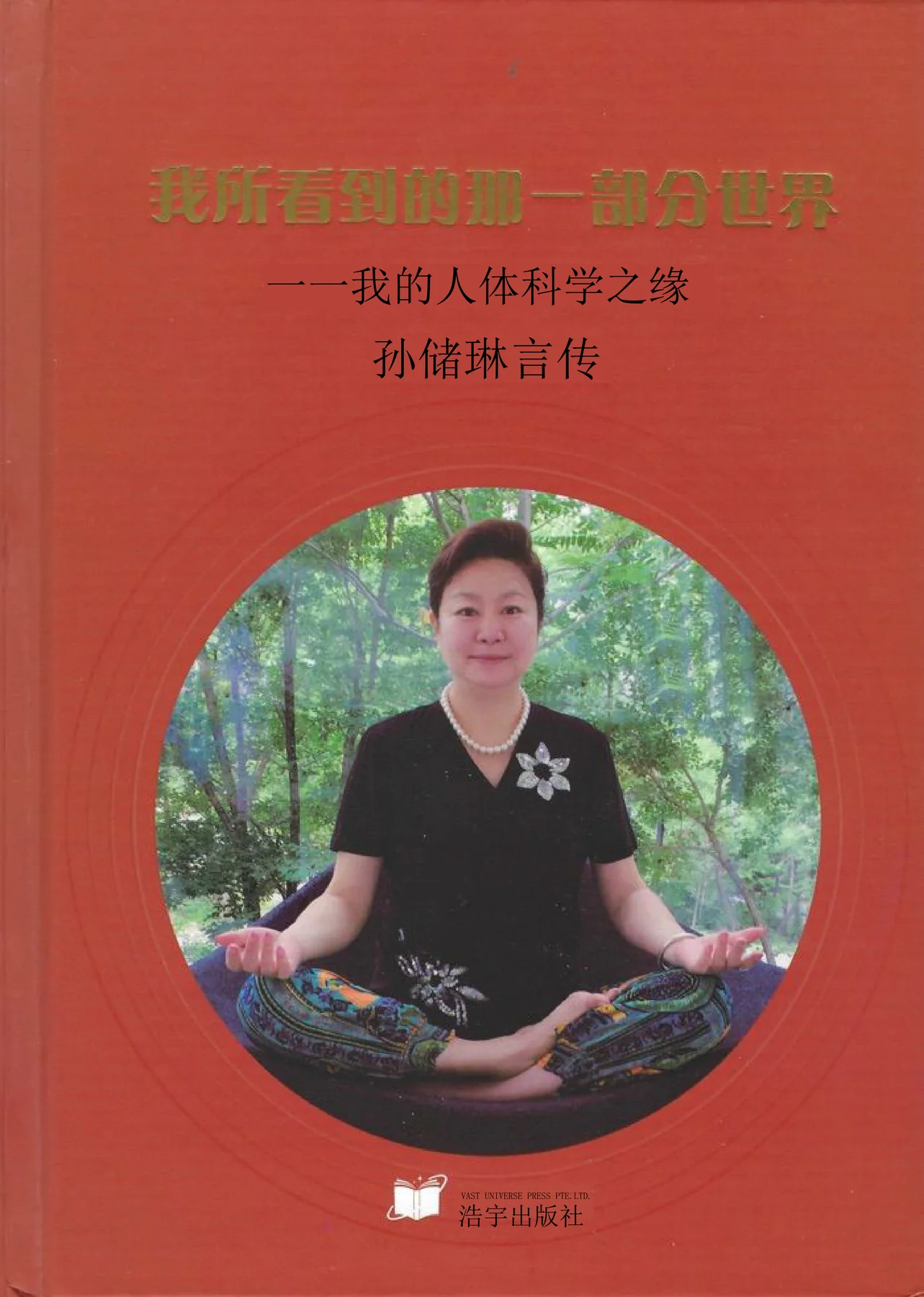
The Part of the World I Saw My Connection with Human-Body Science As told by Sun Chulin VAST UNIVERSE PRESS PTE. LTD. Vast Universe Press

Sun Chulin
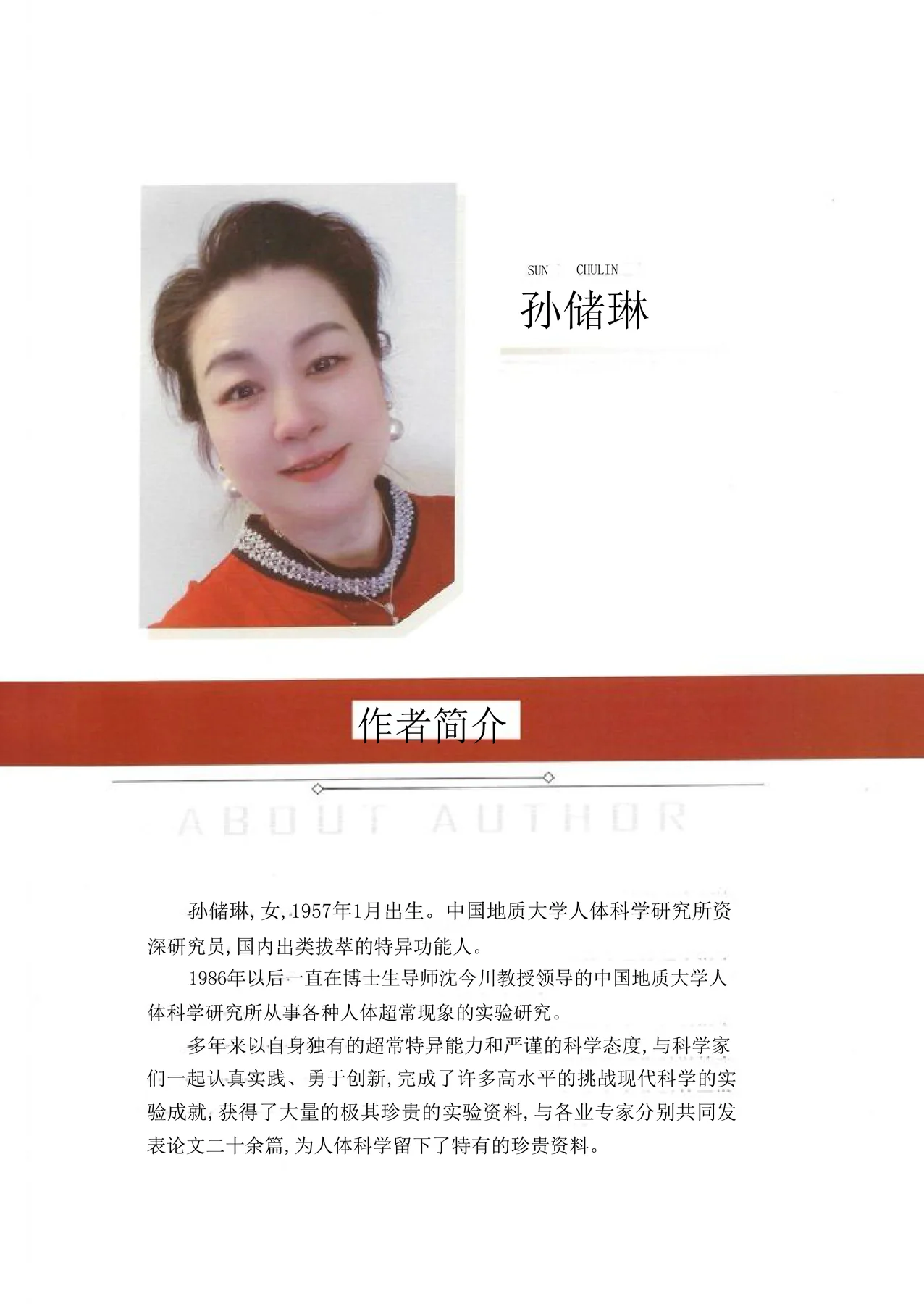
SUN CHULIN
About the Author
Sun Chulin, female, born in January 1957. Senior researcher at the Institute of Human-Body Science, China University of Geosciences, and a preeminent possessor of extraordinary human abilities in China.
Since 1986, she has been engaged in experimental research on various extraordinary human phenomena at the Institute of Human-Body Science, China University of Geosciences, under the leadership of doctoral supervisor Professor Shen Jinchuan.
Over many years, relying on her own unique extraordinary abilities and a rigorous scientific attitude, she has worked alongside scientists in earnest practice and bold innovation, completing numerous high-level experimental achievements that challenge modern science. She has obtained a vast quantity of extremely precious experimental data and co-authored more than twenty papers with experts from various fields, leaving behind uniquely valuable materials for human-body science.
Cataloging-in-Publication Data
Author: Sun Chulin
Title: The Part of the World I Saw
Publisher: Haoyu Press [Vast Universe Press], [2024]
Executive Editor: Chen Xiaoqing
Cover Design: Liu Bo
ISBN: 978-981-5183-99-3
VAST UNIVERSE PRESS PTE. LTD.
The Part of the World I Saw
Address: 2 Venture Drive, 12-02, Vision Exchange, Singapore 608526
Edition: First edition, March 2024
Printing: First printing, March 2024
Format: 700×1000mm 1/16
Sheet count: 22
Word count: 300,000 characters
Price: ¥189.00
All rights reserved. Unauthorized reproduction strictly prohibited.
May all the beauty of this world be closely interwoven with you
Lin
Peace and joy
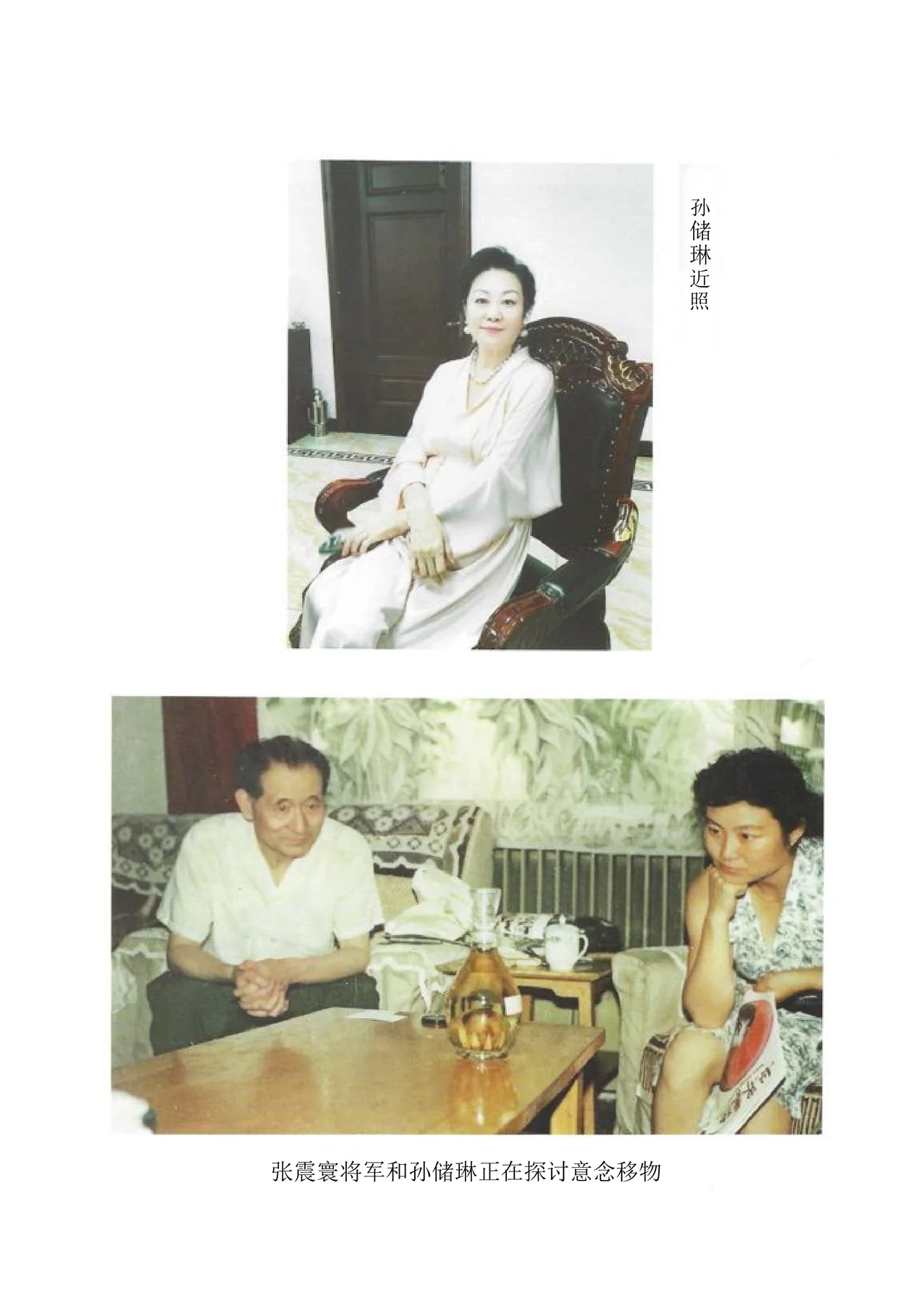
Recent photograph of Sun Chulin
General Zhang Zhenhuan and Sun Chulin discussing psychokinesis — the movement of objects by intention
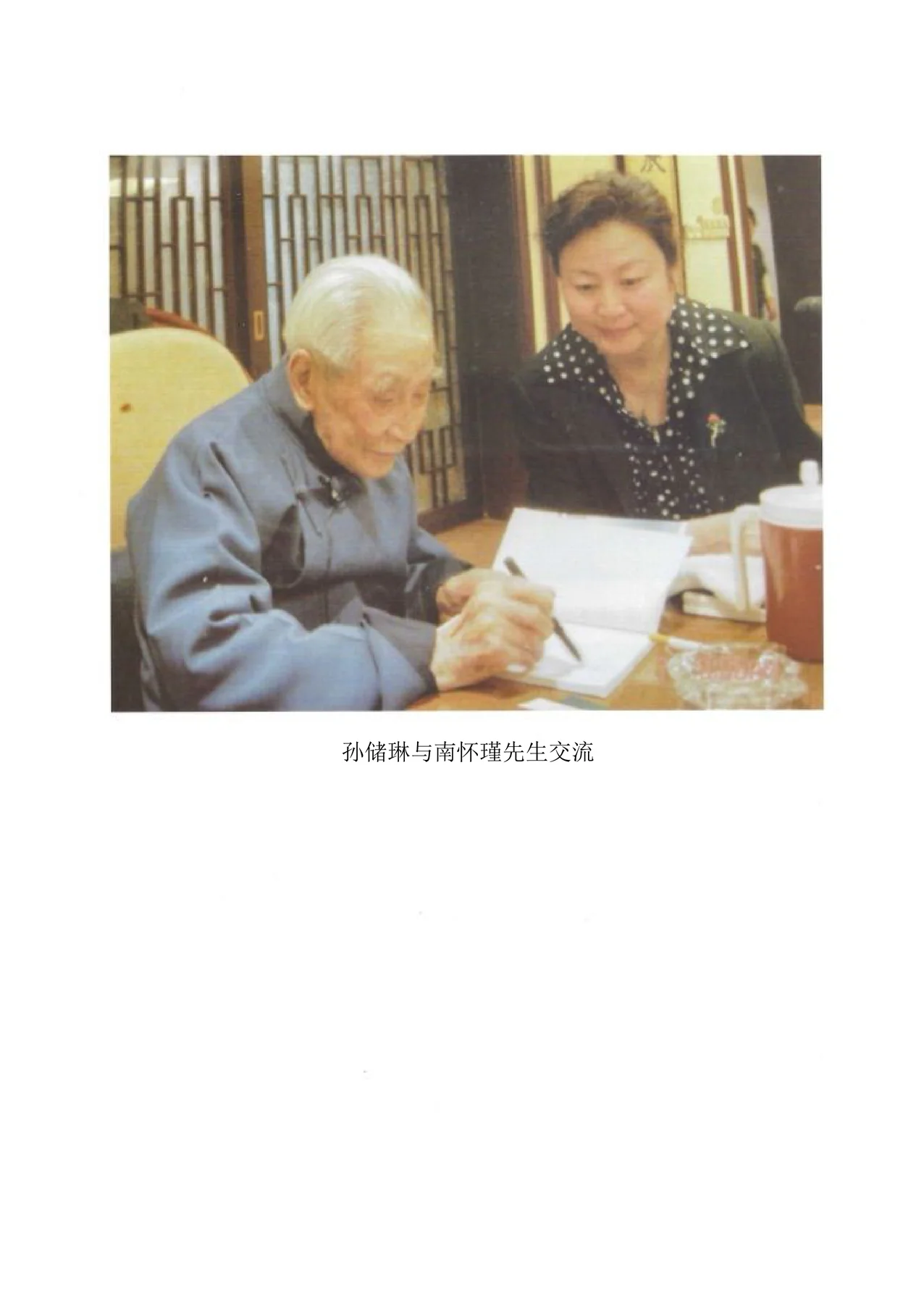
Sun Chulin conversing with Mr. Nan Huai-Chin
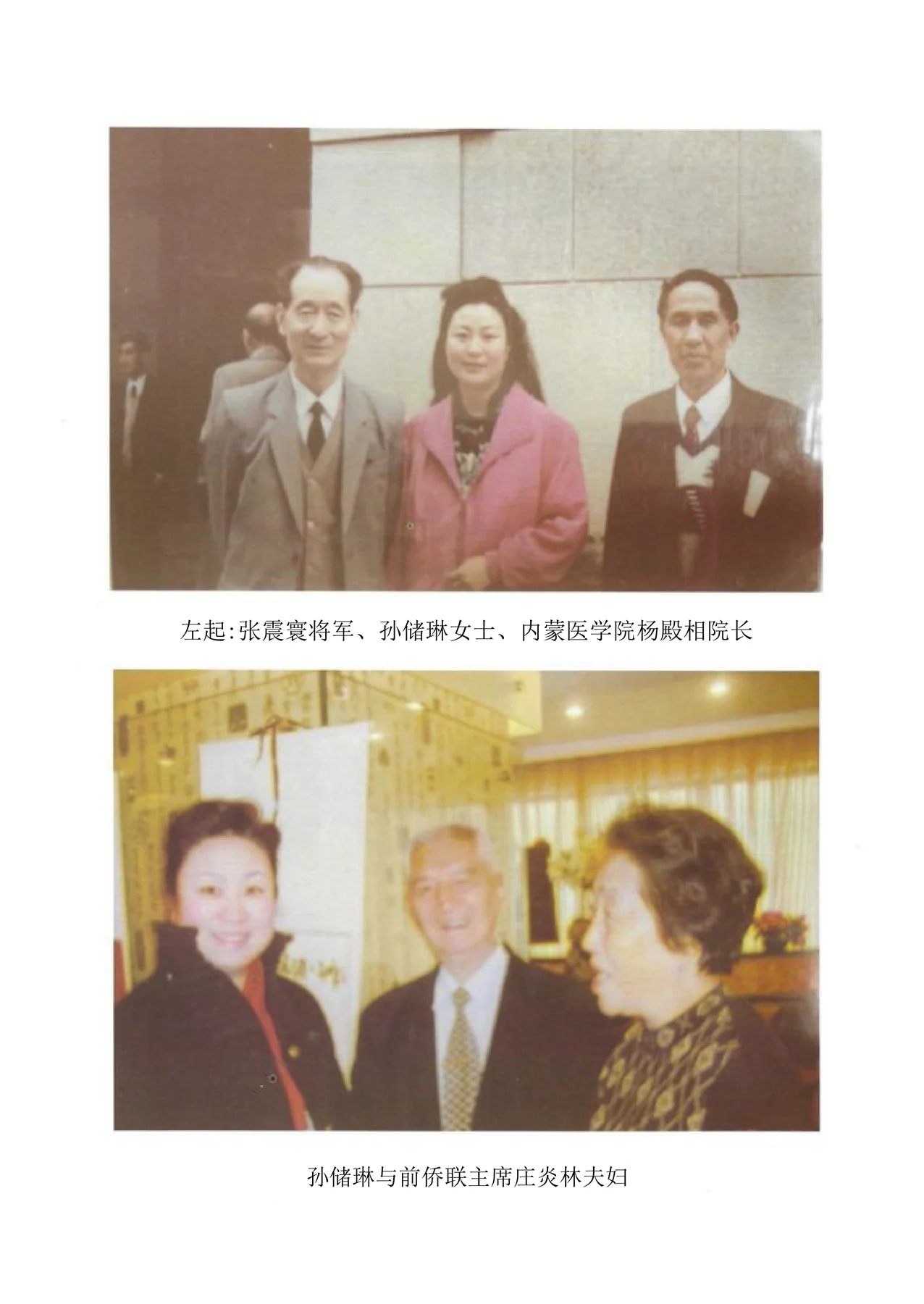
From left: General Zhang Zhenhuan, Ms. Sun Chulin, and Yang Dianxiang, President of Inner Mongolia Medical College Sun Chulin with former Chairman of the All-China Federation of Returned Overseas Chinese Zhuang Yanlin and his wife
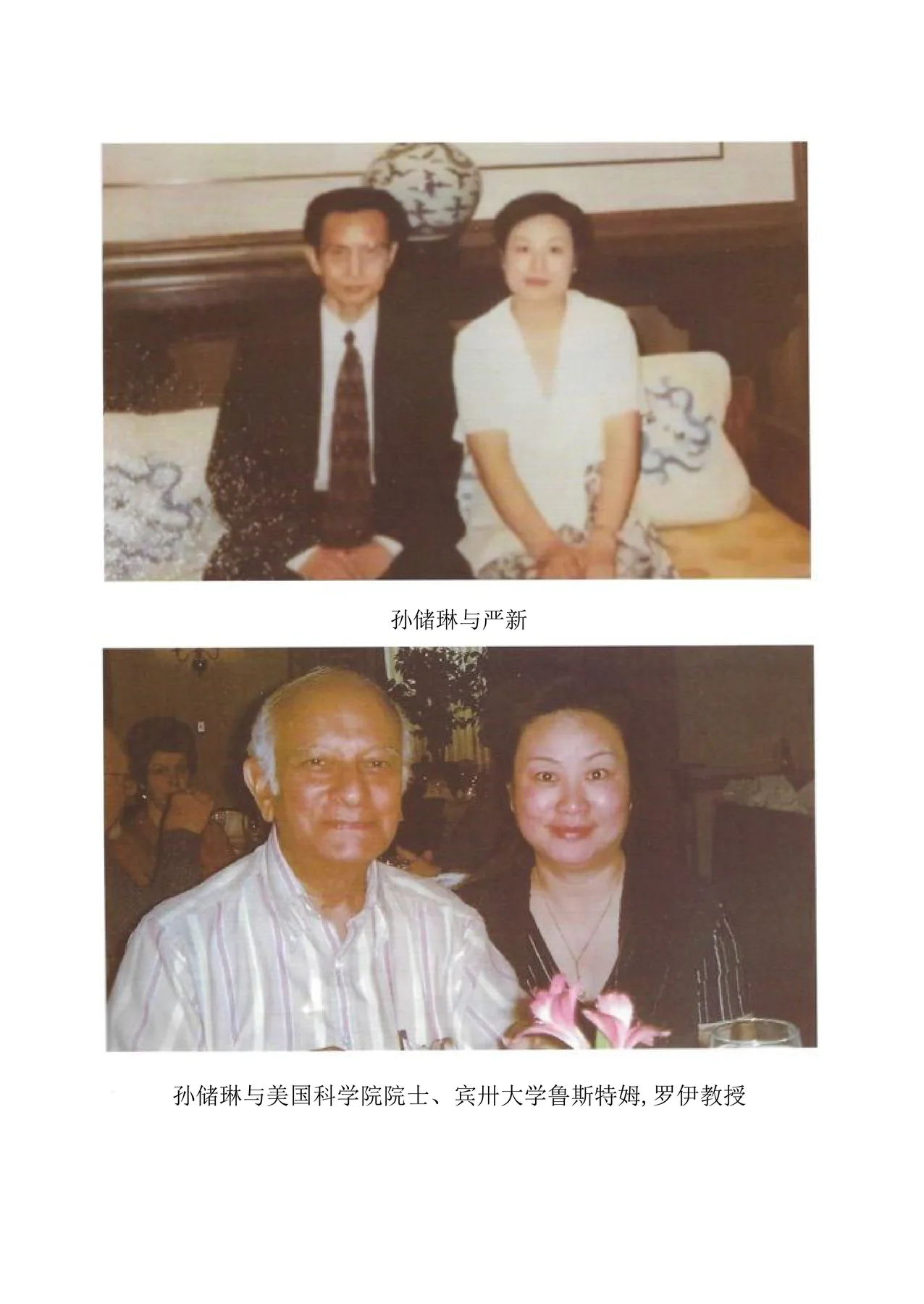
Sun Chulin with Yan Xin Sun Chulin with Rustum Roy, member of the U.S. National Academy of Sciences and professor at Pennsylvania State University
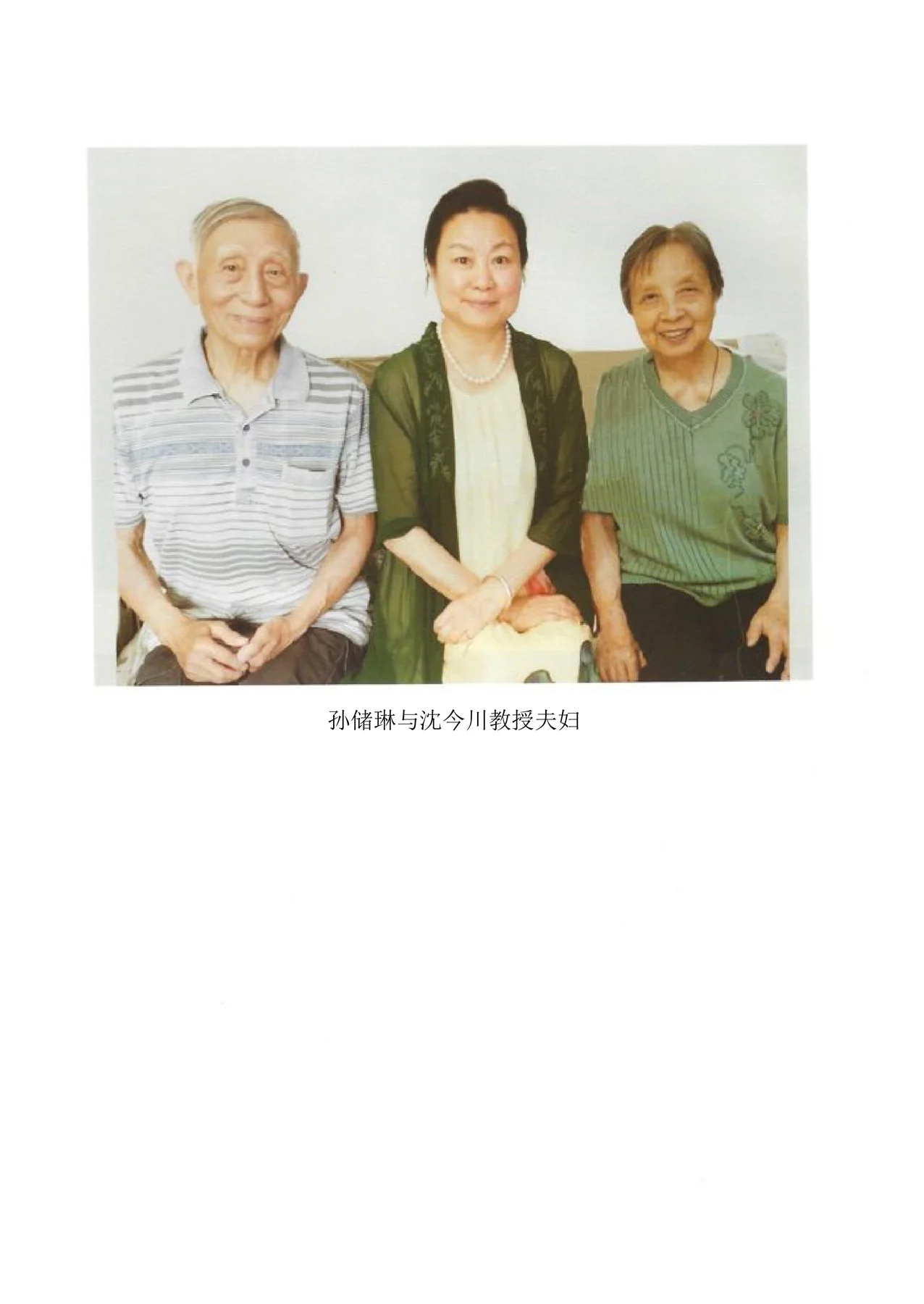
Sun Chulin with Professor Shen Jinchuan and his wife
Contents
Author’s Preface … 1 Preface One: A Wondrous Journey of Extraordinary-Ability Research … 8 Preface Two: All Human Functions Epitomize the Forms of Cosmic Motion — Preface to The Part of the World I Saw … 11 Preface Three: What Should We Learn from Sun Chulin? … 21
The Part of the World I Saw (My Connection with Human-Body Science)
Childhood Memories … 25 Years as a Sent-Down Youth … 30 Discovery of Miracles … 35 Self-Exploration … 39 My Invisible Teachers … 42 A Doctor Who Is Not a Doctor … 78 The Long Road of Scientific Research … 85
- Intention-Based Clairvoyance … 85 1.1 Clairvoyant Viewing of Hidden Text and Images … 85 1.2 Clairvoyant Viewing of the Human Body … 86 1.3 Clairvoyant Viewing of Underground Objects … 88
- Mechanical Effects … 88 2.1 Intention-Based Movement of Small Objects … 89 2.2 Intention-Based Turning and Stopping of Clock Hands … 89 2.3 Intention-Based Driving of the Vanes of a Light-Pressure Rotor Radiometer … 91 2.4 Intention-Based Translocation of Characters, Seals, and Ore Crystal Model Imprints onto Walls … 91 2.5 Intention-Based Long-Distance Object Translocation … 92 2.6 Intention-Based Bending of Objects … 94 2.7 Intention-Based Bending of Coins … 96 2.8 Intention-Based Drilling of Holes in Coins … 97 2.9 Intention-Based Cutting of Metal Objects … 98
2.10 Intention-Based Micro-Carving … 99 3. Heat-Concentration Effects … 100 3.1 Intention-Based Burning of Coins … 100 3.2 Intention-Based Combustion of Objects … 101 3.3 Intention-Based Popping of Popcorn … 104 4. Optical Effects … 104 4.1 Intention-Based Photography … 105 4.2 Writing with a Celestial-Eye Light Spot … 115 5. Magnetic-Field Effects … 117 5.1 Intention-Based Enhancement of Magnetic Intensity … 117 5.2 Guided Development of the Human Body’s Magnetic Force … 118 5.3 Coins Adhering to the Human Body … 118 6. Biological Effects … 119 6.1 Biological Effects on Plants … 120 6.2 Biological Effects on Animals … 144 6.3 Subtle Experiences and Sensations of Communication with Plants … 147 7. Consciousness-Based Materials Engineering … 151 7.1 Transforming Water into Oil, Wine, and Perfume Through Intention … 151 7.2 Intention-Based Processing of Information Water … 152 7.3 Intention-Based Processing of Tea Leaves … 153 7.4 Intention-Based Processing of Information Objects … 153 8. Penetrating Spatial Barriers … 154 8.1 “Contact” Shaking Out of Pills … 154 8.2 Remote Shaking Out of Pills … 155 8.3 Intention-Based Directional Shaking Out of Pills … 156 8.4 Coins or Buttons Penetrating Glass Plates … 156 8.5 Large Objects Entering Small-Mouthed Bottles … 157 8.6 Unsuccessful Wall-Penetration Experiment … 158 9. Materialization of Energy, or Creating Something from Nothing … 158 9.1 Intention-Based Translocation of Pills … 158 9.2 Kneading Pills by Hand Combined with Intention … 159 9.3 Intention-Based Multiplication of Pills or “Nectar Pills” … 160 10. Extrasensory Perception and Remote Sensing … 161 10.1 Predictive Effects … 161
10.2 Intention-Based Interference Effects … 161 10.3 Remote Healing … 161 10.4 Intention-Based Light Signals … 162 Eight Years of Travel in Japan … 163 Unsolved Mysteries … 167
- How Do Extraordinary Human Abilities Arise? … 168
- Why Does Heaven Bestow Such Care Upon Our Family? … 169
- Why Are My Abilities Not Very Stable and Not Under Arbitrary Control? … 171
- Why Can Some Abilities Be Repeated Many Times, While Others Cannot Be Repeated Often? … 171
- Why Do Some Abilities Almost Succeed but Fail to Materialize, and Then Never Appear Again? … 172
- Where Do My Invisible Teachers Come From? Why Do They Take Such Care of Me, and Why Do They Come to Teach Me Abilities? … 172
- When I Translocate Pills, the Pharmacy Administrator I See — Which Space Does He Live In? How Are the Pills Made? … 173
- Why Can I See Many Celestial Wonders Through Intention? … 173
- Why Are My Abilities Affected by My Mood? … 174
- How Much Longer Will My Abilities Last? … 175 Concluding Remarks … 176 Discussion of Invisible Teachers, Spiritual Powers, and Torsion Fields … 179 Afterword: Sun Chulin and Her Extraordinary Abilities as We See Them … 216 Appendix: Selected Photographs and Captions from Scientific Research on Sun Chulin’s Extraordinary Abilities … 237 Appendix Material One: Inside Story of Ye Jianying and Others’ Support for Extraordinary-Ability Research … 278 Appendix Material Two: Qian Xuesen on Human-Body Science … 294 Appendix Material Three: Wu Shaozu and Human-Body Science … 307
Author’s Preface
I am neither a movie star nor a singing star, but in the popular parlance of today, I too have many fans. Among them are researchers in the field of human-body science in scientific and technological circles both in China and abroad, enthusiasts, those with extraordinary human abilities, and friends who practice qigong or Buddhist and Daoist cultivation methods.
For many years, many friends have hoped that I could write down the extraordinary phenomena that have occurred in my own body, but I have repeatedly been unable to take up the pen.
The reasons are, first, that I did not know how to write it well; and second, that even if it were published, I had no idea how significant it would really be.
More than thirty years ago, by a chance opportunity, some incredible extraordinary phenomena in my body were discovered. At the time, this was primarily the clairvoyant function of the Heavenly Eye acupoint. In fact, these extraordinary human abilities had existed before that — that is to say, when I was a child. But at that time, not only others; even I myself did not know about them. In the 1980s, there was more than one person with similar abilities. Across the country, a group of functionally gifted individuals was successively discovered, including Tang Yu, Zhang Baosheng, Chen Zhu, Ma Weiqing, Wang Youcheng, Yu Ruihua, Gaowa, Wang Bin, and the sisters Wang Qiang and others, which caused no small sensation.
The state hoped that research into extraordinary human abilities could make new contributions to society and to humanity’s scientific and technological enterprise. Thus, on May 3, 1987, the State Science and Technology Commission formally approved the establishment of the “Chinese Human-Body Science Society.” The honorary president of the society was Qian Xuesen (academician of the Chinese Academy of Sciences and the Chinese Academy of Engineering), and the president was Zhang Zhenhuan (Major General of the Chinese People’s Liberation Army, director of the Science and Technology Committee of the Commission of Science, Technology and Industry for National Defense, who specifically organized and led major national defense cutting-edge science and technology projects). The advisors included: Bei Shizhang (experimental biologist, cell biologist, academician of the Chinese Academy of Sciences), Kuang Yaming, Lu Bingkui (the first director of the National Department of Traditional Chinese Medicine), Liu Shenggang, Li Shuren, Li Qiang, Yang Chao, Ke Hua, Zhao Zhongyao (nuclear physicist, academician of the Chinese Academy of Sciences), Gao Zhanjie, and Gao Zhiguo. From June 7 to June 9, 1987, the first plenary session of the inaugural council of the Chinese Human-Body Science Society was held in Beijing.
And so, under the conditions of contemporary Chinese society, applying the means of modern science and technology and rooted in the ancient Chinese civilization, Academician Qian Xuesen, a renowned scientist, and General Zhang Zhenhuan, who had specifically organized and led major national defense cutting-edge science and technology projects, together raised high the banner of “human-body science.” Those of us with extraordinary human abilities became the research subjects of human-body science; specialized management organizations were established, and dedicated personnel were organized to conduct research. Universities and research institutions across the country also successively established human-body science research offices.
Chinese human-body science research entered a golden period.
The discovery of my extraordinary human abilities could be called accidental, but it should also be called inevitable.
That was the late 1970s and early 1980s, shortly after the end of the “Cultural Revolution,” when reform and opening up had just begun. Through the great discussion on “practice as the sole criterion for testing truth,” the leftist ideological trend that had constrained people’s thinking for many years gradually receded, and people began a renewed understanding of traditional Chinese culture. At that time, the great wave of qigong for health preservation swept across the whole country, and everywhere one could see people practicing qigong.
At that time, accompanying the qigong craze was a craze for extraordinary human abilities.
On March 11, 1979, the Sichuan Daily reported a piece of news: “A Child Who Can Recognize Characters with His Ears Is Discovered in Dazu County.” I was at the time studying in the preschool education class at Wuhan No. 2 Normal School. Our class’s psychology teacher was relatively interested in certain extraordinary phenomena. He had previously investigated several primary school students in Hubei who could recognize characters with their ears, and he believed that such extraordinary phenomena genuinely existed. In order to further research and confirm this, he decided to continue conducting experiments in our class. It was during this experiment that it was discovered my ears could also recognize characters.
Only then did I recall that this clairvoyant ability of mine had existed when I was a child; I simply had not known it at the time. When I was little in the countryside at my grandmother’s home, while digging for pigweed together with my friends, I discovered a jar of copper coins buried deep underground. On top of a burial mound, I saw an old person buried beneath the ground. When I was in primary school, I could see the characters on the blackboard in the next classroom and the image of the teacher.
It should be said that from the day my extraordinary human abilities were discovered, I became, like many people with extraordinary abilities, a celebrity within a certain circle. People watched us with unusual eyes. There were even quite a few people who called me a “little immortal.” Some came to ask me to look at this or that, some asked me to diagnose and treat illnesses, some asked me to read their physiognomy and inquire about their future, some specifically wanted to see me perform demonstrations, and some wanted to pull me into a partnership to make money.
After my extraordinary human abilities were discovered, the leadership transferred me from the kindergarten of China University of Geosciences in Wuhan to work in the university library. Later, when the university established a human-body science research office, I was transferred again from the library to the human-body science research office to work together with experts and professors, exclusively engaged in human-body science research. Still later, I was transferred from China University of Geosciences in Wuhan to China University of Geosciences in Beijing to continue human-body science research (one university with campuses in two locations).
The extraordinary human abilities in my body were initially concentrated in clairvoyance. It began with recognizing characters by ear, and subsequently
… such as seeing inside the human body, detecting unknown objects underground, and prospecting for subterranean mineral deposits. As my practice deepened over time, as I received instruction from invisible Masters, and as I was inspired and taught by other individuals with extraordinary abilities, the varieties of extraordinary abilities I possessed grew ever more numerous, the scope ever broader, the phenomena ever stranger, the difficulty ever greater, and the influence ever larger.
At present, the extraordinary abilities that have been discovered in me number no fewer than several dozen. In addition to the clairvoyant ability described earlier, there is also the ability to use mental intent to make plants grow rapidly, at rates hundreds of times faster than normal growth. For example, I can make a flower bud bloom instantly, or make various types of beans or seeds sprout in an instant.
Even more remarkable, I can bring plant seeds back from the dead. I can take boiled or deep-fried peanuts and green beans, spiced broad beans, flavored beans, and the like, and use mental intent to instantly restore them to life and cause them to sprout. The tender shoots from deep-fried peanuts can grow to nearly ten centimeters long; some are as thick as a little finger — white and tender, quite adorable. In an instant, some can even grow stems over twenty centimeters long, while simultaneously putting forth several green leaves.
I can use mental intent to regulate the ripeness of apples, green fruits, and tomatoes in both directions. I can make unripe apples, green fruits, and tomatoes turn red and ripe in an instant, and then make them instantly revert to an unripe, green state. I can similarly use mental intent to regulate the cooked and raw states of eggs, duck eggs, quail eggs, and other types of eggs in both directions.
Even more interestingly, I can use mental intent to bring small fish and large shrimp back from the dead. For instance, I can make deep-fried shrimp on a dining table become lively and jumping; after bringing a dead tilapia back to life, the fish can continue swimming around in the water; and I have also brought a newly dead chick back to life. Of course, I have not performed such experiments very often — only once or twice. But experiments and demonstrations such as making deep-fried peanuts sprout, I have performed hundreds of times.
I can also produce something out of nothing — using mental intent to extract medicine from thin air, and rubbing pills out of medicine with my fingers and palms. I can use mental intent to burn coins, to pop popcorn, to cause objects to move, to engage in remote sensing, remote control, remote diagnosis, and remote healing, to translocate objects, to bend and cut metal, to turn water into oil, water into wine, water into perfume, and also to take photographs through mental intent, and so on. I will not enumerate them all here.
Why do I now wish to write all of these things down?
This is because over the years, while people have been observing and studying me, I myself have also been observing and studying myself and the various types of extraordinary phenomena I have witnessed, as well as observing and studying people’s various attitudes and views toward these extraordinary phenomena.
I have also often wondered: why do I have these extraordinary abilities? Where do my extraordinary abilities come from? What significance do these abilities hold for me personally — and on a larger scale, for society and for humanity? I have continuously reflected and pondered. Through many years of study and reflection, I have formed my own understanding and insights regarding the existence and study of extraordinary human phenomena:
First, the extraordinary phenomena that exist in the human body, or what are called extraordinary abilities (the abilities manifested by extraordinary phenomena are termed extraordinary abilities), constitute a genuine objective reality. They are not, as some people who are completely ignorant of them claim, a form of magic trickery, or something that simply does not exist. My own personal experience and that of numerous friends who possess extraordinary abilities, as well as the long-term research and experimentation by many scientists both in China and abroad, have confirmed that extraordinary human abilities are a genuine objective reality! This is an objective fact that no one can deny! As for what types of extraordinary abilities exist among human beings, I will introduce them later.
Second, what benefits do these extraordinary abilities bring to the individuals who possess them? Based on my personal experience, if I persist in sitting meditation and practice, treating it as a form of qigong cultivation, it can strengthen the body, promote health, and prolong life.
If, however, I pursue them as abilities and continually use my power to perform demonstrations, conduct experiments, or examine, regulate, and treat people’s illnesses, then it will deplete my jing, qi, and shen. Not only does this not benefit physical health, but it will also damage physical health to varying degrees.
In this respect, there is a situation similar to qigong: when a qigong master practices on their own, it strengthens the body and promotes health; but if they overuse their own power to regulate and treat others’ illnesses, it can also harm their own body. In many martial arts novels, films, and television dramas, we see skilled practitioners using their own power to treat injured friends — healing the friend, but collapsing from exhaustion themselves, after which they must spend a long time in cultivation to restore their own power. This, one should say, is reasonable.
Third, what benefits do extraordinary abilities offer to others and to society? My understanding is:
First, they can help people diagnose, regulate, and treat some difficult and complex illnesses. Of course, it is not the case that any illness of any person can be treated, and sometimes individuals with extraordinary abilities are helpless even against illnesses in their own bodies or those of their own family members. Moreover, each instance of diagnosing, regulating, and treating illness consumes a great amount of the ability-holder’s energy, and excessive depletion will also harm the ability-holder’s body.
Second, they can help scientists conduct useful scientific experiments — to understand, from a scientific perspective, the extraordinary phenomena that exist in the human body, and from a biomimetic perspective, to develop medical instruments that can replace individuals with extraordinary abilities in the diagnosis and treatment of human diseases.
Third, using human extraordinary abilities to conduct research and experiments on plants, to change plant traits, and to increase the yields of various crops may provide humanity with more environmentally friendly, safer, and more nutritious food. Of course, if such research and experiments are conducted too frequently, they can also greatly consume the energy of individuals with these abilities, and may even affect their physical health and well-being.
Fourth, I believe this is the most important point: it can help people recognize the existence of multi-dimensional spaces beyond our three-dimensional space. My extraordinary abilities have allowed me to see the existence of multi-dimensional spaces, to see the wonders of other worlds, and to see many things that ordinary people cannot perceive with the naked eye. This has broadened my horizons and liberated my thinking. I hope this can also help people liberate their thinking, dispel superstition, and enable people to comprehensively, deeply, and scientifically understand the world around us, understand the universe, and understand the environment in which people live and exist—so that people can establish correct and scientific worldviews, views on life, and values, so that people can properly handle the various relationships between person and person, person and society, and person and nature, and so that humanity can survive, live, and develop along a correct scientific path. I believe this should be the starting point and ultimate goal for people in recognizing and researching extraordinary human abilities, and it is also where the true significance and value of recognizing and researching extraordinary human abilities lie.
Fifth, while researching extraordinary abilities holds such great significance, the current public’s awareness of and attitudes toward human extraordinary abilities are complex and multifaceted. From my observation, they mainly fall into the following categories:
First, there are those who believe that so-called human extraordinary abilities simply do not exist. Some people have never witnessed demonstrations of extraordinary abilities by individuals who possess them; some, even after seeing such demonstrations with their own eyes, dismiss them with scorn. They consider them to be nothing more than magic tricks. This is currently the understanding and attitude of the vast majority of people in society toward human extraordinary abilities.
Second, there are some people who are interested in health preservation and qigong cultivation. They are relatively inclined to believe in human extraordinary abilities, but most remain at a superstitious stage of seeking supernatural powers, and some even regard the emergence of extraordinary abilities as the goal of their cultivation practice. In fact, this kind of practice that pursues abilities can easily lead to deviation or spiritual derailment.
Third, there is a portion of relatively open-minded scientists, researchers, and enthusiasts and investigators of extraordinary abilities. They are comparatively inclined to believe in human extraordinary abilities. They are not superstitious and their attitude is relatively rational. Some of them treat human extraordinary abilities as a calling, even dedicating substantial human, material, and financial resources to conduct long-term research.
Fourth, I have observed that only those cultivators who possess genuine spiritual attainment believe in human extraordinary abilities. But they hold that extraordinary abilities should be innate in every person from birth—it is only
that they have not yet been developed. They regard the appearance of extraordinary abilities during the course of cultivation as a normal phenomenon, and moreover, merely a byproduct of the cultivation process—nothing remarkable. Furthermore, they do not pursue extraordinary abilities in their practice. They tell people that the true goal and purpose of cultivation is to transcend birth and death and return to one’s original nature. I believe this understanding and attitude toward human extraordinary abilities is the scientifically sound and advisable one.
Since human extraordinary abilities are a genuine, objective reality, and since they carry positive significance for people to comprehensively and scientifically understand the objective world, I feel it is my duty to record the extraordinary phenomena that have occurred in my own experience in a relatively comprehensive, systematic, objective, and truthful manner, and to present them in considerable detail to the world—to my enthusiastic fans and friends—so that people can truly come to understand and learn about extraordinary human phenomena in a scientific and objective way. Through this, we can achieve the liberation of thought, dispel superstition, and allow extraordinary human abilities and their research to make the positive and due contribution they ought to make to modern society. This is precisely the true purpose and original intention behind my writing of this book.
Furthermore, from my limited reading, I have come to understand that, up to now, with regard to human extraordinary abilities, although there are extensive records in China’s ancient texts, and although abroad there is the book My Story by the Israeli Uri Geller, as well as academic papers by modern researchers studying extraordinary abilities and some scattered accounts, I have not yet found a single book specifically documenting or comprehensively introducing the lifelong extraordinary phenomena—or extraordinary abilities—of any one individual with such abilities.
I believe that we individuals with extraordinary abilities should not carry these genuine extraordinary phenomena that objectively exist within the human body into the grave. Therefore, I feel that we not only have an obligation but also a responsibility to record these extraordinary phenomena, which are not understood by ordinary people, and to present them to the world.
It is precisely based on the above understanding, and also to fulfill the wishes of my many friends, that I have made up my mind to compile and publish this book, to share with everyone.
The main title of this book is “The Part of the World I Saw,” and the subtitle is “The Source of My Human-Body Science.” The book is divided into four parts. Part One is a comprehensive introduction to my extraordinary abilities, referred to in brief as “My Personal Account.” Part Two presents some of the photographs and written descriptions captured during scientific research on my extraordinary abilities. Part Three, in order to help people understand the history and current status of human-body science research conducted in China since the 1970s, includes appended materials related to human-body science research from relevant parties. These mainly include: 1. Attention and support from leaders of China’s party, government, and military toward human-body science research; 2. Qian Xuesen and human-body science; 3. Wu Shaozu and human-body science; 4. Video materials recorded on-site during my participation in scientific research work using extraordinary abilities.
As to whether publishing this book can actually meet my expectations, I do not know, nor do I dare to harbor any greater expectations. But I think that all the scientists, engineers, experts, and professors who are currently engaged in human-body science research, especially the friends who have long cared about, supported, and never stopped researching human-body science, will definitely be interested in this book.
Here, I must also emphasize in particular that for those friends who are qigong enthusiasts, after reading this book, you must adopt a correct attitude toward extraordinary human abilities. I solemnly remind my friends absolutely not to be superstitious, and even less to deliberately pursue these things. Do not believe that individuals with extraordinary abilities are immortals who can solve any problem, accomplish anything, or cure any illness. Because I truly know that I am not any kind of immortal. Although I do possess quite a few extraordinary human abilities, I am indeed an ordinary person who sometimes cannot even cure the illnesses of myself and my own relatives.
Moreover, my purpose in writing these things is absolutely not to promote extraordinary human abilities, much less to encourage people to pursue them, because this can easily lead people astray. If that were the result, it would absolutely not be what I wish to see.
I have already spoken a lot about my purpose in writing these things earlier, and some of my words might have been a bit too grand. If I were to state a simplest purpose, or a single role it might play, it is simply to open a window for people to understand the unknown world, and nothing more. At the same time, I suggest that people who have never been exposed to the knowledge of extraordinary human abilities, if they obtain this book and have some free time, as long as they read it carefully, it will not only broaden their horizons in understanding things, but may also bring some unexpected gains.
Of course, there will certainly be many people who do not believe in the contents of this book at all. That is fine too; you can just treat it as a modern version of a science fiction novel or a mythological story to read for entertainment.
These are my opening words, respectfully written as a preface.
Author: Sun Chulin
Preface One
The Fantastical Journey of Extraordinary Human Ability Research
Li Si-chen, Professor, Department of Electrical Engineering, National Taiwan University; Former President
When I was young, I never believed that qigong or extraordinary human abilities were real, always thinking they were merely a fantasy world created by martial arts novels or works like Investiture of the Gods and Journey to the West. In 1988, by a chance opportunity, with the support of Taiwan’s National Science Council, I began the practice and study of qigong. The National Science Council gave each of us a copy of the Chan Mi Gong secret manual as the basis for practice. Unexpectedly, I was soon able to gather qi at the Dantian and open the Ren and Du meridians, curing chronic illnesses such as bronchitis. This left me profoundly shocked; it turned out that qigong was real. This strengthened my confidence in traditional culture. Could it be that the supernatural phenomena produced by practicing qigong to an advanced level might also be real? Therefore, in 1993, I took a further step and launched research on finger-reading. I quickly verified the phenomena of ear-reading and finger-reading that had been reported in mainland China since 1979. However, regarding other extraordinary human abilities, such as shaking pills out of a bottle or retrieving objects from a distance, I had only heard their names. Though I yearned to see them, having never witnessed them, I still harbored some doubts.
In 1995, I applied for a sabbatical from National Taiwan University. On one hand, I wanted to relax my body and mind and build up energy for re-engagement; on the other hand, I also wanted to use this opportunity to find a breakthrough point in the research of extraordinary human abilities. When autumn arrived, in September, I took advantage of my leave to accompany my mother to the mainland to visit relatives and friends, staying in Beijing for about a week. At that time, the most famous person with extraordinary human abilities in the mainland was Zhang Baosheng. I very much wanted an opportunity to visit him, but since we had no personal connection and I had no way in, it seemed quite impossible. Who knew that things would work out coincidentally. Shortly before my departure, a friend invited me to dinner, and among the guests was a Mr. Li from the mainland, who was also a person with extraordinary abilities, though with a different specialty. I took the liberty of asking Mr. Li if there was any way to find Zhang Baosheng. Mr. Li very enthusiastically gave me a phone number, saying it was for Mr. Zhang’s office at the 507 Institute in Beijing. So I prepared several of my own papers on qigong and extraordinary human ability research, intending to go to Beijing and recommend myself to meet Mr. Zhang. After arriving in Beijing, I first accompanied my mother to visit relatives and friends and tour famous sites. After being busy for a few days, I finally found a free slot and managed to contact Mr. Zhang’s secretary, Mr. Zhu. I immediately took my papers and business card to visit him. Secretary Zhu tactfully expressed that it was somewhat inconvenient to meet Mr. Zhang. I was of course a little disappointed, but I still gave him the materials and asked some questions. Perhaps my business card and papers convinced him that I was a sincere researcher and not just someone blindly joining the fray. So after thinking for a moment, he told me: “How about this!”
“Let me introduce you to a gifted individual just as formidable as Zhang Baosheng—though whether we can find them right now, I can’t say for sure.” He immediately made a phone call, explaining to the other party that I had come from Taiwan and so forth. He arranged for me to go over that very afternoon. “Not bad luck!” he said. “Professor Shen and the gifted individual are both in today. They don’t come to the office often.” I thanked him sincerely—we were complete strangers, and he could easily have ignored me, yet he was so warmly helpful. At the same time, I felt a flicker of doubt: in Taiwan I had only heard of Zhang Baosheng’s extraordinary powers—how could there be someone else just as formidable?
That afternoon, as arranged, I found my way to China University of Geosciences, where I met Professor Shen Jinchuan, who was engaged in human-body science research, and Teacher Sun Chulin, the person described as “just as formidable as Zhang Baosheng.” It turned out that the university’s personnel had been sent down to Wuhan during the Cultural Revolution, and it was in Wuhan that Professor Shen had begun his collaborative research with Teacher Sun. After we exchanged views, Professor Shen showed me the experimental results and video recordings from their past work. Every single experiment left me dumbfounded—breaking through spatial barriers, consciousness-based bioengineering (causing seeds to sprout and grow roots, and the like)—it was simply beyond imagination. At the time, my own research into extraordinary human abilities had progressed only to the preliminary stage of finger-reading. I had never imagined that extraordinary abilities could have such complex and astonishing effects, much less that a single person could simultaneously possess so many diverse abilities. She had mastered at least sixty types of abilities, each one challenging existing knowledge in physics and biology.
As I left the university, I was so excited I almost wanted to run down the street cheering. For I had glimpsed the vast horizon of human-body science research—how many problems in physics, medicine, biology, evolution, and more were waiting to be broken through! They say a hunter’s heart leaps at the sight of prey; those engaged in scientific research are the same. Discovering a new research topic brings both joy and impatience, along with an almost incredible sense of one’s own good fortune! Thanks to Mr. Zhu, Secretary to Mr. Zhang Baosheng, for his enthusiastic introduction, and to my luck in showing up at just the right moment that day, I was able to meet researchers from the mainland and create opportunities for future collaborative research. This meeting advanced my understanding of extraordinary human abilities by a great stride, making it clear that various special abilities can be developed through self-training, and that even extraordinary abilities cannot violate natural laws. For example, during experiments in which Ms. Sun caused seeds to sprout, she found it relatively easy to make legumes germinate, but her attempts to make wheat seeds sprout repeatedly failed—after many trials, the wheat showed no response. Later, after consulting agricultural experts, she learned that wheat must first grow roots before sending up shoots. Ms. Sun then first asked the wheat seeds to “grow roots, grow roots,” and only then to sprout—and sure enough, it worked. This example also tells us that relying on extraordinary ability alone has limited power; it must be combined with knowledge to achieve a multiplier effect, like adding wings to a tiger.
My collaborative research with Teacher Sun began in 1997. To prove that a completely dead peanut could still “return to life and sprout,” I invited a professor from the Department of Agronomy at National Taiwan University to treat Tainan No. 11 peanuts under
high-temperature, high-humidity conditions, destroying every cell, and then cultured them using normal procedures—not a single one sprouted. I then brought thirty vacuum-sealed peanuts to Beijing. During the experiment, the package was opened and the peanuts taken out, and the witnesses present signed their names on the peanut skins. Teacher Sun Chulin was then asked to perform the experiment. The result: in just thirty-seven minutes, one of the peanuts returned to life, sprouted, and grew a 2.8-centimeter shoot, while the witness’s signature remained clearly visible. This experiment completely overturned the definition of death and showed me the power of the Heavenly Eye consciousness. In the years that followed, we also conducted “consciousness micro-engraving” experiments, all of which succeeded, leading me to understand that the world of Investiture of the Gods might actually be real.
In 1999, in my finger-reading experiments in Taiwan, I discovered that when children tried to read characters for religious figures such as “Buddha” and “Bodhisattva,” they could not see these characters as written. Instead, they saw visions—radiant light, luminous figures, temples—and heard sounds such as laughter. I further demonstrated that sacred religious terms written in different scripts, including Tibetan and Hebrew, also produced such visions, indicating the existence of an informational world, like a vast website filled with information. I also went to Beijing and asked Teacher Sun to use finger-reading to view the character “Buddha” (Fo). The result was a burst of ten thousand rays of golden light. When she viewed “Buddha Mountain” (Foshan), there appeared an immense, luminous, crystal-clear mountain of glazed glass—the most beautiful mountain she had ever seen. Teacher Sun’s experiments fully confirmed for me that we had truly discovered another world—an informational field world.
Looking back over twenty-seven years, my encounter with Teacher Sun completely shattered my last vestiges of doubt. Some part of the myths passed down since ancient times is fact, and Teacher Sun’s book deciphers those myths, giving all readers firsthand material on how myths come into being. It is a rare and precious volume, the kind that appears perhaps once in an age.
Preface Two
All Human Functions Epitomize the Forms of Cosmic Motion
Ke Yunlu
Humanity has many mysterious phenomena, and at their core are the extraordinary phenomena of life. The most vivid and typical manifestation of these extraordinary phenomena is human-body extraordinary abilities.
Confirming the existence of human-body extraordinary abilities is quite a difficult matter. If this were not so, it would be impossible to explain why research by some scientists in various countries around the world over the past one or two hundred years has consistently failed to gain broad recognition.
The first difficulty in confirming human-body extraordinary abilities lies in the fact that abilities possessed by only a very small minority of people exceed the experience and theories of the majority of humanity’s members, and run completely counter to their senses and thinking. Therefore, for any demonstration of human-body extraordinary abilities, only those who directly observe it on the spot can possibly believe it. As the saying goes, “seeing is believing”; without seeing it with one’s own eyes, one does not believe. And in reality, very few people have the opportunity to witness demonstrations of human-body extraordinary abilities, so it is difficult to make more people believe.
The second difficulty in confirming human-body extraordinary abilities is that human-body extraordinary abilities cannot be unconditionally and arbitrarily repeated for demonstration regardless of time, space, or environment. The abilities of those with extraordinary abilities are something hypersensitive. An ability-holder possesses abilities, yet if the environment is even slightly unfavorable, the extraordinary-ability state may be disrupted. Many individuals with extraordinary abilities, in a relaxed environment, can perform many demonstrations of extraordinary abilities; however, once the environment changes—when there are scrutinizing gazes, monitoring instruments, and authoritative figures around—they immediately feel psychological pressure, and the abilities may fail to emerge.
In the 1990s, I presided over the filming of the large-scale documentary Life Science Exploration, twenty-four episodes in total, which conducted a large-scale investigation and recording of Chinese qigong and extraordinary-ability phenomena. Its original intention was to resolve the first of the above-mentioned difficulties in demonstrating human-body extraordinary abilities. It attempted to use authentic footage to recreate the real situations, combined with the measure of inviting authoritative figures from various fields to monitor and notarize on-site, so as to enable more people to intuitively “see with their own eyes” and believe in extraordinary abilities.
However, at the filming site, in the interest of rigor, authenticity, and credibility—with multiple cameras set up, lights blazing from many angles, and numerous guests seated in a circle—under the gaze of many eyes, the interference and pressure experienced by the ability-holders greatly increased. The above-mentioned second difficulty in demonstrating human-body extraordinary abilities—the problem that human-body extraordinary abilities are difficult to repeat unconditionally for demonstration—became doubly prominent.
Some extraordinary-ability individuals who had been decided upon for filming during early planning were unable to be filmed because the conditions of timing, location, and other factors did not come together. Some withdrew midway. Although the demonstrations of some extraordinary-ability individuals were filmed, for various reasons, the demonstrations were not sufficiently rigorous and were not selected for inclusion in this film.
And the extraordinary-ability master Sun Chulin not only entered our filming plan in the first batch, but with her exceptionally strong and stable abilities, she ultimately became one of the more than ten ability-holders who successfully completed the filming and investigation.
Her performance was outstanding.
But this process also had its difficulties and twists.
Initially, in June 1993, I invited Sun Chulin to come to the Beijing production team and conducted the first investigation of her abilities.
To help her relax, during the first investigation, Sun Chulin faced only me. As we chatted, she demonstrated. I took out a coin and placed it on the coffee table; with just a light tap of her hand, the coin penetrated the glass panel and was clamped onto the wooden surface beneath. After I lifted the glass panel and took out the coin, Sun Chulin placed the coin in her palm, closed her eyes, and emitted qigong; before long, when she opened her palm again, the coin had been bent into a 90-degree angle. She asked me if I had any more coins; after I produced them, she first carefully stuck one to her forehead at the “Heavenly Eye” position, and then, relying on the extraordinary suction of the Heavenly Eye, successively stuck multiple coins one on top of another.
Previously, I had already investigated many extraordinary abilities, but to complete so many items so effortlessly and quickly was quite rare. And so I praised her profusely.
As for going deeper into our filming plan, Sun Chulin’s attitude was conflicted. On the one hand, she was very supportive, hoping that through such investigation more people would come to understand extraordinary-ability phenomena, so as to gain broader social support and have more scientific research institutions get involved in the study. As for her own extraordinary phenomena, Sun Chulin spoke frankly: many of them she herself could not understand, let alone explain: “Those who don’t know about it think it’s nonsense,
“…is a fraud,” “but the phenomena on me are truly real.” On the other hand, Sun Chulin also had concerns. She candidly said: “I’m afraid the filming won’t turn out well. I’m afraid I won’t be able to perform when the time comes. I’m afraid I won’t complete the task.” She also said to me, “I’m also thinking of you. If you gather all of us extraordinary-ability individuals together and we can’t produce results, it will put Teacher Ke in a very difficult position.” The subsequent filming proved that Sun Chulin’s concerns were not unfounded. Without a deep understanding of extraordinary human abilities and those who possess them, one would probably have no idea what she was talking about.
In October 1993, the production team arrived in Wuhan to formally begin filming Sun Chulin. Because there were also plans to film another qigong master at the same time (to be conducted on the surface of the Yangtze River), they had specially rented a working boat from the Yangtze River Navigation Bureau and invited guests from the local scientific community. However, due to insufficient assessment of the situation and inadequate preparation, not a single invited guest appeared on the day of filming. Some people stated bluntly: they simply did not believe in any so-called extraordinary human abilities—it was nothing but trickery. This situation dealt a blow to the morale of both the production team and Sun Chulin.
But we still decided to press forward despite the difficulties. My thinking at the time was very clear: to prove the existence of extraordinary human abilities, even a record of the failure process would be meaningful. Only then would it be authentic. Only then could patterns be discovered.
We temporarily invited the workers and technicians on the boat to serve as witnessing guests and set up a demonstration area on the vessel. Sun Chulin resolutely appeared at the filming location. I knew well in my heart the interference and pressure brought by the environment and atmosphere she faced at that moment. The experimental project we had prepared for her was psychokinetic shaking of pills— that is, breaking through the constraints of three-dimensional space to shake pills out of a sealed medicine bottle.
This was a project that Sun Chulin had successfully demonstrated many times before, but it ultimately did not succeed at the filming site.
This failure demonstrated that extraordinary human abilities are not only possessed by a small number of people (the abilities of the vast majority of people lie dormant), but also represent a kind of peak-state function for the ability holder. Just as an athlete cannot reproduce a world record set under peak conditions under just any circumstances, the abilities of an extraordinary-ability holder are even less something that can be effortlessly repeated at any time and place.
This was a setback encountered during the early filming of Exploration of Life Science. The production team at the time had dozens of members, the overwhelming majority of whom had never witnessed a demonstration of extraordinary human abilities, and quite a few of them originally did not believe in such abilities at all. The failure in Wuhan deepened the pessimism of some members. Sun Chulin herself also seemed to show a certain apprehension toward future filming. But in reality, I knew that deep down she was absolutely not one to concede defeat.
The following spring, at my renewed invitation, Sun Chulin came to Beijing. The production team then 13
conducted multiple filming sessions. By this time the production team already had the experience and confidence gained from several consecutive months of filming various extraordinary human abilities, and Sun Chulin herself had made more thorough mental preparation. Through tireless effort, she successively completed demonstrations of psychokinetic burning of coins, magnetic sensing imaging of human acupoints, psychokinetic popping of corn kernels, psychokinetic drilling of holes in coins, psychokinetic adhesion of multiple coins at the Yintang point, psychokinetic bending of silver spoons, and psychokinetic destruction of floppy disk magnetic tracks—achieving tremendous success.
For every filming session we would invite different guests to conduct rigorous examination and serve as witnesses, and would apply uniqueness markings to the demonstration objects on-site. For filming quality, the site had to be set up, lighting had to be arranged, and two or more cameras had to be positioned. The production team only gradually came to understand later that such deployment constituted a tremendous “interference” and “torment” for the ability holder. Unlike magic performances, demonstrations of extraordinary human abilities have certain requirements regarding the environment, and often also require the cooperation of a consciousness field. However, it often happened that by the time the production team’s preparations were complete, the state that the ability holder had prepared was already gone, and the team could only wait patiently. Each filming session at that time lasted a short four to five hours, or more often seven to eight hours, and from gathering for preparation to the end of filming often took over ten hours in all. Thanks to Sun Chulin’s extraordinary abilities, she ultimately withstood the environmental interference and successfully completed the filmed demonstrations.
It can be said that Sun Chulin, performing so many different extraordinary-ability demonstrations under large-scale filming conditions with such strict monitoring, created a miracle. This was more than ten times more difficult than performing extraordinary abilities under relaxed conditions (such as among acquaintances, in familiar surroundings, casually, simply, on a small scale). At the time, there were many ability holders whose extraordinary abilities were ordinarily quite impressive, but who balked and withdrew as soon as they saw the brightly lit filming set with its crowd of guests.
I still remember that after the television program was completed, Sun Chulin took away the episode about her at the first opportunity, and the next morning she called in a long phone conversation. On the phone, Sun Chulin was so aggrieved she was nearly in tears. She said: “Early this morning I went to Professor Shen Jinchuan’s home, preparing to enjoy this film together with Professor Shen and his wife. (Shen Jinchuan is a professor of materials science and crystal chemistry at China University of Geosciences, a doctoral advisor, who for decades has been engaged in research on extraordinary human abilities, with a large body of research achievements. He has made particularly important contributions to Sun Chulin’s development, and to the cultivation and study of her extraordinary abilities.) At first I was quite happy watching it, but the more I watched, the sadder I felt.” I asked why. Sun Chulin said: “So many of my abilities were not filmed, and instead my failures were filmed again and again. After watching both episodes, it was nothing but my failures.” I told her from the outset that it was true she still had many abilities that could not all be filmed this time, but the ones that had already been captured were already sufficiently astonishing, because performing extraordinary abilities under such formal filming conditions was truly extremely difficult. I consoled her: “Your extraordinary-ability demonstrations were a ‘difficult process, successful result.’ The ‘difficult process’ means you have fully demonstrated that human 14
The demonstration of extraordinary human abilities requires eliminating interference from various environmental factors. It is precisely because you can resist interference that there were ultimately ‘successful results.‘” I went on to say, “Didn’t you notice how in the end the documentary captured so many of your successes?” I gave examples one by one, such as psychically popping popcorn, psychically punching holes in coins, and so on. How remarkable these are! Every single demonstration was inconceivable. I also told her that it was precisely because the failures preceding each success were also truthfully presented that her successes became even more convincing. Take our film crew, for instance: quite a few people originally did not believe in extraordinary human abilities. It was precisely because of Sun Chulin’s honesty—her progression from failure to failure to success after success—that people went from disbelief to belief, and ultimately to a firm conviction in the existence of extraordinary human abilities.
The 1980s and 1990s were the golden age of qigong and extraordinary human ability research in China. During that era, I met and investigated a large number of qigong masters and individuals with extraordinary abilities, and I used documentary methods to leave behind precious visual records. Every shoot back then required gathering large crowds. From north to south, from scientific research institutions to groups of practitioners, every investigation had large numbers of prominent figures personally present at the scene, sharing with us those moments of witnessing miracles. For every investigation we conducted on-site, we required notarization by the guests, and they would solemnly sign each notarized document.
Looking back today, completing such a shoot seems almost inconceivable.
I am grateful to the qigong masters and individuals with extraordinary abilities who collaborated with me back then, and I thank Sun Chulin for cooperating with me with extraordinary courage. It was not only her abilities; Sun Chulin won over the entire film crew even more with her honesty and integrity. To add a bit of anecdotal trivia: whenever we left the grand, bustling filming set and relaxed over a meal or tea, the relaxed Sun Chulin would often casually perform various extraordinary human abilities for the crew on a whim, such as psychically burning a coin, psychically bending a steel spoon, and so forth. It was truly effortless and endless. The crew would sigh repeatedly: “The less we film, the faster they come! What a pity we don’t have time to set up the camera!” I remember the afternoon of March 6, 1994. After successfully completing the filming of psychically destroying a computer floppy disk at the Beijing Modern Information Development Center, Sun Chulin rode in the same minibus with the crew on the way back. Because of the relaxation and joy following our victory, Sun Chulin continuously performed psychically punching holes in coins, psychically burning coins, and other feats for everyone along the way. That scene remains vividly in my mind to this day.
II
Sun Chulin is a universally recognized master-level figure in China’s field of extraordinary human abilities. Her abilities were discovered in the 1980s,
and over the subsequent decades, starting from the initial recognizing characters with her ears and fluoroscopy of the human body, she gradually developed dozens of types. A rough statistical tally includes:
- Extraordinary fluoroscopy abilities: fluoroscopic viewing of hidden images and text, fluoroscopy of the human body, and fluoroscopic viewing of underground objects;
- Mechanical effects: psychically moving and stopping clock hands, psychically driving the blades of a light-pressure rotor radiometer, psychically translocating characters, seals, and mineral crystal models to adhere to walls; long-distance psychic object translocation, psychically bending objects, psychically punching holes in coins, psychically cutting metal objects, and psychic micro-carving;
- Heat-gathering effects: psychically burning coins, psychically burning objects, and psychically popping popcorn;
- Optical effects: psychic photography, and psychically writing with the light spot of the Heavenly Eye;
- Psychically enhancing magnetic strength, guiding and developing human body magnetism, and the human body adhering coins;
- Biological effects: biological effects on plants, biological effects on animals, and the subtle experiences and sensations of communicating with plants;
- Psychically turning water into oil, wine, or perfume; psychically treating informational water; psychically treating tea leaves; and psychically treating informational objects;
- Shaking pills out of bottles through physical contact, shaking pills out of bottles without physical contact, psychically shaking pills out directionally, passing coins or buttons through glass plates, and putting large objects into small-mouthed bottles;
- Materialization of energy, or “creating something from nothing”: psychically translocating pills, rolling pills by hand combined with psychic intention, and psychically multiplying pills or “nectar pills”;
- Extrasensory abilities and remote sensing abilities: predictive effects, psychic intervention effects, remote healing, and psychic light signals.
And so on.
For many years, I have always had a wish: that qigong masters and individuals with extraordinary abilities could document their growth process and their personal experiences with qigong and extraordinary abilities—such as how each ability came about, how it developed and became richer step by step, and what effects these abilities have had—so that more research material could be left behind through their own firsthand narratives.
Among the individuals with extraordinary abilities I have encountered, Sun Chulin is undoubtedly a highly valuable one. Her extraordinary abilities are strong and stable. For decades, she has been willing to endure solitude, cooperating with numerous domestic and international scientific research institutions to perform countless scientific experiments. The results of many of these experiments are quite astonishing; unfortunately, their outcomes
Most of them are not known to the general public; they can be said to work in quiet dedication.
The Part of the World I Saw: My Connection with Human-Body Science is Sun Chulin’s dedicated work, recounting her experiences from childhood onward—where her abilities came from, and how they were developed and strengthened step by step. She shares her own insights into these abilities. I believe all of this will provide great inspiration and assistance to researchers and general readers alike.
According to her account, Sun Chulin had six different masters at different periods. These masters came from different cosmic spaces and each taught her different abilities. We have no way to verify these claims, but what we can verify is each of her abilities, one by one.
During the filming of Explorations in Life Science, perforating a coin by mental intent was one of Sun Chulin’s demonstrations of extraordinary human abilities. She placed a coin that had undergone uniqueness processing in one hand and repeatedly struck the coin with a finger of her other hand. Before long, a small hole appeared on the coin—strictly speaking, it could not be called a “hole” but rather a small “pit,” and on the reverse side of the “pit” there was a corresponding protrusion. Sun Chulin herself recounted that when performing this demonstration, a crystal hexagonal rod would appear at her Yintang point (the area between the eyebrows), and she would use this crystal hexagonal rod to strike repeatedly against the coin, which had already been adjusted to the Yintang position. I once asked Sun Chulin about this phenomenon: “Why not simply punch the coin all the way through?” Sun Chulin laughed and said, “I’m afraid of punching through my own forehead—what then?”
With this phenomenon alone, without the practitioner’s own account, there would be no way to understand the subtlety and precision involved. And even with the practitioner’s own account, according to existing scientific theory, this phenomenon still cannot be explained.
As for the other experiments Sun Chulin conducted in cooperation with scientific research institutions—such as using mental intent to make fried peanuts return to life and sprout, using mental intent to turn a green apple red and then make it return to green, using mental intent to turn a boiled egg back to raw, using mental intent to turn bottled water into wine or oil, using mental intent to shake pills out of a sealed bottle, and using mental intent to translocate a large volume of material into a small-mouthed glass bottle—
Each and every one of these experiments exceeds the boundaries of conventional human thinking. Each successful outcome is truly inconceivable.
Through the part of the world she has seen, Sun Chulin opens a wondrous window for humanity. Looking outward, the universe is vast and infinite, and human understanding today falls far short. Looking inward, humanity’s understanding of its own mysteries remains quite superficial. We need in-depth research in this field.
It is regrettable that research into extraordinary human-body phenomena remains quite marginalized to this day. The reason humanity so rejects and refuses to accept the facts of extraordinary human abilities is that such abilities are contrary to existing cosmologies, worldviews, and scientific and philosophical theories.
This precisely reveals the limitations of all our previous theories, and it shows that the confirmation and deciphering of the facts of extraordinary human abilities will transform humanity’s world of thought.
Extraordinary human abilities—the miraculous powers of mental intent—are nothing more than an epitome of certain patterns of material motion within the universe.
All of humanity’s abilities epitomize the modes of cosmic motion.
Human mental intent, and the physical functions of human mental intent, are nothing more than manifestations of a kind of motion, a kind of force, a kind of energy within the universe.
Mental intent is a special kind of matter.
Mental intent is a special kind of field.
Mental-intent force is a special kind of force.
The energy of mental intent is a special kind of energy.
I once made a statement: all of humanity’s science and technology are externalizations of extraordinary human abilities. However, this is only the second statement. The first statement is: all extraordinary human abilities are epitomes of the forms of cosmic material motion.
When we truly regard human beings as the spirits of the universe, as epitomes of the universe, then our research into extraordinary human abilities takes on broad perspectives and significance: on the one hand, it enables us to truly examine extraordinary human abilities from a cosmological perspective; on the other hand, it enables us to expand from extraordinary human abilities to understanding the entire universe.
Mental intent is by no means unique to human beings. Human mental intent is merely an epitome of cosmic mental intent. All the extraordinary abilities that human beings accomplish through mental-intent force are, in the final analysis, bound to be epitomes of the various “extraordinary abilities” performed by cosmic mental-intent force.
From this, we can understand as follows: the various extraordinary perceptual abilities of the human body epitomize extraordinary modes of information transmission throughout the universe. And the various extraordinary psychokinetic abilities of the human body epitomize the various extraordinary modes of material motion in the universe.
What is called “extraordinary” is simply that which current scientific theory cannot yet explain—that which is outside the conventional.
So then, let us consider: what does the brain of the universe look like? What does the consciousness of the universe look like? What kinds of “extraordinary abilities” can the mental-intent force of the universe perform? What kinds of “creation from nothing” extraordinary
phenomena exist in the universe? Did the universe itself bring them into being out of nothing?
In this regard, we must break free of traditional scientific thinking and enter into cosmic thinking. We must apprehend the consciousness of the universe and enter into the role of the universe. We must apprehend how the universe governs, controls, and transforms the myriad things within it.
Once we grasp the truth that the human being is a microcosm of the universe, once we truly cosmologize human intention and truly regard human intention as a microcosm of cosmic intention, we will have found the most powerful line of thought.
In this way, if we continue along the path of researching extraordinary human abilities, we will inevitably develop various applied sciences and technologies. Tracing further back, we will inevitably plunge into the most fundamental research into the universe.
While attaching importance to and researching the phenomenon of extraordinary human abilities, we absolutely must not overstate their role, much less advocate superstition about them. As Sun Chulin herself states in this book: “To my friends who are qigong enthusiasts, after reading this book, you must adopt a correct attitude toward extraordinary human abilities. I solemnly remind my friends: please do not be superstitious, and even more so, do not deliberately pursue these things. Do not believe that people with such abilities are immortals who can solve every problem, accomplish anything, and cure every illness—for I truly know that I myself am no immortal. Although I do possess quite a number of extraordinary abilities, I am in truth an ordinary person who sometimes cannot even cure the illnesses afflicting myself and my own loved ones.”
While valuing the significance of research into extraordinary human abilities for understanding the universe, and at the same time refraining for now from exaggerating their practical utility, Sun Chulin’s candor appears genuinely pragmatic and fitting.
In the closing remarks of this book, Sun Chulin offers this sincere admonition to her readers:
“I have written down the extraordinary phenomena and extraordinary abilities that have occurred in my own body and presented them to everyone, for the sole purpose of introducing to you all that part of the world which I have seen but which most people cannot see—so that everyone can broaden their horizons and expand their field of vision, and come to know that beyond the world observable by the human eye, and even by the most advanced scientific instruments available today, there are countless, vastly broader cosmic worlds, and still more mysteries that demand exploration and revelation.”
Despite my many years of research into qigong and extraordinary human abilities, despite having long since ceased to be surprised by all manner of extraordinary phenomena, the world and the reflections that Sun Chulin presents in this book still brought me surprise after surprise. Of course,
it also prompted me toward deeper research and exploration of the unknown world.
This is an important work of unique value. I solemnly recommend it to all my friends!
Preface Three: What Should We Learn from Sun Chulin?
Mou Nan Chongqing No. 1 Middle School
Starting from about the first half of this year, my world began slowly to become magical and unreal.
It was as though someone had made meticulous arrangements: bizarre plots, dreamlike figures, abstract spaces, and moving legends all fused into my life, one after another. The people I wished to meet, the things I wished to do, the outcomes I wished to unfold—none was missing. It was as if the entire world had turned itself around to accommodate me, making it impossible for me not to be all the more circumspect.
This happens to be the hottest season in Chongqing. A couple of days ago, Teacher Sun sent a message asking: Is it still hot in Chongqing? Beijing is unbearably hot. I replied: It’s hot here too. But never mind—my life is given to me by the air conditioner. I wonder if Teacher felt I was being cheeky. Actually, it’s fine—my whole life, I’ve just never been one for rigor.
The Teacher Sun I speak of is precisely Teacher Sun Chulin. It must have been many, many years ago. I was watching a lecture online by the president of National Taiwan University, Professor Li Si-chen, and midway through, Professor Li mentioned that the person on the mainland with the most stable and most abundant extraordinary abilities was Sun Chulin. I hurriedly jotted down the name. Only then did I learn that there was such a great figure in our China.
Of course, I never entertained the hope of meeting her. It was like gazing up at the starry sky as a child—even though I knew the sky was filled with brilliant stars, I never once tried to pluck them, because so often in life it feels as though there is an insurmountable fence, and each of us is confined within our own enclosure. And in some dimly sensed way, we place a curse upon ourselves: there are certain beautiful things I can never reach.
So every child is this innocent, and yet every one of us is so weathered.
Thanks be to Heaven for its special care of me—the very people I had once felt a passing desire to meet have, just like that, come into my life as naturally as water finding its course. I came to know Professor Li Si-chen earlier than I came to know Teacher Sun. If Professor Li is still a grand figure who commands admiration, then Teacher Sun is very likely the Morning Star resting at the edge of the sky.
In the summer in Yunnan, Teacher Sun wore a bright, colorful outfit paired with a floral scarf. The moment we met, I called out: Hello, Teacher Sun! She replied with courteous formality: Hello! That she did not know me was a certainty. Had
Without an introduction from anyone, I certainly would not have recognized her either. Because no matter how you looked at it, you simply could not connect the person before your eyes with someone nearing sixty years old — or, to put it bluntly, a quasi-elderly lady.
Our first meeting and greeting went just like that. Because I could see there were truly many people coming up, preparing to greet her. I supposed that greeting people should count as one of her daily routines.
Further contact came about because a student at the residence hall had brought a friend to see her for treatment — a brain glioma. I had already said beforehand: in all of China, I am afraid only Teacher Sun has this ability. If she is willing to lend a hand, there is hope.
After about a day, I brought the two of them to find Teacher Sun. After the introduction, I left them to communicate on their own. When I asked the student afterward, the reply was: Teacher Sun has agreed to help with the treatment. I was actually relieved. Otherwise, I’m afraid I would have had to set up some kind of trap again. But still — that was too easy, wasn’t it? Standing next to Teacher Sun, she didn’t seem like someone so easy to talk to!
Then it was inviting Teacher Sun to go out for a meal together. I don’t know how the conversation got there, but I suddenly said: in this life, the two things I am most confident about are writing and teaching. But it seems that in recent years, I’ve lost my confidence in both of them together.
Teacher Sun then said: Speaking of writing, the book I promised someone is still not proofread yet!
As you all know, I am the kind of person who exaggerates, shows off, and has a thick skin. I immediately said: Come find me — I’m a professional, this is exactly what I’m best at. Teacher Sun even laughed and said: But I don’t have a salary to pay you! I said: I don’t want a salary. I normally don’t sell my services, but if I did, the price would be high.
After returning to Chongqing, Teacher Sun sent over her manuscript. I saw the title — The Part of the World I Saw: My Connection with Human-Body Science — warm and plain. Then I looked through the contents, and a sincere Teacher Sun deeply attracted me. Furthermore, she held nothing back and recounted everything frankly — what she knew, she knew; what she didn’t know, she didn’t know. You wouldn’t even sense any grand-master aura about her, much less any flavor of an immortal. She stands together with us, engaging in the most extraordinary undertaking with the most ordinary state of mind. She attempts to strip away all the sense of mystery and sacredness that ordinary beings take for granted. She wants to present another world to us — scientific, real, sentient, and vivid — so that ordinary people can draw closer to that possibly complete, real world.
In the afterword of the manuscript, the Teacher wrote a string of expressions of gratitude. Her words were simple and plain; in some other context they might have sounded like routine platitudes. But for some reason, I found myself moved by Teacher Sun’s continuous thread of gratitude.
How purely and rationally must a person live to maintain this serious inner reverence amid such enormous fame, to always simply obey the rules of life while never taking them lightly? She even thinks of herself as an ordinary person, yet in our eyes, what she is capable of is precisely what a god can do.
Perhaps there are still some people who don’t know exactly who Sun Chulin is? I think that worldwide, anyone who researches extraordinary human abilities or has an interest in them would probably know — even be familiar with — this name.
In those years, China had many “spiritual leaders.” These qigong grand masters each transformed themselves and ascended onto lotus pedestals, becoming the spiritual idols of the times. Back then, Teacher Sun was not famous. Now, the grand qigong masters have each plummeted into the abyss, nowhere to be seen. At this time, Teacher Sun has not been struck from the list.
The upright Way of Heaven’s heart always bestows great missions upon those who are in harmony with it. Great waves wash away the sand; true gold is never moved by wind and waves. Facing the passage of years and life itself, without a genuine composure and plainness, I think Teacher Sun would very likely have disappeared long ago in a commercialized society. Since the 1990s, in this grandiose star-making movement in China, why was she alone not swept up in it? I think: when we are ordinary, we must possess extraordinary courage; and when we are extraordinary, we must maintain an ordinary state of mind. Teacher Sun missed becoming a shooting star. She insisted on standing right where she was, and now, almost by accident, she is bound to become a fixed star.
The twenty-first century will see the birth of a great book of humanity — this book is The Part of the World I Saw: My Connection with Human-Body Science, by Sun Chulin. This book will change an era’s view of space and time, carrying out a nationwide enlightenment for the opening of the door to a new epoch. Through this book, we are finally able to draw close to this real world where multiple dimensions coexist, setting out from our hearts toward an inconceivable freedom.
Teacher Sun says in the book that she too does not know why Heaven has given her so many abilities. Why her?
Because you have always considered yourself a human being. This is the most important thing. And then your warmth and sincerity. This is something others do not easily discover. Including me — when I first approached Teacher Sun, there was always a sense of distance. It was only after reading Teacher Sun’s manuscript that I understood: if Teacher Sun had been warm and approachable from the very first moment, she very likely would not have lived to this day, because she would have been exhausted to death long ago. You can imagine — across all of China, and even the whole world, how many people are fixated on her supernatural powers.
Teacher Sun tells everyone that she wrote this book not to encourage people to treat supernatural powers as a goal. Teacher Sun is on the right path. In some people’s experience, supernatural powers are so natural, effortless, and simple; yet for most people, supernatural powers become something bizarre and strange. Examine yourself carefully: when you think supernatural powers are so bizarre and strange, part of your own character is equally bizarre and strange.
So, what should we learn from Teacher Sun?
First, be a warm person. The less darkness you carry within, the more often your dreams will come true. One day, you will suddenly awaken to the realization: you are the entire universe; you are everything. At that point, the world will turn around and follow your arrangements — you are the only one in the world.
Yesterday I spoke with Teacher Sun on the phone. She seemed to still have a slight cough that hasn’t fully gone away. They cannot and dare not do anything to you. Sometimes, being a little ill actually makes the soul healthier.
Come to Chongqing when it gets a bit cooler. It’s not like Beijing with its big winds here. Autumn in Chongqing is very much like spring.
My Connection with Human-Body Science
Main Autobiographical Narrative
Childhood Memories
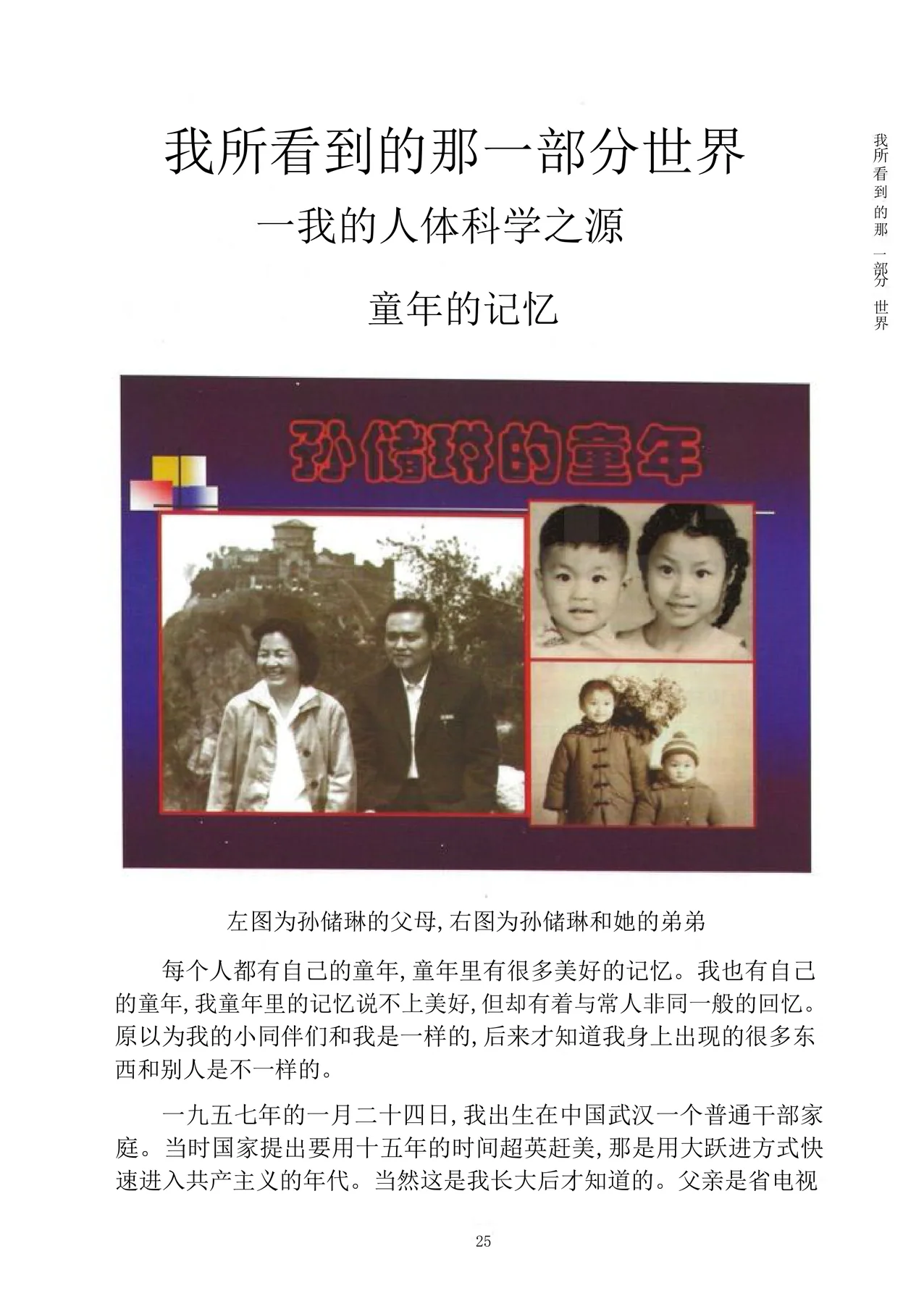
Left: Sun Chulin’s parents. Right: Sun Chulin and her younger brother.
Everyone has their own childhood, and childhood holds many beautiful memories. I too have my own childhood. The memories of my childhood could not exactly be called beautiful, but they were extraordinary in ways unlike most people’s. I had originally thought that my little companions were just the same as me, but only later did I realize that many of the things that appeared in me were different from other people.
On January 24, 1957, I was born into an ordinary cadre family in Wuhan, China. At that time, the nation had proposed to surpass Britain and catch up with America in fifteen years — it was an era of using the Great Leap Forward to rapidly enter communism. Of course, I only learned this after I grew up. My father was an administrative cadre at the provincial television
station, and my mother was a teacher. My father’s ancestral home was in Luhe County, Nanjing, Jiangsu Province — a farming family that had worked the land for several generations. My mother was a native of Wen’an, Hebei. My parents raised two children: me and my younger brother.
My extraordinary abilities come from heredity through several generations on my mother’s side of the family — one might call it maternal-line heredity. My mother told me that her father and her grandfather both had extraordinary abilities. When my mother was young, she too had some extraordinary abilities, which later disappeared naturally. My son and I have extraordinary abilities, but my younger brother does not. The pattern of inheritance actually seems quite regular: so far it has alternated between two generations of males and two generations of females. If this continues with two more generations of males and then two more of females, then if my son has a son, that son might have extraordinary abilities — but if he has a daughter, it is hard to say.
From ages one to six, my mother brought me to live for periods of time in both Wuhan and Nanjing. During the “Cultural Revolution,” Wuhan was very chaotic, so my father sent me and my younger brother, who was only a little over three years old, to our paternal grandmother’s home in Luhe, Nanjing. That visit lasted five years.
I attended elementary school back in our old hometown of Luhe. Because of the “Cultural Revolution,” I didn’t really learn much in school. Rather, it was from my grandfather, who had formerly been a schoolteacher, that I learned some classical poetry and how to use an abacus. For instance, I memorized Tang dynasty poems such as “Before my bed, the bright moonlight — could it be frost upon the ground?” and abacus formulas like “one up one, two up two, three down five remove two… nine remove one carry one, one back nine return ten” — the multiplication table formulas for six hundred sixty-six. I can still recite these clearly to this day, but I didn’t learn much more in the way of book knowledge beyond that. My daily life mostly consisted of looking after my little brother and helping my grandmother with farm work, such as digging up pigweed, raising pigs, and grazing cattle. At the same time, I also learned from my grandmother some needlework skills — threading needles, embroidering, and stitching shoe soles.
It was during those years at my grandmother’s house that some of the things that happened to me could only be described as inexplicable. It was just that I was still young and didn’t understand, and I assumed that other people experienced the same phenomena.
I remember once when I was grazing cattle, I noticed a medium-sized sour jujube tree on top of a burial mound, covered with little jujubes. So I stood at the highest point of the mound and reached up to pick the jujubes. An elderly man who was grazing cattle nearby saw me and called out loudly, “Little girl, come down quickly! A girl mustn’t stand on top of someone’s grave!” When he shouted, I looked down and indeed saw an old man lying below — I was standing right above his head. I said, “I’m not afraid. What you all say is superstition.” But just as I was saying this, a swirling whirlwind appeared from out of nowhere, and then my hair suddenly stood up straight on end, and goosebumps broke out all over my body with a chilly sensation. By then I was a little frightened. I jumped down from the mound, rounded up the cattle, and ran home. After I got home, I
felt a headache and general discomfort, and by evening I had started running a fever.
When my grandmother saw that I was sick and asked me the reason, I told her everything about standing on the grave mound that day. My grandmother scolded me as she spoke: “You foolish girl, how could a little girl like you go standing in a place like that?” Then my grandmother found some of the yellow paper that we always kept at home — I later learned it was called yellow spirit paper, specially used for offerings or for warding off evil. She took me to an open spot at the edge of the village and told me to kneel down facing the direction of that grave mound. As she burned the paper, she muttered incantations: “Granduncle of the such-and-such family, my granddaughter doesn’t know any better and has offended you, venerable sir. I have brought my little granddaughter here to apologize to you. I beg you, as a great person does not hold the faults of a small one against them, to forgive my ignorant little granddaughter!” After she had recited this several times, my grandmother had me bow and knock my head on the ground a few times right then and there, and then she took me home.
After we got home, she also mixed the ashes from the burned yellow spirit paper into water and made me drink it. Strange as it may seem, when I got up the next day, my headache was gone and the fever had broken. It seemed that my grandmother’s methods from the day before had actually worked. And ever since then, whenever I saw a burial mound, I would feel an inexplicable fear, and of course I certainly never dared to stand on top of one again.
There was also a period of time when I would look at my textbook in class and see the letters in double image. Sometimes I could see through to the next page, and sometimes I could even see into the next classroom — I could see the teacher giving a lesson in the next classroom and the chalk writing on the blackboard next door. It often gave me such dizziness and a swimming head. I once made a fuss and insisted that my grandmother take me to see a doctor. But the doctor examined me for a long time and said there was nothing wrong with me at all, so I had no choice but to go back home helplessly. These were probably what is called x-ray vision phenomena.
At that time, children loved their snacks, and I was no exception. When I saw other people cracking sunflower seeds, it was like a cat scratching at my heart with itchiness. Sometimes I would think, if only I had money to buy sunflower seeds to eat. And indeed, sometimes, if I just focused my attention or spaced out and thought about it like that, I could actually see money on the ground right in front of me. But I had heard rural folks say that it might be money meant for ghosts to spend, and it could only be used if it remained unchanged after being left there for three days. I tried putting the “found” money in a hidden spot and checking after three days whether it was still there and whether it had changed. If it hadn’t changed, I would take it out and buy sunflower seeds. This was probably what is called mind-induced object translocation. At that time, I didn’t yet understand the virtue of turning in found money, nor did I know that you should hand found money over to a police officer. Besides, there were no police officers in my grandmother’s village!
But the most wondrous occasion of all was when I went with a group of children from the village to dig up pigweed. As we were digging along, I suddenly felt a spell of dizziness before my eyes, and at the same time a ball of bright light appeared. Involuntarily, I followed the light and walked forward. As I walked and walked, the light suddenly stopped. And at that moment, I saw that right where the light
The place where it stopped had a clay pot, and inside it seemed to be old copper coins. In those days you could often see copper coins in the countryside — we would even stick chicken feathers in them and kick them around as shuttlecocks. So at a glance I recognized that the pot seemed to contain copper coins. I immediately called out loudly to the companions who were with me, telling them I could see a pot of copper coins underground, and asked them to look too. But they said they couldn’t see anything at all, and said maybe I was so exhausted from digging for pigweed that my head was spinning and I was talking nonsense. But I saw it clearly and distinctly, and I firmly believed what I saw was real.
At that time I could never dig up as much pigweed as they could — I always dug less than they did. So I took the opportunity to propose a bet with them: “If you don’t believe me, go find tools and dig. If what comes out is copper coins, the money is yours, and you give me all the pigweed you’ve dug. If there’s nothing there, I’ll give you my pigweed.” The other children quickly found tools and started digging. When they dug it open, it really was a small pot of copper coins. The children were overjoyed. They also kept their word from the bet, each giving me some of the pigweed they had dug, and I distributed the copper coins I had dug up to everyone.
When I was little in the countryside, I could also frequently see invisible things that ordinary people could not see with the naked eye. At that time my younger brother was still small, and his Heavenly Eye point probably hadn’t fully closed yet either — he could also see the things I saw. So I thought that whatever we could see, everyone else could see just like us. Naturally, I didn’t find it strange at all, and I didn’t tell the adults about these things I saw. I just felt a bit scared sometimes, but didn’t dare tell the adults.
I remember one summer evening, I was lying on a bamboo bed outside enjoying the cool breeze with my grandfather and grandmother. I suddenly saw an enormous street appear in the sky. On the street, people were coming and going — some carrying pole loads, some setting up stalls, there were even barbers’ carrying-pole setups, just like a bustling market day. But these people’s clothing and appearance were all different from people nowadays — they looked like the ancient-style costumes worn by opera performers, long robes with large sleeves, wide robes with broad sleeves. I seemed to be able to hear the sound of their voices too, but I couldn’t understand them. I just felt that the street had every kind of business, the sounds were noisy and clamorous, and it was extremely lively — but it was absolutely not a scene from a modern street.
These street scenes were certainly not a mirage, nor were they some kind of hallucination, because I not only saw the images but also heard sounds. I think I must have been seeing the street scene of another dimension at that time — otherwise there is no way to explain it.
During those years at my grandmother’s house in the countryside, I should say I was not very happy. Because I was far from my parents, I couldn’t act coy and spoiled by their side. Moreover, my grandmother was very strict in her discipline — she made me look after my little brother and dig for pigweed, and if I dug too little and it wasn’t enough for the pigs, I would get scolded. And the countryside was still relatively poor at that time — in the rice
we often had to mix in bran and greens, and sometimes we could only have porridge. Ordinarily it was hard even to get an egg, let alone eat meat, because the eggs laid by the chickens and ducks all had to be taken to trade for oil, salt, soy sauce, and vinegar.
Although life was rather frugal and hard, there were also times of happiness. Even though I was a girl, I was very mischievous — I would often climb walls, climb trees, raid bird nests, pick mulberries, and sometimes even fight with the other children. Naturally, this also often made my grandmother angry, and if things went badly I would get a beating.
When I was little and didn’t understand things, I didn’t have a very good impression of my grandmother. When I grew up and understood more, especially after I became a parent and had my own child, I came to realize how difficult it was for my grandfather and grandmother — two elderly people — to raise us sister and brother, and how heavy their responsibility was. My grandmother in particular worked even harder and endured even more.
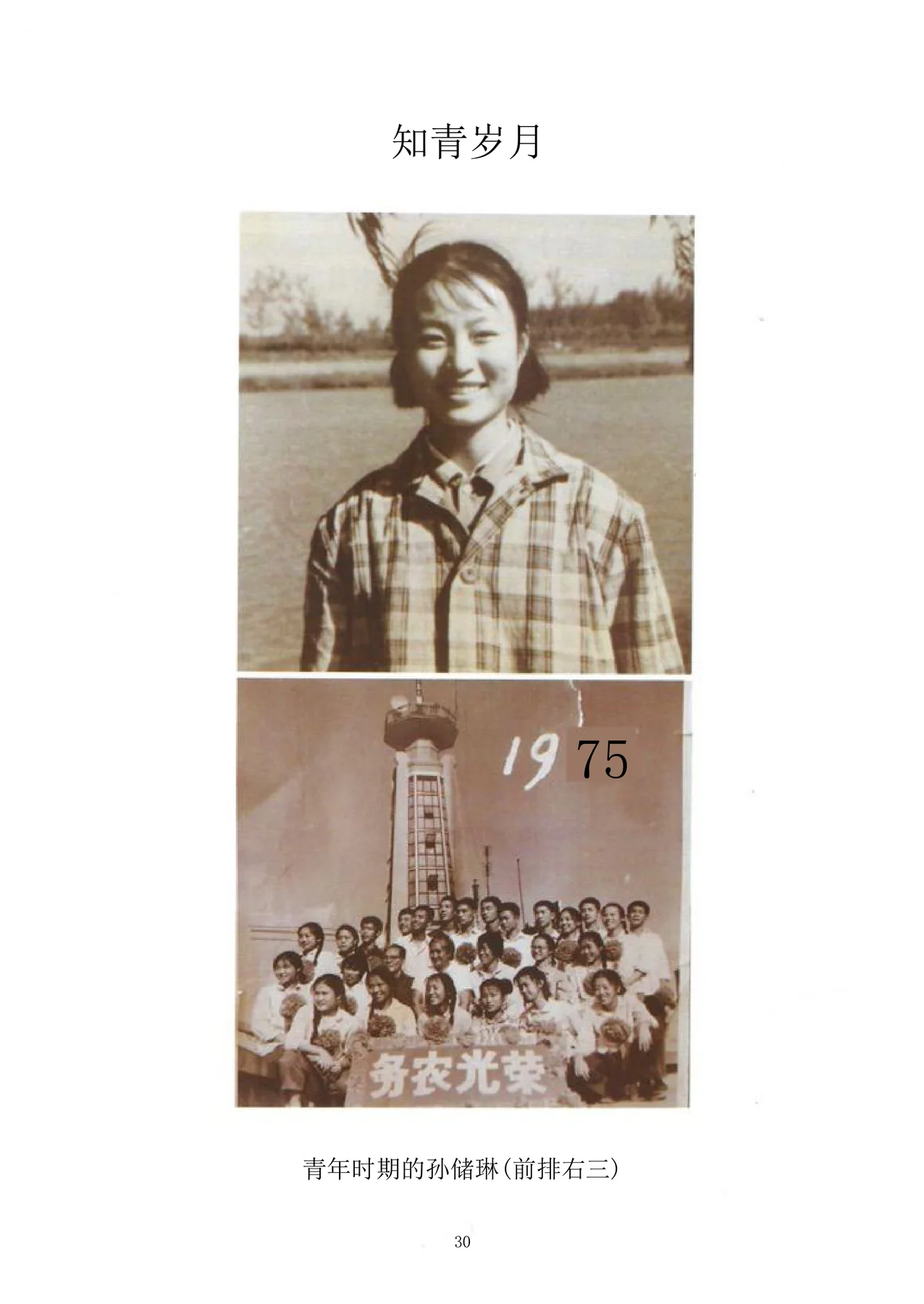
The Years as a Sent-Down Youth
1975
Glorious Agricultural Labor
Sun Chulin in her youth (front row, third from right)
In 1975, I, like the vast majority of young students in China at that time, had to take the path of going up to the mountains and down to the countryside to receive re-education from the poor and lower-middle peasants.
For the sent-down youth living in that era, with very few exceptions, there was no one who could avoid taking this path of going up to the mountains and down to the countryside. Even if you wanted to escape, it was impossible.
My time as a sent-down youth was neither particularly long nor particularly short. This period enabled me to better understand the countryside and the peasants, and those few years of training in the countryside benefited me for the rest of my life.
In August of that year, several classmates and I went down to a production team under Jiukou Township in Zhongxiang County, Hubei Province. When we went to the countryside, our conditions were much better than those of our senior schoolmates. Unlike them, who were scattered and lived in peasant households, we were led by a designated person sent by the work unit where our parents worked. We all lived together in one place and could look after one another. Moreover, we had one day per month for political study — which was actually special consideration, giving us sent-down youth a day of rest.
Although the time we actually spent doing farm work in the countryside was not much, we learned quite a variety of farm tasks — for example, transplanting rice seedlings, harvesting wheat, threshing wheat, hoeing weeds, applying pesticides, and so on. When transplanting seedlings, what we feared most were leeches — sometimes several could attach themselves to our legs at once. At first we didn’t know any better — we would grab them with our hands and pull them out, and sometimes they would break before we could pull them free. Later, the villagers told us to just keep slapping with the palm of our hand, and after a few slaps they would come off. But seeing the wounds where the leeches had bitten bleeding freely was truly frightening.
The most exhausting farm work was during the summer busy season of the “Double Rush” — rushing to harvest the already-ripened wheat while also rushing to transplant rice seedlings, which is why it was called “Double Rush.” If the wheat ripened and wasn’t rushed back in, and if it met with rainy, overcast weather with high temperatures, it would sprout wheat shoots right in the field. Even if it was harvested then, when milled into flour and made into steamed buns, they wouldn’t cook through. So it had to be rushed in during good weather. After cutting the wheat, plowing the fields, and flooding them with water, there was the rush to transplant rice seedlings — this too was a race against the season. If transplanting was done too late, the rice wouldn’t ripen. Once the wheat was rushed back, there was also the urgent task of threshing it. The threshing machines often ran continuously for days on end, and people worked around the clock at the threshing floor. Sometimes, while pushing a cart loaded with wheat stalks forward, they would push and push and then fall asleep standing right there.
We usually did the work of feeding wheat into the machine. Sometimes when we were too exhausted but couldn’t stop to rest, we would deliberately play a little trick — suddenly feeding huge handfuls of wheat stalks into the machine all at once. The machine couldn’t handle it, couldn’t keep up, and would jam and stop. Then, while the machine was being repaired, we could rest for a while. At that point, the young men and women would collapse beside the wheat stacks and fall fast asleep the moment they lay down. When the machine was fixed, they were called up one by one to get back to work.
Spraying cotton with pesticide was relatively light work. You carried a tank of pesticide solution on your back, spraying as you walked backward. When one tank was done and you refilled, you could take a short break. But sometimes in the heat, if the chemical smell was too strong, it could easily cause pesticide poisoning. So most farm work was not that easy. That was why country folk had a vivid saying: “Every snake bites.”
However, in the place where I was sent down, farm work was not the most bitter or exhausting. Even more bitter, exhausting, and dangerous was building the great levee in winter and defending against the great floods in summer.
Zhongxiang County, where I was sent down, is in Hubei and is also a nationally famous flood zone. Regarding flood prevention in China, there is a saying: “China’s flood danger lies in the Yellow River and the Yangtze; along the ten-thousand-li Yangtze, the danger lies in the Jing River.” This Jing River refers to the Jing River Flood Diversion Project, built after the unprecedented great flood that struck Hubei in 1954 in order to protect greater Wuhan. And the Jing River Levee was the most perilous point along the entire ten-thousand-li Yangtze.
Every winter, when there was no more farm work in the fields—only maintenance of small irrigation and drainage facilities—most of the main labor force would be pulled out to work on the flood-prevention levee, carrying earth to maintain and reinforce the embankment. As soon as winter arrived, laborers drawn from each production team, carrying their own grain, clothing, and bedding, would gather in groups and head to their respective assembly points. Usually organized by commune, they would find their assigned section of work, put up makeshift shelters, set up pots to cook their meals, and get right to work.
At such times, what we saw on the great levee was red flags fluttering and a scene of bustling fervor. You could see the stream of levee workers in long lines, going up and down, back and forth, flowing ceaselessly. Up close, the levee army raced against each other, weaving to and fro, keeping close step; from a distance they looked like long dragons, diving and rising, winding and undulating. That was truly a brilliant sight on the Jianghan Plain’s Jing River flood-prevention levee in the depth of winter.
The levee work generally did not stop even on snowy days. Only at night or in the rain could you stop and rest. Then everyone would gather in the shelters, in clusters, playing cards, playing chess, listening to storytellers and tales, and even holding singing and dancing competitions—how lively and joyous it was!
Though winter levee work was exhausting, there were times to rest. But during the summer flood-prevention season each year, it was an entirely different matter.
During the critical period of flood prevention each year, the commune organized us young men and women into militia units. By day we carried earth to reinforce the levee; by night we shouldered guns and patrolled to guard the embankment. Those guns were loaded with live ammunition—at the first sign of danger, we were to fire a warning shot! If anyone slipped away from patrol because they could not bear the hardship, they would be treated as deserters. If the levee showed signs of danger, the exhaustion and peril of the emergency rescue work were simply beyond words. Of course, at the most dangerous and critical moments, our most beloved people—the people’s own soldiers—would appear in the most dangerous places. It was they who used their bodies of flesh and blood to build a wall of steel,
guarding the peace of countless families and protecting the happy homes of ordinary people.
Of course, there was also very light work in farming. On rainy days when we could not work in the fields, we would stay indoors or under the eaves, each holding a winnowing basket, sorting cotton. Different grades of cotton fetched different prices. There was also seed selection: each person would take a board or pane of glass and pick out cotton seeds or wheat seeds on it. Everyone could work while chatting and joking—this was about the lightest work in all of farm labor. So we educated youth especially hoped the heavens would send more rainy days. But the production team leader would be anxious—too much rain would never do. Excess rain meant water accumulating in the fields, and the crops would be ruined. But since we were not the ones running things, how could we know all of this?
During the years we were in the countryside, we were tired, but the annual harvests were fairly good. Even half-laborers like us educated youth, after deducting a year’s worth of food and drink, still received a year-end dividend and could take home quite a lot of scarce agricultural products—things that in the city could only be bought with ration coupons—to celebrate the New Year and show filial respect to our parents.
During those years as an educated youth, no extraordinary phenomena had yet appeared in me. But there was one occasion when, together with the local people, I saw dragons in the sky releasing rain. That truly left a lifelong impression on me.
It was a day in late summer of 1976. We were working in the fields when suddenly the sky filled with dark clouds. The sky went dim, fierce winds arose, and in an instant it felt as though a tremendous downpour was about to begin. Just then, we heard someone shout, “Look, look quickly! Dragons have appeared in the sky!” Following the direction the farmers were pointing, we looked up and saw two dragons suddenly fly out from within the dense clouds. Their heads were facing directly toward us, and from their mouths they spewed great columns of water like waterfalls, flying straight toward the running people. Instantly the rain poured down in torrents, crashing down in sheets. People both wanted to see the dragons and wanted to shelter from the rain, running and watching at the same time. The dragons flew right over our heads, but the rain kept falling without cease. In the end, every one of us was drenched like a drowned rat. Fortunately, it was summer—just the right time for a cold-water bath. Though people were frightened, they were also filled with amazement and delight, because what we had seen was a true dragon—an extraordinarily rare sight indeed.
Those two dragons looked exactly like the dragons we see carved on beams and pillars in many places, or depicted in many paintings and calligraphy works. Those two real dragons were not just seen by a few people—many farmers and educated youth working together that day all saw them. It was only that cameras and camcorders were not as widespread then as they are now; otherwise, it might truly have been possible to photograph or film this wondrous spectacle of the ages!
I spent four and a half years in the countryside. Although I only did farm work for two and a half years, it was tremendous training for me—I became much more able to endure hardship. For another two years or so, I served as the kindergarten teacher for the production team, looking after the preschool-aged children of the team—teaching them to recognize characters and sing songs.
dancing. Children in the countryside at that time were truly hard to manage—they would not listen and would run around everywhere. I came up with a method: I took out the candy, biscuits, and dried beef jerky I had brought from the city to coax them. My usual approach was to tell the children, “If you listen to the teacher, I will reward you with these tasty treats.” Then the children would become very obedient and much better behaved. But children are mischievous, and many accidents can happen.
I remember once, I took the children out to play on a small path beside the fields, and we happened to run into a group of elementary school students walking toward us after school. One of the boys was so naughty that he actually grabbed hold of the wires on a fallen utility pole by the field. To our surprise, the wires were still live, and the child was instantly shocked, crying out for help. I immediately said to the children behind me, “Stand still! Don’t move!” There happened to be a branch by the roadside, so I picked it up and used it to flick the wire out of the child’s hand. Fortunately, the voltage was not high and the current was not strong. When I helped the child up, I could only see many blisters on the hand that had been shocked; he was not seriously injured. But it was truly frightening—really dangerous.
This may have been an arrangement by Heaven. This job as a kindergarten teacher laid the groundwork for the later discovery of my extraordinary abilities.
The Discovery of Miracles
In December 1979, I finally ended my time as a sent-down youth in the countryside and returned to the provincial capital of Wuhan, where I was recruited and assigned to China University of Geosciences.
Precisely because I had worked as a kindergarten teacher in the countryside, it was only natural that I was assigned to work at the university’s kindergarten. In September 1980, my work unit sent me to Wuhan Second Normal School for further training. It was also in that year that the extraordinary phenomena that had in fact long existed within me were finally formally discovered by people—and this story must begin in 1978.
It was November 1978. In Dazu County, Sichuan, an elementary school student named Tang Yu was found to be able to recognize characters with his ears. When this was reported in the Sichuan Daily on March 11, 1979, it caused a national sensation.
At the time, Yang Chao, the Party Secretary of Sichuan Province, attached great importance to this matter and instructed the Sichuan Provincial Science and Technology Commission to investigate and study it. This thus marked the beginning of China’s human-body science research. Yang Chao was a renowned philosopher who, during his tenure as Provincial Party Secretary, was also in charge of science and technology work. Through this investigation and research, he formed an indissoluble bond with human-body science, and thus became a founding elder and pioneer in the field of human-body science research in our country.
Around this time, several students who could recognize characters with their ears were also discovered one after another in our Hubei Province. At the time, I was doing further training at Wuhan Second Normal School. A psychology teacher in our class had a special interest in extraordinary-ability phenomena, and she had investigated several elementary school students discovered in Hubei who could recognize characters with their ears, firmly believing in the existence of this phenomenon. Moreover, this teacher was quite resourceful and persuasive; she urged the school leadership to agree to invite those children to our school to perform in the small auditorium. But unfortunately, perhaps because there were too many people, the children were too nervous and not in a good state, so that performance was not very successful.
But our teacher was not discouraged. One day, during her class with us, on a sudden impulse, she wanted to conduct an experiment in our class. She said, “The performance at school last time was not very successful, but that does not mean this phenomenon does not exist. Today let’s do an experiment and see whether any of you can recognize characters with your ears.” After saying that, she took out many small paper wads she had already prepared with characters written on them, then distributed one to each of us, asking us all to hold them only against our ears to recognize them—not to open them and look with our eyes.
Those of us doing further training as kindergarten teachers were basically young girls. At the time,
everyone was doing their homework. Many classmates, after receiving their paper wads, didn’t take it seriously and just shook their heads, saying the teacher was being eccentric again today, and continued doing their own homework. Some classmates were quite obedient, placing the paper wads the teacher distributed against their ears and listening quite earnestly. But after a long time, not a single person could make anything out.
After quite a while, I had mostly finished my homework, so I picked up the small paper wad on the desk, put it against my ear, and tried listening. Once I started listening, something incredible happened! First, I heard a buzzing sound—“hmm, hmm, hmm, hmm”—inside my ear, and then I heard a voice continuously chanting “zhōng, zhōng, zhōng” (bell), and at the same time, a window like a television screen appeared in front of the area between my eyebrows, on which the image of the character “钟” (bell) slowly appeared.
How strange—the character I heard through sound and the character I saw on the screen were identical, but I wasn’t sure, so I told my desk-mate and asked her to help open the paper wad and take a look. After she looked, she said it was indeed the character “钟” that I had recognized. Could ears really recognize characters? I still wasn’t certain at the time, so I also took my desk-mate’s paper wad and tried to recognize it—and again I got it right.
At this point, my desk-mate immediately raised her hand and reported to the teacher, “Sun Chulin got it right!” This set the whole class into an uproar—everyone crowded around me at once, each eager to hand over the paper wad in their hand, shouting: “Do mine, do mine!”
The teacher came over and told everyone not to push, to come one at a time. In one go, I nearly recognized all the paper wads that everyone handed over.
This was extraordinary.
The teacher took my hand and ran straight to the principal’s office. Upon arriving at the office, the teacher exclaimed: “Reporting to the Principal, we’ve discovered a student in our class who can recognize characters with her ears!”
Because the previous performance by those young children invited to the school had not been successful, the principal already had some reservations. He thought to himself that this eccentric teacher was at it again. But not wanting to hurt her feelings, he had no choice but to say: “Is there really such a thing! Then let’s test it together and see.”
I remember it was the principal who, with pen and paper, wrote characters behind my back, then folded them and placed them in a box for me to recognize. Perhaps because I was in front of several school leaders, I was somewhat nervous, and it took considerable effort to recognize the characters. At the time, on my celestial eye, I first saw several different colors, then some scattered brushstrokes, and finally I could clearly make out three characters written in three colors, which seemed to be the principal’s name. When I reported the characters I had recognized to the principal, the principal
and said I had gotten it right. Then the other leaders present also wrote some characters for me to recognize, and I identified every one of them correctly. They were all extremely happy, and the principal, too, believed that my ears could genuinely read characters.
For those few days I was beside myself with excitement. My ears could read characters, and all at once I had become a celebrity in the school. When I went home for the weekend, I told my father about what had happened at school with reading characters with my ear. My father laughed and said, “You haven’t even learned to read well with your eyes, and now you’re reading with your ear? You’ve studied until your head is muddled.” I was so anxious I couldn’t stand it, and said, “If you don’t believe me, just test me and you’ll see.”
My father then took a piece of paper, drew an automobile on it, folded it up, and put it inside a brown Kraft paper envelope. He sealed the envelope with glue and handed it to me to read. I placed the slip of paper next to my ear and listened for quite a while, but no characters appeared. I could only faintly see, at my Heavenly Eye, some very messy strokes along with circles and so forth. At the same time, I heard the sound of an automobile, and finally, slowly, the image of an automobile appeared. I called out delightedly, “Dad, you didn’t write a character — you drew an automobile!” My father was startled and said, “My goodness, this girl really did see it.” After that, he wrote several more different characters for me to recognize, and I got every single one right without a mistake. Only then did my father truly believe that his daughter could read characters with her ear.
Later, that psychology teacher took me to her home and asked me to look at her husband’s liver condition. I placed my ear against her husband’s liver area, and saw that the area surrounding his liver was somewhat gray and black — I wasn’t sure whether that was good or bad. Then I placed my ear against the psychology teacher’s liver area to compare, and her entire liver was deep red, much like the color of the pig liver we commonly see. I told the teacher what I had observed. She said I had seen it correctly — her husband did indeed have cirrhosis of the liver. And so I had acquired yet another ability: I could now use clairvoyance to diagnose people’s illnesses.
After returning home, I told my father about my diagnosing illness through clairvoyance. My father said, “My, my girl has gained another skill. A few days ago you could read characters with your ear, and now you can diagnose illnesses through clairvoyance. All right then, why don’t you take a look and see which part of me has a problem.” So I placed my ear against his chest. Everywhere else looked fine, but I discovered a calcified spot on his chest, and I told him so. He said I was right — he had previously had pleurisy.
My father also said, “This won’t do. A young woman always pressing her ear against other people’s bodies to examine them — you can’t very well put your ear against someone’s head when their head is ailing, or against someone’s backside when their backside is ailing. It’s neither seemly nor hygienic. Can you try just using your eyes?”
Later, I tried looking without using my ear. For some things I would hold them in my hand and look with my eyes, and I could still see them. When examining patients, instead of pressing my ear against them, I would fix my gaze on the affected area and could
see it as well. Only later did I gradually realize that the place that truly saw things was not the ear at all, but the Heavenly Eye acupoint between my two eyebrows — what is called the Heavenly Eye.
After Wuhan Second Normal College discovered that my ear could read characters, the television station also learned about it and even sent a reporter to the school to interview me. Right there in our classroom, they filmed me reading characters with my ear on the spot, and it was broadcast on Hubei television. Now even more people knew about me.
I want to thank the era of reform and opening up. Without reform and opening up, without the liberation of people’s thinking, without the return of people’s understanding of traditional culture, without people’s bold exploration and pursuit of unknown things, the so-called extraordinary abilities that existed within me might never have been discovered to this day.
At the same time, I want to thank the psychology teacher in the advanced training class at Wuhan Second Normal College. She was the one who launched me onto the stage of extraordinary human abilities.
Self-Exploration
The one-year advanced training in preschool education ended quickly.
After returning to China University of Geosciences, I continued working at the kindergarten. By this time, I was also quite interested in these phenomena, so I tried conducting experiments on the children in the middle class of the kindergarten I was teaching. As a result, I found that several of the young children could also recognize some numbers and shapes. Later, I also conducted experiments on the children in the older class, and discovered that a few of them, too, could read characters using the Heavenly Eye.
Word of my so-called extraordinary abilities gradually spread throughout the university and society at large. What followed was either reporters coming for interviews, or people seeking me out to examine their illnesses, or curious leaders who came specifically to watch demonstrations.
At the time, the university leadership also wanted to transfer me to the campus clinic to assist the doctors in examining patients and making diagnoses. But the doctors of that era still did not really believe in these abilities, and no doctor dared to make use of me. So I was not transferred to the campus clinic. Instead, I was later reassigned to work at the university library.
Not long after I started working at the university library, Professor Shen Jinchuan, director of the university’s Testing Center, returned from abroad. He was very interested in extraordinary human abilities. After looking into my situation, he recommended that the university establish a Human-Body Science Research Office, to be affiliated with the Testing Center where he worked. Subsequently, Professor Shen discussed the matter with the university leadership and decided not only to transfer me to the research office, but also to recruit from society several young people who possessed certain abilities. Professor Shen Jinchuan was placed in charge of carrying out research on extraordinary human abilities together with these gifted individuals.
One year, Wuhan held its “Two Congresses” (the People’s Congress and the Political Consultative Conference). Professor Shen was a delegate to the Hubei Provincial People’s Congress. During a small-group discussion session for the higher-education delegation, Professor Shen brought me to the meeting to give a demonstration for the delegates of the higher-education group. At the time, a Deputy Mayor surnamed Wang, who was in charge of education, was also present. He asked me to look at his health condition. After looking, I said that there was something wrong with his stomach, and he said I was quite right. Then he wrote some characters for me to recognize, and I identified them as the two characters “thank you” (谢谢), meaning to thank me for spotting his stomach ailment.
There was also a Deputy Mayor surnamed Guo, who was in charge of science and education. On one occasion, he came to our university for an inspection and brought his wife and daughter along. At the time, I demonstrated for them popping popcorn using mental intention. Right as it was about to pop, his daughter also sensed it and called out excitedly, “There’s a delicious smell — it’s popped, it’s popped!” The people present all ate the popcorn I had popped through mental intention.
As soon as I had gained a bit of fame, there were already quite a few people coming to ask me to look at this or that. Later, when I was specifically brought in for research work, even more people came to observe the curiosities. Not only did I frequently need to do experiments, but I also constantly had to receive
People coming from outside kept repeatedly giving demonstrations, and I also had to treat illnesses and adjust people’s health conditions, which left me very exhausted.
At the time, practicing qigong was very popular in society. People often said that practicing qigong could strengthen the body and improve health, could regulate cosmic energy, and that practicing qigong could also give rise to all sorts of strange and peculiar abilities. In those days, Wuhan frequently hosted lectures or transmission classes organized by various qigong schools and traditions. Professor Shen suggested that I go out into society to learn some qigong, to learn how to regulate external qi, and to replenish my own energy, to see whether I could reduce consumption of, or ideally avoid using altogether, my own internal power.
It so happened that around this time a teacher of “Sheng Sheng Zhi Yi Gong” came to Huazhong Institute of Technology (now Huazhong University of Science and Technology). The class ran for one week, and the fee was 18 yuan per person. For those of us earning only about 40 yuan a month, that was already quite a lot. However, my thirst for knowledge was strong, and Huazhong was not far from our school, so I signed up and joined.
I remember the classes were held in a small auditorium, packed full, with probably several hundred people. On the first day, we were taught eight movements, none of them very difficult. After the teacher finished instructing, he told everyone to practice on their own. At that point, some unexpected phenomena gradually began to appear among the audience. Quite a few people started moving involuntarily, and then some were crying, some were laughing, some were shaking their heads and swaying about, and others were shouting and yelling wildly. But strangely, I was like an outsider watching a performance from the sidelines, without the slightest reaction. The first day passed just like that, watching the spectacle all day long.
The second day was about the same as the first—I was still on the sidelines watching the spectacle, feeling nothing. The third day was the same as before; still no sensation. By the fourth day, I still had not gotten into it.
At this point the teacher spoke up: some of our students have been studying for several days now and still haven’t entered the state; they’re still sitting there with their eyes open watching the spectacle. When I heard this, I sensed trouble—it seemed the teacher had his eye on me, so I had better hurry up and put on a show of doing something. Besides, I felt this was too much of a loss; I had been coming for several days now and hadn’t learned anything at all. So I followed what the teacher had said and, like the other students, sat upright, placed both hands flat on my knees, slightly closed my eyes, and relaxed my whole body, entering into stillness. Unexpectedly, once I relaxed and entered stillness, I actually did enter a state. All at once I felt my whole body turn cold, and then the cold made my upper and lower jaws tremble and chatter. This really frightened me—I was afraid I had been afflicted by some evil influence—so I quickly gathered and closed the practice according to the method the teacher had taught, and only then did I gradually return to normal.
On the fifth day, I summoned my courage and again relaxed and entered stillness, wanting to enter the state as quickly as possible—I wouldn’t care even if the sky fell. But this time it was different from yesterday; instead of cold, my whole body turned hot, as hot as being roasted under the midsummer sun, with beads of sweat the size of beans streaming down my entire body. But I still gritted my teeth and persevered. The one-week course came to an end, and my harvest was just those two episodes—one cold and one hot.
On the last day, during the summary, after the teacher finished speaking, he said he would give everyone some time to ask questions, and he would answer them on the spot.
The way questions were submitted was to write them on slips of paper, which staff members then passed to the teacher. I saw that quite a few people had written slips, and the teacher answered each one in turn. At this point I also gathered my courage and wrote a slip for the teacher. The gist of it was that I had innate extraordinary abilities, that my eyes could see through things, but that it was very exhausting, and I wanted to ask the teacher whether there was any method of practice that could enable me to receive external power.
I watched as the slips others had submitted were mostly answered. The last slip the teacher picked up seemed to be mine. After reading it carefully, he didn’t speak but first burst into loud laughter. Then he said, “I’ve never seen anyone like this—claiming to be born with clairvoyant ability. What a blowhard.”
When I heard the teacher say this, I didn’t know what to do. Fortunately, I hadn’t written my name on the slip, and he didn’t know who had written it, so the moment just passed.
From that point on, I didn’t have a good impression of this qigong teacher either. I thought he was far too ignorant and ill-informed—he didn’t even know about extraordinary human abilities, which had already spread throughout the entire country. I figured his level couldn’t be very high, so after that I never went back to study qigong with that teacher again.
Although attending the one qigong training class didn’t seem to have taught me much, it still gave me no small inspiration. Those two experiences—one of cold and one of heat—also made me feel that qigong could indeed bring about certain changes in the human body and produce some inexplicable sensations.
After that, although I didn’t seek out any qigong teacher to learn qigong again, I often found qigong magazines and qigong newspapers to read. Later, I read in a qigong magazine that practicing sitting meditation was very beneficial, and that it was best to practice during the zi hour, because this was the time when yin and yang alternated, and practicing at this time would yield twice the result with half the effort. So I followed the method described in the magazine and began practicing at home on my own. After practicing for a period of time, it felt quite good, so I kept it up consistently.
My Invisible Teacher
After I had practiced for about three months, one evening while sitting in meditation, I saw an elderly figure dressed in a long robe, with long hair draped over the shoulders, bearing a resemblance to a female immortal, floating gracefully toward me. She appeared to be about sixty years old. This was the appearance of my first teacher.
This was probably sometime between 1986 and 1987. I had begun learning to sit in meditation in 1986. At the time, I did not seek out a teacher to learn meditation; I simply learned from reading books and magazines. I saw in a magazine that some people sat in the full lotus position to practice. I thought to myself, “How could I possibly sit like that?” But never mind — I just sat on the bed in a loose cross-legged position and practiced. Back then, I only knew to sit. Counting breaths, abdominal breathing — I understood none of it. I simply sat and breathed naturally. I did not understand visualization either; I just sat there, as if falling asleep, in a drowsy haze.
The only thing was that when I sat in meditation, sometimes I would sway. As soon as I relaxed, I would rock back and forth. And there was another strange phenomenon. At that time, my teacher had not yet appeared. I noticed that other people would light incense before sitting in meditation, so I followed their example and lit incense too. As it turned out, after lighting incense, I stopped swaying and began bowing — kowtowing incessantly, just like spontaneous qigong movements, continuously thumping — thump, thump, thump — and bowing faster and faster, faster and faster.
Under normal circumstances for an ordinary person today, in that loose cross-legged posture it is very difficult to bow one’s head all the way down. But it was as if I had entered an extraordinary-ability state, and I was able to bow down naturally and effortlessly. After bowing for three months, I did not find it uncomfortable at all; in fact, I found it quite interesting: “Why is it that lighting incense makes me bow?” So every time before practicing, I would light incense.
Three months later, the teacher appeared. This teacher was a woman. Her hair was disheveled, and her teeth were very long. Her eyes were especially large. Sitting cross-legged, she suddenly appeared right in front of me. It genuinely startled me at the time. I thought to myself: “Why is this woman so ugly? She looks like a monster, like the image of Mei Chaofeng — both ugly and unattractive. Neither quite a demon nor quite a human.” I did not know whether I was dreaming or had truly seen something. But after confirming that I was in a very clear and awake state of practice, I boldly asked her: “Who are you, and what have you come here for?” She said, “Do not be afraid. I have come to teach you how to practice.” I felt very curious at the time, so I asked: “Why do you want to teach me and not someone else?” She then began talking about my personality, describing what kind of person I was. She said my personality was very soft, and said: “You — people are prone to wrongly accuse you, and you easily suffer at the hands of others. So you must learn some skills. Once you have learned them, they can help you.”
What she said was quite accurate. I thought: “Oh my, you really do understand me.” Seeing that she spoke so well of me, I was no longer afraid of her. She also said: “All along, you have been very earnest in sitting in meditation.”
Huh — how did she know I practiced sitting in meditation? In any case, she said a great deal, and also said: “Didn’t you want to practice? I can teach you how to practice, how to improve.” She had probably seen everything. If I had not wanted to learn, I would not have been so persistent, sitting in meditation every day. Two hours every night, practicing from eleven o’clock to one o’clock.
From then on, every time I practiced, this teacher would come without being invited.
Once, while I was sitting in meditation and the teacher was guiding me, my son, who was a little over three years old and sleeping beside me, suddenly woke up, apparently needing to use the toilet. As soon as he sat up, he said: “Mommy, who is that ghost-like person next to you?” Because the teacher’s hair was long and always disheveled, and she bared unusual teeth, she appeared somewhat strange. Right after saying this, I saw my son fall backward onto the bed, crying out: “Mommy, I’m being pinned down, pinned down! Save me!” He started crying as he spoke.
I saw that my son’s face had gone pale and he looked very uncomfortable. I hurriedly said: “Don’t be afraid, son. Mommy is right here.” But my son said: “Mommy, you can’t. You can’t save me either.” I said: “If Mommy can’t do it, then Mommy’s teacher can help.” As soon as I finished speaking, my son stopped crying, and his color returned to normal. I took my son to the toilet and then settled him back to sleep. I guessed that the whole episode had been caused by the teacher, who wanted to prevent my son from disturbing my practice. After that, nothing similar ever happened again.
This was a very strict teacher. Every time she came, she always carried a stick in her hand. Whenever there was something incorrect, she would tap me with the stick. Sometimes I appeared very clumsy and kept making mistakes, and the teacher’s taps would be somewhat heavy, causing a sensation of pain. After finishing meditation and standing up, I could see that wherever the teacher had tapped more heavily, the skin had turned slightly bruised. This made me even more convinced that I was not dreaming, and that there truly was an invisible master teaching me how to practice.
The teacher did not speak much. She often simply pointed and gestured with the stick in her hand. For example, when the teacher pointed the stick at my lower dantian, I understood that I was to start from this place. Once I had finished practicing the lower dantian area, I would think: “Where should I practice next?” I would look at the teacher’s expression but could not read it, so I would figure it out for myself: “Should I move upward?” If I moved correctly, the teacher would not strike me. If I moved incorrectly, the teacher would give me a smack. Then I would switch to practicing the area where the teacher had struck me.
Every place where the teacher had struck me, when I looked the next morning, would show patches of bruising. Therefore, I felt that the teacher’s arrival was not a hallucination, and that her speaking to me was real. For a very long time, the teacher only taught me how to practice. I felt that when the teacher struck me, it was not only to point out locations, but also
At the same time, there were probably other functions as well. Sometimes it may have been to help me open my meridians and clear my blood vessels, but she just never said so.
During the course of my practice, I could feel my power improving. For example, invisibly, a magnetic field would emerge. Once Professor Shen placed the reed contacts of a reed switch under a microscope and said to me, “Look at the reed contacts and try to see if you can bring the two contacts together.” I used my intent, thinking: “Close together, close together…” and they moved together.
The same was true of the experiment with picking up straight pins. After practicing qigong, when Professor Shen asked me to try some new experiment, I would have a feeling, or a kind of confidence: “I can do this!” And sure enough, I would succeed on the very first attempt.
For a long while, my Master only taught me to practice qigong and did not directly teach me any extraordinary human abilities. But I remember once my Master said: “Whatever you want to do, I can help you accomplish it.” So I believe that these fundamental things my Master taught me to practice were probably what helped me bring my abilities into full play.
At the time, I did not overthink it. I simply wanted to perform my extraordinary abilities well. Of course, later on, this Master did teach me several extraordinary abilities, such as shaking out pills and passing through walls.
For example, with shaking out pills, I was inspired by someone else before I sought my Master’s guidance on the technique of shaking out pills.
For a period, exchange activities for extraordinary human abilities were frequently held in China. Once, Professor Shen took me to Beijing to attend a human-body science symposium organized by a relevant department. At the conference, Zhang Baosheng, who at that time had the most powerful extraordinary abilities in the entire country, was invited to demonstrate shaking out pills. When I watched Zhang Baosheng’s performance, I felt especially nervous, as if I myself were performing.
Not long after returning to Wuhan, one night I had a dream in which Zhang Baosheng and I were talking together about shaking out pills. I said, “Zhang Baosheng, look — I can shake out pills too.” And as I spoke, I began shaking them out. Zhang Baosheng said, “That’s not right, it should be like this, like this,” as though he were teaching me. But it was only a dream, and I did not pay it much mind.
About ten days or so later, several of us people with extraordinary abilities gathered for a small get-together at Professor Shen’s home. At the time, Professor Shen brewed coffee for us to drink. I was not yet accustomed to it and said the stuff was as bitter as Chinese medicine and did not taste good. They all urged me on, saying this was a fine imported product from abroad and that you could even get addicted to drinking it.
With their encouragement, I drank about a cup’s worth.
After I got home, things really got lively.
That day, just as before, when the hour of Zi arrived I began sitting in meditation to practice. I practiced until after two o’clock and was ready to go to sleep, but I simply could not fall asleep. So, as I had done before, I thought that if I could not sleep, I would read a book for a while. Previously, reading for a short while would make me drowsy, but that day was different — reading did not make me sleepy either. I figured that since I could not sleep anyway, I might as well get up and continue sitting in meditation. I had barely sat down when my Master arrived. My Master even praised me, saying, “You’re doing quite well, making good use of the time to practice.”
At that moment, for some reason, the matter of shaking out pills came to mind. I asked my Master whether she knew how to shake out pills and whether she could teach me. My Master said of course, it was not difficult. At that instant, I saw my Master wave the horse-tail whisk in her hand, and a bottle was suddenly grasped in my own hand. I still suspected this was a hallucination, so I opened my eyes to take a look — I really was holding a bottle in my hand. I had barely glanced at it when my Master said, “Don’t get distracted.” I was so startled I quickly closed my eyes again.
My Master said, “Relax, think about the fact that you are about to shake out pills, then slowly search for a certain feeling — the sensation that the wall of the bottle is becoming thinner and is about to tear open. Once you have that feeling, immediately shake downward.” I did as my Master instructed, gave one shake, and sure enough, pills spilled all over the floor. At that moment, I thought I would pick up one pill to give to Professor Shen for research. The instant that thought arose, I saw my Master wave the horse-tail whisk in her hand, and the pills on the floor and the bottle in my hand all disappeared in a flash. Now I understood — my Master did not want me to pick any up. At the same time, I also realized how powerful my Master was: the moment a thought or intention arose in my mind, she already knew it. So from then on, I could only honestly and earnestly study the practice, and I no longer dared to let my mind wander or act on my own impulses.
I opened my eyes and saw that it was already five o’clock in the morning. I recalled how my Master had just taught me to shake out pills, but I was not sure whether it had been a hallucination or a dream. Regardless, I had to give it a try. I took down a medicine bottle containing pills that was sitting on top of my refrigerator at home, held it in my hand, and searched for the feeling according to the method my Master had taught me. As soon as the feeling came, I shook forcefully downward, and with a clatter the pills fell and scattered all over the floor. My joy at that moment was beyond words — I felt as if I were about to fly.
In the morning, I had no choice but to ask my husband to go buy breakfast. I told him that for some unknown reason I had not slept a wink all night and wanted to rest a little longer. When he came back, he said to me, “I know the reason you couldn’t sleep last night. Did you drink coffee?” I said, “Yes, how did you know?” He said, “I ran into Zhao Xiaodong at the dining hall. Zhao Xiaodong said he also drank coffee last night and couldn’t sleep all night.” I had wanted to take advantage of the time while my husband was out buying breakfast to rest a bit more, but I was simply too excited to sleep.
So I hurriedly ate breakfast and rushed off to work. But when I arrived at the studio and checked, it was only seven o’clock — no one had come in yet. Fortunately, Professor Shen arrived relatively early, and I immediately told him that last night I had learned
the matter of shaking pills out of a bottle. Professor Shen was delighted and said, “That’s great—let’s try it again right now.”
He found a medicine bottle in his office, but there were no pills inside. So Professor Shen looked on his desk, found a few buttons, put them into the bottle, sealed the cap, and asked me to shake them out. I followed the same method I had used that morning at five o’clock when I shook the pills out on my own, trying to find the right feeling—and sure enough, they came out quickly. Professor Shen was overjoyed. He said he would immediately call more people over so everyone could watch me demonstrate shaking pills out of a bottle. I was still a bit nervous at the time, afraid that with so many people watching I might not be able to perform it. Professor Shen said it didn’t matter—we were doing an experiment, after all.
He then called seven or eight people to come to his office to watch me shake pills out of the bottle together. Since we still couldn’t find any pills at the time, we filled the bottle with small granular minerals from the desk, sealed the cap, and sealed it with wax. I relaxed, entered stillness, and searched for the feeling—and sure enough, they came out. But the mineral granules that came out had changed: their surfaces had become smooth and shiny. We didn’t do a compositional analysis or testing at the time, so I don’t know whether their composition had changed.
After that, shaking pills out of a bottle became one of my regular demonstration items. I estimate I did it over a hundred times altogether.
There was also wall-penetration. One day while practicing, I asked my master: “Some people can pass through walls—is that true?” My master said: “It’s true. You can do it too—as long as you learn, you’ll be able to.” I said: “How could I pass through a wall? How do you pass through a wall?” My master said: “First, you must calm your mind and enter a certain state. Once you enter that state, you communicate with the wall and see whether it will let you through.” I asked again: “How do you communicate?” My master said: “When you communicate with the wall sincerely and earnestly, it will guide you and tell you.” My master also told me what kind of feeling and change occurs when the wall agrees, and what kind of feeling and change occurs when it doesn’t. I thought to myself: “So that’s how it is!” My master finally encouraged me: “If I say you can do it, then you can do it.”
The next day, I told Professor Shen that I could pass through walls. Generally speaking, whenever my master taught me something, I could basically accomplish it. So the next day I told Professor Shen I could pass through walls. Professor Shen said: “You just learned to shake pills out of a bottle, and now you can pass through walls too?” I said: “Yes. Otherwise, let me try and show you.” I was very confident at the time, and I even set a condition. I said to Professor Shen: “If I successfully pass through the wall, you have to give me your little monkey.” That was a small toy monkey Professor Shen had bought in Boston, in the United States. That little monkey was a lot of fun, and I liked it very much.
Professor Shen said: “Fine—if you pass through the wall, come to my house and get the monkey.” Then,
Professor Shen began affixing seal stickers. We were on the third floor at the time, and Professor Shen found an office. After I went into the office, Professor Shen and Director Zhang of the testing center locked the door, affixed two seal stickers, and made it so I couldn’t leave through the main door.
At that time, even the windows were sealed—everything was sealed. Even if there had been windows, I couldn’t have gotten out, because we were on the third floor. As for jumping out of a window—I certainly didn’t have the courage for that.
At noon, Professor Shen and Director Zhang went home for lunch. I didn’t eat either; I just sat in the office, recalling the feeling and the movements my master had described to me, and then began to communicate with the wall right in front of me. As it turned out, that wall did not agree. The feeling of its disagreement is hard for me to describe clearly—it was as if something molecular inside the wall was moving, as if it was vibrating. My sense was that it was rejecting me—it simply wasn’t willing.
I had no choice but to change direction and say to another wall: “Please, let me pass through!” That wall agreed. It emitted a kind of sound. I don’t know whether it was speaking, but it felt as though the wall’s molecules began to split apart with a “knock, knock, knock.” It split open a gap, and a hole appeared.
Oh, I was so overjoyed! Before I had even squeezed myself in, my mind immediately leapt ahead: “Wonderful! Now I can go to Professor Shen’s house and get the monkey!” Just like that, my attention was diverted. The result—thud! I hit the wall! It was as if my focus had scattered, with my thoughts running off to get the monkey. That hole snapped shut with a click, and my head slammed into the wall.
At the time I thought: “Oh no, oh no—Professor Shen must be at home wondering why I still haven’t come out.” We had agreed on a time: I would go in at nine in the morning, and by twelve noon, if I still hadn’t succeeded, Professor Shen and Director Zhang would come and check on the situation.
But I wasn’t willing to give up. I hurriedly started negotiating with yet another wall. I negotiated for a long time but still couldn’t pass through. When Professor Shen and Director Zhang came looking for me, I was still hiding behind the computer room, negotiating with the wall. The office we had chosen was a computer room. But no matter how much I negotiated, it didn’t work—I wasn’t able to pass through.
That evening while practicing, I asked my master: “You said I could pass through—why didn’t I?” My master said: “Think for yourself about why you didn’t get through. If you follow the method I taught you completely, you will definitely succeed.” What he meant was that my mind had wandered—I had gotten distracted thinking about something else. After bumping my head, I was so frightened that I never dared to try this experiment again.
The process of my communicating with the wall and the wall splitting open was very interesting. A wall is originally built from bricks, stacked
It was just an ordinary wall made of cement painted white. When I communicated with the wall, I saw that it was covered with tiny white points of light, twinkling at me like stars, blinking very densely—I don’t know what kind of powerful molecular sensation it was. Blink, blink, blink, and then I saw it loosening up. Slowly, slowly, the gaps grew larger and larger, and I saw the wall becoming thinner and thinner, until a hole appeared.
It felt like stretching a sheet of dough—pulling it thinner and thinner until a hole opened up in the middle. Because a hole appeared, I was so certain I could pass through. But in the end, because my mind wandered, I couldn’t get through, and I even got a big bump on my head.
The moment my mind drifted, the hole closed up—very fast! In the blink of an eye. Although my personal wall-penetration experiment was not successful, we later did object wall-penetration, and that succeeded.
That time, I was in one room and Professor Shen was in the next room. I passed a two-cent coin through the wall into the adjacent room.
When I did it, I first communicated with the wall as well. The wall agreed, and when I gave the coin a push, it passed through the wall. Professor Shen only heard a clink, and then saw the coin drop into his room.
That time it was very successful.
Why did we think of doing wall-penetration experiments at that time? Because we had heard that Zhang Baosheng had done such experiments at a research institute in the Northeast. At that time, Zhang Baosheng was also locked inside a room, and the result proved that locking it was useless—he could pass through the wall and come out of the room.
We had also seen a report about a Hindu elder, a man of about sixty-nine years old, who could also pass through walls. The report said that this Indian master once gave a public demonstration of wall-penetration, but lost his concentration partway through. As a result, he got stuck in the wall and merged with it. The report also quoted a scientist who was present, saying: “This was a very tragic and heroic scene.”
That time, it was this Indian master demonstrating wall-penetration before scientists at India’s Institute of Paranormal Phenomena. After he entered the state, he successfully passed through two cement enclosure walls of the institute, but the third wall was especially thick. When he lost focus during the penetration, a problem occurred.
That is, the person was halfway through—probably just like me, getting distracted. He may have been thinking: “I’m out!” But actually his body was still inside, not out yet. It amounted to half the person being inside the wall and half outside.
It became the normal state of three-dimensional space-time. Visually speaking, it became like meat inside a bun. Some people might think, well, isn’t the body still there? Just break down the wall and you can rescue the body, right?
Actually, by that point the body was already gone. Because it wasn’t that there was a hole in the ordinary sense.
During wall-penetration, we enter a certain state in which we can see the wall split open with a hole in it. But what ordinary people see is the original wall—perfectly intact, with no hole. When he enters, the molecules of his body have already merged with the molecules of the wall. So he ends up with only half his body sticking out.
This is somewhat like when I sometimes shake out pills and a pill gets stuck in the wall of the bottle. Once I saw five pills about to fall out, but only two dropped down. I took a look and said: “Oh, how fun—there are still three pills stuck in the middle of the bottle wall.” Those three pills were half inside and half outside, stuck in the intermediate state. But ordinary people cannot see this intermediate state. The bottle no longer contains those three pills. The half of each pill that is inside the bottle—ordinary people cannot see it, because that half has already merged with the bottle. But I can see it.
Professor Shen said at the time: “Where? Why can’t I see it?” I said: “Right at the edge—they almost came out but didn’t.” At that point, I gently added one more thought, made a hooking gesture with my hand toward the bottle, and pop, pop, pop—three dropped down. The half-hand in the intermediate state is normally invisible to others; what you see is still the bottle wall.
Actually, by that point, the hand and the bottle wall had already merged together.
This means that it seems as if an intermediate state exists. But ordinary people cannot see that intermediate state. This intermediate state means, for example, that if my hand passes into a wall and half of it is in the intermediate state, you cannot see that half-hand—what you see is still the wall.
Regarding this intermediate state, I had some discussions at the time with Professor Shen and President Li.
Professor Shen said: “I don’t completely believe that between two space-times there really is an intermediate state that gets preserved, retained in our space-time for us to see.”
For example, this once happened when Zhang Baosheng was doing a pill-shaking experiment. While he was in the state and conducting the experiment, someone, without any warning at all, suddenly grabbed him from behind around the waist. What was the purpose? It was to try to preserve that intermediate state—the intermediate state of the pills coming out of the bottle.
As a result, Zhang Baosheng slapped the bottle down onto the ground with a smack and cursed him: “What you’re doing is tantamount to killing me.”
Actually, the scientists didn’t understand this technique. Even if they had snatched the bottle away, they
One cannot find an intermediate state, nor can one see an intermediate state. When a functional person is in an extraordinary-ability state, they absolutely must not be disturbed. But our scientists could not imagine this.
Because at this time, the spirit and the physical body are separated. Under those circumstances, if you frighten them again, the spirit will not be able to return.
Just like when I do out-of-body experiments, when my soul leaves my body, I will first have a purpose and know where my soul is going to wander. If I want to wander over to Professor Li’s house to play and see what Mrs. Li is doing, then, I enter the state, and my spirit goes out.
However, there is a condition for conducting this experiment: I must stay alone in the room, and nothing can disturb me. Because if, at this time, a person, or a cat or a dog touches me even slightly, I am finished; my soul will not be able to return to my body, which means I would be dead.
At this point, Professor Li guided us into a discussion of another issue.
Professor Li said: “I do have a thought. Teacher Sun’s experience of passing through walls provides an important piece of evidence regarding the true reality of the universe. For hundreds of years, the scientific community has been debating: is this world ultimately composed of matter, or composed of consciousness? In other words, is it ultimately materialism or idealism? But Teacher Sun tells us: walls have consciousness, and one can communicate with them.”
Professor Shen then said: “All things have a spirit.”
Professor Li said: “Yes, all things have a spirit. I mentioned the book The Seth Material earlier. The book mentions: ‘The reality of this universe is consciousness. Atoms have atomic consciousness, molecules have molecular consciousness, and aggregates of atoms or molecules in turn form collective consciousness.’ Matter is an aggregate of atoms and molecules; therefore, a wall, a peanut, a cup, and a desk all have their own consciousness. Ordinarily, these consciousnesses are not manifest; they are fundamentally incomprehensible and impossible to communicate with. When can they be understood and communicated with? Only when Teacher Sun tunes them onto the screen of her heavenly eye will their consciousness be awakened.”
I said: “Yes, awaken them.”
Professor Li continued: “After the consciousness is awakened, the wall has consciousness, the peanut has consciousness, and the stone has consciousness. Only in this state can you communicate with them. While listening to Teacher Sun describe her experience of passing through walls, I suddenly felt that what The Seth Material says seems to be correct. Otherwise, how could we explain that ‘walls have consciousness’? And this involves a very, very important matter, namely whether the theoretical basis for the fundamental structure of the universe is materialism or idealism. I have gradually
been persuaded that it may be idealism; otherwise, it is completely impossible to explain the phenomena seen by Teacher Sun and occurring during the experiments. They imply philosophy, they imply science; they are incredible phenomena.”
Professor Shen then said: “Let me add a point. I feel that, after seeing so many paranormal phenomena, whether it is idealism or materialism is a question everyone will think about, and it is a very fundamental question. We note that all paranormal phenomena are closely related to consciousness. In my current vague line of thought, I believe that ‘all things have a spirit’ is completely acceptable.”
“Why?”
“Consciousness or spirit can be understood by treating them as information. All things absolutely contain information. All things have a certain structure, a certain composition, a certain mode of existence, and a certain process of movement, and these in themselves are information. If we regard information as spirit in a broad sense, then there is no doubt that all things have a spirit.”
“However, I believe that spirit has different levels; the spirit of animals and the spirit of plants are at different levels. If ‘god’ refers to an intelligence higher than humanity, then I can also be considered a broad theist. The universe is infinite; within the range currently accessible to research, it has been discovered that the universe is at least thirty billion light-years across, and I do not believe humanity could be the only intelligence in this infinite universe. Therefore, I believe that if information is spirit in a broad sense, then I believe all things have a spirit. What Little Sun says about being able to communicate with these peanuts, communicate with walls, and communicate with plants, I think is not contradictory. Although the levels of these spirits are different, fundamentally there is no special boundary between them.”
Professor Shen continued: “I feel that a sensation described by Little Sun will be influenced by her cultural and scientific background. For example, Little Sun mentioned that the spirit of a shrimp is one loop after another. She even brought up the issue of how many hun (ethereal souls) and how many po (corporeal souls) there are. I understand that what she speaks of is her true sensation, but it does not necessarily have to serve as a standard for objective cognition.”
Professor Li then said: “Let me explain. I think both Professor Shen and I have scientific backgrounds. We are constrained by the norm of ‘requiring evidence,’ believing that there must be experimental evidence before we can affirm something as fact. That is why we want to manifest Teacher Sun’s extraordinary abilities through scientific experiments. However, if there is no experimental evidence, and it is merely the world Teacher Sun herself sees, merely a description, then fundamentally we can only treat it as a very important reference.”
Professor Li continued: “Yes, we can treat it as a very important reference, hoping that one day in the future we can design experiments to confirm it. Honestly speaking, the abilities Teacher Sun has demonstrated
is very powerful. Of course we one hundred percent believe what she says, but if we want others to believe, want the scientific community to believe, then we need to produce stronger evidence.”
Then Professor Shen said, “I have also discussed this question with Little Sun. My meaning is, what she says, I certainly respect, because she has the experiential understanding, but whether one can state so precisely how many souls and how many spirits there are—that number may not necessarily be so accurate. But I fully accept what she describes: the halos, the flickering, the changes—all of these I can accept. But to say she has determined exactly how many halos there are—that may not necessarily be so accurate. That is what I mean.”
Professor Shen continued: “What I mean is that Little Sun has also read many books, watched a lot of television, and heard many other people’s explanations. She has been imperceptibly influenced by these, so we shouldn’t get too fixated on exact numbers. For example, when speaking of human souls and spirits, some say seven souls and six spirits, while others say three souls and seven spirits. Which account is correct is hard to say.”
Later I said: “To verify this kind of thing is very difficult. If I could provide a clue—for example, my sensations, or something—then you could design an experiment and demonstrate it, and that would prove it.”
Professor Li said: “That would require a detector. If we could truly build a detector, then in the future you could place something nearby and it would detect it.”
Professor Shen then said: “I also hold out hope. Right now there are some instruments that claim to be able to detect spirits. Perhaps in the future they really will detect spirits and see spirits—it’s possible.”
Although these questions did not lead to any conclusion at the time, I found the discussion very interesting.
My first invisible Master taught me to sit in meditation and practice qigong, and to elevate my magnetic field strength. She also taught me how to make pills vibrate. But to this day I still do not know whether she was of the Daoist or Buddhist tradition.
Around 1989, my other invisible Master arrived. This was my second invisible Master.
He was a male extraterrestrial cosmic being. He walked like a robot and could fly through the air. He wore a silver-grey spacesuit covering his entire body, and on his head he wore an antenna. After he arrived, he taught me quite a number of abilities, including returning fried peanuts and various types of fried beans to a living state and making them sprout.
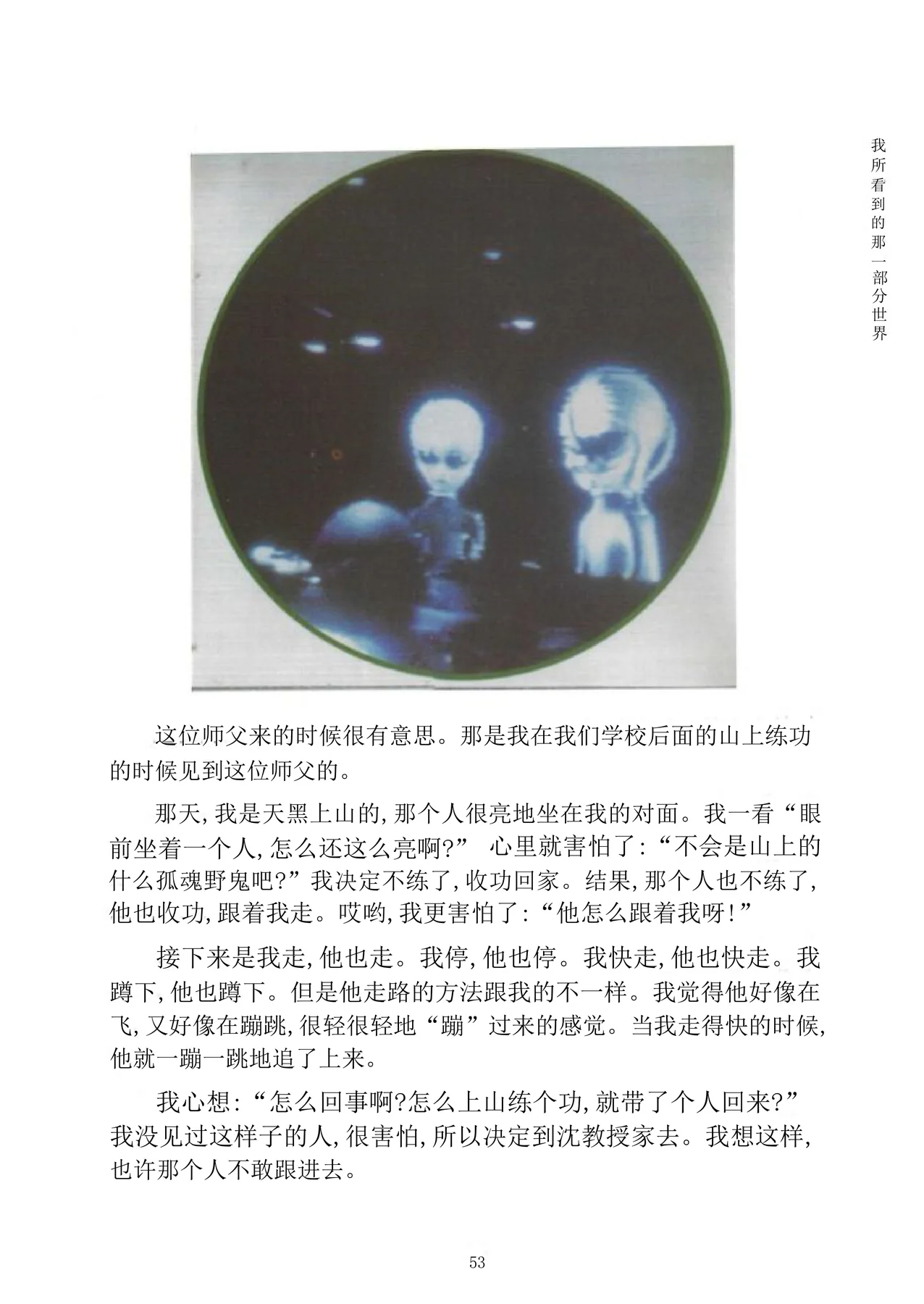
The way this Master arrived was very interesting. It was when I was practicing qigong on the mountain behind our school that I encountered this Master.
That day, I had gone up the mountain after dark. A person sat opposite me, glowing very brightly. I looked and thought, “There is someone sitting right in front of me—how can he be this bright?” I became frightened: “Surely this isn’t some wandering ghost on the mountain?” I decided to stop practicing, gathered my energy and headed home. As a result, that person also stopped practicing. He too gathered his energy and followed me. Oh no, I became even more frightened: “Why is he following me?”
What followed was: I walked, and he walked. I stopped, and he stopped. I walked fast, and he walked fast. I squatted down, and he squatted down. But his way of walking was different from mine. I felt as though he was flying, or perhaps bouncing, springing toward me very, very lightly. When I walked quickly, he caught up in a series of bouncing leaps.
I thought to myself: “What is going on? How did I go up the mountain to practice qigong and end up bringing someone back?” I had never seen a person like this before and was very frightened, so I decided to go to Professor Shen’s house. I thought that way, perhaps that person would not dare to follow me inside.
As it turned out, I went upstairs and he went upstairs too. He went up by “bouncing.” It felt as though he was flying up, slightly off the ground. I knocked on the door, and he stood right behind me, poking his head out to look. I don’t know what he was looking at—he just looked like that. The moment the door opened, I hurried inside and shut the door, not letting him in.
That day, Professor Shen did not know that someone was following behind me. I only told Professor Shen about it later. At the time, once the door was closed, he did not come in. He just stood at the doorway. I stood inside the door, afraid.
I stayed at Professor Shen’s house for over an hour. When it was time to go home, I opened the door and took a look—he was still standing at the doorway, waiting. I headed home, and he followed me all the way to my house.
Since he had come, there was nothing I could do. After I got home, I sat in meditation, hoping to summon my Master to help me. As soon as I sat in meditation, my Master did not appear, but he stood right in front of me. He did not sit—he just stood there. I found it very strange and asked him: “Who are you? You’ve been following me for so long—what exactly do you want?” He said: “I am your Master.”
I said doubtfully: “You… are my Master? You don’t even seem like a human being. How could you be my Master?”
He told me: “I am an extraterrestrial.”
I said: “An extraterrestrial? An extraterrestrial Master? I’m not going to any other planet—what do I need an extraterrestrial Master for?”
At the time my thinking was very simple; I didn’t think that much about it. So I just ignored him, didn’t practice qigong, and went to sleep, to see whether he would leave. I lay in bed with my eyes open, looking all around. I didn’t see anyone, so I assumed he had left. I peacefully closed my eyes and went to sleep.
But the moment I closed my eyes, he appeared. The moment I opened them, he was gone. The moment I closed them again, he came over. Later, I simply kept my eyes open to see whether he would leave. This time, even with my eyes open, I could see him standing there.
He was not leaving!
Of course, all of this was seen through my Celestial Eye.
In the end, I was out of options. I could only say: “All right then, let’s practice qigong together!”
From that day on, the extraterrestrial Master came every day when I practiced qigong to teach me.
The extraterrestrial Master’s appearance was basically similar in structure to that of an Earth person. It was just that his head was especially large, and his eyes were very big, like searchlights. He also had two eyes and two nostrils. He also had a mouth and ears. On his head was an antenna, very, very long, and there was also a horizontal one crossing the long antenna. It looked somewhat like a large cross, very long.
The body was wearing something like an iron-plate-style metallic garment, silver-colored and shiny, giving the sense that the entire body was fully enclosed.
The extraterrestrial master also had two hands, but the hands were square-shaped, hanging down to where the waist was. Moreover, I noticed that this extraterrestrial master’s left and right hands were of unequal length — the right one was slightly longer. There were also five fingers, but the fingers were joined together like a duck’s, as if there were webbing between them. The toes were also five, and also joined together.
This extraterrestrial master’s height was roughly about one meter eighty.
Before teaching me skills, this extraterrestrial master first took me on a tour traveling through the extraterrestrial world. We even went to the planet where the master lived. When communicating with the extraterrestrial master, I was not very clear what language he was speaking, but I felt as though I understood everything he said. It was somewhat like the feeling of telepathy. It was also somewhat like the feeling of the psychic power of reading others’ minds. Or perhaps you could call it intuitive understanding.
When I heard him speaking going “gibberish-gibberish,” I understood that he meant for me to follow him. I even replied, asking him: “How do I follow you?”
The master said: “You do not need to worry about that. Just sit in meditation and follow me with your intention, and that will be enough.”
The master wanted me to focus my intention on following him. I answered: “Okay.” Then I saw the master extend both hands forward, and I felt as though the master had flown out.
When I saw the way the master flew — oh, how fun! I also imitated the master’s form and flew out. There was no other vehicle, and I did not ride in any flying saucer or anything like that. Just like that, I entered outer space.
After entering the state, I used my intention to follow the master in flight. I thought of nothing else in my mind — I only thought about following the master. Wherever he flew, I would follow. If at that time I had still been thinking about other things in my mind, the slightest distraction might have meant I could not have gone.
Although it could be said that my consciousness was flying, it felt as though my body was flying. In reality, at this point it should have been my spirit that was following the master in flight.
It was somewhat like the feeling of riding in an airplane, constantly looking here and there, with images moving backward moment by moment.
There were also buildings on the extraterrestrial planets. I felt as though I were secretly peeping at someone else’s city. It felt more advanced than Earth, with many things I had never seen on Earth.
As I followed the master on our tour, because the speed of flight was especially fast, only when we flew to important places would the master say to me: “Take a look at this place.” Then I would look at what that place was like.
The master would sometimes also say: “Look, it is different here from where you are, is it not!”
Every planet we passed by, I roughly took a look at. Each planet was different, each with its own characteristics.
For example, among the many planets I passed, in some places the buildings were different, and in some places the lifestyle habits were different. The appearances of the extraterrestrial beings were also different. Some extraterrestrials had no noses, only a mouth.
The master also specially let me observe extraterrestrials eating. The master pointed with his finger and said: “This is their living area. Look, the way they eat is very strange.” I looked — how come they had no nose, just a mouth? I did not know what they were eating either; I just saw them stuffing food into their mouths.
The extraterrestrials here not only had no nose and only a mouth, but their eyes were also thin and tiny.
There was another planet whose extraterrestrials had faces that seemed as though they had been smoothed flat. And the extraterrestrials in this place had what looked like a mass of flesh growing on their heads. It did not look like some kind of headdress — it was in strands, in circles, as if about to drip down. It was also spurting outward! Every extraterrestrial there was like this. What spurted out looked like blood, flowing outward in strings.
They also had two hands and two feet, but they were short in stature, and their legs were square. They were somewhat like square pillars. Their movements were very fast — moving the moment they decided to move, flying the moment they decided to fly, jumping the moment they decided to jump. Their legs were like machine legs, walking very quickly.
Their buildings also had eaves. The feeling was metallic, with a reflective quality. Another planet’s buildings were pointed on top. Looking at them as a whole, they were one bubble after another, very beautiful. They somewhat resembled tents in the desert. Anyway, when the master brought me to see them, the moment I looked I thought it was so strange — “How can they look like this?” The master saw that I was very curious and said: “I will teach you a method, and later you can come over to look at any time.”
I also saw that inside the buildings it was very complex, with many things. Inside there was also an opening — I did not know whether it was a window or something else. Outside the buildings, there grew a kind of strange plant with thin, long leaves. I did not know what kind of plant it was; I had never seen it before.
Beside the buildings, there was parked a kind of vehicle, shaped like a turtle, with them on both sides of the buildings. It seemed as though every household had this kind of vehicle.
Later the master took me to see the planet where he lived. The buildings on my master’s planet were different from those above — they were cave-like. And the caves were very deep. When the master brought me inside, it was like passing through
…a black hole-like sensation.
Inside the hole, I sensed that their equipment was very simple—there was not much there. Yet they moved about freely. The Master said that if anyone came to invade them, they would all flee from that place together. Then, once the intruders had left, they would return. They also had a kind of protective shield that was like glass yet also like metal; once they shielded themselves, others could not see them.
Speaking of the extraterrestrial Master, we once discussed related questions with Professor Li, Professor Shen, and Editor Wu from Taiwan.
Professor Li asked me at the time: On your Master’s planet, is everyone as formidable as he is, or are there different levels? Your Master can come and go as he pleases—but what about the others? Do the others still need to ride in vehicles to come?
The Master told me they can all come. But some want to come and some do not—it seems they only come when they have a work assignment.
Professor Li then said: If extraterrestrials are all that formidable and can travel anywhere in the universe at any time, why would they still fear being attacked by others?
The Master said: There are beings even more formidable than they are!
Professor Li also mentioned something: once, when we were doing the peanut resurrection experiment, it came up that one peanut had been taken away by the Master—the one who took that peanut was this very extraterrestrial Master.
Professor Li went on to say: Actually, on one previous occasion when I was giving a lecture, a Daoist priest friend told me: “Teacher Sun’s Master is an extraterrestrial.”
Professor Li said: During that lecture, I played the videotape of Teacher Sun performing the peanut resurrection. That Daoist priest friend was present. As soon as he saw the video, he asked: “Who came to help?” And then he saw Teacher Sun’s Master. He told me he saw an extraterrestrial helping Teacher Sun, but he did not describe what the extraterrestrial looked like.
Professor Li said: At that time I had absolutely no concept of extraterrestrials. Later, I thought to myself that wandering in the spirit world all the time was pointless, and the idea came to me to search for extraterrestrial civilizations within our own three-dimensional space-time. Searching for extraterrestrial civilizations—America is doing it too. Starting in 1993, NASA officially established the Search for Extraterrestrial Intelligence Program (SETI Program), using radio telescopes to search outer space for stars like our Sun.
Professor Shen said: They found several.
Professor Li said: Right. Then they searched whether any so-called intelligent signals were being emitted from around those stars, but none were found. NASA tried for less than a year before giving up and terminating the search for extraterrestrial intelligence. It was private citizens who took over the research and continued. Universities in many places linked up millions of computers worldwide, utilizing the idle time at night when people were not using their computers, to form a large network for computation, systematically and methodically scanning the sky, bit by bit…
Professor Shen: It has been almost ten years of scanning.
Professor Li: Right. By now they have scanned about half the sky and still cannot find any intelligent signals. Essentially there are no results. Actually, when you do extraordinary-ability research to a certain level—once you know of the existence of the information field, and also know that there are no space-time limitations within the information field—I began to think that perhaps the method of searching outer space was wrong. It should not rely on electromagnetic waves. The propagation speed of electromagnetic waves is the speed of light, and the nearest star to Earth is over four light-years away. Think about it: we send out a signal, and for them to send one back, we would have to wait eight years to hear it.
Professor Shen: Relying on electromagnetic waves is simply impossible.
Professor Li: Right. With current technology, it is virtually impossible. I believe it is only possible through the information field. So I thought: Takahashi Mai [a Japanese girl with extraordinary abilities] has a Master in the information field—could we ask her Master to take us to see this “realm of form”?
I used the finger-reading method to converse with her Master. I would write the question on a slip of paper, and Takahashi Mai would hold the slip in her hand; once her celestial eye opened, the question would be sent out.
The very first question I asked was: “When can Earth make contact with extraterrestrial civilizations?”
Snap—the answer came.
“Not already?”
Ah, I suddenly understood: Earth has existed for 4.6 billion years; the solar system for 5 billion; and the universe for 13.7 billion—fully three times the age of Earth. If Earth could evolve so-called “highly intelligent” humans, then other planets could certainly also evolve even higher intelligent life forms, giving rise to high-functioning intelligent beings like the Buddha or Jesus. And they might very well know of the existence of another world—that is, the existence of the information field, or the spirit world.
The technology of these high-functioning intelligent beings surpasses ours, so they must certainly know of the information field.
the physical essence of the information field, they very likely created something like flying saucers, capable of freely entering and exiting the information field. What this means is that they can enter the information field from anywhere in the universe, instantly travel to any location, and reappear. The so-called space travel basically means entering the information field, utilizing its characteristic of having no time or space limitations, and appearing in any corner you wish to go.
I suddenly understood that higher civilizations from outer space must have invented machines capable of breaking through spacetime barriers, which is why they can visit Earth at any time.
Professor Shen: Right, that way they wouldn’t be limited by the speed of light.
Professor Li: The moment they enter the information field — whoosh — they’re at Earth. It’s like having a ten-minute break between classes, taking a flying saucer to Earth for a quick look, and if there’s no problem, whoosh — they go right back. Spacetime is no longer a barrier!
The key question is: what is the physical essence of the information field? If we knew, couldn’t we also build a machine to enter the information field?
Professor Shen: Right, like a spacetime shuttle.
Professor Li: So Earth is absolutely not a closed life system, because extraterrestrial higher civilizations have already been able to break through spacetime barriers, and they can come here at any time. We can now do gene transplantation, transferring genes into this plant or that animal. With extraterrestrial civilization’s technology being even more advanced, wouldn’t they scatter some seeds on Earth to experiment, and then come back thousands or tens of thousands of years later to see how things have developed?
Since they can come at any time, they can come frequently to monitor things. So although ninety-five percent of the UFO sighting reports from around the world might be hallucinations…
Professor Shen: At least five percent cannot be ignored.
Professor Li: Right. Later I asked Takahashi Mai’s Master: “Is there intelligent life on the Moon?” The Master said: “Yes!” Then, is there intelligent life on the nine major planets of the solar system? The Master said: “There is on Mars, and their intelligence is quite high.” So I started begging the Master to take us… not me, but to take Takahashi Mai to see extraterrestrial civilization for herself.
At first, the Master kept putting it off, saying “next time, next time.” After we waited more than half a year, he finally agreed to take Takahashi Mai to have a look. As it turned out, the extraterrestrials Takahashi Mai saw were very similar to what Teacher Sun had seen — also seamlessly formed in one piece, with two arms and two legs, very much human-shaped.
Editor-in-Chief Wu: Wait, wait. Professor Li, could you draw it for us to see?
Professor Li: I have Takahashi Mai’s drawing.
Look, the extraterrestrial in this drawing is also seamlessly formed in one piece. Its head is especially large, with two nostrils but no visible nose. Then it has a mouth, and very small ears. On top of its head there’s a little nub, like an antenna. Two arms and two legs — the hands have three fingers, one of which is especially large.
Takahashi Mai also said that the extraterrestrials’ movements were all extremely fast — once they started moving, it was like watching a film on fast-forward. Moreover, the extraterrestrials would talk to themselves, chattering away constantly, but she never saw them holding anything like a mobile phone or similar device. I suspected they were communicating, but I just didn’t know what they were communicating through.
Takahashi Mai also saw plants on the alien planet, which looked very much like our trees. Inside the buildings, there were many very bright things. The extraterrestrials faced a box, something like a computer, which also had a keyboard. The extraterrestrials would tap away at the keyboard, and before long something would come out of the box — they would grab it and eat it.
I asked Takahashi Mai’s Master: “What is that computer-like thing?” The Master said: “Oh, that is their invention. Whatever you want, you type it in, and the thing comes out.”
Professor Shen: Consciousness turned into matter!
Professor Li: Right. Also, their vehicles were somewhat like flying saucers, with three legs underneath. Takahashi Mai said the entire open field was filled with parked flying saucers. Finally, the Master took Takahashi Mai to a room where there was a large screen. Many extraterrestrials were gathered in the room, lined up in neat rows and columns, all facing the glowing screen, and watching while chattering away amongst themselves.
Editor-in-Chief Wu: What was on the screen?
Professor Li: On the screen was a large planet, red and orange in alternating bands. We asked the Master: “What is that on the screen?” The Master replied: “Those are planets in the universe — whichever one they want to see, they tune in to it.”
Professor Shen: They can see whichever one they want?
Professor Li: Yes. I guessed that whichever planet they wanted to see, they would tune to that star’s position to look. Their technology was very advanced — they had probably broken through the limitations of electronic waves.
Professor Shen: They can lock onto spatial coordinates.
Professor Li: Right. Whichever planet they want to see, they pull that planet’s image over. Just like
when Teacher Sun opens her Celestial Eye — whichever planet she wants to see, that planet appears.
At the time, I thought: “Since their technology is so advanced, could I ask the Master to have them see Earth on their screen?” During that experiment, a group of us were gathered at Chinese Culture University, communicating with Takahashi Mai’s Master, so right then and there we asked the Master to put us onto the extraterrestrials’ screen. If it succeeded, we could greet the extraterrestrials! Even though we couldn’t see them, we could wave frantically.
Professor Shen: Ha ha!
Professor Li: And the Master actually pulled it off! After a short while, Takahashi Mai saw the screen in that room suddenly switch to a blue planet.
Editor-in-Chief Wu: They saw our Earth?!
Professor Li: Yes, they saw Earth.
Professor Shen: Did they notice you?
Professor Li: But Earth is very large — just seeing the planet doesn’t show much. So we made another request to the Master: “Could you zoom in a bit?”
Professor Shen: Yes, yes, zoom the lens in!
Professor Li: The moment the request was sent, Takahashi Mai saw Earth on the screen grow larger! Then she heard the extraterrestrials’ chattering getting louder and louder, as though they were approaching us. The view kept zooming in and in, and suddenly a house appeared with a red roof. The roof was very distinctive — a single red beam and a frame.
When we heard Takahashi Mai describe this, our whole group rushed outside, looked up, and went: “Wow, the roof really is exactly as Takahashi Mai described it!”
Professor Shen: The camera had found you!
Professor Li: We quickly waved!
Professors Shen and Wu: Ha ha!
Professor Li: Where was the planet the Master took us to see located? We brought out a standard star chart and asked the Master to help point it out. But a standard star chart was too simplistic, and the Master could only roughly indicate it was in the constellation Cygnus.
Professor Shen: In Cygnus?
Professor Li: Yes. Later, an astrophysicist heard me tell this story. He was very interested and gave me an astronomy software program. That software listed all the stars in more than fifteen constellations within the Milky Way—several million of them—and you could zoom in and out.
After I obtained this software, I again asked Gao Qiaowu to inquire of her master. As a result, after the computer displayed the image of the Milky Way, the master asked: “Is there a more detailed map?” So I clicked in and zoomed in, zoomed in—wow, all at once thousands upon thousands of stars burst forth. Following the master’s instructions, we kept clicking in and zooming in, clicking in and zooming in… At a certain point, the master suddenly said: “The one in the middle of the three.”
There were several groupings of three on the screen, so I asked again: “Which three?” The master indicated one particular group, and I continued to zoom in. As soon as I zoomed in, another large batch of stars appeared. I kept clicking all the way in until there were no other stars beside it, and finally found that star.
Professor Shen: What star?
Professor Li: That star is a planet in the constellation Cygnus, at declination 32 degrees and right ascension 20 hours 19 minutes, at a distance of 437 billion light-years from Earth. Later, I told the astronomers: “Look, if you want to communicate with extraterrestrial civilizations or go visit them, using current electromagnetic waves is absolutely impossible. 437 billion light-years—you say ‘hello,’ and you’d have to wait 874 billion light-years to hear their reply.”
Professor Shen: Relative to the human lifespan, that is absolutely impossible.
Professor Li: Correct. You absolutely must use the substance of the information field, and communicate with extraterrestrial civilizations through the information field. This is our experience. Perhaps we could invite Teacher Sun and the extraterrestrial master to take us to see other extraterrestrial planets as well.
Professor Shen: Did you report this experimental result to the SETI program?
Professor Li: I only reported it to the director of the Graduate Institute of Astronomy at Central University, who had provided the software. When he heard this, he pointed their one-meter telescope directly at that star.
Professor Shen: Really?
Professor Li: They even conducted some research on that star and photographed it. This year, when that director was signing the graduating students’ yearbooks, he specially wrote the designation of that star. Nobody knew
what he was writing. The president was even puzzled: “Huh, why did he write such a strange code?” Only those of us who know understand—only those who understand know; those who don’t understand have no idea.
Professor Shen: Wonderful, wonderful!
While Professor Li and the others were discussing, I entered an extraordinary-ability state to take a look at the three-fingered extraterrestrial that Professor Li had described. The beings on that planet looked just as drawn in Professor Li’s picture, but their antennae were somewhat different. Their antennae were two in number; normally only one was extended, and sometimes, depending on need, the other one would extend as well.
My master had taught me certain methods—if I wanted to go see other planets, I could go at any time.
Just now, I was thinking: “I want to see an extraterrestrial,” and an extraterrestrial appeared for me to see. As soon as I looked and said: “So this is what you look like?” he began to change, and said: “I am ever-changing. Look, I can also look like this.” And then he changed into another form.
Professor Li once asked me whether I had ever looked at the Moon, whether I had seen if there were people on the Moon. Professor Li said: he had asked Gao Qiaowu’s master whether there were extraterrestrials on the Moon. Gao Qiaowu’s master said: Yes. He also said: the extraterrestrial base was beneath the surface of the Moon. He furthermore explained the purpose of extraterrestrials frequently coming to Earth: first, to monitor the development of Earth and prevent evolution from going out of control; second, to use Earth as an experimental site, conducting certain life experiments, such as gene transfers and the like.
After I went to the Moon and looked, I found that the extraterrestrials on the Moon were short and plump, also seamlessly formed as one piece. Their eyes were large, and their mouths were quite large too. Their hands seemed to be tucked in, wrapped inside their bodies. The antenna on their head was like a searchlight, and it could extend and retract. It could extend and retract up and down, left and right, and forward and backward.
They had no obvious nostrils—I only saw two grey lines coming down. Their ears were tiny, very small. When they walked, it was as if they were floating. They seemed to move very quickly; you couldn’t make out their legs at all.
They also had a lot of machinery and equipment around them. The machines were quite complex. They would use the searchlight on their head to touch pointed, angular switches—dong, dong, dong. There were many machines, but one person could operate a whole array of them. All of these beings and machines were beneath the surface of the Moon.
Once, during meditation, I also went to see Mars. I sensed that there was water on Mars, and there was life. Moreover, I felt that the level of the life on Mars was even higher than that on Earth. This time, when the American probe did not detect life there, I felt there was interference—they did not want others to discover it.
At the very least, the presence of water has been confirmed. That year, the British probe Mars Express discovered a great deal of frozen water at Mars’s south pole. And it was beneath the dry ice, below the surface. One year, between June and July, there was a series of Mars exploration missions—the majority of which, of course, failed. In the 1999 attempt, America’s Mars Polar Lander simply vanished after landing.
At that time Professor Shen also wrote down the probe’s name for me to sense psychically, and on several occasions he had me attempt extrasensory photography of Mars, but it was hard to determine whether what I saw was actually Mars. Last year the Beagle 2 lander, carried by Mars Express, was also lost the moment it landed. Scientists said it had fallen into a deep ravine; some people jokingly said it had been confiscated by Martians—and in fact that is a real possibility.
Overall, as far as the planets I have already seen, every single planet is different: the people are different, and the scenery is different too. As the two scientists put it—Professor Shen: “Logically speaking, humanity cannot be alone.” Professor Li: “Earth is not a closed-off form of life.”
Besides taking me on journeys through alien space, my extraterrestrial Master also taught me instantaneous technology.
For example, the Master took me to his own planet to observe their way of life. When the people there want something to eat, they simply tap the plate on the table like this—dang!—and instantly it is there, ready to eat.
Professor Li also described the phenomenon observed by Takahashi Mai during the experiments he conducted with her: “The Master of Takahashi Mai took us to see the extraterrestrials on a planet in the constellation Cygnus. They still needed a kind of box. When they wanted something to eat, they would type on the keyboard in front of the box—for example, if they wanted bread, one entry and pop!—out the bread would come from inside the box. But Teacher Sun’s Master doesn’t require a box or anything of the sort.”
What I call instantaneous technology, in the narrow sense, means that whenever you want something, you simply tap with an object and what you desire appears instantly. For example, if I want bread, I just tap with something and the bread arrives in an instant. Or if I want water, I tap and the water comes, and so on. In the narrow sense it refers to having an object and wishing it to undergo rapid transformation—for instance, I make a seed instantly sprout tender shoots, or make a flower bud rapidly burst into full bloom, or there is a peanut on a plate and through intention I will it to sprout and flower rapidly, and in an instant it sprouts and flowers, and so forth.
In 1990, my third Master arrived. He was an elderly grandfather figure. He told me he was the Thirteenth Tsongkhapa of the Tibetan Yellow Hat sect. He taught me methods of material transformation—chiefly the abilities to turn water into oil, water into wine, and water into perfume, and so on.
This Master also appeared while I was sitting in meditation. One day as I sat in meditation, I saw a person appear before me. I was startled for a moment, and then I heard him say: “I am your Master.” And strangely enough, he also knew about my two previous Masters. He said: “The masters who taught you before all say you have learned well, so now you shall cultivate with me.” And so I cultivated together with this Master.
The Master began by teaching me visualization meditation. It is hard for me to describe specifically. He simply had me sit there in meditation, and then he told me how, how to go to another world, and so on.
What the Master spoke sounded like the language of Tibet, which I could not understand. He chattered on fluently, and I had no idea what he was saying, so I just watched the Master. The Master knew I had not understood, so he made a crossed-legs gesture. The moment I saw it, I understood—he wanted me to sit cross-legged like him too.
As soon as I sat cross-legged, he knew I was learning from him and had grasped his meaning. Then he began to guide my thoughts, taking me to look around everywhere and introducing the things we encountered along the way.
When I learned that he was a great master of Tibetan Buddhism, I thought to myself that he surely would have things like nectar pills. Moreover, Professor Shen’s daughter Shen Yin studied Tibetan esoteric Buddhism, and from her own Master she had obtained some nectar pills and gave me several. I kept them at home, and later they multiplied into hundreds.
As for things like nectar pills, as long as you have a spiritual practice or you recite scriptures, they will grow even if just kept at home. If you do not practice, but you yourself possess a certain level of attainment—have spiritual roots and a Buddhist foundation—they will still grow. You do not need to tend to them; just place them on an altar table and they will grow larger and multiply, big ones and small ones, growing into many.
I found things like nectar pills quite fascinating, so I thought: “Nectar pills are a Tibetan Buddhist thing. Don’t I have a Master who is Tsongkhapa? Could I ask the Master to send me some pills?” That evening during meditation, I asked the Master whether he could send pills, and I also said: “I want ones bigger than my nectar pills.”
After I made my request, I could see the pills in my Celestial Eye. The Master did indeed send me two large pills. On one occasion, the Master even said to me: “I can send a pill as big as a basketball.”
When I heard this, I wanted to ask the Master to send it, but Professor Shen kept saying no, no, so I did not ask the Master for it. Professor Shen was a researcher, after all. He said: “If you manifest pills in your home, who knows how those pills actually got there?” What he meant was that you need evidence to prove it!
So later Professor Shen went and bought a box and got two padlocks for it. The box was placed at Professor Shen’s
At home, Professor Shen put one lock on and Mrs. Shen put another lock on, and then they each hid their keys. Neither of them knew where the other had hidden them, and I didn’t know where they had hidden them either.
Then, I asked my Master to deliver the pill into the box.
We did this experiment twice. The second time we did it, we also placed five peanut kernels inside the box. After the pill was translocated inside, I even made three of the peanuts sprout long shoots.
At the time everyone was extremely astonished. This sort of thing — it’s not that you can just produce it whenever you want. When the conditions were made stricter, I couldn’t produce it. Because when conditions became stricter, the difficulty increased, and I had to adjust myself. On top of that, I could sense that you didn’t believe me. I told you it was real, that I genuinely wasn’t lying, but you didn’t believe me. Even though I could understand that, my consciousness was still interfered with.
I could sense what people were thinking: “I’ll lock it up and see whether you can produce it or not.”
This kind of thought is a form of informational interference.
There were many other kinds of interference too. I had to clear away layer upon layer of interference before I could achieve success. If I still had to produce results under such conditions, it was especially exhausting.
In order to succeed, I would say: “Master, please help me deliver the medicine into that box.” When I requested the Master to deliver medicine, if he felt it was appropriate, he would deliver it. If the Master felt it wasn’t appropriate, he would directly say it wasn’t possible. The Master would say different things in response to my different requests.
For example, once when I was in Japan I asked the Master to deliver a pill for Professor Ding Haoyun, and the Master asked: “What do you want the pill for?” I said: “To treat Professor Ding’s heart disease.”
But the time I asked the Master to deliver medicine to Professor Shen as a birthday gift, the Master didn’t ask.
Soon after I made my request to the Master, I saw a large eagle flying over, dragging the medicine with its talons. Moreover, the eagle’s talons were gripping it turned upward. At the time I thought it was strange — an eagle’s talons can grip like that? After the pill was delivered, not only could you see talon marks on it, but you could also see the character “寿” [longevity] on the pill. The character was very clear.
Professor Shen’s daughter studied literature and also studied Buddhism. She said: “Do you know? That eagle is called the Golden-Winged Great Peng.”
Later, after I had requested medicine many times, the figure of the Medicine Master appeared. That was probably around 2002.
It was quite a coincidence that time. That day we had arranged to discuss matters at Chief Editor Wu’s Han Sheng office.
At the time I told everyone that I had an ability — I could translocate characters onto the ceiling and imprint them there.
Then they all went off to write characters. But I tried for a long time and couldn’t produce it, so I asked my Master to come help. As a result, the moment I called out “Master,” a figure flashed by and the Medicine Master appeared.
He even asked me: “What are you calling me for?”
I told him that I wanted to translocate characters, but the Medicine Master said to me: “Come with me!”
He didn’t teach me to translocate characters. Instead, he took me to tour a medicine garden — walking all around, looking everywhere. So that day the character-translocation experiment didn’t happen.
I just followed the Medicine Master into the medicine garden, and when I looked — oh my, it was golden and dazzling inside, enough to make your eyes blur, and the fragrance was wonderful.
At the time Professor Li even asked me: “Was there anyone guarding or checking identities?”
Professor Li asked this for a reason. He said that when Takahashi Mai did finger-reading, she had also entered the Medicine Master’s medicine garden. She said there was a gatekeeper who would often turn people away, saying: “Not today.” Takahashi Mai asked him: “Would next time be all right?” Every time she asked about next time, the gatekeeper would nod. Later, we came to understand — it turned out you had to register first!
That is to say, you first needed to establish a connection, to register.
This time it was probably because the Medicine Master himself brought me in, so I didn’t need to register, didn’t need to sign in, and wasn’t turned away.
After entering, I first saw things in blocks, and then when I looked again, they were arranged in rows. And the things growing were all different. Anyway, I just followed the Medicine Master around everywhere, and whenever I saw something strange-looking, I would ask: “What medicine is this?” He said: “We have so many medicines — each has its own efficacy.”
And many of the medicines inside were glowing and luminous, but they glowed differently. The Medicine Master even explained some of them to me — this bright one treats this illness, that bright one treats that illness — each one was different.
After we finished touring the medicine garden, the Medicine Master took me to tour the medicine dispensary. Upon entering the dispensary, I saw one large room after another completely filled with prepared medicines — a big pile here, a big pile there, of all different kinds. The shapes were different too — some large, some small, some square, some long. And there were all kinds of colors as well.
After we finished looking around, I said to the Medicine Master: “Could you give me a little medicine?”
The Medicine Master agreed. I said: “You can really give me some?” He said: “I can!”
Then he said: “Take this medicine!” I said: “How do I take it?” He said:
“You ask, how do you take it?” I thought for a moment and said, “Oh, I know.” Suddenly — pop! — the medicine just came out. I don’t even know how it happened.
The pharmacy was full of ready-made patent medicines; all you had to do was look and point at the kind you wanted. But the way they dispensed medicine was a bit strange. For example, when I went to pick up medicine, the person in charge of the pharmacy would just sit there and ask, “You want to get medicine? Then think about the medicine you want!” Just as he said, the moment I thought of it, the medicine would appear right in front of me. He didn’t move at all — the medicine just came over to me.
I would think: “Medicine for heart disease!” and heart-disease medicine would appear before my eyes. Then I would think again: “Translocate the medicine into Professor Shen’s box at his home,” and the medicine would go right into Professor Shen’s box.
Sometimes I would think: “Whatever you give me, as long as you think it’s suitable, that’s fine.”
Besides getting medicine from the pharmacy, you could also gather medicine from the herb garden. For example, if I wanted medicine for kidney disease and the pharmacy didn’t have it, I would go to the herb garden to pull fresh herbs. I had never gathered fresh herbs myself, but I had watched others do it. And when gathering medicine, I wasn’t the only one — there were several people there.
The herb garden also had buildings, something like a courtyard house, with pavilions inside. But they were stranger than ordinary courtyard houses. And everything inside flickered with golden light.
There was one thing I found very strange. Sometimes, things that I clearly couldn’t see would suddenly appear — snap! — the moment the Medicine Master wanted me to see them. When he didn’t want me to see, I couldn’t see anything at all, as though someone had flipped a switch.
For example — snap! — it would open up, and five herb gardens arranged in a row would appear. Going up another level — snap! — six herb gardens in a row would appear. The design was very scientific — nothing like this exists in our world. The medicinal herbs in each garden were different.
For instance, one kind of herb had sharp, pointed leaves with golden light around them, and it even had thorns. Another had fuzzy leaves that grew round and curly. There were also ones that grew like vines and even bore flowers. And there were ones shaped like snake beans — long strips, curving and twisting like snakes.
What you saw wasn’t always the same, because there were also seasonal factors. Different medicines were planted in different seasons, and even that dimension of time and space was differentiated.
When talking about herbal medicine, Professor Li also conducted an experiment on Chinese herbal medicine together with me.
Professor Li said that the Shennong Bencao Jing (Divine Farmer’s Materia Medica) once mentioned the matter of “Shennong tasting a hundred herbs.” But how exactly did Shennong taste a hundred herbs? Did he really take plants one by one and eat them to learn their medicinal effects? Then if he happened to eat a poisonous plant, wouldn’t he have died?
Professor Li also said that there are generally three views about this matter.
The first view is: Shennong himself practiced qigong, and his abilities were quite strong. He could sense which meridian a plant corresponded to, so as soon as he picked up a plant and felt it, he would know what illness it could treat.
The second view holds that Shennong could communicate with plants, just like Teacher Sun can. He possessed quite powerful extraordinary abilities and could summon a plant up to his Celestial Eye and communicate with it, letting the plant tell him what it could cure.
The third view holds that Shennong was a person of very high ability who could directly communicate with the information field — for example, the Medicine Master or his own master — and directly ask the spirits of the information field.
On that occasion, taking advantage of coming to Beijing for a conference, Professor Li brought five medicines and asked me to do an experiment to help clarify the question of “how Shennong tasted a hundred herbs.” These five medicines were prepared with the help of a student of Professor Li’s who was knowledgeable about medicinal materials. Two of them were fresh herbs, two were mixed traditional medicinal materials, and one was a medicine that had been disputed from ancient times to the present. He also specifically instructed the student not to tell him the names of the medicines, so this counted as a double-blind experiment.
After Professor Li handed me those five medicines, I tried to communicate directly with each of the five herbs one by one that very evening, but not a single one responded.
However, although communicating with them one by one produced no response, information appeared when they were all mixed together.
After picking them up one by one to communicate and getting no answer, I placed them all on the table. At that point, some scattered and disorganized information appeared — not medicine names. Characters appeared on the Celestial Eye screen, saying things like “supplements qi,” “lowers blood lipids,” and one that was “anti-inflammatory.”
Through this experiment and my past experience, I sometimes relied on my own sensing, sometimes consulted my masters, and sometimes obtained information through direct communication with the medicinal materials.
For example, when someone brought me a prescription written by a doctor and asked me about it, I would enter the state and ask my master, “Can this prescription cure his illness?” Sometimes the master’s answer came in the form of characters, and the two characters “acceptable” would appear on the Celestial Eye screen. Sometimes the answer came as sound, sometimes as images — I could see my master[’]
father nodding. Sometimes Shifu would say: “This prescription is acceptable, but it’s missing one ingredient.”
I would then ask: “Which ingredient is it missing? Can you help me point it out?” Sometimes Shifu would help by pointing it out, and the ingredient would appear added on the Celestial Eye screen.
Sometimes the information would appear automatically, indicating that my ability had reached a certain level and I no longer needed to ask Shifu for help. At those times I would think to myself: “What illness can this medicine treat?” and then an image would appear on the Celestial Eye screen. I think this may have been because what I had learned from Shifu over many years had combined with my own innate abilities — or perhaps I was simply born with it.
When there were things I did not understand, I would ask Shifu. In the beginning, I asked Shifu about everything related to medicines, because I did not understand Chinese herbal medicine and did not know what to do. Basically, whatever Shifu had told me, I learned. So the next time I asked Shifu, I would look at the prescription and raise questions such as “Is this prescription correct?” or “Is there any problem with prescribing it this way?” Shifu might tell me: “All twenty herbs are correct, but some of the dosages are too small and some are too large.” Then she would tell me how to adjust the dosages.
Judging from this experiment and some of my own experiences with using medicines, it is very likely that Shennong possessed extraordinary abilities, rather than having to taste each herb one by one in order to learn the medicinal properties of every substance.
Around 1991, the fourth Shifu also appeared. She was a kindly and amiable old woman. She said she was Buddhist. She would frequently change her appearance when she appeared during my meditation.
The first time she appeared, she was dressed as a beggar woman, and I did not pay her much attention.
At that time, I simply saw an old beggar woman leaning on a walking stick, with white hair and a face full of wrinkles, looking rather dirty and grimy. She came up to me and asked me for food. I did not feel particularly inclined to give her food, nor did I feel disinclined — my thoughts at the time were neither good nor bad, just that kind of feeling.
She came up to me and said: “Kind person, give me something to eat!” At that time I was sitting in meditation and practicing. The scene in which she appeared was on a street, noisy and chaotic, with beggars everywhere. There were so many people on the street, yet she sought no one else — she came specifically to beg from me. I found this a bit strange, but I did not dare refuse her, so I gave to her.
That feeling is hard to describe. If I were to say she was not an ordinary person, I also thought, what abilities could a beggar woman possibly have? She was begging from me, so I gave to her — it did not matter either way. That is just the kind of personality I have.
I gave to her through intention. It was not rice — I gave her a steamed bun. In my mind I simply thought: “All right, here’s a steamed bun for you!” But before I gave it to her, my moment of hesitation was seen through by the old woman. She said: “You still don’t want to give it to me?” I said: “I don’t not want to give it to you,” and I gave her the bun. The old woman said again: “You don’t seem very willing. Do you believe I have abilities? I can teach you abilities?” I thought to myself: “What abilities could a beggar woman have?” Then I thought again: “No — let me see what abilities she has.” While I was still turning it over in my mind, the old woman spoke again: “Believe it or not, I can make your tooth fall out!” At that time I had not yet heard of telekinetic tooth extraction, and I thought: “The tooth grows in my body — if you tell it to fall out, it will fall out?” I found it rather unlikely, but I did not dare disbelieve either. I was in that state of half-believing, half-doubting. Seeing that I did not quite believe her, she pointed at my front tooth and said: “Catch it with your hand!” — Crack! — my front tooth fell out! I even felt my front tooth and said: “Oh! It really fell out!”
I said to the old woman: “How could you really knock my front tooth out?!” Although there was no bleeding, I became anxious and said: “How can this be? You must compensate me!” The old woman said: “Don’t worry — if I can make it fall out, I can put it back.” She pointed with her hand, and the front tooth went back in, just like in a myth.
After the tooth was put back in, I thought: “This beggar woman is evidently no ordinary person.” Then she said: “Now look at my hand.” She opened her palm, then half-closed it, opened it again, half-closed it again, repeating this motion.
I asked her: “What are you doing?” She said: “Watch carefully — a bug will crawl out right away!” Then I watched as something bulged beneath her skin — bulge, bulge, bulge — and a large fleshy grub pushed its way out. A big green fleshy grub. Not like a caterpillar — more like a cabbage worm, or like a silkworm, plump and chubby.
When I saw this, I thought: “How horrifying!” At this point, the old woman asked me: “Do you want to learn this? I can teach it to you.” I found it too disgusting and hesitated a little. While I was still thinking it over, the old woman was gone! Just like that, she could not be found anywhere.
Only then did I come to my senses: “She might be a Shifu who came to teach me. Why didn’t I learn it? If she was teaching me, she must have had a purpose — it must be something I would need.” Thinking of this, I hurriedly searched everywhere.
In other words, the moment she left, everything became clear to me. While she was still there, I remained muddled. The moment she left, it all became entirely clear.
I looked everywhere for that beggar woman’s image but could not find it. I thought to myself, “Oh no, oh no, I’ve missed my chance,” and regretted it terribly.
Just then, I suddenly had a kind of feeling — I could not really say whether someone was guiding me — but the moment I looked up, I saw the old woman up in the sky! Good heavens, she had become so beautiful, so richly adorned.
In other words, the old woman was still an old woman, but she was no longer dirty and wrinkled as before. She had transformed into a very noble old woman, extraordinarily magnificent, just like the image of the venerable Matriarch She, even holding a dragon-headed cane.
She stood on a dragon boat, borne aloft by clouds as though riding the mist, surrounded by many fairy maidens. The moment the old woman saw me, she waved to me. I hurriedly shouted, “Master!” She did not acknowledge me as her disciple, but there I was calling out recklessly. I found it very funny.
And I actually shouted out loud! In the midst of my shouting, I unconsciously ran out into the corridor wearing nothing but shorts, which startled even me.
But the old woman eventually left. As she departed, she waved her hand at me and also said a sentence: “Don’t worry, I will come again, even though you were a bit impolite to me.” And sure enough, the next day during practice, the old woman really did come.
This time the form she appeared in was beautiful and elegant, and she was still holding that dragon-headed cane.
As soon as I saw her appear, I said, “I was wrong. I should not have treated you that way.” The old woman said, “Very well, I will teach you how to grow insects.”
At the time I felt a bit puzzled: “Why not teach me the one about making teeth fall out and then putting them back in?” I was the most unwilling to learn how to grow insects, but she insisted that I learn it.
There was nothing I could do, so I just had to steel myself and learn.
Right then, my Master taught me how to relax my hands, how to bring the qi up, and then to imitate her posture. We repeated the movements several times. I did not learn it very well, but the shadow of an insect had already begun to emerge.
Later, after I tried a few more times, an insect truly grew out of my hand. At that point I could see through my celestial eye that an insect had grown out, and there was genuinely an insect growing out of my hand. I could even feel how the insect bored through the skin and crawled out. After completing it, I felt very uncomfortable, so afterward I was not very willing to do it again.
Once the insect came out, I got scared. I said to my Master, “What do I do? It’s come out!” My Master said, “It’s all right — just tell it to leave, won’t you?” She then told me how to tell the insect to leave,
and the insect disappeared.
Why my Master wanted to teach me to produce insects, I do not know. She never explained. My Master simply told me not to be afraid — by gathering and concentrating energy from the body in this manner, one could produce an insect.
If there was a purpose, it was probably to be able to communicate with insects, because later on I could use mental intent to summon insects from outside. I only had to think: “Come over, come over, come in, come in…” and the insect would slowly crawl toward me.
Once, a teacher in my department named Teacher Ma and I happened to be sitting by the window of the reading room. We noticed an insect crawling about there, and I said to it, “Crawl over to me.” The moment I tried to communicate with the insect, it crawled over. Then I added another thought: “Crawl around Teacher Ma.” When Teacher Ma saw the insect crawling toward her, she cried out, “Don’t crawl over here!” Seeing that she was afraid, I imitated my Master and said to the insect, “Go back!” And the insect crawled back.
When I say the insect crawled back, it was not actually like the slow crawling back that we ordinarily see. It was more like seeing it on this side, telling it to go back, and in an instant it was already over on the other side.
I think the main purpose of my Master’s teaching was how to communicate with insects. In case a person were ever surrounded by insects, how could one direct the insects away? For instance, during a large-scale locust plague, could one communicate with the locusts and direct them away?
For roughly a year, this Master stayed with me continuously, teaching me how to grow insects, how to direct insects, what level of intensity to achieve, and so forth. But I learned it without really putting it to use. I was not particularly fond of learning this, so I set it aside.
In short, it seemed as though deep down I simply did not want to learn this thing. I always felt insects were rather frightening, and I did not think much beyond that. What I did want to learn was the skill of growing teeth and making teeth fall out — learning tooth extraction would be useful, since it could be used for pulling teeth. But my Master simply would not teach it afterward.
The above describes my fourth Master.
My fifth Master was the Venerable Patriarch Chen Tuan, a Daoist. The way the Venerable Patriarch Chen Tuan arrived was very interesting.
That evening, while I was practicing with my eyes closed, I suddenly saw a bed, and on the bed lay a thin Daoist priest — and he just floated over toward me. As soon as he arrived, he said he was my Master and would teach me to practice, but he did not state his name.
After practicing for a while, I asked: “Master, who are you?” The Master said, “I am Chen Tuan.”
I also asked him: “Chen Tuan? What do you do?” Only later did I learn that Chen Tuan was a very famous Daoist priest from the early Northern Song dynasty.
After he arrived, he taught me to practice cultivation. There is a painting that the Master taught me to paint. One evening, he told me to take a brush and a sheet of paper, and paint with my eyes closed. Without even looking at all, I painted it.
I originally did not know how to paint, but after I finished, when I looked at it, I thought it was actually quite good. In truth, at the time it felt as though someone was holding my hand and painting. I was not looking at the paper; I was looking at the painting in my Celestial Eye, and I painted whatever appeared in that image.
Master Chen Tuan first taught me a reclining practice, lying down like the reclining Buddha.
Normally when I practiced cultivation, I would focus my attention on the Dantian. He told me not to think about the Dantian, but instead to imagine qi entering through the navel and then exiting through the Baihui acupoint at the crown of the head. He demonstrated it once for me first. I watched and found it truly fascinating, so I followed along and began practicing.
As soon as the qi exited through the Baihui, a vast expanse of light appeared, along with many, many continuous bubble-like things. Countless white bubbles. Slowly, the white bubbles grew more and more, and a form took shape. The figure of a little person emerged. In reality, the Master was teaching me how to let my Yuanshen [primordial spirit] depart, and how to let it return.
When the Yuanshen was about to return, that little person would shrink, transforming into many, many white bubbles. Once I learned to let the Yuanshen exit and return freely, I could direct the Yuanshen to go out and observe other things. But there were rules: the Master would tell me what I could touch and what I could not touch. Only when one’s skill had reached a certain level could one take action. If the skill was insufficient and one acted anyway, the soul might not be able to return.
Speaking of this, I once heard Editor-in-Chief Wu recount an experience of hers when she went into zouhuo rumo [qi deviation] during practice.
She said: “For a period of time, my Master went to Hong Kong and was not in Taiwan. One day, while I was sitting in meditation at noon, as I practiced, I set the qi of the entire room spinning and drew it into my Dantian. Once the qi was drawn into the Dantian, the energy was enormous. It traveled upward along the central channel and suddenly shot out through the Baihui acupoint. As a result, I saw myself following the qi as it rushed out, passing through the wall into the room next door. I thought it was great fun, so every day I practiced like this for amusement. After playing with this for a week, my Master returned and scolded me for going into zouhuo rumo. He also said: ‘You are very lucky to still be alive.’ At that time, my Master had not taught me at all, and I did not know how to control it, so it was very dangerous. Even though I was fortunate enough to return, I brought back a whole pile of other things with me, and I fell seriously ill because of it. It was
miserable.”
Therefore, this kind of practice cannot be undertaken casually; one must have a teacher’s guidance.
By rights, previously I could also go out during meditation to see what others were doing, but that was different from the Yuanshen exiting the body that Master Chen Tuan taught.
Previously, when I went out to look, I used my Celestial Eye to see. The Yuanshen exiting the body that the Master taught me involved a little person appearing, and I could even see myself.
Practicing this kind of cultivation does not necessarily require someone to act as a hufa [dharma protector], but what must be noted is that when you are practicing this kind of cultivation, no one else may move your physical body. If someone moves you, even just a touch, the Yuanshen might not be able to return.
Previously, one of my Masters once told me to go up the mountain at midnight to practice. I was very afraid — what if I encountered bad people? The Master said: “It’s fine, I have a shield that can cover you.” This was a different Master, not Master Chen Tuan. I also mentioned this to Professor Shen.
When Professor Shen heard about it, he actually went up the mountain to watch me practice. The day he went to see me, the moonlight was quite good. When he reached the mountain, he was also quite frightened. After he came back, he said he had not seen me. Of course he could not see me — I was covered by my Master’s shield. But I saw him.
Ever since I began practicing the reclining practice, I stopped sitting in meditation, so my ability to sit in full lotus position is not as long as it used to be.
That covers my fifth Master. My sixth Master should be Zhuge Liang.
Master Zhuge Liang also came uninvited. As it happened, during that period I was working on psychotronic photography, and I wanted to capture the image of my Master. That day, while I was doing a psychotronic photograph, the lens of my Celestial Eye suddenly revealed someone holding a goose-feather fan, with a large Taiji diagram here on his chest, and also on his sleeves. He was also wearing a long robe and a tall, pointed hat.
At first, I did not know who he was, and I even asked: “Who are you? Why isn’t it my Master coming?” He said: “I am your future Master. I will come to teach you later.” When I asked him again afterward, he said: “Guess who I am?” I guessed, and got it right. As soon as I said it, he nodded.
Why did I guess it right away? I had watched television dramas like Romance of the Three Kingdoms, and seeing his attire, I felt he was Zhuge Liang. At the time I said: “The way you look is like a character I’ve seen
on television, you look like… Zhuge Liang!” He said: “Correct.” Later I asked again: “May I take your photograph?” He said: “You may.” And so I photographed him, just like that, and captured him.
When Master Zhuge Liang first arrived, he did not directly teach me anything in particular, but from the frequent contact after his arrival, I learned things indirectly, through side channels.
For example, my friends would often come to ask me questions, to ask about various matters.
Once, a friend called to ask about something. For some reason, I suddenly told him to get three coins and cast six lines of a hexagram. In truth, I did not know the Yijing Bagua at the time — I did not even know how the lines of a hexagram should be drawn.
My friend, on the other end of the phone, took the coins, shook them, tossed them, and then told me: “First cast — two heads, one tail.” As soon as I heard it, my Celestial Eye began to display the image for two heads and one tail: where to draw a solid line and where to draw a broken line, everything appeared. He then proceeded with the second cast, the third cast — each time he spoke, an image would appear in my Celestial Eye.
After all six casts were done, a hexagram image appeared on the screen of my Celestial Eye. At the time, I did not understand it, and I thought to myself: What does this mean? Then, with a snap, the hexagram disappeared, and row upon row of characters appeared instead.
I simply read the characters aloud to my friend. I read one line, and he wrote one line. I also told my friend: “I don’t really understand the full meaning. I’m just reading it like a heavenly text, reading it word for word.” Afterward, my friend looked at the hexagram text I had dictated and said: “This is talking about me. It’s telling me which path I should take and who I should go find.”
I think this was probably Master Zhuge Liang already helping me without my realizing it. At the same time, he was gradually teaching me things that I previously did not understand in this area.
The above are the stories of my many invisible Masters. For now, I will tell no more of these stories.
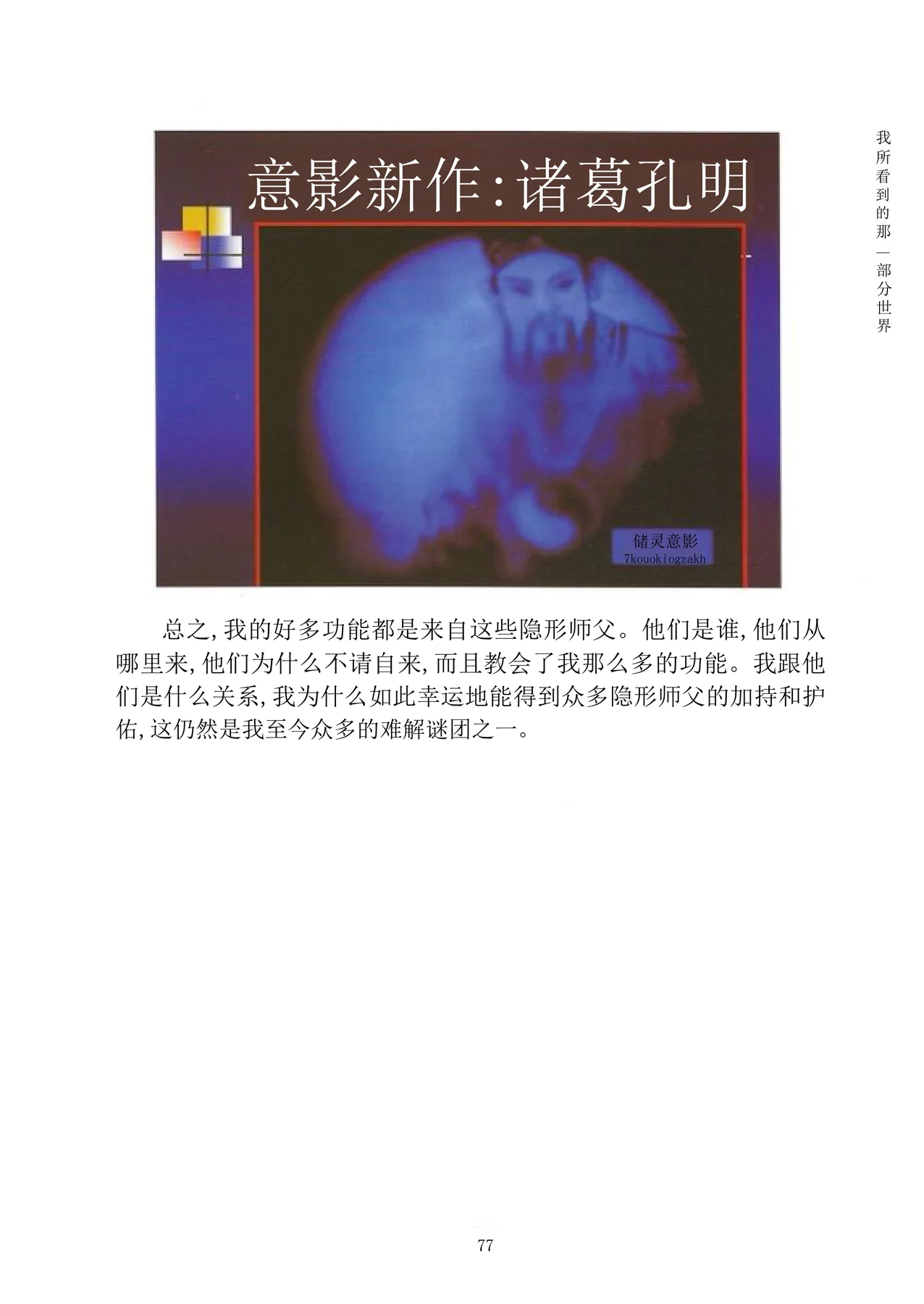
New Mind-Image Work: Zhuge Kongming
Chulin Mind-Image
7kouokiogzakh
In short, many of my abilities come from these invisible teachers. Who they are, where they come from, why they came uninvited, and why they taught me so many abilities — what relationship I have with them, and why I have been so fortunate to receive the empowerment and protection of so many invisible teachers — this remains one of the many unsolved mysteries for me to this day.
A Doctor Who Is Not a Doctor
I am not a doctor, but my abilities have helped me do many things that doctors cannot do.
I am not a doctor, yet I have genuinely treated many people’s illnesses and saved many people’s lives. Among these people were even many well-known doctors. And I truly am not a doctor, because I have never studied medicine and do not have a medical license.
After my abilities were discovered, I gained some small reputation in society. More and more people came to seek me out for medical consultations. At first, I mainly performed clairvoyant readings on people, checking what illnesses they had in their bodies. Then they would go to a hospital for further examination to confirm whether they truly had that illness, and then the hospital would treat them. For quite a long time, my main work was doing clairvoyant diagnoses for people. A chance encounter made me realize that I could also treat people’s illnesses.
That time, a female teacher at our testing center was riding her bicycle to the Huagong vegetable market to buy groceries. She accidentally fell off her bicycle and injured her knee. It swelled up greatly, making it very inconvenient for her to move around. When colleagues told me that this teacher had fallen and was resting at home, several of us teachers went together to visit her.
At her home, I saw that her knee was red and swollen — quite pitiful to see. She asked me whether I could treat it for her.
I said, “I’ve never treated anyone’s illness before, and I don’t know how to go about it. Let me ask my teacher tonight when I sit in meditation and practice, to see whether I can treat you.”
During my evening meditation, I asked my teacher. The teacher said, of course, and told me what method to use to treat her. The teacher told me to go to a certain tree on the hill behind the school, where there was a type of grass. I was to gather it, pound it to a pulp inside a turtle shell, and add a certain other substance to mix together, then apply it to the affected area. Exactly what tree, what grass, and what substance, I can no longer remember clearly now. At the time I thought, is this real? I was still a bit skeptical. But I thought, I’ll go search behind the hill and see whether that tree is there, and whether that type of grass is under the tree — then I’ll know. I went to search in the place the teacher indicated, and sure enough, there was that tree, and sure enough, there was that type of grass under it. By then I completely believed what the teacher had said. I followed the teacher’s instructions to the letter, and after applying it to that teacher, the swelling went down that very day, and within two days she was fully healed.
So later on, I not only diagnosed illnesses for people but also began learning to treat some difficult and complex cases. But whenever someone came to me for treatment, I would first ask my invisible teacher, and only after clearly asking about the treatment method would I dare to treat them.
Another time, a young teacher at our school library developed diarrhea after giving birth. She was having over twenty bowel movements a day, and it was nearly destroying her. Someone again came to ask me whether I could think of a way to help her. I again asked my teacher, and the teacher told me to use the sword-finger gesture plus intention to stop her diarrhea and stop her pain, and then gradually regulate her condition afterward. I followed what the teacher said, using the sword-finger gesture plus intention, and it truly stopped the diarrhea and the pain. But after I cured her diarrhea this time, my own stomach inexplicably started having diarrhea. Of course, it didn’t last many times and soon got better.
Later there were several more occasions where, after I treated someone, I immediately felt unwell and felt terrible. I quickly asked my teacher again. The teacher told me that in the future, before treating others, I should first seal my own acupuncture points, and I should add the intention to discharge the diseased energy from the patient’s body into the ground three feet below. After that, when treating others, paying attention to using these methods made things much better.
In terms of treatment methods, different illnesses and different situations call for different approaches. For example, when extracting tumors from people, sometimes it is pulled out all at once, while other times the tumor is first shrunk and then slowly eliminated. Over the decades, I can no longer remember how many tumors I have extracted in total.
The first time I extracted a tumor for someone, I think it was around 1991. Led by Yu Yonghong from the Human Science Research Institute, several of us went together to Haikou to treat a boss’s son. The child was about eight years old and had a tumor on his head. Extracting that tumor at the time was quite strenuous; it took a full week to slowly extract it. At the time, I could see the tissue paper in my hand was bloody, with many dark blood clots, but the original form of the tumor could not be seen. Later, the child was taken to the hospital for examination, and the tumor was indeed gone. The child’s father was extremely grateful and at once gave our research group 100,000 yuan as research funding to support our continued research.
Another time, probably around 1993, I extracted a tumor in Beijing for a middle school student around fifteen years old. That tumor was on his head, about the size of an egg, and was extracted all at once. The child’s mother was extremely grateful.
There was also a friend from the northeast surnamed Zhu, whom I met at a training class in Wuhan in 1992. Around the year 2000, she suddenly called and said she was feeling headaches. She went to the hospital for an examination and found that a tumor had grown in the brain stem area. Her family was especially anxious and was contacting a hospital to prepare for surgical removal. She asked me whether there was a way to treat it without surgery.
I said I would try. I told her that when I practiced in the evening, I would do a “remote treatment” — that is, without being physically present, I would use intention to treat her from a distance — and I asked her to focus her intention on me treating her at that time. After I treated her for three consecutive evenings, she said her head no longer hurt. I then
I told her to go to the hospital for a check-up in about ten days or half a month to see how things stood. After more than ten days — roughly half a month later — she called to tell me that she had already been to the hospital for an examination, and the tumor in her brain was gone. Her entire family was overjoyed and deeply grateful. At the same time, another extraordinary phenomenon occurred in this case. When she wanted to take out the films from her earlier examination for comparison, the tumor image on the original films had disappeared as well. In other words, even the shadow of the tumor on her previously taken films had been pulled out. This phenomenon is truly puzzling.
In my practice, it seems that tumors in children are relatively easier to extract, while those in adults are more difficult. Perhaps it is because children’s minds are simpler and easier to communicate with, unlike adults whose minds are so complex and full of too many thoughts. But not all tumors can be extracted. Some tumors took a great deal of effort yet still could not be pulled out. I do not know the reason — perhaps my ability was insufficient, or perhaps that particular tumor simply could not be extracted.
In terms of the concrete process, such as extracting a tumor, after I add my intention, my sensation is that my hand reaches into the patient’s body and directly pulls the tumor out. Sometimes one can actually see a bloody tumor being pulled out of the patient’s body, and it is even shown to the patient or the patient’s family. But sometimes I see that it has been extracted, yet the patient cannot see it; and after a hospital examination, the tumor has indeed disappeared. For things like expelling stones and clearing blockages in blood vessels, I mostly use my hand to directly grasp them. Sometimes I also use intention to imagine it shrinking, shrinking, and shrinking further; in this way, after several treatments, the tumor, stone, or blockage in the blood vessel gradually disappears.
One year, the former Party Secretary of our school (already retired at the time) developed a kidney stone, roughly the size of a broad bean, and I used intention to translocate it out. Another colleague at our school had a urethral stone. I used intention to shatter the stone, and then he slowly passed it through his urine. Later, he collected the expelled stone fragments and filled an entire small penicillin medicine bottle with them.
During the course of treating illnesses, some peculiar phenomena were also discovered.
At our school’s archive center, there was a female teacher surnamed Li. During one physical examination, a tumor was found growing on her back. She told her colleague at the time, “Tomorrow I’ll go find Sun Chulin to help me remove this tumor.” Unexpectedly, that very night after she said this, she had a dream in which she saw me go to her home and pull the tumor off her back. As a result, when she woke up the next day, she saw that the tumor on her back was truly gone. But I knew nothing about this — I only learned about it when she told me later.
This truly is a case of “what one thinks about by day, one dreams by night.” The person who went to help had unconsciously sent a double to do the work, while she herself was completely unaware. The power of this intention is truly great.
In addition, this includes helping people remove illnesses caused by negative information. Generally, through the method of persuasion and working things through, I have those negative information entities leave and send them to where they ought to go; before long, the person’s illness clears up.
Another method is the time-reversal method: using intention to imagine the patient returning to their youthful state, back to the era before they had developed a tumor. Doing this several times causes the patient’s tumor to disappear as well.
I have a friend who is also a person with extraordinary abilities. We gave her the nickname “Chen Da Yan” (Big-Eyes Chen), because her eyes are especially large and also very beautiful. A friend of hers fell ill and was hospitalized; she had not had a bowel movement for many days and was extremely uncomfortable from the blockage. The hospital had no way to help and had even issued a critical-illness notice. Her friend even told Chen Da Yan that only I could treat her illness. Chen Da Yan said to me, “Could you find time to go see her?” Since we were both people with extraordinary abilities and were fairly well acquainted, I agreed to go take a look.
The next day, Chen Da Yan drove to pick me up and brought me to the hospital to see her patient, and only then did I learn she had cancer. At the time, I aimed my Sword Fingers at the site of her intestinal blockage and added intention, treating her for about half an hour until it was cleared. Soon after, she passed a large amount of feces and immediately felt much more comfortable. Subsequently, I continued treating her for six or seven more sessions, and she was discharged from the hospital to recuperate at home. Later, Chen Da Yan again drove to pick me up to help treat her several more times. But because the road was too far and it took a great deal of time, I asked my Master whether there was any better method. My Master taught me a method: she was to buy twenty-eight eggs, and after I processed them with intention, she should use the hard-boiled, peeled eggs to roll back and forth over the affected area, using the eggs to slowly draw out the diseased qi. After treating this way for a period of time, her affected area healed. Her parents and she herself were all extremely grateful, saying I had given her a second life. What is even more incomprehensible is that after the illness was cured, her blood type also changed. She was originally type A blood, and later it became type B — truly incomprehensible.
During treatment, if I can generally see the person on-site, I treat them on-site. Sometimes the patient is not present, and due to severe illness or a long distance it is inconvenient, so I use the method of long-distance “remote treatment.” For example, if the patient is in Shanghai and I am in Beijing, or the patient is in Japan or the United States, I can likewise treat them through the method of remote treatment. This is primarily done using the intention method, imagining that I have gone to the patient’s side or that I summon the patient over to treat them. I believe the effect of “remote treatment” is the same as treating on-site. What differs is the patient’s state of mind — that is, the psychological factor. If you are right beside them treating them, it feels better to them. During “remote treatment,” the patient cannot see or touch anything; they do not
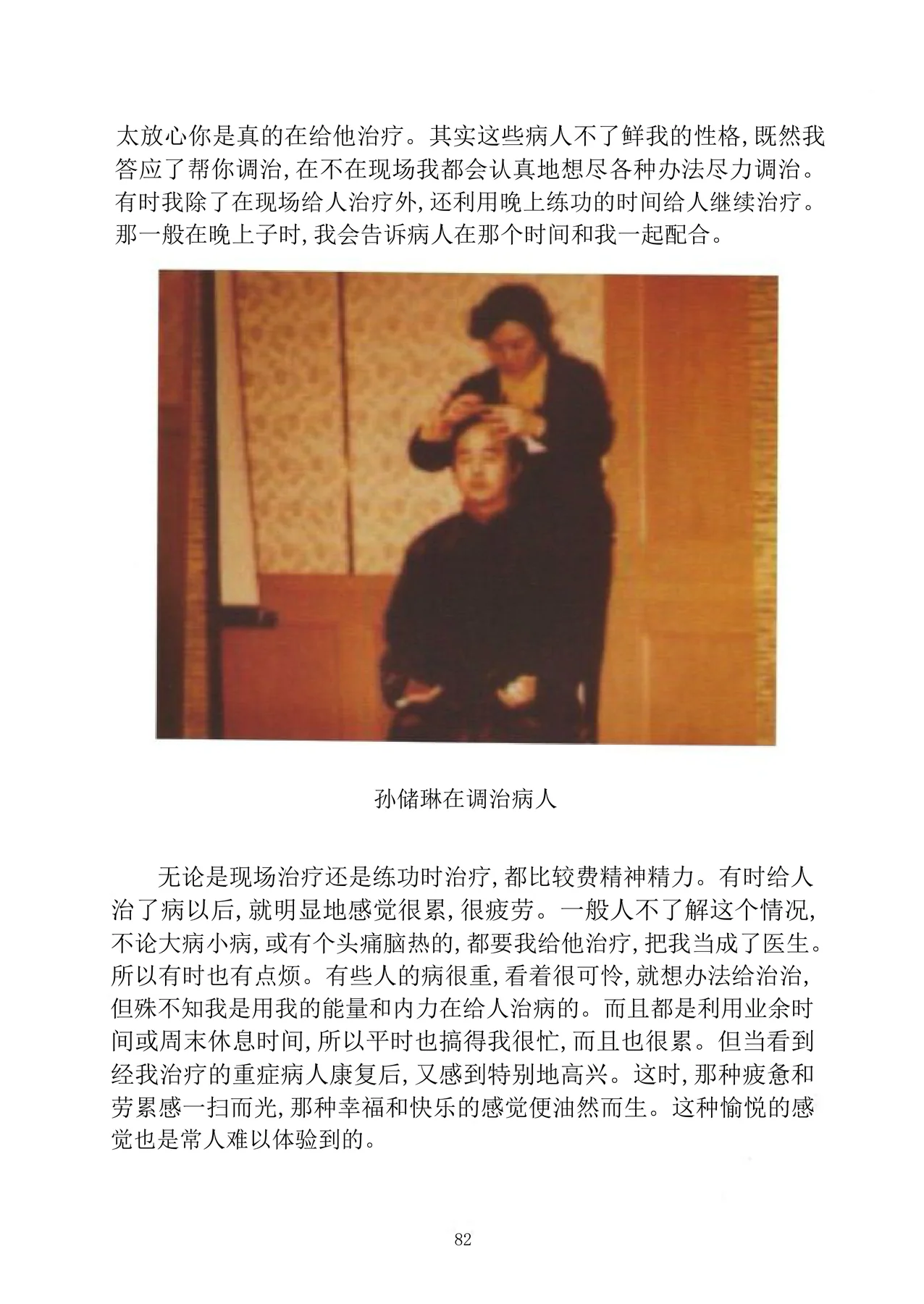
too reassured that I am truly treating him. In fact, these patients do not understand my personality—once I have agreed to help treat you, whether I am present on-site or not, I will earnestly think of every possible means and do my utmost to treat you.
Sometimes, in addition to treating people on-site, I also continue treating them during my evening practice sessions. That generally takes place during the zi hour [11 p.m.–1 a.m.] at night, and I would tell the patient to coordinate with me at that time.
Sun Chulin treating a patient
Whether treating on-site or during practice sessions, it is quite draining of mental and physical energy. Sometimes, after treating someone’s illness, I would feel noticeably tired and fatigued. Most people are unaware of this situation—regardless of whether it is a serious illness or a minor one, or even a simple headache or slight fever, they all want me to treat them, treating me like a doctor. So sometimes it is also a bit annoying. Some people’s illnesses are very severe, and seeing them looks pitiful, so I find ways to give them some treatment—but little do they know that I am using my own energy and inner strength to treat people’s illnesses. And all of this is done during my spare time or weekend rest time, so normally it keeps me very busy and also very tired. But when I see a seriously ill patient recover after my treatment, I feel especially happy. At that moment, all sense of exhaustion and fatigue is swept away, and a feeling of happiness and joy wells up spontaneously. This feeling of delight is something ordinary people can hardly experience.
Speaking of my ability to examine, adjust, and treat illnesses in others, what I have described above is all factual. But there is a very peculiar phenomenon that I must also tell everyone about: I often cannot detect in time, nor cure, illnesses in myself and my loved ones.
We people with extraordinary abilities seem to have something similar to the doctors’ saying that “a doctor does not treat himself.” I had heard before that doctors generally cannot treat their own family members, much less themselves. This phenomenon seems to apply equally to those of us with extraordinary abilities. It is also like the common joke people tell—that a fortune-teller can never predict his own fate.
In 1994, during the annual routine physical examination at my father’s workplace, it was discovered that he had stomach cancer, and it was already in the advanced stage. This was truly a bolt from the blue for me. I never imagined that my father would get cancer. For many years, my father had always been in good health and had never been sick. My clairvoyant ability was already very strong at that time, but it had never occurred to me to give my father a physical examination.
Facing my father’s serious illness, my mind was in turmoil and I was completely helpless. At that moment, none of my abilities would manifest at all. We could only listen to the hospital doctors. Because it was already advanced, in less than half a year, I watched helplessly as my father left us.
When it comes to my own illnesses, my abilities do not seem to be of much use either. In the past, because I was in good health and rarely got sick, I did not feel this very acutely. This is something that has only happened in recent years—otherwise, I am afraid even I would not have believed it.
Since the Spring Festival of 2012, starting from a cold, I had intermittent fevers that lasted nearly two months, and my weight dropped by more than ten kilograms. When the fever first started, it was the third day of the first lunar month. That night, I had a high fever of thirty-nine degrees. The next day, the fever subsided during the daytime, but by evening it flared up again. Because I had always been in good health and rarely caught colds or fevers, I did not pay it much attention. I thought I would just let it run for a few days. I did not even take cold medicine at the time. I recovered for two days in between, but within a couple of days the fever returned.
Later I took some antibiotics and improved for another two days. It went on like this, back and forth, for nearly two months. Later, when I went to the hospital for an examination, it turned out to be just a urinary tract infection. It took several days of antibiotics to bring the fever under control. And after I fell ill, my abilities were virtually of no use—I neither knew what illness I had nor how to control the fever. At first, I thought I could rely on my abilities to push through it, or use my abilities to adjust and regulate myself. Who would have expected that after dragging on for a while, my body became depleted, and I lost even the capacity for self-regulation. In the end, it was still the hospital that resolved the
problem through a combination of Chinese and Western medicine.
Looking at these two incidents, it appears that people with extraordinary abilities also experience the situation of “a doctor not treating himself.” As for why this happens, my understanding is, first, that it is still a matter of insufficient level of ability and insufficiently high energy; and second, that it is still related to one’s own spiritual cultivation—one’s attachment to family affection and to “ego-attachment” (wo zhi) is too heavy, making it impossible to step outside the mental circle of family affection and ego-attachment, and rendering one unable—or at least unable to remain sufficiently objective—in diagnosing the condition, let alone daring to apply treatment. If one could reach a state of selflessness and non-discrimination, the situation might improve somewhat.
The Long Road of Scientific Research
This may be the mission entrusted to me by the era. Because I live in this era of relatively advanced technology. Although the many technological means available still cannot explain these phenomena, modern people only believe in science, so we must keep using technological means to continue the research. Of course, this may also be the task assigned to me by Heaven.
From the discovery of my extraordinary abilities, to the establishment of a human-body science research office at the school to study my extraordinary abilities, to now, more than thirty years have already passed. In 2009, a symposium was held in Beijing to commemorate the thirtieth anniversary of human-body science research in our country. From the time my abilities were discovered and research began up to the present, I have been both the subject of research and, simultaneously, a researcher of my own abilities. Just how many abilities I possess—some say over sixty kinds—exactly how many there are, and what method of classification would be more scientific, I myself cannot say clearly. If I now tentatively classify them according to the technical terminology used by scientists, they can be roughly divided as follows. Of course, this classification is not necessarily scientific; it is merely for the convenience of description.
1. Mental Clairvoyance
The so-called mental clairvoyance refers to the ability of a person with extraordinary abilities to use their intention to see through the exterior surfaces of various objects and observe their internal forms. That is, using intention to see things that the human eye cannot directly see. It is somewhat similar to the X-ray clairvoyance function in hospitals, hence it is called mental clairvoyance.
The projects we first began researching were also mainly clairvoyance. This was also one of the abilities for which, after the discovery of my extraordinary abilities, I did the most experiments and demonstrations at the very beginning, and which had the highest success rate.
1.1 Clairvoyant Perception of Hidden Text and Images
Generally, during experiments or demonstrations, text or drawings prepared in advance on paper would be crumpled by hand into a ball, or folded in multiple layers, sometimes sealed in opaque envelopes, placed inside various boxes or drawers. Then, under the monitoring of numerous camera devices, under the watch of many people—one could say under the gaze of a crowd—the person with extraordinary abilities would either touch the object directly to perform clairvoyance, or, from a distance of several meters away, use intention to perform clairvoyance. I have done this kind of experiment and demonstration at least several hundred times, and in the vast majority of cases I was able to perceive the contents.
The clairvoyance process generally goes like this. Sometimes I first hear a “buzzing” sound in my ear; sometimes the sound and the text appear simultaneously. At the very beginning, the characters I see are also disordered—for example, I first see individual strokes, then radicals and components, and only then does the complete character appear. It is a gradual process of recognition. At first, I did not know exactly which part of my body was doing the recognizing, so I would often place the object to be clairvoyantly perceived beside my ear to look at it—for instance, when clairvoyantly scanning a human body, I would press my ear against the area to be examined, or use my hand to touch it. Later, I understood that this was not something heard with the ear or felt with the hand, but something seen with intention. From then on, I no longer used my ear to listen or my hand to feel; I only needed to think about that paper ball or about what was inside that box with my intention.
During the clairvoyance process, generally the first thing to appear is something like a television screen at the center of the forehead between the eyebrows of the person with extraordinary abilities—some call it the Heavenly Eye point (tianmu xue), others call it the Yintang point. On this screen, the characters to be clairvoyantly read, or the object, or a certain part of the human body, gradually appear.
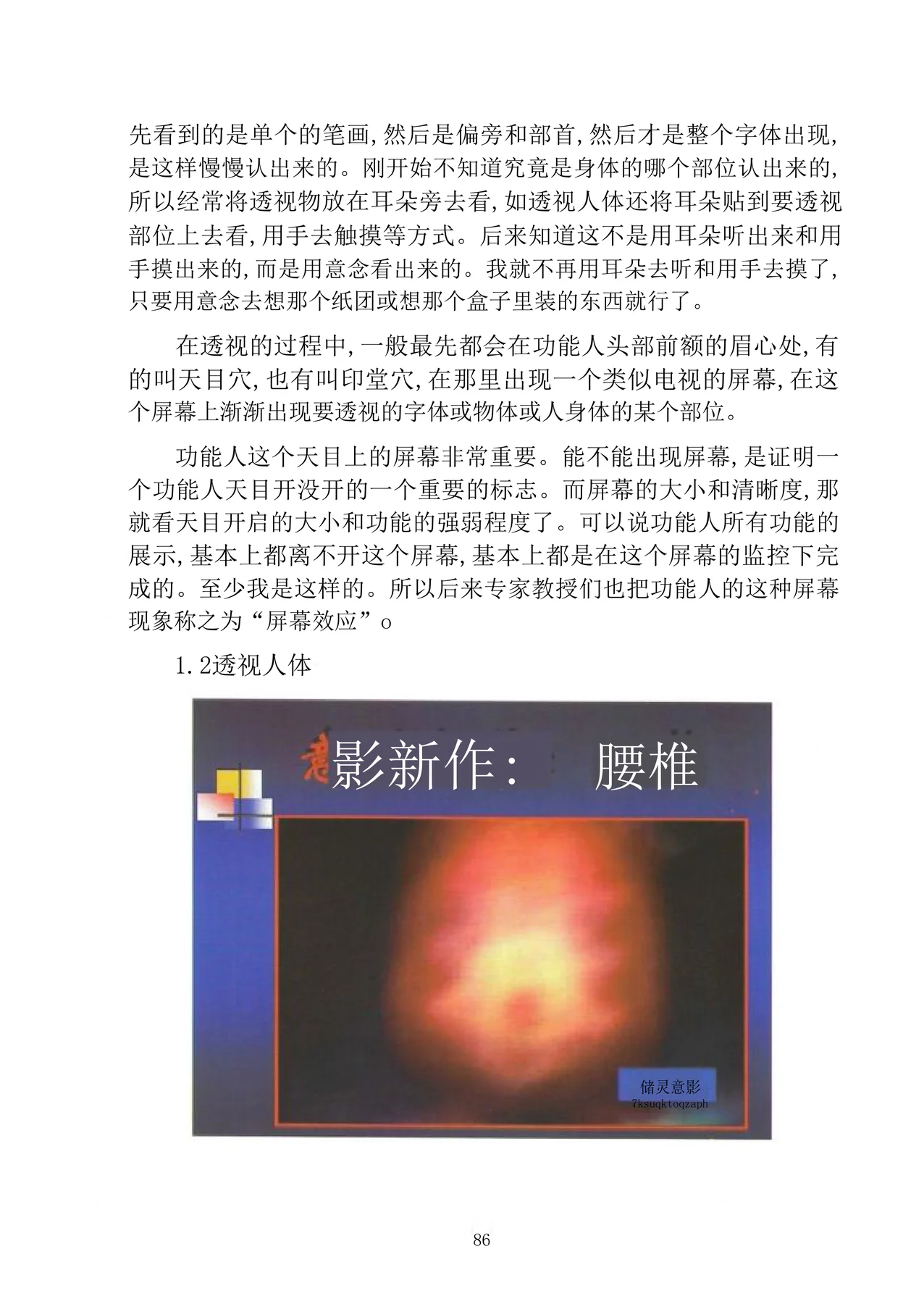
This screen on the Heavenly Eye of the person with extraordinary abilities is extremely important. Whether or not a screen appears is an important indicator proving whether a person with extraordinary abilities has opened their Heavenly Eye. And the size and clarity of the screen depend on the degree to which the Heavenly Eye has opened and the strength of the ability. One could say that the manifestation of all the abilities of a person with extraordinary abilities basically cannot be separated from this screen, and is basically accomplished under the monitoring of this screen. At least, that is the case for me. So later, the experts and professors also called this screen phenomenon of people with extraordinary abilities the “screen effect.”
1.2 Clairvoyant Scanning of the Human Body
New imaging work: Lumbar vertebrae — Chulin’s psychic image
As for clairvoyant scanning of the human body, at first I did not understand it well and would press my ear against the part of the body to be examined, which was very inconvenient. Later, I also learned that I could simply observe directly with intention. In order to understand clearly which parts of the human body were normal and which were abnormal, I even went specially to a hospital to study and learn the locations and normal states of the five zang organs and six fu organs, and observed the conditions of some healthy people for comparative identification. This way, during clairvoyant scanning, it was easier to see which internal organ had developed an abnormality or pathology in which location.
Clairvoyant scanning of the human body could also be said to be one of the abilities for which I did the most experiments and demonstrations. And it was also one of the primary means by which I later diagnosed and treated people’s illnesses.
In order to treat someone’s illness, one must first further confirm the hospital’s diagnosis. This requires performing a clairvoyant scan of the patient’s lesion to confirm the diagnosis. After the diagnosis is confirmed, treatment must also rely on clairvoyant perception—various methods of treatment are carried out on the basis of monitoring through the Heavenly Eye screen of the person with extraordinary abilities. Therefore, mental clairvoyance is the foundation or prerequisite for a person with extraordinary abilities to exercise many other abilities.
For example, when people often invite me to dinner, or say they want to invite me for tea, or to sit somewhere for a while, I know full well that these are not occasions I can casually attend—they all involve asking me to look at someone or answer someone’s questions. So generally speaking, the meal is not so easy to eat, and the tea is not so easy to drink. But when friends extend an invitation, it is generally not easy to refuse them and save face, so I have no choice but to go.
Once at the dining table or the teahouse, while not everyone has arrived yet, or during casual conversation, I scan each person one by one, getting a general look at everyone present. For whoever happens to be the key person to examine that day, I take a few extra glances, and by then I basically have a good idea in my mind. So they often joke and say, “In front of you, Teacher Sun, we are all naked—there is nothing we can hide.”
However, this statement is both right and not entirely right. It is right in that when I focus my attention on you and perform a clairvoyant scan, you are indeed laid bare before me, fully exposed. It is not entirely right in that when I am not focusing on you and not performing a clairvoyant scan on you, I also have absolutely no idea what you look like underneath your clothes.
So people can rest assured. There is no need to be frightened the moment you see a person with extraordinary abilities, thinking that they can see everything on your body—that is actually not the case. Moreover, people with extraordinary abilities do not have that much energy and mental stamina. Unless someone seeks them out, they will not casually perform scans on people. Because clairvoyant scanning of the human body consumes a great deal of energy, and using it too much will also harm one’s own body. So please, everyone, rest assured—there is no need to be so afraid of people with extraordinary abilities.
If the meal begins, I always keep my head down and focus on eating first, making sure I fill my stomach before anything else. Otherwise, once people start asking questions, there will be no way for me to eat. Because at that point, eating and…
clairvoyance — the two are hard to do together. Sometimes people genuinely want to treat me to a meal, and ask a few questions along the way. If I haven’t seized the opportunity beforehand, or if no such opportunity to eat was given to me from the start, once the clairvoyance begins I often find myself looking at a table full of dishes with no appetite. So even though it seems like I’ve been eating for several hours, my stomach is still completely empty. If it’s a very familiar friend, I’ll say bluntly: don’t rush, let me fill my stomach first. Only with a full stomach do I have the energy and spirit for clairvoyance.
1.3 Clairvoyant Viewing of Underground Objects
Carrying out clairvoyant mineral exploration underground mainly involves using mental intent to conduct deep-level clairvoyant probing of underground mineral deposits, so that the composition and approximate reserves of the underground minerals are then displayed on the Heaven’s Eye screen. The accuracy rate can reach about 70%. For deep underground clairvoyance, the maximum depth can reach approximately 3,000 meters.
It was probably around 1989 when Professor Shen took me, Zhao Xiaodong, and several other individuals with extraordinary abilities, along with several professors, to the Jianghan Oil Field to prospect for petroleum. After arriving there, we first performed for their leaders — bending metal rods through mental intent, piercing holes in toothpaste tubes through mental intent, and diagnosing illnesses for the people present — all quite successfully. Then we went out to the field site to conduct clairvoyant viewing of the underground oil field. The results of our viewing were essentially consistent with what the experts had determined through drilling analysis.
Sometimes we were also invited to help locate unknown underground objects. For example, once we were invited by the Hubei Provincial Electric Power Company to find underground pipes beneath the Wuchang Power Plant on the banks of the Yangtze River. This power plant had been built during the period when Japan occupied China, and the pipes were said to have been buried during the Japanese occupation. We located them accurately as well.
On another occasion, probably in 2006, a coal mine owner from northeastern China invited me to his mining area to assess the safety situation there. I also took the opportunity to look at the reserves and distribution of coal beneath his mining area. As for the results of his subsequent extraction, I did not follow up, so I cannot say.
All in all, not many individuals with extraordinary abilities perform underground viewing. In practice, this kind of underground viewing is strenuous and demanding, and for those of us with such abilities, the energy consumed is considerable. Most people are unaware that you have this ability, and since it is also very energy-consuming, we rarely perform underground mineral-exploration clairvoyance.
2. Mechanical Effects
The so-called mechanical effects refer to the various degrees of mechanical efficacy produced when human mental force acts upon objects. We call these human mental-force effects, abbreviated as mechanical effects.
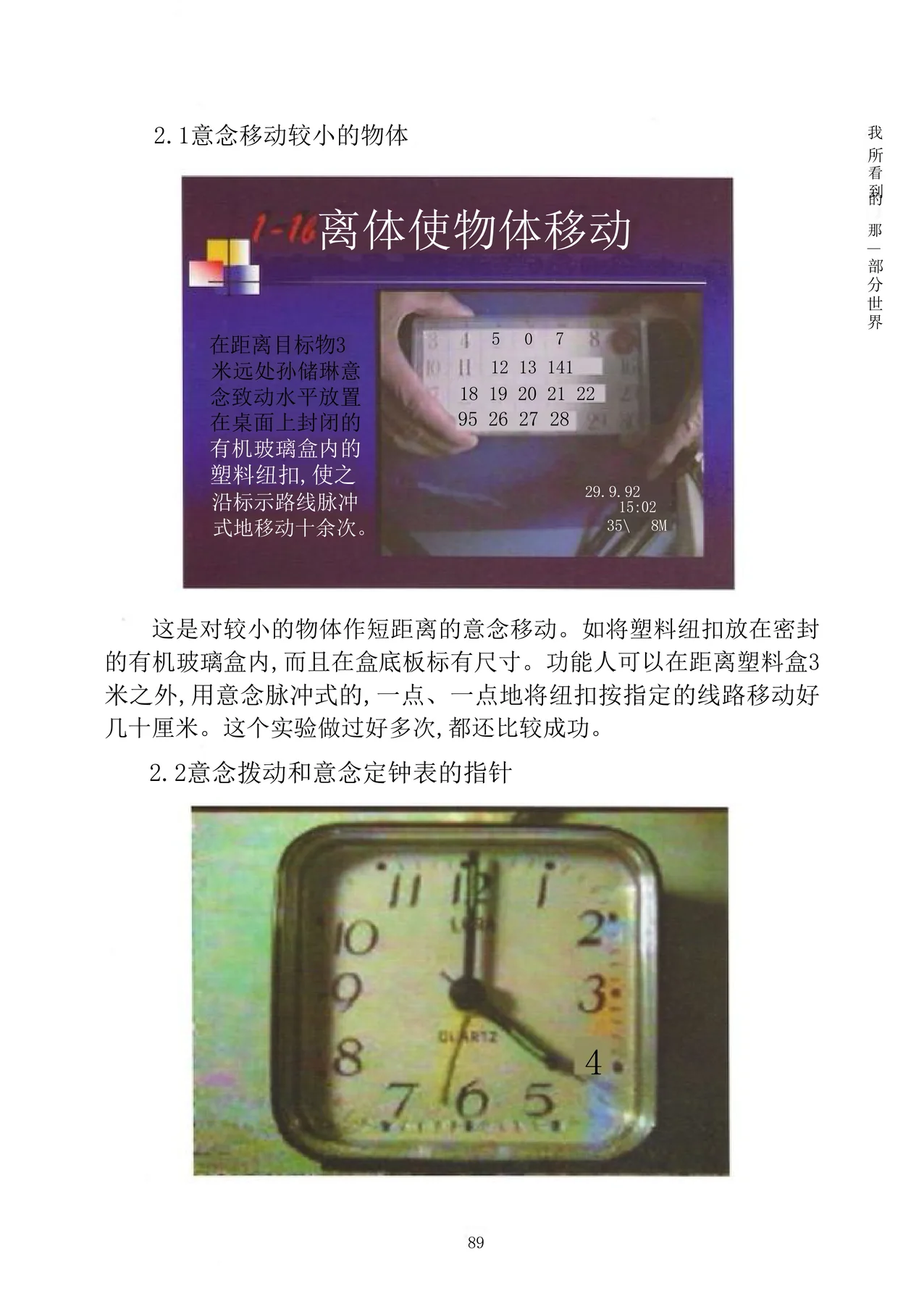
2.1 Mentally Moving Small Objects
At a distance of 3–5 meters from the target object, Sun Chulin uses mental intent to psychokinetically move a plastic button inside a sealed acrylic box placed horizontally on a desktop, causing it to move in a pulsed fashion along the marked route more than ten times. 29.9.92 15:02
This involves the short-distance mental movement of small objects. For example, a plastic button is placed inside a sealed acrylic box, and the bottom plate of the box is marked with measurement graduations. The person with extraordinary abilities can, from a distance of more than 3 meters away from the plastic box, use mental intent to move the button in a pulsed fashion — bit by bit — along a designated path for dozens of centimeters. This experiment has been performed many times with fairly good success.
2.2 Mentally Moving and Stopping Clock Hands
I found the feel for this ability after being inspired by someone else.
It was probably around 1988 when one day, my colleague’s boyfriend came from Beijing to Wuhan Geological University to visit her, and we all went together to Professor Shen’s home to hang out. Her boyfriend was skilled in qigong, and he said he could use his internal qi to move the minute hand of a wristwatch. Hearing him say this, Professor Shen immediately took off his own watch and handed it to him, asking him to perform a demonstration on the spot. We watched him take the watch, open the watchband, hold one end of the band in each hand, and raise both hands above his head, with the watch nearly touching his hair. We then saw him exert his effort, his face turning red and flushed, and this continued for about twenty minutes. Indeed, he had moved the minute hand forward by one hour. While watching him do this, I had already found some of the feeling, and I sensed that it shouldn’t require so much effort.
The next day I told Professor Shen that I wanted to try it too. The professor took off his watch and gave it to me. I imitated the man’s posture, holding the watchband with both hands, raising them above my head, and with mental intent I moved it forward by two hours in one go. This was my first attempt at moving the minute hand, and I succeeded. On my second attempt, I placed the watch on the table without touching it, looked at it with my eyes, and used mental intent to move it forward by one hour.
It was probably right before the Spring Festival of 1990. At that time, the experts and professors engaged in human-body science research all had to report their work to the National Leading Group for Human-Body Science Research, and the individuals with extraordinary abilities participated together. At the meeting, Liu Xinyu demonstrated mentally stopping the second hand — that is, wherever you were asked to stop it, you had to stop it there. Liu Xinyu asked where it should be stopped this time, and Director Wu Shaozu said, “Just stop it at the 10 o’clock mark.” Following this requirement, Liu Xinyu stared at the wall clock, and sure enough, the second hand stopped at the 10 o’clock position. It was done very successfully.
On one occasion, Liu Xinyu performed a demonstration at the dinner table of mentally stopping the second hand of a watch. Among those present watching the performance were the veteran film actor Zhao Ziyue and the young actor Liang Tian, among others. That performance was very successful. The veteran artist Zhao Ziyue, already over eighty years old that year, said with some excitement: “I’ve lived to this great age, and I truly have never seen such a wondrous thing.” He was beaming so widely he couldn’t close his mouth.
When I watched Liu Xinyu’s performance, I already had some of the feeling. I told Professor Shen, who was sitting beside me, that I had already found ninety-five percent of the feeling, and the remaining five percent was just a matter of execution. I said that after we went back, I would demonstrate it for him.
Later, when I performed this kind of experiment in the laboratory, I was already thoroughly adept at it. For example, in the experiment of stopping the second hand of a wall clock — going forward from 1 o’clock downward and stopping at 3 o’clock, it would stop at 3; going in reverse from 6 o’clock downward to 9 o’clock, it would stop at 9. Stopping it forward or in reverse both worked, and I could hold it stopped for however long I wanted.
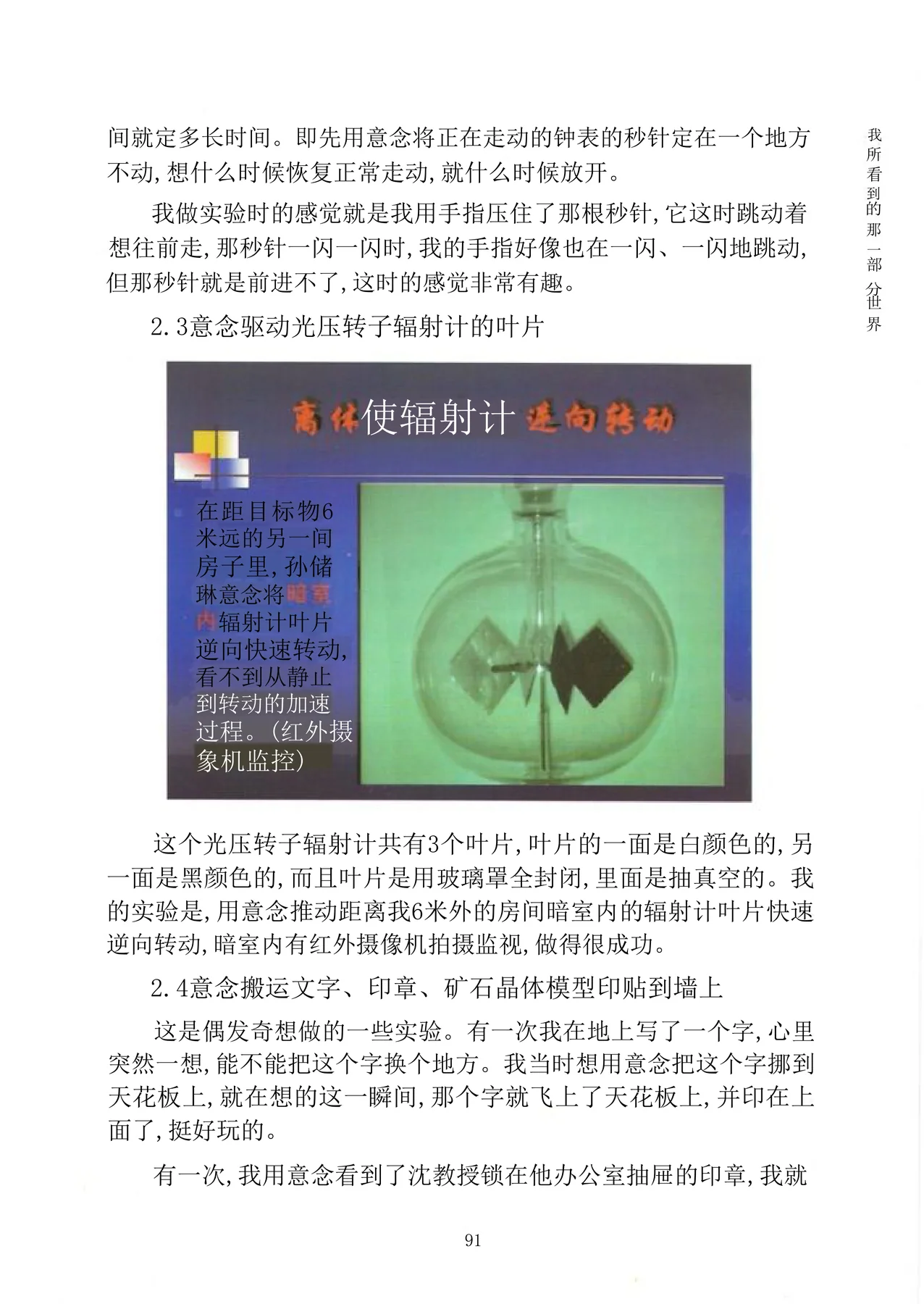
fix it there for as long as you wish. That is, you first use your intent to hold the moving second hand of a clock fixed in one place, so it does not move; when you want it to return to normal movement, you simply release it.
My sensation during the experiment is that I use my finger to press down on that second hand. It then tries to move forward, twitching as it does so. As the second hand flashes on and off, my finger also seems to flash and pulse along with it, yet that second hand simply cannot advance. The feeling at that moment is very interesting.
2.3 Using Thought to Drive the Vanes of a Light-Pressure Rotor Radiometer
Sun Chulin, in another room six meters away from the target object, used her intent to rapidly reverse-rotate the radiometer’s vanes. No acceleration process from stationary to rotating could be observed. (Monitored by an infrared camera.)
This light-pressure rotor radiometer has three vanes. One side of each vane is white, and the other side is black. Moreover, the vanes are fully enclosed within a glass cover, and the interior is evacuated. My experiment was to use my intent to drive the radiometer vanes six meters away from me in a darkroom to rapidly rotate in the reverse direction. An infrared camera inside the darkroom was used for filming and monitoring. It was done very successfully.
2.4 Using Thought to Translocate Characters, Seals, and Mineral Crystal Models and Imprint Them onto a Wall
These were experiments I did out of occasional whimsy. Once, I wrote a character on the ground, and it suddenly occurred to me—could I move this character to another place? At the time, I wanted to use my intent to move that character up to the ceiling. In the very instant I thought of it, that character flew up onto the ceiling and was imprinted there. It was quite fun.
Once, using my intent, I saw the seal that Professor Shen had locked in his office drawer. I then
thought about using my intent to stamp it onto the ceiling, and with just that thought, the seal did indeed stamp up there. After it was stamped, the seal returned to its original drawer. On another occasion, I saw a mineral crystal model folded from paper that Professor Shen had made. Again, with just a thought, I translocated and affixed it onto the ceiling.
This ability was just something I found quite fun. I did it occasionally, five or six times in all, and did not do it much.
2.5 Long-Distance Object Translocation by Thought
Whether in experiments, demonstrations, or in ordinary use of this ability to solve practical problems, this is a function I have exercised quite frequently. On multiple occasions during formal experiments, I translocated watches, coins, or rings from a dormitory over a thousand meters away into the drawer of an office. Since the watches and rings translocated previously were all my own belongings, people considered the experiments not sufficiently rigorous.
On one occasion, Zhao Pengda, the president of our Wuhan University of Geosciences, said that he had a confidential drawer in his office—the middle drawer of his desk—which was a very well-sealed confidential drawer. Once locked, there were virtually no gaps on any of its four sides—front, back, left, or right—making it difficult even to slip in a sheet of paper. Furthermore, only he had the key, and he always kept it on his person, making cheating impossible. The president also said that he was about to go on a business trip for a month and told us to conduct experiments during that time—we could do the translocation whenever we wished, and he would verify upon his return. After the president left, Professor Shen gave me the one and only Mexican coin from his home, and together we went to Nanwang Hill behind the university. There, I used my intent to translocate the coin in my hand into the president’s confidential drawer in his office.
My sensation at the time was that it had been moved—that it had been placed into a small box inside that drawer. A month later, the president returned, and we told him that a foreign coin had been moved inside. The president opened the drawer but could not find it. I then told him it should be in a small box. The president opened the small box and looked—sure enough, there it was. This was one translocation experiment that left a deep impression on me; it was a very rigorous experiment.
I have also translocated objects over even longer distances on many occasions. This was mainly to help people solve practical problems. For example, I could use my intent to translocate objects from thousands of li away. Once, a friend of mine lost a stack of very important photographs in the southern city of Guangzhou. I used my intent to translocate them back. The scene at that moment was: that stack of photographs flew in through the closed window from outside and landed on the floor, giving my friend a tremendous fright. He cried out: “Wow! You’re really incredible!”
On another occasion in Sanya, a very good friend of mine had placed some important receipts and identification documents inside a package of the kind of paper napkins commonly used in restaurants. While discussing business in a cabinet-making shop, he had set them on the counter and then completely forgot to take them when he left. It was only after returning home that he realized the items were missing, and he was terribly anxious. That day I was in good form. As soon as I relaxed and entered a quiet state, I took a look—
I then discovered that her bag was still on the counter of that shop, because the shopkeeper assumed it was just a pack of napkins and did not pay it any mind. I then tried to see whether I could translocate it back. Before long, I saw that napkin pack slowly float up. I said, “Come here, come here,” and before long it was in my hand. When I handed the bag to my friend, she was exceedingly grateful.
Another time, a friend from Hubei could not remember where he had put his passport for going abroad and could not find it anywhere. During one session of qigong meditation practice, I helped translocate it back for him.
There were two other translocation incidents that were quite interesting. Once, Professor Shen accidentally lost his bicycle key, which also had a small ornament attached to it. He muttered about it a couple of times in front of me, and I did not take it too seriously. I thought to myself that a bicycle key was just a trivial little thing, hardly worth my effort to translocate. About half a month later, several of us were together in the office. When I happened to look up, I spotted Professor Shen’s bicycle key appearing in the air in front of me and slightly above. I reached out and grabbed it. I happily told Professor Shen, “Your key — I’ve translocated it back for you.” Professor Shen looked at it and said, “Hey, it really is my key!” He was so happy he shouted out like a small child.
Another time, again it was Professor Shen who had lost his camera. Cameras were still quite valuable in those days, and he felt very upset about it. He asked me whether I could find a way to translocate it back. I said I would take a look during my evening practice. During my evening practice, I saw that his camera had been left in the basket on the front of his bicycle — he had forgotten to take it back — and had been taken home by a young man who looked like a student. After I saw the camera, I tried to translocate it over. When I saw that it had already been translocated to just outside our home’s window and was about to come in, for some reason it could not get through and suddenly fell onto the windowsill outside. I got up, opened the window, and casually brought it inside. This translocation may have failed to complete because my energy was insufficient, or perhaps because at that moment I was thinking the camera was almost home, and my mind wandered from the excitement — so it was blocked by the glass and could not enter. The next day, I handed the camera to Professor Shen, and he was absolutely delighted.
Generally speaking, to translocate an object, one must first locate where the object is, and only then find a way to translocate it over. When an object is being translocated, what I see through my celestial eye is a beam of light flying in from the sky. When the object arrives, the light disperses. This process can be seen not only by me but also generally by people who possess some extraordinary abilities. Sometimes when I do translocation demonstrations, when the object comes over, friends with abilities who are present will often call out: “It’s here, it’s here, I can see it!”
But sometimes, even after I have already spotted the object, I simply cannot translocate it back.
Once, my friend and I were watching a movie together at a cinema. When the movie let out, he felt a bit warm and wrapped the scarf from around his neck onto his wrist. As we walked along, he forgot about the scarf on his wrist. By the time we reached the entrance and felt the chill, he realized the scarf had been lost at some unknown point. It was a fine wool scarf given to by a good friend,
and he felt it was a shame to lose it. That evening during my qigong practice, I also wanted to try translocating it over. After relaxing and entering stillness, I could already see the scarf, but after attempting to communicate with it several times, I simply could not translocate it. Later I joked with him, saying it seemed this scarf was meant to be given to the person who picked it up.
Another time, a very good friend of mine in Beijing lost his bank card and wanted me to find a way to help get it back. I expended a great deal of effort but could only see the approximate location of the card, with no way to translocate it back. So it can be said that with some things, even if you can see them, it does not necessarily mean you can translocate them back. Perhaps this indicates that the object is no longer yours, or that it was meant to be lost.
2.6 Mentally Bending Objects
This ability was inspired by an Israeli gifted individual named Uri Geller. There is a small story behind this.
In those years, our university’s Human-Body Science Research Office was affiliated with the Testing Center of China University of Geosciences. Professor Shen had once purchased many books on qigong and explorations of the human body’s mysteries. Among them was a book called My Extraordinary Ability, written by the Israeli gifted individual Uri Geller, which he casually placed on the bookshelf of the Testing Center’s reading room.
One time, a young teacher at the Testing Center rode his bicycle to the reading room to read. He held his bicycle key in one hand while flipping through a book he had casually taken from the bookshelf with the other. This book was precisely My Extraordinary Ability by Uri Geller.
In the book there was a passage written like a poem, beautiful and captivating. The poem read: “Let such a conviction arise in our minds — that we can use the power of thought to achieve things we never felt we could do. Let us pick up a table knife, a key, a spoon, or anything of the sort, whichever we choose, and then concentrate our thoughts with full attention. Let your mind hold the unshakable conviction that what you wish to happen will surely appear before your eyes. Gently hold the fork or key in your hand, and begin silently repeating in your heart: bend, bend, bend, bend… Gently stroke the surface of the metal with your hand, while silently repeating in your heart: bend, bend. If the object bends, then be joyful and happy! Wish it to continue bending, and you become part of an extraordinary effect. This extraordinary energy lies deeply buried within many of us. If nothing happens, please do not feel disappointed, for not everyone possesses this extraordinary ability. It is also possible that the timing is wrong or the mood is poor — even I,
“nor is it infallible and effective every time.”
While that teacher read it, silently reciting and appreciating the poem in his heart, he entered wholeheartedly into the realm of that poem and was completely captivated by it. And at that moment, a miracle occurred: the teacher suddenly discovered that the bicycle key in his hand had, at some unknown point, bent. He immediately reported this phenomenon to Professor Shen, saying that the power of thought was truly inconceivable. Professor Shen immediately took the book back and asked us to do an experiment.
That day, another person with extraordinary abilities and I were in the office. Professor Shen found from somewhere two keys that were probably no longer useful, and asked each of us to hold one clasped in our hands. Then he said, “I will recite Uri Geller’s poem, and you two just hold the keys in your hands, listen, and try to get a feel for it — see whether you can bend them.”
When Professor Shen recited, I listened earnestly and quickly entered the state. Just as Professor Shen finished reciting, the key in my hand truly bent. But the other person with extraordinary abilities may not have been sufficiently focused at the time, or perhaps her power of mental intention was not strong enough, so the key in her hand did not bend.
My experience at the time was this: the first few lines of the poem serve as a kind of guided induction, gradually bringing you into a state of stillness. The key lies in the fact that after you become still and relaxed, you silently recite the words “Bend, bend.” These two phrases are the most effective — it is the power of this mental intention that causes the object to bend. Of course, the preceding guided induction that brings you into the state of stillness is also a very important preparation.
Later, someone raised a doubt: if you hold a key in your hand and rub it back and forth until it gets warm, you could secretly bend it by hand when no one is looking — that’s also possible. To eliminate this doubt, Professor Shen placed a spoon or key inside a glass, making it impossible for the hand to come into contact with the object to be bent. I could only rub the outside of the glass, or not rub the glass at all, operating entirely by mental intention. Under both conditions, I equally succeeded in bending the spoon or key.
This also shows that when we conduct bending experiments, the act of rubbing with the hand is actually merely an external auxiliary form. What truly takes effect is in fact entirely the power of mental intention, not some other external force acting upon the object to bend it. This experiment and demonstration were later performed probably more than a hundred times.
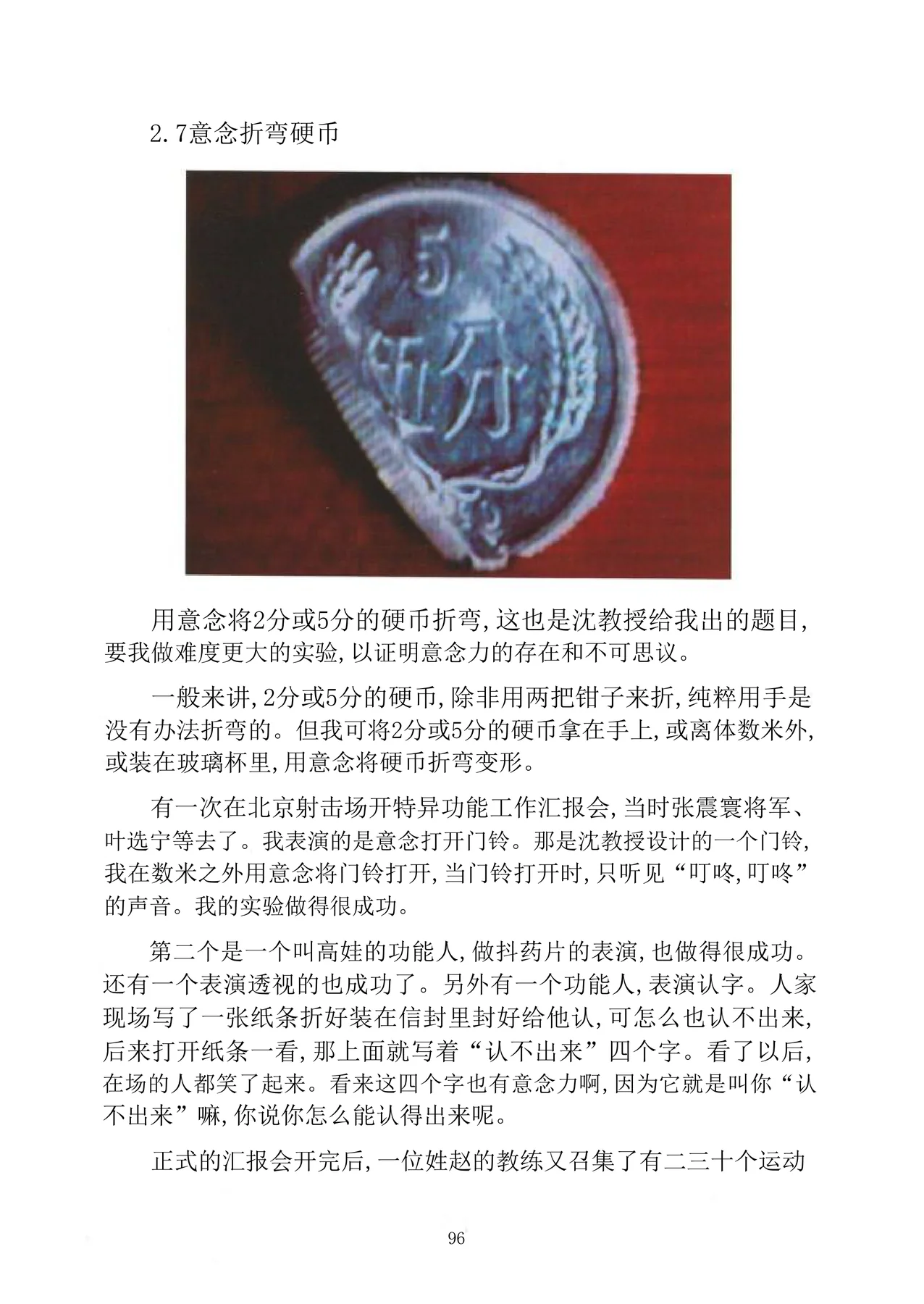
2.7 Mentally Bending Coins
Using mental intention to bend two-cent or five-cent coins was also a task Professor Shen set for me, asking me to conduct experiments of greater difficulty in order to prove the existence and inconceivability of the power of mental intention.
Generally speaking, a two-cent or five-cent coin cannot be bent purely by hand unless one uses two pairs of pliers. But I could hold a two-cent or five-cent coin in my hand, or from several meters away, or placed inside a glass cup, and use mental intention to bend and deform the coin.
Once, at the Beijing Shooting Range, a work report meeting on extraordinary human abilities was held. General Zhang Zhenhuan, Ye Xuanning, and others attended. My demonstration was using mental intention to activate a doorbell. It was a doorbell designed by Professor Shen. From several meters away, I used mental intention to activate the doorbell, and when it went off, one could hear the “ding-dong, ding-dong” sound. My experiment was very successful.
The second was a person with extraordinary abilities named Gaowa, who performed the demonstration of shaking out medicine tablets, which was also very successful.
There was also someone who demonstrated clairvoyant vision, which also succeeded. Another person with extraordinary abilities performed character recognition. Someone on the spot wrote a note, folded it, placed it in an envelope, sealed it, and gave it to him to recognize — but no matter what, he could not make it out. Later, when the note was opened, it turned out that what was written on it were the four characters “cannot be recognized.” After seeing this, everyone present laughed. It seems that these four characters also carried the power of mental intention, because they were literally telling you “cannot be recognized” — so how could you possibly recognize it?
After the formal report meeting concluded, a Coach surnamed Zhao gathered twenty or thirty
athletes and asked me to speak to them about paranormal phenomena and give a live demonstration. At the time, the shooting champion Xu Haifeng
was also present. I performed a demonstration of mentally bending a coin, and this time it was bent right in Xu Haifeng’s hand.
At the time, I had Xu Haifeng hold a two-cent coin in his hand. I did not touch Xu Haifeng’s hand; from a distance of several meters, I used mental intention to cause the coin in his hand to bend nearly ninety degrees. Later, that coin which had bent in his hand was left with Xu Haifeng as a memento. I heard that Xu Haifeng married Coach Zhao’s daughter — so naturally Coach Zhao became Xu Haifeng’s father-in-law. But that is a digression.
2.8 Mentally Drilling Holes in Coins
What I described above was using mental intention to bend coins. Even more interesting is that I could also drill holes in coins. Not only could I drill a hole in a single coin, I could also hold two coins in my hand and simultaneously drill holes in both. This too was a difficult challenge posed by Professor Shen.
To increase the difficulty, Professor Shen wrapped two two-cent coins together with plastic tape, to see whether I could drill holes in both coins. This experiment I also succeeded in doing.
My process of using mental intention to drill holes in these two coins was as follows. When I relaxed and entered the extraordinary-ability state, the coins appeared on the screen at my Heavenly Eye. As I focused my attention on the operation, I saw a crystal-clear, translucent, hexagonal, slender rod appear between the two coins. Originally, the two coins in my hand had been wrapped together with plastic tape, but at this moment the coins were not pressed together — they were separated. The two ends of the hexagonal slender rod were sharply pointed. Then I saw the hexagonal rod strike each of the two coins on either side with one tap each, and simultaneously I heard two “clang, clang” sounds in my ears — and the holes were drilled. Afterward, when I opened the two coins that had been held in my hand and looked at them, there was indeed a hole drilled in each of the two coins.
Using only mental intention and without any physical action, the holes in the coins were drilled — truly inconceivable. Sometimes the coins did not need to be held in the hand; from a distance of several meters, one could also drill holes in coins placed inside a small box or glass bottle. Sometimes one could even drill several holes in a single coin.
If the task one wishes to accomplish is drilling holes in coins, then after the image of the coins stabilizes on the screen, one makes a request to one’s deeper level of consciousness to drill a hole at the designated location. When the state is good, a transparent hexagonal slender tool resembling a ballpoint pen barrel quickly appears and automatically aligns with the required location, pulsing out a sharp cone to drill a conical hole.
If one wishes to drill holes in two coins pressed together in the hand, then during drilling,
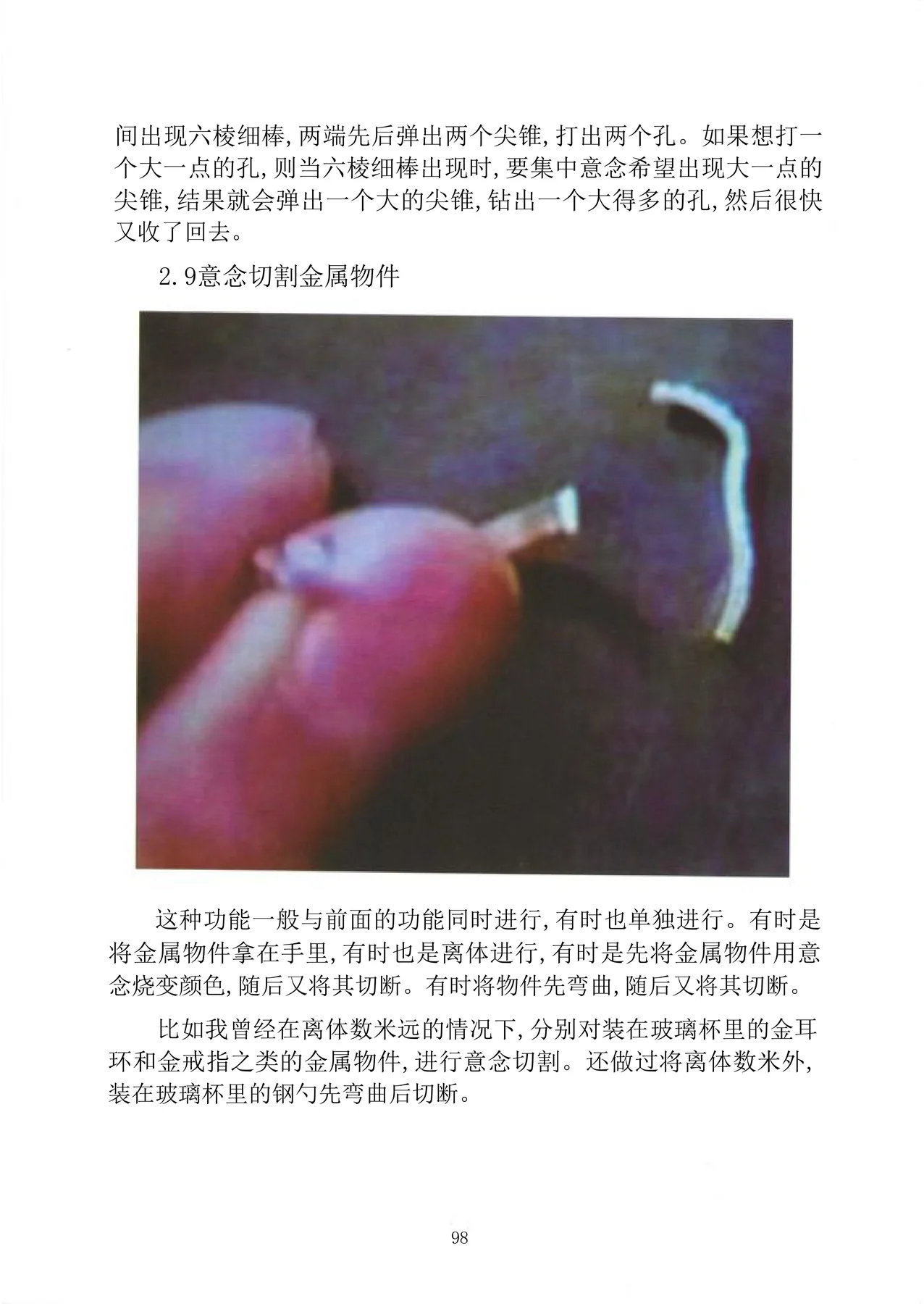
A fine hexagonal rod would appear in the space, and two pointed cones would successively pop out from its two ends, drilling two holes. If I wanted to drill a somewhat larger hole, then when the hexagonal rod appeared, I had to concentrate my intention and wish for a somewhat larger cone to appear. As a result, a large cone would pop out, drilling a much larger hole, and then it would quickly retract again.
2.9 Mentally Cutting Metal Objects
This ability was generally carried out simultaneously with the preceding ability, and sometimes carried out independently. Sometimes I held the metal object in my hand; sometimes it was done at a distance. Sometimes I would first use intention to change the color of the metal object by burning, and then cut it apart. Sometimes I would first bend the object, and then cut it apart.
For example, I once performed mental cutting on metal objects such as gold earrings and gold rings placed inside a glass cup, from a distance of several meters away. I also performed an experiment in which a steel spoon inside a glass cup, several meters away, was first bent and then cut apart.
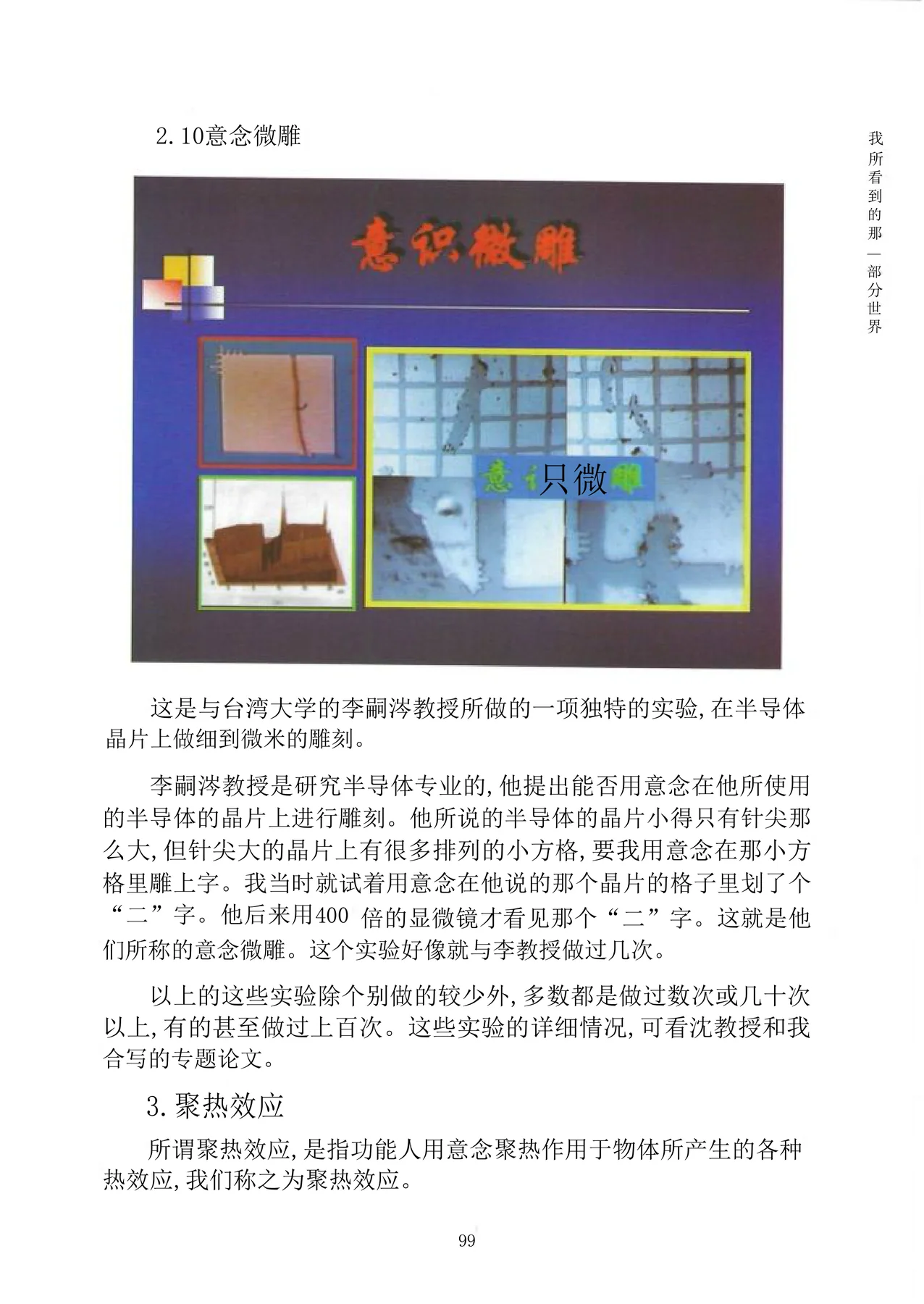
2.10 Mental Micro-Carving
This was a unique experiment conducted with Professor Li Si-chen of National Taiwan University — performing carvings on semiconductor chips at a fineness down to the micrometer level.
Professor Li Si-chen specialized in semiconductor research. He proposed whether I could use intention to perform carving on the semiconductor chips he used. The semiconductor chip he described was as small as the point of a needle, yet on this pinhead-sized chip there were many small square grids arranged in rows, and he wanted me to use intention to carve characters into those little grid squares. At the time, I tried using intention to carve the character “二” (two) inside one of the grid squares on the chip he indicated. He later used a 400-power microscope before he could see that character “二.” This is what they called mental micro-carving. I believe I only did this experiment a few times with Professor Li.
Apart from a few of the above experiments that were conducted less frequently, most were performed several times, dozens of times, or more, and some were even performed over a hundred times. For detailed information on these experiments, see the specialized papers co-authored by Professor Shen and me.
3. Heat-Convergence Effects
The so-called heat-convergence effect refers to the various thermal effects produced when a person with extraordinary abilities uses intention to converge heat upon an object. We call these heat-convergence effects.
3.1 Mentally Burning Coins
I have conducted many experiments and demonstrations of mentally burning coins — for example, using intention to change the color and deform a coin held in my hand.
I recall that at the opening ceremony of an extraordinary-ability training class held in Wuhan in 1993, those in attendance included Shi Chuan, Director of the Standing Committee of the Provincial People’s Congress; Ding Fengying, Secretary of the Provincial Discipline Inspection Commission; a deputy secretary-general of the provincial government; and two deputy directors of the provincial power bureau. There were approximately sixty people at the scene, most of them students enrolled in the training class.
At that point, the host announced that a coin-burning demonstration would be performed. A sudden thought occurred to me: could I do this experiment together with someone else? Because in the past, it was mostly done with me holding the coin in my own hand. This time, I placed a one-yuan coin on the palm of Provincial People’s Congress Director Shi Chuan, and I covered his palm with my own hand. It took roughly twenty-plus minutes before the two of us cooperatively burned that coin until it changed color.
Director Shi Chuan said at the time that he felt his palm becoming somewhat warm, but the temperature was not very high — there was a certain degree of heat, but it was tolerable for a person.
On another occasion, our party of over ten people went on a pilgrimage to the Fifth Patriarch’s Temple in Huangmei, Hubei. We passed through Qichun County, Hubei — the hometown of Li Shizhen, the medical sage and author of Compendium of Materia Medica. Comrades from the local county power department hosted us for lunch. While resting after the meal, the local leaders learned that I had extraordinary abilities and asked to see a demonstration. Since no performance had been arranged beforehand, but they had made the request, it was not easy to refuse. As the saying goes, “once you’ve eaten someone’s food, you go soft at the mouth.”
Quite a number of government cadres and family members showed up, some bringing small children — several dozen people in all, filling a meeting room to capacity. Moreover, some of the children were too young and were crying and fussing, so the environment was not very good, and I felt somewhat reluctant at the time. They first brought in some corn kernels, wanting to see a popcorn demonstration, but after trying for over ten minutes, I felt nothing at all. I said that this one probably could not be done. So they temporarily found a few one-yuan coins from the people present, and I picked one out and held it in my hand to begin working.
It took roughly twenty-plus minutes before I managed to burn that coin until it changed color. Whether mentally burning coins or mentally drilling holes in coins, my experience is that one must first go through the three adjustments: adjust the mind, adjust the posture, and adjust the breath — achieving relaxation and entering stillness, clearing away all distracting thoughts, and entering an extraordinary-ability state, entering a deep level of consciousness. At that point, a screen would generally appear on my forehead, gradually going from blurry to clear, from unstable to stable, with many flickering colored points of light appearing on it. At that moment, I could proceed to do what I wanted to do.
For example, if I wanted to burn a coin, regardless of where the target object was located, I first had to bring the coin into my mind onto the screen at my forehead, until it became clear. Then I would imagine a ball of fire — the area of the flames smaller than the coin — and imagine that it possessed a very high temperature. By moving the flames under conscious control, the coin would gradually change color from being burned.
I have conducted coin-burning experiments and demonstrations hundreds of times and more. Back then, quite a few people would take coins I had burned and coins I had drilled holes in, crochet a little yarn pouch to keep them in, and wear them as pendants on their bodies — because they understood that those coins carried energy and information.
3.2 Mentally Combusting Objects
This ability was inspired by a person with extraordinary abilities named Yao Zhen. Yao Zhen was from Tianjin. After her abilities were discovered, she was specially recruited to study at the Inner Mongolia Medical College. Once, when Professor Shen and I visited Professor Chen Shouliang’s home at Peking University, Professor Chen told us about Yao Zhen’s ability to mentally combust objects. Professor Chen said that Yao Zhen’s mental combustion ability was also quite extraordinary. At the very beginning, whenever she placed her hand on something, she would burn it. For instance, if she placed her hand on a book and thought of a rabbit, a rabbit-shaped scorch mark would immediately appear on the cover; if she thought of a cat, a cat-shaped scorch mark would appear. It was also somewhat uncontrollable — sometimes she would place her hand on something without really thinking about anything, and it would inexplicably catch fire, resulting in quite a few things being damaged. Later, under Professor Chen’s guidance, she gradually achieved control.
When I heard Professor Chen describe Yao Zhen’s situation, I already began to feel something. After returning, I started conducting experiments together with Professor Shen. I remember that the first thing I burned using intention was a Taiji diagram. I also first placed my hand on a piece of paper, then visualized a Taiji diagram, and before long, the shape of a Taiji diagram was burned into the paper.
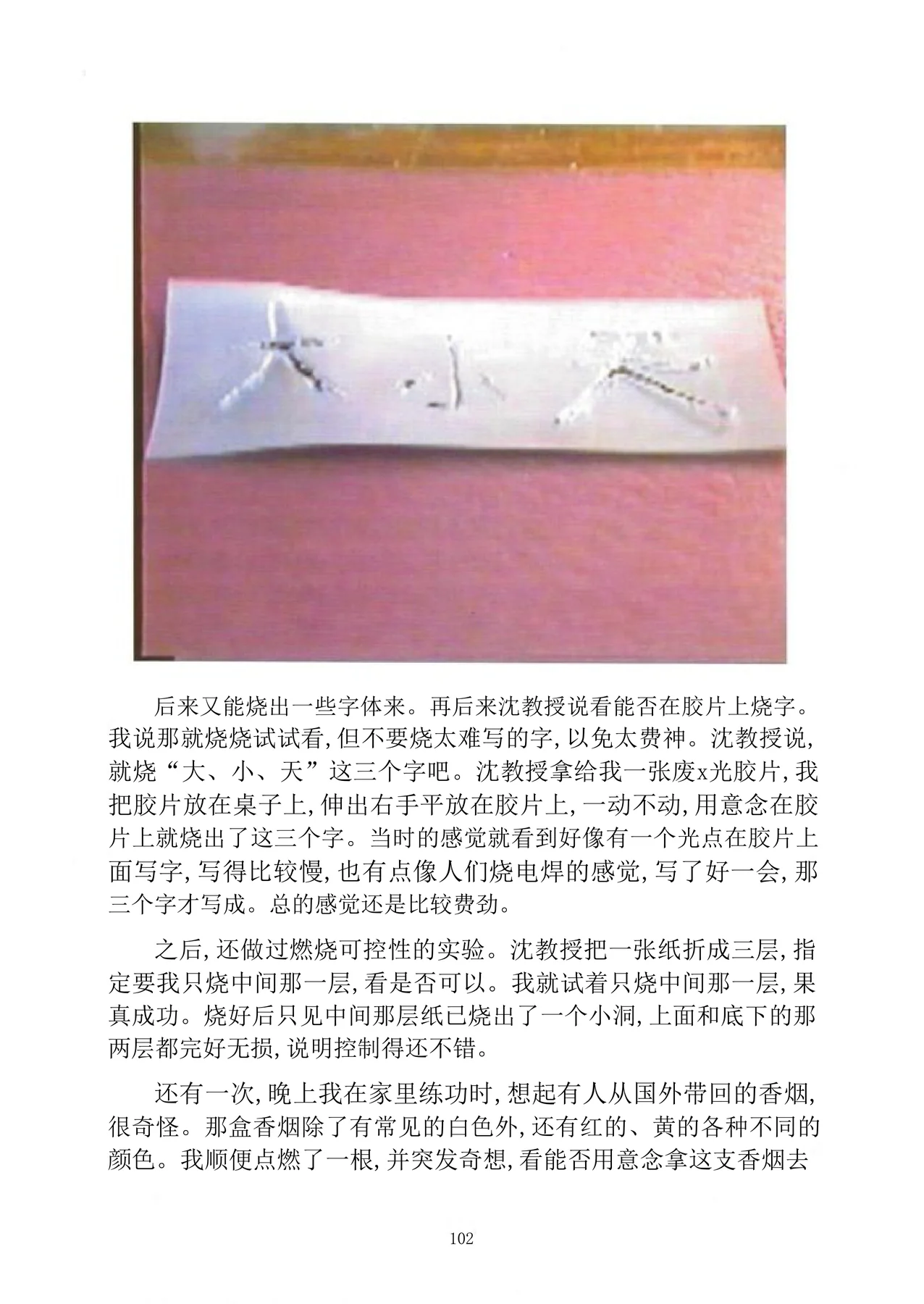
Later, I was also able to burn characters. Then Professor Shen suggested seeing whether I could burn characters onto photographic film. I said I would give it a try, but asked him not to choose characters that were too difficult to write, so as not to be too taxing. Professor Shen said, let’s burn the three characters “大 (dà, big), 小 (xiǎo, small), 天 (tiān, sky).” Professor Shen handed me a piece of used X-ray film. I placed the film on the table, extended my right hand and laid it flat on the film, kept completely still, and used mental intent to burn these three characters onto the film. The sensation at the time was that it seemed as though a point of light was writing on the film — writing rather slowly, somewhat like the feeling of someone doing electric welding. It took quite a while before those three characters were finally completed. My overall impression was that it was still fairly strenuous.
After that, we also did experiments on the controllability of burning. Professor Shen folded a piece of paper into three layers and specified that I should burn only the middle layer, to see whether that was possible. I tried burning only the middle layer, and it indeed succeeded. After it was done, the middle layer of paper had a small hole burned through it, while the top and bottom layers were completely intact, showing that the control was quite good.
There was another time. One evening when I was practicing qigong at home, I remembered a pack of cigarettes that someone had brought back from abroad — quite unusual. The cigarettes in that pack came not only in the conventional white color, but also in red, yellow, and various other colors. I casually lit one and on a sudden whim wondered whether I could use mental intent to make that cigarette
burn something.
At that moment I thought of old Professor Shen — this old man was always giving me difficult problems, always asking me to do one experiment after another, so I should teach him a lesson. I wondered whether I could burn a small hole in the cotton quilt he was currently using at home, while controlling it so it wouldn’t burn too large. At the time, I just had that passing thought without paying it much attention — it was really just a little joke — and later I forgot all about it.
It was only one day, when Teacher Zheng (Professor Shen’s wife) was folding the quilt at home, that she discovered a quilt had a small hole burned in it. She found it very puzzling — old Shen didn’t smoke, so why did it look like a hole burned by a cigarette tip? One day Teacher Zheng ran into me and asked whether I was the one behind it. Since Teacher Zheng also knew that we had been doing mental-intent combustion experiments during those days, she quickly suspected it might have been my doing. I said in great surprise, “It actually worked?” I told her I had just casually tried it that evening, never expecting it would actually succeed. Teacher Zheng then laughed and said, “Do fewer of these experiments from now on — don’t go burning our house down.”
The mental-intent combustion ability has a very peculiar aspect: during this kind of combustion, I feel a slight rise in temperature, and the burning stops once the designated object is damaged, without producing an open flame. Moreover, I myself feel it is like heating food in a microwave oven — it gradually heats up and scorches from the inside outward. This is different from the phenomenon of spontaneous human combustion discovered later. That kind of spontaneous combustion seems to involve open flames appearing — fires igniting inexplicably — and it is mostly uncontrollable.
I once watched a television report about a spontaneous combustion phenomenon. The person in whom spontaneous combustion occurred had many large and small holes burned through their clothing and bedding; a great deal of their furniture had been burned, and there was almost nothing left usable. How tragic, how truly tragic! Scientists to this day have no way of clearly explaining this phenomenon.
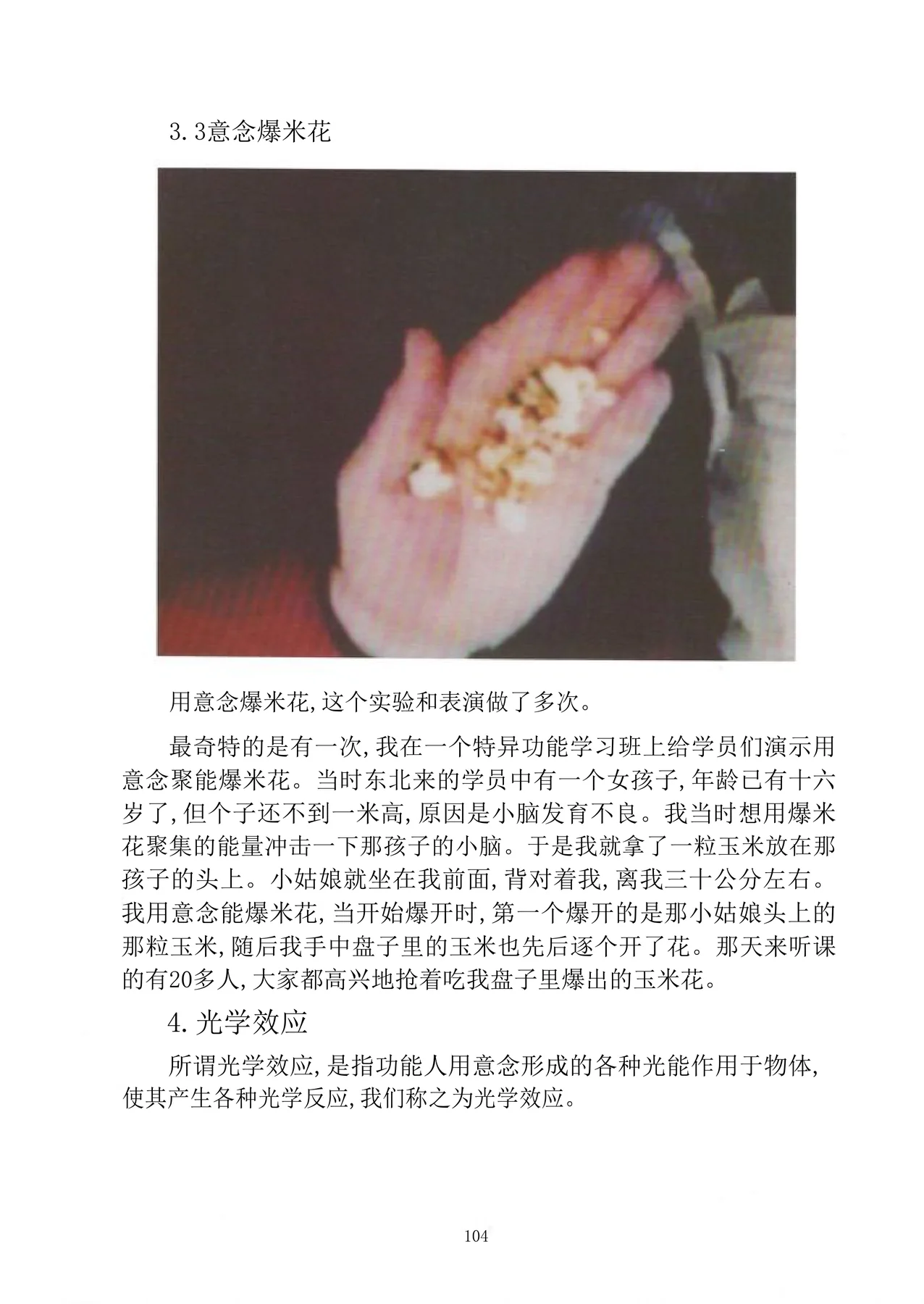
3.3 Mental-Intent Popcorn
Making popcorn with mental intent — I have done this experiment and demonstration many times.
The most extraordinary was one time when I was demonstrating mental-intent focused-energy popcorn popping for the students at an extraordinary-ability training class. Among the students who had come from the Northeast was a girl, already sixteen years old, but less than a meter tall, due to underdeveloped cerebellum. At the time I wanted to use the energy gathered from popping popcorn to give a stimulating impact to that child’s cerebellum. So I placed a single kernel of corn on the child’s head. The little girl sat in front of me, facing away from me, about thirty centimeters away. I used mental-intent energy to pop the corn. When it began to pop, the very first kernel to burst was the one on the little girl’s head, and then the kernels of corn in the plate I held in my hand burst into bloom one after another. That day, over twenty people had come to attend the lecture, and everyone excitedly scrambled to eat the popcorn from my plate.
4. Optical Effects
The so-called optical effects refer to various forms of light energy generated by a functional person through mental intent acting upon objects, causing them to produce various optical reactions. We call these optical effects.
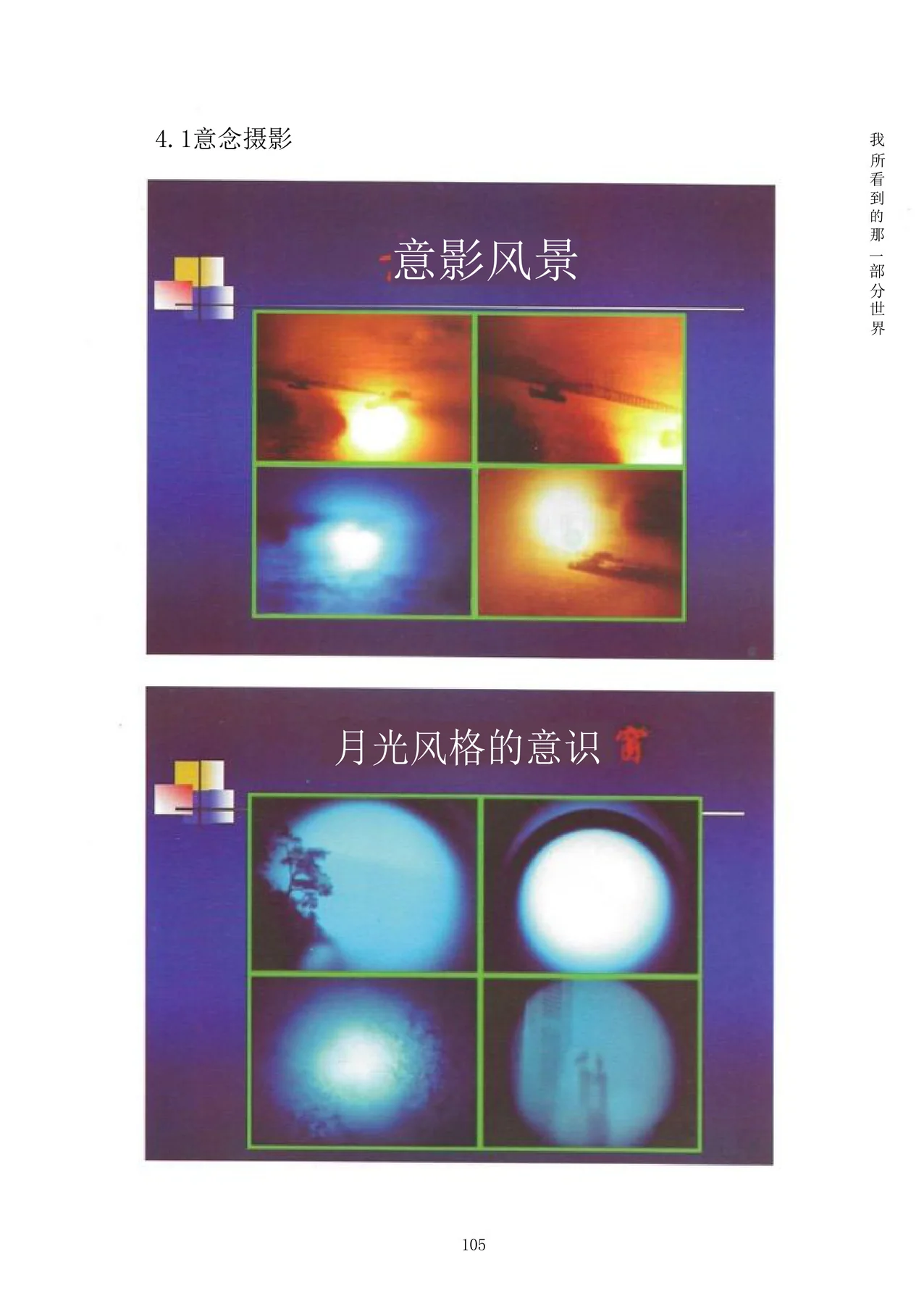
4.1 Mental Photography
Conscious Scenery in the Mind’s Lens
Moonlight-Style Consciousness
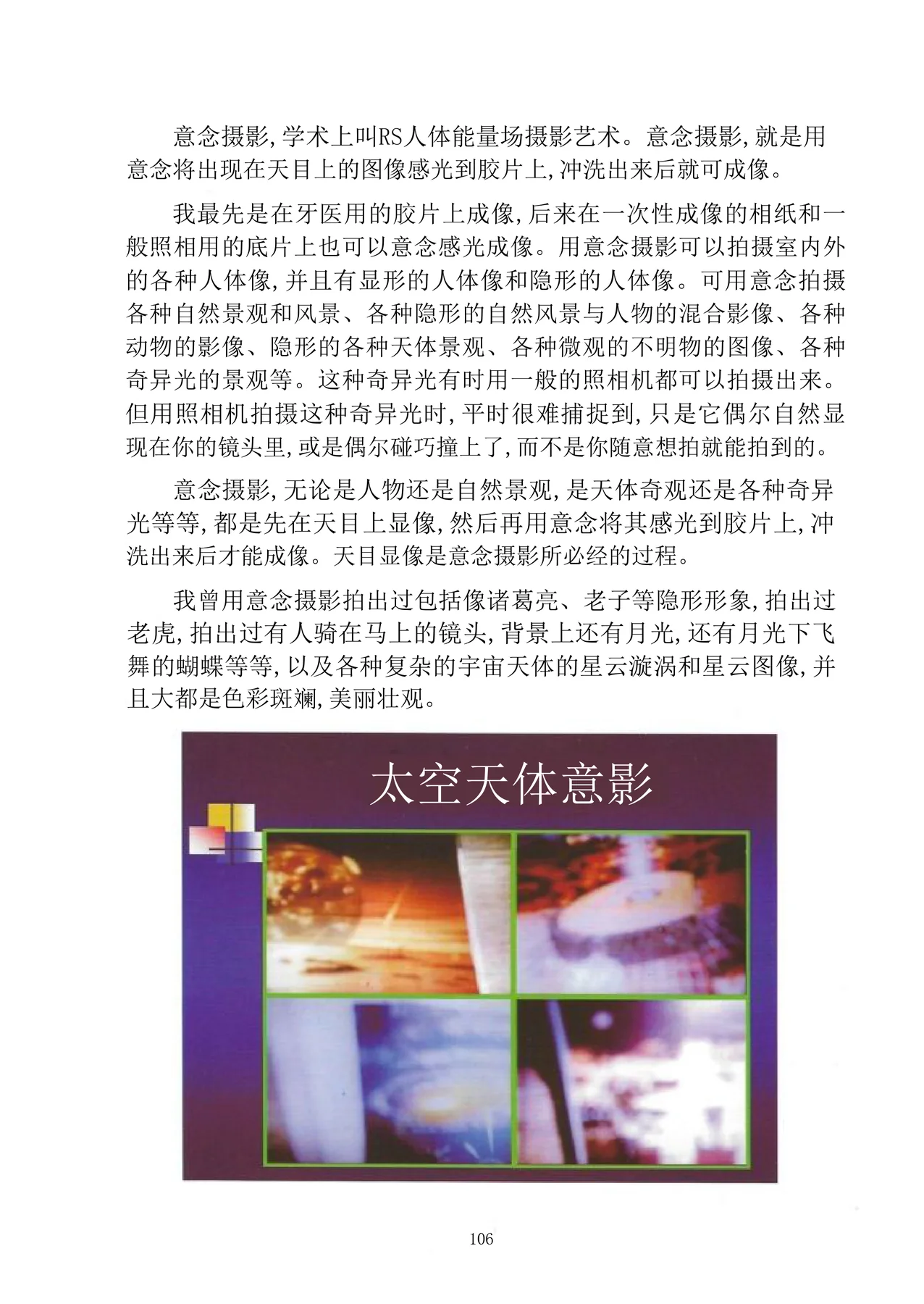
Mind photography is known academically as RS Human Body Energy Field Photography Art. Mind photography means using mental intent to expose onto film the images that appear on the Heavenly Eye; after development, an image can be formed. I first produced images on dental X-ray film, and later I was also able to use mental intent to expose and form images on instant photographic paper and on ordinary photographic negatives. With mind photography, one can capture various human images both indoors and outdoors, including visible human figures and invisible human figures. One can use mental intent to photograph various natural landscapes and scenery, composite images of invisible natural landscapes mixed with human figures, images of various animals, images of invisible celestial bodies, images of various microscopic unidentified objects, various strange light phenomena, and so on. Sometimes this strange light can even be captured with an ordinary camera. However, when using an ordinary camera to photograph this strange light, it is normally very difficult to capture — it only occasionally appears naturally in your lens, or you happen to come across it by chance, rather than being something you can shoot at will.
In mind photography, whether the subject is a person or a natural landscape, whether it is a celestial wonder or various strange lights, the image must first appear on the Heavenly Eye, and then mental intent is used to expose it onto film. Only after development can the image be formed. Heavenly Eye manifestation is an indispensable process in mind photography.
Through mind photography, I have produced invisible figures including Zhuge Liang and Laozi; I have photographed a tiger, a scene of someone riding a horse with moonlight in the background, butterflies dancing in the moonlight, and so forth, as well as various complex cosmic nebula vortices and nebula images — most of them richly colorful, beautiful, and magnificent.
Mind Photograph of a Celestial Body
The discovery of the art of human-body mind photography was quite interesting. At the time, when we were studying the magnetic effects of human acupoints, we found that not only did the magnetic field have a clearly measurable intensity (reaching up to 400 mOe), but the spatial distribution of the magnetic field at different acupoints and under different extraordinary-ability states also exhibited specific geometric characteristics — for example, the Yintang acupoint generally displayed a Tai Chi pattern, while the Laogong and Baihui acupoints appeared as circles of 1 to 1.5 cm in diameter, with relatively stable shape and size.
However, after comparison, we found that a small iron rod with comparable magnetic field strength could not produce the same effect on film, and therefore we inferred that there must be other external effects present.
Subsequently, we placed ISO 100 black-and-white film on a magnetic writing board and put them together into a dark bag. I positioned the Laogong acupoint of my palm directly over and onto the film and the magnetic writing board. Using the method of generating a magnetic effect through the Laogong acupoint, I emitted qi, and as a result, while producing a circular dark spot on the magnetic writing board, the corresponding area on the film was exposed and displayed a ring of the same size. This was the first time we obtained a relatively clear photograph taken through human-body-field mental force. Taking the first letters of the Chinese pinyin for “human (R) body field (S) photography,” we abbreviated it as RS human-body-field photography, or RS mental-force photography.
Later, we conducted a series of experiments on RS mental-force photography under various different conditions, going through a series of processes — from simple to complex, from unshielded film in a darkroom to shielded film, from direct contact to non-contact at a distance, from close range to long range, from a single sheet of film to multiple sheets of film, and from unconsciously regulated natural patterns to consciously regulated display of designated characters. We successively used different types of photosensitive materials for a series of experiments — including negative and reversal films of different sensitivities, X-ray film specialized for structural analysis, fully enclosed dental X-ray film, film specialized for electron diffraction, and others — in an attempt to detect which spectral band the human consciousness field is most sensitive to. Later, using ordinary ISO 100 color negative film, we also achieved success.
After many years of research and observation on RS human-body photography, we found that human “mental force” possesses many incredible properties, which can be summarized mainly in the following aspects:
(1) The primary composition of mental force includes a special type of electromagnetic radiation or particle stream capable of exposing film. Color RS photographs frequently show blue, green, and violet light from the visible spectrum, with blue light predominating. What is puzzling is that RS photographs taken in a completely dark darkroom, in a light-shielded dark bag, inside an iron-sheet-shielded cassette, or in another room behind multiple shields, show essentially the same results.
If it were merely ordinary light or electromagnetic radiation, it would be unable to penetrate multiple barriers to expose the film, and it would also violate the straight-line propagation property of light.
A variety of films with different properties were used in the experiments. The results showed that X-ray and electron-diffraction specialty films yielded the best results. Later, however, 21 DIN color negative film also produced very good results, while high-speed reversal film, used multiple times, gave less satisfactory outcomes. The reason is unknown; it may also be due to differences in the extraordinary-ability state.
(2) Intention-force carries a large amount of information. The radiation within intention-force that can expose film is frequently and clearly modulated by complex low-frequency signals, including infrasound. The modulation waves themselves also exhibit various regular and random changes in frequency and waveform. Some photographs show tracks resembling the twisted, double-helix shape of DNA, which seems to suggest that the particle stream of intention-force moves in a “precessional” fashion. Clearly, all of this implies that intention-force possesses the capacity to carry large amounts of information and serves as an important carrier of information. In 1981, the Institute of High Energy Physics of the Chinese Academy of Sciences confirmed that the human body can emit a comb-type radiation with an information content of ten thousand bits, which is consistent with our experimental results.
(3) When intention-force is in an excited state, it often exhibits certain characteristics of laser (shock-wave) energy. For example, it is well focused and, instantaneously, has strong penetrating power. Some qigong masters or extraordinary-ability individuals, while in the extraordinary-ability state, emit intention-force radiation of considerable energy that can burn and destroy the photographic emulsion along the path of the light beam.
(4) Consciousness regulation has a significant influence on the characteristics of intention-force radiation. This influence is primarily manifested in three aspects:
First, consciousness regulation determines the overall spatiotemporal characteristics of intention-force movement. Under different extraordinary-ability states, completely different RS photographs can be produced at the same acupoint. For example, RS photographs taken at the Laogong acupoint under different extraordinary-ability states are entirely different: sometimes they show chaotic patterns, sometimes relatively regular ring-shaped patterns, and sometimes they can even “write” specified characters entirely under consciousness regulation. It can be considered that patterns with different overall characteristics correspond to different extraordinary-ability states and to different levels and conditions of consciousness. Through deep-level consciousness regulation of certain parameters, it is possible to transition from one extraordinary-ability state to another.
Second, the effect of consciousness regulation is also manifested in its influence on the specific path and form of the convergence and dispersion movement of intention-force. Even at the same acupoint and under the same extraordinary-ability state, while the overall appearance is a chaotic pattern, there can still be differences in many details such as the strength and thickness of the lines, the specific paths, and the state of regulation. From the RS photographs, it can be seen that the paths of intention-force movement are extremely complex and diverse, and this diversity is surely closely related to the state of consciousness. Although some patterns are all chaotic patterns, there are still considerable differences in details such as line thickness and modulation conditions.
Third, experiments show that intention-force also possesses the remarkable property of selectively concentrating under consciousness regulation — “intention arrives, force arrives,
and the effect manifests.” When we first used RS intention-force photography to study the energy-concentration morphology at the Laogong acupoint, we discovered that the RS images obtained on two overlapping films were completely different. This phenomenon cannot be explained by the characteristics of any known form of electromagnetic radiation (radio waves, infrared, visible light, ultraviolet, X-rays, etc.).
In an article on the concepts and methodology of human-body science, Professor Chen Xin also emphasized that “the consciousness generated by the human brain… is an important means of regulating the human body’s functional state.” Therefore, we believe that in-depth study of the spectrum and propagation characteristics of this radiation capable of exposing film, as well as the regulatory role of consciousness, undoubtedly holds major theoretical significance and practical value.
Because the spatial resolution of intention-force selective focusing is extremely high (it has repeatedly produced different characters on each side of the double-sided emulsion of X-ray film), it may be possible to establish a “microscopic consciousness engineering” at the level of cells or even molecules, atoms, quarks, and other more microscopic levels — to consciously and directionally alter the microstructure of crystals, or the genetic genes (structures) of organisms, as needed, creating new functional materials with various outstanding properties and new varieties of plants and animals.
Prior to this, I had used my own extraordinary energy to achieve rapid germination of seeds, induce coloration and regreening of apples, and cook and “uncook” quail eggs. The study of the extraordinary properties of intention-force not only holds major theoretical significance but also demonstrates highly promising application prospects.
(5) The “screen effect” is indeed an objective reality and has a material basis.
Among the various photographic methods of RS photography, whether in direct-contact experiments or in non-contact or long-distance experiments, a screen appears at the functional individual’s forehead, and on this screen, scanning is carried out by energy-concentrating bright points under the control of either conscious or subconscious awareness. If focusing is accurately maintained on a specific plane, the resulting pattern is essentially continuous; if focusing cannot be consistently and accurately maintained on that plane, then the lines exposed on the RS photograph will show significant variations in density, or will flicker in and out of visibility, or may even be abruptly cut off and disappear entirely.
Because the light beam or particle beam acts on the emulsion sequentially, there are phenomena of mutual intersection and interleaving, from which the temporal sequence of the appearance of the pattern’s lines can be inferred. Sometimes the patterns produced by consciousness regulation appear to be formed by the superposition of multiple repeated scans; sometimes the patterns do not completely overlap, which may be related to the depth of the functional individual’s extraordinary-ability state and the quality of regulation.
In summary, the appearance of a colored screen at the forehead is a necessary prerequisite for almost all experiments conducted in the extraordinary-ability state (not only RS intention-force photography); otherwise, the experiment will not succeed.
(6) The action-at-a-distance of mind force (thought waves), regulated by consciousness.
It is generally believed that the human body field (thought waves) exists mainly within a range of several centimeters around the body. The experimental results of the high-frequency field photography technique invented by the Soviet researcher Kirlian also support this view.
However, upon careful examination of many extraordinary-ability phenomena and a series of experiments we conducted using RS mind-force photography, it was found that the physical effects produced by “thought waves” can also be detected at considerable distances from the body—that is, mind force possesses what is called a “distance-independent effect.”
From the results of off-body and long-distance RS mind-force photography experiments, it can be seen that the photosensitizing and writing effects of thought waves can be realized at a certain distance from the body, or even at very great distances, and the intensity of the effect does not appear to diminish noticeably with increasing distance.
My sensation is that I can use mind intent to “summon” one sheet of film after another to specific acupoints on my body to be exposed, and I can also summon a real or imagined ballpoint pen or pencil to “write” characters and display various graphic characters on paper or film.
Moreover, a great many facts—such as remote sensing, remote detection, distant bending, distant object translocation, and other extraordinary phenomena—all indicate that the existence of mind force and the range of its action are not limited to the finite region around the human body, but can extend to infinity.
The “ultrafine particle field” theory proposed by the Soviet biologist Lepeshinskaya also holds that a “ultrafine particle field” exists around every object, whether living or nonliving, and that it forms part of the “cosmic field.” Changes in it affect the “cosmic field,” and changes in the “cosmic field” also affect the field state of individual objects. Therefore, under certain conditions, mind force can produce noticeable effects at considerable distances. We call this phenomenon the distance-independent action of mind force.
We must use the holistic perspective of cosmic holography and the unity of heaven and humanity to understand the “human body field” and the “cosmic field.” The “cosmic field” is formed by the organic combination of all things in the universe. A change in the state of any individual will produce an effect, greater or smaller, on the entire cosmic field and on other things. The qigong master’s regulation of a patient, and the ability of a gifted individual to produce acupoint magnetic effects in others, are powerful proofs of this mutual influence between fields.
(7) The penetration and absorption of mind force (thought waves), regulated by consciousness.
In the early stages of developing RS mind-force photography, experiments were conducted in darkrooms or dark bags without any shielding. Later, experiments were carried out with various types of film loaded into black paper envelopes, black plastic cloth bags, black film boxes, and aluminum foil pouches, and clear images could still be obtained.
This proves that simple light shielding cannot shield thought waves. That is, thought waves (mind force), apart
from containing visible light components or components capable of exciting visible light, also contain non-visible-light ionizing electromagnetic radiation that can penetrate black paper, aluminum foil, and the like to expose film. Yet they are also unlike ordinary infrared rays, ultraviolet rays, X-rays, alpha, beta, and gamma rays, because, as we have already mentioned earlier, mind force possesses the remarkable property of selective focusing—a characteristic that none of the aforementioned types of radiation possess.
Therefore, there must exist at least one entirely new, previously unknown type of extraordinary radiation. However, we have also observed that identical individual characters appear on two superimposed sheets of film, but the density of the second sheet is greatly reduced, which indicates that a certain degree of absorption still exists, and this may be related to insufficiently strong selective control by consciousness.
(8) Mind force possesses a pronounced particle-stream character.
Sometimes it is also quite appropriate to use “qi” to express mind force. From many phenomena on RS photographs, it can be seen that the mode of propagation and movement of mind force is very much like “smoke and cloud,” like a “fluid,” like an “ultrafine particle stream.” One can vividly compare the consciousness-regulated mind force to a “broad brush” saturated with ink, where the ink constitutes the “ultrafine particles” that make up mind force.
In RS human-body-field photography, film can be exposed only when the emulsion comes into direct contact with the “ultrafine particle ink.” If it is too far or too close, exposure cannot occur. This consciousness-regulated broad brush has its spatial orientation. If it maintains a certain orientation during movement, then the width of the trace will change at turns—a phenomenon clearly visible on many RS mind-force photographs.
Therefore, starburst-like, infiltration-like, sawtooth-like, hair-like, tadpole-tail-like, bamboo-joint-like, worm-like patterns, and various complex branching and composite phenomena are extremely common. Like the works of Chinese calligraphy and painting masters, they are colorful and varied, full of spirit and charm.
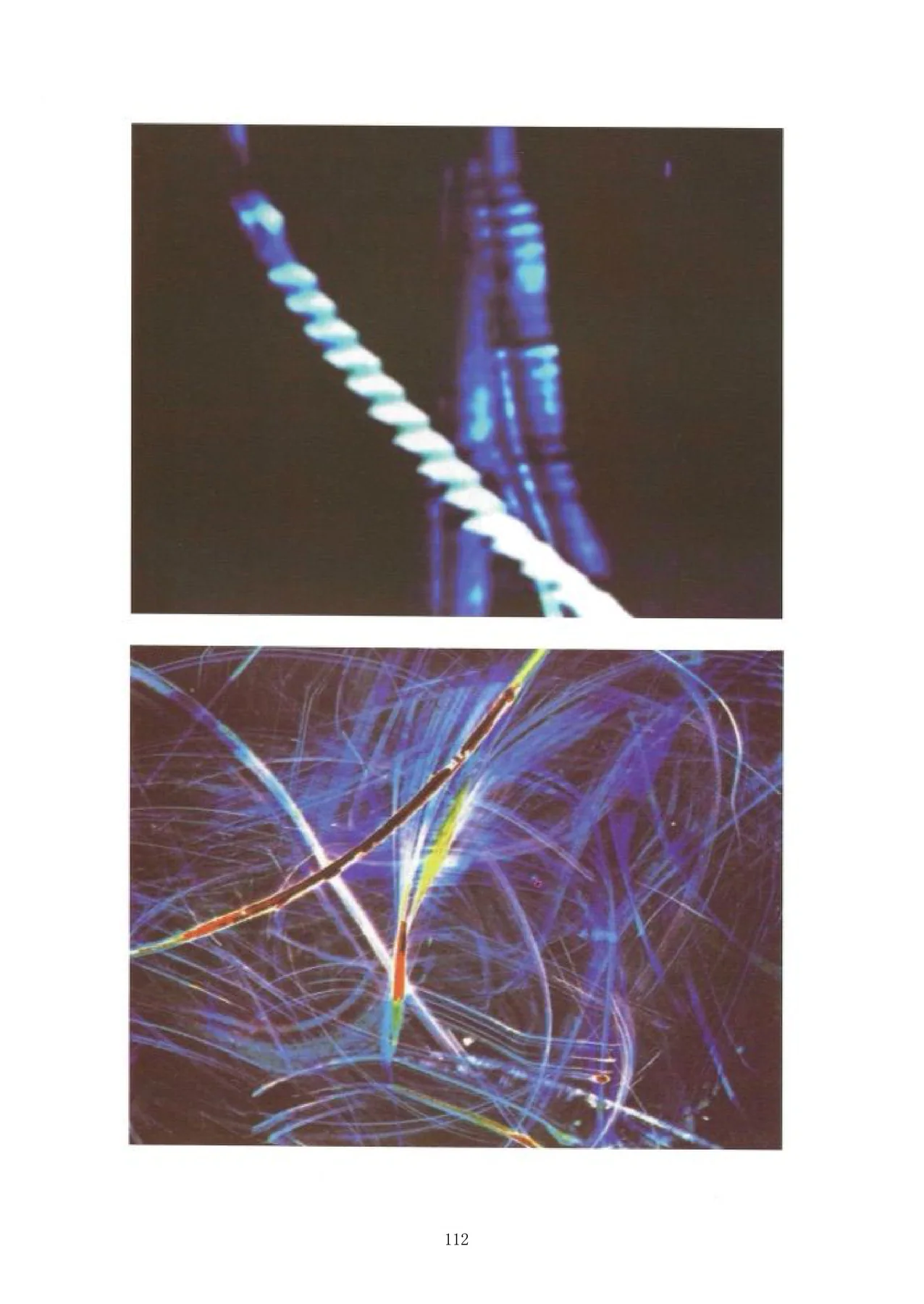
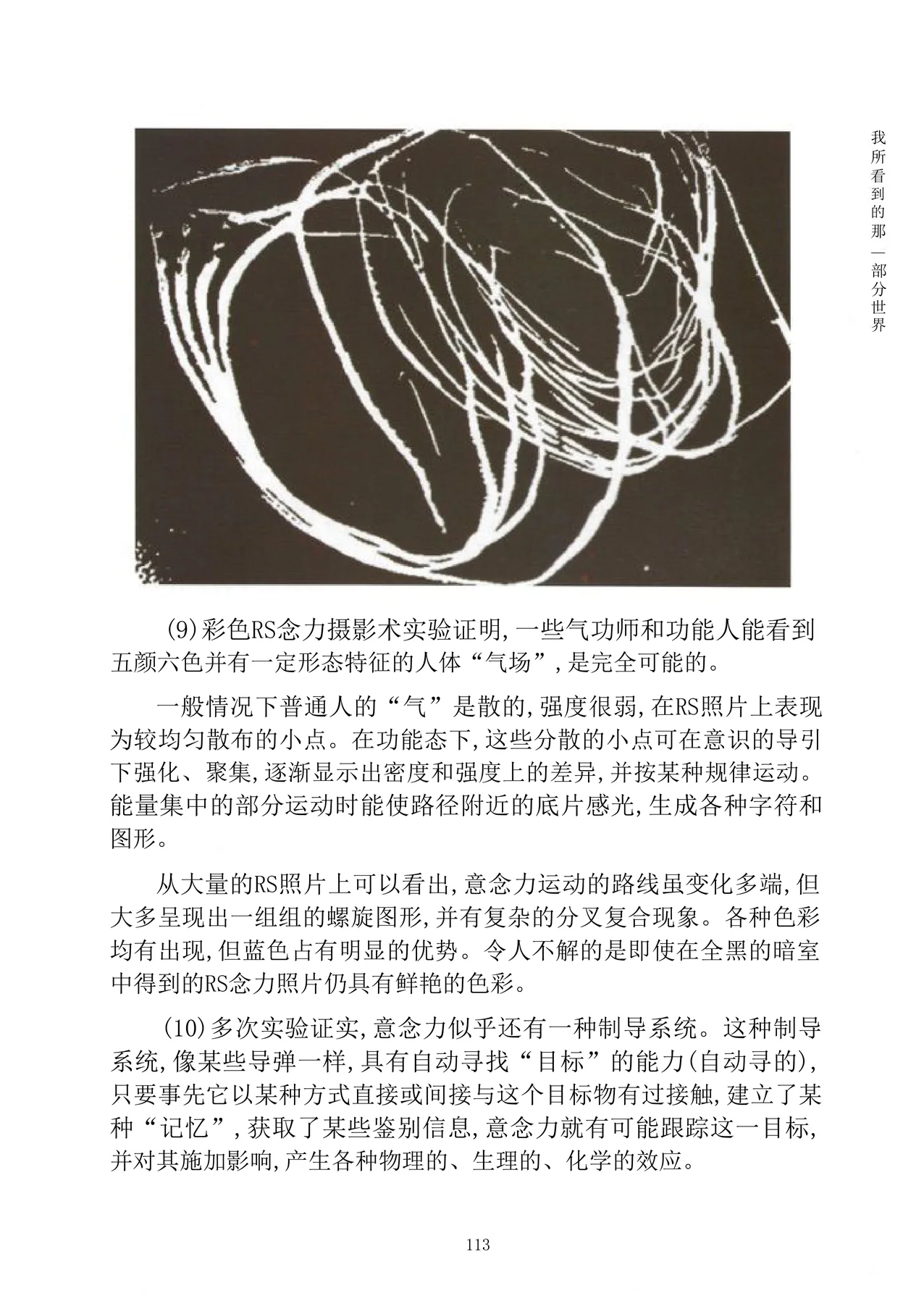
(9) Color RS mind-force photography experiments prove that it is entirely possible for certain qigong masters and gifted individuals to see the colorful human-body “qi field” with definite morphological characteristics.
Under ordinary conditions, the “qi” of an ordinary person is dispersed and very weak in intensity, appearing on RS photographs as relatively evenly scattered small dots. In the extraordinary-ability state, these scattered small dots can be strengthened and gathered under the guidance of consciousness, gradually displaying differences in density and intensity, and moving according to certain patterns.
When the energy-concentrated portions move, they can expose the film along the nearby paths, producing various characters and graphics.
From a large number of RS photographs, it can be seen that although the paths of mind-force movement are ever-changing, most of them present groups of spiral patterns with complex branching and composite phenomena. Colors of all kinds appear, but blue holds a clear predominance. What is puzzling is that even RS mind-force photographs obtained in a completely dark room still possess vivid colors.
(10) Multiple experiments have confirmed that mind force appears to possess a guidance system. This guidance system, like certain missiles, has the ability to automatically seek “targets” (automatic homing). As long as it has previously had direct or indirect contact with the target object in some manner—establishing a certain “memory” and acquiring certain identifying information—mind force has the potential to track this target and exert influence on it, producing various physical, physiological, and chemical effects.
For example, Professor Shen once placed a photographic film inside a black light-tight cassette. I had seen this cassette before but did not know its exact location. During the experiment, not only did I use mental intent to locate the cassette, but I also discovered that it contained two sheets of film, and I separately wrote two different characters on them.
On one occasion when conducting an RS experiment at a distance, Professor Shen only told me that the Fuji film serving as the target was placed in a certain room, without specifying the exact location. As a result, not only did I find the target, but I also successfully wrote the designated characters onto the film. This is sufficient to demonstrate that, under certain conditions, the force of mental intent does indeed possess the ability to automatically seek out a target.
(11) The force of mental intent must possess a “resonance effect.”
The various effects manifested by the force of mental intent — distant object manipulation, telepathy, distant writing, distant RS mental-intent photography, and so on — are very likely related to some form of “resonance effect.” This is similar to the propagation of radio waves in broadcasting and television, except that the frequency may be extremely high, with complex low-frequency modulation.
(12) The force of mental intent possesses a “reverse photographic exposure effect.”
By chance, we discovered that a black-and-white film that had already been fully exposed, after being subjected to RS mental-intent photography, produced a reverse photographic exposure effect — that is, after development, white transparent character stripes appeared on an ordinary negative that was entirely black. This phenomenon is extremely unusual and indicates the existence of a “reverse photographic exposure effect.”
To confirm this peculiar phenomenon, Professor Shen fully exposed a roll of ordinary 21 DIN Fuji color film, and then I used mental intent to inject characters onto the film. After development, clear blue character stripes appeared on the fully black film. The effect was just like using normal color reversal film, and also like a positive print made from a color negative (blue) — that is, the colors produced by “normal light energy” and “special energy” exposure exhibit a complementary relationship.
This may require introducing the concepts of “positive energy” and “negative energy.” There may exist a process of “reverse exposure” or “de-exposure” that is the opposite of the normal photographic exposure process. Considering this in connection with anomalous phenomena such as the restoration of banknotes, the force of mental intent causing a sealed glass-encased rotor to reverse direction, and apples regreening, may help us understand whether an anti-symmetric space-time structure exists in the universe.
RS human-body field photography technology has important application prospects. Since the initial successful development of RS human-body field photography, a large amount of data concerning the behavior and characteristics of the force of mental intent has been obtained. Its unique value lies in its direct visual quality. The photographs obtained are brilliantly colorful, with extremely high resolution, and contain a wealth of information, making them of great research value. Digesting this material will still take time,
and it must be combined with various other experimental research methods for comprehensive analysis before it can be truly effective.
Over the past several years, from the simple to the complex, from direct contact to distant operation, from monochrome to color, from unshielded to iron-box shielding, from high-speed film to ordinary 21 DIN roll film, from natural image formation to consciously controlled “writing” of specific characters, from simple RS photography to highly difficult comprehensive experiments combining remote sensing, distant actuation, and targeted exposure, and from normal film exposure to “reverse exposure” on fully exposed “waste film,” RS human-body field photography technology has undergone a difficult process of development, while at the same time demonstrating its extraordinary vitality. RS human-body field photography has not only provided conclusive evidence for the reality of the force of mental intent — possessing important theoretical value — but also holds the potential to be extended to qigong enthusiasts and ordinary people (in one training class, at least five non-ability individuals successfully produced RS photographs), becoming one of the means for studying the properties of the force of mental intent and for verifying the effects of qigong practice and treatment, and thus having important application prospects.
The nature of the force of mental intent has not yet been fully understood. Beyond the photographic exposure effect, many physical effects can respond to the parameters of the human-body field (light, electricity, magnetism, microwaves, micro-vibrations). Therefore, it is necessary to fully utilize and actively develop advanced sensor technologies for detecting various physical quantities (such as CCD image sensors, etc.), substantially improve sensitivity and resolution, and, combined with advanced computer three-dimensional imaging technology, strive to develop an instrument capable of dynamically displaying three-dimensional images of the external qi emitted by both specially able individuals and ordinary people.
If the RS images that appear can be correlated with people’s physiological, psychological, and extraordinary-ability states, then revolutionary changes would occur in the work of diagnosing illness, treating illness, health preservation, and rehabilitation. Clearly, this is a most glorious yet arduous task — one that cannot be accomplished overnight or through the efforts of only a few. It requires us to fear no hardships, to persevere without flagging, and to pool our collective wisdom and efforts.
4.2 Using Mental Intent to Write Characters with a Heavenly-Eye Light Point
Using mental intent to write designated characters onto slips of paper or photographic film. This is similar to an energy-focusing or light-concentrating combustion effect. By focusing mental intent to a single point, one can use mental intent to write characters — either characters one desires oneself or characters designated by others — onto ordinary paper or onto film capable of producing photographic images. This experiment has also been conducted many times.
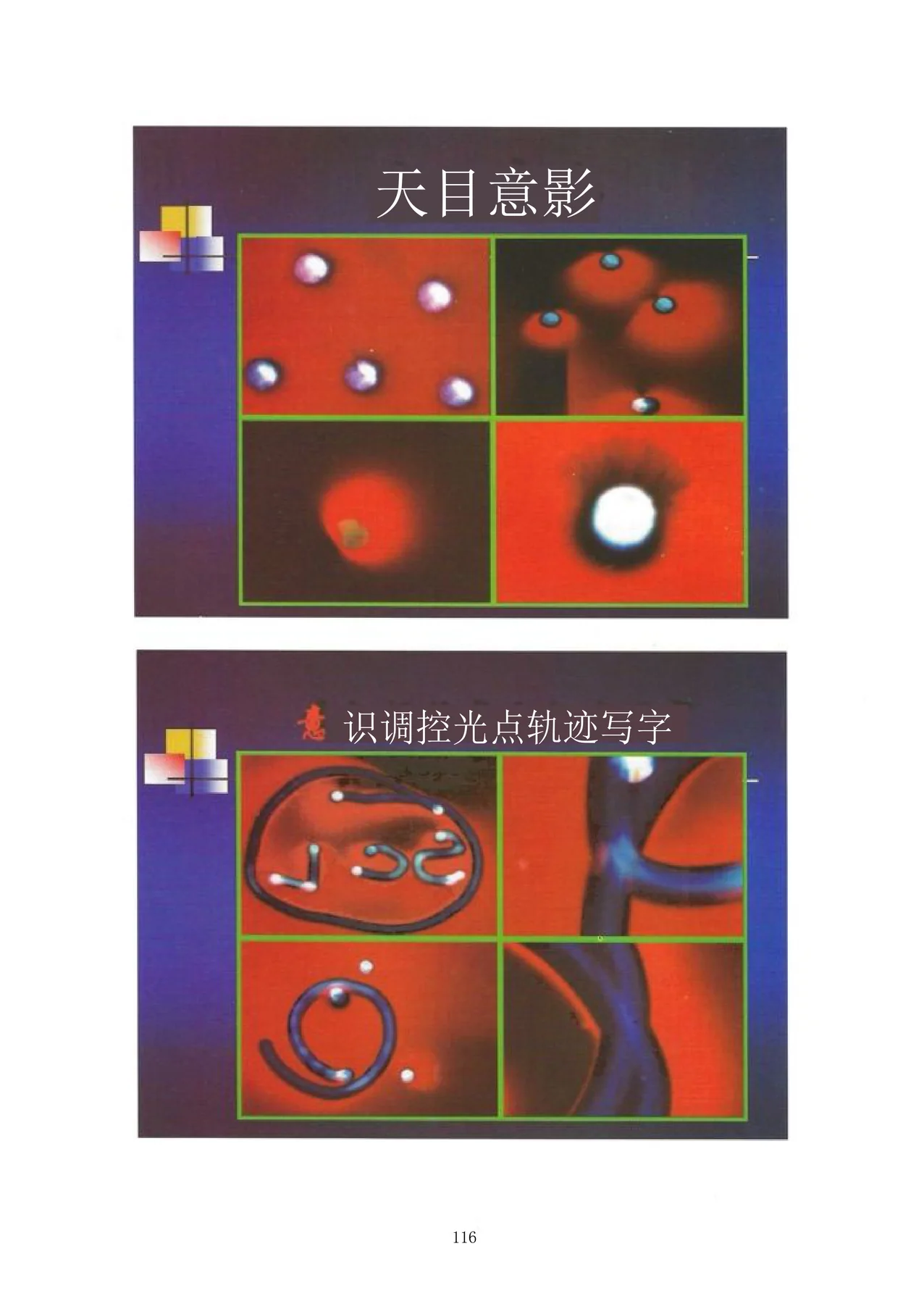
Heavenly-Eye Mental Imaging Consciousness Controlling the Trajectory of a Light Point to Write Characters
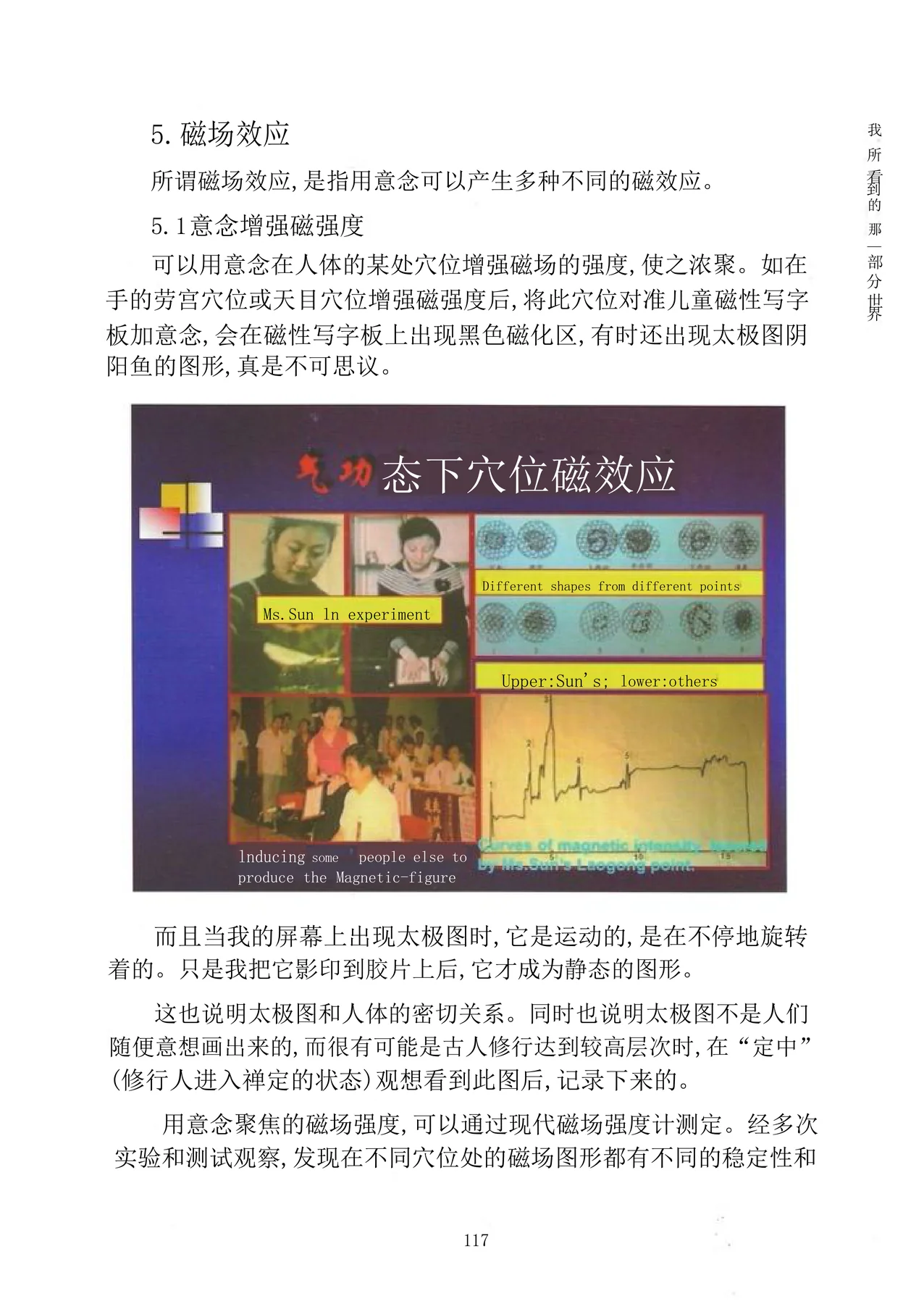
5. Magnetic Field Effects
The so-called magnetic field effects refer to the ability to produce multiple different magnetic effects through intention.
5.1 Intentionally Enhancing Magnetic Strength
One can use intention to enhance the strength of the magnetic field at certain acupuncture points on the human body, causing it to concentrate. For example, after enhancing the magnetic strength at the Laogong point of the hand or at the Heavenly Eye point, if you aim this point at a child’s magnetic writing board and add intention, a black magnetized area will appear on the magnetic writing board. Sometimes the Taiji diagram of the Yin-Yang fish pattern will even appear — it is truly inconceivable.
Moreover, when the Taiji diagram appears on my screen, it is in motion — it is constantly rotating. Only after I photocopy it onto film does it become a static image.
This also demonstrates the close relationship between the Taiji diagram and the human body. At the same time, it shows that the Taiji diagram was not casually imagined and drawn by people; it is very likely that the ancients, having cultivated to a higher level, visualized and saw this diagram while in “samadhi” (the state of meditative absorption that cultivators enter), and then recorded it.
The magnetic field strength focused through intention can be measured by modern magnetic field strength meters. Through multiple experiments, tests, and observations, it was found that the magnetic field patterns at different acupuncture points all have different degrees of stability and
specificity.
5.2 Guiding and Developing Human Magnetism
One can use intention to guide ordinary qigong practitioners and ordinary people to produce similar acupuncture-point magnetic effects. We have conducted experiments on approximately thirty people. This kind of intention-guided training has been done with both adults and children, and in both groups people developed the ability. When running extraordinary-ability development classes in Japan, we did more of this with adults. They studied these things very earnestly, so the experimental results of inducing and enhancing human magnetism were quite good. But generally speaking, the proportion of children who develop abilities is much higher than that of adults — that is, children are relatively easier to develop than adults.
5.3 Adhering Coins to the Human Body
Using intention to adhere coins to the human body — this was inspired by a functioner from the northeast named Wang Youcheng.
It is said that Wang Youcheng originally had no abilities. Later, during the meteorite shower in Liaoning in the northeast in 1976, he developed abilities overnight. He could stick one-cent or two-cent coins onto his Yintang point, stacking them one by one, and could stick as many as twenty or more.
Generally speaking, sticking on one coin does not count, because there is usually sweat on the forehead that can make things adhere. Only when two or more are stuck on does it count. Some people said that perhaps adhesive had been applied to the coins. Wang Youcheng later placed paper strips between the coins, and they could still adhere even with paper in between — this then constituted a genuine ability. He could also move the coins, and they would not fall off. Not only could he adhere coins to his body, he also had the ability of object translocation.
After I watched Wang Youcheng’s coin-adhering demonstration, I felt at the time that this should be a piece of cake for me. I immediately found a few two-cent coins and tried sticking them to my forehead, but I discovered it was not as easy as I had imagined. At the time I could only stick on one; the second simply would not adhere.
But I refused to accept defeat. After returning home, I dug out all the two-cent coins from my son’s piggy bank, sat on the bed, and began practicing. I kept sticking them on with my hand — they would fall off and I would pick them up, they would fall off and I would pick them up again. The more anxious I became, the less they would stick. After practicing for over half an hour, my hand was sore from the effort, and still the second coin had not adhered. But I did not lose heart and kept sticking them on, only with movements somewhat slower than before. Just like that, as I kept trying, at some unknown moment the second one stuck, and then the third one stuck too. My son was doing homework nearby at the time and would glance over at me from time to time, merely amused.
Then I called out joyfully: “Son, look quickly — Mommy stuck them on! Mommy stuck them on!”
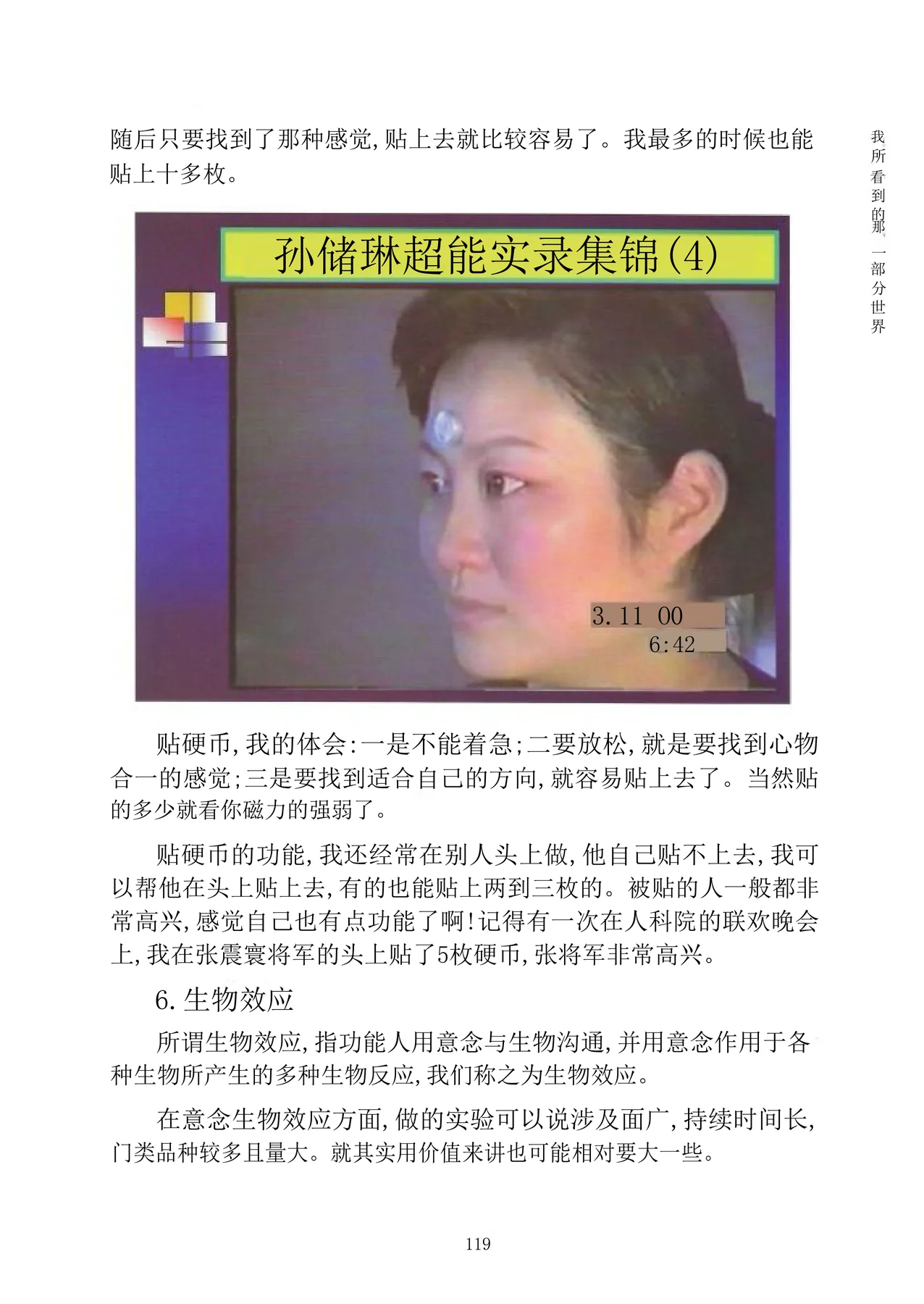
Afterward, once I found that feeling, sticking them on became relatively easy. At my best, I could also stick on more than ten coins.
Sun Chulin’s Collection of Extraordinary Abilities (4)
Regarding adhering coins, my insights are: first, one must not be anxious; second, one must relax — that is, one must find the feeling of unity of mind and matter; third, one must find the direction that suits oneself, and then it becomes easy to stick them on. Of course, how many you can stick on depends on the strength of your magnetism.
I also frequently performed the coin-adhering ability on other people’s heads. When they could not stick the coins on themselves, I could help stick them onto their heads — sometimes two or three coins would adhere. The people who had coins stuck on them were generally very happy, feeling that they too had a bit of ability! I remember once at the Institute of Human Science’s gala evening, I stuck five coins on General Zhang Zhenhuan’s head, and General Zhang was extremely pleased.
6. Biological Effects
The so-called biological effects refer to the various biological responses produced when a functioner communicates with living organisms through intention and acts upon various organisms using intention. We call these biological effects.
In the area of intentional biological effects, the experiments I have done can be described as wide-ranging, long-lasting, and involving many categories, varieties, and large quantities. In terms of practical value, they may also be relatively more significant.
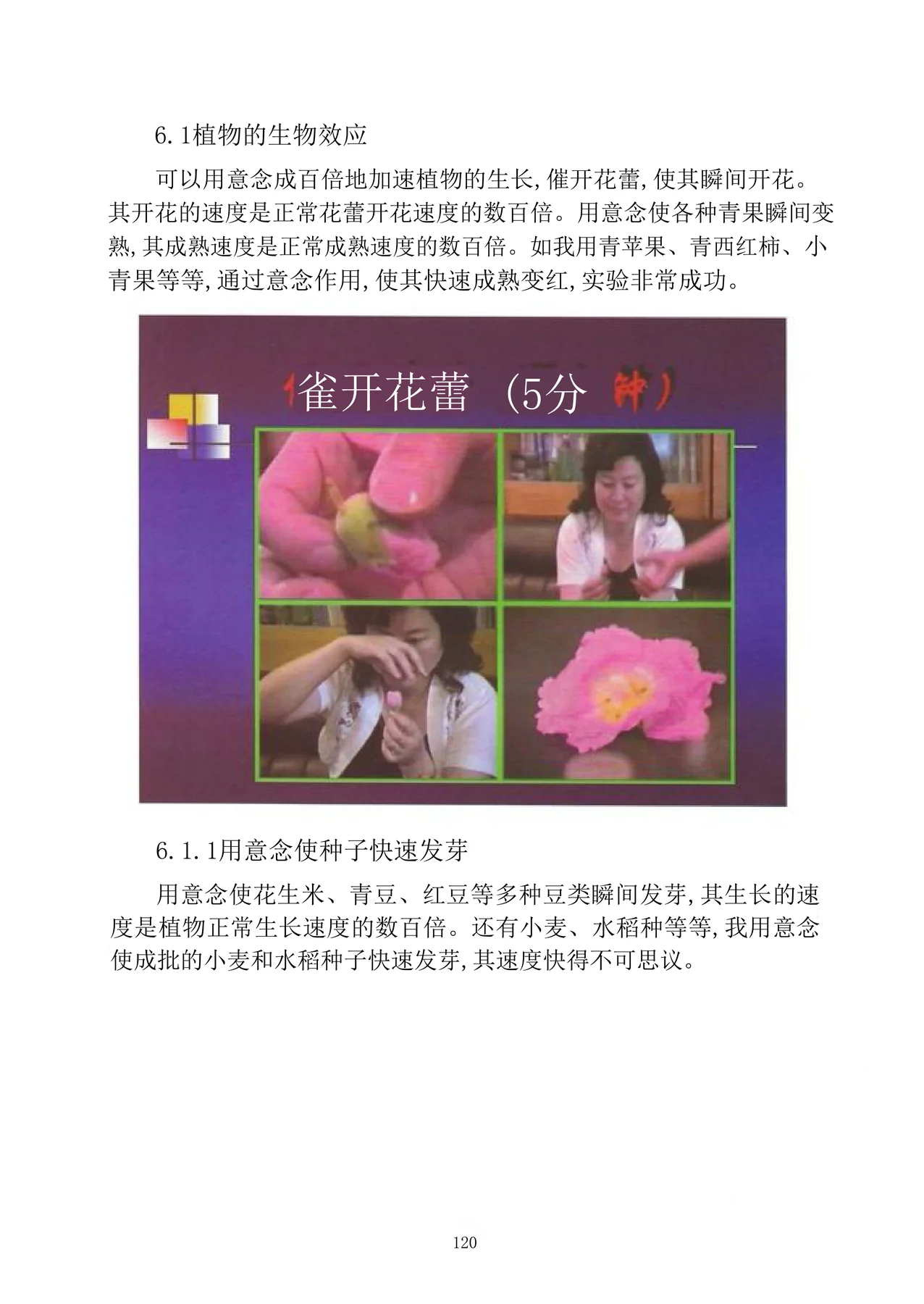
6.1 Biological Effects on Plants
One can use intention to accelerate plant growth hundreds of times, induce flower buds, and cause them to bloom instantaneously. The speed of blooming is hundreds of times the normal blooming speed of flower buds. Using intention, one can cause various unripe fruits to ripen instantaneously, at a speed hundreds of times the normal ripening rate. For example, I have used green apples, green tomatoes, small green fruits, and so on, and through intentional action, caused them to rapidly ripen and turn red. The experiments were very successful.
Flower buds opening (5 minutes)
6.1.1 Using Intention to Cause Seeds to Germinate Rapidly
Using intention, one can cause peanuts, green beans, red beans, and many other types of legumes to sprout instantaneously, at a growth rate hundreds of times the normal growth rate of plants. There are also wheat seeds, rice seeds, and so on — I have used intention to cause batches of wheat and rice seeds to germinate rapidly, at an inconceivably fast speed.
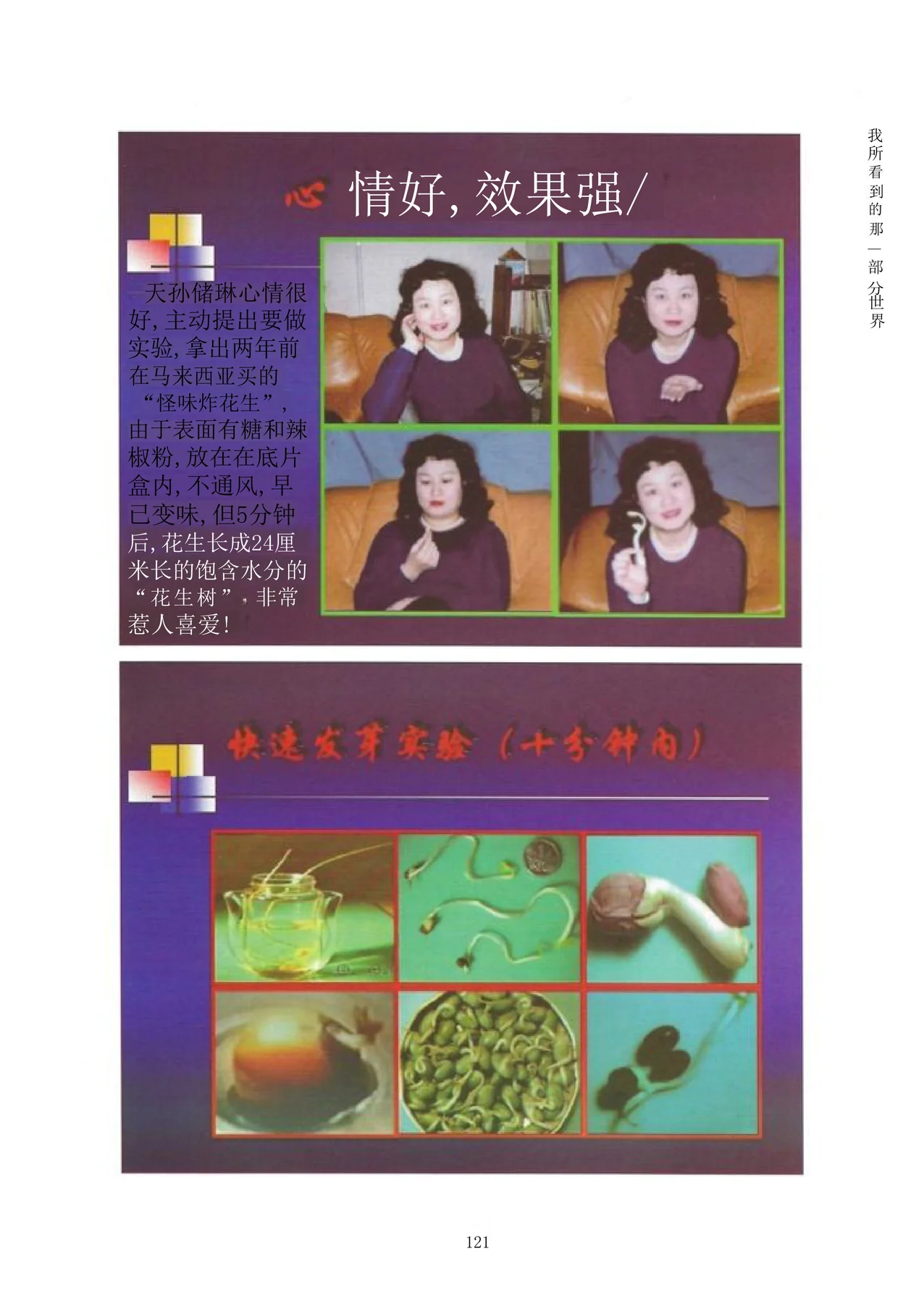
That day Sun Chulin was in a very good mood and volunteered to do an experiment. She took out some “spicy-flavored fried peanuts” bought in Malaysia two years earlier. Because their surface was coated with sugar and chili powder, and they had been kept inside a film canister without ventilation, they had long since gone stale. But five minutes later, the peanuts had grown into a water-filled “peanut tree” twenty-four centimeters long—truly delightful!
6.1.2 Using Thought to Bring Seeds Back to Life
This refers to using thought not only to make raw seeds sprout rapidly, but also to instantly revive and sprout boiled peanuts, green beans, red beans, and many other types of legumes. One can also use thought to instantly revive and sprout deep-fried peanuts, green beans, red beans, and many other types of legumes.
The peanut-sprouting experiments began with raw peanuts. Later, I wondered whether boiled or deep-fried peanuts could also sprout. Doing deep-fried peanut sprouting is quite interesting. First, those peanuts that had been dried out by deep-frying had to be revived—turned back into moist, living raw peanuts—before they could be asked to sprout.
Sometimes, when doing deep-fried peanut sprouting, some of the peanuts might have been fried too thoroughly, becoming too dry and withered, and they could not sprout even after a long time. I would communicate with them: “Why won’t you sprout?” They would say, “I’m thirsty, I’m thirsty.” Then I would soak them in water, and once they had moisture, they would soon revive and sprout successfully.
If its own energy was insufficient, I also had to summon some energy from the air. Once all the energy needed to make it sprout was assembled, the shoot would grow out in an instant. How long the shoot grew was generally beyond control. Some grew only about one centimeter, while others could grow to over ten centimeters, and the longest could reach over twenty centimeters—sometimes even growing complete with green leaves. We planted them in flower pots, and most grew very well, and even produced many, many new peanut fruits.
Another time, I even made only half a peanut sprout. The precondition was that the half-peanut had to have an embryo; otherwise, no shoot could grow.
The most frequent performances of deep-fried peanut sprouting took place at dining tables. At meals, there would usually be a plate of boiled or deep-fried peanuts. Eating along, when the feeling came, I would pick up a peanut, hold it in my hand, and without adding water, use thought to first revive it, then make it grow a shoot.
Once I did green bean sprouting. There was a plate of deep-fried green beans—probably over a hundred of them. After I communicated with them, most of the plate’s beans sprouted, though the shoots were not very long, all about one centimeter. And in one experiment at Lejuling in Malaysia, in twelve minutes I caused a fried peanut coated in chili powder to grow a very thick shoot with two layers of leaves, over ten centimeters long.
6.1.3 Using Thought to Selectively Partially Revive Seeds
For example, with boiled peanuts, through thought communication, one can request that only the peanut inside revive and sprout,
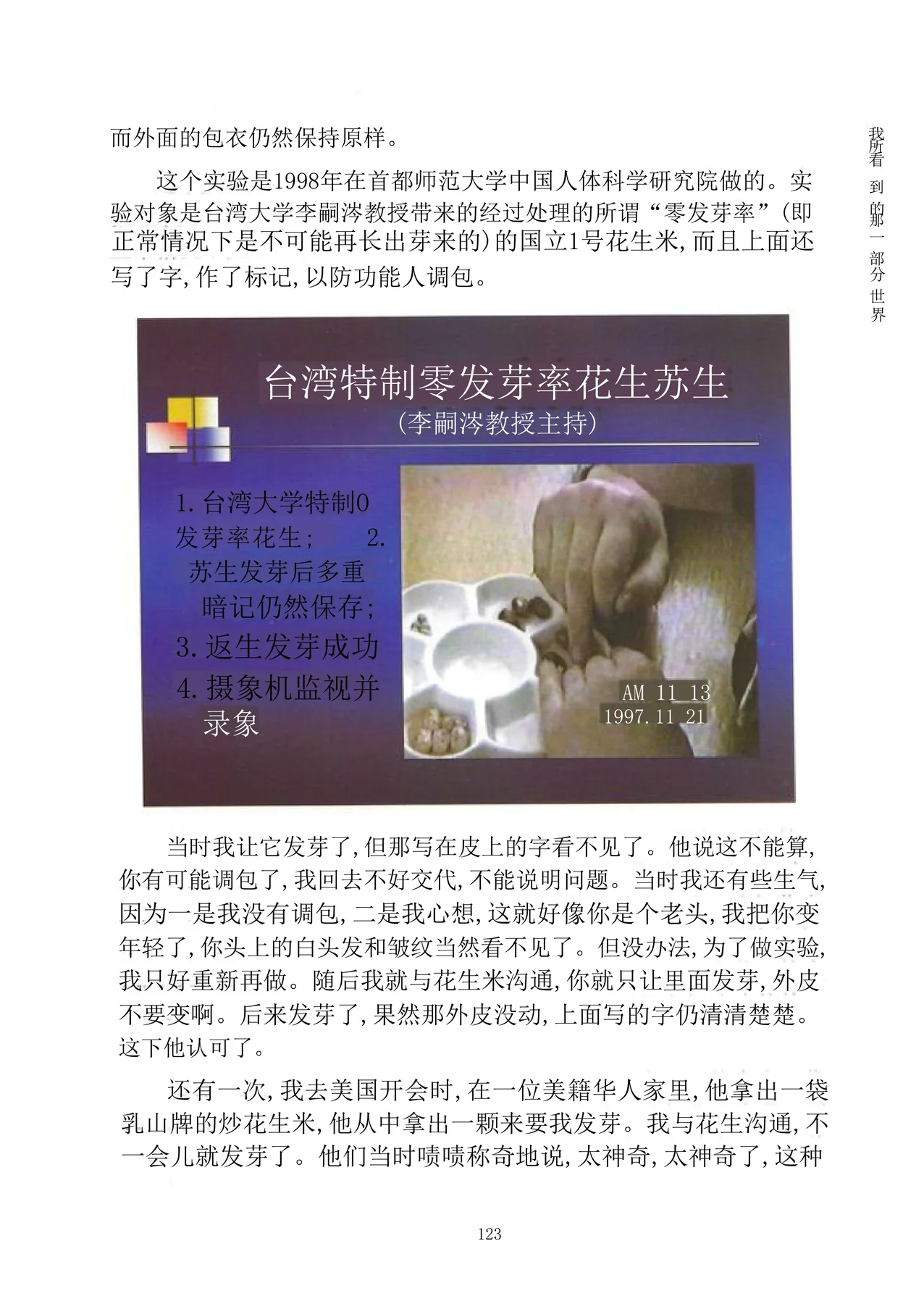
while the outer skin remains unchanged.
This experiment was conducted in 1998 at the China Institute of Human-Body Science at Capital Normal University. The experimental subject was so-called “zero-germination-rate” peanuts (meaning that under normal conditions they could not possibly sprout again) of the “National No. 1” variety, treated and brought by Professor Li Si-chen of National Taiwan University. Characters were also written on them as markings, to prevent the gifted person from switching them.
Revival of Taiwan- specially-made zero-germination-rate peanuts (Hosted by Professor Li Si-chen)
- Specially-made zero-germination-rate peanuts from National Taiwan University;
- Multiple markings still preserved after revival and sprouting;
- Successful revival and sprouting
- Video camera monitoring and recording
AM 11 13 1997.11.21
At the time, I made them sprout, but the characters written on the skin could no longer be seen. He said this would not do—that I might have switched them, and he would have no way to explain it when he went back, so it could not demonstrate anything. I was somewhat upset at the time, because first, I had not switched them, and second, I thought to myself: it was like if you were an old man and I transformed you back into a youth—of course your white hair and wrinkles would no longer be visible. But there was nothing to be done; for the sake of the experiment, I had to do it over. So I communicated with the peanut: just let the inside sprout, and don’t change the outer skin. Later it sprouted, and sure enough, the outer skin was untouched, and the characters written on it were still perfectly clear. This time he accepted it.
Another time, when I went to the United States for a conference, at the home of a Chinese American, he brought out a bag of Rushan-brand roasted peanuts and picked one out, asking me to sprout it. I communicated with the peanut, and before long it sprouted. They clicked their tongues in amazement, saying, “So miraculous, so miraculous! This kind of
This phenomenon is well worth studying.
6.1.4 Activating Aged Seeds Through Intention
In 2000, in a laboratory at the University of Pennsylvania in the United States, I successfully used intention to activate some geranium seeds that had been stored for thirty years, and they sprouted.
When performing these seed-revival and germination experiments, sometimes I held them in my hand, and sometimes they were placed in containers several meters or even several hundred meters away from my body. Some needed water added, and some did not. Sometimes I made a single seed sprout, and sometimes multiple seeds sprouted simultaneously. Sometimes the sprouts grew plump and white, as thick as a person’s little finger—very endearing.
To perform experiments on bringing seeds back to life, two important conditions must be met: first, the seed’s embryo must be intact—even if it is only half a peanut, as long as the embryo on it is complete, it can sprout; second, generally revival must occur first, and sometimes water must be added for revival to take place. Only when these two conditions are met can you proceed successfully. In between, there is quite a lot of two-way communication with the plant. It is not so easy to make something sprout just because you want it to.
6.1.5 Communicating with Seeds Through Intention
One time, a classmate of Director Wu Shaozu’s came back from the United States—probably a wealthy boss—and Director Wu wanted him to sponsor some money for us to carry out human-body science experiments. This boss did not really believe in extraordinary human abilities and said he would wait until he had seen an experimental demonstration before deciding. The boss said he would treat us to a meal and have us perform the demonstration at the dinner table.
To accommodate this boss’s request, Director Wu also invited several experts and professors to accompany us. Guo Moruo’s son, Guo Hanying, also came.
At the dinner table, the boss took out two envelopes he had prepared beforehand and said that each envelope contained four peanuts—one bag had peanuts that had been boiled for forty minutes, and one bag had raw peanuts. On the envelopes he had written respectively: “No physical action of any kind,” “No chemical action of any kind.” That is to say, apart from one bag having been boiled, no other tampering had been done to these two bags of peanuts. I thought to myself, if I’m going to do it, I’ll do the harder one, so I chose the bag of boiled peanuts.
When I directed my intention at the envelope, before long I saw on my Heavenly Eye that the peanuts had begun to rotate, and it felt promising. But as they rotated and rotated, they stopped and ceased turning. At that point I began to communicate with the peanuts. I said, “Why have you stopped? I’m telling you to revive and sprout—why won’t you listen?” Then, faintly in my ears, I heard a sound like “pain, pain.” I thought, you peanuts can even feel pain—it’s just that you’ve been boiled; boiled ones can sprout too. Seeing that I still hadn’t understood or grasped what it meant, my ears then heard a sound like “pierce, pierce.” I thought again, I haven’t touched you, and I haven’t pierced you with a needle. In any case, after communicating for quite a while, it simply would not sprout.
Seeing the situation, I said that I wouldn’t be able to make it sprout today. The boss, quite graciously, said it was fine—we could take it back and do it, and whenever we were done, we could let him know, and he would come pick it up. After that meal, we brought the envelope back, and the next day I continued working on it in the laboratory.
When I worked on it in the laboratory, the same situation as the previous evening occurred again. First I heard the “pain, pain” sound. Seeing that I hadn’t understood its meaning, I then heard “pierce, pierce.” Seeing that I still hadn’t understood, my ears then heard it say: “Take a look at me.” I thought, what is there for me to look at—you’re just a peanut. Because communicating with it was already very taxing and exhausting, and now it wanted me to examine it closely, I felt even more tired. But since I wanted it to sprout, I had no choice but to look at it more carefully. Yet after looking for quite a while, I didn’t find anything unusual.
Later I moved the peanut onto my Heavenly Eye and magnified it to look—and this look gave me a great shock. It turned out that a very fine copper enameled wire had been inserted inside the peanut. If I hadn’t magnified the peanut to look at it, it would indeed have been very hard to see. This made me, just like the peanut, feel greatly resentful, thinking that this boss was entirely untrustworthy. Because he had written on the envelope “No physical action of any kind” and “No chemical action of any kind,” yet he had secretly tampered with it—he was somewhat dishonest.
In the end, I told Professor Shen about this situation. At first Professor Shen didn’t believe it either. He looked and found nothing. I said there definitely was something there, and told him to look carefully. Later, it was only under a microscope that he could clearly see the copper enameled wire.
6.1.6 An Experiment That Was Half Successful
Another time, Director Wu Shaozu came to our Human-Body Science Research Office at the China University of Geosciences, and brought four Shanghai spiced broad beans, asking me to do a germination experiment. He said to sprout only two, and use the other two as controls. Director Wu also mentioned that he had a meeting to attend shortly.
When I heard this, I felt a bit anxious, fearing I wouldn’t be able to produce results before he left. Moreover, while I was working on it, Director Wu kept looking at his watch, which also made me feel somewhat anxious. I had been at it for quite a while already, and still hadn’t produced results. But I sensed that revival had already reached more than eighty percent. Later, Director Wu looked at his watch again and said, “I need to go to a meeting. It looks like I won’t be able to see the sprouting today.”
Looking at Director Wu, who was about to rise from his seat, I said very apologetically, “I really can’t make it sprout today—I’m so sorry. But I feel that revival has already reached more than eighty percent.” At that point, Professor Liu Yicheng, who was present, said, “Since Xiao Sun says that more than eighty percent has already been revived, please, Director Wu, take them back.”
We planted all four in flowerpots, marking them separately to see whether the two that had already been revived could sprout. We then wrapped them in paper and gave them to Director Wu to take away.
Professor Liu had essentially smoothed things over for me, which made me feel a bit better. Later, Director Wu told us that after he returned home, marked them, and planted them, those two experimented-on spiced beans actually did sprout, and grew quite well. He even took photographs, saying he would bring the photos over for us to keep when it was convenient. This showed that if there had been a little more time at that moment, they could have sprouted right there on the spot. So this experiment could be considered half successful.
It so happened that on one occasion, I invited Director Wu Shaozu to a friend’s place to see a “thermal imaging device” he had developed using foreign technology. After watching the demonstration of the instrument, the developers asked Director Wu to share his impressions.
Director Wu began by saying that he had come here today at the invitation of Comrade Sun Chulin. Comrade Sun Chulin, he said, is someone in our country with very strong extraordinary human abilities, and is quite rare. The spiced bean sprouting experiment we did together last time was half completed at the time — they had already been revived. After I took them home and planted them in a flowerpot, they sprouted. I took photographs, and I’ve brought them with me today. Everyone is welcome to take a look.
Director Wu then gave me one of the photographs, asking me to take it back and give it to Professor Shen for safekeeping. This was a result from an experiment he had personally participated in, which showed that Director Wu attached great importance to these experimental results.
6.1.7 Seeds Increase in Weight After Sprouting
Around 1996, the director of Japan’s “Institute of the Incomprehensible,” Morita Ken, heard someone introduce my abilities and wanted to collaborate with me on some research. But he had not yet met me in person or witnessed my abilities. Later, Morita Ken came to China. He first got in touch to meet with me and understand some basic information, and then wanted to see a demonstration.
That time he treated us to a meal, and at the dinner table he specifically ordered a plate of deep-fried peanuts and took one from it, asking me to sprout it. As I held it in my hand and was working on it, just beginning to feel something, someone suddenly brought in a group of reporters from outside. They came in and started taking pictures, with flashbulbs going off nonstop, which instantly disrupted my mood. After that, no matter what I did, I couldn’t make it work. I could only say, I’m very sorry. It seems it won’t work today. Let’s try again another time when there’s an opportunity.
The second time he came to China, he did not contact that introducer again and came directly to me. This time he brought two boiled spiced peanuts, and I successfully sprouted them for him without any difficulty. The third time he came to China, I again performed the sprouting of deep-fried peanuts for him. That demonstration was conducted very rigorously — first
the deep-fried peanut was weighed on a balance, and then I caused it to sprout. When weighed on the balance again, the weight had clearly increased — by several times compared to before sprouting.
Later, I also caused the already-sprouted peanut to retract its sprout and return to the deep-fried state. At that point it was weighed once more, and the weight was slightly heavier than the first time it had been weighed — it appeared that a small amount of moisture had been retained. This was because during the revival and sprouting process, a large amount of water had been absorbed.
This experimental demonstration astonished Morita Ken, who felt it was truly incomprehensible. Our collaboration began from that point onward. Later, when Morita Ken came to China, I also conducted revival experiments on roasted sunflower seeds and roasted chestnuts for him.
6.1.8 Using Thought to Adjust the Ripeness of Plant Fruits
Through communication by thought, one can cause certain green fruits, green apples, or green tomatoes to instantly transform into ripe red fruits, and can also cause ripe red fruits, red apples, and red tomatoes to instantly transform into green fruits, green apples, and green tomatoes.
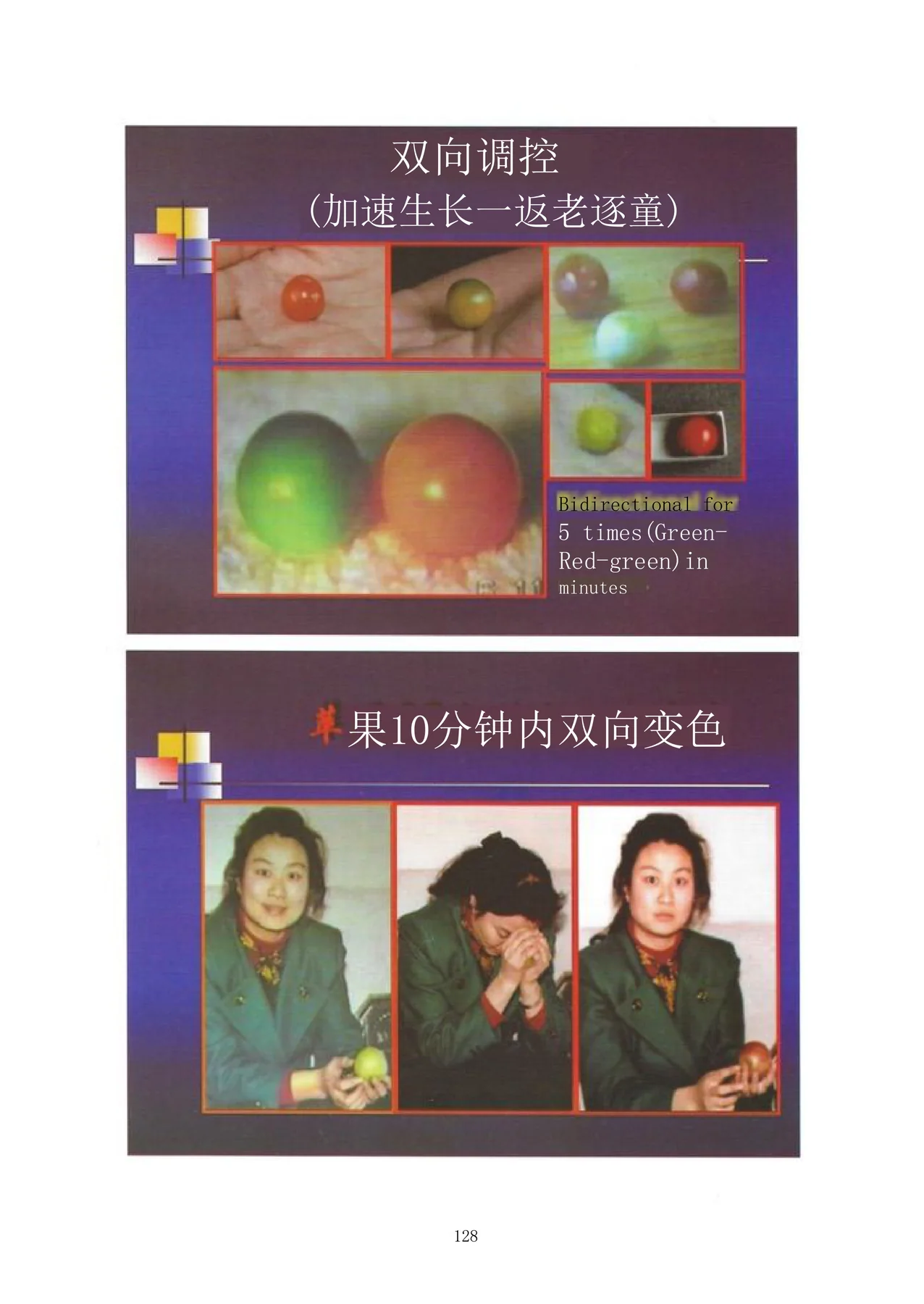
Bidirectional regulation
(accelerating growth — reversing aging to youth)
Bidirectional color change within 10 minutes
5 times (green–red–green) in minutes
The earliest idea for conducting experiments on using thought to adjust the ripeness of plant fruits came at a demonstration site for extraordinary human abilities, where I was inspired by seeing a function practitioner from Henan perform a demonstration of turning evergreen fruit from green to red.
My first experience communicating with a plant was one year, when I was spending time with friends in the greenhouse on the campus of Wuhan Geological University. I noticed a potted evergreen fruit tree that happened to bear green fruits. At that moment I thought: could I, like the function practitioner from Henan, cause a green fruit to quickly turn red?
I immediately tried to communicate with it. I said to the green fruit: “Hello, green fruit, can you change to a ripe red color?” and I continuously directed my thought at it: “Turn red, turn red.” Before long, it indeed changed to a red color. This made me so happy — plants could understand what I was saying too.
Later I told Professor Shen about this discovery. At that time, Professor Shen happened to have a potted evergreen fruit tree at home that also bore fruit. He casually picked one from it, handed it to me, and said: let’s see if you can make it turn red. I then tried to communicate with it again. I said: can you change to a fully ripe red color? Before long, it truly turned red as well.
A few days later, a teacher from the School of Gemology came to my laboratory to visit, and mentioned that he was interested in and also quite convinced of extraordinary human abilities and phenomena. He had also picked an evergreen fruit and brought it over, asking me to turn it red. I again tried to communicate with the green fruit, saying: “Hello, little green fruit, you’re so adorable — can you change to a ripe red color?” Before long it turned red.
When I held it in my hand to show them, I accidentally broke it, and it even oozed liquid. I then tried again, saying: could you return to your revived state and become green again? After a while, that red fruit really did turn green again, and the spot where I had broken it even formed a scar — it was truly fascinating. At the time, that teacher exclaimed with delight: “Truly miraculous, you’re really remarkable.” This was the first discovery that I could communicate with plants and cause them to change according to my requests.
6.1.9 Thought Changes Plant Traits
Using thought to directionally treat wheat seeds produced noticeable results. This experiment was conducted together with Professor Liu Yicheng of the Institute of High Energy Physics at the Chinese Academy of Sciences, and with function practitioners Yu Ruihua, Zhang Litian, and others. Professor Liu Yicheng was originally in high-energy physics, not in botany or plant science. But our demonstrations related to seed sprouting aroused his interest. So he went to find agricultural science experts and professors he was acquainted with, to conduct wheat breeding experiments together.
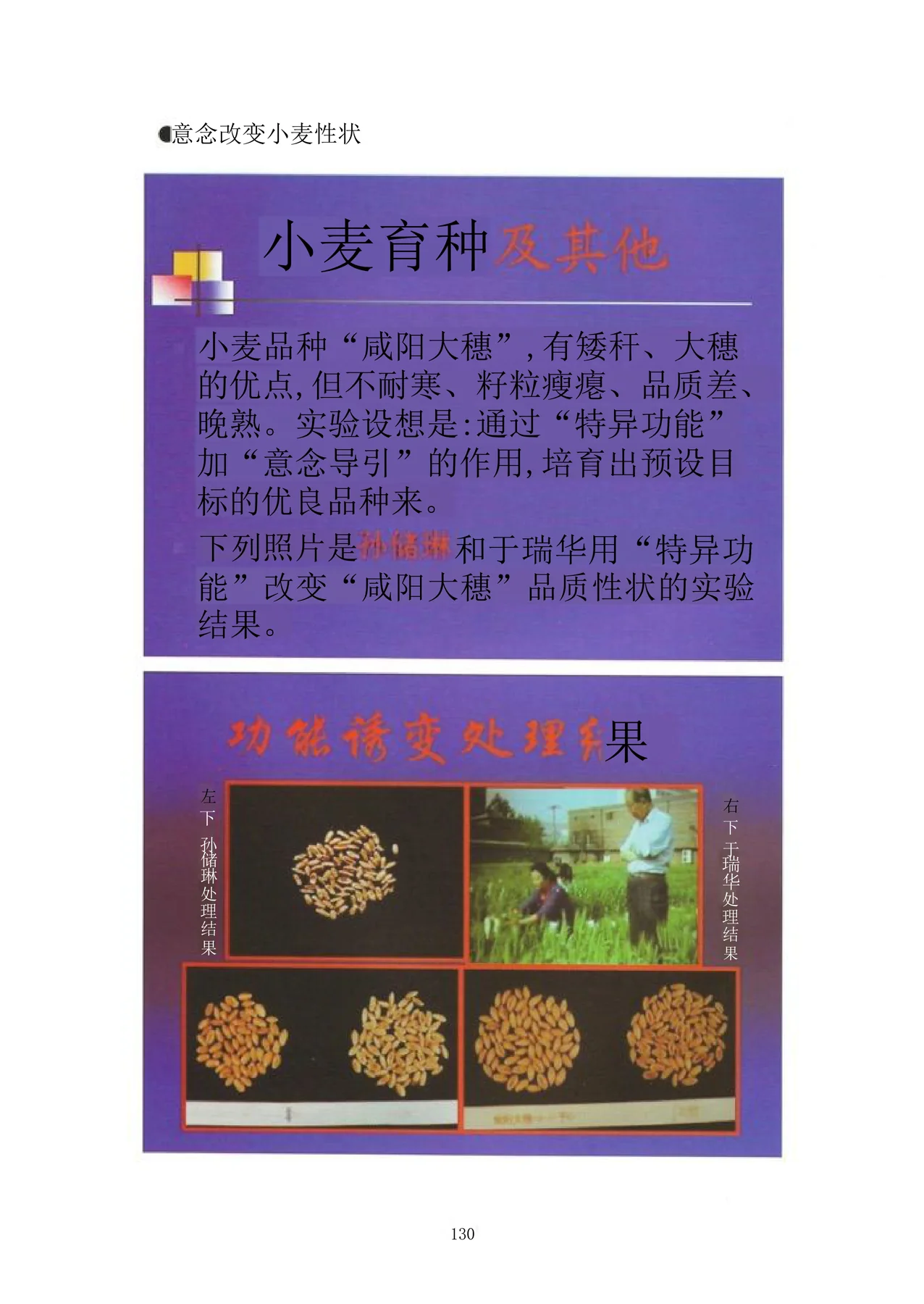
Changing Wheat Traits Through Intent
Wheat Breeding
The wheat variety “Xianyang Large Spike” has the advantages of short stalks and large ears, but it is not cold-resistant, its grains are shriveled, its quality is poor, and it matures late. The experimental hypothesis was: through “extraordinary abilities” combined with “intent guidance,” to breed an improved variety meeting predetermined objectives.
The following photographs show the experimental results obtained by Sun Chulin and Yu Ruihua using “extraordinary abilities” to alter the quality traits of “Xianyang Large Spike.”
| Left: Sun Chulin treatment result | Right: Yu Ruihua treatment result |
|---|
The idea of using intent to treat wheat breeding was inspired by Zhang Litian, an agronomist and qigong enthusiast from Fujian.
Zhang Litian had once tried emitting external qi toward hybrid rice, hoping to see whether the hybrid rice seeds could acquire heritable traits, so that after planting they would no longer segregate and would become a high-quality rice variety.
Later, in collaboration with breeding expert Dr. Yang Jubao, he completed the development of many new varieties.
We undertook this experiment after General Zhang Zhenhuan of the National Defense Science and Technology Commission inspected Fujian’s qigong-based breeding work, and Professor Liu Yicheng also conducted an on-site investigation. Only then, in the winter of 1995, did we launch the wheat directional breeding experiment in cooperation with Professor Liu Zhiyi and others at the Hebei Wheat Research Institute.
The ears of the “Xianyang Large Spike” wheat variety are large, but the grains are shriveled, and even the large ears cannot be fully filled. So the first breeding objective was to see whether the ears could be filled and the grains made plump. Furthermore, since “Xianyang Large Spike” transplanted to Shijiazhuang would suffer heavy winter freeze mortality, cold tolerance was needed. After wheat harvest, there is a rush to plant corn, so time is very tight; maturing three to five days earlier would greatly help ensure the timing of the second crop.
Having set the breeding objectives based on the professional advice of breeding experts, we drew on our long experience in extraordinary-ability research, knowing that extraordinary abilities can achieve anticipated results through “ability + intent.” We therefore boldly abstracted this into constructing intent phrases in natural language, so that the specially-abled individuals could emit qi while holding the intent.
The intent phrases we designed were very simple: “early maturity, cold tolerance, plump grains, stable inheritance.” In other words, we simply let the specially-abled individuals know how to “intend” when emitting qi. Then we selected several seedling stages—tillering, flowering, and grain filling—and had the specially-abled individuals emit qi with intent in the experimental fields.
The five or six specially-abled individuals who participated in the experiment included me, Yu Ruihua, and Zhang Litian. After three years of experimentation, we achieved clear results. Four photographs are attached, along with the statistical data table for the third year’s results:
| Specially-abled individual | Tiller count | 1000-grain weight (g) | Per-plant grain weight (g) |
|---|---|---|---|
| Yu Ruihua | 4.66 | 59.294 | 15.51 |
| Sun Chulin | 4.66 | 53.582 | 14.320 |
| Zhang Litian | 4.00 | 56.810 | 12.84 |
| Control group | 2.60 | 30.23 | 9.646 |
In other words, we obtained the result of “cold tolerance, early maturity of five to seven days, and clear improvements in tiller count, 1000-grain weight, and per-plant grain weight, with heritable traits.” All four “intent” targets yielded clear positive results, and per-plant grain weight is directly proportional to yield per mu. The shortcoming was that after three years, although the degree of ear filling improved year by year, the uppermost part of the large ear was still not completely filled.
Professor Liu Yicheng said in summarizing this experiment: “My background is in physics, so I did not appreciate the difficulty of breeding. To develop a new variety often takes five to eight years or even longer. We worked for three years and obtained the results above—this was unexpected, and the prospects are promising.”
Just as we were planning to further investigate whether we could fill the entire large ear completely, and were about to conduct large-scale field trials with the results already obtained, the experiment had to be interrupted due to obstacles created by the so-called “anti-pseudoscience” movement.
Using Intent to Increase Rice Protein Content
Rice experts at the Chinese Academy of Agricultural Sciences said that the protein content of rice is not as high as that of wheat, and that increasing its protein content would be very significant. So in 1997, in cooperation with the Chinese Academy of Agricultural Sciences, we conducted an experiment to increase the protein content of rice. Using the same method, we achieved significant increases in the content of seventeen types of proteins and amino acids in rice. However, we only conducted one year of experiments, and for various reasons the experiment was also interrupted.
Using Intent to Increase the Gutta-Percha Content in Eucommia Leaves
In 1998, also with Professor Liu Yicheng guiding me, we conducted an experiment in cooperation with the Gutta-Percha Association to increase the gutta-percha content in Eucommia tree leaves, achieving a five-percent increase—but again, this was done for only one year.
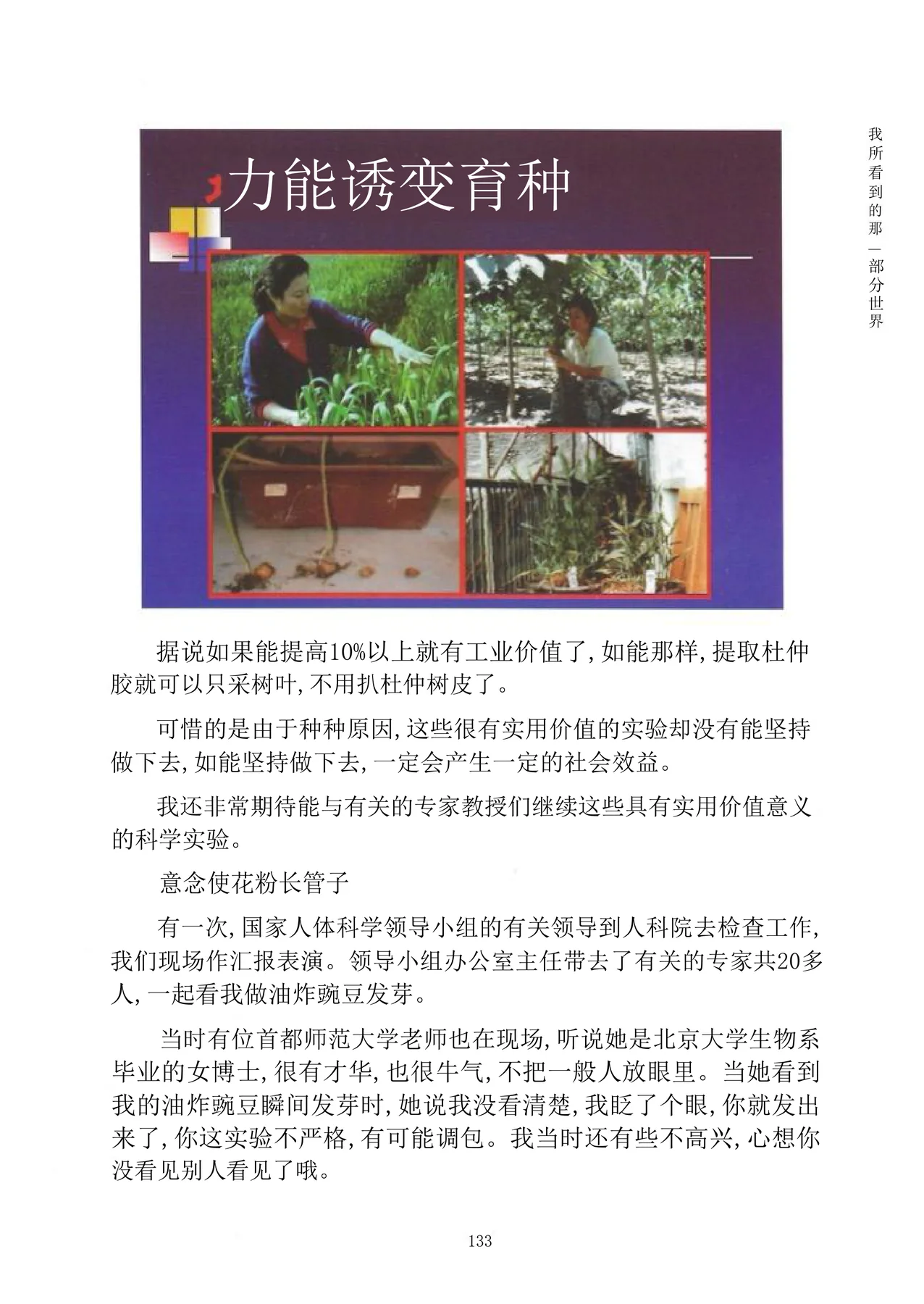
Qi-Energy Induced Mutation Breeding
It was said that an increase of more than ten percent would have industrial value. If that could be achieved, gutta-percha extraction could be done by harvesting only the leaves, without stripping the bark from the Eucommia trees.
Regrettably, for various reasons, these experiments of considerable practical value were not continued. If they had been sustained, they would certainly have produced certain social benefits.
I still very much hope to continue these scientifically valuable and practical experiments with the relevant experts and professors.
Making Pollen Grow Tubes Through Intent
Once, relevant leaders from the National Human-Body Science Leadership Group came to the Human Science Research Institute to inspect our work, and we gave a live demonstration. The director of the Leadership Group’s office brought more than twenty relevant experts, and together they watched me perform the deep-fried pea sprouting.
A teacher from Capital Normal University was also present at the scene. I was told she was a female Ph.D. who had graduated from the Biology Department of Peking University. She was very talented but also quite arrogant, looking down on ordinary people. When she saw my deep-fried pea sprout instantly, she said, “I didn’t see it clearly. I blinked and you had already produced the result. Your experiment is not rigorous—you might have switched the sample.” At the time, I was a bit unhappy and thought to myself: you didn’t see it, but others did.
She said she would design an experiment, and only if I could carry it out would she be willing to believe. I was not very willing at the time, but later, after the professors persuaded me, I agreed to do the experiment she had designed. After that we went to her laboratory to do the experiment on pollen growing tubes.
Her experiment was to have a certain type of pollen, under a certain temperature and within a certain period of time, grow a certain number of tubes.
She used two culture dishes at the time, each containing the same quantity of pollen. One was placed in the incubator she had set, and the other was placed in front of me. She set it up so that we would both use twenty minutes to see which side grew more tubes. After the twenty minutes were up, she took out the group from the incubator and compared it with the group I had treated with thought in my hands. In my group, 90% of the pollen had grown tubes, while in the group placed in the incubator, only 10% of the pollen had grown tubes.
She said there was no way I could have pulled a switch or cheated in the experiment she had designed, because I did not know what kind of pollen she was using, and since I was not a biology student, I did not know how pollen grows tubes. Therefore, she said, this experiment was absolutely authentic. By then she completely believed in the authenticity of my abilities. And of course she also believed that my earlier deep-fried pea sprouting was genuine. Later we became good friends and did other pollen experiments together.
Later she went to Taiwan for further training, and I asked Professor Li Si-chen of National Taiwan University to try to find her and see whether we could obtain the relevant photographs and materials from the pollen experiments we had done together. But I heard she had gone to America again, and after that there was no way to contact her anymore. It is a great regret that I cannot see the experimental report from that pollen tube growth experiment and the several especially beautiful photographs.
Intention-Based Asexual Reproduction in Corn
Once, at the Beijing Academy of Agricultural Sciences, we did an experiment with corn. In the experimental cornfield, the experts from the agricultural science institute covered the freshly flowering corn with paper bags. The experiment they asked me to perform was: to use thought to make the corn produce ears even without pollination.
At the time I straightforwardly did two items in the experiment. For one group of bagged corn, I used thought to translocate pollen from outside, passing through the paper bag to achieve pollination. For the other group of bagged corn, I used a thought command instructing it to set seeds even without pollination—that is, asexual reproduction. In the end, the result of the experiment was that both groups of bagged corn set seeds. Meanwhile, none of the other corn covered with paper bags produced even a single seed. This showed that pollen translocated by thought can produce seeds, and that asexual reproduction brought about by a thought command can also produce seeds. This demonstrates how inconceivable the energy of thought is.
In the wheat experiments, I transformed sterile lines into fertile lines and transformed fertile lines so that their offspring would not mutate; the results of the experiments I did showed a definite effect compared with the control groups.
6.2 Biological Effects on Animals
What we call biological effects on animals refers to the various biological effects produced when a person with extraordinary abilities uses thought to act upon animals. We call these the biological effects on animals.
6.2.1 Bidirectional Regulation of Eggs
One can first boil raw chicken eggs, quail eggs, and duck eggs using thought, and then return them to a raw state using thought. When returning them to a raw state, if one adds a thought to make the egg enlarge, it can enlarge—up to one and a half times its size. It can become a translucent soft-shelled egg, like one laid before the shell has fully formed. One can also arbitrarily choose certain fragrances, such as apple or lemon, and add them in using thought, and the egg will take on whatever apple or lemon fragrance you desire. This category of experiment has been done quite a lot and has been quite successful.
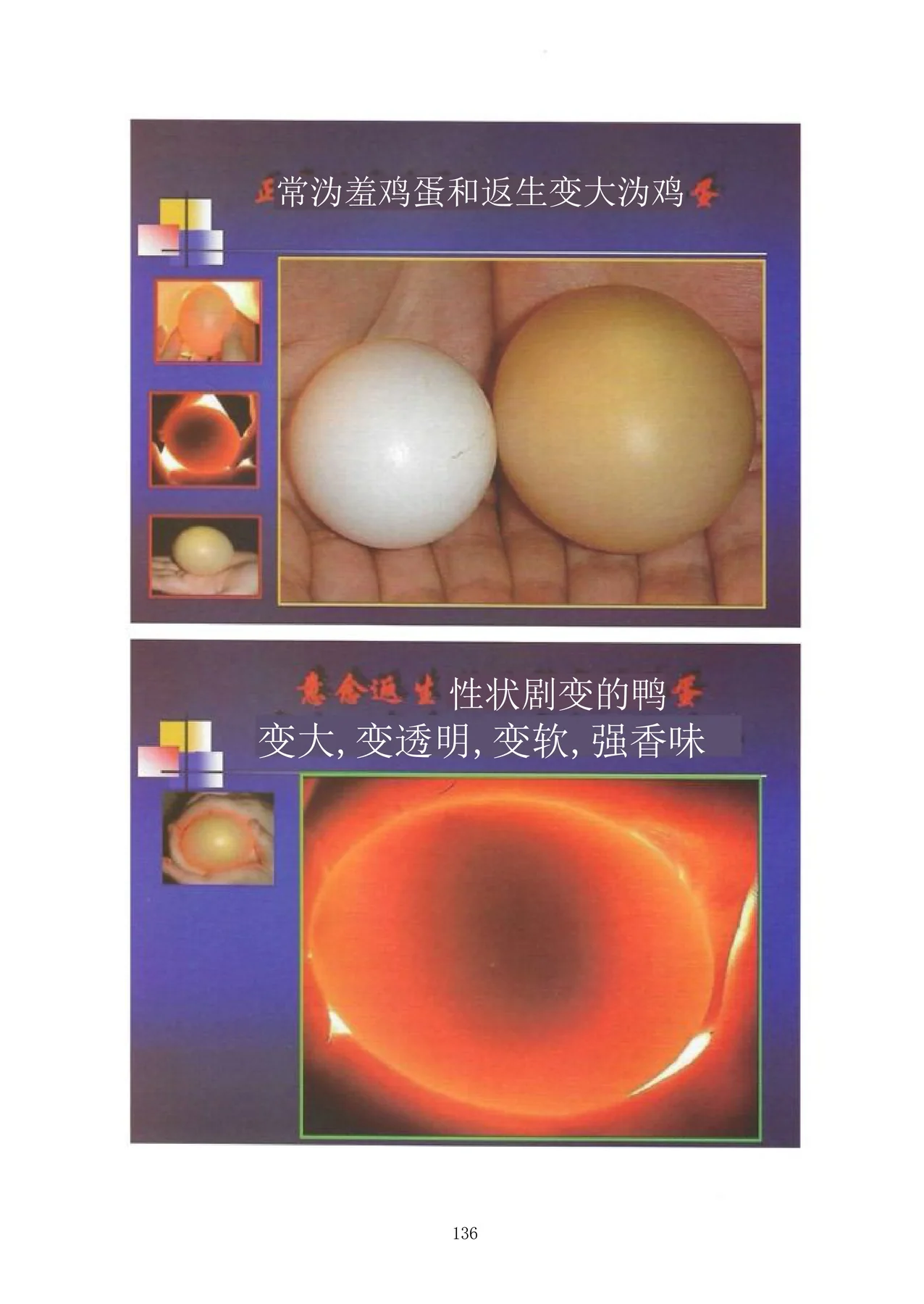
Boiled egg and returned-to-raw enlarged boiled egg
Duck egg returned to raw state with drastically altered traits
Enlarged, turned translucent, turned soft, strong fragrance
The first time I did the quail egg experiment—transforming it from raw to cooked—was in Professor Shen’s home. Teacher Zheng took a raw quail egg out of the refrigerator, and I held it in my hand and used thought to boil it cooked. After it was cooked, they even divided up that cooked quail egg and ate it. The process by which I used thought to cook the quail egg seemed to cook the yolk first, then cook the egg white—like cooking something in a microwave oven, cooking from the inside outward, little by little, rather than cooking from the outside inward as in ordinary cooking.
The second time I did the quail egg return-to-raw experiment was in the national laboratory at our China University of Geosciences. That time, over thirty people were present watching us do the experiment. I remember that someone was specially sent out to buy more than twenty quail eggs on the spot. First, one was taken out and spun on the tabletop; it could not spin fast, which showed it was raw. Then it was opened and inspected, confirming that it was indeed raw. Then several more were taken and placed in water and boiled with an electric stove for over ten minutes. After they were taken out and cooled in water and then spun, they could spin very fast, proving they were cooked. One was opened and examined, and it was indeed cooked.
At this point I took the cooked quail egg in my hand and used thought to return it to a raw state. When I sensed that it had completely returned to raw, I told everyone that it had already returned to raw. When it was placed on the tabletop and spun, it could no longer spin fast. When it was opened and examined, it was indeed completely raw again. And the process of returning to raw also proceeded from the inside outward, little by little. These two processes were quite interesting: whether the quail egg went from raw to cooked or from cooked to raw, in both cases it proceeded from the inside outward.
The first experiment using thought to cook a chicken egg was done in 1995 in Beijing. On one occasion, a friend brought me an egg freshly bought from the street and asked whether I could use thought to make the egg cooked. I said it should be possible. Since I had done quail eggs before, I knew how to make the connection; the only difference was the size. So I tried doing it, and before long I could see the egg cooking from the inside to the outside. I handed it to my friend, who took the egg and opened it— it was really cooked—and said, “You’re truly amazing.”
6.2.2 Bringing Small Animals Back to Life
Doing experiments with small animals is truly something that leaves people somewhat incredulous.
I once did an experiment reviving dead shrimp. That was around the year 2000. Professor Shen and I knew a Party committee secretary from the Sixth Research Institute of Electronics. He did not believe I had extraordinary abilities, but his wife especially believed, because his wife had participated in the activity of Ke Yunlu filming that television special about me. His wife was always promoting to the Party committee secretary, saying “Sun Chulin can make peanut kernels sprout, she can do many experiments,” and so on, but the Party committee secretary would always shake his head and say, “I don’t believe it!”
I had known them for many years. Everyone was quite busy, and we could only get together once every half year or year. His wife kept saying she wanted me to perform, but I always felt I was not in the right state, so they had never seen it.
had seen my extraordinary-ability demonstrations. I figured I’d just let things take their natural course. That day his wife organized another dinner; eight people came in total. I was feeling particularly good that day, really energized. A plate of plain boiled shrimp had just been served—nothing oily—and suddenly I had a feeling: “Can I bring this shrimp back to life?”
So I picked up a shrimp from the plate. I didn’t even rinse it with water; I just held it in my hand like that. I said to the people present, “Let me see if I can bring this shrimp back to life.” When everyone heard that, they all said: “You’re crazy!” Because no one had ever heard of such a thing.
I said, “Let me try.” I had never done it before either—it was my first time. I placed the shrimp in the plate and tried to communicate with it: “Can you come back to life?” Basically, I was having a dialogue with it. As a result, I sensed that there were some circles of light around me that seemed to be nodding. That is, when I was communicating with it, there were circles of light around, and the circles of light seemed to be moving. I can’t explain it very clearly—it was just a feeling that all the circles of light were in motion.
Of course, all of this was seen on the screen of my celestial eye. As soon as I brought the shrimp up onto the screen, I saw large and small circles of light flashing and moving beside the shrimp, changing back and forth. I thought to myself: “What are these things?” Later I realized that they must be something inside the shrimp, so I felt I could indeed communicate with the shrimp.
At the time I even asked: “What do you mean by this? Does it mean you haven’t gone far?” At the time I thought they might be the spirit of the shrimp, which was why I felt the spirit hadn’t gone far. Those circles of light seemed to be talking to me, blinking and flashing as if answering: “Yes!” So I said: “All right then—however many came out, go back the same number.”
At that point, I saw a circle of light on the right take the lead and—whoosh—dart in! Then on the left, whoosh, another one went in. It seemed that seven went in altogether. The seventh one wasn’t especially clear—I don’t know whether it had a tail trailing behind it or something, but the sixth and seventh went in together.
And after a large circle of light entered, changes began inside, and then a small circle of light entered. As soon as it went in, the small circle of light seemed to expand and spread out. After the last circle of light entered, the shrimp’s entire head came alive. The coming alive spread gradually, extending to the claws, the antennae, and so on. Sometimes, before the circles of light had gone in, a portion of them would be lost. Sometimes they wouldn’t—it depended on how well I grasped them. For example, if a circle of light was originally complete but ten percent was lost and I only captured ninety percent of it, then when the circle of light reached the antennae, the power would be weaker, and the tips of the antennae would be red. When I speak of strength or weakness, I’m mainly referring to the strength or weakness of my own ability. When my ability is strong,
I can capture all of it inside. When my ability is weak, or when there is interference during the process that interrupts my train of thought, the moment I pause, a portion of the circles of light will be lost.
This time there was no interference. After the last circle of light was sent in—wow! The shrimp started jumping and bouncing around full of life. Afraid it might die, I had someone bring a bowl of water and placed it in the water; the shrimp nearly jumped right out of the bowl. Everyone present was overjoyed. One friend even said to the shrimp: “If you jump out, I’ll eat you.”
After a while, this friend actually grabbed the shrimp out of the water and said: “I’m going to eat it, to see if it tastes the same as the shrimp I used to scoop out of ponds when I was little.” He ate the shrimp in one bite and exclaimed loudly: “Wow, incredibly fresh!”
By this time, the Party secretary, watching from the side, was dumbfounded. He said, “This time I truly believe!” That day I don’t know why I was so energized—I picked up a peanut from the table and made it sprout a long shoot. Oh my, the whole table was beside themselves with joy, saying repeatedly: “Today we’ve seen an immortal.”
Actually, I had known the Party secretary and his wife for three or four years. They kept inviting me to dinner, but I had never demonstrated my abilities for them, because I had never been in the state where I wanted to do it, even though they had been looking forward to it for a long time.
I’m not entirely clear on this point myself. Sometimes I just have that drive—as soon as the energy comes, I want to do it. Just like that time in the Han Sheng office; that day I actually had a fairly severe cold. Because the day before, after taking a shower, I had put on a pair of shorts and caught a draft. When I woke up in the morning, I realized I had caught a cold, so I quickly took some cold medicine.
I feel that the decisive factor in performing extraordinary abilities is whether or not I want to do it, whether or not I have that inspiration. Physical condition comes second.
Take the time I brought the braised shrimp back to life in the Han Sheng office—it’s a very typical example. That was on the morning of October 6, 2003, at nine o’clock. Professor Shen and I, at the invitation of Editor-in-Chief Wu Meiyun, went to the Beijing Han Sheng editorial office to work with Editor Wu to select usable photographs for the already-completed first book manuscript.
That day we worked intensely all morning, and in the blink of an eye it was mealtime. To reward Professor Shen and me for our hard work, Editor Wu had the general affairs staff specially go to the market that day to buy fresh large shrimp and prepare their signature braised shrimp to treat us.
As soon as the sweet, sour, and pleasantly spicy braised shrimp was brought to the table, the aroma immediately stirred everyone’s
appetite. I, who previously had little appetite due to a cold, now found my appetite wide open and couldn’t stop eating, ignoring Professor Shen’s repeated reminders beside me: “Don’t eat too much, don’t eat too much.” In one go, I polished off half of a large plate of braised shrimp.
After putting down my chopsticks and resting a while, I picked up another shrimp. Editor-in-Chief Wu thought I still wanted to eat, so she passed the shrimp from her own bowl over and said, “That one isn’t big enough—swap it for this one.”
I didn’t say anything. I just rinsed the shrimp I had picked up in a teacup, then took it out and placed it in a clean teacup, and covered the mouth of the cup with my palm.
Editor-in-Chief Wu asked curiously: “Teacher Sun, what are you doing?” I said: “I’m infusing some qi into the shrimp to see whether it can come back to life.”
At that point, I began infusing qi into the shrimp through my palm over the cup mouth while simultaneously using my intent to communicate with the shrimp. After a while, I would lift the shrimp out to check its condition, repeating these actions back and forth. So as not to disturb me, everyone at the table also fell completely silent. As time passed, one could see the originally bright red braised shrimp gradually turn grayish-green, bit by bit. After about twenty-plus minutes, when I lifted the shrimp out again, I accidentally snapped off one of its antennae.
I said with some chagrin: “Oh no—I don’t know if it can still successfully come back to life like this.” But I didn’t give up at the time and continued infusing qi into the shrimp. After another ten-plus minutes, the entire shrimp had turned grayish-green; only the broken-off antenna and the edges of its tail fin were still red.
Because Editor-in-Chief Wu had a very important interview scheduled that afternoon and could see she was running out of time to make the appointment, she had to ask me to stop there. I said with great regret: “Aiya—it was just one light-ring short of coming alive.” Editor-in-Chief Wu touched the shrimp with her hand, and when she saw it twitch reflexively, she said: “Can it really come back to life like this?”
I said: “It’s still in a state of sleep.”
Editor-in-Chief Wu asked: “Then what should we do now?”
I said: “Get a cup, put some water in it, put the shrimp inside, and see whether it wakes up on its own.”
Editor-in-Chief Wu then placed the shrimp in a cup of water and set it on the washbasin counter.
The next morning, when Editor-in-Chief Wu went to the washbasin to look, she found that although the shrimp wasn’t lively and kicking about,
it was still a fresh green color. Normally speaking, if it were a dead shrimp, after soaking in water all night it would have long since rotted and started to stink. But this shrimp was not only a fresh green—the shrimp meat was still firm and elastic. So Editor-in-Chief Wu called me again and asked, “Does this count as the shrimp being alive?” I told her at the time: “The shrimp is alive, but it hasn’t woken up.”
And the ECHO general affairs manager, who had been watching the entire process from the side yesterday and who originally didn’t believe in the existence of extraordinary abilities at all—this time, looking at the shrimp in the water cup with his own eyes, he said to Editor-in-Chief Wu in near disbelief: “Do you know? This is a shrimp that I deep-fried with my own hands—and it actually came back to life!”
I haven’t done many experiments of this kind—I think I only did about three or four.
Tilapia experiment. I once took a dead tilapia weighing about three liang (roughly 150 grams) and experimented on it. I used my intent to send its wandering spirit, bit by bit, back into its body, and the tilapia slowly came back to life. When placed in water, it could even swim about. I probably only did the tilapia experiment once or twice.
Then there were experiments in saving chicks. There was a chick that had already been killed by being struck. Using the same method, I called its spirit, which hadn’t wandered far, back into its body, little by little, and the chick slowly came back to life. I only did this kind of experiment once or twice as well.
This brings up the question of animal souls. I also encountered this kind of example: there was a person who, I don’t know from what kind of shock or blow, became what people commonly describe as having lost his soul—his entire being was in a daze. When I was helping this person adjust, as soon as I entered the extraordinary-ability state, I discovered he had lost a soul. I went and found the soul he had lost, then infused it back into his body, and he recovered. This is a typical example of helping someone find their soul.
Regarding the question of souls and spirits, we also had a discussion…
6.2.3 Improving the Growth of Crucian Carp
We also did crucian carp experiments. In the experimental fish tank we placed twelve fish, and in the control tank beside it we also placed twelve fish—all African crucian carp—and their weights had all been measured beforehand. For the experimental group, the intent I added was “eat more, grow quickly, don’t get sick,” “increase its weight, enhance its immune function and life vitality.” I did this four times within a month and achieved certain results.
6.3 Subtle Experiences and Sensations of Communicating with Plants
After roughly introducing my biological-consciousness extraordinary abilities, I would like to further discuss some of the finer experiences and sensations in
Experiences and Impressions During Bio-Consciousness Engineering Experiments
Over many years, together with many scientists and specialists, I have conducted approximately 180-plus experiments and demonstrations in the field of “consciousness bio-engineering,” proving with irrefutable facts that: certain specially gifted individuals, in specific states, can communicate and exchange information with plants. Plants are also constantly emitting information, thereby proving that plants too possess “consciousness” and “emotion.”
A human consciousness field or certain information source, when in a state of resonant communication with a plant, can greatly influence the growth and development of the plant (organism), altering the direction, rate, and pathway of the plant’s growth and development. For example, rapidly forcing flower buds to bloom, causing various types of seeds to sprout and grow leaves instantaneously, and, in a non-contact, detached manner, bringing plants and animals back from death or restoring youth.
Faced with such astonishing and inconceivable facts, not only did the people present feel amazed, but even I myself was bewildered and unable to explain it clearly. To this day there is still no scientific theoretical explanation. But after all, these things were accomplished through me, and I have a responsibility to write out my own bits of experience and impressions during experiments, to serve as reference for everyone’s research.
My experiences and impressions may not be written with complete precision, but subjectively I will do my utmost to strive for accuracy and truthfulness, avoiding hallucination and subjective fabrication. I believe that once the mystery is unveiled, it will certainly promote humanity’s understanding of itself, of the true essence of life, and of the mysteries of the universe. It will also inevitably produce enormous social and economic benefits, thereby bringing blessings to humanity.
6.3.1 To Influence Plant Growth, One Must First Establish Communication
If one wishes to influence the growth and development of a plant, according to common sense one should pay attention to conditions such as season, time of day, temperature, humidity, light, water, and fertilizer. But what I want to say is that if one wishes to use consciousness information (or mental power) to influence plant growth, to make it rejuvenate or sprout, one must first communicate with it and establish an information channel.
Sometimes when my experiments did not go smoothly, the main reason was a lack of sensation—an inability to make contact—and of course, that made it impossible to influence and control its growth. For example, when I cause various seeds to sprout, the first requirement is that I myself be in a relaxed, comfortable, and cheerful mood. I must have a strong desire to proceed, and I must eliminate all distracting thoughts, in order to gradually enter a relaxed and quiescent state.
At that point, my Heavenly Eye point [tianmu xue] opened like a fluorescent screen, and the images of various seeds quickly entered the fluorescent screen before my eyes. At first the images were not very clear, but as I adjusted my state, the images became clearer and clearer. Once the image stabilized, I would begin to communicate with the seed. I would carry out
various consciousness operations according to the requirements of the experiment, hoping that it would act according to my will, and then a series of inconceivable
My First Attempts
As early as around 1990, I already had a strong interest in communicating with plants.
At the time, Professor Shen bought a book from the Wugang Xinhua Bookstore. The title was “The Extraordinary Abilities of Plants,” written by two Americans. Its main thesis was that plants possess emotion and consciousness, that humans can communicate with plants, improve varieties, and increase yields, and that human consciousness information can influence plant growth. It also described many examples of scientific experiments, which were very vivid and interesting, leaving a deep impression and providing great inspiration.
There were also some examples in China of communicating with plants and conducting “emotional exchanges,” such as those of Jin Yanbin. Some specially gifted individuals, such as the young girls Shao Hongyan and Sun Liping from Yunnan, had also conducted experiments in rapidly forcing flower buds to bloom. At the time I thought to myself that, based on my abilities, I believed I too had this capacity.
I recall that the earliest occasion was in 1991. Once, I noticed some small green, round evergreen berries growing by the roadside near the school’s large athletic field, slightly larger than peas—very adorable. A thought suddenly came to me: I felt I could use my ability through intention to make them quickly turn red. So I stopped and picked one, holding it in my hand. I began to relax and enter quiescence, silently repeating in my mind: “Turn red, turn red, turn red!” Very quickly, the image of the green berry appeared on the screen at the Yintang point between my eyebrows on my forehead.
I further sent it a message, asking it to turn red. As a result, before long, the green berry on the screen truly gradually turned red. I was overjoyed and felt extremely amazed in my heart. I truly had not expected that I possessed such power. I tried several more times, and each time achieved the same success. Later I told Professor Shen about it; he was also extremely happy and encouraged me to keep up the effort and conduct more and more rigorous experiments.
From Easy to Difficult, Striving to Explore
From then on, I conducted dozens of experiments in various settings, progressing from simple to complex, from ripening to rejuvenation, from small berries to holly berries the size of grapes, until I turned a large green apple into a red apple within a few minutes, and then turned the red apple back to green through rejuvenation. From a single round to three consecutive rounds; from direct contact to placing small fruits into film canisters without contact—repeatedly verifying, all with success—and recording many on-site videos. During experiments, the number of people present reached as many as several dozen at most.
Seeing the Image of a Bean on the Screen, Confidence Greatly Increased
Later, Professor Shen said to me: “Some specially gifted individuals in America can hold a water-soaked
In his view, “if one holds a bean in mind and wills it to sprout quickly, it will truly send out tender shoots within a few minutes; this method can even be used to test and gauge the strength of a gifted person’s thought-power.” He believed that sprouting was also an acceleration of a life process and should therefore be achievable, and he suggested that I try it sometime when I had the chance. Listening to him, I became very interested and wanted to give it a try.
Once, on an impulse, I casually took a tender green bean I had bought from the free market and held it in the palm of my hand. First I calmed myself and thought about wanting the bean to sprout quickly. After several attempts, I found that I could tune the image of the bean onto the screen at the Yintang point, and my confidence greatly increased.
Because in all kinds of previous extraordinary-ability experiments—whether ear recognition of characters or the RS human-body-field photography that sensitizes film—nearly every successful experiment required tuning the target object onto the screen at the forehead; otherwise, success was impossible.
When the target object appears on the screen, one can consider that there is great hope—that half the battle is won! After just a few short days of exploration, I was already able to make water-soaked green beans, soybeans, and raw peas purchased from the market sprout in a very short time. Moreover, under the monitoring of multiple professors, I caused a woody Leucaena seed to sprout and grow leaves. Most of the experiments were recorded on video.
Success after success not only opened the eyes of those present but also deeply encouraged Professor Shen and me. Our enthusiasm for experimentation rose further, and our thinking became more liberated. So we designed a series of more rigorous exploratory experiments and repeated them many times, achieving even greater progress.
Especially after I transferred to Beijing in June 1994, together with a large group of professors from the Institute of Human-Body Science, agricultural research institutions, and other organizations, I conducted a new round of experiments, accumulated more facts, carried out more experiments conforming to modern scientific norms, and obtained many important new results. I myself gained a great deal, and my understanding became deeper and richer. Let me give a few examples below.
Example One of Communication with Plants: Negotiation and Careful Nurturing Are Needed!
Once, my friend Huang Ting bought a package of Malaysian fried crispy beans. After Professor Shen opened it, he said, “Can you make it return to life and sprout outside the body? It would be best to preserve the fried outer shell.” I happened to be in the mood just then, and I promised to give it a try. Professor Shen placed eight beans on the table and monitored them with a video camera. Before long, I entered the extraordinary-ability state, and the pea quickly appeared on the fluorescent screen.
At that point, I sent it a command, telling it to return to life while keeping the outer crispy skin
unchanged. At the same time, I focused on it with all my loving attention, paying close attention to every new sign of its communication with me. Before long, it emitted a strange sound, as if it were saying something to me. I tried very earnestly to understand and comprehend: “What does this sound mean?” After repeated reflection, it turned out that its meaning was: “Who is giving me such a difficult task? Returning to life should be a complete transformation, but you also want me to leave the shell unchanged—I’m unhappy about that, and if I’m unhappy, you won’t succeed…” This reaction grew stronger and stronger. When I further sent it a message, hoping it could understand and cooperate with me to complete this task—to let humanity know that all things have spirit, and that plants have consciousness and feelings—it agreed to my request, and the experiment succeeded.
Example Two of Communication with Plants: “The Information You Sent Caused Me to Make a Mistake!”
The professors at Hebei Agricultural College wanted me to use intention to transform the genetic genes of wheat. The first time, I took a dry grain of wheat in my hand and thought about changing its internal genes. As I held it, I gradually entered a state of stillness, and the wheat grain appeared on the fluorescent screen at my forehead, with many things inside changing and rotating. The wheat grain communicated with me, sending me messages, which were also displayed on the fluorescent screen, as if saying: “I want to sprout! I want to sprout!!” I said to it: “I want you to change your genes—why do you want to sprout?” She then said: “Ah, the intention (information) you sent caused me to make a mistake. Even though your mouth says you want me to change my genes, when you hold the wheat grain, I sense that it’s information and a command for me to sprout.” Indeed, what I saw on the screen was also the kind of rotation that occurs during sprouting. Then I thought, I don’t really know how to apply intention to make it change its genes anyway, so I thought, if you want to sprout, then sprout. After a short while, about two or three minutes, she quickly sent out a sprout.
Example Three of Communication with Plants: “I Want to Keep Growing, I Want to Keep Growing!!”
There was another experiment done outside the body, with one fried pea and one wheat grain. At the time, I first thought about wanting the wheat grain to sprout. During the sprouting process, it was quite normal; after communicating with it, she quickly began to sprout. But she seemed to say: “I want to keep growing, I want to keep growing!!”
At that moment, I could feel the nutrients such as fats inside the wheat grain transmitting from all directions toward the embryo. A whitish substance flickered and sparkled as it rushed upward, and it soon grew a long sprout.
As for the fried pea, it first had to return to life, and then sprout after that. This time, Professor Shen also wanted me to try my best to preserve the crispy skin, to prove that the pea before I emitted my power was thoroughly fried, both crispy and hard. So I followed his request and communicated with the pea, while also telling it that when it returned to life and sprouted, it should not soften the fried crispy skin.
The contents inside the crispy skin began to slowly soften according to my intention. During the process of change, it said to me:
I complained, “Ah, why won’t you let me change the skin? Without the skin it’s so uncomfortable!” But it kept changing anyway, gradually reverting and sprouting from the outside in. During the process of transformation, I seemed to hear and feel a sound of struggling to break through spatial constraints: “Crack, creak… creak… creak…” — as though the outer crispy skin was being constantly burst apart and shattered.
As it went through the process of reverting to life, it gradually acquired moisture. Where did this moisture come from? I believe that during the process of reverting backward to its living state, it returned to its previous condition and thus gained moisture. Another source of moisture was my own energy and substance — moisture that I had absorbed from nature, from the air, into my body and then gave to it, as if I and it had merged into one. When it felt parched, I too felt my mouth go dry and my tongue parched. And as I was carrying out the process of reverting it to life, watching it slowly turn green and come alive, I also felt especially comfortable — as if I myself, after a long drought, had met sweet rain, had drunk from a clear spring. My mood was exceptionally radiant. As I watched and watched, it reverted to life, and then I let it sprout — in just that one instant, the experiment succeeded.
Case Study of Communication with Plants, No. 4: “The Mark Disappeared! The Mark Came Back!”
In 1998, Professor Li from National Taiwan University came to Capital Normal University in Beijing to conduct a peanut-reversion experiment at our research center.
The sample had been specially prepared in Taiwan by Professor Li together with biology experts. After testing, the sample was confirmed to be incapable of germination and was designated a “zero-germination-rate peanut.” He asked me to first try to revert it to a living state and then make it sprout. He signed his name on the dark-brown inner skin of the peanut with a special ink pen, as a unique identifying mark.
After I received the sample, I first used my extraordinary-ability state to sense it. One of the peanuts displayed the process of reverting and sprouting, but its color gradually grew lighter, and the signature mark on it gradually disappeared until it could no longer be seen clearly. So I asked Professor Li: “One of them is very likely to revert and sprout, but the mark will disappear. Is that acceptable?” He thought for a moment and said, “Then it would be a great pity. I have already witnessed it many times with my own eyes and I believe it is real, but I need to take it back for other professors to see. If the mark cannot be seen, they will suspect it has been switched!”
This put me in a difficult position, but I thought what he said was reasonable. I also recalled that once I had reverted a fried pea and made it sprout while its outer crispy skin remained unchanged. Could I, this time, add an additional intention to the reversion and sprouting — a request that the outer skin not change?
So I told Professor Li that I was willing to give it a try. Then I once again calmed my mind and adjusted my state to the best of my ability. After twenty-two minutes, under the full monitoring of a video camera, I caused the peanut that had been
considered impossible to sprout to produce a tender shoot approximately three centimeters long. Upon careful inspection, the signature mark was clearly preserved. Professor Li and everyone present were stunned and broke into rounds of amazed admiration. I too felt immensely gratified and excited — my efforts had been rewarded!
Case Study of Communication with Plants, No. 5: “Too Crowded! Too Crowded!”
Once Professor Shen bought a large bag of soybeans, placed them in a glass jar, and asked me to direct my intention to make them sprout quickly. But the beans inside the jar were extremely crowded. At first I did not realize this and paid it no attention.
I simply began communicating with them, sending them a signal to sprout, but I felt them send back a signal. A voice said, “Ah, it’s too crowded! Too crowded!! We can’t stand it! We can’t stand it!!” But at the time I did not understand what was happening, so I kept sending them messages to sprout: “Sprout! Sprout! Sprout!” Unexpectedly, after a while they really did sprout. But when I looked, I suddenly understood — a large pile of beans crammed into one jar was indeed far too crowded! The sprouts that grew out were all thin and fine, like the little roots on a radish. It truly left me not knowing whether to laugh or cry.
Another time, I wanted to do an experiment on the in-vitro germination of two grains of wheat. I placed two dry wheat grains in a bottle and screwed on the cap. I entered the state right away and began communicating with the wheat. On the fluorescent screen in my forehead, I could see the nutrients inside the wheat grains beginning to rotate ceaselessly, surging toward the embryo — sending out a section of root, putting forth a section of shoot. At this point the wheat began to speak: “I’m too crowded, I’m being pressed so hard it’s unbearable, I can’t straighten my back, I… ah… it’s so uncomfortable, my back can’t stay straight!” At this point I still kept directing my intention for the wheat to grow quickly, grow quickly! I hoped the wheat would grow a bit taller, a bit bigger! I wanted it to turn green, to grow green leaves, to grow green wheat stalks — I wanted the wheat to hurry and grow. Just then, words appeared on the screen: “My back is bent, I’m very uncomfortable, I’m about to become hunchbacked!” Suddenly the shoot grew longer and longer, and when I looked — sure enough — the long, tender green wheat seedling really had been bent over by the jar’s cap!
Case Study of Communication with Plants, No. 6: “I Want to Rest! The Time Is Not Right!”
Sometimes my communication with plants did not go very well, and they would fail to sprout. Sometimes the plants would even talk to me, saying that they did not want to do it right now and wanted to rest. It was as if they were saying that this was not the time for sprouting, that the hour was not right and they could not produce shoots. In short, there were many reasons that I myself could not fully explain. Perhaps it was not only that the hour being wrong could prevent germination — maybe the wrong season could prevent it too. Because sometimes, with certain seeds, you simply could not make it work.
Instance Seven of Communication with Plants — The Red Bean Said to Me: “You’re Wrong! Wrong!”
Another time, Professor Shen gave me three red beans and asked me to sprout them. When I was communicating with the red beans, I forgot they were red beans, and muddledly kept silently reciting in my heart: “Mung bean, mung bean, sprout quickly! Mung bean, sprout quickly!” As a result, the beans sent me a message saying: “Wrong! Wrong!” I hadn’t grasped it at the time, and said, “What’s wrong?” So I sent it a thought: “Are you just talking nonsense?” After a while, it still said to me: “I’m not talking nonsense, you’re wrong, wrong!” I still didn’t understand what was wrong. I then concentrated my attention on the fluorescent screen at my forehead, and only then realized that the object I was supposed to sprout was a red bean, not a mung bean — it was I who had sent the wrong message to the bean. When it was clearly a red bean, I was thinking of mung beans in my heart. “It really was me who was wrong!”
Instance Eight of Communication with Plants — Communication Was Achieved, but Other Conditions Were Unsuitable, So It Still Could Not Be Done
Under conditions of failure, I would often communicate with the object — a peanut or wheat seed, for example — asking why things weren’t going smoothly or successfully. At such times I could often receive information from the seed itself or from other sources, giving me inspiration or guidance that would lead to success in subsequent experiments.
One time I had already achieved communication with a seed and brought the image of a peanut onto the fluorescent screen, but it just stayed motionless for a long time without sprouting, and I was getting quite anxious. I began asking it: “Why aren’t you listening to me? Why aren’t you cooperating with me? Why won’t you sprout?” It said to me: “Your sitting position is wrong, your direction is wrong. You should go to a certain place; you can’t sit, you need to stand there, and so on and so forth.” So I did as instructed: I went to the place it guided me to, and followed the information I had received. Sure enough, it immediately began to move, and I quickly had sensations and results. On the fluorescent screen, a great abundance of nutrients appeared, continuously being transported from all directions toward the embryo, and the shoot and root quickly grew out.
The Most Important Condition for Communicating with Plants: Fill the Plants with Passion and Love
In summary, the most important condition for communicating with plants is: to fill the plants with passion and love. For a period of time, I conducted over a hundred experiments in plant communication (sprouting, revival, ripening), most of them very successful, and I myself was sometimes astonished and excited.
I often thought about what the most important condition for experimental success was. Through observation, analysis, and personal realization, I felt that the foremost condition is to love plants — to treat plants the way one would treat one’s own children, to fill them with love and passion, to care for them and be considerate of them.
But another factor is that the mind must be calm and relaxed. When I want to do it, it is relatively easy to communicate with plants; when I am in a bad mood and don’t feel like doing it, it is very difficult to communicate with plants. Environment, timing, and inspiration all play a role. Without the emotional drive, with a restless mind and no inclination to do the work, success is hard to achieve. When I want to do it and my mood is relaxed, communication with plants comes easily and the experiment succeeds. For example, once when I was causing a flower bud to bloom, I felt as though I had burrowed into the heart of the flower, slowly communicating and merging with it, gradually becoming part of the flower bud, becoming a single whole, and blooming together with it.
6.3.2 The Wonderful Spiral: Forward Spiral Transformation and Reverse Spiral Transformation
In the process of ripening, reviving, and sprouting seeds, there is a very important phenomenon: the process of change takes a spiral form in space. One type is a continuous gradual change from the center outward; the other is a continuous gradual change from the outside toward the center. Moreover, the direction of change can be either clockwise or counterclockwise. But to this day, I still have not fully figured out what is going on.
For example, to transform a raw bean into a cooked bean, one must first relax and enter a state of stillness, clearing away all distracting thoughts, achieving a mind as calm as water. Only upon reaching this state can one communicate with the bean. At this point, the fluorescent screen at my Heavenly Eye point opens, and the image of the bean quickly enters my screen. At first, the bean on the screen remains completely motionless. When I see that the image has stabilized, I begin to communicate with the bean, wishing it to change from raw to cooked. I add a thought, saying to it: “I hope you will cooperate with me and change from raw to cooked — become cooked, become cooked.” As it ripens, it begins to spiral from the inside, from the center outward, sometimes fast, sometimes slow, sometimes sparse, sometimes dense, sometimes loose, sometimes tight, spiraling from the inside to the outside until it becomes cooked.
There is another type — changing from cooked back to raw, whether it is a peanut or a pea or any other kind of bean. Here too, I must first communicate with it and reach a certain state. When it begins to change, what appears on the screen is that, apart from the shell, all the other parts begin to spiral from the outside inward — sometimes fast, sometimes slow — accompanied by flickering points of myriad colors, continuously changing. After spiraling for over a dozen rotations, it changes from cooked back to raw.
Furthermore, when I ask it to sprout quickly, the images I see on the fluorescent screen during the sprouting process are also very interesting. For instance, I see a pea rapidly swelling, as cosmic energy and its own nutrients are delivered in waves, continuously, toward the embryo. If I have communicated well on all fronts, then in an instant a very long shoot can emerge; if the communication is not good enough, sometimes it cannot sprout at all.
In addition to the spiral phenomena described above, during revival I also have a strange sensation — I suddenly become extraordinarily light and relaxed. Especially during the process of a bean’s revival, I feel very light, as though…
It feels as though I myself am becoming ever younger.
6.3.3 Communicating with Plants — Works for an Individual, and Also for a Large Group
Our experiments progressed from simple to complex, from individual to group, from contact to non-contact, with the difficulty and scale constantly increasing.
At the very beginning, when I was in Wuhan making love peas and raw peas sprout, I simply held a single pea in my hand; even after breaking it, I could still make it continue sprouting. So from one pea to a handful of peas, what difference was there in sensation and in difficulty during sprouting?
Of course, a single pea is easier to attend to — whether information or energy, it is easier to concentrate. When there are more targets and they are larger, the difficulty increases.
One approach is to imagine yourself becoming larger while making the object smaller, so that your intention envelops the entire target; for groups, a scanning method can be used. In short, only when my state is especially good, when my energy is especially abundant and concentrated, can I perform large-scale, non-contact experiments. Communicating with one hundred peas is of course much harder than communicating with one! It is not easy to attend to every single one.
In short, over the years, together with many scientists and specialists, I have conducted countless experiments and demonstrations in the field of “consciousness bioengineering.”
Examples include: reviving roasted chestnuts; reviving sunflower seeds; peanuts reviving, sprouting, and then returning to their original state; reviving and sprouting roasted peanuts at the Osaka Imperial Building in Japan;
reviving and sprouting peanuts at Yansu Villa in Kagoshima, Japan;
demonstrating peanut sprouting at the director’s office of the Armed Police Hospital;
sprouting bizarre-flavor peanuts at Lejuling, Malaysia (12 cm, without adding water);
dead shrimp coming back to life in the presence of Institute No. 6’s Party secretary and chief engineer;
demonstrating green pea sprouting at a lecture for the Inner Mongolia extraordinary-ability class, and so on.
These are all relatively unique experiments that left a deep impression on me. The countless experiments conducted in the field of “consciousness bioengineering” prove that this is an astonishing and inconceivable — fact.
Although the mechanism is not yet fully understood, the prospects for application in medicine, bioengineering, brewing, catalysis, and pharmaceuticals are obvious.
We truly ought to awaken vigorously; we must not take it lightly or let our guard down. We should take measures to organize concerted research efforts, accelerate the pace of our investigation, and combine the experience of the extraordinary-ability state, the essence of traditional culture, and the latest achievements of modern science and technology in order to achieve results and truly benefit humanity.
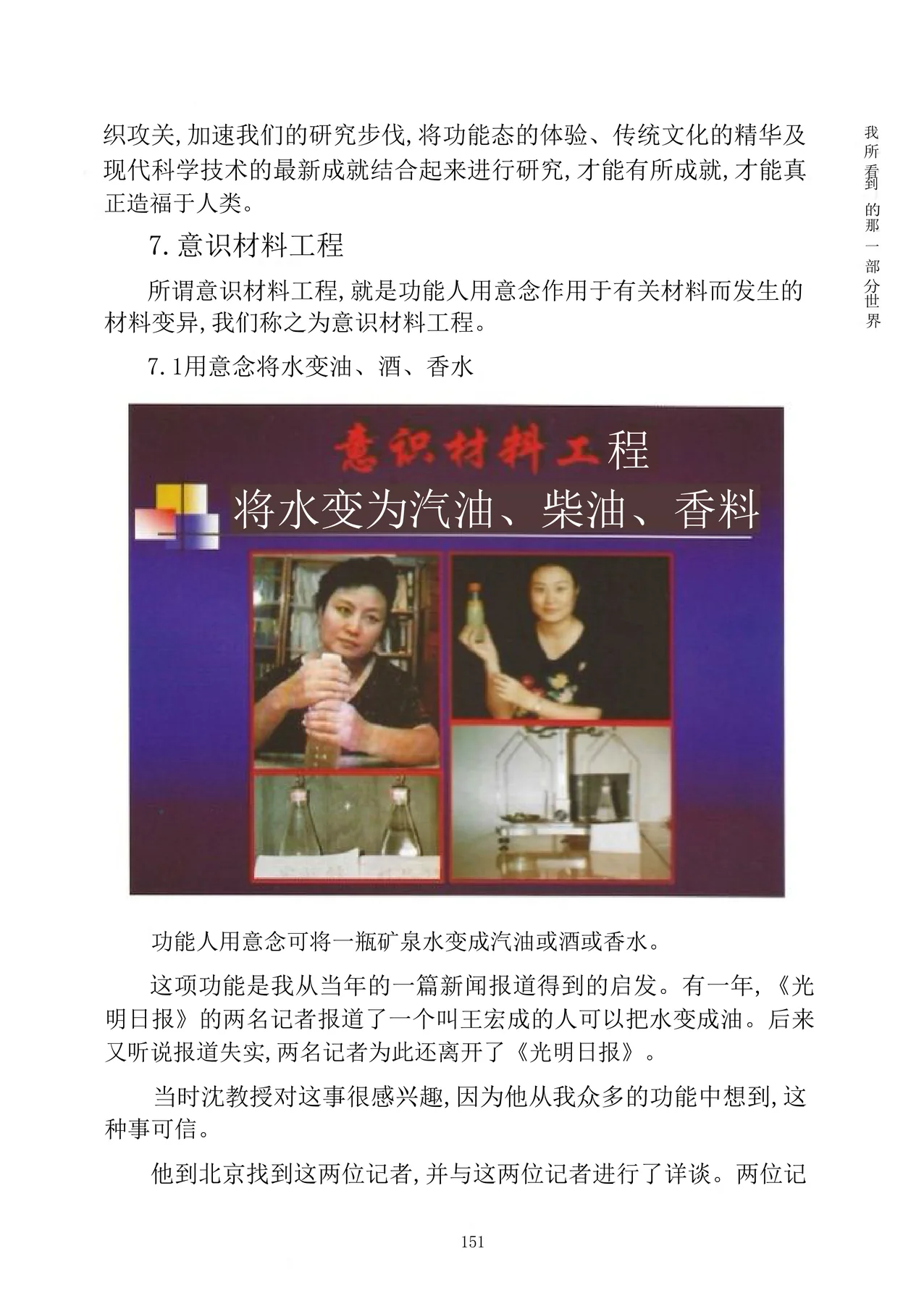
7. Consciousness Materials Engineering
The so-called consciousness materials engineering refers to material transformations that occur when a specially-abled person uses intention to act upon relevant materials — we call this consciousness materials engineering.
7.1 Using Intention to Turn Water into Oil, Wine, or Perfume
Turning water into gasoline, diesel, or fragrance.
A specially-abled person can use intention to turn a bottle of mineral water into gasoline, wine, or perfume.
I was inspired to develop this ability by a news report from years ago. One year, two reporters from Guangming Daily reported on a man named Wang Hongcheng who could turn water into oil. Later, I heard that the report was found to be inaccurate, and the two reporters even left Guangming Daily as a result.
Professor Shen was very interested in this matter at the time, because among my many abilities, he sensed that such a thing was plausible.
He went to Beijing to find these two reporters and had detailed conversations with them. The two reporters
said that their report was true — Wang Hongcheng could indeed turn water into oil; they had seen it with their own eyes.
Later, Professor Shen learned that Wang Hongcheng’s water-to-oil process relied on a secret formula: using this formula to produce an expanding agent, which was added to water to turn it into gasoline. After Professor Shen understood this situation, he very much hoped that I too could perform this experiment. Because if this experiment could succeed, it would be of great significance for solving the world’s energy problems.
Later, during my qigong practice, I consulted my invisible Master, asking whether the ability to turn water into oil truly existed and whether it was real. The Master said it existed and was real. Moreover, there were two methods. One was to use relevant materials to produce a kind of expanding agent, add it to water, and turn the water into gasoline. The other method was to use intention to cause the water molecules to change, directly turning them into gasoline or other substances such as wine or perfume.
At the time, the Master also taught me the formula for the water-to-oil expanding agent, including which raw materials were needed. That evening during practice, I remembered it very clearly, but the next day I could only recall a few of the materials — try as I might, I could not remember the others. When I asked the Master again later, I received no answer. It seems Heaven did not wish me to obtain this particular ability.
But the other method the Master spoke of — I did experiment with it, and it actually worked. However, I generally use mineral water for small-scale experiments, such as turning a bottle of mineral water into gasoline, wine, perfume, and so on.
My sensation when using mineral water to produce gasoline, wine, or perfume is as follows.
Generally, I hold a bottle of mineral water in my hand and focus my mind on what I want to transform it into. While my intention is focused, I continuously shake or agitate the bottle up and down with both hands. At that moment, on the screen at my Heavenly Eye point, I see the mineral water turn into many very fine vapor bubbles, churning ceaselessly inside as if the water were boiling. But to the naked eye, the water in the mineral water bottle does not have that many fine bubbles — it merely forms ordinary water bubbles.
Later I thought that this might be the water molecules, under the effect of my intention and the continuous up-and-down shaking of my hands, undergoing violent changes, thereby transforming into gasoline, wine, or perfume as directed by my intention.
I have performed this experiment a few times, not many. Moreover, the gasoline produced was tested, and the transformed components were around 50%; although it could be ignited, its concentration and purity were not yet very high.
7.2 Intention-Processed Information Water
Intention-processed information water was also something taught to me by my Master during cultivation practice.
Sometimes, after treating certain illnesses for someone, in order to strengthen the therapeutic effect, I use mind intent to alter the properties of one bottle or several bottles of mineral water, turning them into drinkable informational water capable of treating certain illnesses. This ability to process informational water is used quite frequently. After treating someone or conditioning their body, I often use this method to process some informational water for them to drink over a period of time, as an auxiliary treatment or conditioning treatment. This informational water has indeed helped many people recover from illnesses, and the results are mostly quite good.
Processing informational water is not done by holding one bottle at a time and shaking it; rather, from a close distance, I use the Laogong acupoints in both palms to aim at dozens or even hundreds of bottles of mineral water and apply mind intent to process them, allowing for batch processing.
7.3 Processing Tea Leaves with Mind Intent
Using mind intent to process tea leaves so that they carry a certain effect for treating illnesses or conditioning the body. I remember in 2009, a friend in Hangzhou surnamed Ye contracted hepatitis B, and his large and small “three-positive” indicators were clearly abnormal. He had sought treatment from Western and Chinese medicine for quite a long time, but without any effect.
After he found me, I gave him a general conditioning treatment, and then I used mind intent to process a type of tea he often drank, asking him to brew the tea with mineral water to drink. I processed 3 jin [approx. 1.5 kg] at that time. After he finished drinking those 3 jin of tea, he went to the hospital for a check-up, and all the large and small “three-positive” indicators had turned negative. I truly did not expect this result.
7.4 Processing Informational Objects with Mind Intent
Using mind intent to process certain objects, such as pendants that people often like to wear, like various necklaces, bracelets, bangles, business cards, and so on. After being processed with mind intent, they can carry certain information and have a certain conditioning effect on specific diseases of the body.
For example, a friend of mine kept a small thought-photography photo I gave him on his body. One day when he went to the hospital for an examination and X-ray, he found that some of his original illnesses had disappeared, which he found very strange. When he took that small photo off his body and went for another X-ray, the illnesses appeared again. He found it incredible. It seemed as if this photo had a shielding effect, or possessed the energy to eliminate the disease focus.
It seems that the informational energy of this small photo is quite substantial.
I have another friend who, in order to test the energy of the informational card I gave him, went to a hospital with specialized testing equipment to conduct an effect test while carrying and not carrying the card, and used other cards for mixed testing, proving that other cards did not possess the energy of my informational card.
One year, a friend of mine in Hong Kong told me that there is a camera in Hong Kong called an “Aura” camera, which can photograph a person’s halos and energy fields. Through the halos and energy fields, one can reflect some of the physiological and psychological states of the person. I told him whether he could test the energy situation of the informational card I gave him.
After he found the photography place, he conducted the test according to my requirements. First, he took a photo without my informational card, and the halos of various types of information on his body were normally reflected. Then he told them he needed to go to the restroom. In the restroom, he placed my informational card on his body, and then asked them to take another photo. At this point, many of the bad information types photographed previously were gone.
They found it very strange and asked if he, an elderly gentleman, practiced some kind of martial art. My friend smiled and left without answering them. He certainly knew that this was my informational card at work, because he already had some understanding of the energy of my informational cards.
Many other friends have also asked me to do some informational processing on their calligraphy, paintings, seals, or ornaments, all of which have some effect of changing the energy of their homes. Of course, ordinary people cannot see or feel this; only those with extraordinary human abilities and those who have reached a certain level of spiritual cultivation can see or feel it.
Naturally, the strength of their perception is related to their level of cultivation or the level of their abilities. For instance, when my son was eight or nine years old, he could tell the difference between pendants I had processed for others and those I had not.
8. Breaking Through Spatial Barriers
The so-called breaking through spatial barriers refers to using mind intent to translocate objects out of sealed containers. One can use mind intent to shake pills out of a sealed medicine bottle. Sometimes they are shaken out while held in the hand, and sometimes it can be done without contact. For example, if a bottle full of pills is suspended in the air several meters away, I can use mind intent to translocate them out.
8.1 “Contact” Shaking Pills
As I have already mentioned earlier, when first learning to shake out pills, it is generally done by holding the medicine bottle in the hand and shaking. We call this “contact” shaking pills. I must have done the experiment of holding the medicine bottle in my hand to shake out pills at least a hundred times.
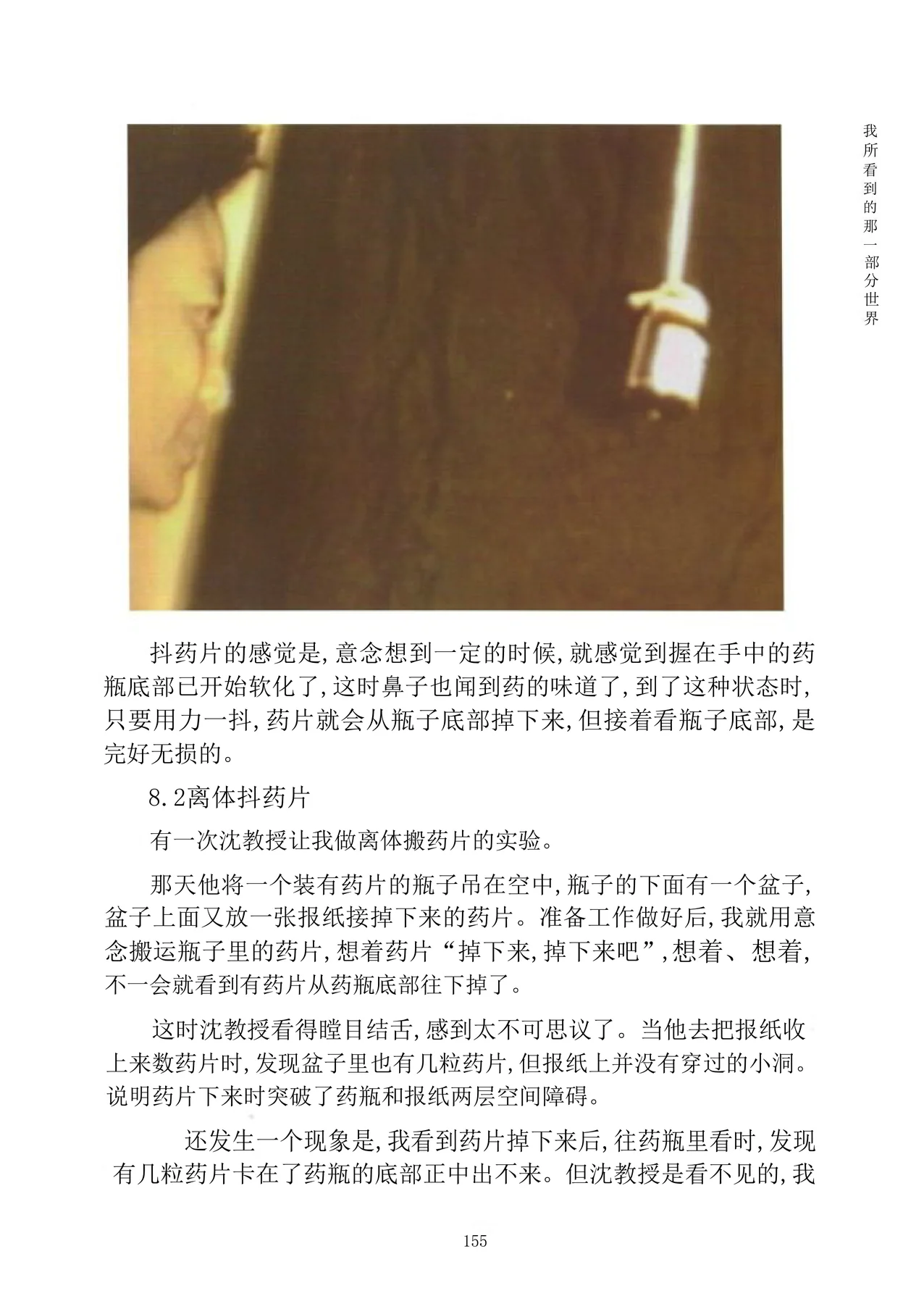
The feeling of shaking out pills is that when the mind intent reaches a certain point, I feel that the bottom of the medicine bottle held in my hand has already begun to soften. At the same time, my nose also smells the medicine’s scent. When it reaches this state, as long as I give it a forceful shake, the pills will fall out from the bottom of the bottle, but upon looking at the bottom of the bottle afterward, it is completely intact.
8.2 Non-Contact Shaking Pills
Once, Professor Shen asked me to do an experiment on non-contact translocating pills. That day, he suspended a bottle containing pills in the air. Beneath the bottle was a basin, and over the basin, a newspaper was placed to catch the falling pills. After the preparations were completed, I used mind intent to translocate the pills inside the bottle, thinking to myself “fall down, fall down.” As I was thinking, after a short while, I saw pills starting to fall down from the bottom of the medicine bottle.
At this moment, Professor Shen watched in dumbfounded amazement, feeling it was simply incredible. When he went to gather up the newspaper to count the pills, he found that there were also a few pills in the basin, but there were no small holes pierced through the newspaper. This indicated that when the pills came down, they had broken through two layers of spatial barriers: the medicine bottle and the newspaper.
Another phenomenon occurred: after I saw the pills fall, when I looked into the medicine bottle, I found that a few pills were stuck right in the exact center of the bottom of the bottle and could not come out. But Professor Shen could not see this; I
I saw it with my mind. At that time, I told Professor Shen not to worry and to see if I could pry them out with my hand. I walked over, grasped the bottle, and pried at the bottom with my hand; those few pills all fell out. We did not do many experiments on object translocation of pills in midair.
8.3 Directional Shaking of Pills through Thought
Once, during a meeting of all department heads at Wuhan University of Geosciences, we were asked to give a performance demonstrating extraordinary human abilities for the department heads of the whole institute.
At that time, Song Ruixiang, the Minister of Geology and Mineral Resources, was also present. Zhao Pengda, the President of the University of Geosciences, presided over the meeting in person. The president’s son also came to the venue (the president had studied in the Soviet Union, and his first wife was Soviet; this son was born to that Soviet wife. When Sino-Soviet relations broke down back then, his wife took their son back to the Soviet Union. After the reform and opening up, his son returned and was visiting and studying at our university), but his son didn’t seem to quite believe in extraordinary human abilities.
The pill-shaking experiment I performed that time was different from previous ones. I first asked President Zhao Pengda to check if there was anything in the left pocket of his coat. After confirming there was nothing, I said I was going to shake the pills into the left pocket of his coat. As I spoke, I held the pill bottle in my hand and shook it while concentrating on shaking them into the president’s left coat pocket. As I shook it, I felt the pills go into the president’s left pocket. After I stopped, I asked the president to check the left pocket of his coat to see if they had gone in. The president looked and saw that 4 pills had been shaken into it.
Later, I asked President Zhao’s son, the young man who had returned from the Soviet Union, to check if there was anything in the right pocket of his coat; he said there was nothing. I used my mind to intend shaking pills into the right pocket of his coat. After shaking a few times, I saw that a pill seemed to have already entered his pocket. I stopped and asked him to check the right pocket of his coat. He looked, and there was one pill inside the right pocket of his coat. He was extremely amazed, holding the pill and shaking his head constantly; it felt just like magic, completely incredible. That performance opened the eyes of the Minister of Geology and Mineral Resources and all the department heads present.
8.4 Coins or Buttons Penetrating a Glass Plate
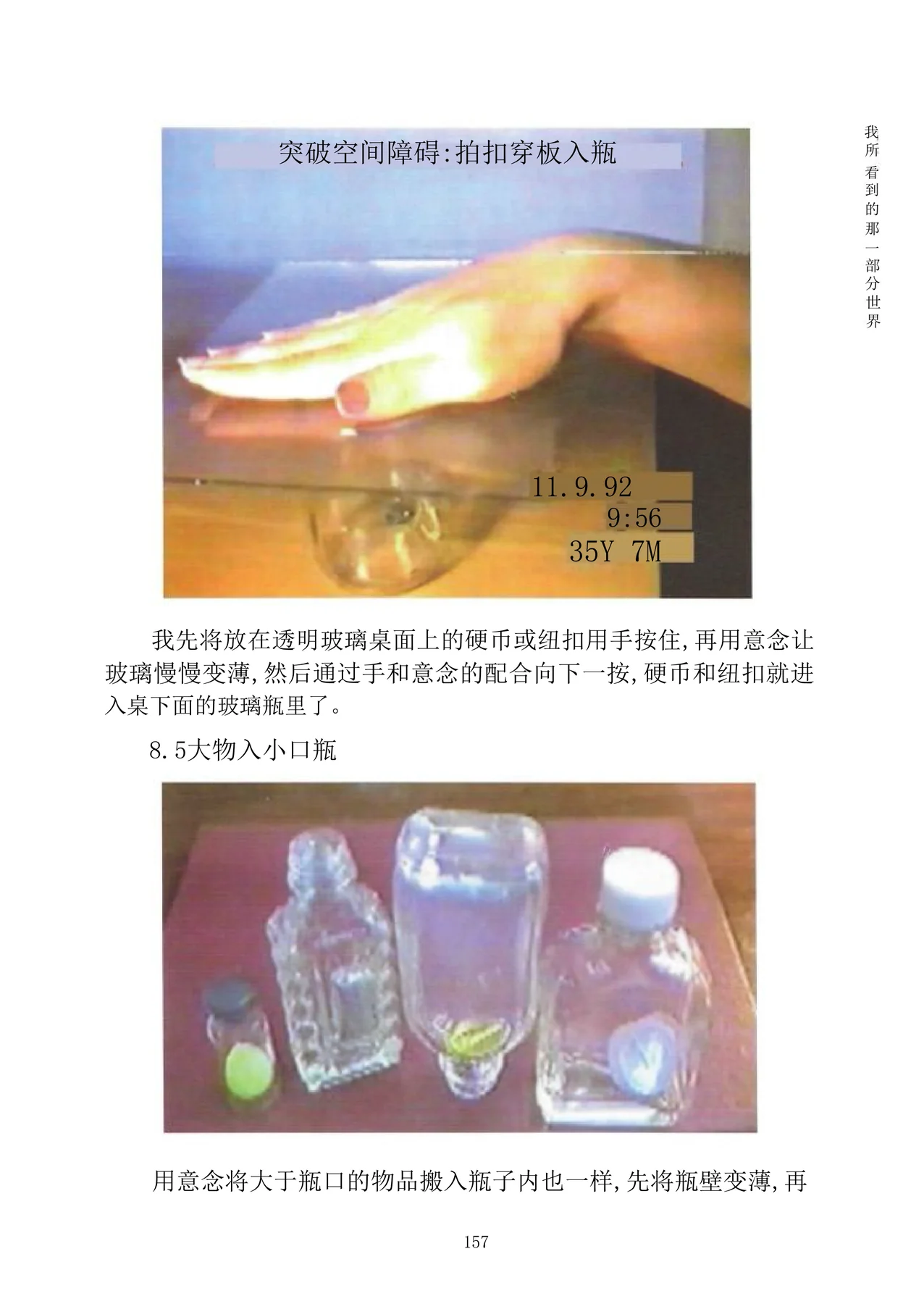
My Breakthrough of Spatial Barriers: Slapping and Pressing Through a Board into a Bottle
11.9.92 9:56 35Y 7M I first held down the coin or button placed on the transparent glass desktop with my hand, then used my mind to slowly thin the glass. Then, through the coordination of my hand and my mind, I pressed downward, and the coin or button entered the glass bottle under the table.
8.5 Large Objects Entering Small-Mouthed Bottles
Using the mind to translocate items larger than the mouth of the bottle into the bottle is the same: first thin the wall of the bottle, then
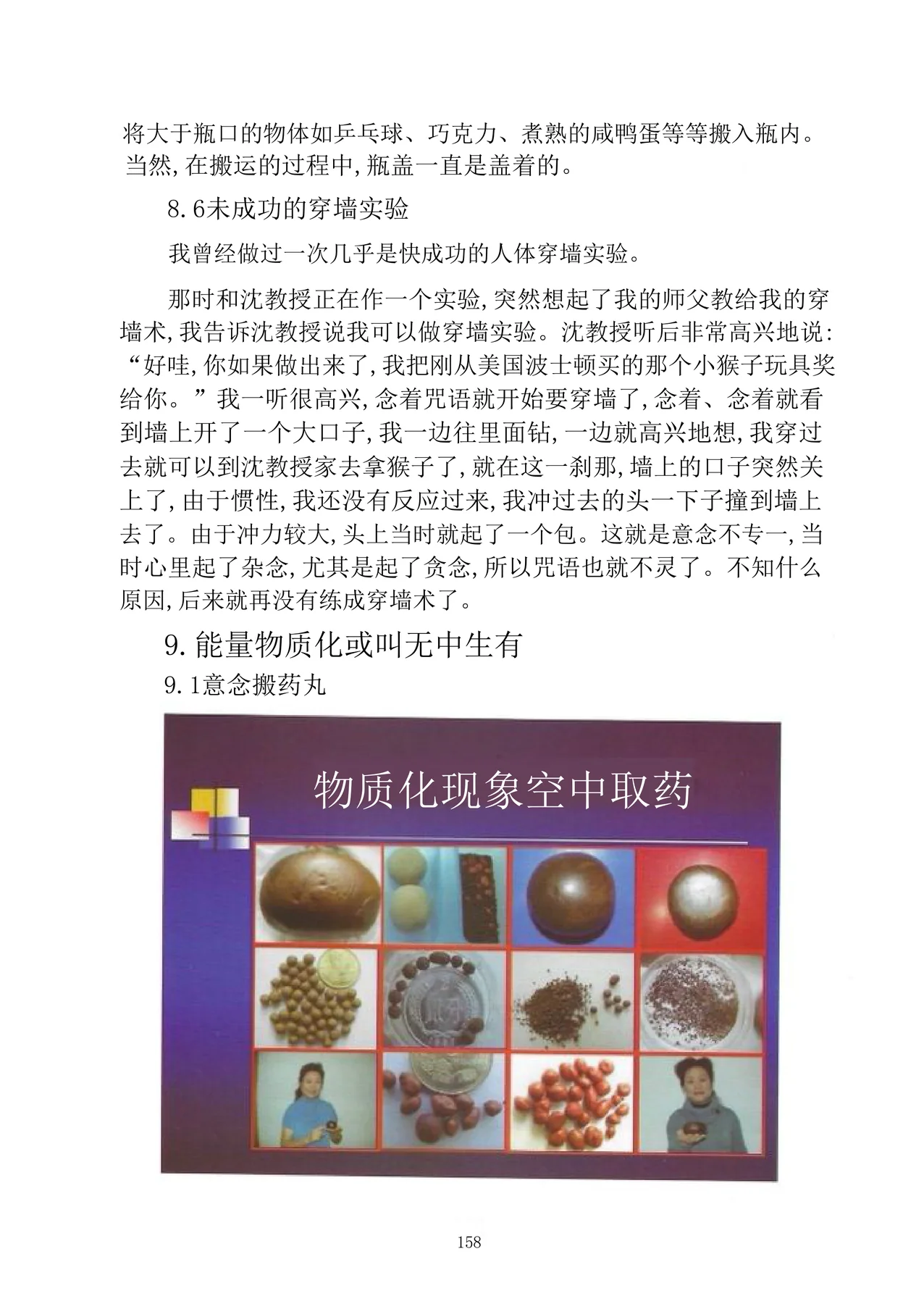
translocate objects larger than the bottle’s mouth, such as ping pong balls, chocolates, boiled salted duck eggs, and so on, into the bottle. Of course, during the translocation process, the bottle cap remained closed.
8.6 The Unsuccessful Wall-Penetration Experiment
I once did a human wall-penetration experiment that almost succeeded.
At that time, I was doing an experiment with Professor Shen, and I suddenly remembered the wall-penetration technique my master had taught me. I told Professor Shen that I could do a wall-penetration experiment. After hearing this, Professor Shen said very happily: “Great! If you succeed, I will reward you with that little monkey toy I just bought from Boston, USA.” I was very happy to hear this, and as I chanted the incantation, I began to pass through the wall. As I chanted, I saw a large opening appear in the wall. As I was squeezing through it, I excitedly thought that once I got through, I could go to Professor Shen’s house to get the monkey. In that very instant, the opening in the wall suddenly closed. Due to inertia, before I could even react, my head, which had thrust forward, bumped right into the wall. Because the impact was quite strong, a bump immediately formed on my head. This was because my mind was not singularly focused; at the time, distracting thoughts arose in my mind, especially greed, so the incantation lost its efficacy. For some unknown reason, I never mastered the wall-penetration technique again after that.
9. The Materialization of Energy, or Creating Something Out of Nothing
9.1 Object Translocation of Pills via Thought
Materialization Phenomenon: Retrieving Medicine in Midair
We have done this kind of experiment no less than a hundred times. Of the translocated pills, the smallest were about the size of a mung bean, the largest weighed over two kilograms, and those around half a jin (250 grams) were more common.
My process for translocating pills goes like this. When I want to translocate pills using my mind, after I enter the extraordinary-ability state, I arrive at a place that seems to be a pharmacy. On the shelves in the pharmacy, a lot of medicines are placed, and there are people managing it. I say to the staff there, “I want this pill, is that okay?” Only if he says yes can I take it away.
Moreover, the translocated pills are always somewhat targeted. For example, if someone has a certain illness and asks me to translocate pills to treat them, I will specify what kind of pill is needed, and generally, I can translocate the required pill. The size, color, and fragrance of the translocated pills are also different, so their medicinal efficacy varies accordingly. Although the composition of the pills has never been tested, patients have always achieved certain results after taking them or smelling their scent.
9.2 Rolling Pills by Hand with the Addition of Mind
Originally, I only knew how to translocate pills and did not know how to roll pills by hand. Later, I saw a person with extraordinary abilities rolling pills by hand, so I tried to experience it and find the feeling, and eventually I also learned how to roll pills. Not only can I roll them with my fingers, but I can also roll them by pressing my palms together. The pills rolled by pressing the palms together are larger, generally about the size of two marbles. The pills rolled out with fingers are relatively small, but even the smallest is the size of a mung bean.
The process of rolling pills is generally that when the feeling comes, my hands get a bit sticky. Then, I can smell the fragrance of the medicine. At this point, as long as I roll it with my thumb, index finger, and middle finger, or rub it on my palm, I can roll out a pill. Of course, the size, color, and medicinal properties of the pills rolled out each time are also different. Generally, they also have some targeted therapeutic effects. Over the past two years, experiments and performances of rolling pills have also numbered no less than a hundred.
Especially during the period from 2009 to 2010, my state for rolling pills seemed to be particularly good. Sometimes, without applying too much mental intent, the state would arrive. Once the state arrived, one roll would produce a pill. Once, a few friends and I were strolling down the street in Sanya. As we were walking, my hands felt sticky, and inexplicably, the feeling arrived. As a result, a pill quickly came out with a single roll. At that time, I had no intention of rolling pills at all, but the feeling for rolling pills came on its own. It was truly a bit unbelievable.
9.3 Using Intention to Multiply Pills or “Ganlu Pills”
I can use intention to cause the pills I have translocated, or the ganlu pills given to me by certain Tibetan living buddhas, to multiply.
This ability is quite interesting; it generally occurs under the conditions of sitting meditation and qigong practice. While sitting in meditation, I add an intention, hoping that those “ganlu pills” can multiply. After I finish my practice session and go to check, ganlu pills that originally numbered only a dozen or so will have increased to several hundred in one night — truly inconceivable.
The first time I discovered that ganlu medicinal pills could multiply was once when I was at Yunnan University. Professor Zhu Nianlin and I, along with several other people, went to visit an elderly woman of great accomplishment. That elderly woman was said to be over ninety years old, but her health was excellent — her hearing was sharp and her eyes were clear, she walked with firm and steady steps, and when she spoke on the telephone her voice was full of vigor. By no stretch of the imagination did she look like a ninety-year-old.
And this elderly woman had something even more extraordinary. That day, we watched her take out a bowl and place a few small medicinal pills inside. She told us these were ganlu medicinal pills given by a Tibetan living buddha. As she spoke, the venerable elderly woman began reciting incantations toward the bowl, shaking the bowl while chanting. In a short while, right before our eyes, the ganlu medicinal pills in that bowl grew from just a few to more than half a bowlful in an instant. We were all dumbfounded, thinking she was truly miraculous. Then the elderly woman distributed seven pills to each of us, and we treasured them like precious gifts. This was the first time I had ever seen ganlu medicinal pills and learned that they could multiply.
After returning from that visit, I said I would try it myself to see whether I could also make ganlu medicinal pills multiply. I placed the several ganlu medicinal pills that had been given to me in a box, and I spoke to those few ganlu medicinal pills: “Hello, ganlu pills — can you grow to be many, many more? If you can grow, then grow; if you cannot, then never mind.” I simply kept repeating: grow, grow. As I repeated this over and over, the ganlu medicinal pills in that box truly began to grow, and before long they filled a small box. Later on, I gave them to quite a few people.
On another occasion, Professor Shen’s daughter Shen Yin had been given several ganlu medicinal pills by someone, and she gave me a few. After I brought them home, I tried multiplying them once more and grew quite a few more, and I gave some back to her.
There was also the time when I was running an extraordinary-ability training class in Japan. I frequently multiplied ganlu medicinal pills for them — with a hundred forty or fifty people, each person receiving seven pills, one can imagine how many had to grow each time.
10. Extrasensory Perception and Remote Sensing Abilities
10.1 The Predictive Effect
When I enter the extraordinary-ability state, I can make predictions about certain people and events. For example, sometimes when I see a certain person, I can sense that something may happen to them. Later, the facts confirmed that it was exactly as I had predicted.
Once, a business owner from northeast China — we had a meal together around the end of the year, and I first performed a demonstration of making deep-fried peanuts sprout for them. Afterward, he asked me to look into how his year ahead would turn out. After I looked, I found that he would have a car accident during the Spring Festival of the coming year, and that the time would be the second day of the New Year. The result of the accident would be a comminuted fracture of his right hand or right leg. The information conveyed to me about the time and the result was so precise and definite. Therefore, I specifically warned him: on that day, absolutely do not drive, and do not let anyone else drive in your place either. The person who substitutes for you will not escape this outcome either — whoever drives in your place may be the one to suffer the misfortune.
When that day came, the man indeed remembered this matter and did not dare to drive. He told his younger brother about it, and his brother said, “How could such a thing be? If you’re afraid, I’ll drive.” Who would have thought that shortly after his brother drove out, he inexplicably crashed into a large tree and truly sustained a comminuted fracture of his right leg. Now his brother believed it too, and said, “This person is too incredible — I want to meet this person.” When he came to see me that day, he was still walking with a crutch. Later on, his brother also came to know me.
I have a colleague whose younger brother — once when I saw him, I sensed that he was going to be in a car accident. I told him to come to my studio when he had time so I could take another look and see whether there was any way to avoid it. After he went back, he told his older sister what I had described, and his sister also told him to take the matter seriously. But later, perhaps because he was too busy with work, he forgot about it and never came to see me. As a result, not long after, he was truly in a car accident. Of course, this too may have been his destiny.
10.2 The Intention Interference Effect
In the extraordinary-ability state, I can use intention to interfere with the computational programs of computers thousands of miles away, and even damage their software. This experiment has been conducted with universities in the United States and Taiwan.
10.3 Remote Healing
After many people learned of my abilities, they all asked me to treat their illnesses. Some people were unable to come in person, so I tried the method of “remote healing” to attempt treatment.
There was a little Japanese girl who had a tumor growing on her head. They found Professor Machi Haruo at Tokyo Denki University, a leading authority specializing in human-body science research. He recommended them, saying, “You should find…”
A person with extraordinary human abilities in China, Sun Chulin, might be able to cure your child’s illness.
After they contacted me by telephone, they wanted to come to China and have me provide treatment. When I heard that the patient was in Japan and that the condition was so serious, I was not confident. I told them not to rush over, but first to stay in the hospital and prepare for surgery. I would first try a method of “remote healing” using intention from Beijing, and if it showed results, we could discuss further. And so, after I performed remote “distant healing” three times from Beijing, she went for another examination, and the tumor in her head was gone. This may have been a matter of karmic affinity; otherwise, how could it have healed so quickly?
I remember one year, the president of a large Japanese corporation suffered a sudden cerebral hemorrhage and fell into a coma. A friend working in Japan knew of my abilities and sought me out by reputation, asking me to go to Japan to treat that president. There was no time to go to Japan then, so I asked the other party to first send a photograph of the patient, and then I used the method of “remote healing” to carry out treatment, so as to bring the condition under control. Afterward I also went to Japan for on-site treatment, but it only extended his life for a period of time and was not able to save the president’s life. I have done quite a few treatments similar to this, and generally there have been some results.
10.4 Intentional Light Signals
In the extraordinary-ability state, I can use intention to emit light signals from specific acupuncture points. For example, if I continuously recite “Amitabha” or the six-syllable mantra “Om Mani Padme Hum,” my Heavenly Eye acupuncture point will emit a relatively strong light signal. This situation is not unique to me; many people who regularly recite the Buddha’s name also experience this state. Of course, they themselves generally cannot see it, but people with abilities can often see various different kinds of light continuously emanating outward from the heads of those who recite the Buddha’s name.
Once, at the Beijing Air Force General Hospital, I conducted an intentional light-emission experiment with Professor Liu Yaning. Inside a dark bag in a darkroom, I aimed my Laogong acupuncture point at the position they designated and emitted light. They tested with instruments and achieved success.
The second time I did an intentional light-emission experiment was at the national Institute of Biophysics. Guo Hanying (Guo Moruo’s son) placed my hand inside a light-tight box within a dark bag, and furthermore fixed my hand in place so it could not move around. They first asked me to remain still, and they tested whether there was any light signal. After the test confirmed there was none, they issued an instruction for me to begin emitting light. After I began emitting light, they tested again, detecting whether there was light and the intensity of the light signal. This experiment was also very successful.
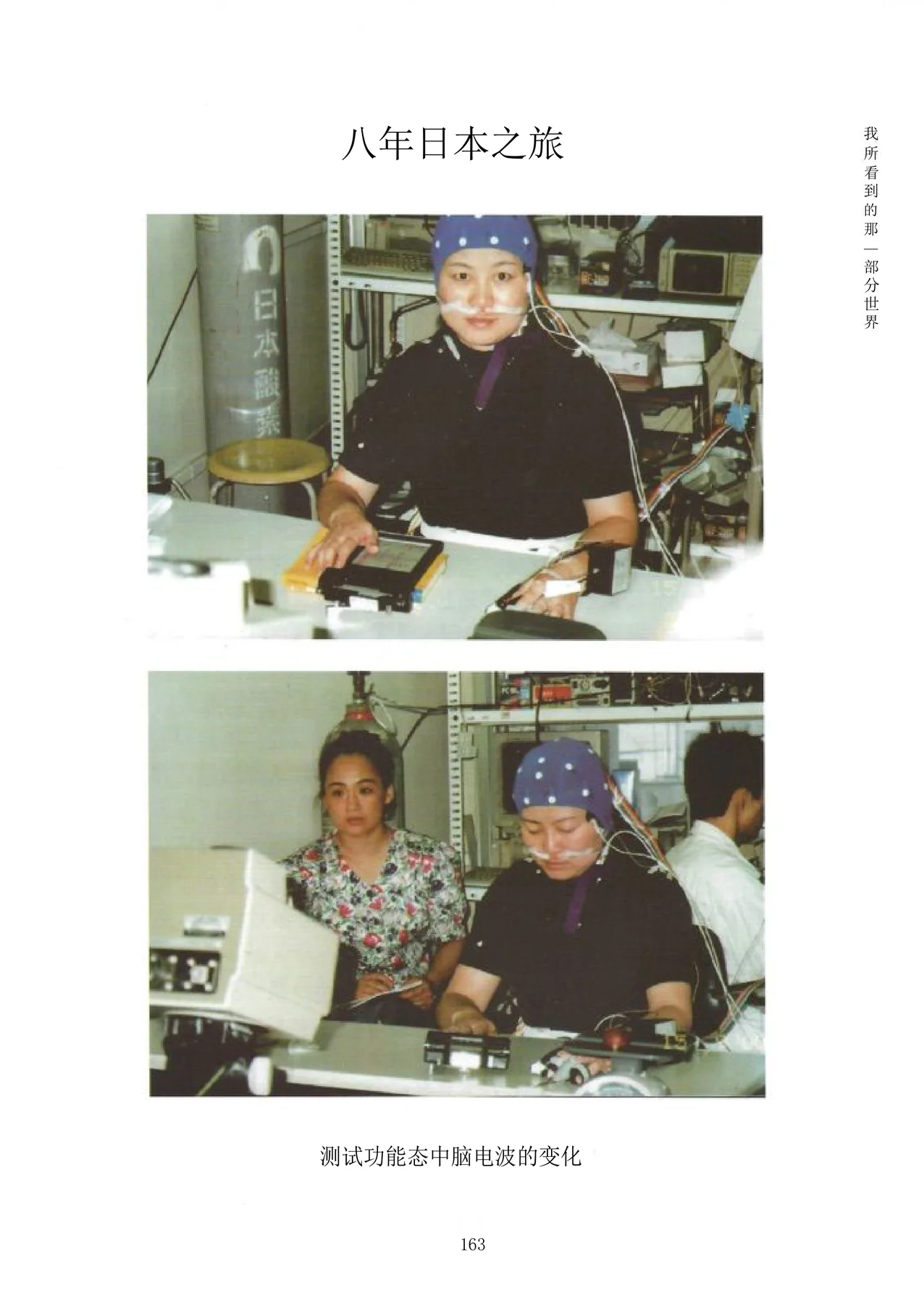
Eight Years of Travel in Japan
Nippon Sanso Testing EEG Changes in the Extraordinary-Ability State
Eight years of friendly cooperation and exchange in Sino-Japanese human-body science research had a profound impact on me.
In Japan, our neighbor to the east, there was a man named Morita Ken. By all accounts, he was himself a rather unusual person. This was something we only gradually came to understand after we began our cooperative research into extraordinary phenomena.
Morita Ken was originally an editor at an automobile sales magazine. From some point onward, he became interested in extraordinary human phenomena.
In order to explore and research these things, he spared neither money nor his life, traveling all over the world to find and study those people and events involving extraordinary phenomena. First he investigated the psychic surgeons of the Philippines, going so far as to risk possible harm to his own health in his investigation. He had a metal ring placed inside his own rectum into his large intestine, then went to a Filipino psychic surgeon to see how it could be removed without a scalpel but using shamanic techniques, in order to verify the authenticity of the psychic surgeon’s surgery. He went to the United States to investigate the experience of “Marilyn’s” soul travel, using his own family members as experimental subjects to confirm its authenticity. He went to Brazil to investigate spirit-possessed surgeons, and so on.
When Morita Ken was investigating my abilities, he introduced to us some of his experiences in exploring and researching extraordinary phenomena around the world. After hearing this, we were quite moved and felt that this person was very sincere in his research on extraordinary phenomena and had a genuine spirit of dedication. Only then did we gradually begin our cooperation.
After seeing that we agreed to formal cooperation, he established an organization in Japan called the “Institute of the Incomprehensible.” From the name of this institute, one could tell what it researched — namely, some of the strange and unusual matters in the world, extraordinary phenomena that modern science and technology cannot yet explain, hence the name “Institute of the Incomprehensible.” The director of this institute was Morita Ken himself. It operated on a membership system, published a bulletin, and recruited members, with the membership ultimately reaching as many as 150,000 people.
Given the state of domestic research at the time, it was only possible to conduct intermittent, limited exchange-oriented research, because there were already many research projects domestically, time was tight, and there was not much time or energy to go to Japan.
But later, even I myself did not expect that the research would continue for eight full years. This was because the research situation domestically subsequently changed. Mainly, after the “Falun Gong” incident, domestic research work was affected and restricted to some degree. But in Japan, research on extraordinary phenomena was unaffected and unrestricted. Another advantage of conducting research abroad was that under his management, it could generate some income, which could address our problem of insufficient research funding domestically and allow the domestic research work to continue as well. Because by this time, the government was no longer providing research funding.
During the eight years of cooperative research with Morita Ken, we regularly went to Japan two to
three times a year—basically once in the first half of the year and once in the second half, with an additional session sometimes added in between. Each session lasted about ten days to half a month. These were mainly organized by the “Institute of Unbelievable Phenomena” for enthusiasts of extraordinary human abilities within Japan; some participants even had minor abilities of their own, while others were qigong enthusiasts. They organized and held research, development, and advancement classes for extraordinary human abilities. These were divided into three different levels: beginner, intermediate, and intermediate-advanced.
The reason for calling it an intermediate-advanced class was that none of those students had reached a very high level—they were only slightly above intermediate—so we called it an intermediate-advanced class. At first, a single class had several hundred people. But with so many people, it was exhausting to conduct. Later, we controlled the scale, keeping each class to around fifty people, which made things much more manageable.
The content of the classes mainly consisted of lectures on the states and processes of extraordinary abilities, as well as methods for developing them and methods for qigong practice. Sometimes we also conducted ability experiments and demonstrations, and did healing adjustments for students who were ill. The Japanese students all studied very earnestly, because most of them truly believed in these things.
During the learning process, they exchanged their insights and experiences with one another, and discussed and encouraged each other. At the end of the class, they also performed entertainments. The learning atmosphere was very lively, and relationships were very harmonious. Although everyone was together for only a few short days, they all felt very happy. These study classes not only enabled everyone to learn things and witness extraordinary phenomena they had never seen before, but also allowed body and mind to receive healing adjustments, and provided an opportunity through this format to make many new friends who shared a common interest. For these reasons, the classes were very popular.
Sometimes they also organized groups to come to China, and held classes right there in China. During the course of the classes, quite a few students developed abilities to varying degrees; their levels were uneven, and the size of their gains was not identical.
Generally speaking, in the beginner class, I would talk about phenomena of extraordinary human abilities and the current state of research around the world. At the same time, I taught them some practice methods for developing abilities and opening the Heavenly Eye point. I also taught some methods for regulating body and mind. Then I would sit in meditation and practice together with them. Sometimes, when my state was good, I would perform demonstrations of burning coins or sprouting peanuts.
In the intermediate class, for those who had studied once or twice before, or who had some foundation in qigong practice, I led them in experiments to increase magnetic force. First, we stuck coins together—some people could stick several coins together right on the spot. Then I led them in practicing emitting energy from the Laogong point or the Heavenly Eye point toward a magnetic board. Quite a few people could produce magnetic reactions and generate magnetic patterns.
In the intermediate-advanced class, for students who had studied many times and had some sense of minor abilities, I guided them
for further development and to raise their level of power. At the same time, I led them in doing higher-level, more difficult experiments. For example, I guided them in sprouting mung beans—each person held mung beans in their hands, and together with them I searched for the feeling, using mental intention to sprout them. When my sprouts grew out, quite a few among them were also able to produce some sprouts. Sometimes we practiced mentally bending stainless steel spoons, and some of them succeeded in bending them.
In Japan, one student experienced a peculiar phenomenon. Once, when I was giving a healing adjustment to a student, I asked him to imagine holding the sun in one hand and the moon in the other. While I was giving him the adjustment, he closed his eyes and visualized. At that moment, another student nearby wanted to take a photo of him. Right then, a peculiar scene appeared in the camera: in his right hand there was a red ball like the sun, and in his left hand a white ball like the moon. Later, when the photo was developed, it really did look like that. This kind of visualization was also very extraordinary—truly inconceivable.
Difficult Puzzles
So-called extraordinary human abilities or extraordinary phenomena refer to special abilities or special phenomena that differ from the normal survival and living capacities possessed by the vast majority of people, and that exist and occur only in a small number of individuals. We call these extraordinary human abilities or extraordinary phenomena.
These extraordinary abilities or extraordinary phenomena are different from the skills found in magic, acrobatics, martial arts, and various athletic competitions. In particular, extraordinary human abilities are primarily achieved not through the body’s limbs but mainly through a person’s mental intention force. This is an important distinction between extraordinary human abilities and other human skills.
Although we have explored for many years and have already captured a large quantity of extraordinary phenomena, there still remains a great pile of difficult puzzles. If humanity still cannot find the correct scientific research approach, then we may remain like blind people feeling an elephant, and what we obtain will still be one difficult puzzle after another. Should we also seek some new approaches?
I am now already a person of sixty years—having completed a full sexagenary cycle. Up to this point, so many abilities have been discovered in me. Some of these abilities are innate; others were transmitted by my invisible Master during qigong practice in later life; and still others I developed through my own study and learning. Whether innate or acquired through later study, there is one prerequisite: the foundation of my abilities is owed to heredity. Without the prerequisite of a hereditary foundation for these abilities, I am afraid that even with the most diligent effort in later study, it would be difficult to manifest so many abilities.
Regarding the abilities in me, starting from the 1980s, I have been researching together with experts and professors for over thirty years. In 2009, we even held a special commemorative conference in Beijing for the thirtieth anniversary of Chinese human-body science. We researched and captured a large quantity of ability phenomena and obtained a vast amount of material.
But up to now, we still remain at the level of phenomena, and our understanding of the secrets behind these abilities remains very limited. At present, we can at most make some speculative explanations or descriptions based on existing technological levels and using modern scientific terminology. Therefore, my friends also frequently raise questions with me, hoping that I can provide some explanations and clarifications. But frankly speaking, due to my insufficient spiritual cultivation, there are many questions I myself cannot explain clearly.
Here I simply write out some of the experiences and realizations I have gained over many years of research to share with everyone. But these are only my personal experiences and realizations, and my expression of them may not necessarily be accurate or scientific. Wherever I am mistaken, I ask everyone to point it out for correction.
1. How do extraordinary human abilities arise?
From what I know, they mainly come from four sources:
The first is heredity within the family — that is, brought from birth, or what one might call innate. My own abilities mainly come from heredity, or one could say they are innate. Even though I later developed many abilities through practice and training, it was all done on this foundation. Without this innate root, postnatal development would be very difficult.
The second is among those who cultivate qigong or practice within various religions, and extraordinary abilities emerge during the course of their cultivation.
The third is abilities stimulated by special celestial phenomena such as lightning or meteor showers, or by car accidents and serious illnesses. For example, Wang Youcheng — I heard he previously had no extraordinary abilities, but after the meteor shower of 1976, extraordinary abilities appeared.
The fourth is what is called spirit possession. For example, the so-called Red, Yellow, White, and Willow spirits — various kinds of spirits and entities that attach to a human body and use the body to display their powers.
If we follow the Buddhist system of classification: the Flesh Eye, the Heavenly Eye, the Wisdom Eye, the Dharma Eye, and the Buddha Eye; and the Six Supernatural Powers — the Power of Magical Transport, the Power of the Heavenly Eye, the Power of the Heavenly Ear, the Power of Knowing Others’ Minds, the Power of Knowing Past Lives, and the Power of the Destruction of All Corruptions.
The Five Eyes and Six Supernatural Powers are further divided into three categories: yaotong (spiritual powers of non-human entities), shutong (powers of technique), and shentong (true divine powers).
The so-called yaotong refers to what was mentioned earlier — the so-called Red, Yellow, White, and Willow, the various kinds of spirits, entities, and demons that can possess the first five powers. These may be called yaotong, or demonic arts. When they manifest in people, it is mostly through spirit possession, using the human body to perform the demonic arts. They can also see certain things, but generally at a low level; they can resolve some problems, but with significant side effects.
The so-called shutong refers to the first five powers that ordinary Chinese medicine practitioners, martial artists, qigong practitioners, and people with abilities possess to a greater or lesser degree. These may be called shutong. This category mostly consists of powers that are either innate or obtained through postnatal cultivation. They can see certain things and help resolve some problems, but all such results are only temporary, the level is limited, and they cannot fundamentally resolve problems.
The so-called shentong, or true divine power, requires not only the first five powers but also reaching the Power of the Destruction of All Corruptions before it can be called shentong. This true divine power can only be possessed when one reaches the realm of Buddhahood. And even this true divine power is not advocated or pursued in Buddhism, because it too falls within the scope of karmic cause, condition, and retribution, cannot help one transcend birth and death, and is not a complete and perfect outcome.
Overall, apart from the so-called spirit possession, extraordinary human abilities should be considered something that human beings inherently possess. Whether or not they can be developed simply depends on each person’s karmic causes, conditions, and retribution.
2. Why has heaven so favored our family?
According to my mother, as far as she knew, my maternal grandfather’s father — that is, my mother’s grandfather — had a certain ability. People gave him the nickname “Immortal’s Single Grab.” If anyone had an ailment on their body, he could eliminate it with a single touch of his hand. My mother recalled that when she was little, she once had a small bump or something of the sort on her hand, and it was her grandfather who grabbed it off. Whether my mother’s grandfather had any other abilities, I do not know. It is said that back then, this “Immortal’s Single Grab” ability of his cured many people’s illnesses and helped many people, and he was quite well-known locally.
And my maternal grandfather — my mother’s father — also had abilities. It is said they were mainly predictive abilities. My maternal grandfather was an old scholar, a schoolteacher, who once taught at schools in the liberated-area base regions and taught many children of high-ranking cadres. His abilities were mainly predictive. It is said that when a friend wrote a letter, before the letter even arrived, he already knew what the friend had written in it. Or, for instance, if a guest was coming today, he would know in advance. Or again, if something was likely to happen in the near future, he would know it beforehand.
In my mother’s generation, my mother had the ability of clairvoyant vision. My mother’s life was very bitter. Right after she was born, her own mother passed away — possibly from complications of childbirth. The child was too small, and my grandfather had no way to care for her, so he had to entrust my mother to my mother’s aunt to be raised, and it was not until she was nearly old enough for school that my grandfather brought her to his own side. My mother’s ability was mainly clairvoyant vision.
It is said that the children of my mother’s aunt also experienced some strange and unusual things. Because my mother lived together with them when she was little, she still had memories of some of these events. For example, one child could go for over a month without eating, just lying in bed in a deep sleep. When he woke up and was asked, “Are you hungry?” he said, “I’m not hungry. I already ate such-and-such on ‘the other side.‘” And where this so-called “other side” was, no one could know. It was simply like talking in delirium, utterly incomprehensible.
Another child had a particular fondness for eating dirt from walls, often eating mud as if it were a snack, savoring it with great relish — also a very peculiar child.
And in our generation, the abilities in me can be said to be the great synthesis of the abilities of my maternal grandfather’s father, my maternal grandfather, and my mother — things like my maternal grandfather’s father’s “Immortal’s Single Grab,” my maternal grandfather’s predictive abilities, my mother’s clairvoyant vision, and so on — all of them are present in me.
Of course, this is related to the environment I was in. I had the conditions to learn and develop, and there were so many experts and professors who came to study me, all of which enabled me to discover so many abilities in myself. When my younger brother was little, he could actually see some things too. He was very young at the time, and perhaps his celestial eye was still open. It was only later, as he grew up, that his celestial eye closed and he was unable to consolidate it.
With my son, it was a different situation. After I discovered that I had these abilities, I paid attention to my son’s situation, and I found that he had had abilities since he was very young. From a very young age he would sit cross-legged in meditation on his own, and he even led his little classmates to meditate together on the hill behind our home. his clairvoyant ability was very strong, and he could often clearly see certain conditions inside the human body.
When he was in elementary school, he frequently helped his teachers with their illnesses, and would look at pregnant teachers to see whether they were carrying a boy or a girl. He would often show off in front of me, saying, “My master is much more powerful than your master.” In fact, he was not bragging — his abilities were genuinely stronger than mine. For example, he could pass through walls, which I never managed to learn.
Once, when he was being mischievous at school, just before the end of classes, his teacher wanted to punish him a little and locked him in the second-floor classroom where she taught. The teacher sat in the office marking assignments, planning to keep him in for a while before letting him out. But when she opened the door, she was stunned — there was no one inside.
When she asked around and confirmed that no other teacher had come to unlock the door and let him out, she panicked and rushed to our home to see whether my son had come back. As soon as she saw me, she asked, “Has your son come back?” I said he had. She said, “I had locked him in the classroom — who let him out?!” As she walked back, she kept saying, “It’s good he’s back, it’s good he’s back.”
Later I asked my son how he had gotten out of the locked classroom. He said that after the teacher locked him in, he realized he couldn’t get out. He then thought of “Yixiu” (the Japanese animated series Ikkyū-san, which was being broadcast at the time), and he imitated Yixiu by sitting cross-legged on the floor, using the index fingers of both hands to draw circles on his temples at the sides of his head, chanting as he drew: “Ge-ji, ge-ji, ge-ji, ge-ji, ge-ji-yi-ge-ji.” As he chanted, he saw a ball of light appear in front of him, and when he looked more carefully, an opening appeared in the wall ahead. He quickly walked out through that opening, and when he looked back at the wall afterward, the opening was gone. Only then did I realize that my son could pass through walls.
Moreover, the heredity of this ability follows such a regular pattern: two boys, two girls, then two boys again, passing down in sequence. And why is it selective — not all descendants receive the heredity? From which generation did it begin, and when will it end in the future? For now, there is no way to know.
To offer an explanation, I can only say that the genetic factors of my matrilineal ancestors in this regard are comparatively strong, or that there is some kind of karmic affinity supporting this inheritance. Beyond that, I still cannot say for certain.
3. Why Are My Abilities Not Very Stable and Not Subject to Arbitrary Control?
Why are my abilities not very stable, and why can the state not come whenever I want it — why can I not control it at will, and not summon whatever ability I wish? And yet sometimes, when you are not thinking of summoning any particular ability, the state arrives on its own, and under such circumstances, the moment you attempt something, it succeeds.
On this question, after a relatively long period of exploration, I found that it mainly comes down to two reasons. First, it is related to my level of ability — that is, my energy level has not yet reached the point where I can do as I please. One could also say the energy level is insufficient. Second, it has a great deal to do with my state of mind. If at the time my brain is not preoccupied with many thoughts, not overly complicated, and I can quickly concentrate my attention, then generally speaking, entering the extraordinary-ability state is relatively easy. If at that moment I am looking ahead and behind, burdened with worries, and my thoughts are flying in all directions, then generally speaking it is very difficult to enter the extraordinary-ability state, and any experiment I attempt will be very hard-pressed to succeed.
This is what people often speak of — overcoming scattered thoughts, overcoming deluded thoughts, focusing the mind on a single point. This state is very difficult to achieve. Once it is achieved, abilities emerge very easily. Fundamentally speaking, both of these situations point to one issue: my spiritual cultivation is still far from sufficient.
4. Why Can Some Abilities Be Repeated Many Times, While Others Have Only Appeared a Few Times?
Some of my abilities can be repeated many times, such as sprouting peanuts, rolling medicinal pills, burning coins, and so on. Others have appeared only a few times and have never appeared again, such as bringing small animals like fish, shrimp, and chicks back from death, and so forth. Or one could say these abilities are very difficult to perform. I once wanted to attempt bringing a human being back from death, or even just some organ of the human body, but to this day I have not succeeded even once.
My understanding of this question is as follows. The spiritual nature of plants and minerals is comparatively weaker, and therefore establishing a connection with them is relatively easier. Animals, especially humans, not only possess spiritual nature but also have their own thinking. Humans in particular have their own knowledge systems acquired after birth, or what could be called the “obstacle of what one already knows.” Take, for example, the illnesses of children versus those of adults — relatively speaking, children’s illnesses are easier to treat, while adults’ illnesses are much more difficult. This is because the degree of complexity in children’s thinking and the depth of their “obstacle of what one already knows” are much lighter, whereas for adults, the complexity of their thinking and the degree of their “obstacle of what one already knows” are much heavier. Therefore, generally speaking, it is very difficult to establish a connection. This is one aspect.
On the other hand, animals, especially humans, have their own karmic causes, effects, and retribution — or one could say they have their own
destiny — it is not something you can casually change. Therefore, it is very difficult to conduct resurrection experiments on them at will. As for the question of destiny, generally speaking, the possibility of changing one’s fate through one’s own spiritual cultivation and personal effort is greater and more reliable. The ancients said: “Destiny is made by oneself; fortune is sought by oneself.” That is to say, a person’s fate is held in their own hands. It should be said that external forces are limited; truly changing one’s destiny relies on one’s own cultivation.
- Why do some abilities nearly succeed but fail to materialize, and then never appear again?
My failed attempt to learn the wall-penetration art, after which I was never able to do it again, is a typical example.
This question reminds me of the story of the Laoshan Daoist priest. In it, a scholar who had studied for years but could not pass the imperial examinations went to Mount Lao to study the Dao. He didn’t learn much else, but his master taught him only one technique — the wall-penetration art. When he descended the mountain, his master cautioned him that this art should only be used for self-protection and must never be used recklessly. After he returned home, when he recounted the technique he had learned to his wife, he could still perform it. But later, when he wanted to pass through a wall to steal someone else’s belongings, not only did he fail to get anything, he also bumped a large lump on his head, was caught and beaten as a thief, and from then on lost the art entirely.
Earlier I described my “unsuccessful wall-penetration experiment.” When I was experimenting with the wall-penetration art my master had taught me, I saw the wall already opening up. Just as I was about to pass through, I thought: once I get through, I’ll be able to get the little monkey toy. With that single distracting thought, the opening in the wall that had been there closed up. After that, no matter how much I practiced, the ability never emerged again. It seems one must not harbor distracting thoughts, much less greedy ones.
Then there is also the case of my master teaching me the formula for turning water into oil — I was not able to memorize it, and this too may have been the will of Heaven.
- Where do my invisible masters come from, why do they look after me so much, and why do they come to teach me these abilities?
On this question, I believe the place where they reside must be other cosmic dimensions that most of us are still unable to break through. As for why they teach me these abilities — first, it may be related to this family’s heredity. Second, it is because I am a relatively simple-minded person without too many complicated thoughts. At the time, I only thought that having more abilities would allow me to do more experiments, which might be helpful to scientific research. With these abilities I could treat people’s illnesses and help many people. My thoughts were relatively simple, pure, and well-intentioned, and that may be why I was able to receive help from these invisible masters.
- Which dimension does the pharmacy manager I see when I translocate pills live in? How are the pills made?
Because I frequently translocate pills, I am able to see a pharmacy and pharmacy managers dressed in ancient-style clothing. Later I gradually came to understand that this was the Medicine Master’s pharmacy. I have also been to the Medicine Master’s medicinal garden, where I saw medicine immortals planting and gathering various medicinal herbs. As for the actual process of making the pills, I have never seen it.
Once, we went to visit a pharmaceutical group in Tibet and toured their medicine factory. They gathered all the finished products together and held a Buddhist ceremony, praying for everyone’s health, peace for every family, prosperity for the nation, and world peace.
Afterward, we visited their headquarters. In the center of the exhibition hall was a statue of the Medicine Master, with kindly eyes and a gentle expression, strikingly lifelike. They also invited us to watch cultural performances that their employees had written and performed themselves. Bonfires were lit, and the Guozhuang circle dance began. As I watched the employees dancing, I also gazed at the Medicine Master’s statue facing me directly. The Medicine Master seemed to nod and smile at us repeatedly, as if very pleased with his employees’ performance.
- Why can I see many celestial wonders through intention?
When I do intention photography, I can see all sorts of strange and wondrous phenomena of celestial bodies in the cosmos — flying saucers, swirling nebulae, brilliantly colored cloud clusters, mountains, rivers, and lakes under the setting sun, dappled tree shadows in moonlight, Taiji diagrams, celestial palaces as transparent as agate and lapis lazuli, and immortals dressed in magnificent ancient garments, and so forth.
Some of the sights I see can only be observed with a celestial telescope, and some cannot be seen even with one. Why is it that I can see them through intention alone?
This is a distinctive feature of my abilities. Quite a few people with extraordinary abilities may also be able to see these scenes in an extraordinary-ability state, and many spiritual practitioners may also see them while sitting in meditation and entering samadhi. But being able to transfer these scenes onto photographic film and develop them into photographs through intention — at present, there are not many who possess this ability. We call this ability intention photography, abbreviated as “intention-imaging.”
I have taken quite a number of these “intention-imaging” photographs — of celestial bodies and heavenly palaces with their wondrous phenomena; of mountains, rivers, flowers, birds, and trees; of palaces, pavilions, and figures both ancient and modern. They can truly be described as magnificent and breathtakingly beautiful. Many of them should be scenes from dimensions beyond three-dimensional space-time, which most of us cannot see with our naked eyes. This may be a special grace bestowed upon me by Heaven. I can only feel gratitude from the bottom of my heart — beyond what words can express.
9. Why Are My Abilities Affected by My Mood?
Why are my abilities so closely related to my mood? When I am in a good mood and happy, it is easy to enter the right state, and experiments or demonstrations are more likely to succeed. When I am in a bad mood, or dissatisfied with my surroundings, it is very difficult to produce results.
This point is crucial for both experiments and demonstrations of extraordinary abilities. Many times, as soon as my mood improves, several abilities manifest without any conscious effort.
Once, during a training course, because I had been in contact with everyone for several days and we had grown quite familiar with one another and gotten along harmoniously, during the final three days I demonstrated one item for them each day.
On the first day, I attached coins to everyone at their Heavenly Eye acupoint. Most people could have two or more coins attached, and some could have as many as six or seven. On the second day, I demonstrated shaking pills out of a container. I had brought from home a medicine bottle filled with “fish oil capsules.” I announced that today I would demonstrate shaking pills out of the bottle, and sure enough, I succeeded on the first attempt. On the third day, I demonstrated popping popcorn through intention. Again, I announced it beforehand, and sure enough, it succeeded wonderfully.
I have found that when the atmosphere is harmonious and my mood is joyful, demonstrations generally succeed. Usually, when it is a first meeting, when there are too many strangers, or when there is someone I find disagreeable or uncomfortable to be around, it is quite difficult to perform a demonstration. In a small number of cases I have managed it with some difficulty, but mostly it is hard to succeed.
Therefore, mood and environment are extremely important for experiments or demonstrations of extraordinary abilities. Of course, this not only demonstrates the complexity, sensitivity, diversity, and instability of human emotions, but it equally shows that my level of cultivation is insufficient and my meditative concentration is not yet adequate.
This is exactly why extraordinary human abilities are not magic. The difference between the two lies in the following:
Magic performances can be done on demand and are generally unaffected by time, place, personnel, venue, or other environmental factors. At most, if the performance is unpolished or inexperienced, a minor flaw might be exposed. Magic performers especially love large crowds and big venues. The more people there are and the bigger the venue, the more enthusiastic the applause, and the more energized the magician may become—making flaws even harder to detect and the performance all the more successful.
Extraordinary human abilities are precisely the opposite. The number of people does not necessarily matter, but there is a special need for quiet and for minimizing interference to the greatest extent possible. The quieter it is, the easier it is to enter the extraordinary-ability state, and the more likely the experiment is to succeed. I do not know how it is for others, but in any case, in chaotic and noisy settings, it is very difficult for my abilities to manifest.
Of course, if a true divine being or buddha were to appear, that would be an entirely different matter. Our Living Buddha Jigong, for example, is not subject to this limitation—he can transform anything into anything at will.
10. How Much Longer Will My Abilities Last?
People are very concerned about how much longer my abilities will last and whether they will disappear in old age, as happened with my mother. From my current state, there are no signs of disappearance yet, and sometimes new abilities even emerge. It is even possible that some new abilities may yet be developed.
Conclusion
Having read this far, everyone should have a general understanding of what extraordinary human abilities are, and what significance and value there is in studying them. As for what opinions people may hold about extraordinary human abilities and the research work being done on them after reading this book, I cannot presume to know.
But what concerns me more is what kind of impact my book will have once it is published and circulates in society. I imagine this will vary depending on each person’s level of understanding. And the impact I most hope to see is what I mentioned in my opening words: that through understanding extraordinary human abilities, a window may be opened for people to comprehend multidimensional space, enabling them to free their thinking, dispel superstition, and truly achieve a comprehensive, objective, and scientific understanding of the cosmic space in which we humans and all things exist.
My purpose in writing out the extraordinary phenomena and extraordinary abilities that have occurred in my body and presenting them to everyone is simply to share with you all that part of the world which I have seen but which ordinary people cannot see—so that everyone can broaden their horizons, expand their field of vision, and know that beyond the world observable by the human naked eye or even through the most advanced scientific instruments available today, there exist countless, vastly more expansive cosmic worlds, and many, many more mysteries that need to be explored and revealed.
This is also the true purpose of my writing this book. That is why my book is titled The Part of the World I Saw.
Finally, I must make special mention of the fact that my abilities were able to be discovered, developed, and demonstrated. First and foremost, I am grateful for the protective blessings of my ancestors’ virtue. I am grateful for the grace of my parents in giving me life and raising me. I am grateful for the long-standing, selfless support of my family. Without them, I would not be where I am today.
I am grateful to my many invisible teachers. Without their earnest instruction, without their protection, without their empowerment, I could not possibly possess so many extraordinary abilities.
I am grateful to our Party, grateful to our nation, grateful to our government, and grateful to this era for providing us with such a favorable environment.
I am grateful to the leading authority in China who supported human-body science research—the late academician Qian Xuesen, the father of Chinese missiles. As soon as Senior Qian became aware of the existence of extraordinary human phenomena, he immediately proposed establishing formal research projects and provided sustained guidance, care, and vigorous support. The great banner of Senior Qian—
I do not know how much wind and rain it shielded us from, how many hardships and perils it helped us weather. Someone once said that — whether for China or for the world — Qian Lao’s contribution to human-body science will far exceed his contribution to the Two Bombs and One Satellite. I believe that as time passes, history will confirm this assertion.
I want to express my gratitude to General Zhang Zhenhuan, Director Wu Shaozu, Minister Jia Chunwang, former Governor Guo Shuyan, and a great many other military and civilian leaders who organized, led, and implemented human-body science research in China in concrete terms.
I want to express my gratitude to my psychology teacher at Wuhan Second Normal College, who was the first to discover my abilities. Without her steadfast and bold exploration of extraordinary human phenomena back then, my abilities might still remain undiscovered today — not only by others, but very likely even by myself.
I want to express my gratitude to my supervising professors, Professor Shen Jinchuan and his wife, Professor Zheng Jincheng. From the very day I was formally transferred to the Human-Body Science Research Office at China University of Geosciences, Professor Shen and his wife and I were virtually inseparable for many years — together morning and night, braving storms together, overcoming difficulties together, sharing the joy of success and the bitterness of failure together. In the process of developing and experimenting with my abilities, they guided me with patience and encouragement. In daily life, they cared for me with the meticulous attention of parents and elders. Without the diligent nurturing and guidance of this professorial couple, I could not possibly possess the abilities I have today.
I want to express my gratitude to the many scholars, experts, and professors who over the years have shown concern for me, studied me, and supported me from different angles. Among them are Professor Li Si-chen of National Taiwan University, Professor Liu Yicheng of the Institute of High Energy Physics at the Chinese Academy of Sciences, Professor Li Shengping of Tsinghua University, Professor Song Kongzhi of the Ministry of Aerospace Industry, Professor Xu Lanxu of Heilongjiang University, Director Ken Morita of Japan’s “Fushigi” Research Institute, Professor Wen Yehong of the Hong Kong Design Institute, and many others. They all gave me generous help and guidance from different aspects, different angles, and different perspectives.
I want to express my gratitude to my many fans and friends, both in China and abroad — whether or not I had performed for them, whether or not I had treated their illnesses, whether they were friends I knew personally or did not know. They too gave me selfless trust, help, and support from different angles and in different ways. Without their support, it would also have been very difficult for me to have the abilities I have today.
I want to express my gratitude to my many friends who are fellow individuals with extraordinary abilities. Over the years, we have encouraged one another and explored actively together. Many of my abilities were learned from them, inspired by them, or came from flashes of insight I gained through them.
At the same time, I also want to express my gratitude to those friends who for a long time have held negative attitudes toward extraordinary human abilities and have consistently opposed human-body science research. They too gave me enormous help and motivation from a different angle — and such help and motivation has been indispensable to my functional achievements. Therefore my gratitude is sincere.
Finally, there is one point I want to especially emphasize, and it is a very important one: for the many qigong practitioners who cultivate health and wellness today, please remember during your cultivation practice never to make the emergence of extraordinary abilities the goal and purpose of your practice. This point is stated very clearly and plainly in the classics of Daoism and especially Buddhism — these abilities are merely by-products that appear during the course of practice, not the goal and purpose of our cultivation. If you take them as your goal and purpose, you risk falling into deviation and demonic possession, going astray onto the wrong path. I hope everyone will take this to heart! Please remember!
Lastly, what I want to say is that I hope writing these things can bring people positive energy, and that I can contribute my humble effort at a time when the excellent traditional culture of China is being vigorously promoted. I once said that if these things of mine could become even a tiny wave in the vast ocean of promoting excellent traditional Chinese culture today, then they would be worth far more than their measure; and if I could become even a single drop of water within the waves of that great ocean, then I would not have wasted Heaven’s compassion and generous love in granting me so many abilities that people ought to possess.
Discussion on the Topics of Invisible Teachers, Spiritual Powers, and Torsion Fields
Every serious and conscientious scientific worker who encounters these tangible extraordinary abilities manifested in me will ask: What exactly is going on here? What kinds of reflections should it provoke in us? What kinds of scientific conjectures should arise? And what kinds of major breakthroughs will it bring to the scientific enterprise in the future?
This has always been a subject of contemplation and discussion among the professors at our university’s Human-Body Science Research Institute as well. Professor Shen Jinchuan, Professor Li Si-chen of National Taiwan University, Chief Editor Wu Meiyun, and later Professor Jiang Xingliu of the Physics Department at Beijing University of Aeronautics and Astronautics, together with me, held a dedicated discussion on the relevant questions. I excerpt it here to share with everyone:
1. Regarding Invisible Teachers
Wu: One thing Teacher Sun described, I think is very important. That is, when she grasps information, much of it is done through her own master — a considerable portion requires finding her teacher to help. Isn’t that right?
Sun: Correct.
Wu: So there are some things she cannot simply know on her own; she has to find the right person to ask.
Shen: Right — she automatically connects and communicates with the person who knows.
Li: Correct.
Shen: I believe Xiao Sun is able to connect to higher-level, multi-layered information processing centers, so she is more capable than we are — but that does not mean she is omnipotent.
Wu: So it’s not that once you’re connected to Heaven, you know everything.
Li: No — I’m saying that at crucial moments, one can inquire about the future and look into the future.
Wu: Teacher Sun can already see the future. Knowing things of the future and the past requires no consultation with a master at all — with Teacher Sun’s level of attainment, she can see them directly. But that is a different matter from consulting her master.
Sun: Whether I see things on my own or ask my master, both require the expenditure of a certain amount of energy.
Shen: But many people want to ask about everything!
Wu: With Teacher Sun’s level of ability, the space-time she can perceive is far vaster than ours. Once she enters the state, that present space-time is extremely, extremely vast, encompassing both the past and the future, so she can immediately see the past and the future. Teacher Sun, to see the past and the future you don’t need to ask your master, right?
Sun: Some things don’t require asking—once I explore a little, I see them as soon as I look. But there are some things I don’t understand, so…
Li: You need to ask?
Sun: Right. Then there’s no need to look, because even if I looked I wouldn’t understand. It’s better to just ask. Once I ask, there will be an answer.
Shen: Our conventional language is sometimes insufficient to convey the information that little Sun captures.
Wu: What do you mean?
Shen: It means that the information little Sun herself receives may be far greater than what she can articulate, including the images she sees and the answers she provides to scientific questions. If one were to speak of any shortcoming, this is probably it.
Wu: Professor Shen, this is a shortcoming everyone has; it has nothing to do with level of ability. For example, I might see an image and think to myself, “Wow, how beautiful!” But I can’t draw it for you to see.
Shen: Right, right.
Wu: But our art editors are different—they just need to put pen to paper and they can draw it. When Professor Li answers scientific questions, I don’t understand them at all, but he understands them completely, and even thinks further.
Shen: Mm.
Wu: So this has nothing to do with insufficient ability.
Shen: What I want to say is this: little Sun is not omnipotent.
Sun: Of course.
Shen: She has limitations.
Wu: Of course, of course.
Shen: But I feel that in many respects—for instance, the things she sees are many times more beautiful than what can be projected out—
and from this I infer that the information she receives, whether textual information or image information, is far greater and far richer than what she can express.
Wu: I have also met quite a few high-energy people, and I feel that the world above and the world below are the same: every person has areas of great strength and also areas of deficiency; no one is perfect. So, Professor Shen, the shortcoming you just spoke of—I think it is simply the nature of things! Teacher Sun is still a…
Shen: An ordinary person.
Wu: Right, an ordinary person. But if we all acknowledge that extraordinary abilities are an innate capacity, then Teacher Sun is probably the Picasso among those with extraordinary abilities.
Shen: Right.
Wu: But even Picasso had his shortcomings.
Shen: We shouldn’t treat them like immortals and place excessively high expectations on them. Yet many people ask about everything.
Like my wife, my daughter, and my neighbors—they make an especially large number of requests of little Sun. Should I go to work today? How is my son? Some questions are very hard to answer. What to do if a son gets sick? They even ask her about a son getting married, a son buying a house—it becomes a bit overwhelming.
Does little Sun have this ability? She does! But she cannot satisfy everyone or answer everyone’s questions. Moreover, answering carries risk. Sometimes I also tell her: there are some things that, even if you see them, you shouldn’t say.
Li: Right.
Shen: Someone asks which stock to buy? I think this is far too risky. If it doesn’t turn out right, the responsibility to bear is too great.
Sun: So when I answer other people’s questions, one thing I often say is: what I say is only for your reference; you have to make the big decisions yourself. And it can only serve as a reference, because any situation is constantly changing.
Li: Teacher Sun, do you ever feel that if you frequently ask your master questions, your master might get annoyed?
Sun: I never think about this question. It seems unlikely. If anyone is annoyed, it’s me—I don’t want to ask, I don’t want to communicate.
Li, Shen, Wu: Ha ha!
2. On Spiritual Powers
Shen: Nowadays there are all kinds of viewpoints and evaluations regarding spiritual powers and extraordinary abilities. Some people with abilities believe: “This is high-level cultivation; I disdain demonstrating spiritual powers for others to see,” and furthermore they regard those spiritual powers as mere trivial tricks. But from the perspective of a scientist—from the standpoint of understanding the cosmos, understanding ourselves, and understanding the phenomena of life—I have a high appraisal of these extraordinary abilities. They can broaden our horizons.
Wu: Of course.
Shen: But the moment one asks those living buddhas who cultivate, or Daoist priests, or reclusive realized beings—I don’t know what their basis is—they all say: “Oh, this is a piece of cake. We have abilities far greater than this; we just don’t show them.” I advocate cautious use—that is to say, I would not use these spiritual powers to seek personal gain or exploit opportunities everywhere.
Wu: I feel that fundamentally Teacher Sun’s mission, as Professor Shen has said, is to contribute her abilities to help more people understand extraordinary abilities and to help scientists conduct various research.
Shen: Exactly, and also to help us awaken.
Wu: However, each person’s mission is different. If everyone with energy displayed it without restraint, as Teacher Sun said, then everything would be thrown into chaos.
Shen: I agree with that.
Wu: What does Professor Li think?
Li: In Buddhism, the doctrine states: Shakyamuni said that one must not casually display spiritual powers.
Wu: They even feel that displaying spiritual powers is bad.
Li: Right. Even in Daoism, a master will caution against casually displaying spiritual powers, because displaying them will frighten many people. This is their fundamental precept. Masters of esoteric Buddhism may display spiritual powers more often, but even they do not do so casually.
Sun: Correct.
Li: But for scientists, without an impact event, it is extremely difficult to have the gate of science accept you. A so-called impact event is something that is at odds with what modern science under-
phenomena that do not conform to established facts.
Shen: Only that can bring real shock.
Li: Right, it creates a shock that brings everyone to a critical point: “Huh, how can something like this exist?” At that point, everyone realizes: the world as we understand it, the world framed by this scientific structure, is flawed. The world as we understand it is not the true reality of the universe. And so, some people become willing to begin understanding what is going on.
Originally, Professor Shen and I both started out this way. If it hadn’t been for Teacher Sun’s demonstration of spiritual powers, how could we have moved from being orthodox scientists into this field, and now be in a position to influence others?
Shen: On this point, I hold Little Sun’s contribution in the highest regard.
Li: She played a pivotal role, letting us leap into this world and say: “Oh, this is different from what we learned!” And then discovering that our understanding of the universe is flawed and incomplete.
Shen: And then entering to explore.
Li: We go and explore, allowing the true reality to gradually emerge. I believe that spiritual powers carry a mission for our era. In earlier times, when science was not yet advanced, they could not be used casually. But now that science has reached a certain level — one that can broadly confirm the existence of spiritual powers and when everyone can accept them — they will become part of everyday life.
That way, the transition will also be smoother, and it won’t lead to the great social upheaval that Teacher Sun described.
Wu: So I think Teacher Sun’s mission is to integrate her energy with science.
Shen: To liberate humanity’s thinking and reach a higher level.
Li: Yes, liberate thinking and influence more scientists.
Shen: Otherwise we remain stuck in our own complacency, believing that science is already perfect, that it represents the highest level — and in fact, quite a few people still hold this view.
Li: Sixteen years ago, we were exactly like that!
When people invited me to listen to Daoist teachings, or to attend a church, I would say: “You can’t even convince me that God exists, so how could I possibly go into a church?”
Wu: Right, at that time Professor Li didn’t believe in qigong either.
Li: Correct, I didn’t believe.
Wu: You started believing in that other world because you saw the Buddha light while doing sacred character recognition, right?
Li: Yes, yes. Before that, even though I had collaborated with Teacher Sun and heard her describe so much, and knew that such a world existed, it was only hearsay. It wasn’t until I used finger-reading to recognize sacred character combinations that I truly confirmed: “Ah, that’s not just idle talk — it’s real!”
Shen: After I read Professor Li’s research report, I felt that the degree to which his thinking had been liberated, and the pace of his practical action, had both moved ahead of me.
Li: I used to be a non-believer. But after I began researching qigong, I believed in qigong right away. Then I spent another five years before I began researching extraordinary human abilities, conducting finger-reading experiments. It wasn’t until I met all of you that it suddenly hit me: “Ah, now I understand!”
But even back in Taiwan I didn’t dare speak of it. People would have thought I was crazy. I just kept it in my heart, thinking: “Perhaps there is an information field.” I held this conjecture inside.
Shen: We are influencing each other.
Wu: I remember when I first chatted with Professor Li about finger-reading, he said he was guessing: Is there an eye on the finger?
Li: Haha… at that time my thinking was still at that level. It was a gradual, gradual liberation.
Sun: At that time, Professor Shen was much more liberated than you.
Li: Yes, yes.
Shen: At that time, I was more liberated in my thinking than you.
Sun: Now, Professor Li is more liberated than Professor Shen.
Li: Haha…
Shen: It really is true! It really is true!
Sun: He is thoroughly liberated.
Shen: We once went to the United States and saw a report in their newspapers saying that Professor Li Si-chen stated that “human-body science research should include the spiritual dimension.” After I returned home, when I mentioned this to other scientists,
they were all frightened when they heard it.
Li: Frightened, yes…
Wu: Really?
Shen: Yes. So you see, Professor Li’s thinking is more liberated than ours.
Li, Sun, Wu: Haha…
I have excerpted this segment of discussion and dialogue to share with everyone, because I want to convey that in fact, many of us scientists who work in human-body science and extraordinary human ability research also arrived at this point step by step. Through solid scientific experimental methods, through repeated empirical verification, they progressed from not knowing to knowing, from disbelief to belief — a difficult process. It should be said that the scientific attitude of this group of scientists devoted to human-body science and extraordinary human ability research, led by Elder Qian, is truly worthy of admiration.
3. On the “Torsion Field”
On the morning of June 3, 2004, we specially invited Professor Jiang Xingliu of the Physics Department at Beijing University of Aeronautics and Astronautics to join us in discussing this topic. The subject is highly specialized and academic, and is difficult for most people to understand. But let us patiently read through it, so that we may understand the relationship between the development of modern science and technology and the research of human-body science and extraordinary human abilities, as well as the current level of development of contemporary science and technology. I believe this will be very helpful in broadening our horizons.
Wu: Today we are very pleased to have invited Professor Jiang Xingliu of the Physics Department at Beijing University of Aeronautics and Astronautics to join our discussion. Hello, Professor Jiang!
Jiang: Hello, Chief Editor Wu! I am also very pleased to have the opportunity to exchange views with everyone and discuss our respective research.
Wu: I have heard from Professor Li and Professor Shen that the torsion field studied by Professor Jiang is related to the theme we have been discussing all along. On this point, could Professor Li first help introduce it for us?
Professor Li: Certainly.
What I will discuss today is a new field called the “torsion field” (torsion field, spin field), and I will also discuss the relationship between torsion fields and qi, as well as other physical phenomena.
Why are we discussing torsion fields? This goes back to late January of this year, when Professor Shen gave me several papers written by Professor Jiang Xingliu. That evening, I took out Professor Jiang’s papers and began reading, and found that the topic he discussed was a field unfamiliar to us — torsion fields — but his description of torsion-field matter astonished me.
He said: “Torsion fields are similar to gravitational fields; they cause spacetime distortion, and they can pass through virtually all matter.”
Why did these few sentences leave me so shaken? Because starting last year, I had been collaborating with Director Chen of Taiwan’s Synchrotron Radiation Center to research crystal qi fields…
Editor-in-Chief Wu: Professor Chen is also a professor at National Taiwan University?
Professor Li: Yes, he is a professor in the Department of Physics at NTU.
I have been researching the information field and extraordinary human abilities for a long time, and I have found that they all begin with qigong. To better understand qigong and the phenomena of qi, Professor Chen and I chose to study crystals, because crystals are the only material among all substances that possess a qi field. During the course of our research, we discovered that the crystal’s qi field was very strange.
First, it can pass through virtually all matter: metal cannot block it, ceramics cannot block it, and paper and plastic cannot block it either. This property of the crystal qi field puzzled us, because it was clearly not one of the four known fundamental forces, yet it could actually pass through metal. So that evening, when I saw in Professor Jiang’s paper the statement: “Torsion fields can pass through virtually all matter,” I was truly startled!
“This is exactly the same as the crystal qi field!”
Reading further, it became even more astonishing. Professor Jiang also stated in his paper: “Torsion fields possess a residual effect.”
If you let a crystal shine on something — a detector, for example — after shining on it for a long time, the detector’s qi field would persist and not disappear. And not only would it persist, it would also produce a geometric shape in space.
What does that mean?
We used silicon dioxide to create some patterns on a silicon substrate, and when the crystal qi field passed through these patterns, it actually formed a special structure in the space behind — a directed three-dimensional structure. However, this spatial structure could only be perceived by someone with extraordinary abilities. Professor Chen and I both found it baffling and could not figure out what it was, because
it entirely exceeded the scope of what present-day physics can comprehend.
And when I saw Professor Jiang mention in his paper: “After an object has been exposed to a torsion field, even if the torsion field source is removed, the effect of the torsion field still remains,” I immediately made the connection: “Aha, this is just like the crystal qi field again!”
Originally, Professor Chen began researching qi fields in order to find a channel for communicating with the information field and with divine spirits. If successful, in the future I might sit in front of a computer, type in my questions, and then, through a qi field generator, send them to the information field to ask my Master questions; and my Master’s answers, once received by a detector, could appear on my computer screen. In this way, I could converse with my Master.
Wu: So it would be like writing an e-mail and sending it directly onto the Internet?
Li: Yes, yes, that is the goal of our research on crystal qi fields.
Wu: You want to communicate directly with your Master via e-mail.
Li: Exactly. In the future, without going through a person with extraordinary abilities, we could directly receive messages from our Master. We know that the information field has no limitations of time or space. For the Master to be able to receive our messages, the speed of transmission must be extremely fast — it must arrive instantaneously. And Professor Jiang’s paper also mentioned a third property of torsion fields: “The speed of torsion fields exceeds the speed of light by a factor of ten to the ninth power.” These three properties resolved the perplexity that had been confounding Professor Chen and me for two years. Of course, Professor Jiang also mentioned other properties of torsion fields — for example, that they can be transmitted into the past and into the future. The more I read, the more shocked I became.
My sense is that crystal qi fields are very similar to torsion fields. Now, I would like to first ask Teacher Sun.
Sun: All right. If you have any questions, feel free to raise them, and we can discuss them together.
Li: Are crystal qi fields the same thing as the qi fields spoken of in our Chinese tradition of cultivating qi, or the qi fields of trees and streams? Or are they different?
Sun: I feel that in broad terms they are quite similar, but there are still some differences.
Li: Do you mean differences in their form?
Sun: Not differences in form — I don’t think so.
Wu: Differences in how they are felt? Hot? Cold? Sharp? Piercing?
Sun: Whether it is a qigong master or a person with extraordinary abilities emitting energy to treat someone, I feel it is about the same, but there is a slight difference — though exactly what that difference is, this…
Li: Let me venture a guess. If a torsion field has a shape effect when it emerges, then wouldn’t it be the case that what was originally a very wide area, the moment you think about it, focuses and becomes smaller and stronger?
Sun: Not that either… Whether a qigong master or a person with extraordinary abilities, once they have cultivated to a certain level, they can adjust — they can focus, and they can also enlarge. And when focused, the light becomes stronger.
Li: Oh? It’s the same when emitting energy?
Sun: Yes, the same when emitting energy. I feel the difference doesn’t seem to lie there, but rather in the fact that compared to a person’s qi field, a crystal’s qi field seems somehow incomplete.
Li: A person’s qi field carries information, right?
Sun: Yes, I feel that a person’s information has spiritual intelligence.
Li: That makes sense — a crystal is just a material object, after all.
Sun: Mm.
Li: A crystal’s qi field is just a phenomenon at a certain level, somewhat like the carrier wave of an electromagnetic wave.
Sun: It’s like a massage chair. You lie on a massage chair and get a massage, and it’s quite comfortable, but it’s still different from having a person give you a massage.
Shen: Right.
Sun: When a person gives you a massage, there is that… vitality!
Shen: Spiritual information.
Li: I suppose it could also be a difference in information.
Sun: When a person with extraordinary abilities emits energy to help treat you, the feeling is that he and the qi field are fused together as one.
Li: Hearing you say this makes me think of the electromagnetic waves in radios and television sets. The carrier wave of an electromagnetic wave carries no information at all. The reason radios and televisions can broadcast rich and colorful programs is that we install program information onto the carrier wave. Radios and televisions capture the information installed within it, and that is why they can broadcast all kinds of programs.
So I wanted to ask Professor Jiang: can information be loaded onto a torsion field? A torsion field is also a carrier wave, after all. So from the perspective of vortex dynamics, could we modulate it internally and load information into it as well?
Jiang: It should be possible. Of course, understood from our present perspective, it might be even more… than a radio.
Li: More complex?
Jiang: At an even higher level, because torsion fields sometimes require multidimensional space to be understood properly. Just the four-dimensional space we currently speak of is not sufficient.
Li: Four-dimensional space is still not enough?
Jiang: Not enough. If understood from higher-dimensional space, it would no longer be what we call a carrier wave. However, torsion fields are composed of atoms and molecules, and atoms and molecules all possess spin. Where there is spin, there is the so-called spin glass. Under certain conditions, it can modulate the torsion field it emits, which makes it possible for it to carry information.
Li: So it is possible?
Jiang: Yes, it can be understood that way.
Li: Then why is it that only crystal quartz has a qi field, while other materials do not? Is there something special about its structure? After reading Professor Jiang’s article, the next day I also asked Professor Shen about this question, because Professor Shen is an expert in materials science and mineralogy.
Shen: I feel that crystal quartz fully reflects the close relationship between torsion fields and atomic information structure. In terms of space groups, all structural materials belong to no more than 235 space groups, and among these 235 space groups, some possess helical structures. Crystal quartz in particular has a distinctly obvious screw axis. Its screw axis comes in two types: one is a left-handed screw axis, and the other is a right-handed screw axis.
Jiang: Oh…
Shen: The left-handed and right-handed screw axes very likely correspond to the left-handed and right-handed torsion fields. Inspired by crystal structure, I think we can purposefully search for resonant materials to serve as torsion field emitters.
Li: At the time, Professor Shen also told me that crystal quartz has two types of structures: the trigonal crystal system and the hexagonal crystal system.
Shen: Correct.
Li: When I heard that, I was struck with amazement once again.
Suddenly, I understood!
Crystal quartz is a tetrahedral structure formed by one silicon atom and four oxygen atoms, with silicon in the center and oxygen at the four corners. If this tetrahedron rotates once every six units along the axis, it is the hexagonal crystal system; if it rotates once every three units, it is the trigonal crystal system. Moreover, every atom is spinning, and each has its own torsion field. After atoms combine into molecules, the molecules are also spinning, and they too have their own torsion fields. And the molecules of crystal quartz are themselves arranged in a vortex-like structure resembling a torsion field. In other words, the torsion fields of the atoms and the torsion fields of the molecules, after forming a solid, are coherently attracted to the large torsion field, forming a giant vortex torsion field.
Shen: Absolutely.
Li: So as soon as Professor Shen explained this, I understood why crystal quartz can produce a macroscopic torsion field.
Shen: The smallest representative unit of crystal quartz is a unit cell. The structure and physicochemical properties of each unit cell are completely determined.
Li: Inspired by crystal quartz, I conjectured: if the torsion fields of molecules can synchronize with the larger torsion field and produce coherence, then it might be possible to generate a macroscopic torsion field.
Shen: Correct, coherence is needed.
Li: Later, I took a crystal quartz to consult Teacher Sun: “Help me look—what does it actually look like inside the crystal?”
Wu: When did you ask this?
Li: It was on January 29th, after reading Professor Jiang’s article and also asking Professor Shen.
Wu: What did Teacher Sun say?
Li: Teacher Sun held the crystal quartz and told me: “Inside there are many small vortices. The small vortices combine into medium vortices, and the medium vortices then combine into large vortices, which come out.”
Oh, this is precisely coherence!
The matter of torsion fields gave me a great deal of inspiration.
After I returned to Taipei, on one hand I quickly told Professor Chen about it, and on the other hand I also spread the word widely. I also went online and to the library, working hard to collect papers. However, after reading those papers, I actually became quite discouraged.
Why?
The first person to calculate torsion fields was Cartan. He introduced the intrinsic rotational factor of matter into general relativity and, from the phenomenon of four-dimensional spacetime curvature, derived the torsion field. Seeing this, I thought to myself: “This is bad—I know absolutely nothing about general relativity.” It involves Riemannian geometry, which I had never studied. Now that I am older, it would be very difficult to learn it. So as soon as I saw this, I felt discouraged.
Wu: So you have moments of discouragement too?
Li: Yes.
Wu: My, that’s really something.
Li, Shen, Sun: Hahaha…
Li: I felt it was impossible to go through the entirety of general relativity again—re-studying and re-deriving it all. First, there wasn’t time. Second, there wasn’t the energy. There are too many things going on now; it’s impossible to set everything aside like in my university days and devote that much focused time to figuring it out. Being unable to manage the theory, I could only look at the results.
Having taught modern physics myself for ten-plus or twenty years, I am quite familiar with the spin interactions generated between atoms and between electrons. So I went back to review theories in physics, wanting to find out exactly where things had gone wrong—why had this thing called the torsion field not been noticed? As a result, I discovered that certain things had already been omitted in quantum mechanics.
Wu: What had been omitted?
Li: For example, all fundamental particles—whether protons, neutrons, electrons, or neutrinos—all possess “spin angular momentum,” and the magnitude of spin angular momentum for upward spin and downward spin is completely identical in terms of rotation. This was derived in 1928 by the British physicist Paul A. M. Dirac, who applied relativistic theory to quantum mechanics. He calculated that all fundamental particles possess a spin angular momentum of 1/2ℏ.
In the past, everyone took this for granted and never questioned it. However, the rotation axis of spin angular momentum is related to the mass and rotational speed of the fundamental particle. The masses of protons, neutrons, electrons, and neutrinos differ greatly, and their sizes are roughly comparable, so how could their spin angular momentum all be the same?
How could that be? Isn’t that too miraculous? If electrons and neutrinos were classical spheres with spin angular momentum of ½h, then their rotational speed would have to exceed the speed of light!
How do physics teachers explain this phenomenon? Classical physics cannot explain it, so everyone simply says it is a quantum mechanical effect and avoids discussing it, and thus everyone gets along fine—as long as you don’t probe into the interior.
Jiang: The interior simply cannot be explained.
Li: Right! So everyone attributes this insoluble phenomenon to its intrinsic property. But now, going back and thinking about it, one discovers there is a problem. Since elementary particles have spin, there should be a spin field!
Take the electron, for example: it has electric charge, so it produces an electric field, and once it moves, it also produces a magnetic field. Furthermore, the electron has mass, so it also has a gravitational field. Well then, since spin is an invariant quantity, of course there should also be a spin field.
I have studied solid-state physics, and I know that when calculating energy problems in ferromagnetic materials, people use spin-spin coupling to handle them, postulating something called exchange energy to resolve the issue. I suspect that it is actually not exchange energy at all—it is the interaction of torsion fields.
So now I would like to ask Professor Jiang, how did you first come to notice torsion fields? Could you talk about your experience?
Jiang: This matter should be recounted starting from fifteen years ago—that is, from March 1989, when cold fusion set off a worldwide uproar. At that time, nearly every famous laboratory in the world focused its attention on this matter, and of course it was the same here, because if the experiment could truly be realized, the energy problem could be said to be thoroughly solved.
At the time, I was teaching in the Nuclear Energy Physics Department at Lanzhou University. After hearing that someone had performed a cold fusion experiment, I also began conducting this experiment. During the experiment, perhaps like Newton seeing an apple fall to the ground, I noticed that bubbles emerged especially vigorously at the tip.
I had long worked on accelerators, and I knew that in an electric field, wherever there was even the slightest tip, discharge would begin. So I conjectured: “Perhaps the process of liquid discharge likewise exhibits a tip effect.”
This phenomenon might not be something that researchers in electrochemistry or other areas of nuclear physics would necessarily notice,
but I noticed it, so I deliberately placed a solid-state track detector near the tip. I thought: if there truly were any nuclear reaction, it would surely emerge in a concentrated fashion from this location. “As a result, I did indeed discover nuclear reaction tracks at the tip.”
Li: You discovered nuclear reaction tracks?
Jiang: Yes, I saw many tracks.
Li: What kind of tracks were they? A nuclear reaction had already occurred?
Jiang: Once a nuclear reaction has occurred, it leaves tracks. If these tracks are at the atomic scale, we cannot see them; they must be etched with sodium hydroxide for seven or eight hours, then left stationary at a temperature of seventy to eighty degrees, allowing the tracks to enlarge to the micron scale.
From each track, one can distinguish which electrode and which particle caused it, and furthermore, how great the energy was and what the incident direction was—all of these can be measured. The discovery of the tracks gave us a tremendous revelation: that is, if nuclear reactions truly occur at low energies, they must be at the tip. Later, I wrote up this finding as a paper and submitted it to Nature. When the reviewers saw it, they considered our research method very innovative and recommended it for publication.
Of course, the reviewers also raised some issues—for example, the experiment had to be reproducible, and one had to rule out tracks caused by other factors. Radon, radium, and such things in the ordinary air also leave tracks, but those are spark-shaped, scattering in all directions, whereas the tracks we detected were concentrated within a very small range—clearly different—and this further strengthened my conviction: “If there is a nuclear reaction at low energy, it can only appear in the vicinity of the tip.”
Additionally, I research plasma accelerators, and everyone in this field knows that when intense pulsed electron beams and ion beams travel through low-pressure gas and plasma, a self-pinching effect occurs.
Li: Self-pinching?
Jiang: Yes, self-pinching. That is a vortex process—a swirling process.
Li: By pinching, you mean it becomes a vortex?
Jiang: Just like a tornado. Under the vortex of a tornado, there is an enormous, inexplicable lifting force that can raise oil drums weighing several tons, or even dozens of tons, off the ground—current science still cannot explain this phenomenon. Moreover, inside a tornado there are many other strange phenomena.
Wu: For example, what kinds of things?
Jiang: Things like straw being driven completely into a tree trunk, or wooden boards and wood chips being driven into steel plates…
Wu: Are there photographs?
Jiang: Yes, there are photographs of all these phenomena. A well-known television host here published a book about tornadoes based on these difficult-to-explain physical phenomena, called The Wrath of God, which contains similar photographs. From these anomalous phenomena of tornadoes, I conjectured: “There must be some new physical process at work during the rotation.”
Li: Triggered and inspired by tornadoes?
Jiang: Yes, it led me to think about why cold fusion effects could be produced at such low energy levels. Cold fusion is considered the greatest invention since humanity discovered fire, because it could thoroughly solve the energy problem. But many world-renowned laboratories have conducted the same experiment—Harvard University and Yale University have both done it—yet none could reproduce the cold fusion phenomenon. Either they could only observe it occasionally, or they produced it once and could not produce it a second time. I believe this is because no one paid attention to the role that the tip effect plays in this process.
Li: Let me explain.
Wu: Wonderful, thank you!
Li: The cold fusion phenomenon Professor Jiang mentioned refers to the occurrence of nuclear energy reactions at very low temperatures.
Jiang: This is a tremendous phenomenon.
Li: Yes, it is tremendous. Normally, one would need very high temperatures for nuclear reactions to be possible.
Jiang: It needs to reach a hundred million degrees (0.01 megatesla), like the interior of the sun.
Li: Correct. So why would the electrolysis of cold fusion produce a nuclear energy reaction at such a low temperature? Professor Jiang and his colleagues verified through experiments that this is related to tip discharge. And tip discharge produces vortices. Thus, Professor Jiang made the association with the macroscopic natural phenomenon of the tornado. The vortex of a tornado can cause many bizarre phenomena—for example, wooden boards can be driven into steel plates, and straw can be driven straight into tree trunks. These phenomena are all beyond the understanding of modern physics. In other words, a specific physical phenomenon occurs here, and an enormous amount of energy appears.
From this, Professor Jiang made the connection: could a tornado-like effect also be produced during the cold fusion process, where powerful energy triggers the so-called cold fusion? Or, it may not necessarily be a nuclear energy reaction—in any case, anomalous, excess energy is produced.
Jiang: It is a process of energy release.
Li: This is Professor Jiang’s train of thought, triggered by cold fusion—truly brilliant.
Wu: Absolutely remarkable.
Jiang: The April issue of Physics Today this year published a very interesting article called “DOE Warms to Cold Fusion.”
Li: DOE stands for Department of Energy, the United States Department of Energy.
Wu: The United States has started to take an interest in cold fusion?
Jiang: Yes. Back in 1989, the U.S. Department of Energy organized a panel to investigate cold fusion. The conclusion at the time was generally negative, finding that only trace amounts of zinc could be observed from cold fusion experiments.
Li: Trace isotopes of zinc.
Jiang: Yes, but there was no prospect of application as an energy source, so they essentially held a negative attitude. Over the following fifteen years, the media also treated the cold fusion phenomenon from perspectives such as pseudoscience and pathological science. Fifteen years have passed, and now, looking back at cold fusion and studying it again, it turns out…
Li: It is real.
Jiang: Yes. At the Tenth International Conference on Cold Fusion held at MIT last year, a large amount of factual evidence emerged proving that the cold fusion phenomenon is reproducible and verifiable.
Wu: A conference held in 2003?
Jiang: Yes, last August.
Li: In other words, there are again people who dare to hold a conference on the topic of cold fusion.
Jiang: The conference was called “ICCF Ten” (International Conference on Cold Fusion). The Ninth Conference was held at Tsinghua University. Even though the media was so dismissive of it, there remained a group of people enthusiastic about this topic—people like me who continued to follow it. I have collected materials from every international cold fusion conference.
Wu: Why was the media so dismissive of it?
Shen: Because the majority of physicists do not acknowledge the cold fusion phenomenon.
Li: When cold fusion was first proposed in 1989, it caused a worldwide sensation. Nearly all researchers in related fields jumped in to conduct experiments, because it could potentially solve the future energy problem.
Jiang: It could thoroughly solve the energy problem.
Li: Later, the investigative panel organized by the U.S. Department of Energy announced its findings, saying that the cold fusion phenomenon was unreliable.
Jiang: The reproducibility was poor.
Li: They also said that nuclear fusion should produce neutrons, but they did not detect any.
Jiang: They did not detect gamma rays.
Li: Therefore, the U.S. Department of Energy declared that the cold fusion phenomenon was fake and did not exist. The two scientists who originally published the cold fusion phenomenon had it very rough—they were essentially driven out of the scientific community.
Wu: Really?
Jiang: It should be said that they walked away on their own.
Wu: Did they not continue their research?
Jiang: Martin Fleischmann is still active, and he attends every cold fusion conference. But this matter placed him under enormous pressure.
Wu: What about the other one?
Jiang: The other was Stanley Pons. He was originally a professor at the University of Utah. After leaving the University of Utah, he largely stayed out of the public eye.
Shen: In any country, there is often traditional constraint stifling scientific creativity.
Li: Indeed.
Jiang: Here in our country, there are still people at the National Natural Science Foundation who support it, and the Ministry of Science and Technology also supports it. Although the funding is very little, they still provide it, so we have received some grants to conduct our research.
At the time, Qian Xuesen wrote a letter to Jiang Zemin saying that the cold fusion phenomenon was still worth researching, so Jiang Zemin approved 200,000 yuan in funding. We were allocated 20,000 yuan.
Wu: You produced today’s results relying on just these 20,000 yuan. Wow!
Li: In Japan, there have always been people who believe in the cold fusion phenomenon, and in the United States there are still a small number of people working on it.
Jiang: However, the official establishment does not support it. Some laboratories that have their own funding continue to do research on their own.
Although cold fusion has this kind of background, I believe that as a scientific researcher, one cannot go against conscience and deny one’s own work. Since we witnessed it with our own eyes, we can’t just say it didn’t happen, right?
Shen: That is a scientist’s ethics.
Jiang: What the solid-state track detector detected cannot be denied—it can’t be faked either. Although our viewpoint differs from others’, the conscience of scientists compelled us to persist in this research for fifteen years. Some other people—for instance, those working in chemistry—approached it from a chemical perspective, saying that lattice vibrations within the solid gave rise to energy signals, while those in nuclear physics tried to explain it through four-dimensional penetration effects.
At the Ninth International Conference on Cold Fusion held at Tsinghua University, officials from the International Atomic Energy Agency summarized and proposed five important models for explaining the cold fusion phenomenon, and ours was one of them. Apart from our explanation, which was proposed from the perspective of vortex dynamics, the other four basically still explained it from the perspective of nuclear reactions.
Shen: I think Professor Jiang’s theory is correct.
Li: I think so too—Professor Jiang’s theory is the correct one. And the torsion field may be the answer! Professor Jiang, could you talk about how you first came into contact with the theory of the torsion field?
Jiang: Certainly. That was in 1989. At the time, I was a visiting professor for five months at McMaster University in Toronto, Canada, and I happened to have an opportunity to go to Utah in the United States to attend an international new energy conference. At that conference, an American scientist introduced the torsion field. That was my first exposure to the topic of the torsion field.
As Professor Li just mentioned, a fundamental particle has mass, has electric charge, and also has spin. Mass corresponds to the gravitational field, charge corresponds to the electromagnetic field, so spin should also have a corresponding field—the torsion field. When Cartan proposed the concept of the torsion field in the 1920s, understanding of it
was still not very deep. It was only known that this corresponding spin field existed, and that it was very weak and would not produce any effect on the external world.
However, the Russians were very active in researching the torsion field. In the 1980s, they even appointed a deputy premier to oversee torsion field research, with dozens of institutes dedicated to studying it. Russian scientists did indeed observe certain phenomena and published many related papers. I obtained a paper co-authored by Shipov and Akimov that was over a dozen pages long.
After reading their paper, I found that it did contain many fascinating phenomena. They provided thorough explanations for physical phenomena related to rotation and spin, and gave many examples. Among the topics they discussed—the penetrability of the torsion field, corresponding interactions, and faster-than-light transmission—greatly aroused my interest.
Wu: Are these related to vortex dynamics?
Jiang: They are all connected; they all have to do with rotation.
Spin—people may not understand it, but if you call it rotation it becomes very easy to understand. A rotating magnet can produce a magnetic field, and rotating spin can produce a torsion field. Magnetic fields and torsion fields have similarities, but there is one main difference: a magnetic field is a closed loop, whereas a torsion field possesses penetrability.
Li: So you first heard about the torsion field at the conference in Utah in 1989?
Jiang: Correct.
Li: We are already six years behind.
Shen: Let us urgently catch up and quickly close the gap!
Jiang: The paper by Shipov and Akimov gave me a great deal of inspiration. Many phenomena that scientists previously could not explain—for example, collective acceleration—I spent a long time researching collective acceleration. Through a very low-energy plasma, it could produce a very high-energy ion count. This was previously impossible to explain, but it could be understood through the torsion field effect.
Li: How do you explain it? What is the mechanism?
Jiang: It is just like a tornado—when it rotates, energy comes out.
Li: It could be vacuum energy.
Jiang: Correct.
Li: That means some energy has been captured (or rather, excited out), and so it is made to accelerate.
Jiang: Professor Li is correct. At first we had no way to explain it and could only give the analogy that it was like a tornado. The natural phenomenon of a tornado is something everyone can immediately picture—very intuitive. It can lift oil drums weighing dozens of tons off the ground, which shows that on its axis there is a…
Li: A tremendous force.
Jiang: Correct. But where does this tremendous force come from? After the Casimir effect was introduced in 1999, it was demonstrated that the vacuum does possess energy—it is not completely empty.
Li: Let me interrupt for a moment and provide a brief explanation.
In modern physics, within quantum mechanics, the vacuum always possesses energy. Scientists have long known this, but it had never been experimentally verified. The Casimir effect was the first time it was experimentally confirmed that there is indeed energy in the vacuum, and that it can be measured.
Jiang: And it is related to distance. We combined the Casimir effect with the torsion field, and through the torsion field effect, extracted vacuum energy.
Li: So that is why excess energy is produced in the cold fusion phenomenon.
Wu: Does this mean that Professor Jiang was the first person to want to combine the Casimir effect with the torsion field?
Jiang: That should be us, yes. When we proposed the vortex dynamics model at the cold fusion conference, we brought together the tip effect, the cold fusion phenomenon, vacuum energy, and the torsion field…
Wu: All of them combined?
Jiang: Combined together.
Wu: So you were the first to combine these?
Jiang: Correct, we were the first.
Li: How to extract vacuum energy was actually something people already knew, but knowing to combine it with the cold fusion phenomenon for explanation—Professor Jiang was the first.
Wu: This is like each person holding an apple—for example, Apple A, Apple B, Apple C—
apples, and Professor Jiang is now synthesizing these apples into one apple — is that what it means?
Shen: I think this is already a very important discovery.
Wu: Professor Jiang, could you go through the entire theoretical process once more in sequence?
Jiang: The entire process, right? We first observed the tip effect.
Wu: So it starts from the tip effect, and arrives at vortex dynamics.
Jiang: Correct. Using these to explain all the phenomena of cold fusion.
After we put forward this viewpoint, it received international attention. For example, Zhu Jingwu’s laboratory repeated our experiment and observed the tip effect. The University of Texas also reached out through connections to invite us for discussions, and they also endorsed the tip effect we discovered. Our paper was subsequently reprinted by many journals. Although our viewpoint differed from all other cold fusion researchers, everyone was very interested in the perspective we proposed.
Li: I know Professor Jiang must be right.
Jiang: Thank you!
Li: Because I know a very remarkable person who has long known about torsion fields.
Wu: But you had no way to verify it?
Li: I don’t understand it. Before this, I had absolutely no concept of torsion fields.
Jiang: The sonoluminescence effect can also be explained using torsion fields.
Li: Right.
Wu: Sonoluminescence?
Jiang: It’s using ultrasound directed at a water surface, and light is emitted from within the water.
Wu: Oh!
Jiang: This phenomenon was observed back in the 1930s and 1940s, and to this day no reasonable explanation has been found. But I believe it can be clearly explained using torsion fields.
For example, using ultrasound to clean dirt works exceptionally well — everyone knows this. But this phenomenon must involve an energy process. How could the dirt be carried away if there were no energy involved? Both sonoluminescence and ultrasonic cleaning are caused by bubbles produced in water by ultrasound.
The process of bubble collapse is actually a vortex dynamics process. It’s just like when you take a needle and pop a balloon — pop! — it bursts, and it forms a jet, and this jet is rotating.
Wu: Really?
Li: Yes, indeed.
Jiang: And during the rotation, energy emerges from the vacuum. The higher the jet, the greater the energy, so the pulse length of sonoluminescence emission is below one hundred picoseconds.
Wu: This is the same principle as the silk-reeling in Taijiquan. The silk-reeling of Taijiquan also emphasizes the effect of spin.
Jiang: You mean using a sword?
Wu: No, when practicing Taijiquan, the arms must rotate.
Jiang: Rotating?
Wu: Yes. If you look at the instructional diagrams people draw of Taijiquan, you can see that rotational energy is used to strike the opponent.
Sun: That is qi.
Shen: Does this have any relationship to the speed of rotation?
Sun: It does.
Li: It absolutely has a relationship. The faster the speed, the stronger the energy — it must be this way.
Shen: But Taijiquan is very slow, isn’t it?
Sun: From slow to fast — extremely fast.
Wu: Right, and the entire body, the entire hand, the entire leg are all rotating.
Sun: Then, in an instant, the person is sent flying far away.
Shen: I think in Xiaosun’s extraordinary abilities, there are also many examples where similar rotational effects can be seen, and very intuitively.
Li: Give an example?
Shen: For instance, the acupoint magnetic effect. The patterns formed by acupoints on children’s magnetic writing boards produce vortices, and moreover, they are trumpet-shaped vortices.
Li: But looking at the photograph, that one is S-shaped.
Shen: That is its cross-section, or a projection. If placed in three-dimensional space, it is absolutely a vortex. At least at the major acupoints — the upper dantian, the middle dantian, and the lower dantian — it is all like this. The photographs produced by RS human-body photography are the same.
Li: Right, many of them are circles.
Shen: Very clear.
Li: May I ask Teacher Sun — when you were doing RS human-body photography, did you intentionally project the thought of drawing circles?
Sun: I didn’t pay attention to it; it happened naturally.
Li: You were only thinking about exposing the image?
Sun: Right.
Li: But what came out were all circles, and inside the circles there were also small structures…
Shen: Very fine structures.
Sun: It naturally became that way.
Shen: I think that is a chaotic dynamical system.
Why? We have done it many times on the same acupoint, and found that the patterns formed do change. You can see it transition from a chaotic state into an ordered state. When it is in the ordered state, a ring-shaped pattern appears.
Li: Actually, we can still do this again now — don’t think about any particular image, just project it out.
Sun: Just think about emitting qi.
Li: Right, just think about emitting qi, then expose it, and see whether it’s the same.
Shen: There is also a similar phenomenon when drilling holes in coins. Xiaosun says that when drilling, a drill bit appears. I think it’s very much like a beam of laser light; in reality, it is very likely projecting an extremely small torsion field onto the coin.
Li: Yes, yes, exactly that virtual drill hole.
Shen: There are many other examples. Like when Xiaosun adjusts someone’s magnetic field, projecting the acupoint’s magnetic field onto
the writing board, her hand will swing.
Wu: Swing in what way?
Shen: She keeps circling in a vortex pattern, in either a forward spiral or reverse spiral direction.
Sun: I am guiding the qi up.
Shen: At the beginning the qi is scattered and insufficient to produce an effect on the writing board, so Xiaosun must guide the qi out and concentrate it!
Wu: Is there a difference between the forward spiral and reverse spiral directions?
Shen: I think there is a difference.
Jiang: There is definitely a difference.
Wu: What kind of difference?
Sun: The forward spiral is human growth; the reverse spiral is making someone become young again.
Wu: Is it equivalent to one representing time moving forward, and the other time moving backward?
Shen: It’s possible. Like when Xiaosun accelerates the growth of plants, we call it “forward rotational transformation,” and the reverse process of making ripe things return to an unripe state is called “reverse rotational transformation.”
Sun: Correct.
Li: Torsion field!
Sun: When I accelerate the ripening of green fruit, it always rotates like this.
Li: Always clockwise rotation?
Sun: Yes, didn’t I draw a diagram?
Wu: I remember an experiment where a green fruit became ripe, but it became overripe and a crack was squeezed open. Then when making it return to green again, a scar was left behind. But if the reverse rotational transformation means time is going backward, then there shouldn’t be a scar?
Sun: When returning it to green, I deliberately left that one spot unchanged.
Wu: You did that deliberately?
Jiang: You can also deliberately make it keep that scar?
Sun: Mm. When I went to Japan, I also saw that they had built some kind of device for the “birth of the soul.” They would put a dead goldfish inside, and with some spinning and rotating — self-rotation, orbital rotation, whatever — Professor Shen can probably explain it more clearly — but the fish came back to life!
Li: That is the residual effect of the torsion field. As life grows, its torsion field is also changing. We just don’t know where these changes are recorded. Could they possibly be recorded in water? Because living organisms are mostly water. So as life proceeds, whether you boil it to death or fry it to death, it will still be recorded — that is the residual effect, or you could call it the memory effect. I used to think that in order to bring life back from the dead, one had to find a counter-driving force. Now it seems that counter-driving force is precisely the information left behind by the torsion field. As long as you can extract the residual information of the torsion field and drive it back along its original timeline, life is brought back from the dead.
Sun: But take fried peanuts, for example — they have already been completely dried out, with no moisture at all. When it’s time to revive them, the outside still has to bring water into them.
Li: Right, right.
Sun: If my energy is insufficient and I can’t bring water to them, the peanuts will even say to me: “Not enough water — give me more water!” Then I soak the peanuts in water and let them revive and sprout.
Li: The torsion field becomes a very important thing — it has recorded the life process and the process of biochemical change. There was an experiment in Russia where they took a bottle of water and used a torsion field generator to irradiate it toward some wine for ten minutes, and then they were actually able to copy the wine into the water. This should be impossible — water should still be water molecules!
Sun: I think this is possible.
Li, Shen, Jiang: Haha…
Li: The wine’s information was copied over, and the water took on the taste of wine! In other words, when it produces a biochemical reaction, it seems to not need wine molecules at all — it’s just that once the torsion fields match up, the taste of wine is produced. If my hypothesis is true, then it means that producing a biochemical reaction doesn’t entirely depend on wine molecules, but rather on the information those molecules carry — that is, the form of the torsion field. Relying on this form alone, a biochemical reaction can be produced that makes the water you drink taste like wine.
By the same logic, the revival process works the same way. What you are driving is the torsion field’s memory — it, like a CD, is recorded in a spatial structure. As long as you find that memory and drive it backward, you can make time flow in reverse. At that point, the torsion field will influence molecules to undergo reactions, and the already-dead organism begins to move on its own again. By all logic, in a dead organism the proteins have already dispersed and the hydrogen bonds have been broken — so how could they be restored? Who tells the molecules how to reassemble?
Sun: Nobody needs to tell the molecules — they are just in this field.
Li: Right — it is the torsion field telling the molecules.
Sun: Yes!
Li: It is the form of the torsion field that tells the molecules. As long as they follow the form of the torsion field, the molecules come back step by step. Suddenly, it seems we have found a possible way to explain the phenomenon of bringing the dead back to life.
Shen: A possible mechanism.
Li: Correct. Previously, we could only say that the relationships among molecules had not been broken, so as long as one found a counter-driving force, they could return along their original relationships. But what that relationship was, we didn’t know — it was just a concept. Now we know: that relationship may be a form of the spatial torsion field — the form of the torsion field’s residual effect.
Now let us discuss a topic that may have a certain relationship with torsion fields: “dark energy.” Our universe is much much stranger.
Jiang: Let me interject a few words here. The biggest breakthrough in science in 2003 was the confirmation of the existence of dark energy. The December 19 issue of Science magazine published this news.
Li: Some people in Taiwan have also translated it as “black-dark energy” or “hidden energy.”
Jiang: Dark energy accounts for 73% of the composition of the universe, dark matter accounts for 23%, and the energy as we know it accounts for only 4%. This shows that our universe is full of energy, but in what form does this energy exist…
Li: Nobody knows.
Jiang: Right. And whether it can be extracted, and when it can be extracted, also remains a mystery. So an article published in Science magazine last December said: “Our universe is
much much stranger.”
Wu: “much much stranger”!
Jiang: Yes — far more complex than we imagine. In the end, the author also made one more point, saying that our universe is “dominated by dark energy” — it is dark energy that dominates our universe.
Wu: Could we take a look at this article?
Li: I have this article. I suspect that dark energy may be related to consciousness. As for dark matter, I believe it is the information field. There is ample evidence to show that what we call the paranormal world, the world of the information field, is part of dark matter, because it can interact with magnetic fields.
Jiang: From a physics perspective, this material world is primarily composed of energy and matter, while information is a higher level.
Li: That’s right.
Jiang: The current view is: information is more important than energy or matter.
According to the view of vacuum zero-point energy, energy exists everywhere. What form does informational energy take? It is a discrete, mutually independent form of energy.
Wu: What is informational energy? Is food also a kind of energy?
Jiang: Yes — this is one current academic viewpoint. Professor Ma Ainai, Director of the Institute of Remote Sensing at Peking University, holds that energy, matter, time, space, and information are a five-in-one unity that can transform into one another. Time is also a kind of energy factor — it can become energy.
Li: Proposed by Professor Ma Ainai?
Jiang: Yes. Since dark energy is so vast, why can’t it be detected?
Wu: Right.
Jiang: This can be explained — I think Professor Li is the authority on this.
It is 1/2h, and this energy corresponds to a frequency.
Li: Correct.
Jiang: In other words, each frequency corresponds to a very small amount of energy, so small as to be only ten to the power of
…to the power of thirty-something joules.
Wu: Incredibly small?
Jiang: An incredibly small amount of energy.
As everyone knows, frequency can be infinitely large — from 1, 2… 1000, all the way to X-rays and gamma rays; frequency is infinite. If you were to gather together the tiny energies contained at each of these infinite frequencies, wouldn’t that amount to infinite energy? There is now a view that holds there are ten to the fifty-ninth power grams of energy in every cubic centimeter. Compared to this, matter itself is the lesser energy.
For example, iron is only 7.8 grams, water is only 1 gram — compared to ten to the fifty-ninth power grams, the energy of matter floats on the surface like a bubble. This concept can be said to overturn all previous concepts. The energy within a vacuum is enormous beyond compare, so as long as a piece of information is given, and if information can convert energy into matter, then wouldn’t any substance be able to…
Shen: Appear instantaneously.
Jiang: Correct — it can be conjured instantaneously. As long as the information is correct, through a torsion field, or through some form of spin glass information given to this space, energy can be converted into matter.
Wu: Wow…
Shen: The more I hear, the more fascinating it gets. At the second torsion field conference there was someone named Ren Zhenqiu, from the Chinese Academy of Meteorological Sciences. He published a paper titled “Information, Matter, Energy: Their Product Is a Constant.” In that article he also integrated information, energy, and matter together. I think this viewpoint is well worth taking seriously.
Wu: Wait — the meaning of what Professor Jiang just said is that when the energy of matter is compared to the energy in a vacuum, it is really just a bubble?
Li: A very tiny bubble.
Jiang: A very, very tiny bubble.
Wu: And these bubbles float on…
Jiang: An energy sea.
Wu: An energy sea — wow!
Jiang: Correct.
Wu: Then is the energy sea equivalent to information?
Li: No.
Wu: Or would you say information swims within the energy sea?
Jiang: You could say so. If I give it information — tell it to produce a certain substance — it can produce it.
Shen: Instantaneous technology!
Sun: Yes — give it a piece of information and it can produce a certain substance.
Wu: Just like the instantaneous technology the extraterrestrial master taught Teacher Sun!
Sun: Mm.
Jiang: Energy is everywhere.
Li: This is called vacuum energy. Vacuum energy is enormous — far greater than dark energy. Although dark energy is more than twice as much as dark matter, it is by no means the same as vacuum energy. Some scientists now call it “the fifth type of matter,” or “quintessence,” meaning that matter beyond four-dimensional spacetime is needed to explain it.
Jiang: We translate it here as “essential-substance energy” (jingzhi neng).
Li: As for dark matter, it has been known about for thirty years. At first, some thought it might be planets, but later that was ruled out, because in a stellar system the vast majority of mass resides in the star, with planets making up only a tiny proportion, so it could not be planets.
Later, other scientists speculated that it might be invisible stars — things like black holes, white dwarfs, brown dwarfs, neutron stars, and the like. Now some have brought forward the “Big Bang nucleosynthesis theory” to try to explain dark matter. This theory can explain the ratios of the universe’s principal elements after the Big Bang — for example, the composition ratios of atoms such as hydrogen, helium-3, helium-4, and lithium.
According to the Big Bang nucleosynthesis theory, the quantities of all these elements and neutrons in the universe can only reach ten percent of the current universe — that is, ten percent of the critical mass. According to astronomers’ calculations, the universe we currently inhabit should be a “flat” universe — a flat universe.
Wu: A flat universe?
Li: What is meant by “flat” is that its mass and energy, when added together, happen to reach exactly the critical density Ω, where Ω equals 1. If it is greater than the critical density, it means the gravitational pull of this universe is too great, and it will ultimately contract and collapse; if it is less than the critical density, it means the gravitational pull is too small, and the universe will continue to expand indefinitely. The universe we now find ourselves in has a critical density exactly equal to 1, which is why it is said to be flat.
Now, since the critical density is 1, and the Big Bang nucleosynthesis theory says that critical mass cannot exceed ten percent, that means ninety percent of the matter cannot be accounted for. We now know that visible matter accounts for only about four percent, so the unaccountable matter makes up nearly ninety-five percent. Of this, the already-known dark energy accounts for seventy-three percent, and the remaining twenty-two percent is attributed to dark matter.
Dark matter produces gravitational attraction and can attract visible matter, but it cannot be seen. Clearly, it is not ordinary neutrons or baryons. Some guess it might be some kind of neutrino; others say it is an undiscovered fundamental particle. Current theory holds that it consists of as-yet-undiscovered supersymmetric particles. In any case, over thirty years, people still have not figured out what it is, so they can only classify it as an undiscovered fundamental particle.
My conjecture is that what we call the paranormal world — the world of the information field — may be part of dark matter.
Wu: How so?
Li: If the so-called information field truly exists, and within the information field there are gods and ghosts, there are information networks — all of these possess energy, and possessing energy means possessing mass, and possessing mass means producing gravitational attraction.
The question is, the information field is another dimension, and it can interact with our four-dimensional spacetime. It can communicate with us through consciousness, as in Teacher Sun’s case. Not only that, it can also cause Teacher Sun to carry out certain actions. From this, it appears that it can indirectly influence our material world through consciousness. I even suspect whether consciousness itself might be a specially recruited level.
There is also another question: since that world interacts with ours, can it affect the fields or matter of our world and produce effects? This has now been confirmed as possible. I discovered that when children perform the finger-reading experiment, if they hold a magnet in their hand, the characters they see are enlarged. Moreover, if the paper strip is placed at the south pole of a magnet, the characters seen are enlarged; placed at…
At the north pole of the magnet, it either remains unchanged in size or becomes slightly smaller. I repeated this experiment many times, and the team I left behind in the United States also conducted the same experiment, and both found the same phenomenon.
What does this mean? The mechanism of the unity of mind and matter may be related to torsion fields and to information, and this mechanism would produce a strong interaction with a physical field we are familiar with — the magnetic field — and a direct interaction at that, without needing to pass through consciousness. In other words, the information field interacts with the magnetic field, and the magnetic field can interfere with that world.
From this, I suddenly understood why feng shui matters. When assessing feng shui, doesn’t one always use a compass? In the past I found it absurd, thinking how could that world possibly have any relationship with our magnetic field, how could simply measuring the magnetic field strength and adjusting so-called feng shui change how things turn out? Now I understand — there truly is an influence.
I conjecture that the information field may not truly interact with the magnetic field, but rather with the torsion field. However, this has not yet been confirmed, but at the very least it can be demonstrated that the magnetic field produces a strong interaction with the world perceived through the opened Celestial Eye, and a direct one at that.
Since they produce a strong interaction, the fact that it can act upon you means it possesses energy. According to the principle E=mc², if there is energy there is mass, and if there is mass there will be gravitational attraction, which will exert a direct attractive force upon you. Therefore, I propose that the information-field world must necessarily be part of dark matter — I would not dare to claim it is all of it, but at least it is a portion of it.
However, dark energy is still very difficult for us to comprehend. We only know that it is a repulsive force that pushes the entire universe apart, yet it is not as large as vacuum energy. Current science has not yet figured it out. My own view is that dark energy may in fact be consciousness — the consciousness of divine spirits.
Wu: You mean the fifth substance is what we call information?
Li: No.
Wu: Then what is it?
Li: The most fundamental thing in this universe is consciousness.
Wu: Right.
Li: We all have consciousness, and Teacher Sun’s consciousness can even do anything.
Wu: Right.
Li: If she wants to send something away, she sends it away; if she wants to bring something over, she brings it over. Within that, there is no gravitational attraction or
repulsive force. Her consciousness can manipulate things at will.
Wu: Then the fifth substance…
Li: In physicists’ explanations, they say it is a form of energy.
Wu: But physicists don’t know what the fifth substance is for?
Li: They don’t know what its substantive content is, so they coined a term to represent this form of material existence. It produces a repulsive force — this is what has been proposed by the modern scientific community. I put forward another perspective: I conjecture that it is related to the consciousness of divine spirits.
Consciousness is also a form of energy. It can operate, it can manifest repulsive force, it can manifest everything. This is the model I propose. Anyone can propose different models, and in the end scientific experiments will determine who is correct, just as five different models can be proposed to explain cold fusion. My model is derived from the phenomena I observed while conducting experiments, and it possesses a considerable degree of correctness — that is what I believe.
Wu: Professor Shen, do you have any views?
Shen: I cannot yet publish any opinions, but basically I do not reject anything. I just keep my mind relaxed, which helps me think.
Wu: OK. Professor Jiang?
Jiang: There are many phenomena nowadays that are related to vacuum zero-point energy, such as the Casimir effect we discussed earlier. Van der Waals forces are also related to this, as is the Lamb shift.
Li: Especially high-temperature superconductivity.
Jiang: Yes. High-temperature superconductivity is clearly very much related to vortex lattices, and now they are all studied as vortices, because the vortex state can influence the superconducting transition temperature, and at the very moment of transition a very large change occurs. Could it be that there is some kind of electronic negotiation in a state of equilibrium between the vortices and the vacuum zero-point energy? From what we can see now, this is not a baseless speculation.
There is another example — quasars!
Li: It is also a giant vortex.
Jiang: Electron radiation on the order of ten to the twentieth power, and no reaction can produce such high-energy radiation. This can likewise be explained by torsion field theory: the vortex continuously accumulates energy,
and then there is very high acceleration along the axis.
In fact, similar phenomena can also be observed in the laboratory. Spark discharge can produce anomalously high-energy current — a voltage of twenty thousand volts can yield current energy of several hundred thousand. This has not only been observed in our laboratory; other laboratories have seen it as well.
Then there is laser target shooting. Laser target shooting can observe energies of several hundred megawatt electron-volts. The energy of the laser is limited, yet through laser target shooting one can see energies of hundreds of megawatt electron-volts, and moreover the ions are still in the forward direction of the laser — this too cannot be explained. And the faster the laser, the higher the energy produced. We believe it may be that the system generated in this rapid process can exchange with the vacuum zero-point energy.
Li: The faster it is, the greater the energy?
Jiang: Correct. This is actually related to the frequency of the Casimir effect. The higher the frequency, the higher the energy density it occupies within the vacuum. Even many conventional physical phenomena nowadays are related to vacuum zero-point energy. For example, if you rub two very smooth metals together — the smoother they are, the higher the surface crystallinity of the metals, the greater their mutual attraction.
Li: Correct.
Jiang: This cannot be explained by gravitational attraction.
Li: Right — their gravitational attraction is very small.
One should say that torsion fields exist everywhere in the universe.
Wu: I would like to ask the three professors a question. Listening to you talk, I get the sense that you are very excited about the discovery of torsion fields. Could you explain to laypeople: why is it so worthy of your excitement? From your preliminary research, is it connected to qi? What kind of connection is there?
Li: Our excitement is precisely because the characteristics of torsion fields are associated with the qi in qigong.
From the several torsion-field characteristics described by Professor Jiang, torsion fields are completely identical to qi — or at least to the qi field of crystal. This also explains why the Chinese people for thousands of years have believed that “crystal has qi.” If it can be confirmed that crystal has qi because of the torsion-field effect, because of the factor of crystal’s molecular structure, wouldn’t that unravel a mystery thousands of years old?
Wu: So human qi and the qi of any object can all interconnect?
Li: Yes, they can all be linked together. Moving upward from qi, what arises are certain extraordinary phenomena,
going further up, it connects to the information field, and an important component within the information field is the torsion field.
If that is the case, then it means that in this real universe, vortices are everywhere, and torsion fields are everywhere. The torsion field is the fundamental phenomenon of physics. So of course it is exciting, because the riddles of thousands of years are about to be solved!
Wu: What is Professor Shen’s view?
Shen: I am not a physicist by specialty, but I have always paid close attention to research in this area. Based on the macroscopic phenomena I have seen and accumulated over sixteen years of studying Xiao Sun’s extraordinary-ability phenomena, I have an intuition: many extraordinary-ability phenomena can very likely be well explained using torsion field theory.
Wu: Really?
Shen: Yes, I truly feel this way. I plan to reflect on some of the basic phenomena from the past and try to use the fundamental theory or basic properties of the torsion field to explain them, and see what progress can be made. So I am also very happy — after getting to know Professor Jiang, I greatly admire his fundamental theories and lines of thinking.
Li: Many of the experiments that Teacher Sun and Professor Shen did in the past now appear to be related to the torsion field. So we should carefully reflect on those past experiments again, and perhaps we may find some clues. Then, when the time comes, we can use new perspectives to conduct experiments and verify whether it is indeed the torsion field.
Shen: Correct.
Li: In the past, without the concept of the torsion field, even if we conducted experiments and observed certain phenomena, we had no way to continue further. Now it is different. We have the concept of the torsion field, and when we conduct experiments again, perhaps by adding something in, we can confirm that it is truly the torsion field. This would be very meaningful.
Shen: I am also very willing to think deeply once more. We can observe further and design some good experiments.
Li: That is, designing experiments in this direction. For example, RS human-body field photography — doing it entirely without adding any intention, to see what patterns emerge.
Sun: I think that if you think about nothing at all and just capture the magnetic field, there will definitely be different information. For example, with luminous halos, different structures may appear.
Li: Let me add one more point. In the Russians’ papers, it was stated long ago that the torsion field is related to extraordinary human abilities.
Wu: Really?
Li: Yes. They said that the phenomena a functioning person can produce, the torsion field can also produce, but the phenomena the torsion field can produce, a functioning person may not necessarily be able to achieve. I have seen this statement in their papers at least several times.
Wu: They believe the effects the torsion field can produce are greater than those of functioning persons?
Li: Yes. But that is because they do not have Teacher Sun over there. If they saw the extraordinary abilities Teacher Sun demonstrates, they would find that there are many things the torsion field cannot do, but a functioning person can!
Wu: So we should collaborate with Teacher Sun and study the torsion field properly.
Li: I think the ultimate goal is to build detectors to replace humans. Only then can the torsion field and extraordinary-ability phenomena be accepted by everyone.
Wu: I agree with that. But when conducting research, you still need people, right?
Li: People provide the directional guidance. From Teacher Sun’s reactions, I can understand roughly what kind of phenomenon it is. But as scientific research, it is best to use detectors and exclude the human factor.
Shen: I now want to do two things. The first is to study the torsion field. After encountering the topic of the torsion field, I felt it was very important, but I had not yet devoted great effort to delving into it. Now I have even greater motivation and desire, and I hope to digest it better.
The second thing is to build a torsion field detector. I have always been aware that detection and measurement technology is very important, and breakthroughs in measurement technology are often important breakthroughs in theoretical research. For example, the invention of the microscope made a very important contribution to bioengineering. I hope to focus my energy on doing some work in the quantitative and qualitative detection of torsion field information.
Wu: What the three professors discussed today makes me feel that science and qigong, as well as extraordinary-ability phenomena, can be integrated.
Shen: That is exactly what we want — to link them with modern science and enter the hall of science.
Wu: If this can be realized, I think it will be a new development in the history of science.
Li: Of course.
Wu: Today I am very grateful to the three professors and Teacher Sun for their wonderful explanations, and I also look forward to even newer progress in your research.
Afterword: Sun Chulin and Her Extraordinary Abilities as We See Them
Seeing the bound manuscript of Sun Chulin’s book The Part of the World I Saw on the desk, I was extremely happy and filled with myriad emotions.
General Zhang Zhenhuan, one of the founders and leaders of China’s human-body science, repeatedly emphasized on many occasions:
One must harbor great ambitions and strive to explore the mysteries of qigong and extraordinary human abilities… Functioning persons should also study the necessary scientific knowledge, strive to summarize their own bits of experience, and also become explorers.
As one of the outstanding representatives among functioning persons, Sun Chulin, with a high sense of responsibility and mission, and through unremitting effort, has fulfilled her promise to Director Zhang. She has written about much of her own growth experiences and her firsthand sensations in the extraordinary-ability state, which possess irreplaceable special value. This has deeply moved me, and I should give it high praise and profound gratitude.
As scientific workers and explorers of human-body science, over the past thirty years, my wife Professor Zheng Jincheng and I have spent day and night with Sun Chulin. Together we not only designed a large number of highly difficult, subversive experiments, but also personally witnessed and attested to her various miraculous abilities. Outside of work, we also frequently went shopping together at malls, strolled through parks, and dined at restaurants. Through the arduous yet joyful exploration, we forged a deep camaraderie. Friends around us even remarked with admiration and praise, “You really are like one family!”
It has been more than thirty years since our research institute was established on the shores of East Lake in Wuhan. In the testing center laboratory at the foot of Nanwang Hill, near where we lived and worked, and in my home, Sun Chulin and many of our teachers and students conducted countless carefully designed and unforgettable scientific experiments, and passed many unforgettable moments together.
Especially during the golden decade of the 1990s, although life was relatively hard, human-body science
The experiments, however, yielded abundant results, with new discoveries emerging constantly: RS human-body-field photography, acupoint magnetic effects, energy-concentrated coin burning, psychokinesis, psychokinetic passage of objects through walls, psychokinetic rapid germination of seeds, long-distance object translocation, the instant return-to-life and germination of deep-fried or boiled peanuts — reversing the life process. Psychokinetic detached high-speed reversal of a Crookes radiometer, and many other subversive experiments — all achieved their first breakthroughs during that period, by the beautiful East Lake, at the foot of Nanwang Mountain. They constantly filled us with the joy of abundant harvest!
Recalling it now still stirs our hearts inexpressibly, leaving us unable to calm down for a long time. Sun Chulin demonstrated so many unimaginable and miraculous abilities to us — what ultimate mysteries of the cosmos and of human life must lie hidden behind them! For decades, almost every moment, I have been thinking them over again and again, obsessing over them by day, unable to sleep at night.
Some people have been unable to understand why we devoted so much time and energy to exploring the unsolved mysteries of the human body. Was it worthwhile? What was it all for? To this, I answer without hesitation: not only was it worthwhile, but I feel deeply fortunate. I do not regret the more than thirty years of arduous exploration with Sun Chulin and many other individuals with extraordinary abilities; on the contrary, I feel honored and gratified to have formed such deep bonds of comradeship with them.
The miraculous abilities they displayed opened our eyes wide, while at the same time leaving us deeply perplexed. Yet they also compelled us to think deeply about a series of questions: “Why?” The process of reflection and exploration inevitably deepened our understanding of the nature of the cosmos and of life! It was also a powerful driving force that made us hunger and thirst to learn and explore.
Looking back on the difficult journey of our research over these thirty-plus years — especially that unforgettable, profoundly exciting golden decade — there are many lessons and experiences worth summarizing, and much worthy spirit to be carried forward and developed:
- Every achievement of our research could not have been accomplished without the concern, encouragement, care, education, and guidance of visionary leaders (Qian Xuesen, Zhang Zhenhuan, Wu Shaozu, and others). The China Human-Body Science Society was a national first-level society; Qian Xuesen and Zhang Zhenhuan served as honorary chairmen. Its affiliated institution was the former Institute of Space Medico-Engineering of the National Defense Science and Technology Commission (Institute 507). Almost every year, Sun Chulin and I were invited to attend high-level reporting meetings organized in Beijing by the National Human-Body Science Leadership Group.
What moved us most was that Zhang Zhenhuan, director of the Science and Technology Committee of the former National Defense Science and Technology Commission, not only listened to our reports in his home on multiple occasions, but also, on one journey to a meeting in the northeast, insisted on giving the sole sleeping berth to Sun Chulin. During his serious illness and hospitalization, he personally wrote a greeting card to encourage us, which moved us beyond words —
and at the same time made us feel the weight of our responsibility. At that time we also received understanding and support from leaders at all levels: the National Human-Body Science Leadership Group, the Ministry of Geology and Mineral Resources, the State Education Commission, the Hubei Provincial Party Committee… Zhao Pengda, Cheng Yexun, and others on the Party Committee of China University of Geosciences all gave valuable support to our human-body science research.
-
The united, friendly, and innovation-encouraging relaxed environment of the grassroots research institute: an understanding and friendly environment is also a crucial condition for enabling individuals with extraordinary abilities to enter a state of unity of heaven and humanity, unity of mind and matter — an extraordinary-ability state.
-
“Innate spiritual endowment,” family inheritance. Sun Chulin’s maternal grandfather possessed extrasensory perception abilities; Sun Chulin’s son has also been found to possess extraordinary perceptual abilities. Whether there is a possibility of genetic transmission remains to be studied.
-
“Divine assistance and celestial bestowal.” In the unseen world, six masters successively appeared to guide and teach her abilities.
In short, besides the four favorable external factors above, I feel that she personally possesses the following four outstanding qualities:
-
She values scientific experimentation: she consciously cooperates with researchers’ intentions, actively provides feedback and shares her physical and mental experiences during experiments, and is skilled at summarizing her own experiences of the extraordinary-ability state.
-
She is driven and determined to scale new heights: she possesses a precious spirit of remaining undaunted by failure, unseduced by success, and refusing to rest until the goal is achieved.
-
She learns humbly and dares to practice: objects passing through walls, psychokinesis, turning watch dials, sticking coins to surfaces, rolling pills — all of these she attained through careful observation, studying other individuals with extraordinary abilities’ demonstrations, and then repeated practice on her own.
-
She strives forward with keen innovation: she does not follow convention, is not conservative, and enjoys trying experiments that predecessors and others have never done. The acupoint magnetic effect, RS photography, the experiment of bringing fried peanuts back from death to life and restoring them to youth, and the detached psychokinetic instantaneous high-speed reversal of a Crookes radiometer are all innovative experiments.
Looking back on the extraordinary road our research has traveled over the past thirty-plus years, my heart is far from calm. There is the excitement and joy of success, discovery, and harvest, as well as dissatisfaction, new perplexity, and regret! But I have never regretted it. I only feel keenly that we have a responsibility and duty to tell the truth honestly and boldly, to share it with more people.
Just like the Olympic torch, it must be passed on, with successors to carry it forward, pressing ahead with renewed determination. I deeply feel that the task is glorious yet arduous, bearing on the future and destiny of all humanity on Earth — it cannot be accomplished in a single day or night! To this end, we have a responsibility to provide clear answers to the following questions:
First, do extraordinary human abilities truly exist? Our answer is affirmative: a large body of solid facts has already confirmed them, and we absolutely must not turn a blind eye to them, still less treat them as a terrible menace to be suppressed and attacked—otherwise the loss will be irreparable! It would be a crime against the progress of human civilization! Research and exploration in this area are not pseudoscience at all, but an extremely noble undertaking, and should be encouraged and supported in both public opinion and policy.
Second, how should we regard extraordinary abilities and the people who possess them? I believe the following understandings (lines of thought) are offered for reference:
- Advanced beings’ conventional technology (a piece of cake!) as the future technology of Earth’s humanity.
Through the “three regulatings,” a functionally gifted person achieves resonance, harmony, and communication with a certain information source (HIIPC) — the induction, resonance, and communication among all things in the universe — thereby achieving the super-spatiotemporal transmission of information and energy, and producing various material effects. (Spirit-communication phenomena; spirit communicators.)
Due to the limitations of Earth’s humanity’s current level of cognition, the vast majority of people’s “spirit-communication ability” and “spirit-communication technology” levels are very low. Even “superhumans” like Sun Chulin and Zhang Baosheng cannot, at any time, place, and environment, reproduce at will the spirit-communication abilities they once possessed.
Therefore, one cannot lightly conclude that their understanding is complete, that it can be learned in one try, or that it will work on the first attempt. Because they too are “human beings”—not the omnipotent “gods” of legend—nor can they succeed in every single ability experiment.
As someone who has long been engaged in experimental science, I am deeply aware of my own ignorance and insignificance, and I know full well how difficult it is to confirm a truth! Yet I still want to cry out loudly: for the progress of Earth’s human civilization, we must bravely face the challenge of “unsolved mysteries”! We must seize the opportunity to organize forces and tackle the problems with all our might. There should be no forbidden zones in scientific research, and still less should there be suppression and attacks. The lessons of history are profound: the erroneous criticism of genetics caused the former Soviet Union and China to lag behind by decades!
Multiple measures ensure the reliability of experiments:
-
The main experiments we conducted were all repeated multiple times at different times, in different places, and with different experimenters (with at least more than 10 successful experiments conducted in the United States, Japan, Malaysia, Thailand, and other locations alone). The total number of experiments and demonstrations exceeded 200, and the number of witnesses reached several hundred person-times.
-
During formal experiments, at least 3–10 people were arranged for on-site monitoring.
-
Every formal experiment was monitored by multi-angle video recording throughout the entire process.
-
Experimental samples were prepared by the experimenter, carried multiple unique identifying marks, and were handed to the functionally gifted person on-site; after the experiment, the marks were verified.
-
A series of related optical, electrical, and magnetic anomalies, as well as pulsed flashes between the fingers and peanut particles, were successfully recorded.
-
Morphological features completely different from normal germination, gene-segment characteristics, and abnormally high levels of a certain enzyme (ATP) were detected.
-
Video recordings of pulsed upward surging during the germination process were captured.
-
After-effects of information storage were observed on multiple occasions.
-
Many experiments were successfully carried out under completely non-contact conditions (where the functionally gifted person and the target object were completely spatially isolated).
-
Video recordings of experimental processes are preserved at numerous institutions both domestically and internationally for inspection.
Reproducibility and Instability of the Phenomena
The extraordinary phenomena introduced here have generally been repeated at different times, locations, and environments at least 5, 10, or even 100 times. As long as the conditions are met, they can be reproduced. The number of people who have personally witnessed these phenomena exceeds several hundred person-times, including some renowned scientists and scholars both domestically and internationally. The evidence is conclusive and reproducible.
However, these extraordinary phenomena do indeed have “instability”—they cannot be easily reproduced at just any time, place, or environment. This makes it very difficult for most people to readily believe them. The occurrence (probability) of any phenomenon requires the satisfaction of certain necessary conditions, and the probability of extraordinary phenomena occurring is very low; the conditions they require are far more stringent and are still far from being fully understood. It is not like the multivariate phase diagrams in ordinary physical and chemical experiments, where as long as temperature (T), pressure (P), and the concentrations of each medium (C1, C2…) are determined, then the position in phase space is completely determined. T, P, C, and so on are all measurable parameters, whereas the internal and external parameters necessary to realize extraordinary human phenomena are mostly invisible, unknown parameters related to a person’s state of consciousness, and for the time being cannot be accurately measured.
Furthermore, the functionally gifted person’s own physiological state, psychological state, and state of consciousness all influence their self-regulation ability, affecting their resonance and communication with the target object and the external information source. Therefore, extraordinary-ability experiments and demonstrations cannot succeed every time, and are especially difficult to succeed when the atmosphere is insufficiently friendly or insufficiently harmonious.
Here, a single example suffices to convincingly demonstrate how important the experience of the extraordinary-ability state is!
Appendix 1: News Report on the 2012 Nobel Prize in Physiology or Medicine
The Nobel Prize Committee of the Karolinska Institute recently decided to award the 2012 Nobel Prize in Physiology or Medicine to John Gordon and Shinya Yamanaka, in recognition of their discovery that mature cells can be reprogrammed to become pluripotent.
The Nobel Prize Committee considered that these two scientists discovered that mature, differentiated cells can be reprogrammed into immature cells capable of developing into all types of tissue in the organism. Their discovery revolutionized our understanding of how cells and organisms develop.
John Gordon discovered in 1962 that cell differentiation is reversible. In a classic experiment, he replaced the nucleus of an immature egg cell from a frog with the nucleus of a mature intestinal cell. This modified cell developed into a normal tadpole. The DNA of the mature cell still contained all the information needed to develop into every cell type in the frog’s body.
More than forty years later, in 2006, Shinya Yamanaka discovered that intact mature cells from mice can be reprogrammed into immature stem cells. Surprisingly, introducing just a few genes can reprogram mature cells into pluripotent stem cells — for example, immature stem cells capable of developing into various tissues in the organism.
Appendix 2: In 2015, American Scientists Successfully Returned a Boiled Egg to Its Raw State
According to a report by CNBC on January 23, 2015, researchers at the University of California, Irvine and Flinders University in Australia recently succeeded in experiments in turning a boiled egg back into a raw egg. The researchers stated that this technique may be applied to cancer treatment, food production, and other biotechnology fields, and will greatly reduce the costs and time associated with related research and production. The researchers on this project discovered a method for untangling complex protein chains to restore them to their original structure: first, they used a chemical substance to liquefy the proteins of the boiled egg, then used a vortex jet device to cleave the tightly tangled protein molecular chains so they could refold normally. The experimental report stated that existing methods for deconstructing protein chains all take several days, whereas their method takes only a few minutes. Gregory Weiss, professor of chemistry and molecular biology and biochemistry at UC Irvine, said: “Our research will not only save a lot of money, but more importantly will save a great deal of time, because time is money.” He was especially optimistic about the application of this technology in cancer treatment.
Twenty years ago, Sun Chulin and I published an article titled “Some Experiences When Communicating with Plants.” In its fourth section, “The Marvelous Life-Force Spiral — Forward Spiral Transformation and Reverse Spiral Transformation,” Sun Chulin said the following:
“In the processes of accelerating seed ripening, germination, and return-to-life, there is a very important phenomenon: the transformation process is spatially spiral in form. In one mode, the continuous spiral transformation proceeds from the center outward; in the other, the spiral transformation proceeds from the outside toward the center. There is a distinction between clockwise and counterclockwise. The process of accelerating growth and accelerating ripening is called ‘forward spiral transformation.’ There is also an opposite process, involving the ‘rejuvenation’ of various cells, even ‘bringing the dead back to life’ — a process that runs contrary to normal growth. The process of returning to life and restoring vitality proceeds as a spiral transformation from the outside inward; this process can be called ‘reverse spiral transformation,’ and it is accompanied by colorful, flickering points of light that constantly change their color and shape, at times fast, at times slow. Generally, after continuously rotating for more than ten turns, the ripened fruit, or boiled or fried peas and peanuts, gradually return to their raw state.”
From this example, one can see how critically important an inspiring and catalytic role it plays in the pursuit of truth to closely integrate experimentally observed and recorded scientific data with the firsthand sensations and experiences of the person with extraordinary abilities.
Let me give another example to illustrate how seriously the experiments repeatedly performed by Sun Chulin challenge modern physics. In 1992, in Wuhan, Sun Chulin successfully achieved for the first time an experiment of enormous significance: for the first time in the world, she caused a Crookes radiometer to rotate at high speed in the reverse direction, instantaneously, distally, and without any physical contact with the target object, and she obtained complete video footage of the entire process. In 2001, in Beijing, this was replicated and verified under even more stringent conditions, once again yielding complete video documentation. This subversive experiment remains unexplained to this day!
In order to understand more comprehensively and more profoundly why Qian Xuesen believed that human-body science is the Mount Everest of the twenty-first century and a second Renaissance, I will now briefly summarize below the interim summary materials on the “Sun Chulin phenomenon” that I compiled ten years ago:
I am well aware that the question everyone must first want me to answer is inevitably this: Are all these extraordinary human ability phenomena that cannot be satisfactorily explained by existing scientific knowledge real? Are they pseudoscience? What is the value of studying them? To this, I answer without hesitation and with full confidence: after more than thirty years of long-term experimental research on the Sun Chulin phenomenon, not only have the widely known extraordinary abilities been verified, but important innovations have also been made in the study of twelve categories of extraordinary-ability phenomena. A series of conclusive pieces of evidence has been obtained demonstrating the overturning —
— Extraordinary human ability phenomena that overturn and challenge existing knowledge do indeed exist. Organized efforts should be marshaled to conduct research on them—not only is this of great scientific significance, but it also carries important philosophical significance and holds promising application prospects.
To neglect, suppress, or attack this research would be to commit a historic error—a disservice to our nation and our people! The lessons learned from experience, both positive and negative, are deeply profound and must be taken to heart! (Pan Jianwei, Wang Hongcheng, 2012 Nobel Prize in Biology and Medicine)
We hold the highest regard for Qian Lao’s far-sighted strategic vision, his theoretical reflections and intellectual contributions regarding qigong and human-body science, and for the contributions made by scientists and individuals with extraordinary abilities during the several waves of enthusiasm for qigong and human-body science research!
Sun Chulin is an outstanding representative among them, having made exceptional contributions to the development of human-body science!
After a long period of experimentation and exploration, we have conducted in-depth experimental studies of the deep-level consciousness energy (psychic energy, spiritual energy) exhibited by functionally gifted individuals in certain extraordinary-ability states. We have obtained a large body of conclusive and exceedingly precious data and materials, using irrefutable facts to confirm that “psychic energy” does indeed exist. We have observed and recorded the various inconceivable effects produced by “psychic energy,” and have confirmed the material attributes of “consciousness” itself—that is, the various properties demonstrating that “consciousness” is itself a composite of information and energy.
Individuals with extraordinary abilities such as Sun Chulin, when in special extraordinary-ability states, can display a series of super-normal capabilities, emitting an unknown energy-information composite that powerfully affects related living and non-living objects, producing various inconceivable physical, chemical, and biological effects. These effects cannot be satisfactorily explained by existing knowledge or scientific theory, and they pose a serious challenge to certain established scientific theories.
As serious scientists, the only correct attitude is to make public the truth of the facts that have been repeatedly verified, and to face and rise to the challenge with a hundredfold resolve and confidence. The author hopes to seek a new theoretical framework of thought that can more reasonably explain the phenomena observed.
We firmly oppose the unreasonable suppression and attacks on human-body science research on the grounds that it “violates common sense” or “violates accepted existing scientific theories.” We maintain that such absurd and ignorant pronouncements are extremely mistaken and harmful; they seriously impede our nation’s capacity for independent innovation in science and technology, and poison and stifle the innovative thinking of the younger generation. They must be thoroughly exposed and criticized.
The history of human civilization and of scientific and technological development proves that any innovative scientific discovery is led by the discovery and investigation of anomalous phenomena. If we confine our thinking within the framework of “common sense” and “existing theory,” what innovation could there possibly be? The courage to face anomalous facts is one of the most valuable qualities a scientist can possess. Because research on extraordinary human abilities reveals a great abundance of super-normal phenomena,
they are therefore especially challenging to address, and constitute fertile ground for theoretical and technological innovation.
I. Experiments Confirm That “Psychic Energy” Produces Inconceivable Material Effects
Over the past twenty years, we have designed and carried out a large number of scientific experiments that convincingly demonstrate that individuals with extraordinary abilities, when in special extraordinary-ability states, can emit a certain kind of energy-information composite that strongly, selectively, and directionally affects a target object, causing it to produce various material effects—including physical, chemical, and biological effects. The most distinctive feature of these effects is that they are remote and non-contact in nature, and are closely correlated with the consciousness state of the subject with extraordinary abilities.
1. Mechanical Effects:
Remote psychokinesis causing objects to move: Remote psychokinesis actuated a plastic button sealed inside a transparent Plexiglas box placed in a horizontal position. Sun Chulin emitted qigong from a distance of three meters from the target object. Over the course of several minutes, the button moved step by step in a pulsed horizontal motion, covering a total distance of tens of centimeters.
Remote psychokinesis causing radiometer blades to rotate rapidly in reverse: Sun Chulin, in another room six meters away from a darkened chamber, watched a television screen in front of her that displayed a radiometer (Crookes tube). After a few minutes, Sun Chulin used her mind to cause the radiometer’s blades to suddenly rotate at high speed in the reverse direction. The acceleration process was almost imperceptible; the speed exceeded that produced by strong light illumination. The direction could be either clockwise or counterclockwise, but in the overwhelming majority of cases it was opposite to the normal direction of rotation—a fact worthy of deep reflection.
Remote psychokinesis causing radiometer blades inside a darkened chamber to rotate rapidly in reverse: From another room six meters away from the target object, without needing to see the target, she used her mind to cause the radiometer rotor inside the darkened chamber to rotate rapidly in reverse for a duration of ninety seconds. A SONY infrared camera monitored and video-recorded the entire process.
Remote psychokinesis stopping the second hand of an electronic clock: From a distance of three meters, she caused the second hand of an electronic clock under camera surveillance to stop and “struggle” at a designated position for approximately one minute. When Sun Chulin ceased her psychokinetic control, the electronic clock immediately resumed normal movement.
Psychokinetic bending, engraving, and cutting of an object’s surface (Geller effect): Using her mind, she imagined a tool of a certain material and size and applied it to the target object—bending, cutting, or impacting it. As a result, both the external appearance and internal structure of the target underwent significant changes, confirmed by modern analytical testing (X-ray analysis).
Consciousness micro-engraving: Under the joint direction of Professor Li Si-chen of National Taiwan University and Professor Shen Jinchuan of China University of Geosciences, consciousness micro-engraving experiments were conducted on gold-plated silicon wafers (achieving a resolution of 1.2 micrometers).
2. Optical Effects
RS Photography: Beginning in 1992, we successfully developed a method using ordinary photographic film to clearly record information from the human consciousness energy field in an extraordinary-ability state onto film, obtaining a large number of RS photographs that reflect the informational characteristics of the consciousness energy field, with very high resolution and rich informational content. On this basis we summarized preliminary conclusions regarding a series of characteristics of “external qi” (the consciousness energy field), such as chaotic dynamics characteristics, torsion field structural characteristics, and consciousness-regulated focusing characteristics.
Mental Photography:
Certain gifted individuals can transfer images appearing on the screen of the forehead (the Heavenly Eye point, Tianmu) onto photographic film or Polaroid paper. In 1931, the Japanese researcher Tomokichi Fukurai, under the guidance of Professor Kochi Mita, successfully produced mental photographs of the far side of the Moon, which were later confirmed by photographs taken by Soviet and American lunar spacecraft — the two were consistent.
In the early twentieth century, European and American scientists also studied “mental photography.” The American researcher Eisenbud conducted in-depth studies of Serious’s “mental photography” ability.
Beginning in September 1999, together with the gifted individual Sun Chulin, we used color Polaroid paper and a film-back holder (with no camera body, no lens, and no shutter) to obtain over two hundred mental photographs of great research value, further verifying and supplementing our understanding of the characteristics of the consciousness energy field. This further confirmed that consciousness itself is a higher-order, more microscopic, and more complex form of material motion — a carrier of energy and information — and that gifted individuals can selectively extract extremely complex information from the boundless space-time of the vast universe.
In 2002, Sun Chulin and we conducted experiments using digital mental photography, also achieving preliminary success. Mental photographs are crystallizations of psychic energy and carry special energy and information. They not only have important academic research value but are also unique artistic treasures, conducive to physical and mental well-being and health, and promoting career success. Scientists in Russia and other countries have in recent years invented a “torsion field diagnostic and therapeutic device” (similar to the QRS quantum resonance spectrometers or biomagnetic weak-field detectors of the United States, Germany, Japan, South Korea, and other countries), which can perform a full-body health examination and treatment based solely on a single digital photograph of a person. This is related to the thought-encoded information added at the time the photograph was formed and to the theory of biological holography. It should have important prospects for application and development in the field of rehabilitation and health care, and is worthy of study.
Biophoton Radiation Detection: Starting August 10, 1992, at the Beijing Air Force General Hospital, under the direction of Professor Liu Yaning and Professor Shen Jinchuan of the Department of Pathology, a KZL-1 low-light detection device was used to conduct
seven consecutive measurements of the biophoton radiation emitted from Sun Chulin’s main acupuncture points (Laogong, Dantian) while in an extraordinary-ability state, with intensities reaching above 10,000 cps.
Anomalous Luminescence Phenomena: Using ordinary cameras, digital cameras, and video recorders, many anomalous optical phenomena were captured. We preliminarily recognized that these are related to the gifted individual’s exchange of information and energy with the external environment, communication with the outside, and self-regulation of the functional state — all worthy of further in-depth study.
3. Magnetic Field Effects
Acupoint Magnetic Field Effects: Sun Chulin, in an extraordinary-ability state, can greatly enhance the intensity of the biomagnetic field at major acupuncture points, concentrating and focusing it to produce black magnetized areas (spots) on children’s magnetic writing boards. Their size and morphological characteristics possess specificity and relative stability. (See accompanying illustrations.)
Quantitative Testing of the Acupoint Magnetic Effect: In 1991, at the Geophysics and Magnetics Laboratory of China University of Geosciences (Wuhan), using a U.S.-manufactured DM-2220 digital magnetometer, the magnetic field intensity curve emitted from Sun Chulin’s Laogong point was measured, with a maximum intensity reaching 4 mOe (4 millioersteds).
Inducing Acupoint Magnetic Effects in Non-Gifted Individuals: Sun Chulin has successfully induced, through distant mental intention, the same effect at corresponding acupuncture points in other people (non-gifted individuals) on multiple occasions (Tianjin attending physicians Wu Jinfu and Yu Weixian, Professor Yang Baotang of Guangzhou University, and Mrs. Robert of California, USA, are all witnesses; those successfully induced exceeded thirty person-times).
When intense acupoint magnetic effects are produced, they are often accompanied by strong electromagnetic interference, video image distortion and brief disappearance, and anomalous audio-frequency signals.
4. Biological Effects — Consciousness Bioengineering
Accelerating seed germination and growth by hundreds-fold (at the cellular level, a significant increase in ATPase activity was observed); Sun Chulin, within a few minutes (even under distant, non-contact, and non-watered conditions), caused peanut and bean seeds that had undergone strict deactivation treatment (deep-fried, boiled, microwave-oven treated, or from canned goods) to return to life and rapidly sprout; this implies “rejuvenation” and “resurrection” of biological cells, bidirectional regulation of plant growth, and the combination of these several functions. Selective partial return to life, with parts remaining unchanged (skin remaining as before, while the interior returned to life).
Sun Chulin, through mental intention, instantaneously returned boiled quail eggs, chicken eggs, and the like to life, changing their size, making them soft and transparent, causing their surface patterns to disappear, and producing a special fragrance. (Successful experiments have been conducted hundreds of times both domestically and internationally, with hundreds of witnesses and a large quantity of experimental video recordings, photographs, and analytical test results.)
This is an immensely stunning and momentous discovery, with far-reaching implications for the theory and practice of bioengineering and medicine.
all have inestimable significance. Life reversal at the cellular level undoubtedly holds important application prospects in medicine. Consciousness-induced mutational breeding further opens up a new direction in bioengineering.
-
Altering the chemical composition and structure of matter — PQE consciousness materials engineering: Sun Chulin’s series of experiments demonstrates that it is possible to alter the chemical composition and structure of matter through psychokinetic energy. Nuclear-level reactions occurred under ordinary conditions. Factory-sealed mineral water was, after several minutes under the action of Sun Chulin’s psychokinetic energy, partially transformed into other substances, as verified by modern analytical methods.
-
Breaking through spatial barriers (wall-penetration effect): A series of experiments demonstrates that objects under the influence of Sun Chulin’s psychokinetic energy can break through tangible spatial barriers (such as glass bottles), placing objects much larger than the opening into glass containers with small mouths without damaging the containers; a Plexiglas button resting on top of a large glass plate was driven through the glass into a wide-mouthed jar beneath it, with both the glass plate and the wide-mouthed jar remaining completely intact. This phenomenon is evidently related to the structure of space-time.
-
Thermal-like effects: Sun Chulin uses psychokinetic energy (requiring no other energy source or tools) to pop popcorn; selectively burns the designated characters “大” (large), “小” (small), and “天” (heaven) onto waste film, without harming her own hand; burns and destroys metal coins, whose appearance and structure change markedly, with X-ray diffraction analysis confirming significant changes in their phase composition and microstructure; at a certain institute of the Chinese Academy of Sciences and at a company in New Jersey, USA, electron microscope copper grids and metallic materials were destroyed using psychokinetic energy.
-
Long-distance object translocation (instantaneous transmission of objects): Sun Chulin has on at least ten occasions successfully translocated objects such as watches, flowers, and coins to distant locations using psychokinetic energy, over distances of more than a thousand meters. Sun Chulin once translocated a watch, a ring, and a Mexican coin by mental intention into the locked desk drawer of a university president over 1,000 meters away.
-
Materialization phenomena: On dozens of occasions, various pills were successfully generated inside glass containers, or the number and size of existing pills were significantly increased.
-
Extrasensory perception (Psi): Remote sensing, remote viewing; extrasensory perception; extraordinary-perception prospecting for mineral deposits; residual information recognition. Sun Chulin has on dozens of occasions successfully identified characters written on slips of paper inside sealed dark boxes (a typical experiment), and can recognize the residual information on empty envelopes that once contained slips of paper with writing on them.
II. Insights from the Experiments and Reflections on “Existing Knowledge” (Re-understanding the Universe, Consciousness, and Life)
Faced with a large number of inconceivable extraordinary phenomena, we who are accustomed to thinking within the framework of conventional science do indeed feel troubled and perplexed. On the other hand, we also feel deeply fortunate to have the opportunity to serve as witnesses and personally behold such thrilling phenomena.
In the long river of human civilization’s progress, many major scientific discoveries have been guided by anomalous empirical facts. (The large quantity of anomalous facts we now confront are, for many of our researchers, facts that have already been repeatedly confirmed.) When existing theories cannot satisfactorily explain the phenomena that have appeared, the facts cannot be altered; what should be altered is precisely the understanding in our minds of the external world and of ourselves — especially our understanding of the space-time structure of the universe and the true essence of life.
In the face of enormous contradictions and perplexity, one should absolutely not adopt an “ostrich policy”; rather, one should adopt a proactive attitude. The view that things should stop, the pessimistic view, and the views of inaction and complacent arrogance are all mistaken. The only correct attitude can only be to practice and explore with even greater effort, accumulating more reliable evidence of anomalous phenomena; on the other hand, we must dispel superstition, emancipate our minds, re-examine and reflect upon existing knowledge, test existing theories through practice, revise, supplement, and perfect existing theories and create new theories, and use the new theories to guide further practice.
Only through a prolonged process of repeated practice—understanding—re-practice—re-understanding can our understanding come closer to the truth. We are clearly aware that the path of exploring unknown domains is extremely arduous and will encounter all kinds of unexpected resistance. We are fully mentally prepared: we will neither belittle ourselves nor be presumptuously arrogant, and we will forever maintain a healthy, pioneering, and enterprising state of mind. For exploring unknown domains is both our inalienable sacred right and our incumbent obligation.
Faced with a series of awe-inspiring extraordinary phenomena, the following several still very preliminary but important ideas constantly linger in my mind, and I wish to discuss and exchange views with everyone:
1. The Materiality of Consciousness
Consciousness activity is a higher, deeper, and more microscopic form of material motion. Almost all super-ability phenomena are closely related to consciousness (especially deep-level consciousness). The interactions between body and mind, and between consciousness and matter, can be regarded as interactions between matter and matter. It is very likely some kind of super-micro-quantum chaotic dynamical system, a vortex dynamical system. Studying the various material effects of consciousness and its unique role in the processes of information, energy, and matter transformation is very important.
2. The Intelligence of the Universe
Almost all paranormal phenomena are related to the existence and involvement of some form of intelligence. Within the Milky Way galaxy where our Earth resides, there exist some 150 billion star systems similar to our solar system; and in the vast cosmos there are some one billion galaxies comparable in scale to our Milky Way. We cannot possibly be the only intelligent life. There must exist large numbers of “intelligent life-forms” whose intelligence far surpasses ours, as well as many “Higher Intelligent Information Processing Centers” (HIIPC) at different levels. Communicating with the HIIPC and receiving a response is the key to acquiring paranormal abilities, and spiritual practice is an important means of achieving such communication.
3. The Holographic Nature of the Universe
The holographic nature of the universe carries multiple layers of meaning:
(1) The similarity between the part and the whole (for example, electrons revolving around an atomic nucleus versus the Earth orbiting the Sun…).
(2) The “universal applicability” of scientific laws throughout the cosmos.
(3) Any event occurring at any point in space-time should be capable of being transmitted instantaneously to every corner. The renowned American scientist and philosopher Ervin Laszlo has argued: “The cosmos is like a large pond; a stone cast anywhere will set the entire surface rippling.” The universe resembles a computer network system—a supercomputer of incomparably immense power.
4. The Human Body Is an Open, Complex Giant System
Professor Qian Xuesen, the father of China’s rocketry, held that “the human body is a complex, open giant system, constantly exchanging information, energy, and matter with the external environment.” He further proposed the theory of human functional states, positing that within the multivariate phase space of this giant system there exist many relatively stable regions that constitute the system’s functional states (such as the waking state, the sleep state, and the qigong state). Through the exchange of information, energy, and matter with the external world, as well as through self-regulation by one’s own consciousness, it is possible to transition from one functional state to another.
5. Correctly Understanding Humanity’s Place in the Universe; One Must Not Be Arrogant or View the Sky from the Bottom of a Well
The cosmos is vast and boundless; observed celestial bodies already reach as far as ten billion light-years away and beyond. Life is a product of cosmic evolution. We cannot possibly be solitary, the sole intelligent life-form. There must exist large numbers of “intelligent life-forms” whose intelligence far surpasses ours, as well as many “Higher Intelligent Information Processing Centers” (HIIPC) at different levels. We must therefore not be arrogant or parochial, mistakenly believing ourselves to be the highest intelligence in the universe. We should remain humble and prudent, neither boastful nor rash;
we should treat other intelligences in the cosmos in a spirit of friendship. Coexistence and shared flourishing; mutual respect and mutual learning.
6. Consciousness as an Information Flow and an Energy Flow
The motion of all things in the universe, and the growth and development of all life, depend on information and energy. Consciousness is an “information flow and energy flow”—a “pulse-coding system” and a “chaotic dynamical system,” or a “vortex dynamical system.” Therefore, when consciousness acts upon matter, what is actually acting is an “information” and “energy” field upon matter. All conscious activity is accompanied by fluctuations of the energy-information field; only when a “resonant” relationship has been established between the gifted individual and the target object can the effect become efficacious and pronounced.
7. Life in the Broad Sense; All Things Possess Spirit
A human being is a life, and the cells that compose a human being are also life. Modern cloning technology has demonstrated that each cell carries the complete set of this person’s crucial genetic information codes. Under the microscope, one can also see that a sperm and an egg are each a relatively independent life. Conversely, a biological population, a society, or a nation can likewise be regarded as a life-form at a higher level. Japan’s Masaru Emoto discovered that “water knows the answer”—he found that water is extremely sensitive to environment, language, and sound. “Love and gratitude,” beautiful music, and a natural ecological environment cause it to crystallize into very beautiful crystal forms; otherwise, the crystallization is disrupted. Various plants and so-called “inanimate objects” can in fact, to varying degrees, produce different responses to external stimuli—that is, “all things possess spirit.”
8. External Qi, Dark Matter, and Vortex Fields
In recent years, research on changes in the rate of cosmic expansion has confirmed that “dark matter” and “dark energy” do indeed exist: visible, tangible matter accounts for only 4%, dark matter for 23%, and dark energy for 73%. Moreover, it has been found that the characteristics of the vortex fields corresponding to vortex motion at different levels closely resemble many of the energy characteristics produced by individuals with paranormal abilities. We should therefore take these concepts as one of the bases for our reflections. (Vortex field / torsion field)
9. The Consciousness Field Exhibits Torsion-Field Characteristics
The trajectories of torsion-field emissions from the acupoints.
10. Experimental Evidence of Wave-Particle Duality
Chinese scientists (including Liu Yicheng, Liu Xuecheng, and Kaitoshi Kakuma [隈寿彰] of the former Institute of Human-Body Science), while researching psychokinetic translocation and wall-penetration processes, captured light trails of psychokinetically translocated objects and phenomena of mutual conversion between tangible matter (particle state) and light (electromagnetic-wave state). I conjecture that, in principle, any
Any tangible object, under the action of a consciousness-modulated torsion field and vacuum zero-point energy, is transformed into a wave state (light), and then restored to a particle state. The key to the conversion may lie in particular parameters of the special consciousness field (torsion field) and vacuum zero-point energy (ZPE). This experiment is of important scientific value; if it can be replicated, it will enter the annals of history as a major discovery in the history of science.
11. The Hierarchical Nature of Consciousness
Consciousness has a hierarchical structure, forming a spectrum of consciousness from superficial to deep levels. I conjecture that superficial consciousness very likely corresponds to the macroscopic and low-frequency, while deep consciousness corresponds to the microscopic and high-frequency. The deepest level of consciousness corresponds to the most microscopic level of matter, and may resonate with the target object at the highest frequency. David Bohm believed that it may be necessary to investigate down to an extremely microscopic scale (10 to the minus 36th power meters) in order to explain many extraordinary phenomena, and it is very likely that consciousness waves operate at such a scale. If they are electromagnetic waves, then their wavelengths would be on this order of magnitude. Concepts such as “psychic quantum,” “psychic photon,” and “psychotronics” have already been proposed.
12. The Problem of Multidimensional Spacetime
A large number of experiments on paranormal phenomena reveal signs of multidimensional spacetime, nonlinear spacetime, and mutual switching between them. For example, during the process of object translocation, an object enters a “hidden state” (temporarily disappearing from three-dimensional spacetime), and many significant changes occur instantaneously, with almost no process of change that can be recorded. For instance, Sun Chulin’s psychokinetic rotation of a radiometer rotor and the rapid germination of seeds are both accomplished instantaneously, truly giving one the sense that “one day in the mountains is a thousand years in the world.”
13. The Superluminal Problem
The latest scientific research results indicate that the “speed of light” is not a limit. Theoretical estimates suggest that the propagation speed of a “torsion field” can reach up to 10 to the 9th power times the speed of light, and the propagation of the consciousness field should be comparable. It has already been found that the speed of cosmic expansion can also exceed the speed of light, and experiments have confirmed that light can be accelerated to several hundred times its current speed or reduced to near zero. Therefore, we need not allow the speed of light of 300,000 kilometers per second to constrain our thinking. As long as an experiment is genuine and reliable, we should “rethink” and revise our incomplete and incorrect understanding. But “facts” should not be revised.
14. Anti-Gravity Phenomena
The latest scientific research results indicate the existence of “anti-gravity.” The Englishman Colin Evans and the Scotsman D. D. Home were able to levitate themselves two meters above the ground. Some extraordinary-ability individuals
and yoga qigong practitioners can levitate. NASA has long been very interested in the possibility of applying anti-gravity flight vehicles in space exploration.
15. New Breakthroughs in Cognitive Science
- Rapid, highly efficient new methods of learning
- New pathways for acquiring knowledge
- Effective methods for accessing “cosmic intelligence” and various “information databases”
- Sudden enlightenment
16. Extraordinary Abilities and Extraterrestrial Civilizations
If we acknowledge the existence in the universe of advanced life forms “at a higher level of evolution than humanity,” of a “high-intelligence information processing center,” and of a vast information network system, then we should earnestly study how to acquire knowledge and information and enhance wisdom in a manner that is “more, faster, better, and more economical.” We have already discovered that extraordinary-ability individuals like Sun Chulin, in certain extraordinary-ability states, can obtain information and knowledge that ordinary people cannot. This is because they can communicate with more and higher terrestrial and extraterrestrial sources of civilization information.
17. Science and Religion Are Not Necessarily Mutually Exclusive
Religion should not be superstitious and should not reject scientific inquiry; science should also explore cosmic intelligence and advanced life forms, respect cosmic laws, and hold cosmic authority in awe. In fact, among devout religious believers there are no shortage of famous scientists. In the United States, Christianity has great influence, yet science is highly developed — this is worthy of deep reflection. Some so-called “atheists” actually regard themselves as omnipotent “gods,” as the highest and sole intelligence in the entire universe; in reality, they are like frogs at the bottom of a well — utterly absurd.
III. Strategic Directions for Applied Development
A large number of rigorous scientific experiments have confirmed that there exists within the human body a mechanism of energy and information transmission related to deep consciousness. Under certain specific conditions, this “energy” can produce many inconceivable material effects, including physical, chemical, and biological effects. Sometimes these effects can be quite intense, and many of their “secondary effects” can be detected by existing optical, electrical, magnetic, radiation, and biological sensors; however, many effects and energies still cannot be detected, because the characteristics of this energy are far from being understood. Therefore, vigorously researching and develop-
The development of detection technologies for this consciousness-related energy and information, as well as technologies for their collection, storage, and amplification, regeneration, and so forth, is one of our foremost tasks.
The remarkable biological effects produced by this new form of energy inspire us to consider the possibility of triggering a new revolution in science and technology within “information medicine” and “information agriculture.” Therefore, to promote the development of this field, we are considering giving priority to research on the following three strategic topics:
1. Vigorously Develop Detection Technologies for the Bio-Quantum Energy Field (BQE)
A large number of rigorous experiments have already confirmed that the non-traditional, unknown energy-information field emitted by human consciousness or by certain information sources can exert significant effects on the growth, development, and hereditary characteristics of living organisms. Important physical and chemical effects on non-living matter have also been observed.
In fact, we have already observed, captured, and recorded many types of physical information associated with these extraordinary phenomena, such as faint light, infrared, electromagnetic waves, magnetic fields, micro-vibrations, brain waves, and so on. Although these may not necessarily be fundamental attributes and may perhaps merely be secondary effects, they are nonetheless meaningful. We can follow the trail and progressively deepen our investigation.
We are by no means pessimistic. With the rapid advances in electronic technology, computer technology, and sensor technology, a vast horizon lies before us, and we are capable of great accomplishments. We will persevere in our efforts and strive to continually make discoveries, inventions, creations, and progress.
In-depth study of methods for collecting and detecting this information, research into its characteristics, elucidation of its mechanisms of action, and subsequently the processing, simulation, and amplification of its effective signals constitute the strategic task of “consciousness bioengineering.” According to information obtained on the Internet, multiple types of instruments for detecting such information have already appeared abroad (primarily in the United States).
Over the past decade and more, we have conducted hundreds of experiments on extraordinary phenomena using various scientific and technological means, accumulated a large volume of data and video recordings, developed a number of experimental devices of our own design, and designed several types of instruments for detecting extraordinary energy, achieving good results. At present, we already possess testing equipment including a UV-visible spectrophotometer, various oscilloscopes, frequency counters, spectrum analyzers, microscopes, and electroencephalography instruments.
2. Actively Pursue Research and Practice in “Consciousness (Bioengineering) Mutagenesis Breeding”
The directed breeding of various agricultural products and livestock products with better quality and higher yields, as well as various industrial microbial strains used in tobacco, alcohol, food processing, pharmaceuticals, and biopharmaceutical products, is a major topic in production, with enormous economic and social benefits.
A large number of experiments have confirmed that human consciousness can cause seeds to sprout instantaneously, grow at rates hundreds of times faster than normal, and even “bring back to life” and “rejuvenate” seeds that have been fried, boiled, or processed in a microwave oven, growing into 28-centimeter-tall, moisture-rich green seedlings within just a few minutes. This type of experiment has been repeated hundreds of times in China, the United States, Japan, and elsewhere, and has been witnessed firsthand by numerous experts and professors. Much successful experience has also been accumulated in directed mutagenesis breeding.
Therefore, consciousness bio-quantum field mutagenesis breeding has the potential to become an efficient breeding method alongside radiation breeding and space breeding, and should be vigorously developed. Beyond breeding, field technology can be applied at every stage of crop growth, utilizing various beneficial forms of information to promote healthy crop growth and to prevent and control pests and diseases. The consciousness quantum field can also be combined with transgenic and cell fusion technologies for research.
(We have already conducted hundreds of successful experiments on accelerated seed growth, rejuvenation, and bringing back to life, and have achieved phased results in experiments on variety improvement of wheat and Eucommia trees, and at the University of Pennsylvania in the United States, succeeded in germinating thirty-year-old stale geranium seeds!)
3. Strive to Participate in the Creation of “Life Spectroscopy” and the Development of “Life Spectrum Instruments” (Information Medicine, Quantum Medicine, Energy Medicine, Wave Medicine)
The human body is a complex electromagnetic system. Healthy and non-healthy individuals differ in their electrical parameters. In particular, the electromagnetic spectrum characteristics of the human body should serve as an important means of diagnosing and treating disease. In recent years, worldwide, various physical therapy methods involving light, magnetism, electricity, and sound—electromagnetic pulses, acoustic and light therapies, acupuncture therapy, homeopathy, quantum resonance, qigong therapy, and other so-called “alternative therapies”—have received increasing attention. Nearly all of them are related to “life waves” and “life spectra.”
Therefore, in-depth study of the “life spectra” of healthy and non-healthy individuals is a fundamental and strategic task. Since living organisms are also complex electromagnetic systems, it is necessary to organize multidisciplinary collaborative efforts to accelerate the accumulation of data and information. As we understand it, existing life spectrum detection is relatively crude and its display is not intuitive. It is necessary to apply the latest scientific and technological achievements to establish life spectrum detection and treatment technologies. We are willing to participate in collaboration and contribute our strength.
(We have already successfully built, through Labview programming, a spectrum device that uses a virtual oscilloscope spectrometer to extract weak signals from noise, and have successfully developed various electromagnetic pulse therapeutic devices, a USB iris diagnostic instrument, and initially established an electronics laboratory. We possess the hardware fabrication and software programming capabilities to develop electronic instruments.)
Conclusion
In summary, research into Sun Chulin’s extraordinary phenomena should be closely integrated with research at the frontiers of contemporary science and technology—inspiring, drawing upon, and reinforcing one another. In particular, it must be connected with topics such as “vacuum zero-point energy,” “dark matter,” “dark energy,” “torsion fields,” “anti-gravity,” “the concept of spacetime,” “cosmic intelligence,” “quantum physics,” “information theory,” “chaos,” “fractal geometry,” and “quantum resonance,” so that our scientific exploration may have a future and vitality.
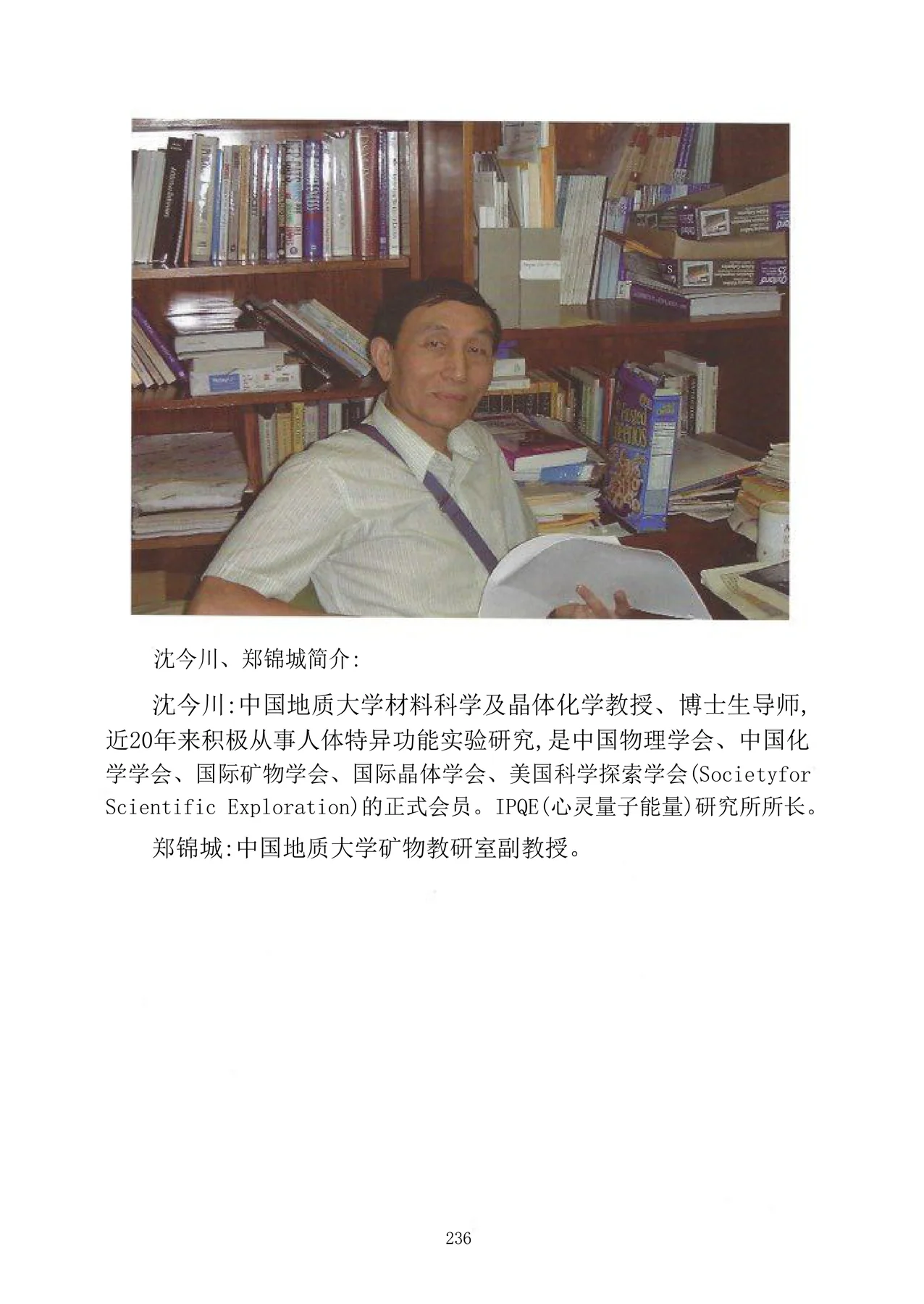
Brief Biographies of Shen Jinchuan and Zheng Jincheng:
Shen Jinchuan: Professor of Materials Science and Crystal Chemistry at China University of Geosciences, doctoral supervisor. Over the past twenty years, he has been actively engaged in experimental research on extraordinary human abilities. He is a full member of the Chinese Physical Society, the Chinese Chemical Society, the International Mineralogical Association, the International Union of Crystallography, and the Society for Scientific Exploration (USA). Director of the IPQE (Institute of Psycho-Quantum Energy) Research Institute.
Zheng Jincheng: Associate Professor in the Mineralogy Teaching and Research Section at China University of Geosciences.
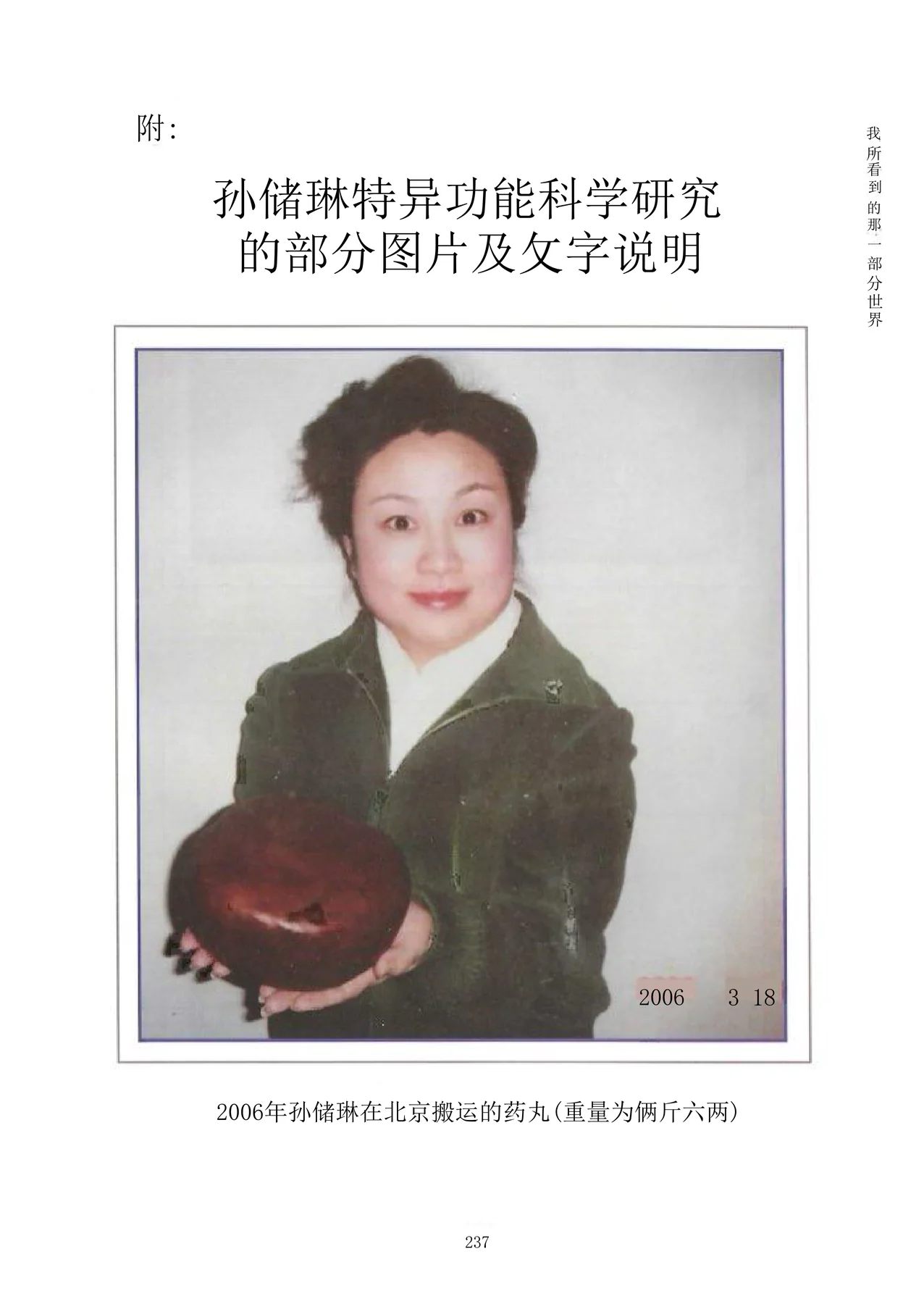
Photo Appendix: Selected Photographs and Scientific-Research Captions
A Selection of Photographs and Captions from the Scientific Research on Sun Chulin’s Extraordinary Human Abilities
March 18, 2006
Pills translocated by Sun Chulin in Beijing in 2006 (weight: two jin and six liang)
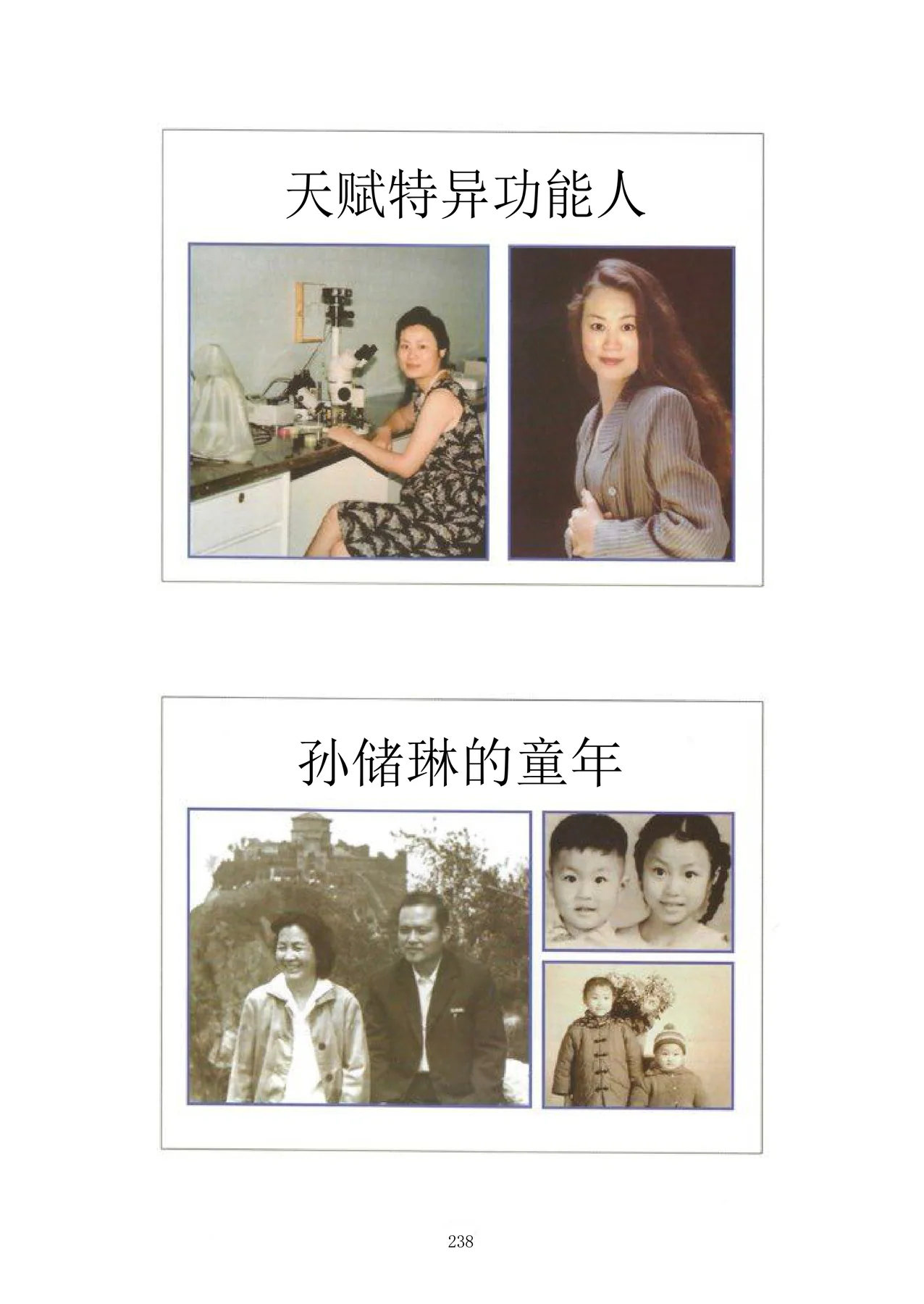
A Person with Innate Extraordinary Human Abilities
Sun Chulin’s Childhood
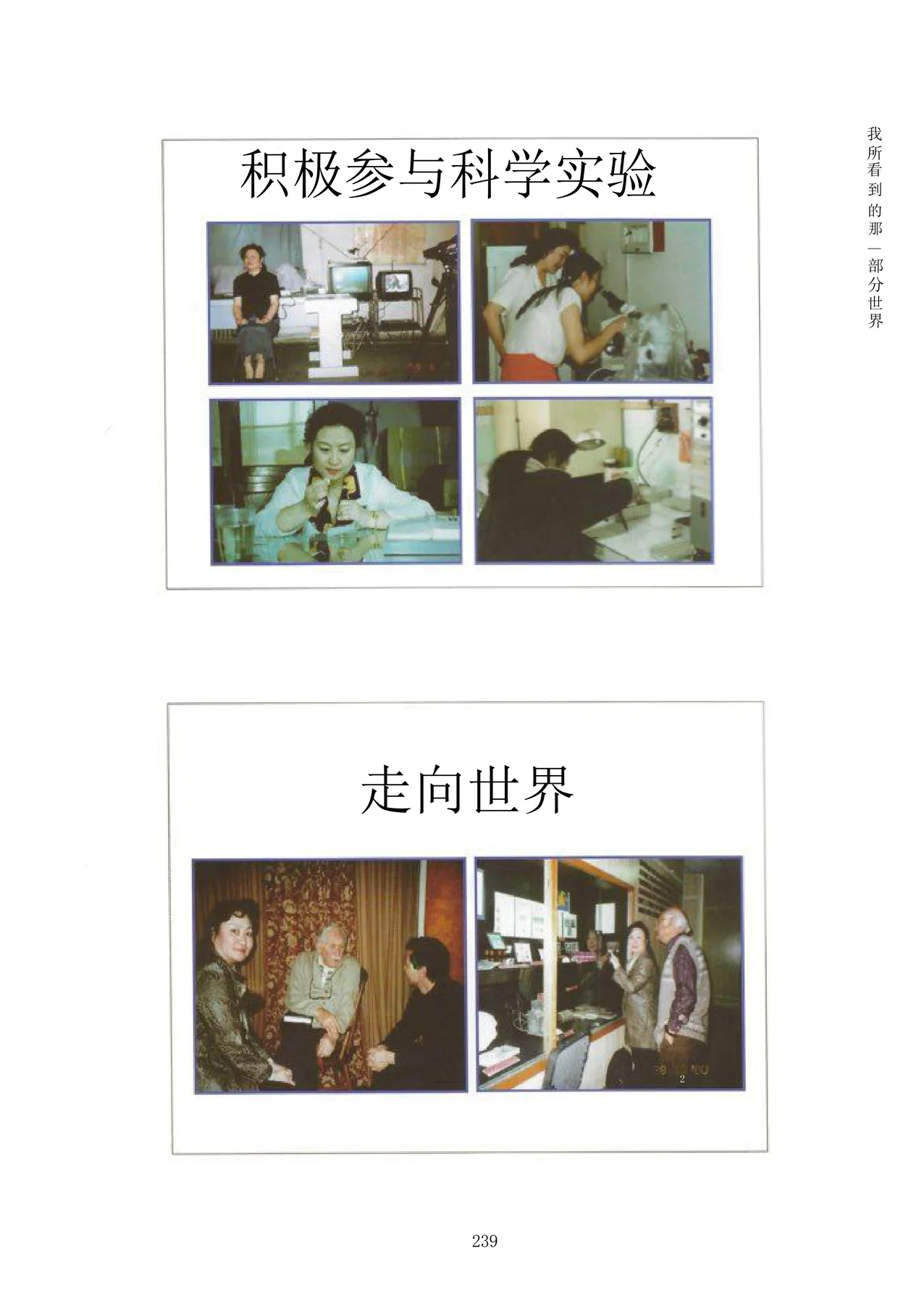
Actively Participating in Scientific Experiments
Going Out to the World
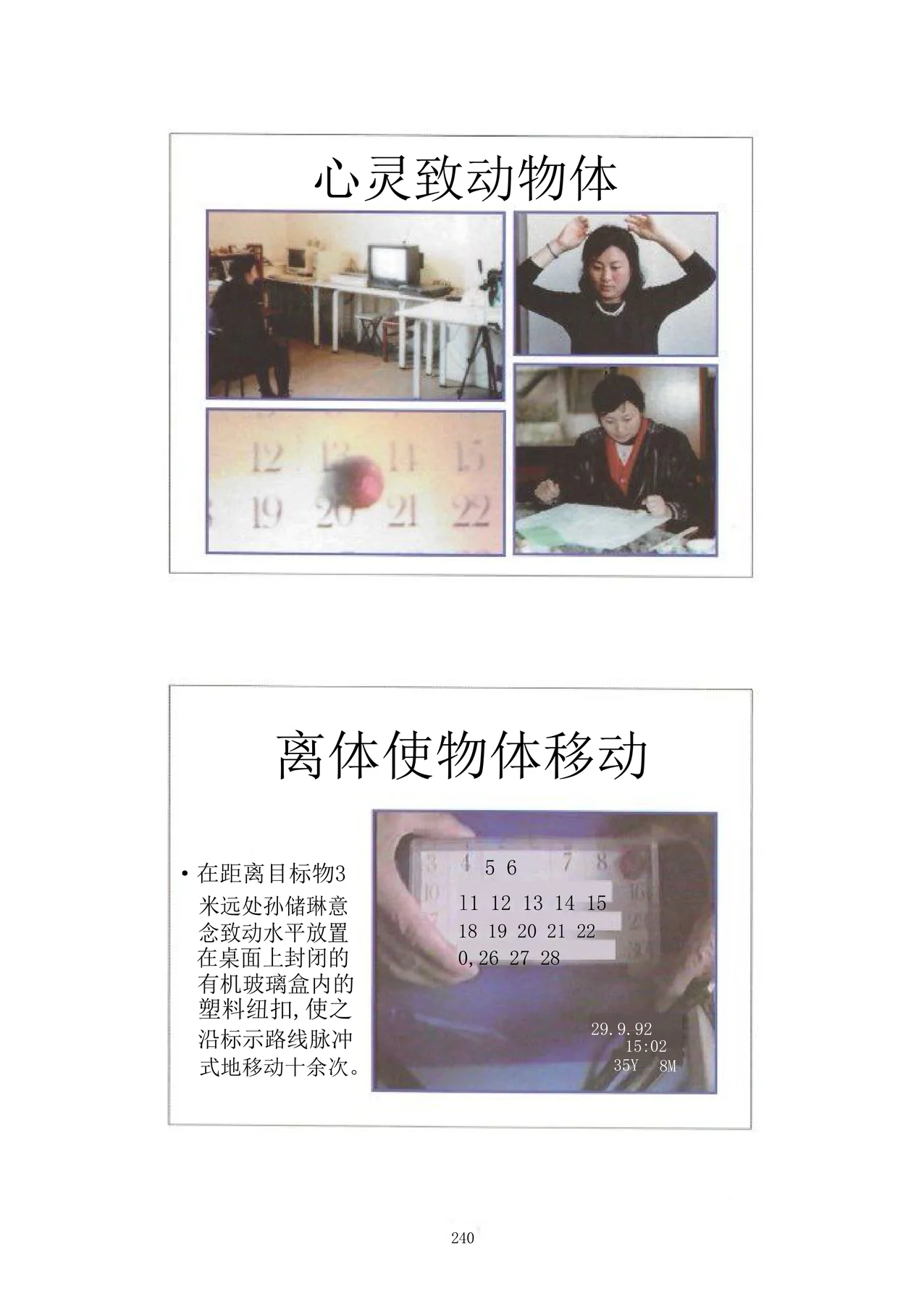
Psychokinesis — Moving Objects
Moving Objects from a Distance
- From a distance of 3–5–6 meters from the target object, Sun Chulin used mental intention to psychokinetically move a plastic button placed horizontally inside a sealed Plexiglas box on a tabletop, causing it to move in a pulsed manner along the marked path more than ten times.
29.9.92 15:02 35Y 8M
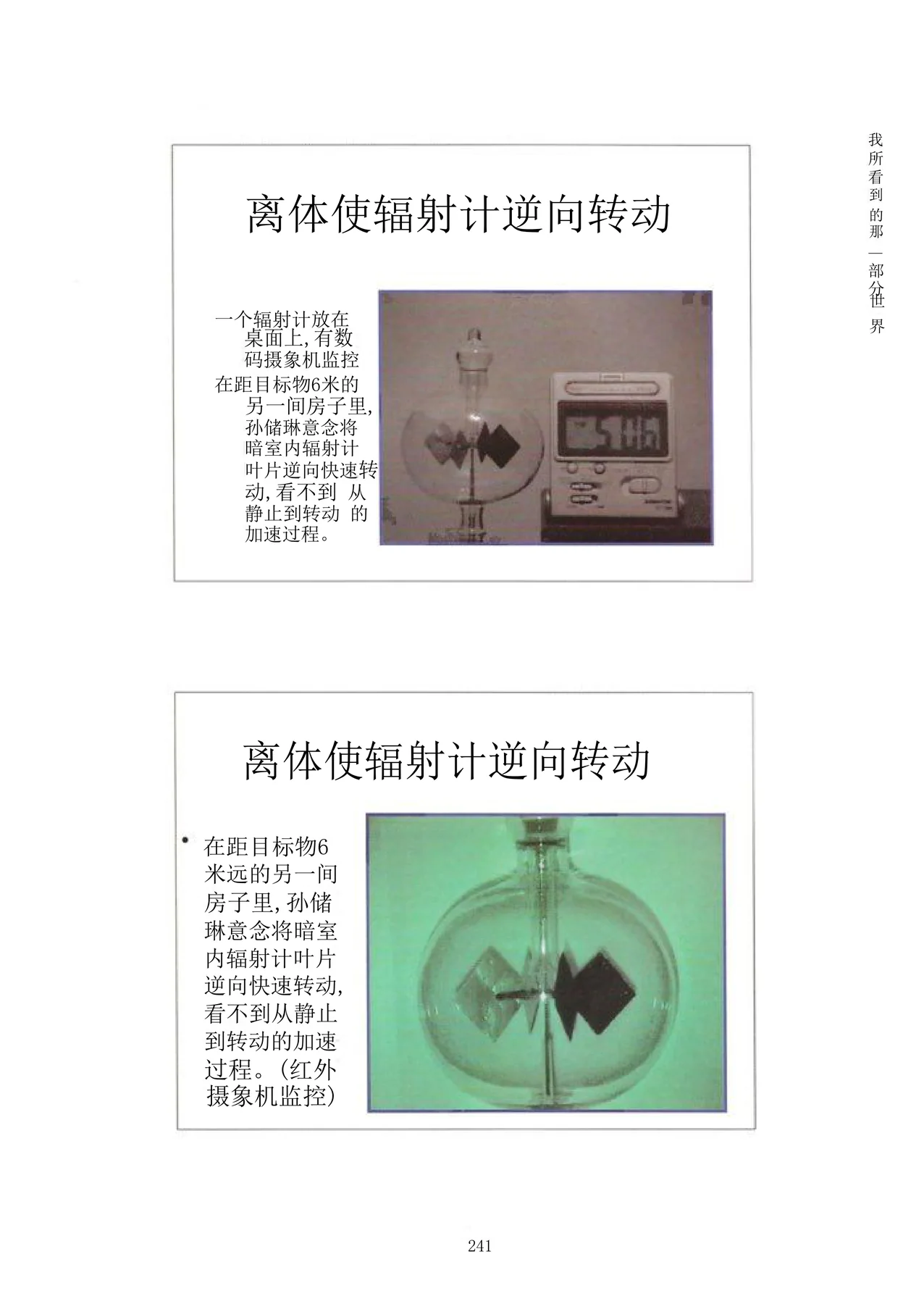
Making a Radiometer Rotate in Reverse from a Distance
A radiometer is placed on a table top, monitored by a digital video camera. In another room six meters away from the target object, Sun Chulin, through mental intention, causes the vanes of the radiometer inside the dark enclosure to rotate rapidly in reverse. No acceleration process from standstill to rotation can be observed.
Making a Radiometer Rotate in Reverse from a Distance
In another room six meters away from the target object, Sun Chulin, through mental intention, causes the vanes of the radiometer inside the dark enclosure to rotate rapidly in reverse. No acceleration process from standstill to rotation can be observed. (Monitored by an infrared video camera.)
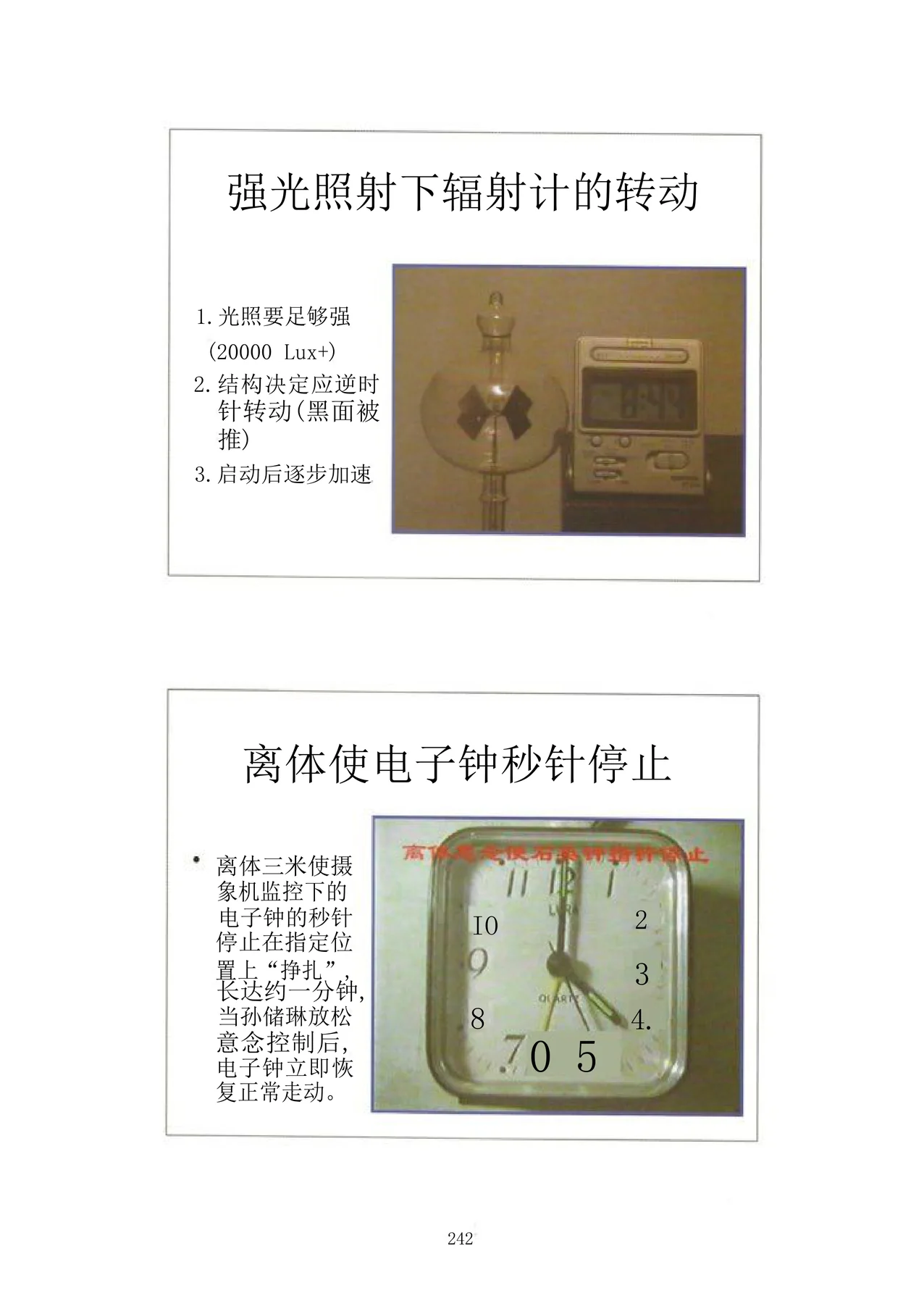
Rotation of the Radiometer Under Intense Light Illumination
- The illumination must be sufficiently strong (20,000 Lux+)
- Its structure dictates that it should rotate counterclockwise (the black side is pushed)
- After starting, it gradually accelerates
Stopping an Electronic Clock’s Second Hand from a Distance
From a distance of three meters, Sun Chulin causes the second hand of an electronic clock, under video-camera monitoring, to stop at a designated position, “struggling” for approximately one minute. When Sun Chulin relaxes her mental control, the electronic clock immediately resumes normal operation.
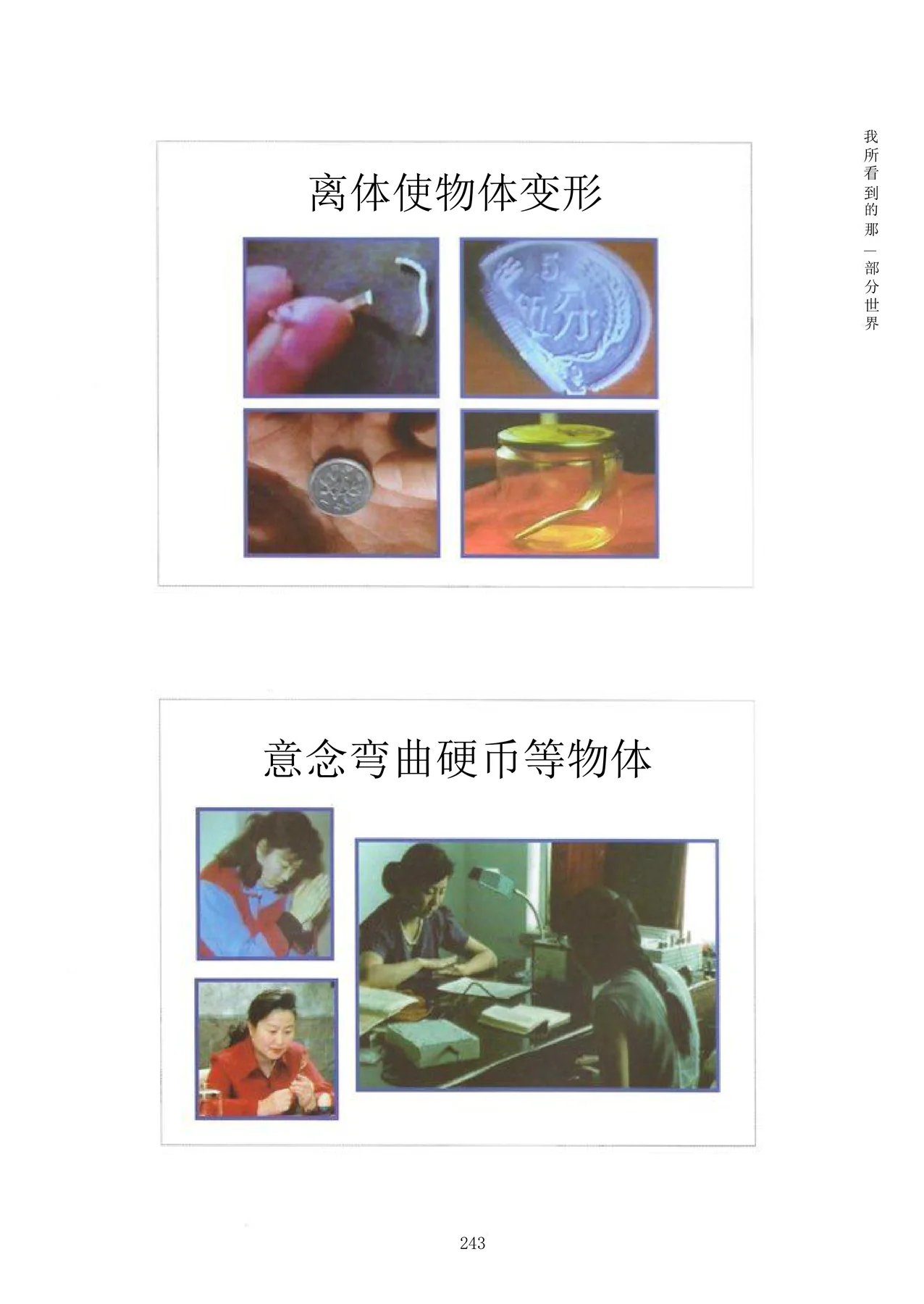
Deforming Objects from a Distance
Bending Coins and Other Objects Through Mental Intention
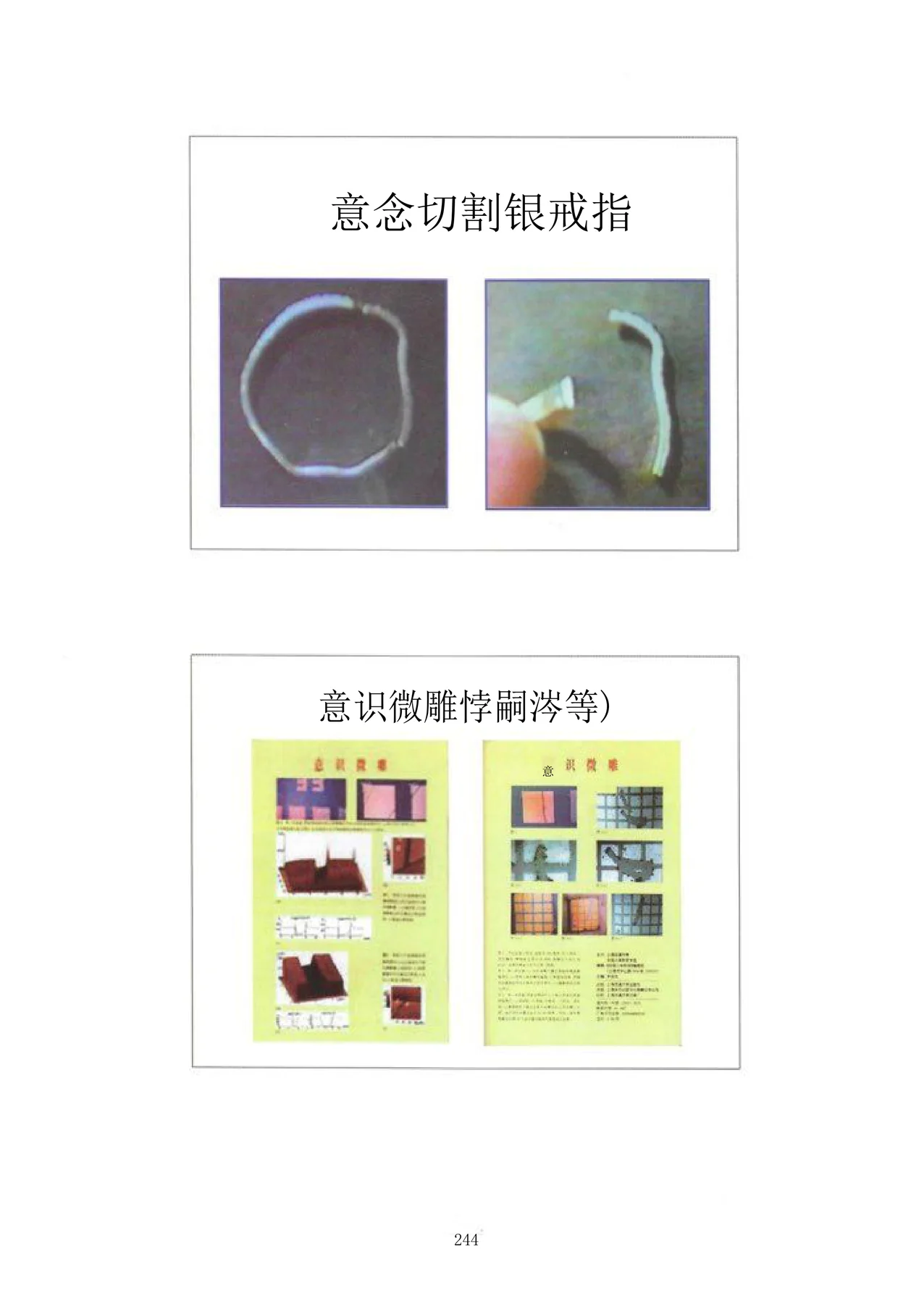
Cutting a Silver Ring Through Mental Intention
Consciousness Micro-Carving (engravings, etc.)
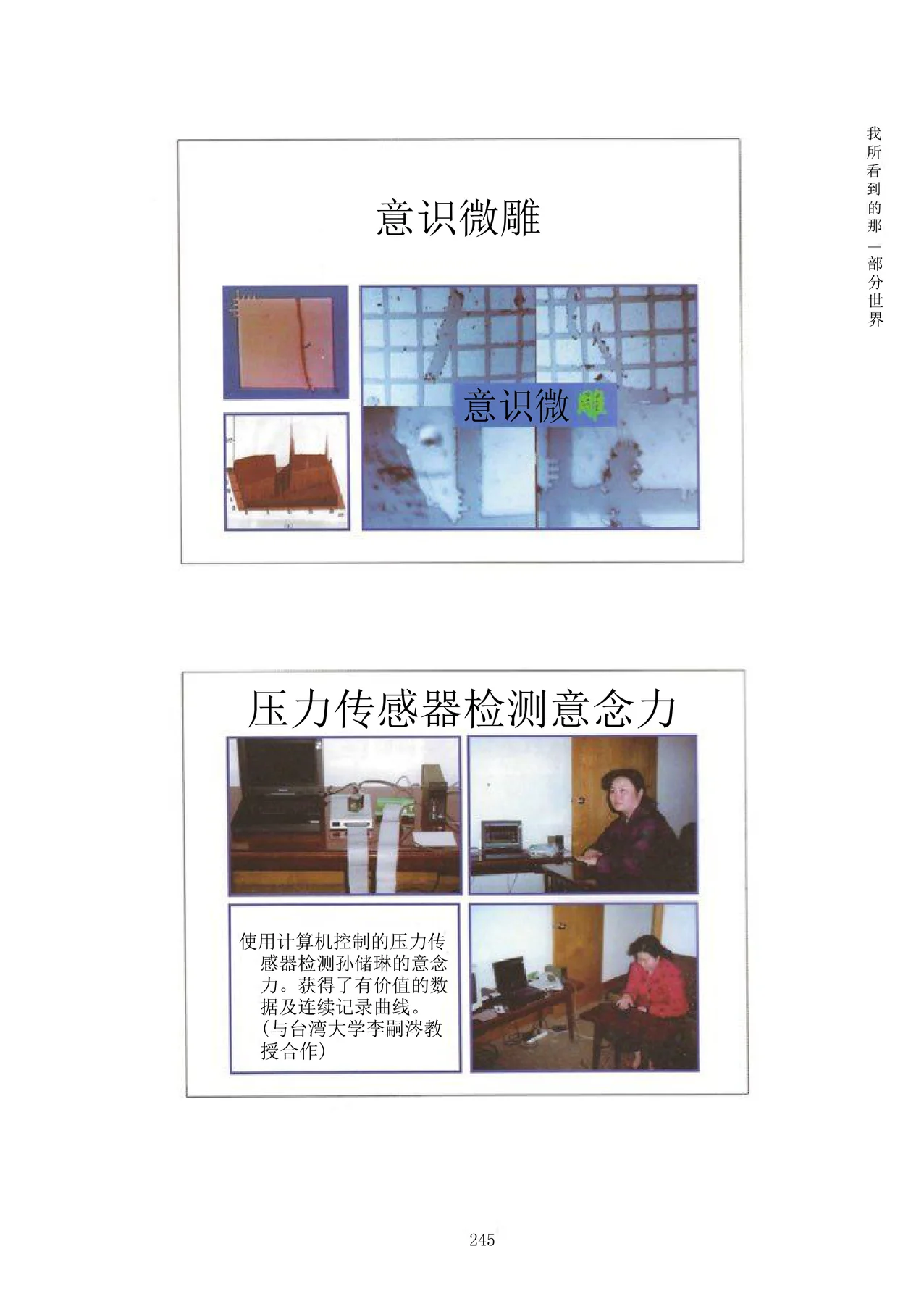
Consciousness Micro-Carving
Pressure Sensor Detection of Psychokinetic Force
Using a computer-controlled pressure sensor to detect Sun Chulin’s psychokinetic force. Valuable data and continuous recording curves were obtained.
(In collaboration with Professor Li Si-chen of National Taiwan University)
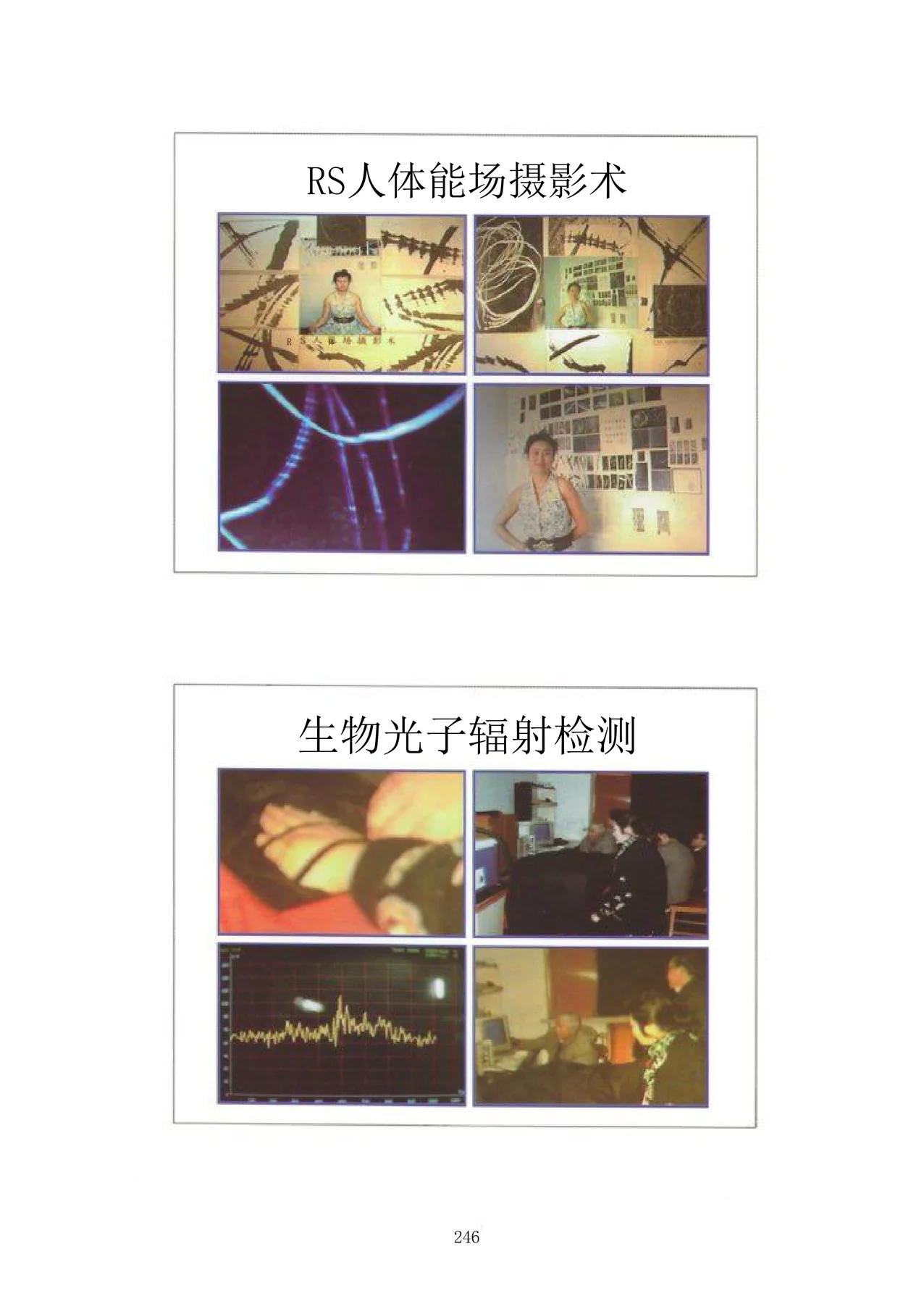
RS Human Energy Field Photography
Biophoton Radiation Detection
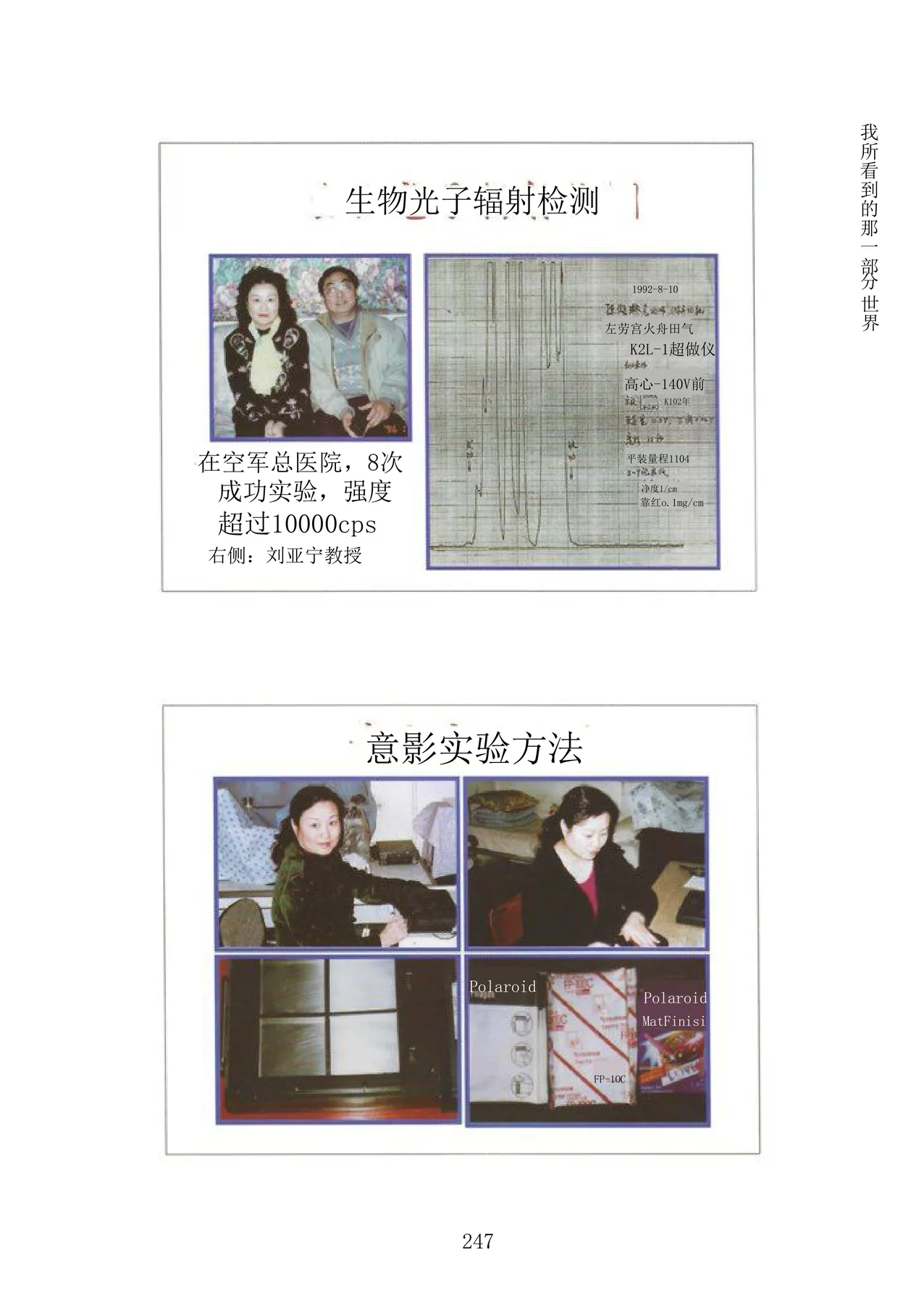
Biophoton Radiation Detection
1992-8-10
Left Laogong Fire / Qihai Qi
K2L-1 Ultra-micro Instrument
High-voltage -140V front
At the Air Force General Hospital, 8 successful experiments, intensity exceeding 10,000 cps
Right side: Professor Liu Yaning
Consciousness Photography Experimental Method
Polaroid
Polaroid
MatFinish
FP-10C
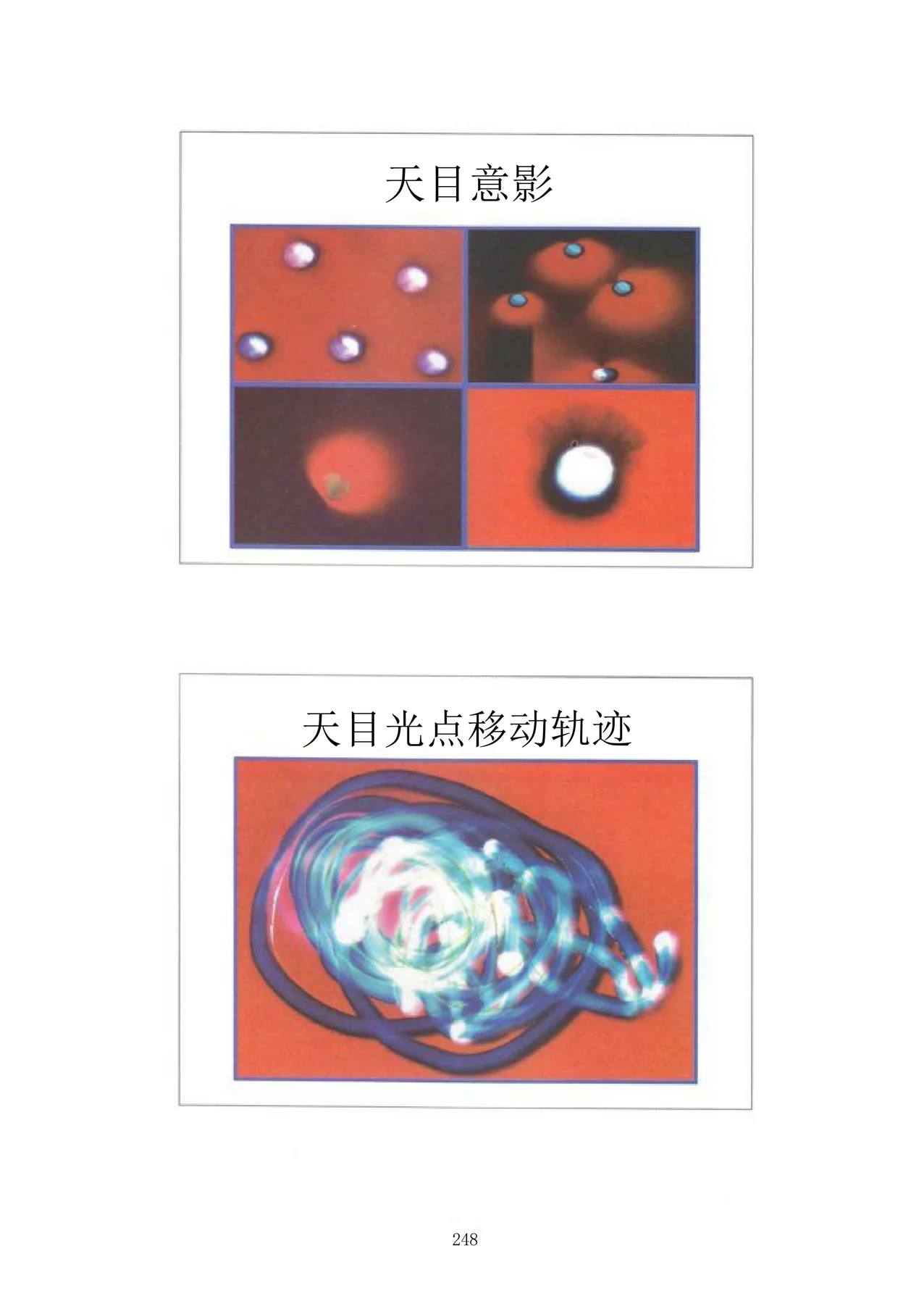
Celestial Eye Consciousness Photography
Celestial Eye Light Point Movement Trajectory
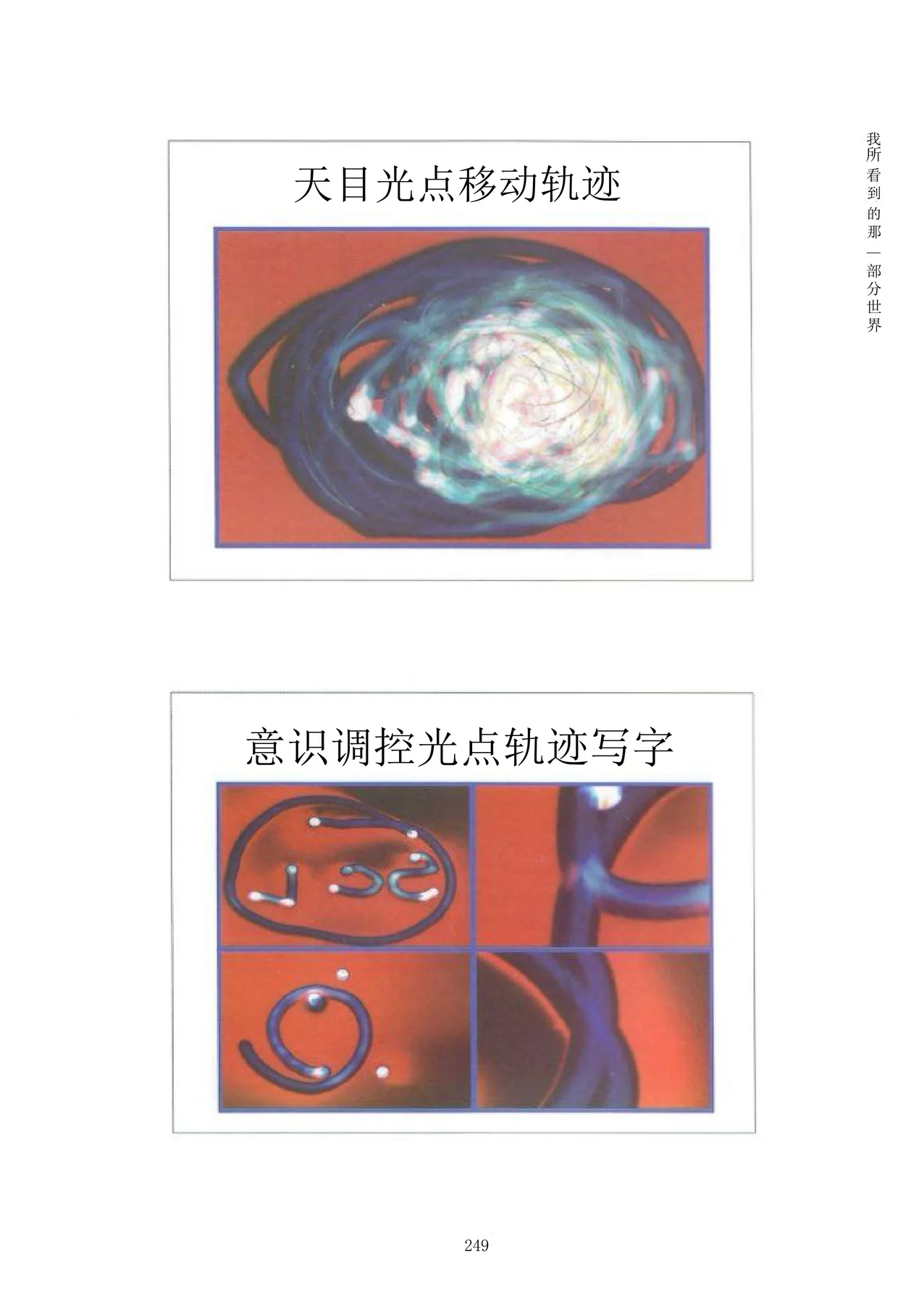
Movement trajectory of the celestial-eye light spot Writing through the light spot trajectory regulated by consciousness
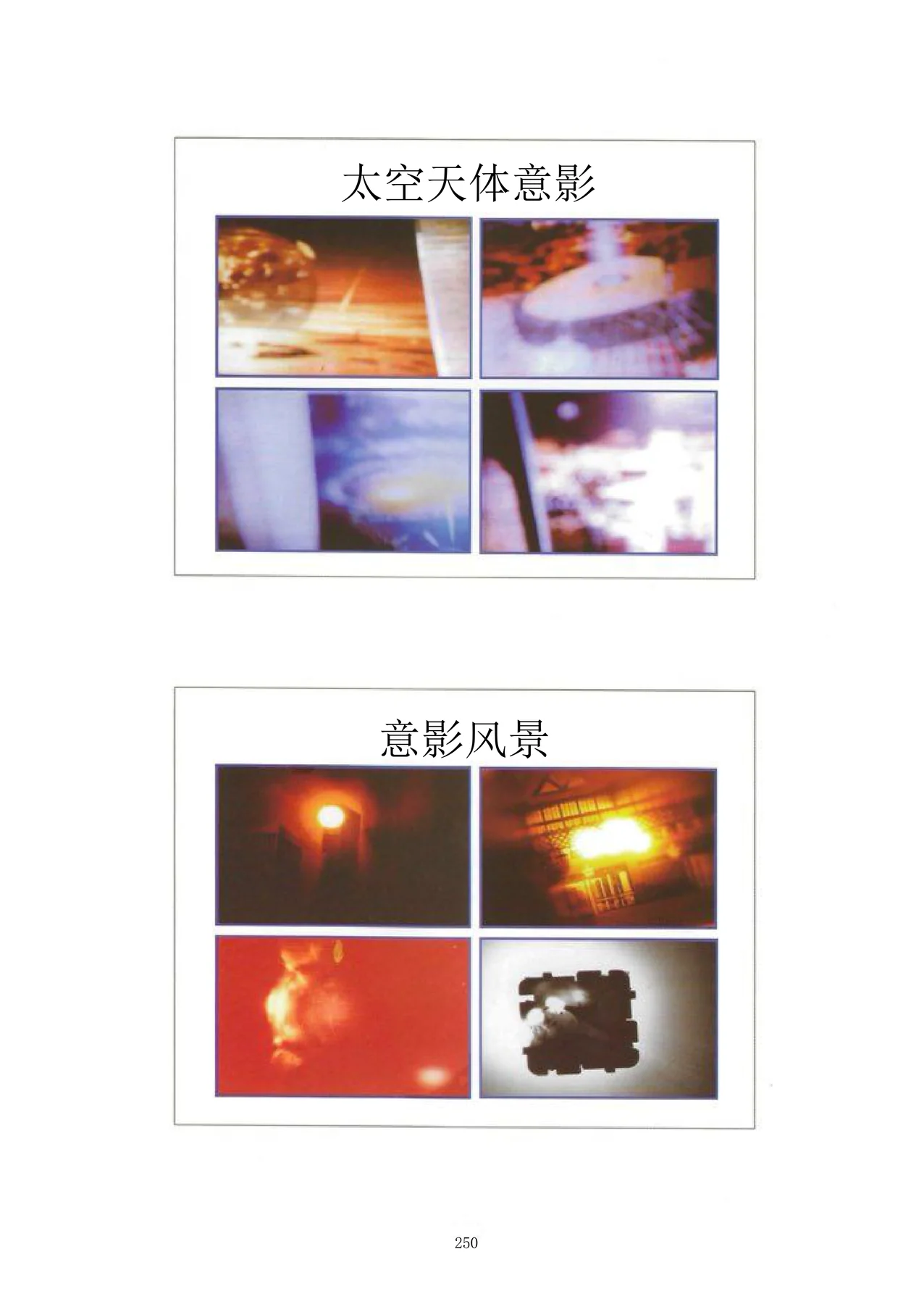
Mental photography of outer space celestial bodies Mental photography landscape
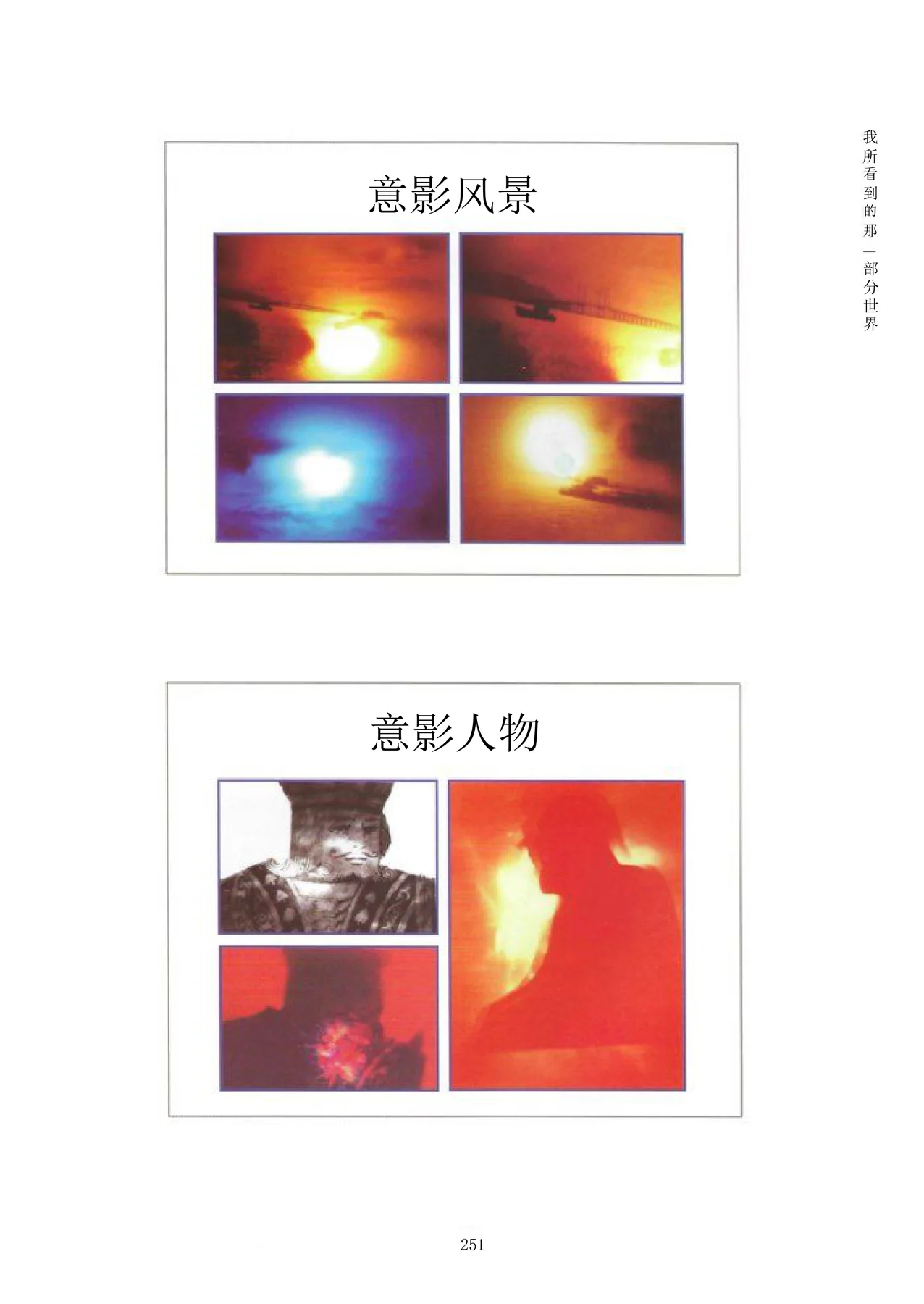
Mental photography landscape Mental photography figures
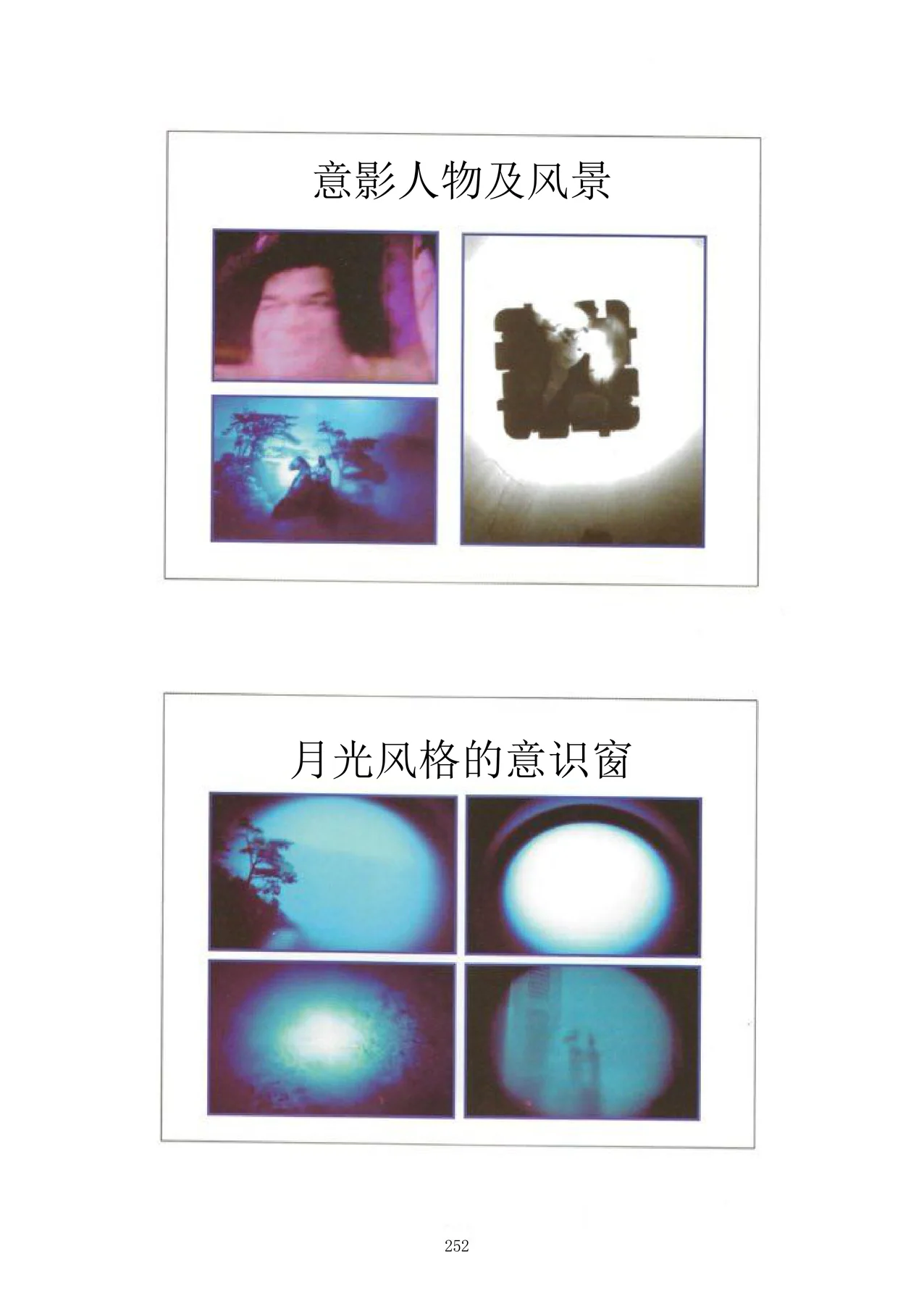
Mental photography figures and landscapes Moonlight-style consciousness window
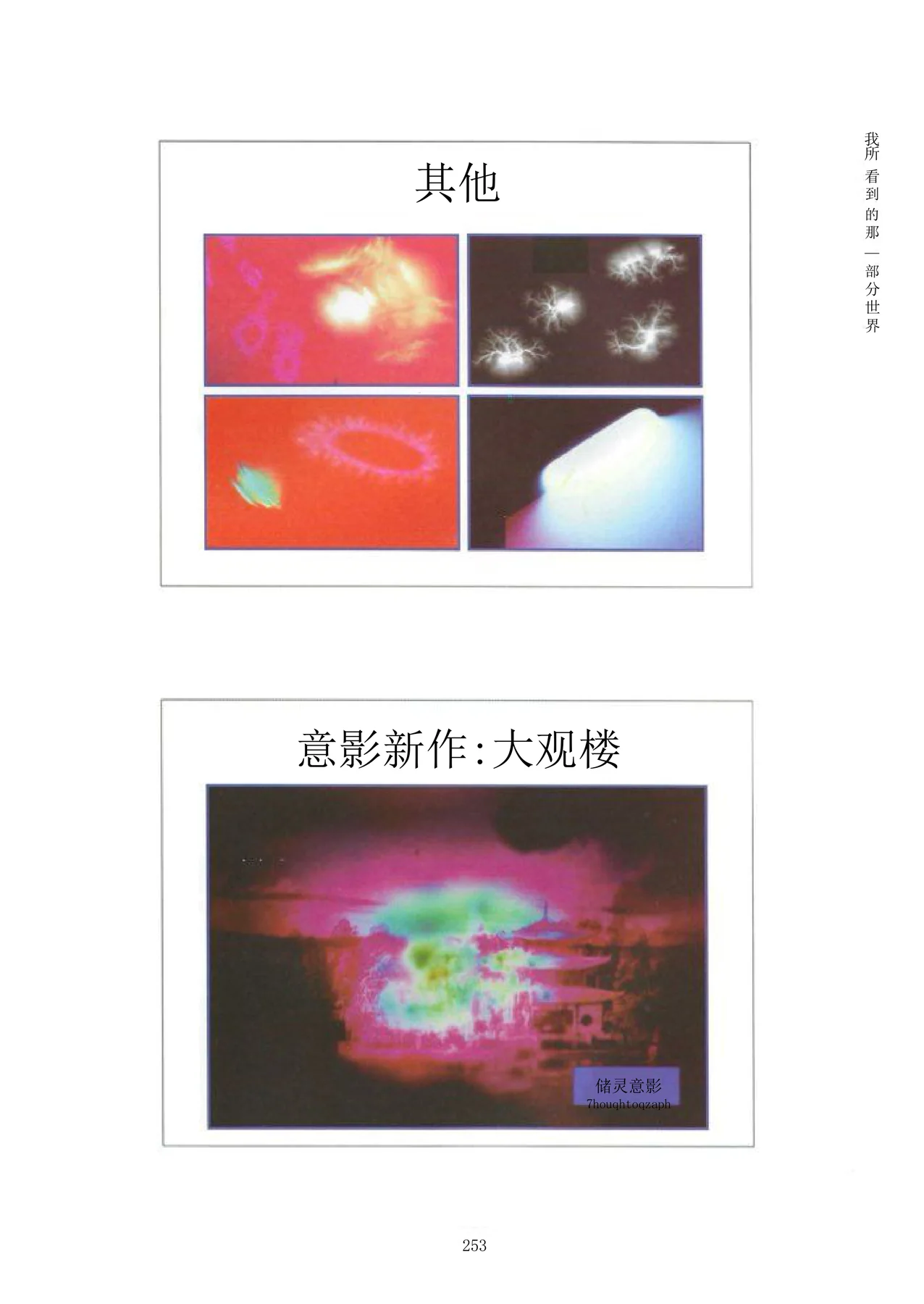
Others
New Thoughtograph Work: Grand View Pavilion Chulin Thoughtograph Thoughtograph
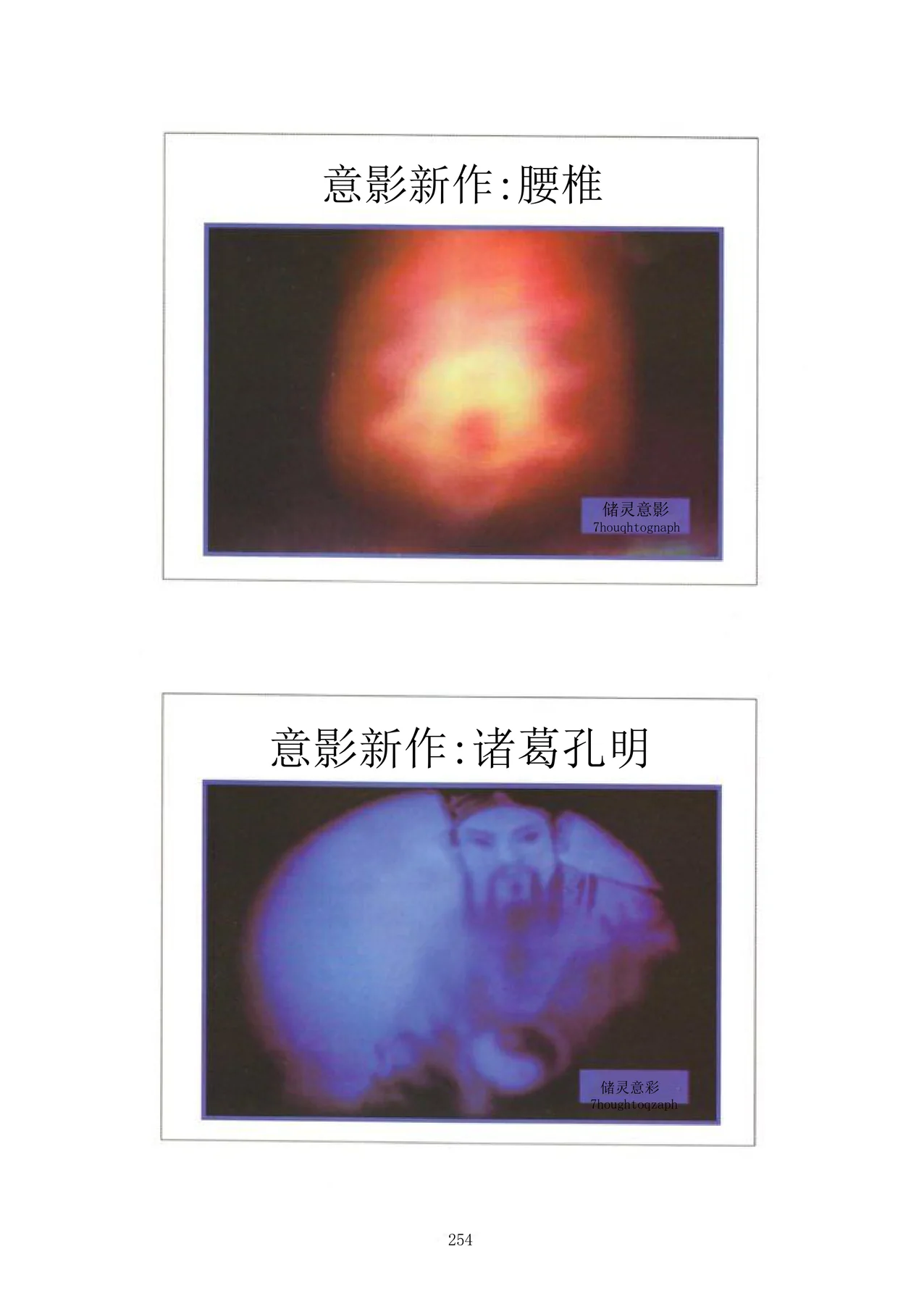
New Thoughtograph Work: Lumbar Vertebra Chulin Thoughtograph Thoughtograph
New Thoughtograph Work: Zhuge Kongming Chulin Thoughtograph Thoughtograph
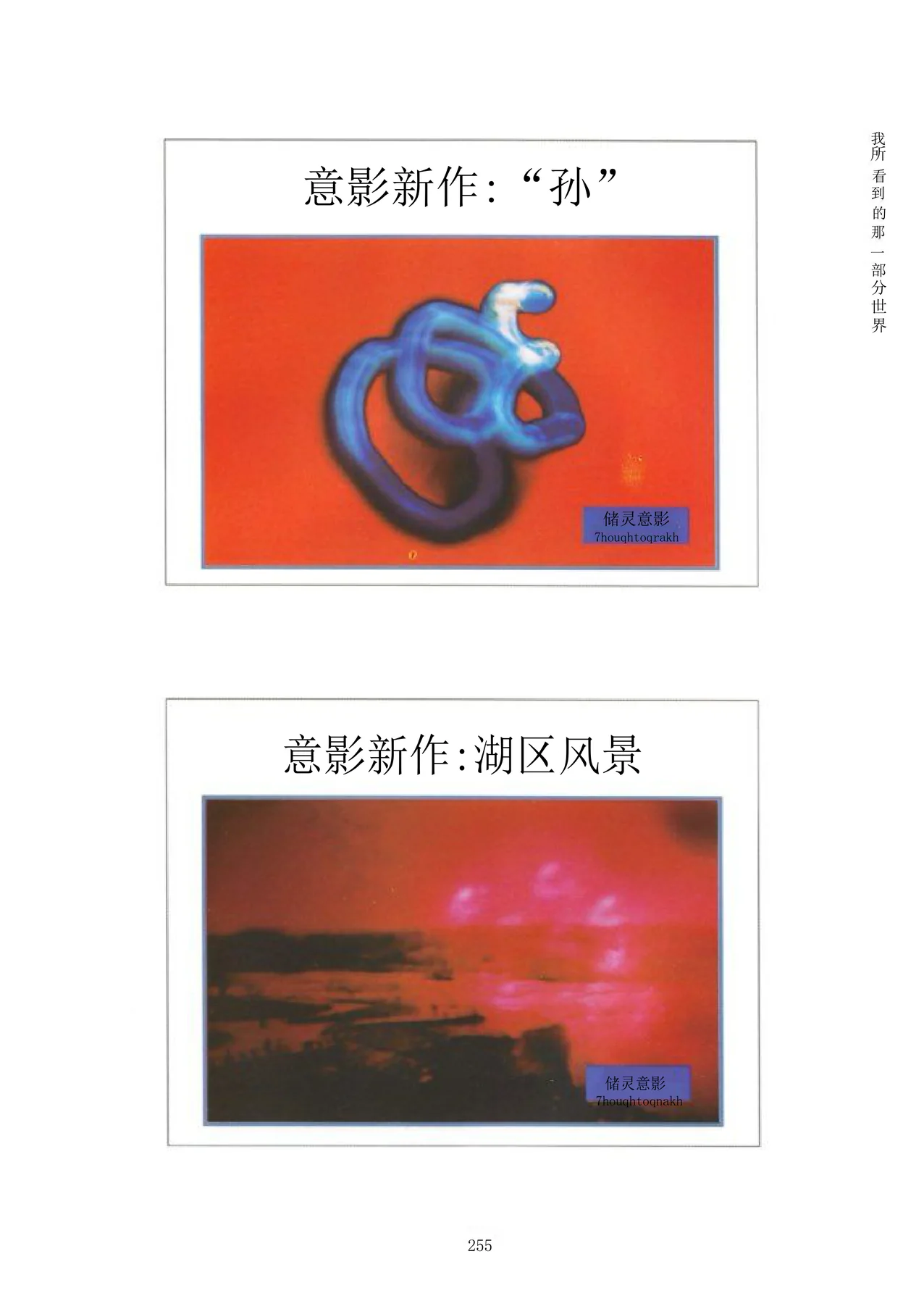
New Thoughtograph Work: “Sun” Chulin Thoughtograph Thoughtograph
New Thoughtograph Work: Lake District Landscape Chulin Thoughtograph Thoughtograph
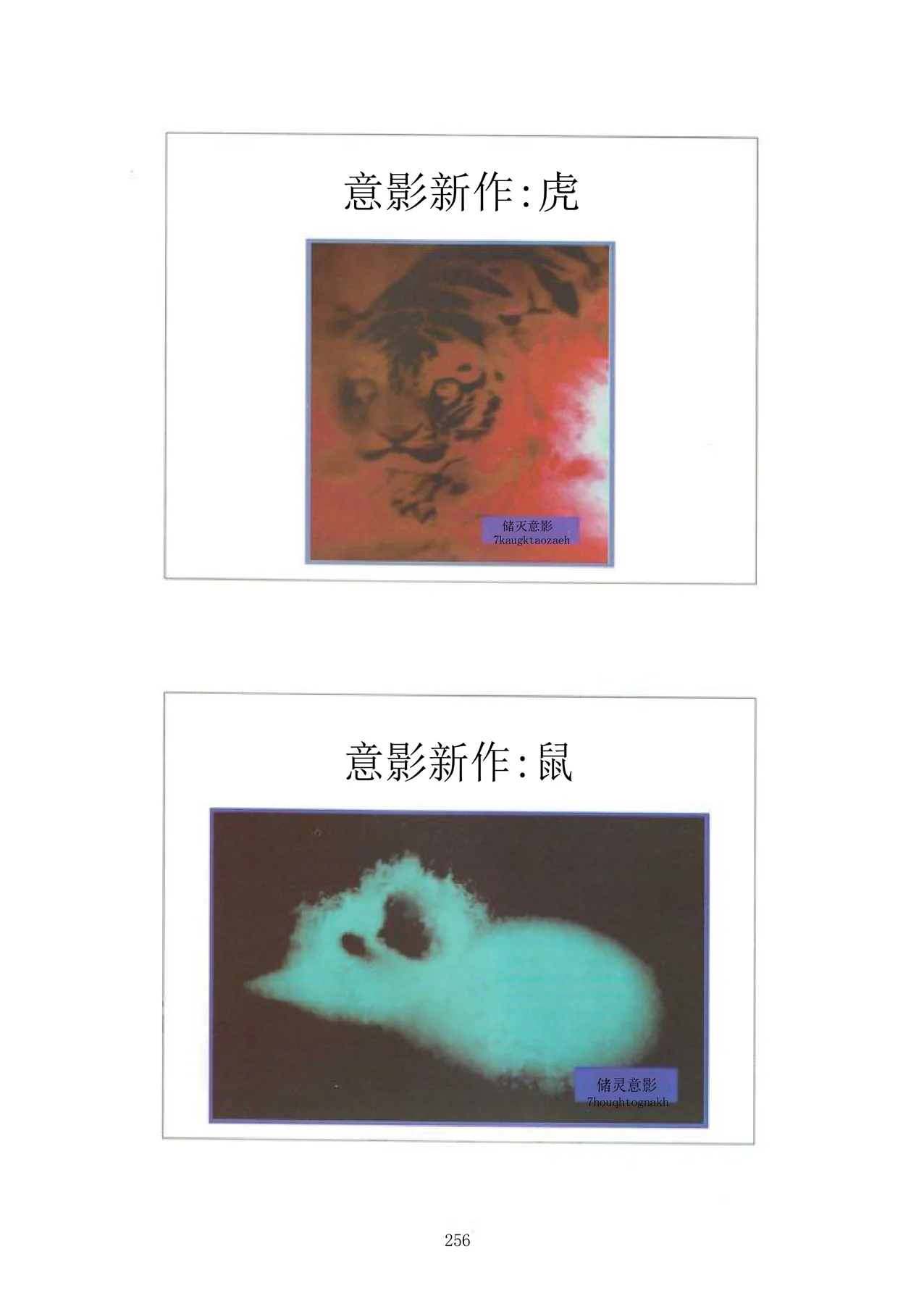
New Thoughtograph Work: Tiger Chulin Thoughtograph Thoughtograph
New Thoughtograph Work: Rat Chulin Thoughtograph Thoughtograph
Thought Photography and Anomalous Phenomena
New thought-photography work: Light Screen
Chulin thought-photography
Photograph
New thought-photography work: “Sun”
Chulin thought-photography
Photograph
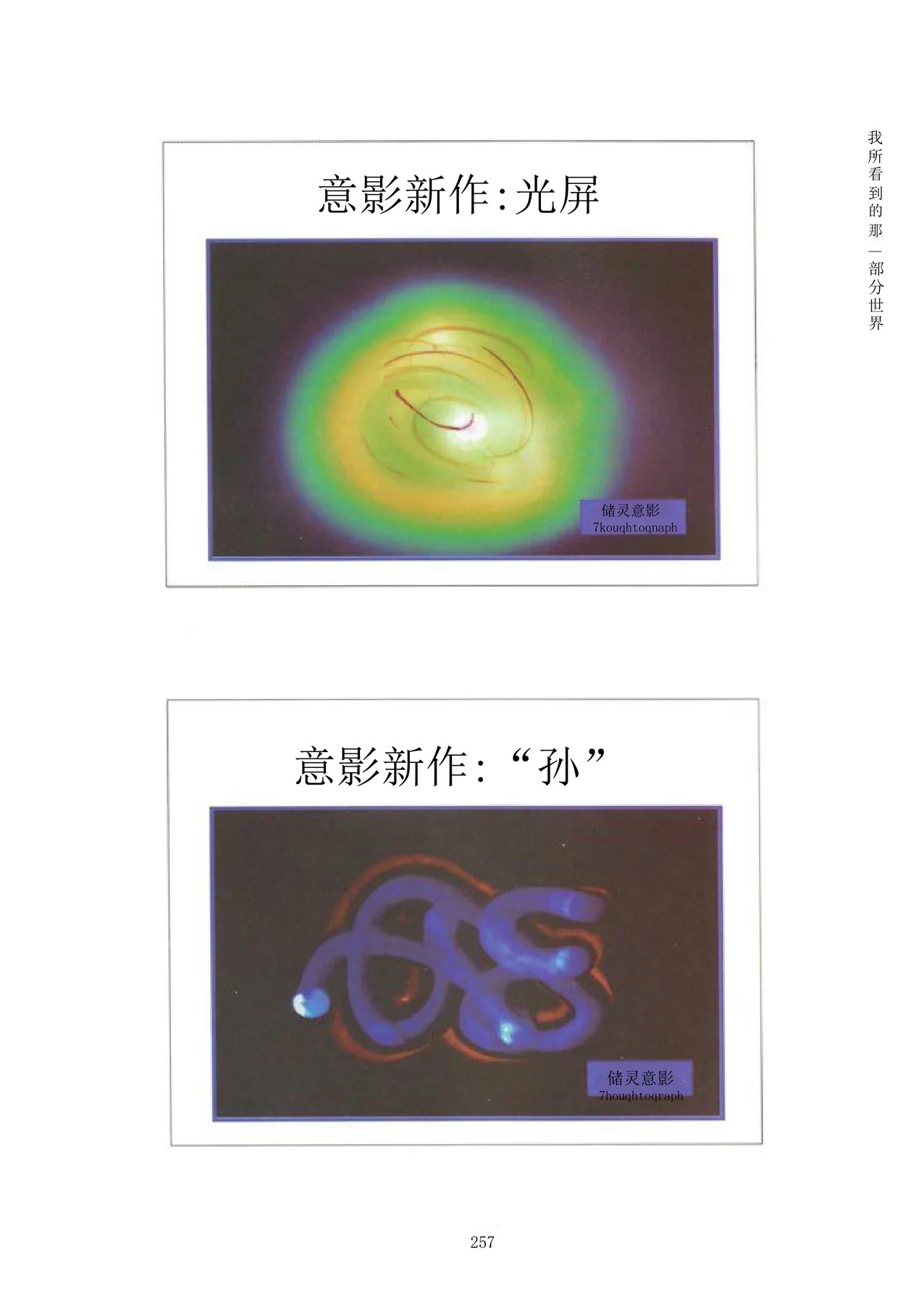
Various Strange Light-Emitting Phenomena
Various Strange Light-Emitting Phenomena
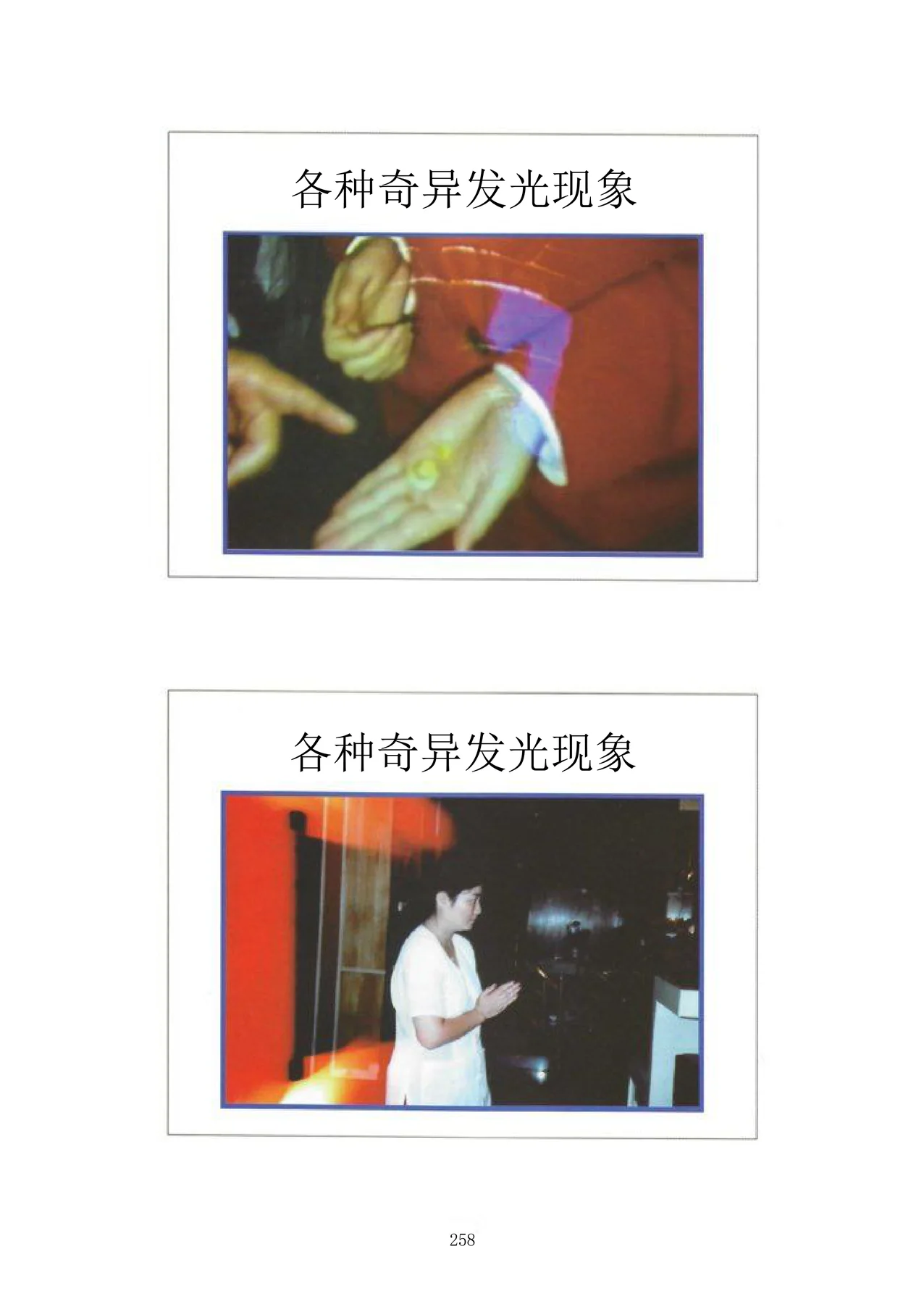
Acupoint Magnetic Effects Under the Qigong State
Different shapes from different points
Ms. Sun in experiment
Upper: Sun’s; lower: others
Inducing some people else to produce the Magnetic-figure
Forcing Flower Buds to Bloom (7 minutes)
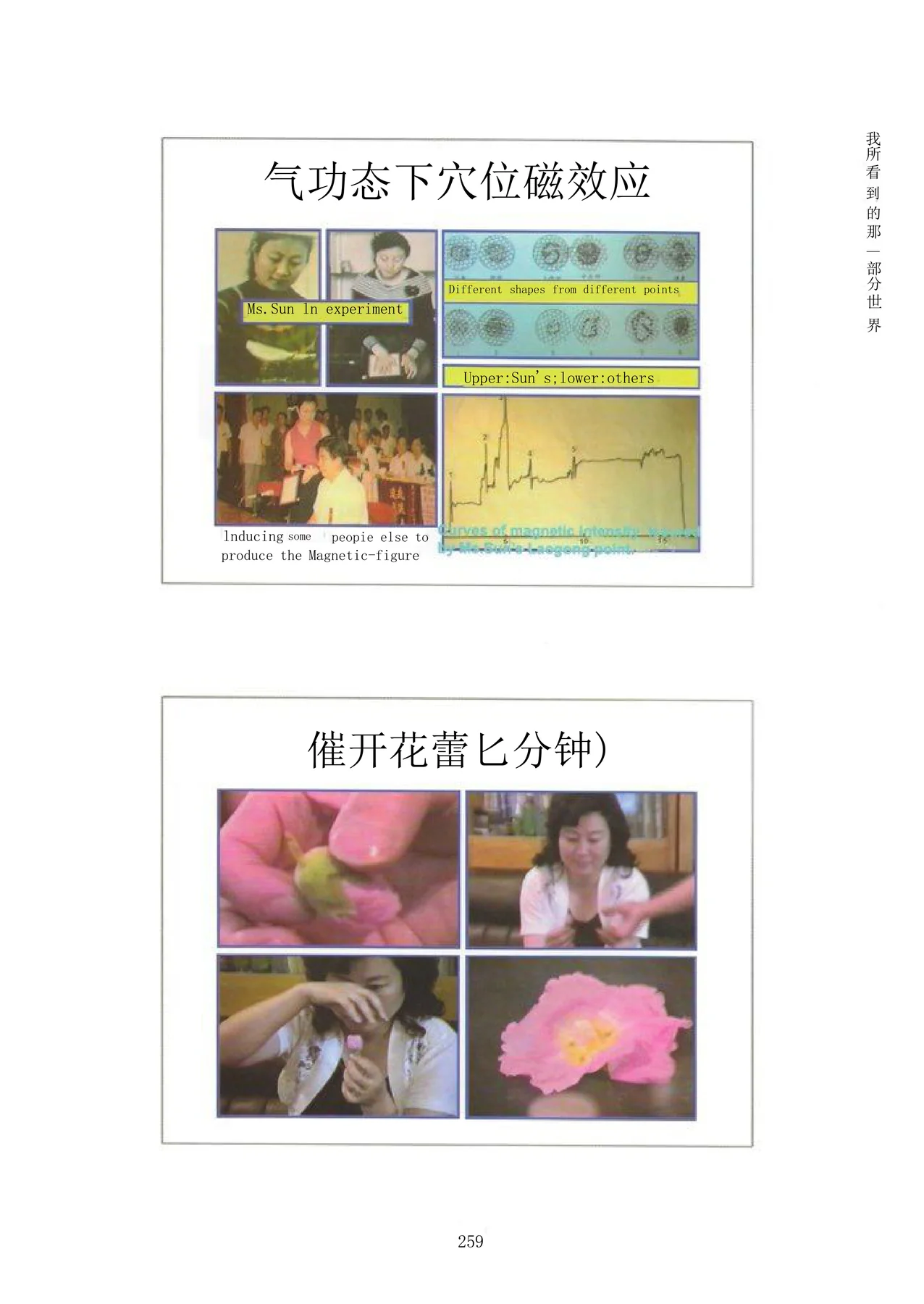
Bidirectional Regulation (Accelerating Growth, Rejuvenation)
Bidirectional for 5 times (Green–Red–green) in minutes
Malaysian Strange-Flavor Fried Peanuts Sprouted 12 cm
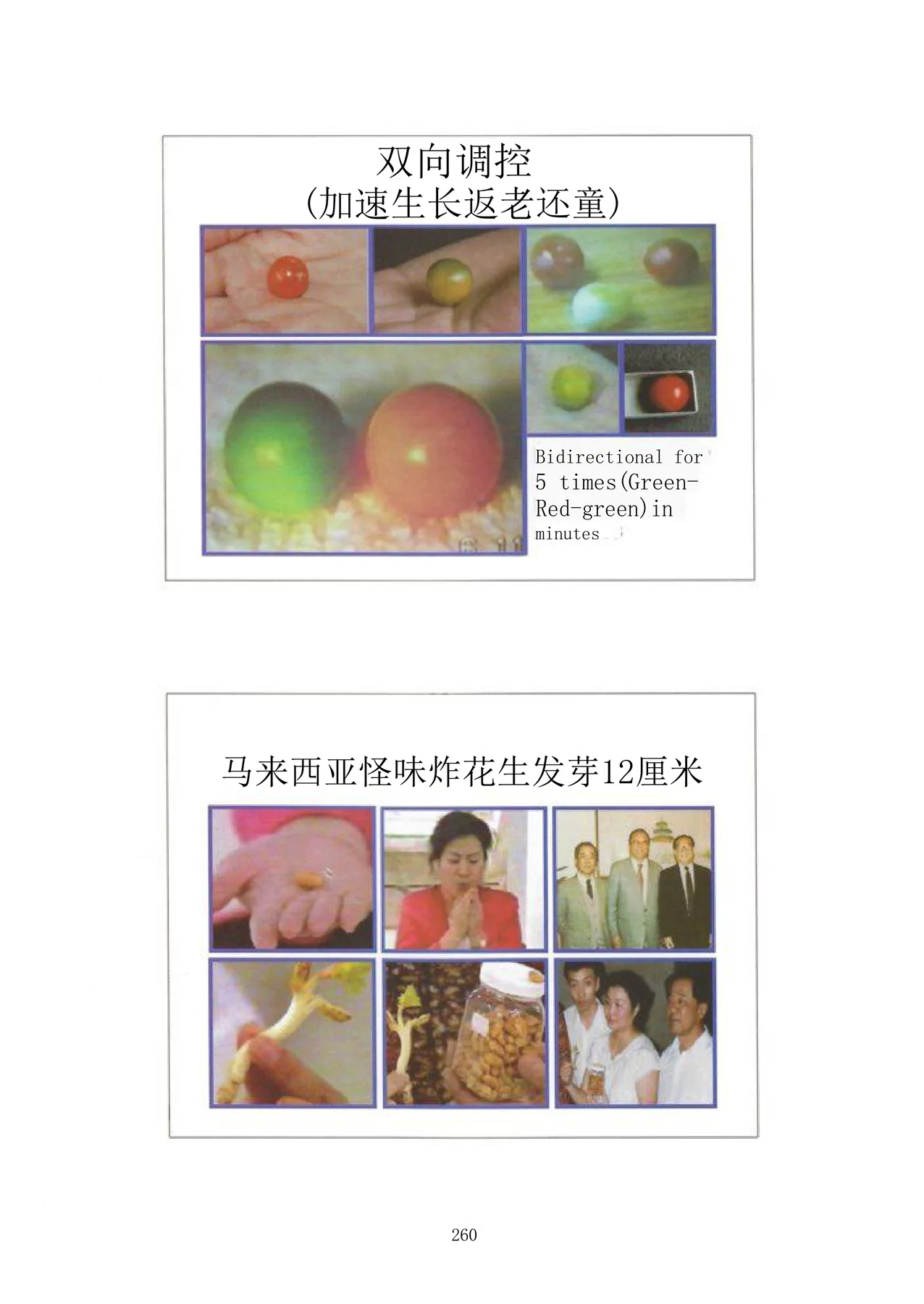
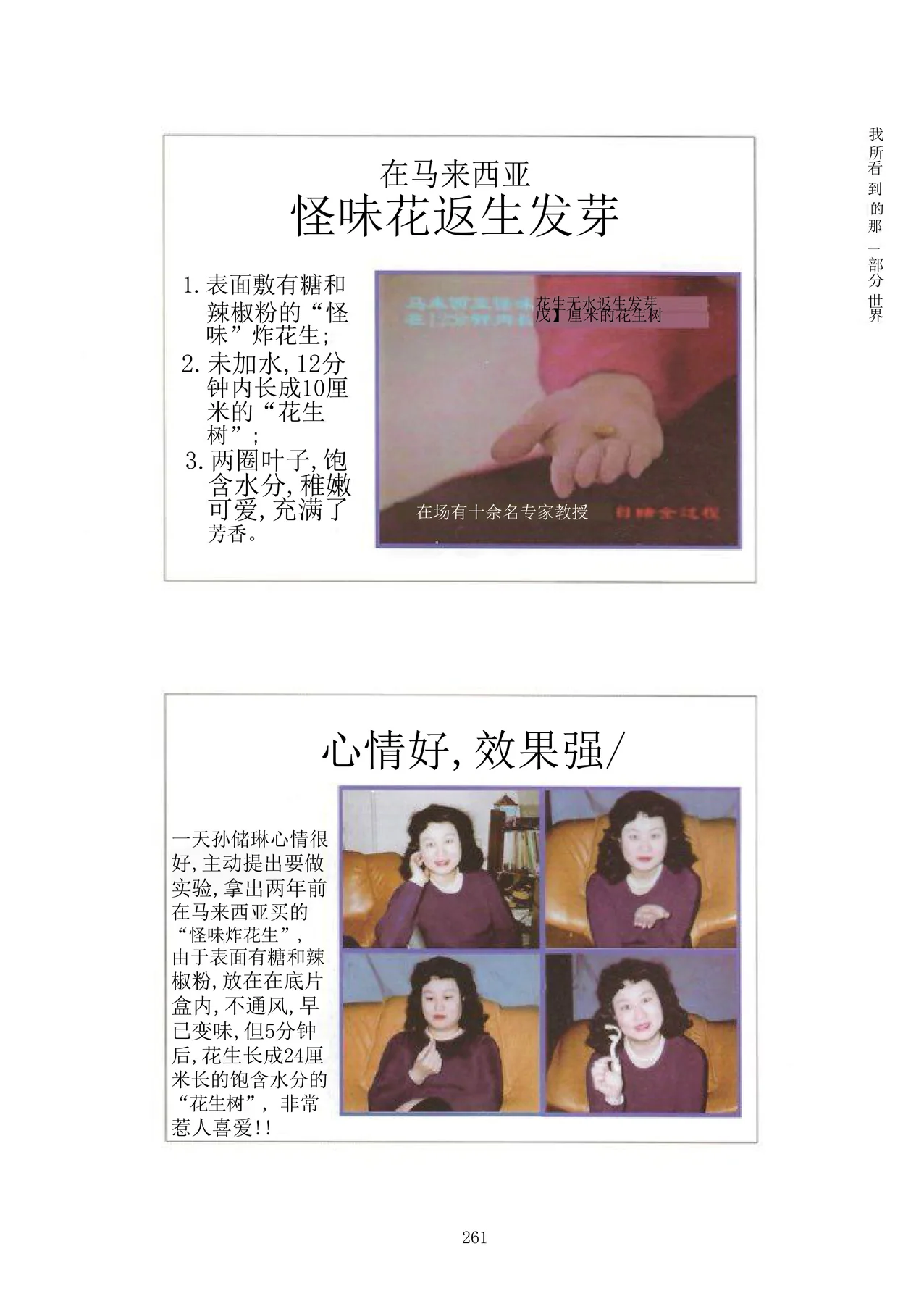
Watching “Weird-Taste” Peanuts Revitalize and Sprout in Malaysia
- “Weird-taste” fried peanuts coated on the surface with sugar and chili powder;
- Without adding water, they grew into a 10-cm-tall “peanut tree” within 12 minutes;
- Two whorls of leaves, full of moisture, tender and lovely, and full of fragrance.
More than ten experts and professors were present.
A good mood yields strong effects. One day, Sun Chulin was in a very good mood and volunteered to conduct an experiment. She took out the “weird-taste fried peanuts” she had bought in Malaysia two years prior. Because their surfaces were coated in sugar and chili powder and they had been kept in a film canister without ventilation, they had long since lost their original flavor. However, five minutes later, the peanuts grew into a 24-cm-tall, moisture-rich “peanut tree,” which was extremely endearing!!
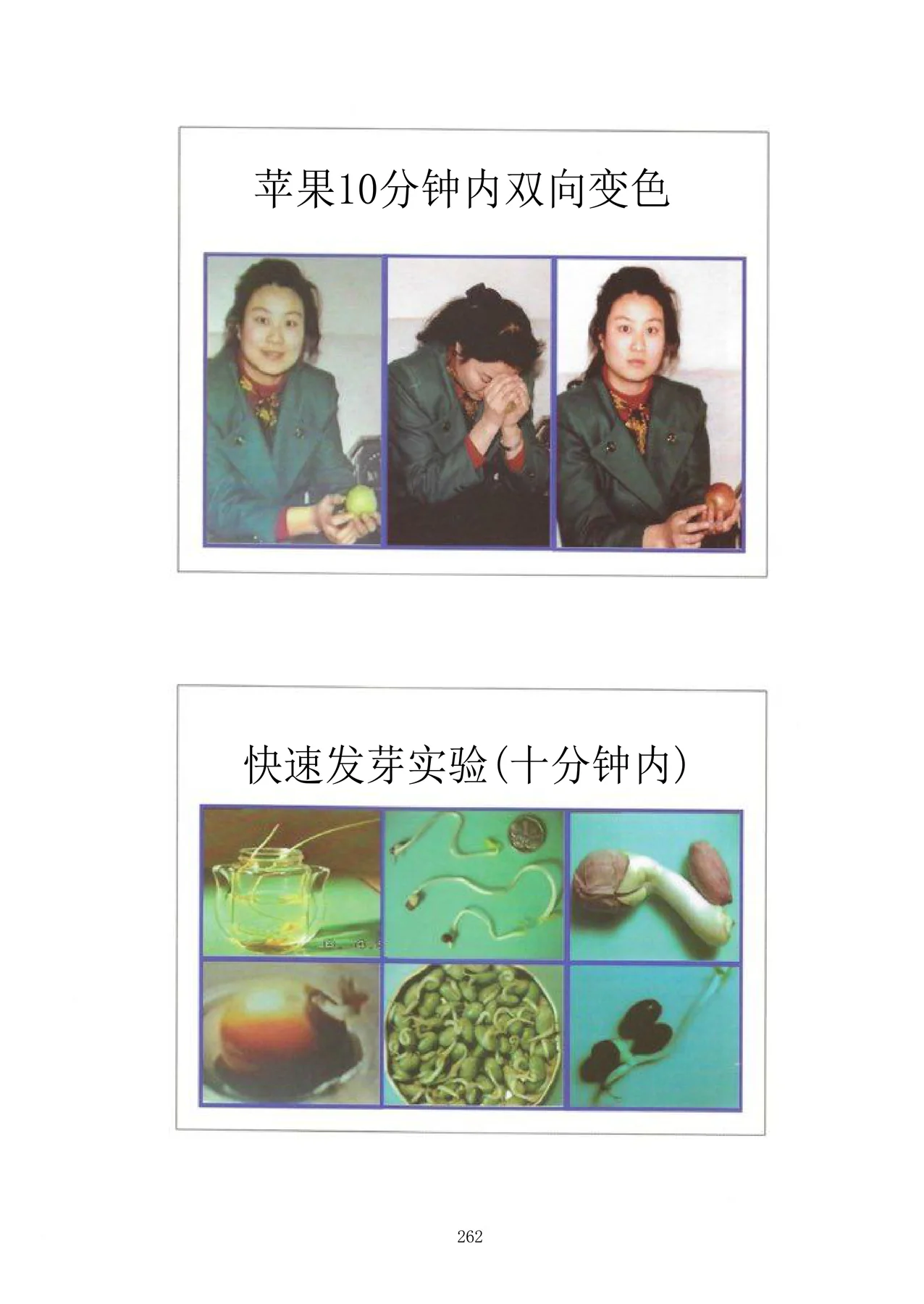
Apple changes color bi-directionally within 10 minutes
Rapid sprouting experiment (within 10 minutes)
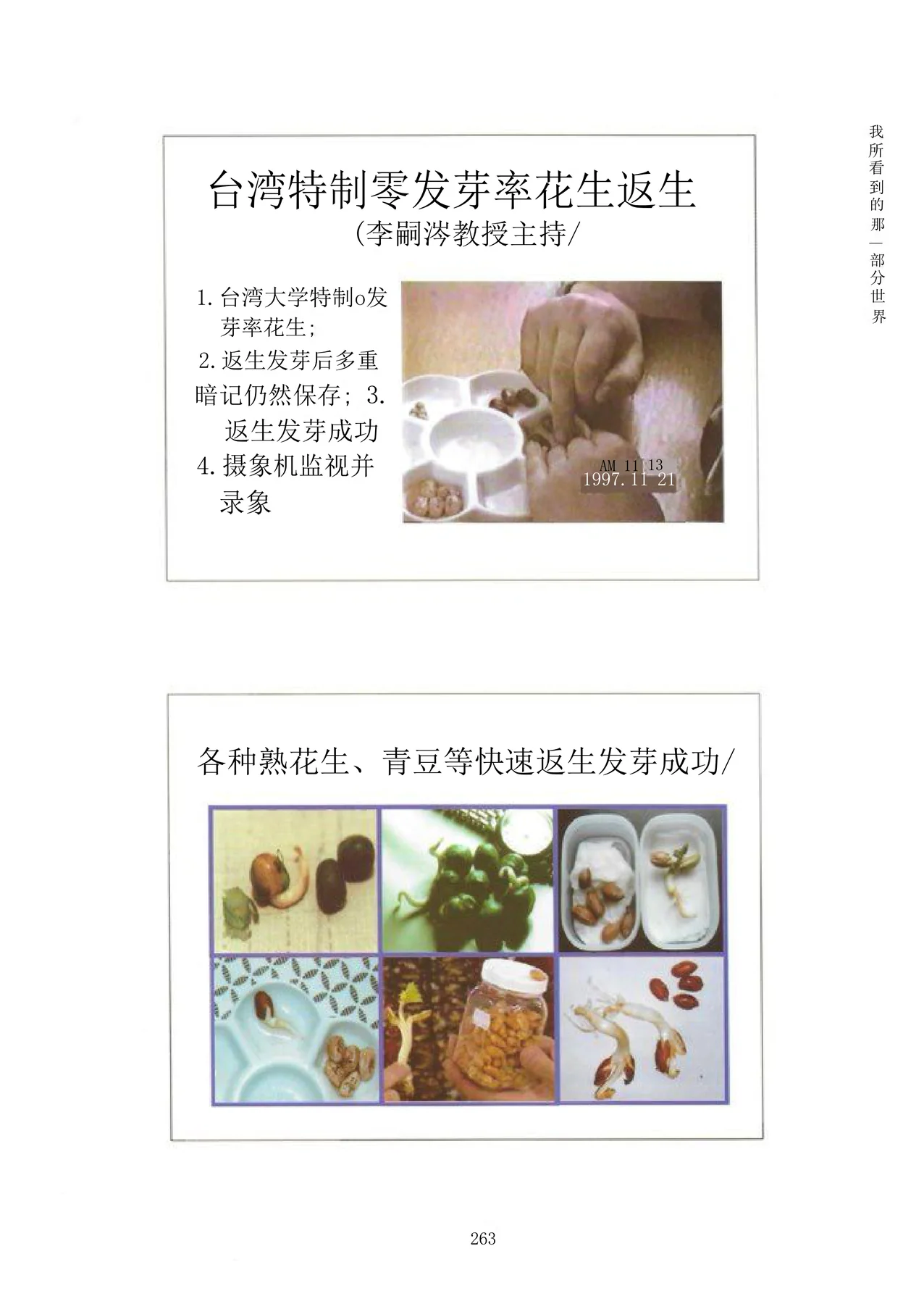
Revitalization of Taiwan specially-made zero-germination-rate peanuts (Presided over by Professor Li Sichun)
- Specially made zero-germination-rate peanuts from National Taiwan University;
- Multiple secret marks remained intact after revitalization and sprouting;
- Revitalization and sprouting successful;
- Monitored and recorded by a video camera.
AM 11 13 1997.11 21
Various cooked peanuts, green beans, etc. rapidly revitalized and sprouted successfully.
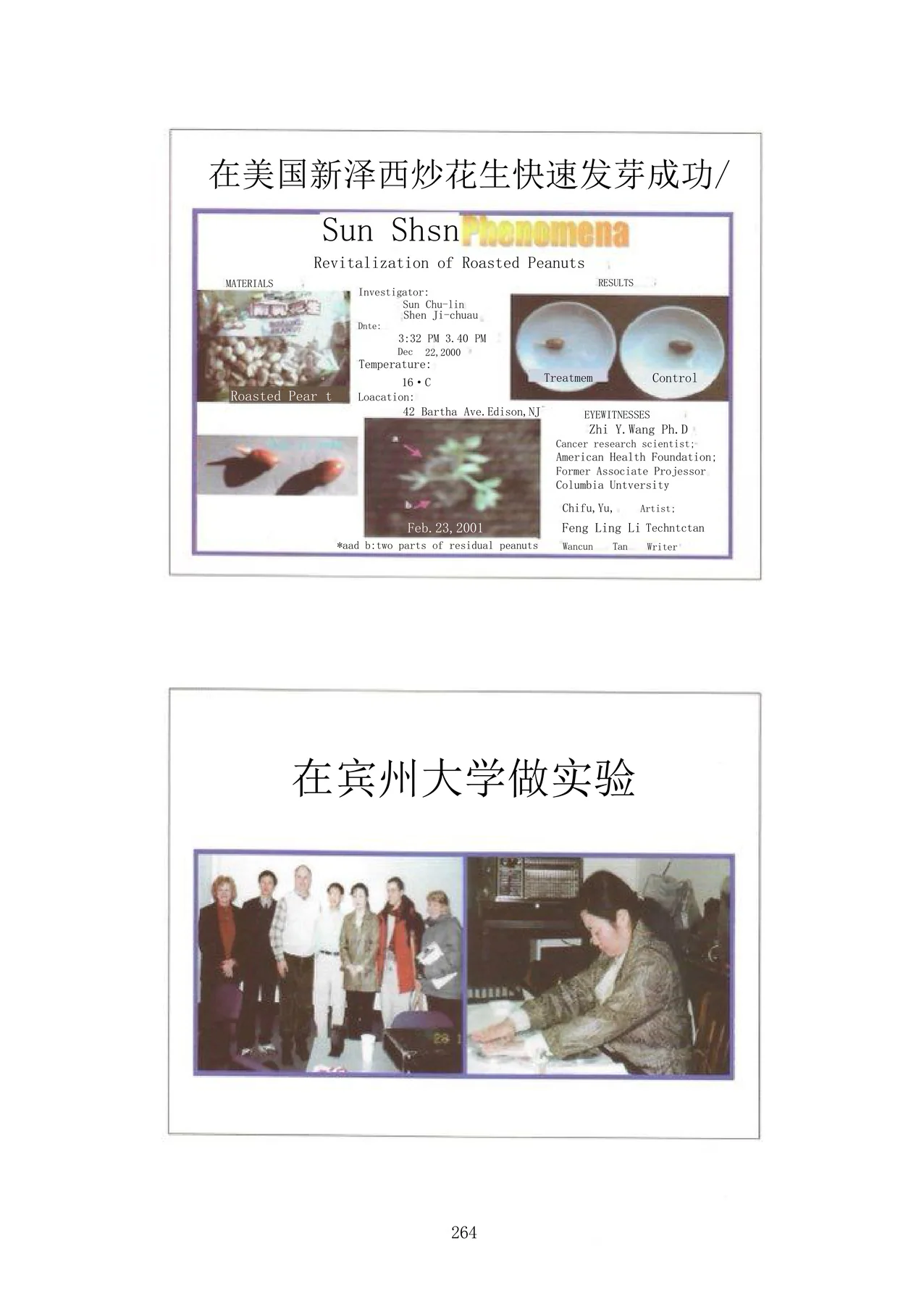
Rapid sprouting of roasted peanuts successful in New Jersey, USA
Sun Chulin Revitalization of Roasted Peanuts
RESULTS MATERIALS Investigator: Sun Chu-lin Shen Ji-chuan Date: 3:32 PM – 3:40 PM Dec 22, 2000 Temperature: 16°C Treatment Control Roasted Peanut Location: 42 Bartha Ave., Edison, NJ EYEWITNESSES Zhi Y. Wang, Ph.D. Cancer research scientist; American Health Foundation; Former Associate Professor, Columbia University Chifu, Yu, Artist; Feb. 23, 2001 Feng Ling Li, Technician *a and b: two parts of residual peanuts Wancun Tan Writer
Conducting an experiment at the University of Pennsylvania
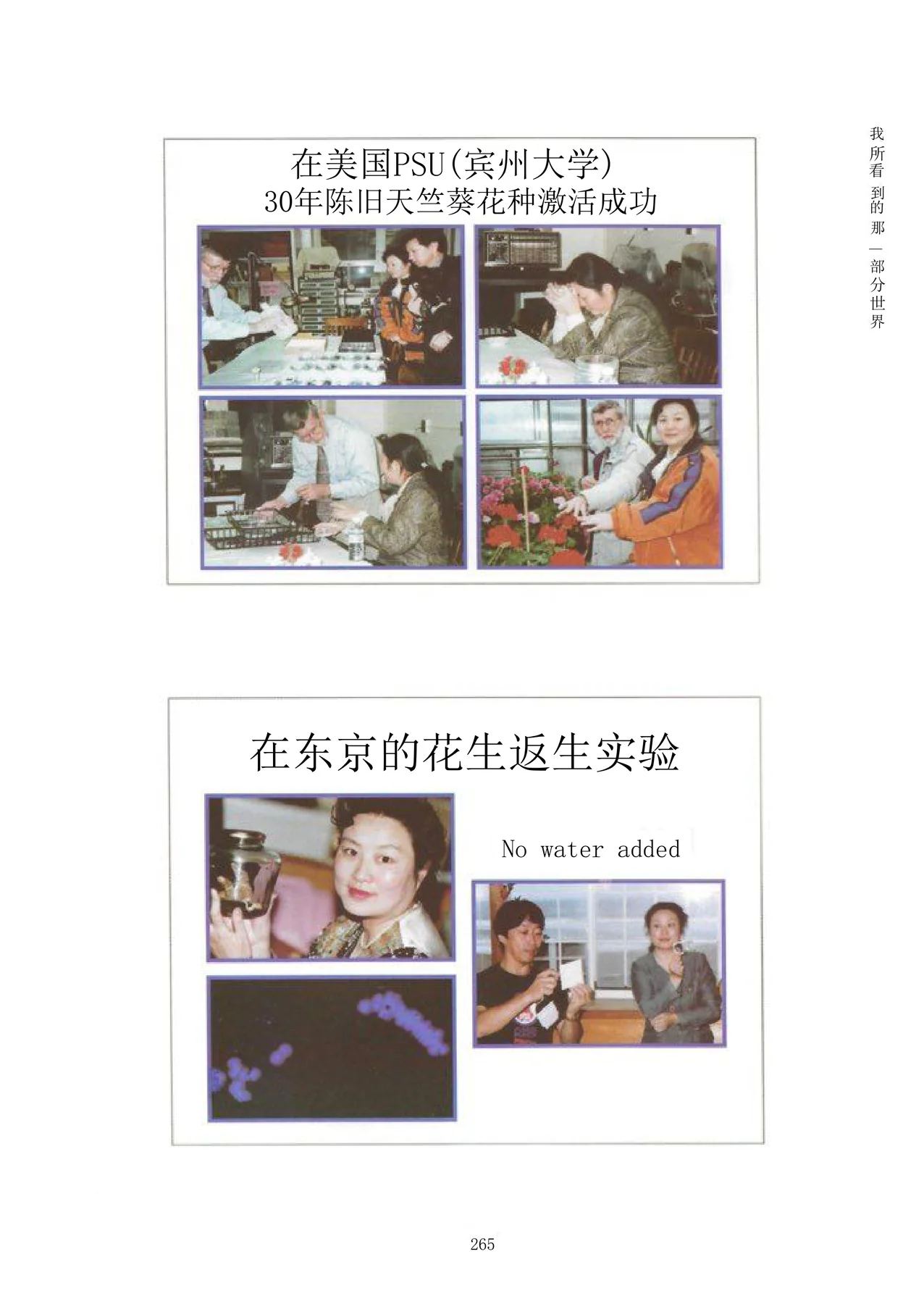
At PSU (Pennsylvania State University) in the United States
Thirty-year-old stale geranium seeds successfully activated
Peanut revitalization experiment in Tokyo
No water added
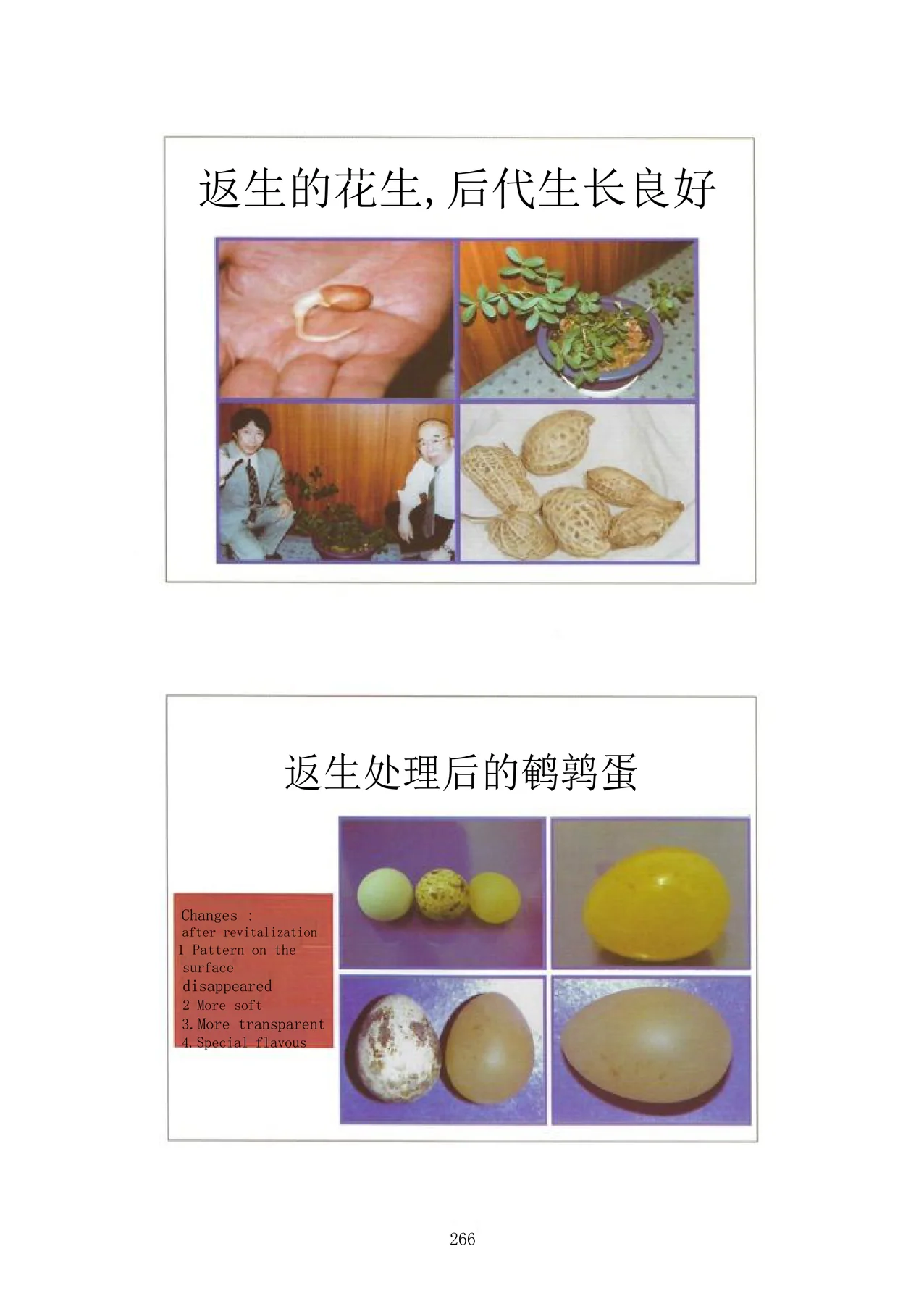
Revitalized peanut, with offspring growing well
Quail egg after revitalization treatment
Changes: after revitalization 1 Pattern on the surface disappeared 2 More soft 3 More transparent 4 Special flavor
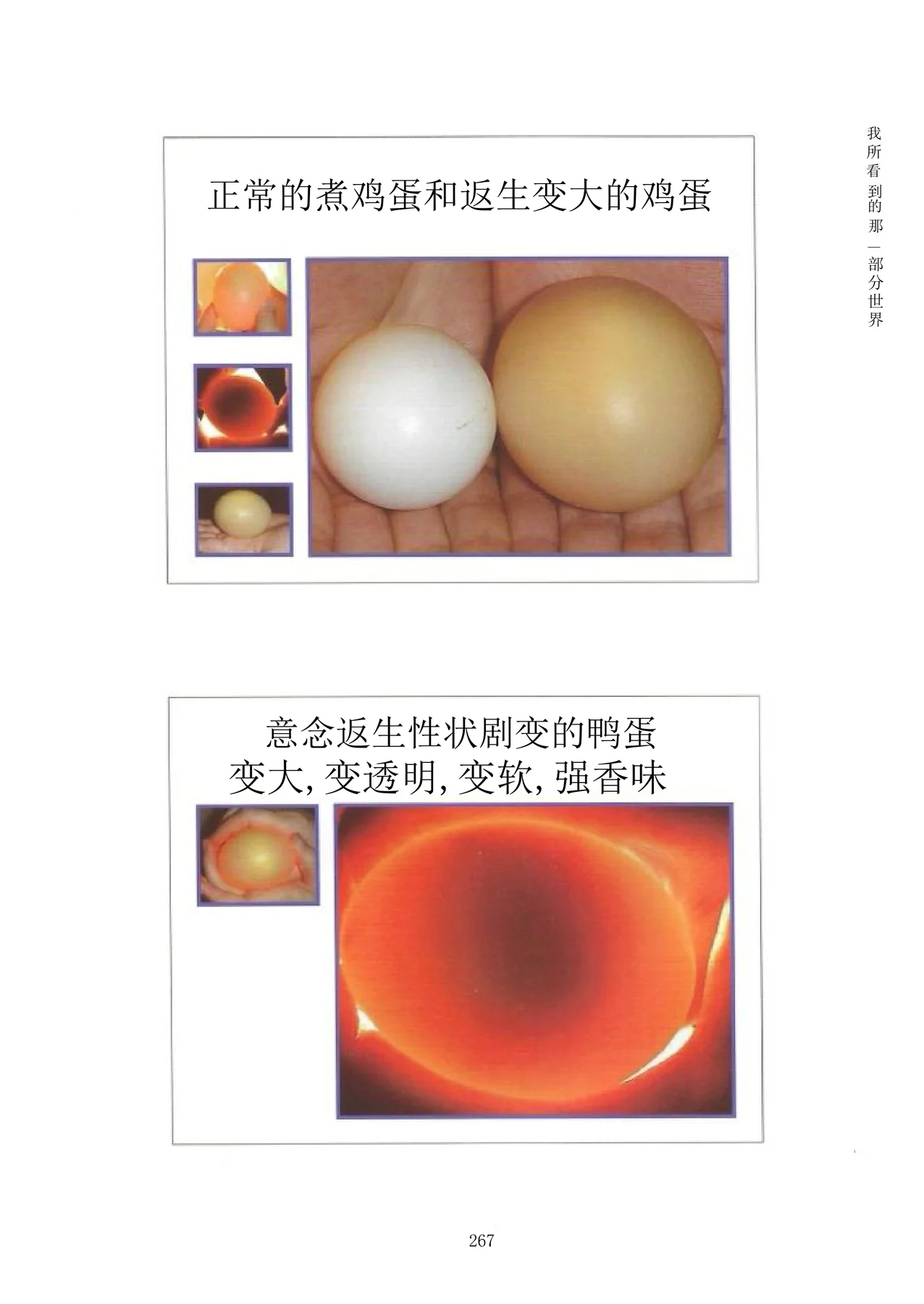
Normal boiled egg and enlarged revitalized egg
Duck egg with drastically mutated traits from revitalization through intention
Enlarged, became transparent, became soft, strong fragrance
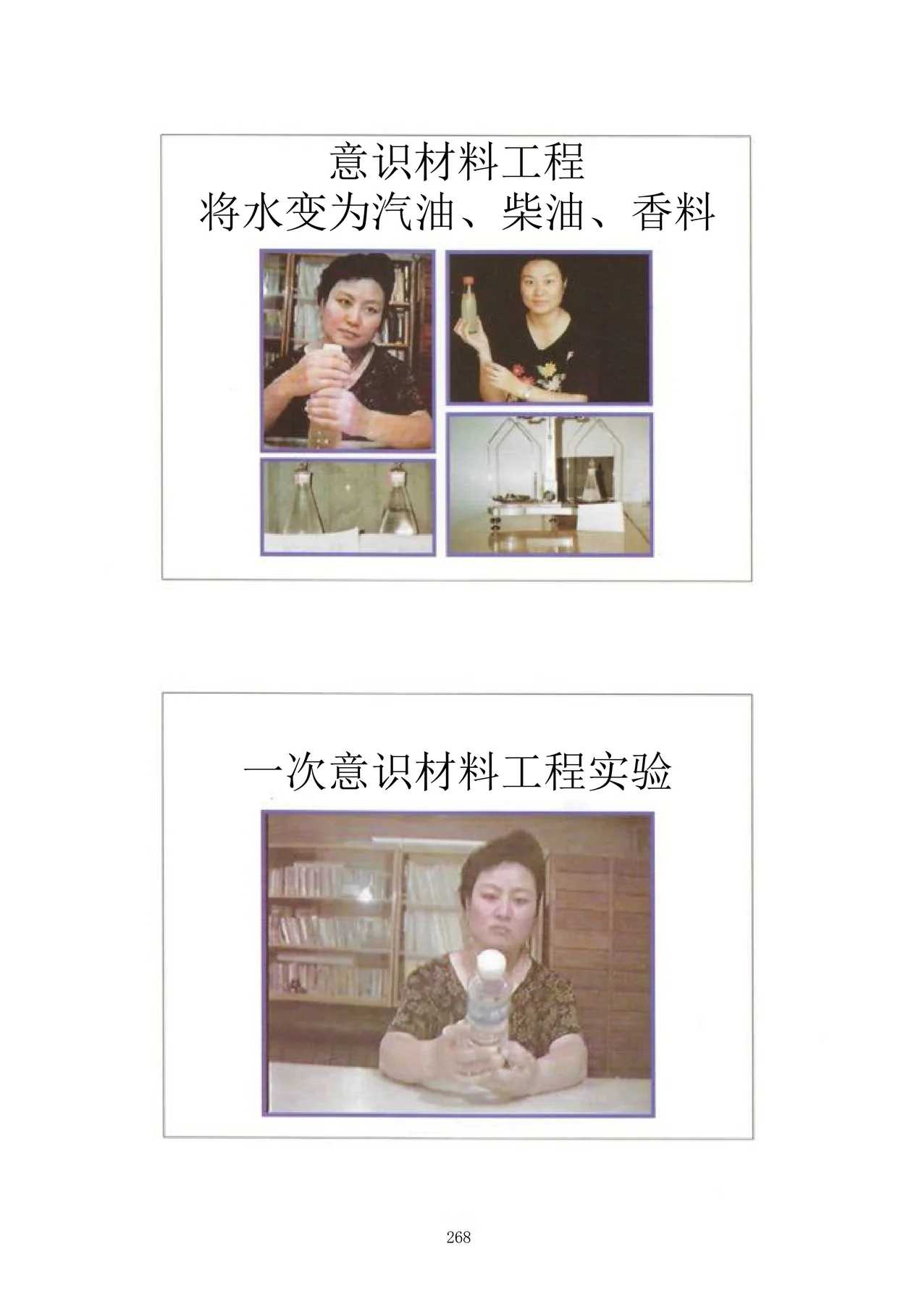
Consciousness Materials Engineering
Turning water into gasoline, diesel, and fragrance
A consciousness materials engineering experiment
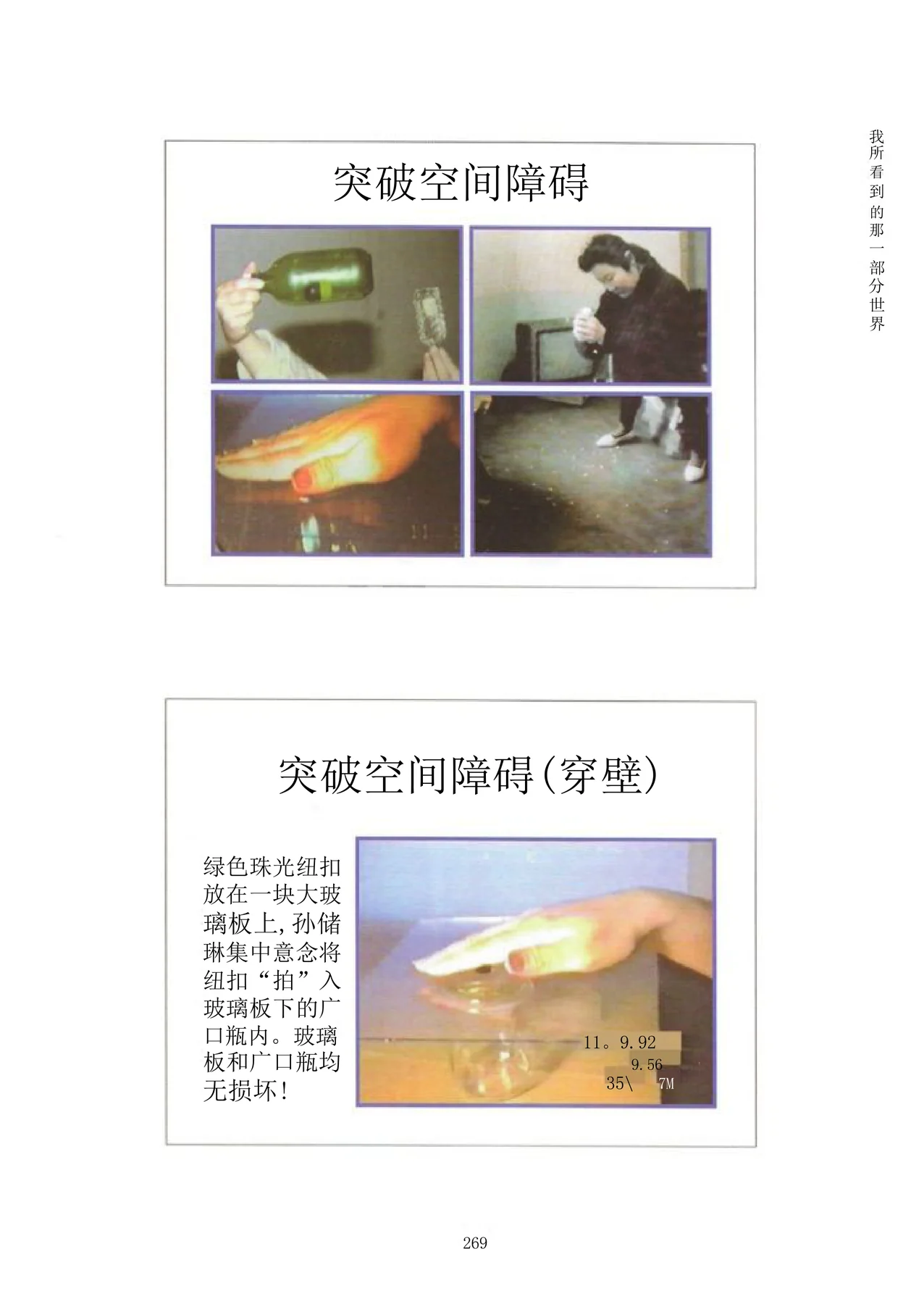
The Part of the World I Saw Breaking Through Spatial Barriers Breaking Through Spatial Barriers (Penetrating Walls)
A green pearlescent button was placed on a large glass board. Sun Chulin concentrated her mental intention and “patted” the button into the wide-mouthed bottle beneath the glass board. Neither the glass board nor the wide-mouthed bottle was damaged!
11.9.92
9.56
35
7M
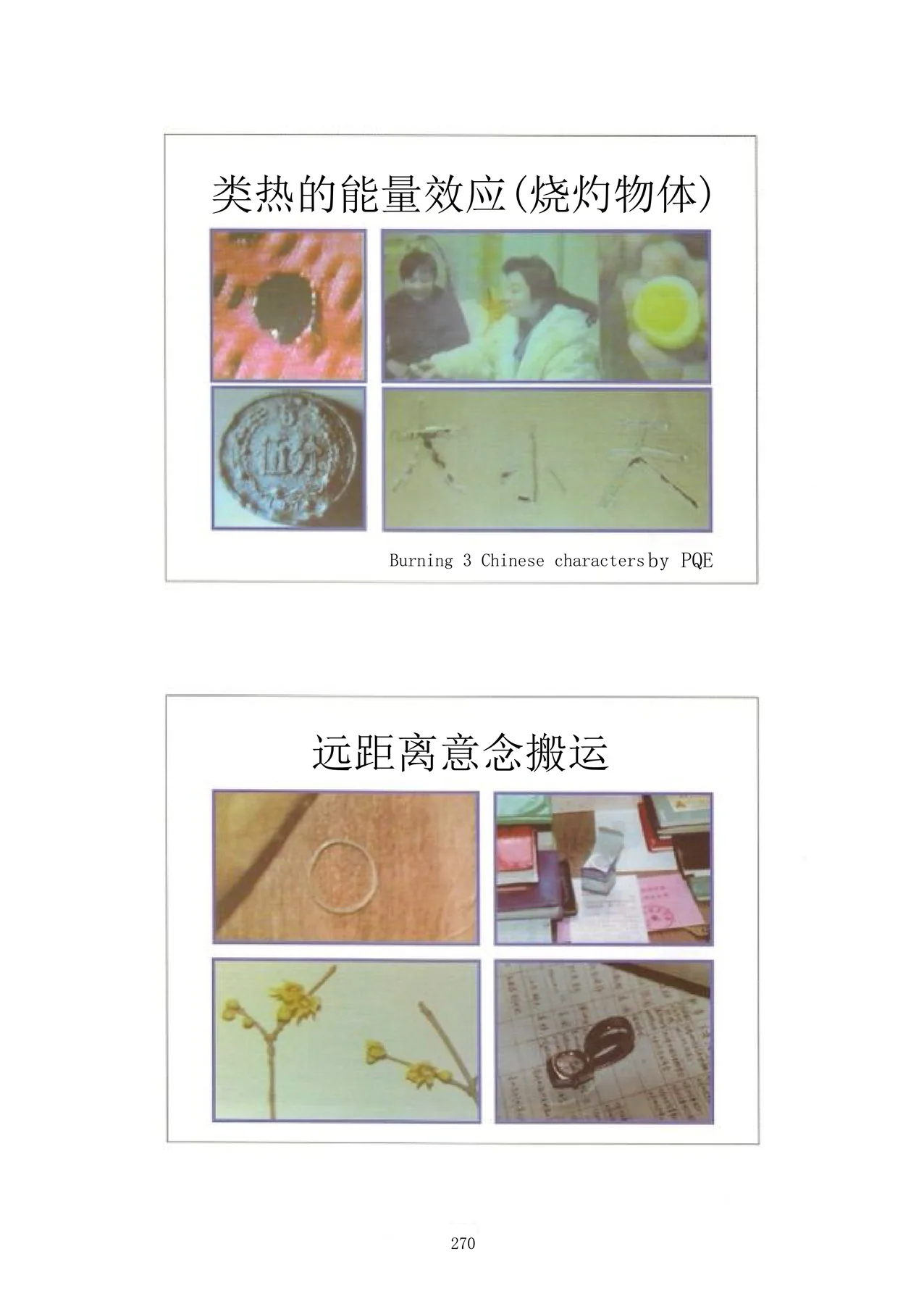
Heat-like Energy Effects (Scorching Objects) Burning 3 Chinese characters by PQE Long-distance Psychokinetic Object Translocation
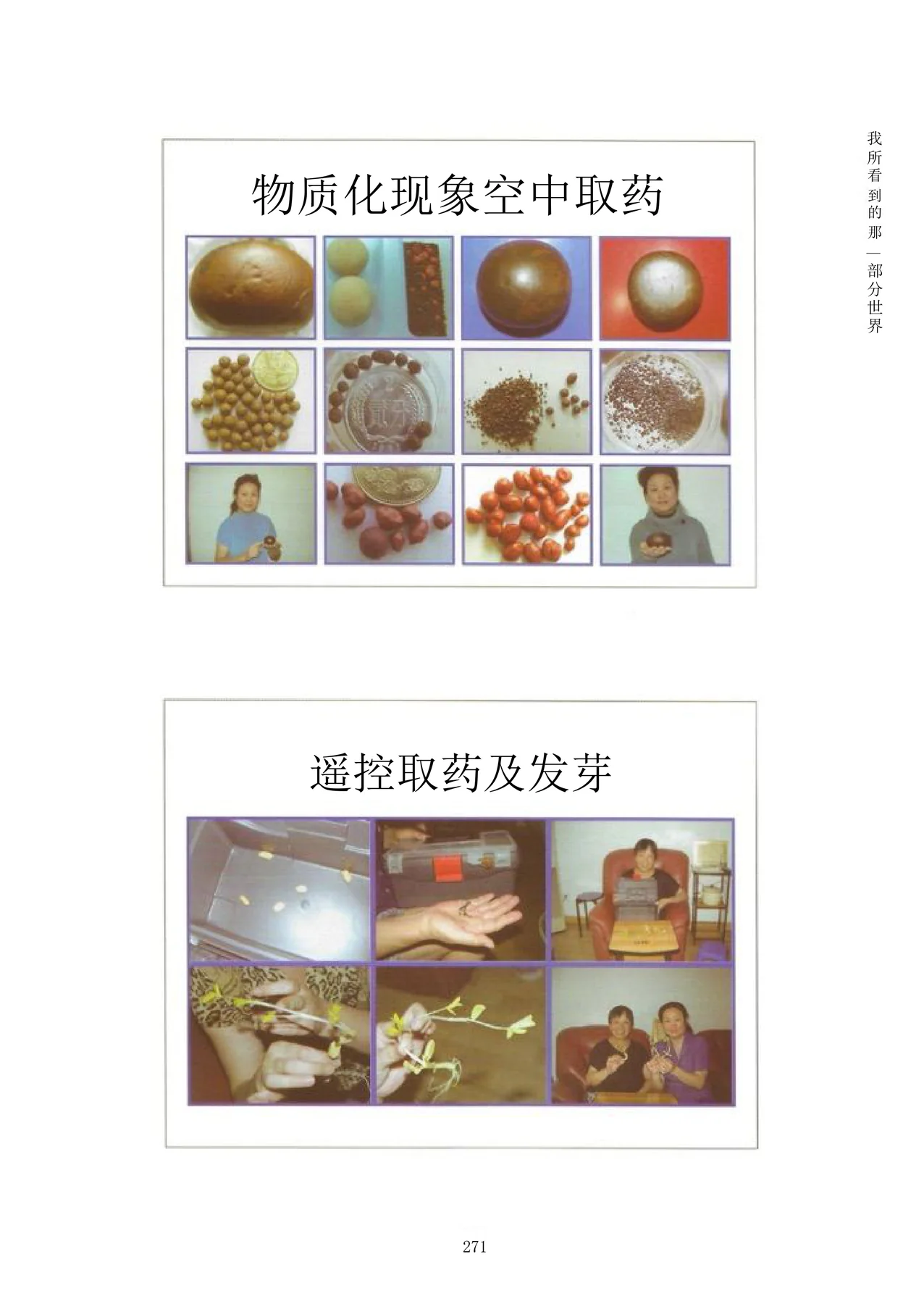
Materialization Phenomenon — Retrieving Medicine from Thin Air Remote-Controlled Medicine Retrieval and Sprouting
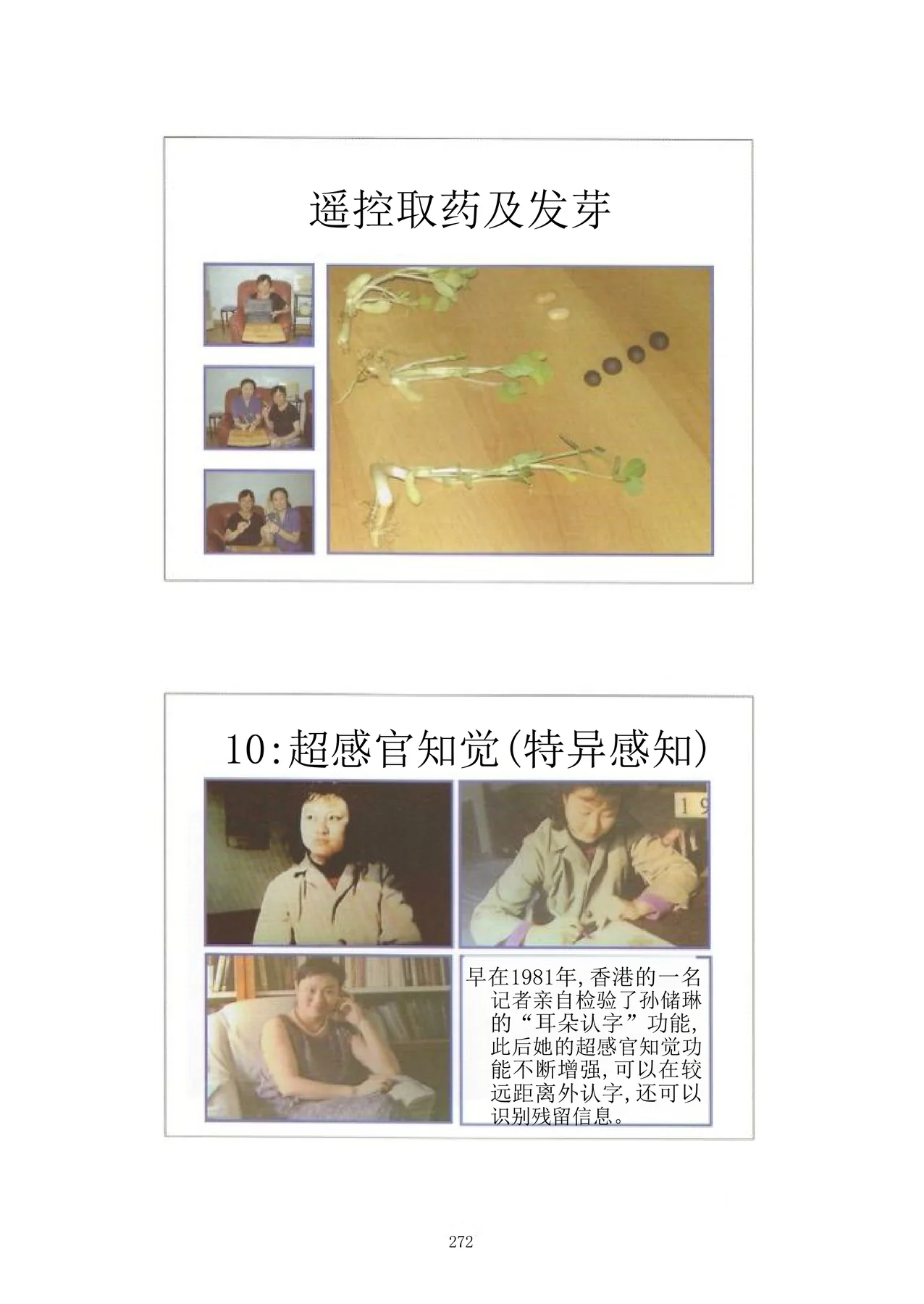
Remote-Controlled Medicine Retrieval and Sprouting
10: Extrasensory Perception (Special Perception)
As early as 1981, a journalist from Hong Kong personally tested Sun Chulin’s “ear recognition of characters” ability. Thereafter, her extrasensory perception abilities continued to grow stronger; she could recognize characters from a considerable distance and could also identify residual information.
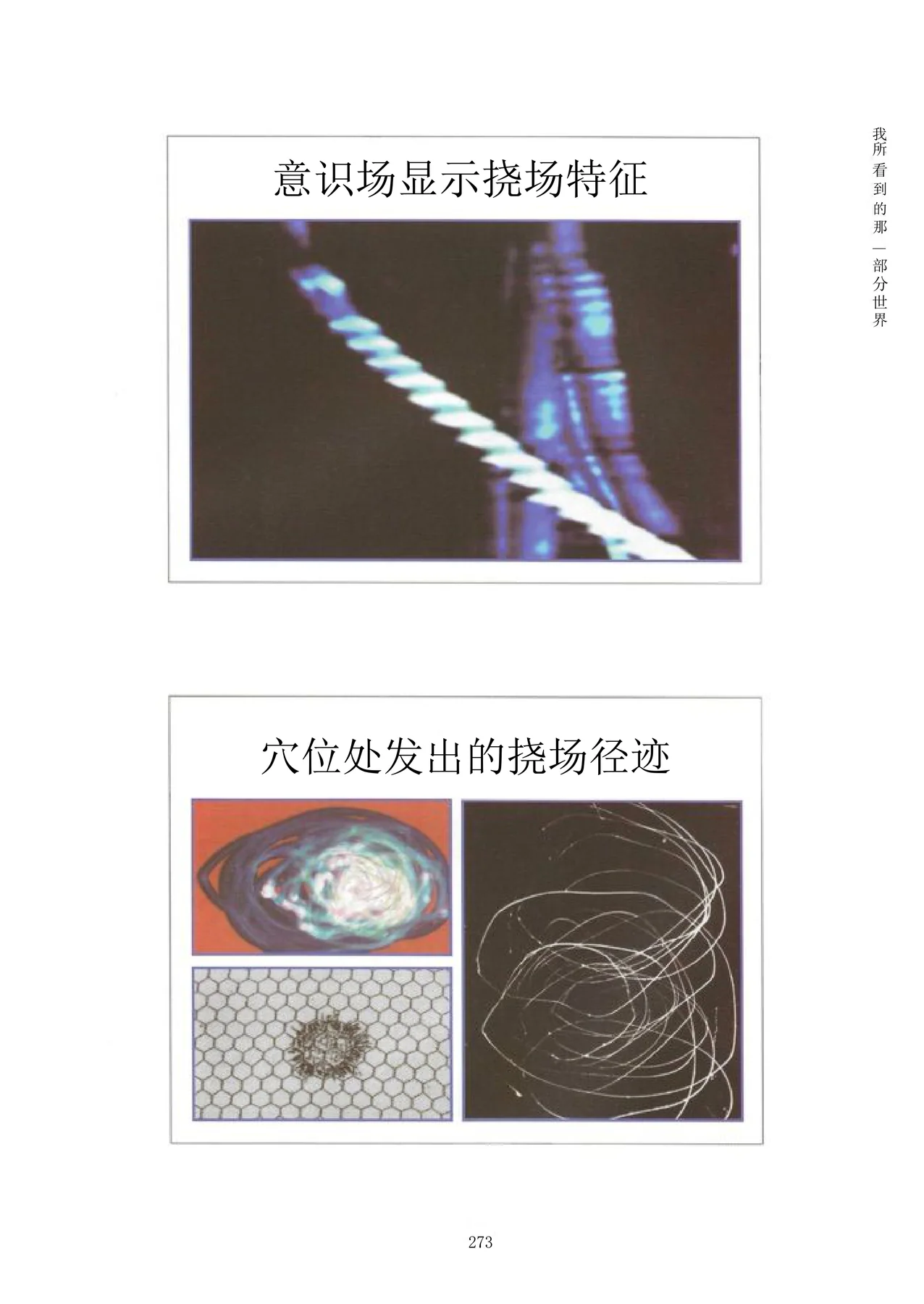
The Consciousness Field Displays Torsion Field Characteristics
Torsion Field Tracks Emitted from Acupoints
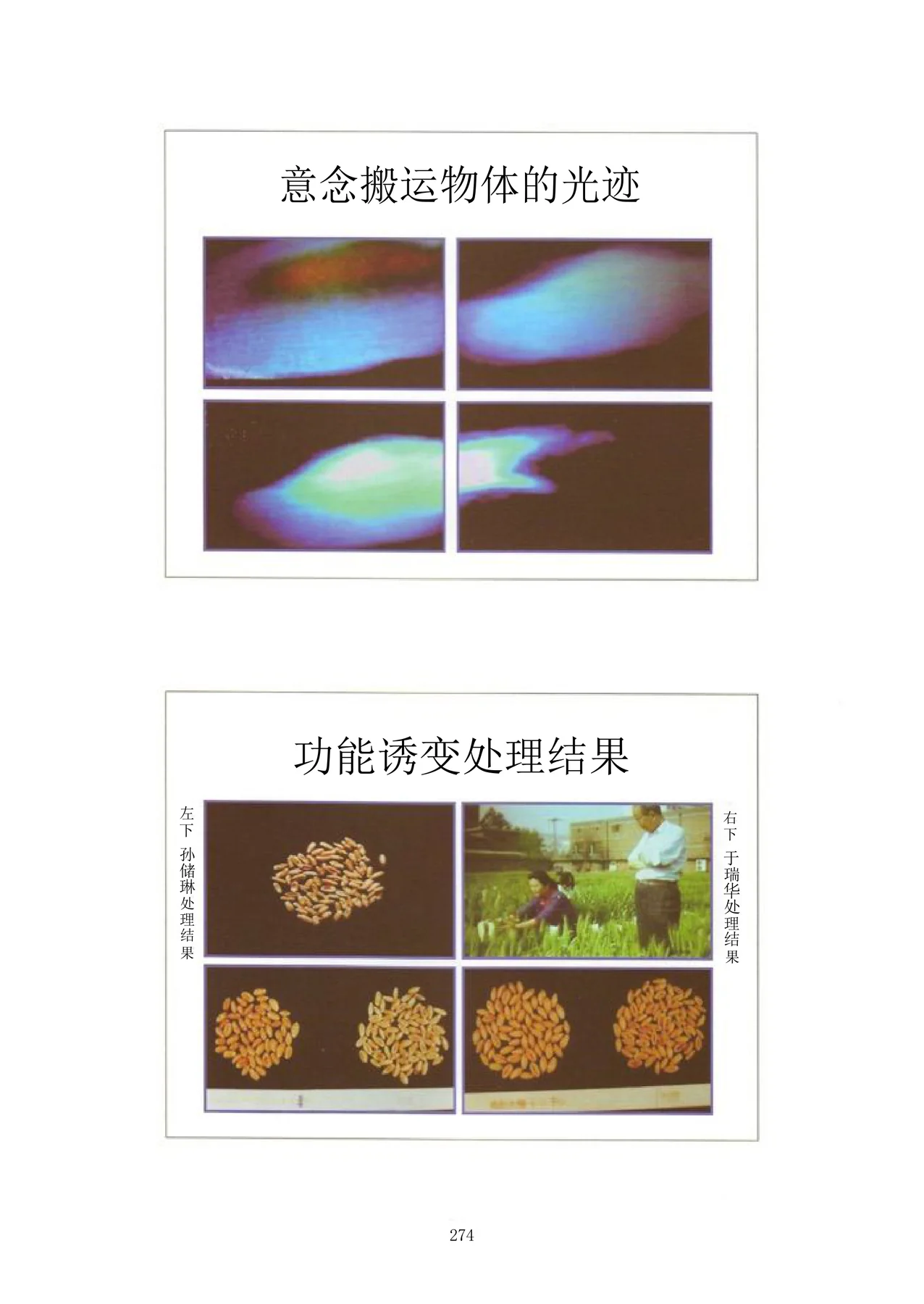
Light Traces of Mentally Translocated Objects
Results of Extraordinary-Ability Mutation Treatment
Left | Right | Below | Below
Sun Chulin’s Treatment Results | Yu Ruihua’s Treatment Results
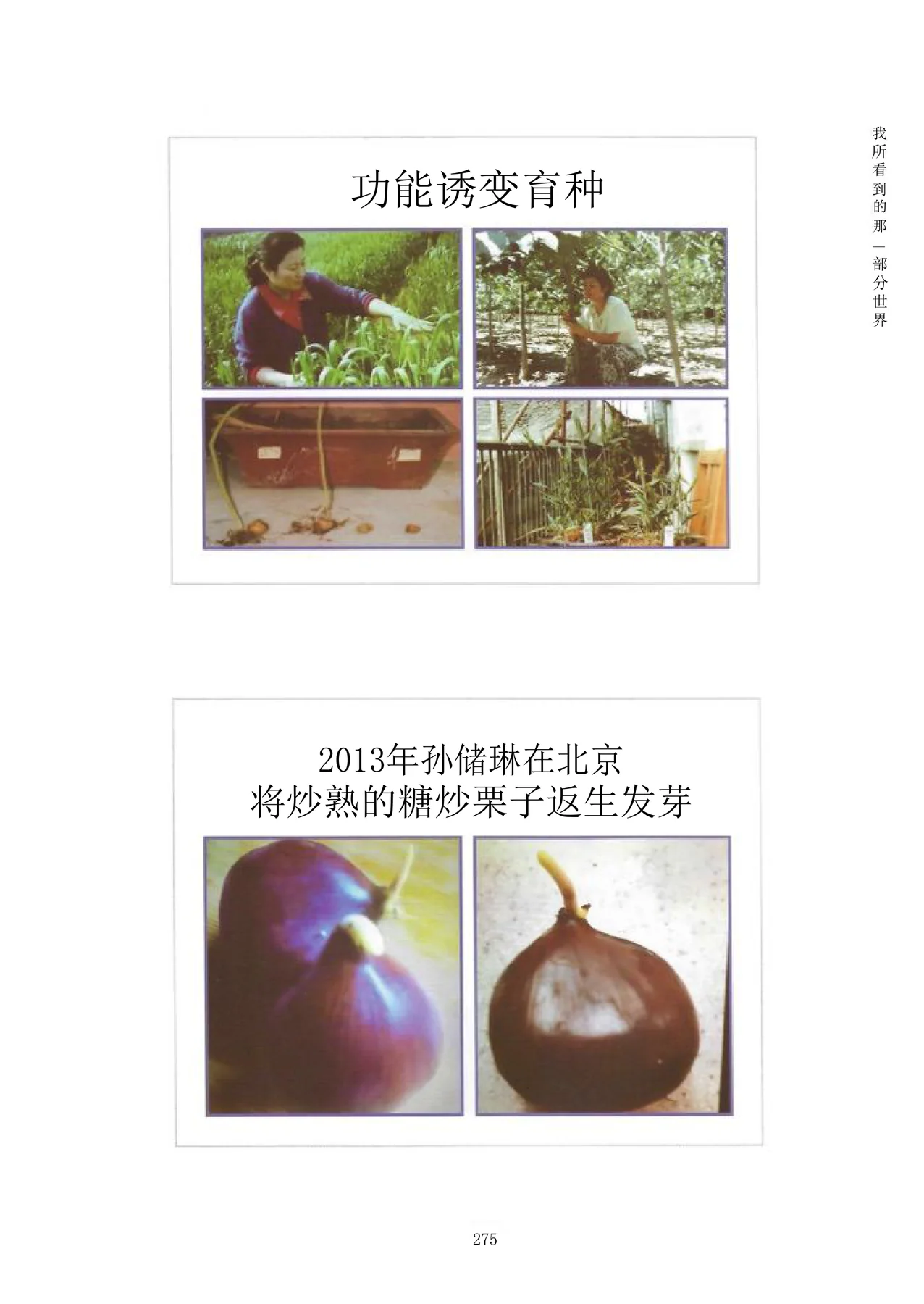
Extraordinary-Ability Mutation Breeding
In 2013, Sun Chulin in Beijing
Causing Roasted Sugar-Roasted Chestnuts to Return to Life and Sprout
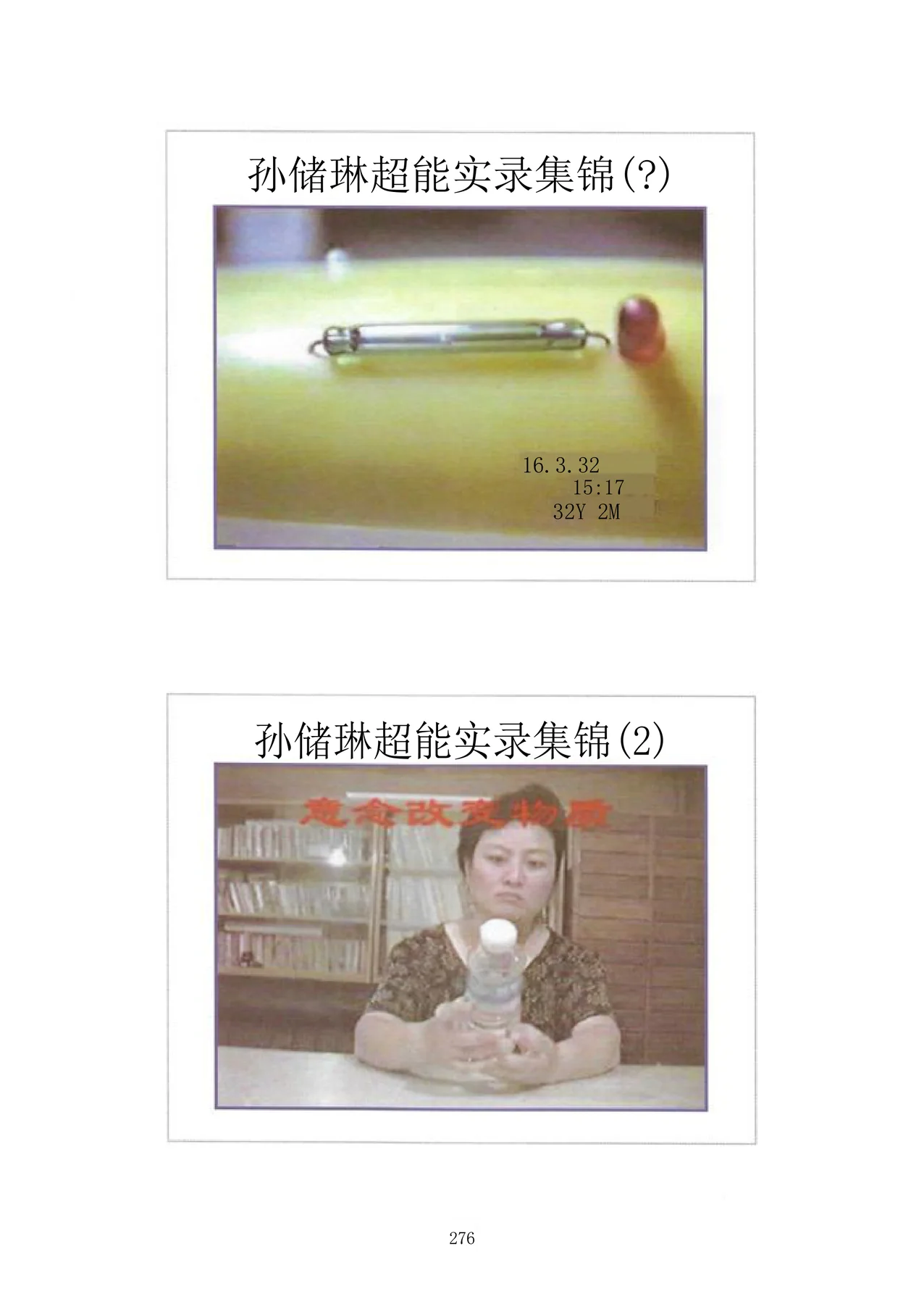
Sun Chulin’s Super-Ability Documentary Highlights (1)
16.3.32 15:17 32Y 2M
Sun Chulin’s Super-Ability Documentary Highlights (2)
Mental Change
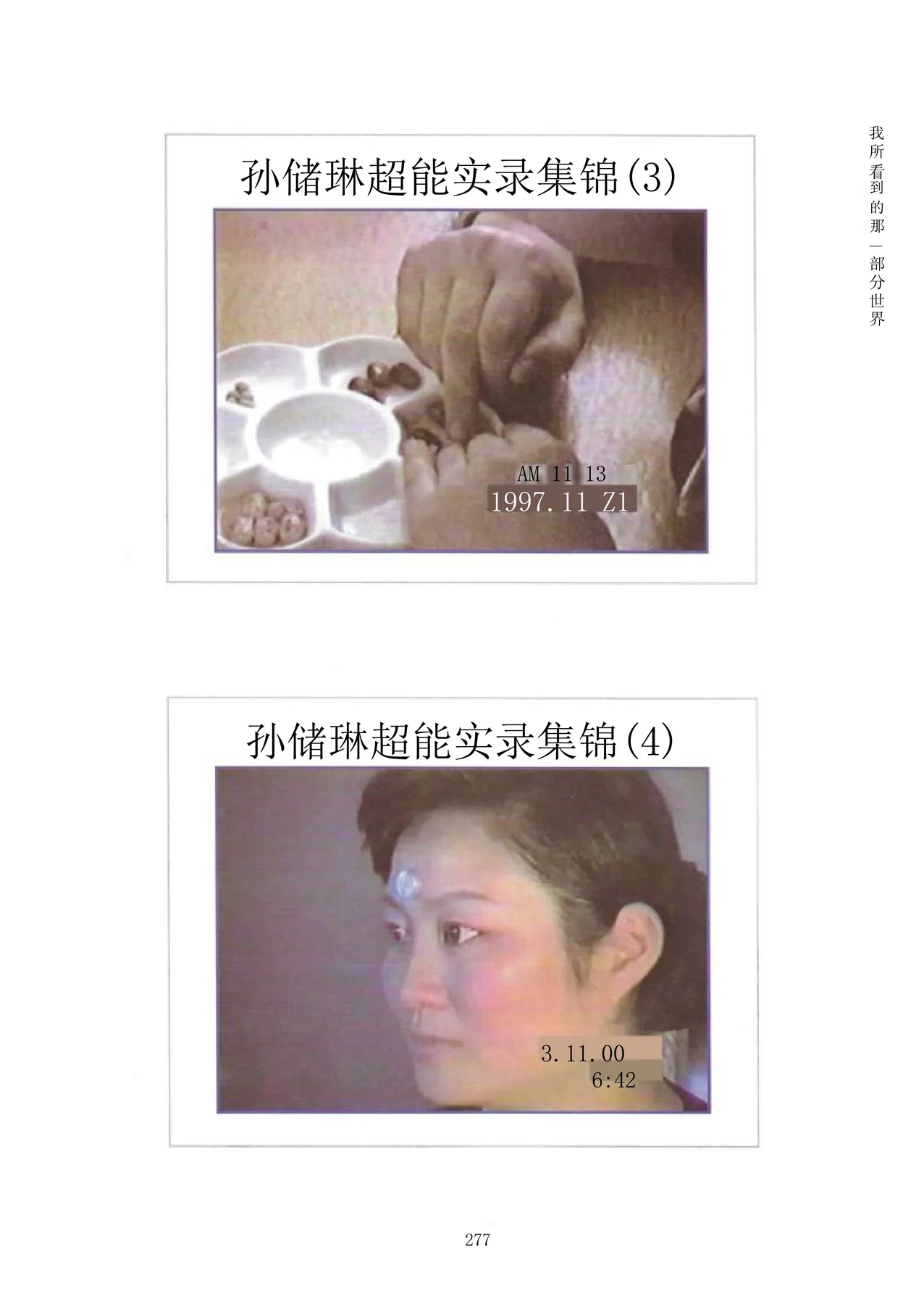
Sun Chulin Extraordinary Ability Documentary Collection (3)
AM 11 13 1997.11 Z1
Sun Chulin Extraordinary Ability Documentary Collection (4)
3.11.00 6:42
Appendix Material One
Carrying Out Human-Body Science Research in the Spirit of Seeking Truth from Facts and Scientific Exploration
In the late 1970s, our country welcomed the excellent period of reform and opening up. At the same time, phenomena of extraordinary human abilities were continuously discovered in various parts of the country, producing a strong response in society and drawing the attention of senior leadership. Comrade Ye Jianying, veteran proletarian revolutionary and Marshal, after personally witnessing and investigating special phenomena of the human body, pointed out: “In this world there are only things that have not yet been recognized; there are no things that cannot be recognized. Conducting research according to this viewpoint is the only way to be diligent, to have a future, and ultimately to understand the principles behind them.”
The study of extraordinary human abilities is of great significance to the development of the natural sciences and the social sciences. The following content is selected from the collected writings of Zhang Zhenhuan (from a speech delivered after a testing session for extraordinary human abilities on March 9, 1982):
After personally observing the tests of extraordinary human abilities, everyone should make their own judgment: are these extraordinary abilities facts or not? Since they are facts, one should recognize that research into extraordinary human abilities holds important scientific significance for the development of the natural sciences (including human-body science) and Marxist-Leninist philosophy. At present, research into extraordinary human abilities will by no means shake the principles of Marxist-Leninist dialectical materialism; on the contrary, research into extraordinary human abilities must be guided by Marxism-Leninism and Mao Zedong Thought, and this will in turn bring about the further development of Marxism-Leninism and Mao Zedong Thought themselves. By integrating research on extraordinary human abilities, qigong, and traditional Chinese medical theory, we will promote the excavation of our nation’s cultural heritage. If appropriate measures are taken, research into extraordinary human abilities can also have practical significance for national economic construction and the Four Modernizations. Regarding its implications for national defense, foreigners are already paying great attention, and we cannot but seriously consider this. Of course, conducting this research is extremely difficult. Only under the guidance of Marxism-Leninism and Mao Zedong Thought, by carrying out multidisciplinary joint operations and collaborative research, can we hope to achieve success. At present, apart from a small number of organizations providing support, the majority of researchers engaged in this work are doing so on their own during their spare time, encountering formidable difficulties. And the greatest problem at present is the pressure of public opinion and ideological opposition. It should be recognized that some people’s involvement in superstitious activities is not caused by extraordinary abilities. Research into extraordinary abilities is scientific research — a new exploration of phenomena that past physiology and physics have been unable to explain. Of course, in publicity work, one must also pay great attention to social consequences.
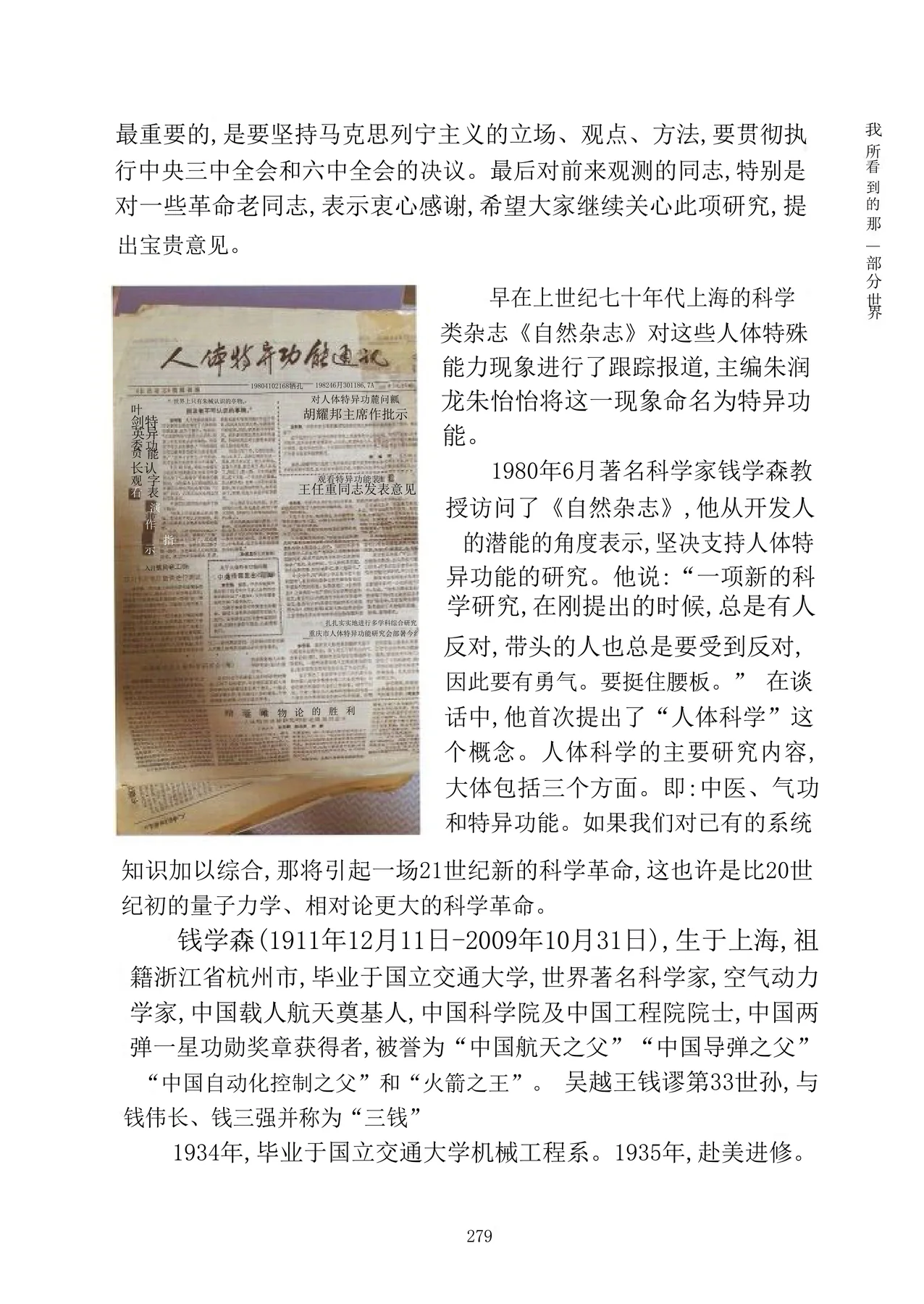
The most important thing is to uphold the Marxist-Leninist standpoint, viewpoint, and method, and to implement the resolutions of the Third Plenary Session and the Sixth Plenary Session of the Central Committee. Finally, I wish to express heartfelt thanks to the comrades who came to observe, especially the veteran revolutionary comrades, and I hope everyone will continue to care about this research and offer valuable opinions.
As early as the 1970s, the Shanghai-based science magazine Ziran Zazhi (Nature Magazine) carried out ongoing coverage of these special human ability phenomena. Chief editors Zhu Runlong and Zhu Yiyi named this phenomenon “extraordinary human abilities.”
- Chairman Ye Jianying of the NPC Standing Committee watches a performance of extraordinary abilities and gives instructions
- Chairman Hu Yaobang issues written instructions
- Comrade Wang Renzhong expresses his views
- “In this world there are only things that have not yet been recognized”
- On the question of extraordinary human abilities
- Chongqing Human Extraordinary Abilities Research Association deploys solid multidisciplinary comprehensive research
- The triumph of dialectical materialism
In June 1980, the renowned scientist Professor Qian Xuesen visited Ziran Zazhi. From the perspective of developing human potential, he expressed resolute support for research into extraordinary human abilities. He said: “When a new scientific research endeavor is first proposed, there are always people who oppose it, and those who lead the way will inevitably meet opposition. Therefore one must have courage. One must stand tall and hold firm.” In his conversation, he put forward for the first time the concept of “human-body science.” The main research content of human-body science broadly includes three areas: traditional Chinese medicine, qigong, and extraordinary human abilities. If we synthesize the existing systematic knowledge, it will trigger a new scientific revolution in the twenty-first century — perhaps a greater scientific revolution than quantum mechanics and the theory of relativity of the early twentieth century.
Qian Xuesen (December 11, 1911 – October 31, 2009), born in Shanghai, ancestral home in Hangzhou, Zhejiang Province. He graduated from National Chiao Tung University and was a world-renowned scientist, aerodynamicist, and founder of China’s manned space program. He was a member of the Chinese Academy of Sciences and the Chinese Academy of Engineering, a recipient of the Meritorious Service Award for China’s Two Bombs and One Satellite, and was honored as “Father of Chinese Aerospace,” “Father of Chinese Missiles,” “Father of Chinese Automatic Control,” and “King of Rockets.” He was a thirty-third-generation descendant of Qian Liu, King of Wuyue, and together with Qian Weichang and Qian Sanqiang was known as the “Three Qians.”
In 1934, he graduated from the Mechanical Engineering Department of National Chiao Tung University. In 1935, he went to the United States for advanced study.
In 1955, through the efforts of Chairman Mao Zedong and Premier Zhou Enlai, he returned to China and successively held important positions including Director of the Department of Modern Mechanics at the University of Science and Technology of China, Director of the Institute of Mechanics at the Chinese Academy of Sciences, Vice Minister of the Seventh Ministry of Machinery Industry, Deputy Director of the National Defense Science, Technology and Industry Commission, Chairman of the China Association for Science and Technology, Vice Chairman of the National Committee of the Chinese People’s Political Consultative Conference, Member of the Division of Mathematics, Physics and Chemistry of the Chinese Academy of Sciences, and Senior Advisor to the Science and Technology Committee of the General Armament Department of the Chinese People’s Liberation Army. Qian Xuesen was primarily engaged in research in applied mechanics, engineering cybernetics, aeronautical engineering, rocket and missile technology, systems engineering and systems science, noetic science and human-body science, and Marxist philosophy. Thanks to Qian Xuesen’s return to serve his country, China’s missile and atomic bomb programs were advanced by at least twenty years. He passed away in Beijing on October 31, 2009, at the age of ninety-eight.
In the 1980s, under Qian Xuesen’s advocacy, numerous universities and related research institutions across the country launched studies of extraordinary human ability phenomena, achieving many encouraging results that demonstrated the existence of extraordinary human abilities.
In December 1985, the State Commission for Restructuring the Economic System approved the establishment of the China Qigong Science Research Committee, and Zhang Zhenhuan was elected chairman.
Zhang Zhenhuan was born in 1915 in Beijing. He joined the Chinese Communist Party in 1938. He graduated from Peking University and participated in the December Ninth Movement. In 1935, he joined the Chinese Nation Liberation Vanguard, and served as Secretary-General of the Vanguard’s Beiping headquarters and Deputy Commander of the Xuzhou Battlefield Service Corps.
During the War of Resistance Against Japan, Zhang Zhenhuan successively served as Director of the Publicity Department of the CCP’s Jiangsu-Anhui Special Committee, Section Chief of the Publicity Department and then Director of the Political Department of the Eighth Route Army’s Longhai Southward Advance Detachment, Deputy Director of the Political Department of the 3rd Detachment of the 5th Column of the Eighth Route Army, and Director of the Political Department of the 9th Brigade of the 4th Division of the New Fourth Army.
During the War of Liberation, Zhang Zhenhuan successively served as Director of the Political Department of the 9th Brigade of the 2nd Column of the Shandong Field Army while concurrently serving as Political Commissar of the 26th Regiment, Commander and Political Commissar of the Artillery Regiment of the 2nd Column of the East China Field Army, and Political Commissar of the 5th Division. He participated in the Subei, Lunan, and Menglianggu campaigns and battles.
After the founding of New China, Zhang Zhenhuan successively served as Section Chief, Deputy Director, and Director of the Education Division of the Central Institute of Marxism-Leninism, Deputy Director of the Equipment Department of the General Staff Headquarters of the People’s Liberation Army, and Deputy Secretary-General and Deputy Director of the National Defense Science and Technology Commission. Zhang Zhenhuan participated in the organizational leadership of the atomic bomb, hydrogen bomb, and nuclear missile weapons tests, as well as the development of China’s first “Yinhe” hundred-million-operation electronic computer. For China’s first atomic bomb detonation test, Zhang Zhenhuan served as commander of the frontline command post.
In the early 1980s, after certain extraordinary human abilities were reported, they immediately attracted the attention of Zhang Zhenhuan, who was extremely sensitive to new things. After personally conducting tests, Zhang Zhenhuan became
the most steadfast supporter and leader of human-body science in China. He repeatedly emphasized that qigong publicity must be truthful, rigorous, and strict. In his later years, Zhang Zhenhuan devoted himself wholeheartedly to qigong and human-body science, becoming the most prominent leading figure in these two fields.
Zhang Zhenhuan invited many top-level officials and the most renowned scientists to personally test extraordinary human abilities. Fang Yi, former President of the Chinese Academy of Sciences and Vice Premier of the State Council, after watching a demonstration, said to Qian Xuesen: “This is truly something you cannot fail to see. If you do not see it, you will not believe it; once you have seen it, you will believe it.” Hu Sheng, former President of the Chinese Academy of Social Sciences and Vice Chairman of the National Committee of the Chinese People’s Political Consultative Conference, smiled after watching and said: “It really is so, it really is so, but it cannot be explained.” Yan Jici, a famous scientist who had previously not believed in extraordinary human abilities at all, after personally conducting tests, came around to acknowledging that what he had seen was fact. Wang Zhen, former Vice President of the State; Tan Zhenlin, former Vice Chairman of the Standing Committee of the National People’s Congress; Wang Renzhong, former Secretary of the Secretariat of the Central Committee; Song Jian, academician of the Chinese Academy of Sciences, academician of the Chinese Academy of Engineering, and former Vice Chairman of the National Committee of the Chinese People’s Political Consultative Conference; Bei Shizhang, senior academician of the Chinese Academy of Sciences and renowned biophysicist; Wang Ganchang, senior academician of the Chinese Academy of Sciences and recipient of the Meritorious Service Medal for “Two Bombs and One Satellite”; Zhao Zhongyao, senior academician of the Chinese Academy of Sciences and Chinese nuclear physicist; and Wang Dezhao, senior academician of the Chinese Academy of Sciences and recipient of the highest honor medal of the French Acoustical Society—all watched demonstrations and believed in and supported human-body science research.
In May 1987, the State Science and Technology Commission approved the establishment of the China Human-Body Science Society. Zhang Zhenhuan was elected chairman, and Qian Xuesen served as honorary chairman. The society was affiliated with Institute 507.
The full name of Institute 507 was the Beijing Institute of Space Medico-Engineering, a subordinate unit of the Chinese Academy of Space Technology (also known as the Fifth Academy of the Chinese People’s Liberation Army), primarily engaged in research in aerospace medicine. Until 1986, when manned spacecraft research was suspended, 507 was slated for dissolution. However, Qian Xuesen believed that this institution absolutely must not be disbanded, and its research direction shifted to “human-body science,” which he personally oversaw. Thus the institute’s program was once again put forward, and Institute 507, dedicated to researching extraordinary human abilities and superpowers, was formally established. In the years that followed, Institute 507 conducted a great deal of research into extraordinary human abilities, accumulating a large volume of precious data and experience that demonstrated the objective existence of extraordinary human abilities. Its achievements were evaluated as receiving the second prize for scientific and technological progress from the National Defense Science, Technology and Industry Commission.
On March 23, 1994, Zhang Zhenhuan passed away in Beijing. On March 24, the eighty-three-year-old Qian Xuesen sent a letter of condolence. The letter was deeply sincere and heartfelt: “I was shocked and deeply grieved to learn of Director Zhenhuan’s sudden passing. We have known each other for thirty-eight years. Not only did I long benefit from his leadership and help in national defense science and technology work, but over the past thirty years and more, especially in the fields of qigong, extraordinary human abilities, and human-body science, we worked together with one heart, and I was deeply enriched by his teaching. Now all of this can never come again! How tragic!”
Entering the 1990s, various qigong methods and theories emerged in profusion, and the variety of journals and magazines multiplied. Especially after the mid-1990s, the development of human-body science encountered many new problems. In order to ensure healthy and orderly development in this field, the state made further standardized adjustments to its management — for example, fitness qigong came under the unified administration of the General Administration of Sport of China, while matters involving medical treatment were placed under the management of the health system.
On March 8, 2009, the 30th Anniversary Conference of Human-Body Science was grandly held in Beijing. Practitioners, researchers, experts, and professors from all areas of human-body science, along with many of the older generation of leaders, scientists, and individuals with extraordinary abilities in this field, were in attendance. The conference was chaired by Wu Shaozu, Director of the General Administration of Sport. The conference reviewed and summarized the thirty-year history of the development of human-body science in China, and looked ahead to the future of the human-body science enterprise.
Wu Shaozu (April 6, 1939 – September 18, 2012), a native of Leiyang, Hengyang, born in Xi’an, Shaanxi, held the rank of Major General. He joined the Chinese Communist Party in December 1958 and began working in 1965. He successively served as Political Commissar and Party Committee Secretary of the National Defense Science, Technology and Industry Commission of the Chinese People’s Liberation Army, the last Director and Party Group Secretary of the State Physical Culture and Sports Commission of the People’s Republic of China, the first Director and Party Group Secretary of the General Administration of Sport of China, and the second Chair of the China Golf Association.
After 2000, modern science and technology advanced by leaps and bounds, and network information technology spread to countless households. The internet brought people fast and convenient communication, and numerous enthusiasts and researchers of human-body science eagerly exchanged their insights and experiences. Research in human-body science unfolded among the people in various forms.
Today, the development of human civilization has entered the era of artificial intelligence. Humanity’s understanding of itself has been further elevated, and research into the fields of the human brain and consciousness has reached a new and deeper level. The development of human-body science will also fully bring into play its own advantages, and is bound to have a profound impact on the future development of human civilization to an entirely new height. I look forward to a future in which the field of human-body science can advance rapidly and bloom everywhere, bringing people entirely new understanding and experience. Let us join hands and advance together to create a beautiful future!
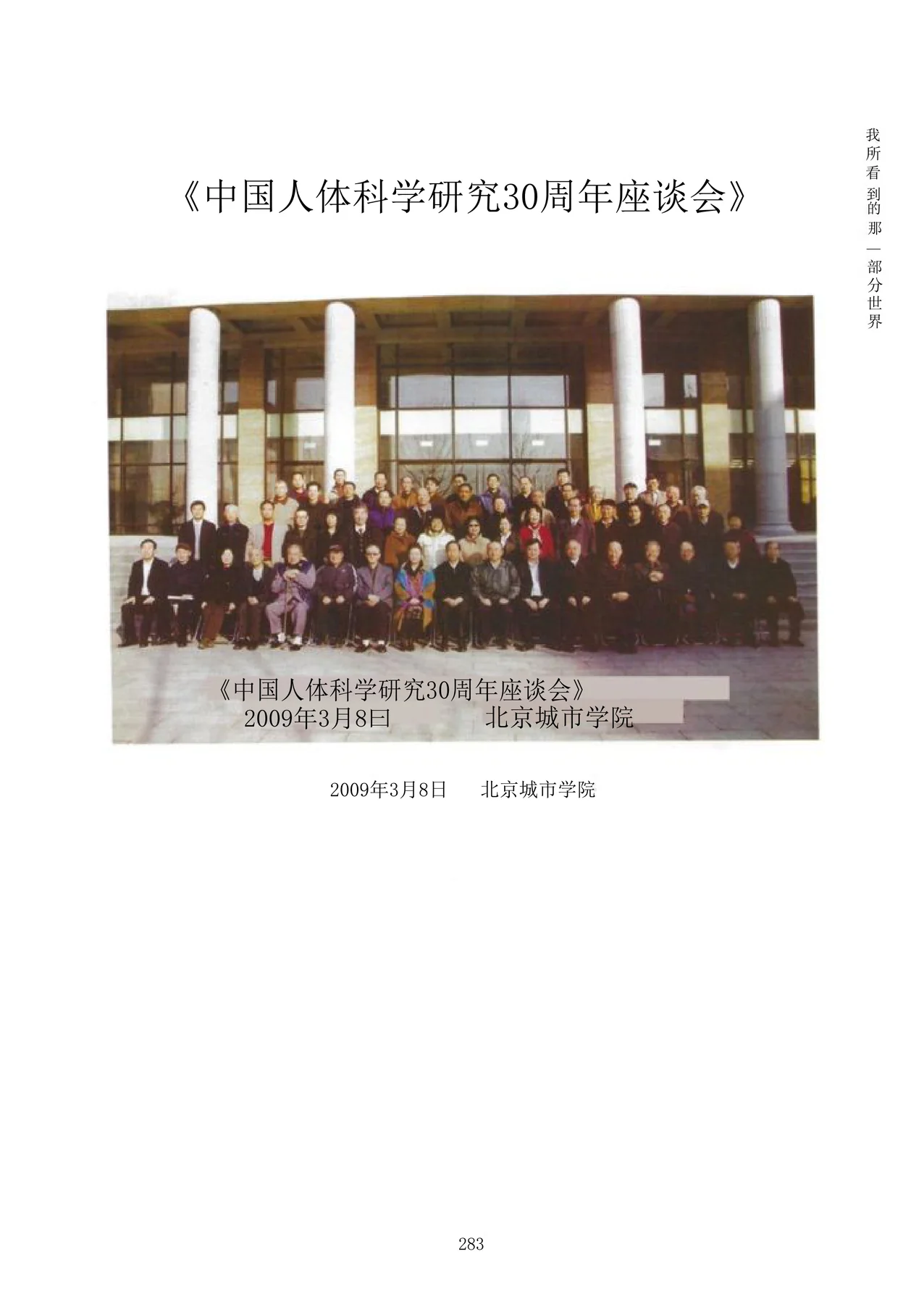
“Symposium on the 30th Anniversary of Chinese Human-Body Science Research”
“Symposium on the 30th Anniversary of Chinese Human-Body Science Research”
March 8, 2009 Beijing City College
March 8, 2009 Beijing City College
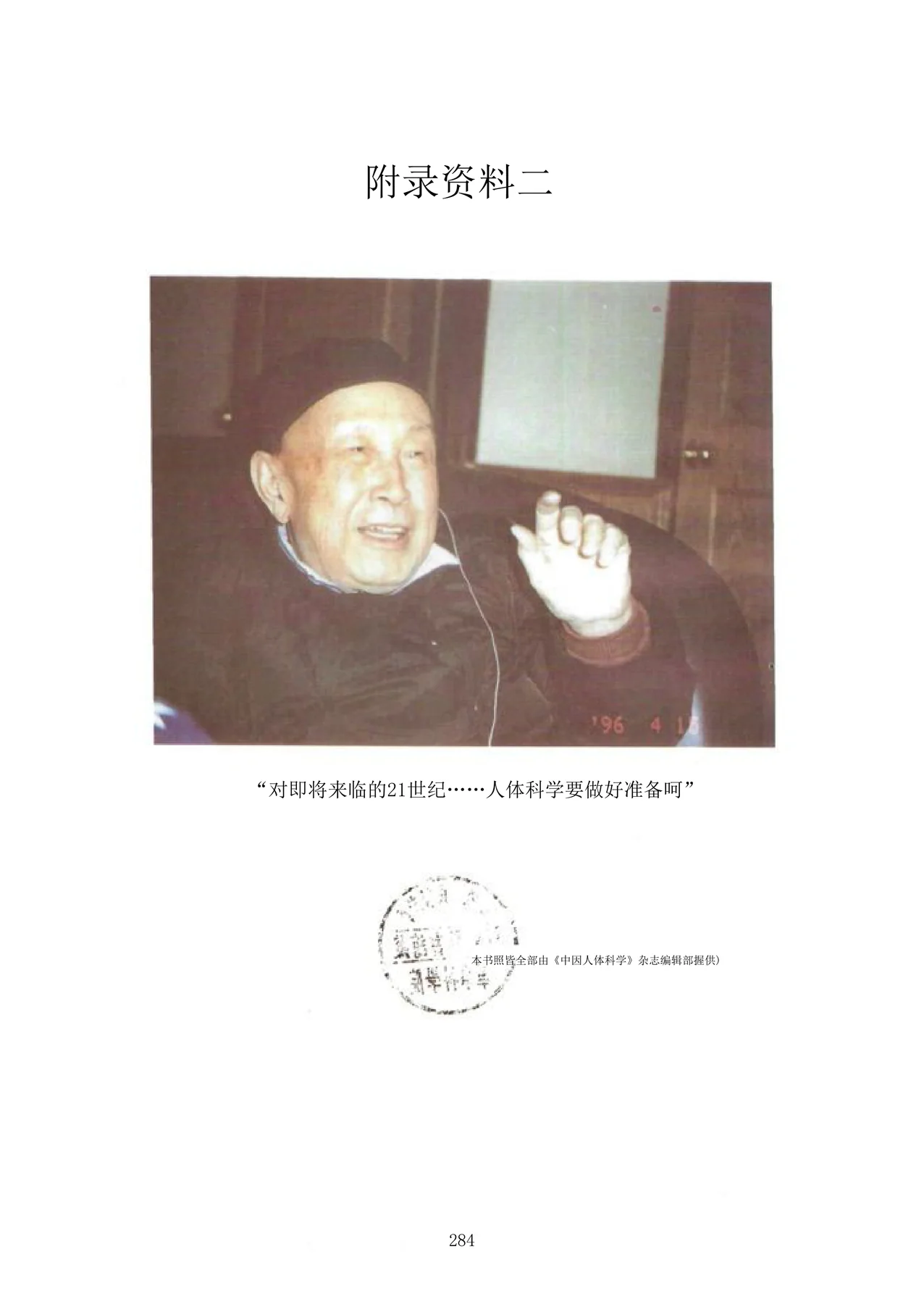
Appendix Materials II
“For the approaching 21st century… human-body science must be well prepared.”
(All photographs in this book are provided by the editorial department of Chinese Human-Body Science magazine.)
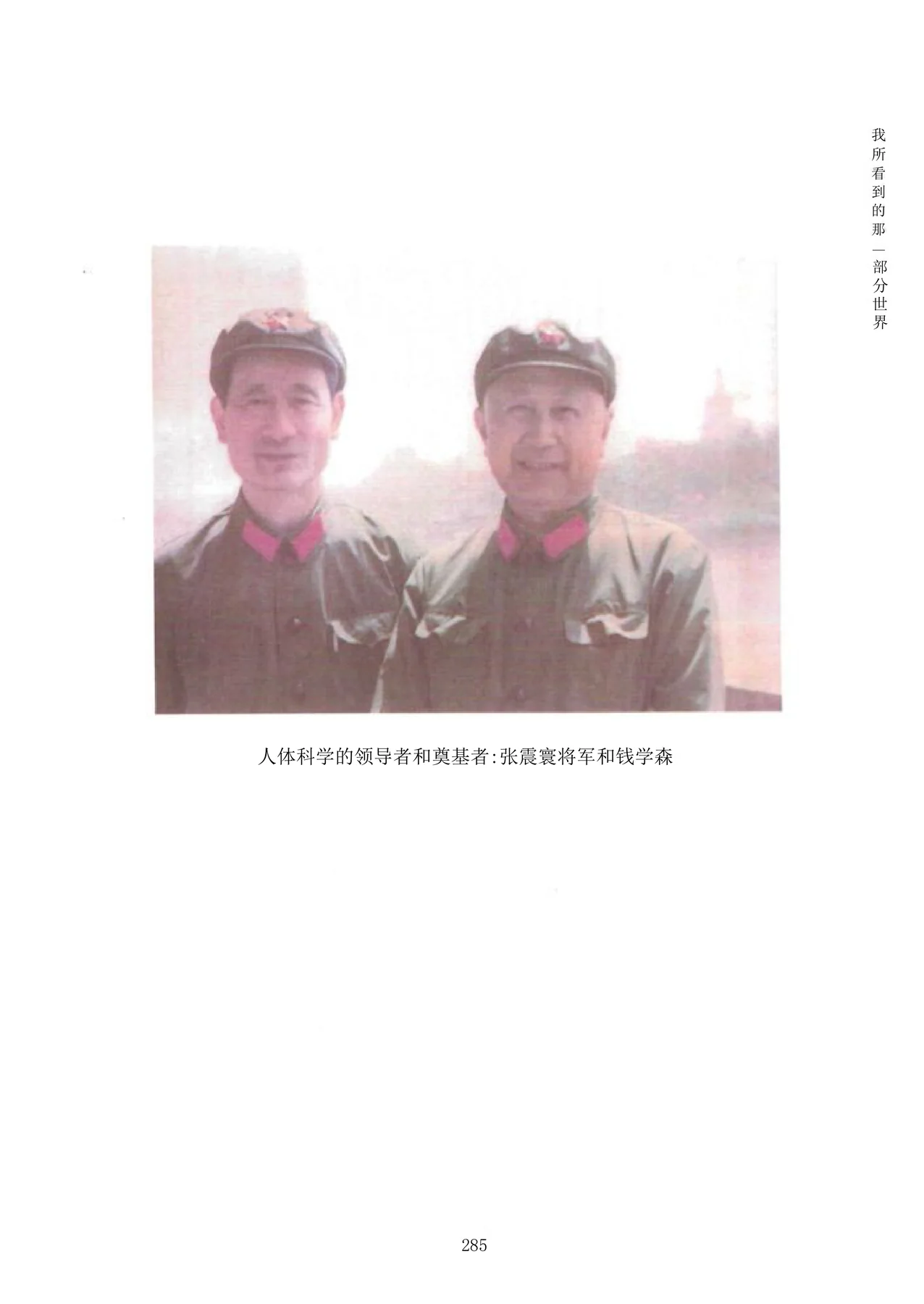
The Leaders and Founders of Human-Body Science: General Zhang Zhenhuan and Qian Xuesen
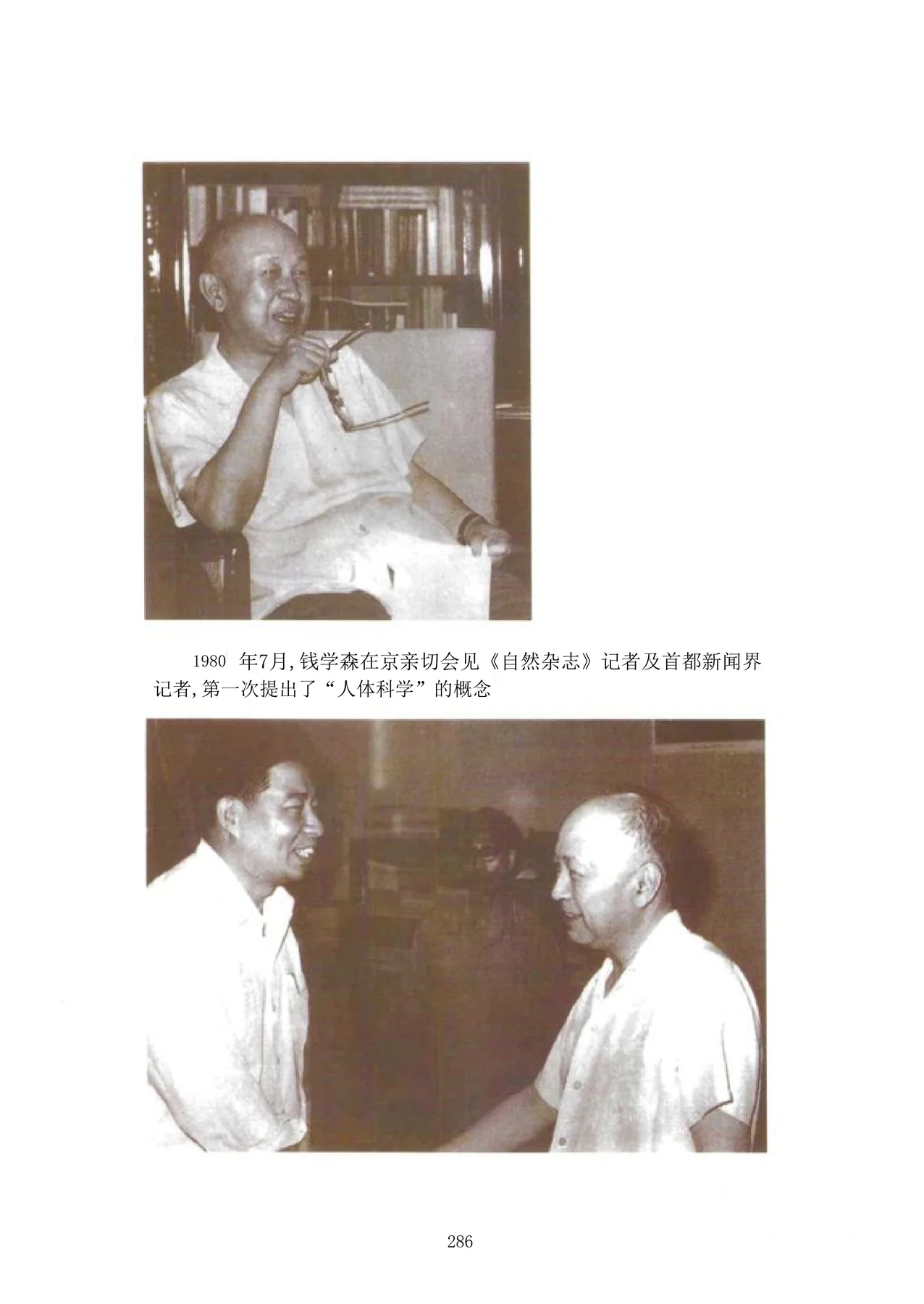
In July 1980, Qian Xuesen cordially met in Beijing with journalists from Nature Magazine and journalists from the capital’s press, proposing the concept of “human-body science” for the first time.
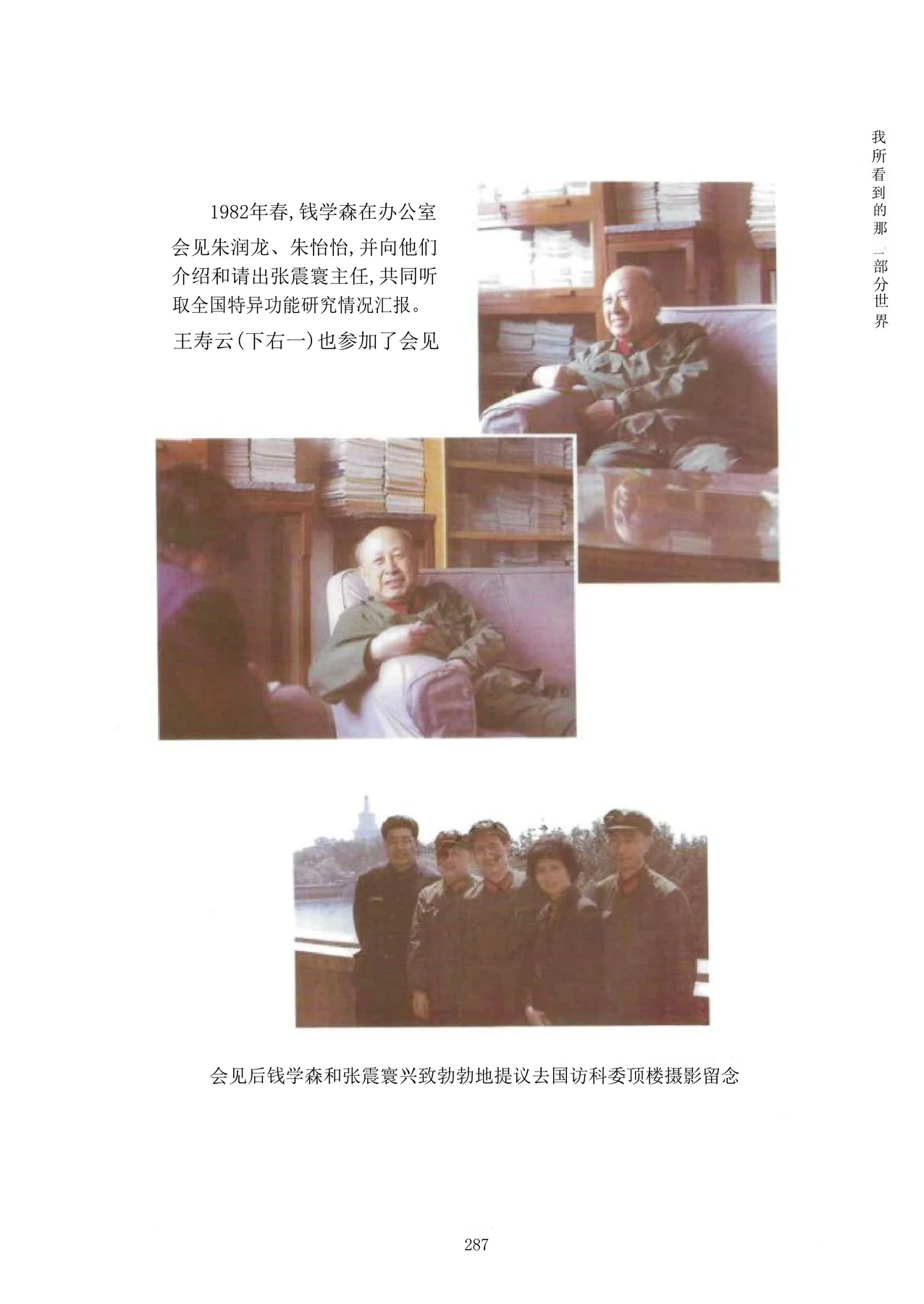
In the spring of 1982, Qian Xuesen met with Zhu Runlong and Zhu Yiyi in his office, introducing and inviting Director Zhang Zhenhuan to join them in hearing a report on the national state of extraordinary-ability research. Wang Shouyun (first from bottom right) also attended the meeting. After the meeting, Qian Xuesen and Zhang Zhenhuan enthusiastically proposed going to the top floor of the National Defense Science and Technology Commission building to take commemorative photographs.
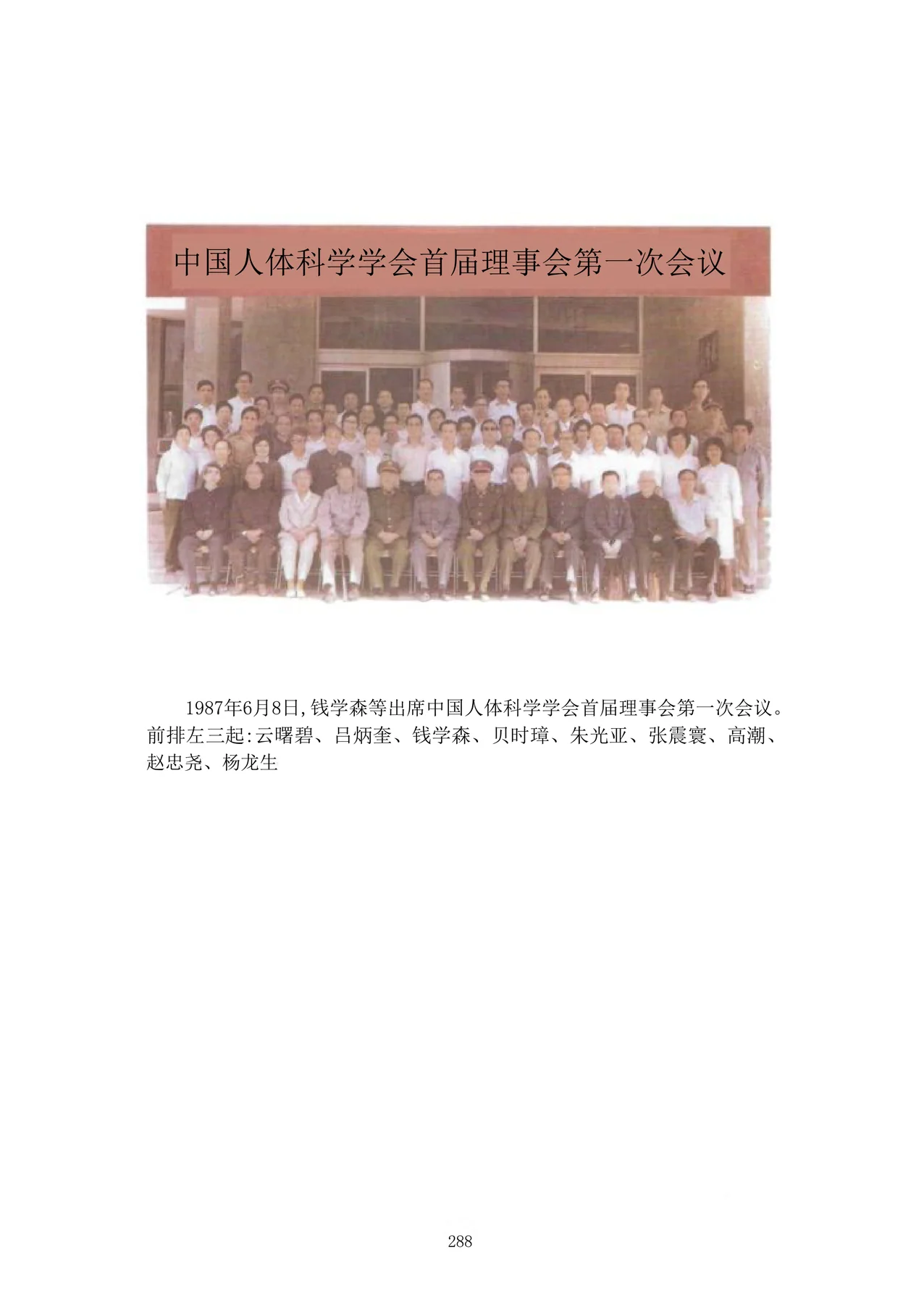
First Meeting of the First Council of the China Human-Body Science Society
On June 8, 1987, Qian Xuesen and others attended the first meeting of the first council of the China Human-Body Science Society.
Front row, from the third left: Yun Shubi, Lü Bingkui, Qian Xuesen, Bei Shizhang, Zhu Guangya, Zhang Zhenhuan, Gao Chao, Zhao Zhongyao, Yang Longsheng.
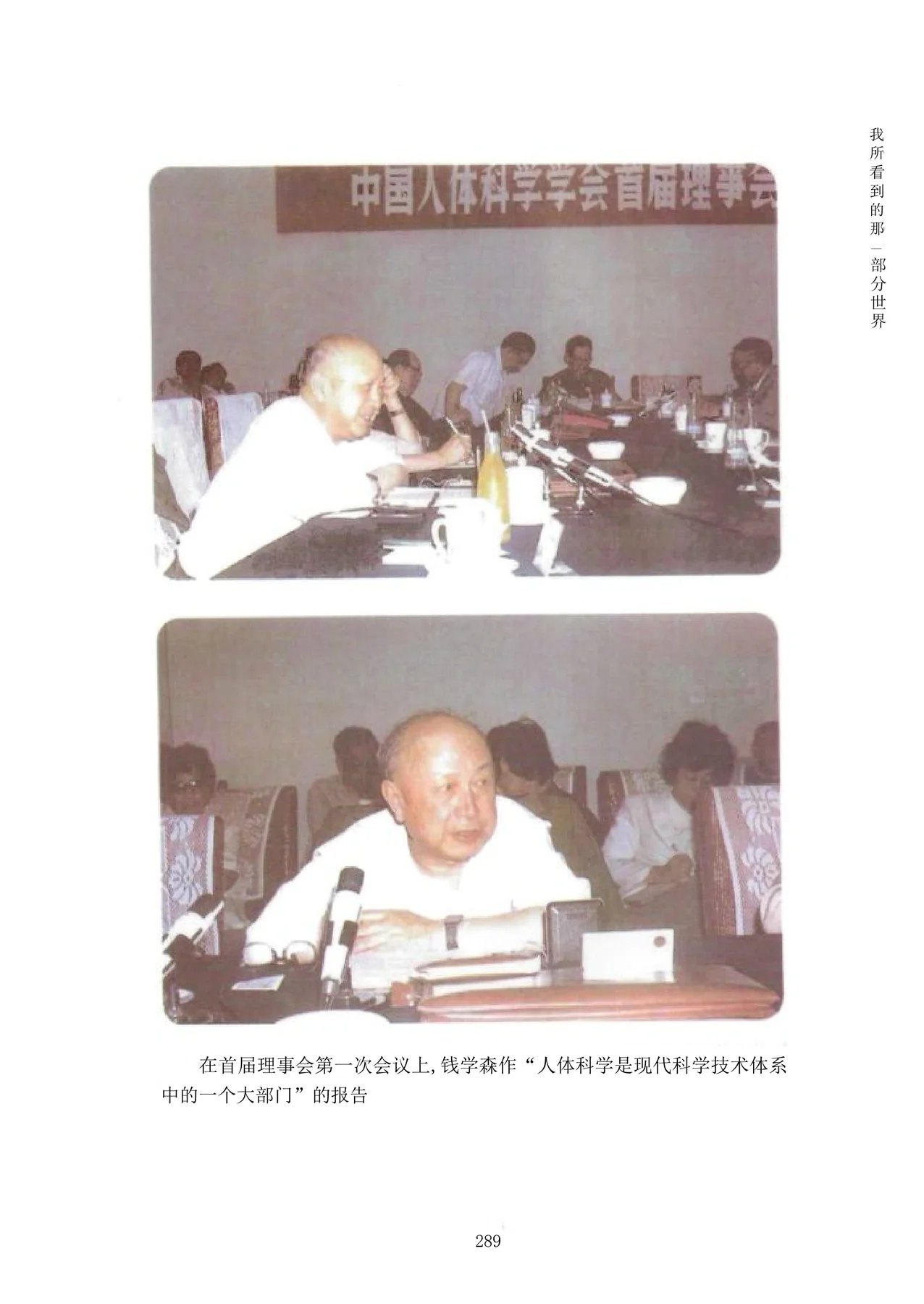
At the first meeting of the inaugural council, Qian Xuesen delivered the report “Human-Body Science Is a Major Department Within the Modern Scientific and Technological System.”
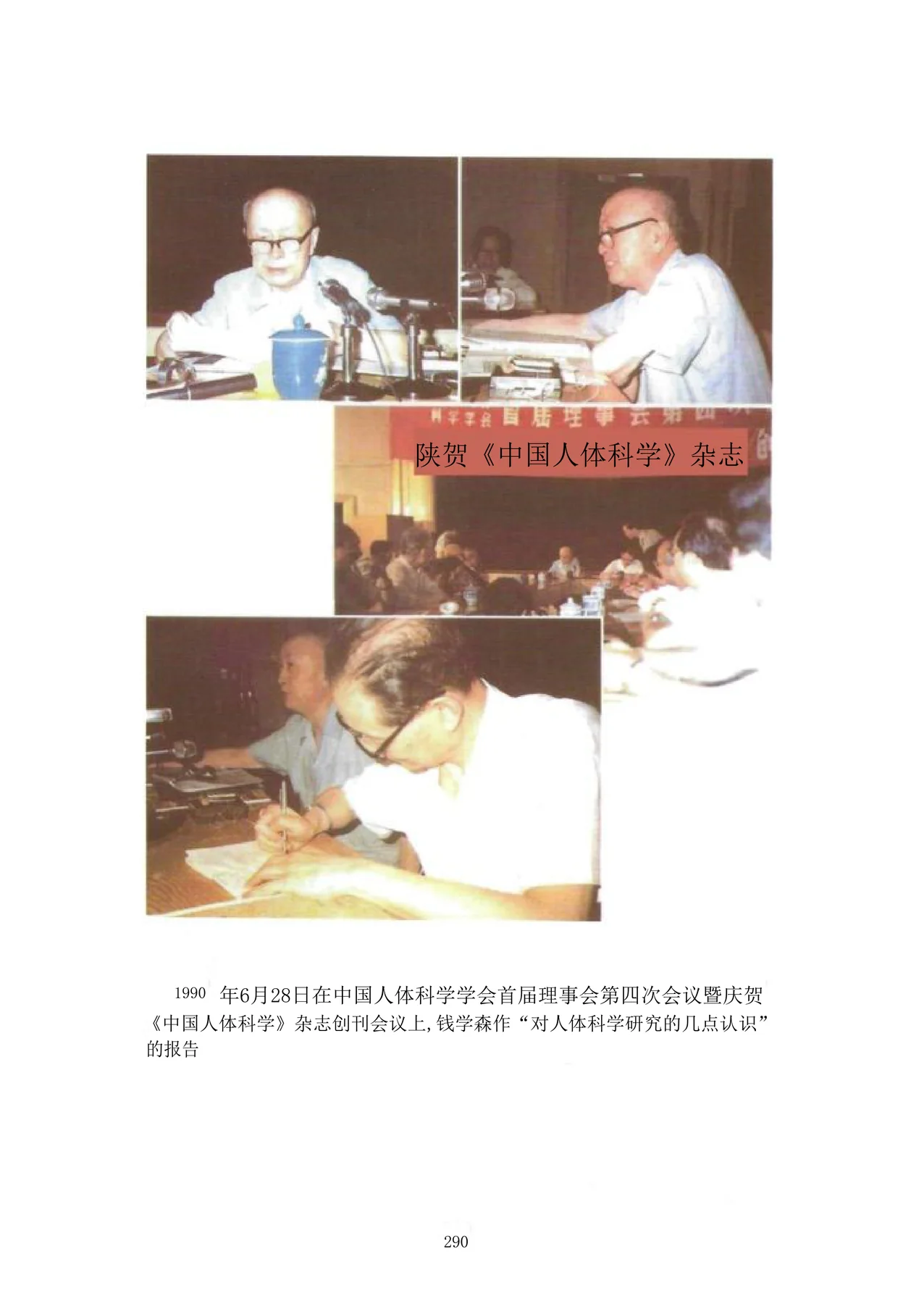
Congratulating the magazine China Human-Body Science
On June 28, 1990, at the fourth meeting of the first council of the China Human-Body Science Society and the meeting celebrating the founding of the magazine China Human-Body Science, Qian Xuesen delivered a report titled “Several Understandings on the Research of Human-Body Science.”
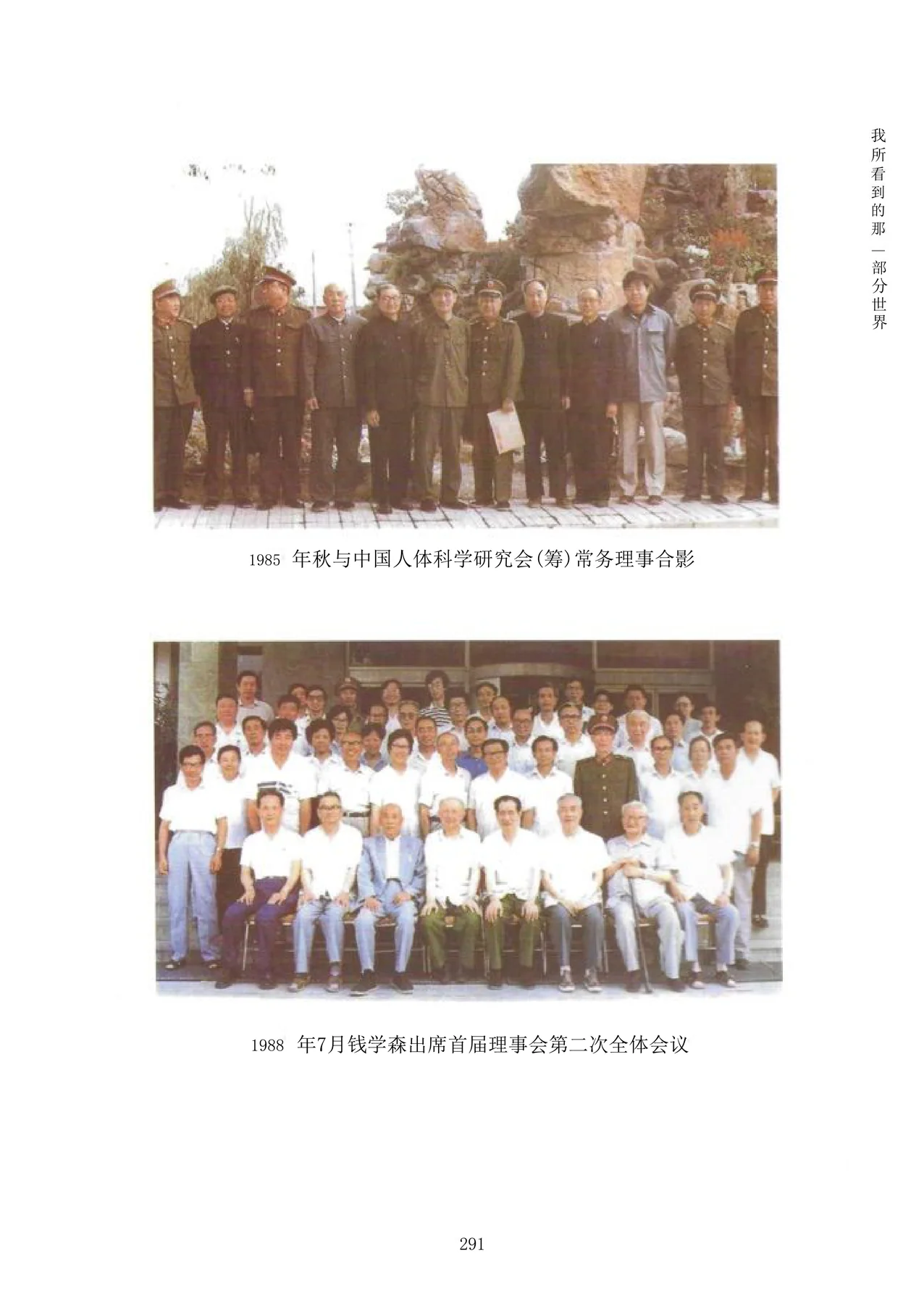
Group photo with the executive council members of the China Human-Body Science Research Association (Preparatory), autumn 1985
Qian Xuesen attending the second plenary meeting of the first council, July 1988
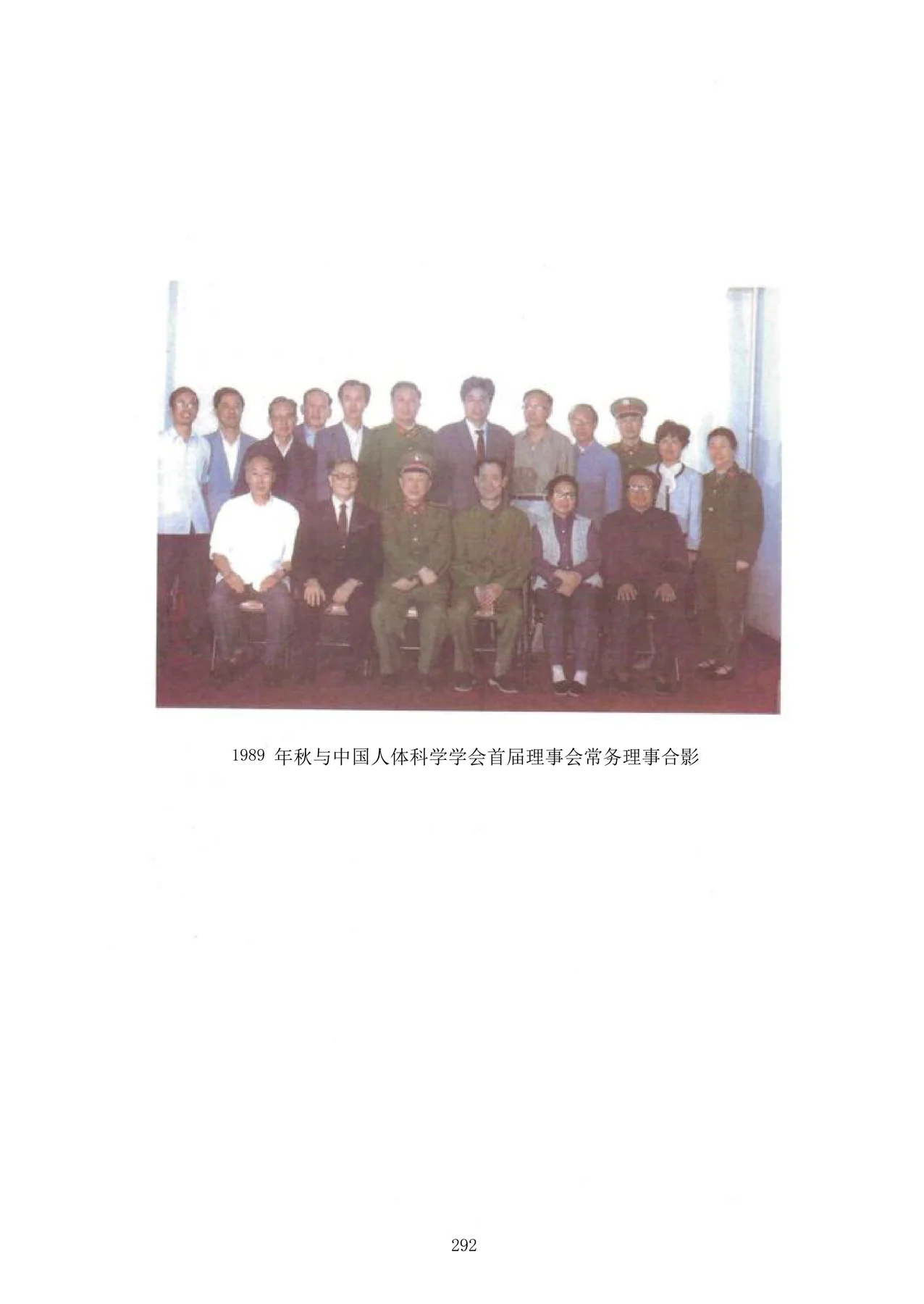
Group photo with the executive council members of the first council of the China Human-Body Science Society, autumn 1989
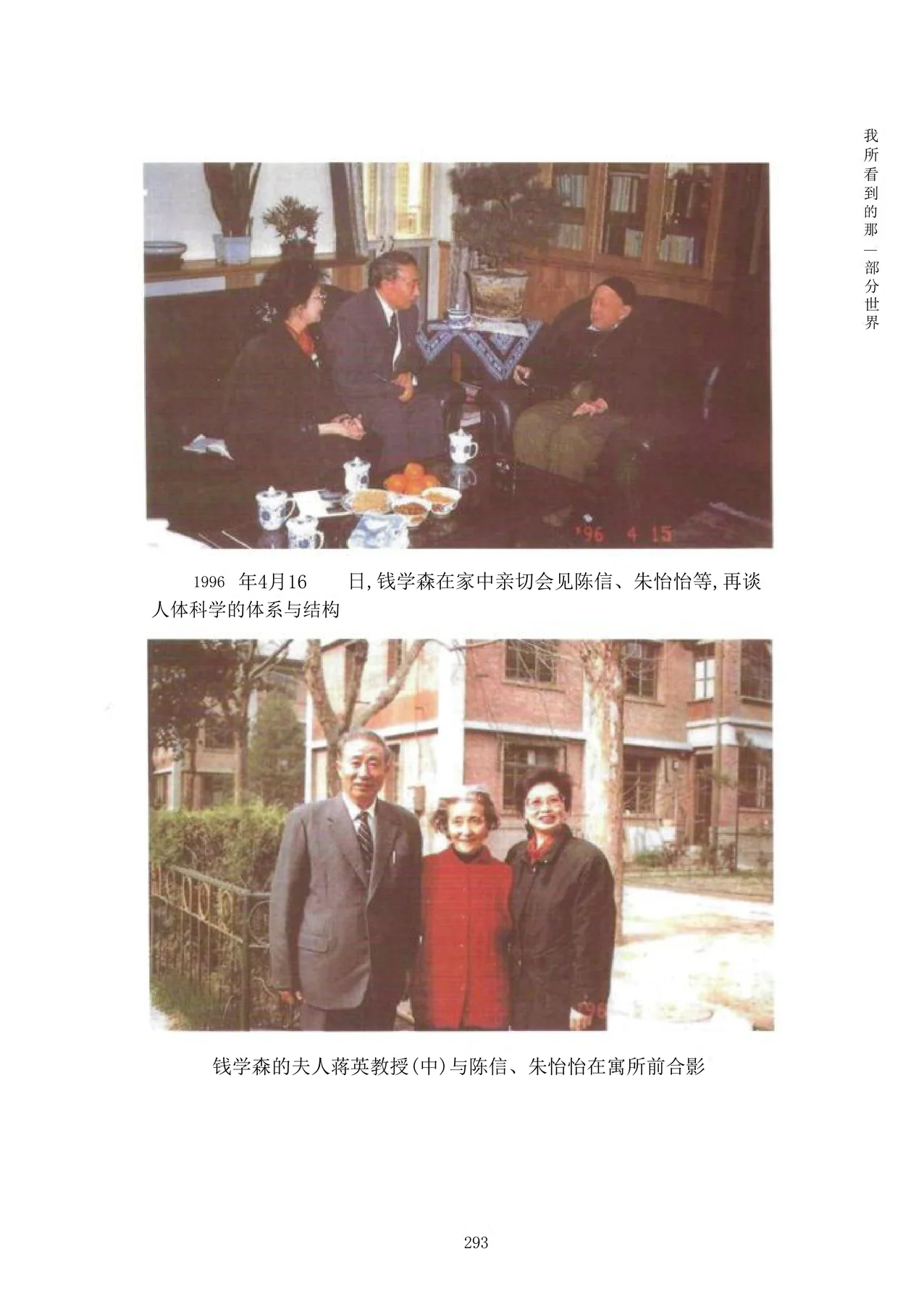
On April 16, 1996, Qian Xuesen graciously received Chen Xin, Zhu Yiyi, and others at his home, discussing once more the system and structure of human-body science.
Professor Jiang Ying (center), Qian Xuesen’s wife, in a group photo with Chen Xin and Zhu Yiyi in front of their residence
Appendix Material Two: Qian Xuesen on Human-Body Science
(1) What Is Human-Body Science?
Several years ago, we learned a viewpoint from Comrade Lü Bingkui. He said: “Traditional Chinese medicine, qigong, and extraordinary human abilities—the three are linked together.” This was a great inspiration to me: human-body science must at the very least take these three aspects into consideration.
One is traditional Chinese medicine. There now exists a large academic organization, namely the All-China Association of Traditional Chinese Medicine. We comrades are deeply concerned about the matter of traditional Chinese medicine. In 1983, we published an article proposing that the theories of traditional Chinese medicine be expounded using modern language, so as to make them more readily understood. Later, these contents were termed “phenomenological traditional Chinese medicine,” because the theories of traditional Chinese medicine are in fact phenomenological—they are generalizations derived from experience. If you ask for the reasoning, that is the reasoning as far as it goes; you should not probe into deeper levels. In earlier times, traditional Chinese medicine had no conditions to probe into deeper levels, so it simply summarized human functions in this manner. As to why things are this way? There was no explanation, and at that time a deeper explanation could not have been provided either. Hence it is called phenomenological traditional Chinese medicine.
Another area of work is qigong. Qigong is of course also of interest to us. We already have the China Qigong Science Research Association, which has been carrying out substantial work for several years, along with the Medical Qigong Research Association under the All-China Association of Traditional Chinese Medicine, as well as other organizations. Last year we also discussed the need to gradually make qigong scientific, and likewise to establish a phenomenological qigong theory; rather than first delving into what the profound principles are, we should organize the phenomena observed in qigong into a coherent framework, forming a theory that makes sense. This is the second aspect: namely qigong, or what may be called qigong science.
Third—and this is what we are particularly interested in, what is most striking and most capable of drawing our attention—are extraordinary human abilities. The excellent recent situation has further drawn us to consider various questions concerning extraordinary human abilities.
But we believe: we should broaden our perspective. We cannot consider only extraordinary human abilities; we must also consider the qigong science and the theory of traditional Chinese medicine that are closely related to extraordinary human abilities. We should make it clear: the China Human-Body Science Society is not solely devoted to extraordinary human abilities. Our society studies human-body science, and human-body science encompasses extraordinary human abilities, but is not limited to extraordinary human abilities. We must take note of this point. In the past, we often used the two terms interchangeably. Sometimes we spoke of extraordinary human abilities; at other times, fearing that the term might provoke trouble, we altered it and called it human-body science. This was a consequence of the prevailing historical conditions. Now that era has passed; there is no
need to do so any longer. We should state clearly: our China Human-Body Science Society is engaged in human-body science, which also includes the science of qigong, the theories of traditional Chinese medicine, and other areas of science and technology.
In this way, it is necessary to articulate clearly: what exactly is human-body science? In our thinking, human-body science is one of the major divisions within the modern system of science and technology. The modern system of science and technology, apart from human-body science, comprises eight other major divisions: natural science, social science, mathematical science, systems science, military science, cognitive science, behavioral science, and literary and artistic theory. Our human-body science stands on an equal footing with these eight major divisions. This point was discussed in an article from 1981 and was also addressed in the third issue of Philosophical Research in 1982: human-body science is one of the nine major divisions of modern technology, and human-body science stands on an equal footing with the other eight major divisions. In the past, people had the impression that natural science and social science were preeminent. Now, human-body science stands on an equal footing with natural science and social science. Is this elevating human-body science too high? No—it is indeed the case that human-body science is remarkable, because human-body science is the study of the human being.
The core idea here is: viewed from the perspective of modern systems science, the human being is a giant system, whose complexity exceeds that of a large system. In systems science, and especially in systemology, the foundational discipline of systems science, we speak of systems as including small systems, large systems, and giant systems. The human-body system is precisely such a giant system, containing many levels, the highest of which is the human being as an integrated whole. Such a giant system also interacts with the surrounding universe—that is, it is not a closed system but an open system, situated within the entire universe and mutually connected with it. The universe is a super-giant system, and the human-body giant system is an open, extremely complex giant system within the super-giant system of the universe.
How do we characterize this giant system of the human body? There is one indicator: namely, the overall functional state of the human being. In systemology this has been made clear: functional states are understood to be sub-stable states—that is, in the phase space of the system, they reside in a relatively stable state, but not a fixed one; rather, they are regulable, and one sub-stable state can transition into another sub-stable state. For the human body, there are several especially noteworthy, particularly important functional states with very clearly defined characteristics and properties—these we call the functional states of the human body (omitting the character “condition”), and we wonder whether we might borrow a term from quantum mechanics: Eigenstate, a special kind of state. Viewed in this way, for the giant system of the human body, it is extremely important to study its functional states, including certain functional states that possess special properties. Using the overall functional states of the human being to describe the various functional characteristics of the human-body giant system is no longer merely a scientific conjecture—it is now a fact supported by scientific evidence.
Since 1984, Yu Hebang and others at the Institute of Space Medico-Engineering have conducted effective research on the human body’s functional states. Using multi-dimensional data analysis methods, they synthesized multiple measured physiological index variables into points of change that can represent the entire human body system. Its position in the multi-dimensional phase space composed of various variables, and its movement reaching relative stability—namely the target point, the respective target points and target rings of energy states. This work is extremely important; it has applied the theory of systems science to the human body system, providing human-body science research with a scientific basis and objective indices. For example, a qigong master entering tranquility through practice is a special functional state—the qigong functional state. Wang Xiubi and others observed that during the qigong state, the entropy values of human brain waves and R-R intervals decrease, and orderliness increases. For another example, when a person gets sick, Western medicine studies the lesion to see whether the cause of the disease is a bacterial infection; Traditional Chinese Medicine (TCM) is not bound by this limitation. The theory of TCM is syndrome differentiation and treatment. This “Zheng” (syndrome) is not the “Zheng” (symptom) of Western medical diseases; the concepts are completely different. Western medicine studies lesions, and whatever the cause, its medication is targeted at the lesion. The “Zheng” (syndrome) in TCM’s syndrome differentiation and treatment, to use the language of systems science, is the functional state. Differentiating syndromes means distinguishing the patient’s functional state, and then prescribing medication, using drugs to adjust the patient from an abnormal diseased state to a normal functional state, which is a healthy functional state. Originally, the human body naturally has the function to resist bacteria. TCM medication does not act directly on the lesion, but adjusts the functional state to a normal functional state, and the problem of the diseased state is resolved accordingly.
In short, the core idea is: the human body is an open giant system. Its characteristic is the human body’s functional state, including some special human body functional states. Human-body science is the discipline that studies humans and the functional states they occupy in an objective environment. It includes TCM (also including the medicine of various Chinese ethnic groups, such as Tibetan medicine and Mongolian medicine; that is, the “traditional medicine” mentioned in Article 21 of the Constitution), as well as qigong and extraordinary human abilities, along with many other things that can be absorbed. Bringing all of this together is what we call human-body science.
Highlighting human-body science and not placing it within life science might lead some comrades to ask: You say the human body is an open giant system, but this is not unique to the human body. Aren’t many organisms also very complex giant systems? What is the difference between humans and organisms? The answer is: the difference is that the human body is not only an open giant system, but humans have consciousness. Humans have consciousness; other organisms do not possess consciousness—this is a point confirmed by scientific research up to the present day. We can also observe from another angle: if humans had not appeared in this world, could it be the way it is today? It is humans, not other organisms, that created this world, and this characteristic of humanity is the possession of consciousness. Consciousness can also act upon the human body itself, which is “consciousness feedback.” This is also the characteristic that distinguishes human-body science from general life science. Therefore, the study of human-body science must grasp the dialectical relationship between matter and
mind, objective and subjective, brain and consciousness. This is another core idea of human-body science.
Human functional states are all metastable states and can be regulated. So what are the means of regulation?
The first means is material exchange with the outside world, such as drugs, diet, breathing, and hyperbaric oxygen, which can all cure diseases. The scope of material exchange is very broad.
The second means is not material exchange, but information exchange. External information can be sound waves or electromagnetic waves; it is nothing more than these two, though of course they are very complex. Some say music can also cure diseases; treating illness with music is sound wave information. When qigong masters emit external qi to treat illness, we think it is the effect of electromagnetic waves, albeit very complex ones. Generally speaking, external information that can be used to regulate human body functional states amounts to no more than these two types: sound waves or electromagnetic waves, though both constitute very complex information.
There is also a third means, which is the consciousness generated by the human brain. Consciousness is the highest-level movement of the human body, and it can act back downward on lower levels. This view was proposed by R. W. Sperry, who won the Nobel Prize four years ago: the highest-level activity of human consciousness can influence the activities of some lower levels. Therefore, consciousness is also a means to regulate the human body’s functional states, which is extremely important!
(2) Guiding Ideology for Researching Human-Body Science
What was stated above: we must study the functional state of the human body, and the human body’s functional state can be regulated by three means: material exchange, information exchange, and the regulation of one’s own consciousness. To study these issues, dialectical materialism must be used as a guide. In this major department of human-body science, the giant system of humanity exists and interacts within the super-giant system of the universe. Within this, there are three smaller levels. One is the cosmological level (the relationship of humans within the universe is called the cosmological view of the human-heaven relationship). It holds that there is a reason why the universe is the way it is today. If the universe were not the way it is today, humans would not have appeared. Human existence is intimately connected with the laws of the universe. This is the cosmological view of the human-heaven relationship; in the West, some call this the “Anthropic Principle.” The second level is ancient Chinese philosophy concerning humans, which is the macroscopic view of the human-heaven relationship. It is abundant in ancient Chinese literature and constitutes a very important part of theory; this is the philosophical thought of TCM, namely the macroscopic view of the human-heaven relationship. The third level, reaching the microscopic scale, also involves the relationship between humans and the surrounding environment—that is, from the microscopic level—the quantum mechanical level—how do humans understand the surrounding objective world? Quantum
Quantum mechanics has not yet resolved how human beings actually perceive, measure, and observe the surrounding microscopic world. We need to study the relationship between human sensory organs and external stimuli, delving deeper from the level of quantum mechanics.
(III) The Three Levels of Human-Body Science
We divide all fields of science and technology into three levels. The first is the foundational discipline level. These disciplines include physiology, psychology, and so forth, as well as the study of human consciousness and mental activity, connecting to the highest level using a term proposed by Sperry called “mentatics” (Mentalics)—in essence, all studying how human consciousness arises in the brain. These are the foundational theoretical disciplines of human-body science. Here I want to add one more, which is extremely important: studying the human being from the perspective of the whole person, from human-body functional states and the regulation of functional states—this is human-body studies (rentixue). This discipline still awaits establishment, and it is one of the foundational disciplines of human-body science. How should this discipline be established? First, it should be built from other directions, such as phenomenological Chinese medicine, phenomenological qigong studies, phenomenological extraordinary human ability studies, and then using the theories and methods of systems science to synthesize those phenomenological theories together—not as simple addition, but through a higher-level sublimation, so that its features will differ from those of the original materials. Going further, it should not only explain what is so but also explain why it is so—only then can human-body studies be established. It is the foundational discipline of human-body science. The focus of human-body studies is the study of the human giant system, human-body functional states, and the knowledge of their regulation and change.
Below the foundational sciences is the next level, which is technical science. This refers to theories of practical application or direct transformation of the objective world. In our human-body science, this means medical theory, and the theories of Western medicine are also part of it. What appears extremely important now is to articulate the theories of Chinese medicine. Using only Chinese medicine terms like yin and yang—these are not modern language. In 1983, in Exploration of Nature (Da Ziran Tansuo), I proposed that Chinese medical theory is experiential and extremely precious, but Chinese medical theory is not expressed in modern language, making it difficult to understand, and it also contains some incorrect elements—there is dross as well. The task is to clear away the dross and articulate it in modern language. Western medical theory has even more content—pathology, pharmacology, immunology, and much more. We also need to use the perspectives of foundational science and human-body science to clarify the domain of technical science. Within technical science there is also another discipline that has developed in recent years, namely how humans and machines work together cooperatively, which abroad is called ergonomics. This concerns how humans and machines can work together effectively. I believe that medical theories—whether Chinese medicine theory or Western medicine theory—once modernized from the perspective of human-body science, as well as ergonomics, all belong to the technical science level.
The next level down is applied science, which links technical science directly with practical use. It is somewhat like engineering technology—what directly transforms the objective world is called applied science. In human-body science, the applied science is of course medicine. Current medicine for treating illness is called first medicine. Medicine for preventing illness is called second medicine. Not long ago I read about something Americans are working on called predictive future medicine. That is, they make predictions about your situation over the next five years—what illnesses you might develop and how to address them. In fact, this also uses the perspective of human-body science. First, a survey is conducted—for example, having someone fill out a questionnaire. Men must answer 314 questions, and women must answer 340 questions. One part covers the same data collected in our current physical examinations—this is data-oriented—and also involves your lifestyle, work environment, mental state, attitudes toward illness, whether you are always worrying or are optimistic, and so forth. Altogether over three hundred questions, then all this data and information is used to build a systematic model, which is processed by computer, enabling prediction of what problems may arise for you in the next five years—hence the name predictive future medicine. Based on this, recommendations are made about what to pay attention to and what medications to take, encompassing elements of both first and second medicine. There is also third medicine, which is rehabilitation medicine. All three of these medicines can utilize all the research results of human-body science—qigong and extraordinary human abilities can all be put to use.
What I want to emphasize is that we must also develop fourth medicine (i.e., developing human latent abilities), which means further developing human capabilities. For example, how can adaptability be improved under special environmental conditions? For instance, under conditions of high acceleration, normally it is just one or two g’s, but now reaching ten g’s—can one adapt? Conversely, in outer space away from Earth, g equals zero; after spending several months on a space station, astronauts cannot even walk when they return to the ground—they are not adapted. Clearly, having no acceleration is also not acceptable. In the future, humans will continue to transform the objective world, and there will be many tasks to accomplish—without training, adaptation is impossible. For example, some people get motion sickness when flying; the first time they feel dizzy, and the second time they throw up before even boarding the plane. This will not do. For humans to further transform the world, they must be prepared themselves. Additionally, there are records of qigong applications showing that through practice, students’ intelligence can improve. At a middle school in Susong County, Anhui Province, a teacher named Wu Yi reported that qigong practice can raise his students’ intelligence. Later, a school in Lanzhou, Gansu Province, also conducted experiments that could confirm this point. There is also the Buddhist teaching on qigong practice that “samadhi gives rise to wisdom.” Combining all of these together constitutes the development of human latent abilities (whether improving intelligence or adapting to environments). This is called fourth medicine. In applied science there is also the very important field of human-machine-environment systems engineering, which is closely related to fourth medicine. It is a technology that, on the basis of in-depth study of the respective functional characteristics of humans, machines, and environments, applies the theories and methods of systems engineering with emphasis on studying the overall performance of the human-machine-environment system to bring it to an optimal state.
Therefore, these three levels mean that, at the level of basic science, we use the rich array of basic disciplines known to us to establish human-body science; at the level of technical science, we must earnestly refine and modernize medical theory; human-machine ergonomics must also be studied; and at the level of applied science, we must develop medicine and human-machine-environment systems engineering.
Only in this way can we say that we have built up the system spanning from philosophy, basic science, and technical science through to applied science.
(iv) How Exactly Should Research in Human-Body Science Be Conducted?
We must broaden our horizons. Not only should we examine traditional Chinese medical theory, qigong, and extraordinary human abilities from the perspective of human-body science—there are still many things that can be used and studied. We must grasp the core ideas: the human body as a gigantic system, the functional state, and what means—including human consciousness—can be used to regulate the functional state and the various effects produced in different energy states. Let me briefly discuss our current understanding below.
Qigong Is the “Stepping Stone” for Studying Human-Body Science
A very important aspect of the work of studying human-body science is the study of qigong science. Many of the breakthrough points in the concept of human-body science were triggered by qigong. Qigong is a “stepping stone” for human-body science—only by knocking open the door of this scientific hall can one enter its inner chambers. How can we know this to be the case? Practicing qigong is neither pharmacotherapy nor physical therapy; rather, it uses consciousness to regulate the body’s functional state, which directly involves the core idea of consciousness feedback in human-body science. Moreover, the very concept of the human body’s functional state arose from qigong: in qigong practice, what does it mean to enter quiescence? This state leads one to think about the problem of a system’s stable state. And to proceed directly from the Chinese medical concept of “syndrome pattern” to thinking about the body’s functional state is not something one can accomplish all at once; we must first start from qigong. Qigong is a breakthrough point in human-body science research. Recognizing this point is very beneficial for advancing our work.
Establishing Phenomenological Theory
For research in Chinese medicine, this is a comparatively easy task. The theory of Chinese medicine is relatively comprehensive. In that 1983 article in Exploration of Nature, it was noted that Chinese medicine possesses such a wealth of experience—experience that has been proven in practice to be highly successful in treating illness. Summarizing these experiences constitutes an entire set of highly valuable knowledge. But because this body of theory in Chinese medicine cannot yet be incorporated into the modern scientific system, we once said that Chinese medicine is not yet a science in the modern sense—meaning only that it cannot yet be brought within the framework of the modern scientific theoretical system. Some people did not grasp this meaning and complained, saying: Chinese medicine is already struggling, and now you say it is not scientific—won’t that make things even harder? What we are saying is that Chinese medicine does have theory—
only it is phenomenological theory. What is phenomenological theory? In studying objective phenomena, the first step is to summarize many phenomena—this belongs to phenomenological theory. It only explains “what is so,” but cannot explain “why it is so.”
Everyone knows that Chinese medicine uses classical Chinese, which quite a few young people today cannot fully understand. And even after one has mastered the classical Chinese, those concepts (such as the concepts of yin-yang and the five phases) are still not concepts familiar to modern people—they are quite awkward. The phenomenological theory of Chinese medicine that I am referring to must be articulated in modern language. That is to say, it uses modern language to explain “what is so”—this is what the phenomenological theory of Chinese medicine amounts to. These points were stated even more clearly last March when discussing the strategy for modernizing Chinese medicine. For constructing a phenomenological theory of Chinese medicine, there now seems to be a glimmer of hope. In several issues of Exploration of Nature from 1983, Wu Xuemou of Wuhan proposed a mathematical theory—pansystems theory—which uses modern mathematical language to express the general rules of systems in general. This resonates remarkably well with Chinese medical theory. What Chinese medicine applies is precisely a holistic perspective and a systemic perspective. Over the long course of history, Chinese medicine could not perform analytical work; it could only study the human body from a holistic perspective and discuss problems from a holistic perspective. This is very close to the pansystems theory proposed by Wu Xuemou. Therefore, in constructing a phenomenological theory of Chinese medicine, one can use Wu Xuemou’s theoretical methods. We hope someone will take up this work. But after all, Wu Xuemou is not a Chinese medicine practitioner. Ideally, comrades working in Chinese medicine and comrades working in mathematics should combine their efforts. This is the most practical work that can be done right now: Chinese medical theory is comprehensive, and the mathematical tools are already available. Therefore, a phenomenological Chinese medicine is entirely feasible.
Next is phenomenological qigong studies. I already discussed this on February 23, 1986, and will not repeat it here. My most recent reflection is to ask comrades researching phenomenological qigong to pay attention to one issue: qigong practice must be tailored to the individual. To change a particular person’s functional state, one should consider: what exactly is the current functional state of this person’s body? I once drew an analogy: if it is an elderly person, practicing the kind of kungfu taught at Shaolin Temple would probably no longer work. The current situation is that some qigong masters emphasize their own school and believe that their set of practices is universally applicable. This runs contrary to Chinese medical theory. Does Chinese medicine not teach “differentiating patterns to determine treatment”? One must first observe what functional state you are in, and only then determine how to practice. This requires someone to study the matter. We should consider how to use Chinese medical theory to guide phenomenological qigong studies.
The last remaining question is: could extraordinary human abilities also have a phenomenological discipline? Previously, one would not have dared to raise this, but now I think it can be stated: for extraordinary human abilities, a phenomenological theory can also be established. The question is how to build it.
Is there one lead that should perhaps be considered? The manifestations of extraordinary human abilities may in fact be electromagnetic fields arising between the human and objects. When the state of an object is altered, the object can also emit—
radiating electromagnetic waves and electromagnetic fields, and human beings can also receive them, accepting the influence of environmental electromagnetic waves and electromagnetic fields. People who work at radar stations for extended periods can develop “microwave sickness”—this is because after absorbing electromagnetic waves, their functional state is altered. Comrade Zhang Ruijun of the Institute of Space Medico-Engineering considered microwave sickness sufferers from the perspective of human functional states: what kind of functional state are they in? Which “syndrome” (zhèng) in traditional Chinese medicine does it correspond to? Then he selected medicines targeted at that “syndrome” to administer treatment, and the results were very good. These facts demonstrate that electromagnetic waves and electromagnetic fields can indeed affect the human body. The electronic therapeutic device invented by Comrade Gu Hansen, Comrade Gou Wenbin’s specific electromagnetic-wave therapeutic device, and the various kinds of electronic qigong masters and electronic orthodontic correctors all show that electromagnetic fields and electromagnetic waves have an effect on people. As for the effects of electromagnetic waves on microorganisms, experiments were published ten years ago—unfortunately, they seem not to have attracted much attention.
Regarding the functions in extraordinary human abilities that involve information and information processing (extraordinary perception)—could it be that a person emits electromagnetic waves that act upon an object, and the object then feeds the information back to the person, who ultimately processes this information in the brain and arrives at a conclusion? For people without extraordinary abilities, this information may never get processed and is simply discarded; whereas people with extraordinary abilities are able to process it. For example, there is someone named × × × who can sense earthquakes in advance. This is understandable: during the process of an earthquake, a great deal of electromagnetic-wave information is emitted, and animals can perceive this information—as when certain rats and snakes all flee from their holes. × × × can also process this information; this belongs to the category of extraordinary perception.
Then there is extraordinary macro-movement (téyì zhìdòng), which causes changes in surrounding matter. Yao Hongjun of Yunnan proposed that what was formerly called “haunting” can be linked to extraordinary macro-movement. This is a breakthrough in understanding. “Haunting” in German is Poltergeist, which was previously transliterated in some unknown way as “bo’erdairèsi.” It refers to the phenomenon where, as soon as a person with extraordinary abilities enters a room, the objects in that room start moving about chaotically. This may be extraordinary macro-movement that the extraordinary-ability person’s own consciousness cannot control—what was formerly called a “haunting.” So it is really not a “haunting of ghosts” but a “haunting of a person”—it is the person with extraordinary abilities who is “haunting.” This situation also occurs when extraordinary-ability subjects participate in experiments today. For example, with an ashtray, an extraordinary-ability person can make it disappear, but cannot control exactly where it goes, or may only have a rough idea of the direction in which it has moved.
Is extraordinary macro-movement also related to electromagnetic waves? Some time ago, Zhang Baosheng gave an extraordinary-ability demonstration in which, with a point of his finger, a hole was burned in a professor’s clothing. Later, Professor Tang Aoqing said this could be explained: the burning of the clothing may have been caused by electromagnetic waves—that is, electromagnetic waves emitted by the extraordinary-ability person activated the molecules in the clothing, which then reacted with oxygen in the air, burning a hole. Professor Tang Aoqing’s application of his specialized knowledge of quantum chemistry to propose this hypothesis is very thought-provoking, and it should be investigated in depth.
Therefore, extraordinary macro-movement may also be an effect of electromagnetic fields and electromagnetic waves. During World War II, it was discovered that some people working at radar stations could “hear” microwave signals. This seems inconceivable, but it was later clarified: electromagnetic waves are unevenly absorbed in the human head, and this produces sound waves that can be heard. This example dispelled the “extraordinary” quality of an extraordinary ability, showing that extraordinary abilities can be studied and their principles uncovered.
In 1985, Wang Xiubi and others conducted systematic scientific experiments demonstrating that extraordinary-ability subjects and qigong masters, during the process of emitting qi, emit low-intensity, high-frequency electromagnetic waves at frequencies of 10–360 MHz and power of 30–650 DM. This provides grounds for the inference that the human body’s influence on matter at a distance is mediated by electromagnetic waves. The experiments demonstrated that external qi causes biological effects at the cellular level, such as increased surface charge density of red blood cells, accelerated electrophoretic mobility, and enhanced cell membrane fluidity. These effects are closely related to physiological functions including material transport across the cell, energy exchange, cell recognition, and hormone-receptor interactions. The discovery of these phenomena will play an important role in further research into the mechanisms by which extraordinary abilities and qigong treat disease.
Most recently, the most persuasive experiments are those conducted by Lu Zuyin and others (some results have already been published in journals such as Dongfang Qigong). They most clearly and convincingly demonstrated the effect of emitted qigong energy (wài qì) on material molecules, linking our work to molecular biology—a hot field in contemporary life science. This is undoubtedly a major breakthrough in human-body science research and is truly inspiring. Moreover, human beings can emit electromagnetic waves, and matter, upon receiving the electromagnetic waves emitted by a person, undergoes changes and simultaneously emits electromagnetic waves. From the above, we can see that we can not only establish a phenomenological theory, but also gain deeper insight into the mechanisms of human-body science—there are now leads for penetrating to the essence of the phenomenon, because electromagnetic field theory, including electrodynamics and quantum electrodynamics, is among the most solid physical theories of our time.
Extraordinary Thinking
Everything discussed above is connected to how human beings process information—that is, thinking. But thinking is inseparable from practical experience; it is formed through practice. Some people (extraordinary-ability subjects) have a kind of practice different from that of ordinary people, and therefore possess a special mode of thinking: they can process information that ordinary people discard. In August 1984, at the National Symposium on Noetic Science, the term “extraordinary thinking” (téyì sīwéi) was raised. At that time, it was only mentioned that Ye Jun had proposed the concept of “extraordinary thinking” and that it could be studied. Thinking that lies outside normal human thinking can be called “extraordinary thinking.” Normal people have abstract (logical) thinking and imaginal (intuitive) thinking. In addition, there is “inspirational thinking,” but it still cannot be clearly explained at all. Now it appears that so-called inspiration is also extraordinary thinking. We must study extraordinary thinking (as a mode of human
a special mode of thinking), including inspirational thinking, thinking within extraordinary perception, and thinking within extraordinary action.
In addition, people with extraordinary abilities and qigong masters may all possess their own extraordinary thinking. Sometimes, right in front of you, they can enter that extraordinary thinking state, muttering words aloud, but ordinary people cannot understand them at all. After a few minutes, when the process of extraordinary thinking is complete, they can tell you the result of the extraordinary thinking in ordinary language. As for the process of extraordinary thinking itself, it cannot be expressed in conventional language, and even they themselves cannot explain it clearly.
Inspirational thinking, the thinking involved in information processing during extraordinary perception, and the thinking process during extraordinary action are all special modes of thinking in the minds of people with extraordinary abilities, and should arouse people’s research interest.
The Influence of the Cosmic Environment on the Human Body
One aspect of the human body’s openness to the universe is environmental influence, such as the alternation of day and night, the progression of the four seasons, and so on. This constitutes a science of the body’s temporal rhythms. In ancient China it was called “zi-wu liu-zhu” (meridian clock flow). In recent times, this field has developed very rapidly abroad, and it is very important for human-body science. In addition, in recent years scientists have also taken note of the influence of the geomagnetic field. Experimental observations have demonstrated that changes in the geomagnetic field have a clear effect on the human body.
Ethnomedicine from Other Countries
Human beings living on the earth must always struggle against disease. Therefore, medicine is something every nation must develop, and traditional medicine is by no means limited to the Chinese nation. Peoples all over the world have their own traditional medicines, and these too constitute material for developing and researching human-body science. There are recent indications that the medical community in Africa has also begun to pay attention to this issue, and has started to collect and transmit Africa’s own traditional medicine.
Nutrition
The question of nutrition is the field in which people have the richest experience. The human body is a giant system that interacts with the objective environment, and one avenue of interaction is the intake of food and the excretion of waste. The study of this question is nutrition. This too must be studied from the perspective of human-body science. In the past, the scope of nutrition was very narrow, while practical experience and knowledge in the area of nutrition were extremely rich. Applying the systematic methods of human-body science to study it can, in turn, further develop human-body science — this is how nutrition is brought into human-body science.
The Scope of Chinese Medicinal Herbs Can Be Expanded
Wang Zhongdong of the Shaanxi Institute of Scientific and Technical Information wrote a book: Development of Chinese Medicinal Herbs in Shaanxi, which gives us a certain inspiration: Chinese materia medica is not a closed system. Two hundred years ago,
there was no American ginseng in Chinese materia medica. Later, overseas Chinese discovered it in America, and only then was it introduced into Chinese medicinal herbs. Many of the things described in Wang Zhongdong’s book are not actually Chinese medicinal herbs—for example, kiwifruit, cili (rose roxburghii), and sea buckthorn—which are described as having very high vitamin C content; this does not pertain to the medicinal properties originally discussed in Chinese medicine. It can be seen that the system of Chinese materia medica can also be expanded, and many things can still be introduced into Chinese medicinal herbs. If the scope of Chinese medicinal herbs is expanded, does that not also broaden the horizons of human-body science?
Citing Achievements of Integrated Chinese-Western Medicine and Western Medicine
Human-body science can be further expanded from the perspective of medicine — not only bringing Chinese medicinal herbs into research, but also bringing Western pharmaceuticals in. The actions and efficacies of Western drugs are explained not from the standpoint of Western medicine, but rather using the theoretical concepts of Chinese medicine. The experience of integrating Chinese and Western medicine accumulated over the past thirty years can also be utilized. However, in the past this was mostly done using Western medical theory to explain or transform Chinese medicine. Now, it is the Chinese medical system that absorbs or transforms Western medicine. The difference is that Chinese medical theory is used to explain and understand the human body and the system of Western pharmacology. We believe this view has already begun to emerge abroad as well. For example, Nobel laureate L. Pauling put forward the so-called Ortho-Molecular Medicine, which holds that illness arises from an imbalance in the molecular composition of chemicals within the human body. Is this not precisely the concept of human-body functional states?
Fully Utilizing the New Achievements of Modern Biology and Physiology
The new achievements of modern biology and physiology should be analyzed and elevated using the viewpoints and theories of systems science and human-body science, to understand the micro-level activity structures of the human body’s various functional states, achieving a dialectical unity between the reductionist perspective and the holistic perspective, thereby deepening human-body science research — knowing not only “what is so” but also “why it is so.”
Above, we have brought extraordinary thinking, foreign ethnomedicine, nutrition, new Chinese medicinal herbs, and Western medicine and pharmacology into human-body science, thereby broadening even further the pathways for researching human-body science. We speak not only of the phenomenology of Chinese medicine and the phenomenology of extraordinary human abilities, but also — through the expansion of Chinese materia medica — of uniting Chinese and Western pharmacology into a single system. As for other fields such as sports science, as well as first medicine, second medicine, and third medicine, along with what I have further proposed as fourth medicine (medicine for developing human potential), all of these can be connected together. This is the pathway for building the edifice of human-body science. And in all of this, qigong science plays a very key role. In researching human-body science, several aspects must be coordinated with one another, and the core concept is the human-body giant system and the feedback role of consciousness.
The work that can be done in the future is extremely broad, and so our Human-Body Science Society has great prospects. Proceeding in this way, I believe it will inevitably lead to a new scientific revolution, and this new
scientific revolution will in turn inevitably bring about a technological revolution that can change the world.
Excerpted from On Human-Body Science, authored by Qian Xuesen, published by the People’s Military Medical Publishing House.
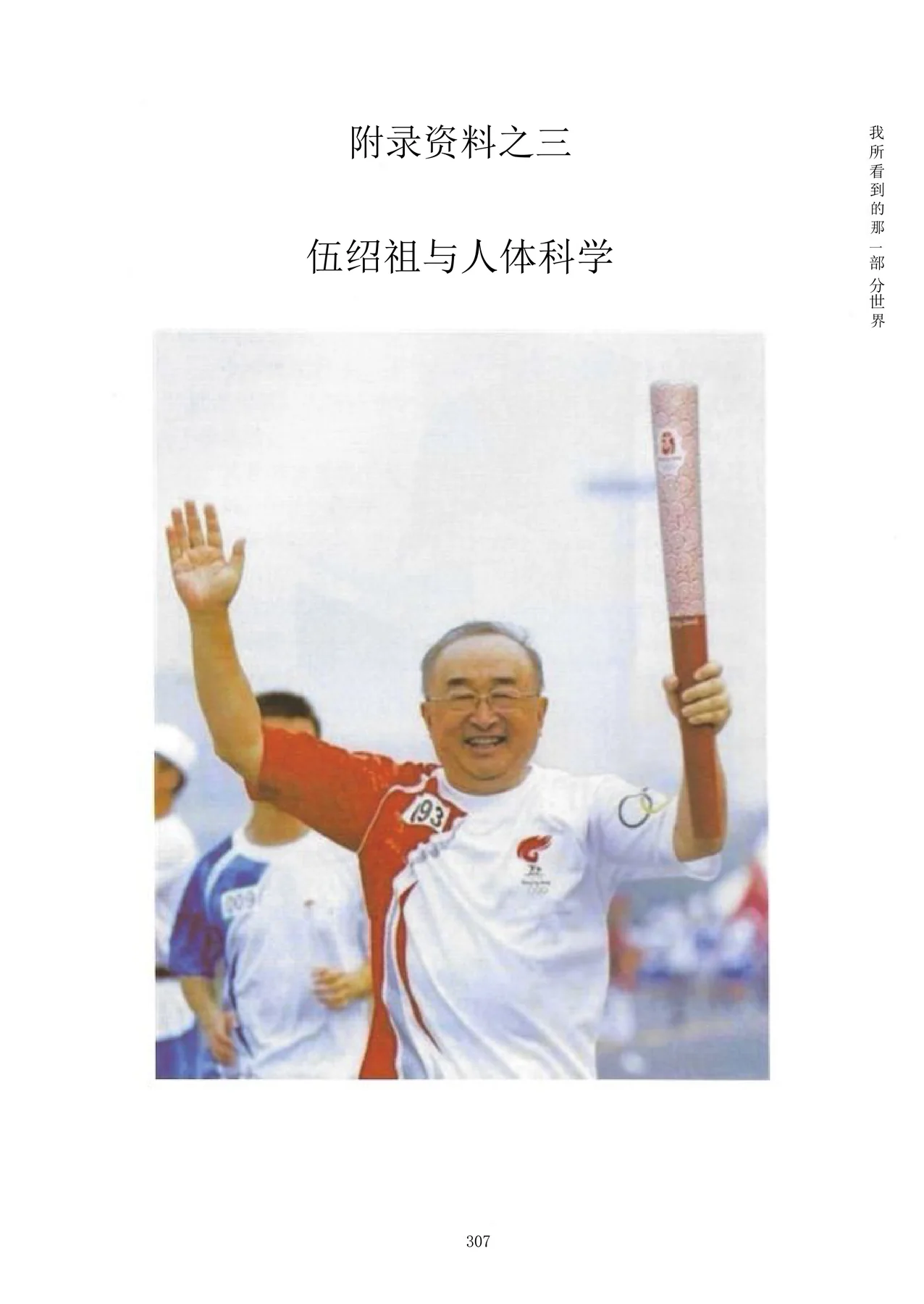
Appendix Material Three: Wu Shaozu and Human-Body Science
Wu Shaozu and Human-Body Science
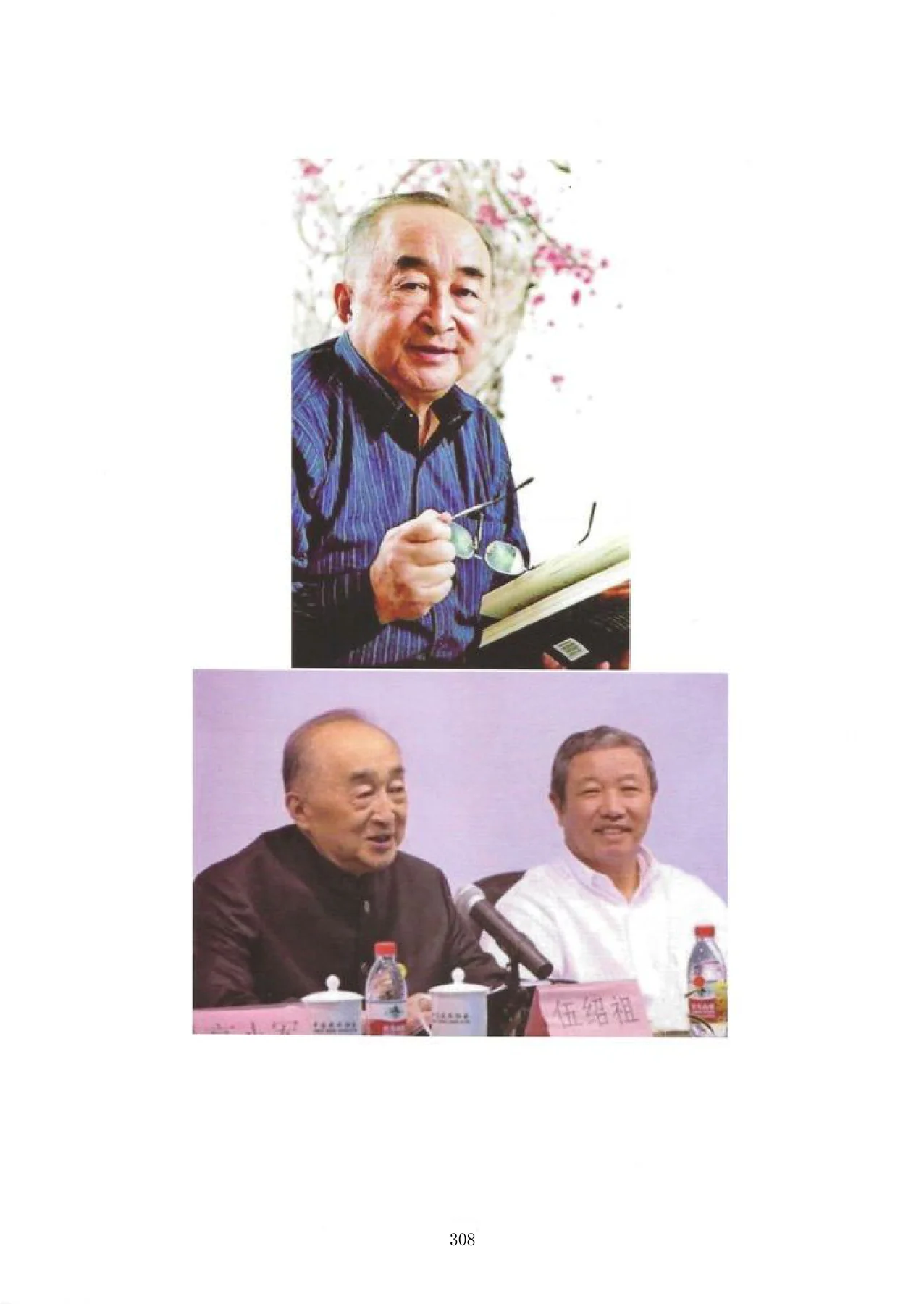
Wu Shaozu
Appendix Material 3-1
A Letter to Comrade Hu Yaobang
Comrade Yaobang,
On February 25 this year, the People’s Daily formally stated its position, supporting several comrades in “criticizing the so-called research and promotion of ‘human extraordinary functions.‘” I believe this is imprudent.
From the level of my own knowledge, I previously did not believe in so-called “reading characters with the ear.” However, as someone who works on the front lines of natural science, the first principle must be to respect facts. Because the debate over this issue has grown increasingly heated of late, the morning before yesterday I went to observe a demonstration by a twenty-four-year-old young man from Liaoning named Zhang Baosheng. I went with the greatest skepticism and a strictly critical eye. It was said that his performance this time was less than ideal, yet in the end, under the watchful eyes of everyone present, he successfully recognized and reproduced the characters “宝” (bao), “甲” (jia), and “由” (you) written on paper that had been folded multiple times and crumpled into a ball (the latter two characters were looked up from the Kangxi Dictionary; I do not know how they are pronounced). The comrades present and I all agreed that it would have been virtually impossible for him to cheat. Therefore, I believe that on the matter of “human extraordinary functions,” one cannot adopt a cavalier attitude of denial. To put it in extreme terms, even if it were discovered that among one hundred “extraordinarily able” persons, ninety-nine had cheated, so long as even one was completely ruled out from cheating, then this phenomenon must be affirmed.
Looking across the history of science, when Copernicus first proposed the heliocentric theory, when Galileo insisted on the theory that the Earth rotates, when Morgan proposed the gene theory, and when Einstein proposed the theory of relativity, all were subjected to severe attacks by entrenched forces. Among those who championed the new theories, some suffered persecution and even lost their lives, as in the case of Bruno. The Soviet Union officially branded genetics as a “bourgeois idealist pseudoscience,” yet facts ultimately proved that it was precisely their Lysenkoist doctrine that was the real pseudoscience. From the examples cited above, one can see that phenomena that prevailing theories cannot explain are often the heralds of great leaps in science; once discovered and elevated to scientific theory, they carry profoundly significant scientific meaning and practical value—
—and may even constitute an enormous stimulus to philosophy. Lenin’s Materialism and Empirio-Criticism is an outstanding example. At the time, new discoveries in physics led some vulgar philosophers to exclaim that “matter has disappeared; only equations remain,” yet Lenin used these very developments to advance the philosophy of dialectical materialism.
Now, what is called “human extraordinary functions” has challenged the laws of nature and philosophical conceptions to which people have grown accustomed. This is an extremely serious matter. I believe that comrades who bear leadership responsibilities on the front lines of science and technology have a duty to organize scientific and technical personnel to clarify this question. What they should do is not pronounce a death sentence on “human extraordinary functions” proceeding from already established principles, but rather organize adequate, thorough, and impartial experiments, and use practice to determine whether or not “human extraordinary functions” exist. This work should proceed in a down-to-earth, solid manner; the press, and especially Party newspapers, should not rush to express opinions. It is said that one comrade has declared that he is waging a Marxist “holy war,” but I worry that his current approach may well end up doing Marxism more harm than good. Correctly handling this matter bears on the political influence of the Communist Party of China and on the uprightness of Party conduct.
It seems it was Shang Yang who said: “The foolish are blind to what has already taken shape; the wise perceive what has not yet sprouted.” I am no wise man, yet I feel that the current debate and the issues being debated may perhaps give rise to something of great consequence. You once praised Deping’s essay about the “great scale,” “ounces and pounds,” and the dialectical relationship between the two. You have now been placed by history in a position holding the “great scale,” while I am here prattling on about matters of “ounces and pounds.” Nevertheless, I am confident that these matters of “ounces and pounds” are related to the “great scale,” and so I have taken the liberty of writing to you to share my thoughts. For anything inappropriate, I beg your forbearance.
With respectful regards,
Wu Shaozu
March 5, 1982
Appendix Material 3-2
Carrying Out Human-Body Science Research Is of Great Significance1
(October 9, 1987)
What is being convened today is the inaugural meeting of the Human-Body Science Expert Group. Following past convention, this expert group could also be called the Human Extraordinary Functions Research Expert Group. Of course, a broader and somewhat more scientific name would be the Human-Body Science Expert Group. In my remarks below, I may use both terms, without necessarily restricting myself to either one.
The phenomenon of human extraordinary functions may have existed since ancient times, but the matter we are now setting out to study, as I recall, began in 1978. At that time, in Dazu County, Sichuan, a child named Tang Yu was discovered who could read characters with his ear. This matter set off a great debate in society. At first it was promoted quite vigorously, and later the matter was criticized. One group of people persisted and carried the work forward. To this day, there remain differing views, but all of you present here are united in affirming that this matter should be researched. Comrade Qian Xuesen and Comrade Zhang Zhenhuan, who are participating in today’s meeting, took the lead in persevering under extremely difficult conditions. In particular, the experts here present, facing all manner of difficulties, have unremittingly adopted a scientific attitude in studying this matter. From the end of 1978 to the present—essentially the period since the Third Plenary Session of the Eleventh Central Committee of the Party—this matter has begun to take initial shape. In addition to the large volume of scientific research and observational records produced by the experts, some of our scientific and technical personnel in various localities successively organized themselves into research groups, and eventually, under the energetic advocacy of Senior Qian and Comrade Zhenhuan, the Human-Body Science Society was established, organizing the community’s strength in the form of a civil academic body. Furthermore, on the part of our Party and government, the matter has also received attention. With the approval of the Central Committee, a four-person leadership group was established to lead this matter.
It was to take overall responsibility for this work, providing comprehensive leadership. The members of the four-person leadership group were: one was Comrade Jia Chunwang, Minister of State Security; one was Comrade Guo Shuyan, Deputy Director of the State Science and Technology Commission; another was Comrade Li Yan, Deputy Head of the Publicity Department of the CPC Central Committee, who did not attend today’s ad hoc meeting; and then there was me. All of these areas had connections to human-body science work, and this format was used to take comprehensive responsibility for the matter.
The way the group worked was that whenever there was business to discuss, we would meet together, and whichever unit’s premises we met at, the comrade from that unit would chair the meeting. Today the meeting is at the Commission of Science, Technology and Industry for National Defense, so by agreement I have convened it.
Under the group there was an office, composed of personnel seconded from the various units. There was no dedicated establishment; they were responsible for liaising with everyone and handling day-to-day administrative affairs. These comrades were all enthusiastic about this endeavor.
In order to organize human-body science research effectively, our four-person group held several meetings, and at the last meeting we decided to establish an expert panel to serve as an advisory and consultative body to the four-person group. The members of the expert panel were not democratically elected; they were appointed by our four-person group.
The first was Comrade Chen Xin, a research professor at the 507 Institute, who had long studied human-body science and extraordinary human abilities; the second was Comrade Zhao Nanming, professor and head of the Department of Biological Science and Technology at Tsinghua University, specializing in solid-state physics and biophysics; the third was Comrade Lu Zuyin, a research professor at the Institute of High Energy Physics of the Chinese Academy of Sciences, specializing in nuclear physics and biophysics; the fourth was Comrade Chen Shouliang, an associate professor in the Department of Biology at Peking University, specializing in neurophysiology; the fifth was Comrade Xie Huanzhang, a professor at the Beijing Institute of Technology, specializing in thermal physics; the sixth was Comrade Lin Shuhuang, an associate professor in the Department of Physics at Beijing Normal College, specializing in bioelectronics; the seventh was Comrade Wang Xiubi, a research professor at the 507 Institute, specializing in medicine and radiation biology; and the eighth was Comrade Ye Ziquan, who studied biophysics at the Ministry of State Security. These comrades all became involved in this work relatively early, held a deep interest in human-body science research, and had done a considerable amount of work. These comrades pressed forward with gritted teeth through the most difficult times, covering physics, biology, medicine, neuroscience, and thermodynamics—the expertise was fairly comprehensive. For now, we have appointed these eight comrades to form the expert panel, and in the future, depending on how the field develops, we may expand it somewhat, and even consider appointing a few members from outside Beijing.
Furthermore, we specially engaged two advisors to guide the work of this expert panel: one was Comrade Qian Xuesen, and the other was Comrade Zhang Zhenhuan. The comrades present here have all made significant contributions to the development of this field, and Comrade Qian and Comrade Zhenhuan played an especially distinctive role. Because they correctly identified the direction, upheld truth, and championed justice, they enabled this undertaking to be sustained—contributions of special and major significance. That is why we have specially engaged these two comrades as advisors, so that this work can be carried out effectively.
Our four-person group decided that the office would be headed by Comrade Wang Shouyun, and also designated Comrades Shen Zhang, Tu Yuanji, and Liu Yanru as liaison officers to the expert panel. The expert panel designated Comrade Chen Xin as its head, because he had been managing this matter all along.
The expert panel is the advisory and consultative body of the four-person group, and it is accountable to the four-person group. The meaning of “advisory and consultative body” is that major issues related to extraordinary human ability research are first to be examined and evaluated by the expert panel, which puts forward recommendations and proposals, and then, after approval by the four-person group, they are implemented. As for what specific tasks it should carry out—that is, what the expert panel’s responsibilities are—I can think of the following areas:
- Evaluate and deliberate on the direction, strategy, and objectives of human-body science research (with emphasis on extraordinary human abilities of the human body);
- Research and formulate the principles, guidelines, and guides for human-body science research, or what might be called policy guidance;
- Put forward recommendations for medium- and long-term plans and near-term work arrangements for human-body science research;
- Make recommendations on organizing and coordinating the nationwide research effort and the placement of research sites;
- Appraise and review scientific research achievements;
- Report regularly to the four-person group on the progress of scientific research.
This is an authoritative body. For example, if someone claims to be able to summon wind and rain, and this person passes on the story and that person passes on the story—whether it is true or false—ultimately this panel will have the final say. You must be responsible to the nation, and you must use your work, your reputations, and your standing to confirm or deny such matters.
My own understanding of extraordinary abilities began in 1979. I studied physics, and when I first heard about this matter, I absolutely did not believe it. At the time I was assisting with work at the Secretariat of the Communist Youth League Central Committee, and I asked a cadre from the All-China Students’ Federation to go specifically to Dazu, Sichuan, to verify whether it was true or false. He found that Tang Yu, and the conclusion from the investigation was that the results were ambiguous. That cadre wrote the character “年” (year), but the child guessed “中” (middle)—the general shape was roughly similar, but the guess was incorrect. Later, in 1982, Comrade Zhenhuan asked me to observe a demonstration by Zhang Baosheng, which was not very successful. That was on March 3, 1982, at the 507 Institute; although the identification was carried out under very difficult conditions, it was nonetheless done under the watchful eyes of everyone present, and the possibility of cheating was ruled out.
The significance of carrying out this research is extremely great, and I can think of four aspects:
- Scientific significance. This may represent a leap, or a revolution, in humanity’s understanding of the world. I very much agree with Comrade Qian Xuesen’s view that this foreshadows a scientific revolution. Our current knowledge—for someone like me who has studied physics—cannot explain these phenomena. What I studied was not ordinary physics but fairly advanced physics, and even so I cannot explain these things. This shows that current understanding still cannot solve this problem. Some comrades say that these things completely violate our basic knowledge of physics and chemistry, and therefore they dismiss them. But I feel that this is precisely the issue we must take seriously, for it may reveal a new law of physics.
The arrival of this revolution may require a great deal of labor, but its significance will surely be no less than Newton’s three laws of motion, Einstein’s theory of relativity, or quantum mechanics in physics. In the past, each emergence of an advanced science—
All [scientific breakthroughs] in life go through twists and hardships, such as Copernicus’s heliocentric theory, Morgan’s theory of heredity, and Einstein’s theory of relativity — at the time, only a minority of people accepted them; the rest could not understand them and refused to acknowledge their theories. Although we are a socialist country, we will probably also have to go through many hardships, and we specialists engaged in scientific research work should be mentally prepared for this.
Second, the philosophical significance. I very much agree with what Comrade Qian [Xuesen] said: we must use Marxism as our ideological weapon to guide research into human extraordinary-ability phenomena. At the same time, our research can in turn develop Marxism. One comrade said he wanted to wage a “holy war” to defend the purity of Marxism. I believe that if one truly wants to defend Marxism, one must develop Marxism. It is just like the early twentieth century, when many new physical phenomena emerged. At the time, the Machists said that matter had disappeared and only equations remained, and some vulgar philosophers cried out that matter had vanished and Marxism no longer worked. But Lenin, based on the new phenomena discovered by physics at the time, redefined matter, thereby developing Marxism. In the future, will we Chinese people have the possibility of once again enriching and developing Marxism in this area? I think there is such a possibility.
Third, the practical value is enormous. Some of the phenomena now discovered — such as penetrating barriers, translocating objects, certain forms of mental control, concentrating energy to ignite clothing, and restoring broken objects to their original state — once their patterns are mastered, will have great value in both economic and military terms. The reason for keeping things secret is precisely consideration from this perspective.
Fourth, social problems. Zhang Baosheng has already begun to have such problems — taking other people’s things away, or prying into other people’s private affairs, and so on. What kinds of problems will this create in society? This needs to be studied.
Looking at it from these several aspects, I feel that the significance of doing this work is extremely great. It is entirely worthwhile for us to devote our lives to it, and it is something we should feel proud of and fortunate to be part of.
Finally, based on this understanding, what issues should we consider in terms of policy or overall direction? I think of four relationships:
First, we must recognize the great significance and importance of extraordinary-ability research, and at the same time we must recognize its complexity and difficulty. We must draw a clear line between science and superstition. Everyone present here is very enthusiastic about this matter, and all can adopt a scientific attitude in approaching it, but we are not conducting research in a vacuum. We are in a complex society, in a society like ours where the level of scientific and cultural development is not yet high enough, and sometimes things can get distorted and take on many superstitious overtones. Of the many bizarre and strange tales now circulating, some are actually doing us a disservice. This problem is well worth noting. Not long ago, after Comrade Qian Xuesen saw the September 22 issue of China Youth Daily, he immediately wrote me a letter, and I in turn immediately forwarded this letter to the four-person small group. Comrade Qian said: “The front-page report on September 22 is a common failing of current journalistic reporting. Apart from some inaccuracies and factual errors in certain places, the main problem is that it fails to approach such a complex matter dialectically — it only presents one side and not the other. Human-body science does indeed have great prospects and will surely lead to a scientific revolution, even giving rise to a new Renaissance. But it must also be recognized that the level of the masses is not yet high enough, and feudal superstition and ugly, backward habits still objectively exist. Therefore, the entire process is full of contradictions, and there will be many twists and turns along the way. Some qigong masters showing off to court popularity is a minor matter.” Comrade Qian’s thinking here is extremely important. We must recognize the complexity and difficulty of this problem, and we must be prepared to wage an arduous and protracted struggle for such a great and lofty cause. I think even a hundred years may not be enough to research it thoroughly. We must eliminate all kinds of interference, especially superstitious interference. Some of the tales now circulating are simply too miraculous. We must carry out our work in precisely this kind of environment. This is the relationship between science and superstition. To do scientific work, we must eliminate the interference of superstition — this is the meaning of the letter Comrade Qian wrote to me before the meeting.
Second, we must properly handle the relationship between secrecy and exchange. This involves establishing a cutting-edge discipline, and it is an extremely sensitive and very hot topic. From what we can see now, the United States, the Soviet Union, and Japan are all paying attention and all working on this matter. They too have two sides: a secretive side and an open side. Right now, many people are extending their feelers toward us, requesting contact and exchange with us, but they have their secretive side — there are certain things they absolutely will not divulge. I think we must consider matters in the same way. Designating something as a top-secret project is precisely what this means. This is a major matter bearing on national security, which is why our nation’s Minister of State Security personally participates in this work. We must avoid a situation like the one in history: the Germans Otto Hahn, Meitner, and Strassmann discovered nuclear fission in different laboratories, but Hitler did not practice a proper “intellectuals’ policy” — he was anti-Semitic and drove them away. Einstein was also a Jew. He quickly learned of this matter and wrote a letter to the President of the United States, and the atomic bomb was developed in America. Our matter is also a new discovery. In the future, could it lead to a kind of weapon — a mind-control weapon, for instance? If this thing is not kept secret, it could pose a great threat to our country. The simplest scenario is the theft of your secrets: for example, they could use a weapon that places human extraordinary abilities onto a machine and steals away your money and your documents. In this sense, we must designate it as a top-secret project.
However, after the Third Plenary Session of the Eleventh Central Committee of our Party, under the conditions of reform and opening up, we also cannot adopt the old concept of “top secret” — simply putting things in a folder and forbidding all access. Therefore, there should also be limited external exchange, and some civilian activities should still be reported. Of course, in reporting, we must pay special attention to seriousness and scientific rigor. We must not engage in sensationalism and must draw a clear line from superstition. But scientific research work involving national defense and national security must be kept absolutely secret. As for some purely basic research, exchange and reporting may be permitted, but in the initial stage, in circumstances where the boundaries cannot yet be clearly drawn, we would rather exercise somewhat stricter control. In summary, we must
We must approach materialism from the standpoint of our country’s and nation’s interests; we must not let a moment of enthusiasm push our country into a passive position due to improper handling of this issue. We should discuss this matter at our current meeting, and we will ask the office to draw up detailed regulations based on the practice of this period—especially regarding the standards for public communication and how to submit for approval—so that we have detailed rules to carry out confidentiality work properly while at the same time not creating obstacles to necessary exchange.
-
Properly handle the relationship between “official” and “civilian.” Our expert group and the four-person group are both state-recognized and can be considered official. However, because this matter is truly extraordinary and has aroused the interest of a great many scientific workers, a wide variety of organizations were established very early on. I see this as an excellent situation, showing that everyone cares about this matter and has come to research it. The official side is responsible for policy guidance, providing necessary funding support, exercising gatekeeping on matters involving national interests, and promoting everyone’s research. Civilian organizations and mass organizations should also hold a lofty scientific purpose and actively carry out their work under the guidance of the state’s unified policy. From the four-person group’s perspective, we very much want to support this matter, and we took on a certain degree of risk to secure this outcome. We have no desire to suppress it; rather, we want to do the work we should do for the healthy development of this research. Our attitude is to actively support everyone’s research, but we must not allow superstition or chaos. Otherwise, problems will immediately arise and instead bring disrepute to this cause. This relationship must be handled well. The comrades in our expert group should also support everyone’s work in this manner, rather than restricting everyone’s work. Our support does not mean endlessly praising them; we must provide policy guidance so that they know what they should pay attention to.
-
Our authority to carry out this work has now been recognized by the Party and the state, and we have been given great support. We are doing this work openly and properly, and no longer in a situation where our standing is illegitimate and our words carry no authority. But under these circumstances, we must still
carry forward the spirit of tenacious struggle and scientific dedication that we had in the early period when there were many difficulties. We should advocate that all comrades participating in this work should not seek fame or profit, but should strive to advance this cause and this science. We should not fight over fame and profit, or over who discovered something first or who did what; rather, we should unite and cooperate. In the difficult early period, many comrades did exactly this. Now that we have such good conditions, with the four-person group and the expert group established, we should produce rigorous, systematic, scientific, and authoritative conclusions for the country. We must provide rigorous, systematic, scientific, and authoritative results to the country, so that the state can understand the actual situation and make scientific decisions. We must not turn our official authoritative organization into a bureaucratic institution, into a government office; rather, we must adopt an enthusiastic attitude and serve the development of this cause.
Earnestly Summarize Experience and Lessons, and Promote the Healthy Development of Human-Body Science Research2
(March 8, 2009)
This round of human-body science research has now gone on for thirty years. How is this calculated? One method of reckoning starts from March 11, 1979, when Sichuan Daily first reported that Tang Yu could recognize characters with his ears; another method starts from November 1978, when Tang Yu was discovered to have the ability to recognize characters with his ears. The timeframes of both methods are roughly the same. These thirty years happen to coincide exactly with the thirty years of reform and opening up after our Party’s Third Plenary Session of the Eleventh Central Committee. The Third Plenary Session of the Eleventh Central Committee played a very important role in the history of our Party, reaffirming the ideological line of “emancipating the mind and seeking truth from facts.” Human-body science research developed under the guidance of this ideological line.
Today, as we commemorate the thirtieth anniversary of human-body science research, we must deeply cherish the memory of comrades who have passed away: Yang Chao, Nie Chunrong, Li Xu’e, Zhang Zhenhuan, Chen Minzhang, Feng Lida, Wang Shouyun, Chen Xin, and others. We must also express lofty respect to the scientific workers who have consistently supported this work, such as comrade Qian Xuesen, comrade Zhu Runlong, comrade Zhu Yiyi, comrade Xu Lanxu, comrade Liu Yicheng, comrade Song Kongzhi, comrade Yang Jianhua, comrade Shen Jinchuan, comrade Li Shengping, and others. We must also express heartfelt thanks to the extraordinary-ability persons who came today and participated in experiments—comrade Tang Yu, comrade Chen Zhu, comrade Sun Chulin, comrade Mou Fengqin, comrade Xu Mei, comrade Wo Ergen, and others—as well as comrade Zhang Baosheng, comrade Wang Lin, and many others who could not come today. We must also extend our gratitude to those who have actively supported
To the party and government cadres who have worked on this effort — Comrade Jia Chunwang, Comrade Teng Teng, Comrade Li Yan, Comrade Guo Shuyan, Comrade Zhao Zongnai, Comrade Li Yingjie, Comrade He Dequan, Comrade Liu Jibin, Comrade Gao Chao, Comrade Wang Jiayou, Comrade Fu Zhengtai, and many other comrades who participated in this work — I wish to express my gratitude. Although it is only right and proper, an unquestionable duty, for our party and government cadres to support this undertaking, persisting in this matter has truly not been easy. Seeing so many comrades here today gives me the greatest satisfaction. There are also many who wanted to come but could not due to other commitments, as well as those who should have come but were not notified — I send them all my regards.
Looking back over these thirty years, we have traversed an extraordinary course — one could say full of twists and turns. I counted it up: there have been “four risings” and “three fallings.” First, beginning in November 1978, the first wave of enthusiasm surged. There were both supporters and opponents of this matter, and the opponents included heavyweight figures, so it cooled down again. I first came into contact with this matter in 1979, but what truly drew me into this ranks was in March 1982, when Comrade Zhang Zhenhuan asked me to watch a demonstration by Zhang Baosheng. Comrade Zhenhuan was under tremendous pressure at the time and wanted me and Comrade Nie Li together to report the situation to Comrade Hu Yaobang, then Chairman of the Party, and Comrade Nie Rongzhen, the towering figure in the scientific and technological community. That is how I became involved, and I did in fact report to Comrade Hu Yaobang. Later, Comrade Hu Yaobang wrote an instruction on a report by Comrade Qian Xuesen — an excellently worded instruction — and the Central Propaganda Department also issued a document. The second round began to flourish from 1982 onward. During this round, in addition to Comrade Yaobang’s instruction and the Central Propaganda Department’s document, the Chinese Human-Body Science Research Association was established, and the central leadership also approved the establishment of a Human-Body Science Work Leading Group, with Comrade Jia Chunwang, Comrade Teng Teng (later Comrade Li Yan), Comrade Guo Shuyan, and myself — four people in total — as group members. During this phase, there were still divergent opinions. At the end of the 1980s I was transferred to the Physical Culture and Sports Commission, Comrade Shuyan was transferred to Hubei, and things gradually cooled down again. The third round came at the end of 1990, when Jia Chunwang, Guo Shuyan, Li Yan, and I wrote a report to the central leadership —
After the leading comrades of the Party Central Committee studied the report, Comrade Li Peng asked Comrade Li Tieying and Comrade Song Jian to take charge of this matter. A “Six-Person Group” was established, which later developed into a “Ten-Person Group,” and I was chosen to serve as its head; things began to flourish again. During this period, there were still dissenting voices. In particular, the 1995 incident known as “Zhang Baosheng’s Defeat at Maicheng” occurred, followed by the 1999 “Falun Gong” incident, and gradually this matter entered another trough. After the beginning of the new century, the thinking of the new Party Central Committee became more emancipated. Those of us involved often discussed how to continue persevering in this undertaking; this may be called its fourth rise. The Party Central Committee has now called for independent innovation. I have also noticed that the three characters for “pseudoscience” have been removed from current Party Central Committee documents and revisions to the law. I personally strongly oppose pseudoscience. We are engaged in science, so of course pseudoscience must be opposed; but some people equate “pseudoscience” with Wu Shaozu and say that I am the ringleader of pseudoscience. That is problematic. We have now begun a new round of research work, and its scope is even broader. For example, the International Forum on Health, Fitness, and Longevity that we have recently been organizing is also related to this work.
After experiencing so many hardships, why have we still been able to persevere in this undertaking? I believe the most fundamental issue is to uphold science. We must possess the scientific spirit: have the courage to explore and to question, remain undaunted by repeated setbacks, and advance bravely. We must possess a scientific attitude: proceed from actual conditions in everything, seek truth from facts, absolutely refrain from feudal superstition, and refrain from deceiving the public in pursuit of fame. We must also possess scientific methods; the comrades just now discussed many scientific methods. In short, as Comrade Yang Jianhua just said, the issue is how to bring human-body science research onto the track of science.
The significance of the human-body science research in which we are engaged is tremendous.
First, it has great scientific significance. I studied theoretical nuclear physics in the Department of Engineering Physics at Tsinghua University for eight years. This matter cannot be explained using our modern scientific knowledge, and therefore needs to be researched. Scientific development has proceeded from classical mechanics
…all the way to relativistic mechanics, to quantum mechanics — even now there remain many problems that cannot be solved. For instance, what exactly is zero-point energy? What is vacuum energy? What are torsion fields and low-temperature nuclear fusion? A classmate of mine is working on low-temperature nuclear fusion, and I wrote a letter specifically on this matter to Comrade Liu Yandong. I said that if it succeeds, it could potentially win a Nobel Prize, and if it fails, it would cost at most 500,000 yuan. In the past, the United States opposed low-temperature nuclear fusion, but now they have changed their attitude as well. Then there is the question of water transforming into oil — what exactly is going on? I personally went to Wang Hongcheng’s place three times and observed very carefully. I myself took a bottle, filled it with tap water, took a sip, and then held the bottle continuously while someone put a drop of catalyst into it. In the end it all turned into oil and was entirely burned away. All of these are questions that remain unresolved, and perhaps hidden within them lies an immense domain of science. That is why I strongly agree with what Comrade Qian Xuesen said: human-body science research “will trigger a scientific and technological revolution” and “is the Mount Everest of the field of science and technology.”
Second, it carries great philosophical significance. How should we regard this world of ours — that is, how do we uphold materialism, how do we uphold dialectics? Only by developing the theory can we hold firm; without development, we cannot hold firm. Take an example: at the beginning of the twentieth century, the annihilation of electron-positron pairs upon collision was discovered. Some vulgar philosophers declared that matter had been annihilated and only equations remained. But Lenin, on the basis of this phenomenon, developed Marxism. He said that matter is objective reality existing independently of consciousness. In this way he both developed Marxism and upheld Marxism.
Third, it has tremendous practical value. Generally speaking, a scientific and technological revolution brings about an industrial revolution, and an industrial revolution brings about a social revolution. The invention of the steam engine and the invention of electricity were both like this in the past. The examples that Comrade Li Shengping gave just now are also excellent.
Fourth, it carries great political significance. How can our Chinese nation make a greater contribution to the peoples of the world? This is an excellent opportunity. If
our Party, our country, and our nation were indifferent to this matter, we would lose this opportunity.
In our research work, we should set several requirements for ourselves.
First, we must have perseverance and an unyielding spirit, and persist to the end. We must recognize the inevitability of setbacks in the development of things, and see that every success involves twists and turns, but the future is bright. The book Journey to the West tells of events that are entirely fictitious, but it conveys a very profound truth: to obtain the true scriptures, one must pass through eighty-one tribulations. Tang Seng passed through eighty tribulations and obtained the true scriptures, but on the way back, when crossing a river, he still fell into the water, because he was still one tribulation short.
Second, we must have a truth-seeking attitude. Once we have grasped the facts, there is nothing to fear. We hold high the banner of opposing “pseudoscience.”
Third, we must remain calm and not engage in emotional criticism. Today, we ask the comrades present not to speak ill of others — just do our own work well.
Fourth, we must keep a low profile. Today, we deliberately did not invite news media, and we should not report on this. Three comrades from China Central Television came to attend the meeting, but they came in their personal capacity, and they have consistently supported this cause. I also hope that everyone present will not brag. Younger comrades in particular frequently go online and write blogs. I suggest that no one promote this meeting — do not invite trouble for yourselves. Conditions are relatively favorable now, because this matter is real, and the Party Central Committee has called for independent innovation, so it can continue to develop. The better the conditions, the less we need to promote ourselves. As the saying goes, good wine needs no advertisement — its fragrance carries even from the depths of a long alley.
This undertaking has been underway for thirty years, and a new beginning is needed. I feel that holding a meeting at this time to earnestly sum up experiences and lessons is very important. I have carefully studied the report of the Seventeenth National Congress, in which Comrade Hu Jintao specifically discussed the
valuable experience of reform and opening up, and discussed the “ten combinations,” which is excellent. At the conference held by the Party Central Committee last year to commemorate the thirtieth anniversary of the convening of the Third Plenary Session of the Eleventh Central Committee, the “ten combinations” were elaborated in detail. I believe this accords with Marxism-Leninism, accords with China’s reality, and also accords with Chinese culture. Chinese culture contains the idea of the unity of opposites. Today, I also borrow this concept of the unity of opposites to discuss the experiences and lessons of our work over the past thirty years.
First, we must properly handle the relationship between truth and falsehood. We must steadfastly seek truth and be practical, and absolutely must not engage in fabrication — we must ensure that experiments are conducted rigorously. Just now, Elder Huang mentioned that Elder Qian attached great importance to this issue, and I also think it is very important. Comrade Yang Jianhua also mentioned that we still have many problems we have not fully understood.
Second, we must properly handle the relationship between correctness and error. What is correct is to uphold Marxism and conduct scientific research solidly. There are two main types of errors — to borrow political language, one is the “Left” error: some people also wish to uphold Marxism, but their thinking is conservative and backward, and they constantly use outdated viewpoints to criticize us. If they have personal ulterior motives, that is a different matter; but even if they do not, it is still incorrect. The other is the Right error: some people do not understand the subject themselves, yet make wild claims, portray certain things as extremely bizarre, and engage in feudal superstition and idealism — this is also incorrect. We must uphold what is correct and correct what is wrong.
Third, we must properly handle the relationship between the present and the future. The Party Central Committee has now put forward the Scientific Outlook on Development, calling for sustainable development. Our research work should be the same. When we first began this work, Chen Zhu was still only in his teens; Wang Qiang and Wang Bin were still children; Sun Chulin and Zhang Baosheng were also very young. Now, thirty years have passed, and thirty years must be added to all their ages — everyone has grown older. How will the next generation carry on? Finding Woergen now is a good thing. Those of us engaged in research also need to find younger comrades to take up the work.
Fourth, we must properly handle the relationship between principles and experiments. At present, I advocate first
making experiments clearer and more extensive. Of course, this does not mean we should not work on applications and principles — those can also be pursued. But the current emphasis should be on facts: developing applications on the basis of experiments, and then further exploring principles.
Fifth, we must properly handle the relationship between the private sector and officialdom. I have now completely retired and am purely a private citizen. Previously, I was still an official. But I have always believed that the foundation and hope lie in the private sector. We should not count on any government department to support us. Even if no one supports us, we must still conduct our research. Any successful research has arisen in just this way. We must base ourselves in the private sector. Of course, I also hope that official channels may provide support, but as for how to do so, I hope the comrades in management will think of some approaches.
Sixth, we must properly handle the relationship between internal causes and external causes. I very much believe in what Chairman Mao said: “Internal causes are the basis; external causes are the conditions.” Whether we are those with extraordinary human abilities, comrades researching this matter, or leading comrades, we must devote our main energy to internal research. Just now, Comrade Shuyan said there is no money. We need to find ways to solve this problem, but that is an external cause — a condition. In the past, when I worked at the Physical Culture and Sports Commission, there was also no money for developing sports, and I found ways to develop the sports industry. I previously did not attach much importance to the issue of money, but now I recognize that money is still very important. Money is not omnipotent, but without money, nothing is possible. When we organize activities, it is acceptable to collect modest fees, but we must not make earning money our purpose or become obsessed with money. For example, when convening the Health, Fitness, and Longevity Forum, it is fine to collect a small cost-recovery fee from those who attend the conference, give presentations, or set up exhibitions.
Seventh, we must properly handle the relationship between revolutionary spirit and material interests. Comrades researching this issue must also carry forward the spirit of our “Two Bombs and One Satellite” program, carry forward the Yan’an spirit of selfless dedication without regard for compensation. But we must also pay attention to providing appropriate subsidies to researchers and those with extraordinary human abilities, strive to find enterprises to sponsor our cause, and strictly manage personnel, finances, and materials.
Eighth, we must properly handle the relationship between the majority and the minority. Chairman Mao said that
Truth is often held in the hands of a minority. Let me put it more absolutely: great truths are always first grasped by a minority, and then slowly spread outward. When Einstein’s theory of relativity was first introduced, only six people in the world understood it, at a time when the world’s population was over two billion. Whether something is truth is not decided by leaders, nor is it decided by the masses—it is decided by experiment. So there is no need to fear being the “minority”; what we should fear is not having grasped the truth.
Ninth, we must properly handle the relationships between different factions. First, the state should apply toward us the policy of “letting a hundred flowers bloom and a hundred schools of thought contend.” Second, between factions themselves, the “double hundred” policy should also be implemented. The theory presented by Song Kongzhi in his report just now was very good, and Chu Deying’s theory was also very good, but neither can claim to be absolute truth. Toward different theories, we must show mutual respect, mutual understanding, mutual learning, and mutual reference.
Tenth, we must properly handle the relationship between the social sciences and the natural sciences. Physics research is relatively simple by comparison, whereas the research we engage in is more complex, because our object of study is the human body. The human body has its own physiological demands and also possesses social attributes. Our comrades working in the natural sciences must also respect the laws of the social sciences.
Eleventh, we must properly handle the relationship between inheritance and development. When I was working at the Physical Culture and Sports Commission, during one year’s human-body science work report meeting, a comrade expressed the view that new theories should be built upon the foundations of past relativistic mechanics and Newtonian mechanics. In fact, they have their limitations—Newtonian mechanics only applies to low-speed, macroscopic conditions, and relativity is useful under high-speed, microscopic conditions, but still has its range of application; exceeding that range leads to error. New theories do not absolutely negate past theories; rather, they develop past theories.
Twelfth, we must properly handle the relationship between confidentiality and exchange. Although human-body science knows no national borders, all of you here—human-body science workers and those with extraordinary human abilities—each have a motherland. You are a part of the Chinese nation, and you must win glory for the Chinese nation. Only then will you have motivation and a sense of belonging. The United States also has specialized units responsible for this matter, and they too pay close attention to confidentiality.
I believe that with at least the above principles in place, our human-body science work can proceed along a scientific and correct path.
Today’s meeting has gone very well. I suggest that after the meeting, we might compile the remarks made by each comrade today into a small booklet and distribute it to everyone as a memento, without public release. In addition, we might also write a meeting summary to reflect the proceedings of this conference.
Finally, I wish that in the new thirty years, human-body science will develop even more healthily and even more rapidly!
—The above is all excerpted from the Collected Works of Wu Shaozu, Human-Body Science Volume
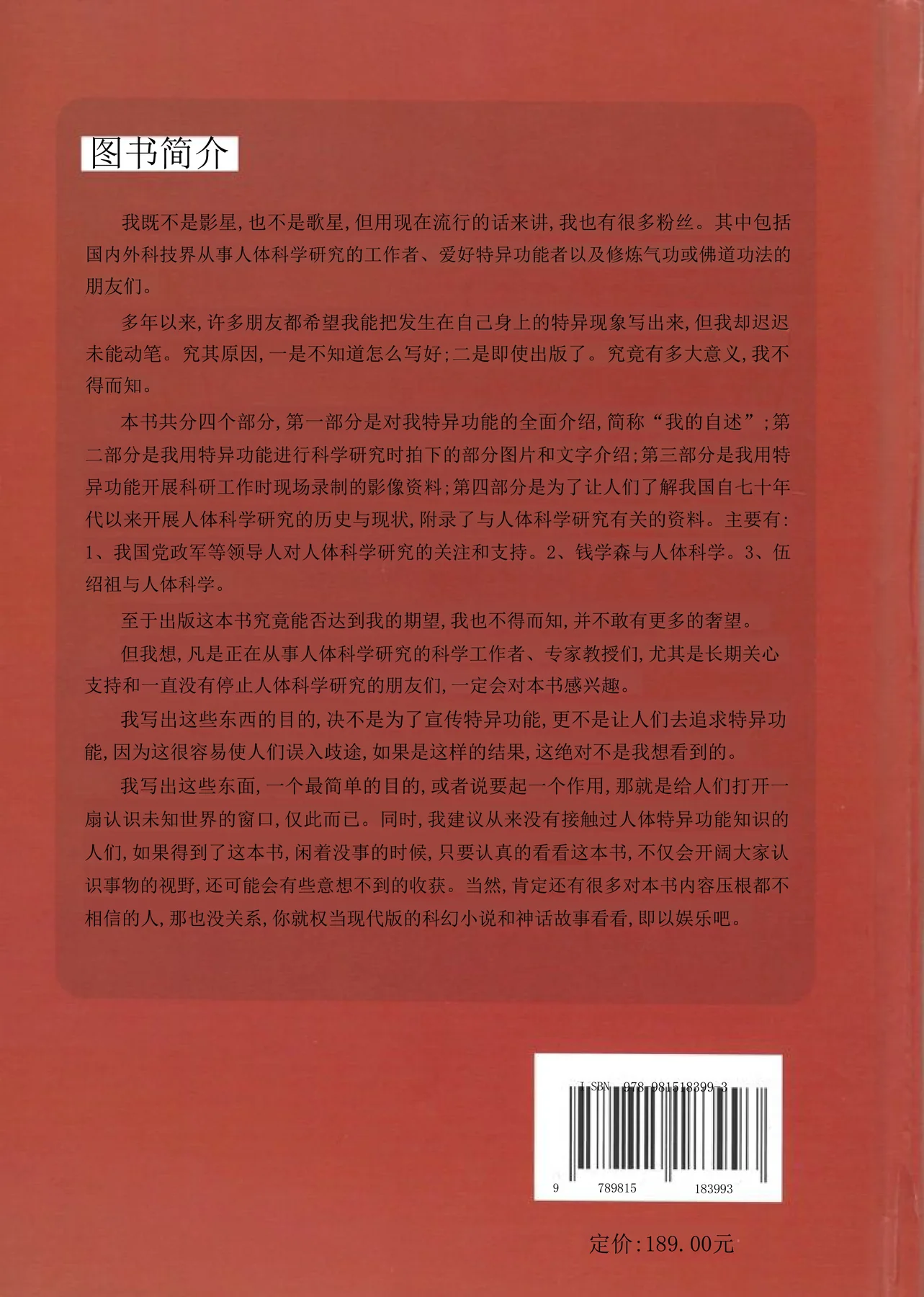
Book Introduction
I am neither a movie star nor a singing star, but in the popular parlance of today, I too have many fans. Among them are researchers in the domestic and international scientific communities who are engaged in human-body science, enthusiasts of extraordinary human abilities, and friends who cultivate qigong or Buddhist and Daoist practices.
For many years, many friends have hoped that I could write about the extraordinary phenomena that have happened to me, but I have been slow to put pen to paper. The reasons are, first, that I did not know how best to write it; and second, even if it were published, I had no way of knowing how much significance it would ultimately hold.
This book is divided into four parts. The first part is a comprehensive introduction to my extraordinary human abilities, referred to in brief as “My Personal Account.” The second part presents selected photographs and written descriptions captured during my scientific research using extraordinary human abilities. The third part comprises video materials recorded on-site during my scientific research work using extraordinary human abilities. The fourth part, in order to help people understand the history and current state of human-body science research in our country since the 1970s, appends materials related to human-body science research. These mainly include: 1. The attention and support of leaders in our Party, government, and military for human-body science research. 2. Qian Xuesen and human-body science. 3. Wu Shaozu and human-body science.
As to whether publishing this book can achieve my hopes, I truly cannot know, nor do I dare to entertain greater extravagant expectations. But I believe that all the scientific workers, experts, and professors who are currently engaged in human-body science research—especially those friends who have long cared about, supported, and never ceased their human-body science research—will certainly find this book of interest.
My purpose in writing these things is by no means to promote extraordinary human abilities, much less to encourage people to pursue extraordinary abilities, because doing so can easily lead people astray. If that were the outcome, it would absolutely not be something I wish to see.
The simplest purpose in my writing these things—or rather, the function I hope it will serve—is to open for people a window onto the unknown world, and nothing more. At the same time, I would suggest that those who have never before encountered knowledge of human-body extraordinary abilities, should they obtain this book, might read it carefully in their leisure time. Not only will it broaden their horizons for understanding the world, but it may also bring some unexpected gains. Of course, there will surely be many people who do not believe a word of the content of this book. That is also fine—you may simply read it as a modern version of a science fiction novel or a mythological tale, purely for entertainment.
ISBN 978-981-5183-99-3
Price: ¥189.00