Seeing Without Eyes Is Possible
Intuitive Vision and Expanded Intuition
Jordi Imbert Riera and Tània Agorreta Albert
**TÀNIA AGORRETA ALBERT **
**JORDI IMBERT RIERA **
**SEEING WITHOUT THE EYES IS POSSIBLE **
INTUITIVE VISION AND EXPANDED
INTUITION
Contents
- PROLOGUE Seeing to believe? by Alex Gómez-Marín
- INTRODUCTION by Jordi Imbert
- CHAPTER I If seeing without the eyes is possible, why didn’t we know? HISTORY OF THE ABILITY TO SEE WITHOUT THE EYES
-
- CLUES OF VISION WITHOUT THE EYES IN EARLY CIVILIZATIONS
-
- EVIDENCE OF VISION WITHOUT EYES IN MODERN TIMES
- 2.1. BEFORE THE 20TH CENTURY
- 2.2. 20TH CENTURY. THE 20S AND 30S. FIRST REPORTED CASES
- 2.2.1. ARGAMASILLA. A MARQUIS WITH A LOT OF POWER
- 2.2.2. JULES ROMAINS AND HIS EXPERIMENTS
- 2.2.3. RENÉ MAUBLANC AND LEILA HOLTERHOFF HEYN: HEIRS OF PAROPTIC PERCEPTION AND EXTRARETINAL VISION
- 2.3. THE 50S AND 60S. MORE CASES AND MORE SCIENTIFIC STUDIES
- 2.3.1. KUDA BUX; A FAIRY-TALE STORY
- 2.3.2. SOVIET WOMEN WITH SURPRISING ABILITIES
- 2.3.3. SOVIET SCIENTISTS INVOLVED IN THE INVESTIGATION OF DOP
- 2.3.4. EXPERIMENTS WITH HYPNOSIS IN THAILAND
- 2.3.5. GETARAN; VISION BY VIBRATION
- 2.3.6. SOME CASES IN THE UNITED STATES OF AMERICA
- 2.4. THE 80S AND 90S. FROM INVESTIGATIONS TO METHODS, AND FROM SEEING WITHOUT THE EYES TO QUANTUM ORGANIC COMPUTERS.
- 2.4.1. EXTRAOCULAR VISION AND DERMOVISION
- 2.4.2. SOVIET ORBIT OF THE 80S AND 90S
- 2.4.3. LLOYD F. HOPKINS AND MENTAL VISION AND PERCEPTION
- 2.4.4. THE SUPER PSYCHICS OF CHINA
- 2.4.5. MAKOTO SHICHIDA AND RIGHT HEMISPHERE EDUCATION
-
- 2.4.6. MID BRAIN ACTIVATION
- 2.4.7. YVONNE DUPLESSIS AND STUDIES ON COLORS
- 2.4.8. NATALIA BEKHTEREVA, AT THE PINNACLE OF THE RUSSIAN SCIENTIFIC COMMUNITY
- 2.5. NEW MILLENNIUM. THE BOOM OF SCHOOLS AND THE NEW SPIRITUALITY
- 2.5.1. DRUNVALO AND LIVING IN THE HEART
- 2.5.2. INGE BARDOR
- 2.5.3. CHRSITINE VON DREIEN
- 2.5.4. KATHARINA FRIEDRICH AND HER IMPROVEMENT IN VISION
- 2.5.5. THE GREAT BOOM
-
- GUARANTEES OF TRUTHFULNESS AND BLINDFOLDS
- 3.1. DETRACTORS OF THE ABILITY TO SEE WITHOUT THE EYES
- 3.2. DISMANTLING, RESPECTFULLY, GARDNER’S THEORIES
-
- ANSWERING THE FIRST QUESTIONS
- 4.1. AN UNKNOWN ABILITY?
- 4.2. WE’VE RUN INTO THE CHURCH… AND WITH SCIENCE TOO
- 4.3. ANOTHER WAY TO DECEIVE
- 4.4. A MESS WITH NOMENCLATURE
- 4.5. AT THE SPEED OF WORD OF MOUTH AND RESTRICTIVE OR EXCLUSIVE POLICIES
- 4.5. AND… HOW IS IT POSSIBLE THAT THE BLIND HAVE NOT DISCOVERED IT BEFORE?
-
- SO, WHAT NAME DO WE USE?
- 2.5. NEW MILLENNIUM. THE BOOM OF SCHOOLS AND THE NEW SPIRITUALITY
- CHAPTER II HOW IS IT POSSIBLE TO SEE WITHOUT THE EYES? BIOLOGICAL AND PHYSIOLOGICAL CLUES THAT COULD ALLOW INTUITIVE VISION
-
- THEORIES ABOUT THE PINEAL GLAND
- 1.1. STATES OF CONSCIOUSNESS
- 1.2. THE PINEAL GLAND AS AN ANTENNA
- 1.3. EXPERIENCES THAT VALIDATE THE FUNCTION OF THE PINEAL GLAND
-
- THEORIES RELATED TO THE ABILITIES OF THE RIGHT HEMISPHERE
-
- 2.1. COMMON ASPECTS BETWEEN THE DEVELOPMENT OF THE RIGHT HEMISPHERE AND THE ABILITY TO SEE WITHOUT THE EYES
- 2.2. TRAINING WITH IMAGES
- 2.3. SYNESTHESIA
- 2.4. INTUITION. ANOTHER ABILITY OF THE RIGHT HEMISPHERE?
- 2.5. THE PINEAL GLAND COMES INTO PLAY AGAIN
- 2.6. HEMISPHERE SYNCHRONIZATION AND ALPHA STATE
- 2.7. THE “AWAKENING” OF THE RIGHT HEMISPHERE
- 2.8. SAVANT SYNDROME. EVIDENCE FROM NEUROSCIENCE
- 2.9. GENIUSES OF HISTORY AND INTUITION
- 2.10. THE “LITTLE SCREEN” AND OUR EXPERIENCES
-
- THEORIES ABOUT THE FUNCTION OF THE SKIN AND INTUITIVE VISION
- 3.1. ANIMALS THAT SEE WITHOUT THEIR EYES
- 3.2. RECEPTORS OF HUMAN SKIN THAT COULD CONTRIBUTE TO INTUITIVE VISION
-
- THE “FIVE” SENSES
-
- THEORIES ABOUT BIOPHOTONS AND CHAKRAS
- 5.1. WHAT ARE BIOPHOTONS?
- 5.2. THE CHAKRAS
- 5.3. CHAKRAS AND INTUITIVE VISION
- 5.4. CONCLUSIONS REGARDING BIOPHOTONS AND CHAKRAS
-
- THE SECRETS OF THE HEART
- 6.1. THE INTELLIGENCE OF THE HEART
- 6.2. CARDIAC COHERENCE
-
- OUR EXPERIENCES
- 7.1. AGE IS IMPORTANT
- 7.2. THE ABILITY TO VISUALIZE IS IMPORTANT
- 7.3. BELIEFS LIMIT
- 7.4. THE ENVIRONMENT IS ESSENTIAL
- 7.5. LIGHT IS NOT ESSENTIAL
- 7.6. TEMPERATURE DOESN’T MATTER EITHER
- 7.7. IT IS NOT TELEPATHY OR HYPERMNESIA
- 7.8. THEY DO NOT SEE THROUGH ANY HOLE
- 7.9. THE SKIN, THE PALATE, THE DELOCALIZATION OF THE ABILITY
-
- OUR HYPOTHESES AND CONSIDERATIONS FOR FUTURE SCIENTIFIC STUDIES
- CHAPTER III How do we train this ability and what benefits does the practice bring? THE 4 PILLARS OF INTUITIVE VISION
-
- THE 4 PILLARS OF INTUITIVE VISION
- 1.1. THE ABILITY TO CAPTURE SUBTLE INFORMATION FROM THE ENVIRONMENT
- 1.2. THE ABILITY TO VISUALIZE AND WORK WITH IMAGES
- 1.3. LIMITING BELIEFS AND OBSTACLES
- 1.3.1. LIMITING AND ENHANCING BELIEFS
- 1.3.2. BELIEFS ARE ALSO EXPLAINED FROM BIOLOGY
- 1.3.3. CREATING A NEW “SELF”
- 1.3.4. HOW TO WORK ON OBSTACLES AND LIMITING BELIEFS
- 1.4. BIOENERGY
- 1.4.1. BREATHING; THE KEY TO IMPROVING OUR HEALTH AND OUR INTUITION
- 1.4.2. CARDIAC COHERENCE
- 1.4.3. ENERGY GOES WHERE WE PUT OUR ATTENTION
- 1.4.4. HEALTHY HABITS
-
- DIFFERENCES BETWEEN CHILDREN AND ADULTS; WHY DO CHILDREN GENERALLY ACHIEVE GREATER RESULTS REGARDING INTUITIVE VISION
-
- THE BENEFITS OF THIS PRACTICE
- 3.1. BENEFITS OF THE FIRST PILLAR
- 3.2. BENEFITS OF THE SECOND PILLAR
- 3.3. BENEFITS OF THE THIRD PILLAR
- 3.4. BENEFITS OF THE FOURTH PILLAR
-
- RESULTS REGARDING VISION WITHOUT THE EYES
-
- ATTENTION TO DIVERSITY
- 5.1. DYSLEXIA
- 5.2. ADHD
-
-
- TIPS BEFORE TRAINING INTUITIVE VISION
- 6.1. NUTRITIONAL ADVICE
- 6.2. BREATHING EXERCISES
- 6.3. THE IMPORTANCE OF SLEEPING
- CHAPTER IV And if seeing without the eyes is possible, what else is possible? EXPANDED INTUITION AND OTHER ABILITIES
-
- SCIENTIFIC EXPERIMENTS ON EXTRASENSORY ABILITIES
- 1.1. EXPERIMENT ON THE POWER OF INTENTION
- 1.1.1. THE PEAR STUDIES
- 1.1.2. RENÉ PEOC’H’S EXPERIMENTS
- 1.1.3. HEALING THROUGH THE POWER OF INTENTION
- 1.2. TELEPATHY EXPERIMENTS
- 1.3. REMOTE VIEWING EXPERIMENTS
-
- OUR EXPERIENCES WITH TELEPATHY
- 2.1. TELEPATHY WITH ZENER CARDS
- 2.2. TELEPATHY WITH EMOTIONS
-
- TÀNIA’S EXPERIENCES WITH REMOTE VIEWING
-
- EXPANDED INTUITION THROUGH THE LITTLE SCREEN
-
- OTHER EXPERIENCES
- 5.1. TELEKINESIS
- 5.2. SYNCHRONICITIES
- 5.3. AURAL VISION
- 5.4. DREAMS
-
- CHAPTER V Where does the information we capture come from when we operate with expanded intuition? Quantum physics and spirituality
-
- MATTER DOES NOT BEHAVE AS IT SHOULD
-
- CONSCIOUSNESS, THE CENTER OF THE UNIVERSE?
-
- THE QUANTUM FIELD, THE LATTICE, AND NEW PARADIGMS
-
- COINCIDENCES BETWEEN QUANTUM PHYSICS, THE LATTICE, THE UNIFIED QUANTUM FIELD, EXPANDED INTUITION, REMOTE VIEWING AND THE SPIRITUAL WORLD
-
- CAN WE REACH ANY CONCLUSION WITH ALL THIS INFORMATION?
-
- CHAPTER VI STUDY OF PRACTICAL CASES AND EXPERIENCES WITH BLIND PEOPLE
-
- TÀNIA’S EXPERIENCES ACCOMPANYING BLIND PEOPLE
-
- OTHER EXPERIENCES
-
- THE EXPERIENCE OF OUR OWN PRACTICE
- CHAPTER VII TO PRACTICE!
- EPILOGUE
- ACKNOWLEDGMENTS
- BIBLIOGRAPHY
PROLOGUE Seeing to believe? by Alex Gómez-Marín
Is it possible to see without the eyes? No, for those who believe it is impossible. Herein lies the sweet irony turned tautology. Nor is it possible for whoever (believes they) know it is not (whether they actually know it or not).
One might perhaps assert that someone sees without eyes only in a metaphorical sense, as when it is said that one claps with their ears or buries their head in the ground.
However, the book you hold in your hands asserts that seeing without the eyes is possible. It asserts this so emphatically that the thesis of the work coincides with its title. The authors say it bluntly, in a literal sense. And, furthermore, they invite us to take part in it. What answer, then, can be given to such an obscene assertion? What is to be done with this indecent proposition?
I suspect that a good number of potential readers will dismiss the proposal without even leafing through it (or casting an eye over it), under the conviction — tinged with accusation, threaded with disdain — that it is yet another waste of paper and ink in the relentless market of New Age quackery. Prejudice arrives before judgment.
Just as many others might perhaps approach the book with a curious smile. They will likely buy it (and even read it), hoping to find in its pages a kind of confirmation that everything is
possible; that, in short, miracles exist on demand; that almost anything is within our reach, if we so desire. Judgment arrives too late.
One could say that both stances harbor some truth, while at the same time ignoring that they are wrong in what they mutually deny each other. On the one hand, skepticism is like wine or like chocolate: desirable (even healthy) in reasonable doses, but harmful in excess. Especially when it paralyzes the adventure of knowledge (it knows, but it lies). On the other hand, naïveté is like honey: it sweetens the path but soon becomes cloying. By keeping an open mind, we run the risk of our brain falling to the floor.
Life is full of half-truths. Hell, of good intentions. If patience is the mother of science, rigor could be its father. But what about rigor without benevolence? Where does (the firm footing of) doubt without (the leap into the void of) belief lead us?
Too many precious investigations have bled out (even before being born) due to Ockham’s razor, the celebrated principle of parsimony wielded by the wise, but also by the ignorant who do not wish to complicate their lives and prefer to cut through the unsound. In other cases, the razor has deliberately been left unsharpened to the point of becoming a kind of comb whose false function ends up grooming the beard of the absurdity of certain philosophical ideologies disguised as scientific data.
“If I don’t see it, I don’t believe it,” agreed. But in order to see, one must look. And in order to look, one must believe there is something to see — the Ouroboros thus swallows its own tail (and, while some bite their tongues, others have their heads cut off). Some of my colleagues will wonder, somewhat bewildered: What is a physicist and neuroscientist like me doing writing the prologue to a book like this?
The first commandment of scientism (thou shalt love science above all things) can be tempered by the second: thou shalt not take the name of “Science” in vain. What matters should not be so much the what, but the how. That is, what is relevant is the method (or, better said, the methodology), not the subject matter. Good or bad science will depend on how it is carried out, not on the phenomenon one decides to study.
Let us therefore ignore the usual prefixes of those whose minds are habitually pre-set: the para-normal, the super-natural, the pseudo-scientific, and other locutions are conversation stoppers, that is, what is said to put an end to what is being said; attempts to shut down the conversation before it even begins.
Pseudoscience (often on the lips of those believers in science who have never actually practiced it) is defined as a claim, belief, or practice that is presented as scientific but is incompatible with the scientific method. In this sense, the claim (belief (or practice)) of “seeing without the eyes” developed in this book is neither presented as scientific, nor is it incompatible with the so-called scientific method.
I would venture to add, however, that it would bring joy to study it scientifically, to the extent that the phenomenon lends itself to the logic of laboratories, not so much in pursuit of a debunking (which also, if necessary), but mainly because the study of human consciousness needs, as Nobel laureate in physics Richard Feynman used to say, “to look more diligently, and with the greatest of efforts, in precisely those places where it seems most likely that we can prove (…) that we are wrong as quickly as possible, because only in this way will we make progress.”
The study of “intuitive vision and expanded intuition” can open the doors to a new science of consciousness (and perhaps point toward a new physics, since mind and matter are complementary opposites); a back door to heal the estrangement between the res cogitans and the res extensa, that “forced
divorce” whose wounds we have carried poorly healed since Descartes.
The path is long and difficult, but beautiful. New evidence will be needed, without a doubt. And with the greatest scientific rigor and as many experimental replications as possible, the phenomenon will be studied. But a theory will also be needed, one that gives us reasons to believe. That is, a conceptual bridge that makes acceptable what was previously simply impossible. Then, once again, the evidence can tip the balance toward the plausible.
The acceptable would become accepted. What a few kept quiet, will then be on everyone’s lips.No one is a prophet in their own land. Thus, theory and experiment paradoxically draw each other like Escher’s dancing hands. But there is more: we still have practice. An experiment is nothing but a very specific way of arranging an experience. Without attempting to experience the phenomenon firsthand, sooner or later we would be cheating at solitaire. There is none so blind as those who will not see.
And so, this brief prologue (which prologues itself) can be read as a letter to the future, for perhaps the time has not yet come to say certain things out loud.
But the time has come, and this book demonstrates it. If you have children, this interests you, for it is a discreet yet powerful manifesto for the education of the future. If you consider yourself rational, this book interests you too, for rationality must learn to recognize its own limits in order to transcend them. If you believe in the potential of the human being beyond technocratic transhumanist ravings, this book is truly for you. Its authors are quietly pioneering. Amateurs in the etymological sense of the word, Tània and Jordi, a brave and generous couple, invite us to make the invisible visible. Herein lies the work of the artist, the physician, the scientist, and the educator (all of them, in their own way, apprentices of the shaman). Our task is to refract, rather than reflect, being instruments (and accomplices) of the evolution of consciousness in its adventure to find itself in the concrete. This
ambitiously humble book of nearly five hundred pages is an example of work by and for that new humanity that is just around the corner. Let us enjoy the journey.
Alicante, October 25, 2022
INTRODUCTION by Jordi Imbert
– “It will be an eye” – I clearly felt my intuitive voice telling me what, moments later, without yet knowing it, I would see drawn.
At first I didn’t understand it, but I felt it intensely enough to pay attention. That voice was, definitively, my intuitive voice, the one that “anticipated” for me what was going to happen moments later. It is a voice that on some occasions, and especially in recent years, I have begun to subtly distinguish from the mental or rational one. That second voice I refer to is the one most of us know well, and which could spend all day, for example, analyzing, predicting, judging, arguing…
I had three participants, two girls and a boy, between ten and eleven years old, in the little house where Tània, Gemma, and I conduct our sessions and our research. We were about to start a new activity, so I distributed them around the little house, each in a corner, sitting with their backs to one another. All three were wearing a blindfold properly placed over their eyes so they could concentrate, and each of them had a blank sheet of paper and some colored pencils in front of them.
We were going to play “The Art Forgers.” One girl would play the role of “lead artist” and the other two children would be the “art forgers.” They had to connect, through intuition, with the lead artist’s sheet and with what she was going to
draw, and make a copy on their sheet of paper. Nobody knew what the
“main artist” was going to do, not even me… Even though, as you can probably imagine, my intuitive voice had already anticipated it.
At this point in the explanation, someone might wonder… And
did you have them draw blindfolded? Well, yes! These children had already activated their ability to see without the eyes, therefore, for them, drawing with colored pencils on a blank sheet while wearing a blindfold was almost exactly the same as doing it without the blindfold. The three of them had been developing this ability for months, and for them, drawing blindfolded and being able to somehow see what they were doing or see the immediate physical environment was nothing new. What perhaps was new was what was going to happen a few moments later, when we started the activity.
A pleasant sensation made my skin tingle right at the beginning, seeing that, indeed, the “main artist” began to draw an eye! And not just any eye… An eye with artistic details that I would be unable to reproduce. With this alone, the proposed activity was already worthwhile for me. I didn’t need the other two children to achieve absolutely anything, because my internal experience was already intense enough to enjoy the nature of life and human consciousness. In some way, which we will understand throughout this book, I had intuited what the girl would draw.
Although if you are reading these lines right now, it is because these children, blindfolded and thanks to their Intuitive Vision, were going to star in something that changed the rules of the game once again… The rules of my game! My beliefs.
At first, I noticed that the boy didn’t feel much like doing the activity, since he didn’t like the artistic theme and was eager for other, more athletic intuitive proposals; like playing basketball, soccer, or practicing archery while wearing a blindfold. Instead, the other girl, with the role of “art forger”
immediately enjoyed the activity and after a few minutes of silence,
picked up her pencil and drew the outline of an eye. Only the outer line, but with the same shape and dimensions as her companion’s. After finishing the oval, she rested and returned to meditating.
Then the main artist began to draw the eyelashes, and at that precise moment the boy who didn’t feel like doing the activity straightened his back and, taking different colors, began to make the same lines as his companion, with exactly the same shape. Curved lines, one after another, as if in parallel and tracing the outline of an oval that was not drawn on his paper. He was clearly drawing eyelashes, and as an observer, I could have no doubt, since he did it at the same rhythm and pace. And as if that weren’t enough, the “main artist” was coloring the eyelashes with different colors, and the boy was also changing colors at the same time, using the whole range of colors possible, until he suddenly stopped and reported again that he didn’t quite like the activity.
Meanwhile, the other girl, the other “art forger,” began to draw vertical lines of different colors, like a rainbow inside the oval she had previously drawn. At that moment I stopped the activity and asked them in turns. First I asked the boy what he had drawn.
– I don’t know exactly… It came to me like a lot of curved lines
“sort of vertical” and in different colors. I thought it would be something like a weird rainbow.
As he stated this, the other girl exclaimed:
– Wow! Yes! It must have been a rainbow. First I felt it would be an eye, but then the idea of a rainbow came to me, so I drew a rainbow inside an eye!
The “main artist” got even more excited and shouted: – Very good! I made an eye! How crazy!
Then, still blindfolded, they looked at their three works, and without my intervention they themselves saw the parallels.
Even adding the drawings of the “two art forgers” together, a whole eye could be completed. One had completed the oval and the other the eyelashes.
In some way, they had shared the information, and not only the “message” that came from the main artist, but the thought of the boy who believed it was a rainbow affected the result of the other girl. And from my experience, I clearly saw that I had also been connected to them, since my intuition had already indicated to me beforehand what the “main artist” would draw, despite the instruction being that she had to decide it alone and without telling anyone.
At that time, more than two hundred people had already passed through our center to learn to intuit and to see without the eyes, but this experience clearly indicated to me that we could still go much further, and that we had just begun to cross the threshold of a new paradigm. Without a doubt, in that moment we clearly saw that our consciousness had to be something much bigger than we had assumed, and that “simple” chemical reactions could not be the answer to its origin and functioning. We understood that we are more than simple independent material beings, because this old paradigm was not valid to explain either this experience or any of the thousands of scenes we had experienced in recent years. The intuition work we had been doing was breaking all our beliefs, or at least mine, and we clearly saw that the greater the participants’ capacity to inquire within their own consciousness, the greater the results. To the point where this capacity to inquire within one’s own essence led participants to be more conscious, pardon the redundancy, of their own existence, with all the benefits that this entails.
Throughout the book we will see scenes, studies, and cases that have led us to change our way of understanding the world, and which we are going to share with great excitement, trying to shed as much light as possible to understand this paradigm shift we are referring to. A while ago someone left us a comment on our social media, which we want to rescue: “The ability to see without the eyes will save the world!” We don’t know what it means to save the world
exactly, but what we do know is that when we train intuition in this direction, when we delve correctly into this process of self-discovery, we can discover very important aspects of ourselves and we can change certain things that will lead us to live more harmoniously with ourselves and with our environment. And without a doubt, today’s society desperately needs all this.
A FEW YEARS AGO…
– This week I took a course to teach children to see without the eyes in Madrid. – A family friend told Tània and me a few years ago.
I have always been very respectful of all ways of doing, being, and thinking, but this statement nearly drew a laugh from me.
First, because I thought she was pulling my leg; after hearing the entire explanation and seeing that it was no joke, I almost laughed in disbelief. The conversation shook my belief system, but it didn’t sink in deeply enough to consider it more seriously or pay more attention. One part of my being firmly believed that she had been fooled, and badly, while another part of me was envious to see how she believed so happily, with the illusion of a girl facing new discoveries of the world. “What if that were really possible?” The question fell on deaf ears and I forgot about the conversation, at least for a while…
Two or three hours after this anecdote, some friends invited to dinner at our house arrived. It was a family that had no relationship with the other friend from the afternoon. Midway through dinner
I remembered the surprising conversation about “seeing without the eyes” that I had had in the afternoon and decided to share it.
– Gosh, guys! You’re not going to believe what they told me today…
But before I could finish the sentence, one of the guests anticipated me:
– One moment, one moment! We do know something you won’t believe! I’m sorry… – he apologized for having interrupted me
– but what we are going to tell you really is incredible.
I let him go ahead and, astonishingly, he explained to us that the son of some friends of theirs had gone to classes to see without using his eyes and that he could see with a blindfold completely covering his eyes.
A scream escaped me. What a coincidence! A coincidence so great that it made me rethink things, and suddenly what had seemed completely incredible or impossible to me, coming from two sources, seemed, at the very least, interesting to investigate. I had never believed in coincidences… But the fact that in the thirty-something years I had back then, no one had ever spoken to me about this “phenomenon,” and that in less than three hours it happened twice, made me consider that, at least, I should pay some kind of attention to the matter.
Just when the guests left, Tània and I immediately began the research, but nothing we found on the internet convinced me. Maybe it convinced Tània, but certainly not me! I considered that all the videos could have been setups, and a thousand and one ways occurred to me of how they could have been made.
Distrust won out over the illusion of believing that another way of seeing the world was possible. However, we persisted in the search for this truth, and over time, both Tània and I had the opportunity to see up to seven people putting this vision into practice live. And before our eyes, we saw how, apparently, there didn’t seem to be any trickery.
With a lot of doubts, but with a great eagerness for answers, I made the deposit and down payment for a course in Madrid to learn the technique of teaching children to see without the eyes. As a joke, I told friends and family—who, incredulous like me, thought they were pulling my leg and taking my money—that at least this way I would discover what the magic trick was that made this possible, and at least be able to sleep more peacefully with an answer under my pillow.
That is how I embarked to Madrid to take a course on how to teach children to see without using their eyes. An ability which, from what I saw right from the beginning, was not about seeing the future or the past, nor about seeing what happens at a distance.
“Simply” —and I put it in quotes, because perhaps it is not so simple— it was about managing to detect the immediate material environment in the form of an image, but without using the physical eyes.
The experience in Madrid was so good that when I returned, I decided to start immediately and put to the test all the steps I had been taught to get children to see without their eyes. And
evidently, my first “victims” as “guinea pigs” were the children in the family, as they were the only ones I had enough confidence with to test something so surreal. I will be forever very grateful to them for the patience they had with me. For they very quickly showed me that the ability existed, and despite the fact that I had guided them on the path to achieve it, they had to suffer my eight months of constant doubts.
As we will recount in anecdotes later on, many mornings I woke up thinking that there had to be a more physical, more rational, more “Newtonian” explanation to explain how they could see without eyes. I often doubted them, thinking that perhaps they had illusorily entered a game of deception that I had led them into. To make sure they were really seeing without their eyes, I invented all kinds of tests (which we will see) and set them challenges, such as seeing inside a box or seeing behind them.
They, little by little, overcame the obstacles, until they helped me accept that, truly, reality is much more interesting than we imagine.
It took me, as I mentioned, eight months to have the guarantees of truthfulness to be sure of affirming it for myself; and also of affirming it and defending it against any skeptical criticism. For Tània, on her part, it was easier to understand and assimilate thanks to her previous experiences. And having reached this point, together we decided to start exploring much more. We discovered many more methods distributed in different parts of the world, dedicated to doing the same thing, although with other tools, techniques, and activities, even some designed to be done with adults. Without hesitation, we both signed up to have access to as many trainings as we could. After two years, between the two of us, we mastered up to eight different methodologies from different countries, as well as other methods to work on other disciplines like remote viewing. We also dedicated ourselves to deepening our knowledge of breathing and heart coherence techniques, and we investigated with heart coherence measurement devices and electro-photonic measurement devices, as well as specifically with technology to perform electroencephalograms. Additionally, we delved into the world of binaural sounds and essential oils to be able to apply them in our sessions. The training process remains ongoing, because as we have already said, we are only at the reception of this new paradigm and there is still a long way to go to discover or rediscover.
Thanks to the compilation of techniques, tools, and knowledge, and to the research, Tània and I gradually realized that we depended less and less on the activities provided by the different methodologies. This, from our understanding, happened because we began to create our own vision and understanding of how these intuitive capacities awaken. We came to better understand which keys end up activating (to a greater or lesser degree) this “extrasensory” sense
that allows seeing without the eyes. We were able to combine them and create
new ones, with equal or superior results. And no longer just with children, but we managed (especially Tània) to get many adults to develop their intuition, also visually, and we achieved the first successes with blind people. We will see this last point in more detail in the final chapter.
This entire process would not have been possible either without the help of many traveling companions, like Gemma Albert, who provided us with new tools to help overcome obstacles, and above all without the more than two hundred participants who allowed us to work with them to develop their intuition. They taught us that no two consciousnesses are alike and that everyone has their own path, which, as we will see, can begin to walk and manifest in very different ways. Thanks to them we managed to move to the next level and feel prepared to train other people to become coaches of Intuitive Vision and Expanded Intuition. We recently started this last point with great enthusiasm and with great success.
This book that you now hold in your hands is the result of this entire journey. Its aim, above all, is to answer the most frequent questions that people asked us (and ask us) when we explain what we do. For each question there is a chapter in which we try to find the rational explanation that allows us to understand these capacities and open ourselves more to them. For those who already know us, you will know that we like to structure information well, and so that the reader knows right from the start what they will find in this volume (which, as we will see, there will be more), we are going to summarize the information.
CHAPTER I
If seeing without the eyes is possible, why didn’t we know?
HISTORY OF THE CAPACITY TO SEE WITHOUT THE EYES
In this first chapter we will analyze and bring to light all the information related to the capacity of seeing without the eyes that we have been able to compile historically. We dig into the past to discover if this capacity had previously been discovered or worked on. Very quickly, we will realize that perhaps the general public was not aware of this capacity, but that there are a large number of authors from different fields who had already spoken about it. We will also see that this capacity has been emerging in various places around the world, sometimes even almost simultaneously. The experiences, studies, and research of many of these authors will be taken into account for the second chapter.
CHAPTER II
How is it possible to see without the eyes?
BIOLOGICAL AND PHYSIOLOGICAL EVIDENCE THAT COULD
ALLOW INTUITIVE VISION
To resolve this question we will investigate the conclusions reached by the people who had previously studied this capacity. We will compare it with what science knows today. And we will add our experiences and observations to arrive at a hypothesis of how this capacity could be explained. However, the hypothesis will remain pending validation by scientists from many different fields who want to take on the challenge of answering this question; all the information and curiosities that are discussed up to that final hypothesis are data, already proven by some scientists, that will give us a lot to think about. In this chapter we are going to learn about the pineal gland, biophotons, the brain hemispheres, heart coherence, synesthesia, or the senses (which, by the way, we anticipate that they are not five as we had learned in school), as well as many other aspects that will allow us to know ourselves a little better and understand Intuitive Vision much better.
CHAPTER III
How do we train this capacity and what benefits does the practice entail?
THE 4 PILLARS OF INTUITIVE VISION
To understand the benefits that the practice of this capacity entails, we must first understand how we work with it. In this chapter we do not try to answer how it is possible to see without the eyes, but rather how we understand that this capacity is trained. How it awakens. From our vision, and around which our current programs revolve, this capacity appears when four pillars are correctly built. How we work on these four pillars will take us directly to the answer of the most frequent question: why we should train these intuitive capacities or what benefits it entails.
CHAPTER IV
And if seeing without the eyes is possible, what else is possible?
EXPANDED INTUITION AND OTHER CAPACITIES
As you may have seen in the subtitle, in this book we are not only talking about the capacity to see without eyes. Because by researching the development of this capacity, we saw that many others were also possible, such as telepathy or remote viewing. We will especially talk about Expanded Intuition; the capacity to obtain answers to information we do not know, through intuition. In this chapter, again, we investigate other scientists who have already paved the way in this direction, to see that we are not
the only ones talking about such fascinating capacities and that there are certainly indications demonstrating that other capacities are possible. In this chapter you will find some of the most extraordinary feats of our participants.
CHAPTER V
Where does the information we capture come from when we operate with expanded intuition?
QUANTUM PHYSICS AND SPIRITUALITY
Even though seeing without the eyes seems like an incredible capacity, the information provided in Chapter II seems sufficient to explain this phenomenon. But at the same time they are very insufficient to explain some of the other capacities that we explore in Chapter IV. This forces us to open a new theoretical framework with new possibilities where consciousness is placed in a primary role. And if we must investigate consciousness, the two best fields to talk about it are quantum physics and spirituality. This chapter, again, does not pretend to be a definitive answer, since the issues covered are too transcendental for us, from our position and level, to give a closed or definitive answer. But it is an ideal framework for reflection, where we will discover very interesting aspects and coincidences that, at the very least, deserve to be mentioned…
CHAPTER VI
STUDY OF PRACTICAL CASES AND EXPERIENCES WITH
BLIND PEOPLE
So that the reader can have an even broader view of these capacities, we will tell some anecdotes and detail some specific cases more deeply, and more especially Tània will delve into those in which we have been lucky enough to awaken Intuitive Vision in blind people. In this chapter we compile some anecdotes that perfectly illustrate everything that has been told in the book.
CHAPTER VII
TO PRACTICE! EXERCISES TO PRACTICE AT HOME Developing Intuitive Vision in a self-taught way is not the easiest thing in the world. As Jules Romains (whom we will meet in Chapter I) already said; “this capacity depends on some very subtle signals, which, if there is no one to guide you toward them, it is very difficult to become aware of by oneself.” We firmly believe that this capacity, as of today, and more especially with adults, needs to be trained with someone to accompany you. Throughout the world, multiple companions, coaches, instructors, and teachers are emerging who can guide you on this path. But we know perfectly well that not everyone has the availability or the possibility to do so, so for almost a couple of years now we have been starting another different book, designed around how to accompany the awakening of this capacity. We will never be able to replace the power of a companion with the pages of a book.
Absolutely never. What Tània and Gemma do in the adult session program, for example, is impossible to transfer onto paper. There will be psychological and belief aspects, for example, that only a good companion can provide and work on individually.
Even so, we are still trying to find the best formula to help through a book, and we are sure that it will soon come to light as well. But until we achieve it, and
given that in this volume we could not extend ourselves any further, we are going to leave some brief exercises as a gift for those who are curious to start practicing.
Thus, in this book we will find real and contrasted information, from which we will all be able to learn many curiosities that affect all of humanity, while providing real proof that intuition exists and that the capacity of seeing without the eyes is trainable. But there will also be some brief sections for reflection with our hypotheses, conclusions, and opinions. We have tried to emphasize throughout the book when we were giving our opinion and to differentiate it from when we were giving proven and validated information. But before starting the book we want to make it clear that these opinions and reflections that appear in some very specific points of the book are the result of our observation and that, therefore, they should not be taken as any absolute truth or dogma. Our most sincere intention always has been and will be to shed light in places where there is none right now, since for most people, this is a completely unknown world. A world with other rules, with other possibilities. A world that we all have inside, but that we have not been taught. And now is the time to enter it and discover it. So:
Welcome to the new paradigm!
CHAPTER I If seeing without the eyes is possible, why didn’t we know? HISTORY OF THE ABILITY TO SEE WITHOUT THE EYES
If this capacity exists and is a human capacity, why haven’t we discovered it before? Why, if it is a capacity that most of us can develop to a greater or lesser degree, have we not heard about its existence until now? This is one of the questions our interlocutors typically ask us. And in this chapter we want to take a historical journey through some relevant information from the past that we have been able to compile, especially from the last century. From here, little by little we will be able to answer these questions.
For millennia, different people have experimented with this capacity or similar ones. Especially over the last century, enough cases and studies have emerged indicating that it is indeed possible, but for various reasons that we will come to understand throughout the chapter, it wasn’t until a few years after the mass arrival of the internet that this began to expand little by little. But let us start at the beginning.
We have not been able to find any written record about the capacity to see without eyes prior to the seventeenth century, or at least no writing that we can currently consider valid, since scientific language is what currently allows us to validate—or not—the veracity of a phenomenon. However, the vast majority of studies did not appear until well into the twentieth century.
Surely other works existed with little or no social resonance, though this is hardly surprising. Who, in their right mind, during periods such as the Inquisition, would have proclaimed from the rooftops that they could see, or teach others to see, without using their eyes? Surely if anyone had done so, they would have earned “a
VIP seat” at the top of the pyre where they burned witches and heretics. And not only during the Inquisition… The subsequent periods were not easy either for practicing with these kinds of abnormal or paranormal matters. First, because they clashed against the wall of religion, and later, because they clashed against the wall of science, reluctant to study these cases for lack of tools that could help explain them. Nor is it easy, though we will see that there are more than we might imagine, to find scientists willing to put their reputation on the line to study this subject… However, if we look back, during the Modern Age and the Middle Ages there is hardly a trace of clues that speak of this capacity, aside from the occasional text. If they exist, perhaps they have been carefully guarded, or perhaps they have simply been lost over time.
In this chapter we will go back years, with the pieces of the puzzle that we have found, to try to give a picture of what may have happened, aware that many interesting pieces are still missing and remain to be solved, and that we will continue researching in the future. But we will start from the beginning of history, understood as the moment when writing appeared, to gradually unveil what we know about this capacity that has lain dormant within us and that we have made so little use of. This capacity, which some have always spoken of as a property of a third eye, esoteric and mystical.
1. CLUES OF VISION WITHOUT THE EYES IN EARLY CIVILIZATIONS
If we search for the definition of “third eye” on the internet, we obtain the following result: “The third eye (also known as the inner eye) is a mystical and esoteric concept referring to an invisible eye or energetic and etheric vortex that provides
perception beyond what could be perceived with ordinary sight.”
A Vedic legend tells how the wife of the god Shiva, Parvati, covered his eyes, thus plunging the world into complete darkness; then, a third eye appeared on his forehead that allowed light to return to the world. On this basis, some Hindu beliefs hold that human beings possess a third eye or mystical organ that would serve as a window to transcend the spirit and enhance mental power.
So if we consider the existence of a third eye—later we will see at a scientific level in what form it might exist, or not—we will realize that not only is this exactly what we need to perceive our surroundings without the use of our physical eyes, but Eastern religions, traditions, and philosophies have been speaking of its existence for millennia and, from their faith, indicate this possibility.
In certain dharmic spiritual traditions such as Hinduism, the third eye correlates with the ajna, or the chakra located at the space between the eyebrows. A chakra is an energy center located in the body. The word chakra comes from Sanskrit and means circle.
Certain Eastern traditions hold that there are between six and eight chakras (generally seven), or circles of energy, arranged vertically from the base of the spine to the top.
The ajna, or sixth chakra, located at the space between the eyebrows, supposedly in a part of the brain, can be made more powerful through meditation, yoga, and other spiritual practices. In the Hindu tradition, it represents the mind of the subconscious, the direct link with Brahman. While a person’s two eyes see the physical world, the third eye is believed to reveal insights about the spiritual and energetic world. The third eye chakra is said to connect people with their intuition, give them the ability to communicate with the world, or help them receive messages from the present, the past, and the future.
The teachings of Taoism and Buddhism also speak of the existence of a third eye, and the differences between the two are minor. Most people tend to associate the third eye more with Buddhism. But according to Paul Dong, author of China’s Super Psychics (1997), Buddhists even speak of up to five eyes that represent different degrees of mastery, and one would not reach the command of one without having mastered the previous one. The five eyes or levels of mastery are as follows.
The flesh eye The celestial eye The eye of wisdom The eye of the Dharma The eye of the Buddha
The first level, or flesh eye, refers to the two physical eyes and is what allows us to see the reality around us. According to Dong, with training we can come to see what is physically around us, regardless of lighting conditions or how small the object we are observing is.
The second level is the celestial eye, the one we know as the third eye. It is not an ordinary eye, and when it opens we can see remotely (it is also known as the thousand-kilometer eye), since it allows us to see what is beyond our physical reach or activate our “transparent” vision that allows us to see without the need for physical eyes. And according to Dong, this capacity is unstable and susceptible to being lost. In addition, he states:
“Most people would think that having reached the celestial eye they are at the top and their power is great. In reality, the celestial eye is only one stage beyond the flesh eye and is nowhere near the higher levels of achievement. The celestial eye can only visualize things in the mind, but it cannot reveal more of their details. For example, it could see the front of the object but not be able to see the back, or only see the top part without seeing the bottom. It cannot feel the texture of the object, know whether it is made of wood or ceramic, what color it is, what it looked like ten years earlier…
But if you reach the eye of wisdom, not only can you see the complete object, but you can also observe its
past and its future. For example, it is possible that you can tell that a ceramic object caught fire ten years ago and was slightly damaged, was recently filled with vinegar, and so forth, in great detail. The eye of wisdom is a high-level ability.
The next level is the opening of the eye of the Dharma, which not only has all the powers of the eye of wisdom, but also has very high energy and illuminates the universe.
It also has the power to repair things. For example, in the case mentioned above of the ceramic object damaged by fire, if you have the eye of the Dharma you can repair the broken part and leave it as good as new. A master with the ability of the eye of the Dharma can break a steel cable with a glance, but can also repair a broken piece.
It seems that very few people can reach the eye of the Buddha. In the annals of Buddhist history, it was said that only the Lord Buddha and his disciples had this power. As Buddhists say, ‘Buddhism has no limits,’ which means there is nothing it cannot do. The eye of the Buddha can see the past and the future, illuminate the universe, change the course of events, and change the matter of the universe. Its power covers the universe, and when it reaches the stage of ‘Buddha light shining everywhere,’ anything in the range illuminated by the Buddha light will be controlled and changed by it, including the destiny of people.” (Dong & Raffill, 1997) In relation to the matters we will address in this book, we can see that the celestial eye or third eye could provide answers to what we are looking for, although it would be necessary in some way to certify its existence and, in that case, exactly what its nature is. According to Dong, this degree of mastery is unstable and can be easily lost if not practiced; and he also asserts that children can be born with this latent capacity, but that it would be lost through lack of use and training. Dong also states that through qigong it is easy for children to reawaken this capacity and that adults can too, despite having switched off this capacity years earlier.
Thus, as we can see, for millennia some Eastern religions and philosophies have contemplated the possibility that after exhaustive and deep meditation or exercises to mobilize energy, one can come to perceive information from one’s surroundings without using one’s physical senses.
But it was not only in the Indian subcontinent and in Asia that these beliefs existed. In North Africa and in Ancient Egypt too, they believed in the existence of a spiritual eye that could see everything.
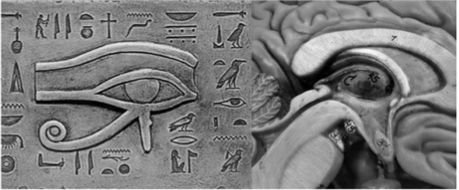
In this case it is the so-called Eye of Horus, which some attribute a resemblance to the corpus callosum that joins the two cerebral hemispheres. In fact, if we compare the two images we will see a certain similarity.
Figure 1: Pineal gland and Eye of Horus. Source: https://www.bibliotecapleyades.net/
The pineal gland was first mentioned and described by the Greek Claudius Galenus (Galen), who gave it its name because of the shape of this small organ, very similar to a pinecone. And since ancient Greece, they considered that this organ could be “the seat of the soul.” His hypotheses about the body-soul duality fell upon this organ.
The pineal gland, also known as the pineal body, conarium, or cerebral epiphysis, is a small endocrine gland located in the brain of vertebrates. From the standpoint of biological evolution, the pineal gland is a type of
atrophied photoreceptor in the epithalamus of some vertebrates. In some species of amphibians and reptiles, it presents as a vestigial organ, known as the parietal eye located in the epithalamus, which is why it is also referred to as the “pineal eye”.
According to Kimberley Moon, in her book El despertar del tercer ojo, and I quote literally, “the ancient Egyptians preserved the pineal gland separately during the mummification process,” and she considers that “they would not have gone to such extremes if they had not understood its meaning. Even their arts and artifacts contain a clear representation of the third eye.” (Moon, 2019) But it is not only the Egyptians who maintain such a curious relationship with that pinecone-shaped gland. In fact, the symbol of the pinecone appears in most civilizations from East to West. It is not uncommon to see a Buddha crowned with a pineal head (or hair styled in the shape of a pinecone). Some of the temples of Angkor Wat, in Cambodia, reproduce the pineal shape: Sumerian, Egyptian, and Greek kings and gods hold pinecones in various ornaments or implements. Even within Christianity, we find the symbol of the pinecone in very important representations, such as, for example, the four-meter-tall sculpture of a pinecone in the Courtyard of the Pinecone at the Vatican, or the pinecone held by the Child Jesus of the “Moreneta” of Montserrat in His left hand. Another, at the very least curious, example is the thyrsus. A thyrsus is a staff wreathed in ivy or vines, crowned by a pinecone. It is believed to have originated in Ancient Egypt, although it is very common to see it used in the earliest sculpted representations of Dionysus, the Greek god. It is considered that this staff eventually adapted to the Christian faith and that today it is the staff called the ferula carried by the Popes, which they raise so that the pinecone beneath the cross rests right in front of their forehead, where that supposed third eye would traditionally be located, when they pray.

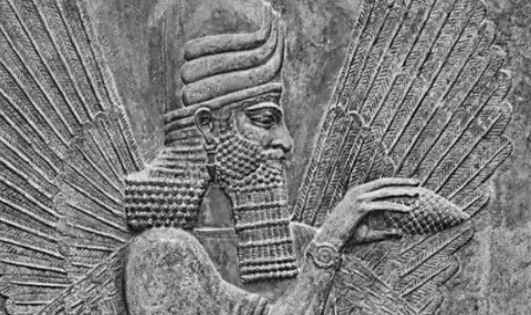
Figure 2: Temples of Angkor Wat, Cambodia. Domes shaped like pinecones.
Source: Wikipedia
Figure 3: Anu. Sumerian god with a pinecone in his hand. Source: Quora
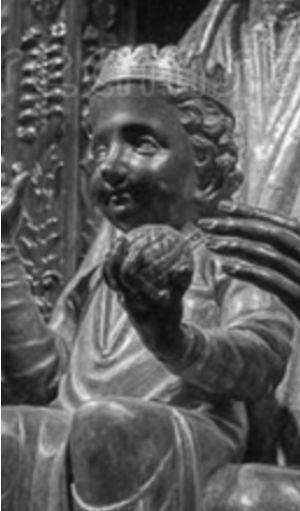
Figure 4: Child Jesus of the Moreneta of Montserrat, holding a pinecone in His left hand. Source: www.cenutica.blogspot.com
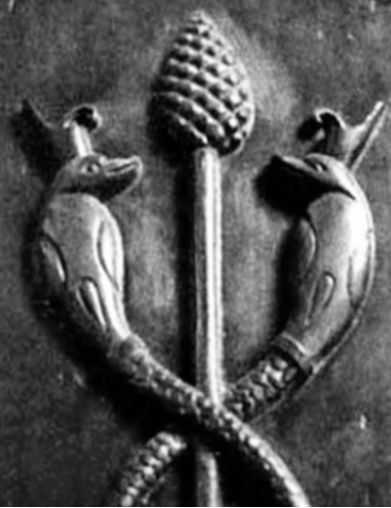
Figure 5: Scepter of Osiris. Staff crowned by a pinecone. Source: www.eltrotedelaculebra.com/
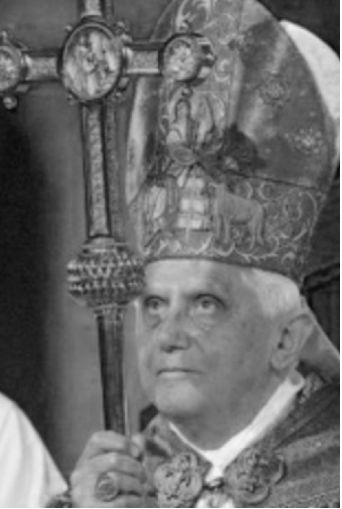
Figure 6: Papal ferula. Source: https://eltrotedelaculebra.com/
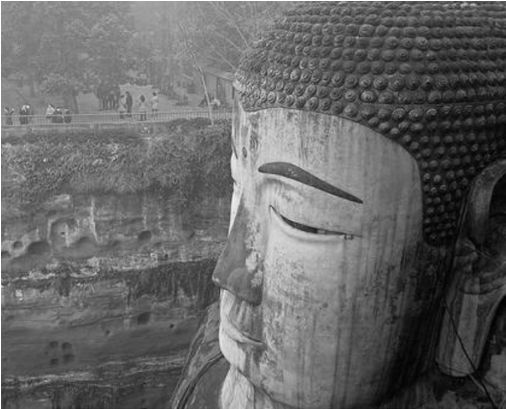
Figure 7: Great Buddha of Leshan. Like most Buddhas, the texture of the head is similar to that of a pinecone. Source: https://www.diariodelviajero.com/

Figure 8: Courtyard of the Pinecone at the Vatican. Source: https://eltrotedelaculebra.com/
Coincidence or not, what is certain is that the pinecone has long been represented as a symbol of communication with heaven or with spirituality. Logically, from the earliest civilizations, we cannot rescue any text to which we can scientifically adhere in order to determine whether or not there were people who practiced any specific discipline to achieve seeing without the eyes. Only legends, religious texts, and mythologies lead us to think that it might indeed have been possible. Jesus Himself managed through His miracles to restore sight to some people with blindness, but this is not enough evidence to affirm that during antiquity there was a generalized and widespread use of methodologies, rituals, or practices that facilitated this type of vision. But it is enough to understand that this, which a few talk about today—and we include ourselves in this group—had already been spoken of in ancient times, using other words and other languages.
If we stop focusing on the ability to see the immediate physical environment without the eyes and expand it to other types of clairvoyance, we will surely find much more literature on the subject.
In the book La visión remota (2019) by Enrique Ramos, the author explains a curious anecdote that could be considered one of the earliest written pieces of evidence attempting to verify the existence of some extrasensory ability, in this case a type of distance clairvoyance, or remote viewing, as it is currently known. This is a case that occurred in Lydia, a kingdom in the westernmost part of Turkey in the 6th century BC. The Greek historian Herodotus was responsible for writing down this story, in which a king named Croesus, very concerned about the future of his reign, decided to consult the oracles about the decisions he should make. Convinced that many oracles were authentic frauds, he wanted to put them to the test. So he sent messengers to the various oracles with the same control question. The question had to be asked one hundred days after their departure from the palace, since some oracles lived very far away, and in this way, they would all be questioned at the same time. The question was simple. What was King Croesus doing at that very moment?
Of all the oracles, only one got it right: the Oracle of Delphi, located in Greece. The success rate was laughable and could seem like the result of chance. Although it was actually difficult to guess that King Croesus was stewing a lamb and a turtle himself in a large bronze cauldron. Perhaps seeing or intuiting a bronze cauldron or a turtle stew could be considered a coincidence… but who would dare to predict that a king would cook for himself? In a humorous vein, now that is highly improbable!
Two things can be deduced from this story. First: since the dawn of time, there have been swindlers who have stained the reputation of those who perhaps did possess some important extrasensory ability. And two. Perhaps abilities such as
remote viewing, could exist, although this too is not, for the moment, sufficient evidence. Later on we will surely see some more…
Since Galen first described the pineal gland, there was a significant gap in the literature concerning these aspects. Whatever works may have existed went either unnoticed or were highly protected. And we now move forward to the philosophy of René Descartes, many centuries later, in which he rescues ancient thought and once again considers the person from a dualist perspective. He once again highlights the work of the pineal gland and defines it as the principal seat of the soul and the place where all our thoughts are formed.
2. EVIDENCE OF VISION WITHOUT EYES IN MODERN TIMES
2.1. BEFORE THE 20TH CENTURY
Although most of the documentation on the topic we are investigating does not begin to appear until the early twentieth century, two studies from earlier centuries stand out. One is precisely the one we present below.
AN ORGANIST, A CHEMIST… AND GULLIVER’S TRAVELS
In the middle of the seventeenth century, Robert Boyle, one of the founders of modern chemistry and author, among other things, of the formulation of
Boyle’s Law1, noticed a phenomenon that had until then gone unnoticed and was possibly the first to put it down on paper.
This is surely one of the first cases of synesthesia (a concept we will develop extensively in the second chapter) reported to the world, or at least in the world
modern world, and it was recorded in his work Experiments and Considerations Touching Colors (1665). The fact is that while Boyle was investigating the properties of colors, he came across the story of a 33-year-old organist from the Netherlands, John Vermaasen, who had been blind since smallpox affected his vision when he was only two years old. This organist claimed that despite being absolutely blind, he was able to discern colors simply through touch.
To make sure he had no residual memory of his vision, his eyes were covered with a bandage and he was put to the test.
Through touch and what he described as different sensations of roughness, in varying degrees, he was able to discern among the different colored ribbons provided to him. While it is true that on rare occasions he made some small mistakes, he himself stated that at those moments he was uncertain and that he could be wrong. To recognize the colors, John Vermaasen needed to hold the ribbons between his thumb and his index finger. And according to him, he was able to capture the sensation thanks to the touch of his thumb, and more clearly with the thumb of his right hand than that of his left hand.
According to a letter that the doctor who discovered this particular organist, Henry Oldburg2, sent to Robert Boyle to make the case known, John Vermaasen not only managed to perceive colors through touch, but was also very good at playing cards, and in his words “perhaps the best player he had ever seen,” and he was also able to describe a person’s physical appearance from their voice, very accurately.
Curiously, it seems that John Vermaasen may have appeared in a satirical manner in Jonathan Swift’s novel Gulliver’s Travels (1726) in the third part of the book, in the fifth chapter, where the author describes a fictional academy of celebrities, among them a blind artist capable of distinguishing
colors by smell and touch. The way it is written and the similarity to Vermaasen would suggest that Swift did not believe a single word of what Boyle had previously described.
Be that as it may, it would be centuries before this ability was taken more seriously.
2.2. 20TH CENTURY. THE 20S AND 30S. FIRST REPORTED CASES
2.2.1. ARGAMASILLA. A MARQUIS WITH A LOT OF POWER
In Spain, a curious case also arose in the mid-1920s. It was the case of the son of the Marquis of Argamasilla. A young man who was said to be able to see with his eyes covered the objects hidden inside a box. What began as a curiosity quickly spread among the upper bourgeoisie who wanted to witness the phenomenon. Many scientists became interested, and although they could not see what the trick was, some were not convinced of the phenomenon’s authenticity.
One who was convinced was Charles Richet, winner of the Nobel Prize in Medicine in 1913. Richet, after testing him in his Paris laboratory, certified the phenomenon’s authenticity. This led the young aristocrat to embark on a tour of the United States, where he was initially very well received. However, the famous magician Harry Houdini, who was engaged in a personal crusade against everything related to paranormal abilities, after witnessing the performance, explained to the press that the young Spaniard’s ability was a fraud.
In his own defense, the young Argamasilla argued that Houdini had approached him to offer him a deal and that, upon seeing the collaboration denied, he became angry and discredited him. Argamasilla
had to return with his tail between his legs and never displayed that ability in public again. Toward the end of his life, the now Marquis of Argamasilla confessed that he had lost the ability he had indeed possessed years earlier and reaffirmed that it had never been a trick.
Regardless of what happened, those days are now far behind us, making it impossible to determine which of the two was telling the truth, but what did remain was greater discredit, no longer toward the figure of the aristocrat himself, but toward that specific ability.
2.2.2. JULES ROMAINS AND HIS EXPERIMENTS
Rumors that the ability to see without eyes is possible have been circulating for more than a hundred years. Some of these rumors, poorly documented, reached Louis Henri Jean Farigoule, better known by the pseudonym Jules Romains. This French writer, nominated up to sixteen times for the Nobel Prize in Literature, became interested in the phenomenon, which he baptized as “vision extra-rétinienne” and also as the “paroptic sense,” and published his hypotheses and conclusions in 1920 in a book titled precisely that, La Vision Extra-rétinienne et le Sens Paroptique. In 1923
he added further appendices to the book, which appeared in subsequent editions.
His first question was whether the phenomenon truly existed. If this was the case, it should be possible to reproduce it with any person, and in Romains’ own words, “it should not be investigated by any charlatan among those who claimed to possess this ability.” He wanted to be able to see and control the ability (in case it existed) in order to know under what conditions it could appear.
To control it in order to observe it at a scientific level, rather than letting the supposed ability guide the direction of the investigations. So, convinced that if it existed, everyone could master it, he tried to open this vision in randomly selected volunteers.
Based on the movements and expressions he had seen in the supposed clairvoyants, and especially guided by his intuition, he trained different people to open this ability.
Romains wondered whether this ability could be, metaphorically speaking, like that subtle noise we can hear but pay no attention to until someone asks us to notice it. In fact, he ended up describing extra-retinal vision as a human ability that requires guidance to learn how to use it, since the signals that produce it are very subtle.
Based on the few exercises he knew the
“supposed clairvoyants” performed and those he deduced himself, he managed to get some volunteers to begin seeing without using their eyes. At first they could guess a letter from a newspaper headline, just as the volunteer passed their fingers over it, or sometimes perhaps a color. His volunteers showed signs of fatigue very quickly, but little by little they managed to expand this vision, which he felt the need to name.
Romains argued that the act of obtaining information from the outside does not follow the pathway of the eyes —evidently, because they were blindfolded— so he looked for a parallel pathway through which that information, which appeared to be of a visual nature, could be obtained. Precisely by seeking a sense parallel to sight, he speaks of a paroptic sense, or parallel to the optic sense. On the other hand, since the final product obtained after acquiring the information and generating a vision does not come from the retina, he called it extra-retinal vision.
For some years he conducted hundreds of experiments, especially among five subjects, whom he subjected to all kinds of tests and challenges in order to formulate his hypotheses about the function of the paroptic sense and the nature of extra-retinal vision. This is why he even built different devices such as the “Bouchelier” to ensure that
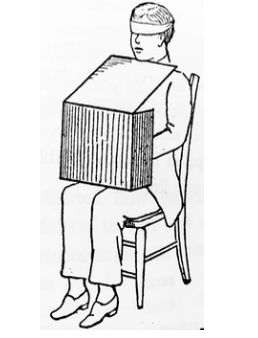
the line of sight between the eye and the object to be observed was cut off, not only by the blindfold. One more way to ensure that volunteers could not see through any hole.
Figure 9: Jules Romains’ Bouchelier. Source: Eyeless Sight. A Study of Extra-Retinal Vision and the Paroptic Sense. Forgotten books (2018) One of the things Jules Romains observed was the delocalization of the ability. While with the Bouchelier the volunteers managed to see the different images Romains offered them, the answers lost reliability when he added more obstacles between the object and the subject.
As long as the hands, the neck, or the head maintained a direct line with the object, the trained volunteers were able to see the object to be described with greater or lesser accuracy. But the more physical barriers there were and the more parts of the body were covered, the worse the result.
In fact, Romains ranked the parts of the body that were usually most sensitive, and which therefore could be suspected of being involved in the paroptic sense. First, along with the
head, the dominant hand and the non-dominant hand —in this order—
were the most necessary for establishing extra-retinal vision.
Next, the neck and the throat; with these it was also possible to establish some kind of paroptic contact, despite the existence of obstacles between the head and the object, and the hands and the object. Finally, with the back of the neck, arms, and thighs, it was also possible to establish contact, and some subjects managed to vaguely describe some of the objects shown, though requiring more time.
Romains also experimented with distance. While initially the subjects needed physical contact (which could be through glass to avoid the use of direct touch) with their hands, they were subsequently able to see objects at a distance.
At the same time, Romains conducted tests with color. After observing that most students perceived colors well under normal lighting conditions, he decided to test with ultraviolet and infrared. In some cases, he observed that while infrared light ceased to be perceived at the same threshold as human vision, with ultraviolet light a better perception was achieved through the paroptic sense. He also tested this under darkness conditions and realized that while letters and numbers usually ceased to be perceived at the same threshold as retinal vision, some subjects showed a certain ease in recognizing colors while blindfolded in the dark.
Romains also made an effort to describe what the extra-retinal vision that formed in his test subjects was like. According to him, one of the things that struck him most were the discrepancies between the space created by extra-retinal vision and the visual-kinesthetic tactile space. In other words, an individual who managed to use their paroptic sense and open their vision found it angled between 30 and 45° (or sometimes more) relative to the object observed. That is, he observed that the participants “looked” toward
another direction to describe exactly what they had in front of them. According to Romains, this deviation could be corrected with practice. (Something we have also observed very frequently ourselves).
Another fact that caught his attention was that in poorly trained individuals, the vision seemed confused. For example, if he showed them a three-digit number like 294, the subjects might answer 492 or 924. But definitely what caught his attention the most was the ability of some subjects to see in all directions, even through the back of the head. He describes how the most trained subjects were able to pivot their vision without turning their heads and describe what was around them at 360 degrees, even above or below, creating a spherical perception and vision of everything surrounding the individual.
After his experiments and observations, he decided to formulate hypotheses about how this sense was possible. First, he made sure it was not a case of hypermnesia, which is the ability to remember everything a person has seen, whether consciously or not.
To ensure that the subjects were not describing what they had seen before being blindfolded, Romains presented texts and objects that his volunteers could never have seen before. He also conducted some double-blind exercises, to ensure that the controller (in this case, himself) was not communicating the answer telepathically or involuntarily.
Although Romains had only completed two years of biology at the university, he was very clear about one thing: his experiments were correct and scientifically meticulous. Ergo, the ability to see without eyes existed. And since extraretinal vision was a fact, there had to be some pathway that allowed the information to reach the individual, via a parallel route. Romains was clear from the outset that no human macroorganism could exist that performed such a task, since macroorgans were already thoroughly studied at that time, and he was convinced that if there were any clue in any of them, he would already know about it. So, following his logic, the paroptic sense was the responsibility of microscopic organs that
must be located very close to the skin or in the skin itself, in order to capture light from the environment, and that at the same time would explain the delocalization of the ability he had observed. Only the skin could explain how the phenomenon persisted when different parts of the body were covered.
Right around that time, Angelo Ruffini had become famous for discovering some of the corpuscles and glands present in the skin and their functions. Romains was certain that one of these organs must act as small eyes scattered across the skin. Although the scientific studies of the time did not point to this possibility, Romains was convinced it could be the case and that they might have overlooked it.
These microscopic organs that Romains was certain must exist in the skin, he called “ocellis.” He theorized that they could be small groups of cells that would act in collaboration with others to simulate the same functions as the human eye. He even ventured to draw a diagram of what these corpuscles would look like, so that future scientific research could search for them in the skin.
If they existed, Romains was certain that these ocellis would bear a certain resemblance to the human eye and would be formed by a corpuscle that allowed the refraction of light. By a small body similar to the retina, which in turn would be connected to a nerve ending in the skin that would act in a manner similar to an optical fiber.
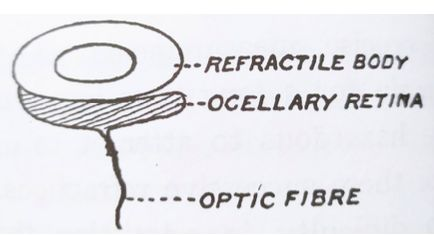
Figure 10: Possible representation of ocellis by Jules Romains. Eyeless Sight. A Study of Extra-Retinal Vision and the Paroptic Sense. Forgotten books (2018)
After his experiments and having elaborated his hypotheses, Romains was euphoric. According to him, in some places in the United States, Italy, and Japan there were similar studies, but he knew he would be the first to present it to the scientific community and that they could say nothing against the rigor of his experiments.
But the truth is that this was not the case. After presenting his hypotheses and conclusions, the scientific community came down on him, accusing him of being a dreamer, a trickster, incompetent, and insufficiently prepared academically to carry out this task. Despite the harsh criticism, Romains managed to attract the attention of other renowned scientists, writers, and philosophers of the time, who after observing the experiments firsthand and having reviewed in person what Romains had told them, decided to sign the appendices of the book that Romains added three years later to support and reaffirm his work.
One of those who took part in these experiments and who signed Jules Romains’s work was René Maublanc, a philosopher of the period who was fascinated by this ability and decided to take
the reins of Romains’s studies to contribute and try to convince the scientific community, which until then had been so hostile to the topic.
2.2.3. RENÉ MAUBLANC AND LEILA HOLTERHOFF HEYN: HEIRS OF PAROPTIC PERCEPTION AND EXTRARETINAL VISION
Having verified on different occasions that Jules Romains’s claims seemed entirely true and having attended many of his experiments, Maublanc thought that the definitive way to end the disputes was to develop paroptic perception in a subject who was completely blind.
Ever since Romains presented his theories, scientific opinion had bet on problems with adjusting the blindfolds, claiming that the subjects might have seen through a supposed tiny hole.
Maublanc began attending more of Romains’s sessions and was able to verify the same conditions that he cited in his book, and he endorsed his conclusions, which he did not question after dozens of experiments. From him, he learned a method to guide other people in awakening this ability.
In 1924, together with Romains, he attended sessions with a 13-year-old boy who had had his eyes removed five years earlier due to glaucoma. From the ages of four to eight, this boy had developed a growing phobia of light, as it caused pain in his ocular tissues. After four sessions with him, Jules Romains had to leave Paris and left René Maublanc in charge of the boy’s paroptic education, which he continued for another 53 sessions, with some interruptions due to the boy’s health condition and vacation periods. Over time, the boy came to distinguish 4 colors and correctly located black marks on a white paper placed underneath a
glass pane. Despite the progress, as the boy perceived more light and color, he became less cooperative, since his phobia of light persisted. Furthermore, he was too frail in health to continue with the experiments, so Maublanc gave up.
Around that time, Mme. Leïla Holterhoff Heyn, an American soprano who had been blind since she was a year and a half old, came into contact with Romains, as she was interested in doing some sessions with him. Romains referred her to Maublanc, with whom she began a series of tests, from which the book written by both authors would be born: A Paroptic Education; The Discovery of a Visual World for a Blind Woman (1926). In this book, both recount their experiences surrounding the experiments they conducted with extraretinal vision over the course of months. And although both acknowledge that the achievements were insufficient to permanently replace Mme. Holterhoff Heyn’s ocular vision, Maublanc wrote this about her progress:
“Mme. Heyn, blind since the age of a year and a half, has acquired in these past few months a sense that cannot be called anything other than visual, since it allows her to recognize at a distance, under the same conditions as sight, objects, with their size, their shape, and their color, as well as also written signs and numerals. This vision can rightly be called extraretinal, since the retina cannot serve to explain it.” (Maublanc & Heyn, 1926, pp. 10-11) From the appearance of the books by Romains and Maublanc until the next major studies, four decades would pass. The studies on paroptics would be ridiculed by the scientific elite of the time and would fall into oblivion… Anecdotally, the texts would inspire, ten years later, a Brazilian doctor, Manuel Shaves, who, according to the book Encyclopedia of pseudoscience (2000) by Dr. William F. William, tested up to four hundred blind people, twelve of whom were able to establish some form of vision without the eyes. However, these studies too would not gain wider recognition.
2.3. THE 50S AND 60S. MORE CASES AND MORE SCIENTIFIC STUDIES
2.3.1. KUDA BUX; A FAIRY-TALE STORY
Cases like that of Kuda Bux are surprising for the amount of audiovisual material he left behind, especially in the United Kingdom. Clear evidence that seeing without the eyes is possible, yet even so they fell into oblivion and transcended neither borders nor the passage of time.
Kuda Bux (1905–1981) was born in Pakistan and was a magician, mystic, and fakir. He became famous in the 1950s through his frequent appearances on British television, in a series of programs titled “Kuda Bux, Hindu Mystic.” On his program, Kuda Bux not only blindfolded himself, but first padded his eyes with cotton, to fill the entire hollow between the eye area and the nose, and then blindfolded his entire head. Observers noted that without a blindfold over his eyes, Bux required glasses to read small letters. Whereas when his eyes and head were blindfolded, he was able to read the dates on a coin in a spectator’s hand, read the small print in a magazine, thread a needle, duplicate words he had never seen written, or shoot a can off children’s heads with a toy pistol, among many other “tricks.” In 1952, Kuda Bux was interviewed by Roald Dahl, who published an essay in Argosy magazine, “The Amazing Eyes of Kuda Bux” (July 1952). In the interview, Kuda explains how he learned the ability to see without eyes, as well as the ability to walk over hot coals, from a yogi in Haridwar, India. Over the years, the world-famous storyteller added a touch of fantasy to the first essay and replaced the figure of Kuda Bux with that of Imhrat Khan, and wrote a beautiful tale in which an upper-class Englishman ends up mastering this kind of clairvoyance to play poker and triumph in casinos by seeing the backs of cards before they are turned over. It is a lovely story, titled The Wonderful Story of Henry Sugar (1977), which
we invite you to read. This work describes very clearly the nature of this ability, and as researchers of the phenomenon, we have been able to verify that the way it is explained is very similar to how we have experienced it ourselves with some of our participants. Also with the ending of the tale, with the change of consciousness that the protagonist experiences after unlocking the ability, we could find many parallels with the benefits we have been observing. Many other magicians have performed tricks to see without eyes; however, we will not make a list of them, since, precisely, we are not interested in magic tricks. Nevertheless, we wanted to include Kuda Bux, especially for the way he describes his ability and for the fact that he learned it, according to him, from a yogi and not from another magician. And logically also because he is the first person for whom there is audiovisual record operating with this ability.
Video 1 (https://bit.ly/3Df4MDT)
Kuda Bux — The Man with the X-Ray Eyes. Source: YouTube.
2.3.2. SOVIET WOMEN WITH SURPRISING ABILITIES
It was not until the 1960s that there was an increase in reported cases of vision without the eyes, all over the planet. One of the places where precisely these events began to be reported most strongly was in the Soviet Union and across the Eastern Bloc in general.
One of the most famous was Rosa Kuleshova, a young woman from the Urals who, after learning Braille in order to work with blind people, discovered that with the third and fourth fingers of her right hand she could perceive colors and shapes. During a hospital stay to treat her epileptic episodes, she showed her abilities to the nurses, and they, surprised by the accuracy of her words, notified the doctors. To ensure that Rosa could not see, the doctors, in addition to covering her eyes with a bandage, placed a science book inside a pillowcase, and young Kuleshova was able to read the scientific content with perfect precision using only the touch of her fingers.
The phenomenon made the press, and Rosa was invited to the circus passing through her city to demonstrate her skill before a large audience. She also made herself available to various scientists such as Dr. Goldberg and Dr. Novomeysky. At first they treated the case with skepticism, but the results were so promising that they would end up devoting a good part of their careers to investigating what they would baptize as dermo-optical perception — or DOP, from its English acronym — and which they would attribute to people’s unconscious ability to detect sensations through the different radiations emitted by colors.
Kuleshova had to face multiple detractors and suffered a certain degree of persecution for the ideas that her ability represented, but she also successfully passed a large number of tests and verifications. Many of these tests were carried out first at the Psychology Laboratory of Nizhny Tagil and later at the Institute of Biophysics of the Soviet Academy in Moscow. Over time, Kuleshova improved her strategies so that other people could develop this ability to perceive with their fingers. Initially, she focused on touch, and over time she discovered that this experience could be extended to smell, hearing, and taste.
In this way, she expanded the range of possibilities for perceiving visual stimuli without having to use the physical eyes.
Unfortunately, Rosa Kuleshova suffered from very fragile health and died when she was still very young. The person who in a way took over from her as a volunteer for Soviet scientists was Nina Kulagina. Another woman who, in addition to demonstrating high abilities with DOP, proved to have other uncommon abilities, such as telekinesis. Kulagina’s abilities were also discovered by chance in the hospital, and the first to show great interest was Dr. Vasilev, who immediately traveled to the Kulagina home to conduct further experiments.
There, Nina’s husband provided him with video tapes showing his wife moving objects with her mind. Dr. Vasilev urged Mrs. Kulagina to travel to his laboratory, and there she was able to reproduce what was seen on the tapes, but under strictly scientific control.
The interest generated by the news about Kulagina led scientists from around the world to witness these abilities. Despite having to navigate the Iron Curtain, the Soviets authorized, in some cases, the visit of certain American scientists who either ended up certifying the abilities or were unable to find a convincing rational explanation for the various phenomena they witnessed.
It is known that Nina Kulagina, like Rosa Kuleshova, devoted herself to trying to teach DOP among different groups of children.
And they did so especially with the blind, and they even managed to improve their own results, since some of them surpassed “dermo-optical vision,” that is, they no longer needed the touch of the skin to distinguish objects and colors: some of them were able to perceive colors, objects, and shapes in their surroundings, without coming into contact with them. She also worked with adults, and it is said that intelligence services pressed to gain access to these abilities.
Video 2 (https://bit.ly/3TbUxWm)
Nina Kulagina. Source: YouTube.
2.3.3. SOVIET SCIENTISTS INVOLVED IN THE INVESTIGATION OF DOP
Abram S. Novomeysky is perhaps the quintessential figure within the Soviet scientific world who has studied DOP the most and for the longest time. He began, as we discussed in the previous section, with Rosa Kuleshova, and for more than twenty years he investigated this visual perception that, according to him, occurred through the cutaneous pathway. Not only did he investigate the topic; Dr. Goldberg also devoted considerable effort to discovering the nature of this ability, and we would find more than twenty Soviet authors who between the 1960s and the mid-1980s dedicated time to the study and dissemination of these abilities. We can consult the list of research conducted in the USSR on DOP on the website of Maxim
Alexandrov3, a psychologist, researcher, and science communicator.
Among the articles by A.S. Novomeysky, who held a doctorate in psychology, we find statements such as:
“The ability to detect differences in color allowed Rosa (Kuleshova) to read texts and numbers with her hand, even through glass and cellophane, or to define the shape and color of the curve on the oscilloscope screen and the level, even the color, of liquids in a test tube. (…)
When using the fingers, the perception of electromagnetic vibration with the aid of cutaneous analysis leads to the appearance in the human mind of non-visual optical forms.
Rosa cannot always describe them, but she says she feels each
color in a special way, as ‘crosses,’ ‘dots,’
‘curves,’ ‘lines,’ etc. These cutaneous-optical sensations serve as signals for her to identify certain colors and changes in the lighting of objects, just as visual shapes are signals for us. During the experiments it was noted that Rosa’s cutaneous-optical sensitivity is often associated with certain verbal symbols, not based on visual perception and imagination. She, for example, can easily memorize a new and unknown color, just by touching it with her fingers and learning its name.” (Novomeysky, 1963) Something that personally caught our attention is the following statement:
“It was noticed that, sometimes, while reading, her fingers are below the line, but Rosa can still read what is written there.”
(Novomeysky, 1963)
It caught our attention because this also happens with many of our participants who claim they can see a letter, number, or figure with their fingers and follow them perfectly, but one or two centimeters below (or to one side) of where the printed symbol actually is. It seems that this delocalization may be common when developing dermo-optical perception.
Another common aspect we found is that sometimes exterior light can bother the participants, and Novomeysky also relates this when working with Kuleshova:
“While reading and touching images, sight disturbs her, and that is why Kuleshova tries to tie the bandage as tightly as possible so that no light could penetrate her eyes.”
(Novomeysky, 1963)
One of the requirements for validating this ability is that it be reproducible, so Novomeysky, thanks to figures like Kuleshova, put various experiments into practice with other volunteers:
“The case of Rosa Kuleshova is very interesting, but even so,
is it unique? Can the cutaneous-optical sense be developed in other people? For this reason, the Department of Pedagogy and Psychology of the Nizhny Tagil Teacher Training Institute set up an experiment among students of the Faculty of Graphic Arts. Fifty art students were selected to participate. They began intensive training to determine colors with their fingertips.
During the training period, their eyes were covered with a black cotton wool bandage. Sight was not involved at all. Out of 50 students, 10 showed good capacity for cutaneous-optical perception. They learned to identify two and then three and more colors. All the regularities of the color sense that were revealed during the experiment with Rosa Kuleshova were observed among the students.” (Novomeysky, 1963) In short, and in subsequent works, Novomeysky and many of his collaborators concluded that the optical sensitivity that could be developed through the cutaneous pathway depended on the radiation of colors, which in turn, thanks to the synesthetic capacities that some subjects could develop, allowed them to experience a type of non-ocular vision.
2.3.4. EXPERIMENTS WITH HYPNOSIS IN THAILAND
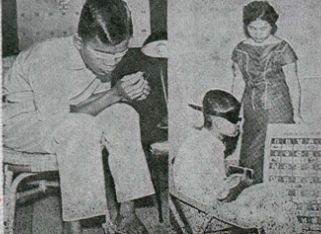
In parallel with the Soviet discoveries of the sixties and the development of the study of DOP, in Thailand, Dr. Vichit Sukhakarn discovered that through hypnosis he could successfully suggest to blind patients that they could see “through their cheeks.” Sukhakarn stated that if volunteers concentrated deeply on the thought of “seeing through the cheeks,” the nerve endings of the skin became so sensitive that impulses were transmitted to the brain and converted into visual images. Some of his blind subjects were able to “read” a newspaper or “watch” a film, according to him, with the skin of their cheeks. His studies were conducted throughout the 1960s and aroused the curiosity of various international media outlets such as the American Associated Press or the Icelandic magazine Vikan.
Figure 11: Blind patients of Dr. Sukhakarn with their eyes covered. Magazine Vikan no. 48. November 29, 1962.
Dr. Sukhakarn managed to open a center to help blind children and found that subjects between 8 and 14 years of age were more susceptible to this training. In fact, in line with Romains, he stated that seeing without the eyes was possible thanks to paying attention to very subtle signals coming from the environment, and therefore, through hypnosis, he could help bring to the surface what we all perceive with our subconscious.
2.3.5. GETARAN; VISION BY VIBRATION
One of the methods for developing seeing without the eyes that most draws attention is the one called Getaran, which in Indonesian means “vibration.” Getaran is a branch of a martial art practiced in this Asian country known as Merpati Putih.
Merpati Putih is a tradition and a martial art that was preserved as the royal heritage of the kings and heirs of the kingdom of Mataram, in the eighth century, in Central Java. This martial arts style was used by the Royal Army privately for centuries, and even today, certain brigades of the Indonesian military master these arts. Numerous videos circulate on the internet showing the army conducting demonstrations in which its soldiers can be seen carrying out different tests with their heads completely covered.
Video 3 (https://bit.ly/3S3UVox)
Indonesian military personnel blindfolded. Source: YouTube In short, Merpati Putih is a complete system of fitness, breathing, meditation, energy development, personal empowerment, and combat martial arts. In 1963 this discipline was released to the public and numerous Indonesians began to practice it.
To this day, this discipline is also found in other countries, sometimes under other commercial or Westernized names and, normally, making use of the word vibration or part of it as the name of the methodology.
Getaran is a branch of this martial art that maintains that matter vibrates and that seeing without the eyes is nothing more than the reeducation of the brain and consciousness to perceive these vibrations. Thanks to them, we can perceive the color, shape, and location of different objects without using the eyes.
According to D.S. Farrer and John Whalen-Bridge, in their work Martial Arts is Embodied Knowledge: Asian Traditions in Transnational World (2011), Getaran seeks to sensitize the body to the subtle vibratory frequencies that surround us. To develop it, they begin with lengthy breathing and meditation exercises with blindfolds, in which the aspirant is invited to maintain the highest possible state of receptivity: they must close the “external senses” (smell, hearing, sight, taste), they must calm their emotions and thoughts, and their attention must be focused on internal feelings and sensations.
After a long period in a meditative state and without having vision properly “activated,” the aspirant must navigate an obstacle course and get through it based on the vibrations they begin to perceive, especially through the hands, but also using the rest of the body. Generally, these obstacles consist of a labyrinth of sticks 1.60 m tall arranged vertically, although sometimes some can be placed horizontally at different heights to make the learner’s task even more difficult. The aspirants must be able to move between them without touching or knocking them down. Sometimes a decoy is hidden within the labyrinth of slats, which the aspirant must manage to find. This object can be a brightly colored handkerchief or, in the case of more advanced students, a vase that they must break with their hand, using other Merpati Putih techniques.
Video 4 and 5 (https://bit.ly/3EUB2NP)
Merpati Putih Training. Source: YouTube.
At this point, they continue practicing until they establish a
“vision” without eyes that allows them to practice other activities of the martial art, and sometimes they even play or practice with knives cutting vegetables, organize soccer matches, and countless other activities. Despite establishing this vision, some Javanese experts admit that it can sometimes be difficult for them, that it is an activity that physically drains them, and that they cannot always activate it immediately.
D.S. Farrer and John Whalen-Bridge also state that since 1991, Getaran techniques have been taught to men and women with total visual impairment. After an experimental program carried out in Yogyakarta over a period of twelve years, other training centers have been created in Java —
in the cities of Jakarta and Semarang — and in Bali — in the city of Denpasar —. People with visual impairments who undergo the training intensively and show great discipline manage within a few months to perceive their immediate surroundings and thus manage to move practically like sighted people.
2.3.6. SOME CASES IN THE UNITED STATES OF AMERICA
It was not only the Soviets who advanced in the search for extrasensory capabilities. News of the USSR’s scientific advances in this field reached the United States, and some researchers decided to find out what truth there was to them. Such is the case of Dr. Youtza and Dr. Moss. The former, Dr. Youtza, known for attempting to discredit all news related to the world of ufology,
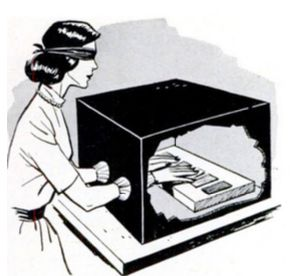
as well as other paranormal phenomena, came to state that dermo-optical perception could indeed be real, at least in a small portion of the population.
He made this statement after meeting and working with Patricia Stanley, an elderly woman who came to his laboratory claiming she could discern colors with her fingertips.
Figure 12: Illustration from the article about Patricia Stanley – Popular Mechanics Magazine. Apr. 1964
In one of the tests that Dr. Youtza gave Mrs. Stanley, blindfolded with her hands inside a dark box, she was able to discern eleven of the fourteen colors placed inside the dark box in a first round; thirteen of fourteen in a second round where, logically, the order of the colors had been changed; and twelve of fourteen in a final round. The probability of achieving that number of correct answers by chance is one in millions. This caught the attention of Dr. Youtza, and he decided to delve deeper into the subject. After three years of research and conducting tests with other people, Richard Youtza concluded that 10% of the population had this ability.
For her part, Dr. Thelma Moss, very interested in the news coming from the USSR, decided to apply some of the techniques for developing DOP that had reached her, taking advantage of the fact that she was also working as a Braille teacher with blind children. Her astonishment came when Maria Wimberley, a girl who had lost her sight in early childhood, began to detect colors. From what it seems, she needed many hours of practice, and her lack of faith in herself was a barrier at times. However, she was able to distinguish the color of different materials: plastics, papers, cardboards… But the material that worked best for her, or according to her, best transmitted the color to her, was nylon. Finally, she managed to read some black letters on a golden background.
It was not until two decades later that we find any reference to the ability to see without the eyes in the United States, as we will see later, but we do find ample information about Remote Viewing, since toward the end of the Cold War, the government itself, through its intelligence services, investigated whether these psychic abilities could or could not be used for military purposes.
But we will explain this in another chapter, since it does not make direct reference to the ability we are discussing here.
2.4. THE 80S AND 90S. FROM INVESTIGATIONS TO METHODS, AND FROM SEEING WITHOUT THE EYES TO QUANTUM ORGANIC COMPUTERS.
2.4.1. EXTRAOCULAR VISION AND DERMOVISION
Following the studies on extraretinal vision conducted in France in the 1920s and those on dermo-optical perception carried out in the Soviet Union from the 1960s onward, several people also emerged in Mexico who claimed to master techniques and methods for seeing without the eyes. These methods for seeing without the eyes were called by the names dermovision or extraocular vision. Different people had the knowledge to teach this ability and to open it, primarily, in children under fifteen years of age.
Among all of these, one Mexican scientist in particular stands out and draws attention due to how he managed to create his own method to open this vision, in order to investigate it at a scientific level and for his reports. This is Dr. Jacobo Grinberg, a psychologist and neurophysiologist who during the 1980s decided to study this ability primarily in children.
JACOBO GRINBERG
It turns out that in 1982 Jacobo Grinberg was invited to a television program as a witness. The broadcast was live and dealt with a type of vision that was out of the ordinary. His presence was required to judge the veracity of the phenomenon, in his capacity as a researcher in the area of Neurophysiology and professor at the National University. On the program he encountered about twenty blindfolded children, and the educator Altamirano (one of the different gurus who had certain methodologies for opening this type of vision), placed them in front of a series of photographs. The children were put to the test and successfully passed all the activities without Grinberg being able to find errors or attempts at deception in the procedure. Upon leaving the program, he proposed to Altamirano using his system to help blind children see with their hands. Altamirano tried for several months to teach extraocular vision to these children, but without success. Grinberg was left with the question of why it had not worked and what Altamirano’s method consisted of.
Later, Professor Grinberg took a sabbatical period, which he dedicated to testing different educational techniques at a school in Cuernavaca, Mexico. Coincidentally, a female student asked him if he could teach her the ability to see without the eyes that she had seen on television, and he, without knowing the methodology but using what little the blind children had told him, tried to do some activities with the girl. To his surprise, within a few minutes the girl managed to activate her extraocular vision. Shortly after, other children who had seen what their classmate was doing wanted to join the activity, and quickly he already had six children seeing without using their eyes. They continued with the experience for several months, until both the school principal and the parents forbade him from continuing the sessions, as the children had begun to read their thoughts and even moved objects at a distance. These activities, from the standpoint of the Catholic religion, were labeled as unnatural and diabolical.
However, Grinberg managed to continue researching at other schools, with the support of other families and other administrators, and he succeeded in replicating results. One of these replications was at the Instituto Torres Quintero in Toluca, Mexico, where they implemented a program so that all students at the center would end up practicing Extraocular Vision; this program was established by Grinberg himself, where he trained not only the students but also the teachers, so that they would give continuity to the program. Although the adults did not manage to open their Extraocular Vision, in the book Fluir en el sin yo (1991) Grinberg expressed his hope that this would be the path for these abilities to be worked into the curriculum and extended to other centers in Mexico.
And precisely in this same book, Grinberg recounts how with these students he not only trained the ability to see without the eyes, but through the Samyama technique, he trained them to increase their capacity for concentration, to the point that if they focused on a flower, they could feel the same as what the
observed flower was feeling and at the same time be able to learn about that flower. With this technique, according to Grinberg, the students began to learn about water, insects, or even space and other planets, since in some way the students visualized and experienced interacting with the subject of study on which they were concentrating, and they could obtain information that truly always seemed accurate and true. This manner of visualization would go a few steps beyond what was properly intended with Extraocular Vision, but it would align with experiments by other authors that we will see later.
For now we will focus only on seeing without the eyes and the experiments Grinberg conducted to convince the scientific community.
JACOBO GRINBERG AND HIS EXPERIMENTS
According to his work La luz angelmática (1983), the blindfold used in his experiments was constantly examined. In order to rule out any possibility of imperceptible accidental breakage that might allow some degree —however minimal— of ocular vision, although no deficiency in it was ever found. The material given to the child was continuously changed, so that they could not predict it. Another possible explanation was that the instructor could transmit the contents using movements, sounds, or any other conscious or unconscious means; in this case, he took special care to interleave graphic contents that the instructor did not know or see during the presentation. In no case could it be demonstrated that the instructor was sending subtle messages of any kind to the subject being tested.
When the training reached a phase of advanced vision (such as seeing small details or distinguishing distant objects), Grinberg invited the students into a darkroom, where they were asked to describe objects. On one occasion, along with the children, four adults entered as witnesses, and none of
none of them could perceive any object; in contrast, two of the trained children, as Grinberg explains, could see them without difficulty.
This control called into question the possibility that the energetic medium decoded by the children was of a photonic nature, or at least not at the thresholds of ocular vision.
Grinberg also performed a reading distance test. One of the children was instructed to read printed material of different sizes and at various distances. With one-millimeter letters, the child began to show difficulties in extraocular decoding at approximately 70 centimeters of distance. The child himself, the instructor, and three children showed difficulty with retinal reading at the same distance and with the same letter size as those used in extraocular vision. This, according to Grinberg, showed that the thresholds between both types of vision were similar.
On the other hand, he used a conventional mirror to study the possibility of extraocular vision of reflected objects. He placed printed material at a 45-degree angle to the mirror and asked the child to describe it. The child not only described the printed material but also other objects that the mirror reflected and that had gone unnoticed by Grinberg himself. For Grinberg, this control allowed him to rule out the possibility that a thermal or calorific field was the energetic origin to be decoded in order to see without the eyes.
On the other hand, Grinberg asked a child to describe his experiences while he moved the visual material away from his body, without the child being aware of the maneuver. Without hesitation, the child described a phenomenon of distancing and not one of size reduction or material change. In other words, the child correctly perceived the maneuver just as he would have detected it with his ocular vision. Similarly, in all cases where he tried to superimpose a graphic object between the participants and the image to be described, the children were able to correctly recount the maneuver. When they were presented with objects in
motion, also in all cases the detection and interpretation of them was correct. He experimented with practically all the colors of the spectrum, with various shades of each, and an adequate description of them was always observed.
To ensure that the students were not receiving information through touch, Grinberg also placed a 5 mm thick glass between the graphic material and the child. In all cases, extraocular vision developed without difficulty. In contrast, when the material was covered with a white sheet of paper or with a wooden board, the children saw the sheet or the wood and not the material concealed beneath them. On one occasion, a child was asked to perform manual sweeping movements—that is, moving the fingers over it as if wanting to clean the surface of the shown object—over the graphic material, placing a wooden board between the child’s hands and body, so that the hands were not obstructed by it, but the body was. The child was unable to extraocularly perceive the graphic material but described the wooden board perfectly. With this control, Grinberg wanted to demonstrate that the mediators of the extraocular phenomenon are not receptors located in the hands, but that the rest of the body was also implicated in the process… Following the logic of the previous control, it was decided to explore the bodily zones mediating extraocular vision. He selected five children and placed an opaque screen beneath their chins during the extraocular vision exercise. The image disappeared in four of them, and the fifth child continued to correctly perceive the photograph being shown, but tinted by the color of the obstructing screen, which was red. In this way he encountered the delocalization of the phenomenon, also noted by Romains.
Attempting to pinpoint more precisely the location of the bodily zone mediating extraocular vision, Grinberg used another, more complex procedure with one of the most advanced children. He placed the child’s body behind a metal plate and his head behind a 6-millimeter-thick glass plate that
was used as a window for the presentation of color prints. The child was perfectly blindfolded, leaving his forehead, chin, nose, and cheekbones exposed. His hands and arms were obstructed by the metal plate. Under these conditions, the child described the presented material without difficulty. He then completely covered the child’s forehead and presented the material again; no alteration was registered, just as nothing happened when the cheekbones and nose were covered. However, upon covering the mouth, Grinberg noticed a marked decrease in detection skill, and the child began to show difficulties and present errors. When the chin was covered, the child completely ceased perceiving through it. However, Grinberg states that the case is not typical or generalized. Both in this child and in others, Grinberg affirms that the critical sensitive zone could vary over time, making it impossible to precisely define the existence of an indispensable and specific bodily zone for mediating extraocular vision.
To reinforce this last assertion, Grinberg uses another very illustrative example, this time from one of his 6-year-old female students. Grinberg noted that she was an extraordinarily alert and active girl who learned to see without the eyes very quickly and who carried out all the activities very skillfully and comfortably. To confirm this circumstance, he subjected her to various tests. First, he presented graphic materials by placing them behind her back. Not only did she manage to identify the material, but Grinberg states that she was even able to read printed words and phrases. Using diving goggles filled with cotton, so that they completely prevented ocular vision, the girl was invited to walk freely through a park in Mexico City, describing everything she could see. At first cautiously, but soon completely uninhibited, the girl toured the park, describing the trees, benches, other children, dogs, street vendors, and other elements without difficulty. The most surprising aspect of the experience was not only the accuracy and ease of the
description, but that it reflected omnidirectional perception.
In other words: the girl described both what was in front of her and what was behind her.
GRINBERG’S CONCLUSIONS
According to Grinberg, the clearest and most basic result that emerges from his study is the certainty that it is possible to perceive visually without the need to use the eyes and retinal receptors. Grinberg also states that the fineness of detail of vision without the eyes appears to be similar to that of retinal vision, as are its fidelity and resolution. Extraocular vision seems capable of representing a visual world similar to that of retinal vision.
Without the need to use the colossal complexity of the retinal structure and, presumably, without the participation of the brain structures commonly responsible for encoding the visual world.
One of the observations that most caught his attention and that he first brought to light is that the children who were most in touch with themselves, the most secure and intense in their personal identity, were the ones who had the greatest ease with extraocular vision. According to Grinberg, the development to open this capacity seemed to follow a logical and repeated sequence in the cases he studied.
The author explains that the children began by using their fingers and hands to make contact with the image to be decoded and that as they connected with their inner being and unconsciously, the children began to trace the contours of the figures in the drawing, until after a moment of silence, vision occurred.
He was quite surprised by the speed with which his students experienced the phenomenon and described it as a quantum leap.
When vision manifested, the children stopped using the sweeping movements with their hands as often. Grinberg also states that most children opened their vision between the first and third session and that on the session in which it happened, the
children showed considerable energetic wear.
Some of his students described the image as a little screen inside their head, where everything that happened on the outside was broadcast.
Finally, he also assures that, from his experience, when other children saw the progress of their peers and expressed the desire to practice it, the process of the phenomenon’s appearance seemed to accelerate. Grinberg was thus convinced that the absence of doubts about the veracity of the ability, trust in the instructor, and a good environment exerted a beneficial influence on developing it.
In his controls and studies, Grinberg also highlights that each child displayed a personal style during extraocular vision.
One girl, for example, performed rapid sweeps with her fingers in front of the graphic material because she found it easier that way and her description was more accurate; another boy preferred to read words rather than see photographs; another preferred figures over reading material. The reading of words was practiced gradually, beginning with the detection of isolated letters, generally placing a finger beneath the letter to read. A few minutes were enough for the child to begin reading complete words, even in languages unknown to them. Later, reading speed became similar to that usual with retinal vision. Two exceptions to this last case were a boy and a girl who read extraocularly faster than with ocular vision and who expressed more interest in doing it extraocularly.
According to the Mexican doctor, the capacity develops more and better when meditations are performed, the student comes to the session calm, and so does the instructor. And curiously, he also notes that children who already enjoyed their vision improved their capacity if they held a quartz stone between their hands.
AN UNEXPECTED END AND EXTRAOCULAR VISION IN MEXICO
In 1994, at the climax of his career, Jacobo Grinberg mysteriously disappeared. The strange circumstances of his disappearance have given rise to multiple hypotheses and theories, and to this day the truth about this case remains unknown.
Grinberg was considered a shaman among scientists and a scientist among shamans. By many others he was considered the “Einstein of consciousness,” since Grinberg took the study of psychophysiology beyond the limits of traditional science, to approach the infinite potential of the human brain. He is by no means known for his work with extraocular vision, as he researched multiple parapsychological areas. Although it appears that before disappearing, he experimented enough to demonstrate the first signs of telepathy.
After his disappearance, schools and movements continued to proliferate for learning the ability to see without the eyes. Some under the name of extraocular vision, others under the name of dermovision.
2.4.2. SOVIET ORBIT OF THE 80S AND 90S
As we have already seen, first in the Soviet Union and later in Russia, many very powerful cases arose, sufficiently studied for different methods to emerge from what they called dermo-optical perception.
B. E. ZOLOTOV AND INTUITIVE INFORMATIVE VISION
Boris Evgenievich Zolotov was born in 1947 in Russia. After school, he entered the Moscow Energy Institute, where he already showed a facility for certain parapsychological abilities and had no qualms about telling his classmates about them.
As a scientist, he worked in different fields. From dolphin communication to the creation of space technology. On a personal level, he deeply studied philosophy, religions, popular art, ufology, ancient occult sciences, the works of Agni Yoga, and its followers. And he used all that knowledge in his own research.
Between the ’80s and ’90s, he developed a method he called intuitive informative vision, which allowed him to help, especially the youngest, to use their “internal” vision. His school and methodology grew quickly. Although he eventually retired from the project to delve deeper into his own learning, the school continued and expanded its training. Coming to promote courses on “biointernet,” a compendium of all the learning that encompassed more than one parapsychological ability. This capacity was no longer limited only to seeing the immediate physical environment without the eyes, but sought to enable people to receive and see the answer to the questions they ask themselves, through the same screen by which one can manage to see without the eyes. This capacity would maintain a very large similarity with the techniques that Grinberg tried to develop with his students when practicing Samyama.
Zolotov died in 2015, but his academy4 continues to research.
NIKOLAJ N. DENISOV AND THE GOLDEN RAY
The Ukrainian Nikolai Nikolajevitsch Denisov also studied at the Moscow Energy Institute, where he met the young Zolotov. It was he who introduced him to the world of parapsychological abilities, and he was also seduced by the tests performed on Rosa Kuleshova. He decided to study these abilities on his own and ended up creating his own method, “The Golden Ray,” interested in being able to open this capacity and thus study it better. In
the ’70s he began researching human evolutionary development and gained recognition for his work in the area of information access technologies.
Denisov managed, by means of an electroencephalogram, to record the brain activity of his participants when they operated with their vision without eyes. According to Irina Lang’s book Drei Augen sehen mehr als zwei (2018), in an interview by the author with Denisov, he recounts some of his experiments in which he wanted to check what differences were evident on an electroencephalogram when a child uses vision without the eyes and when they use normal vision. And I quote Denisov’s words in this interview verbatim: “The scientific studies of the Serbsky Institute of Psychiatry and Social and Forensic Development in Moscow have shown through EEG tests that people who read with their eyes closed show no kind of activity in the parts of the brain that are traditionally responsible for processing visual information. That proves that these subjects have neither ‘seen’ nor ‘read’ with their eyes.”
“The method of direct informational perception or golden ray,” adds Nikolaj Denisov, “is capable of altering the neural connections of the brain in such a way that the participant not only enjoys greater resources to process ordinary information but also has access to information that cannot be received through traditional information channels. (…) If the reader enjoyed such a capacity, for example, they could check for themselves (with their intuition) whether the information contained in that book is reliable or not.” (Lang, 2018)
To improve the abilities, Denisov recommends practicing neuroplasticity a lot, which is the basis for the formation of new neuronal synapses, and he assures that the development of these new complex neural networks is the basis for opening ourselves to these new perceptions.
V. BRONNIKOV AND THE DRAGON’S RUBY EYES
Vyacheslav Bronnikov is one of the best-known men in this field and created a method that bears his own name. On the website of his center5 we can find his biography, from which we have extracted the following information. Since childhood, he discovered his extrasensory abilities. Among his research and contributions, he is known for his work with blind children, teaching them to see without using their eyes. According to him, his experiments are based on an ancient system called “Dragon’s Ruby Eyes,” and he also states that this is only the knowledge of one of the eight parts into which the “Dragon System” is divided. This is a Tibetan “closed-door” system, which generally takes between twenty and thirty years to complete.
With his work, Bronnikov achieved results similar to those of his colleagues, but in less time. He discovered that by adapting the theory to his own method, children under 14 years of age could develop an alternative vision in 12 days; whereas an adult, to achieve the same learning, can take an average of 3 to 6 months. However, the vision that, in his opinion, is developed with this method is not explained so much by exceptional gifts or abilities, but can also be the product of rigorous training to work with adults, whether sighted or blind, and improve their quality of life.
In the training programs of his center, we find that they not only focus on opening vision without the eyes, but also try to develop a “Biocomputer.” According to the center’s website, “a Bio-computer is a natural system for receiving and managing information” and “everyone is already equipped with a Bio-computer from birth. It can receive, manage, store, and easily access all kinds of information. A well-developed biocomputer can replace the functions
of many devices (for example, those of a watch, a compass, binoculars, etc.). All the information about each subject can be stored in the biocomputer without overloading the memory.”
Thus, in this case, it is not only about developing vision without the eyes, but also about developing a way to use intuition in many other aspects. And in his opinion, it is important not only to know how to open this biocomputer and also know how to handle it, but it is also necessary to know how to turn it off when we do not want to receive any information. Again, in this case, we are no longer just talking about seeing without the eyes, but about using intuition in another way.
MARK KOMISSAROV AND INFOVISION
Komissarov was born in 1949 in the USSR, but it was not until the age of 50 that he dedicated himself exclusively to this capacity for “clairvoyance,” when he was already living in the United States. A former chemical engineer by profession, he decided to make a career shift and dedicate himself to finding a methodology that would facilitate the opening of this capacity.
He developed a patented methodology to activate this specific capacity of the human brain, which he called “Direct Information Center Activation and Perception” or “Infovision.” The methodology is based on eliminating the psychological barriers that stand in the way of using this capacity and on encouraging the human brain to start using it through a channel, which Komissarov himself confesses is unknown to him.
In his works InfoVisione (2015) and Die welt mit weit geschlossen augen sehen (2016) the author philosophizes about the origin of the universe and of human consciousness, and starting from his love for science and his origins as an engineer, he tries to provide information about this capacity and the ability to perceive subtle information from the environment. According to him, the moment he himself accepted that everything
that surrounds us is energy and that all energy is vibrational information, it became much easier for him to marry the two worlds that had attracted him, science and the spiritual part.
Komissarov is of the opinion that to develop this capacity, we must learn to understand the relationship between tactile, thermal, and emotional impressions and the colors that originate them. As this relationship is established, as we get to know ourselves better, it becomes simpler to pass this information to the conscious part.
In other words, just as some Soviet scientists had previously pointed out, Komissarov believes that colors can create different sensations in the individual and that, by learning to recognize them, colors can be discovered without using the eyes, bringing us closer to the establishment of this non-ocular vision. Unlike them, Komissarov does not limit himself to seeking a materialist answer, as he believes that consciousness has a higher function and that these abilities are only the first part of other greater abilities that will be developed.
He posits that a higher intelligence (which he calls Olma) must be behind the enigmas of consciousness and the great complexity of the universe.
Both Komissarov and one of his students, Irina Lang (2018), recommend reviewing traditional Chinese medicine, as it could guide and provide more hypotheses on how this capacity works. In this regard, perhaps biophotons—that is, the beams of light that cells emit between each other—serve to transmit information from the outside to the brain, using transmission circuits where biophotons circulate more easily. These energy transmission networks coincide with the theory of meridians described by some Eastern medicines.
Currently, Komissarov actively collaborates with institutions researching the human brain’s capacity to directly perceive information from the environment, without the use of the
five traditional senses. He also collaborates with children with reduced visibility and schools for blind or partially blind children. He has trained licensed teachers in several countries, who teach his method to children and adults.
2.4.3. LLOYD F. HOPKINS AND MENTAL VISION AND PERCEPTION
Finding the work of the American Lloyd F. Hopkins was a gift for us. Many authors previously cited investigated this ability after discovering it in themselves or in other people.
But they knew of the existence of this ability in some way.
But not Hopkins! Hopkins encountered this ability while looking for something he didn’t even know existed. Let’s start from the beginning…
After suffering a heart condition in 1968 that made him rethink his life, Hopkins opened a “Parapsychology research” practice in search of something that would give his life more meaning, change his habits, his way of thinking and understanding the world. He tried different disciplines with different volunteers, but none of them bore fruit. He tried telekinesis, hypnosis, levitation, and telepathy, among others, without much success at first. But in his search to find how to develop paranormal abilities, he kept finding texts and disciplines that pushed him to keep trying and researching. One of the texts that marked him was a simple newspaper article recounting that many years earlier, in Greece, there were shepherds who were designated as sheep watchers, whose function was to scan the horizon and try, in some way, to see what dangers lurked beyond what their sight allowed them to see. This article left a mark on him, and convinced of the existence of some kind of vision that was without the eyes, he began to investigate blindfolded himself and with other volunteers.
He had them meditate, not for the sake of meditation itself, but so that even “their last atom”—in the words of one of the participants as expressed in Hopkins’s book Training Manual for Sight without eyes (1988)—would concentrate on the task. These efforts eventually bore fruit, and he succeeded in getting 60% of his participants to show some level of mental vision (as he called it), and 3% of them were able to do things as incredible as driving blindfolded. In a humorous vein, he also adds that one of his students even got his driver’s license with his eyes closed.
His work is noteworthy precisely because for years he sought a path to reach a place he did not know could be reached, and during the 18 years he explored the subject, he found only the references that Jules Romains had left six decades earlier.
But what makes this author’s work so special is that for 18 years he worked on a voluntary basis, opening up this ability to people with blindness with satisfactory results, and that from all this work, carried out in the United States of America, virtually no legacy remains.
In his book there is a collection of exercises to open this
“Mental Vision” which, taken out of context, we believe will not be sufficient for the majority of the population, but when properly focused, will undoubtedly help improve results. So we should be grateful for the effort of this brilliant mind who tried to help humanity with this gift. Hopkins also states in his book that of all the abilities he managed to develop in himself and in his participants, the ability to see without the eyes had the greatest impact on people’s lives, as it entailed a very enriching process of effort and self-knowledge. And along the same lines as some of the previous authors, he realized that this type of ability went beyond seeing without the eyes and that with this type of vision, other information could be obtained.
Although Lloyd did not have information about other work involving vision without the eyes, he was aware of the Remote Viewing programs being carried out by certain government agencies. And he also looked into the subject a little, although “Mental Vision” and reaching the tens of thousands of people with blindness in the United States became his priority.
2.4.4. THE SUPER PSYCHICS OF CHINA
We have already passed through quite a few countries with precedents regarding seeing without the eyes, and there are probably many that have escaped our notice, but perhaps the greatest evidence that even some governments were aware of such abilities comes from the Asian giant. According to Paul Dong and Thomas E. Rafill, in their book China’s Super Psychics (1997), hundreds of experiments with children were conducted between the late 1980s and early 1990s in China. These were experiments in which the psychic abilities of thousands of children were tested, and many, among other abilities, were able to see while blindfolded.
This fascinating book not only gathers the evidence from the experiments carried out by the Chinese government, but Paul Dong also asserts that many of these skills can be achieved after training in disciplines such as qigong, claiming that this discipline helps mobilize the body’s energy more effectively, which allows it to be used for more spiritual purposes.
Among many curious examples, we find accounts of children able to see with their ears; others able to move small objects without touching them or even extract them from inside
a bottle, moving them through the very solid glass that contains them. As we can see in the following excerpt and in Paul Dong’s own words:
“January third, 1987, Beijing. Inside the Training Center for Provincial-Level Cadres of the Central Committee of the Chinese Communist Party, a strange spectacle is unfolding before the eyes of the approximately thirty witnesses in the room.
– Bring the bottle.
In response to the order, someone brings a bottle full of medicinal pills of various types. The official employee inspects the bottle and certifies that it has never been opened, that the cork is firmly in place, that the wax seal is intact, and that the plastic bottle cap is properly positioned on top.
– Proceed.
The bottle is handed to a man who calmly concentrates his entire being on it. Shortly after, forty-four medicinal pills are transported out of the bottle. The ‘psychokinesis’ experiment (moving objects with the mind) is a success. The main character in this scene is Zhang Baosheng, a man of about thirty who is one of mainland China’s superpsychics. Famous for his mischievous personality, Baosheng not only took the pills out of the bottle as he was supposed to do, but this time he also sent a piece of candy into the bottle. The Chinese government attaches great importance to people like Zhang Baosheng. These people, endowed with what the Chinese have termed
‘exceptional human functions’ (abbreviated as EHF), are regarded as national treasures. Baosheng not only commands the respect of his compatriots, but he also receives a series of privileges, including being under national protection.
This means, among other things, that for his transportation he has bodyguards from the secret service who drive him in
late-model police cars, a rare privilege in China.” (Dong & Raffill, 1997)
Perhaps this excerpt explains better than we can the importance that the Chinese government gave to these experiments.
2.4.5. MAKOTO SHICHIDA AND RIGHT HEMISPHERE EDUCATION
RIGHT HEMISPHERE
And staying in Asia, this time in Japan, we find the figure of Makoto Shichida, a brilliant Japanese educator who developed a method for children to develop all their capacities much further and at the same time gain access to extrasensory perceptions (hereafter ESP).
Makoto Shichida was a staunch defender of theories that endow the right hemisphere with the capacity to visualize and to work non-verbally. As we shall see later, since we will explore this author much more deeply, in his studies he found that when children developed the ability to visualize and work with images, they could begin to visualize their intuitions—that is, they could “mentally” see what they intuited, to the point of being able to see what was around them with their eyes closed or blindfolded, and even see inside a closed box or through a wall. We will discuss this author at length in another section of the book, as multiple movements and schools for enhancing brain use were born from him, such as the Tobitami method, developed by Yumiko Tobitami for learning quantum reading; the Wink method, led by the American Pamela Sue Hickein; or the Shichida method itself, developed by him and his predecessors, opening several educational centers in different countries around the world. His work also inspired the Mid Brain Activation schools that were simultaneously emerging in different parts of Asia.
2.4.6. MID BRAIN ACTIVATION
And continuing on the Asian continent, we find various Mid Brain Activation programs or programs for learning to see without the eyes. With a quick Internet search, it is easy to find multiple Asian websites with locations primarily in India, but also in Malaysia and other Southeast Asian countries. These programs maintain that we are not using our full potential. They are based on theories about the right hemisphere, which they describe as a non-verbal hemisphere with the potential to work with images and visualize, and through activities to strengthen the midbrain (or mesencephalon), a bridge is created through which information flows more holistically between both hemispheres. Furthermore, since the pineal gland is located at this junction point, performing these exercises can activate that gland, making it possible to develop the intrinsic capacities of human power and also develop vision without the eyes and other ESP.
Among the exercises proposed by these schools, we find many involving brain gym. In these, the goal is to mobilize both hemispheres simultaneously, through the coordination of movements between both axes of the body, since according to them this type of exercise favors the connections they aim to create. In general, these schools have received much criticism for being classified as pseudoscientific and also for the high cost of the training they offer.
2.4.7. YVONNE DUPLESSIS AND STUDIES ON COLORS
From the late sixties until just the turn of the millennium, Yvonne Duplessis took over from her French predecessor Romains, studying the subject of DOP. Following the same lines and with the collaboration of A. Novomeysky, who was nearing the end of his career.
Following the line of Novomeysky, the Russian doctor who researched DOP and claimed that the radiation of colors could be captured through the skin, Duplessis, albeit in a far less encouraging manner and with less promising results, researched enough to assert that at least one in six people was able to perceive the colors of objects through the skin.
In her article Dermo-Optical Sensitivity and Perception: Its Influence On Human Behavior (1985), Duplessis argued that while the eyes and cells related to vision were normally responsible for detecting certain light radiations between 380 and 780 nanometers (between violet and red), and that these radiations generated sensations in the brain that precisely produced the perception of color, this was not the only pathway. In fact, she argued that the eyes were sensitive to only a very restricted portion of the electromagnetic spectrum. According to her, the skin is sensitive to a larger portion of the electromagnetic spectrum, as some test subjects were able to perceive sensations through colors in dark conditions.
In fact, she was convinced that all humans have a permanent dermal sensitivity to the colored surfaces of our surroundings. In her experiments she was able to demonstrate how different color surfaces could generate different sensations in the study subjects. She believed that although we can all detect these radiations through the skin, few can bring them from the unconscious to the conscious. Her test subjects described different sensations with colors, finding similar patterns, although these could change
depending on the light with which they were bathed. A single color could convey different sensations, depending on whether it was illuminated with natural light, artificial light, or no light.
Part of her research focused on seeking an application in art and interior space design. She argued that if color and light could generate sensations, not only through the eyes but also through the skin, then color played an important role both in what was intended to be conveyed in works of art and in the design of interior spaces.
2.4.8. NATALIA BEKHTEREVA, AT THE PINNACLE OF THE RUSSIAN SCIENTIFIC COMMUNITY
The Russian Natalia Petrovna Bekhtereva was a Soviet neuroscientist and psychologist who developed neurophysiological approaches advanced for her time and appeared in numerous documentaries. Among many positions of honor, she was scientific director of the Academy of Sciences of the Soviet Union and later became head of the scientific group on the neurophysiology of thought, creativity, and consciousness, at the Institute of the Human Brain of the RAS.
In an article from the IUMAB “International Union of Medical and Applied Bioelectrography” titled NP Bechtereva’s report on the subject of “Alternative vision” (2003) and produced during the meeting with representatives of the Russian Academy of Sciences at the Institute of Higher Nervous Activity, Bekhtereva showed her full conviction regarding the experiments she had witnessed on seeing without the eyes. Despite her initial skepticism, this changed radically when she herself saw how the daughter of a friend of hers, who had lost her eyes in an assault 20 years earlier, was able to recover part of her vision and correctly perceive shapes and colors.
Bekhtereva recounts at this meeting that tests were conducted under rigorous scientific control and supervised by two groups of controllers:
“While (the participant) was using the mask, she was asked to identify numbers and figures that appeared on a monitor screen. But she was not informed in advance about the specific things that would appear on the monitor. Katia was wearing a mask that she had never touched before and that had furthermore been kept in the safe at the Sviatoslav Vsevolodovich Institute before the research began. At the start of the research, the mask was handed to her and additionally all the openings were plugged with cotton. Katia was shown images of various types, including some figures, numbers, etc. The committee was seated on both sides of the table and the procedures were recorded from both sides of the table. The minutes were written independently by two people. Katia correctly identified 100% of all the things that had been shown to her.” “International Union of Medical and Applied Bioelectrography” (IUMAB, 2003)
Bekhtereva adds regarding the participants who were subjected to EEG tests during seeing without the eyes activities:
“What was interesting about these experiments? In my opinion, first and foremost, the most interesting thing was the fact that reading with the mask went very well. In the cases of some of the participants in our research, reading with the mask was even better than reading without the mask, which was caused by the condition of their visual organs. But it was extraordinary in the case of an advanced alternative seer. Our research was carried out in the following
manner: first we showed things to each person without the mask, then with the mask, and at the end once again without the mask.
When this seer returned to seeing without the mask, that is, to seeing with their eyes, with their visual organs, the evoked potentials showed that their alternative vision was still switched on.
(…) We observed the repeatability of the results, which is very important. We saw that this phenomenon of alternative vision at least occurs simultaneously with the changes in the brain that we observed, or perhaps even depends on these changes.
Therefore, it correlates with the changes in the brain, which are connected with the transmission of the signal in the occipital region, which is the usual region for the signal, and in the somatosensory region1, which is an unusual region for visual signals.” (IUMAB, 2003)
In this same article, N. Bekhtereva emphasized the difficulties of gaining the attention of the scientific community in order to carry out further studies. Looking toward future studies, she warned that tests with this type of ability must be conducted with the utmost care, since altering the conditions slightly can alter the result:
“For example, alternative seers can see through an iron mask or a mask of another type, but they must get used to it, because the mask is generally fixed to the head, so for them it is a new situation, which they need to get used to. If there is any unfavorable situation that can be caused by different conditions, this phenomenon may undergo some changes temporarily. But it does not disappear, it persists even though the person may have stopped practicing these things for some time.” (IUMAB, 2003) And setting aside the evidence they collected at the brain level, Bekhtereva became convinced that through the skin there must be something that helps explain this phenomenon:
“Now I suppose (and I have already written about it carefully), that the skin probably has something to do with this phenomenon. It seems to me that this is the case, not only because the skin develops simultaneously with the nervous system and so close to it, but also because of the things I observed during the process of learning the method. I saw that while training, the sensitivity of the skin is seriously compromised, that is, the tactile sensation and the brain conceptions based on the opportunities provided by the skin, so to speak.
In any case, it seems to me that even if there is another mechanism involved (which, of course, cannot be excluded, there are probably several mechanisms of this alternative vision), it is likely that the skin continues to play a role.” (IUMAB, 2003)
2.5. NEW MILLENNIUM. THE BOOM OF SCHOOLS AND THE NEW SPIRITUALITY
2.5.1. DRUNVALO AND LIVING IN THE HEART
Drunvalo Melchizedek is an esoteric researcher who from the early 1970s had been studying meditation and the Merka-ba. He is known for various works, one of them being his book Living in the Heart (2003), on which he bases many of his teaching workshops. Drunvalo asserts that the heart emits a very powerful electromagnetic field and that it is through this that we can access the intelligence of the heart. In fact, he claims that within the heart resides a sacred space that allows us to expand consciousness, and therefore to live and communicate in a more harmonious and loving way. Or better, using his own words:
“A long, long time ago, we humans were very different. We could communicate and express ourselves in
certain ways that only a few in the modern world of today could even begin to understand. We could use a form of communication and feeling that does not involve the brain at all, but comes from the sacred space within the human heart.
In Australia, the aborigines are still connected in an ancient web of life that they call dreamtime. In this collective dream or state of consciousness, they continue to exist within their hearts, living and breathing in a world that has been almost completely lost to the Western mind.” “Living in the Heart” (Melchizedek, 2003) And precisely in this work, dedicated to the importance that the heart holds when entering the spiritual world, Drunvalo cites various cases of people who achieved or manifested seeing without the eyes.
”(…) that is how I met Mary Ann Schinfleld, an extraordinary and unusual woman. (…)
Mary Ann was completely blind and technically had no eyes. She could not see anything. Yet she was able to do normal everyday tasks; she could even read a book and watch television without any outside assistance.
Scientists from NASA conducted exhaustive tests to determine how she was able to ‘see.’ They asked her what she was seeing inside her head while she was sitting in a room, and she, as she recounted to me later, told them she was moving through space and continuously observing what was happening in our solar system. Even more interesting was what she added: that she was restricted to this solar system and could not leave it. Of course, NASA did not believe that she ‘was moving through space,’ and so they gave her a test to find out if she was telling the truth. They asked her to move alongside one of their satellites and tell them something that was written on it. I am not sure what
it was, but she did precisely what they wanted and from that day on Mary Ann belonged to NASA. They have never let her go and they continue to use her for their own purposes. I don’t think I would have accepted their game, but she accepted it.” (Melchizedek, 2003)
Personally, I went looking for more information about this woman cited by Drunvalo in his work, and especially her relationship with NASA, but I was unable to find anything. The truth is that the account of how she saw without the eyes coincides with the accounts of the
“biocomputer” and “biointernet” of the methodologies originating from Russia and with the experiences of some of our participants.
In the book, Drunvalo asserts that Mary Ann was able to visualize a screen in her mind. In fact, she did not visualize just one, but had many little screens around a larger one and each one broadcast different information. Thanks to one of them she could see what was in her immediate physical surroundings; thanks to another, she could operate with remote vision and see, for example, what was written on the NASA satellite.
In this same book, Drunvalo also discusses the methodologies that appeared in Russia that we have already mentioned and the Chinese research. He asserts that both governments have been aware since the 1970s that some people can develop these abilities.
In this same volume, Drunvalo also speaks of Inge Bardor, a girl who demonstrated in front of him, and the audience that Drunvalo had gathered, how she was able to see with her hands and with her feet.
2.5.2. INGE BARDOR
Inge Bardor eventually published her own book, in German, Inner screen. Sehen mit allen sinnen (2013). In it she explains her experience with Drunvalo and above all her psychic gifts; her dermo-optic capacity to see everything she touches with her eyes blindfolded or closed, and the abilities that many children are showing the world.
Inge states that before she was born, her mother already knew that her daughter was going to be different; and she recounts that more than once, when Inge was a baby, she had moved various objects simply by dragging them with her gaze.
In addition, Inge received teachings from a teacher trained in India, which allowed her to better master her abilities and taught her to see without the eyes. In her own words:
“He taught us how to see without the eyes, by blindfolding our eyes, and then asking our inner little screen what we wanted to see. (…) Today this little screen serves me to see everything I want to know and the information flows toward me.” (Bardor, 2013) Once again, the same information appears. This capacity can present itself in the form of a “little screen” and not only serves to see without the eyes, but can also give us much other information. In fact, the title of the book conveys the message perfectly: “The inner screen.”
Following her training in childhood, she met Drunvalo, with whom she gave conferences and demonstrated her ability in front of many people. Even as an adult she continued participating in programs.
Video 6 (https://bit.ly/3D6abNp)
Inge Bardor dermoperception demonstration. Source: Youtube Program Globovisión.
Inge Bardor is convinced that developing this ability helps the spiritual growth of the individual and that many children already master this ability from birth, in addition to many others:
“These children have the capacity to support the evolution of the planet and are often evolving much faster than is appropriate for their age. Just as studies from the UCLA (University of California, Los Angeles) have shown, there are now children with a new DNA pattern.
In this, the children have 24 active codons instead of the usual 20
in humans. Therefore, they can access a greater potential than what humanity has had until now.
Many people believe that these additional codons have to do with spiritual evolution and divinity. (…) More recently, these children have been classified into different categories such as indigo children, crystal children, star children, new age children, or dolphin children. These children tend to be very interested in peace, harmony, and the protection of the earth.” (Bardor, 2013)
Personally, we are not the most qualified to speak about spiritual evolution, nor to certify or deny that children with more abilities are “arriving” on Earth. What has happened to us is that some families who do not know us contact us to ask whether certain phenomena they have observed in their children are normal or not. A few months ago specifically, a very surprised father called us, because when he wanted to play blind man’s bluff with his daughter, there was no way to cover her eyes, since the girl kept seeing the whole time. While looking for information he found us and called us to find out
what was happening. This is not an isolated case, although neither can we claim that it is a trend, nor that it forms part of a global spiritual awakening. But the truth is that these observations open another line of research…
If this is truly the case… Could there be more children with the abilities Inge Bardor describes? Let’s look at the following case…
2.5.3. CHRSITINE VON DREIEN
Bernadette Von Dreien is the mother of three children. She is a Swiss athlete and businesswoman who never had a special relationship with the spiritual world. One of her daughters is Christina, and as she was approaching adolescence, she began telling her mother about her vision of the world. It surprised Bernadette so much that she decided to write a book, Christina Book 1: Twins Born of the Light (2017). Among its pages we can find statements such as the following:
“Christina says that her pineal gland is about 3 centimeters thick. The pineal gland of modern humans is on average approximately the size of a pea, and fulfills various essential hormonal functions in the brain for the preservation of life. According to Christina, many children have a larger pineal gland that then, however, tends to progressively shrink until adulthood is reached. For Christina, this organ is a kind of quantum computer with which much more can be perceived and assimilated.” (Von Dreien, 2017) Regarding this, she explains:
“There is an immense, almost unlimited amount of information around us, in every second, that we could perceive. But the
lower a person’s vibration, the more that information is hidden from them, so that only a tiny fraction of it becomes conscious.” (Von Dreien, 2017) Elsewhere Christina explains:
“When I’m in class and the seven computers in the room are on, I perceive all the data from the operating systems, which amounts to millions of numbers coming to me from each of the computers. I have to activate certain things to maintain attention,” and she adds: “On top of this come the emotions of all the other children (…) I perceive all these things just as you can perceive the weather and can decide how much attention you’re going to pay to it.” Von Dreien, B. (2017).
In another part of the book, Bernadette also highlights that for Christina, it is even easier to perform some activities blindfolded than with her eyes open, and that she moves perfectly in the dark, since she perceives her surroundings without the need to use her eyes.
Once again, as authors of this book, we cannot judge or validate the truthfulness of this information, and we simply present it as its authors expressed it. What is certain is that the explanations of this fourteen-year-old girl (at the time her mother wrote the book) coincide perfectly with many of the explanations we have been giving. Furthermore, she refers to the pineal gland as a quantum computer that allows her not only to see without eyes or in the dark, but also to obtain information of other natures (just as some texts cited earlier that speak of a mental little screen that allows receiving information of different natures). We cannot overlook that all these pieces fit together very well.
Perhaps they are not scientific evidence, but without a doubt… they fit!
We could disregard the spiritual part and look the other way…
We could focus solely on the scientific part and study from there… But from our humble point of view, every day it becomes clearer to us that doing so would be a mistake, since both languages will allow us to better understand reality. And above all in the case of children, we have a major question left to resolve, one that we cannot overlook given the claims made by other authors, without pausing for a moment to reflect.
If all this is true… If there really are children who are perceiving as much information as Inge and Christine claim…
Wouldn’t we know about it? What would a world with children who receive such an amount of information be like? Surely there would be many who could not bear the weight of so much information and would have difficulty focusing, or perhaps others would become trapped paying attention to that fraction of the information they like and would disconnect from the rest. This… would lead to an increase in students in schools with ADHD and autism spectrum disorder (ASD),
wouldn’t it?
And this isn’t happening… Or is it?
According to the latest calculation conducted by the Centers for Disease Control and Prevention of the USA (CDC), 1 in every 68 children has autism. An increase of 30% compared to 2008 data, and cases have doubled since the year 2000.
This increase can be largely explained by the change in diagnostic criteria, but despite this, the authors of the study themselves state that regardless of this change in standards, cases are increasing significantly, and the real reason is unknown.
Once again, as authors of the book, we neither want to nor can we claim that this increase is determined by “spiritual reasons,” far from it, but it would be responsible to take another look at this matter and investigate whether these perceptual abilities, which until now were unknown to us, may or
may not play a role in these cases, because if so, it would be of great help to equip these children with skills to control all this flow of information, as Christine Von Dreien points out.
These reflections are not intended to establish any theory. They are simply reflections…
2.5.4. KATHARINA FRIEDRICH AND HER IMPROVEMENT IN VISION
Katharina Friedrich is a Bulgarian doctoral economist with severe vision problems who had always sought some way to restore her vision. Since finding cases on the internet of children in China and Thailand who could see without eyes, she studied various methodologies and taught many workshops in different countries to improve eyesight. In her book Seeing without eyes (2021), Friedrich discusses how all human beings have three types of visual perceptions, according to her: The eyes, The third eye, The inner ray
“The eyes, especially the retinal cells, are sensors for receiving photons of light: elementary particles of electromagnetic waves. In the brain, the signals come together to form an image.
Human beings also have the ability to activate their inner ray of thought (reading the thoughts of others, recognizing hidden things) and the inner ray of vision (seeing without eyes).
Seeing without eyes, is it seeing with the ‘third eye’ or the pineal gland?
Some describe it as such. My experience is that seeing with the third eye is seeing imagery or what is imagined. For example, imagining the color blue or a snowy hill. Seeing with the inner
ray of vision, on the other hand, allows you to see everything 1:1, as in the real, material world. It occurs through the active formation of the thalamus, so that seeing like the physical eyes is made possible despite the light-blocking mask. The thalamus is where many sensory perceptions come together.”
(Friedrich, 2021).
Friedrich recounts her experience practicing this skill, and it is very similar to others we have also experienced with our participants. She says that after a few hours of practice she began to see small dots of light. These dots, to whoever observes them, may seem like rays of light that manage to pass through the blindfold at its most vulnerable points, but the curious thing is that Friedrich, from what she recounts in her book, even saw them with the eye that was affected. Over time and with training, these holes grew until they became a little screen that allowed her to see what was in front of her despite the blindfold.
Since then, she has dedicated herself to conducting workshops around the world to help restore vision through what she calls “seeing with the inner ray.”
2.5.5. THE GREAT BOOM
We have already seen scientists, physicists, intellectuals, housewives, hypnologists, doctors, psychologists, magicians, martial arts masters, esoteric researchers, psychics, children with different abilities, aristocrats, pedagogues, economists, and even people with blindness who affirm that seeing without the eyes is indeed possible. And we have seen this across the length and breadth of the globe, passing through the Netherlands, Spain, France, Brazil, Thailand, Switzerland, Bulgaria, Russia and the former Soviet orbit, India, Japan, China, Mexico, and the United States. We have seen how different people (in some cases at nearly simultaneous moments in history) and without
contact with one another speak of the same phenomenon, from different approaches, and all with the certainty that what they are observing or experiencing is absolutely real.
Why, if this exists, did we not know about it until recently, and did it appear suddenly in different places at the same time? From Argamasilla until now, just over a hundred years have passed… This is a very short span if we consider that Homo sapiens sapiens appeared some 100,000 or even 120,000 years ago (according to current scientific knowledge) and with it, possibly this same ability.
In 1922, William Ogburn and Dorothy Thomas, of Columbia University, compiled a list of 148 cases of nearly simultaneous inventions or discoveries by more than one person.
In the history of humanity we can see how: Bronze and steel were discovered independently on four continents.
The blowgun was invented in the Americas and in Southeast Asia.
Agriculture appeared in different populations distant from one another.
Alfred Russel Wallace and Charles Darwin developed the theory of evolution simultaneously (although we only know the latter) The invention of vaccines was attributed to Edward Jenner although four other scientists discovered them earlier. And this was done independently, without being in contact with one another.
The typewriter was invented simultaneously in England and the United States by several inventors.
Six different people invented thermometers at the same time and without being in contact with one another.
The electric telegraph was also proposed by multiple people: Joseph Henry, Samuel Morse, William Cooke, Charles Wheatstone, and Karl Steinheil. History says that six inventors claimed the “exclusive” invention of the steamboat.
Alexander Bell was not the only inventor of the telephone. In fact, he filed the patent on the exact same day as Elisha Gray did, in 1876. Furthermore, it appears that at least three other inventors had built and operated telephones about three years earlier.
It seems that in some way, inventions and discoveries appear at the same time and in similar forms in different places, sometimes without having any direct relationship to one another.
We could say that there are discoveries of humanity that are inevitable and that in some way—which we do not intend to explain in this book—appear independently of whoever the first to discover or invent them might be. Setting aside these curiosities, what is clear is that at this point in history there is no turning back. A hundred years ago, without communication and information technologies, these cases appeared as isolated bubbles and faded away for not being sufficiently convincing… Perhaps if Argamasilla and Jules Romains, for example, who were talking about the same thing at the same moment in history, had gotten in touch, they surely would have joined forces. Now there are no longer two weak bubbles trying to convince the whole world; rather, it is a world full of these bubbles. Bubbles that carry a truth we were unaware of. And there are so many of them that surely the paradigm shift and the knowledge of this reality are already unstoppable.
All the authors and experiences recounted up to now have contributed to the fact that different schools, trainings, and methodologies currently exist, such as Vibravision, Extraocular Vision, Infovision, the Bronnikov Method, Merpati Putih (getaran), Blindfold Sight, Blindfold Perception, or Mind Sight, among many others. It is inevitable that with the passage of years, all of humanity
ends up discovering this knowledge. Even this book, or whatever we as authors may develop to contribute to this process, is clearly irrelevant, since this will happen with or without us. This is not a capacity that anyone has discovered on their own, it is something intrinsic to humanity itself that was waiting to be awakened when its time came, and just as happened with agriculture, there will be no turning back. So now indeed…
Welcome to the new paradigm!
3. GUARANTEES OF TRUTHFULNESS AND BLINDFOLDS
3.1. DETRACTORS OF THE ABILITY TO SEE WITHOUT THE EYES
All the methods and authors mentioned above are some of the main defenders of the fact that the capacity to see without the eyes obviously exists. Although we could have cited many more, we have chosen those who shed the most light on this research for us and have tried to include opinions from different angles and experiences. Since this is a relatively new phenomenon, there are many hypotheses and explanations; therefore, the more open-minded we are when listening to the experiences of these pioneers, the easier it will be for us to understand the nature of this capacity. At the same time, we acknowledge that we have focused on those who show the most evidence of the capacity and have made an effort to defend it, sometimes putting their professional careers and reputations at risk. At no time have we focused on describing what the detractors of this capacity say. If we were making a book about how it was discovered that the Earth is spherical, we would talk about Aristotle, Eratosthenes, Galileo Galilei, Copernicus, Magellan as the organizer of the first voyage around the world, or even the first satellites that took photographs of our
spherical planet. If we were writing a book of such a nature, perhaps, and only perhaps, we would save a couple of paragraphs for the 21st-century “flat Earth” defenders, and surely, in a humorous tone. In the field of seeing without the eyes, we are still far from taking the “satellite photo” that would allow us to see this human capacity in perspective, thus being able to show the world this definitive and indisputable proof. But surely in the coming years, the evidence that will be gathered will be enough to change this situation.
We are of the opinion that, most of the time, the criticisms of this phenomenon have come without giving the possibility of conducting a real study of this capacity. But to be fairer, we are going to give a voice to some of its detractors. Especially, we will focus on Martin Gardner, who took the need to debunk this specific phenomenon so seriously that he devoted an entire chapter of his book Science: Good, Bad and Bogus (1988) to this specific topic and summarized the majority of points highlighted by other detractors.
Mainly, Gardner accuses the phenomenon of seeing without the eyes of being a deception, calling it “nasal vision.” In his capacity as a scientist and magician, Gardner explains how difficult it is to completely blindfold a person’s eyes, it being, according to him, practically impossible to cover the small hole that remains between the cheekbone and the nose, which would be the point through which ocular vision is achieved, in his judgment.
He also states that to see through this hole, one has to raise their head as the observed object moves away or rises, and that many of the magicians, illusionists, or “scammers” who use this trick, even within the scientific community, have trained to disguise this movement, for example, by not saying the answers right immediately after raising their head and making other movements afterward to distract attention… Added to this theory is “the pinhole effect,” a theory by
Howard Bartley, Principles of Perception (1975) which claims that the definition of an image improves when observed through a small hole.
Gardner also claims that experiments with closed boxes—like Argamasilla’s—are not valid either, due to the fact that expert magicians can easily look for tricks to distract the audience and find a crack through which to see thanks to the so-called “nasal vision.” In the case of Patricia Stanley, who could see the colors arranged inside a box, Gardner almost attributes it to luck, because in a later round of experiments Patricia did not have as many hits.
In reference to blind people who in the past had felt or seen colors through their skin, Gardner states that since these are cases so remote in time, it is difficult to know the degree of visual perception these people had, and that perhaps they were not totally blind.
3.2. DISMANTLING, RESPECTFULLY, GARDNER’S THEORIES
Of everything Gardner says, there is surely one thing that is true. “Nasal vision” exists. Depending on the type of blindfold used and the ability to make grimaces with the facial muscles, it is possible to open a small hole and see some things in the environment. Mainly what is held below the jaw.
When this happens, the controller of the activity can notice a small shadow that, when illuminated closely with a flashlight, reveals a slit through which the participants could see a little bit. This slit is so thin and small that it prevents the participant from seeing normally. Despite the pinhole effect described by Bartley, the slit is not large enough
to play visual acuity games or to throw and catch a ball almost completely normally, as some meticulously blindfolded subjects do.
While “nasal vision” may exist due to “a one-time slip-up” when blindfolding the subject or perhaps due to an oversight when checking that it hasn’t given way due to sweat, grimaces, or effort, it is completely impossible for this to be the answer to all the questions and situations we present in this book.
As of today and writing this book, we have enough testimonies from blind people who admit that this capacity exists; we have personally seen it among the participants with blindness and later we will see it in the corresponding chapter. So, just with these testimonies it would be enough to invalidate his explanations.
On the other hand, our participants who enjoy ocular vision have not “been trained” to distract the public or deceive, but to verify if this capacity exists. Some are young in age and it is difficult to think that they have devised tricks to manage to see with their eyes through the blindfolds and explain in detail what is inside a closed box, for example, or to play visual acuity or ball games with the same fluency as with their eyes uncovered.
While it is true that in 1988, when Gardner wrote this specific book, perhaps current blindfolds did not exist, as of today we can guarantee that there are blindfolds made of a very soft and malleable foam material that adapt to the contour of the face, completely blinding the person wearing it and preventing the passage of light at any point, provided they are adjusted correctly and firmly.
A funny anecdote from when we were still testing blindfolds starred a boy who, with that foam blindfold, was managing to see some cards we were showing him. At the same time, with a flashlight we were checking if he was receiving
any light from the outside. To the question of whether he saw a light, he replied that he only saw the card somewhat blurry. Nothing else. Then he was asked again with the flashlight focusing a few centimeters from the points where nasal vision could form and he gave the same answer. But then he added:
—Hey! Wait a minute! If I open my eyes, I do perceive some brightness coming from outside, very little, through the lower part of the blindfold, but then I can’t see the card. If I close my eyes… “Aha!” Now I can see the card again! Blurry, but I can see it… Is it a tangerine or an orange? —Indeed, it was a tangerine.
Another funny anecdote was with a nine-year-old participant who claimed he was seeing with his eyes underneath the blindfold. This put us on alert and made us doubt a lot, in this case, about whether the blindfold was really well-adjusted or not. The curious thing is that despite this statement, he couldn’t see any color, letter, or number correctly; instead, he could perceive the Zener cards (cards with five symbols: square, star, cross, circle, and waves).
In this case, we recorded the participant, and when he observed himself in the footage, he admitted that despite feeling like he was cheating, obviously he couldn’t be, because otherwise he would have been able to guess the other cards.
Thus, sometimes this vision appears in the places where the participant believes they can see, therefore, in the points where Gardner claims that “nasal vision” is possible. Despite this, when this capacity is mastered and this belief that “you can only see by cheating” is overcome, this vision changes, and the same participants who only saw “like through a hole” or “like from under the blindfold” end up achieving 180° vision or, in some cases, even more, with their eyes just as blindfolded. During my first eight months witnessing this capacity daily, and despite having seen it many times, often, when I woke up in the morning, I thought it couldn’t be possible. That I was failing at something or that something was escaping me and that there must be some simpler explanation for all this. And
many times, and that is why I find it easy to empathize with Gardner, I thought that the participants must be seeing through some hole. So I bought up to fourteen different blindfolds and sometimes even combined them with each other… But the result was always the same, the participants ended up seeing without their eyes. Even so, I always ended up finding problems with absolutely all models of blindfolds, so I was forced to look for other ways…
The best way to completely nullify the optical system that we tested was with the use of a diving mask with the glass completely sealed with black duct tape. The rubber of these goggles allows an airtight cavity to form where it is impossible to create any hole, thus avoiding the “nasal vision” mentioned by Gardner. The drawback of these goggles is that for some people they can be too uncomfortable, making it harder for them to concentrate. However, people with this well-trained capacity have proven to achieve complete vision without the eyes also with this system.
I will never forget the first time we used them. Despite the children having already shown me that they could see inside a closed box or behind him, as days went by I was always assailed by doubts about whether I had been rigorous enough. Perhaps through some hole they had seen the material when I, from a distance and with my back to the participant, inserted materials into a box… So the day I started the experiment with the diving goggles, I was convinced that that day was the last of this adventure. I was convinced they would not succeed. The candidate for this first experiment was a 14-year-old boy who had already shown me his potential.
Normally, in a few seconds he managed to activate his vision without the eyes and was able to see behind him or inside a box. So I sat next to him with a simulated positive attitude (my encouraging attitude as a companion), but with an inner conviction that he was not going to achieve it in any way.
After a few minutes the boy said that that day it was taking more effort than usual. But he didn’t attribute it to the glasses, but rather to an inner sensation. After fifteen minutes and without getting a single correct answer, I began to glimpse the end of the road. It was all a lie! The feeling of having wasted my time and money was so great that my frustration was oozing from my pores. And truly the situation was irrational… because I had already managed to see without the eyes (at least a little bit) some time ago, and I had already witnessed enough scenes to stop having that kind of doubt… But my rational side didn’t always stop questioning everything, and that moment, without knowing it, was a key moment for my life; everything would change if there wasn’t at least one indisputable correct answer.
So I decided to give him one last card after so many errors and end this surreal story of vision without the eyes once and for all. The card I gave him was this:
It was the cartoon character called Pikachu, and in the series in which he appears he has the ability to unleash electric discharges. When the boy ran his fingers over Pikachu, he said to me:
– Oh… Here I notice something like a familiar sensation. It’s something very unpleasant. It’s like… it’s like I’m being electrocuted!
My entire universe collapsed. The correct answer was right there. What were the odds he would tell me this? With that answer my internal attitude changed. It really was possible! As my attitude changed, the boy’s responses began to increase very rapidly, until within a few minutes he was walking around the room wearing the “absolute darkness” glasses, seeing everything with his Intuitive Vision. Gardner and I, fortunately for humanity, were wrong. We are more than simple chemical reactions!
From this anecdote, which we tell to illustrate one of the ways we ensured that participants were truly not making use of their “nasal vision,” another lesson emerges. The
attitude of the companion is very important. But we will look at this in the next chapter, so remember this anecdote.
And continuing with evidence and blindfolds that truly prevent ocular vision, as can be seen in Caroline Cory’s documentary, Superhumans; the invisible made visible (2020) from the company 1091, the Italian neurosurgeon Enrico Pierangelli and the theoretical physicist Elio Conti, from the University of Bari, prepared a mask with instrumentation to be able to measure the amount of light inside the blindfold while performing an activity of seeing without the eyes. Once they ensured that the amount of light inside the mask was completely zero and that there was no gap whatsoever, they projected random numbers and words on a computer screen, and the trained volunteers were able to see and read them perfectly. They also easily recognized the colors of these words.
With these experiences and experiments, it is clear that Gardner’s theories, though plausible and very reasonable, are not accurate, and that we have no choice but to surrender to this wonderful and extraordinary capacity.
4. ANSWERING THE FIRST QUESTIONS
Let us return to the first questions we posed at the beginning of this chapter. If this capacity exists and is a human capacity, why haven’t we discovered it before? Why is it only now that we have started to hear about it?
After this first chapter, we already have many answers to these questions. Without realizing it, we have been answering all of them, some more explicitly and others more implicitly, so let’s do a brief summary to gather them all.
4.1. AN UNKNOWN ABILITY?
Apparently, it seems that the capacity to see without the eyes could have been known since antiquity, and it also seems that the procedures for opening this capacity may have been lost or relegated to small circles that, for whatever reason, did not share it with the rest of the population. Without getting into conspiracy theories, it remains curious that the symbol of the pinecone has appeared near the most important cult sites of Eurasia, the Middle East, and North Africa. For now, we do not want to enter this game of clues that would only lead us to hypotheses that are difficult to prove and that would provide material for many other books… What is clear is that it is a capacity unknown to the vast majority, although after seeing all these testimonies, it turns out that perhaps it was not so unknown after all.
4.2. WE’VE RUN INTO THE CHURCH… AND WITH SCIENCE TOO
If we go back to the Middle Ages and the Early Modern period, we will also find almost no witnesses, or if there are any, their texts have been well guarded. Setting aside Robert Boyle’s reference to certain synesthetic capacities detected in a blind person in the seventeenth century, we have found nothing else of note. In that era, any act of clairvoyance or any similar phenomenon would be branded as witchcraft, and the danger of burning at the stake was too real to risk speaking publicly about it.
With the arrival of science, things didn’t improve either, or at least not initially… As we have seen, it is difficult to speak of phenomena that are neither measurable nor verifiable, and this capacity presents
a true challenge for science, since it requires technological tools to measure and verify it that until today we have not had. Right now, as we saw in the previous section, we have the tools to begin to scientifically accept that this capacity exists. Although there is still much work to be done; to test all the hypotheses that surround it, since many of them require very specific technology to measure, perhaps, quantum aspects, which still cannot be understood with current tools.
4.3. ANOTHER WAY TO DECEIVE
Another problem that the defenders of this capacity have had to overcome in order to be taken seriously are the
“charlatans” who throughout history have tried to take advantage of abilities they did not possess through tricks and deceptions. As we saw at the beginning of the chapter, of the dozens of oracles that King Croesus consulted, only one got it right. The value of that correct answer cannot be measured or quantified, since we cannot say that statistically, given a very low rate of success, the capacity does not exist… No! The probabilities of correctly guessing in detail what King Croesus was doing are incalculable, which means that the Greek oracle’s correct answer has enormous value. But at the same time, it is clear that many of the other oracles either were not very refined in their predictions, or had earned their position without deserving it… In this regard, it is also interesting to look at the written literature about the phenomenon.
We can highlight the figure of Washington Irving Bishop, a nineteenth-century mentalist who, thanks to “muscle reading” – a skill that allows one to interpret people’s thoughts from the tension released by their body muscles when asked specific questions – was able to guess everything in his surroundings while blindfolded.
If we highlight his figure, it is for two reasons. The first: his work is the first to make reference, with the title Second Sight Explained (1880), to another type of vision that does not pass through the eyes. The second reason: his work explains in a rational way the manner in which people who possessed no kind of capacity for seeing without the eyes were able to do so through tricks and artifices, and they did it to earn a living. They were characters such as mentalists, magicians, sleight-of-hand artists, or sometimes charlatans and swindlers.
Indeed, there are ways to perform very ingenious tricks and scams, as Gardner himself said, in order to deceive the public, but that is not the case with the subject of our book. If we are writing this book, it is because we have not taught tricks, codes, “muscle reading,” “nasal vision,” or any kind of cheating to our students, and yet they manage to perceive their surroundings without the need to use their traditional senses, in ways that are often curious and that clearly indicate that they are not using their eyes to see. However, it is important to note that throughout history there have also been authors who have tried to dismantle this capacity, a fact that has made its dissemination even more difficult. Clearly, every seed of doubt has been like a brick in a wall that has prevented the majority of the population from accessing this capacity.
4.4. A MESS WITH NOMENCLATURE
And not only that. The diversity of names it has been given depending on the country of origin has not helped its dissemination either.
We have seen that this capacity has appeared, at a minimum, in Russia and the Soviet orbit, the United States, France, Indonesia, Brazil, Thailand, Mexico, and even in Spain some case had been reported. And that’s without having yet focused on authors of other different origins and without delving into the Indian subcontinent, which would surely give us material to
write many more volumes. This simultaneous appearance in different parts of the world has given rise to a range of different names that has involuntarily segmented the information into small, independent compartments. While in one country it has been called paroptic sensitivity or extra-retinal vision, in another it has been called dermovision or extraocular vision. We have also known it as dermo-optic perception, intuitive informative vision, biointernet, biocomputer, golden ray, Getaran, vibration vision, inner vision, alternative vision, mental vision, and a long list of more names…
This compartmentalization of information has prevented efforts from being pooled and has divided, rather than steering us toward the unification of resources and strategies to optimize the methods; it has hindered the improvement of results. On an individual level and from the standpoint of someone more skeptical, accessing only part of the information is also less convincing than having access to the complete information from the outset.
For example… If a skeptic searches for videos on the internet to convince themselves that the capacity may exist and only knows it by one name, they will only have access to a small part of the information available on the web. If worldwide, this capacity received a single name, or perhaps two, the information would be much more accessible online for those who want to get into the subject, and it would perhaps be easier for them to find those texts, books, images, videos, tutorials, and above all courses that would convince them, or at least leave them with the doubt, the unknown, and/or the desire to try it or investigate it further on their own.
To get an idea, it’s as if all of humanity were deaf and suddenly some people began to be able to hear sounds and tried to teach others how to do it. It’s normal that each person and in each place would give it the name that most resonates with this entirely new capacity they are perceiving. Some would call it perceiving through the ears, others feeling vibrations through the ears, others hearing, others would know it as the capacity to
detect noises… But if we searched the internet using only one of these names, we would be left with a very small slice of the pie and consequently with fewer resources and strategies for developing such a capacity. This means that people who attempt to train this new capacity may not have succeeded due to a lack of resources and information, or because they accessed only a single method that perhaps was not the most suitable for them. As a side effect, this also undermines the credibility of the entire phenomenon.
4.5. AT THE SPEED OF WORD OF MOUTH AND RESTRICTIVE OR EXCLUSIVE POLICIES
Some of the existing methodologies have restrictive policies regarding the teachings they impart. In our case, as students, we sometimes signed contracts stating that what we would learn we would use only for ourselves.
In another course, to participate we signed an agreement that the techniques provided would be used only with children and never with adults. And in yet another case, we were asked for more than five thousand dollars (to practice this capacity, not to learn how to teach it to others) and to be citizens of a specific nationality (a requirement we did not meet) in order to participate… Often these policies are created to ensure that no one distorts the techniques taught or spreads them incorrectly. It is understandable that if you have spent twenty or thirty years developing a methodology and someone then teaches or applies it incorrectly, it can create certain situations that are, to say the least, uncomfortable. However, it is also important to note that these restrictions, and on occasion abusive or exorbitant prices, have hindered the expansion of knowledge about this capacity.
Who, in their right mind, would buy a very expensive course that teaches something that sounds as unreal and unbelievable as “seeing without the eyes”? If you have no prior experience with the subject, the first thing you think is that it’s a scam. This situation has undoubtedly contributed to the fact that, despite being two decades into the information age, news about this capacity has spread more slowly than it should have. Nevertheless, it is necessary to credit social networks for the fact that this phenomenon has finally spread. Although it is still in an early phase of expansion, this highly globalized world has allowed the promoters of these capacities to find, at first in a trickle, their target audience, and these in turn have gradually begun to generate curiosity about the phenomenon as they have been able to explain and demonstrate it to the people around them.
4.5. AND… HOW IS IT POSSIBLE THAT THE BLIND HAVE NOT DISCOVERED IT BEFORE?
As we have already seen, quite a few researchers have dedicated time to trying to unlock this capacity in blind people. As Romains indicated, it seems that to unlock this capacity, we need someone to guide us, to tell us where to direct our attention, just as we might need guidance to discern a bird’s song amidst the tumult of a city. If no one tells us it is possible and points us in the right direction for focusing our energy and attention, it seems this capacity would go unnoticed, even by the blind.
However, we explore this in depth in Chapter VI; our blind participants have already achieved their first successes, and we can now state without any fear whatsoever that it is also possible for them to learn to see without the eyes. For the past two years we have been running a free program for people with
blindness in order to determine whether this capacity could be of help to this group. As we mentioned, toward the end of the book, we will delve deeper in this direction.
5. SO, WHAT NAME DO WE USE?
Paroptic sensitivity, extraretinal vision, extraocular vision, dermovision, dermo-optic perception, informational perception, biointernet, getaran, vibration vision, mental vision, alternative vision… These are just some of the names we have seen associated with the countries and authors cited, but we would still find a few more. Let us reflect on the nomenclature to decide what to call it for the rest of the book. Since some names are associated with very specific methodologies, and setting aside whether the name they propose is more or less appropriate, in this book we do not want to discuss any specific methodology, but rather a capacity. Choosing one existing name over another would be tantamount to giving it greater validity, and since we will have to use the term on multiple occasions, we prefer to choose one that is neutral. Although, outside the context of the book, we as authors might colloquially use more than one term interchangeably, since the name does not make the capacity.
A BRIEF REFLECTION BEFORE ANYTHING ELSE
The first times I observed the phenomenon, I believed I was witnessing a deception. Perhaps I didn’t understand why the children and adolescents, whom I had seen making use of this capacity, entered so quickly into this illusory game. Perhaps they believed they were truly seeing when in reality they were looking through a hole. But after having many opportunities to discover how they were cheating, I came to the conclusion that it could not be through any hole.
What crossed my mind then was that it could be a case of hypermnesia, or the ability of the subconscious to remember in absolute detail, above all, what the participants’ physical eyes had captured before we placed the blindfold on them.
Despite being a very rational hypothesis, it was quickly ruled out upon confirming that the participants could describe objects and images they had never seen before.
Already serving as an assistant in one of the methodologies for seeing without the eyes, and after having convinced myself of what I have just stated in the previous two paragraphs, I doubted again the veracity of the phenomenon. And I became obsessed with finding the hole through which the students could see. It was then that I began to place more obstacles and difficulties before my students and to constantly distrust their responses. Every time they started getting answers right, I would start searching for holes everywhere with a flashlight. I almost never found any slit or problem with the blindfold. Only sometimes did I feel that perhaps the blindfold could be adjusted just a little bit better… If I didn’t touch the blindfold, the students continued to get their answers right, but when I adjusted the blindfold properly, they lost their concentration and began to get answers wrong. At first they only failed for a few moments and then recovered their vision, but if I persisted in touching the blindfolds, I ended up making them nervous, and on occasion they lost their vision for a long while.
During that period of time in which I wavered about the veracity of this capacity, I found a study from the National Autonomous University of Mexico from the early 1980s, which described exactly the same situation I was experiencing myself.
It turns out that from the Faculty of Sociology at UNAM, they had already investigated the subject when Jacobo Grinberg shared his first advances in this field, and in an article Extraocular vision: evidence against signed by Serafín J. Mercado, Carlos Bruner, and Víctor Vázquez (1982), we can see a
compilation of their conclusions. Although this article does not quite determine how the participants were cheating, these authors do conclude that the children who had developed this capacity “lost their powers” when subjected to “adequate controls.” These controls consisted of covering the participants’ heads (all were children or young people): in this way they ensured that no hole remained. Their conclusion was, for them, definitive, but what actually happened, we are certain, was something else entirely. The stress produced by the tests they were subjected to, the researchers’ eagerness to dismantle “the myth,” their lack of trust in their participants, and the feeling of suffocation the volunteers experienced under “the adequate controls” were decisive in preventing them from concentrating and activating this extraordinary vision. If we also take into account that it is a skill that requires relaxation and a calm and safe environment, as we will see throughout the following chapters, it is normal that the outcome of this experiment was skewed.
Every day, in my sessions, I could feel this reality. The more free of worry and stress I was, the easier it was to get the participants to see. The more nervous, doubtful, and insecure I was, the more difficult it was for the participants. So I made one last leap of faith and tried to believe firmly in this
—at least for a few more sessions—in order to help them take one more step forward. And that was when my students began to see behind them, inside closed books, and inside boxes. There was no longer room for the doubt the UNAM researchers had held. They wanted to prove that the so-called extraocular vision in Mexico was a lie and that the students—even one with a severe visual impairment—were seeing through a hole in the blindfold or using some other form of cheating. I had demonstrated, at least to myself, that they were wrong: it is, and was, indeed possible to see with covered eyes, when the necessary conditions for carrying out this mental activity are met.
I still didn’t know how they were seeing, and I urgently needed to understand what biological mechanisms allowed it, but it was certainly not through any hole. I already had my proof confirming it (which we will share later on), and it gave me the confidence to assert it before anyone, but that was not enough, and I needed to understand how it was possible. If we examine the nomenclature of this capacity, we will see that the most frequent terms used to refer to it are, on the one hand, extraocular vision and extraretinal vision, and on the other, dermovision or dermo-optic perception. If we analyze the first two terms, they seem to suggest that vision occurs outside the eye, or behind the eye, or even in a way that surpasses what the eye could do. However, in the latter two, it seems that vision occurs through the skin, by means of it, or thanks to it. But does this really happen in such a way? In order to better understand the nature of this capacity and to better approach the theories that will be presented in the next chapter, I would like to share what some participants experience. We will analyze the sensations they live and the words they use to describe what this vision is, although their deepest and most detailed experiences are far more extensively covered toward the end of the book, in the sixth chapter, where we present a selection of experiences.
According to our experience and that of our participants, we can see that each person experiences seeing without the eyes in a different (or very different) way, especially in the early stages. While some participants describe the sensation of seeing without the eyes as being able to see with their physical eyes through a point of light—like a hole—that they gradually manage to enlarge until achieving a vision similar or identical to what lies on the other side of the blindfold, others claim to perceive smells and tastes in a synesthetic fashion before they can “see” an image. For example, when they touch the color brown, they may taste the flavor of chocolate in their mouth. Or when they touch green, the scent of mint or apple may come to them.
Later they begin to see brown or green. In this case, we can indeed speak of dermovision, since it might seem (or even be the case) that contact with the skin had given them this information. And perhaps it is so, but not always; since another student is able to perceive what is inside a closed box or behind a wall, without touching it and without direct contact with the skin, and furthermore, asserting that he can see it inside his head, as if he were seeing it on an imaginary little screen.
However, other participants have claimed to see through their open mouth and some have even claimed to have the sensation of doing it from the back of their head, a phenomenon that weakens the specific names of dermovision or dermo-optics.
Other students—few in this case—explain that their own voice tells them the answer inside, and then they can see what that inner voice has told them, as if it came to their imagination.
For example, I had a female student, with her eyes already uncovered but closed, to whom I showed a memory card—a visual memory game—backwards. She had to guess the photograph hidden on the back. At first she didn’t see it, but according to her, a little inner voice told her the answer. In the same activity with her eyes blindfolded, not only could she hear the little voice, but the correct image was also projected in her mind. This is the word that could best describe the way some participants see: a projection.
Before starting to think about which organs of the body and which parts of the brain might be involved in producing this projection inside our head, it is necessary to understand what the sensations are and what the participants’ experiences are. In general, although the experiences are highly varied, we could summarize them as follows:
• Under no circumstances does one see with the eyes, not even in the same way, although many times it may seem so. Below we will illustrate this with an example.

• Contact with the skin helps some people begin to
“see,” although with practice they no longer need this contact. Therefore, contact with the skin, while it may be necessary, would only be a first stage within the development of this capacity.
• One does not see—exclusively—through the mouth, nor through the tongue, nor through the nose, nor even from the back of the head, although sometimes some students say they experience this sensation, especially from their fingers and from their palate. Thus, we are faced with a highly delocalized system of information gathering and visualization.
I will give a clearer example to better illustrate these preliminary considerations. In a session with a teenage student who had his eyes triple-blindfolded, I used the following image: Figure 13: Card of the main character of the movie Coco with a red background. Custom material designed for Intuitive Vision sessions.
I put it inside a closed box without him seeing it. The box had two side holes to insert the hands, clearly preventing the direct “visual” line between the card to
be discovered and his eyes. The most interesting thing about the anecdote we can see in the video is not the video or the anecdote itself, but what the participant told me at the end of the session.
Video 7 (https://bit.ly/3SaArdR)
Video 7: “Cupid and Coco.” Video in Catalan (Activate subtitles) While the participant was analyzing the card, he claimed he could see Cupid with a bow and an arrow pointing to the right on a red background. But when I lifted the lid of the box he could see the contents well; the main character of the movie Coco on a red background playing the guitar. At the end of the session I asked him how he had gotten the information and what had happened:
– First I touched the red part and I got a strawberry flavor, and my mind lit up red. Then I touched the boy and detected a smell like perfume, perhaps Nenuco (a baby perfume brand) and a baby appeared in my mind. Then I noticed wood and string in tension and then the baby transformed into Cupid with a bow and an arrow pointing to the right. But when you lifted the lid of the box, the image changed and I could see the card exactly as I see it now without the blindfold.
If we analyze the image, we can see that there is indeed a boy on a red background and that he has a wooden implement with some strings in tension. Also, the neck of the guitar points to the right. In this case, the participant’s subconscious captured through touch, color, and other information, the tension of the string, the wood, the direction the figure was facing, and that it was a boy on a red background. Then the subconscious sent the information to his conscious part, and it did so in the form of an image that he could understand: he saw Cupid on a
red background. On the other hand, when I removed one of the obstacles (and despite still wearing three blindfolds) he was able to see the image exactly as it was.
It seems that the box hindered and distorted his information acquisition process, but did not prevent it entirely.
An adult woman to whom I gave sessions told me something very funny on her first day. She didn’t manage to see in this first session, but she did guess colors, letters, shapes, and figures with surprising ease. I asked her how she did it or how she thought she could do it. And she answered me: “I don’t know exactly. What I do know is that sometimes the answers come to my head; when this happens, I notice them, because it’s the same feeling I get when my boyfriend lies to me.” This response is close to what we have always known by the name of intuition, but which we have nowhere been taught to work with and which it is necessary to enhance. We have not expanded it. And from our point of view, we believe that it could also be about this, an intuition that needs and draws from all the senses we know and some extrasensory ones that we do not yet know, or at least are not yet accepted by the majority of the scientific community.
What for years has been called extraocular vision, dermovision, or dermo-optics is actually our intuition which, from our subconscious and making use of all our senses and especially of our most extrasensory part, obtains information from the outside. So that we can understand it, in this case and with this type of training, it projects it into our mind in the form of an image. Thus, for us the correct nomenclature should be another.
“Mental vision” or “intuitive perception” or simply, “seeing without the eyes” could be good names. Some of these names are already used in one way or another. The term Getaran, used in Indonesia and meaning “vibration,” points out that vision occurs thanks to the vibration of matter and opens a very interesting line of research that forces us to open up to quantum physics
to find answers. In this sense, “quantum vision” might perhaps also be an apt name, if from this field we find clues that lead us to strong hypotheses. In short, before definitively choosing a correct name, we should first know much better how this vision, so different from the one we are used to, works. However, and after the reflections raised, we will refer to it as Intuitive Vision, within a large framework of phenomena that people experience when they begin to expand their intuition.
We could speak of intuitive hearing since intuition can manifest in the form of voice or sound, we could speak of intuitive touch or taste, as it can happen through synesthesia, but since the main purpose of the book is the ability to see without the eyes, Intuitive Vision will be the name we will use to refer to it from now on.
CHAPTER II HOW IS IT POSSIBLE TO SEE WITHOUT THE EYES? BIOLOGICAL AND PHYSIOLOGICAL CLUES THAT COULD ALLOW INTUITIVE VISION
Throughout the first chapter we have seen many authors who already had their hypotheses or clues about how or why the ability to see without the eyes could be developed. Some for millennia have attributed it to mystical properties of the pineal gland and the sixth chakra. Others attributed it to undeveloped capacities of the brain, and especially to the midbrain and the right hemisphere. Others to synesthetic capabilities of the skin that presumably could be able to capture the radiation of colors in some way… In a specific case, we have seen authors who highlighted the importance of the heart to access an expanded consciousness and others who spoke of even more spiritual aspects.
Faced with a phenomenon so new and so unknown, and above all so extraordinary as seeing without the eyes, we must maintain an open attitude. We must recognize that if this is possible, we know very little about our human reality. And this obliges us, with humility, to open up and listen to all the possibilities that can give us more light on this ability. In this chapter we will try to develop everything that science knows today about all the aspects mentioned in the first chapter by the previous authors and together with our experiences we will try to shed a little more light on the subject, approaching what would be our hypotheses, not conclusions, on how this capacity could work.
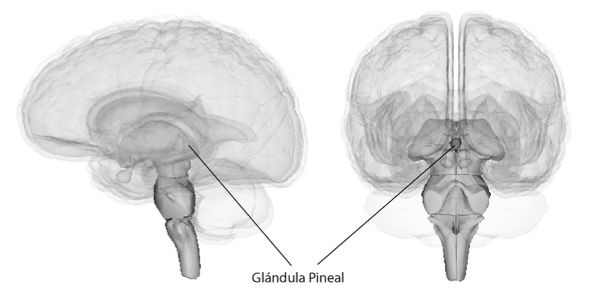
1. THEORIES ABOUT THE PINEAL GLAND
One of the theories that could explain this phenomenon is the one revolving around the pineal gland. The pineal gland is a photosensitive organ located in the center of our brain, between the two hemispheres.
Figure 14: Pineal gland. Source: Viquipèdia The pineal gland is indirectly connected to the optic nerves through which it is able to perceive outside light conditions. When it detects darkness, this gland begins to secrete melatonin, the hormone that controls the sleep cycle. Melatonin is responsible for our consciousness entering different states or phases that will lead us to sleep and, therefore, to rest and be able to repair our body. Before reaching the dream state, it passes through different states of consciousness that we should observe.
1.1. STATES OF CONSCIOUSNESS
Since it was discovered in 1929 that brain waves can be measured, a classification system has been established to observe how our state of consciousness changes according to the performance our brain is giving and the wave frequency it emits. Dr. Charls Tart, a psychology professor at the University of California, was the one who began observing different states of consciousness. Currently, different states are cataloged, and the following are accepted depending on the frequency of the brain waves:
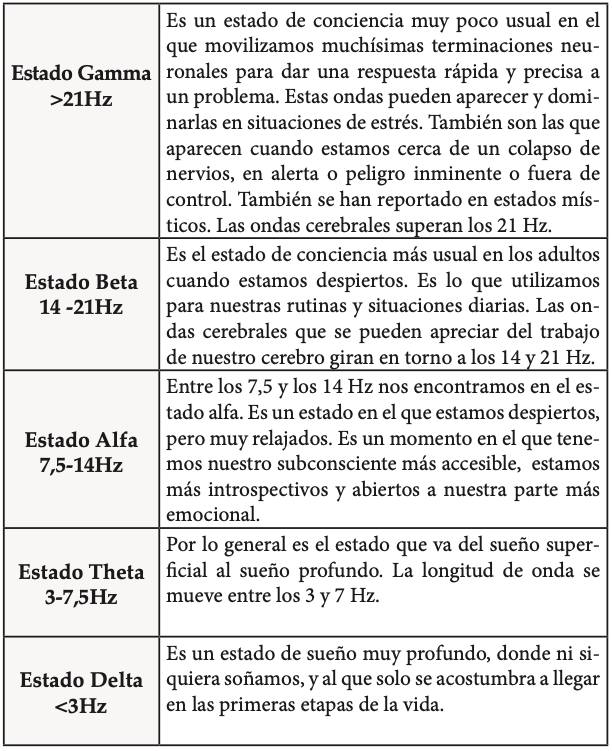
*Figure 14: Brain wave frequencies. Source: Own elaboration. *
According to Jose Silva6, who spent years researching ESP, the Alpha state provides the ideal situation to perceive information that often goes unnoticed by us. It is a state of calm, but without falling asleep, which allows us to maintain concentration without the mental “noise” we generate when we are in Beta. Among his statements we find:
“We discovered that children maintain a greater psychic capacity than adults. They are much less limited by the perspective of the Beta level…” (Silva, 1977)
And it is really not surprising, if we observe the electroencephalograms of the little ones we will see that:In babies from 2 to 4 months: Waves of a frequency of 3 and 4 Hz predominate. This corresponds to a wave frequency between delta and theta. Which for an adult would be equivalent to a state of very deep sleep. In babies from 4 to 12 months the wave frequency increases to 6 7 Hz. This corresponds to a theta state which for adults would represent a state of sleep between superficial and deep. Between the first and third year of life the wave frequency will continue to increase until reaching 8 Hz, between a theta state and an alpha state. From 3 to 6 years the frequency will increase to 9 or 10 Hz. We would still be talking about an alpha wave state.
It is not until after eight years of age and normally towards pre-adolescence that human beings begin to operate normally in the Beta state when they are awake.
From our experience we can observe that in general it is usually easier for children to open this capacity or, at least, they usually achieve a greater degree of control over said capacity. Thus, on a theoretical level it would make sense, as Silva pointed out, that in order to access this information that the subconscious is capable of capturing, we need to approach these Alpha or even Theta states, but without falling asleep.
Thus, when we blindfold a participant’s eyes, in a certain way, we are subjecting them to a situation of darkness that will favor the secretion of melatonin by their pineal gland and, therefore, will bring us closer, on a theoretical level, to the Alpha state or even to Theta.
Perhaps, blindfolding the eyes is not so related to “not cheating” but rather to helping create the ideal situation for relaxation.
We remember that Rosa Kuleshova expressed discomfort when operating with her dermo-optic vision when some light entered under the blindfolds covering her eyes…
Thus, at first glance, it seems logical that the pineal gland has a function in this process, but in recent years different doctors have begun to affirm that perhaps this gland may fulfill other functions. Specifically, some of them claim that it could act as an antenna. These authors are doctors Rick Strassman, Sergio Felipe de Oliveira, and Joe Dispenza, among many others.
1.2. THE PINEAL GLAND AS AN ANTENNA
Dr. Rick Strassman is an American psychiatrist who has studied the pineal gland for decades and firmly believes that it, among many other things, has the ability to somehow receive extrasensory information. This man of science, a follower of Eastern philosophies and Buddhism, wanted to find from science a point of union between the extrasensory phenomena that people can experience through the practice of yoga or by doing very deep meditations and human biology.
In his work DMT, Spirit Molecule (2001), Dr. Strassman states that the pineal gland is formed in the seventh week of gestation from cells of the palate and later, as it forms, it gradually moves toward the area it will occupy in the brain.
When he discovered this fact, it was the moment he decided
to study this gland more closely, since for Buddhists reincarnation occurs exactly on the 49th day after crossing the threshold of physical death, and this coincides with the end of the seventh week of gestation.
On the other hand, Eastern philosophies, as we have already seen, have always spoken of the existence of a third eye, an eye of the soul, and this has always been represented on the forehead, right on the outer part of where this gland is actually located. These coincidences led him to study the pineal gland and to discover that it not only generates melatonin, but that under some circumstances, this gland can metabolize a molecule called DMT (dimethyltryptamine). DMT is a reactive component that stimulates the brain and, when administered externally, can lead the patient to experience psychedelic sensations and visions. In fact, this substance is the same one found in ayahuasca, a traditional psychoactive herbal infusion of the Amazonian indigenous peoples used in rituals to undertake spiritual journeys. Dr. Strassman spent more than two years administering this substance to several dozen volunteers, and the accounts of these volunteers at the end of the sessions were most interesting.
All of them claimed to be fully aware of the situation, since it did not seem to them that they were experiencing a dream, but they saw and experienced things they had never experienced before.
Some were very surreal experiences, others simply very similar to those explained by people who have had near-death experiences.
After conducting the experiments, this scientist came to the conclusion that the pineal gland could be a kind of radio antenna that allows us to connect with other forms of reality, other dimensions, with DMT being the “dial” that allows us to tune into different frequencies. According to Strassman, in moments of meditation and enlightenment or intense experiences such as birth or death, the brain produces this substance, DMT, and this is the reason for the mystical experiences of those who
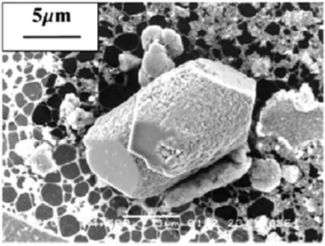
practice meditation intensely and the beyond-life experiences recounted by those who have been near death, for example.
Strassman’s discoveries are fascinating, but they become even more meaningful when we discover the advances of Felipe de Oliveira and the theories of Joe Dispenza.
According to Sergio Felipe de Oliveira in Estudo da estrutura da glândula pineal humana empregando métodos de microscopia de luz, microscopia eletrônica de varredura, microscopia de varredura por espectrometria de raio-X e difração de raio-X (1998) the pineal gland presents a structure of very small minerals, calcite crystals, which in turn, according to Joe Dispenza, would have piezoelectric capabilities.
*Figure 15: Calcite crystal in the pineal gland. Source: Sobrenatural. Gente corriente haciendo cosas extraordinarias. (2018). Joe Dispenza. *
The piezoelectric capability is the ability to generate electricity and, therefore, an electromagnetic field when said material is subjected to a certain pressure. In such a way that, when the pineal gland is subjected to certain pressure situations and thanks to these mineral structures, it would be capable of generating an electromagnetic field, and like any field, it would be capable of emitting
and receiving electromagnetic frequencies. Or in other words, it could become an antenna capable of receiving electromagnetic information from the environment.
In his book Sobrenatural: gente corriente haciendo cosas extraordinarias (2018) Joe Dispenza explains in detail how this antenna works and how we could activate it through the use of breathing and different muscle exercises to increase pressure in the pineal area.
“The cerebrospinal fluid moves through a closed system called the ‘ventricular’ system. The ventricular system facilitates the movement of fluid from bottom to top, from the base of the spine and along it, through the four chambers of the brain (called aqueducts or ventricles) and back to the sacrum (the base of the spinal column). When you inhale and pull the breath up to the top of your head, and then hold your breath and press in and up, you accelerate the cerebrospinal fluid. The surface of the pineal gland is covered with little hairs called cilia, which in Latin means ‘eyelashes’ (see figure 12.6). The movement of fluid at a faster than normal speed through the chambers of the ventricular system excites the cilia, which overstimulates the gland. Because it is phallus-shaped, the stimulation caused by the acceleration of the fluid flowing through it, combined with the electrical activation created by an increase in intrathecal pressure inside a closed system, induces the pineal gland to ejaculate very deep and purified metabolites of melatonin into the brain.” (Dispenza, 2018) This, according to Dispenza, would activate the pineal antenna, which he describes as follows:
“The pineal gland is a crystalline superconductor that sends and receives information through the transduction of energetic vibrational signals (frequency that transcends the senses, also known as the quantum field) and translates it to the biological tissue (the brain and the mind) in the form of imagery
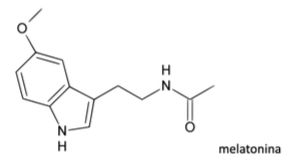
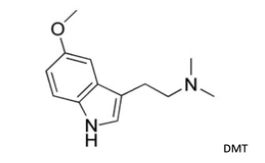
meaningful, just as an antenna translates different channels to the television screen. When the pineal gland is activated, it functions like a small antenna in the brain. The higher the frequency it picks up, the more energy it applies to the transformation and transmutation of melatonin. As a consequence of these chemical transformations, you are going to experience things very different from what melatonin usually produces.” (Dispenza, 2018)
That is, the more we activate this antenna and the greater the electromagnetic field we generate, the more melatonin will be transformed into DMT.
*Figure 16: Melatonin composition. Source: Own elaboration. *
*Figure 17: Chemical composition of DMT. Source: Own elaboration. *
If we observe the chemical composition of both particles we will see that their composition is very similar.
Thus, both Dr. Strassman and Dr. Dispenza affirm that said gland at certain moments can act as an antenna and that DMT would be the dial that allows us to capture
information available in the quantum field.
To see without the eyes we do not need to connect with other dimensional planes, as these doctors recount from their experiences with their participants, and, therefore, it could be very probable that the use of DMT is not necessary or does not come into play in the development of this ability. But we can indeed hold onto the idea that the pineal gland can act as an antenna, and this, however, would be of great help for the subject we are studying.
A last curious fact that these three authors also highlight, especially Strassman, is that the pineal gland starting at age 12 begins to undergo a process of calcification until reaching a point of advanced calcification around 17 or 18 years of age. These data can change depending on the person, diet, lifestyle, and their country or culture of origin. But in general, they would explain why children under 12 years of age obtain better results, or manage to generally delve deeper into the development of this ability.
1.3. EXPERIENCES THAT VALIDATE THE FUNCTION OF THE PINEAL GLAND
On the other hand, and from our experience, we have seen that when we alter the breathing of our participants and apply techniques like the one Dr. Dispenza proposes in his aforementioned work, as well as other similar techniques, although always with less intensity than what this author sets, many participants report that inside their head or in their visual field (within the darkness of the blindfold) lights appear, and very often these lights are the color of the object they were observing. Thus, and from our experience, the relationship of what we have experienced with what the current theoretical framework offers and in particular this author, fits perfectly.
We even know that with children and highly sensitive people, we cannot use these techniques to open the ability to see without the eyes, because some of them have reported visions that do not correspond with what they were observing, but that seemed to them as real or more real than reality itself. Thus, from our humble point of view, it seems that Joe Dispenza’s theories would be true and that when DMT comes into play, the individual connects with other information that would not serve us to see the immediate physical environment.
This explanation also gives meaning to many other experiences of participants who have attended classes to learn to see without using their eyes. For example, why did the participants of the UNAM experiment not pass the tests? Here we see the clear answer: because their brain was not in conditions of relaxation to be able to reach the adequate state of meditation or concentration to perform this activity. The subconscious itself would have felt intimidated by the presence of the researchers and perhaps would have sabotaged the activity.
On the other hand, it would also answer the situations in which the students seem to be seeing, but their answers are very imprecise, like the case we saw of Cupid and Coco, or for example, what happened with this other image: Figure 18: Image of a cat. Source: Flashcards: 50 First Words (Scholastic Early Learners)
The same student, capable of playing soccer blindfolded, stated that in this image he first saw an owl; after a couple of minutes when I showed it to him again, he saw, in his words, “a strange animal” which he could not define; in another round, when I gave him the card, he saw “Toothless” 7; and finally a cat.
All this in the same session, after showing him the card on different occasions in a very short period of time. If he were seeing with his physical eyes he would clearly see that it is a cat, and not just once, but every time. But it could be that,
“trying to tune in,” the information does not arrive entirely precise at some point. This happens with quite a few students when they begin to see blindfolded. A bed can be a table “with pillows and sheets,” a ball can be a balloon or a cargo truck can be seen as a convertible bus…
In this chapter we will try not to enter into spiritual analysis and will try to stick only to scientific language… but to finish this first section on the pineal gland we cannot avoid this quote that leads us to reflect on the certainty of everything related above:
“The seat of the ‘single eye’ or spiritual eye. At the moment of death, man’s consciousness is generally drawn toward this sacred point, as demonstrated by the upward-turned eyes of the dead”
Yogaganda. *“Autobiography of a Yogi” *.
This reflection leads us to think that if the pineal gland is truly responsible for the visions that people who have had near-death experiences recount, it would be normal that with the
physical eyes we would shift our gaze upward to try to better contemplate these visual experiences that would occur as if inside our mind.
At this point we would already have an antenna. Perhaps there are more in the body, but at least for now, we have found one that allows us to understand intuition. It allows us to understand why sometimes we know things that we have neither seen nor had explained to us… But from here to seeing without the eyes there is a very big leap. For this we would also need some screen or television, right?
We will see what could help us in this direction.
2. THEORIES RELATED TO THE ABILITIES OF THE RIGHT HEMISPHERE
Another theory, complementary or not, that could give us a little more light on this matter, is the one that began to develop in Japan during the 80s and 90s at the hands of the doctor in pedagogy, Makoto Shichida. This, as we already saw in the first chapter, has been developed by different intellectuals until forming various schools and learning methods such as the Shichida method itself, the Tobitami method — developed by Yumiko Tobitami for the learning of quantum reading — or the Wink method, by the American Pamela Sue Hickein.
These schools defend the education, reeducation, or training of the potentialities of the right hemisphere of the brain. These currents believe that among the functions of the right hemisphere are rapid mental calculation, accelerated learning, visual memory, imagination, creativity, and intuition, among others. As Shichida says in the
work *Right Brain Education in Infancy: Theory and Practice. * (1993), the educational system of most countries in the world usually fosters mainly the development of the left hemisphere, where, according to them, we find reasoning and verbal expression. Coinciding with the start of school (where these latter qualities are much more enhanced) and with the development of laterality, we would stop using some of the potentialities of our right hemisphere and would not manage to fully develop its incredible power.
These researchers are based on the scientific studies of Roger W. Sperry, who in 1981 received the Nobel Prize in Medicine for his discoveries about the specialized functions of the cerebral hemispheres, both the left and the right. In his opinion, broadly speaking, one is rational and the other intuitive. One dominates mathematics and language, the other uses imagination and visual memory. However, the perceptual, cognitive, and executive processes develop in the brain as a whole. The two hemispheres are very similar and both can carry out most processes, and we even find that functions typical of the right side are also performed on the left side and vice versa.
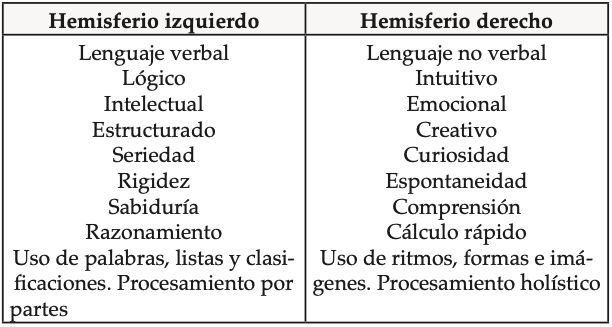
*Figure 19: Theory of the hemispheres according to Shichida. Source: Created by the author. *
According to Pamela Sue Hickein, in her book, *Right Brain Education. *
Changing the world, one heart at a time (2009), by nature, babies and children make use of their right hemisphere predominantly. With the passage of time they begin to create links and bridges between the two hemispheres until, from the age of four to six, if the right hemisphere is not challenged and stimulated, it gradually deactivates its true potential. It is obviously never stopped being used, since vital functions depend on it, but with lateralization (specialization and predominance of hemispheres for the performance of different activities) and the predominance of logical and verbal activities in the person’s daily and academic life, the special capacities of the right hemisphere are gradually undermined.
The memory storage capacity of the left brain is very limited. We cannot remember for very long what is stored in the left brain. The right brain, on the other hand, has a storage capacity for
long-term memory and the contents that access this hemisphere go automatically to long-term memory.
We can easily remember even after a long time.
Thus, the schools or movements that seek the education of the “right brain” have as their ultimate goal the development of the whole brain, not just the right hemisphere, but they seek to develop the capabilities of both to awaken the full potential of the person.
According to Professor Yumiko Tobitami, defender of quantum reading (the ability to read at high speed) and right brain education, in her work Quantum Speed Reading: Awakening Your Child’s Mind (2006), she explains that it is necessary to create new brain circuits that strengthen communication between both hemispheres. The new nerve communication route between the two, according to them, takes about three months to create, but to achieve this in adults, intentional practice and firm willpower are important. According to this method, once full communication between hemispheres is achieved, the person will enjoy better health, the development of the gift of presence, better memory, will manage to expand their intuition, it will be easier for them to fulfill their desires since they will focus more on them and on how to achieve them, while their imagination will expand. All this will result in a better quality of life and greater stability on all levels.
All the methods for right brain education defend the existence and function of the midbrain, of the corpus callosum that exists between both hemispheres (where we precisely find the pineal gland). And also, all of them highlight the importance of expanding communication between the two hemispheres through the connections created by this central corpus callosum.
To do this, each method proposes different relaxation and meditation techniques. Both the Shichida method and the Wink method speak of the importance of entering the alpha state (same terms as the methods that speak of vision without the eyes) to facilitate the
communication between both hemispheres. Without that state of relaxation, it appears that communication and the establishment of new connections is neither as easy nor as possible.
2.1. COMMON ASPECTS BETWEEN THE DEVELOPMENT OF THE RIGHT HEMISPHERE AND THE ABILITY TO SEE WITHOUT THE EYES
But what relationship exists between these methods and Intuitive Vision? We can highlight three aspects:
The first is that all methods for developing the right hemisphere, and even the theories of Dr. Roger W. Sperry himself, cite intuition as one of the elements that describes this right hemisphere, generally less stimulated.
The second is that all of these methods detail the need to enter an alpha state or state of optimal concentration in order to activate communication between hemispheres, which is why they emphasize the importance of the midbrain, right where the pineal gland is located, responsible for secreting melatonin to help us relax.
Finally, both the methods for developing quantum reading and those aimed at developing the right hemisphere, as well as those seeking to activate this Intuitive Vision, cite the same list of benefits. Although they sometimes use different language, they all speak of increasing mental capacities, further developing the brain’s potential.
Could it be that the phenomenon of Intuitive Vision is yet another fruit of strengthening the connection between the left and right hemispheres? According to Makoto Shichida, the right brain works essentially with images. To affirm this, he draws on the studies of Wilder Penfield, a brain surgeon who discovered that
relationship of the right brain with images while operating on a patient who remained conscious. While intervening and stimulating different areas of this hemisphere, the patient began to see and describe images sharply and clearly.
Thus, we would be speaking of a part of the brain that functions non-verbally and that not only would have the capacity to work with images, but could do with them whatever is necessary to imagine, create, and even project a series of suggestions that would enable the person to achieve self-improvement.
The Shichida method trains the capacity to work with images through afterimage work and maintains that after observing certain specific images, in an Alpha state, for a few moments and entering it correctly, we are able to create an afterimage in our mind. That is, after looking at an image for a period of time, we are able to hold that image in the mind and recall and project it again, like a hologram, with total definition. Throughout a training process with images, and always following relaxation activities, the right hemisphere gradually acquires more connections and gains agility to be able to produce afterimages of objects, words, and images that have only been seen once or twice in life. A very useful exercise, especially for improving spelling, but with benefits that go well beyond this.
2.2. TRAINING WITH IMAGES
One of the ultimate goals of this training is to arrive at having an afterimage where one can visualize oneself. With this image and with the correct suggestions from the instructor and, ultimately, autonomously, one attempts to see oneself achieving success in those aspects of life where we want to triumph. One visualizes the person themselves

carrying out each of the necessary steps to achieve success, and one visualizes that very success so the person knows exactly how they should proceed to reach it.
Working with images is what stimulates the non-verbal hemisphere, to such an extent that it enables one to work with a “little screen” on which images can be projected. This makes it possible to capture all the information on a book page in a matter of seconds and to process it in the form of images as if it were a fast-motion film.
To better understand the power of the afterimage, we propose the following exercise, adapted from the book “Science of intelligence and creativity” (1994) by Makoto Shichida.
PRACTICAL EXERCISES
Calm your mind and stare for 30 seconds at this image while breathing deeply. Then close your eyes and try to see this image over your eyes, as if it were floating in the air.
Figure 20: Figure for working with afterimages. Source: Original work based on the proposals of Makoto Shichida in his work “Science of intelligence
and creativity” (1994)
Surely the first few times it may take some effort, but probably after practicing for a while you will manage to see a negative of that image. With practice, one eventually achieves seeing the image just as one would with open eyes. Now let us repeat the exercise with this figure in color:
Figure 21 (https://bit.ly/3VCrQ6i)
Figure 2 for working with afterimages. Red square on white background. Source: Original work based on the proposals of Makoto Shichida in his work “Science of intelligence and creativity” (1994)
Probably, after performing the exercise, a small turquoise-colored square will be seen floating on a black background. A person little trained in this type of activity most likely perceives the mark that photons have imprinted on their retina. This is the product of a natural physiological process and allows us to capture the complementary colors of the figure we have seen. In this case, since the square was red and the background was white, it is likely that the person perceives the image in its “negative,” in which case perceiving a square of turquoise hues floating on a black background.
Let us experiment with the same thing, once again with other colors.
Figure 22 (https://bit.ly/3MGIT3b)
Figure 3 for working with afterimages. Blue circle on orange background. Source: Original work based on the proposals of Makoto Shichida in his work “Science of intelligence and creativity” (1994).
It is likely that the afterimage captured will once again be a negative. That is, that it will have been seen with the colors swapped; the blue square and the orange circle. Even though this image is a normal physiological ocular phenomenon, what is striking is to see and discover that, after several attempts, asking our brain to restore the image once it has already disappeared, it can, with practice, reappear. And this is no longer a natural physiological phenomenon of the eyes. Furthermore, with training, this image no longer appears as a negative, but rather appears exactly as it was presented externally.
Even more curious is that, with practice, we manage to restore that image minutes, hours, or even days later, being able to recover it through the act of imagining or remembering it. And
ultimately, this is what it is all about: an afterimage is not mere imagination, but rather a visualization of the object, drawing, or word that the individual “invokes” and manages to see with precision, just as if they were seeing it with their eyes.
According to Makoto Shichida, there are four steps in afterimage training. The first step is the one we have just described.
This step will be completed when one can see an afterimage clearly for a long time.
The second step consists of imagining with closed eyes in order to freely visualize these colored circles (like the one in the previous activity), without the need to have observed them recently, and invoking the colors that we ourselves wish. Just as we did with the red square on a white background, the task now is to try to imagine colored circles without having done the activity of observing them beforehand, and to manage to visualize them just as we would with an afterimage of a recently observed circle.
The third step involves staring at three-dimensional objects nearby, such as a ball, a bowl, or a pencil, and visualizing them anywhere one wishes. The goal of the fourth step is to visualize oneself. One can imagine achieving the success one desires and, above all, one must visualize oneself managing to carry out each of the intermediate steps to reach the desired situation. This will lead the person, according to Shichida, to achieve it with greater ease.
Makoto Shichida, Yumiko Tobitami, and Pamela Sue maintain that when the right brain is already well developed, it is possible to ultimately recall the correct spelling of any word that has only been seen once or twice in life. And not only that. One is capable of eventually recovering the image of any object or place. To achieve this effect, other exercises that help develop this capacity are the following, which we have also drawn from the work of Makoto Shichida cited above:
Exercise 1
-
Close the door, the lights, and lower the blinds in a room until it is completely dark. Place a candle approximately 70–75 centimeters from you, at eye level, and light it. It is a good idea to do this activity with calm music, with binaural sounds, or even with a metronome at a very calm tempo.
-
Breathe deeply and relax.
-
Stare at the candle for one minute.
-
Close your eyes and observe the afterimage with as much precision as you can. When the afterimage disappears, look at the candle again. Repeat this many times, over many days, until you manage to hold the afterimage or make it return to your mind easily whenever you wish.
Exercise 2
Once you have successfully completed step 1, carry out the second one.
-
Sit in the room with the lights on and relax your body and mind.
-
Close your eyes and invoke the image of a candle.
-
Repeat as many times as you need until you have the image. Once you manage to freely see the image of a candle, move on to Exercise 3.
Exercise 3
-
Sit in a relaxed manner. Close your eyes and invoke an image of a golden ring.
-
Once you have the image, transform this circle into a square or triangle.
-
When you have the image of the square, transform it into a die and roll it from one to six.
-
Once you have achieved this, you can do the final exercise.
Exercise 4
The purpose of step 4 is to see your own image. First, visualize an image of a landscape; imagine yourself in this landscape, listening to the birds sing, the river murmur, or the ocean waves crash, feeling the breeze, smelling the flowers, feeling the warmth of the sun, and feeling satisfied. If you manage to reach this level, your power to visualize images is perfect. Do not abandon it even when you cannot reach that level. It is important to continue the training every day.
After continuing this exercise, the duration of the afterimage will lengthen. This is a natural physiological phenomenon. You can take advantage of this ocular phenomenon to develop the power of imagination. Continue this practice until you can clearly visualize the image of the flame and retain the image while keeping your eyes closed. It may take a couple of months if you go at a slower pace. But remember that we can all learn to see an afterimage that lasts longer.
As we can see, what begins as a physiological phenomenon of the eyes, where an image remains imprinted on our retina, according to Shichida, little by little becomes the capacity to have images recorded in our right hemisphere and to be able to reproduce them whenever we wish. The ultimate purpose of this is to end up enjoying a kind of screen, like a movie screen, on which we can project our imaginings and memories and manage to see them as if we were seeing them with our eyes. According to him, young children have great ease in working with images, whereas these exercises, for adults starting from scratch, can stretch on for months and always require discipline, effort, and consistency in this training.
2.3. SYNESTHESIA
Another aspect that caught our attention, while studying the methods for developing the right hemisphere, was synesthesia. At a certain point in his work, Shichida cites this capacity of the brain as yet another function of the right hemisphere, and one that by chance we have been able to see and observe in many of our participants. Synesthesia is a non-pathological variation of human perception.
People with synesthesia automatically and involuntarily experience the activation of an additional sensory or cognitive pathway in response to specific stimuli. For example, they may see a color when they hear a musical note, or perceive touch on their right cheek when they taste a food, or smell or taste something when they touch an object or color. These perceptions are idiosyncratic, meaning each person perceives specific and different colors/smells/sounds, etc. Although some internet pages say that synesthesia is a mixing of senses, this is inaccurate: in synesthesia there is sensory specificity, that is, sounds are heard as sounds or the color of written letters is perceived well, but synesthesia is an additional sensation (a sound is perceived correctly as it is, and in addition, a color). For these reasons we speak of a non-pathological sensory variation, since it does not entail a limitation; in exchange, it provides the individual with extra information.
This sensory variation experienced by some people would not seem to be so much a capacity of the right hemisphere as Shichida said, since it occurs thanks to the interconnection of different parts of the brain. But it is possible that it is one of the potentialities that are maintained or increased with the work or training of the right hemisphere and the creation of new neural pathways between both hemispheres.
Furthermore, many babies and children possess this ability, but with the different synaptic prunings8 they experience throughout their growth and lateralization, the vast majority end up eliminating this skill due to lack of practice. Once again, an example of how education and modern society inadvertently harm the development of the brain’s global potentialities when it prioritizes certain specific qualities, in this case reasoning, verbal language, etc. At first glance it might seem that this sensory variation might not be useful, but it is truly yet another capacity that we give up for nothing. Let us observe the following image:
Figure 23 (https://bit.ly/3VA3wSM)
Graphical representation of how a person with synesthesia perceives the Stroop task. Source: Wikipedia.
On the left we are presented with a black and white image, just as most of the population sees it. On the right we can see the same image as a person with synesthesia might see it (not all develop the ability in the same way). In the second image we can see how each number is assigned a color, making it easier for them to decipher the hidden shape.
Without a doubt, when we try to activate Intuitive Vision, some participants, before managing to see anything, make use of their synesthesia to better understand the object they are investigating. With their touch and “extra” sensory skill, they manage to detect a smell or a taste and through it translate it into a color. Few people proceed in this way. An example would surely be the case of the blind organist studied by Robert Boyle that we mentioned in the first chapter. Be that as it may, it is an ability that we know exists, and it is scientifically accepted that more children possess it than adults. Therefore, we can deduce that this disappears with age and, perhaps, as the defenders of right hemisphere education say, due to not stimulating it sufficiently and not promoting the interconnection and synchronization between both hemispheres.
Video 8 (https://bit.ly/3TvVcS4)
Participants of the Intuitive Vision courses making use of their synesthesia. Source: Own elaboration.
Video 9 (https://bit.ly/3yPXqno)
Participant separating colors using smell. Source: Own elaboration.
2.4. INTUITION. ANOTHER ABILITY OF THE RIGHT HEMISPHERE?
A curious fact about Japanese theories regarding the development of this hemisphere is that they do not usually speak specifically about the ability to see without the eyes, nor do they stop to evaluate this phenomenon (or at least they do not do so in their translated works), although they often talk about very curious abilities that we will later observe in detail in another section, such as telekinesis or telepathy. But among these situations, on several occasions they comment on the ability of children to see through a wall, or the drawing on a covered or face-down card. Clearly these capacities have to do with Intuitive Vision, and clearly they coincide with the experiences we have had conducting sessions for seeing without the eyes. According to them, these situations are related to intuition and visual memory, firmly believing that they are connected to their image training method.
The ability to visualize afterimages, the ability to imagine, the ability to read with images are related to the image we project in our frontal lobe (or a little above or a little below) when we close our eyes. In fact, the “screen” where everything mentioned above is projected is the same one where children who guess what is behind a wall, or on the back of a turned face-down card, manage to visualize the answers. In other words, the capacities derived from the right brain development or stimulation techniques promoted by Shichida produce an inner image similar to the images that some of our participants describe when they have
activated Intuitive Vision; both are reproduced on “a screen”.
And to make this screen work, perhaps we must follow similar steps to “turn it on”. Therefore, there would indeed be a relationship between the methodologies to develop the skills attributed to that hemisphere and Intuitive Vision. But let us continue with the same question… How are these images from the outside obtained?
How is it biologically possible to see without the eyes according to the defenders of right hemisphere education?
2.5. THE PINEAL GLAND COMES INTO PLAY AGAIN
According to Shichida (1994), to enhance the right hemisphere, it is first necessary to strengthen the bonds of the two hemispheres through the midbrain, the neuronal corpus callosum where the pineal gland is located. This connection simultaneously allows better communication with the pineal gland, and this is achieved through meditation, relaxation, and darkness, since in this way the necessary melatonin will be secreted to enter an alpha wave state. Unlike Dr. Strassman, Shichida believes that the entire endocrine system comes into play when capturing information from the outside. He states that the nervous system alone is not enough for the brain to capture information from the billions of cells we have in the body, and that it is these cells that, through hormones, send information to the pineal gland, which in turn translates it into information that is finally interpreted as an image in the right brain.
Shichida considers that quarks, the molecules that form subatomic particles, vibrate, and as a consequence of this, waves are released. These waves can be captured by the very essence of the matter of the cells, and these, in turn, can send endocrine-type information through the blood to the pineal gland. In this way, and from his particular point of view,
the entire body would be an antenna capable of capturing information from the outside. Or rather, the entire body would act as an extension of the antenna itself, which would be the pineal gland.
2.6. HEMISPHERE SYNCHRONIZATION AND ALPHA STATE
Thus, the work of those who defend developing the potentialities of the right hemisphere has been, in part, to discover how to open this channel that allows expanding communication between the two hemispheres, and clearly their studies have led them to think that to do so, it was first necessary to activate the midbrain. One of the scholars when it comes to synchronizing all parts of the brain is Robert Allan Monroe.
Robert A. Monroe was an advertising executive from the United States, who became famous for his research into altered states of consciousness. On a personal level, he experienced a series of events that led him to question his mental health; he then began to realize that he did not actually suffer from any pathology and that no specialist could help him, so he decided to study altered states of consciousness to better understand his experiences.
His studies led him to found the Monroe Institute, an institution that continued his work after his death.
Thanks to his work and the tasks carried out by this institution, the benefits of binaural beats were discovered. These sounds facilitate the state they called Hemi-Sync, which is an abbreviation for “hemispheric synchronization”. These sounds and musical compositions, by playing with different frequencies designed for the right ear and the left ear, facilitate communication between the two hemispheres, contributing to entering an altered state of consciousness more easily. That is to say, binaural beats facilitate access to a
working state of the individual in an alpha state. This state is necessary both for the defenders of right brain development, and for the instructors of most methods that aim to achieve vision without the eyes, as well as for anyone who wants to do any kind of spiritual work.
There are dozens of meditations, types of music, and techniques to help or accompany entering that alpha state, but it is not always reached voluntarily or premeditatedly. This is how, for example, some athletes express it. Rhythmic sports such as cycling or running, where the person can maintain an individual activity with a constant rhythm, can lead the person to enter that state. From the sciences of education and sports, the psychic benefits of these activities have always been discussed.
And the rhythmic pattern can lead the person on an inner journey, losing track of time and space or the distances traveled, and sometimes it can surprise the individual themselves when they return to a Beta state and realize the time elapsed without having been fully aware of it.
In concentration sports, one can also reach these states and foster intuition so that it appears sporadically. For example, the famous soccer player Pelé, years ago, stated that he became capable of locating the position of all the other players on the field instinctively and that he could hear the movements each player made. Or a St. Louis batter, Stan Musical, who explained that if he concentrated his attention, he could see the trajectory of the ball as soon as it left the pitcher’s hand. According to him, when he was concentrated, he could tell how the ball would travel on its path, predicting its speed and trajectory.
2.7. THE “AWAKENING” OF THE RIGHT HEMISPHERE
Makoto Shichida does not give more importance to the act of seeing without the eyes, nor even to the realization of activities to exclusively develop this ability. He focuses more on the very wide range of possibilities that this hemisphere gives (or at least the possibilities that his pedagogy gives to enhance the capacity to visualize) and on how to open the door to enhancing it even more. Shichida’s work is determined by that of other authors, such as Yatri.4 In one of his works, Unknown Man: The Mysterious Birth of New Species (1988), he argues that within the human body there are sophisticated functions that are still inactive. However, once these functions are activated, there will be physical and mental transformations through which it will become possible to control the mechanism and the physical order. He describes these as inactive evolution functions.
According to Yatri, children are being born all over the world who are awakening some evolutionary functions that were deactivated4.
Author who preferred to remain anonymous. His pseudonym means “traveler” in Hindi.
das. The evolution he is discussing here is the evolution of consciousness. As this evolves, humans will acquire a consciousness different from the current one. Currently, the majority of human beings have an over-developed or over-exercised left hemisphere, while in the future it would be necessary to develop the right hemisphere in the same way. This evolution of consciousness is treated today as a purely esoteric topic.
We could still continue for many more pages talking about education or training with images, but at this point we would move too far away from our question; how we can see without eyes, in biological terms, as well as its possible answers. However, to close this section on the brain hemispheres I would like to highlight one last consideration. As we just commented, there are circumstances in which perhaps involuntarily, without knowing it or without
being aware of it, we can alter our state of consciousness and use a part of the hidden potential, just like the athletes cited above. But, are there or have there been individuals who have used this hidden potential in the right brain in a more predominant way? Let’s investigate!
2.8. SAVANT SYNDROME. EVIDENCE FROM NEUROSCIENCE
Setting aside some geniuses of history who perhaps made exhaustive use of both hemispheres and whom we will see later, there do exist, more anonymously, other people who, due to a serious brain impairment, have made use of their right hemisphere in a much fuller way than the majority of the population, as has been proven through brain neuroimaging. These people are those who suffer from savant syndrome. According to psychologist Darold A. Treffert, in his work Savant Syndrome: Realities, Myths and Misconceptions. Journal of Autism and Developmental Disorders (2013), Savant syndrome is a rare condition suffered by some people in the development and connections of the brain hemispheres. According to the latest contributions in neuroimaging, it is believed that the brain of a person with savant syndrome may have its right hemisphere much more enhanced than usual and thus access abilities that may include photographic memory, the extraordinary ease of learning languages, or the ability to perform rapid mathematical calculations, frequently related to synesthesia, among other capacities. This syndrome can be present from birth or it can be acquired after brain damage in the left hemisphere.
Generally, the most common skills presented by people with savant syndrome focus on four main categories: art, date calculation, mathematical calculation
and mechanical and special skills. Thus, they are characterized by being great musical performers (especially with the piano), painters, and sculptors. They tend to have innate abilities to understand and interpret music. Some people with savant syndrome can memorize entire calendars and remember specific data regarding each of these days. They usually show an ease in performing complex mathematical calculations instantly and with enormous precision. For example, calculating prime numbers, describing tens or hundreds of the decimals of the number pi, or performing divisions with 100 decimals, all of this, of course, mentally. Or they can measure almost exact distances without any kind of measuring instruments, build highly detailed models, memorize maps and directions, etc.
This impairment of the hemispheres can be associated with emotional, behavioral, and relational alterations. The diagnosis of some type of autism is very common in these cases.
Many also have the ability to superimpose images through their imagination in a real context. A fictional example that will help us understand this ability is the case of the doctor from the series “The Good Doctor”. Despite not being a real case, this character represents a doctor with savant syndrome who has the ability to visualize organs in the form of a hologram wherever he wishes to project them. This allows him to better diagnose his patients. As we have already said, this is a fictional case, but this ability is based on real facts, and it serves so that the reader can see an example and get an idea of how the right hemisphere can project images from inside the brain to such an extent that the individual can see them and interact in some way with them.
Vídeo 10 (https://bit.ly/3Df5Rvr)
The Good Doctor All Shaun’s special skills compilation. Source: YouTube.
And if we talk about hemispheres and impairments of the left hemisphere, we must highlight the case of Jill Bolte Taylor, an American neuroscientist who, while studying the structural and functional differences of the brains of healthy people and those of people with some type of alteration such as bipolar disorders or schizophrenia, had the opportunity, in her own words “to experiment live with her own brain.”
And it is that one morning, when she got up to go to work, she had a stroke in her left hemisphere that progressively annulled a good part of its functions. She was able to survive and later recount how her perception of the world changed as the collapse progressed at that precise moment. She noticed that something was not right and decided to call emergencies, then the left hemisphere stopped performing its functions due to the stroke. She was unable to recognize telephone numbers; for her they had become disconnected symbols. And after a few minutes, the entire rational and linguistic part of the left hemisphere had disappeared, and only the right hemisphere was in control.
Then her thoughts ceased to have words, they were only images, sensations, and an explosion of perceptions that she had never experienced, coming to perceive, according to her, the vibration of matter itself and embracing the nature of consciousness from a side she had never experienced before. We recommend listening to her experience here in a TED conference that we attach in the following link.
Vídeo 11 (https://bit.ly/3gdpA5q)
My stroke of insight. Jill Bolte Taylor. Source: TED.
Broadly speaking and to finish this section, it is clear that both hemispheres are necessary for life as we understand it. This makes us think that in our day-to-day lives the functions of the left hemisphere completely predominate, so perhaps we have forgotten some of the possible ways to connect with our consciousness, which would allow us to perceive and process information in a different way from what most people have developed.
2.9. GENIUSES OF HISTORY AND INTUITION
According to Shichida (1994), American anthropologists Platt and Barker carried out an inspection of creative geniuses to see when their creativity was most visible to them. According to their studies, eighty-three percent of the scientists who responded to their questionnaire mentioned that they were often helped by unconscious intuition, a source of inspiration that was difficult for them to describe. Also, other geniuses of the past like Dickens and Einstein proclaimed that “unconscious” and inexplicable processes helped their creative work. Let’s discover other examples here.
Arthur Rimbaud, the French poet, said: “I do not think, but I am made to think. I am only an instrument. The music passes through me by itself.”
Mozart: “All the music I composed came to me from nowhere. I saw the music in three-dimensional form like a beautiful sculpture.”
Brahms: “Suddenly, a musical idea was running inside me and came directly from God. Filled with the spiritual feeling, I heard the finished piece phrase by phrase.”
Goethe: “My way of writing a poem is totally different.
I do not have any impression or premonition beforehand. The lines suddenly spring into my head, and I make them into a poem instantly. Since man’s dreams come from his instincts, I am driven to write a poem right away.”
Rudolf Friml, composer of operas: “I let the spirit carry me when I am sitting in front of the piano. It is not I who plays the music. Composing music is not my job at all. I am just a tool. I am simply used.”
Nikola Tesla stated that to save costs in his experiments, he first performed them in his mental laboratory, where he managed to visualize what could go wrong, and even see if any component could react and explode. In this way he could know if he could be successful or not before doing it.
Also, popular singers like John Lennon and Michael Jackson among others claim to have “received” their music, and the experiments with hallucinogens that many artists performed to access other states of consciousness in an induced way, to have easier access to their subconscious, are popularly known.
2.10. THE “LITTLE SCREEN” AND OUR EXPERIENCES
Definitely, it seems that the “little screen” proposed by Shichida and the other defenders of right hemisphere development could be the tool we might need to use Intuitive Vision. Shichida wants the little screen to imagine and remember clearly, and from these memories and images that spring from one’s own being, to make adequate use to elaborate strategies and thus have more success in life.
For example, they argue that when a student masters the use of post-images, they are able to imagine and consequently see, for example, an abacus. And not only see it!
They teach how to operate with this imaginary abacus to be able to calculate mentally much more easily.
This would be one of the ways of how to apply this ability to make good academic use. Shichida also believes that when a person is able to imagine and see themselves achieving the success they desire, and then visualizes all the steps they must take to achieve this success, this allows the person to walk the path to where he or she wants more easily…
But… And what happens with Intuitive Vision? Does it also use this screen? From our experience we can affirm and confirm that many of our participants recount how they can see without the eyes thanks to and through a mental little screen that we can create. Despite this, not all participants report this. We find very, very varied forms: There are participants who have reported that they could see from three or four centimeters above the body, as if their consciousness had left their body, and from this point they managed to see the top of the cards that we placed on their heads.
There are participants who report the sensation that they see from their fingers or other parts of the body.
There are participants who report that they can see through a hole and that this, with training, grows until giving a vision of 180 degrees or even, in some cases, 360 degrees.
Thus, not all manifestations coincide with this little screen. But at the same time we have an interesting story that we will expand upon in another section, but which can shed much light in this direction. It is about the second blind woman we worked with. She is the national champion of her
chess country. Despite having gone decades without being able to see a single color, she has a high capacity to visualize within her head.
She can visualize the chessboard, its pieces, the opponent’s pieces, and the moves. She has a capacity to work with images far more advanced than that of most people… What happened?
In the first session she was able to visualize shapes and colors from the photographs and cards she was analyzing, when for decades her eyes had not allowed her to capture this information.
For us the conclusion is clear. The more we enhance the capacity to visualize, regardless of whether the right hemisphere theories are true or not, the greater the chances of success we can have in trying to awaken this capacity.
And working with the capacity to visualize is not only important for this. Developing this little screen, and we also state this from our experience, means having access to the
“biocomputer” spoken of by Bronnikov, to Zolotov’s “biointernet,” to the little screen that Inge Bardor spoke of… It is a visual language of communication with ourselves and our intuition that allows us to access the cloud of intuitive knowledge, perhaps to the “quantum field” spoken of by Joe Dispenza.
Thus, regardless of whether in the future the theories of Shichida and his collaborators can be corroborated or not, theories suggesting that the right hemisphere would play an important role, what is certain is that their methodologies, their activities, the tools for learning to visualize, and image training have the desired effect to help develop the capacity to see without the eyes. And not only this, regardless of whether the participant achieves vision with it or not, this little screen helps develop a tool for understanding what our intuition tells us.
And with this, we would already have an antenna and a little screen, and with that, metaphorically, we could already see without the eyes… But as we have seen, there are other manifestations that are not explained in these
cases… What about people who capture information or even see through their skin or with their fingers?
3. THEORIES ABOUT THE FUNCTION OF THE SKIN AND INTUITIVE VISION
So far we have seen and could accept that the pineal gland can act as an antenna and that it can help us capture information from the environment in some way, but perhaps it is not the only explanation… Many of the authors discussed in the first chapter considered that the skin must play some kind of role, from Romains, who claimed that vision must occur thanks to micro-organs (ocellis) not yet discovered in the skin, to Bekhtereva, who, despite observing on EEG the changes that occurred in the brain when someone saw without their eyes, was convinced, by the way the participants behaved, that they used their hands to help capture the information.
From our experience we cannot deny the evidence that many people begin “seeing” or capturing information with their fingers or hands, sometimes in such an incredible way that it is as if they had an eye at the tip of their finger and could only see what they are touching at that moment… So yes! It is important to analyze the skin and what we know today about it, to investigate whether there might be some further explanation for this phenomenon.
To begin, let us briefly review some animals in nature that are absolutely blind or have no eyes and yet manage to develop some type of vision. The goal of this summary is to try to find some evidence or some clue about what structure we
humans might use to see without eyes, and to know whether through evolution any of their traits could have accidentally been passed down to us and remained latent, for example, in our skin.
3.1. ANIMALS THAT SEE WITHOUT THEIR EYES
There are different species of blind animals, partially blind animals, and even some without eyes, that perceive information from the outside and manage, to a certain degree, to “see” what is happening around them. Among these species, surely one of the first that comes to mind is bats. Bats are not exactly blind, although they are famous for using an extra sense, especially during nighttime excursions and inside caves. Their vision does not differ much from that of other mammals, but in addition they enjoy a “biological sonar” that allows them to echolocate through ultrasound. As incredible as it may seem, it is currently known that several people in the world have been able to develop this capacity, almost all of them with very severe visual disabilities or blindness. Later on we will expand on these curious cases.
Another mammal that is indeed known for its lack of vision is the mole. Although it is also known to have an extremely developed sense of smell that allows it to lead a normal life in the darkness underground, without developing any type of vision. And the list of blind animals that do not need their vision to exist would be very long, just as it would be if we analyzed all the types of animal vision that exist. So let us go directly to studying organisms that develop some type of vision without having eyes.
Moving to a lower rung on the evolutionary scale, we find earthworms. Earthworms, despite not having eyes and being considered blind animals, do have photoreceptor cells that allow them to detect light. Since they are
sensitive to ultraviolet rays, they need to know when these are reaching the surface. Thus, this eyeless animal is capable of detecting light around it. Similarly, the Texas blind salamander also enjoys photoreceptors in its skin that allow it to detect changes in light and movement around it, although neither of these two species has developed a sophisticated form of vision.
Those that do draw attention in the animal world for not having eyes and having managed to develop a type of vision are the sea urchin of the species Diadema africanum and the brittle star (Ophiuroidea).
According to scientists Daniel R. Chappell and Daniel I. Speiser in their article Extraocular Vision in Brittle Stars Is Mediated by Chromatophore Movement in Response to Ambient Light (2020) published in 2020 in the journal Current Biology, these echinoderms are covered by thousands of photoreceptors all over their bodies and are capable of capturing the light around them, achieving a global vision, as if each receptor received an image corresponding to a pixel on a computer screen. Without a doubt, these marine animals are, so far, the only ones that appear to possess a demonstrable biological structure that would allow them to develop vision without eyes proper. Or rather… with thousands of “little eyes” all over their body.
Out of the vast world of living beings, only these two serve us to approach some kind of hypothesis.
Evidently, the evolutionary leap between them and us is colossal, and it is unimaginable to think that this capacity could have gone unnoticed among the living beings that separate us from them. As for humans, below we will study what receptors we have in the skin, to see whether there is any similar to those of the echinoderms or any different one that could open another line of research.
3.2. RECEPTORS OF HUMAN SKIN THAT COULD CONTRIBUTE TO INTUITIVE VISION
Although the skin does not hold the secrets of the brain, it is a more complex organ than it might appear at first glance. To begin with, we could distinguish three layers. The epidermis, which is the outermost layer, the dermis, which is the middle layer, and the hypodermis, which contains the most adipose tissue —the fat reserves—. The skin fulfills different functions, such as protecting the organism from external attacks, regulating body temperature, excreting toxic substances (through sweat), but above all and with regard to our research work, the skin has the function of capturing information from the outside, and it carries this out through different receptors connected to our nervous system. These receptors are called corpuscles, since they are tiny bodies, and there are different types fulfilling different functions. Below we detail them:
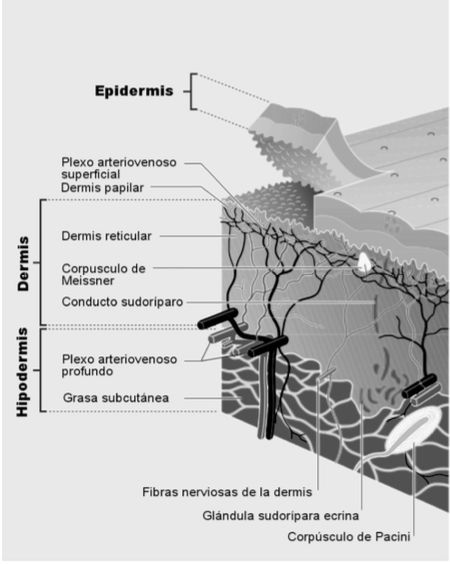
Figure 24: Representation of human skin. Source: Wikipedia Meissner’s Corpuscles and Merkel Discs (mechanoreceptors).
They are responsible for the sense of touch. They are free nerve endings located in the most superficial part of the skin.
Pacinian Corpuscles (mechanoreceptors). They handle the sensation of pressure and underlie the perception of high-frequency vibration. They are located in the deep layers of the skin. Not much pressure is needed to make them respond and send messages to the brain; they are sensitive to sensations of vibration or variation, especially high-frequency ones. Krause Corpuscles (thermoreceptors). They handle the sensation of cold in the skin.
Located in the superficial and deep parts of the skin. Ruffini Corpuscles (thermoreceptors). They handle the sensation of heat in the skin. Located in the superficial and deep parts of the skin.
So far, science has not discovered any photoreceptor in our skin, therefore, through it we should not be able to operate in the same way as the two species of echinoderms mentioned above. In this way the name dermovision or dermo-optics would lose further strength. Although, so as not to rule anything out prematurely, we will pause to better observe what we do have, rather than focus on what we might be missing.
As we can see, in our skin we have three types of mechanoreceptor corpuscles and two thermoreceptors. Could it be that these play some kind of important role in the case of Intuitive Vision? In some way, could they help capture information beyond the perception of cold or heat, at an environmental level?
Could the Ruffini corpuscles capture the heat of the objects around us (in a way similar to how bats capture the echo of ultrasounds, but with thermal energy) and send this information to the brain to convert it into an image?
As Grinberg had already verified, it seems that heat has nothing to do with the phenomenon, and we agree.
On the other hand, could the Pacinian corpuscles capture the vibrations of the quarks cited by Shichida? Could these receptors be the ones that capture the vibratory waves of the matter surrounding us and translate them into nerve impulses that are sent to the brain through the nerves for interpretation? Despite seeming like a strange and unlikely hypothesis to us, we do not have the tools to validate or rule it out.
What is clear is that the concept of synesthesia could help us understand why some people manage to capture certain information simply through touch. Synesthesia, already scientifically accepted, could shed more light on this work. We recall that synesthesia is a condition that allows the perception of more than one type of information through a single sense. Scientists
who have studied it have concluded that it occurs due to an alteration in the part of the brain responsible for managing sensory information. Some of them point out, for example, that an auditory stimulus can awaken a visual impression of a certain color and that there is a relationship between the frequency of the sound and the frequency of the radiation of the color received.
As Novomeysky pointed out, it could be that some nerve endings in the skin capture the radiation emitted by colors, and in a synesthetic way, these manifest visually in the brain.
From our experience, we see that, on the one hand, this makes a lot of sense. For participants who have a hard time opening this ability, when the lighting on what they are observing is increased (going out into sunlight or with an LED spotlight), their response rates increase significantly.
However, we have seen how other participants who developed very well with Intuitive Vision did not need any light to operate with it… And without light, colors do not exist. So while we can accept that it could be helpful, we are quite convinced that it cannot be the only way. Perhaps the ability to see through the skin has a more energetic than physical explanation. So we will review this possibility when we talk about biophotons.
4. THE “FIVE” SENSES
From a young age, we are taught that human senses are five. Sight, smell, taste, hearing, and touch. And that through them we are able to perceive the world around us. But in this book we have already challenged this classification and its definitions on up to three occasions. The first, in the very title of this work, “seeing without the eyes”. The second, when we talked about
synesthesia; this variety of human perception where the individual manages, for example, to hear a sound and see it in a color, or touch a texture and feel a taste related to it. Finally, when in the previous section we stated that there are several people in the world capable of using a sense known as echolocation, the “sense of bats”. We will begin by expanding on this last ability, since it has surely caught the attention of many of you!
Human echolocation is the ability of humans to perceive objects in their environment by detecting the echoes of these objects, based on sounds that the subject creates actively: for example, by making noises with their mouth or hands or fingers. People trained to orient themselves through echolocation can interpret the sound waves reflected by nearby objects, accurately identifying their location and size.
Thus, without the need for a bioradar or ultrasounds, there are people who have developed their hearing and their brain to create a certain degree of vision of what is happening around them using only the interpretation of sound waves. One of the most famous cases is that of Ben Underwood, who lost his sight at the age of three due to cancer. A few months after losing his ocular vision, he suddenly began to perceive and to have a certain awareness of the space around him, to the point that during his childhood he even rode a bicycle and practiced some sports. Using a system of “clicks” he made with his mouth, he managed to locate the objects around him with considerable precision. He developed this ability naturally and spontaneously.
Video 12 (https://bit.ly/3CGROx9)
Ben Underwood.miracle. Source: YouTube.
This type of vision was tested by scientist Kevin Warwick, who experimented with echolocation through the stimulation of ultrasonic impulses in the brain thanks to a neural implant. In the tests, he was able to discern, without the help of his eyes, the distance of different objects with precision and to detect small movements of them.
This ability does not show a constant image, since it always depends on noise. That is, for every “click” or knock that human echolocators make, they manage to see the image of the surface where the sound bounces, for the period of time that the vibration lasted. So these people must walk while constantly repeating these noises in order to see flashes of the outlines of the objects around them. On the other hand, when riding in a car, with the noise of the car itself bouncing off nearby buildings, they can see a more constant image.
This way of achieving vision does not look too much (or at all) like what our students tell us, nor does it resemble our own experience, since the vision we are talking about is a vision with a constant, broader presence.
But this case does serve to show us that through brain re-education work, other senses can be opened or expanded and used differently to develop new abilities, such as, for example, being able to see without eyes.
Another person to develop echolocation spontaneously was Daniel Kish. After losing his eyes at a very early age, he discovered on his own that he could orient himself with a system of clicks. He managed to graduate from university and based his thesis
on echolocation. Later, he founded an organization9
to help develop this ability in other people.
On the other hand, there are many studies that say the human body has more than five senses, and we are already seeing that the way we use them can allow us to obtain more information about our environment than we had imagined until now. Some classifications of the senses cite up to twenty-six, although
many of them are subclassifications or abilities that derive from the five traditional senses. Let’s look at this classification:
SENSE
SUBSENSE
DESCRIPTION
Ability to perceive images through our Sight
eyes. To do this it needs light and color receptors.
Perception of
Captures light
light
Perception of
Captures color
color
Hearing
Ability to acquire sound information through the senses
It is the ability to perceive space thanks to the echo Echolocation
produced by sound waves hitting different objects.
Ability to detect odors. In the case of humans, this Smell
sense is closely in contact with taste.
Taste
Ability to perceive taste
Sweet perception
Ability to perceive sweetness.
Perception
Ability to perceive saltiness.
salty
Sour perception
Ability to perceive sourness.
Perception
Ability to perceive bitterness.
bitter
The experience, starting from any object that triggers the sensation in the skin, mucosa, or tongue. Different sensations can be classified, Touch
such as tingling, tickling, itching, as well as
differences in pressure, temperature, and the sensation of pain, thanks to the different receptors that allow feeling each of these in a
differentiated way.
Nociception
Sense that allows capturing and locating pain.
Mechanoreception
Sensations that come from human skin and
respond to mechanical pressure.
Thermoreception
Ability to receive the internal temperature of the body.
Perception of
Ability to perceive the drop in temperature cold
exterior.
Perception of
Ability to perceive the increase in temperature heat
exterior.
Balance
Ability to perceive and maintain balance Proprioception
Ability to perceive and locate the different body segments.
Kinesthesia
Ability to detect one’s own movement.
Interoception
Internal perception of the body related to the sensation of internal fluid level.
Blood pressure
Sense that allows us to maintain
involuntarily blood pressure at a good level.
Oxygen content in
Sense that allows us involuntarily blood
to maintain the amount of oxygen in the blood at a good level.
Cephalorachidian pH
Sense that allows us involuntarily to maintain the pH at an adequate level.
Blood glucose level
Perceives and reports the blood glucose level.
Osmotic pressure of
Detects differences in ions between the plasma of plasma
different membranes.
Inflammation of the
This sense allows our lungs to breathe. lungs
We have already spoken extensively about this capac- ity.
It would not strictly be considered a sense, but Synesthesia
appears in different classifications, since it is the ability to receive more than one piece of information through a single sense.
*Figure 25: Human senses. Source: Own elaboration. *
BLINDSIGHT
Another curious and interesting aspect that affects the topic of vision and that could indirectly have importance for the subject we have in our hands is blindsight.
Blindsight is a rare type of blindness. The person who suffers from it has no kind of dysfunctionality in their visual system, but suffers a severe impairment in the visual cortex —
in the back of the brain—, where vision is produced.
This fact means that their eyes, even though the individual does not have vision, remain operational and capture visual information and transfer it, through the optic nerve, to the thalamus —just above the hypothalamus, where the pineal gland is located, which is also connected to them—. In the case of a sighted person, an optical radiation emanates from the thalamus that travels, through different pathways, to the visual cortex where vision is produced.
In some rare cases, a stroke can destroy the primary visual cortex and leave the person without the ability to process the images coming from the outside. In these cases, we could speak of blindsight.
In the case of most blind people, the eyes or optic nerves may have suffered some dysfunctionality and, therefore, the thalamus is left without receiving information from the outside. On the other hand, in the case of people with blindsight, the thalamus continues to receive visual information from the outside, but cannot send it —or rather it does not arrive— to its processing center.
The curious thing about these cases, and hence the name blindsight, is that the visual information remains inside the brain, but the conscious part of the person is not able to process it and does not have access to it; on the other hand, the subconscious does, which means that the individual who suffers from it is able to react to stimuli
from the outside unconsciously, sometimes reflexively. For example, they can dodge objects or describe movements in the environment, without understanding either what they are dodging or what the movement they have captured is. In other words, the subconscious does manage to “see” and tries to guide the person.
What this dysfunctionality teaches us is that the power of the subconscious is very great and even in the case of people with this particular impairment, it can help them and give clues about what is happening outside in an intuitive way. Although in this case, the channel through which they receive the information is a known physical channel: the eye.
Video 13 and 14 (https://bit.ly/3eKRCop)
Video 13: Blindsight. Source: YouTube.
Video 14: Seeing with the subconscious. Source: YouTube Antroporama.
5. THEORIES ABOUT BIOPHOTONS AND CHAKRAS
Makoto Shichida, as we have seen in the second section of this chapter, was convinced that information from the outside was captured thanks to cells, as if the whole body acted as an antenna, and that these, through the blood, could communicate with the pineal gland. From our experience we can affirm that the type of vision established by our students is fast, vivid, and immediate, especially when they have already mastered the ability. How could cells secrete molecules that
act as hormones and direct them to the pineal gland in a matter of thousandths of a second? From our humble point of view, which could be wrong, this seems unlikely to us.
If the information from the outside were truly not captured directly by the pineal gland—and other parts of the body were involved instead—these would have to capture and transmit information at the speed of light, since the responses of our trained students are instantaneous.
Perhaps it is not so wrong to think that cells can capture information, but the answer to how cells can communicate with the entire body in a matter of thousandths of a second comes from the hand of the Russian scientist Alexander Gurwitsch and especially Fritz Albert Popp, a German biophysicist who has developed the theory of biophotons.
As we have already seen in the first chapter, some authors also point out that biophotons may play an important role in developing seeing without the eyes, so it is important to take a look at them.
5.1. WHAT ARE BIOPHOTONS?
Fritz Albert Popp, nominated for the Nobel Prize in Physics, discovered that all existing living organisms, including each and every one of our cells, emit an ultra-weak light. These emitted light photons are called biophotons and are emitted to be able to communicate with other cells and other living beings.
Until recently, it was believed that few living beings, such as certain strange deep-sea fish or fireflies, were capable of emitting light waves. We find in their nature structures called pigments, which allow certain types of these waves to be captured by plants
to carry out photosynthesis or to see at night—hence the light we see in the eyes of cats or owls in the dark—. But the studies by Popp and his collaborators demonstrated that all living beings are capable of generating another type of wave, biophotons, electromagnetic waves that are in the light spectrum, but cannot be captured by the eyes due to their low intensity.
This light is stored by the DNA molecules in the cell nucleus, creating a kind of electromagnetic field or biofield. Popp reached this conclusion after seeing that upon extracting the cell nucleus, these emissions stopped. The DNA
emits and absorbs this light constantly according to its needs.
But what are its needs? In a cell, there are hundreds or even thousands of chemical reactions per minute, but until recently it was not understood what triggered these reactions. Now it is. The cell nucleus is what regulates the moment in which each of the chemical reactions will take place, the order and the exact moment, based on the use of the biophotons stored in the biofield. That is, by releasing photons that trigger chemical reactions. In this same way, cellular organelles, cells, tissues, and the very organs of a living being could be connected, and they could even constitute a global communication system among the different living organisms existing in the biosphere.
This type of communication is responsible for the formation of organs (liver, lungs, kidney, etc.). Cells use it to tell each other what each one must do to adapt to the different situations the environment requires. In this way, communication manifests even within a single cell. In fact, Popp and other scientists like Roeland Van Wijk discovered that cells of the same type emit the same light wave, while cancer cells in a tissue may show a different light.
This theory provides an answer to the certainty that scientists have regarding communication between different living beings, such as that which occurs between trees when they detect some type of danger or when we communicate very intensely with our pets. It would also answer the experiments that Cleve Backster recounted in Evidencia of a primary perception in plant life (1968). Cleve Backster was one of the first to propose that plants are affected by human intentions and that they are also in contact, in some way, with the rest of the living beings in the biosphere. Backster attached two sensor electrodes from a lie detector to a Dracaena leaf and conducted the following experiment. To provoke the equivalent of a feeling of alarm in the plant, he made the gesture of thinking that he would light a match and burn its leaves. This thought caused a long line to be drawn that rose to the highest part of the recording paper: it seemed that the plant had, in some way, read his thoughts. In another of his experiments, he used live shrimp and plunged them into hot water at random, while recording the effect produced on three plants connected to three polygraphs, placed in three different rooms from his laboratory. The polygraphs registered significant changes when the live shrimp were thrown into boiling water. With this simple (and cruel) experiment, it was demonstrated that plants register the death of a living organism, even if it is located in another room, and as a by-product, that all life forms are in a type of reciprocal harmonic contact.
Other scientists have conducted experiments related to biophotons and their communication capacity. In the article Physical Properties of Biophotons and their Biological Function (2008), the biologist Jiin-Ju Chang explains the experiments carried out with different dinoflagellates, luminescent algae that he separated into two different chambers, allowing a direct visual line to be established between them and, therefore, an “optical” connection. Jiin-Ju reports that when the “visual” line was kept open, both samples synchronized the intensity of biophoton emission, whereas when it was closed, this synchronization weakened. From this he came to
the conclusion that when the two living samples “saw” each other, they communicated with each other. They also seemed to register the light coming from other species, but the greatest synchrony (measured in the frequency of emitted electromagnetic waves) occurred between members of the same species.
Another scientist studying this subject was Carlos A. M. da Nóbrega, who in his article Biophoton “The language of the cells. What can living systems tell us about interaction” (2007) concluded that biophotons operate as a biological laser, capable of managing an information network in the organism and that they can also form patterns of electromagnetic fields.
Thus, it seems that cells use biophotons to communicate with each other, forming an electromagnetic biofield of information. The renowned and famous writer and biologist Bruce H.
Lipton, author of the best-selling biology book in history, “La biología de la creencia” (2005), is a staunch defender of the idea that thoughts and beliefs can affect human biology, altering precisely that electromagnetic field. And according to doctor in biomedicine Ana María Oliva, it is in this biofield where the greatest evidence can be gathered, as she expresses when she says that “every thought changes your electromagnetic biofield”.
In the book “Lo que tu luz dice” (2014), Ana María Oliva states that the biofields emitted by living beings are indeed perceptible with different instruments and can be studied through electrophotonic imaging. According to her experience observing the biofields that we humans generate, it is possible to discover many aspects about our biology, our state of health and mood, as well as our habits. While in some countries, such as Russia, these techniques are already admitted and recognized by the health system, in most countries this practice is only accepted as a technique for evaluating the energy state of the organism.
Ana María Oliva also states that this electromagnetic field can be described as an aura, which can be observed from the electrophotonic image of the person and even, also, of other living beings. This aura fluctuates depending on the state of each of them and the present they are experiencing.
For example, when someone receives a phone call, an insult, or even when they pick up a glass of liquor or a cigarette, their biomagnetic field is reduced. It is diminished even more if the liquor is drunk or the cigarette is smoked. On the contrary, when someone receives a kind or pleasant word, that field or aura gains strength and intensity. Other situations in which she states that remarkable light changes occur, for example, is in zygotes, which give off a burst of light at the moment of their creation, right when a sperm fertilizes the egg. When a bacteria dies, a flash can also be seen. Or
even more incredibly, a violet light precedes a process of mitosis, when a cell is about to divide into two.
Thus, Oliva states that our light gives information about the biological and psychological processes we experience inside ourselves and that through it we could access clinical information.
She also states that the way we live our life, the people we surround ourselves with, our way of dealing with problems, and ultimately our thoughts and beliefs, generate one type of light or another, that is, our entire environment affects our biology and even our own thoughts. Consequently, the healthier our thoughts, our self-esteem, our self-image, and our beliefs are, the more harmonic brightness we will emit.
5.2. THE CHAKRAS
According to Joe Dispenza (2018), there would be certain points in our body where there is more information to manage. Certain points with small neural networks and glands on which the
correct functioning of the entire organism depends. And precisely, since the information of our body would be organized through flashes of biophotons, it would be logical that in these centers where more information has to be managed, there would be more light. Precisely, these information centers would be seven and would coincide with the seven chakras that Eastern traditions have been contemplating for centuries.
Thus, some theories indicate that there are seven information centers or chakras located in our body that range from the perineum to the crown, arranged vertically tracing our spine. The body’s energy flows from one center to another vertically. Each of these centers acts as a valve and when a negative situation or emotion affects us, it can partially close the passage of energy, blocking it in one of the centers. Or in the words of Dr. Dispenza himself:
“Consider them (the chakras) isolated information centers.
Each possesses a specific energy that carries a determined level of consciousness, its own light emission that expresses very specific information, or its own frequency that brings a certain message. Each also counts with its own glands, hormones, and chemical compounds, and its own plexus of neurons. Consider those isolated clusters of neurological networks a kind of mini-brains. And if each center possesses its own brain, in that case, it also has an individual mind. (…) When consciousness activates the neurological tissue, it creates mind. The mind is the brain in action, so, if each of the energy centers counts with a plexus of neurons, in that case, they all have an individual mind, or, more exactly, each center possesses its own mind. The mind is activated through energy endowed with direction and intention; through a conscious purpose.
When each of these centers comes into operation, it in turn mobilizes hormones, tissues, chemical compounds, and cellular functions; and it also emits energy.”
(Dispenza, 2018)
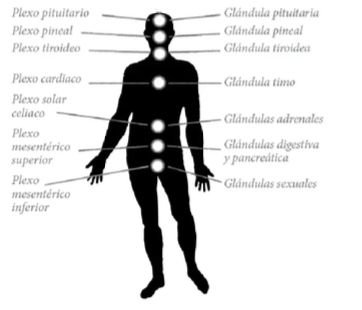
Thus, each of these centers would have a biological reflection; it would be in charge of specific biological functions and would have a type of mind of its own that would be activated simply by the energy of our thoughts, by our conscious or unconscious intention.
“For example, when energy activates your first center (the seat of the reproductive glands), its mind functions in a very specific direction and with a very specific intention. And when you, as a conscious being, harbor a thought or a fantasy
—which, by the way, is consciousness applied to neurological tissue
—, before you know it, your body is changing on the physiological level, which also transforms your energy. Your body secretes chemical compounds and hormones from the corresponding glands in order to prepare you for intercourse. The energy concentrates in that center, which releases its own specific frequency with an intentional message.”
(Dispenza, 2018)
Figure 25: Representation of the chakras or energy centers. Source: (Dispenza, 2018)
In this image we can see the seven energy centers Dispenza talks about and the relationship each one tends to have with the biological functions it manages. Just as in Eastern philosophies, Dispenza explains that the energy of these centers flows vertically and that this energy can become stuck depending on the situations and experiences and the way we manage them.
For example, according to him, the first center located in the perineum contains our creative capacity. Creating and procreating. In cases of sexual abuse or sexual addictions, the energy can become stagnant in this center. According to Joe Dispenza, if we feel secure in our creative capacity, this energy rises purely to the second center. The second center is closely related to physical survival, securing sustenance, and is highly related to food. Work stress problems (when we are worried about financial livelihood) can, according to him, lead to digestive or even lower back problems. The third center also revolves around survival, but in this case more so around control and power. Once we have guaranteed our own safety and that of the tribe, we tend to want to have control and power. This can cause a blockage and prevent the energy from rising as intensely to the higher centers.
These first three centers would bind us to our animal part.
The part that tries to guarantee our survival. If, once our survival is guaranteed, we manage to open ourselves to higher emotions such as living with kindness, generosity, joy, and peace, without clinging too tightly to the material world, this energy can circulate and surpass the fourth center, the heart center. The heart center is related to these emotions, and when we manage to transcend more worldly concerns, according to Dispenza and Eastern philosophies, our energy rises to the three higher centers, responsible for managing our ability to see everything more clearly, our wisdom, and our connection to the most spiritual part of the individual. By surpassing the fourth energy center, the energy circulates more easily from the lower centers that bind us to the more physical world, toward the higher centers, helping us to enter the more spiritual world. When the
energy reaches the fifth center, located in the throat, we want to express our current truth, whether it is what we have discovered, or the love and feeling of wholeness we experience, which facilitates the continued flow of energy. This allows the energy to reach the sixth center better, where the pineal gland is located. This, according to them, allows one to perceive a broader spectrum of reality.
In this scenario, the person feels more illuminated.
This sixth energy center is probably the one most related to the topic we are investigating. It is an energy center that runs between the back of the neck and the crown. This center governs the pineal gland, as well as the eyes. It is responsible for facilitating our vision of the world. The physical eyes allow us to see the world, while the pineal gland can help us see other information that does not necessarily have to be related to the immediate physical world. Both the eyes and the pineal gland are three of the organs involved in the functions of the sixth energy center. When the energy reaches this sixth center, it allows the pineal gland to better activate its electromagnetic field, and this facilitates having access to information that would normally go unnoticed. Information beyond the five senses. When this gland enjoys harmony and this center has enough energy, the individual becomes more conscious of both their inner world and the outer world, increasing their perceptive capacity and being able to see all aspects of life more clearly.
5.3. CHAKRAS AND INTUITIVE VISION
We began by talking about biophotons and ended up seeing that science is beginning to accept some indications that could lead us to accept the existence of what Eastern philosophies have presumably been claiming for millennia. We are beings of light.
And this light we emit is not just a simple Christmas decoration. This light has a clear biological function. This energy that runs (in a
way not visible to the physical eyes) through our body, is responsible for the majority of biological reflexes, and if the words of Dispenza and Eastern philosophies are true, this energy and its correct mobilization would be indispensable to use our pineal gland and capture information.
“For as much as you only see matter —objects, things, people, or places—, there is also a sea of infinite invisible frequencies that carry coded information. That implies not only that your body is composed of light and information, of energy and consciousness, but also that you, as a conscious being endowed with a body of light organized in a gravitational manner and which in turn carries information, constantly send and receive various frequencies, each of which contains different signals, just like a radio or a mobile phone.
Every frequency, as we already know, carries information.
Stop and think for a moment about radio waves. There are radio waves crossing the room you are sitting in right now. If you turned on a receiver, you could tune it to a specific wavelength or signal, and then a small transducer would pick up that signal and translate it into audible and understandable sounds, such as your favorite song, the news, or a radio commercial. The fact that you cannot see the radio waves in the air does not mean they are not there, carrying clear information on a specific frequency all the time. If you change the frequency, however slightly, and tune into another station, a different message will arrive on that wavelength.” Dispenza, J. (2018)
With these excerpts we can really come to understand how we can capture subtle information from our environment. But, let’s give an example to reflect a bit more on all this.
Figure 26: A card with a smiling monkey. Source: Material from Intuitu.
Once I gave a fourteen-year-old girl this card (Figure 26). It was the first one I showed her with her eyes blindfolded that day. Just by grabbing it, the girl burst out laughing. It was her third session, so I thought that perhaps she was already seeing it.
– What are you seeing? – I asked her.
– Nothing… But I find this card really funny!
Wow! Synesthesia at the highest level? What mechanism explains how what is printed on a card awakens in someone a burst of laughter if they cannot see it, only touch it?
We could understand and accept that the radiation of colors affects the nerve endings near the skin and that these generate, through synesthesia, an impression of taste, smell, or color… But barely touching the card, and someone feeling the urge to laugh while observing an image while wearing a blindfold, only one option comes to mind: somehow the subconscious already knows what is on the card, but only the impression that it is something very funny reaches the conscious part.
The same happens with children who have noticed the taste of a color hidden inside a box… If there is no light inside the box, why should the taste reach their mouth? It cannot be due to the radiation of the color… Or at least, not only because of that!
From our humble position, in which we admit that we have more questions than answers, and we apologize now to the reader in case we are not sharp enough to hypnotize correctly, we increasingly believe that perception does not occur through any physical or organic mechanism of the skin. Somehow the subconscious captures this subtle information that surrounds us, and it could be in a way very similar to what Dispenza recounts in the last excerpt we have quoted. Every object, every atom, every molecule… contains vibrational information, and our consciousness is capable of tuning into all kinds of frequencies. Thanks to our field and by coming into contact with said object, we help focus our attention, and by focusing our attention, somehow, we manage to mobilize the energy to obtain the information of what is there.
It may be that the fingers and hands and other parts act as signal amplifiers. It may be that through the meridians of traditional Chinese medicine, through which energy circulates, we manage to expand this information or make it more consistent. It may be that the mere act of touching it is an aid to pay attention, a way of setting the intention to extract and capture information. In fact, students who begin capturing with their hands pass their fingers over it many times with absolute disposition and attention to obtain the information written or displayed there. Let’s say with a level of focused concentration on the fingers and hands, usually higher than those who do not capture in the same way.
Perhaps synesthesia, which undeniably exists, helps us by giving clues… The subconscious knows what color is being observed, but only a related taste reaches the conscious part… Or
like the girl in the example, the image or information the card contains (in this case the monkey) reaches the subconscious, but only the sensation that it is something that would make her laugh filters through to the conscious part, and she laughs!
Thus, from our humble experience, which could be wrong, both synesthesia and dermo-optic ability are only the first step toward Intuitive Vision, and this occurs when the fingers or hands come into contact with the observed object and the person focuses their attention on this point, not because they capture it thanks to a physiological mechanism, but as a way of focusing attention on tuning into the information present at that specific point.
It is undeniable that many people begin by capturing with their fingers and their hands. And it is undeniable that this ability can begin to manifest in this way, but from our understanding, the hands would only be one more tool, a device to manage to amplify information that at first may be harder for us to capture, but that with training becomes less necessary.
We do not want to contradict or disprove any of the theories that talk about the capture of the radiation emitted by colors. We have also had experiences, as we have already said, that would indicate that this could be so. For example, when some participants have a hard time receiving information, we go out to work under the sunlight (or under an LED spotlight if it is night) and then, incredibly, they capture more. Perhaps the increase in radiation helps make the information more palpable, more blatant to the “eyes of the subconscious,” so to speak, but at the same time, some participants have managed to capture information in total darkness. Our participants and, as we have seen, some of Grinberg’s volunteers too.
Therefore, this cannot be the main explanation, although it is indeed a help.
I was just writing these lines when something happened. One of those signs that happen exactly when they have to happen for us to pay attention. A few months ago, I had the opportunity to work online with a family from another continent. I worked on opening Intuitive Vision with the eldest daughter of the family. With her we experienced
extraordinary things that I will share in another chapter, but the fact is that the family had another nine-year-old son. The parents wanted me to start working with their son when I finished with the older daughter. But it so happened that this family was planning a vacation where we live, so just as I was writing these lines, we met up with them.
Even before the meeting we were so excited about, the mother of the family asked me for two things. The first was whether we could do an in-person session with the kids, which would be the first for the younger son. The second was whether, in the intuition activities with the boy, I could include some activity related to electronic devices.
Coincidences of life, or not, in recent weeks I had been working with a young man from Igualada, an engineer by profession, and he had prepared a mobile application for reading NFC cards. These cards are like hotel keys; they contain a chip with programmable information, and this chip can be read with various devices, such as certain mobile phones.
In this case, the engineer, among various activities, prepared 5 cards with Zener cards (Figure 27). One contained the information for a circle, another for a star, another for a square, another for waves, and a last one with a cross. Apparently, all the programmed NFC cards had the same external appearance, completely white, and only with a reader was it possible to read them. Or
theoretically only with a reader, although at this point in the book you will already guess that what we intended was for the boy to read these cards with his intuition.
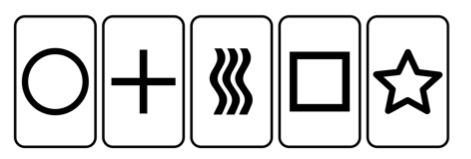
*Figure 27: Zener cards. Source: Wikipedia. *
The reason why the boy’s mother asked me for an intuition activity related to electronic devices we’ll keep to ourselves for now, but what I will say in advance, and as is obvious, is that this boy had not yet trained Intuitive Vision, since this was his first session.
After doing the meditation and the first session with great success, where among other things he got a whole bunch of colors right, I set out to explain the challenge with the NFC cards. So I took off his blindfold and told him about the activity. In this case, the participant had to analyze each NFC card and decide what symbol was contained in its chip’s programming. In front of him I placed five normal physical Zener cards, with the symbols visible, side by side.
Next, he had to place each NFC card on top of the corresponding physical Zener card. So that if he believed or intuited that an NFC card had a circle in its programming, he had to place it on the circle-shaped Zener card, and so on until he had classified all five NFC cards.
When he finished the exercise, we brought the phone with the NFC reading application closer and discovered the results. In the first round, he surprised us by getting 3 of the 5 cards right.
Specifically, he got the first one he analyzed right, the second, and the fourth. So, with the first correct answer there was a one-in-five chance of getting it right, with the second one in four, and with the fourth one in two:
¹⁄ x ¹⁄ x ¹⁄ = 1/40
That is, the probability of getting the first, second, and fourth cards right is 1 in 40.
In the end, the number is irrelevant, as we can already see that something more than luck was involved in this work. So we congratulated the boy and got ready to move on to another activity, but he stopped us and told us that now that he understood how the activity worked, he wanted to repeat it.
I agreed and mixed the NFC cards thoroughly without him seeing them, and in this second round, amid the looks of disbelief that his mom and I exchanged, he got them all right!
¹⁄ x ¹⁄ x ¹⁄ x ¹⁄ = 1/120
A one-in-120 chance of getting it right by chance. According to him, within his mental “little screen” he could see the drawn symbol. If we are not mistaken in our probability calculations, and statistics are not our strong suit, we could say that the probability of getting both the first and the second event right would be one in 4,800
possibilities. In other words, there would only be a 0.02% chance of obtaining this result by chance.
Regardless of the calculations, what is important about this anecdote is that the information obtained is information that is not physical, yet was nevertheless able to be captured in some way.
Perhaps through the person’s electromagnetic field?
We are convinced that there is more than one way to capture information and that each person does it in a different way. We do not know the exact nature of this information, nor the mechanisms that make it possible. We can only hypothesize based on the information put forward by the previous authors and our own experiences. But it is clear that this boy was able
to tune into electromagnetic information, or at least information that did not depend on the radiation emitted by colors, and to somehow visualize it within his mental “little screen.”
5.4. CONCLUSIONS REGARDING BIOPHOTONS AND CHAKRAS
Unexpectedly, in this section we have found two clues about different aspects of Intuitive Vision. The first refers to the conditions that we as individuals must meet in order to access abilities different from the ones we already knew.
As Dr. Dispenza affirms and as we have seen through our experience (and which we provide evidence for in the next chapter when we discuss the factors that allow Intuitive Vision to appear), it is necessary to mobilize energy correctly. If we fail to achieve this, if energy becomes stagnant due to stress, anger, or fatigue, for example, intuitive information does not arrive, or arrives with less force, and this fits perfectly with the explanation of the chakras and the need to correctly mobilize energy toward the higher centers.
What remains an enigma, but which the reflections and experiences of this section have provided us, is how we receive this information. How with our fingers, hands, ears, or palate we can capture visual information.
At this point, we can only offer the previous hypotheses, which we could summarize in the following points: There does not appear to be any physical evidence that the skin has any organ that participates actively in the capture of information for seeing without the eyes. (Although we do not have the tools or knowledge to guarantee this entirely.)
The meridians through which energy circulates could perhaps help in capturing information in a more energetic and less physical way. This is why the palate (where, remember, the pineal gland begins to form while the fetus is still developing) could be one of the sensitive points for capturing information, and some participants would begin seeing with their mouth open, although later, with training, this would not be necessary.
Some fingers also have meridians that connect to the pineal gland and, therefore, could perhaps help in this transmission of information. A lot of exterior light can help achieve better capture of information. Thus, the theories that we somehow manage to capture the radiation of color through the skin could have some basis.
Some participants also manage to capture information in the dark, or some capture information that is not physical, which means the previous point would not be sufficient to explain how we capture this information.
Probably, although we cannot guarantee it, what we capture from the objects we observe is their energy field, and by mobilizing attention, our own field is capable of tuning into them.
Touching with fingers and hands could be more of a way to mobilize intention in order to tune in and pay attention to what we are observing.
On the other hand, we have seen that not all the information we capture passes to the conscious part; it seems that at first, students could be perceiving more than they themselves are conscious of. We can feel that we like something or not, that we find it funny, or even detect the smell given off by a photograph or a color, without being truly conscious of what we are touching or observing.
With training, we increasingly manage to pass more information to our conscious part, until we are able to distinguish a visual perception of what we were observing.
With training, we increasingly need less use of our fingers and hands to achieve this vision, which means that while they can be helpful for “amplifying the signal,” they would not be the main ones involved in the process.
We do not yet want to offer a final hypothesis on our part.
There are still some more elements to analyze, but it is clear that human energy intervenes in the process by bringing together the favorable conditions to carry out this work, and it is probably also the explanation for the mechanism that allows this information to be captured. If all matter is energy filled with information, we too would be this energy and, therefore, it is not so far-fetched to think that in some way we can tune into all this information.
Shichida stated that the entire body could act as an antenna and that even the cells themselves would capture information that, through a process of hormonal secretion, would allow this information to reach the pineal gland… The biophysicist Colin Mc Clare calculated and compared the efficiency of information transfer between energy and chemical signals in biological systems, and found that energy signals such as electromagnetic frequencies are thousands of times more efficient at transferring environmental information than chemical signals from hormones, neurotransmitters, growth factors, etc. The speed of electromagnetic signals is 300,000 km/s while the speed of a chemical signal is less than 1 cm/s.
As we have already noted, from our experience, students who have already awakened this ability can interact with the physical world with their eyes covered in a natural and instantaneous way. They can play soccer or throw and intercept balls with their eyes closed or covered.
Thus, we are quite sure that Shichida was right when he stated that the entire body could be involved, although he was looking for a more physiological mechanism to explain the phenomenon, and from our understanding, this capture and transmission of information would work more through human bioenergy and its field.
6. THE SECRETS OF THE HEART
Now we are going to investigate a little about the heart and whether it may or may not be involved in extrasensory abilities in some way. We focus on it because it is one of the points highlighted by one of the authors cited in the first chapter: M. Drunvalo.
In fact, he is not the only one; on a spiritual level we find other authors such as Rudolf Steiner, creator of anthroposophy and known for being the founder of Waldorf schools. In his case, Steiner stated that energy circulates inside our body and that this energy organizes itself into different centers (the chakras explained in the previous section), and specifically there is one of these centers that energetically, according to Steiner, takes the form of a lotus flower located in the region of the heart. According to Steiner, these “flowers” open or close depending on how each individual mobilizes their energy, and when the petals are open, one can access a higher level of consciousness. In his book How to Know Higher Worlds, Steiner states:
“When the student has thus raised himself to a life in the higher ego, or rather during his acquisition of higher consciousness, he will learn how to awaken to life the spiritual perceptive force in the organ of the heart and to control it (…). This perceptive force is a higher element of stability that proceeds from the organ in question and flows with beautiful radiance through the moving lotus flowers
and the other channels of the developed etheric body. From there, it radiates toward the surrounding spiritual world, making it spiritually visible, just as the sunlight falling upon the objects of the physical world makes them visible. The way in which this perceptive force is created in the organ of the heart can only be understood gradually in the course of actual development.
Only when this organ of perception can be projected through the etheric body toward the outside world, in order to illuminate its objects, is when the real spiritual world is clearly revealed, as composed of objects and beings. Thus it will be seen that complete consciousness of an object in the spiritual world is only possible when man himself casts spiritual light upon it. (…) The organ of the heart is only the point where the individual human being ignites, from outside, this organ of spiritual light.(…) It is precisely through the organ of the heart that the higher self governs the physical self, turning it into its instrument.” (Steiner).
This description fits very well with the explanation that Dr. Dispenza gives about the fourth energy center located in the heart:
“(…) the heart, located behind the sternum, is the fourth energy center. It constitutes the bridge to higher levels of consciousness and energy, as well as the first center of our divine energy. The heart is the intersection between the three lower energy centers (associated with a healthy organism) and the three higher energy centers (associated with the higher self). It connects us to the unified field and represents the union of duality or polarity. (…) When the heart becomes coherent, the nervous system increases the brain’s energy, creativity, and intuition, which positively influences almost every organ in the body. At that moment, the heart and the brain work in cooperation, in such a way that you feel more complete, connected, and satisfied; not only regarding your own body, but also in relation to everyone and everything.” (Dispenza, 2018)
When we analyze a capacity as unknown as the one we are studying, we must open ourselves to possibilities that we had not previously considered. Personally, we have always leaned toward science and we think it is a good tool for describing the world. However, it would be irresponsible not to consider what other people indicate, some of whom claim to be able to see without their eyes and others are experts in fields of perception and intuition. To dismiss their experiences and their words would be to close ourselves off to a good part of what we could discover thanks to them. In this book, although we will try to show what science, to date, knows or indicates, it also aims to gather all these other testimonies, such as Drunvalo, Steiner, Bardor or Von Dreien, and explain their realities and share their visions as well, because perhaps in them we find more answers that are part of the reality of this or other capacities. If we talk about seeing without the eyes, we must talk about them. And if some of them point out that the heart is important when it comes to increasing our degree of consciousness and intuition, overlooking this data would mean missing an opportunity to find answers. So let’s see what science says nowadays about our heart.
6.1. THE INTELLIGENCE OF THE HEART
We have always associated intelligence with the brain, and therefore with neuronal activity. However, both Drunvalo and Steiner in their works speak several times about the intelligence of the heart.
What truth could there be in this expression? In the article Anatomy and Function of the Intrathoracic Neurons Regulating the Mammalian Heart (1998) by Armour, J.A, this cardiologist states that the heart has around 40,000 neurons and, therefore, would have its own “mind”. This discovery meant the emergence of neurocardiology.
These neurons are connected through afferent and efferent pathways to the brain. The efferent pathways transport information from the brain to the heart while the afferent pathways do so from the heart to the brain. According to O. G. Cameron, in his article Visceral
Sensory Neuroscience: Interoception (2002) 90% of the nerve fibers that make up these pathways are afferent, that is, they transport information from the heart to the brain.
Furthermore, Armour discovered that these direct and afferent neural pathways continuously send signals and information that interact with and modify activity in the higher cognitive and emotional centers of the brain.
In other words, it seems that there is more information circulating from the heart to the brain than the other way around, and that this information modifies the emotional state of the brain and, therefore, of the person. Since school we have learned that the brain rules the body, and to a large extent this is true, but these studies indicate that the heart is an autorhythmic organ. In fact, the heart of mammalian embryos begins to beat before the brain itself exists, therefore, it is clear that there is an independent neural network that regulates this entire process.
Thus, the heartbeat originates in the heart itself and not by an order from the brain, so we can already begin to understand, at least in a very small part, the meaning of the expression “intelligence of the heart”. But in addition, these studies also state that the heart processes emotions independently, reacts to the environment, and regulates its own rhythms. The heart and the autonomic nervous system are united in such a way that it has been shown that the heart can feel, remember, self-regulate, and make decisions regarding cardiac control independently of the brain. Some curious facts, which the scientific community perhaps still questions, are the cases of people who, upon receiving a heart transplant, have had sensations, impressions, or attitudes that were alien to them. We could search for information on the internet and find dozens of cases in which the transplanted person acquired the tastes or attitudes of the donor. For example, Dr. Josep Maria Caralps, Director of the cardiac surgery unit at Hospital Quirón and author of the book Supercorazón (2011), states that with heart transplants
it might be possible to transfer a certain memory, which the recipient’s brain makes use of to express things that the donor had. And he justifies this explanation:
“My most accurate conclusion is that cells have an intuitive base, accessible only to people whose sensory capacity allows them to detect certain aspects of the donor’s personal history stored in the transplanted tissues.”
If we were to search the internet, we would find dozens of books by cardiologists and scholars on the subject who recount having collected statements from donors who claimed to possess certain attitudes that they did not recognize as their own, but this could fill many books, so we will continue advancing in our topic.
Let us remember the previous section where we saw the fourth energy center, it was the heart chakra and we saw that it was different, it was described as a valve that allowed the energy of the lower centers to flow. A valve that would only open when we overcame negative emotions (fear, anger, hatred, resentment, worry…) and opened ourselves to higher emotions.
And when we opened ourselves from this fourth center to higher emotions, that is, when from the heart we could feel joy, satisfaction, peace…, the energy flowed to the higher centers that allowed us to increase, among other things, our intuition.
Well, it seems that technically, the heart has been proven to be capable of feeling, and that it is capable of doing so autonomously, through its own “mind”, and that at least, through afferent circuits, it would affect the emotional centers of the brain. So in some way, yes, through the heart’s “feeling” we can influence our brain.
But perhaps the concept that can contribute the most to us in this direction is that of cardiac coherence.
6.2. CARDIAC COHERENCE
Cardiac coherence is a state in which the frequency of the heartbeat is regular and presents a harmonious alternation.
The different waves it generates are synchronized, following a specific frequency, shape, and amplitude that form a repetitive, orderly, and predictable pattern. Cardiac coherence influences physiological rhythm. Breathing and blood pressure quickly synchronize with the heart rhythm, as well as the endocrine and nervous systems, which is known as cross-coherence.
When the main systems of our organism are synchronized and harmonized, reference is made to a state of psychophysiological coherence.
This concept was developed by the HeartMath Institute (HMI).
According to doctors Lew Childre, Howard Martin, and Donna Beech from that institute, a coherent heart allows us to access the intelligence of the heart, which they define as the flow of awareness and knowledge we experience when the mind and emotions enter a state of balance and coherence. This form of intelligence is experienced as a direct and intuitive knowing that manifests in thoughts and emotions for our own benefit or that of others. I imagine that these doctors probably did not know the expression “I have a hunch” which would surely summarize this reality in a clearer way and in a way that we could all better understand from experience. And that is really what this is about. These doctors state that when the heart functions correctly and from this center we harbor higher emotions, we can access a type of intelligence that we otherwise could not. In this situation, the person can access direct and intuitive knowing that manifests in thoughts and sensations. And this really fits with some sensations from some participants. But perhaps, I will align this point with a personal experience, which also turned out to be somewhat funny.

The first time Tània blindfolded me to do a session between us, I asked her to give me materials that I had never seen before in my life, to be sure that the conscious part was not coming into play. Tània gave me a card and as soon as she gave it to me, a feeling of joy mixed with the certainty of knowing the answer ran through my body. Specifically, I felt from the bottom of my heart that I knew the answer. At that very moment an idea crossed my mind. A possible answer. Tània noticed the change in my facial expression. She realized that I wanted to say something and that, judging by my smile, I must know the answer. It’s a little hard to put the feeling into words, but without a doubt, in my chest there was the sensation that I already knew the answer. The only drawback was that, on a rational level, that answer was utter nonsense. After paying the amounts I had paid for a first course, I couldn’t tell Tània such a silly thing as the idea that had crossed my mind. But Tània accompanied me very well, and managed to get the words out of me:
– Alright… I’ll tell you! I think there is a rounded green booger.
Tània let out a scream, with which I thought I had fully guessed it. – Did I get it? – I asked, extremely excited.
– No… It was mayonnaise. But it looks a lot like it.
When I uncovered my eyes I could see that what depicted mayonnaise I would have described as “a rounded brown booger.”
Figure 28: Card with a drawing of mayonnaise. Source: Board game “Stop *Bocata” by Educa. *
The most interesting part of the anecdote was the sensation that had come from the chest. That joy and certainty of already knowing it. And
this sensation I have not experienced once or twice, but many times, just as many of our participants have as well.
Thus, truly, this could have a clear and direct relationship with the concept of heart coherence. And the most interesting thing is that the HMI itself defines this as a process that can be self-induced. That is, through correct breathing, which will alter and regulate the heartbeat and the creation of elevated emotions, we can easily increase our coherence and, therefore, our disposition to intuit.
We have also seen and measured this with our participants, thanks to devices for measuring heart coherence, and the results are very clear. For example, two students were measured in the first minute of the session, just putting on the blindfold. Both had a very rapid ability to begin seeing without their eyes, and we clearly observed how their coherence increased as they concentrated.
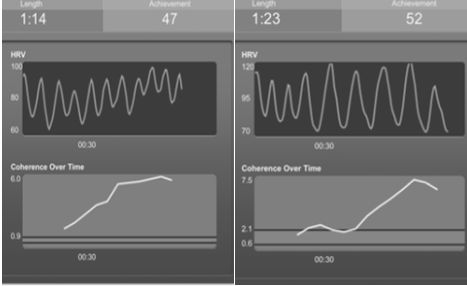
Figure 29: Heart coherence measurement of two participants aged 9 and 11 *during participation in a session while activating their intuitive vision. *
Source: Own elaboration based on a screenshot of the HeartMath *EmWave program. *
Obviously, all participants, with very simple recommendations, can increase their heart coherence, and it does not mean that everyone will see without their eyes simply by being coherent. But so far we have not measured any student who could see without their eyes and fully master this ability, who was not at a medium or high coherence level. Out of the hundred measurements taken in different sessions, we have never found anyone who, being in an incoherent state, could see without their eyes or master this ability perfectly.
We cannot affirm, then, that heart coherence is the secret element to developing this Intuitive Vision, but it does seem that it would be one of the ingredients to keep very much in mind.
Furthermore, it also resonates with other situations we have experienced, for example, some students who had already managed to see without their eyes in previous sessions suddenly one day cannot. This can happen when:
They have a cold. In this case they cannot breathe correctly, which would influence their heart coherence and, therefore, the mobilization of energy. They are emotionally affected. Hours or moments before the session they have had an argument with their family, with a friend, and they cannot evoke elevated emotions. It can also happen when there is fear or stress, which do not allow harboring elevated emotions.
The coincidences are too great not to take this concept into account when explaining this ability. If we look at the previously given description from the HMI “this form of intelligence is experienced as a direct and intuitive knowing that manifests in thoughts and emotions for our own benefit or that of others.” We will see that this flow of consciousness acts practically as a mechanism that prevents access to “this information” when we are emotionally altered.
Or in other words, if we want to harm others, we are probably not harboring elevated emotions, which means that initially it would seem more difficult to have access to this information. But we are not done yet. The doctors cited above, Childre, Martin, and Beech in their work The HeartMath Solution (2011), speak of how the heart itself emits an electromagnetic pulse that can be measured at a distance of between two and three meters with highly sensitive detectors. In fact, the heart emits the most powerful electromagnetic field in the body and can be up to five thousand times more powerful than that of the brain. Furthermore, this field changes depending on the emotional state.
In fact, one of the most significant discoveries of the HeartMath Institute is that our sensations influence the heart every second and that these will alter its electromagnetic field; the stronger the elevated feelings, the more intense this field will be.
According to Dispenza, these discoveries are extremely important, since in his opinion, when you activate the heart by evoking elevated emotions, you not only send that energy to every cell; you also radiate the feelings into space.
This is broadly familiar to us… Could it be that our participants consciously or unconsciously detect our emotions as facilitators? Could it be that when they are operating with this ability they are sensitive, or more sensitive, to the feelings and emotions that those around them emit with their field? If we remember the scene with the Pikachu card, told in the previous chapter, we will see that in that circumstance I was not trusting him.
I was fully distrusting that he could demonstrate this ability to me. Furthermore, I felt frustrated and deceived, thinking that I had squandered many months of my life (and financial resources), on something that at that moment I thought was a lie and completely impossible. If the heart emits an electromagnetic field resonating with the feelings we harbor, my field was a true aura of negativity. Be that as it may, the reality was that that day at the beginning of the session, it cost the poor boy much more effort than the previous times to operate with this ability. And the sensation present in the environment was that when my internal attitude and my emotions changed, he managed to concentrate as on the other occasions.
If this were true, which is very likely the case, it is clear that the attitude of those present, when someone is operating with this ability, influences much more than we might imagine.
Something to keep in mind, whether you want to accompany someone to develop this ability, or whether you are a researcher who wants to study it.
But returning to the heart…
“When the heart enters a state of coherence, the heart rhythm entrains brain waves to a frequency of 0.10
hertz. (…) The coherent frequency of 0.10 hertz has been revealed as an optimal state of performance related to greater access to deeper intuition and inner guidance.”
(Dispenza, 2018)
One of the most important points of these discoveries is that it has been shown that when the heart enters a state of coherence, the heart rhythm influences brain activity. A coherent heart can transform brain waves and bring them to a lower frequency, optimal for having greater access to intuition. And this is of vital importance if we are studying, researching, and training intuition. So breathing and elevated emotions, from now on, will play a fundamental role if what we seek is to expand our intuition.
Let’s summarize by way of conclusion this section to make it clearer:
The heart emits an electromagnetic field and, like any field, it can capture information, meaning we find ourselves with a possible second antenna capable of capturing electromagnetic information from the environment. A coherent heart allows the brain to increase its performance, allowing concentration and even intuition capacity to increase. The heart itself can contribute to lowering to calmer states of consciousness, and we can work on this with heart coherence exercises. Breathing and emotions are other ingredients to keep in mind in order to advance in the development of this ability.
And, therefore, it is of special importance to work correctly and enhance coherence states if we want to develop perceptions we did not have before (or did not pay as much attention to).
7. OUR EXPERIENCES
7.1. AGE IS IMPORTANT
After more than two hundred participants in individual sessions and a total of four hundred between sessions and workshops, we can affirm that age plays an important role when it comes to opening this ability.
It is important to understand that being older does not mean our intuition is vetoed. That would be absolutely false.
But we have observed that boys and girls usually come to have an Intuitive Vision with greater visual acuity. But that they come to
“see” better does not necessarily mean they have to intuit better.
Let’s say that children and adults simply tend to intuit differently. Let’s develop this idea.
While for a large majority of children, after meditations and appropriate activities, a light appears to them, and it is through this light that they come to see what surrounds them with the blindfold on, adults generally take a different path. For children, this ability is something that can be worked on, generally, with visual attributes, such as color and shape.
Since this light often appears that allows them to start seeing, sometimes the color, sometimes the shape, by asking and focusing only on these visual attributes, after appropriate steps, normally the majority of children end up seeing without their eyes.
For adults, this path is not usually as valid, although sometimes they can also take it. Children go straight to the icing on the cake, if there is no obstacle (limiting beliefs that we will see in the next chapter) to prevent it. Adults, however, frequently take another path. This other path entails working with deeper techniques and with different tempos. And if one desires and is disciplined in training, they can also achieve a good result with
Intuitive Vision. They can carry out this path thanks to greater maturity, greater resilience, and also by having a broader vocabulary that allows them to describe emotions, sensations, textures, that they can capture (and not just shape and color). Furthermore, it can entail an improvement in remote viewing, expanded intuition, or telepathy (concepts we will see in Chapter IV). In summary, adults work with deeper techniques that would be difficult for younger ones to describe due to a lack of vocabulary.
It is not about who does it better, because they simply do it differently. Children achieve it in a more natural, powerful, and generally rapid way, while adults who truly wish to delve deeper, from resilience, concentration, the joy of the inner child, and with more elaborate and refined techniques that they can only carry out due to their maturity, can also come to see without their physical eyes. They achieve this result having deepened through other paths that bring them benefits in other directions. That said, yes. Age can be important. Children are sponges in constant absorption, also on an extrasensory level. Adults have generally lost this freshness, and for this reason it is positive to be able to recover it through play, enjoyment, experiencing oneself…
If we focus only on the visual terrain of Intuitive Vision and its product, we see that children from 6 to 12 years old usually achieve a level of Intuitive Vision similar to what they would see with their physical eyes. Sometimes even better, sometimes not as finely tuned. Between 12 and 16 years old, the majority of boys and girls also achieve this vision, on some extraordinary occasion even at a higher level than the younger ones, although generally and for the majority of teenagers this vision is usually less finely tuned. Sometimes this vision presents itself in the form of many flashes of information; other times as a slightly more reduced field; or with many symbolisms or abstract images. In general, we could say that the majority of teenagers manage to see without their eyes but with a little less
definition. However, after 16 years of age there is a clear change in the results; in these cases, age no longer matters. We have seen people over 60 see more clearly than 20-year-olds. Age does not matter at all; what matters is discipline, enthusiasm, and the ability to connect with the inner child. Evaluating the results solely by the visual part would be unfair to this group. A little less than half manage to see figures, letters, and numbers. Just as many manage to see shapes, or colors, or some visual characteristic, even if not a complete image. And only a minority fail to capture any type of visual information. In the next chapter we will talk more specifically about the results with adults.
But in this section we are not going to talk about the results themselves.
But rather about what the experience means. And what is certainly true and draws a lot of attention is that Dr. Strassman, as we have quoted, relates that between the ages of 12 and 16, a calcification of the pineal gland occurs. This is exactly the transition period where results begin to drop. Thus, from our understanding, the results totally coincide with his claims and, therefore, we understand that the pineal gland actively participates in the process of capturing information.
Although we also affirm that despite this calcification, without a doubt we can continue capturing information intuitively, although perhaps with more difficulty. This difficulty can be overcome with more training, more techniques, and more time dedicated, always focusing on exploration and without the impatience for an immediate result. It is also highly likely that through heart coherence exercises and exercises to mobilize energy, we facilitate the capture of information through other pathways. In such a way, many adults begin to notice sensations in their hands, fingers, and even experience more hunches. We have also had students who notice sensations in their back or other parts of the body that lead them to correct information, with which it cannot be stated that the pineal gland is solely responsible for capturing information.
Thus, age matters if we look only at the acuity produced by Intuitive Vision. This capacity most likely maintains a close relationship with the pineal gland, which is part of the sixth energy center, just like the physical eyes. In fact, the function of this sixth energy center is to give us a clearer vision of the world. From our understanding, this calcification can affect the difficulty of establishing Intuitive Vision. Despite this, it is not impossible to capture information with this center, even if there is some calcification, and as we commented, it is very possible that these deeper, alternative training pathways we work on with adults lead to the participation of other “antennas,” such as the electromagnetic field of the heart in capturing information.
This would explain the great variety of experiences we have been observing and the different ways of ultimately intuiting or even seeing without the eyes.
7.2. THE ABILITY TO VISUALIZE IS IMPORTANT
We cannot categorically affirm that the theories defending the different capacities of the hemispheres are entirely true. They will possibly have to be nuanced over the years, and neuroscientists will have to reach an agreement. The EEG tests we have done are not conclusive in providing an explanation, and we would need specialists to help us better understand the results. What is certain is that the moment Makoto Shichida opted for image training to enhance the ability to visualize, something changed in his students. Just as some of our participants have also achieved success after exercises oriented in this direction. The anecdote of the blind chess player also leads us to think
that the ability to visualize is very important, and what is certain is that it is a capacity, just like synesthesia, that disappears over the years if we do not make use of it.
Imagination is the engine of extrasensory perceptions.
Through imagination we learn to visualize and believe in our possibilities. Without imagination, we could not begin. And
for this reason, it is also easier for children to start.
With imagination, we can kick-start Intuitive Vision. With it, we can begin to visualize images. But very soon, once the ability to visualize is recovered, imagination must step aside to let intuition manifest itself in the form of images.
It is also certain that with synaptic pruning we lose the ability to visualize, and this would also explain why it is easier for children to work only with visual attributes, because it is genuinely easier for them to see them. On the other hand, the majority of adults have lost the ability to visualize due to not having made use of it.
This point also makes us reflect on how education must change (and we are not referring only to schools) to prevent us from losing this engine toward new possibilities. Here we would find dozens of circumstances that negatively affect children, such as excessive access to screens that diminishes their ability to visualize and imagine.
7.3. BELIEFS LIMIT
In this chapter we will not delve into the topic of beliefs, since it is not an area related to biology, at least not strictly, so we will leave it for the next chapter where we will address more psychological aspects. But we include it here because there are certain obstacles and certain
psychological barriers that prevent the appearance of this capacity.
These obstacles are often our own creations, due to our own experiences and, logically, they tend to hinder people who have had more limiting experiences. Naturally, as adults we carry more experiences of all kinds and have a much more rigid framework, so it tends to be a final reason why adults may have more difficulty.
7.4. THE ENVIRONMENT IS ESSENTIAL
It is very curious to see the way this capacity changes rapidly when external conditions change. We have seen this on dozens of occasions, some even caused involuntarily by ourselves. As we have explained on more than one occasion, and will continue to see, the attitude of the companion is paramount in the development of this capacity.
If even a single observer sows doubt about what a participant is doing, even if they do not express it verbally, this doubt is palpable to the person who is concentrating and blindfolded. Perhaps not on a conscious level, but without a doubt, enough to affect their results.
Of all the workshops we have held with adults, there was one in particular where we found a very skeptical person. His skepticism caused all the people around him to capture less than what is usual in a first session. The most curious thing is that the people who were physically far from him developed the workshop with complete normality, while those who were right next to him captured much less.
On the other hand, on some occasions we have invited technicians, scientists, and researchers from other areas to observe and collaborate in a session. While in a few cases their presence did not affect the development of the session at all, in the majority of cases it was noticeable that participants achieved
lower results than in the other sessions. This occurred especially when the guest asked a question about what their vision was like and tried in some way to put it to the test.
This is of vital importance if the scientific community decides to study and delve into this capacity. People who want to research this topic must be very clear on how to proceed and how not to, and above all, take the utmost care of the environment so that participants feel comfortable. Some specific music and certain essential oils can help a great deal in creating an ideal environment.
7.5. LIGHT IS NOT ESSENTIAL
While some students, who have a hard time opening up to this capacity, need a lot of light in their environment to begin capturing information, some others who develop this capacity at a higher level do not depend on it at all. We have tried, just like Jacobo Grinberg, working in complete darkness, in situations where we companions could not see anything with our eyes, and a minority of participants managed to describe colors, letters, and words. Also, a few have managed to see the contents of a completely closed box without touching it, or simply by placing their hand over the box.
These cases, as we mentioned, are a minority, but they clearly indicate that light is not responsible for this capacity. Despite the fact that, as we firmly affirm, it can be of great use and even a resource to help people who have more difficulty.
Perhaps the funniest anecdote we remember was with a student I worked with on a dark winter afternoon. The environment outside the space where we were working was so dark that just by turning off the light, there was no way to see absolutely anything.
That day, the participant, a boy who had already had several sessions seeing without his eyes, asked me if he would be able to see in the dark. So I decided to turn off the light and check.
Effectively, upon turning off the light he described to me that he could not see anything. I decided to test it a few times, to see if as time went by he would achieve something. But no. There was no way. Then I decided to turn the light on and off very quickly, so many times that listening to the
“click-clack” of the switch, the boy would not know if the light was on or off. When I finished my little game as a disco light technician, the light remained on. (I wanted it to end up off, but I didn’t coordinate my movements well). Then I asked the participant for the color of the card I had just given him, and he told me he couldn’t see anything because we were in the dark. This surprised me. Because we had the light on. Immediately afterward, I informed him that the light was on, and he quickly began to see again.
I found it very funny that he did not see simply because he believed the light was off (note the importance of beliefs, which we will see in the next chapter).
Then it occurred to me to turn off the light without him noticing. The problem was that the switch noisily betrayed what I was doing. So I gave him five cards and asked him to hold them while I pressed the switch just enough for the light to turn off, but without making the “click” that betrayed my intentions. I had to stay there, in the dark, pressing the switch while I asked the participant what information the cards contained. Despite being in the dark, he managed to see and describe them. When I finally turned the light on, I looked at the cards, and they were indeed what he had described.
This only happened to me once. The other times I have tried to trick the participants, I have not succeeded. But this anecdote, added to others of students who have managed to see in the dark or inside places where there is no light, clearly provides us
that light is not responsible for the transmission of information, although at the same time we add that the more light there is, the easier it seems to be for a majority of the participants.
On the other hand… If light were essential, how could the case of the boy who could see the information contained on NFC cards be explained?
7.6. TEMPERATURE DOESN’T MATTER EITHER
Another curious aspect has to do with mirrors. In his sessions, Jacobo Grinberg was able to verify that the children were capable of seeing on reflective surfaces. His intentionality was to test or rule out that heat might intervene in the process of capturing information. It became clear, then, that the way the information is obtained is also not of a caloric origin, as his students could see—and with great precision—on a reflective surface at a temperature different from that of the reflected objects.
In this way, the possibility that the thermoreceptors in the skin fulfill any function that helps develop this capacity is also ruled out.
Furthermore, during one of my sessions, I accidentally left a pair of sunglasses on a shelf near the student I was working with. I noticed that the teenager was drawn to them, and with great precision, he not only identified what was reflected in them within the room, but through the reflection he managed to see much farther. In contrast, when the student wore the blindfold and looked directly out the window, he could not see beyond the glass.
Curiously, through the reflection in the sunglasses he managed to see the trees at the house next door, and also the dove that was calmly resting on the power lines in the street. The line of sight was direct, but to me, with the naked eye, that detail in the sunglasses seemed infinitely small, almost imperceptible, whereas through the window, with my own eyes, I could verify the
accuracy of this information. In other sessions, I observed the attraction that children feel towards mirrors in general and the visual effects they can experience with them when they have their Intuitive Vision activated, so I decided not to hold any more sessions in rooms with mirrors, since they found it difficult to focus their attention on the activities I proposed.
7.7. IT IS NOT TELEPATHY OR HYPERMNESIA
Telepathy exists. We will see this in another chapter. But one of the doubts that many people have is where the information that the participants capture when they have their eyes covered comes from. A possible and very logical answer, if we accept that telepathy exists, is that the participants see what their companion is seeing. Or that what the companion captures, involuntarily, serves as a source of obtaining information for the participant. This is as easy to check as giving a participant a book that the companion has never seen. Having them open it to a random page and read it while the companion has their back turned. One hundred percent of the time, the participant—provided they have already activated their Intuitive Vision—can read a set of words and phrases that the companion is completely unaware of. Telepathy ruled out!
Hypermnesia is the ability to remember everything we have seen or experienced. To summarize quickly, it would be the opposite of amnesia. At some point, in the early days of this work, I wondered if perhaps the participants were able to remember everything in their environment before their eyes were blindfolded and then somehow visually retrieve the memories based on what they touched.
The previous example, of reading a page from a book that the participant had never seen in their life, makes it clear that this possibility is also ruled out.
7.8. THEY DO NOT SEE THROUGH ANY HOLE
We have already spoken at length about the efforts we went to so that the students would not see through a hole. Here we show a summary of them. Some of the participants have: Managed to see with a tinted diving mask and with dozens of pieces of black duct tape covering the glass, thus hermetically sealing the most sensitive areas through which “nasal vision” could occur. Overcome activities with more than a dozen different blindfolds on the market. Managed to see inside a closed box, touching the contents through lateral holes. The lid of the box and the blindfold prevented the line of sight. Managed to see, in some exceptional cases, inside a closed box with no lateral holes. Managed to see in the dark. In some exceptional cases, they have managed to see behind a wall.
In some cases they have achieved vision reaching 360 degrees, or in some way, the point of vision pivots and allows them to observe what is behind them. In some cases, the experience is as if they were seeing from some point outside the body. And along these lines, in a specific case, the participant was able to read the top of cards that were above their head.
And furthermore:
In some cases, the colors perceived with Intuitive Vision are not described exactly the same as what they would see with their eyes.
Although there is a relationship between colors—for example, they might see green as blue or vice versa and see it that way for a long time. There are people who cannot see certain colors (or at least at the beginning of being “activated”) that they can see with their uncovered eyes. Sometimes, participants claim to see things that are not exactly what they represent. In the previous chapter we mentioned the “Coco” card, in which a student told me he saw a skeleton dancing. Curiously, the main character of the movie
“Coco” is a boy who visits the world of the dead and must dress up as a skeleton to go unnoticed. But as can be seen on the card, the boy is not yet dressed as a skeleton. He is only dancing and playing the guitar. There are children who can see everything a card contains, except the letters. This is sometimes because they have some block regarding “reading and writing” and it seems as if they don’t want to see them, and they really don’t see them. The same can happen with numbers. There are participants who claim that red burns them, while yellow smells like lemon… In this case, which would be reminiscent of synesthesia, we clearly see that information is obtained without the eyes. There are participants who can only see what their fingers are touching. If they don’t touch it, they don’t see it.
These are some of the experiences that allow us to state fearlessly that seeing without the eyes is possible. Obviously, there are all the examples we have already cited and those we will cite later.
7.9. THE SKIN, THE PALATE, THE DELOCALIZATION OF THE ABILITY
We have already stated that many people receive information with their hands and fingers. It seems that the fingers themselves or the skin can also act as an antenna. On the other hand, many participants manage to see with their palate, which can be attributed to the proximity it has to the pineal gland. There are reports of children in China who saw with their ears or even with their toes.
Whatever the explanation may be, it is clear that this is a highly delocalized phenomenon. Although in many cases the vision occurs as a sensation similar to seeing with the eyes and in others as a little screen where we can see our imaginations or thoughts, this phenomenon does not necessarily have to be “located inside the head.”
Taking all these ingredients into account, let’s see what hypotheses we can find that allow us to contemplate all these variables. Frankly, we will have to broaden our minds and consider viewpoints that are difficult to assume from conventional science. But let’s go for it!
8. OUR HYPOTHESES AND CONSIDERATIONS FOR FUTURE SCIENTIFIC STUDIES
Intuitive Vision is an acquirable capacity that, to a greater or lesser degree, the majority of human beings can develop after training that includes learning to meditate and breathe correctly, training with the visualization of images, freeing oneself from psychological obstacles that prevent advancement or progress, and where bioenergy also plays an important role.
It is very likely that both the pineal gland, as well as the heart, and the entire electromagnetic field that our body creates and surrounds it, participate in the capture of information. This information comes from the participant’s environment, the nature of which is unknown to us, and which we will discuss in greater depth in the fifth chapter. When a person trains with meditation, they are able to tune in through their own fields to this information and move it from the subconscious to the conscious. The ability to visualize can help this information take the form of an image in our conscious part.
It seems that the pineal gland is one of the main factors responsible for capturing information, although not the only one, and that when it calcifies due to different habits and the passage of time, it stops being so sensitive to this environmental information. Despite this, we can compensate for this lack by training and even tuning into the information through the “other antennas.” Let us remember that every electromagnetic field is sensitive to the frequencies of the environment and, therefore, such
information can reach us. Meditation allows us to quiet our minds and transfer these very subtle pieces of information from the subconscious to the conscious.
Heart coherence allows energy to flow more strongly from the lower centers to the higher ones, which are responsible for intuition, so elevated states of coherence facilitate the recapturing of information. On the other hand, stress, fatigue, or low emotions cause more difficulty when it comes to tuning into this information and, therefore, it is of vital importance to have tools and resources to overcome these situations.
Beliefs, for their part, play a determining role in opening ourselves up to this capacity, although on a biological and physical level they are not the explanation of how we can see without the eyes.
The different intuitive experiences of our participants lead us to think that there is no single way to operate with this capacity and, therefore, there could be more than one path to explain it. In any case, if we had to summarize the entire hypothesis in a single paragraph, it would be the following.
We can see without the eyes thanks to the ability to concentrate on the subtle information that surrounds us. This information arrives thanks to different “antennas” or electromagnetic fields generated by our own organism. These fields revolve around the pineal gland, related to the energy center involved in vision; the heart; and, in general, around our entire organism. It seems that biophotons could have some relation to the transmission of information in this last assumption. When this information reaches the subconscious, thanks to the states of calm created by meditation, it can be perceived by our conscious part.
This information can be experienced in the form of sensations, visually or auditorily, among others. Whether it takes visual form or not may depend to a significant degree on the subject’s ability to visualize. The more capacity
to visualize the subject has, the easier it will be for them to achieve visual intuitions, although we have found some manifestations that could not be explained exactly this way.
Finally, for the acquisition of this information it is important to correctly mobilize energy, and this can largely be achieved through breathing and heart coherence, which will allow more energy to be available to the higher centers responsible for managing a good part of this information. And
although on a biological level it has no implication, the beliefs of each subject will undoubtedly determine the final experience.
This is our hypothesis, which aims to encompass all the points mentioned so far in the book. It remains pending validation, and we hope it can serve as a starting point for scientists from different fields, since biology alone would explain this entire process to us. We need physicists, neurologists, psychologists, and doctors, among others, to be able to finish outlining and affirming such hypotheses.
What we are certain of is that the process to reach this intuition visually involves specific procedures. And what we are experts in is precisely these procedures. And this is the topic we will embrace in the next chapter.
CHAPTER III How do we train this ability and what benefits does the practice bring? THE 4 PILLARS OF INTUITIVE VISION
We are going to speak metaphorically in order to understand the topics we will address in this chapter. Imagine Intuitive Vision as a car. In the previous chapter we have been talking about the mechanics and the engine of the car. But we have practically discussed it as a prehistoric man would, had he been shown a car and spent a few years with it trying to investigate it and understand why it works.
This same man has had the luck and the opportunity to, through trial and error, manage to start the car and move with it in a rudimentary way. And he has learned what steps he must take so that the car moves, turns, and brakes when necessary.
We, as the first to begin using and teaching this capacity in the modern era, even if only a little, would be like that prehistoric man. With experience, practice, and observation, we have gradually learned how to develop this capacity and we know how to give instructions so that people can begin to move in this world, to move “with this car.”
We do not have the tools to explain 100% how the engine and the mechanics work. We can make estimates, approximations, and hypotheses, which is what we did in the previous chapter. We are not experts in the “mechanics” of this car and we can only offer some information that may truly be useful for later studies. But what we are, humbly, more expert in is handling this car. In teaching how to drive it. It is not necessary to understand four-stroke engines
in order to drive a car, just as it is not necessary to understand how this ability works in order to awaken it in you. And that is what we will talk about in this chapter. About the factors that allow a person, if properly trained, to develop this capacity. The aim of this chapter is to explain the 4 pillars at a theoretical level, that is, we will speak about what we have learned from our experience, and what is indispensable for awakening this capacity, rather than about the mechanics themselves.
1. THE 4 PILLARS OF INTUITIVE VISION
As we have just stated, from our experience we observe that there are four pillars, and that when they are correctly developed they allow Intuitive Vision to appear. These four pillars are our way of understanding this capacity, and around them we have built our programs, working on each of them during the sessions. In these individual sessions, we can observe the progress of each participant and understand which pillar they need more support in, so, week by week, we program strategies, activities, and use specific techniques to advance with each of them.
We have also developed a program so that other people can dedicate themselves to teaching these capacities to children, young people, adults, and people with blindness. This training also revolves around these pillars, and there we teach all the techniques and tools that we ourselves use depending on each case.
Let us look at the four pillars, which have allowed us to understand how this capacity works and which have served us to improve our praxis and obtain good results. These 4 pillars are: 1. The capacity to perceive subtle information from the environment 2. The capacity to visualize or to work with images
-
Limiting beliefs
-
Energy
1.1. THE ABILITY TO CAPTURE SUBTLE INFORMATION FROM THE ENVIRONMENT
According to Tor Norretranders The User Illusion (1999), the subconscious mind could process up to 20 million environmental stimuli per second, while the conscious mind barely processes about forty. (To understand this statement and those that follow, observe Figure 30.)
The little white dot represents the conscious mind and what it is capable of processing and perceiving. The black square is what our subconscious is capable of processing in each second. The little white dot would be, from our understanding, that on which we focus our attention and senses, being a minuscule part of what the subconscious is truly capable of perceiving and processing. In other words, it seems that we would be highly insensitive to the reality that our own being can perceive and process.
If we truly want to begin to become more aware of the other information that our subconscious handles, it would be normal for us to try to approach it by attempting to quiet the conscious mind and, as Jose Silva, Joe Dispenza, and many of the methodologies for seeing without the eyes affirm, in most cases it would be necessary to descend to calmer states such as the Alpha or even Theta state.
Figure 30: Conscious vs. subconscious. Source: Own elaboration adapted from the work “The Biology of Belief” by Lipton, B.H.
In the few tests I have done with three different types of EEG, we cannot draw a clear conclusion regarding this aspect. Since most people operate with alpha waves when they are trying to intuit or beginning to see certain information, while only one person, in this case an adolescent, was clearly in a Beta state.
From our observation, measuring the brain waves of participants, we see that when they have little mastery of this capacity, they need a higher level of calm and tranquility. It is necessary to descend to deeper states of consciousness and we observe a decrease in Beta activity, while Alpha and Theta waves gain prominence. In contrast, with the aforementioned adolescent, who already mastered this capacity perfectly, he showed greater Beta wave activity. It is as if he already knew how to find the
channel of communication to tune in to this information, without the need to concentrate or relax as much as when he did not master it.
What we do observe on several occasions is that most of the brain waves captured by the channels showed a pattern, a very large synchronization, regardless of whether the frequencies were higher or lower.
This would indicate that the entire organism would enter into a kind of coherent state. But as we were saying at the beginning of the chapter, in this section we are going to talk about “how to drive” and not about the “mechanics,” and what we know for sure is that participants, especially adults, and in general all participants who are just starting out, need to calm their mind, because otherwise they find it almost impossible to perceive any information at all. The youngest participants, when they already have a lot of practice and control, do not even need to meditate to achieve this capacity.
But let us return to the subconscious… We do not have the tools to verify how the subconscious receives information, but what we are certain of is that sometimes participants show clear signs that a part of them knows the answer.
THE SUBCONSCIOUS ALREADY KNOWS
We saw this with the monkey example and the Cupid example. In the first one, just as a reminder, we saw how a 14-year-old girl found a card she was observing with her blindfold on very funny, so funny that she could not contain her laughter, but at the same time she, from her conscious part, was unable to describe any detail of the image.
On the other hand, we also saw how the boy who touched the card of “Miguel,” the protagonist of the movie “Coco,” inside a closed box, was able to evoke in his mind an image very similar to the one he was analyzing; however, it was not exactly the same as what he saw afterward, when we removed the
cover of the box. In some way, a part of his being was trying to give him clues about what it was, but his conscious part only detected somewhat symbolic information.
On another occasion with a girl who had been perfectly describing three consecutive cards, with her eyes covered, upon arriving at the card we show below, she told me there was a robot.
Figure 31: Lightning McQueen card. Source: Material of own elaboration.
At the end of the session, already without the blindfold, I asked her why she had said a robot:
– Oh! I got it right! I saw a Transformer.
Transformers are robots that have the ability to turn into cars in the movie “Transformers.” And really Lightning McQueen (the car on the card) is a car with humanoid characteristics; it has a mouth and eyes, just like these Transformers.
In an introductory workshop we held very recently, a woman with a blindfold was observing the image of some chocolate and vanilla ice creams, and she had the urge to lick the image, and in her words, upon finishing the workshop, she said:
– It’s just that I had the feeling there was a strawberry ice cream.
She did not see the ice cream. Only the instinct to lick it reached her conscious part, perhaps because it was an appetizing ice cream for her.
Or even in another introductory workshop, I invited a woman to smell the photograph of an eagle, thinking she would not achieve any result. After smelling it with the blindfold on, she stated emphatically:
– It’s an eagle!
Her statement drew a gasp of surprise from all of us who witnessed the scene. What does an eagle smell like?
Many are the times we see a participant tracing with their finger the outline of letters, numbers, shapes, or drawings to perfection. Their finger already knows what is there. From external observation there can be no doubt when you see the participant repeating a perfect tracing over the shapes again and again. But when they are asked what they are tracing, the answer is usually “I have no idea!”
The similarity of all these situations with people who experience blindsight, which we discussed in the first chapter, is extremely high. The difference, in this case, is that the subconscious of people with blindsight knows what they are observing because their eyes still work and can capture information through this sense, even though they cannot manage to create an image with this information. In the case of Intuitive Vision it is different, because the eyes are not being used, and yet the subconscious captures information anyway, very possibly through the pineal gland, the heart, and/or the person’s energy biofield.
Video 6 (https://bit.ly/3yKn4tO)
Video 15: Intuitive Vision. More than seeing without the eyes. Source: Youtube. Intuitu Channel.
Thus, from our experience, we have seen many times that it seems as if there were a veil, a wall, or a cobweb that prevents the information captured by the subconscious from passing to the conscious part. And the best way to make the invisible more visible is by increasing the level of relaxation to better focus our attention on this information. And how do we do it?
Covering the eyes. Meditating. Breathing.
Covering the eyes helps us favor the secretion of melatonin by the pineal gland. Therefore, we do not blindfold the eyes solely to ensure that the participant does not cheat—which obviously also applies—we pursue the objective of ensuring that no outside light enters, thereby helping the pineal gland secrete this hormone that helps calm the mind and bring us closer to Alpha and Theta states, without falling asleep. Mainly, it is in these states when people begin to show the first signs of intuition.
Through meditation and breathing, we will also try to reach deeper states of greater coherence to awaken the antennas we saw earlier.
Again, we will try not to delve into the mechanics that would explain this ability, but undoubtedly we have witnessed scenes where it really seems that people capture through the heart, the pineal gland, or sometimes making use of certain limbs. As we mentioned earlier, after specific meditations and sometimes after breaths where we place more pressure in the area
intracranial, many participants detect lights in their visual field, although sometimes they report them as if they were lights inside their head.
In one of the training sessions we did recently, a boy, during the course of his first practice with his practice coach, reported seeing a light inside his head, which he located in the back of his head. We then asked him to open his mouth, and the boy was surprised because he then had the feeling that the light was coming from the front. This light allowed him to guess many colors correctly.
Other adult participants, more advanced in the world of meditation, report that at certain times they can locate a light in the area of their pineal gland; some even report that they can see or feel the said gland. With this summary of experiences, and in our opinion, we truly believe that the pineal gland is involved in this process somehow, and through meditation and breathing, we often obtain information that we previously could not.
Also through meditation, and when we try to create states of cardiac coherence with breathing, we notice a great improvement in the reception of information. The number of correct answers increases when students perform the breathing exercises to enter coherence states, states that we can measure thanks to the EmWave from the HeartMath Institute. These measurements indicate that, at the very least, cardiac coherence allows us to foster better concentration. We cannot measure in any way whether the information arrives thanks to the electromagnetic field of the heart, but as we have already recounted, some experiences report it this way.
On the other hand, elevated emotions also play an important role. We have seen students with stress or altered emotional states who could not manage to open this vision, even
when they had already developed it in previous sessions. This would also fit with the concept of cardiac coherence and the importance of the heart in this awakening of intuition.
Finally, there are many people who begin by capturing information with their hands, and they can do so in the most varied ways. We have already talked about participants who saw with their fingers, developing a kind of dermo-optic vision. But we have also seen that the vast majority of people, with their hands, are capable of finding a hidden object without touching it. Somehow, they manage to detect the direction of where the object is, as if a magnet were pulling them.
One of our favorite activities is the one we dubbed “the bomb.” We arrange between six and eight identical little boxes, and inside one of them we hide a pom-pom. Without lifting the lids of the little boxes, participants must touch the lid of each of the closed little boxes and open all the ones that are empty. If they open the one containing the pom-pom, the bomb “explodes” on them.
Well then, the rate of correct answers in this game is absolute. Practically, the majority of participants manage to succeed in this game after a few practice sessions, sometimes even on the very first day. Many of them report that they can feel different sensations in their hands or body between the full and empty little boxes. Even many times without even touching the little box, from a few centimeters away, some state that they can feel the vibration of the pom-pom.
Another curious activity is what we call “magnetic attraction.”
The companion stands in front of the participant and slowly moves their hands, making different movements. The participant must focus their attention on trying to feel where their coach’s hands are and try to follow them without touching them. Again, it is incredible to hear the expressions of the students who affirm that they can feel the energy and the movement, and even more incredible to see that with little practice this kind of sense can be awakened. Taking these experiences into account,
we clearly see that the participants, through their energy field, manage to connect with other fields and obtain information. They usually achieve all this when they are centered, relaxed, and concentrated on this information, which at first is very subtle and gradually becomes more evident with practice.
In short… if we want to begin capturing subtle information and increase our intuition, we must activate these antennas.
To do this, we work with different techniques that fall within meditation and breathing, in addition to covering the eyes.
The more we work and train, the more information we receive. And with practice, it becomes more and more evident to the
“eyes” of consciousness.
This pillar allows us to understand what intuition is. Everything we know, but do not know how we knew it. It allows us to understand those circumstances that we have all experienced in life and did not know how to explain. It allows us to understand why sometimes we think of “Pepito,” whom we haven’t seen for three years, and a few minutes later “Pepito” calls us. It allows us to understand, at least a little bit, all those coincidences that are too coincidental to be simply that; a coincidence. But from here to turning this intuition into a kind of vision without eyes, there is a big leap. It would be easy for us to accept intuition after the evidence in the second chapter, but from there to turning it into live, real-time images there is a very big leap; to do so, it is important to understand the second pillar.
1.2. THE ABILITY TO VISUALIZE AND WORK WITH IMAGES
Over the time we have been doing this, we have detected two groups among adults who tend to have more success when trying to open the ability to see without the eyes. The first group consists of people who come from the world of meditation, reiki, yoga, qigong, or alternative energy therapies.
They are most likely more sensitized to what would be the first pillar, to interacting with these electromagnetic fields that allow us to obtain information.
The second group of people who are most successful are those who come from the art world, especially those who work with images, such as painters, photographers, film directors, graphic designers, etc. This group tends to work better with the capacity to visualize. In their day-to-day lives, they imagine and project ideas in the form of images inside their heads, inside their minds, and their imaginations are more vivid and stronger than those of the majority.
To this latter group we could add people who have the ability to visualize words in their minds. It is certainly not a majority, since the way spelling is taught, in general, has tended to be more rule-based than based on stimulating visual memory. However, incredible as it may seem, it is fascinating to go around asking people if they can see words inside their minds. You will find people who:
Fail to see anything. They find it impossible to project any word in their mind. They manage to see letter by letter, a word, or parts of it.
People who can perfectly visualize a word.
People who can perfectly visualize a phrase and even spell it out or read it backwards at high speed.
This is without going into what this visualization would be like… Some would say they saw the word written on a piece of paper, others on a blackboard, others on a screen, some would say in three dimensions and floating, others that a cloud or smoke took the shape of the letters they projected…
We are not used to talking about this subject and, therefore, we do not realize the great difference in experiences that exists between one person and another, but the reality is that while children are born with a great capacity to visualize, this diminishes over the years and ends up disappearing in the majority of people if it is not stimulated. The brain, in its wise nature, optimizes its functions and through different synaptic prunings eliminates all those functions that are not providing any use to the person in the environment where they live. And as we were saying, most educational systems in the world—not all of them—have favored linguistic, verbal, rational, and logical capacities over visual, creative, and intuitive ones. We have even learned language more from the rational part (by studying the spelling rules), and less from visual memory, which, as we see, can be super-developed in some people, while in others it is a deactivated function.
To recap, people who have a higher capacity to visualize, like the blind woman who is the chess champion of her country, whom we talked about in the previous chapter, tend to add more image and color to their intuitions.
THE LITTLE SCREEN
And here we coincide with Shichida again. Shichida wanted to develop a kind of mental “little screen” that would allow his students to see their thoughts, their memories, and their imaginations so they could work on, among other things, academic content from a different angle. He wanted his students to develop a mental little screen where they could see the correct way to write a word that they had only seen written once or twice before in their lives, or even where they could project an abacus1 on this little screen in order to perform mental calculations very quickly, as if they had an abacus in their hands, but without actually having it—just seeing it, imagining it inside their heads.
And he succeeded! He managed to get his students to advance in various academic fields thanks to this little screen, but at the same time some students began to express that sometimes they could see behind a wall, inside a drawer, or beneath a handkerchief. It wasn’t that they developed X-ray vision in their eyes, but rather that, in some way, this little screen they had developed allowed them to see not only their memories and imaginations, but also their intuitions. And from our point of view, we see and can affirm with certainty that the more one masters the ability to work with images, the easier it becomes to develop Intuitive Vision, and even, in this case, remote viewing. The more we strengthen this pillar, the more success there is. But at the same time, it is necessary to emphasize that not all people experience seeing without the eyes through this little screen. While the ability to visualize helps, and helps a great deal, we recall that there are people who achieve vision as if a hole appeared in the blindfold and this grows until it allows them to see across a wide angle of vision; others may have the sensation of experiencing something similar to an out-of-body experience, or at least have the sensation of seeing as if from outside their body; and yet others have the sensation that they see with their finger. In this last case, there are people who, when they touch with their finger, claim they can see the information on a screen, but there are others who claim that it is the finger itself that is “seeing”…
The variety of visual manifestations is enormous, and we can affirm that in some cases, people who have difficulty visualizing everything explained above achieve Intuitive Vision in curious ways and without the use of the little screen; nevertheless, we can guarantee that the more we train the ability to visualize, the greater the achievements we obtain.
Both Jose Silva, who also works with the ability to visualize, and Makoto Shichida agree on a certain expression when explaining ESP. According to them—and I am not quoting them verbatim, but conveying their idea—imagination is the engine of ESP. They maintain that it is through this engine that we learn to create these living images inside the head.
Returning to the metaphor and in our own words, imagination is the key to starting the car. Thanks to it, we manage to enter a vivid world of images, of our own imagery, and the more it is trained, the more consistency these experiences gain, to the point where they can even become auditory or kinesthetic.
At the same time, we affirm that an excess of imagination when working with Intuitive Vision is counterproductive. It’s like revving the engine to six thousand revolutions and trying to change gears without releasing the accelerator and without engaging the clutch. When there is an excess of imagination, we manage to create very sharp images, but they take up the entire bandwidth of our little screen and prevent intuitions from being projected onto it.
We have seen this with very imaginative children who report that they can see things that have absolutely nothing to do with what they are observing. After everything explained so far, you can imagine that for the guide it can be difficult to discern when there is a beginner’s success and when there is not. If a car can be a robot, or a child playing the guitar can be Cupid… It can be difficult, sometimes, to discover whether what the participant sees has any relation to what is being observed and, therefore, whether intuition is coming into play, or whether it is simply the product of imagination. But we have indeed observed that overly imaginative children take longer to perceive apparently correct information. Just as overly rational participants will need to judge every experience and will also progress more slowly.
So then, through imagination, through games and highly creative exercises, we can recover and switch on this little screen which, by the way, not everyone describes in exactly the same way. For some it is like a digital chalkboard screen, entirely white, on which images are projected. For others it is like a projection in front of their mind. Others describe it as an absolutely black cave where shapes, clouds, nebulae, and colors or objects appear…
Once again, we would not agree on the consistency and form of this little screen, but what we can guarantee is that with training it appears in one way or another and provides information about what is happening around us.
“When I’m playing handball with my eyes blindfolded, it’s as if I’m in a cave. In this cave, the most important things are projected. I can see you, although I never see your face clearly. A little path of grass connecting us, but I can’t see the entirety of the grass or the rest of the garden. The grass stands out in the darkness of the cave, and I can see the ball more clearly. The rest doesn’t exist.”
This would be the testimony of a boy who undoubtedly worked on Intuitive Vision with his “little screen,” but his seemed more like a cave than a screen itself. Whereas in the following video we can see a student who achieves vision without the eyes thanks to a white little screen, like a projection in front of her. In this video we can see how this student enjoys a dual ability.
First she shows her dermo-optic ability and then, when she doesn’t use her hands: the little screen.
Video 6 (https://bit.ly/3D5IuUT)
Video 16: The cat in the box. Source: Instagram.
@intuitu_visionintuitiva.
Thus, no two consciousnesses are alike; no one will develop the ability to see without the eyes in the same way, and even those who achieve it thanks to this little screen will have very dissimilar experiences.
I personally achieved vision without the eyes on several occasions, but clearly I do not master this second pillar. My ability to visualize was absolutely nil until recently. In fact, it was
years ago, when as a teacher I was in the staff room and a colleague spoke about a methodology for improving spelling that advocated seeing words within the mind and enhancing visual memory, that it seemed completely surreal to me. I was incapable of seeing any word in my mind.
However, thanks to training with images, I now manage to visualize, sometimes with varying degrees of intensity, geometric shapes, letters, and on some occasions whole words. But above all, when I don’t make an effort, when I am more relaxed, a movie of more vivid and clear images appears before me. Let’s say that the ability to daydream, when I allow myself to do so, has more consistency than years ago, and in this process I have remembered that as a small child I used to intensely experience my own stories through it, but that for some reason it was left behind, a little forgotten, and at times almost disconnected.
But if something surprises me about my ability to visualize, it is not how I managed to see without the eyes—which, as I already anticipated, is not through my little screen… But my rudimentary little screen gives me very clear clues about the questions I ask it. For example, with the bomb game described in the previous section. While there are people who use their energy field to physically feel which of the six little boxes contains the bomb, in my case, I ask my little screen where the bomb is, and many more times than not, a little light appears in the position where the bomb is hidden. For example, if the little boxes are arranged in two rows of three and the bomb is in the bottom left one, a little light on a black background is projected onto my little screen, in the lower left part of my visual field.
Wow, my personal little screen is like the screen of an MS2 computer, but as Bardor, Zolotov, and Bronnikov affirm in different ways and with different words, this little screen serves not only to see without the eyes, but is a kind of biointernet or biocomputer as they explain. This little screen would be a kind of visual language that allows us to obtain information
from both our subconscious and our intuition, achieving things even more incredible than seeing without the eyes itself. We will speak at length about the special properties of this little screen in the chapter on expanded intuition, since it is through it that we will achieve it. But let us anticipate that, if my little screen is equivalent to an MS2 computer, we have found students with a screen that would be like a kind of state-of-the-art computer connected to the Internet, capable of obtaining a great deal of physically inaccessible information.
However, for now we focus solely on Intuitive Vision, and what is clear is that while it can manifest without the need for the little screen, even without having a highly trained ability to work with images, the more we train it, the more possibilities there will be for success.
Perhaps it is at this point that the experiences of adults differ most from those of children. Generalizing is never good, and we have found adults with higher abilities than those of some young people… But in general, a great majority of children achieve a level of vision that would allow them to ride a bicycle, play ball, and move through space without too much difficulty.
Whereas in the case of our adult participants, they show greater ease in perceiving in more varied ways (perhaps they have more patience and capacity for observation through their perseverance), but the final visual product tends to be less vivid, less sharp, and sometimes it even takes them much longer, and some never quite manage to obtain visual-type intuitions. This could be due to synaptic pruning and the need to rebuild new neural pathways. This entails more time and more discipline. And we have been able to confirm that the more dedicated the student is, the more possibilities there are of progressing in this direction.
We already have an antenna, or more than one. We already have a little screen… Metaphorically, we could now see without the eyes! However, there is a third pillar that can sometimes
complicate this story a little bit.
1.3. LIMITING BELIEFS AND OBSTACLES
If I believe I am not capable, that I am not intelligent, that I have difficulty learning, that seeing without the eyes is not possible, or even if I am afraid of the dark or afraid of seeing without the eyes (given all the changes it entails in our understanding of the world and of ourselves)… I will probably not manage to open up this ability, or if I do, it will be at a lower intensity than what I truly could achieve.
We saw this clearly with the first teenager we worked with, and many of those who would come afterward. In his case, already in the first session he managed to see letters, numbers, figures, and characters or objects printed on cards with his eyes blindfolded. But when we finished the session, the boy claimed he had cheated. According to him—and I believed it at the time—he had achieved vision thanks to a gap in the blindfold. This anecdote was one of those that made me doubt the ability and acquire more and more blindfolds, as I recounted in the first chapter… That particular day, I apologized for not having blindfolded the eyes correctly, and we left the anecdote as an incident to forget so we could start fresh in the second session.
In the second session the boy managed to see very quickly, within moments of starting the session. On this occasion I blindfolded him with three different blindfolds and made very, very sure that there was no possibility of establishing ocular vision. So it surprised me a great deal to hear the boy again claim that he could see through a gap. I took the flashlight on my phone and illuminated the blindfold through the slits between it and the skin, being unable to detect any misalignment in the wraps. Upon confirming that everything was correct, I told the boy that it must be his
own ability to see without the eyes. Even so, he insisted that no, he was certain it was a hole that I couldn’t see and that he could. Since he didn’t believe me, and even I doubted what I was witnessing, I thought an outside opinion would be helpful, so I invited his father into the session to help us determine who was right.
His father lay down on the floor and placed his head on the boy’s crossed legs (sitting in a half-lotus position) and tried to search for holes in the most sensitive area of all, beneath the blindfold. When he saw that he couldn’t find anything and that his son could see without any problem, he nearly burst into tears from the emotion, exclaiming:
– My son, you’re not cheating! You’re doing magic!
We continued with the same dynamic for six more weeks. Even though from the outside we couldn’t observe any flaw in the placement of the blindfolds, the boy kept believing that he was seeing through a hole. Until, in the eighth session, I showed him a video of a boy seeing a card inside a closed box. The young man accepted the challenge of trying such an activity and then discovered that with his hole he could see the hidden card. Automatically, upon verifying that he had achieved some form of vision and that it wasn’t through his eyes, his experience changed, and with it, his field of vision expanded spectacularly — it was no longer a vision like what we would achieve through a hole, but a broader vision. The next activity was to go play soccer in the garden blindfolded, and it must be said, he played better than I did, though that’s not too difficult…
In this case, we were dealing with an adolescent who had already awakened his critical spirit. In fact, it is during this stage that we have just finished strengthening the framework of beliefs that shape our reality, and everything we haven’t lived and experienced before is going to be much harder to accept. Anything that falls outside this framework will seem impossible or simply nonexistent.
Thus, the boy achieved an intuitive visual experience in accordance with his beliefs, in accordance with what he could accept. And
when he truly believed that he was seeing without his eyes, his experience changed radically. This type of belief is rational, but what happens when someone believes they aren’t intelligent or worthy enough? And when they feel fear? How can we change this?
To answer these questions, it will again be necessary to develop a theoretical framework. We have already developed a theoretical framework for the first two pillars, which revolve around intuition and the capacity to visualize. But this pillar revolves around a completely different topic, and in order to better understand our way of understanding how this ability works, we need some preliminary considerations to highlight.
1.3.1. LIMITING AND ENHANCING BELIEFS
“Whether you believe you can, or you believe you can’t, you’re right.” Henry Ford
EPIGENETICS
Since the appearance of Darwinism until relatively recently, a scientific current was created in which genetic determinism predominated, which, in short, was based on the idea that “we are what our genes reflect.” Since the late nineteenth century, when the theory of evolution began to be accepted, scientists believed that humans, as well as all living beings, were limited and determined by the information contained in our genes and, therefore, by the inheritance of our parents.
But with the arrival of epigenetics, all that determinism and
biological limitation was blown apart. Epigenetics is the study of the mechanisms that regulate gene expression without a modification in the DNA sequence. It establishes the relationship between genetic and environmental influences and the characteristics that
determine a phenotype10.
According to epigenetics, it is the environment that determines how we read our DNA; how we interpret it and, through it, how we respond to our environment. It has been observed that for each phenotype we can develop more than two thousand different proteins that respond to an external stimulus. This means that the cell adapts to external experiences and that the reading it makes of our DNA, as well as the response it derives from it, is the one the cell interprets as the best response to the external stimulus.
Therefore, in genes we only find our potential, our manual of resources for providing responses, but it is the environment that will give us the possibility of getting more or less performance out of our manual.
So, genes are not destiny! Environmental influences, including nutrition, stress, and emotions, can modify the way these genes are read without altering their basic configuration. And epigeneticists have discovered that these modifications in reading can also be transmitted to future generations. According to Reik and Walter in Genomic Imprinting: Parental Influence on the Genome. Nature Reviews Genetics (2001), the attitude toward life shown by parents is more determining than the DNA they have passed on to their children. The life experiences that parents provide are what will shape the genetic character of their children. In other words, it doesn’t mutate easily, but the way of synthesizing the information of molecules is transferred from generation to generation. Changes in this way of synthesizing DNA are indeed easy to make if we set our minds to it throughout life. This change can be transmitted and, therefore, modify the genetic destiny of children, without actually modifying their DNA, but simply by showing other ways of reading it.
To better understand how a gene can give different responses and how it adapts to the environment based on the same information, let’s imagine a projector projecting an image onto a wall. If we took this projector and tilted it, the image projected on the wall, instead of being perfectly square, would become trapezoidal in shape. Even so, the projector has a function to adapt to this external change — it’s called Keystone or keystone —. With this function, you can change the angle at which the beam of light leaves the projector to achieve a square shape for the image again, despite the tilt. If this projector projects in a bright location, you can also turn up the brightness to overcome this difficulty and likewise achieve a quality image. If you move it closer to or farther from the wall, you can adjust it with different gears, which in turn move certain lenses from the same barrel, to refocus it so it doesn’t appear blurry.
These are simply four examples of how a projector adapts to different environments. A cell has that same capacity to read information contained in a phenotype from different perspectives to adapt to more than two thousand different situations. The information contained in the projected video is the same, but the machine itself will have multiple ways to adapt well to the outside. A cell performs a similar task.
Based on the environment and the situation, it tries to give the response that best adapts to the stimulus. Yes, it’s true that it has a base of information, but this can be projected in different ways depending on the need of the environment. Thus, an external stimulus that would have activated a specific characteristic of the person can develop in multiple ways. We are not determined by our genes, but by our experiences. We are not limited by what we are, but by our capacity to respond to the environment. And that capacity to adjust the response may depend on the way of understanding life in the environment around us when we are little, and not on genes. In other words, we have learned
from our parents, guardians, and environment how to read and manipulate our responses based on their way of being, acting, and the experiences we have lived with them.
To conclude with the projector example. If someone wants to project the best movie in history with it, but doesn’t know how to focus when it looks blurry, hasn’t been taught how to adjust the keystone, or the brightness, or how to maintain it so it doesn’t overheat, they surely won’t be able to enjoy the movie. Similarly, a person may have a very powerful genetic base, but if during childhood they don’t have clear role models who provide a range of enriching experiences that help them develop their full physical, social, and intellectual potential, and above all by leading by example, this person will not express or bring out their full potential.
But how can a cell influence our psychology? Very simply. In more complex and evolved life forms, as in our case, the brain develops a level of specialization that allows the entire community to tune in to the state of its regulatory signals. The evolution of the brain’s limbic system resulted in the appearance of a unique mechanism that converted communication through chemical signals into sensations that each and every cell in the community could experience. In other words, through the emotions produced in the limbic brain, hormones are secreted that all the cells in our body know how to capture and understand as a stimulus.
In this way, it is the emotions and sensations about what we experience and how we experience it that activate the cellular response. All of this is not due to a conscious process: the subconscious takes care of that, and it does so automatically, through a mechanism it has developed with experience and observation of its environment, especially during the first years of life. In the face of certain events, we awaken certain emotions that will predispose us to act in a particular way. This is the basis of our
programming and our beliefs, which will limit or empower us depending on how the learning process has been and the quality and quantity of stimuli to which each person has been subjected.
While we as people can be aware of our emotions and analyze what produces them, these usually originate in our subconscious. They are nothing more than an automatism so that the body generates the response it has acquired throughout its years of life and experience and which it believes to be correct.
An even clearer example is fear and stress. When a cell feels stressed or afraid, the first thing it does is conserve energy and prepare for a fight-or-flight reaction.
It will halt its metabolic activity related to reproduction and growth, since what’s the point of reproducing or growing if the environment is toxic or too dangerous? First, it’s necessary to survive. Multicellular beings act in the same way, although to become aware of danger, they need a signal that spreads throughout the entire cellular community. Just as with emotions, this signal comes from the nervous system, connected to the brain and the heart, when it gives the order to the adrenal glands (kidneys) to generate hormones that prepare the cells, and ultimately the organism, to fight or flee. When this occurs, the body enters an energy-saving mode that prevents it from growing, reproducing, and even makes it more vulnerable. The immune system reduces its activity, since it consumes a lot of the organism’s energy.
Thus, children who grow up with fear and stress will be children with a greater tendency to get sick and will not grow up developing the maximum potential of their capacities, both physical and intellectual. For adults, stress will constantly activate the fight-or-flight reflex of the cells, hindering their function, their reproduction, and ultimately leading to health problems and
aging. The way the world works today, unfortunately, stress is one of the causes of many physical and mental illnesses.
1.3.2. BELIEFS ARE ALSO EXPLAINED FROM BIOLOGY
According to the famous biologist Bruce H. Lipton (2005), the subconscious is a database without emotions or its own consciousness, in which programs are stored. Its function is solely limited to interpreting environmental signals and activating the appropriate programs without making judgments or asking questions.
Many of these programs, according to him, activate emotions, since they are actually different substances that prepare the body to improve cellular response. The subconscious mind is like a programmable “hard drive” in which our life experiences are stored. The programs are mostly recorded stimulus-response behaviors. The stimuli that trigger these behaviors can be signals that the nervous system detects in the outside world or signals coming from the organism, such as emotions, pleasure, or pain. When a stimulus is perceived, a response that was learned when this stimulus was first detected is automatically triggered. In fact, people who realize the automatic nature of these responses usually admit that it is
“as if someone had pushed a button.”
Good programming will lead us to a more successful and healthy life. Just like a photographer who knows how to use their camera, good programming will give us the possibility to take the best
“snapshot” of our own life. Our beliefs act like camera filters, changing the way we see the world. We can see it as a hostile, dark place and act with
fear and stress to survive in it, or we can see it as a bright and precious place where we open ourselves to grow, experiment, and learn.
From a young age we have been taught to handle the camera in a certain way, and as adults it is harder for us to change the way we operate if we have always done things in a certain way. However, it is necessary for everyone to figure out how their camera works—and they all have the parameters to achieve it—to take that snapshot that allows them to live with greater peace and happiness.
Numerous studies on happiness have shown that success does not necessarily entail happiness, but that happy people walk the path to success more easily. Happy people enjoy a stronger immune system, more energy, and a worldview where problems are opportunities to become wiser and stronger, characteristics that better accompany the path of reaching the top of any academic, personal, or professional climb a person faces. If you decide to see the world with love, your health is likely to improve. If you decide to see it as a dark place, fear will flood your cells with stressful activity, overconsuming energy, always ready to flee or fight, trapping you in a tense and inharmonious physiological response.
Returning to scientific terms, the mission of behavioral epigenetics is none other than to find out how education shapes nature. Understanding the term nature as the characteristics controlled by genes, and education as the influence of a wide range of life experiences, from social interactions to a positive mental attitude, including nutrition and the acquisition of healthy habits.
In short, behavioral epigenetics is discovering what Gandhi already knew and tried to convey to us with his wise words:
Your beliefs become your thoughts, Your thoughts become words, Your words become your acts, Your acts become your habits, Your habits become your values, your values become your destiny.
Thus, we are what we eat, we are what we say, we are what we think, we are what we do, but above all things; we are what we believe we are. And this gives us incredible power over ourselves, since just like a computer, we can reprogram ourselves to be whatever we want to be, although we will not achieve this through logic or reasoning. But if reasoning with the subconscious is useless, how do we reprogram ourselves?
We will see this in the following sections, but we close this one by unofficially adapting the words of Henry Ford with which we began; whether you believe you can change your limiting beliefs for empowering ones or you believe you cannot, in both cases you are right.
1.3.3. CREATING A NEW “SELF”
Thus, as we have seen so far, despite being able to have a broad capacity to capture subtle information and despite even having a good capacity to visualize, if the person has diminished self-esteem or low self-concept, it is very likely that this capacity will not manifest.
Sometimes, when a person drags around difficulties of this type, lower emotions tend to appear, such as the fear of not being enough, resentment or anger towards other people for the pain they have inflicted on us, or stress from the need to have everything under control or even from wanting to meet the expectations of those around us because we believe we must satisfy others…
And as we have already seen, low emotions and lower emotions do not help mobilize energy toward the higher centers.
A characteristic common to the majority of adults who achieve the best results is their joy. Not in all cases, but in a large majority, we have seen that this capacity manifests with more or less strength when we connect with our inner child, when the person is enjoying their life, connecting with the present from the gratitude that joy grants us. We completely agree with Dispenza’s statements, in which he affirms that elevated emotions are what allow energy to be mobilized toward higher centers, but we will talk about energy in the following section. What interests us here is to see that when there are very limiting beliefs or obstacles, these beliefs have often appeared because of unresolved situations from the past. Situations created by emotional wounds, past conflicts, and beliefs that we have built during the early stages of our life (and sometimes also in later ones). And these experiences separate us from
“our inner child”, from our essence. And far from this center, everything becomes more complicated.
If these limiting situations have determined the way our organism tends to read DNA to give a response and have programmed a battery of specific responses to certain stimuli, what we must do is find a way to manage to give new responses to these stimuli, discover new ways to read our own DNA, to bring out all our real potential, so as not to constantly live in fight or flight situations that consume the organism’s energy. And the best way
is by going down into our subconscious, to be able to understand how it works, focusing this tiny point of light from our conscious part toward the dark or less accessible areas of our subconscious, understanding how we function, and from this understanding, beginning to create new possibilities.
When we bring the light of consciousness to these darker areas, that is when we understand ourselves, and with this understanding, change can be generated.
EVIDENCE OF HOW BELIEFS MODIFY OUR EXPERIENCE
To finally convince the reader of the power of beliefs and how these can affect even the most reluctant adults, we will talk for a moment about the power of the placebo effect.
The placebo effect is widely studied in the world of medicine, and is described as that effect of improvement experienced by some patients after believing they have undergone a pharmacological or surgical treatment, even if they have not actually undergone it. One of the best-known reported cases is the study by Dr. Bruce Moseley Arthroscopic Treatment of Osteoarthritis of the Knee: A Prospective, Randomized, Placebo-Controlled Trial: Results of a Pilot Study. The American Journal of Sports Medicine (1996) which put to the test different patients whom he had to operate on for their knees. Dr. Mosley knew that when he performed a specific surgical intervention, his patients improved rapidly, but he did not know exactly which part of the intervention provided that improvement.
So he decided to divide the patients into three groups. In the first group he trimmed the damaged cartilage, in another he cleaned the joint, and in the third he did nothing. With the third group he simply simulated performing the surgery with local anesthesia, the patients could not see what was happening, and the doctor made the incisions, simulated working, and finally closed up as if he had performed the intervention.
Surprisingly, the placebo group improved just like the other two. Similar to this study, there are many others that explain the great potential of our beliefs and how they can affect our body and mind in amazing ways. If we understand fundamentalism as submission to a belief system, we could agree that the majority of us adults are fundamentalists regarding our own ideas. And
especially in the West, we are scientific fundamentalists; everything that is not explained by reason, logic, and Newtonian materialism we dismiss as impossible, relegating consciousness as a set of chemical reactions and not an energetic entity capable of dictating its own destiny.
This is one of the first beliefs that must be overcome when an adult faces Intuitive Vision. Science, with only a few centuries of history, cannot yet explain the secrets of a universe that is thirteen billion eight hundred million years old…
Perhaps someday it will be able to, but if a person firmly believes that seeing without the eyes is impossible because science says that the only organ capable of establishing vision is the eyes, surely when they are blindfolded they will not see anything. Or, in the best-case scenario, like that of the teenage student we talked about earlier who thought he was cheating, his vision will have the shape of a hole and the sensation will be that he is seeing from below, from above, or through some nonexistent hole in the blindfold.
According to the already cited biologist Bruce H. Lipton (2005), “invisible forces of the electromagnetic spectrum profoundly affect each and every facet of biological regulation. Among these energies are microwaves, radio waves, the invisible light spectrum, very low frequency waves, acoustic waves, and even scalar energy. (…) From quantum physics it can be explained how these energies interact with us and strengthen or consume our energy.” According to Lipton, it is important to discover, above all, which thoughts wear us down. He states that each thought, in some chemical and energetic way, will activate different programs of our
subconscious, and we must be capable of recognizing which thoughts drain us and which nourish us. The physical brain exerts power over bodily physiology. The energy of thoughts can activate or inhibit the production of proteins in the cell through creative or destructive interference.
Overcoming these first beliefs is basic for Intuitive Vision, but reprogramming the rest of the limiting beliefs that each person has in their life is an essential task to be able to live with a more open mind, with greater freedom, and ultimately, more happiness. The newest pathways to achieve this reprogramming of beliefs are those paths where we work with theta and alpha brainwaves. If throughout childhood we integrated all this programming while operating with these brainwaves (we recall that it is not until preadolescence or adolescence that beta waves gain prominence), which made us more suggestible to our environment, it is necessary to reproduce precisely this state of suggestion to modify this system of limiting beliefs that our programming may contain.
EXAMPLES OF BELIEFS THAT CAN LIMIT INTUITIVE VISION IN ADULTS
Despite all this information, some people do not understand this third pillar. They hold the belief that if they want to expand their intuition, the way to achieve it is by practicing intuition exercises, and that this more emotional and psychological part does not come into play. But simply upon covering their eyes, some of them begin to see the obstacles that the training entails, and all these obstacles stem from oneself. Simply the act of covering the eyes and being deprived of our primary sense for forty minutes, an hour, or an hour and a half (at least for sighted people, obviously), brings up a host of triggered attitudes as involuntary reactions that work against our ability to concentrate and feel. On some occasions, the problem lies in the fact that we find it difficult to quiet the mind due to
lack of practice, but many other times reactions appear such as impatience, stress, fear, frustration, fear of failure, and many other reactions related to insecurity and restlessness.
Truly, when we are alone (or feel alone) within the immense darkness of the blindfold, is when many of our automatic programs are triggered, and to avoid facing them, if one practices without a companion, it is likely they will invent an excuse to end the practice and perhaps continue it another time.
Herein lies the beauty of working with another person who guides and accompanies you. To better understand this concept, we will explain some examples anonymously, as they have helped us see that the improvement in their lives was enormous upon realizing their limiting beliefs and illuminating those parts of the subconscious that were dark or hidden.
On one occasion, I was going to do some belief work with a student, and he stated that he did not have any limiting beliefs that were hindering him. My surprise was great, but we continued talking briefly, and just before starting the session, in the middle of the conversation, he told me he believed he would get sick soon. I didn’t know if he was feeling unwell or perhaps preferred to rest… and he explained to me that he was perfectly fine, but that he had the life experience that whenever good things happened to him, bad things automatically followed.
My surprise was even greater; that was indeed a major limiting belief, which according to him had repeated throughout his entire life. It was a major problem that did not allow him to enjoy good things because he was already thinking about what bad thing would follow. The truth is that he did great work with that belief, understanding when it had originated and why, managing to change it in his subconscious. When we finished the sessions, he seemed like a different person; even his face had changed and was more luminous. He himself and all the people in his environment had noticed the change; he was able to resolve pending conversations, he was able to
project a positive change in his work, and he was even able to see that good or bad things are our interpretations of what happens. What happens simply is.
Obviously, if he had continued working on Intuitive Vision without working on that belief, he surely would not have been able to trust in the positive aspect of opening Intuitive Vision. Or perhaps he would have managed to see, but surely afterward a great misfortune would have befallen him, just as his subconscious had programmed.
This other example, I remember with great affection, as it was also a beautiful learning experience for me. It was about an engineer very committed to his company, to his work. So he usually arrived very late to the sessions. He would sit in the humble chair and keep his computer and laptop handy, in case he was notified about work in the middle of a meditation, and he had no qualms about stopping the session to start programming on the computer. To me, it was surprising; I had never seen anyone like him, and when I shared it with other colleagues, they were indignant: “How can that be, what a lack of respect…“.
The truth is that I liked knowing that deep down there was an essence, a consciousness just as precious as any other.
We all have beliefs that make us focus toward one side of life. And every time he came to the session, I repeated to myself: look at his essence, without all that paraphernalia of our personality. Really, all that was needed was to find that little spark that illuminates everything, that connects everything. And he did it!
In the eighth session, after intensely working on all the beliefs that had come up, the time came, he sat in that humble chair, and spent an hour and a half in absolute silence, simply connecting from gratitude.
It was one of the best sessions energetically speaking. Upon finishing, he told me how he had felt his essence speaking to him, he had spoken with my essence, and he had seen the world with another
understanding. In the next session, he activated his Intuitive Vision, seeing in detail all the materials I was giving him. Furthermore, he connected with his capacities to listen, to organize, to elevate energy wherever necessary. He managed to focus from that new perspective in his day-to-day life, improving all the challenges he encountered in his company and helping his other coworkers find their own essence.
On several occasions, we have also seen students who are dominated by their impatience. They cover their eyes and immediately want to see, projecting their intentions, without enjoying the path. And
precisely this is what prevents them from placing their attention on those subtle stimuli that Jules Romains spoke of. These students want great progress in a few seconds, and this causes them to get lost in that search, when the path is already in front of them. Or students who do not allow themselves to delve into the research of their intuition because they want to know if they have “hit or missed.” They need to take off the blindfold and know how they did and self-evaluate. In reality, certainty is internal; there is no way to be wrong when we are truly listening to ourselves. It makes no sense to say that there is a horse on a card when it is said at random (and guessed correctly). It is much more valuable to say that there is a dog because you have felt the soft texture of its fur. The experience one has is more important than the result itself, which will gradually be refined if we are on the right track.
Truly, throughout my entire experience in sessions with adults, I reflect on the power of connecting with our essence. Sometimes students realize that something is not working well in their lives, but they do not know exactly what, nor what they can do to solve it. When they manage to feel and connect with their essence, they can truly listen to themselves and realize what the path is that they feel at that moment, the one that calls them from within their soul. And that is when they free themselves from what no longer serves, from that impatience they had carried their whole life, from that personality construct that is not truly them, because in reality they are pure light, pure joy.
Seeing this process from the outside is one of the best things that has happened to me as an Intuitive Vision coach. Obviously, experiencing it within my inner self is the best.
1.3.4. HOW TO WORK ON OBSTACLES AND LIMITING BELIEFS
There are many techniques to work with limiting beliefs and the obstacles that arise from the subconscious. Some of these techniques would be Psych-k, hypnosis, or Thetahealing, for example. In my sessions with adults, I use various tools, although mostly, we work with archetypes, meditations, and especially with stories.
Both archetypal images and especially stories allow us to lower the barriers of our conscious narrator and access subconscious content. Let’s say that within us, certain archetypes have been created; each has a very specific pattern of behavior, they are common to all humanity, and to reach our maximum potential, they must function in balance. Throughout our life, these archetypes have been reacting to the experiences we have had, and it is at that moment when our conscious narrator created a narrative thread to give meaning to our life and, above all, to keep us safe. And in this way, all our beliefs were formed.
Usually, the process works like this:
Emotional wound → Knot or blockage → The narrator constructs →
Limiting belief
For example:
My mother left me in nursery school alone → I felt sad, lonely, and abandoned → The narrator constructs → The people who love me always abandon me.
Here we have an example of the origin of a limiting belief in which the student, now an adult, felt he could not have a stable partner. He did not understand the reason why he always had a profound feeling of abandonment. We went looking for the origin of that feeling of abandonment, and we found this experience that had caused him an emotional wound in his childhood and a blockage, as a result of which, his narrator constructed the belief that framed his entire life up to then. He had felt a deep wound, being left alone in a school he did not know, with people he did not know, understanding nothing, and with a profound feeling that his mother had “abandoned” him. With this example, we have been able to see how the narrator, to make sense of what happened, created the belief, as if it were a protective frame. The narrator created the belief that whenever there is someone he loves, that person would abandon him. Automatically and completely unconsciously, he projected this belief to try to protect himself, and in his life, he no longer allowed himself to love anyone, out of fear. In fact, he had a problem with feelings and emotions, thinking they were “bad or undesirable.” All these beliefs, although it may not seem so, are affecting our ability to open Intuitive Vision, since they are the framework that defines us and affect self-esteem, one’s conception of oneself, the relationship with the environment… They are beliefs and behavior patterns that are activated automatically, unless we pay attention and become aware of how they work. Only in this way will we be able to decide to stop activating them. These behavior patterns are called archetypes. They are based on the work of Carl Gustav Jung, and we could say there are 12 that are the most important. If these behavior patterns are balanced, it indicates that we are capable of maintaining a balanced life to gradually deconstruct our limiting beliefs.
If these behavioral patterns are not balanced, it may be due to excess (it has too much prominence) or due to lack (we do not recognize ourselves in it). If a pattern is unbalanced, it will indicate that there is a part of our beliefs that we are not seeing, that has remained in the shadows, and may limit us when it comes to developing Intuitive Vision.
We are going to present these 12 behavioral patterns or archetypes in pairs:
I. The Innocent
The innocent is that part of us that is always positive.
It tries to see the good and positive side of life. It is a great engine, in the sense that it brings us faith, hope, and trust to move forward. Furthermore, with its joyful spirit, it is capable of raising the energy of those around it.
But if our innocent is unbalanced, it becomes a naive part of us that does not accept bad things and disguises them, since it feels obligated to see only the good side of life. Then we will find ourselves ignoring or hiding problems and pretending that everything is fine.
In Intuitive Vision it is one of the archetypes that helps the participant the most, because it connects with the positive aspect of this ability and believes in it. In the sessions it continues to maintain that internal trust which tunes into enthusiasm and joy, and it is also grateful for everything that happens to it. It is the one who does not doubt being able to achieve it, that positivism that helps us overcome day after day and allows us to enjoy the magical things that happen during the process. Truly, as a companion, I have been able to verify that people who have this archetype in balance usually develop Intuitive Vision very quickly.
II. The Orphan
This archetype represents our wounded inner child; it endures the hard part of life, the part of pain and suffering, it is that part of us that feels orphaned, lonely, and damaged. Due to its experiences in this field, it creates a protective framework to avoid stumbling twice over the same stone and to gradually gain experience and productivity. What it really seeks is simply to find a place to belong, feeling loved and cherished. When it lowers its defenses and allows us to enter its inner world, it is very beautiful because we find a space of vulnerability that allows it to heal, to see those past wounds and give them attention. It is important to keep this in mind, because if we ignore it, it will continue encapsulating the wounds, generating beliefs, and we will not take advantage of its wisdom, since it will remain in the shadows.
When we have the orphan unbalanced by excess, it is eliminating the innocent. That is, we no longer trust. In extreme cases, it can even lead us to immobility in order to prevent dangers, for example, abandoning the practice of Intuitive Vision to avoid encountering those wounds.
The orphan in the sessions might put on the blindfold and, upon starting to practice, become frustrated because they still do not see anything. Or they would say something like “You see? I already knew that… (it was going to go wrong for me / I’m not focused today / I’m no good at this…)”. When we put on the blindfold, all our insecurities come out and are projected without control so that we will listen to them. The orphan needs to heal those insecurities before continuing, because otherwise it will remain anchored in those thoughts. That is why, if this happens, it is so important to be accompanied by another person who can help us become aware of it and see it clearly. And truly we are lucky that it comes up in the sessions, since this very thing is what allows us to grow and advance on the path.
In our day-to-day lives, the ideal is for these two archetypes to be in balance; this way we will act from the positivism and trust of the innocent, while taking into account the advice of the
orphan. Thus we will be able to heal the insecurities we encounter in the process and remain positioned in trust and joy.
The next pair of archetypes are the seeker and the lover:
III. The Seeker
We will easily recognize the seeker in adolescence, although it is present throughout our entire life. It is that part of us where we seek to find ourselves, and to do so we need to experience new emotions, being faithful to our own desires.
Basically we pursue knowing who we are, and especially in adolescence, if necessary, it will use anger as an engine for action to break away from what it knows with the aim of differentiating itself and finding itself. To carry out this purpose, it also needs freedom of action. At first the search is directed outward, until we realize that the search to find ourselves is directed inward. That is why, when we are adults, this archetype is what drives us on the path of personal growth; it allows us to search within ourselves for that which defines us.
With the seeker unbalanced by excess, it is that person who always focuses their search outward, aimlessly, without looking back; they tend to go alone and to the extreme, at full speed. They also do not create bonds or put down roots because that would mean ceasing to be faithful to their desires. At the other extreme, if it is shown in the shadows due to lack, we will see a person who does not listen to their internal need for a search; they will be invaded by a feeling of being trapped and will feel forced to settle for what they have.
In Intuitive Vision we habitually recognize the seeker, since most of the people who are interested in this capacity are also interested in personal growth. This archetype in balance helps and encourages us to keep searching, to explore new unknown paths.
With the seeker in the shadows, it might happen that when starting to practice, they see something that catches their attention more and abandon it to explore something else, and so on, going from one thing to another without going deeper. Let us remember that the seeker in the shadows gallops aimlessly… And this would definitely not help to develop Intuitive Vision, since if there is one thing it requires, it is being present.
IV. The Lover
It also wants to find itself, although it does so through what we like, that is, through pleasure, through everything that motivates us and appeals to us. It seeks to be loved just as it is, to be accepted by its environment; that is why it creates bonds and commitments, it is the one that establishes relationships. It is also the one who enjoys, delighting in the present moment.
When it is in the shadows, the most common thing is for it to be focused on giving and pleasing the other, at the risk of losing its own identity.
We would say that it gives in too much in relationships with the intention of being accepted, and having abandoned its identity, its gaze toward those around it stems from its own lack. Because it has given in too much, it now lacks and envies what others have.
At the other extreme, it would only seek its own pleasure, ignoring the needs of others.
If we talk about the lover in the development of Intuitive Vision, it is that person who, when putting on the blindfold and starting to intuit, creates a special moment in which they connect with what truly makes them enjoy, and from that joy they find themselves, getting to know themselves from another perspective. This is a behavioral pattern that undoubtedly contributes to opening Intuitive Vision.
If it were an unbalanced lover who is focused on giving and pleasing, they surely would not have started practicing Intuitive Vision in the first place, since they would prioritize other things before dedicating
time to themselves. And if they came to the sessions, it would be difficult for them to trust their own intuition, always seeking external validation for their answers.
It is important that the seeker and the lover are also in balance; both pursue their own identity through different avenues.
Reaching that consensus of remaining faithful to oneself and maintaining bonds in relationships allows us to be increasingly authentic in an environment we enjoy and in which we feel accepted.
Let’s look at the next two archetypes:
V. The Caregiver
It is orderly and balanced, that part that takes care of us, but its great value is the ability to empathize with the suffering of others, holding and accompanying it from a place where it gives the other the possibility to grow. The caregiver is the one who balances our wounded orphan in order to embrace them, care for them, and heal them. It is an archetype very closely related to the maternal figure, who is the one who nurtures, supports, and cares. And also to that of therapists, who accompany on the path, prioritizing letting the person themselves do their own growing.
When this archetype is unbalanced by excess, it becomes the great savior who needs to help everyone, and sacrifices themselves so much that they forget what is important to them, prioritizing the needs of those around them. If the imbalance is due to lack, they will surely be unable to empathize with others, and will not be capable of caring for or even supporting themselves.
In the sessions, the role of the caregiver is fundamental, since it is the part that takes care of us, sleeping as much as necessary, paying attention to nutrition, to our body, and cultivating all those aspects that favor a fuller life. When we focus our gaze on our inner world, we feel its
presence as if it were an embrace, which allows us to have an understanding of what is happening to us, with a look of affection and warmth toward ourselves.
VI. The Warrior
It is the archetype of action, with courage and discipline; with it, we move toward our goals. When we assume a responsibility, it will be there with its will to take action, taking charge of setting boundaries and defending our space. It is important that it finds meaning in the cause and directs its action, because otherwise it will go around in circles and lose energy.
This force, used appropriately, becomes the struggle for the common good, stripping away personal power and selfishness.
And making an effort to do what is best for the community, ensuring that, in the process, the means are positive and respectful of the environment.
When it is unbalanced by excess, it is someone who, in their wars, prioritizes power and their selfishness in order to dominate and impose. They become a ruthless person who may be convinced that the end justifies the means. If, on the contrary, it is unbalanced by absence, they will find it difficult to defend their space, to set boundaries, and to say no, letting themselves be invaded by the wills of others. Furthermore, they are most likely to struggle with confrontations and will shy away from them.
In the development of Intuitive Vision, a balanced warrior will establish their higher cause, for example, in activating their capacity to be of use in the world and to be able to detect and help. From there, they will set a direct course toward that objective, always making things clear and establishing their order of priorities.
The case of an unbalanced warrior is one who struggles to set boundaries; therefore, they might abandon the learning process if their environment does not support them 100% because they would not be capable of defending their own motivations in order to avoid confrontations. In these cases
an attitude of insecurity, of little self-confidence, is also reflected, which manifests when wearing the blindfold.
The next two archetypes are:
VII. The Destroyer
The one with the worst reputation, and in truth it is the most liberating archetype.
It is the one in charge of clearing out everything that no longer works or that we no longer need. Often its appearance is preceded by a feeling of internal emptiness, which moves it to carry out a transformation that is normally painful, since it turns everything upside down. If we resist that change and do not let go of what separates us from our coherence with who we are, that is when we experience suffering. Ideally, the destroyer should manifest regularly in our lives, because if it does not, it will appear all at once and sweep everything away. However it goes about it, it is always a great help, since it comes to bring order to our lives and to allow us to be more authentic.
When the destroyer, which is the one that has to create these changes, is in imbalance due to absence, we see that changes come to us from outside and we get the sensation that life is deciding for us. Furthermore, a great resistance to change is felt, clinging to the past and causing suffering. If it is in excess, it will generate a feeling of internal emptiness, since there is an inability to hold on to things and maintain bonds.
In numerous cases we have seen students who, upon starting the Intuitive Vision sessions, discover a new world they did not know. A world where intangible things take on even more prominence than everything we can touch. Then a feeling of vertigo overtakes them when they realize that what they had done up to that point no longer serves them, no longer moves them, or no longer matters to them. It provokes a sensation that they often express as “If this is real, and I have already experienced that it is, I need to make many changes in my life, because there are things
that no longer make sense to me.” They need the destroyer to take away those old patterns, and if they allow this to happen, they feel an enormous liberation because they can continue flowing with their essence wherever these new paths may take them. On the contrary, if they oppose or resist the changes, that is when the suffering of feeling that they are not being coherent with themselves appears.
VIII. The Creator
The human being is a creator who, with great emotion, has the capacity to imagine and bring into the present everything they want.
Just as the destroyer expresses who we are by ceasing to do what we are not, the creator acts in the opposite way, expressing our essence through their works. In reality, they feel very comfortable in the chaos left by the destroyer; that is when they are most at ease, when, starting from their internal confidence, they can create new and different things, doing what they like, and ultimately, allowing themselves to be closer to their authenticity. And that is truly what they seek: to express who we are in our actions, also in our words, in our gestures…, to accept and recognize that we are the best creation we have made.
One way it can manifest in shadow is through an obsession with work, with doing and doing nonstop; through this behavior it does not allow the destroyer to act. The feeling is of carrying too much weight and having a complicated life, and although it feels safe in action, it is really a form of protection, because if it allows the destroyer to act, pain will come with it. It can also happen that a creator in imbalance leads us into a creative perfectionism, in which we feel blocked for fear that what we do will not be original. If this occurs, that is when it stops doing its work and no longer feels capable, forgetting that if one is authentic, what they express is original.
The creator allows us to express who we are freely through our choices, so they help us complete that change of beliefs when we experience the personal growth
of Intuitive Vision. Once the old patterns that no longer serve us have been emptied out, we have space to acquire new habits that will help us develop our capacities to the fullest.
The next four archetypes we present are the ones that elevate us to a greater understanding, as if it were a final metamorphosis.
IX. The Magician
The magician’s objective is to understand the fundamental laws of the universe, and to do so works with beliefs in the world of ideas, both those that help us and those that limit us.
They use their magic to change the reality we perceive, bringing new ideas and different points of view. They appear in moments of crisis to help change our belief system and transform limiting situations into opportunities. They begin their journey in our life as an apprentice and, after working with their own beliefs, are able to help others, enhancing in them beliefs that help them move forward and transform consciousness.
Their greatest enemy is themselves and their shadow; if the power of the sage is not used with justice and responsibility, that is when it is used for personal benefit, introducing beliefs to control and manipulate. Another possibility is falling into the trap of transforming ideas into bad choices, diminishing their self-esteem, attracting negativity, and even becoming ill. A person lacking this archetype will simply carry on with their life without asking themselves questions.
In the awakening of Intuitive Vision we work quite a bit with the magician, since beliefs are an important pillar. Our role as companions is precisely to strengthen the positive aspects of the person, to raise other points of view regarding limitations, and to have the ability to open the mind to expand their capacities.
If the magician is in imbalance, they will block us, will not allow us to change beliefs or open the mind, and in the sessions we will get stuck at this point. Perhaps they will continue to think that intuitive vision is not possible, or that they are not capable of achieving it.
The magician opens up all the possibilities of the universe before us.
X. The Ruler
The ruler is the one who has control of the inner world and assumes responsibility for our life. Their main mission is to organize, and to ensure that everything is in peace and perfect harmony. With a global perspective, they know how we are and what is happening to us. With them we have awareness of what is happening to us and can make decisions with clarity of judgment, since seeing it from the outside helps us disidentify from the problem. They are the one who empowers us, the one who allows us to take personal power. Without a doubt, when they are at our center, they will always act for the good of all the other archetypes, making us feel safe. On the other hand, this broad view also allows them to know what the best actions are in relation to other people or a group. When they are in imbalance due to excess, they are an authoritarian and controlling person.
They want others to obey their will and do not know how to delegate; they think they are the only one who can do things well. At the other extreme, due to lack, they are the person who is disempowered, who does not feel capable of taking control of their life.
In the development of the sessions, the ruler is the one who will have perspective vision, with calm, and little by little will empower us, working on “I can do it.” This will be a great tool, because it will allow us to hold the power of our inner self, and for all the archetypes to work in unison toward the same objective.
If the ruler is in imbalance, either they will believe they are not capable because they are not master of their personal power, or they will have an excess of authority that will lead them to want to control everything, annulling their creativity and imagination, and failing to flow in the present.
XI. The Sage
The sage is similar to the magician because they also travel through the world of ideas, but they do not remain only in beliefs; they seek to understand the truth of oneself, of the world, and of the universe. They focus on listening and have a great capacity for synthesis and analysis. With experience, the sage learns that truth is ephemeral, and that it is the sum of all truths. That is what enriches us, helps us understand and love the world just as it is.
When they manifest in excess, they believe they know everything, and with their own truth they lecture the other, placing themselves above others with pride.
If it is due to absence, they think they do not know enough and are afraid of being seen as ignorant; they have difficulty making decisions, because they believe they lack information. In Intuitive Vision, the sage helps us understand that all truths are possible and that we can experience them in different ways. That is why, when we talk about the little screen, for example, each person can have their own experience of what it is, but all of them together make up the truth.
If the sage in excess were to come to the sessions, the person would feel their framework of beliefs even more fixed, denser, more difficult to expand, not opening up to the infinite world of possibilities.
XII. The Jester
The jester is like the village fool whom no one takes seriously, but is the only one who always tells the truth, and in that regard is aligned with the sage, though nothing matters much to them and they make light of the situation. It is when we are capable of laughing at our weaknesses, and then guilt slips off us along with good and evil, and it teaches us to be humbler and freer. With their deep soul, their objective is to relieve weight by playing with humor and provoking a change in people.
If they are in shadow, they may use their sense of humor to disguise and cover their own pain, not committing to their inner world and not connecting with life.
This archetype is very necessary, not only in the sessions, but in our life. What would become of us if we could not laugh at our mistakes? If we could not look at it with perspective and realize that even that was part of the game?
Life is fun; we are here to experience and enjoy this path of learning.
HOW WE WORK WITH THE ARCHETYPES
The truth is that there is no magic wand that puts us in balance, but ever since we incorporated work with archetypes into our sessions, we have observed that a real change is experienced in people’s day-to-day lives, simply from becoming aware of them.
We also use different tools that serve to unblock patterns or change limiting beliefs. And all of them involve “realizing” it for oneself and becoming aware.
Having read the different patterns that live within us, surely one is able to self-observe and see which archetypes are activated in which moments, and if we go looking for the why, that is when we encounter our framework of beliefs.
That process enriches us as people and even allows us to decide how to act in each moment, because it empowers us. It is something we must work on in the learning of new capacities, since we will be stepping out of our comfort zone, we will be exploring, and by doing so from internal balance we can continue to enjoy the process. But not only that, it also allows us to connect with life in a more intense, more conscious, and more pleasurable way.
1.4. BIOENERGY
We already have an antenna or several, also a screen, and we have already worked with beliefs, so we now know that we are capable. And seeing without the eyes occurs. Despite this, some people who achieve this Intuitive Vision easily and recurrently after training, suddenly on a specific day… They cannot!
This is explained by energy. The energy of our body is not static and does not always present itself in the same way.
In every second, in every thought, in every situation, our energy field fluctuates. As we have already seen in the previous chapter, this energy field changes simply because someone says kind words to us or even with a single negative thought crossing our mind.
These participants who, during three, four, or even more sessions, managed to see without their eyes and suddenly one day cannot, is because something is affecting their energy field and their way of mobilizing energy.
We have seen this dozens of times. People with a simple cold cannot breathe correctly and do not manage to develop as well as in previous sessions.
Let us remember that breathing affects our cardiac coherence and that this seems to play an important role in mobilizing energy toward the higher centers.
On other occasions, the participants may have had a bad day… An argument with a loved one, or a reprimand from parents or teachers in the case of the youngest, leading to the energy being mobilized in a way that is not useful for opening this ability.
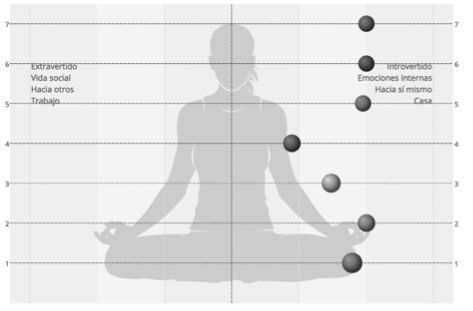
As we have already seen, stress, fear, the desire to be in control, all those situations that lead to awakening our flight or fight instinct, generate more activity in the lower centers, preventing the energy from flowing correctly toward the higher ones.
We cannot see energy with our physical eyes, but these anecdotes that we see daily allow us to observe that in most cases this happens this way. Intuitive Vision is like a kind of indicator sensor. If the vision does not appear in someone who already mastered it, it is because something is happening to them.
With our physical eyes we may not be able to see this energy (although some people can see it in other ways), but fortunately, we do have tools that allow us to measure these situations. In our case, we have been measuring participants for 18 months with an electro-photonic reading device called Bio-Well and, despite not having irrefutable proof, we do have enough clues to make small claims. Let’s look at some of this information to become aware of these clues we are talking about: IMAGE OF A STUDENT WHO CANNOT ACCESS INTUITIVE VISION
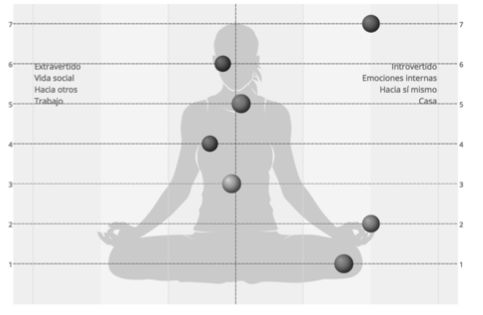
Figure 32: Reading of the energy centers 1. Source: Bio-Well electro-photonic measurement report.
This image is a test performed with a 12-year-old girl who showed great difficulty in opening Intuitive Vision. Although she managed to see without eyes, with difficulty, in three of the eight sessions we had with her, she could not maintain this ability regularly. The image was taken at the beginning of the eighth session.
At the end of the session we measured again with the Bio-Well.
Figure 33: Reading of the energy centers 2. Source: Bio-Well electro-photonic measurement report.
The improvement is considerable, but despite this, these images allowed us to understand that this teenager needed another type of help. Throughout the previous sessions we discovered that she might have suffered abuse when she was younger. The trauma caused by the situation could explain the difficulties in achieving focus and organizing her energy. After seeing the measurements,
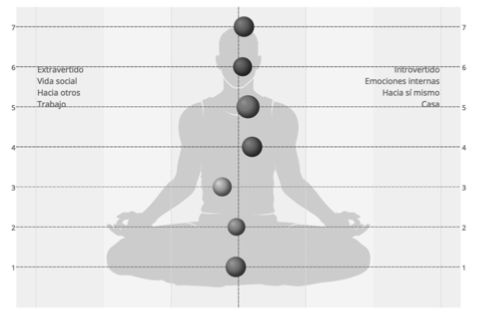
we decided to seek the collaboration of a professional specialized in this field and to continue the sessions once the matter was addressed from another angle.
We could also see that the sessions were positive for the participant and we also perceived improvements in various aspects.
We especially saw that sometimes her intuition was incredible. However, from one week to the next, the whole process had to be restarted, and on one occasion there were no results. Although the sessions themselves were positive, there was a factor that prevented the progress from lasting. In short, another professional was needed to address the problems that prevented her from living in a harmonious way.
IMAGE OF A STUDENT WHO CAN SEE WITHOUT HIS EYES
Figure 34: Reading of the energy centers 3. Source: Bio-Well electro-photonic measurement report.
It is not necessary to have all the energy centers 100% aligned to manage to see without the eyes. What is certain is that the greater this alignment, the better we can mobilize our energy and use it to access the information that
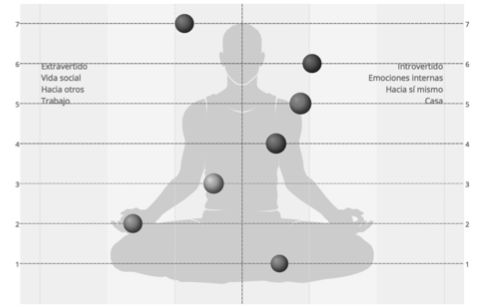
we desire. It is also important to note that having the chakras completely aligned is not synonymous with developing this ability; in this case, what it would indicate is that the participant meets excellent conditions to work, nothing more.
The previous image was taken of a boy who, before starting the sessions, claimed that he could see auras and other subtle energies. He achieved Intuitive Vision completely with the first card we showed him. It took him not even a second to open his vision, and he finished the sessions seeing behind a wall and inside boxes. This measurement was taken right at the end of the first session.
IMAGE OF A STUDENT ON THE FIRST DAY AND IMAGE OF THE SAME STUDENT ON THE LAST DAY
Figure 35: Reading of the energy centers 4. Source: Bio-Well electro-photonic measurement report.
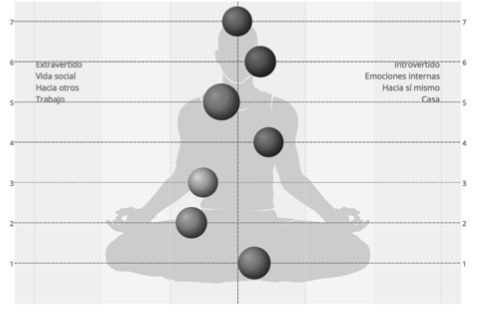
Figure 36: Reading of the energy centers 5. Source: Bio-Well electro-photonic measurement report.
This student managed to see without his eyes in the third session. The first image is from the first session where he appeared tired and nervous. From the third session on, he managed to calm down and began to expand his intuition. However, his strength was not Intuitive Vision itself, since on many occasions he saw things blurred, fuzzy, or even sometimes claimed to see things that resembled what we showed him, but the answers were not entirely accurate. Nevertheless, he excelled greatly in telepathy, remote viewing, and in the use of the little screen.
As can be seen, it is not necessary to have a perfect alignment of the energy centers to access these abilities, but they must have enough energy and be quite centered to ensure that the energy flows. On the day of this last measurement, it took him a little bit longer than usual to open the ability to see without the eyes, although he achieved it. As can be seen, the alignment of the energy centers is far from perfect, and even a little more energy is shown than usual or what would be considered optimal.
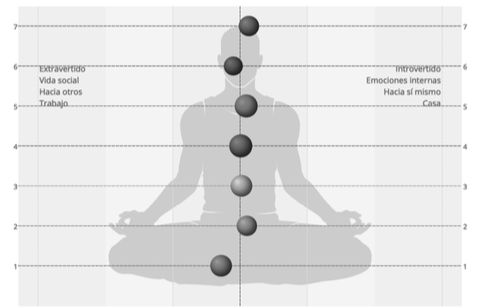
IMAGE OF AN ADULT STUDENT
Figure 37: Reading of the energy centers 6. Source: Electro-photonic measurement report.
This adult participant managed to see shapes and colors, but above all he accessed his intuition in an auditory way… A “little inner voice” dictated the answers to what we showed him. This image was taken in one of his last sessions. Thus, from our experience we can state that:
When there is little energy or it is not mobilized correctly (whatever the cause), we cannot access Intuitive Vision, or we will hardly achieve it.
When the energy is optimal and mobilized correctly, we have one of the ingredients that will help open this ability. But solely by mobilizing the energy correctly, no. We need to combine it with other ingredients: tuning in well with subtle information, having trained the ability to visualize, and undoubtedly, believing that the ability exists and that we are capable of developing it.
Having the energy centers totally 100% aligned on the graph is not synonymous with seeing without the eyes, although the more centered they are, the more possibilities.
But how can we help mobilize energy? What should we do?
From our experience, we have observed that people with optimal levels of energy are those who maintain a healthy and wholesome diet, take care of their rest, exercise, and know how to breathe correctly, whether consciously or unconsciously. We will start with this last point.
1.4.1. BREATHING; THE KEY TO IMPROVING OUR HEALTH AND OUR INTUITION
If we want to talk about breathing, first of all we must talk about the nervous system. Breathing well is of vital importance for health, for well-being, and also for the development of Intuitive Vision. But for a deeper understanding, let’s first review the nervous system.
The nervous system is the set of cells, in this case neurons, specialized in the transmission of electrical impulses that allow us to manage information coming from both inside and outside the individual. It is composed of two parts: the somatic nervous system, responsible for carrying out all voluntary actions; thoughts, movements, etc. And the autonomic nervous system, which is responsible for all the functions that are executed unconsciously and automatically and that allow us to live; the beating of the heart, breathing, sweating, digestion, etc.
Within the Autonomic Nervous System, we find two branches. The sympathetic branch and the parasympathetic branch.
The sympathetic branch is the one that activates in stressful situations.
It is responsible for increasing the heart rate and dilating blood vessels to allow more oxygen to reach our muscles, which in turn prepares them for action. This state prepares us for fight or flight in the face of dangers in our environment. This biological function is of crucial importance, as it prepared our ancestors to flee or fight, to survive in an environment that could sometimes be hostile. And it did so immediately. This branch activates in response to stressful stimuli, and although nowadays saber-toothed tigers do not chase us daily, the demands of the pace of modern society constantly push us to activate this branch. Exams, work, traffic, the avalanche of messages to answer, the pressure that social media and the media instill in our lives mean that very often we are in this state of “fight” or “flight”, and consequently cause our sympathetic branch to activate, generating negative emotions or situations such as stress or anxiety. Our body is not programmed to spend many hours with this sympathetic branch activated. This branch is associated with beta states of consciousness.
When the organism detects danger, it automatically stops all functions related to nutrition, reproduction, and ultimately all the metabolism that allows us to regenerate our body; because what sense would it make to spend energy in this direction if a few seconds later we could be dead… The organism prepares so that the muscles have the necessary strength to fight or flee. The body does not differentiate whether the danger is external or an imagination created by the person themselves, that is, the stressful situation can be an immediate physical danger or it can be a distressing thought. In such a way that people who are recurrently stressed from work or distressed about not making ends meet tend to activate their sympathetic branch and, therefore, all the functionalities related to
tissue repair or even proper digestion do not occur the way they should, creating serious health problems.
On the other hand, we would find the parasympathetic branch. This branch activates in situations of tranquility and relaxation. It is the one that activates all the metabolism to digest food and repair tissues. It is the one that works when we are sleeping and activates all our basal metabolism to replenish the body. This branch is associated with alpha, theta, and delta states.
A healthy body maintains a balance between these two branches.
It activates the sympathetic branch in situations where high physical or intellectual performance is needed, but quickly returns to a state of balance when the stimulus disappears. A healthy body easily activates the parasympathetic branch when it wants to rest. Throughout the day, we naturally activate both branches in different cycles, but keeping ourselves close to a center between the two branches.
But… How can we consciously control these branches? Well, as you may be imagining: with breathing.
Breathing is the only element of the autonomic nervous system that we can easily modify at will and consciously. We cannot stop breathing, but thanks to it, we can alter our breathing rate. By altering the breathing rate, we can send a message to our autonomic nervous system that will activate the branch it deems necessary for that situation we are provoking. In other words, when we breathe quickly, we accelerate our heart rate, and this is understood by the nervous system as a stressful situation and prepares the body for a fight or flight reaction. On the contrary, when we slow down our breathing rate, we achieve an inverse effect. The heart slows down and the nervous system understands that “everything is fine” and that it is a moment to relax, and therefore, a moment when repair functions can be activated. As we already know, the
heart sends more information to the brain than it receives… So, if we voluntarily alter the heart rate, we are also communicating with our nervous system.
In fact, the breathing rate is what marks the limits of both branches. Generally, when a person breathes more than six cycles per minute (that is, performs more than six inhalations and exhalations per minute), they are in their sympathetic branch or are activating it voluntarily or involuntarily. If we become aware of how we normally breathe, we will see that most people, throughout the day, breathe in such a way that they are already causing the activation of the sympathetic branch, as people generally breathe shallowly and more quickly. Conversely, when we breathe less than 6 cycles per minute, we are probably in our parasympathetic branch.
If we observe the breathing of a sleeping person, we will see that it is much longer and deeper.
If we manage to breathe around 6 cycles per minute, what we are causing in our body is a situation of balance between both branches.
Thus, with breathing we can control our autonomic system, to the point that if we feel sleepy or tired, we can alter our breathing, increasing our heart rate to activate our muscles and clear our mind.
(We could save ourselves the morning coffee…). And conversely… If with slow breathing we activate the parasympathetic branch and this helps us fall asleep, we can optimize our hours of rest at will. But above all, throughout the day, if we approach this rhythm of six breaths per minute (and with some strategies that we will detail later) we can be at a point of balance between both branches, without falling into the lack of control of letting ourselves be carried away by stressful situations.
In this way, breathing is key to mobilizing our body’s energy. It can help us live with less stress and, therefore, prevent energy from stagnating in the three
energy centers and thus arrive at the Intuitive Vision sessions in better condition, while at the same time if we find it difficult to fall asleep and rest, these can help our organism optimize sleep hours and recover energy levels.
Furthermore, breathing is vital to help create heart coherence. As we have already seen previously, the combination of correct breathing plus the feeling of creating an elevated emotion help create states of heart coherence that result in the whole body and especially the brain being more willing to concentrate and to intuit.
1.4.2. CARDIAC COHERENCE
We have already spoken at length about the importance of coherence, but if we accept the theories of Dispenza, Steiner, and Eastern philosophies, we will understand that this energy center, this valve, is responsible for the energy flowing from the lower to the higher centers and, therefore, for us being able to intuit.
Thus, with the breathing exercises that we will see later, and by creating elevated emotions, this is how we tell our organism that everything is fine. That there is no problem. Fear, worries, and stress, as we already know, activate the sympathetic branch, and this is responsible for secreting different hormones (which by the way create addiction) that prepare the body for a response. It is well known that stressed, anxious, and worried people tend to suffer from more digestive, lower back, and kidney problems. In fact, according to the National Kidney Foundation, one of the emotions that can lead to
kidney damage is stress. This induces high blood pressure (hypertension) and altered blood sugar levels, which generates an overload on the kidneys.
And if contemporary stress is due to situations we have created mentally and not from immediate physical dangers, we can reverse this by creating higher thoughts and emotions. The moment we imagine, remember, or feel pleasant situations that awaken happiness, joy, or bliss in us, we automatically stop experiencing this stress. In other words, when from the heart we allow ourselves to feel that everything is in order and that everything is fine, changes automatically occur in the organism. And precisely the exercises to promote heart coherence combine breathing and elevated emotions.
People who tend to do these exercises daily show a better predisposition to concentrate and to intuit. And this work is not something to do in the sessions to see without the eyes, it is something to do every day, as many times as possible, for the good of our health.
1.4.3. ENERGY GOES WHERE WE PUT OUR ATTENTION
ENERGY GOES
As you will know by this point in the book, a few years ago I was completely skeptical. The subject of “energies” was very far from my framework of beliefs. However, with time and the experiences I have lived, I have had to open myself to a world of possibilities that I previously did not contemplate. But since I entered the world of intuition, several people, teachers, and authors of different books have stated emphatically to me that where we put our attention, the energy goes there.
What was the problem with understanding this statement? That I did not see the energy, and since my empirical mind needed proof, I needed experiences to corroborate it… But why is this phrase important? Well, because if this were really true and we had energy stagnated in some specific point, simply focusing our attention on that center might solve the problem… right?
In this section I am not going to make a treatise on how consciousness works, on this subject we will reflect in a couple of chapters, but yes, from play and curiosity one day I found myself practicing something that some people, especially in their childhood, have tried. Moving an object without touching it.
In this chapter we are not going to talk about telekinesis as such, and my experiments on this subject will be recounted in the next chapter, but it is necessary to mention it for what I want to illustrate. And to do so, we are going to watch this video from another center in the USA:
Video 17 (https://bit.ly/3Tb6wDy)
Video 17: Vibravision Energy Projection Telekinesis. Source: Vibravision..
What energy moves this little stick? There is no scientific answer to this question. But what can be understood from this video is that the participant is focused and with full attention on the little stick, and in doing so an “unknown” energy makes the little stick move.
In a humorous vein, we could affirm that we do not know if the power of intention can really move mountains, but at least little sticks, yes! And now more seriously, these images serve us
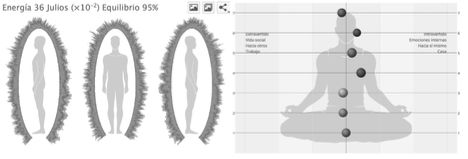
to illustrate what these masters and authors of various books affirm: where you put your attention, your energy goes!
So starting from this premise, what would happen if, when we meditate, we focused on our own energy. What would happen if we focused on each of these energy centers? What would happen if, with the power of our intention, we tried to correctly mobilize our energy?
As you already know… My empirical mind needed to verify it for myself, so again I used the Biowell to measure my energy field before and after a meditation in which I placed attention on each and every one of my centers, one by one.
BEFORE MEDITATION
Figure 38: Readings of the energy centers and energy field before a meditation. Source: Bio-Wel electrophotonic measurement report The alignment of the energy centers was already quite good before starting, but it could still improve a little. If we look at the size of the circles representing the amount of energy in each center, we will see that they are medium or even small in size, a sign that would indicate low energy. This matched my situation, as it was already nighttime after a very intense day.
This was the state I was in when I began the meditation. First I started by focusing my attention on the first energy center. My mind, during the time I was focusing attention on this point in the perineum, wouldn’t quiet down… One part of me thought I was
wasting my time and that I wouldn’t achieve any results. It was very hard for me to enter into the meditation, but when I started to focus my attention on the second center, I managed to quiet my mind and surrender to the activity without expecting anything. During the observation of the following energy centers I was able to follow the meditation very well, but upon reaching the upper center, the crying of my third child, who had just woken up in the middle of the night, interrupted the dynamic. Suddenly I found myself back on the rug in our living room and I saw that my mind was starting up again and that I couldn’t concentrate again, so I decided to end the activity and measure my energy field once more. This was the result:
Figure 39: Readings of the energy centers and energy field after meditation. Source: Bio-Wel electrophotonic measurement report What a surprise I got when I saw that not only had the activity worked, but my internal experience validated what the technology was indicating. In the first and the last center, where it had been harder for me to place my attention, there had not been the same result as with all the others that were almost at 100%
alignment and that appeared larger, which would indicate more optimal energy levels. This result should be achieved a thousand times to be considered evidence.
Personally, I have repeated it and have achieved even better results. But the most interesting thing is that my internal experience already knew when the results were going to be good and when they were not. That is,
I have also done it other times with less good results, and equally in those cases, I was already aware before seeing the results that I had not put my full attention into the exercise. So what we can affirm is that when the meditation is done correctly, it works! In this case, the internal experience is neither measurable nor quantifiable, only experienceable by the person who is living it, which makes it very difficult to know, from the outside, as an observer, that the energy goes wherever attention goes. Only through internal practice is it demonstrable.
Perhaps, if someone wants to investigate this exercise and measure it, we recommend that before looking at the results of the post-meditation measurement, they evaluate on a scale from 0 to 10 how their experience was and whether they managed to concentrate or not, in order to then determine whether the internal experience validates what the technology measures.
Perhaps this type of rigor would serve to provide more evidence.
But from our humble contribution, we will call these observations indications that energy goes where you put your energy.
And if energy goes wherever we focus our attention, it means that our power of intention is immense. With it we can change the biology of our organism. And we can achieve this, for example, by meditating. So if we wish to have optimal energy levels, meditation can be a useful way to balance our energy and have it available for whatever we want, such as using it to begin developing intuitive capacities.
In this direction, we recommend the meditations that Dr. Joe Dispenza proposes in his book “Supernatural,” specifically the one called “blessing of the energy centers.” It is not the only tool, of course, but it can be a starting point for those who are just beginning.
1.4.4. HEALTHY HABITS
While we are what we believe we are, we are also what we eat. What we decide to eat becomes part of our biology. And it is not the same to nourish ourselves with an industrial bakery product as it is with an organic apple freshly picked from the tree.
And here we are no longer talking only about the chemical products we may be consuming with the former… Now we are talking about the fact that if we are light, if we are energetic beings, which of the two will provide us with more energy? An apple full of biophotons with a brilliant energy field, or an industrial product made of inert organic matter? In the electrophotonic measurements taken of our participants, we have seen that people who practice yoga, qigong, or tai chi, for example, tend (not always) to have aligned energy centers and an optimal energy index.
But even they are surpassed by people who tend to consume everything organic. Perhaps they do not have their centers as aligned as the former, generally, but their energy levels tend to be optimal. Therefore, regardless of the type of diet we follow, and since we are neither dietitians nor doctors, we are not going to give any very specific recommendation in this direction; the more organic and fresh the product we consume, the higher the energy levels we will have at our disposal. So if you want to enjoy good energy, in addition to contributing to improving the environmental situation, the preferable option is to eat organic.
And as we were saying… There is a clear tendency toward having good energy indices among the participants who in their day-to-day lives engage in activities such as yoga, tai chi, or qigong. In fact, Paul Dong, the author of China’s Super Psychics, already indicated in his book that qigong was, in his opinion, one of the factors contributing to the appearance of these psychic capacities. So once again, another indication pointing in the same direction.
And again, sleeping the recommended number of hours for each age group will be essential if we want our organism to recover its energy levels. Therefore we must take care of ourselves and we can use breathing exercises or other strategies to honor this sacred time that the organism needs.
2. DIFFERENCES BETWEEN CHILDREN AND ADULTS; WHY DO CHILDREN GENERALLY ACHIEVE GREATER RESULTS REGARDING INTUITIVE VISION
Generalizing is never good. We have had very, very powerful adult participants who have achieved exceptional things, even at a more advanced level than what most children can achieve. We have had students capable of seeing what was in the next room, or of operating with telepathy in a way that would surprise a great many people. But it is generally true that the tendency seems to be that children achieve clearer and more developed Intuitive Vision. Many children reach such a degree of vision that they could drive a car blindfolded, if they had a license and the knowledge to do so, in the middle of New York, without anyone noticing anything unusual. Most children (though not all) end up playing outdoors as if they could see with their physical eyes, and only some adults reach such a level of development, so far.
Being clear that we cannot generalize, we can still ask the question… Why does this difference tend to exist? We can answer this question based on the understanding of the 4 pillars. I. If we look at the first pillar, we will see that children’s pineal gland would be less calcified. From ages 12 to 16, according to Rick Strassman, the pineal gland undergoes a calcification process that makes it less sensitive to subtle
information. This process is not irreversible, but dietary guidelines must be taken into account. Fluoride is one of the main culprits behind this situation.
Furthermore, the most frequent brain waves up to age 12 are alpha waves, according to Dr. Hein. That is, children aged 6 to 12 are in a state closer to their subconscious; therefore, it will be easier for them to pick up on this subtle information. In fact, it is logical that education takes place in the first years of life, since everything they experience is stored in their subconscious programming, forming the framework of beliefs that will delimit their view of the world.
II. They are more accustomed to working with images. According to Dr. Hein, children master the nonverbal part before the verbal one.
And up to age six, they find it easier to work with images than with words. From age 6 onward, the reading and writing process will reverse this process, and synaptic pruning will begin, gradually diminishing the capacity to visualize if it is not cultivated. III.
They have fewer limiting beliefs in “their backpacks.” Despite this statement, it does not mean that we cannot find children with very serious traumas and blocks. But in general, adults’ backpacks tend to be more full of limiting beliefs, for the simple fact of having more years of accumulating experiences.
IV. A child’s bioenergy is not the same as an adult’s. You only need to see the energy and the way children embrace life to understand that their organism, generally speaking, functions exactly as it should. Whereas adults, having sat for more years in habits and situations that go against their nature, generally have more difficulty making use of it.
3. THE BENEFITS OF THIS PRACTICE
Once again, the understanding of these four pillars will allow us to understand the benefits that can be experienced. But before listing them, it is important to understand that not everyone will experience all the benefits or the same benefits. Each person arrives at the sessions in a different situation and, therefore, the benefits they may experience will not be the same as those of another person. For example, the benefits experienced by a girl who is already happy in her life and for whom everything flows harmoniously on a personal, emotional, social, and academic level are not the same as those experienced by a person who carries very, very heavy situations or blocks.
Intuitive Vision is only the cherry on top of a cake, and in this training, to achieve it, what we prepare is this cake. Which is actually the most valuable part. If we build ourselves well on these 4 pillars, we will be much more centered, happy, and healthy.
In fact, the people who come to us and only want the cherry on the cake are the ones who may find it hardest to achieve that goal, since they will focus less on the recommendations that may seem out of context or of little use for “seeing without the eyes.”
Furthermore, this fixation can provoke less elevated emotions such as worry about not achieving the goals or impatience.
So if we truly wish to open this capacity, we must open the doors of our own self and focus more on the experience and the journey, which are what will lead us to obtain more improvements than the result itself. But without further ado, let us begin to detail what benefits can be experienced based on the conception of these four pillars.
3.1. BENEFITS OF THE FIRST PILLAR
When we work to begin picking up subtle information, what we are doing is learning a new way to use our brain. We are trying to create a mental stillness
(lowering to alpha or theta states) to capture information that normally goes completely unnoticed. This practice is, in reality, an exercise in concentration and attention.
Thanks to meditations and breathing, we prepare our ANS to be ready to capture very, very subtle stimuli. With this practice, we are allowing the participant to improve their capacity for concentration and attention.
The ability to apply this in their day-to-day life will depend exclusively on the participant and their attitude. But after achieving this result and developing Intuitive Vision, it is clear that they have improved their ability to concentrate.
Many participants or their parents report having noticed an improvement in their capacity for concentration. But at the same time, and in the case of children, it is important to guide them so that they apply this capacity for concentration in other areas of life. If the person has no interest, does not desire it, or does not show a predisposition, this benefit will obviously not manifest. Or in other words, if we manage to get a child to concentrate and capture this subtle information, it does not mean they will improve in mathematics if they find the classes boring, do not attribute meaning to them, or if they are not meaningful to him or her. That is to say, it is a very useful training in terms of concentration, but it is not necessarily going to be extrapolated to other areas, if these others are not appealing or the child does not show willingness on their part.
At the same time, training to capture subtle information entails an increase in intuition. Precisely, intuition is the ability to perceive them. There will be participants who begin to apply this intuition in their day-to-day life, and there will be those who only use it during the sessions.
There will be students who will begin to intuit certain events before they even happen, or they will be capable of grasping the intentions or thoughts of another person. Some may develop other forms of intuition that will allow them to be more empathetic, because
they will grasp the pain or affection that another person feels. There will even be some who develop other abilities that the branch of parapsychology has been trying to study for years.
Does this happen with all participants? No. It will happen with those who carry the learning from the sessions into their day-to-day life. Just like when we learn mathematics… There are people who will apply mathematics in their lives as a tool to explain reality and could even be using their knowledge when riding a bicycle, calculating the distances and averages of all their routes and extracting statistics to see mathematically the reality they experienced while riding a bike. This type of practice leads to an improvement in mathematics and knowing how to use them for more and more things in day-to-day life. It is the competency-based part of mathematics. It is of no use to learn to calculate the median if you then never apply it in your life. A mathematical mind can use this knowledge to, for example, improve themselves in sports. A non-mathematical mind will forget how to do statistical calculations or how to solve a quadratic equation, if they do not apply it again in their life.
Something similar happens with intuition. Participants who open themselves day by day to the possibility of experimenting with intuition, outside the framework of the sessions, will not only not forget how to intuit but will also discover the benefits of intuitive reality.
They will discover that we really have more tools for making decisions than simply the ones we have had until now.
By applying what they have learned in their day-to-day life, they will gain a better connection and strength with their internal compass. Can the use of these abilities get out of control? No. Many of the methodologies for opening this ability focus on opening it. But opening it is just as important as closing it, since we do not always want to be receptive to information that does not interest us. So through the power of intention, our participants can decide how and when to use their intuition.
Thus… from the development of the first pillar we find the following benefits:
An increase in the capacity for concentration and attention. An increase in intuition. An increase in awareness, understanding this as the knowledge that defines us and of everything around us, since we will better perceive who we are and what surrounds us.
3.2. BENEFITS OF THE SECOND PILLAR
As we have already said… Not all participants manage to see without eyes using the “little screen”. But what we do know is that by enhancing its use, it is possible to manage to see without eyes and, therefore, it is an important pillar to work on. The majority of the population is used to logical, verbal, rational challenges… but due to the functioning of most educational systems, we have not been encouraged to develop this ability to work with images.
Developing and enhancing this pillar entails an improvement in the ability to visualize and all associated actions. This implies seeing our imaginations better or using our little screen to see memories. This improvement in visual memory and the use of the ability to work with images promotes the formation of synapses that were weakening or had even disappeared, allowing the brain to work in a more holistic way.
The development of this second pillar implies the following benefits:
Improvement in the ability to work with images. Improvement in visual memory. Improvement in spelling and the memorization of conceptual schemas.
Will all students experience these benefits?
Will all children improve their spelling? No. Only those who understand the exercises for working with images, perform them correctly, and then apply or practice this ability in their routine life, for example in the school environment.
3.3. BENEFITS OF THE THIRD PILLAR
At this point, the benefits are even more disparate. The third pillar consists of trying to eliminate all beliefs or obstacles that may limit the person. And each participant will have their own. This is the point where there can be the most benefits if the person opens themselves to the possibility. But to do this, it is necessary to find the root of the problem that lies in the subconscious and to be able to change that programming. Although this cannot always be guaranteed, the truth is that many changes are experienced in this direction.
What benefits will the participant obtain? In this case, they will be benefits personalized to their needs, and achieving them or not will depend on many factors… but by trying to open this ability and doing the belief work, we can: Improve self-concept and self-esteem. Eliminate limiting beliefs or blocks that prevent progress. Empower the person. Let go of fears and phobias.
We often find participants who believe they are not capable of achieving their goals, and until we change this belief, we cannot move forward. Others may be afraid of the dark, and until they manage to be calmly blindfolded, they will not be able to advance in Intuitive Vision. Thus… once again, the list of benefits in this case is endless and depends on the personal situation of each individual.
3.4. BENEFITS OF THE FOURTH PILLAR
As we have already seen, the fourth pillar is related to the participant’s available energy. If physical or psychological health is compromised, it can cause Intuitive Vision not to manifest, or to manifest, but inconsistently (some days yes, some days no). To work on this pillar we have already seen that we can help through meditations, breathing, and giving general guidelines on obvious health aspects.
Changing those environmental aspects and habits that were harmful to the development of intuition also entails an improvement in the energy levels of the participants.
4. RESULTS REGARDING VISION WITHOUT THE EYES
We have already seen the benefits, which will be the metaphorical cake we talked about. But how many achieve the cherry on top?
At the time of writing these lines, more than two hundred participants, both adults and children, have completed the course with the Intuitu team. It is not an outsized sample, but it does allow us to have a clearer X-ray of the results.
And as we were saying, the results are not the same in children as in adults or teenagers. So we will start with the first group. It is also important to highlight the change in results obtained currently compared to those of the first participants. The trend is clearly on the rise due to the
incorporation of new techniques and exercises. The numbers we present below might not represent the current results, which would be modestly better.
Currently, of the children who have completed the ten-session course, and understanding children as participants between 6 and 12 years old, 99% managed to see without their eyes for at least one session. 98% achieved it in more than one session. Although only 94% of these achieved absolute mastery of the ability, enough to perform it on their own at home. Within this 94% there would be many categories, from those who manage to see without their eyes as if they were seeing with their physical eyes and can move around the space without problem, who would be the majority, to those who only manage to see while centered, with a lot of attention and little movement, photographs or words. These would be a small minority.
But it is important to highlight that, regardless of the degree of Intuitive Vision, at the same time, many participants achieve better results with the “little screen” and expanded intuition, which we will discuss in another chapter, but which is even more useful and interesting.
Thus, it is difficult to categorize the results, because sometimes children who “see” relatively little with the blindfold develop better with telepathy or other exercises… So in general, we could say that all of the participants increased their intuition and demonstrated incredible abilities, and that almost all of them achieve the “cherry on top”.
In teenagers, the results begin to change. Although almost all of them also manage to give visual characteristics to their intuition, their image is normally not as vivid as that of the younger ones. Between the ages of 12 and 18, almost all participants manage to see shapes, colors, shadows, or movement. But the rate of participants who manage to move through space drops to 74%. These same individuals are the ones who manage to see without the eyes in any environment, that is, they achieve control of the ability. To
despite this, as we mentioned, many teenagers achieve visual information, even from inside closed boxes, but it seems that these images can be less sharp, more abstract, blurry, or fleeting like frames of film.
Video 6 (https://bit.ly/3D73Aly)
Video 18: Intuitive Vision with teenagers. How they awaken this ability. Source: Intuitu.
For example, the boy in the first video sees a horse on a yellow background, but later, without the blindfold, he clearly saw that it was not a horse. The girl with the fish saw on her little screen an image for a few moments of a very similar scene, but it was not exactly the same. Or the girl with the “50” managed to see inside a box, but thanks to her little screen spontaneously. If we count this type of experience, the teenagers who manage to “see without the eyes” but do not reach the point of mastering the ability or manifesting it continuously, in the 10 sessions we offer, would increase to 96%. Surely with more time they would also reach control of the ability.
Among adults, the results change even more. Up to 43% of the participants manage to open this ability enough to read letters or numbers or see figures. Within this group there is a very small minority who reach the level of moving around the environment. But we also include those who need a few minutes to read a large word. That is to say, they achieved a type of vision that allows them to see, without their eyes, elements of the physical environment around them.
Another 41% would manage to give shape or color to their intuitions; that is, if they touch the color yellow, they can see the color yellow, or in some cases, they can observe a red cross and state that they are seeing it, but that the cross has no color. These same participants can see shadows or movements, but they cannot quite detect the physical environment exactly as we would see it with our eyes.
Finally, there would be 16% of participants who would not manage to attach any visual attribute to their intuitions, but who do report an increase in intuition, sometimes in other directions. Once again, it is difficult to categorize the results, because as we will see in the chapter on Case Studies, Bianca is an adult who manages to see many of the objects in the room, but sometimes she can even better see what is in the rooms next door. And the most curious thing is that she sees everything as the negative of a photograph… without color. Would this… count as a fully successful result? For me, absolutely yes. Should we grade it? Absolutely not. In this section, which we are now wrapping up, we only wanted to present a general overview of the reality we are living, but within this reality there are more than two hundred realities, one for each participant, and each one is completely different from the rest. Hard to explain…
On the other hand, when we began working with adults and after seeing that some students were not achieving the cherry on top, we doubted whether we could offer this or not. And one of our participants, who precisely had not seen anything at all, encouraged us to do so.
– You talk about Intuitive Vision, but I have developed another capacity. Intuitive Hearing. Since I started the sessions, I distinguish two voices within me much better: one that never goes quiet, that spends all day thinking, analyzing, judging, predicting… And another voice that tells me “yes,” “no,” “careful,” “slow down.”
And since then my life is easier. I have a compass that points the way. So, as we could see, the important thing is not the
cherry on top, and above all, not to focus on the result, but on the process, because it is when we focus on the process that we obtain the true benefits.
We only intuit when we are centered. And when we are centered, we tend to make better decisions, to better manage our emotions, to be more awake, and to perceive and interpret more and better the reality that surrounds us. We are more conscious. And
truly, every day we think more and more that consciousness, at a metaphorical level, has its own eyes, ears, and senses, independent of the physical body; it even has its own voice. And the more in contact we are with it, the more we can be our authentic self and unleash our true potentials.
Seeing without the eyes is not what matters. The path to reach that goal, yes! And along the way we will encounter many surprises, not all of which can be explained in words in this book.
5. ATTENTION TO DIVERSITY
Many people ask us whether children diagnosed with various conditions could benefit or experience improvements that would help them in their day-to-day lives. In principle, with our way of working up to now, we are only able to work with children who have a level of linguistic development that allows them to communicate colors, sensations, emotions, or to describe in words, lines, or shapes. Without this communication, it is very difficult to apply most of the techniques we currently use.
We are certain that we can all develop this capacity to a greater or lesser degree, but with our current tools we cannot reach 100% of the population. (In this section we will not discuss people with blindness, as we will address that in another section). That said, we have had the opportunity to work with a wide range of participants, among
whom we have found many diagnosed with ADHD or dyslexia. We have also encountered some mild cases of autism spectrum disorder, but since they were mild cases and very few in number, we will consider the sample insufficient to discuss them.
5.1. DYSLEXIA
Dyslexia is a disorder characterized by difficulty in reading and understanding written texts, as well as in distinguishing or memorizing letters or groups of letters, among other problems, such as switching the order of letters or numbers. It is not an intellectual disability. It is considered one of the specific learning difficulties, alongside others that primarily affect the oral and written comprehension of language.
This broad group includes disorders of calculation (dyscalculia) and written expression (dysgraphia). Its presence is usually detected between the ages of seven and thirteen, and it originates when the cerebral hemisphere responsible for processing visual information operates at a slower speed than the hemisphere in charge of language processes. This condition generally makes normal learning more difficult, and it can be more or less disabling depending on which types of symptoms predominate in each individual.
Dyslexia represents the most frequent neuropsychological disorder in childhood. It is a much more common problem than one might think; it is estimated that one in ten people may be dyslexic (8–10% of school-aged children), although many of them do not even know it. It is somewhat more common in boys than in girls, and several cases typically occur within the same family, even though some may not have been diagnosed.
This alteration usually causes problems in the academic and professional spheres for those who suffer from it, and it can even affect their maturational and emotional development, since they are often pressured by their environment, which does not understand or is unaware of the difficulty faced by the person who has it. According to psychologists Sabine Heim and Andreas Keil in “Large-scale neural correlates of developmental dyslexia” (2004), from the University of Konstanz, the majority of right-handed people, who represent 90% of the population, have a larger left hemisphere than the right (asymmetry).
However, right-handed people with dyslexia show a similar size when comparing the left and right hemispheres. The brain areas in question that present this symmetry appear to be involved in problems with reading and spelling.
On the other hand, researchers Judith Rumsey and Barry Horwitz in “Functional connectivity of the angular gyrus in normal reading and dyslexia” (1998) used positron emission tomography to compare regional cerebral blood flow between men with and without dyslexia. The subjects with childhood histories of dyslexia still showed some reading-related difficulties, but their overall reading ability differed among themselves, and two groups could be distinguished. While one group of men with dyslexia achieved grades as good as or even better than the group of men without dyslexia, the other group of dyslexics showed much lower results. What difference was there between some dyslexic men and others who were also dyslexic? What could account for these differences in results among people with the same condition?
The research studied the relationship between brain activity and reading ability and showed an inverse relationship between reading ability and cerebral blood flow patterns.
In the tests conducted on men without dyslexia, greater activation was observed in the reading systems of the left hemisphere, which corresponded to better reading ability. In subjects with dyslexia, surprisingly, an inverse pattern was found:
the greater the left hemisphere activity an individual showed, the worse their reading performance. On the contrary, the men with dyslexia who read best correlated with greater activation of the right hemisphere systems.
In other words: for adults with dyslexia, there was a direct relationship between those who showed better results and the ability to use the right hemisphere to compensate for the left brain’s impairment. Meanwhile, those who showed worse results demonstrated how reading functions had been relegated solely to the verbal hemisphere. On the other hand, a team of researchers from Yale University, led by Dr. Sally Shaywitz in “Prevalence of reading disability in boys and girls: Results of the Connecticut Longitudinal Study” (1990), found that individuals with dyslexia who became good readers had a different pattern of brain use than readers without dyslexia, or those with dyslexia who still read poorly. The researchers used functional magnetic resonance imaging to assess brain activity in twenty-year-old men and women with dyslexia, selected from a group followed since kindergarten. All subjects with dyslexia had a history of severe reading difficulty in early childhood. However, while some of the students continued to have reading difficulties throughout their school years, others improved in secondary school, becoming accurate readers with strong comprehension skills.
The result of the MRIs of both dyslexia groups showed less activation of the left posterior and temporal areas of the brain, compared to the group of people without dyslexia. However, those with dyslexia who had improved their reading also showed greater activation of the right temporal areas and the right and left frontal areas.
These brain imaging studies show that teaching methods that may work well for a large majority of schoolchildren may, in fact, be
counterproductive when used with students who have dyslexia.
Perhaps traditional methods of reinforcing phonological awareness should be complemented with exercises that stimulate the areas of the brain’s right hemisphere. These studies would give Intuitive Vision activities great value for students with dyslexia.
INTUITIVE VISION AND DYSLEXIA
What is curious about practicing Intuitive Vision with some students who have dyslexia is hearing the description they give of how they see the words written on cards or in magazines. It is clearly evident that dyslexia also appears with seeing without the eyes.
Although it has not occurred in all observed cases, it has sometimes presented with the most characteristic difficulty of this condition. In the sixth chapter we will see more cases in detail.
One of them is extremely surprising. In some less frequent cases, participants are able to state that the word or the card they have been given is upside down, when in reality they are holding it correctly. Some of them, without hesitation, turn the card face down to be able to read it better, and when they have it upside down, they manage to read the written words correctly. In other more frequent cases, when they are still beginning to activate their vision, students may confuse letters, just as would happen to them with their eyes open; they may hesitate when determining whether there is a “p” or a “q,” or whether there is a “d” or a “b.” Some may try to read words in the opposite direction, from right to left. Generally speaking, dyslexia persists in Intuitive Vision, in varying degrees.
What changes radically is the ability to cope with this disorder. As we have already seen in the theoretical framework, it turns out that some people with dyslexia have managed to develop alternative strategies to overcome the handicaps of this condition, carrying out certain typical functions of the left hemisphere related to language, with their right hemisphere. In this case, we find ourselves before a scenario in which the activities
for seeing without the eyes, they become a tool of absolute value.
If the development of Intuitive Vision implies an increase in the connections between the two hemispheres, and if, thanks to this, we work the right hemisphere in a way we were not previously accustomed to, this would provide tools and alternatives for students with dyslexia to overcome the impairments of their left hemisphere. In a scenario of greater connection, it would be easier for the right hemisphere to compensate for the left hemisphere’s deficiencies.
Most of the participants with dyslexia that we have treated, though not all, have very rapidly improved their reading with vision without the eyes. Even those who saw words reversed, through playful reading re-education games and activities, but while blindfolded, were able to reorient and place the letters in the correct order, and in very few sessions, demonstrated that they could read with the same ease as with their eyes open.
In cases where students extended their Intuitive Vision sessions over time, they improved their reading and writing skills very considerably.
And currently, almost three years after completing the first cases with participants with dyslexia, a good portion of the families (though again, not all) attribute their children’s academic improvement to having participated in the sessions.
This, however, is not something generalized that happens with absolutely all participants, but it opens a line of research that could undoubtedly help a great deal in these cases. So among all the people who are beginning to work in this field, it would be very worthwhile to gather evidence and techniques to investigate these aspects more deeply and to provide tools for the educational community.
5.2. ADHD
ADHD, or attention deficit hyperactivity disorder (or ADD, without hyperactivity), is another of the learning disorders we have had the opportunity to observe within our Intuitive Vision sessions. Even though the sample of participants with this condition is already considerable, it would still be insufficient to draw definitive conclusions. The truth is that there have been mixed results… But this does not prevent us from explaining what the experiences have been like. For students with attention disorder, progress in the sessions has clearly been much slower, and full of obstacles that had to be overcome with creativity and with more playful components for most of them. On one specific occasion, when we did not yet master as many techniques as we do today, we decided to suspend the process with a participant, as we were not advancing as we had promised, and it was very difficult for the participant to keep the blindfold on for more than a few minutes.
Setting that case aside, in general, students who present with hyperactivity have shown great difficulty keeping the blindfold in position and have found it very difficult to follow the meditations and descend into a calmer state of consciousness. However, over the course of the sessions, the vast majority of these participants managed to calm down, and by the final sessions they seemed like completely different participants in terms of how they behaved within the workspace. It seems as if the frequent practice of meditation had helped them find a pathway to being able to enjoy being calm. However, this has not been achieved with all participants…
Taking care of the environment and having varied dynamics is essential in these cases to try to capture the participant’s interest. If this is achieved, along with the recommendations typically given to the family based on the information gathered throughout the sessions, it can generate
small interesting changes in the participant’s life. When all these ingredients are combined properly, we have perceived changes, above all expressed by the families themselves.
But how do we measure these changes? What was the element that produced the change? The practice of meditation, the participant finding their own center (even if with more time or with some difficulties), the recommendations given to the family? The sum of all of these? Probably this last point…
Just as in the case of dyslexia, the component of change can be directly attributed to the ability to see without the eyes; in the improvements experienced by participants with ADHD, or those reported by their families, it seems they would come more from an increase in self-awareness, from the changes the family offers so the participant can feel more comfortable in their life, and partly, when achieved, from the practice of meditation.
From our experience, the sense is that when we discover how children perceive their immediate reality (through the work of the third pillar), and thanks to this new understanding, we change small aspects to adapt them to their needs, making these changes especially from love and understanding, that is when we can bring about positive change in their lives. Nevertheless, this is not measurable or quantifiable, just a feeling after seeing certain common threads among participants who significantly changed their lives for the better.
For participants with ADD (without hyperactivity), the meditation practices and the training to begin perceiving subtle information have indeed largely helped them improve their attention and concentration capacity. And at this point, just as with the cases of participants with dyslexia, we should begin (ourselves and all the people working in this direction) to find ways to measure, quantify, and validate this information and these results.
By way of self-criticism, for the time being we have only kept the impressions and anecdotes that families have shared with us. And the reality is that most families are very pleased with the processes experienced in these cases. But this is not sufficient scientific evidence. Here there are two complaints that we ourselves make and that we make to the rest of the community working in exactly the same field. And that is, while all of us know that what we are offering is extraordinary and unique and can bring improvements to all people in the world, this is not sufficient reason to make unfounded claims. We cannot accept that the ability to see without the eyes, no matter how much we think it or believe it, will help all people with any condition or impairment. In our case, despite the optimism of seeing genuine positive changes, these do not represent 100% of cases. And we know firsthand that the same happens across all the methodologies we are familiar with.
We could accept, then, that the development of intuitive capacities, and especially the ability to see without the eyes, has incredible potential to help many people. But there is an urgent need for:
Scientific and statistical evidence supporting positive results in cases of specific conditions. A network to share the techniques that help make it possible for these positive cases to increase. A better understanding that allows us to know how and why this helps in the majority of cases, and in others not as much.
Without this evidence, for the time being we prefer to simply state that this training can bring many improvements, but that we should allow ourselves to be surprised by them (and they do surprise us very often), as we continue along this path of learning and venture further into this ocean of possibilities.
6. TIPS BEFORE TRAINING INTUITIVE VISION
As we already mentioned, this volume is not intended as any specific training to develop Intuitive Vision. In the future there will be a volume dedicated to this, although, as we have also mentioned, at the end of this book you will find some exercises. For this upcoming volume, we will need to overcome the difficulty of training without a person at your side to guide you through all the pillars, but especially the third one, beliefs. For now, if you wish to begin this training with any of the people or schools around the world dedicated to it, we are going to give some recommendations so that you arrive well prepared for the sessions. The perspective that these other guides can give you will surely differ greatly from our vision and explanation, but what is even more certain is that the advice we are going to give you will serve to help you dive in more fully when you wish to begin.
These tips will focus mainly on the first and the last pillar, since the second and especially the third must be carried out individually with the guide who accompanies you. If we wish to increase our capacity to perceive subtle information, we must tune our antennas, in this case we are speaking again of the pineal gland and the heart.
Regarding the pineal gland, it is important to recall the studies by Rick Strassman noting that this gland undergoes a calcification process between the ages of 12 and 16. We do not know to what extent this is mechanically reversible, but what we do know is that all adults, with training and following guidelines such as the following, increase their capacity to perceive subtle information. This calcification process is largely related to fluoride intake, which deposits around the pineal gland, creating a layer of calcium, fluoride, and some
heavy metals that would hinder the gland from generating the electromagnetic field necessary to receive information, or at least weaken it.
6.1. NUTRITIONAL ADVICE
First, we recommend a body detox.
During the days or weeks prior to and during training, try to follow a healthy diet and lifestyle. (Take into account your biological factors such as allergies or intolerances before making any changes to your diet. These recommendations do not replace any medical-health diagnosis you may have. And do not follow any of this advice that may represent a medical contraindication.)
Reduce sugars and processed foods, and favor fruits and vegetables. Fruits and vegetables have a natural electromagnetic field that will help with our energy.
Drink water or herbal teas; we especially recommend turmeric infusions. Stop using fluoride toothpaste. Fluoride is absorbed and ends up in the pineal gland, hindering decalcification. Fluoride toothpaste is one of the worst enemies of your pineal gland. (Unless you have a cavity or are following a specific treatment. In that case, it is a possible treatment.) Stop consuming tap water or water with a high fluoride content. There are many filters that can be applied to the tap, but if you want to keep drinking it, look for a detailed study on the fluoride content in your area to be sure your filter works properly. Use oregano oil. You can infuse olive oil with a few oregano leaves. Oregano helps strengthen the endocrine system, and the pineal gland is part of it. Use apple cider vinegar; it is very useful for decalcification and body detoxification. Foods rich in boron, such as avocados, almonds, plums, and raisins;
directly combat the effects of fluoride in the body. Spirulina and Chlorella are excellent foods composed of vitamins, minerals, and antioxidants, which eliminate the metallic toxins that accumulate in our bodies. They also increase oxygenation and immune function. They can be taken in capsule form every morning and will also give us an extra boost of energy as a substitute for coffee. Consume natural organic sources of iodine to eliminate fluoride. Iodine deficiencies (very common in today’s society) cause fluoride to take its place and become coated with layers of calcium. To restore balance by consuming iodine, you can choose spinach, broccoli, seaweed, and fish, or iodine supplements (under the guidance of a dietitian). Other optional foods that can be included: raw cacao, seaweed, watermelon, hemp seeds, coconut oil, Goji berries, garlic, honey, cilantro, lemons, and other citric acids. With these tips, and with a diet of organic products, we will not only help our pineal gland, but we will also increase our biofield (fourth pillar).
6.2. BREATHING EXERCISES
And the heart? How do we work with it? Obviously, not all of us have access to a heart coherence measurement device… But if you’re interested in the topic, we recommend the EmWave from the HeartMath Institute. With this device, we can learn to see when we are in coherence and when we are not. Although truthfully, we can know it without the device too, since the physiological sensation of being in coherence is recognizable, and with training it becomes even more so.
To achieve these states of coherence, we are going to share some exercises that will help us breathe correctly, although not all of them are intended to create coherence; some we include for other purposes.
Attention: People with asthma or breathing difficulties, consult your doctor and a breathing coach before trying the following exercises.
FIRE BREATHING
Fire breathing, similar to kapalabhati, consists of rapid breathing at much more than six cycles per minute.
Recall that a frequency higher than six cycles activates our sympathetic branch. These breaths are suitable for mobilizing energy, oxygenating the body, and waking ourselves up. They are ideal when we have just woken up, to start the day with energy, and before engaging in sports.
There are two ways to perform them:
Strong, rapid exhalations. We force the exhalation from the diaphragm, and relax quickly without forcing the inhalation, which occurs automatically. Always through the nose. Three rounds of 20 breaths.
Another version would be exactly the same as the previous one, but forcing both the inhalation and the exhalation.
We can roughly perform about four cycles every ten seconds in both versions. This gives us a very rapid breathing pattern that would increase the heart rate and prepare the body for physical activity. These breaths do not provide us with coherence, nor would they be the most appropriate in the context of today’s society.
WATER BREATHING
These are the most important ones. Thanks to them, we can create heart coherence and come closer to our center. We should perform them as many times as possible throughout the day, or even (in the case of 4:4) try to incorporate it as our habitual way of breathing. If we notice that we are too far into one of the two branches, especially the sympathetic one, this
breathing will bring us closer to our center and is therefore ideal for managing our stress, without making us too sleepy or overly relaxed. Both versions are useful for beginning to concentrate (on any task) and also for beginning to intuit.
For these breaths, it is important to remember that they should always be done through the nose (unless we have a very bad cold) and that they should be done from the abdomen, filling the lower part of the lungs first and then the rest. To achieve this process, it is important to become aware of the diaphragm, the muscle that allows the lungs to fill with air. The movement of the diaphragm stimulates the vagus nerve, which is responsible for the functions of the parasympathetic branch and therefore helps us even more to achieve the desired benefits, stripping away the stress that comes from being in the sympathetic branch. It is also important that both the inhalation and exhalation be continuous and fluid, and that they last for all the seconds indicated. If our lung capacity does not allow it, we can start by training with shorter intervals.
If we find it difficult to retain the air or to let it in slowly, so as not to fill or empty the lungs too early, we can use the oceanic technique. The oceanic technique consists of closing the glottis in such a way that the air has less space to enter and exit (just as when we press the neck of a balloon to control the outflow of air). To understand how to achieve this technique, you can place your hand a few centimeters in front of your mouth and release the air through your mouth as if you wanted to fog up a window. Can you feel the warm air? Now do exactly the same thing, but with your mouth closed and letting the air out through your nose. If you have done it correctly, you will notice that your inhalation and exhalation become noisier, somewhat similar to the sound of the sea. Hence the name.
Well, keeping these considerations in mind, we are going to describe the two exercises that allow us to breathe in a way that enhances heart coherence:
4:4 Breathing: We inhale through the nose for four seconds; hold the air for one second and exhale over four seconds; we hold without air for one second and start again.
This breathing has a 10-second cycle. Four seconds of inhaling plus one second of pause makes five, plus the four seconds of exhaling and the one second of retention add up to ten. This allows us to see that we will perform 6 cycles per minute. Exactly what the theory tells us will allow us to reach our center. Depending on age and lung capacity, these intervals may vary slightly, but with training, this is in principle the best way to breathe. As long as we do it by filling from the bottom, mobilizing the diaphragm, and breathing through the nose. Alternate nostril: Alternate nostril breathing is very similar to 4:4.
We are going to repeat these cycles, with the same breathing techniques; mobilizing the diaphragm and filling the lungs from bottom to top.
The difference is that during the first inhalation, we will cover the right nostril. When we are full of air, we will switch to the other nostril and exhale through the opposite side.
We inhale through the same nostril we exhaled through, and when we are full of air, we will switch nostrils. We always make the switch when we are full of air.
These two breaths provide a great deal of heart coherence, but they are only one of the two ingredients needed to achieve that coherence. We already know the other one: elevated emotions.
To create an elevated emotion, we will begin by breathing for several rounds, paying attention to our heartbeat and feeling it relax. Next, we visualize in our mind any situation, a memory or an imagining, something that happened to us or the joy we will feel upon achieving a goal. We visualize something that produces the greatest well-being in us. It could be a beach, it could be thinking of a loved one… And once we visualize it, and while we continue with the breaths, we feel the pleasure that this “reality”
we have created within our mind gives us. We feel the joy, the bliss, the gladness, the happiness it produces in us. And we stay there for as long as we wish. We must not limit ourselves to visualizing it; we must live it. Feel it with as many senses as possible.
The more we practice these exercises, the easier it will be to enter coherence, the more we will recognize this state, and the more easily we will be able to reproduce it.
LINDEN BREATHING
We have named these ourselves, since they are breaths that calm us and can even help us fall asleep at night. Some armies train their soldiers with these breaths so they can fall asleep under the worst circumstances. These breaths are very useful if our stress level is too high and we need to calm down. In this case, before the water-type breathing, we can do this linden breathing. This way we will reach our center. But if these breaths are useful for anything, without a doubt, it is to help us optimize our hours of sleep. With them, we can take greater ownership of our body and decide when to fall asleep.
For these breaths, we will use the same techniques as with the previous breathing, the water one. We will breathe from the abdomen, always through the nose, and if necessary, we will use the oceanic technique (closing the glottis). It is important that the breathing be nasal. In the nose, we have various sensors that detect the passage of air. When no air passes through, these sensors sound the alarm (because they understand that the person could be drowning) and activate the sympathetic branch, exactly the opposite of what we want. So breathing through the nose is of vital importance if we want to activate our parasympathetic branch.
These breaths can be performed lying down for greater benefit, and if at first the proposed cycles are difficult for us, we can reduce them slightly, but with the intention of making them progressively longer.
4:8 Breathing: We inhale for four seconds, hold the air for one second, exhale for eight, and hold the air for one second.
Four seconds of inhalation plus eight seconds of exhalation plus the two seconds of air retention add up to 14
seconds. This would be a little more than four cycles per minute.
Less than what is indicated for being at our center. As you can see, it is a slow breathing pattern that tilts us toward the parasympathetic branch.
Square breathing: We inhale for four seconds, hold the air for four seconds, exhale for four seconds, and hold without air for four seconds.
This breathing has a 16-second cycle. Even slower than the previous one, and therefore it also takes us into the parasympathetic branch.
These breaths have much longer cycles, and both the retentions and the exhalations help slow the heartbeat. And when the heart slows down, it sends a message of calm to the brain, which allows us to relax even more. They are also useful for beginning to intuit if we’ve had a busy day, although ideally we would then move on to the water breaths.
If you’re interested in the topic of breathing, we recommend finding a breathing coach who can guide you through the different techniques, since learning from a book is very different from learning from a teacher. We also recommend the Wim Hof method, which proposes a type of breathing that greatly increases energy levels.
Audios 1-5 (https://bit.ly/3S9hPe0)
Audios 1-5: Guided fire, water, and linden breathings.
Source: www.intuitu.cat
6.3. THE IMPORTANCE OF SLEEPING
Resting the recommended hours is essential to have good energy levels, and with the linden breathings we already know how to help improve this process. Despite this, there are many more recommendations, apart from having a comfortable bed and a correctly oriented one. It is important that when we are sleeping, we do so in total darkness.
We recall that to secrete melatonin, it is crucial that the pineal gland does not detect light. Thus, whether we sleep during the day or at night, it is basic to be able to have some way to completely darken the room.
Equally important is not looking at screens an hour and a half before going to bed, because this light activates the pineal gland and hinders the subsequent secretion of melatonin and, therefore, we will not optimize sleep.
And speaking of sleep… Dreams can be a channel to begin expanding the connection with our subconscious and our intuition. If we enter this area, we would spend dozens of pages talking about the possibilities they offer us, and that is considering that we are not experts in this field. So if you are starting out in this world, we recommend that you leave a notebook on your nightstand and that just when you wake up, before doing anything else, you write down everything you remember from your dreams, the more details the better. This will allow you to remember them more and more, and interesting things can start to happen. The more you do this exercise, the more prepared you will be when starting your training with Intuitive Vision. Writing down and bringing to the conscious part everything you have dreamed daily helps us gradually thin the veil that separates our conscious part from the subconscious, and this is of
help when we want to begin perceiving subtle information.
Perhaps one of your dreams provides you with answers to things you were wondering about, or you see clear signs that something you dreamed, more or less symbolically, ends up happening.
Similarly, and leaving aside the world of dreams, an interesting exercise to do is to set small intuitive challenges in your day-to-day life. If you know your partner is cooking something, try to intuit what it is, or if someone calls on the phone, try to feel who it is. The more we exercise intuition, the more we advance in this field.
Thus, now that we know a little bit more about how to start this Intuitive Vision car and how to drive it.
We have already seen the history about this ability and have delved into theories that could shed light on how its mechanics work; it is time to delve into the other very interesting part of this book. And that is because, as we have already seen in the subtitle and have already referred to on multiple occasions, it is not only possible to see without the eyes. It is time to delve into what we refer to as expanded intuition.
CHAPTER IV And if seeing without the eyes is possible, what else is possible? EXPANDED INTUITION AND OTHER ABILITIES
We already know that the ability to see without the eyes exists. We have collected testimonies from different periods and independent of us that already affirmed it; we have provided some evidence indicating this; we have explored the way we understand this ability that allows us to develop it with our participants to a greater or lesser degree; and we have also shared some of our experiences, although we will explain more in the final chapter of the book. But in this chapter we are going to focus on the question: if seeing without the eyes is possible, what else is possible?
While it is true that at the beginning in our sessions we focused only on this ability to see without the eyes, the truth is that over time we have been exploring other directions, to the point that at certain moments and with some specific participants we have developed these other abilities more than Intuitive Vision itself. Some of these abilities are part of what we call Expanded Intuition and what other authors pointed out as a biocomputer or biointernet. Through the little screen (or manifestations similar to it) we achieve information that is beyond direct visual reach.
It would have a similarity to Remote Viewing, although the approach and practice are different from this concept investigated in the 70s.
In this chapter, we will talk about this technique of obtaining information, although we will also talk about Remote Viewing itself as something separate, telepathy, telekinesis, and other
phenomena. But first, once again, we are going to look at the experience of scientists and authors who have explored these other fields, to understand that it is not something we have made up.
While in the first and second chapters we tried to provide evidence that explained intuitive vision, before we start talking about other abilities, we are going to provide proof that these other abilities also exist.
1. SCIENTIFIC EXPERIMENTS ON EXTRASENSORY ABILITIES
It is a good thing that our prehistoric ancestors did not know statistics, because if they had calculated the probability that by striking two random stones together a fire could be started, they would have reached the conclusion that the mastery of fire was not possible, or at least highly improbable. Surely, before finding the right stones, the fuels that worked well, the necessary temperature and humidity conditions in the fuels, they would have given up before finding the technique that allowed us to get where we are today. Surely there were hundreds of thousands of failed attempts before finding the way, and nobody told them that because the result of the first tests had been a 0.001% success rate, just to say something, the mastery of fire was not possible.
The same thing happens with scientific experiments, in which the existence or non-existence of extrasensory abilities such as telepathy, psychokinesis, or micropsychokinesis has been statistically calculated. Today, within our reach and on the web, we would find dozens of rigorous studies indicating that these abilities could exist, but that the statistical deviations in such cases are so small, or deviate so
little from what probability would indicate, that they do not constitute irrefutable proof and, therefore, the scientific community in general does not accept such proof as sufficient.
But have these experiments been conducted under an adequate technique? As we will see, many of them have followed exemplary rigor at a scientific and mathematical level… But were the participants in these experiments educated in any technique? Just as to start a fire we do not need just any two stones, but pyrites or flint—a basic condition for starting a fire—we know at the same time that we also need oxygen, fuels, and temperature. If any component of this triangle disappears, the fire goes out or does not appear. The same happens with extrasensory perceptions (ESP) and other abilities.
All people enjoy a certain degree of extrasensory abilities, and when they are trained, these levels increase. And
in many cases they increase to such a point that any statistic would blatantly indicate their existence. Thus, from our point of view, it is not the same to measure these abilities when they have not been taught as when the participants have specific techniques to mobilize their intention and/or use their intuition. To continue with the metaphor of fire, we could call these techniques “the right temperature.”
If in this metaphor the participants were the fuel, we need two more factors. An increase in temperature, which could be represented as training to increase intuitive abilities and, on the other hand, oxygen. Oxygen, in this metaphorical case, could be the environment and the working conditions of the participant.
If the participant masters the techniques perfectly, but is not feeling well that day, perhaps they will not achieve the levels of cardiac coherence or mobilize the energy correctly, and then the result observed in other circumstances will not be achieved… If the participant is in perfect condition, but there is environmental noise
or they are uncomfortable for some reason, perhaps they will not achieve the necessary concentration. And finally, to complicate matters further, if the participant is fine, is comfortable, but there is a scientific observer who does not believe in what is being investigated, this attitude, even at an internal level, will surely influence the result. It is as if, right when we lit the fire, we covered it with a blanket and suffocated it. The internal attitude of the observer/companion, if we admit that ESP exists, clearly has an effect on the result. Therefore, it is a factor to take into account in the design of future rigorous studies. Thus, what we are stating here is that the field of ESP is one of the most difficult fields of study because there are many variables to consider. And if we want to determine its existence mathematically, we must at minimum:
- Master a technique. (Or have trained intuition).
- Be in good physical, psychological, and emotional conditions.
- Omit the presence of people who may alter the results, even at a subtle or barely palpable level, and take care of the environment where the experiment is carried out so that it is as comforting as possible for the subject who is going to perform the test.
With these three ingredients, all that is missing is the practice or the experiment, which would be the equivalent of striking two pyrites or flints, and these abilities appear in a measurable and verifiable way, just like the sparks that ignite the fire.
As we were saying, from the world of parapsychology, many of these studies have been carried out, some at a statistical level, which have sometimes determined that untrained people achieve results that deviated between 1 and 5%
from what probability would indicate. For the last time… if in prehistory someone had managed to start a fire between 1 and 5 times out of every 100 attempts, what would the rest of us spectator Homo sapiens have done faced with such an event? Surely at first we would be scared and think that some kind of witchcraft was occurring with the stones or the people using them, and even try to avoid the subject out of fear or incomprehension. But once the fear was overcome, surely the number of individuals who
would try would increase and each one would try new strategies until perfecting a technique and achieving better results, arriving at the knowledge and understanding that when you have the necessary elements and the technique, 100% of the time you can start a fire by striking two stones together. It is not chance, it is causality.
Thus, we have some mathematical evidence (although small) that this exists, or at least, if we cannot call it evidence, we can indeed affirm that we have some small statistical indicators that are very striking, although to guarantee it completely, and to be able to obtain statistics that allow the scientific community to irrefutably accept its existence, we must train this capacity, master a technique, and then carry out the studies. Just like if I try to start a fire with two stones, today I am not going to achieve it, because I have not been trained to achieve it, and only after trying a thousand times will I get some result, the same thing happens with telepathy or psychokinesis, for example.
1.1. EXPERIMENT ON THE POWER OF INTENTION
We are going to begin by talking about the power of intention. The capacity to influence surrounding energy or matter solely by the mere act of thinking and setting the intention to make a change. We would understand this power ranging from telekinesis (the ability to move objects without touching them), also passing through psychokinesis or micropsychokinesis (the ability to influence the physical environment with our consciousness), to distance healing, defining this as the will to interfere with and improve the health of another living being without touching it or subjecting it to any conventional treatment.
We are talking about how consciousness could or could not directly influence aspects outside our physical body without any mechanical intervention of any kind. And if we are going to talk about this
power of intention, we must begin by talking about the PEAR studies.
1.1.1. THE PEAR STUDIES
Robert Jahn, dean of the School of Engineering at Princeton University, and Brenda Dunne, director of the Princeton Engineering Anomalies Research Laboratory at the same university (PEAR Laboratory, according to its acronym in English), created a special research program to discover whether the power of intention could physically affect the environment.
Over decades of very rigorous studies, they reached the conclusion that yes, there were very clear indications that the mind and the power of intention affected the physical environment. To reach this conclusion, they conducted thousands of experiments with random event generators or (REGs). These experiments consisted of volunteers trying to influence random events in different types of devices using only the power of intention; from trying to influence the flow of a water tube that emptied into two different little tubes, trying to alter the natural flow by making more water come out of one than the other, to shifting the probability that steel balls falling inside a device would end up coming out more times through one of the two exits, when the probability would indicate a 50% chance of it coming out one way or the other. They also contemplated experiments in which they had to alter devices prepared to show two images (like heads or tails) alternating 50% of the time, and manage to make one image manifest more than the other. After more than two and a half million trials, Jahn and Dunne clearly demonstrated that human intention can influence these events. Their studies can be consulted in “Correlations of Random Binary Sequences with Pre-Stated Operator Intention: A Review of a 12-Year Program.” R.G. Jahn and
B.J.Dunne (1999). The odds of obtaining these results reported in the study are one in 129,500,000,000, or metaphorically, the same as finding a specific grain of sand hidden on an immense sandy beach. In their own conclusions, they also emphasize that the repeatability of the phenomenon is more than proven, or in their words “The appropriate internal consistency and the replicability between experiments and between laboratories have been established as generic characteristics of these anomalous results”.
And not only did they obtain surprising results.
Previously, D. Radin, chief scientist at the Institute of Noetic Sciences, together with R. Nelson from Princeton University, published an article in which they stated that up to 68
different researchers had reached similar conclusions and results, in response to which they stated:
“Therefore, after considering all the recoverable evidence, published and unpublished, attenuated by all the legitimate criticisms formulated to date, it is difficult to avoid the conclusion that, under certain circumstances, consciousness interacts with random physical phenomena.” (Radin & Nelson, 1989)
1.1.2. RENÉ PEOC’H’S EXPERIMENTS
Perhaps even more fascinating are the experiments of René Peoc’h. Among the parapsychology experiments developed by this French researcher, many of them on animal telepathy1, the one that caught our attention the most for being related to the power of intention, is the one he carried out with some chicks.
For this experiment, Peoc’h also built an REG in his own way… He built a type of robot (ticoscope) that, after advancing short distances, had to turn randomly to the right or to the left. Fifty percent of the time it would take the right path, and the other fifty, the left, but randomly. To ensure that its programming was correct, he placed the robot in front of an empty cage and turned it on to record the path dictated by random decisions.
Figure 40: Circuit made by the ticoscope with the empty cage. Source: Own elaboration from the study Psychokinetic Action of Young Chicks on *the Path of An Il uminated Source. (1995). R. Peoc’h. *
With this exercise, Peoc’h saw that the robot was indeed well programmed, since it walked around all the available terrain in a fairly random and distributed manner. For the next experiment, Peoc’h left the robot in the center of the terrain and placed some eggs about to hatch. When the chicks were born, not having their mother nearby and due to the imprinting phenomenon, they understood that their mother was the robot. Their desire was to be with her, so in some way they mobilized their intention to achieve their purpose. This somehow altered the random system created by Peoc’h and after hours of recording and after repeating the experiments several times, the following was observed:
*Figure 41: Circuit made by the ticoscope with the presence of the chicks. *
Source: Own elaboration from the study Psychokinetic Action of Young *Chicks on the Path of An Il uminated Source. (1995). R. Peoc’h. *
Clearly, the intention of the chicks somehow altered the random decisions of the robot, causing it to walk through the areas closest to the chicks. And if a chick is capable of doing this… how far could our own consciousness go?
1.1.3. HEALING THROUGH THE POWER OF INTENTION
If we humans can influence mechanisms and machines that produce random events, or even animals could alter the future of possibilities… Can the health of other living beings be altered through intention?
This book does not intend to be a book about healing. From the beginning, we have been saying that we recount the real experiences we have seen and lived, or we recount experiences reported by scientists who would not want to risk their reputation at all. At this point in the book, where it seems we deviate from our goal, Intuitive Vision and Expanded Intuition, it is important
to emphasize that intention plays a basic role, especially with Expanded Intuition, so we must finish detailing some points that can bring us more light in this direction.
So… Does the power of intention exist? For now, we see that it seems so… But is it enough to heal?
Let us remember Fritz-Albert Popp who, as we had already seen in the second chapter, a few decades ago discovered that all living beings, from the most basic unicellular organisms to the most evolved multicellular ones, including human beings, logically, emit a small and constant flow of biophotons. Over time it has been shown that this emission of particles fulfills vital biological functions and that it is the way cells themselves operate to communicate with themselves and among each other. This emission of light activates and deactivates molecular reactions and, therefore, is reflected in the biology of living beings. Popp speculates that the emission frequency of this light is like the frequency of a tuning fork, causing the entire body to vibrate at once. When there are alterations in the emission of these biophotons, there is disharmony and consequently a biological imbalance.
What is not so well known about Fritz Albert Popp is that he was open to the possibility that, with the power of intention, we humans could alter this emission of biophotons in other organisms. Since he had dedicated his career to convincing the scientific community about the existence of biophotons, when he finally achieved it, he did not want to risk his reputation. But in the book The Intention Experiment (2014) by Lynne McTaggart, she states that she herself proposed a healing experiment to Dr. Popp.
The experiment consisted of people not trained in healing, but at least versed in the world of meditation, located abroad, trying to emit healing intention to some algae in Popp’s laboratory, where he would count the photons of said algae, to see if something external was affecting their field. They chose three types of algae, a dinoflagellate that
would be bathed with a little vinegar, to create an environment of stress and see if with healing they could save it, a jade plant with a pin stuck in it, and an acetabularia which was left without a stressor. When an organism has to face a stressful situation or an attack, the emission of biophotons increases because the individual must face this attack, just as humans increase our temperature when our defenses are activated. In McTaggart’s words, the results of the experiment were as follows:
“In all three cases, our subjects registered a significant decrease in biophotons during the meditation sessions, compared to the control periods. The dinoflagellates ended up dying from the acid (it is possible that for this reason our meditators had so many difficulties establishing contact with them). However, Popp said, their response (a decrease in biophoton emissions of almost 140,000) was significantly different from that of an organism that is dying. Among the survivors, the acetabularia, the healthy subject, had presented a greater effect than the jade plant, perhaps because it had not had to overcome any type of stress (544 emissions lower than normal), while in the case of the jade plant (65.5
emissions lower than normal) the pin (the stress factor) remained stuck in the leaf throughout the experiment.
Popp plotted the results on a graph, marking in red the times when we sent our healing intentions, and emailed them to me. We had indeed achieved a ‘zigzag’ effect. During meditation, Popp wrote in the report analyzing the results that ‘many more decrease reactions occur than increase reactions.’ With the acetabularia, we obtained an overall reduction from the norm of 573 emissions, and an increase of only 29. Our little meditation session had produced a significant healing effect, a significant decrease in light emissions.” (McTaggart, 2014)
Despite McTaggart’s optimism, Popp stated that caution was necessary, as these findings needed to be repeated many more times before being considered irrefutable proof.
We could find countless experiments related to healing, but since this is one of the aspects furthest from our field of work, we will simply recommend these readings by McTaggart on the power of intention, which will leave no one indifferent.
1.2. TELEPATHY EXPERIMENTS
When one thinks about telepathy, memories surely come to mind of having tried it with brothers or sisters and friends, the game of trying to guess what the other person is thinking, or trying to mentally send a number or color. Another common situation that might come to mind, and that surely more than one person has experienced, is when we are about to say something and our counterpart says exactly what we were thinking, as if there were a connection. This perhaps tends to happen more among people who share a strong emotional bond, and we have surely even been able to explain this phenomenon ourselves at times as a… “Well, it’s just that we’ve known each other for a long time and these coincidences are normal…“. Another curious situation that many people experience occurs when we think of someone and that very person calls us on the phone just seconds or minutes later.
And precisely one of the most ingenious telepathy experiments can be found with telephones. In this case, the author of the study is Dr. Rupert Sheldrake, a famous biochemist and researcher in the parapsychological field, known for his concept of “morphic resonance.”
This celebrity in the fields of biochemistry and parapsychology devised several studies to determine the existence of telepathic abilities. In them, volunteer participants had to guess who they were going to talk to on the phone, who would send them a text message, or an email.
In one of the experiments involving telephone calls, out of 2,080 trials that were conducted, on 869 occasions participants knew who they were going to speak with among three possible contacts that a computer chose at random. This means that in 41.8% of cases, participants “guessed” who was on the other end of the line when the probability would be 33.3%
of cases. 7.5% more than what would be normal. (Sheldrake, Smart, & Avraamides., 2015)
In another study by the same author, he repeated the experiment with text messages. The procedure was similar: participants had to guess who was going to send them a text message among three possible people. Out of 886 attempts, participants guessed correctly 336
times, which means 37.9% of the time, when probability would indicate a 33% success rate. 4.9% more than what would be probable. (Sheldrake, 2009)
He also repeated the experiment with emails. Out of 419
attempts, participants guessed correctly 175 times. Again among three possible options. Which represents once again a 41.8% success rate, compared to the 33.3% that probability would dictate. 7.5% more than expected. ” (Sheldrake & Avraamides, 2009b) We can find more studies on R. Sheldrake’s website (www.sheldrake.org), but we will summarize in his words:
“Participants were much more successful with calls from family members than with calls from strangers, and this difference was statistically significant. There was no decline effect with distance, even when some callers were 18,000 km away. These effects appear to be inexplicable in terms of skills or fraud and
there was strong evidence for the reality of telephone telepathy.” (Sheldrake, 2004)
Thus, it seems that telepathic communication between individuals is something that can even begin to be affirmed at a scientific level.
Although it is nothing new in this book. If we recall, in Chapter II we already cited Cleve Backster’s experiments in which he demonstrated that plants detect the suffering of other living beings. And we have already seen, when we spoke about the power of intention, that in some way all living beings can influence our environment, so telepathy would simply be one more manifestation, within the vast array of possibilities that our consciousness offers us.
1.3. REMOTE VIEWING EXPERIMENTS
Remote viewing is the psychic ability to receive information or impressions about an event, person, object, or place that is hidden from the five senses. Unlike the ability to see without the eyes, the target to be observed may be located somewhere nearby, but not accessible to the naked eye, or it may be located millions of kilometers away. It wouldn’t even necessarily have to be situated in the same time frame. In other words, it is an ability very similar to what we know as clairvoyance, but perhaps the biggest difference is that the concept of remote viewing is a concept created within a “laboratory” framework, where viewers must follow a set of rules or “protocols.” These procedures were created starting in the 1970s in a scientific and military context to discover to what extent this ability could be helpful in military intelligence matters.
For the general public, the memory that remains of these experiments is nothing more than urban legends, even from cinema, and in our opinion, it seems as if there has been a desire to
downplay a series of experiments that lasted nearly three decades officially. One only needs to watch the film The Men Who Stare at Goats (2009) by Grant Heslov to see how this ability is currently marketed. Even though many of the details told in this film are based on real anecdotes and results, the film approaches the subject with too high a dose of humor and generates little credibility.
But one only needs to dig a little deeper to discover that government agencies actually studied this ability with very rigorous and scientific protocols, and although information often circulates that these studies yielded no results, when the subject is investigated more thoroughly, information is found from the people actually involved that indicates the contrary. But to see the results of said programs, we begin from the beginning.
To understand this concept, we need to go back to the Cold War. An era of races… Arms races, space races… and races in the field of extrasensory perception.
Why was there a race in this direction? Because if someone can truly “see thousands of kilometers away,” that someone can become a psychic spy. Something very appealing to all governments, but especially to the Soviets and the Americans.
But how did this race begin? It probably started more from rumors of what the other side was achieving than from a real interest in it, at least on the part of the rulers.
Without a doubt, the story began in the 1920s, when the Soviets gave the green light to the publication of various works that discussed, among other things, telepathy. The USSR is widely known for its stance against religions and therefore against anything that was not scientifically demonstrable. But when faced with
the obligation to decide whether to allow the publication of this type of content or not, not only did they accept, but they invested funds into scientific research.
One of the first institutions to receive funding for the study of extrasensory abilities was the Bekhterev Institute (founded by the grandfather of Natalia Bekhtereva, whom we discussed at the end of the first chapter). Its director Vladimir Leonidovich Durov and a colleague of his, B.B. Kazhinsky, were investigating telepathy, especially with dogs, and obtained very incredible results. This sparked interest and an increase in studies, and overall signified an advantage over the United States, which did not begin experiments with government funding until three decades later.
Since the late 1920s, some American scientists such as J.B. Rhine and Karl Zener (creator of the Zener cards), had already been studying parapsychology, but it was not until rumors of Soviet advances, together with the disturbing research related to the occultism of the Nazi regime, that the CIA began to pay attention to such matters. Between 1945 and 1951
they recruited former mind control experts from the recently overthrown Hitler regime and began various programs that would lead to the creation of MK-ULTRA. This program had to be shut down due to leaks about the treatment received by participants, who in many cases had not voluntarily agreed to such tests and who were often administered all kinds of psychoactive substances. It conducted experiments as curious as the one published in the magazine Science et Vie no. 509 titled Du Nautilus por Messadie, G. (1960).
In this case, telepathy tests were conducted between a subject located at an American university and a military officer situated beneath the Arctic ice, inside the submarine Nautilus. The tests were carried out in this context to find out whether telepathy could reach even where the telecommunications of the time could not. The experiment was conducted with Zener cards, and according to this magazine, a 70% success rate was achieved across the different rounds, which
would represent, according to them, a probability of one in millions of obtaining such a result by chance. The Navy always denied the existence of said experiments, and over the years it was asserted that this article in this respected magazine had simply been the invention of one of the journalist’s sources. Once again, we will never know whether it was actually done or not, but what is certain is that this alerted the USSR and increased its programs, which led to the rebound effect of the Americans also redoubling their efforts in this direction.
After the failure of MK-ULTRA due to the lack of humanity in its studies, new programs appeared. This time they were led by different agencies, but with the voluntary participation of civilians, and in this case scientists such as Russell Targ and Harold Puthoff gave a very strong push, especially in remote viewing experiments. These new programs, led by the DIA, INSCOM, and the CIA, provided intelligence services to these agencies, the FBI, and the military, among others. The best-known program was STAR GATE, but before it there were still other programs, and even STAR GATE itself went by many other names before this one. Many people worked in said programs, and in this book we will not detail the entire historical process. What we will discuss are the different versions that we can find today about said projects. On one hand, there are the scientists, military personnel, and civilians involved in these studies who flatly affirm that the remote viewing experiments worked, bore fruit, and that many times the information had been useful to the agencies, while the official side only admits that the results were good enough to suggest that the ability exists, but not good enough to use it for military intelligence.
One of the civilians who participated in this was Ingo Swann, author of various books, such as Natural ESP or Penetration, where he claimed that the CIA had tested him with different types of experiments, such as, for example, describing what he could see in some
specific coordinates, and his hit rate was such that in 1973 he was invited to explore Jupiter with his remote viewing. At that time, Saturn was the only planet known to have rings, so the experiment’s examiners doubted his ability when Swann determined that he could perceive rings around Jupiter. Six years later, when Voyager I reached its destination, Jupiter, it confirmed the existence of fine rings around it. Another of the participants was soldier Joe MacMoneagle, author of the book Memoirs of a psychic spy (2002), who was designated as agent 001 of the STAR GATE program and who was able to discover the construction of a Soviet submarine. In 1981, the NSC was concerned about what the Soviets were carrying out inside some facilities in Sverodvinsk. Upon resorting to the team of remote viewers and obtaining the answer—a submarine—they considered it impossible, since the information did not fit with what they thought.
MacMoneagle remotely viewed a submarine of such dimensions that it was impossible for it to exist, and he also visualized that they would launch it in winter. A few months later his vision was confirmed: the largest submarine in the USSR went out to sea in the middle of winter.
Both Russell Targ, a physicist by training, and Harold Puthoff, an engineer by profession, who controlled and supervised the experiments, concluded that these abilities did indeed exist. And after years of preparing reports and articles, they published the book Mind reach: Scientists look at psychic abilities (1977), where they collected much of the evidence they obtained.
If one wishes to delve more deeply into the subject of Remote Viewing, we recommend the book La Visión Remota (2019) by Enrique Ramos, who after years of training with experts in this field and studying the subject, captured the history of remote viewing very well, and in his own words, after his investigations he concludes that “the average effectiveness of viewers in discovering a preselected target was calculated globally at 70-80%. Furthermore, it is estimated that
during the secret program (STAR GATE), 47% of the information obtained was considered ‘key’ for intelligence operations.”
But why, if the results were so good, did the program end? The answer is uncertain, and we could only offer suppositions. What is certain is that in 1995 the American Institutes for Research (AIR) decided to produce a report on the effectiveness of remote viewing. This validation was to be carried out by Professor Ray Hyman of the University of Oregon (a skeptic on the subject) and Jessica Utts of the University of California.
Both concluded:
“Using the standards applied to any other area of science, it is concluded that psychic functioning has been well established. The statistical results of the studies examined are far beyond what is expected by chance.
The arguments that these results could be due to methodological flaws in the experiments are soundly refuted. Effects of magnitude similar to those found in government-sponsored research at SRI and SAIC have been replicated in various laboratories around the world. Such consistency cannot easily be explained by claims of flaws or fraud.” (American Institutes for Research, 1995)
Despite the fact that the professors in charge of the statistical analysis conclude that these capacities exist and express this in the report, the American Institutes for Research itself closes the document with these words:
“Normally, much of the data provided by RVs is erroneous or irrelevant, although one cannot always tell which is which without further research. Whether this reality reduces or eliminates the overall value of all the information can only be evaluated by the intelligence analyst. It clearly complicates their problem in two ways: 1) it adds to the overload of unrelated data that each analyst already
receives daily, that is, the receipt of information of doubtful authenticity and accuracy is not an infrequent occurrence for intelligence analysts, and 2) since the analyst normally does not know which information is incorrect or irrelevant, some of it is in fact ‘disinformation’ and may result in wasted effort as the analyst attempts to verify or discard that data from other sources.” (American Institutes for Research, 1995)
Figure 42 (https://bit.ly/3D73RoX)
Figure 42: AIR Report. “An Evaluation of Remote Viewing: Research and Applications.”
Thus, based on the official information provided, it is concluded that remote viewing “officially” exists, but that it is not useful for intelligence services. This version did not sit at all well with the individuals involved, who, as we have already seen, published dozens of articles and books explaining their experiences, and even the CIA itself years later declassified some documents that shed more light on this whole matter. Among many of these documents, we will find statements such as the following:
“Many intriguing and scientifically inexplicable results have been achieved under controlled experimental conditions as well as in spontaneous field situations. As with any potential advance in technology or technique, remote viewing must be sufficiently tested in the field. Intelligence agencies are encouraged not to ignore this potential resource but to place it among their arsenal of operational tools. Remote viewers can be used as collectors together with other sources of
intelligence throughout the Department of Defense…” (CIA, file CIA-RDP96-00789R003300210002-1 declassified in May 2000).
Figure 43
Figure 43: Declassified CIA files on remote viewing.
Regardless of the reasons for closing the program, which would lead us to conspiracy theories, it is clear that global disinformation is extensive in this regard, since in our times, most of the information circulating on the web about the subject states that remote viewing was tested by various governments and after studying it scientifically, it was considered not to exist. And this is not exactly what these official reports indicate.
Some of the participants in these programs opened their own schools to teach this ability to other civilians, and today we can find various offerings to learn this capacity.
2. OUR EXPERIENCES WITH TELEPATHY
The good thing about fire is that even if you manage to light it only once and by accident, your environment can clearly see that you have achieved it, and it will be easier for them to accept the result. With telepathy, no. Two individuals can claim that they are
communicating telepathically and a third party, an observer, will not be able to “see it to believe it.” We firmly affirm to you that our experiences with telepathy are sufficient to proclaim without any fear that this capacity exists and that with training we can all experience it. But, for the moment, only through experience is it possible to accept it.
We have different types of telepathic activities, some that would allow us to collect statistical data and others that can only be understood by experiencing the activity. Those that allow us to extract statistical results are the activities where we have mainly used Zener cards. We already warned the reader that we have always focused more on developing a technique than on calculating probabilities. Despite this, many participants are surprised when they see us doing calculations and think we are very rigorous with mathematical computation. But in reality we cannot claim such a thing. Many times, during sessions, we do calculations only to know mathematically the probability, and it would have been necessary for what we do in some sessions, to have done it always and to have kept track of each and every activity. But this is not our function. Our function lies in developing techniques and strategies to develop telepathy, and we leave the calculations for when we have had time to spare to do them.
After commenting on our lack of statistical rigor, making it clear that this is not our main objective, we can nevertheless offer you some data we have been collecting.
2.1. TELEPATHY WITH ZENER CARDS
Zener cards were created by Karl Zener with the purpose of scientifically discovering whether ESP existed or not. So they are an ideal framework for statistical study. As we have already seen, the
Zener cards consist of a deck of 25 cards with 5 symbols, which can be crosses, circles, squares, waves, and stars.
When we work with telepathy, these cards give us many possibilities. One that we came up with for the youngest participants is the wall-tap game. The participant puts on a blindfold with their back to the companion, facing a wall, and the companion chooses one of the five Zener symbols and sends it to their receiver. If the receiver “guesses it,” the companion who was positioned five steps behind them (if space permits) advances one step toward them. The objective of the game is to get the companion to reach where the participant is with twice as many attempts as there are steps of distance. That is, if there are five steps, the participant has ten attempts. If there are three steps, there are only six attempts.
In this fun dynamic, the participant must be well above the probability rate, that is, if they have ten attempts, with the five existing symbols on the Zener cards, probability would indicate that they should get between one and three answers correct by chance, with two being the most likely, so by mere chance it is impossible to win the game.
During the last sessions, of the twelve children who have played this game (and whom we decided to tally for this book) playing with 10 attempts to correctly guess at least five Zener cards, we have observed that:
Out of twelve children in twelve different games, only on two occasions did they fail to achieve the objective. That is, they got four or fewer correct. In this case, 3 and 4 correct. In the other ten games, the objective was achieved; that is, they got 5 or more correct. On two occasions, the participants made no errors at all, that is, they got 5 out of 5
in a row. The probability of guessing 5 cards in a row, considering that they are chosen at random and could be repeated, is 1
in 3,125. Or in other words, a 0.00032% chance of achieving it by chance. To understand the wall-tap game with Zener cards, we can watch the following video:
Video 19 (https://bit.ly/3eF2e8m)
Video 19: Telepathy Wall-tap with limited space. Source:
@intuitu-visionintuitiva Instagram
I recorded this homemade video after noticing that the participant was hitting much more than usual. I quickly improvised with the phone, and the recording is not worthy of public dissemination, but the content is interesting. In this case, I was able to register three successive hits before the act of recording prevented me from continuing the session smoothly, as I could not properly shuffle the five cards. In this case, prior to the 12 participants who make up the small statistical study above, I took note of the hits achieved in different games, and that day, the specific student achieved 11 out of 14
correct answers.
To achieve this result by chance, we would have to play 87,583 games of 14 rounds, and only once would we achieve this result. If we played a million times, probability indicates that we would achieve it 11.45 times… Only being able to record these few seconds of video (I could not record the entire activity) and registering by chance only three consecutive hits would mean attempting to record this event 125 times and achieving success only once. In this case, this student claimed that the correct answers appeared on their “little screen” and that they could see them. And indeed, given these figures, we cannot speak of chance.
Another test I conducted before the first book to decide whether or not to discuss this topic, I did by choosing a student who had shown more ease than others in this ability. At that time we had not yet acquired as many techniques, but even so, the result is spectacular.
In this case we did 4 rounds of 10 Zener cards, and the results were as follows:
1st round: 4 hits out of 10 2nd round: 9 hits out of 10 3rd round: 7 hits out of 10 4th round: 8 hits out of 10
We counted a hit only when the person guessed the card correctly. In some rounds, two options came to this participant’s “mind”. I had her choose between one of these two options.
Generally, when this happened, the mental part took over, and even though the correct card was almost always among these two options, when the mind came into play, the girl ended up choosing the incorrect option. This type of experience, which with time and observation is undeniably due to one’s own telepathic ability, we do not count as a hit in order to be more rigorous. The probability of guessing a Zener card is 20%. Over forty rounds, probability indicates that we should guess correctly one out of five times. Just like if you want to roll a three with a die, the most likely outcome is that you will get it approximately once every six attempts. Thus, the results should always hover around 20%. But with this girl already trained, we see that her results are a 70% hit rate. This is undoubtedly due to technique, not luck. Our experience has changed over time, and we see that for this type of exercise there are two components: the receiver’s ability to capture information, which we can achieve, for example, thanks to the little screen (which we will see later), and the prior practice of intuitive exercises. But the sender also plays an important role, trying to send the information with the power of intention.
The most important part in this work is always that of the receiver, but from our internal experience as senders, we have seen and experienced that the more you feel you are sending the information correctly, the higher the number of hits, to the point that, as a sender, you are certain when the receiver will achieve success in the exercise and when they will not.
Experience also tells us that this way of mobilizing intention works differently for each person. Belief plays a fundamental role, and the way you believe will work best is the one that will work. But above all, the point is to visualize and experience the information you want to send, and with intention, send this information to our receiver.
2.2. TELEPATHY WITH EMOTIONS
More difficult to quantify is telepathy with emotions and memories. As we were saying, in this case it can only be explored through experience.
One of the first experiences with this type of activity was had by Tània with one of her participants, before we published the first book, where it is also recorded. One day, Tània proposed doing a telepathy activity to a family friend. They were in their fifth session trying to see without the eyes, but since the participant was struggling more that day than in previous sessions, Tània proposed a change of course. So Tània decided to think of a memory and share it with him telepathically. She thought of a happy memory, of a day when she was on a sunny beach with our daughter.
– Sandy! – This was the first word that came to the participant’s mind to describe the image that was coming to his head.
He was then able to describe a beach very similar to the one Tània had projected from her memories, even mentioning the time of day and the temperature. The next thought was of a sadder memory, which the participant was also able to detail. At the end of the session, they excitedly explained these two anecdotes to me, so I also wanted to take part. Having already lost concentration, and in the middle of the garden at late hours of the night (since they had started their session very late), I asked my friend to repeat it with me. At that moment, I was unable to
“visualize” any memory. I simply remembered an agonizing scene from my past. I relived the fear and anguish, but without a clear image in my mind. A scene where I had spent many hours lost near Pica d’Estats, a three-thousand-meter mountain in the Pyrenees, and where I had lost all trace of the trail to follow because of the fog and snow. A memory in which, although I couldn’t “see” the exact situation in my head, I was skirting the void, while clinging to some rocks trying not to fall and thinking that this was my end.
– I don’t see anything… Darkness! – our friend stated. But he added: –If I had to say something, I would say anguish and a sensation of falling!
Clearly the answer could not have been more accurate. I couldn’t visualize anything, and if I had, it was a dark memory anyway, with a lot of fog and very little light, where anguish and the fear of falling into the void predominated.
After this anecdote, which appears, as I said, in the first book, many more followed. And both Tània and I have been practicing this exercise often. Perhaps another one that marked me the most was one I experienced with an American family. In this case, we were developing Intuitive Vision with a teenager, and the mother also participated in the sessions. Toward the end of the program, they asked me to work on telepathy, so I asked the mother, while the girl was blindfolded, to send me a WhatsApp with two random memories from her life. The first was precisely a trip the mother and daughter had taken to Spain. Once the memory was chosen, I asked them to hold hands and for the mother to try to experience the memory. Just upon making contact and without more than a second or two passing, the teenager stated:
– It’s a memory from when we went on a trip to Spain and Italy.
A shriek of surprise escaped the mother. So we decided to repeat the experience with the other memory. This time, almost before touching, the girl was already starting her answer.
– It’s the day our little dog died.
The mother could not hold back her tears. Not just because of the sad memory, but because of the impression she got seeing the ease with which her daughter “read her mind”. The impression of fully experiencing things that, until a few years ago, were unimaginable to her, and that in recent months she could begin to accept on a theoretical level, but by no means experience them so quickly and intensely in the first person, after only a few training sessions with her daughter.
Perhaps someone will say… Well, they are mother and daughter, these anecdotes could be colored by the knowledge they have of each other. And yes… This surely played in their favor. This, and the fact that telepathy is stronger between people who share an emotional bond, as Rupert Sheldrake points out in his telephone experiments.
But from the perception, and the mother’s reaction, at that moment there was no doubt that we had experienced something special.
If these anecdotes are not enough, Tània can tell us a few more that are not anecdotes chosen from among a thousand failed attempts… No. They are some of the ones that marked or impacted her, for being either among the first or the most intense, but she could write a book just with them.
Actually, all telepathy sessions are special. There is a moment when the two energies, the student’s and mine, must join to share. Normally, one has a perception of one’s own energy, since one is “used” to it, but when another person’s energy joins, it feels like an incredible torrent of energy. With each person it is different, and the perception will be different. It is difficult to describe because we lack words in our vocabulary, but there are certainly lighter energies,
more restless, heavier, more imposing ones… And when one is open to connecting with the other person’s energy, that is when these experiences happen.
In one of the last sessions with a student, I proposed the same exercise. I thought of a memory and sent it to her so that she could describe it. In this case, it was the memory of a family meal at my grandmother’s house. She began by perceiving that it was an indoor place, inside a house, which was quite dark, but had a large window at the end. She saw a table with cutlery, glasses, and a lot of food (she even described part of the food), and many people around, as if it were a party. At that point, I already had goosebumps; the level of precision with which she had been able to describe the atmosphere of my memory was incredible. My grandmother’s house really was like that, it even had an oval table as she said. But she didn’t stop, and continued; she saw a couple, two people, a man and a woman who were standing next to each other. I told her to give me more details about those two people. She was silent for a moment and then continued; she had long, curly, red hair, and he was thin and bald.
Tears of emotion rolled down my cheeks: they were my aunt and uncle! Furthermore, she noticed the emotions they were feeling and what the atmosphere was like in the house. It was as if she had been there.
On another occasion, I was doing the same exercise with a student. By then, it was completely normal to me that students would describe with considerable precision the memory I was sending them. Normally, they could describe the place, the emotion I was feeling, whether I was alone or accompanied, who was with me, the time of day, the temperature, and even sounds or noises. But that day something unexpected happened.
The student began describing the memory I was sending him, but suddenly he started to describe something completely different, something that had nothing to do with it. He described an apartment, in a high place, and described violence in great detail. Once again, I was amazed and couldn’t believe what was happening. He was
describing a memory of mine, which I had not healed and overcome, and which had remained in my subconscious as something locked away in the most hidden place possible. Furthermore, he was describing it with a level of total precision. Of all the sessions in which I have had the privilege of accompanying students, that was undoubtedly one of the most intense.
Knowing the ease with telepathy that this student already had, after a few sessions I proposed an experiment; I would create an imaginary place, where he had never been, and he would connect with that place, enter, and observe everything he saw there.
For me, it was an exciting experience to create that place in that subconscious world; it was like becoming a dream architect, so I enjoyed imagining every element of that setting with the greatest possible detail. Every part of that place had a meaning to me; it was like a garden to rest in, to feel again the calm and stillness of connection with oneself.
When he connected with that place, he was overcome by exactly that sensation, of a dreamlike, beautiful, and well-cared-for place, where one can find everything they are looking for. He carefully described each structure, every corner, every part of that space. This opens the doors to new questions; would it be possible to create a shared universe as real as the one we are in now? What would happen if we could all interact in that place?
Is there any limit to our capabilities?
Surely in the next book we will be able to answer some of these questions, or perhaps with those experiences we will have even more questions.
3. TÀNIA’S EXPERIENCES WITH REMOTE VIEWING
For me, one of the best things about remote viewing is the learning one can do about how the subconscious sends information and how the conscious mind interprets it. It is a way of getting to know ourselves from a perspective we had never seen before.
Remote viewing, for those who have not heard it mentioned before this book, is the ability that allows us to receive information about our surroundings, whether near or far. That would be a simplified general definition, since within remote viewing there are several methodologies, each with its own way of accessing that information. For example, with remote viewing we could connect with what is at specific coordinates.
Depending on the method used, we could enter “as if in a dream” and reach that place, observe it, and return to the present with that information to write it down. Or we could receive parts of that information, but without the need to feel that we are there. Or we could ask questions (e.g.: is there a building?) and have the answers come to us… From the experience of all the participants who have tried remote viewing, we have realized that each person has a natural ease for doing it in a different way. And certainly, if anything is a mistake, it is to prescribe a specific methodology for all people equally. That way, results would surely plummet. In any case, there are certain guidelines that must be followed, in order to center and focus our consciousness toward the place or object about which we want to obtain information.
Below I present several remote viewing experiences from some students who have recorded their exercises. To better understand the dynamics, I should mention that while the students are receiving the information, they are writing it down on a blank sheet of paper.
The Lighthouse

I remember one very clearly in which the participant wrote on their blank sheet: an old car. But since we had already worked on remote viewing in previous sessions, the same participant went further, because they knew that there was no old car, but rather that the information that it was an old car was a message from their subconscious to convey information. So they wrote down “something rusty,” which was what the old car meant to them. At the end of the exercise, their paper had the following: An old car (something rusty), Something elongated, Water…
Each trained person will receive information about the same place, but the way it reaches them may be different.
It will depend on their own filters, their own associations, their own way of understanding the world, the way their conscious and subconscious communicate… In this case the correct image was this:
Figure 44: Image of a lighthouse. Source: Intuitu working material extracted from Pixabay
Not bad at all. There really is water, something elongated, and something rusty!
Father and Son in the Park
On another occasion, the same student did a remote viewing of an
image associated with a code. On their sheet they wrote down: Something round and shiny Dark brown/caramel color White and gray color Smiling children, happy Bright colors Playground, slide Figure 45: Father and son in the park. Source: Material extracted from the blog “Bebés y *más” *
Jordi’s Bathtub
This other example is one of Jordi’s first remote views; he was not very orderly with the concepts, but he is capable of receiving a large amount of information. We can see his work sheet first:
*Figure 46: Jordi’s RV control sheet. *
In this case, he was not working with a static image, but with a hidden video on the computer. He had the sensation that there was a person lying face up and first wrote down a mattress (matalás), then a pool. A feeling of wealth, relaxation, and something modern came to him. Later, he saw a square with a circle in the center, and his mental part wanted to make sense of it as what seemed to him like the Instagram logo. Indeed, on the wall you can clearly see this shape. The square wall with the circular window in the center.
Then, the sensation of a column or a table came to him;
“something that supports” he wrote on his paper. And he clearly drew the dripping of the central candle on the floor. Finally he wrote down “ice cap,” which when I gave the feedback I didn’t know what he was referring to. But he, excited watching the video, said to me: “Yes! Of course! Don’t you see it? I saw it like a polar ice cap melting and floating on the sea, and inside the bathtub there is foam floating just like in my

image. There was something white floating in the water!” This demonstrates that in each remote viewing, we receive information that sometimes we don’t know how to express or draw or associate, but that is there, fully present.
Figure 47: Frame from the video that Jordi was trying to discover with remote viewing. Source: Intuitu material extracted from a video on pixabay.com Spying on Me from Very Far Away
On another occasion, I asked a student to do a remote viewing of what I was doing at a random moment during the week. I asked her to let me know as soon as she finished so that I could tell her where I had been or what she had seen, and thus we could have the final feedback.
She did the remote viewing for about 15 minutes. During that period of time, at first she was able to say that I was inside the house; she described the fireplace and some objects inside the house (without her having entered previously). She wrote things like: sensation of a burrow, wooden logs, interior depth, white rug…
Then, I left the house with my 3 children and was in the garden (which is more of a forest) after recent rain, on a dark autumn afternoon. At that point she began to receive the sensation of forest and trees, humidity, grass and earth, fresh air, and darkness. It matched perfectly.
Then we got in the car and I was driving for a few minutes, while my children were asking me all kinds of questions at once. I quote verbatim the last phrases she wrote: You look through the window. Someone is asking for your attention, you are in two places at once with your attention, but happy.
4. EXPANDED INTUITION THROUGH THE LITTLE SCREEN
Expanded Intuition is undoubtedly the other pillar of our work in the sessions. Seeing without the eyes is the cherry on top of a very interesting cake to bake, but Expanded Intuition has applications in our daily life. It is a compass that can help us in multiple situations.
With children, to introduce them to this work, I always tell them that there are two clouds of information. One is the cloud we build with our experiences, learning, studies, and life events. It is the cloud that is nurtured by studying, reading, experimenting, living, accumulating experiences, learning, listening, making mistakes, and trying new things. It is a very important cloud to nurture because it is the one that also helps us build our personality in some way. But there is another cloud that almost no one has ever told us about. It is a cloud of information that somehow, and despite not having consciously built it, is there. A cloud of information that allows us to obtain answers to everything we consciously do not know. A cloud that can help us at all times in our lives and that, therefore, we must also care for and establish a bond with.
We could spend hours talking about the nature of this information (and we will in the next chapter), but the important thing now is to know that it exists. For some, it is a cloud of information metaphorically just like the “internet cloud,” and with our consciousness we can connect to it just as computers download information from the cloud. The parallel works perfectly to explain it, and later we will see that the explanation could be very much aligned with this metaphor. The mechanics would probably be the same as could explain Remote Viewing, but as we were saying, this way of using it is going to be more like a compass that we can use daily for our needs.
With Remote Viewing we can know what is at “X” location. With Expanded Intuition we can ask which of the two options presented in my life is the good or better one for me and the world around me…
We refer to it as Expanded Intuition and generally work through it using the little screen. As we mentioned at the time, this little screen doesn’t have to be the
same for everyone. Even if you manage to see without the eyes, it doesn’t necessarily have to be through this little screen; there are other manifestations of Intuitive Vision that do not obligatorily pass through this point or process.
For some people this little screen would be like a white digital board where answers to their questions are projected; for others it would be like a cave where certain images that give clues also visually appear, and for some, like myself, most of the time, this little screen is dark and some subtle little lights try to answer their questions.
For some it is a 100% visual experience as if it were right in front of them, for others it is something more subtle, on a more inner plane… But definitely, when one trains and works in this direction, one realizes that there really is something inside us that tries to give us clues.
To summarize it more simply, Expanded Intuition is a way of developing a visual language with our own being to obtain information that we normally could not know. To explain it better, let’s give an example. One of our favorite activities is to hide certain objects before participants arrive at our workspace. At a certain point during the session, we ask them to project their little screen (white or not) and ask it questions. For example:
Where is the little red ball that Tània hid before you arrived? To your right, toward the center, or to your left?
After the first answer, we move on to the next question and so on… Where is it, toward the front or further back from your position? Is it in a high, medium, or low spot? Is it in an open, covered, or enclosed space? Now, shift your consciousness to this little ball and observe on your little screen, what does it have around it?
It is incredible how many times we achieve success with this activity. Both children and adults usually manage to find a good portion of the hidden objects, sometimes even all of them. In
in some of the most striking cases, the person can see on their little screen what surrounds the object with considerable precision.
Perhaps explaining the case of an error would not be the most ideal way to illustrate this ability, but the anecdote is worth telling. It happened with a girl who was specifically looking for a small red ball.
She could assert that an image came to her, a flash, in which she had seen me from behind. She described that not only could she see in the quick flash that the ball should be behind me, but she added that I had my shirt tag facing outward. I checked, somewhat bewildered, and the little red ball was not behind me. She was mistaken. I touched the tag and indeed it was facing outward, so as I adjusted it, I thought that perhaps she had seen it before the session started… But at the same time I decided to turn around to see what was behind me, and I realized that right behind me there was something spherical and round, and red in color!
*Figure 48: Computer device. The central sphere is red. *
In this case, it was one of the first sessions we held in a space that was not our usual one, and I had not noticed this computer device. The rest of the responses with the other hidden objects were entirely correct. Another of our favorite activities is to place a pompom on a white sheet and tell the participant that the
pompom can be in 5 or 9 different positions depending on the participant’s level. The goal of the game is for the participant to ask their little screen and know where the pompom is. The number of correct answers in this activity is outrageous, and the indication that the ability exists is that these correct answers increase with practice. That is, it must be trained. It is not usually something that works on the first day and then stops working on the last day; rather, the tendency is to continuously improve the results. Very many times, in the last sessions the results tend to be at an accuracy rate of 80 or 90%, but again, we would not know how to penalize errors in order to better express how difficult it would be to achieve these results by chance. So we will recount two specific experiences, where there was no error, to understand it better.
The first was with a woman who had not managed to develop the visual part of the ability to see without the eyes, but whose intuition had undoubtedly increased greatly. In this case, Tània proposed this game with 9 possibilities, that is, the pompom could be in the four corners, in the center, and in the midpoints of both the sides and the top and bottom of the sheet.
They played 10 consecutive rounds, getting the result right 10 times.
Considering that Tània did not repeat a position and always moved the pompom to some other square, the probability of success in this case would be one in 1,073,741,824. But to top it all off, Tània proposed an eleventh round. In this case, Tània played a trick and removed the pompom from the paper, a possibility that the participant was not considering. And the participant stated that she could not see where the pompom had gone. This illustrates that sometimes statistics are not everything.
Right as I am writing these lines, Tània tells me that just yesterday another participant managed to make no errors in this game. Which for me is a gift because I don’t have to calculate how to penalize errors, since there are none. In their case, they got 12 correct answers in the 5-possibility game. Assuming that the pompom had to move by necessity, this means that in each attempt
there were 4 possible solutions. Thus, the probability that this participant achieved such a result by chance is 1 in 16
million.
These two experiences alone would be enough to understand that we are not talking about chance but about an ability.
The little screen goes far beyond the work with the blindfold. For some people, the little screen can even be used with open eyes. And it manifests as holographic images that are superimposed on physical vision. For example, once with a boy who tired quickly of the blindfold, we decided to work with open eyes and without the blindfold for the rest of the session. I proposed a simple game. I placed three memory cards face down, one of a fox, one of an elephant, and one of a tree. The goal of the game was for him to find the fox without flipping the cards. It was one possibility out of three, something simple. Quickly, he told me where the fox was and before flipping them he indicated where the other two were. And
indeed, they were arranged exactly as he said. So I asked him to turn around, I mixed them up, and we repeated the game of finding the fox.
Again he located it very quickly and before we could check, he told me where the other two were. He had gotten it right again. So I decided to add a zebra to the game.
And again he was able to locate all four animals correctly without flipping them. So I decided to include a fifth element in the game. A bear. Again he got all five right.
The probability of getting it right would be as follows: (¹⁄ x 1/2 x 1/1) first round
(¹⁄ x 1/2 x 1/1) second round
(¹⁄ x ¹⁄ x 1/2 x 1/1) third round
(¹⁄ ¹⁄ x ¹⁄ x 1/2 x 1/1) fourth round
This would give one chance in 103,680. The interesting thing about this case is not the result, but that he claimed that on top of each memory card he could see a hologram of its content.
This caught my attention because something similar really does happen to me, but with far less accuracy. My little screen inside the blindfold is perhaps not the most exemplary, but sometimes without the blindfold a very subtle, very transparent vision of the content of the Zener cards appears to me, or even with English deck cards. With these, many times, far more than probability would indicate, when I observe the back of a card I can visualize the shape and color of the symbol (heart, spade, club, or diamond). As always, this happens to me in a calm environment where I don’t have the pressure of proving anything to anyone, and I use it only to experiment with intuition. But the important part of the anecdote is that it truly is a very visual experience for me.
In other cases, exactly what we are touching can appear on the little screen. In this case, I am going to show you a video of a girl who, with her eyes blindfolded, had the symbols of the Zener cards appear on her little screen. The goal of the game was to pull out of the box the 5 cards that contained a circle and leave for last the one that contained a cross:
Video 20 (https://bit.ly/3VCHL4L)
Video 20: Box challenge. Source: @intuitu_visionintuitiva Instagram
Many participants report that after finishing the sessions, when they continue using this little screen they obtain answers to things they need. Objects they have lost, multiple-choice answers they do not rationally remember, or even with it
they visualize what they desire and “mysteriously” this is what ends up happening. We are not going to delve into this last phenomenon now, but what we can unequivocally affirm is that when a person continues working with this little screen, it becomes a compass in their lives, and they can ask it whatever they wish, and if they believe they can obtain the answer, many times it gives them the correct answer. Obviously, we always ask that under any circumstance, they try to corroborate the information, since the rate of responses is not always 100%, but many affirm that when they have continued training it, it led to an improvement in their lives. Our way of working with this little screen is playful and through games. People, and even animals, learn through play. Lion cubs test their strength among themselves in the form of play, and children incorporate learnings about the physical reality that surrounds them through it.
From playing “teachers and students” or “doctors and patients”
to learning mathematical concepts with games of various kinds. The same thing happens with intuition. And it doesn’t matter how old you are. Play is the ideal framework for developing it, because in a playful context is when we enjoy ourselves, when we connect with our inner child, and where the answers do not create, or should not create, any point of tension, because we do not depend on this result to guarantee our survival. Intuitive play is what will allow us to recognize this reality and then validate it in other areas of life. But, evidently, after this playful practice, it is important to gradually exercise intuition in day-to-day life, because the more you include it in your life, the more it will manifest and the more useful it will be.
I return again to my personal little screen, but this time to describe what it is like when I operate with the blindfold. My
“visual” experience inside the blindfold, when I focus on this little screen, is like looking at an MS2 computer screen, as I had already mentioned in the previous chapter. A black screen, although sometimes small luminous or white hints appear that give me the answer. If I don’t focus on seeing without the eyes, if I focus only on this little screen, which I am still training, since
it is something newer for us than the ability to see without the eyes, we could say that luminous forms appear similar to the afterimages that Shichida speaks of, and these forms try to give me clues. For example, if I ask where a lost object is, a light appears in the direction it might be. And
generally it is in that direction.
With our friends, we often play a role-playing game known as “the wolf” or “the killer.” The name doesn’t matter, there are different ways to play, but in general, within the group of participants, some have the role of fictitiously “killing” the other players, while the rest play the role of
“innocent citizens.” The goal of the game is to discover who the bad guys are before they “eat” the whole village. Well, the last times we have played this game or similar games, upon closing my eyes and asking who the “bad guy” was (as long as it wasn’t me, obviously), lights appeared in my visual field indicating the position where said “bad guys” were sitting.
I was very impressed to see that in almost all of the games, my lights were correct. Later, I shared this with Tània and it turned out she was also using the same method with the same results. Playing with friends is not the best setting to practice, because if this little screen works (and it does), it will spoil the fun of the excitement, so if our friends happen to read this part of the book, they shouldn’t worry because we won’t do it anymore. But it was to illustrate how someone who is beginning to use this little screen and who does not have the potential of children can begin to perceive this information.
So, as a person born in the mid-eighties, I am equipped with a little screen with an MS2 system.
I will probably upgrade if I keep practicing… But what I can guarantee is that I am observing children whose little screen seems more like a state-of-the-art device on which they can ask questions in the same way as asking “Mr.” Google.
From knowing what time it is or what the weather will be like tomorrow to being able to visualize hidden content inside a box or within a closed book.
In many cases, what is known as seeing without the eyes allows us to see things beyond our physical reach. I am convinced that in these cases, the little screen is the explanation for this, at least for the participants we have had who obtain this kind of information, that is how they express it. In fact, we have also seen that when we enhance this little screen, remote viewing occurs with greater accuracy. Thus, this little screen is just as interesting if not more so than seeing without the eyes. As we were saying, seeing without the eyes is extremely important so that we can discover new possibilities, unblock personal situations such as certain beliefs or blocks. It helps us improve our capacity for concentration and attention. But the “application” of this skill in daily life is rather low. In contrast, the support of the little screen, each person with their own, or rather, enhancing Expanded Intuition, this does bring applications for our daily life at the intuitive level. It is one of the ways to develop our internal compass. With the power of intention we can all create this support, and with that same intention we can give the command for the answers we need to appear. We recall that energy goes where we place our attention. And when we place our intention on our capacity for visualization, we can develop a new visual language that allows us to tune into information that we previously could not.
When we set the intention to improve ourselves, we incredibly achieve things that we previously could not. Just as with Remote Viewing, Expanded Intuition can use abstract or symbolic images to convey a specific message. For example, like the case of the man who, when trying to remotely view the image of a lighthouse, had a car come to him and knew with certainty that what this perception meant was not a car in itself, but rather “something rusty,” we must learn our own
language. It is simply a matter of practice. Practice to understand how our own language works with ourselves. With our own essence.
5. OTHER EXPERIENCES
In this final section, we will consider the things that we have anecdotally observed. The abilities that at some point we have seen, but have not explored in depth, or at least not yet, because they deviate from what would be our current field of interest, Intuitive Vision and Expanded Intuition. Nevertheless, at specific moments we have crossed paths with them and we believe it may be interesting to talk a little bit about them.
5.1. TELEKINESIS
Our experience with telekinesis is practically the same as that of most people with telepathy. We have tried it and observed something curious or that departs a little from the norm, but not having an elaborated technique or having delved deeper into it means the result is still merely speculative. In the documentary Superhumans (2020), we can see some people practicing this ability.
We also saw a video of Rosa Kuleshova operating with this ability in chapter I and another in chapter II when we were talking about energy. We recall, “energy goes where we place our attention.” This would be the basis of how some people manage to move certain objects without touching them.
In our case, after doing a little searching on the internet, we saw that the easiest way to begin training it is with a device that is easy to build at home. With an eraser or a small piece of plasticine, we stick a needle into it so that it stands perfectly
vertical, and on top of it we place a small piece of paper, such as aluminum foil, rectangular and folded like a rolling paper. The paper is placed in balance on top of the needle and we try to turn it without touching it. For added safety, in the experiment we can place a thin glass on top so that the wind does not move the paper.
Before starting to test said experiment, I began by proposing this exercise to two participants who had very surprising abilities. I thought that if anyone could achieve it and I could witness it, it was more likely that they could achieve it themselves before I could. In both cases the paper moved inside the glass. In one of the cases, it simply moved a little, and in the other, it completed almost half a turn at small intervals. In the latter case, the participant expressed that she had become very tired and did not want to repeat the test. It was evident that the glass prevented the wind from moving the paper, but despite this, I had been able to witness how they made turns at will and irrefutably. For me, that was already enough to practice it myself.
After a quick search, I found that the best way to develop this ability was in four phases:
Phase 1: Turn the little paper without any protective glass. Phase 2.
Turn the little paper inside a glass. You can place your hands in contact with the glass. Phase 3. Turn the little paper with your hands near the glass, but without touching it. Phase 4: Turn the little paper while at a certain distance from the glass and without the use of your hands.
Of course, there would be different techniques and explanations to achieve it, but this, as I was saying, is not a book specialized in that topic. And as I also said, my experiences are almost the same as those of everyone who has tried telepathy. You try it once or twice out of curiosity and then stop practicing due to lack of time and strategy.
My experience was that without the glass, wearing an FFP2 mask
(coincidences of life, we had some at home during this time) to make sure my breathing did not move the little paper and in a room with no air currents, the little paper moved very
quickly. If my hands were completely still near the paper, the paper turned. It could be that bringing my hands together created an air current and that this made it turn. But after several attempts I saw that with my mind I could get it to stop turning and start again changing direction when I wanted.
Obviously I only have my internal experience to explain what on several occasions I achieved. But I will not deny that it could be chance. So then I decided to move on to phase 2. In phase 2, which I practiced approximately three times, about ten minutes each time, no more, I was able to see the little paper making micromovements.
It was something very subtle, but when it happened I would get excited and lose my concentration.
That is the extent of my great contribution, which is not going to change the world.
I lacked practice time, and if in the future I can achieve some advance or discovery, on my part do not doubt that I will share it.
But beyond a sensation that makes me think yes, I have no irrefutable proof that I achieved it. Without a doubt, the testimonials of our participants would be better if I had recorded them the few times they tried it and got more results than I did, but since that is not the case, we attach a video for you (although there are many on the web) of people doing exactly the same exercises.
Video 21 (https://bit.ly/3s4lz60)
Video 21: Chi Energy Demonstration under glass with Chi Spinner Source: DIY Forge Youtube
5.2. SYNCHRONICITIES
Synchronicities were something we experienced a lot some time ago. For a few months we delved deeply into this topic together with a collaborator and very, very interesting things happened, although by deviating from our central point of interest, in the end we also put the “post-it” note of “re-investigate in a few years.” In this case, the way to investigate synchronicities consisted of observing micro-psychokinesis. Just as in the PEAR studies, we tried to alter the course of random processes. The difference was that we were not trying to alter the course of an event with two possible outcomes, but rather we mostly practiced with 40 possible outcomes. With a random number generator from 1 to 40, we spent several months trying to obtain the result we wanted. Another difference with PEAR was that before practicing we meditated and used technology such as Hemi-Sync. Next, we proceeded to use our little screens to visualize what result we wanted, and when we felt the certainty that we could achieve it, we moved on to obtaining the result.
As I mentioned, we will not go into detail, since we did not continue this fantastic research, but what we will say is that it was truly incredible to see how our results were well above what probability would indicate. Sometimes obtaining results that could only occur by chance among millions of possibilities.
The most interesting part of the experiment was not the experiment itself.
Rather, it was verifying that if in our daily life we lacked something specific, if we visualized it in our mind and felt the certainty that we could achieve it, suddenly and simply, it happened. Sometimes it happened in a way that you had to be very alert to notice. Other times it was something completely tangible. Thus, since then, when we need something in our lives, we practice a little with the numbers and when we see that we are hitting the mark, then we try to visualize what we desire. Truly, there is nothing to lose, and much to gain. We cannot assert without showing data that this is so, but
it works well for us, so if you want to try it, it can be a very enriching practice. In this direction, we drew many of the techniques to achieve these synchronicities from the works of Makoto Shichida, Joe Dispenza, and Jose Silva, among many others.
5.3. AURAL VISION
Auric vision is described as the ability to perceive the energy field or aura of other living beings or even one’s own.
From science it is already known that this field exists, as we saw with biophotons themselves. What the scientific community does not currently contemplate is that this emission of light, so faint, could be perceptible to the naked eye… And indeed the eyes do not have the capacity to perceive it. From Eastern philosophies it has always been described that this light can be perceived by some people, but not through their physical eyes, rather through other centers of perception.
What we can affirm from our experience is that many participants, and here we can include ourselves as well, when they are blindfolded for a long period of time, can begin to see their own hands (recall the caver’s illusion cited in chapter II) and sometimes their own hands radiate a light of different tonalities, from grayish to sharper and more vivid colors. Thus, when we train subtle perception, in some cases, some people begin to perceive this field, and this perception usually presents itself visually, allowing them to thus observe the “aura.”
I remember when I was still skeptical of the phenomenon, as I needed proof to understand and accept it, a boy before starting his first session told me that he could perceive the light that people emit. A part of me did not quite believe such information, but a few seconds later I changed my mind when I saw that that boy could already see without his eyes. It took him less than two
seconds to tell me that he could already see perfectly with the freshly adjusted blindfold. He was soon moving through space with his eyes completely covered and enjoying a wider field of vision than many participants have by the end of the course. Sometimes two plus two makes four, doesn’t it?
Possibly, this young man has a far broader capacity for perception than most people.
Perhaps an interesting experiment for people who go on to develop this ability would be to describe a person’s aura right at the moment an electro-photonic test is being conducted, to see to what extent both versions agree regarding the disharmonies of the person being observed. We have not yet reached that point, but it would undoubtedly also be an interesting field of research. On the other hand, knowing how to detect these disharmonies, we are sure, would help in the field of healing.
5.4. DREAMS
One of the recommendations from the very first day of the course, especially for teenagers and adults, is to gradually become aware of dreams. We have observed that the further one travels along this path, the more intuitive the person becomes. We have not been educated in the realm of dreams, and we have been discovering that dreams can truly be an enormously important source of information, and that the more we try to remember our dreams, the more connection we develop with our own being, or with our subconscious. This increase in connection allows us to progress more rapidly. Within dreams we would find ordinary dreams which, despite being the most common and ordinary, carry an endless amount of information that can be useful to us. Many people report having had a premonitory dream. I myself remember inexplicable circumstances. During my adolescence, on several occasions I woke up frightened, thinking that there had been an
earthquake, and when I turned on the news, I discovered that there had indeed been one in some other part of the world. This didn’t happen to me just once or twice… It happened enough times for me to realize that something inexplicable was going on, although over time I stopped paying attention to it. Currently, after regularly writing down my dreams, I sometimes have dreams in which friends or people appear who tell me things that later, in real life, in a very high percentage of cases, turn out to be either real or very significant.
Within dreams, we would also find the possibility of incubating dreams. Before going to sleep, and through different techniques, you can pose a problem for which you need a solution and then go to sleep. It is important to have something to write with, because upon waking up we may have, in a metaphorical, symbolic, or abstract way, the solution to that problem.
I remember a few weeks ago, in the middle of a very intense and critically important work week, where I had to be at 100%, since these were decisive days for our projects and there were people waiting to take our course, I started feeling very unwell. Very quickly, by nightfall my fever had risen to 38° and I had lost my voice. My throat hurt a lot, and before going to sleep I incubated the dream, without knowing it.
My dream, one of the most “lucid” (although this term, as we will see later, is not correct for this case) in recent years, was an unforgettable experience. I dreamed that I was in an enclosed space, like an Oriental room. There was a master, a man of about 60 years old, but tall, strong, and full of vitality. He asked me to stand in front of him. And immediately afterward, as if about to practice a martial arts technique, he grabbed me by the neck with his arm and pulled me toward him. He laid me down and held me at a 50° angle on my back. He gripped my neck so hard that I felt physical pain in my throat. After a few seconds of
nearly “drowning” literally, he carefully set me down on the floor and said to me in English: “Let your body do what it is capable of doing.” Immedi
ately (or at least so it seemed to me) I woke up. My throat didn’t hurt at all, and there was no trace of the fever. I was able to continue the course in perfect condition. Coincidence? From the outside it may seem so. One of the many inexplicable anecdotes that people tell… But the internal experience, again, is too strong to deny that something happened. In addition to ordinary dreams and dream incubation, we could find lucid dreams or astral travel. This would fill an entire volume if we mastered the subject in depth, which is not the case.
But briefly, for those who wish to delve deeper into the world of dreams, we will give a brief overview. Lucid dreams are not “only” becoming aware that we are dreaming and, from that point on, taking control of that dream.
No. Lucid dreams go a step further. Since consciousness always creates a reality, it could create, whether voluntarily or accidentally, an “alternative” reality if our body is asleep and all senses are turned off, but the conscious part remains awake… That is, if we manage to fall asleep and activate our conscious part during sleep. Normally, when we sleep, we fall into our subconscious world. But in specific cases, whether induced or accidental, our body can fall asleep while we manage to keep our consciousness from doing so. In this case, EEG studies conducted on lucid dreamers have detected beta (waking) and gamma (mystical states) states that cause the person to remain awake despite having the body asleep. As we were saying, consciousness always needs to create a reality; at this point, the person is able to construct an alternative reality that can be private (where only their consciousness exists) or shared (with the presence of other consciousnesses). This new reality is not a dream for the person experiencing it. It is a physical reality where one can have the same sensory experiences as in the physical reality we know, although the laws of physics do not necessarily have to be the same. These scenarios allow people who master such abilities to have experiences that go beyond what people who lack them can imagine.
This topic moves even further away from our field of study, but if you are interested, we recommend readings such as Enrique Ramos’s Los sueños lúcidos (2021). And in the meantime, we simply recommend keeping your dream journal up to date.
You will surely be surprised by the experiences in a short time.
After this chapter, new questions open up… The idea of “seeing without the eyes,” after hearing all these experiences and pieces of information, may now even seem easier and simpler.
But how are all these experiences explained? What is the nature of our consciousness that enables it to work such “miracles”? What is the origin of the information that comes to us through Expanded Intuition, and how can it reach us while we are practicing? How can we “see” what is inside a computer or what someone is doing thousands of kilometers away? How can we create another reality? We can only answer this on a theoretical level, from quantum physics or from spirituality. Although there is a better place to answer it.
From our own experience! But for the time being, we will begin from these other two domains mentioned above to see what they can contribute.
CHAPTER V Where does the information we capture come from when we operate with expanded intuition? Quantum physics and spirituality
For Intuitive Vision, we already formulated a hypothesis about how we might capture information. We have seen that our body has different “antennas” and that somehow our consciousness can give visual characteristics to the intuitions we receive from our immediate surroundings. We have seen that although light is not determinant in establishing seeing without the eyes, it can be helpful, and even, for many participants, its absence poses an additional difficulty when it comes to seeing through their intuition.
It seems that our energy field is capable of perceiving information from the environment and that thanks to this, our consciousness is able to tune into the matter around us and we can visualize it in some way without the need to use our eyes. That is, provided that we believe in our possibilities and are energetically prepared for it.
On the other hand, when participants in our Intuitive Vision courses try to see hidden objects at greater distances, the results and the acuity of this vision decrease. So far, we have not found anyone (among our participants) who can see with the same level of detail as with their eyes (or with their Intuitive Vision) places, people, objects, or animals located at great distances or with many obstacles between the object being observed and the observer. (With this statement we are not saying that this is impossible.) We have seen participants who can see the contents of boxes within their reach, and we have had some more advanced ones who could make out what was behind a wall or even in the next room, but it seems that when the distance increases, with its obstacles and barriers, this visual acu
ity diminishes, or at least for people trained in Intuitive Vision. In some cases it even disappears. But, as we saw in the remote viewing section of the previous chapter, although the visual product of our participants is not as refined as with Intuitive Vision, many participants do manage to obtain information, sometimes somewhat symbolic, but equally very accurate. At a certain point, we would agree with Ingo Swann when he stated that distance did not matter when operating with remote viewing, since there does not appear to be any difference between experiments conducted trying to visualize something 200 meters away, or something 13,000 kilometers away or inside a computer. The information can be obtained just the same. But students trained for Intuitive Vision do not achieve the same visual product (a live, high-resolution vision) when they operate with Remote Viewing. Perhaps despite the similarity of both abilities, they do not quite follow the same exact patterns of operation, possibly because they do not function in exactly the same way. Most likely, what changes is the way we tune into the information… And this raises new questions for us.
In Intuitive Vision, we can accept that our consciousness is able to interact with the energy of the environment to obtain information. It seems that the more light (in some cases) and the fewer obstacles, the better this vision is. It can even become more refined and defined than ordinary eyesight itself! But how is it possible that some participants achieve the same success when trying to see something located 200 meters away as with something located 13,000 kilometers away? How is it possible that someone manages to see something “physically nonexistent” that Tània created in her mind, or how can participants find hidden objects that not even their own companion knows the location of?
How can someone obtain information on their little screen about things that are not physically nearby, or about images that are inside a computer? How could Ingo Swann perceive the rings of Jupiter? It is clear that our energy field,
would be physically too far from all of this information and, therefore, we could not give the same answer for all of these capacities.
Once I was asked what difference there is between training Intuitive Vision and Remote Viewing. The same difference as between training for a marathon or for the 500-meter steeplechase.
Both events consist of running, but you are not going to perform the same exercises to train. The same is true of these capacities. We are going to train intuition, surely the mechanism that enables it — in this case the pineal gland, the heart, and the entire energy field of the person participate equally — and the ideal emotional, psychological, and physiological conditions for achieving results in both are very similar or identical, but what changes is the information we try to tune in to.
When we work with intuitive vision, we try to tune in to the matter that surrounds us. We try to tune in to the energy fields of our environment. And perhaps, since it is information that interacts with our own field, it may be simpler for us to obtain the information more clearly. But what happens when we practice expanded intuition or remote viewing? We must tune in to another source of information. A source of information that is not locally situated in contact with our electromagnetic field. But where does this information come from? Right from the outset we can state that in conventional science we will not find answers, beyond the assertion that this is not possible. So we must broaden our horizons and look into fields such as quantum physics, which has been warning us for practically a century that subatomic matter does not behave in the same way as the material world we know, nor according to the same Newtonian laws we have accepted for centuries. But if the answer from this perspective is not sufficient, we can try to open our minds and listen a little to what has been explained for centuries from the spiritual world,
for millennia they have been speaking of human capacities that we are now seeing do indeed exist, so it would not hurt to pay attention in order to find some further explanation…
The world belongs to the brave, and writing a chapter and trying to answer the question “where does the information we pick up when operating with expanded intuition or remote viewing come from” is absolute madness given our position and level. It is as if an ant tried to explain the formation of supernovae. The most sincere thing we can offer is the humility to accept that we are not the most qualified to answer this question. But after Richard Feynman, winner of a Nobel Prize in Physics, stated “if you think you understand quantum mechanics, you don’t understand quantum mechanics,” we feel more at ease sharing some information and observations that might perhaps shed light on this question. So after some years of seeing many people daily picking up subtle information without the use of their physical senses, we dare to venture some hypotheses, that said, as always, backed by studies already conducted previously.
To begin with, many skeptics will think that these exercises in remote viewing or expanded intuition have not been carried out correctly and that the explanation for how the information was obtained may be simpler. For example, they may believe that the companions, in some voluntary or involuntary way, have suggested the answer to the participant.
We have avoided this, as have the promoters of the STAR GATE program, as well as many of the scientists who have studied parapsychological topics with double-blind tests, for example, by requesting information about targets that the companion or monitor themselves did not know. With this, not only is suggestion by the companion or monitor avoided, but it also prevents — in the event we accept that telepathy exists — telepathy from being the main reason.
For example, once I downloaded hundreds of images from the internet, with the files in a non-visible format, and I numbered them in such a way that I had no idea what information each of the files contained. I asked Tània to tell me what was in file 143 of the RV folder on my computer, and after performing a meditation without my presence and following a specific remote viewing protocol, she concluded that there must be balloons in the image.
She perceived that it was something light, more or less spherical, that was in the air, and she even drew the shapes. And indeed it was an image of a sunrise in Cappadocia with a hot air balloon in the foreground and others farther away. Perhaps they were not the children’s balloons she had ended up imagining they would be, but the image matched everything she had expressed on her paper. Many of our adult participants who do the sessions with Tània must discover hidden images on our website. Images that I selected so that Tània (who usually accompanies the sessions with adults) would not know them, marking each image with a code. And many participants achieve very accurate information.
We also saw, in previous chapters, the example of the activities with NFC cards, where as companions, we can never know the answers without consulting our mobile phone, and although in this case participants can touch the cards and therefore interact with the information fields, it is clear that neither our telepathy nor our suggestion is the answer we are looking for. And since we are certain that neither telepathy nor suggestion can be the source of information transmission, it means that there is something more to see and explore in order to find these answers. If this were not the case, we would save ourselves the work of writing this chapter and would speak at length about the power of suggestion or would expand further on the topic of telepathy.
This chapter will perhaps not appeal to a large portion of the physicists who read it. They will find it too insubstantial to be able to affirm anything. Nor will it please very religious people…
For perhaps some of the analyses undermine their belief system. We apologize to all of them in advance.
We admit and accept in good faith that we have no final or absolute answer and that in no case do the opinions expressed in this chapter intend to establish any irrefutable dogma. It only aims to be a space for reflection through the analysis of many coincidences that truly deserve to be mentioned. As we note further on, we are going to try to contribute studies, observations, and relevant data that allow us to reflect, nothing more.
But without further preamble, let us begin at the beginning.
Just a few sentences ago, I mentioned that quantum physics asserts that subatomic matter does not behave according to the same standards as the material world. Let us start here…
1. MATTER DOES NOT BEHAVE AS IT SHOULD
Perhaps the key to many of the things we want to understand begins at the subatomic level. Since school we have always been taught that matter is made up of atoms and that this is the consistent smallest unit of ordinary matter of a chemical element. We have been taught that an atom has protons, neutrons, and electrons, and we have treated each of them as indivisible particles of matter. The conception that the general public has about matter is that it is made of tiny particles, like little balls that join together to form molecules and that when they are “alone” they are elements. However, from within science, this way of explaining and disseminating this knowledge has been permitted, since it seems that the way things work at the subatomic level would be far more complicated, and using this approach would be a way of simplifying it.
But if we observe matter more closely, we will see that both neutrons and protons would be composed of even smaller subparticles, quarks, and this is where the story gets complicated, for the nature of these quarks, according to theories from recent decades (string theory), would not be composed exactly of matter, but rather of energy filaments in constant vibration. This vibration and the frequency at which they vibrate would be responsible for matter manifesting. Depending on the vibration, these could form each of the elementary particles known today. This would be part of a theory that has not yet been confirmed experimentally, but that generates considerable consensus in the community of quantum physicists. Furthermore, it is not a single theory but rather a framework composed of five different theories that explain more or less the same thing but from different angles.
Thus, from this point of view, the universe would not be composed of matter and energy, but rather of vibrational energy, and one part of it vibrates in such a way that it composes matter.
Still more perplexing is one of the best-known experiments in quantum physics… The double-slit experiment. The double-slit experiment was devised by Thomas Young to disprove the corpuscular theory of light (or that light behaves as a particle) and to support the wave theory of light, that is, to test whether it behaved as a wave. More than two hundred years later, the experiment he designed is still performed, but not only with light, also with atomic particles, with results that still baffle physicists and that have generated very different currents of thought. Some moving away from science and into philosophy and mysticism. And
it is no wonder. But let us better explain this experiment in order to understand why it has divided the scientific community ever since.
In order to demonstrate the wave-like nature of light, Young passed a beam of light through an opaque plate with two slits. On the other side, at a certain distance, he placed a screen to collect the result. If light behaved as matter, the expected outcome would be that two bands of light would have been collected on the screen. For example, if instead of firing light, we fired very small marbles, a pattern like the following would have been drawn: Figure 49: Representation of what it would be like to fire marbles through a double slit. Source: “La física de Dios” (2019) J. Selbie If through these same slits we tried to pass water waves. The pattern that would be generated on the screen would be the following: Figure 50: Representation of what it would be like to pass a water wave through a double slit. Source: Adaptation of graphic material from “La física de Dios”
(2019) J. Selbie
The light bands would indicate the part where the waves arrived with greater intensity and the dark ones where they arrived with lesser intensity.
This is because when the waves pass through the double slit, they generate an interference pattern, that is, when the resulting waves collide with each other, they generate points where they gain intensity and points where they cancel each other out, in such a way that while some waves grow, others are destroyed and disappear.
What Young observed with his double-slit experiment using a beam of light was the following:
Figure 51: Representation of Young’s result with the double-slit experiment passing light through. Source: Adaptation of graphic material from “La física de Dios” (2019) J. Selbie
Clearly, what he obtained is that light acts as a wave and not as a particle, since the result was a very clear interference pattern. Light shows its wave nature by passing through the two slits and forming two new beams of light, which then interfere with each other in the same way that water waves do. That is, light behaved as waves, just as he suspected.
But to better understand the nature of light, physicists designed a different experiment with the double slit. Until then they had treated photons as particles of light, and they did not understand how a particle could act as a wave. So
they decided to fire the photons one at a time through the slits. By firing them one at a time, they expected to obtain a pattern similar to what we would get by firing two marbles, but the surprise was enormous when, after the experiment, they checked the result:
Figure 52: Representation of the result of firing photons one by one through the double slit. Source: Adaptation of graphic material from “La física de Dios”
(2019) J. Selbie
An interference pattern had been drawn. Perhaps less clear than with the beam of light, but even so, it was clearly not the result they expected to obtain. This produced a total sense of incomprehension, since this way the particles acted was counterintuitive. So they decided to try another experiment, this time placing a device next to the slits to determine which of them the photon passed through. The simple fact of placing a device to observe which of the two slits the photon passed through, incomprehensibly and leaving the scientists completely astonished, altered the result of the experiment. The experiment indicated that 50% of the time the photon passed through one slit, and the other 50% through the other slit, changing the pattern drawn on the screen.
Figure 53: Double-slit experiment with sensor in the slots. Source: “La física de Dios” (2019) J. Selbie
The photons in this case had behaved like particles and had landed on the screen as if they were marbles fired from a projectile. There was no interference pattern. The only difference between this and the previous experiment was that there was an observer trying to determine which slit the particle passed through. If there was no observer, the photon behaved like a wave, and if there was an observer, the photon behaved like a particle.
This experiment was replicated with neutrons, atoms, and even molecules, with the same results. This bothered the scientific community and, as we mentioned earlier, divided it into two groups. On the one hand, there were those who thought that consciousness as an observer of reality influences the experiment, and on the other, those who could not accept such a premise and to this day continue investigating how this is possible.
Despite the differences, and the fact that many quantum scientists would deny such a statement and many others would accept it as valid, for the moment, and as thousands of experiments indicate, everything behaves
as waves, whether energy or matter, until an intelligent observer tries to measure it. Or in the words of Amit Goswami, who holds a doctorate in Quantum Physics and is a professor at the University of Oregon:
“There is no object in space-time without a conscious observer observing it.” From these experiments was also born Einstein’s phrase: “I like to think that the moon is still there even when I am not looking at it.”
2. CONSCIOUSNESS, THE CENTER OF THE UNIVERSE?
With many quantum physicists against it and many in favor, no irrefutable conclusion can be reached. This is not a book on quantum physics and, as we have already said, we are not the most appropriate people to explain beyond these experiments without making mistakes or getting lost in the important details. But again, we have a clue. A clue that would lead us to an immense paradigm shift. A paradigm shift that, at the same time, as researchers of abilities that we know exist, that we affirm exist, and that no expert in any other field can make us change our minds about, we need. Need does not create reality, we know that. But we must place ourselves in some framework, and truly, this unknown created by the double-slit experiment serves it up to us on a silver platter.
In fact, quantum physicists themselves affirm that to support string theory, they have created a framework in which, if there were not at least ten dimensions, their theories would crumble. Quantum physics itself, at times, is labeled as pseudoscience, since the theories and frameworks they try to build to explain reality do not hold up if they do not go a few steps further… A few steps further that are impossible to
verify to date and which, therefore, are not falsifiable. And
since they are not, this has led to quantum physics and mysticism sometimes going hand in hand.
But if there really are quantum physicists who support that the role of the observer is vital in the manifestation of reality, this leads us to a turning point from which there is no going back.
Centuries ago, man considered the Earth to be the center of the universe. Everything revolved around it. Later, after centuries of astronomical studies, it was considered that the sun was the center of our system and that we revolved around it. But with this discovery, if it were to be confirmed, it would place consciousness as the center of the universe, since it would be consciousness that, in one way or another, would materialize the universe. If there is no consciousness, an intelligent observer, it seems that at the subatomic level particles would behave like waves. But as soon as the observer appears, they would behave like matter.
There are quite a few people who, at least once in their lives, claim to have had a lucid dream. And a minority claim to have lucid dreams often. For them, such dreams can seem as real or even more real than reality itself. In some way, they categorically state that they create or visit parallel realities, or parallel universes. We will not go into detail on this very interesting topic, which we invite you to research deeply, but according to scholars on the subject and as we mentioned in the previous chapter, lucid dreams occur when the person is consciously asleep. Or in other words, when their body is sleeping and their physical senses are turned off, but in some way their consciousness remains active. Since consciousness firmly needs a reality to hold on to, consciousness itself creates or visits another reality. And this seems to be as physical and material as the one they experience in waking states. Perhaps some physical laws do not work in the same way, but without a doubt, it is a conscious experience, just as real or more real than the one they live daily.
This way of understanding consciousness, as the creator of reality, could help us understand these phenomena that many people experience. But let’s look at other points where it has been shown that consciousness can model reality. Is our consciousness the creator of the reality we live in? Looking at some studies, we might think so. But first of all, let’s try to define what consciousness is.
If we look in the dictionary, we would find definitions such as: “The immediate or spontaneous knowledge that the subject has of themselves, of their acts and reflections” or the “Capacity to recognize the surrounding reality and to relate to it.” However, if we enter the fields of science that have tried to investigate consciousness (or human consciousness), we would find that it is understood as the supreme understanding of the environment, to the point that there is a consciousness of consciousness, that is, the subject themselves realizes the capacity to think and not only the things that are thought about, which is called meta-consciousness or self-consciousness. For a time, it was speculated that this capacity developed in the thalamus, but recent observations have shown that after anesthesia, the anesthetized person becomes unconscious before the deactivation of the thalamus neurons; therefore, it could not be located solely or exclusively in this area of the brain. So currently, the origin and cause of consciousness itself is an enigma.
Or, summarizing in a more clarifying way, today it is unknown how consciousness is created or where it originates or where it is located, but in clear terms it is the capacity to know that we exist, to realize our existence and the environment that surrounds us.
I remember a philosophy teacher from when I was in high school who told me that animals did not have consciousness (consciencia). Perhaps what he meant was that they do not have conscience (conciencia, without an “s”), which would be a more appropriate term for morality… Like “my conscience does not allow me to steal.” But regardless of whether he was referring to that or not,
we believe that one should speak of different levels or types of consciousness, and now we will focus on what would be a type or level of human consciousness, without entering into debates. On the other hand, consciousness is not synonymous with personality… While our consciousness is the phenomenon that allows us to perceive that we are alive and interacting with reality, personality is what we build from our conscious and unconscious experiences. It is what will manifest as our character.
Therefore, each human consciousness usually ends up developing a personality during its life. But what happens in the case of patients with DID or MPD (multiple personality disorder)? It seems that in a single individual, more than one personality appears at different times; in severe cases, up to 10 different personalities can even manifest in less than an hour. Are these personalities part of the same consciousness, or are they different consciousnesses that end up acting in a single body?
According to Bernardo Kastrup, a computer engineer specializing in artificial intelligence and computing, who has worked at prestigious centers such as CERN, he points out an interesting hypothesis in an article published by the Journal of Consciousness Studies titled The Universe in Consciousness (2018). In that article, he cites a study by (Schlumpf, 2014), in which brain scans were performed using functional magnetic resonance imaging – a technique used to observe brain activity in patients with dissociative identity disorder and, at the same time, in actors who tried to simulate this same condition.
In the studies, it was clearly seen that while the actors could not alter the reading of what would be normal in this kind of scan, patients with DID showed that their brain changed its functioning patterns as they changed personalities.
In this same article, Kastrup cites an article by (Strasburger
& Waldvogel, 2015) where some doctors analyzed a sighted woman who suffered from DID and whose other personalities claimed to be blind. While this woman’s examination came out completely normal, when the brains of these alter egos were examined, anomalous brain activity was recorded that clearly showed visual dysfunction. Truly, these other personalities were medically blind.
This and other studies led Kastrup to reach the conclusion that there could be a consciousness encompassing the entire universe that would have multiple personalities (among them, each of ours). These personalities, according to him, would generate individual consciousnesses (in the same way that the alter egos of people with DID do), which would make it possible for us to be conscious and interact with each other.
Again we enter a framework of difficult acceptance. But what we would highlight from this study are two points. The possibility of the existence of a universal consciousness on the one hand, and above all, the fact that consciousness can produce immediate changes in reality. To better illustrate what we want to explain, we can see that there are dozens of studies that speak of similar physiological effects suffered by people with DID.
Professor Emeritus of Psychology at Indiana University Philip M. Coons investigated these cases for years through electroencephalograms, visual evoked potentials, galvanic skin responses, electromyography, and an endless number of other tests that recorded all kinds of signs, and that when alter egos appeared in people with DID, there were notable significant changes in the person’s physiology. But of the ones he studied, we will highlight above all the voice spectral analyses.
The timbre of each person’s voice is like their fingerprint; everyone has their own, and no matter how much someone tries to imitate your voice, this type of test will detect, not only that it is not your real voice, but also that through the timbre one could recognize the “owner” of the
voice, obviously if there were a database similar to the one the police have for fingerprints. Where I want to go with this is that no matter how much we modulate our voice, in essence, each person has their own, and with spectral voice analysis, not even the best imitator in the world could fool the machine. In his article Psychophysiologic Aspects of Multiple Personality Disorder (1988), Philip M. Coons states, among many of the conclusions from his other tests, that people with DID displayed a distinct voice timbre when their alter egos emerged.
In another 1985 study led by Shepard and Braun and published in their work Visual Changes, the vision of a patient with DID was analyzed, from refraction, visual acuity, eye pressure, and keratometry, to color vision and visual fields.
Over the course of an hour, the patient experienced ten personality changes, and with each of them exclusively distinct traits were observed, in one case even changing the color of the iris.
There are dozens of studies indicating personality disorders with alter egos that suffered from diabetes, allergies, and even cases of drug addiction, where the alter ego presented needle marks on the arm despite the fact that the person (or their physical body) had never injected any kind of drug, but these marks or effects disappeared with the return of their “own” consciousness.
In these cases, it becomes evident how consciousness, or at least the alteration of it, can bring about physical changes at a physiological level that would have no medical explanation within the current biochemical paradigm.
We cannot assert that more than one consciousness is acting in these cases, nor, as Kastrup suggests, that this is sufficient reason to posit a universal consciousness, but what is clear, at least for certain, is that the alteration of consciousness entails an inexplicable alteration of reality. For until now, and within the framework in which we operated, it was physically impossible to change the color of the eyes, voice timbre, or for wounds or illnesses to appear and disappear in such a manner.
This reinforces the role that consciousness could play. A much more important role than the one we had granted it until now. But let us continue investigating it… Until now we understood that consciousness switched off, faded away, when the body died, especially when the brain registered no more activity. Like when we turn off the computer and the information disappears from the screen. But if consciousness has as fundamental a role as the one we have been presenting, if consciousness were what ultimately causes matter to manifest in some way, or even if it were considered to create the physical universe, what happens when the body dies? Does consciousness die with the body? Again, we cannot answer this question, but people who have had near-death experiences (NDEs) may perhaps be able to shed a little more light in this direction.
Years ago, NDEs were not discussed as much, since they were infrequent. Few people survived when their health was completely compromised. However, with improvements in healthcare and the expansion of knowledge about how to act in emergencies and how to perform first aid, the number of people who have been clinically dead, even if only for a few moments, and then managed to “return” has increased.
According to the Near-Death Experience Research Foundation (the acronym in English: NDERF), in 2014, an average of 774 people per day had some NDE. In other words, this figure represents people who previously would likely have died, but who today manage to recover after having died, at least for a few moments. This is an enormous number of people that allows us today to know more about the “sensations” that await us on our final flight.
Some of these sensations are described in exactly the same way by people from all continents. The coincidences are striking.
From the most classical paradigm, it is understood that these visions and sensations experienced by people who have had an NDE are due to
a final burst of chemical compounds that fire in the brain and create a kind of dream. The curious thing about dreams is that, in general, they tend to be different every night, and few people dream exactly the same thing. We would indeed find recurring dreams, such as flying or your teeth falling out… But the experiences and similarities among people who have had an NDE are very, very significant, and it would be worth taking them into consideration, at the very least.
One of the scholars of NDEs is Jeffrey Long, a physician who has dedicated himself to studying cases all over the world. Jeffrey Long, together with NDERF, has collected more than five thousand experiences as of the time of writing these lines. In the documentary
“Afterlife: what happens when we die” Jeffrey Long comments on something that is of great interest to this book in particular. He explains that among all the NDE cases he has studied, the ones that draw his attention the most are those of people who were born blind. Long asserts that he has found testimonies claiming that during this moment of “transition” they had a highly visual experience. And, specifically, he cites the case of a 22-year-old girl who had never enjoyed vision and who, during the period in which she was clinically dead, was able to describe everything around her body and what it looked like. In other words, in some way she was able to see, even though with her brain it was medically impossible for her to have processed any kind of visual experience due to the dysfunction she suffered. This is highly interesting for people who wish to dedicate themselves to Intuitive Vision and want to work with blind people, but beyond this, this case indicates that consciousness could function beyond our physical body.
Video 22 (https://bit.ly/3eyF4Re)
Video 22: Documentary “Afterlife What happens when we die?”
Source: SylverSwan Youtube.
The majority of people who have survived this situation agree on very specific points. These could be summarized as follows: most have out-of-body experiences, they are overcome by a feeling of love, peace, and profound well-being, there is a transit toward the light (we will elaborate on this later), and in some cases, not all, they report having seen deceased beings, generally from their own family, although sometimes they did not know them because these relatives had passed away before they were born or before they had the possibility of remembering them. This last case, less frequent and perhaps not among the most common aspects of other NDEs, and which we will therefore not analyze, is known because the people who survived, after recounting their experiences to their relatives, were shown photographs of ancestors and thus, presumably, recognized them.
OUT-OF-BODY EXPERIENCES
Out-of-body experiences are one of the most common experiences among people who go through this transit near death or even reach the point of being dead for a few moments (it can range from a few seconds to two hours). But since what is most interesting is what the testimonies recount rather than the theory itself, let us analyze some cases.
We have taken one of these cases from the website that NDERF
makes available to the public to collect cases for study. It involves a woman named Betty who reported being aware of what was happening around her, despite being unconscious and in a very critical condition after falling from her horse:
“I saw myself lying on the road and I was calm and quiet. I saw the horse do the additional 2 miles of the road back to the stable and how a worker caught it (…) I saw my friend and
employee check the horse, look for me in the fields, and get in the truck to go out on the road to look for me.” (Testimony 5008. Betty R NDE 2/11/2022. www.nderf.org)
This testimony, chosen at random from the five thousand presented on the NDERF website, reflects this out-of-body sensation that some people describe. But despite being surprising, there is no external evidence to support this young woman’s intense experience, apart from the fact that the events occurred exactly as she recounts.
However, one does not need to look far to find other indications. There are dozens of books about NDEs, by people who have experienced them, and also by people who, through their profession, have been in contact with many critical patients.
Such is the case of Kimberly Clark Sharp, an American woman who had an NDE in her youth and decided to change her professional and personal course to train in the field of medical social work. She began working in a hospital providing support to critically ill patients and their families, which led her to work face to face with near-death experiences. After years of work, she wrote one of the best-known books in this field, After the Light (2003), where we can find various very interesting cases. One of them, which will serve us to discuss out-of-body experiences, is that of María.
According to Kimberly Clark, María had a heart attack, which was the reason she was admitted to the hospital where Kimberly worked. A few days after admission, María suffered cardiac arrest, and in that moment she had an out-of-body experience. She saw herself floating outside her body and in some way was able to have a visual experience of herself, floating outside the hospital. From this vantage point in space and before she was resuscitated, she was able to see a blue tennis shoe on the ledge of a third-floor window.
The shoe was worn and the heel was pressing on the end of one of the laces.
When she came to and recounted the experience, none of the doctors believed her, but Kimberly wanted to check whether there was a shoe on the ledge, and after an intensive search she found the shoe exactly as María had described it, including the position of the laces, in a spot that was visually impossible to see from inside the hospital unless María herself, days earlier, had removed all her IV lines, walked through other floors of the hospital without being seen by any doctor, and placed the shoe, or else had seen it by chance. Kimberly, after ensuring that these convoluted hypotheses were in no way possible, accepted the testimony as valid.
Perhaps a shoe on a hospital window ledge is not sufficient grounds to assert that consciousness operates, at the very least, in incredible ways at the moment of death, but in Kimberly Clark’s book, as well as in many others, we will find testimonies in this direction time and time again.
This, then, was just one more example to illustrate what we are investigating. We would still find another very interesting case, from the hands of Dr. Bruce Greyson. A physician by profession, he presented himself at the hospital emergency room in the 1970s to attend to a young woman who had attempted to take her own life. The young woman’s vital signs were virtually nonexistent when the doctor, his shirt stained with spaghetti, arrived running at the hospital.
Days later, when the young woman regained consciousness and the doctor went to introduce himself, she claimed that she already knew him, that he had arrived with a spaghetti-stained shirt days earlier, and she was able to detail perfectly the conversations he had had with a colleague. This event impacted Dr. Greyson so deeply that the subsequent forty years of his life would be dedicated to explaining NDEs, and he would end up publishing a book, After (2021). From his non-religious perspective, he states:
“I have come to believe that our consciousness, our mind, survives after death. Nearly all people who have gone through an NDE make every effort to let the world know that this is a fact. I understand that people may associate a life
after death with God, but this is not necessary, rather there is a spiritual, non-physical dimension in which we will live and which is organized by a force that does not have to be a god.” (Zamorano, 2021).
SENSATION OF PEACE AND WELL-BEING AND PASSAGE INTO THE LIGHT
Also in a cross-cultural way and regardless of the religion of the people who have experienced an NDE, there is great coincidence in reporting that, sometimes after an out-of-body experience, an irresistible light appears that draws them in, and which at the same time generates great tranquility, peace, and a sensation of wellbeing. This sensation leads the vast majority of people who have had this type of experience to no longer fear death, since in this state they felt so well and carefree that the fear of ending life ceases to exist.
“Afterward I simply remember feeling greater joy, more enthusiasm, a greater ecstasy. It was a light full of love that kept filling me and filling me.” J. Smith, on Moment of Truth (1987).
“All the parts of my being were filled with an indescribable unconditional love. There was no question left unanswered. I attained and understood an inner peace without any effort or purpose whatsoever.” Laurelynn Martin, author of Searching for Home (1996).
We could go on for pages and pages with wonderful testimonies about NDEs, but it seems we are once again reaching the conclusion that our consciousness goes beyond something physical. But we could still find other avenues of exploration.
Just as there are testimonies about what happens after death, we would find testimonies from people who claim to be able to remember something they have not lived in their life. They are aware of situations that have not occurred in their “current” life. One of the
best-known cases is that of James Leninger, a boy who at the age of two began having nightmares about fighter planes in flames. In his parents’ words:
“My mother was the first to suggest to me that James was perhaps remembering a past life. At first I doubted it quite a bit, but over time I began to seriously question it. On one occasion I bought James a toy plane, and showed him what appeared to be a bomb on its underside. James immediately corrected me and told me that it was not a bomb, but that it was a drop tank. I had never heard of a drop tank, I had no idea what it was. So I asked him what kind of plane he flew in his dreams, and he told me it was a ‘Corsair’ plane, a name that also sounded strange to me. Furthermore, at three years of age, James began to draw, with precise detail, the sea and air battles with details corresponding to the aircraft used during World War II, and at four he built his own airplane cockpit.” Recuerdos del alma (Leninger & Leninger, 2018).
After starting some therapy sessions with their son, directed by themselves based on a book, the parents managed to extract more information about little James’s supposed past life and began collecting all the stories the boy told, such as his own name in the supposed past life (James Huston), the names of some of his companions, or the name of the aircraft carrier from which he operated.
From here, the parents began to investigate and discovered a certain James Huston, a fighter plane pilot who had died during World War II. At the time of his death, he was operating from the same aircraft carrier that little James Leninger had mentioned, and the names of his supposed friends appeared on the list of soldiers operating in the fleet.
After all these coincidences, the family decided to contact the pilot’s sister, Anne Huston, to obtain more
information that could be corroborated, and after a time of prudence, they told her about their son’s curious case. After the tests, Anne Huston herself confirmed that she believed the boy’s story. “This child could not know so many things relating to Jimmy (her brother) — he simply could not — so I believe that somehow this little boy is part of my brother” — wrote Mrs. Huston Barron. 11 Some years later, James Leininger attended a gathering with friends and family of the deceased pilot. His anecdotes and details convinced most of them, who saw in the now teenage James Leninger their old friend or relative James M. Huston Jr., World War II fighter pilot.
Obviously, this story is not enough to affirm that reincarnation exists. It could be that what began with nightmares and the grandmother’s comment about “past lives” inadvertently led the parents to ask him questions in a suggestive manner and that unintentionally they were the ones feeding this strange situation. Or at least this is what skeptics might think. To be able to prove or disprove such claims, we need a more “laboratory”-like environment. But how can this phenomenon be investigated?
The answer comes from the hands of Ian Stevenson, a biochemist and Canadian professor of psychiatry. This man devoted 40 years of his life to investigating this phenomenon. He studied more than three thousand children, generally between two and four years old, whose parents claimed that their children had memories of past lives. Of these three thousand, Ian Stevenson found evidence in 800 cases that could be confirmed after investigating the data the children had provided. That is, in 800 cases the children were able to provide sufficient evidence for Stevenson to find proof of deceased persons who matched the characteristics the children described.
In all these cases, Stevenson tried to ensure that the children had not received this information in any rational way, and he even tried to rule out less conventional sources.
Only if he was certain, through his strict
working guidelines, that the child had not been influenced or suggested to, did he accept the case as valid. This work required Stevenson to travel continuously searching for clues and evidence scattered across the globe, like an investigator looking for proof. After many years of finding evidence, Stevenson detailed that: Children between 2
and 5 years old were the ones who supposedly had the most memories about personalities that were not their own.
That between ages 5 and 8, these memories generally faded, although in some cases they persisted. And in some other cases they were denied.
That 72% remembered how they had died with all kinds of detail, and more than half of them had died in a very violent manner.
(According to Stevenson, a violent death perhaps reinforced the memories.)
Many of them had phobias related to the things that had caused death in this supposed previous life.
Many of them engaged in role-playing games related to the occupations of their supposed past life.
Of all these cases, Ian Stevenson wrote a book with the twenty that most caught his attention: Twenty Cases Suggestive of Reincarnation (2010). And as can be observed in the title, despite his achievements and discoveries, he never went so far as to affirm that reincarnation was real, though he always added the caveat that even if he had gathered all the evidence to affirm it and had been able to prove it 100%, the scientific community would not have believed it.
We continue to accumulate evidence… The double-slit experiment, people who claim to create physical realities with their consciousness while their body sleeps, personality disorders with inexplicable physiological effects, near-death experiences that are very
coincidental, and evidence from people who claim to have lived past lives and which, due to details they could never otherwise know, appear to be true…
All of them point to things that are not explainable from conventional science. But at this point we are already drifting from the chapter’s question. How do we capture information that is not located in our environment. Clearly, the fact that consciousness plays a more important role than we thought could be transcendental and helpful, but it does not answer this question, not even remotely. So we must return to quantum physics to find more answers.
3. THE QUANTUM FIELD, THE LATTICE, AND NEW PARADIGMS
We are increasingly entering more treacherous terrain…
For neither Stevenson, after studying reincarnation for 40 years, wanted to completely affirm such a thing, despite having sufficient evidence. How can we, who have not spent as much time, affirm anything in such unknown territories as this? But where there’s smoke, there’s fire. And clearly, the sum of all this previous information makes us think that we truly know very little about the nature of our consciousness and of the universe. If our participants achieve success capturing information about objects that are 200 meters away or 13,000 kilometers away and take the same amount of time to obtain this information, and the quality is similar, or if Ingo Swan really saw the rings of Jupiter or our participants can describe an image that is inside a computer, it means that all of them are going to look for the information somewhere. Or this information reaches them from somewhere. Perhaps the information is simply nowhere… Perhaps it simply is. This last
statement would bring us closer to what some authors, such as Joe Dispenza, describe as the quantum field or the unified quantum field.
“The quantum (or unified) field is an invisible field of energy and information — we could also say ‘of intelligence and consciousness’ — that exists beyond space and time. Nothing physical or material fits there. It is alien to anything you can perceive with the senses. This unified field of energy and information governs the laws of nature. (…) the quantum field is not empty. It is an infinite region brimming with frequency and energy. And every frequency carries information. So, consider the quantum field a region of infinite energy that vibrates on a plane different from the physical world of matter and the senses: invisible waves of energy (…) when we are in the quantum universe we exist solely as presence or consciousness: specifically, a consciousness that observes or pays attention to a region of infinite possibilities contained within an even greater consciousness and that vibrate at a higher energy level.” (Dispenza, 2018)
Could it be that our most advanced participants are able to connect with this vast field of information? Could it be that when they try to see without the eyes they tune into the matter and energy of the immediate physical environment, but when they try to know something that lies beyond the physical environment, they tune into this field of information that encompasses everything?
If we recall from the first chapter, Dong states that Buddhists spoke of different levels of mastery. The heavenly eye allowed one to see beyond the physical eyes (Intuitive Vision), while the eye of wisdom would allow for a broader understanding, making it possible to see the past, present, and future of an object.
When our participants find the objects we hide, are they beginning to reach a phase similar to that of the “eyes of wisdom”? Or do they access it sporadically?
Surely, these are just ways of speaking and classifying capacities, but from our experience we clearly see how on many occasions expanded intuition involves connecting with sources of information that go beyond what is explainable, and the quantum field could be a possible explanation.
Metaphors always help us understand or conceptualize reality. And for decades the brain has been compared, metaphorically speaking, to computers. Alex Gómez-Marín, director of the Organism Behavior Laboratory at the Neuroscience Institute of Alicante, together with Juan Arnau, an expert in the philosophy of science and Eastern religions, in an essay that
they published in the newspaper “El País”12, reflected on the suitability of this metaphor (brain/computer). According to them, this metaphor would be “partially challenged by cases of hydrocephalus, where with barely any brain, there is still thought, even the possibility of a normal life in some clinically documented cases.”
And they open the door to analyzing other metaphors that other scholars of the mind and consciousness had previously outlined, but which remained in the background. These other metaphors, these other ways of understanding consciousness, would allow us to understand phenomena that are being accepted today. These other metaphors would involve accepting that, perhaps and only perhaps, consciousness is not generated in the brain, even though the brain remains a tool for the transmission and management of information.
“The transmission theory fits better with anomalous psychic phenomena such as telepathy, mediums, instantaneous healings, revelations, or impressions of clairvoyance. Experiences in which ‘a tide sweeps over us’ and which explain the expanded mind that arises in certain states of meditation or the cosmic emotion of knowing oneself to be part of the totality.” (Gómez-Marín & Arnau, 2022)
So we accept their invitation. The invitation to observe other ways of understanding consciousness and how it is generated. Opening up these options does not mean they have to be valid or be the final answer.
We are simply going to broaden our horizons, because in the terrain where we currently stand, there are not enough answers.
And if we ask ourselves how consciousness originated, and in previous sections we spoke of a quantum field of information that encompasses everything, it is impossible not to speak again of Jacobo Grinberg, whom we discussed at length in the first chapter of the book. And the fact is that Grinberg not only studied the capacity to see without the eyes, but for years he studied Mexican shamans, the spiritual currents of Kabbalah, Theosophy, and also delved deeply into Buddhism and other religions, while at the same time researching telepathy, extrasensory capacities, and all of this in the search for an explanation of the reality of consciousness. After fifteen years of in-depth studies, he ended up presenting the Synergic Theory, a theory that would provide many answers to what we had been asking, but which surely still raises metaphysical unknowns that would need to be corroborated or refined.
JACOBO GRINBERG’S SYNTERGIC THEORY
According to Jacobo Grinberg, Space appears as a void due to the brain’s capacity to encode the information it contains.
“However, the fact that, from a tiny portion of Space, it is possible to decode a visual image with a very high informational content indicates that there exists a structure of Space capable of including that information. In fact, the human capacity for spatial encoding suggests and indicates that the informational content of the entirety of the Universe is represented and concentrated in each of the points of Space.” (Grinberg, 1991b)
From Grinberg’s perspective, then, the universe would be a structure that, although it may appear empty to most people, would in reality be an information network where at each point of this network we can find the totality of the universe’s information.
“Quantum Mechanics has baptized this structure with the term ‘Lattice.’ The Lattice—a grille or trellis—must possess a colossal informational inclusion capacity to allow it to contain all the information of the Universe in each of its points.” (Grinberg, 1991b)
On the other hand, Grinberg asserts that the amount of information a structure can hold will depend on the dimensions it contains. For example, a plane will have less information than a three-dimensional body, and therefore this Lattice must be multidimensional in order to accommodate all the information. This fits with the extra dimensions that would be needed to accept the aforementioned string theory.
“…the structure of the Lattice of Space consists in a matrix of colossal vibrational capacity and multiple dimensions in which the information of its totality converges at each of its points.” (Grinberg, 1991b)
In order to better follow his explanation, let us recall the theory of strings or superstrings that we summarized earlier. String theory attempts to explain that the origin of quarks (the tiny subatomic particles that in turn form neutrons and protons) are nothing more than tiny energetic filaments that, depending on how they vibrate, create or manifest one or another type of elementary particle. According to Grinberg:
“The Synergic Theory maintains that beneath the reality of Superstrings, there exists another even less differentiated level from which Superstrings arise, and this is that of the Lattice with all the characteristics I have described.” (Grinberg, 1991b)
He furthermore adds:
“A zone of the Lattice in which no distortions exist must be totally homogeneous and coherent. From the perceptual point of view, this pole of total coherence would appear as invisible and empty of objects. (…) In contrast, in a zone of the Lattice with local distortions, our perception detects the presence of objects and the gravitational instrument would show the presence of gravitation, indicating the existence of curvatures of Space. In this pole of the Lattice, coherence is lesser than in the Lattice in its undistorted basic state.”
(Grinberg, 1991b)
These statements would also fit with what quantum physicists know about the universe. Only 5% of space would be occupied by what we know as matter. The rest would be energy and dark matter, the nature of which is still unknown. Could there be a relationship between this network of information and energy of the Lattice and this 95% of the universe that we do not know? Be that as it may, Grinberg asserts that from our habitual state of consciousness we can only perceive these distortions of the Lattice. Or this 5%…
“…our Nervous System detects the changes in coherence of the Lattice, manifesting them to our perception as sensations. (…) Our cerebral system interacts with a limited portion of the Lattice through its receptive organs. This portion of the Lattice is transformed into a neuronal language and after several transformations (…) a perceptual image is created that is always a representation and not Reality itself.” (Grinberg, 1991b) Due to this way of perceiving reality, it would be impossible for us to understand that everything is part of one single thing.
We perceive the objects and beings of our environment as separate entities and not as the product of one same manifestation or reality. According to Grinberg, we know only our perception and the final product it gives us.
“The point of the Lattice that we decode is a colossally complicated set of energetic morphologies concentrated in a structure. There are no colors there, nor forms, nor changes of perspective, nor external objects. The way we decode those morphologies and transform them is what results in what we see.” (Grinberg, 1991b) And now approaching the most interesting points for our question…
“Each point of the Lattice contains in its structure much more information and possibilities of decoding than what our brain manages to decode. It will depend on neuronal functioning and decoding capacity, and this functioning, in turn, is determined by and determines the level of Consciousness in which we function. Therefore, it is the level of Consciousness of each person that determines the reality we perceive.” (Grinberg, 1991b)
Attention! Grinberg asserts that depending on the level of consciousness, we can perceive more or less information from this Lattice! Thus, we would find that less evolved animals also have their degree of “consciousness,” a degree that will only allow them to capture primary aspects of the Lattice.
Whereas the human brain, with its impressive structure, would be capable of capturing many more aspects of it.
“The first brains were constituted by very few neurons and, therefore, were very poor in their capacity to mimic the Lattice.” (Grinberg, 1991b)
According to Grinberg, the Lattice itself would be responsible for driving the evolution of nervous systems until creating a brain that would allow taking higher levels of consciousness in order to observe reality.
“According to the Synergic model, Consciousness is an attribute of the Space-Time Lattice, whose fundamental or basic state also constitutes the primordial state of Consciousness, which could well be called Pure Consciousness. (…)
The different levels of Consciousness are as many strata of the distortions that the basic structure of the Lattice can assume. (…) Human Consciousness, for example, appears when the human brain manages to create a Neuronal Field that establishes a hypercomplex macro distortion in the Lattice.” (Grinberg, 1991b)
The higher the Synergy of a neuronal field (or in other words, a higher level of consciousness), the more capable it will be of interacting with and perceiving the Lattice in its fundamental and pure state.
Whereas a neuronal field of low synergy (or lesser consciousness) will only be able to interact with the most material manifestation of the universe. Or in other words, the more one works on consciousness and the deeper one goes into it, the more capable we are of interacting with the Lattice, or what Grinberg calls Pure Consciousness.
This would give us the perfect framework for everything we are studying. Surely, if physicists review the Synergic Theory collected in Grinberg’s works, they will find a thousand and one metaphysical problems, and surely many details would need to be refined and complemented, but in broad terms, Grinberg asserts the same thing as Dispenza and many others, in saying that the universe is a matrix of information and that we are part of it, and that in each of these parts we can find the information of the whole.
This would explain Expanded Intuition and would explain Remote Viewing perfectly.
Once again, need does not make reality. From our experience, we know perfectly well that these capacities exist and this framework offers us solutions when it comes to explaining them, but that does not mean this is the absolute or final truth. From the theory of
Grinberg, we understand that we only perceive that which does not exceed the capacity of our neuronal field, but this can change, it can be changed thanks to consciousness development techniques.
“All techniques for the development of Consciousness, such as meditation and psychotherapeutic practices, have the aim of increasing the Brain’s capacity for Neuroalgorithmization, thereby elevating the Syntergy of the Neuronal Field.
An elevation in the Syntergy of the Neuronal Field implies an expansion of Consciousness and an incorporation into human Consciousness of a greater number of Syntergic Bands. This incorporation is an approach of individual Consciousness to the Consciousness of Unity.” (Grinberg, 1991b)
This theory resolves all the problems… But it is simply a theory which, summarized in more understandable terms, would amount to saying that the entire universe is a matrix of information.
That this matrix possesses a level of consciousness of its own and that, through the creation of neuronal systems in different species, it can experience itself. These neuronal systems or brains can only capture the part of reality they can tune into according to their configuration. This would be consciousness. And that there would exist different levels of consciousness and that even we humans could train our consciousness to approach this unique consciousness that contains all the information.
From our understanding, this fits on some points. We cannot confirm or deny the existence of a unique consciousness,
“creator of the universe,” but we have seen how, through meditation techniques, our participants obtain information that appears as though they pulled it out of “nowhere.” This leads us to think that it truly might be possible for a quantum field or Lattice to exist containing all the information, and that simply by learning to tune into it, through the self-exploration of our consciousness, we could genuinely begin to accomplish extraordinary things.
But there remains one more element to comment on regarding Grinberg’s work, and that is his assertion that we can conceive of experience in three distinct locations: Inside the brain. At the boundary of the interaction between the Neuronal Field and the Lattice. In the Lattice itself.
We now recall the phrase we have already repeated in different sections of the book. “Where we place our attention, the energy goes.”
These three points could truly resolve the questions of this book.
In normal waking states, we experience life from inside the brain. But could it be that when we operate with Intuitive Vision, we focus our attention at the boundary of the interaction between the neuronal field and the Lattice? Or even…
When we try to operate with our little screen to obtain information, whether through remote viewing or expanded intuition, would we be in contact with the Lattice itself? An affirmative answer to both questions would resolve the great unknown.
Many other scientists and researchers arrive at conclusions similar to Grinberg’s. They describe the universe as a hologram that contains the information of the whole. Some posit multidimensionalities, while others argue for a two-dimensional universe that would contain “the blueprints” of three-dimensional reality, and that what we see and experience is like when we go to the cinema to watch a 3D movie. There is still no proven and entirely certain theory, but there are many points in common. The points in common among the majority of theories that argue in this direction would state that: The universe enjoys a consciousness of its own, and therefore order appears within disorder. (Normally after an explosion there is chaos; however, in the universe the opposite ultimately occurred).
Our consciousnesses are a creation of this first or unique consciousness. Through personal work on self-knowledge and meditation, we can access this network of information through our consciousness, whatever its exact nature may be.
But is this conception something new, or are these merely new words and terms to refer to something that was already spoken of in the past?
4. COINCIDENCES BETWEEN QUANTUM PHYSICS, THE LATTICE, THE UNIFIED QUANTUM FIELD, EXPANDED INTUITION, REMOTE VIEWING AND THE SPIRITUAL WORLD
The term spirituality (from the Latin spíritus, spirit), depends on the doctrine, philosophical school, or ideology that addresses it, as well as the context in which it is used. Whereas for many people the word spiritual may arouse a certain unease, for others it is simply another term referring to the search for the meaning of life.
If we try to remain equidistant and without entering into any dogma, spirituality could be defined as the search for the deepest answers to life, such as the very purpose of life, where we come from, or where we go after death. Depending on each person’s spiritual vision, we will approach our daily problems in one way or another, and one may even turn to this vision of the world or the universe (each person their own) to try to find solutions to different problems. The spiritual vision can also shape one’s attitude toward different illnesses, and generally, people who delve into this terrain try to improve their personality and grow in some way, modifying their attitudes and values.
This spiritual vision differs depending on each person’s religious dogmas. The religious education that the individual has or has not received can shape this spiritual aspect of the person.
But what is possible is that these dogmas, in some cases, stray quite far from the original message that the saints, sages, and prophets sought to convey.
It is not our intention to analyze religions, nor their history, nor their current situation. But there are indeed some points where the coincidences between the abilities we work with and what certain sacred figures have shared make it impossible not to pause and pay attention.
On the other hand, it is not necessary to be religious to consider oneself spiritual, since by definition we can attempt to resolve these transcendental questions through a process of analyzing our consciousness. We can experiment with our own essence to arrive at conclusions that change our way of understanding the world and the universe.
As we said at the beginning of the book, in chapters 1, 3, and 4
we provide verified and reliable information, and we can guarantee the truthfulness of everything stated. In chapter 2, as well, except at the end, when we propose our hypothesis of how Intuitive Vision works, a hypothesis that will need to be validated or not over time. But in the current chapter, we simply try to discover more about how our consciousness can manage to develop such capacities, which may seem miraculous, and for this we must turn to the two tools we have to approach these transcendental questions: quantum physics and spirituality. This does not mean that we have the answers, or that either of them does. It is simply a section for reflection… A section to open ourselves up to possibilities, because it is clear that with the ones we have considered so far, it does not seem to be enough.
Our way of working up to now has always been (and will continue to be) completely respectful of each person’s beliefs.
We ourselves have no answers beyond those that may serve us personally. In fact, we do not usually even know the faith or beliefs of our participants, since it is not at all necessary, and at no point will we attempt to impose our vision. We remain open to all possibilities, and our courses are in no way religious of any kind.
Although, despite the fact that we never say it, we should perhaps accept that working with intuition may entail a spiritual component by definition. If spirituality leads us to better self-knowledge, this undoubtedly occurs during the sessions. But this is something that happens for each person, in varying degrees and within their conception of the universe and their answers to their own transcendental questions, without altering anything whatsoever. We have always tried to offer a scientific answer to our participants’ questions, since we understand that it is a language more or less all of us have become familiar with, and that it is the common language for describing nature. But it falls short, or very short, for describing how our consciousness works. And faced with this situation, there is only one scientific experiment that counts. Perhaps the conclusions of said experiment cannot be verified by other people, but they can be for the individual who carries it out. And in this case, it obviously ceases to be scientific, but even so it is an experiment that is valid, at least on an individual level. And this experiment involves calming down, blindfolding oneself, and practicing. It is at this point that things begin to happen that, in more or less time, will lead the person to understand what we are talking about.
This, then, would be our vision of spirituality. The search for answers to transcendental questions, the search for and the increase of self-knowledge, and the experience with our
consciousness, but above all, working on oneself. At an intimate level. Each person with their own experiments or experiences. Without framing anything within any dogma.
In most of our participants, when they achieve seeing without the eyes, or when they intuit fully, one can see on their faces a sensation of peace and tranquility, intermingled with a touch of concentration. As we have already said, when participants are emotionally highly agitated or too stressed, they do not achieve results. With the concept of cardiac coherence, when emotions are elevated we have greater access to our intuition and our abilities.
Now, if you will allow me, I am going to tell you two stories. I will tell both with a certain lightheartedness, to make the reading more enjoyable, with no intention of being blunt, discourteous, or careless regarding such accounts, which truly changed the way people saw the world. The first story is the following:
“Once upon a time there was a young man who preached a message of peace and love. Who on one occasion had sat in the desert for a long period to meditate. And when he returned to the villages where he lived, he performed miracles that defied the laws of physics. What he preached did not please the authorities very much, so they ended up killing him on a cross.
Although miraculously, three days later he appeared walking to see his companions, before disappearing forever.”
I believe we could all recognize in this brief and informal summary the figure of Jesus. Many years ago, when I crossed Asia by bicycle, I found that many of the towns I passed through, especially in the Central Asian region, had names related to the Virgin Mary, Jesus, or some of his disciples.
Once in Nepal, speaking with several people, they affirmed to me that Jesus had visited India. And by the coincidences of life, a few minutes after one of those conversations, in a small village of no more than 40 inhabitants, in a shop where they sold
from chewing tobacco to prevent leech bites, to fake trekking boots, including umbrellas and cookies, I found an English book. Jesus lived in India (2001) by Holger Kersten. Faced with such a coincidence I did not hesitate to buy it, and although I still think the author’s evidence is not the most irrefutable and convincing, there is something about the story he tells that resonated deeply with me.
In this book, Holger explained how Jesus supposedly visited India during his adolescence (and then during his old age, after leaving Jerusalem three days after his crucifixion) and trained there in various Hindu and Buddhist disciplines. And that it was precisely these teachings that shaped his personality. Could it be that through teaching him meditation and other disciplines, Jesus had been able to develop capacities like those we are now rediscovering? Could it be that Jesus, through meditation, connected with the quantum field, the Lattice, or whatever one wishes to call it, and from there obtained transcendental answers on a spiritual level?
Let’s do an imagination exercise. Imagine that this young man from 2000 years ago returns home after assimilating the experience and change. And he begins to explain, in his own words, or in words that the people of his homeland could understand, that with meditation, heart coherence, and elevated emotions, we can reach a point of self-knowledge and self-awareness that would allow us to change our own reality. What would have happened to him?
Well, probably the authorities would have seen their own existence threatened and would have killed him… And what would have happened to the people around him? That they would have created a myth around him.
Without knowing exactly how Jesus would have reached such points of knowledge, they would have kept telling his story, with the faith and will to create something better… But we would already know the rest of the story, as always, those in power would try to make the story their own, modifying it according to their needs so that, during the Middle Ages, they could keep the people subjected and obedient.
It is just a hypothesis. Obviously. Perhaps the fact that Jesus traveled to India is not even true, we cannot affirm it.
But if we look at the bible we can find some phrases that really fit with what we have been detailing in this book…
“Blessed are the pure in heart, for they will see
God” (Bible Reina Valera, 1995, Matthew. 5:8)
A state of heart coherence is almost incompatible with harboring negative emotions. The states of heart coherence reported by Joe Dispenza of people who have mystical experiences, or the reports of heart coherence from our participants when they see without the eyes, clearly detail that people who advance in this field manage to do so thanks to elevated emotions such as peace, happiness, and love.
“Let the little children come to me, and do not hinder them, for the
***kingdom of heaven belongs to such as these.” (Matthew. ***
19:14)
We have already said on several occasions, both children and people who have an easy time connecting with their inner child are the ones who most easily achieve absolutely incredible information. This attitude helps. If we understand the “kingdom of heaven” just like the Lattice, this prayer would have a lot of meaning.
“For there is nothing hidden that will not be revealed, and there is
*nothing concealed that will remain undiscovered.” (Luke. 17:8) *
“So I tell you, ask and it will be given to you. Seek and you will
find; knock and the door will be opened to you.” (Matthew. 7:7)
When you connect through expanded intuition you get answers about hidden things you did not know. Are we talking about the same thing? What is certain is that we ask our participants to ask clear and specific questions to their “little screen” and this, very often, responds with great precision…
“What good will it be for someone if they gain the whole world
*yet forfeit their soul?” (Matthew. 16:26 *) This phrase would summarize stress and the need for control. What good will it do us if we are going to lose in our self-awareness? Clinging to the physical would only allow us to see the physical. In this case, would we be going in the opposite direction of the unitary consciousness which, according to Grinberg, seeks more consciousness?
*“I and the Father are one” (John. 10:30) *
“Behold, the kingdom of God is within you” (Luke 17,20-
***25) “Then you will know the truth, and the truth will set you free” (John 8, ***
31-38)
As we have already seen, the alleged unified quantum field or the Lattice makes up everything that exists. Even us. So, in this case, all the answers would be connected to our own consciousness. And if we knew how to elevate it, would we access “this heavenly kingdom”?
We have chosen only some of the best-known famous phrases of Jesus that we could find in different gospels. Obviously, we would find many others that would have no relation whatsoever to what we are analyzing, but if we look at the essence of the message… Wasn’t Jesus saying more or less the same thing? Why didn’t he say it more clearly? Why did he speak of a father God?
Well, we are back to metaphors! Just as in recent decades the brain has been compared to computers so that the general public could understand it, perhaps it was simpler to explain that the creative energy of the Universe was “a father,” a figure that could also be understood as a creator of life, right?
We repeat… These are just reflections on coincidences.
But what is clear is that if Jesus achieved a broad mastery of consciousness and a great capacity to tune into the Lattice, in the
event that this were really possible, it would entail miracles that for the astonished attendees would mean having endless tales for the grandchildren of their grandchildren.
Let’s leave this first story behind, to move on to another also very well-known:
“Once upon a time there was a prince who gave up all his possessions to live a life outside the palace. After years of begging and meditating, he decided to sit under a tree and not get up until he had full knowledge, until he understood the purpose of everything. Forty-nine days later he got up with a level of consciousness different from before, and his message was so strong that thousands of followers listened to his inspiring words full of love, peace, compassion, and wisdom.”
In this brief and imprecise account, we can all recognize the figure of Buddha, who in this case, apart from a message of peace, love, and compassion, one could emphasize the profound power of inner absorption. Through stillness and the analysis of his own consciousness, he reached conclusions that meant that, today, millions of people still follow his teachings.
Here we find another coincidence. Meditation as a bridge to access knowledge that was not previously held, or the path to an expanded consciousness. And since we have quoted some phrases from Jesus, we could also quote some of those purportedly attributed to Buddha:
“We are what we think, all that we are arises from
our thoughts, with our thoughts we make
***the world.” ***
Among his teachings we also find principles that, today and as we have seen, quantum physics is beginning to take very seriously. Could he be talking about the double-slit experiment and wave-particle duality? “Goodness must become
our natural way of life, not the exception.” Again, goodness has a direct relationship with our way of acting and the ability to harbor elevated emotions.
***“Care for the outside as much as the inside, because everything is one.” ***
We could clearly find another parallel with Grinberg’s Lattice.
“In the sky there is no distinction between east and west; people
create distinctions out of their own minds and then believe
***them to be real.” ***
In this phrase, it seems that a person who has accessed the level of unitary consciousness affirms that what we see with our habitual consciousness does not have to be reality… It seems as if he wanted to inform us that what we perceive with our senses we end up believing as our reality, although perhaps it is not.
“Meditation brings wisdom; lack of meditation brings
***ignorance.” ***
We could attribute this phrase to both Buddha and Grinberg,
right? And the fact is that if through meditation we could really access the all, an infinite source of information, we would become wiser, isn’t that so? And… by the way, returning to Jesus for a moment and regardless of whether he went to India or not… What did he do for 40 days alone in the desert? Wouldn’t it be the same as what Buddha did under a tree?
Both clearly speak of the ability to quiet the mind and experience the essence of one’s own consciousness.
To continue searching for coincidences, we will now simply analyze a concept from Hinduism, which is very interesting; Samyama. Samyama consists of observing an object and keeping the observation focused on it until the observer and the object
merge into one. At this point, the observer’s consciousness can deepen into the nature of the object and understand and comprehend even the most basic aspects of what is observed. In the book Fluir en el sin Yo (1991a) J. Grinberg recounted how he had applied this technique to different students at a school in Mexico, to the point that the children could understand the nature of everything they observed with full attention. We have not yet worked in this direction, but as we related in the introduction, on some occasions some participants, when they concentrate among themselves, achieve something similar, uniting their consciousnesses in some way that we do not know how to explain, but which everything related to the explanation of the Lattice could. We have had participants who in groups of three or four without agreeing and with their eyes blindfolded, each located in specific positions in the room so that they cannot see each other, end up drawing exactly the same thing as their companions, without having agreed on absolutely anything beforehand.
As we were saying, we have not yet put Grinberg’s technique into practice in this other direction that we mentioned in the previous paragraph. It would be interesting to test this technique with different objects to see if both Grinberg, as well as this Hinduism technique, yield interesting results. This would undoubtedly be the biggest revolution in the field of education.
Leaving aside some of the great religions of the world, although we could also analyze many elements of the others, let’s move on to analyze one of the most recent spiritual currents, to see if they can also bring us some interesting coincidence; Theosophy.
As we can find on the web, theosophy is a religion formed by a set of teachings and doctrines spread under that name by Helena Petrovna Blavatsky in the late 19th century. In her work La clave de la teosofía, she explains that the name theosophy is one of many used to designate an ageless, eternal wisdom, which is none other than the knowledge of true reality.
Among many aspects, theosophy speaks of the existence of different bodies, each of which is related to a level of Consciousness. These bodies would be seven: 1. The physical: The body as we know it, and its organ of thought would be the brain.
-
The etheric: more subtle than the physical and invisible. This body would be capable of traveling through space with a more subtle reception, since it does not need organic receptors. This could explain the capacity to see without the eyes and perhaps could have parallels with the person’s electromagnetic field.
-
The astral. This body could even travel in time, into the past. It can be located in any zone of space, which means that, hypothetically, it could be related to the capacity for remote viewing.
-
The mental. This one, in addition to all of the above, could move forward in time.
-
The spiritual. The Spiritual body is transpersonal. The experiences of the Spiritual body are shared by all who experience it.
-
The cosmic: This would be the preamble to the Consciousness of Unity.
This body transcends Space, Time, Individuality, and the conscious/unconscious dichotomy.
- The nirvanic: The Nirvanic body cannot be described, since language no longer exists within it. It is equivalent to the Consciousness of Unity.
Both declared followers of theosophy and followers of the anthroposophical school created by Rudolf Steiner believe in the existence of the so-called Akashic Records. The Akashic Records would correspond to a compendium of all universal events, thoughts, words, emotions, and intentions (universal information), which have occurred in the past, in the present, or in the future, regarding all entities and life forms, not only human ones. The theosophists
believe that these records are encoded on a non-physical plane of existence. In other words, followers of these currents firmly believe that all the information of the universe exists, on some plane. The Akashic records would be like a great library full of “files” of energetic information, about everything that was, that is, or that will be in the universe, of which we are all a part. These “files,” when opened through a reading, connect us with that part of ourselves that is in reality part of the All.
The theosophists are not the first to speak about this type of information; for the Egyptians there existed the “Tables of Thoth,” or in Islam we could find “the eternal Tablet.” It even appears that the Mayan culture might have had a similar vision. The reading of the Akashic records is generally carried out to obtain the information that a being needs to evolve in their search for peace, well-being, and self-understanding.
Truly, the parallel between these records and the information that the Lattice or the quantum field would contain is inevitable. And perhaps what we achieve with expanded intuition is a manifestation similar to what channelers can obtain.
We could continue investigating and inquiring into other religions and philosophical currents, and we would surely find many points in common between the extraordinary capacities we are studying, the universe, and its cosmovision. But we are not going to delve deeper into this topic, because it would fill many more volumes, and we will leave it in the hands of people more expert in this field.
CHILDREN AND CONSCIOUSNESS
In the first chapter we quoted Inge Bardor and Christine Von Dreien. Both claimed to have capacities even beyond those we have discussed in this book, but they also claimed that
“children with higher consciousnesses are arriving on Earth,”
since the last few decades. These children have been categorized with different names such as indigo, crystal, or dolphin children, among other names.
Again, we are not the most appropriate people to affirm or deny the existence of these cases. But by way of reflection, we would like to add a few points, especially for the most skeptical.
This point does not aim to convince anyone of anything, since we ourselves do not have the answer as to whether this is so or not. But taking this point into consideration will not lead to anything bad, and it will bring good things, regardless of whether these claims by Bardor and Von Dreien are true or not. To arrive at this reflection, let us first analyze a couple of aspects. The first is our experience. Since we began this work, in general we have been fortunate to work with many children. All of them have been special, and with each one of them we have greatly enjoyed discovering this universe of possibilities. In general, the children have been children. And setting aside the results (seeing without the eyes, etc.), the sessions have been normal and ordinary, as would be expected, with the children.
However, we have indeed found a small group of children whose reflections and comments sometimes did not fit at all with what would correspond to or be expected for their age. Their cosmovision and arguments have led us to conversations (on occasion almost monologues on the part of the participant) that with many adults we could not even imagine. These conversations have never been promoted by us; rather, they have spontaneously felt the need to share certain experiences, lived experiences, or opinions, sometimes structuring a discourse that we could not find even in the best paragraph of this book. Many of these children have achieved seeing without the eyes on the first attempt, and on some occasions, just upon putting on the blindfold they were already seeing.
With this, we do not want to affirm or deny the existence of this phenomenon of “indigo” children… But it is at least worth mentioning, especially for the point we will arrive at at the end of this section. These children have sometimes explained things that would correspond to or fit with the vision of the universe we described earlier, sometimes speaking of aura vision and other phenomena that would fill a completely different book.
We have also found children whose own parents, even before coming, asked us whether the capacities their children had shown them on occasion were normal or frequent. More than once, as we have already said in Chapter I, we have answered the phone to respond to parents who by chance discovered that their children could already see without their eyes or had observed some type of extrasensory capacity. Or as in the case of the boy with whom we worked with the NFC cards. In his case, it was his mother who asked us to do an activity related to intuition and electronic devices in the first session. When we recounted this case in Chapter II, we already mentioned that later on we would detail why the mother had asked for this. And the reason is that the boy himself, meditating on his own initiative and since he was little, had already managed to alter more than one electronic device in his home.
And he is not the only one. More than one participant has told us that they have on occasion managed to turn a television on or off without the remote.
None of this is reason to believe that more awake consciousnesses or consciousnesses with greater capacities are arriving on Earth. But as you will know by this point in the book, we like to explain the truth of what we have lived and observed. And the fact is that the boy who had the capacity to affect electronics achieved a result with the NFC cards on the first day of the session that is highly improbable or directly impossible, so we have few doubts when thinking that there surely exist many more children with incredible potential.
On the other hand, many parents comment that since their children took the course, they have noticed as if their children were more aware of the reality surrounding them, more empathetic, and some even claim that they have the feeling that at certain moments their children can empathize with the thoughts and feelings that the parents have, even without expressing them aloud.
These are the two aspects I wanted to present before arriving at the final point of this section. We do not know whether there are children who have a higher consciousness from birth or not, or whether they come from somewhere or not… But we do know, regardless of this, that all children have a level of consciousness (and even more so when it is worked on) that allows them to grasp things that are often not explained to them. Where I want to arrive is that in this new paradigm, regardless of whether or not they are trained, the majority of children present innate capacities that allow them to have a degree of consciousness (or sensitivity to their environment) greater than that of adults. It seems incredible that this has gone so unnoticed by us. But that is the reality. Children are highly sensitive to the reality surrounding them, to the point that, consciously or unconsciously, they can grasp the emotions and thoughts of adults. Taking this into consideration…
How will we now act in the presence of the little ones?
Should we change anything? How should we approach the education of this new paradigm? Perhaps we should look at childhood with different eyes… For in the most realistic or most skeptical case, children have greater potential than we imagined, and in the event that we accepted the claims of Inge Bardor and Christine Von Dreien, perhaps we adults should learn from them, since it could be that the consciousness of some children is much more evolved than our own. Or if we accept Ian Stevenson’s studies as valid, and accept reincarnation as a
possibility, perhaps our children may have many more years of experience than we do as parents. Should this not change the way we understand the adult-child relationship?
But once again we went off on tangents, and we will return to the topic of this chapter and try to resolve the question we had at hand, to see if we can provide an answer as to how we capture this information that is not locally in our same place.
5. CAN WE REACH ANY CONCLUSION WITH ALL THIS INFORMATION?
Perhaps, and only perhaps, the essence of most religions,
have they not all tried to teach the same thing? A message of peace, love, and compassion. A message of detachment from the material (since it will only cling us more than necessary to the physical world, with the stress this entails), and a message of invitation to self-discovery through meditation or prayer? Meditation could be considered the tool for self-exploration and self-knowledge through which we can reach mystical states and obtain answers. Praying… Could it be similar? For when people pray, are they not seeking solutions to their questions or problems? And
if so… Where do they project their questions, and where do their answers come from, if they obtain them?
Could it be that the combination of all these ingredients leads us to a single answer? By practicing elevated emotions, cardiac coherence, trying to be understanding and compassionate in our day-to-day lives in order to live more harmoniously and with less stress, and meditating, and logically training our intuition, we can come to see without the eyes or to use expanded intuition. In this meditative state, of self-contemplation and
stillness, perhaps, we manage to synchronize with a quantum field of information that is everything, and us part of it, and thereby acquire the answers to what we seek?
We can call it a quantum field, the Lattice, the kingdom of heaven, Nirvana, or whatever we wish… We don’t know if it’s exactly the same thing or if we’re completely mistaken. Just like quantum physicists with string theory. They don’t know whether they’re fully on the right track and, therefore, there should be ten dimensions, or whether they’re spectacularly wrong. But this framework, for them, is, for the moment, the one that best defines reality, and this framework, for us, is the one that, for the moment, best defines the answer to what we seek.
But regardless of whether it is so or not, what we do know is that the path to achieving the expansion of intuition and its ingredients are the ones we have already detailed so many times. And the coincidence with what some religions proclaim is, at the very least, remarkable.
But these are only our own observations, and as researchers of the subject and above all as guides, we must ensure that we do not fall into a closed and singular view. Our duty is for our participants to mix these ingredients, to succeed in developing their intuition, and from there, for them to be the ones who judge their experience and try to find their own answers.
Now, to close the chapter, we are going to answer the question: where does the information we receive come from when we operate with expanded intuition or Remote Viewing? The clearest and most sincere answer is that we do not know. We cannot affirm anything with certainty, except for one thing. It is possible to capture this information, and all of us can train ourselves in this direction.
After our disappointing answer, we can add our opinion, which is more a belief than a certainty, but given the framework we have developed, well, it at least has a certain logic… Or it could have. As we mentioned, with our participants we never discuss the topic and we always listen to
their beliefs and their theoretical frameworks, since we are nobody to change anything in this regard, but we can perfectly accompany the development of these capacities, and from here, let each person reach their own conclusions. But since we’ve already spent quite a few pages writing this book, this time, we will allow ourselves the luxury of sharing our opinion.
From our understanding, and as Yatri already said in his work, what we discuss in this chapter and in the book in general is indeed about evolution. But not a purely biological evolution. If earlier we described consciousness as the capacity to know that we exist and meta-consciousness as the capacity to recognize ourselves as thinking beings, the next link is for us, through this consciousness, to gain even greater awareness of the universe and its laws.
By achieving this step, which perhaps does not come through a rational explanation but rather through an internal experience, we will achieve things that until now were impossible even to imagine.
We have seen that in recent years, metaphorically speaking, the brain has been related to computers. It is just a figure of speech, and perhaps we can still rescue this metaphor by readapting it to the twenty-first century. The brain itself in the past had been compared to the telegraph, and nerves were compared to the electric cables that transmitted information. Further back, it had been compared to clocks… Perhaps, we are still in time and can still save the computer metaphor, but giving it a new approach. But first, let us make some other different metaphors to arrive at the one that works for us.
Just as when we take apart a radio we don’t find the program announcer inside, or when we take apart a television we don’t find the protagonists of the movie, perhaps inside the brain we wouldn’t find our consciousness. In fact, as we have already seen, years ago consciousness was associated with the thalamus, but more recent studies would indicate that this is not exactly the case, and for the moment the localization of consciousness remains an enigma. Perhaps in our brain
we could find many programs, or applications like those on a mobile phone, and with our experiences we would activate different functionalities. But from what we have seen, when the brain dies, it appears that a part of this information, in some way that we do not understand, continues to exist, as if we had uploaded the information to the cloud. The files we upload to the internet with a computer continue to exist even if we took the computer, ran it through a shredder, and threw it into a swimming pool. The computer would stop working, but the files, the ones we had shared with the cloud, will continue to exist.
Someone will say, well sure, but these files aren’t in the cloud (as we habitually call everything that exists on the internet)…
They’re on another server. And they would be right. Perhaps the files of consciousness, and perhaps consciousness itself, are also hosted on other servers, servers that perhaps in this case, and this is the most difficult to demonstrate, are not physical, but rather are found in a dimensional plane that we do not know, which could be called a quantum field or the Lattice…
We don’t know for sure whether this metaphor would really work for consciousness; what we do know from experience is that our participants obtain information about things they didn’t know simply by asking their intuition, almost almost as if they were looking something up on Google. And in this sense, yes, the metaphor would work. After seeing how children transmit information among themselves, as if they had momentarily fused their consciousnesses; after seeing how some participants read Tània’s mind; after seeing that some people can describe what a computer file contains that they cannot physically see, or describe what is at some point 13,000 kilometers away, we cannot deny in any way that these participants somehow obtained this information. It would make considerable sense that they obtained this information from the same point, a point that contains the information of the whole, and through practicing and training correctly, one could obtain the information of everything.
Normally, we define expanded intuition as a language with ourselves that allows us to discover things we could not otherwise know. If, as Grinberg asserts, our own brain, our own being, is part of this whole, and at any point of this whole we can find the answers to what we need, it would make sense that within us there would be all the answers. Thus, meditation would help us develop our own wisdom. We recall:
“Meditation brings wisdom; lack of meditation brings
ignorance.” Buddha.
Just as when humanity discovered that it could communicate through sounds, or when it created a system of codes to be able to write and decipher messages, millions of possibilities opened up before its doors, the intuitive capacities and the phenomena related to consciousness that are being discovered, or rediscovered, today are going to revolutionize the world.
Or they are going to “re-evolutionize” it. Neither education, nor health care, nor science, nor technology, nor philosophy, nor religions will have the same principles on which they currently rest, and it is only a matter of time before this happens. The time it takes us to stop looking outward, and start looking inward.
On the other hand, many people contact us to be able to teach these tools to other people.
One of the questions they ask us is whether it is indispensable to see without the eyes in order to teach it. And our emphatic answer is clearly no. If we wait until we adults can master these capacities 100% (nor do we know what it would mean exactly to master them 100%…), we would be losing the opportunity to teach these capacities to the next generation. And they are the ones who will be able to take it a few steps further. So now is the time to start working, with ourselves and for the next generation. And to conclude, we know that many will doubt and criticize each and every statement in this book.
Everyone is free, and we must all express our truth. In
our case, our clearest truth is that we have seen these capacities too many times to doubt them.
Whoever doubts, we invite them to conduct any kind of scientific experiment. Although, as we have already said, the best science for discovering that this is so is the kind that comes through experiencing. Not in the laboratory, but with a blindfold on, and corroborating for oneself that all of this is, simply, true.
CHAPTER VI STUDY OF PRACTICAL CASES AND EXPERIENCES WITH BLIND PEOPLE
WITH BLINDNESS
What better way to near the end of the book than to illustrate these experiences with different cases? In this section we will recount some anecdotes aimed at understanding what Intuitive Vision is like for some people and seeing what benefits it brings.
All the names used will be changed to respect the identity of the participants, except in the case of people with blindness, who, as we shall see, agreed to give their testimony by video conference.
1. TÀNIA’S EXPERIENCES ACCOMPANYING BLIND PEOPLE
PEOPLE WITH BLINDNESS
It is fascinating to have been able to guide these people in opening their Intuitive Vision, and truly the emotional part is being able to share it, to make it known, and for more and more people to see that this capacity exists and that it is helping to improve our lives.
And in the case of people with blindness, the advances are indisputable. We will detail various cases.
Fiorella, Adult / Guide: Tània
One of the first people we worked with was Fiorella.
I felt that I myself had a lot to learn; it was the first time I was doing a session with a person with blindness. Despite that personal insecurity, as we did more sessions and
the weeks went by, I increasingly looked forward to the day of her session.
Fiorella is a lovely, caring, and understanding person, a bit shy, and with a great desire to learn, to improve, to grow personally. Furthermore, she came to the sessions simply allowing herself to feel, without expectations or judgments, but rather trying and having fun. And surely that enthusiasm, that motivation, and that inner joy was what helped her develop Intuitive Vision.
She was born with a congenital malformation and lost her sight at age 14. The fact of having seen previously was something that undoubtedly helped, since she had a kind of database already stored with all the visual information. In her life she had been able to see colors, shapes, letters, and numbers…
And when we started the sessions, I was surprised by how fast she learned. She began to correctly identify, at first without seeing, what was on the cards. And after a few sessions, she could read, somewhat blurrily, some letters and numbers. As she says, once she had the certainty that what she was saying made sense, she had more and more confidence, which made her progress more quickly.
This same thing happens to all of us: the more confidence we have in our capacity for intuition, the faster we advance.
In one of the sessions, something quite curious happened, which has been repeated as a test with other people and has been confirmed. One day she told us that it was as if everything she perceived, she was seeing behind a black curtain, very faintly. So we thought that perhaps that curtain was the blindfold, and that maybe by doing the sessions without the blindfold she would be able to see more clearly. In the next session we put it into practice and… What a huge mistake! In that session where we tried without the blindfold, she could barely perceive anything. Somehow, the blindfold was clearly influencing the positive outcome. Perhaps it is due to the blocking of light to the optic nerve if it is still functional,
or perhaps simply because it is something routine. People with blindness in later sessions have described putting on a blindfold as something akin to “putting on glasses to see.”
The final impact of the sessions with Fiorella is reflected in how she perceives her day-to-day life, and she now describes how she is able to perceive more peripherally, that is, with her entire body, and that is where she receives more information about what surrounds her.
Furthermore, in one of the sessions we worked on a theme of beliefs that she remembers as one of the best days of her life.
It truly was a before and after; she did very deep work and it showed in her day-to-day life.
Yolima Adult / Guide: Tània
We had the opportunity to work with Yolima, a wonderful person full of humor and grace, who had also previously worked on the pillar of entering the subconscious through meditation, and the pillar of visualization through training in entirely mental chess. She has white blindness, a type of blindness in which she can perceive only the most intense lights, as if when she stands at a window and the sunlight hits her directly, she can perceive 1% of that light. As in all cases, we used the blindfold all the same.
In the first session, such incredible things happened that I still remember her expression of great surprise. She had no idea that any of this was possible, but experiencing it for herself made her question many things. Not only did she perceive with Intuitive Vision, but she perceived intuitively with all her senses. On a card with a maroon cup, she was able to see a maroon spot with a semicircle next to it (the handle of the cup!). On another card showing a tall glass filled with Cola, she described a dark rectangle that clearly predominated against the background. And so the session continued
with all kinds of objects, animals… and with each card she received through all her senses the information that most caught her attention.
In that same first session, I remember a moment I will never forget. As the session was coming to an end, she mentioned that the whole time she had been seeing a light. It wasn’t through there that the answers were coming, but it was a light that bothered her, one that seemed to come from outside. She told me it would be very strange because it had never happened to her before, but maybe it was the glare from the computer, which was turned up very, very bright. So she slowly removed her blindfold to check, and then suddenly the light was gone. She was astonished, realizing that it was impossible for it to be light from outside, but rather it was the very light of her own consciousness.
That same light is what many people see when they begin to work with Intuitive Vision. Some of them might believe it is external light coming in, claiming that the blindfold is improperly placed, but when things like this happen, they fully confirm that this light is internal, it is our own light, and that is the most beautiful thing one can experience.
Video 23 and 24 (https://bit.ly/3MDARbg)
Video 23: “Fiorella’s Testimony” Source: Intuitu. Video 24:
“Yolima’s Testimony” Source: Intuitu
Vicente Adult / Guide: Tània
Vicente is one of the people I have had the fortune to guide while writing these lines. He has always had a great capacity to perceive the subtle things in the environ-
ment, and has extensive experience in remote viewing. This, combined with his permanent enthusiasm and joy, makes the sessions super fluid and productive. I feel that his passion for life will bring great progress in connecting with people, from essence to essence, and it is an honor for me to be by his side.
In the first session, we began working with cards of simple images, and the first one he picked up, he stated that it had a frame surrounding it in a specific color, and indeed, it did! He began to see colors in specific areas of the cards.
In fact, at the end of the session he explained that with the following cards he was picking up, that frame became imprinted and gave him the sensation that it was like a screen. On that screen he could see colors, moving images, and even sounds. In other words, without me explaining anything, he was already seeing a little screen!
On one of the cards, for example, he exclaimed that it was very noisy, and then specified that it was noise like that of a city. Three seconds later he was asserting that he had seen, within his screen, a yellow school bus in motion. Indeed, it was a card with a yellow school bus. In the second session he did not see this little screen, but instead he was able to sort Zener cards with circle shapes and cross shapes into two separate piles with very few errors. He described with great confidence that the circle-shaped cards gave him a sensation of volume, as if he could feel an energetic cylinder rising from the card. The cross-shaped cards, on the other hand, gave him the sensation that they rose up on one side, as if it were a cemetery cross.
All the following sessions, both in terms of intuition and Intuitive Vision, have been truly successful. From finding hidden objects with incredible accuracy, to feeling textures in a photograph, to seeing some numbers and letters…
Video 25 (https://bit.ly/3yPKSMM)
Video 25: Vicente with the Zener cards. Source: instagram
@intuitu-visionintuitiva
We have not yet finished the sessions, and in fact, I hope that when we do, we can continue advancing together to further promote and facilitate this path for people with blindness.
2. OTHER EXPERIENCES
In this section, we are going to begin by rescuing some of our first experiences that we already collected in a previous book that was only in Catalan. Although we will also add a few more. The following experiences are not intended to follow any particular order. They are simply accounts of interesting experiences that illustrate some of the points cited in the book.
CASE I
Geri – 13 years old / Guide: Jordi
Curiously, one of my first participants was one who opened his intuition the most, with some very interesting anecdotes. Perhaps he was not among the fastest to open up to it, but without a doubt he ended up developing his capacity in an extraordinary way. He was a 13-year-old boy who presented a mild case of dyslexia. He attended the Intuitive Vision sessions more because of the close relationship we maintained than out of the “need”
to do so, since in my closest circle, at that time, the world of extrasensory perceptions was new, and at first, when I explained what I wanted to develop, I didn’t have too many people interested in trying it. Fortunately, and thanks to cases like this, things quickly changed.
In the first session, I was struck by the enthusiasm the boy brought. He patiently participated in all the meditations and activities to prepare the mind without interruptions and seemed very convinced that what we were doing would work.
Right after the meditations and other activities that lead into the exercises for activating Intuitive Vision, and with the three blindfolds, which at that time we used to work with, very well placed, I showed him different cards with numbers, shapes, and colors. He was supposed to guess, or rather, intuit, what was on each of them. Just as I handed him the first ones, he began telling me that he perceived lights and colors with geometric shapes in his head.
These usually did not correspond at all with what I was showing him. On few occasions did he get the colors right, and even less so the shapes. But, to my surprise, he, unlike most people who have done sessions with me, did not hold back, and without any filter he blurted out everything that crossed his mind. For fear of frustrating him, I never told him that—from my point of view—he was wrong, but above all I was very surprised by the amount of things he said and the speed at which he said them.
Whereas some teenagers and adults tend to stay quiet and from time to time, timidly, say the name of a color or a geometric shape, or even occasionally a letter or a number, but always with caution, from him images bubbled up in his head and with them the words to describe everything he was seeing. Toward the end of the first session, I tried to channel his efforts and focus him on just one aspect. I asked him to only tell me the colors of the cards I gave him, and I increased the speed at which I changed them. Suddenly he began to get them right with much greater precision. In the final exercises, he had approximately an 80% success rate in terms of colors, but quickly
he showed signs of fatigue, and since we had already gone longer than what is established for each session, we decided to end it, without having properly managed to activate Intuitive Vision.
After a week, we held the second session. This time I traveled to his father’s house. Although very respectful, the man was very skeptical about what we were going to do, and I feared that this skepticism might be contagious, even for me, as I had only done a few sessions and still had certain doubts about what I was doing at that moment, as I have already commented many times in the book. The one who didn’t seem to have any doubts was the young man, who began the session in the same vein as the previous week.
After the introductory exercises and when the time came to practice with the visualization exercises, he started again with what I thought was “runaway imagination.” This time, besides many geometric shapes that he didn’t get right, when I asked him what was on the card, he first answered me with the name of a flavor or a smell. For example, when I showed him the color brown, he said “chocolate.” On the other hand, if I showed him a pink card, he said “strawberry ice cream.” But when I asked him about black, he answered a sour taste, and for blue, a salty taste. This, mixed with images of golden pyramids, shining spheres, and symbols and shapes that were not on the cards I was giving him, led me to think that the comments about flavors could have been coincidence, and I didn’t pay the attention I should have given it right from that very moment.
What is certainly true is that, with the last card I gave him, already past the time we had stipulated for the session, he suddenly got it right in a way that clearly indicated to me he was beginning to “see.” First, with a different tone of voice, as if surprised and as if it were something different from the images or perceptions that until then had “come to his head,” he said:
– I see like a blue T.
This caught my attention. The drawing itself was (again) the character Coco playing the guitar (See Figure 13, in Chapter I). He was wearing blue pants and was playing and dancing at the same time, with his right leg raised, forming almost a 90-degree angle with respect to his left leg.
At the moment the young man said he saw a “blue T,” his finger was tracing along the blue pants of the character, although instead of doing it right over the pants, he was doing it a centimeter or two to the right of where they actually were. The way he traced it with his finger, it did form a “T,” or at least the central shaft and the left branch of the “T.” Although a few moments later he added: “Hey! No, it’s not a ‘T’! It’s a pair of pants! And
on top there’s… hmm… is it an instr…?”
Just as he was about to say the word “instrument,” he fell silent mid-word and didn’t say anything else, as he himself was extremely surprised. I encouraged him to finish the sentence, indicating with my tone of voice that his answers were being very accurate, so he decided to say it:
– It’s a brown guitar!
The surprise for me was immense. Because yes! It was a guitar, but it had absolutely nothing brown about it. It was entirely white.
As soon as I confirmed to him that he had gotten it right and that it was indeed a guitar, he took off the blindfold, before I had formally ended the session, and was amazed to see that what he perceived with his intuition was fairly similar to what was on the paper, but was not exactly the same.
In the third session, I had the certainty that since he had already managed to see without using his eyes on the last day, Geri would already be “activated” and that he would soon begin to see. But things did not turn out as I thought they would, and the session became long and tedious, especially for him, who for the first time seemed somewhat discouraged. It seemed that he too was counting on being activated
quickly and from the start. Just as we were finishing the session and when the doorbell rang—it was his mother coming to pick him up—he said with great confidence:
– Let me continue! I’m sure that now I’ll be able to!
While he was telling me this, his mother had already entered the space where we were doing the session, and I thought her presence would distract him, but instead, he seemed more focused than during the entire session and began to slowly describe the image he had before his blindfolded eyes. Starting with the shoes and going up little by little, he described the image of a famous cartoon character. When he reached the face, he had no doubts and managed to discover its identity. “It’s Goku!“.
After doing the warm-up activities for the fourth session, we started the visualization practice again. This time, from the very first moment, he did begin to see shapes, objects, colors, and large letters. With some cards, I showed him different photographs of people, animals, vehicles, and objects.
Interestingly, he saw some of them very quickly, while others awakened feelings of fear or strange sensations in him.
While with cards containing images of balls, trucks, or shoes he guessed quickly and easily, the same did not happen with some animals or with more complex images. He confused a road with a gray river, or an elephant gave him a certain fear and his first reaction was to ask, “Does that exist?“. In a second moment, he stated that it was a gigantic five-legged spider—he must have seen the trunk as if it were a leg—, then a very strange bear, next a rhinoceros, a hippopotamus, until finally he “managed to focus” and stated that it was a “gigantisimo” [gigantic] elephant. Seeing the difficulties he showed in seeing certain images, and remembering that the presence of his mother, throughout the previous week, had strengthened his ability, I decided to invite her to see the session. With her presence, we managed to expand the “vision”. Between the two adults, we kept placing the flashcards further and further away. With many
difficulties, he gradually managed to see at greater distances, but with some of the wrong cards, he continued to make the same mistakes, such as repeatedly confusing a cat for an owl.
When he already had many cards on the floor, arranged in a straight line, one after the other, in order to expand his vision, he suddenly stated that he could see them all at once, but blurry, and against a black background. When the floor, in reality, was made of white tiles.
The curious thing about this session was the moment he was able to start reading large words. Despite being certain that he saw enough to know what letters were there, he needed to turn the cards to be able to read “better”. He could easily turn the letters “c”
into “u” or even into “n”. The “b” and “d” into
“p” or “q”. The surprising thing is that when he started reading words, he needed to turn the cards to guess them correctly and read them well. One of the most illustrative examples of the situations that occurred was with a card containing the English word “cold” (which means cold) where he claimed it was the word “plou”, which means “it rains” in Catalan, with such certainty that he denied our answer when we assured him that the correct word was “cold”.
At first, it bewildered us, but we soon detected that his dyslexia was making him see the letters rotated, each in a different direction.
*Figure 54: Plou cold infographic. Source: Own elaboration. *
Throughout the week, I asked different specialists about the situation. Two of them told me to try closing one eye while reading, claiming that this fact would help him place the words right-side up. They also assured me that this work with the alpha state would yield good results to improve his dyslexia in general.
In the next session, just when he began to have problems with some letters that were not well-directed, I suggested he close one of his two eyes to try to read better, and the response, frankly, bewildered me… – I already have both eyes closed.
With the blindfold on the way I have it, it’s impossible to open them!
Although the response is the most satisfactory and comforting for someone incredulous and skeptical by nature like me, and even more so coming from a boy I had known all my life and knew would never lie to me, I must admit that it left me disarmed to help him with reading, at least for this session, but with goosebumps and a smile on my face. That day I took a
step further to truly believe that I was facing a real human capacity and that there was definitely no hole through which to see.
At the end of this session, I ended up opting to work on other goals and expand his peripheral Intuitive Vision. After working with the flashcards, placing them further away and more towards the sides, I started placing them behind him, and with some difficulty, he also managed to guess them all correctly. Again, at the end of this session, I let his mother participate and proposed a board game of visual acuity. Geri played with the same visual agility as his mother, who was playing with her eyes uncovered. At one point, while they were playing, the mother asked her son to look at her face. The boy, obediently, tried to do so, but after seeing the legs, the body, and the arms, he couldn’t see her face. He didn’t give this fact any more importance and wanted to continue playing. Instead, the mother became frustrated and surprised, and after a while, she wanted to test him again. On this second occasion, the boy did manage to see her face.
The fact that he didn’t see her face the first time is very curious, since in this session, Geri had a very large peripheral vision and had managed to see from meters away and even through a mirror located in another room that communicated through an open door. In sessions with other students, I have experienced the same thing, and even I myself have been able to grasp elements of my environment with my eyes blindfolded, but at the same time, I have been unable to see someone’s face… But let’s get back to Geri.
His mental power expanded when, truly, as his companion, I understood a little more how his mind works and listened to his needs. On a couple of occasions previously, I had tried to get him to see inside a closed book, but he told me that this was impossible, and we hadn’t gotten past the mere attempt. But in the sixth session, I listened more closely to what he was telling me. Again, he started the session by stating the flavors and smells transmitted by different images I gave him, before telling me
the color or any visual attribute. He truly claimed to receive sensations through taste and smell before visualizing it inside his head… So I stopped trying to get him to see the way I had been taught to teach him, and I asked him to focus exclusively on the tastes and flavors that came to him. And truly, his success was 100%. He attributed each color to a sensation or a smell, and just by touching it, he could tell me what color it was. Chocolate, strawberry, lemon, apple, orange, sour black, and again, salty the blue-, etc. I decided to enhance this pathway and placed his hand inside a closed illustration book, asking him “not to come out to look”, but rather to try to detect what smells or sensations he received from the inside. He then replied that he got a strong smell of gasoline.
Then he ended up stating that the drawing was a car refueling at a gas station. We opened the book to check, and indeed, it was a car filling its tank at a gas station. We decided to repeat the exercise with another page, and he claimed to smell sweat, iron, wood, and paint. In his judgment, it was “a place where people work”.
We opened the book, and indeed, it was the drawing of a workshop where wood is worked, but there was also paint, screws, nails, and iron tools. We repeated this activity up to seven times, and in 5 of them, he guessed 100% of the details of the drawing, and in the other two, he guessed some important elements that were present, without getting the entire scene itself right. (See Video 8, chapter II) He was the one who introduced us to synesthesia, and thanks to these anecdotes, we began to study it. Over time, dozens of people arrived who have shown us similar abilities. After this activity, we did a reading activity using material designed to work on dyslexia. It was the game “Letra a letra”
[Letter by letter] by Think Fun. A game where you have to read words written in a circle. The difficulty lies in the fact that the words follow the circumference and you don’t know which is the first and which is the last, and you must try to read the word, even if you always see some letters upside down. The activity seemed to work. Although it involved a great effort of concentration and patience on his part, from that session on, improvements in reading were noticed, which I could verify with the flashcards in the following sessions, where he demonstrated having fewer problems rotating letters, and discovering the
correct words faster. Even in a short time, he was already able to read at an adequate speed, entire texts with normal fonts —
size 12 or 14— with his eyes blindfolded.
At the end of the session, after half an hour, I decided to repeat the exercise of seeing the inside of an illustration book, but with another book. This time with his eyes uncovered, but closed. I made sure he didn’t see which book I picked, and I placed his hand inside a random page that I couldn’t even see myself, I opened the book so little. Suddenly he said to me: “Phew! What a stench! It’s a farm!”
Indeed, it was a farm, and he had his fingers right on top of a drawn pile of manure.
In the seventh session, we successfully repeated most of the activities, with the novelty that Geri was already activated from the very first second. As soon as I put the blindfold on him, he was already able to do everything he had achieved previously. But in the eighth, many more things happened. We started the session at 9:30 in the morning on a Sunday. At that time, I had already seen with other students, the results are usually low or null. As we have already said, the energetic conditions must be optimal to do the work, and it is clear that early Sunday morning, for him, was a time for rest and not for work. As we started the session, it seemed like we had gone back to the first class. But little by little, demanding a little bit and pulling him along a bit, we returned to the level we had previously reached.
Once at this point, I proposed the challenge of seeing the inside of a closed box. At first, it was absolutely impossible for him to see, with his eyes blindfolded, the card that I inserted inside a shoebox. So I decided to make two side holes in the box where the boy could put his hands through, but making a direct line of sight between the card and his eyes remain impossible
—not to mention that in his case, he had them triple-blindfolded—. Nothing
more upon touching the card he detected flavors. But little by little he managed to convert those flavors into images and guessed quite precisely all the cards that were placed in front of him.
Since Geri plays handball as an extracurricular activity and taking advantage of the nice weather at that moment, we decided to go out to play outside blindfolded. After some exercises with the ball indoors, we went outside and began to practice Intuitive Vision over long distances. Quickly, we managed to get him to see me from four or five meters away, and we played guessing where I had the ball. I moved the ball with my hands, from right to left, up and down, while asking him to indicate where I had it at all times. With a 100% success rate in his answers, I decided to give him the ball and step back a few more meters. Then I asked him to throw it to me.
Taking for granted that I am older than him, Geri decided to pass me the ball just as he does with his teammates, and I, who was not prepared to receive a pass from a well-trained youth player, let alone expecting his aim to be precise while blindfolded, almost took a direct hit to the face.
I had just enough time to get out of the way. The following balls he threw at me were all very well aimed and with a lot of energy—
although I asked him several times to ease up his strength—. With few attempts, he was already able to always throw with precision and aim toward me, until he sufficiently calibrated his “vision” enough to begin intercepting the ball in the air if I passed it softly. Everyone present in the garden, including myself, was very surprised.
Video 26
Video 26: Geri practicing with the ball. Source: instagram
@intuitu-visionintuitiva
That afternoon, he coincidentally had a handball match. And curiously, just like after the last session which I also held a few hours before the match, he ended up being cheered by the crowd and playing a fantastic game, even as a goalkeeper—
a position that is not his, but which he decided to take on due to the absence of the starting goalkeeper—. He made many more saves than would be expected from someone who doesn’t play in that position and was decisive in his team’s victory. From that moment on, his sports results improved immensely.
This is precisely one of the benefits that his mother highlights. It seems that after these sessions her son could anticipate the opponents’ plays better and more effectively, and it seems, in her words, that he had more developed intuition. A situation she explained to me that left her fascinated was the King’s Cake (Roscón de Reyes). Out of three King’s cakes they ate for Epiphany, Geri predicted where the bean and the king were, hidden in five of the six cases, but with pinpoint accuracy. In fact, before making the cuts, he used toothpicks to indicate where he had perceived the figures and beans would be. Leaving this anecdote aside, the mother affirms that her son has shown more concentration at school and at home, and that she has even noticed a great improvement in his reading and his way of expressing himself. This improvement was also noticed at his school.
A curious fact to highlight from the last two sessions with Geri is that he had a cold, and because of this, the activities of recognizing colors inside a box or inside a book were impossible for him… Just as other times, when smells and tastes reached him through touch, this time the effect occurred at a minimum intensity and he couldn’t manage to get a clear vision of the hidden color or drawing. On the other hand, in some reinforcement sessions held months later to maintain the ability, and with his nose already clear, he was clearly able to make use of his synesthetic abilities again, as well as his Intuitive Vision.
CASE II
Gabi 8 years old / Accompanied by: Jordi
Gabi is a special girl. She radiates a lot of love just by looking at her, but at the same time, she has a very deep gaze that makes you think she knows more than she explains, although she explains a lot. Upon entering the workroom, she tells me that she can see people’s auras and tells me her fantastic vision of the world, full of fairies and goblins.
As soon as I blindfolded her, within three seconds she was already describing everything she saw. I congratulated her and made up an excuse for her to take off the blindfold. I had the strong suspicion that she hadn’t put it on properly, but I didn’t want to assert that she was cheating. Once the blindfold’s velcro straps were fastened as tightly as possible, we restarted the session. But two seconds later, Gabi was seeing again.
As we have already mentioned, in certain specific cases we have tried telekinesis, and we normally do so with the most advanced participants, and in her case, since she could already see without her eyes, we had plenty of time to try new things. I proposed the activity and presented the materials to her. We placed the little piece of aluminum foil, balanced, on the needle, and covered everything with a glass so that air couldn’t get in. Within a few seconds, the paper went from being still to making small micromovements and little by little it began to move up to 180 degrees, at which point Gabi commented that she felt dizzy and preferred to change activities.
But the most interesting thing about Gabi wasn’t her abilities, but her inner knowledge. Through the stories and tests we worked with, Gabi made reflections, sometimes philosophical, that left me disarmed and which I didn’t feel qualified to answer… After finishing the sessions, I don’t know who had learned what and from whom.
CASE III
Ainhoa 10 years old / Accompanied by: Jordi
The sessions with Ainhoa were super fun. She showed up wearing a “Hogwarts” sweatshirt (the magic school from Harry Potter) that she chose expressly for the sessions.
Her case was quite curious regarding Intuitive Vision.
During the first few weeks, I had the feeling that she wasn’t picking up on absolutely anything. Until the fourth session, when I realized that she was picking things up, but only red things.
It seemed she could only tune into this color. I discovered this after observing that one out of every 6 or 7 times she guessed not only the color, but also the shapes. For example, suddenly she would assert that she saw a red 8, and yes! There it was! But the rest of the information went unnoticed.
When I realized this, I selected all the red cards, and she guessed 100% of the information they contained. Many of these cards were completely red, with a white number or letter in the center. She didn’t see the white number; she saw a red field of information with a void of information in the shape of a letter or number.
Next, I selected all the reddish-orange cards, and I gradually gave her the orange ones. First the ones closest to red, to move little by little to the orange ones. If I moved too quickly to the orange cards with a more yellowish hue, then she couldn’t see them. When we finally reached orange, I selected a gradation of cards until reaching yellow, and little by little we went through the entire color spectrum. And then she managed to perfectly activate her Intuitive Vision.
CASE IV
Lina 12 years old / Accompanied by: Jordi
Lina’s case is one of the ones that fulfills me the most personally. Lina is a friend’s daughter. And despite not having had the opportunity to know the girl directly and more deeply until just before starting the sessions, I have always known aspects of her life and her personality, from the conversations about parenting and education in general that I have had with her mother. And for many years, something I remember very well is the mother’s concern over the terror her daughter displayed during thunderstorms.
At the beginning of the sessions, the parents showed enthusiasm for the idea of expanding intuition, although somewhat skeptical about the possibility of seeing without the eyes. If they believe it, it’s because I tell them so, but obviously, they need to see it with their own eyes, like the majority of humanity. And fortunately, they will end up witnessing it.
Lina follows a very good evolution throughout the first sessions, and the parents are very receptive to all the recommendations. At the end of the second session, I propose doing an exercise to remove her terror of thunderstorms. Using some meditations and essential oils prepared by Tània, we set out to do this task in the third session. Over the following weeks, we wait. Just like “tornado hunters,” we wait for the perfect storm to pass over us. It takes us a few days to get out of a high-pressure system, but finally, the storms begin to make an appearance.
Fortunately or not, the first storms are weaker, but throughout the week there end up being strong ones, and the parents communicate the verdict to me. The meditation and the oils have worked.
During the first weaker storms, Lina appears indifferent, and during the stronger ones she becomes restless, but she manages to maintain command of her emotions in a way she had never achieved before and, therefore, we conclude that it has been an absolute success. The same technique to clear fears and beliefs
limiting beliefs, we used to help her be less introverted, and the mother toward the end of the sessions also confirms that things have changed in a positive way as well.
CASE V
Ane – 14 years old / Accompanied by: Jordi
Ane’s case is undoubtedly a case that goes far beyond what we would understand as synesthesia.
As we have said throughout the book, synesthesia can manifest in many different ways. A sound becomes a color. Thinking about a day of the week or a specific year can also translate into a color. Touching a color can bring you a smell or a taste… But Ane’s case is more curious. From the very first card I give her, she is able to detect the letters written on them without seeing them. Just through touch (and the letters have no relief at all), sensations reach her that translate into letters. Sometimes, some letters are confusing… For example, with R and S she might get a very, very similar sensation and it can be hard for her to distinguish them.
With M, N, and F as well. With complete naturalness, Ane asks me if I don’t notice it. When I confirm to her that I don’t, she finds it curious that something she has noticed her whole life isn’t such a common thing.
Throughout the first moments of the first session, she was able to correctly identify 95% of the letters I showed her, and able to correctly read 100% of the words I showed her. When she made a mistake with a letter, she was able to correct it through logic once she had already deciphered the rest of the letters in the word.
Although with colors at the beginning of the session it was practically impossible for her, with practice and over the course of the following sessions, she began to notice them too. With sensations that she herself didn’t quite know how to describe, ideas reached her
approximate or even certain images of the drawings she touched.
For example, with “Pikachu”—a yellow cartoon—she perceived a “Pacman”—better known in the ’80s as
“comecocos”— or for “Buzzlightgear”—the astronaut from Toy Story
—a robot came to her. With the image of a lightning bolt, she stated that it was an umbrella or that there was a storm, and with the image of fire she could feel it as very, very hot.
In the third session, despite not having activated “her little screen” yet, she was already able to guess quite a few drawings just using her synesthetic ability, as seen in video 8 of chapter II.
Toward the last sessions, when she could already see quite well, we discovered that she didn’t tune in to the color lilac. We were playing with small plastic balls, like the ones from
“chikiparks” and she could describe all the colors well, except when we got to lilac, she told me:
– Jordi, I know I have a ball in my hands because I feel it.
But I can only see my hand. I can see the palm of my hand.
So this one must be transparent.
At the end of the last session, she mentioned to me that she wanted to pursue a career in healthcare. And she informed me that a relative of hers was a “healer” who healed people with her hands. My immediate thought was… If this girl is able to feel fire, storms, or the sensations of letters printed on a paper, how could she not be able to detect health problems in other people?
I hope she followed my advice to study science thoroughly, to study to the maximum during her future career as a doctor, to learn as much as possible from all the teachers and doctors she had, but at the same time I asked her to spend as much time as possible with her relative… Because if she could learn anything from her, even unofficially, she would be my choice as a future doctor the day I had a real health problem.
CASE VI
Pau 8 years old / Companion: Jordi
Pau is a very loving child. After the first session, I had the feeling (as a former teacher) that it must be a joy to have him in class. However, he is the typical case of a child who behaves one way at school, and in the confidence of his family environment behaves very differently.
The parents are very respectful and involved in their son’s education, and without a doubt they provide excellent accompaniment to their son. There is no lack of limits, nor any unloving attitude toward him. Everything is “by the book,” but the parent-child relationship, inexplicably, is not the best.
Regarding intuition, Pau progresses a bit slower than most participants his age, but he doesn’t give up, he puts in effort, and he achieves vision toward the end of the course. But when he achieves it, he demonstrates great mastery. And perhaps he masters his little screen and expanded intuition better, as he demonstrates a telepathic capacity and an ability to receive information that surpasses the very capacity to see without the eyes.
Regarding the pillar of beliefs, week by week we try to work on different aspects and discover small changes that he would need from his environment. The parents follow each and every one of the recommendations to the letter, which to be honest are very, very small, since they were already doing most of them.
The mother, at the same time, attends a session with Tània to eliminate certain aspects and blockages in her relationship with her own mother.
Week by week, the parents detail that the relationship is improving until they finish the course very happy. Something has changed. In their words, it is as if Pau had found his
center, and in this center he is more aware of our emotions and experiences. At the same time, the mother also admits that in the single session she had with Tània, inherited aspects came up that could be influencing her relationship with her son.
It seems that in this case, the increase in awareness and the elimination of certain small past situations has been enough for a family change for the better.
CASE VII
John – 8 years old / Companion: Jordi
To finish up with the children, let’s also rescue one of the first cases. John is an 8-year-old student. He lives with his parents and his brother. He is a child who has always been introverted, even with members of his own family. At school, he also tends to be reserved and follows a few friends who do not exactly establish a positive leadership. As in the case of Geri, the first case, this child started the sessions with me more because of the close relationship I maintain with him than for any of the situations presented above.
John’s case is very notable for the change that occurred in his life from the very first session. Right from the end of the first session, he began to show himself to be much more open with everyone. And not only that, but he clearly began to show more affection to all family members, and his grandparents and uncles and aunts also saw and experienced this, being very surprised.
The parents followed the guidelines given to them at the end of each session, and as we have seen throughout the book, through activities with the subconscious, we can obtain a lot of information that is usually of paramount importance to change the course of those aspects of the child’s life that
may be most difficult for him. In fact, it is in this alpha state when the companion can plant the seed of a change that later, with the recommendations to the parents, and the change that they can offer in the child’s environment, will be decisive in favoring this process of personal growth.
In John’s case, both the father and the mother were very open to the recommendations, they listened to them attentively and followed them to the letter, and this was quickly visualized in their son’s evolution. All this change transformed into a certain degree of euphoria that fed back into their faith in the sessions and made everyone attend the classes with even more enthusiasm. In fact, to be honest, the child was the one who attended with the least enthusiasm, especially around the third, fourth, and fifth sessions, when, unlike his brother, he had not yet managed to “see anything”.
His difficulties in opening his Intuitive Vision were inversely proportional to his improvement in his social life. Not only had all family members noticed the change. Initially, the school called his parents’ attention. John had suddenly gone from being a quiet and introverted student, to being a student who sometimes had to be warned because he wouldn’t be quiet.
Neither the parents nor even some of the teachers themselves considered this fact negative, as they privately, and contradicting the tutor’s position, were happy to see his social evolution. Little by little, John began to measure and adapt his participation in the school environment. What also changed radically was his circle of friends, and he went from following a couple of students who, as I have already said, established a rather negative leadership over him, to integrating with another group of boys in the class, establishing healthier relationships. This radical change made the family even happier.
Toward the fourth and fifth sessions, John continued to attend with little enthusiasm. He saw himself as barely capable of opening this extrasensory ability. On some occasions, I would ask him to look for a little light inside the blindfold or inside his head, and he,
convinced, would tell me that the little light had gone to Andorra and didn’t want to be with him. There was something in him that seemed to not want to open this ability. Some time later we understood that it was closely related to fear.
Nearing the end of the sixth session and still having guessed no more than two or three colors in a row, he suddenly began to guess quite a few colors in a row. But just when it seemed he was opening his vision, his eyes started to bother him and to scratch himself he lifted the blindfold a little. When he took his finger out of the inside of the blindfold, he told me:
– Jordi, I don’t think I put the blindfold on properly because I am seeing a lot of things.
I also thought it hadn’t been properly covered, but upon checking it with a flashlight to better see the folds and any possible holes that might have been left, I determined that it was absolutely impossible for him to see “physically” anywhere.
So as not to tell him that it was physically impossible to see with the blindfold, I simply asked him to keep explaining what he saw, and affirmatively he saw everything.
For the following week, I had given his brother homework to practice Intuitive Vision. Since his brother had been “activated” for many sessions, he had very advanced homework in this regard. Mid-week, John’s mother sent me a video showing how John was also doing the same advanced activities and even afterwards started playing a video game with his brother blindfolded. At that moment (still in our early days), the first thing I thought was that it was impossible. It was impossible for John to be able to perform that activity and he must not have been properly blindfolded, since he had only been
“activated” for the last five minutes of the last session.
In the next session, my doubts not only manifested but affected him. John started very activated and from the very moment I covered his eyes he saw many things. But my skepticism and
the need to make sure he was properly covered were so great that I broke his concentration too many times and his degree of self-confidence was reduced. With my lack of confidence, I caused him to get nervous and to stop seeing for a few moments. At that moment, I turned to his mother again. If it had gone so well with her mid-week, I thought she could solve the problem I had created. And indeed, as soon as she entered the room where we were doing the activities, the child regained a high degree of vision.
In the last sessions we did, John completed all the activities, always with resounding success. From the moment I put the three blindfolds on him, he managed to activate himself and have a very high level of perception and vision of everything happening around him. After finishing the sessions, he continued practicing with his mother, always activating himself from the very first moment.
CASE VIII
Míriam – Adult / Companion: Tània
Míriam is a cheerful, sincere young woman who is highly motivated by Intuitive Vision. She is one of those people whose joy makes it impossible to leave you indifferent. She works in art therapy, meaning she literally works with images. As we later saw, this is something that definitely helped her open her Intuitive Vision, as she had the second pillar of working with images widely developed. Furthermore, she is a person who usually meditates, and has a great capacity for observing her environment and self-observation, without judgment, but from presence.
Personally, since I met her, I was fascinated by that mixture of absolute joy and delight and observation and calm, so I also connected a lot with her energy. When starting the sessions, she showed she had very good intuition, although what she wanted was to be able to see without the eyes, just as her daughter, who was also doing the sessions, did. And just when she least expected it…
It happened! In that session, we were in a new space, one where we didn’t usually hold sessions, we did a meditation as always and began the exercises. She told me she could see some lights, and that she didn’t know where they were coming from. After running a few tests, we both became certain that they were not external lights perceived by the eyes, so she began to focus her attention on those lights and suddenly they started growing. It was as if she were looking through a wool sweater, she explained. At those points of light she could see colors with great precision, so she went from one material to another, perceiving even precise shades. Little by little, with her intention, she tried to “stretch” that wool sweater further, until a hole formed!
Obviously, she was motionless, and the blindfold was still just as well in place, but her inner light had increased tremendously, purely through intention. From that point on, she began to see numbers, letters, and much more. I asked her for details about the room we were in. I asked her what objects were on the shelf, what she could see through the window, what titles the books on the shelf had… There were things she described exactly as I saw them, but others, in contrast, were quite different. For example, she told me the objects on the shelf just as I saw them, but in a different order.
When I asked her to name them in order, she told me that she saw them exactly as she had described them. I also asked her about the color of the flowers, and she identified absolutely all of them with precision, but she was unable to name the color purple — she saw the purple flowers as if they were blue.
We ended up playing ball outside with the blindfold on, enjoying ourselves just as much as when we were little girls.
When she took off the blindfold and saw the room, she gradually noticed everything she had described. She was surprised herself because many of the things she had described, she now saw were slightly different.
On another occasion, we were holding a session in the garden and Jordi arrived to find us laughing out loud. Míriam couldn’t stop laughing, and that was because she told me that the more she laughed, the more she could see with Intuitive Vision. And that very thing brought her even more joy, so she laughed even more!
Cases like this, we have encountered many more afterwards, in which we have seen that this feeling of joy that laughter provokes in us is a very important factor in the development of Intuitive Vision, at least in adults. It is worth mentioning that the pineal gland is a reservoir of serotonin, the hormone that induces states of happiness and well-being. So it makes a lot of sense that laughter or inner joy is something that helps us open Intuitive Vision and sustain it.
CASE IX
José – Adult / Companion: Tània
José is an exceptional man, absolutely dedicated to his professional career as a massage therapist. Like many massage therapists, he had access to intuitions just by touching the person who was going to receive the massage. That is why he came to the sessions, to be able to organize and make room for all this information. But what happened in the sessions was something neither he nor I expected.
When I asked him how he wanted to orient the sessions, since each person comes to Intuitive Vision for a different reason, he mentioned some aspects that caught his attention and explained his natural abilities. He told me that he had great sensitivity with smell. That anecdote stayed there until we were already several sessions in, and I asked him, “Hey, why don’t you try to sort these cards by the scent they give off?” Obviously, the cards were printed, and on them were photographs of food (an orange juice, a cookie, a banana…) or of animals (a bear, a cat, a fish…). That’s where he discovered
that he could indeed perceive beyond Intuitive Vision. He could perceive intuitive smell, and he was able to differentiate the cards and sort them into two piles according to whether they were food or animals.
This illustrates how information reaches us, and can present itself as intuitive knowledge, or take the form of one of the senses we already know and master, such as smell, hearing, taste, touch, or sight. Depending on our abilities and our beliefs, we can perceive stimuli through these already familiar encodings.
CASE X
David – Adult / Companion: Tània
Every session with each student is special and unique, especially those in which there is a deep connection with the essence of life and the present moment. And so were the sessions with David; each session was like uncovering life in its purest, freshest, and most innocent sense.
David is a person connected to the present moment, to feeling, and to observation. He organizes retreats in nature, and perhaps that very thing helps him prioritize those moments of calm, of listening, of picking up on these subtle perceptions.
During the sessions, incredible things happened, and it is difficult for me to know which ones to prioritize to explain in this chapter, but I am going to share at least two stories that illustrate that the connection between people goes beyond what we think, and that our beliefs shape our experience. In one specific session, we set the goal of working on telepathy. Through specific techniques we created an energetic connection and began the exercise. The idea was that I would think of a memory and he had to
tell me everything he sensed about that memory: who I was with, where I was, what emotion I felt, what the temperature was, what sounds could be heard…
Usually, with other students, when they achieve a high level of connection, they can describe with relative ease parts of the chosen memory at that moment; for example, that I am at the beach, that it is sunny but not hot, that there are buildings in the background, that my attitude is joyful or playful, and that I am accompanied by a little girl or children. But in his case it was different… At first he began to describe a beach, sand… But suddenly it changed. He began to describe a memory that was stored in the deepest part of my subconscious, trying to hide even from my conscious mind.
It was a memory in which I had had a highly traumatizing experience, and under no circumstances did my conscious part want to remember it, and he began to describe the place where it happened, knowing that it was a floor of a very tall apartment building, where a violent action was occurring. He gave all kinds of details about that event, such as descriptions of the place, the views, including my feeling about what had happened…
At that moment I was so shaken as a companion that I thought it best to end the session there. Truly, I had only shared that memory with two people, so it was impossible for him to know it with that level of precision — it really was as if he had been there.
As the days passed, I understood that it was exactly what I needed in order to realize that I should observe what had happened, feel it again, and be able to heal it, to talk about it without taboos.
A few days later, David shared with me that he has a natural ability to see and bring to light those experiences that people need to heal. And indeed that was the case.
In subsequent sessions, and after doing intense visual training, David began to connect with his intuition in a more visual way. He began to see a white light, and he believed it was external light entering through the blindfold. We ran some checks and he could indeed see some movements with his hands, but he couldn’t manage to determine where the light was coming from. In the next session he still had doubts, despite being able to differentiate more things through that light, so in the third session in which he saw that light, I prepared an adjacent space. In the room next door I placed two green and yellow balls and closed the blinds, the curtains, and the light.
When we started the session and he put on the blindfold, I explained that in the next room there were two balls on top of the table and he had to connect with his intuition and say what color they were. In reality, what interested me was not the colors of the balls, but to see whether, when he went to the dark room, he would still see light. So what he told me was that they were red and white (which for him had an explanation), and I invited him to go to the next room with the blindfold on to pick up the balls and check. When we reached the other room I made sure to close the door and we were in complete darkness; I couldn’t see absolutely anything. Then I asked him to pick up the balls and look at them one by one with his light. Not only did he confirm that he could still see his light, but he saw the yellow and green colors of the balls.
Truly, many times students express doubts about this inner light, perhaps due to their own beliefs, but when things like this happen, they reaffirm that we can continue to believe in ourselves and in our abilities.
CASE XI
Bianca - Adult / Companion: Tània
Bianca is a wise, conscious woman who allows herself to keep learning always, to keep observing her surroundings and herself.
She works in the field of healing, and that sensitivity is what has made it so easy for her to perceive her surroundings. Her persistence, consistency, and desire to connect with life have allowed her to bring presence to her intuition.
Every session with her is surprising, and things happen that, as a companion, I would never have expected. Furthermore, her Intuitive Vision is unique; it is a beautiful case to explain precisely because of its singularity.
She wanted to see without her eyes just as children do, as if it were live, but her vision in none of the sessions has been like that; rather, it has come in such varied ways that this is exactly what makes it special.
Sometimes she can see as if it were a negative, as if everything were in black and white, but inverted. Additionally, she recounts that when she puts on the blindfold she sees everything, and certainly if I move or move a part of my body, she can say so with precision. She is able to see outlines, say where a lamp is and whether it is on or off… Despite this, after about 5 to 10 minutes this vision disappears, so she has to remove the blindfold and put it back on after a while to be able to see again.
On other days this doesn’t happen, but instead she is able to see with clarity a card I have hidden in the next room, naming the shapes and colors with precision.
On other days the information piles up all on top of each other, and she is able to see the images of a book or the numbers on a card, but one on top of the other.
On other days she surprises me completely, because while working with simple shapes or colors, she tells me that I had given her the answer through telepathy, and that upon hearing me, she knew it!
It is true that her Intuitive Vision is not like that of a child riding a bike with covered eyes; even so, I feel it is absolutely wonderful to be able to experience consciousness in such different ways.
CASE XII
Ainet - Adult / Companion: Tània
If there is anyone who can be happy, delving deeply into life and experiencing everything as if it were new, it is Ainet. I wouldn’t know how to describe our encounter; let’s say she is a girl who knows herself, who listens to herself, and who has great balance in life, allowing herself time for everything. Furthermore, she is synesthetic, a concept we have discussed earlier in this book.
If there is something I fondly remember from the sessions with her, it is the way she would take any small action that occurred during the sessions and bring it within herself to study it, seeing whether the same thing happened to her in other areas of her life. That capacity for self-observation is surely what has led her to reach where she needed to be. Truly, Intuitive Vision is a way of getting to know ourselves from another point of view, of observing ourselves and becoming aware. And that becoming aware is what leads us to the absolute happiness of enjoying the magic of the present moment.
As an atypical anecdote, there was a session in which I placed small wooden letters on top of her open hand, and she had to tell me what letter it was and what color it was. She got the letters right, because for her each letter has a distinct sensation due to her high synesthesia. On the other hand, when I asked about the color, she told me it was very difficult for her to know, because for her the letter A already has an established color, and since it didn’t match the color of the wooden letter she was holding, it even made her dizzy.
3. THE EXPERIENCE OF OUR OWN PRACTICE
JORDI
My personal experience is marked by a very hard internal struggle in different aspects. The first of all is the disbelief and skepticism that I myself have shown toward the possibility that this capacity, the ability to see without the eyes, was real.
As I say at the beginning of the book, I was one of those rationalist and materialist skeptics who needed to verify everything with my physical eyes. For me, the world had finite possibilities.
Where the material world ended, there was nothing more. The world had continents to see and oceans to cross, it had precious secrets hidden away, which over the centuries humanity had been uncovering and squandering, and by the time we reached the twenty-first century, all that was left was to look toward the stars to discover new things. I also accepted that looking inside the head there were still many discoveries to be made, but I never imagined, not even remotely, that this was possible, at the level we describe in this book, here and now.
My internal struggle, every time I blindfolded myself, was brutal. And
many times the conclusion I reached was that since I couldn’t do it… everything was a lie! Since I couldn’t do it… the others must be cheating! Since I couldn’t do it… this capacity was impossible!
Perhaps I wasn’t conscious of these conclusions, but sometimes I would take off the blindfold and give up, and despite having experienced incredible things and anecdotes worth telling regarding the intuitive capacity, since I couldn’t see, it was hard for me to accept that others could do it.
There, in Madrid, when I was beginning that journey toward new learning, I experienced incredible sensations. I guessed much more than logic would admit. Upon returning, I showed Tània what I was capable of doing, and she encouraged me to keep practicing, because indisputably, even though I myself didn’t believe it… I was intuiting quite a lot!
I kept practicing and working hard every night to increase my intuition. Until it, very soon, gave me a gift. Two consecutive days, I managed to establish vision. As if through a large hole. Through it I saw the cards I was given, but in a very distorted way from how they actually were. I saw them small and far away, very far away. At first I couldn’t see my hands either, something that gave me an indescribable sensation, and that made me want to scream, even to express what I didn’t know how to express.
The second day, I did see my hands, but, in contrast, I was unable to see Tània’s face. She held a card next to her face. And
I would describe the card to her, but when she moved it away, her face wasn’t there. In the space she occupied there was only darkness.
Absolute blackness. Nothing. The void. In contrast, when she held a card in front again, I saw it brightly, as if the brightness of the image had been turned up too high and that made it hard to see it clearly, but it didn’t prevent me from describing its content. But when she removed the material again… Nothing! Absolute zero… Or
absolute infinity made of darkness!
After several attempts, I asked her not to move. I was going to concentrate as hard as I could to manage to see her. Suddenly, lines of white light appeared that drew over the black something similar to my wife’s eyebrow and eye. My reaction was very quick. I tore off the blindfolds… I wasn’t ready. This awoke fear in me.
It took me months to admit it, but that was the case. My subconscious understood that I wasn’t yet prepared for this growth and denied me access to see more, until I was better prepared.
After this, I learned many more methods and many more methodologies. And I didn’t understand why, mastering more activities, I didn’t see with
my Intuitive Vision. While it is true that simultaneously I stopped practicing the same way I had done until then and that this could have affected the results, I couldn’t stop asking myself… Could it be the pineal gland that is already too calcified? No… It kept guessing things without giving me concrete images… Could it be my right hemisphere? What if the right hemisphere theories aren’t true?… And so I would start up my logical engine. Which sometimes led me to absurdity, to the point of again believing that everything was a lie and that since I couldn’t do it, everything must be imaginings… What if during those two days I had seen through a hole? And here we go again! And while the logical engine was running at full power, things weren’t advancing. I would cover my eyes, but my brain kept thinking about a thousand things…
Thanks to an exercise from another method we trained, I finally discovered that my fear was holding me back. That exercise took me three months to overcome. While some adults do it in five minutes, and others let it go after weeks, for me it was three months of work. But it clearly showed me that what was blocking me at that moment was the fear of accepting everything I had already discovered. The problem was that when I had to put on the blindfolds, I was afraid of what I was going to discover because it was a topic that dismantled my entire conception of the world! And when the world crumbles, it’s normal to be afraid.
The night I overcame this heavy exercise, something totally incredible happened to me. It was very late and no one else was awake in the house. Satisfied at having overcome the exercise, but not very sleepy, I decided to put on a television series. I put on a doctor show, the kind where in each episode there are a handful of new characters who suffer from different and strange ailments. One of the new characters was a woman who was intubated in a hospital room and, having a tube in her mouth, couldn’t speak.
When they asked for her name, the doctors provided her with a notepad so she could write it. Just before she wrote it, my
own voice, (that intuitive voice we talked about on the first page of this book) and breaking the silence of the house at that hour of the night, clearly said to me:
– Bea!
– Beatrix… – Beatriz!
Five seconds later, on the screen I could see the name Beatriz written. This time I didn’t scream, but I came close. Not out of fear.
But out of excitement. Possibilities that I hadn’t contemplated were appearing in the universe. How was that possible? But the emotion didn’t last long. Since my rational part wanted to analyze the situation from top to bottom.
– Maybe I read the name in the synopsis? – I asked myself. – Has this character appeared before? Or perhaps I had already seen the episode and didn’t remember it?
I’m not going to bore the reader explaining how I spent an hour and a half verifying that none of the questions my logic was asking had a valid answer.
Simply, I will admit that there was no rational, earthly, or logical explanation.
I had to accept that the subconscious had put me to the test again, perhaps to see how I reacted. And
indeed, perhaps a little fear was still present, but it still altered me too much in the face of such experiences. I had overcome the activity because I had detected that what was holding me back was fear. I had understood it! However, and despite the fact that this time the fear was already more tinged with excitement than with terror, it was still an element to work on intensely.
Over the following months I kept practicing. With many frustrations along the way. But getting closer and closer to the understanding that what was holding me back was not my perceptual capacity, but precisely the limitations that I also carry with me.
As I did this work, I steadily gained consistency in achieving results, and little by little I got better at guessing the colors of the objects I tried to intuit, and on some occasions I managed to establish a certain degree of vision similar to what the illusion of the speleologist might be.
Currently, if I concentrate on not looking at anything with my eyes, or even with my eyes almost closed and with a distant gaze, I become aware of my arm and the object I’m holding, and among shades of gray I end up detecting certain shapes of some color. This allows me to get it right, although I’m still far from the intuitive vision like the one children develop, or like the one I experienced the first times.
Despite this, I’ve had the fortune to experience different manifestations of this vision. One in which I saw as if looking through a hole, but with many inexplicable phenomena, such as only being able to see objects and not people’s faces; and on top of that, I saw these objects in a totally distorted way from how they look when I view them directly with my eyes, after finishing the activity. I obtained this vision abruptly, searching for lights and pressing with parts of my nervous system that I don’t understand in order to enlarge them and detect things through there.
The other, in contrast, I have obtained in a calm manner. Without rushing. Without expecting anything or forcing anything. It is not a complete vision, but it seems that from time to time and with much patience it keeps advancing and showing me more details. Little by little, I suppose, so as not to frighten me again.
My experience doesn’t resemble too much, or at all, that of the other participants. In fact, each person has their own way of experiencing it, achieving it, and experimenting with it. And the timelines are also very different. Each person starts from a different starting point and they will never be comparable.
What is valid for everyone – and also in the case of adults – is that with practice it improves. Just as someone who wants a muscular body must go to the gym regularly, someone who
wants to open this vision must also work on themselves, obviously.
With the birth of our third child, the hours of practice for myself were greatly reduced. Since then, I’ve been trying to keep practicing, but not so much with Intuitive Vision. For reasons of time and practice, it’s much easier for me to advance with expanded intuition, since I can practice it everywhere without needing to use the blindfold. Sometimes, through different mobile apps, I try to maintain my intuitive capacities during idle moments (such as on the subway platform or while I wait for my children to finish one or another extracurricular activity), but above all it also works very well for me to practice with the participants themselves, when they are in their final sessions and we play cooperative intuition games.
I’m far from being able to claim that I get 100% correct answers when I use my intuition, moreover, if I had to make a life-or-death decision based solely on my intuition, I might have a problem! But nevertheless, it is certainly true that on the days when I’m more focused, truly inexplicable experiences occur.
So I use this to see where I stand. If I don’t get too many correct guesses, it’s a sign that I need to recalibrate my energetic and emotional state. It’s like a thermometer that tells me when I’m doing well and when I’m not. And this in itself is already a great advantage.
At the same time, I’ve continued researching other capacities and phenomena such as lucid dreams. But if there’s any effect I’m noticing in my daily life, it’s telepathy. With Tània, we can practically understand each other without verbal communication, and I experience the good results of Rupert Sheldrake’s telephone experiment on a daily basis. Almost every day, at one moment or another, I think of someone and shortly after they call. Or sometimes, even the other way around, I call someone and they tell me they were thinking about me.
We’ll leave for another volume how these capacities affect our personal daily lives, but without a doubt, we can already say that it is in a pleasantly positive way.
TÀNIA
Many are the experiences that have happened to me on a personal level in recent years. Experiences that 10 years ago I could never have imagined! The truth is that I feel more comfortable talking about other people’s experiences, but I also feel that this part could not be missing from this book.
The first time I heard about Intuitive Vision, it surprised me, but I believed it immediately. Perhaps because I had always believed that magic exists, and for me, this was it. It fascinates me to continue living this magic in my day-to-day life, and to help more and more people perceive and use it. If I had to say what my purpose in life is, without a doubt, it is this.
It is also true that at first I made mistakes, but what would life be like if we couldn’t laugh at ourselves? The first time I opened my Intuitive Vision, I started by seeing a white light. It seemed to me like a foggy window, so sure of myself, I set my intention to “wipe a cloth” across that window. And what was my surprise when I started to see colors!
I kept cleaning that little window, and the colors took on a shape; it was a card with a beach ball. It was incredible that I was seeing it. Then I looked at the next card; it was a car and had the word “COTXE” on it. And here I got flustered; I yanked off the blindfold, because I couldn’t believe I was seeing it. And that was a disaster! It took me a long time to be able to see again, due to the rush of astonishment that overcame me. Now, from experience, I can affirm: when you start to see, please, don’t yank off the blindfold like I did. Simply enjoy the magical event that is taking place in your consciousness.
In other areas, my intuition grew, connecting with information that helped me in every way. I could know in advance whether a student would come to the session or not, and why.
I have been able to develop a beautiful understanding with all the people around me, thanks to being able to intuit how they feel. That sometimes helps me know how to steer a conversation, or which topics I should handle more tactfully.
Even now it happens that minutes before a person calls me or sends me a message, I smell their scent. Sometimes I have even managed to see the energy of that person if they are thinking about talking to me. Every day I witness more and more information, more intuitions, and I know with certainty when to heed them and in what way.
CHAPTER VII TO PRACTICE!
It is fascinating to be able to understand how Intuitive Vision is possible, but it is even more interesting to put it into practice. So in this chapter we are going to share a series of exercises so that you can begin right now to develop this ability.
These exercises are designed as a great introductory tool for those who are self-taught. While it is true that the exercises can be done individually, we also want to share the fact that in our sessions as Coaches we work extensively with participants on the third pillar, that of beliefs, and that when doing it in a self-taught way, this cannot be worked on as much. You will need to be very attentive to detect those beliefs that hold you back and find a way to change them, so that you can maintain the enthusiasm and joy to keep practicing. And if at any point you encounter a belief that definitively marks your experience, you can turn to a professional who can guide you in the best possible way.
On the other hand, we currently know hundreds of activities to train in this direction, and due to the nature of the current work, it would be impossible to explain even a hundredth part of them, as many more volumes would be needed. For purely logistical reasons, it would be impossible to include below all, or even a part, of the practical knowledge, which is why we know that in the future there will be more volumes for those interested in practice.
So let’s get to it… Let’s play!
Truly, this choice of words, “let’s play,” is not chosen randomly. Someone might say that you don’t play with intuition… And in part they would be right. We are going to take this training seriously, but with the joy of the inner child, through play, understood as a framework where neither successes nor mistakes matter, only enjoying while learning. Just as with basketball there are thousands of games for training, we are going to present some activities to train intuition, and most importantly, during these activities we must never, absolutely never, let ourselves be carried away by negative emotions or thoughts (I won’t get it right, I don’t feel connected, it’s not working today…). We are not going to make predictions or assumptions; we will simply analyze at every moment what we feel about the materials we are observing. In other words, we are going to be present.
We will set aside our rational part. We don’t need it at all. Many times, when a participant has observed a red paper twice, and gotten it right, and the third one is also red, they refuse to accept the sensations telling them they have red in their hands again, and their rational part forces them to change what would have been their true answer. With blindfolds on, reasoning is of no use. We must open ourselves to feeling. Like a happy child exploring a new world of possibilities. Like a happy child discovering their new game and the sea of possibilities it offers them.
– I think this paper is blue!
Wrong. We don’t have to think.
– I feel that this paper is blue.
We’re improving. Our intuition improves if we set aside the rational part and expectations, or the expectation of being able to see from the very beginning. We must open ourselves to the world of feeling. With a meaning more expanded than anything we have understood so far. Someone touching blue might feel a sensation in their chest and
touching yellow, a sensation in their stomach. Someone touching blue might feel very cold, and touching yellow, a sensation of summer. Someone touching blue might feel lightness, and touching yellow, overflowing energy. We don’t know what you will feel, but what we do know is that you must open yourself to other, broader ways of feeling.
When we put on the blindfold, our worst internal enemies often appear: fear, impatience, lack of self-confidence… By depriving ourselves of the sense to which we attribute 80% of our sensory experience, we often face our true self. The one who harbors doubts and insecurities. So we recommend from the outset not to focus on the result, on the cherry on the cake. If we only wish to see without the eyes, we probably won’t reach the end of the training. Impatience, obsession with results, the tension that can arise from not advancing as quickly as we wanted, or frustration, will ensure that we don’t finish the training. We must overcome these barriers, and to overcome them there is only one option: focus on the journey, enjoy it, and focus on what we feel in each present moment, enjoying every step of the way. On the other hand, the exercises we are going to provide in this chapter will focus mainly on colors, since for practical reasons they will be the simplest to obtain. But sometimes colors can be the worst starting point, because sometimes, not all people tune in well to the frequencies of colors. As we have said before, some participants who play soccer blindfolded have told us that the grass looked more blue than green to them… Even on some occasions, there are people who tune into colors by their opposites: they see greens as reds, and blues as oranges… So focusing training exclusively on seeing colors would not be the most appropriate, since it would not allow the possibility of advancing in more directions.
On the other hand, if you are determined to start this process in a self-taught way and do not want the help of any professional to help you advance with the more psychological part of the training, we recommend that you at least follow these guidelines:
Practice a daily routine of breathing exercises to help manage your emotions and stress. In chapter three we provided some exercises to understand how to breathe in different everyday situations; mainly to achieve cardiac coherence, but also to relax, regulate stress, and optimize sleep hours.
Sleep well. Sleep the recommended hours for your age group.
Do the linden breathing exercises and sleep in total darkness to help your pineal gland secrete melatonin naturally. Do not look at screens before going to sleep and try to reduce the light intensity of the environment you are in.
Eat in a healthy way, always following the advice of your doctor and dietitians, and with foods that are as fresh and organic as possible. If you play sports, keep doing so, and if you don’t play any sport but are eager to start some physical activity, we recommend yoga, tai chi, and qigong, as they can help optimize and balance your energy. We recommend doing the intuitive vision exercises with someone by your side. It’s always more fun to practice in pairs than alone. But importantly: better alone than in bad company. Choose someone who believes that these abilities exist and who has enthusiasm for rediscovering the vastness of our consciousness. If you can’t find anyone in your circle who is excited about discovering their intuition, it’s better to practice alone, as the attitude of your companion is decisive when taking the first steps.
Since we can’t always find someone willing, with these characteristics, the exercises we will describe can also be done independently. This fact sometimes entails some extra difficulty, such as, for example, that many times
we want to know how we are doing, but since we can’t see, we are tempted to take off the blindfold for a moment. This would be a mistake. Every time we take off the blindfold, we are breaking the state of concentration we had reached, so we are going to organize activities so that we can get the results at the end of the session and, in some cases, activities to get instant feedback. We will see this as we detail the activities.
The practice space is also important. We must choose a space where no one will interrupt us, and the cleaner it is from acoustic and energetic pollution, the better. It would be interesting to play background music that aids meditation to cover up any small noises coming from outside and to create an atmosphere with essential oils; in this case, we would recommend, if possible, using a diffuser with cedarwood essential oil (due to its high content of sesquiterpenes).
LET’S BEGIN
Once we have taken these prior considerations into account, we are going to start working. In every session you do, you should always begin with a meditation. If we skip this step, it is very likely that our mental side will constantly interfere in the process and that we won’t be able to reach the sensations we discussed earlier. To make the task easier, we are attaching a meditation by Tània. Simply go to the link we provide below and put on your blindfold.
Audio 6 (https://bit.ly/3EOVdfO)
Meditation for practice. Source: Meditation by Tània Agorreta recorded at Tito’s Studio.
And you listen to the guided meditation. If you do not have internet, you can simply use one of the two strategies we mention below:
Counting from 100 to 0. One way to ensure we reach a calm state is by focusing all our attention on something rhythmic and structured. This can be very useful, as it is relatively simple and we can all count backwards without too much effort.
Furthermore, as an extra, we can try to visualize the numbers on our little screen (only if it is easy for us and without becoming obsessed with it), thus training our capacity to visualize at the same time.
In some cases, it is easier to count in intervals of two numbers. That is, for every two numbers we count, we take a pause to remember what we are doing and prevent the mind from wandering in other directions. If we achieve this, upon reaching zero, we will be at a good starting point to begin the work.
Another way consists of concentrating all our attention on the pineal gland, for approximately five minutes.
Feel the space it occupies, how it is… Then we give ourselves a few minutes to feel our essence, who we are. It is not about answering with words, but about feeling and experiencing our own consciousness, the simple fact of being aware that we exist. After about five minutes and with the power of intention, we visualize that a thread of light is projected from our pineal gland connecting to what we want to see.
Since we are going to practice more than once, you can also alternate these three tools until you discover which one works best for you. Whichever modality of meditation we choose, whether one of these three or any other technique you feel comfortable and at ease with, we will try to breathe throughout the entire meditation, using a water-type breath to generate cardiac coherence, but automatically and without paying too much conscious attention to it.
After finishing the meditation, we will indeed focus on the breath, especially if after two or three minutes of activity (which we will discuss in the next section), we are not feeling or perceiving much. In this case, we can do a 4:4 breath while holding the object we are observing close to or in contact with our chest, and if we still do not feel anything, we can try breathing more intensely, visualizing and setting the intention that the energy rises from the lower centers to the higher ones. It is possible that upon breathing more intensely, a light or little spot may appear in our visual field. If so, we try to place the object to be observed in front of our eyes, about 20 centimeters away or so, and we move it around in our visual space to see if the little light we are observing changes color and gives us a clue.
THE ACTIVITIES
For these practices that we propose, and which, as we have already emphasized, are only intended as an initiation and first experiences with this ability, we are going to propose different activities. They will always be grouped into two groups: Color analysis Image analysis
ACTIVITIES WITH COLORS
Version 1
The first times we are going to work with only two colors, for example blue and yellow. Before starting the session, we must have prepared thirty-two little slips of paper, twenty-one blue and eleven yellow. With these little slips we will make 11 piles. In the first there will be only two papers, one blue and one yellow. In the following ten piles there will be two blue and one yellow in each.
We will arrange these piles in front of us, on the floor or on a table, so that we can locate them with our eyes covered without a problem. After the meditation, we will pick up the pile with only two papers, one blue and one yellow. And we will mix them so
we do not know which is which. When we are sure we are not biased by the possibility of knowing which is which, we will try to feel what sensation each of the two colors awakens in us.
Obviously, our mental part will associate each sensation with a color, but we will try not to let it govern the activity, and we will try not to think about which color each one is; we will simply feel and experience the sensations given by touching one and touching the other. Once we grasp the difference, we will analyze the other piles one by one, always mixing the three little papers before the analysis to ensure we do not remember the order.
If all goes well, we will find in each pile two papers that convey the same sensation to us, and one that conveys a different one. Thus, we will separate them by sensations and try to ensure that when putting them back, the different little paper is left on top and the other two below, without them mixing with the other piles. Once we are clear on this, we proceed to analyze the following piles until finishing the activity.
If we do not perceive anything through sensations, we will try to breathe deeply to activate this little light we spoke of earlier and we will try a more visual route. If despite this we do not perceive anything, the next day we repeat the same exercise with two different colors to see if they transmit more to us.
Version 2
If we feel we need to know if we are on the right track while we are doing the practice, we will carry out this second version.
It involves having 3 medium-sized cards in green, red, yellow, and blue. We will mark the cards in the upper right corner, each with a different sticker. For
example, the green ones can have a triangular sticker, the red ones a round sticker, the blue ones a square sticker, and the yellow ones no sticker.
First we can start by mixing only two colors, and using intuition to know which of the two it is, and then by touching the sticker we can check it instantly.
As the results increase, we can add cards of other colors to our practice.
ACTIVITIES WITH IMAGES
Version 1
For this exercise we can use a photography book or magazines where many images appear. It will always be much better if we have not seen the images in the book or magazine before, because otherwise, our mental part will be thinking and trying to remember what images there were.
After the meditation, we will take the book or magazine, open it to a random page, and open ourselves to feeling what we perceive. We can ask ourselves questions to start noticing details. We can ask ourselves what colors we feel are there…
We can also notice which area of the page we feel is different, and why. We might feel a part fuller of things, with more information, or with a specific color…
We will open ourselves to imagining that we could put our hand inside the photograph and touch what is there, how we would feel it…
Would it be soft, smooth, rough, hard, yielding, warm, cold…
The point is for us to look for adjectives about what we feel, not to imagine what is in the image.
In this exercise, we value more the fact that in a photograph the student can feel the soft, furry, and slightly rough texture of sheep’s wool, rather than trying to guess by chance and saying it is a sheep. What changes is the experience; that is, in the first case, they said it because they felt it, they used their tactile intuition. On the other hand, in the second, perhaps they said it by chance, they did not feel it.
At all times during the exercise it is important to feel and describe with adjectives. Sometimes we feel the color blue and suddenly, in a flash, our mind has already created the scenario of a boat with the blue of the immense sea and a radiant blue sky. Most likely there is no sea in reality, but rather something blue like a dress, a blue car, or a vase.
We must let go of that idea and simply keep what came to us, without the mind creating.
Each session will be a learning experience, as our unconscious will reveal to us the way we connect with our environment.
We will be able to see if it is in a more emotional, more practical, or more energetic way. And we will also be able to learn how it sends us messages, so that we can then decipher them in our day-to-day lives. Everything we perceive about the image, we can write down with our eyes blindfolded in a notebook, to later check it at the end.
Version 2
For this version we can use some material with fewer stimuli or simpler ones. If we have cards from a children’s game, or printed photos without text like in magazines and that we have not seen, we can use them for this exercise.
We are going to connect visually with this material, that is, we are going to look for what it is we see when we pick up an image or card. We might see a light, and through this light
we might be able to perceive colors or shapes. We might see it on our little screen, or anywhere else that we cannot even imagine right now. We must do this exercise without expectations or preconceived ideas, since Intuitive Vision can manifest in many possible ways.
The difference between the first and the second version is that in the first we open ourselves to all intuitive stimuli. We could say that through intuition we can perceive many things, and that sometimes they can take shape in one of the 5 senses we already know. It is as if intuition used the channel of hearing, smell, taste, and touch to communicate, which are the senses we are most used to naming. However, it can also present itself in other different ways, so the first version of the exercise serves to have total openness to whatever we receive.
The second version is focused on developing Intuitive Vision, that is, it is based on visual stimuli. By visual, we understand everything that has a visual form, which does not mean optical. When we imagine our favorite food dish, it has a visual form. Even though some people would say they are not seeing it (they are right, they are not seeing it with their eyes), they are actually seeing it with their mind.
These 4 exercises are a good way to train Intuitive Vision, as they allow us to play with an enormous range of possibilities.
…
But finally, above all, remember… The adults who achieve the most success are those who connect with their inner child, so open yourself to the possibility and enjoy the practice. And in case you need help to go deeper, do not despair. Just as Romains said, this ability depends on some very subtle signals,
which, if nobody guides you toward them, it is very difficult to become aware of on your own. So both us and the Intuitu team, as well as the hundreds of qualified people in the world, will be delighted to accompany you in the discovery of this rich universe of possibilities.
Let’s go see!
EPILOGUE
Many people ask us… What for? Why should I train these abilities, or why should I enroll my child? I think that throughout the book we have answered this question many times. But the final reflection is far removed from the benefits and applications.
The final reflection revolves more around… Do we always have to do things in exchange for other things? Evidently, in the society we live in, and with the lack of time we have, we need to optimize time and put our priorities in order, and it is completely understandable to wish to obtain the best results in everything we do and for these to give us satisfaction.
Many times, to encourage people to practice, we end up talking more about the benefits or applications than about the most important topic. This is a work to develop one’s own consciousness.
And is there anything more important than this? In today’s society, and in school curricula (or rather, in the hours assigned to subjects, more than in the curricula themselves), there is a clear industrialization of education. We prepare students for what the markets need. And the markets need people with competencies, and the curriculum has become competency-based.
All day long there is talk of basic competencies and blah, blah, blah… And
while it is true that the curriculum includes an artistic competency, when it comes down to it, music and the arts are not part of the priority in education. Why are these disciplines, which stimulate the brain in a way that other disciplines cannot, pushed aside? Because they are not useful in the markets. If we sought the utility of intuitive abilities in the markets, we would surely find thousands of options, but really,
should we train ourselves for this more materialistic reason? The answer could be affirmative, and in no case should we judge such a decision. But neither are we going to delve into this topic.
Recently, in some circles, the appropriateness of eliminating the teaching of handwriting (as well as cursive) or not was being discussed, since new generations are going to grow up in a digital landscape and this knowledge would perhaps no longer be so necessary.
Fortunately, neuroscientists and educators raised the alarm and explained that the eye-hand process of writing creates synaptic richness and stimulates the brain in an extraordinary way, otherwise, it would already have been eliminated, simply because the markets no longer need it.
In this book we have already tried to answer the “what for”
we should practice these intuitive abilities, and we have done so by also responding to this materialistic point of view that humanity currently holds. Seeking the benefit. What it will bring us. What we will gain if we make the effort.
But should we really do it for these reasons? Or,
only for these?
If consciousness is truly what we seem to be discussing in this book, there is surely a more important reason than any of the answers given so far to practice these intuitive abilities. Beyond developing our true potential, or stimulating the brain, which obviously also applies. The true reason to practice it should not be the
applications or benefits, it should be to truly know who we are. Consciousness remains the great enigma of humanity. More than the universe itself. But we are discovering that by inquiring within ourselves, we have many answers. Isn’t this, truly, the most beautiful reason? To know ourselves and our nature, no longer as humans, but as conscious beings? This is where there is a turning point.
Obtaining answers within ourselves in this direction can probably help us make the greatest evolutionary leap in history that we could ever have imagined.
It is very good that each person has their own objectives and motivations for learning these abilities. It is very good that we want it to improve aspects of our daily lives. It is even better to be able to have this internal compass that guides us on our path. But from our point of view, we should not sign up in exchange for achieving this or that thing, alone, but rather to truly know who we are, to know our essence. We should not seek an external excuse to justify the need to invest time in this process of inner growth. For all beings always move toward growth and evolution or toward extinction. And this possible evolution is perhaps within us—do we need an excuse or a reward to move toward it?
ACKNOWLEDGMENTS
This book that you hold in your hands would not exist without Gemma Albert, a member of the Intuitu team who not only read it several times, but also had the task of correcting each and every one of the texts. Together with her we form the Intuitu team, and without her, the trainings we currently offer would not exist either.
We also want to thank Alex Gómez-Marín for all the support he has given us in the project of this book and for writing the foreword. Even though we are not career scientists, we are deeply honored that he accepted to write the foreword for this work. A work that aims to normalize experiences that depart from what we might commonly accept. In all the years we have been deepening our understanding of intuition, this is the first time we have found a true scientist committed to the study of matters that may not be well regarded by a large portion of colleagues. So thank you very much for the courage shown.
On several occasions, we have said that statistics are not our strong suit, and for that we turned to friends like Bernat Albet, Tania Nieves, Manolo Carbonell, and David Sánchez, who helped us with the probability calculations so that we could realize that for the vast majority of anecdotes explained in the book, it would have taken three lifetimes for them to happen by chance. And three lifetimes is what it would have taken us to calculate the probability of such events on our own. So thank you very much to the four of you, for this great help!
We also want to thank Pedro Viejo for the patience he showed in finding a cover that would resonate with what we wanted to convey in the book. And illustrating the ability to see without the eyes is no easy task. But thanks to his inner light, he illuminated the path for us so that we wouldn’t end up with a cover that was too surreal or too simplistic. The more we look at it, the more we like it, and if you ever write a book, he is your man for the cover!
And if there is anyone to whom we owe this book, without a doubt, it is all the participants who have passed through Intuitu. They taught us that no two consciousnesses are alike. From them we understood that we cannot accompany all people in the same way. And
thanks to all their experiences, new techniques, new tools, and new activities have been born… And the truth is that we cannot follow exactly the same program for all of them, with the same meditations and activities, no! Each consciousness has a unique and beautiful way of functioning, and having been able to work with such a large number of people has allowed us to learn enough to create this book you hold in your hands. “Without them it would not have been possible” is as worn a phrase as it is true. To each and every one of them we owe the pages of this book, and especially to those first eight participants of our family, who had to manage to see without the eyes while overcoming all kinds of tests to convince one of the two authors of this book that the ability truly existed.
Infinite gratitude to each and every one of them.
With much love… Tània and Jordi
Taradell, October 1, 2022
BIBLIOGRAPHY
American Institutes for Research. (1995). An Evaluation of Remote *Viewing: Research and Applications. *
Armour, J. A. (1998). Anatomy and Function of the Intrathoracic *Neurons Regulating the Mammalian Heart. *
Backster, C. (1968). *Evidencia of a primary perception in plant life. *
Bardor, I. (2013). *Inner screen. Sehen mit allen sinnen. *
Bartley, H. (1975). Principles of Perception.
Bishop, I. (1888). *Second Sight explained. *
Blavatsky, H. P. *La clave de la teosofía. *
Boyle, R. (1665). *Experiments and Considerations Touching Colors. *
Cameron, O. G. (2002). Visceral Sensory Neuroscience: *Interoception. *
Chang, J.-J. (2008). Physical Properties of Biophotons and their *Biolo- gical Function. *
Chappell, D. R., & Speiser, D. I. (2020). Extraocular Visión en Brittle *Star es Mediada por Chromatophore Movement in Response to Ambient Light. Current Biology. *
Childre, Martin, & Beech. (2011). *The HeartMath Solution. *
CIA. (file declassified in May 2000). *CIA-RDP96-00789R003300210002-1. *
Cory, C. (2020). Superhumans; the invisible made visible. da *Nóbrega, C. A. (2007). *
The language of the cells. What can living systems tell us about *interaction. *
Dahl, R. (1977). *The Wonderful Story of Henry Sugar and Six More. *
Dahl, R. (July 1952). The amazing Eyes of Kuda Bux. Revista *Argosy. *
de Oliveira, S. F. (1998). Estudo da estrutura da glândula pineal humana empregando métodos de microscopia de luz, microscopia eletrôni- ca de varredura, microscopia de varredura por *espectrometria de raio-X e difração de raio-X. *
Dispenza, J. (2018). Sobrenatural: gente corriente haciendo cosas
*ex- traordinarias. URANO. *
Dong, P., & Raffill, T. E. (1997). China’s Super Psychics. New York: *Marlowe & Company. *
Duplessis, Y. (1985). Dermo-Optical Sensitivity and Perception: Its *Influence On Human Behavior. *
Farrer, D. S., & Whalen-Bridge, J. (2011). Martial Arts is Embodied *Knowledge: Asian Traditions in Transnational World. *
Friedrich, K. (2021). *Seeing without eyes. *
Gardner, M. (1988). Science: Good, Bad and Bogus.
Greyson, B. (2021). *Después de la muerte. *
Grinberg, J. (1983). *La luz angelmatica. *
Grinberg, J. (1991a). *Fluir en el sin yo. Titivillus. *
Grinberg, J. (1991b). La teoría sintérgica. Instituto Nacional para el *desarrollo de la consciencia. *
Gómez-Marín, A., & Arnau, J. (2022). *Nuestro cerebro no es un ordenador. EL PAÍS. *
Heim, S., & Keil, A. (2004). Large-scale neural correlatas of developmental dyslexia.. European Child & Adolescent Psychiatry 13, *125–140. *
Heslov, G. (director) (2009). Los hombres que miraban fijamente a *las cabras. *
Hickein, P. S. (2009). Right Brain Education. Changing the world, *one heart at a time. *
Hopkins, L. F. (1988). *Training Manual for Sight without eyes. *
IUMAB. (2003). The report of N. P. Bechtereva on the topic “About *Alternative Vision”,. (https://www.iumab.org/about-alternative-vision/, Moscow. Jahn, R. G., & Dunne, B. J. (1999). *
Correlations of Random Binary Sequences with Pre-Stated Operator *Intention: A Review of a 12-Year Program.”. *
JAMES, Stuart. Midwestern Woman “sees” Colors Through Her Fingertip. Popular Mechanics magazine. (April 1964) p.89
Josep Maria, C. (2011). *Supercorazón. *
Kastrup, B. (2018). The Universe in Consciousness. Journal of *Consciousness Studies. *
Kersten, H. (2001). *Jesus lived in India. *
Komissarov, M. (2015). *InfoVisione. *
Komissarov, M. (2016). *Die welt mit weit geschlossen augen sehen. *
Lang, I. (2018). *Drei Augen sehen mehr als zwei. *
Leninger, A., & Leninger, B. (2018). *Recuerdos del alma. Siro. *
Lipton, B. H. (2005). *La biología de la creencia. *
MacMoneagle, J. (2002). *Memoirs of a psychic. *
Martin, L. G. (1996). *Searching for home. *
Maublanc, R., & Heyn, L. H. (1926). Una educación paróptica; el *descubrimiento de un mundo visual para una ciega. Gallimard. *
McTaggart, L. (2014). *El experimento de la intención. Sirio. *
*Melchizedek, D. (2003). Vivir en el corazón. *
Mercado, S. J., Bruner, C., & Vázquez, V. (1982). “Visión *extraocular: evidencia en contra”. *
Messadie, G. (1960). *Du Nautilus. Science et Vie no509. *
Moon, K. (2019). *El Despertar del Tercer Ojo. *
Moseley, B. (1996). Arthroscopic Treatment of Osteoarthritis of the Knee: A Prospective, Randomized, Placebo-Controlled Trial: Results *of a Pilot Study. The American Journal of Sports Medicine. *
Norretranders, T. (1999). *The User Illusion. *
Novomeysky, A. S. (1963). “Engineering - youth” no 4. (http://no-vomeysky.genealogia.ru/papa/papae.htm, Ed.) Oldburg, H. (1665). Correspondence to Robert Boyle. Posted by *RV McNamee https://doi.org/10.13051/ee:doc/boylroPC0020548a1c. *
Oliva, A. M. (2014). *Lo que tu luz dice. *
Perry, P. (2011). *Afterlife What happens when we die? *
Philip M, C. (1988). *Psychophysiologic Aspects of Multiple Personality Disorder. *
Radin, D., & Nelson., R. (1989). Evidence for consciousness-related *anomalies in random physical systems. *
Ramos, E. (2019). La visión remota: Del espionaje psíquico a las *aplicaciones civiles. Guante Blanco. *
Ramos, E. (2021). *Los sueños lúcidos. Arcopress. *
Reik, W., & Walter, J. (2001). Genomic Imprinting: Parental Influence
*on the Genome. Nature Reviews Genetics. *
Romains, J. (1923). La Vision Extra-rétinienne et le Sens *Paroptique. *
Romains, J. (2018). Eyeless Sight. A Study of Extra-Retinal Vision *and the Paroptic Sense. Forgotten books. *
Rumsey, J., & Horwitz, B. (1998). Functional connectivity of the angular gyrus in normal reading and dyslexia. 4. Proceedings of the *National Academy of Sciences USA. 95: 8939–894. *
Schlumpf, Y. (2014). Dissociative part-dependent resting-state activity in Dissociative Identity Disorder: A controlled fMRI perfusion *study, PLoS ONE, 9, doi:10.1371/journal.pone.0098795. *
Selbie, J. (2019). *La física de Dios. *
Sharp, K. C. (2003). *After the light. *
Shaywitz, S. (1990). Prevalence of reading disability in boys and *girls: Results of the Connecticut Longitudinal Study. *
Sheldrake, R. (2004). Investigaciones experimentales en telepatía por teléfono. Revista Argentina de Psicología Paranormal 15 No.3-4, *July-October. *
Sheldrake, R. (2009). The Journal of Science and Healing (2009) 5, *272-276. *
Sheldrake, R., & Avraamides, L. (2009b). An Automated Test for *Telepathy in Connection with Emails” Journal of Scientific Exploration, 23 No. 1, 29-3. *
Sheldrake, R., Smart, P., & Avraamides., L. (2015). “The Journal of *Science and Healing” (2015), 11 No. 4, 310-319. *
Shepard, K., & Braun, B. (1985). Visual changes in multiple personality. In. Braun BG, Editor. Proceedings of the Second International Conference on Multiple Personality/Dissociative States. Chicago: *Rush–Presbyterian– St Luke’s Medical Center. *
Shichida, M. (1993). Right Brain Education in Infancy: Theory and *Practice. *
Shichida, M. (1994). *Science of intelligence and creativity. *
Silva, J. (1977). *Método Silva de Control Mental. *
Smith, J. (1987). *Moment of truth. *
Steiner, R. Cómo se alcanza el conocimiento de los mundos *superiores. *
Stevenson, I. (2010). Twenty Cases Suggestive of Reincarnation. Mirach SL.
Strasburger, H., & Waldvogel, B. (2015). Sight and blindness in the *same person: Gating in the visual system. PsyCh Journal, 4 (4), pp. *
*178–185. *
Strassman, R. (2001). *DMT, Spirit Molecule. Park Street Press. *
*Swann, I. (1987). Natural ESP. *
Swann, I. (1998). *Penetration. *
Swift, J. (1726). *Los viajes de Gulliver. *
Targ, R., & Puthoff, H. E. (1977). *Mind reach: Scientists look at psychic abilities. *
Tobitami, Y. (2006). Quantum Speed Reading: Awakening Your *Child’s Mind. *
Treffert, D. A. (2013). *Savant Syndrome: Realities, Myths and Misconceptions. Journal of Autism and Developmental Disorders. *
Von Dreien, B. (2017). *Christina Libro 1: Gemelas nacidas de la Luz. *
William, W. F. (2000). Encyclopedia of pseudoscience. General *editor. *
Yatri. (1988). *Unknown Man: The Mysterious Birth of New Species. *
Zamorano, E. (2021). Bruce Greyson: “La mente tiene acceso total a otro tipo de realidad”. (https://www.elconfidencial.com/alma-corazon-vida/2021-05-30/bryan-greyson-entrevista-muerte-vi-da_3098363/, Ed.)
*El confidencial. *
Footnotes
-
Gas law relating the volume and pressure of a certain amount of gas maintained at constant temperature. ↩
-
Oldburg, H. Correspondence to Robert Boyle. (1665). https://bit.ly/3TPjeIa ↩
-
https://psyscience.ru/publikacii-po-teme-kozhno-opticheskoj-chuvstvitelnosti-kozhnoe-zrenie.html ↩
-
https://www.thebiointernet.com/ (2021). ↩
-
https://www.bronnikovcenter.net/ (2021). ↩
-
Creator and author of the Silva Method of Mind Control. ↩
-
Protagonist dragon of the movie “How to Train Your Dragon.” ↩
-
Process by which excess synapses that occur in the first years of life are eliminated. ↩
-
World Access for the Blind. Our Vision Is Sound. https://waftb.net/ ↩
-
Set of visible characteristics that an organism presents as a result of the interaction between its genotype and its environment (genetic, physical, etc.). ↩
-
https://www.guioteca.com/fenomenos-paranormales/el-increible-caso-de-james-leininger-el-nino-que-aseguro-habersido-piloto-en-la-ii-guerra-mundial/ ↩
-
El País. “Our Brain Is Not a Computer.” Alex Gómez-Marín and Juan Arnau. (2022). ↩