Original publication
Original title: 千里眼實驗錄 (cataloged as 千里眼実験録)
Author: 藤教篤 (Fuji) and Fujiwara Sakuhei (藤原咲平)
Publisher: Dainihon Tosho Co., Ltd., Tokyo
Publication year: 1911 (Meiji 44)
Original language: Japanese; Tamaru’s foreword is printed in Romanized Japanese
Source edition: National Diet Library, PID 759894; 87 scan frames
Source records: National Diet Library scan, bibliographic record, official IIIF manifest.
Translator’s note: The text follows the order of the scanned edition, including its preliminary photographs, separate eyewitness accounts, supplementary material, afterword, and plans. Source-frame comments distinguish the digital scan sequence from the book’s several printed pagination sequences. Statements and judgments remain those of their original authors. Japanese personal names are given family name first; uncertain readings are retained in Japanese. The first author’s surname is rendered Fuji: his given name appears as Noriatsu in the NDL authority record, but as Kyōtoku in the NDL historical exhibition, so the original spelling 藤教篤 is retained here.
Cover
Records of Clairvoyance Experiments
Fuji and Fujiwara
Published by Dainihon Tosho Co., Ltd.
Note on the Photographs
In all the photographs reproduced at the beginning of this volume, the light and dark areas have been rendered as they appeared on the photographic dry plates; that is, as on the original negatives. Some loss of clarity through copying and plate-making, however, has been unavoidable.
Photographic Plates
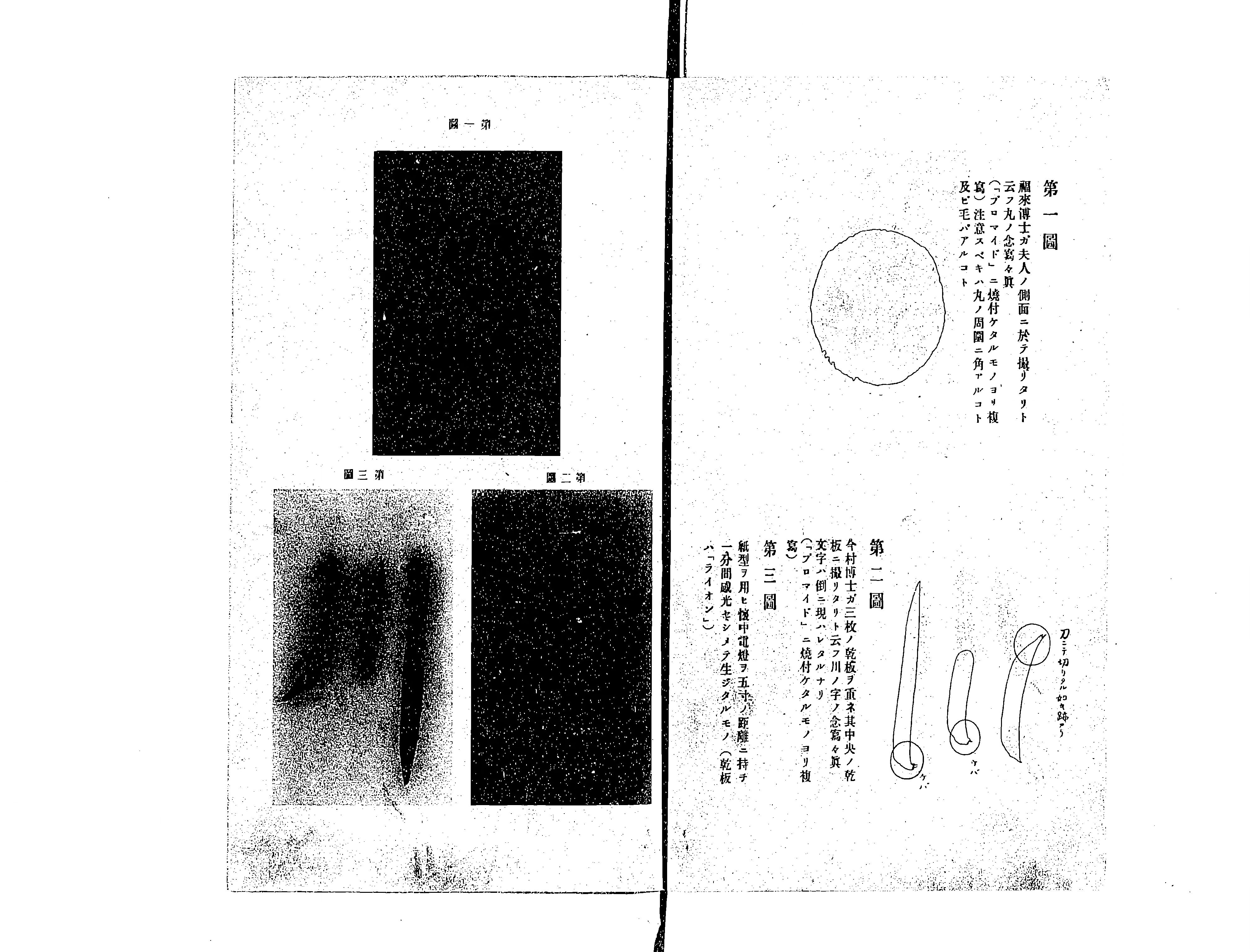
Figure. Photographs of Madame Curie and radium apparatus
Translated labels: Figure 1; Side view of Madame Skłodowska Curie facing the darkroom; Figure 2; Figure 3; Mme. Curie’s three dry plates placed vertically, and in the center a kanji character plate turned upside down; (a photograph showing the character plate flipped, with the letters of the alphabet reversed); Third figure; A dry plate held five suns away from a vacuum tube used for making paper patterns; (a photograph showing the character plate burned-attached, as in the figure of the alphabet letters and hair); Knife-cutting trajectory; a; b; c
Figure 1
Photograph of the circle that Dr. Fukurai says he obtained by thoughtography while at the lady’s side. Copied from a bromide print. Note the angular places around the circle’s circumference and the ragged fibers along its edge.
Figure 2
Thoughtograph of the character 川, “river,” which Dr. Imamura says he obtained on the middle of three photographic plates placed one above another. The character appeared upside down. Copied from a bromide print.
Labels on the accompanying outline drawing: “Marks as though cut with a knife”; “fibers.”
Figure 3
An image produced with a paper stencil, holding an electric pocket lamp five sun away and exposing the plate for one minute. The plate was a “Lion.”
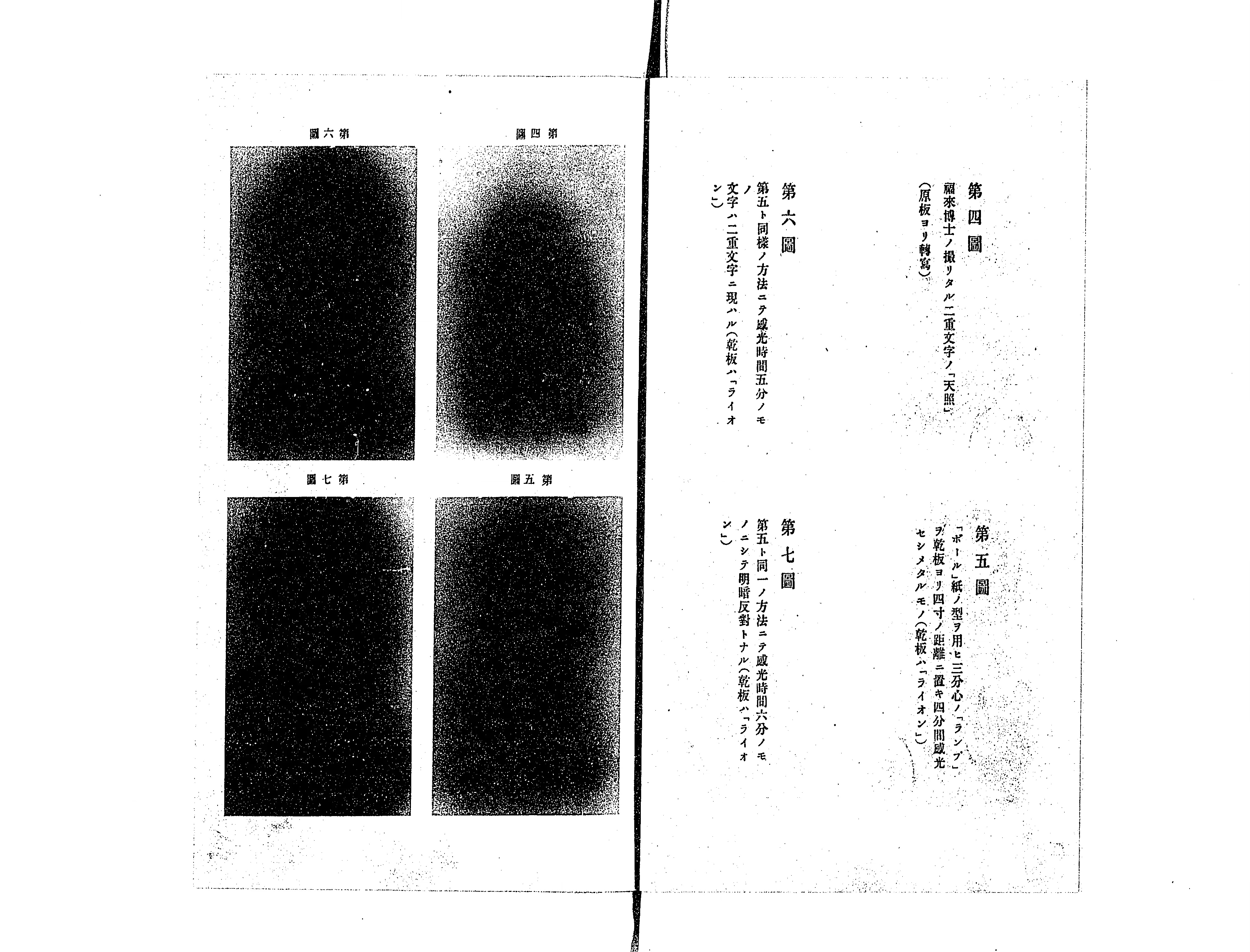
Figure. Halftone Photographic Plate with Four Figures
Translated labels: Figure 4: Doctor Fukusuke’s photograph, double-exposure characters, ‘sunlight’ (copy transferred from original plate); Figure 5: Printing paper type A, 3 cm ‘Ring’ dry plate, exposure with four-inch separation from selenium metal (dry plate), ‘Fiano’; Figure 6: Same method as Figure 5, exposure time of five minutes, characters appear doubled, ‘blue’ (dry plate), ‘Fiano’; Figure 7: Same method as Figure 1, exposure time of six minutes, light and dark contrast reversed, ‘blue’ (dry plate), ‘Fiano’
Figure 4
The double-outlined characters 天照, “Amaterasu,” photographed by Dr. Fukurai. Reproduced from the original plate.
Figure 5
An image made with a cardboard stencil, placing a lamp with a three-bu wick four sun from the plate and exposing it for four minutes. The plate was a “Lion.”
Figure 6
The same method as in Figure 5, with an exposure of five minutes. The characters appear double-outlined. The plate was a “Lion.”
Figure 7
The same method as in Figure 5, with an exposure of six minutes. The light and dark areas are reversed. The plate was a “Lion.”
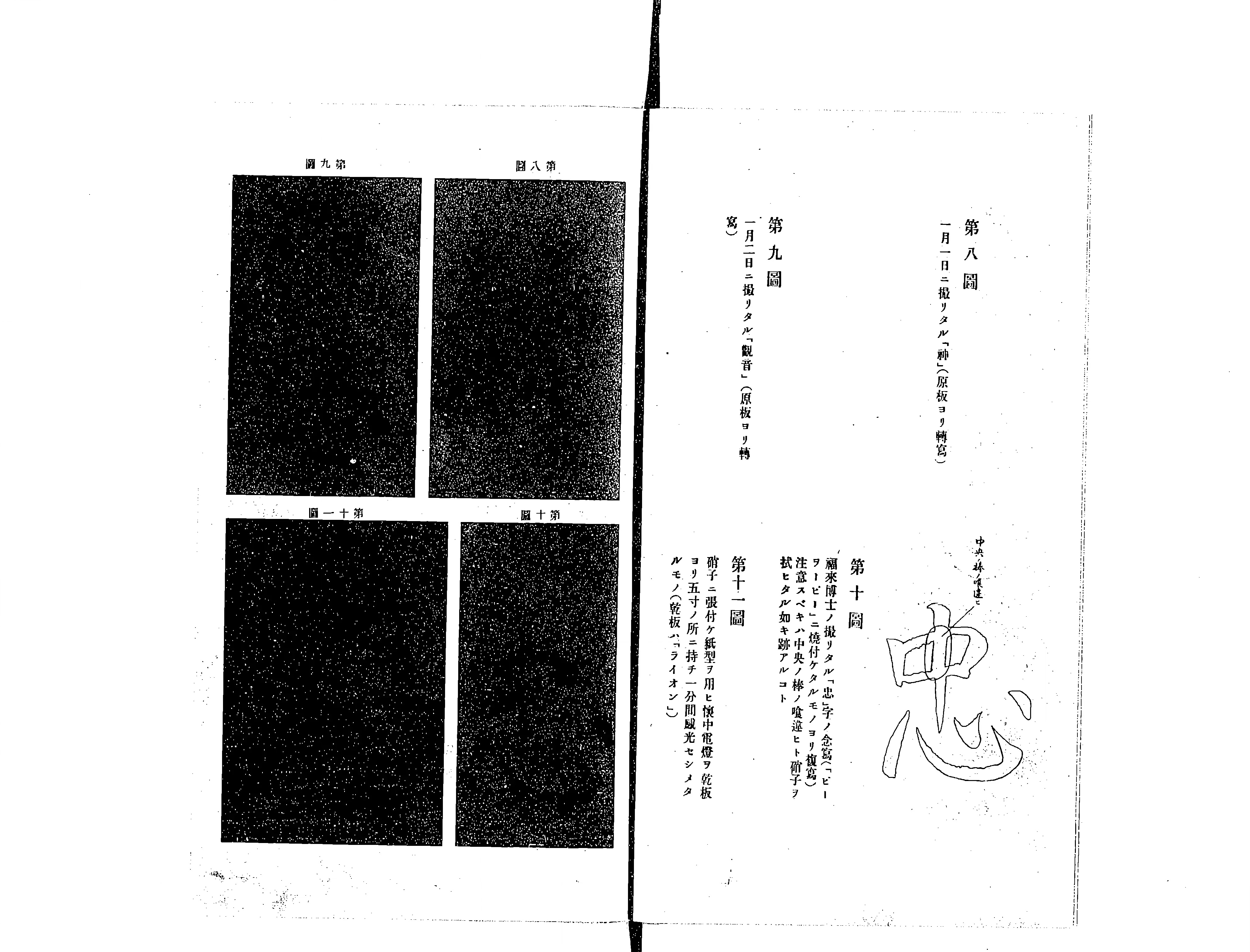
Figure. Radiographic photographs of calligraphy plates
Translated labels: Figure 8: ‘Shen’ (Spirit) photographed on January 12 (reproduced from the original plate) (第八圖 一月一二日撮リタル「神」(原板ヨリ轉寫)); Figure 9: ‘Guanyin’ photographed on January 2 (reproduced from the original plate) (第九圖 一月二日ニ撮リタル「觀音」(原板ヨリ轉寫)); Figure 10: Thoughtography of the character “忠” (loyalty) taken by Dr. Fukurai (reproduced from one printed on ‘Hero’). Note the wobble of the central rod and marks as if the glass had been wiped (第十圖 福來博士ノ撮リタル「忠」字ノ念寫(「ヒロー」二燒付ケタルモノヨリ複寫) 注意スベキハ中央ノ棒ノ嗚遊ヒト硝子ヲ拭ヒタル如キ跡アルコト); Figure 11: Using a paper forme with two glass sheets attached, a hand-held electric lamp was held 5 sun from the dry plate and exposure made for one minute (dry plate: ‘Laio’) (第十一圖 硝子二張付ケ紙型ヲ用ヒ檢中電燈ヲ乾板ヨリ五寸ノ所ニ持チ一分間威光セシメタルモノ(乾板ハ「ライオ」)); Central (Xu Da) (中央ノ徐達ヒ); Figure 8 (第八圖); Figure 9 (第九圖); Figure 10 (第十圖); Figure 11 (第十一圖)
Figure 8
The character 神, “deity,” photographed on January 1. Reproduced from the original plate.
Figure 9
The characters 觀音, “Kannon,” photographed on January 2. Reproduced from the original plate.
Figure 10
The thoughtograph of the character 忠, “loyalty,” photographed by Dr. Fukurai. Copied from a P.O.P. print. Note the misalignment of the central stroke and the marks that look as though the glass had been wiped.
Label on the accompanying outline drawing: “Misalignment of the central stroke.”
Figure 11
An image made with a paper stencil pasted to glass, holding an electric pocket lamp five sun from the plate and exposing it for one minute. The plate was a “Lion.”
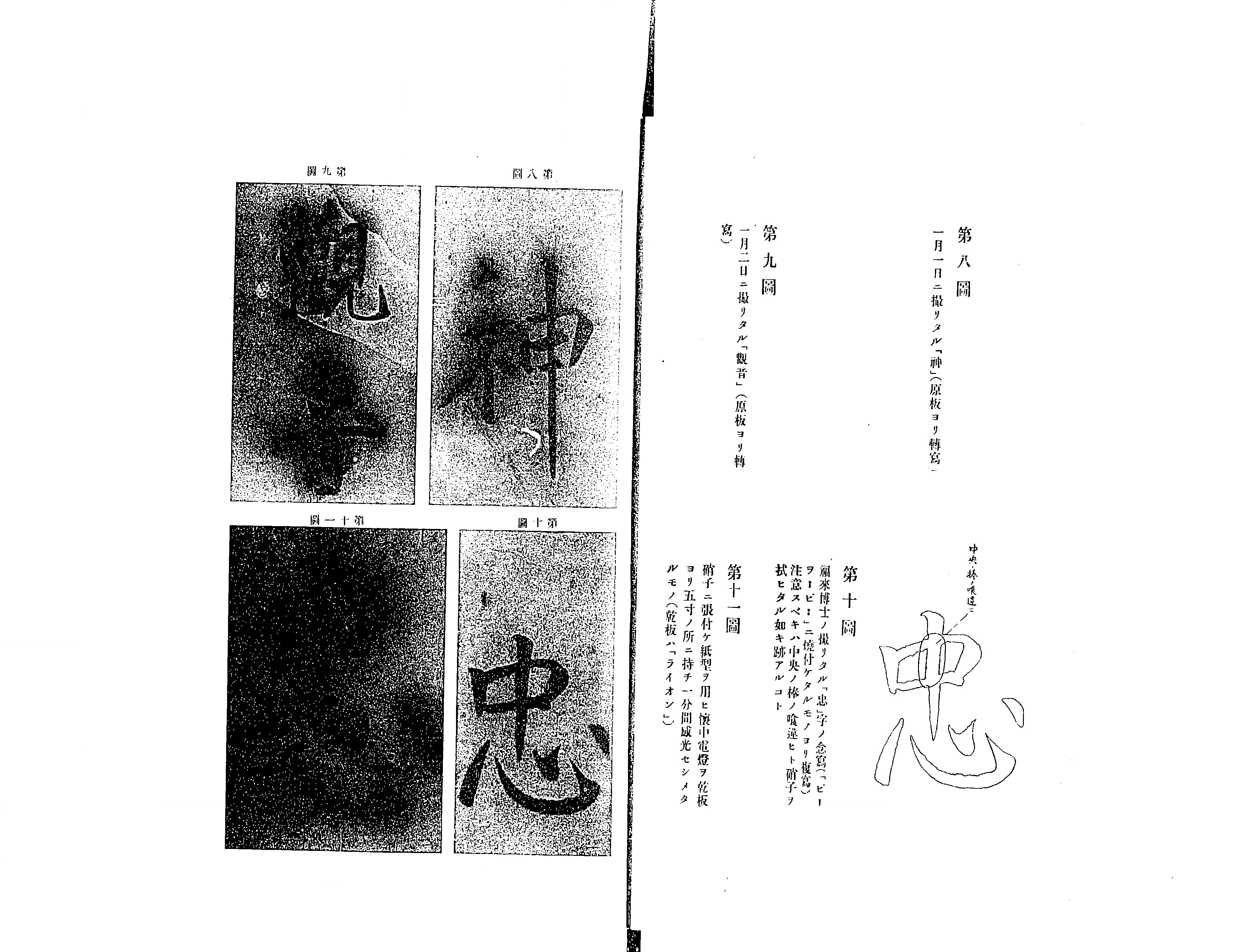
Figure. Calligraphy reproduction plates of the character ‘chū’ (loyalty)
Translated labels: Fig. 8; Fig. 9; Fig. 10; Fig. 11; Fig. 8: photographed on January 1, ‘shin’ (original plate, transcribed by Yoshitsuru); Fig. 9: photographed on January 2, ‘kannon’ (original plate, transcribed by Yoshitsuru); Fig. 10: Professor Hiraoka’s ‘chū’ character copied in pencil (photographed by Ichiki, with central rod and flashlight); Fig. 11: for attaching a 3-inch strip of paper, a 5-inch board placed vertically, illuminated for half a minute with a 75-watt flashlight (dry plate, Lion brand); central rod’s shadow
Translator’s note: The source includes a second scan of the same spread. Its captions repeat those above; both images are retained because the photographic detail differs in visibility.
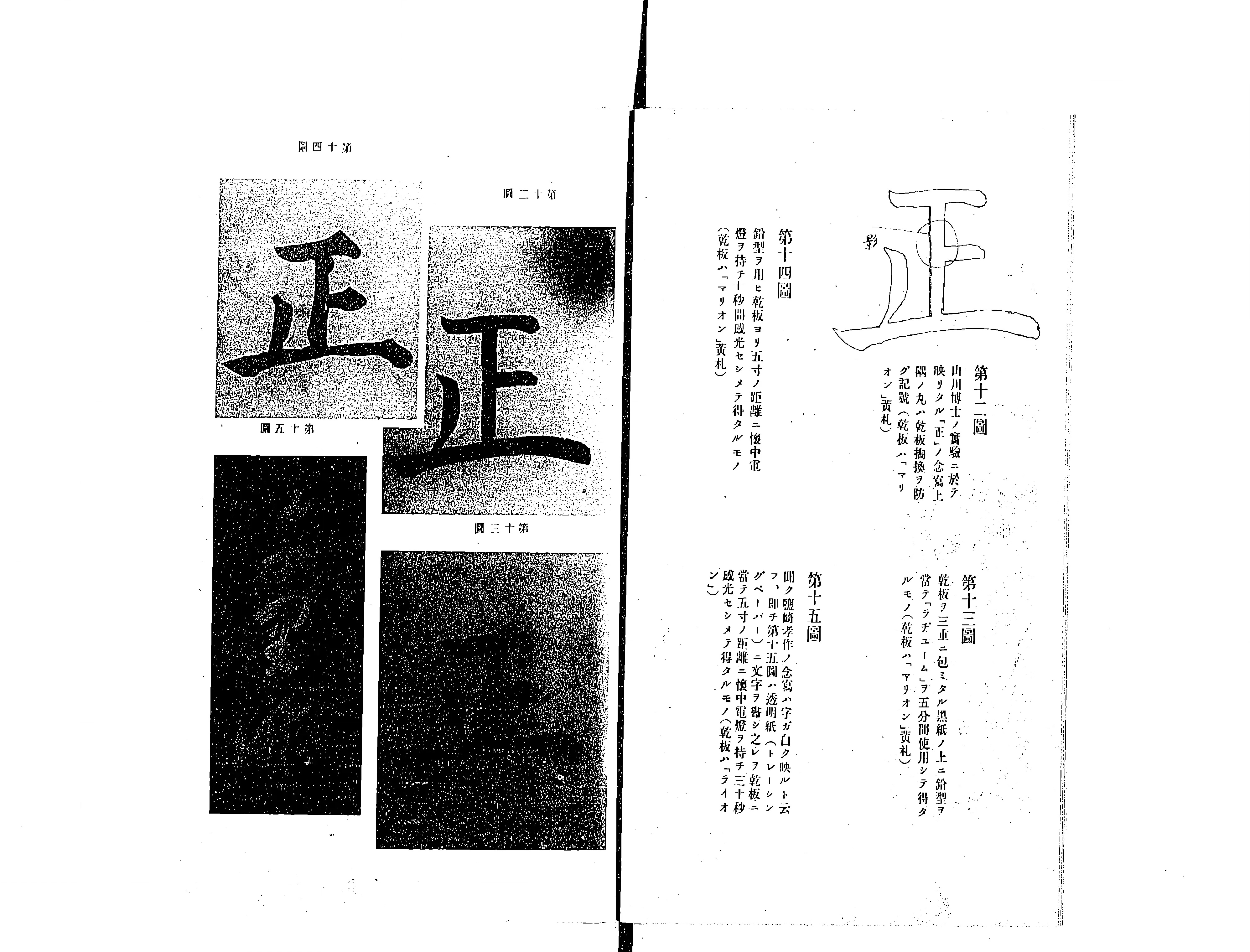
Figure. Photographic exposure test prints of the character 正
Translated labels: Fig. 12; Fig. 13; Fig. 14; Fig. 15; Fig. 40; Fig. 20; Fig. 50; Fig. 30; shadow; character 正 (semasiograph) written on the back of a dry plate by Dr. Hirokawa Hakushi, printed through the back (dry plate backed with ‘Marion’ film); lead-type type used on the back of a dry plate, five-size character, distance from lamp to dry plate thirty centimeters, exposure forty seconds (dry plate backed with ‘Marion’ film); dry plate wrapped twice with black paper, lamp distance five centimeters, thirty-second exposure (dry plate backed with ‘Marion’ film); photograph of the character 正 written in ink on tracing paper, contact-printed onto printing-out paper (dry plate backed with ‘Marion’ film); character 正 written in ink on tracing paper, contact-printed onto printing-out paper (dry plate backed with ‘Marion’ film); [illegible]
Figure 12
The thoughtograph of 正, “correct,” that appeared in Dr. Yamakawa’s experiment. The circle at the upper corner is a mark intended to guard against substitution of the plate. The plate was a “Marion,” yellow label.
Label on the outline drawing: “Shadow.”
Figure 13
An image obtained by placing a lead stencil on the black paper in which a plate had been wrapped in three layers and applying radium for five minutes. The plate was a “Marion,” yellow label.
Figure 14
An image obtained with a lead stencil, holding an electric pocket lamp five sun from the plate and exposing it for ten seconds.1 The plate was a “Marion,” yellow label.
Figure 15
I am told that the characters in Shiozaki’s (鹽崎孝作) thoughtographs appear white. Figure 15 was therefore obtained by writing characters on transparent paper (tracing paper), placing it against the plate, holding an electric pocket lamp five sun away, and exposing the plate for thirty seconds. The plate was a “Lion.”
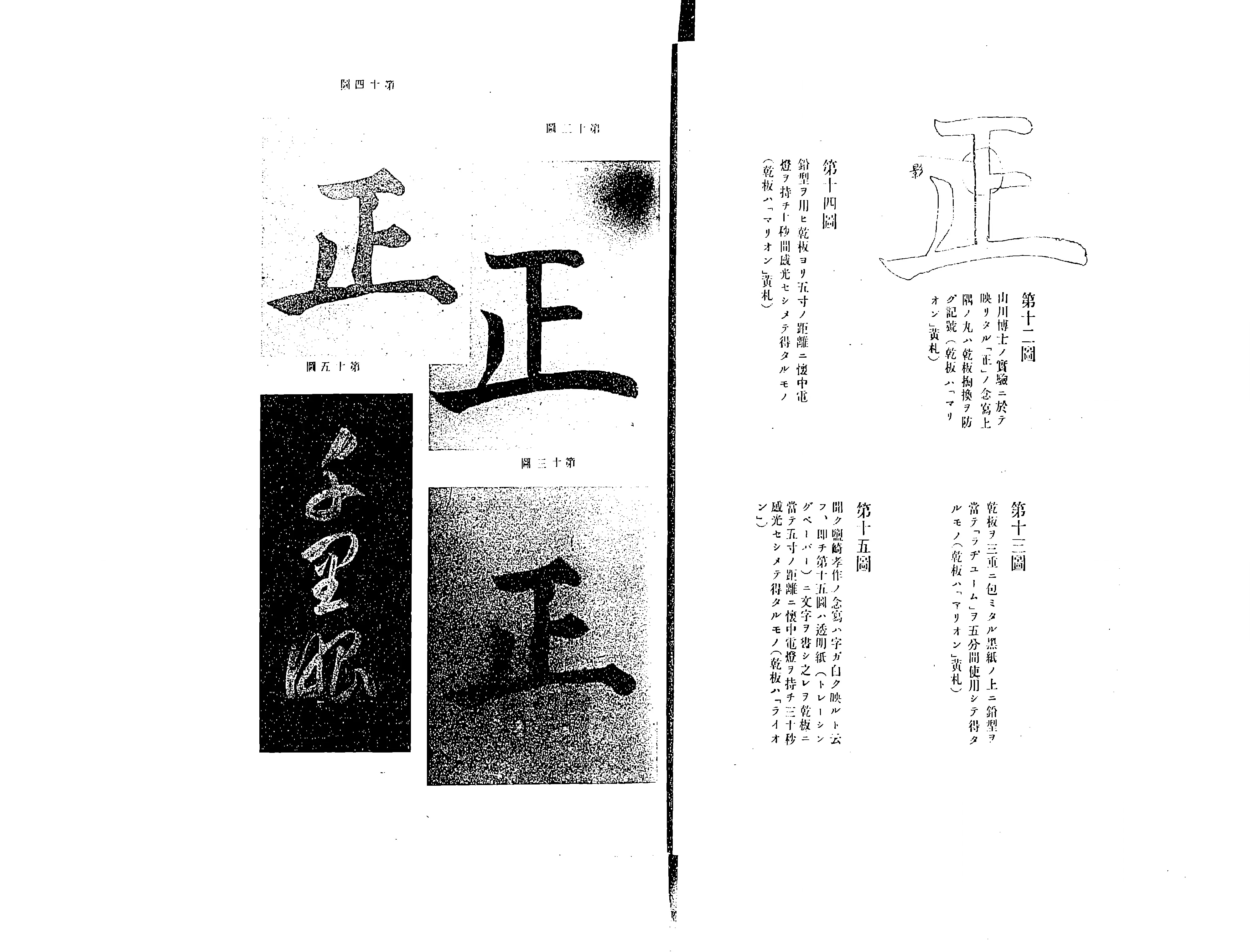
Figure. Printing Tests of the Character ‘Sei’ (正)
Translated labels: Figure 12; Figure 13; Figure 14; Figure 15; Plate 13 (第十三図); Plate 14 (第十四図); Plate 15 (第十五図); 影 (shadow/outline); 正 (character ‘sei’); 聖 (character ‘hijiri’, white-on-black plate); Figure 12: Dr. Nakagawa’s proof made by tracing over the ‘sei’ character with a mimeograph — the outline drawing was transferred to a wax stencil (乾板ハーモリオン黄札, yellow form of the dry-plate Harmonion); Figure 13: A lead type ‘sei’ wrapped twice in black paper on a ‘dia-cureum’ lamp, exposed for five minutes with a ‘dia-cureum’ dry-plate Harmonion (yellow form); Figure 14: A lead type ‘sei’ and a dry-plate Harmonion placed at two sun (approx. 6 cm) distance, exposed at noon to summer sunlight for one second (dry-plate Harmonion, yellow form); Figure 15: The outline drawing of the ‘sei’ character in Fig. 14 was traced onto clear paper (tracing paper), then with a ‘bar-ba-’ (バーバー) typeface set at a five-sun distance, exposed for thirty seconds at noon in May using a medium arc lamp (dry-plate Harmonion, yellow form)
Translator’s note: This second scan repeats the same spread and the captions translated above. The vertical stroke in Figure 14’s exposure time is less distinct here; see the preceding note.
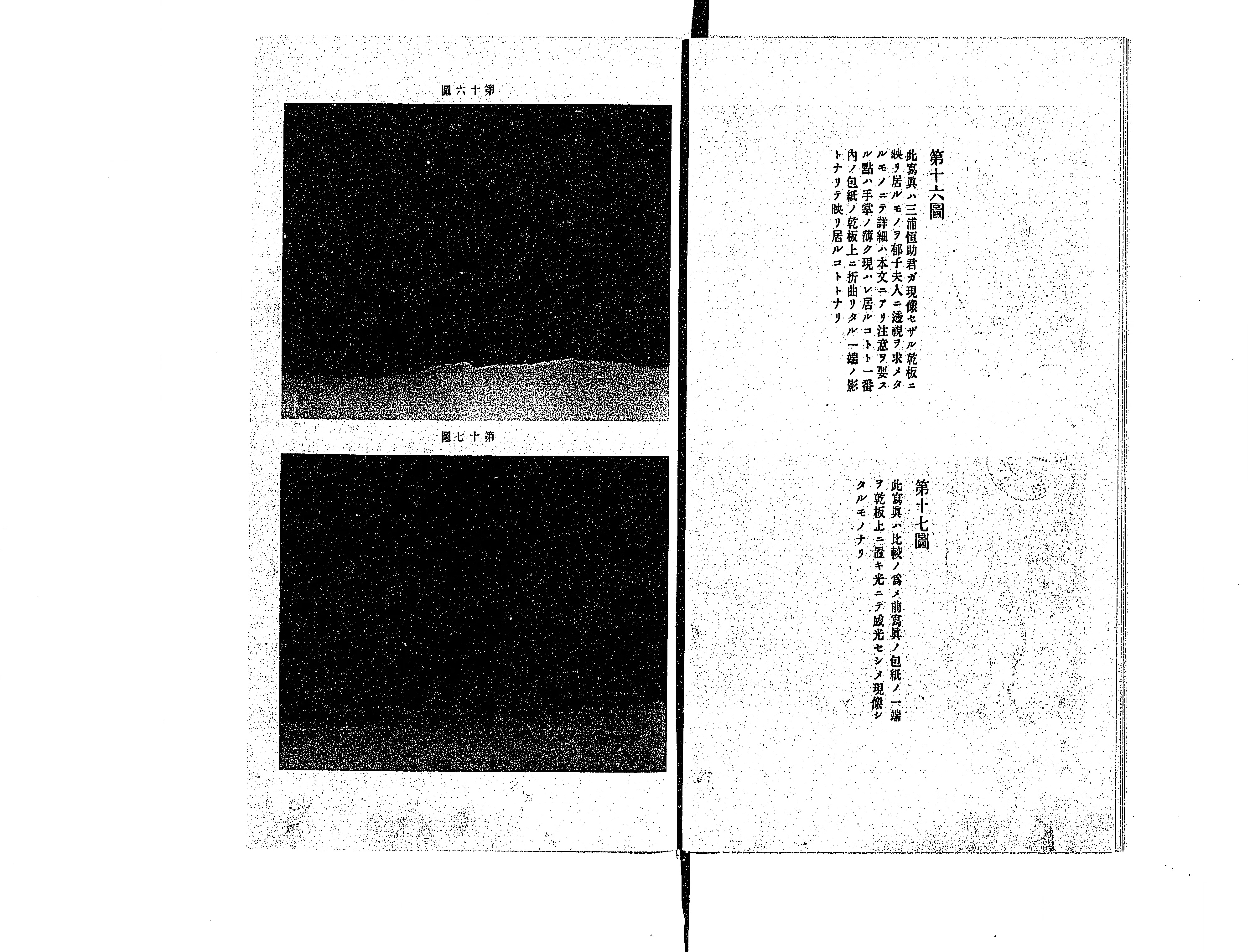
Figure. Two photographic plates: Figure 16 and Figure 17
Translated labels: Figure 16: This photograph shows the image that appears on the dry plate when Mr. Mihama Kōsuke makes a portrait of Mr. Fujii Chikashi, exposing it through a black wrapping paper placed over the plate, with a thin hand pointing out the important point; the upper part of the plate is folded inside the wrapping paper, and the image of the house is projected by the tonarite (light from a neighboring house); Figure 17: This photograph compares the image as previously photographed with the image now appearing when a sheet of light paper is placed on top of the dry plate
Figure 16
This is the photograph for which Mr. Miura (三浦恒助) asked Mrs. Ikuko to perceive clairvoyantly what was recorded on an undeveloped plate. The details are given in the text. Note the faint appearance of a palm, and the shadow cast by one edge of the innermost wrapping paper where it had been folded over the plate.
Figure 17
This photograph was made for comparison by placing one edge of the preceding photograph’s wrapping paper on a plate, exposing it to light, and developing it.
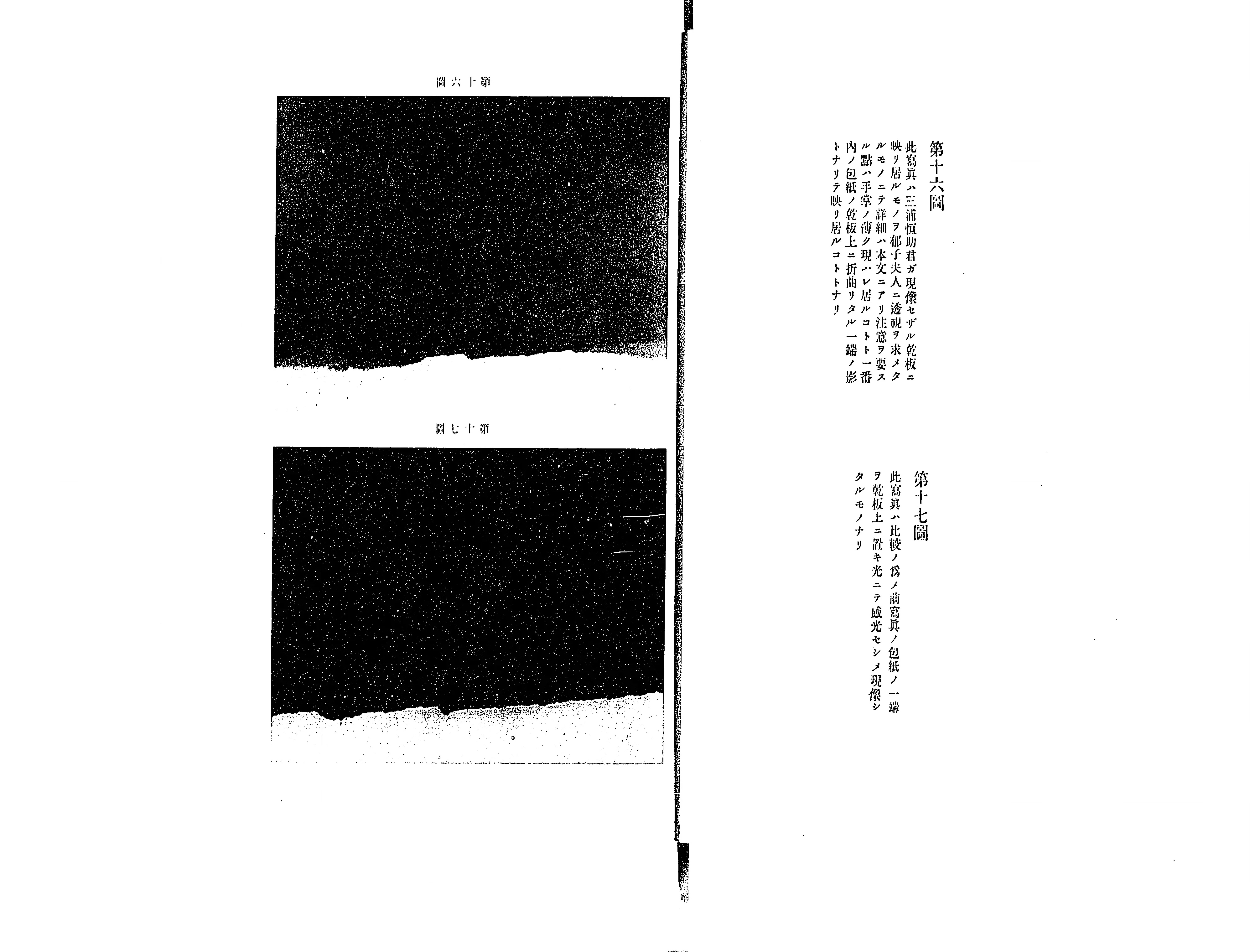
Figure. Photographs of Uranus plates and spectra
Translated labels: Figure 16 (第十六圖); This photograph shows an image on an undeveloped dry plate that Mr. Miura Tsunesuke obtained by asking his wife to perceive it clairvoyantly; details are in the main text—note carefully (此寫眞ハ三浦恒助君ガ現像セザル乾板ニ映リ居ルモノラ夫人ニ透視ラ求メタルモノナリ詳細ハ本文ニアリ注意ヲ要ス); The point appears faintly on the palm of the hand, and the folded end of the innermost wrapper paper is imaged as a shadow on the dry plate. (ル點ハ手掌ノ薄ク現ハレシレ層ルコトト一番内ノ包紙ノ乾板上ニ折曲リタル一端ノ影トナリテ映リ居ルコトトナリ); Figure 17 (第十七圖); This photograph was made for comparison by placing one end of the previous photograph’s wrapping paper on a dry plate, exposing it to light, and developing it (此寫眞ハ比較ノ爲メ前寫眞ノ包紙ノ一端ヲ乾板上ニ置キ光ニテ盛光セシメ現像シタルモノナリ); [illegible]
Translator’s note: The source includes this second scan of the same spread. The captions repeat those above; both scans are retained.
Letter from Dr. Yamakawa
I trust that you are continuing in good health and prosperity, and offer you my congratulations. I understand that you intend to publish the facts of the Marugame experiments, and consider this an excellent undertaking.
I had originally meant to leave Tokyo around December 10, but various matters delayed my departure. I finally decided to leave at the beginning of January and made the necessary preparations for experiments in clairvoyant vision. When thoughtography was announced toward the end of December, I thought it quite impossible to make adequate preparations for it, and intended to take with me only the test objects for clairvoyant vision. Yet the newspaper accounts of thoughtography were so extraordinary that, on the day before my departure, I asked Mr. Mizuki to prepare some photographic dry plates and two or three metal stencils, which I took with me just in case. There can therefore be no question that my principal purpose was to conduct experiments in clairvoyant vision.
However, all the test objects I had brought were refused because they were glued. Moreover, it appeared that greater importance was being attached to thoughtography. I consequently became most eager to try this experiment too. With your kind assistance, I attempted to settle the question, only to find that an unexpected uproar resulted. Since the experiment was originally mine, though you had devised its arrangements, it is my responsibility to bring the matter to a conclusion. But Mr. Nagao has refused experiments for the present, leaving me unable to do anything. I am truly at a loss.
I had wished at least to make the detailed facts known to the public, but the pressure of public and private business has prevented me from doing as I intended. If you now publish your accounts, I believe that the true circumstances will become known and some progress toward a conclusion will have been made. I have read your accounts and believe that there are no errors of fact.
What I regret most deeply about the Marugame experiments is the newspapers’ incessant repetition of groundless accusations against Mr. Fuji. It is some consolation, however, that newspaper reports may mislead ordinary people but cannot mislead those with discernment.
Furthermore, although people speak indiscriminately of “research into clairvoyance,” I believe we must first establish whether extraordinary facts of the kind popularly alleged really exist. Only after they have been established should we investigate the nature of the phenomena. In that second stage, there may well be cases in which physiologists, psychologists, philosophers, and others are better qualified than physicists. But the first stage, determining whether the facts exist, is not a field of investigation to be monopolized by psychologists. I am firmly convinced that physicists are, rather, the most suitable people for it. Of course, as you know, I once studied a little physics myself. If people laugh at me for drawing water to my own field, I can only accept it.
These are the observations I wished to convey.
Yours respectfully,
January 28, Meiji 44 [1911]
Yamakawa Kenjirō
To Mr. Fuji and Mr. Fujiwara
Preface
There are people who proclaim that “science is omnipotent,” and others who proclaim that “scientists cry out that science is omnipotent.” Both assertions come from people ignorant of the true nature of science. The former is an exclamation of amazement from someone who has caught a glimpse through its gates; the latter is a slander uttered by someone who curses science. Whenever we hear them, we think all the more keenly of Mencius’s words: “A gentleman is ashamed when his reputation exceeds the reality.”
Scientists know the law of universal gravitation and trust it. By it they predict the positions of the sun, moon, and stars a thousand years hence. Yet ask them how this attraction arises, or what the true nature of its action is, and they do not yet know. Scientists say that bodies consist of molecules, molecules of atoms, and atoms in turn of collections of electrons. They describe their sizes, distances, states of motion, and so forth with the greatest precision. Yet if we ask what shape a single electron or atom has, whether it is hard like steel or soft like rubber, scientists cannot give a definite answer. Still less do they have any knowledge of such questions as “What is life?” or “How are memories stored in the brain?”
The scientist’s effort consists in investigating the various facts and endeavoring to clarify the relationships among them. Thus, on encountering a new and unknown phenomenon, the first step is to establish whether it is a fact. If it is established as such, the scientist seeks its connection with existing knowledge. In other words, the aim is to explain the unknown by the known: to solve XYZ by means of ABC. When this explanation is obtained, the unknown becomes known, and the scope of our knowledge expands.
When Röntgen rays were discovered, they attracted great public attention as something strange and incomprehensible. Fortunately, their discovery followed continuously from other research, so there was no need to test whether they were genuine or false. Today these rays are still called X-rays, but in reality they are no longer X: they have already become ABC and have entered the domain of the known.
Recently something called clairvoyance has appeared in Kumamoto, Marugame, Osaka, and Akita, stirring busily everywhere. The excitable rush toward it, and even the sober-minded go to it. Some consult the literature and quote Buddhist scriptures, believing in it as a matter of course. Others deny it altogether on the strength of their scientific knowledge. Those who believe in it on the former grounds have been misled by their reading. The six supernatural powers, the storehouse consciousness, and all the other things they cite are not demonstrated facts. They try to believe in an unknown clairvoyance on the basis of matters whose truth or falsity is undetermined. This is to attempt to solve XYZ by means of xyz. Their folly is pitiable. Rather than believe in clairvoyance simply because it is mentioned in old books, it would be better to believe in it without any reason, as religious believers do. It is foolish to ask a Christian to prove the existence of God. God’s existence is not something to be proved, but something to be believed in unconditionally.
Those who deny clairvoyance altogether without any investigation have been poisoned by their spurious scientific knowledge. They confuse Impossibility with Improbability. When they ought to say, “It seems unlikely,” they declare, “It cannot exist.” I would ask them: How did you acquire the knowledge that this unknown thing is impossible?
The question of clairvoyance is a serious matter. If it is false and, in our ignorance, we let it spread unchecked, its harmful influence may be terrible. If it is true, it may perhaps provide a starting point for the scientific interpretation of phenomena in the mental world. Clairvoyance is indeed a subject that scholars in every specialty should investigate and discuss sincerely, with open and unprejudiced minds.
One caution is necessary here. Clairvoyance is so far removed from the phenomena already known to us, and has so little continuity with them, that the circumstances differ greatly from those surrounding the discovery of Röntgen rays. The immediate problem is therefore to establish whether it is a fact.
My esteemed friends Mr. Fuji and Mr. Fujiwara, both Bachelors of Science, wished to discover whether the clairvoyant vision and thoughtography of Mrs. Nagao, the so-called clairvoyant living in Marugame, were genuine. Together with Dr. Yamakawa and others they conducted rigorous experiments, and concluded that both her clairvoyant vision and her thoughtography were open to doubt. They have now recorded the details of the experiments on which this judgment rests, compiled them into a volume, and propose to place it before the public. Their intention, I presume, is to express their opinions in a book for which they assume responsibility by signing their own names, and thereby enter into debate with believers in clairvoyance. I wonder whether the scholars who have conducted experiments and regard clairvoyance as a fact will likewise have the generosity of spirit to publish experimental records for which they take responsibility, thus providing us with the material for open and honorable discussion.
January, Meiji 44 [1911]
Nakamura Seiji
Foreword
Translator’s note: This foreword is printed in Romanized Japanese in the original.
When the matter of clairvoyance appeared in the newspapers and began to attract widespread attention, I thought, “Here is something troublesome.” When reports appeared suggesting that well-known scholars recognized it, I thought it still more troublesome.
Some people may say: “‘Troublesome’ is a spineless word! If something so extraordinary has appeared, surely it is interesting instead?”
I am a specialist in physics. I should not be at all surprised if, beyond what is now known, many new and apparently extraordinary things were discovered in the future. Indeed, such discoveries are bound to occur. As a scholar, I have no anxiety whatever about the appearance of any unusual phenomenon.
But it is most troublesome when such matters first appear in the newspapers. It does great harm to acquaint the general public, outside the scholarly community, with things whose certainty has not yet been established.
Physicists ought to continue their investigations, doubting even whether the various laws now accepted may be mistaken. But if we tell the public, the students receiving a general education and other ordinary people, “We do not really know whether this law is right,” or “That explanation too may be mistaken,” science education will be reduced to zero, and the value of science will go entirely unrecognized. Even if what science teaches today is not absolutely correct and complete, it is something in which the public should place a reasonable degree of trust, and something that deserves that trust. If someone spreads accounts of unverified marvels, needlessly undermines public confidence in existing knowledge, and makes people unable to pursue their studies with peace of mind, I think we may properly call that person an enemy of learning.
If a new and extraordinary occurrence is found, we should take the greatest possible care to investigate every circumstance. We must, of course, establish that it is genuine; we must also investigate thoroughly the circumstances in which it occurs and those in which it does not. Until all scholars acknowledge it, I believe it is wrong to announce it to the public as though it were certain.
In the present case, Dr. Imamura, Dr. Fukurai, and others may believe that they made their announcements only after adequate experiments. But the matter is so extraordinary in comparison with what we already know that I should like to see it investigated with far more care than usual. Moreover, the newspapers do not show what precautions were taken or under what circumstances the experiments were performed. Accordingly, even when they read the newspaper accounts, those who are cautious will conclude that the experiments have not yet been carried out, or reported, to a degree that warrants belief. Ordinary people, however, pay no attention to these points. They simply trust the newspapers and the scholars, and consequently cast indiscriminate doubt on present-day physics. That is why I regarded the present affair as troublesome.
One may then say that scholars have a responsibility to establish whether it is true or false. But I thought that this too presented a real difficulty. In a scientific experiment, it is of the greatest importance to investigate under varied conditions. In this case, however, the experiments are conducted under conditions determined by the other side. They will not follow the arrangements we propose; and if they do, we are told that psychological influences (?) may prevent success. It seems, therefore, that physical investigation is quite impossible. If an experiment is conducted as the other side directs and produces a result, we do not regard that result as established; but the public says that a physical experiment has succeeded. This is extremely troublesome.
If we follow the other side’s instructions and still try to establish something scientifically certain, we will inevitably have to do the work of police officers or detectives. This too is a very troublesome situation for a scholar.
In short, although this is a matter that cannot be investigated scientifically, the publicity given to it by newspapers and psychologists means that unless it is investigated, the general public’s confidence in physics will suffer. Thus a most troublesome situation has arisen.
When Mr. Fuji and Mr. Fujiwara went to Marugame, I had serious misgivings on precisely these grounds. Nevertheless, the two men, doubtless also with Professor Yamakawa’s guidance, addressed this difficult question by the most scholarly method possible under the highly unfavorable conditions described above. They neither adopted an attitude of belief from the outset nor acted as detectives or police officers. They established that there was ample room for doubt.
Although a mistake occurred in the handling of the photographic plates, and although the experiments appear to have been broken off midway, it is fair to say that they fully accomplished what scientists ought to do. In brief, the present research is still insufficient to change what physics has hitherto accepted. To have established that is enough. If they have checked the excessive haste with which the public has proceeded, I regard that as a great service to learning.
Those who say they will not be satisfied unless something more definite is established are forcing physicists to do work unworthy of physicists. They are either forcing them to do the work of detectives, or telling them to investigate scientifically something that cannot be handled scientifically. That is an unreasonable demand.
Those who believe that the credibility and standing of present-day physics should not be treated so cheaply, and those who wish people proposing to overturn accepted physical ideas by new phenomena or effects to adopt a sufficiently cautious attitude, may well express their deep gratitude to the authors of this book.
February, Meiji 44 [1911]
Tamaru Takurō, Doctor of Science
Additional Remarks
Among the criticisms of the authors’ work that have appeared in the newspapers and elsewhere, there are some points on which I wish to comment because they concern the position of scientists generally.
- An experiment is worthless as an experiment unless appropriate precautions have been taken. Half an experiment performed with sufficient care is worth more than a hundred experiments performed without it.
- Even if one did not propose and conduct an experiment oneself, an experiment whose conditions and results one has personally observed with precision possesses full value as an experiment.
- One of the authors has been described as “a suspicious person, unlike a scholar,” as though this were a penetrating criticism. But for a scientist to doubt the subject of investigation until no room for doubt remains is precisely what befits a scientist.
Authors’ Preface
Truth must be investigated. Deceptive claims must be rejected. Once clairvoyance appeared in the world, the country was bewildered as to its truth or falsity. Unscrupulous hypnotists at once ran rampant, encouraging superstition, greedily seeking excessive profits, and disturbing the world of thought. How could one fail to deplore it?
We happened to meet in Marugame, and our primary purpose was the same: to investigate whether clairvoyance was true or false. For some ten days we joined forces in assisting Dr. Yamakawa Kenjirō, who shared that purpose. We stopped only when the Nagao household refused further experiments. As to the results, our experiments not only failed to provide evidence establishing clairvoyant phenomena as fact; they revealed circumstances that we could not help finding suspicious. We publish them both to awaken the public and to provide material for future reference.
We had previously given newspaper reporters an account of the events. But what the newspapers printed did not exhaust what we had told them. It also contained many errors, and different newspapers seem to contradict one another in reporting the same events. We therefore now publish a book for which we take responsibility, setting out the facts in detail. Because the matter concerns personal relations, however, we cannot put every delicate circumstance into words. We ask the reader’s understanding on this point.
We take this opportunity to express our thanks to Dr. Fukurai, who introduced us to the Nagao household. We also convey our deepest gratitude to Judge Nagao and his wife. Despite the busy year-end and New Year season, they virtually set their household affairs aside to receive us experimenters. On January 4 in particular, a group of seven or eight of us descended on them without reserve in the morning, in the afternoon, and even at night. The trouble involved in attending to each of us can scarcely be imagined. Nevertheless, the experiments were eventually forced to an end when someone caused ill feeling. This is a matter of the deepest regret.
Mr. Sekido (關戶雄次) undertook all the photographic work for our experiments, not only in Marugame but also in Okayama and Tokyo, and in addition gave us much further assistance. We express our heartfelt thanks to him.
January 25, Meiji 44 [1911]
The Authors
An Eyewitness Account of Clairvoyance Experiments
Fujiwara Sakuhei
I. Introduction
1. Motive
Several years ago I read Dr. Fukurai’s book Abnormal Psychology. Although there were many points in its theory with which I could scarcely agree, I believed the experimental facts it described. As for the heroic tales of professional storytellers cited in the appendix, I felt, rather for Dr. Fukurai’s own sake, that they would have been better left out. Among my friends was a hypnotist who could readily bend iron fire-chopsticks or induce rigidity in his subjects. Seeing this, I believed that hypnotism was a real phenomenon. When I read accounts of hypnotized people correctly identifying things inside boxes, or of one person’s mind affecting another’s, I began to consider whether, if these were facts, a physical theory of a medium might perhaps be applied to them.
Last year, however, the so-called phenomena of clairvoyance became a subject of widespread discussion. Since they agreed at many points with the hypothesis I had privately imagined, my conviction grew that they might be susceptible to physical investigation. When accounts of Mr. Miura’s (三浦恒助) experiments at Kyoto University reached me, I felt almost certain that this phenomenon must await investigation by physicists. I consulted Professor Tanakadate, who suggested that, although it might be necessary to make an experiment, it would probably fail. Professor Tamaru said that it would first be necessary to investigate whether the phenomenon was conjuring.
At about this time I learned that Mr. Watanabe Chifuyu, a man from my own district, had long been a member of the Shinshōkai (心象會) and was interested in research of this kind. I consulted him, and he warmly approved; he even kindly undertook to pay the research expenses. I therefore decided to begin experiments. On December 21, Meiji 43 [1910], I started making preparations and asked Mr. Sekido (關戶雄次), an assistant in the College of Science, to accompany and assist me. He consented. With further help from the student Mr. Ikeuchi (池內本) and others, I completed the preparations on the 31st of that month and at once set out for Marugame.
2. Objectives
The purpose of my experiments on this occasion was to establish the following points:
(a) Whether the so-called phenomena of clairvoyance involve conjuring.
(b) If they do, where it enters into them.
(c) If they do not, whether the phenomena of clairvoyance are accompanied by physical phenomena.
(d) If there are physical phenomena, what their nature is.
(e) What relationship exists between this physical action and human sensation.
3. Plan
To resolve these questions, I made the following plans:
(a) To write to Mifune Chizuko and, if she agreed to an experiment, send her three envelopes that had been subjected to rigorous inspection, asking her to perceive clairvoyantly the writing on the visiting cards inside.
(b) To ask Dr. Fukurai for an introduction to Mrs. Nagao Ikuko and, if she agreed to experiments, go to Marugame and conduct them.
(c) If the young clairvoyant Mr. Shiozaki in Osaka also agreed to experiments, to conduct them on my return journey from Marugame.
4. Course of Events
First came a reply from Miss Mifune’s brother-in-law, Mr. Kiyohara (清原猛雄). It said that, because she disliked experiments and would not agree to them, he regretted that he must decline.
Just then there was news that a clairvoyant named Makabe (眞壁光子) had appeared in Akita. I therefore sent to Akita the test objects I had prepared for Miss Mifune. Her father, 新次郎, replied that she too had possessed a remarkable gift for guessing since childhood, but that, once Mifune Chizuko had anticipated her, she disliked seeming to imitate someone else and would no longer agree to any guessing experiments. Furthermore, under conditions proposed by Dr. Fukurai, she would not take part in anyone else’s experiments until his were finished. Once those had ended, she might perhaps perform guessing experiments for amusement in response to requests from the public. The test objects were not returned.
Next, for Mrs. Nagao, I prepared envelopes of the same kind as those intended for Miss Mifune. I also prepared twenty-three kinds of experiment, with more than fifty kinds of material, covering mechanics, acoustics, heat, optics, electromagnetism, radiation, and chemistry, to be carried out after it had been established that there was no conjuring.
With these preparations, Mr. Sekido and I set out. It was only on the morning of December 31 that I learned that Dr. Yamakawa too was going to Marugame to conduct experiments. Our presence there at the same time was therefore a coincidence. I was by no means Dr. Yamakawa’s assistant. Like him, I was an independent experimenter. Mr. Sekido was the person I had asked to serve as my assistant.
In the Marugame experiments, however, I helped Dr. Yamakawa at his request. Mr. Sekido also kindly undertook all photographic work for all the experiments during our stay. Thus, while working for me, he also assisted in the experiments of Drs. Fukurai and Imamura and in those of Dr. Yamakawa.
I reached Marugame on January 2. On the 3rd I performed, as my own experiments, tests with an electrometer and with fluorescence. Neither produced a result. On arriving, I also found myself entangled in various circumstances that made experiments extremely difficult. I realized, too, that Dr. Fukurai enjoyed the Nagao family’s complete confidence, and that anyone not introduced through him would encounter great difficulties in conducting experiments. I was therefore pleased at my good fortune in having obtained his introduction.
Nevertheless, I learned that for the time being it would be quite impossible to carry out, by my own efforts, the experiments required to attain my first and second objectives. After Dr. Yamakawa arrived on the 4th, however, I remained constantly in touch with his experiments. I considered them sufficient for determining whether conjuring was involved, my first objective, and devoted myself to assisting him.
On the 8th Dr. Yamakawa’s experiment with the character 健, “vigorous,” was discontinued. Dr. Fukurai and I were to conduct experiments on the 9th, but an announcement was made that all experiments would be stopped because Mrs. Nagao felt uneasy. On the 10th I was consequently obliged to return east. Thus, in scientific terms, I gained nothing whatever. I had wasted nearly thirty days and my travel expenses.
Yet I write this account because, even though I obtained nothing for physics, I am confident that I did accomplish something for society. Another reason is that I cannot help regretting the noisy abuse heaped on Mr. Fuji (藤教篤), Bachelor of Science, by thoughtless people who believe the reckless statements of newspaper reporters who were not even present. As a matter of duty, I resolved to contribute my small strength to setting matters right.
Mr. Fuji intends to publish his account of Dr. Yamakawa’s experiment with 健, his doubts concerning the experiments as a whole, and his plans for addressing those doubts. To avoid duplicating his account, I shall describe the general procedures I observed in the experiments on clairvoyant vision and thoughtography; the layout of the Nagao house and its household; what I saw and heard concerning Dr. Yamakawa’s clairvoyance experiments on the 4th and his experiment with 正, “correct,” on the 6th; and the circumstances of the termination of the experiments on the 9th. I shall also offer my deductions concerning the incidents involving the plate and the bag during the 健 experiment on the 8th.
What I have written above and shall write below is correct on the assumption that my own five senses do not differ substantially from those of ordinary people.
5. People Connected with the Experiments
The Nagao household will be described later. The others were:
- Yamakawa Kenjirō (山川健次郎), Doctor of Science; former President of Tokyo Imperial University.
- Imamura Shinkichi (今村新吉), Doctor of Medicine; Professor in the College of Medicine, Kyoto Imperial University, and head of the Department of Psychiatry.
- Fukurai Tomokichi (福來友吉), Doctor of Letters; Assistant Professor in the College of Letters, Tokyo Imperial University, specializing in abnormal psychology.
- Minamoto (源良英), Bachelor of Arts; graduate student at Tokyo Imperial University and assistant to Dr. Fukurai.
- Tsuboi (坪井秀); resident of Hongō village, Ibi district, Mino Province, and an acquaintance of Dr. Fukurai.
- Kikuchi (菊池俊諦), Bachelor of Arts; head teacher at Marugame Middle School.
- Okada (岡田辰次郎); principal of Marugame Girls’ High School.
- Fuji (藤教篤), Bachelor of Science; lecturer in the College of Science, Tokyo Imperial University, attached to the Department of Physics.
- Fujiwara Sakuhei (藤原咲平), Bachelor of Science; graduate student at Tokyo Imperial University.
- Ono Suminosuke (小野澄之助), Bachelor of Science; lecturer at the Fifth Higher School, Kumamoto.
- Sekido (關戶雄次); assistant in the Department of Physics, Tokyo Imperial University.
And others.
II. The Nagao Household
The Nagao house stands in Kitahirayama-chō, Marugame. Its general layout is shown in Figures 1 and 2 at the end of this volume. The household consists of the master and his wife, two daughters, one son, an elderly woman who seems somewhat deaf, and a maid of fourteen or fifteen. There was also a small child, but I do not know who it was. Nor do I know whether any other servants were employed.
The master, as everyone knows, is the supervising judge of the Marugame District Court. At first sight he is a mild and courteous gentleman, but deep in his eyes there is a dignity capable of striking offenders with awe. Everyone says that his wife has the appearance of a wise and capable woman. Her manner is devout, yet on occasion she displays an unshakable determination.
I am told that the elder daughter is called Aiko and is twenty-one. The second daughter, Tsuruko, is eleven. The son is said to be called Rokurō. The household animals include about four shaggy dogs and several chickens.
III. Experimental Procedure
1. Clairvoyant Vision
There is clairvoyant vision of written characters and of objects. I never witnessed an experiment in seeing objects clairvoyantly, but on occasions during the so-called thoughtography experiments, Mrs. Nagao perceived the contents of the test object clairvoyantly.
Clairvoyant vision of characters likewise falls into two kinds: characters written at the Nagao house, and characters written elsewhere and brought there. From what I observed, the procedure for perceiving characters written at the Nagao house was broadly as follows.
First the experimenter and all the witnesses enter the reception room (ヨ; see Figure 2 at the end of the volume). Once the master and his wife are also seated, the experimenter rises and goes to the room beside the entrance, (ホ). A desk, writing brush, inkstone, and paper have been prepared there. The experimenter sits at the desk and writes the characters. So far as I saw, the position of the desk and the direction in which the writer sat were always the same. Dr. Yamakawa’s observations, and what I heard on my return journey from a professor at the Higher School in Okayama, were entirely consistent with this. What Mr. Miura (三浦恒助), a student in the College of Letters at Kyoto University, published in Geibun, year 2, number 1, is also substantially the same. The desk’s position is shown in Figure 3 at the end of the volume.
The experimenter is instructed to use regular script and to write characters as simple as possible, large and in thick strokes. I am told that this requirement had not existed in the early days of the lady’s experiments. The writing should also be completed in a single uninterrupted effort. If the experimenter rewrites a character or hesitates midway, it is said that the character written previously may instead be perceived clairvoyantly, or that both may appear.
On the occasions I witnessed, of the sliding screens in front of this desk that open toward the entrance, the left-hand one as viewed from the desk was always slid open to the right. They may have been opaque sliding panels rather than paper screens. If the experiment took place at night, a lamp stood on the desk. At night I could see clear lamplight coming through a gap in the sliding panels on the left.
In the wooden-banded door of the entrance room in front was a hole resembling a knothole, placed so that one could look diagonally down at the desk from the upper right. The inside of the hole was painted, and it was large enough to admit my little finger. I discovered it later, in daylight. I do not mean to say that there was necessarily anything suspicious about this hole; I record it only for reference. I found nothing else requiring special attention.
When the experimenter has finished writing, he folds the paper as he pleases and puts it in the lacquered wooden box customarily used. Its dimensions are about five sun by four sun by two sun.
He carries this box back to the reception room (ヨ) and places it on the desk. The desk and everyone’s seats are arranged approximately as shown in Figure 3 at the end of the volume.
At this point the lady invariably goes through the adjoining rooms (ツ) and (ネ) to the veranda (ワ) to rinse her mouth. After a brief sound of rinsing, she returns to room (ヨ) and sits opposite the experimenter, with the desk between them. Sometimes she goes to veranda (ソ) instead of veranda (ワ). The places where she rinses her mouth on verandas (ワ) and (ソ) are entirely outside the experimenter’s view. From inside the house, position (ワ) communicates with the main building by corridor (ト), with no other passage. But by going across the garden, it is easy to pass between (ワ) or (ソ) and the main building. I later heard that room (ネ) and the neighboring house of Mr. Yokose could be directly connected by opening sliding doors and laying a three-shaku plank across the intervening space.
The time from the lady’s entering the so-called state of selflessness while facing the box containing the test object until she awakens and states what she has seen ranges from about thirty seconds to two minutes. I am told that she first calms her mind, then joins her palms and invokes Amaterasu Ōmikami three times. Next she folds her hands on her knees and several times repeats, “Homage to the great bodhisattva Kanzeon.” The determination to see what is inside the box acts very strongly before she joins her palms and reappears after she has gradually entered the state of selflessness. Once she is in that state, the box first floats one or two shaku upward. With the thought of opening it, the box falls apart in every direction; the folded paper then opens in proper order, finally revealing the characters clearly. Such is the account given.
The lady generally dislikes experiments that depart from the above procedure.
When she is to perceive characters written elsewhere, the experimenter first leaves the test object he has brought on the freestanding alcove stand in room (ホ) of Figure 3, and enters the reception room (ヨ). As a rule, he is not permitted to bring the test object into (ヨ), because it is said to interfere with mental concentration in that room. I have heard, however, that in Dr. Fukurai’s experiments there were cases in which he quietly brought the object into room (ヨ) and conducted the experiment there. Even in room (ホ), it must be placed on the alcove stand: to put it on the tatami or elsewhere is said to impair its sacredness. Sealing or gluing the test object is also forbidden.
The lady is extremely sensitive. She dislikes experiments by people who entertain doubts, and mental concentration is consequently said to be difficult in such cases. Her dislike of glue did not exist from the beginning. I heard her husband explain that someone had once placed an object in a box sealed in several layers and performed an experiment. Its result was unsatisfactory, and thereafter she came to dislike sealed objects intensely. Yet, he also told me, even if an envelope is sealed, a small cut in its side clears her mind and enables her to see through it.
A little while after everyone has taken their seats in the reception room, the experimenter waits for the lady’s permission, goes to room (ホ), and brings the test object back to room (ヨ). Clairvoyant vision is then performed in almost the same manner as described above.
One further point deserves attention: only one test object of any particular kind may be brought to the Nagao house. If several objects of the same kind once enter room (ホ), they are said to appear together during clairvoyant perception, making it difficult to distinguish which is the object currently being tested. Thus, when two packages of plates are brought, the customary practice is to leave one in the tabi shop in front of the gate.
This account combines statements made by the master and his wife, Drs. Fukurai and Imamura, Mr. Minamoto, Mr. Tsuboi, and others. I never once attended a clairvoyance experiment with a test object brought from elsewhere. I did, however, observe two of Dr. Imamura’s experiments involving taste. I remember both as conforming entirely to the procedures and restrictions just described.
2. The Procedure for Thoughtography
As in the clairvoyance experiments, the experimenter first brings a single test object to the Nagao house, places it on the freestanding alcove stand in room (ホ), and enters room (ヨ). This test object consists of one or more photographic dry plates intended for thoughtography, wrapped together in black paper, placed in a cardboard box, and then enclosed in a wooden box. Gluing or sealing any part of it is forbidden.
After the experimenter and all witnesses have sat down and exchanged greetings and conversation, the lady specifies the character for thoughtography. If the experimenter proposes the character, the usual practice is to submit it at least the night before, so that she may impress it sufficiently upon her mind. The experimenter writes the character respectfully and with complete sincerity at the desk in room (ヨ), then places it on the table in the alcove of that room. The lady sits before it and meditates silently. This takes about two or three to five minutes, during which, it is said, she fixes the character still more firmly in her mind.
When the silent meditation is over, the experimenter goes to room (ホ) and brings back the test object. A person designated beforehand receives it and sits facing the lady in room (ネ) or room (ヨ); see Figures 3 and 4 at the end of the volume. Before this, she sometimes rinses her mouth, or may go to the main building.
The person holding the test object supports the wooden box on his knees, with its front toward the lady. She sits three or four shaku away. The witnesses and experimenter sit approximately as shown in Figure 4 if they are in room (ヨ), or Figure 5 if they are in room (ネ).2
After she is seated, her actions are much the same as in clairvoyant vision. In thirty seconds to two minutes she says, “It has been photographed.” Someone immediately carries the box to the darkroom at the Ishikawa photographic studio, where the plate is developed in the presence of two or three people. Naturally, the result of development is communicated to the lady at once.
Incidentally, after everyone has been seated, at least three of the sliding panels between rooms (ヨ) and (カ) are usually drawn closed, completely blocking the experimenter’s line of sight to room (ホ). At night, when the storm shutters had already been closed, the sliding panels were on some occasions left open.
There are, of course, many deficiencies in these procedures considered as experimental arrangements. But any sudden attempt to remedy them, however sincere the experimenter’s intentions, appears to imply suspicion. The lady dislikes it, her mental concentration is consequently disturbed, and the experiment becomes impossible. Thus, at the time I observed the experiments and before, there was practically no way of conducting them except by adhering entirely to these procedures.
IV. What I Saw and Heard of Experiments Before Dr. Yamakawa’s Experiments on January 4
The first experiment I witnessed was one of Dr. Imamura’s thoughtography experiments. Two photographic plates were placed one above the other, and the character 一, “one,” was to be impressed upon only one of them. I do not know the history of the plates or other such details. I know only the result: although by mistake the plate’s sensitive surface was not facing the lady, the character 一 appeared as though correctly written from the sensitive side.
To explain more fully, the plate’s sensitive surface ordinarily faces the lady, and the writing appears as though she had written directly on it. On this occasion the sensitive surface faced the person holding the plate, while its back faced the lady; yet the character appeared as though the holder had written it directly. I heard explanations such as: thoughtography could therefore by no means be due to rays traveling in straight lines, and was a phenomenon of the utmost strangeness.
Next I saw an experiment in which 川, “river,” was to be thoughtographed onto the middle of three plates placed one above another. This too was Dr. Imamura’s experiment, but Mr. Sekido was responsible for wrapping the plates. On the night before it, we set up our portable darkroom in my room. Mr. Minamoto and Mr. Sekido entered it and wrapped the plates; Mr. Minamoto then took them away.
The experiment proceeded according to the usual form. When thoughtography was performed in the three-tatami room, I entered as a witness. From that moment until development was completed in the photographic darkroom, I did not take my eyes off the plate for an instant. I acknowledge that there was no defect in the experiment during that interval. The character 川, however, appeared upside down on the plate.
I also saw two of Dr. Imamura’s experiments involving taste. Their general procedure was as already described. Paper packages containing salt on the first occasion and tartaric acid on the second were presented for clairvoyant perception without the experimenter knowing what they contained, and the answers were correct. I know nothing definite about the history of those paper packages.
There were also my experiments with an electrometer and a fluorescent substance. Both gave negative results.
V. Dr. Yamakawa’s Experiments on January 4
Dr. Yamakawa arrived at Marugame Station at 3:13 p.m. on the 4th and went directly to the Tamagawa-rō inn. Thinking that Mrs. Nagao might fall ill or some other impediment arise, he disregarded the fatigue of his long journey and went immediately to the Nagao house, beginning experiments at half past four.
He had not known that she disliked glued or sealed objects, and had brought many envelope test objects from Tokyo. Dr. Imamura had already told him at the station of her dislike of glue; but since he had no other suitable objects, he put them in a metal case and set out for the Nagao house, intending to try them regardless of whether they succeeded. On the way, however, he also learned that several test objects of the same kind must not be brought together. He therefore took one envelope from the metal case, locked up the others, and left them at the house of an acquaintance of Mr. Okada, principal of Marugame Girls’ High School.
After we had gone a little farther, a messenger came from the Nagao house. Since this was the doctor’s first experiment, he was asked to prepare the test object there, and to use those brought from Tokyo only after a thorough mutual understanding had been established. He turned back to put the one object he was carrying into the metal case with the others. During this interval I heard the messenger say that this particular request had been made because the lady first wished to discover where the doctor’s intentions lay.
Leaving all his test objects along the way, Dr. Yamakawa arrived at the Nagao house empty-handed. After the usual greetings in room (ヨ), he immediately began an experiment in clairvoyant vision. Following the prescribed procedure, he went to room (ホ), wrote some characters, returned to room (ヨ), and sat down still holding the wooden box.
The lady rose to rinse her mouth. When she had finished, she did not immediately enter room (ヨ), but first seemed to perform a preliminary act of clairvoyance in room (ツ), outside my line of sight. After a time she called the judge from behind the sliding panels and said something to him. He conveyed her meaning to those seated in the room: she wished the doctor to be so good as to write again.
Accordingly, he rose once more, went to room (ホ), and returned. After the same actions had been repeated, she again protested from behind the sliding panels. The doctor appeared to have written either inside his overcoat or in a corner of the room, she said. Something like a dark cloud of doubt blocked everything in utter blackness, and no matter what she did, the test object would not appear.
The doctor therefore rose a third time and returned, and the same procedure was repeated. We could hear the lady rubbing her prayer beads in the next room, but clairvoyant vision still did not succeed. She said it remained pitch-black and she could see nothing. By now it was dusk. They agreed to repeat the experiment that evening, and the doctor returned to the Tamagawa-rō. Dr. Imamura asked him to continue patiently, since in these experiments one was dealing with a human being. Dr. Yamakawa agreed.
On this day and the preceding day, Dr. Fukurai was absent, having left on business for the Kobe area. I am told that in room (ホ), Dr. Yamakawa had stood in the northwest corner, using his body as a screen while he wrote.
Those present that afternoon were the master and his wife; Drs. Yamakawa and Imamura; Messrs. Okada, Minamoto, Tsuboi, and Sekido; and myself. All newspaper reporters were refused admission.
At seven that evening Dr. Yamakawa returned as arranged. Apart from Mr. Okada, those present were the same as in the afternoon. The doctor stated that, since this was a scientific investigation, personal character must be left out of consideration, and asked forgiveness for any consequent discourtesy. The master and his wife readily agreed.
Because the lady tended to become excessively tense in Dr. Yamakawa’s presence, it was thought advisable to give her some initial opening for clairvoyant vision. I was instructed to conduct a preliminary experiment. I immediately went to room (ホ), wrote 吉兆, “auspicious omen,” openly on the desk, put the paper into the box, and returned to room (ヨ), placing it on the desk in front of her. She rinsed her mouth, returned, entered the state of selflessness as usual, and after about a minute identified the characters clearly and correctly.
Dr. Yamakawa then rose, prepared a test object, brought it back, and placed it on the desk. After rinsing her mouth in the prescribed manner, she perceived it clairvoyantly and said that there were three characters: the top one was 十, “ten”; the next consisted of four dots; and the next was probably either the katakana ハ or the numeral 八, “eight.” The 十 was correct. The second character was 心, “heart.” At Dr. Yamakawa’s request she made another attempt at the third, and said it was either 人, “person,” or 入, “enter.” When he opened the box, it proved to be 乍.
Both sides wished to repeat the experiment once more. This time the three characters were 上光氣, “above, light, air,” and she identified them correctly. The evening’s experiments ended there. We parted with the intention of conducting the so-called thoughtography experiment the next day.
I later learned that in these evening experiments the doctor had written the first set, 十心乍, while covering it halfway with one sleeve. For the next set, 上光氣, he had set the sheet upright and written in characters as large as possible.
The evening’s experiments were described to newspaper reporters after the account had been vetted by Messrs. Minamoto and Tsuboi. I too added a few words. Both before and after this occasion, the practice was to give the newspapers only accounts of success that were extremely favorable to the lady. This was intended to keep her in good spirits and maintain favorable experimental results. That an unfavorable feeling on her part should immediately make experiments impossible is not unreasonable in what is called psychological terms. There was therefore a reason why those commenting solely on the basis of newspaper reports did not know the essential facts, and why a situation arose in which the whole country praised clairvoyance.
VI. Thoughtography of the Character 正
At nine on the morning of the 5th, Dr. Yamakawa and all those who had been present the previous evening assembled. Dr. Fukurai was also there. At his suggestion, the lady proposed the character 正. Dr. Yamakawa was about to write it on the desk in room (ヨ), as usual, but mistakenly began writing 世. When he had written about half of it, the master and his wife drew his attention to the mistake, and he wrote 正 afresh. The master remarked that the form would be similar to this, but somewhat different, and so forth.
After the lady had contemplated the character in the alcove, Dr. Yamakawa rose and went to room (ホ) to fetch the test object. It had remained inside his metal case in the prescribed position in that room since his arrival. Incidentally, he had apparently bought this case especially for the present experiments. It had a somewhat complicated lock, but one could not call it a perfectly secure lock. Although the lady disliked seals and glue, she apparently did not object to a lock on this occasion.
The doctor returned to his seat carrying the wooden box containing the test object. Just as thoughtography was about to begin, the younger daughter, Tsuruko, suffered stomach cramps, and the experiment was consequently stopped.
That afternoon Mr. Fuji arrived from Tokyo and took rooms at the Awakan inn,3 where we and Dr. Fukurai, Mr. Tsuboi, and Mr. Minamoto were staying.
Up to that day, I had reached no clearer understanding of whether the clairvoyance experiments were true or false. I had recognized deficiencies in their procedure and intended to clarify them, and had explained this to Dr. Yamakawa. Emotionally, however, I was rather inclined to hope that clairvoyance would prove genuine. On his arrival, Mr. Fuji immediately explained to me his doubts about thoughtography. The ragged fibers around the outline of the character 川, one of the points he questioned, had already attracted Mr. Sekido’s attention and aroused his suspicion.
Even if conjuring was involved, I did not necessarily believe that the lady or those around her were performing it. I thought it quite possible that a rogue behind the scenes was practicing the deception while allowing her genuinely to believe that she herself could see clairvoyantly and produce thoughtographs.
One painful blow experienced by everyone attempting these clairvoyance experiments was the declaration that anyone who put an arrangement suggestive of suspicion on a test object, or ventured upon any action implying doubt, would immediately be refused all further experiments. Even Dr. Yamakawa, with his reputation, had been on the verge of such a refusal. For us and the other experimenters, who had come all the way to Marugame, to be turned away without completing even one experiment would have been intolerable.
Unless one was thoroughly convinced that conjuring was involved and confident that a secret mark placed on the test object would not be discovered, one could not lift a finger to resolve one’s doubts. Mere suspicion of conjuring was insufficient. For if this wonderful mental power really existed, any secret arrangement would at once be perceived clairvoyantly. That was indeed something to fear. In particular, the miserable position of Mr. Miura from Kyoto University, who for several days could neither conduct another experiment nor even enter the Nagao gate, had chilled me. Until Mr. Fuji arrived, therefore, I merely obeyed the instructions and watched developments.
Mr. Fuji, on arriving, suspected conjuring and immediately devised means of exposing it. If it was conjuring, exposing it would resemble a detective’s work, which I did not relish. Yet I could not lightly withdraw at this point. The explicit detection of conjuring was firmly included among my stated objectives. I therefore decided to follow Dr. Yamakawa’s instructions and join in this work.
We consequently applied a secret arrangement devised by Mr. Fuji to the plate on which Dr. Yamakawa intended to have 正 thoughtographed. One mark was a small exposed spot at a corner of the plate; the other was a fine steel wire inserted between the layers of black wrapping paper. These were precautions against substitution of the plate and opening of the wrapping, respectively.
Naturally, we did not know where the conjurer might be. We therefore kept this plan secret from everyone except those whom we had long known well and in whom we had mutual confidence. We did not let our guard down even with the maids. This may have led us to commit discourtesies toward some gentlemen, but it was unavoidable in the investigation. We ask their kind forgiveness.
I leave the full grounds for doubt concerning thoughtography, and the secret preparations we made, to Mr. Fuji’s account. I shall describe what I saw and heard as a witness to the 正 thoughtography experiment on the following evening, the 6th.
The experiment with 正 was postponed until the evening of the 6th. This accorded with Mr. Fuji’s prediction that it would certainly take place at night. Dr. Yamakawa carried the test object to the Nagao house. Mr. Sekido took the control object to the Ishikawa photographic studio and waited there. I went to the Nagao house at seven in the evening, and the experiment began at once.
The test objects were a plate for thoughtography and a clairvoyance test object, which the doctor had written at his inn the previous night. Both were placed in his metal case, which was then put into a velvet-covered hand-bag. Both locks were fastened, and the bag was left in the prescribed place on the freestanding alcove stand in room (ホ).
First the doctor respectfully wrote 正 in the reception room (ヨ). During this time the master and his wife remained seated. I think Dr. Fukurai went somewhere. Presently the lady faced the alcove and meditated. When her silent meditation was over, Dr. Yamakawa rose and went to room (ホ). He did not return for some time. I went to meet him and found him repeatedly rattling the bag’s lock. On seeing me, he told me to keep watch there. He took the thoughtography box into the inner room, leaving the clairvoyance test object on the prescribed alcove stand.
According to my measurement, twelve minutes and thirty seconds elapsed that evening between my arrival at the Nagao house, when I saw the doctor’s bag on the stand and went into the inner room, and the doctor’s reopening of it. I am told that while I remained in room (ホ) at his instructions, he handed the wooden box to Dr. Fukurai, and the two doctors, together with the master and his wife, conducted thoughtography in the three-tatami room.
While I was in room (ホ), I shone my electric pocket lamp around and kept watch in all directions, but saw nothing unusual. I only saw the elder daughter pass the room once on her way to the lavatory.
After a short time Dr. Yamakawa returned and said that, because thoughtography had failed, he would conduct a clairvoyance experiment. The daughter emerged from the adjoining room and hurried toward the inner rooms. The doctor took out the metal case, put the wooden box into the bag, and locked it. As I was about to go back inside, I heard my name spoken two or three times, though I cannot rule out that I imagined hearing it. I entered room (ヨ) and sat down. The doctor followed.
The lady then came in and said:
“I understand now. The reason I could not concentrate just now was that two detectives were hiding here, one under the floor and one in the back garden. That was why the dogs barked. I hear they were turned away at the kitchen. It is such a disappointment that I should like to ask you to try thoughtography once more.”
Because of this statement, the clairvoyance experiment was abandoned. The doctor again went to room (ホ), put the metal case back into the bag as it was, and returned to room (ヨ). Thus the only thing now protecting the wooden box containing the thoughtography plate was an ordinary hand-bag, for which a duplicate key would be easy to obtain.
The usual procedure was repeated, and thirteen minutes passed before the doctor again rose to fetch the wooden box. During those thirteen minutes, the box inside the bag should have been entirely outside everyone’s line of sight.
The doctor returned with the box. This experiment was to be performed in room (ヨ), and he handed it to Dr. Fukurai, who held it while sitting opposite the lady. Thoughtography was completed in one or two minutes. I immediately received the wooden box from Dr. Yamakawa and set out alone for the Ishikawa photographic studio. Mr. Tsuboi came after me and told me to walk slowly, since Dr. Yamakawa too would attend the development. At the studio entrance I waited for Drs. Yamakawa and Imamura and Mr. Tsuboi, then went inside. Together with Mr. Sekido, who was already waiting, I entered the darkroom. The two doctors also entered; Mr. Tsuboi and two or three newspaper reporters who had been waiting remained outside. Mr. Sekido had already inspected the room carefully and made some adjustments to it.
With extreme care I opened the wooden box and handed the nimaigake-size cardboard box to Mr. Sekido. He too opened it with extreme care. We looked for the light steel-wire marker that had been placed in the second layer of the three layers of black paper wrapping the plate, but did not find it. This wire was easily lost if the wrapping was opened carelessly.
Fearing that our eyesight might be imperfect and that we might fail to recognize something actually present, we had arranged beforehand to work over a large cardboard box. We removed the wrapping with such care that any wire present could not fly outside it. We put all the wrapping paper and other materials into this box and carefully placed it on a shelf. We then developed the plate. The identifying mark we had made in advance appeared clearly both on the control and on the test plate. The character 正 also appeared clearly, though in a feminine hand. We communicated this to Mr. Tsuboi outside, and he ran to inform the lady. It is therefore certain that 正 was photographed on the plate we had prepared.
As for the marker intended to show whether the package had been opened, we searched for it later on the spot with the electric light turned up. After returning to our lodgings, we searched once more with a pocket lamp and the room’s electric light. We also inspected it again the following day in daylight, but never found it. Needless to say, throughout these operations we took ample care to prevent the wire from flying away. The wire in the control package could be seen in the darkroom under the same red electric light.
If this means that the package had been opened, it is difficult to regard the opening as an attempt to obstruct the experiment. Anyone who removed the wire to obstruct it would have had to know our plan beforehand. Yet we believe that we kept it absolutely secret from everyone except the four of us. Moreover, if obstruction had been the purpose, the person would presumably have left a sign readily recognizable to anyone: for example, a fingerprint on the plate, a change in the arrangement of the black wrapping paper, or some other such indication. It is difficult to believe that someone deliberately removed only our secret marker. It is more reasonable to suppose that the marker was removed inadvertently. For the present, I can only leave the purpose of the opening to conjecture.
Since this experiment alone was insufficient, it was agreed that next time the character 健 would be thoughtographed, and the doctor left the Nagao house.
Those gathered there that evening were Drs. Yamakawa, Imamura, and Fukurai; Messrs. Minamoto and Tsuboi; and myself. I also remember Mr. Kikuchi, Bachelor of Arts, as having come, but cannot state this with certainty.
(I ask that the following Sections VII and VIII be read after Mr. Fuji’s experimental account.)
VII. How the Experiments Came to an End
On the evening of the 8th, after the 健 experiment had been stopped, a gathering was held at the invitation of prominent citizens of Marugame. Drs. Yamakawa, Imamura, and Fukurai, all the others staying in Marugame for clairvoyance experiments, and newspaper reporters were invited. Partway through the banquet, Dr. Imamura excused himself, saying that, as he was leaving the next day, he would go to the Nagao house to say farewell. Dr. Fukurai and Mr. Minamoto left with him.
Mr. Sekido and I returned at about ten and met Dr. Fukurai at our lodgings. He told us that he had conferred at the Nagao house. As a result, Dr. Yamakawa’s experiments might continue until around the 20th, and it was quite impossible to wait until then. Since Dr. Yamakawa would not be experimenting the next day, he suggested that he and I should conduct our own experiments instead. I agreed with greater delight than I had dared hope for. I was allowed to conduct two experiments in the morning; in the afternoon Dr. Fukurai was to conduct an experiment in thoughtography on film.
I borrowed a lead cross from Dr. Fukurai. With it I intended to conduct the next day the shadow-casting experiment previously performed by Mr. Miura. It was the experiment best suited to establishing the presence or absence of a radium-like source of radiation, a question that had remained obscure up to that day.
The other experiment was to test whether the so-called mental rays had an effect upon magnetism. Dr. Fukurai said that any number of plates could be stacked, but we agreed that thoughtography should be performed on the middle of three plates. Since he had said any number would do, however, I changed the plan and by the following morning had prepared a stack of six. One reason was Mr. Fuji’s suggestion that, if there were rays, this might enable us to measure their rate of absorption.
The next morning, however, when I announced that I had changed to a stack of six plates, Dr. Fukurai immediately refused the experiment.
To secure full agreement to the cross experiment, I went to the Nagao house and requested it. To make the arrangements complete, and to avoid an error like the previous day’s, I also asked to be allowed to hold the object myself from beginning to end. I was told that an answer would be given later. I returned to the inn and waited for a telephone call, but none came.
A little after eleven, Mr. Sekido and I went to the Nagao house. We were told that in the previous day’s experiment the lady had sensed the presence of a powerful adversary and was overcome by anxiety. If the experiments continued, there was no knowing what further regrettable incident might occur. All experiments were therefore to be stopped. Dr. Fukurai was also present, and spoke of returning to Marugame for further experiments around March. I left after a short time.
As for Dr. Yamakawa, Judge Nagao personally visited him at the Tamagawa-rō that afternoon to tell him that all experiments were to cease. I am told that he also agreed to the doctor’s proposal to make public the part of the events of the 8th that had been kept secret.
Thus all the experiments came to an end for the time being. The next day, to our regret, we left Marugame. I also heard that it had been agreed to allow Dr. Yamakawa further experiments if he stopped at Marugame alone on his return from Kyushu, but that the Nagao family subsequently refused these as well.
VIII. The Bag Incident and Mr. Fuji as I Saw Them, and My Conclusions
Mr. Fuji’s report will describe the 健 experiment of the 8th in detail. Here I wish, on his behalf, to clear up public misunderstanding concerning the incidents of the bag and the photographic plate, which caused such a stir for a time.
The matter of the plate was clearly a mistake between Mr. Fuji and Mr. Sekido, and responsibility for it was clear. Both Dr. Yamakawa and Mr. Fuji apologized to the Nagao household. The plate incident was therefore entirely and plainly settled. Yet the public believes erroneous reports, and I still hear a clamorous chorus blaming Mr. Fuji. I find this deeply regrettable.
The secret arrangements for the bag were planned on the night of the 7th, when all preparations and rehearsals were made. On the morning of the 8th, Messrs. Fuji and Ono applied them in Dr. Yamakawa’s presence. During this time Dr. Yamakawa once went to the lavatory. He was away for one or two minutes. Mr. Ono, Bachelor of Science, states explicitly that he certainly kept watch over the bag throughout that interval. Afterward, it was carried to the Nagao house without leaving Dr. Yamakawa’s sight for an instant. It was left in the six-tatami room there, unwatched by anyone, for thirty minutes.
Mr. Fuji rode to the Nagao house with Dr. Yamakawa and went directly into the inner rooms. Until the doctor announced that the bag had been opened, he remained throughout in the inner eight-tatami room. Unless Mr. Fuji could exercise supernatural powers even greater than clairvoyance, he could not possibly have laid a finger on the bag.
If one suspects Mr. Fuji in connection with the bag, one must first suspect Mr. Ono Suminosuke, who watched it alone for one or two minutes earlier. Next one must suspect Fujiwara Sakuhei, who carried Dr. Yamakawa’s metal case to the six-tatami room before the experiment. Next one must suspect Dr. Fukurai, who rose and went somewhere when Dr. Yamakawa began writing 健, returning a minute and a half later. Next one must suspect the elder daughter, who was continually in the kitchen watching what went on inside and outside. Yet all these are people whom it would be virtually impossible to suspect. The grounds for suspicion against Mr. Fuji are dozens of times weaker still. He stands in the same position as Dr. Yamakawa, Mr. and Mrs. Nagao, Mr. Kikuchi, Bachelor of Arts, Principal Nobuhara (信原), and the others. In other words, there is no room for suspicion whatever.
How chilling is this so-called voice of public opinion! How much the newspapers’ frivolous conduct calls for restraint! And how pitiable are the foolish crowds who believe such statements and become inflamed! Many have already been so carried away by hatred of Mr. Fuji as to send threats against his life. Who, then, has slandered him? Who has claimed, now that he arrived five or six minutes after Dr. Yamakawa, now that he fled without taking the lead cross, fabricating facts outright and bringing trouble upon him? If that person recognizes the recklessness of the conduct, a hundred apologies are owed to Mr. Fuji. If not, the world will eventually call that person someone who seeks to shift personal guilt onto another. If it amounts merely to irresponsible newspaper reporting, I should still count that fortunate. And yet the newspapers printing these statements are by no means only one or two.
When Mr. Fuji suddenly rose and left, some spread rumors that he had fled in the utmost confusion. The facts were entirely otherwise. When he left, I thought he had gone to the police to have the plate searched for. In fact, because minutes and seconds mattered in detecting traces of radium, he had hurried to the Girls’ High School. His conduct was by no means a sign of panic.
Furthermore, the secret arrangements for the plate were entirely Mr. Fuji’s own invention. No one but a fool would act so as to defeat his own plan. This fact alone makes it clear that he did not deliberately remove the plate.
My deductions about the bag incident cannot extend beyond the limits of time and place. As already stated, if we accept Dr. Yamakawa’s account, there were only two opportunities to open the bag. One was upstairs at the Tamagawa-rō, when Mr. Ono Suminosuke was alone. The other was during the thirty minutes in the six-tatami room of the Nagao house. Even at the most generous estimate, the first interval was only one-fifteenth of the second. Expressed as a percentage, the chance on the Nagao-house side was ninety-three percent.
Moreover, opening the bag, taking out the package, undoing its twisted-paper tie, removing the box, examining the contents, restoring everything to its original condition, locking the bag, and wiping away the fingerprints are not operations that could readily be performed during a single visit to urinate. On this ground, the probability of its having happened upstairs at the Tamagawa-rō approaches zero. There was also a responsible observer at the Tamagawa-rō, Mr. Ono; while the bag was left at the Nagao house, there was none. This too provides ample reason for believing that the bag was opened in the Nagao house’s six-tatami room.
That alone is sufficient. Yet I am told that a theft also occurred in broad daylight in that six-tatami room afterward. This further strengthens the reason for locating the opening of the bag there.
Now, even supposing it was opened in that room, various people passed in and out before all the visitors had taken their seats. I was one of them; Messrs. Kikuchi and Nobuhara also passed through. It is unlikely that the bag could have been opened during those intervals. In order to watch it, while departing as little as possible from the existing procedure, I sat for some time in the six-tatami room adjoining the eight-tatami room. But when Mr. Kikuchi and the others arrived and took their places, everyone was told to be seated, and I had no choice but to enter the eight-tatami room. At the same time the sliding panels were drawn closed, completely cutting off our view.
I then began timing with a stopwatch. After a while I discovered that its hand had stopped at the five-minute mark. I had borrowed it from Mr. Sekido that morning, and it was in fact usable for only five minutes. I immediately looked at my own watch and measured eight minutes from then until Dr. Yamakawa rose to fetch his bag. The bag was therefore certainly outside our line of sight for thirteen minutes plus some additional minutes.
The thirty minutes mentioned earlier was Mr. Fuji’s measurement of the interval between Dr. Yamakawa’s leaving the bag and going back to fetch it. My deductions leave me no alternative but to conclude that, if Dr. Yamakawa’s statements are accurate and my own five senses were not in an extraordinarily abnormal condition, the bag was opened during those thirteen minutes plus the additional minutes.
As for the question of why it was opened, there appear to be two explanations so far. One is that it was opened to perform conjuring; the other, to obstruct the experiment. On the evidence of the 健 experiment alone, one cannot decide between them. But there were already signs of opening during the 正 experiment, and in that instance it is very difficult to regard obstruction as the purpose. Thus, considering the facts of both occasions, I am not without grounds for concluding that the action was more likely undertaken to perform conjuring.
In light of these deductions, the various grounds for suspicion that Mr. Fuji had already shown me, and subsequent developments, I suspect that the clairvoyant phenomena at Marugame may have been produced by conjuring. But who the conjurer was is entirely unknown to me.
January 25, Meiji 44 [1911]
Record of Participation in Dr. Yamakawa’s Experiments with the Clairvoyant Mrs. Nagao Ikuko
藤教篤
When the clairvoyant woman Mifune Chizuko appeared in Kumamoto, I was divided between belief and doubt. I believed because I trusted the learning of Drs. Imamura and Fukurai. I doubted because, when Chizuko came to Tokyo, there had been the strange affair of the substitution of the test object during an experiment at the Ōhashi residence. Later Mrs. Nagao Ikuko appeared in Marugame, and Drs. Imamura and Fukurai announced to the public that, besides clairvoyant perception, she could also perform what was called thoughtography. Other clairvoyants appeared in succession: Shiozaki (鹽崎孝作) in Osaka, 眞鍋誠一 in Iyo, 眞壁光子 in Akita, and others. If genuine, this was a great scientific discovery. If not, it was a grave affair that would spread poison throughout the nation.
At the end of December, Mr. Fujiwara, B.Sc., who took a great interest in this question, prepared numerous test objects and went to Marugame with the assistant, Mr. Sekido. Then, on January 4, Dr. Yamakawa, whom we held in the highest respect, arrived in Marugame to conduct experiments from his own independent standpoint.
It was on January 3 that I decided to go to Marugame at the request of the Hōchi Shimbun. On the fourth I telegraphed Dr. Fukurai to ask him to introduce me to Mrs. Ikuko, and set out. Shortly after three in the afternoon on the fifth, I arrived at the Awakan inn in Marugame. Dr. Fukurai and Messrs. Minamoto, Fujiwara, Tsuboi, and Sekido were staying there. I heard that Dr. Imamura was staying in Takamatsu owing to his circumstances. On my arrival, Messrs. Minamoto and Fujiwara gave me a detailed account of the experiments up to that time.
When I left Tokyo, I had seen paper prints of the so-called thoughtographs sent to the Hōchi Shimbun. The photograph of a circle, in particular, looked exactly as though cardboard had been cut out with a knife and used as a stencil to expose a photographic plate. The outline had corners here and there, and I saw traces resembling fibers of the paper. (See Figure 1 among the plates at the beginning of the volume.) Nevertheless, at this point I by no means wholly doubted Mrs. Ikuko’s thoughtography. I had prepared many test objects for use after the genuineness of thoughtography and clairvoyant perception had been established.
After arriving in Marugame, I saw a thoughtograph of the character 川, “river.” In its corners I saw unmistakable traces resembling paper cut out with a knife. (See introductory Figure 2.) The characters that had appeared by so-called thoughtography included 天照, “Amaterasu,” 神, “deity,” 觀音, “Kannon,” 仁, “benevolence,” 一, “one,” and 川. Although 天照, 神, 觀音, and the like have complicated strokes, nowhere in their photographed forms was there an enclosed portion. (Introductory Figures 8 and 9.) After we left Marugame, I heard that the character 忠, “loyalty,” had been thoughtographed. In this photograph there were two enclosed portions, but the central stroke was not only out of alignment:
there were also marks resembling those left by wiping glass. (Introductory Figure 10.) Moreover, the double lettering of 天照 closely resembled the result obtained when a paper stencil is used and the plate is exposed to light for too long. (Introductory Figures 4 and 6.) I also heard that before 天照 an attempt had been made to thoughtograph a square, □, but had been abandoned; and that on January 3, although Mrs. Ikuko herself proposed thoughtographing 佛, “Buddha,” the attempt had been called off at Mr. Fukurai’s suggestion. If this is what so-called thoughtography is, so be it.
I also learned for the first time that the lady was extremely sensitive; that she would not submit to experiments by anyone who seemed to doubt her, and consequently disliked such things as pasted seals; and that Messrs. Imamura, Fukurai, and Nagao had laid down various other conditions for the experiments. I too acknowledge, of course, that psychological phenomena cannot simply be treated in the same way as physical phenomena. What deserves attention here, however, is that the conditions said to interfere with “mental concentration” coincide remarkably well with the conditions that make conjuring impossible.
On the day I arrived in Marugame, arrangements were under way for Dr. Yamakawa’s thoughtography experiment with 正, “correct.” Judge Nagao came to the Awakan and conveyed his wife’s insistence that she would decline an experiment by someone as suspicious as Dr. Yamakawa. Through someone’s mediation, however, the experiments were continued. On the ground that the attendance of a newcomer would interfere with mental concentration, I was refused even permission to witness them until Dr. Yamakawa’s experiments were over. It was also said that, once Dr. Yamakawa’s experiments and Mr. Fujiwara’s experiment concerning a magnet were finished, no one’s experiments would be accepted for a while. This seemed an indirect refusal of experiments by me and others.
Although we physicists, beginning with Dr. Yamakawa, had assembled in Marugame as independent investigators, from the physicist’s standpoint, whether one believes the facts or not, the first question must be to determine whether they are genuine. Mrs. Ikuko is the mistress of a household. It would be most inconsiderate to make her spend many days undergoing separate experiments with the same purpose. I therefore hoped to assist Dr. Yamakawa along with Mr. Fujiwara, and thus obtain material for my own conclusion. Fortunately the doctor consented.
That very evening I prepared the plate for the character 正. I provided it with a means of detecting substitution of the plate and a means of detecting whether the black paper enclosing it had been opened.
There is something that must be explained here. The arrangement of the plates used in thoughtography followed a fixed form, supposedly because the accustomed arrangement was preferable. A tefuda-size dry plate was wrapped in three layers of black paper and placed in a cardboard box for tefuda-size plates. This was then put into a cardboard box for nimaigake-size plates, and finally into a wooden box made to fit it exactly.
To guard against substitution, I exposed a sign in one corner of the plate, making a mark that would be invisible until development. I also used Marion yellow-label plates, which I believed to be different from those hitherto employed, and planned to examine microscopically the size of the silver particles produced by reduction during development. To detect opening of the wrapping, I inserted between the papers a fine metal wire, of precisely known diameter, that could not readily be obtained locally: a steel wire. If the wrapping were opened carelessly, the wire would immediately be lost.
To avoid suspecting anyone because of some oversight of our own, I made a second, identically prepared package as a control. At development, after its wire too had been examined, it was to be developed in the same dish as the experimental plate. We made these preparations upstairs at the Awakan, working late into the night.
January 6. Word came that the lady felt fatigued and the experiment was to be canceled. However, at about five in the afternoon, we were informed that it would take place that evening. Since I was not present, I leave the details to Mr. Fujiwara’s account. I was told that, when the plate was developed, the exposure mark appeared and the character 正 also appeared distinctly, but that the fine metal wire could not be found at all.
What struck me when I saw this photograph was that the character’s outline was entirely different from that of the previous thoughtographs. It closely resembled an image exposed through a stencil of sheet lead. After leaving Marugame, I cut 正 in sheet lead with a knife at Okayama, made exposures using light and radium, and compared the results. I found it closely resembled the one made with a lead stencil and light. On the left side of the outline of 正, moreover, I could discern something like the shadow of a thin stencil. (Introductory Figure 12.)
That evening Dr. Yamakawa proposed thoughtographing 健, a character in his own name. He had specially chosen it because, however a stencil of it were made, one portion would fall out. That evening we prepared a plate for the next experiment.
The points to note in the experiment with 正 are:
- Neither the fine wire nor the exposure mark was discovered by clairvoyance.
- Although a sufficiently careful search was made, the fine wire could not be found.
January 7. The Nagao household requested that the experiment be postponed for a day. I had slept with the plate prepared the previous evening in my bedding and invariably carried it with me when I went for a walk. But since I had let it out of my sight for about two hours, we decided to prepare it afresh that day. As a precaution we developed the plate from the previous evening and found nothing unusual. Feeling that remaining at the Awakan was inconvenient if I was to assist Dr. Yamakawa, I moved that day to his inn, the Tamagawa-rō.
That day Mr. Ono, B.Sc., of the Fifth Higher School, stopped in Marugame on his return journey from Tokyo. He had experience in experiments on radioactivity. We hoped that the next experiment would be a relatively decisive one.
In investigating truth, physicists do not prejudge, because prejudgment seriously hinders the pursuit of truth. Trusting a person is simply one such prejudgment. To believe that someone would never do a thing of this kind is a prejudgment on the believer’s part. But withholding trust must be carefully distinguished from suspicion. Withholding trust is the most impartial and disinterested attitude, and is unavoidable toward a person one has never met. What most requires attention is that when we trust someone, we become unable to discover grounds for doubt in that person, much as if we had been hypnotized.
To give an example, the Osaka Asahi Shimbun reported that Shiozaki had photographed a teapot in its darkroom by means of light emanating from his head. According to the article, the electric light was first switched on and the camera focused on the object. The light was then switched off, and he made one attempt by staring at it, with a reporter present. He said, “I think it has come out, but it will probably be faint. I will try staring at it once more by myself.” The reporter accordingly left the darkroom, and Shiozaki stared at it alone. Shiozaki came out and said, “It has certainly come out.” When the plate was developed, a clear image was said to be present.
If this article is true, the incident is marvelous if one trusts Shiozaki. If one does not trust him, what is marvelous is that anyone should think it marvelous.
In planning our experiments, to eliminate the prejudgment called trust, we may have disregarded personal character and fallen short in courtesy. In scientific research, however, this is unavoidable. I ask all concerned to understand. At the beginning of the experiments, Dr. Yamakawa had already explained that respecting personal character and observing elaborate courtesy were matters of social intercourse, whereas in scientific research it was unavoidable that personal character and such considerations be set aside.
The experimental procedure was as Mr. Fujiwara reports, and we too had to draw up our plans within that procedure. To establish that thoughtography is truly a new phenomenon, we must prove that no method already known is being employed. We therefore had to consider every method by which we thought such a result might be produced, and devise arrangements that would immediately reveal the use of any one of them.
Supposing there were a third party who manipulated the plate, where would this be done? First, we had to consider the interval during which the test object was placed in the room beside the entrance, out of our sight. The methods we considered possible were:
- Opening the bag with a duplicate key in the room beside the entrance, and replacing the experimental plate with one already exposed with the character 健.
- Similarly opening the box, putting a stencil against the plate, and exposing it to light; or, without opening the plate’s wrapping, putting a metal stencil on it and directing X-rays or radium rays through it.
- Without opening the bag, placing a stencil above or beneath it and applying X-rays or radium rays.
- Doing nothing to the plate in the room beside the entrance, but having the person who held the plate-box in the sitting room carry a stencil inside his clothing, with radium behind it, so as to expose the plate.
(Note: If radium were used in the third or fourth method, it would naturally require a long time and would not give a sharp outline.)
If a thoughtograph had been obtained by any one of these means, it would certainly not be a new phenomenon. To demonstrate that the so-called thoughtographs were not produced by such methods, we made arrangements by which the use of any of them would immediately be detected.
To detect the first method, I bored a small round hole in one corner of a plate-holder, covered it with mica, wrote “K” on it, and placed the test plate inside. With a pocket electric lamp I then made a mark in that corner that would not appear until development. Fearing that some oversight by the experimenters might prevent the mark from appearing, I prepared another plate in precisely the same way as a control. The test plate and this plate were to be developed together in the same dish. If the marks appeared on both, it would show that the plate had not been changed. If neither appeared, it would show that the experimenters’ preparation had been defective. If the mark failed to appear on the test plate but appeared on the control, it would show that the test plate had been substituted.
Next, to find out whether the second method had been employed, we put between the black wrapping papers a fine manganin wire whose diameter and length were precisely known. Its diameter was 0.0513 millimeters. It was arranged so that, if the wrapping were opened carelessly, it would immediately be lost. If the package were not opened but a stencil were placed on the sensitive side of the plate and radium employed, this could be recognized by the wire’s shadow appearing within the strokes of the character and by the wire’s not being lost. While making this arrangement, Mr. Sekido and I opened and closed the wrapping repeatedly, and established that we could readily distinguish the wire in the darkroom.
To detect the fourth method, we put a cross-shaped piece of lead behind the plate, wrapped in three layers as described above: that is, in the bottom of the tefuda-size cardboard box. If the fourth method were used, a + shadow would thus be superimposed on 健. Mr. Sekido and I made all the preparations, through placing the plate in the tefuda-size box, with great care in the darkroom at the Girls’ High School. The control was prepared in exactly the same way, as already described. In addition, we prepared two more plates in cardboard boxes for subsequent experiments, making four altogether.
At this point I believed that Mr. Sekido would put the cardboard box containing the test plate into the outer experimental box. Mr. Sekido, however, believed that I would put it in, and wrapped it in black cloth with the other three. We discovered this later. (See the figure.) In any event, I took the outer experimental box, believing that the plate was inside it, and the black-cloth bundle back to the Tamagawa-rō and handed them to Dr. Yamakawa.
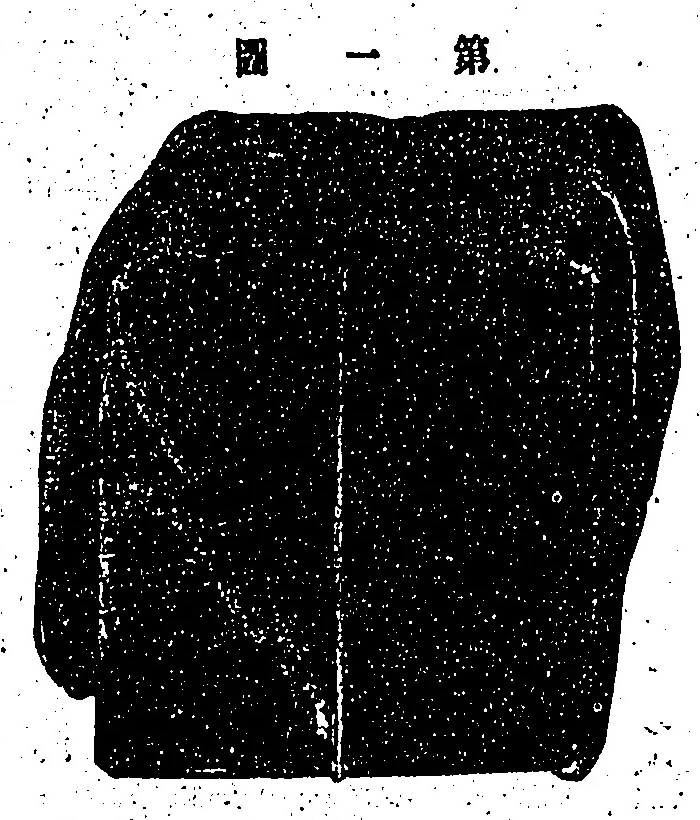
Figure. Photograph of a large dark stone block
A single photographic image of a rough block-like object with no internal labels or annotations.
Figure 1.
That evening, with Messrs. Fujiwara and Ono, both Bachelors of Science, I discussed the other arrangements in Dr. Yamakawa’s presence. In particular, we devised seals for the bag to reveal whether it had been opened with a duplicate key. As shown in the figure, near the hinges at both sides of the bag we put strips of paper the same brown color as its metal frame, pasting them across the two halves of the frame so that they could not be seen from outside when the bag was shut. The seals would not break if the bag were opened slightly and carefully, but were arranged so that they would inevitably break if it were opened far enough to take out the test object. We also blackened the catches at both sides of the frame with lampblack, so that contact with a hand could immediately be detected by the soot’s being rubbed off. Repeated trials established that the paper seals would certainly not break unless the bag was opened, and that the soot did not rub off easily. The actual application for the experiment, however, was made by Mr. Ono and me in Dr. Yamakawa’s presence the following morning, before we went to the Nagao residence.
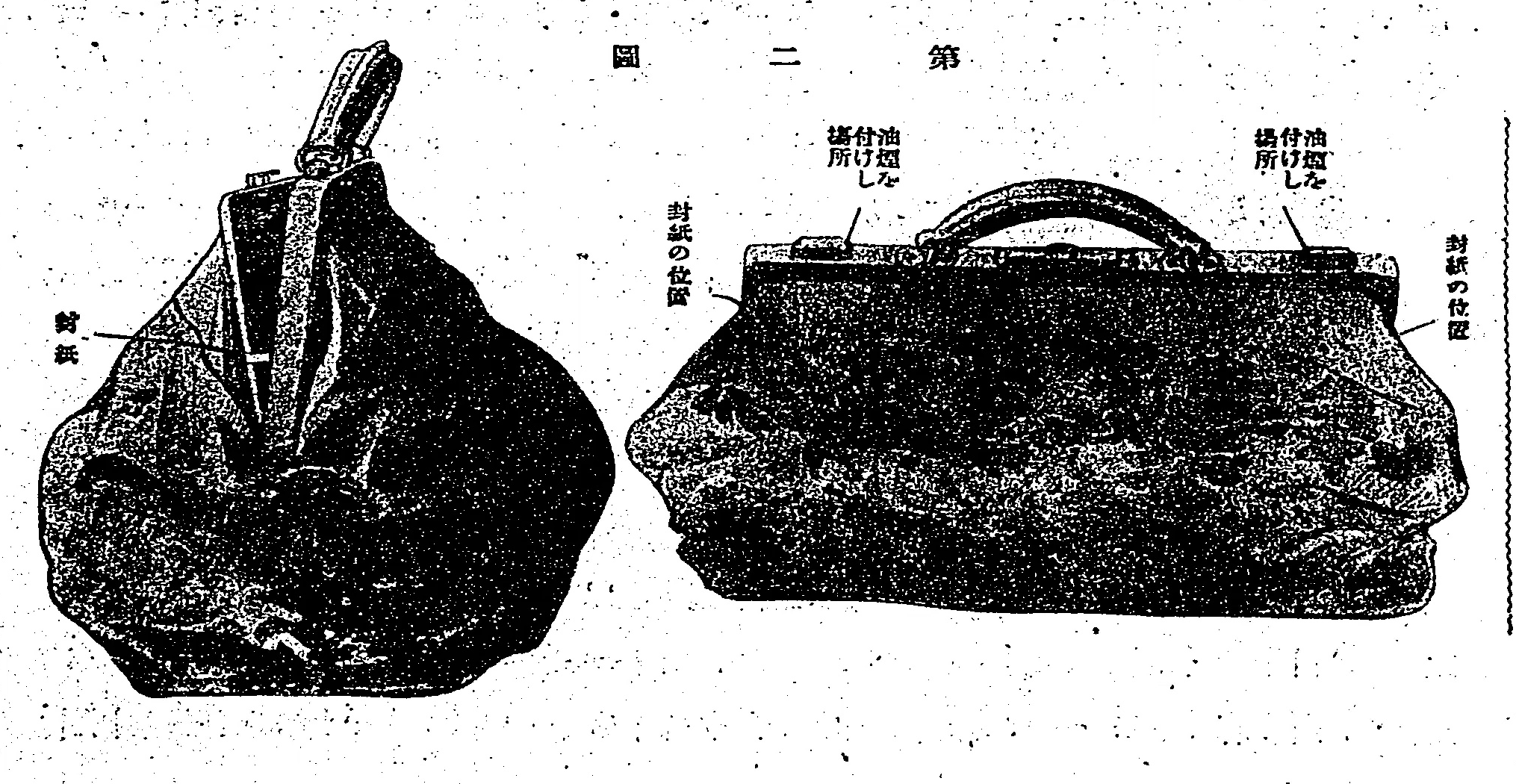
Figure 2. Labels: “Position of paper seal” at each end; “Place coated with lampblack” at each catch; “Paper seal” in the open-bag detail.
January 8. Mr. Ono and I made the following arrangements in Dr. Yamakawa’s presence. To detect use of the third method, we placed two lead crosses, each inclined at 45 degrees: one beneath the wooden box, and the other above the nimaigake-size cardboard box, that is, beneath the wooden lid. To hold them in place, we wrapped the box in a wrapping cloth and tied it tightly with twisted-paper cord.
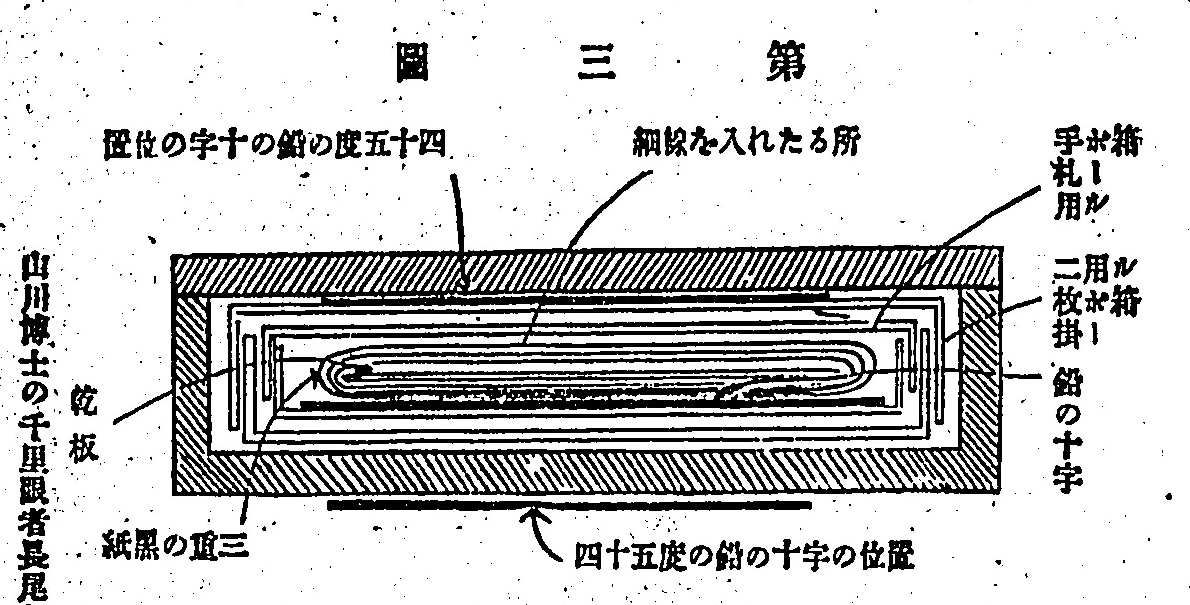
Figure. Diagram of a spirit level with lead cross marks
Translated labels: Position of the lead cross at 45 degrees; Place where fine adjustment is inserted; Box used as a handle; Box used for hanging with two hooks; Cross of lead; Drying board; Three sheets of black paper
Figure 3. Labels: “Tefuda-size cardboard box”; “Nimaigake-size cardboard box”; “Lead cross”; “Dry plate”; “Three layers of black paper”; “Place where the fine wire was inserted”; and, above and below, “Position of the lead cross inclined at 45 degrees.”
When Dr. Yamakawa took the test object into the experimental room, he was to remove these two lead crosses in the room beside the entrance and put them in his pocket. This was to distinguish manipulation in the entrance area from manipulation in the sitting room. If radium were used from outside the bag and applied from above the plate, an × shadow would appear superimposed on 健. If applied from beneath, an asterisk-shaped shadow, 米, would appear. If the manipulation were performed in the experimental room, a + shadow would appear as described above. The arrangement of the plate was as shown in the figure.
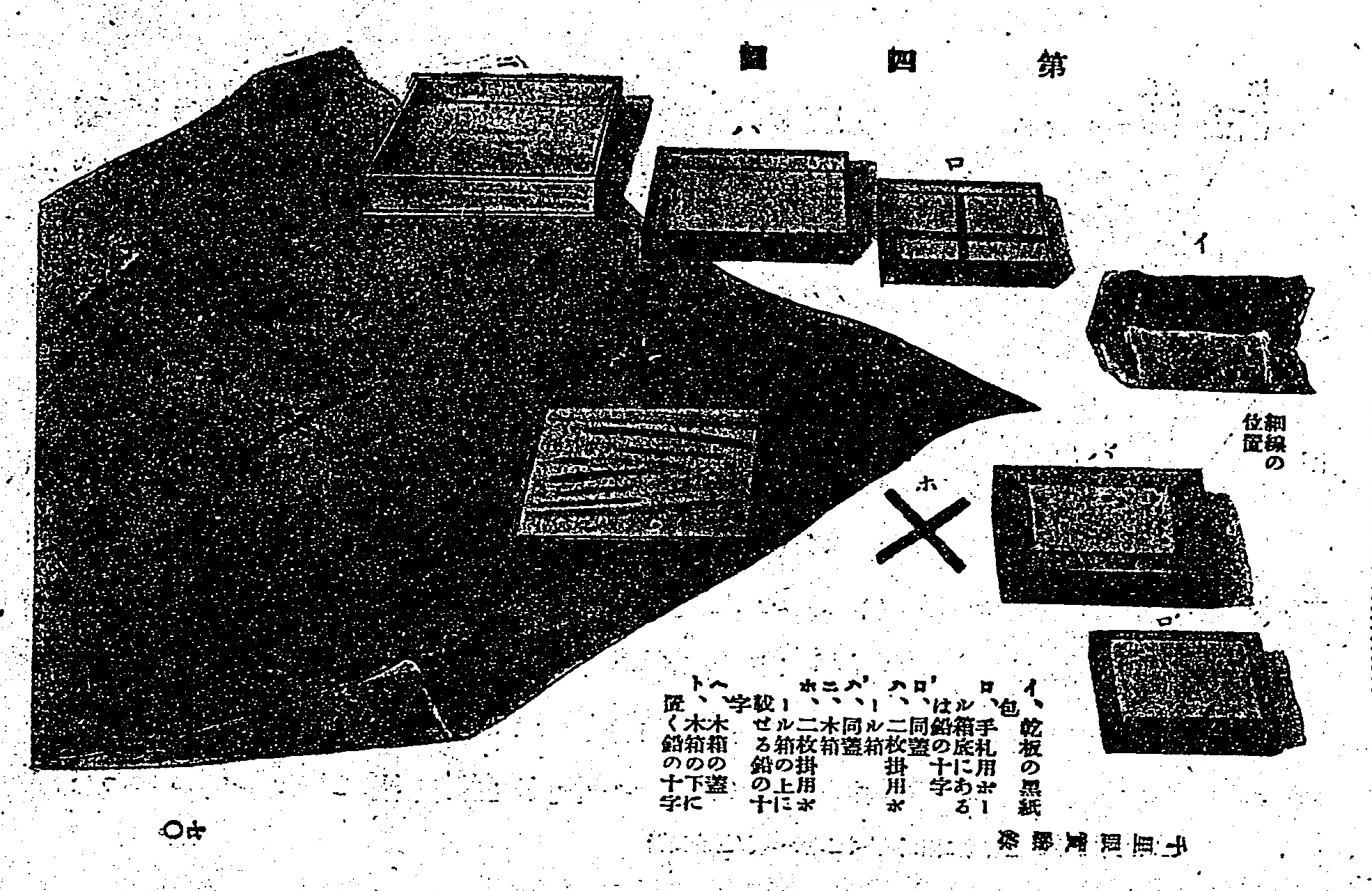
Figure. Arrangement of packing boxes and wrapping cloth
Translated labels: Figure 4 (第四圖); A; B (ロ); C (ハ); D (ホ); E (ト); Position of removal (卸與の位置); Wrapping board with straw mat (むしろ板の包紙); Hand-packing box (手札用の箱); Packing box of 10 [kan] (鉛の十に字); Same as B, packing box (同二箱); Same as C, lid (同二蓋); Packing box with lid (箱の掛用); Wooden box for lead (木箱の上に); Lower part of wooden box (木箱の下に); [illegible]
Figure 4. Labels: イ, the dry plate’s black-paper wrapping; ロ, the tefuda-size cardboard box, with the lead cross lying in its bottom; ロ′, its lid; ハ, the nimaigake-size cardboard box; ハ′, its lid; ニ, the wooden box; ホ, the lead cross laid on top of the nimaigake-size cardboard box; ヘ, the wooden lid; ト, the lead cross placed beneath the wooden box. The arrow at the unwrapped paper identifies the “Position of the fine wire.”
We put this package into the doctor’s bag. To detect opening with a duplicate key, we used the method tried the preceding evening: paper seals across the metal frame and soot on the catches. All these measures were applied before we set out for the Nagao house.
We also prepared to test for the use of radium. If radioactivity were induced in the lead, examination of its rate of decay would enable us to determine whether radium had actually been used. Fortunately Mr. Ono had experience with experiments of this kind. He prepared an electroscope in the chemistry classroom at the Girls’ High School. We arranged that, immediately after the experiment at the Nagao residence, I would take the plate and lead to the school; Mr. Sekido would develop the photograph, and Mr. Ono would examine the radioactivity of the lead.
That day we received notice from the Nagao household that the experiment would be held, and Dr. Yamakawa and I went by rickshaw to their house. Mr. Ono took the package containing the control plate and the electroscope to the Girls’ High School. Mr. Sekido had agreed to go directly there from the Awakan.
When we arrived at the Nagao house, my watch showed 9:40. Messrs. Fukurai, Fujiwara, and Minamoto were already there. Dr. Yamakawa placed his bag in the usual six-mat room beside the entrance, and carried the portable metal box containing the clairvoyance test objects into the inner eight-mat room. I followed him inside. Anyone who says I entered later is making a false accusation against me.
Mr. and Mrs. Nagao were there too. At their request that the metal box also be left in the six-mat room, Mr. Fujiwara carried it there. Dr. Yamakawa introduced me, and I greeted our host, Mr. Nagao. The lady seems to have been in the kitchen area at the time. Dr. Fukurai told Mr. Fujiwara to guard the test objects, but I did not favor stationing a watcher. I could imagine, for instance, a watcher being hypnotized. The doctor’s bag had already been fitted with physical safeguards; there was no need for us to keep watch.
After a while Messrs. Kikuchi and Nobuhara also joined us. The sliding partitions of the eight-mat room facing the entrance were shut. The lady came into the sitting room, and I greeted her. There was some conversation about the photograph of 正 from the preceding experiment. The lady told her son and the others, “Mother is going to be tested now, so go over there.” Dr. Yamakawa at last wrote the character 健. My watch then showed 10:05.
The character he had written was placed in the alcove. The lady sat before it, facing it with her palms together. After several minutes she rose and took the place shown in the diagram. She said that she had had a definite sensation that day and would therefore produce a fine image. I remember that only one panel of the partition behind her was open. At this point Dr. Fukurai went briefly toward the entrance and returned. Dr. Yamakawa rose and went to the room beside the entrance to fetch the test object. As he was slow to return, Mr. Fujiwara went to meet him at the lady’s suggestion. Presently the doctor returned to the eight-mat room carrying the test object. Dr. Fukurai recommended that, on this occasion, Dr. Yamakawa himself hold the plate. My watch then showed 10:10. Dr. Fukurai particularly chose a seat behind Dr. Yamakawa.
At this point Dr. Fukurai said that if two plates were laid one over the other in the entrance area and one were brought in for thoughtography, both might be affected. I had never heard of such a phenomenon occurring, and wondered how a new phenomenon could be predicted before it had even been tested. The seating at that time is shown in the diagram.
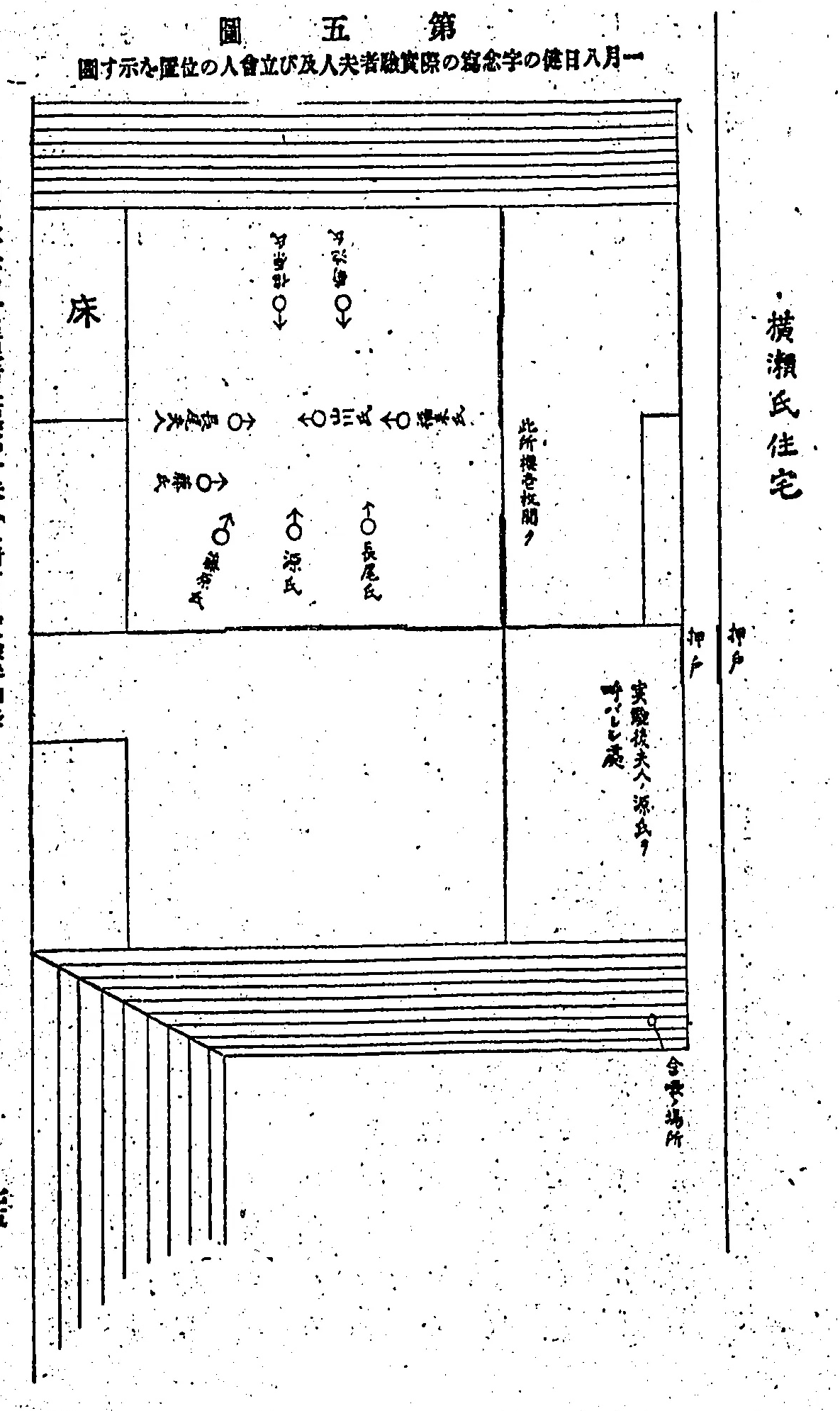
Figure. Positions of experimenter and observers, January 8
Translated labels: Figure 5 (第五圖); Diagram showing the positions of the experimenter’s wife and the observers at the January 8 experiment; Floor (床); Yokose residence (橫瀬氏住宅); Gate (押户); This room is a 8-mat room (此所八畳敷間); Mrs. Jikken-sha (experimenter’s wife) at the waiting spot (實驗者夫人、待どころ); Mr. Minami (南氏); Mr. Nagao (長尾氏); Mr. Suga (須賀氏); [illegible] (氏); Meeting/convergence point (會せ場所)
Figure 5. Diagram showing the positions of the experimenter, the lady, and the witnesses during the thoughtography experiment with 健 on January 8. The persons labeled are Mr. Nagao, Mrs. Nagao, Dr. Yamakawa, Dr. Fukurai, Mr. Fuji, Mr. Minamoto, Mr. Fujiwara, Mr. Nobuhara, and Mr. Kikuchi. Other labels identify the alcove; the sliding partition with one panel open here; the place where Mrs. Nagao called Mr. Minamoto after the experiment; the place where she joined her palms; the swing doors; and Mr. Yokose’s residence.
The judge said that the sound of writing in notebooks interfered with mental concentration, and asked us to remember the times and everything else instead of recording them. I felt that, if thoughtography were being accomplished by some other cause, we must pay attention to the timing and positions of people other than the lady in her state of selflessness. The judge’s eyes were turned away from her, and his posture was exactly like that of someone hypnotizing another person.
The so-called mental concentration began. After a little while, the judge raised his thumb slightly and changed the position of his clasped hands. The lady then opened her eyes. Saying, “That will do. Please excuse me a moment,” she left her place.
After a short interval the lady called Mr. Minamoto, B.A., from the three-mat room. He called Mr. Fujiwara, who called Dr. Yamakawa. The lady said that by clairvoyant vision she had found no plate, but two glittering crosses. The doctor replied that the plate was certainly there, and that there was one cross. He meant the cross inside the tefuda-size cardboard box, behind the plate. As the lady repeated her statement, the doctor took the nimaigake-size cardboard box out of the wooden experimental box. A cross appeared from the bottom of the wooden box, a place where we had certainly not put one. (See the figure.) The cardboard box was empty.
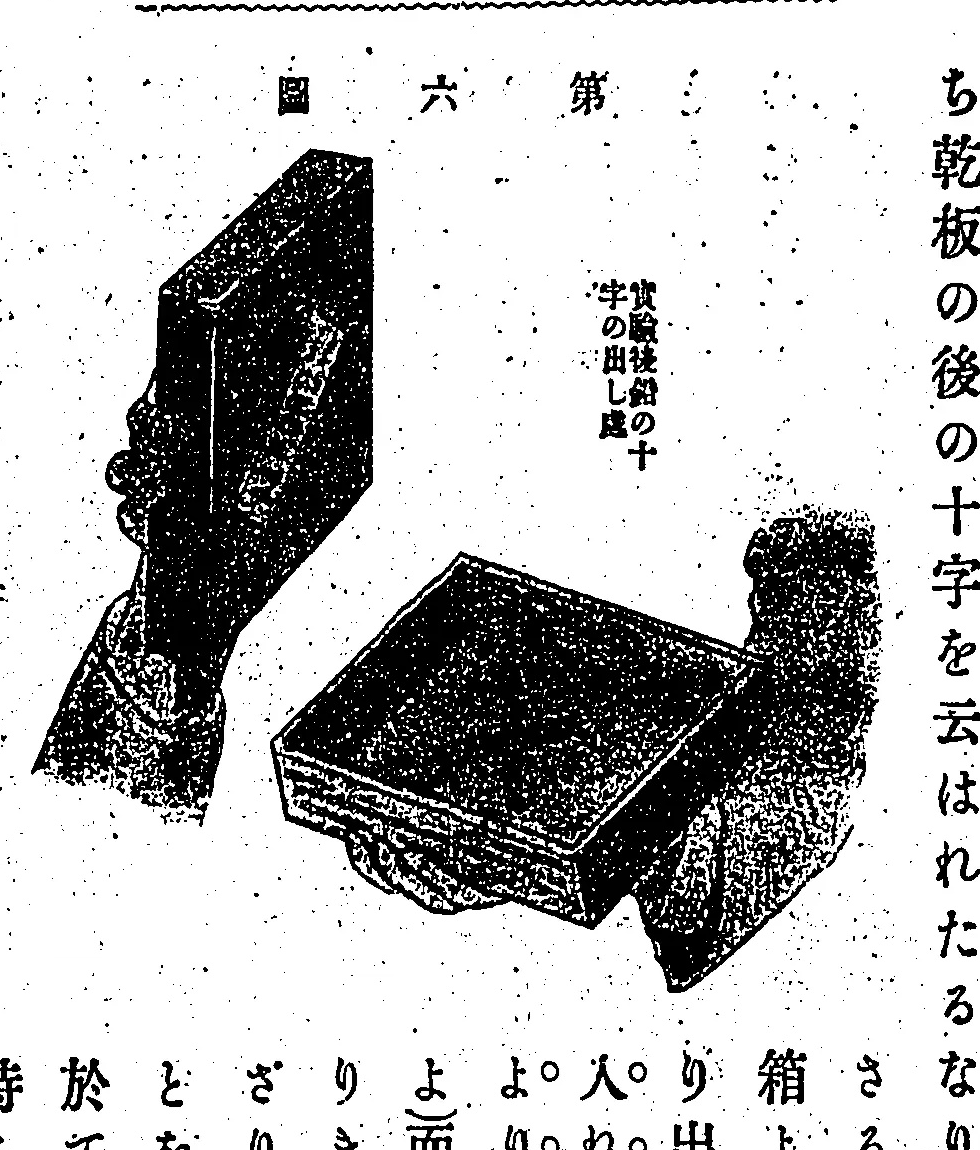
Figure. Ten Cross Plates After Baking
Translated labels: Figure 6; Ten cross pieces placed in the mould after baking
Figure 6. “Place from which the lead cross appeared after the experiment.”
At this point I had no idea that the absence of the plate was due to our own oversight. The doctor now asked Mr. Fujiwara to bring the bag, and slowly opened it, explaining that two lead crosses had been fitted above and below the box; that when he went into the six-mat room to fetch the test object, one of them could not be found despite all his searching; and that it was extremely strange that this missing cross had now appeared from an entirely different place, the bottom of the wooden box. Nor, he said, was that the only strange thing. Although the bag’s lock and the condition of the cloth wrapping had been normal, soot had been rubbed from its metal frame and the paper seals had been broken, even though he opened it carefully. This was the first I knew of what had happened when the doctor went to fetch the test object from the six-mat room.
As the radioactivity of the lead crosses had to be examined as quickly as possible, I said, “Please excuse me a moment,” took two crosses, and hurried by rickshaw to the Girls’ High School. The radioactivity induced in lead by radium diminishes by half in about forty minutes. Mr. Ono began the test immediately.
I later heard that Mr. Fujiwara thought I had gone to the police. What the Nagao household thought I do not know. After I left, however, Mr. Minamoto, B.A., told the witnesses that the lady had clairvoyantly perceived three people putting their heads together in consultation, and one of them bringing a plate to the Nagao house and leaving it there.
On reaching the Girls’ High School, however, I discovered that the absence of the cardboard box containing the plate was entirely my own oversight. I had thought Mr. Sekido had put it in, and he had thought I had done so. Each thought the other had put it in, and in the end neither had. I immediately hurried back to the Nagao house by rickshaw, intending to tell Dr. Yamakawa that the omission of the plate-box from the nimaigake-size cardboard box, at least, had been entirely our own mistake. I was told he was talking privately with the lady, so I asked Mr. Fujiwara to pass on the message. I then returned to the Girls’ High School to see the result of the test of the lead crosses.
The lead showed a 20 percent increase over the electroscope’s natural leakage. This, however, was within the range of experimental error, and the use of radium therefore remained undetermined. Dr. Yamakawa, who had returned to the Tamagawa-rō, then telephoned to say that the experiments were suspended. We too returned to the inn.
It was only then that I heard from him that, at the Nagao house, he had promised to keep that day’s events secret and to continue the experiments, since stopping at that point would be unsatisfactory for both parties. I also learned that, as supervisor, he had taken full responsibility and apologized to Mr. Nagao for my oversight in not putting in the cardboard plate-box. That my oversight had obliged the doctor to apologize was a matter of the deepest embarrassment to me.
The foregoing is an account of what I myself saw in the experiment of the eighth, exactly as it happened. The points to note in this experiment are:
- In the room beside the entrance, the soot on the bag was rubbed off and the seals were broken. In particular, a lead cross that had been outside the wooden box passed through the box and came inside it.
- What the lady saw clairvoyantly was the state of the test object while it was in the room beside the entrance, not its state at the time of her vision. At the time of the vision there was one lead cross; in the room beside the entrance there had been two.
- The location of the missing plate was entirely different from what she saw clairvoyantly.
- Although the lead crosses were not shining, she saw them clairvoyantly as glittering.
I give below Mr. Fujiwara’s recollections of that day’s experiment, without avoiding repetition.
Notes on the Experiment with 健
I arrived at the Nagao house at nine on the morning of the eighth. Messrs. Fukurai and Minamoto were there. Shortly afterward Dr. Yamakawa and Mr. Fuji arrived. The doctor carried a metal box. Dr. Fukurai said, “What is that? The plate? You must not bring it into this room.” Dr. Yamakawa said it contained the clairvoyance test objects. Either Dr. Fukurai or Mr. Minamoto said, “Even so, it will cause confusion.” I therefore took the metal box and went to the room beside the entrance.
At the sliding-paper doorway, just as she was about to enter the kitchen area, the lady asked, “What is that? The photograph?” I replied, “No, these are the clairvoyance test objects. The plate for thoughtography is in that bag over there,” pointing to the bag on the portable alcove stand in the six-mat room. She said, “That is all right, then, if they are separate. You may put it anywhere. You may take it into the sitting room.” I replied, “Then I will put it here,” and set it on a large box in the six-mat room resembling a Chinese trunk, some three or four shaku long and about two shaku high.
I considered keeping watch in this room, but finally decided to go into the inner six-mat room. Dr. Fukurai said, “Mr. Fujiwara, please keep watch.” I asked Dr. Yamakawa, who replied, “That should not be necessary.” I therefore took an intermediate position, kneeling in the six-mat room and attending to both directions.
At this point Mr. Kikuchi, B.A., and Mr. Nobuhara, the middle-school principal, arrived. After they were seated, our host said, “Now, everyone, please take your places. Otherwise mental concentration is impossible.” I had no choice but to enter the eight-mat room. Our host then drew both sliding panels on my right, and the entrance area disappeared entirely from our view.
I started the stopwatch at this point, after which there was various conversation. When the experiment was at last about to begin and Dr. Yamakawa was writing 健, Dr. Fukurai rose. I looked at the stopwatch and found it had stopped at five minutes. I had borrowed it from Mr. Sekido that morning, and it proved useless for measuring more than five minutes. I looked at the minute hand of my own watch and saw that it indicated twenty-six minutes past the hour. Dr. Fukurai returned one minute and thirty seconds later. Dr. Yamakawa rose to fetch the box when my minute hand showed thirty-four minutes. Thus the bag had been out of our sight for five minutes plus some additional interval, and another eight minutes: more than thirteen minutes altogether.
The doctor took so long to return that someone even suggested that he might have gone away with the bag. I was urged to go and meet him. When I arrived, he was shaking the wrapping cloth. On seeing me, he put it into the bag and locked it. “This is very strange,” he said, rising with the wooden box. I followed him.
In the eight-mat room the doctor sat before the desk, still holding the wooden box. The lady faced him and performed thoughtography. She may have rinsed her mouth during this interval, but I am not certain. After a minute or two she rose, went to the three-mat room, and called, “Could someone come here a moment?” Mr. Minamoto went. I got up to go to the lavatory. While I was in the urinal, Mr. Minamoto called me and said, “Something troublesome has happened. The lady says there is no plate in the wooden box, but two glittering cross-shaped things. She says she cannot possibly do thoughtography.”
I called Dr. Yamakawa into the six-mat room and told him. Still holding the wooden box, he said, “No, the plate is certainly there, and there is one lead cross. Tell the lady so,” and went into the eight-mat room. I went to the three-mat room and conveyed this to the lady on the veranda. She was weeping profusely. “However suspicious you may be, this is much too cruel a way to treat me,” she said, holding her sleeve to her eyes.
At a loss what to do, I returned to the six-mat room. Dr. Yamakawa then exclaimed in astonishment, “Mr. Fujiwara, there is no plate!” When I entered the eight-mat room, the box was open. “It is truly strange that this cross should be here,” he said, and calmly explained the history of the crosses. Earlier, in the six-mat room, although nothing had been amiss with the lock or the wrapping, he had been unable to find more than one of the two crosses that had been attached. When I arrived, he had put this one in his pocket and come into the sitting room. He had been delayed by searching repeatedly inside the bag and through the wrapping cloth for the other cross. That the cross missing then should now appear here, in a completely different place, was truly strange.
Nor, he said, was that the only strange thing. He had me fetch the bag, and calmly explained that the soot had been rubbed off and the paper seals had been broken. I returned to my original place. Dr. Yamakawa went on to say that, although he alone had seen the rubbed-off soot and broken paper seals, the displacement of the cross had been seen by everyone and admitted of no further doubt. Since the crosses had been fitted and the bag sealed in his presence that morning, he had left it only once to go to the lavatory, and then for only a minute or two. When descending from the second floor he had let a maid carry it, but had not taken his eyes off it.
At this, Messrs. Fukurai and Nagao declared with one voice that the bag could not possibly have been opened in this house, and that the interval when he went to the lavatory was suspicious.
Mr. Fuji now left his seat. I stood on the threshold of the eight-mat room, keeping watch inside and out. Mr. Fuji returned, and we went into the street together and called a rickshaw. He hurried off somewhere. I thought he was going to the police to bring a detective and have the whereabouts of the plate investigated. Meanwhile Mr. 龍澤 of the Yorozu Chōhō came through the gate. I stopped him and sent him away.
Those present also agreed that, since no one could tell whom that day’s events might embarrass, they should be kept secret, and only a temporary suspension announced. The lady said she wished to speak privately to Dr. Yamakawa. They went into the kitchen area and closed the partitions. Mr. Minamoto kept watch outside. I too loitered nearby, doing such things as putting my finger into a knothole.
Principal Okada now arrived. I stopped him at the entrance and announced him inside. After agreeing that everything should be kept secret from him, we invited him in. He left after a short while. Mr. Fuji returned again and asked me to tell Dr. Yamakawa that the matter of the plate had been our own oversight: it had been found at the other place. He then left.
I called Dr. Yamakawa, but he did not come out. Presently the conversation ended and he emerged. I conveyed Mr. Fuji’s message. “Well, well,” he said, and went inside again. He renewed his apology to our host and his wife, told them to set their minds at rest because it had been an oversight on our side, and promised that another complete experiment would be made to remove the embarrassment and suspicion on both sides. He then took his leave.
Mr. Minamoto came and said that, according to the lady’s clairvoyant vision, there were three villains. She had seen two particular people and a maid of the Tamagawa-rō conferring secretly. It was the maid who had opened the bag. To slander the Nagaos, obstruct the experiment, and arouse Dr. Yamakawa’s suspicions, a certain person had brought the plate to the Nagao house and left it somewhere. But she made no definite statement as to where the plate was. I went directly to the Tamagawa-rō.
The foregoing reproduces Mr. Fujiwara’s written account just as it stands.
Some say that I had radium ready that day. But the radium did not arrive from the university until the afternoon of the ninth, so I could not have had any. I must add a word here. I have seen in the newspapers some rash criticisms of my conduct by Dr. Inoue. My reply to him is simply that he is a man who does not know the properties of radium.
I would also add that some people say a substance as rare as radium could not possibly be found in an out-of-the-way place like Marugame. Of course, we did not assume that radium was being used. We merely guarded against every possible method. Even had we assumed its presence, I would ask such people to reconsider in light of Dr. Yamakawa’s remark: “Which is more extraordinary, that there should be radium in Marugame, or that thoughtography should be possible?”
Since the experiments were to continue, we decided next to repeat the experiment of Mr. Miura (三浦恒助), the discoverer of the “Kyoto University rays.” On the afternoon of the eighth, Mr. Ono and I went to the home of Mr. Okada, principal of the Girls’ High School, met Mr. Miura, and heard the details of his experiment. This was in fact the first time I had met him. The statement that I had previously been acquainted with him is false.
Among his photographs, one deserving attention was a plate of a human palm that he had exposed at Kyoto University and brought undeveloped to Marugame, asking Mrs. Ikuko to see it clairvoyantly. He said three attempts had been made from December 21 onward, all without success. Mrs. Ikuko said it was pitch-black and she could not see what was there. When developed, however, the plate, though fogged all over, showed the palm faintly.
What was strangest was that the folded edge of the innermost wrapping paper, lying over the plate, had also left a photographed shadow. The position of this shadow was somewhat different from the position it would occupy when the plate was wrapped in that paper. Through Mr. Miura’s kindness I have been able to reproduce at the beginning of this volume a collotype from this photograph, together with a comparison image made at the College of Science by laying the wrapping paper over a plate and exposing it to light so as to photograph the same paper edge. I thank him here for his kindness.
His investigations of clairvoyant perception had also produced a very interesting result. From numerous experiments, he concluded that clairvoyant perception was impossible unless there was a physical stimulus. In other words, anything that cannot be perceived by the ordinary five senses cannot be perceived clairvoyantly either.
Although Dr. Yamakawa and the rest of us kept the promised strict secrecy, the facts leaked to the public from somewhere in a somewhat altered form. It was at this point that I first suffered false accusation. Presumably the affair could not be settled unless I were made a culprit. Mr. Minamoto, B.A., had been present when secrecy was promised, yet that very evening he told a newspaper reporter about the day’s events in a distorted form. I should like to hear what explanation he intends to give for this.
January 9. The circumstances of the suspension of the experiments are as described in Mr. Fujiwara’s experimental record. In the afternoon Judge Nagao came by rickshaw to the Tamagawa-rō to inform Dr. Yamakawa that the experiments were discontinued. On that occasion he agreed to publication of the facts. Only then did Dr. Yamakawa disclose to the newspaper reporters part of what had occurred in the experiment of the eighth.
January 10. In the morning Dr. Yamakawa departed for Kyushu. That afternoon we too left Marugame for Okayama. Before leaving, I called at the Nagao house to take my leave. I apologized for the failure to put in the plate, acknowledging that it was indeed my own oversight. I also explained that I had come to Marugame for a purely scientific investigation into the genuineness of so-called clairvoyance, and would not concern myself with anything beyond that. I asked the judge to understand this, and said goodbye to him at the entrance.
January 11. In Okayama we experimented with paper and lead stencils, using light and radium. The results confirmed that, as I had anticipated, double lettering of the 天照 type was produced by excessive exposure, and that the thoughtograph of 正 closely resembled an image produced by exposing a plate to light through a crudely made lead stencil. The double lettering of 天照 results because, when a plate is exposed to light too long, the exposed parts become fainter instead, and the shadow around the stencil consequently develops darker.
The outline of the image made with radium was not as sharp as that made with light. (Introductory Figure 13.)
After I returned to Tokyo, Dr. Fukurai visited me in the physics department. On that occasion I asked his opinion on the following matters, which I record here.
I asked: “Regarding the missing film, the newspapers report that the lady clairvoyantly saw it abandoned at a certain place; it was not there at the time, but was found there later. Is that true? If so, did she see the future clairvoyantly?”
Mr. Fukurai replied: “She knew it because she perceived clairvoyantly the intention of the person who was to take it there.”
I asked: “I understand that you hold that experiments you yourself have performed cannot be rejected merely because other people cannot reproduce them, since the lady’s psychological state differs when she faces you, with whom she is familiar, and when she faces someone else. Is that your view?”
He replied: “Yes. But anyone can do it once they become familiar with her.”
I asked: “I have heard that you once successfully tested clairvoyant vision of an undeveloped plate. Is that true?”
He replied: “It succeeded with one sent through Mr. Kikuchi.”
I then made this request of him: our experiments had followed the policy of not placing trust in people we had never met. It was therefore only reasonable that the public should likewise withhold its trust from me. To make my position clear, I believed an experiment must be performed before a number of scholars. Since he had been involved from the beginning, I hoped he would again take the trouble to make the introduction on that occasion. He too seemed to accept my request.
The foregoing sets down the facts I encountered, just as they were. I leave any further inferences to the reader’s judgment. In this matter we wished to keep everything secret and let so-called clairvoyance die out of itself. Instead, the facts leaked from somewhere in distorted form. I absolutely refuse to let the affair be settled by my bearing a false accusation.
In closing I would say one thing. I hear that Drs. Imamura and Fukurai are firmly convinced of thoughtography. Uninformed as I am, I have yet to hear of any detailed report by either on experiments in thoughtography. I imagine that the majority of scholars throughout the country would wish to hear the details of their experiments. An old saying places the burden of proof on the person who affirms. Since both gentlemen occupy the position of affirming the phenomenon, I respectfully remind them not to forget that they bear the responsibility of establishing and proving it.
“The burden of proof lies on the person who asserts the affirmative.”
End of Fuji and Fujiwara’s Records of Clairvoyance Experiments.
Supplement
Last autumn Dr. Tanakadate prepared a clairvoyance test object with the strictest precautions. He had an attendant buy one hundred pieces of printing type. In a darkroom he selected three of them and aligned them with his fingertips. Any piece whose character touched his fingertip was removed and replaced with another. Using ink paste prepared beforehand, he stamped the type on paper and placed the paper inside a lead tube. He stirred up the ink paste and melted down all one hundred pieces of type. Thus he made an object in which neither he nor anyone else knew what three characters had been stamped on the slip of paper.
Furthermore, to enable any opening of the tube to be detected immediately, he took a plaster cast of it, made photomicrographs, and measured its weight. A genuine clairvoyant ought to find it easy to see through such an object. Yet I have heard Dr. Fukurai say that doubting clairvoyance to such an extent runs counter to common sense.
Mr. Yamakawa sent this test object to Mifune Chizuko and asked her to see it clairvoyantly, but she refused. The same object was therefore sent to Mrs. Nagao Ikuko with the same request. One additional clairvoyance test object in a lead tube, made by Dr. Yamakawa himself, had also been sent to the Nagao household.
In connection with Mrs. Ikuko, a telegram to the following effect arrived at Dr. Tanakadate’s home on the evening of November 15 from Dr. Fukurai, who was visiting Marugame:
“Unless the clairvoyance test object is opened and examined immediately after it has been seen clairvoyantly, to put her mind at rest, the subsequent tests cannot proceed. I therefore ask your permission for the object you made to be opened in my presence.”
Since the object had been prepared with the precautions described above, Dr. Tanakadate telegraphed this reply:
“Unless it is opened in Tokyo, the purpose of the test is defeated. Please make a separate object by the method I indicated and conduct the test with that.”
Dr. Yamakawa too is said to have sent word that the object he had made could be opened, but that permission was not granted to open Dr. Tanakadate’s.
What I heard in Marugame was that this test object had been lost. According to the newspapers, Mr. Fukurai too appears to have acknowledged its loss. As a precaution Dr. Yamakawa requested its return through Mr. Okada, principal of the Marugame Girls’ High School. On February 3, only the object made by Dr. Yamakawa was returned, without any result of clairvoyant vision. It was reported that Dr. Tanakadate’s object had been completely lost. Yet it seems that no attempt was even made to locate it by clairvoyant vision.
Afterword
Amid the eternal heavens and earth, physical phenomena of every kind arise in intricate confusion. Yet when we discover that rigorous laws exist among them, without the slightest disorder, it is surely the physicist who is most deeply struck by nature’s grandeur. Within the eminent human mind arise mental phenomena of marvelous subtlety and mystery. When we observe the almost limitless contents concealed in each individual brain, it is perhaps the psychologist who feels nature’s superiority most keenly. Earnest people everywhere always lend an attentive ear, wishing to hear much from these two kinds of scholars as investigators of nature.
Recently people called clairvoyants have appeared. They are said to perform what is termed clairvoyant perception and to be capable of what is termed thoughtography. Certain psychologists immediately endorsed these as things made possible by a special mental action. Heard from outside the field, their words seem to imply that the statements of other physicists, who regard the experiments performed so far as insufficient to make these claims credible, have no bearing whatever on such superior mental phenomena. The public cannot help being greatly confused by this. Some, on hearing it, even jump to the conclusion that certain activities of the mind can easily produce at will any supernatural or supramaterial phenomenon. If superstition arises in this way and heterodox shrines flourish in this way, is that not enough to alarm those responsible for public affairs and education?
In the course of their own research, psychologists may sometimes elucidate the increasingly subtle character of mental phenomena and be unable to avoid astonishment. This is just like physicists encountering increasingly complex material phenomena as their investigations become more exact, and being unable to restrain their wonder. Yet both disciplines are branches of science. Their proper goal and ideal, I think, should be to seek the fixed laws that must still exist amid nature’s subtlety and complexity, and to open a path toward explaining these phenomena as systematically as possible, however modestly.
Nature, arrayed in its immeasurable ingenuity, may not readily allow us to peer into it. But, setting aside for the moment the circumstances encountered by these scholars in their work, I believe that at least in addressing the public we should always make clear where the ultimate purpose of science lies, and strive to enable people to place their trust in it. In a case such as clairvoyance, which so easily invites public misunderstanding, reflection on this point becomes all the more urgent. If I may be permitted to put the matter still more strongly, I should like to add a few words here.
Present-day physics does not, of course, undertake to explain mental phenomena. Yet it embraces even the far-reaching ideal that, at the furthest limit of its progress in the remote future, in cooperation with physiology, psychology, and other disciplines, it may explain life itself as a definite state appearing within the material organization in which it exists. It may go further and explain the relationship between the material states of the nervous organs, the mental activities arising from them, and the effects of these upon the external world. This may perhaps be conceived as the ultimate limit to which our knowledge can develop. Even after an eternity it may remain a problem for the distant future. But I believe that whatever progress brings us nearer to it must be achieved only upon foundations laid by the development of physics.
When we inquire why orderly laws of nature exist throughout the universe, we naturally encounter the concept of “God.” The “God” we may hypothesize in this case is nothing other than “something” that has permitted the existence of these laws and of the matter and energy that change in accordance with them, with life itself probably included. Religious teachers often give this being a human form to make it easier for our reason to grasp. I regard this as equivalent to imagining a mechanical model in physics, giving a mechanical form to such nonmechanical phenomena as electricity and magnetism in order to make them easier to understand. A mechanical model can explain the phenomenon it represents only in certain respects. It goes without saying that it would be mistaken to suppose that it reproduces everything.
Giving God a human form has led people to infer that, just as we can activate various mental functions in particular cases according to our own will, God too can do so. Associating this with God’s superiority, they have gone on to extol its extreme case, “omnipotence.” For religion as the best means of saving the world, this is necessary and must accordingly be believed as a solemn truth. It is certainly interesting in some respects. But we must not forget that in science the matter must be strictly distinguished from this. What we call God’s “omnipotence” has no meaning beyond the creation of the laws of the universe and their rigorous observance. It certainly does not include an ability to alter those laws to suit the occasion.
Once religious teachers have conceived God in this way, they immediately reverse their line of argument and preach that the mind of humanity, the noblest of all beings, was likewise made in the image of this idealized God. Hearing this, the public interprets mental phenomena as supernatural. Thus, when people manifest the activity of their superior minds, little is asked about its relation to already known physical laws. Instead, material laws are held to have no bearing on the matter, and clairvoyant perception and thoughtography are at once pronounced possible. This is why clairvoyants appear one after another and become a vogue without any clear basis. Have scholars no duty to teach their believers where their fundamental ideas are mistaken?
So long as the conduct of the clairvoyants reported in the world unfortunately fails to be sincere, informed people can do nothing but warn against their vogue. But if facts such as those reported really exist, physicists will recognize their value as extraordinary facts, and will not be reluctant to investigate them with the fullest interest.
Let us suppose, for example, that so-called clairvoyant perception can occur.
In that case we must, in short, regard the nerves as receiving a stimulus from some material action and thereby becoming conscious of it. The manner of this consciousness, or the mental state in which it becomes possible, must await investigation by psychology or physiology. But the route by which something is transmitted from the object perceived clairvoyantly to the clairvoyant’s mind and body is certainly a material phenomenon distinct from those mental processes. Only when we have investigated what substances can produce such a phenomenon, and under what circumstances, can the value of the explanation be called complete.
Thoughtography goes a step further. It claims that a certain change accompanying mental activity can produce a physical or even chemical phenomenon exclusively at a definite, designated place separated from that activity. With our present knowledge, this can only seem extraordinary. If it too were true, it would not merely be difficult to assert absolutely that the energy involved in such a natural phenomenon could be observed only in the special mental activity currently reported. Rather, we ought naturally to suppose that, like every other form of energy, this particular form could also arise in association with other natural phenomena. Since it is as yet unknown in any other natural phenomenon, it would supply us with entirely new knowledge. This is what makes it so interesting to physicists, and should also be a reason why psychologists, in turn, must listen closely to them.
To declare in advance that clairvoyant perception and thoughtography are absolutely impossible is surely the language of someone who resembles a wise person without being one. To believe them to be manifestations of a spirit possessing divine and mysterious powers is language we may expect from the ignorant; it is certainly not that of an informed person. Clairvoyant perception and thoughtography may perhaps be possible, although at present the reasons we can find lead us to regard their possibility as extremely slight. Yet we can say in advance that, if they do prove possible, they too must be phenomena obeying the rigorous laws of the universe. If those who consider clairvoyance adopt this attitude, we may come close to being free of superstition.
I venture to set down these thoughts as an afterword to my fellow scholars’ book.
January, Meiji 44 [1911]
Ishiwara Jun (石原純)
Plans
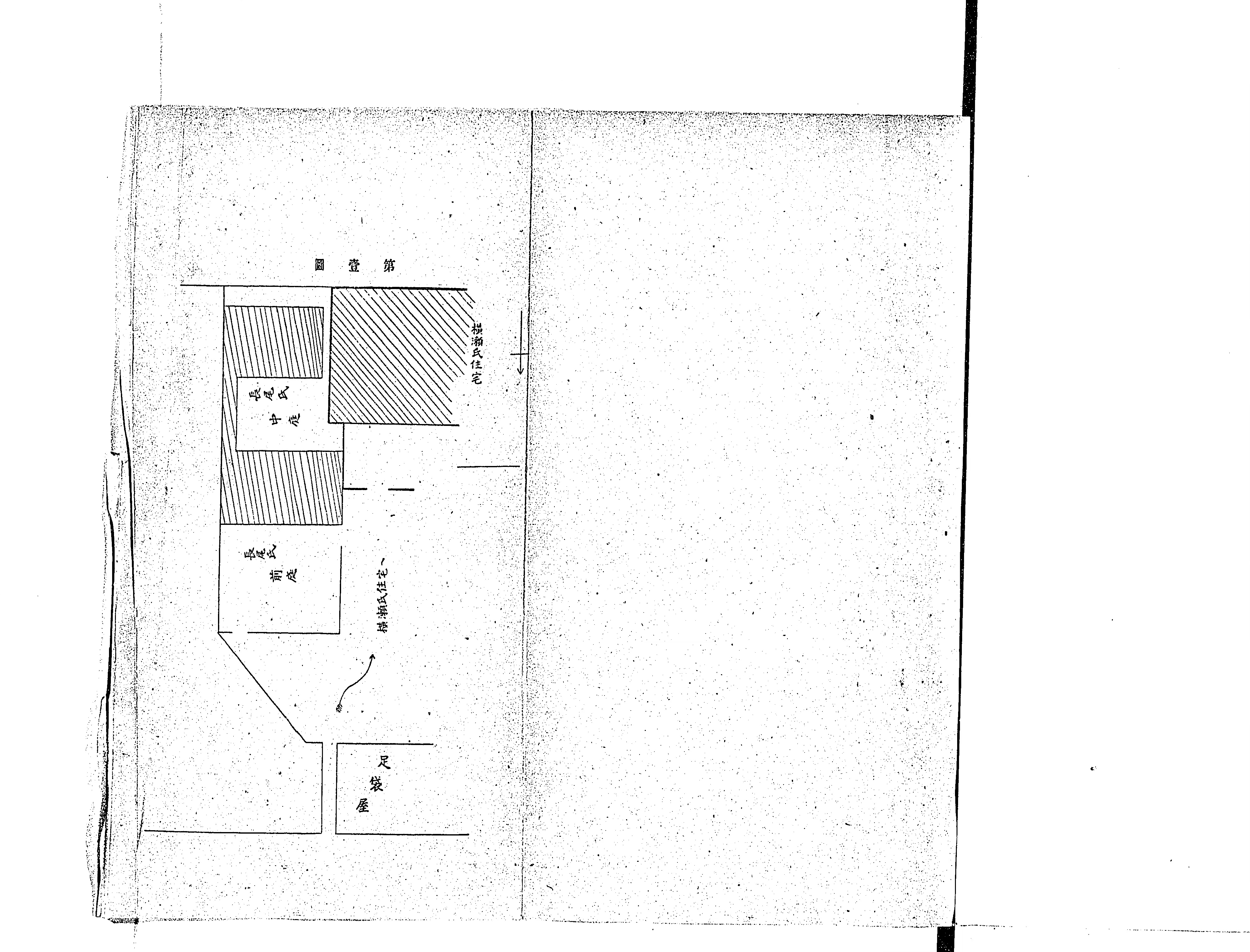
Figure. Site Plan of Yokomizo Residence
Translated labels: Figure 1; Yokomizo residence; Nagaya family middle courtyard; Nagaya family front garden; Tabi shop (tabi-ya)
Figure 1. Labels: “Mr. Yokose’s residence”; “Mr. Nagao’s inner garden”; “Mr. Nagao’s front garden”; “To Mr. Yokose’s residence”; “Tabi shop.”
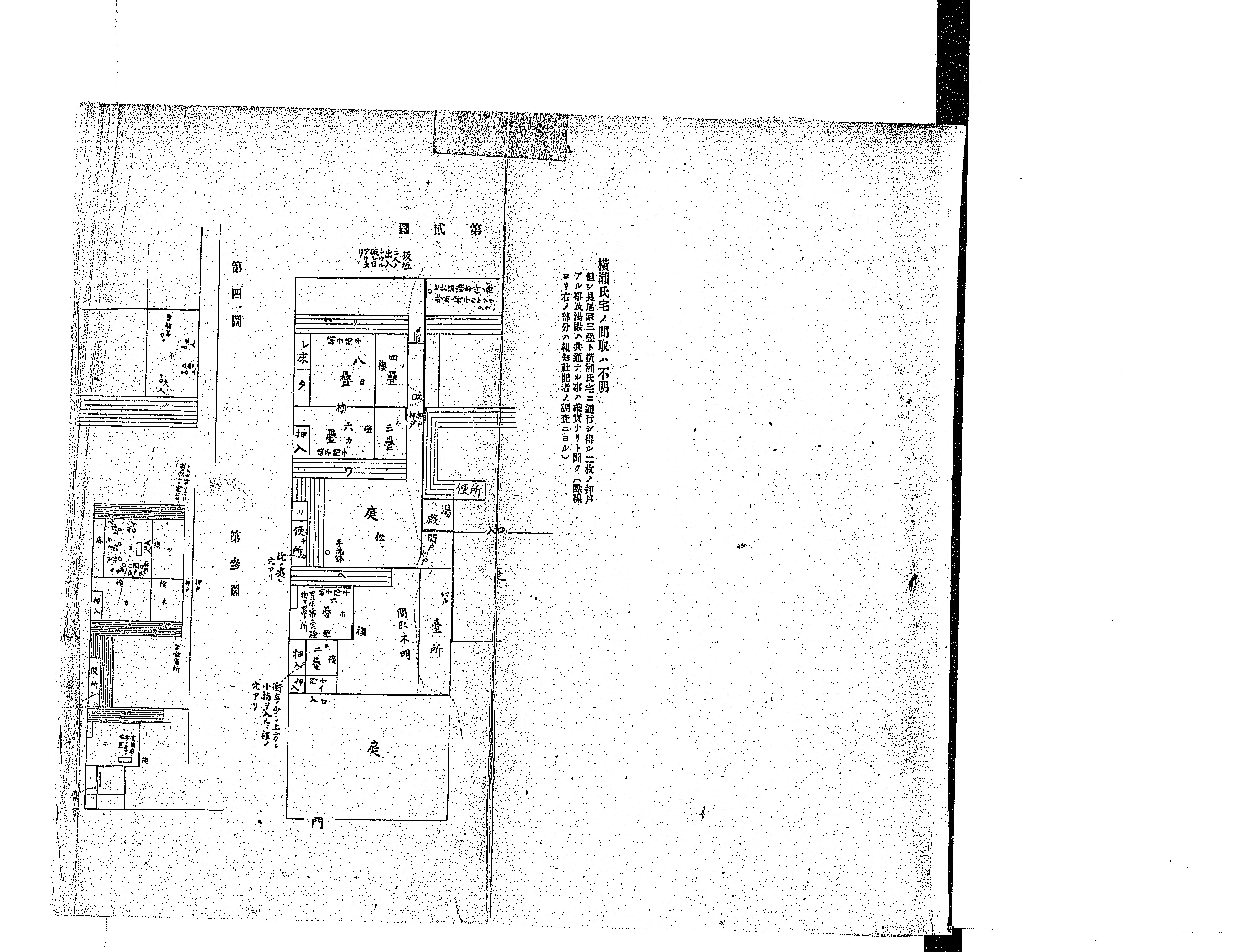
Figure 2. Floor plans of the Yokohase residence with unclear rooms
Translated labels: Figure 2; Figure 4; Figure 3; Yokohase residence — unclear/unclear rooms (caption note: but in the Nagaya residence three tsubo below, two tsubo above the Hasebe residence, a passage can be obtained; the Aburahi and Kōji portions are shown from the Chōwa Shimbunsha office, 2 chō) (partially illegible); latrine; kitchen [partially illegible]; room [illegible]; eight-tatami room; four-and-a-half-tatami room; six-tatami room [partially illegible]; three-tatami room; interior garden (courtyard); garden; entrance (押入 = closet); closet; veranda (engawa); hall (hiroma); porch; toilet; bathroom; door (mon); room assignment unclear; main house room assignment unclear; annex (hanare) room assignment unclear; gate; north side [partially illegible]; this side [partially illegible]
Figure 2.
“The layout of Mr. Yokose’s house is unknown. However, I am told it is certain that there are two swing doors permitting passage between the Nagao household’s three-mat room and Mr. Yokose’s house, and that the bath is shared. The portion to the right of the dotted line is based on the investigation of a Hōchi Shimbun reporter.”
Labels and annotations:
- “There is a breach in the plank fence through which a person can pass.”
- “At the time of the film-theft incident, it was hanging on the bamboo here.”4
- “Eight-mat room” (ヨ); “Four-mat room” (ツ); “Six-mat room” (カ); “Three-mat room” (ネ); the other “Six-mat room” (ホ); “Two-mat room” (ニ); “Entrance” (イ).
- “Alcove”; “portable alcove stand”; “desk”; “low ceiling”; “wall”; “three-shaku plank”; “closet”; “sliding partition”; “swing door”; “cupboard”; “kitchen”; “lavatory”; “bath”; “garden”; “pine”; “hand-washing basin”; “entrance”; “gate.” These labels recur at the corresponding features in the plans.
- In room ホ: “Place where the test objects are left.”
- In the central part of the main house: “Layout unknown.”
- Beside the passage at the garden: “There is a hole here.”
- Near the entrance: “There is a hole, large enough to put a little finger into, a little above the screen.”
Figure 3. Labels in the seating plan: “Host,” “Lady,” and, repeated at the other seats, “Witness.” It also marks the mouth-rinsing place, hand-washing place, and place where the test objects are left; the alcove, sliding partitions, swing doors, closet, and lavatory retain their labels. The original kana identifying the rooms and other positions are retained in the illustration.
Figure 4. Positions labeled “Experimenter,” “Host,” and “Lady.”
Colophon
Printed February 12, Meiji 44 [1911].
Published February 15, Meiji 44 [1911].
Reproduction prohibited.
Authors: 藤教篤; Fujiwara Sakuhei (藤原咲平).
Publisher and printer: Dainihon Tosho Co., Ltd., 22 Ginza 1-chōme, Kyōbashi Ward, Tokyo.
Representative of the above company: managing director 宮川 [the remainder of the personal name is obscured by the publisher’s seal].
Publishing office: Dainihon Tosho Co., Ltd., 22 Ginza 1-chōme, Kyōbashi Ward, Tokyo.
Postal transfer savings account: Tokyo No. 219.
Authorized sales agencies in the various prefectures.
Records of Clairvoyance Experiments, by Fuji and Fujiwara: colophon. Fixed price: 40 sen.
Publisher’s seal: “Dainihon Tosho Co., Ltd.” and “Certificate of printing.”
Library identification card: “Records of Clairvoyance Experiments”; “藤教篤, author”; “M44” [Meiji 44]; “327–420”; “012791–000–8”; “AAJ–0034.” The cover bears the shelf label “327 / 420,” with a small additional handwritten mark.
Footnotes
-
Translator’s note: The exposure is read as 十秒間, “ten seconds,” from the clear character in frame 7. In the repeated scan, frame 8, the vertical stroke of 十 is faint and broken. Both source images are retained. ↩
-
Translator’s note: The figure numbers are retained as printed. The scanned plans at the end of the volume are numbered 1–4; no separate rear Figure 5 appears in this copy. ↩
-
Translator’s note: The inn’s name is printed 阿波勘. Its reading is rendered here provisionally as Awakan. ↩
-
Translator’s note: The small handwritten annotation appears to say that the film was hanging on bamboo at this location. The handwriting is not entirely clear; the original annotation is retained in the accompanying plan for comparison. ↩