Original publication
Original title: 開天眼・超視能力修煉法
Author: Takafuji Sōichirō (高藤聡一郎; source metadata: 高藤聪一郎)
Publication year: 1987
Original language: Japanese; translation source edition is Traditional Chinese
Source file MD5:5ad08eb2020487972b2d25417eaf4ee9
Takafuji Sōichirō
Translated from the 1987 Traditional Chinese edition of Takafuji Sōichirō’s Japanese work.
Contents
- Preface
- Super-Vision Leads One into a Mysterious World
- Establishing a Method for Controlling the Radiance of Supernormal Energy
- Development and Applications of Super-Vision
- Chapter 1: Developing Aura Vision as the Foundation of Super-Vision
- The Mystery of the Aura Emitted by the Human Body
- How Aura Colors and Shapes Reveal Hidden Information
- The Aura Polluted by Modern Civilization
- Developing the Mystic Eye and an Environment for Observing the Aura
- Basic Training for Seeing Auras
- Strengthening the Aura and Developing Vision with Instruments
- Aura-Viewing Training Method (1)
- Aura-Viewing Training Method (2)
- Information Provided by Abnormal Auras
- Aura Colors and How to Identify Abnormalities
- Chapter 2: Inner-Light Development and the Closed-Eye Method
- Chapter 3: Making Light Images Appear in the Void
- The Powerful Qi Required for Super-Vision
- The Emergence of Super-Vision Through the Open-Eye Method
- Techniques for Letting Others See Super-Vision
- Making Light Images Float in Space
- Freely Controlling the Aura
- Using the Palms’ Aura to Manifest Shapes
- Controlling the Aura of the Entire Body
- Correcting the Aura’s Shape Through Visualization
- Correcting Aura Colors and Using Color Methods
- Chapter 4: Basic Techniques Using Super-Vision
- Chapter 5: Applications That Induce Supernormal Phenomena
- Afterword
Preface
The fundamental power of all spellcraft and supernatural abilities (clairvoyance)
Super-Vision Leads One into a Mysterious World
When we meditate in a proper manner, after a short while, a brilliant radiance seems to appear in the tranquil space; this phenomenon has been spoken of by many people in ancient times.
Indian yoga calls this radiance chakra, Chinese immortal cultivation calls this radiance elixir light, and in Western magic or supernatural phenomena, this radiance is referred to as spiritual light.
Because this radiance only appears when meditating with closed eyes, it has the alternative name of inner light. However, as one’s practice advances to a state with open eyes, one will also feel able to see a distinct bright light in the void.
If one cultivates to a higher realm and is able to control it, then, according to one’s consciousness, this radiance can be transformed into various shapes such as graphics, text, human figures, and landscapes, revealing a profoundly mysterious and inconceivable sight. If one cultivates to a realm surpassing ordinary mortals, not only can one see this wondrous sight oneself, but one also gains the ability to let others see it.
The author once used this light and relied on the power of consciousness to draw shapes such as +, -, △, and ○ in real space. Not only could the author see them, but several friends nearby could also see them very clearly. It was an illusory sight; there was nothing in the dimly lit space, and the aforementioned shapes flickered in and out of existence like someone’s handwriting.
On one occasion, while several friends were observing closely, the author also manifested radiant spheres or bands, allowing them later, I also let them see figures and objects.
This kind of performance must be conducted in a state of concentrated consciousness, so I do not perform it often. The most recent time, I let them see figures of only the upper body and radiant full-body human silhouettes; these visions all appeared in space.
The practical applications of this radiance are very broad, and the scope for utilizing supernatural abilities is vast. For example, the mysterious light believed to emanate from the human body—an aura—is closely related to this radiance. Therefore, as long as one masters this method, one can control it freely.
The author actually uses this method by elongating an aura from a finger into a thread-like shape, looking like a long sword. Then, I shape the thread-like part into loops, spirals, or double strands, changing it in various ways according to my consciousness. Several of my disciples have also trained to the point where they can freely use this method, so sometimes I and these advanced disciples draw out auras from our fingers into long swords, engaging in mock battles with each other.
I can also use my conscious power to bend or deflect the light rays extended by the opponent. Sometimes, I have an advanced disciple emit an aura from the top of their head, and I shape those auras into flower shapes or wondrous patterns.
People without any experience in this area might think I am bragging or talking nonsense. However, after actually reading this book and understanding this method, I believe that anyone can learn it through special training.
Of course, once familiar with the method of controlling auras, it becomes even more practical. For example, one can diagnose the diseased area and its symptoms based on abnormalities in the shape or color of the aura, and thereby cure the disease.
Using this technique, one can see the contour of light formed by another person’s consciousness; in other words, one can understand the other person’s mind. It is an intricate image of light of various transformations, flickering in and out of existence. As long as one observes patiently, various shapes can be derived, such as a grid pattern or a flower shape, and at a certain moment, a concrete shape will emerge. At this time, if one asks the other person, it is usually something related to them. Of course, sometimes the other person cannot think of anything no matter how hard they try; instead, it is an image transformed from their subconscious without them even realizing it. According to the author’s experience, if the other person is someone who loves growing flowers, what they see might be the light contour of their favorite kind of flower. Similarly, if the other person is an editor who writes articles, when he appears in front of me, I can also see from behind his shoulders a contour resembling handwriting on manuscript paper. From this, it can be seen that things closely related to a person’s consciousness are the easiest to appear as images of light. Since most of a person’s subconscious can be seen, and some inspirations from supernatural phenomena can also be seen, sometimes the view is clearer than what psychics see. This is because it differs from ordinary supernatural events and relates to the fact that faint images of light can be perceived. When using this method, the gems, gadgets, and accessories carried by the other person, as well as certain objects in the field that I have a connection with, or information held by the other person, can all be transformed into light images and appear clearly. In this way, mental activities within and between minds can be materialized and beautifully compared.
Establishing a Method for Controlling the Radiance of Supernormal Energy
Furthermore, the author has also utilized this method in the development of paranormal remote sensing, such as ESP (EXTRA SENSORY PERCEPTION) communication, as well as clairvoyance and telekinesis, with excellent results. In short, the application scope of this supernormal vision is quite extensive; therefore, those who wish to develop supernormal abilities must begin by developing the capacity for supernormal vision.
What is this radiance called in modern science? I do not know either. Perhaps it is the radiance of supernormal energy in an unknown realm of consciousness that humanity has not yet developed. Of course, there is also a small part of it that can be grasped through scientific methods, such as the aura. However, as a whole, what can be grasped by scientific methods is still only a minor fraction. The author only encountered this enigmatic radiance when studying Chinese Xian Dao. That radiance appeared slowly. Not long after I experienced this radiance, I gradually began to feel a sense of reality to it. Now I am very accustomed to it; not only can I make this radiance appear whenever I want it, but I can also control it freely. In Chinese Xian Dao, this light is called Danguang, because it is considered the radiance emitted from Danguang. According to ancient Chinese books on Xian Dao, one must practice the ‘Lesser Heavenly Circuit’ (Xiao Zhou Tian) for a long time for Danguang to appear. The author has also practiced the Lesser Heavenly Circuit for a long time, and truly experienced this light during this process. At first, it only appeared for an instant, and its radiance was not very great, but as the practice progressed, the shape I saw grew larger and clearer, and the duration it could be seen also gradually lengthened from a fleeting instant, until finally I could control it freely according to my own consciousness. What I found interesting is that this kind of light also has several modes. The most common is a vivid navy blue light; although my eyes are closed, I can indeed see its radiance. If my consciousness is fixed, I can appreciate it for a long time. Its shape is quite large, and its edges fluctuate like a living creature, giving the impression of a living entity. Depending on my physical state or consciousness at the time, the colors that appear will also differ. For example, if my consciousness is focused on the solar plexus in the abdomen, a bright red light can be seen because yang qi (heat) is intensely generated. Among the various inner lights, the one I find most interesting is white light (which is a radiance very much like silver). However, there are also cases where two types appear simultaneously. One is a radiance like diffusing blue light, which often appears when achieving stillness in meditation, and it can be seen for a long time; if in a dark place, its radiance is further intensified. The other is a silver point of light that flashes vividly in an instant, very much like a small star twinkling in the night sky. Although it is small, the intensity of its radiance is quite strong, so occasionally it can still be seen even when I open my eyes. In the early stages of practice, it was very difficult to see this kind of light, but as my practice progressed, I gradually found a way, and eventually I could control it freely. It was probably from this time on that I began to develop an interest in the true nature of this light. In order to pursue the truth, I sought out many books and materials for research, including books on Daoist immortal cultivation, yoga, magic, and esoteric Buddhism, and finally I also consulted some materials on physiology and psychology materials.
The more I read, the more I felt I understood the nature of this light, and at the same time, I was able to gradually break away from the concepts of Xian Dao and obtain some methods of utilizing it.
For example, in Xian Dao, if one can see this light, one can use condensation methods to produce the small medicine (golden elixir), and ultimately form the Yang Shen, which is an immortal avatar. However, in Indian yoga, when one can see this light, one can form an “inner world” through continuous expansion, and the person exists within this inner world, so its approach differs from Xian Dao. I was interested in both at the same time and experimented with them; as a result, I found that both are viable, and thus I felt that the application range of this light must be very broad.
What gave me even more confidence in this aspect were the records in Western magic books (such as “Introduction to the Phenomena of Supernatural Phenomena” or “Introduction to Magic”—unfortunately, both of these books are out of print), as well as the sorcery series by the anthropologist Carlos Castaneda.
The aforementioned books contain records of various sorcery training methods and experiential cases centered on the wondrous light rays emitted from the living body. From this, it is evident that their range of application is very wide, leaving yoga and Xian Dao far behind. Of course, their goals are different from those of yoga and Xian Dao, so there is no need to compare them in detail; they simply serve as a reference for ability development.
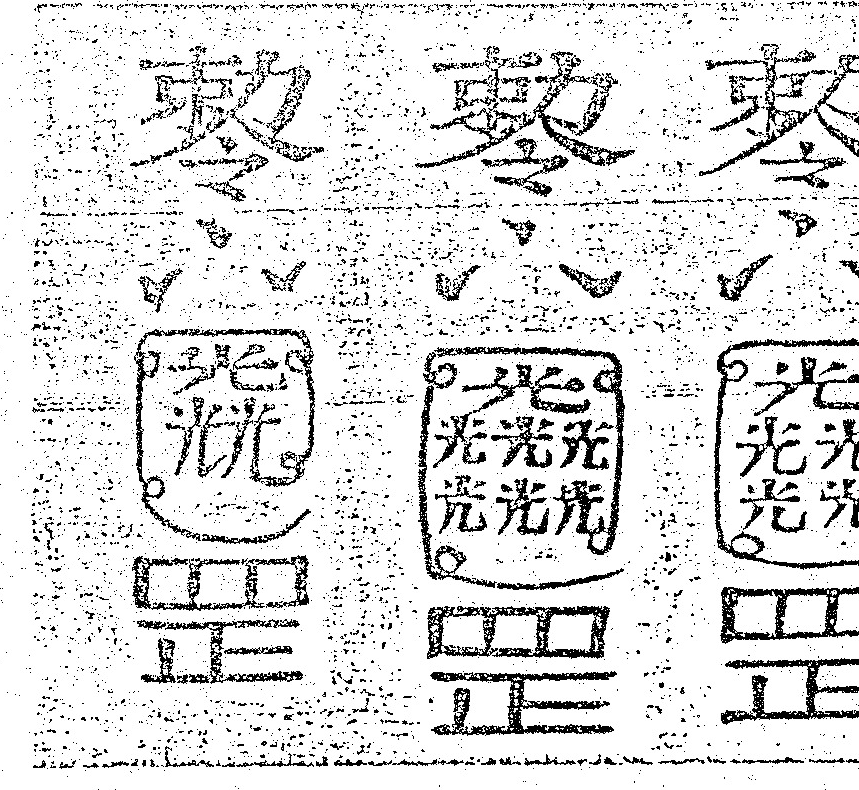
After reading these books, I wanted even more to study methods of controlling this light, so I also read other books related to sorcery, such as researching talismanic methods, as well as studying the Yuan Guang method, which is rarely known to the general public (Yuan Guang is different from Dan Guang). The so-called Yuan Guang method involves, around a white piece of paper, drawing talismans and spell patterns, then burning the talisman while chanting the incantation. At this time, you must carefully observe its center; this is a type of scrying method. In this way, you will see a circular space of white light or swirling smoke, and within it you will be able to see images of the things you wish to know. The images will feel as though they appear on a crystal ball. A practitioner who makes light appear on a piece of white paper is not yet considered highly skilled. It is said that masters do not need white paper; they can directly cause a bright, distinct white circle of light to appear on a wall or in space according to their own will. The author referenced their methods and independently researched and trained in ways to manifest this kind of white light. Furthermore, the author also studied the visualization methods commonly used in Tibetan Esoteric Buddhism, Western magic, and a method for developing aura vision commonly used by practitioners of supernatural phenomena—as well as general magic tricks. I experimented with each one. Through multifaceted research, the author finally devised a unique internal light development method. Doing it alone felt meaningless, so I found a few friends to repeatedly conduct this experiment. Thus, I learned whether or not my friends would see the same white light I did when following the author’s method. Examples of talismans commonly used in the yuan guang method. Draw these symbols around the white paper, then burn the talisman while chanting the incantation, keeping your eyes fixed on the center of the paper.
Development and Applications of Super-Vision
After spending a long time on this research, the result was that everyone who used my inner-light development method could see light just as I do, and thus it could be organized into a system. The author has named this system the ‘Super-Vision Ability Development Method.’ Consequently, the term super-vision ability has become increasingly prevalent. (The English word SUPERVISION should be translated as supervision and management, so it is evident that the SUPERVISION mentioned here refers to super-vision ability, which can also be called super-clairvoyance.) Why not use the various previous names for inner light? I feel that those names, such as Dantian light, aura, and spiritual light, only make the scope seem narrow, and they do not fit well with the system established by the author. Besides the reasons mentioned above, the author uses the terms super-vision ability or super-clairvoyance because they accommodate the various application scopes of inner light.
The Development Method and Application of Super-Vision Ability
A characteristic of the super-clairvoyance I advocate is the utilization of the ‘qi’ spoken of in Daoist immortal cultivation and traditional Chinese medicine. Certain sorceries or mystical arts rely solely on mental imagery or light imagery, which differs from the super-clairvoyance method I advocate. However, when one cultivates to the most profound state, one can usually achieve the same results; it is just that because the paths taken are different, beginners will feel that the training and cultivation methods are completely different from other methods.
So, what exactly is the content of the super-vision ability development method? Before the actual training, I will first introduce an overview.
First, the introductory part of super-vision ability can be described as practicing on one’s own to the point of being able to see the inner light through one’s own vision. In other words, being able to see the Dantian light or aura; if one is unable to achieve this level, one cannot proceed to the basic training of super-vision ability. The Dantian light is the light one sees during meditation, equivalent to what yogic practices call the chakra. Of course, what is explained in this book differs from yogic practices, therefore the term ‘inner light’ is used. The aura is a type of invisible light emitted by all things to the outside world, but those who have undergone training and cultivation in this area can see it. This term is more widely known than Dantian light, and since this book adopts the same development method, the term ‘aura’ is frequently used in the explanations. However, these two types of invisible light are not the super-vision ability itself. The so-called super-vision ability means using these lights so that various shapes can appear. The development of aura vision, chakra vision, and the like is merely preparatory training for the introduction to super-vision ability. In other words, the cultivation of super-vision ability requires first developing aura vision and chakra vision, and only then does true cultivation begin, after which one finally learns the application methods. Seen in this way, the training of the inner light development method may seem far from simple, but in truth, one will find it very easy once one actually tries it. The key point is to strengthen the ‘qi’ required for the training. Regarding this aspect, readers are asked to refer to the author’s book series, Xian Dao: Extraordinary Abilities Qigong Method. The above constitutes the elemental parts of super-vision ability. Here, these elements are further explained in detail below: Development and Application Methods of Aura Vision The development method of aura vision is closely related to the technique of the ‘eye-opening method of super-vision ability’. The so-called eye-opening method is, while in a state of having the eyes open, state. If this technique is mastered, others can also be allowed to appreciate its various shapes. Its foundational part is the development method for aura viewing; there are methods that require no tools, as well as methods that require simple tools such as colored paper or aura glasses. This book will introduce all of these in detail. The “aura control method” is an applied method of the aura viewing development method. It goes a step further than simple aura viewing techniques and will be explained in Chapter 3 of this book, under “Techniques and Applications of the Eye-Closing Method for Enabling Light Images to Appear in the Void.” Development Method for Inner Light (Chakra Viewing). The development method for inner light is closely related to the technique of the “eye-closing method for super-vision abilities.” The so-called eye-closing method is the hyper-perception technique for viewing the light forms that appear while in an eyes-closed state, and it is the most fundamental part of super-vision abilities. This development method differs from that of aura viewing and requires no tools. These two super-vision abilities are not super-vision abilities themselves; they are merely training in the preparatory stage. In my experience, the development method for aura viewing is simpler than the development of inner light, so this book also explains the development method for aura viewing. If one trains in this order but fails to achieve results, it may be that this person’s nature tends to be the opposite of the general public, so the order should be reversed (that is, first train in the development method for inner light, and then learn the development of aura viewing) to ensure smooth progress. Development Method for Super-Vision Abilities
As mentioned earlier, super-vision abilities consist of two techniques: the open-eye method (an extension of outer-light vision) and the closed-eye method (an extension of inner-light vision). In my experience, the closed-eye method is more difficult to learn than the open-eye method; this is not due to a difficulty in technique, but rather because concentrating one’s consciousness along with this single qi and force that appears in space is not easy. Therefore, this book separates the training for the open-eye method of super-vision (Chapter 3) from the developmental training for outer-light vision (Chapter 1). By doing so, one can naturally learn the developmental method for inner-light vision and the training for the closed-eye method of super-vision, both of which are explained together in Chapter 2. In any case, once both the closed-eye and open-eye techniques are mastered, one will possess considerable ability and be able to naturally perform astonishing feats, making others feel as if they have encountered a magician. For example, in a pitch-dark space, one can suddenly cause vivid flashes of light to appear, and manifest shapes and symbols such as △, ×, and ○ as light imagery. It is also possible to adjust the outer-light emitted from one’s own hands, shaping it into a sword or other forms. Not only can one see these oneself, but one can also allow those present to see these changes. Those who reach this level can proceed to learn the application methods in Chapter 4 (and Chapter 5). To accommodate the various individuals who will, in the future, practice the applications of Daoist immortal cultivation, Esoteric Buddhism, magic, or superpowers, this book explains the application methods in several different formats. Readers can select their preferred methods from these many options to practice. The general contents of the various methods are as follows: ① The method of observing another person’s consciousness using light imagery… This corresponds to a part of the clairvoyance via telepathy discussed in the psychic realm.
② Method of reading information based on the mental image of light and the other party’s carried items:: Equivalent to the psychological telepathy test in the field of clairvoyance. ③ ESP communication techniques utilizing clairvoyance. ④ Method of creating a light double:: The yang spirit spoken of in the Taoist immortal path and the light body in magic can be formed using this method.
⑤ Psychokinesis method using an aura (bioenergy):: Equivalent to PK in the psychic world.
⑥ Hyper-spatial manifestation method utilizing clairvoyance: equivalent to the various strange manifestation methods possible in sorcery. For example, it is a method of distorting the space before one’s eyes or manifesting a state in which that space disappears.
The above methods are all ones the author has personally experimented with, but they are only a small part of the application methods of clairvoyance, so one can use one’s own ingenuity to train in more items. Those who have practiced magic, esoteric Buddhism, talismans, and psychic development can add and apply the clairvoyance portion. By fully practicing these basic matters, one can apply them in many areas.
After the application stage, some people begin to develop certain habitual behaviors or quirks, such as the issue of contacting supernatural phenomena.
Regarding this aspect, this book also explains separate solutions; the most important thing is the issue of faith during training. For example, a greedy person might all at once
take up two or more types of practices, but ends up mastering neither, and then carelessly goes on to learn another training method; this is a person lacking perseverance.
Specifically, while learning Western magic, one also learns mystical talismanic methods, mixing the practice of different cultural backgrounds of the West and the East, and, merely thinking that one has already trained the foundational parts very well, also learns the application method of clairvoyance
—the resulting qi power and state of consciousness will become completely fragmented, which is truly absurd to the extreme.
The application methods proposed by the author in this book have been carefully selected for their simplicity; anyone should be able to learn them without difficulty. However, applying them to areas beyond the scope explained in this book may cause one’s state of consciousness to become fragmented. Special attention must be paid to this point.
First, choose a cultivation method or magical practice that suits you, and seek guidance from a qualified teacher. Cultivate it thoroughly in this manner (building the confidence and ability to handle any situation or environment independently), and only then proceed to learn more profound practices and applications. This cultivation method can be practiced repeatedly until it is highly mastered.
As long as you observe the precautions mentioned above, you will not encounter any issues. Only then will you be ready to read the following sections on the advanced stages of clairvoyant abilities and the development of aura vision.
Chapter 1: Developing Aura Vision as the Foundation of Super-Vision
After developing light vision, it becomes the foundation of super-vision abilities.
The Mystery of the Aura Emitted by the Human Body
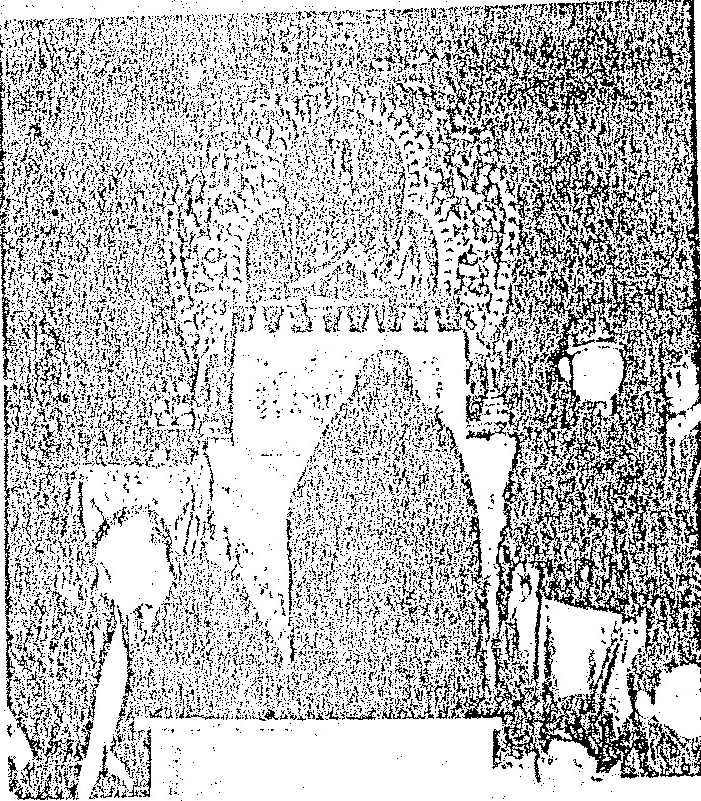
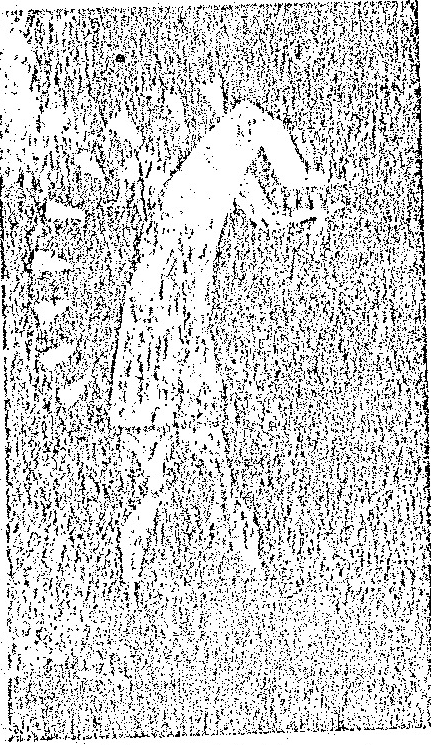
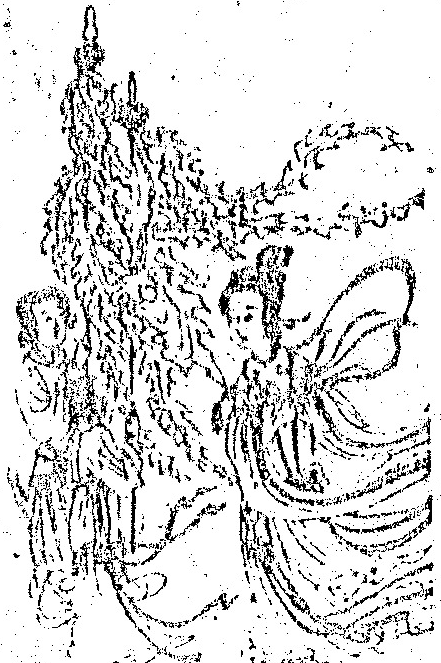
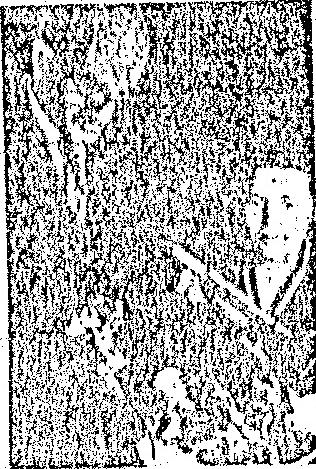
In recent decades, many people have become aware that the human body can emit incredible radiant energy, and this energy is called an “aura.” Soviet technician Kirlian designed a device that proved the existence of auras through photography, and previously, others had also designed special devices to prove this extraordinary energy. In fact, this was not discovered by modern people; there have been legends about this since very early antiquity. For example, Indian legends contain many accounts stating that the back of a god’s head emits a very bright light. Some Christians also say that behind angels and saints there are circular auras of light. The Chinese painted celestial maidens flying in the sky, using their trailing garments to represent this light. The Japanese painted flame-like red light behind gods and buddhas to express the aura. In the murals painted by Native Americans, auras were also drawn behind holy figures. That is to say, there have been legends and numerous illustrations of auras since ancient times. Ancient Indians believed that this aura was the radiance of energy emitted from the human body, but modern discoverers of auras suggest that it is a light that can be represented as “bioenergy” or an “unknown substance.” Regardless, the shared understanding of auras between ancients and moderns is that it is some kind of energy emitted from a living body. Modern research on auras is becoming increasingly active, and it can generally be divided into the following two major categories: The first is the method of using scientific instruments in tandem with the development of modern science and technology, in Soviet scientist Kirlian in the figure above, the flame-like part behind the Buddha statue is a representation of the aura. Besides this direct representation, there is also the representational method of a celestial maiden wearing long robes, as shown in the bottom-right figure, as well as the method used by the American Indians in the bottom-left figure, where radiating light is drawn around their figures to represent the aura.
…after this type of machine, research in this field developed even more vigorously. In fact, the history of this type of machine was already being designed by someone in an earlier era. For example, a device invented by the Yugoslav scientist Nikola Tesla at the end of the nineteenth century can be said to be the prototype of this type of machine, capable of emitting aura-like radiance from various parts of the human body. By 1909, a French physiologist created an almost identical device and used his own device to photograph his own aura. In 1939, two Czech scientists designed a device called an ‘electric potential recorder,’ and used this device to photograph leaves with auras. Coincidentally, Kirlian designed his own device in this same year. At the hospital where he worked, he saw that electrodes radiating from the skin of a patient undergoing treatment could emit high-frequency discharges, so he thought that if photographic film were placed there, it might be exposed to light; this was the motivation for designing this device. Kirlian was originally a radiology technician, so he had considerable expertise in photography. His method can be simply explained in the following sentences: ‘From the subject being photographed, he directly moves the electric charge to the photographic plate… in this way, the charged physical properties of the photographed subject can be converted into certain electrical characteristics; this is the method.’ By the 1960s, the number of people in the world researching psychic abilities had increased significantly, and they were very interested in improving this type of machine. On the other hand, scientific investigation into auras was also underway, among which the method adopted by the British physician Dr. W. J. Kilner was relatively famous. This method can be compared to Kirlian’s method, but it is more traditional, emphasizing the development of our vision—in other words, enhancing the ability to observe auras—rather than being limited to the use of ‘Kilner goggles’. These goggles are made of dyed with plant dyes, and is an eyepiece for viewing auras
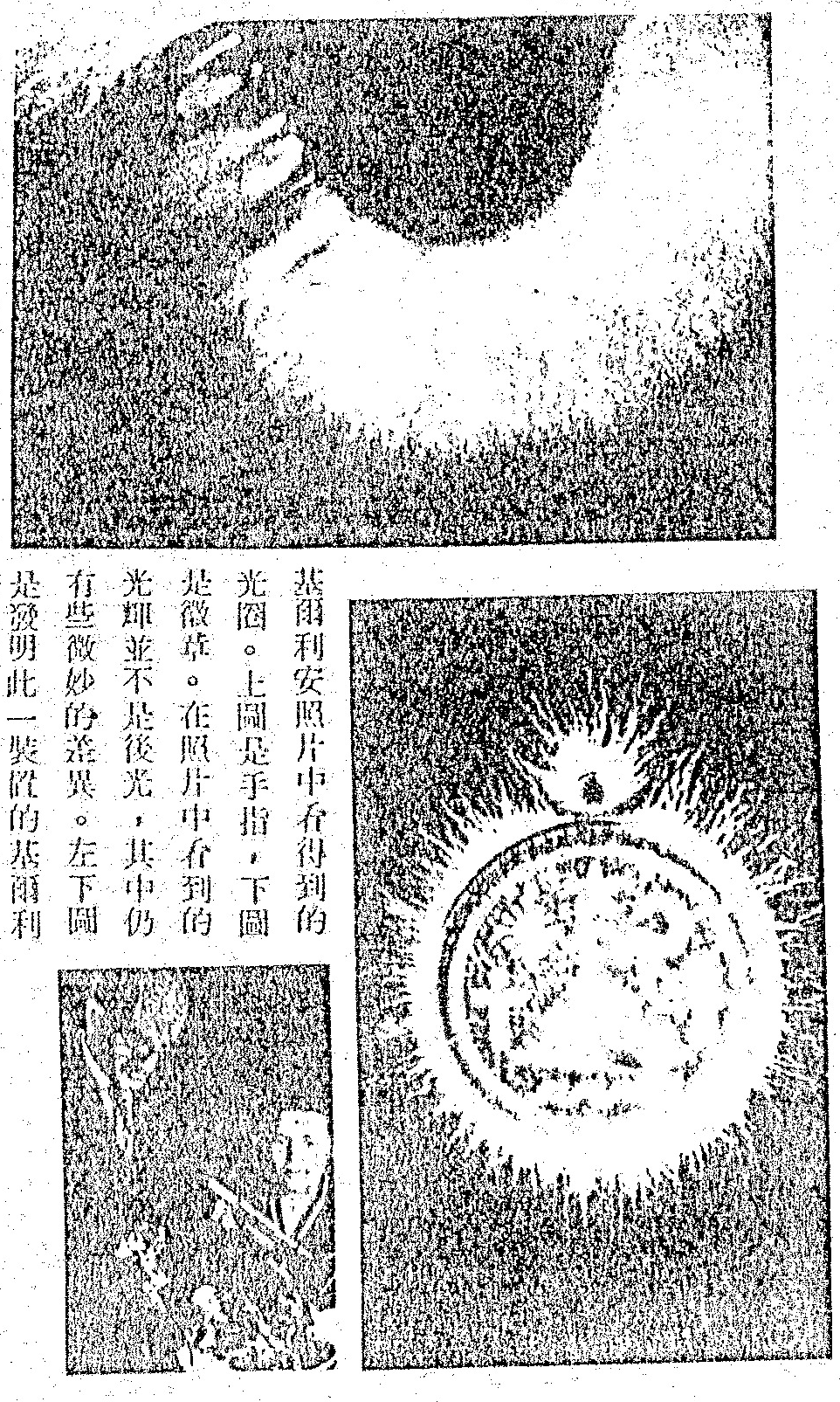
Halo of light visible in Kirlian photographs. The top image is a finger, and the bottom image is a small plant. The luminous rings seen in the photographs are not auras; there are still some subtle differences between them. The bottom-left image is a schematic diagram illustrating this Kirlian device.
Halo of light visible in Kirlian photographs. The top image is a finger, and the bottom image is a small plant. The luminous rings seen in the photographs are not auras; there are still some subtle differences between them. The bottom-left image is of the Kirlian couple, the inventors of this device.
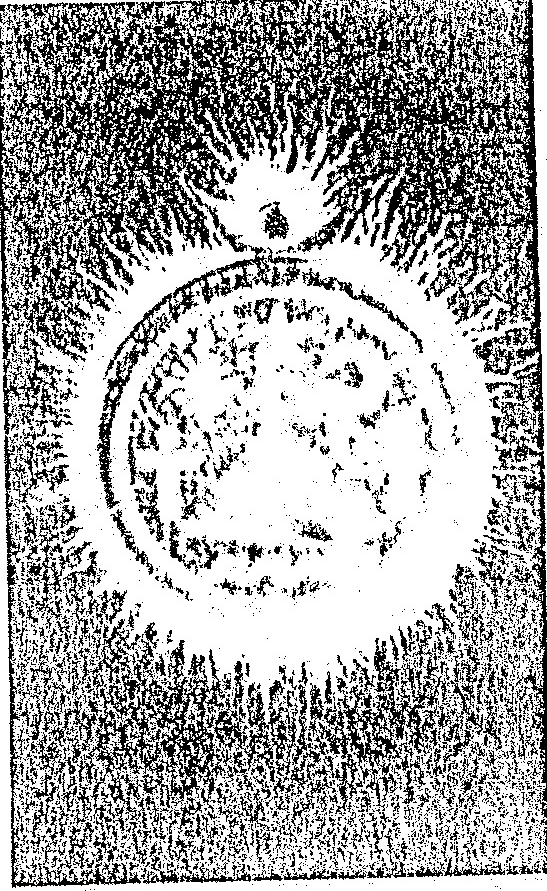
A circular emblem featuring a radiant burst pattern in the center, surrounded by a ring of text with the word ‘DORJE’ visible at the bottom.
Dr. Kilner published his research findings in this field in 1911. Originally, this device was conceived for treating patients, so the methods employed were relatively scientific. Although outwardly similar to the practices of occultists or psychics, the underlying principles were firmly based on a scientific perspective. He himself could observe the auras of about sixty people; prior to this, he had not really believed in the existence of auras. Unfortunately, while the doctor was actively developing his research in this area, he suddenly passed away. British physiologist Oscar Dagnall inherited his research work. After meticulous experiments, theoretical proof was finally obtained. For example, the theoretical proof of the effectiveness of Kilner goggles was completed by Dagnall. Using such goggles does not immediately enable one to see auras; one must undergo a period of professional training before being able to discern the subtle radiance with the naked eye. In other words, Kilner goggles require the human eyes to be trained so that they acquire certain characteristics before one can see auras. These goggles are merely tools used to develop this characteristic of the eyes. The same applies to Kirlian’s device; in other words, one cannot directly see auras just by using this device. Kirlian once explained that the energy of the aura itself can be amplified or modulated using a high-frequency electric field merely to make it visible to us. Whenever Kirlian photographs are mentioned, it immediately brings to mind the subject of auras. Dr. Hideo Uchida, who has extensive expertise in aura research in Japan, once said: “From scientific experiments on auras, we can understand that an electrically amplified aura is different from the original, natural aura.”
How Aura Colors and Shapes Reveal Hidden Information
From the opinions of these researchers, it can be seen that although there is a certain degree of understanding through scientific methods, there are still many unknown areas regarding its actual state.
Regarding the aura, there are differences in size depending on the person, and even the same person will constantly change its shape. Ancient Indian texts and the science of breathing record the shape of the aura as follows: the length of the aura emitted from the surface is 10 fingers long during normal breathing, 24 fingers long when walking, 42 fingers long when running, 42 fingers long during sexual intercourse, and 100 fingers long during sleep. When a person can overcome desires or gain a certain spiritual power, its length changes accordingly. It should be noted that the 1 finger length mentioned here does not refer to the vertical length, but the horizontal length.
The aura changes its shape, and those who can fully observe the aura always perceive it in a state divided into several layers. Regarding this point, Dr. Kilner has the following opinion.
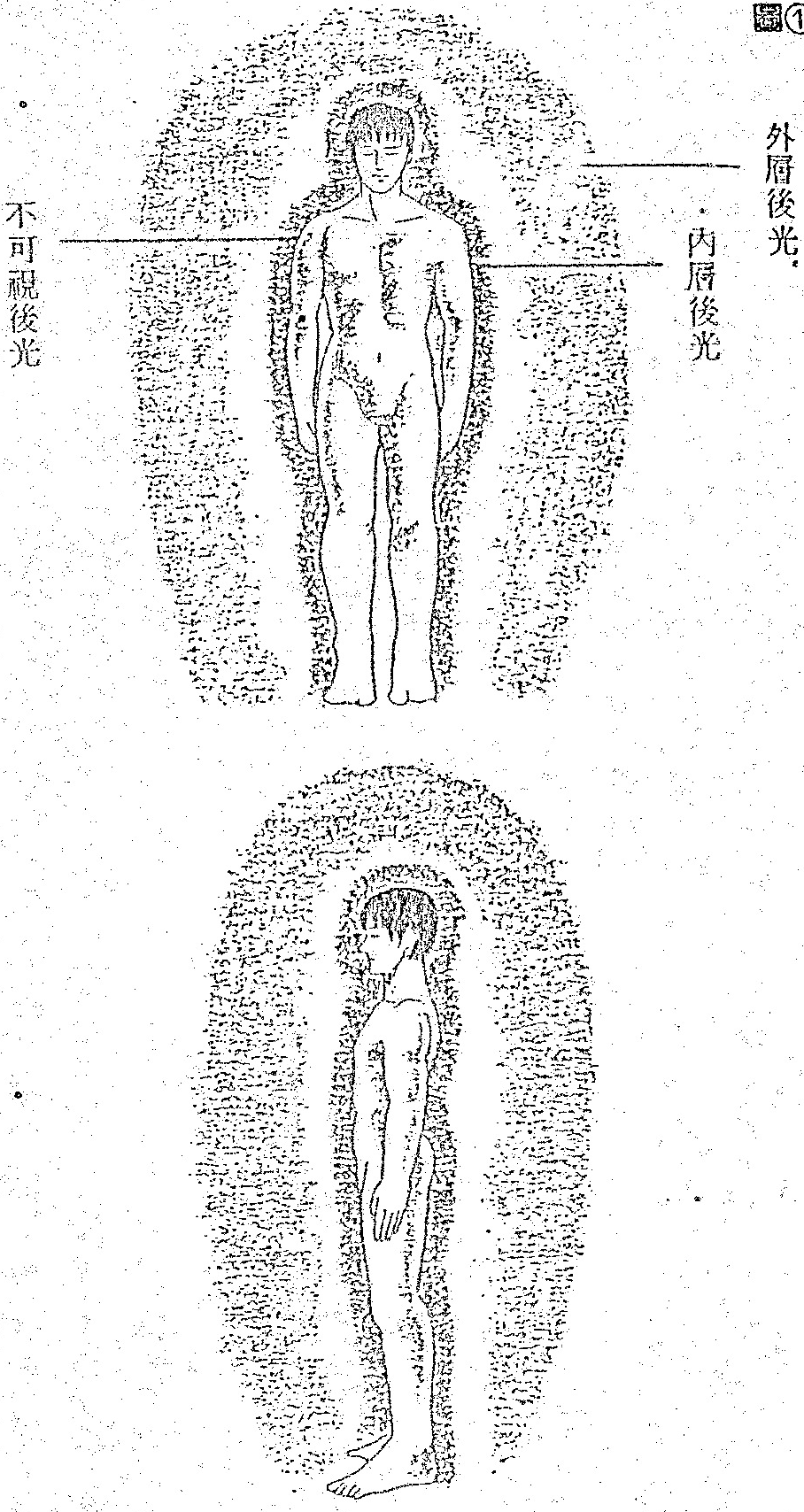
The layer adjacent to the physical body is called the ‘inner aura’, which expands from the body’s surface to a range of 12, 13 centimeters away. On the outside of this is an outer aura, expanding to a range of about 30 centimeters away from the body’s surface. The distance from the body’s surface mentioned here is only a standard value; if the power is strong, such as a person with high spiritual power, their range is naturally larger, and some can reach distances of several meters or tens of meters (see page 31, Figure ①).
In addition to the aforementioned inner and outer aura layers, there is also a “dark space” existing in a minute range of approximately 0.28 millimeters between the inner aura layer and the body surface, which is the domain of “invisible light.” The shape of this domain is roughly the same as the outline of the body, and at first glance, it gives the feeling that the inner and outer aura layers emanate from this domain. Some people have a larger layer of outer aura, and there is no very clear boundary.
The above situation is an issue regarding the aura layers reported by Dr. Kilner. In this regard, Indian and Western occultists have also made more detailed reports; they believe there are two types of auras. One is the aura of the upper astral body, and the other is the aura of the spirit. Among them, the aura of the upper astral body corresponds to the aura mentioned by Dr. Kilner and can be divided into three parts: the innermost (12-13 centimeters), the outer (about 30 centimeters), and the dark space (0.28 millimeters). They also believe that the human body absorbs cosmic energy, and after the cells are activated, the remaining part is radiated as the upper astral body.
By the way, here are some reference points. The upper astral body is called “Ka” in Egypt, “Doppelgänger” in Germany, “Périsprit” in France, “Linga Sharira” in India, and “living qi body” or “star qi body” in Japan. If it is said to be the body utilized when temporarily separating from the physical body, then it is easy to understand.
On the other hand, the aura of the spirit is the aura emitted from the spiritual body related to human emotions, and it is also the aura emitted from the mental body related to intellect. Moreover, around the astral body, even people who do not practice cultivation exhibit the phenomenon of this aura of the spirit.
It is those with highly developed spiritual abilities whose aura can extend from several meters to several kilometers; the aura of Shakyamuni’s spirit is said to extend three kilometers or…
①
The way the aura surrounds the human body is like a cocoon enveloping a silkworm pupa, and the aforementioned book series by Carlos Castaneda contains the same explanation. The problem is that this kind of spiritual aura does not seem easy for just anyone to see, and those engaged in scientific research rarely publish their experiences in this area.
Regardless, there are still many unknown aspects regarding the layers of the aura; the expansion ranges of the various layers explained earlier are merely provided as standards.
The aura is not just seen in terms of how many layers there are; the colors seen also vary from person to person. For example, passionate people are often seen with bright red, profoundly thoughtful people with dark blue, and those with healing abilities with green.
These properties of the aura change alongside changes in a person’s mind and physical state; in other words, it can reveal a person’s hidden information.
For instance, if a person’s aura is unusually narrow on one side, there is a physical disease on that side or an impending illness. If the color of the aura turns dark or murky, or mixes with gray, this indicates a mental or physical abnormality.
The famous psychic Edgar Cayce once used auras to diagnose illnesses, and he provided the following report:
“When a friend of mine was young, his aura could only be seen in blue tones, but later on, a dark red aura was frequently seen. Roughly from this time, he suffered from neurasthenia due to overwork. Cayce paid close attention to this situation, and later saw a gray aura appear; by this time, that friend had already fallen ill. Therefore, he went to see a doctor to treat the disease, and after several years of treatment”
The Aura Polluted by Modern Civilization
the disease was finally cured. Interestingly, as his body recovered, the gray disappeared, first turning to red, and finally returning to the original blue. This situation is indeed fascinating, because as the illness was cured, the red-spectrum aura no longer appeared.
Metaphysicians believe that the aura appears not only on the surface level of a person’s character, constitution, and state of health, but even the depth of one’s spirituality, supernatural obstacles, and certain aspects of one’s destiny are all reflected in the aura. This is the reason why religious practitioners in India and Tibet devote themselves earnestly to spiritual practice and develop the ability to observe auras. Those who can see auras will not be deceived by the complex modern world, because they can perceive what the person before them hides in their heart—all of which is reflected in the aura. The mysterious methods of utilizing auras developed alongside the cultivation of aura-reading abilities. For a long time, this had been the exclusive domain of metaphysicians, but by the early twentieth century, after British physician Dr. W. J. Kilner conducted in-depth research in this field, it was no longer the exclusive possession of a select few. This doctor discovered the aura quite by chance in clinical medicine, and from then on he focused his attention on research, discovering many issues related to auras. Among these, the most valuable was a technique that enabled ordinary people to see auras as well. When the author teaches ordinary people to develop aura vision, he generally draws upon this doctor’s method, because the doctor’s approach is easier to learn than the method of metaphysicians, who develop the ability naturally through spiritual practice.
And the effect was also quite good.
Dr. Kilner also raised an important question regarding the aura, which is that modern people are experiencing an increasing number of aura abnormalities. When his research was conducted in the early twentieth century, there were already many people with abnormal auras. Many metaphysicians share the same view regarding this situation. Specifically, during the hundred years from the nineteenth to the twentieth century, the number of people with abnormal auras increased significantly. They believe this is the result of the unnatural living environments brought about by material civilization and humanity’s boundless greed.
In the early twentieth century, the world was filled with an idyllic charm, yet auras were already polluted; therefore, upon reaching the modern era of industrialization, the pollution has become even more severe.
Developing the Mystic Eye and an Environment for Observing the Aura
In the polluted air, the high-rise buildings in Tokyo can be dimly seen. Due to the impact of polluted living environments, there is an increasing number of people with abnormal auras.
Psychics state that modern people have very weak religious faith, making them more susceptible to spiritual hindrances than people in ancient times; all of this can be accurately seen from the aura.
Modern people are subject to various modern conditions; therefore, the explanation of clairvoyance in this chapter also takes these various modern conditions into consideration. However, the correction methods will be explained in Chapter 3.
Normally, training is required to see auras. Technically, one can refer to Kilner’s method, or to the Sen-dao (Taoist cultivation) practiced by the author; in this way, the ability to observe auras can be developed in a natural state. In other words, the author observed the methods for developing aura vision through personal experience, and applies them in combination with pre-existing developmental methods.
The author has previously taught some people to see auras. Based on that experience, several stages were established. By training according to these stages, anyone—whether naturally gifted or not—can develop the ability to observe auras. Of course, fast learners can skip certain details and move on to subsequent training, but fundamentally, they must still follow the sequence of each stage. The current training is for beginners learning to observe auras. To ensure easy success, preparatory work is also necessary, and here we will first explain the arrangement of an appropriate environment.
This appropriate environment is generally divided into two types: ① environments where it is easy to see auras, and ② time bands where it is easy to see auras.
Here they are explained in order.
Environments conducive to seeing the aura
Generally speaking, the aura is outside the range of visible light and, due to its subtle energetic radiance, is very difficult to see in an ordinary environment, except for those with good innate qualities and those who have undergone long-term training in practices to observe the aura. Therefore, it is better for those trying to see an aura for the first time to arrange or select an appropriate environment.
The ideal environment for observing the aura is a room completely free of objects. Because if there are objects present, even if an aura is seen, it can easily overlap with the existing objects. The aura might also blend with the shadows of the objects, making it unclear or invisible. For example, if there is a lot of furniture placed in the room, you should first move this furniture to another room, leaving this room completely empty with only the four walls.
Even if there is not a single object in the room, it is still unacceptable to have colorful, patterned wallpaper on the walls. It is best to remove this wallpaper and repaint the walls white, or replace it with plain white or light-colored wallpaper. If this cannot be done, you will have to buy large sheets of white poster paper and paste them on all four walls.
By arranging the environment in this way first, viewing the aura will not be made unclear by the influence of other objects.
Time periods conducive to seeing the aura
The time period for viewing the aura refers to the external lighting conditions. If the room’s environment and conditions are both appropriate, that would be ideal; however, rooms with such excellent conditions are very rare, so ordinary people still need to choose an appropriate time period.
Generally speaking, the most suitable time period to see auras is at dawn or dusk, in other words, the time between the realms of day and night. At this time, our eyes are shifting from one lighting state to another, resulting in a somewhat unclear state; therefore, subtle details normally unnoticed will register visually. The brightness at such moments is different from broad daylight; for example, one cannot clearly see the face of a person standing at a doorway gazing into the distance.
During such time periods, not only auras, but also things ordinarily invisible can be seen. For example, the type of energy reported by Dr. William Reiby requires the use of such time periods to be seen clearly; according to the author’s experience, it looks very much like a swarm of fireflies seen in a dimly lit sky.
Next to this time period is nighttime, but beginners will actually find it harder to see in a completely dark environment, so it is better to practice after creating a dimly lit environment using a small lightbulb. In other words, extremely bright or dark environments will cause our eyes to exert their normal functions and eliminate ambiguous things, which makes them relatively unsuitable for beginners practicing to see auras.
In short, if one can artificially arrange lighting conditions identical to the aforementioned time periods, one can practice seeing auras at any time. For instance, during the day, simply drawing the curtains to make the room dimly lit is sufficient. In practice, however, an artificially arranged environment still differs somewhat from a natural one, because that specific atmosphere naturally arises at dawn or dusk, whereas it can never be formed during the day.
From the perspective of Xian Dao, daytime is when yang qi is strong and all things are active, and the mind easily focuses outward, but at dawn and
Basic Training for Seeing Auras
Dusk is a time when yin qi increases, the vitality of all things decreases, and consciousness easily turns inward, which is why it is suitable for this type of training. All these factors are closely related to the development of seeing auras (i.e., when one needs to concentrate mentally), so it is ideal for beginners in particular to choose dawn or dusk to learn.
This can be divided into several steps based on an individual’s aptitude. For instance, a person with good aptitude can see auras simply by practicing the following step (1), allowing them to further practice the next stage, ‘directly gazing at the aura of the entire body.’ If one still cannot see auras after practicing step (1), they should practice step (2). If they still cannot see them, they should practice step (3).
Step (1) Direct Gazing Method
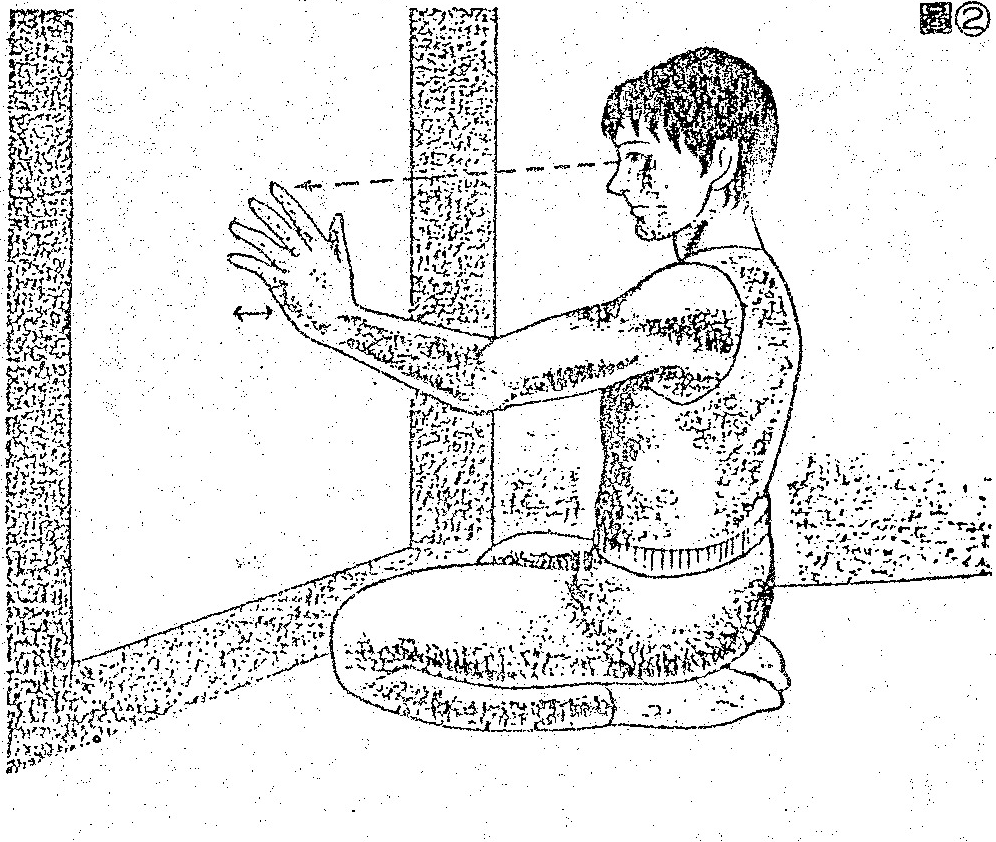
①This is the simplest method. First, raise your hand in front of a wall (preferably a plain white wall), keep it a few centimeters away, spread your five fingers, and look at the tips of each finger (as shown in Figure (2)). At this time, do not be anxious to see the aura; rather than staring intensely, simply look with a slightly relaxed, hazy feeling.
②
(As shown in Figure ②, when one practices to a certain level, the fingertips will emit a fog-like substance similar to white qi. The entire hand can be seen as if surrounded by a fog-like radiance.
③ If you only see a faint, aura-like object at the tips of your fingers, but do not see anything further, or if you still cannot see anything after a while, you must focus your consciousness on the tips of your fingers to observe.
The author has already undergone training, so when doing the above method, the aura can be seen immediately. It is a sharp, thread-like object emitting from the fingertips, and it extends to a considerable length. If you look carefully, it can also be seen under sunlight or fluorescent light; it is a thread-like object with a black outline. However, for those who have no experience concentrating qi, generally speaking, they will not see it so clearly. Being able to see a faint, foggy sensation is already quite good.
Step (2) Complementary Color Method
Those who practice only the method in Step (1) and cannot see anything need to train using the Complementary Color Method in Step (2).
①First prepare various colors of B 4 size (about 26×37 cm) drawing paper; it is not yet known which color will produce the best reaction for your eyes. Using various colors of fabric is also fine; it does not necessarily have to be drawing paper. The key point is that it should be a solid color without any patterns. ▲Notes ── The lighting condition should be slightly brighter than the aforementioned conditions, making it easy to distinguish colors. What the author felt during practice is that step (1) needs to be trained in a dimly lit environment, but step (2) must be trained under slightly bright fluorescent lighting. Fluorescent light that is too strong will feel glaring to the eyes and is instead detrimental, but those with considerable cultivation are naturally not subject to this limit.
②First divide the various colors of drawing paper into a dark color system (black, blue, dark green, etc.) and a light color system (white, yellow, red, etc.), and there should be a complementary color contrast pairing, for example black against white, red against green, yellow against blue, etc., but there is no need to strictly follow the color contrasts stated in color theory. If you look at the colors yourself and have an opposite feeling, then pair the contrast of the colored drawing paper according to this feeling.
The author has also changed various color pairings to study under which pairing it is easier to see the aura. During this aura training, the author felt that the color contrast that makes it easy to see the aura varies from person to person. Some people react when pairing red and green, while others must be in a yellow-green and red pairing to react. Therefore, readers can arrange several color pairings to try out, so that they can know which pairing is most suitable for themselves (in other words, which makes it easy to see the aura).
③ Place the various color-contrast pairings on the table, choose one set, and, as described above, raise your hand and hold it a few—
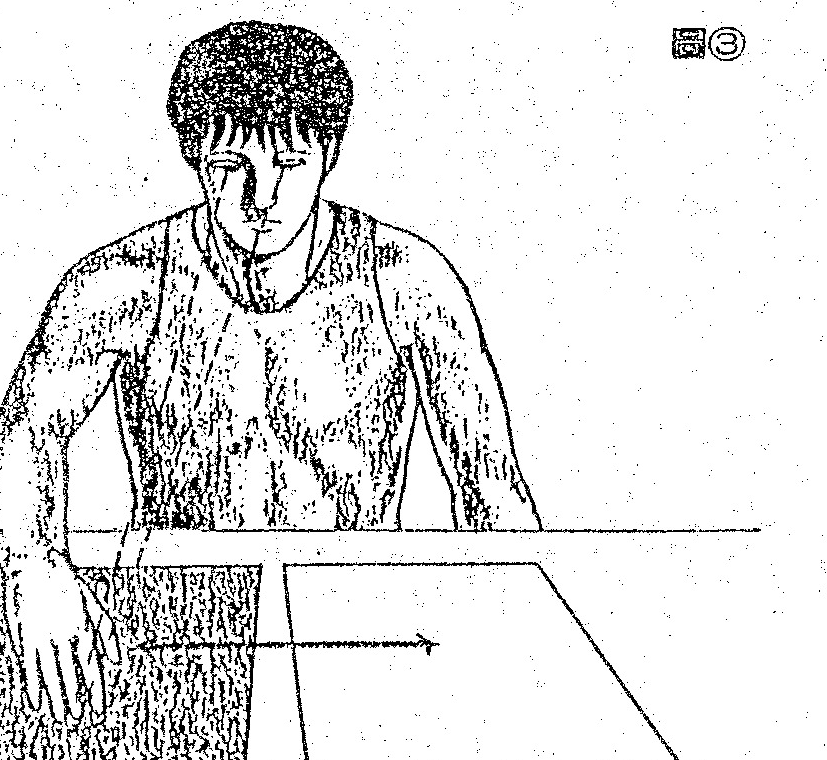
Figure 3
—centimeters away from the colored paper and observe. In other words, move back and forth between these two colored papers. When the back-and-forth movement speed is too fast, even if you see the aura you will not sense it, so it is better to move at a slower speed. Of course, the eyes should focus on the fingertips (as shown in Figure 3). ▲ Precautions — Be mindful of the shadow of your hand. If there is a shadow from the lighting positioned further ahead of the raised fingertips, even if you see the aura it will easily overlap with the shadow, resulting in mutual cancellation so that nothing can be seen. Therefore, the shadow of the finger must be kept at a considerable distance from the fingertips, which requires adjusting the positions of the hand and the lighting. ④ Observe all of the above precautions, and practice each set of colored paper combinations for three to four minutes. After roughly fifteen to twenty minutes in total, rest for five to ten minutes. You may also train only one set per day.
By practicing in this way, you will know which group is most likely to see the aura. In future practice, choose this group to train the complementary color method, and it will be easy to see a clear aura. When the author taught the above techniques to people practicing immortal cultivation, there were some who still could not see the aura even if they only practiced step (1). However, after practicing step (2) again, everyone was able to see the aura. According to my feeling, after training just once, over ninety percent of people can see the aura. This kind of aura is a misty substance emitted from the fingers, and it expands to a degree of a few millimeters to a few centimeters. Of course, the author has practiced qigong methods for many years, so the aura that can be seen surpasses the distance of a B 4-sized drawing paper. At the same time, the shape is not misty, but is like the intense ray of light mentioned in step (1). Interestingly, those who initially could only see an aura of a few millimeters gradually become able to see it clearly after multiple practice sessions. If they continue practicing for a few hours, they can also see external auras or auras emitted by plants. In particular, those with naturally good aptitude can quickly see all auras once they start practicing, feeling as if they are seeing an ordinary scene. Here I will give an example to explain as follows: the development method. At the time, I felt these people lacked good aptitude, so right from the start I used the aforementioned complementary color method to practice.
Shortly after starting, a few of them excitedly shouted, ‘I can see it!’ The author intentionally asked them what exactly they saw. They replied that they could see a hazy, mist-like substance around their fingers, while others said it was something resembling a radiance overlapping with their fingers. Therefore, I asked them to use their other hand to draw the shapes they saw, and the results were exactly the same as what the author saw. Then I asked these individuals to look at the aura emitted from the tips of the author’s fingers. They all shouted in astonishment, saying that this aura was not only very clear but also stretched over a long distance. However, aside from these few, most people still could not see the aura and wore disappointed expressions. I said to everyone: ‘Look closely at my hands.’ Then, using conscious intent, I alternately strengthened and weakened the aura emitted from my hands. After observing this for a while, those who had been disappointed also began to understand and revealed smiles. Among them was a team member named Okasaka, who asked, ‘Why can I see it so clearly?’ I then asked him what he was seeing, and he replied that not only could he clearly see the aura emitted from everyone’s hands, but he could now also see the aura emanating from their bodies. His reply surprised me, so I asked him, ‘Have you ever received this kind of training before?’ ‘No, today is my first time.’ This impressed me deeply, as achieving such results on the first day of training is quite remarkable; one could say he possessed an innate good aptitude. To test his ability, I turned off all the lights, had him observe the auras of several team members, and told him to draw the shapes he saw on paper with his other hand. He drew not only the inner and outer auras but also the ‘derivative auras’ emitted from various parts of the body, and he did so very accurately. From this, it was evident that what he had just said was not an exaggeration at all. Okasaka indeed had excellent aptitude. Later, when I taught him to practice the ‘Small Heavenly Circuit,’ he learned much faster than the average person, and he was highly responsive to all the
Strengthening the Aura and Developing Vision with Instruments
kinds of light imagery could be coordinated. Later, I had him write a report, which I found very interesting, so I have specifically included this report in Chapter 2, “Development of Internal Light,” of this book for readers’ reference.
Step (3) Aura Strengthening Method
Those who still cannot see the aura after using the aforementioned complementary color method can use this method. This method strengthens one’s own bioenergy, enabling the emission of a stronger aura so that it is easier to see. It can also be described as a development method for aura viewing that fully utilizes the clairvoyant ability of qi power. Those who practice steps (1) and (2) and can see the aura to a certain extent can also apply this method, as doing so will definitely allow them to see a clearer aura.
◎ A simple method—The simplest among the aura strengthening methods is the method of warming the hands. For example, you can warm your hands by placing them at an appropriate distance from an electric heater, or you can soak your hands in warm water for about fifteen minutes. If doing this is still not enough, then soak your whole body in a bathtub of hot water to warm your hands and body together. Another method is to do light exercises to warm the body; the key point is simply to quickly increase the energy radiated from the body and hands. However, when warming the body by soaking in hot water in a bathtub or doing full-body exercises, be careful not to overdo it, otherwise, although qi becomes very vigorous, the mind will also become tense, making it difficult to concentrate on observing the aura. ◎ Orthodox Method | The above is a simple method, but if you frequently rely on this method, you will not progress quickly. You must cultivate your qi power from within yourself; otherwise, you will only barely be able to see the aura and will be unable to master super-vision. If you wish to project an enhanced aura according to the orthodox method, the procedure is as follows. First, relax both your mind and body. After taking several deep breaths, take another deep breath, hold it, exert force on your lower abdomen, and concentrate your consciousness on the fingertips from which you want to emit the aura (about 2 or 3 fingers). At this time, even if you are intensely focusing your consciousness, you should not stare; otherwise, your mind will become tense and you will instead be unable to see the aura. Those who have studied yoga or other immortal arts breathing methods can first practice those breathing methods for twenty to thirty minutes, and then learn according to the method in this book; doing so makes it easy to obtain an enhanced aura. It is best for those who have practiced the immortal way (internal qigong) and qigong methods (external qigong), because with the foundation of these skills, it is very easy to emit an enhanced aura anytime and anywhere. For detailed explanations in this regard, please see the author’s other three previously published books. In any case, these methods can all bring about a temporary surge in your own bio-energy, thus allowing you to use the methods in step (1) or (2) to observe the aura radiating from your hands.
Step (4) Aura Glasses
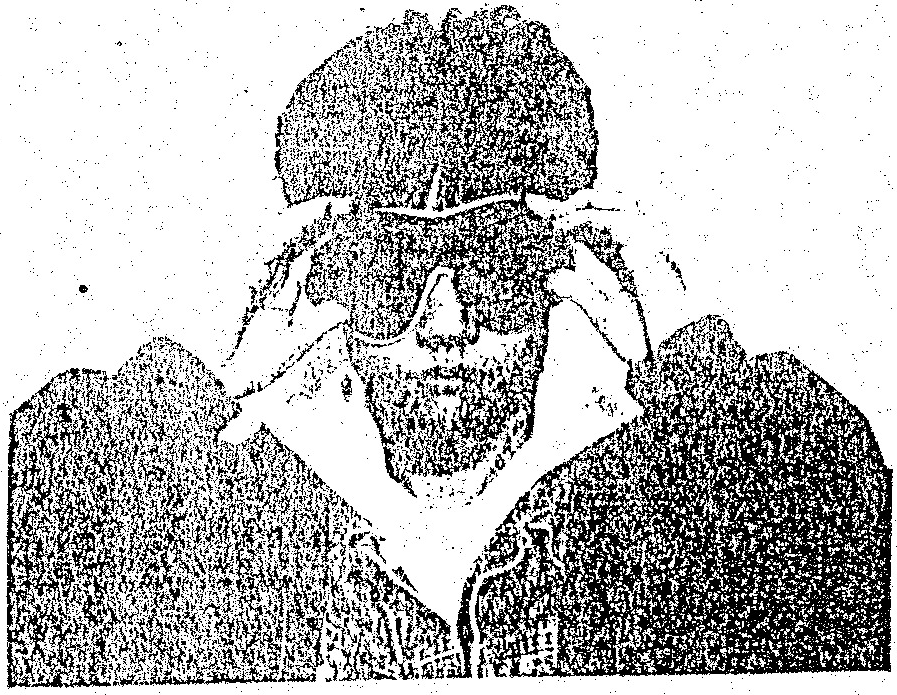
If you still cannot see the aura using steps (1) ? (3), then you have no choice but to practice using an aura development device. Some people adopt this method right from the start, but according to the author’s teaching experience, it is still best to practice step (1) first, and then follow the sequence in this book; this is the orthodox method, and it can achieve the same effects as utilizing this device. The device mentioned here was first designed by Dr. Kilner of the United Kingdom, but was later improved by Oscar Bagnall. The devices currently sold on the market can be described as windproof goggles exclusively for seeing the aura (◎◎◎◎). Ordinary devices do not allow the aura to be seen directly; rather, using this device during aura-viewing training simply makes the aura easier to see. Here is a brief explanation of the theory behind these aura-viewing goggles for your reference. According to the theories of physiologists, there are visual cells on the retina, and these cells consist of two types: cones and rods. Among them, the cones are concentrated in the central part of the retina, and their main function is to recognize the shapes and colors of objects under strong light, while the rods s are located in the peripheral part of the retina, and their main function is to discern light and dark in dark spaces or under dim light such as at night. According to Oscar Bagnall’s view, seeing a complete aura requires both cones and rods, so stimulating the rods allows one to clearly see the aura. Based on his experiments, aura-viewing development devices should be highly effective for training in this regard. The device designed by the aforementioned Dr. Kilner uses a blue dye (Oxydim) placed between two glass panes on the exterior of wind goggles, and its optical properties are exactly the opposite of those of the human eye. To put it simply, the part of the light domain opposite to the light seen by ordinary people is the part most easily seen using these goggles. This light domain is the area most closely related to the aura (according to research findings, this relates to the two extremes of infrared and ultraviolet light). Kilner’s aura goggles used blue-based dyes, but the aura goggles improved by Bagnall use red-purple-based dyes, which are said to be more effective than blue-based dyes. The author has previously used aura-viewing goggles and glasses produced by the Bonax Helian Company, both of which yielded excellent results in enabling the aura to be seen. For those who have studied qigong methods or undergone training to see auras with the naked eye, when using such aura-viewing devices for training, roughly over ninety percent of people can see auras on the very same day. Even for those without any prior training, as long as they use these glasses, roughly sixty to seventy percent of people can see auras on the same day. Using aura-viewing goggles causes less eye fatigue than using aura glasses. Aura glasses require triethanolamine, a solvent for red-purple-based dyes, as well as two glass plates large enough to cover both eyes, among other components
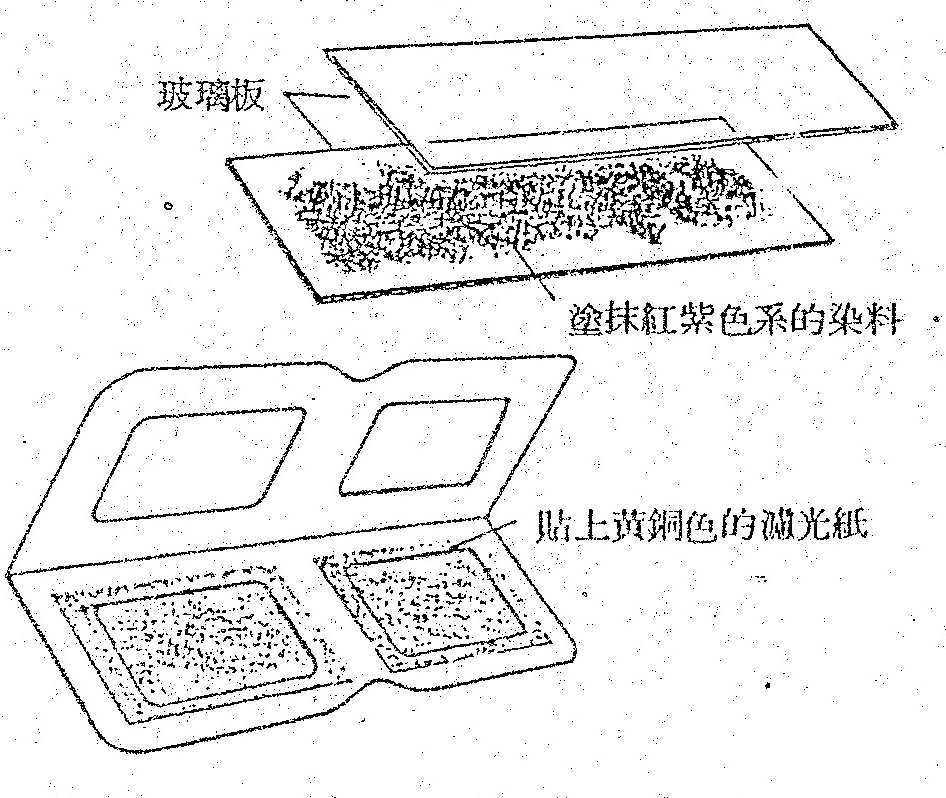
Figure 4
You can make it yourself from the raw materials. Its manufacturing method is very simple: just sandwich the dissolved dye between two glass plates, as described in the figure above. You can also use a filter to make it (as shown in Figure 4). The above is an explanation of this device, and its usage is as follows.
◎ How to use the aura-viewing development device—When using this device, you must select the appropriate environment and time. The items to prepare are a B4-size (26×37 cm) sheet of white drawing paper (the white drawing paper previously pasted on the wall for practicing extra-vision abilities can be used) and a light bulb.
① First, look at the light of the light bulb through the aura glasses for about a minute, then take off the glasses and switch to looking at the white drawing paper. You will then perceive the white drawing paper as having a yellow-green tint, which is due to the single-color afterimage phenomenon. This yellow-green sensation will quickly disappear, but with repeated practice, the duration of the yellow-green visual perception will become longer and longer. Therefore, you must practice several times to be able to maintain
Aura-Viewing Training Method (1)
this yellow-green visual sensation for several seconds. However, if you practice for several hours at once, your eyes will become unbearably fatigued; honestly, the ideal is to practice just fifteen or thirty minutes a day.
② Only after you can maintain such color afterimages for several seconds should you look at auras according to the methods in steps (1) and (2). Then auras that were previously invisible or unclear can now be seen distinctly. If you also use step (3), almost anyone will be able to see the aura of their own hands. Only upon reaching this level can you practice the section on seeing the full-body aura.
Once you can see the aura of your own hands, the next step is to train to observe the aura emitted by your entire body; you can also see the auras emitted by others, and ultimately, through training, you can see the auras emitted by all things. Various techniques in this regard are introduced here, allowing readers to practice according to the sequence in this book.
Technique (1) Full-Body Aura
① To observe the aura radiating from the entire body, first prepare a mirror that can reflect your whole body. When beginning practice, it is not easy to see the aura if you are wearing clothes, so naturally you should take off your clothes. However, you do not necessarily have to be completely naked. For example, you can also practice by just removing your top or by only wearing underwear.
Although you are meant to view the aura, at this stage do not stare fixedly. Instead, look at your full-body reflection in the mirror with a somewhat hazy feeling.
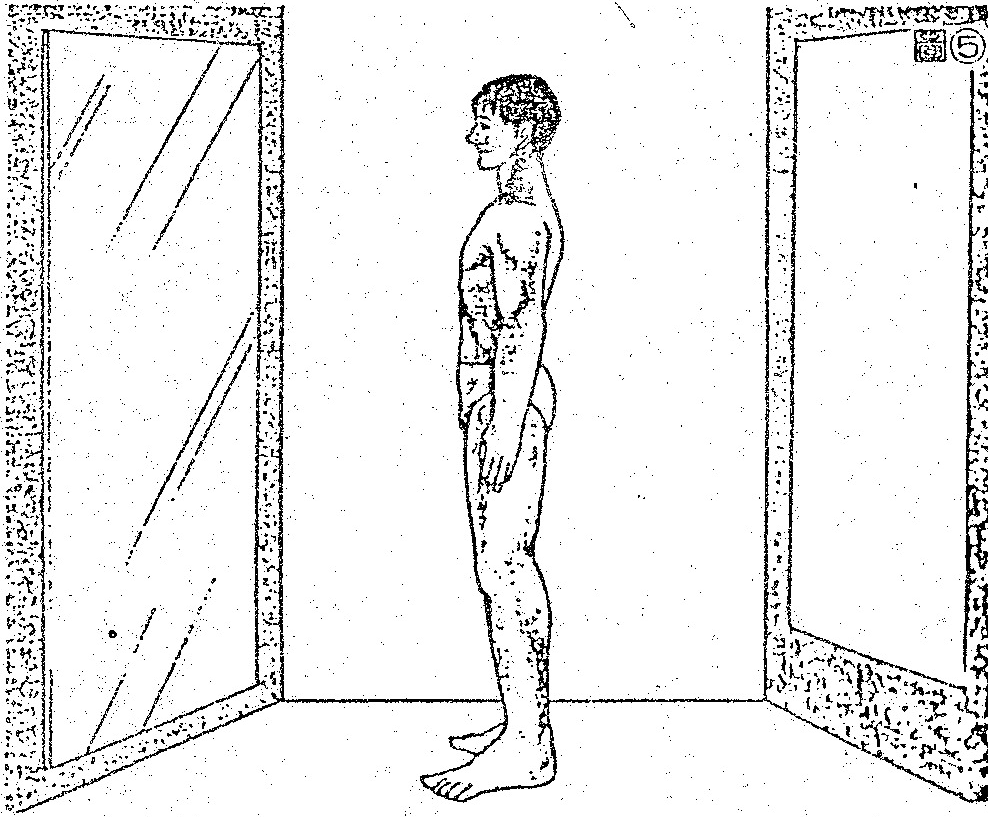
Figure 5
For those who, using the colored drawing paper method described above, have already determined the aura color they see most easily: paste drawing paper of that color (it should be quite large) on the wall behind you, so that when you look in the mirror, the colored drawing paper is directly behind you (as shown in Figure ⑤).
② For those who still cannot see the aura even with this colored drawing paper arrangement, use the aura enhancement method (qi enhancement method) from step (3) to activate your bioenergy, and you will be able to see a fairly clear aura.
③ As mentioned earlier, the aura has several layers, but when beginning practice, only observe the inner aura. Generally, this inner aura extends about twelve to thirteen centimeters from the body’s surface, though in the author’s experience it is sometimes shorter—sometimes only a few centimeters from the body’s surface. When it is this short, some people think their eyesight is poor, as if they sense of seeing one’s own image with a slight discrepancy.
Ordinary people always see it with a somewhat hazy feeling, but those with a foundation in qigong methods can see it quite clearly. It is the feeling of another slightly larger transparent layer overlapping with the body’s outer surface.
④ Regardless, once you can see the aura, you can begin practicing to see the aura while clothed. If this aura is also seen clearly, then you can begin training to see the auras of others.
Technique (2) The Aura of Others
After you are able to see your own aura, seeing the aura of others is relatively simple. You can casually choose a person to observe their aura. At this time, it is best to choose a friend with similar interests or a friend who is also practicing viewing auras, to mutually serve as subjects and observe each other’s auras. This allows for mutual assistance and is very convenient for practice.
① First, use the above steps (1)?(3) to mutually observe the aura emitted from each other’s hands. Once you can both see the aura emitted from each other’s fingers, proceed to mutually observe each other’s whole-body aura.
② At this point, first observe the aura of the other person’s head. After seeing it clearly, observe the other person’s whole-body aura from top to bottom.
▲ Points to Note
When starting practice, pay attention to lighting conditions, time slots, etc., and when observing another person’s aura, ask them to first stand in front of a wall with no objects around it. Once you can see it clearly, switch with your friend—that is, you become the subject, letting your friend practice observing. In this way, , since the backgrounds of the positions where you and your friend stand are the same, you can observe each other to see what differences there are in the auras you see. ③ Is the aura you see an illusion? Those who understand qi can use their hands, while those who do not understand qi can use the aura to measure qi for confirmation. Regarding this aspect, the author has many experiential examples, and the methods are introduced here for readers’ reference. ◎ Method for a person who understands the sensation of qi to confirm the size of the aura This is a method that utilizes the sensation of qi, allowing someone who can see auras to confirm the size of the aura. After confirming it yourself, without telling anyone, have a person who cannot see auras but well understands the sensation of qi confirm the size of the aura. If it is someone who understands both well, then first ask this person to look at the aura, then ask them to close their eyes and have them confirm the size of the aura. When confirming the size, it is sufficient to base it only on the palm part. The author once invited a friend who understood both to look at each other’s auras and measure their sizes, and the measurement results showed that the answers provided by the author and the answers provided by this friend were almost one hundred percent identical. ◎ Method for confirming aura size when using an aura measuring device A method of using an aura measuring device to confirm the size of the aura emitted from a human body. The author likes to use the aura measuring device produced by the Bonac Hiren Company. When I bought this measuring device, I carefully read its instruct
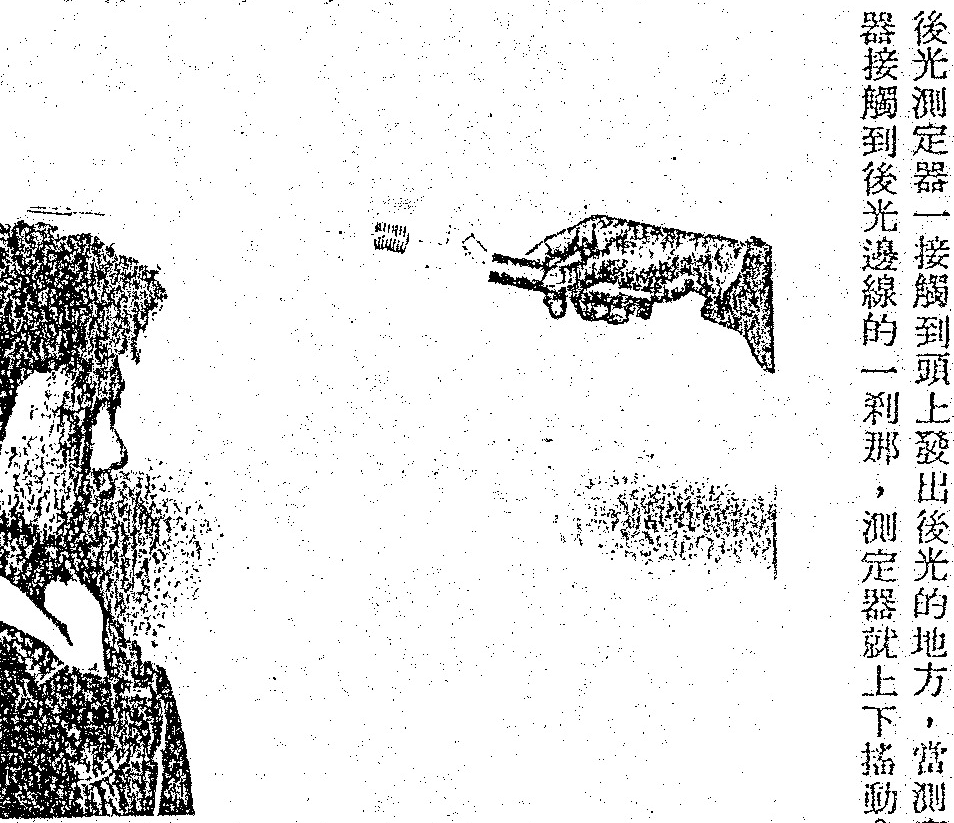
When the aura measuring instrument approaches the area above the head emitting a aura, the moment the instrument touches the edge of the aura, it swings up and down.
…manual. The manual states that for this type of measuring instrument to react to a certain degree, the user must first train for a few weeks to a few months to adapt to it. When the author, some qigong experts, and people who can see auras used this measuring instrument, they all got a very strong reaction on their first use. Regarding this point, the author once held an experimental session at K.K.C in Kanda District, Tokyo City, and the situation at that time is introduced below. The author first selected a person, had him stand, and then I brought the measuring instrument close to the area emitting a aura from his head. The moment the instrument touched the edge of the aura, it began to swing up and down. This shows that this measuring instrument is quite sensitive. I continued moving the instrument forward, and when it reached the place where the aura’s radiance was the most intense
Aura-Viewing Training Method (2)
the detector’s swinging also became rapid and lively.
The subjects I selected numbered over a dozen people, and for each person I repeatedly

used the detector to measure them, and the same situation occurred in every case. In other words, the detector’s response was strongest when the tip of the aura detector aligned with the position of the aura (its outer edge being the clearest). These measurement results were identical for all dozen-plus people; only the strength of each person’s qi differed, and consequently the behavior of the aura detector also varied. For instance, with some people the detector did not swing up and down during measurement but instead rotated rapidly, while with others there was no such rotation; rather, it swung as though being pushed outward. The aura detector was most responsive to the inner-layer aura region (proportional to the sensation of qi emitted from the body), and it was particularly the outer edge of the aura and the intensely radiant areas that caused the detector’s swinging to be most vigorous.
The author can see auras, so obtaining results was easy when using this detector for measurement. I subsequently selected seven or eight individuals who were only capable of sensing qi and had them also try the experiment with the detector; the results they obtained were in complete agreement.
These experiments demonstrate the effectiveness of this type of detector instrument. What has been described above is the method of mutual cooperation for practicing seeing auras and confirming them. Anyone who achieves satisfactory results from all of this training can proceed to the next stage: practicing seeing other people’s auras outdoors at night, and only at the very end practicing during the daytime, training to see auras (inner-layer auras) in any location.
Training to See auras (2)
Technique (3): The Layers of the aura This technique is more difficult than the method for seeing the inner aura, but it will not be very difficult for those who can already see the aura. However, for those who cannot see the aura at all, it is as difficult as ascending to heaven.
① Those who can already clearly see the inner aura should first observe the expanded, hazy area on the outer side of the aura. If it cannot be seen clearly, then you must also observe whether there is a junction point on its outer side.
② Of course, for beginners, this technique is not very simple, because the aura itself is not distinct and is not originally divided very clearly into inner and outer layers. Especially in modern society, there are many people who lack qi, and their auras are quite faint. To further divide such a faint aura into inner and outer layers for observation is indeed not easy.
③ Therefore, you must not only rely on pure visual observation, but also practice with a premonition such as “I seem to be able to see its junction point” or “I should be able to see the expansion of the outer aura.” Through such repeated practice, one day you will eventually be able to clearly see the difference between these two auras.
▲ Points to Note
According to Dr. Kilner, the auras of children, especially boys, do not have a distinction between the inner and outer layers. Also, for those who have been ill for a long time and have a weakened aura, it is similarly difficult to distinguish between the inner and outer auras. Therefore, when practicing, do not choose children or sick people as subjects; otherwise, you will get half the result with twice the effort and will never achieve good results from your practice. Special attention must be paid to this point. The people used as practice subjects should also be changed frequently, practicing in this way to see the junction between these two layers of the aura.
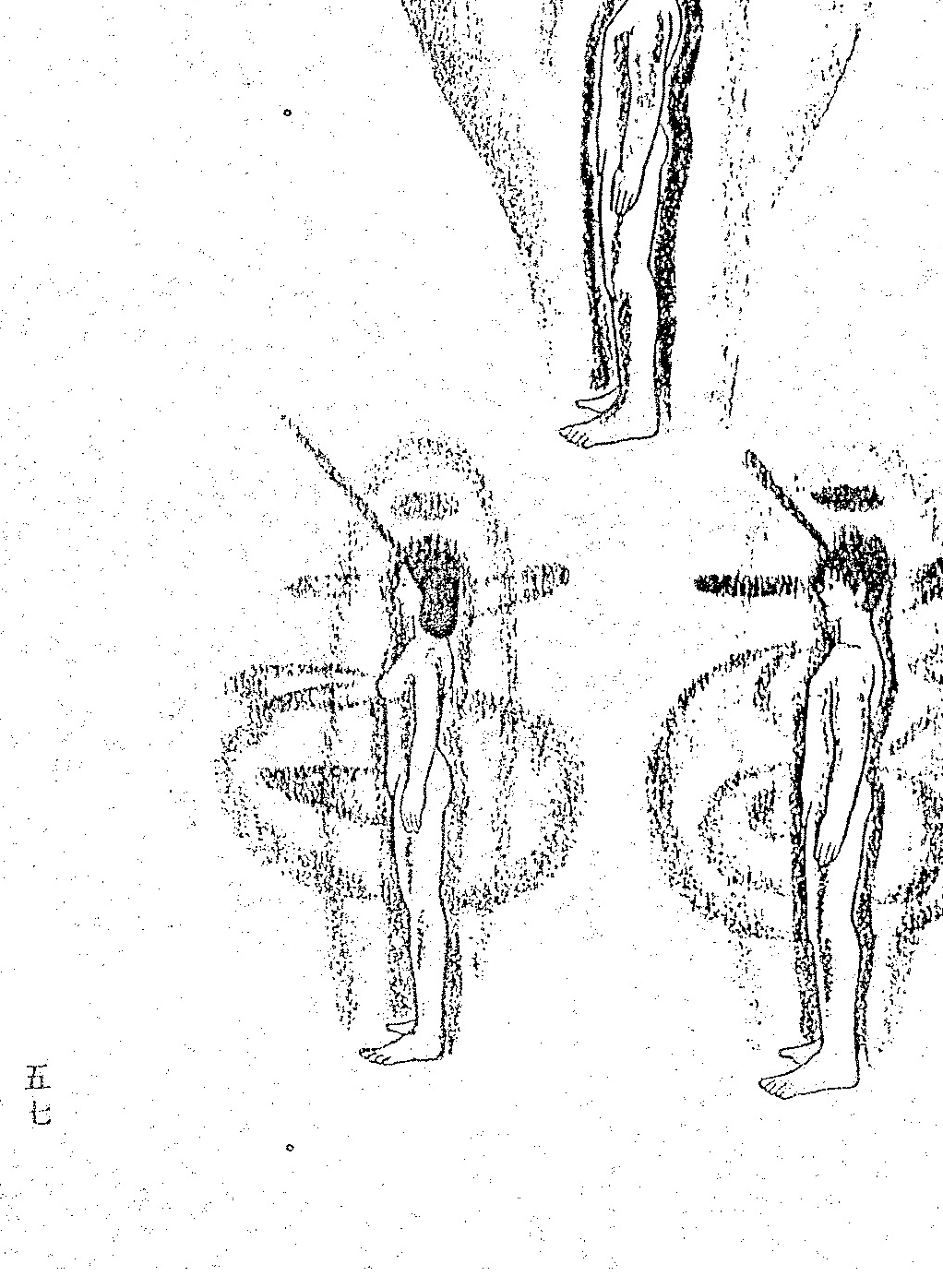
6, 7
④This outer aura layer is fluid, or one might say highly variable, and because the unique auras emitted from various parts of the body intermingle, it is not easy to see its shape clearly (for example, the auras emitted from the head and eyes are unique; in women, unique auras can be seen from the chest and waist, while in men, a protruding aura can be seen around the genitals). Generally speaking, the aura of a healthy person looks like a flickering flame (as shown in Figure ⑥).
⑤Dr. Kilner also mentioned that some people can see an even larger outermost aura beyond the outer aura. However, this part is extremely faint, making it very difficult for beginners who have just learned to see auras to perceive this outermost aura. Perhaps it can only be seen very occasionally, and only when all conditions are favorable.
⑥In any case, after being able to discern the inner and outer auras, the next step is to observe the various derivative auras within them. The most clearly visible parts are the unique auras emitted from various body parts, such as the back of the head, the back, and the eyes; for women, the unique auras emitted from the chest and waist, and for men, the protruding part seen around the genitals (as shown in Figure ⑦). If the person is a patient with a severe mental abnormality, a particularly strong aura reflection can be seen in specific areas. A rather special case is that those who have practiced Xian Dao and yoga to a highly advanced level can be seen with pillars of aura extending from their heads into the sky.
⑦In other cases, although the range is small, radiant block-like auras can be seen in certain areas, or one can observe that the surroundings of a certain part have dark, block-like masses or defects. When these aforementioned conditions are present, they generally indicate an abnormality in the physical or mental state. Therefore,
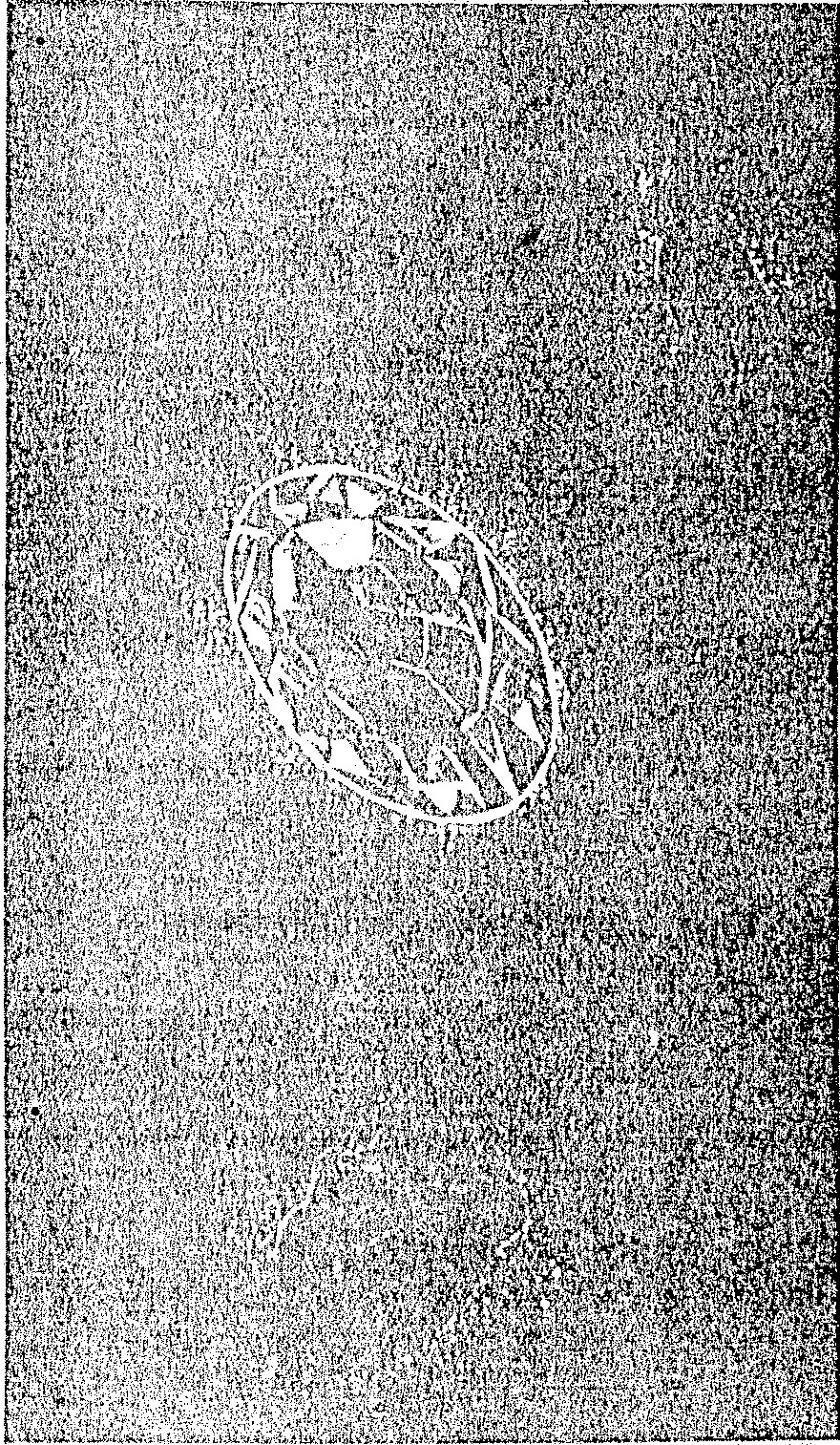
Through aura information, one can understand these contents related to health and spirit; there is a detailed explanation of this aspect later. Technique (4): Auras emitted from various objects ◎ Observing animal auras After being able to clearly see the auras emitted from the human body, now practice observing the auras emitted by various animals. For example, pets kept at home such as dogs, cats, and small birds can have their auras seen using the same method for seeing human auras described above. ◎ Observing plant auras Potted plants can be used, and those currently flowering are the most ideal because they radiate a strong aura, making them relatively easy to observe. Trees outdoors have specific lighting conditions, so it is necessary to choose an appropriate time. Generally speaking, if observed from dusk to night, the auras of ordinary trees can be seen. The author once observed trees at night, and it seemed as if they were emitting a radiance like gold dust. If drawn in using qigong methods, there is a very refreshing feeling, and the gold dust radiance will flow toward the body, which is beautiful, although its energy effect is naturally similar to the situation during the day. ◎ Observing the auras of non-living things After observing the auras of living things, one must also practice observing the auras of non-living things. If you understand the flow of qi, first use your palms to measure its strength, and then choose the parts with relatively larger qi to observe. For example, you can observe gems, mystical diagrams (such as the Tree of Life, Dunjia boards, etc.), talismans, amulets, copybooks, intently drawn pictures, or highly attractive intaglio-printed photographs.
Not only can the overall aura be seen, but even swords or weapons drawn on talismans have a localized, intense aura, and sometimes shapes that actually become super-clairvoyant float in the air. Technique (5) Aura Colors This is one of the most advanced types of training in observing auras. Although some people practice many times, they still cannot achieve the goal. Daknoll, who developed a scientific way to see auras, could only see a single color (blue or gray). Given the characteristics of the human eye, the rod cells, which function in seeing auras, can only distinguish dark (black) and light (white); therefore, not being able to see them is the common situation. In reality, those who can see aura colors are mostly trained mystics from India or the West, or some psychics. Those who can see aura colors have generally surpassed the realm of science; it can be said that they have stepped into the domain of psychics. Therefore, there is no need to be discouraged if you cannot see aura colors. Sometimes, even if you cannot see the colors, you can still judge or control abnormal states based on the shape, so color is secondary. Of course, being able to distinguish various aura colors is best. It does not matter if you cannot see them when you begin training. You should continue practicing patiently. If you still cannot see them, set it aside temporarily and continue advancing in your studies. ① When practicing seeing aura colors, the background should be a solid color, either white or black (solid-color cloth or paper can be attached to the wall), and one can still use the prepared space: have the target person whose aura is to be observed stand in this prepared space, then relax and observe.
② The key point is not to look with the eyes, but to follow the method of technique (3)—that is, to consciously hold the color of the aura in mind while observing. For example, observe with the sense of seemingly seeing blue or red; in other words, one must have inspiration. As long as you practice repeatedly and persistently over a long period, one day you will succeed in seeing the color of the aura.
In the author’s experience, the shape of the aura can be perceived just as in ordinary sensation, but the color seems to manifest through a different system—it appears not to be seen with the eyes but perceived with the mind.
Ms. Suzuki was previously very experienced in TM meditation, so she was able to see the color of the aura quite easily; she said what she saw was blue, though she herself noted that the color was very difficult to describe.
Some of the author’s friends can also see the colors and shapes of auras. Naturally, they all possess a aptitude for cultivating extraordinary abilities, so they are able to perceive the world of consciousness as if it were the real world.
When observing auras, it is easy for subjective thoughts to intrude, so one should not practice alone; instead, practice together with a few people who share this interest. At that point, check whether the aura colors and shapes seen by these friends are consistent—you can compare notes with each other, and of course you can also use
Information Provided by Abnormal Auras
an aura measuring device or aura glasses.
After such objective research and practice, when you are able to see the auras of all things, the basic training for seeing auras can be said to be complete.
Then, first read the following lesson, “Information Content Provided by Abnormal Auras,” to prepare the relevant knowledge, before proceeding to read “Development Training of the Inner Aura” in Chapter 2. The “Aura Correction Method” section for adjusting abnormal auras is an application method of extraordinary vision abilities, so this part must only be trained after the foundations of extraordinary vision abilities (the closed-eye method, the open-eye method) have been completely mastered.
Unlike air, the aura that surrounds a person is not a tasteless, dry substance; rather, it expresses various types of information depending on the subject’s personality, constitution, state of health, latent abilities, atmosphere, etc. Regarding this point, we can discern it from the shape and color of the aura. Conversely, if one can correctly observe the color and shape of the aura, everything about that person can be perceived. The aura control method, as an applied means of viewing auras, also requires this kind of knowledge in practice, so those who have completed the basic training course for seeing auras should first read up on this knowledge.
First, I will explain the information regarding the shape of the aura. Its content includes not only the author’s experience but also the reports of Dr. Kilner, Leadbeater, and the psychic Cayce.
Shape of the Aura
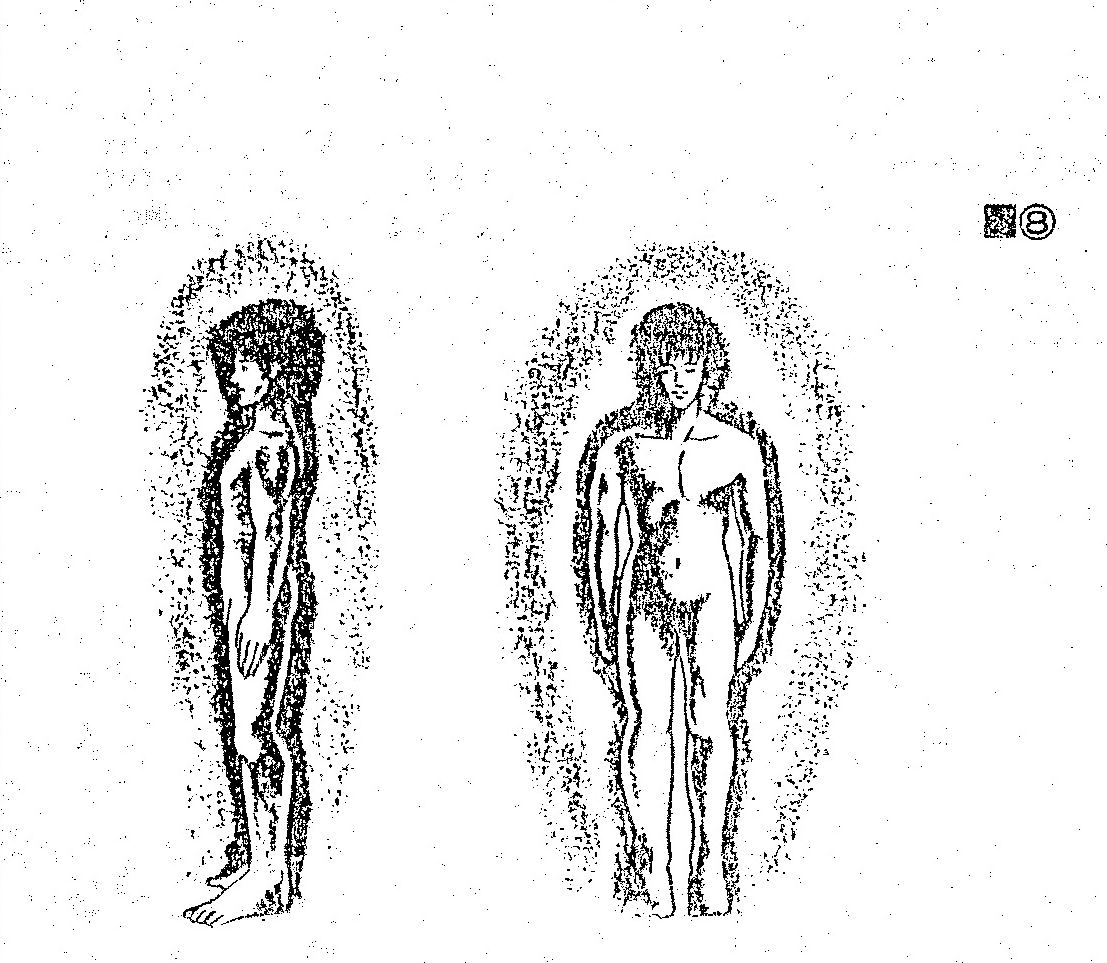
⑧
The overall shape of the aura is best when it is egg-shaped (slightly oval), as shown in Figure ⑧. If this shape becomes deformed, meaning the sharper the pointed parts become, the worse it is. According to the psychic Cayce, a sharply pointed shape indicates an undeveloped soul, such as being very selfish or very stubborn. For boys and girls before the age of twelve or thirteen, their auras generally have the same shape, with the girls’ shape being more delicate. However, after the age of thirteen, the shape of their auras gradually varies according to individual differences. Generally speaking, women’s auras expand more on the left and right sides than men’s auras, with the greatest expansion occurring at the waist. For women, the aura expands more at the back of the body than at the front; this is most pronounced at the concave part of the waist. For highly intelligent people, the size of their aura is larger than the average person’s. According to the views of Indian mystics, people with large auras are generally…
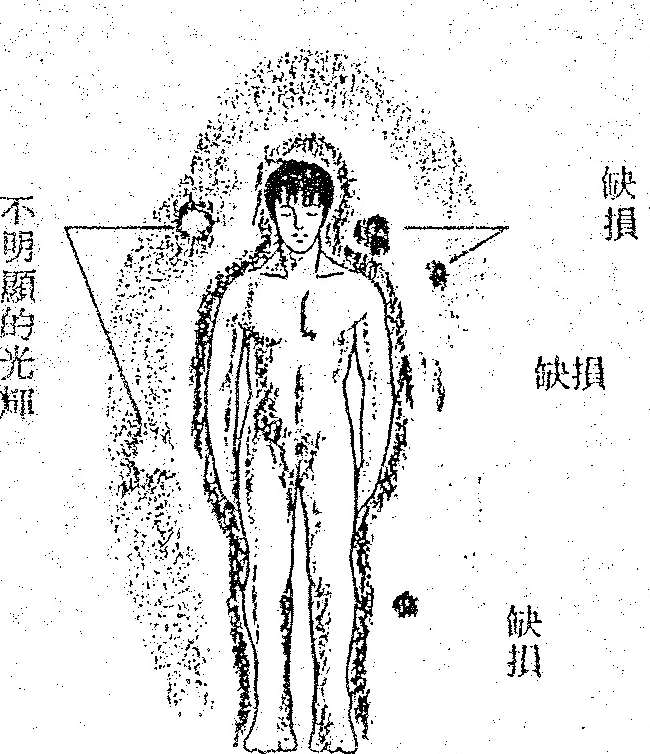
9
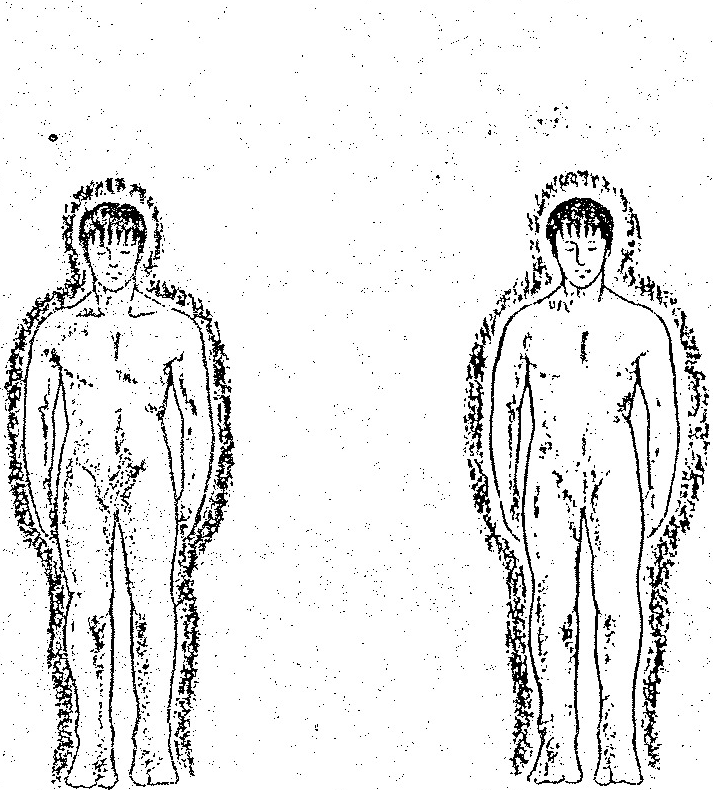
10
These have higher spirituality and often reach several meters or dozens of meters away. The aura of Shakyamuni was extremely large, reaching over three hundred kilometers, as mentioned earlier. Such a massive aura cannot be clearly seen by ordinary people; one must utilize spiritual vision to be able to see its most original, complete image. Auras of Abnormal Shapes The above explains the general characteristics of auras, but if its shape is skewed or abnormal, it indicates a physical or mental abnormality in the person involved. This is a very important part of the information conveyed by the aura, and readers should keep this in mind. The most common aura abnormalities occur when a defect and an indistinct circular or amorphous radiance (like a foggy sensation) appear in specific areas (as shown in Figure ⑨). Once such a defect or an indistinct circular or amorphous radiance appears, it indicates a physical abnormality (sometimes a mental one). For instance, a person with stomach issues will show this abnormality in front of the stomach, while a person with stiff shoulders will exhibit the presence of a hazy, dark radiance over the shoulders. When observing the auras of others, the author frequently sees these abnormal conditions, such as an amorphous, hazy, spherical radiance on the shoulders. If such an abnormal shape appears, and the body does not feel any abnormality at the time, this indicates that in the near future, this area will become ill.
This localized abnormality appearing in the aura sometimes indicates a spiritual aspect. However, generally speaking, it mostly corresponds to abnormal shape
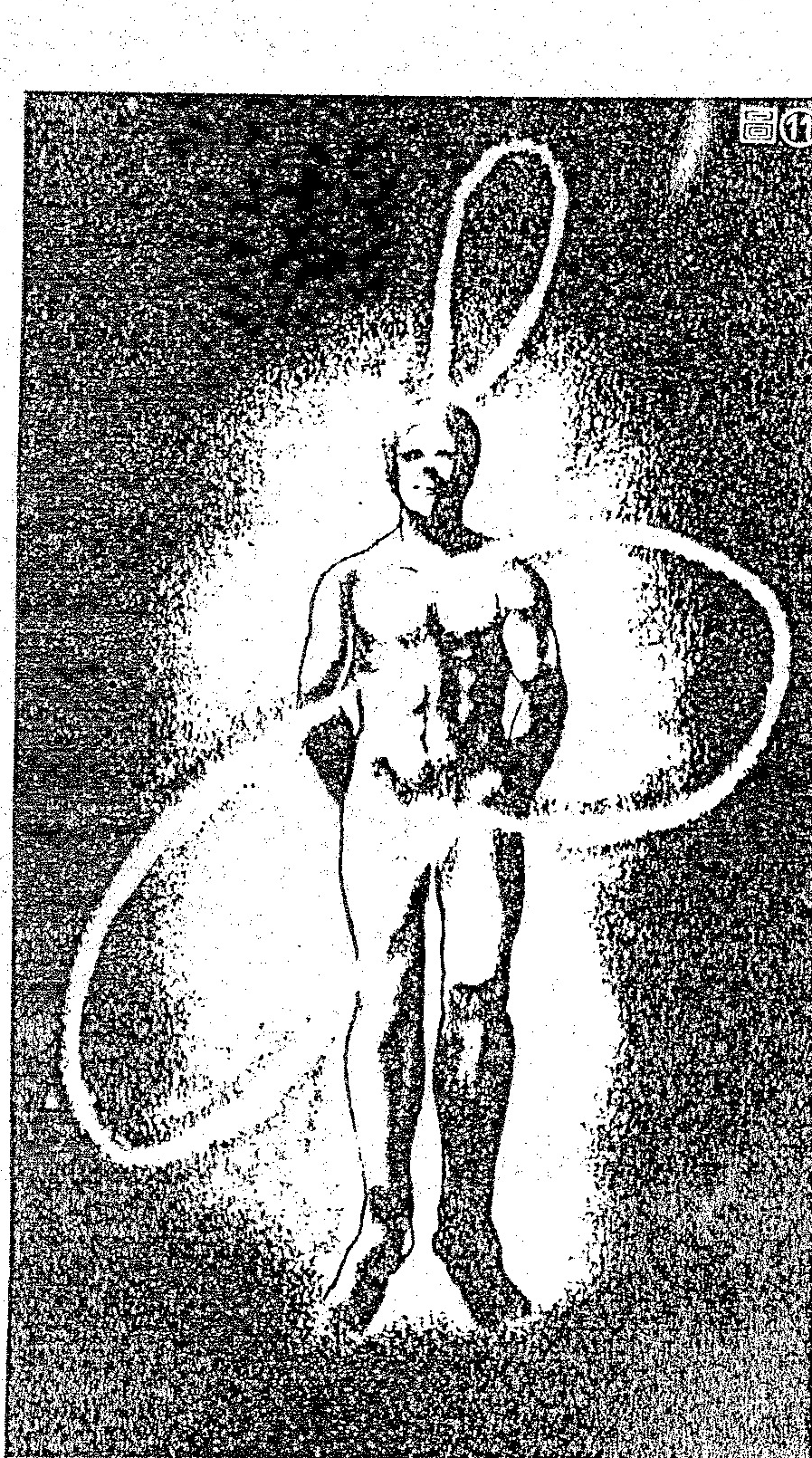
Figure 11
…is closely related to the physical abnormalities of that part. In addition to such localized abnormalities, sometimes abnormalities can be seen across the entire aura. For example, in an aura that expands on both sides of the body, one side may be particularly narrow, or the entire aura may appear particularly thin (as shown in Figure ⑩). According to Dr. Kilner’s view, people suffering from hysteria have a very broad aura on both sides of the body, but it suddenly narrows at the genitals, and bulges in the lumbar region at the back of the body. If a person suffers from epilepsy, then one side of the aura in both the inner and outer layers will appear contracted. The most severe is the contraction of the inner aura; sometimes the aura itself appears very coarse, and sometimes it looks as if it has been destroyed, which indicates systemic weakness. Aura abnormalities will inevitably be accompanied by color changes, so the colors must also be observed; this will be explained later. Mysterious Bands of Light In addition to shape, another characteristic of the aura is its bands of light. These are elongated shapes emitted from several body centers, such as the head (roughly corresponding to the positions of the chakras), which appear to wrap around the body (as shown in Figure ⑪). Indians regard these bands of light, or the cord-like streaks of light visible in the aura, as the flow paths of life energy (qi), which are called “nadis” in the Indian language. In other words, the human body is surrounded by nadis. Native Americans also saw these bands of light in ancient times; perhaps because of their shape, they called them a “luminous cocoon,” or perhaps they saw many luminous, fiber-like lights, whose shape resembled a silkworm cocoon enclosing the human body. Especially in the abdomen, very distinct bundles of fibrous light will appear; after being strengthened, these bundles of fibrous light resemble steel cables and are very resilient.
Many people have already provided reports on the aura beam emitted from the abdomen. For example, the Dutch radiologist Dr. Philip observed the aura beam emitted from his own abdomen and drew a picture of it.
Dr. Shafica Karagulla, a physician in California, USA, also reported seeing this kind of aura beam. She further detailed that this aura beam is a tentacle-like protrusion appearing on the solar plexus, which is probably a line of energy flow emitted from this area. She also said that extending this aura beam allows it to be projected into the aura of others.
The anthropologist Carlos Castaneda once said that his teacher and some friends could actually use this kind of light beam to climb high cliffs. They could also hook this band of light onto tree branches to jump from one tree to another. Their movements were very agile, just like flying squirrels in the forest.
Regarding the aura beam emitted from the abdomen, the author also has some experiences, so I will report them here in passing. I remember that one day about six years ago, I gathered a few people who practiced the immortal path at my home to train them in the method of emitting inner light. The training consisted of several people sitting together in a circle, closing their eyes to emit qi, and simultaneously focusing intense awareness on a central point. By practicing in this way, a vivid flash of white light would quickly appear; naturally, it was very successful that day.
Since there was still plenty of time left, I thought of the light beam recorded in Castaneda’s book and wanted to try it out on the spot.
Energy lines of the abdominal horizontal plane recorded by Dr. Philip. A prominent energy field (aura beam) is recorded in the central part.
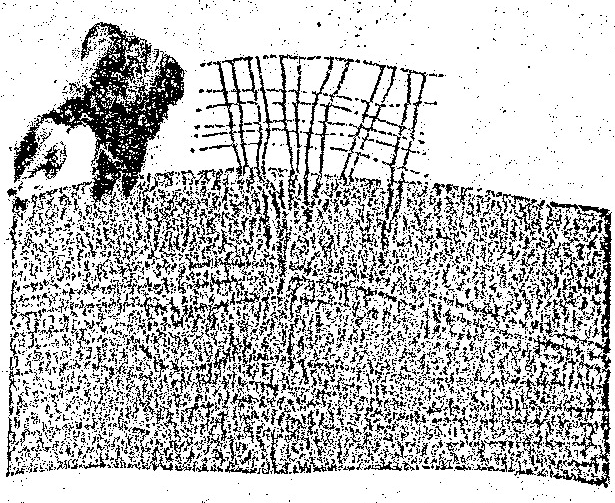
Energy lines of the abdominal horizontal plane recorded by Dr. Philip. A prominent energy field (aura beam) is recorded in the central part.
None of those present at the time had practiced to a very high level; in other words, they were all people who could not see inner light in a normal state, so I thought I would just have to try based on the feeling of qi. First, I had everyone present emit cable-like qi from their abdomens, then intensified this qi so that it stretched out, and their qi became entangled with one another.
When entangled, it makes one feel as if several cables are connected together. Of course, this is also an illusion, so I consciously pulled hard. At this point, everyone present expressed that they felt as if they were being pulled by something, and I knew what was happening. I relaxed slightly and then pulled hard again. As a result, one person was caught off guard and, following my pull, tumbled and rolled right to my feet, which startled me.
Only then did I gain the confidence that I could use this kind of cable-like light to pull people. At that time, I was pulling people purely based on the feeling of qi, completely unaware that it was the effect of a cable-like aura. I performed this on everyone present several times in a row. Just then, Mr. Yamaguchi, a bystander in the same room, suddenly exclaimed that he saw light emitting from the author’s inner abdomen. This Mr. Yamaguchi had already cultivated to the point where he could easily see auras
Aura Colors and How to Identify Abnormalities
degree. Upon hearing this young man’s exclamation, everyone present woke up as if from a dream and unanimously looked at the author’s face. Later, there was
an opportunity where, while others were pulling each other using band-shaped light emitted from their abdomens, the author indeed also saw the aura beams emitted from their abdomens. This band-shaped aura can also be emitted from other parts of the body. If one uses this light beam, one can stroke another person’s body without lifting a finger; this is related to the application of clairvoyance, and its specific implementation methods will be explained in Chapter 5.
From the perspective of aura diagnosis, if the beams of this internal organ aura or the emitted band-shaped light automatically contract or disappear, one can determine whether an abnormality has occurred in the subject’s physical body or mental state.
Colors of aura and Their Meanings
The characteristics of aura are evident not only in its shape but also in its color. However, it is not easy to clearly identify colors; one must undergo considerable training to achieve this. Therefore, initially, one should first observe the transparency and brightness of the aura, as this is simpler. Regarding the colors of aura, interpretations also vary from person to person. The author has statistically compiled the observational opinions of several individuals, and thus the most general tendencies are introduced here. In other words, there are variations beyond the situations described here, and I believe that through the accumulation of personal observation and experience, one will naturally come to understand these differences.
◎ Red aura
Red carries meanings of being active, motivated, and passionate, but it also implies being unstable, impulsive, impatient, and egocentric notions, and so forth. If the red color has a bright feel, it indicates high activity, though it also carries a slightly neurotic tendency and a constant preoccupation with oneself. If it appears in women, it indicates traits such as a love for glamorous dressing and frivolity. A murky red generally indicates undesirable traits like being impulsive, rough, and wasteful by nature. If it is dark red, it indicates a very strong self-awareness. Generally speaking, red denotes the emotional aspect, and physical areas with ailments will mostly have an aura tinged with red. ◎ Pink and Coral Auras These two colors belong to the red category, but they convey quite different meanings. Generally, they represent someone who is spiritually immature or childish. However, they also carry positive connotations such as being endearing and friendly; this color often appears around young women. According to Cayce, if an adult exhibits this aura color, it may also indicate that the person is seeking a delayed youth. ◎ Orange Aura Its effect is not as intense as red. A person with an aura of this color is full of desires for life, possesses a generous and magnanimous temperament, and is someone who deliberates carefully. If the orange carries a bright yellow hue, it indicates a person capable of strong self-control with a noble character; for instance, the aura of a holy monk is this color. In the Buddhist countries of India and Southeast Asia
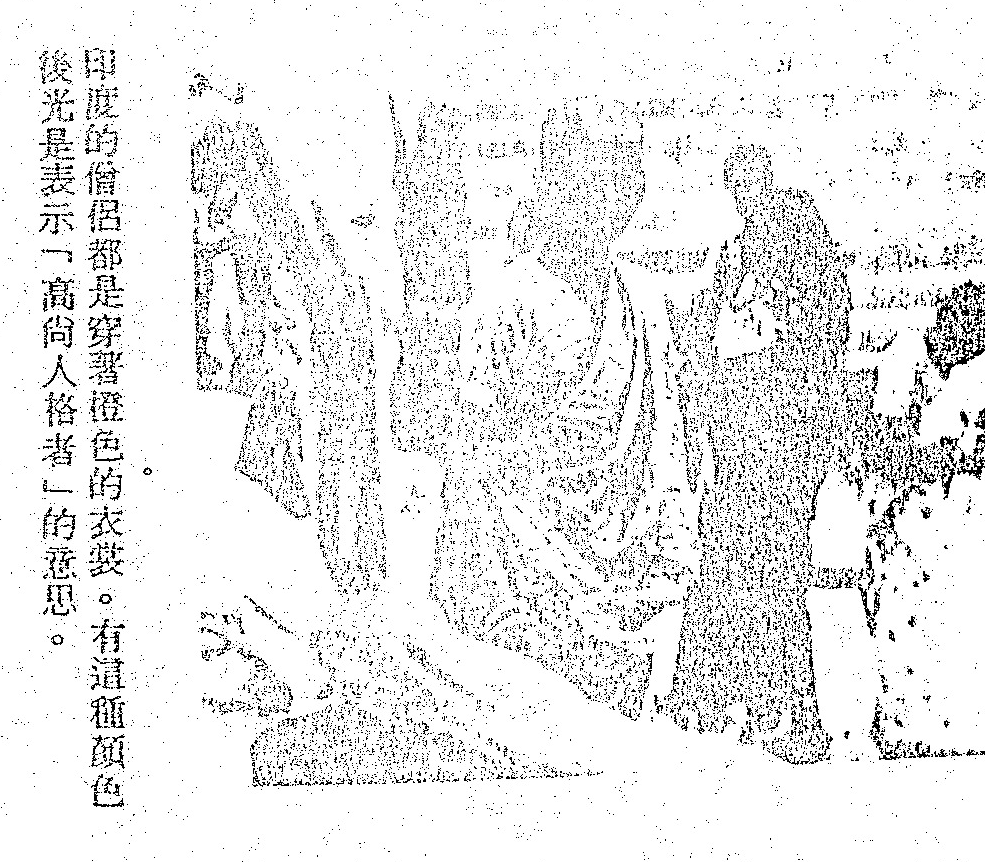
Indian monks all wear orange robes. A halo of this color indicates a ‘person of noble character’.
in this, the clothes worn by practitioners or monks are generally yellowish orange, the reason for this is also here. If it is a brownish orange, it indicates that this person lacks vigorous vitality, is careless in doing things, and can also indicate laziness, etc.; in short, what is expressed are all bad qualities. If a dull orange radiance is seen in the aura, this indicates that the person’s kidneys have an abnormal condition. ⑥ Yellow aura A bright yellow indicates noble ideals, lofty spirituality, high intellect, amiability, cheerful personality, etc. However, if a little red is mixed in, the meaning expressed is completely different; it indicates cowardice, timidity, inferiority complex, weak willpower, etc., which are all bad qualities. If it is a brownish yellow, it indicates unhealthiness, meanness, shamelessness, etc. Indian monks all wear orange robes. A aura of this color indicates the meaning of a “person of noble character”.
Generally speaking, a cloudy yellow color mostly indicates that the person frequently experiences tension and a sense of oppression, or it indicates heart disease or neurological abnormalities.
Regarding morbid yellow light, the author has had personal experiences, so I will take the opportunity to report on them. A few years ago, the author went to Singapore and stayed in a friend’s apartment. They were a large, multi-generational family, including the children of the wife and concubines, as well as girls from relatives, totaling over a dozen people. Among them was a young lady visiting relatives from Indonesia. She was also a relative of this family, but her appearance and temperament were not very good, and her behavior was different from that of ordinary people.
One day, this young lady happened to walk past the author barefoot. At the time, the author was reading a book, casually looked up, and saw her back as she walked away. As a result, in the footprints she left on the ground, a cloudy yellow radiance in the shape of footprints could be seen. These footprint shapes turned into dotted yellow spots as the young lady walked by.
On another occasion, the author happened to be sitting next to this young lady. From the qi emitted from her body, the author sensed that she was very likely suffering from liver disease or uterine problems (these are all caused by mental anxiety or hysteria in women). However, this time, the aura color of her footprints provided even stronger proof that she had a physical illness.
◎ Green aura People with this kind of aura have a very free and broad-minded personality, and hold no prejudices against things. Generally speaking, vitality and health are this
Characteristics of the color. Therefore, it is best for those who treat others to possess an aura of this color. In other words, if a doctor or nurse carries an aura of this color , then patients can rest assured, trust them, and receive treatment. If it is green with a hint of blue, it indicates honesty and guidance. Note that for the same green with a hint of blue, if it resembles the color of algae—that is, a muddy and dark green—it is not good, because low-level spirits generally emit this color . According to the author’s experience, most people with spiritual abnormalities emit a dark and muddy green aura. In addition, patients suffering from certain chronic diseases also emit this kind of aura color. If the green carries a yellowish tone, meaning a yellow-green aura, it indicates that the person’s conduct is poor and that they are deceptive . ◎ Blue Aura Only those who can self-reflect—that is, those with relatively good cultivation—will manifest this color. For example, devoutly religious people or those with spiritual qualities will definitely have an aura of this color. Generally speaking, blue is closely related to introversion, wisdom, and willpower. However, a dark blue indicates slightly poorer intellect, an inability to consider things carefully, and susceptibility to being misled; though capable, one is prone to acting under the influence of emotions. A medium blue indicates a diligent personality. A pale blue indicates someone lacking profound cultivation or someone who works very hard but is often troubled. Among the various blues mentioned above, as long as there is a muddy tint, it indicates melancholy, sadness, headaches, etc. For example, people suffering from depression generally
◎ Purple Aura
Purple is a color rich in mystery, generally appearing around those who explore the mysterious or those of noble status. In ancient Japan, the garments worn by high monks or nobles were often purple, and in the West, only figures such as emperors or popes were permitted to use purple. However, a purple tinged with red indicates an overbearing personality, a lack of amiability, or a nervous disposition. A purple with a dark blue appearance is the best, and everything is ideal, but note that if this purple aura appears on a sick person, it indicates a heart abnormality or a stomach ailment.
◎ White Aura
This represents purity, cleanliness, and perfection. A person with an aura of this color possesses mental equilibrium and is in a refined state of mind; traditional yoga offers the same interpretation. In other words, possessing a white aura indicates the ability to approach all things harmoniously.
◎ Turbid Aura
If the auras of the aforementioned colors are tainted and turbid, it signifies that all the merits represented by those various colors have disappeared, while also indicating that the subject definitely has physical or mental abnormalities. The most obvious is a turbid color mixed with gray. If it is a localized turbidity, it indicates physical pain or mental distress in that corresponding area. If this turbid color appears throughout the entire aura, it indicates overall physical decline and mental weakness. If the murky color is very dense and, at first glance, appears almost black, it indicates a fatal physical or mental disorder.
Research on the Colored Light of Auras
Generally speaking, the purer and brighter the aura’s color, the better the person’s physical and mental condition. However, it is rare for ordinary people to see a pure aura; they are typically colored lights mixed from several colors, so the colors are generally hazy and difficult to see clearly. According to Dr. Kilner, the color spectrum of an ordinary person’s aura mostly falls within the blue to gray range. Of course, the colors displayed vary depending on the individual’s temperament, emotions, desires, mental strength, and other factors, and these factors always influence the aura’s color more than the individual’s health. The stronger a person’s mental strength, the more the blue tone of their aura increases; conversely, for those with weakened mental strength, the aura’s color always tends toward gray. Dr. Kilner also noted that the aura’s color can change depending on a person’s willpower; in these instances, red and yellow are more easily expressed, while blue is the hardest to radiate. In any case, one can gather information about a person by observing the shape, light rays, and color of their aura. Therefore, if you notice an abnormality in someone’s aura, you can offer them advice and ask them to make corrections. It can also be said that when an aura abnormality is observed, one can find ways to treat this
Chapter 2: Inner-Light Development and the Closed-Eye Method
cause of the abnormality, that is, to treat the physically or mentally abnormal parts. This point will be explained in detail in Chapter 3.
The Mysterious Light Seen by Meditators
Those who can see the extraordinary radiance (aura) emitted by all things can begin to learn to see the inner light (chakras). Chakra is a specialized term commonly used in Indian yoga. Its original meaning is “wheel,” which can also be described as having a circular shape and an appearance of rotation. According to yoga, several such “wheels of light” exist within the human body, and each acts as a hub for a certain force.
In modern times, the term chakra has become very common. It is not only frequently used in yoga but also regularly used by Western mystics, making it widely popularized throughout the world.
Although the term is popular, it does not mean its content has been well-organized. Frankly, the understanding of this term still remains confined to mystical circles. Perhaps this is why it has sparked the curiosity of scientists to investigate it, and auras have now been studied to a considerable extent.
In this regard, many Indians and Westerners have conducted experiments using various instruments, such as electrocardiograms. This trend began after 1950, and research findings revealed that specific parts of the human body are closely related to chakras.
However, to this day, there is no way to use machines to collect this light, nor is there a way to objectively record its shape. Therefore, it is completely different from the aura, which can be represented to a certain degree through photographs or instruments.
The chakras referred to here, according to the system of Indian yoga, are formed by seven main centers, and each center has its fixed shape and color. However, the shapes and colors recorded in various books are not quite the same. Generally speaking, the following seven-category classification is adopted.
① Muladhara chakra (genitals or tailbone) ② Svadhisthana chakra (seminal vesicles or adrenal glands) ③ Manipura chakra (navel or upper abdomen) ④ Anahata chakra (chest) ⑤ Vishuddha chakra (thyroid area of the throat) ⑥ Ajna chakra (inside the glabella, pineal gland) ⑦ Sahasrara chakra (top of the head, pituitary gland)
In India, one can find many kinds of books on yoga, among which the original book considered to be a classic of yoga is the “Tantra scriptures,” which provides detailed explanations for various chakras.
For example, there is a chakra called the “Surya chakra,” which is located above the navel and on the right side of the liver. There is also the “Chandra chakra,” located on the upper left of the navel, right between the pancreas and the spleen. Furthermore, there are also chakras without specific locations, such as the Manas chakra or the Soma chakra, the former of which is related to the five senses, dreams, the unconscious, while the latter is related to the 4th state of consciousness (transcending all consciousness). In this way, there are said to be at least seven or eight, or as many as thirteen chakras. There are also several theories regarding their shapes, which are mostly similar, but there is much debate over the colors, making it difficult to know which is the standard. For example, according to some yoga books, a purple aura is described as the color of the Manipura chakra, and several books write it as the color of the Vishuddha chakra, while a few books even describe it as the color of the Sahasrara chakra. This causes great confusion for practitioners; as for Western mystics, many do not refer to the contents of yoga books at all and often interpret things arbitrarily based on their own whims. Seen in this light, chakras can feel ambiguous and leave one at a loss, so I think it is best to refer to the methods of Daoist cultivation. As I mentioned earlier, in Daoist cultivation, the inner light seen as a result of meditation is called Danguang, and the conditions that arise at this time are almost exactly the same as those of chakras. The author has also practiced Daoist cultivation and has some experience in this area; I have exchanged views with someone who studied yoga and came to develop this light, and their ideas were completely identical to mine. Whether it is the development process, the objects that manifest as radiance, or the mental state, they are all very similar. If there is any difference, this minor discrepancy lies solely in the handling method after it appears.
In the path of immortality, this situation is considered the completion of the elixir, the purpose of which is to create, through condensation, an immortal and deathless lifeform—the Yang Spirit. However, in yoga, there is no such condensation; rather, it continues to expand into a meditative space that accommodates one’s own consciousness. Yoga links the generated light with chakras at specific locations, but the path of immortality does not do this, instead considering it related to the entire body. Therefore, the approaches of both are illustrated in the chart of the seven chakras expressing the radiance of inner light. ↓ Indian yoga frequently uses the term chakra, which means wheel. Its shape is circular, and it conveys a sensation of rotation. The diagram shown on the right is a chakra chart based on Hindu teachings and symbols. The figure on the left is a chakra diagram drawn by Western mystics.
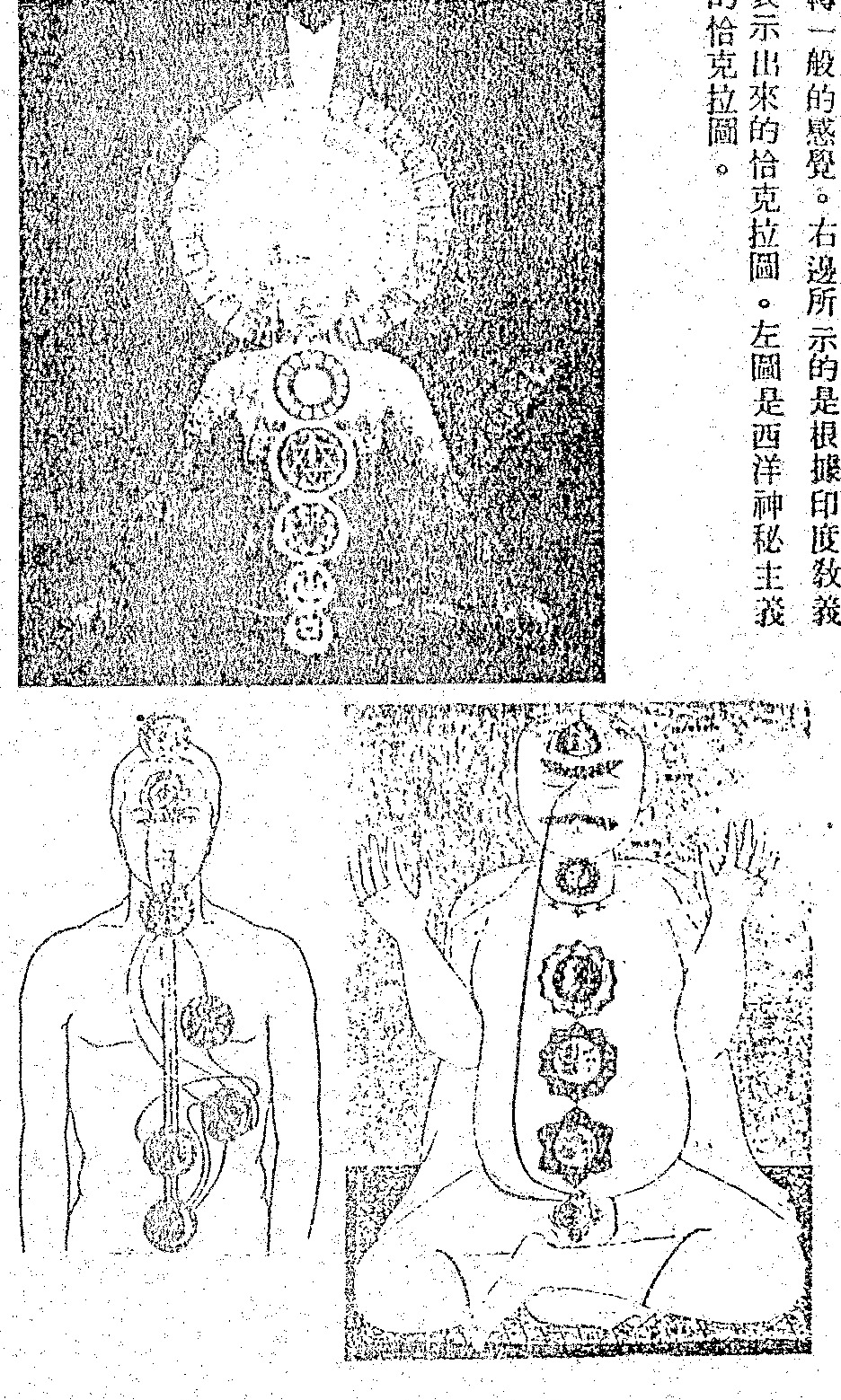
A chart of the seven chakras expressing the radiance of inner light. ↓ Indian yoga frequently uses the term chakra, which means wheel. Its shape is circular, and it conveys a sensation of rotation. The diagram shown on the right is a chakra chart based on Hindu teachings and symbols. The figure on the left is a chakra diagram drawn by Western mystics.
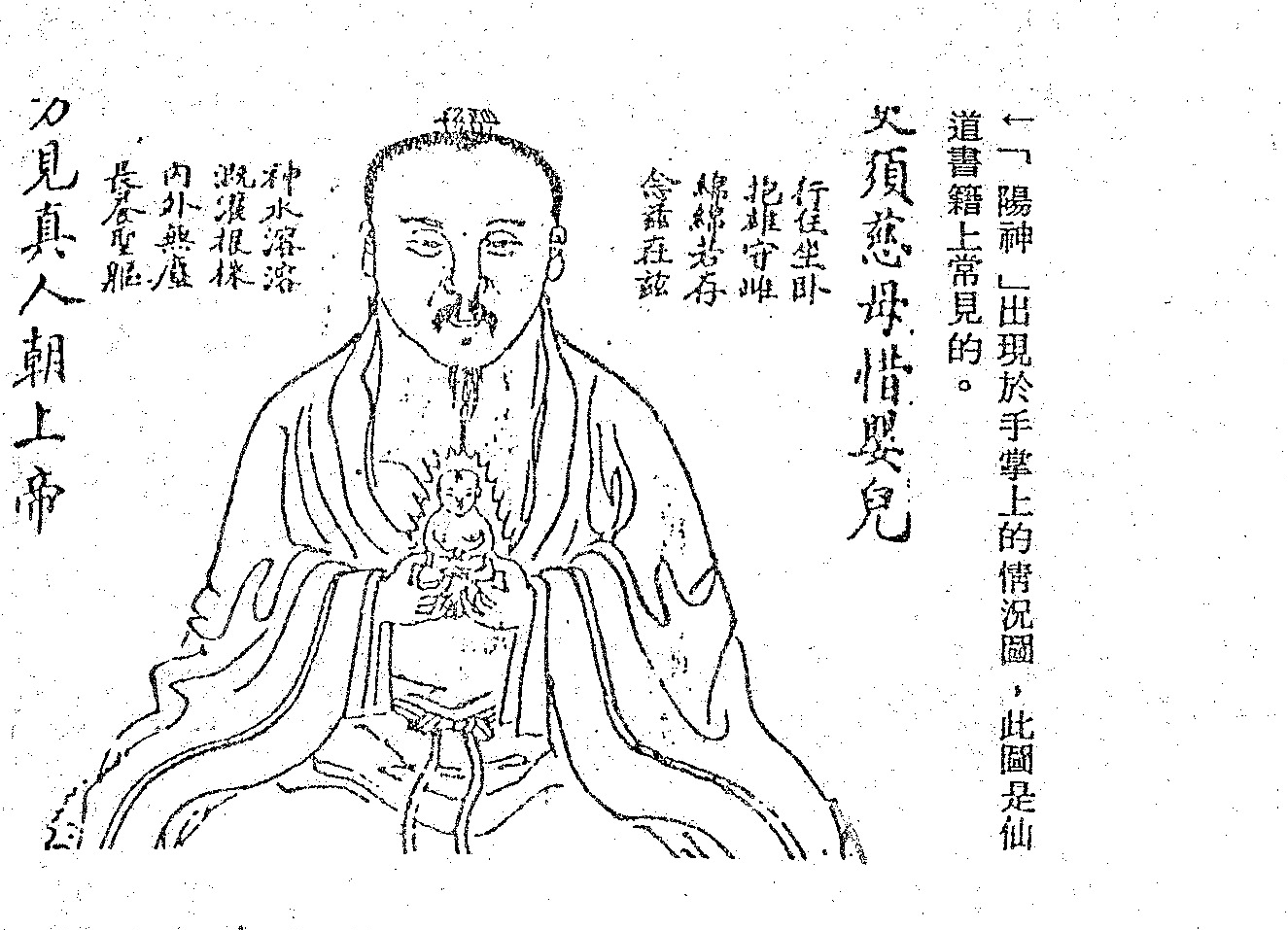
A diagram showing the appearance of the ‘Yang Spirit’ on the palm of the hand; this diagram is commonly seen in Immortal Dao texts. ‘Again, one must be like a loving mother cherishing her infant, in walking, standing, sitting, and lying down, like holding a chick and guarding the hen, continuously subtle as if always existing, keeping the mind and words focused here. The divine water flows abundantly, irrigating the roots and stalks. Clean inside and out without dust, nurturing the sacred body, then one sees the True Man paying homage to the High God.’
They are different. Specifically, yoga develops the chakras in seven different locations, whereas Immortal Dao does not have these seven. Furthermore, yoga always makes a great effort to see seven or eight colors of light, but Immortal Dao uses only two kinds in its practice: one is gold, and the other is silver (a color that emits a bright white radiance). Of course, Immortal Dao texts also record that one can see lights of other colors, but these other-colored lights are preferably discarded and not used. Since the same light appears, why are there different ways of handling it? When the author first began learning, I also had this question and found it quite incredible. At the time, I felt that if this were something fundamental, then anyone who looked at it should perceive it the same way.
This question was finally answered as the author’s practice progressed. It is simply because both Immortal Dao and yoga cleverly utilize this inner light according to their own unique systems.
Techniques for Beginners Developing Inner Light
For example, the seven mysterious centers resembling lotus shapes spoken of in yoga (in India, the lotus and the number 7 are religious symbols) originate from observing traditional Indian customs, while the concept of creating an elixir of immortality in immortal cultivation is merely based on traditional ancient alchemy.
When examining various mystical practices, one can see that they all use this light to form whatever aspects they desire. For instance, Western magic calls this light “spiritual light,” using it to form a double. This double is called a “body of light,” and one can also use the spiritual light as a means to produce a wide variety of things.
The style of Chinese talismanic and incantation methods is completely different from that of orthodox immortal cultivation, yet it still utilizes this light to form doubles or perform illusions. In other words, light itself is the common essential part of all mystical practices, but its application is completely free and unrestricted.
After understanding the above situation, I no longer rigidly adhere to any system. In other words, freely utilizing the results according to my own ideas actually allows me to accomplish much more. One of these is the development of extraordinary vision and its methods of application, which I will explain here.
After understanding the essence of this inner light, one can proceed to further study its development methods and the closely related closed-eye method for extraordinary vision.
The training method for this technique is as follows: first, close your eyes and practice looking at the inner light. After a period of training, you will be able to see this light very clearly, and ultimately, you must be able to control it according to your own consciousness. This final control is the technique of extraordinary vision; because closing the eyes for training, the author has named this method the Closed-Eye Method.
This technique is the most fundamental part of the super-vision ability. If it is not learned properly, not only will one be unable to apply the super-vision ability, but one will also be unable to practice the Closed-Eye Method for further advanced super-vision abilities. Therefore, one should spend more time practicing earnestly. Once a solid foundation is laid in this way, it will be helpful for more advanced training in the future.
Stage (1) Concentrate the consciousness
The goal of this stage is to see light in the meditative space. As mentioned above, this light is called chakra in yoga, Dantian light in the immortal path, and spiritual light in Western magic. These names are all related to their unique cultivation systems and inherent meanings. In this book, it is simply called “inner light”.
To see the inner light requires mental concentration. Without considerable concentration, even if one sees something during meditation, one cannot maintain its image, and as a result, can only feel an ambiguous blur.
There have been legends of various methods since ancient times. What is introduced here is a training method devised by the author, named the Round Light Method. I think this is a very effective method, consisting of two stages, so it should be learned in order.
◎ Relaxation Concentration Method
A concentration method designed by considering the body and eyes, with the aim of being able to concentrate consciousness for a long time.
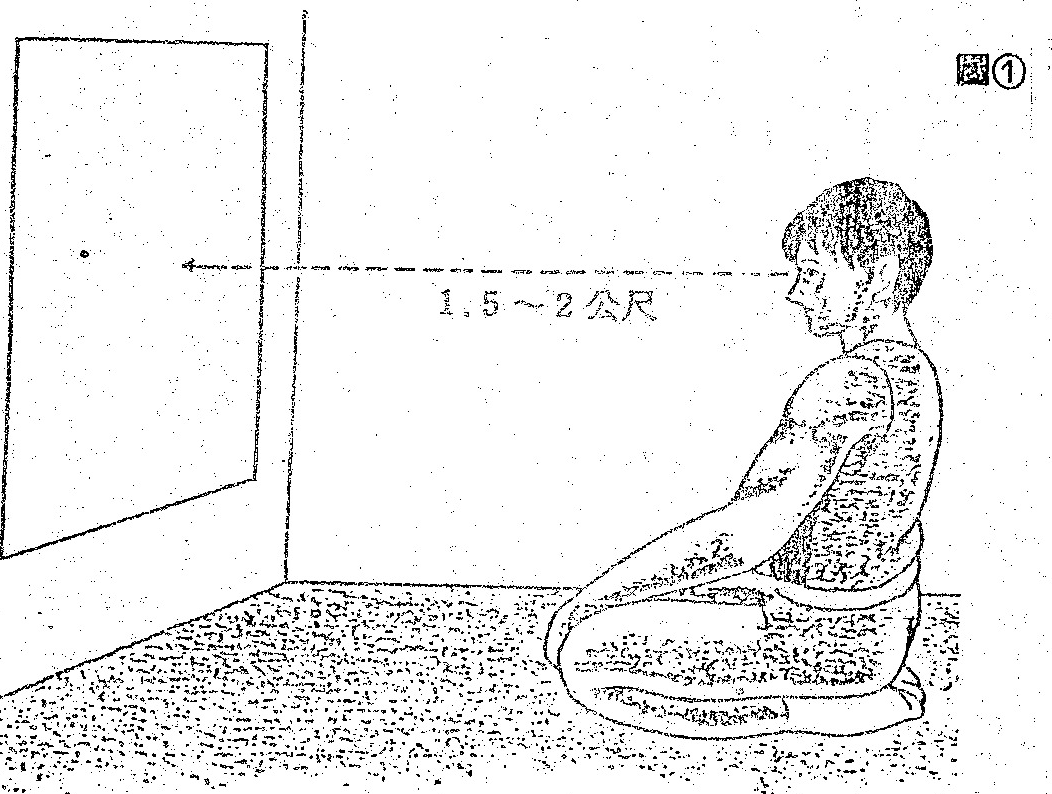
①
① Sit down 1.5 to 2 meters away from the wall. As with the practice of seeing the aura, the wall should ideally be colorless, and of course, it must not have any patterns. Additionally, there must be no furniture in the room. If the walls in the room have pictures or patterns, then, just as with the method mentioned above, buy white drawing paper and paste it on the wall; this situation is the same as the aforementioned training. However, due to lighting, strong light reflections in some rooms can actually make it difficult to calm the mind. When facing this special situation, you can use single-color paper such as blue, yellow, or red instead of white paper.
② After completing the above preparations, sit upright or cross-legged. If both of these sitting postures make your body feel uncomfortable, you can use a suitable chair to sit down, or sit down with both legs extended straight. ▲ Points to Note At this time, the most important thing is to relax the tension around the neck and shoulders. That is, let your shoulders drop naturally, and the body’s center of gravity can
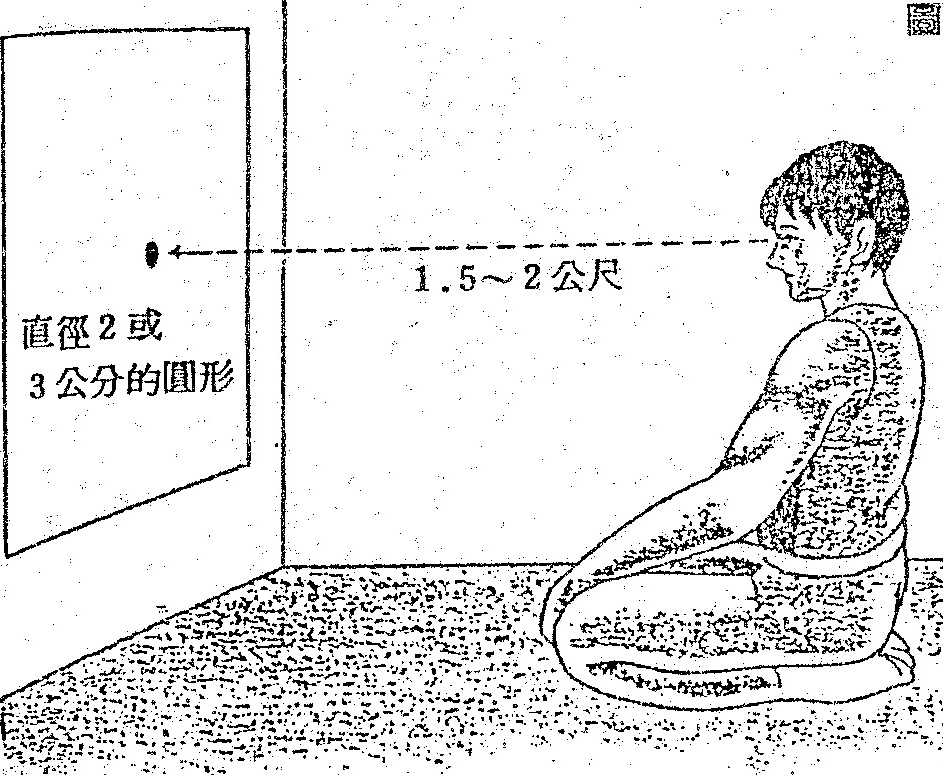
②
Sit down and place [your hands] on your waist (or lower abdomen). ③ Look out at a blank wall surface (or white paper). At this time, instead of staring, just look at it very naturally. For the practice duration, initially use ten to twenty minutes. As you get used to it through training, you will naturally be able to continue looking for forty to fifty minutes (Figure ①). ◎ Single-Point Concentration Method If you have practiced the relaxation concentration method, you will be able to focus your consciousness for a long time on an empty space. Reaching this stage, you can practice the following single-point concentration method. The method is as follows. ① Use a colorless full-size B-sheet of white paper (single-color paper can also be used as a substitute), paste the white paper on the wall, and then use permanent ink to draw a circle with a diameter of 2 or 3 cm in the center of the white paper. Choose a color that is easy to notice according to your own preference.
Sit down about 1.5–2 meters from the wall, and gaze at the circle on the paper for 10–20 minutes. At this time, just as with the above method, you must relax your shoulders and neck. Your eyes need not strain; just look naturally (Figure ②). ③ When you begin practicing, only practice for 10–20 minutes. Wait until you are accustomed to it before extending the practice time to 40–50 minutes. These two training methods should be practiced continuously for several weeks without slacking off, and you must not be tense during practice. As long as you can concentrate your consciousness for dozens of minutes, you can practice the closed-eye method, which begins the method for developing inner light. Stage (2) Techniques for Developing Inner Light This training can be said to be an extension of Stage (1) above. The fact that you continue to gaze at a target object has not changed, but the target object changes from the wall to the space when your eyes are closed. This space with the eyes closed is a space rich in variation, that is, a fascinating space where all kinds of things might appear. At any rate, this is the space that will produce extraordinary vision, so readers should practice it with even greater confidence. ◎ Techniques for observing inner light and their preparatory actions Before starting the training, I will first explain the training venue. The training room should be a dark and quiet place. The reason is that if it is a bright room, even if your eyelids are closed, you will still feel the external light; in this way, even if you see inner light, you will not realize it yourself. Also, you should avoid noisy places. Because a noisy environment easily causes one’s consciousness to focus on the ears, causing the eyes’ attention mental force to slacken, affecting the viewing of the inner light. In fact, finding a perfectly ideal place seems rather difficult; you only need to try your best to prepare an environment that is as close to ideal as possible. For example, if you feel the room is too bright, simply draw the curtains and close the small shutters outside the glass. If you feel that noise will affect your mental concentration, just plug your ears with cotton. You can also climb entirely into a closet and close the door, but be sure to leave a slight gap so that air can circulate. As for rooms equipped with heating and air conditioning, ventilation should not be an issue. The practical techniques for developing the inner light are introduced below. ① After preparing an ideal environment for training, sit down with a relaxed mind and close your eyes; do not squeeze your eyes shut forcefully, just let your eyelids close naturally. ② Consciously observe the inner surface of your closed eyelids. At this point, follow the essentials of stage (1)—that is, relax the tension in your eyes, render the muscles around your eyes limp, and mentally intend to look behind your eyelids. This is the key point of the training. ③ Some people may already feel as though they are seeing a certain kind of light after following the above method, but those who experience this sensation remain in the minority; most people will not feel anything at all.
Patterns of Inner-Light Appearance and Examples
(Even if you do not see anything, do not be disappointed. You should set aside a certain amount of time every day, close your eyes, and practice for twenty to thirty minutes; if possible, practicing for one to two hours is also acceptable). If you continue training in this way, generally speaking, you will be able to see it starting from the third week, and at the latest, you will succeed after about a month. For those who have a sensation of this kind of light, what should they expect to see? A further explanation is provided below.
Various Patterns of Inner Light Generally speaking, what each person who sees the inner light sees is different, and it can be roughly divided into the following five major patterns (see Figure 3 below).
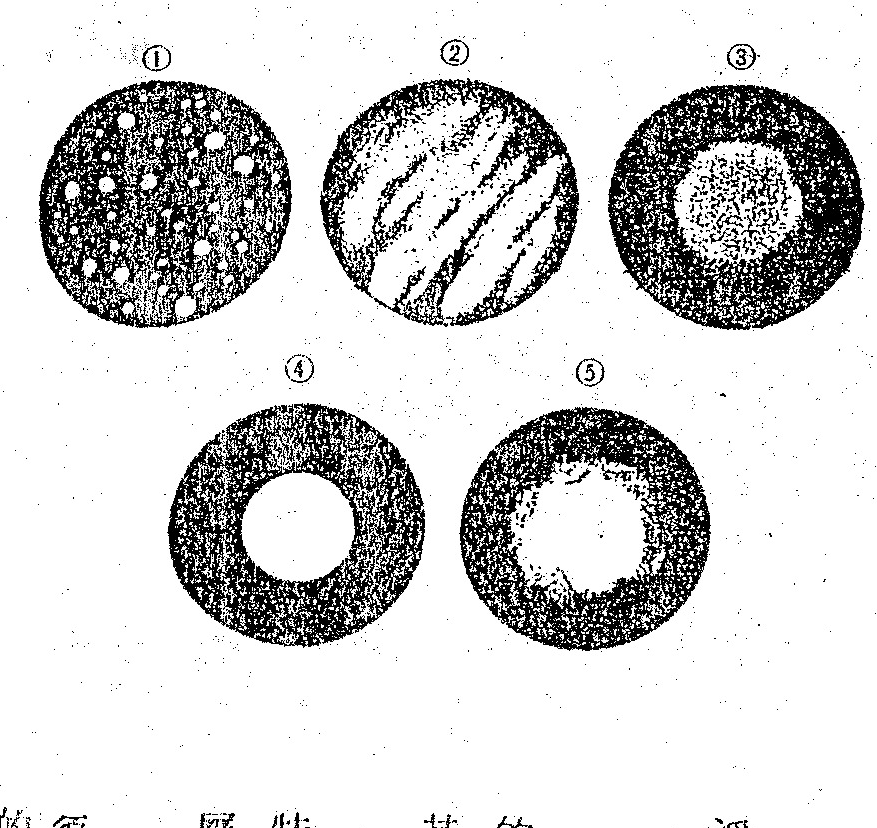
① Light Spot Type A pattern where small spots of light seem to be scattered in space, flickering on and off. ② Galaxy Shape Type The sensation of a diffused radiance that looks very much like a hazy galaxy. ③ Circular Type
It has the feel of a galaxy-like pattern, but without the diffuse feeling of spreading out; rather, it is slightly circular.
④ Mirror-shaped pattern The circular radiance with clearly defined edges gives the impression of a round mirror floating in space, representing a mode of stillness.
⑤ Biological-shaped pattern Although it also has a distinct circular feel, it lacks the stillness of the mirror-shaped pattern. In other words, its brightness changes constantly, and its outer edges wriggle like cellular movement.
Aside from the five major patterns above, some people see more unique patterns. However, based on the author’s experience, they generally fall into one of the five aforementioned categories. Please refer to the diagram on this page for practice.
In yogic practices, the light that appears when viewing chakras must strictly be of the ⑤ biological-shaped pattern. However, there is no such strict rule for the development of clairvoyance; it is sufficient to see any one of the patterns from ① to ⑤. Then, by concentrating your conscious focus on this light, you will be able to clearly see its radiance.
For example, upon seeing the first item, the light-spot type of inner light, choose one light spot from among the many small light spots and continue looking at this small light spot. If you see the ② galaxy-shaped type or the ③ circular type, similarly select the brightest part of it and keep looking at it continuously. If you still feel unable to see this light clearly after training several times, you will have to choose an even darker room for training. When the author was training in the past, I could not see this kind of inner light either. Later, I went into a pitch-black closet to practice, and as a result, I could soon see the sparkling inner light. This kind of training becomes more proficient with the number of practice sessions. At this stage, some people can even see vividly colored, flashing inner light. Upon reaching this level, after continuing to practice, one can see the inner light even with open eyes. In any case, the practice can only be considered successful if the inner light can be continuously seen for fifteen to twenty minutes or more during meditation. Therefore, you must train every day until you succeed. If you train several times and still feel unable to achieve the aforementioned level of proficiency, the reason is insufficient foundational practice prior to this training. You should review from the beginning and proceed solidly step by step. For example, those starting from the very first stage (those with poor mental concentration) or those starting from stage (2) (those who see the light but it immediately disappears) should thoroughly self-reflect and practice again. In this way, only after the inner light can be seen fully and clearly, do you begin to practice the method of making the light’s outline appear, which is the core part of super-vision ability.
Regarding the development of inner light, the author has kept experience records of many people, from which I have selected two particularly interesting parts to introduce. The Experience of a Compromised Technique of Xian Dao and Yoga The first experience record is the example of Mr. Oda, a teacher at a cram school. This teacher was indeed very successful in practicing the development of inner light for super-vision abilities, and later even used this inner light development to make small medicine (pills condensed from qi). The period from practice to making small medicine was only seven or eight months, which shows his excellent results. What is interesting is the state of his light development; it was a method that compromised the techniques of Xian Dao and yoga, as stated by the author of this book. The contents of his report are as follows. Starting in February 1979, I practiced meditation according to my teacher’s guidance, and this continued until July of that year. As a result, I saw chakras, and I will briefly explain what I saw at that time as follows. I spent two hours every morning practicing meditation. During the training, when I reached the stage of the Microcosmic Orbit, I began to see blue light. Soon after, when I focused my consciousness on the Dantian (lower abdomen), I would clearly see blue light, so I confidently continued my meditation training. With the increase in training, the blue light gradually changed color, eventually becoming orange light. The problem is that after it became orange light, I felt as if the orange light was only above my head. When seeing this orange light, my body always had some numbness, an electrified state, or a feeling of being filled with energy. When I first started seeing it, the radiance was small, but it gradually expanded with practice, and eventually my body was surrounded by this light. At the same time, a state of selflessness emerged, meaning a state where consciousness disappeared. — When I read his report at the time, I instructed him to maintain a stronger consciousness and continue meditating during his training to see the chakras. He followed my instructions closely and continued his self-training, eventually creating a method of self-control on his own, which is why he was able to produce the small medicine as described above. I did not ask him about his detailed state at that time; in any case, he was later able to manipulate the inner light freely, which was the part he had developed himself. Experiencing the Microcosmic Orbit via Inner Light Another example of an experience with inner light is the case of Mr. Okasaka, which I have already mentioned in the section on developing the ability to see auras. Mr. Okasaka has an innate, excellent aptitude for seeing auras, and this aptitude was also fully demonstrated in the development of inner light. He only listened to my lectures on Xian Dao and received guidance on some basic movements. Shortly after (about three days), he was able to see auras, and then he utilized the inner light to practice the microcosmic orbit. With such a good aptitude, he excelled everywhere. The report I will introduce here differs from the situation of Mr. Oda mentioned above; after seeing the inner light, he chose a day when he had more free time to recall the events, so what he wrote was a recollection of the situation at that time, rather than something written on the very same day. —Training Diary: July 28, 1984— ① Practiced the lower abdominal breathing method for one hour, then focused my consciousness on the Dantian. As a result, yang qi was generated, and my body gradually felt warm.
② Starting from the Dantian, let the qi circulate throughout the whole body; at this time, you will feel the hot qi slowly flow to the perineum (the area between the genitals and the anus). ③ When this hot qi reaches the vicinity of the tailbone, it will feel like it has stopped. At this time, contract the anus and concentrate your mental focus, then a stream of warm qi will slowly rise from this area like water vapor. ④ Pause for a moment when it rises to the upper back; while feeling warmth at the paused area, the lower back will also have a sensation of heat. Maintain this condition for about ten minutes while concentrating your mind, and then slowly let the hot qi rise (the entire back will sweat and feel damp at this time). ⑤ When the hot qi passes through the neck area, there will be a slight feeling of pressure, but continue to let it rise, quickly reaching the Niwan (the area two centimeters below the crown of the head). ⑥ Continue to focus your mind on the Niwan. At first there is a feeling of warmth, but after about five minutes, there is a sensation like wearing a bamboo hat on the head. Although it is not harmful, you must repeatedly concentrate your mental focus in order to prevent further heat from generating. ⑦ While there is a slight numbness in the brain, a sense of refreshment gradually arises. ⑧ Temporarily concentrate your mental focus, during which a yellow light appears at the Niwan. I feel a sense of haziness, and at the same time, this radiance begins to expand until almost the entire head is within the expanding range of the light. Maintain this state for about ten minutes. A feeling of pressure begins at the glabella, feeling as if pressed by something, so I try my best to concentrate my mental focus on the Niwan.
⑨ A green light appeared between the shoulders, and then it began to expand. Therefore, there was temporarily a sensation of two types of light, but I concentrated the light on the Niwan, and then consciously let the light travel forward (transforming the light into a sensory form to travel). ⑩ It stopped between the shoulders, resulting in a vague and unclear sensation. ⑪ It slowly began to travel downward, stopping immediately upon reaching the throat. It felt as if a lump was obstructing it. After a while, this lump began to emit light; it was a white light that gradually diffused, so I intensified my concentration of awareness, and at this moment a sensation of warmth arose again. ⑫ Only after about five minutes did it descend, stopping at Shanzhong (center of the chest) with a sensation of pressure. I concentrated my awareness again; after a while, a lump began to rotate clockwise from above, soon glowing and spreading out, so I once again concentrated my awareness to slowly push it downward. ⑬ It stopped when it reached the navel, and I concentrated my awareness again, feeling mentally refreshed as a result. ⑭ After a while, a sensation of warmth emerged; maintaining this for about five minutes, I then directed it downward toward the Dantian. ⑮ Upon reaching the Dantian, it required gentle nourishment, allowing the yang qi to spread throughout the entire body while concentrating in the Dantian. ⑯ After repeating this several times, I felt a hazy sensation as if enveloped by something, and unconsciously lost consciousness
Manifesting Images of Light
(for about one hour in the seated state).
⑰ Upon regaining consciousness, I began to regulate my breathing. I circulated qi between my hands, and after a short while, the session concluded.
The above is Mr. Okasaka’s training report, in which more colored lights appeared than in Mr. Oda’s report. The methods they practiced belonged to the immortal path rather than yogic techniques, and as a result, just as stated in the report, they perceived a variety of colors.
Mr. Oda’s experience had more of a yogic flavor, yet it was still able to produce the Small Medicine characteristic of the immortal path.
Frankly speaking, the above is the actual state of inner light development; it is neither purely the immortal path nor purely yogic techniques. The judgment of whether it belongs to the immortal path or yogic techniques depends entirely on the practitioner’s conceptual understanding. This is also the reason the author introduces the inner light section in this book on extraordinary visual abilities.
After finally becoming able to see the inner light, the next step is to begin the training of using mental imagery within the eyelids (or in the meditative space) to cause images of light to appear.
Frankly speaking, it is only from this stage onward that one can be considered to have truly entered the introductory stage of extraordinary visual abilities. Merely seeing the inner light does not yet count as stepping through the gateway to extraordinary vision.
Here I will introduce several stages, and I will proceed according to my own experience, starting from the easiest part. The explanation below will follow this sequence.
Stage (1): Manifesting the image of a ray of light,
There are two different introductory methods for the training to make the simplest single line in mental imagery appear as an inner light image. Here, I will introduce them one by one.
◎ Method (1)
First, sit down calmly, close your eyes, and blankly look inside your eyelids. Next, concentrate your awareness and imagine an image of light in the shape of a ”□” appearing inside your eyelids. After doing this for a short while (very quickly for some people), you will truly feel that you see a vivid image of the ”□” (see Figure ④). However, when the image first appears, you yourself cannot judge whether it is floating in your mind or actually appearing inside your eyelids. If it is the open-eye method, you can ask a third party to look and verify it. But when using the closed-eye method, you cannot ask others to verify it. You do not need to dwell on this issue, because according to the author’s experience, when you first see the image, you yourself do not know whether it is an imagined object or a real one; later, you truly understand that this is an objective image, which is also something you only realize after letting others observe it. Therefore, in the beginning, it does not matter whether you see it in your imagination or actually; the key point is simply seeing the result. In other words, the most important thing in this training is that you feel you will actually see the result inside your eyelids, so you must train repeatedly until you reach this level.
◎ Method (2)
Those who cannot succeed using the aforementioned method of using imagery as a means should use this method.
First, open your eyes, and intensely concentrate your awareness on solely projecting
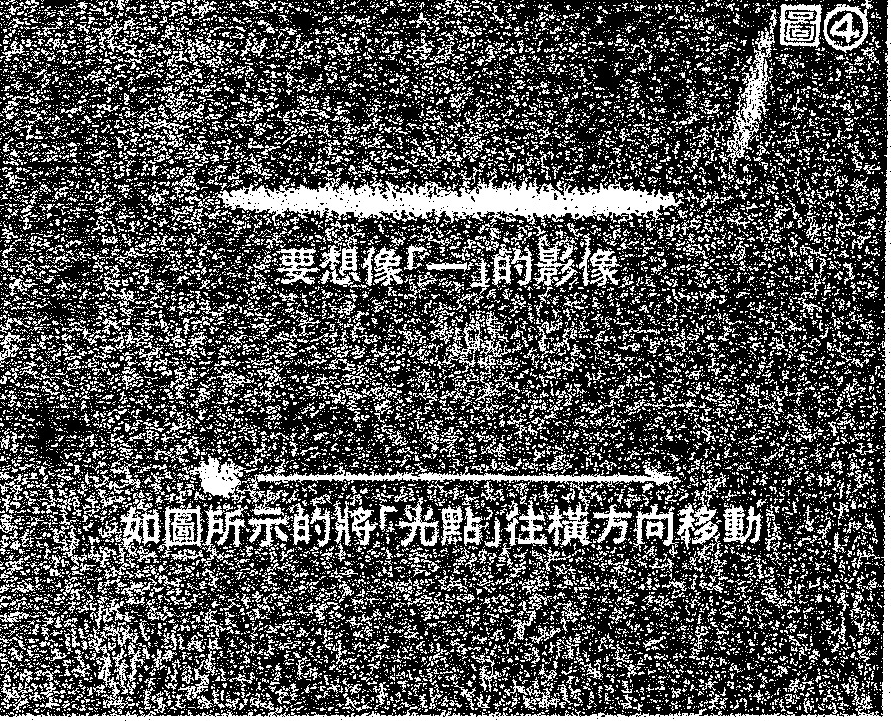
④
Gaze fixedly at a point. As you continue to gaze in this state of concentrated awareness, you will sense a point of light. While maintaining this awareness, try moving this point of light horizontally (Figure ④). Then, during the rapid movement of the point of light, you will perceive the image of ’—‘. If you do not sense the ray of ’—’, then consciously (or one could say via your line of sight) perform a horizontal movement in the shape of ’—’, and as you repeatedly move it back and forth, you will still perceive the image of light. ◎ Method for Stabilizing the Light Image By using one of the two methods mentioned above, you can see the light image. Once you have seen it, you must stabilize it. In other words, by repeating the practice for a few days, your perception will become very stable, and eventually you will clearly see the shape every time. As for the stabilization time, it is generally sixty seconds, which is to say— that is, after seeing the line of light, it is sufficient if you can maintain it for sixty or seventy seconds without it temporarily disappearing. ◎ Seeing a distinct light image right from the start Once you can see a distinct light image as described above, and can maintain it for a certain amount of time—that is, once it has stabilized—you must begin training to ""see a clear line of light right from the start"" (in other words, seeing a "" shaped image). Specifically, without needing to use other procedures, you can make the image appear completely the instant you close your eyes (or after concentrating your awareness). Only when you have practiced to this degree can the first step of super-vision be considered complete, so that you can proceed to further training. Stage (2) Method for manifesting a triangular image After the image of the "" shape can be manifested clearly and easily, the current training is to be able to manifest light images of various shapes. Although we speak of various shapes, some are very complex, whereas a shape like ○ looks very simple, yet it is quite difficult to perceive the image of an ○. Based on the author’s experience, the easiest shape to see is △, followed by □. The difficulty of seeing other shapes is roughly the same; however, shapes with more lines are harder to see clearly, and images of shapes with several unconnected lines are also not easy to see clearly clearly. After the △ image, what I want to introduce here is the triangle, because the △ image is the easiest shape to see, so the triangle is chosen first in training ◎ Method of connecting lines of light Making the outline of △ appear instantaneously is the best method, but some people cannot succeed immediately, so it is easier to see if you still train according to the following steps. ① First, make images one, two, and three appear according to the above method, then imagine in your mind one side toward the vertex, and finally let the other side appear (Figure ⑤). Another method is to let a point of light appear at the concentration point of the eyes, and then imagine using a pencil to move this point of light to reveal the outline of △, that is, as if using a pencil to trace the image of △. ② No matter which of the above methods is used, at the beginning of training, the parts of the △ shape drawn first during tracing always disappear as the drawing progresses. Do not worry about this situation; you should practice repeatedly to make the triangle of light appear. Once proficient, you can instantly reveal the image of a three-sided triangle; in other words, you do not need to trace out the triangle one side at a time. Stage (3) Revealing various circular light images After being able to freely reveal the triangle image, now we will further practice with more complex figures. Similarly, start from
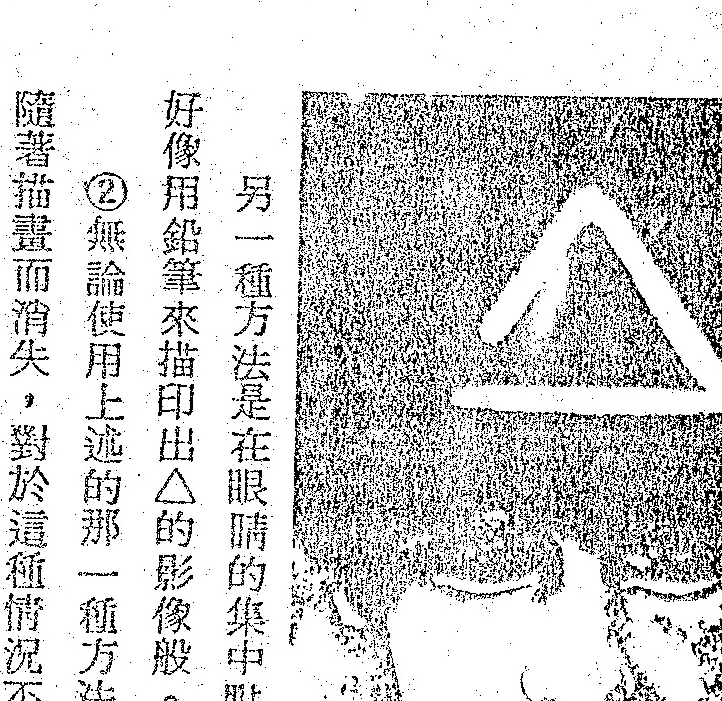
⑤
…practice the easiest parts among them. Based on the author’s own experience, the various shapes are introduced below in order of ease: Square … This shape can be considered an extension of the triangle, so it will not feel difficult to practice at all. Start by making the square appear. Just like the triangle mentioned above, you can continue connecting the lines of light. Cross … First, make the vertical or horizontal line appear, and then make another line appear to cross it. Polygons and circles … There are complex shapes such as ◇, ○, and ◎. Polygons with more than six sides gradually approach a circle and are very difficult to make appear, so beginners only need to practice the pentagon and the circle. Symbols … There are countless types of symbol shapes; the highly complex parts can be left to practice last. First, practice less complex shapes such as ∠, ♀, ♂, ∞, ☆, and ◎. These shapes can also be seen as composite forms of the simple shapes mentioned above, so in terms of imagery, it feels like overlapping two simple shapes. For example, for the ♀ shape, first make the ○ part appear, and then make the shape of a cross appear below the ○. When beginning practice, just like with the other shapes mentioned above, the part that is first traced tends to disappear easily, so you must patiently practice repeatedly. ◎ Auxiliary training for maintaining shape imagery By practicing in the order described above, you can make various shapes appear, but some people tend to lose the imagery that first appeared during practice, which affects training efficiency. Therefore, the author will introduce an auxiliary training method here, which is very suitable for those whose imagery easily disappears.
① First, prepare a large sheet of white paper (approximately the size of a full B-size sheet), draw shapes such as △, squares, crosses, ○, ∠, ♀, ♂, ∞, etc.; these shapes or symbols should not be drawn too close to one another. They should be kept at a distance where, when looking at one of the shapes, the adjacent shapes cannot be seen. If a highly nervous person always feels anxious about seeing adjacent shapes, then one shape must be drawn per sheet of paper, which means several blank sheets of drawing paper must be prepared.
② Paste the paper with the drawn shapes on the wall. Each shape should be looked at continuously several times, so that its form remains in the mind even when the eyes are closed.
③ In more detail, first open your eyes and stare continuously at one shape for three to six minutes, then suddenly turn your head to look at the sky outside the window or at a blank white wall with nothing on it. At this point, an afterimage will still remain; simply maintain your gaze on the afterimage temporarily, then you can immediately close your eyes and see the afterimage on the inside of your eyelids. In short, practice repeatedly to the point where you can consciously perceive the shape in front of you.
Stage (4) Manifesting text through super-vision
Following the above training, once you can project light images of symbols and shapes onto the inside of your eyelids, the next step is to train to project more complex shapes such as text and numbers.
The training method is the same as before, only the shapes of the figures are different. Begin by practicing with simple numbers and English letters, and finally practice Chinese characters with many strokes. The complexity of Chinese characters is among the highest of any language in the world, so it requires more time and practice.
The Development of Super-Vision
Those who can achieve this level can also begin practicing “the training to make images of objects or landscapes appear,” which is also explained in the next chapter.
Development of Super-vision Abilities
Those who can manifest images at any time using linear light as the main body can begin practicing manifesting images of objects or landscapes.
Manifesting a Single Light Image
Technique (1) Method Relying Solely on Imagery
① As with the method described above, first close your eyes and gaze blankly into your eyelids (or meditative space).
② Following the practice guidelines, allow the light image to appear inside your closed eyelids (meditative space). However, when beginning the practice, it is best to choose target objects that are easy to visualize, such as a pencil, hat, stuffed toy, dog, or cat. Because these items are familiar from daily life, it is easy to imagine their shapes and remember their details clearly (as shown in Figure ⑥).
③ Although you may have a deep impression of the outlines of the aforementioned objects, not many people can quickly see the images within their eyelids. Most people may only see some unrelated glows or imagined images that appear for a fleeting moment and vanish; in other words, they are unable to stably and clearly see the light image.
However, if one becomes discouraged by this setback and no longer wants to practice, there will be regression. One should be patient and repeatedly continue training, and then
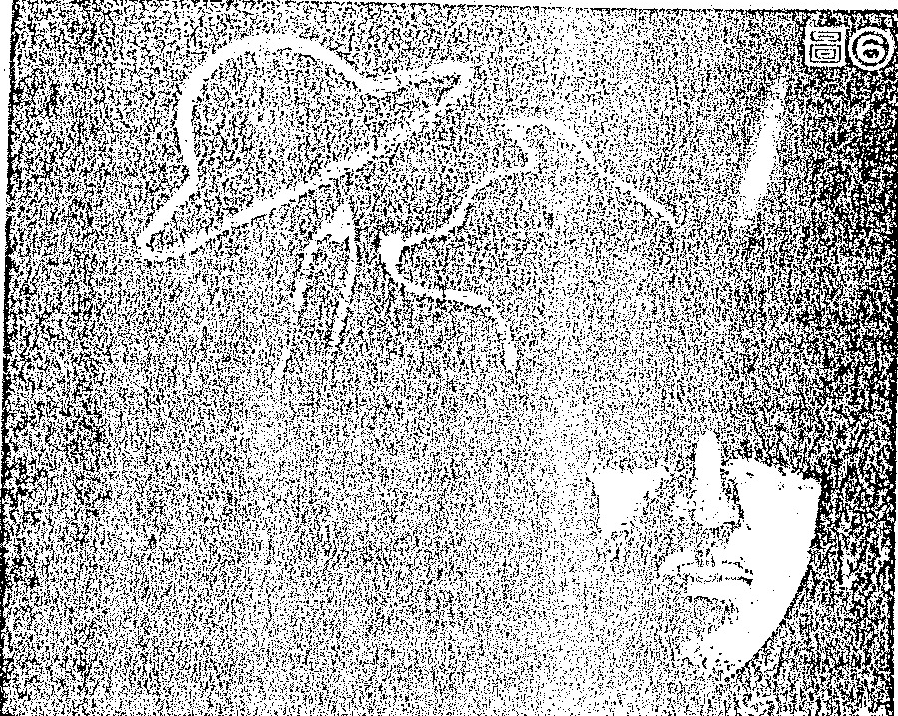
Figure 6
One day, the objects visualized in the mind can become images of light, steadily appearing within the eyelids.
Here, the author’s experience is introduced for your reference.
When wanting to manifest lines or symbols, first there must be an image of their shape in the mind. Within the eyelids (with the eyes closed, of course), concentrate your awareness with the sensation of using your line of sight to look at that shape. When beginning practice, it may be difficult for the shape to appear; at this time, as explained above, use various methods to view it, such as using your line of sight to connect points of light into a line, or connecting each line together, or combining them. In this way, after becoming proficient through training, you will be able to apply it freely. You will be able to instantly see light images such as △ or □.
In terms of the state of consciousness during practice, for simple symbols or figures, the mental imagery of these images can be easily manifested on the face, giving the feeling that this kind of consciousness is located on the face.
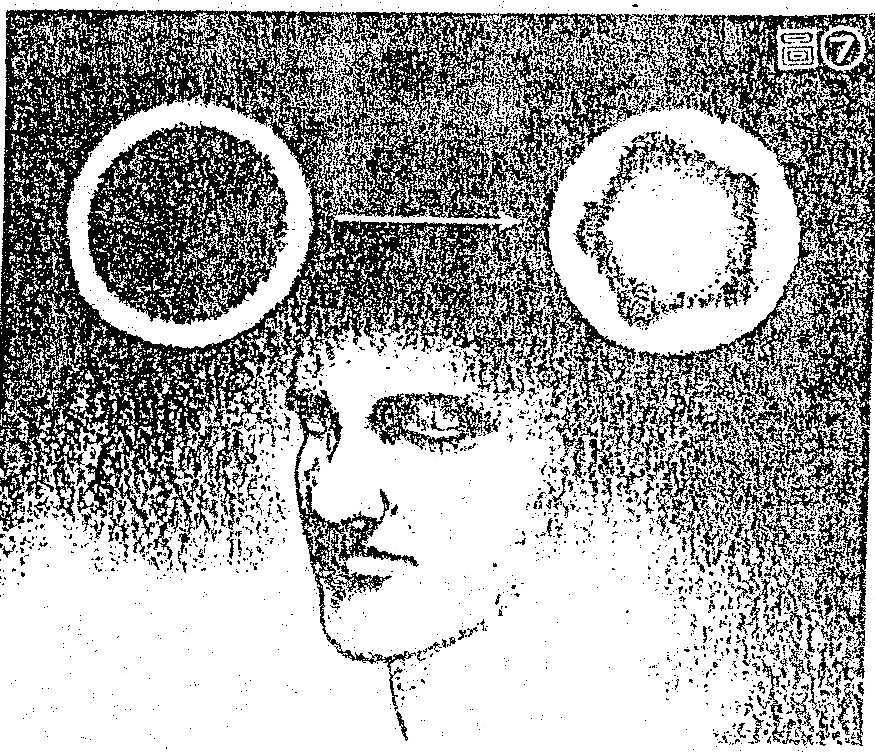
7
However, human postures or complex objects require first picturing their shapes in the mind. After forming this impression, the consciousness is then moved into the eyelids, and finally it is transformed into an image of light. Since the processes for manifesting the image differ in this way, the brightness during these two processes will naturally differ as well. Specifically, if the same image comes from the back of the head, it will generally appear in normal colors (a slightly dark sensation), whereas if it comes from the eyelids, it will generally have a golden or silver radiance. ◎ Technique (2): The Method of Using Outlines of Light Those who still cannot succeed relying solely on mental imagery can utilize the aforementioned method of connecting lines or points of light. For example, use a line of light to outline an imagined object, and once the outline is complete, make its interior radiate light (as shown in Figure 7). However, if you rely on this method constantly, you will not make progress. Therefore, after you can barely manifest an outline drawing, you should return to Technique (1),
that is, it is best to practice the training of manifesting images relying solely on mental imagery. Manifesting Multiple Light Images The previous training all involved the manifestation of imagery for various single objects; this section will explain two or three objects appearing simultaneously. For example, a couple, or a person walking a dog, or a person standing next to a house, etc. By visualizing multiple objects simultaneously in this way, one finally manifests a landscape containing various objects through clairvoyance. If you can reach this level, the closed-eye method can be considered complete. Only after this can one begin to practice the open-eye method. Generally speaking, the imagery of clairvoyance is a feeling of the light’s outline itself. Therefore, there is a certain difference in feeling from the real things one sees. For parts formed by more complex imagery such as landscapes or people, if observed carefully, the details can still be seen, but because the luster is too strong, it is not easy to generate a sense of reality. However, as one becomes proficient with practice, the sensation of seeing real objects gradually emerges. When the author first succeeded in training, it also did not feel very realistic. Later, once when I went to a deep mountain somewhere to guide the practice of Xian Dao, I finally gained a sense of reality. I still remember it was on the night of the second or third day. My mood was very cheerful at the time, so I kept chatting with like-minded friends in the living room into the night. By a little past two o’clock at night, the author finally started to feel sleepy, so I couldn’t help but close my eyes and continue listening to them chat. Because I had practiced training yang qi for too long during the day, it surfaced in my mind, resulting in a state of being unable to sleep. I had no choice but to adopt a meditative state to let my body rest, that is, I first stopped all conscious thought and stared blankly at the inside of my eyelids. At that very moment, I suddenly saw dazzling colors, as well as five or six people lined up in a row. Upon closer inspection, these people gave off a very peculiar feeling; they wore flashy but tacky hats, tops, and pants (the colors of the tops, pants, and hats were all different), and the colors of their faces were also all different. Thus their entire bodies were composed of several different colors, yet they did not look unnatural at all, and I was able to observe their details. Soon, they began making bizarre movements, acting in formation like robots. One moment they were doing headstands, the next spinning their bodies, and then five or six of them would huddle together, moving as if being pushed. In short, all these movements were quite different from ordinary human actions, and I watched with keen interest. Shortly after, the scene changed again to a forest landscape bathed in sunlight. Many trees reflected the sunlight, appearing vivid and glossy. The moment I felt it was beautiful, the scene slid forward at high speed, giving me the sensation of gliding through a forest on a sled. Consequently, I focused my mind on watching; the scenery rapidly approached me, taking a sudden turn, which created the realistic sensation of riding a sled. Although the sliding speed was extremely fast, every glance at the scenery left a perfectly clear impression.
sensation, even the leaves in distant places could be seen clearly. This feeling was like seeing real trees; in my heart, I even admired
but every branch and every osmanthus leaf could be seen very clearly; there was no distance between near and far
Wearing. Because it was too incredible, I kept my eyes closed and described the scene I was seeing in detail to the friends present. As a result, I heard them gasp in shocked amazement. Mr. Okasaka was also present at this time. I really wanted to know what he was sensing, so I specifically asked him to sit next to me. He also closed his eyes. When the author saw the scene from just now again, I placed my hand against his and sent qi to Mr. Okasaka. What was the result? He opened his eyes and said with deep emotion: “A picture appeared on the wall directly opposite me. It was a scene of a forest landscape, and it was sliding by at high speed.” Upon hearing him say this, the author couldn’t help but want to know more details, so I asked him on the spot to give a more detailed report. He then recounted everything he saw. At this point, the author felt that what he reported was completely consistent with what the author had seen, without the slightest discrepancy. It was already midnight, so everyone stopped there and went back to their respective rooms to sleep. However, because this was my first time having such a wonderful experience, my mind was excited for a long time, and I probably didn’t fall asleep until it was almost dawn. From then on, the same experience would often occur. Especially when going into sparsely populated deep mountains or forests, I would definitely see this situation. In other words, a few people giving off a mundane feeling would definitely appear first, and then they would slide around in the forest or the mountains. It felt as if the essential qi of the mountains and forests (one could also say spirits) had attached itself to the author, as if we were playing together.
The appreciation of such scenes is by no means an illusion or a dream, because I can allow others to see the exact same scenes. I feel that this is a very clear state of clairvoyance. From the examples observed by Mr. Okasaka, one can understand that as long as qi is sent to him, the other party can observe the same scenes.
If such clairvoyant ability is developed, you can enjoy these scenes, so those of you who are practicing, please keep up the hard work in your training!
Chapter 3: Making Light Images Appear in the Void
The Powerful Qi Required for Super-Vision
The eye-opening method introduced in the previous chapter is easy for anyone to learn, but the doubt of whether one is truly seeing an image of light or merely a mental image remains hard to dispel. However, using the eye-opening method introduced in this chapter eliminates this troubling doubt.
This is because the technique of this eye-opening method allows an unrelated third party to look, and thus the manifested image can be verified.
Although it sounds simple, it is not simple to actually do. The reason, as mentioned above, is that it requires great concentration and intense energy. Although the author is quite skilled in qigong methods, after using super-vision abilities for a long time, he still feels physically and mentally exhausted, because the energy consumed is simply too much.
If this is the case even for the author, then for an average person lacking in physical stamina, they might exhaust a tremendous amount of energy and only be able to use super-vision abilities for a brief moment. However, those who can at least produce a fleeting display are still better off; most people practice for a long time and still cannot make the image of light appear very clearly. In other words, even if a third party is asked to observe and verify it, they cannot make it clear enough for others to see.
Of course, it is not impossible for everyone to learn successfully; especially for those with naturally good qualities, it is very easy to succeed. For example, in Europe, there are underage youths who can manifest images of fairies in the void for a third party to see. Moreover, what is rare is that these youths do not need to use the intense concentration that the author does; they can easily allow a third party to see clearly. However, powerful energy is still required to manifest them, and they rely on emitting As described in the photo, there are various theories about the existence of fairies; this is a manifestation of super-vision ability.
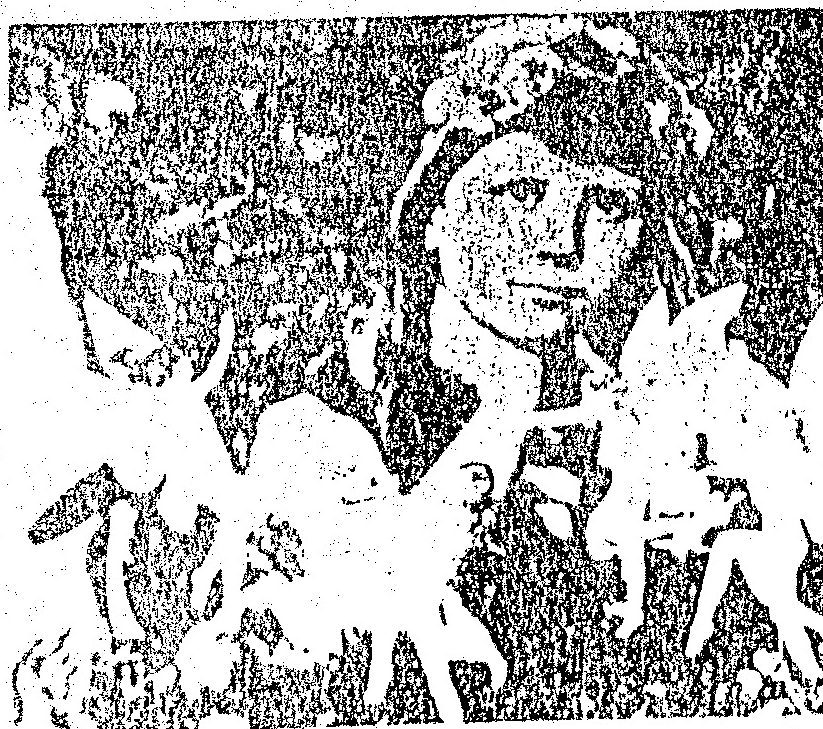
the vigorous energy of their growth period and the natural energy of the forest to manifest images. The author also once spent a period of time in deep, heavily forested mountains actually practicing the eye-opening method for super-vision ability, and as a result, powerful images that are normally invisible on ordinary walls easily appeared. Regarding this point, Chapter 5 of this book will present more practical examples to explain it. In any case, clear images tend to appear easily in deep mountains. The author believes that in such deep mountain locations, the degree of energy consumption is lower than in regular practice, and one does not feel fatigued even after practicing continuously for an hour or two. The reason for this is that the earth, trees, and other elements are all powerful sources of energy. Therefore, in such an environment, the author can absorb their energy, naturally feeling a sense of mental ease. However, ordinary people utilizing such an optimal environment to train in the opening
The Emergence of Super-Vision Through the Open-Eye Method
-opening method are rare, so it is best to train one’s own biological energy (qi). Due to space constraints, specific techniques in this regard cannot be explained in detail here; please forgive me, readers.
Above, we first understood the most important point of the eye-opening method—“the necessity of strengthening biological energy (qi)”—and next, the techniques of the eye-opening method will be explained.
The first step of the eye-opening method is to open your eyes yourself to see the image of light. Those who have practiced sufficiently and become proficient, and those who have studied the eye-closing method in the previous chapter, will find it very easy to succeed in learning this eye-opening method. Of course, it still requires a period of training. The techniques are as follows.
Stage (1) Viewing the Image of Light with Open Eyes
① First, prepare a B 4 (about 26×37 cm) drawing paper. For color selection, choose whichever is most suitable for your own eyes—that is, whichever color is least likely to make your eyes feel tired.
The drawing paper used when practicing the training to see the aura can continue to be used, but the drawing paper with a circle or dot drawn in the center, which was used when practicing the eye-closing method, must not be used. Because if there are circles or dots on the paper, it will affect the training of the super-vision eye-opening method, so you should switch to a new piece of drawing paper to use.
② Paste the drawing paper on the wall or place it on the desk. Your eyes can continuously look at it, which is relatively less likely to cause visual fatigue. The problem is…
One type.
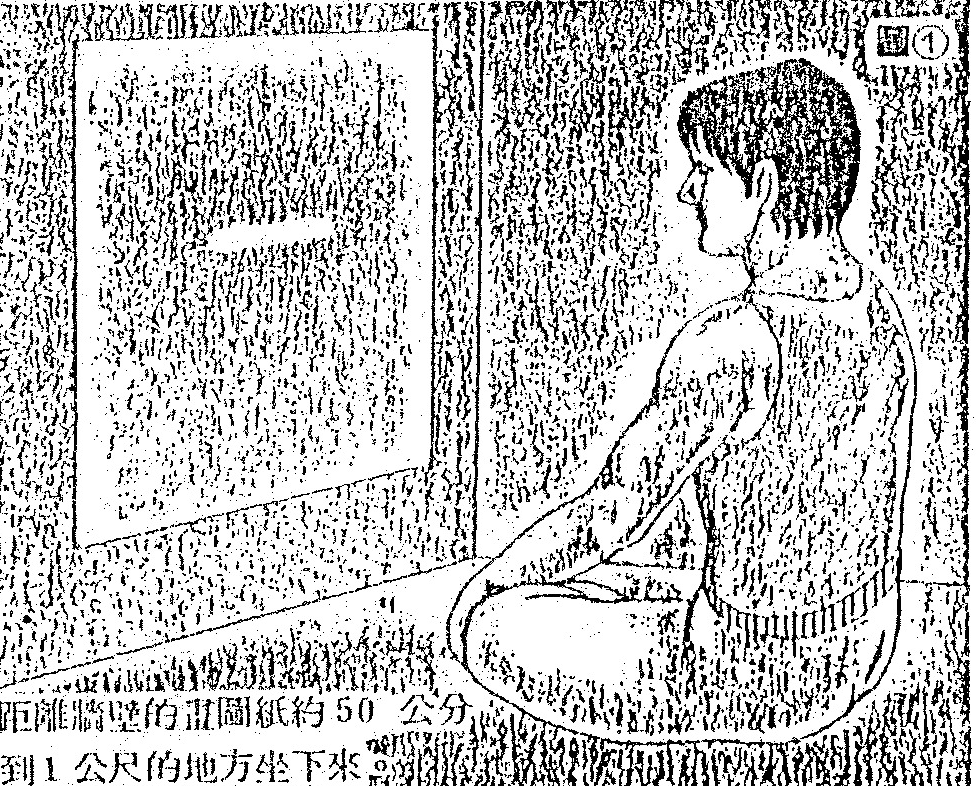
① Sit down about 50 cm to 1 meter away from the drawing paper on the wall.
③ The training conditions are similar to those for seeing auras; in other words, choose a somewhat dark room at dusk or before dawn to train. If, due to occupational reasons, you are unable to choose such times to train, simply arrange the room to have the same lighting conditions as for viewing auras. ④ Once the above conditions are prepared, face the paper on the wall and sit down at a distance of 50 cm to 1 meter. With your eyes open, follow the essentials of the closed-eye method to manifest the image of light. Start by manifesting the image of a simple single line (as shown in Figure ①). Those who have previously practiced the closed-eye method for seeing auras and extraordinary vision should easily be able to use the open-eye method to see a clear image of light appear on the paper. ⑤ If you are still unsuccessful after practicing a few times, just as with practicing the closed-eye method, you must intensely focus your consciousness for a short time, and with with eyes open, make a radiant light appear on the paper. Repeat this exercise patiently several times; wait until the point of light can appear freely, and only then slowly move your gaze horizontally to trace the outline of the character “one”.
⑥ Once you can manifest the outline of light with your eyes open, you must practice sustaining this lighted outline. When you begin practicing, aim to maintain it for three or four seconds, and then gradually lengthen the time as your training progresses. It is quite good if you train to the point where you can maintain it for about ten seconds.
▲ Points to Note
You will know this once you actually practice it: compared to the closed-eye method training, you will find it very difficult to concentrate your awareness, and it places a great burden on the eyes. If you want to maintain it for ten seconds, the burden on the eyes is even greater. Therefore, do not engage in long periods of training all at once. After concentrating your awareness once, rest for a few minutes to let your eyes rest and recover their function, and then repeat the training in this manner. You should stop training after each session of fifteen or twenty minutes.
⑦ After you can maintain the outline of light, the next step is to train your concentration on its shape, thereby gradually strengthening the radiance of the outline. After repeating this training, you will see the outline of light turn golden yellow or silver.
⑧ Only after you can clearly see the shape of “one” and maintain it for a period of time should you begin practicing viewing more complex graphics. As with the closed-eye method, first look at simpler graphics, such as simple symbols like △, □, +, ◇, and ○.
The key to viewing is the same as the closed-eye method. It is great if you can see the graphic all at once; if you cannot, only a single line will appear. Then, using this single line as a base, gradually form a certain graphic. Finally, through further training, learn to sustain the graphic’s duration; this is the same as the practice method of ⑦
Techniques for Letting Others See Super-Vision
method is the same.
⑧ After successfully practicing with simple symbols, you now look at more complex graphics, such as ⊕, ♀, ♂, ∞, etc. If the training is successful, proceed further to practice with Arabic numerals, simple Chinese characters, etc.
Once you reach this level, one person alone can perform the closed-eye method, so in the subsequent training, you can ask a third party to look at the contour of the light that emerges.
Stage (2): Inviting a Third Party to Appreciate the Image
This training presents no technical difficulties; readers who have trained according to the sequence in this book should be able to learn this skill very easily.
That being said, it is not entirely without difficulties. For instance, if there is insufficient bioenergy (qi), although an image will appear, the light will be too faint for a third party to see. However, when trying to emit stronger energy and becoming overly tense, it will affect the concentration of consciousness, and in this way, super-vision will not be formed.
In short, the consciousness must be relaxed, yet the qi must be emitted forcefully. Speaking of which, this is a contradictory approach, and it is also what beginners will
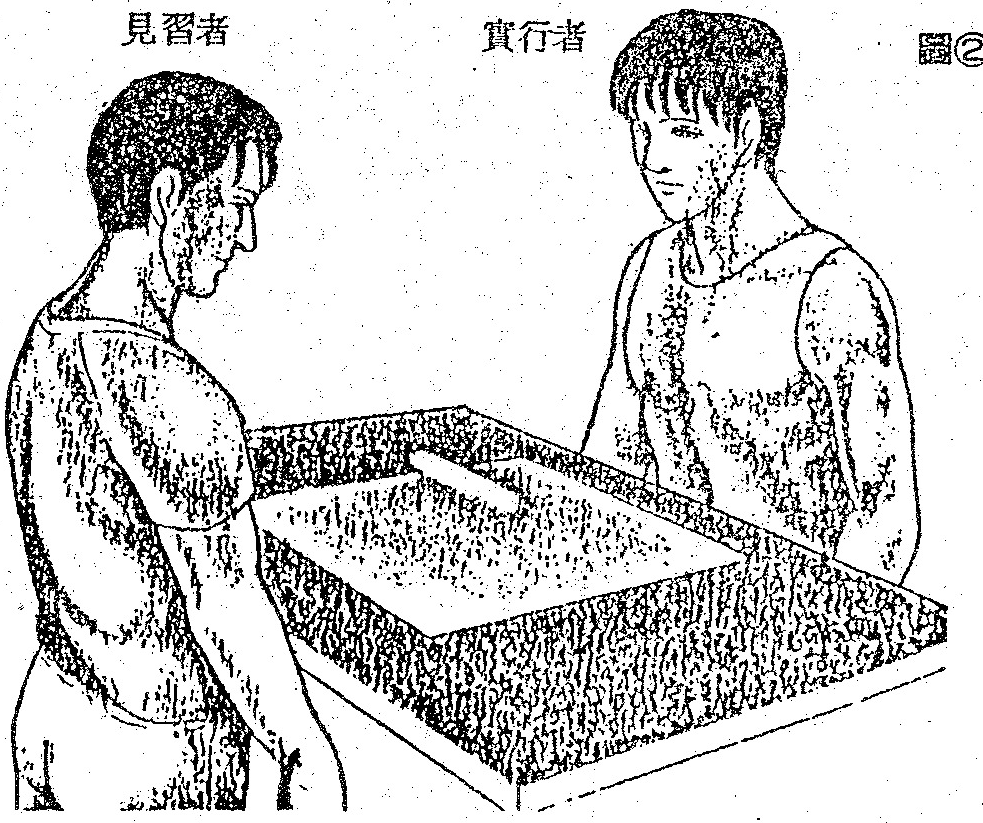
②
Where you feel it is difficult to learn is, regardless, exactly the focus of this training; you should train with heightened self-awareness.
The steps for this training are as follows.
① This training must be conducted with a third party present, and this third party must be someone who is highly sensitive.
Place the drawing paper on the table. The practitioner and the third party stand facing each other on either side of the drawing paper (see Figure ②). The distance between the eyes and the drawing paper should be thirty to sixty centimeters for both the practitioner and the third party.
② Once all preparations are complete, the practitioner projects an image of light onto the drawing paper. Initially, project a clear dot or a simple mark, such as the character for “one”. Focus your consciousness on these dots or marks to make them radiate light; at this point, you can ask the third party if they see anything or what they see.
If this is done very successfully, next project clearly shaped but relatively simple figures, such as △, □, +, ◇, ○, etc., and you can also ask a third party what they see.
▲ Points to Note
When projecting these five simple figures, if the third party’s answers to these figures are all incorrect, or if they answer that they cannot see anything at all, then you should engage in self-reflection. You must not invite anyone to observe again; instead, you should cultivate yourself further, otherwise it will become a joke.
In the third party’s answers, the important part of their response is the image of the projected light: where it appears or what its shape is (for example, in the case of a triangle, they must clearly answer which direction the acute angle points and what the lengths of the three sides are). Therefore, the answer must be very clear and detailed; otherwise, when what is seen differs from what the practitioner expected, it cannot be considered the cultivation of the clairvoyance awakening method.
④ After being able to let a third party see simple figures like △ and ○, you should now project more complex figures or symbols, such as ∞, ♂, ♀, ⚡, etc., for the third party to answer.
According to the author’s experience, the images of these complex figures or symbols are not easy to maintain, so it is already quite good if the third party can answer with a similar figure.
According to the author’s experience, the position of the light image seen by the third party always differs slightly from the position seen by the practitioner. For instance, the practitioner projects the light image in the center of the drawing paper, but the image position seen by the cooperating third party often the part of the drawing paper closer to the practitioner.
The author also feels that the aspect where super-vision ability can be most strongly felt is that when the practitioner’s qi strength or concentration slightly weakens while manifesting a light image, the manifested image shape also collapses accordingly. This situation is also perceived by the cooperating third party, which is a very interesting point.
Another interesting point is that the light image manifested by the practitioner is not seen by the third party simultaneously; there is always a slight discrepancy. This occurs not only at the beginning of the experiment but also when various shapes are continuously changed and manifested. For instance, if the practitioner first manifests △ and then changes it to □, the third party always sees the □ only a moment after the practitioner has manifested it. From the third party’s response and the time delay, one can perceive that the lag time is roughly the same, as if it is always a couple of beats behind.
This situation is also very similar to the characteristics of the sensation of qi. One can understand this by simply conducting a qi sensation experiment using qigong methods; the results obtained are almost identical to those of super-vision training. For example, if a person holds their two palms facing each other and emits qi using qigong methods, a third party uses a knife-hand to chop down from top to bottom between the practitioner’s two palms. When the chop occurs, the practitioner does not feel anything, but after a short while, they will feel as if their qi has been sliced apart by something. This sensation is especially clear when the practitioner closes their eyes; naturally, a well-trained individual will experience the same sensation even with their eyes open. In any case, when the following four characteristics manifest, it can be proven that the third party has genuinely seen the light image emitted by the practitioner:
①The light images seen by the practitioner and the observer (third party) facing each other present mutually opposite shapes. ②There is a subtle discrepancy in the position of the light image seen by the practitioner and the observer.
Making Light Images Float in Space
③ After the practitioner produces a certain figure, it takes a little time before the trainee can see it and state what it is. ④ As the practitioner’s concentration or energy weakens, the produced figure will also deform or disappear.
After becoming able to let others see light images, you now practice making the images appear in the space in front of you rather than on drawing paper. In other words, you manifest this incredible light image in space for a third party to see. The author also frequently uses this method, making it feel like a hologram floating in space. Complex symbols with bright, radiant outlines, such as △, +, or ◇, hazily appear in the dark space, and they gradually change into various shapes according to the practitioner’s consciousness. People who see this sight for the first time feel as if they have been deceived by a cunning trickster. Manifesting these wondrous images of extraordinary vision abilities is effortless for the author. As long as you are proficient in the training using drawing paper as described above, learning to produce these light images in the air should be very easy. In fact, the techniques at this stage are not that easy to learn, because in a general environment there are always various obstacles around the space, which is different from the completely empty room used when first practicing extraordinary vision abilities. The concentration and energy used in this technique are quite large, and at the same time, certain precautions must be observed, so that it can be successfully performed with the lowest amount of energy and concentration. Below, the simplest training method is explained based on the author’s experience. This method of cultivation requires appropriate environmental conditions and time, so these conditions are explained first as follows.
The Environment Where Light Images Easily Appear in Space
⊙ Time Band (Appropriate Time)
The time for conducting this training should avoid daytime. The reasons are as follows: even if the sunlight during the day does not feel strong, its light volume is still quite large, and the images that beginners can manifest always lack sufficient brilliance. Therefore, during the day, the manifested images are even harder to see or see clearly. Thus, it is best to train at night; at the very least, practice should only take place after dusk. In the author’s experience, unlike aura development training, the darker it is when training, the better.
⊙ Environment
It is best if the training room can be completely empty, but there is no need to be overly sensitive about this point; as long as outdoor light does not shine glaringly into the room or reflect inside, simply tidying up the room a bit is sufficient. However, if it is dimly lit, the light images that appear can easily be affected by objects in the room and become hard to see clearly. From this perspective, it is still best to choose to practice at night when it is already dark
Training to Make Images Appear in Space
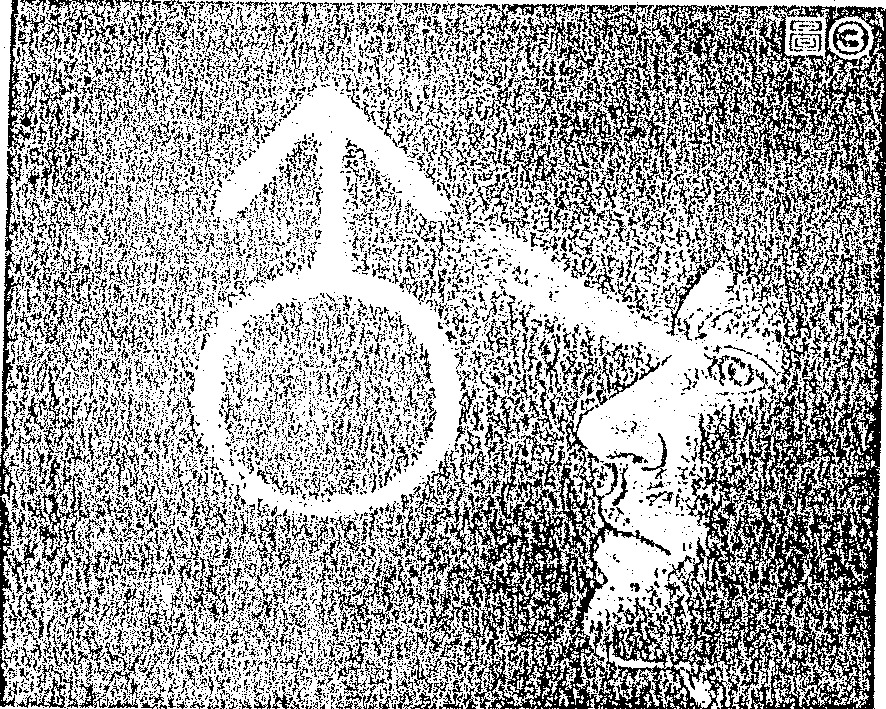
③
① After the preparations for the appropriate time and environment are fully completed, first use the closed-eye method, and then use the open-eye method with drawing paper to allow the light images of various shapes to appear. This is a warm-up exercise, and during the practice of this stage (①, ④), there is no need to ask a third party to view the images.
② After performing this training several times, move your gaze into the space to manifest distinct points of light or simple images such as the character “one”. After doing this a few times, further concentrate your awareness to enhance its radiance while maintaining it for a longer duration.
③ Next, train to manifest simple shapes such as triangles, squares, and circles, and then similarly increase their radiance and duration. Each shape and symbol must be maintained for a few seconds.
④ Next, train to manifest infinity signs, 8, 9, 4, or numbers, Chinese characters, or composite symbols. This completes the preparatory stage of the training (see Figure ③).
⑤ After performing the above training several times and gaining confidence, …only then can you invite a third party to view the light images of various symbols and figures manifested in space. As in the above situation, ask the third party what they see and what the content is; from the third party’s answers, you can confirm whether the shape they see is correct, what its position is, and so on.
When the author practiced previously, I felt that the position of the manifested image was more deviated than when using drawing paper. When I invited third parties to view the image, I did not just invite one person; generally, I invited three or four people. Moreover, I had them stand in three or four different corners of the room to view the light image I manifested. As a result, the position of the image each person saw was different. For example, when the author projected an image on a wall several meters away, the person sitting against the wall saw the position of the image they observed as
being in the space quite far ahead, while the person sitting to the author’s right stated that the position of the image they observed was on the wall to the diagonal right. In this way, third parties in every corner of the room all saw the position differently. ⑥ In any case, after being able to freely manifest simple light images in space, it is now very much like the eyes-closed method of practice, and
try manifesting objects with complex shapes, such as people, animals, plants, furniture, and tools, as light images. By trying this, you will realize that not only is it more troublesome to manifest complex shapes, but the energy consumed and the energy required to maintain the image for a few seconds are also very large. Therefore, you must practice more in your daily life, and you must strengthen your bio-energy. Otherwise, although this method is very simple, it will not work without sufficient qi. Simply put, people with insufficient bio-energy (qi) will generally fail even if they practice several times.
Freely Controlling the Aura
In the section “Development of Seeing Auras” in Chapter 1, a story about Native American sorcerers extending the aura from their abdomens to climb cliffs as if using a rope of light or to fly in the air was mentioned. When using clairvoyance, one can almost achieve the various actions described in the story. Of course, one must train to a considerably high level to reach the advanced proficiency of Native American sorcerers. The author has also emitted an aura from the abdomen, and then intertwined it with the light emitted by the other party, performing a tug-of-war-like action without either side using their hands. It is also possible to extend this kind of aura (not necessarily one emitted from the abdomen) to stroke or strike the other party’s head without letting them feel it. Interestingly, the other party will still experience the sensation of being touched by something at that time. This technique can also be applied to the adjustment of auras, making it easy to correct abnormalities such as aura defects or left-right asymmetry mentioned in Chapter 1. Problems concerning auras can generally be solved just by using the eye-opening technique for clairvoyance. Here, the simplest “method of extending the aura to form various objects” will be introduced first, followed by an explanation of the “aura correction method related to clairvoyance” associated with Chapter 1.
Extending the Aura to Form Images
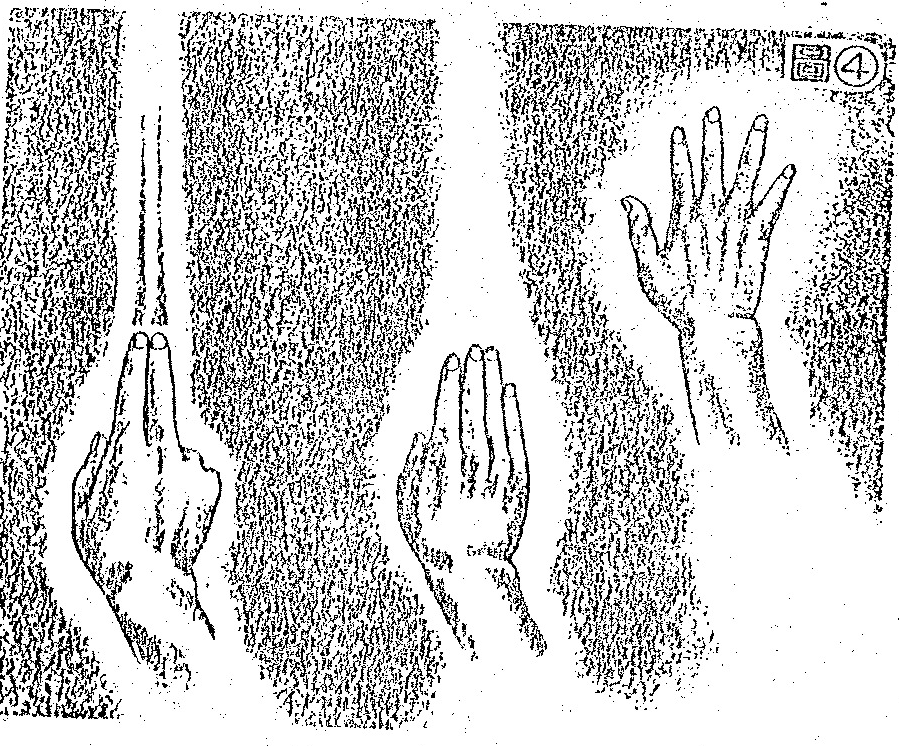
Figure ④
This method uses the aura emitted from the fingertips to form various shapes. It is among the easiest methods, but the techniques involved are not simple. Once this technique is mastered, one can make illusory images appear completely real to others.
① First, spread the five fingers slightly apart, and observe the aura emitting from this hand. Once the aura is clearly seen, strongly focus your consciousness to make the aura feel as though it is gradually strengthening.
② When the aura emitted from the fingertips feels like spraying mist, bring the five fingers close together. This gathers the aura emitted from each finger into a fairly intense beam of light. At first glance, it appears to be emitted from the middle finger as its center, and then the aura is extended through the power of consciousness.
▲ Precautions
If the light does not stretch, or even if it stretches but the color becomes
thin, the reason is a lack of bio-energy, so it is advisable to practice using qigong methods regularly to strengthen your qi power. ③ After the aura from the five fingers held together can stretch a distance of one or two meters, you now need to reduce the number of stretching fingers. For example, first bend the thumb inward and use only four fingers, then bend the little finger to make it three fingers, and then bend the ring finger, so that it becomes only the middle and index fingers. Being able to maintain the same brightness and stretching length of the aura as when there were five, only after reaching this stage can you practice the following techniques (for the above part, please see Figure ④). ④ Continue to strengthen the aura emitted from these two fingers, intensify its brilliance, and then use conscious power to make the aura produce various shapes. For example, you can emit shapes such as a long sword, a trumpet, or a ring. At this time, do not just rely on yourself to observe; ask a third party to help confirm it!
The author used to frequently perform this method. As mentioned earlier, once a group living session was held deep in the mountains, accompanied by some disciples with excellent training results. Everyone emitted sword-like beams of light from their fingertips to spar with each other, intertwining sword with sword, and sometimes stretching these beams of light into spirals for mutual appreciation. Later, when the author was training in Mishima, Shizuoka Prefecture, he was hosted by the chairman of a local company and performed this technique for them to see. Those present were all people without any training in clairvoyance, yet they all stated that they could see the various images emitted by the author using the aura. When the aura emitted from the author’s fingers stretched to several meters, they all unanimously exclaimed in surprise: “Oh! To talented people saw the aura emitted from the fingers stretch to such an extent. A moment later, they said with deep emotion: “How did this light beam suddenly turn into the shape of a long sword? It is truly incredible.” As the author’s performance continued, they frequently gasped in surprise. After a while, perhaps because I was so engrossed in the performance, I finally shaped this image into a human silhouette that appeared on the wall. At this point, their gasps of surprise grew even louder—“Look! How is there a human silhouette appearing on the wall?” Some timid young ladies quickly covered their eyes, not daring to look, as if they had seen a ghost. Therefore, I stopped the performance. That same day, several of the chairman’s important guests came to visit; they had arrived after the performance ended. Once they heard the chairman describe the performance they had watched, they all asked to see it to broaden their horizons. However, I had other matters to attend to and took my leave, unable to perform again. Later, the chairman specifically called to tell me that those distinguished guests absolutely insisted on seeing it. As a result, we agreed on a time, and the chairman hosted us at the Nagaoka Hot Springs scenic area. There, I performed an even more wondrous phenomenon for them to see. If I were to explain its contents here, it would disrupt the progress of this chapter, so this part will be left for the end of Chapter 5. ⑤ When the energy of the light is weak, it cannot be used; however, with long-term practice and the strengthening of qi, one can freely shape this light beam into a long sword. One can also use this long sword-shaped light to cut through mysterious objects, looking just like the laser beams seen in science fiction novels and movies. Similarly, one can shrink the light beam into a bullet shape and fire it suddenly from the fingertips. If this bullet-shaped light beam strikes a third party’s eyes, they will cry out in pain. Here, I will take the opportunity to share an interesting example as follows.
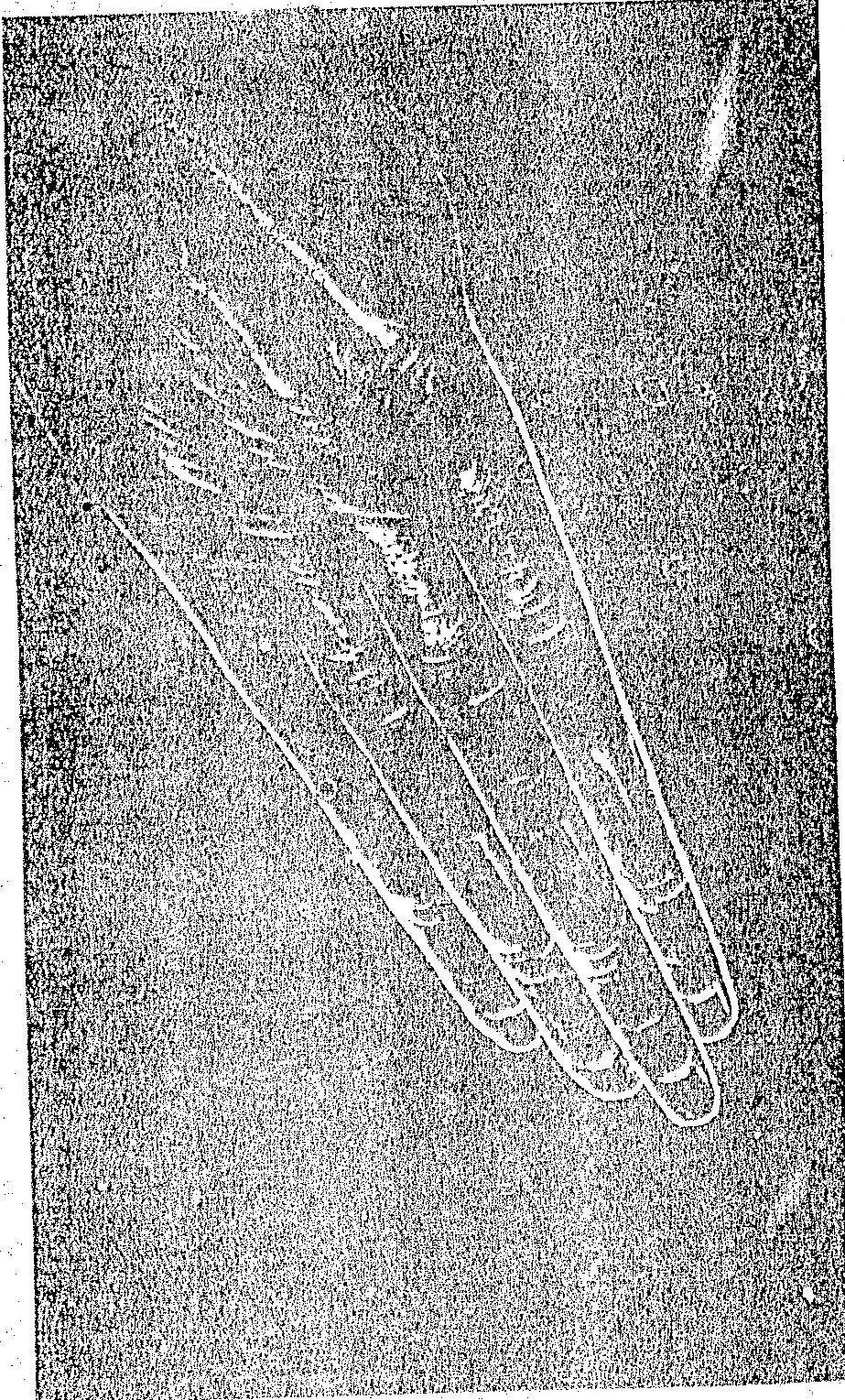
Using the Palms’ Aura to Manifest Shapes
The author previously lived in Adachi Ward, Tokyo. At that time, I took in many disciples to teach them Xian Dao. Among them was a psychic by the name of Mr. Nakazawa. When he came to me to learn Xian Dao, he already possessed considerable abilities; for example, he could see auras and knew exorcism techniques. Unlike the others, he had an excellent foundation and understood the sensation of qi right from the start. Therefore, I gave him special guidance, teaching him the more advanced qi strengthening training within the qigong methods.
After these disciples had trained to a certain level, one day, I had them practice qi strengthening on their own. Then, I explained to them the various techniques for emitting an aura from the fingers. The author actually altered the shape of the light, emitting various visual forms for them to observe. After demonstrating a few of these, the final performance involved shaping the aura into a bullet. I first explained the method to everyone, and then suddenly fired the bullet from my finger. I heard a scream as Mr. Nakazawa covered his eyes with both hands, crying out, “It hurts! It hurts!”
He stated that the author must have projected a stone or some other object that hit his eye, which was why it was so painful. Later, I fired this type of bullet a few more times, aiming at a different target each time, and every person who was hit similarly cried out in pain.
Once an aura is emitted from the fingertips, it can form various light images after being adjusted, but it cannot manifest everything. The reason is that the shape of the aura is based on the fingertips and becomes elongated; therefore, the shapes that can be formed are limited to a certain extent. For instance, slender objects like a sword, a lily, or a trumpet can be easily produced, but shapes like a sphere or a doll are not easily formed. Of course, it is still possible to force their formation, but they tend to become rather unnatural shapes. At this time, a method utilizing the aura emitted from the palms can be used. This method is also a mainstream part of clairvoyant abilities. Specifically, utilizing the aura, various shapes of light images are manifested between the palms of both hands or above the palm of one hand. The method of utilizing the palm aura explained here serves as an intermediate step between the method of controlling the aura emitted from the fingertips and the method of whole-body control, which will be explained later. If this method is practiced well, one can naturally proceed to learn more advanced stages. Specifically, this method is divided into two main categories: one using both hands, and the other using one hand. Because the method using both hands is relatively easier, the method of using both palms will be explained first, followed by the method of using one hand.
Training to Form Images Using the Aura of Both Palms ① First, with the palms facing each other, emit an aura from each (hereafter, as light images, the visible parts are all referred to simply as the aura), and then gradually intensify it to generate a dense field of light (Figure 5). A general standard is to feel a sense of pressure, as if the hands are in a sticky state. ② Next, repeatedly open and bring the hands together so that these radiant auras can stretch or contract with these movements. When this
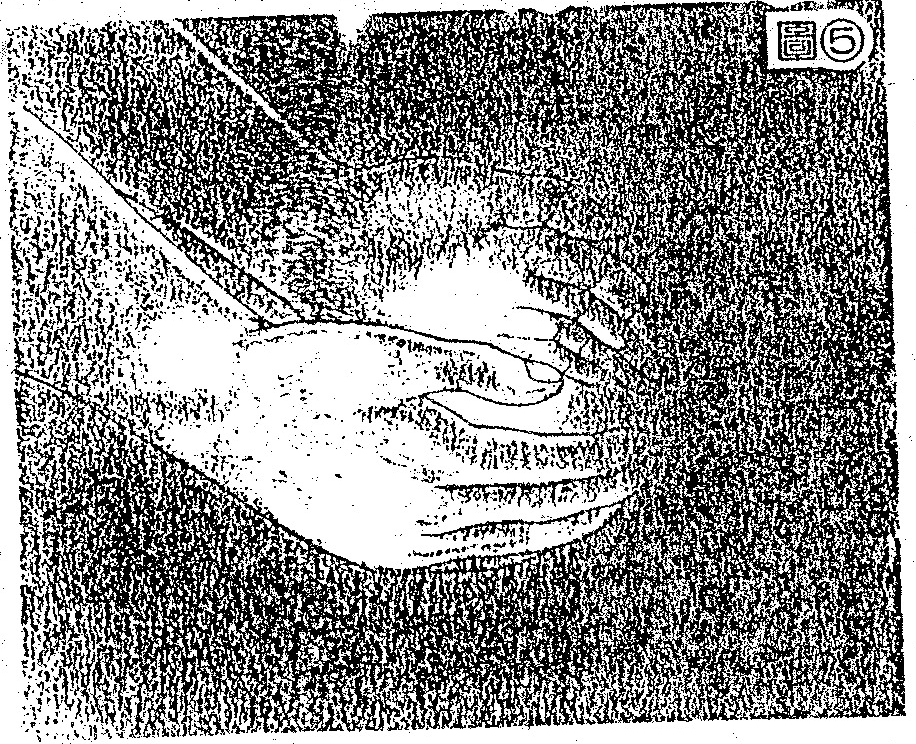
Figure ⑤
Only when the sensation is very clear should you bend the fingers of both hands to make the spherical image appear.
③ Based on the spherical image, use the palms of both hands to form your desired image. For example, if you want to form a doll, you must hold the image of a doll in your mind, and subtly move your fingers according to its shape to make the shape of the doll appear (Figure ⑥).
▲ Points to Note
If the image gradually disappears during the operation, it is because the emitted energy is too weak, so you must find a way to emit stronger energy. If you are unable to emit stronger energy, then you have no choice but to practice strengthening your qi from the beginning again.
If this method can be performed successfully, you can proceed to further training, which is the training of using the aura of one hand to form an image.
Training on Using the aura of One Hand to Form Images
① First, raise one hand to chest height, and the other…
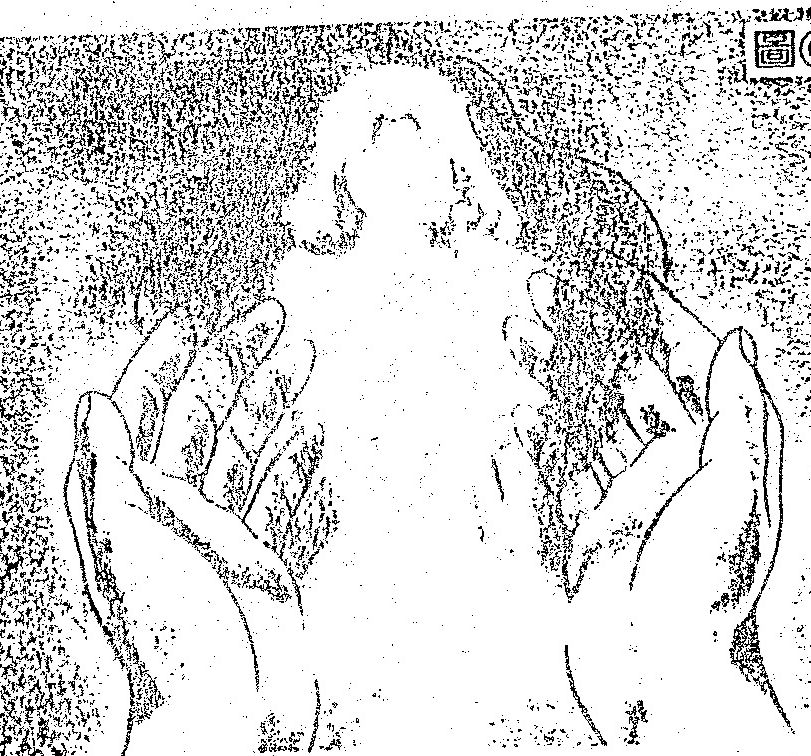
Figure 6
One hand hangs down naturally. A striking aura is emitted from the palm of the hand making the hand seal; however, unlike when the aura is emitted from the fingers, the aura must not be extended too far (Figure 7).
② After emitting the aura from the palm, use the power of consciousness to make the aura bright or dark. Once you can freely change it in this way, you can make adjustments to the aura such as making it larger, smaller, extended, or contracted.
③ Only when you can freely adjust the above movements with your own consciousness can you proceed to the next step of forming various shapes. At the beginning, start practicing with a simple sphere, and then gradually practice more complex shapes.
According to the author’s experience, round objects are relatively easy to manifest, whereas the more angular an object is, the harder it is to form. In this regard, this is the same as the basic training method for clairvoyance (eye-closing method,
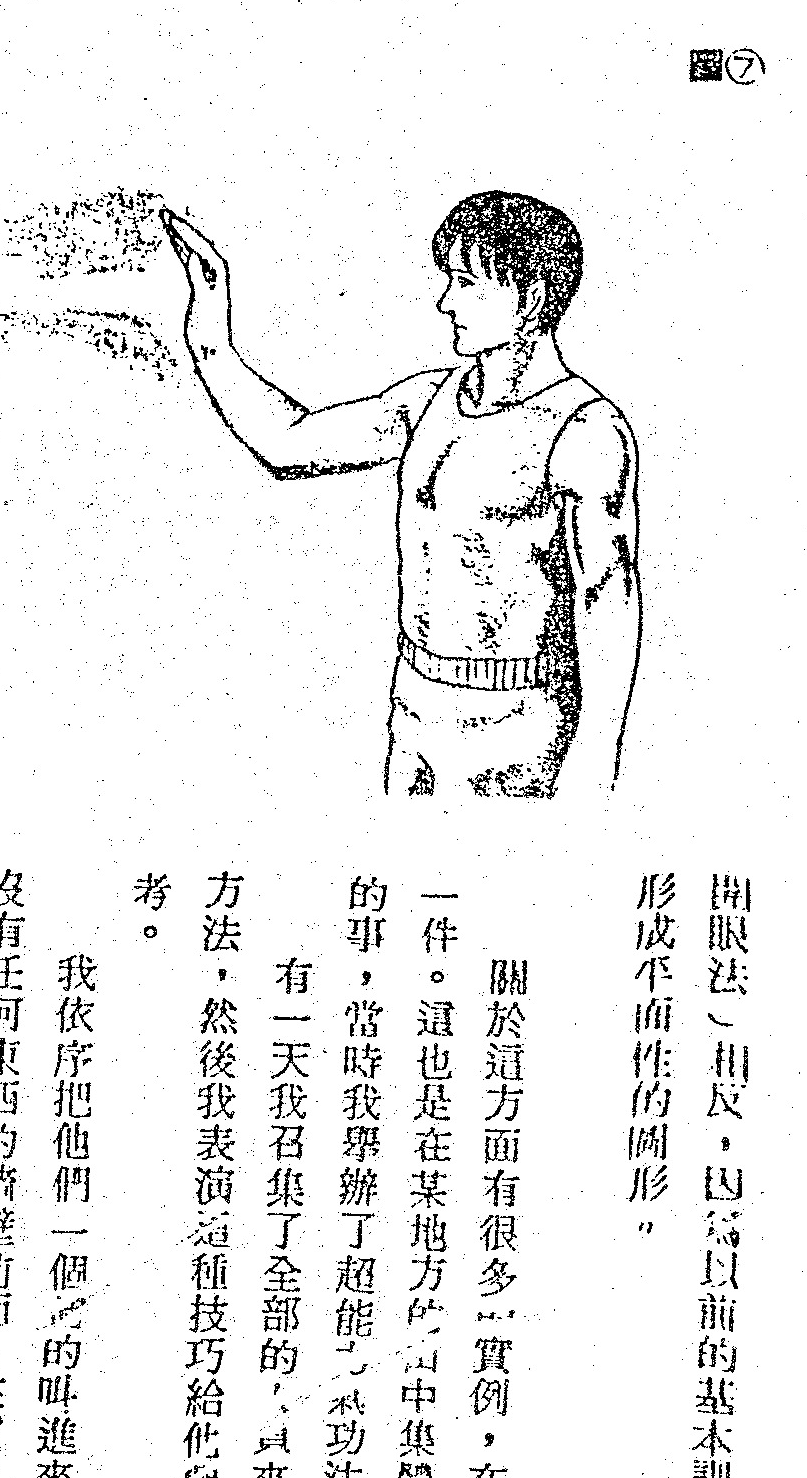
Figure 7
…is the opposite of the Eye-Opening Method), because the previous basic training methods all practiced forming flat, two-dimensional images.
There are many real examples regarding this aspect, and I will introduce one of them here. This also happened during a communal life in the mountains somewhere, when I held a seminar on the secret qigong methods for extraordinary abilities.
One day, I gathered all the members to train them in the method of seeing auras. Then, I demonstrated this technique for them to see as a reference.
I called them in one by one, had them stand in front of a blank wall, and let them observe the shape of the aura with the lights turned off and on. I asked them what they saw and what the shape was like. As a result, I learned that some people had already perceived the subtle, swaying shape, and therefore I decided to to conduct imaging training. Therefore, I resolved to further begin
To confirm the shape of the aura emitted by each person, I casually asked one of them to sit in front of me, using my hands to first touch the contour shape of the aura. Then, I used both hands to touch the aura emitted from the top of the head to form it into the shape of a hat. At the time, I told them that this hat was entirely created through mental imagery.
Then, I made subtle movements with my hands to manifest the shape of a giant spring. This sight truly gave a wondrous feeling, as if there were a spring-like shape on the head.
Following that, I transformed the spring into the shape of a lily. Seeing this seemingly magical display, they could not help but show expressions of surprise. In this way, I successively transformed the shape of the mental imagery into several variations, making them realize its broad range of applications. In a way, this was a demonstration session, and it could also be called an experimental session.
In this experimental session, the author completely utilized the aura emitted from the head; therefore, almost none of his own energy was consumed, allowing him to perform for an extended period.
Generally speaking, most people only know that clairvoyance must be executed using one’s own energy, but after this performance, they realized that the energy of others could be utilized to perform.
If this method is used, one can perform in places with very strong energy, such as next to trees or in certain locations on the earth with strong power, utilizing the force they emit to manifest quite clear mental imagery. Of course, the force emitted by people around us can also be utilized. The currently popular spirit-summoning experimental sessions or PK experimental sessions generally use this method.
Understanding this point would certainly be very useful for people with weak bioenergy.
Controlling the Aura of the Entire Body
Those who have successfully learned to this level can proceed to train in methods for controlling the aura of the whole body.
Methods for Controlling the Whole-Body Aura
Among these methods are the aforementioned method for controlling the abdominal aura, localized methods, and also methods for controlling the whole-body aura. Among them, the method for controlling the localized aura is one of the control methods that utilizes the aura emitted from one hand. Regardless, by following the learning and training explained in this book, there is no need to distinguish which method is which; ultimately, one will be able to control the aura of the entire body.
Control Method for the Localized Aura
⑨ This is a training method of extending the localized aura. The use of the localized aura was explained earlier, but it does not necessarily have to be the abdomen; other body parts are also fine.
For example, the aura emitted from places like the head, shoulders, chest, back, and genitals can be extended. It is said that famous ancient sages could extend their tongues by several meters at will; in reality, this was merely the aura emitted from the tongue extending by several meters.
⑩ However, the aura emitted from certain body parts may not extend out very flexibly. At this time, mental power must be used to make the aura very small, so that it can extend out quickly. It is important to note that while extending the aura, it must also be strengthened (Figure ⑩).
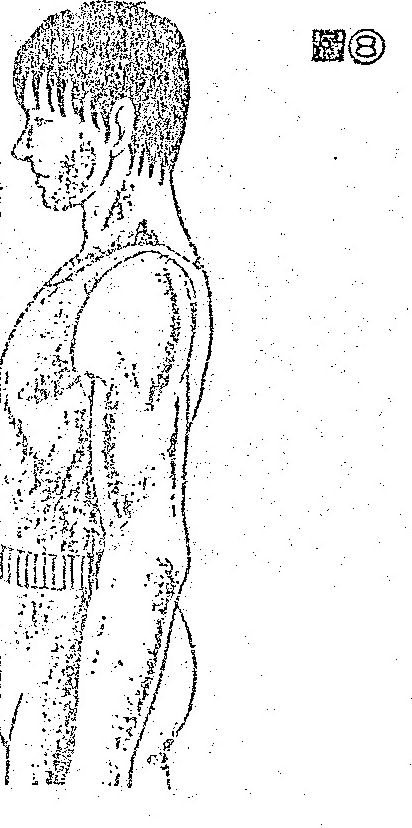
Figure 8
As explained earlier, the author frequently uses this extended aura to contact another person’s body, and it can also contact any object. Therefore, when seeing something approaching from a distance, one can use this method to make contact in order to identify what is approaching. If the approaching entity is something undesirable, after detecting it through this extended aura, we can avoid it early.
The above explains the method for controlling localized auras. Next, the method for controlling the aura of the whole body will be explained.
Controlling the Aura of the Whole Body
The aura emitted from certain parts of the body cannot be seen directly. In this case, you can use a large mirror to draw out the aura of your whole body for training.
① Stand in front of a large mirror that can reflect your entire body. Relying on your own consciousness, try to make the aura of your entire body expand or shrink in this way.
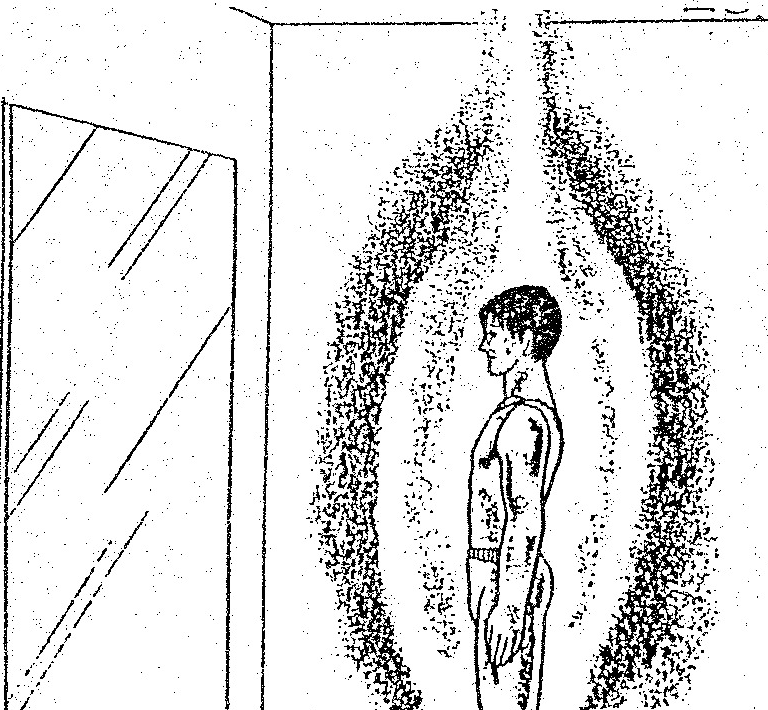
Figure ⑨
Try adjusting ② Once you are able to freely expand or shrink it, you can change the shape of the aura according to your wishes, such as changing it into a triangle, then into a flame shape. You can also make the aura rise upward or split it into two strands, etc. (see Figure ⑨). Once you become highly proficient in this adjustment practice, you will be able to easily correct any abnormal parts of the aura yourself. From then on, you can practice the “aura adjustment method” on your own, and this method will be explained later in this book. ③ After you can control the aura over your entire body, try controlling the auras of others. However, this kind of control over others often poses a danger (because most others have not received aura control training), so apart from special circumstances, it is better not to control others. The special circumstances mentioned here include correcting the shape or eliminating defective areas of the aura, etc. If you casually control another person’s aura, it will often cause the other person’s mental or physical abnormalities, which is very dangerous and requires special attention.
Regarding the control of the aura over the entire body, the author has many experiential insights, and here I will briefly introduce one.
I once went to live collectively in Ise, Mie Prefecture, where there was usually nothing to do at night, so I used this time for aura-viewing training.
In the forest at night, the surrounding area was very quiet, making it an ideal training environment. On the first day of training, all members were able to see auras very quickly, so I had each team member step forward in turn and observe the changes in auras.
After they could all see clearly, I instructed each of them to use their own willpower to alter their own aura. They were all people who had received training in qigong methods and Taoist cultivation, so they were able to alter their own auras quite easily. Each person’s demonstration was different—some expanded their aura and then shrank it, while others adjusted the aura emitted from the crown of their head so that it could extend to a great height.
Since they all had a solid foundation in this area, I then taught them another method: adjusting a third party’s aura using the aura emitted from one’s own hands.
I first called one member to stand three meters in front of the author, then emitted qi from the author’s hands and linked it with the aura emitted from the other person’s body.
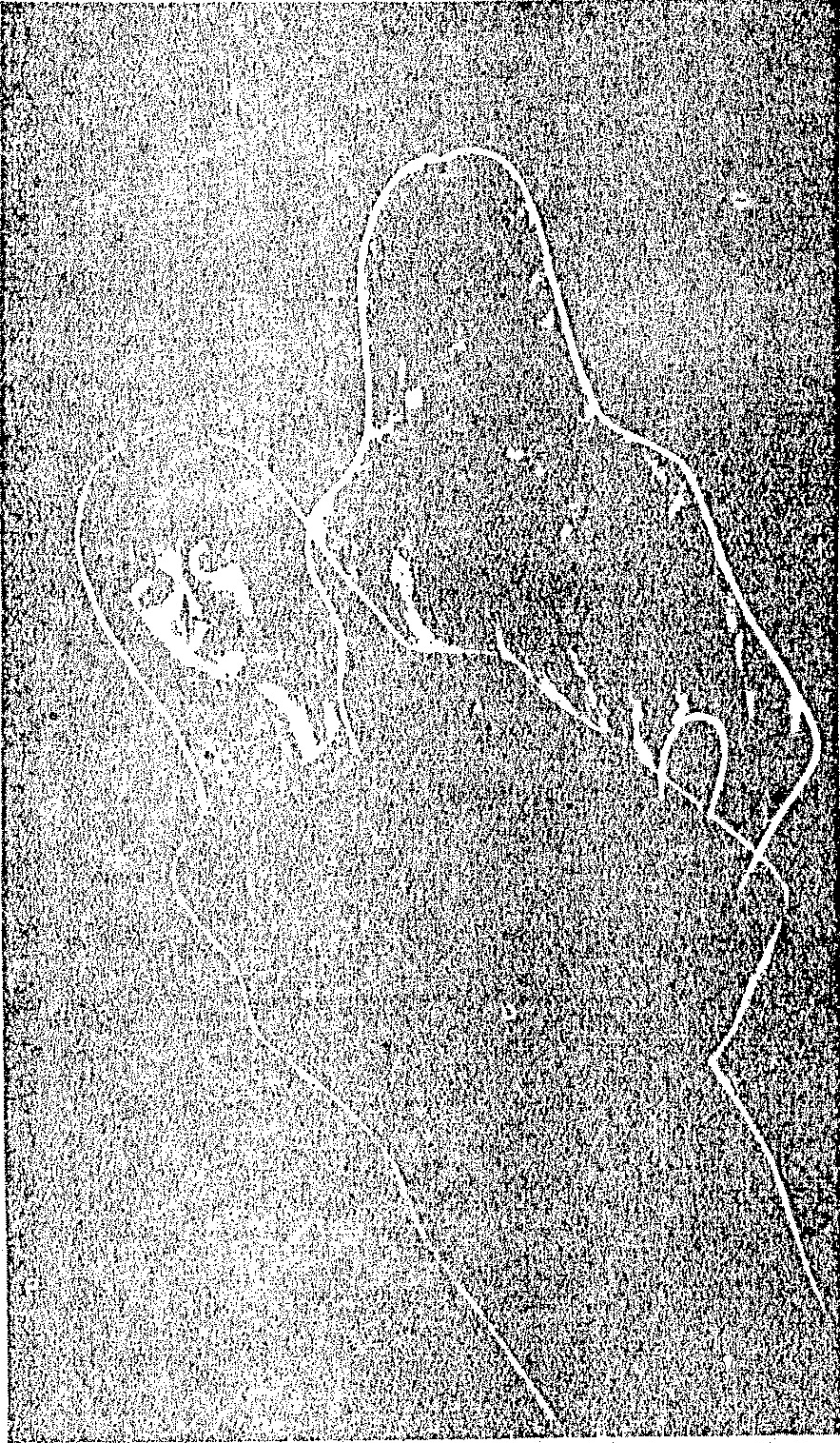
When the author strengthened or weakened this stream of qi, it could cause the aura over his entire body to suddenly turn dark or suddenly turn bright, and it could also change the shape and size of his aura.
Finally, the author exerted force in the lower abdomen, strengthening the qi (aura) emitted from his hands, and moved his body one step to the side. As his body moved, the aura surrounding his whole body moved along with it; this performance made everyone present hold their breath in silence.
Finally, I also performed pulling his aura upward, leaving the people present dumbfounded.
After my performance ended, I let each of them try to imitate my performance. Aside from the final method of pulling the aura upward being rather difficult, overall they all performed quite well.
This method is generally performed using the aura emitted from the hands, but those who have cultivated to a very high level can also perform it using only their eyes. An actual example of this is introduced below.
Once, the author was explaining the concept of Daoist out-of-body experiences to a few friends at his residence. It was a little past eight o’clock in the evening, and I first explained the general situation before explaining the technical aspects. However, during the explanation, these friends still seemed to half-understand, so the author actually used the aura emitted from his hands, and pulled each of their auras upward, thereby giving them an actual sensation of detachment.
Especially for a few of the friends, I performed it very well, extending the aura over their entire bodies to the height of the ceiling, so these few
Correcting the Aura’s Shape Through Visualization
people began calling out happily, saying that their backs had touched the ceiling.
That day, hosts and guests all had a delightful conversation, and everyone also discussed the performance I had just given. Among these friends was one woman who seemed quite excited and reported feeling her aura being pulled.
Hearing her words, I could not help but watch her intently. At that moment she exclaimed, “Oh! It is leaving my body!” When the author looked at her body more carefully, she said again, “Oh! It is back.” At this point, the author realized that as the author’s gaze moved, her aura rose or fell accordingly — a first-time experience for the author. So the author asked this woman to serve as a subject and consciously used the aura of the eyes to experiment. As a result, relying solely on the aura of the eyes — that is, merely by shifting the gaze — the author was able to raise or lower this woman’s aura.
Later, when opportunities arose, the author also experimented on others several times, and the results were all successful using only the gaze. However, for this method to work well, two conditions should be met: first, the practitioner’s qi — that is, the aura, especially the aura of the eyes — must be strong; second, the other person must be a sensitive individual. With such a combination, success comes easily.
Once you have mastered all the aura techniques I have introduced above and can control the aura at will, you can practice the application method from Chapter 1, the “Aura Correction Method.”
When practicing this method, the various techniques of the extraordinary abilities qigong method are all very useful, so those who have not studied qigong should first learn it (for training in this qigong method, please read ‘Secret Arts! Extraordinary Abilities Qigong Method’). Now, the actual techniques will be explained.
Correcting Aura Deficiencies
Stand in front of a large mirror and observe whether there are any abnormal parts in your aura. Some abnormalities are in color, while others are in shape; the first thing to adjust is the shape. The reason is that for an aura with an abnormal shape, it is useless to merely adjust the color.
① Absorb life energy from the air and pour it into the deficient area (Figure ⑩). The key is to strongly visualize or focus your intent on the energy flowing in.
It is best if you can clearly see the energy and qi floating in the air (equivalent to a kind of gas, appearing like a swarm of fireflies). If you cannot see this flowing energy and qi at the beginning of your practice, it does not matter, as long as the deficient area of the aura reflected in the mirror is gradually replenished and disappears.
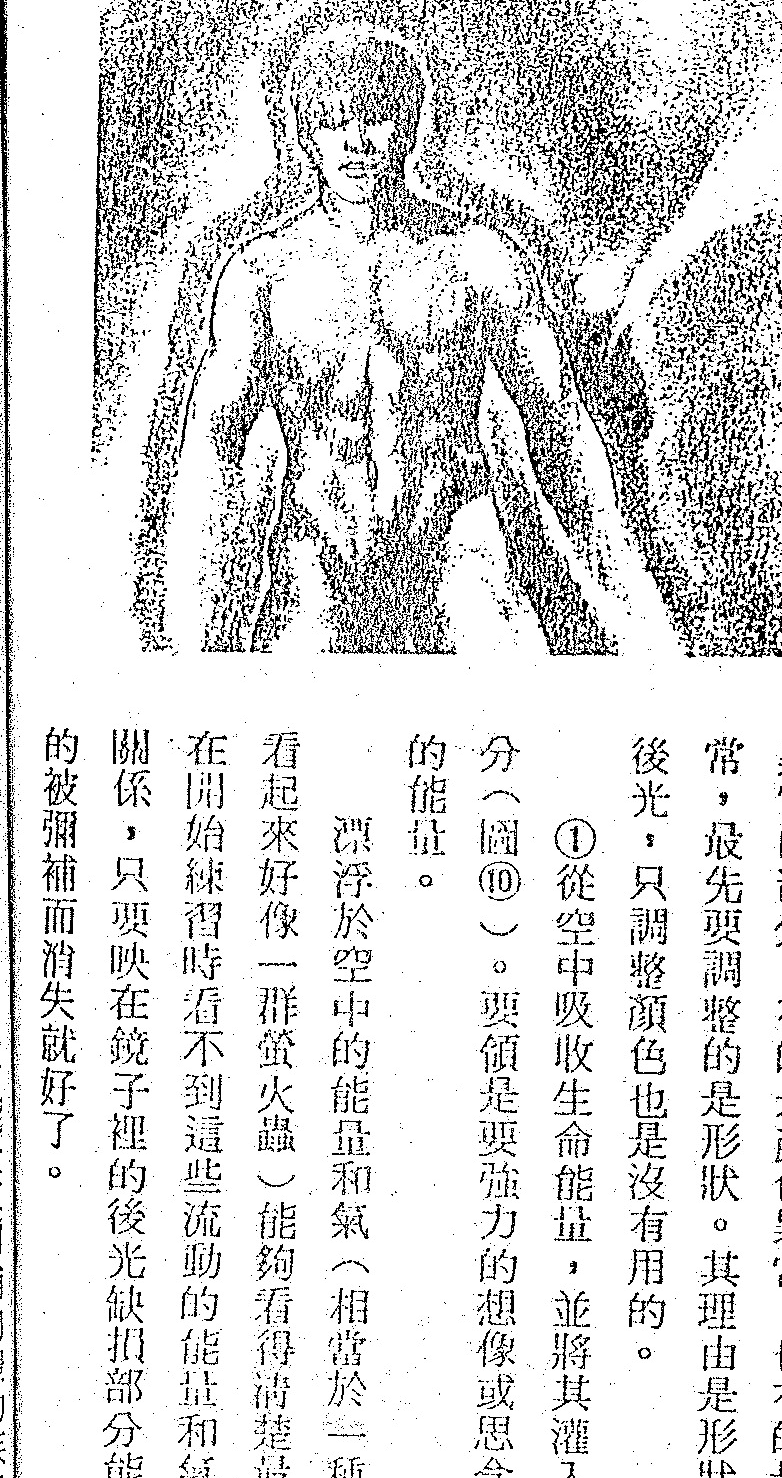
Figure ⑩
② Normally, you can correct aura deficiencies using this method (in other words, using life energy to replenish the diseased areas of the physical body).
However, if it cannot be completely replenished, you will need to draw from an object that emits stronger life energy.
There are several methods in this regard, but the most practical one is using trees. Naturally, one should select trees in a natural environment. A person stands next to a tree, visualizing in their mind that the aura emitted by the tree will flow into the deficient areas of their own aura, and concentrates their consciousness to form this mental image. Because they have already been trained to see the aura, they will actually see the tree’s aura flowing in. Those trained in Extraordinary Abilities Qigong Method can not only see the deficient areas of the aura, but also feel the abnormal qi in the deficient areas. Therefore, when replenishing, one should continue until the abnormal sensation of qi disappears. In detail, one not only observes the qi emitted by the tree as an aura, but also feels the qi, continuously absorbing energy with this intention.
Correction of localized abnormal radiance in the aura The above explains the correction method for the deficient areas of the aura. Here, I will explain the correction method for when an inactive radiance of a circular or specific shape appears in the aura. This correction method does not involve infusing energy; on the contrary, it involves removing energy. The specific procedure is as follows: emit the radiance of the aura from the hand to sweep away the abnormal area (Figure 11). If sweeping once with this aura does not clear it completely, repeat the sweeping several times. For those who are sensitive to the movement of qi, when sweeping, emit a sticky or magnetic attraction from the palm of the hand (this sensation occurs when exerting force in the lower abdomen to emit strong qi), and rely on this stickiness or attraction to draw away the abnormal radiance.
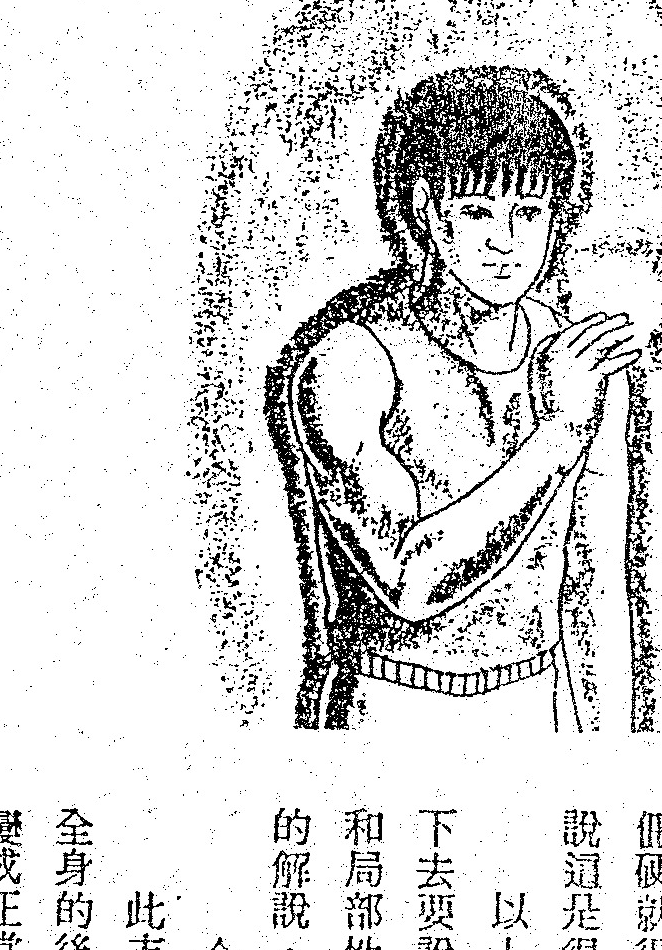
Figure 11
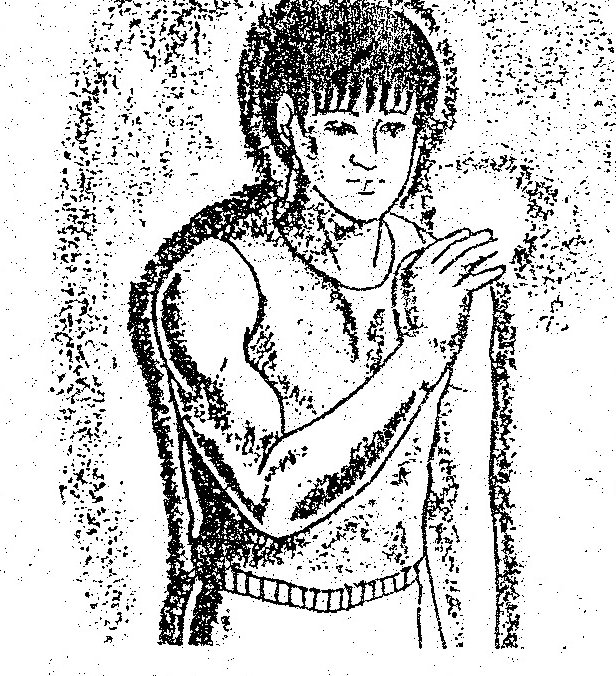
Figure 11
The author frequently uses this method to treat people with stiff shoulders. Such individuals have an abnormal area in their aura near the shoulders. The author projects an aura from the palms to sweep over the abnormal area several times, and the irregular radiance then vanishes completely as it is swept away. Naturally, the shoulder stiffness is fully cured. Those who have received this treatment all say it is an incredible therapy.
The above explains the adjustment method for localized abnormalities in the aura. Next, the adjustment method for when the entire aura is abnormal will be explained. The technique is nearly identical to the localized adjustment method, so only a general explanation is provided here.
Correction of Abnormalities in the Entire Body’s Aura
This method is very simple. Stand in front of a large mirror and look at the aura of the whole body. In your mind, envision this aura gradually transforming into a normal egg shape, or mentally visualize the state of this egg-shaped aura. This meditation must be practiced until the aura appearing in the mirror
Correcting Aura Colors and Using Color Methods
only when it actually takes this shape can you stop. If after repeating this several times you are still unsuccessful, just like the method of making up for missing parts of the aura, you must use the life energy floating in the air or the extraordinary images flowing in from the aura of trees.
If the shape of the aura is normal but the color is abnormal, or if an abnormal color can still be seen lingering, the color needs to be corrected.
Imagination-Based Color Correction Method
The simple procedure for this method is as follows: intensely visualize in your mind that the inherent color of your aura will gradually turn into a bright radiance. Alternatively, you can use the color method explained later to apply a color with therapeutic effects to your afflicted areas. The key to the practice is to first imagine in your mind that a light of this color appears at a specific part inside your body, and that it appears while radiating brightly. Then, with the feeling of gradually pushing the cloudy color outward, visualize in your mind that a clear light gradually flows into your entire body. Finally, visualize that your whole body’s aura is filled with this clear light. If you cannot succeed by imagination alone, then you will have to use the color method explained below in combination.
The Color Method and the Psychological Effects Produced by Colors
The method of adjusting the aura by utilizing the influence of colors on a person’s mind and body is the color method; therefore, you must first understand the effects produced by various colors. The following explains these colors and their effects. Please memorize this content first, and then begin
Practical training.
●Red::: Enhances physical functions. If the aura shows systemic weakness, this color can be used to adjust it and will definitely be very effective, but it is contraindicated for those with unstable mental states.
●Orange::: Orange has the effect of regulating nervous abnormalities, and is very effective for those who overthink trivial matters or are prone to worrying.
●Yellow::: Bright yellow is very effective for weakened physical functions and mental fatigue. If observing the aura suggests such a tendency, then utilize this color. Light yellow, in particular, is very effective for excessive fatigue and depression. Yellow-green also has the same effect.
●Green::: A color that is very effective for any illness, so those who are usually prone to getting sick can use green. Additionally, green also has a mentally soothing effect.
●Blue::: Dark blue will calm the mood of those who are easily mentally excited or mentally unstable. In other words, if those who are normally lacking in qi use blue, they will become even more silent and withdrawn, so such people must absolutely not use blue. For physical illnesses, blue is only effective for those with psychological hyperactivity.
The characteristic of blue is calmness and peace, so medium blue is very effective for relieving mental tension.
●White, Black::: These two colors are extreme colors, so they are rarely used under normal circumstances. Only spiritual practitioners use them according to the instructions of their guides. During spiritual cleansing, using a bright, shining white light or golden light is very effective.
In addition to the aforementioned colors, there are many other colors. Readers can verify the effects of various colors themselves and then choose which to use. The effects of the various colors described above have also been compiled by referencing data and theories from color psychology. However, some people, perhaps due to their physical constitution, may have a particularly strong reaction to a certain color. Therefore, you do not need to strictly adhere to the explanations in this book; you should judge and select the most beneficial color for yourself, as doing so will enhance the effectiveness of your extrasensory perception abilities.
The next things to explain are the actual techniques: the colored light method and the colored paper method. These are explained separately as follows:
Aura Correction Using the Colored Light Method
① Equipment to prepare includes: a desk lamp that uses an electric light bulb; colored, heat-resistant transparent material (prepare various colors); and white drawing paper or white cloth sized 1×2 meters (if the room’s walls are white, this white paper or white cloth is not needed).
② Tape the colored, heat-resistant transparent material over the desk lamp’s shade to produce colored light. Affix the white drawing paper to the wall. Position the desk lamp so that when a person stands in front of this white paper, their shadow is not cast onto the paper. Therefore, its position should generally be to the person’s diagonal rear (please see Figure ⑫).
In other words, the person stands facing the white paper on the wall, and a light of a certain color shines from their diagonal rear. At this time, the color appearing on the white paper is the same as the color of the colored light.
③ The person gazes at the color on the white paper. The duration for looking at the colored light varies depending on the brightness of the color on the white paper, but it generally requires more than fifteen minutes. It is even more effective if observed while in a meditative state.
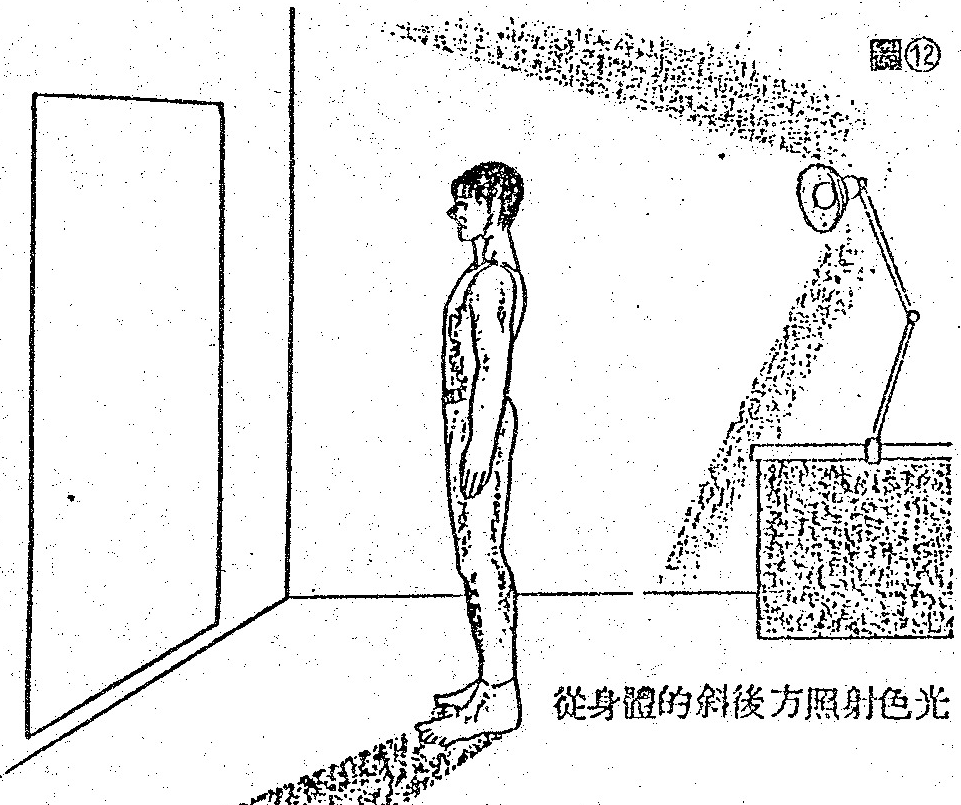
⑫ Illuminating colored light from a diagonal rear angle of the body
aura Correction Using the Colored Paper Method
① Another method of the color method involves using drawing paper or cloth of various colors; larger sizes are more effective to use. ② Paste the colored paper or cloth on the wall and gaze at its color for an extended period, just as in the previous method. Although the room must be bright to see the color clearly, the color perception is weaker when compared to the lightbulb method; therefore, the viewing time must be longer. You must look for at least twenty minutes, and preferably for over thirty minutes if possible. People who are clearly aware of the disease symptoms in certain parts of their body can continue practicing with either of the above methods until the symptoms are alleviated. The name “color method” was chosen by the author; there is no record of this name in ancient texts. It was named entirely for the purpose of aura correction, ; judging from ancient materials, there was no systematic name, and perhaps the ancients who wrote those materials did not even know it was an aura.
This technique is derived from color psychology and color physiology. The first person to advocate this method was the American color expert Faber Birren, who emphasized this method decades ago. It is a method that uses the physiological and psychological effects various colors have on people to correct physical and mental abnormalities.
He once stated that the reason ancient people began using various colors was not for their beauty, but to escape the terror of death.
For example, ancient Chinese liked to use red to drive away demons or infectious diseases. He also stated that not only did the Chinese understand how to use colors based on life experience, but other ancient peoples around the world similarly liked to use red paint to draw amulets or spells; the reason for this was probably to utilize the mysterious power of red to exorcise demons!
Faber Birren conducted very detailed research and experiments on the physiological effects of colored light on the human body. From his research data, it can be seen that red raises blood pressure, stimulates the pulse, and accelerates breathing, etc., whereas the effects produced by blue light are the exact opposite of red light. The method he advocated has now been praised by many and is frequently used in the treatment of diseases.
However, the first person to emphasize this method, discovering and applying it, was not Birren. Birren himself admitted this point. He pointed out that in places like China and Vietnam, there has been a legend since ancient times that a person suffering from an infectious disease must be sent into four walls walls are entirely red, so that the infectious disease can thereby be cured. Perhaps this is the true forerunner of using color to treat illness.
This method is not superstitious but has a scientific basis. According to Birren’s explanation, red has the effect of promoting excitation of the sympathetic nervous system, thereby increasing the activity of the human body.
There are many examples that demonstrate this functional effect. A factory in the city of Manchester, England, painted all its interior walls glossy white, and over the course of several months, worker injuries occurred one after another. Experts were later called in to investigate, and it was discovered that the color of the walls was one of the main causes. The pure white color prevented the workers’ minds from stabilizing, causing the number of accidental injuries to increase each month. After accepting the experts’ advice, the factory immediately repainted the walls blue, and as a result, the worker injury rate decreased markedly.
From this it can be seen that color has a profound influence on people’s lives. According to Chinese qi study (more precisely, Dunjia study), the various colors floating in cosmic space have an intimate relationship with a person’s inherent color light, and can be said to be connected to a person’s health condition, mental state, and destiny. The “inherent color light” of a person referred to here means the aura.
The most important point in qi study is that, among the lights emitted by the cosmos and by humans, when lights of exactly the same color overlap (known as the Dark Sword Kill), or when all lights scatter in chaotic reflection (known as the Jade Yellow Kill), various kinds of abnormalities are said to arise.
On this point, Dr. Ding Zhenwu (a physicist) of National Cheng Kung University in Taiwan actually conducted experiments using optical instruments and presented detailed experimental results—for example, the Dark Sword Kill of Seven Red is the state of receiving a particular wavelength band within visible light from behind; in the case of Four Green, what the wavelength domain would be; and so forth. Due to space limitations, the discussion of this section will end here; one need only understand that light (color) has various effects on a person’s aura.
Chapter 4: Basic Techniques Using Super-Vision
Basic Techniques for Developing Clairvoyance Using Clairvoyant Abilities
Clairvoyance Using Super-Vision
As mentioned at the beginning of this book, the scope of application for super-vision is quite broad. Chinese talisman masters, Western magicians, and the like can manifest phantoms or human figures in an empty space, which is truly astonishing. In fact, super-vision can also perform such feats. Of course, this depends on the level of training; it cannot be achieved through short-term practice. Furthermore, during training, one should start with simple and easy-to-accomplish parts, and must become proficient at them.
Among the many application methods of super-vision, the easiest to learn is the see-through method or the combined method (a combination of the closed-eye method and the open-eye method). Although observing the other person’s consciousness as an inner image is called a see-through method, what is mentioned in this book is a method that uses super-vision, so it is different from the ESP see-through method; it must be visible as an image of light. The ESP see-through method relies solely on inspiration to see through, so it is different from the see-through method to be explained now.
The see-through method explained here does not require any special talent; as long as one can see images, anyone can perform it. Its training method is explained below.
① When doing this training, first ask a person to serve as the subject, and there are no special conditions for this person serving as the subject, provided that they are an ordinary, normal person.
Then, the practitioner and the subject, both in the same dark room, stand facing each other at a distance of 1.5 meters
. ② The practitioner closes their eyes and first tries to grasp the sense of bioenergy emitted from the subject’s body. At this time, it is ideal if there is not only a sensation of radiation but also a feeling of a certain emotion (such as a sense of joy or melancholy). That is, by focusing conscious power
to understand this emotion, an image of light will surface within the eyelids. ③ This image of light may flicker in and out at first, or it can be said to resemble an abstract image of light. However, after continuing to observe for ten or fifteen minutes, you will gradually feel it taking on a certain shape, and finally it will become a concrete shape. At this time, tell the subject what the shape is and ask if it is correct.
When using this method, the psychological aspects of the subject can mostly be seen as images of light. For instance, things like the other person’s hobbies, work, worries, and romantic feelings will appear as shapes of light. ④ Sometimes, the other person may reply that what you asked about is not on their mind at all. This is because the practitioner is only seeing the subject’s subconscious
mind’s light image. Therefore, regardless of whether the practitioner provides more detailed explanations or asks questions, if the subject still answers that they do not feel anything, the practitioner should not be easily discouraged. They should look a few more times; if the images seen are always the same, then it can be confirmed that they are only seeing the image of their subconscious mind.
▲ Precautions: When performing this technique, not only will you see the subject’s consciousness, but your own consciousness will also turn into a
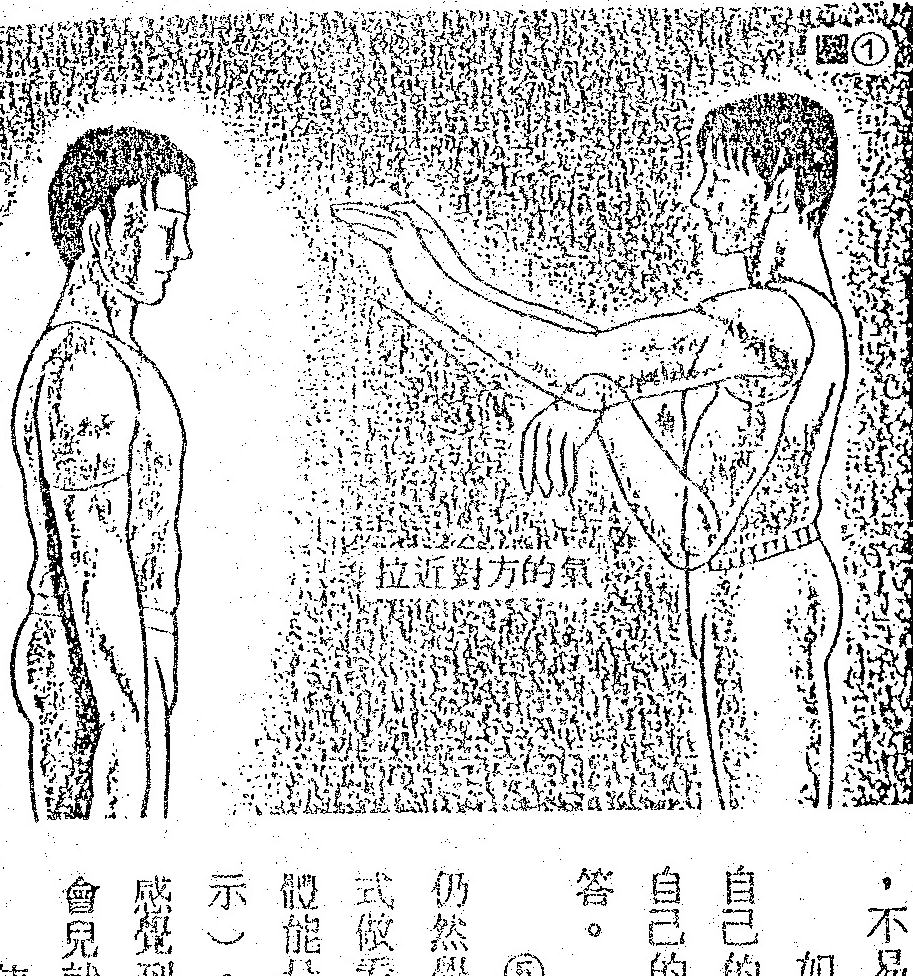
①
visible in the imagery. Therefore, these two often mix together, making them difficult to distinguish.
When this happens, look carefully at the imagery and ask
your own consciousness: Is this the other person’s imagery, or is it
my own imagery? In this way, you can sense the answer from your consciousness.
⑤ After practicing the above methods a few times,
those who still feel that everything is not going smoothly can try the following approach: move your palms back and forth, and pull the other person’s qi (life
energy) forcefully toward your own body (as shown in Figure ①). Repeat this with your eyes closed, and you will surely
sense a certain emotion from what you have pulled in. After a little while, an imagery of light will appear within your eyelids.
When using this method, you may sometimes pull in the subject’s “negative energy” (such as illness or mental abnormality), or supernatural phenomena
‘s power. How can this situation be avoided? The method is recorded in the author’s books “Secret Methods! Superpower Qigong” and “Immortal shu! Miraculous Superhuman Qigong*, which readers may refer to.
Perceiving the other person’s consciousness from external imagery After being able to perceive the other person’s consciousness through light imagery using the closed-eye method, we now practice a more advanced method. This involves perceiving the other person’s consciousness while keeping your eyes open. The procedure is similar to the closed-eye method, but because your eyes are open, mental concentration is crucial. Therefore, when starting the practice, first combine it with the closed-eye method. Only after becoming proficient should you formally perform it with your eyes open.
When practicing the closed-eye method, consciously pay attention to the appearing and disappearing of the mental imagery. The appearing and disappearing of mental imagery mentioned here means being able to freely manifest or dispel the light imagery (i.e., choosing to look at the other person’s light imagery or not to look at it). If you cannot master this technique, sometimes you will be unable to dispel imagery you do not wish to see, which can affect your normal mental state. Therefore, you must pay attention to this point during training.
① First, use the closed-eye method to observe the other person’s consciousness as mental imagery. Continue this practice for fifteen to twenty minutes (if you are very proficient, the time can be reduced). Once you can see the light imagery clearly, open your eyes and look at the space from the other person’s shoulders to their head.
② In this way, you can perceive a faint, slightly colored luminous imagery in the area from the other person’s shoulders to their head. Of course, what is seen varies from person to person. Note that if the location is too bright, it will be easy to lose clarity; in other words, it is best to practice in a dimly lit pla ace to practice is most appropriate. This situation is very similar to the practice of seeing afterimages. ③ If you can see the images with your eyes open, and after practice they become increasingly clear, this stage of practice can come to a temporary close. Next, you must practice the training to eliminate the images you have perceived. The simplest method is to exhale a large mouthful of qi, or to recall in your mind things like drinking yesterday, or chatting with friends. In other words, simply changing the atmosphere is sufficient; as the atmosphere changes, the perceived images will also be eliminated. If you are unable to do this, use another method, which is to visualize in your mind that the image you see in front of you gradually becomes increasingly blurred until it finally disappears. By practicing this repeatedly a few times, you will generally succeed.
Using the above method, the author is able to observe the consciousness of various people through light imagery. For example, perhaps because I frequently hold a pen to write drafts, I have a strong affinity for manuscripts, notebooks, and stationery, and can often see their images. The first time I saw this was when I successfully cultivated my clairvoyant ability. I met the editor-in-chief of a certain publishing house on the street, and at a glance, I saw the image of manuscript paper and a fountain pen glowing with a pale silver light appear at the end of the editor-in-chief’s shoulder. Because it was my first such experience, the impression was very profound. Later, whenever I met friends on the street, I would always see some light imagery around them. Generally, what could be seen were all related to the other party’s work, perhaps related to images.
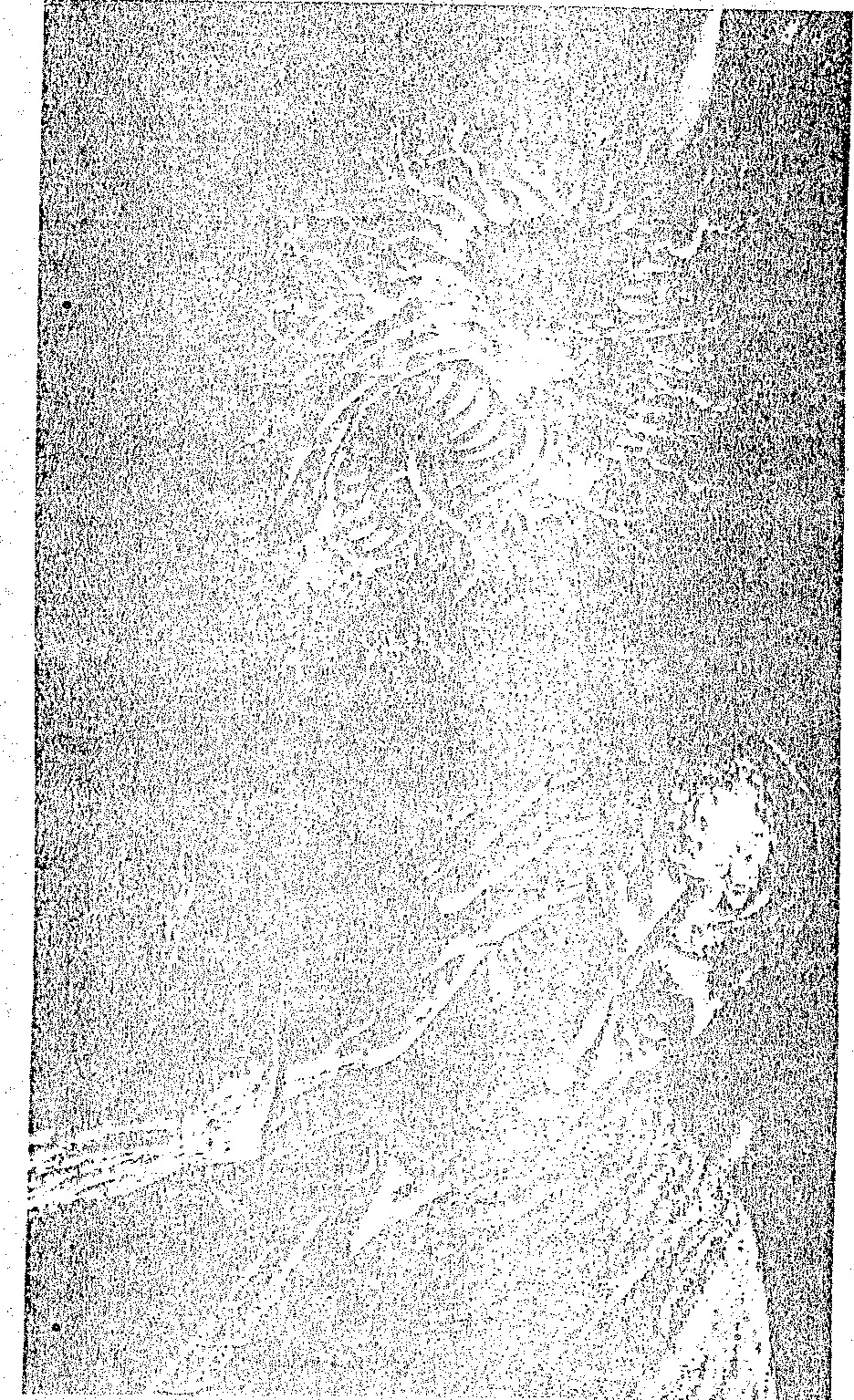
Mystical Perception Using Super-Vision
For example, with people who like to drink, it is easy to see images of wine bottles around them; with people who are interested in growing flowers, it is easy to see images like a garden floating in the space behind them. These images generally carry a pale silver radiance.
Of course, sometimes one also sees unpleasant images. To tell the truth, such unpleasant images are far more numerous than pleasant ones. Some of these unpleasant images are related to the other person’s illness, while others are related to the other person’s feelings of hatred or hostility.
Later on, I could also clearly see the alterations in an aura, which was why I decided to avoid looking at unpleasant images. Therefore, I began to practice methods of dispelling the images. After practicing repeatedly several times, I finally achieved results, so now I can freely make the images appear or disappear (blink on and off).
Although I can now easily control the viewing of images, normally I am the same as ordinary people and cannot see anything. In any case, the perspective method of super-vision must be trained until one can freely blink it on and off. Otherwise, constantly seeing unpleasant images and feeling disgusted will have an adverse effect on mental health. Therefore, one must devote oneself to the training of the perspective method and achieve success in it.
After being able to freely perceive a person’s psychology through light imagery, the next step is to learn the mysterious spiritual power. The mysterious spiritual power mentioned here refers to the technique of understanding the various types of information memorized by an object through supernatural methods.
The author also used to practice this technique of mysterious spiritual power. Unbelievably, when the author first began practicing this technique, even auras could not be seen clearly, but at that time the author had already practiced the Immortal Way very well, so they used the methods of the Immortal Way to train this technique of mysterious spiritual power. At the beginning, no images were seen, only a certain atmosphere or a certain feeling was sensed. Later, after I practiced clairvoyance and was finally able to see the images of light, I could treat them as light imagery and make out their shapes. It was then that I realized that by combining the practice of the Immortal Way with the practice of clairvoyance, I finally cultivated the technique of mysterious spiritual power within clairvoyance. What is introduced here is the technique of mysterious spiritual power created from the author’s experience. Its structure is roughly the same as the aforementioned clairvoyance method, so before readers look at this technique, please review the explanation in the previous training section. Techniques of Mysterious Spiritual Power ① Items used by others, such as watches, handkerchiefs, dolls, gemstones, etc., can be borrowed for a while. Of course, whoever you borrow from, please invite that person over, because only the owner knows the history of the object. Then describe the images you see from the object and let the owner comment on them, so you will know whether the images you see are correct. Therefore, you must practice seeing the images yourself before inviting the owner. If the owner comes first, we might perceive some consciousness from the images on the owner’s body, which would instead interfere with our observation. ② Place the borrowed item on the table, and first use the closed-eye method to see the light imagery emitted from the object (which is, of course, the sensation of the emitted qi). If it is not a borrowed item but something from your own home, then this item should be something you do not know.
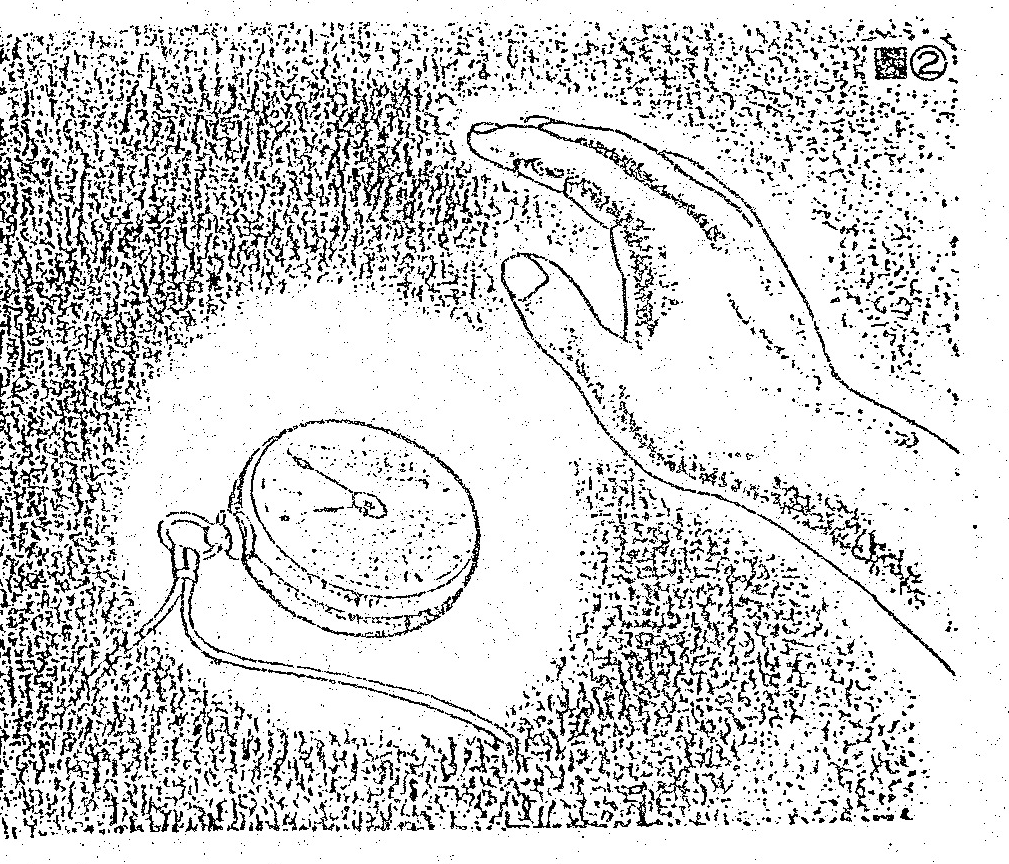
②
…its origin, but it is best if it is something only the mother or wife knows.
If you cannot see any imagery from the object on the table, use your palm to draw the qi emitted from the object closer (Figure ②). This drawing-in technique is the same as the aforementioned clairvoyance method, so readers can review this section.
③ In such practice, you will see a chaotic variety of lights, and eventually you will make out a clear shape. At this moment, quickly record the imagery you see so you do not forget it. If possible, it is best to draw the situation as well.
④ After practicing in this way for fifteen or twenty minutes, go to the owner’s home, tell him the imagery you just saw, and then ask his opinion.
After hearing his opinion, you will know whether the imagery you saw was correct or not, or to what degree it was correct. If you are well-trained in this aspect, you will be able to uncover forgotten origins.
People who practice very well, the mental images seen are often ones that even the object’s owner themselves
▲ Precautions
This kind of training is the same as the training of qigong methods; you must pay attention to the feeling of the qi emitted by the object. If the object emits a repulsive qi sensation, there is no need to force yourself to see its image. If you force yourself to look, when you see those repulsive images, you will find yourself drawn into the sphere of those negative karmic connections.
⑤ Once you can freely apply the techniques of mysterious spiritual power using the closed-eye method, you now need to practice training using the open-eye method. At this time, you must first prepare a room for practice; it is best to choose a slightly dim place.
The author was once entrusted by Mr. Iizuka, the abbot of Getsuriji Temple in Shinjuku Ward, Tokyo City, to go to the temple to look at a gem. At that time, Mr. Iizuka asked me, “You will certainly know something after looking at this gem, right?”
It sounded as if he were testing the author’s abilities. The author hates being tested by others the most, so upon hearing his words, I couldn’t help but keep my mouth shut, not wanting to answer. However, looking at this bald monk, I figured that a practitioner meant no harm, so regarding this gem, I used my qi sense and obtained some sensations. At that time, I used my palm to draw the qi emitted by the gem closer, and as a result, I felt that this qi was quite strong, so I drew the sensation of the qi even closer to my body.
Although my eyes were open, I could still see the conscious mental image appearing before my eyes. It was the image of a refined and elegant middle-aged
ESP Communication Using Super-Vision
nun. Although it was daytime, her image actually manifested in the space of this room. Therefore, I told him about the situation of seeing the nun. I described it in great detail. For example, I explained what clothes she was wearing and the characteristics of my first impression of her. At this point, the abbot was deeply moved and said: ‘You described it very well. That nun formerly lived in the convent of this temple, and this bead is a memento she left behind.’ After hearing his explanation, I was both surprised and happy, because this test greatly increased my confidence in clairvoyant abilities.
Among the applications of clairvoyant abilities, the simplest is the ESP communication described here. The symbols written on ESP cards appear as images of light for the other party to observe. This is very simple for those who have learned clairvoyant abilities and can be implemented without any special training. Just like the practice of the clairvoyance method, there are two methods of expression: the closed-eye method and the open-eye method. I will explain them in order below. The application method using ESP cards is closely related to the application of the superpower qigong method, so here I will only explain the techniques of the latter part.
Technique for Understanding ESP Card Symbols Using the Closed-Eye Method
① This technique requires a partner to practice with, but someone who knows absolutely nothing about clairvoyant abilities will have no way to cooperate with my
side for communication, so the partner must be someone who possesses clairvoyant abilities.
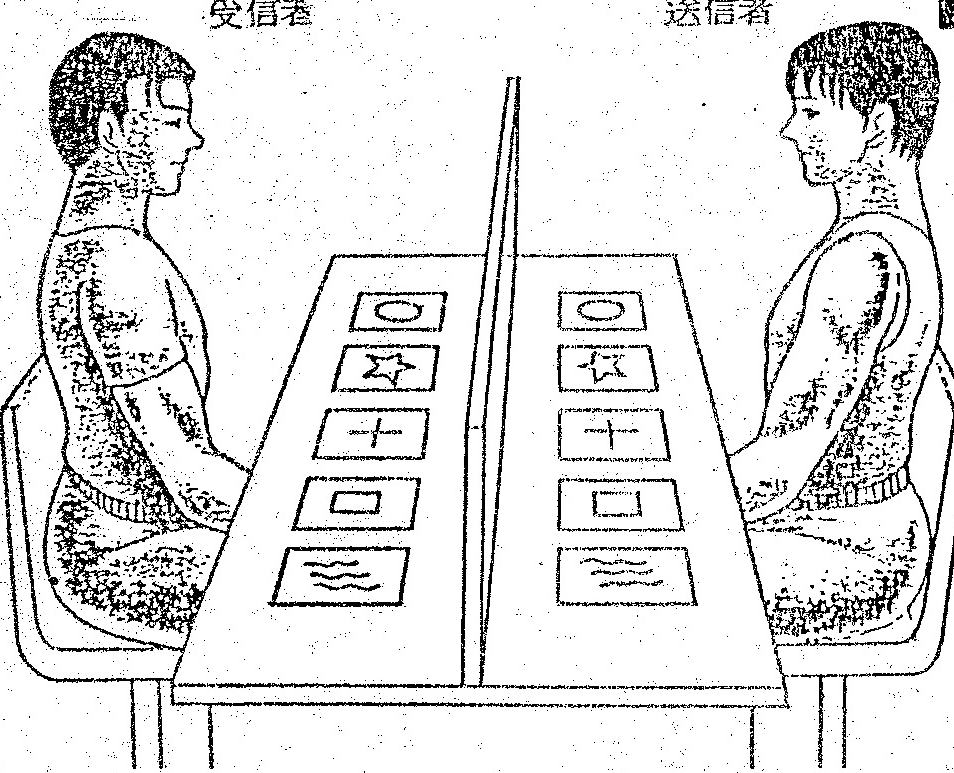
Only those with ESP abilities can do this. Prepare a table, and in the center of the table, set up a folding screen-like partition. With the partition in the center, two people sit facing each other on either side. The two people each place an equal number of ESP cards (several cards with identical symbols) in front of themselves. The two first agree on who will act as the sender and who will act as the receiver (as shown in Figure ③). The above is the same as the setup for an ordinary ESP experiment. ② The receiver closes their eyes, relaxes their mind, and focuses on looking at the inside of their eyelids (they may also sit quietly while being aware of the sensations in their brain). The sender must carefully observe the card to be sent, then similarly close their eyes and trace the luminous image of this symbol on the inside of their eyelids.
If you still cannot form the image of the light, then you must pay more attention to observing the card with the symbol, to the extent that an afterimage of the symbol can appear on your eyelids. Therefore, observe the symbol ↓ close your eyes to visualize the shape of the symbol ↓ open your eyes to observe the symbol again ↓ close your eyes to visualize the symbol again. By repeating this, eventually the afterimage of the symbol will appear on your eyelids even when your eyes are closed.
③ Only after the ESP symbol clearly appears as an image of light on the eyelids should it be sent to the receiver. The key technique here is to focus the sender’s consciousness on the receiver’s head or eyelids (this should be done simultaneously with the visualization of the symbol), and to continuously visualize so that the symbol can appear on the other person’s head or eyelids.
④ The receiver should not just sit there blankly; rather, they should strive to actively maintain the sensation of being able to receive the qi emitted by the sender (this is where it differs from ordinary ESP experiments). The technique is the same as the clairvoyance method mentioned above; in other words, the image is perceived through the sensation of the radiated qi.
⑤ Only after communicating under the above conditions and achieving a fairly high probability of successful ESP communication (for example, guessing correctly three or four times out of five) can the training location be changed. For example, at this stage, the sender can be in one room while the receiver is in an adjacent room, meaning messages are sent and received through a wall. If a telephone is available, you can call from one room to the next to check whether the message received by the receiver matches the one sent by the sender.
If all this training is done successfully, the next step is to practice using the open-eye method.
ESP Communication Training Using the Open-Eye Method
⑥ Training to Guess Cards from the Aura
① Same as the training for the closed-eye method, the center of a table is partitioned with a folding screen, and the sender and receiver sit facing each other on opposite sides of the screen. Because the open-eye method is being practiced, both people must keep their eyes open.
② Both people focus their attention on the cards on the table. After a while, the sender selects one of them, visualizes the symbol on it using the clairvoyance method, and then sends it to the receiver.
③ The receiver first uses their palm to sense the feeling of the qi emitted by all the cards, and then observes the aura emitted from each card. If the aura and the feeling of the qi emitted by one card are different from the others, this is the card with the symbol sent by the sender. Therefore, look at the symbol on this card and ask the sender if it is the correct one.
④ When beginning the practice, the two people sit facing each other at a close distance, but as their proficiency increases, they can practice at a greater distance.
⑦ Techniques for Visualizing and Guessing Colors
Now we will begin the experiment of understanding the transmitted colors.
① The sender selects one card from the five cards in front of them and informs the receiver. Initially, choose a symbol enclosed by a circle or lines. After being notified, the receiver looks only at that card and observes it in a relaxed state of mind.
② The sender focuses on the inside of the symbol on the card to generate a mental image of the color, and then sends it to the receiver according to the aforementioned method. If the receiver guesses correctly, the sender visualizes another color; if the receiver guesses correctly again, the sender switches to yet another color, continuing in this manner.
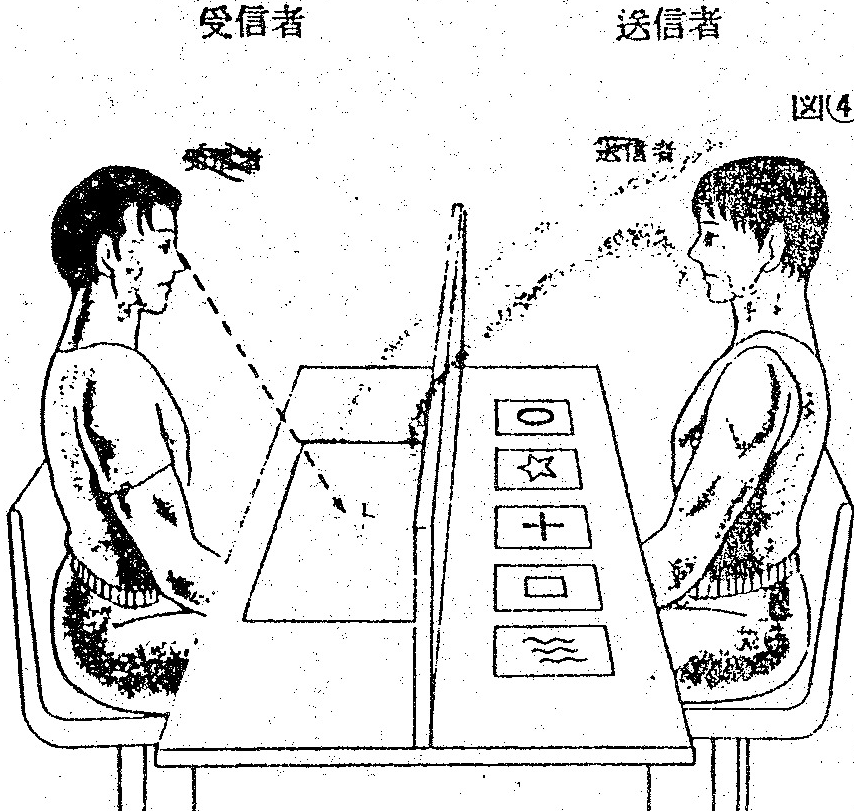
④
the mental image sent out by the sender. If this training continues, eventually the mental image sent out by the sender will be visible even in an empty space.
to train. ③ The distance between the two people gradually increases with proficiency; the practice conditions are the same as those described above. Regarding color transmission, using dedicated PC cards is more convenient. Applied Techniques for ESP Communication Beyond ESP Cards ① Prepare white drawing paper and place it in front of the receiver. The sender chooses a card to send, visualizes the symbol on the card as an image of light, and then projects it onto the drawing paper. ② The receiver does not need to look at the cards, only at the drawing paper. After seeing an image of light appear on the drawing paper, they tell the sender its shape (Figure ④). ③ After training a few times and becoming familiar with it, change rooms and tape the drawing paper to the wall. The receiver sits in front of the drawing paper to look at
Forming a Double of Light
When one can train to such an advanced level, one realizes that the training of clairvoyance is indeed fascinating, and at the same time, one will feel that experiments can be conducted without needing to use ESP cards.
In ancient Chinese immortal cultivation, there is a technique known as the art of out-of-body travel. This is a skill where one consolidates qi to form a duplicate, then shifts this duplicate into the consciousness, and finally detaches the duplicate from the physical body. At this stage, the duplicate is referred to as the Yang Spirit. This technique is a very common practice in Chinese immortal cultivation, but when using ordinary immortal cultivation methods, it takes a great deal of time and procedure. The author was once very enthusiastic about training in this technique for a period of time, but failed several times and was almost entirely unable to form the Yang Spirit. This is because when using traditional immortal cultivation methods, one must pass through the stages of the Microcosmic Orbit and the Macrocosmic Orbit before ‘elixir refinement’ (the great medicine and small medicine) can occur, and forming the Yang Spirit is based entirely on this process. Consequently, one needs to gather a large amount of energy, and the meditation sessions are quite long; for example, one might need to sit in meditation for about eight hours a day, continuing this consecutively for several years. In ancient agrarian societies, people had a lot of free time, but in modern times when everyone is so busy, how many people have this kind of time and perseverance? I believe they are almost impossible to find.
According to the records of the ‘spirit projection technique’ in immortal path texts, a clone can also produce clones, thereby multiplying without limit. Those who have studied the spirit projection technique can easily perform this technique.
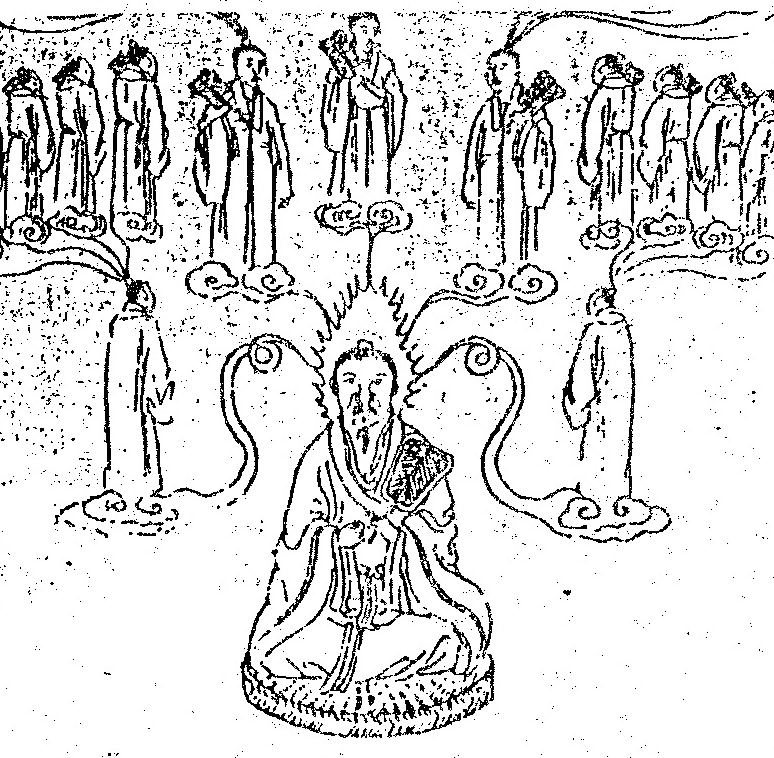
Under the constraints of time, the author, too, was unable to progress further halfway through practice. The reason is simple: I could not set aside so much free time.
So I began to consider whether it was possible to shorten the practice time. Of course, I read many books and materials on the ancient immortal path, analyzed the actual state of their practices, and also referenced books on Western magic (astral qi-body projection) and Tibetan Esoteric Buddhism to grope for new methods. At the same time, to deepen my understanding, I also read many scientific books on psychology, physiology, and physics. Later, books on these subjects became very popular, seemingly becoming a trend of the era; as a result, many books were published, and I was able to access more literature and data. This was of great help to my research, and eventually I was able to explore quite effective techniques.
Of course, I first experimented with this newly developed technique to freely emit it from the body or draw it back. Finally, I also befriended several people who had similar abilities (most of these people could perform ordinary astral projection). Therefore, I had the opportunity to collaborate with them to further investigate the actual reality.
Through long-term investigation and practice, I finally understood the essence of this discipline. By this point, I was already able to simultaneously produce several duplicates. This situation is very much like Sun Wukong in Journey to the West, who could instantly form multiple duplicates of himself. Ancient practitioners of talismanic arts were also able to perform this kind of skill.
The technique introduced here is one of them. It is a newly developed training method that the author created after referencing the Round Light method of talismanic arts, the external concentration method of Xian Dao (a method where the object of concentrated consciousness is placed outside the body), and the method for creating duplicates in Tibetan Esoteric Buddhism. I believe this is the simplest and most effective method for forming a Yang Shen (duplicate of light). By starting practice with this method, one will be able to form numerous duplicates as they become more proficient.
Technique for Forming a “Duplicate of Light” Through Extraordinary Vision Abilities
① This technique can utilize either the closed-eye method or the open-eye method, so readers may choose one for themselves. First, sit down a few meters away from a white wall. If using the open-eye method, tidy up your messy room; just as when practicing viewing auras, put away the furniture and clutter, and cover the wall with white paper or white cloth. If using the closed-eye method, such tidying up is unnecessary.
② For those using the closed-eye method, radiance should manifest inside the eyelids; for those using the open-eye method, it should manifest on the wall. It does not matter if the shape is circular or formless; chan…

5
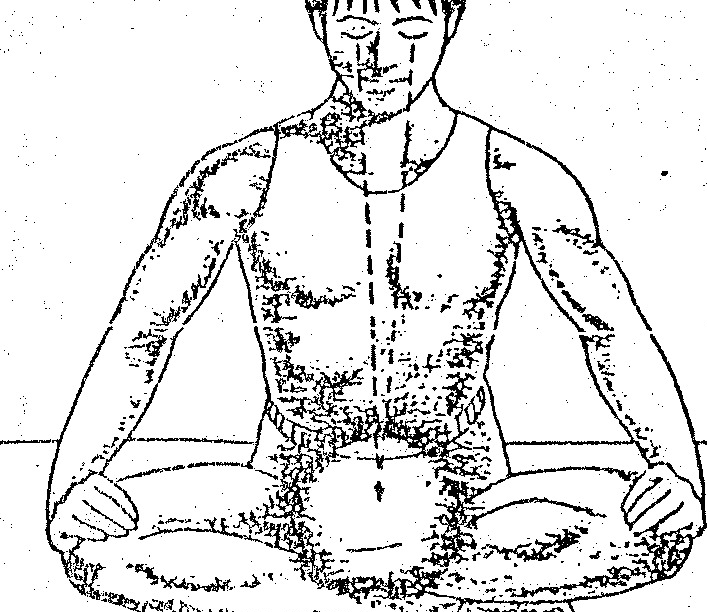
⑤
In other words, it has no fixed shape. ③ At the beginning, it is in a faintly bright state, so concentrate your consciousness and gradually strengthen the radiance. The essentials are as follows: those practicing the closed-eye method should focus their bioenergy in the Dantian (lower abdomen), or between the crossed legs while sitting cross-legged (as shown in Figure ⑤). If adopting the open-eye method, one should first extend the cord-like or rod-like light emitted from the body, allowing their bioenergy to touch the glowing part on the wall, or inject the natural energy gathered from the surrounding space into the lighted part of the wall. ④ Continue practicing daily. Once the radiance is strengthened to a stable level (able to be maintained for over an hour without disappearing), you can use the power of consciousness to make this light slender and elongated, subsequently forming the head and body, and then forming the parts of the hands and feet.
▲ Precautions
This is the basic form of a duplicate. In other words, if the four parts—the head, body, hands, and feet—can exist independently, it demonstrates that a highly stable level can be achieved, which means one must continue to concentrate one’s consciousness. The stable state mentioned here means being able to produce this duplicate state anytime and anywhere.
⑤ You must be clear about the gender (male, female) and age of the duplicate you have created, and thereby further use consciousness power to make details like the face, hands, and feet clearer.
Therefore, to form a duplicate exactly like yourself (both the Yang spirit of immortal Daoism and the astral qi body projection of magic belong to this type of duplicate), you must form the same shape as yourself.
⑥ After the above training is successful, you still need to train frequently to make the generated posture more stable, and then use consciousness power to make these duplicates move. For instance, you can have the duplicate stand up, sit down, or run. Of course, during every training session, you must make the duplicate of light blink on and off (suddenly appearing, suddenly disappearing). If this is not done, it will terrify third parties who happen to see it, and these duplicates moving around arbitrarily may also cause trouble.
Regarding this point, a famous example is introduced here, which is the case of the anthropologist Madame Alexandra David-Néel. According to the book ‘Magic and Mystery in Tibet’, this lady received instruction from a Tibetan lama and used a method very close to the one described above to form a male duplicate. This male’s name was Talpa. The problem is that after this duplicate was completed, it acted willfully, and in this lady on her journey, performing some foolish actions. Not long after, this male double of Tarba also frequently appeared before others, so people often asked the lady, “Is that man your lover?” This created embarrassing situations for Ms. Néel. As a result, she tried to find ways to dispel this double, but was unable to eliminate him. For about half a year, this double even put up a fierce resistance. From this example, one can see that this type of double, produced through clairvoyant ability, will instead cause much trouble if one cannot make it disappear or control it at will. Therefore, being able to freely manifest it and also dispel it is fundamental to this technique. ⑦ If this double can be formed to the point where it will not easily collapse, it can then be utilized—for example, by dispatching it to distant places to gather various intelligence, or sending it to deliver a certain message to others. If this double is a replica of oneself, one can then endow it with one’s own consciousness and let it travel to desired places. Because by using this method, it can freely enter and exit not only physical locations but also unknown realms that ordinary people would not dare to visit. This training is closely related to the dream technique (method of dream control). Therefore, if these two methods are applied in conjunction, the materialization of dreams can also be achieved.
Regarding the issue of light doppelgangers, I still have a few profound personal experiences to report here as a reference for readers. Previously, I went to visit Mr. Gao Ze, the editor-in-chief of a certain publishing house. While chatting with him, we talked about the issue of superpowers again, and the topic quickly…
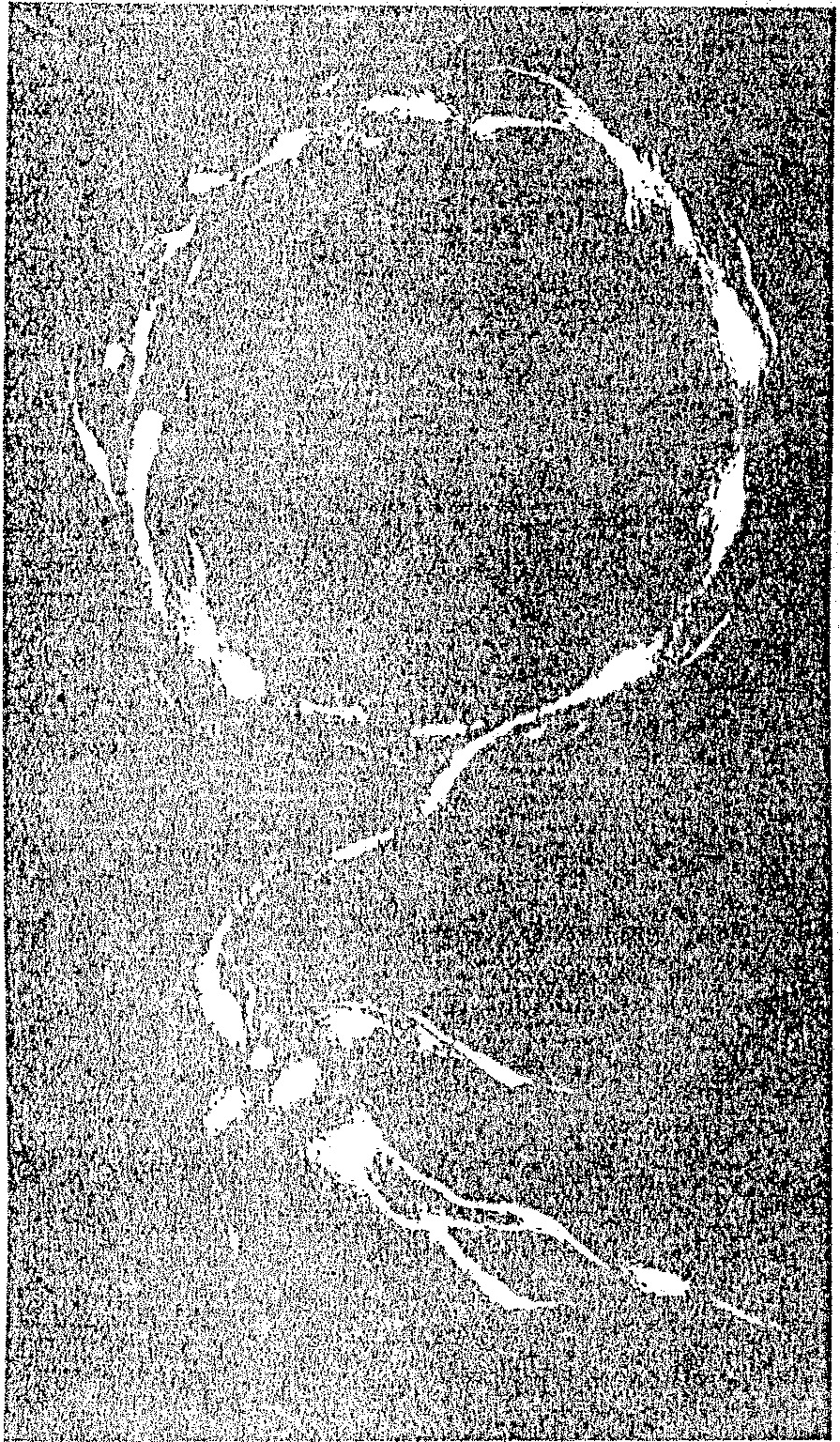
The focus then shifted to clairvoyant abilities.
It was just dusk, and the sky was gradually darkening. To accommodate Mr. Takazawa’s request, I performed a practical demonstration for him. First, I asked him to look at the north wall of the office, and then I also stared at this same wall. After the author concentrated his mental power for about a few minutes, a vivid circular light finally appeared on the wall in the already dark environment. He could not help but exclaim, “Wow! What is that?”
After this circular light appeared, the author used his mental power to begin altering its shape, transforming it into a human figure without hands or feet, and then attached hands and feet to it, finally causing this human figure with limbs to begin moving.
Regrettably, at this point, the author felt a lack of energy, so the performance only went this far. Naturally, the image of the figure quickly vanished into the darkness, and I told him it was due to insufficient energy.
A few days later, I had the opportunity to chat with Mr. Kimura, who was studying traditional Chinese medicine, and I similarly performed this same routine for him to see. At that time, the place where we were chatting was the author’s residence, and it was also a little past eight o’clock in the evening.
Before the demonstration, I asked him to sit down a few meters away from me, and then turned off the room’s lights. I sat in a corner of the room and concentrated my mind for about ten minutes. Because all the preparations were essentially complete, I let my double leave my body. At that exact moment, Mr. Kimura let out an exclamation of “Oh.”
I asked him what he saw, and he replied that he saw a vivid block of light leave the author’s body and continue moving in the direction of his own body. Mr. Kimura had no foundational training in clairvoyance, and naturally could not see auras, yet surprisingly, he was still able to see the movement of the vivid block of light.
Later, I also often performed this bilocation technique for my close friends to enjoy. Anyone with the ability to see auras could discern the human-shaped image of light, whereas those without the ability to see auras could only see block-shaped or linear images of light. From this it can be seen that if clairvoyant ability is trained to such an advanced level, performing this feat is very easy. The training explained above is not difficult; as long as one has the patience to continue practicing, I believe it can definitely be achieved. This is also my greatest expectation for the readers.
Chapter 5: Applications That Induce Supernormal Phenomena
Psychokinesis Developed Through the Aura
I originally planned to introduce this in my book Superpower Qigong Methods, but due to space limitations, I did not have the opportunity to explain it. To be honest, this explanation relates to psychokinesis using qi, which can be said to go beyond the scope of qigong methods, so I decided to explain it in this book. For example, the qi emitted by a qigong master can move a certain object; if this qi were to be viewed by a clairvoyant expert who can see auras, it would appear as an intense aura extending far into the distance. This has been proven in the author’s experiments. The author simply views this emitted qi as a clearly visible aura; thus, it feels like a psychokinetic experiment of qi, and also a psychokinetic experiment of auras. From a certain perspective, the two are the same, so some people believe there is no need to distinguish them too clearly. This is closely related to the techniques of clairvoyance, not only capable of setting commercially available psychokinesis development devices into motion, but also moving massive objects like trees or stone statues. Regarding this aspect, the author has many experiential cases, and I will present a portion of them here to explain the training methods for this field. First, I will introduce the ‘Psychokinesis Development Experiment Using Auras’ with the simplest instruments. The first experimental case I will introduce was conducted on January 25, 1987, in Ochanomizu, Tokyo. About ten people participated at the time, including the author, all of whom were masters of superpower qigong methods, but except for the author, they were all
first-time performers of psychokinesis experiments. Several types of instruments were used, including aura devices, ESP cards, Hubel-type cages, and glass cups with light-collector covers, aluminum foil, a plastic platform (50 cm long, 30 cm wide), corrugated cardboard boxes, speaker cables, etc. These were all provided by the well-known Bonax Heren Company, which produces “psychic ability development devices”.
Techniques for Operating the Aura Device from a Distance
The author first took out the aura device and began psychokinesis development experiments utilizing the aura. The author recalled from previously attending an experimental session on psychic qigong that this device had a sensitive reaction to a strengthened qi field. This time, he would utilize it.
First, each person emitted qi from their palms, relying on willpower and deep breathing techniques to strengthen the qi. Then, the aura device was brought close to this qi. When the device entered the strong aura field, the vibrating rod began to swing. All of this was the same as previous experiments; several people present tried it out first before the actual experiment began. At this point, the person emitting qi moved away from the aura device, and then relied on the qi force emitted from their palms to make the aura device swing.
First, a person was selected to emit qi from about 50 cm away from the aura device to make the device’s vibrating rod swing, which could be done very easily. So, moving further away to about 1 meter, with the same operation, the vibrating rod swung just the same.
The distance was then increased to 2 meters to conduct the same experiment, and as a result, the vibrating rod did not move at all. Even though this person exerted force in their lower abdomen to emit strong qi, the vibrating rod still remained motionless.
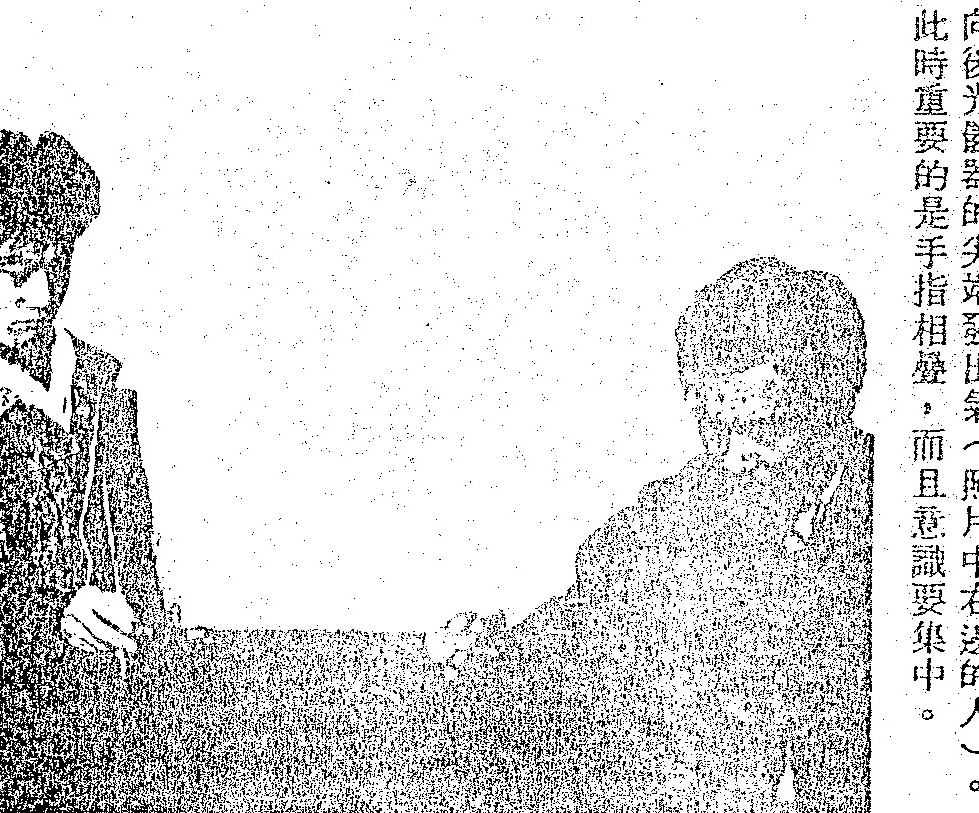
Emitting qi toward the tip of the aura instrument (the person on the right in the photo). At this time, it is important that the fingers overlap and the consciousness is concentrated.
The author found it very incredible and carefully observed the tip of the aura emitted by this person, only to realize that its tip was not aligned with the aura instrument. The author then advised him: “Try to align it.” Hearing my words, he moved the position of his palms up and down to explore the direction. Soon, the direction seemed aligned, and the aura instrument began to shake. The distance was then extended to 2.5 meters for testing, and the result was that it moved just the same. Afterward, people took turns conducting the same experiment in sequence. Everyone performed very successfully, truly proving themselves to be masters. Among them was a school teacher named Mr. Chiyuan, who could control the vibrating rod at will and also make the vibrating rod move rapidly. Another person also emitted qi from a distance of 2.5 meters, pulling the vibrating rod to the rearmost position, almost causing the vibrating rod to bend slightly.
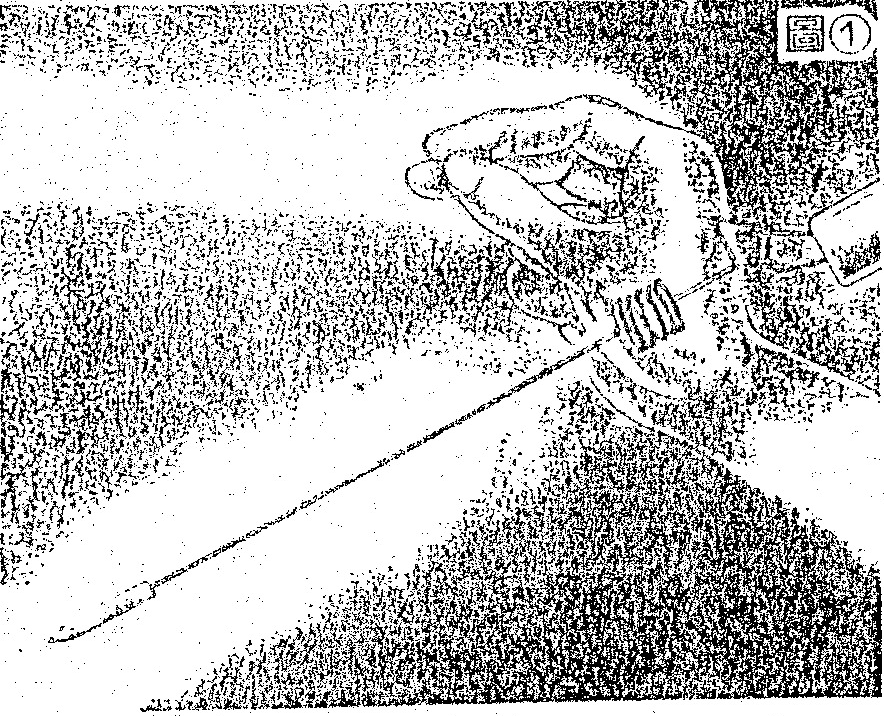
①
The essentials of the experiment are as follows.
It is most effective to emit qi when the fingers of both hands are overlapped. The qi generated by this overlapping of fingers is easy to concentrate, thus it can reach distant places (Figure 1). 2. Apply force to the lower abdomen, then gradually strengthen the qi before emitting it from the fingers. (3) You must aim at the tip of the vibrating rod of the aura instrument to emit qi.
Technique for swinging a Chevreul-type pendulum using aura This technique differs from the original technical method. Have one person hold one end of the pendulum string, and another person emit qi with their hand to make the pendulum swing. This will be explained in detail below.
One person holds one end of the pendulum string, suspending the pendulum in the air. The experimenter should be about thirty centimeters away from the pendulum to emit qi. Although the second experimenter who steps up emits qi, the pendulum…
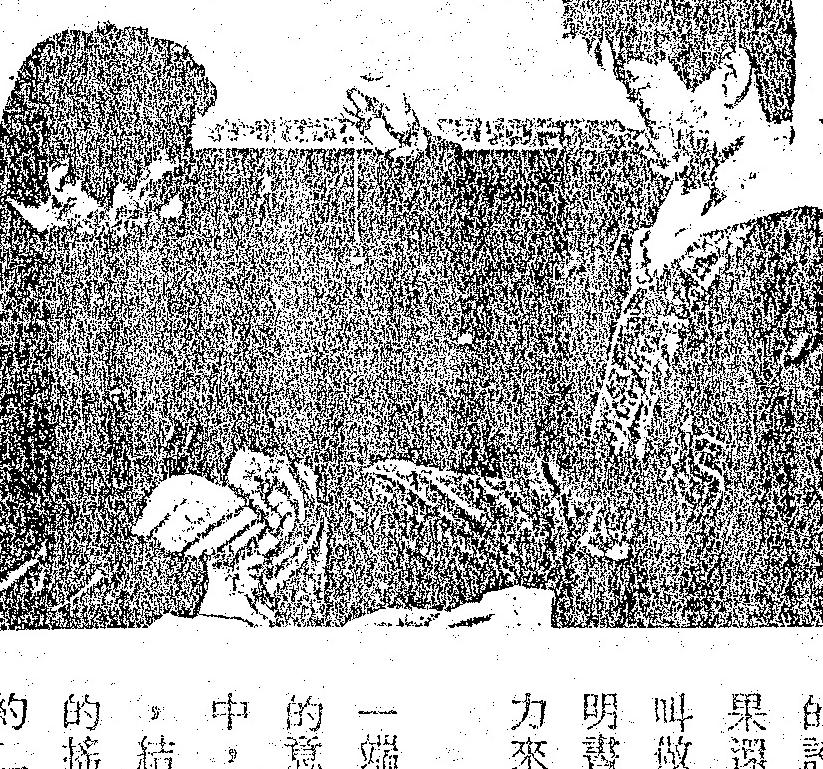
An experiment in which aura (qi) emitted from the eyes causes a pendulum to swing. The person on the left in the figure is concentrating intense consciousness power and aiming it at the pendulum.
It did not move at all. If one thinks about it carefully, one would know that the design of this type of pendulum is different from aura instruments; it is inherently not designed to move on its own. So later, nine people cooperated and emitted qi together, but the result was still no movement. Just as everyone was failing one after another, a man named Kobayashi came forward and said, ‘I have read the instruction manual for this type of pendulum, and it states that it must be made to swing using the aura or consciousness power emitted from the eyes.’
Hearing his opinion, I let him hold one end of the pendulum’s string, and the author emitted qi from his eyes while concentrating his awareness intensely on the pendulum. Because the author’s consciousness power was highly concentrated at the time, he almost felt as if his own body was about to swing back and forth. As a result, the pendulum began to swing back and forth. As the author’s body swayed, the pendulum’s swinging increased even more, and at this point, the pendulum was swinging in a massive arc of about twenty centimeters. At the time, the author was about one meter away from the pendulum, and maintained this distance to keep the pendulum swinging.
The experience the author gained from this experiment is as follows.
① The qi emitted from the eyes is easier to use than the qi emitted from the palms. The eyes seem to possess the same virtue as the hands used during prayer. ② Intensely focus your awareness on the pendulum’s swinging condition, making your own body feel as if it has become the pendulum. One could also say that it is better to conduct the experiment by utilizing the function of emotion to create a sensation as if you are floating in the air.
Technique for using qi to rotate a glass cup with a light-collector cover This type of instrument consists of a glass cup with a light-collector cover attached on top, and two needles extending from it, with a lightweight rotary vane resting on the needle points. It is an experiment to use psychokinesis to make the rotary vane spin. Everyone first read the instruction manual for this instrument. Every person participating in the experiment followed the instructions, raising their palms to aim at the rotary vane and sending out qi. However, despite sending out a large amount of qi, the rotary vane only moved slightly. Although they saw the rotary vane begin to move, it would immediately stop again, disappointing everyone; there was no appearance of the high-speed rotation of the rotary vane as recorded in the instruction manual at all. Just as everyone was tilting their heads in thought, Mr. Ikebuchi suggested: “The structure of this instrument is very similar to a concentrator, so you should send the qi directly toward the glass cup. Perhaps this will cause it to rotate at high speed.” Hearing his opinion, someone else mentioned having previously seen a static electricity experiment where the instrument used was exactly this type, and it indeed could make the rotary vane spin very fast. Hearing everyone’s opinions, nine people took turns trying this method in sequence, but the result was still unsuccessful. Perhaps everyone was already exhausted at this point; apart from two or three people who said they would continue trying, everyone else sat down to
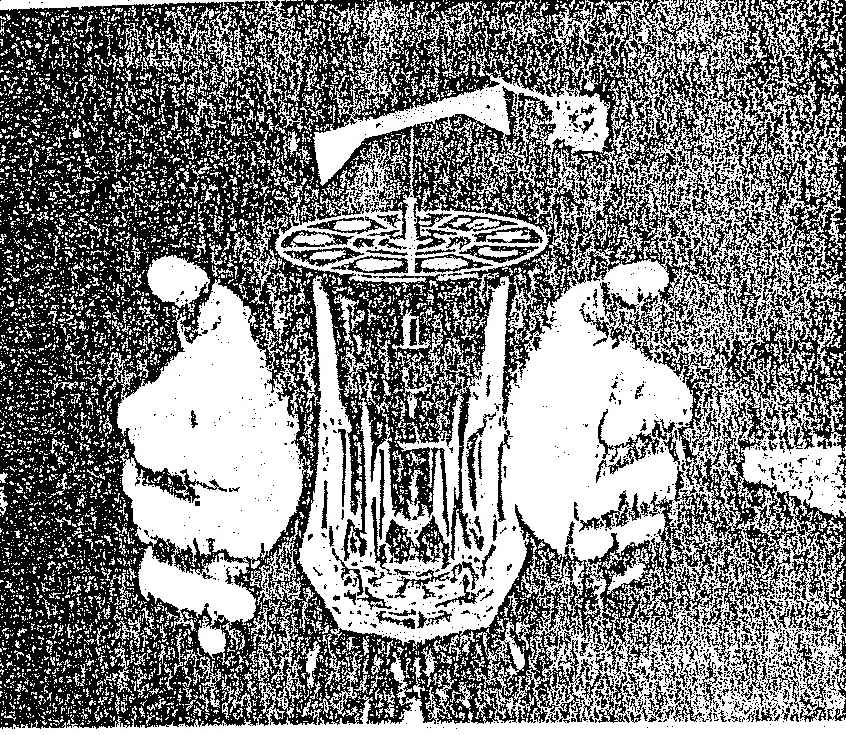
To make the rotary wing on the glass fitted with a light-collector cover rotate, one should hold the glass with the palms of both hands, as shown in the photograph.
During the break, among these two or three people, a Mr. Sasaki tried it first and suddenly shouted, “Look, everyone! It’s really spinning.” This indeed brought a burst of vitality to everyone; those on break couldn’t help but stand up to get a clearer look. However, as everyone stood up, the rotary wing suddenly stopped. This made Mr. Sasaki say in disappointment, “Strange, it only spun one or two times.” Everyone seemed to confirm that the rotary wing would not spin anymore, so they sat down again. But interestingly, as everyone sat down, the rotary wing began to spin at high speed again. As a result, it was like a game of hide-and-seek: when people watched, the rotary wing stopped; when people didn’t watch, the rotary wing spun. This repeated over and over.
Consequently, the author quickly thought of the reason: everyone’s eyes emitted a strong aura born of curiosity, and when it focused on the rotary wing from all directions, the rotation of the rotary wing was subjected to obstructed and stopped. Therefore, the author suggested limiting the number of observers to
four people. Moreover, the direction of observation had to be consistent. When redoing the experiment under these conditions, no matter who stepped up to perform it, they could cause the rotor to spin at a high speed.
From this experiment, the key points are understood as follows:
① The number of observers should be small, and the direction of their gaze must be consistent.
② Rather than sending intense qi toward the rotor, it is better to direct it toward the cup. Furthermore, both hands must hold the cup as if enveloping it while sending qi into it.
③ When wanting the rotor to rotate in our desired direction, one must rely on willpower to visualize the state of the rotor rotating in that direction in the mind. Alternatively, one can use the aura (qi) emitted from the eyes to make the rotor spin (Fig. ②). However, some people are unable to perform this technique, so if they do not force it, it will instead cause the rotating rotor to
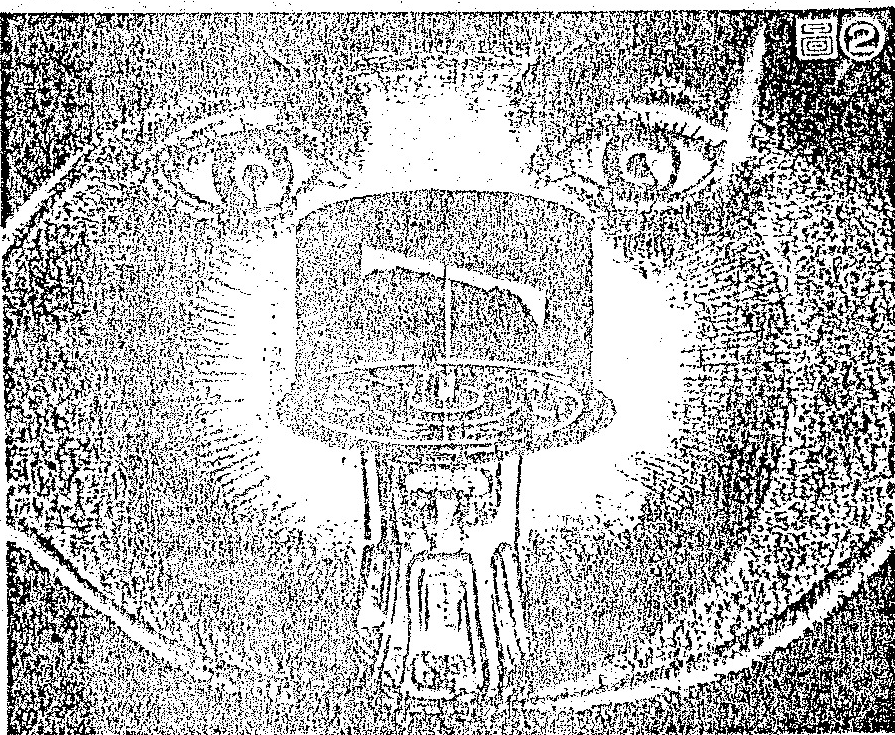
②
It stopped.
Technique for moving aluminum foil through obstacles
The author once conducted an experiment placing a light object on a plastic table and using the power of qi to move the object. First, several cylinders of varying sizes were made from aluminum foil. These cylinders were placed on the table one by one, and everyone present was asked to emit qi to see if they could make the cylinders on the table move. Some people tried desperately to emit qi; perhaps because they were too nervous, their faces and ears turned red, but there were no good results. Only a few people managed to make the cylinder move a tiny amount of about one millimeter before it stopped. So everyone sat down to discuss whether there was something wrong with their method, and finally realized that the cylinders made by bending the aluminum foil were not perfectly cylindrical; that is, their shapes were warped. In other words, the warped parts became obstacles to the movement of the cylinders. After reaching this conclusion, we immediately made new ones using aluminum foil. This time, we carefully cut a 14 cm long piece of aluminum foil, keeping the width at its original standard of 30 cm. We first folded it in half, placed it on the table, and observed. Everyone suggested first sending qi to this folded foil to see if it would move, so everyone conducted the experiment from a distance of about one meter from the foil. As a result, the distance the foil moved varied directly in proportion to the amount of qi emitted. Some people also emitted qi with their hands, making the qi hit the foil like a wave, and as a result, the foil rocked back and forth along with the movement of the qi.
↑ Experiment on moving folded aluminum foil using the aura emitted from the hand. The upper image shows the experiment conducted with a corrugated cardboard box placed between the experimenter and the record; with this intervening object, the intensity is not affected by wind. As a result, the aluminum foil moved following the movement of the hand. The lower image shows the experiment using a transparent plastic wall to view the aluminum foil. Because the obstacle is transparent, the target object, the aluminum foil, is visible, making it easy to concentrate on the aluminum foil, thus allowing the aluminum foil to be moved over a long distance.
↑ Experiment on moving folded aluminum foil using the aura emitted from the hand. The upper image shows the experiment conducted with a corrugated cardboard box placed between the experimenter and the aluminum foil. Because of this obstacle, it should not be affected by wind. As a result, the aluminum foil moved following the movement of the hand. The lower image shows the experiment conducted using a transparent plastic bag to view the aluminum foil. Because the obstacle is transparent, the target object, the aluminum foil, is visible, making it easy to focus the mind on the aluminum foil, thus allowing the aluminum foil to be moved over a long distance.
Therefore, the distance was extended once more. This time, qi was emitted from two or three meters away from the aluminum foil, and the same result could be observed. At this point, someone pointed out that the aluminum foil was too light and might move simply from a slight breeze, so everyone decided to place an obstacle between the experimenter and the aluminum foil to conduct the experiment. First, the aforementioned corrugated cardboard box was brought out to serve as an obstacle while emitting qi. As a result, the aluminum foil still moved back and forth in accordance with the qi emitted by the person, demonstrating that it was not affected by the cardboard box. Therefore, some people took off the jackets or coats they were wearing to use as obstacles. As the person’s hand emitted qi, the aluminum foil also moved back and forth in sync with the hand’s movements. However, because some people could not see the aluminum foil when using such large obstacles, this affected the experimental results. Thus, someone suggested using a plastic table as an obstacle to test it out (this is a transparent plastic table, as clear as glass, allowing the other side to be seen). The author conducted the experiment first. Because the transparent plastic table allowed the aluminum foil on the other side to be seen, it was easy to concentrate mental focus, and moving the aluminum foil a considerable distance was easily accomplished. Then, everyone present took a turn trying it, and everyone did so very successfully; the aluminum foil indeed moved a considerable distance. Mr. Kobayashi, in particular, was able to rapidly push the aluminum foil forward with a wave-like bounce of about 1.2 centimeters, which looked very beautiful. The training insights gained from this experiment are as follows:
Moving Stone Statues and Trees
① First, send qi fully to the target object; at this point, the hand emitting qi and the target object seem to share a sensation of some kind of connection.
② Next, move your hand back and forth in a slow rhythm, and observe whether the aluminum foil moves along with the hand’s motion.
③ When no obstacle is used, take care when emitting qi by hand not to generate any breeze, so that the experiment can continue. Other conditions must also be noted, such as whether wind might blow in from the door or windows; if necessary, close the windows before conducting the experiment.
What is introduced here is the use of clairvoyant ability to move objects such as trees or stone statues. Because the target objects are large, most people would certainly consider this impossible. In fact, for those who have cultivated their clairvoyant ability to an advanced level, it is quite simple to do.
Experiences of Moving Statues
The author first discovered this phenomenon six years ago. At that time, the author was visiting Taiwan to investigate qigong methods, which provided the opportunity to discover such things. The circumstances at that time are reported as follows:
In 1981, the author visited Taipei and chatted with Mr. Kawashima, who operated a karate dojo. As a result, he introduced me to one of the dojo’s senior students, Mr. Tokita.
Mr. Tokita had been living in Taiwan for a considerable length of time. His wife was French, and Mr. Tokita appeared to be engaged in subcontracting work for European companies.
Why did Mr. Kawashima, a karate expert, introduce Mr. Tokita to me? Because Mr. Tokita was a person with clairvoyant ability, and the author’s works have also mentioned Mrs. Tokita, as she is someone who has had out-of-body experiences. That is to say, when Mrs. Tokita was practicing karate at the karate dojo or walking on the street, her double could separate from her body and observe herself from above.
Mr. Tokita himself had considerable cultivation in this area, and as a result, the strange phenomena the couple saw at home were particularly numerous. For instance, one night, as Mr. Tokita was lying comfortably on the sofa in the living room, he suddenly heard the creaking sound of a door being pushed open in an unoccupied room, and he saw a white shadow moving.
The author found Mr. Tokita’s words very interesting, and later the couple invited me to visit their home when I was free. One evening, I asked Mr. Kawashima to accompany me to visit the Tokitas.
The Tokitas’ residence was a luxurious five-room apartment. Although from the outside it looked very luxurious, once inside, I felt as if there were many people there.
Following Mr. Kawashima’s explanation, he then led me and Mr. Kawashima to look around each room, but we could not see anyone. So I wondered why the atmosphere of having many people that I had just felt had suddenly vanished. Was it afraid of me, Mr. Kawashima, and the others? When we reached the last room, we suddenly encountered a very wondrous phenomenon.
This was because the room contained several small statues about thirty-five centimeters tall, and they were all intricately carved works that felt lifelike.
The author had always been interested in divine statues, so he could not help but stop and carefully observe these statues. The hands and feet of these statues seemed as if…
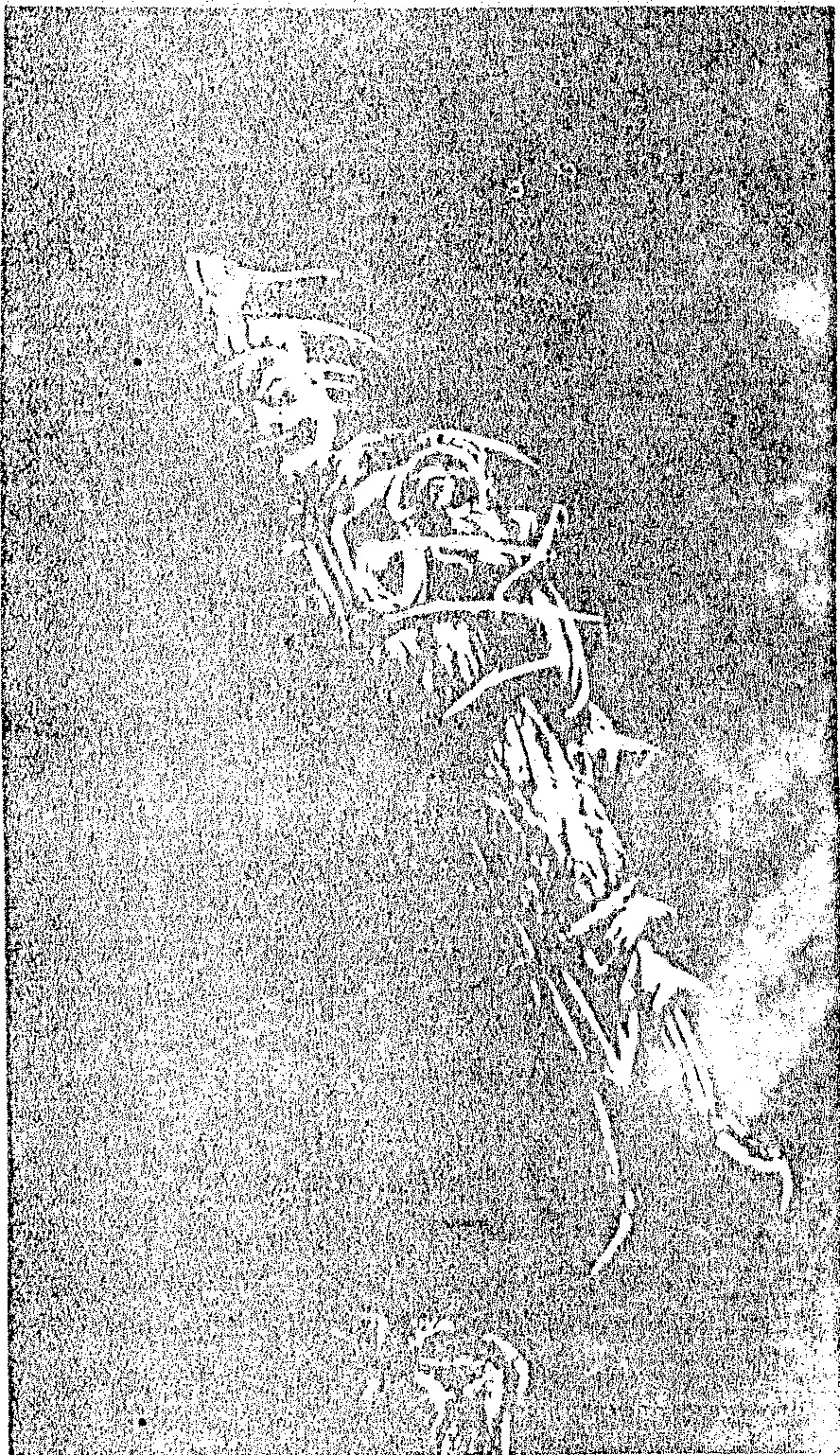
Sensing that it was moving, I immediately rubbed my eyes with my hand to see more clearly, wanting to verify whether it was a temporary optical illusion. Oh! There was absolutely no mistake; the statue was still moving slowly. I was quite astonished at the time and asked Mr. Kawashima how he felt. He too softly replied that the statue seemed to be moving.
I found this completely baffling. At that moment, Mr. Tokita seemed to have discerned my feelings from my expression and quietly told me: ‘When the statue here was moved over from a certain temple, the ritual to release the divine spirit was not performed, so it is possible that a divine spirit still remains.’
I felt his words made perfect sense, which calmed me down considerably. I continued watching carefully and saw a powerful aura radiating from the statue. Moreover, as the aura swayed, the divine body swayed along with it. The intensity of that aura fluctuated in direct proportion to the strength of the qi projecting from my eyes.
This was a first-time experience in my life. Furthermore, while observing, I was unconsciously utilizing clairvoyant abilities. I never expected to have such an unbelievable experience in Taiwan.
Experiences of Moving Trees and Giant Stone Statues
Later on, I had several opportunities to use clairvoyant abilities to move trees or stone statues, so I gradually built up confidence. For example, once the author was practicing qigong in a park. After emitting qi, I looked at a certain tree, and as a result, its branches shook; sometimes the trunk would even start to shake, despite there not being even a trace of wind at the time. I have had this kind of experience several times. When it occurred for the first time, I thought it was not an optical illusion. However, later, when I saw it again with a friend who practiced extraordinary vision, I realized that what I had seen was not an illusion.
Once, I had the opportunity to travel to Singapore with a certain psychic. This psychic and I were strolling along a road called Serangoon, which had several famous Indian temples. Upon arriving at one of the temples, the author casually mentioned to the people there his experience of seeing stone statues sway in Taiwan. Then, I looked around at some of the deity statues in the temple, casually pointed to one of the stone statues, and said, “Maybe that statue will start moving too, who knows.” What I was pointing to were two female deity statues holding weapons about two meters long, standing on either side of the main hall. Evidently, they were the guardian deities of the principal deity; compared to the deity statues of a few dozen centimeters tall that I had seen in Taiwan, they were indeed massive.
Since I had just said that, I wanted to give it a try. At the time, I was about ten meters away from the goddess statues. I emitted qi and intensely visualized making the statue move. The one on the left hardly moved at all, but the other one on the right slowly began to move, eventually showing a tendency to come toward me. It was as if the giant deity statue holding a two-meter-long weapon was about to charge at me. In that fleeting moment, I felt afraid and could not help but stop emitting qi. Only then did I see the statue return to its quiet, original posture.
After returning to my friend’s dormitory in Singapore, the essence residing in that deity statue came to ask me why I had just done such a thing. This made me break out in a cold sweat all over, and I could only apologize, explaining that I meant absolutely no harm. This was a lesson for me; ever since, I have never dared to arbitrarily emit qi at Buddha statues or deity statues again. Because if the qi of the person emitting it is weak, or if the purpose of such an action is not pure, the consequences would be unimaginable. Therefore, I earnestly advise my readers not to casually do such things to deity statues.
Distorting Space to Produce Supernormal States
There is no difficulty in this practice. Emit qi from the eyes (those who can see auras can emit auras), and mentally will it to move. This can also be described as concentrating intense conscious intention to form a mental image of the movement. By using the aura to make the target object radiate brilliance, and then shifting the aura slightly, the object will begin to move along with the aura’s movement.
Distorting Space to Elicit a Supernormal State
If one can freely utilize the applications of the super-vision abilities explained above, one is already a sorcerer in the truest sense, capable of performing a wide variety of mysterious and incredible feats. For example, one can manifest impossible phenomena for a third party to see, suddenly disappear, or perform wondrous acts such as distorting space.
The author did not intentionally train in these methods, but acquired them unconsciously while practicing super-vision abilities. It was only later, after others noticed and pointed it out, that the author realized it.
The Experience of Distorting Space
The first to point out this fact were two ladies: one was Ms. Nishiwaki, a women’s university student who came from Anwei City to study Xian Dao with me, and the other was Ms. Machida. At that time, I was instructing them both in Xian Dao. Ms. Machida suddenly looked at the space about 1.5 meters next to the author and said: “It is really interesting; the space in this area is moving up and down rhythmically.” When the author heard her words, he thought he had misheard, but…
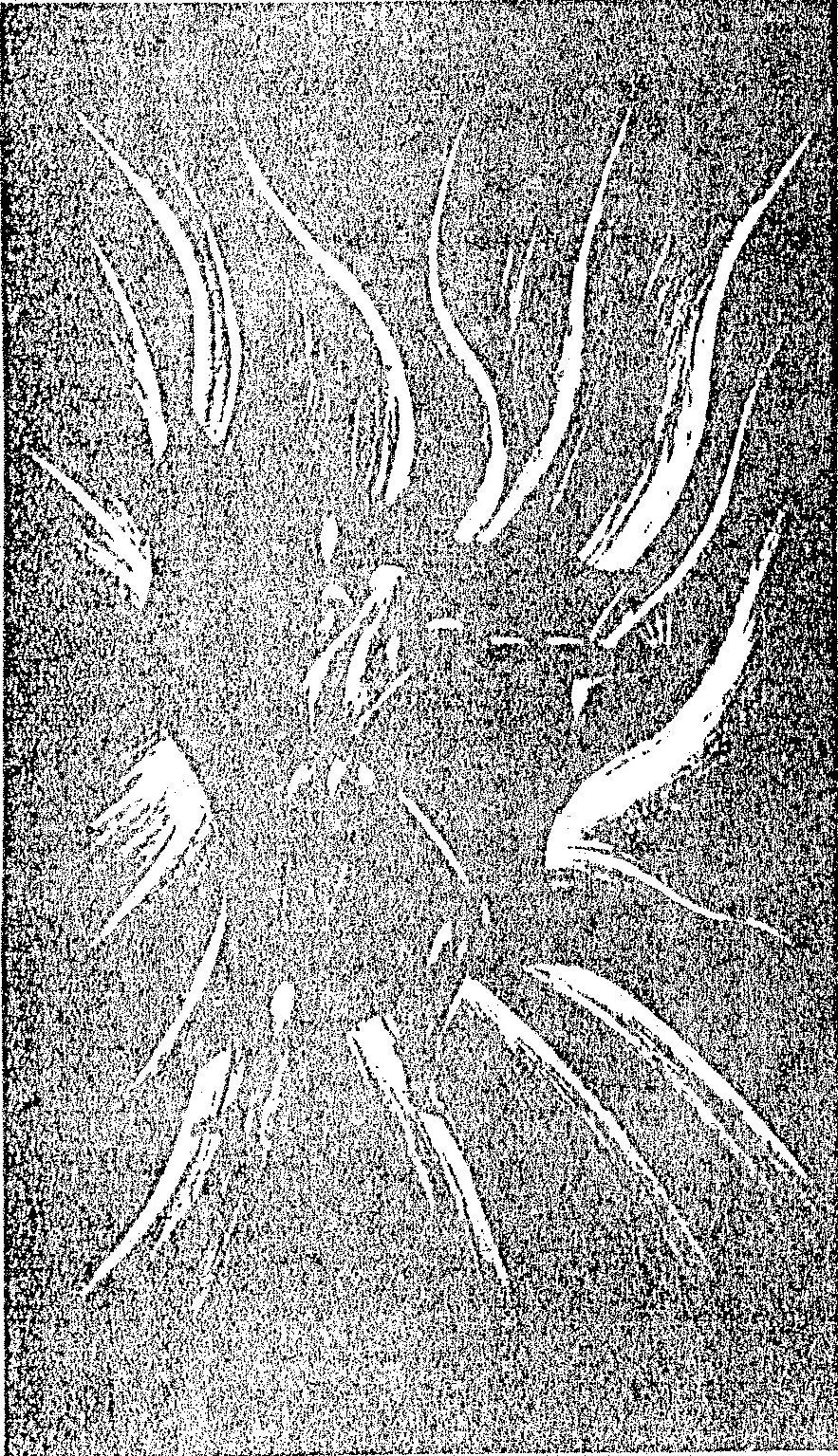
Then these two women also told the author that they had seen a figure resembling white smoke appear here.
The time they saw the smoke-like figure standing was three o’clock in the afternoon, in broad daylight. How could a supernatural phenomenon occur in such a brightly lit room? Yet the author had not been consciously projecting such an image, so the author found it very peculiar (in fact, such images are generally not visible in broad daylight).
As the three of us sat in silence reflecting on what had just happened, Miss Machida added: “Actually, this kind of phenomenon has already occurred several times before when I was together with the author.” At that point, the author deeply pondered whether the sensation used to move the stone statue could also be used to control this phenomenon. After thinking it over several times, the author told Miss Nishiwaki: “Then I am now going to warp the space in this room; please watch carefully.” The author then directed consciousness toward the ceiling, making it gradually bend and descend, and the tatami rippled like waves. Suddenly, Miss Nishiwaki’s near-screaming voice cried out: “Wow! Terrifying! This room seems to be getting smaller and smaller.” Miss Machida’s level of fright, though not as severe, prompted her to add: “This room seems to be gradually deforming; it makes me feel nauseous.” The author immediately ceased the intention, and both of them said everything had returned to normal.
The Experience of Allowing Others to See Ever-Changing Forms
The second experience pointed out by others occurred in the mountains of a certain region, when I had taken several students to live communally for the purpose of training in the Way of Immortality. Among them was a young man named Mr. Hirai, who had previously visited the author’s home and had also told the author that he had seen wondrous phenomena at home. He had already practiced immortal cultivation and esoteric Buddhism, could separate a double from his body, and had even performed this kind of out-of-body double for his neighbors to admire, which showed the depth of his skill.
Regarding the wondrous phenomena he had seen when he previously visited the author’s home, he explained to the author as follows: ‘Master, this happened a few years ago. I was visiting your home, and it was also a very bright afternoon. I was sitting opposite you when I suddenly saw a figure. It would grow larger and smaller, appearing right before my eyes one moment and moving far away the next. When I first saw it, I thought my vision was blurred, but upon focusing my gaze, everything was real. That figure would sometimes turn into a youth or an old man, and sometimes instantly transform into a young woman. It underwent endless transformations, making it truly impossible to identify its true form.’ Pausing here for a moment, he then continued: ‘That room also gave me a very wondrous feeling. I remember it very clearly—that room had tatami mats, right? During training, Master asked me to stand up and listen. When explaining a certain movement, Master reached out and casually pushed me, yet I felt as if I had floated far away, and I also felt as if the room was stretching or shrinking.
In addition, I had another very wondrous experience, and this time it was not at Master’s home. It was nighttime, and Master walked me to the station for safety. Along the way, I occasionally turned my head to look at Master, only to find that at some unknown time, Master was no longer beside me, and I could only hear a speaking voice. This voice felt like an echo. It was only when we were nearing the station that I realized that at some unknown time, Master was beside me again. The road Master walked me down had streetlights and was a fairly bright street, yet this phenomenon only vanished when we reached the station. After Master left, as I sat in the station’s waiting room, I thought to myself that Master was still human.’
Hearing his reminiscences, the author was quite surprised, because what Miss Machida had said before and what Mr. Hirai had said this time both seem to regard the author not as an ordinary person, but rather as half-human, half-ghost. In fact, the author is just like an ordinary immortal path practitioner, except that he has also learned clairvoyant abilities, occasionally and consciously manifesting wondrous things for others to appreciate. As far as the author himself is concerned, he believes his state of consciousness is the same as usual, and the space he perceives has not changed in any way; there is merely a bit of illusion during the performance. However, inferring from the words they speak, it is not as casual as the author imagined; they seem to always be seeing some kind of wondrous phenomenon. After being pointed out like this by others, I calmly thought about this aspect of the problem. Previously, when practicing immortal path meditation, there would often be incredible states of consciousness. For example, a highly wise old sage would suddenly appear in my mind, and then all of a sudden it was as if a deeply emotional woman took the place of that old sage. These sensations would not appear with any concrete changes during ordinary times; they would only emerge at night while sleeping, seemingly in a dream-like state, and those phenomena would all appear under circumstances with a strong sense of reality and materiality. At the time, I also frequently felt that this was purely a world of consciousness. But later, in discussions with others, I learned that this consciousness of mine actually often turned into some sort of phenomenon and was seen by others. This phenomenon occurs very naturally, so there is no special training method to explain. If one wishes to manifest this phenomenon, the focus should be placed on concentrating an intense consciousness, and on training to be able to emit very powerful qi in order to distort space.
Experiences and Techniques of Disappearing into the Void
This is a technique for suddenly making one’s physical form disappear in front of others. The ancient Chinese referred to this technique as the art of invisibility or the art of Dunjia. In the practice of Xian Dao, the equivalent to the art of invisibility is the “Return to the Void Journey” (Huan Xu Xing), though its purpose differs from that of the art of invisibility. The art of invisibility is merely the temporary disappearance of the physical form, without any change in consciousness, whereas Xian Dao’s Return to the Void Journey aims for total annihilation. In other words, not only does the physical form disappear, but consciousness vanishes at the same time. Therefore, there is a difference between the two. Moreover, by utilizing clairvoyance, one can manifest this technique. Here, I will introduce its actual state to the best of my knowledge. Method of Disappearing One’s Physical Form by Adjusting the Aura To be honest, this is something the author himself did not notice, and it was only after a third party discovered it and informed me that I became aware of it. The author first became conscious of this aspect on the night when Mr. Hirai of Maetou mentioned his experience of witnessing a wondrous phenomenon involving the author. That night, as usual, the author gathered everyone for an aura development experiment. This involved an experiment using colored paper to see auras; once everyone was able to see auras, all the lights were turned off, and the training to observe each person’s aura began. All the participants observed a hazy aura of brilliance expanding beyond the body, and they watched as it gradually transformed moment by moment conditions spellbound. Next, the author stood in front of the wall to display his own aura. Due to the beauty and intense power of the aura’s radiance, they all unanimously let out exclamations of wonder. Here, I will take the opportunity to explain that the radiance of the aura emitted by a person who has practiced qigong methods is generally several times stronger than that of an ordinary person, and the range of the radiance is three or four times that of an ordinary person. If it is someone who has studied the ‘Greater Heavenly Circuit’, their aura extends upward from the top of the head in a pillar shape, which is truly beautiful. Now, they were full of praise as they observed the author’s extraordinary aura. Just as they were watching spellbound, a cheer of ‘Oh!’ resounded through the air, followed by shouts such as ‘Ah! It disappeared!’ and ‘It really disappeared.’ The author found this very strange and asked them what exactly had happened. One of them replied, ‘Teacher’s physical form suddenly disappeared.’ I was quite skeptical, so I reminded them to look closely. As the author continued to stand there, several more people shouted, ‘It really disappeared again.’ Therefore, I temporarily suspended the aura-viewing experiment and asked them what they had just seen. They answered as follows: ‘If you carefully observe an ordinary person’s aura, you will see that its range merely fluctuates in size. However, the expanding and contracting range of Teacher’s aura is much greater. Moreover, at a certain moment it will vanish, turning the space into a patch of darkness. Not only that, but even Teacher’s physical form completely disappears.’ Hearing them say this, the author himself was quite astonished. Without their explanation, he would not have known what changes had occurred in his own aura. Hearing their explanation this time, the author felt that by adjusting the aura, it seemed possible to mani manifest his own image and make it disappear. Therefore, the author made up his mind that, when there was a chance in the future, he would consciously try experimenting with it.
Finally, there was an opportunity to conduct an actual experiment. It was conducted when I went to Nagaoka Hot Springs with the chairman of a company from the Mishima area of Shizuoka Prefecture, as mentioned earlier. Mr. Watanabe, who is often mentioned in my book Secret Arts! Superpower Qigong Method, was also with me. Taking this opportunity, I demonstrated a few techniques of super-visual abilities, and then adjusted my aura, first making the author’s hands disappear, followed by parts of the face in sequence.
This experiment was very successful. As the aura shrank, the hands began to disappear from the fingers, followed in sequence by the elbows and shoulders. As for the face, distinctive features such as the eyes and nose disappeared first, and finally, the face itself dissolved into the dark space and vanished.
Mr. Watanabe was accustomed to demonstrations of super-visual abilities and thus was not surprised. However, when the chairman saw the disappearance for the first time, he rubbed his eyes as if he could not believe what he was seeing, and the expression on his face became very strange. To allow him to confirm it, the author deliberately raised a hand right in front of his eyes for him to see clearly, and then performed the sequential disappearance from the fingers to the shoulder. This time, he was truly and completely convinced.
The Technique of Making the Physical Body Disappear into the Void in Daylight
By adjusting the aura in this way, one can perform the technique of making the physical body disappear during the day, even in a very brightly lit place. Of course, this is more difficult than performing it at night. In other words, it requires considerable cultivation to be able to achieve this.
The period when the author experienced sensations in this aspect was during the practice of the Xian Dao “Return to Void” practice. The so-called “Return to Void” practice can only be practiced after completing the “Spirit Egress” practice; it is a cultivation where the physical body undergoes qi transformation to reach the same level as the Yang spirit, and then gradually disappears into the void.
When the author practiced Xian Dao and advanced to the point of being able to perform the “Return to Void” practice, I became busy writing books, and therefore did not develop further in Xian Dao. One could say I did not fully practice to the final stage and stopped halfway. However, one day later, I performed this technique for a third party to observe. Here, I will provide a brief report of the situation at that time as a reference for readers.
One day, I gathered seven or eight people in Hamadayama, Suginami Ward, Tokyo, to hold a Xian Dao training session. After the lecture concluded, we began training to see auras. It was already three or four o’clock in the afternoon, and the sun had naturally not yet set.
The author first stood in a corner of the room, raised a hand, emitted an aura, and asked them if they could see the aura emanating from the hand. As a result, several people simultaneously indicated that although the extent of the aura was not very clear, they could see black, thread-like things extending straight into the distance from the tips of the author’s fingers.
When the author began adjusting the aura to allow them to see more clearly, several people cried out: “Ah! Strange, the tips of the fingers seem to have disappeared.” Hearing them say this, the author turned his head to look at the tips of his own fingers. Up to the second joint of the fingers, they were indeed hazy, appearing at first glance to have vanished.
At this point, the author adjusted the aura slightly further. As a result, all the little fingers disappeared, followed by beginning to adjust the aura around the face.
First, the eyes disappeared, followed by the nose, causing a commotion in the room. After a while, someone shouted that they could no longer see the author’s face. It was broad daylight in the afternoon, and the author himself felt a sense of terror, so the experiment was brought to an end at this point. After concluding this experiment, their impressions were heard; generally speaking, the face began to disappear starting from the eyes and nose. Then, the contour of the face took on a hazy quality, and finally, the face and the space of the environment became almost indistinguishable. Later, the author calmly recalled and reviewed the event. Recently, when the author is alone in a residence, especially in an empty room, he often feels as if his body is dissipating like smoke. However, since there were no observers in the residence, it was thought to be a psychological effect. But judging from this experiment, perhaps this phenomenon has already occurred several times. As it stands now, it can only be treated as speculation. The key to executing this technique is to strengthen the aura or qi as much as possible, and then regulate it with concentrated conscious power (that is, expanding it to an immense degree, and then shrinking it to a minuscule degree). One must also practice in parallel the ability to voluntarily make one’s consciousness disappear. If this technique is not mastered, the consciousness will quickly return after disappearing. According to the author’s experience, the longer the consciousness stops, the longer one can remain invisible. These key points must not be forgotten; with consistent practice, the technique will improve much faster.
Afterword
This book introduces various techniques related to clairvoyant abilities that the author has personally experienced. Its scope includes the development of the aura chakra, as well as the applied aspects of various psychic abilities, and also the highest esoteric mysteries of established magic. Although many aspects are discussed, it does not cover the entirety of all clairvoyant abilities; there are still more profound parts. To be honest, the world is limitless, the reason being that clairvoyant abilities are intimately connected to the vast realm of consciousness inherent in human beings. In other words, the applied techniques of clairvoyant abilities that emerge depending on an individual’s consciousness are countless. Therefore, the methods introduced by the author in this book are merely a drop in the ocean. According to the author’s experience, as long as one applies the flashing of clairvoyant abilities and the power of consciousness, anyone can manifest some illusions, magic, and the like. This is because, during training, a space where consciousness and the real world merge will appear, and there are many examples that can prove this phenomenon. For example, the author uses the eye-opening method to manifest distinct points of light, and then blinks very naturally; these distinct lights will then feel as though they are flashing on and off, and this flashing state can also be seen by a third party. Furthermore, by using the qi (eye power) emitted from the eyes, one can move the aura of another person’s body. At this time, one only needs to blink, and then, following the movement of the eyes, the other person’s aura will momentarily leave the body and then return to its original position, and it can be manipulated repeatedly; this is not something that only the executing author can see; rather, everyone present can see it clearly.
Generally speaking, the scenes one sees when blinking are purely matters concerning oneself, yet to a third party, it feels as though it is a matter concerning the third party themselves.
From the above facts, it can be understood that when performing operations of clairvoyance within the personal world (subjective world) seen by a certain individual and in real space, the two become completely indistinguishable (it can also be said that they completely overlap and present a unified phenomenon).
This is the enigmatic space that illusionists or sorcerers frequently perform in; these individuals skillfully draw others into the space of consciousness that they themselves observe.
As long as one applies the incredible, developed techniques of clairvoyance, one can replicate the exact phenomena previously performed by miracle workers or psychics; human capability is truly magnificent.
As long as readers memorize the techniques described in this book and study diligently, I believe they will move one step closer to a superhuman world. This book is one in a series of books on Xian Dao and qigong written by the author, though its content is more advanced.
Although the level is advanced, the content is written in an accessible way, making it easy for readers to understand. I believe that among the books on mysticism published domestically, this is the easiest to understand. Those who have not studied Xian Dao and qigong can easily comprehend clairvoyance just by reading this book, and can thereby go on to study Xian Dao on their own.
Many readers of this book have written in with inquiries, which is a small regret. The author has been very busy recently and cannot find the time to reply to the letters; please forgive me for this. Finally, I pray that readers’ cultivation will be smooth and successful.
January 26, 19871
The Author
Footnotes
-
The source scan prints “987”; “1987” is supplied from the edition chronology. ↩