Qian Xuesen
On Human Science and Modern Technology
By Qian Xuesen
Shanghai Jiao Tong University Press


On Human Science and Modern Technology
By Qian Xuesen
Shanghai Jiao Tong University Press

On Human Science and Modern Technology
By Qian Xuesen
Published and distributed by Shanghai Jiao Tong University Press
877 Panyu Road, Shanghai, Postal Code 200030
Tel: 64281208 Fax: 64683798
Distributed nationwide by Xinhua Bookstores
Printed by Changshu No. 2 Printing Factory
Format: 889×1194(mm) 1/16 Printing sheets: 39.5 Color inserts: 16 Word count: 1,081,000 characters
Edition: December 1998, 1st edition
Printing: December 1998, 1st printing
ISBN 7-313-01601-8/G·152
Price: ¥98.00
No part of this book, including text and images, may be reproduced, excerpted, or copied in any form without written permission from the publisher.
(If this book has missing pages, damage, or binding errors, please return it to the publisher for replacement.)
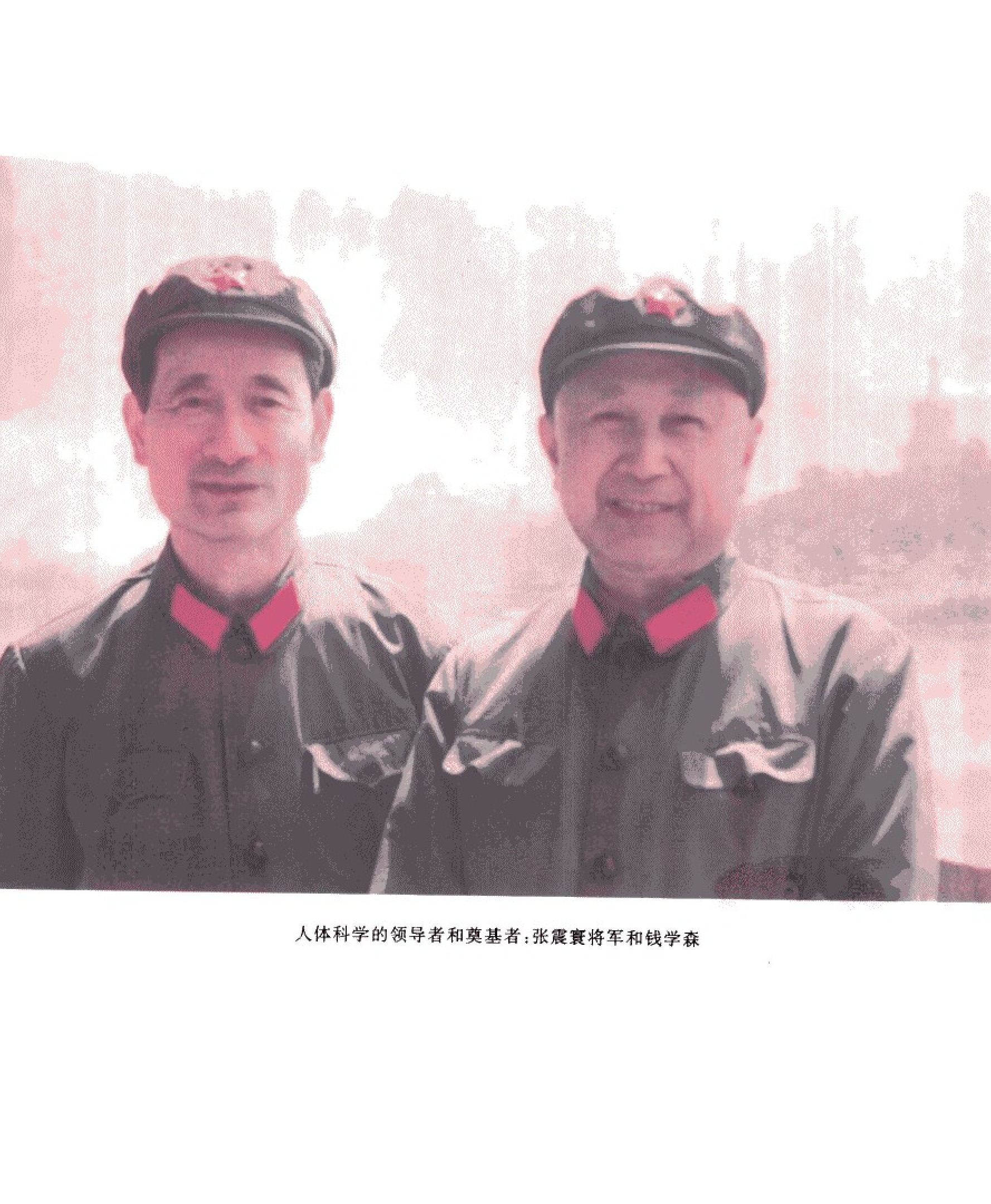
Leaders and Founders of Human Science: General Zhang Zhenhuan and Qian Xuesen
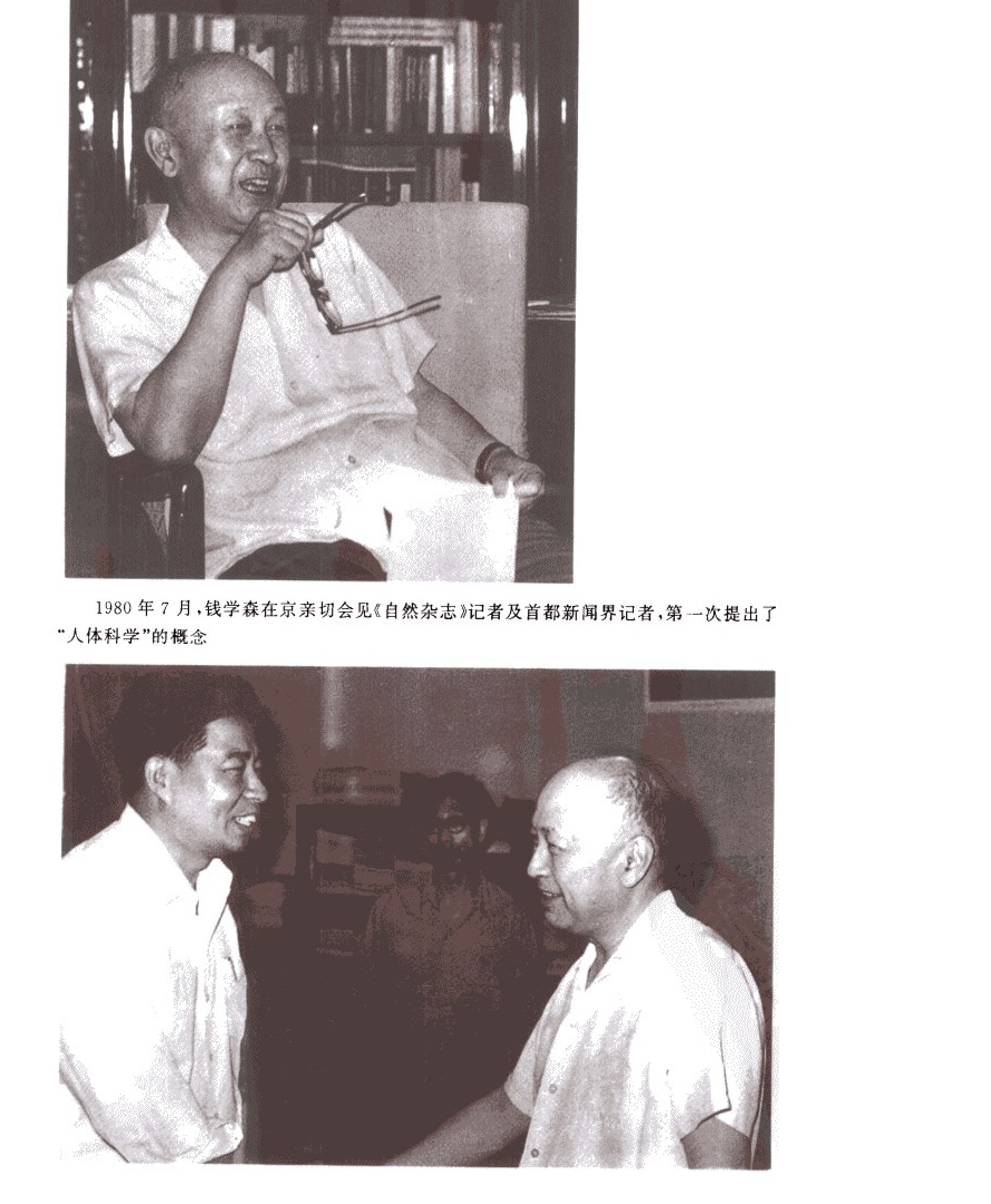
In July 1980, Qian Xuesen graciously met in Beijing with reporters from Nature Magazine and journalists from the capital’s press corps, and for the first time put forward the concept of “human body science.”
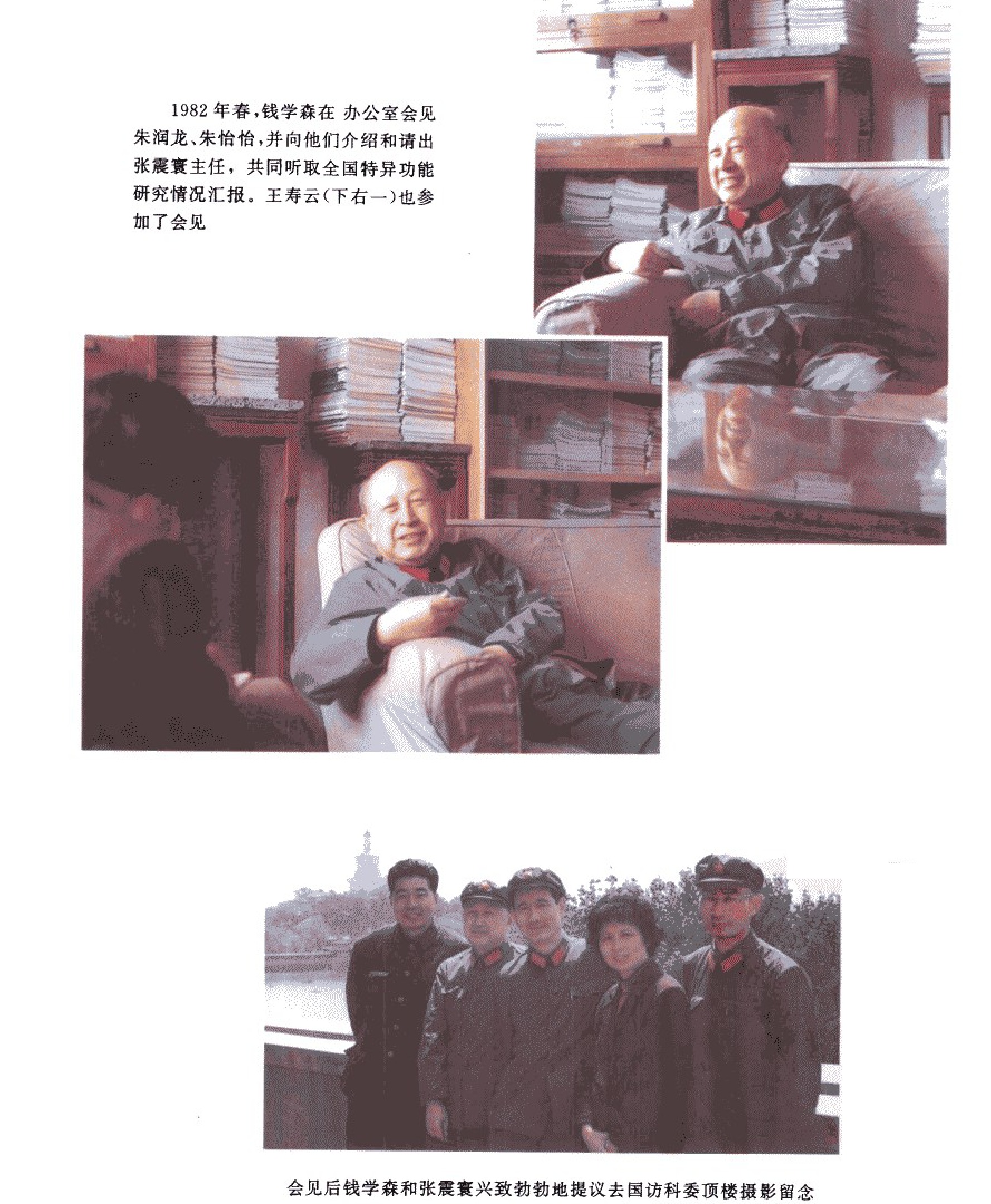
In the spring of 1982, Qian Xuesen met in his office with Zhu Runlong and Zhu Yiyi, and introduced and invited Director Zhang Zhenhuan to join them, so that together they could hear a report on the status of extraordinary human function research nationwide. Wang Shouyun (bottom right, first from right) also attended the meeting. After the meeting, Qian Xuesen and Zhang Zhenhuan, in high spirits, proposed going to the rooftop of the National Defense Science and Technology Commission building to take a commemorative photograph.
First Meeting of the First Council of the China Human Body Science Society
On June 8, 1987, Qian Xuesen and others attended the first meeting of the first council of the China Human Body Science Society. Front row, third from left: Yun Shubi, Lü Bingkui, Qian Xuesen, Bei Shizhang, Zhu Guangya, Zhang Zhenhuan, Gao Chao, Zhao Zhongyao, Yang Longsheng.
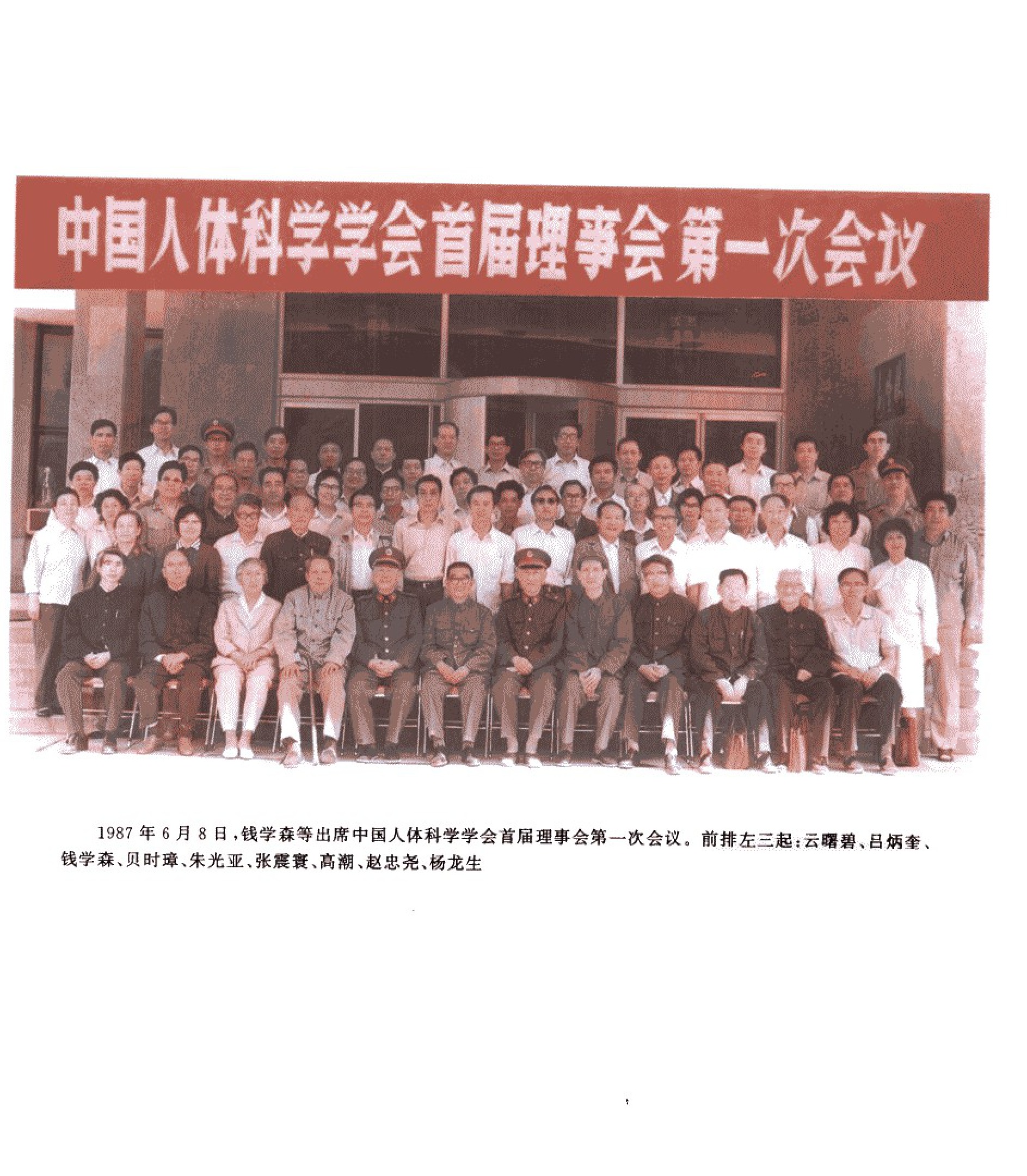
First Council of the China Human Body Science Society
At the first meeting of the first council, Qian Xuesen delivered the report “Human Body Science Is a Major Department Within the Modern Science and Technology System.”
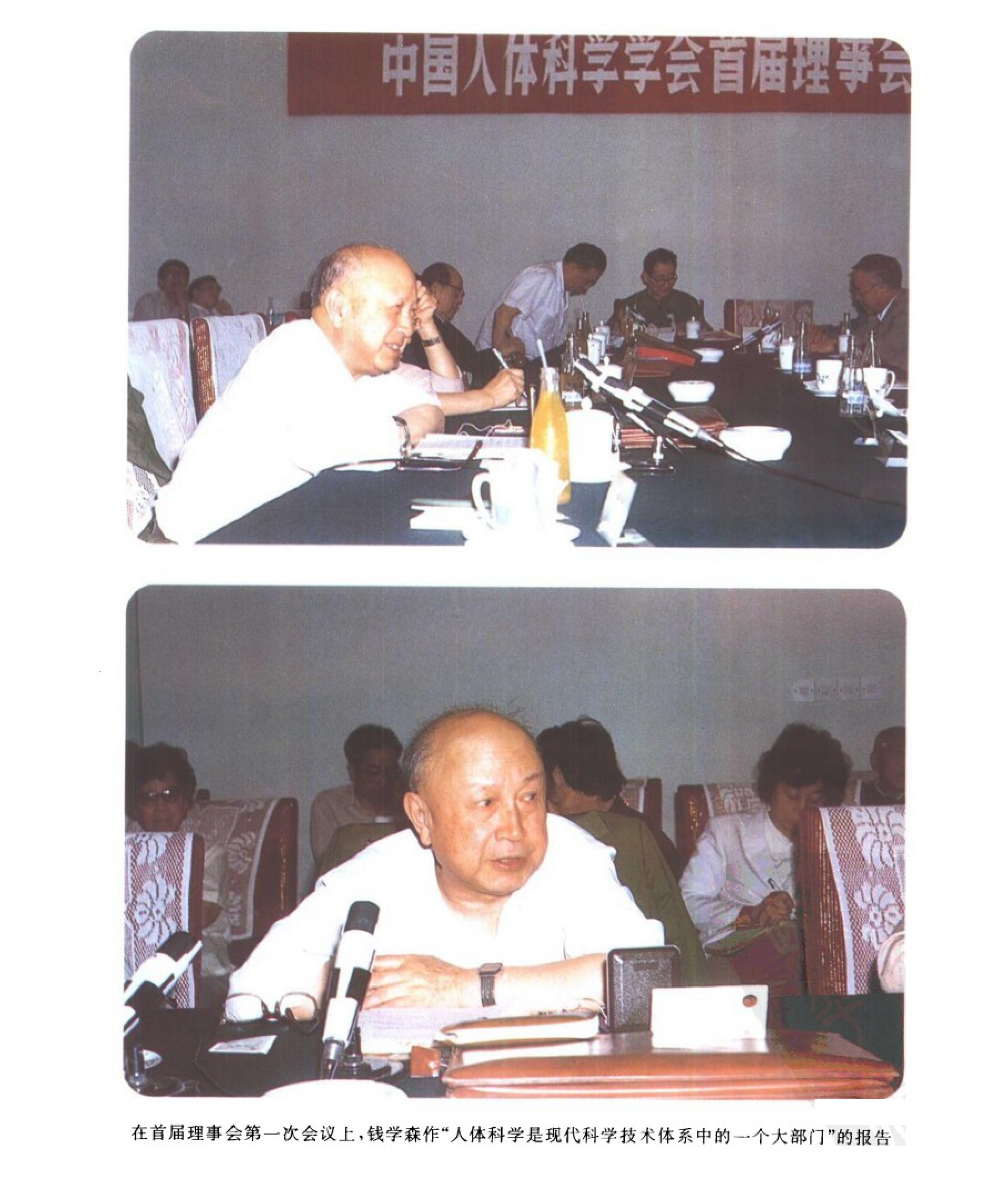
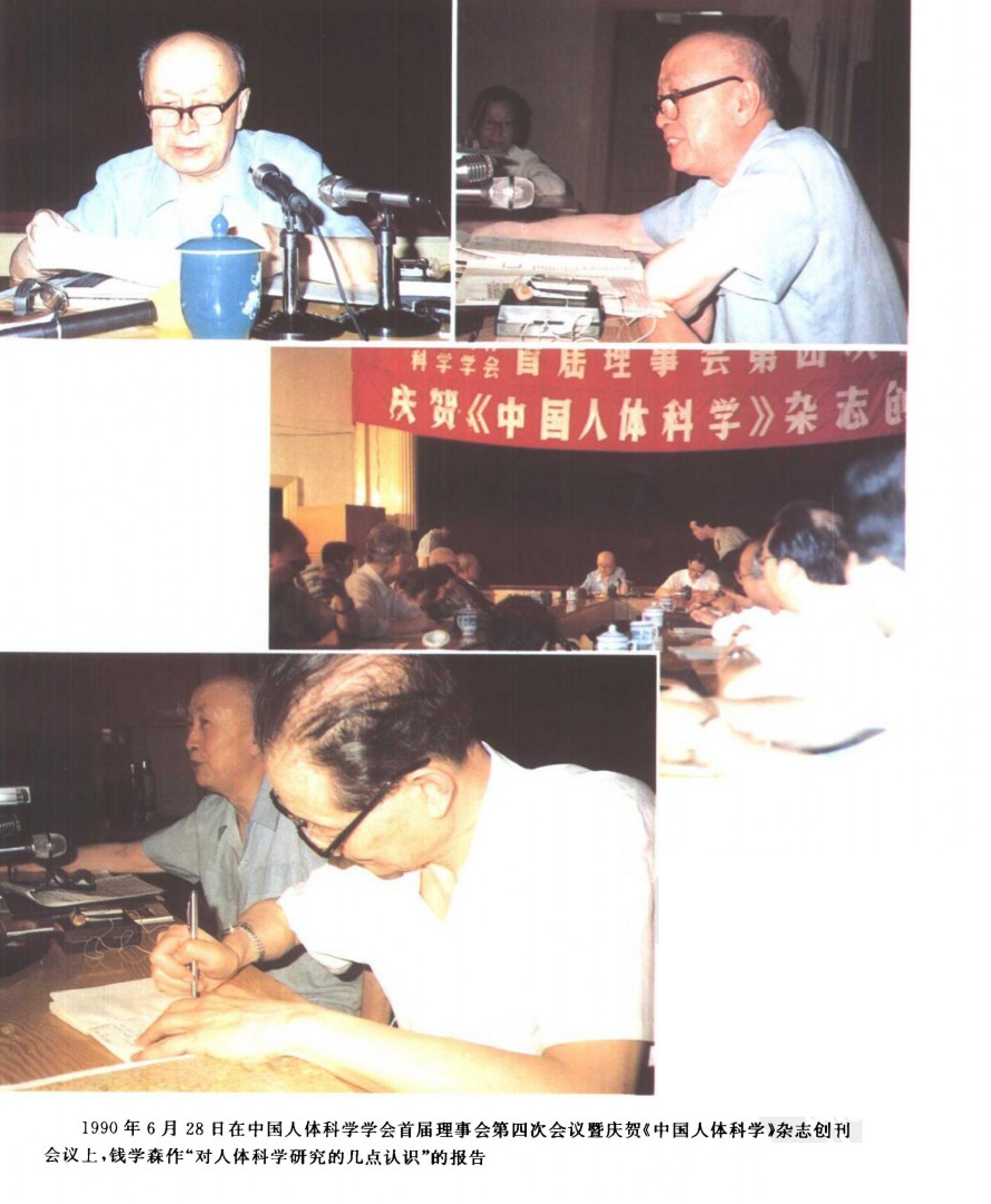
Fourth Meeting of the First Council of the China Human Body Science Society; Celebrating the Inaugural Issue of China Human Body Science Magazine
On June 28, 1990, at the fourth meeting of the first council of the China Human Body Science Society and the celebration of the inaugural issue of China Human Body Science magazine, Qian Xuesen delivered the report “Several Understandings Regarding Human Body Science Research.”
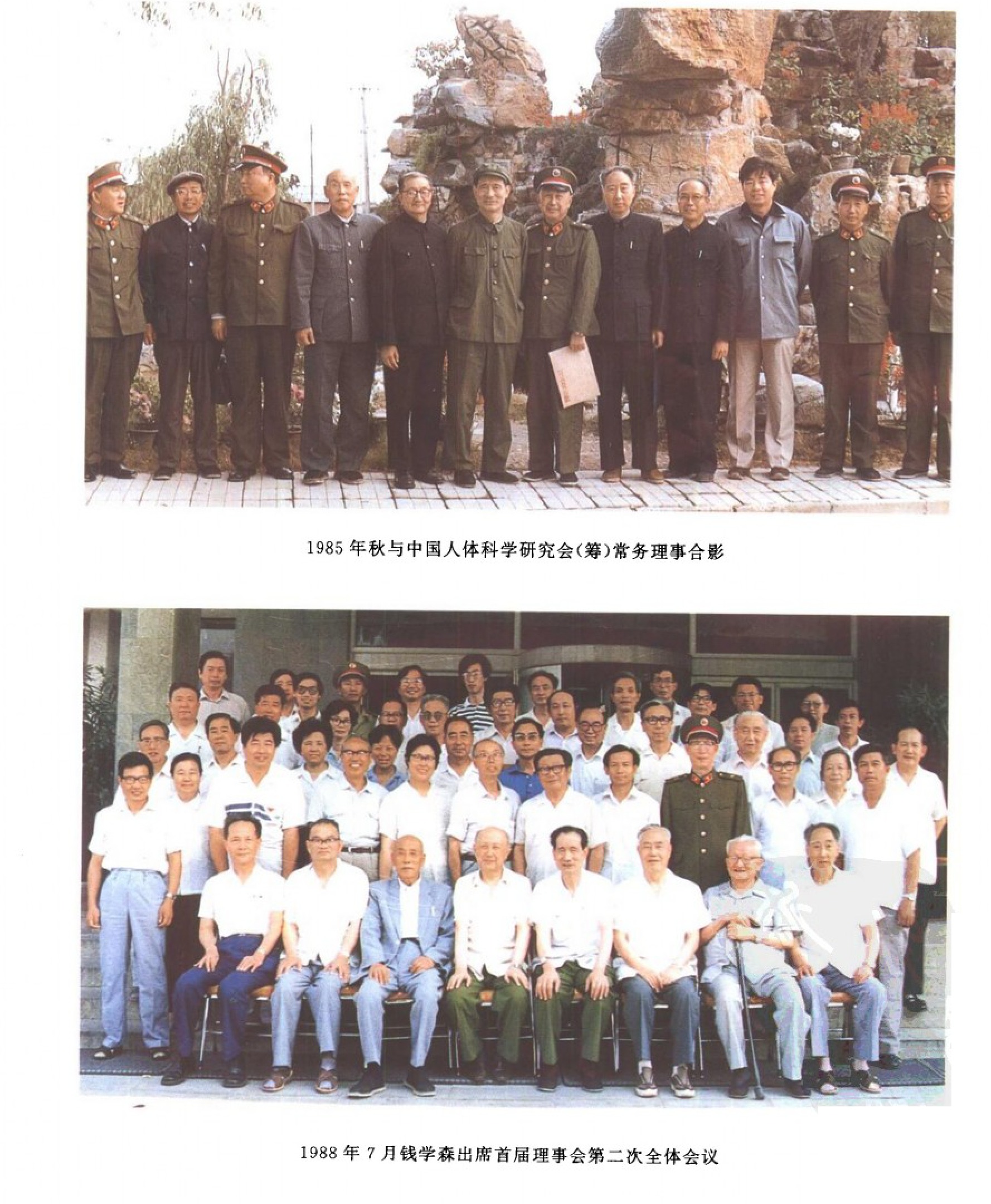
Autumn 1985: Group photo with executive council members of the China Human Body Science Research Society (Preparatory Committee).
July 1988: Qian Xuesen attending the second plenary meeting of the first council.
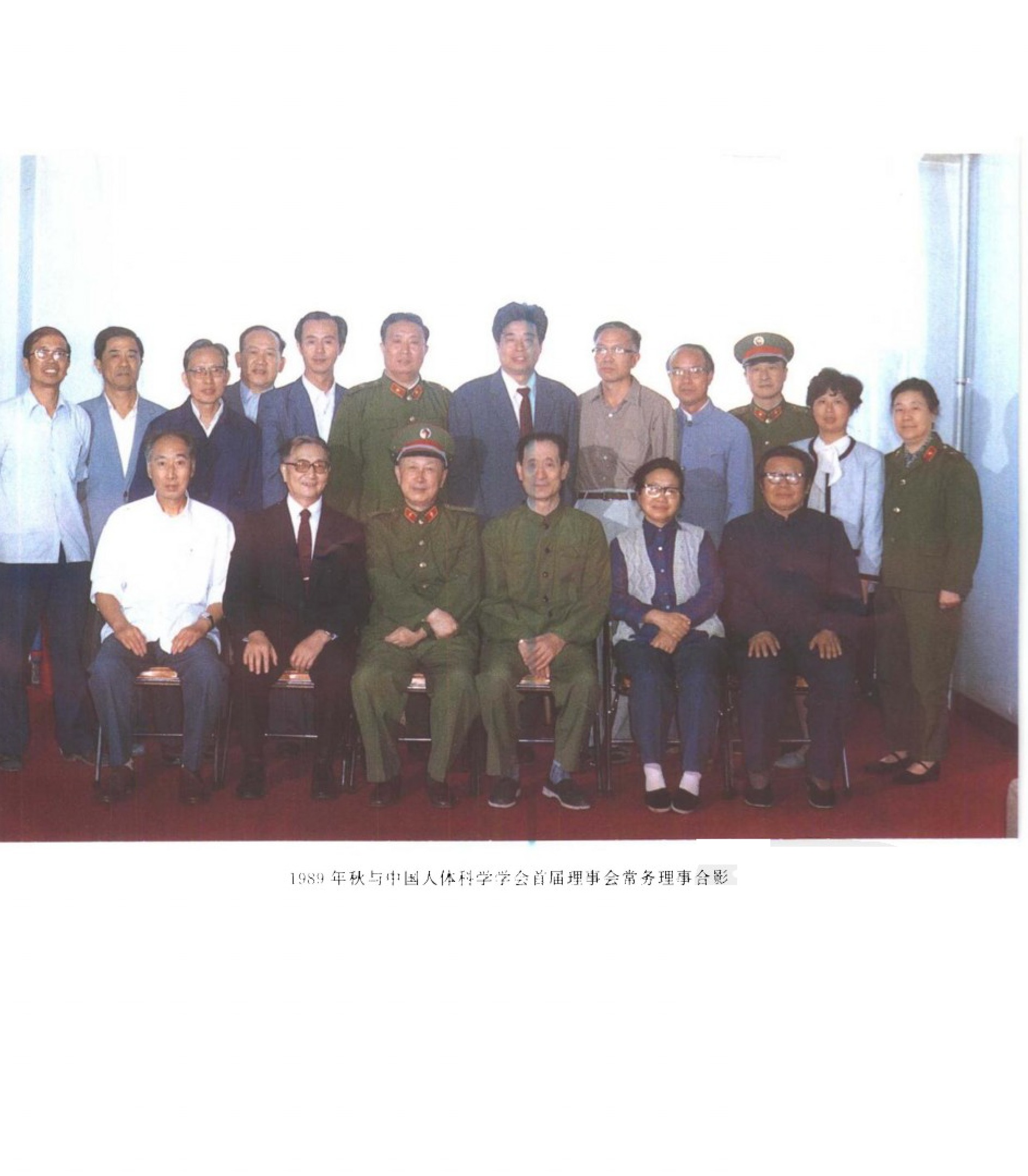
Group photo with the standing council members of the first Board of Directors of the China Human Body Science Society, autumn 1989
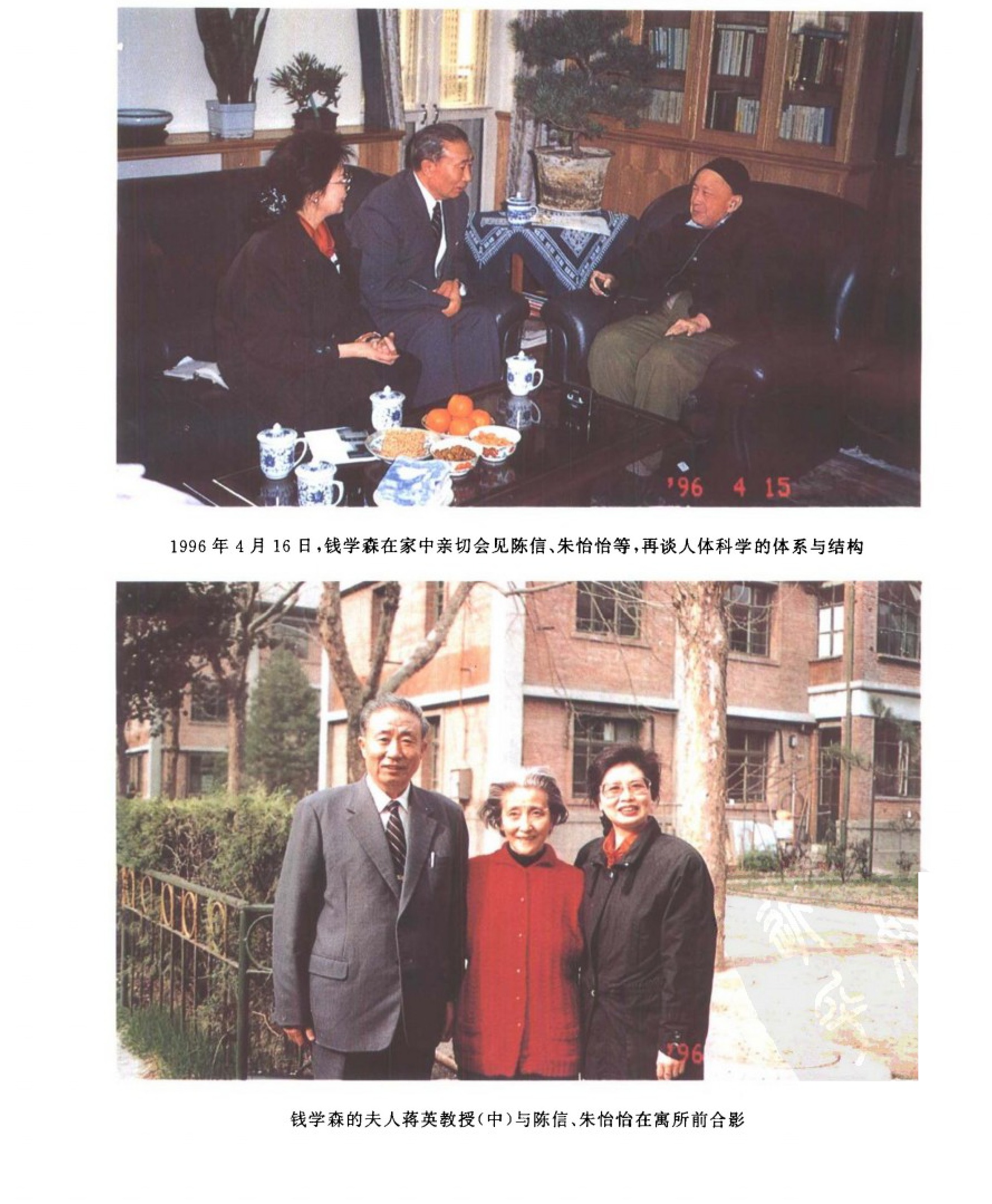
‘96415 On April 16, 1996, Qian Xuesen warmly met with Chen Xin, Zhu Yiyi, and others at his home, once again discussing the system and structure of human body science
Professor Jiang Ying (center), Qian Xuesen’s wife, in a group photo with Chen Xin and Zhu Yiyi in front of their residence
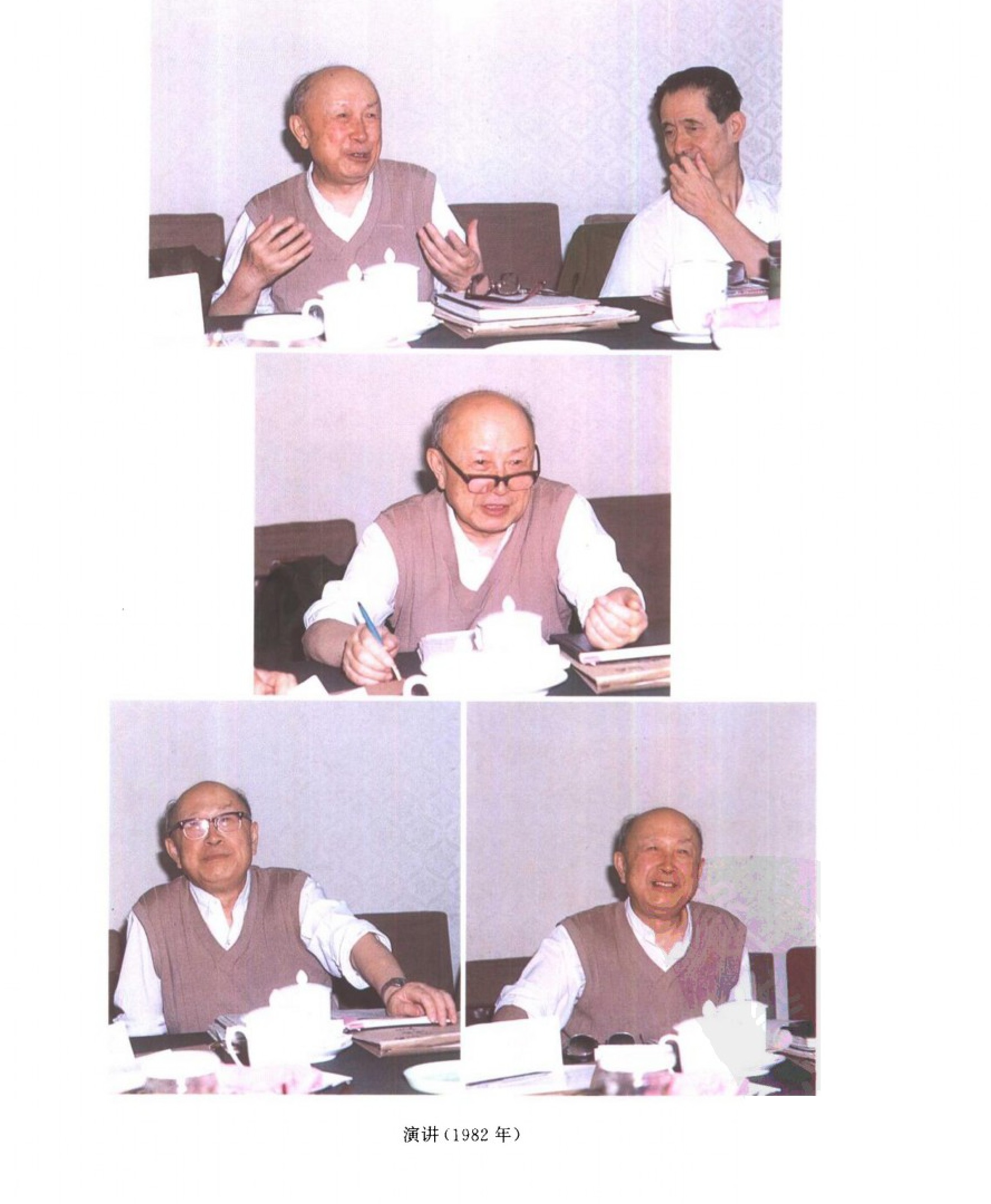
Lecture (1982)
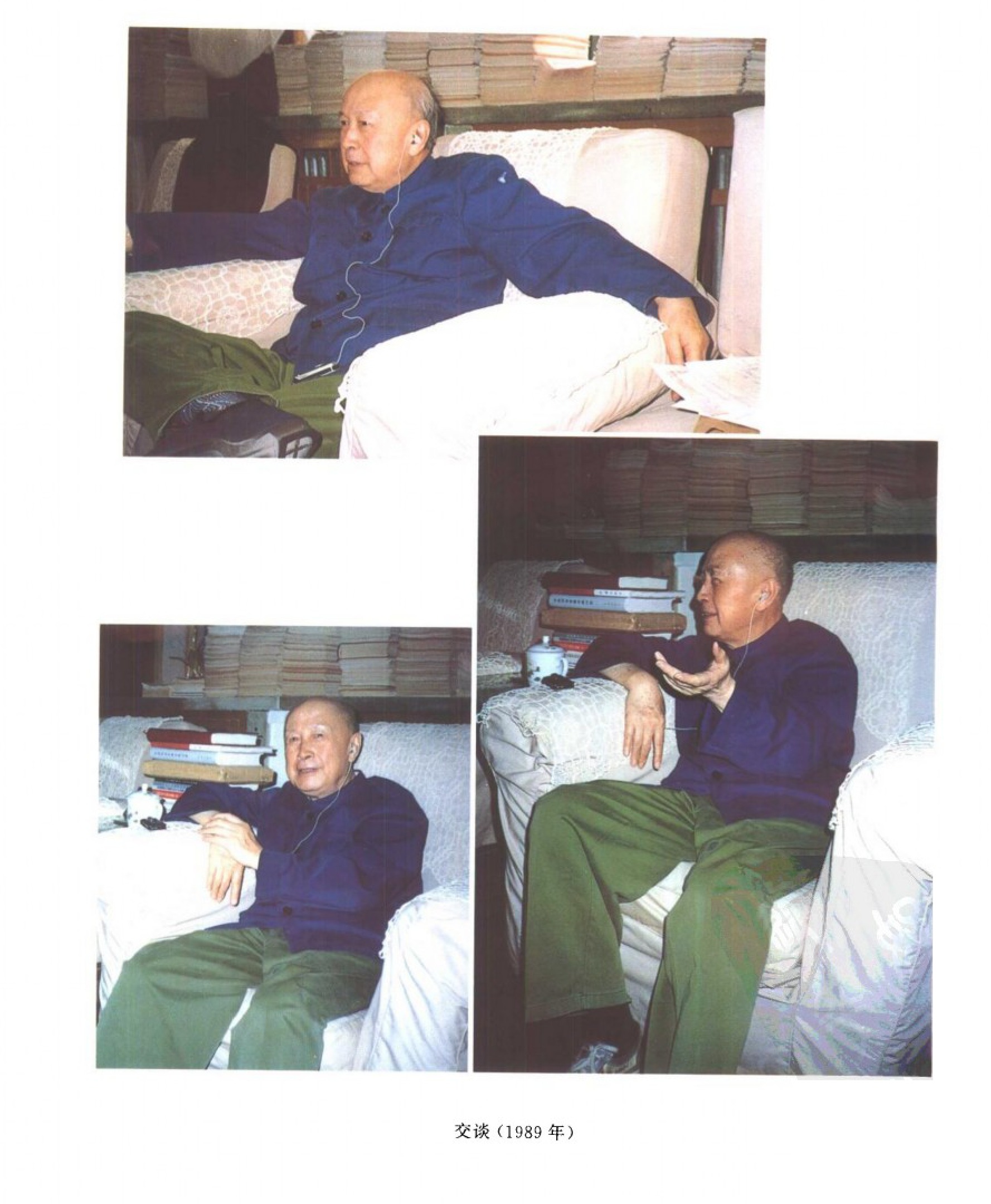
Conversation (1989)
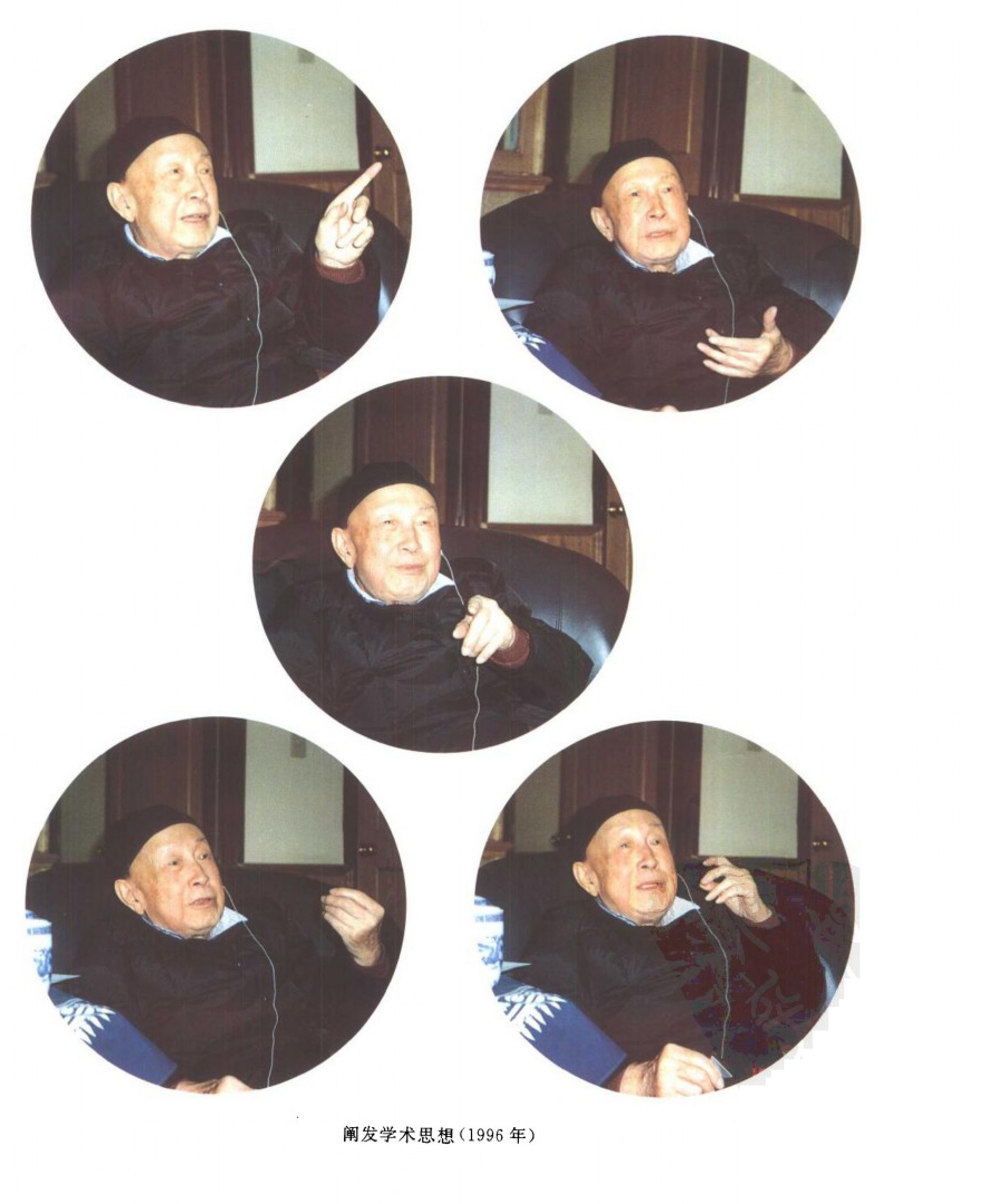
Elucidating Academic Thought (1996)
96 “For the approaching 21st century… human science must be well prepared!” (All photographs in this book are provided by the editorial department of Chinese Human Science magazine)
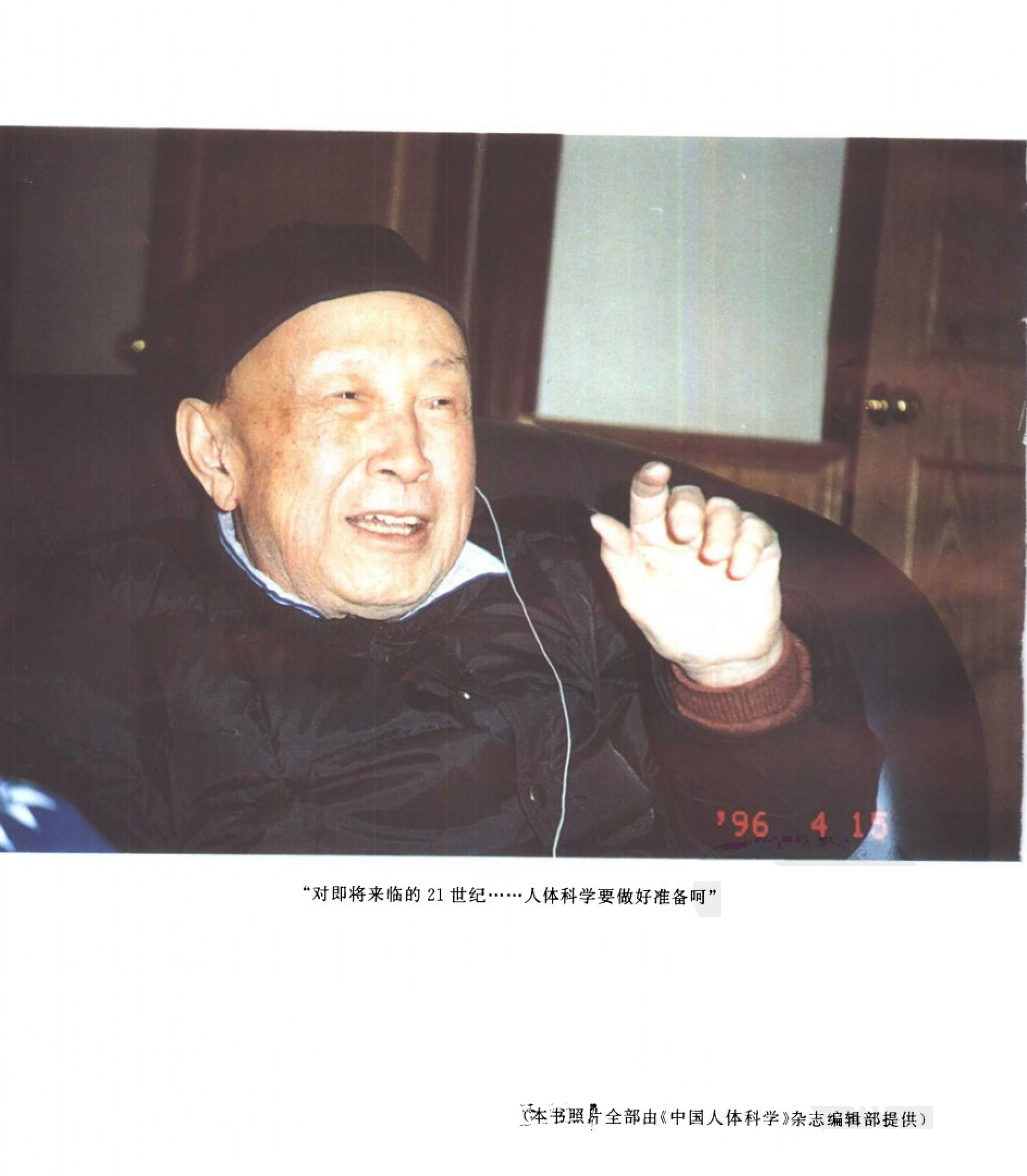
For the Approaching 21st Century… Human Science Must Be Well Prepared!
Qian Xuesen
April 16, 1996

Table of Contents
Special Feature
- Jiang Zemin and Li Peng Meet with Qian Xuesen … 3
- All Achievements Are Attributed to the Party and the Collective … 4
- Speech at the Award Ceremony … 6
Human Body Science
I. Development and Establishment … 11
- Dialectics of Nature, Noetic Science, and Human Potential … 12
- Humanity Must Conduct In-Depth Research on the Human Body Itself … 17
- Systems Science, Noetic Science, and Human Body Science … 18
- Carrying Out Basic Research in Human Body Science
- On Human Body Science
- The Human-Heaven Perspective, Human Body Science, and Human Somatic Studies … 45
- A Leap in Understanding the Objective World
- Developing Human Body Science and Upholding Dialectical Materialism … 52
- Collaborating to Conduct Human Body Science Research
- Emancipating the Mind, Breaking Through the Frontiers of Science …
- Several Aspects of Human Body Science Research
- Prospects for Human Body Science Research … 58
- Human Body Science Is at the Frontier of Contemporary Science … 61
- Human Body Science Research Has Great Promise … 64
- Language, Thinking, and Human Body Science Research … 68
- The Strategy of Human Body Science Research … 69
- Welcoming the Arrival of a Second Renaissance … 74
- On Human Potential and Educational Revolution …
- Strive to Research and Uncover the Mysteries of the Human Body … 81
- Weightlessness and Human Functional States … 84
- Simulation Technology and Human Body Science Research … 86
- Establishing the Fourth Medicine … 91
- Chronomedicine and Human Body Science …
- Human Body Science as a Major Division within the System of Modern Science and Technology
- Medicine in the 21st Century Is Medicine Applying Human Body Science … 102
- From “Dual Cultivation of Life and Destiny” to the Fourth Medicine … 103
- New Scientific Theories Must Guide Human Body Science Research …
- Several Issues Concerning Human Body Science Research … 108
- Revisiting the Systemic Structure of Human Body Science … 110
II. Relationship with Systems Science … 113
- Human Functional States Are Different from Human Functional Conditions … 114
- Systems Science and Human Functional States …
- The Systems Perspective in Human Body Science Research … 116
- Methods of Systems Science Must Be Used to Study Human Body Science … 119
- Giant Systems and Human Body Science Research … 121
- The Human Body Is a Complex Giant System … 124
- On Methodological Issues of Open Complex Giant Systems … 126
- Studying Open Complex Giant Systems and Striving to Overcome Difficulties … 127
III. Research on Extraordinary Functions … 131
- Research on Extraordinary Human Functions Is Very Meaningful …
- The Transformation from “Extraordinary” to “Non-Extraordinary” … 133
- Studying Extraordinary Human Functions from a Systems Perspective Holds Great Promise … 133
- Explorations of the Pineal Gland, Sand Crabs, and Other Functions … 134
- Our Research Must Give Equal Emphasis to Experiment and Theory … 135
- Electromagnetic Fields and Life Phenomena … 138
- 2 -
- Further Discussion on Extraordinary Human Functions and Electromagnetic Fields … 140
- Further Discussion on Extraordinary Human Function Research … 140
- Striving to Advance a New Situation in Extraordinary Function Research … 142
- Opinions on Extraordinary Human Function Work … 144
IV. Qigong Research …
- Qigong Is the Key to Opening the Door to Human Body Science … 147
- Understanding Life Information …
- The Brain and Psychology Research … 150
- Meridians Constitute a Functional System …
- Qigong Can Enable the Human Body to Achieve an Optimal Functional State … 151
- Establishing a Phenomenological Qigong Science …
- Academic Discussion Should Be Combined with Research Tasks … 157
- Unite as One and Welcome the New Scientific Revolution … 161
V. Systematic Theory of Traditional Chinese Medicine … 162
- The Future of Medicine Lies in the Modernization of Traditional Chinese Medicine … 163
- On the Modernization Research of Traditional Chinese Medicine …
- Expounding Traditional Chinese Medicine Theory with Marxist-Leninist Philosophy …
- The Structure of Marxist Philosophy and the Modern Exposition of Traditional Chinese Medicine Theory … 167
- Research on Human Body Science Requires Philosophical Guidance …
- Traditional Chinese Medicine Must Be Combined with Modern Science … 172
- My Process of Understanding Our National Medicine … 174
- How to Understand the Modernization of Traditional Chinese Medicine …
- The Human Giant System and Traditional Chinese Medicine Research …
- On the Strategy for Modernizing Traditional Chinese Medicine … 181
VI. Methodology … 188
- Science Must Always Continue to Develop … 188
- Scientific Research Must Pay Attention to Trends in Scientific and Technological Development … 191
- Writing Human Somatic Studies and Traditional Chinese Medicine in Modern Scientific Language …
- Combining Human Body Science Research with Modern Science …
- Do More Experiments, Talk Less About Theory … 199
- 3 -
- Pay Attention to Research on the Internal Tissue Structure of the Human Body … 201
- Scientific Research Lies in Comprehensive Thinking and Grasping the Essentials … 204
- From Cosmoscopic to Microscopic … 206
- All Things Contain Wondrous Principles Worth Seeking—Science Demands Deep Study … 209
- Synthesizing Objective Materials to Study the Human Body … 211 … 212
- Correctly Understanding Human Body Science Research … 213
- Using Marxist Philosophy to Guide Human Body Science Research … 216
- Studying Open Complex Giant Systems with the Method of Combining Quantitative and Qualitative Approaches … 220
- How to Study the Human Body as an Open Complex Giant System — Several Issues Concerning the Methodology of Human Body Science … 224
VII. Sociology … 232
- Does This Herald a New Scientific Revolution? … 232
- Extraordinary Human Functions and Society …
- Speech at the Inaugural Meeting of the Human Body Science Expert Group … 242
- Speech at the Third Meeting of the Human Body Science Expert Group … 247
- Human Body Science and Contemporary Society … 249
VIII. Correspondence … 255
Modern Science and Technology
I. System and Structure … 271
- Vigorously Developing Systems Engineering and Establishing a Systems Science Framework at the Earliest Opportunity
- Science of Science, Science and Technology Systematics, and Marxist Philosophy … 278
- On the Problem of Establishing and Developing a Marxist Science of Science … 284
- Systems Thinking and Systems Engineering … 289
- Revisiting the System of Systems Science … 294
- Three Letters Discussing the Content of Systems Science … 296
- The Structure of Modern Science
- The Structure of Modern Science and Technology (I) … 4
IX. The Structure of Modern Science and Technology (II) … … 311 X. On the Epistemology of Systems Science … …… 323 XI. Systems Science, Systems Engineering, and Operations Research —A New Technological Revolution … 325 XII. How Should the Teaching of Marxism-Leninism Face Modernization, Face the World, and Face the Future … 330 XIII. Correctly Understanding the Relationship Among Basic Science, Technological Science, and Engineering Technology XIV. Integrating Systems Science with Other Sciences … 334 XV. From Practice and Phenomenological Theory to Modern Science … 335 XVI. The Optimal Guiding Ideology for Scientific Research from a Systems Perspective … 338 XVII. Further Discussion on Systems Theory … 342 XVIII. Methodological Issues in Technological Science 344 XIX. Correctly Understanding Objective Things and Developing Science and Technology … 345 XX. Systems Analysis and Stochastic Problems … 347 XXI. Establishing a Scientific System for the Social Form of Consciousness …… 351 II. Disciplinary Discussions ……358 I. Organizational Management of Science and Technology … 359 II. On the Organizational Management of Scientific and Technological Research and Research Systems Engineering … 365 III. The Significance of Mathematics in Scientific Research … IV. Some Views on the Development of Statistical Physics …… 374 V. High-Energy Physics as Frontier Science and Technology … ……374 VI. Modern Mechanics … VII. On Noetic Science … … 383 VIII. Developing Research in Noetic Science … IX. From Brain Science Research to Noetic Science … X. Agricultural Systems Engineering … XI. On Biological Cybernetics … 414 XII. A New Interpretation of “Physical Biology” … …416 XIII. On the Structural Issues of Military Science …………… 418 XIV. On Military Science and Technology … 421 XV. On Combat Simulation … 422 XVI. Interdisciplinary Studies: Prospects for Theory and Research
XVII. On the Question of Fifth-Generation Computers … 424 XVIII. Soft Science Is an Emerging Science and Technology ……433 XIX. Systems Science and the Phenomenological Theory of Traditional Chinese Medicine … XX. On the System of Behavioral Science …… XXI. Science and Technology as an Important Component of Modern Culture ………441 XXII. Some Understanding of Technological Aesthetics and Aesthetics … XXIII. On Decision Science … … 444 XXIV. Standardization and the Study of Standardology … 446 XXV. On the Science of “Mathematics” … … 448 XXVI. Guiding Psychological Research with Marxist Philosophy ……450 XXVII. Vision and Simulation Technology … … 452 XXVIII. Artificial Intelligence and Noetic Science … … 454 XXIX. Expert Systems and Noetic Science … 457 XXX. Language, Thought, and Intelligent Machines … 458 XXXI. On Research in Noetic Science …… … 460 XXXII. Wisdom and Marxist Philosophy … 464 XXXIII. Suggestions for Developing Geographical Science … XXXIV. Correctly Approaching the Historical and Cultural Traditions of the Motherland and Earnestly Studying Marxist Philosophy … 471 XXXV. Also on Basic Research … 473 XXXVI. Correspondence on “Practice and Culture—An Outline for the Study of ‘Philosophy and Culture’” … 477 XXXVII. Basic Scientific Research Should Accept the Guidance of Marxist Philosophy ………478 XXXVIII. Open Complex Giant Systems and Their Methodology … … 483 Invigorating the Country Through Science and Education I. Future Outlook … 493 I. The Challenge of the Industrial Revolution and Our Response … 494 II. Our Scientific Research Enterprise Must Keep Pace with the World … 502 III. We Must Look Ahead to the 21st Century 503 IV. Several Macro-Level Issues to Consider in Campaign Theory over the Next Twenty to Thirty Years ……505 V. Striving Hard to Invigorate the Country Through Science and Technology … 511
- 9 -
VI. A Plan for Popularizing Science and Technology Should Be Formulated Now … 513 II. Talent Cultivation . 515 I. On Scientific Ethics … 516 II. On Methods of Scientific Research … 527 III. Speech (Excerpt) at the National Rural Science Popularization Conference and the Experience Exchange Meeting for Technology-Driven Prosperity Experts … 528 IV. Several Issues That Outstanding Chinese Science and Technology Journalists Should Consider … 530 V. The Entire Society Must Understand and Respect Engineering and Technical Personnel … 535 VI. Speech at the National “Champion Ideals, Champion Contributions” Competition Awards Ceremony … 535 VII. Speech at the Symposium Convened by the China Association for Science and Technology on Utilizing the Role of Retired Science and Technology Personnel … 538 VIII. Sons and Daughters of China, Heroic Through the Ages Speech at the Closing Ceremony of the Fourth Session of the Third National Committee of the China Association for Science and Technology 541 IX. A Glorious Banner Speech at the Centenary Commemoration of Li Siguang’s Birth ……542 X. A Model for the Generation, His Example Endures Forever Speech at the Centenary Commemoration of Comrade Zhu Kezhen’s Birth ……547 XI. The Historical Responsibility of Chinese Science and Technology Workers … 551 III. CAST Work …… 556 I. Closing Address (Excerpt) at the Third National Congress of the China Association for Science and Technology ……557 II. Speech (Excerpt) at the Second Session of the Third Standing Committee of the China Association for Science and Technology ……558 III. Upholding the Four Cardinal Principles, Advancing CAST Work Forward in the Construction of Two Civilizations —Work Report (Excerpt) at the Second Session of the Third National Committee of the China Association for Science and Technology 563 IV. Speech (Excerpt) at the Closing Ceremony of the Second Session of the Third National Committee of the China Association for Science and Technology ……568 V. On the Work of the China Association for Science and Technology —Speech (Excerpt) at the Staff Assembly of the CAST Headquarters and Affiliated Units 570 VI. Exploring the Study of CASTology —Speech (Excerpt) at the Opening Ceremony of the CASTology Seminar ……578
- 7 -
- Scientific and Technological Progress and Reform of the China Association for Science and Technology —Work Report at the Third Session of the Third National Committee of the China Association for Science and Technology …585
- On the Nature and Reform of the China Association for Science and Technology —Speech at the Collaboration Conference of Science and Technology Associations of Municipalities Directly Under the Central Government and Cities with Independent Planning Status …592
- Striving to Work for Rejuvenating the Nation Through Science and Technology —Report at the Commemoration Meeting for the 30th Anniversary of the Founding of the China Association for Science and Technology
- The China Association for Science and Technology Must Deepen Its Understanding That Science and Technology Are the Primary Productive Force —Speech (Excerpt) at the Work Conference of the China Association for Science and Technology 109
- On the Reform of the China Association for Science and Technology —Work Report at the Fourth Session of the Third National Committee of the China Association for Science and Technology 602
- Striving Vigorously to Contribute to the Promotion of Scientific and Technological Progress —Work Report at the Fifth Session of the Third National Committee of the China Association for Science and Technology …608 Postscript 615
- 8 -
Special
1. Jiang Zemin and Li Peng Meet with Qian Xuesen
In the tranquil and elegant Ziguang Pavilion of Zhongnanhai, General Secretary of the CPC Central Committee Jiang Zemin and Premier of the State Council Li Peng cordially met at 3:30 p.m. today with Qian Xuesen, Vice Chairman of the National Committee of the Chinese People’s Political Consultative Conference and Chairman of the China Association for Science and Technology, warmly congratulating him on being awarded the “Small Rockwell Medal” and the titles of “World-Class Science and Technology and Engineering Celebrity” and “Honorary Member of the International Institute of Technology.”
This honor was conferred on June 29 of this year at the 1989 International Conference on Technology and Technological Exchange held in New York, USA, in recognition of Qian Xuesen’s major pioneering contributions to China’s rocket and missile technology, aerospace technology, and systems engineering theory.
General Secretary Jiang Zemin and Premier Li Peng first took a group photo with Qian Xuesen, then engaged in a pleasant conversation. General Secretary Jiang Zemin referred to the elder Qian as his senior alumnus, as the two had graduated from Shanghai Jiao Tong University in 1934 and 1947, respectively. Comrade Jiang Zemin first invited Comrade Li Peng to speak.
Premier Li Peng, on behalf of the CPC Central Committee and the State Council, expressed warm congratulations to Qian Xuesen for the honor he had received. He said this was well deserved; it was not only a glory for the elder Qian, but also a glory for China and for China’s scientific and engineering technical personnel.
Li Peng said that in the early 1950s, Comrade Qian Xuesen had broken through numerous obstacles, crossed the ocean, and resolutely returned to the motherland. His experience embodied the tortuous path traveled by a Chinese intellectual, and also centrally manifested the brilliant qualities of Chinese intellectuals—namely, love of country, love of the Party, and love of the people. He bore a deep love for the people of the motherland, was full of confidence in the triumph of his cause, full of courage to overcome all difficulties, and persevered with tireless dedication to accomplish this cause.
Li Peng said that China is a country led by the working class, and intellectuals are a part of the working class. In the process of building the Four Modernizations, we must rely on the working class and also fully bring into play the role of intellectuals.
In his remarks, Li Peng also discussed the importance of developing China’s national defense industry. He expressed the hope that the broad ranks of scientific and technological workers would, while absorbing foreign experience, carry forward the tradition of self-reliance and hard struggle to advance the national defense industry.
Then General Secretary Jiang Zemin spoke. He said he fully agreed with Comrade Li Peng’s remarks. Back then, the elder Qian had broken through numerous difficulties and crossed the seas to return to the motherland, fully demonstrating a high spirit of patriotism. At present, some people always feel that everything abroad is better than in China—this is self-deprecation. In learning from Comrade Qian Xuesen, we should do so not only in academic terms, but more importantly in terms of political character. We should learn from the noble national self-respect, national self-confidence, and national integrity of the older generation of scientists.
Jiang Zemin also said that at present, China’s economy still lags considerably behind that of developed countries, but China’s future is bright. China will never succumb to foreign pressure. The greater the difficulties, the more we must carry forward our national spirit and do our work well. At the same time, China is a “nation of propriety and righteousness”; we must develop friendly relations with all countries on the basis of the Five Principles of Peaceful Coexistence, conduct trade and economic and technological cooperation with all countries on the basis of equality and mutual benefit, and further improve our opening to the outside world.
Comrade Qian Xuesen expressed his gratitude for the concern of the CPC Central Committee and the State Council. He said that as a scientist, the purpose of living is to serve the people; if the people are satisfied with our work, that is the highest reward. We must love our country, support the Communist Party, and under the Party’s leadership, devote our utmost to the construction of the Four Modernizations.
The elder Qian also fondly recalled the circumstances of conducting national defense scientific research work under the care of Premier Zhou and the direct command of Comrade Nie Rongzhen. He said that the reason we currently lag behind in certain areas is not because Chinese people are unintelligent, but because we lack tight organization and have not done a better job of bringing out people’s enthusiasm. He believed that under the leadership of the CPC Central Committee, our cause would become increasingly prosperous and flourishing.
State Councilor and Director of the State Science and Technology Commission Song Jian, along with leading officials from the Commission of Science, Technology and Industry for National Defense and the China Association for Science and Technology, attended the meeting.
II. All Achievements Are Attributed to the Party and to the Collective
The International Conference on Technology and Technological Exchange and the International Institute of Technology this year awarded me a medal and a title, stating that it was to commend me for some work I had done “in the fields of China’s rocket and missile technology, aerospace technology, and systems engineering theory.” I think the two characters “China” here are indispensable and extremely important. Because looking back, I went to the United States in 1935 and returned to China in 1955, having spent twenty years in the United States. During those twenty years, the first three or four years were for study, and the following decade-plus was for work. All of this was preparation, so that after returning to the motherland I could do something for the people. During my long time in the United States, I never once thought about staying there for the rest of my life. I say this with good reason. Because in the United States, once a person starts working, they always set aside part of their income in an insurance company, to be used after retirement in old age. During my time in the United States, people asked me several times whether I had saved any insurance money, and I said I hadn’t saved a single dollar. They were surprised when they heard this. Actually, there was nothing surprising about it, because I am Chinese and had no intention whatsoever of living in the United States for the rest of my life. By 1950, when I learned that New China had been founded, I thought the opportunity had come and I should return to the motherland. But the ruling class of the United States was hostile to the Chinese people and created all kinds of troubles to prevent me from returning, causing me to stay five years longer. I clearly remember that on August 1, 1955, the Sino-American ambassadorial talks began in Geneva. Ambassador Wang Bingnan, representing the Chinese government in the talks, followed Premier Zhou’s instructions and negotiated and struggled with the American representatives. As a result, on August 5, I received notice from the United States government saying I could return to China. Of course, I was deported as a prisoner of the United States and escorted back. Along the way, I was not allowed to disembark, because once I disembarked, the United States government would no longer be responsible for my safety. I will never forget this period of history. It made me deeply understand what imperialism means. I also experienced America’s “democracy” and “freedom” firsthand, and came to know full well what America’s “democracy” really looks like. Therefore, I hold deep affection for the Communist Party of China. I remember when the ship reached Manila, an Associated Press reporter came aboard to find me and asked whether I was a Communist. My reply was: “I’m not even qualified to be a Communist Party member yet! Communists are people who hold the most lofty ideals of humanity.” Hearing my reply, he didn’t dare ask a second question and slunk away in defeat.
After returning to the motherland, I felt overjoyed and hoped to throw myself into work as soon as possible, but the leadership told me to first travel around and look at various places. First I went to the Northeast, visiting the Military Engineering Institute in Harbin. At the time, the institute’s president, Senior General Chen Geng, made a special trip back from Beijing to Harbin to meet me. The first thing he asked me was: “Can Chinese people build missiles?” I said: “If foreigners can do it, why can’t Chinese people?” Senior General Chen Geng said: “Good! That’s exactly the answer I wanted from you.” Who would have known that this one sentence would determine my lifelong career in rocket, missile, and aerospace endeavors. Looking back now, I rashly said that we could build missiles, but once we actually got down to it, the difficulties were truly enormous. Because New China had been founded only recently, and the conditions—from the economy to technology—were vastly different from what they are now, far, far behind. Nevertheless, the atomic bomb and missiles, these two cutting-edge technologies, were ultimately conquered by us, and at a remarkably fast pace. What was the reason? I believe the most important reason of all was the leadership of the Party. Specifically, it was the personal leadership of Premier Zhou Enlai and the concrete organization of Marshal Nie Rongzhen. All of us comrades present here cherish the memory of that era. In my experience, Premier Zhou and Marshal Nie effectively applied the methods they had used in organizing large-scale military operations during the War of Liberation to scientific and technological work, organizing an army of thousands upon thousands of scientific and technical personnel. So despite our many difficulties in economics and technology, thanks to effective organizational leadership, we still succeeded quickly.
Looking back on this period of history, I feel that I personally only did my best to accomplish the work I should have done, and that was very limited. If we are to speak of credit, first it must go to the leadership of the Party, and second to the efforts of the broad masses of scientific and technical personnel. In the area of missile and aerospace technology, that means the original Fifth Academy, later the Seventh Ministry of Machine Building, then the Ministry of Aerospace Industry, and now called the Ministry of Aerospace Industry—it is the credit of the thousands upon thousands of scientific and technical personnel in this field,
Compared with the leadership of the Party and the strength of the collective, an individual’s contribution is truly insignificant. My own work alone fully illustrates this point. When Premier Zhou and Marshal Nie assigned me this task, my approach was to rely on the collective. I recall that every Sunday afternoon, I would invite Ren Xinmin, Tu Shou’e, Huang Weilu, Liang Shoupan, Zhuang Fenggan, and several other chief designers, as well as Comrade Lin Shuang, to my home for discussion. Whatever problems arose, everyone would raise them and we would study and resolve them together. Different opinions were to be expressed as fully as possible, but once a decision was made, it had to be carried out. If errors were discovered during implementation, they were to be corrected as quickly as possible. This is how China’s missiles were built. Therefore, the achievements are collective—encompassing the Ministry of Aerospace Industry, the Commission of Science, Technology and Industry for National Defense (then called the National Defense Science and Technology Commission), the various test bases, as well as the State Science and Technology Commission, the Chinese Academy of Sciences, and the relevant collaborating ministries and departments under the State Council. At that time, it was called nationwide great coordination, and all relevant units made their contributions. Therefore, the award given to me today is said to be the first time a Chinese person has received this prize. I say that what matters most are the three characters “Chinese person” (中国人), and this “Chinese person” should include the thousands and tens of thousands of Chinese people who have contributed to this effort.
As for systems engineering, that is not my sole credit either. Since the Third Plenary Session of the Eleventh Central Committee, many people have recognized the importance of systems engineering and have been conducting research in this area, including people from the Chinese Academy of Sciences, Peking University, Tsinghua University, Beijing Normal University, and others. So even the contributions to systems engineering theory are the result of everyone’s collective efforts. This is why I believe that in the award document from the International Technology and Technology Exchange Conference and the International Institute of Science and Engineering Research, which mentions contributions to “China’s rocket and missile technology, aerospace technology, and systems engineering theory,” the word “China” (中国) is the most important. What should be commended is all the Chinese people who have contributed to these efforts.
The American people are friendly toward the Chinese people—of this I have deep personal experience. Even during the period from 1950 to 1955, when the U.S. government was persecuting me, many American friends comforted me, went to great lengths to help me resolve my difficulties, and showed me genuine friendship. Right up to the end, when we boarded the ship to leave the United States, they even organized a farewell party on shore to see us off. This is what I personally experienced. I have a very good American friend, Professor William Sears. A few years ago when he came to China, I went to visit him. At the place where he was staying, he saw quite a few American businessmen, and the first thing he said to me was: “These people have come to China to cut your flesh; you must be careful.” He was an American, yet he reminded us not to be taken in. This is the kind of American who is truly friendly to China. Recently, Comrade Jiang Zemin said in a meeting with our ambassadors abroad that we must apply the “two-point theory” (两点论)—that is, in foreign relations, we must address both economics and politics; both friendship and struggle; both principle and strategy. I think this is absolutely correct. We must oppose the leftist slogan of “taking class struggle as the key link,” and at the same time we must oppose the theory of the extinction of class struggle. We must remember the two-point theory that Comrade Jiang Zemin spoke of.
We are engaged in science and technology, but we must also consider economic and political issues. I often discuss this with Comrade Zhu Guangya, with whom I work. Under such complex circumstances, the Party and the state have given some of us science and technology workers important responsibilities, asking us to serve as science and technology advisors—this is no simple matter. In those days, when we were developing missiles and artificial satellites, the tasks were relatively clear and well-defined: the goal was simply to get them built. It was a matter of concrete execution, not of choosing directions and approaches—the major directions and approaches had already been decided by the Party Central Committee. But now, in developing science and technology, especially high technology, there are expert committees or expert panels. I deeply feel that being the head of an expert panel is not an easy job, because competition in science and technology is now so fierce worldwide—it is a science and technology war, an intelligence war. When it comes to choosing what to do, what not to do, and how to do it, if the experts’ advice is even slightly off, the losses to the nation will be great. Therefore, the task of a chief scientist is far heavier and far more complex than ours was back then. One needs to be a strategist of science and technology! So we must pay special attention to training young successors. I estimate that we need approximately 200 such people, and these 200 are absolutely critical. They must be both science and technology experts and also understand dialectical materialism, be able to apply the two-point theory to analyze problems, and understand the complex situation in the world. Only people like this can design plans that will not go wrong and can achieve victory through surprise. This is a bit of what we learned from carrying out large-scale systems engineering and tackling cutting-edge technology under the leadership of Zhou Enlai and Comrade Nie Rongzhen at the National Defense Science and Technology Commission. The leading comrades of the Science and Technology Committee of the Commission of Science, Technology and Industry for National Defense will probably need to shoulder this burden. I am somewhat older now and can only serve as a senior advisor to the Science and Technology Committee of the Commission of Science, Technology and Industry for National Defense. I am most undeserving of the encouragement you all have given me, but I will not lose heart. I will continue to do everything in my power to strive for China’s socialist construction.
III. Speech at the Award Ceremony
This can hardly be called a speech; I merely wish to take this opportunity to express my heartfelt sentiments.
All that I have accomplished was achieved under the correct leadership and effective organization of the leading comrades, and with the help of my fellow comrades. Therefore, first and foremost, I wish to thank the senior leaders and new leaders present here. Without your leadership, I could not have succeeded. I also wish to thank the comrades here who have worked with me. Without your help and support, I would have accomplished nothing. At the same time, I wish to thank the medical staff present today. For decades, I have been able to work for the Party and maintain my health—without your meticulous care, this would not have been possible. That I can stand here today, speaking with a clear mind, is your contribution.
So, when the leaders just now spoke of how Qian Xuesen did this and that, all of that was the fruit of the labor of thousands upon thousands of people. I myself am but a single drop in the vast ocean—truly insignificant. What is truly great is the Chinese people, the Chinese Communist Party, and the People’s Republic of China!
I have rarely dwelled on the past; I am always busy with the matters at hand and frequently thinking about the future. In the few days since I received the notice of the honorary title conferred upon me, I have been reflecting on the past, and my thoughts have been surging!
The first thing that comes to mind is the old generation of proletarian revolutionaries. Without their leadership in guiding the Chinese people to victory in the New Democratic Revolution and the swift establishment of the People’s Republic of China, I would probably still be wandering in a foreign land, nursing lifelong regrets. Among the older generation of revolutionaries, those who directly led my work were Premier Zhou Enlai and Marshal Nie Rongzhen. I will never forget them. If Premier Zhou had not exerted every effort to ensure my safety during the decade of turmoil, I would probably not be alive today. During the difficult living conditions of the early 1960s, Marshal Nie Rongzhen went to great lengths to resolve the supply problems for scientific and technical personnel, and arranged “special provisions” for us. Whenever I recall this, my heart is deeply moved. Therefore, without the leadership of the older generation of revolutionaries, we could not have achieved what we have today.
Furthermore, without the concern and guidance for my work and life from the leading comrades at the units where I worked, I would not have been able to accomplish anything either. When I first returned to China, I worked at the Chinese Academy of Sciences. Comrade Zhang Jinfu is here today; at that time, you were the Vice President of the Chinese Academy of Sciences and my leader. I have always remembered that in the 1950s, every Saturday morning you organized a discussion group for those of us institute directors who were not Party members, to help us understand the policies and directives of the central leadership. About a dozen people participated. You would let us speak first, with everyone speaking openly, and then you would give a thirty-minute concluding speech. I benefited greatly from these Saturday meetings, and the memory remains vivid to this day. I also think of Comrade Guo Moruo, our senior president. If he noticed that any of us had ideological concerns or were unclear about policy matters, he would set aside an afternoon and personally give us a report.
Comrade Guo was profoundly learned, and his reports were extraordinary—covering everything from ancient times to the present, from China to abroad. As he spoke, he would sometimes be seized by poetic inspiration and compose poems and verses. After listening to his reports, whatever knots we had in our hearts would be untangled. So, during those years of work at the Academy, I was very happy.
Later, I went to work at the Fifth Academy of the Ministry of National Defense, which later became the Seventh Ministry of Machine Building, then the Ministry of Aerospace Industry, and is now the Ministry of Aerospace Industry. The Party and the state assigned me this task, and to be honest, at first I was not entirely confident. In the United States, I knew something about missiles and satellites, but I had never actually launched a missile or a satellite. What was I to do? I had no choice but to discuss it with everyone. At that time, the First Academy at Nanyuan, the Third Academy at Changxindian, and the residential quarters had not yet been built—
was completed, the scientific and technical personnel had no choice but to take the shuttle bus back to their homes in the compound on Fucheng Road every Saturday afternoon, and take the bus back to work on Monday morning. So I came up with a solution: every Sunday afternoon, I would invite the technical leads of each model project to my dormitory to discuss problems. The chief engineers all spoke freely and candidly, which played a great role in clarifying and resolving many issues, and was also a great help to me. To this day, I still live in these few rooms. They constantly remind me of those Sunday afternoon meetings from that era.
In 1970, I was transferred to the National Defense Science and Technology Commission (NDSTC), which is now the Commission for Science, Technology and Industry for National Defense (COSTIND). The successive generations of leadership at the NDSTC were very caring, meticulous, and protective in arranging my work and living conditions. I still work at COSTIND today. There is an ideal office environment here, and the entire work system of the COSTIND headquarters is very well organized and highly efficient. Therefore, I am deeply grateful to the successive generations of leadership at the NDSTC and COSTIND, and I will never forget them.
II
Speaking of old times, I also deeply cherish the memory of my alma mater, the High School Affiliated to Beijing Normal University. I studied there from 1923 to 1929. You can imagine what the old China and old Beijing were like from 1923 to 1929. In such a difficult and hardship-filled era, running a school was truly no easy task. However, Mr. Lin Liru, the principal of the High School Affiliated to Beijing Normal University at that time (then called “Director”), managed to make it a first-rate school—truly remarkable. Today when I say this, I’m afraid you all still might not believe it: at that time, the high school was divided into two divisions—Division One for the humanities and Division Two for the sciences, and I was in the science division. By the time we graduated from high school, the science curriculum had already covered what is now second-year university material. So I am very nostalgic for how well the High School Affiliated to Beijing Normal University was run in those days.
Next, I would also like to take this opportunity to express my gratitude to my wife, Comrade Jiang Ying. We have been married for 44 years, and our family life during these 44 years has been very happy. But during the five years from 1950 to 1955, when the U.S. government was persecuting me, she managed the household, and Comrade Jiang Ying made enormous sacrifices. I must never forget this. I also want to introduce to the leaders and comrades present today that Jiang Ying’s and my professions are vastly different. Everyone knows what I do. What does Jiang Ying do? She is a soprano singer, and one who specializes in singing the most profound German classical art songs. It was she who introduced me to this musical art. The poetic imagery and profound understanding of life contained within this art enriched my understanding of the world and taught me the broad-minded thinking methods of art. In other words, it was precisely because I received this artistic cultivation that I was able to avoid being narrow-minded, to avoid mechanical materialism, and to think about problems in a broader and more flexible way. So on this point too, I must thank my wife, Comrade Jiang Ying.
III
Finally, I want to express how I truly feel on such a solemn occasion today. To tell the truth, I must admit that I am not very excited. How can that be? Because I have already experienced three moments of tremendous excitement in my lifetime.
My first moment of excitement was in 1955. By then, I had been in the United States for 20 years. When I went to America, I had only one goal in mind: to master science and technology, and to prove that we Chinese could rival Americans and reach the pinnacle of science and technology—this was my ambition. I said to my good American friends without any false modesty: although China at that time was a country of suffering, and China could not compare with America, I, Qian Xuesen, as an individual, person to person, would compete with you. Later, I studied under the world-renowned authority in engineering mechanics and aviation technology, Theodore von Kármán. He was a teacher of grace whom I shall never forget; he taught me to master the perspectives and methods of modern science and technology. By the summer of 1955, I was permitted to return to China. When Jiang Ying and I took our kindergarten-aged son and daughter to bid farewell to my teacher, I held in my hands a copy of my newly published book Engineering Cybernetics, along with a large volume of my lecture notes on physical mechanics. I presented these two works to my teacher von Kármán. He flipped through them and said with deep emotion: “You have now surpassed me academically.” He was 74 years old at the time. When I heard these words, I was extremely excited, thinking: the goal I had strived toward for 20 years had finally been realized. I, Qian Xuesen, had surpassed such a world-renowned great authority in academia, and for a Chinese person
I was so proud, and I was extremely moved. This was the first time in my life that I had been this deeply moved. Later, when I was taking a ship back to China, the ship stopped in Manila, Philippines, and an Associated Press reporter came aboard. The reporter’s very first question was to ask me whether I was a Communist. I had no patience for this fellow, so I said: “Communists are the most noble people of humanity; I am not yet qualified to be a Communist!” Seeing that he would get nothing out of me, the reporter had no choice but to slink away dejected. But only four years later, at the time of the 10th anniversary of the founding of the nation, I was admitted as a member of the Communist Party of China. At that moment, my heart was exceedingly moved — I, Qian Xuesen, was now a member of the Communist Party of China! I was so moved I could not sleep. This was the second time my heart was deeply moved. The third time my heart was deeply moved was this year. This year I read the “Preface” to the Biography of Shi Laihe, written by Comrade Wang Renzhong, who is present here today. In this preface, he said that the Organization Department of the CPC Central Committee had designated Lei Feng, Jiao Yulu, Wang Jinxi, Shi Laihe, and Qian Xuesen — these five people — as outstanding representatives of Communist Party members who have enjoyed high prestige among the masses over the forty years since liberation. When I saw this sentence, I learned that such a thing existed. My heart was extremely moved: I am now a member of the laboring people, and moreover, I am connected with the most advanced elements among the laboring people. Having experienced these three moments of deep emotion, I am not particularly moved today. There is another reason why I am not very moved today: in the speech by the leading comrade just now, and in the congratulatory letter from Comrade Nie Rongzhen, he said that the people are very satisfied with my work. I think, I hope so. But I have not yet reached the final moment of my life; how I ultimately turn out remains to be seen in the future. So I think I must continue to strive. In what direction should I strive? Today I report to the leading comrades, to General Secretary Jiang and Chairman Yang. I have a plan, and my plan is this: I believe that today, science and technology are not merely natural science and engineering technology, but rather the entire system of knowledge by which humanity understands and transforms the objective world, and the highest generalization of this system is Marxist philosophy. We can entirely establish a scientific system, and apply this scientific system to solve the problems of China’s socialist construction. In his speech at the 70th anniversary of the founding of the Party, General Secretary Jiang said that our socialist reform is an extremely complex and enormous systems engineering project. If we establish this scientific system, then — just like launching a satellite — we can entirely use it to successfully build socialism. The cause that Comrade Zhou Enlai and Comrade Nie Rongzhen led and guided us in pioneering must certainly be carried forward, and must also be extended to the entirety of socialist construction. In the remaining years of my life, I wish to promote this matter. Today I report to the leading comrades on this aspiration of mine. Thank you, everyone. (Speech delivered in October 1991 at the ceremony where the State Council and the Central Military Commission conferred upon Comrade Qian Xuesen the honorary title of “National Outstanding Contribution Scientist”)
Human Body Science
Part I: Development and Establishment 11
I. Dialectics of Nature, Noetic Science, and Human Potential
At present, many people in our country are devoted to the study of the dialectics of nature. There are specialized academic organizations, such as the Dialectics of Nature Research Society and its branches, which publish journals and hold academic symposia. The atmosphere is enthusiastic, which is very gratifying and also a new phenomenon following the rectification of chaos and restoration of order.
When many people are involved, there is much discussion, and it is only natural that everyone expresses their own views and unity cannot be achieved for a time. A recent report in Guangming Daily on the National Symposium on the Theory of Dialectics of Nature held in Chengdu last October illustrates this phenomenon. Reading the report also prompted some thoughts of my own, and this article presents these preliminary opinions as my participation in the discussion. My reflections are rather broad in scope and not limited to the dialectics of nature itself. Of course, these remarks will inevitably contain inaccuracies or errors, and I sincerely welcome everyone’s criticism and correction.
What is the dialectics of nature? Nowadays, some people wish to expand the scope of research on the dialectics of nature far beyond Engels’s original intent, claiming that this constitutes the modernization of the dialectics of nature. For example, they wish to introduce cybernetics, systems engineering, and the science of science. Yet cybernetics is a technical science, systems engineering is an engineering technology, and the science of science is a social science—how can they all be treated as the dialectics of nature? The dialectics of nature cannot be all-encompassing, absorbing every branch and new discipline of modern science and technology. If it did, what would remain of the rational division of disciplines and the structural system of science and technology?
So what was Engels’s original intent? I think it would be best to read Engels’s letter to Marx dated May 30, 1873, and Dialectics of Nature (the manuscript). In this letter and in the main text of Dialectics of Nature, what Engels discussed is solely the dialectical-materialist view of nature—that is, using dialectical materialism to observe the natural world. To be more specific, it concerns the inseparability of matter and motion: matter is matter in motion, and motion is the motion of matter. It then proceeds to analyze the different levels of material motion and the transitions between levels, from which it addresses the division of disciplines. In summary, these are the contents. This constitutes the scope of research for the dialectics of nature. As for the notes and fragments in Dialectics of Nature, which touch upon the history of science and specific disciplines, I believe these should be understood as Engels’s preparatory work for writing and should not be taken as the main text, nor must they necessarily be incorporated into Dialectics of Nature. Therefore, the history of science and technology, and the study of the system of science and technology, do not necessarily have to be studied as part of the dialectics of nature. Here, I believe we should seek truth from facts and not add meanings to the precious manuscripts left to us by the founders of Marxism that they never originally intended.
Another point that should draw our attention is the position of the dialectics of nature as a field of learning within the overall system of modern science and technology. In Engels’s era, in order to establish Marxist philosophy, it was necessary to draw upon the entirety of human practice—including production struggle, class struggle, and scientific experimentation—and to distill and generalize from it. This naturally involved the dialectical relations of nature and the dialectical relations of society. This gave rise to a convention whereby Marxist philosophy appeared to comprise three components: dialectical materialism, historical materialism, and the dialectics of nature. But today, Marxist philosophy has already been established, and we should clearly define its general theory as dialectical materialism. Dialectical materialism must guide research in the natural sciences and the social sciences, and it must also draw nourishment from new achievements in natural science and social science research, continually enriching and deepening Marxist philosophy, that is, dialectical materialism. Of course, this relationship equally exists between Marxist philosophy and all other sciences and technologies (here, “sciences and technologies” includes the social sciences). This exchange must pass through two bridges: one bridge is the dialectics of nature, which serves the natural sciences; the other bridge is historical materialism (the dialectics of society), which serves the social sciences. If one does not like the term “bridge,”
Calling it a branch theory is also acceptable. In short, dialectical materialism should not be placed on the same level as historical materialism and natural dialectics; the latter two should be positioned somewhat below dialectical materialism, and each of them is connected to its own category of science and technology.
What has been discussed above is what should be done today; of course, this is an ideal, and reality is not entirely so. On the one hand, some philosophers who have called themselves Marxists since the time of Marx, Engels, and Lenin have not used the new achievements of science and technology to enrich and deepen Marxist philosophy; instead, they have often erroneously criticized these new theories, labeling them as anti-Marxist. For example, Morgan’s genetics and the discovery of genes, the resonance theory of chemical bonds, cybernetics, artificial intelligence, and the replacement of part of human mental labor by electronic computers have all at various times been subjected to certain criticisms. These criticisms have all been proven wrong by facts and must be fully retracted. Perhaps precisely because of these shortcomings, there has been a reaction on the other side: there are some science and technology workers who do not acknowledge the guiding significance of the basic principles of Marxist philosophy for scientific and technological research, who denounce the phrase “great scientists, petty philosophers” as a kind of label, who claim that investigating “whether there is anything worth humbly learning from scientists after Poincaré and Mach in terms of tradition, spirit, and philosophy” is forbidden territory, and who invariably feel that there is no freedom here, thereby yearning for the so-called academic atmosphere of capitalist countries. What good can come of such disputes!
The emergence of these two situations is regrettable, because we know that since Engels wrote Dialectics of Nature (manuscript), natural science has undergone earth-shattering development. Relativity and quantum mechanics have long been established, replacing classical mechanics; the levels of matter in motion, from the microscopic world, have added three new levels—the atomic nucleus, elementary particles, and straton; and from the macroscopic world, they have also expanded to new levels such as galaxies, clusters of galaxies, and superclusters of galaxies. Workers in natural dialectics and workers in natural science should have joined hands to jointly develop this vast new territory, which would have deepened our fundamental understanding of the infinite levels of matter in motion. Everyone should, first, seek mutual understanding, and second, learn from each other. Workers in natural dialectics should earnestly study science and technology, at least to the level of the advanced popular science journal Science. And workers in natural science should earnestly study philosophy, and of course should also read some idealist philosophy books—only through comparison can one distinguish truth from falsehood. With this foundation, experts from both sides could hold thematic discussion meetings in each field, such as elementary particle physics, molecular biology, astronomy, and so on. I very much hope that the Natural Dialectics Research Association can promote this. In addition to organizing discussion meetings, it could also run philosophy refresher courses and modern science and technology refresher courses. For the same reason, although the Institute of Philosophy of the Chinese Academy of Social Sciences already has a Natural Dialectics Research Office, it would also be appropriate to establish a unit for the study of natural dialectics within the Chinese Academy of Sciences. Nor is it necessary for all natural dialectics researchers to concentrate on the aforementioned work; there are still many other things that can be done. For example, natural dialectics teachers working in medical colleges and universities can collaborate with medical personnel to study the integration of traditional Chinese and Western medicine in order to promote the development of medicine. Another example: those who have an interest in historical studies could turn to specializing in the history of science and technology. Some may have already begun research in the science of science, and that can also continue. Some who are dedicated to the organization and management of scientific and technological research could engage in scientific research systems engineering.
II
We say that natural dialectics is connected to natural science and engineering technology, and that historical materialism (social dialectics) is connected to social science and social phenomena. But this formulation also has a problem: modern science and technology have already produced certain disciplines that lie between the two—that is, problems that on the one hand involve transforming the natural world, and on the other hand involve transforming human society. For example, engineering technology always has economic factors to consider, and among the large new category of systems engineering—such as scientific research systems engineering, agricultural systems engineering, enterprise systems engineering, and engineering systems engineering—the factors on the social science side become even more important. Furthermore, disciplines such as demographics, futurology, and the science of science are even more clearly situated between natural science and social science, combining aspects of both.
In fact, the purpose of humanity’s mastery of the laws of the objective world is not merely to adapt to the objective world; more importantly, it is to use these laws to transform the objective world, and the direction of transformation inevitably connects to society and ultimately to the transformation of our society. All the engineering technologies listed above are examples of this. We can take environmental science as an example: it involves ecosystems, which belong to nature, and it also involves the structure of industrial and agricultural production, which belongs to society. We must also pay attention to promptly summarizing and elevating the scientific achievements and practical experience that integrate both natural and social aspects, and incorporating them into Marxist philosophy.
In summary, I feel that current research in Marxist philosophy should distill the extremely rich achievements of modern science and technology over the past century or so—including natural science, mathematical science, social science, technical science, and engineering technology—to develop Marxist philosophy. By comparison, scrutinizing the writings of past philosophers cannot but be considered secondary. Moving forward is always more important than looking backward, and deserves greater effort.
III
Under the overarching framework of dialectical materialism, Marxist philosophy—apart from the dialectics of nature and historical materialism (social dialectics) already discussed above—has two additional component parts: the epistemology of dialectical materialism and dialectical logic. Opinions are not unanimous on this point either; some workers in the dialectics of nature hold that epistemology and methodology can both be subsumed under the dialectics of nature, because research in the natural sciences cannot proceed without them. In my view, however, it is better not to subsume them under the dialectics of nature, because epistemology and methodology are not unique to the natural sciences; other disciplines also cannot do without them. Moreover, the research methods used in modern science and technology are gradually becoming unified, and one can no longer distinguish between the methodology of the natural sciences and that of the social sciences. Going a step further, I believe the issue lies not in this departmental division of Marxist philosophy, but rather in the fact that the practice of modern science and technology is heralding an even more profound transformation: the emergence of noetic science.
What brought about this transformation is the electronic computer. The electronic computer is precisely what Comrade Mao Zedong described as a technological revolution brought about by a major technological change—it stands alongside the steam engine, electricity, and present-day nuclear energy as a technological revolution. How can the electronic computer give rise to the question of noetic science? This is an important question concerning the electronic computer as a technological revolution.
We must begin with a conclusion from modern mathematical logic. This conclusion is: all problems that can be solved using mathematical logic can also be solved by an electronic computer. To put it in more popular terms: anything that a teacher can explain clearly and can teach a student to do through explanation, the teacher can also teach an electronic computer to do. Last year, the Beijing Daily reported that science and technology workers in the Beijing area had “imparted” the entire body of theory and experience of the renowned traditional Chinese medicine liver disease specialist Professor Guan Youbo for treating liver diseases to an electronic computer. The computer can adjust prescriptions based on 8 main types and 36 subtypes of liver disease, as well as the specific condition of individual patients, and can produce many different prescriptions—each time correctly—earning Professor Guan’s affirmation. Does this not demonstrate that problems solvable by mathematical logic can also be solved by electronic computers?
Of course, this requires us to study how to solve problems using mathematical logic—that is, first, whether an answer can be obtained; and second, what logical calculus method to use and how to calculate step by step. The study of this subject is called algorithms or algorithm theory. Of course, even if algorithm theory says that a certain problem can be calculated and has an algorithm, it does not necessarily mean that an electronic computer can currently solve that problem. The difficulty lies in the algorithm being too crude—even the fastest and largest electronic computer available today might take ten thousand years to compute a result. An interesting example is electronic computers playing chess: currently the best electronic computer chess player in the United States is called Belle, created by two scientists at Bell Telephone Laboratories, K. Thompson and J. Condon. Belle can examine 15,000 piece positions per second when making moves, but at the speed required in official chess tournaments—40 moves in 2 hours—it cannot defeat human chess masters! Belle’s rating is 1900 points (Class E ranges from 0 to 1199 points, Class D from 1200 to 1399 points, Class C from 1400 to 1599 points, Class B from 1600 to 1799 points, Class A from 1800 to 1999 points; Experts from 2000 to 2199 points, Masters from 2200 points and above), while the current world champion Anatoly Karpov’s rating is 2705 points. In endgame positions, Belle’s ability is especially low—it cannot defeat even half of the average tournament contestants, although in the opening it can defeat 95% of contestants. So in the end, humans are stronger than electronic computers! It is said that the weakness of the computer’s program lies in its inability to assess the overall situation from the full layout of both sides’ pieces on the board; yet this ability of humans becomes particularly prominent in endgames when there are fewer pieces. Humans do not rely on calculation, but on recognizing the situation.
This strength of humans is perhaps what we call wisdom. This contrast places great pressure on electronic computer experts, especially software engineers and software scientists, prompting them to ask: can we make computers a bit smarter, less clumsy? This is the so-called research in artificial intelligence. It began in the 1950s, and after twenty years of work, we now know several aspects that need to be mastered to solve this problem: first, to clarify the relevant factors of the problem and the relationships among the factors—that is to say,
Spreading out a problem in problem space is called problem representation; the second step is to begin searching for a solution (Search), which proceeds from the unknown to the known and is therefore blind, so the results are often unsuccessful and substandard; the third step is to recognize certain features of the problem space from failures, that is, pattern recognition, to find ways to avoid paths that are unlikely to succeed; the fourth is learning, that is, summarizing previous experience; the fifth is planning, which means transforming the initial blindness into purposeful searching for solutions, thereby greatly improving the efficiency of problem-solving; and finally, perhaps the computer can achieve a certain degree of induction that takes a comprehensive view of the whole. In fact, listing these aspects is merely a working outline; the specific work must be done bit by bit. There are also many details and important links that have not been listed—for example, from the second to the third to the fourth step, there is always the issue of memory, and memory in turn involves the issue of language. In addition, there is also a discipline of… 1 Cognitive science is one of two rapidly developing modern sciences.
This is looking at the problem from the perspective of computers, to make machines more intelligent. Of course, there is another aspect, which is to look back at the human brain, because the human brain is the seat of human intelligence—this is the object of study in neuroanatomy and neurophysiology. Research in these two sciences requires extremely meticulous work, and in fact, it was not until the beginning of this century that the necessary tools began to be found. Therefore, although the function of the brain had long been recognized, the great strides in neuroanatomy and neurophysiology are a matter of only the last ten or twenty years. Recently, the American advanced popular science journal Scientific American devoted an entire issue to this topic. Although there has been great progress, we are still far from understanding all the functions of the brain; we perhaps know only the general outline of the problem. The human brain has approximately tens of billions of neurons, and each neuron has roughly several thousand synaptic contacts, so altogether the human brain may be equivalent to a computer with , or 100 trillion, switches! But one thing differs from present-day man-made electronic computers: the connections between neurons do not appear to be completely fixed. The left and right hemispheres of a single person’s brain are not completely identical; the genetic code DNA, which determines human growth and development, also cannot fully govern the structural details of the brain. These structural details are extremely important—they can change and develop with a person’s practice. That humans are smarter than monkeys is innate, but human intelligence appears to be largely acquired after birth.
Looking at yet another aspect of research, the development of psychology has followed a similar course. Psychology has traversed a tortuous path over a hundred years. Under the guidance of dialectical materialism, China’s psychology workers have summarized the practical experience of this century and concluded that psychology is a function of the brain and a reflection of objective reality. We must guard against two deviations: the biologization of psychology and the sociologization of psychology; that is to say, it is the material thing—the human brain—that thinks, but the function of thinking is influenced by social practice. This conclusion is entirely consistent with the conclusions of neuroanatomy and neurophysiology. One is macroscopic, the other microscopic, and they share a general common view, which is gratifying.
Through the explanations in the preceding paragraphs, we can see that whether from the perspective of computers or from the perspective of human brain thinking, it is understandable that humans are superior to present-day electronic computers; or in other words, we believe that the human thinking process is comprehensible. Not only that, but there are also concrete avenues of research, namely through four sciences: artificial intelligence, cognitive science, neurophysiology (neuroanatomy), and psychology. The scope of this research is much broader than logic; it encompasses all of human thinking, including both logical thinking and imaginal thinking. We may also call the science within this scope noetic science.
Noetic science is a large category of sciences. In addition to the already mentioned artificial intelligence, cognitive science, neurophysiology (neuroanatomy), and psychology, it also includes linguistics, mathematical linguistics, grammatology, scientific methodology, formal logic, dialectical logic, mathematical logic, and theory of algorithms. Closely related to noetic science are mathematics, cybernetics, and information theory, among others. In this way, disciplines that have long been scattered and not directly related to one another can be organically combined into a single system, and precision is introduced through mathematical logic. This is a developmental trend in the structure of the modern scientific and technological system brought about by the revolution in electronic computer technology. As described above, it separates dialectical logic, currently a department of philosophy, and incorporates it into noetic science; it also incorporates scientific methodology, which some currently treat as part of the dialectics of nature, into noetic science; and yet another department of philosophy, the epistemology of dialectical materialism, serves as the bridge connecting Marxist philosophy with noetic science. This can be described as a major reorganization of the scientific and technological system. Of course, these considerations are still quite far from establishing the system of noetic science. For example, we are not very clear about the relationships among the various disciplines mentioned above. Zhou Jianren says that thinking precedes language and writing, which is correct, but beyond that we do not know much. However, if we actively promote scientific research in this area, establish and strengthen specialized research institutions,
structure, then it may not be necessary to wait until the end of this century—the system of noetic science could be established.
IV
One effect of developing noetic science is that the original goal of artificial intelligence research can be realized: building smarter computers, so that computers can represent a larger portion of human mental labor, and humans can be further liberated from mental labor. Some may ask: as machines can do more and more things, what will humans do? I think this should not be a problem. After humans are liberated from relatively simple mental labor, the human brain will go on to solve more difficult and higher-level problems, thereby promoting the development of the human brain. Is this not the case throughout human history? In primitive society, the things the human brain could think about were certainly fewer than now; our brains today are certainly better than those of our ancestors. Although we cannot necessarily say that one person’s brain weight represents one person’s intelligence, average brain weight does represent the brain’s potential. The brain weight of modern humans is heavier than that of our ancestors. A British statistical source reports that the average brain weight of modern British adult males is 1,424 grams, increasing by 0.66 grams per year; the average brain weight of modern British adult females is 1,242 grams, increasing by 0.62 grams per year—both are increasing. Therefore, the human brain is still constantly developing. Computers may become increasingly sophisticated due to the development of noetic science and can replace more of human mental labor, but computers are always made by humans, and they can never catch up with the humans who make them.
Another effect of developing noetic science is that it enables us to understand how to more fully utilize the capacities of the human brain. For example, the human brain has creative ability—this is not logical reasoning but a leap of thought, the so-called “inspiration.” Of course, inspiration is also derived from summarizing and elevating practical experience; if it did not come from practice, would a newborn child not be able to have inspiration and create? There is no such thing. Moreover, creative ability and inspiration cannot be clearly explained or taught to students. I recall that Mr. Lu Xun once spoke about how he learned to write: he said his teacher never taught him how to write articles—it was just writing every day, writing and writing, and then he said the red marks his teacher drew on his manuscripts gradually decreased, the circles increased, and finally there were no more corrections, just circles drawn everywhere—and that was called learning to write. This shows that the most profound aspect of human mental labor is creation, and because we currently do not understand the creative process or the laws of creative thinking, we cannot teach students; we can only let students explore on their own—perhaps they will figure it out, perhaps they will not. If we develop noetic science, then perhaps one day we will understand the laws of creation and be able to teach students to achieve leaps in thought—how wonderful that would be.
From the perspective of dialectical materialism, humans surpass computers—this will also be a conclusion of noetic science. Even in Western countries today, where electronic computers are widely used to replace much of human mental labor, when it comes to leadership decision-making, they always say it cannot rely on electronic computers. Wang Shouyun, Chai Benliang, Chen Baoting, and others, in their article “From the Art of Leadership to Soft Science,” argue that this discipline—the science of leadership—is what is called “soft science” abroad. I think that because noetic science is still in its infancy, soft science is not yet a true science either, and the study of leadership is also in the process of transforming from the art of leadership to the science of leadership; the “art” component of leadership work still occupies a very important position. What about the future? In the future, when noetic science has developed and some of the laws of thinking in leadership work have been clarified and become science, the human brain will have advanced further, and the art of leadership will again have new things that have not yet been summarized as science. Therefore, soft science will always be somewhat “soft”—“soft science” is a very apt term.
V
The foregoing discussion of noetic science shows that the capacity of human mental labor still has potential, and that humans can be even more intelligent than they are now, possessing greater wisdom. But I think this is only one aspect of human potential; we should also consider other aspects.
One matter to study is qigong, which has been passed down continuously in our country for thousands of years. Qigong has two branches: hard qigong and soft qigong. Hard qigong involves breaking stone slabs with bare hands and resisting axes and knives with a bare body; soft qigong involves healing illness and maintaining health. Hard qigong is related to physical education—everyone has seen many astonishing performances on television programs and marveled at them. But I think this is a kind of elaborately designed performance, which also includes some mechanical principles that were already known to everyone, just applied very cleverly—this can be explained by theories already known in modern science and technology. Taking this part
Separated from hard qigong, then hard qigong and soft qigong can be integrated into one matter: through regular, conscious exercise, people can use the nervous system to influence the body’s functions—that is, “practicing qigong”—gradually developing bodily capabilities that untrained people generally do not possess, enabling them to “circulate qi and emit qi.” This phenomenon has recently attracted the attention of many scientific and technological workers, and preliminary quantitative tests have been conducted. It has also been affirmed by psychologists in our country, who believe it can provide new understanding of how human mental initiative is reflected in the regulation of the body’s internal activities. Therefore, qigong demonstrates that humans still possess abilities that are generally unrecognized and consequently unutilized; these are also human potentials.
In the past two years, there have been continuous reports in newspapers and magazines about children around ten years old who can recognize characters and distinguish colors with their ears, and recognize characters under their armpits. There is debate over this: some disbelieve it, calling it fraud; others believe it, saying that relatively rigorous tests have been conducted. What is it? It is because the human body possesses a seventh sensory receptor. I think one point worth noting is that those who possess this function are all children around ten years old—neither younger nor older will do. Is this because when too young, the nervous system has not yet developed to the point of having such a possibility, while when too old, this function has degenerated and disappeared due to long disuse? We should not fear debate; we should delve deeper, make the testing more rigorous and comprehensive, and must get to the bottom of it.
These several matters all point to the fact that humans still have untapped potential. We can, in reverse, consider how human current abilities—whether the capacity for physical labor or for mental labor—gradually developed from human ancestors. Engels’ Dialectics of Nature contains an essay, “The Part Played by Labour in the Transition from Ape to Man,” which is well known to all. The argument there is that labor created the human world and, in this process, created humans. But from ape to ancient humans, and from ancient humans to modern humans, the process of transforming humans was not conscious; humans did not actively tap into the latent potential of their own organisms. Everything proceeded naturally and unconsciously through physical labor and mental labor. Now? In the future? I think from now on, we should transform this process from unconscious to conscious, using the tools and methods of modern science and technology, and drawing on cognitive science, qigong, and all potential human bodily functions to develop human potential. We must establish specialized, powerful research teams, especially in physiology and psychology, with the aim of actively improving human abilities. Some people today say we should pursue eugenics. But eugenics, compared to what we are discussing here, appears far more limited—too narrow.
I have spoken here about qigong and also said positive things about the possible seventh sensory receptor. Does this contradict Engels’ “Natural Science in the Spirit World” in Dialectics of Nature? There is no contradiction. I do not admire the Mr. Wallace and Mr. Crookes mentioned there; moreover, I do not admire today’s Mr. Wallace and Mr. Crookes either. I think we should all strive to act in accordance with a scientific attitude—that is, in accordance with dialectical materialism—but we must emancipate our thinking and absolutely “not throw the baby out with the bathwater.” Comrade Mao Zedong said: “Marxism-Leninism has not ended truth, but continuously opens up the path to the cognition of truth in practice.” From the perspective of dialectical materialism, science and technology are always developing, and their content and structure are constantly being enriched. Therefore, the existing scientific research system will not remain unchanged: in our country, there already exists the Chinese Academy of Sciences, which primarily studies natural science, and the Chinese Academy of Social Sciences, which primarily studies social science. But in connection with what I have discussed here and in another essay, in the future there should also be established a Chinese Academy of Cognitive Science, a Chinese Academy of Physiological Science, and a Chinese Academy of Systems Science. That would probably be a matter for the twenty-first century.
(September 1980)
II. Humanity Must Conduct In-Depth Research on the Human Body Itself
The human body is an integrated whole and cannot be divided. Currently, when middle schools teach Human Anatomy, everything is presented separately—for example, the nervous system, the digestive system, the respiratory system, the circulatory system… Whether there are intricate and complex relationships among the various systems is not discussed. In fact, in the human
In physiological activities, the various systems are interrelated and inseparable. However, because research is still insufficient, they cannot yet be expressed in precise scientific theories. Moreover, there is also a close relationship between human physiological activities and the environment.
The human brain is indeed marvelous. Abroad, in the past decade or so, considerable research has been conducted on brain neuroanatomy and neurophysiology, with significant progress, but there are also many problems. Take the relatively easy-to-study case of vision: we still cannot explain how the human brain operates or how a person’s recognition of images is formed. In this regard, one could say that we have not even touched the edge yet and cannot explain anything clearly. Therefore, current work using electronic computers to simulate human vision is also quite crude. Vision is considered relatively simple in neurophysiology, and if even this is the case, one can imagine the rest. Another example: the human body contains various polypeptides with diverse functions—simple proteins, such as insulin, oxytocin, angiotensin, and so on. It was previously thought that polypeptides functioned within the body’s specific executive mechanisms, controlling “grassroots” activities, but now polypeptides have also been discovered in the human brain—not just a few types, but twenty or thirty kinds, including the three mentioned earlier—yet we have no understanding at all of what role they play in the brain.
From the perspective of dialectical materialism, the human brain is not fixed. On one hand, the human brain is constrained by biological laws (such as heredity and biochemistry), but within these constraints, the scope is also very broad. For example, a child gradually learns to recognize people, learns to speak… Human education, cultivation, and social practice can be said to be the continuous training of the human brain. A person becomes intelligent gradually, not all at once. Therefore, “talentology” must study how intelligence grows—it absolutely does not fall from the sky. Thus, we must study the human body and truly understand its physiology, which is to establish the system of human body science.
Modern science includes basic science, technological science, and engineering technology (which directly transforms the objective world). As things stand now, basic science includes natural science and social science, as well as mathematics, which both of these use; in the future there may also be systems science, and possibly also a science system specifically studying human thought. The human body science we are now discussing—what are its basic sciences? Generally speaking, they should be: psychology, physiology, genetics, and so on; according to medical classification, there can also be a whole set including embryology, histology, anatomy, physiology, and so forth.
The technological sciences between the basic sciences of the human body science system and practical applications—one major area is the theoretical disciplines of medicine, namely pathology, immunology, toxicology, parasitology, and so on. These must absorb nourishment from natural science. There is also pharmacology (which is related to chemistry). An important issue in technological science is what foreign countries call sports theory or sports biomechanics, which can simply be called sports science; another area is the study of human-machine integration to achieve maximum effectiveness, called human engineering or ergonomics—this field is now developing rapidly and is very important for improving production efficiency and in military applications. In terms of true practical applications, the first is a large amount of clinical medicine: internal medicine, surgery, dentistry, pediatrics, and so on. This area must draw upon tools from other sciences and technologies, organizing them into “engineering technology” for safeguarding people’s health—medical care, health preservation, and qigong. There is also sports technology. Then there is human-machine integration technology, called ergonomics technology; this has a great relationship with national defense modernization. In the past, our weapons were mostly copied from foreign ones and did not suit the characteristics of the Chinese human body, which was a major problem.
In summary, we must gradually establish the human body science system and gradually form a rigorous science and technology system. Some disciplines are ancient and need to be reorganized in the new era to facilitate their interconnection and development. In this way, the human body science system will not only promote basic science but also advance technological science and applied technology.
(July 18, 1980)
III. Systems Science, Cognitive Science, and Human Body Science
Studying the development of modern science and technology naturally also raises the question of the structure of the science and technology system. In natural science, mathematical science, and
Beyond these three major departments of social science, it now seems we should consider three new, still-emerging major departments: systems science, noetic science, and human body science. I have previously expressed some preliminary views on these three departments in earlier articles, and I have also received comments from comrades regarding these views. These comments have prompted me to further consider the development and structural issues of these three major departments of science. Here I will discuss some of my thoughts and invite everyone to discuss, critique, and correct them.
Let me first address the major department of systems science.
Previously, I mentioned the necessity of vigorously developing a new type of engineering technology—systems engineering—and therefore proposed further developing and deeply studying the theoretical foundations of this class of engineering technologies. At present, in systems engineering, apart from the specialized knowledge related to each systems engineering specialty—such as the applied mechanics, mechanical design, and electrical engineering of engineering systems engineering—the common theoretical foundation of all specialized systems engineering is operations research. Further development in the future will also draw upon cybernetics, which is related to operations research. However, operations research, within the modern system of science and technology, is the general theory closest to engineering technology practice, belonging to the category of science we call technological science. Technological science directly serves engineering technology; one could also say that the theoretical summarization of practical experience first reaches the level of technological science. Cybernetics, a new science that grew out of automatic control technology in the first half of the twentieth century, is also a technological science. But above the level of technological science, there should be yet another level, namely basic science. In the major department of natural science, for example, physics is a basic science, and chemistry is a basic science. Engineering technologies such as systems engineering, upon reaching the level of operations research and cybernetics, will not simply stop there; above them lies their basic science. But what is their basic science? This is a question that must be raised from the perspective of the modern system of science and technology, or from the perspective of the science of science. In other words, we need to establish the structural system of systems science.
Regarding the question of the basic science of systems science, I previously had no answer and only vaguely posed the question: would further refinement of operations research yield a theoretical science of affairs? Would further refinement of cybernetics (including engineering cybernetics, biological cybernetics, economic cybernetics, and social cybernetics) yield a theoretical cybernetics? This formulation only provoked our reflection without indicating a path forward or solving the problem.
To make progress, we must step outside the scope of systems engineering and examine the matter from a broader perspective.
We observe the development in biology, where, as R. Rosen stated in a recent paper, the development of modern science since the eighteenth century has been dominated in natural science research by the methods of reductionism and empiricism, or metaphysical methods. This was a great advance at the time, a counterattack and revolution against the ancients: ancient people intuitively viewed organic matter or spirits as governing everything. However, Rosen seems to have forgotten that between spirits and Laplace’s mechanism there also existed ancient materialism and dialectics; modern scientific methods developed from ancient materialism. Rosen points out that this method of modern science, which focuses only on analysis and experimentation, has in biological research dissected organisms into ever finer parts, and in the past forty to fifty years has even attacked down to the molecular level. We can say that decomposing life phenomena into molecules and their interactions has now achieved great and astonishing accomplishments, establishing the science of molecular biology with its very substantial content. Yet in the face of this development, many biologists feel disappointed: the more we know in detail and in quantity, the more we lose sight of the whole picture, feeling that our understanding of life remains very vague, as if we know less than before. Fifty years ago, von Bertalanffy recognized this point relatively clearly. He began the study of so-called theoretical biology (Theoretical Biology, 1932), seeking to study organisms from the perspective of the whole, treating the organism as a whole together with its environment as a large system. Von Bertalanffy also thereby founded the science he called general system theory, and applied it to the study of a broad range of problems, such as human physiology, human psychology, and social phenomena.
The discipline of general system theory, originating from biological research, represents an important development. When Wang Xingcheng introduced it, he summarized its basic principles as: first, the principle of wholeness; second, the principle of interconnection; third, the principle of orderliness; and fourth, the principle of dynamics. Since general system theory studies systems, the first and second basic principles are easy to understand. The third and fourth basic principles are somewhat novel: they derive from observations of organisms and life phenomena. Organisms possess an orderly structure and can grow and evolve purposefully. This appears to be unique to life.
Once an organism dies, its structure immediately begins to break down; growth and evolution also immediately cease, giving way to decomposition. Therefore, the core of general system theory lies in these latter two basic principles. Von Bertalanffy and others were the first to recognize that this phenomenon unique to life differs from what the second law of thermodynamics in physics describes: the second law of thermodynamics states that the entropy of a closed system (a finite system with no exchange of energy or matter with its surrounding environment) can only increase, apparently becoming increasingly disordered rather than moving toward order. Seizing upon this point, general system theory emphasizes the openness of systems—that is, the system must exchange energy and matter with its surrounding environment.
An important achievement of general system theory is the linking of the orderliness and purposiveness of biological and life phenomena to the structural stability of systems: there is order because only in this way can the system’s structure remain stable; there is purpose because the system moves toward the most stable system structure. This concept is, of course, related to cybernetics in modern science.
However, due to the high degree of complexity of biological and life phenomena, theoretical biologists working on general system theory have encountered great difficulties. Over the past several decades, general system theory has essentially remained at the stage of conceptual elaboration, with very few concrete and quantitative theoretical results. Of course, the hopes they hold remain high; Rosen has said: “From an evolutionary perspective, biology can be regarded as an encyclopedia telling people how to effectively solve complex problems, and what to avoid in solving these problems. Biology provides us with examples of how to cooperate rather than compete in large collectives whose members each differ, thereby proving that such collective cooperation is possible and exists.” (Of course, here he separates cooperation from competition; in the biological world, cooperation and competition are also dialectically unified.)
Structural stability in complex systems represents orderliness, but how exactly does this stability arise? It was in this regard that quasi-thermal and… starting from equilibrium thermodynamics, studied thermodynamics slightly deviating from equilibrium, thereby obtaining a theory for treating various transport processes in general non-uniform matter. This utilized Onsager’s reciprocity theorem concerning transport coefficients. This is the non-equilibrium thermodynamics founded by this school. Prigogine then pushed further in the direction of systems far from equilibrium. He found that as long as the rate of chemical reactions is not so great as to cause excessive distortion of the molecular velocity distribution compared to the Maxwell equilibrium distribution, then the linear transport relationship—that is, the linear relationship between transport flux intensity and the spatial gradient of the state—remains correct, even though the transport coefficients must now be treated as functions of the local state. This enabled their non-equilibrium thermodynamics to be extended to situations far from equilibrium. Through this, they discovered stable structures far from equilibrium, namely the so-called “dissipative structures,” and held that dissipative structures are precisely the stable system structures with orderliness that general system theory had been seeking. Their system conforms to the requirements of theoretical biology: from a thermodynamic perspective, the system must be open. Although the system itself is producing entropy, it simultaneously outputs entropy to the environment; the output exceeds the production, so the entropy retained by the system decreases, thus moving toward order. These achievements of the Brussels school advanced theoretical biology by a great step, providing rigorous theoretical foundations for the stability of ordered structures in general system theory. The process by which a system moves toward an ordered structure on its own can be termed system self-organization, and this theory can also be called the self-organization theory of systems.
II
However, approaching the problem only from the perspective of thermodynamics, only from macroscopic study, though credible, always leaves one with the feeling of scratching an itch through one’s boot—not thorough enough. We need to delve into the microscopic, to examine the movement of the entire system from every fine component. In this regard, cybernetics, which started from relatively simple systems, has seen a new development in recent years, namely the theory of giant systems. The theory of giant systems focuses on analyzing the hierarchical structure of systems: each level governs the next, and structures at the same level have a certain degree of independence. This is indeed a microscopic theory, but directly applying the theory of giant systems to biology, starting from the cell as the basic unit; or to socio-economics, starting from each enterprise and each production team as the basic unit; would require bringing billions of cells, or millions of enterprises and production teams, into computation and analysis all at once—after all, this is far too cumbersome and cannot yield concrete results. Therefore, directly examining the system from the microscopic level is also impractical and unrealistic. This dilemma is exactly like the situation when people recognized that a gas is composed of billions upon billions of interacting molecules, where the law of interaction for a pair of molecules is clear, but precisely because there are so many molecules, the properties of the gas as a whole system—composed of these billions upon billions of molecules—cannot yield concrete results. We need a theory for the transition from the microscopic to the macroscopic. Achieving
The secret of this transition lies in the fact that we do not actually need to know the motion of every single molecule in order to know the properties of the gas as a whole; macroscopic knowledge does not require knowing so many details. This realization led physicists in the latter half of the nineteenth century to develop a new discipline—statistical mechanics—which does not seek to know the motion of each individual molecule, but rather aims to obtain the average behavior of the molecules as a whole. Statistical mechanics enabled the macroscopic laws of thermodynamics to be explained through the microscopic motion of molecules, thus opening the path from the microscopic to the macroscopic. This was a brilliant achievement of modern physics. It gives us an inspiration: in studying complex giant systems, we too must employ statistical methods in order to thoroughly understand the transition from the local to the global, to avoid unnecessary details, and to grasp the principal phenomena. Hermann Haken adopted precisely such a perspective in studying system behavior. His work began in the 1960s with research on the mechanism of laser emission. Since the multifaceted achievements of modern science and technology were already before him at the time, he absorbed relevant parts of probability theory, information theory, and cybernetics, and furthermore discovered from theories of certain equilibrium states—such as superconductivity and ferromagnetism—that the emergence of ordered structures does not necessarily require being far from equilibrium. The structures of superconductors and ferromagnets are ordered structures; even liquid and solid structures are ordered to a certain extent, and all of them can arise from disordered states under thermodynamic equilibrium. Haken also discovered that laser emission—a system far from equilibrium—and the aforementioned equilibrium-state systems share similar mechanisms in forming ordered structures of the system; in both cases, these are intrinsic properties of the system itself. That is to say, the key lies neither in whether the system is in thermodynamic equilibrium or disequilibrium, nor in how far it is from equilibrium, but rather in the following situation: the detailed motion or microscopic description of the system can be expressed by a large set of simultaneous first-order ordinary differential equations in time derivatives, with as many variables describing the system’s state as there are equations in the set. For a complex system, the variables describing the system at a given instant may number in the thousands, tens of thousands, or even hundreds of millions, but regardless of how many there are, if one uses a coordinate to mark the value of each variable, then the instantaneous state of the system can always be represented by a single point in a multidimensional space formed by a great many mutually perpendicular coordinate axes. This multidimensional space is called phase space in statistical mechanics; the evolution of the system over time is the movement of the point representing the system’s state through phase space as time progresses. Therefore, if the system itself tends toward an ordered structure, that means the point representing that ordered structure of the system is the system’s goal; no matter where in the space one starts, one will eventually arrive at this point representing the ordered structure. More complex situations can also arise: the ordered structure is not fixed and unchanging over time, but rather constitutes a recurrent oscillation, in which case there is a closed loop in phase space, and this loop is the system’s goal. If one further wishes to include the random fluctuations near the ordered-structure point or the recurrent oscillation, then the point or loop in phase space is not so sharp, but somewhat blurred.
Haken’s contribution lies in specifically explaining how the aforementioned “goal point” or “goal loop” in phase space arises. His theory elucidates that the so-called goal means that, in a given environment, the system is stable only at the goal point or on the goal loop; away from it, the system is unstable, and the system will not rest until it has pulled itself back to the point or loop. This is precisely the self-organization of the system. In studying the stability of systems in phase space, Haken benefited from René Thom’s catastrophe theory. Thus Haken synthesized many achievements of modern theoretical science to create his system theory. He called the theory of himself and his coworkers “synergetics,” and applied it to physical phenomena, chemical and biological phenomena, and even to social phenomena.
From the exposition in the preceding section and this section, one can see that the study of system theory is a remarkably broad front. On the one hand, the practice of various systems engineering fields has brought about the development of operations research and cybernetics, especially giant system theory; on the other hand, research in theoretical biology has given rise to general system theory, while simultaneously driving the study of nonequilibrium thermodynamics and producing the concept of dissipative structures in open systems far from thermodynamic equilibrium, as a theory of orderliness and self-organization. In recent years, Haken has synthesized multifaceted achievements of modern science and established a comparatively profound system theory, breaking down the barrier between closed and open thermodynamics, and casting off the constraints of classical thermodynamic concepts. Of course, the Brussels school, the Haken school, and general system theory are all still undergoing further development, and we are still far from being able to subsume all research related to system theory under these several aspects; there are also research efforts that I have not discussed. Combining all these achievements with operations research and cybernetics to establish a fundamental theoretical science of systems—“systemology”—appears not to be too far off, and the framework of system science as a division of science and technology can be established. This is much more concrete than what I previously discussed; after all, there is now a visible outline of systemology. This is a benefit brought by broadening one’s horizons. We can expect that the results of systemology will also help the development of theoretical biology and other scientific theories. This will be mentioned later in this article.
The establishment of systems science will also provide material for the deepening and development of Marxist philosophy. Prigogine’s open system emphasizes the conclusion that a local region of the world can move toward order—this is inspiring. It liberates us from the suffocating atmosphere of classical thermodynamics, so that we no longer need to summon Maxwell’s demon to reduce entropy somewhere. Of course, the philosophy thus deepened and developed will in turn guide scientific and technological research, and not only for systems science itself, but for the entire systems science as a whole, and it will also have profound significance for other sciences and other technologies. The bridge from Marxist philosophy to systems science may be called the “systems view” or “systems theory,” and it will become a component part of dialectical materialism.
III
Now let me turn to the second topic of this paper: noetic science. Previously, I had not clearly defined the scope of noetic science research. In order to delineate the research domain from the next topic of this paper, human body science, I think noetic science should perhaps be specifically devoted to the study of human conscious thinking. As for other domains, that is a matter of psychology. Of course, this division is not immutable; non-conscious or currently uncontrollable brain activities may eventually come to be understood by humans in the future and become controllable, at which point they would fall within the scope of noetic science.
I have also said before that the bridge between noetic science and Marxist philosophy is epistemology. I still think this can be stated this way. Of course, the development of noetic science will greatly enrich the content of epistemology, thereby also providing material for the development of Marxist philosophy. Clarifying the relationship between noetic science and philosophy can also help resolve recent disagreements in the discussion of dialectical logic. Clearly, materialist dialectics belongs to philosophy, while dialectical logic belongs to noetic science.
Now let us consider: how many major categories does conscious thinking actually have? It is generally thought that there are two major categories of thinking: one called logical thinking, or abstract thinking, and one called imaginal thinking. Until now, we have only conducted relatively systematic research on logical thinking, thereby summarizing its laws—logic; whereas imaginal thinking has been studied far from adequately and has not yet become a science. Is this because people always think that imaginal thinking is closely related to literary and artistic creation, and therefore assume it belongs to the domain of literature and art, having nothing to do with science? If so, that is also a misunderstanding, because literary and artistic creative activities are also a form of human social practice, and it is practice that develops the ability of writers and artists to engage in imaginal thinking during creation. If imaginal thinking truly had no laws and one could do as one pleases, then there would be no writers or artists. Moreover, imaginal thinking is used not only by literary and artistic workers; others, including natural scientists and engineers, also frequently use it. Therefore, there must be laws, and it must be possible to establish a science of imaginal thinking, which may be called “imaginal thinking science.”
But I believe that even now we should not assume that thinking consists of only these two types—logical thinking and imaginal thinking. There is another type that may be called inspiration, which is the climax that occurs during scientific or literary and artistic creation: a sudden, fleeting, transient thought process. It is neither logical thinking nor imaginal thinking; the latter two types of thinking can last for very long periods, to the point where one is said to forget to eat and sleep, whereas inspiration lasts only an extremely brief time—a few seconds, even just one second. Is inspiration controllable? One thing is certain: if one does not seek inspiration, inspiration will not come. Those who receive inspiration must always go through a long period of painstaking reflection using the other two types of thinking as preparation. Therefore, inspiration is still a brain activity that one can oneself control; it is a type of thinking. Are there laws? A newborn baby will not have inspiration, so inspiration is a result of human social practice, not divine bestowal. Since it is a result of social practice, it is also a summary of experience, and there should be laws. In short, inspiration is yet another type of controllable brain activity, yet another type of thinking, and it too has laws. We must also study it and establish a discipline of “inspiration science.”
In the future, we may yet discover other types of thinking.
Logic, imaginal thinking science, and inspiration science all belong to the fundamental sciences within the major scientific and technological department of noetic science. As for such fields as linguistics, grammatology, cryptography, artificial intelligence, computer software technology, pattern recognition technology, and so on, these can all apparently be regarded as applied technologies within the noetic science system, belonging to the engineering technology category. As for what constitutes the technical sciences of noetic science that lie between the fundamental sciences and applied technologies, this is even less clear at present. We may even consider incorporating aesthetics into the noetic science system. In short, the system of noetic science still awaits further research and development; it cannot yet be clearly stated. However, just as was said at the beginning of this paper, noetic science and mathematics
Science comprises two major, distinct departments of science and technology, each with its own system.
Logic, imagery thinking studies, and inspiration studies serve as the basic sciences, collectively constituting “noetics.” Only the logic component is relatively mature; the other two parts remain to be established. But once these disciplines are in place, their impact on the progress of science and technology will be enormous. We say this because we have the example of logic: logic is the theoretical foundation of modern electronic digital computers. The tremendous achievements of electronic computers—beginning with numerical computation, now developed to the point of deriving mathematical formulas, and further advancing toward computer-aided proof of theorems—have already touched upon every aspect of modern society, including production, scientific research, management, and administration. The electronic computer can be called a technological revolution, on par with the steam engine of the eighteenth century, electricity of the nineteenth century, and nuclear energy of the modern era. And this development has been powered by the application of logic, giving rise to software technology—an extremely important discipline within electronic computer technology—without which computer science and technology could not have taken shape. By contrast, imagery thinking studies have not yet been established, and we still do not understand the laws of imagery thinking. Even pattern recognition remains a major problem: we do not know how the human brain recognizes patterns! Consequently, we do not know how to build a pattern-recognition machine, or how to make a computer recognize patterns. Some people are now experimenting with this, but the results of machine pattern recognition are highly unsatisfactory—the machines are extremely clumsy and unreliable. For example, the machines now used by post offices to read postal codes on envelopes are said to have only about a 60% success rate; a substantial portion cannot be read by the machine and must be sorted out for human recognition. The so-called “convenience for one party, hardship for ten thousand families”—even that one party’s convenience is limited. Compared with machine numerical computation, which performs hundreds of thousands, millions, tens of millions, or hundreds of millions of operations per second, the difference is truly heaven and earth! What is the reason? It lies in the fact that we have mastered logic but have not mastered imagery thinking studies. Once we do master imagery thinking studies, could it set off yet another new technological revolution? This is a proposition well worth pondering.
Then, if we were to master inspiration studies, human creative capacity would be universally and enormously enhanced—would not everyone become a “genius”? This is even more thought-provoking.
Recognizing the great and profound significance of in-depth research into noetics and the development of noetic science, we must ask: how exactly should we study noetics, a science of such importance? One approach is comparatively time-honored and can be called the psychological method: introspection, that is, examining one’s own thought processes—using oneself as a test subject. Old methods can also incorporate new content: we can draw upon the results of relatively new sciences such as cognitive science and the methodology of science. Moreover, experimental techniques have greatly improved, and various precision scientific measuring instruments can now be employed. For example, electroencephalography (EEG) technology has advanced, and the measured potential signals can be processed by electronic computers to filter out noise and obtain various pure signals. One such signal is called the “event-related potential” (ERP), which marks different units of brain cognitive activity. In experiments, various drugs that produce specific effects on particular brain regions can also be used to alter their activity, and the effects on thinking can then be observed. This approach can also be called the macroscopic research method.
Another approach is the microscopic method. The human brain is composed of a great many nerve cells. There are also many types of cells—some estimate as many as 50 million types. The total number of cells is approximately 100 billion, or (previously estimated at ). Each cell extends many branches: one main branch called the axon, and numerous side branches called dendrites. Both axons and dendrites form one-to-one contacts with neighboring cells or nerve cells, called synapses. A synapse is like a switch, and the switching action is realized through specific organic chemical molecules. How many pairs of switches does the brain have in total? There are altogether (previously estimated at ), so the human brain is like an electronic computer with switches! This is many times larger than the world’s largest computer today. And there is another important difference: the electronic computer—at least the current electronic computer—has a fixed, unchanging internal structure; once it is built, it stays that way. But the human brain, from childhood to adulthood to old age, is constantly being modified and refined throughout a person’s life through practice, and human intelligence can continuously improve. This means that the functions of the human brain are closely related to human social activity; the human brain is a living, changing system subject to social influence. We must pay attention to this characteristic.
All of the above is merely the general picture of the human brain as told to us by modern neuroanatomy. Neuroanatomy and neurophysiology also tell us not only the above overview but also the general structure of the human brain, and in particular the specific operations of nerve cell axons and dendrites. The details of these operations are becoming clearer day by day. This has been a tremendous achievement of the past decade. The microscopic method for studying noetics that we speak of involves linking the microscopic structure of the human brain and the operational properties of its individual units with human thinking—seeing that the human brain has units, or in other words, that the human brain
is a super-giant system composed of units. Can the microscopic approach to studying thought work? Without the preparatory work in systematics described in the preceding sections of this article, I think this question would be difficult to answer. With this preparation, we can at least say: although the human brain is an extremely complex and enormous system, the further development of systematics will eventually enable the microscopic approach to the study of noetics to succeed, accomplishing the transition from the microscopic to the macroscopic. In our research, we can also draw upon artificial intelligence work simulated by electronic computers, so that we will eventually not only know the “what” of our own thinking, but also the “why.”
IV
Now let us turn to the third topic of this article: human body science.
First, let me discuss the scope of human body science. It studies the functions of the human body, how to protect the body’s functions, and further develop the body’s latent functions, bringing human potential into play. Conscious brain activity, that is, thought, although it is a very important function of the human body, has already been assigned to the scope of noetic science and is therefore not included within the scope of human body science.
Then there is the matter of terminology. I previously used the term “physiological science,” which is imprecise and too narrow. Some people now use the term “human body life science,” adding the two characters for “life.” I feel this carries a sense of imposing a restriction. Considering that human body science is a major department of science and technology, a system, including—like systems science and noetic science—three major categories from basic science to technological science to applied engineering technology, and especially in its applied technology, it would include non-living content; imposing a restriction would be inappropriate. It is better not to add “life,” which also saves two characters and makes the term shorter.
Speaking of short terms, there is another noun: “humanology” (人学). This term has two different meanings. Gao Lin’s humanology aims to study human beings comprehensively and synthetically, with a scope far exceeding that of human body science. Another interpretation of “humanology” refers to the undesirable practices that have emerged in our society—a kind of “learning” devoted to cultivating connections, going through the back door, flattering and fawning. Both of these differ from the human body science discussed here.
Now let us discuss the system of human body science. Starting from applied technology and engineering technology, we may first mention sports technology, which also includes martial arts, acrobatics, and the combat choreography and body movement skills in Chinese opera. Such activities naturally occupy a very important position in modern society and have international influence. I raise this here to say that sports technology should be treated as a science and technology—one must be able to explain the principles, not merely rely on cleverness or physical exertion. Sometimes sports equipment or props are also very important; for example, in pole vaulting, the weight and elasticity of the pole are crucial—a bamboo pole is inferior to a fiberglass pole, and a fiberglass pole is inferior to a carbon fiber pole. All of this involves knowledge.
Human-machine engineering is another very important applied human body science technology. It specializes in studying the coordination between humans and machines, taking into account human functional capabilities, and how to design machines so that the overall effectiveness of the human and machine together reaches an optimal state when the human operates the machine. In production processes, when human-machine engineering is done well, production efficiency can be greatly increased. In weapons design, when human-machine engineering is done well, combat effectiveness can be greatly enhanced. In special environments, such as manned spacecraft, the human is in a weightless state, and during re-entry into the atmosphere and return to the ground, the human must endure overweight acceleration, and so on; how to train astronauts and design the various working systems of the spacecraft is naturally a serious problem—this too is human-machine engineering. For some automated systems, it has been found that if a human can make timely and appropriate interventions in the system, this is better than having no human participation at all. That is, it allows the human to exercise the strengths of synthesizing situations, weighing multiple pros and cons, and making judgments, while also allowing the machine to exercise its strengths of high power, high speed, and precise movement. Even in the computational process of electronic computers, there are cases where human intervention in the computation shortens the calculation process. Human-machine engineering is a combination of human body science with mechanical science and electronic science, and is a technology that is developing very rapidly today.
From the perspective of human body science, the well-known medical disciplines can be considered the applied technologies within this scientific system. These include various clinical disciplines, such as internal medicine, surgery, obstetrics and gynecology, pediatrics, ophthalmology, otolaryngology, dermatology, neurology, psychiatry, stomatology, as well as endocrinology, oncology, perinatal medicine, geriatrics, infectious diseases, orthopedics, and so forth. In addition, as applied technologies within the human body science system, there are various preventive medicine disciplines, such as occupational medicine, adolescent and child hygiene, nutritional hygiene, and labor hygiene. In the area of applied technology, there is also the very important and absolutely not-to-be-overlooked qigong therapy.
In the system of human body science, the technical-science disciplines that provide the direct theoretical basis for the aforementioned applied technologies include, for example, sports biomechanics and sports psychology, which are connected to sports techniques. The former applies mechanical principles to study the rationality of various bodily movements, while the latter studies the state and role of athletes’ psychology in sports activities. Connected to various human-machine engineering endeavors is ergonomics, also known as human factors engineering. As for the technical-science disciplines connected to medical and health care, these include pathology, pharmacology, toxicology, immunology, parasitology, and others, which in turn draw upon the achievements of natural sciences such as microbiology, biochemistry, and organic chemistry.
The foundational sciences of human body science, serving as the basis for this broad category of applied technologies and technical sciences, include anatomy, which elucidates the structure of the human body; physiology, which concerns the functions of the human body; as well as histology, embryology, and genetics; and further, psychology, which studies the non-conscious activities of the human brain. Of course, the functions of the human body are also influenced by the conscious activities of the brain, so the science of thinking discussed in the preceding section is also a foundational science of human body science. This means that there are intersections among the several major departments of modern science and technology. In fact, the applied technologies and technical sciences within the major department of human body science discussed above also integrate disciplinary knowledge from other departments.
From the foregoing account, we can see that the various disciplines of human body science have already been established, some with histories of over a century. Here, my proposal of the concept of a human body science system is merely to organize and arrange them according to foundational science, technical science, and applied technology, so that they assume their proper positions within the new system. But is it merely so? Since we have established human body science as a major department of science and technology, then, according to the structural system of modern science and technology that we previously proposed, we must inevitably ask: What is the connection between this department and Marxist philosophy? What is the bridge of transition? What we are discussing here is the connection between a major department of science and technology and philosophy—not the relationship of a single science or a single technology individually with Marxist philosophy, such as the relationship between medicine and philosophy. This accords with the essential nature of philosophy as a high-level generalization, and therefore makes it relatively easy to examine problems from a broad perspective and achieve results. Of course, this bridge leading to philosophy still awaits our construction.
V
In fact, our purpose in organizing the system of human body science is to welcome the development that has already begun in this department and the even greater advances that are imminent, and to acknowledge its due importance in modern science and technology.
What major developments are these? We may begin with the situation abroad. As I stated in the first section of this essay, in modern biology, many people have recognized the shortcomings of the reductionist and empiricist research methods of modern science over the past century—focusing only on the “trees” and not on the “forest,” and thus never achieving a comprehensive understanding of the “forest”! Therefore, theoretical biologists have proposed the study of the organism as a whole. Moreover, research in physiology and medicine has continuously revealed new phenomena of the human body, compelling us to change our past conceptions of human organization. For example, we previously thought that the various organs of the human body were organized in hierarchical layers, with the brain issuing commands from the center, followed by the various physiological systems, each with its own functional transmitter compounds, each in its proper place and performing its own duties. The chemical substances “working at the grassroots level” include corticotropin, angiotensin II, cholecystokinin octapeptide, gastrin, growth hormone, insulin, β-lipotropin, oxytocin, prolactin, vasopressin, and so on. From their very names, we can see that these were originally thought to work within the various visceral systems of the human body; but now it has been discovered that the aforementioned compounds, along with other compounds of the same type—over twenty in all—actually appear in the human brain. One might say that those working at the grassroots level have gone to the central leadership organ. Does this not disrupt our notion of a human body organized in clearly defined hierarchical layers? It demonstrates that the overall functions of the human body are far more flexible than we previously imagined, and that there must still be many mysteries we have yet to uncover.
Professor Zhang Xiangtong, a Chinese neurophysiologist, has studied the mechanism of acupuncture analgesia. Can needling at a certain acupuncture point produce a local analgesic effect? From the perspective of classical physiology, in which each organ of the human body performs its own duties, the notion that acupuncture can produce analgesia is unacceptable. To this day, there are still physiologists in China who do not believe that acupuncture can produce analgesia. But Professor Zhang Xiangtong discovered that acupuncture can stimulate the human hypothalamus to secrete endorphins, which act on the nerves to produce a local analgesic effect. The analgesic action of acupuncture is not direct; it operates through the brain. This again gives us the insight that the overall functions of the human body transcend organizational divisions.
These achievements of modern science compel us to consider the correctness of our nation’s traditional medicine—the theories of traditional Chinese medicine. The yin-yang theory and the five-elements theory in traditional Chinese medicine, the zang-fu theory and the meridian theory of traditional Chinese medicine, the six pathogenic factors and seven emotions of traditional Chinese medicine, and traditional Chinese medicine’s emphasis on syndrome differentiation and treatment—all of these emphasize
It has also established a holistic view of the human body, as well as holistic views of the relationship between humans and their environment, and between humans and their work. This should be said to accord with Marxist philosophy and dialectical materialism. The shortcoming of traditional Chinese medicine (TCM) theory is that it cannot be linked to modern science and technology; its language and concepts constitute two separate systems. Thus TCM has its own system, and Western medicine has its own system; each can only develop independently, going its own way. At present, the so-called integration of Chinese and Western medicine is in practice confined to clinical treatment—inviting a TCM doctor to treat, and also inviting a Western medicine doctor to treat, each bringing their strengths to bear, working in tandem to accelerate the patient’s recovery. This kind of Chinese-Western medical integration is also one pathway for the medical enterprise, and should be promoted. The current situation in our country consists of three pathways: Western medicine is one, TCM is one, and the integration of Chinese and Western medicine is also one.
Can TCM really not make use of the language and concepts of modern science and technology? In 1973 Goldberg and in 1977 Professor Kuang Ankun provided an answer: through scientific experimental analysis, they successively demonstrated that the symptoms TCM calls yin deficiency and yang deficiency are, at least in part, directly linked to the levels of cyclic adenosine monophosphate (cAMP) and cyclic guanosine monophosphate (cGMP) in the blood. Does this not translate the language of TCM into the language of modern science? Moreover, yin deficiency and yang deficiency can only be characterized qualitatively, whereas the analysis of cAMP and cGMP in the blood can be precisely quantified. This is the modernization of ancient TCM! All of this proves that TCM can be modernized. The future direction of TCM development is the modernization of TCM.
Closely related to TCM is another treasure of our nation’s traditional medical and health heritage—qigong. We have already mentioned it in the preceding section. Qigong has a universally recognized effect in protecting people’s health and treating diseases. But qigong itself also has extremely important scientific significance: as Lü Bingkui pointed out, qigong is interconnected with TCM theory. Through the practice of directing qi and cultivating gong, practitioners of qigong gain a experiential understanding of such TCM doctrines as qi and blood, meridians, and the zang-fu organs, making them easy to comprehend. Therefore, qigong is also a key to studying TCM theory. Some people believe that the renowned physicians of ancient China were very likely accomplished qigong masters; these comrades further believe that qigong is the wellspring of TCM and pharmacological theory. If we wish to study TCM theory and realize the modernization of TCM, we must simultaneously study qigong scientifically.
But the scientific significance of qigong has yet another aspect: those who have cultivated qigong to a profound level—advanced qigong masters—also possess abilities such as seeing into the human body, seeing underground structures, “emitting qi” to repel opponents, and knocking a person down from ten paces away. This connects qigong to the human paranormal abilities that are now attracting people’s attention. The paranormal abilities of advanced qigong masters are acquired through postnatal practice, whereas the paranormal abilities of children around ten years of age are innate endowments that have been induced; the paranormal abilities of advanced qigong masters are stronger and their effects more astonishing, although both may reflect the manifestation of some latent inherent function of humanity. Studying the paranormal abilities of children and adolescents is an important undertaking, and recent progress has been made, which is gratifying. But we should devote even greater effort to studying qigong in conjunction with the practice of advanced qigong masters, and establish the discipline of “qigong science and technology.” Abroad, this is already being taken seriously, and work has been initiated. We should feel a sense of urgency and not lose time. But this requires the investment of a certain amount of effort; personnel from various fields of science and technology must be organized, and certain conditions must be provided. At present, work in this area still does not receive state support and remains amateur in nature; consequently, it is often limited by conditions such as instruments and equipment, falling short of the clarity and rigor required to open up a new scientific domain. In order to obtain indisputable scientific results under such conditions, Wang Jialin actually performed surgery on himself, opening his abdomen to measure the relationship between bile flow and qigong practice. This spirit commands our deepest respect.
The situation described above also leads us to reflect: why is it that qigong, TCM, and paranormal abilities, over the course of two thousand years of practice in China, have been intermittent—gained and then lost again—with such a tortuous path? What is the reason? Is it people’s prejudice? Yes, prejudice has caused us to lose truth; we must be vigilant!
This also leads me to think: what else have we discovered in history, only to discard it later? In his letter to me, Chen Taoqiu argued that a person can sense the thoughts of an intimate friend from a thousand miles away, and he believes that there are many historical records to attest to this. I think this phenomenon can of course be tested with modern scientific instruments, but in addition, it seems that a survey and investigation of historical literature could also be undertaken. Historical literature is a record of human social practice in the past, and can also be regarded as laboratory notes. Our country’s seismological workers have already obtained extremely valuable earthquake data from historical books such as official histories, county gazetteers, and miscellaneous notes. Professor Zhu Kezhen also consulted official histories and ancient texts for materials on ancient climate, summarizing a curve of temperature fluctuations in China over the years. Can we now, then, take the records in ancient texts concerning qigong, TCM theory, paranormal abilities, distant perception between persons, and other phenomena, and—after critical evaluation, discarding the rough and retaining the refined, eliminating the false and preserving the true—compile them as a discipline of ancient experimentation, which might be called “paleo-experimental science”? Would this not be very useful for our study of human bodily functions?
Having said the above, I believe the argument that human science is poised for great development is now relatively clear. Look at how much potential humanity still possesses! We will bring about a thorough transformation of the existing human science as outlined in the previous section! In this great development and great creation, we must regard the human being itself as a system, and regard the human being and the environment together as a system; therefore, the research achievements of systems science and cognitive science will certainly also promote the study of human science.
Before concluding this article, we cannot help but marvel at the speed of progress in modern science and technology. Judging from the cited literature, it is precisely through the collaborative labor of the vast number of scientific and technological personnel both at home and abroad that we have been able to propose here, all at once, three brand-new major departments of science and technology: systems science, cognitive science, and human science—from foundational sciences to technological sciences, to applied technologies. Yet at the 1978 National Science Conference, they had not yet occupied an important position. The eight areas identified at that time as comprehensive scientific and technological fields, major emerging technological fields, and leading disciplines that would affect the overall situation were: agricultural science and technology, energy science and technology, materials science and technology, electronic computer science and technology, laser science and technology, space science and technology, high-energy physics, and genetic engineering, while the new disciplines discussed in this article appeared only in individual research projects. These three new departments of science and technology all possess powerful vitality: what drives systems science research is the need for modernization of organization and management; what drives cognitive science research is the need for a revolution in computer technology; and what drives human science research is the need to develop human potential. The changes over two years are inspiring—the future of modern science and technology is boundless! Let us quote the lines of Bai Juyi used by Guo Moruo in his speech at the National Science Conference: “At sunrise, the river flowers glow redder than fire; when spring comes, the river waters turn green as indigo.” Let this serve as the closing words of this article.
(December 1980)
IV. Carrying Out Basic Research in Human Science
In the spring of 1979, a thunderclap resounded across the land of our motherland: the phenomenon of “ear recognition of characters”—a human special function in young people—appeared. Over the following two years, large numbers of children around ten years of age with human special functions were successively discovered and induced in various parts of the country. The total number has not yet been tallied, but it should be no fewer than a thousand. The functions also progressed from non-ocular “vision” to microscopic magnification of 100 times, remote “vision,” remote sensing, mentally rotating watch hands and breaking twigs, as well as other newly discovered functions. During this process, it was also found that children with special functions could relieve patients’ suffering, which made them comparable to qigong masters treating illness. On the other hand, China’s advanced qigong masters also possess the aforementioned human special functions. This links human special functions with qigong: the human special functions of young people are based on spontaneous occurrence, while the special functions developed through qigong practice are under conscious control. As for adults who have also acquired special functions through spontaneous occurrence, these are only isolated cases. Therefore, our research on human special functions is concentrated on a selected group of subjects, rather than being indiscriminate in the selection of subjects as is done abroad; this makes our test results very prominent and very conclusive—not searching for the single needle of special-function phenomena in an ocean of vast data using statistical methods. Our approach has clear advantages.
On the other hand, the practice of qigong masters and the records in traditional Chinese medical literature also demonstrate the deep connection between traditional Chinese medical theory and qigong. It is very likely that the renowned physicians of ancient China were themselves advanced qigong masters. In this way, traditional Chinese medicine, qigong, and human special functions are linked into a single system, with qigong at its core—serving as the key to understanding traditional Chinese medical theory and human special functions. This further gives our research a foundation of long-term social practice.
However, throughout the two-thousand-year history of qigong practitioners’ activities in China, they have always been shrouded in mystery and have often been dismissed as heterodox and suppressed politically. Consequently, the popular impression has always been that qigong is not quite scientific, not quite proper, and unable to take its place in the halls of modern science and technology. Is this truly the case? I disagree with this view. But this is a major scientific question, and we must reason it through. In this article, I wish to present my current understanding: qigong, traditional Chinese medical theory, and human special functions harbor the most fundamental principles of human science. They are not mysterious; rather, they are closely related to the developments at the very frontier of modern science and technology, and therefore they themselves constitute major research topics of science and technology.
Of course, my ability to reach such an understanding is inseparable from the assistance of researchers in human special function studies across the country. Over the past year, it was they who continuously informed me of their research results through correspondence, enabling me to learn of new developments and gain inspiration. However, what I present here will certainly be incomplete and may contain errors. I write it down to seek guidance from all of you, and I welcome your criticism and corrections.
To illustrate the viewpoint stated above, we must first begin with acupuncture analgesia. The study of the mechanism of acupuncture analgesia is a contribution of Professor Zhang Xiangtong, a Chinese neuroscientist. When acupuncture is applied at a certain acupoint, it produces an analgesic effect at another part of the body—is there a direct connection between the two? From the surface appearance of things, it seems as though there is a direct connection between the acupuncture point and the site of analgesia, which is also the traditional view of Chinese medicine. But if this were so, the relatively direct connection between the acupuncture point and the site of analgesia would only be through nerves, and transmission through nerves would be extremely rapid, reaching its target almost instantaneously. In reality, this is not the case. It often takes more than twenty minutes from the insertion of the needle to the onset of analgesia. Therefore, it cannot be so direct. The process involves endorphins, which then act on the nerves—a process requiring more than twenty minutes. It is the action of endorphins on nerves that produces the analgesic effect. Two points are important in this understanding: first, it is not a direct path from the acupuncture point to the site of analgesia; second, the circuitous route passes through the nervous system, including the brain. This demonstrates that surface appearances can lead people astray.
But if we say this, does the human body actually possess the meridian as an entity? We ask: what are the meridians of the human body? From human anatomy, meridians cannot be found—there is no special physiological tissue connecting the acupoints along the meridians. Yet humans do indeed have sensations that follow the meridian pathways. Not only are there sensations, but they can also be substantiated by measurements from various scientific instruments, and acoustic emissions along the meridians can also be detected. You say they do not exist? Yet they do. I believe the key to this mystery lies in the human nervous system, in the brain of the nervous system. It may be that the brain receives signals from the various acupoints along a meridian, and then the corresponding neural units for the next acupoint in the brain are stimulated, thus sequentially activating the acupoints along the meridian. This, again like acupuncture analgesia, is a circuitous pathway: from one acupoint to the brain, then from one unit in the brain to another unit, and then acting on the next acupoint. What connects the meridians is the brain, not the so-called tissues adjacent to the meridians; it is a holistic effect, not a local one. Therefore, to study meridians, one cannot rely on dissecting the human body (a corpse), but must rely on observing the brain activity of living people, the conscious activities of humans, and the overall activity of the human gigantic system.
This kind of human conscious activity, according to Professor Wang Jialin’s formulation, is qigong internal action, and the sensation of following the meridians is what is called circulating the “qi.” Therefore, the circulation of qi within the body in qigong should not be understood as a stream of substance moving along the meridians, but rather as a sensation manifested by the complex functions of the entire human body under the control of consciousness. The sensation is greatly simplified—it is the nervous system receiving information from the complex functional activities of the human body. When one feels a warm sensation in a certain part of the body, this is analogous to the sensation of actually receiving external stimuli in daily life; it is a figurative way of speaking. Therefore, the qi circulating within the body, in this sense, is not directly a substance. However, the physiological and psychological activities of the entire human body during qigong are of course material movements, and thus “qi” is the result of material movement. Only by viewing the phenomenon of the qigong master circulating qi within the body in this way can we free ourselves from that mystical and magical atmosphere and place “qi” within the framework of modern science. In the history of science, there are many examples of the transition from “understanding” formed by human sensations to science: the movement of the sun, moon, and stars went from being governed by celestial deities to the geocentric theory, and from the geocentric theory to the heliocentric theory—each involved a process of cognition from surface appearance to essence. The deeper one penetrates to the essence, the more it can be unified with the entirety of modern science and technology, thus achieving modernization.
A qigong master can circulate qi, while an ordinary person who does not practice qigong cannot, which shows that circulating qi requires prior practice. The so-called practice includes: assuming the necessary posture for qigong practice, movements of the tongue; regulating breathing, relaxing the limbs, and focusing the mind on the body; and finally achieving the circulation of qi. This means that the qigong master must, through practice, adjust the body to a state far removed from everyday life, achieving “mental focus” and “entering tranquility,” or what may be called a special functional state of the human body—let us call it the qigong functional state. This sounds novel at first, but it is really nothing extraordinary. Everyone knows that any person generally alternates between two functional states of the human body within a twenty-four-hour period: the waking functional state and the sleeping functional state. These two functional states are clearly and distinctly different in physiological and psychological terms. Beyond ordinary daily life, there is also the state a person enters after sustaining serious injury or under other adverse conditions, such as hypoxia—a state of crisis.
functional state, in which both physiology and psychology are regulated to meet the emergency and protect the human body through the critical juncture of life. In addition, there are times when a person must, within a relatively short period, exert effort beyond the ordinary, as in athletic activities, piloting an aircraft during takeoff or landing, piloting a spacecraft during launch or return to Earth, or a soldier’s charge or close-quarters combat. In these cases, the human body must also be regulated into another functional state: the alert functional state. Furthermore, there is hypnosis, which can also bring a person into a functional state different from both waking and sleeping, called the hypnotic functional state. Of course, current research on human functional states is still in its preliminary stages, and the division into five types of human functional states may not necessarily be entirely appropriate. With deeper research in the future, there may be alternative classifications, but it is certain that the human body has functional states with different physiological and psychological functions. Adding one more—the qigong functional state—is therefore perfectly acceptable.
Raising the issue of functional states is also intended to clarify the concept of qigong and to link further qigong research with modern science and technology. The human body is a highly complex organism, or one might say a highly complex giant system. In recent years, the theory of giant systems—namely, the study of systemology—has passed through the stage of general systems theory and the stage of thermodynamic theory of dissipative structures far from thermodynamic equilibrium, and has entered the stage of statistical theory, such as synergetics. These studies have confirmed that a complex giant system can have multiple relatively stable functional states. Each degree of freedom of the giant system occupies one coordinate in the system’s phase space. In this multidimensional phase space of billions upon billions of degrees of freedom, the system has relatively stable points or cycles, and the system can “reside” in the vicinity of a point or cycle, forming the system’s functional state. A complex giant system has more than one point or cycle; through external influences, it can move from one point or cycle—that is, one functional state—to another point or cycle—that is, another functional state. For example, a person in the sleep functional state can transition to the waking functional state through external loud sounds, shaking, and so on; a person in the waking functional state can transition to the hypnotic functional state through the influence of a hypnotist.
Here there is another very important distinction between humans and objects: humans have consciousness, while objects do not. Having consciousness means that a person can use the mental activity of the brain to influence the nervous system, slightly modifying the human body as a highly complex giant system, so that the originally relatively stable point or cycle in the giant system’s phase space becomes unstable, while another point or cycle becomes more stable, and the human body shifts into this functional state. It is also possible that, through the action of consciousness, the human giant system may develop a relatively stable point or cycle that did not previously exist in the system, giving rise to a new functional state. In either case, a person can transition from one functional state to another through the action of consciousness. Every one of us can transition from the waking state to the sleep state—though some comrades suffer from insomnia and need the help of medication. We should note that this change in the human body’s functional state brought about by human consciousness and mental activity is not direct, but rather more subtle and indirect: consciousness and mental activity act upon the human nervous system, the nervous system affects the entire human body, and only then does the entire body enter the new functional state of the giant system. It is also for this reason that some people abroad call it consciousness feedback or biofeedback. However, I believe this is a very broad concept, and we should highlight the qigong functional state in order to facilitate discussion and research, and to make clear that what is being discussed and studied is the qigong effect—the transition into the qigong functional state rather than into other functional states (such as the sleep functional state). Therefore, I agree with Professor Wang Jialin’s proposal of “qigong internal action” (气功内作用): it is qigong internal action that enables a person to transition from the waking functional state to the qigong functional state.
II
The qigong functional state described above still belongs to the elementary stage within qigong practice. Upon transitioning to the advanced stage of qigong, the “qi” is no longer confined to within the human body; it can be emitted from consciousness-designated areas or acupoints, releasing a stream of “external qi.” This “qi” is material and also carries information. At the advanced stage of qigong, this becomes highly developed and can be wielded with ease. The “qi” emitted by different qigong masters may also differ in quantity (i.e., intensity) and quality (i.e., nature). This “external qi” can be measured by scientific instruments, and depending on the performance characteristics of the measuring instruments, different effects are observed: some are infrared radiation, some are microwaves, and some are electrons of a certain energy. Therefore, I believe that what is measured is a derivative of “qi,” not the carrier of “qi” itself. This “external qi” can also act upon objects, which may be inanimate or living, such as another person. After an object receives the “qi,” it can also send back information, and this information likewise has a material carrier. An advanced qigong master can receive the returned information at specific areas or acupoints on his or her own body; the information is then transmitted to the brain, which processes it and ultimately forms a perception. Young people with extraordinary human functions (人体特异功能) also undergo this same process when exercising their abilities. The final perception is mostly located in the visual region of the brain, producing a perception of imagery—“reading with the ears,” recognizing characters and images through the skin, X-ray vision, and remote “viewing” may all be this process. Advanced qigong masters can likewise “see” the “qi” emitted by another qigong master—that is, they perceive the image and nature (color) of the “qi” in the brain. As for remote sensing, that is also a similar proc-
process, except that the information carrier may differ.
Understanding the functions of advanced qigong masters and adolescents with extraordinary human functions in this way further expands that giant system of circulating qi within the body, extending it beyond the human body to external objects, and external objects must also feed back information. Two points must be clarified here: First, the control center of this expanded, highly complex giant system remains the brain of the person emitting qi; consciousness and thinking still play the leading role. Therefore, in terms of fundamental nature, there is no difference from the system of circulating qi within the body. Second, there is also a new factor, namely the appearance of “external qi” as an information carrier, and it must interact with external objects to feed back information. What substance is the carrier? This cannot yet be clearly stated.
Recently, the achievements of adolescents with extraordinary human functions have developed beyond merely requiring objects to feed back information, to producing effects akin to a kind of “resonance,” such as mentally turning watch hands or mentally breaking twigs. Is this possible? First, we observe that many plants undergo significant changes when subjected to ultrasound: sweet potatoes grow larger, mushrooms grow to over a foot in size, and wheat yields increase after seed treatment. Furthermore, H. Fröhlich first proposed theoretically that electromagnetic waves could induce coherent resonance in cells similar to that in a laser. Later, A.Z. Smolyanskaya and others, as well as Fröhlich’s collaborators, discovered that millimeter electromagnetic waves (– Hz) tuned to a very narrow suitable frequency band (bandwidth only – Hz) could cause the growth activity of E. coli and yeast to double. People are also demonstrating the resonance of biological substances such as DNA under electromagnetic excitation, thereby proposing the study of quantum genetics. Other research, such as blood luminescence and cell luminescence studies, along with many similar endeavors, is emerging. All of these indicate that the interaction between the information carrier “qi” emitted by the human body and non-living as well as living matter, producing feedback information and even intense “resonance,” is considered possible by modern science and technology, is being studied, and preliminary results have already demonstrated the existence of such phenomena. Therefore, the extraordinary human functions cultivated by advanced qigong masters and the spontaneous extraordinary human functions of adolescents with special abilities can be studied within the framework of existing scientific knowledge, and are no longer something mystical.
We extend the highly complex giant system of the human body beyond the body to include non-living and living matter—truly a super-giant system—in which every local part is interconnected and interacting, and cannot be separated; once separated, the experiences of practice cannot be explained. An ancient Chinese saying, “All things breathe upon one another,” is most apt here. What gratifies us is that such a concept is precisely a concept of modern science. This must be discussed from two aspects. One aspect is the research in recent years on the foundations of quantum mechanics, that is, the clarification of the hidden variable problem proposed by Einstein and others as early as 1935. Seven experimental results have now been published. There is also one important experiment whose results have not yet been completed and published. From the published results, the majority—five of them—prove that the quantum mechanical theory is correct. Given the two premises that the objective world exists as primary reality and that the objective world has its own laws of motion—premises that are beyond dispute for us—one must conclude that all things are interrelated; that is, separability is violated. B. d’Espagnat, who recently reviewed this matter, said: “Most particles or combinations of particles that are usually regarded as isolated objects have interacted with other objects at some time in the past. The violation of separability seems to imply that, in a certain sense, all these objects constitute an indivisible whole. In such a world, the concept of independently existing reality may perhaps retain some meaning, but it is another kind of meaning, one far removed from everyday experience.” Of course, the experimental work cannot yet be said to be complete, and it is not appropriate to draw final conclusions, but the probability that all things are interrelated is relatively high.
It should also be pointed out here that research on the foundations of quantum mechanics has established a rigorous theoretical structure. All results derived from this theoretical structure that can be compared with experiments have been fully confirmed, leading people to believe that the theory of quantum mechanics is correct. Yet for sixty years, people have been faced with a difficult problem: how to understand this theoretical structure itself, because the theoretical structure seems to contradict and be incompatible with people’s habitual concept of existence. For example, one interpretation—the “many-worlds theory” of Everett, Wheeler, Graham, and DeWitt—points to a potential new property of material existence. But these new viewpoints derived from the foundational theory of quantum mechanics also seem to be related to the phenomena discovered in extraordinary human functions. Perhaps the two difficult problems combined together may actually be resolved together.
Another aspect of support comes from cosmological research. People have found that many things, from elementary particles on the small scale to the entire universe on the large scale, are determined by only a few parameters, and there are many “coincidences” here. For example, the ratio of the electrostatic repulsion strength between two protons to the gravitational attraction strength is approximately , and the ratio of the age of the universe calculated from the Big Bang immediately preceding the present (about 15 billion years) to the time it takes light to traverse an atom is also approximately . Previously, P.A.M. Dirac proposed the “large number hypothesis,” requiring these two ratios to be identical, which would necessitate that the gravitational constant decreases with time; this has not been confirmed by multiple experiments. Now B.J. Carr and others
Some people propose: considering the other “coincidences” mentioned above, one may also consider that the reason we human bodies, as the subjects cognizing the world, appear in the present era (in cosmic time, a difference of hundreds of millions of years is of no great consequence) is precisely because our universe happens to be capable of producing humans. And only with humans can the objective world of the universe be cognized. Therefore, it appears that humans and the universe, subject and object, exist interdependently, with an inseparable relationship. Carl calls this the anthropic principle (some comrades translate it as “the human cosmic principle” or “the anthropic selection principle”), and I propose calling it the “human-cosmos view.” The doctrine of interaction between heaven and humans in the theological worldview of Dong Zhongshu from two thousand years ago must indeed be discarded, but the new, scientific, dialectical-materialist human-cosmos view is a research achievement of modern science.
I previously believed that Traditional Chinese Medicine theory centered on qigong, qigong itself, and human paranormal functions constitute a key to launching research in human body science. However, because the conception was not concrete, no research plan could be formulated. From what has been discussed above, our current conception of qigong and human paranormal functions is based on practice, and we have further linked it with the system science, physics, and the latest developments of modern science and technology. Its holistic perspective also coincides with new scientific achievements, foundational research in quantum mechanics, and the human-cosmos view of cosmology. This gives me confidence in this rough understanding, and I believe it can serve as a starting point for the foundations of human body science. The work I proposed earlier can now begin—basic research in human body science can commence.
Three
Since it has been affirmed that the key to new developments in human body science lies in Traditional Chinese Medicine theory, qigong, and paranormal functions, the basic research of human body science should begin by systematically organizing and distilling these elements as a research endeavor in ancient experimental studies. Of course, this work has been carried out intermittently for many years since the founding of New China, but the results seem to have been limited. I believe one reason is that previous organizing efforts were essentially organizing for the sake of organizing—still using old concepts and ancient language, lacking the thinking of modern science and technology. In the past this was unavoidable, because there was no scientific understanding of the core practice of qigong; one always had to explain things in terms of the inexplicable “qi”—how could problems be solved that way? If we now undertake this organizing work, we can try using the concepts discussed earlier in this article—using concepts from system science, physics, and physiology, and using the terminology and vocabulary of system science, physics, and physiology to organize Traditional Chinese Medicine theory and qigong practice, translating ancient language into modern language, the language of modern science. Of course, some things still cannot be clearly explained for the time being, such as the “external qi” emitted during qigong practice, which can currently only be described as an information-bearing material carrier emitted by the human body. From this it can be seen that this organizing work requires not only Traditional Chinese Medicine theorists and qigong masters to participate as core members, but also experts in modern science and technology, so that the organizing can be carried out in modern scientific language.
Another reason for the limited effectiveness of previous organizing work, I believe, is that the Party’s policy has not been sufficiently vigorous. Originally, the majority of Traditional Chinese Medicine practitioners, TCM theorists, and qigong masters—especially the accomplished experts—generally came from the old society, and the life of the old society could not help but leave its influence on them. The Party must cherish them, encourage them, urge them to eliminate sectarian prejudices, overcome feudal remnants, and dedicate their knowledge and experience, dedicate their extraordinary skills, unite together, and make contributions to the great development of human body science and to the Four Modernizations of our socialist motherland. The state government must also make proper living arrangements for them and provide necessary care in all respects, so that they can work with peace of mind.
China has now restored the China Academy of Chinese Medical Sciences and the Colleges of Traditional Chinese Medicine that were damaged during the decade of turmoil, which is beneficial to the organizing work of the aforementioned TCM theory. However, at present, acupuncture and moxibustion within TCM still seem to receive insufficient attention, and qigong work also appears to be unorganized. These issues urgently need to be resolved. Could we use the existing bases of the China Academy of Chinese Medical Sciences and the Colleges of Traditional Chinese Medicine to organize acupuncture, moxibustion, and qigong together? They are fundamentally interconnected, and consulting and exploring together would be beneficial to both the organizing work and the research work. This should be brought to the attention of the health authorities for consideration.
In addition to the organizing work, there is another area of research that can mobilize relevant scientific and technical personnel and research units nationwide. This concerns the responses of matter under the action of various electromagnetic waves—from microwaves, millimeter waves, infrared waves, light waves, etc.—as well as other forms of radiation, where matter includes both non-living and living substances. This also relates to certain spontaneous phenomena such as blood luminescence, covering a very broad scope. It even extends to the ordering of matter under excitation, where ordering can produce various phenomena analogous to those of lasers, such as biological lasers; it can also produce intense “resonance.” This work can be launched immediately, and its research results, before the carrier of qigong “external qi” is clearly identified, can inspire people
In exploring the material carrier of “external qi” and ultimately grasping its essence, once the carrier is clearly identified, it will in turn be needed for further research on the interaction between “external qi” and matter. In this regard, everyone should consult together, collaborate vigorously, coordinate with one another, and avoid duplication; therefore, a national-level plan is needed.
Once the above research work is underway, we can begin to study problems in human science that are closer to the human being itself. That is, concerning the material basis of “external qi” in advanced qigong: how it carries information, how “external qi” is emitted from the human body, and how the human body receives feedback information. As we noted earlier, up to now measurements of “external qi” have probably not touched upon its essence, but have only detected some derivative phenomena. Therefore, this research is relatively difficult—it is a tough battle to be fought.
Of course, not all information received by the human body comes from the feedback of “external qi”; it may also come from external light and heat radiation and sound waves. The human eye seeing objects is one example. Parts of the human body other than the eye may also have the ability to receive light and heat radiation, and parts other than the ear may also have the ability to receive sound waves. We must also study this type of reception and its mechanisms.
IV
The various aspects of work discussed in the preceding section are, for the basic research of human science, still only peripheral work, or preparatory work. The basic research of human science is, of course, the study of the various functional states of the human being as a highly complex giant system, and the elucidation of their mechanisms.
The so-called various functional states are all the functional states that the human body can possibly exhibit. Based on what was discussed earlier, it now appears that functional states include the waking functional state, the sleep functional state, the hypnotic functional state, the crisis functional state, the alert functional state, and the qigong functional state. The qigong functional state may not be limited to one type: there is the qigong functional state of internal practice, and the qigong functional state of emitting “external qi.” From a systems perspective, these human functional states are all relatively stable states within the human giant system. The transition process from one functional state to another is relatively unstable. From what is known empirically, not all pairs of functional states can transform into one another; for example, the qigong functional state can only transition to and from the waking functional state. Our research aims to study the functional states themselves, study the transition processes, compare different functional states, and ultimately achieve a comprehensive understanding of the physiology and psychology of the human system.
There is also an important area of work here, namely the study of abnormal or pathological human body systems. This is, of course, related to medical treatment, but here we are speaking of utilizing yet another physiological and psychological condition of the human body—another condition different from the healthy, normal one—to study the human body and compare it with the normal condition, thereby achieving a more comprehensive understanding of the functions of the human system. This kind of research must be carried out in coordination with clinical medical work; it is very important, but naturally it also has its limitations: when a person is ill, experiments cannot be conducted without limit.
There is another aspect, which is to consider that as a person ages, there are also changes in physiology and psychology, and the human system is different as well. Otherwise, why would spontaneous human paranormal abilities mostly appear in children around the age of ten? Therefore, our research must also pay attention to people of various ages, comparing the changes in the human system with age. Another factor that may be relevant is gender.
Thus, the goal of our research is to comprehensively understand the human giant system, starting from the six or seven human functional states and their transition processes, while also taking into account three factors: health versus various disease conditions, age, and gender.
What research methods should be used? The first is to understand the actual conditions of the human body, that is, the knowledge of human tissues accumulated by people over thousands of years, especially the research in human anatomy, human physiology, and more specialized fields such as neuroanatomy, neurophysiology, and histology over the past century or more. Work in this area is currently being carried out both domestically and internationally, with new discoveries continually being made.
The second research method is based on the fact that we are studying humans using humans: the researcher as a human being is the subject, but what he is studying is also himself as the object. We must use the method of introspection or self-reflection. This is particularly important in human science, because the human functional states we wish to study can only exist in living persons; living persons must be the primary subjects of study. In applying this research method, it is especially important to understand human consciousness, the influence of consciousness on the human system, and the process by which this influence is produced. This is precisely the internal action of qigong and the qigong functional state it produces. This is also why we say that qigong is the core of the three—traditional Chinese medical theory, qigong, and human paranormal abilities—and that traditional Chinese medical theory, qigong, and human paranormal abilities in turn are the key to launching research in human science. Practice in China over recent years has also demonstrated this point: it is human
young people with extraordinary human functions have opened the door to human body science. Therefore, fundamental research in human body science must include the participation of qigong masters and young people with extraordinary human functions. Moreover, all research workers should themselves learn and practice qigong; without perceptual, firsthand experience, how can they push the research to a theoretical level? They might even misanalyze the results of observations and tests.
Another human functional state involving conscious action is the hypnotic functional state; therefore, the practice of hypnosis also plays an important role in human body science research.
Modern science and technology also provide a third category of methods for fundamental research in human body science: the research method of instrumental experimental testing. For the reasons already mentioned above—namely, the dominant position of the brain in human bodily functions—electroencephalogram (EEG) testing technology plays the primary role here. Because EEG signals are often subject to many types of interference, in order to identify any single brain activity, it is necessary to use electronic computers to process the EEG, eliminate interference, and highlight the primary measured quantities. Thus, EEG testing technology also encompasses data processing techniques and equipment. Potential changes in other parts of the human body are also a manifestation of bodily functional activity, so other potential measurements such as electrocardiograms (ECG) are also needed.
The human body also has a magnetic field, so it is also necessary to perform magnetocardiogram and magnetoencephalogram measurements. Because the variations and interference from external magnetic fields in the general environment are very large, biomagnetic measurements should ideally be conducted inside a magnetically shielded room. The magnetic changes of the brain are only on the order of tesla, and the magnetic changes of the heart are only on the order of tesla, so the magnetic field inside the shielded room should preferably be below tesla. Such magnetically shielded rooms require large quantities of magnetic shielding materials and are relatively expensive to construct. However, magnetoencephalograms have certain advantages over electroencephalograms: they can measure signals originating only from a specific region of the cerebral cortex without recording signals from deep within the brain, whereas electroencephalograms cannot make this distinction.
As we have already mentioned earlier, acoustic emission techniques have been used to probe meridian conduction, and ultra-weak luminescence measurement devices have been used to measure the light emission from human blood—these are all research tools that may be needed. Of course, there are now many instrumental measurement methods for studying physiology and psychology that we may all use in human body science research; I will not elaborate further here. One point worth mentioning is that, due to the high degree of complexity of the human body system, we may need to use multiple instruments with multiple probes and multiple measurement points for simultaneous testing. This requires integrating the testing instruments into a comprehensive testing system, including electronic computers, magnetic tape recording, and display devices.
Fundamental research in human body science also has another auxiliary approach, which is the use of drugs to influence human brain function. There are many drugs with specific sites of action that locally alter their original function—enhancing or suppressing it—which is also a method of artificially changing the functions of the human body as a giant system. Comparing the functions before and after such alteration is also one approach to analyzing problems.
Finally, we must of course also mention theoretical work: applying systems science and other scientific theories to human body science in order to establish the fundamental theory of human body science. For the reasons already discussed, this work will be connected to the most cutting-edge developments in scientific theory.
From the First National Conference on Extraordinary Human Functions held in Shanghai in 1980 to the Second National Conference on Extraordinary Human Functions held in Chongqing, the pace of development has been continuously accelerating, and it is now changing with each passing day. This enthusiastic atmosphere cannot help but remind one of the scene sixty years ago when relativity and quantum mechanics appeared on the stage of modern science. But there is one difference: at that time, the stage was in Western Europe; now, the stage is in the People’s China! Is this not inspiring? This article of mine was also written in such a spirit. Of course, what I have discussed in this article is intended to provoke discussion, criticism, and correction from everyone. I believe that through discussion, we can begin to formulate plans and programs for carrying out fundamental research in human body science. In this way, the hard work of the researchers of extraordinary human functions and the young people with extraordinary human functions over the past several years will be brought onto the right track. Combined with the two national treasures of Traditional Chinese Medicine theory and qigong, human body science will blossom and bear fruit in socialist China, and human potential will be developed. Along the way forward, there will be some unreasonable and mischievous criticisms; we need not be distracted by them. There will also be some people who mock us; we need not pay them any attention—such people existed fifty or sixty years ago as well. As long as we work diligently and steadfastly, we will ultimately make our contributions.
(May 1981)
Part Five: On Human Science
The Question of Three-Dimensional Structure in the Structure of Modern Science and Technology
Comrades, today I will focus on discussing human science. Before discussing human science, I would like to supplement some points regarding the structure of the modern science and technology system that I spoke about last time. What I described is a two-dimensional, planar structure. One dimension consists of the major divisions of science and technology: natural science, social science, mathematical science, systems science, human science, and finally military science and literature and art. The other dimension goes from engineering technology that directly transforms the objective world, upward to technical science, and finally through a bridge to Marxist philosophy. So this is a planar structure. In discussing this question with other comrades, some comrades raised whether it could be a three-dimensional spatial structure. This is somewhat inspiring—is it a three-dimensional structure? I have also considered this, and I feel that fundamentally it does not seem to be a question of three-dimensional structure. As I said last time, this already explains the matter clearly—it is still a two-dimensional structure. But later I thought about it again, and it seems it could also be three-dimensional, because in our country it appears that whichever profession a person is engaged in, they always want to organize the things within their profession into a system. For example, those who work in physical education propose a “physical education science,” as if they want to incorporate everything related to physical education into physical education science. There are a great many names and categories. What is physical education science? For example, I saw a review article on page 216 of the February issue of Xinhua Digest this year, titled “A Discussion on the System of Physical Education Science.” According to that author, the content of physical education science is still very extensive—altogether 47 disciplines. I will not write them all out; I will simply read them aloud for comrades to hear. Starting from sports philosophy, there are: sports philosophy, sports dialectics, sports ethics, sports administration, sports management, sports sociology, sports economics, sports law, sports history, comparative sports studies, sports information science, sports statistics, sports aesthetics, sports talent studies, sports systems engineering, sports logic, sports futurology, sports policy studies. Then, more fundamental ones include: sports anatomy, sports physiology, sports biochemistry, sports biomechanics, sports medicine, sports psychology, anthropometry, genetics, histology, nutrition, sports cybernetics, sports training theory, sports pedagogy, principles and methods of exercise, kinematics, movement theory, directional kinematics, sports efficacy measurement methods, competition studies, sports talent selection, sports methodology, social physical education, school physical education, special physical education, Chinese martial arts, future health activities, sports eugenics, human systems engineering, and so on. He listed 47 disciplines here, and I think even more could be listed. This is what people in physical education say physical education science includes. I think any field could do the same, so I believe there are some comrades who are enthusiastic about creating such things. According to my planar structure, all of these things would in any case be at some point on my plane. In order not to quarrel with these comrades, a compromise can also be made. I thought, well then, let us give you a three-dimensional structure: you can lift your 47 disciplines of physical education out from my plane and give you another plane—this plane will be called the physical education plane—and you can place all your disciplines on that plane. If another comrade says, “I also want to establish a scientific system,” then fine, give you another plane, and you can put all your things on your plane. If any comrade present here also wants a plane, that is fine—anyone who wants a plane can have one—but please do not interfere with my overall conception. My structural conception remains as is. If you want to come up with another plane, you get a plane. There can be infinitely many planes; anyone who wants one can have one. In this way it becomes a three-dimensional structure. This way, presumably everyone will be happy, there will be no quarreling, and my structural form will not be disturbed. I think this is also acceptable.
Additionally, some comrades have discussed this question with me, saying that what I described is a rough structure and that I have not precisely positioned or written out all the details. My response to them is that I do not yet have such ambition, because I think the physical education science just mentioned already has 47 disciplines, and I am afraid that
There are also other disciplines that have been proposed. If we were to fill in all the details, this task would be endless. I think anyone who is willing to do this work is welcome to do so — please come and fill them in. Such a three-dimensional structure will probably never be finalized; everyone can offer opinions and minor revisions, or identify a missing discipline that needs to be added, or point out that a placement is incorrect, or that a three-dimensional positioning is wrong, or that two fields both want a certain discipline placed under their domain — problems of this kind will continually arise. Therefore, the workload for this task is enormous, and it will never be fixed. With the development of science and technology and the development of our enterprise, minor changes to this structure will occur at any time. Hence, I feel there is no need to finalize all the fine details of this structure today. The main requirement for our study of the science of the system of modern science and technology is to have a clear overall understanding of the system of modern science — this is the primary point, and it is what I am discussing. As for the detailed structure, comrades present here or other comrades who are interested can continue working on it. In other words, we can expand the two-dimensional structure I discussed last time into a three-dimensional one, so that the arrangement of various aspects may be more appropriate. But the principles and reasoning remain unchanged from what I discussed last time: Why divide into several major departments? Why divide into several tiers? How do we connect to Marxist philosophy through several bridges? These principles and rationales still hold. Where does this reasoning come from? I explained it in the previous two sessions: it is based on considering the historical development of science and technology, and today we should understand it this way. Of course, things are always developing. Whether new major departments will emerge in the future is not excluded — it is entirely possible. Whether the structure of science and technology will undergo new changes by the 21st century is also possible. But from today’s perspective, this is roughly the structure. We should understand the problem this way: to have an overall understanding of modern science as a whole, so that each comrade researching a specific department does not lose sight of the whole. You work on a part, but do not forget the whole; always keep in mind the relationship between the part and the whole. This is what I said last time: we can advance and retreat with a basis, without being blind.
On the Concept of Human Body Science
The topic I am going to discuss today will probably provoke even more debate, so I will address it specifically. Moreover, this topic is more closely related to the work of comrades here.
Human body science is primarily concerned with human beings. I have always felt that there seems to be a problem. Medicine, as a discipline, encompasses a great many subfields, and it seems impossible to fit it entirely within the natural sciences. For example, our Chinese Academy of Sciences primarily studies natural sciences, mathematics, and so forth. The Academy has five divisions: the Division of Mathematics and Physics, the Division of Earth Sciences, the Division of Chemistry and Chemical Engineering, the Division of Technical Sciences, and the Division of Biology. The Division of Biology includes medicine, and some of its academicians are engaged in medicine. For example, as everyone knows, one of the early academicians of the Division of Biology of the Chinese Academy of Sciences was Comrade Lin Qiaozhi. I think medical science probably feels quite constrained within the Academy’s Division of Biology — what you hear discussed there is all about animals, plants, taxonomy, and the like, and opportunities to discuss medicine are probably very few. Medicine is itself a very large field of learning, so later the Academy’s position was that medicine has its own separate academy, namely the Chinese Academy of Medical Sciences, and the Academy’s Division of Biology only covers the most fundamental theoretical aspects of medicine. But this arrangement seems somewhat disproportionate, and this prompted me to think that there should be another major department of modern science and technology. After much deliberation, I felt it should be called human body science, because it primarily deals with issues concerning human beings.
Within such a department of human body science, the applied technologies that directly transform the objective world or deal with human problems — belonging to the tier of engineering technology — are equivalent to engineering technology, directly transforming the objective world. There are many known disciplines related to this area. For example, the sports techniques, training, and so forth that I just mentioned actually belong to the applied technology tier of sports techniques within human body science. For another example, the human-machine engineering discussed by Comrade Chen Xin also belongs to the engineering technology, i.e., applied technology tier of human body science. In the area of medical and health technology, there are of course a great many subfields, and I am not particularly expert in them — I can only relay what comrades have told me: internal medicine, surgery, obstetrics and gynecology, pediatrics, ophthalmology, otolaryngology, dermatology, neurology, psychiatry, stomatology, endocrinology, oncology, perinatal medicine, geriatrics, infectious diseases, orthopedics, and also disciplines of preventive medicine such as occupational medicine, hygiene of children and adolescents, nutritional hygiene, occupational hygiene, and so on. There are many — a whole range — all belonging to medical and health technology, which is the applied technology of human body science, a very broad scope. We can synthesize all of these and classify them under the applied technology of human body science.
belong to the level of technical science. Many of these things are familiar to you comrades, and I group them into this department. Related to human-machine relations and physiology, pharmacology, immunology, parasitology, and so on—there are probably others as well—these constitute the comparatively foundational theories of medical health care. The ergonomics mentioned just now is the foundational science of human engineering or human-machine engineering. According to the more formal formulation, the foundational sciences of the human science department are anatomy, physiology, histology, embryology, genetics, psychology, and if subdivided more finely, such as brain anatomy, neurology, and so forth. I think what I have just described regarding the engineering technology, technical science, and foundational science of human science probably will not provoke much disagreement; this is generally how everyone thinks, is it not? But now we must put forward a viewpoint, namely, that the entire system of human science just described derives from the perspective of reductionism. That is to say, it reflects the overall view of science and technology in the world before or during the 1950s—a reductionist perspective: dividing ever more finely, going ever more fundamental, as though by researching things in ever finer detail, the totality would naturally become clear. In the last two sessions we have repeatedly emphasized that approaching problems solely from a reductionist perspective cannot solve problems and has major deficiencies, because it does not consider the system and the whole, and the system and the whole are not necessarily things that are naturally obtained by simply adding fine details together—it is not that easy. Should we look at problems from a reductionist perspective? We should, but having only this one perspective is insufficient; we also need the perspective of the system viewpoint, viewing things as a systemic whole. Another very important concept to emphasize is that when looking at problems from the system viewpoint, there is still structure within the system—it is not simply a matter of putting many things together into one pot of porridge. You say “system,” so I give you one big pot of porridge, and that is that—no! There are structural levels at many more levels, and each different level has its own characteristics. The laws of motion and properties at each level may differ from those at levels higher or lower than it. An example I repeatedly used in the previous two sessions illustrates this: the air in a room is composed of hundreds of millions upon millions of molecules, and knowing the properties of the molecules does not allow you to predict the properties of the air. I have made this point repeatedly. Moreover, the complex systems we are discussing now are not merely microscopic things added together to form a macroscopic thing; they are also hierarchical, divided into several levels. For example, regarding the human body, analyzing downward from the human level there are many levels, and looking upward from the human level, there are many people, and one must also relate to the environment, to China, to the world, and to the larger solar system—so the structural levels are extremely numerous. Not long ago, someone suddenly sent me a preprint. I had not known him before; this time I learned that he is a senior professor—Professor Wang, Vice President of Xiamen University and Head of the Biology Department. He corresponded with me and said he somewhat felt that comrades now discussing molecular biology oversimplify the problem. He said, look, if we talk about the human being, we can start from the submolecular level: the submolecular is the first level, the molecular is the second, the cytoplasm is the third, the chromosome is the fourth, the nucleus is the fifth, the organelle is the sixth, the cell is the seventh, and then he said the individual is a level, the population is a level, society is also a level, and so on—he identified 10 levels. Later I wrote back to him saying, Professor Wang, these 10 levels are probably not complete; at the very least, going from the cell straight down to the individual probably would not do. Later he wrote back agreeing, saying what you said is better—so there one does not know how many levels there are, perhaps 10 to 20 levels. Professor Wang is very good. Although he is quite advanced in age, probably over 80, his thinking is very sharp. He has seen the problem. He has some reservations about the current crowd doing molecular biology. Recently, in Philosophical Research, No. 3, 1983, Professor Wang also published an article, the title of which is approximately “The Dialectics of Cell Division.” Actually, Professor Wang specializes in the study of cells. He said that when it comes to cells, there is a great deal of learning involved—there is specifically cell biology and cell dynamics. This means that the dozen or so levels concerning the human being that we just discussed probably each have their own body of knowledge at that level. The cell is a level, and so there is cell biology. This illustrates that such a complex system as the human being cannot simply be dismissed by saying “complex” and leaving it at that; beneath the complexity there are very definite structures and levels. Our comrades doing molecular biology have seized upon a DNA molecule and claim that studying this will solve the entire problem. This is incorrect—it is far too simplistic. Professor Wang probably disagrees on this point. After reading his article and letters, I felt that Professor Wang’s viewpoint is quite correct and conforms to Marxist philosophy. A complex system has structure, and it has different levels, each with its own characteristics. The levels are not separated from one another; the lower levels can be integrated to yield the properties of the next higher level. To study the interrelationships between levels, one must use the perspective of systemology. Going from one level to another involves a leap—it is not a simple extension but a quantitative change leading to a qualitative change. This principle is the overall spirit of systems science—the viewpoint of systems theory and the system perspective. This is what I have repeatedly advocated and expounded.
What should be emphasized when applying such a viewpoint to human science? I believe what should be emphasized is that, for systems below the level of the human whole, for example,
Down to cells, organelles, nuclei, chromosomes, cytoplasm—these things may be common to all living organisms and life phenomena.
Biology in the natural sciences can draw on my classification, but we must also emphasize viewing the human being as a whole. This is probably because the human brain and central nervous system—such organs—are not possessed by other organisms. We say that humans are the most intelligent of all things; where does this intelligence lie? It probably lies precisely here: in the nervous system and the brain. Other human functions may not even match those of other animals, but compared with humans, other animals fall short precisely in the brain. This is the distinctive characteristic of humans. Therefore, in our study of human body science, first, a reductionist approach is insufficient; we must use systems theory and a systems perspective. Humans are also composed of many levels, and human body science must especially grasp the level of the human whole, particularly the system under the control of the nervous system and the human brain. As for the lower levels, we can draw on biology; without this system, biology alone is insufficient, because other animals do not possess it and cannot reach the heights attained by humans. Thus, for the development of human body science, we need to do some pioneering work here. What should we focus on? We should focus on work related to the human nervous system and the brain. In this area, the existing bodies of knowledge in human body science—namely, the known disciplines I discussed earlier divided into three levels—have given very inadequate consideration to this aspect, which is therefore a major deficiency. To correct and remedy this deficiency and truly carry out research in human body science, we must focus on the role of the brain and nervous system in relation to the human whole. We believe that once we gain an understanding of this issue—which is of course fundamental—it will influence the development and creation of basic science, will affect technical science, and ultimately will influence applied technology. Thus, the implications are truly significant.
If we say that the human central nervous system and the human brain are important, then where should we begin our research? I think there are clues available on this question now; we can look for them in the science of thinking that I discussed last time. The science of thinking is primarily about how humans cognize the objective world. In the philosophers’ elaborate terminology, these are the issues of subject–object, spirit–matter, consciousness–brain. The greatest difference between humans and animals is that humans have consciousness. What is consciousness? Or, humans have spirit; what is spirit? Such questions were untouchable in the scientific community in the 1950s and 1960s—no one could make sense of them. Among philosophers, too, this was a matter of materialist versus idealist disputes that had gone on for many years. I believe that as people studied the human brain and gradually developed greater understanding, they would naturally come to involve this question: namely, the function of the brain—do human consciousness and thought arise from the brain? Of course, this question is addressed very clearly in the writings of the founders of Marxist dialectical materialism and philosophy, Marx and Engels: the source of consciousness, thought, and spirit can only arise from the brain as matter; it cannot arise from anywhere else. But it was very late when scientists truly came to grips with this question—in the 1950s and 1960s of this century. The person who clearly raised this question was Roger Sperry, who received the 1981 Nobel Prize. From the standpoint of scientific content, I think his viewpoint is quite correct. He proposed that human consciousness and thinking are the results of higher-level activities of the human brain. I ask you comrades to note that he used the term “higher level.” He went on to say that the activities of the human brain are not confined to a single level but are divided into many levels. For example, if the human central nervous system receives an external stimulus, this sensation is transmitted to the brain through the action of neurons; this process is an activity of the brain or central nervous system. If the eyes see something and a visual image is formed in the brain, that is far more complex. I am afraid that the comrades present here know better than I do that research on this problem has still not been fully worked out even now. But this is merely a question of image recognition. If this constitutes what we might call a higher level than the mere sensation of an external stimulus just mentioned—that is, a second level—then Sperry said there are also intermediate levels. Exactly how many levels there are, he could not say either, but there is also a highest level, namely the activities of human consciousness, spirit, and thinking. I think Sperry’s line of thought is correct, because it is entirely consistent with the systems theory or systems perspective that I have just been advocating. After the 1960s, Sperry became very interested in the question of consciousness and spirit and wrote many articles. However, in a review article published in 1981, he mentioned that he felt very lonely in his research on this question; even in the capitalist countries, not many scientists could accept his ideas. Some even caused trouble—for example, the Australian neuroscientist Eccles and the British philosopher of science Popper co-authored a book on the function of the brain. Professor Sperry was quite right in saying that this Australian and this Englishman were dualists, which he did not endorse. Sperry himself stated that he was a monist. Sperry’s characterization of Eccles and Popper as dualists was not unfair to them, because these two eminent figures themselves acknowledged that they were dualists: on the one hand, they said the brain is material, but on the other hand, they said that consciousness and spirit are non-material. Around 1982, Eccles stated even more explicitly in a public lecture that he had studied the brain his entire life and now believed that the problem could not be solved without bringing God into it. After a lifetime of research, he returned to dualism. Comrades, do not laugh—I have my own understanding of this. It is precisely in
In capitalist countries, because they lack dialectical materialism, scientists—whose work inherently demands a materialist approach—nonetheless end up arriving at dualism as they proceed with their research. This is why the dualism of Eccles and Popper emerged in capitalist countries. Both of these men are great scientists, not ordinary people, but in the end they both arrived at dualism, which is rather laughable. This is not to say they did no work at all; they did a great deal of work. Eccles made contributions to brain research, and Popper had many fine insights in the philosophy of science, but when they encountered this problem, they hit a wall. So one might ask: what about the more astute Professor Sperry? His astuteness lies in his adherence to monism. But what is interesting is that such a great scientist still does not understand Marxist philosophy—and of course, in a capitalist country, it would be impossible for him to understand it. So he actually goes out of his way in his writings to state specifically that he disagrees with Marxism. He says: I disagree with both Marxism and dualism. Then what does he agree with? He says: I subscribe to Sperry’s monism. In reality, his criticism of Marxism is mistaken; he has, quite unconsciously, employed dialectical materialism. In the 1960s in America there was a Professor Sperry who proceeded from solid, substantive research. Sperry’s other contribution—the one for which he received the Nobel Prize—was his pioneering work on the two hemispheres of the brain. He proceeded from actual work and honestly summarized a correct understanding from it. Therefore, can we perhaps understand it in the following way:
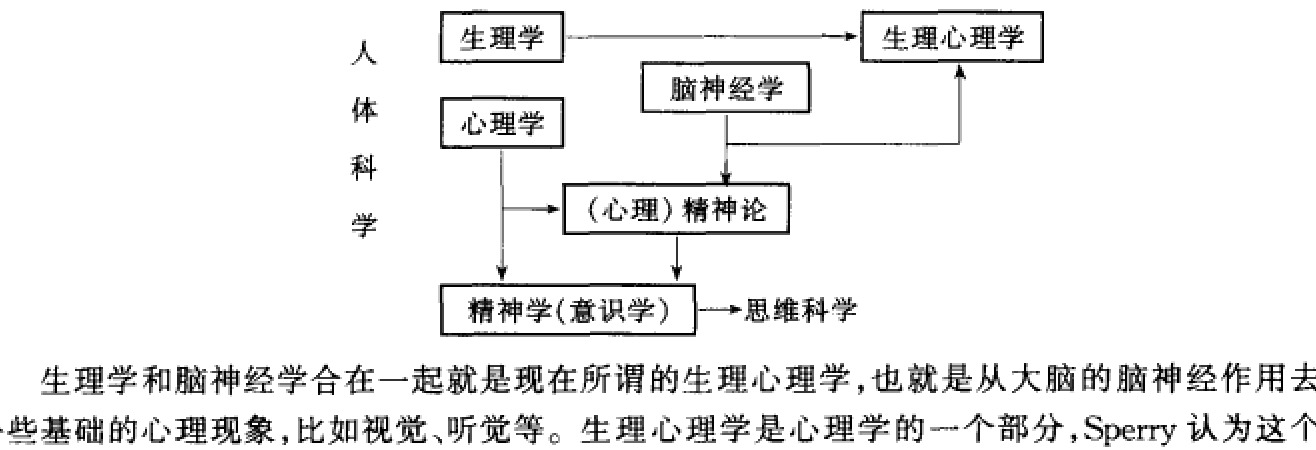
Physiology
Physiological Psychology
Human
Neuroscience
Body
Psychology
(Psychological) Mentalics
Science of Spirit
Science of Spirit (Science of Consciousness)
Cognitive Science
Physiology and neuroscience combined constitute what is now called physiological psychology, which explains basic psychological phenomena—such as vision, hearing, and so forth—through the neural functions of the brain. Physiological psychology is a branch of psychology. Sperry believed that this could be elevated one level further. He called it (psychological) mentalics—the English term is “mentalics,” a word coined by Sperry. The parenthetical “psychological” was added by me. Why did I add “psychological”? Because this is still a transitional theory. Ultimately, it should be synthesized into a new discipline, parallel to psychology, namely the science of spirit, or the science of consciousness. The relationships among them, indicated by arrows, are as follows: neuroscience and physiological psychology ascend one further step to (psychological) mentalics; of course, all of these are influenced by psychology; (psychological) mentalics then ascends further to the science of spirit (science of consciousness). This is the hierarchical scheme I have drawn based on Sperry’s conception: sensation and stimulation are at a relatively lower level, and the highest level ascends to the level of consciousness and spirit. Upon reaching consciousness, one part of consciousness is thinking. Thinking is the brain’s function of cognizing the objective world, so proceeding further down we arrive at cognitive science. Cognitive science has a relatively close relationship with human body science, because thinking is a product of brain activity—but not all brain activity, only that part of brain activity that cognizes the objective world. Therefore, we treat cognitive science as a separate discipline. How brain activity and thinking arise—this depends on research in human body science. That is roughly the relationship. The diagram drawn above indicates the hierarchical levels of brain activity, with the highest level of brain activity being consciousness and spirit. Considering these problems from a philosophical perspective involves many detailed issues. For instance, even among those who agree with Sperry’s views, not all are dialectical materialists, because in the capitalist world, the ghost of idealism never dissipates. Some people acknowledge that thinking and consciousness arise from the brain, but then say that what arises from the brain “becomes” a consciousness or spirit. Please note this “becomes a consciousness or spirit”—this is where the trouble lies, because once it “becomes” something, it is no longer material. This theory seems correct but is not. I call this the Emergentist position—a term I have coined. The implication is that once something “emerges,” it is detached from its roots, it is no longer [material], and it becomes an independent spirit. So the ideological struggle is very complex: a single word, slightly altered, can lead from truth to error. We say that it never “emerges” or “pops out” in the first place. What we call thinking and spirit is simply the manifestation of the brain’s higher-level activity; it has not detached from the brain. Once it “pops out,” things go wrong—it is detached from its roots. This is stated quite clearly in our philosophical literature: what we call consciousness and spirit is the manifestation of brain activity. We call this activity of the brain “consciousness” and “spirit”; in other words, or in Sperry’s language, it is the brain’s higher-level activity. If you find this term too long, you may simply call it consciousness or spirit. What are we talking about here? We are talking about
There is indeed a brain scientist named Sperry, whose viewpoint is fundamentally correct, namely that brain activity is hierarchical. Exactly how many levels there are in between is still unclear, but the simplest and lowest level is sensation, then vision and hearing, which are more complex and constitute the second level. There are intermediate levels as well, and the highest level is consciousness and spirit. The core idea here is that the central nervous system—human brain activity—has many levels, and each level is qualitatively different. Only humans possess the activity of this highest level or the highest several levels; other animals do not. This is also the leap that distinguishes humans from animals, the evolutionary transition from animal to human.
On the Question of Thinking
Continuing from this point, I want to discuss thinking. Last time I mentioned that I believe there are three types of thinking: abstract (logical) thinking, imaginal (intuitive) thinking, and inspirational (sudden-insight) thinking. What I discussed last time was the differences among these three types of thinking. Today I want to supplement that by discussing, from the perspective of these three types of thinking and in connection with the brain, how it appears that the highest level of brain activity—namely the level of consciousness or spirit—itself comprises more than one level. This makes things even more interesting. Why do I say this? Abstract (logical) thinking is a simple reasoning process. To describe it vividly, it seems like linear processing within the thinking process: if there is 1, there must be 2, then 3, then 4, proceeding in a straight line. Imaginal (intuitive) thinking is different. I gave examples last time—for instance, when a person listens to speech, it is not simply that 1 leads to 2, 3, and so on. Rather, there is a somewhat comprehensive consideration of the problem, approaching it through multiple pathways, and finally clarifying it. The key point is the multiplicity of pathways. So it is not linear processing but multi-pathway processing; imaginal thinking is integrative reasoning. As I repeatedly mentioned last time, abstract thinking is now relatively well understood—for example, there is logic, particularly mathematical logic, which has been worked out very clearly. A teacher can teach it to students, and students can learn it completely. But imaginal (intuitive) thinking, no matter how learned a person is, still cannot be explained clearly, because it has not yet developed into a discipline that can be articulated clearly. It can only be intuitively grasped but not verbally transmitted—no matter how much is said, one still has to comprehend it on one’s own. The difficulty lies in the multiple pathways: several routes are pursued simultaneously and finally integrated. Speaking of this, there is another issue that I also mentioned last time. Some people do not quite agree with my formulation regarding inspirational (sudden-insight) thinking. They argue that we have already reached the end of the line: linear reasoning you call abstract thinking, multi-pathway reasoning you call imaginal thinking, and since multi-pathway is already quite a lot, what more could inspiration be? Is inspiration the multi-pathway of multi-pathways? How can that even be described? It cannot be articulated. So some comrades are not very receptive to the notion of inspiration. When I encounter such comrades, I challenge them: I say, you probably have never experienced inspiration yourself; you have never tasted that feeling, so you do not understand. This is often quite effective—once I say this, they have nothing to say. One relatively young middle-aged comrade put forward a view that I consider quite illuminating. He is a teacher in the Marxism-Leninism Teaching and Research Office at Harbin University of Science and Technology, and he proposed that inspiration may arise from the subconscious. This is very thought-provoking. If each of us has experienced inspiration, you would have had such experiences and would feel that it seems to be the case—that the arrival of inspiration is not something you are consciously aware of. You do not consciously perceive it; it just suddenly arrives. In other words, within your consciousness there is no such thing, yet it comes. This is the subconscious. Those of you who work in psychology know that there is such a thing as the subconscious. Let me give another simple example: for people of our age, we often try to recall a person’s name but just cannot. We know the person, we even remember clearly his face and voice, but the name just will not come to mind. We think and think but still cannot recall it. Then we decide, forget it, stop thinking about it—and once we stop, it suddenly comes back to us. Older people often experience this. Now, would you say this person’s name was not stored in your brain? That would be wrong—it was stored. But the part of the brain where it is stored is not on the same line as your current consciousness; the connection cannot be made, and no matter how hard you try to think, you cannot recall it. Yet inadvertently the connection is made, and you remember. This kind of thing happens often. What we call the subconscious refers to brain functions that are not part of what you are currently conscious of. Comrades who work in psychology know that this is what is called the “other self.” If the self within my consciousness is called the self, then the subconscious would be called the other self—and there may not be just one other self; there could be several. I have not rummaged through the literature on this, but if comrades are interested, they can look it up. It is the so-called “theory of multiple selves.” Based on this, it seems there is a structure like this:
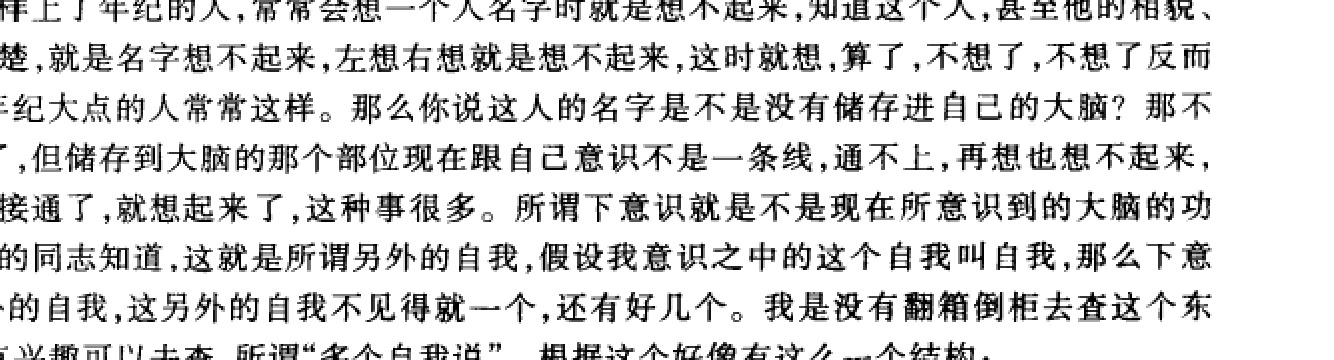
| Consciousness |
|---|
| Central Nervous System |
| Storage |
| Subconscious I |
| Subconscious II |
| Subconscious III |
Consciousness connects with the central nervous system and can lead to action, but there may also be something called the subconscious. Under a large number of ordinary circumstances, these several subconscious processes each work independently, but they can also exist within a storage system. Consciousness can connect with the storage system, and the subconscious can also connect with the storage system; both can extract their functions from the storage system. However, consciousness and the subconscious are not connected to each other, so naturally there is no action, and we are completely unaware of it. Generally speaking, consciousness can act, while the subconscious works without your knowing. But sometimes consciousness and the subconscious can connect, and once they connect, it works wonders—things you did not know you suddenly know. Inspirational thinking is the subconscious. I have made it concrete with this thing (pointing to the diagram), which can be studied further. What does such a hypothesis illustrate? It illustrates that human consciousness, spirit, and thought are also multi-layered. If we say abstract thinking is linear, a relatively simple type, and the second is imagery thinking, which is multi-pathway, then the most complex is this three-dimensional consciousness and thinking in which multiple subconscious selves participate—one is linear, one is planar, and one is three-dimensional. Is there something worth exploring here? Because this shows that what Sperry spoke of as the highest level of consciousness and spiritual thinking is itself multi-layered, a complex structure. For human beings to have evolved to such a degree as to possess a nervous system and brain with such complex structure and function—this is no simple matter. Conducting such research, based on these inspirations—and I can only call them inspirations—to study the human brain is very interesting. Studying the brain is not an end in itself, though of course that end is also very meaningful; it is also connected to human body science, and it will inevitably influence the development of the entire field of human body science.
This is only looking at the problem from the level of the brain. Recently I saw an article in Wenhui Bao on March 30 by a famous scientist. I think he is probably getting on in years and seems not to know much about these things. He said that research in brain science should be guided by Marxist philosophy—which is correct—but then he went on to criticize qigong, extrasensory perception, and so forth; he criticized all of it. I think, unfortunately, this elder scientist has somewhat fallen behind the times. My purpose in mentioning this is to say that comrades must have courage; scientific inquiry requires a dauntless spirit. It is not the case that what came before is all there is; if that were so, then we humans would not need to evolve or progress. We must constantly accept new things. The teacher from Harbin University of Science and Technology mentioned above is probably only in his forties, a nobody, but the insights he put forward are very good. I ask comrades to consider them.
From this perspective, I believe there are indeed many problems we need to consider. Where do we go for help? Where do we seek inspiration? What I have just discussed is all help and inspiration. Here I want to say that we must value the theory of traditional Chinese medicine. Why? Because the theory of traditional Chinese medicine arose before modern science had emerged; it did not know what modern science was, much less what contemporary science is, so it was free from such restrictions and constraints—that is, it was not bound by the reductionist view. Therefore, the theory of traditional Chinese medicine is actually systemic, starting from the whole. One could also say that the circumstances of the time forced it to be that way, because when the theory of Chinese medicine arose, there were none of these things from modern or contemporary science, nor were there any measuring instruments; the only thing it could rely on was its own sensory perception. Many people who now study the theory of Chinese medicine have pointed this out. For example, the Japanese study Chinese medicine—they call it Kanpo—and put great effort into it. Not long ago, in the journal Translations in Philosophy of Natural Science, there was an article titled “Chinese Medicine and Bergson’s Philosophy.” Bergson’s philosophy is the philosophy of intuition; he linked Chinese medicine with intuition. What he was actually discussing was the method used in the theory of Chinese medicine—by what method was the theory of Chinese medicine formed? It was through sensory perception. A doctor from Taiwan once also discussed this issue in a book published by the Chung Hwa Book Company in Taiwan. These two gentlemen explained the matter quite clearly: Chinese medicine relies on sensory perception, has no instruments, and through introspection perceives what sensations arise. For example, the meridians in Chinese medicine are not found through dissection; rather, one feels qi moving there, entirely through sensory perception. This kind of research method is precisely what modern or so-called Western science does not acknowledge—it says your sensations count for nothing, that you need instrumental measurements. But at least up to now, no instrument has been used to measure why a living person has such sensations, whereas Chinese medicine is highly developed in this respect, so much so that it has formed a specialized discipline. In Chinese medicine this is what is called “internal observation” (neijing fanguan); practitioners of Chinese medicine say they can see it themselves, but in reality they sense the activities of the body. This is actually the system governed by the brain perceiving what changes are occurring in the internal organs or bodily functions. Such things are of course synthetic, systemic, not functions of any particular local part. I once suggested (I do not know whether correctly, but I said it) that if you perform dissection you will not find meridians at all—there are none—yet those who practice qigong insist that they feel qi flowing along the meridians. So this is a contradiction; how to resolve it? In reality there is no connection, yet one feels there is a connection—what is going on? I said that the meridian theory is a simplification by human beings of what they sense, as if each acupoint truly had some connection. The actual connections are not that simple; they are a phenomenon within the giant system of the human body. I said that these connections are not—
between two acupoints, but rather must all connect to the brain; the connections reside in the brain, not in the acupoints. In other words, what we recognize from our own sensations, or using the terminology of traditional Chinese medicine (TCM), “internal observation of the interior landscape” (neijing fanguan), is a representation. There are indeed connections, and there are connections between acupoints, but these connections are not like what we draw on acupoint charts, as if every acupoint were linked together—it is not like that. On the one hand, we must acknowledge that this is a perceived representation, not necessarily the essence; on the other hand, we must also acknowledge that what is perceived is objective, that such connections are real and not illusory, and it is precisely these connections that can give us inspiration—our further research must pay attention to these. Moreover, TCM has developed further: based on these perceived things, TCM has systematized them into theory and used them to guide its medical practice with effective results, which deserves even greater attention. Now Western medicine is also gradually becoming aware of the inadequacies of its own system. For example, the currently proposed psychosomatic medicine, or what is called psychophysiology—I just mentioned physiological psychology, but this is the reverse, called psychophysiology—meaning that the thinking and conscious functions of the human brain can in turn influence physiology. It must be said that Sperry also spoke of how the highest level of human activity, namely conscious and mental activity, can influence lower-level activities. So Sperry is no simple figure. I believe all of these things are elements within TCM that are highly inspiring to us. TCM theory considers the entire system and is not limited to the human being alone—it takes into account the factors of the human being and the environment. The so-called “resonance between heaven and humanity” (ren tian ganying) considers the relationships within a larger system—the entire system of human beings and the natural world, and even the currently proposed biological clock, that is, the influence of the movements of the sun, moon, and stars on human beings. This kind of thinking now appears to be truly important and highly inspiring for our further research in human body science. That is why, at your last academic annual conference, I said: could you perhaps study and research TCM theory? The reason lies right here. TCM theory can give us inspiration—many viewpoints and perspectives. But here I must also make it clear: I am not saying that TCM theory is science in the modern sense, because TCM theory is based on medical practice such as clinical treatment and on what is perceived through “internal observation of the interior landscape,” or the experiences of qigong practice. It combines what is sensed with what is practiced, kneads and organizes them together, and adds some elements of imagination—it is impossible not to add them, otherwise things cannot be connected. It is just such a pot of porridge, such a thing. To say that this thing is all scientific—that cannot be said. Of course, many erroneous things are also mixed in. For example, when TCM discusses the heart and the brain, it gets quite muddled—the “heart” it speaks of is not the heart as we now understand it. Therefore, I say that TCM theory is not natural science in the modern sense; rather, it is natural philosophy in the classical sense. Natural philosophy in the classical sense is precisely what Engels discussed—that long passage in the book Ludwig Feuerbach and the End of Classical German Philosophy, which I read when I first lectured here. That passage explains very clearly what natural philosophy is and what natural science is. TCM theory appears to be natural philosophy, and this has provoked discussion among some comrades: “You, Qian Xuesen, say TCM is natural philosophy, and natural philosophy was criticized by Engels, who said it should be abolished—aren’t you smearing TCM?” There are objections. My response to this objection is quite simple: think about it—without natural philosophy, there would be no modern natural science either. This is historical development. We are now taking up TCM theory as natural philosophy precisely for the sake of the future modernization of TCM into natural science, into genuine science. But to achieve scientificization, we must start from what is not yet scientific—from the unscientific to the scientific—this is dialectics. How can something emerge out of thin air from nothing? We need to understand what TCM theory really is, what its shortcomings are, and what its strengths are. Its shortcoming is that it remains natural philosophy rather than natural science; its strengths are its holistic view, its systems view, and its multi-level view. What we need to develop in human body science is precisely this issue—namely, the multi-level holistic view. We can draw nourishment from TCM theory. But to return to the point: when you study and draw upon TCM theory, you must recognize that it is natural philosophy. Fortunately, we now have Marxist philosophy, the highest-level synthesis summarized from many years of social practice by many people, and we can use Marxist philosophy to synthesize, study, and deepen TCM theory. I call this the modern exposition of TCM theory—that is, using the perspective of Marxist philosophy to expound TCM theory in a modernized way. In this way, we can discard the dross and select the essence, eliminate the false and retain the true, and draw nourishment from TCM theory as a fundamental skill. Whether my view is correct, I ask comrades to consider. For I have heard opinions on both sides: some people take what suits them, saying on the one hand, “You, Qian, have spoken a great deal about TCM and seem to be very much in favor of it—this is good, it is a great support and encouragement for TCM”; on the other hand, as soon as they hear me call it natural philosophy, they say, “No, that won’t do—you’re looking down on us.” I am not looking down or looking up; I am being realistic and practical—it is what it is. This is what I wish to do, and whether I have achieved it, I ask comrades to evaluate. I believe what is very important is that today, when we analyze and study TCM theory as a form of natural philosophy, we have a very good tool, namely Marxist philosophy, which did not exist in the era of ancient natural philosophy. The transformation of TCM theory from natural philosophy into modern science is not like the previous transformation from natural philosophy to natural science, which was an unconscious and passive change driven by the development of objective things and human society.
development forced it to undergo such a transformation. Today, as we study the theory of traditional Chinese medicine, we wish to transform the theory of traditional Chinese medicine from a classical natural philosophy into a science in the modern sense, namely human science. We have Marxist philosophy as our guide, and we can dynamically and consciously promote this transformation.
Suggestions for Developing Human Science Research
Now let me talk about my suggestions. I ask comrades to consider that in the field of human science, we must undertake a major endeavor. We must use scientific methods; while we can certainly explore from a theoretical perspective, what is now more important is probably the work on the scientific experimental side. In conducting scientific experiments in this area, our focus should be on the large-scale system of the human body. This large-scale system has a hierarchical structure, and what we need to grasp is the overall level. Therefore, I want to use scientific experimental methods to explore how the human body as a whole actually works. Our institute has done a great deal of excellent work on electroencephalograms (EEG), but I suggest that EEG work alone is not enough, because it is limited to the brain. Of course, there is also some work connected to things outside the human body, such as resistance strain gauges — I am referring to other parts of the human body. Previously, the Shanxi Institute of Traditional Chinese Medicine published many articles on the measurement of voltage at meridian acupoints in the human body and the measurement of mechanical vibrations at acupoints. Can these measurements give us some inspiration? We can take measurements at acupoints, and acupoints are distributed throughout the entire body. We should not only measure the brain but also measure other parts of the entire body. Acupoint voltage and acupoint mechanical vibrations can perhaps serve as one aspect of measurement. Of course, there are other aspects as well, and comrades present here can think of more, such as electrocardiograms (ECG), electroencephalograms (EEG), and so on. It appears that all of these measurements for studying human body functions need to be carried out. There are also some rather special things — I saw a material introducing that humans can also perceive microwaves. Microwaves enter the human brain and affect the brain’s nerves, and these nerves can also process these sensations. It is said that humans can feel the pulses of electromagnetic radar, hearing what sounds like a “crack” for each pulse, as if the ear heard it, but actually it did not. I saw this in a publication; you can look into these things. I believe all of these things can be measured and recorded. There should be multi-detector, multi-site measurements, and ultimately these measurements should be synthesized and processed using electronic computers. Just as our EEGs now need to be processed through electronic computers, you need to synthesize them and find all of their relationships, so that things become clear. The phenomena will certainly be very complex. How to find clues from complex phenomena requires computer processing — removing interference and irrelevant elements, and highlighting the central, relevant elements. This kind of processing is probably not simple. You may need to use our country’s largest computer, the Galaxy (Yinhe) computer, which happens to be managed by our Commission of Science, Technology and Industry for National Defense. If you need to use it, you are welcome to do so. But I think you will also need to make some preparations; the software engineering required to use such a complex computer will probably be quite demanding. I feel that we already have a direction for exploration in this work. It is not that we know nothing now, completely in the dark, not knowing which way to go. We can forge a path, and the conditions at our institute are quite good.
In addition, I have thought of a few more things. One is that the object of research is humans, and when studying humans, one must pay attention to their psychological state, because psychological state affects function. You have people working in psychology here as well — perhaps they could specifically study the psychology of your research subjects. For example, there is one rather obvious thing: qigong masters, especially those with very deep skill, think differently from us. It is said that the qigong masters we generally encounter — those who talk with you, converse with you, and do experiments with you — are still intermediate-level qigong masters. Those qigong masters with truly deep skill are unwilling to have contact with you. What psychology is this? It is unclear. In any case, they have their guard up against people like us. What kind of psychology is this? If you do not understand their psychology, you cannot open up a pathway. When you seek them out, they will not talk to you, will not do it for you, and will not cooperate with you. Another thing I think about is that those children or adolescents who have extraordinary functions — their psychology may be quite different from ours. You need to understand their psychology. If we do not understand their psychology, when we interact with them, we feel they are being difficult, unfathomable, and incomprehensible. We can say that some of their psychological states are different from those of ordinary people, and this is only to be expected, because human psychology is formed through human social practice. Their social practice, due to their extraordinary functions, is different from our social practice. We do not have this ability; we can only read characters with our eyes, whereas they can “see” characters by means other than their eyes. How could their psychology be the same as ours? It is probably different. Should this perhaps be called extraordinary psychology? You have comrades working in psychology here — let them study this. Do not assume that others should be the same as us. They are different, and that seems strange. But there is a reason for the strangeness. If we want to gain their cooperation, we must understand them. On the other hand, we also need to see through some people. For example, regarding the yoga masters who visited our country as tourists last year —
Maharishi, the great master of yoga—indeed, we need to study his stuff. I also received a set of printed materials he brought, reproduced copies. I flipped through them, and this person is quite something. He came to China for tourism, and he has no shortage of money. He brought a delegation of about 70 people to China for a self-funded tour, and he claims to have organizations in countries all over the world—in America, in Switzerland there is even a Maharishi University, in Britain there is also some university, and there are worldwide organizations. What exactly is this person about? Of course, when he came here, he kept saying he was not promoting religion, but I think if he were merely a qigong master, he would not have such a grand arrangement. I read his promotional materials and felt that part of them contains scientific things—he or others had done many experiments and published some measurement results. We must seriously analyze and study these. But there are also other things—“Enlightened World,” “World Government,” and so on—that set of things. What is that set of things? This is very important. Comrades, we must recognize them: that set of things is a new religion. Why does he have so much money? Nowadays, foreign capitalists and financial groups in capitalist countries also feel that their days are not going well, so they want to use religion, this old method, to numb the people. As far as I know, there are now scientists abroad who say that if you want to do scientific research, there is no money, but if you want to do religion, there is plenty of money. Capitalists feel that using science to save their doomsday may not work, so they still have to rely on religion. Those people with such grand arrangements—I can see it clearly at a glance: their underlying purpose is religion. And he is also, so to speak, afraid of being exposed; when he came to China, he was afraid you would point this out, so he hastily promoted that he was not doing religion. In fact, he is doing religion! We must not be naive. All those things I just mentioned about parapsychology and so on—I mean to say that studying human beings is not simple; human beings are very complex. We must not be naive. There are all kinds of people. When it comes to foreigners, we need to be a bit more cautious, because there is no denying that capitalists hate us to the core—they fundamentally hate us to the core! They want to eliminate us. This point must never be forgotten. Perhaps because I have suffered, I am not so trusting of foreigners. Of course, there are good people among foreigners, and good people should be trusted; those with ulterior motives cannot be trusted. On the other hand, if I truly analyze him clearly, I can make use of him. I will not let him make use of me. That is all I will say on this issue. Our institute should gradually expand this kind of work. This work is very promising and of extremely important significance. You are fully capable of doing this work, but as I just said, doing this work is extremely complex—not only complex in science and technology, but also with complex social and political circumstances. Although we are doing scientific and technical work, we cannot oversimplify this point; we must study strategy and policy.
On the Anthropic View
The last point is that I do not have much more to say. The ultimate destination of human body science is philosophy, and I propose that this bridge is the “Anthropic View” (人天观). In English, human body science is Anthropic Science, and the Anthropic View is the Anthropic Principle. This borrows a foreign term; originally, this term originated from the anthropic view proposed in cosmology at the cosmic—i.e., grand macroscopic—scale. Its basic idea is that there now seems to be much evidence indicating that the reason our material world is the way it is is closely related to the emergence of human beings, or conversely, it is precisely because we have such a material world that human beings could emerge. Studying human beings can, in turn, inspire our study of the entire universe. This is the cosmic-scale Anthropic View, and in fact, astronomers are doing this work. What I just mentioned about the so-called brain, traditional Chinese medicine theory, and the suggestions for work we can do—these aspects are all macroscopic, centered on language for research. Going further down, there is also the microscopic, which enters the domain of quantum mechanics. Quantum mechanics, from the beginning of this century to now, has a history of 60 years. Quantum mechanics with its 60-year history has been proven correct in every respect, so the theory of quantum mechanics is beyond doubt from the standpoint of experimental verification. However, the fundamental theory of quantum mechanics also contradicts the traditional epistemology of human beings. This contradiction has existed since the very appearance of quantum mechanics, and this problem has remained unsolved for 60 years. Many great scientists have participated in solving this problem in between—for example, Einstein and Bohr of quantum mechanics even argued with each other, and neither convinced the other. Later, there were many different interpretations and theories, so much so that Einstein in the 1930s proposed the so-called “hidden variable theory” of quantum mechanics, trying to avoid this contradiction. But by the 1960s, some people said that based on the “hidden variable” hypothesis, it could be experimentally verified whether it was correct or not. From the 1960s to the 1970s, there were many experimental ideas to verify the theory proposed in the 1960s—the Bell inequality—which can be measured with experimental results. By now, experimental results have negated the “hidden variable” hypothesis, and we must honestly return to quantum mechanics. But current quantum mechanics still contradicts classical epistemology, so this problem is extremely difficult. I think the work in this area probably requires that our classical epistemology be revised and deepened, and made more modern. Based on such developments, can we propose a quantum epistemology? This would truly proceed from quantum mechanics…
to study from a microscopic perspective how humans perceive or cognize objective things. Of course, this again involves human body science, because the subject of cognition is the human being. I have encouraged some people to undertake this work, and I have now found one comrade who wishes to explore this area. He has recently mobilized several of his colleagues to do this work, so there is hope that work in this area can be gradually developed.
The view of human-nature relations has three major levels: one is the cosmological, one is the macroscopic, and another is the microscopic. The work in these areas is, of course, all related to the work that our institute is to undertake. In the future, there will need to be more exchange and communication.
The Institute Should Hold Academic Activities Every Week
That concludes this topic. Finally, I will offer a few opinions for your reference. I originally suggested that our institute organize this kind of institute-wide academic activity — not necessarily requiring everyone to meet in person, but having an afternoon where everyone can exchange ideas here. Since it is an institute-wide academic activity, it cannot be too specialized. If you talk only about your own division’s or your own group’s work, that won’t do. The topics should be broad enough that everyone can understand them. I’m not sure whether the talks I have given meet this standard, but I have tried to make them understandable to everyone — what you might call advanced popular science. These are not specialized reports; they are popular in nature, but they are not reports for teenagers or college students. They are for experts — that is, advanced popular science. Having one session of advanced popular science per week, where everyone exchanges ideas, at the very least each division should present its work — the general outline, major directions, and important results — in reports that provide inspiration, not only for one’s own work but also for other research divisions. You can also discuss developments nationwide or worldwide in certain areas, to provide us with inspiration. Beyond that, my purpose is also to help our institute strengthen its academic atmosphere, and a shared academic atmosphere at that — one of mutual connection, not where everyone works in isolation. I think for an institute like yours, once a week cannot be considered too much. Furthermore, I understand that each research division has its own sessions, which are specialized. These two types of discussion sessions complement each other. My idea is that for a research institute like ours, comrades should spend two afternoons a week — one afternoon for institute-wide activities, and another afternoon for each division’s own. This cannot be considered too much. When I was doing research work, I spent not just one afternoon a week — I went all over the entire campus, not just my own department. I went almost every afternoon. Some people said, “You’re just playing around, how do you get anything done?” I worked in the mornings and evenings — that kind of schedule is not possible for us right now, but twice a week — would that work? I am trying to persuade you, and also to put some pressure on the comrades. In the future, it won’t always be me giving the talks. You have quite a few researchers here — distinguished researchers should speak, associate researchers should speak, and assistant researchers should speak too. Please consider this, comrades. The overall goal is to strengthen the academic atmosphere. A strong academic atmosphere has a feedback effect and greatly helps comrades carry out their research work. The few hours spent here are not wasted. If you don’t believe it, try it — after a year, our institute will be different. What I’m saying is not just my personal experience; it is the experience of the whole world. Any research institution that cannot build up its academic atmosphere is doomed; the better it does, the greater its achievements. This time is worth spending. In addition, I have some specific suggestions. I have already spoken here four times, and today concludes my series. Many topics can be presented by other comrades. For example, I recently received some materials sent to me by Comrade Mei Lei, on their work regarding EEG studies of extraordinary functions. Work like this, I think, could be presented here once — or perhaps even more than once. What he wrote to me is still quite specialized, and I can’t fully understand it either. Those who work in EEG would know immediately what those things are, but I can’t even figure out what the vertical axis on his charts represents — I know it’s high, but what exactly that high value means, I’m not clear, because I don’t work in EEG. If he were to come here to speak, he would need to explain it more clearly — that is, present it as advanced popular science. Additionally, there are many things I have seen in the literature that could be considered. For example, the work of Sperry that I mentioned just now, especially his work on the brain, consciousness, and the mind — could a comrade be asked to study these materials, review the literature, and then come here to present it to everyone? What I have said is too simple and too general; it should be presented in more detail. Third, for example, the work on acupoint voltage and mechanical vibration could also be collected. I cited the Shanxi Traditional Chinese Medicine Research Institute earlier, and there are other comrades as well. I understand that a great deal of work has been done on acupoint voltage. This could also be collected and organized for presentation here. Fourth, there is an article from Nature Journal (Ziran Zazhi), March 1983, by the German F. A. Popp, titled “Electromagnetic Control of Cellular Processes” — it is a translated article. This is just one article; Popp’s work in this area could be collected and introduced here, because these things are closely related to the questions we want to discuss.
Of course, I think I have only scratched the surface, as I have not read too extensively. All materials in these areas can be brought in for someone to introduce here. There are 52 weeks in a year; excluding holidays, let us say 40 weeks—40 lectures per year on advanced popular science here. This is not merely to create and strengthen the academic atmosphere; culture alone would also be fine, right? Is it not the case that we want to build socialist spiritual civilization? This is precisely spiritual civilization: to have some learning, to have broader knowledge. I am advocating this matter; as for exactly how to proceed, I will listen to the opinions of comrades, and the final decision will be made by the leadership of the institute. These are merely suggestions of mine.
Supplementary Notes on Several Terms
I am correcting myself. The foreign terms I suggested using last time—upon reflection, I find them not quite satisfactory. The Chinese terms “人体科学” (Human Body Science) and “人天观” (Anthropic Principle) remain unchanged, but their English translations were originally proposed in 1981. At that time, I wrote an article titled “Systems Science, Cognitive Science, and Human Body Science,” published in Nature Magazine (Ziran Zazhi), 1981, No. 1. The magazine required the title to have an English translation. I thought about it on the spot and essentially translated it literally: for “人体科学” I used the term “Human Body Science,” which is too colloquial and inelegant. At that time, there was no established translation for “人体科学.” Abroad, there was a so-called “Anthropic Principle,” which used the term “Anthropic Principle.” I did not clarify at the time which term to use, so the matter was left unaddressed. Last year, I pondered this and felt that the term used by foreigners could be adopted as the English translation for “人天观,” thus making it clear that “人天观” could be rendered as “Anthropic Principle.” Therefore, the English translation for “人体科学” needed to be a bit more elegant—could we use this term? So, from last year up through my last lecture, I had been saying that “人体科学” could be translated as “Anthropic Science.” But I kept thinking that this term also has a flaw: although elegant, it is not quite precise, because since “人天观” already uses this term, the meaning of the word seems to refer to humans and their environment, so it is not quite accurate. I was never fully satisfied with this term in my heart. A few days ago, I suddenly came across an article on psychosomatic medicine. Psychosomatic medicine concerns the relationship between psychology and physiology. In the article, there was a word: “Psychosomatics.” “Psycho” means psychology, and looking it up in the dictionary, I found that “Somatics” originally comes from Latin, meaning the study of the human body from a material perspective. I was delighted to find this word, because we are materialists—we precisely believe that everything about humans is based on matter, not on spirit, gods, or anything of that sort. Thus, this term is perfectly suited for our use: “人体科学” should be translated as “Somatological Science.” I feel this term is both elegant and precise, while the translation for “人天观” remains unchanged. This shows that human knowledge must accumulate and advance day by day. I strive to do so, though perhaps my efforts are still insufficient. I hope comrades can encourage me to keep making progress. We should all promote one another.
(April 4, 1983)
VI. The Anthropic Principle, Human Body Science, and Human Body Studies
Two years ago, I wrote an article on human body science in which I proposed expanding the so-called “Anthropic Principle”—first introduced by American physicist Robert H. Dicke in 1961 and later greatly elaborated by British astronomer Brandon Carter in 1974—into the concept of the “人天观” (Anthropic Principle, literally “Human-Heaven View”). Subsequently, I suggested that the Anthropic Principle serve as the bridge from a major new department of modern science and technology—human body science—to Marxist philosophy. Recently, I have written two more articles: one on the structure of Marxist philosophy and the theory of traditional Chinese medicine, and another on cognitive science. Both touch upon the Anthropic Principle and human body science, but neither was able to elaborate much on the Anthropic Principle itself, nor on the relationship between the Anthropic Principle and human body science. In this article, I wish to focus specifically on my current understanding in this area, so as to seek the guidance of all of you.
Please criticize and correct.
The first fundamental viewpoint to state is this: from the perspective of systems science, the human being is an extremely complex, material giant system. This giant system is also open, having myriad connections with its surrounding environment and the universe, with exchanges of matter and energy. Therefore, it can be said that human beings and the environment, human beings and the universe, together form a super-giant system. The principles of systems science—systems theory—tell us that to understand such a complex material system and to clarify its functions, it is necessary but insufficient to use the reductionist approach, decomposing level by level: from the human being to the various systems of the body, to the histology of each system, to cells, to organelles, to the cell nucleus, to chromosomes… all the way down to molecular biology. We must also use a holistic perspective to understand the naturally formed multilevel structure of the human giant system, the different functions at each level, the relationships between levels, and so forth. We must combine the reductionist view with systems theory, and comprehensively study the human body and its environment—this is the task of human body science.
In the work of studying human body science, we must of course always be guided by Marxism-Leninism philosophy—the highest generalization of humanity’s understanding of the objective world—and must also frequently connect with the philosophical thought of the human-universe view (rentian guan). My view is that the human-universe view is precisely that part of Marxist philosophy specifically and exclusively directed at human body science.
What is the human-universe view? I now believe that the human-universe view concerns the super-giant system of human beings and the environment, human beings and the universe. Therefore, the human-universe view can be considered to have three parts: the cosmoscopic human-universe view, the macroscopic human-universe view, and the microscopic human-universe view. The first part places human beings within the universe for examination; the second part examines the relationship between the interior of the human body and the environment; the third part examines the quantum mechanical foundations of the human-universe view. In this section, I will first briefly discuss the cosmoscopic and microscopic parts, while the macroscopic part will be treated as a key focus of this paper and addressed in later chapters.
The cosmoscopic human-universe view holds that the existence or emergence of human beings is related to the actual evolution of the universe; it is of course also possible to state the reverse—that the actual properties of the universe are necessary conditions for human existence. We often approach the problem from the latter perspective, out of habit. But Dicke, and especially Carter, pointed out that the evolution of the universe, over the course of tens of billions of years, could have taken many possible paths, with multiple branching points. Why did it take precisely the path that the universe has actually followed? Why not another path? What is significant is this: if the evolution of the universe had taken another path, then the organisms we now know, and we human beings, would most likely not have appeared! I also connect this to the fundamental physical parameters that determine the evolution of the universe, the fundamental parameters that determine the motion of matter—they are precisely balanced, taking exactly the values we know, as required by the emergence of human beings. One can therefore say that, since human beings have in fact appeared, the properties of the universe must necessarily be as they are, and could not be otherwise. In other words, from the very nature of matter, human beings and the universe—that is, human beings and the solar system, the Milky Way galaxy, and the entire universe—are interrelated. This is the cosmoscopic human-universe view. The study of the cosmoscopic human-universe view naturally relies on cosmology. Although current cosmological research has achieved great successes, many questions remain unsettled, awaiting the efforts of astronomers in the future. Therefore, the cosmoscopic human-universe view still requires further development.
The microscopic human-universe view begins with the measurement theory of quantum mechanics. Because the theoretical framework proposed by quantum mechanics, when concretized in the measurement of the objective world, is incompatible with the classical viewpoint, A. Einstein was consequently never fully satisfied with quantum mechanics and proposed the idea of hidden variables—that is, the motion of matter might still return to the classical measurement viewpoint, except that in addition to the currently known parameters of matter motion, there might be unknown hidden variables. However, theoretical and experimental research results over the past twenty years have failed to support the hidden variable hypothesis and have instead supported the correctness of quantum mechanical theory. Combined with the manifold confirmations since the founding of quantum mechanics, we are compelled to fully accept this theory. How, then, is the contradiction in the measurement problem to be resolved? There have been many proposals on this matter. He Zuoxiu and Huang Tao suggest that the viewpoint of A. Daneri, A. Loinger, and G. M. Prosperi can be adopted: the measurement problem of quantum mechanics can be resolved through the macroscopic properties of measuring instruments combined with quantum statistical mechanics—that is, through the slow response characteristics possessed by an “actual” instrument.
But I believe that from the perspective of the human-universe view, the so-called “actual” instrument in the above theory is still an imagined instrument. The truly actual instrument is the sensory organs that human beings use to cognize the objective world, and the neurons internal to the sensory organs, as well as the brain that processes information, are also microscopic—they are quantum mechanical processes. It is only when the brain processes the results of sensation that what human beings recognize as measurement, what human beings recognize as the objective world, comes into being.
To thoroughly resolve the quantum mechanical measurement problem, one must use the human sensory system as the measuring instrument, rather than using hypothetical instruments. This actually pushes the process of human cognition deeper into the microscopic level, the level of quantum mechanics. This discipline may be called Quantum Epistemology. Quantum epistemology is precisely the microscopic theory that studies the relationship between humans and their environment, so it is only through quantum epistemology that the problems of the microscopic human-cosmos view can be resolved. This is also a task that must be accomplished through future efforts. At present, we can only say that, according to quantum mechanics, all objects that have interacted at some time in the past constitute an indivisible whole—and what object in the universe has never interacted with any other object in the past?
Although the various views described in the preceding section cannot yet be said to be complete—their content still needs to be developed and made more perfect and profound—one thing is certain: the human body is a giant system that continuously interacts and communicates with its environment and the universe. Its internal structure must also form many levels, each with its own characteristics, and the levels also interact with one another, with feedback regulation and control. The task of human body science is to understand such a complex giant system. Of course, in facing this work, we do not start with a blank sheet of paper, beginning everything from scratch. Based on knowledge from biology and physiology, we know, as Wang Deyao pointed out, that the following levels exist: (1) submolecular, (2) molecular, (3) cytoplasm, (4) chromosomes, (5) nucleus, (6) organelles, (7) cells. The problem is that in physiology, beyond this point one proceeds to descriptions of various organs and organ tissues, which then converge into the various functional systems of the human body, such as the respiratory system, the circulatory system, the digestive and absorptive system, the sensory nervous system, the reproductive system, and so on—only particular characteristics are seen, without commonality. Is there a whole-body, universal level of the human body that is higher than the cell? When discussing the contradictions and problems in molecular genetics, Wang Deyao also pointed out the difficulties of resolving biological heredity solely from the perspective of molecular genetics, and recognized that higher-level structures play an important role. In recent years, scientists studying biological evolution and biological development have also proposed mechanisms of super-recombinant genetic genes and heterochrony in developmental stages, both of which imply the existence of higher-level structures. Of course, taking the human as a unit, the highest level is the individual person. Our question is: how many levels does the human body have? Counting from the submolecular level, there must be more than eight structural levels.
Given that there are so many structural levels, each with its own characteristics and functions, another important question concerns the interrelationships among these levels: in particular, how the giant system of the human body is connected together, how each organ at every level coordinates its work, and how the control of the giant system is carried out. For humans, and for human body science, the particularly important issue is the central control and regulatory function of the central nervous system within the giant system, for this is the function conferred upon humans by the highly developed human brain that distinguishes humans from other organisms. The international medical community has recently also come to feel that the previous neglect of this aspect of bodily function was wrong, and so has begun the so-called psychosomatic medicine research, and has raised the demand for establishing the discipline of Psychophysiology. But this is only a beginning, still far from resolving the problem of control and regulation of the human body as a giant system.
Of course, to understand the control and regulatory functions of the human body as a giant system, one must first understand the brain, the central control organ of this giant system. The brain has approximately neuronal switches, and on this point alone it already far exceeds the largest artificial electronic computer in the world. Research on such a complex organ has only been underway for about forty or fifty years, and it is only in the last twenty years that major advances have been made in brain physiology and neuroscience, becoming a leading discipline in science and technology since the 1970s. I believe that an important development in this area is that neuroscience has fully confirmed a fundamental tenet of Marxist philosophy and dialectical materialism: the dependence of consciousness on matter is manifested both in the fact that consciousness is a product of the long development of matter and is a function of the human brain, and in the fact that consciousness is a subjective reflection of the objective material world. Research in brain science, as the 1981 Nobel laureate and American neuroscientist R. Sperry stated, shows that consciousness is nothing but a manifestation of brain activity, thereby refuting all idealist doctrines as well as the variants of idealism such as dualism. The renowned Australian brain scientist Sir John Eccles and the renowned British philosopher Sir K. Popper are dualists; they are quite candid about this. There is also a more covert dualist, M. Bunge, who says that consciousness emerges from the material brain. Once it emerges, it leaves matter—so what is it then? Is it no longer matter? No wonder some say that Bunge has created confusion about the mind-brain relationship. But Sperry also has his limitations; for example, he keeps insisting that he opposes Marxist materialism, which is truly incomprehensible!
Sperry correctly points out that the brain itself is a complex giant system, and its activities also have hierarchical levels, just as all complex systems form structural hierarchies. When human sensory stimuli are transmitted from the receptors of the sensory organs to the brain, and the brain receives them, this can be called the primary activity of the brain. When the brain processes the received sensory stimuli—for example, forming visual images, or forming another kind of integrated information from sound—that can be called the secondary activity of the brain. Ascending in this way, through who knows how many levels, one finally reaches higher-level activities, and this is consciousness. Sperry also very explicitly points out that higher-level brain activity can influence or control the activities of lower levels. This is how consciousness can influence or control human physiological functions. All of this, if one approaches the problem from the perspective of Marxist philosophy or, more directly, from the perspective of systems theory, is entirely a matter of course. Yet abroad, because they lack these perspectives to guide their scientists’ research, it has actually caused such great confusion!
Consciousness is a manifestation of the higher-level activities of the human brain. Sperry calls the discipline that studies this level of brain activity “Mentalics.” Mentalics is, of course, closely related to psychology. And because consciousness is also the basis of the human brain’s information processing and human thinking, mentalics is thus also a foundational science of cognitive science and a foundation of the study of thinking. According to the system of science and technology that I have proposed, mentalics belongs to human science, so mentalics links human science and cognitive science together. One branch extends into the study of thinking, developing into the study of abstract (logical) thinking, imaginal (intuitive) thinking, and inspirational (sudden-insight) thinking. These three forms of thinking also appear to be three levels of thinking with different degrees of complexity: abstract (logical) thinking is linear, imaginal (intuitive) thinking is planar, and inspirational (sudden-insight) thinking is three-dimensional. These will be explored in other writings and will not be elaborated further here. But one point is clear: the development of cognitive science will also more profoundly elucidate the activities of consciousness, thereby in turn promoting the development of mentalics. Another branch of mentalics must be integrated with the study of the human body as an open giant system, to solve the problems of the integrated functions of the human giant system and the functions of each level within the human body’s structure. And the higher-level functions have more than one functional state. From the perspective of the overall task of human science discussed at the very beginning of this section, such a discipline will be an important foundational science of human science. I propose calling this discipline “somaticology” (人体学).
Establishing somatology is, of course, an extremely arduous research undertaking, because even brain physiology, which serves as one aspect of the foundation of somatology, has not yet fully resolved even the relatively preliminary secondary activity of visual image formation at present. As for even higher-level activities, they remain at the stage of mechanistic conjecture or hypothesis. We still have a long road ahead. Below, I would like to discuss the research of somatology.
III
The foundational research on human science that I discussed previously is, in essence, the research of somatology, so I need not repeat here the research methods and research directions. What needs to be addressed here is, first of all, that we now have a further understanding of somatology, guided by Marxist philosophy, using the human-cosmos perspective and systems theory. We have a deeper understanding of the multi-level complexity and multi-level integrity of the human body’s structure, and we recognize that due to the high degree of development of the human brain, somatology differs from biology and zoology. Animals cannot possess all of the functions of humans, cannot possess the higher-level functions of humans, and cannot have so many functional states. Therefore, when we study somatology, we must place even greater emphasis on these characteristics of somatology. For example, when conducting human experiments and designing instrument-based tests, one must use multiple detection instruments to simultaneously measure multiple parts of the human body, and one must absolutely avoid interference from the detection instruments with human bodily functions. Electromagnetic fields and electromagnetic waves must be shielded. The laboratory must also be very quiet and natural, creating a beautiful environment. Since it involves multi-site, multi-instrument detection, the measurement information obtained is extremely abundant, and the recording of measurement results must necessarily be automated. Moreover, electronic computers must be used for processing, so that threads can be found from what appear to be chaotic records. Mei Lei has already begun attempts in this direction; although still limited to a few aspects such as electroencephalography, the results already obtained are quite remarkable. Therefore, this experimental direction can be affirmed. For this, we must also make great efforts in electronic computer technology and computer software technology to keep pace with the needs of the work.
What is originally common sense in scientific exploration also seems to need repeating: researchers must keep their eyes open in all directions, prick up their ears to listen, liberate their thinking, and absorb everything useful. They must never lightly dismiss and refuse to consider things. For example, it was often said that humans could directly detect radar signals without relying on electronic equipment and instruments. This was previously widely rumored, but scientists laughed it off and paid no attention. Now, American scientists Chang Kwang Chou, Arthur W. Guy, and Robert Galarbos say that this is indeed the case: signals in the range of 300 megahertz (MHz) to 300 gigahertz (GHz)
of pulsed radar electromagnetic waves, as long as the intensity is sufficient, can cause uneven heating after being absorbed by the human head, and from this generate stress waves; when stress waves propagate through the human head to the ear cavity, they create auditory sensations resembling knocking sounds, buzzing sounds, or hissing sounds. Another example: Zhang Yingqing wrote a book titled The Three Laws of Biological Structure, discussing the biological holographic law, the biological derivative law, and the biological latitude-longitude law, which he comprehended from practical field observations. His reasoning and induction are not very rigorous and fall short of the requirements of rigorous scientific and technical work. But should we reject everything outright? As has already been stated above regarding Wang Deyao’s views) and the question of biological evolution, the scientific community has been debating for over a hundred years, and it appears that many of the problems are caused by one-sidedness and a lack of dialectics. But it is also possible that these debates are ultimately related to the multilevel structure of biological organisms and their overall control and regulatory functions. In short, scientific research must be serious and rigorous, but one must never be so serious as to become inflexible and single-minded, for that would close the door to progress.
Another issue to note in the study of human somatology is that our experimental subjects are living persons, conscious persons, and therefore it is not as simple or as easy to control experimental conditions as in physics or mechanical engineering experiments. This fact is often overlooked by researchers who have expertise in physics or engineering technology and have turned to human body science research, with the result that test outcomes cannot be replicated and fail to meet the standards of scientific research. Researchers in biology and zoology are attentive to this. In medical research, where the subjects are patients, one must of course pay attention to controlling experimental conditions, but this is still not enough, because it is extremely difficult to make human beings exactly identical; one must also expand the number of cases and apply statistics to obtain scientific results. But we should also recognize that in studying human somatology, the research subjects are even harder to control than patients, because patients receiving treatment are to some extent passive. In human somatology research, the test subjects themselves produce the test outcomes and are active participants. Therefore, in human somatology research, we must pay close attention to factors such as the consciousness, psychology, and emotions of the subjects; in other words, researchers in human somatology must study the psychology of their subjects. This in itself is a new field of inquiry, because it is not merely general human psychology, but rather requires understanding the psychology of qigong masters and individuals with special functions, who differ from ordinary people, since they are important research subjects. Are the psychologies of qigong masters and individuals with special functions different from those of ordinary people? I believe they are very likely different. May I ask: is human consciousness not a subjective reflection of the objective material world? Is human psychology not a product of human social practice? The social practice of qigong masters and individuals with special functions differs from the social practice of ordinary people, and this difference will inevitably leave its mark in their psychology. Studying this psychology that differs from that of ordinary people is also one of the tasks of human body science.
Any scientific research is a social activity that requires collective exchange and discussion, and today such exchange and discussion have developed to a global scale. Research in human body science and its important foundational science, human somatology, is of course no exception, so we must also pay attention to engaging with colleagues around the world. In this regard, we must have a clear assessment of where our own strengths lie and where our weaknesses lie, so as to carry out exchanges in a targeted manner. I believe our weakness in human somatology is that we appear backward and understaffed in disciplines recognized and valued by the international scientific community, whereas in areas that are controversial and not valued by the international scientific community, we appear advanced and strong. This is perhaps because qigong has had a history of thousands of years in China, and extraordinary human functions are closely related to qigong. Of course, our most outstanding strength is having Marxist philosophy as our sharpest intellectual weapon, which enables us to see through everything and distinguish right from wrong in extremely complex situations. The controversy that human body science underwent in China from the second half of 1981 to the first half of 1982, and the subsequent developments, illustrate this point. This would be impossible in capitalist countries; there, people who deliberately muddy the waters do exist. For example, Maharishi Mahesh Yogi, who visited China as a tourist in the second half of 1982, is a leader of a modern religion that promotes itself as combining natural science and social science. He should be viewed with a two-part assessment: his natural science aspects, such as EEG and physiological and biochemical tests, can be studied and referenced by us, but his so-called “social science” is religious belief. Science should be distinguished from religious belief. Fortunately, those in China who received the Maharishi delegation also treated them as a religious group. In summary, while recognizing our weaknesses, we must never forget our strengths, otherwise we will commit strategic errors.
IV
In this section I will specifically discuss how to bring the powerful force of Marxist philosophy into play in the research of human body science and somatology. This is extremely necessary, because as has been stated earlier, this research work is exceedingly arduous, and we must mobilize every tool that can be mobilized.
My conception is as follows: Human body science is also divided into three tiers, from applied technology to engineering science, and from engineering science to basic science; somatology belongs to basic science. The bridge from human body science to Marxist philosophy is the human-heaven worldview. We can see that this system is still quite incomplete at present; somatology is still in the process of being established, and the human-heaven worldview is also in the process of being established, but both already possess some materials and components for their construction. In the previous section I mainly discussed issues related to somatology; here I will speak about the problem of constructing the human-heaven worldview. The human-heaven worldview is Marxist philosophy—a part that extends Marxist philosophy—and is philosophy. Its cosmological portion and microscopic portion have already been briefly expounded in Section I of this article; the remaining question is the macroscopic portion. Are there source materials for the macroscopic portion? If there are source materials, how can they be organized and constructed? If they can be organized and constructed, then the human-heaven worldview can take shape; even though it may be incomplete and rather crude for the time being, this philosophy of the human-heaven worldview will certainly be able to guide and assist the research of somatology and human body science. My answers to the above questions are: the source materials for the macroscopic human-heaven worldview are Traditional Chinese Medicine theory and qigong theory—that is, the theory of the human body in Chinese medicine and the learning of the Daoist, Buddhist, and Confucian schools since ancient times on cultivating the body and nurturing life. The method of construction is to use the aforementioned Marxist philosophy to organize the source materials, discarding the rough and retaining the refined, eliminating the false and preserving the true; one must not be limited merely to annotating ancient texts.
Why is this possible? Because the theories of Chinese medicine and qigong are by no means without foundation; on the contrary, they embody the summary of the practice of the Chinese people over several thousand years and have a practical basis, even though, limited by the conditions of their times, they cannot be called science in the modern sense. I have said before that Chinese medical theory is natural philosophy in the classical sense—a mixture of facts, conjectures, and speculations. Since it is natural philosophy, we can use Marxist philosophy—the philosophy of science—to organize it and make it into true philosophy. Yes, the result is philosophy, not medical theory, just as Comrade Huang Jianping’s book on Chinese medical theory, entitled Methodology of Our National Medicine—methodology being a category of philosophy—only guides people in treating illness but does not tell people how specifically to treat illness.
The books on qigong theory in our country are also as vast as the sea; the Daoist Canon (Daozang) of the Daoist school alone is enough to fill cartloads, not to mention the Buddhist learning of the Buddhist school and the learning of nature and destiny of the Confucian school. But all of these too are still natural philosophy, not science; they are all, as Engels pointed out, on the one hand grounded in practice, while on the other hand they all “substitute ideal, fanciful connections for as yet unknown real connections, and use conjectures to fill in missing facts, and pure imagination to fill in the gaps in reality. In doing so it put forward some brilliant ideas and anticipated some later discoveries, but also expressed some utterly absurd views, which at that time was inevitably so.” For example, the Daoist school has “external alchemy,” which is in fact nothing more than some superficially curious chemical reactions—how could eating these reaction compounds enable a person to live forever without dying? Of course, as ancient chemistry it can still be studied, but it has nothing to do with qigong, nor is it any kind of “health-promoting drug.” Again, for example, it is said that through practice one can achieve the “six penetrations”: the heavenly eye penetration, the heavenly ear penetration, the other-mind penetration, the fate penetration, and finally becoming a deity, achieving the divine realm penetration, and even becoming a Buddha, achieving the outflow-exhaustion penetration. The first several of these penetrations are probably extraordinary functions developed through practice. As for the fate penetration, it is probably control over the threshold of life and death—that is, regulating the breath to approach the cessation of vitality, and then regulating it back to normal; this too is possible—can organisms not also have a cryptobiotic state, reviving after apparent death? But the last two penetrations—the divine realm penetration and the outflow-exhaustion penetration—which claim the ability to traverse past and present, knowing all and understanding all, are idealistic and absurd talk. The Maharishi mentioned in the previous section also said that consciousness developed to its highest level becomes some kind of “cosmic consciousness”—this too is the same kind of absurdity. Therefore, qigong theory is also natural philosophy and must also be cleaned up using Marxist philosophy.
Organizing and expounding Chinese medical theory in modern language is a research task of enormous magnitude; likewise, organizing and expounding qigong theory in modern language is also a research task of enormous magnitude; both require researchers to possess relatively high attainments in classical Chinese and Marxist philosophy. In this regard, we Chinese people and China’s scientific workers have an unshrinkable responsibility and must take on this arduous task.
With such a foundation, the macroscopic human-heaven worldview will probably have taken shape as well. By this time the cosmological human-heaven worldview and the microscopic human-heaven worldview will certainly also
greatly enriched by the development of cosmology and quantum epistemology. Thus, the three constituent parts of the human-heaven worldview, having supported one another during their process of establishment and development, can finally be integrated into a relatively complete human-heaven worldview. This human-heaven worldview, in the course of its own formation, had already engaged in mutual support and exchange with somatology, and ultimately became the bridge connecting human body science to Marxist philosophy, and will also play a guiding role in the further development of human body science. The further development of human body science will, in turn, further enrich and deepen the human-heaven worldview, and further enrich and deepen Marxist philosophy.
What will the development of such a large-scale scientific theory bring to human practical life? First, of course, it will be the improvement of medical and healthcare technology—not merely the modernization of traditional Chinese medicine, but a revolution in medicine. Second, through a thorough understanding of the relationship between humans and their environment, a scientific basis will be provided for transforming the environment—not only for environmental systems engineering as an engineering technology, but also for the technical science of environmental systems engineering and for the study of the Earth’s surface layer. Third, through a penetrating understanding of the processes of consciousness and thought, and through a profound knowledge of human bodily functions, the creation of new human beings, a new generation of people, will no longer be achieved blindly through practice as in the past, but rather through actively designing and implementing practice to attain this goal. This is what I previously referred to as actively improving human capabilities and developing human potential. Abroad, quite a few psychologists have also suggested using qigong to further enhance human intelligence. All of this may well amount to a scientific revolution coupled with a technological revolution. Given such prospects, we believe that in the march to pioneer human body science, even if we encounter the greatest obstacles, they will be no more than temporary difficulties.
(May 1983)
VII. A Leap Forward in Understanding the Objective World
At this discussion meeting, the remarks made by several comrades just now all touch upon a common issue: how should we view traditional Chinese medicine, qigong, and paranormal abilities? On this question, I feel there are two tendencies, both of which are incorrect. One is to believe that traditional Chinese works—such as Laozi’s Dao De Jing and Wei Boyang’s Zhouyi Cantongqi—are entirely correct and highly scientific. Therefore, to achieve further development, one need only study and understand these ancient texts and extrapolate from them. This view is incorrect. The other tendency is to completely reject ancient Chinese thought as entirely unscientific, which is also wrong. We should approach these issues using Marxist philosophy and the perspective of dialectical materialism. Last year, at the Spring Festival reception held by the All-China Association of Traditional Chinese Medicine, I once said that the theories of traditional Chinese medicine are very precious—they are distillations of thousands of years of practical experience—but they also contain elements of conjecture. Therefore, they more closely resemble what the West calls natural philosophy, rather than natural science. This body of knowledge is very precious, yet imperfect; it contains a great deal that is correct, but also things that are wrong. To reject it entirely is wrong, and to accept it wholesale is also unacceptable. What, then, should be done? Some have proposed combining Western and Chinese elements. I have discussed this with these comrades: the word “combine” is inappropriate—we cannot use simple addition; we should use the philosophical term “Aufheben” (sublation), thereby arriving at something at a higher level.
This work is not easy; it is very difficult to carry out. But we should not be discouraged, because we have two strengths: one is that the treasures of our ancient cultural heritage are here with us; the other is that we have Marxism-Leninism and Mao Zedong Thought, and this is extremely important. We can look at the problems and difficulties encountered in the research on qigong and human paranormal abilities over the past period, and we will come to appreciate just how important correct philosophical thinking is. For example, some people refuse to acknowledge the role of the mind—like the behaviorist viewpoint in past psychology, which regarded the human body as a “black box” whose interior cannot be understood, and which can only be studied in terms of input and output. As for the human mind, they considered it a forbidden zone that must not be touched. This kind of thinking is in fact mechanical materialism, not dialectical materialism. And mechanical materialism, in the final analysis, is actually idealism. How should this problem be resolved? At our last gathering at the Beijing University of Chinese Medicine, I proposed some approaches: the first is to bring in Western medical physiology and other relevant fields from abroad…
in the course of development have felt its inadequacy, and have consequently become very interested in Chinese medicine and qigong, so that people may understand that the body of knowledge of classical Western medicine is no longer sufficient. Second, we must introduce the development of brain science; these advances have already indicated that the mind is not something that cannot be discussed, that there is already a clue to the relationship between mind and matter, and that human consciousness is nothing more than a manifestation of material movement. In fact, there is already quite a bit of material on these aspects, and the lecture notes compiled by the Philosophy Teaching and Research Office of the Central Party School have already been written in this way. The above two points have been discussed before. Later, I thought of another point: the results of our qigong research should be written as scientific papers and published in authoritative foreign academic journals. For example, cases treated with qigong should be written seriously according to the world’s commonly accepted standards for case reports, and we should strengthen the routine documentation work in this area, write them up as papers, and take them abroad for publication. In short, given the situation where some people do not acknowledge this, we still need to do the work of shifting people’s understanding, and this is a very important aspect.
In addition, when dealing with foreigners, we must be serious and earnest.
The foreigners who study this problem are very complex. An article published in the British magazine New Scientist on June 16, 1983, discussed two people. One was the British scientist Crookes, whom Engels criticized in his essay “Natural Science in the Spirit World.” The article said that Crookes had a certain ideological inclination—he very much wanted to see his younger brother, who had died young. Crookes himself was a chemist and later even served as President of the Royal Society. The other person was J. B. Rhine, a famous figure in parapsychology in the United States forty years ago. The article said that the reason Rhine studied parapsychology was that he believed in a supreme god, and therefore religion was entirely correct. He wanted to use such research to spark a worldwide surge in religious belief, in order to resist the communist movement. This shows that the foreigners engaged in this research are very complex. Furthermore, Maharishi, who visited China not long ago, is a modern religious leader who claims to combine natural science with “social science.” We should take a two-sided view of him: in terms of natural science, his electroencephalograms and physiological and biochemical tests can be used by us for reference and study, but his so-called “social science” is religious belief. Science should be distinguished from religious belief, and we must draw on others’ technology with an analytical approach. Among foreigners there are all sorts of people, and when we deal with them we must be serious and earnest, and must not take things lightly.
In short, pursuing this undertaking is not easy, but we believe that if we keep at it, it will surely lead to a scientific revolution—that is, a leap in humanity’s understanding of the objective world. If done well, this revolution may arrive in the 21st century.
The Communist Manifesto begins with the words: “A spectre is haunting Europe—the spectre of communism.”
Is the spectre of human science perhaps wandering among us? From what we are doing, I have this feeling. Since this is the case, there will be struggle. Our comrades must have a clear head; we cannot simply regard this as a question of science and technology—it is also a social movement. We must understand the problem in this way. Some of those present may find this unfamiliar. We need to see clearly the various intricate and complex relationships, and see clearly the various different people. In a complex situation, we must have a clear head, we cannot be too naive, and we must use the dialectical materialist viewpoint to understand the world around us. We must be firm, but not reckless; this is in fact a battle to defend dialectical materialism.
(February 10, 1984)
8. Developing Human Science and Defending Dialectical Materialism
Today is a very important and memorable day. On this day in 1979, a report on Tang Yu’s abilities was published in the newspaper. This was a very important event. The work of these past five years should be properly summarized; it appears there are both experiences and lessons.
This report represents a major event in humanity’s process of understanding the objective world. It is a sign of a new scientific revolution. The content of this new scientific revolution also includes systems science and noetic science. These two are relatively easy for people to recognize. Human body science, however, is not easily recognized by people. We must defend it. Of course, this is a momentous undertaking, and we cannot expect it to succeed easily. It is better to anticipate difficulties rather than assume things will come easily. All of our work must be rigorous, thorough, and scientific. It is said that Tang Yu’s abilities have regressed. We must keep records and maintain proper archives.
Considerable effort is still needed before our work meets the standards universally recognized by the community. Once work is done, we should strive to publish it as soon as possible. How to publish can be discussed among everyone.
Our experiments must be strictly rigorous—this is the foundation of all analysis. On this basis, scientific methods should be employed for analysis, and data must be complete. Academic exchange and organization should advance further. The depth of academic thinking must be strengthened. Activities can be more frequent, but the duration of each activity can be shorter. This is because our understanding of the essence of things is a process of gradual development and gradual deepening. During the founding period of a discipline, more exchange and efforts to strengthen the depth of thinking will promote the faster maturation of the discipline.
Scientific research is not entirely logical thinking. On the contrary, the most core part of creative scientific activity is imagistic thinking—it is guessing on the basis of existing knowledge about things. The final verification is logical thinking. Genius discoveries emerge from non-genius work. Without attention to the accumulation of ordinary bits and pieces, there can be no major breakthroughs.
Our work is arduous, our undertaking is immense, and its significance is profound. Comrades must unite well with one another. For the entire enterprise, the work we are doing now is merely a small beginning; the important work lies ahead. We must strive to create and develop human body science and to defend dialectical materialism. Within our ranks, differing opinions will arise frequently, and unity must be achieved through discussion. Developing human body science is a major issue—no one can guarantee being completely correct. One should not think this way about oneself, nor should others make such demands. Frequent discussion and convincing others through reasoning will strengthen unity and more rapidly develop this discipline.
(March 11, 1984)
9. Collaborating in Human Body Science Research
Studying the Human Body from a Systems Perspective
Reflecting on the reports from last time and this time together, I feel that the fundamental purpose of our study of the brain is, in the future, to connect human-machine engineering and to connect human body science—this is one issue. The question of the relationship between human consciousness and human function, and from what perspective to study it, is another issue. The two comrades spoke about approaching research from the perspective of brain science. Other aspects, such as physiology and psychology, also study consciousness from the perspective of human thinking. Studying the relationship between human consciousness and human function from the angle of brain science is one approach; there are also physiology, psychology, and noetic science. When we study one approach, we must coordinate it with other approaches. What is important is the systems perspective, rather than the one-sided approach of dealing with matters in isolation. This prevents the research perspective from going astray. While listening just now, I had a question mark in my mind: is it really that intuitive? In plain terms, is it really that standard? It is like my daughter being a doctor—treating the head when the head aches, treating the foot when the foot hurts, and doing it very quickly. I sometimes joke with her: whatever the symptom, just prescribe the corresponding medicine—seeing patients would be incredibly fast, and the brain would be extraordinary. But are things really that simple? Human beings are far too complex—otherwise, how could people fall ill? So
We must avoid, when studying such a complex giant system as the human being—which, once the relationship between human and environment is added, becomes a super-giant system—resorting to oversimplification. How can simplification be acceptable when studying such an object? Here I must raise a philosophical term, one I have often spoken of in the past: “reductionism.” We must not commit the error of “reductionism,” which lacks a systems perspective. Foreign researchers, in the past, frequently oversimplified problems. We must now persist in the systems-theoretic viewpoint (which I have expounded here many times), and from this perspective examine and evaluate the work of foreign researchers with a dialectical approach: we should absorb what is good and not follow along with what is less than correct. What methods should we use? I believe that, in addition to referencing the work of foreigners, we can also study human consciousness from other angles—physiological, psychological, noological (science of thinking), and so forth.
Using Computers to Study the Human Brain
Furthermore, in studying the activities of the human brain, there is now an additional convenience: the invention, manufacture, and widespread application of electronic computers. We must note that the human brain is alive, and that the human brain possesses memory. How is this memory function realized within the brain? This can be studied, but it requires a great deal of experimentation. In interpreting such experiments, can we perhaps draw upon the structure and function of modern electronic computers for reference? How electronic computers organize their computational functions has probably not been clearly written up. In studying the human brain, can we perhaps learn from how modern computers are organized and how their functions operate? This is one suggestion, which may perhaps provide some inspiration to our research colleagues. How the operational structure of electronic computers is described, how information is processed—I hope colleagues will study computers. Another point is that over the years, and especially recently, electronic computers have been used to simulate human intelligence. So-called artificial intelligence is even more a simulation of the conscious functions of the human brain. The study of intelligence—this discipline, also called a technology—has produced much that is inspiring and of reference value, and its relationship to our work is even closer. In reality, human intelligence and human capability extend not only in mechanical and dynamic aspects, but especially in the role of the human brain. Computer simulation combines human intelligence with machines. The work involved here is even more closely related to our research. I urge colleagues to pay attention to studying the work on artificial intelligence. The two suggestions above are offered for everyone’s consideration; whether or not they involve electronic computers, one still needs to study computers. This is not any new opinion I am putting forward here; there is related research abroad as well. As I mentioned here previously, Minsky, an expert on electronic computers and intelligent machines at the Washington Institute of Technology in the United States, wanted to use electronic computers to simulate artificial intelligence to create polyphonic music—where melodic lines proceed simultaneously, with rhythm, with harmony, and yet also as independent melodic progressions. This method demonstrates that human thinking does not proceed in a single linear fashion but advances along multiple threads simultaneously, attempting thereby to break through the limitations of logical thinking. Because logical thinking is theoretically relatively simple and has been studied quite thoroughly, yet human thinking is by no means limited to logical thinking alone. As I have also said before, human thinking is far more advanced than logical thinking. For example, when two people converse, people speak with accents, my choice of words may be inappropriate, and my grammar may not be quite correct—these are all forms of interference—yet all of you colleagues can understand what I mean. I gave an example last time about the ability to recognize characters: the character “来” in the calligraphic inscription “清风欲来” is difficult to recognize—it is artistic—yet none of us here would have any problem; we all recognize “来.” But if you ask a machine to recognize it, it cannot, because current machines have not yet achieved what is called multi-channel parallel computational functionality. That is to say, many functions that humans take for granted are not yet possessed by any electronic computer currently available internationally—it is indeed complex.
Human Consciousness and Pattern Recognition
In my notebook I had written down that after Professor Liu’s lecture last time, I also raised a similar question. The University of Science and Technology of China in Hefei told me about someone who had just returned from studying in the United States and said: human vision and pattern recognition rely on the topological properties of geometric switches, and these topological properties, it was said, are produced and computed using current simple logical computational methods. He said it was very likely that pattern recognition and human imaginal thinking of this kind cannot be interpreted by our present electronic computers. That raises a major question—a very, very large question. Later I wrote to him saying that if this were true, then he would have done me a great favor—that is to say, the mathematics that mathematicians have spent so many years developing cannot solve the very simple things people do every day, namely pattern recognition. That would be a blow to the head for those mathematicians, saying that after all your scholarly work, you cannot solve very simple problems. Later I received a reply saying that it was indeed as I had said, and she said that in the United States and
后来得到回信说,确实像你说的,并且说她在美国和 一些数学家讨论过这个问题,这些数学家也承认了这一点。所以,人的思维,人的意识,恐怕不是 现在电子计算机所能完全模拟的。这当然不是说电子计算机没有用,电子计算机还是很有用的,但 它有它的局限性。所以,我觉得我们研究人的意识,研究人的思维,要开阔我们的眼界,不要限于 某一个方面,要综合各方面的知识。这里我想到一个例子,就是关于人的视觉的问题。人的视觉 是一个很复杂的过程,从眼睛接收光信号,到大脑的加工处理,最后形成视觉。这个过程涉及到物 理学、生理学、心理学等多个学科。如果我们只从一个学科的角度去研究,恐怕很难得到全面的认 识。所以,我主张要用系统论的观点,综合各学科的知识来研究人的意识。
人的意识与气功
还有一个问题,就是气功的问题。气功是中国传统文化中的一个重要组成部分,它涉及到人的 意识对人体的影响。气功师通过意念可以产生一些常人不能产生的效果,这说明人的意识对人体 有直接的影响。这个问题值得我们深入研究。我觉得气功的研究可以为我们理解人的意识提供一 个新的角度。当然,气功的研究也需要用科学的方法,不能简单地否定,也不能盲目地相信。我们 要用科学的态度去研究它,用现代科学的手段去验证它,看看它到底是怎么回事。
人的意识与特异功能
还有一个相关的问题,就是所谓人体特异功能的问题。这个问题在国内外都有很大的争议。 有些人认为特异功能是存在的,有些人则认为不存在。我的看法是,我们应该用科学的态度去对 待这个问题,既不轻易否定,也不盲目相信。如果特异功能确实存在,那么它将对我们理解人的意 识和人体功能产生重大影响。所以,我们应该认真地研究这个问题,用科学的方法去验证它。如 果验证的结果表明特异功能确实存在,那我们就应该承认它,并深入研究它的机理。如果验证的 结果表明特异功能不存在,那我们也应该尊重事实,不能强求。总之,我们要坚持实事求是的态 度,用科学的方法去研究一切现象。
人体科学的研究方法
最后,我想谈谈人体科学的研究方法问题。人体科学是一门综合性很强的科学,它涉及到生 物学、医学、心理学、物理学、化学等多个学科。因此,我们研究人体科学,必须采用综合的研究方 法。首先,我们要用系统论的观点去看待人体,把人体看作一个复杂的巨系统。其次,我们要综合 运用各学科的知识和方法,从不同的角度去研究人体。再次,我们要重视实验研究,通过实验来验 证我们的理论。最后,我们还要注意吸收国内外的先进经验,不断地完善我们的研究方法。只有 这样,我们才能在人体科学的研究中取得更大的成就。
(1981年4月关于人体科学研究的讲话节选)Later I received a reply saying that it was indeed as I had said, and she said that in the United States she had discussed this question with some mathematicians, and these mathematicians also acknowledged this point. Therefore, human thinking and human consciousness probably cannot be fully simulated by present-day electronic computers. This is of course not to say that electronic computers are useless—they are still very useful—but they have their limitations. Therefore, I believe that in studying human consciousness and human thinking, we must broaden our horizons, not limit ourselves to any one aspect, and synthesize knowledge from all fields. This reminds me of an example, namely the question of human vision. Human vision is a very complex process—from the eye receiving light signals, to the brain’s processing, and finally the formation of visual perception. This process involves multiple disciplines including physics, physiology, and psychology. If we study it only from the perspective of a single discipline, I am afraid it will be difficult to gain a comprehensive understanding. Therefore, I advocate using the systems-theoretic perspective and synthesizing knowledge from various disciplines to study human consciousness.
Human Consciousness and Qigong
There is another question, namely the question of qigong. Qigong is an important component of traditional Chinese culture, and it involves the influence of human consciousness on the human body. Qigong masters can produce, through mental intention, certain effects that ordinary people cannot produce, which demonstrates that human consciousness has a direct influence on the human body. This question is worthy of our in-depth study. I feel that the study of qigong can provide a new angle for our understanding of human consciousness. Of course, the study of qigong also requires scientific methods; we cannot simply dismiss it, nor can we blindly believe in it. We must study it with a scientific attitude and verify it with the means of modern science to see what it is really all about.
Human Consciousness and Extraordinary Human Functions
There is another related question, namely the so-called question of extraordinary human functions. This question has generated great controversy both domestically and internationally. Some people believe that extraordinary functions exist, while others believe they do not. My view is that we should approach this question with a scientific attitude—neither dismissing it lightly nor believing in it blindly. If extraordinary functions do indeed exist, then they will have a major impact on our understanding of human consciousness and human body functions. Therefore, we should study this question seriously and verify it using scientific methods. If the results of verification show that extraordinary functions do indeed exist, then we should acknowledge them and study their mechanisms in depth. If the results of verification show that extraordinary functions do not exist, then we should also respect the facts and not force the issue. In short, we must persist in an attitude of seeking truth from facts and use scientific methods to study all phenomena.
Research Methods in Human Body Science
Finally, I would like to discuss the question of research methods in human body science. Human body science is a highly comprehensive science, involving multiple disciplines such as biology, medicine, psychology, physics, chemistry, and others. Therefore, in studying human body science, we must adopt comprehensive research methods. First, we must view the human body from a systems-theoretic perspective, treating the human body as a complex giant system. Second, we must comprehensively apply the knowledge and methods of various disciplines to study the human body from different angles. Third, we must emphasize experimental research and verify our theories through experiments. Finally, we must also pay attention to absorbing advanced experience from both domestic and international sources, continuously improving our research methods. Only in this way can we achieve greater accomplishments in the study of human body science.
(Excerpt from a speech on human body science research, April 1981)
Emancipate Thought, Conduct Scientific Research Earnestly
In order to study human body science, I feel we should pay attention to several aspects of the problem, which I offer for your reference.
Thought must be emancipated. In this new field, we cannot demand of others according to traditional thinking. In particular, we should break the notion that because some people’s research conditions are relatively poor and their experiments do not appear very rigorous, their work is not worth considering. This kind of thinking is unacceptable. One may have doubts about their conclusions and inferences, but one must not exclude their work—one should look at it and refer to it.
Because our work in human body science is actually still in the exploratory stage, we cannot yet say that real research has begun. One could also say that we still do not know how to conduct research. Perhaps what seems like a very absurd claim today may become truth in the future. Therefore, we must never lightly dismiss the research work of others.
In summary, our work is quite extraordinary. Thought must absolutely not be oversimplified.
Pay Attention to TCM Meridian Science, Electromagnetic Wave Science, and Human-Machine Engineering
We invited Comrade Zhuang Ding to speak on meridians. Through his academic report, we can see that the meridian system is something fundamental in our traditional Chinese medical theory—an extremely important problem. We must have a clear understanding of this. Of course, it will need to be reinterpreted in the future, and also synthesized and refined. So we must understand and become familiar with this theory.
We should note that the relationship between electromagnetic phenomena and life phenomena is extremely complex and intimate. Humanity’s understanding of electromagnetic fields is the clearest. So what is the relationship between such electromagnetic fields and life? We should organize literature reviews; it is certain that they have a close relationship—this we can be sure of. For example, the human body can emit light!
Human-machine engineering also demands attention. There is now material indicating that humans and computers will be linked together more closely. The Japanese are now talking about fifth-generation computers. Before human thinking, speech, pattern recognition, and other functions are clearly understood, what fifth-generation computers can do in these areas appears limited. However, it must also be said that fifth-generation computers will certainly be far more comprehensive and advanced than current ones. Humans and machines are being linked together more closely through computers. We must pay attention to new developments in human-machine engineering.
(April 23, 1984)
11. Several Aspects of Human Body Science Research
Comrades, I understand that today is the final wrap-up discussion session since last autumn. After the meeting, everyone will take a vacation. See you again in early September.
Today’s final session was indeed excellent. The speaker gave us a very fine, very vivid, very engaging, and also very profound report with very broad perspectives. I learned a great deal, and I imagine everyone else did too, just like me. So, many thanks.
After listening, I have the following thoughts:
Writing “Chronobiology” from the Perspective of Somatic Science and the Human-Cosmos View
First, I feel that this field of study very much needs a comprehensive introduction in our country. There have been some scattered introductions, but they are not very comprehensive. Comrade Wu Jinyi also translated a book by a Japanese author. I brought it along—it is Circadian Rhythms of the Human Body, published by Chongqing Publishing House. I think that Japanese author did not fully introduce this topic. So, when we discuss this later, everyone should study and research it together.
We plan to write such a book. Because the materials in this area are very abundant. As Comrade Wu Jinyi just mentioned, research abroad began after the 1960s, and now the number of published articles is enormous. Therefore, it is necessary at this time to synthesize and introduce them. How should we write this book? My personal viewpoint, which I have repeated many times before, is to write this book using the perspectives of somatic science and the human-cosmos view. We examine problems from the height of Marxist philosophy and dialectical materialism. Such a book would be very valuable; everyone should consider how to go about it. For example, some terms—the spatial and temporal structure of the human body—this question seems to be exactly what I call the human-cosmos view. So, perhaps we can consider them in connection with each other.
Of course, there are still issues in what was discussed today. Considering the new technological revolution, he also considered the question of the medical system and the need for major reform. I think this question could be written up as an article. What countermeasures should we adopt for medical care—that is, how should medical and health work meet the new technological revolution? That is roughly the idea. I raise this one point, which is a suggestion to write it into a book, into an article.
Research on Human Body Dynamics
Second, my overall view is that in the field of physics abroad, the research process always follows this pattern: from statics to dynamics. For example, in mechanics, it began with statics and then shifted to dynamics. Other areas of physics are the same. For instance, electrostatics, and then the transition to electrodynamics. That is to say, statics is still needed. To understand the simplest situation of an object, you need statics. However, statics does not represent the full picture of objective things, so dynamics must be studied. From this viewpoint, when we study the human body with the aim of establishing somatic science, using only a static perspective is insufficient. Then, is statics still needed? Yes, it is. You still need to understand the hierarchical structure—that is, as the speaker said, the spatial structure still needs to be understood. But knowing only the spatial structure does not represent the actual state of motion. The actual state of motion of the human body necessarily requires consideration of change and dynamics. Therefore, from this perspective, a more appropriate term would be human body dynamics. Somatic science has two parts: one part deals with statics, and the other part truly addresses the functional changes of the human body—this is human body dynamics. I think this is a fundamental viewpoint. Last time we met here, we said we should study human functional states. To study human functional states, we must have human body dynamics. We also discussed before how to apply system identification methods in human body research. To apply system identification methods, you must have human body dynamics; otherwise, it cannot be studied. So, today we were given a very good report. I think one point that everyone felt was his discussion of chronobiology, emphasizing the importance of time, dynamics, and change. This probably left a deep impression on everyone. Therefore, in our future work, we must also consider this issue.
What I just heard him say was very interesting. Jet lag disorder seems to cause more difficulties when flying eastward; flying westward is somewhat easier. This is a problem of human dynamics, because when flying westward, the person needs to slow down. For example, right now the sun is about to set here; if you fly west, the sun comes back up, so you need to slow down. It seems that the human dynamic system can adjust when you ask it to slow down. If you speed up and fly east, it becomes unbearable. This problem, if you only look at flying east versus flying west, seems like a difficulty. In fact, from the perspective of dynamics, it is relatively easy to understand. That is to say, this is a major task for our institute: to study somatic science. This necessarily requires considering the factor of time, the factor of dynamics—this is human body dynamics.
Research on Human Body Engineering
Third, this also concerns the same issue, and it connects to current urgency. Because our country is now developing nuclear power plants. Nuclear…
Power plants operate around the clock, so how do you schedule the work of operators? You must consider human time rhythms. What has been widely discussed is the American nuclear power plant accident, in which no one died. However, for a nuclear power plant, it was a major accident. It is said that the cause of the accident was that an operator flipped the wrong switch. When they investigated why he flipped the wrong switch, they brought in some chrono-medicine specialists. They said your time scheduling was utterly foolish. You had them checking switches between 3 a.m. and 10 a.m. That is when people are at their worst. You should not have them checking the functions of the entire nuclear power plant at such a time. Recently, I saw a briefing report written by the Information Institute that addressed this very issue. People in our country working on nuclear power generation said: we take the nuclear energy accident as a lesson. Therefore, we must study human engineering. He used a term, quite unusual: “人间工学” (human engineering). I think it probably refers to what we call ergonomics (人体工程学). Concretely speaking, one must consider that human functions have a temporal rhythm. You should not arrange the most difficult tasks during the least capable periods—this is entirely feasible; just do not do foolish things. So, who will be the wise one? I think your institute can be the wise one. Therefore, incorporate this issue into the scope of your consideration.
Our country is going to build nuclear power plants; everyone has seen this in the newspapers. I hope you can make a contribution on this important issue. I do not think it will take much effort on your part. What I am discussing today is not difficult. Yet in the scientifically advanced United States, with so many chronobiology conferences held, they still did a foolish thing on this very matter. This is due to departmental compartmentalization—one side does not know what the other side is doing. In our socialist country, we can communicate with each other, so things are easier to handle. You can do some good.
These are the three points I wanted to discuss today.
(July 2, 1984)
12. Prospects for Human Science Research
How should we proceed to bring about the comprehensive development of human science? I already addressed this at last year’s academic annual conference. Namely, under the guidance of Marxist philosophy, using the theories and methods of systems science, we should combine Western medical science with Chinese medicine (which is actually ethnic medicine, since it includes Tibetan medicine, Mongolian medicine), including here the practice and theory of qigong, as well as human paranormal abilities—all of these, both Western and Chinese, should be combined in their entirety, synthesized and refined. Last year I used a philosophical term: I said this refinement is, in philosophical terms, called “Aufheben” (扬弃)—meaning it is not merely addition, but rather becoming something new, something at a higher level. Using such a method to establish human science—this is what I said last year, and today this idea has not changed. I feel that this formulation, after one year of practice, participating in discussion meetings, and listening to opinions from various quarters across the country, remains correct. There are a few minor developments, which I would like to report to you all on this occasion.
The Philosophical Concept within Human Science
We call it the “human-cosmos view” (人天观), which is the intimate relationship between humans and the universe, between humans and their environment. I now feel that the human-cosmos view should be expanded further, because in the past year and before, when we spoke of the objective world, we described it in terms of the macroscopic and the microscopic. The scale that humans can touch and see is called the macroscopic; what is even smaller, beyond what a microscope can reveal, is called the microscopic. And going larger? The cosmoscopic—the entire galaxy, for instance, is called the cosmoscopic. Moreover, in each of these three domains there are fundamental physical concepts. In the macroscopic, as we all know, there is Newtonian mechanics, the oldest; in the microscopic, there is quantum mechanics; and going larger, beyond the solar system to the galactic system, that is a scale of 100,000 light-years.
degree, then one must use general relativity. This year, after reading some articles and publications, I feel that speaking only of the macroscopic, microscopic, and cosmological scales is not enough. In the past, cosmology always discussed a famous theory called the Big Bang theory, which says that the universe in which we humans exist was very small at the beginning, and then underwent expansion and explosion, forming the universe we now inhabit. How large is this universe? Approximately over 10 billion light-years, meaning that light from the edge would take over 10 billion years to reach us. This Big Bang theory has many similarities with the phenomena we observe, so some astronomers strongly adhere to it. But from the perspective of Marxist philosophy, there are also many problems. First, there is a problem: it started from something very small, so there must be a beginning. What existed before the beginning? The Big Bang theory cannot solve this problem, and this is a very significant issue. However, in recent years, mathematicians and astrophysicists have also felt that the Big Bang theory is indeed imperfect, so they have been trying to find ways to address this. In recent years, a new theory has also emerged, called the cosmic inflation theory. I will not go into the details here. This theory says that beyond the universe we currently inhabit, there are things in an even larger scope; that is, within the entire infinite universe, figuratively speaking, there exist many small bubbles in this universe, and these small bubbles can expand into the universe we inhabit. But there are also other bubbles that may not be expanding now, yet still exist. That is to say, there exist things beyond the universe we inhabit, and this scope is even larger than the 10 billion light-year range mentioned above. Didn’t I just say that the largest scale is the cosmological scale? What do you call something even larger? We coined a name — the inflating universe — so let’s call it the “inflation scale” (胀观). It is even larger than 10 billion light-years, approximately light-years, incredibly vast.
Not only that, but on the small side, the microscopic scale is also insufficient, because in recent years a physicist named Bohm proposed that the scale of quantum mechanics is generally centimeters, and many problems have arisen, namely the indeterminism of quantum mechanics. Why is it indeterminate? Are all things indeterminate? He says there are even smaller things. We see through a microscope a very small grain of dust or pollen, and you see it seemingly moving randomly in water. Why does it move randomly? Of course, we know this random movement is due to the motion of water molecules. When water molecules in motion collide with this grain of dust or pollen, it appears to be moving, but the water molecules are too small for you to see. This is a figurative explanation, meaning that the indeterminism of quantum mechanics is due to the existence of things at an even smaller level. [This is caused by hidden variables.]
That is to say, we originally had three scales — microscopic, macroscopic, and cosmological — and now above, the even larger one is called the inflation scale (胀观), and below, an even smaller one is added called the sub-microscopic scale (渺观). In other words, for the concept of the human-universe view (人天观), we previously discussed the microscopic human-universe view, the macroscopic human-universe view, and the cosmological human-universe view. Now there is also an inflation-scale human-universe view, and below, a sub-microscopic human-universe view. What specific relationship do these have with human body science? I think there is a relationship. Take our observation of the objective world: the objective world we first recognize consists of individual objects, or we might call it the physics perspective. For example, this is a teacup, this is a potted flower, that is an electric light, and so on — this is the most superficial level of understanding. If you truly think about it, you will see that these things that appear to exist independently for you are not actually independent; they are interrelated. This is the systems approach. Now let us look at the human body. From a superficial anatomical perspective, humans have a blood circulation system, a nervous system, and many organs. What perspective do we adopt in human body science? This is also something we frequently discuss at the Institute of Space Medico-Engineering, which is to view the human body as a system — a giant system. Moreover, we must recognize that this system has close relationships with the surrounding environment, so I call it a super-giant system. This is the systems perspective. Looking at it solely from an anatomical perspective is insufficient. Such a giant-system perspective can probably be used to understand the various states of the human body that we observe, including illness, health, or transitions from normal to abnormal states, all through the concept of a giant system. But there is also a problem here: some human bodies have special functions, such as psychokinesis, and the concepts just mentioned are not sufficient for these. Some scientists abroad who study special functions and psychokinesis have also proposed, including the British physicist I mentioned earlier, that this requires delving into the microscopic of the microscopic, that is, the sub-microscopic scale (渺观). This is not purely a physics problem; it is also a problem within human body science. Problems that we previously thought were very difficult to explain, for which there seemed to be no path to explanation, now have hope and a path forward. Of course, much work remains to be done. This is merely seeing a possibility; actually putting it into practice will depend on future work. And after this work is carried forward, we are not merely trying to explain special functions. This is of course important work, but more importantly, in my view, it is ultimately about truly uncovering the latent abilities of human beings. This is a problem that has emerged during this past year, namely the development of the human-universe view.
The core of traditional Chinese medicine theory is the so-called “syndrome differentiation and treatment determination” (辨证论治). “Syndrome differentiation” — “zheng” (证) is the “zheng” meaning “evidence.” First one must differentiate the syndrome, then based on this consider how to treat the illness — this is “syndrome differentiation and treatment determination.” The central idea of traditional Chinese medicine since the Han dynasty has been syndrome differentiation and treatment determination. So what exactly is “zheng” (syndrome)? There are also two explanations within traditional Chinese medical theory. After reading them, I could not figure out what “zheng” actually was. On this point, I must thank Huang Jianping of Hunan Medical College, who proposed in an academic lecture that, in his understanding, the so-called “zheng” in traditional Chinese medicine is linked to the functions of the human body. His words gave me great inspiration. I had previously stated that the human body is a giant system with various functional states. He said that “zheng” is a functional state of the human body, and that clarified the issue. Because traditional Chinese medical texts are not written in modern language, it was hard to fathom what “zheng” was all about. If we say that “zheng” is simply a functional state of the human body, then it becomes clear. That is to say, when a person falls ill, there is a cause — perhaps exposure to cold, or bacterial invasion — causing the giant system of the human body to deviate from its normal state. The person then becomes ill; illness is a deviation from the normal state. This is the process of falling ill. So what about treating illness? It means finding ways to induce the deviated, abnormal functional state of the human body’s giant system back to the normal functional state. Once that is accomplished, the person’s illness is cured, because traditional Chinese medicine holds that in a normal functional state, the human body inherently possesses the ability to resist disease, along with an immune system to kill invading bacteria. Therefore, traditional Chinese medicine does not prescribe bacteria-killing drugs, yet can still cure your illness.
Thus the concept of syndrome differentiation and treatment determination in traditional Chinese medicine can be understood as using various methods to bring the human body that has deviated from its normal state back to the normal state. There are many methods. Medication is one approach — first giving you some medicine, then conducting a follow-up examination the next day to see how far your state has been brought back. If it has been fully restored, you are cured. If it has been brought back halfway, then medicine is prescribed again based on your current half-restored state to help you return further to normal. This is the method of taking medicine. Other methods include acupuncture, which is also a method. There are also methods called physical therapy in Western medicine, which is also a form of treatment. There is also a most ingenious method — the psychological method. At the County People’s Hospital in Jiangpu County, near Nanjing, Jiangsu, there is a traditional Chinese medicine doctor in his forties named Zhou Weijun, a hereditary practitioner of Chinese medicine. He wrote an article titled “Suggestive Therapy in Traditional Chinese Medicine,” showing that suggestion can also cure illness — without taking any medicine at all, one can cleverly use psychological therapy to restore a person’s abnormal state to a normal state. What he wrote about in this article was his own practice. What is suggestive therapy? He gave an example: a woman, after becoming pregnant, felt psychologically that something was not right — she felt different from her previous normal state and vomited whatever she ate. This was her illness; neither this medicine nor that medicine worked. Eventually she found Zhou Weijun, who had some reputation. He took advantage of this woman’s trust in him, pretended to take her pulse and make a diagnosis, and treated her, saying, “Your illness is very serious. I need to specially prepare some medicine for you. I don’t have it with me right now; I have to go home to get it.” He then left, and came back an hour later, saying he had obtained the medicine and brought five pills, claiming they would take effect immediately. He then gave the five pills to the woman. She took them and was cured. Only then did he tell her what these five pills actually were — they were ordinary Chinese herbal medicine. It was entirely through utilizing the patient’s psychological state, overcoming her psychological condition, that the illness was cured. So this too is a functional state of the human body — a pathological state — which can also be induced back to a normal functional state through various methods.
The traditional Chinese medicine concept of syndrome differentiation and treatment determination has also been applied to other problems. For example, the treatment plan for microwave sickness uses the traditional Chinese medicine principles of syndrome differentiation and the theory of yin and yang. Microwave sickness is not a bacterial infection either; what it is, is that the person’s functional state has deviated from the normal state — there is an imbalance of yin and yang. So the “zheng” (syndrome) here is the theory of yin and yang. Of course, some medicines were also used, which precisely illustrates that the functional state of the human body has deviated from the normal functional state, and it is necessary to regulate yin and yang to bring the abnormal functional state back to the normal state.
In recent years, research work on human body science — there has been some progress in this area. I have recently received some letters from people, some of whom have received higher education, some are engineers. Some of them were in poor health and received qigong training. After practicing qigong, not only were their illnesses cured, but some also developed extraordinary functions and could treat others’ illnesses. These people have received higher education, possess modern scientific knowledge, and are also practitioners — they are not only research subjects but also fellow researchers.
These are all conducive to their research and to the development of work in this area. We must strengthen our connections with these scientific and technical personnel who understand both modern science and the special functions of traditional Chinese medicine, and jointly study problems in this area.
How to Create a New Human Body Science from a Marxist-Leninist Perspective
Last year I still thought there was no way to begin, and no path for conducting such science could yet be seen. Over the past year, my view has changed somewhat. What I mean is what I just mentioned: first, syndrome differentiation and treatment; second, our institute has invited many scholars from both inside and outside the institute to speak on many new developments in China and abroad, such as blood rheology, electromagnetic biology, psychophysiology, brain science, body fluid regulation, and many other new topics. In the 12th issue of Encyclopedia Knowledge (Baike Zhishi) in 1984, I saw an article by Ye Jiaxin titled “An Overview of Contemporary Research on the Geomagnetic Field and Life.” There were others as well, and developments have been rapid. In the 10th issue of Scientific American magazine in 1984, there was also a news item saying that when a person catches a cold, Western medicine uses its usual approach—taking medicine and getting injections—and when the fever subsides, they say you’re better. But you feel weak all over and still not normal, and this condition can last for several days, several weeks, or even months. This news item said they had researched and found that it is because the drugs cause the energy metabolism efficiency of muscles to be low, because the medication interferes with the muscle metabolism process, causing ATP dysfunction, making people feel weak—that is, they have not yet returned to a normal functional state.
All four of these issues are inspiring and deserve attention for research, and we should consider how to use them to solve problems within human body science.
At last year’s annual meeting, I spoke about establishing human body science, but at that time I only had an outline. Now I believe there is a way to pursue human body science. Everyone should study some theories of traditional Chinese medicine, but Chinese medicine is all expressed in classical Chinese with yin-yang and the five elements, the eight trigrams, and so on. Today’s young people cannot get through it; moreover, the barrier of classical Chinese is very difficult to overcome—they cannot understand it. Therefore, we need to give traditional Chinese medicine a new outfit, to put on modern attire, so that it doesn’t frighten people and makes it easy to accept. But how do we give traditional Chinese medicine a new outfit? It is by using our current work to explain the theories of traditional Chinese medicine. Using the theories of traditional Chinese medicine together with systems science and the human-heaven perspective, we can form a framework. Then we collect all the materials mentioned above, fill them in, and insert them into the framework. When the framework is filled, a new theory will take shape. This was not visible last year, but in fact many of these things already exist. I hope everyone will pay attention to collecting them and enriching this framework. I suggest that all of you present here collect these things, collect whatever you see. This requires everyone’s concerted effort. I suggest organizing a team to work on this problem, with everyone keeping their eyes open to search, and reporting to this group when they find something. I believe that if everyone works hard, this can be accomplished in about five years. Accomplishing this is a very important matter—it is a technological revolution, oriented toward the future!
(January 1985)
Part Thirteen: Human Body Science Is at the Frontier of Contemporary Science
I feel that the problem of “the human being” is becoming increasingly clear. Our institute studies human body science, and the degree of complexity of the human being far exceeds the objects previously studied by science. In the past, the objects of scientific research could always be broken down into something simpler, but with the human being, you cannot do this, because once you decompose a person, it is no longer a person. Therefore, it must be studied as a whole, and this presents certain difficulties. Like all of you, I have consistently emphasized the systems perspective and the methods of systems science.
During these academic meetings, I have had a realization. For example, on June 3rd, Professor Cao Qingshu gave a talk. I did not attend this time, but I listened to his recording. He spoke about the problem of researching the essence of meridians. He explained to us the various views on past meridian research. After hearing this report, everyone probably felt that this problem has not yet been solved. At the end, he said that the human being is a complex system and that the systems perspective must be used to study it.
This point is correct. However, those actually conducting meridian research did not follow this perspective. I recall another occasion when Li Fante of the Beijing Medical College spoke, initially discussing the relationship between the body wall and internal organs. He said that according to the classical method, it was a one-to-one approach—finding the relationship between acupoints and human internal organs. In the end, he admitted that the one-to-one method had failed. On another occasion, he spoke about the human body’s natural immune capacity, and it seemed he could not explain the underlying principles either. I believe the reason these studies failed to make progress is that they did not approach the problem from a systems perspective. I want to emphasize this point again and again here, and I hope everyone will not make this mistake again. This is a dead end, and we cannot go down it any further. Otherwise, you will not be able to achieve breakthrough results on the question of the human body. If two years ago I still had some tentative impressions and was not quite certain, then after these two years, we have learned some things, and I think this idea is now clear. So what should be done? Some people say that research on extraordinary functions cannot rely entirely on experiments and also requires theory. Theory and experiment must be combined. If theory remains theory and experiment remains experiment, I think in the end neither the theory nor the experiment will progress. This is because the theories of human extraordinary functions in the past had a problem: they were somewhat fabricated, talking about whatever came to mind, thinking however one pleased—this field, that field, whatever you say. But the field you describe has no experimental proof, so what use is it? No matter how good your theory is, if you cannot clearly demonstrate whether that field actually exists or not, what use is it? Such theories will not do. Therefore, to achieve success, theory must be combined with experiment. That is, theory should propose which experiments to conduct, and those experiments should precisely demonstrate the results predicted by the theory. Then the research work advances a step. Even if the experiment disproves the theory, that is also fine—you start over. In short, theory and experiment must be combined; without combination, there is no use. In my own experimental work, I have deeply felt the role of Marxist philosophy. To put it plainly, theory and practice must be combined. I do not know whether everyone still remembers, but Chairman Mao Zedong, in the final part of On Practice, has a passage that is excellent—about the Marxist viewpoint, the viewpoint of truth, namely the section on relative truth and absolute truth. It is very well stated. People rise from practical observation to theory, and then this theory must be brought back to test the practice of the next stage. Only through this repeated combination of theory and practice can research work advance. Therefore, I believe the direction of giving equal emphasis to experiment and theory is correct. However, I feel that in the research work on human extraordinary functions, this proposed research direction has not been put into practice either. Perhaps in the earlier stage, we were busy proving whether human extraordinary functions actually exist or not, and exploring the actual scope of their existence—this was also correct. That is, without considering what is going on with these phenomena, we only verified whether these phenomena exist. We used means such as video recording precisely to prove this thing. At the beginning of the work, especially when there was still controversy, doing this work was necessary. But I say that if this work continues forever in this way, it will not do either, and progress cannot be achieved. You still need to speculate based on observations about what is going on—this is called theory. Then, use the theory to design new experiments and verify whether the theory is correct or not. If the verification is correct, that is good; if it is partially correct, that is also good; and if it is wrong, that is not bad either, because it tells you that your conjectured hypothesis is incorrect and you need to find a new approach. For example, when a qigong master emits external qi, there is an electromagnetic field—this is a measurement. That is to say, the external qi of the qigong master may be an electromagnetic field, and it produces a response on instruments that measure electromagnetic fields. Some instruments detect infrared wave modulation. If we can prove that humans can emit infrared waves, then these several things are linked together: treating illness can use infrared waves of a certain modulation and frequency to treat illness, and the work has advanced a step. Therefore, those of us doing this work should consider whether we should gradually shift our direction. Extraordinary functions have already been proven to exist, so the next step is to study what is actually going on, which requires combining theory with experiment. This is what I said about the previous work—after listening to it, I had these reflections.
Today, the previous speaker gave an excellent presentation, collecting very rich material and discussing brain plasticity, which is actually about the question of human intelligence. Everyone also knows that the central government attaches great importance to this issue, namely the reform of the education system—this is a matter of talent, a major national concern. Another manifestation is the issue of the next generation of computers that the whole world is concerned about: intelligent machines, artificial intelligence—this has become a field of competition in world science and technology. Have you encountered such matters? It was first proposed by the Japanese, the so-called fifth-generation computers. At the time when the Japanese proposed it, the world’s reaction was rather lukewarm. But before long, the Americans felt this was a major issue, the Western Europeans also felt it was a major issue, and the Soviets also felt it was a major issue. They all invested considerable effort into developing intelligent machines. In our old terminology, this is cutting-edge technology, a contested project worldwide. Why is this so? I once used an analogy: after the 18th century, the steam engine appeared, and by the end of the 19th century it was an era of mechanization. By the end of the last century and the beginning of this one, mechanization was no longer sufficient. So, starting in the 1950s, automation began to develop. That is to say, there was a leap in world science, technology, and productive forces, all starting from mechanization and then moving toward automation. Such changes, in the field of computers, have
Similarly, although the content is somewhat different, what this means is that numerical computation and simple logical reasoning were what computers used to do. Now, these are no longer sufficient, so we must move further toward intelligence. Suppose we achieve this intelligence — then its impact on production and on social development will be just like the process from mechanization to automation. This explains why artificial intelligence has become so important. Computer intelligence only simulates a part of human capability, and then there is a fundamental question: how to enhance human intelligence itself. This too is something that commands worldwide attention — issues such as education and the cultivation of talent. Therefore, research in brain science is not only helpful for the development of intelligent machines, but also helpful for the development of the human brain itself. This issue has already become a matter of paramount importance. Research on next-generation computers is currently a hot topic; some journals even say it is a bit overheated — that is, in the United States it is also linked to Reagan’s so-called SDI program, namely “Star Wars.” “Star Wars” is merely a term used by journalists; it refers to the development of high technology. All at once, a great deal of money is being spent on the development of new-generation computers. Right now, even in the United States, there is a somewhat overheated state of affairs. The reason this situation has arisen is that it has become a worldwide competition. Therefore, for us to research intelligent machines now, we ultimately still depend on human understanding of the brain and of intelligence. This is an extremely important issue, and there are many aspects worth studying. I am not saying that every one of you here should work on the problem of intelligent machines. But this work covers a very broad scope. I once read a document saying that somewhere in Sichuan, the people are quite unusual — for some unknown reason, their development is very slow, and as a result their lifespans are very long, with many living over a hundred years. It seems that a forty-year-old there is equivalent to our twenty-year-old — slowed by half. In that case, living to a hundred is easy. What exactly is going on in this place? Questions like this are worth investigating. I have forgotten the specific location. Just now, the speaker introduced many situations and also discussed research work and trends abroad. There is currently a trend abroad — I wonder whether everyone is aware of it? There is a field called sociobiology, which seems to hold that studying human society is too complex, and that studying animal societies might be helpful for understanding human society. I think this is simply nonsense — a thoroughly mechanistic materialist approach. Much of this kind of work abroad does not study humans, but studies the brains of organisms, or even the brains of insects, because these are simpler. I am not saying that all of this work is futile or useless. On the contrary, it can be illuminating for our understanding of the complex human brain — proceeding from the simple to the complex. But you must not forget that there is an even more complex problem. As could also be heard from the report just now, the functions of the human brain are not merely a physiological activity; they are also related to the external environment and stimuli, to life and activity. Therefore, the human brain is dynamic — its functions come not only from itself but are also closely related to the external environment and one’s own activities. Thus, it is a combination of the brain itself and the environment. We often say that questions of human intelligence are related to human consciousness and thinking. And human consciousness and thinking are the highest-level activities of the human brain. Therefore, if you dissect the brain and study lower-level activities, you cannot solve higher-level problems. How, then, should this problem be studied? Of course, a systems approach must be used.
Today I happened to see something rather simple and quite interesting in Science Pictorial — these pictorials are meant for children — in the first article of issue No. 5 of 1985, titled “Cross-Disciplinary Research Unravels the Mystery of Dream of the Red Chamber.” It says that in Dream of the Red Chamber there is a passage describing a grand banquet held in the Jia mansion, with many participants. Scholars studying Dream of the Red Chamber could not figure out exactly who attended and how many people were present — opinions varied. As we know, our country’s expert on Dream of the Red Chamber, Mr. Yu Pingbo, had his own views, and later Professor Zhou Shaoliang of Peking University disagreed with Mr. Yu Pingbo’s views. Now, someone named Peng Kun has resolved this question. I flipped through it to see what method he used. In fact, it is the method of system identification that we have heard about here many times — using the method of system identification to clarify this debated question in Dream of the Red Chamber. This method was used to investigate how many people attended the banquet in Dream of the Red Chamber. For the elderly Mr. Yu Pingbo and Professor Zhou Shaoliang, this question was probably too complex — they worked on it for a long time without getting it straight. But using the method of system identification, the problem is actually quite easy. What we need to do now is to apply such a method to our research work. I recall that someone already spoke on this topic last year, and that is correct. If we do not proceed in this direction, it will be very difficult for our work to make progress. If you still use those old, one-to-one methods, you cannot figure out what is going on. So, such complex problems must definitely be observed from a systems perspective. On a related note, in our study of the human body, there is probably a very close relationship between the human body and electromagnetic phenomena, but in the past this was not taken seriously abroad either. So comrades, please absolutely do not neglect work in this area — many aspects of human paranormal functions belong to this domain. Last time, I remember saying right from the start that ear-reading still relies on the light of the environment. Today, I just received two reports from Fudan University in Shanghai, in which they themselves deny that this is the case, claiming there is no relationship to the environment.
His conclusion was that environmental light might have an indirect effect, at least not a direct one. As we all know, the human body can also emit light, so the relationships here are extremely complex, and we cannot ignore this factor and disregard it. If a piece is missing inside, and that piece has an influence within the system, then all of your results will be thrown into chaos.
Next, I will discuss the question of the human brain; this is an extremely important issue. We have our own unique views on the questions of the human brain, artificial intelligence, and intelligent machines. Our perspective is a systems perspective, a systems science perspective. It appears that they have been relatively neglectful of this issue, with only vague inklings of it. For example, the 1985 first issue of the Natural Science Philosophy Problems Series translated an article by the American artificial intelligence expert Minsky, titled “Why Humans Can Think But Computers Cannot.” This touches somewhat on the question of human consciousness and contains a bit of the systems concept, though not very clearly. There is also an article by Jin Guantao in the 1985 second issue of Communications in Dialectics of Nature, which relates to the self-organization phenomenon of systems. The human brain is so complex that it forms a system, just as a laser is produced—becoming ordered—and this ordering is human intelligence. Without this degree of complexity, intelligence would be impossible; such special ordering could not emerge. Therefore, the characteristics of the human brain must probably be considered from this perspective.
On May 26, at the Fifth Generation Computer symposium in Zhuoxian, these types of issues were discussed. The conclusions reached at the Fifth Generation Computer conference held in Beijing last August, and the subsequent conference on thinking, probably need some revision. At that time, the conclusion was that studying human thinking purely from the perspective of brain science was extremely difficult, and that this path was not very viable. At that time, all of us who participated agreed with this view—that this path was too narrow, and the end was not yet in sight. Using brain science methods to study human thinking was too narrow a path. At the time, we felt it would be better to use a guessing approach, a piecing-together approach—that is, what foreigners call the artificial intelligence method. That is, to learn from some observed situations of human thinking and see whether a computer can be pieced together to match them; if it can, the computer becomes a bit smarter. One could say this was a purely empirical method. Since then, this question kept turning over in my mind. I felt that piecing things together by force was a method of last resort, but it was never a good method. Later, after reading these articles, I felt that there was indeed a possibility of applying systems science to the study of human thinking and the formation of thought. On this point, it was merely a conjecture. I discussed this question with Professor Hong Jiawei of the Beijing Computer Institute, and also with Professor Ma Xiwei of Peking University. They agreed with this view, but it remains only a conjecture.
A few days ago, someone sent me a book on Neurodynamics. After reading it, I found it somewhat inspiring—a step further. To summarize: it incorporates the concepts of complex systems and ordering from systems science, with neural function as its foundation. However, half of it is microscopic, while the other half combines artificial intelligence methods, involving guessing. It takes the guessed structures together with the foundational neural structures, adds observed details, and then examines whether the final theoretically calculated results match actual observations. For example, electroencephalograms—this is half theory, half practice; or one might call it half microscopic, half macroscopic; or half brain science, half artificial intelligence method. I find this working approach very inspiring. Previously, I felt that the brain science path was not very viable; now, with some revision, these developments have inspired us. If one were to use only brain science to study the brain, when would that ever lead to results? It probably would not work. Therefore, one must also add macroscopic conjectures about brain structure. Combining the microscopic and the macroscopic—this may be a viable path.
(June 17, 1985)
Fourteen: Human Body Science Research Has Great Prospects
This is a plenary meeting of the preparatory committee of the China Human Body Science Society, and everyone is gathered here together, which is a great joy. I extend my welcome. In addition—
Furthermore, I also feel that today we have the opportunity to welcome everyone here for this meeting, which will certainly be a great boost to the work of the institute. We held the meeting in Chongqing in May 1981, and then established the preparatory committee; nearly four and a half years have passed since then. The most important question at present is how we understand the overall situation. I believe that the general situation of human body science over the past four-plus years has seen significant development, and the overall situation is good.
Foreign Countries Attach Great Importance to China’s Human Body Science Research
Let me also report a piece of good news to everyone. Recently, I received a letter from Comrade Wu Yunpeng of the Biomedical Engineering Research Institute at Chongqing University. He had just gone to England to give lectures and said that on August 23 of this year, during his visit to Imperial College in London, England, at the college’s Biological Fluid Dynamics Research Center (which he said is a rather well-known research group in the world), he met a gentleman named K.H. Parker. The Parker Biological or Physiological Fluid Dynamics Research Center is located at this college. During their conversation, they discussed China’s work in areas such as human body science and noetic science. In his remarks, Dr. Parker revealed boundless admiration for the work of Chinese comrades. Comrade Wu Yunpeng said: “At that moment (while I was in England), I am Chinese, and to hear in England such a rather well-known research unit expressing such respect for the work that Chinese scientists and technologists have done in the new fields of human body science and noetic science stirred my sense of national pride.” This information is very significant. We should not think that our work goes unnoticed; the work we are doing here has already crossed vast oceans, traveled halfway around the globe, and reached London, England. People there attach great importance to our work, and their attitude of respect toward us is quite natural. When Professor Wu Yunpeng heard such things there, he felt a sense of national pride. When we heard this news, we too felt a sense of national pride. Since May 1981 (though the events actually began a bit earlier), there has also been the First National Conference on Extraordinary Human Functions, and so on. Over the past five or six years, our work has become known not only throughout the country but indeed throughout the entire world. This situation gives us an overall impression.
Human Body Science Has Been Incorporated into University Curricula
Let me also report to the comrades a few matters that are somewhat broader in scope than extraordinary functions. The first matter continues the discussion about Chongqing University. Professor Wu Yunpeng told me that he has already taken on a graduate student who originally worked in systems engineering. This year, the student is attending courses in biomechanics and biorheology, and Professor Wu plans to have this graduate student study blood rheology and biorheology from the perspective of systematology—that is, work in a branch of human body science. He wants to train graduate students and plans to gradually develop the base at Chongqing University—the base of his Biomedical Engineering Research Institute—into a research base for human body science. This is his vision.
At this base at Chongqing University, a new generation of scientists and technologists will be trained. Chongqing University has already given this serious consideration, and in fact has already admitted a graduate student and begun work in human body science. Some may say that Chongqing University is rather far away, deep in the southwest. Let me report another piece of news: the afternoon before yesterday (October 10), Comrade Zhenhuan and I together met with six comrades from Tsinghua University (there was also a seventh comrade, who had brought them there). Who were these six comrades? The first was Professor Lu Dayun; this character is very unusual—I searched through the Cihai dictionary for a long time without finding it, and later Professor Lu said the character could probably only be found in the Kangxi Dictionary. Professor Lu is the deputy chair of the Radio Engineering Department and an old acquaintance of ours; he was Gu Hansen’s teacher. The second was Professor Wang Yingjie, a professor in the Physical Education Teaching and Research Group at Tsinghua University. The third was Song Jinxian, the deputy chief of general affairs at Tsinghua—a position with real authority. The fourth was Associate Professor Zheng Xiuyuan, from the Department of Mechanics. The fifth was Associate Professor Ding Haichu, from the Radio Engineering Department. The sixth was Lei Youhua, a lecturer in the Radio Engineering Department. The person who brought them, Wei Tongsen, is from the Department of Social Sciences at Tsinghua University—someone I know, which is why he brought them. What did these six comrades discuss? They had visited several units: the first was the National Sports Commission’s Sports Science Research Institute and similar units; the second was medical institutions for the rehabilitation of disabled persons. These units universally reflected one problem: to further improve their work, they needed to apply modern scientific measurement techniques to truly understand the human body, especially the functional states of the human body during movement and work involving subjective initiative and willful control. They wanted to elevate their work from this starting point.
Sports is about winning gold medals and setting records; for people with disabilities, it is about how to better utilize their remaining functions. So they were very enthusiastic, and they also mentioned that Tsinghua University already has another department specifically dedicated to researching medical measurement instruments and methods. During my discussions with them, they repeatedly discussed this question: we already have graduates from both of the old specialties, so what should we do now to establish this new specialty? Comrade Zhenhuan spoke with them at length, using the work done by the comrades present here and the work already done by Director Chen and his colleagues to inspire them. In the end, we offered several points for their consideration:
First, it is necessary to distinguish this from the old specialty. The old specialty mainly focuses on manufacturing scientific instruments for measuring human body functions—it is essentially applied instrument technology. The new specialty is actually a human body science specialty: students should have some understanding of these instrument-based measurement methods, know how to use these instruments in the future, and share a common language with instrument experts so they can communicate effectively. The emphasis is on how to use these instruments to understand human functions during movement and activity, thereby improving human performance.
Second, we believe that what can be immediately applied and connected to practice goes beyond sports and disability. There is another area: the relationship between humans and machines in labor protection. This includes not only humans engaged in production labor, but also our consideration of how humans closely coordinate with machines in combat—that is, human-machine engineering in military contexts. One is human-machine-environment systems engineering in production, and the other is human-machine-environment systems engineering in the military. We suggested they visit more units to understand their needs.
Third, we offered some views on their curriculum design. Tsinghua University is a standardized university (five-year program), so the duration is relatively long. We believe that in addition to some basic scientific knowledge, they should of course add knowledge about physiology and medicine—that is, knowledge about the human body—as well as knowledge about sports (human kinematics). How does one integrate humans with machines? What is very important here is systems science. So we suggested that, in addition to the courses just mentioned, they should make systems science an important foundational course. They proposed arranging this foundational course earlier in the program. I am not very familiar with how higher education works, but I suggested perhaps placing it in the second half of the second year through the first half of the third year. Regarding these new topics, one could say the teachers understand them, or one could say they do not quite understand them—this is all still in its beginning stages. The most important thing is to connect with practice and solve concrete problems. Therefore, in the fifth year, students should be given a task: to solve some specific problem, such as a problem in sports training or something else. This way, I believe that after five years of study and training at Tsinghua, these people will be fully cultivated. They will be the first generation of graduates in human body science. Upon graduation from university, they will be competent to work in human body science.
Fourth, since your Tsinghua is very close to our institute, could you seek out people from the institute more often? Over the years, Comrade Zhenhuan has been consistently promoting this matter; human body science is their primary field, so you could reach out to them more. This leads to the fifth point: if such a new specialty needs to offer classes and is short of teachers, you can go to the institute to invite people. They said they had already spoken with Deputy Director Zhuang, who had reservations because their tasks are very tight and he was afraid people would be pulled away. I said I would go and persuade him.
Strengthening the Connection Between Teaching and Research in Human Body Science
We offered five points of opinion. Comrade Zhenhuan and I were very pleased to hear from their six colleagues. Right here in Beijing, right nearby, there is such a department at Tsinghua University, which means we can truly put the training of human body science personnel on the agenda. Of course, they also combine teaching with research. Comrade Zhenhuan and I both hope that Tsinghua and your institute can work together to begin the cultivation of China’s human body science talent. Tsinghua University is very enthusiastic, and this sports professor is especially so—if things work out well, my high jump won’t be 2.40 meters but 3.40 meters. Higher education institutions have already begun work in this area. Jinan University is also preparing to set up a research unit; originally they planned to establish a student-training unit, but later decided to first set up a research unit. It seems that what we know is still only partial—there are probably similar developments in other places as well. Steps have already been taken in the training of professional talent, and this is good news. (Interjection: Sichuan University also plans to establish a human body science research office.) Now all sides are in motion.
Connecting Qigong Research Links and Establishing a Unified Organization
Next, let me talk about qigong—how to bring international contacts in this area into a single channel. Recently, Zhang Zhenhuan and Li Zhinan co-chaired the establishment of the “Chinese Traditional Qigong Research Association,” which has one notable feature: externally, it operates under the banner of the International Cultural Exchange Center. International cultural exchange
The center is led by Vice Chairman Peng Chong, and its scope of activities is different. In this way, one can see that over the past few years, we have had some difficulty in managing these activities properly — it was not a policy issue. Now that it can be affiliated with the International Cultural Exchange Center, things are much better. Although it is not directly led by the Party and state leadership, it is at least semi-officially led, which makes it easier to resolve many policy-related issues. Comrades Zhang Zhenhuan and Li Zhinan established such a Chinese Traditional Qigong Research Association, and affiliated it with the International Cultural Exchange Center. I think this is excellent; it has opened up a very good avenue to facilitate our activities.
Promoting the Modernization of Traditional Chinese Medicine
In the area of traditional Chinese medicine, comrades all know that the issue with Chinese medicine is its modernization. Not long ago, Zhang Zhenhuan, along with Comrade Chen Xin, Comrade Zhang Ruijun, Comrade Huang Jianping of the Hunan Medical College in Changsha, Chief TCM Physician Zhou Weijun of the People’s Hospital in Jiangsu County, Jiangsu Province, and several other comrades jointly submitted a proposal — a proposal regarding the modernization of traditional Chinese medicine. Through multidisciplinary collaborative research, the aim is to truly transform traditional Chinese medicine into modern science. This proposal received the support of Minister Cui Yueli of the Ministry of Health. At a meeting in Hefei, he specifically stated that this proposal was excellent. He contacted the State Science and Technology Commission, and they are now considering making the modernization of traditional Chinese medicine a national key scientific and technological research project. To this end, a symposium is being organized — a multidisciplinary collaborative symposium to address the modernization of traditional Chinese medicine. This development is also an advancement in human body science.
Human-Machine-Environment Systems Engineering as the Content of Human Body Science
The fourth aspect: through several years of work and discussion, Director Chen Xin explicitly proposed that one problem currently to be solved in national defense science and technology is human-machine-environment systems engineering. This problem is in fact a problem of human body science. Viewed from a higher perspective, it is what Marxism refers to as the dialectical unity of spirit and matter, of human subjectivity and objectivity. Previously, this dialectical unity of spirit and matter, of human subjectivity and objectivity, remained only at the level of philosophical argumentation. Now, through human body science, the question of how to unify these can be placed on a scientific foundation — it is no longer a philosophical, speculative issue, but a scientific, practical one. If we can recognize this, it represents a leap in our understanding. For a long time, regarding the relationship between humans and machines, between humans and material things, Marxist philosophy understood this relationship, and we recognized it. But how to genuinely and quantitatively apply it in our work — for example, in the development of national defense science and technology — remained unclear, and we fell back on estimation. Now, due to the development of human body science and the development of new science, things are different. We can begin to quantify, which is what Director Chen refers to as “human-machine-environment systems engineering.” In fact, human-machine-environment systems engineering encompasses more than just this; it also includes sports, rehabilitation of persons with disabilities, and human labor. It appears that work in this area can begin, and if it does, I believe the impact will be significant.
Beyond the many endeavors related to extraordinary functions of the human body, we have these additional developments in human body science. It must be said that the situation is very promising. If a few years ago our understanding of this issue was not yet clear enough, our understanding has now become further clarified, and it appears that going forward, not only we ourselves but the entire nation will move in this direction.
Making Full Use of the Favorable Situation of “Invigorating the Domestic Economy and Opening to the Outside” to Do Good Work for the Society
Furthermore, I believe that difficulties do exist — they remain the old problems, and some issues of understanding have yet to be resolved. But we must not forget one thing: the situation of “invigorating the domestic economy and opening to the outside.” We must fully understand and make use of this situation. It is no longer the former situation of “binding things up internally and blockading externally.” The old ideas in our minds cannot adapt to the new situation. I am afraid there is great potential — after all, human effort accomplishes things. We must, on the basis of fully recognizing and correctly assessing the situation, formulate the next steps for the work of the Chinese Human Body Science Research Society. Please believe that our future is bright.
(October 12, 1985)
15. Language, Thinking, and Research on Human Body Science
Language and Thinking
I very much agree with the final point raised by the speaker. While he was introducing Professor Norman’s work, I was thinking about a question: it seems that his approach—that is, the so-called proposition-based representational system—is closely tied to language. In the past, there were also approaches in image recognition that used so-called syntactic methods. Professor Norman’s propositional approach (so-called propositions are very closely bound to the expressive forms of language) appears to use linguistic methods to analyze and describe human thought processes. I believe that if this is the case, then this approach is very closely tied to language. According to his method, the thinking of different peoples with different language systems would probably be quite different. We are an Eastern people. I don’t know what the speaker’s experience has been, but after spending so many years abroad, my experience is that our language and Western language systems are different. When I first went abroad, I was always thinking in Chinese in my head and then translating it into the foreign language. This process was very slow. Later, after staying long enough, my mind gradually split into two: one part thinking in Chinese, the other thinking in the foreign language. When I needed to speak Chinese, the half of my brain that thought in Chinese would work; when I needed to speak the foreign language, the half that thought in the foreign language would take over. I couldn’t go through translation—translation was too slow and extremely awkward, and what came out was neither Chinese nor foreign, and people found it rather laughable, thinking something wasn’t quite right. From this, I imagined that Eastern languages differ from Western languages. Later, as I learned more foreign languages, I always felt that Western languages—whether English, French, Italian, German, or even Russian, which I studied after returning to the motherland—belong to one system. But Chinese is another system altogether. We are Chinese, and the hierarchy and sequence of how Chinese people think about problems are different from those of foreigners. Is this kind of analysis very closely tied to language? Perhaps it is. Furthermore, there are some things that can only be intuitively grasped but not verbally expressed, and their relationship to language doesn’t seem so close. Are there other channels? Of course, the speaker covered a great deal, but there are also three other forms: analogical representation, procedural representation, and distributed representation. These several forms may be more closely related to what we call imagistic thinking in the science of thinking. What Professor Norman has been promoting is only one part, not the whole.
Second, I have always felt that the set of things Professor Norman ultimately designed and applied is quite low-level—it is not human creative thinking. Human creative thinking cannot rely on just these few principles. If these few principles alone could enhance human creativity, that would be too easy. In reality, it is not that simple. The things he spoke of were already known to people before. Abroad, there is often this kind of thing: they run an advertisement saying you pay 3,000 US dollars and they guarantee you’ll be speaking Spanish in one week. Does it work? It probably does, but what you produce is broken Spanish, not high-level Spanish. That is to say, this kind of thing is low-level. The things he just described in his design are probably not creative. The working methods of great engineers would not be like this. This is a relatively low level of human thinking. Third, having said that, these things are not useless. Especially in our institute, which works on human-machine engineering, many things in human-machine engineering can draw on his ideas to help us better integrate humans and machines. These approaches are still useful. The speaker gave an excellent and clear presentation, introducing these situations to us. After listening, I have these few preliminary thoughts.
On Human Body Science Research
Omitted here (see the section “Human Body Science Research Has Great Promise”).
Clearly Understand the Current Excellent Situation and Develop Scientific Endeavors
I would like to speak with you about these developments. Aren’t you all currently studying the documents from the recently concluded National Party Congress? In those documents, several leading comrades all addressed a very important question—namely, how we should understand the current situation. What I have just discussed is about this situation in connection with the work of our institute. I think the situation is excellent. You are all studying, so how should you understand the situation in connection with yourselves? Let me provide you with this material. I must also say that I strongly endorse the final paragraph of Comrade Deng Xiaoping’s speech: we must study Marxist theory. I also want to tell you that this is indeed very important, because the work our institute does is not simple—it constantly involves human beings, and human beings are the most complex things. If you were to make even a slight error of mechanistic materialism in such important and complex work, that would be terrible. As Comrade Xiaoping said, regardless of whether you are older or younger, and regardless of what field you work in, you should all study the basic theory of Marxism to avoid making mistakes in complex situations. These words are very important. Of course, the entire document should be studied, but this point I strongly endorse. Do not assume that your work has nothing to do with Marxist theory—it has a great deal to do with it. You should set aside some time to study it properly. I can guarantee you this: the time will not be wasted. I speak from personal experience—studying some basic Marxist theory provides great impetus for our practical work.
(October 14, 1985)
16. The Strategy of Human Body Science Research
Our academic organization is called the China Human Body Science Research Society. The first question that must be clarified is: what is the scope of human body science? Human body science is a major division of modern science. This is my view. I have organized modern science into nine major divisions, and human body science is one of them—a major division on par with natural science and social science. Its scope is very broad. However, we must also be realistic. We cannot all at once make the scope of research so vast as to be unwieldy. For a period to come, we should say that the issues we are concerned with are research on human paranormal abilities, qigong science, and the modernization of traditional medicine (including ethnic medicines such as Tibetan medicine and Mongolian medicine). These are the areas we need to consider now. Why? Because these three aspects are closely interrelated: research in any one area will inevitably involve the other two. Therefore, our Human Body Science Research Society should focus on these three aspects: research on paranormal abilities, qigong science, and the modernization of traditional Chinese medicine. Whether this is correct, I ask the delegates to deliberate.
Our Working Environment
I want to focus on the strategic issue of the Human Body Science Research Society. On March 18 of this year, at a symposium on the modernization of traditional Chinese medicine, I gave a talk entitled “The Strategy of Modernizing Traditional Chinese Medicine.” This talk has already been distributed to everyone; please offer your critiques. In that…
Here too we are speaking of strategy. What is strategy? It is the overall policy of our work within a specific environment. What Director Zhang Huanhuan spoke about just now is also primarily a matter of guidelines and policies—it is also a matter of strategy. For this reason, we must first clearly understand the social environment, that is, we must study the question of human body science and society. I should offer a self-criticism to everyone here: on this question I too traveled a tortuous path. In my article “Carrying Out Basic Research on Human Body Science,” published in the July 1981 issue of Nature Magazine, I was excessively optimistic. I did not see the difficulties that China’s actual conditions would bring. As Director Zhang put it, subsequent historical developments educated me. By the 1983, No. 3 issue of Research on Human Body Special Functions, I raised the question of “Human Body Special Functions and Society.” At that point, I more realistically perceived the difficulties. However, my understanding at that time was still insufficient. At the beginning of 1984, at the qigong symposium held at Tsinghua University, I again put forward the statement: “A specter of human body science is haunting us.” I borrowed this phrase from the opening sentence of the Communist Manifesto, and now applied it to human body science. The implication is that this bears similarities to the communist movement—one must absolutely not think it is a simple matter: it involves a revolution in people’s thinking and consciousness. Therefore, today I want to discuss the environment in which we work. Of course, my understanding is still not deep enough, and we need everyone to discuss this question together. I believe that, first and foremost, we must have a correct strategy. The basis for this is to link human body science with the environment around us, with Chinese society, and even with the situation of the entire world.
I believe the situation is indeed not simple. First point: we must look at the circumstances around us. Feudal and superstitious activities in our country have recently shown something of a resurgence. This year, on page 5 of the People’s Daily dated April 26, there is a reader’s letter reporting that in rural areas such as Xiangxiang and Shuangfeng in Hunan, feudal, clan-based, and superstitious practices are quite severe. Among some peasants, the trend of debating surnames, ranking generational seniority, calling each other brothers and elders, and forming clan factions is growing increasingly prevalent. Some openly raise religious banners to organize clan parties and hold clan assemblies, deceiving the masses. Some compile ancestral genealogies and collect “male taxes,” ranging from as little as two yuan to as much as over a hundred yuan. Some spend huge sums to sculpt statues of “grandfathers” and build clan temples, causing many people to worship gods and pray to Buddhas. In order to compete for “dragon vein geomantic land,” some clan leaders gather crowds to stir up trouble, excavate graves, and engage in armed brawls, leaving the living with broken and bleeding heads and the dead unable to rest in peace. The letter says that in recent months alone, the peasants of Xiangxiang and Shuangfeng have had four major armed brawls. The main reason feudal superstition is so serious in these areas is that shamans, sorceresses, and clan leaders stir up trouble and seize the opportunity to swindle the masses of their property. Some people provoke and incite, disregarding national law and seeking to cause incidents. There are also some Party members and cadres whose work is ineffective—they turn a deaf ear and a blind eye when problems are discovered, and some even style themselves as clan leaders, offering schemes and advice.
There is also an investigative album on superstitious activities. This investigation was concentrated in rural Sichuan. The material is very long, probably dozens of pages, and I will not go into it here. I am afraid there are other materials related to feudal superstitious activities nationwide. I feel that we must clearly see that China’s reality includes these things. We must not forget what kind of country ours is.
Second point: how should we all understand ancient Chinese medicine? On the one hand, it is a summary of thousands of years of practical experience—it is a treasure. On the other hand, it did indeed originate in very ancient times, when there was no modern science, and moreover the people of that time were not modern people. They inevitably mixed together what was correct with what was erroneous. Therefore, we cannot say that everything ancient is a treasure, that everything ancient is correct. By saying this, I have first of all offended certain veteran Chinese medicine doctors. Two years ago, at a conference of the Chinese Association of Chinese Medicine, I spoke in this manner and drew criticism. The core issue here is: can the theory of Chinese medicine exist independently outside the system of modern science and technology? I feel this is a question of how one understands modern science and technology: modern science and technology form an entire system, and no discipline can exist independently outside this system. However, some of our veteran Chinese medicine doctors hold different views. What is to be done?
Third point: some Chinese medicine workers engaged in combining Chinese and Western medicine believe that modern science can completely transform Chinese medicine. Their guiding ideology is more or less to use modern Western medicine to transform Chinese medicine. These comrades also find it difficult to accept the view I just expressed, because if it is put that way, their work is shown to be deficient. I once spoke with our country’s most renowned expert on the integration of Chinese and Western medicine, Professor Kuang Ankun. Professor Kuang said that he had been working on the integration of Chinese and Western medicine for thirty years and also felt that continuing further would present many problems; a good summary of experience was needed. That day when I spoke with him, I suggested whether we might consider another approach, applying the perspective of systems science. He was very interested and felt it might be a direction. That is to say, modern science is not something that has reached its final stop—it must continue to develop. Therefore, if you think that applying modern science can solve all the problems of Chinese medicine, qigong, and human body special functions, you will be disappointed. This is exactly the view that Director Zhang introduced just now. That is to say, in the process of combining modern science and technology with human body science, modern science and technology itself must also be transformed. For those doing the work of integrating Chinese and Western medicine on this side
people working in these areas, we must also go and do work among them, to explain.
Fourth, there are those within Western medicine who do not acknowledge traditional Chinese medicine or qigong. They simply believe that traditional Chinese medicine is entirely wrong and not worth studying. We all know of such cases: for a certain patient, a Western medicine doctor said that with this illness the patient could live at most two months. Later, our patient practiced qigong and used qigong to treat the illness—and not only lived beyond two months, but was still doing quite well after two years. When the patient went back to this doctor, he refused to acknowledge that qigong practice could cure illness, and only admitted to a “misdiagnosis.” Today, Elder Bei (Professor Bei Shizhang) is present here. The Institute of Biophysics of the Chinese Academy of Sciences, which you formerly led, had intense controversy and heated debate over whether meridian research should be conducted. I believe some people felt that meridians were not worth studying, considering meridian theory unscientific.
Fifth, there is another type of person who creates so-called theories out of thin air. There are many such cases—things like “qi fields” and so forth. And then there are “dragon particles” and the like. In reality, these things have no verified facts from scientific experimentation; they are pure flights of imagination. We should say that the era of such unfounded speculation has long since passed. Before modern science, the West had what was called natural philosophy, which connected observed phenomena through imagination. The result, as Engels said a hundred years ago, was that this method was ultimately not science; much of it was conjecture. Engels also said that of the conjectured ideas, some were guessed correctly, but quite a few were guessed wrong. At the time, this was unavoidable. But Engels also said that if you now return to that method, it is a regression. Some people propose this “field” or that “particle”—nothing more than replacing one unclear concept with another unclear one. This cannot be called science.
Sixth, there is now another major problem: the Marxist-Leninist level of our broad ranks of cadres and scientific and technical personnel still needs to be raised. On this issue, I quote the words of Comrade Deng Xiaoping from last year’s National Party Congress: “Now, I would like to put forward a new requirement. This applies not only to new cadres, but equally to veteran cadres as well, namely, to study Marxist theory. Some may ask: we are now engaged in construction, and what we need most is professional knowledge and management knowledge—what practical significance does studying Marxist theory have?” Comrade Xiaoping said, “This is a misunderstanding. Marxist theory has never been a dogma, but a guide to action. It requires people to constantly integrate its basic principles and methods with changing reality, to explore answers to new problems, and thereby to develop Marxist theory itself.” I quote this passage to say that the Marxist-Leninist level of our broad ranks of cadres, including scientific and technical personnel, still needs to be raised.
Seventh, everything I have said above concerns China. Is the situation better abroad? People say that those countries have been practicing capitalism for so many years and are developed nations. Are Britain and the United States perhaps a bit better? I think we must be realistic about this—they are not necessarily so enlightened. For example, the British Society for Psychical Research was established in 1882. It has been operating for a hundred years and has not gained prominence. Can you say their science is underdeveloped? No! How many Nobel laureates have they produced? Then take the United States, which considers its science and technology to be the most remarkable. The American parapsychology society was accepted into the American Association for the Advancement of Science in 1962. But how have they fared? Their difficulties are also numerous. These conditions can be seen by checking the books they publish. Sometime around last year, two people—one whom everyone may know, R. Targ of the Stanford Research Institute—and another, K. Harary, wrote a book called The Mind Race. It discusses extrasensory perception and describes the situation of paranormal abilities in American society. It is quite clear that these abilities are also not accepted. Moreover, there are many troublemakers. Britain and the United States can both be called advanced countries, and they are in this situation as well.
Looking at these seven aspects, the problem is indeed not simple. Therefore, we must properly understand the environment in which our work operates. It is beneficial to see the difficulties clearly, because this matter is truly enormous. This is exactly what Director Zhang quoted from my remarks on the afternoon of April 30 this year at the inaugural meeting of the China Qigong Science Research Association: once you truly scientize paranormal human abilities, qigong, and traditional Chinese medicine, you must simultaneously transform modern science—using only modern science is insufficient. However, we must begin by employing current science and technology. Therefore, we previously used a term: we cannot merely speak of combining modern technology with ancient Chinese medicine and qigong. I said that “combining” is not enough. We should use the philosophical term “Aufheben” (sublation). That is to say, in the process of combination, there is struggle and contradiction, and ultimately, this contradiction and struggle are synthesized and elevated to a new level—which will be the science we are to create in the future. Therefore, we should use “Aufheben.” In fact, on April 30, I only mentioned a new scientific revolution. Later, I thought further: at present, our country not only faces this, but also has many feudal, superstitious, and religious activities. The Marxist-Leninist level of our broad ranks of cadres, including our scientific and technical personnel, is also not very high. Therefore, in the course of conducting this research of ours, there is a scientific revolution, but there is also a revolution in our ideology. What is underway now is not merely one
scientific revolution, there is also a true cultural revolution (not the “Great Cultural Revolution”). The tasks we must accomplish are quite disproportionate to the cultural level of the overwhelming majority of people; one could say that we must carry out this revolution in an environment of ignorance. I think this is a realistic assessment, one that employs the perspective of historical materialism. I feel that everyone must recognize this problem.
The Strategy for Developing Human Body Science Research
Under these circumstances, what should our strategy and tactics for human body science be? I believe that, first, we must uphold a serious scientific attitude, use Marxist philosophy as our guide, elevate our theoretical level, and arm ourselves with these tools. The day before yesterday, I received two books, gifted by Mr. Zhao Guangping, a Chinese-American gentleman who works as a translator at the United Nations and is enthusiastic about research on human paranormal abilities. Of the two books, one is by the well-known figure F. Capra. This is his second book. The first book is called The Tao of Physics, and this second one is called The Turning Point. The content of these two books is consistent throughout. Capra originally worked in elementary particle physics, and he felt that the path of modern physics could no longer continue. Modern physics is quantum physics, quantum mechanics. Quantum mechanics has always had a difficult-to-resolve problem, namely the series of problems brought about by indeterminacy. So what should be done? He first pondered this question, and as a result of his deliberation, he found inspiration in the discourses of ancient Chinese philosophy. Chinese learning, after all, is not very deterministic; it possesses a certain fuzziness. Capra appreciated this point, and by the time of The Turning Point, he stated it even more explicitly. He believed that in the capitalist countries, in disciplines such as economics, the precise computational methods of modern science also do not work. I must say that he got this wrong too. I would also say that his way out of the problem of quantum mechanical indeterminacy was also mistaken. Regarding the problem of quantum mechanical indeterminacy, I believe the way out lies in the views of Professor David Bohm, an American-born British theoretical physicist. That is, it is caused by the structure of matter at the next deeper level—a physical structure at a level below what you can see. Thus, at the level of quantum mechanics, the so-called microscopic level, the problem can no longer be solved; there is yet another level below, from the macroscopic to the microscopic, and further down. A few years ago I coined a term for it: “submicroscopic” (miaoguan). Unless you reach the submicroscopic level, you cannot resolve the problem of quantum mechanical indeterminacy. Our friend Capra did not see this point; perhaps he was not even aware of this line of thought. As for the economic problems of the capitalist countries, everyone also knows that the bosses fight among themselves, engaging in life-and-death competition. Under such circumstances, how could any planned national economy be implemented? It is impossible. Therefore, no matter how precise the mathematics, it cannot produce precise predictions for their national economy. The views put forward by Professor Capra that I have discussed are mistaken. But there is one point he made that is correct: he said that the old approach cannot continue; new things are needed to solve the problems. However, the new things he proposed turned into mysticism. That will not do! The United Nations translator, Mr. Zhao, also gave me a second book, one specifically about paranormal abilities, Psi. It discusses scientific research in the field of Psi, and the author of this book is Charles T. Tart. He is a professor of psychology at the University of California, Davis Campus, and he wrote this book in a very serious manner. However, in the end, this book attributes everything to “perception,” which has a tremendous influence on us. But what is this “perception”? It is unclear; in reality, it is God in disguised form. This professor goes round and round with science, and in the end arrives back at God!
My purpose in mentioning these two books is to say that we should not blindly trust foreigners. Foreigners tend to make one of two mistakes: either they fall into mechanical materialism, or they fall into idealism. Nowadays, idealism is not easy to state openly, so they adopt dualism, in which matter and God coexist. The aforementioned Professor Tart also has matter and God coexisting. Please think about it: if we follow this path, will that not lead to confusion? Can it clarify problems? Can it become genuine science? It cannot be done. Therefore, I say that our strategy and tactics must uphold Marxist philosophy. On this there can be no ambiguity; we must conduct research in a scientifically serious manner.
Second, given this kind of objective situation, I feel that as an academic organization, we must patiently and continuously carry out the work of persuasion and unity. We should not exclude someone simply because you disagree with their ideas—that will not do, because we ourselves are not necessarily always right. We too progress from being wrong to being right, advancing continuously. Therefore, academic democracy is extremely important for us. People from all quarters may have very good opinions, but they may also be imperfect—that is all right. We promote democracy and engage in thorough discussion. For example, our Director Zhang keeps receiving letters from Zhu Dazheng, who is over there making earthquake predictions—claiming he can predict earthquakes worldwide. This question should be investigated. Could such a person be put in touch with the State Seismological Bureau to see how his predictions hold up, in a realistic and pragmatic manner? I very much agree with what Director Zhang just said. Our work in this area
The legal system issues are very important.
So, I say that everyone’s opinions are very good. Although not yet fully refined, we can study them further. What is needed is to continuously and patiently carry out persuasive and unifying work.
Third, we must carry out research on human science and society. We must study this continuously. In the environment of China or the world, how should we conduct research on human science? Questions of policy and strategy are very important. Therefore, should our research association have a principal leader personally take charge of this matter? We should organize everyone to study this issue, and ideally produce a few articles each year to elucidate this problem, so that our ranks can develop a relatively high level of discernment and discrimination. On May 10 of this year, the People’s Daily published an editorial on the front page entitled “Eliminate the Termites, Protect the Pillars.” You cannot, in the process of eliminating termites, chop down the pillars as well. The point is to clarify things—where does the boundary lie? Well, our human science also faces this same problem: where is the boundary? The China Association for Science and Technology produced a film on dispelling superstition called The Deceptions of Sorcerers. We can watch it and determine what is human science and what is feudal superstition—we must make this clear. To clarify this issue, we must study it and articulate the reasoning. Laws should be formulated based on sound reasoning. If we cannot clarify this boundary, how can we formulate laws?
Fourth, we are酝酿 a publication. Director Zhang said it would cost ten thousand yuan per year. From what I hear in everyone’s discussions, we still need to find a way to come up with this money. This publication still needs to be launched. In my view, it is necessary to publish a journal of human science. At present, there are the most journals on traditional Chinese medicine, over thirty. There are approximately ten on qigong. There were also several journals formerly devoted to research on human exceptional functions. Now, for those of us engaged in human science, publishing at least one journal is surely justified! In connection with the issue just mentioned, our journal should not be simple; it should be established as a very serious academic publication. But it should not be too aloof—it should still have some mud on it, meaning it should address social issues. I advocate that every issue of this journal carry an editorial. The editorial should discuss the issue of human science and society. Would this work?
Fifth, I have a suggestion: the charter of our research association should include a preamble. Just like the Party Constitution, which has a passage at the beginning. We adhere to Marxist philosophy, and we should make this clear. Therefore, our research association will be superior to the venerable British Society for Psychical Research, and also superior to the American Society for Psychical Research. Let everyone consider whether this suggestion is acceptable. Let us discuss it and write it into the preamble, setting forth clearly: how does our Chinese Human Science Research Association view this issue? When people criticize us in the future, I will have already stated it up front. We are Marxists; we do not engage in idle fantasy. We recognize that those who attack us in the future will never be entirely eliminated—there will always be some.
I will speak on these five points and see whether everyone can discuss them. In conclusion, the work we must do is of supreme importance. Recently there has been much news about how the Japanese attach importance to work in this area—namely traditional Chinese medicine, qigong, and exceptional functions. It appears that Japan has consistently attached importance to work in this area. Prime Minister Nakasone proposed the so-called “Human Frontier Science Program” to counter the American SDI plan, Mitterrand’s Eureka Plan, and the Eastern Eureka Plan of the Council for Mutual Economic Assistance bloc. Our neighbor is already pursuing this, and it is said they are prepared to invest 500 billion US dollars over twenty years! Given this, should we not elevate our awareness? I think the Renaissance, which arose in Italy in the sixteenth century, was a momentous event. It unfolded over two hundred years, and by the eighteenth century the capitalist system was established; in the second half of the eighteenth century, the Industrial Revolution began. This Renaissance received very high praise from Engels. In the introduction to Dialectics of Nature, Engels said: “It was the greatest progressive revolution that mankind had ever experienced, a time that called for giants and produced giants—giants in power of thought, passion, and character, in versatility and breadth of learning.” I believe that our Marx and Engels founded scientific socialism and established dialectical materialism and historical materialism, and it has now been a hundred years. We must continue to advance along the path created by Marx and Engels. The result will be a new scientific revolution and a new cultural revolution. Would this not be another Renaissance? This is no simple matter; it is something that will appear once again in human history, as momentous as the Renaissance. We must not view problems simplistically; the situation is very complex. But the prospects are also so alluring. There is indeed a specter of human science haunting us. As scientific and technological workers under the leadership of the Communist Party of China, we should assess the situation carefully and conduct ourselves wisely. We must be very prudent and not be driven solely by enthusiasm. We must have enthusiasm, but also science. We must formulate a strategy for carrying out research on human science. And we ourselves, in the course of this great revolution, must also transform humanity, including ourselves.
(May 1986)
Seventeen: Welcoming the Arrival of a Second Renaissance
Just now, hearing Comrade Cheng Hu’s presentation on issues of intelligent interfaces, we learned quite a lot. This problem, as Comrade Cheng Hu noted, is very important—it is a problem that has already been forced upon us. To incorporate electronic computers into human-machine systems is a problem we must solve.
Looking back at history, this is somewhat like the situation of aviation technology in the 1920s. After World War I, aviation got underway; by the 1920s, there was a demand for vigorous development. However, the theoretical foundations of aviation at that time had not yet been well established, so aviation in the 1920s was pursued entirely through brute effort, without much theoretical guidance. The reason is simple: the urgency of technical demands outpaced the development of science. The great advances in aviation theory in the 1930s and 1940s promoted the development of aviation technology. Of course, the development of aviation technology in turn posed new problems for aviation theory. I had this same impression at the meeting in Zhuoxian: artificial intelligence is also a problem that reality is pressing us to solve. Yet the current theoretical foundation is still very weak. For example, in the situation Comrade Cheng Hu described, the tools currently in use are quite fragmented. Take the problem of speech—it involves semantics, as well as issues of graphics and images, and so on. It also involves human thinking, but to date human thinking has not been fully understood. Only one type has been figured out, namely abstract thinking, or logical thinking. The only thinking tool currently in use is this kind, but we know that this is only one part of thinking; there is another, even more important part—imagistic-intuitive thinking—which is still far from being understood and cannot be put to use. This is the current basic situation.
I have called out on many occasions that work in artificial intelligence is extremely important, but we must never forget that we must simultaneously vigorously develop theoretical work. Otherwise, I fear it will be difficult to go deeper in the end. I believe that when theory develops, it will certainly promote the resolution of practical problems such as artificial intelligence and interfaces. There is already a precedent for this: the development of aviation technology in the 1920s and 1930s. Looking at the bigger picture, Marx already explained long ago that theory and practice promote each other; one cannot pursue only one side. This is my reflection after hearing this report.
Today is December 29th, our last academic activity of this year.
We are all scientific and technical personnel, and we should reflect on the road we have traveled this year and the road we will take in 1987 and beyond.
Today, I want to speak from a broader perspective, and that is the latent capabilities of human beings.
First, let me start with the issue of education—cultivating university students, master’s students, and doctoral students. I am not in education; I have never studied pedagogy; I have only practiced it. However, as an outsider, I feel that educational science is not yet sufficiently scientific. One could say that educational science does not yet exist. Although there is an Educational Science Research Institute in Beijing, education is not scientific; it is mainly experiential in nature and cannot form a discipline—it probably still lacks theory. So, two years ago, I wrote an article addressing this issue from my own experience; I had no theory to offer. I said: I entered elementary school at age six, attended six years of elementary school and six years of secondary school, enrolling properly according to age. I graduated from high school at eighteen. Looking back now, my secondary school was truly excellent. It is what is now the High School Affiliated with Beijing Normal University, outside Hepingmen. At that time, the academic atmosphere of this school was excellent; students sought knowledge rather than memorizing books by rote. By high school, there were many elective courses—for example, one could study ethics and non-Euclidean geometry in mathematics. High school was divided into Division One and Division Two; I was in Division Two, the science and engineering track. At that time, I learned a great deal: advanced algebra, analytic geometry, and calculus were all covered. Later, when I entered Shanghai Jiao Tong University, there was nothing new to learn in the first year; in the second year, for most of the time there was also nothing new to learn—it was equivalent to letting the sheep graze freely for a year and a half. Only in the third year of university were there new courses. In the fourth year, when graduation was approaching, the sheep were let loose again for half a year. In old China, when students were about to graduate, the professors and teachers were quite polite and did not demand much, as if they wanted to maintain good teacher-student relations. So, I
At Jiaotong University, I truly devoted effort to studying for only two years. Therefore, in an article I wrote two years ago, I argued that if a child enters school at age 6 and graduates twelve years later—that is, at age 18—the level attained would be equivalent to the current second year of university. I believe that two years of university study should be sufficient to earn a bachelor’s degree, and if university lasts four years, it should reach the current master’s level. All of this is not merely my personal experience, Qian Xuesen’s; it also includes the experience of my classmates. Therefore, I believe that with school entry at age 6, graduation from high school at age 18, followed by four years of university, one can reach the current master’s level. What could be accomplished in old China can certainly be accomplished in new China. But I have also considered that there will be obstacles. In our current reforms, there will be obstacles to everything. So I have allowed some time: could this ambitious plan be realized by the year 2000?
About a year or so ago, I received another lesson. A researcher from the Institute of Psychology of the Chinese Academy of Sciences, named Liu Jinghe, came to see me. She said she had been inspired by Marxist philosophy—specifically, Engels’s dialectics of nature—and had conducted many years of experiments teaching abstract thinking to elementary school students. She had done this in earnest and found it feasible. This gave me a profound education. Based on my own experience, I had previously thought that abstract thinking education could only begin in the third year of junior high school. But this was my empiricism, because I began studying geometry in the third year of junior high. Before studying geometry, I had no abstract thinking; learning was merely rote memorization. Children only remember many things based on interest; they cannot yet reason about the relationships between things. So my mistaken notion was that elementary school students could not engage in abstract thinking. Comrade Liu Jinghe shattered this notion of mine—she actually went into elementary schools to conduct experiments.
The examples she gave me were quite interesting. For instance, the dialectical relationship between one and many. The teacher draws an apple on the blackboard and asks the students what it is; they answer, one apple. She draws another; the answer is two apples. She draws another; the answer is three apples. Then, beneath the three apples, she draws a plate and asks the students again. Some are stumped, but some bold students say, that is a plate of apples. Teacher Liu says, correct—now three has become one, a plate of apples. She uses this method to inspire the children. Later, she taught middle school mathematics in elementary school, with great success. The children were able to think independently. For some lessons, certain students would say, “Teacher, you don’t need to explain; I can understand it just by reading the textbook myself.” Moreover, teachers of other subjects told Liu Jinghe, “Your method is wonderful. Those students of yours perform especially brilliantly in my class.” Hearing all this, I felt quite enlightened. I admitted my erroneous观念. Thus, I felt there should be a new plan. Combined with my observations of my third generation at home, I thought the old system should be broken: children could enter elementary school at age 4. Nor would twelve years be needed for high school graduation—isn’t our Jingshan School a ten-year continuous system? I’ve heard there are even nine-year continuous systems in Shanghai. Let us set aside the nine-year proposal for now and just consider the ten-year continuous system: a child could reach the level of the current second year of university by age 14. By this reasoning, a young person could reach the master’s level by age 18.
I discussed this idea with people working on education reform in Shanghai. They published my remarks in this year’s Internal Reference, Issue No. 88, under the title “Qian Xuesen Discusses Education Reform in Shanghai.” Actually, I did not go to Shanghai; I spoke with a Shanghai investigation team in Beijing. Reaching the master’s level at age 18 may be difficult in practice—could it be realized in the twenty-first century? I believe it can be done, because there is factual basis for it.
Recently, another incident gave me inspiration. That morning, just as I arrived at the office, my secretary told me that Comrade Zhenhuan was bringing a child prodigy that morning and insisted on seeing me. I said, fine, let’s see him. Behind this prodigy followed a teacher from Wuhan University. Upon asking, I learned the prodigy’s name was Jinjin, only six years old, and already a university student at Wuhan University! I asked him some questions, and he spoke about many things; he could discuss quite a lot. Not only could he read Chinese materials, he could also read English, and his spoken English was quite good. It was evident that this child’s level of brain development was at least at the junior high or high school level. Of course, “prodigy” is in quotation marks—he is not really that “prodigious.” I later learned that his parents had been educating him from a very young age. It is said that his mother began paying attention even during pregnancy. Comrade Zhenhuan had a large package of materials about him, which I had not yet had time to read. This was an intellectual family, and education began from the moment the child was born. So this child was shaped by education; his brain developed through education. At only six years old, he was astonishingly intelligent. His English was fluent, and his knowledge was extensive. Therefore, I feel that reaching the master’s level by age 18 is entirely possible—and it seems the bar could be raised even further.
All of what I have described above indicates that there is enormous potential in education. If we summarize these situations, then through education, we can enable every person to become a “sage”—a person of great wisdom, knowledge, and cultivation. But I also think we should not stop there.
Because here we are still pursuing human body science, pursuing extraordinary human functions. Now, we have already proven the fact of extraordinary functions; this is not legend, nor is it fabrication. This contains many things worth exploring. Since everyone already knows about it, I will not go into detail. Let me mention another person with extraordinary functions, named Zhu Dazheng, who can sense earthquakes in advance. This is not so strange when you think about it; historically there have been many observations and records. Rats and snakes can all sense earthquakes in advance, meaning that earthquakes transmit certain signals that make rats and snakes feel uneasy, such as snakes relocating. In fact, we humans can also perceive these signals. The problem is that we educated people have received too much education, and subjectively dismiss the information we perceive, considering it not something we need to concern ourselves with. But Zhu Dazheng processed the information he sensed and predicted earthquakes — so that is not strange either! Even rats and snakes can sense earthquakes in advance; as humans with sound brains, we should be able to sense them even more accurately. Thinking about it this way, extraordinary functions are not so extraordinary after all. Comrades all know that extraordinary functions can be induced. The recent spoon-bending experiments can be done by anyone chosen at random. So I feel that what people in the past called “immortals” was nothing more than something people imagined. However, if the results of human body science research are applied to the cultivation of people, and the latent abilities of people are brought out, then that would be a level higher — not merely that everyone can become a sage, but that everyone can become an “immortal”! Comrades, think about it: if the gifted children I discussed earlier are developed and applied to the education system, then by the 21st century, we could achieve everyone becoming a “sage.” If we can find the patterns in extraordinary human functions and unearth the latent potential of people, that would be an even higher level — everyone can become an “immortal.” This is a line of reasoning. Therefore, when we undertake this work, we should consider these issues. In fact, this is a great leap forward in humanity’s understanding and transformation of the objective world.
I previously said at a human body science research meeting that the problem we now face is in fact a second Renaissance. This is a momentous matter. The first Renaissance occurred in the 16th century; it broke through the ignorance of the Middle Ages and opened the path for the development of modern science. What I have just said is merely that there are still many things constraining people’s minds. Those who are constrained appear very ignorant. We want to break through this, so that our understanding and transformation of the objective world can achieve an even greater, more comprehensive leap — is this not a second Renaissance?
Engels had this to say about the Renaissance: “The Renaissance was the greatest progressive revolution that mankind had so far experienced, a time which called for giants and produced giants — giants in power of thought, passion, and character, in versatility and erudition.” This is Engels’s evaluation of the Renaissance. I believe that what we now face is once again an era of Renaissance.
Today, on page 3 of Reference News, Japan’s so-called Human Frontier Research Program was reported. Everyone knows about this; Japan intends to spend several billion dollars on this grand plan. But after reading it, I felt that the Japanese are not so impressive either; they have not broken out of the old framework. The so-called Human Frontier research is still the same old stuff, far inferior to what the comrades here are thinking! So we should not belittle ourselves. What we have grasped is truly a remarkable undertaking. Of course, we must absorb all good things. For example, the day before yesterday I bought a good book: Anticipatory Systems by Robert Rosen. The idea is that there is a kind of system that can predict the future based on what it perceives, and therefore take appropriate measures. This book is specifically devoted to studying such a system. He says that such a system is in fact what a living organism is. He says that what distinguishes living from non-living things is precisely that living things can perceive the future. I think this concept is very much worth noting. We have always felt that the reductionist approach has difficulty explaining why living things exist and what the difference between living and non-living things is. Rosen’s purpose in writing this book is precisely this: to find a perspective on life phenomena. I think this book is very much worth studying. So, good things do exist, and we should absorb them. However, having just looked at Japan’s several-billion-dollar plan, I am not particularly impressed — perhaps they are keeping things secret and have not revealed the good parts.
In short, the work we are engaged in has great prospects. I must say this will shake history. But we will encounter all kinds of difficulties in doing this work. Looking at history, those great figures who contributed to the first Renaissance — some were beheaded, and some were burned at the stake. Because if you want to make a revolution, if you want to change the face of the world, then the old order cannot accept it and will create all manner of difficulties for you, even eliminate you. History is like this; it is not strange. The contradiction between new and old is exactly so. Therefore, the difficulties we encounter in doing this work are trivial — nothing much! You are still fortunate; we are now in the People’s Republic of China under the leadership of the Communist Party of China. We are merely encountering a few small difficulties, and moreover we have leaders supporting this work. So we should not fear difficulties. I feel that having identified this goal — the second Renaissance — and our future aim of making everyone an immortal, no difficulty should
One should be afraid.
I have recently been frequently quoting Mr. Lu Xun’s poem advising Yu Dafu, the meaning of which is not to seek ease and comfort, but to act, and not to fear no matter how difficult things get. The lines of the poem are: “In calm weather and warm sun, a strong-winged bird is displeased; a small hill filled with fragrant blossoms conceals the high peaks.” The meaning of the first line is that in calm, warm weather, a bird truly capable of soaring high and flying far does not like it. The next line means that when a small hill is covered with blooming, fragrant flowers, if you stay there, you cannot see the high mountains behind. I think we are the same way—the things we do will surely bring about a second Renaissance, another great leap in human history. What I have said today, I offer as our New Year’s greeting!
(December 29, 1986)
18. On Human Potential and Educational Revolution
More on Educational Revolution
What I want to talk about below is mainly what I believe to be a significant issue: that human latent potential is still very great and has not yet been fully tapped. From this perspective, I imagine most of you here have children studying in school. Some are younger, some older, in university, and you have probably all noticed this problem—namely, that our current educational system needs improvement. I have said some things before. Currently, children enter school at age 6, attend primary school for 6 years, and middle school for 6 years, so they are 18 when they graduate from high school. If they take the college entrance exam and get admitted to university, and things go relatively smoothly, university is generally 4 years, so they finish at 22. Now they also need to be graduate students. To get a master’s degree takes 2 or 3 years, meaning they finish their master’s at 24 or 25. If they want to pursue a doctorate, that adds several more years, and they’re nearly 30. This kind of educational system, starting from age 6 and studying continuously—and this is assuming things go smoothly—they study until nearly 30 before finishing. Of course, one can’t say they’ve completely finished learning, because learning is a lifelong endeavor.
Three years ago, I raised a suggestion. I said that a lot of time is wasted here. Without talking about any new developments, just based on my own learning experience, it can be shortened. The middle school I attended was the Affiliated High School of Beijing Normal University in the 1920s. It was a very good school. At that time, the head of the school was called the director, since it was an affiliated school. The director was Lin Liru, who after the founding of the nation served as a vice minister of the Ministry of Education—a very capable person. Moreover, many of the teachers at that school were actually at the university level, because many of them were teachers at the Normal University. So the results of 3 years of junior high and 3 years of senior high were very good. Let me mention one thing that might truly sound like news to comrades today: in those days, we didn’t emphasize rote memorization in middle school. Anyone who memorized by rote was considered to have no prospects. If someone crammed from books the night before to prepare for the next day’s exam, and classmates found out, they would laugh at him. That was the atmosphere. There were many exams and tests—you went in and showed what you knew and how you were. Under those conditions, how were the results? In my class of thirty or forty students, occasionally one student would fail. The reason that student’s grades were poor was that his parents were not getting along, which put a lot of mental pressure on him, so he was distracted in his studies. The other students all scored around 70-something. There were a few top students in the class who scored in the 80s. I never heard of anyone trying to get 90-something—that would have been a joke. Getting 90-something surely meant you had memorized things. That was the way of studying, and the academic atmosphere was very good. Nowadays, it is said that university students also openly discuss after class; in the 1920s, we high school students didn’t even know about Marx; we only knew that there were two great men in the world: one was Einstein, the great scientist of relativity, whom we children knew about; the other was Lenin, whom we also knew about. This also shows that the range of students’ interests was very broad, and sci—
science, and politics. There were also many elective courses; high school offered a wide range of electives. There were various kinds of chemistry: inorganic chemistry, organic chemistry, industrial chemistry, as well as more advanced university-level physics electives. In mathematics, there was even an elective in non-Euclidean geometry—nowadays, to study non-Euclidean geometry, one has to wait until university. In our time, this elective was already available in high school. For foreign languages, in addition to the first foreign language, one could also study a second foreign language, choosing either German or French. Nor was it limited to the natural sciences; there were also courses such as ethics, which belongs to the social sciences. At that time, graduating from the High School Affiliated with Beijing Normal University, one had in fact already studied analytic geometry, advanced algebra, and calculus. So the level of a high school graduate at that time was at least equivalent to the current first year of university, or perhaps even a bit more. Later, I entered Shanghai Jiao Tong University. During my first year at Shanghai Jiao Tong University, I felt there was nothing new to learn, because I had basically already studied all those courses. However, Shanghai Jiao Tong University at that time placed great emphasis on exam scores—getting eight-something out of a hundred was not enough; one needed ninety-something to be considered a good student. So my entire first year at Shanghai Jiao Tong University was spent memorizing textbooks. To score ninety-something, you had to memorize! I remember very clearly: there was a course on chemical analysis, essentially a qualitative analysis course, which also had exams. To score ninety-something on that course, there was no other way but to memorize. I worked hard at it—during the few days before the exam, I memorized that not-very-thick English analytical chemistry textbook from the first page to the last, including all the parenthetical notes and the footnotes at the bottom of the pages, to cope with the exam. During my studies at Shanghai Jiao Tong University, the courses that truly felt new were actually in the second half of the second year and the third year. The third year was studied very solidly. By the fourth year, it was time to prepare for graduation, and once graduation preparation began, things became lax again—it was no good, because the final courses in an engineering program are closely tied to engineering practice. Of those four years, I believe only two were spent in solid, serious study. Therefore, three years ago, I proposed—not to speak of anything new, but merely looking at what was already achieved in old China in the 1920s and 1930s—that we can now do much better than that. What would the plan be? Start school at age six; primary and secondary school together take twelve years; after completing these twelve years, the student would be eighteen, and by then would already have reached the level of a second-year university student. To reach the level of current university students (bachelor’s degree), only two more years of study would be needed—eighteen plus two is twenty. If one studied for four years at university, one should be able to reach the master’s level—that is, reaching the master’s level at age twenty-two, which would save several years compared to the present. That is what I said three years ago.
Two years ago, I met Comrade Liu Jinghe from the Institute of Psychology of the Chinese Academy of Sciences. She researches child and adolescent psychology. After conversing with her, my old set of ideas was overturned once again—Comrade Liu Jinghe gave me another lesson. Based on my own experience, I had believed that for a young person to develop theoretical thinking, one would have to wait at least until the third year of junior high school. Why did I say this? Because it was in the third year of junior high school that I studied geometry and began to develop logical thinking. So that was what had been in my mind, and I always told people: children shouldn’t be pushed to learn this theory or that theory; children should be allowed to play more, to know more things, and memorization is enough. Comrade Liu Jinghe said that is not the case. She did not merely hold an opinion—she had actually conducted experiments, teaching mathematics in elementary schools entirely from a psychologically inspired pedagogical approach. She told me a very interesting example: she drew an apple on the blackboard and asked the children what it was. The children said it was an apple. Then she drew a plate beneath three apples and asked the children what it was. Some children were puzzled, not knowing why a plate was drawn. A clever one blurted out, “That’s a plate of apples!” The teacher said, “Right! This is a plate of apples. One, two, three—three can become one.” This is the dialectical relationship between the many and the one in numbers. She taught this way, and the students understood very quickly. After teaching for a while, some students said, “Teacher, you don’t need to teach anymore—I can read the textbook myself.” She was teaching mathematics, and other teachers asked her why the children she taught were particularly sharp and clever. You see, this shows that elementary school children can also engage in theoretical thinking. This is theoretical thinking, because Comrade Liu Jinghe told me that she put tremendous effort into preparing these lessons. She had genuinely studied Marx’s classic works, such as Anti-Dühring and Dialectics of Nature—she had truly studied them with great diligence, pondering how to transform the principles discussed therein into language that children could understand. Her teaching method was very successful. I am told she had three experimental sites; I only remember one of them—Beijing No. 2 Experimental Primary School. Why do I remember this one? Because I attended classes there as a child. She has now completed her experiments, and her textbooks have also been published. Parents are presumably very concerned about this book and all rush to buy it. This textbook was published by Science Press. She recently told me it is in high demand and not easy to purchase, because parents all very much hope their children will receive this kind of inspiration and learn faster. There are six volumes in total, all compiled and published. This shows that it is not impossible for young people to develop theoretical thinking—there are methods to achieve it. This overturned my proposal from three years ago. At the same time, I observed the third generation in my own family: they could actually begin learning at age four, but China does not allow it—they still have to be sent to kindergarten to spend two more years, and only at age six can they enter elementary school. These two years in kindergarten could be saved. Enrollment at age four, combined with the ten-year continuous education system implemented at Beijing Jingshan School—and I am told Shanghai also has a nine-year continuous system—
Entering school at age 4, completing ten years through high school means reaching age 14, and then adding the two years of university and two years of master’s study I just mentioned, one could reach the master’s level at age 18. Two years ago, Comrade Liu Jinghe told me that he thought my plan should be revised. I thought about it too: if done well, by the year 2000 we could realize master’s-degree holders at age 22, while master’s-degree holders at age 18 would have to wait until the 21st century—that would be even harder. But this is something that can be achieved; it is not some wild boast. I mention this because I want to emphasize that we must see the problems in our educational system. We should not be discouraged; it can absolutely be improved. Done well, by the year 2000 we can have 22-year-old master’s-degree holders, and if we go a step further using Liu Jinghe’s methods, it can be advanced even more—age 18 for a master’s degree is achievable. But from the perspective of the research areas that the comrades present here are working on, this may still not be the limit. Because before the end of last year, Comrade Zhang Zhenhuan brought a child prodigy to see me. This prodigy was 6 years old, named Jinjin. This 6-year-old Jinjin was a university student at Wuhan University. Right in front of me, he spoke English and recited classical works—he was really quite good. This gave me even greater inspiration: what 22-year-old master’s, 18-year-old master’s—those are all too conservative. Of course, I am not saying that Jinjin has already truly become a scholar; after all, he is still a child. There are some things whose principles he still cannot explain clearly, but his abilities in memory and understanding are very strong and can continue to develop. My plan can be further developed.
Excavating Human Potential, Developing Fourth Medicine
Looking further ahead, how much potential does a human being actually have? We need to study this carefully. In the past, this question was not well studied. It seemed as though everything was just natural. Of course, at that time many things were idealistic—talk of genius, divine endowment, and that sort of nonsense. In fact, what we need to study is how much capability a person actually has, and this involves the specific disciplines that the comrades present here are working on. A few years ago, someone said at a meeting that we should develop rehabilitation medicine. Rehabilitation medicine also has another name: Third Medicine. First Medicine is the medicine of curing disease. Second Medicine developed on top of First Medicine—it is preventive medicine. Now, rehabilitation, adjusting a person to a better working state and physiological state—this is rehabilitation medicine, that is, Third Medicine. After I heard her talk about First, Second, and Third Medicine, I had an inspiration: I said there is also Fourth Medicine. She asked, what is Fourth Medicine? Fourth Medicine is medicine that not only enables people to live well but also improves human abilities and excavates human potential.
Does a person have potential? How much potential? I think this is indeed a core question, a major question for the nation. Why do I say this? Everyone has heard that if we are to establish ourselves and hold our ground in the world, we must be at the forefront of intellectual development. There is a saying that the 21st century will be a war of intellect. Advanced countries are all studying this problem now. Did Japan not propose the Human Frontier Science Program? Recently I saw this Japanese program published in World Economy and Technology, a publication put out by Xinhua News Agency. I read it and was not particularly impressed. The things discussed in it are all generally known topics, such as energy conversion and information processing. I think perhaps the Japanese are keeping secrets—they do not disclose the truly good things. This is the public version. But regardless, the most fundamental viewpoint in studying the human being is that we should not be entirely reductionist; we need holism, and ideally the dialectical unity of reductionism and holism—that is, systems theory. We should look at the human being from the perspective of the whole system, and that is still not enough: we must also consider problems from the perspective of a large system of human–machine–environment. Pure reductionism means that lower-level structure determines higher-level structure, which in turn determines still higher-level results. Systems theory holds that higher levels can react back upon lower levels—this concept is extremely important. In recent years, many, many things have demonstrated this point. For example, abroad there is also the so-called biofeedback effect, or psychosomatic medicine. Over there, this has already become an established thing, and biofeedback is also used in medical practice. What is biofeedback? It means that a person’s own consciousness can change their own physiology. Consciousness is the highest level of life phenomena and can react back upon lower levels. So-called psychophysiology is also this kind of thing. Our country’s traditional Chinese medicine also places great emphasis on the whole, or we could say that the outstanding advantage of China’s traditional philosophy is its emphasis on the whole and on dialectics. As for qigong, this is even more the case. Many practical results have proven that practicing qigong can change the state of the human body. Some people who practice qigong have different bodies. If they feel a bit unwell and go to see a doctor, the doctor treats them as an ordinary person. After taking the prescribed medicine, it actually makes things worse, because the body of a person who practices qigong has already changed—their physiology is different. We have discussed this issue many times already. I think this requires in-depth study. In the past, I also heard a certain professor at this institute lecture on microcirculation. After the lecture, I told him that I had also practiced some qigong. During qigong practice, I felt that the qi in qigong is probably related to microcirculation. I suggested that he investigate whether microcirculation changes in people after they finish practicing qigong. I recently wrote to him again, and he said he has not yet had time to do it.
I said that’s good. I saw an article published in the December issue of Qigong and Science last year, written by the Tianjin Institute of Traditional Chinese Medicine, titled “Experimental Observations on Microcirculation and Hemorheology Before and After Qigong Practice.” These were measurements taken after qigong practice, with a total of 24 people undergoing testing—17 men and 7 women, ranging in age from 39 to 76. It is quite clear that after qigong practice, microcirculation and hemorheology showed changes, changes in a favorable direction. This is a fact: qigong is consciousness acting upon physiology. Our country has many such matters that need further research and clarification.
Going further, to what degree do the physiological states of many advanced qigong masters change? That is, they develop extraordinary functions. The extraordinary-function individual Zhang Baosheng was born with it, spontaneously; but the extraordinary functions of qigong masters are developed through practice. Comrade Zhenhuan brought him to the Chinese People’s Political Consultative Conference to demonstrate extraordinary functions. Yesterday I met a Vice Chairperson of the National CPPCC, who said he now believed it—he was thoroughly convinced. At the same time, he also said this must be an extraordinary person, not an ordinary person like us, but a special person. I said no—if you are willing to do it, you can do it too. Just practice qigong; practice for 10 or 20 years, and you too may develop extraordinary functions. A qigong master can enter a certain state himself, and he can also help others enter such a state. In summary: first, this special state is achievable; second, the way to achieve it is through consciousness feedback. Many such phenomena all point to one thing: human potential is so great, but in the past it was all tangled up with superstition and got confused, rather than being examined scientifically. What does it mean to examine this problem scientifically? It means using Marxist philosophy to guide our research work, using dialectical materialism to guide our research work. The research must first be materialist, not idealist; second, it must view problems dialectically, rather than from a mechanistic materialist perspective; and it must approach problems from a systems perspective. Conducting such experiments is rather difficult, especially during the state of practice, in the midst of the functional state. On this point, we also discussed it at a seminar at this institute. In particular, Comrade Lin Shuhuang from Beijing Teachers’ College spoke about this here: based on his experimental experience, the instrument readings themselves are affected by the qigong master or the extraordinary-function individual—he is also within this system. There is the person being tested, the qigong master nearby, and the instruments; the whole constitutes a system. So if we use the ordinary perspective we typically adopt in conducting experiments, it is too simple. Looking at the entire system, one can always find the threads within it—this is precisely the difficulty we face in tackling this problem. Such experiments are not easy to do, and the thinking that guides these experiments must also be advanced—that is, the guiding thought of dialectical materialist Marxist philosophy. On this topic, I have said many times that I myself started from an oversimplified understanding and gradually learned lessons, correcting myself. Doing such work is not easy; approaching it simplistically will not yield results and often leads one astray. First, there must be the guidance of Marxist philosophy, that is, dialectical materialism. This is extremely important: it must be materialist, and it must be dialectical materialist; it must be systems-theoretic, not reductionist, nor simply holistic, but a combination of holism and reductionism, a dialectical unity. With such guiding thought, one then proceeds to conduct experiments. Many of the methods and methodologies for conducting experiments differ from what we are accustomed to. One must look at the problem from the perspective of a system, as a whole. I mention these two points—it amounts to just a few sentences when spoken—but my experience over these past few years is that truly understanding and being able to act accordingly is extraordinarily difficult.
It is difficult—so why do I still advocate for it here? Such a difficult topic—am I not just posing hard problems for everyone? I advocate for it because I believe this matter is important. As I just discussed, the issues of the educational system, of education, and of child prodigies—if we handle them well, what can we achieve? In ancient times, the Chinese called wise people “sages” and morally exemplary people “saints.” If we reach that level, then everyone can become a sage or a saint. These ancient ideals can be realized by us. But this has not yet reached the pinnacle. The extraordinary functions discussed later—for such things, we formerly used the term “immortals.” Immortals were something ethereal and illusory, things that human beings could not accomplish. But now it appears they are not ethereal and illusory—there are ways to achieve them. That is to say, not only can everyone become a sage or a saint, but everyone can become an immortal. So would you say this question is important or not? Considering that the 21st century will be a war of intellect, if China moves in this direction, I believe we can then truly become a model for the world. This would be a victory for socialism! Because it employs Marxist philosophy, it is a great matter. At the inaugural meeting of human body science, convened by Comrade Zhang Zhenhuan, I said that if we proceed in this way, it would amount to a second Renaissance. The first Renaissance took place in the second half of the fifteenth century, after 1450, and now 500 years have passed. That set of approaches is no longer sufficient; we should have a new set—that is, a second Renaissance. So this is the prospect before us. The content I have spoken about I have also presented in fragments many times before. Today I speak about it again: what we are doing today, viewed at a higher level, concerns the destiny of China—and not only the destiny of China, but a great matter in the development of world humanity.
(January 1987)
Nineteen: Strive to Research and Uncover the Mysteries of the Human Body
A Further Discussion on Expert Systems
I just listened to the speaker’s presentation on information activities of the brain and perceptual psychology. This is an important issue, and it was also a learning opportunity for me. After listening, I came to understand how psychologists approach these problems, and I feel that this work is probably all about studying how the human brain processes information after receiving it, ultimately making judgments and decisions. Regarding this complex process, we still do not have a scientific method to directly observe the details of the brain’s processing. Under such difficult conditions, we must still find ways to solve this problem, and there are multiple approaches. What was introduced today is one approach. I feel that when you do this kind of work, you must always have a proposition in mind—a conjecture about what this process is—then build a model based on the conjecture, work according to that model, and finally see whether you can find some regularity. I do not understand this problem deeply, but from what I can tell, what the speaker presented is still an attempt, a beginning. Why? Because the most difficult issue—what exactly constitutes information—has not yet been resolved. For example, when we receive a sound wave, is that sound wave noise or useful information? This is probably closely related to each person’s life experience. For instance, when Chinese people speak Chinese, is it information to someone who does not understand Chinese? Or, when a Chinese person hears Chinese but cannot understand the speaker’s accent, is that information or noise? Because after hearing it, you cannot extract a quantity of information. So, one issue here is what constitutes information—it depends on whether you can describe it using statistical methods. Are both distributed in the same way? Would that work? Under conditions where we still cannot say for certain, various methods can be experimented with, and ultimately we judge by the results. Much of the work we are doing now has specific objectives, and the requirements are not too high. We want to study certain regularities in human operation. Compared to human thinking, this kind of operation involves simpler matters. Starting from this, we gradually grope toward how the human brain responds to received quantities of information, and at least we can do some preliminary work—that is to say, the work you are doing is essentially an expert system. An expert system greatly simplifies the thinking process of the human brain. What we heard today is nothing more than a simplified method. If you want something more complex, you still need to use this expert system, make judgments, and find ways to connect their relationships. A few years ago, it was said there were several hundred expert systems, but in reality, this “expert” is a very limited domain. All of this work is ongoing. The human-machine and human-environment interactions you study will always involve information and the regularities of its judgment. This work must be done, but I have not yet seen any particularly brilliant approach. I believe the difficulty lies in the fact that it is still hard to define what information is. Under these difficult conditions, work from all directions can be attempted. In previous sessions, we invited people from the Institute of Computing Technology at the Chinese Academy of Sciences to speak. They discussed human-machine interface issues, which are also related to this. In this regard, my impression is that it is worth doing and should be continued. From what I can see now, no one has truly solved any problem to a significant degree—we are all still experimenting. This is one issue I wanted to discuss.
Launching Research on Tapping Human Potential
There is another issue I wanted to raise before coming here, and I will share it with everyone today. This is an advanced matter. Everyone probably remembers that at the end of last year, on December 29, at our last academic meeting of the year, I spoke about how, from a far-sighted and long-term perspective, the work of our institute is truly very important. At that time, I put forward a grand slogan—the Second Renaissance. That is, human progress has now reached…
Here, we have a major problem to solve, and it depends on whether we have the courage to tackle this great problem. What problem? It is that humanity must greatly elevate its capabilities another step. This is not idle fantasy, but rather seeing such a possibility. The simpler version is what I mentioned last time about improving the educational system and educational methods—there is great potential here. I will not elaborate much on this. The reasoning is simple: great scientists, great thinkers, people of high intelligence—when they were children, they did not possess high intelligence. They were just like ordinary children. No one is born extraordinary; no one is born an Einstein. Yet human beings have enormous potential, and people develop differently.
In the past, it was never really clear how people developed or how they should be educated. It was a matter of chance—happening upon an Einstein, producing a Lenin, a Marx, an Engels. It was all by chance. Therefore, the issue of education is whether we can truly emancipate our thinking and examine how a person should be educated from birth onward. As I said last time, our current educational system is riddled with problems—it simply will not do! Children who start out fine get taught into stupidity. I will not dwell on this further. In any case, this represents a tremendous possibility.
What I discussed last time goes beyond this one possibility. Developing human potential connects directly to the human body science and extraordinary functions, qigong, that we study at our institute. The phenomena we have observed can demonstrate that people with extraordinary functions can do things that we cannot. Yet many results also show that these extraordinary functions are not incapable of being induced. I will not go into detail here—there are many examples. This means that human latent potential has not yet been tapped. As I also mentioned last time, in connection with the intellectual warfare of the twenty-first century, competition between nations will be extremely intense. If the people of one nation are even slightly smarter and more capable than those of another, that makes a tremendous difference. Therefore, I say this is truly a major matter, because it concerns the capabilities of people relative to people. So it is a problem we must consider, and carrying out this work will not be easy. If we speak of cutting-edge technology, this is the most difficult undertaking. The difficulty is twofold. First, this science does not simply deal with matter alone—of course, the brain is a form of matter. But what we must deal with is the higher-level activity of the brain, which in philosophical terms is spirit. So matter and spirit are both involved together, and that is not easy to handle. Dealing with matter alone, as in physics or mechanics, is relatively manageable—launching satellites, building atomic bombs, those are still comparatively manageable. But when you add the interaction between matter and spirit, it becomes complicated. One could say that what we learned in the past is somewhat insufficient. Therefore, to engage in research in this field, we must put effort into our thinking and our learning. In a word, we must study Marxist philosophy thoroughly and use it to guide our work. We must absolutely use dialectical materialism; mechanical materialism and idealism will not do. Dualism is actually idealism and will not do either, and mechanical materialism is in practice also idealism. This is one difficulty from the standpoint of scholarship.
There is another difficulty: the number of people in society who can understand this difficult problem is still limited. Many people hold confused views and do not quite understand the work we do. I myself am famous in China for believing in extraordinary functions—it is as if the words are engraved on my forehead. Some people sympathize with me, while many simply think you are odd—why engage in such unorthodox pursuits? This is an objective reality. It is the same throughout the world. This is information brought back by Comrade Chen Xin and Comrade Mei Lei from their conference in England: by 1982, the British Society for Psychical Research had been established for one hundred years, yet its work still could not break through, still faced formidable obstacles. The American Parapsychological Association was incorporated into the American Association for the Advancement of Science, the largest such organization in the United States, thirty years ago, but many people still oppose them. So it is the same abroad. These are the difficulties. There are two difficulties here: first, the problem itself is difficult; second, if you do this work, you also face the pressure of public opinion. As scientific and technological workers of the People’s Republic of China, do you dare or not dare to do it? Moreover, at our institute, this work does receive support. Recent news: two demonstrations by our institute—one at the National Committee of the Chinese People’s Political Consultative Conference, very successful. The other was at the Science Hall, mainly before some vice-chairmen and honorary chairmen of the China Association for Science and Technology. Among them, some believed and some did not, because the non-believers asked many questions and disrupted the performers, taking a bit longer, but in the end, all were successful. Even the non-believers said that for the first time they had seen it with their own eyes—it is not fake. This matter is gradually convincing people. Having seen it with their own eyes, they believe it is not fake. In our country, many leaders support this endeavor. Under these circumstances, as a matter of work, everything in our country is planned—without a plan, you will not have much funding. With a plan, this matter can be gradually resolved.
Now, we do not shy away from difficulties, but we must consider the importance of this work. Do we retreat in fear of hardship, or do we advance knowing the difficulty? I hope the institute leadership will think carefully about this question, and you can also solicit everyone’s opinions. Do we just concede and stop, or do we press on! I will not mince words—if you do this, there will be difficulties. This is the question placed before you, comrades.
Research on Experimental Methods in Human Body Science
Below, I would also like to discuss the pathway to breaking through this problem. Because, to carry out this work is not the kind of mechanical process where one can derive scientific progress merely from summarizing and observing results. I agree with Einstein’s view, namely that scientific progress of course requires observation. But observation must undergo a leap in the mind—one must find a preliminary understanding, a hypothesis, a conjectural model. Without one, you do not even know how to conduct experiments. Einstein’s meaning is that you design your experimental method and plan based on your hypothesis, and then you conduct the experiment. The experiments will probably not be entirely correct, and you may need to revise your original hypothesis, gradually approaching the truth step by step. However, without a hypothesis, it is impossible to truly conduct experiments. Because, without a clue, in a vast ocean, where do you even begin to look? Therefore, I feel that having an idea is extremely important.
On Qigong External Qi, Intermediary Media, Molecular Structure, and Nanotechnology
Below, let me discuss how work from various fields seems to have given us an inspiration. Whether my idea is correct or not, please consider it. If it is not correct, then revise it.
One is the work published in Guangming Daily by Professor Lu Zuyin of Tsinghua University, who directly used the external qi of qigong masters to alter molecular structure. This is measurable. Recently, I received a note from Comrade Zhang Zhenhuan. He said that Lu Zuyin and his group at Tsinghua University have conducted further work and obtained even more advanced results. Comrade Zhenhuan asked whether I could meet with them to talk. I thought I have been busy lately and have not had the time to meet with them. At the very least, our institute can invite them over for a discussion. Don’t you have views on their experiments? That is perfect! We can sit face to face; he will present, and if you think there is a flaw somewhere, you can point it out. As for the claim that the external qi of qigong masters can affect objective matter, there are also the bacterial experiments done by Feng Lida and others—that is also an effect. So, both lines of work demonstrate that molecular structure can be altered under the influence of external qi. Is this a reasonable idea? Then, what is external qi? I have spoken about this before, and it is not my invention; others have said the same. It appears that in the present material world, there are only two ways to transmit information through space via waves and fields over long distances: one is gravitational waves and gravitational fields, and the other is electromagnetic waves. There is also the so-called fifth force, but that is merely a correction to gravity. That correction term is also very small and does not matter much. Moreover, the force of the gravitational field is very weak; among the four fundamental forces, including the fifth, the weakest is gravity. The strongest is the strong nuclear force, but that acts only at very short range. The second strongest, acting at long range, is the electromagnetic wave. Therefore, I think external qi is probably some kind of electromagnetic wave, in some frequency band, and moreover amplitude-modulated and frequency-modulated. External qi may be this—it can be verified!
Additionally, there is the interaction between external qi and intermediary media. A few days ago, the China Association for Science and Technology held a meeting, and I met with a vice chairman of the China Association for Science and Technology, who is also the director of the National Natural Science Foundation. He told me that he had watched a demonstration at the Science Hall, and had even brought a group of people from the National Natural Science Foundation, presumably to review qigong-related applications for natural science funding. He saw everything. At the meeting of the Association, this vice chairman said to me, “After watching it all, it is real—how do you explain it?” He said that burning clothing is relatively easy to explain: the external qi simply activates the molecules of the clothing, which then react with oxygen. Having a starting point is enough; I said this does make sense—it is the external qi exciting the molecules. Then I thought further: the pills coming out of the bottle—could that also be a similar process? That is, the bottle is excited by the external qi, and it merges—we did record it on video—it comes out slowly. There is an intermediate process, in which the pills merge with the glass bottle. Then they separate and come out. Put this way, this process is not something magical; it is still an excitation process, a chemical change process. I think we can perhaps start with such a conjecture: external qi excites molecules, and the molecules then merge with whatever they are in contact with.
Furthermore, if it is truly as this vice chairman said—that burning clothing is the external qi exciting the molecules of the clothing—then think about it: would it still burn in a vacuum? Without oxygen, the things it does would be many, and all done with a specific purpose. Ultimately, how do you prove whether your idea is correct or incorrect? I would say that even if it proves you wrong, it still gives you inspiration. My own experience in scientific research is also like this. You cannot do research without any ideas at all; you must always have some preconceived notion to design your experiments. Then,
If the experiment is right, then it is right; if it is wrong, then revise your preconceptions, and gradually you will arrive at correct insights. I think this is a question that everyone needs to study. Truly conducting breakthrough technological research should follow this kind of method, rather than doing ordinary, conventional research. That is easy to handle, because those are things others have already articulated. Adding 1 jin to 1,000 jin gives 1 jin, adding 2 jin gives 2 jin, adding 3 jin gives 3 jin—those are all tasks, and that is conventional research. If you try to do that kind of research in a new domain, it will not work, because no one tells you which path to take or which direction to go. Therefore, all of you have done a great deal of work, which is very important and represents the labor everyone has invested. But if you apply that set of methods to a new field, you will encounter difficulties; it will not work. The questions I have just raised are for your reference only, and everyone still needs to study them.
Speaking of this, the direct control of molecular structure by humans is a question that everyone in the world is currently very interested in. It has applications in many areas. Not long ago, I saw a report saying that this work is also a hot topic in the United States; it is called Nanotechnology. A nanometer is 10 angstroms; the size of an atom is approximately 1 angstrom, and 10 angstroms is the size of a molecule. The prospects for this technology are enormous. Our comrades can also understand this. I remember we heard a lecture here once, which discussed the importance of the cell membrane. I remember it clearly: he said that what is cancer? Cancer is a problem with the cell membrane. If you could restore the cell membrane, the cancer would be gone. He said that the cell membrane is a critical link in controlling the physiological processes of the cell. It filters things—determining what comes in and what goes out. If something that should not enter gets in, or something that should not exit gets out, and things get disrupted, then cancer results. This is precisely nanometer technology—I add the word “meter,” but actually it is nanometer-level technology. There are of course many other aspects, which I will not enumerate one by one. What I just mentioned about these so-called special functions is truly a case of humans directly intervening in molecular structure. If we were to research this thoroughly, it would be extraordinary. It would not require asking people with special functions to do it; we could generate the electromagnetic waves we need to alter matter. Then all these special-function phenomena could be controlled and reproduced, and could be done even better. Would that not be a remarkable thing? The nanotechnology, or nanometer-level technology, I mentioned is about directly controlling molecular structure, which is very special. What is external qi? It may be electromagnetic waves. I have also said before that molecular structure is closely related to electron clouds. Electromagnetic waves can be used to control electron clouds, and that can of course alter it. The examples I just gave—one from Tsinghua University, and others from Feng Lida and many more—all demonstrate this point; it very much resembles electromagnetic waves.
What I have discussed today is simply to share with you some of the situations I have recently encountered, and to ask everyone to seriously consider this question. Do not let us, after having worked on this for so long, retreat at this critical juncture—that would be tantamount to handing over your results to others. That would be unfortunate!
(March 9, 1987)
Twenty, Weightlessness and Human Functional States
Weightlessness and Sports
What was discussed today is very clear. After listening, I have one thought: part of what our institute studies involves physiological and psychological issues. Human movement is probably related to physiology and psychology. Take sports training, for example: there is the question of how to train athletes so as to continuously improve their physiological and psychological qualities—it is not merely a question of mechanics. When doing sports on the ground, for instance, the eyes can still see things, and there is also a ground—
coordinates of frontal-plane movements, and there are even more issues when it comes to spatial problems. I think what constitutes the best, the optimal achievement is precisely the second aspect of the problem just mentioned: the requirements for the three coordinates are fixed, but what constitutes the best movement and posture requires consideration of physiological and psychological factors. People from several fields still need to come together to study this problem. From the perspective of mechanics, this is a very important aspect, but solving the overall problem still requires collaboration among people from multiple fields—this is very important work. Our country attaches great importance to sports. Whether or not we can win championships and gold medals is a significant issue; the competition is becoming increasingly fierce, and ultimately science must be brought to bear. The problems discussed today are indeed worth studying.
Long-term Weightlessness and Human Functional States
Going into space is different from sports. I have watched some video recordings; movements in space generally take a long time and are all quite slow, so many issues need to be considered there. I want to raise a problem that was not discussed today, namely that under prolonged weightless conditions, there are likely psychological and physiological changes in humans. Not long ago, I read about the Soviet who stayed in space the longest—I cannot recall the name or duration, but I remember that when he returned to the ground, he was essentially like a paralyzed person. He needed nearly a week or two weeks of convalescence, nursing care, and rehabilitation on the ground before he could return to normal. After spending a period of time in space, a person is no longer an ordinary person—they have already changed. In the future, this problem must be considered: how to make their movements adapt to the environment of long-term weightlessness in space. There is also another question: how should they move, and how should they train in space so that the loss of their functions under gravitational conditions is minimized? This is a new problem, and it is precisely what we commonly refer to as the problem of human functional states. Under prolonged weightless conditions, a person’s functional state also changes. I wonder whether comrades here have thought about this problem. We know that changes in functional states can be influenced by medication. Beyond medication, one can also practice qigong and use conscious control—this raises a new question. Under prolonged weightlessness, his functional state has changed; how do you make the change as small as possible? Using medication is one approach, and then there is the Chinese method of practicing qigong—might these both have an effect? This is not closely related to what we discussed today. Of course, there is ultimately an even greater problem: if, under weightless conditions, one simply lets nature take its course and enters a certain functional state, and if this functional state involves a decline in intelligence, then that would be very dangerous—this is an even bigger problem. After listening today, I feel it has been very rewarding and has provided us with many problems for further consideration. This is one such problem.
Understanding “Retreating to the Second Line”
Another issue is something I was thinking about on my way here today, and it is unrelated to today’s topic. Currently, some of our comrades have withdrawn from the front line. I believe this is merely a withdrawal from front-line positions; as scientific and technical personnel, one never withdraws from one’s scientific and technical work—is that not so? In the realm of science and technology, there is no such thing as a scientific and technical worker withdrawing from the front line. We should acknowledge this, and therefore our Monday afternoon academic activities are open to and welcome comrades who have withdrawn from the front line. I have had one impression: last time, some comrades had withdrawn from the front line and did not even dare to attend our meetings, as if their attendance would be somehow illegitimate. I think we need to relieve everyone of such concerns. The most important reason is that scientific and technical personnel never retire from scientific and technical work, so they are welcome to participate. Furthermore, these personnel who have withdrawn from the front line are somewhat older, and being older comes with a great responsibility: you must help younger people. Their participation in these meetings and discussions is extremely welcome, and we welcome them to come and speak to us, because being older, they have more experience and richer knowledge. In this way, our Monday afternoon academic discussion sessions will truly become a venue for all of us—both those currently working and those who have withdrawn from the front line—to jointly pursue scholarship. I offer this suggestion for your consideration.
(May 18, 1987)
Twenty-One: Simulation Technology and Human Body Science Research
Understanding Simulation
Today the speaker began by addressing the issue of two terms: what we call “simulation” (模拟), others call “emulation” (仿真). He said we use “simulation,” and I quite agree, because “simulation” is more precise, while “emulation” sounds a bit like boasting. You cannot truly emulate reality. As we just heard, all of these simulators have some distance from the “real” thing—it is impossible to be completely “real.” So I think using “simulation” is somewhat better. For example, in aerospace, the most difficult challenge is the condition of weightlessness. We discussed this problem here last time. Weightlessness is currently a difficult problem; for very short durations it is manageable—you can bounce up in a vacuum and come back down, and that is fine. But for long durations? The best approach is the one used by the Americans: soaking in a large water pool. As mentioned last time, soaking in a water pool only gives the surface of the human body the sensation of buoyancy counteracting gravity, but the internal organs still sense gravity. So it is not emulation, nor can it emulate reality—it is merely simulation. On this question, after listening, I actually agree with the suggestion from our institute: just call it simulation, don’t boast, you cannot emulate reality. I believe that simulation, especially after the advent of electronic computers, can be made to conform more closely to actual conditions, and both investment and equipment can be simplified, which greatly expands the role of simulation. Of course, on the other hand, in fields like aviation and aerospace, the investment in real equipment is enormous—a single flight costs a great deal of money—so by comparison, this makes our simulation work all the more important. There is no doubt that simulation is extremely important. I don’t know whether I’ve mentioned this before, but there is also a kind of simulation in an entirely different field. Nowadays, at a university management department abroad, they train people to become managers. In the past, it was felt that university training consisted only of teaching principles and rules; to become a good manager, you could only be trained through actual work. You would encounter all kinds of market conditions, and it depended on whether you, as the manager, could make correct decisions—if you made the wrong decision, that was bad. At the university, they could only teach principles; to truly cultivate practical ability, a price had to be paid. At the beginning, the scope was kept small, so that if a wrong decision was made, the losses would be smaller, though there would still be some loss. What about now? Now there is a new method for training managers: the simulation method. The electronic computer knows the laws reflected by the market, and the student being trained sits in front of a control panel, like playing chess. After he makes a decision, the computer tells him what the effect of that decision is—where money was made, where money was lost, what worked, and what didn’t. This is simulated, of course—it is a response on the computer, and no real money is lost. The student can try again, using a different scenario, to see whether his decision is right or wrong. Through repeated practice like this, he becomes increasingly proficient, and his decisions gradually become correct. This kind of training, just like the pilot simulation training we heard about today, incurs the least loss while achieving the same training effect. This method is already being used abroad: management departments train senior-year students by having them operate simulators. It is said that students become addicted to operating the simulators, because it is like playing chess—the more they do it, the more interested they become. They are willing to stay up all night, working furiously, so they learn extremely fast. My point in saying all this is that the scope of simulation is constantly expanding, and the range of simulation training that can be conducted is growing ever larger. Of course, after all, it is simulation—we must make this clear. It is not emulation, and it cannot emulate reality. However, due to the development of electronic computers and science and technology, the realism of these simulations is increasing.
Simulation Technology Has Great Prospects for Development
We should develop this kind of work. Especially in a country as poor as China, we must especially think of every possible way to use simulation-based training methods.
methods to economize our expenditures. This technology can continue to develop. Just now we heard the speaker introduce the situation; he also discussed how, with the development of science and technology, especially television and electronic computer technology, simulation equipment has become better and better at simulating, while costs have been decreasing. At the end he mentioned that the image component—that is, the part for generating images—has now developed to the point of using electronic computers entirely, so the methods he described earlier are all outdated. Now only the human sensory component still requires the approach of six actuators. Can our colleagues in physiology think of a way to eliminate even these actuators, using some method to input signals into the human body that would simulate the motion in six degrees of freedom as perceived by a person? Is this possible? If it becomes possible in the future, then even those six actuators would no longer be needed, and the centrifuge would no longer be needed either—this would probably be the most advanced simulation device. There is still great room for future development, so there is no question that simulator technology will definitely continue to advance. As it relates to us, what clever approaches can we find? I believe that simulators, especially in aviation and in military training, involve a great deal of work.
I can tell you, comrades, that probably a few years ago—I can’t remember exactly which year, but it was around 1985—the Air Force had an accident, and upon investigation the cause was found to be insufficient flight training and lack of proficiency. Shortly after this news was published in the newspapers, I had an opportunity to make a speech and met with a central leading comrade. He was very concerned about this matter and asked me: apart from actually piloting an aircraft, what other methods are there for training pilots? I said there are—use simulation training. Nowadays, abroad, training a pilot involves the vast majority of time spent on flight simulators. He was very interested and asked me: can our country produce this kind of simulator? I said yes. He said good, and asked me whom he should contact. At that time I couldn’t very well say—I hadn’t cleared it with you, so I couldn’t introduce him to you—so I said, I know that Beijing Aeronautical Institute works on this, which I did indeed know. He said good, he would go find the Beijing Aeronautical Institute. What this means is that there is a practical need for simulator technology engineering in our country, and it is an urgent need. If you take into account the training of our military forces and other aspects of training, then all kinds of training are needed. And as you mentioned in your latter section, using simulators can greatly economize expenditures and improve efficiency. But in the near term you have difficulties—what to do? Before the Twelfth Party Congress it would have been hard to say, but now it’s fine to say so: economic system reform—aren’t they welcoming horizontal integration? Go pursue horizontal integration; this is completely legitimate. If those of you working on simulators in China can come together like the Second Automobile Works as described in the newspapers, I think you simulator people will be fine—you’ll be able to fully utilize your capabilities, make your contributions to building socialism with Chinese characteristics, and your work will proceed much more smoothly.
Today, this is what I was thinking about—it’s the main point I want to make: pursue horizontal integration, break through limitations, and I see great hope. I’m not clear on the details, as I haven’t spoken with each of you comrades individually, but I imagine you are all very capable people. Yet right now you’re holding yourselves back. You have no choice but to develop yourselves. China today fully encourages doing exactly this. Not long ago, the China Association for Science and Technology even admitted the China Association of Private Technology Entrepreneurs—these are the “ten-thousand-yuan household” entrepreneurs, the entrepreneurs who have fought to build their enterprises. Everyone has read in the newspapers about companies like Stone Group, starting from scratch, working on their own, all through horizontal integration, and succeeding. So the policy of our Party and state is to hope everyone will do this. It seems that practically speaking, you should do this too—only then can you open up the situation, make your contributions to the country and the people, and your own technology can be fully utilized.
After listening to the lecture last time, I went back and thought about it, and felt it wasn’t explained clearly enough. There was a key point he didn’t address. The human body, as an object in a weightless state—that is, with no external forces acting on it—and apart from forces, with no torques acting on it either, can only change its shape, and from beginning to end there will be no velocity, nor any rotational velocity. He didn’t make this point clearly enough. At the end, when he discussed computer simulation, this issue was involved, but he didn’t emphasize this point. So I feel I should add something for him today and emphasize this point.
On the Concept of Human Body Science
I would like to take this opportunity to speak with the comrades present about the concept of human body science. Not long ago, the State Science and Technology Commission formally approved the establishment of the China Human Body Science Society—this was not easy. Human body science, for a period of time in the past, was indeed linked together with paranormal human abilities, and as a result received much unfair treatment. Finally, that is to say now, the State Science and Technology Commission has approved the establishment of the China Human Body Science Society.
an academic society—it is a society, and this is a very significant matter. Previously, we did not dare to call it a society. At last year’s meeting, we also did not dare to add the word “China,” because at that time it had not yet been approved at higher levels, so it was called the “Human Body Science Research Association.” Now we can clearly unfurl our banner: we are China’s human body science, and it is not a research association but a society—I am the established, bona fide society. The organization plans to convene a full council meeting early next month. I believe we should explain clearly to comrades: in the past, we were somewhat less than forthright, in a state where we dared not speak out, as if the mere mention of human body science meant studying human paranormal abilities. Now that the State Science and Technology Commission has approved the establishment of the Chinese Human Body Science Society, we should state very explicitly what human body science is. A few years ago, I also spoke about this and published an article. The clearest one was the article “The Human-Heaven View, Human Body Science, and Human Body Studies,” published in the Sichuan journal Exploration of Nature, Issue 4, 1983. The foundational science of human body science is human body studies; its connection to Marxist philosophy is called a bridge, or the generalization of human body science—namely, the human-heaven view. It addresses the whole person, not merely paranormal functions of the human body. However, at that time, my own thinking had not fully clarified this issue either. What I spoke of at the time as the main content of human body science was the philosophical thought underlying Chinese medicine, so I said that human body science comprises three parts: Chinese medicine (also called traditional medicine), qigong (qigong science), and human paranormal functions.
Establishing a Phenomenological Theory of Chinese Medicine and Qigong
Regarding the question of Chinese medicine—how Chinese medicine can advance toward true science—I wrote an article in Exploration of Nature, Issue 3, 1983, titled “The Structure of Marxist Philosophy and the Modern Exposition of Chinese Medical Theory.” In that article, I noted that Chinese medical theory uses ancient Chinese, which makes it very difficult to understand. Even if you understand ancient Chinese and can read through the text, you still face great difficulties in thought and understanding. This is because Chinese medical theory employs the language of yin-yang and the five phases, which cannot be connected with the language of modern philosophical thinking. At that time, I said that Chinese medical theory should be re-articulated clearly in modern language using Marxist philosophy and dialectical materialism. This kind of clarification, solely in terms of Chinese medicine’s own theoretical structure, still cannot link Chinese medicine with all of modern science, because Chinese medical theory is entirely a macroscopic, holistic theory. It has no analysis; it does not penetrate into the structure of the human body—into its various parts, cells, and subcellular levels. Therefore, its strength lies in its holistic view, but its weakness is also that it has only the whole—it discusses the whole in terms of the whole, and can only do so, because there has been no further development as yet. What results from this approach is in fact a phenomenological theory of Chinese medicine: it states what happens but not why it happens—you cannot explain the “why.”
Later, there was some new material—namely, the systemic holistic theory. There is a person in China who, over the past decade, has developed a theory called “pansystems theory.” This theory does not use the language of yin-yang and the five phases; it genuinely uses mathematical language, the language of cybernetics, to describe an entire system without decomposing it—describing the whole system as is. This “pansystems theory” appears to be applicable to explicating the theory of Chinese medicine. Therefore, the conditions for constructing a phenomenological theory of Chinese medicine are in place, and I said as much in 1983. By early last year—that is, early 1986—considering another issue, namely qigong: what should be done about qigong as a science? At that time, I told the China Qigong Science Research Association that qigong also needs to develop a phenomenological theory—that is, to organize and systematize the results of qigong practice. Later, some comrades at the China Qigong Science Research Association also agreed. Very well, then, this was also established. Of course, the phenomenological theories of Chinese medicine and qigong still need to be worked out in concrete detail; they have not been produced just because we have spoken of them now—they do not yet exist.
Establishing a Phenomenological Theory of Human Paranormal Functions
With Chinese medicine and qigong addressed, what remains is paranormal functions. Up until last year and quite recently, I still could not say how to systematize human paranormal functions—there was no pathway, no thread to follow. By the end of April this year, I concluded that it is feasible after all. The thread is one I have mentioned many times here: it is probably electromagnetic fields and electromagnetic waves. The interaction between person and object occurs through electromagnetic fields and electromagnetic waves. All paranormal perception consists of electromagnetic waves emitted by an object being received by a person, or electromagnetic waves emitted by a person being received by an object, causing changes, and in the process of change, electromagnetic waves are re-emitted—this is the interaction of electromagnetic waves between person and object.
Regarding the question of whether extraordinary kinetic action is electromagnetic in nature—it appears that it may well be. In early March of this year, at a meeting of the China Association for Science and Technology, I met an elderly expert in quantum chemistry and molecular structure. Because he knew that Zhang Baosheng could burn people’s clothing, I asked him whether he could explain the burning of clothing. He said that the burning of clothing can be explained: under the influence of a person with extraordinary functions, the molecules of the fabric are activated and interact with oxygen. This is not difficult to imagine; it is something that can be achieved. As for how they are activated, of course it can only be through electromagnetic waves. I think the key to extraordinary kinetic action may also lie in the interaction between electromagnetic waves and matter.
Later, I saw a letter received by Zhang Zhenhuan from Kunming, Yunnan. The letter was written to Comrade Zhenhuan while the writer was being held in custody. He believed that so-called “haunting” phenomena, based on his practical experience and observations, were actually extraordinary kinetic action. However, he probably did not understand foreign languages; he simply repeated what others translated, and the term for “haunting” was transliterated into Chinese as “波尔代热斯” (Bo’erdaireisi). Because I read a bit of everything, I knew what foreign word he was referring to. It is a German word—not pronounced “波尔代热斯,” but rather Poltergeist—which translates into Chinese as 闹鬼 (haunting or ghostly disturbance). What is a haunting? It is when a person with extraordinary functions enters a room and everything in the room starts moving about chaotically. When you ask this person with extraordinary functions what is going on, they say they do not know either. In the past, there was no way to explain it, so it was attributed to haunting. Later it was discovered that the haunting phenomenon is actually caused by the person with extraordinary functions themselves. However, this person cannot control the chaotic movement of objects around them, so they do not acknowledge that they are causing the objects to move. But a person who possesses this kind of haunting ability can, with further training, learn to direct the movement of objects—this then becomes extraordinary kinetic action. In this sense, the so-called haunting phenomenon is not ghosts causing trouble, but people causing trouble—it is the person with extraordinary functions who is stirring things up. It is just that they cannot control it consciously. But since they have this phenomenon, they can be further trained so that they can control it, and that becomes extraordinary kinetic action. All phenomena in this domain—extraordinary perception, extraordinary kinetic action, and haunting—are probably interactions of an electromagnetic nature. This allows us to trace a thread and establish a phenomenological theory of human extraordinary functions. The phenomenological theory of traditional Chinese medicine is the easiest; somewhat more difficult is the phenomenological theory of qigong; and the most difficult, about which the least is known and the most work is needed, is the phenomenological theory of human extraordinary functions. But it is possible to establish this phenomenological theory—this is clear. It seems there is a path forward. Is it not the case that these three domains—traditional Chinese medicine, qigong, and human extraordinary functions—are where we keep going around in circles?
Nutrition and Human Science
I must thank our comrades; last time, after hearing a lecture on nutrition, it gave me some inspiration. What is nutrition? Human beings need to eat, of course. From another perspective, it is another pathway through which the human body, as a giant open system, remains open—namely, the intake of food. Thinking about it this way, the question of nutrition involves what the Chinese formerly called medicinal cuisine (药膳), something the Chinese have always been very particular about. The practical and experiential materials in this area are extremely abundant, vast in quantity. Can we summarize this from the perspective of human science, not using the conventional views of nutrition science, but using the perspective of the human body as a giant system, an open giant system? That is certainly possible—why not? There is a large body of material. This is yet another pathway for human science.
Medicinal Substances and Human Science Research
Then I thought of another question, namely the question of Chinese herbal medicines. I had seen a book written by the Shaanxi Provincial Science and Technology Information Institute titled Development of Chinese Herbal Medicines in Shaanxi Province (《陕西省中草药开发》), a small booklet that gave me some inspiration. Chinese herbal medicines are not a fixed set of objects. Of course, the Compendium of Materia Medica (《本草纲目》) contains roughly 2,000 kinds of Chinese herbal medicines. But speaking of plants alone, there are far more than 2,000. For example, before our overseas Chinese went to the Americas, we did not know of the so-called American ginseng. Li Shizhen’s 2,000 herbs did not include American ginseng. But later, when overseas Chinese went to the Americas, they discovered a local variety of American ginseng. The medicinal effects of American ginseng are also different from those of Chinese ginseng. It was only about 200 years ago that traditional Chinese medicine officially recognized American ginseng, and it was absorbed into the range of Chinese herbal medicines. Thus, American ginseng was not originally a Chinese herbal medicine but later joined the ranks of Chinese herbal medicines. Furthermore, in this small booklet, the thinking is quite liberated. Although the title is Development of Chinese Herbal Medicines in Shaanxi Province, it discusses many new things, such as Rosa roxburghii (刺梨) and sea buckthorn (沙棘). These things probably do not appear in traditional Chinese herbal prescriptions. He says these things can be utilized, which is perfectly reasonable. His language is also quite interesting: he does not say that Rosa roxburghii or sea buckthorn are equivalent to or similar to some particular Chinese herb. Instead, he speaks in terms of these things having high vitamin C content and so forth—this is the language of Western medicine. This gave me an inspiration: there are many objectively existing plants and animals that
Those with therapeutic effects can expand Chinese medicine further. This means that traditional medicines are not limited to these; for example, the medicines currently available at the Tongrentang pharmacy, or those it recognizes as medicines—there are still many things that are also medicines, but have not yet gained recognition. Tongrentang now recognizes American ginseng as a medicine, but two or three hundred years ago it did not know that American ginseng was a medicine. The scope of Chinese herbal medicines can be greatly expanded. Thinking of this, I feel we can go a step further. Comrades present here may recall that a few years ago I introduced Pauling’s theory. Pauling received the Nobel Prize twice—once in Chemistry and once for Peace. Pauling has a theory; I remember I mentioned it here last time as well. This theory is called “orthomolecular medicine.” What does this mean? I asked him in person, and he said his meaning was that people fall ill because the chemical structure within their bodies is not quite right, so you use medication to adjust that chemical structure back, and then you are healthy. He believed the method was to take large amounts of vitamin C. So later he developed this further, saying that large doses of vitamin C can alleviate cancer. This was completely unacceptable from the perspective of traditional Western medicine, so Pauling also came under attack in the United States. I think Pauling, of course, did not know Chinese medicine, but his viewpoint is actually the viewpoint of Chinese medicine—namely, that large amounts of vitamin C can change the functional state and benefit health. Perhaps it does not act directly on the cancerous tissue, but rather adjusts your functional state to a certain condition, producing an immune effect. Thinking of this, I believe we can further emancipate our minds. For all these Western medicines, traditional Western medicine has its own explanations for their therapeutic effects, but we can use a different perspective—we can use the perspective of human science. We can interpret them from the viewpoint of Chinese medicine, and from the viewpoint of human functional states as discussed here. I think if Pauling heard these words from us, he would be pleased, because he is constantly criticized in the United States. We would tell him: your viewpoint, Pauling, is precisely the viewpoint of traditional Chinese medicine that has existed for so many years in China. In this way, not only can the scope of Chinese herbal medicines be expanded, but all Western medicines can also be absorbed into the scope of our research, using the perspective of human science to absorb all the achievements of Western medicine. This is not the former so-called integration of Chinese and Western medicine, using Western medicine to assimilate Chinese medicine—I think that is wrong. Rather, it is the reverse: using Chinese medicine to assimilate Western medicine, taking all the results of Western medicine and absorbing them into human science.
Special Thinking and Human Science
Another point is thinking. In August 1984, we held a national symposium on the science of thinking. At that symposium, I told everyone that someone had proposed the concept of “special thinking” (特异思维). What he called “special thinking” referred to the thinking process of a person during paranormal functioning. At that time, I did not dare to say anything about it, because I had not yet figured out whether “special thinking” existed. Now I think we can classify a certain type of human thinking as “special thinking.” The thinking process of a person in a state of paranormal functioning that he described is special thinking. I believe the inspirational thinking (灵感思维) I discussed in the past is also a kind of special thinking, because inspiration is inexplicable, just as special thinking is inexplicable. By inexplicable, I mean that if you ask a person with paranormal abilities how they recognized a character, or how they carried out the process of paranormal movement, they cannot explain it clearly—they have never been able to explain it clearly. I think the answers they give you are just to brush you off, and once you stop asking, that is the end of it, because even if they tried to explain, they could not do so clearly.
It is the same with inspiration. Whoever has experienced a process of inspiration, if you ask them to trace back what the process of inspiration was like, they cannot explain it clearly. There is also a dramatic situation: some qigong masters, when you ask them a question, they engage in thinking, but this kind of thinking is not ordinary thinking. Sometimes they mutter to themselves, and you cannot hear clearly what they are saying—it is like chanting incantations. After a while, this process of special thinking ends, and they tell you the answer, but they cannot tell you how they arrived at that answer, because that process was simply their muttering process, and even if you listened, you would not understand. This phenomenon is very peculiar. If you press them too hard, they say they are conversing with the universe—they say “the universe” now, but a hundred years ago they might have said they had seen the Buddha or something like that. Because they cannot explain it clearly, special thinking means that there exists a kind of thinking in humans that also produces results, but the thinking process is unclear and cannot be explained clearly. To explain the thinking process clearly, there must be a corresponding language. Thinking and language are closely related. The language we now speak is basically the language of logical thinking. The language of imagistic thinking (形象思维) is different from the language of logical thinking. Now we say that the language of literature, of literary writing, and of poetry is imagistic thinking. There are two threads: the vast majority of our ordinary language belongs to the category of abstract thinking language—it is language that reasons and states facts. The language of imagistic thinking has not yet been fully figured out. It exists—that is, the language of literature and poetry—but systematic research on it by humans is still far from sufficient.
As for special thinking, it includes inspiration and the thinking of people with special abilities, which is even less clear. But it can be categorized in this way: the science of thinking must also include special thinking. Special thinking, nutrition science, new Chinese herbal medicines, and Western medicines can all be brought into the scope of human body science. It is not limited to what was previously discussed—traditional Chinese medicine, qigong, and special abilities. We can study not only the phenomenological theories of traditional Chinese medicine, qigong, and special abilities, but also many more things, namely the special thinking, nutrition science, new Chinese herbal medicines, and Western medicines mentioned above. I believe that understanding human body science in this way opens up many things we can do, and the pathways become much broader.
Now, the China Human Body Science Society has been formally established, and a full council meeting will be held early next month. I think this is indeed very important; human body science is closely related to our work. Today I am telling you these things. The content I am presenting was spoken at a small academic symposium on qigong science held on May 6th at the Life Science Research Association of the Beijing Institute of Technology. That speech has been printed, and I believe I have already given it to you.
(May 25, 1987)
Twenty-Two: Establishing the Fourth Medicine
Since the 1970s, many explanations have been proposed for space motion sickness, but none of them appear comprehensive; they all seem to depart somewhat from the perspective of human body science, that is, from the systems perspective. We now increasingly feel that the systems perspective is correct and reliable. We regard the human body as an open complex giant system, which is far more comprehensive than previous viewpoints. All of the work in our entire institute should adopt this perspective, and space motion sickness should also be approached with this perspective.
It is extremely important that the human body has various functional states.
The Human Body Science Society will soon be formally established; it has already been recognized. This is a great advance. Our viewpoints must be unified around this perspective, and we must have our own viewpoint. When we establish a viewpoint, we must absorb all good things, including things from abroad.
The human body is a complex giant system, and studying it requires a guiding ideology.
Much of the work we are currently doing is aimed at enabling humans to adapt to new environments and to adapt to prolonged spaceflight. In reality, we are establishing a new medicine. In addition to exercise-based methods, we must also employ a variety of other methods.
There are four types of medicine: therapeutic medicine, preventive medicine, rehabilitative medicine, and medicine for enhancing human capabilities. Enhancing human capabilities belongs to the fourth medicine. Our current work in fact falls within the scope of the fourth medicine; we must establish the fourth medicine.
(June 1, 1987)
Twenty-Three: Chronomedicine and Human Body Science
Understanding of Human Biological Rhythms
Today’s presentation was quite good; it was carefully prepared and delivered systematically, so we learned quite a lot.
Let me share a few thoughts. I feel that the study of human biological rhythms, as discussed today, is a part of human body science. If we are more precise, it is an important topic that the foundational science of somatology needs to study. As someone mentioned during the discussion just now, humans have their own functional system—this is an internal factor. But humans are also subject to the influence of the external environment, and this influence involves both short-term and long-term issues. The long-term aspect means that after a person is born, as a biological organism, their development follows its own internal laws. However, all the influences imposed on a person after birth have cumulative effects. It was mentioned just now that there are introverted and extroverted types, and that someone is innately introverted or innately extroverted—I’m afraid it is not entirely so. This is related to their education, living environment, and work.
There is also a short-term effect: for a human body that has already formed, you cannot fundamentally and completely change it in the short term, but the short-term external effects you apply will have an impact on it. You need to study what this impact is. The issue here is probably one of the most important questions in practical application. It was mentioned just now that serious accidents, such as nuclear power plant accidents, may be influenced by a lack of knowledge in this area. Of course, there are other things as well, such as modern air travel and jet lag. Regarding these problems, my current view is to classify them under the fourth medicine, that is, chronomedicine. This means that unlike in ancient times, a person’s life did not undergo much change. In ancient China, one rose at sunrise and rested at sunset—that was one’s whole life, and that was manageable. But now it is different; the demands placed on people and the changes in work environments are enormous. In the past, taking an ocean voyage did not involve jet lag either—just travel slowly. Now we fly fast, and in the future we will fly even faster. The passenger aircraft that will appear at the beginning of the next century will be even faster than now—hypersonic. People joke that you take off after dinner, then fly to your destination, and when you arrive it is morning again, so you still have to work. After work, you fly back, and it is just time to sleep. Such working conditions will involve even more drastic changes than now. How can humans adapt to such changes? We hope the fourth medicine can provide some explanations and help people overcome the confusion and difficulties caused by these changes.
Let me give a simple example. The problems that future life will pose for human work are extremely numerous, so chronomedicine, or a part of the fourth medicine, is indeed very important. The basic science of chronomedicine—the question of human biological rhythms—is also very important as a part of human body science and somatology. As for studying human biological rhythms and the problems of chronomedicine, the presenter has already covered the general principles just now, which I have also discussed here many times. But in concrete implementation, further in-depth research is still needed.
The Relationship Between Human Body Science and Human Special Abilities
One more point: as soon as I walked in, the director told me that our China Human Body Science Society has been formally approved for establishment and has held its first council meeting. At that council meeting, on the first day, I spoke about this. I said that we are now called the China Human Body Science Society, and we must be clear
Let us first clarify what is meant by human body science? What is our society established to do? At that meeting, I did address this: somatology (the study of the human body) serves as the foundational science of human body science, and it has a clear conceptual basis—namely, that the human being is a giant system existing within the super-giant system of the cosmic environment. The core issue now recognized is the functional state of the human being, and human body science is to develop precisely along this line of thought. This approach differs considerably from traditional frameworks and from Western ones. For example, the theory of traditional Chinese medicine (TCM) historically emphasized the whole without addressing the components within the system; thus it possessed only a holistic perspective. As we have also discussed here, a purely holistic approach is insufficient. What is required is a dialectically unified systems theory that integrates both holism and reductionism. As just mentioned, this also differs from the view of the human body in modern science and in science since the early modern period, because the Western tradition has emphasized reductionism with very little—indeed almost no—notion of the whole. Thus, why it is called “human body science” becomes quite clear. It is also different from the All-China Association of Traditional Chinese Medicine, and different from the All-China Medical Association (which represents the Western medicine side). Therefore, we represent a distinct approach—a different perspective. From the standpoint of academic organizations, if you hold a different viewpoint, that constitutes a different school of thought. Of course, you may establish a separate society; otherwise, there would be no justification for this society’s existence. If you are the same as everyone else, why establish a separate society? That day, I wanted to make this clear—namely, why there needs to be a China Society for Human Body Science, why it is not a part of the All-China Association of Traditional Chinese Medicine, why it is not a part of the All-China Medical Association, or why it is not a part of some physiological society. This point must be made clear.
Additionally, I have also reflected on the fact that this was not the case in the past. Previously, those engaged in human body science operated under an alias—what did it mean to be engaged in human body science? Those doing human body science were doing research on extraordinary human functions (特异功能). Because this extraordinary function research met with much opposition, with some people ready to attack and label others, I substituted a term: instead of calling it “extraordinary functions,” I called it “human body science”—a more euphemistic expression. In the past, there was indeed a tendency to equate human body science with the study of extraordinary human functions; this was truly the case. But what about the future? Going forward, things should be clarified. Now that research on extraordinary human functions has been officially recognized, there is no longer any need to use an alias as a cover—there is no necessity for it. In the past, this work was indeed all mixed together.
The Relationship Between Human Body Science and Qigong
There is also the question: what is the relationship between human body science and qigong? In the past, these were also combined, because previously neither research on extraordinary functions nor research on qigong had been officially recognized. Thus, all those enthusiastic about this area of work were lumped together, since there was no formal channel, no national planning channel for conducting these activities. Consequently, all such work was referred to as either “research in human body science” or “research in qigong science.” The year before last, official approval was granted, and last year the China Qigong Science Research Association was established. Now the China Society for Human Body Science has also been formally established, and research on qigong and on extraordinary functions has received national recognition.
The Research Focus Is Establishing Somatology
These three aspects—one being scientific research, another being the work of the China Qigong Science Research Association, and the third being the work of the China Society for Human Body Science—must be clearly distinguished; there is no need to mix them all together. All of this scientific research now has channels for support, namely incorporation into national plans. Formal arrangements will be made in the near future—this is certain. In the future, there will be funding and planning; whoever undertakes this work will need to write reports and submit formal applications, just as in all our other research work. There is no longer any need to go through back doors for this work—the front door is open; these are all legitimate matters. This is not the work of the society or the research association; it is work that comes through national scientific research channels. When it reaches you, it also comes as a task from higher-level authorities. The other two are the work of research associations: one is the work of the China Qigong Science Research Association, and the other is the work of the China Society for Human Body Science. These are arranged according to the usual practices of research associations and academic societies. This is the main task—promoting work in these respective areas, as professional organizations of scientific and technical personnel, not as organs of any state agency, to advance the work on both fronts. Given this, it is necessary to clarify for the China Society for Human Body Science: what is human body science? As I have just explained, the core task of human body science is to establish somatology (人体学), along with the higher-level philosophical generalization from human body science—namely, the philosophical nature of the human-cosmos perspective (人天观).
Strengthening the Work of the Human Science Society
To develop academic work in this area, following the usual practices of academic societies, it is nothing more than holding academic symposia, publishing journals, and producing publications. These are all routine tasks, not the work of the society. Since this society is called the Human Science Society, the tasks just mentioned must be taken up—that is, we must establish human somatology, ultimately establish the fundamental science of human somatology, and then carry out philosophical work, namely the work on the human-heaven worldview, developing in this direction. This is no longer merely the previous notion that the Chinese Human Science Society exists solely to study human paranormal functions. We cannot put it that way; we must view this problem from a broader perspective. I believe these changes are entirely natural, because the period of past approaches has already passed, and our overall work has now entered a new phase.
Having entered a new phase, our thinking must change accordingly. We cannot cling to the old ways; that will no longer do. Recently we have been studying and should make some adjustments in our work: one is scientific research, one is the work of the China Qigong Science Research Association, and one is the work of the Chinese Human Science Society. Only in this way can we facilitate the further development of work in these three areas. Of course, for the comrades present here, the most important thing is that our concept of human science is now much clearer. The work of our institute is, in practice, primarily about applying the achievements of human science to our tasks, and this work is human-machine-environment systems engineering—all of it falls within this domain.
Of course, in carrying out this work, as I have said many times before, we cannot focus only on applications; we must also undertake theoretical and fundamental work. Our institute should also do some of this. For example, the chronobiology discussed today is a science, while chronomedicine is an applied field. Didn’t you present both topics today? You can’t just present one and not the other, right? So I think this is how the matter stands.
Paying Attention to International Research Trends in Systems Theory
One final point: it is increasingly evident that people abroad are also gradually coming to realize that it is very difficult to study life phenomena—especially to study human beings—without adopting the perspective of systems theory and systems science. I recently came across a foreign journal called Mathematical Modelling, which is devoted to the field of building mathematical models. This journal’s issues No. 5 through No. 9 of 1986 form one combined volume—a very thick one—and issues No. 10 through No. 12 form another combined volume—again a very thick one. In reality, both of these thick volumes address a single topic: what does it study? It studies the problem of modeling in medicine and pathology. When you open it and look, the things discussed inside are entirely consistent with what I have said about studying from a systems perspective, because it discusses building models—large-scale models. So I think our comrades can also browse through these journals. You might think at first glance that a journal on mathematical modeling has nothing to do with you, but two-thirds of the issues from all of 1986 are about applying systems science or systems theory to human beings, solving human problems, or human social problems. This is entirely what we are interested in. So our information office can obtain this journal and take a look; you will see that much of what is discussed there is quite close to what we discuss here.
At the same time, there is also a book review—a review of a book called Cybernetics in Medicine. That is probably the English title; the name in the review is also in English. But the original text of this book is in Romanian, published in Romania. The original book probably addresses issues even closer to what we discuss—approaching the human body from the perspective of systems and cybernetics. Having read these things, I want to convey a simple truth to everyone: do not think we are isolated here, as if we are the only ones saying this. Not at all—the whole world is now moving in this direction. Shouldn’t we work even harder? If we are currently somewhat ahead, but you do not work hard, we will fall behind, and others will catch up. That is the concept. Our use of systems science and systems theory perspectives to consider the problems of the human body—this, I believe, is a path the world must inevitably take. So our institute has taken a slight step ahead! But we must not be complacent; we must hurry and work hard, or others will surpass us.
(June 15, 1987)
Twenty-Four: Human Body Science Is a Major Department in the Modern Science and Technology System
The State Science and Technology Commission approved the establishment of the China Human Body Science Society on May 3, 1987. This is more than eight years since the discovery in March 1979 of Tang Yu in Sichuan, who could “recognize characters with the ears.” For those of us who have been concerned with and engaged in human body science research, these have been eight years filled with struggle and twists and turns. That we have reached today has truly not come easily! Therefore, we celebrate the formal establishment of the China Human Body Science Society!
But we are all science and technology workers, and science and technology workers are honest, practical doers. Amid our rejoicing, we cannot help but think: what is the purpose of the China Human Body Science Society? Regarding this, I would like to offer some of my recent reflections in this article for your reference in research.
What Is Human Body Science
Several years ago, we learned a viewpoint from Comrade Lü Bingkui, who said: “Traditional Chinese medicine, qigong, and human special functions—the three are linked together.” This was a great inspiration to us. Human body science must at least consider these three aspects.
One is traditional Chinese medicine (TCM). There is now a large academic organization, namely the All-China Association of Traditional Chinese Medicine. Those of us concerned with the question of TCM care very much about it. In 1983, we published an article discussing how the theories of TCM should be expounded in modern language to make them more readily understood. Later, these contents were termed phenomenological TCM, because the theories of TCM are in fact phenomenological—they are an empirical summary at the level of generalization, and so human functions are概括ized in this manner. As for why this is so? There was no explanation, and at that time a deeper explanation was not possible either, hence it is called phenomenological TCM.
Another aspect of the work is qigong. Qigong is, of course, also of interest to us. We already have the China Qigong Science Research Association, which has been doing much work for several years, and the Medical Qigong Research Association under the All-China Association of Traditional Chinese Medicine, as well as other organizations. Last year I also said that qigong should be gradually made scientific, and that a phenomenological qigong study should also be established; rather than first explaining the profound principles, we should organize the phenomena of qigong into a coherent framework and form a theory that makes sense. This is the second aspect, namely qigong or qigong science.
Third, and what particularly interests us, what attracts us most, is human special functions. The recent excellent situation further draws us to consider various questions about human special functions.
However, we should broaden our perspective and not consider only human special functions; we should also consider qigong science and TCM theory, which are closely related to human special functions. We should be clear: the China Human Body Science Society is not solely devoted to human special functions. Our society studies human body science. Human body science includes human special functions, but is not limited to them. We must pay attention to this point. In the past, we often used these two terms interchangeably—sometimes calling it human special functions, and sometimes, fearing that it might provoke trouble, changing it to human body science. This was caused by the historical conditions of the time. That era has now passed, and there is no need to do so anymore. We should state clearly: our China Human Body Science Society is devoted to human body science. It includes human special functions, it includes the science of qigong, it includes TCM theory, and it also includes other aspects of science and technology.
Thus, it is necessary to explain clearly: what exactly is human body science? In our thinking, human body science is a major department within the modern science and technology system. The modern science and technology system, apart from human body science, has eight other major departments: natural science, social science,
mathematical science, systems science, military science, noetic science (science of thinking), behavioral science, and literary and art theory. Our human science stands on an equal footing with these eight major departments. This point was mentioned in an article from 1981 and also discussed in the 1982 third issue of Philosophical Research: human science is one of the nine major departments of modern technology, and human science stands on an equal footing with the other eight major departments. This is truly remarkable—human science now stands on an equal footing with natural science and social science. Is this not elevating human science too high? No, human science is indeed remarkable, because human science is the study of the human being. The core idea here is: viewed from the perspective of modern systems science, the human being is a giant system, whose complexity exceeds that of a large system. In systems science, particularly in systematology, the foundational discipline of systems science, we speak of systems as including small systems, large systems, and giant systems. The human body system is a giant system, containing many levels, with the highest level being the human being as a whole. Such a giant system also interacts with the surrounding universe—that is, it is not a closed system but an open system, situated within the entire universe and mutually connected with it. The universe is a super-giant system, and the human body’s giant system is an open, extremely complex giant system within the super-giant system of the universe.
How can we characterize the features of the human body as a giant system? There is a marker here: the overall functional state of the human being. In systematology this has been made clear, namely that a functional state is a metastable state—in the phase space of the system, it resides in a relatively stable state, but it is not fixed; rather, it can be regulated, and one metastable state can transition into another metastable state. Among the functional states of the human body, there are several that are particularly noteworthy, particularly important, and with very clearly defined characteristics—we call these the functional states of the human body (人体功能态), dropping the character “状” (state/condition). We wonder whether we might borrow a term from quantum mechanics, calling it the Eigen State—a special state. Viewed in this way, for the human body as a giant system, it is extremely important to study its functional states, including certain human body functional states with special properties. Using the overall functional state of the human being to describe the various functional characteristics of the human body as a giant system is no longer merely a scientific conjecture but a scientifically proven fact. Since 1984, some researchers have conducted effective studies on human body functional states. Using multidimensional data analysis methods, they synthesized multiple measured physiological indicator variables into points that can represent the changes of the entire human body system, whose positions in the multidimensional phase space formed by these variables reach relative stability—that is, the positions of target points and target loops. They discovered the respective target points and target loops for functional states such as wakefulness, sleep, alertness, and qigong in the human body. This work is extremely important; it has applied the theory of systems science to the human body system, providing scientific basis and objective indicators for research in human science. For example, when a qigong master enters a tranquil state during practice, this is a special functional state—the qigong functional state. Wang Xiubi and others observed that during the qigong state, the entropy values of the human body’s EEG and R-R intervals decrease, and orderliness increases. As another example, when a person falls ill, Western medicine proceeds to investigate the lesion, examining whether the cause of disease is a bacterial infection. Chinese medicine is not constrained by this approach; the theory of Chinese medicine is syndrome differentiation and treatment (辨证论治). This “证” (syndrome/pattern) is not the same as the “症” (symptom/disease) of Western medicine—the concepts are entirely different. Western medicine investigates lesions, and when medication is administered, it targets the lesion. The “证” in Chinese medicine’s syndrome differentiation and treatment, expressed in the language of systems science, is the functional state. Syndrome differentiation means distinguishing the patient’s functional state, and then prescribing medication to adjust the patient from an abnormal diseased state to a normal functional state—that is, a healthy functional state. Originally, the human body naturally possesses the function of resisting bacteria. Chinese medicine does not act directly on the lesion; rather, it adjusts the functional state to a normal functional state, and the problem of the diseased state is thereby resolved accordingly.
In summary, the core idea is: the human body is an open giant system, and its characteristic is the human body’s functional state, including certain special human body functional states. Human science is the study of human beings and the functional states they occupy in their objective environment, including Chinese medicine (including Chinese [traditional medicine and other absorbable elements]), special functions, and many other things that can be assimilated—bringing all of this together and calling it human science.
If we highlight human science and do not place it within life science, some comrades may ask: you say the human body is an open giant system, but is this not unique to the human body? Are there not many organisms that are also very complex giant systems? What is the difference between humans and other organisms? The answer is: the difference lies in the fact that humans are not only open giant systems, but humans also possess consciousness. Humans have consciousness; other organisms do not possess consciousness—this is what scientific research has confirmed up to the present day. We can also observe this from another angle: if the human being had not appeared in this world, could it be the way it is today? It is humanity, not other organisms, that created this world, and the characteristic of humanity is the possession of consciousness, and consciousness can in turn act upon the human body itself—this is “consciousness feedback.” This is precisely the feature that distinguishes human science from general life science. Therefore, human [science]
Research in human body science must grasp the dialectical relationship between matter and spirit, between the objective and the subjective, and between the brain and consciousness. This is another core idea of human body science.
All functional states of the human body are metastable states that can be regulated. What, then, are the means of regulation?
The first means is material exchange with the external environment, such as drugs, diet, respiration, and hyperbaric oxygen, all of which can treat illness. The scope of material exchange is extremely broad.
The second means is not material exchange but information exchange. External information can take the form of sound waves or electromagnetic waves—these are essentially the only two possibilities, though they can be highly complex. Some people say that music can also cure illness; music therapy is sound wave information. When qigong masters emit external qi to treat illness, we believe this is also an effect of electromagnetic waves, though very complex electromagnetic waves. In short, the external information that can be used to regulate the functional states of the human body is no more than these two types: sound waves or electromagnetic waves, though in both cases the information is highly complex.
There is also a third means, namely the consciousness produced by the human brain. Consciousness is the highest-level movement of the human body, and it can in turn act upon the lower levels. This view was proposed by Sperry (R. W. Sperry), who received the Nobel Prize four years ago: the activity of consciousness at the highest level of the human being can influence the activities of the levels below. Therefore, consciousness is also a means of regulating the functional states of the human body, and this is extremely important.
Guiding Ideology for Research in Human Body Science
What has been discussed above concerns the study of the functional states of the human body, and these functional states can be regulated by three means: material exchange, information exchange, and self-regulation through consciousness. In researching these problems, we must use Marxist philosophy—dialectical materialism—as our guide. At the same time, the results of human body science research will also deepen and develop Marxist philosophy. This point will not be elaborated here; what is particularly emphasized here is only this: we must use Marxist philosophy as our guide. As pointed out in the previous section, the problems discussed in human body science all concern the dialectical unity of matter and spirit, the objective and the subjective, and the brain and consciousness. In such a complex set of issues, if we do not use Marxist philosophy as our guide, if we do not use dialectical materialism, we are bound to make mistakes. Under the leadership of the Communist Party of China, we can take pride in the fact that the tool of dialectical materialism can be best developed and utilized in China. In Western countries, no matter how good the material conditions, no matter how many instruments they have, it is very difficult for them to consciously apply Marxist philosophy. Take Sperry, mentioned just now: the reasoning and final conclusions he presented are excellent—the activity of consciousness can react upon the lower levels, which is quite correct. Yet in the very same article he wrote, he also declared: “I am opposed to Marxism.” Does this not create a complete muddle? Western scientists fall short on this point: either they unconsciously apply Marxist philosophy but do so incompletely and then claim to oppose it; or they do not understand it at all and resort to mechanical materialism or idealism—neither of which works. Therefore, we must under no circumstances abandon the guidance of Marxist philosophy; this is of the utmost importance.
Well then, in this great department of human body science, the highest level is Marxist philosophy. Its concretization—the part of philosophy related to human body science—is called the human-cosmos view (人天观). The giant system of the human being interacts with the super-giant system of the universe, and within this there are three sub-levels. The first is the cosmoscopic level (the relationship of human beings within the cosmos is called the cosmoscopic human-cosmos view), which holds that the universe is the way it is today for good reason: if the universe were not the way it is today, human beings would not have appeared. The existence of human beings is closely related to the laws of the universe. This is the cosmoscopic human-cosmos view, which in the West is called the “Anthropic Principle.” The second level is the ancient Chinese philosophy of the human being, which constitutes the macroscopic human-cosmos view. This is very rich in ancient Chinese literature and is an important part of its theory; it is the philosophical thought of traditional Chinese medicine, namely the macroscopic human-cosmos view. The third level, at the microscopic scale, also involves the relationship between human beings and their surrounding environment—that is, at the microscopic level—the level of quantum mechanics—how do human beings cognize the surrounding objective world? Quantum mechanics has not yet resolved how human beings actually cognize, measure, and observe the surrounding microscopic world. Research is needed: the relationship between human sensory organs and external stimuli should be studied in depth from the level of quantum mechanics. The human-cosmos view is the philosophical problem of human body science, and thus it serves as a “bridge” between human body science and Marxist philosophy, through which one reaches the core of Marxist philosophy, namely dialectical materialism.
The Three Levels of Human Body Science
Beneath the philosophical level, we divide every department of science and technology into three levels. First is the basic science level, which includes disciplines such as physiology, psychology, and so forth, as well as the study of human consciousness and mental activity, connecting to the highest level using a term proposed by Sperry, called “Mentalics”—in essence, all of these study how human consciousness arises in the brain. These are the foundational theoretical disciplines of human body science. Here I wish to add one that is extremely important: studying the human being from the perspective of the whole person, from the standpoint of human functional states and the regulation of those states—this is human body studies (人体学). This discipline has yet to be established, and it is a foundational discipline of human body science. How should this discipline be established? First, it should be built from other directions, such as phenomenological traditional Chinese medicine, phenomenological qigong studies, phenomenological paranormal human function studies, and then using the theories and methods of systems science to fuse these phenomenological theories together—not as simple addition, but through a higher-level sublimation, so that its character differs from the original source materials. Going further, one must not only explain what happens but also why it happens; only in this way can human body studies be established. It is a foundational discipline of human body science. The focus of human body studies is the study of the human giant system, human functional states, and the regulation and transformation of those states.
The level below basic science is technical science—the theory of practical application, or of directly transforming the objective world. In our human body science, this is medical theory, and the theory of Western medicine is one component. It now appears extremely important to articulate the theory of traditional Chinese medicine. Using only the terminology of Chinese medicine, such as yin and yang, is not modern language. In 1983, in the journal Exploration of Nature (大自然探索), it was proposed that the theory of Chinese medicine is empirical and is a very precious thing, but the theory of Chinese medicine is not expressed in modern language, making it difficult to understand, and it also includes some incorrect elements—there is dross as well. To clear away the dross and articulate it in modern language is our task. The content of Western medical theory is even more extensive, encompassing pathology, pharmacology, immunology, and many other fields. It is also necessary to use the perspectives of basic science and human body science to clarify the domain of technical science. Within technical science there is also another discipline that has developed in recent years, namely how humans and machines work together cooperatively—abroad this is called ergonomics. This concerns how humans and machines can effectively coordinate. I believe that medical theory—whether the theory of Chinese medicine or Western medicine—once modernized from the perspective of human body science, along with ergonomics, all belong to the technical science level.
The next level down is applied science, which directly links technical science to practical use. It is somewhat like engineering technology—directly transforming the objective world—and is called applied science. The applied science of human body science is, of course, medicine. Current medicine includes what is called first medicine, which treats illness, and second medicine, which prevents illness. Not long ago I came across a report that Americans are working on so-called predictive future medicine. That is to say, it makes a prediction about your situation over the next five years—what illnesses you might develop. How is this done? In fact, it also uses the perspective of human body science: first, a survey is conducted. For example, a person is asked to fill out a form—men must answer 314 questions, women 340 questions. Part of this consists of the same data collected in our current physical examinations—these are quantitative data—while the rest involves your lifestyle, work environment, mental state, attitude toward illness, whether you are always worrying or are optimistic, and so forth—altogether over 300 questions. Then a systematic model is built from all these data and conditions, and processed by computer, which can predict what problems may arise for you in the next five years. Hence it is called predictive future medicine. Based on this, recommendations are made about what to pay attention to and what medications to take, incorporating elements of both first and second medicine. There is also third medicine, namely rehabilitative medicine. All three of these medicines can utilize all the research results of human body science—qigong and paranormal functions can all be put to use.
What I wish to emphasize is that we must also develop fourth medicine (i.e., developing the latent abilities of human beings), which is to further develop human capabilities. For example, how can people improve their adaptability under special environments? For instance, under conditions of high acceleration—normally it is only 1 g or 2 g, but now reaching 10 g—can one adapt? Conversely, on a space station in orbit, g equals 0. After spending several months on the space station, astronauts cannot even walk when they return to the ground—they are not adapted—showing that the absence of acceleration is also unacceptable. In the future, humanity will continue to transform the objective world, and there will be many tasks to accomplish; without training, one cannot adapt. For example, some people get airsick the first time they fly, and the second time they vomit before even boarding the plane—this will not do. For humanity to further transform the world, one must make preparations oneself. Furthermore, there are records of the application of qigong showing that through practice, students’ intelligence can be improved. A teacher named Wu Yi at a middle school in Susong County, Anhui Province, reported that practicing qigong can raise students’ intelligence. Later, a school in Lanzhou, Gansu Province, also conducted experiments that confirmed this point. There is also the Buddhist practice of qigong, which speaks of “ding” (i.e., entering a state of meditative concentration)—
calmness can generate wisdom.” Combining all of these together amounts to developing latent human capacities (whether improving intelligence or adapting to the environment); this is called the fourth medicine. Within the practical sciences, there is also the very important discipline of human-machine-environment system engineering, which is closely related to the fourth medicine. It is a technology that, on the basis of in-depth study of the respective functional characteristics of the human, the machine, and the environment, applies the theories and methods of systems engineering to focus on the overall performance of the human-machine-environment system, bringing it to an optimal state.
Thus, these three levels—at the level of basic science, we use the rich foundational disciplines we already know to establish human body science; at the level of technical science, we must seriously perfect and modernize medical theory, and also study human-machine ergonomics; at the level of practical science, we must develop medicine and human-machine-environment system engineering. Only then can we say that we have established the system spanning from philosophy, basic science, technical science, to practical science.
How Should Research in Human Body Science Be Conducted
We must broaden our horizons. Not only should we examine traditional Chinese medicine theory, qigong, and extrasensory human functions from the perspective of human body science—there are many other things that can also be studied. There is still a great deal that can be researched. We must grasp the core ideas: the human body as a giant system, functional states, and what means—including human consciousness—can be used to regulate functional states, as well as the various effects produced under different functional states. Let me now discuss our current understanding.
1. Qigong Is the “Door-Knocking Brick” for Studying Human Body Science
A very important aspect of research in human body science is the scientific study of qigong. Many of the conceptual breakthroughs in human body science were triggered by qigong. Qigong is a “door-knocking brick” for human body science—only by knocking open the gate of this scientific palace can one enter its halls and chambers. How can this be said? Practicing qigong is neither pharmacotherapy nor physical therapy; rather, it uses consciousness to regulate the functional state of the human body, which directly involves the core idea of consciousness feedback in human body science. Moreover, the very concept of the human body’s functional state emerged from qigong. In qigong, what does it mean to “enter tranquility” (入静)? This state leads one to think about the problem of steady states of a system, whereas to arrive directly at the idea of the human body’s functional state from the traditional Chinese medicine concept of “syndrome patterns” (证) is not yet something one can accomplish. We still begin with qigong. Qigong is a breakthrough point for research in human body science; recognizing this is very beneficial for advancing our work.
2. Establishing a Phenomenological Theory
For research in traditional Chinese medicine, this is a relatively straightforward matter. The theory of traditional Chinese medicine is fairly comprehensive. In that article published in Exploration of Nature in 1983, it was mentioned that traditional Chinese medicine possesses a wealth of experience, and practice has proven it to be very successful in treating illness. Summarizing these experiences constitutes a complete and precious body of knowledge. However, because this set of theories in traditional Chinese medicine cannot yet be incorporated into the modern scientific system, we once said that traditional Chinese medicine is not yet a science in the modern sense—meaning that it cannot yet be brought into the framework of modern scientific theory. Some people did not understand this point and complained, saying: traditional Chinese medicine is already having difficulties, and you say it is not scientific—does that not make things even more difficult? What we mean is that traditional Chinese medicine does have a theory, only it is a phenomenological theory. What is a phenomenological theory? In studying objective things, the first step is to summarize many phenomena; this belongs to phenomenological theory. It only explains “what” but cannot explain “why.”
As everyone knows, traditional Chinese medicine uses classical Chinese, which many young people today cannot read. Even if one understands the classical Chinese, those concepts (such as the concepts of yin-yang and the five phases) are still not concepts familiar to modern people—they are quite awkward. The phenomenological theory of traditional Chinese medicine that I refer to must be articulated in modern language. That is to say, it uses modern language to explain the “what”—this is the phenomenological theory of traditional Chinese medicine. These points were stated more clearly in March of last year when discussing the strategy for modernizing traditional Chinese medicine. For constructing a phenomenological theory of traditional Chinese medicine, there now seems to be some hope. In several issues of Exploration of Nature in 1983, Wu Xuemou of Wuhan proposed a mathematical theory—the pansystems theory—which uses modern mathematical language to express universal rules of general systems. This resonates very well with the theory of traditional Chinese medicine. What traditional Chinese medicine applies is precisely a holistic perspective and a systems perspective. Over the long course of history, traditional Chinese medicine could not engage in analysis; it could only study the human body from a holistic perspective and discuss problems from a holistic perspective. This is very close to the pansystems theory proposed by Wu Xuemou. Therefore, in constructing a phenomenological theory of traditional Chinese medicine, one can use Wu Xuemou’s theoretical methods. We hope someone will take up this work. But after all, Wu Xuemou is not a practitioner of traditional Chinese medicine; it would be best if comrades working in traditional Chinese medicine and comrades working in mathematics could join forces. This is the most
The work that can realistically be done is substantial: the theory of traditional Chinese medicine is quite comprehensive, and the mathematical tools are already available, so a phenomenological traditional Chinese medicine is entirely feasible.
Next is phenomenological qigong studies, which I already discussed on February 23, 1986, and will not repeat here. My recent impression is simply to ask those researching phenomenological qigong to pay attention to one issue: qigong practice must be tailored to the individual. To change a person’s functional state, one should consider what that person’s current human body functional state actually is. I once used an analogy: if it is an elderly person, practicing the kind of martial arts from Shaolin Temple would probably no longer work. The current situation is that some qigong masters emphasize their own school, believing that their set of practice methods is universally applicable. This runs contrary to the theory of traditional Chinese medicine—does not traditional Chinese medicine speak of “differentiating syndromes to determine treatment”? One must first observe what functional state you are in, and then determine how to practice. Someone needs to research this. We should consider how to use the theory of traditional Chinese medicine to guide phenomenological qigong studies.
The last remaining question is: does human special function (human extrasensory function) also have a phenomenological science? In the past, I did not dare to speak of this; now I believe it can be discussed: for human special functions, a phenomenological theory can also be established. The question is how to establish it.
Is there a clue that should be considered? The manifestations of human special functions may in fact be electromagnetic fields between humans and objects: when the state of an object is changed, the object can also emit electromagnetic waves and electromagnetic fields. Humans can also receive them, receiving the effects of electromagnetic waves and electromagnetic fields in the environment. People who work at radar stations for extended periods can develop “microwave sickness,” which is due to the change in their functional state after receiving electromagnetic waves.
From the perspective of human body functional states, one can consider a person suffering from microwave sickness as being in a certain functional state—which “syndrome” (zheng) in traditional Chinese medicine is it? Then one selects a medicine targeted at this “syndrome” for treatment, and the results are excellent. These facts demonstrate that electromagnetic waves and electromagnetic fields can indeed affect the human body. The electronic therapeutic devices invented by Guo Hansen and others, Gou Wenbin’s specific electromagnetic wave therapeutic device, various kinds of electronic qigong devices, and electronic stuttering correctors all show that electromagnetic fields and electromagnetic waves have effects on humans. As for the effects of electromagnetic waves on microorganisms, experimental results were published ten years ago, but unfortunately they seem not to have attracted attention.
Regarding the information and information-processing functions in human special functions (extrasensory perception): could it be that a person emits electromagnetic waves that act on objects, and the objects then return the information back to the person, and finally the human brain processes this information and reaches a conclusion? For people without special functions, this information may not be processed at all and is discarded; whereas people with special functions can process it. For example, there is a person named Zhu Dazheng who can sense earthquakes in advance—this is understandable. During the earthquake process, a great deal of electromagnetic wave information is emitted, and animals can perceive this information; for instance, some rats and snakes all flee from their holes. Zhu Dazheng can also process this information; this belongs to the extrasensory perception type.
Then there is special psychokinesis, which causes changes in surrounding matter. Yao Hongjun from Yunnan has proposed that what was formerly called “haunting” can be linked to special psychokinesis. This is a breakthrough in understanding. “Haunting” in German is Poltergeist, which in the past was transliterated for some reason as “Bo’erdaireisi.” It refers to the phenomenon where a person with special functions enters a room, and the objects in that room start moving about chaotically. This may be special psychokinesis that the special-function person cannot consciously control—what was formerly called “haunting.” So it is not really “haunting” at all; it is “people causing trouble”—it is the special-function person who is “causing the disturbance.” This kind of situation also occurs when special-function persons participate in experiments today: for example, an ashtray can be moved away by a special-function person, but exactly where it is moved to cannot be controlled, or only the general direction can be roughly known.
Is special psychokinesis also related to electromagnetic waves? Some time ago, Zhang Baosheng gave a special-function demonstration: he pointed with his hand, and a professor’s clothing was burned with a hole. Later, Professor Tang Aoqing said this could be explained: the burning of the clothing may have been the effect of electromagnetic waves—that is, the electromagnetic waves emitted by the special-function person activated the molecules in the clothing, which then reacted with oxygen in the air, burning a hole. Professor Tang Aoqing’s use of his specialized knowledge in quantum chemistry to propose this hypothesis is very inspiring, and it should be studied in depth.
Therefore, special psychokinesis may also be an effect of electromagnetic fields and electromagnetic waves. During World War II, it was discovered that some people working at radar stations could “hear” microwave signals. This seemed incredible, but it was later clarified: the electromagnetic waves are unevenly absorbed in the human head, which generates sound waves that can be heard. This example removes the “special” from the special function, demonstrating that special functions can be scientifically explained.
In 1985, someone conducted systematic scientific experiments demonstrating that special-function persons and qigong masters, during the process of emitting their power, emit low-intensity, high-frequency electromagnetic waves with frequencies of 10–360 MHz and power of −30 to −60 dBm. This can demonstrate that the speculation that the human body influences matter at a distance through electromagnetic waves is well-founded. Experiments have shown that external qi causes biological effects at the cellular level, such as increased surface charge density of red blood cells, accelerated electrophoretic mobility, and enhanced cell membrane fluidity. These effects are related to material transport, energy exchange, cell recognition, and hormone-receptor
physiological functions such as immune function. The discovery of these phenomena will play an important role in further research on the mechanisms by which paranormal abilities and qigong treat diseases.
Most recently, the most convincing evidence has come from experiments conducted by Lu Zuyin and others (some results have already been published in journals such as Dongfang Qigong). These experiments most clearly and convincingly demonstrate the effect of external qigong on material molecules, linking our work with molecular biology—a hot topic in contemporary life science. This is undoubtedly a major breakthrough in human science research and is truly inspiring. Moreover, humans can emit electromagnetic waves, and after matter receives the electromagnetic waves emitted by humans, it undergoes changes and simultaneously emits electromagnetic waves. From the above, we can see that we can not only establish phenomenological theories but also gain deeper insight into the mechanisms of human science—there are already clues for penetrating to the essence, because electromagnetic theory, including electrodynamics and quantum electrodynamics, is the most solid physical theory of our time.
3. Paranormal Thinking
Everything discussed above is related to how humans process information, that is, thinking. But thinking is inseparable from practical experience; it is formed through practice. Some people (those with paranormal abilities) have different practices from ordinary people, and thus have a special kind of thinking—they can process information that ordinary people discard. At the National Symposium on Thinking Science in August 1984, the term “paranormal thinking” was mentioned. At that time, it was only noted that Ye Jun had proposed the concept of “paranormal thinking” and that it could be studied. Thinking beyond that of normal people can be called “paranormal thinking.” Normal people have abstract (logical) thinking and imaginal (intuitive) thinking. In addition, there is “inspirational thinking,” which is still far from clearly explained. Now it appears that so-called inspiration is also paranormal thinking. We need to study paranormal thinking (as a special mode of human thinking), including inspirational thinking, the thinking involved in paranormal perception and paranormal psychokinesis. Furthermore, people with paranormal abilities and qigong masters may all have their own paranormal thinking. Sometimes, right in front of you, they can enter that state of paranormal thinking, muttering words that ordinary people simply cannot understand. After a few minutes, when the process of paranormal thinking is complete, they can tell you the result in ordinary language; as for the process of paranormal thinking itself, it cannot be expressed in conventional language, and even they themselves cannot explain it clearly.
Inspirational thinking, the thinking involved in information processing during paranormal perception, and the thought processes during paranormal psychokinesis are special modes of thinking in the minds of people with paranormal abilities and should arouse people’s research interest.
4. The Influence of the Cosmic Environment on the Human Body
One aspect of the human body’s openness to the universe is environmental influence, such as the alternation of day and night, the progression of the four seasons, and so on—this constitutes the chronobiology of the human body. In ancient China, this was called “Zi-Wu Liu Zhu” (midnight-noon flow- infusion); in modern times, this field has developed rapidly abroad. It is very important for human science. In addition, in recent years scientists have also noticed the influence of the geomagnetic field; experimental observations have demonstrated that changes in the geomagnetic field have significant effects on the human body.
5. Ethnic and Folk Medicine Abroad
Human beings living on the earth must always struggle against disease, so medicine is something every people must develop. Traditional medicine is by no means limited to the Chinese nation; peoples all over the world have their own traditional medicine, and this is also material for developing and researching human science. Recently there have been reports that the medical community in Africa has also begun to pay attention to this issue, and has begun to collect and transmit Africa’s own traditional medicine.
6. Nutrition
The question of nutrition is the area in which people have the richest experience. The human body is a giant system that interacts with the objective environment, and one pathway of interaction is the intake of food and the excretion of waste. The study of this question is nutrition, and it too must be studied from the perspective of human science. In the past, the scope of nutrition was quite narrow, yet experience and knowledge in nutritional practice are extremely rich. Applying the systematic methods of human science to study it can, in turn, further develop human science—this is bringing nutrition into human science.
7. The Scope of Chinese Materia Medica Can Be Expanded
Wang Zhongdong of the Shaanxi Institute of Scientific and Technical Information wrote a book, Development of Shaanxi Chinese Herbal Medicines, which gives us an insight: Chinese materia medica is not a closed system. Two hundred years ago, there was no American ginseng in Chinese materia medica; it was only after overseas Chinese discovered it in America that it was introduced
101
into Chinese materia medica. Many of the things described in Wang Zhongdong’s book are not originally Chinese herbal medicines, such as kiwi fruit, Rosa roxburghii (chestnut rose), and sea buckthorn—they are said to contain high levels of vitamin C, which is not the medicinal property originally described in Chinese materia medica. It can be seen that the system of Chinese materia medica can also be expanded, and many things can still be introduced
into Chinese herbal medicine. Has not the scope of Chinese herbal medicine thereby expanded, and has this not broadened the horizon of human science?
- Drawing upon the achievements of integrated Chinese-Western medicine and Western medicine
Human science can be further expanded from the perspective of medicine: not only can Chinese materia medica be brought into research, but Western pharmaceuticals can also be introduced. The action and efficacy of Western drugs would not be explained from the standpoint of Western medicine, but rather interpreted using the theoretical concepts of Chinese medicine. The experience of integrating Chinese and Western medicine over the past thirty years can also be utilized; however, in the past, Western medical theory was mostly used to explain or reform Chinese medicine, whereas now it is the Chinese medical system that absorbs or transforms Western medicine. The difference lies in using Chinese medical theory to interpret and understand the human body and the system of Western pharmaceuticals. We believe that this perspective has already begun to emerge abroad as well. For example, Nobel laureate L. Pauling proposed what he calls Ortho-Molecular Medicine, which holds that a person falls ill because the chemical molecular composition within the body is imbalanced. Is this not precisely the concept of the human body’s functional state?
- Fully utilizing the new achievements of modern biology and physiology
The new achievements of modern biology and physiology should be analyzed and elevated using the perspectives and theories of systems science and human science, so as to understand the microstructural activity underlying the various functional states of the human body, achieving a dialectical unity between the reductionist view and the holistic view. This would lead research in human science to greater depth—knowing not only “what is so,” but also “why it is so.”
Above, we have introduced exceptional thinking, foreign ethnic medicine, nutrition science, new Chinese herbal medicines, and Western medicine and pharmaceuticals into human science, thereby further broadening the avenues of research in human science. It is not merely a matter of the phenomenological theory of Chinese medicine or the phenomenological theory of human exceptional functions; rather, through the expansion of Chinese materia medica, Chinese and Western medicines are integrated into a single system. Other fields such as sports science, as well as the first medicine (preventive medicine), the second medicine (clinical medicine), the third medicine (rehabilitation medicine), and the fourth medicine that we have proposed (medicine for developing human potential), can all be linked together. This is the pathway for building the great edifice of human science. In this process, qigong science plays a crucial role. Research in human science requires mutual cooperation across multiple aspects, with the core idea being the human giant system and the feedback role of consciousness.
The work that can be done in the future is extremely broad, and therefore our Human Science Society has a very promising future. Proceeding in this way, I believe it will inevitably lead to a new scientific revolution, and this new scientific revolution will in turn inevitably bring about a technological revolution capable of changing the world.
(June 1987)
Twenty-Five: Medicine in the 21st Century Is Medicine Based on Human Science
Chinese medicine is a summary of the practical experience of the Chinese nation in health care over thousands of years. It is extremely precious—a treasure. However, it cannot yet be called science in the modern sense. Then, is today’s Western medicine 100% scientific? I think not necessarily. The process by which humans come to know the objective world is like an endless river—it is without limit. Western medicine is built upon the foundations of modern science; it has its scientific character, but it also has its problems, and it tends easily toward mechanical materialism. I have received instruction from three renowned masters of Western medicine (namely Huang Wan, Wu Jieping, and Zhang Xiaoxiang), and through studying systems theory, I came to understand complex giant systems, which therefore cannot be handled by reductionism—that would lead one into the quagmire of mechanical materialism. Instead, dialectical materialist systems theory, which combines reductionism and holism, should serve as the guiding principle. New developments in medicine originate from this. I recently saw the new achievements in burn medicine by Associate Professor Xu XX, and another example is Gao XX from the Cultural Department of the Political Department of the former Navy—called “self-design”—who integrated Western surgical procedures, pharmaceuticals, chemotherapy, radiation therapy, qigong exercise, and Chinese herbal medicine to combat his advanced lung cancer, and achieved success. All of these, I believe, demonstrate that mechanical materialism has its limitations.
Under the guidance of Marxist philosophy and systems theory, I use the methods of systems theory to study the science of the human body as a complex giant system, which is called
“Human body science.” I believe that the medicine of the twenty-first century is medicine that applies human body science. To express my thoughts, I now respectfully present a copy of a book co-authored by myself and several like-minded colleagues, entitled On Human Body Science, to the respected Professor Wu Jieping, the senior president of the Chinese Medical Association, and another copy to Comrade Chen Minzhang, a leader of the Ministry of Health.
Finally, I wish the Chinese Medical Association to unite China’s medical workers and, together with medical workers the world over, use correct philosophical thinking and a democratic academic style to make great contributions to pioneering the medicine of the twenty-first century.
(February 1987)
Twenty-Six: From “Dual Cultivation of Life and Nature” to the Fourth Medicine
I have often seen people praise a qigong master’s virtue by speaking of “dual cultivation of life and nature” (性命双修), but I was never clear about the meaning of this phrase; even when I occasionally browsed through some qigong books, the abstruse language prevented me from grasping their true meaning. It was only recently, when I read an article by Comrade Wang Yonghuai on the significance of “xinggong” (nature cultivation), that I benefited greatly.
He said: “When a person is first born, the mind is a blank slate. It is like a computer that has hardware, software, and a database, but the database contains no data. When he sees a table, the concept of ‘table’ forms in his mind; when he sees a chair, the concept of ‘chair’ forms in his mind; the chair is beside the table, so the mind also establishes this ‘relationship.’ Over days and months, a knowledge base reflecting the objective world is established in the brain, and thinking activities proceed upon this knowledge base. Therefore, it is said that there is a ‘great universe’ outside and a ‘small universe’ in the mind. The small universe is a model that reflects the great universe, but the two are not completely identical—that is, subjectivity and objectivity do not fully coincide.” When they do not coincide, one must adjust the model and restructure the knowledge. Comrade Wang Yonghuai continued, saying that adjusting the structure of the “knowledge base” means to recognize and grasp the laws of the objective world.
How can one recognize and grasp the laws of the objective world? For the ancients, the methods were limited; without good methods, the only approach was to seek enlightenment through contemplation—that is, to think and to guess. Chinese Confucianism, Daoism, and Buddhism all took this path, which is what the qigong classics call “xinggong” (性功). “Xinggong” is the cultivation of spiritual nature. But xinggong relies on seeking enlightenment through contemplation, through thinking and guessing—after all, this was a method born of having no alternative in ancient times, and it is unreliable. The ancients’ understanding of the objective world was limited; at that time, they had no airplanes, no atomic bombs, no hydrogen bombs, no missiles, no artificial Earth satellites, and they did not know that the scale of the universe is tens of billions of light-years.
Today, to recognize and grasp the laws of the objective world, one can only rely on studying and comprehending the knowledge accumulated and created by predecessors and contemporaries, while also personally engaging in social practice and summarizing experience to elevate it to rational understanding, and further integrating it with book knowledge into a unified whole, forming a comprehensive understanding of the laws of the objective world. One’s own social practice is extremely important; without contact with the objective world, one cannot truly comprehend the genuine meaning in books through reading alone—as the saying goes, “To believe everything in books is worse than having no books at all!” The comprehensive understanding of the objective world spoken of here actually has three levels: at the core is the system of modern science and technology; in the middle are empirical laws not yet incorporated into modern science and technology—fragmentary, partial rules, the so-called “expert systems”; at the outermost layer is the ocean of human knowledge—indescribable, vague, knowledge-based perceptions, which constitute a vast “database.” Among these, the core system of modern science and technology already encompasses ten major divisions: natural science, social science, mathematical science, systems science, cognitive science, human body science, military science, behavioral science, literary and art theory, and geographical science. Each major division generally has fundamental science, technical science, and eng-
engineering technology. Each major department also has a philosophical synthesis, and ultimately all converge into Marxist philosophy. Thus we now understand: the cultivation of xinggong (nature cultivation) cannot follow the path of idealism; it can only follow the path of dialectical materialism. Only by studying and striving to comprehend the total repository of knowledge can one possibly attain an overall understanding of the laws of the objective world, and only then can one possibly attain what Daoists call the “Dao.”
Of course, humanity’s cognition of the objective world is an endless process. Comrade Mao Zedong once said: “In the process of development of the absolute and total universe, the development of each concrete process is relative; therefore, in the long river of absolute truth, people’s cognition of concrete processes at each given stage of development possesses only relative truth. The sum of countless relative truths constitutes absolute truth.” The path of xinggong is infinite, and the “Dao” is also infinite.
II
Why can qigong practice not focus solely on “minggong” (life cultivation)? Why can one not practice only according to what qigong books describe—that is, only adjusting one’s own physiological and physiological-psychological functions? Regarding this, Comrade Wang Yonghuai first explained the role of consciousness upon physiology: “The brain’s functions have two parts. One part is directed outward, including receiving external information through the five senses, processing that information to a certain degree, and producing responses. The other part is directed inward, regulating the state of visceral activity to ensure the stability of the organism’s state. Under normal circumstances, the connections between these two systems are relatively loose and not very tight. Through qigong training, the connections between the two can be strengthened. Therefore, experienced practitioners can often, through adjusting their state of consciousness, easily change certain internal parameters of the human body that were originally not subject to conscious control, such as pulse, blood pressure, endocrine secretions, and so forth.”
This is precisely the feedback effect of consciousness—the highest-level activity of the brain—upon human physiology. The American neuroscientist R. Sperry proposed the concept of physiological psychology and “mentalics” as early as 1980. The connection between conscious activity and human physiological activity is an achievement of modern science, and it is also a principle of human body science.
Comrade Wang Yonghuai then gave a simple example to illustrate the problems one might encounter when practicing minggong alone. For instance: “Someone throws a stone at you from a distance, and it lands right in front of you. You are startled, and stress responses appear, such as accelerated heart rate, elevated blood pressure, muscle tension, and sweating. For a qigong practitioner, this could cause a deviation. If you could see in advance that someone is throwing a stone from a distance, and through past experience, based on the situation at the moment the stone leaves their hand, judge that it will not hit you, then you would not feel frightened, and the stress response and deviation would be avoided.”
Therefore, by grasping the laws of the objective world, cultivating xinggong, and understanding the “Dao,” one can better practice minggong and achieve higher accomplishments in minggong. This is what is meant in qigong by “dual cultivation of nature and life” (xingming shuangxiu). In a broader sense, “dual cultivation of nature and life” means continuously improving one’s understanding of the objective world and striving to grasp its laws, so that the practitioner’s consciousness reaches a state of high wisdom, enabling them to understand everything that happens in the world and know how to deal with it, thereby eliminating all “stress responses.” Moreover, as the saying goes, “a broad heart makes the world wide,” which enables the practitioner to smoothly adjust the functional state of the human body and achieve optimality. We should also recognize that when the functional state of the human body is optimized and the material foundation is improved, the conditions for brain activity are enhanced, and a person’s thinking ability will also improve. In other words, practicing qigong can enhance intelligence—this has been confirmed by many experimental studies. Therefore, it can be said that “dual cultivation of nature and life” means that both consciousness and the body achieve an optimal functional state. This is how “dual cultivation of nature and life” is viewed from the perspective of human body science.
We have already explained earlier that the path of xinggong is infinite, so the path of “dual cultivation of nature and life” is also infinite. Each person can only reach a certain stage; one remains human and cannot become a deity!
III
Of course, each person’s specific life experiences and learning conditions are not the same, so the stages they reach in cultivating xinggong and minggong will differ. In the actual situation in our
16
The general level is very low; even the qigong masters acclaimed for “dual cultivation of nature and life” are, I fear, only “half muddled.” As for the cultivation of life, the situation is not much better; although in recent years there has been what is called a “qigong fever,” those who persist in practicing qigong remain, after all, an extremely small fraction of the nation’s population. Thus stated, among China’s population those who have attained an excellent functional state of consciousness and body are very few, and we are still far from the ideal state achievable by human science. This is to say that the actual quality of China’s population falls far short of the ideal quality of human science—namely, the quality that is theoretically attainable. We know that in facing the challenges of the world in the twenty-first century, population quality is a matter of paramount national importance, as the Party and government have proclaimed to the entire nation.
What is to be done? One aspect, of course, is education and the construction of spiritual civilization—this is a hot topic of national discussion. We must grasp education; we must grasp the construction of socialist spiritual civilization—of this there is no doubt. I have also said before: looking at the trends of world development, by the mid-twenty-first century, every citizen must not only have basic education but also what is now called higher education; perhaps even higher, so that every citizen is a “master’s degree holder.” Moreover, the content of education must also be “upgraded”—people must be educated to use electronic computers, to use computer-based information retrieval systems, and to treat the electronic computer as an auxiliary tool of the human brain. This is truly modernized education. Now that education has received attention from the entire populace and from the Party and state, I need not elaborate further here.
The problem is: educational construction and the construction of socialist spiritual civilization only improve the cultivation of nature, which is only half of our goal of “dual cultivation of nature and life.” Of course, with this half accomplished, the other half—the cultivation of life—also has better conditions. In order to comprehensively improve human quality, I wish to propose “Fourth Medicine.” The meaning is: First Medicine came earliest and is the medicine of curing disease; Second Medicine came later and is the medicine of preventing disease; Third Medicine has developed recently and is rehabilitative medicine. All three of these medicines revolve around disease, combating disease and its consequences. Practicing qigong is also a means of these three medicines: qigong can cure disease, qigong can prevent disease, and qigong can accelerate rehabilitation. But Fourth Medicine does not directly confront disease; Fourth Medicine uses “dual cultivation of nature and life” to elevate the human functional state. When the human functional state is elevated, human latent potential is brought into play; when human latent potential is brought into play, human quality will be raised to an unprecedented height. This is the social task of human science, and it should be a national goal of socialist China. Precisely because of the recognition that Fourth Medicine is so important, the Chinese Human Science Society, approved for establishment by the State Science and Technology Commission in May 1987, set up a Fourth Medicine Committee specifically to advance research in this area.
Naturally, the work of Fourth Medicine is pioneering, and there are many difficulties. But comrades, recognizing that this is a great cause to raise human quality to a new level, will have the courage and determination. Engels, in the “Introduction” to Dialectics of Nature, once said of the sixteenth-century “Renaissance”: “It was the greatest progressive revolution that mankind had so far experienced, a time which called for giants and produced giants—giants in power of thought, passion and character, in versatility and wide learning.” Now, at the moment of transition from the twentieth century into the twenty-first century, the ancient “dual cultivation of nature and life” will be sublimated into Fourth Medicine. Shall not a new generation of giants take the stage of history in socialist China?
(April 6, 1989)
27. We Must Use New Scientific Theory to Guide Human Science Research
Comrade Li Xianggao has read many books and delivered a very learned report. I have no objections to the specific content of the report, but I think the work of those foreigners is nothing remarkable—they changed the functional states of cats and dogs through qigong. In fact, they do not know that through rigorous experiments, we have proven that external qigong can alter the structure of water molecules. Even the molecular structure of inorganic matter has been altered;
It is far more than just a matter of cats and dogs! Comrade Li Xianggao is aware of these experiments conducted in our country, but he did not mention them and instead merely repeated what foreigners have said. Could it be that he feels a bit timid in the presence of foreigners?
This brings to mind that at your academic symposium, I have spoken many times about the need for a new perspective on human body science. I recall that on November 10, 1986, when Li Xianggao was giving an academic report, I said at that time that using old methods, using a one-sided approach to study human body science would no longer work, because the human body is a system, and therefore systems analysis methods must be used; otherwise, it would be like the blind men groping at an elephant. By April 25, 1988, also at a similar symposium, this viewpoint had further developed, and I proposed that the human body is an open complex giant system. This is because, first, this system has connections and exchanges with the external world, so it is open; second, the subsystems contained within the system number in the tens of thousands, or even hundreds of millions, so it is a giant system; third, the hundreds of millions of subsystems within the system are of many types, and the laws governing their interactions with one another are not all the same, so it is not a simple giant system but a complex giant system. The human body is precisely such an open complex giant system. Furthermore, society is also an open complex giant system, and since society contains people, and people possess consciousness, human behavior is not a simple conditioned reflex; therefore, society must additionally be qualified with the word “special”—it is an open special complex giant system. The human brain is also sufficiently complex. The director of the IBM Research Institute in the United States, [Clement], said: “Studying human thought using general systems analysis methods probably will not work, because the human brain is too complex—it is almost equivalent to the function of giant computers connected in series-parallel.” Therefore, the human brain is also an open complex giant system. The environment of the Earth’s surface can also be said to be an open complex giant system.
What method should be used to study open complex giant systems such as the human body, society, the human brain, and the environment? The theoretical methods currently available can at most handle open simple giant systems. For example, the air in this conference hall can be considered an open simple giant system, because although the number of molecules is large, there are only a few types, and the laws governing the interactions among molecules are not complex, so it is a simple giant system. Another example is the laser, which is also an open simple giant system. A relatively effective theoretical method for handling open simple giant systems is synergetics, a new theory developed over the past twenty years. Because it has been very successful in handling simple giant systems, some people have extended it to handle socioeconomic problems, but the result was failure. As for some people in China who follow foreigners blindly, echoing whatever others say, even proposing something like the “holographic theory of the universe”—that is simply nonsense.
I have also said here that because the human body is an open complex giant system, the study of human body science cannot use the old set of methods. To describe the human body and its functional states, I am afraid several hundred parameters are needed; grasping only one point will not do. In the past, traditional Chinese medicine attempted to describe the human body from an overall perspective, but without modern scientific knowledge, it could only use expressions such as yin-yang and the heavenly stems and earthly branches. Western medicine, on the other hand, does use modern scientific methods, but it employs reductionist methods to analyze and dissect the human body. First, it divides the human body into individual organs for study, then further breaks them down into cells, and the next step goes down to the molecular level. The reductionist method has played a very good role in history, but ——— it is unclear what is going on when it comes to synthesis. This path appears to be a dead end. Why? The problem lies precisely in the fact that it does not regard the human body as an open complex giant system. Therefore, in conducting human body science, one cannot use the reductionist method, nor can one use the synergetics method. What is to be done?
Over the past few years, comrades at the 710th Research Institute of the Ministry of Aerospace Industry, in the course of studying socioeconomic problems, have developed a set of systems engineering methods that combine qualitative and quantitative approaches. The basis of this method is: first, actual statistical data. Second, the views of experts with practical experience—the opinion of any one expert may be partial, representing only one insight, and therefore experts’ opinions are not necessarily consistent. Third, a systems model is used to synthesize the two. This model may include over a hundred, or even several hundred, parameters. The specific procedure is to first listen to experts’ opinions, construct a model, then input the data into the model for computation, present the computational results to experts for review, listen to their opinions, revise the model based on the experts’ opinions, compute again, and again seek the experts’ feedback. This process is repeated many times until the experts are satisfied. This is not a reductionist method; it is a method that highly synthesizes actual data and experts’ opinions, carrying out repeated computation and revision. I believe this method has Chinese characteristics, because in capitalist countries, experts all represent the interests of their backers behind the scenes, and their opinions are irreconcilable and cannot be synthesized. Only in socialist China can this be accomplished. This refers to the study of socioeconomic problems. However, it shares a common point with our study of the human body and of human paranormal abilities: namely, that all are open complex giant systems. In studying such problems, one can no longer use the old —
Abandoning that old approach will only lead you into a wall.
This spring, at the Chinese Medical Association, I proposed that medicine must be innovated and must introduce the perspective that the human body is an open complex giant system. The renowned medical expert Wu Jieping agreed with my view. In the April 22 issue of the British magazine New Scientist this year, there was an article about the crisis in psychology, titled “Chaos in Psychology.” The article stated that in 1945 a book was published identifying seven schools of psychology, and now there are far more than seven schools, so psychology is a field of divergent opinions. Professor Noam Chomsky of MIT, who works on artificial intelligence and linguistic thought, recently said: “The human brain’s capacity may be insufficient to unlock the mystery of the human brain.” Another psychologist, Paul Kline, also said: “Perhaps our experimental psychology will never be able to solve the problem of human behavior.” The world’s first psychology research institute was established in 1879—over a hundred years ago. Why does it get more chaotic the more it is studied? It is precisely because the methods psychologists use, namely reductionist methods, are wrong. Experienced old Chinese and Western medicine doctors all share this understanding: the human body is complex and can never be resolved by the methods described in textbooks.
The work by foreigners that Li Xianggao introduced today lacks this perspective; they use entirely the same old set of methods. For example, what is the basis for their theoretical research? They haven’t even clarified the phenomena, so how can they talk about theory? To study theory, one must start from phenomena—this is what I have said many times: first conduct phenomenological research. Even in phenomenological research, one must have a systemic perspective; one cannot be like the blind men feeling the elephant, claiming that whatever one touches is what the elephant is. Research on extraordinary functions is very complex; individuals with extraordinary functions affect not only the experimental samples but also the testing instruments, causing the instruments to “tell lies.” Comrade Lin Shuhuang from Beijing Teachers College expressed this view, and I think he is right. Seen in this way, the experimental results of these foreigners are also highly questionable. Therefore, I say that the perspective of the human body as an open complex giant system must be established at Institute 507, because your research object is the human body.
On April 24 this year, you invited Zhang Chunyan from the Acupuncture Research Institute of the China Academy of Chinese Medical Sciences to speak on “Peculiar Phenomena in Clinical Acupuncture and the Hypothesis of the Human Body’s Third Pathway.” He proposed yet another “third pathway.” What is the third pathway? We know that the first pathway is the nervous system, which has been confirmed anatomically. The second pathway is the so-called meridian system; the function of meridians has been proven experimentally, but anatomically its existence cannot be found. So, do meridians exist or not? I believe that meridians are not a physiological system that can be found, but rather a kind of function of the human body, and this functional system is connected to the brain and the nervous system. Therefore, one can say meridians exist, and one can also say they do not. Saying they exist means they are a kind of overall effect of the human body; saying they do not exist means they cannot be found anatomically. Now Zhang Chunyan proposes some “third pathway,” and later someone may propose a fourth pathway, a fifth pathway—what are those things? They are all functions of one aspect or another of the human body. So all the Western medical theories, Chinese medical theories, meridian theories, third pathways, qigong, extraordinary functions, and so on—all of these added together constitute human body science. Therefore, human body science is highly integrative. Wang Jialin from Yunnan Province sent me two papers on treating illness with qigong, but they only discuss successful cases and never mention unsuccessful ones. Then there are claims that attending Yan Xin’s lectures can cure illness—how many were actually cured? Perhaps some were cured, but the unsuccessful cases are simply not mentioned. The current qigong masters are all like this: if you say they are talking nonsense, that is not entirely true, but if you really follow what they say, it may not cure the illness. If one studies problems in such a one-sided manner, that is very bad.
We know that foreign research on extraordinary functions has been going on for over a hundred years. I see that the research being done now is about the same as in the past—there has been no fundamental change, just more varieties. They all use scientific methods, but none have solved the problem. Why? It is because the viewpoint on this issue is wrong, and under the guidance of this erroneous viewpoint, the one-sided methods they employ are also wrong. One must use a systemic, highly integrative method. I have expressed this viewpoint here many times, but it appears unsuccessful, because the education you received was all reductionist, deeply rooted, and you cannot take in what I say. And what you talk about does not interest me, so I will simply stop coming.
I have participated in many academic discussion forums. The discussion forums at the National Defense Industry Press and the Information Institute of the National Defense Science and Technology Commission all stalled after a while. The Information Institute recently resumed theirs, but I no longer attend. The Political Economy Teaching and Research Office of the Central Party School organized a mini discussion forum where I also spoke about open complex giant systems, but I could not push it forward, so I stopped going there too. Your discussion forum has been running for several years and has been relatively successful, and I have learned quite a lot from it. But to continue, it will not work without a change in perspective. When you have thought it through, I will come back. I need to concentrate my energy. The systems science discussion seminar at Institute 710 of the Ministry of Aerospace Industry is conducted according to the correct guiding ideology and is very successful; I will attend that seminar.
(September 11, 1989)
28. Several Issues Concerning Research on Human Body Science
Today I would like to take this opportunity to talk about some matters I have been thinking about recently.
The first issue is that we should clearly recognize that research on human body science is extremely difficult. Based on my current understanding, I would say its difficulty is the greatest—it is the Mount Everest of today’s science and technology. The reason is that its holistic character is extremely prominent. Yet if one only obtains partial understanding2 and stops there, one still cannot solve the problem. If one goes deeper, using reductionist methods to decompose, one loses the systemic and holistic character, so we say the reductionist approach does not work either. Therefore, in recent years I have said we need to achieve two combinations—the combination of holism and reductionism—so that we can achieve synthesis from qualitative to quantitative. This is the only feasible path.
We say the human body is an open complex giant system, and to study open complex giant systems, we can only use this method. The open complex giant systems we currently recognize, besides the human body, include the human brain system, the cosmic system, and the society in which we live. For the study of these open complex giant systems, we can make a specific analysis. First, regarding the universe: although the universe is boundlessly large, research on the universe can start from the small and gradually push toward the larger, and moreover, the time scale of cosmic change is extremely long. Chairman Mao said: “Ten thousand years is too long; seize the day, seize the hour.” For humanity, ten thousand years is indeed too long, but for the universe, ten thousand years is but an instant. So the universe changes very slowly; there is no need to rush—we can slowly work our way up from the bottom, little by little. And currently, the overall concept of the universe still remains at the philosophical level rather than the scientific level, and we need not rush to resolve it. Next, regarding society: for society as an open complex giant system, humans are within it. In terms of research methods, we can observe an individual’s behavior, and we can also observe the macroscopic patterns of movement in somewhat larger communities, neighborhoods, and so forth, so the knowledge we gain is relatively rich; moreover, there are large amounts of statistical data, all of which are concrete and real. But regarding the human brain, on the one hand we cannot ignore the overall effect, yet studying it as a whole is extremely difficult, and to this day we still cannot find the way in. We have no choice but to grasp observation and research at the next level down from the brain, but even now it has not been figured out. I once heard a foreign scholar say that there are many schools of psychology today, all of them guessing, not genuine science. I think human body science is probably the same; scientific research on it is even harder than social science, harder than cosmology. One could also say that up to now, human body science, like psychology, is not yet a science—it is just various schools of thought. This is one understanding of mine: human body science is extremely difficult, probably the most difficult of all scientific problems.
The second issue is that researching human body science requires emancipating our thinking and seeking truth from facts; the old set of thinking methods will not do. For example, traditional Chinese medicine has TCM thinking, Western medicine has Western medicine thinking, and there is also the so-called integration of Chinese and Western medicine. Experts in these three areas each have their own ideas, all are accustomed to the old set of thinking methods, and cannot truly see the overall problem. If the old thinking is not emancipated, research work cannot escape the dead end.
Let me now mention a few things; I think these can enlighten our thinking.
Recently, the so-called “Ma Family Army” long-distance running team caused a sensation. I think Ma Junren’s work demonstrates that humans can be transformed by the demands of his work. His training is high-intensity, unprecedented in the world; under normal circumstances, such high intensity would be unbearable. What to do? Ma Junren’s approach is that they must take Chinese medicinal tonics. By combining high-intensity training with taking tonics, using this approach, the Ma Family Army has in fact become no longer ordinary people but special people. This shows that humans can be transformed.
Another example: nowadays, workers in high-rise buildings abroad often suffer from the so-called “high-rise sickness.” This is caused by working conditions and is also a type of occupational disease; that is to say, personnel working in high-rise buildings have also been transformed by their environment and affected, hence they contract high-rise sickness.
Another example: on automated automobile production lines in Japan, although machines are used for operations, sometimes they are uncoordinated and still require people to manage them. And
The people who manage these automated production lines are under tremendous stress; the moment a problem arises, they must resolve it quickly to resume production. I have heard that workers in this field face two challenges: first, the work is complex and requires a university-level education; second, the work is extremely intense, so they can only endure it for two years, or at most three, before they are exhausted and must step down from their positions. In other words, the person is destroyed by the demands of their work.
These three examples all illustrate that human beings are influenced by their environment and are not immutable. They can change for the better in exceptional ways, becoming extraordinary talents, as with the Ma Family Army. Of course, they can also break down.
In the West, there is something called Darwinian medicine. What is Darwinian medicine? It holds that humans have evolved—from ape-men to modern humans—and that social, economic, and cultural development has simultaneously given rise to new diseases. Many human diseases are caused by evolution. Take the simplest example: humans experience lower back pain because they stand upright; if they walked on all fours, there would be no back pain, and so on. This is discussed extensively in the British magazine New Scientist. An article in the October 9 issue of New Scientist is also quite interesting, reporting that keeping cats and dogs is beneficial to health, supported by statistical data. Another example is Wang Chenxia from Lanzhou, who studies palm prints and diagnoses illness through them. This means that a person’s life reshapes the human body, and also reshapes the palm prints. The person changes, and this is concretely recorded in the palm prints. I understand that some people have opposed Wang Chenxia. I read the book she wrote; the preface was written by Wei Qingtong, director of the Gansu Provincial Science and Technology Commission. He was previously at the Gansu Provincial Association for Science and Technology, and I know him. He wrote to Wang Chenxia saying: do not be afraid of opposition, persist in your work, but do not make wild claims. These words are quite right. Later I wrote to Wang Chenxia suggesting that since the “Ma Family Army” had transformed people, she could study the palm prints of the Ma Family Army. All of this relates to the second issue I wanted to discuss. In short, we must recognize that humans are changing—not that however our ancestors were, that is how we are. Human science must study how humans change, and we absolutely must not assume that human beings are immutable.
The third issue is that today’s medicine must be reformed. Reforming medicine is likewise a task of human science. We have said before that the first medicine is curative medicine; the second medicine is preventive medicine; the third medicine addresses how to remedy disabilities; and finally, medicine must also study ways to further enhance human physical and intellectual capabilities—this belongs to the fourth medicine. This is the perspective of human science on medicine.
Looking at it now, medicine has quite a few problems. Not long ago I came across a book called Diagnostics of Misdiagnosis, written by Liu Zhenhua and Chen Xiaohong, who did some statistical work. The renowned physician Wu Jieping wrote the preface to the book. The book states that according to relevant statistical data, Western medicine misdiagnoses—treats the wrong disease—in over one-third of cases, and for some diseases, the misdiagnosis rate even reaches two-thirds. This situation exists not only in China but also in Western countries with advanced medicine.
Science and Technology Daily serialized articles from October to November by reporter Shen Yingjia titled “This Is the Enterprise of Rebuilding Life—The Current State of Human Pathological Anatomy,” which noted that after autopsies, one-third of the deceased had been misdiagnosed or given the wrong medication. He gave many examples and ultimately suggested that everyone should undergo autopsy after death, noting that Guangzhou Military Region Hospital performs autopsies in 100% of cases. Traditional Chinese Medicine also has misdiagnoses. Generally, doctors avoid discussing misdiagnosis out of concern for patient trust, but in reality, the error rate is very high.
On the other hand, because medicine has not fully understood the causes of illness, treatment often addresses symptoms rather than root causes. For example, with diabetes, heavy urinary sugar loss is caused by insulin deficiency, so the treatment is simply to take insulin. The question is: why is there an insulin deficiency? This remains unclear. A recent report in Science and Technology Daily stated that research at the Molecular Biology Institute of the University of California showed that this is due to the body’s autoimmune enzymes acting aberrantly, mistakenly attacking the insulin produced by the pancreas. With such understanding, there is of course progress, but why do some people not have this misdirected attack? That remains unclear. Another example is rheumatoid arthritis: Western medicine says it is caused by softening of the bone joints. But why does the joint softening occur? A recent report says this is also due to the autoimmune system attacking the wrong targets. An article in the October 3 issue of New Scientist discussed research on smoking. Everyone says smoking is harmful—every year in Britain, 68,000 people die from heart disease and cancer caused by smoking. But this research showed that smoking is beneficial for the so-called Parkinson’s disease in the elderly. Someone conducted experiments on this, which is quite interesting. However, since smoking has always been considered harmful, no one has been willing to fund this research.
I am now old, and doctors treat my illnesses, but in fact, geriatric diseases are very difficult to cure. This reminds me of a remark by Dr. Wu Jieping. I previously thought it was just a polite gesture, but now it seems it was not—he was speaking the truth. He said that for a patient to recover from illness, the doctor only plays a supporting role under the best possible conditions; the main reliance is on the patient himself. What he meant by this statement is that if you are someone who can recover, then he can treat you; otherwise, there is nothing to be done. Looking at it realistically, today’s medicine indeed has a long way to go. This has made me realize that human science is the most difficult problem of all. In particular, how to carry out this work does not seem very certain.
Let me offer a few suggestions below.
Research in human science (including medicine) can escape its current predicament only by adopting the methodology of open complex giant systems; there is no other way.
The core issue of research is the functional state of the human body. I wrote to Chen Xin and introduced a book by Professor Kuang Tiaoyuan of the Shanghai College of Traditional Chinese Medicine, titled Human Constitution Studies (人体体质学). Using the terminology of traditional Chinese medicine, he classifies human constitution into six major categories: normal constitution, fatigued constitution, stagnant-damp constitution, dull-dark constitution, dry-red constitution, and delayed-cold constitution. This idea is not wrong, but it is still too simple. Each person’s state at any given time is relatively specific—there are times of normality and times of abnormality. When the functional state is abnormal, what approach should be used to adjust and manage the functional state? I think we can draw on the methods of social science. We now have a socialist market economy, which emphasizes vitalizing the micro level, while what the state can do is macro-level regulation and control. I think this is the only approach for human beings as well. Because the micro level cannot help but be vitalized—it is too complex, there is no way around it—we can only let things interact on their own. What you can do is macro-level regulation and control. That is to say, you cannot use various means to directly control the micro-level interactions; this is impossible. We can only create an environment to guide the micro-level interactions—this is macro-level regulation and control. Modern science has no shortage of technical means for regulation and control; what is lacking is the knowledge of how to regulate. This brings us back to the old topic: it still comes down to Western medicine, traditional Chinese medicine, integrated Chinese-Western medicine, folk remedies, as well as qigong masters, special functions, ethnic minority medicine, electronic instruments, psychological therapy, and so on—the experience is extremely rich. The question is how we can use our own perspective to summarize their practical experience, find from it a true understanding of the human body, and thereby carry out macro-level regulation and control of the body’s functional state, achieving the goal of curing illness.
It appears that by the next century, people may live to over 100 years of age. But people cannot just live without doing anything; they still need to accomplish things. According to the Darwinian medical perspective, human beings are influenced by their surrounding environment and society. What will society look like in the next century? It will be a globally integrated social formation driven by the information revolution—the fifth industrial revolution. People will live within the entire world society, and an individual’s affairs will be the affairs of the whole society. We must recognize this great transformation, make good use of this opportunity, and enable the Chinese people to become people who can adapt to and utilize the environment of the information age, rather than being submerged by the information environment. I see this as the greatest task of human science.
These are some issues I have been thinking about recently. The tasks of the Human Science Society are great. At present, the gap is still considerable, so let us work at it bit by bit. If the direction is right, achievements can always be made. What is most important is getting the direction right and not being bound by old ways of thinking. In the past, I did not deeply appreciate the eight characters “emancipate the mind, seek truth from facts” (解放思想,实事求是). Now I realize that each of us must emancipate our minds, continuously explore, and dare to free ourselves from the constraints of old thinking, while at the same time not indulging in wild fantasies—we must seek truth from facts. Today I take this opportunity to speak about human science. Of course, we are only at the beginning, and we must set a good example for those who come after us.
(December 10, 1993)
Twenty-Nine: Again on the Systemic Structure of Human Science
When I was together with Comrade Chen Xin, Comrade Lin Shuhuang, and Comrade Zhu Yiyi on April 16 of this year, I mentioned that the question of diet should be incorporated into human science as one area of study. In this short essay, I will expand on this point and say a few more words.
Regarding human science, it was originally proposed due to the discovery of special human functions (人体特异功能), and at that time the main consideration was to conduct in-depth scientific research on special human functions and qigong. Because of this historical reason, some people think that human science is simply about studying special human functions and qigong. This is of course a misunderstanding. We have said many times that human science is one of the eleven major divisions within the system of modern science and technology (namely, natural science, social
…social science, mathematical science, geographical science, architectural science, literary theory, and human science…), it is the field of study concerned with investigating the human body, protecting the normal functions of the human body, and developing the latent new functions of the human body. Like all other major divisions of modern science and technology, it is divided into three levels: namely, the basic science level, the technical science level, and the engineering technology level. Each level in turn encompasses many disciplines, each being a specialized field of study. The disciplines at each level are, of course, both independent and interrelated. The level above provides theoretical guidance for the level below, while the level below provides a practical basis for the level above.
What is important is that every major division is summarized as a bridge leading to the highest generalization of modern science and technology—Marxist philosophy. Dialectical materialism must guide the work of modern science and technology, while new scientific and technological theories and practical experience feed back to develop and deepen Marxist philosophy and dialectical materialism. Thus, Marxist philosophy and dialectical materialism are by no means rigid dogma, but are continuously developing and deepening.
II
We have previously made clear that the philosophical bridge of human science is the human-environment view (ren-tian-guan). This means that the existence of each person is by no means isolated; one cannot for a moment leave the surrounding natural environment—air, sunlight, water, and so on—nor can one leave society. Even if some people can practice bigu (abstaining from food), they are still connected to air, sunlight, and water, and are still members of society.
The philosophical bridge of human science—the human-environment view—has great significance when we consider the impact on people in the approaching twenty-first century. It is already apparent that the coming century will be the century of the Fifth Industrial Revolution (i.e., the information revolution) and the Sixth Industrial Revolution (i.e., the agricultural industrialization revolution). The labor and life of every person will undergo great and unprecedented changes: pure physical labor will essentially no longer exist, and everyone will be an “intellectual” whose labor is primarily mental, combining mental and physical labor! I venture to guess that by the second half of the twenty-first century, all citizens of socialist China will have reached the master’s degree level, all being working people and at the same time intellectuals. By then, the human-environment conditions of socialist China will surely undergo great and unprecedented changes—a revolution. This earth-shattering transformation is the revelation given to us by the human-environment view, and human science must be well prepared!
III
When people’s life and work change, an important issue that arises and demands attention is daily diet. In past years, did not the demands of work also affect diet? Physical laborers could not eat the same as mental laborers, because the human body’s needs differ. Of course, in class-based societies there are also dietary problems caused by irrational social systems—the rich live in luxury and debauchery, while the poor cannot get enough to eat.
To maintain human health, there is also the problem of preventing and treating disease, hence since ancient times our country has had the saying “medicine and food share the same lineage; medicine and food share the same source.” In our socialist China, the Party and the state care deeply about the health of the people, which is why a few years ago we proposed that in socialist construction, in addition to what we now call material civilization construction and spiritual civilization construction, we should also emphasize the physical fitness construction of the people. Physical fitness construction is not merely about physical exercise, disease prevention, and medical treatment; it also includes the major issue of diet.
Therefore, from now on, we should incorporate the science of diet and the technology of food preparation into the major division of human science within the modern science and technology system. As for the raw materials of food, those are matters of agriculture, forestry, animal husbandry, and fisheries, and do not fall within the scope of human science.
Food preparation—that is, cooking—is a major undertaking that now occupies a significant share of social labor. This can be greatly reformed—by developing a modern fast-food industry, that is, the industrialization of cooking.
IV
Based on the above, the human science we speak of is one of the eleven major divisions of the modern science and technology system, and its philosophical generalization—that is,
the bridge leading to the highest generalization of the modern science and technology system, Marxist philosophy and dialectical materialism—remains the human-environment view, but with enriched content. According to my current understanding, the disciplines at all three levels of human science have been augmented with new content, as listed in the table below. In the table, bold lines separate the disciplines of the three levels, and within each level, the content above the thin line was previously proposed, while the content to the right of the vertical line consists of newly added disciplines related to diet.
Of course, the disciplinary system of human science described above is not immutable; it will gradually evolve and be refined with the development of social practice and science. Here I merely wish to emphasize the needs of the Chinese people in the twenty-first century and the spirit of “medicine and food share the same lineage; medicine and food share the same source.”
(1) Basic Science
| Previously Proposed Content | Newly Added (Diet-Related) |
|---|---|
| Physiology | Nutriology |
| Neurology, Brain Science | |
| Psychology | |
| Mentalics | |
| Physiological Psychology, Psycho-Mental Theory | |
| Theory of Traditional Chinese Medicine |
(2) Technical Science
| Previously Proposed Content | Newly Added (Diet-Related) |
|---|---|
| Human-Machine Ergonomics | Culinary Theory |
| Pharmacology | Food Hygiene |
| Pathology | |
| Immunology | |
| Traditional Chinese Medicine | |
| Zhonggong, Paranormal Function Studies | |
| Integrated Chinese-Western Medicine, Unified Medicine |
(3) Engineering Technology
| Previously Proposed Content | Newly Added (Diet-Related) |
|---|---|
| Ergonomics | Culinary Engineering |
| Neurology | Beverage Engineering |
| Internal Medicine | Fast-Food Engineering |
| Surgery | Culinary Tools |
| Geriatrics | |
| Occupational Health | |
| First Medicine (Therapeutic Medicine) | |
| Second Medicine (Preventive Medicine) | |
| Third Medicine (Rehabilitation Medicine) | |
| Fourth Medicine (Intelligence-Enhancing Medicine) | |
| Folk Secret Remedies | |
| Qigong Therapy | |
| Paranormal Function Healing | |
| Clinical Traditional Chinese Medicine | |
| Clinical Integrated Chinese-Western Unified Medicine | |
| Medical Records | |
| Electromechanical Therapeutic Devices | |
| Human Body Detection Instruments |
(August 11, 1996)
112
II. Relationship with Systems Science
113
I. Human Functional State Is Different from Human Physiological State
Today, using the concept of human functional state to give a report is a very good approach. However, we must also be careful not to confuse functional state with physiological state; these are two different concepts that must be distinguished from each other.
Physiology is an old concept that has been studied quite thoroughly. Functional state is a new concept and should have a strict definition. As long as we analyze carefully, we can find the distinction between functional state and physiological state. The English name for human functional state might be “Somatic Ergen State,” where “Ergen” is a German word; borrowing it here is quite appropriate.
The distinction can be found. For example, in the figure below, there is a spring strip between two pivot points.
F
A
B
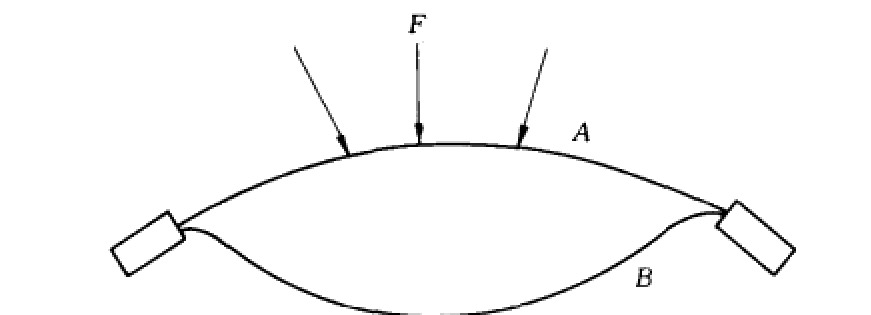
When force is applied to press the spring strip, if the force F is very small, the spring strip only undergoes a small deformation, and after the force is released, the deformation also disappears. This kind of deformation under a small force is a change of state. However, when the force is large enough, exceeding a certain critical value, the spring strip will suddenly move from position A to position B, and after the force F is released, the deformation does not disappear. This is a change between two functional states.
Our research on human functional state is, of course, much more complex than this example. It is very difficult to go quantitative right away. We can first proceed qualitatively, and then quantitatively. Mathematical treatment will make the expression of patterns more explicit, clear, and more convincing, but we must grasp the key issues. Mathematical methods involve many parameters; what is the primary parameter of special functions? This is still unclear. If we conduct quantitative research now, it would be easy, but we might very well miss the primary parameter. So the most difficult part is understanding the essence of the problem and grasping the key aspects; rushing for quick success will not work.
What is the human special functional state? First, we need a qualitative understanding, and then gradually deepen it to obtain quantitative research results.
The issue of human functional state involves a very wide range of fields; we must broaden our horizons and adopt a high vantage point. We must first do our own work well, while also collaborating and learning. The naval hospital’s work is very thorough; the Ministry of Health has already decided to establish a Qigong Research Institute at the Academy of Traditional Chinese Medicine, and you can get in touch with them. Japan is also working on human-machine engineering, applying it in industrial production. Hangzhou University is going to develop ergonomics, and I hear they plan to recruit graduate students. Do not close the door and work alone; there is a great deal to learn.
An article in the British magazine New Scientist, in the December 2, 1982 issue, involves embryology and developmental biology, stating that the growth of human arms and legs occurs in steps. This probably involves human science; we cannot start with cells first, as there are still some intermediate levels that have not been clarified. A young person in Inner Mongolia, China, is quite liberated in thinking, though lacking sufficient rigor. He observed that both animals and plants follow a holographic principle, which is related to developmental biology and embryology. In short, there is indeed a great deal to be done; we must never close the door and work alone, and we must liberate our thinking. Do not be afraid of contradictions either; we must have a spirit of innovation and do our work well.
(May 23, 1983)
II. Systems Science and Human Functional State
The view that traditional Chinese medicine theory, qigong, and special functions are closely related is something I learned from Comrade Lü Bingkui. It seems that the view proposed by Director Chen Xin—that meridians, qigong, and special functions are closely related—is more specific.
I once said that future technological revolutions will originate from scientific revolutions, and scientific revolutions will come from systems science, cognitive science, and human science. The significance is profound and far-reaching.
Of course, issues of understanding cannot be forced. Indeed, many people do not understand research on a problem that will bring about a scientific and technological revolution, and this is a difficulty in carrying out our work. We must gradually expand our influence through our own arduous and scientific work.
It should be said that our Central Committee still supports this work, in a principled manner. We can publicize the spirit of the Central Committee. The magazine Research on Human Special Functions should publicize it, and the distribution method should also be improved.
The phenomenon of special functions is indeed too strange, not easily accepted by everyone, which is understandable. The problem itself is both complex and difficult.
Now there has been a great change. Britain worked on it for a hundred years without breakthrough progress, because at that time there was no systems science. Now it is different; analytical science has obtained a large amount of data, and systems science has emerged, which is the latest development.
Some people say that before 1978 was the first period of systems science development, and after that there have been many further developments. The resolution of functional states depends on systems science; without systems science, there is essentially no way forward. We also need to understand computers.
The function of a giant system is often unexpected, and its behavior is nonlinear. This increases the difficulty of description.
Systems science has only recently begun to develop, and it is precisely an important tool for our study of human science. Systems science, cognitive science, and human science are interconnected. Coupled with the rapid development of testing instruments and computers, solving the problems of human science is obviously no longer as difficult as it was for Britain during the previous hundred years.
It is not easy for the human body to enter the special functional state. But many experimental data and experiences show that once a person enters the special functional state, performing functions becomes very easy.
If the work on how to enter the qigong functional state is done well, many problems will be easily solved. Therefore, qigong research is the key to opening the door to human science.
Whether the essence of this process is magnetic is still uncertain. If it is magnetic, then physicists would have methods to address it. But if it is not magnetic, then what is it? There are still many, many questions that we need to think about carefully.
The research team on the magnetic issue has not yet been organized. Many Chinese people follow trends; if foreigners have not spoken, they do not dare to act, making it very difficult to carry out any work. In short, I still advocate systems science.
(April 2, 1984)
III. The Systems Perspective in Human Body Science Research
The Systems Perspective Is the Foundation of Human Body Science Research
Let me first say a few words about my understanding of the topic presented by the speaker (note: referring to “A Systems Perspective on Stress”). I believe this topic, truly viewed from the perspective of human body science, concerns the fact that a person lives within an environment, and the environment together with the person himself constitutes a super-giant system. Based on what I have learned from several of these discussion seminars, a person within such a super-giant system will reach a certain functional state. This state may be normal and healthy, but due to the influence of various factors, it may also shift into an abnormal functional state, which is undesirable.
Regarding the changes that cause a person to go from normal to abnormal, I believe there are three categories of factors. The first category consists of the various environmental factors discussed today, such as vibration, high temperature, low temperature, carbon monoxide, and so forth—these are one type of factor that can affect a person’s functional state. The second category of factors concerns the emotions of people in modern society. Because a person lives in an environment that provides many stimuli, a person’s emotions, mental state, or consciousness can also pull their functional state into an abnormal condition. The third category of factors is the immune system, which was mentioned last time. She made a remark that left a deep impression on me: she said that during the twenty-four hours of a day, a person is subjected to bacterial invasions, or to attacks from dead cells within the person’s own body—harmful substances that need to be expelled. Such instances are innumerable, and the human immune system fights against these countless enemies that invade the body. What she described constitutes the third category of factors. Whether there are other aspects remains to be seen.
What I have heard and learned here is this: the human being, as such a giant system, constantly experiences interference because he lives within a super-giant system, causing him to deviate from a normal state into an abnormal state. Of course, a person also has his own internal systems, such as the immune system mentioned last time. What we heard today also involves various responses, or what might be called endocrine conditions—these may also represent a kind of anti-interference response by the human body, that is, the biological organism defending itself. Whether this constitutes a basic concept—namely, that the human being as a giant system, situated within a super-giant system, is constantly subjected to various forms of interference, and the person must rise to defend himself and eliminate these interferences—needs to be considered. What we call illness, or abnormality, is simply the person moving from a normal functional state to an abnormal functional state.
I have been in correspondence with colleagues in Changsha, Hunan, and I said that what traditional Chinese medicine calls “determining the pattern” (辨证) and “treating according to the pattern” (辨证施治)—this “pattern” (证) is precisely the functional state, and “treatment” (施治) refers to pulling the abnormal functional state back to a normal functional state, or inducing it to return to a normal functional state. Whether this concept is viable is something I ask the speaker to consider as well. I think his material is excellent. Just now I also discussed with Director Chen whether we might ask the speaker to write up these materials as an article, and when writing, whether he might consider the viewpoint I just described. If it seems acceptable, perhaps he could incorporate some of it. Why do I say this? Because what he presented just now adopted a systems perspective, which is excellent. However, I believe he has not yet synthesized everything together. He discussed the endocrine system, discussed physiological changes, and finally discussed the effects of drugs—he presented these separately. He started from the second point, then discussed the third and fourth points, addressing three aspects. I believe this is not yet a thorough systems approach. A thorough systems approach would recognize that endocrine changes are themselves a manifestation of the person having deviated from a normal state, and that the action of medication is nothing other than pulling an abnormal state back to a normal state. I ask the speaker to consider further whether this is indeed the case. After careful consideration, please write a piece. We must promote the systems perspective and not miss any opportunity to advocate for it. The more we listen at these academic discussion meetings, the more we feel that the systems perspective is indispensable. Only by adopting the systems perspective can we gradually establish human body science on a scientific foundation.
This year I also heard a report related to nutrition. His discussion of nutrition also employed a systems perspective. So I also suggested that he
write up the content as an article, which also promotes the systems perspective.
On Behavioral Science
Second point: during this period I have been thinking about some problems. This problem is somewhat related to what I am discussing today regarding social factors—how people are subjected to social conditions, especially the extremely intense influences of modern society. This problem is the issue of behavioral science. Comrades present here may know that I have long been considering the question of how many major divisions modern science and technology should be classified into. Two years ago, when I spoke here, I discussed six divisions: natural science, social science, mathematical science, systems science, noetic science (cognitive science), and human body science. About a year ago, I felt this was insufficient, so I expanded from six divisions to eight, adding two more. One was something I had actually overlooked—military science, which of course exists objectively. As someone wearing a military uniform, forgetting military science was inexcusable. The other was literary and artistic theory—not the practice of literature and art, since the practice of literature and art is not science but art; however, literary and artistic theory is science. Until last year, I still spoke of these eight major divisions. But I always felt that since I had already added one expansion, going from six to eight, should I add more? I was not certain, but I was mentally prepared that there might be new things, because science and technology are constantly developing. Sure enough, in January of this year, I saw a report in the Economic Daily stating that our country had established a behavioral science society and held the first national behavioral science conference. This report gave me great inspiration: since the People’s Republic of China had already established a behavioral science society and held a conference, then it must be a formal field of science to be studied. Could behavioral science be incorporated into any of the eight divisions I just mentioned? At the time, I found this very difficult—the content of behavioral science seemed hard to fit into any single division. Then I thought that perhaps another division needed to be added: behavioral science. Therefore, in April of this year, when the China Association for Science and Technology convened an interdisciplinary science discussion meeting, I formally announced: it is no longer eight divisions, but nine divisions, including behavioral science.
Why raise the issue of behavioral science today? It is relevant, because at the April discussion meeting, when they discussed behavioral science, they also recognized that behavioral science abroad has biases. Abroad, the consideration of behavioral science is entirely about extracting greater profits—how to mobilize the enthusiasm of employees in an enterprise to better serve the enterprise. This is too narrow a view, so at that academic discussion meeting, everyone proposed establishing a behavioral science with Chinese characteristics. What does “with Chinese characteristics” mean? Everyone also discussed this: first, of course, it means using the standpoint, viewpoint, and method of Marxism-Leninism and Mao Zedong Thought to study behavioral science. But recently, I have been constantly pondering this question: using Marxism-Leninism and Mao Zedong Thought for research, combined with China’s reality—this is all correct, but how exactly should it be done? I recently read an article, a very good article on modern Chinese literature, published in issue No. 3 of Social Sciences in China this year, titled “The Conflict between Civilization and Ignorance.” The article states that in our present society, many phenomena manifest the contradiction that people’s consciousness, thinking, and awareness cannot keep pace with social development. This is a fundamental problem, and also a fundamental problem in human society. This problem has in fact existed ever since human society came into being. Why do I say this? Because human consciousness, human thinking, and human cognition of the objective world constitute the human subjective world. The subjective world is secondary; what is primary is the objective material world. How does the secondary keep pace with the primary? Through social practice, one gradually comes to know the objective world. Is this not a fundamental principle of Marxist philosophy? According to this principle, a certain phenomenon naturally arises: human subjective cognition always lags behind the development of objective things. Therefore, human social consciousness always lags behind social development.
Of course, there is an exception. In the past, when a declining ruling class governed a society, it sought to maintain its power, so its social system restricted social development. At that time, it was possible that the consciousness of the broad masses and the people was ahead of the objective reality of that society—this was possible, and this would lead to revolution. But in our socialist country, we have such an superior system, so it is not like that. Instead, social development marches ahead, and people’s consciousness and understanding of this objective society falls behind. This is a contradiction. In the language of the literary figure just mentioned, it is the conflict between civilization and ignorance. I once discussed this topic with another person. He said this situation was very disheartening—that the conflict between civilization and ignorance that currently exists among us is still very difficult to resolve. I said, don’t be disheartened. I would say something even more disheartening: such conflicts are eternal, because once old contradictions and conflicts are resolved, society advances again, and new ones will arise.
generate new conflicts and contradictions. As will be discussed below, such conflicts are precisely what cause tension in our lives and consciousness. Why do people feel tense? It is because they have not grasped the laws of objective things and find them difficult to cope with—this is a fundamental problem. How does this connect to behavioral science? Because behavioral science is precisely what addresses this problem. On the one hand, we must carry out ideological-political work and educational work so that people can keep pace with the development of objective things. This is what the central leadership comrades recently spoke of—the need for ideals, that is, people must have morality and ethical awareness.
There is also another extremely important aspect. Suppose someone is unwilling to keep pace completely, because there is a distinction between the advanced and the backward among people. If a person temporarily cannot keep up, has not yet understood but has already acted, then contradictions will inevitably arise in their behavior, and in serious cases, this constitutes crime. Therefore, behavioral science has another aspect: when such situations arise, we must take measures to minimize adverse effects. This is what we often refer to as ideological-educational work, hoping the person has ideals; but when they sometimes cannot achieve this, we must adopt the attitude of rule of law and hold them accountable according to law. From our perspective—from the genuine Marxist-Leninist, Mao Zedong Thought perspective, combined with our Chinese characteristics—behavioral science has two aspects: first, ideological-political work and educational work; second, rule of law.
After thinking this through, I believe that behavioral science is not the narrow behavioral science currently discussed by foreigners, but should encompass both aspects, fully including legal science within behavioral science. This is my recent understanding of behavioral science, and this understanding connects back to the fundamental contradiction discussed earlier. As Marxists, once we recognize this fundamental contradiction, we are not helpless—as if there will always be a conflict between civilization and ignorance; we do not see it that way. Marxism has a fundamental point: people can always come to know the objective world, and the purpose of knowing the objective world is to transform it. As long as we recognize that there is always a gap between human thought and consciousness on the one hand and social practice and social development on the other, we should take measures to educate people so that we can more quickly understand what the objective world is about. This brings us back to the issue the speaker raised at the very beginning—he seemed somewhat pessimistic, feeling that the faster society develops, the more intense contradictions become, and the proportion of people suffering myocardial infarction will increase. I think there is some reason to his view, but we cannot see it entirely that way. We have Marxism, we have the superior socialist system, and we can carry out behavioral science work—the work of having ideals. If problems do arise, there is also the disciplinary aspect, which can minimize the issues.
If each of us can understand more of the highest generalization of human knowledge—Marxist philosophy—we will be able to understand the objective world better, faster, and keep pace with it more easily. That is to say, when people look at things with a bit more intelligence, a bit more wisdom, standing a bit higher, they can see things more clearly. On this point, I am afraid everyone must acknowledge that if a person has experience or a relatively high level of cultivation, they will suffer less in complex situations. Comrades all know that experienced people versus inexperienced people, people with abundant knowledge versus people with relatively little knowledge, respond differently to the same objective stimuli. A smarter, more knowledgeable, and more cultivated person has anticipated that things would turn out this way, so they are not anxious; whereas a less capable person may be terribly anxious and unable to handle the matter. Therefore, I believe we should not be pessimistic. People can come to know the objective world, and once they know it, they can actively transform it. The gap can be narrowed, and adverse effects can be reduced. In this regard, we must emphasize (in my words) the need to strengthen behavioral science work and reduce the contradictions arising from people’s inability to keep up with social development. It is not the case that working more makes one tense; people can do a great deal of work without being tense, because they have fully grasped the laws of the work—no matter how intense, it does not matter. What we fear most is not knowing the laws. Therefore, dealing with tension is, in practice, a matter of grasping the laws. Of course, we must understand all three types of factors mentioned earlier that cause the functional state of the human giant system to deviate. Once we understand them and grasp the laws, we need not be afraid and can resist all kinds of interfering factors.
Immunology and Network Theory Have Already Reached the Doorway of Systems Science
The disciplines we study, connected to human body science, must employ the systems perspective—that is, the perspective of systems science, systems theory, and systems methodology. Without this perspective, I can say that it will be very difficult for our work to make progress. Two years ago, when I said this, I was not yet fully confident, but after these two years, having listened to so many of your reports and having studied here, I believe this point has become extremely clear. Just
The problems just discussed are related to the stress system—the systems view of stress—and are also about this issue.
The previous report was very good; she presented all the data that could be collected. Of course, I am no expert in this field, but after listening I felt I learned a great deal. However, I believe she seemed to have already arrived at the doorstep of systems science, yet she hesitated and did not enter, still lingering outside the door. Why do I say this? I had previously read about an eminent immunologist, Jerne, who won the Nobel Prize in 1984. He has a theory called the network theory. I asked comrades at the institute to look up what the network theory is. A week ago, she briefly introduced it, but she stopped there and did not go further. I felt this was a great pity. Because the network theory has already arrived at the doorstep of systems science; with just one more push, it would enter. His network theory is too simple. If this theory were extended to the human body as a giant system, the problem would be solved. The field of immunology has now arrived outside the gateway of systems theory and human body science—just one step short of entering. Why can’t our comrades do this work? I want to give a push. You have reached the door but have not yet entered. Although Jerne is a great scientist and a Nobel laureate, his network theory is too simple and cannot fully explain the phenomenon. If we adopt the perspective of the human body as a giant system, I believe that in the future all matters of immunology can be clarified. I cite this example: what we heard last time seemed to fall just a little short; with one more effort, there is great hope.
Studying Human Meridians Using the Systems View
There is another issue, concerning the study of meridians. If we follow the working methods consistently used both domestically and internationally in the past—namely, seeking one-to-one relationships—then it is impossible to research meridians, because the human body is not such a one-to-one relationship; it is a giant system. I recently saw work done using simple, mechanical one-to-one methods. The volume of data is enormous, but in the end it still cannot be clearly explained. I think that since there are these works collected in books abroad, as well as works not collected in books, and also the work done domestically—we invited comrades from the College of Traditional Chinese Medicine to speak to us—but because the perspective used was incorrect, none of them succeeded. This raises a question: should we make an additional effort to promote using the systems view, using the perspective of genuine human body science to study meridians? In this way we can utilize the large body of results from others—it would be like turning stone into gold. Originally they could not solve the problems, but with these same results, if we look from another angle, the problems become clear and the results emerge.
Comrades, why don’t we do this? It is just a little bit short. For example, regarding the immunology I just mentioned, Jerne has already reached the door, just a few steps short of entering. I think the meridian issue is the same. Everyone has done so much work, yet it is just a little bit short of entering. I make a suggestion: please consider it, Deputy Director Zhuang—for next year’s academic discussions, establish a rule: if the report being given is not presented from the perspective of systems science, then it should not be given. If you want to present, you must present from the systems perspective. Regardless, to some degree, you must use the systems science perspective. Is this acceptable? It might be a bit forced. When people do scholarship, sometimes they need a bit of pressure. Give you a push and it comes out; once it comes out, that’s good.
(July 1, 1985)
IV. Using Systems Science Methods to Study Human Body Science
From the perspective of human body science, humans live within an environment, and the super-giant system of human and environment is dialectically unified. As a giant system, the human being can achieve a certain functional state within this super-giant system. This functional state may be normal, or it may be abnormal
. The transition from normal to abnormal functional states appears to involve three categories of factors:
- Various environmental factors, such as vibration, high temperature, low temperature, carbon monoxide, and other forms of energy or material action;
- The influence of modern society on human emotions or mental states, pulling the human functional state into an abnormal condition;
- Within each 24-hour day, the human body is subjected to bacterial invasion or the corrosive effects of dying cells—surely numbering in the thousands and tens of thousands. Humans are constantly fighting these myriad “enemies.”
In short, human beings are continuously subjected to interference within the super-giant system of the environment, and humans take self-defensive actions, such as stress responses, immune responses, and so forth. Is this not a fundamental concept?
The human giant system is continuously interfered with within the super-giant system; humans rise to defend themselves and eliminate such interference, thereby forming various functional states. What traditional Chinese medicine calls “syndrome differentiation and treatment” (辨证施治)—this “syndrome” (证) is precisely a functional state. Can we apply this concept? This is an explanation based on systems thinking; only by adopting the systems perspective and the methods of systems science can human body science be placed on the foundation of modern science.
Another point: during this period, I have been considering certain problems arising from the considerable tensions caused by social factors. What problems? Namely, the problems of behavioral science.
Two years ago, I once stated that the entire scientific system comprises six major branches: natural science, social science, mathematical science, systems science, cognitive science (思维科学), and human body science (人体科学). Later, this was expanded to eight branches, adding military science and literary theory. Up until last year, I still spoke of eight major branches, though I also thought there might be new additions. In January of this year, the Economic Daily reported that a behavioral science society had been established, that the first behavioral science conference had been held, and that it was officially designated as a discipline to be studied. Its content is difficult to fit into any of the existing branches; therefore, there are now nine major branches, with behavioral science added as an additional discipline.
Here, we must also recognize that behavioral science abroad has its biases. They study behavioral science in order to mobilize the enthusiasm of employed personnel to serve the capitalists. Our study of behavioral science is, of course, for socialist construction; therefore, it must have Chinese characteristics and must be guided by Marxism-Leninism and Mao Zedong Thought. So, how exactly should we proceed? In this year’s Social Sciences in China (中国社会科学) journal, issues 3 and 4, there is a lengthy article by Comrade Ji Hongzhen titled “The Conflict between Civilization and Ignorance,” which discusses how people’s thinking fails to keep pace with the development of the times, thus giving rise to conflict. Originally, the human subjective understanding of the objective world is secondary, while the development and movement of the objective world is primary. How can the secondary keep pace with the primary? This is a universal problem. Human cognition, generally speaking, always lags behind the development of objective things. Human social consciousness also always lags behind social development. In eras of transition between old and new, when revolution or reform is imminent, this problem becomes even more prominent. In socialist countries, it manifests as the conflict between civilization and ignorance. Such a conflict is eternal: when old contradictions are resolved, new contradictions will still arise. This conflict creates tension in both our lives and our consciousness. When we do not grasp the laws of objective things, it is difficult to cope with them; at such times, we feel tense. Behavioral science is precisely meant to study this point—to study how people can adapt to such situations. On the one hand, education must be conducted so that people can keep pace with the development of the times; nowadays, educating people to have ideals and moral character is a matter of ethics. On the other hand, people in society differ between the advanced and the backward; some are so severe that they even commit crimes. When such situations arise, measures should be taken—legal methods should be adopted, that is, “binding them with law.” From this perspective, behavioral science has two aspects: first, ideological and political work; second, legal constraints. Thus, legal science (法科学) also falls within the scope of behavioral science.
The fundamental contradiction is that human subjective cognition cannot keep pace with objective development. Recognizing this fundamental contradiction does not mean we are entirely powerless. Marxist philosophy holds that humans can always come to know the objective world, and that knowing the objective world is for the purpose of transforming it. In response to the above contradiction, we can take measures: educating people and binding them with law, so that people can adapt to this society and to social development. With Marxism as our guide, we can effectively carry out research in behavioral science. Through research combined with practice, unfavorable factors can be minimized. If each of us can understand a bit more of the highest generalization of human knowledge—Marxist philosophy—then we can come to know the world more quickly and thereby transform it more appropriately. When a person’s ideological realm is elevated, their approach to problems will differ from the ordinary. A person of rich experience and a person lacking knowledge will behave differently when confronting the above contradictions. When encountering difficult problems, a person of richer cultivation will feel that they had anticipated them all along, and therefore will not become anxious. A person’s cultivation
Training from many sources: viewed from our country’s traditional culture, many ancient philosophers and scholars benefited from using qigong to cultivate their temperament and character. This path is well worth noting.
Through study and training, we firmly believe that human beings can understand the world, and that understanding the world is for the purpose of transforming it. Under the guidance of this thought, we must strengthen research work in behavioral science, thereby striving to reduce the contradiction whereby society moves forward but thought lags behind. As long as we grasp the laws of how things develop, we need not fear no matter how tiring or difficult it gets. When some people encounter a situation and say “hard to handle,” it is precisely because they do not know the underlying laws. Research in behavioral science is precisely about solving the problem of mastering these laws.
We must regard the environment as a complex super-giant system, and we must also understand the deviating factors within it, so as to better resist various interfering factors. In our scholarly research, we must use a systems perspective; without this perspective, it is very difficult for our work to make progress. In our academic activities, some people have discussed the stress system, some have discussed immune issues, and they have presented all the materials they collected. The materials are very good—they have already reached the threshold of systems science—but then hesitated. The 1984 Nobel laureate Niels K. Jerne proposed a network theory; he too had already reached the threshold of systems science, but stopped there. It should be advanced into the theory of the human giant system. Since we are just one step away from entering, why don’t our comrades do this work? The network theory is still too crude; if we continue researching with the perspective of the human system and make one more effort, there is great hope. The same is true for research on the meridian channels: looking only for one-to-one relationships at the phenomenological level cannot possibly uncover the essence of the meridians. At present, research on meridians both domestically and internationally has produced a great quantity of data, but in the end things are still unclear. This is because the perspective is wrong, and therefore none of them have succeeded. We should make one more effort and use a systems perspective to organize this large body of results—“turning stone into gold.” Comrades! Why don’t we do this work?
(February 1986)
Five: Giant Systems and Research on Human Science
What is human science? I have discussed and thought about this question on the previous two occasions. I feel that the central idea of human science is to regard the human being as a giant system, and moreover an open giant system that is closely related to the entire cosmic environment. If we place the human being within the cosmic environment, then it becomes even larger—it becomes a super-giant system. When we speak of a giant system, it is not merely holism. Holism is extremely important, but the concept of a system, the concept of systems theory, combines holism with reductionism in a dialectical unity. The concepts of giant systems and super-giant systems unite holism and reductionism—that is, the macroscopic and the microscopic—in a dialectical unity to examine problems. We emphasize understanding the human being as such a giant system, such an open giant system, and for this we must use the concept of functional states. It is of course wrong not to consider the causes that give rise to our pathological states. But it is also wrong to consider only the causes. What we must study is the functional state of the human being. This kind of perspective modernizes the perspective of traditional Chinese medicine, or makes it more scientific. What I said before is what I have just stated. Today I feel I should add one more point: when you say it is a giant system, I am afraid that many higher animals are also giant systems, and even higher plants are giant systems too. Making this clear is helpful for studying humans, studying animals, and studying organisms. But studying organisms cannot solve the entire problem of the human being. Here, I feel there is a very important distinction, namely that because of the highly developed brain and nervous system of the human being, humans produce a phenomenon that no other form of life—neither animal nor plant—possesses: humans have consciousness. Up to now, consciousness has indeed been proven to be absent in all other organisms. Only humans have it. Many people have searched for consciousness in other organisms, and many books have been written on the subject, but in the end the conclusion can only be that it has not been found. Consciousness, or the highest level of activity of the human brain, is unique to humans. I feel that this concept of what is uniquely human can also be viewed from another angle, because as humans evolved into modern humans and built today’s earth—
The world on this globe—there could be no such world without human beings. Therefore, human beings occupy a special position among life phenomena. What is this special position? The materialist method of explanation holds that because the human brain and the human nervous system have developed to such a high degree, a qualitative leap has occurred, producing consciousness—this is an extremely important factor. To put it more fully, human body science studies human beings. Why do we single out the science that studies human beings and not place it within the larger subject of life science? It is precisely because human beings have this characteristic: they are not only an open giant system, but also, owing to the high degree of development of the human brain and nervous system, human beings possess consciousness. Now, you might say, what is so extraordinary about consciousness? From the perspective of human body science, the importance of consciousness lies in the fact that it is the highest-level activity of the human brain and can in turn react upon the lower levels of the human body. Is such a view idealism? No, it is dialectical materialism. On many occasions I have quoted the words of Nobel laureate Sperry. What is particularly interesting is that he repeatedly and vocally opposes what he recognizes as Marxism. Yet he puts forward precisely this concept: that consciousness is the highest-level activity of the human brain, and that this highest-level activity—consciousness—can in turn react upon the activities of lower levels. This was not derived because he copied some phrase from a book and called it dialectical materialism—he did no such thing. He arrived at it entirely through independent thinking, because he does not want Marxist philosophy. But his scientific research, and a scientist must be honest and acknowledge facts, led him through the study of facts to this truth, which makes it all the more persuasive. When we examine why we separate out human body science rather than placing it within life science, the reason is that human beings possess consciousness; humans are a very special kind of life phenomenon among life phenomena. Because humans have consciousness, while other living things do not. Now the proposal of human body science and the formal establishment of the China Human Body Science Society have a solid basis. We can answer you as to why we propose human body science, why we single it out rather than placing it within life science—it is perfectly clear. We can view it this way: human body science is a department of science and technology; it is not merely a single discipline. It is itself a system, a system of knowledge. I discussed this in my 1983 article in Exploration of Nature. There I said that the highest generalization of all science and technology, of all human knowledge, is Marxist philosophy. Marxist philosophy differs from traditional philosophy in that it is the highest generalization of human knowledge verified through practice; it has a basis, and that basis is the totality of human knowledge, especially science and technology. Therefore, the guiding ideology on which human body science relies is Marxist philosophy, and the philosophical viewpoint connected to human body science is precisely what I have just discussed: giant systems, super-giant systems, and the role of human consciousness. This can be regarded as the philosophical generalization of human body science; it has its own distinctive character. I formerly called it the “view of human-heaven relations” (ren tian guan). In the 1983 Exploration of Nature article, I discussed the view of human-heaven relations in greater detail and more carefully: there is a cosmological view of human-heaven relations, a macroscopic view of human-heaven relations, and a microscopic view of human-heaven relations. China’s contribution lies in the macroscopic view of human-heaven relations. The cosmological view of human-heaven relations is actually connected to cosmology; the microscopic view of human-heaven relations involves quantum mechanics. Research at both ends is still insufficient and awaits further efforts in the future.
Below the philosophical level, I divide all departments of science and technology into three tiers. The first is basic science. In human body science, what should the basic science be called? I suggest calling it “human somatology” (renti xue)—the study of the human body. Human somatology in fact has a foundation: past physiology and its many branches—these are all foundational. We are not saying those things should be discarded. Moreover, psychology is also a foundation of human somatology. The brain science that has developed particularly over the past twenty years is also very important, as is the now-emerging field of physiological psychology, and also what Sperry has proposed regarding the highest-level activities of the human brain, which he calls “mentalics”—the study of the mind. He uses the word “Mentalies” for the mental. All of these are foundations of human somatology, or one might say the building blocks, brick by brick, of its edifice. What is lacking in the human somatology we are now establishing? We need to integrate these foundations or building materials using systems science, systems methodology, and especially the theories of giant systems and systems science. Integrating them is not merely additive; there is a higher-level sublimation. Its appearance will differ from the foundational elements just mentioned—it rises to a higher level, it undergoes a transformation. It is genuinely dialectical materialist rather than mechanistic materialist—this is human somatology. This is the basic scientific theory of human body science.
The tier below basic science is technical science—that is, the theory of practical application or of directly transforming the objective world. In human body science, this is the theory of medicine. The theory of Western medicine is also part of this. What now appears very important is to systematize the theory of traditional Chinese medicine. Using only the terminology of Chinese medicine, such as yin and yang, is not modern language. In the 1983 Exploration of Nature article, I proposed that the theory of Chinese medicine is empirical and is a precious treasure, but the theory of Chinese medicine is not expressed in modern language, making it difficult to understand, and it also includes some incorrect things—there is dross as well. To remove the dross and articulate it in modern language—this is our task.
Western medical theory contains even more content—pathology, pharmacology, immunology, and a great deal more. Here too, we must use the perspectives of basic science, human body science, and somatology to gradually clarify the field of technical science. Within technical science, there is also a discipline that has developed over the past several decades, namely the study of how humans and machines work together cooperatively. Abroad, this is called ergonomics (human-machine ergonomics). It concerns how humans and machines can effectively coordinate with each other.
I believe that medical theory—whether traditional Chinese medicine theory or Western medicine theory—after being modernized, how should it be modernized? It should be modernized using the perspective of somatology. Human-machine ergonomics and the like all belong to the level of technical science. Then, directly connected with application, somewhat like engineering technology, directly transforming the objective world—or we may call them applied sciences! Within the applied sciences of human body science, medicine is of course included. Medicine has traditionally been described as follows: medicine for treating illness is called first medicine, medicine for preventing illness is called second medicine, and medicine for rehabilitation is called third medicine. In reality, the boundary between preventing and treating illness is gradually becoming very difficult to draw. Not long ago, I came across some material about something Americans are working on, called predictive medicine. That is to say, within the next five years, a prediction can be made about what illnesses you might develop. How is this done? In fact, it also uses the concepts of human body science. First, a survey is conducted—for example, having Zhang San fill out a questionnaire. According to reports, men must answer 314 questions, and women slightly more, 340 questions. One portion consists of the materials from our current physical examinations, which are data-based. There are also questions involving your lifestyle, your work environment, your mental state, your attitude toward illness, whether you are constantly worried or rather optimistic, and so forth—altogether over 300 questions to answer and fill in. Then, based on all this data and information, a systems model is roughly established. These conditions and materials are processed using a computer and this systems model, and then it can predict what problems may arise for you in the next five years—hence the name predictive medicine. Of course, it also incorporates elements of second medicine, and therefore advises you on what to pay attention to, whether you should take some medication, or what to watch for in your daily life. Second medicine is also developing, as is third medicine, namely rehabilitation medicine. Last time I mentioned that I heard the news that the China Association for Science and Technology is also preparing to accept the China Third Medicine Society. I mentioned this here before. There is also fourth medicine, which is closely related to the work we are doing: how to enable humans to have greater capabilities, to more fully unleash human potential, to accomplish greater things, and to do things that we currently cannot do. In these research efforts, we must pay full attention to drawing on thousands of years of human experience. In our country, this has already been written into the Constitution—the development of traditional medicine. I recently read that some countries in Africa also face this issue, because before Western medicine was introduced and spread to Africa, these peoples had also lived on the African continent for a very long time. They too had experience in fighting disease; they too had their traditional African medicine. African traditional medicine has suffered a situation similar to that of Chinese medicine in China—after Western medicine entered, it dismissed traditional medicine as unscientific, failing to recognize that traditional medicine also represents the experience of local peoples in fighting disease over thousands of years. So this report says that Africa is now also placing renewed importance on African traditional medicine, which is a good thing.
Among the applied disciplines, what is very important for our institute is human-machine-environment systems engineering. Thus, these three levels: in basic science, what we must establish is somatology, built upon the rich foundation we already possess; in technical science, we must truly perfect and modernize medical theory; we must study human-machine ergonomics; in application, we must develop medicine and human-machine-environment systems engineering. And throughout the entire enterprise of human body science—from philosophy, to basic science, to technical science, to applied sciences—what can promote our work in these areas, beyond the entirety of medical knowledge, is that we must also attach importance to three areas: traditional Chinese medicine, qigong, and human special functions (paranormal abilities). Only in this way can we say that we have established the system just described, from philosophy to basic science, to technical science, to applied sciences. What I have just described is what we recognize today—what we have come to understand about human body science over the course of five and a half years. We have this understanding, and I in particular have this understanding, which is inseparable from being able to participate in our Monday academic seminar for four and a half years, so I am very grateful to everyone. Beyond my gratitude, I would also like to offer everyone a suggestion: after four and a half years of discussion, the concept of human body science has become increasingly clear. I now believe that the concept of human body science as just described is valid. If four or five years ago there was still not much certainty, that is no longer the case now—there is certainty. The reasoning for this has just been explained: from the philosophical perspective to the relationship with other sciences, everything has been clarified. Therefore, I say that everyone present here must use the perspective of human body science in carrying out your work. The perspective of human body science is a sharp tool; the perspective of human body science is a sharp tool for all the work we do. Just as I always say on other occasions: if you want to research science and technology, if you want to do scientific and technological work, and you do not use Marxist philosophy, then you are being very foolish—you have thrown away a sharp tool. Just as
Similarly, if you want to work, without using the perspective of human body science—of course, the perspective of human body science also includes the perspective of Marxist philosophy—without this perspective, I would say you are being foolish. At the dozen or so discussion sessions this year, my impression has consistently been this: all the topics discussed could be explained far more profoundly and clearly if one used the perspective of human body science. I urge everyone, since the perspective of human body science is established and has been proven correct—even the State Science and Technology Commission has agreed to establish a Human Body Science Society—not to use this sharp tool would be unfortunate. Moreover, I have found that once you have the perspective of human body science, a great deal of material becomes usable, enriching and clarifying the ideas of human body science. I am not an expert; I have probably read less in this field than most of you here. So I hope that those of you present will examine these materials from the perspective of human body science, and that you can promptly distill and refine them, laying brick by brick the foundation of human body science—that would be excellent. If you do not have the perspective of human body science in mind, you might discard these materials after reading them, throwing away useful things—wouldn’t that mean missing a great opportunity? The point of these few words is to thank everyone, and beyond thanks, to offer a suggestion: that everyone use the perspective of human body science in their work. Without question, all of our work should adopt the perspective of human body science. In this way, we can feel that we truly hold an advantageous academic position, because we think more deeply. Please, by all means, cherish this position and develop it further.
(June 29, 1987)
VI. The Human Body Is a Complex Giant System
Human body science is a major department within the system of modern science and technology. Because it involves scientific revolution, it involves technological revolution. The philosophy of human body science—the view of human-universe relations; its method—the method of systems science. Why is this so? Because the human body is a giant system, an open giant system, and it must be considered in connection with the larger environment—the universe. Now it appears that this giant system also has its own characteristics. When we ordinarily speak of systems, we refer to simple systems, such as those in engineering control from the past. Then, gradually, as systems developed, their components became more complex and larger, and some people proposed calling them large systems. When large systems become even more complex, with their components numbering in the tens of thousands or hundreds of millions, these are called giant systems. Therefore, a giant system is the largest and most complex type within a system. This concept is not yet very clear. Through the study classes in systems science, everyone engaged in discussion and gradually deepened this concept a bit. That is, within giant systems, several types can be distinguished (see diagram): one type is called a simple giant system. Although it is a giant system, it is relatively simple, like many giant systems in physics, composed of molecules.
Simple small system → Large system → Simple giant system → Giant system → Social system → Complex giant system → Human body → Geographic system (ecosystem)
Giant systems composed of molecules—for example, a gas: is it a giant system? It is a giant system, because the number of molecules composing a gas is extremely large, in the billions and trillions. But it is also simple, because the types of molecules are not too many, and the laws governing the interactions between molecules are relatively simple. I believe such giant systems are relatively manageable, and there already exists a semi-empirical, semi-theoretical discipline—synergetics. Previously, within the scope of our systems science discussions, we conducted an in-depth examination of synergetics. Later, through research by Beijing Normal University together with us, we found that synergetics is not so thorough in theory. By theoretically thorough, one should mean as thorough as theories such as statistical physics and the kinetic theory of molecules.
fundamental, that is, starting from individual molecules and then arriving at results through theoretical treatment. Synergetics came to the field from a different direction; it adopted some results from molecular kinetic theory and statistical physics, accepting these results without providing theoretical argumentation or proof. Despite this, from the standpoint of physical theory, synergetics is not so thorough, but it is very useful; it can solve problems within simple giant systems and is quite effective. Haken, the originator of synergetics, has said this many times—for example, that its treatment of lasers is very effective. However, I believe that even Haken himself has not recognized that the problems he deals with are giant systems—simple giant systems. There are also other giant systems, such as our society, which is the most complex giant system. Needless to say, the people in this society are of all kinds, making it even more complex: old and young, male and female, Han or Uyghur or Tibetan—these are all different—as are Chinese versus foreign. Moreover, for any individual person, that person possesses consciousness; he is not entirely passive in making judgments but has active thoughts. Therefore, his reactions and behaviors can change at any time and place: today it is one way, tomorrow it may not be, the day after he may revert to how he was the first day, and then the day after that change again into something else—because he is conscious, processing information from his environment and making his own decisions. These decisions are not rigid; he has his own judgment, and his judgment is related to his knowledge and psychological state. Therefore, this kind of system is the most complex and the most difficult to handle. One could say that there is currently no theoretical method for it. Recently, I have been promoting the only approach that can be found, the so-called method of combining qualitative and quantitative methods. People’s Daily gave me some publicity on this on March 9 of this year.
It combines quantitative and mathematical methods, but aside from theoretical difficulties, this method also raises a point that I think is very important for our research: because it is a complex giant system, it is complex, and the parameters you use quantitatively—the parameters that describe the functions of this system—cannot be very simple. For instance, would 5 parameters suffice? Would 10 parameters suffice? Would 20 parameters suffice? No—because it is complex and ever-changing. Those who have been working in this field now believe that to accurately describe a social system, the parameters needed number in the hundreds—100, 200, 300. This is a very important revelation for us. Now, humans seem somewhat simpler than the giant system of society. In what way are they simpler? Because if you analyze a person further, the subsystems are nothing more than the molecules and molecular interactions discussed in molecular biology. Their laws are, after all, simple; there is no role of consciousness. When one molecule collides with another, what changes occur—the laws are known; it will not be one way today and another way tomorrow. But humans are complex because the molecules composing this giant system are too numerous and of all kinds, with ever-changing variations, making it very difficult. So this category must be a complex giant system. That is to say, giant systems are divided into two classes: one is the simple giant system, which is manageable—there are now methods available. The other broad category is the complex giant system. Complex giant systems can in turn be divided into three major areas: one is the social system, which is the most difficult to handle; another should be somewhat more manageable, namely the human being, the human body; the third area is the ecosystem. In reality, an ecosystem is part of a geographical system—ecology does not exist in isolation, and human activities are also involved. So geographical systems and ecosystems are also complex giant systems. If you want to study complex giant systems, there is currently not much that can be done theoretically; the theory has not yet been established. There is only one method: to gain understanding from the results of practice—there is no other way. We are dialectical materialists; to understand objective reality, we must rely on practice, not on idle speculation. The methods used in human body science can draw from this: the use of medical practice, whether Chinese or Western medicine—that is the most precious. It now appears that the experience derived from ecological research within geographical science can also be absorbed. Therefore, human body science can draw upon many things: medicine, physical education, ecology, geography, and other fields. Because the objects we study are either humans or things similar to humans—they are all complex giant systems. This points out a path for us. The study of social systems is the most difficult, but the practice they propose gives us a direction: since it is complex, you cannot simplify it. If you simplify it, you are not being a materialist, you are not seeking truth from facts. If we grasp this point, we will make a leap, showing that China’s research on social phenomena is more astute than that of foreign countries.
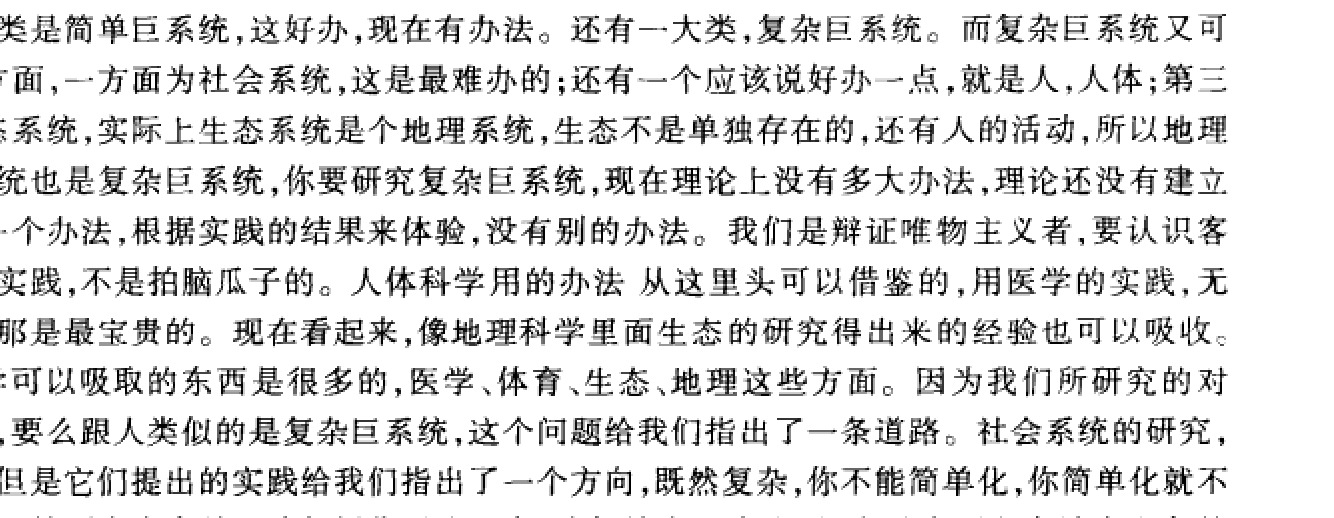
Speaking specifically about our work in human body science, starting from the perspective of complex giant systems, what kind of inspiration can we draw? The most important inspiration is that the measurement of human body functional states cannot be oversimplified. This poses a challenge for us: if you want to measure human body functional states without oversimplifying, doesn’t that make the work very difficult? In the past, we simply oversimplified, because we lacked equipment and existing conditions only allowed us to measure one or two parameters. From the perspective of complex giant systems, you have done the work, but it is after all too simple—sometimes correct, sometimes not entirely correct. Many parameters you failed to grasp are changing; you did not catch them, you do not know about them; it seems as though you caught them, and yet it seems as though you did not. The parameters measured are insufficient; many parameters went unmeasured. Looking at it now, much of our past work had many shortcomings: the work on measuring human body functional states was far too simplistic. Therefore, some of the work
All can provide information, but not comprehensive information. If you insist that this is it, that is dangerous. For example, there are many electromagnetic therapy devices — do they work or not? Both Western and Chinese medicine can treat simple ailments like colds and coughs. But complex chronic diseases are difficult to handle; you cannot grasp them, and you cannot be simplistic. This old man is different from that old man, this old lady is different from that old lady. Without grasping the functional state, it is impossible to get it right. Previously, when measuring human intelligence, studies looked at the copper and zinc content in hair, but research reports could not explain things clearly. This is natural — these may be just a few parameters, while hundreds of others remain ungrasped. Now we are paying attention to one parameter — electromagnetic fields and electromagnetic waves — which were previously overlooked. Molecular interactions involve electromagnetic fields. In the future, we must be careful not to miss important parameters. So I think we need to put serious effort into measuring human functional states, including electromagnetic fields and electromagnetic waves. There will certainly be many parameters. How did doctors manage in the past? Very simply: Chinese medicine used observation, listening, inquiry, and pulse-taking; Western medicine looked at lab reports — 20 or 30 parameters — and the doctor prescribed medication based on judgment and experience. Beyond their experience, things would go wrong. Now, researching human body science means pinning down these elusive things — using multiple parameters to define them. There may be over a hundred parameters, including electromagnetic fields and electromagnetic waves. I am confident about this approach and its prospects: with hundreds of parameters, a person could probably get results in 15 minutes. This is entirely achievable. This research direction is worth considering.
(April 26, 1988)
7. On the Methodology of Open Complex Giant Systems
Regarding the methodology of open complex giant systems, a few days ago when Song Jian and several colleagues came to visit me, I spoke about it once. Later, when several leaders from the China Association for Science and Technology — Gao Zhenning, Gao Chao, and others — came, I spoke about it again. Before the Spring Festival, when Zhu Guangya, Ye Zhengda, and Nie Li visited, I spoke about it yet again. In correspondence with Sun Kaifei, I explained my current views, which are somewhat explosive, but should not be publicized. Today I will share them with you.
The source is an article from the magazine New Scientist, from August or September 1989, which represents reflections by foreign scientists. Starting from the Renaissance in the 17th century, the modern scientific method was developed — beginning with astronomy, through figures like Galileo and Newton — and what they developed is called the scientific method. In principle, it excludes all subjective elements and relies entirely on experimentation to establish science, considering this the only scientific method. But now this approach encounters great difficulties. For example, in studying human thinking, it fails, because the study of thinking depends on human subjective introspection and reflection, which the Newtonian approach rejects, making such study impossible. For instance, psychology, by rejecting the “black box,” has ended up in great confusion. Science needs a new revolution. Newton’s was a quantitative method; subjective introspection is qualitative science. In reality, people in capitalist societies do not hold a dialectical materialist view. Regarding the role of subject and object, Einstein had already explained this very clearly. The conceptual leap after observation and experiment is a subjective breakthrough by the human mind — its origin is unclear. First comes conjecture, then logic, computation, experimentation, testing, revision of hypotheses, and modification — another subjective leap. Writing a book means that theory corresponds with reality and is correct. Human cognition of the objective world results from the interaction of subject and object. Modern science is mechanical materialism; it rejects the role of subjectivity and is a reductionist method. Complex problems cannot be observed or experimented upon. Over the past decade, systems science has proposed combining holism with reductionism, and there has been development in the systems science seminar. For the study of open complex giant systems, the modern scientific method simply does not work. Because these are complex giant systems or social systems, past methods are powerless. The qualitative-quantitative combined meta-synthesis method has been proposed, and facts have proven it to be genuinely effective. Further discussion has yielded new understanding of this method: the starting point for humans in solving problems is qualitative, fuzzy, and localized — [the text here is garbled] — and models are used to attempt to bring these together. Such models: (1) are complex; (2) require hundreds of parameters that must be measured, not expert verbal terms like “inflation,” which cannot be quantified — statistical data must be used. By synthesizing bits and pieces of qualitative perceptual understanding and integrating them with actually measured data, they are expressed through models. Rising from the qualitative to the quantitative, from perception to rationality — this is genuine dialectical materialism.
materialist—first, materialist; second, dialectical.
Comrade Sun Kaifei said that the natural sciences now far outpace the social sciences. The current imbalance in scientific development is due to the inherent limitations of the scientific method that developed from the Renaissance: it is mechanical materialism, not dialectical materialism. We need to form a concept and grasp the qualitative-quantitative combined meta-synthesis method, making full use of modern science and technology—such as electronic computers, artificial intelligence, knowledge engineering, and so on—to genuinely resolve open complex giant systems. At present, all the lagging fields involve this kind of open complex giant system: social giant systems, human body giant systems, geographical giant systems, environmental giant systems—none of these can be clearly explained. Viewed this way, all ten major scientific disciplines involve the problem of open complex giant systems. This method will bring about a new Renaissance. If the first Renaissance created capitalist civilization, this new Renaissance will create socialist civilization—it will be extraordinary. Let us first discuss this in a small circle and see whether everyone agrees. This is a fundamental issue. It is against this backdrop that you were asked to write this article, and its implications are even deeper. Once the grand principles are understood, the specific approach follows from such understanding. We need to write an article addressing this matter, using the perspective of open complex giant systems to study this problem (referring to human body science). To be more concrete: the previous draft still did not explain things clearly. Applying the qualitative-quantitative combined meta-synthesis method to human body science is not easy. We must raise major questions and major tasks; we are still very far from this. Our understanding of human problems is only at its beginning. I hope this article will stand at a higher vantage point and explain the issues clearly: (1) What are the vague, perceptual, qualitative things? In the human body, there is an abundance of therapeutic practice and medical case records (Zhang Xiaoqian’s notes are one example); (2) Vague perspectives—traditional Chinese medicine consists precisely of such things, having a vague understanding of the human body as a system. But this is not the system of the human body; it is not that simple. Both Chinese and Western medical theories and case records are raw materials for the qualitative-quantitative combined meta-synthesis method; (3) The model is by no means simple. A model with several hundred parameters is needed to replace the functional state of the human body—several hundred parameters—and not the vague parameters of traditional Chinese medicine, but parameters measurable by instruments. There are complex models based on large quantities of Chinese and Western medical theories, practices, and case records, and the parameters must be measurable. The task of human body science is to establish this method. If this set of model methods can be established, then once measurements are completed, the entire process of diagnosis, treatment, prediction, and other medical measures can be accomplished—this would be extraordinary, a tremendous contribution to human health development. This applies only to the functional states of ordinary people and does not include qigong or special functions. First, we work on ordinary people. The special aspects within the functional states of ordinary people are the clues. We should spend twenty years establishing the model for ordinary people.
We must not oversimplify the problem. This is a new Renaissance, the creation of Marxist human body science. We are undertaking a great endeavor, and it is not easy, but it must be done. If the China Society for Human Body Science does not do it, who will? We must hold up our banner and not diminish the importance of this issue. We must dare to raise the questions. This article is a historic one; it is a foundational article for the China Society for Human Body Science, an article that will point the direction for future work, and an article that will raise the level of the Society. The article must have a clear focus, point the direction, and guide the way onto the correct path—like a manifesto, indicating how human body science should be pursued. The article should stand at an even higher vantage point, be seriously discussed, and build consensus. The goal is set; we work toward it step by step.
We must use the most scientific perspective to elucidate the work of the Society and make contributions to humanity. In essence, this is the beginning of a new Renaissance.
(February 2, 1990)
8. Studying Open Complex Giant Systems, Striving to Overcome Key Difficulties
What Is an Open Complex Giant System
Regarding open complex giant systems, we can say:
- The system itself has exchanges of matter, energy, and information with its surrounding environment. Because of these exchanges,
Therefore it is “open.” 2. The system contains a great many subsystems—thousands, tens of thousands, or even hundreds of millions. Therefore it is a “giant system.” 3. The types of subsystems are highly diverse, numbering in the dozens, hundreds, or even several hundred. Therefore it is “complex.”
In the past, we said that open complex giant systems possess the above three characteristics. Now I believe that these three points lead to a fourth characteristic:
Open complex giant systems have many levels. The so-called “levels” here refer to the structural levels of the system from the subsystems we already understand relatively well to the entire system that we can observe macroscopically. If there were only one level—if it were but a single step from the whole system down to the subsystems—then one could directly synthesize the giant system from the subsystems. I believe that in such a case, the reductionist approach would still be applicable. Now that we have electronic computers, the work of synthesizing from subsystems to the giant system in one step can indeed be accomplished. In the past, when we developed nuclear weapons, this is exactly what we did. For although a nuclear weapon is very complex, in theory there is only one level—from the atomic nucleus to the nuclear weapon. Abroad, problems of this single-level kind, such as chaos, and even relatively complex problems within chaos, such as turbulence governed by the infinite-dimensional Navier-Stokes equation, as well as the spin phenomena discussed in this seminar, can all be handled in this manner. They call such problems “complexity problems.” I believe that this so-called “complexity” is not really complex; it still belongs to the category of simple problems that follow a tractable path. I call such systems simple giant systems. A characteristic of the open complex giant systems we are discussing is that there are very many levels—from the observable whole system to the subsystems, there are many levels, and the intermediate levels are not understood; we do not even know how many levels there are. For such a system, the reductionist method will not work. What is to be done? In this seminar, we have found a method, namely the metasynthetic engineering from qualitative to quantitative. The English translation can be: Metasynthetic Engineering. This does not exist abroad; it is our own creation.
Establishing the Theory of Open Complex Giant Systems
To establish a general theory of open complex giant systems, we must start from one specific open complex giant system at a time. Which systems belong to the category of open complex giant systems? The social system is one such open complex giant system. In addition, the human brain system, the human body system, the geographical system, the cosmic system, the historical system (i.e., past societies), the room-temperature nuclear fusion system, and so forth, are all open complex giant systems. Research must begin with concrete data. For example, within the social system there are regional issues as well as national issues, and one must also pay attention to international issues. As in an article by a Japanese author published in issue No. 41 of this year’s World Economy and Technology compiled by Xinhua News Agency, which discusses how Japan, with its economic development, transferred some labor-intensive industries to Asia’s “Four Little Dragons,” and how the “Four Little Dragons” are now transferring these industries to developing countries in Southeast Asia. The article says that ultimately they will seek an outlet in mainland China, because China is vast and populous. Therefore, China’s socialist construction must take international influences into account. Only by starting with one specific open complex giant system at a time for research, and only when the research results on these specific open complex giant systems have accumulated sufficiently, can we distill from them a general theory of open complex giant systems, forming the discipline of open complex giant system science as part of system science. The formation of engineering cybernetics in the 1950s followed this very approach—distilled from one automatic control technology after another. Here we must also point out: among open complex giant systems, the ones with the richest accumulation of practical experience and data are the social system and the human body system; the former concerns major issues of national affairs, while the latter concerns major issues of people’s health care and medical treatment.
However, because open complex giant systems are multi-level, the possibilities for changes in their functional states are extremely broad, and phenomena that exceed the conventional may appear. For example, the extraordinary human functions that have appeared in the human body system are unexpected and make many people unable to accept them, yet they objectively exist. Has the social system of socialist China also exhibited “extraordinary functions”? In the 1960s, we succeeded in developing the atomic bomb, missiles, and artificial satellites—many people in the world thought this was inconceivable. I see this as the extraordinary function of socialist China. The Asian Games were organized so well—also something many people could not have imagined. The Fourth National Population Census was completed with only a little over one year of preparation and survey registration, which is also extraordinary for a great nation with a population of over 1.1 billion. Therefore, as long as the social system led by the Communist Party of China is well organized, it can achieve accomplishments that are beyond expectation—this is the “extraordinary function” of Chinese society. We comrades engaged in the study of open complex giant systems must be mentally prepared for this and must not allow ourselves to be constrained by the old routines we have grown accustomed to.
Studying Open Complex Giant Systems Requires Correct Guiding Ideology
Studying open complex giant systems requires correct ideological guidance, namely the guidance of Marxist philosophy. Because studying open complex giant systems, as I stated at the very beginning, certainly relies on computers, knowledge systems, artificial intelligence, and other technological means, yet one cannot rely entirely on these machines; ultimately, one must still rely on humans, on human wisdom. If machines alone could fully solve the problem, then it would not be an open complex giant system. What is human wisdom? It is Marxist philosophy; philosophy is the highest generalization of human knowledge.
Recently I read Comrade Wang Dong’s book Lenin’s Philosophical Notes. The book states that in establishing the Marxist philosophical system, Marx and Engels made the first great attempt; Dietzgen made the second attempt; Lenin’s Philosophical Notes was the third great attempt—all were unsuccessful. Stalin did a poor job; philosophically speaking, many things were wrongly criticized. The Chinese revolution was far more complex than the Soviet October Revolution, and Mao Zedong Thought, formed through the Chinese revolution, truly has unique strengths in handling many intricate and complex problems. An article co-authored by Comrades Chen Zhiliang, Yang Gen, and Guo Jianning also discusses handling extremely complex problems from a macroscopic, holistic perspective, elaborating on Comrade Xiaoping’s holistic, systematic, macroscopic, and strategic thinking—this is very correct. The core content of Mao Zedong Thought is precisely these elements, namely grasping the essence of a problem, the principal aspect of a contradiction, and paying attention to changes in circumstances. This teaches us how to look at a complex problem, how to look at a complex giant system. What must be particularly guarded against is rigidity of thinking—forming a concept and then treating it as immutable. Open complex giant systems are ever-changing, and we must maintain this understanding.
During the years of revolutionary war, when the Party Central Committee and Chairman Mao were in Yan’an, there were no electronic computers, nor was there as much information as there is now. What did correct decision-making rely on at that time? It relied on guiding ideology. Therefore, at that time, particular emphasis was placed on practice—theory—re-practice. When a policy or a theory was found to be flawed in practice, it was immediately corrected. These guiding principles are extremely important for our study of open complex giant systems. That is to say, we must use correct philosophical thought as our guide, and we must also go through practice, continuously revising our theories, because the problems we deal with are too complex. The theories, i.e., quantitative models, proposed through this approach should, compared with the past, be applicable for a relatively longer period of time, and even if errors occur, the losses should not be too great. This is also the purpose of our study of open complex giant systems.
Studying Open Complex Giant Systems Requires Using the Achievements of Cognitive Science
The technology of metasynthesis from qualitative to quantitative is, in fact, an applied technology of cognitive science (思维科学). Studying open complex giant systems must rely on this technology, because first one must process such vast quantities of information and knowledge. The volume of information is unimaginably large, and not a single piece of information can be overlooked, because that might be an important piece of information. The synthesis of intelligence information—this is the first problem encountered. In the past, at intelligence conferences, I used a term: the “activation” of data and information, meaning transforming large amounts of stored information into targeted “live intelligence.” Comrade Wang Chengwei told me that foreigners also have a term, called “data fusion” in English. I think this term is not good; using “information inspiritment” would be more appropriate. In our qualitative work, from the very beginning we must synthesize large quantities of information and data, and this work requires knowledge engineering—and it must use knowledge engineering, because the volume of information is too large to be accomplished by manual labor alone. Furthermore, at the “National People’s Congress” and the “Chinese People’s Political Consultative Conference” sessions, there are large numbers of proposals; these are all expert opinions, all well-founded and important, though not necessarily comprehensive. These opinions need to be synthesized, which also requires knowledge engineering and artificial intelligence—this is part of what we must do at the outset of our qualitative work.
Therefore, the technology of metasynthesis from qualitative to quantitative is an applied technology of cognitive science, and it has great promise. As applied technology develops, it will also be refined and elevated to the theory of cognitive science, and ultimately, to the philosophy of cognitive science—epistemology. Many questions now debated in philosophical circles, such as what is the subject, what is the object, what is thinking, what is consciousness, and so on, will all have correct answers. From the standpoint of materialism, these questions are quite clear. By what does human beings know the objective world? By the brain, and the brain is material; it is part of the material world. Human beings know the objective world through practice. This is nothing more than the process by which this part of matter—the human brain—interacts with a broader range of objective matter through material means. Subject, object, thinking, consciousness—these are
nothing more than terms used in discussing and studying this process of interaction. What is recognized each time is only a very small part of the objective world, so one must practice again and recognize again, in order to continuously expand our knowledge of the objective world. This process is endless. Therefore, the questions that philosophical circles endlessly debate are, from the perspective of open complex giant systems and from the perspective of cognitive science, all quite clear. Thus, the viewpoints on open complex giant systems discussed here are also of great significance for our philosophy of knowing the objective world.
(October 16, 1990)
130
Part III: Research on Special Functions
131
I. Research on Human Paranormal Functions Is of Great Significance
Life science is a discipline currently receiving widespread attention worldwide, with many countries investing substantial human and material resources into multidisciplinary comprehensive research. Many previously unimagined human functions have been discovered: for example, human vision and hearing manifest as ordered weak triggering potentials in brain waves, the human body exhibits weak magnetic field changes that express internal activities, and the human ear can “hear” pulsed signals of radio microwaves, among others. China’s discovery of adolescents possessing paranormal functions has provided an extremely important clue for research on human life science.
The fact that some children possess the paranormal function of recognizing characters with their ears is an objectively existing fact. Marxist philosophy holds that objective reality is primary, and cognition is secondary. As scientific workers, we must first respect objective facts and not deny the existence of such phenomena simply because we cannot yet provide a scientific explanation.
Historically, many new discoveries have gone through lengthy processes before being explained. Some phenomena are more complex and require even more time to elucidate. From the 1930s to the present, many Nobel Prize laureates in physics have been recognized for discovering certain “elementary particles.” They were rewarded for the discovery itself, without being required to immediately provide a complete scientific explanation.
Continuously exploring the mysteries of nature is the mission of science. Science encompasses both basic science and technical science. Although some basic sciences cannot be immediately applied to production, from a long-term perspective they are extremely important. Otherwise, there would be no need to study “elementary particles” or to build high-energy accelerators.
Research on human paranormal functions will surely deepen humanity’s understanding of itself and promote the development of life science. Recently, many research institutions and universities across the country have successively established research groups on human paranormal functions, and I am very pleased about this. However, we cannot stop at theatrical demonstrations; we must invite psychologists and relevant physiologists to participate, and conduct scientific tests on these adolescents under appropriate conditions, using scientific instruments. I hope that scientific workers will make concerted efforts in multidisciplinary collaboration to launch this research work solidly and as quickly as possible. We have not yet reached that point, and it is natural and unavoidable that some comrades maintain a reserved attitude toward paranormal functions. Therefore, one must never feel indignant toward skeptics and opponents, but must patiently do the work and solve problems with facts.
At present, humanity’s understanding of itself, especially of the brain, is still quite insufficient. Over the past decade or so, neurophysiology has made great progress, but the gap remains large. For example, we still have not truly figured out how the brain actually works, or how images are formed in the brain. Therefore, when people direct computers to perform mathematical calculations, the computers appear very intelligent, but when directed to recognize images, they appear extremely clumsy. Researching brain functions can make computers smarter than they are now.
The phenomenon of recognizing characters with the ears demonstrates that humans still have untapped potential. We should utilize modern science and technology to develop human potential through cognitive science, qigong, and all latent human functions. I suggest that, on the basis of adjusting and reorganizing the existing disciplinary system, a human science system be established, incorporating such subjects as human paranormal functions, qigong, and traditional Chinese medicine theory into this system, so that this research work can gradually develop in a more rigorous and systematic direction.
(July 18, 1980)
II. The Transformation from “Paranormal” to “Non-Paranormal”
The “paranormal” and “non-paranormal” aspects of human functions are relative terms. For example, none of us ordinary people can hear radar waves. However, there are indeed individuals who can hear them, which is quite “paranormal.” A 1982 American study demonstrated that radar waves cause heating in the human brain, and different regions are heated unevenly, resulting in unequal stresses. Coincidentally, this particular individual had a piece of shrapnel embedded in his skull during World War II that was never removed. The difference in stress between different regions caused friction between the shrapnel and the surrounding tissue, thereby enabling the person to hear the sound of radar waves. Once the mechanism was clarified, what was previously considered a very “paranormal” function became “non-paranormal.” Therefore, the “paranormal” can transform into the “non-paranormal.”
The speeches given by the 1979 Nobel Prize laureates all stated that recent scientific developments have thoroughly transformed the elementary particle theory of many years past. Science is constantly developing, and especially many foundational aspects of science are not so solidly established. With the development of science, everything is changing, changing day by day, and we must keep pace with the situation.
(April 11, 1983)
III. Studying Human Paranormal Functions from a Systems Perspective Holds Great Promise
Research on human paranormal functions cannot solely emphasize the human brain. The human body is a giant system, and humans together with their environment form a super-giant system. We must study human paranormal functions through this super-giant system. The human-cosmos view is the bridge for such research. Human science is a basic science. I feel that previously emphasizing this idea was not concrete enough. It should be stated that the study of the structure and function of human beings within the cosmic super-giant system is called somatology, and the basic science of somatological science is somatology.
If we exclude the fraudulent ones, the phenomena manifested by qigong and paranormal functions can be divided into two major categories: one comprises those that the existing scientific system can explain, and the other comprises those that modern science cannot explain—that is, relative truths within the long river of absolute truth. Some phenomena that modern science cannot explain—[explaining them] would constitute a revolution in modern science, which is thorough materialism.
Some people have said it is absurd that the human body can directly receive radar electromagnetic wave signals. Last year, coincidentally, an American acoustics journal published an article explaining that this phenomenon is real. Radar can emit pulsed electromagnetic waves at 300 MHz; if the intensity is sufficient, they non-uniformly heat the brain upon irradiation, forming stress waves in the human brain that propagate to the ear cavity where they can be perceived, thus producing a knocking-like shrieking sound. Regarding current theories of paranormal functions, I have no comment on whether I agree or not, because the experiments are not yet sufficient. Theoretical research is very difficult; it is a process of scientific creativity. Good ideas must come from practice, and one must be prepared to fail many times, yet truth lies within this process—the difficulty lies precisely here. I am optimistic about this matter. There is also a great source that remains untapped, namely qigong. Qigong masters all possess paranormal
functions; but there is a social phenomenon: high-level qigong masters are unwilling to appear in public. Once they do, their courtyard is flooded with visitors, the situation becomes unmanageable, and they fear causing trouble. In our country there are quite a few high-level qigong masters. I am optimistic—with a population of over one billion, there are some people with paranormal functions. We must do good ideological work among them and develop human body science!
(April 18, 1983)
IV. Discussion on the Pineal Gland, Sand Crabs, and Other Functions
Exploration of Pineal Gland Function
Recently I saw two reports. One was an article on human paranormal functions written by Lu Min, who is not a professional researcher but had read quite a few books. The other was written by a worker in Yangzhou. It was a lengthy piece about qigong and paranormal functions, arguing that the two share commonalities, but without using the concept of the “human paranormal functional state.” It may differ from ordinary functional states, especially regarding what those phenomena actually are—he proposed an idea.
He believes that the functional state involves residual organs that are no longer used under normal conditions but whose functions are activated and utilized. He proposed the role of the pineal gland. Although it remains unclear what this role actually does, this suggestion is very interesting. If one did not know about light, one might also not know what eyes are for. One may be unclear about latent functions and not yet be expert in them.
Special Functions in Organisms (such as Sand Crabs)
He suggested that there may be other normally unused tissues in the body that are playing a role. Zoologists have done much work and discovered that some animals possess special functions. For example, bats fly by means of ultrasound; a certain type of sand crab is very peculiar—it does not come out during the day but burrows underground, and emerges at night, yet it has no eyes and is not sensitive to light. But how does it forage for food without eyes? It was also discovered that when the sand crab’s shell is irradiated with ultraviolet light, it emits fluorescence. When brought into the laboratory for examination, it was found that besides two large claws in front, it has eight legs, four on each side. These eight legs are extremely sensitive to vibrations—even a small insect crawling on the ground produces vibrational waves that can be detected. Moreover, different parts have different sensitivities, allowing it to determine the direction from which the insect is coming.
Exploring the animal world may provide inspiration. We cannot rely solely on the information channels we normally recognize.
We should listen more to the opinions of laypeople and to unusual ideas. Of course, after listening we must analyze, be cautious, and conduct scientific verification. We should not be confined to any one fixed view. The essence of things is extremely complex, and producing any breakthrough in a large system is no easy matter.
(March 8, 1985)
14
V. Our Research Work Must Emphasize Both Experiment and Theory
Director Zhang Zhenhuan has just introduced some recent progress in the study of human paranormal functions. These advances are an encouragement for those of us engaged in this work. Over the past few years, thanks to the efforts of the comrades present here, more and more people have seen with their own eyes that human paranormal functions are a fact. During the 35th National Day celebration, I met Qin Chuan of the People’s Daily on the Tiananmen rostrum. He said that more and more people are supporting the study of human paranormal functions. I said: yes, there are more, but I’m afraid the problem has not been thoroughly resolved. I said this because I feel that in our country, our work is in just such an indistinct state. If you ask whether it has been completely blocked—no, it hasn’t been blocked to death; we can still carry on. If you ask whether it can be included as formal scientific research in the national plan—not yet. We have all encountered this situation. At present, people in various units who support this work all have a “tacit understanding”: a little money can be given, but it cannot be put in writing—this is the state of affairs. In our country, research on human paranormal functions is, in practice, in roughly the same situation as qigong research and even traditional Chinese medicine research. I think this issue seems to be regarded as a matter of ideology. Many people believe that having seen human paranormal functions is real, yet it seems to contradict modern science and to contradict Marxist philosophy. Why do they not dare to support it openly? Because they fear it involves ideological issues. Of course, saying it contradicts Marxist philosophy is incorrect; in reality, it is merely a contradiction that exists in their own minds. But even so, many people do not dare to touch this issue! For this reason, many comrades, on the one hand, see the fact of human paranormal functions and acknowledge this fact, but on the other hand, it is impossible to include it in the national plan.
Facing this actual situation, we must seek truth from facts. On the one hand, we should recognize that the situation is better than a few years ago. A few years ago, some people wanted to kill it with a single blow, but in the end it was not killed. We can still continue our research. On the other hand, we should not harbor illusions that it will be formally included in the national plan in the near future. Under these circumstances, those of us doing this work must manage ourselves well—that is, seek truth from facts and do our own research work well. This is precisely the issue to be discussed at this meeting: how to make our research work go deeper, step by step resolving the contradictions between the various phenomena of human paranormal functions and modern science. I feel that the most fundamental task of the China Human Body Science Society is to organize our collective strength. Many tasks, no matter which unit undertakes them alone, are very difficult. Everyone must support one another and be better organized, so that our small collective can play a greater role under very difficult conditions. The China Human Body Science Society must address this problem, and it is a very important one. This is the first point I wish to make.
Next, I would like to offer a few personal and immature opinions on the theme of this meeting—the research priorities and research methods for human paranormal functions.
As a field of scientific study, research on human paranormal functions is now in its preliminary exploratory stage, and therefore we cannot see clearly; many ideas have arisen from this. For example, regarding what the human body emits in the paranormal functional state, some people believe it is electromagnetic waves; among electromagnetic waves, some believe it is microwaves, some believe it is infrared radiation, and moreover that the infrared radiation is amplitude-modulated, with a relatively low modulation frequency of several tens of cycles per second—very low. This point is also related to what some people say about acoustic wave vibrations, with acoustic wave frequencies of several tens of cycles per second. There are also frequencies of a dozen or so cycles per second, which are infrasound and cannot be heard. Some say it is ultrasound. Still other comrades say they have detected it with instruments as a particle stream. Others say it does not seem much like a particle stream. Some have proposed it is plasma. Others have proposed it is a magnetic field, and an alternating magnetic field at that, also with very low frequency, a dozen or so to several tens of cycles per second, linked again to infrasound. Some comrades have also measured mechanical vibrations at human acupoints in the functional state, with mechanical vibration frequencies also at a dozen or so to several tens of cycles per second. All of the above—what is emitted in the functional state, or what is called a “field”—I think are conjectures. Some people say: “I measured it with an instrument.” But one must realize that such instruments are designed to measure certain things.
designed, and during measurement there is a response and a record. However, there are many things that can cause an instrument to react, and they are not necessarily what the instrument was originally designed to measure. So even if something is detected, one cannot say it is what the instrument was originally designed to measure. Therefore, all these various claims and conjectures—electromagnetic waves, infrasound, plasma, alternating magnetic fields, and so on—what are they really? We must ultimately get to the bottom of it. If one says it is plasma, well, plasma cannot exist under normal temperature and pressure. Simply saying “plasma” does not solve the problem; one must explain why plasma would exist. I am merely raising a question here. There are many hypotheses and conjectures now, but what is the truth? We need to delve deeper. We can propose hypotheses, but there must be scientific experimental proof that it is this thing and not something else, so that we can go deeper. At this conference, we should carefully discuss how to go deeper, how to transform this into rigorous scientific research. This question is probably one that everyone should consider, and I ask you all to study it seriously.
In the process of going deeper, I come to my third point. Although everyone here is engaged in experimental work, I think theoretical work is also very important. Whether a conjecture is scientifically sound or not ultimately depends on theoretical work. If one claims it is plasma, this needs to be demonstrated theoretically, so theoretical work is still very important. We can see this from modern science: atomic physics and high-energy physics research both proceed with experimental work and theoretical work simultaneously; neither can be dispensed with. On this issue, I am afraid our ranks still lack comrades who can genuinely do theoretical work. In recent years I have been mobilizing people to join this work, but I have managed to recruit only a few. Some theorists are not very interested. Those I could mobilize are several researchers from the Second Department of the National University of Defense Technology, who have some foundation in modern physics theory. And the relationship between quantum physics and extraordinary functions is worth noting.
Speaking of this issue, let me mention some literature I have recently read. Starting from the most fundamental problem of quantum physics: in the 1930s, Einstein was always dissatisfied with it. He once said, “I believe God does not play dice.” That is, he believed the objective world is deterministic and could not be indeterministic as in quantum mechanics. This debate has continued to the present day—fifty years—and the problem has in fact not been resolved. Theoretical physicists today all avoid this question.
Why are they so indifferent to such a major issue? I think it may be because it is too difficult—they cannot crack it. If they cannot crack it, they simply avoid it; it is the same abroad. Einstein and Bohr fought a war of words for many years, and later others did work on it, but none could get through. Some materials I have recently seen indicate that one person is genuinely thinking about this problem. This person is David Bohm, a professor of physics at the University of London. He had contact with Einstein in his early years and was relatively familiar with Einstein’s ideas. He also felt that the fundamental problem of quantum mechanics—“indeterminism”—was always something difficult to accept. In 1980, he published a book: Wholeness and the Implicate Order. “Wholeness” is 整体性, and “Implicate Order” means 隐秩序, that is, behind the explicit order we see there is also an implicit order. That is the title of the book. Its main thesis is: the entire universe is a whole, and one should view all things from this starting point. This holistic view has existed in philosophy for a long time; both ancient China and ancient Greece espoused holism. With the advent of modern science, holism was disrupted—things were studied one by one, separately. Bohm says we must restore the holistic perspective, holding that the entire universe is a whole: this room of ours, Peking University, Beijing, the Earth, celestial bodies, beyond celestial bodies, and even the entire universe—all are one whole. He believes that what we now call molecules, atoms, and elementary particles are all temporary manifestations within this whole; they are not real. In reality, there are no such things as molecules, atoms, or elementary particles. He says that what we consider to be a molecule, atom, or elementary particle is actually always changing, just like us humans—sitting here we appear to be so-and-so, but in fact the cells composing the human body are constantly changing: old ones die, new ones grow; it is something that is changing at every moment. We regard it as unchanging and independently existing because of our short-sightedness, because we do not truly understand this thing.
This is Bohm’s fundamental view. So he says that Heisenberg’s uncertainty principle in quantum mechanics refers only to surface phenomena, and that there is something deeper, which he calls the implicate order. In this deeper world, it is like classical Brownian motion: under a microscope, one sees particles running about randomly, which is like what quantum mechanics sees—the position and momentum cannot be simultaneously determined—whereas in fact there is a deeper layer of things influencing it. This deeper layer of things is not seen by people. What is seen is the indeterminism of quantum mechanics. He does not overthrow quantum mechanics; rather, he believes that the reason the uncertainty principle of quantum mechanics exists is due to a deeper cause, namely the implicate order. He, in accordance with…
This line of thinking led to new questions. Why did I seek out this article to read? It is because Bohm, in an interview with a journalist, said: “My current theory has not yet been fully established, but once it is established, ESP and PK—these human special functions—can all be explained, and they will no longer be remarkable.” At the same time, he also revealed that Einstein, while not stating so in his published articles, had said in private correspondence that he believed modern science was probably still inadequate, and that as science developed further, all separations—distinctions of place, distinctions of time, distinctions between past, present, and future—would probably eventually disappear. David Bohm’s theory aims to solve this problem. If this problem is solved, then special functions would no longer be special.
After finding this book and reading it, I also had some dissatisfaction, feeling that Bohm had his shortcomings. In capitalist countries, when these scientists speak of philosophical questions of science, they inevitably go astray. In fact, the problems he encounters can find a way out. In the theory we want to establish, the materials from the development of science up to now can all still be used; we need to go further, incorporating all scientific theories up to now but making them more profound. Solving the problem in this way is closely related to systems theory, systems science, and systems science studies. It seems that Bohm is not very familiar with systems science. Although he is in London, England, not far from the headquarters of systems science in Brussels, Belgium, where Prigogine is based, he is not familiar with it (this may be because Bohm first proposed his theory in the 1950s, when systems science had not yet emerged). Yet here in the Far East, these two things have actually been combined. Why do I say this? Our concept is that the entire universe is a system, and we must delve deeper. Delving into molecules, atoms, atomic nuclei, and elementary particles is not enough, because the scales described by electromagnetic interactions, strong interactions, and weak interactions are still relatively large. The size of elementary particles is on the order of cm, which is too large a scale. I recently saw an article on quantum gravitational fields in the December 1983 issue of Scientific American, which discusses combining Einstein’s general relativity with quantum mechanics, and mentions that if quantum mechanics and gravitational fields are combined together [OCR corruption] spacetime jumps extremely rapidly; it is not static but chaotic, with many very rapid changes, or pulsations. If the gravitational field and quantum mechanics are combined, this is what Bohm calls the implicate order. At such a small scale, determinism still holds, but everything is pulsating; it is a pulsating field. Bohm says that in this way, the indeterminism of quantum mechanics can be explained. There is another point: at such a small scale, in the overall pulsations, there is no such thing as the phenomenon of the speed of light. The speed of light refers to the speed of light, but at such a small scale, light and electromagnetic waves no longer exist, and the limitation of the speed of light also no longer exists. Superluminal propagation effects can entirely exist.
So then, at a scale of cm, this is what Bohm calls the implicate order, which is a foundation for the existence of the entire material world. In this context, what is a particle? From a systems perspective, it is a self-organization phenomenon—that is, in such a super-microscopic world, the entire world is a super-large system, and this system exhibits self-organization phenomena, which manifest as the emergence of various kinds of particles. Humans are also formed by self-organization phenomena, just more complex. At the super-microscopic level, various microscopic particles are formed through self-organization, and these particles cannot be permanent or unchanging. It is now discovered that all kinds of particles are changing; even protons have a certain lifetime. This concept also solves a problem, namely that elementary particles can produce things they did not originally contain. For example, when a positron and a negatron collide, they produce photons, and photons can then transform, becoming a positron and a negatron again, or they can produce the newly discovered W⁺, W⁻ particles and Z particles, but the photon did not originally contain these things. I originally found this very difficult to accept, but from the current conceptual perspective, so-called particles are actually self-organization phenomena in the super-microscopic world of the implicate order; they can form different organizations, thereby becoming new particles.
So here I would like to talk about how, having recently read these things, I truly feel that there seems to be a door opening, a glimmer of hope, for advancing our modern science—namely, pushing quantum mechanics further into an even more super-microscopic realm, combining the gravitational field with quantum mechanics, the quantum gravitational field, in the world at the scale of cm, where the entire world is one system, and all particles are manifestations of self-organization phenomena. This gives rise to a hope, as Bohm said, that if this theory can be worked out, all special function phenomena can be explained. Of course, from the perspective of theory building, explaining human special functions is merely a by-product; the real significance is a scientific revolution, a great leap in humanity’s understanding of the objective world.
What I have discussed above is a report on my recent studies. There is great potential in this area of work; our country’s theoretical
It seems that physicists do not pay much attention to this; if they do not, then we who work on human special functions should take it seriously, and we can organize comrades to undertake this work. In this way, is there not the possibility that a tremendous revolution might emerge from among us? I ask you all to consider this point.
In summary, in our research on human special functions, we must attach importance to theoretical work, because without theoretical work we cannot convince those who have mental reservations—they fear that work on human special functions contradicts Marxist philosophy. Once we genuinely develop theories, we can persuasively convince them.
(October 1985)
6. Electromagnetic Fields and Life Phenomena
Understanding Cell Membrane Technology
First, I would like to thank today’s speaker for giving me great inspiration. Because from what I understand of the overall research work, work on cell membranes is indeed at a very critical position in the biological sciences today. Suppose we go all the way down to biological molecules—in the past, a great deal of effort was spent on this. As was just mentioned, biology has been the fastest-developing field over the past twenty years. However, for molecules to truly become biology, one must take a step toward the holistic level, and I think this step is precisely the cell membrane discussed today. From what we heard in today’s introduction, the cell membrane appears to be the most fundamental control mechanism for life phenomena: it controls cellular movement through the cell membrane. It occupies a key position. This is my impression after listening today. Furthermore, the speaker specifically discussed the third part on applications, which made me feel that what he was discussing had in fact already moved from cell membrane technology to the application side. Perhaps because we are not focused on applications here, it gave us some inspiration—new pathways by which the concepts of cell membrane technology can be applied to many of our fields, providing us with a possible avenue. The current questions about so-called human missiles or biological missiles are all based on this kind of conception. Therefore, cell membrane science and cell membrane technology are indeed a very attractive field today. In the past, we generally spoke of bioengineering as comprising four areas: genetic engineering, cell technology, enzyme technology, and fermentation engineering. I am afraid we must add a fifth area—cell membrane technology—which is also extremely important. This is my first impression.
Electromagnetic Fields and Life Phenomena Deserve In-Depth Study
My second point, which I have already raised, was touched upon in his answers to everyone’s questions just now. I feel that what was discussed today, along with what was presented last week by the comrades from the Institute of Biophysics of the Chinese Academy of Sciences—he spoke about liquid crystals in biological bodies—whether liquid crystals or the cell membranes discussed today, in essence both are saying that the molecules of life all have an arrangement. Since there is an arrangement, there is a question: after arrangement, one end is always electrically charged, and the other end carries a charge in the opposite direction—roughly such a situation. I keep thinking about this. Last time I asked the speaker: in such a situation, electromagnetic fields must certainly have an effect on it. This is a question we have raised here several times. We have always felt that in the study of life phenomena, insufficient attention has been paid to the role of electromagnetic fields in the past. As was just mentioned, this is indeed technically very difficult in engineering terms, but I think that from a macroscopic perspective, much work can still be done. You see, there are already many so-called therapeutic devices on the market—it is simply a matter of magnetic fields. This question is already right here before us: electromagnetic fields and what we study, whether called liquid crystals or
Whether we are talking about cell membranes, in general, the relationship between this and life phenomena has now been placed before us—this is work that must be done. As for its effects, I am reminded of a research result I saw a few years ago, in which microwaves were used to affect E. coli. Its growth and division also exhibited a kind of resonance: if you selected the right wavelength and irradiated it, it grew especially fast—several times faster than normal. What is the reason for this? It probably has to do with the cell membrane. As discussed today, the cell membrane controls the entire process—energy exchange, material exchange, and information exchange are all controlled there. If the wavelength of the microwave affects the cell membrane, then its entire activity process would be affected. Today I have also raised the question of the role of electromagnetic fields. The speaker also mentioned just now that he would consider this issue—this is the second question I am raising.
A Successful Experiment in Inducing Human Paranormal Abilities
Third, today I saw a document given to me by an acquaintance—it is a record of experiments on human paranormal abilities (特异功能). This is absolutely real, and our comrades should know about it. He said that on May 10th of this year, in a quiet room in Building 26 of the Radio Department at Peking University, ten people were invited, including five comrades from Peking University, all over fifty years old, and five younger comrades, probably students. Chen Shouliang used the method of the foreigner McCready to guide everyone in practicing qigong, relaxing and entering a state of tranquility. First, each person was asked to block the left nostril with the index finger of the right hand and exhale through the other nostril, repeating this five or six times to concentrate the mind. Then Chen Shouliang softly called out, and everyone quieted down. He then called out, saying that now everyone should relax from the feet to the head, saying “relax your feet, relax your feet” in this manner, his voice becoming increasingly gentle, making the atmosphere very serene. After about ten minutes of this, Chen Shouliang had everyone shout together: “Bend, bend, bend!” What does this mean? Each person was holding a steel fork or spoon for eating. Right after his shout, the person who wrote this document, holding a stainless steel fork with both hands, bent it—the angle of the bend was already less than a right angle. Another young person from Peking University, holding a stainless steel dining spoon, also bent it. The stainless steel tableware in the hands of the others did not deform—these two were successful. The person who wrote the document said himself: when Chen Shouliang was softly calling out, he gradually produced a sensation similar to entering a qigong state of tranquility; all distracting thoughts in his mind disappeared, he was in a daze, just calmly waiting, waiting for Chen Shouliang to shout the first “bend.” With just a little force, holding the stainless steel fork with both hands, he bent it to less than 90°. After the experiment reached this point, they all returned to normal, and when they tried to bend the bent objects back by hand, they could not. The young comrade mentioned just now had also bent one; he also tried to straighten it but could not. Once the bent objects were in the hands of people who had returned to normal, they could not be straightened. At that point, Chen Shouliang, who was directing everyone, had a piece of steel rebar in his hand, 4 mm in diameter and 13 cm long, which had also bent—the bend was smaller, about 100°. When these people returned to normal and all tried to bend them back, no one could, so Chen Shouliang said humorously: “It seems that without that foreign gentleman present, we can still do it.” Then the person who wrote the document went home and did it alone at home, with no one else in the room. Since he practices qigong, he entered a state of tranquility and gathered his spirit as he normally does in qigong practice, sinking his qi to the dantian, and so on. He said that at this point he produced a sensation the same as when induced by someone’s words (that is, Chen Shouliang’s verbal induction described earlier). When he had no distracting thoughts at all, after about ten-plus minutes, he concentrated his intention on the stainless steel dining spoon held in both hands. At this point he was alone, with no one else shouting “bend, bend, bend” to encourage him. He simply exerted force silently, and finally bent the handle of the stainless steel spoon into two full turns, approximately 720°. Then he concluded his practice and tried to bend it back open by hand, but could not. These were two experiments—one directed by Chen Shouliang at Peking University, where he himself also bent one; the other was done by one person alone at home, and he wrote this report. This person is someone we know and would not tell lies—this is simply how it happened. So their paranormal abilities are not really paranormal; they are actually human potential—things that people can potentially do. In our words, when a person is adjusted to a certain functional state, they can all do these things.
Finally, one more point. Recently I met a leader—I won’t discuss other matters—but as we talked, the conversation came around to paranormal abilities. I told him that I originally did not believe in paranormal abilities either, but later the facts proved that this is a real phenomenon. He was also clear about these matters. He said, yes, many leading comrades have seen it, and it is real. I said it is real. He also affirmed this matter. Our leaders also know about this, so I am telling everyone about it as well.
(May 19, 1986)
Seven, Revisiting Human Paranormal Functions and Electromagnetic Fields
I will just make one point, because both last Monday and today a question was raised: whether phenomena of human paranormal functions must involve phenomena at the molecular, atomic level and below. Last time this question was raised, even extending to theories of elementary particles and spatial superstring theory, and today’s speaker again proposed going below the atomic and molecular level—he calls it “paranormal physiology,” while above that is “conventional physiology.” I had considered this question before, but recently I have been thinking that perhaps we should set aside the consideration of going below the molecular and atomic level for the time being, and not go down that path, because once you go down that road there is an energy problem—at those levels the energies are all far too great, and it seems very difficult to imagine that human paranormal functions would involve such high energies. So I feel—and I have mentioned this here before—that for questions such as qigong in human science and human functional states, we should give more consideration to the question of electromagnetic fields. Today’s speaker also emphasized this point. Think about it: what scientific instruments can actually measure is electromagnetic fields. When you speak of the “human body field,” what exactly is that? We don’t know. What you measure is still electromagnetic fields. Electromagnetic fields definitely have many effects on the human body—this has already been demonstrated. For example, those so-called qigong therapy devices are simply electromagnetic fields, and there are also very many experimental proofs that cells have a close relationship with electromagnetic fields. I think this is probably the domain we need to explore. I have said this several times already, and I still hold this view today. And precisely this kind of effect has been overlooked by the vast amount of scientific research abroad. All that massive work in molecular biology has focused attention on molecular changes, without discussing electromagnetic fields—they simply don’t mention them. I think it is precisely this that they may have missed, and what they missed may be exactly what we need to grasp.
I keep promoting this viewpoint—electromagnetic fields. Today I still think this is the issue. Because if you talk about other things, you have no means to measure them. If this path doesn’t work out, then I can go down other paths. So why not take this path now? As for those other things you might consider—once you get into elementary particles, it all becomes rather dubious. You can’t really say anything concrete right now; it’s unrealistic. On one hand it’s unrealistic, and on the other hand there is something as important as electromagnetic fields, which we have not done nearly enough work on. So then, let us focus on this aspect and make a determined effort. I had wanted to say this last week, but since the guest was here, if I said it it would seem like I was opposing his views, which wouldn’t be quite appropriate. Today he is not here, so I’ll say it. Because he is a physicist, his first thought goes to the cutting edge of physics, but in reality it is still the electromagnetic fields that everyone is familiar with—it’s just that our work in this area has been very inadequate.
(November 14, 1986)
Eight, Revisiting Research on Human Paranormal Functions
The Problem of Inducing Paranormal Functions
The speaker just now gave an excellent presentation. The questions still need further study by everyone. I was also listening and thinking, so today I do not have anything
in particular to say.
There are a few things I would like to mention—not in connection with the material presented today, but things that occurred to me, which I now raise for discussion with everyone. There are a couple of matters. The first concerns training, or what we call inducing paranormal functions. Many people have said that if the subject to be induced has too much knowledge, it is actually counterproductive. In foreign records regarding remote viewing, induction is also less successful for people who study science. People who do not engage in science—for example, people in the arts—tend to have a higher success rate. Both Chinese and foreign sources have produced this same result. This is a question for everyone to consider, because this fact does exist.
Whether Paranormal Psychokinesis Can Be Studied in Comparison with Ordinary People
Another issue is a document I recently saw written by four people from Fudan University. They studied paranormal psychokinesis—writing—and compared it with ordinary conventional writing. I will leave this material with you. The conclusion drawn from the comparison was that a space of more than three dimensions is needed to explain it. After reading this, I kept wondering whether this kind of analytical approach to thinking about the problem is correct or not. Paranormal psychokinesis—mental writing: the pen is placed nearby, the pen does not move, yet characters appear. Can we really compare such a process with conventional psychokinesis, where a person actually picks up a pen and writes? How did they make the comparison? After comparing, they said that a space of more than three dimensions is needed to resolve it. That is to say, it cannot be resolved in ordinary terms—the phenomenon exists in another dimension of space that you cannot see. This explanation amounts to no explanation at all; we still cannot figure out what is really going on. But I think the problem is that this mode of thinking may constrain us. It may be nothing of the sort—paranormal psychokinesis writing and conventional writing may have no relation to each other at all. These are two questions I thought of on my way here today. Both questions relate to our research on paranormal functions. Since we are talking about something “paranormal,” you should not think about it using conventional methods. If we truly want to study this question, then our thinking needs to be further liberated.
Researching Paranormal Mechanisms Requires Both Liberated Thinking and Avoiding “Nonsense”
In recent days, haven’t we discussed this question several times? Our thinking must be liberated and must not be influenced by ordinary conventional things. Why is it that the more knowledge a person has, the more difficult it is to induce paranormal functions? It is because there are too many mental frameworks in their head. I propose that everyone consider these two questions. Today, looking at the foreign materials cited by the speaker, I feel we also need to be cautious. Not everything foreigners say has value, because I looked at those quotations below and felt that some of them seemed rather incongruous and a bit dubious. We need to analyze these scientifically. If someone’s statements are inconsistent and don’t add up—up, down, before, after—then just set them aside and don’t believe what they say. This point requires attention. Because in this field there are also many amateur enthusiasts abroad who do not have much scientific knowledge, but whose thinking is quite liberated—they say whatever comes to mind. These are not very formal books either, and if you just take what’s written in them as though it carries great weight, that would be a disaster—you would be misled. Our thinking must be liberated, but we must not talk nonsense. So when we conduct our research, we must indeed grasp the proper balance—both liberating our thinking and not recklessly talking nonsense (laughter). We can only rely on everyone’s collective efforts to gradually figure out this problem. That is all I have to say.
(December 8, 1986)
IX. Striving to Advance a New Situation in Special Function Research
System Measurement Is Worth Promoting
I had originally prepared to make three points. The first point has already been answered by the presenter, so there is no need to address it. As I was listening, I noted down several questions that he had not mentioned at the outset but later addressed. That is to say, the presenter gave quite thorough consideration to the problem of measurement in experiments involving complex human-machine-environment systems, fully adopting the perspectives of systems engineering and systems science, and moreover paying attention to the reactive effect of the measurement system on human subjects—this point is very important. Furthermore, he mentioned that further development would involve using electronic computers to monitor and control the measurement system, which is also excellent, because when problems arise in a complex measurement system, human thinking may be too slow, and that would cause trouble. The so-called working-state issue he raised no longer exists as a problem—he had already taken it into account.
Yu Guangyuan’s Position: Human Special Functions Can Be Observed and Studied
The second point I wish to discuss is to report to everyone about an event yesterday afternoon—specifically, the afternoon of December 14, 1986—when a fairly large-scale conference titled “Celebrating Comrade Yu Guangyuan’s Fifty Years of Academic Activity” was held on the third floor of the CPPCC Auditorium. After receiving the notice, I consulted Comrade Zhang Zhenhuan about whether I should attend, and he said, “Why wouldn’t you go? Go.” So yesterday I went. Upon entering, after signing in, I was handed a large package. I carried it to my seat, opened it, and found inside a book entitled A Critique of the So-Called Human Special Functions. This book was published by Shanghai Knowledge Publishing House, with the first edition dated November 1986—a very recent book. I opened it and found that at the end of the preface, which had been written earlier—on August 2, 1985—there was the following passage: “It appears that thoroughly exposing the various deceptions regarding the so-called human special functions since 1979 will still take some time. Everyone is currently busy with other matters and cannot devote much time to this task. I [referring to Yu Guangyuan] have also been unable to find time recently to write further articles on this subject, so I have compiled articles written three or four years ago and submitted them to the publisher, presenting these articles to readers as historical materials for people studying this question and as a record of my own thinking in participating in this battle.” I sat there and thought about what to do. The comrade chairing the meeting, judging from his list of arrangements, had probably not scheduled me to speak. After he described the situation, the first speaker was Comrade Qian Sanqiang. Comrade Qian Sanqiang appeared to have a fairly good friendship with Yu Guangyuan, as they were both from Tsinghua. He spoke about past circumstances, then mentioned that the China Association for Science and Technology had established a Working Committee on the Alliance of Natural Sciences and Social Sciences under its Standing Committee, which had held several meetings, and that Yu Guangyuan had also participated in the work of the committee. He spoke about Yu Guangyuan’s several opinions on how to promote the alliance between natural sciences and social sciences, and with that his speech was concluded. After that, two more comrades spoke. By the time the third speaker finished, I thought this would not do—I had to speak—so I went to the comrade chairing the meeting and signed up. I said my name is Qian Xuesen and I wished to speak. I then became the fourth speaker. I also spoke about facts. I said that I was quite familiar with Comrade Yu Guangyuan, and I recounted one incident: after I returned to the motherland and proposed developing operations research, Yu Guangyuan was supportive. Moreover, the now-deceased Comrade Sun Yefang, who was also an economist, was also supportive at that time. I said that both of you are economists, and your support at that time truly gave me great encouragement. Later, Comrade Qian Sanqiang of the Chinese Academy of Sciences also deserved credit, as at that time Qian Sanqiang was the Secretary-General or Deputy Secretary-General of the Chinese Academy of Sciences. With their support, the leadership of the Chinese Academy of Sciences approved the establishment of a…
An operations research research office — this too was no easy matter, because classical so-called Marxist philosophical economics did not acknowledge that socioeconomic problems could be analyzed using quantitative methods. This was a breakthrough. That was in 1956; thirty years have now passed, and the thirty-year process has proven that the support given by Comrades Yu Guangyuan and Sun Yefang at that time was entirely correct. Because in late July of this year, the State Science and Technology Commission convened a national symposium on soft science research. I said that the oldest name used to be “operations research,” later it was called “systems engineering” and “systems science,” and now the most fashionable name is “soft science.” Regardless of the name, after thirty years this field has established itself, and the central leadership has affirmed its role. Looking back on the thirty-year process, Comrade Yu Guangyuan and I have come through it together. After finishing that topic, the conversation shifted. I said that over all these years I personally kept getting involved in strange and unusual things, and now I know — and today a book has been distributed to everyone here — what Comrade Yu Guangyuan’s attitude toward the study of special functions is. I disagree with his position. Speaking of the process, I myself originally did not believe in this sort of thing either, but later, with the help of comrades at the Institute of Space Medico-Engineering, I witnessed the facts, and then I could not but believe. I am not saying that there are no fakes among all the demonstrations — if a child is cooped up for several hours and gets desperate and muddles through to get it over with, that kind of situation can happen. But on a scientific question like this, I believe it is not that there are no fakes; as long as there is even one genuine case, it must be studied. When I said this, a comrade sitting opposite me whom I did not know kept nodding. Regarding Comrade Yu Guangyuan’s position on such a question — if you criticize us, we welcome it, but to say you refuse even to look — I find that incomprehensible. Our work is still ongoing. Comrade Zhang Zhenhuan, president of the China Qigong Science Research Association, is an old acquaintance of Yu Guangyuan. A Human Body Science Research Association is awaiting formal approval, specifically dedicated to concentrated research on special human functions, and the president of this association is also Comrade Zhang Zhenhuan. We find it incomprehensible that Comrade Yu Guangyuan is unwilling to come and see, and Comrade Zhang Zhenhuan told me, “When you see Yu Guangyuan, invite him, invite him to come and see.” I took advantage of today’s opportunity (Comrade Yu Guangyuan was sitting right next to me) to warmly invite Comrade Yu Guangyuan to come and see. At that point I noticed his face flushed red. My remarks concluded, and everyone applauded warmly. Later, another comrade who had originally been prepared to speak — possibly from the Economics Research Institute — interjected a remark: “What Comrade Qian Xuesen just said about special human functions — I share the same feeling.” He said he felt it should be studied. But when he told Yu Guangyuan, Yu Guangyuan said this cannot be studied. I then interjected: “Can it be studied or not, Comrade Yu Guangyuan?” I was in direct confrontation. Other comrades spoke in between as well. As it was getting close to five o’clock, he finally spoke. Regarding special human functions, he had the following several points. He said a great deal, and also let slip: what if, after looking, one cannot find any flaws? I said you can still look. He seemed to nod, so I said, “You nodded — that’s one point.” Then he continued, saying it seemed there was controversy and it could be studied. I said, “Good, that’s the second point. You now agree it can be studied. I said those are the two points. First, you say you can look; second, you say it can be studied.” He had nothing to say, could not very well object. The other work he spoke of I will not go into. Finally he added: “The other work I mentioned concerns very major problems — problems in the course of reform. By comparison, special human functions are a minor issue.” He was beating a retreat. I did not press him further on that — no need to push someone too far. Eventually he did say something positive: Comrade Qian Xuesen and I have discussed many issues, and our views are close; it is only on the question of special human functions that our opinions are opposed. And that was that. Afterward I said: “Today you stated two points, didn’t you?” I knew these were completely different from what he wrote in his book — two points: first, it can be looked at; second, it can be studied. He had no way to respond and could only nod. The people nearby said, “Good, an agreement has been reached.” That was the situation yesterday afternoon. I think it was very good that Comrade Zhenhuan asked me to attend; if I had not gone, I would not have had this opportunity. I had brought the book here originally intending to leave it here, but now I think I will not leave it here. I am telling you about the book Yu Guangyuan published through Shanghai Knowledge Press — why not leave it here? I will first let Comrade Zhang Zhenhuan look at the book. That is the situation. To speak of research on special human functions and research on human body science, this particular situation is not of great importance. I am not exaggerating its significance here; it is just that this happened, and it is quite interesting. It is now very clear that the work of human body science will not encounter much obstruction just because someone like Yu Guangyuan says such things. It appeared that at yesterday’s meeting the majority disagreed with his view, so he had to retreat. With my pressing him in this way, he had no choice but to retreat, even though what he said — that it can be looked at and can be studied — is completely different from what is in his book. He was forced into a corner, having already retreated to that extent. I thought, one should not cut off someone’s escape route, so I let it be and did not press him further, did not bring him up again, did not discuss him further. Comrade Zhenhuan is away on a business trip now; after Comrade Zhenhuan returns, I will report this matter to him.
I Will Continue to Make My Greatest Efforts for China’s Scientific Enterprise
Yesterday afternoon was just such a situation. I want to express my gratitude to all comrades in our entire institute, because on Wednesday, December 10, the leadership of your institute personally brought flowers and two framed photographs (of me) to my office to offer congratulations, saying that I have reached the age of 75. They went on behalf of all comrades in our institute. Today I express my thanks to all comrades in the institute, and I also feel quite apologetic. In these so-called 75 years, I have only worked for socialist China for 31 years, which is far from enough. But I am already advanced in age, and I dare not claim that I can continue working for another half of my lifespan. Regardless, I should not let down the encouragement and hopes that everyone has for me. I should continue to strive. Whether I can make some contribution to opening up the field of human body science research, I will try my best to do so. Whether this situation can be opened up depends on the efforts of all of us, and I will strive along with everyone. But whether it can be accomplished or not, we should not dwell on it. We should regard things we believe to be right and strive to do them, without reckoning on success or failure. I believe this kind of spirit is a scientific spirit. I ask comrades to consider whether this spirit is correct. In any case, I express my gratitude to all comrades.
(December 15, 1986)
10. Opinions on the Work of Human Body Special Functions
- The current situation is very good. Comrades in the central leadership have approved this work, and a three-person leadership group has been established. The three-person group represents the Party and the state in directly leading this work. All major policies and directions are determined by them, and no one else may decide. Human body special functions are closely related to qigong, and are also connected to traditional Chinese medicine, so this is in fact a matter of human body science. I ask the three-person group to consider it comprehensively. We now need to ask the three-person group to consider how to establish laws and regulations related to special function issues. United front work should be carried out among accomplished and influential qigong masters, and a small number may be considered for inclusion in the Seventh National Committee of the Chinese People’s Political Consultative Conference, among other matters. Whenever the three-person group deems it necessary to request instructions from or report to the central authorities, they shall do so.
In view of the fact that this work requires organizing scientific research forces from a nationwide perspective, I suggest that the State Science and Technology Commission assign a leading comrade to participate in the leadership group. If so, it would become a four-person group. I have heard that Comrade Guo Shuyan supports this cause; could he be invited to participate in the leadership work together?
-
Traditional Chinese medicine, qigong, and special functions are a unified scientific research system. In summary, it is the study of the human body as a “giant system” and its mutual influence with the external environment. Among the three, traditional Chinese medicine is comparatively mature, with a complete set of theories. The “zheng” (syndrome pattern) in the traditional Chinese medicine approach of “syndrome differentiation and treatment” is not the same as the “zheng” (symptom) spoken of in Western medicine. The “zheng” of traditional Chinese medicine is in fact the “functional state” of the human body. When the functional state deviates from normal, illness arises. Traditional Chinese medicine uses medications to adjust the human body to a normal functional state; qigong uses mental intention to alter the functional state; and individuals with special functions are also in an abnormal functional state when emitting their power. Among the three, the most difficult to tackle is the problem of special functions, but special functions and qigong are fundamentally interconnected. Some people can achieve a special functional state through qigong practice. Therefore, the key to solving special functions lies in qigong. And many theories of qigong in turn depend on traditional Chinese medicine, so the three are unified. When we focus on special function research, we must have this kind of understanding in overall terms.
-
We are a socialist country and must fully bring into play the superiority of the socialist system, making overall arrangements and mobilizing forces from all sides to carry out this work well. I envision that under the three-person group, there should be a scientific and technological advisory body, composed of experts in this field, similar to the expert committees or expert groups our country has established for high technology and superconducting technology, to provide recommendations or suggestions to the three-person group.
…how should scientific research work be organized? How should applied work be developed? How should confidentiality issues be resolved? How should special function personnel be managed? These and other issues should first be studied by an expert group, which would then propose plans and recommendations, submit them to the three-person (or four-person) group for approval, and implement them.
-
Below the expert group, there should be one or two small research entities. Institute 507 can count as one, and some universities and colleges can engage in more fundamental research. To enable Institute 507 to concentrate its efforts and conduct research work well, it is recommended that special function personnel such as Zhang Baosheng and Zhao Qunxue be placed under the management of relevant departments.
-
The establishment of civil organizations also requires overall planning. For example, a national qigong rehabilitation center could be established; initially, some sponsorship could be sought, and later it should be self-supporting and responsible for its own profits and losses. It is anticipated that such an institution would be profitable once established. Similar organizations established in various places across the country should strengthen horizontal linkages, cooperate with and support one another, and take the form of something like a “company.” They should not operate separately and each go their own way.
-
Regarding scientific research, it should proceed from two aspects:
The first is mechanistic research, that is, fundamental theoretical research. Institute 507 has never found a breakthrough in this area. The research results of Comrade Lu Zuyin of Tsinghua University on the effect of external qigong on the molecular structure of water demonstrate that external qi can affect molecular structure, namely the valence bonds and electron cloud distribution of molecules. This indicates that the essence of external qi may still be electromagnetic waves. Of course, the structure of such electromagnetic waves (such as modulation methods, etc.) may be very complex. In physics, the electrodynamics and quantum electrodynamics that explain electromagnetic wave theory are the most mature, and we can fully utilize this theoretical tool and proceed along the path of the action of electromagnetic fields on biological macromolecules. This may be a direction for fundamental research. In short, fundamental research must always begin with a hypothesis, and then design experiments based on that idea.
The second is applied research. Any new phenomenon, if it lacks significant application prospects, cannot receive strong support. The projects funded by the U.S. Department of Defense are all those it considers to have important value for national defense. In addition to the applied projects of concern to relevant departments, research on interference with computers can be conducted. Such research is not difficult; one only needs to determine whether the effect exists or not. If it does, then proceed further to consider selectivity issues, computer shielding issues, and so on. This type of research does not require explaining the underlying principles; research that explains principles falls within the scope of mechanistic research.
-
In terms of fundamental research, quite a few projects have already applied for funding from the National Natural Science Foundation, so the issue of liaison with the Foundation must also be considered. The Foundation’s director, Tang Aoqing, has watched demonstrations and believes that research should be conducted.
-
Regarding funding channels, it is recommended that this be formally incorporated into the management channels of advance research planning. The specific approach could be to add research tasks on human special functions within the overall research plan for “Man-Machine-Environment Systems Engineering,” arrange normal scientific research funding, and have the operational bureau responsible for Man-Machine-Environment Systems Engineering research carry out normal scientific research management. In this way, the organizational and leadership system for human special function research within the Commission of Science, Technology, and Industry for National Defense would gradually be perfected.
Comrade Qian Xuesen is willing to undertake the guidance work for human body science research and is determined to establish the research system in this field. He also pointed out that, given the special nature of this work, only the project items should be listed in the plan, and the name can be called “Human Body Science Research.”
(May 6, 1987)
Part N Qigong Research
146
I. Qigong Is the Key to Opening the Door of Human Body Science
First, let me provide a piece of information. The May 19, 1983, issue of New Scientist published an article specifically discussing the question of hormones in the brain, explaining that many of these hormones can not only be synthesized within neurons but also stored within them. Some hormones can pass through the synaptic membrane to enter the next neuron, and some hormones can control the permeability of the cell membrane from within the cell, and so forth.
The April 14, 1983, issue of New Scientist also published an article explaining that the memory function is extremely complex. Everyone can take a look at it.
Today’s report was very inspiring. I believe that traditional Chinese medicine, qigong, and special functions are three things, yet their essence is one and the same. Traditional Chinese medicine has been affirmed by the constitution, yet there are still many people who do not accept it. Of course, the situation is gradually improving now, let alone qigong and special functions.
The issues involved in qigong represent an entirely new field. Research on qigong will enable us to find a key to opening the door of human body science. We must regard humans and organisms as complex systems. Then, when given a signal from the outside, the system can carry out a set of behaviors on its own. Whether we call this signal information or a code does not matter. Their energy can be very, very small. Regarding life information, we now have such ideas because the conditions are ripe, thanks to the development of qigong and traditional Chinese medicine research. We cannot blame Western medicine, because it has not developed to this stage. Our traditional Chinese medicine was not constrained by many of the rules and principles of Western medicine, so it actually guessed many things correctly. However, we cannot believe every word of traditional Chinese medicine either, because it represents the results of system identification from the era in which it was produced, and we today must move forward. We should regard the human being as a giant system and use the method of system identification to solve this problem.
What I originally referred to as traditional Chinese medicine, qigong, and special functions all pertained to humans, hence the name “human body science.” Today the concept has been broadened to encompass all of life science, and can be applied to animals and plants, and to industry and agriculture.
In this area, the speaker has done a great deal of work, opened up the field, and raised a large number of questions, which is of positive significance. What we can do is follow up on her work and make it more scientific. For example, what is external qi? The question has been raised, but it has not been resolved. Our current work may have touched the edges a bit, but it appears that we have not yet grasped the essence of the problem. That is to say, in our research on this major issue, we have observed some phenomena but have not yet truly entered the field. We must work hard.
(November 14, 1983)
II. Understanding Life Information
Let me talk to everyone. This kind of method cannot remain with me forever; I should pass it on to a successor. So I discussed it with Comrade Chen Xin—today doesn’t count; next time, I’ll ask Comrade Chen Xin to speak first, as a test of him. Today, because time is insufficient, I will still speak.
What Is a Complex System?
I just felt that the speaker gave an excellent presentation—thoroughly prepared and well-organized. I benefited greatly from listening to it. However, I have always felt that there is a question: the human being is a very complex giant system. I have been thinking lately about what “complex” means. For a system, what makes it complex? Is complexity simply a matter of the system having a very large number of constituent units? I have thought about this back and forth, and I think that is probably not the case. For example, in this room, the air molecules—oxygen molecules, nitrogen molecules, and others—how many are there? Hundreds of millions upon millions—that is indeed a lot. But is the air system in this room a complex system? I am afraid we cannot say so. We should say it is a relatively simple system, because the laws governing the overall motion of this system are relatively simple. Therefore, even though the units (or subsystems) that make up a system are very numerous, they do not necessarily constitute a complex system. So, in what does a complex system manifest itself? I think it probably lies in the diversity of its forms and functions under different conditions (different external conditions). On this point, the human system—the human body system—is truly complex. Taking the human being as a biological system, and moreover a higher-order biological system, the diversity and variation of human and bodily functions are truly in the thousands and tens of thousands. That is why we can call it a complex system. This is what I have been thinking about recently: what is complex, and what is simple? I invite everyone to discuss and see whether this works. Because we often say a system is complex, but what does “complex” mean? This needs to be studied. This is the first point I want to make.
Motion Is Information
I feel that most of what we heard today was about the interactions and motions of biological molecules. The speaker described this as a form of information transmission. I think this is acceptable and correct. We now frequently speak of “information, information.” I have also been thinking about what information is. In the past, there have been various explanations. Some of them are obviously absurd and incomprehensible—I have no idea what they are talking about. I think that from the perspective of dialectical materialism, information is ultimately a manifestation of material motion. From today’s presentation, it is also very clear what information is. How is information transmitted? It is simply molecular motion—the combination, separation, and so on of molecules—the entirety of material motion. So it becomes very clear what information is. The process of information transmission is, in essence, material motion. But from another angle—from the perspective of relationships, from the perspective of results, of what has been changed, of what function has been altered—we abstract this concept and call it information, information transmission. Therefore, the concept of information and information transmission is, in essence, something created by humans. It is in the process of our understanding the objective world that we refine and generalize a certain phenomenon, calling it information and information transmission. What truly exists in the objective world, the real motion, the real change, is still material motion. Is that not so? It is all the same. We now say that television and radio are forms of information, of information transmission. But what are television, radio, and broadcasting? In essence, they are electromagnetic waves—they are still material motion. It is just that instead of saying “electromagnetic waves,” we refer to a certain aspect of the motion of electromagnetic waves and call it information, and we even calculate the amount of information. So I think that if we view the concept of information from a dialectical materialist perspective, information is still material—it is the motion of matter. Humans refine it; we recognize this kind of motion, we understand it from a certain angle, and we give it a name: information. I wonder, is this not the case? From what the speaker presented today, it seems to have strengthened my understanding on this point. I have spoken this way before, but after listening today, it has become especially clear. It is nothing more than the change and motion of matter, but we refine and understand it from a certain angle and call it information. This is just like in mechanics, where we form concepts about the motion of matter and call them momentum and energy. In reality, does an object itself know what momentum is? What energy is? It has no such concept at all. An object moves—it is simply a mass occupying a certain position in space. Momentum and energy are entirely concepts abstracted by humans in understanding this phenomenon. The same is true of information. This is the second point I wish to make, and I ask you to consider it.
What Is the External Qi of Qigong?
I felt that when the speaker addressed this question in the final fourth part of her talk on human science, she discussed the external qi of qigong—the effect of external qi on the human body. We just watched the video recording, and it was quite clear. What exactly is going on here? If we are talking about internal qi, that is still relatively easy to explain—we can say it is molecular motion, because it remains within the human body. But external qi passes through space, and this is probably not a case of air molecules transmitting some kind of information. Well, perhaps air molecules are transmitting information? Then it would be a sound wave. But you cannot hear this sound wave, so there are only two possibilities: one is ultrasound, and the other is infrasound. What else could there be? The only thing I can imagine is electromagnetic waves—changes in the electromagnetic field. So I went back and checked my notebook; it seems that on October 8th, there was a report here, and in connection with that, we could conjecture it is an electromagnetic field. We previously also heard a report here on “infrasound.” So now, perhaps it is time to study, in conjunction with what was discussed today, what effects infrasound, or ultrasound, or electromagnetic waves have on the molecules of life. It seems that during the last talk, I also raised this question: what effect do electromagnetic fields, and even sound waves, have on the molecules of human life. If this can be clarified, perhaps by proceeding along this direction of research, we may find answers to some of the questions raised at the end of today’s talk—what exactly is qigong all about? Especially external qi; today we watched the video recording and found it quite extraordinary. So the effect of electromagnetic fields on macromolecules, I think, now needs to be studied. I hope you will consider this question. If our institute does not have the conditions for it, then go find a place that does have the conditions and study this question. Of course, I remember raising this issue last time as well—namely, that this electromagnetic field is actually an entire frequency range relative to a molecule, that is, a macromolecule or polymer. From the perspective of a protein, this molecule is still very small. The wavelength of this electromagnetic wave is also much larger than this molecule, so it is not a wave motion, but rather a field that changes over time. This is probably the question that needs to be studied. I think the speaker may have had this intention as well, but she did not state it so explicitly. I am now supplementing it and making it clear. I think this is the issue—this is the third point I want to make.
Intelligent Qigong
Let me share some news with everyone. I recently received a letter. This letter came from a middle school teacher in Susong County, Anhui Province. The letter is very interesting. Where is Susong County? If you open a map and look, it is in the southwestern corner of Anhui Province, almost at the border. I estimate that the situation from which he wrote to me, judging from his location on the map, was probably in a remote mountain valley. This comrade raised a very interesting idea. He practices qigong himself, so he says qigong should be combined with intellectual development. He is familiar with both topics—he practices qigong himself, and he is also a middle school teacher, so he is involved in intellectual development. He proposed a very interesting and, I think, very meaningful plan: how to make human intellectual development reach a higher level through practicing qigong, that is, to make people smarter. I have not yet replied to his letter. However, I think his letter is very interesting and quite meaningful. So I showed it to Director Zhang; he has not returned it to me yet. When he returns it, I will write back to him. I plan to tell him this: try it out at your middle school. If, through your method, you manage to cultivate some fine talents at that middle school in the mountain valley, then you will have made a name for yourself. That is a very interesting suggestion. Of course, I have reported on this kind of suggestion before. Foreigners have already spoken about this issue. Many foreign books discuss how the purpose of practicing and researching qigong is to develop human intelligence. So now, a teacher at a remote county middle school has actually proposed a relatively concrete plan. I think it shows that we Chinese can really deliver! It is a good thing, so I wanted to share it with everyone.
(November 19, 1984)
Three, Brain and Psychology Research
Approaching Psychology from the Perspective of the Brain
In the last talk (referring to the report on March 25th) on the topic of hemorheology, the kind of measurement that involves drawing blood out and placing it on an instrument, detached from the human body, may not necessarily represent the actual situation inside the body. We must be cautious about this kind of work. A person is alive; we must think through our methods thoroughly.
I listened to today’s report with great interest. Please organize your lecture notes into a manuscript; I would like to recommend this piece.
Cognitive psychology is being talked up quite loudly. We should use Marxist-Leninist philosophy, that is, noetic science, to critically evaluate it. We should clearly state which viewpoints we appreciate and which we are dissatisfied with.
The Swiss child psychologist said that a person’s contact with society does not produce any social effects. This is incorrect; it does not conform to Marxism-Leninism and is not materialist. Seeking answers from the perspective of the human brain is the right direction.
Viewing Humanism Through Historical Materialism
Another point: the report mentioned a Soviet female candidate of sciences who is a person with disabilities. She emphasized humanism and believed that humanism is a component of historical materialism.
I believe that humanism as a moral concept is acceptable, but as a supplement to Marxism-Leninism it is incorrect.
We should use the perspective of historical materialism to explain the circumstances of different historical periods, as determined by the level of productive forces at the time. In primitive society, due to the low level of productive forces, individuals could barely sustain their own livelihood—how could humanism be practiced? However, people with disabilities possess latent abilities that can be brought into play.
The question of ability and talent has not yet been thoroughly studied; we cannot call decisive decision-making ability a science.
Qigong and the Brain
One final point about practicing qigong: what role does it play in developing abilities? It is nothing more than helping the mechanisms of the brain relax, accept new tasks, and change fixed patterns.
The above are my casual remarks, offered for your reference.
(April 11, 1985)
IV. The Meridian System is a Functional System
The speaker’s exposition of the meridian theory is very much in agreement with our thinking. Using meridians to relieve pain and treat illness—these all proceed from factual foundations.
A phenomenon is often the integration of many complex factors, that is, the manifestation of a certain function, an expression of the functional state of the human mega-system.
The twelve meridians cannot represent two systems; they constitute one functional system.
(April 15, 1985)
V. Qigong Can Enable the Human Body to Achieve an Optimal Functional State
As for medicine, I am a layman. I have studied some science and have a certain understanding of it, and I hold great respect for physicians. In recent years, in connection with qigong science and questions concerning human beings, I have given thought to certain issues. I now present them here and offer some opinions. If there is anything inappropriate, I welcome everyone’s criticism and correction.
First, let me share some news.
Recently I received several letters. One was from a researcher at the Liaoning Provincial Institute of Traditional Chinese Medicine. He mentioned that Tibetan medicine is one of the outstanding legacies of our country’s medicine and has already attracted international attention. Recently, the American Buddhist Research Institute held a large-scale symposium attended by over 700 scientists. The December 20, 1984, issue of Reference News excerpted a report from Hong Kong’s Ming Pao, titled “America Studies the Efficacy of Tibetan Medicine.” The article stated that the purpose of this symposium was to enable Western experts to understand the development of Tibetan medicine and to promote research in this field. At the conference, they listened to the Tibetan Dalai Lama’s account of how Tibetan medicine uses mental intention to treat illness. According to his introduction, in the scriptures of Tibetan Lamaism, a complete set of theories on healing through mental intention had long existed. Although recorded in religious scriptures, experts considered it not a religious doctrine but rather a branch of psychology. Abroad, there already exists a science called psychophysiology, in which mental activity can influence physiological processes—and can of course also treat illness.
Western experts at this symposium showed great interest in the achievements of Tibetan medicine, believing that it would promote research into this ancient medical tradition, so as to scientifically explore the substantive question of human mental intention. At the conference, Dr. Pelletier of the University of California School of Medicine introduced a recent research effort by American experts: physicians using Tibetan medicine’s internal visualization therapy, guiding asthma patients to use their own imagination, employing a light of mental intention (like a miner moving through a tunnel) to travel throughout the body. During the course of treatment, medication dosage was reduced, and the results showed greater improvement compared to those who did not use this therapy.
The conference also mentioned that recently, a research team from Harvard University School of Medicine traveled to India to study the Tibetan “Damo technique,” which involves using mental intention to…
a therapy that uses concentration methods to make the body warm. Practicing yoga can control blood flow and alter the temperature of the arms and legs by a range of up to 11 degrees, thereby resisting disease. The conference also mentioned the question of Tibetan medicine utilizing meditation to cultivate a kind of clairvoyant faculty; it turns out that this method can discern minute changes occurring in a single instant within people’s perception. Researchers believe that this approach can reveal the mechanisms of human perception and cognition that cannot currently be understood through ordinary methods, enabling people to better understand how the brain processes incoming data.
8
An academic symposium on theories such as “human correspondence.” Representatives at the meeting believed that although the significance of multidisciplinary research on Chinese medicine had already received attention from the Chinese medical community, there was neither a formal organization nor funding for activities. Thus, in connection with the spirit of contemporary urban reform, some proposed launching certain enterprises. These representatives independently and unanimously raised the issue of establishing Chinese medical convalescent and rehabilitation hospitals, and held that such an enterprise would be a component of the clinical medical undertaking that combines treatment and recuperation in Chinese medicine, bearing Chinese characteristics and constituting a genuinely pioneering endeavor that would surely have an impact. At present, there are no Chinese medical convalescent and rehabilitation hospitals in China. If this initiative were realized, it would provide a fixed base for the development of research in human somatology, so that our research on Chinese medicine would no longer remain in a state of drifting without support. It could also rapidly introduce the health-preservation studies of Chinese medicine into the international medical community and strengthen the international standing of Chinese qigong and daoyin. Therefore, everyone was very interested when this topic was discussed. Recently, researchers in Hangzhou and Suzhou have already taken action and are promoting this enterprise through relevant channels.
Second, let me discuss my own understanding.
From a historical perspective, our distant ancestors were wild people who had no medicine and did not know how to treat illness; they could only rely on their own instincts to resist disease. Later, medicine emerged. The transition from not knowing how to treat illness to knowing how to treat illness was the first great leap in the history of human medicine. Subsequently, medicine continued to advance, and immunology appeared. The transition from knowing how to treat illness to knowing how to prevent illness was the second great leap in the history of medicine. Now, the medical community has proposed rehabilitation medicine, which is not merely a matter of treating and preventing disease, but also of restoring people to health—that is, restoring people to a good functional state. This should be regarded as the third great leap. If the first medicine is the medicine of curing disease, and the second medicine is the medicine of immunological disease prevention, then the third medicine is the medicine of rehabilitation.
But the matter does not stop there. It is not merely about restoring people to a good functional state, but also about tuning them to their optimal functional state. This is entirely possible, because human beings have latent potential that can be tapped.
Not long ago, I received a letter from a teacher at a middle school in Susong County, Anhui Province. He said that practicing qigong can improve intelligence, and he had set up an experimental class at his school to practice qigong to see whether students’ intelligence could be raised. I said this was wonderful and encouraged him to cultivate high-quality students, which would be truly remarkable. Such a concept had actually existed before and is consistent with the Buddhist saying that “samadhi gives rise to wisdom.” Nowadays, many people abroad who study human special functions are researching whether qigong meditation can enhance human intelligence. Not long ago, I received a book by Russell Targ and Keith Harary of the Stanford Research Institute, titled Mind Race, which deals precisely with this kind of question.
Both in ancient and modern times, in China and abroad, it is said that qigong can improve human intelligence. Now a great possibility has emerged before us: it could raise the intelligence of our nation’s people to a higher level and further unleash human potential. The social benefits of this are truly profound. This constitutes the fourth great leap in medicine—the medicine of intelligence, which is also the fourth medicine. Once China’s economic system reform is successfully carried out, everything will depend on how capable people are. It should be recognized that for China to realize communism, to serve as a model and exemplar for the entire world, truly requires every Chinese person to exert their utmost ability. This is a matter bearing on the destiny of the world, and its significance is profoundly far-reaching.
One final point: how should we view the future development of medical science?
I have always promoted traditional Chinese medicine. The experience summarized from thousands of years of practice is truly our treasure, but in the past and even now, many people believe it cannot be reconciled with modern science. In reality, it is precisely what our motherland’s medicine has summarized that can be matched with the most advanced science of today. For example, systems science, which developed in the 1950s—Prigogine of Belgium, Haken of West Germany—
Haken has both contributed to it. Systems science is at the frontier of Western science, and it bears a very close resemblance to the theories of traditional Chinese medicine. Furthermore, the latest developments in Western medicine—immunology after the 1970s—also accord closely with the theory of traditional Chinese medicine. Western hemorheology also accords with the theory of traditional Chinese medicine; it holds that the flow of blood throughout the body is controlled by the brain. Current research on the body’s temporal rhythms, or chronobiology, likewise accords with the traditional Chinese medical doctrine of the midnight-noon ebb and flow (ziwu liuzhu). The emerging fields of psychophysiology and orthomolecular medicine (which regulates the chemical structure of the human body)—these frontiers of modern science happen to be in harmony with the laws summarized over thousands of years by traditional Chinese medicine. If Western science were combined with the theories and clinical practice summarized by traditional Chinese medicine, the result would be truly extraordinary.
How should this combination be achieved? First, there must be the guidance of Marxist-Leninist philosophy. Marxist-Leninist philosophy is the highest generalization of human knowledge, and the development of new science and the growth of human knowledge in turn continually enrich the content of Marxism-Leninism. Second, modern systems science should serve as a guide. The human being is a giant system, and the human being together with the environment constitutes a super-giant system. Our country also has experts in the theory of systems science.
By organizing comrades from multiple disciplines—mathematics, physics, chemistry, biochemistry, philosophy, and other departments—a research group of twenty to thirty people has been formed to study systems theory. We should invite them to participate. Through Marxist-Leninist guidance, using systems science as a tool, the two aspects—Western medicine or the latest developments in modern medical science, and the theory and clinical practical experience of traditional Chinese medicine—can be well integrated. Moreover, this integration is a kind of synthesis; in philosophical terms, it is called “Aufheben” (yangqi), that is, preserving the essence and discarding the dross, thereby elevating it to a new level and forming a new medicine. This new medicine encompasses first medicine, second medicine, third medicine, and fourth medicine. The result will be a matter of extraordinary magnitude.
From the origin of humanity to the present day, a million years have passed. Developing to the point where we can proactively and dynamically enhance our own potential, so that human capabilities can be greatly advanced—this is of course an extraordinary matter. It will be a scientific revolution, a technological revolution, a revolution to transform humanity.
(January 1986)
VI. Establishing a Phenomenological Qigong Science
Basic Viewpoints
The first question: in studying phenomenological qigong science, several basic viewpoints must be clarified. These serve as the starting point and are extremely important.
One viewpoint concerns what is meant by science, what is meant by modern science. There are various opinions about what constitutes modern science. Some people believe that anything summarized from actually existing things is called science. For example, does the theory of traditional Chinese medicine count as science? The theory of traditional Chinese medicine has been generalized and elevated to theory through thousands of years of practice, and the theory thus summarized can indeed play a guiding role in the practice of traditional Chinese medicine. But can such a theory of traditional Chinese medicine be called science? Can it be called modern science?
My basic view is this: what modern science refers to is no longer individual pieces of knowledge that can exist independently, but rather an entire system that has been formed into a body of modern science. Within this system, the various branches can communicate with one another, and its highest generalization is Marxist philosophy. All achievements of modern science inevitably feed back into Marxist philosophy, enabling Marxist philosophy to develop continuously. Then, can everything summarized from actually existing things be incorporated into this scientific system? It would seem
but it turns out not to be. At present, in addition to the structure of this vast modern scientific system, there exist a great many summaries of practical experience. For example, at a rocket launch site, the chief engineer can make decisions on the spot based on his experience; some of his decisions may not be understood by his assistants, but if the launch succeeds, practice proves his decisions were correct. Yet why they were correct? Even the engineers working closely with him may not necessarily understand. Another example: on the battlefield, a commander makes decisions in the heat of battle, and sometimes even the staff officers may not necessarily understand them—this relies on experience. This kind of knowledge whose reasoning cannot be clearly articulated is extremely abundant; in daily life and work, such experiences are innumerable. For instance, a senior master craftsman in a factory can do a job very well, but his apprentice cannot. The apprentice asks the master: “How exactly do you manage to do it so well?” The master craftsman often says: “Just follow along and do it with me; when the time comes, you’ll know.” There are simply too many things that cannot be explained in words. Similar situations are also commonplace in traditional Chinese medicine (TCM); the principles embedded in TCM practice are also very precious, but these things cannot yet be incorporated into the modern scientific system. One could say that these valuable summaries of practical experience constitute the periphery of the magnificent structure of the modern scientific system. I have given this a name: pre-science. Pre-science is the necessary nourishment and raw material for the development of science. Putting it this way is not to belittle it; it is merely to clarify the relationship between it and the scientific system. These bodies of knowledge that have not yet been incorporated into the modern scientific system but are self-contained can only be called pre-science. From this perspective, TCM theory is pre-science, not science in the modern sense. TCM cannot yet be explained using the tools of the modern scientific system such as physics and chemistry; TCM is self-contained and constitutes pre-science, not modern science within the modern scientific system. Now, the China Qigong Science Research Association has been established. Since it bears the word “science,” the responsibility is great and the task is arduous. We must achieve this step by step: first, systematize the vast amount of scattered practical experience, and establishing a phenomenological qigong study is the first step.
This brings us to the second fundamental viewpoint: what is phenomenological knowledge? It also has the character of pre-science, but phenomenological knowledge goes a step further than experiential knowledge—it is more systematic. Let me give an example: we all learned the gas laws in junior high school. When a gas is heated, its pressure rises; or if a certain pressure is maintained, the volume increases; or if the pressure is increased, the gas volume decreases. Summarizing these observations, one can elevate them to a phenomenological theory, namely the gas law: . Why do we say it is phenomenological? Because it does not explain clearly why there is a constant. If you ask the teacher further, the teacher cannot answer either. It was not until later, when I was pursuing graduate studies, that I truly understood why the gas law is the way it is: only from the perspective of statistical physics can this problem be resolved. It turns out that temperature represents molecular motion, and from theoretical derivation, the gas law must necessarily be so. Moreover, not only that, one can also specify the range of applicability of this law—it applies only within certain ranges of temperature and pressure. This is what we call modern science. In junior high school, it was sufficient just to memorize the gas law and know the phenomenological knowledge.
From this example, we can illustrate: what is phenomenological science? It is knowing that it is so, but not yet knowing why it is so. Once one proceeds from the entire modern—
The third of the fundamental viewpoints concerns how the characteristics of the human being should be understood. The human being is a system. On this point, Western medicine, which has developed over the past several hundred years, has certain inadequacies. Western medicine in the past studied the human body from a reductionist perspective, decomposing the system into organs, organs further into cells, and pursuing all the way down to the molecules that constitute cells. This method, up to the present, still plays a very significant role. The October issue of Scientific American magazine last year devoted an entire issue to the achievements of modern biology, focusing exclusively on molecular biology. Molecular biology ultimately reduces all life phenomena to chemical actions, in which three types of molecules play the leading roles: one is proteins, including enzymes; one is ribonucleic acid (RNA); and one is deoxyribonucleic acid (DNA). The claim that these biological macromolecules embody the mysteries of life is rather oversimplified. Are there not also the effects of electromagnetic fields and electromagnetic waves? Moreover, in reality, life phenomena are far more complex; molecules plus electromagnetic fields are still insufficient. The main shortcoming of molecular biologists is that they do not observe problems from the perspective of the whole system. The human system is not merely a large system; it is in essence a giant system, extremely complex. This giant system can possess functions that simple systems do not have, and the full picture cannot be grasped solely from the perspective of molecular biology. Of course, when studying the human body, is reductionism still needed? Engels said over 100 years ago that one cannot stop short of getting to the root of things, so the method of decomposition and reduction is still needed. But reductionism alone is not sufficient; one must also incorporate the observation of the human being as a whole from an overall perspective. Only in this way can certain difficulties encountered by Western medicine and biology be resolved.
The human being as a giant system is also an open system. Human beings and their environment have an extremely intimate relationship. This giant system of the human being exists within the entire
In the universe, the universe itself is a super-giant system, and human beings are constrained by this super-giant system. Viewed in this way, researching the human giant system becomes extremely complex. Among the issues involved, the one related to qigong research is the relationship between spirit and matter. On this question, Western science is materialist, but it has gone somewhat too far, shifting toward mechanical materialism and not acknowledging the reactive role of the brain. In fact, the brain can react upon the levels below it, including various organs and their constituent parts. That is to say, spirit is the movement of matter (the brain), and spirit can in turn react upon matter (the organs of the human body). Only such a viewpoint is dialectical materialist and truly conforms to Marxist philosophy.
For us, apart from philosophy, is there anything in modern science that we can make use of? For example, system science in modern science, which has developed over the past twenty years, can be used by us and is a scientific method for solving problems. It appears very promising to apply system science to our research. Our Institute of Aerospace Medical Engineering studies the question of how to send humans into space. By applying certain viewpoints of system science, they achieved major breakthroughs. In January of this year, they went to the United States and presented these viewpoints to their American counterparts. At first, the Americans did not understand, but after the papers were presented, they were very impressed. These viewpoints were not empty talk but based on solid, substantive work. When foreigners heard them, they felt these ideas were more advanced than their own. This shows that Chinese people are not incapable in all respects. By truly bringing out the advantages of Marxism, we can create things that are first-rate in the world.
One more point: how should we view the changes in the human system during the qigong process? I think a few sentences from the preface that the British scholar Joseph Needham wrote for the book Zhouyi Cantongqi (The Kinship of the Three), translated by Zhou Shiyi, can serve as a reference: Qigong is physiological alchemy, an attempt to use the various fluids, organs, and substances produced within the human body itself to refine the “elixir” of immortality. I believe the meaning of Needham’s words, summarized in my current conceptual framework, is this: by utilizing what is inherent within the human body and bringing it into harmony, one produces a particular functional state of the human system—a state that is healthy and capable of resisting disease. In other words, combining the perspective of system science, the practice of qigong (refining the internal elixir) is nothing more than bringing the human body into a specially healthy functional state.
The basic viewpoints I wish to present are the following: first, science has developed to the point where it has formed an entire system of modern science; second, the approach to studying qigong can begin by establishing a phenomenological qigong science, as the first step toward qigong truly becoming a science; third, how should this be done? We must use Marxism as our guide and apply system science.
The above basic viewpoints are extremely important, but are they correct or not? This requires everyone to discuss seriously and reach a consensus. Only after we have unified our understanding on these basic viewpoints can we further advance our research work. Therefore, this constitutes a foundation.
Using System Science Methods
The second question: with this foundation in place, we can formulate our strategy. Its basic method is to seek truth from facts. Here I can offer some outlines.
First, the starting point for researching qigong must be grounded in the practice of those who cultivate qigong. Regarding this practice of cultivation, up to now there has been no scientific instrument capable of displaying it; it relies mainly on the introspection of the practitioner. The records of the cultivation process that I have seen are all results of practitioners’ introspection. At the same time, qigong can treat illness, and the treatment of illness is something objective—the development of a patient’s condition can be observed objectively. Therefore, the starting point for researching qigong is, on the one hand, the introspection during cultivation practice, and on the other, the objective changes in a patient’s condition during the process of qigong treatment. This is the most basic level.
Second, moving up one level, qigong masters summarize their cultivation experience and write books on cultivation methods. There is already a very large amount of such material, with several hundred types of cultivation methods. This is a preliminary processing of practice.
Third, rising to an even higher level, there are theoretical books on qigong, such as Zhouyi Cantongqi. Due to the limitations of their era, these books are written in an extremely arcane and ancient style, and their content is very difficult to understand. Their mode of expression has a certain vagueness; people in ancient times were adept at using vague language to express their thoughts, and Chinese literati liked to speak of “high mountains and flowing water,” emphasizing mood and artistic conception. Theoretical books on qigong also exhibit this characteristic, and inevitably various personal views have been added. The highest-level material is the most abstract and esoteric, and the most difficult to comprehend.
What to do? The solution is to establish a phenomenological qigong, just like the example given earlier: without first discussing statistical physics, we first look for what laws can be summarized among the temperature, pressure, and volume of a gas. Regarding this work, I have a suggestion, called “breakthrough in the middle,” which means starting from the aforementioned second level, using the preliminarily summarized results, and gathering them together using books on various qigong methods. These are the necessary raw materials. For these raw materials, we must first find materials from the first level, that is, qigong practice, to verify them. We must see whether they have been tested by practice, adopting a method of seeking truth from facts to carry out this work. The materials collected in this way will probably have many contradictions and may not be entirely consistent. What to do? This requires further research on how to clarify the interrelationships of these materials and establish a model that is more comprehensive than the factors considered in the original books on various qigong methods. This method of establishing a model is a method frequently used in systems science.
For this established model, we must also use books on qigong theory to evaluate it and see if it is correct. In this way, we will read these books with questions in mind, making it easier to understand the content of these theoretical books, and reading these books will have practical significance. Taking a step further, we must see whether such a model violates the principles of Marxist philosophy? Does it violate the theory of systems science? At the same time, we must also see whether it is consistent with some basic knowledge, including the basic knowledge of physiology. After such repeated deliberation, and then finding experts in system modeling to consult together, it will be possible to establish this model.
In short, the method of breakthrough in the middle is to first organize and systematize the books on various qigong methods, establish a model, and then assess whether this model can match qigong theory, philosophy, systems science, and biology, etc. I think the work should be done this way.
As for specific working methods and the steps for organizing and collecting data, if possible, modern methods should be utilized. For the recording of practice and the collection of qigong methods, computer archives and computer retrieval can be used.
There are many technical issues involved in the above work, and we can seek help from experts in various fields. For example, regarding system models, there are experts in system identification.
There is also a specific issue: current books on qigong methods say relatively little about the subjects of practice. For different people, different qigong methods should be used. I am an elderly person; I’m afraid the Shaolin Temple’s qigong methods would not work for me! The age, gender, lifestyle, and even different geographical environments of the subjects of practice should all be studied by category in order to achieve better results.
Conclusion
As for the significance of studying qigong, there is no need to say much; this is truly a remarkable thing. The China Qigong Science Research Association has been established, which is indeed a major event. Our country has a population of one billion. If one in a hundred people practices qigong, that is ten million people. If one in every hundred practitioners teaches, we would need one hundred thousand qigong masters. To elevate these one hundred thousand qigong masters is a major undertaking. Nowadays, when people talk about practicing qigong, they only say it is to maintain health and longevity, but there is another point: in the past, Buddhist books said, “Samadhi can generate wisdom,” which means that when qigong is practiced to a state of quiet stillness, it can improve wisdom.
From the preliminary experiments of some people, qigong may improve human intelligence. The 21st century will be a worldwide battle of intelligence. If qigong can improve human intelligence, what significance will that have for us? Finally, there is another sharp question: practice shows that qigong can cultivate special functions. Looking comprehensively at these aspects, qigong can improve health levels, which is certain. It can also improve intelligence, which is also supported by data. Finally, special functions are also related to qigong; qigong can mobilize people’s innate potential. If we promote qigong research to make it a science, we can greatly improve human intelligence and enhance the effectiveness of human self-transformation. This is a far-reaching work, and we must strive to do it. Starting from organizing materials, we establish a phenomenological qigong. With this system, and then transforming it into a true science, that will be a scientific revolution. By then, we descendants of Yan and Huang will also be worthy of our ancestors and should be renowned throughout the world.
(February 1986)
VII. Academic Discussion Should Be Integrated with Research Tasks
Qigong and Microcirculation
Today we were given a very good report. I came here to learn, and after listening I gained some knowledge. In particular, the speaker explained very well what microcirculation is, how to properly understand the discipline of microcirculation in relation to biological research, and its development and role.
I would like to raise a question, because in our work on qigong, many studies now indicate that the external qi of qigong appears to be electromagnetic waves. Various instruments have also appeared on the market that simulate the external qi of qigong masters, and they are said to produce various effects. Our institute has also done work in this area. Both qigong masters and people with extraordinary functions probably emit electromagnetic waves, so I want to raise this question: should future research on microcirculation also consider the interaction between electromagnetic waves and microcirculation? Electromagnetic waves are very complex, with various frequencies, and they are modulated, not monotonous. This is probably a very large research field. Is there such a problem? Because I have noticed that the Western medical or physiological communities seem to have not yet had time to consider the effects of electromagnetic waves on human physiology, or have considered it very little. We have already encountered this issue. I have told the institute that there are many so-called therapeutic instruments on the market that simulate the external qi of qigong masters. What exactly is going on? Our institute also has some such instruments. This may well be related to microcirculation. So I will just raise this question. As a layperson, I am raising it blindly, not knowing whether it is correct or not. I ask the speaker to consider whether future work should pay attention to this aspect.
The work in our institute related to microcirculation still needs further research. Deputy Director Zhuang has already spoken about this just now, and I agree with his opinion, so I will not repeat it.
Academic Discussion Should Be Integrated with Research Tasks
The opinion I came prepared to express today concerns our Monday afternoon academic discussion sessions, which have been going on for three years now. During these three years, our institute has consciously emphasized the discussion of human body science—that is, the expansion of human physiology—from a systems perspective, from the perspective of the human-cosmos view, and from the perspective of the relationship with the environment. It seems that there has been a strong emphasis on reports in this area, and this has been meaningful. We believe that the perspective of human body science, the holistic perspective, and the giant system perspective are closely related to the work done in our institute. Therefore, over the past three years, we wanted to give more consideration to these areas. Now I feel that three years have passed, and this year I would like Deputy Director Zhuang and the institute’s Academic Committee to consider whether to make a slight adjustment. What should be adjusted? Our institute’s mission—if you talk about application and problem-solving—is the issue of human-machine-environment systems engineering.
Strengthening Research on Human-Machine-Environment Systems Engineering
Human-machine-environment systems engineering is, for us, first and foremost about national defense construction, and also other applications. This direction has now been approved by the leadership and has been finalized. This task has been assigned to our institute, so we probably need to increase the emphasis on our institute’s traditional field in our academic discussion sessions. Everyone here has been working on this for many years—that is, the area of human-machine-environment systems engineering.
The volume of research and development work must be increased, because in this area there has been considerable development abroad, work we ourselves have done, and work done outside our institute as well. The volume of foreign developments applied to both defense technology and civilian use is very large, especially their recent line of development: between the human and the weapon, yet another component must be added—that is, a system of human plus electronic computer plus weapon plus environment. We think the same way; although we have not explicitly spoken of a human–computer–weapon–environment system, our human–machine–environment system already encompasses this content. The development in this area appears to have been placed on the agenda, and we must pay attention to it. From now on, the development of defense technology will inevitably have to follow this path. Human and machine must be integrated, and in between there must be an electronic computer. Human, electronic computer, and weaponry and equipment must be combined. This problem has already become very important; human plus weaponry and equipment alone is no longer sufficient—an electronic computer must be added. This computer should be able to replace part of human work as much as possible, that is, by adopting expert systems, artificial intelligence machines, and similar things. There has also been a great deal of development abroad in these areas; you must have seen this. I recently obtained a copy of Recent Developments in Human–Machine Systems Research, from 1984; I suspect there is one published every year. Its contents are exactly what we have been talking about. In this way, our seminar will probably need to incorporate this content, because the human–machine–environment system is something our institute itself proposed. Now this task is no longer something we proposed ourselves—it is a task assigned to our institute by the leadership, and it is regarded as an important aspect of the development of defense science and technology. We need to step up our efforts in this area. Originally, almost all the comrades in our institute were engaged in this line of work. In the past, in order to do this line well, we also added work on human body science. This has been going on for three years, and now we are in the fourth year. I think we should make some adjustments. The human body science and microcirculation work we originally pursued remains an important area, but we need to add some development on the application side, especially the integration of human–intelligent machine–machinery–equipment. These are my views; whether they are correct or not, I ask the institute’s academic committee to consider them.
(March 3, 1986)
VIII. A Correct Understanding of Chaos Theory
Correctly Understanding Chaos Theory
After listening to the report, I felt that the speaker had indeed collected a great deal of material and had prepared very seriously. I was sitting close by, so I could see that he had written out a manuscript. But perhaps because he was so conscientious, he was also quite constrained. For example, when he mentioned some new terms, I could not catch them clearly at first, and he did not write them on the blackboard or on the slides. I was in a difficult position, not knowing what he was referring to. Some of the terms I did know, so I understood what he was talking about. I think he was being overly restrained. I believe that when we give academic presentations, we must consider the audience. Audiences are of all kinds; some members of the audience may be very familiar with what you are discussing—that is easy to handle—but I am afraid the majority of the audience is not very familiar with your topic, and one must take these comrades into consideration. How to present is something that requires attention. Why do I mention this? I believe that as a scientific researcher, one must have eloquence: whatever audience you face, you should have the ability to make them understand what you are presenting. I have advocated this view here more than once. I hope that all the scientific and technical personnel present here have this ability and can bring their topics to life. Why? I say that we are a socialist country. I have said before that there are essentially two points: one, the easy task is to speak to your peers; the difficult task is to speak to your leadership, who are not experts in your field. If you want to win their support for your work, you must explain clearly and make them understand what it is all about—that is not easy. Furthermore, you must also publicize to the masses. We are a socialist country; if everyone supports you, your work becomes much easier. You must explain to the masses, and if they do not understand what you are doing, you must help them understand, so that they know your work deserves support and is worthwhile. You must have this ability. You must master both of these abilities—only then will you truly be…
Chinese technical personnel. Because after I returned to the motherland, I came into contact with many technical personnel, and I believe that many of our country’s technical personnel are not very adept at this point—they only speak in jargon, talking at length while the leadership doesn’t understand and the masses don’t understand either. That won’t do.
The issue of chaos is indeed a hot topic lately. After listening to the report today, much of the material he presented was collected from foreign sources. I think foreigners have made chaos “chaotic.” Many of the things the speaker talked about are not chaos at all! They are simply not chaos! Because the phenomena must be clearly stated: one type is a steady state that is time-invariant, with a certain spatial structure—this is the simplest kind. Another type is periodic rhythmic variation, and after a certain period (several cycles), it may be influenced by external factors, and the amplitude and fluctuation of the rhythm may change. This phenomenon is not called chaos; it has nothing to do with chaos. Many of the images he showed today are presented in Haken’s book as oscillation phenomena in dissipative structures—this is not chaos at all. So the so-called biological rhythms that were not encountered, I think these are not chaos. Biological rhythms are periodic fluctuation changes; in mechanics this is called periodic motion. Its patterns can be described very clearly. Or you could say that in phase space, periodic variation is a loop, a circle, and at most this circle is a bit fuzzy—the fluctuations are not perfectly repeated but have small variations. That is to say, the circle in phase space is not a line but a fuzzy circle; these are all periodic fluctuations. The truly scientific term “chaos” is much more serious than this. In phase space it is a cloud, not a circle at all, not a fuzzy circle—it is extremely fuzzy, and often it fills the entire phase space, denser in some places and sparser in others. But it runs everywhere in phase space—this is called chaos. So we must distinguish clearly. I think what was introduced today (including the neurological ones) are not [chaos]—[they are] circles, and then jumping to another circle, not chaos. I want to make this point clear. The speaker can check whether foreigners nowadays are a bit inclined to drag everything into this, because chaos is now a hot topic. As for the so-called “standing waves” of Haken mentioned in your images later, that is not chaos at all—it is simply a rhythm, a wave.
What Is Chaos Theory?
What is true chaos? Why is so much research being done on it now? Especially physicists and mathematicians studying this problem. I have probably discussed this issue before on another occasion. Let me repeat it today. Why are people so interested in chaos? Chaos is not a random phenomenon; it is a deterministic phenomenon with causal relationships, but it runs everywhere in phase space, seemingly running randomly, appearing to be stochastic, as if there is no causal relationship. Now you know that you cannot predict the future. This is a very important problem in physics. I don’t know if everyone is aware of this: the motion of gas, such as in this auditorium where there are billions upon billions of gas molecules—the motion of the molecules and their interactions are all very clear and regular; it should be a deterministic motion. I once gave an example: Professor Laplace met Napoleon, didn’t he? Napoleon asked him why there was no God in that book (Professor Laplace wrote a book on Celestial Mechanics). Professor Laplace replied that he did not need God; he, Laplace, had mastered Newton’s laws of motion, knew the laws of mutual motion of celestial bodies, and if he knew the present, he could know the future—even ten million years from now he could predict it. This is causality, so there is no need for God to intervene. This view is correct, but by the end of the last century and the beginning of this century, people felt that solving practical problems entirely by this method, such as the motion of gas, was very difficult to achieve. Because you cannot know the position and velocity of each of these billions upon billions of molecules at every instant—there are too many, you cannot know them all. This led to the use of statistical methods to handle this problem, and this is statistical physics. Statistical physics says that although I do not know the detailed motion of these billions upon billions of molecules, I can very clearly find the laws of macroscopic motion, such as gas motion and gas laws. This was a major event in the history of science, and it involved a great scientist, Boltzmann. Boltzmann established statistical physics—a great contribution. In Vienna, his tombstone is engraved with his entropy formula. This is very great, but I don’t know if comrades know that Boltzmann died by suicide; he did not die a normal death. Why did he commit suicide? Because the people around him, including his colleagues, all said he had made a great mistake—namely, turning deterministic physics into non-deterministic statistical physics. People could not accept this philosophically: molecular motion is deterministic, so why do you use statistical methods to turn it into something non-deterministic? Boltzmann could not answer this question. On one hand, he knew his formulas had been tested and were correct.
On the other hand, he could not answer the question that philosophers of science posed to him. He was deeply distressed, not knowing what other causes there might be, but this was certainly a very important one. As a result, under enormous mental pressure, he took his own life. This is a real episode in the history of science, so the question of determinism versus non-determinism is a tremendously important issue. Now that chaos theory has emerged, it solves Boltzmann’s problem. If he had a spirit in heaven, he would surely be very pleased. Chaos theory holds that deterministic phenomena can enter into chaos, and this chaos appears to be non-deterministic—that is, it runs about wildly in phase space—yet it is still deterministic. This running about appears to be wild running, but in reality there are causal relationships behind it. I myself used to work in mechanics, and the most difficult problem in mechanics is that the motion of fluids is described very precisely by the Navier-Stokes equations—there is no doubt about this. But when the energy of fluid (liquid or gas) motion reaches a certain level—in fluid mechanics this is called the Reynolds number—when the Reynolds number reaches a certain level, that is, when the velocity reaches a certain level and the energy reaches a certain level, so-called “turbulence” appears. The speaker just now also mentioned this term. “Turbulence” is chaotic; it is chaos. When I was a graduate student, there was no way to explain this phenomenon—why would a deterministic phenomenon produce turbulence? Now it is clear: this is called chaos. It is not non-determinism; it is determinism that appears chaotic, and that is called chaos. This problem is extremely important and is currently a hot topic. The whole purpose of mathematicians and physicists studying the phenomena behind this is to explain clearly why deterministic physical laws can produce a phenomenon that appears to be non-deterministic. What was discussed above further clarifies that chaos is chaos, not periodic motion.
Doing Well in Microcirculation Research to Promote the Development of Human Body Science
What I am going to discuss next has nothing to do with this session’s topic, but is related to the microcirculation discussed last time. Last time, the speaker gave me two books. Since he gave me the books, I had to go back and read them. After reading them, I had some thoughts. I felt that the microcirculation he discussed was probably very much related to the work of our institute. The microcirculation he discussed seems to be connected to almost all parts of the human body, and human functions are probably closely related to microcirculation. The phenomenon of microcirculation seems to be present in all functional parts of the human body, and there is a very important fact. This fact does not seem to be the measured autorhythmicity of microcirculation, but rather something I consider very important, namely that the nervous system has a regulatory effect on microcirculation. If this is the case, then it shows that the human brain, that is, the central nervous system, has a controlling and regulatory role over the functions of the entire body. Ultimately, the key to researching how the human brain can influence the human body as a whole probably lies in microcirculation, so I think the problem of microcirculation is extremely important. That day I was already thinking a bit about this problem, so I posed a question to him: I asked whether he had measured the effects of electromagnetic waves and electromagnetic fields on microcirculation. Because when he first arrived and had not yet begun his presentation, I had already asked him whether this microcirculation was related to the external qi emitted by qigong practitioners. He said it was indeed related. He said he had gone to Wuhan, and on that occasion the qigong practitioner who had done experiments at our place emitted external qi while he conducted microcirculation experiments, and there was a clear causal relationship with significant effects. I believe, why don’t we use the many so-called simulated qigong therapeutic devices? Our institute probably has several of them. Other places also have such devices; there are many of these instruments. Why not use these devices to observe the effects on microcirculation when there is radiation? This experiment is entirely feasible. We might not have that set of equipment here; that equipment is at the Academy of Military Medical Sciences. So we can move these electromagnetic wave-emitting devices over to his place and do the experiment. If an effect is found, this would be tremendously promising. Last time I asked him, and he said he had not considered this problem. We can have our instrument people move over to his place and give it a try, to see whether there is any effect. If there is an effect, I think it would be a remarkable discovery. As I just said regarding microcirculation, the brain is related to it, and I think practicing qigong is probably exactly this kind of thing. What “qi”? Qigong, qigong—it is not about emitting qi in that sense at all. It is probably the interaction between the human nervous system and microcirculation. Of course, this is a wild guess and remains to be verified. You can undertake this research work. If this is worked out, I think it would be a breakthrough in our research on qigong. If we find clues that electromagnetic waves have an effect on microcirculation, then the research on qigong practitioners emitting external qi to treat illnesses would also achieve a breakthrough. I have been pondering this matter all week. I think it is quite important. Whether it is truly important or not—perhaps I am talking nonsense—I invite everyone to study this problem.
(March 10, 1986)
IX. Unite as One, Welcome the New Scientific Revolution
I truly do not understand qigong, and have nothing particular to say, but as a science and technology worker, let me first, in the name of a science and technology worker, express my congratulations on the establishment of the China Qigong Science Research Association.
I was deeply inspired by the written speech of Vice Chairman Peng Chong. I was also greatly encouraged by the speeches of Comrade Zhang Zhenhuan, Comrade Liu Jianzhang, and Professor Hu Jinan of the Department of Psychology at East China Normal University.
As a science and technology worker, after being encouraged, I must think: how should this scientific research work on qigong be carried out? To do this work well is indeed not easy. As Comrade Peng Chong said in his written speech: “We must eliminate the false and retain the true, discard the dross and select the essence, gradually forming a system that can stand independently among the sciences of the modern world—this is by no means work that can be accomplished overnight.” The problems to be studied here are indeed enormous. We must study how humanity understands the objective world, including itself, and after understanding it, study how to transform the objective world, including humanity itself. This is indeed a most arduous task.
To carry out this research, we must open up a new path. I believe that once qigong, our traditional Chinese medicine (including Chinese medicine, Mongolian medicine, Tibetan medicine, and other ethnic medicines, etc.), and human paranormal functions are integrated together and combined with modern science and technology, they will certainly become Marxist science, that is, true science. At the same time, in the process of integration, it will also transform modern science, raising the current science to a higher level—this is precisely the great task we must accomplish. When this is done well, it will inevitably lead to the eruption of a scientific revolution. Because we are combining qigong, traditional Chinese medicine, and human paranormal functions with modern science and Marxism, it will not be the same as the original modern science but will be elevated a step further, so it will certainly be a new scientific revolution. You can also consider this the Eastern scientific revolution.
In this process, Marxist philosophy will also be deepened and developed. This is because Marxist philosophy is not rigid; by promoting a scientific revolution, we will inevitably also develop Marxist philosophy itself. This problem is not simple, because it involves the human body itself, so it is a question of the dialectical unity of matter and spirit, object and subject, brain and consciousness—this is the most difficult problem of all.
I have read some discussions by Western scientists on thinking and consciousness, and I find they have two faults: one is mechanical materialism, and the other is dualism—both are incorrect. Only by applying Marxist philosophy, using dialectical materialism as our guide, can we solve the problem of the relationship between matter and spirit, object and subject, brain and consciousness. And this problem happens to be a core issue in qigong research.
Nowadays, everyone abroad is talking about developing high technology, but I believe the highest technology should be said to be the qigong science and technology that the China Qigong Science Research Association is going to study. This is indeed not easy and requires gathering strength from all quarters. Now, the China Qigong Science Research Association has held the first plenary meeting of its board of directors, and this meeting went very well, with everyone united. We must all unite as one, with one heart and one mind, and strive together for this glorious prospect of a new scientific revolution!
(April 30, 1986)
Part V: Systematic Theory of Traditional Chinese Medicine
162
1. The Future of Medicine Lies in the Modernization of Traditional Chinese Medicine
I was very pleased to receive your letters and materials, and to see you on television. Your speech helped me learn many things, and I quite agree with distinguishing between the integration of Chinese and Western medicine and the modernization of Chinese medicine. The former uses the respective strengths of current Western and Chinese medicine to comprehensively treat patients; the latter is the great improvement and great development of medicine. Even current Western medicine will eventually have to take this path. To put it bluntly, the future of medicine lies in the modernization of Chinese medicine, not in any other path. However, based on current practical circumstances, it is correct to propose that three forces coexist for a long time.
I hope you will write the full content of your “Speech” as an article for publication; it will be a beneficial educational and propaganda work. Lin Biao and the “Gang of Four” destroyed Chinese medicine hospitals and Chinese medicine colleges, which was devastating the old, while their loud promotion of “integration of Chinese and Western medicine” was poisoning the young!
The reason I believe the modernization of Chinese medicine is the path for the development of medicine is:
-
Western medicine originated and developed in the “age of analysis” of science and technology—that is, in order to study things deeply, things were decomposed into their constituent parts, to be understood one by one. This has its advantages, making things easier to understand, but it also has its disadvantages, splitting things that are originally whole. The shortcoming of Western medicine lies precisely here. However, this shortcoming was pointed out by Engels 100 years ago, and about 20 years ago it was finally recognized by the broad scientific and technological community that the “systems view” needed to be restored—some call it the “systems age.” Human body science must have a systems view, and this is precisely the perspective of Chinese medicine. Therefore, the direction of medicine is Chinese medicine, not Western medicine; Western medicine will also have to move toward the path of Chinese medicine.
-
But the existing theory of Chinese medicine cannot yet be connected with modern science and technology, and science and technology must be integrated into a whole, not in pieces here and there. Solving this problem is what you call the modernization of Chinese medicine, which is in fact the modernization of medicine.
I believe that the unification of Chinese medicine, qigong, and paranormal functions is persuasive for propagating the above views. I hope the Ministry of Health will strongly support qigong research, and rescue the advanced qigong that is on the verge of extinction just as it rescued the Chinese medicine profession. Do you happen to know the advanced qigong master Yang Meijun in Beijing? She (about 80 years old) has four science and technology workers as students: Comrade Cao Jian of the Institute of Semiconductors, Chinese Academy of Sciences, Comrade Hao Jingyao of the Institute of Mechanics, Comrade Li Yingbo of the Institute of Acoustics, and Comrade Wang Yonghuai of the Institute of Automation. They have learned very well, but urgently need leadership support. Do you know them?
I am completely a layman regarding medicine; the above opinions certainly contain errors, and I hope to receive your guidance.
(September 19, 1980)
2. On Research into the Modernization of Traditional Chinese Medicine
Your letter and materials from New Year’s Eve last year have been received.
- Your plan to use the philosophy of systems science and systems theory to summarize and expound the theory of Chinese medicine is correct, and can serve as the first stage of the modernization of Chinese medicine.
-
Why use philosophy, this kind of general scientific principle, to summarize and expound TCM theory? Of course, it is because scientific philosophy is scientific, and only what is scientific can be modernized. Then why not use modern science and technology itself, rather than only the philosophy abstracted from modern science? The reason lies in TCM theory itself: TCM theory is speculative in its exposition, or what Engels called “natural philosophy,” not natural science; therefore, it can only be summarized and expounded through general scientific principles, otherwise it simply will not match up.
-
What are the scientific principles abstracted from modern science and technology? Are they only systems theory? I believe they cannot be limited to systems theory alone. The scientific principles abstracted from modern science and technology constitute Marxist philosophy; its core is dialectical materialism. The bridge connecting it to the natural sciences is the dialectics of nature; the bridge connecting it to the social sciences is historical materialism; the bridge connecting it to mathematical sciences is the philosophy of mathematics (mathematics studies); the bridge connecting it to systems science is systems theory; the bridge connecting it to noetic science is epistemology; the bridge connecting it to human body science is the human-heaven view; the bridge connecting it to literature and art is aesthetics (the philosophy of beauty); the bridge connecting it to military science is military philosophy. One core and eight bridges together constitute Marxist philosophy—the philosophy of science.
-
You may ask: Does aesthetics have anything to do with TCM theory? You should know that beauty is the unity of subject and object achieved through the interaction of subjective practice and objective reality. Therefore, aesthetics is also related to TCM theory.
-
Therefore, your mention of systems theory alone is quite insufficient. The one core and all eight bridges must be employed. Using the entirety of Marxist philosophy to summarize and expound TCM theory—this is the first step in the modernization of TCM. The result will be an epoch-making masterpiece.
-
I previously used the word “expound”; now I have added the word “summarize,” making it “summarize and expound.” This is because TCM theory itself has also developed: from the Huangdi Neijing to Zhang Zhongjing’s Shanghan Lun, and then to Zhang Jingyue’s Leijing. Therefore, one must summarize, not merely “transmit,” and cannot “transmit without creating.”
-
To accomplish this task, on the one hand one must be thoroughly versed in the theoretical works of TCM, and on the other hand one must grasp the entirety of Marxist philosophy. You already possess the qualifications for the former, but what about the latter? Should you not spend some time in preparation? Since it is to be a masterpiece, spending a few more years is necessary.
-
After this first major step is completed, the second step should follow. I believe this second step, or second phase, of TCM modernization is not yet the exploration of TCM mechanisms that you mentioned, but rather the summarization and refinement based on the computer simulation of prescriptions by veteran TCM doctors that has already begun (what is abroad called an “expert system”). Computer simulation must be used because summarization and refinement is a repetitive process of back-and-forth; to compare the medical approaches of different veteran doctors by directly asking them and seeking their guidance would cause them no end of trouble. The result of summarization and refinement will be TCM clinical science.
-
The achievements of both these phases are phenomenological in nature and do not yet involve much exploration of mechanisms. One might say that we know the “what” but do not truly know the “why.” To break through phenomenological research and delve into mechanisms, we must await a revolution in human body science, which may be a matter for the twenty-first century.
Research on the Daozang (Daoist Canon) is very important, but there are many commentators, so it seems advisable to tackle it through collective discussion and collaborative effort.
(January 13, 1983)
III. Expounding TCM Theory Through Marxist-Leninist Philosophy
Comrades, it is very inappropriate for me to speak here, because I am completely ignorant of TCM. However, looking at this problem from the perspective of the development of science and technology, I feel that TCM is extremely important. After arriving today and hearing Minister Cui and many comrades, experts, and senior predecessors discuss TCM issues, it seems I can still understand what is being said, which has given me some encouragement. So when Comrade Lü Bingkui just now asked me to say a few words, I took the liberty of making a few remarks.
My contact with TCM began with encountering some veteran TCM comrades who were experiencing great difficulties in their lives—approximately three years ago, I wrote to the…
Comrade Pei Lisheng of the China Association for Science and Technology once made a suggestion to me. I said that the China Association for Science and Technology, as the home of China’s scientific and technical personnel, ought to support traditional Chinese medicine. From that point on, I wanted to learn a bit about traditional Chinese medicine and understand the situation. The first person I came into contact with was Comrade Lu Bingkui. He sent me some materials, and after reading them I thought they were excellent, so I wrote that letter to Comrade Lu Bingkui. That letter was written boldly—I felt that since it was a letter between comrades, I shouldn’t be too restrained. Later, when the letter was published, oh my! It offended quite a few people! Minister Cui forwarded me a letter written by a comrade from a College of Traditional Chinese Medicine. It seemed that this comrade from the College of Traditional Chinese Medicine was not very receptive to traditional Chinese medicine. So the letter said: What does this Qian so-and-so think he is! You don’t understand traditional Chinese medicine, yet you’re running your mouth off—what is your crime! This was actually a great help and a great education for me. I realized then that things here were truly complicated. So I wrote a reply to Minister Cui. I said, I am very grateful to you for forwarding this letter to me; it has increased my knowledge considerably. I must also say that at that time I had only enthusiasm for traditional Chinese medicine and did not understand the situation. At the time, I felt that the development of modern science and technology had reached such a high level that the question of traditional Chinese medicine could be expounded upon and explained from the perspective of modern science and technology. At that time, many comrades put forward numerous ideas—information theory, cybernetics, systems theory, and so forth—to be applied to traditional Chinese medicine. But gradually I came to realize that it was not such a simple matter at all; quite the opposite. Once traditional Chinese medicine is truly understood, it will affect all of modern science and technology. Once we truly understand and summarize the theory and practice of traditional Chinese medicine, it will transform present-day science and technology and bring about a scientific revolution. That is, as the American philosopher of science put it, a scientific revolution is a new leap forward in science. Over the years, I have come to understand this more and more deeply. So whereas I originally felt that the letter I wrote to Comrade Lu Bingkui was somewhat rash, I can now say that I don’t feel I was rash at all—I still stand by it and won’t change a word! But I also feel that this is a very big problem, and we must not be impatient. My understanding, therefore, is that traditional Chinese medicine is not what is called a science in the sense of modern science. It is a philosophy, or rather what was called natural philosophy in earlier times, before modern science had taken shape. Regarding natural philosophy, Engels, in his brilliant work Ludwig Feuerbach and the End of Classical German Philosophy, has an excellent passage stating that natural philosophy was replaced once modern science came into being. But our traditional Chinese medicine is still natural philosophy. Therefore, if you forcibly try to apply present-day cybernetics, information theory, systems theory, or whatever other theory onto it, I think it would be a case of good intentions failing to produce good results. You simply cannot explain it that way.
From what several comrades have just said, I gather that for our traditional Chinese medicine to develop, we must first preserve this whole system of traditional Chinese medicine and truly master it thoroughly. This is the primary task. Comrades have also emphasized the importance of clinical practice, and I fully agree. I often use an analogy—perhaps not a very apt one. I recall that a middle school student once wrote to Lu Xun, saying: You are a great writer; please tell me, how does one write essays? Lu Xun’s reply went something like this: I have no way to answer that. How do I write? I write every day. In the old private school, the teacher had you write every day—today you write, tomorrow you write, you keep writing. He said, my teacher never told me how to write a good essay. Every day I would hand in an essay, and he would mark it up. At first there were lots of crosses and strokes. I felt I was getting it wrong, but he never told me how to get it right. So fine—the next day I’d write again, the day after I’d write again, and I kept on writing. Gradually, as I kept writing, the teacher’s crosses and strokes became fewer, and the circles increased. I figured my approach was probably right, so I kept going in that direction. After two years, the teacher was drawing nothing but circles on top, and finally added a few words of comment, saying the writing was clear and coherent, and so on. I felt that I had probably learned how to write. I feel that traditional Chinese medicine cannot be forced into the framework of modern science. Traditional Chinese medicine requires thoroughly learning the classical works of Chinese medicine. Then one must go through long-term clinical practice under the guidance of a teacher. Slowly, slowly, the things you have studied become integrated with your clinical experience, and then you probably have achieved understanding, and gradually you become a good Chinese medicine practitioner, and eventually an excellent physician. That is the process. It is not like modern science, which explains everything so clearly—one is one, two is two, one plus one equals two, one plus two equals three. Traditional Chinese medicine does not do that. It gives you guidance, a method for thinking about problems. How exactly to think—it doesn’t say; that still depends on your practice. As a student of Chinese medicine, to practice you probably still need a teacher. The teacher regularly looks at your prescriptions, and after looking says it’s wrong, and makes a change. You then try to understand—oh, that’s how it was changed; why did what I wrote get changed? Once may not be enough to grasp it; twice, three times, four times, slowly, slowly you come to understand. That is the kind of process it is. The theory of traditional Chinese medicine is a philosophy, so how do you apply it concretely? You rely on clinical practice. Through the long-term accumulation of experience, you gradually get it, just like writing essays. Nowadays there has never been a great writer who immediately became a great writer upon graduating from university with a degree—there hasn’t been; it’s impossible. Is this analogy appropriate? Because
Because after listening to what everyone has said, it seems to me there is such a rationale.
If this is the case, then I feel that, indeed, as Minister Cui said, the first task is to properly summarize our historical experience. At least since the founding of the nation! From that time to the present, in each period of China, was our understanding of traditional Chinese medicine (TCM) comprehensive? Was it entirely correct? We must especially consider that the issue of TCM involves the views of the entire society on this question. These are very complex factors. All kinds of people have their existence, and their existence determines their consciousness; they hold their views for their own reasons, and they are not entirely without reason. Did Hegel not say that what is real is rational, and what is rational is real! Therefore, when such a phenomenon occurs, there must be a reason for it. If we do not understand why society holds these views on the theory of TCM, I am afraid that the policies we formulate and the work we carry out may not be entirely appropriate. So first there is the issue of summarizing experience. Within the summarization of experience there is a sociological problem, that is, it must be connected to the development of society. For example, as I just mentioned, there is a very simple matter: many people are talking about modernizing TCM right away. They use information theory, cybernetics, systems theory, this theory, that theory. These are probably young people. Why do they do this? How do you understand them? Are they acting with bad intentions? They are not acting with bad intentions. Because they do not understand TCM very well—it seems unfathomably deep to them, right? And another thing: they are young, they are anxious to produce some results, to publish some articles so they can get promoted! Are these problems generated in this way? It is very simple. The various factors from all sides that produce these views all have their reasons. So we need to formulate appropriate policies and work plans. We must be able to understand these things. I think this is one point.
Another point is that we truly face a task: the many comrades and elder gentlemen present here today, they are getting on in years, and we must consider preserving their years of accumulated experience and their scholarship. This is a rescue task. There is now a very modern method, which is the electronic computer. To what stage have electronic computers now developed? Foreigners have something called an “expert system.” It does not argue from principles; as long as you, the expert, express your views, your skills, and your methods of analyzing problems several times, the computer records them, and then when the expert is absent, the computer can solve problems according to the expert’s methods. This expert is the senior TCM doctor! The rich experience and knowledge accumulated by our senior TCM doctors over many years, the clinical research and diagnostic methods they have formed—all of this can be preserved using modern electronic computers, simply by recording it onto magnetic tape, and it will not be distorted. I think this work must be done now, no matter what. Let us not first talk about further analysis, further summarization—let us not talk about that first. Preserving it—this can surely be done, right? We now have computers; I think this work is the most needed as the first priority.
And then? I also understand everyone’s opinion, which is that the teaching in TCM colleges should follow TCM methods. Today’s high school graduates cannot even understand classical Chinese! When they enter the college, they still have to study classical Chinese, right? If you do not study it, how can you understand it? They cannot even grasp the meaning of the words. Then they should seriously and earnestly study the books of TCM—the four or five classic works mentioned earlier—cultivating TCM practitioners according to our traditional method of training TCM doctors, without deviation. Because this is the training method summarized from traditional experience. Then comes practice, with the teacher and master guiding them. This is the second point.
The third point? My remarks so far seem to be all about preservation, so is there any progress? Progress still needs to be made. The modernization of TCM, I feel, is still correct, and the modernization of TCM is of great significance. In my letter to you (Lü Bingkui) before, I was essentially saying that the modernization of TCM is the future of all medicine. Now I would raise the stakes further: the modernization of TCM may bring about a revolution in medicine, and a revolution in medicine may bring about a revolution in all of science. So we must move forward. How do we move forward? I think we still need to proceed step by step, solidly and steadily. In 1981, I made a suggestion: to articulate the theories of TCM using modern language, that is, to enable people of the modern age to truly understand the theories of TCM. Now I see that what I said at that time was not enough, because what exactly is “modern language”? Is this not itself a question? Now I feel that, since TCM is a philosophy, one must still use the language of modern philosophy to articulate the theories of TCM. What is modern philosophy? This needs no elaboration—it is of course Marxist philosophy. That is to say, one must use the entirety of Marxist philosophy, including the development of Marxist philosophy in modern times due to the development of science and technology—the development and sublimation of Marxism in modern times into a more complete Marxist philosophy—to articulate the philosophical theories of TCM. As people said in the past, dialectics is the most efficacious thing. So now, for example, “the unity of heaven and humanity”—in modern times, in actuality, modern science
This viewpoint has already been put forward and is correct, so it is a matter of using modern science to enrich and develop Marxism, thereby obtaining this new, more enriched, more developed, and sublimated Marxist philosophy, and using this new Marxist philosophy to expound the philosophy of Chinese medicine—this is what true modernization means. To do this, of course, is not easy; it is very difficult indeed. That is to say, those comrades who carry out this work must have a truly solid grasp of Marxism! This is not easy. Moreover, I just raised the bar a bit further, saying that we must use Marxist philosophy that has been sublimated and enriched by modern science and technology to explain Chinese medicine as a natural philosophy. This is the modernization of Chinese medicine; only then can the theory of Chinese medicine truly be explained a bit more clearly. This is the first step of modernization—still knowing the “what” but not the “why.” Then the second step is difficult; it is a tough nut to crack. Questions such as spirit and matter, subject and object—these are issues that the whole world is now paying attention to, and there are already some leads.
To sum up, the first step is to inherit and preserve, using electronic computers. The second step is to train students of Chinese medicine using traditional methods and to strengthen clinical practice. The third step is the one I mentioned last: using Marxist-Leninist philosophy to expound, explain, and reinterpret the philosophical aspects of Chinese medicine. Only with these foundations can we begin to consider the subsequent problems. The true modernization of Chinese medicine will probably have to wait until the twenty-first century! It cannot be done now; it is beyond our reach. If it is accomplished in the twenty-first century, it will be an earth-shattering event—science will undergo a complete transformation, and the entire world will develop tremendously. So the future is still bright. Our undertaking is very great. The tasks of our current Chinese Medicine Association are very heavy; the Chinese Medicine Association is crucial to the development of science and technology as a whole. That is what I have come to say today.
I am still wearing a military uniform, but I am not speaking in the name of my work unit, because my work unit is the National Defense Science, Technology and Industry Commission, which does not handle these matters. Today I come wearing the nameplate of the China Association for Science and Technology. The China Association for Science and Technology should attach great importance to the Chinese Medicine Association, because our working relationship with the Chinese Medicine Association is of great significance.
(January 21, 1983)
IV. The Structure of Marxist Philosophy and the Modern Exposition of Traditional Chinese Medicine Theory
A certain scholar, in a conversation with me, mentioned that he was preparing to write a textbook titled Marxist Philosophy, based on a request from the Ministry of Education—
—things, and so he suggested removing the word “Marxist” from the book title. For such a person, speaking about Marxist philosophy can only mean repeating what Marx, Engels, Lenin, and Mao Zedong said; development and deepening are not permitted, nor is absorbing new insights and new knowledge from humanity’s understanding of the objective world. This can truly be described as what Confucius taught: “to transmit but not to create.” I do not agree with this viewpoint; I sympathize with this scholar’s predicament—no, it is not just sympathy; I will also say some even more “out-of-bounds” things in this article. Fortunately, this column is the “Forum” of Exploration of Nature, where new views can presumably be put forward, and criticism is also welcome, and debate is acceptable. Of course, if I am wrong, I will certainly correct myself.
Marxist philosophy is, by its very nature, the highest scientific generalization achieved by humanity through summarizing the understanding of the objective world obtained from social practice. Therefore, Marxist philosophy, as a set of principles, must guide all human social activities. But by the same reasoning, the fruits of all human social activities—that is, new understandings of the objective world—will inevitably serve as raw material and, through refinement, be absorbed into Marxist philosophy, so that Marxist philosophy is developed and deepened. This is precisely what distinguishes Marxist philosophy from other philosophies:
Marxist philosophy is the only scientific philosophy.
This is precisely what Marx and Engels did. When Engels saw the great discoveries of 19th-century natural science—namely, that the cell is the basic unit of both plants and animals, and that they develop through its reproduction and differentiation; the mutual transformation of various forms of energy; and Darwin’s theory of evolution—he thereby recognized that the state of affairs in which natural science was divided into disconnected branches had come to an end, and he wrote a remarkably incisive passage:
“Thanks to these three great discoveries and the other immense advances of natural science, we are now able not only to indicate the connections between the processes within each particular field of nature, but also in general to indicate the connections between the various fields themselves. In this way, we are able to rely upon the facts furnished by empirical natural science itself to depict, in an almost systematic form, a clear picture of the interconnections in nature. Depicting such an overall picture had previously been the task of so-called natural philosophy. And natural philosophy could accomplish this only by replacing unknown real connections with ideal, fanciful connections, by supplementing missing facts with conjectures, and by filling the gaps in reality with pure imagination. In doing so, it put forward some brilliant ideas and anticipated some later discoveries, but it also expressed some thoroughly absurd views, which was inevitable at the time. Today, when the results of natural study are examined dialectically—that is, from their own interconnections—a satisfactory ‘natural system’ for our age can be constructed, and when the dialectical nature of these interconnections even forces the metaphysically trained minds of natural philosophers to accept it against their will, natural philosophy is finally eliminated. Any attempt to revive it is not only superfluous but a step backward.”
If excluding natural philosophy from Marxist philosophy constitutes “subtraction,” Marx and Engels also constantly attended to new results from scientific research to enrich Marxist philosophy, performing “addition.” For example, Marx attached great importance to L.H. Morgan’s findings from his study of North American Indian societies, using them to strengthen historical materialism. This work was later completed by Engels, who wrote a great work: The Origin of the Family, Private Property, and the State. As another example, Engels himself stated in 1873 that he intended to summarize the dialectics within natural science to deepen dialectical materialism. Regrettably, he was unable to fully realize this plan during his lifetime, and Dialectics of Nature was not published as a completed book. From these two examples, we can see that both Marx and Engels were diligently constructing the edifice of Marxist philosophy: they distilled historical materialism from the achievements of the social sciences and the dialectics of nature from the achievements of the natural sciences. Both serve as the foundation of the edifice of Marxist philosophy. We may also figuratively say that historical materialism is the bridge from the social sciences to Marxist philosophy, and the dialectics of nature is the bridge from the natural sciences to Marxist philosophy.
This arrangement of the relationship between Marxist philosophy and historical materialism may seem somewhat less than “classical”: are people not accustomed to placing dialectical materialism and historical materialism side by side? I take dialectical materialism as the core of Marxist philosophy and historical materialism as a bridge leading to that core. Is this correct? The reasons have, of course, already been stated above. If one still seeks some classical basis, one may cite Lenin’s remarks on the materialist conception of history: “Marx recognized the incompleteness and inadequacy of the old materialism.” Since materialism always explains consciousness by being rather than the reverse, to apply materialism to the life of human society, one must explain social consciousness by social being.” Does this not state the matter clearly? Marx studied and established historical materialism in order to transform and consolidate dialectical materialism.
In the era of Marx and Engels, science was broadly divided into the social sciences and the natural sciences, but modern science and technology have developed enormously. I believe they have now been divided into six major departments. In addition to the social sciences and natural sciences, there are also: mathematical science, systems science, cognitive science, and human body science. If the six departments represent a vertical division of modern science and technology, then the horizontal levels are as follows: at the most basic level, engineering technology that directly transforms the objective world; one level above the base, technical science that provides the theoretical basis for engineering technology; and above the technical science level, the level of basic science. Three levels—base, middle, and upper—across six major departments of science and technology. At the very top there is also
layer, and that is Marxist philosophy at the highest level of generalization. From each of the six major divisions, there is a bridge leading to Marxist philosophy. Two of these bridges have already been explained above: historical materialism and the dialectics of nature. There are four more bridges: the bridge from mathematical science is the philosophy of mathematics, or “mathematology”; the bridge from systems science is systems theory; the bridge from noetic science is epistemology; and the bridge from human body science is the human-heaven view. I have expounded this structural design previously and will not repeat it here. Perhaps one point should be clarified: the epistemology discussed here is greatly enriched and developed compared to the traditional epistemology, because it is built upon the refinement and generalization of a new scientific discipline—noetic science.
Human social practice, of course, is not limited to being summarized into the six major divisions of science and technology mentioned above. One important aspect of human social activity is literature and art, and the discipline that studies this social activity of literature and art is literary and artistic theory. The practice of literature and art must also ultimately be generalized into Marxist philosophy, and the bridge from literary and artistic theory to Marxist philosophy is, in my view, aesthetics—the philosophy of beauty.
There is yet another major division of human social activity: military affairs. The importance of the military in history and in today’s world is self-evident. Military practice is summarized as military technology, and above military technology is military science. Should military science be generalized into Marxist philosophy? Of course it should. The bridge from military science to Marxist philosophy is military philosophy; and military philosophy in our country has a tradition spanning thousands of years and will certainly be able to contribute to the development of Marxist philosophy. Chairman Mao Zedong has already set a fine example for us in this regard.
Therefore, from a modern perspective, the structure of Marxist philosophy is: one core—dialectical materialism; and eight foundations—historical materialism, the dialectics of nature, the philosophy of mathematics (mathematology), systems theory, epistemology, the human-heaven view, the philosophy of beauty (aesthetics), and military philosophy. Of course, this structural design is also of its time. In the future, when human understanding develops further—for example, by the twenty-first century—the structure of Marxist philosophy will become even more enriched and abundant.
III
We must also recognize that truly constructing Marxist philosophy still requires a great deal of work. I believe the first task is to establish the eight foundations properly. Among the eight foundations, historical materialism is relatively mature, but we also encounter many new problems in building a modernized socialist material civilization and a modernized socialist spiritual civilization. For example, the agricultural production responsibility system and the enterprise economic responsibility system, which are linked to the principle of distribution according to work, require in-depth exploration. It appears that during the socialist historical stage, only by earnestly implementing distribution according to work can people’s enthusiasm for production be mobilized. Therefore, it is not “from each according to their ability, to each according to their work,” but rather “to each according to their work, from each according to their ability.” Only in the future, when communist society is reached and labor has become a habit of people’s lives, an inevitable component of life, will it then be “from each according to their ability, to each according to their need.” Research into such fundamental questions will surely develop historical materialism.
The rapid progress of natural science and technology over the past half-century will of course affect the dialectics of nature, and our broad research community in the dialectics of nature has already recognized this important issue. Yet to this day, it seems that there is still much talk and little real work. This is probably because doing genuine work is not so easy—science cannot be spoken of blindly. But I think the prospects are very enticing: for example, the hierarchy of the structure of matter is now many times richer than in Engels’s time. Below the atomic level there are atomic nuclei; below the atomic nucleus level there are elementary particles; below the elementary particle level there are strata particles… This is looking in the microscopic direction. Looking in the macroscopic direction—or rather, we should say the cosmoscopic direction—above the solar system level there are galaxies; above the galaxy level there are galaxy clusters; above galaxy clusters there are superclusters… It is truly endless. In addition, there is currently a heated debate on the question: “Is the universe finite?” One school of astronomers favors the “Big Bang theory,” saying that everything is determined by the starting point of the explosion, by the starting point of time. There are those who support this view, but to persuade this school of astronomers, one must present sound reasoning, using powerful Marxist philosophical theory and incisive dialectics of nature. This task has not yet been completed.
The philosophy of mathematics (mathematology) was explicitly proposed only recently, but since mathematical science has a history of several thousand years, philosophical questions of mathematics have long been explored, though under different names, such as the foundations of mathematics or “metamathematics.” In particular, many scientists since the beginning of the twentieth century have contributed to this field. Yet the problems have never been truly resolved; there has been development and deepening, but the problems have only grown more intense, to the point of forming
“crisis,” but I think Huang Yaoshu of Peking University is right. Without invoking Marxist philosophy, the crisis cannot be resolved either.
The other five foundations require even more effort to be formed in the future, because the disciplines they connect to—namely systems science, noetic science, human body science, literary theory, and military science—though rich in raw materials, have not yet been organized into rigorous sciences. Therefore, there is even more work to be done in this area. But one thing is certain: in the process of research, whether it is one core or eight foundations, they all mutually support each other. In particular, it must be noted that the basic principles of Marxist philosophy are the guiding light that leads us forward, and are needed at all times. When exploring the unknown, we must fully utilize the known parts of Marxist philosophical theory. And once a discovery is made in a certain area, the new discovery will surely strengthen other parts of the Marxist philosophical structure. Therefore, in our work, we must never lose sight of the overall picture of things.
An important proposition currently belonging to Marxist philosophy is: the question of subject and object, spirit and matter, consciousness and brain. This is, of course, also an important proposition of all philosophy, and is the main criterion distinguishing materialism from idealism. But with the scientific developments of the past forty-plus years, especially the tremendous advances in neuroanatomy, neurophysiology, brain neurology, psychology, electronic computers, and artificial intelligence, there has now emerged a science called physiological psychology, which explains human sensations from a physiological perspective. The 1981 Nobel laureate, American physiologist R. Sperry, went further and proposed that consciousness is nothing but the manifestation of the highest-level activity of brain nerves, and because all of this is within a central nervous system that includes the brain, the highest level, the intermediate levels, and the basic-level sensation activities interact with one another. Sperry emphasized that different levels of central nervous activity have qualitative differences, just as different levels of material structure have qualitative differences. He proposed a science for studying high-level brain activity, which he called Mentalics. Sperry was aware of the sprouting of this new science; it has already become a topic of concern for physiological psychologists and psychologists worldwide. We can expect that once Mentalics is established, the question of subject and object, spirit and matter will already have become part of human body science, having moved from philosophy into the department of science and technology. By that time, idealism will be buried, just as the earlier “geocentric theory” was buried. Is this not another “subtraction”?
Therefore, things always change and develop; there is nothing immutable. Marxist philosophy cannot remain unchanged either. Marxist philosophy, as scientific philosophy, must develop, and must always guide all our social practice.
Four
Since it is said that Marxist philosophy is not yet perfect, yet it must guide all our social activities, then should Marxist philosophy guide the social practice of modernizing traditional Chinese medicine? This seems like a strange question, but it is a very important one, and it is not as simple as it appears on the surface: Traditional Chinese medicine, the precious wealth summarized from thousands of years of practice in our motherland, was pointed out by Chairman Mao and Premier Zhou as a valuable treasure; now the national policy is the parallel development of traditional Chinese medicine, Western medicine, and integrated Chinese-Western medicine, and even the Constitution, the fundamental law of the nation, stipulates the development of traditional medicine. Yet in reality, traditional Chinese medicine is still in danger of extinction! The crux of the problem is probably this: the theory of traditional Chinese medicine is not science in the modern sense. How is it not science in the modern sense? In science, theory can guide practice—what is said can be done. But a student of traditional Chinese medicine who has studied Chinese medical theory has only learned an introduction and cannot practice medicine independently; they still need an experienced Chinese medicine doctor as a teacher to guide them. One year of guidance is not enough, two years may still not be enough; it takes three or four years to gradually become competent, and only after many years of clinical experience can one become a good doctor. This is like a writer producing literary works: a university graduate may not be able to do it well; they must go through writing practice—one year, two years, three years—writing and writing, gradually becoming competent and producing good articles, but along the way they also need the help of literary critics. How to become a writer is not a science—this has been established; therefore, being a good Chinese medicine doctor is also not yet a science. Therefore, traditional Chinese medicine must be modernized, and modernization means scientization.
Here I would like to quote the words of the late Mr. Huang Liang from Taiwan, as introduced by Professor Yuan Hongshou of Hebei University: Western medicine, recognizing that changes within the body cannot be studied solely by methods of studying matter, established psychosomatic medicine, but its scope of attention is limited to emotions, which seems rather narrow, and progress has been minimal. “We have long-term experience and writings on studying neural activity through sensation, and we all trust them to be true, whereas Western medicine dares not place such faith in them.” “Traditional Chinese medicine has multiple methods of using sensation to determine the source of disease, symptoms, and drug efficacy. I boldly propose using sensation as a research method, because external neural activity cannot be understood apart from sensation.” Professor Yuan also said that Mr. Huang proposed “three situations: (1) ordinary general sensation; (2) utilizing sleep
the sensations obtained; (3) the sensations obtained through special practices such as qigong. Yes, traditional Chinese medicine relies on sensation, because in the era when Chinese medicine was founded, there were no scientific instruments for detecting a living organism—there was simply no other way. Given these sensations, the founders of Chinese medicine still had to integrate them into a system before a theory could be formed. How was this integration accomplished? The creators of Chinese medicine had no choice but to resort to analogy—that is, to draw one-to-one correspondences between the content of sensations and things observable in nature: the sun, moon, and stars; wind, clouds, thunder, and rain; the four seasons’ heat and cold; the alternation of day and night. This is what Chinese medicine calls “the correspondence between human beings and heaven and earth,” which further evolved into the regularity of “the intercommunication of medicine and the Yijing.”
Does this way of describing Chinese medical theory not make it very consistent with what Engels said about natural philosophy, as quoted in Section 1? Chinese medical theory is not science in the modern sense, but it is natural philosophy in the classical sense. Yet this portion of “natural philosophy” must absolutely not be allowed to perish, for there is as yet no scientific theory to replace it—the modernization of Chinese medicine has not yet been realized!
How then can the modernization of Chinese medicine be achieved? I previously proposed that the first step should be to organize and expound Chinese medical theory in modern language, so that its content can be understood by today’s scholars, treating this work as the first step in the modernization of Chinese medicine. But at that time I was not sufficiently clear about what kind of modern language to use; I only mentioned the concepts and terminology of systems science, physics, and physiology. Others, when discussing the modernization of Chinese medicine, have mentioned the need for cybernetics, information theory, general systems theory, non-equilibrium thermodynamics, and dissipative structures from modern science and technology. But none of these is sufficiently comprehensive. I now answer the question posed at the beginning of this section: I believe the first step in the modernization of Chinese medicine should be to use the entire structural system of Marxist philosophy proposed in this article—one core and eight foundations—to summarize and expound traditional Chinese medical theory. Even the philosophy of beauty among the foundations can be put to use, for beauty is nothing other than the unity of the subjective and the objective that results from the interaction between subjective practice and objective reality. Is this not entirely consistent with the human-heaven outlook?
Yes, we must summarize and expound, not merely expound, for Chinese medical theory has developed over the course of two thousand years: there is the Huangdi Neijing; there are Zhang Ji’s (Zhongjing’s) Shanghan Lun and Jingui Yaolüe, along with specialized research works by eminent scholars; and later there are Zhang Jiebin’s Leijing, Leijing Tuyi, Leijing Fuyi, as well as the vast corpus of other Chinese medical texts. Therefore we cannot merely expound; we must also summarize, or in other words, organize, Chinese medical theory. But whether we summarize, organize, or expound, the difficulty lies in the fact that the object of summarizing, organizing, and expounding is not science in the modern sense, but “natural philosophy”—containing a great quantity of treasures and “genius ideas,” but also “utterly absurd views.” How do we discard the rough and retain the refined, eliminate the false and preserve the true? How do we distinguish between them? Yet the specific scientific basis for discrimination is still quite insufficient, and human body science remains to be developed. Under these circumstances, we can only rely on the most reliable yet simultaneously most comprehensive principles—that is, on Marxist philosophy, the entirety of Marxist philosophy. Here we are speaking of directly using Marxist philosophy to summarize and expound Chinese medical theory, not of using Marxist philosophy to guide the work of summarizing and expounding Chinese medical theory. This is because Chinese medical theory is itself philosophy; we are using correct philosophy to evaluate a kind of “natural philosophy.” I hope that the result of doing so will enable Chinese medical theory to break free of “natural philosophy” and become a phenomenological science of the interaction between human beings and their environment, serving as the first step toward establishing the foundational theory of human body science and preparing for the next, more profound mechanistic foundational theory of human body science.
Using Marxist philosophy in this way may perhaps be something of a novel undertaking, may it not? Moreover, this work will lead to the modernization of Chinese medicine, and the modernization of Chinese medicine, according to the view of Professor Yuan Hongshou, constitutes a revolution in medical science; and a revolution in medical science may very well not be limited to medicine—it would be a scientific revolution. Is this prospect not all the more enticing?
(May 1983)
5. Research on Human Body Science Requires Philosophical Guidance
The problem of human body science is a great challenge in science, and it requires philosophical guidance. The speaker is a student of Marxism-Leninism who also understands Chinese medicine. I
I feel that his views on traditional Chinese medicine are correct.
I think we should understand some philosophy and study some dialectical materialism. Starting from brain neuroscience, regarding spirit and matter, consciousness and the brain—matter is primary, consciousness is secondary. It should be said that consciousness is a manifestation of the brain’s movement. Matter is always in motion, possessing momentum; energy is a manifestation of matter in motion. Consciousness is not matter itself, but it interacts with matter.
The theory of consciousness emergence is incorrect.
The connections between the environment and the human being may largely belong to information. Bloodletting in bloodletting therapy also belongs to information, and taking medicine is also information. The content of information is broad.
Some comrades have applied cybernetics to traditional Chinese medicine and to the human body; this seems a bit too simplistic. In the human body, the connections between matter and information are extremely complex. What we want is to use certain methods to bring the human body to a certain functional state; output is not the goal (whereas in cybernetics, output is the goal)—input and output are merely means. Some people emphasize the issue of energy. These energies are used to adjust the functional state of the human body; they can adjust the human body from a general waking functional state to a qigong functional state, a special functional state, or some kind of ordered state. Upon reaching a certain qigong functional state, one can emit external qi. All information has a carrier. Therefore, information and energy are consistent.
Many of our ideas can be unified under the thinking methods of traditional Chinese medicine; in this way, we can preserve traditional Chinese medicine and inherit its tradition. However, the view of the human body as a giant system that we have proposed is not entirely that of traditional Chinese medicine—it contains the thinking methods of traditional Chinese medicine but is at a higher level and more scientific. These views, combined with modern scientific research, will lead to the modernization of traditional Chinese medicine, the modernization of medicine, and the development of human body science. And all three are built upon the methodological foundations of modern science and traditional Chinese medicine; they are a synthesis of the two, something at a higher level.
(November 28, 1983)
VI. Traditional Chinese Medicine Must Be Combined with Modern Science
The Meridian Theory and the Human Whole
The two reports were a great encouragement to me. Because the meaning expressed on the slides of the previous report was reinforced again today. After the last talk, I said that your views would probably meet with disagreement. I am somewhat sensitive on this issue. Previously, as a layperson, I had already expressed agreement with this view, and later I received feedback from some comrades who disagreed with my view. I think that this time, having received the support of an expert, my courage is stronger. The comrades who disagreed with my views also included some people who had long studied meridian theory. For example, a researcher from the Institute of Marxism, Leninism, and Mao Zedong Thought at the Chinese Academy of Social Sciences wrote an article on meridian theory. Before this article was published, he showed me the manuscript, and later it was published in the Sichuan magazine Exploration of Nature. In his manuscript, he discussed the relationship between theory and entity, and spoke of the entity of meridians. I wrote back to him saying that the entity of meridians does not exist; there is a theory of meridians, but no entity of meridians—the entity of meridians is the entire human system. He was probably dissatisfied, and later he wrote back to me saying: “You say yours, and I say mine.” Indeed, as today, many comrades believe that the meridian phenomenon is actually a system as described in today’s presentation, that this system truly exists. But the speaker today ultimately expressed a leaning opinion that disagreed with this view, so I was encouraged.
Integrating the Meridian Theory with Modern Science
I feel that the meridian phenomenon is indeed something summarized from the practical experience accumulated over thousands of years in China—it is not nonsense. Moreover, it has a very close relationship with the theory of traditional Chinese medicine. Its outstanding advantage is that it observes the human being as a whole; it is relatively easy to understand—it is not a localized viewpoint but a holistic viewpoint, and this is its greatest strength. I also agree with the speaker’s opinion that it is not enough to remain merely at the level of classical theory. The ancients were, after all, ancients—people from thousands of years ago. You cannot say that they had already established a complete scientific system at that time; what would we be needed for then? Would we have made no contribution at all in the thousands of years since? We should make use of Western science and the achievements developed over the past several hundred years—we cannot discard them. We should integrate the knowledge from various fields of modern science with China’s classical theory, meridian theory, and the meridian doctrine. I am also glad that the speaker mentioned qigong and paranormal abilities. It seems he was not very bold in speaking about paranormal abilities, mentioning them only briefly. I can declare here that in this place, it can be discussed openly—regardless of what others may say. On this piece of land, paranormal abilities can be discussed at length and in depth, because we have in fact observed that paranormal abilities genuinely exist. We must integrate China’s classical theory, along with qigong and paranormal abilities, with modern science. There is one point I want to emphasize: I believe that what is called integrating Chinese traditional things—such as the theory of traditional Chinese medicine, qigong, and paranormal abilities—by simply adding them to Western medicine and physiology cannot be done. This kind of addition is impossible to achieve, because the fundamental standpoints and perspectives are divergent and cannot be added together. Rather, we must achieve a higher level through synthesis and refinement. The work is as follows: the final outcome requires discarding the modern Western medical and life-science framework, and also discarding the traditional Chinese medical theory framework, ultimately arriving at something at a higher level.
Studying Traditional Chinese Medicine Theory in Light of Chinese Characteristics
I have said before, using the terminology of German classical philosophy, this is called Aufhebung (sublation)—that is, reaching a higher level. This is our goal. In carrying out such difficult work, we also have a very good tool—a tool I have repeatedly emphasized at our institute. Our viewpoint is: reductionism alone will not do, but considering the whole without reductionism will not do either. Western approaches tend to be more reductionist, while ancient Chinese approaches tend to be more holistic. Either side alone has its one-sidedness; we must synthesize them using dialectics. In the course of this work, first and foremost, we have a highly advantageous tool—one that scientific and technical personnel in capitalist countries abroad often do not possess. That is Marxist philosophy—the philosophy of dialectical materialism. This is our most favorable asset. There is another equally important point: we must apply the systems science that has developed over the past ten to twenty years. Starting from engineering cybernetics and information theory, then adding systems engineering, the so-called large-system and giant-system theories have been developed. We must also add what has been developed abroad in biological research—what is called general systems theory abroad—and furthermore, the work of the Belgian Nobel laureate Prigogine, the so-called theory of systems far from equilibrium. I have given all of this a name: systems science. The fundamental theory of systems science is called systems science theory (systemology), and the arduous task I just mentioned requires the use of systemology. Systems science tells us that the human body is a highly, extremely complex giant system, and this giant system of the human body is also related to its surrounding environment. The human body’s giant system interacts with the surrounding super-giant system. To study this problem, it is impossible without the methods of systemology.
Not long ago, at this very place, our institute invited Professor Fang Fukang, head of the Physics Department at Beijing Normal University, to speak to us about the principles of systemology, which has developed rapidly since 1978. Everyone who heard the lectures here learned that giant systems indeed have many remarkable properties—things that we would never have anticipated when observing and calculating the components of the system individually. It is truly the case that the whole is greater than the sum of its parts. Previously this was merely a philosophical concept, but now having a concrete theory is truly remarkable. Last time I already mentioned that the material Professor Fang Fukang presented is not easy—there is a lot of mathematics involved. However, one very important message for us is: you must never look upon a giant system simplistically. This giant system possesses wondrous properties that can absolutely not be seen by considering its individual components alone. Having listened to two lectures, I am even more convinced that meridians cannot be explained without invoking the human body’s giant system. A human being—such a
phenomena, without systems science, without systemology, without the theory of giant systems, there is no way to ultimately resolve them. We must absorb things from ancient and modern times, from China and abroad, but not by simple addition—we must ultimately sublate them. To reach a higher level, we must rely on two things: one is Marxist philosophy, and the other is the latest science, namely systems science and systems theory.
I believe that what was not accomplished in the past, we can accomplish in the future. It is not because we are clever—we are not particularly clever at all—our opportunities are simply too good. First, we were born in China, so we can most readily absorb China’s classical heritage; second, we have spent a long time studying the foundations of Western science, and we also possess the Western scientific framework of Western medicine; third, socialist China uniquely possesses Marxist philosophy, which is an extraordinary advantage bestowed upon us; and fourth, the new discipline of systems science has been delivered right to our doorstep. This discipline is indeed very new, but it is indeed intimately related to the problem we need to solve. I fully agree: we must do our work well. This work is important, and I, like him, believe we will surely succeed. However, I am a bit more optimistic than he is: once we succeed, it will not merely be a matter of curing diseases—humanity will experience a new leap forward in development. This is our prospect.
(April 9, 1984)
7. My Process of Understanding the Medicine of Our Motherland
Breath Control Is the Pathway to Understanding the Qigong Functional State
First of all, the topic presented by today’s speaker is a very important one. Practicing qigong begins with breath control, and perhaps this is a pathway to understanding, even comprehending, the qigong functional state. The issue discussed today still requires us to make considerable effort. The content he presented seems like it should achieve some kind of breakthrough. Because, by comparison, the hemorheology discussed last week has seen great development over the past decade or so. Correspondingly, it seems that the question of respiration has not yet undergone such development. With regard to what we heard today, I will say just these few words.
My Four-Year Process of Understanding Chinese Medicine
What I truly want to advocate and discuss is the content from last time. Because I myself am constantly learning and correcting my own erroneous views. For example, four years ago, my views on Chinese medicine were quite incorrect. I only looked at surface phenomena, and since the founding of the nation, following the policy of the Central Committee to attach importance to Chinese medicine, I also acknowledged that Chinese medicine was not quite scientific, so for a long time I spoke of “combining Chinese and Western medicine.” Four years ago, I too spoke of combining Chinese and Western medicine, and I had formed a concept. At that time, due to the interference and sabotage of the “Gang of Four,” the combination of Chinese and Western medicine was actually distorted. My understanding then was that the “Gang of Four” sought to eliminate old Chinese medicine doctors, and among young people, they trained so-called “barefoot doctors,” who did not accept Chinese medicine. What the “Gang of Four” was doing was in fact abolishing Chinese medicine. After the smashing of the “Gang of Four,” I realized that my previous understanding was wrong, and that we needed to earnestly implement the combination of Chinese and Western medicine as proposed long ago by the Central Committee. Later, the first person to correct this thinking of mine was Comrade Lü Bingkui, Director of the Bureau of Chinese Medicine in the Ministry of Health. He sent me some of his speeches, from which I could clearly see—and which made me realize—that Chinese medicine and Western medicine are two different systems that cannot be combined. If combined, either Chinese medicine would swallow Western medicine, or Western medicine would swallow Chinese medicine. The actual situation was that Western medicine was swallowing Chinese medicine. This corrected my view. After that, I no longer spoke of combining Chinese and Western medicine. Later, it was also Comrade Lü Bingkui who told me that Chinese medical theory, qigong, and special functions—these three things are one and the same, with closely interrelated connections. This kind of thinking,
At the Spring Festival symposium of the China Association of Traditional Chinese Medicine two years ago, I said that the foremost issue at present is how to preserve the treasure of traditional Chinese medicine, which is on the verge of extinction—this is the number one problem. I also agreed with some veteran practitioners of Chinese medicine that colleges of Chinese medicine should not teach physiology and anatomy. Instead, they should simply stick to the four classic texts of Chinese medicine, including the Huangdi Neijing (Yellow Emperor’s Inner Canon), exclude all that modern Western medical stuff, and simply start from the classics. Just like before Liberation, one would first study the texts and then be guided through practice by an old Chinese medicine practitioner. That was what I said at the time. However, two years ago I also said: this is the first step, not the final step. At that time, I said that Chinese medicine is a discipline in the manner of natural philosophy, not in the manner of natural science. That is to say, many of its things cannot be clearly explained; some are guesses. I also said that truly transforming Chinese medicine into natural science remains a major problem. The Chinese medicine community was very supportive of the first part of what I said, but had objections to the latter part; it seemed as though I was belittling Chinese medicine. The above was my understanding two years ago. Later, I reflected further on the idea that Chinese medicine is natural philosophy, and elaborated that since it is something philosophical, something speculative, the only approach now is to use Marxist philosophy to appraise it. This is because Marxist philosophy represents the highest generalization of the objective world. I would use Marxist philosophy to examine this natural philosophy of Chinese medicine and weed out the elements that do not conform to Marxist philosophy. I also spoke of using modern language to expound the theory of Chinese medicine, because the Yin-Yang and Wuxing (Five Phases) are written in classical Chinese and are incomprehensible. About a year ago, my thinking had roughly reached this point. Later, I wrote two pieces, published in Exploration of Nature, which expressed precisely this viewpoint. After that, I pondered the question: having said all this, what exactly is our task? The problem is how to transform natural philosophy into natural science. Here, we hold discussion sessions every Monday, and comrades have given me a great deal of help. At this year’s academic symposium at the beginning of the year, comrades spoke, and I discussed it in more concrete terms: we cannot do addition—we cannot simply add Chinese medicine and Western medicine together; we must modernize Chinese medicine, or rather, modernize medicine. We must absorb the good elements of Chinese medicine and also absorb the good elements of modern science. But these two cannot simply be combined; we must use Marxist philosophy as our guide and employ the methods of systems science to synthesize Chinese medicine and modern science and technology. This synthesis is not a mixture but an elevation to a higher level—in philosophical terms, “Aufheben” (sublation). And this higher-level thing is neither what is currently called Chinese medical theory nor what is known as modern Western medicine. This is what I said at the academic symposium at the beginning of this year. Later, I repeated this viewpoint. But I also told comrades that I have always believed that establishing something at such a high level—or what might be called human science, somatology—establishing this discipline appears to be very difficult. Perhaps I will not live to see it; it is a matter for the future, and there is no point being anxious about it—things are simply as they are. This was my thinking a few months ago.
Establishing “Somatology”
Two weeks ago, also because I attended our report meeting, I made further progress. What gave me great inspiration on this occasion was Comrade Zhou Shiyi from Xiangtan Teachers College in Hunan. He specializes in studying the Zhouyi Cantongqi (The Kinship of the Three, Combined with the Book of Changes). He very cautiously told me that, after studying various annotated editions of the Zhouyi Cantongqi, he believes that what the Zhouyi Cantongqi discusses is nothing other than, in essence, the concepts of somatology. The language is archaic—all this talk of yin-yang, the eight trigrams, and the five phases. In reality, it is an actual record of what a person experiences while practicing qigong. He said this is human science. I said no—it is the foundational material of somatology. He said: “Correct!” This led me to think that Chinese medical theory has a core, and this core can be combined with Marxist philosophy and expressed clearly in modern language. What is this core? It is what we commonly call the human body model. This model, as the qigong master Liu described, was arrived at through the summary and generalization of our ancestors over such a long period of time. Since there is such a model, such a fundamental core idea, I felt we should consider whether there are scientific test results and data that can be filled into this model. I received inspiration at our report meeting and realized that there are—for example, the hemorheology discussed last week, which is an excellent example. In the past, I thought the blood system was simply like water flowing through pipes and that was it. What I heard last time, due to the development of hemorheology, our concept is no longer like that; it is linked to a person’s physiological state and is also subject to a degree of central nervous control. This concept—that the central nervous system and the blood circulation system are integrated to control the entire large system of the human body—is this not part of the structural components translated from the Zhouyi Cantongqi model? Later, I also thought of two professors from our institute who are writing a book titled The Human Body and the Environment with the Chengdu College of Traditional Chinese Medicine. This content also contains very specific results from scientific research and measurement, and this too is a constituent part of our model. Furthermore, recently, abroad, there has emerged…
a new field called chronobiology. Applied to humans, this is the temporal rhythm of the human body. Recently, books written by Japanese authors have been translated, and these all contain experimental results and data. The so-called temporal rhythms of the human body can also be added to that human body model. In this way, I thought there are other things as well, for example, what is abroad called psychophysiology—I only have a rough understanding of it. What exactly is it? Perhaps we could invite comrades to give a talk on it sometime. I think this too can be added to our human body model. The things I just mentioned are, from the perspective of Western medicine, all peripheral and cannot be admitted into the mainstream. The core of Western medicine remains its classical framework. Last time I said, let us carry out a revolution: move the peripheral things to the core, and at once we establish human body science. This is a great shock to classical Western medicine. Once the peripheral is reassigned to the core, it fully accords with the viewpoint of traditional Chinese medicine. In this way, the foundation of human body science is established. Of course, I am not saying there is nothing left to research in human body science. No. It is only that the framework is set up and some foundation laid. The major structure is in place; we still need to study it in depth and fill in many gaps within it. This is work for the future, but the framework can be set up today. This is what I wanted to discuss last time.
My understanding these past few days has changed again from what it was a few months ago during the academic symposium. At that time, my thinking was still rather vague. But a few days ago, I felt it was no longer vague. We can start working now. Of course, establishing human body science is a monumental undertaking.
In the early 1950s, I did something somewhat like this—two things. One was collecting the theory of automatic control and incorporating it into the model framework of cybernetics, writing Engineering Cybernetics. It was merely an introduction, and the book was not thick. Now, engineering cybernetics has developed enormously, to the point that when the second edition came out, one book was no longer enough. Today, I declare that the work on the second edition was not done by me; it was done by Song Jian and his team. But in China, they always put an old man’s name on it, so my name was attached. At that time, when I was working on engineering cybernetics, I wasn’t very clear about it either. I had a model, some material, and I just went ahead and set up the framework. The other thing was physical mechanics. That too had only a framework, with some material, and I wrote Lecture Notes on Physical Mechanics. Now, physical mechanics has become a massive enterprise; it has developed greatly. Professor Dong Qingquan in our country has done a great deal of work, as has Professor Xin Tingshui.
I offer these two examples to comrades not to show how remarkable I am. It is simply to say: this can be done. There are many such cases in history—establishing a new science. Do not be afraid, do not harbor too many doubts. Too much hesitation accomplishes nothing. You need some drive, some spirit of just going ahead, and getting it done.
I feel that what I discussed with comrades last time is a major matter. The comrades in our institute can organize, join forces with comrades outside the institute, and as long as our institute raises the call, this can be done. The significance of doing so is profound. It would truly carry out the provision stipulated in the Constitution—developing traditional medicine. Otherwise, traditional medicine faces great difficulties. I have already explained the reasoning last time, so I will not repeat it.
These two weeks I have been very excited. I feel that something I have pondered for four years and found vague is no longer vague. This is a great thing. So I hope our institute will organize and get to work. Today, as soon as I arrived, I asked Director Chen: I gave a whole talk last time—has there been any response from the institute? How is it? Director Chen said: I haven’t heard of anything. Perhaps people have not expressed their thoughts to Director Chen. So I still need to talk to everyone. I feel this matter is of great importance; it is a strategic decision. I hope our institute can take this up and do it well. If we do, we will have accomplished a great deed for the Party and for the people. So today I will say a bit more. To put it intimately, I will honestly confess to everyone: my understanding of this issue over the past four years went from mistaken understanding to gradually correcting those mistakes, with the help of comrades. Speaking of this, I want to thank the comrades. In short, this is a major matter—it can be said to be an extraordinary matter—and it must be done! The conditions are best at your institute. Comrades, do not decline the responsibility.
I hope everyone has that kind of drive, like I do now, and is determined to write human body science right now.
(June 12, 1984)
VIII. How to Understand the Modernization of Traditional Chinese Medicine
Understanding Immunology
I do not understand immunology at all. Today, having listened to this report, as the Chinese saying goes, I felt “as if sitting in a spring breeze”—greatly educated and greatly inspired, and moreover, greatly encouraged. I saw that modern medicine, through research in immunology, has played a certain role in breaking through some of the narrower views of traditional classical medicine, that is, Western medicine. Did not Professor Lu Zhengzhong just say so? Does immunology actually have a system? He said there is a system. However, many experts say there is no such system. Moreover, they avoid using the term “immune system.” Comrades, hearing this, you must have been as greatly encouraged as I was. Because the traditional Western medical views we discuss here are, frankly, simply incorrect. They do not conform to Marxist philosophy. Today, right in front of Professor Lu Zhengzhong, I am going to bring this out into the open.
How to Understand the Modernization of Traditional Chinese Medicine
Modern medicine has great achievements, but it is increasingly evident that its fundamental concepts are built upon the foundations of the development of modern science. At that time, as Engels said, in order for science to develop, it had no choice but to isolate problems, cut them apart, and disregard the interconnections and constant changes of the objective material world. Modern science had already reached this point—a tremendous development with great merit. Without this step, modern science and technology would not have been possible. However, things are dialectical and developmental. At the time, in the seventeenth, eighteenth, and nineteenth centuries, this promoted the development of science and technology. By the twentieth century, of course, Engels had already foreseen this. In the latter half of the nineteenth century he pointed out that this had become a constraint on the development of science and technology. Unfortunately, this is especially true today in our country’s Western medicine, where traditional concepts are very strong. Of course, this exists abroad as well; as Professor Lu Zhengzhong just noted, whether immunology is a system is still not widely acknowledged. Therefore, I think that today, having heard Professor Lu Zhengzhong’s report, I have received tremendous encouragement.
Conversely, the strengths of our traditional medicine—Chinese medicine—its outstanding contributions, or its achievements, lie precisely in the fact that from the very beginning it proceeds from the whole, from the system. Therefore, its accomplishments and its correctness are precisely where Western medicine has its shortcomings and errors. But having said this, does it mean that Chinese medicine is already perfect? Some enthusiastic comrades, including some members of the Chinese medical community, say that our traditional Chinese medicine—this whole system, including the Huangdi Neijing and so forth—cannot be wrong in the slightest; it is something absolute. You cannot change even a bit of it. So much so that two years ago I fired off a salvo, saying that in my view Chinese medicine is a natural philosophy, not a natural science. As a result, many Chinese medicine practitioners became furious and opposed this view. Now, some people keep trying to explain on my behalf. Let me state this plainly: what you have is indeed natural philosophy. What is natural philosophy? It means that many of your things are conjectures. You may have conjectured correctly—I acknowledge that many theories in Chinese medicine have been conjectured correctly. But there are also many that were conjectured incorrectly; there is no such thing, and you are just guessing blindly. Therefore, I say it is not science. How to resolve this problem? Today, I consulted Professor Lu Zhengzhong. My view is that these two lines of thought, these two great currents, these two great schools of thought, must be synthesized. We must draw on each one’s strengths, rather than simply adding them together. It is synthesis, and synthesis must produce something one level higher than what you get by merely adding them together. I have spoken about this here many times. In philosophical language, it is “Aufheben”—combining, synthesizing, and then producing something at a higher level. Today, after hearing the report, my conviction has been further strengthened. Because the examples he gave from the development of immunology…
development he spoke of today—the fundamental developments in immunology, the establishment of concepts, and so forth—all came after the 1960s. This is very modern material. And the core concept I took away from his talk today is that it constitutes a system. Just now, he made a remark that I greatly appreciate: namely, that we must not regard connections based on material structure as the only kind. He gave a very vivid example. Those of us sitting here today are all individual persons—yet we do not see any two people tied together by a thread. Nevertheless, we form a collective, because we have interpersonal relationships of mutual connection. Though invisible, we are a whole. I think this was extremely well put. Today, his report gave us a lively and concise introduction to the developments of the past twenty-plus years, expounding his viewpoints clearly and plainly. So I feel I have benefited greatly and received great inspiration. Although, having listened here, I remain a layperson for the time being—if I want to understand even a little, I shall have to study hard.
The Human Body Is a Giant System
I feel greatly encouraged because here is yet another concrete demonstration: the human body is a giant system. And this giant system of the human body exists within the entire environment, within the super-giant system of the whole universe, and is subject to all manner of influences from the entire environment. We should understand human beings using precisely this perspective.
As I have also mentioned on previous occasions, it is now my view that the foundational science of somatology is the discipline that describes the functions of the human body. It is now possible to establish this field. And the method for establishing it is to draw upon the correct portions of traditional Chinese medical theory. How, then, do we identify these correct portions? My suggestion is to use Marxist philosophy to appraise this natural science that is traditional Chinese medical theory—that is, to remove the speculative elements, the parts that do not conform to Marxist philosophy. What remains, the correct elements, will serve as the guiding principles for somatology. But principles alone are not enough—how do we make them concrete? I believe that with such guiding principles in hand, we can go looking for material. And this material objectively exists; it is there. However, from the traditional perspective of Western medicine, the material we consider useful has been pushed to the periphery and excluded from its core. Today we have obtained yet another piece of evidence: what Professor Lu Zhengzhong discussed—his immunology. Immunology plainly constitutes a system, yet it was pushed to the periphery and not allowed in. If you want to enter through their door, you are not permitted to speak of your system. That is how it has been. So I say: take those things that have been marginalized to the periphery and bring them into the core; combine them with the precious, correct elements of Chinese medical theory that have been sifted through Marxist philosophy, together with what already exists—and I believe somatology can thereby be established.
Understanding Molecular Orthomolecular Medicine
I have previously raised this point—that I myself am ignorant and uninformed, not knowing many things. At that time, did I not mention what seemed to be three things? One was hemorheology, which I heard about here. Another was all the more obvious: chronobiology—that is, the use of the body’s temporal rhythms, the twenty-four-hour cycle, the four seasons—in other words, temporal rhythms. And a third was the relationship between the human body and the environment. Those were the three I previously proposed; beyond those, I did not know. Today, I think modern immunology is an excellent piece of material. And then there is what the speaker just mentioned—that immunity is ultimately related to those very complex substances flowing in the blood vessels. This reminds me that there is yet another important area. This concerns Pauling. He was a chemist. He received two Nobel Prizes: one was the Nobel Prize in Chemistry, for his many contributions from quantum mechanics to molecular structure. The other was the Nobel Peace Prize, because he opposed war. Even under the so-called McCarthyite reactionary threats in the United States in the 1950s, he still spoke out for peace. He was persecuted for that. Later, after McCarthyism was overthrown, he accepted the Nobel Prize in the late 1950s. So he alone had two Nobel Prizes. He proposed something called molecular orthomolecular medicine. This is quite stubborn—what exactly is molecular orthomolecular medicine? In 1972, when he came to our country, I asked him about it in person, because I knew him. He was the head of the Department of Chemistry and Chemical Engineering at the California Institute of Technology. He was also a relatively progressive person. I asked him what “molecular orthomolecular medicine” meant, as the literal sense of the term was somewhat hard to grasp. He said: “What I mean is that people fall ill because the chemical composition within their bodies is out of balance. As long as you can adjust the chemical composition back to where it should be, the illness will be cured.” Today, I mentioned this to Lu
I consulted Professor Zhengzhong. Is his concept related to your immunology? That is, when the chemical components are all properly adjusted, your immune function is strengthened, and the disease is naturally overcome. However, when he proposed molecular adjustment medicine, he had already retired from the California Institute of Technology. I had also returned to China. Therefore, I do not know the details very well. Today, I am bringing this up so that the comrades present here can look into it. What exactly is this “molecular adjustment medicine” he speaks of? (Editor’s note: The author later changed the translation to “orthomolecular medicine.“) What exactly is its content? This may serve as useful building material for us in establishing human body science. The dramatic thing I know is that this Professor Pauling, already retired, is probably about 80 years old now. The amount of vitamin C he takes in a day is astonishing. He takes 5–6 grams of vitamin C a day. If he catches a cold, he increases the dosage to 10 grams. According to the interpreter who received him, the vitamin tablets this professor takes are different from yours—they are enormous. He has been consistently advocating taking large doses of vitamin C. He is indeed in good health, nearly 80 years old. Of course, observations have been made in the medical field regarding what benefits such ultra-high doses of vitamin C might have for disease prevention and treatment. However, using classical medical methods to evaluate this may be rather difficult, because this relationship involves a large system. Adjusting one part affects other parts. According to some popular reports I have seen, taking such large doses of vitamin C as he does can prevent and treat cancer. But there are also those who disagree. I am now particularly interested in this kind of “dispute.” This kind of “dispute” indicates that there is some germ of truth within it that we have not yet discovered. And this complexity lies in whether we view the human body as a divided system or as an integral system. If you look at it as a divided system, you cannot see anything. You always feel the evidence is insufficient or contradictory. But if you look at this problem comprehensively, it may become clear at a glance. Therefore, today, I would like to add one more item for the comrades to consider. We are now establishing a comprehensive human body science at a higher level—the foundational human body science of human body science. The materials to be referenced, in addition to those I mentioned last time, should include immunology. Additionally, we need to look into what this double Nobel Prize laureate Professor Pauling’s molecular adjustment medicine is really all about.
I believe: I am poorly informed, hearing a little and sharing a little, and there may be many more things. In fact, the materials for constructing this human body science do exist. Now, we need to find them, and after finding them, gather them together, and then apply the correct principles of human body science—that is, the theory of traditional Chinese medicine organized through Marxist philosophy. In this way, our work can begin.
(June 18, 1984)
IX. The Human Body Giant System and Research on Traditional Chinese Medicine
Human Body Electrical Potentials and Human Body Functional States
Starting from last time, last week we discussed the issue of bioelectricity, and later Director Chen also spoke about it, which gave me a lot of inspiration. I went back and thought about it some more, and today I am presenting my thoughts to you all—they may not necessarily be correct. The speaker last time talked about, first, evoked potentials of the cerebral cortex. This is what we commonly call the electroencephalogram (EEG); there was also another type he specifically discussed—potentials evoked by external stimulation. These evoked potentials are actually very small, so measurement is very difficult; one needs to use an electronic computer to filter out the noise before they can be detected. This was discovered later. Director Chen said there is also another type of potential that changes very slowly. I remember that last time a question was also raised about measuring the potentials at various parts of the cerebral cortex and then drawing equipotential curves. That is roughly the idea, and I think this idea is worth considering. Previously, whether we were doing EEGs or measuring evoked potentials, we only obtained data from certain points on the cerebral cortex, which has limitations. This statement was not made by me; it was made by the founder of synergetics—
It was the eminent scholar Haken who raised this question in a book on historical synergetics. He also expressed his dissatisfaction. He said: you physiologists study electroencephalograms by measuring only a few points; the phenomena you measure at those few points are indeed real, but you have not simultaneously measured the other points, and you do not know what changes are occurring there. This reminded me of the advantage of the topographic mapping method I mentioned last time. Following this line of thought further, other parts of the human body probably also have this issue of electrical potential—for example, acupoints and meridian acupoints may also exhibit changes in electrical potential. Thus I believe we should measure the entire body, or at least the major regions, and then work backward from the changes in electrical potential. Last time, Comrade Chen Xin pointed out to us that our purpose is not merely to measure a few electrical potentials, but rather, through measuring potentials, to infer the dynamic changes inside the human body—that is, the system identification that you study. The potentials you measure are all outputs; by working backward, you can see what is actually happening within the system. Right now, it can be said that the work has only scratched the surface, done only at the most superficial level. To truly carry it forward—there is a great deal of work to be done on bioelectricity, not just electroencephalograms and evoked potential maps. Since electrical potentials change in various parts of the human body, I think it is inevitable that electromagnetic waves are also emitted. Where there are changes in electric waves, there are changes in magnetic fields; where there are changes in electromagnetic fields, there are waves. Could the external qi of qigong be precisely these changes? Conversely, when a qigong master’s external qi acts upon a person, it would influence that person’s bioelectricity. By deepening the work in this way, would it not connect with human body science? What I have just described is still only at a somewhat macroscopic level. In the presentations we heard previously from two colleagues at your institute, they went into the interior of the cell. After they finished speaking, I raised a possible consideration: they emphasized molecular chemical changes, and I asked whether there might also be effects of electromagnetic fields—effects of electromagnetic fields on the cell interior. These are two aspects of the work. The so-called bioelectricity work—brain electricity, evoked potentials, acupoint potentials, and so forth—plus the things they discussed last time in cell biology, such as first messengers and second messengers, would all be connected together.
Emphasizing the Reproducibility of Biological Experiments
Speaking of this, I should mention in passing that I recently received a report on an experiment using a qigong master’s external qi to affect plant seeds. The researcher did the following work—of course, this kind of work is also being done elsewhere: he had a qigong master direct external qi onto seeds, then planted the seeds, while using seeds that had not been treated with qi as controls. The results after treatment were astonishing. He reported that after sugar beet seeds were treated with qi emitted by a qigong master, the sugar content per mu of sugar beets increased by 40%. I brought this material with me and will hand it over to you shortly. I think there is one shortcoming: all of these experiments were one-shot deals, done only once. Biological experiments cannot yield conclusions from a single trial; many repetitions are needed to have statistical significance. Regardless, this was at least done once. Bioelectricity, external qi of qigong, and so forth—this is one issue.
Combining Traditional Chinese Medicine with Human Body Science
The second issue is what we heard today. I do not understand Chinese medicine, but I have made friends with Chinese medicine practitioners, and gradually some things have been filling my mind. Today’s speaker did not speak for long, but he spoke very vividly, presenting the Chinese medical theory of disease in a lively and concise manner. After listening, I came away with one thing that further strengthened my conviction—and what is it? The human body is a grand system. In the past, I said that the theoretical framework of Chinese medicine, with its yin-yang and five elements, was somewhat intimidating and hard to accept. Western medicine, or what might be called foreign medicine, has been developing over recent years. Some people use the term “modern Western medicine,” but I do not necessarily mean “modern Western medicine”—it seems that what is actually in the minds of Western medicine practitioners today is not truly all that modern. The real work done by genuinely modern Western medicine is not entirely the classical Western medical approach. We have been hearing various things here gradually—content from immunology, from hemorheology, from human biological rhythms, from human-environment interactions. All of these have in fact broken through the framework of classical Western medicine and are moving toward the view of the human body as a giant system. I want to emphasize again: the chemist who won the Nobel Prize twice—the first time for chemical bonding, and the second time not a chemistry prize but the Peace Prize, because he opposed America’s war of aggression—this person is named Pauling. He proposed a term called “orthomolecular medicine.” I did not fully understand it and once asked him in person what orthomolecular medicine was. He believed that illness is nothing other than a disorder of chemical molecules in the human body; if you restore the balance, the disease is cured. I think this concept is very much related to what was discussed today. That is to say, whether it is the rheology mentioned earlier, or immunology, or human biological rhythms, or the human body and its environment, and also…
…many things, as well as so-called psychophysiology, and also the so-called orthomolecular medicine. These concepts are in fact the concepts of the human body as a large system. Therefore, traditional Chinese medicine (TCM) must be understood in this way—that is, understood from the perspective of human body science. Once this perspective is turned around, it becomes what was discussed here before: essentially placing the theories of TCM on a foundation that modern people can understand and accept. Having listened to the speaker’s presentation on TCM pathology and clinical practice, from the perspective of systems science and from the perspective of human body science, it is very easy to understand—it is simply that! For example, zheng (syndrome patterns): what is zheng? It is the functional state of the human body. Disease is an abnormal functional state of the human body. Zheng means adjusting the abnormal functional state back, back to normal, and that suffices. At my age, when I sometimes catch a cold and take medication, the illness is cured after taking the medicine, but the functional state has been adjusted askew, so I still have to endure for a few days and adjust myself. Young people do not feel it and do not care. These are simply states—states of the giant system of the human body. Having listened to today’s presentation, I feel that we can entirely draw upon what modern Western medicine abroad has studied, combine it with certain concepts of TCM, digest and elevate them, and then establish human body studies (rentixue). And this human body studies, in turn, also serves as the foundation for TCM’s pathology and disease concepts. Do you (referring to the speaker) still remember the discussions on studying TCM disease names? TCM disease names are broader than those of Western medicine, because they derive from the perspectives just mentioned. What Western medicine considers different diseases, TCM considers one disease; what Western medicine considers one disease, TCM considers different diseases. Why? Because TCM proceeds from the perspective of functional systems. What is function? What is a functional system? It is systems science. The perspective of systems science is the perspective of human body science. This is my impression. The foundation we must establish for new science and new medicine is the fundamental viewpoint of human body science and human body studies. I believe that as long as everyone makes an effort, it is entirely possible to achieve results within a few years.
(December 10, 1984)
10. On the Strategy for the Modernization of Traditional Chinese Medicine
The modernization of TCM is indeed a very complex issue. Personally, my original understanding of this problem was also quite insufficient; in reality, it is far more complex than I initially recognized. Therefore, I will discuss the intricate and constantly changing situation as I now understand it.
Looking back to the early years after the founding of the nation, the state had already clearly recognized the importance of TCM and had also put forward the requirement for its modernization. However, the question of how to modernize later seemed to turn into what is called the integration of Chinese and Western medicine—that is to say, treating TCM as unscientific and using Western medical science to modernize TCM. But whether such an approach can succeed now appears worthy of reconsideration. At a conference a few years ago, I met Professor Kuang Ankun, a renowned expert in the integration of Chinese and Western medicine. That evening, the two of us had a very congenial conversation. I told him at the time that the integration of Chinese and Western medicine—using Western medicine to make TCM scientific—was probably unachievable, because the guiding philosophy of TCM differs too greatly from that of Western medicine. The characteristic of TCM lies in viewing problems from the whole, from the system. After listening to me, Professor Kuang said that he had been working on the integration of Chinese and Western medicine for thirty years and also felt that he had reached something of an impasse. Therefore, he was very pleased to hear me propose a different direction. This was about four or five years ago. That is to say, after thirty years of pursuing the modernization of TCM through the integration of Chinese and Western medicine, he ultimately felt quite frustrated, which shows that the problem is not so simple.
Article 21 of our nation’s new constitution explicitly stipulates the development of traditional medicine. Traditional medicine encompasses a broader scope; besides TCM, it also includes…
There are also other ethnic medicines, such as Tibetan medicine, Mongolian medicine, and so on. This provision is of great significance. The Constitution is the fundamental law of the state, and by rights it must be implemented. But what is the actual situation? Everyone says that traditional Chinese medicine (TCM) lacks successors and is in danger of dying out, which shows that the problem is far from simple.
Another development is that Director Zhang Zhenhuan took the lead in writing a report: “Suggestions on the Development of Traditional Chinese Medicine.” It was submitted and sent out in late July last year, and immediately received serious attention from the Ministry of Health and the State Science and Technology Commission. At that time, they said they would carefully consider the matter and include this issue in the national science and technology key program. For this purpose, the Ministry of Health held the First National Multidisciplinary Academic Conference on Traditional Chinese Medicine from November 1 to 5 last year at the Beijing College of Traditional Chinese Medicine. As far as I know, several more meetings were held after that to discuss this topic. I have read many papers from these conferences, and my overall impression is that opinions are diverse and divided, with no unified understanding on the issue of TCM modernization. Moreover, at these meetings, some TCM practitioners explicitly opposed raising the slogan of TCM modernization. They said that if we advocate TCM modernization, it would imply that TCM is not yet modern and not scientific. They worried that practicing TCM is already very difficult; if you additionally say it is unscientific, how could that be acceptable? Early last year, at a conference of the All-China Association of Traditional Chinese Medicine, I stated that the theory of TCM cannot yet be called a scientific theory, which provoked strong reactions. Some people disagreed with this view—the understandings are not aligned! So what are the consequences of this? Look at the national “Seventh Five-Year Plan” key science and technology projects issued by the State Planning Commission: there are 76 projects in total, and only one explicitly mentions TCM—Project 64, “Development of Traditional Chinese Medicine and Materia Medica.” From what I can see, this project covers a very broad range of content, and it is hard to say that it is focused on TCM modernization. I have also read the recent Traditional Chinese Medicine Information News, which published nearly 100 research projects on the integration of TCM and Western medicine approved by the Ministry of Health. It can be seen that these projects are also diverse in opinion, each doing its own thing. While they are all worthy of study, one cannot discern from them which key problems TCM modernization should focus on.
From these circumstances, it seems that the suggestions on developing TCM may come to nothing. This is by no means because people are not enthusiastic, nor because our country lacks the strength to provide support. The problem is that we have not grasped the crux of the matter and have not been able to concentrate our efforts in one direction. We acknowledge that the problem is very complex and difficult, but Marxism holds that there are only problems not yet recognized, not problems that cannot be recognized. Human beings can always come to understand the objective world, no matter how complex it may be. What should we do? I believe that what we must study first is the question of strategy. The so-called strategic question is a question of ideological understanding. Everyone must make an effort in ideological understanding, identify where the problems of TCM lie, and only then can we arrive at the direction for TCM modernization.
II
Below I offer some preliminary opinions for discussion at this conference.
How should we formulate a strategy? The first point: everyone says we should use multiple disciplines to develop TCM, including Tibetan medicine, Mongolian medicine, and so on. That is to say, we should integrate TCM with the system of modern science and technology. Since it involves multiple disciplines, it is not any single discipline. There is only one path for developing TCM: we must use the powerful modern scientific system to free TCM from its ancient natural-philosophical, speculative mode of discourse. It must be re-outfitted and transformed into a phenomenological theory expressed in modern scientific language. The first step can only be phenomenological: first honestly summarize the patterns from what has been observed and practiced. As for why these patterns exist, that is a matter for later. I believe TCM must also take this step.
The current theoretical framework of TCM already contains a great deal of summarization, but it is not expressed in modern scientific language. I once wrote an article: “The Structure of Marxist Philosophy and the Modern Exposition of TCM Theory.” I said that since the exposition of TCM theory is speculative natural philosophy, we must use Marxist philosophy to truly transform it into a generalization of practical experience expressed in modern language. The result of this would be a phenomenological TCM. I feel that achieving this step would solve a major problem—the problem of TCM education. Because currently, when high school graduates enter colleges of TCM, they find it very difficult to read the classical works of TCM—not to mention the issue of language and script, the entire mode of thinking does not align. So if you re-outfit it and use the perspective of Marxist philosophy to expound the problem, students will not find it so difficult to learn. I have seen two books: one is The Philosophy of the Huangdi Neijing and the Methods of Traditional Chinese Medicine by Liu Changlin (Science Press), and the other is The Methodology of Our National Medicine by Huang Jianping (Hunan People’s Publishing House). Both books are very well received because they expound TCM theory in modern language. I believe that by using Marxist philosophy, including the perspective of the human-cosmos view—that is, the view of a super-giant system linking human beings and the universe—
On organizing the accumulated experience of traditional Chinese medicine into a phenomenological theory using modern language—this is the first step.
At the same time, we must also summarize a phenomenological theory of qigong. I have spoken about this issue at the China Qigong Science Research Association. I believe the same approach applies to qigong: first, we must summarize and synthesize our several thousand years of practical experience into a phenomenological qigongology. I am afraid this may be even more difficult than achieving a phenomenological traditional Chinese medicine, because the classical texts on qigong are books on qigong practice, and most of them use extremely difficult-to-understand language, making it hard to grasp what they are actually saying. A phenomenological qigongology can only begin to make breakthroughs starting from the writings on practice methods by contemporary qigong masters. But this is not easy either: there are several hundred different practice methods by various qigong masters in our country, all based on experience, all valid, but mostly not yet integrated syntheses. Starting from here, we must carefully verify what these qigong masters have written against the actual practice of qigong exercises, and then consult the classical works on qigong practice from Daoist, Buddhist, and Confucian traditions. Because we already have the experience summarized by qigong masters based on practice to guide the way, when we then consult the classical works on qigong practice, it becomes possible to find what we need. There are also extraordinary human functions, which are related to qigong, and these too must be considered here. We must put in considerable effort to organize qigong into a phenomenological discipline.
Both phenomenological traditional Chinese medicine and phenomenological qigongology are tasks we must undertake; they constitute the first step in the modernization of traditional Chinese medicine, and this is an urgent priority. The workload for this step is certainly substantial, but I feel the direction is relatively clear, scientific, and reasonably assured. Of course, this is only the first step. If we use phenomenological traditional Chinese medicine and phenomenological qigongology to teach students, students will only be able to know “what is so” without knowing “why it is so.” There are also many things that students cannot fully think through all at once, because the principles have not been thoroughly explained; if they proceed to clinical treatment in this manner, they may apply them incorrectly. Hasn’t traditional Chinese medicine always been learned this way since ancient times? A master takes on students, and the students must follow the master in seeing patients—one year is not enough, two years; if two years are not enough, perhaps several years are needed before they can truly complete their apprenticeship and truly learn how to apply this phenomenological knowledge. What does this mean? It means that the clinical experience of experienced Chinese medicine practitioners must be carefully summarized. There are now methods available: electronic computers, called expert systems, which record the experience of veteran Chinese medicine practitioners with practical experience into the computer, and as a result, this computer can prescribe just like an experienced Chinese medicine doctor. Our country has already developed many of these, and the results are all quite good. I have met the veteran doctor Guan Youbo; Dr. Guan is very enthusiastic about this, because his experience has been recorded in the expert system, and when he saw the prescriptions issued by the computer for diagnosis, Dr. Guan felt very satisfied, so he has great confidence in this system. This is also what Professor Ma Binrong, who is present here today, calls Chinese medical engineering—this is very important and must be done. This is a task that must be carried out simultaneously with the summarization of phenomenological traditional Chinese medicine and phenomenological qigongology.
Three
I feel that the tasks and working methods of this first step are quite clear. Once we have the first step, we can consider the second step, which is a more profound step: incorporating traditional Chinese medicine (including qigong, extraordinary human functions, etc.) into the system of science and technology, and creating a new science of the human being, which I call human body science. Once such a discipline is established, it will inevitably elevate and transform the existing system of science and technology. Of course, this step should be thorough—not merely a phenomenological summary, not only knowing “what is so,” but also being able to explain “why it is so.” This would be the true modernization of traditional Chinese medicine. No, it goes beyond modernization—it could even be called the futurization of traditional Chinese medicine! This is a great task: to transform the entire system of science and technology and create a new system of science and technology, so it amounts to a scientific revolution.
But this is by no means easy. If we were to undertake this step right now, I think the conditions are not yet ripe, so what we must do now is still preparation for this great step. We must be realistic and do some preparatory work. From this perspective, the work that everyone is doing now is all useful. Since our goal in the 21st century is this, then in carrying out these preparatory tasks, we must pay attention to using Marxist-Leninist philosophy to guide our entire work. We should also note some important philosophical viewpoints that are already emerging, namely systems theory and the human-cosmos view. Systems theory and the human-cosmos view are essentially the perspective that human beings and the universe form a super-giant system. This is a new supplement to some of the most core viewpoints already existing in Marxist philosophy, such as dialectical materialism, the dialectics of nature, historical materialism, and epistemology. In carrying out these preparatory tasks, there are also several things that can be done right now, which I will discuss below. A very important question is to use the perspective of systems science to study what the “zheng” (syndrome pattern) in traditional Chinese medicine is—that is, what the “zheng” in “differentiating syndromes to determine treatment” refers to. The “zheng” refers to a functional state, and I agree with this viewpoint. Because the question of “zheng” is a core issue in the theory of traditional Chinese medicine, working from this angle is relatively practical.
practice. How to summarize this question, I think we need the viewpoints discussed in the previous sections. Recently I saw an article by Liu Shijue titled “The Separation and Combination of Clinical Thinking in Chinese and Western Medicine,” which revolves around the issue of “zheng” (证, syndrome). I think Liu Shijue’s guiding ideology is not entirely clear. At the beginning, he discusses separation, meaning Chinese medicine and Western medicine are different, and I agree with this point. Then he says Chinese medicine focuses on “证” (zheng, syndrome) while Western medicine focuses on “症” (zheng, symptom)—one is “证” and the other is “症,” which is explained quite clearly. But in the latter part, they combine, and this combination eliminates Chinese medicine’s “证,” which is not good. I think he is not bold enough; it is as if saying Chinese medicine’s “证” is unscientific, and in the end, to be scientific, it must become Western medicine’s “症.” I say Chinese medicine’s “证,” from the perspective of systems theory, is completely scientific—it is the functional state of the human body. Of course, why the human body can enter such a functional state involves bacteria, infections, and so on, but Chinese medicine’s concept of “证” is a holistic perspective, which is completely sound. In carrying out this work, summarizing the clinical experience of Chinese medicine is very important, because the beauty of “证” lies in the clinical work of Chinese medicine.
Then there is research on time rhythms, psychophysiology, and meridian biophysics. We recently saw an appeal from Associate Researcher Zhu Zongxiang of the Institute of Biophysics, Chinese Academy of Sciences, saying that he faces great difficulties domestically but receives attention abroad. He calls for the establishment of a biophysical research center for meridians, which is probably a promising report. The so-called biophysics here refers to research combining acoustic, optical, and electrical effects.
There is also the interaction between microcirculation and electromagnetic waves, which we must also consider carefully. Are there not many so-called qigong therapy devices now? They are simply electronic instruments. There are many such devices, dozens of types nationwide. I think their effects are at least partly related to microcirculation. The external qi of qigong masters also shares certain similarities with this. Therefore, work on the interaction between microcirculation and electromagnetic waves, that is, the area of so-called electromagnetic therapy devices, should also be pursued vigorously.
There is also work in the field of biomagnetism. Now there are excellent instruments that can measure very weak magnetic fields. In this area, it seems that researchers in magnetism in our country have not yet gotten started—that is, changes in the human body’s magnetic field and similar phenomena also need to be studied.
There is also a theoretical question. A mathematician named Wu Xuemou has written many articles promoting pansystems theory, which is a high-level generalization of systems theory. He says Chinese medical theory is consistent with his pansystems theory. I believe the work of Wu Xuemou and his collaborators is very much worth our attention. Articles on the application of pansystems theory in medicine have been published in the Sichuan journal Nature Exploration (大自然探索), with articles appearing from 1983 onward, and also in 1984 and 1985, totaling about four articles. I think we should also spend some effort on this to see how his theory really holds up.
Now, the hot topics in Western medicine, such as molecular physiology and molecular biology—we still agree with the scientific content of these fields. The American journal Scientific American devoted a special issue last October to promoting the achievements of molecular biology. Their viewpoint is that all life phenomena can be reduced to three types of macromolecules: proteins (including enzymes), deoxyribonucleic acid, and ribonucleic acid. Of course, they also discuss cells, cell membranes, and so on, but mainly these three types of biological macromolecules. In my view, this is probably insufficient. Because at least they lack a holistic concept; in their theory, the holistic perspective is very weak. Since they have done so much work, and when we speak of systems and holism, these microscopic biological molecules are still the foundation, so we cannot completely disregard them. But our final theory, the scientific revolution we speak of, must connect from the microscopic all the way to the holistic level.
Other fields, such as brain science, have also been advancing rapidly recently, and we must pay attention to them as well.
All the above work must be done, with the ultimate goal of achieving a scientific revolution, that is, transforming modern science. But reaching this step is not a matter of one or two days. What we need to do now is preparatory work, and the first step is the establishment of the phenomenological theory discussed in the previous section. There is also the other preparatory work discussed in this section, requiring many people to pay attention to, summarize, study, and improve the above work from various aspects. And this work has a goal, which is to carry out the second step on the basis of the first step. This is the strategy for the modernization of Chinese medicine.
Four
I think this outline of ideas is different from what some people currently think. We need to work on these people. It would be best to bring them
We should win them over and strive for unity and concerted effort.
One type of person believes that traditional Chinese medicine (TCM) forms its own independent system and is entirely scientific. These people say the theories of TCM are a treasure, and I agree they are a treasure, but they add one more point: this treasure must not be touched. In other words, these people oppose the modernization of TCM. Among them are some who have gone down a blind alley. They say the classical texts of TCM constitute “national learning,” handed down from our ancestors, and therefore require no modern science; one need only study these classics, truly understand how to reason and deduce from them, and one can explain the past and future of the entire world and even the entire universe. With these people, we must patiently do our work. Many things said by the ancients are indeed very good, but after all, they were ancients, not modern people. We now have so much experience, science is so developed, and we have so many instruments—one cannot say that what the ancients studied cannot be touched at all. We should absorb their strengths, but we must also develop them; otherwise, if you say that as descendants of Yan and Huang, we should simply repeat whatever Laozi said, that would be wrong.
Another type of person is engaged in the integration of Chinese and Western medicine. We should acknowledge that since the founding of the People’s Republic, through their own diligent labor, they have done much useful work and made contributions to a deeper understanding of traditional medicine. But ultimately, because today’s science also has its limitations, as Professor Kuang An’kun, mentioned earlier, who worked for over thirty years on the integration of Chinese and Western medicine, also felt that continuing down this path was difficult. I believe his words. Classical Western medicine, which developed from the seventeenth century onward, has its limitations: it emphasizes only reductionism, lacks systems theory, and lacks a holistic perspective. Nowadays, many people engaged in medical research abroad also feel that the classical path can no longer be pursued, so these people are actually very interested in TCM and want to study it. For foreigners, studying the Huangdi Neijing (Yellow Emperor’s Inner Canon) of TCM is truly difficult! How can they study it? We should help them out by translating the concepts of TCM into modern language. Can we not use these arguments to do the work of these people?
A third type of person feels that the problem of TCM is hard to handle, so they come up with an idea: use scientific instruments to measure. We should advise these people that if one uses scientific instruments entirely without knowing what to measure, without a clear objective, the result is that one spends a great deal of effort and uses advanced instruments to produce a large pile of data that cannot be digested. I think much of our past work was of this type. Many measurements of the meridians, measurements of pulse conditions, and so on, rarely yielded clear results, probably because scientific instruments require a clear objective first—no one has ever conducted a scientific experiment without a purpose. And determining a purpose requires a correct understanding of the human body. We must explain this reasoning to these people.
There is yet another type of person, whom I call the “field theorists.” Since TCM cannot be clearly explained, they invent a field—a “human body field,” a “qi field,” and so on. On what basis do these people construct this field? Perhaps it is based on imagination, believing that such a field should exist. Constructing a theory of fields in such an illusory and unsubstantiated manner to explain the human body is not a viable path either, because in the end it still cannot be clearly explained. We must also do the work of these people, hoping they will change their views and not use the unknown of “fields” to explain the unknown of the human body. This is of no avail.
V
Finally, I believe a very important matter is that our current scientific and technological work in China has a problem: it is fragmented, with no connections between different efforts. For the work I just described, if we are to proceed in this manner, a great deal of scientific and technological organizational work will be required. In the past, we referred to the atomic bomb, the hydrogen bomb, missiles, and satellites as “national defense cutting-edge technology,” adding the word “cutting-edge,” as if it were a notch above “high technology”—large-scale super high technology. I think we can also apply this term to our work here. That is to say, the modernization of TCM that we want to pursue is the future-ization of TCM, which is a scientific revolution we must accomplish in the twenty-first century, and it is genuine cutting-edge science. We must have large-scale coordination and rigorous organization. Just as in the past when we worked on national defense cutting-edge technology, there was a central command department in overall charge, and those doing work in each area had to cooperate vigorously and could not work in a fragmented manner. As I just mentioned, in Beijing, Zhu Zongxiang of the Institute of Biophysics, Chinese Academy of Sciences, is studying the biophysical phenomena of meridians, and Professors Lin Xianzhe and two others from Yunnan College of Traditional Chinese Medicine are also studying meridians, investigating the phenomenon of light emission along the human body’s meridians. Having many separate groups working like this is the least efficient approach. It is fine for different people to work on the same thing, but there must be a unified plan and mutual coordination. It should be like our past work on national defense cutting-edge technology, where the supreme commander at the top was Premier Zhou Enlai, the day-to-day commander was Nie Rongzhen, and we below were all executors—not following orders was simply not acceptable.
The modernization of TCM that we are now discussing is such a complex task, and it appears that it will not be until the twenty-first century before we can see the beginnings of a clear outcome
so organization and coordination work is extremely important. We should have an academic center for TCM modernization, serving as our command headquarters and overall planning department, directing the overall situation. Under this overall planning department, there can also be separate specialized groups, such as a meridian specialty group, a group for establishing phenomenological TCM as a discipline, a group for establishing phenomenological qigong as a discipline, and so on. Each specialty group should coordinate its own work, with everyone cooperating vigorously, and then the TCM modernization center should coordinate the overall work. I think this is the only way it can work. Therefore, the strategy for TCM modernization, in addition to unifying our understanding of this issue, must also include a plan for how to organize this work.
(February 1986)
186
VI Methodology
291
I. Science Must Always Continue to Develop
Learning a Bit About the History of Science and Technology Development
In the scientific research work we are currently undertaking, some things have emerged that differ from our original assumptions, and these things are very necessary for those of us engaged in science and technology work; we should conduct further exploration. Director Chen Xin recounted the process of how his views on extraordinary functions (special functions) evolved, and he spoke very vividly. In fact, similar examples are very numerous in the history of science and technology development. Comrades should read the history of science and technology development. I now give it a name: “scientific revolution.” Such cases all involve overturning previous understanding of a certain thing, and the previous understanding was wrong while the new one is correct. Therefore, comrades should take an interest in the history of science and technology development. I strongly encourage comrades to look into these things, for that will broaden our minds and let us know that what we now consider correct may not be entirely correct. As Chairman Mao said near the end of On Practice: “In the long river of absolute truth, our understanding of the objective world at any given period is relative truth.” Comrades can also look it up and compare it, to explain this principle clearly.
Cultivating an Open Mind
As for how to cultivate an open mind, I think it is very important that we have an interest in the things around us and in new developments. This is a very important factor in the development of science and technology. If you have no interest in new things and new developments, then you yourself cannot make any contribution to new science and technology or new developments, because if you cling to the old ways, there will be no progress. The purpose of our discussion group is precisely to help everyone become interested in new things. Every Monday afternoon we come together to talk, generally about things that go beyond the conventional—things that some comrades are familiar with but more comrades are not—to broaden our horizons. That is what our discussion group does.
There is still some time today, so let me introduce to you the fact that, due to various reasons, our country does have a very closed and inactive environment. Our institute is relatively good in this regard, but many universities and research institutions across the country, as far as I know, are very closed off. One could say that almost every individual is an isolated unit, clinging to their own set of things, never discussing with their group, let alone with the research lab or the entire institute—there is no discussion of problems or exchange of opinions at all. This kind of state is a remnant of feudal fragmentation. But one cannot entirely say that either, because last year I saw an article in Guangming Daily introducing the so-called “jianghui” (scholarly gatherings) that began in the Southern Song Dynasty. The Southern Song Dynasty was around 1300 CE, and at that time we already had so-called “jianghui,” which in modern language means academic discussion meetings. Moreover, those academic discussion meetings, even though they took place in the Southern Song era—a feudal society—had one requirement: in modern terms, no one was an authority. Students could also raise different opinions about what their teachers said, and the teacher could not get angry but had to reason things through. It was entirely based on each person discussing academic questions, and everyone had the right to speak. This was in the Southern Song Dynasty around 1300. From this we can see that for learning to advance, there must be an open spirit; one cannot be conservative, cannot cling to things until death, and must submit to truth. I feel that our country is very deficient in this regard today. Because when I was a graduate student abroad, I tasted the benefits of this, and today I will introduce it to you. At that time, I studied aeronautical theory, actually worked on some aerodynamics, and later worked on some multi-disciplinary structural theory—these are very common things in aeronautical science.
But at the school where I was, for example, the academic seminar of the aeronautics department was held once a week, and I was required to attend. Not only that, but I also went to other departments to listen to academic reports. Of course, as a student, I went to listen to what people were talking about! Through this approach, I learned new ways of presenting modern chemistry and modern physics. My own feeling is that although I spent an afternoon, it was of great benefit to broadening my horizons and enlivening my thinking in my own field of work. Comrades nowadays seem not to pay much attention to this issue; they always feel that spending a few hours listening to something outside their own field is a waste of time. This kind of thinking is wrong. I earnestly advise comrades who hold this view never to do so—this is the most foolish, most foolish idea. By closing the door, you are simply locking yourself in. I share my own experience with you all: this is an absolutely true matter, and let me add one more thing: from the perspective of the development of science and technology worldwide, the method of academic seminars is universally used. That is to say, if a research institution does not have academic seminars and does not have an active atmosphere, then that research institution probably has no hope. Director Chen also just mentioned that since everyone comes to listen to a comrade speak, that comrade must prepare seriously. I also agree with this. In fact, when a comrade speaks here, to use our colloquial expression, is making an appearance here—how well you speak, everyone is listening and testing you. This is a very significant examination, and you always want to score a little better! When I was a graduate student, new graduate students who went up to speak did poorly and felt miserable. Before they finished speaking, or even before they got to the middle, questions were raised, and the criticisms were very sharp, leaving them covered in sweat. That is how they were tested, and gradually they improved. The more advanced second- and third-year graduate students slowly learned how to give an academic report. There is no book that teaches you how to give an academic report; you figure it out through practice and gradually get the hang of it. And whether you can do this or not is actually a test of your ability to do research work and academic work, because if a person has muddled ideas and unclear thinking, I think they will also have quite a difficult time doing research work. Research work always requires very clear thinking: what exactly are you doing? What is your purpose? It must be clear. If it is not clear and everything is in a mess, how can that work? So I very much agree with the requirement that Director Chen just mentioned. It does not matter whether you stutter or not, or whether you have eloquence or not, because Director Chen once said this, and I also heard it once: there was a British metal physicist, who may no longer be with us, named John Goutt, a very famous metal physicist. I know there was such a great expert. Once he went to the physics department at MIT to give a talk. At the time, I was working in the aeronautics department, and I still went to hear his academic report out of admiration. When I went to the physics department and listened, I discovered that this great expert was a stutterer who stammered. But I found that despite his stuttering and speaking haltingly, it was not difficult for the listeners to understand him, because his thinking was very clear, his logic was very strong, and his organizational structure was very clear. Even though his pronunciation had noise interference, his line of thought was completely conveyed to the audience. This confirms what Director Chen just said: it does not depend on eloquence, but on whether your thinking and ideas are clear. If they are clear, you can naturally express and convey them to the audience.
On Human Body Radiation
Regarding the topic discussed today, I feel the speaker has done quite a lot of work and the content presented to us is very broad. But it can also be seen that the people doing this work, both foreigners and Chinese, are still at an exploratory stage. I agree with using such a term, called human body radiation. Based on our current understanding, it does not yet include the more advanced things that Comrade Song Kongzhi just discussed. As far as our understanding goes, there may be two major categories: one is electromagnetic waves, including light; and the other is particle radiation. What we cannot figure out now is what exactly the object we are measuring is—is it electromagnetic waves or some kind of particle? I have said this before. Last time someone spoke here: he said that for many things, many experiments, and various detection instruments—sometimes infrared, sometimes microwave, sometimes electron detectors—they all obtained readings and all had responses. This raises a question: what exactly is the object you are measuring? I once expressed an opinion, namely, whether the things Comrade Hu Hanzeng measured were really what she was measuring. Later, Comrade Gu Hansen wrote back to me saying: What is the basis for your opinion? I said: The basis is precisely that you measured everything. Whether the instrument actually measures what it was originally designed to measure is not certain, because an instrument is a material thing. Electromagnetic waves of various different frequencies may all have some effect on this instrument, or it may not be electromagnetic waves at all but particles, which may also affect your detection. If there is an effect, there will be readings. You say you measured infrared—is it really infrared? You say you measured microwave—is it really microwave? You say you measured electron flow—is it really electron flow? Because this phenomenon is very complex, unlike our usual situation of making a measuring instrument where you know exactly what you are measuring. When you use an instrument aimed at this phenomenon to measure, then how the reading comes about—you just say it is that.
Pay Attention to Research on Human Body Information Measurement
Now we are engaged in exploratory work: what exactly are the things emitted by the human body’s skin? I think this is work we definitely must do, and it is a very important task. As a complex system, the human body has various interactions among life phenomena and life factors. We can only infer, through the information it emits, what processes are actually occurring inside. From a systems perspective, what we measure is its output, and we need to understand from the output what processes are actually happening inside. The question now is: when you detect this output with an instrument, what exactly are you detecting? I feel that past work has not clarified this question. In the future, when you say it is infrared, microwave, electron waves, is that correct? If not, and it is another phenomenon that causes your detection instrument’s measurement results, wouldn’t you be deceived? You could spend a long time and it turns out it is not that at all. So I think our institute has comrades specializing in measurement. Please study this testing carefully. Do not easily say that what you measure is what the instrument itself was designed to measure. Maybe it is, maybe it is not. Please have the comrades working on instrument measurement give a clear answer. What exactly is being measured is truly a very big question. Perhaps to study this problem we need to put in effort ourselves and also find comrades in physics or other fields to help us. This question is the foremost issue in measurement work. If you still do not know what you are measuring, how can you infer and interpret the results? I think this is a very important matter.
Using Meridians and Acupoints to Determine the Coordinate System of the Human Body Surface
Another point: today when I listened to the speaker, he had looked at many foreign materials. Foreigners’ coordinate systems for various parts of the human body are not so accurate. I feel that in previous sessions other comrades gave reports here and said: we in China have a relatively accurate system, namely acupoints. Is it necessary to translate some foreign measurement results, as much as possible translating them into the several hundred acupoints we heard about last time for comparison, to describe positions on the surface of the human body? Using China’s traditional acupoint latitude and longitude coordinates would be more accurate. In the future, we can connect with comrades researching meridians. Can we do this? Let us clearly define the coordinate system of the human body’s surface.
Studying Special Phenomena Appearing in the Human Body in Extraordinary Functional States
Another point: while listening just now, I saw a very interesting chart. It said that at the instant a person with extraordinary functions recognizes characters, their radiation is particularly high. This high level can be imagined—did not the comrades researching here say it is the high and low fluctuations of the brain electrical pulses of the character recognizer? But what particularly interested me is that ordinary people also have radiation when recognizing characters. The curve is not a pulse; it is something that slowly climbs up. This interests me very much. That is to say, it seems that human consciousness function (for ordinary people)—recognizing characters is also a function—when a person uses this function, there are manifestations that can also be measured. What does this mean? Could it be that when a person is thinking intently, when consciousness is acting, a certain kind of action definitely has a certain kind of manifestation? Generally speaking, without instruments you do not know what they are thinking about; you cannot see it. Are they thinking hard, or are they distracted, or are they asleep, thinking about something else? If we had such a method, one measurement would tell us whether it is logical thinking or some other kind of thinking. This point reflects the entire life phenomena of a person—what functional state the person is in. It is not only people with extraordinary functions, but other functional states, other physiological and consciousness actions all have external manifestations. That would be very interesting. So I think the topic discussed today needs to be further pursued. Someone also just mentioned going deeper into microscopic phenomena. There is now a large amount of work showing that cellular activity, physiological changes in ribonucleic acid, are all connected with electromagnetic phenomena. Once again, introduce the bibliography to the comrades in the institute. Please ask the comrades in the institute to look at these references and introduce them. That is to say, we need to know the microscopic basis of the phenomena we are measuring and researching. Is it molecular phenomena or something even more mysterious?
In short, I feel that today’s report was the most inspiring for me. I truly feel there is a lot of work to be done. For the human body, you cannot destroy it, and it must be alive. How do you probe its internal structure, its functions, and its state? Only by using
these methods can we, beyond human body radiation, continue to deepen this work. But to truly go deeper, we must first clarify whether the things you are measuring are real measurements. This question must be clarified first, and only then can we proceed to methods of system identification, working backward to understand the internal situation. And to understand the internal situation, we must know some microscopic processes.
(May 16, 1984)
II. Scientific Research Must Pay Attention to Trends in Scientific and Technological Development
We Must Study Magnetochemistry
The biomagnetism discussed by the speaker interests me very much. We have done little research on biomagnetic fields, especially on their relationship with biomolecular structure. Therefore, we need to deeply study the relationship between magnetic fields and biomolecular structure—that is, magnetochemistry research must catch up.
A Systems View of the Human Body
I recently read a collection called Dialectics of Medicine, which contains an article on clinical thinking (by Zhang Xueqian), very much in line with the perspective of human body science, consistent with what we discuss here—namely, the holistic perspective, the systems perspective, and the perspective of consistency between humans and their environment. It includes content on the integration of Chinese and Western medicine; it discusses the treatment of illness, just from a different angle.
Studying Humans from the Perspective of Giant Systems
The intelligence institute has a book called Competition in the Spiritual Domain, which discusses content related to extraordinary human functions, introducing thought-remote-sensing experiments—extrasensory perception. It says the human body has five senses—vision, hearing, smell, taste, and touch—besides which one can also have premonitions from thousands of miles away.
Analyzing the results, the “human-cosmos view” is consistent with all things in the universe. Quantum mechanics and relativity are unbalanced and contradictory. The book discusses the relationship between American society and extraordinary functions, with the following four aspects (reactions):
- Religious circles want to use the banner of extraordinary human functions to conduct activities;
- Movies and television programs use it to curry favor and attract audiences;
- News and newspapers distort reports of extraordinary function cases, causing influence;
- Some scientists say that extraordinary functions lack theory, say they are unscientific, and propose studying the relationship between extraordinary human functions and society.
The book also discusses how to understand “humans.” In fact, humans are a giant system, and should be studied in combination with the universe’s giant system. Human sensory organs are something everyone has, formed from early on outside the brain.
The purpose of the book is to explore human potential.
The mechanism is the interaction of matter; a breakthrough must be made on the foundation of physics. We must acknowledge the existence of extraordinary human functions, and can also induce the occurrence of extraordinary human functions.
(May 21, 1984)
III. Writing Human Body Science and Traditional Chinese Medicine in Modern Scientific Language
Scientists Should Have the Ability to Give Academic Presentations on Short Notice
Let me start with something less pleasant to hear—I want to make some demands of everyone. The first matter is that our academic seminar was not held last week. I was told that the comrade invited from another unit suddenly said he could not come. Today it is Comrade Yu Hefeng. You are very cautious, which of course is a fine academic style. However, I feel that as scientific and technical personnel of the People’s Republic of China, you should cultivate the ability to step up and give a talk as soon as your name is called.
Take the Nobel Prize winner, Pauling. Pauling is a very famous figure, versatile and talented. Once, he was scheduled to give a lecture at 3 p.m., but suddenly that morning he was notified of a university administrative meeting in the afternoon. As head of the chemistry department, he had to attend. So he could not go to give the lecture. He called his senior disciple Schmal and told him, “I cannot go this afternoon; you go instead.” His senior disciple looked at the clock—it was already 11 o’clock. Being asked to give a lecture at 3 p.m. with only a few hours left was difficult. At that point, Pauling scolded his senior disciple, saying: “You are a scientist. When you are asked to speak, you should be able to speak immediately. You have already been given three hours’ notice—that is already being considerate of you.” This is a Nobel laureate, and his expectation is that a researcher should have the ability to give presentations on short notice.
As for us, we have grown too accustomed to living in a peaceful environment, sitting comfortably. I think this is not good—it has spoiled us. We should have this ability: when called upon to speak about your field, you should be prepared. It is simply a matter of being ready a little earlier or a little later. We should gradually cultivate this ability. When asked to speak, you should be able to speak. After all, our academic seminar is still relatively internal. If you do not speak particularly well, that is acceptable. If you speak well, that is of course better. So, in the future, when opportunities arise, perhaps the comrade chairing the session can apply a bit of pressure on everyone. When you are asked to speak, you speak—this is the first point I want to make.
Introducing Two Books on Brain Electrical Activity
The second point: I have purchased some reprinted books. There are two books I would like to mention. When we study brain electrical activity, we often measure the potential (the potential at a certain point in the brain), but in reality this represents an electric field. His viewpoint lies right here, and I think it has some reference value for us. There is another book, related to what Comrade Yu Hefeng and several other comrades discussed last time about system identification. The final word in its title is optimization. The idea is about the best choice of inputs and outputs when performing system identification. I think this can serve as a reference for the comrades working on system identification.
The Nuclear Magnetic Resonance Instrument Is One of the Best Testing Instruments for Studying Living Organisms
The third matter I want to emphasize: last time, we invited Comrade Li Guodong from the Institute of Physics to speak about developments in biomagnetism, and in the middle of his talk he discussed the work on nuclear magnetic resonance scanning images. I think this is work that all of us should take seriously. Because it appears that this is a method for observing living
a device for observing chemical changes inside the human body. It seems that no other method is as good as this one. Last time, he also mentioned that they want to develop this kind of thing, and we should pay attention: if we can utilize their equipment in the future, it will be of great help to our work. Because, in the past, the only way for us to observe living images inside the human body was the so-called cross-sectional scanning image using X-rays, which everyone knows about. This is the so-called CT device. Another method is to use positron emission cross-sectional scanning. For positron scanning, positrons must be produced. In practice, labeled compounds are used to emit positrons. This provides a way. However, both of these methods apparently require the human body to receive a certain radiation dose. It seems that the nuclear magnetic resonance method is not as good. Therefore, I ask the comrades working on instruments and equipment to study this problem.
Both Chinese and Western Medicine Clinical Practice Prove the Holistic View of the Human Body
The fourth point I want to discuss is to supplement something, which is to study Professor Zhang Xiaoqian’s “Clinical Thinking” and learn from it carefully. Originally, I thought that a clinical Western medicine physician like Professor Zhang Xiaoqian, with so many years of experience (probably 50 years), would have a relatively comprehensive view of the human being, that is, a holistic view of the person. He would view the human being as a giant system. Later, I thought about it again, and the problem is probably not that simple. Because later, in a philosophy journal, a certain Ma Boying, who is from the Medical History Group of Shanghai First Medical College, also wrote an article titled “A Discussion of the Holistic Clinical Thinking in Chinese and Western Medicine.” This article appeared in the April 1984 issue of Philosophical Research. Ma Boying also had another article in August 1980, and the 1980 article was titled “A Brief Discussion of the Different Holistic Views of Chinese and Western Medicine.” After reading Ma Boying’s article, I felt that he was somewhat trying to muddy the waters, wanting to bring Chinese medicine and Western medicine together. This, of course, has its positive side. However, he seemed to not emphasize enough the philosophical differences between Western medicine and Chinese medicine. That is, human understanding of the objective world always comes from practice. A Western medicine physician like Professor Zhang Xiaoqian, with so many years of experience, would inevitably recognize from practice that the human being is a whole. Last time, I mentioned Huang Wan from the 301 Hospital. He personally told me that the change from graduating from school to becoming a senior physician (he was already a chief physician) was realizing that people are different from one another. Therefore, you cannot treat patients according to a single method. This is also the holistic view of the human being. So, these experienced senior Western medicine physicians recognize from practice that the human being is a whole. But from another perspective, Western medicine does not acknowledge the holistic view; it always takes an analytical perspective, that is, a reductionist perspective. Therefore, I would say that the education received by Western medicine physicians is incorrect; it is built on a wrong philosophical foundation. First, it teaches students badly. Then, the students have to correct the errors they learned in school through practice. As for Chinese medicine, it is exactly the opposite: in terms of details, it is far inferior to Western medicine, and it lacks the perspective of anatomical analysis. However, it first establishes a holistic view, which is a correct perspective. So, in the end, both Chinese and Western medicine practitioners with many years of experience share a holistic view. Today, I want to add one more point: there are differences between Chinese and Western medicine. From the perspective of human body science, we bring them together. As I mentioned last time, we need to synthesize the two aspects of Chinese medicine and Western medicine, add dialectical materialism and Marxist philosophy, and elevate them to a higher stage. That would be medicine—medicine based on the new human body science.
Understanding Blood Rheology
The fifth topic is called rheology. As someone who has always worked in mechanics, I always tend to think in terms of mechanics. What I wanted to understand at that time was the images introduced today—the pictures of Newtonian flow and non-Newtonian flow. That was my understanding of rheology. What I encountered in the past was just that. I knew a little about this before, but I did not work on rheology. Because I was afraid it would be too difficult. At that time, viscous fluid mechanics was already overwhelming. The problems were very hard to solve. To add something even more complex, I did not have the courage to tackle it at that time. So, despite knowing about it, I set it aside and did not pursue it. Today, after hearing the introduction, it has indeed developed tremendously. In fact, what she described as blood rheology is an extremely complex problem. Because, first of all, it is not just a fluid problem; there is also a solid within the fluid, meaning the substance flowing through is extremely complex. Moreover, it interacts with the vessel wall. Previously, our comrades working in medicine simply treated the vessel wall as a dead wall. But the problem of a living wall is even more complex. Today, the situation she introduced was very well presented. In fact, it is not the classical mechanical concept of the past. The wall and the substance
There are mutual interactions, and the structure of the matter itself also changes. Therefore, for such a discipline, analysis from the macroscopic perspective of matter alone is insufficient. It must integrate both macroscopic and microscopic considerations. Moreover, there are interactions with the vessel walls, and the microvessels also interact with the organs. Thus, this is a very complex problem.
As far as I know, there is a Chinese-American named Li Yuanzhen who frequently visits our country and seems to work on this.
Next, I have a question: the structure of blood changes in response to changes in the environment. This environment refers to the regulatory action of the nervous system. This is a very important factor. Treating the entire human body as a whole, from an anatomical perspective, there is the nervous system. Now it appears that, in addition to the nervous system, there is also the blood system. Particularly given what we heard today, this is not simply a matter of flow; more importantly, these two systems are ultimately linked together. Ultimately, the control exerted by the nervous system and the brain remains very important—this is precisely what qigong practice involves. I wonder whether, through modern research in hemorheology, we can also explain what traditional Chinese medicine has discussed but what could never be understood before. Does TCM not emphasize the importance of the “heart”? The heart is called the “organ of the spirit.” In the past, we always thought this was unacceptable. The organ should be the brain—how could it be the heart? Now it seems this statement may have some truth to it. Because, in addition to the nervous system, there is also the blood system that connects the entire body, and the blood system is extremely complex. It links our various physiological tissues together and locally controls their functions. In this way, the blood system is related to the nervous system. It appears that this is closely connected to our study of human body science and the giant system of the human body. Finally, I also thought about the fact that blood has magnetic properties. Therefore, the magnetic therapy discussed by Comrade Li Guodong last time is probably related to this as well. So, for the fifth point, this topic was well chosen; there is likely a great deal to be done, and it is closely related to our study of human body science. It may also serve as a key to many aspects of traditional Chinese medicine.
Writing Human Body Science and Traditional Chinese Medicine in Modern Scientific Language
The last point is that I have recently been learning a few things as well. Let me report to everyone.
The first issue is that last time, Li Yingsheng, Deputy Secretary-General of the All-China Association of Traditional Chinese Medicine, wrote me a letter expressing difficulties. He said the All-China Association of Traditional Chinese Medicine is in extreme difficulty. Things are simply impossible now. Although the Constitution stipulates the development of traditional medicine, it remains very difficult. I pondered this problem. What is going on? Because, as for the actual situation, comrades are probably aware that in the old society, during the Kuomintang era, things were not even as difficult as they are now. At that time, traditional Chinese medicine could still develop. Now, it is extremely difficult. What is the reason? I think it is because our country is led by the Chinese Communist Party, and ideology and worldview occupy a very important position among our broad ranks of cadres. Our worldview is of course correct—Marxism-Leninism, Mao Zedong Thought, and Marxist philosophy constitute the most scientific philosophy; there is no question about that. However, our broad ranks of cadres are indeed trained in this way: they must adhere to materialism and reject idealism. This is unequivocal. Conversely, the moment you mention yin-yang and the five elements, our broad ranks of cadres will say: stay away from it. Who knows what you might encounter; if you provoke it, it might turn out to be feudal superstition. I think the fear is precisely of this sort of thing. Therefore, even though it is written in the Constitution and traditional Chinese medicine is indeed effective and can treat illnesses, when you ask them to fully support and develop TCM, they hesitate and are reluctant to proceed. In our country, everything operates under the Party’s leadership system. So, when they have this kind of worry, things go wrong. The matter cannot be accomplished. Is that not so? This is one point. There is another point that I think is equally important: young people, those students in the colleges of traditional Chinese medicine, no matter what, after they were born and after they became old enough to understand things, they too have received the Party’s education and the thinking of Marxist philosophy. They have absorbed it. For the yin-yang and five elements in traditional Chinese medicine, they too would probably find it very difficult to comprehend and accept. Or, one might say, this language is fundamentally incompatible with them. Previously, we had not considered this point. It seemed that these young people could not easily accept TCM theory because they did not understand classical Chinese, so we taught them classical Chinese. I believe that even if they mastered classical Chinese, they still could not accept these things. That is to say, they might accept the surface-level content, but they would be unable to grasp its essence. In this way, a new generation of TCM practitioners cannot be cultivated. Because they cannot penetrate deeply into it—of course, there are also people in the colleges of traditional Chinese medicine who oppose TCM; this also exists. I think the problem in both of these aspects lies in the following: the language used by traditional Chinese medicine is too peculiar. It makes people shrink back in fear. Therefore, if this problem is not resolved, TCM theory and this entire system of TCM will face extreme difficulty. I fear that before long, traditional Chinese medicine will wither away. Because it cannot obtain support, cannot obtain vigorous support—not that there is no support at all. There is some modest support. On the other hand,
If young people cannot be cultivated, then the problem becomes serious. So, I feel that the core issue is probably a matter of ideology. Otherwise, you cannot explain it: in old China, the government didn’t even bother to regulate, feudal superstition was tolerated, and leaving things alone actually worked—traditional Chinese medicine could still survive. Otherwise, it is incomprehensible: our socialism is good, our system is superior, yet traditional Chinese medicine cannot even survive. This is probably a matter of ideology. How do we solve this problem? I believe this problem is extremely important. If it is not solved, the constitutional provision on developing traditional medicine becomes empty words. So, I think the solution is to replace the intimidating language of traditional Chinese medicine. Use Marxist, dialectical-materialist language, use modern scientific language to expound the theories and even the clinical practice of traditional Chinese medicine. Without doing this work, the intimidating facade of traditional Chinese medicine cannot be resolved. It was precisely when I was thinking about these matters that the National People’s Congress was in session. There was a representative from Xiangtan Teachers College in Hunan, named Zhou Shiyi. He studies the Zhouyi (Book of Changes). This book—if you want to read it, you cannot understand it; the language is extremely strange. Zhou Shiyi studied this book and came to see me, saying he wanted to translate it, to render the Zhouyi into modern language. Now, after thorough research, having consulted twenty-eight commentaries, he stated with certainty: the Zhouyi does not actually talk about the Zhouyi or the Yijing, nor about any other mystical or supernatural matters. What it discusses is the human being—it is a record of what one actually perceives and feels. It includes records of what people, including those in the process of practicing qigong, personally sense and experience. However, the language used is very strange—yin and yang, heaven and earth, the eight trigrams, and so on. He said that once you strip away that language and translate it into modern language, this is what it amounts to. I said, then is this the content of human body science? He said yes, it is precisely the content of human body science. If you translate the Zhouyi Cantongqi, it is ancient human body science. He has studied this for many years and can be called an expert. He put in a great deal of effort and ultimately arrived at this conclusion. Finally, I asked him to write this book, and he had a rather clever idea. Later, I thought about it and found it quite reasonable. He said that in translating this book, he would first write it in English. I said, why write it in English first? He said: because all scientific language in China has come from abroad; once the English is well written, the Chinese will naturally follow. This makes some sense. His perspective also prompted me to think about another issue. There is a viewpoint I would like comrades to consider.
I feel that the conditions now exist to write a book on human body studies. Previously, I always thought this was a matter for the future. Now, as we conduct research, perhaps in the future we can write human body studies—that is, the foundational science of human body science. But I feel it can be written now, because in fact, the materials already exist. First, there is the entire body of traditional Chinese medical theory. Furthermore, abroad, research in physiology has already discovered a great many things. For example, there is abundant material on human biological rhythms, all of it scientific research—both solid empirical studies and rigorous mathematics. In traditional Chinese medicine, there is the concept of the “zi-wu flow and infusion”; instead of using “zi-wu flow and infusion” to intimidate people, simply speak of the human body’s temporal rhythms. Then there is nothing mysterious about it. There is a term called psychophysiology. What is psychophysiology? It is what traditional Chinese medicine describes as the holistic relationship between the human mind and body. Then there is the concept of the human-environment view that we use—the relationship between humans and their environment. Once this enters traditional Chinese medicine, it becomes an intimidating term—“human-heaven correspondence.” You should not use such terms; just say that you are studying the relationship between humans and their environment. I think these things already exist objectively. However, if we were to organize human body studies, our approach would differ from how people currently handle certain scientific research results. Is the current situation like this? That is, the traditional Western medical approach—reductionism, the analytical approach—occupies the core position. And these new things are on the periphery. What we need to do in writing about human body science is to take the concepts of ancient human body studies, the concepts of the human body in traditional Chinese medicine, plus the things currently on the periphery, and bring them to the core; once this problem is solved, the matter is resolved. So, previously, I thought it would be quite difficult to expound traditional Chinese medical theory in modern terms. Now, I think it is not difficult, because in fact these scientific studies, scattered in various places, do exist. However, from the perspective of orthodox Western medicine, or the perspective of biology within the natural sciences, these things seem like scattered stragglers—things dispersed on the outside, not part of the mainstream, not yet been put to the test. Comrades working on the periphery hope that one day they will be recognized. We recognize this problem, and we simply need to turn it around. Turn these peripheral things to the center, add the correct things left to us by our ancestors, and we can entirely write a human body studies in modern language—in Marxist philosophical language. Of course, there will still be many things that cannot be thoroughly clarified, and research work will still be needed, but the framework can probably be erected. And this human body studies, with its framework erected, will become a foundational discipline for a new generation of traditional Chinese medicine practitioners. Of course, this is not yet the complete picture. The human body studies we wish to establish, or what we might call “An Introduction to Human Body Studies,” can serve as a foundational course for training the next generation of traditional Chinese medicine practitioners. Of course, this theory is still very incomplete, with many gaps remaining, awaiting future supplementation. Thus, students trained in this newly established traditional Chinese medical discipline, upon graduation, still cannot practice medicine on their own; they still need guidance from teachers and clinical experience, gradually coming to understand how to treat illness. Because your theory cannot yet explain everything—
so explicit, giving him a concept and a method of thinking. Then, what to do concretely? That depends on practice. As I said before, you cannot rely on rhetoric to write articles; if you do, your articles will certainly not be written well. Articles still depend on writing. This entire system of Chinese medicine relies on studying texts. Even if you use modern language to understand it thoroughly, you still will not be able to cure diseases. Because many things cannot be conveyed in words but only taught by example, gradually accumulating. This situation will not be resolved for the time being. However, what I have just discussed is precisely about implementing the provision in the Constitution regarding the development of traditional medicine—this problem must be solved.
Today is an academic seminar, so I will speak about it here with you all. I have also conveyed this opinion—on the one hand, I wrote a letter to that Li Yingsheng I mentioned earlier. I was also anxious, so I looked for a leader. I wrote a letter to Minister Cui Yueli. You must take charge of this matter. Otherwise, Chinese medicine will be finished. I do not know what the outcome will be. For now, I am just promoting it here.
(June 4, 1984)
Part Four: Human Body Science Research Integrated with Modern Science
Academic Seminars Should Allow Free Expression
Today, the speaker gave us a very systematic report on the work in this area. Moreover, the time used was quite appropriate—probably less than an hour and a half, about one hour and fifteen minutes. This left time for several comrades to make remarks. I think the questions raised were quite broad and very good, and all merit further consideration. I heard several comrades speak, and they all mentioned somewhat broader lines of thought. That is to say, these discussion remarks truly accomplished what our academic seminar should achieve. I think this arrangement was very good. In the future, we should also try to do it this way: each talk should last about an hour or a bit more, and then leave time for discussion. We should all feel unconstrained—say whatever comes to mind. Truly achieve “let a hundred flowers bloom and a hundred schools of thought contend.” I am in favor of academic discussions not needing to be overly polite—adding a preamble at the beginning and a tail at the end. That is unnecessary. Academic discussion means the ideas are not yet mature, brought out for everyone to study. This way, we use our time more economically and truly achieve mutual supplementation and inspiration. So I think today’s arrangement was quite good.
Previously, I also told Director Chen that the report should preferably last only about an hour or so. Then, several comrades can use the time to speak without constraint. Today, it seems this was achieved, which is very good. I hope we will continue to work toward this in the future.
Brain Science Research Should Be Combined with Electronic Computers
Just now, the speaker introduced the situation of hypoxia—it seems as though brain functions are partially shutting down. That is, when deprived of oxygen, it shuts down first. With further deprivation, it shuts down another part. Is there such a situation? I think this is a question very much worth studying. That is to say, brain functions have a hierarchical structure. The most essential, basic level shuts down last. The highest level shuts down first. Is that right? This can be studied. It is just providing a pathway and method for considering the problem. There is another point: regarding the biochemical processes just mentioned, and the neural action processes—is there a slow process and a fast process? That is, signal transmission by neurons is a fast process. However, in order to transmit this signal, preparations must be made—this is a slow process. Of course, this is relative. Should these two be distinguished? That is, the things prepared by the slow process are used by the fast process. But are the prepared things not permanently present—do they themselves undergo decomposition?
Therefore, preparations are constantly underway. I feel that problems like this are probably related to research on the metabolic functions of the brain. This is not yet mature, but I raise it for consideration. This, in turn, reminds me of what several comrades discussed here in the past about impressions of the brain. I wonder whether those of us working on the brain have given more thought to comparing the brain with modern electronic computers. Since electronic computers are man-made and possess thinking functions (at least they can replace part of human thinking), and since the machine is man-made, we are very clear about its structure, organization, and operation. By contrast, we are not clear about the corresponding human brain. At most, we can only make superficial, macroscopic observations. As for its detailed internal operations, that is extremely difficult. Therefore, comparing these two things might well be inspiring for our brain research. It is also possible that, because we understand the organization, structure, and operation of computers, we might gain insight into how our brains have been working all along. Such speculative ideas may not be correct. Today I am simply saying whatever comes to mind. For example, whether or not it is performing computations makes little difference in terms of electrical energy consumption, because the machine is running. Running consumes electricity. To maintain the machine’s working state, it consumes electricity. Whether it operates tens of millions of times per second or does not operate at all because no instructions have been entered, the power consumption is roughly the same, with little change. Does this perhaps give us a hint? Namely, that thinking does not necessarily consume more energy in any particular location—the brain is running anyway, so it consumes energy. Only when a person is ill or dead does it stop consuming energy. So, does this give us some inspiration? Furthermore, some comrades, perhaps starting from physiology, keep wanting to identify which specific area of the cerebral cortex is dedicated to what function. Yet, this does not exist in electronic computers. In the calculator of an electronic computer, there is no designation of which part does which specific task. Whatever problem comes in, it computes it. Perhaps the cerebral cortex does have some division of labor. However, we should not view it as too fixed. Because, from the perspective of electronic computers, this kind of one-to-one correspondence is probably too primitive. All that I am saying is meant to illustrate whether we can use the man-made electronic computer—which can replace part of mental labor—as a reference model for considering the human brain. Therefore, I have a suggestion: given our excellent conditions, with comrades working on brain functions and comrades working on electronic computers, perhaps you two sides could interact more. By fostering greater exchange between these two major areas—electronic computers and the brain—I think it could greatly benefit the development of brain science and the brain-related work at our institute. This is also a way of leveraging the special strengths of our institute to promote brain science research. That is the first point I wanted to make. I also conveyed this idea to Director Chen just now.
Research on the Human Body Should Be Connected with Modern Science
In short, when we study human beings and develop human body science, it is very important to integrate various aspects of modern science. I think the problem with our past research on human beings is that we always worked from the perspectives of biology and physiology. We knew far too little about developments in other sciences. Now, I want to change this situation, and our institute has the conditions to do so. This point is very important. The specific points I mentioned just now—slow versus fast actions, whether the brain has a power-off mechanism—these are minor. The main point is that those engaged in brain science and electronic computers should step outside the confines of physiology, biology, and biochemistry. This is one point I want to make, and I ask the comrades to consider it.
Are Sound Waves Around 10 Hertz Human Body Waves?
Another point is that I recently received a document. It reported that the Ministry of Electronics Industry conducted respiratory measurements during the emission of external qi by qigong masters. It was found that when qigong masters emit external qi, they emit low-frequency signals of around 10 hertz into the surrounding environment. I will leave this material for everyone. Reading this material reminded me of some work done by the Shanxi Taiyuan Institute of Traditional Chinese Medicine. Namely, when acupuncture needles are manipulated at human acupoints, there are low-frequency responses, also seemingly around 10 hertz. This in turn reminded me of a question (having read some books): the human body’s response to sound. I remember that in the curves drawn, there is also a sensitivity peak around 10 hertz in the infrasound range. So these several issues converge. I wonder which laboratory is working on this problem—perhaps you could look into it and study it further. There may be something worth investigating about sound waves around 10 hertz. The human body itself emits such sound waves, though of course humans cannot hear them, because they are infrasound. However, they have an effect on us, and humans are sensitive to them. Moreover, the external qi of qigong masters may not be limited to these sound waves, so further research is possible. This is the second
question. Because I saw this material sent by the Third Research Institute of the Ministry of Electronics Industry, it reminded me, and I will leave this material for comrades to study further.
The United States, the Soviet Union, and Other Countries Are Also Researching Human Paranormal Functions
Let me report a piece of news to you. Not long ago, I received an overseas Chinese person who lives in the United States. His surname is Zhao. He was originally described as an overseas Chinese — a genuine overseas Chinese who had not taken American citizenship. Now, he works as a Chinese-language translator for the United Nations. He originally wanted to meet me, using the pretext of presenting me with a book. I thought this was a friendly gesture — presenting a book, and on the subject of paranormal functions. Recently, I had read a document that said we should do more work with overseas Chinese. I had also promised to do more overseas Chinese work, so I met with him. He speaks Mandarin very well. I asked him how his Mandarin was so good. He said that in the 1960s he returned to the motherland to study, and later, seeing that the ten years of turmoil were wrong, he left. He also said: how did he become interested in paranormal functions? He said: that’s a long story. Originally, he was in poor health while here in our country. Taking Western medicine did not solve the problem. Later, he was cured by Chinese medicine. So, he felt that Chinese medicine should be taken seriously, and became interested. In recent years, many people in the United States practice qigong, and after he returned to America, he became very interested. Through this, he came into contact with some Americans who work on paranormal functions. He genuinely knew many things. He gave me a book, and I gave him two offprints in return. Courtesy demands reciprocity. He looked at the two books I gave him and said: “I’ve already read them.” Later, during our conversation, it was confirmed that he had indeed read them — it was not just politeness. He knew everything I discussed in my articles, so he pays close attention to news about paranormal functions in our country. He had probably read all kinds of newspapers. As long as there was any news in the papers, he knew about it. He told me many things that I didn’t even know. Someone in Yunnan had certain abilities. Qigong masters could make a person who had just died stand up and walk. He said that in remote, impoverished areas, when someone dies outside, the body must always be brought back and buried in the hometown. Bringing the body back is rather troublesome, so you can find a master with the requisite skill. When he emits qi, the person can stand up and walk, walk all the way home, and collapse upon arrival. Whether such things actually happen, he has certainly read a great deal of this sort of material.
So, this person gave me a book. The book is called MindWar. Not the book mentioned last time — that one was called Mind Race; this one is about “mind warfare.” The book is not thick. Its content is about how the military establishments of the United States and the Soviet Union have already taken notice of paranormal functions. Regarding the Soviet material, there is nothing particularly surprising. The author of the book is an American journalist. America often has this kind of journalist — a so-called freelance journalist. That is, when his news reports are accepted, he collects his manuscript fees. He is this kind of person. His regular job now is teaching English at a middle school. But he does this kind of news reporting on an amateur basis. He said: I have seen many signs, and I have not seen any classified documents. I just look at the many people and many signs I encounter. For example, when I go to the Pentagon and ask them whether they are working on paranormal functions, the Pentagon won’t even allow the question to be raised. He said: why do you keep this secret? If it’s secret, then you must be doing it there. It’s this kind of speculation. Of course, we also know that an American named Pauling — the person who wrote the book I mentioned last time — accepts research funding from the Pentagon. There is also a rumor that he was given about six million dollars. What he said is nothing more than these things — traces and clues. It appears that both the United States and the Soviet Union want to use human paranormal functions for military applications. That is essentially what the book is about. There is nothing new here, except that at the very beginning of the book, there is one sentence saying that originally it was the Soviet Union and the United States, and recently China is also getting involved. So, I went through the book to see what it said about China’s involvement. I didn’t find anything. Of course, I only flipped through the book in one evening, not thoroughly. There was only one item: the author mentioned that an American private research institution supported his work in this field. This research institution funds several areas of work. The other areas need not be mentioned — they are just ordinary scientific research. But there is one project: this research institution is paying someone to do what? To specifically investigate what work China is doing in the area of paranormal functions. This caught my attention. That is to say, people who come to our country as tourists, under the guise of friendship, to inquire of our comrades working on paranormal functions — the people they contact may be connected to this kind of activity. I felt that this issue deserves our serious reflection. So, I told Director Zhang Zhenhuan about the situation with this book. He agreed. In fact, we had already suspected this before. These tourists who are so enthusiastic and want to talk with us — I don’t think it is spontaneous; it is purposeful.
Today, I will also talk about this situation here. This book does not have much content; it can be read after meals over tea. It is not as good as the book I discussed last time. That book had some substance. This one was written by a journalist. However, there is a discovery. The passage in the middle has again caught my attention.
(June 1984)
Do More Experiments, Talk Less About Theory
Academic Activities Should Not Play Recorded Lectures; One Should Speak in Person
We have not seen each other for two months and one day. Last time was July 2nd, and today is September 3rd. I heard that before I came, people in our institute were asking whether I would come. They said if I did not come, they would play my speech from the Noetic Science conference. My intention was simply not to play that speech, so I came. Because this noetic science material is very long and rambling, listening to it would waste everyone’s time. A transcript of the speech has already been prepared and is now being printed. Once it is printed, a copy will be sent to every division, and those who wish to read it can do so—this saves trouble.
There Is No Urgency to Produce Any Theory at Present
Second, today I listened to the speaker’s presentation, and I felt that the preparation was done seriously. I think the middle portion of what he presented, concerning the so-called theories abroad, could perhaps be compiled. For example, what is meant by research on human extraordinary functions, because everyone is not very clear about how many viewpoints exist regarding these so-called theories. Previously, one comrade introduced one theory, and another comrade introduced a different theory. Could we gather all the theories we know about and expound upon them? I think this is very necessary. Of course, I also have a personal view, which I offer for everyone’s consideration. I believe that none of these theories can be called theories; they are all one-sided insights and very immature. Perhaps when a true theory emerges in the future, certain components of these current theories may be absorbed. But it will absolutely not be in the form that these current theories take. This is my view, but since abroad there are such and such claims, they are worth introducing. If, at the end of this introductory article, we add an explanation of our own views on these so-called theories, on so-called human potential, or what is called human extraordinary functions, and on human functional states (for example, that these theories are not mature), then this article would still be very meaningful. Because right now everyone is researching, this could help clear everyone’s minds. So my second point is just this suggestion.
No Rush to Find the Mechanism of (Human Extraordinary Functions)
I believe that in our current research on human potential, human extraordinary functions, or the problem of human functional states, there is no urgency to find mechanisms or working principles. Because it appears that theory is still very far off. Just now, comrades mentioned the issue of hidden parameters and brought up the person Bohm. He has been doing this work all along. In 1980, he published a book specifically on this problem. I have been trying to find this book, but it cannot be found in China; it is an obscure book. Perhaps we should try to find a way, through some channel, to purchase this book. Once the book arrives, everyone can
You can read this book of his, his 1980 book. Probably the year before last, there was an introduction in the American publication Science Digest. According to that introduction, Bohm went a step further than the so-called EPR theory in this book—that is, he developed it further. His guiding idea is still the fundamental concept of quantum mechanics: there is no independently existing matter. Matter is all interaction, and moreover, this interaction is transmitted at superluminal speed. Bohm himself is also quite interesting, so let me introduce him to you. This man had just received his doctorate in the late 1940s. He is American, his academic record was excellent, so he was invited to Princeton University in the United States as a professor. This shows that his work at the time was quite outstanding. That is why the word “invited” is used—he was “invited” there to be an assistant professor. Immediately after, the so-called “McCarthyism” broke out in the United States—which, to put it bluntly, was looking for trouble, reactionary trouble-making. He was suspected of being so-called disloyal to America. Under such circumstances, he could no longer continue as an assistant professor. So he left the United States and wandered for a while—Brazil, Israel—he went around all of them. It was not until the mid-1950s that he finally arrived in England, at the University of London. He is now a professor of physics at the University of London. I suspect that because he went through such twists and turns, and he had a sense of justice, he has no nationality. He just stays at the University of London. Because I understand this period very clearly, when I read about his experiences, I feel that Bohm is quite a decent person—a man of backbone. Now, regarding his theory, he himself admits that it is not yet fully established and still requires much effort to build. His book is merely a beginning. But when Science Digest in America introduced his book, it also said that he believes if his theory is established, then things like ESP could all be fully explained. ESP, as everyone knows, is extrasensory perception. Not long ago, I saw another introduction to these matters, which said that Einstein himself, though he did not mention this matter in his formally published papers, once expressed an opinion in private correspondence. What was that opinion? He believed that the causal relationships we recognize in science—the relationships among past, present, and future—might perhaps cease to exist altogether once science and technology develop further in the future. That is a very remarkable and profound idea. That is to say, at Einstein’s time—and now, after Bohm arrived at Princeton, Einstein had not yet died, so Bohm had contact with Einstein. These ideas of Einstein left a deep impression on him. So later he undertook this work. From this phenomenon, I feel that we should not rush to find physical explanations for the mechanisms and principles. Because perhaps even the boldest explanation you can think of right now is not bold enough. Because physics is now on the eve of a great revolution. This kind of idea was probably discussed last year—last year Zhao Yijun, Zhu Daimo, and others spoke about it here. But unfortunately, the Chinese physics community seems to have no awareness whatsoever of being on the eve of such a revolution. Because Comrade Zhu Daimo recently wrote me a letter saying that he had recently attended a conference (somewhere in Henan, I think) on physics and the dialectics of nature. The conference was chaired by some of our country’s most renowned contemporary physicists, people like He Zuoxiu and others. He said that the issue of hidden variables was not discussed at all. Because Comrade Zhu Daimo works on this area, he said he was very startled. He was very startled at how backward our country’s theoretical physicists are. So, those of you studying physics, I think you should hold these theoretical physicists in contempt. Don’t let them suppress you—they are not up to the task. So, looking at the problem with this kind of attitude, Bohm himself writes in his book that he has not yet fully established the theory and that continued effort is still needed. So the problem is very deep; it cannot be solved by patching things together. Given this, we need not rush to achieve results or fabricate theories, mechanisms, or principles.
Honestly Conducting Experiments
The fourth point, then, comes down to this: in our exploration of what you call human potential, or what we call human functional states, the most fundamental and current task is probably to honestly conduct observational experiments. Just now, the leadership at the institute also expressed this view—to earnestly conduct observational experiments. These experiments do not necessarily require very advanced equipment right away. It depends on how your experiment can observe the critical aspects. Your observations should be conducive to our future clear understanding of what this phenomenon is really about. Just as today’s speaker told us, saying it is the effect of a plasma. Actually, that still does not solve the problem. Even if it is a plasma—assuming we can say it is a plasma—that would be a step forward. But how the plasma is produced is complicated and cannot be clearly explained. So what that means is—
Now you have an idea that it is plasma, but is it really plasma? You say it is a plasma cluster? Fine, let me first conduct an experiment and observe whether it is plasma. Because we already have some understanding of the physical phenomenon of plasma. We can go and detect it and prove that it is indeed plasma. This work can be done and should be done. In reality, this phenomenon is far more complex than that of a plasma cluster, because the manifestations of human paranormal abilities are highly variable. I am afraid it cannot be fully encompassed by the concept of a plasma cluster. But never mind—as long as you believe part of it is this, that is acceptable. Then we should genuinely conduct experiments. Such experiments must be done cleanly and crisply, and that is not easy to achieve. You must be able to answer in advance all the questions that others might raise. When people ask, “Is it this or not?” and you say it is not, you must have evidence to prove it is not. For example, recently I saw the experiments done by comrades engaged in brain science research, and I wanted to ask: they said that the brain’s measured EEG field response was synchronized with the response on the resistive magnetic sheet. I wanted to ask about this—that is, did you isolate it? Is there a field interaction? Because electromagnetic field interactions can act over very long distances. This is just a question I thought of casually. So if you are doing this experiment, you must be able to give affirmative answers to all such questions. Only then is it a clean, crisp experiment. This is what we must emphasize. Many of the experiments we have seen done by comrades doing paranormal function research are not clean and crisp enough. That is to say, you can explain it this way, and you can explain it coherently by following your own line of thought, but is that really what is going on? That has not been clearly resolved; it could be something else. Such experimental observations will not do; they do not meet the requirements of a scientific experiment. No matter how many such experiments you do, it will be to no avail, and ultimately the problem cannot be clarified. The speaker today prepared seriously and discussed these things, which I think is very good. But exactly as the institute leadership requires of everyone, we should all contribute our efforts. For every experiment, please invite everyone to come and see whether it holds up. If it does not, please raise your opinions, and we will revise it. In this way, we can ultimately produce a relatively scientific and rigorous experiment. In my view, this is how we can now address the problems of human latent potential, or paranormal functions—this is the current task. As for theories, there are too many of them; saying it this way works, and saying it that way also works. There is no rush to talk about them now. What are the facts, really? In the past, it was humans doing the observing—is human observation reliable? For example, when a qigong master emits external qi, other qigong masters say they saw smoke or a glow. We ordinary people cannot see it. Right? So is it really smoke, or a glow? It must be a physical phenomenon. A physical phenomenon can always be measured. If you can measure it, and the qigong master also says he saw it, then we ordinary people will believe it too. Are these not the issues? That is all I have to say today.
(September 3, 1984)
VI. Pay Attention to the Study of the Internal Organizational Structure of the Human Body
How to View the Biological Effects of Microwaves
Comrades, the report given by the speaker just now was quite good. A great deal of effort was spent compiling materials from both within China and abroad, and the preparation was very thorough.
I am a layperson on this subject. After listening, I seem to have this impression. Setting aside the first part presented by Comrade Xie Daqing, the second and third parts follow one tone, while the fourth part follows another tone. The large quantity of material in the second and third parts was produced abroad. As was just mentioned, there is also a debate—thermal effects versus non-thermal effects. The general views of the United States and the Soviet Union. I have an impression that the people doing this work in the United States probably have a purpose. That is, the adverse effects of microwaves on humans are examined from a medical perspective, and they are subject to…
effects, and how to treat them, rather than studying from the perspective of mechanisms and mechanisms. Therefore, the situations described sound as though they come from a macro perspective—namely, that a person is exposed to microwave radiation and one observes what lesions occur and what effects are produced, without delving into the subtle interactions between the living tissues and structures of humans or animals and microwaves. I derived this concept of propagation, and as soon as I heard it, I felt it was a bit too crude. Because the microwave wavelengths discussed at the outset range from 10 centimeters to 1 centimeter, with the minimum being 1 millimeter. I am afraid the bulk of the results are at the centimeter-wave stage. Even at the millimeter-wave stage, the scale of 1 centimeter or 1 millimeter is still far too large compared to cells, cell membranes, and so forth. Therefore, the concept of wave propagation is considered from a large-scale perspective, and I think it is useless when applied to the structural organization of the human body. What should be considered is what effects human tissues—cells, and the structures within cells—experience in an alternating electromagnetic field. It is not a question of waves, because the wavelength is very large. From the perspective of a cell, the entire cell is bathed in the wave. The cellular tissue is situated within a varying electromagnetic field. Therefore, I think the debate over whether the effects are thermal or non-thermal is pointless—there is no meaning in arguing about it. That is simply not how it works. The real question is what effect an alternating electromagnetic field has on human cellular tissue. Heating is merely one manifested result; I am afraid the process is far more complex than this heating process. So my overall assessment is that the American scientists studying this matter have too shallow a perspective, as if they are not truly people who study life phenomena. That is my evaluation. I still somewhat admire the Soviet scientists, who seem to be more astute than the American scientists.
How should we regard this problem? This is closely related to the fourth part of the speaker’s report. In the fourth part, he makes a leap, suddenly entering the domain of human body science. Human body science is a very broad field. Research in human body science certainly must clarify the problems discussed in the second and third parts. Ultimately, these questions must be answered; they are not separated from one another. The issue is that one must deepen this overly crude, macro-level perspective to the micro level in order to truly understand the problem. That is to say, we must study the structural organization of the human body and determine what changes occur in an alternating electromagnetic field, what kind of interaction takes place—this can only be seen clearly from the level of micro-organization. This line of thinking reminds me that a few years ago, when I was lecturing on systems science, I came across a material about using microwaves to irradiate single-celled microorganisms such as E. coli, which can strongly influence the life processes of microorganisms. Moreover, the effect is very sensitive to the wavelength and frequency of the irradiation. If the frequency is right, it can promote growth; conversely, if the frequency is harmful to it, it dies. At the time, the material I saw stated that this could be calculated. What was calculated seemed to be the natural frequency of the cell membrane—the electromagnetic frequency—which was the frequency measured to have the greatest effect on cells and microorganisms. My overall thought is that the effect of microwaves on the human body, or on life phenomena in general, requires deeper investigation. Otherwise, this problem cannot be solved—that is, the harmful effects of microwaves on humans cannot be resolved. Nor can the problems discussed in the second and third parts be solved, nor can the question in the fourth part of how human body science can utilize electromagnetic wave phenomena. Therefore, I think today’s academic report is very significant in bringing this problem to the table. Previously, you also gave a report on how humans can perceive radar with their ears, but that was merely explaining a phenomenon. Today, in the fourth part, you have raised the problem. I believe that to solve both aspects of this problem, one must deeply study the microwave frequency band—what effects the variation of electromagnetic fields at such frequencies have on human cellular tissue. This is probably a very large problem. Because I recall that at our academic symposium, all kinds of things have been presented. What we heard today is about electromagnetic waves and microwaves, but if we speak of electromagnetic waves, there are probably even longer waves. Today, did you not also discuss magnetic field effects? You mentioned that some people’s alternating magnetic field frequencies are very low. I remember a table stating 12 times per second—12 Hertz. And another: 1–100 Hertz. This is the same as the infrasound we heard about last time. So now you are talking about microwaves, and your magnetic field has variations, which is actually also an electromagnetic wave. That frequency is very low—lower than the 60 Hertz of the American power transmission lines you mentioned. I would say that this entire class of electromagnetic waves—let us not call them electromagnetic waves, but rather variations of electromagnetic fields at such frequencies—has effects on the human body. Some people say it seems to be amplitude-modulated infrared waves. Last time it was said to be infrasound. Some say it is a particle stream, that is, an electron stream. There is also what was mentioned today: magnetic fields. Very weak, and also varying, with extremely low frequency magnetic fields. Previously, some people also said that the external qi of a qigong master is ultrasound—the opposite of your infrasound, inaudible to the ear. What is very special is that Zhang Tianjian from Sichuan proposed something called a “qi field.” He did not clearly explain what a “qi field” is either. It may be that what we are talking about—electromagnetic waves, microwaves, plasma, amplitude-modulated infrared waves, infrasound, particle streams, slowly varying magnetic fields, ultrasound—all these things probably interact with one another. They are intertwined with each other. And this intertwined complex is a very important aspect that truly affects people. In our institute, when researching extraordinary functions, researching qigong, researching external qi, should we not ground this in material motion, that is—
It is precisely the things I just mentioned. We are always materialists. You cannot say that practicing qigong or special functions transcend matter — that would be impossible. There must be a material basis. As a material carrier, it now appears that what is likely involved is, as I just said, electromagnetic waves, plasma, amplitude-modulated infrared waves, and so forth. However, the current problem is that all these things show some indication of being related to what we want to study — the influence on the human body. One could say these are various kinds of hypotheses. How to truly build a theory? For example, someone here has proposed that external qi might be related to plasma. But when you think about it, plasma — under the conditions in our room — cannot exist. In nature, stable plasma exists only under conditions of very high temperature and very low pressure. In a room like ours, you say a qigong master emits external qi and suddenly what emerges is plasma — that does not seem so simple. Because plasma, at the temperature and pressure of our room, cannot exist. It would recombine immediately. It cannot be plasma. If someone says it is plasma, then one must explain how this plasma could be maintained. Could it be electromagnetic waves again, or amplitude-modulated infrared waves, or some kind of particle stream? Plasma alone probably will not do. This is a composite phenomenon. So this whole series of questions has been raised in previous academic reports. These things can only be said to give us some inspiration. They are far from solving the problem. Moreover, as scientific workers, we cannot simply propose some inspiration and be done with it. It is not finished! If you said it, you must prove what you said. Saying something and then not proving it — that does not make one a scientist. Therefore, the work that follows requires real effort.
Comrades have gained some inspiration from the academic reports — that is very good. I counted: not counting the ones from Sichuan, there are seven hypotheses. Could the comrades who hold these seven hypotheses hold a meeting? How can these seven hypotheses be brought together? We can find some leads, and we can also start more simply — first observing from the level of cells and microorganisms. That is always simpler than working with humans. The problem is that our institute’s academic report series has been going on for two years now, and it is time to come to some conclusion. Just firing off ideas here and then leaving it at that will not do. If we genuinely do some work, I believe the comrades in our institute are capable of doing it. Moreover, the current moment seems very favorable. We should gradually sort out some threads of order in this matter, which means diving in and putting in the effort.
Research on Cell Membranes Is Also Very Important
There is one more thing I would like to convey to the comrades. Last Friday, the Chair of the Biology Department at Xiamen University came to talk with me. He believes that the Japanese have now come to a realization and attach great importance to scientific research, especially basic research in biology and the life sciences. He said their boldness surprised him — in studying life phenomena, they are determined to drill all the way to the bottom. Not just cells, but cell nuclei, ribonucleic acid, and even the structure of ribonucleic acid — drilling all the way down. The Japanese told him this. The Japanese have made up their minds: the entire nation must value basic scientific research. He said that Japan used to give the world an impression of merely copying others. He said Japan can no longer make a living that way, because the level they have reached is already at the world level. To go further, they must blaze their own trail. They want to surpass others, but there is no one left to surpass. So Professor Zhang said this impression was very profound. The Japanese believe there are very many breakthroughs to be made in the whole realm of life phenomena, so they are determined to put in the effort. And the rewards are great. The entirety of bioengineering and medicine — that would be remarkable. It also includes human intelligence and the development of intellectual capacity.
Additionally, during the conversation, he raised a question. He works in cytology, and he said that research on cell membranes is now extremely important. He conjectures that when a cell membrane is adjacent to another cell, the interaction between the cell and the cell membrane is probably another information channel. He felt this seemed to be the case and should be studied.
Today, I am passing this information along to everyone here — you comrades are the experts. The mutual interaction of cell membranes. This is the same as what was discussed in the report just now.
That is all I wanted to say. Overall, it is just that what I have heard and encountered over successive occasions has been turning over in my mind, combined with things I have been thinking about. I always feel that in this field, there is now a very good opportunity — from bumping into things here and there, groping around, there are some leads. We should study these leads carefully, turn them into our research topics, grasp a few matters, go deeper, and make these complex and unclear phenomena a bit clearer.
(September 18, 1984)
VII. Scientific Research Lies in Comprehensive Thinking and Grasping the Key Points
Understanding Infrasound
Just now I listened to the speaker’s presentation on the subject of infrasound. I found it very interesting and learned a great deal. It was several years ago that, having encountered information from various sources, I came across a report that foreign countries were developing infrasound weapons. I felt that our institute should perhaps look into this matter as well. So at the time, I suggested to Comrade Chen Xin of our institute that we investigate the materials in this area. Why did I keep feeling that infrasound was an issue? Because our institute had just begun its work at that time, so I also needed to study this subject myself and develop a perspective on aerospace medicine. Looking at human sensitivity to vibration, I discovered that there is a sensitivity peak in the infrasound range, so I felt this problem needed to be studied. This was one aspect—it seemed that infrasound, in its interaction with humans, whether as a weapon or in the context of aerospace medicine, posed these problems. Another reason was hearing about the measurement of nuclear explosions using the principles of infrasound. So at the time, I also sought out work on how to conduct such measurements. It seemed there were two approaches: one through the infrasound pathway and one through the electromagnetic wave pathway. At that time, the comrades of the Second Artillery were quite interested in the acoustic wave pathway—the infrasound pathway. This was yet another reason why I felt infrasound should be studied. Later, after some reflection, I concluded that measuring nuclear explosions through the acoustic wave pathway was probably impractical and of little use. Why? Because the propagation speed of acoustic waves is relatively slow. As the speaker just mentioned in the overview, it is 1,200 kilometers per hour in air. If we want to detect a nuclear explosion thousands of kilometers away, the time at which we detect it would already be several hours after the actual explosion. For our operational purposes, this is far too slow—it would not work. Once we realized this principle, we later advised against pursuing it. Now it is indeed clear that it is impractical. These are all matters of the past. I am very pleased to hear today that the work has continued over these years and is gradually deepening.
Today I would like to offer a few minor suggestions for your reference. First, having heard about the issue of infrasound affecting human health—something called infrasound disease, and also infrasound health protection—infrasound is also a form of environmental pollution. Moreover, it is a very serious form of environmental pollution. So I would like to suggest whether we could write something for popular science education. This is because Central Broadcasting Radio has a 15-minute science program every morning at 6 o’clock (the second channel at 6 a.m.; the first channel at 7 p.m.). Could we write a script intended for use in a science broadcast? I do not know whether you comrades have the time to listen at 6 a.m. or 7 p.m., but I always listen to this program. One receives some education—15 minutes. Could we write such a program, roughly 15 minutes of spoken content with no visuals, suited to that format? Please consider whether you could write something like this. Once it is written, I can forward it there, or contact the people there. At the same time, I also suggest that the comrades in our institute, from all fields, think about this: for the broad masses, especially cadres—who now need to study for the Four Modernizations and need knowledge—this kind of popular science material is very welcome. People at the grassroots level all feel that to carry out the Four Modernizations and the new technological revolution, knowledge is needed. So I think all areas of our institute can consider this. Perhaps you could organize it and work on it from all sides in the future.
Research on Environment and Human Body Science in China
What the speaker said in the final part of his talk, I thought was very good. Our institute’s fundamental work is in human body science, and at the same time
Consider the application of human science in national defense weaponry. Human-machine systems, and human perception of external factors—this is our fundamental task, and we must understand it clearly. It is precisely to clarify this problem that we advocate research in human science. In this regard, I feel that there are indeed many problems, as Comrade Chu Zhongxiang mentioned, that we do not yet understand. This means that it is truly not easy for our institute to conduct human science research. This is pioneering, exploratory scientific work. It is not a matter where the general problem is already clear and you just add a little more, put in a bit more effort, and clarify one more detail to make a contribution. Human science research is open-ended work; right now no one can tell you what the general situation looks like, so that you can just apply effort at one point and get results. This is probably what Comrade Song Kongzhi and some other comrades have encountered. They also find it difficult—where should they apply their effort? The phenomenon is there, but how do you unlock it? Unlocking this mystery is not easy. This work is very difficult. But if you achieve results here, that is the first step, and that is extremely important—that is work that opens up new frontiers. So I say these words specifically for the comrades currently doing this work who feel that after a period of time they still have not quite opened up the situation: please do not be impatient. This problem is not unique. Therefore, what follows is this: under such circumstances, we must be adept at thinking, connecting the observed phenomena and the materials we see. In this regard, I feel that the final section of today’s report is inspiring for us. Because he raised the concept of infrasound, or vibration, as something to pay attention to in human science research. I think this is the case. Because humans are, after all, a material collective. Today we also heard, and everyone quickly understood, that each organ of the human body has a natural, inherent frequency. If external vibration matches this frequency, it will naturally cause resonance, which will inevitably affect the function of that part, that organ, that system. So it will also affect the human body. Infrasound or vibration—frequencies below 20 cycles (of course, different parts differ)—is one channel, one pathway. He mentioned four pathways at the end; that is one way of categorizing them. In any case, it is a pathway of vibration, of mechanical vibration. I remember he spoke about it, and it was also mentioned today; I recall having previously read that people at the Taiyuan Institute of Traditional Chinese Medicine also did work in this area. He said that when you experience sensation along the meridians at acupoints, you can measure it—there is mechanical vibration, at infrasound frequencies. That is to say, these phenomena confirm that the human organism can be influenced through the pathway of infrasound. This brings to mind, for example, the simulation devices for qigong external qi that were made in the past. Some people said this was modulated infrared radiation. This is very interesting—what is the modulation frequency? The modulation is at infrasound frequencies. The infrared radiation is not the main thing; it is merely a carrier. The information it carries is infrasound information. You could also say that you do not need this infrared radiation—infrared is just a carrier. A carrier can cover considerable distance and has directionality. The ultimate influence is still vibration in the infrasound range. You could also say that the human body receives this infrared radiation, but the radiation is probably modulated at an infrasound frequency. Then it resonates with that part of the human body. Is this how we should look at the problem?
Whether Infrared Radiation Is the Carrier of Qigong External Qi
So the so-called external qi, the qigong master’s external qi—perhaps you could say it is infrared radiation, but you could also say it is infrasound. Both
success, your effect can be maintained, and may even get better and better. If you don’t practice qigong, after a while it will regress.” I paid attention to this statement. My understanding of the meaning of this statement is that the effect of this instrument is probably closely related to a person practicing qigong. Then I thought of something, namely, that it is not easy for our comrades to practice qigong. Some comrades can easily enter a state of tranquility when practicing qigong, while others simply cannot. For example, the renowned comrade Yang Chao from Sichuan Province, who strongly supports work in this area—I met him this summer and asked him whether he practices qigong. He said, “No, I can’t do it. I can’t enter tranquility. There are too many things on my mind. As soon as I stand there or sit there, my head is always full of all sorts of random thoughts, and I can’t enter tranquility.” I thought, for comrades like this, could this kind of instrument be used to help them enter tranquility? It’s possible. Today I heard about this phenomenon—what the speaker described—infrasound acting on the human brain at roughly the same frequency as microwaves. After acting for a while, the brain becomes numb and you feel sleepy—could this be related? When you speak of qigong, it is actually a matter of the brain controlling the autonomic nervous system, that whole system. So I connected all of this together, and thinking about these things, I felt that our institute does have such an instrument. We can do experiments. Because this instrument can help people practicing qigong enter tranquility. Perhaps in the future we may gradually develop a very good instrument. No matter who wants to practice qigong but can’t do it well, this instrument will teach them to practice well—wouldn’t that be wonderful?
Conducting Comprehensive Research Is Important
After listening today, I have these few impressions to share with comrades for their reference and study. In a word, what I say may not all be useful. That is to say, our work in human body science research is different from ordinary research work; the difficulty is relatively high. We need to pay great attention to collecting information from all aspects, and then synthesize it for reflection, and through this you may grasp the crux of the problem. In scientific research, the greatest fear is not grasping the crux. Once you have grasped the crux of the problem, you have essentially succeeded—you have accomplished it. So last time at the institute I also raised this suggestion: comrades working in human body science, when they encounter difficult problems, should not think that after working for over a year, or for several years, why is there still no breakthrough? Perhaps you are about to break through—don’t be anxious. Just find ways, think more, exchange views and discuss with everyone, and I believe a breakthrough can always be achieved.
(October 5, 1984)
Eight: From the Cosmoscopic to the Microscopic
Establishing a Nuclear Magnetic Resonance Laboratory
The speaker gave a very good presentation. He put in a great deal of effort and collected a lot of material; I learned many things from listening. At the end, he mentioned that for research in human body science, nuclear magnetic resonance—this equipment—could probably be of great help. On this point, I think that is indeed the case. Originally, when I first heard about it (that was during previous sessions), Comrade Li Guodong from the Institute of Physics of the Chinese Academy of Sciences raised this question, and also said that to make relatively comprehensive observations of humans, living humans, and living organisms’ physiological phenomena, it seems only this kind of instrument would do; all the others have some side effects, but this one does not. So at that time I suggested that our institute pay attention to this matter. Well, today was very good. I heard such a presentation, saw many things, and received a synthesis, which was presented to us. I think our institute should still strive to set up such a piece of equipment. Of course, there is a lot more to be said about this now; it is not something that can be obtained all at once. I feel that our institute should have some comrades study this instrument—that is, learn about it—and at the same time make preparations, so that in the future if the higher authorities approve this instrument for us, we won’t have no one who knows how to use it. Furthermore,
One thing is that comrades engaged in research in all fields should also think: if we had this instrument, what work could we do? This is also very important. Today, listening to these overviews, it seems (I listened carefully) that abroad, this instrument is still only being used to look at those local, partial effects; the overall, holistic effects seem to be considered rather less. We say the advantage of this instrument is exactly what was mentioned last: it can consider the whole. So I would like comrades to think about this problem. If I had this instrument, how would I use it, and what would it promote in my work? This is not empty talk either, because in the end, when you write a report to your superiors, you still have to explain clearly: if you had this instrument, what would it promote in your work? If you cannot explain this clearly, you won’t get that one million dollars either. Isn’t that right? It’s always like this—everyone knows that if you want to buy a very expensive instrument, you have to explain clearly: if you had this instrument, what work could you do, and what would this work contribute to the tasks we need to accomplish? Right? You have to explain this clearly! I think this one million dollars is not so frightening; it can be considered. But you must make preparations. So I suggest that the presenter and other comrades continue to conduct investigation and research in this area, give it some thought, and make preparations. When this kind of matter reaches the right moment and is then put forward, you can succeed. I think if you raise it now, it won’t work. This is one point I want to make—especially regarding holistic work.
The Concept of the Infinitesimal and Research in Human Body Science
There is another issue I would like to report to the comrades present today. Because last Friday morning, at a discussion on projects and methods for further research into paranormal human functions, organized by the preparatory committee of the Human Body Science Research Association, at the very beginning I spoke at that meeting about some things I had recently been reading. I had actually mentioned this before, and I flipped through my notebook—around September 3rd I had raised it here—namely, some ideas of the British physicist Bohm, a professor at the University of London. His ideas are related to what the comrades from the National University of Defense Technology, whom we invited here last year, spoke about regarding the difficulties of quantum mechanics. Quantum mechanics ultimately comes down to Heisenberg’s uncertainty principle. So quantum mechanics ultimately becomes the idea that things are not deterministic. This has always been something very difficult to accept. Although the calculation results and analytical results of quantum mechanics have all been proven correct by experiment, in the end there is a difficulty in the so-called theory of quantum mechanical measurement. They discussed this here last time, and everyone has heard about it—there are difficulties. This has been argued for over fifty years, and the problem has still not been resolved. Bohm believes this problem can be solved. His ultimate idea is that our microscopic world is not enough; we need to go deeper. There is a super-microscopic level. For example, comrades may know that if you look at a small dust particle under a microscope, for instance in water, you see that this particle is not stationary; it moves about erratically. This is the so-called Brownian motion. Why does this particle move? We know it is because water molecules are in motion. The water molecules bombard this particle, causing it to move. So on the surface, this Brownian motion appears irregular, seemingly indeterministic, non-deterministic, and random, but behind it, it is not like that. Behind it, it is deterministic—because the motion of water molecules impacts this tiny particle, the tiny particle moves about erratically. Because you cannot see the motion of the water molecules, you think this tiny particle is moving irregularly under the microscope. Bohm applied this concept to the microscopic world. He said that behind these unmeasurable phenomena you observe in the microscopic world, there must be something even deeper (more microscopic) that influences what we see in so-called microscopic phenomena, making it appear as though it cannot be accurately measured. He called this the “hidden order”—a concealed order. Moreover, he felt that the entire world is a whole. So the title of his book also includes the word “whole.” Although he mentioned it, he did not seem to state very explicitly what this even more microscopic world actually is. What Bohm spoke of was that the vacuum is not blank; it consists of many fluctuations, and it is these fluctuations that influence the microscopic world, thereby creating the impossibility of measurement. This led me to think, and reminded me of research in another direction—namely, combining the gravitational field, Einstein’s theory of relativity, with quantum mechanics, which produces a scale. The smallness of this scale is astonishing. This scale is centimeters. As everyone knows, the smallest currently known size, for example, the size of a proton, has already reached centimeters. If we call this the microscopic world, then what is this? It is much smaller than that. It is from the theory of the quantum gravitational field, which studies gravitational fields. And it was discovered that at this tiny scale ( centimeters), space is fluctuating, not smooth, with enormous fluctuations. So what Bohm spoke of—
implicate order, and when we speak of the next level down — the micro-micro, the ultra-microscopic — the fluctuation phenomena within it actually influence the phenomena of what we call the microscopic world in a deterministic form. It is precisely because of this that, on the surface, microscopic phenomena appear to be non-deterministic. That is the kind of thing it is. The Brownian motion just mentioned — Bohm also cites this example. These are some thoughts I offer you today.
We generally speak of the macroscopic, with a scale of, say, 1 meter. Then there is the microscopic, which as just mentioned is meters. Here there is also some other “view,” much smaller than that — centimeters, that is, meters. And above this there is also the cosmological scale, that is, the cosmological view at the size of galaxies — meters, which actually equals 10,000 light-years. Ten thousand light-years is roughly the size of the Milky Way. We call this the cosmological view; what we ordinarily refer to as size is the macroscopic view; what we now call quantum mechanics is the microscopic view. And here there is yet another “view,” even smaller than that. I have coined a term for it: miaoguan (渺观), using the character miao (渺) from miaoxiao (渺小, meaning “infinitesimal”). There is yet another layer below. That is to say, Bohm says that the further development of physics and science must enter this layer before we can truly understand the microscopic. He says that in this infinitesimal realm, the entire objective world is a giant system (he did not use this term; I have added it on his behalf). Within this giant system, there will of course also be self-organization phenomena. What are the self-organization phenomena in the infinitesimal realm? They are the various elementary particles. Bohm was probably not very familiar with systems science, so he did not use the term “self-organization phenomena,” but he had this idea. He used a particular word: he said that viewed from the infinitesimal realm, these particles are actually just like a living organism. Therefore these particles also have a kind of life phenomenon. They can appear, and they can also disappear, ceasing to exist and transforming into something else — just like a person: for instance, I am Qian Xuesen, and you are you, but if I die? Then I become something else. And that something else — my portion of something else, together with portions of other deceased persons — will in the future become another person, or another organism. Are these not all self-organization phenomena? I think this idea is very profound. Because in the past, when we read about elementary particles, there was one thing that was very hard to accept. What was it? It was that elementary particles can go from existence to nonexistence, and can also arise from nonexistence to existence. The things produced by elementary particles do not themselves contain those particles. This is very hard to accept. For example, a few years ago, did we not just lay the foundation for the positron-electron collider? When a positron collides with an electron, it produces a very high-energy photon. It is not that the positron and electron combine to become a photon — no. It just produces a photon. This photon is neither a positron nor an electron, and moreover this very energetic photon can decay, producing either a positron and an electron again, or something else entirely. For instance, what they are studying now is this CL particle, or what are now also called the W or Z particles. These things are not contained within the photon; the photon does not have these things. In the past I also found this strange and hard to accept — what is going on? But if you regard these particles and photons as also being forms of self-organization, then these are self-organized entities. So I feel that after reading Bohm’s book, combined with some understanding of my own, the question now is whether our science — from the macroscopic to the microscopic, upward to astronomy, and further upward — now also needs to go down to an even deeper layer, the infinitesimal realm. The development of our science will probably need to take this path. Of course, last time I also mentioned why I pay attention to Bohm’s work: because when he was interviewed by a reporter, he made a statement. He said: “If my theoretical hypothesis is developed, then all these things you speak of — ESP (extrasensory perception) and PK (psychokinesis) — can all be explained.” In other words, the things we here all consider very miraculous (namely, Zhang Baosheng’s abilities) cannot be explained within the scope of present-day science. It is for this reason that those in our country who work in this field cannot gain acceptance; it cannot be regularized — it cannot be made official. This is the situation. Support is given, but it cannot be written into documents. You may work on it; I do not object. You can spend some money — find some pretext to spend some money, and that is acceptable — but it cannot be regularized. Why can it not be regularized? Because people feel it contradicts modern science. Of course, some people also absurdly say it contradicts Marxist philosophy. In fact, there is no contradiction. For our human science to truly reach its foundation, this is the issue. How can this problem be resolved? Last Friday, I felt I came to recognize this problem, and I believe there is a way to resolve it — it is not that there is no way. Now I feel there is a clue, and that is to go to this infinitesimal realm. So I say, if we truly want to pursue this matter, we still need to find some genuinely competent theoretical physicists to collaborate with us. Earlier I was even advocating this to Director Chen: I said, what should we do? Let us get some physicists to collaborate with us. Then there would be hope. I may not live to see it, but within the lifetimes of comrades here, we may witness another scientific revolution that truly and thoroughly resolves this problem. Today I will say just this much.
(October 29, 1984)
Part Nine: The Subtle Principles Within All Things Are Ever Worth Seeking — Science Demands Deep Study
Attaching Importance to Bionics
The topic of bionics now falls under the Institute of Biophysics of the Chinese Academy of Sciences, but there was a period — in the 1960s — when it belonged to the National Defense Science and Technology Commission, so I had encountered this term before. Listening to the introduction today, it feels a bit like revisiting old matters. Looking back, it still carries a certain flavor. The presenter also mentioned just now that the 1960s were a peak, and by the late 1960s there was still another peak. From the 1970s to the present, it seems bionics is no longer so lively. I, too, have some views on this, and I am also aware of this fact. I believe that the comrades who worked on bionics in the early days were perhaps like newborn calves unafraid of tigers — their confidence was enormous, and they probably saw the problems too simply. For example, it later became biological cybernetics. The Science Press in our country also published a small book called Biological Cybernetics. I obtained this book and read it, and looking at such an old book with my 1980s perspective, I felt this book was somewhat naive. That is to say, living systems are far more complex than machines. The comrades working on biological cybernetics, and the comrades who worked on biological control theory in the early days, all saw the problems too simply. They simplified and simplified, and your mathematical model, right up to the technical model, might sometimes happen to match up and seem somewhat similar, but upon further scrutiny and deeper investigation, it no longer resembled the reality. I remember that small book, published by the Science Press — after reading it I was dissatisfied; it was too simple. So in other words, we were somewhat naive. At that time, we also had some problems of mechanical materialism. We viewed problems too simply. What is the issue here? It is precisely what we have emphasized many times in this setting: we must use the perspective of systems science — the perspective of giant systems and large systems — to examine life phenomena. If we look back at the path we have traveled, we can see that these bionics or biological cybernetics scientists abroad, because they did not understand Marxist philosophy, made the mistake of not understanding dialectical materialism. I think this can be said. Looking back, if we take this example, we should draw lessons from it, and we should not make the error of mechanical materialism in our own work, deviating from the principles of Marxist philosophy and from dialectical materialism. So, is what I say correct? I also feel that, judging from the literature currently available, those who formally put up the signboard and declare “this is bionics” are probably fewer now. But in reality, a great deal of work has been done. One could say that in current biological research, many people are carrying out what used to be bionics work, but their purpose is now somewhat different. Their working purpose is actually to study biology. That is to say, I believe it is about advancing biology from phenomena (or what could be called the study of appearances) to the study of mechanisms — going deeper, from phenomena to mechanisms. This was started by bionics, but this trend has now become the deepening of biology. On the afternoon of October 22, we also invited a comrade from the Institute of Biophysics of the Chinese Academy of Sciences to speak to us here. He spoke on neuroethology, and he also showed us a film, also about toads — do you all remember what was discussed in it? It was about how the toad catches and bites things. This, in fact, he presented as an example of neuroethology, but it was actually bionics work — it was biology entering the stage of mechanism research. So, I feel that the work arising from bionics is now very widespread within biology, becoming the development of biology from phenomena to mechanisms. This is a very important matter. Furthermore, from the perspective of application and engineering technology, I think we can gain a message and an inspiration from bionics: it is indeed true that those of us who previously worked in engineering technology understood nothing about biology and built carts behind closed doors. This fact caused us to miss many opportunities. Many problems that we in engineering technology considered unsolvable — if you go and take a look, and learn from biology, you will receive inspiration, and it will give you much information, give you some leads on how to solve these problems. So I say,
It is necessary in our country to advocate that those engaged in engineering technology should interact more with comrades working in biology, because engineering technology can indeed draw much inspiration from biology and bionics. This is what I want to discuss today.
Studying the Process of Inducing Special Functions
The next point is that I have been inspired and feel compelled to raise such a question. Many comrades in our institute are very interested in human special functions. I now wonder whether there is a situation like this: at least for things in the category of ESP (extrasensory perception)—is it the case that every one of us, like me, who has no special functions, actually receives all these signals? It is just that, due to our habits from childhood, we have cultivated this set of life skills. These signals are all discarded during our processing—we do not use them. Although we receive the signals, we throw them away. The information that enters the brain is only one in tens of millions—only a very small portion. Everything else goes unused. Is this perhaps the situation? The book I introduced here last time, from Stanford University—written by two people at the Stanford Research Institute, one named Flattpan and one named Ferrari—called Mentalics. In the latter part of that book, it discusses training: how to induce human special functions, especially the ESP type of human special functions. It says that we humans receive these signals, but we do not use them. So the training involves asking the trainee to liberate their thinking. This is my phrasing—he does not say “liberate thinking,” but rather to dare to let one’s thoughts run wild. The book I introduced puts it quite interestingly. He says that those of us who study science are the most stubborn—no good, hopeless, our thinking is not liberated, not active. He says it is more suitable to train people in the arts. It seems I am beyond help—too stubborn, my habits too deeply ingrained. But can one also liberate oneself? I think this point is well grasped and meaningful. What is the meaning? It is that we should look for pathways from the induction of special functions: how is it induced? What kind of process is this induction? We now know that special functions can be induced in children, and the rate is quite high. So we should study the process of induction; that is one thing. Another point: I also now know that practicing qigong can produce special functions. Some people are faster; when practicing qigong not quite accurately, they have sensations. It was not yesterday, but the Sunday before last, our comrade Zhang Baosheng gave a demonstration at Peking University. One comrade who practices qigong said he saw him emitting light. But I have reservations about the word “light”—is it really light? In any case, he received information, and then he had no way to describe this information, so he ultimately depicted it as “light.” I think that is what happened. If you say it is light, I also have two eyes—why can I not see it? Am I blind? Can I simply not see it? It is not light. It is information that he described as light. So then, that comrade also practices qigong, and he developed this ability through practice. He could see that comrade Zhang Baosheng was emitting light when he was projecting his function. Or perhaps he processed the information that we also receive, and it produced a display—a display in the brain. We discard it and do not process it, so there is no display. I think this too is something bionics should continue to study. When we truly find some leads, we can build an electronic instrument to process it. That is to say, we would no longer need people with special functions—at least for things in the ESP category. Such an instrument, with a computer, could do the job. Once we truly reach that stage and continue developing, I say this machine, that instrument, would be ten thousand times more powerful than a person with special functions, because the amplification function processes information and the capability would be far greater. So today, having heard the report—and because I knew a bit about the presentation in advance—I thought about it in my mind and put these several things together. I said this is truly a grand topic for bionics. In the future it will be remarkable. So this is the second point I want to discuss, this trend, and I ask comrades to consider it. Today we are very grateful to the speaker for telling us about bionics, which sparked this idea in us. This idea may turn out to be extremely, extremely important in the future. Should our institute consider this?
Studying the Great Cosmos: “All Things Contain Wondrous Principles Worth Seeking”
Finally, last time I spoke a little about new physics. Do comrades still remember? I wrote here “cosmoscopic” (宇观), then “macroscopic” (宏观), then down to “microscopic” (微观), and then I added one more, “submicroscopic” (渺观).
The proposal of the expanding universe theory means that the universe is not singular. The universe in which we are located is roughly 20 billion light-years in size.
So how large is 20 billion light-years? That is meters. But this universe of 20 billion light-years in size is the universe we inhabit. However, from the perspective of the expanding universe theory, there are others as well. Well then, that rises yet another level. So it is not meters, but a size on the order of meters. Of course, this perspective is also a Marxist philosophical viewpoint. If we look at this 20 billion light-years only from within our own universe, always confined to this one range, then that would be problematic—that is to say, the universe started from a finite size, from a zero point. Then the question arises: time also has a beginning, and space is also finite. This is something Marxist philosophy can hardly accept. Now, the expanding universe theory has resolved this problem by saying that there are other universes as well. But now a question is raised: at such an enormous scale, what is the theory? There is none yet. So, comrades, there is great potential for achievement! From Newton to the present, we have only solved these middle few levels. There are still two more that remain unknown, requiring people to explore them. So I would like to conclude by writing this sentence. Where is this sentence from? We can see it when visiting the Summer Palace. This sentence is on a stone archway in the middle of the path along the Long Corridor. The stone archway bears a couplet. The sentence from the second line of the couplet is: “All things contain wondrous principles ever worth seeking.”
(November 5, 1984)
10. Researching Human Body Science by Synthesizing Objective Materials Is Constantly Improving and Advancing
The comrade who just spoke mentioned some preliminary results of scientific measurements from the Beijing Institute of Technology, and Comrade Zhang Zhenhuan introduced us to even more situations, many of which he witnessed with his own eyes, so they are facts, credible, not hearsay. I think the sentence Comrade Zhenhuan said at the end is very important: he said we are about science and reason, but we cannot use what we learned in the past as a framework to constrain ourselves. I have expressed this meaning many times; in fact, almost every time I come here I discuss this issue—science is imperfect. If science were truly perfect, then there would be no scientific research left to do; today’s things would be yesterday’s things, and yesterday’s things would be the day before yesterday’s things, all the same old stuff. Science is constantly advancing. When I put it this simply, everyone would say “of course,” but think about it, comrades: is it possible that what you have learned, seen, and heard in the past has boxed you in? This is especially true regarding the question of human beings. Humans are too complex; our current understanding of ourselves is very insufficient. Now there are constantly new ideas and new discoveries, almost routinely. Even many problems in the simplest physiology are now constantly yielding new discoveries. For example, I previously mentioned that Britain discovered the year before last that human muscle function can become disordered due to fever; even after the fever subsides, the function remains disordered, so the person feels weak. This problem has now been clarified; in the past it was not clarified. Because it was not clarified, after a person had a fever and took some antipyretics and the fever subsided, simple Western medicine only considered either you were sick or you were not sick—it did not recognize that your muscle functional state was still abnormal. The British work from the year before last explained this point; I have already mentioned this material.
Not long ago, I saw another piece of news: it was discovered that the heart is not only an organ for blood circulation, but also secretes endocrine substances—polypeptides. What role do polypeptides play? They go far beyond the scope of blood circulation; they affect sodium metabolism in the kidneys. I think this is exactly what veteran Chinese medicine practitioners have said: the so-called heart is not simply, as we imagine, an organ for blood circulation, but has many other effects. This still
These are but small examples, and such examples appear nearly every year, constantly emerging, all proving that our past thinking was too simplistic.
Paying Attention to Research on Electromagnetic Field Effects
Now, I have also said many times that in our research we seem to pay very little attention to electromagnetic fields and electromagnetic phenomena. Today, Comrade He Qingnian stated that when qigong masters emit external qi, there is definitely an electromagnetic field effect—otherwise, how would the microwave power meter show readings? In today’s report, this phenomenon was also discussed, and at the end he presented his hypothesis, which is related to electromagnetic phenomena. Of course, he also raised the question of morphogenetic fields, a question that was not first proposed by him. As early as the year before last, someone in Britain had already proposed the issue of morphogenetic fields. Just now, Comrade Zhenhuan spoke about the question of whether human consciousness is spiritual or material, and how the human brain actually works—this remains unclear right up to the present.
Conducting Comprehensive Research on the Human Body
A few days ago, I received a very lengthy article, which I am still reading. It was written by Comrade Lu Kan from the General Hospital of the Nanjing Military Region. He is a bold thinker who holds a completely new view on the functions of the brain. He applies his theory to the analysis of electroencephalograms, using his own method to analyze EEG readings. He says he hopes that in the future, his method can be used for diagnosis—just by measuring the EEG, one would know what the illness is. His theoretical framework is very liberating in its thinking; it draws upon many things, including quantum mechanics and relativity. Of course, I cannot simply accept it without careful examination and say that Lu Kan’s theory is completely correct. But I believe that this spirit of not being bound by previous ideas and having the courage to explore new things is precious, and that one should believe in this fundamental principle: science is not perfect and must continually advance. We should be explorers in science and possess this spirit. The question of special functions is extremely difficult. We should conduct experiments carefully and earnestly, and at the same time, as today’s speaker mentioned, we need the help of theory. But where does theory come from? It does not come from arbitrary speculation; it must be based on a large body of other facts—not necessarily from special functions, but from observations in other areas that provide inspiration. There are myriad other areas: human physiology, functions, medicine, qigong, and even matters of human thought—these are all source material. In this way, the material becomes extremely abundant. I hope the comrades present here can broaden their horizons and not ignore these bits and pieces of information coming from various directions. I believe that ignoring them is tantamount to closing oneself off. We used to close ourselves off, and that was very bad. We should be open to the outside, paying attention to all kinds of new things and all kinds of things outside my own specialty, because these things may be exactly what can provide inspiration for the problems we are studying. This is the meaning I wish to convey—it is not a new idea; I say it almost every time, and I will probably continue to say it in the future. I plan to speak with Comrade Lu Kan the day after tomorrow, and at the next session I will report on the results of my conversation with him. Perhaps one day you will want to invite him to give a talk.
(June 10, 1985)
11. Quantum Mechanics and Human Body Science
The speaker just mentioned that he saw some remarks of mine in the preface of a book. It was not a preface; it was a “substitute preface.” It was originally an article—where was it published? It appeared in Exploration of Nature, 1984, Issue No. 2. I wonder whether you saw it there. It was actually published in Exploration of Nature. Why do I bring up this question? Because in Issue No. 4 of the same journal, Exploration of Nature, I also wrote an article titled “The View of Human-Heaven Unity, Human Body Science, and Human Somatic Science.” Why do I raise this question? Because in this second article, I proposed the term “quantum epistemology”—the term that the speaker just referred to, which was directed at the Journal of Beijing Normal University
an article in the newspaper, in which their viewpoint was: when using instruments to measure objective phenomena, how does one resolve the problems in quantum mechanics? Because measurements by instruments are long-duration measurements, and in statistical physics the ergodic hypothesis [各态变力] naturally yields a statistical average, so the results of the ergodic hypothesis are consistent and will not produce different measurements. They believed this could resolve the measurement problem in quantum mechanics. In fact, this was not originally theirs either; this idea had been proposed by foreigners several years earlier. They were merely interpreting and elaborating on its results to arrive at such a conclusion. After reading their article, I thought: is this not still a matter of humans cognizing the objective world? You speak of instruments, but instruments are dead while humans are alive. So later, when I had the opportunity to meet the authors of the article, I told them that your approach does not hold up; it is not thorough. If you want to be thorough, you should apply quantum mechanics to a system that includes the human nervous system. I said this because the process by which human nerves receive signals is itself a quantum mechanical process—how can you not take this into account? You speak of that instrument; the speaker earlier criticized others as being idealist or subjectivist, but I said: you are mechanical materialists. If you want to put labels on others, I will put a label on you too: you are mechanical materialists, not dialectical materialists. After I criticized him with this viewpoint, he did not reply; he nodded and said this made sense and should be considered. But whether he was truly convinced after returning home is hard to say, because he never wrote anything further to clarify this issue afterward—perhaps he still held his original view. On this question, I feel that scientists today are actually more open-minded than the authors of that article. They have been discussing this problem. Recently I saw an article published in Social Sciences in China [《中国社会科学》], 1986, No. 2. I suggested that the speaker could find this article and read it. It was written by a philosopher. The article is very long, titled “The Subjective Initiative in the Cognitive Process” [认识过程里的主观能动性]. He cited a great deal of material; it is probably one of his academic papers, so it is written at considerable length. He had read quite a lot of materials related to qigong, and then cited classics and authorities extensively. My impression of his overall argument is that one should use dialectical materialism to examine the cognitive process, rather than examining it in a mechanical materialist way, and should not employ a temporary dualism, which can easily lead to misunderstanding. This is correct: one must emphasize the subjective initiative in the cognitive process, and in fact this is how things actually are. Therefore I suggest that you change the title of what you are writing—the banner must be raised correctly.
(March 24, 1986)
12. Correctly Understanding Research in Human Body Science
I would like to take this opportunity to speak to everyone present about the concept of human body science. Not long ago, the State Science and Technology Commission [国家科委] officially approved the establishment of the China Human Body Science Society [中国人体科学学会]. This was not easy to achieve. For a period of time in the past, human body science was indeed linked together with extrasensory perception [人体特异功能], and as a result it received much unfair treatment. Finally, now the State Science and Technology Commission has approved the establishment of the China Human Body Science Society—a society, not just a research association—and this is a very significant matter. Previously, we did not dare to call it a “society” [学会], nor did we dare to add the word “China” [中国] at last year’s meeting, because at that time approval had not yet come from above, so it was called the “Human Body Science Research Association” [人体科学研究会]. Now we can clearly unfurl our banner: we are China’s human body science, and it is not a research association but a society—a bona fide society. The organization is preparing to convene a full council meeting in the first ten days of next month. I believe we should explain clearly to everyone: in the past, we were somewhat less than explicit, in a state of not daring to speak out, as if the moment one mentioned human body science, it meant researching extrasensory perception. Now that the State Science and Technology Commission has approved the establishment of the China Human Body Science Society, we should state very clearly what human body science is. A few years ago I also spoke about this and published articles. The clearest one was the article “The Human-Heaven View, Human Body Science, and Human Body Studies” [人天观,人体科学与人体学], published in the Sichuan journal Explorations of Nature [《大自然探索》], 1983, No. 4. The foundational science of human body science is human body studies [人体学]. The bridge connecting it to Marxist philosophy—or what may be called the generalization of human body science—is the human-heaven view [人天观]. What is discussed is the whole person, not merely extrasensory perception. However, at that time my own thinking had not fully clarified this problem either. When I spoke about human body science at that time, I primarily drew upon the philosophical thought of traditional Chinese medicine, so I said that human body science comprises three parts: traditional Chinese medicine (also called traditional medicine), qigong (qigong science), and human body
special functions.
Regarding the question of traditional Chinese medicine (TCM), and how TCM can move toward true science, I wrote an article on this topic in the third issue of Exploration of Nature (Da Ziran Tansuo) in 1983, titled “The Structure of Marxist Philosophy and the Modern Exposition of TCM Theory.” In that article, I discussed that TCM theory is written in classical Chinese, which makes it very difficult to understand. Even if you understand classical Chinese and can read the text fluently, you will still face great difficulties in thought and understanding. This is because TCM theory employs the concepts of yin-yang and the five elements, which cannot be connected with the language of modern philosophical thinking. At that time, I said that TCM theory should be re-articulated clearly in modern language using Marxist philosophy and dialectical materialism. However, this kind of clarification, solely in terms of TCM’s own theoretical structure, still cannot connect TCM with all of modern science, because TCM theory is entirely macroscopic and holistic. It involves no analysis, no penetration into the structure of the human body, its various parts, cells, and subcellular levels. Therefore, its strength lies in its holistic perspective, but its weakness is also that it has only the whole—it discusses the whole in terms of the whole, and can only do so, because there has been no further development as yet. What results from this approach is in fact a phenomenological theory of TCM: it only states what happens, but cannot explain why it happens. You have no way to explain the “why.”
Later, some new material emerged, namely the holistic theory of systems. There is a Chinese scholar who has been working specifically on this, named Wu Xuemou. Over the past decade, he has developed a theory called “pansystems theory.” This theory does not use the language of yin-yang and the five elements; rather, it genuinely employs mathematical language and the language of synergetics. It uses modern language to describe entire systems without decomposing them, describing the whole system as such. This “pansystems theory” appears to be applicable to articulating TCM theory, and therefore the conditions for developing a phenomenological theory of TCM are in place. That is why I said this in 1983. By early last year, that is, early 1986, another issue was considered, namely qigong. What should be done about qigong as a science? At that time, I told the China Qigong Science Research Association that qigong also needs to develop a phenomenological theory—that is, to organize the results of qigong practice into a relatively systematic body of knowledge. This appears to be entirely necessary, and is it possible? It is entirely possible, because with a large amount of practice, you can deal with things as they are, organize them, and systematize them. Later, some comrades from the China Qigong Science Research Association also agreed. Very well, then this matter was also established. Of course, the phenomenological theories of TCM and qigong still need to be worked out in concrete detail; they have not yet been produced just because we have spoken of them. TCM and qigong are taken care of; what remains is special functions. Up until last year and the recent past, I still did not dare to say how human special functions could be systematized—there was no pathway, no thread to follow. By the end of April this year, I thought it could be done after all. This thread was one I had mentioned many times: it is probably electromagnetic fields and electromagnetic waves. The interaction between humans and objects occurs through electromagnetic fields and electromagnetic waves. All special perception involves electromagnetic waves emitted by objects being received by humans, or electromagnetic waves emitted by humans being received by objects, causing changes, and in the process of change, electromagnetic waves are re-emitted. This is the interaction of electromagnetic waves between humans and objects.
As for the question of special movement (telekinesis), is it also electromagnetic waves? It appears likely. In early March this year, at a meeting of the China Association for Science and Technology, I met with Tang Aoqing, a senior expert in quantum chemistry and molecular structure. Because he knew that Zhang Baosheng could burn people’s clothing, I asked him whether he could explain the burning of clothing. He said the burning of clothing can be explained: under the action of a person with special functions, the molecules of the clothing fabric are activated and react with oxygen. This is not difficult to imagine; it is something that can be achieved. As for how they are activated, of course it can only be through electromagnetic waves. I think the key to special movement may also be the interaction between electromagnetic waves and matter.
Later, I saw a letter from Yao Hongjun from Kunming, Yunnan. Yao Hongjun had a very difficult time—he had been imprisoned, and he wrote the letter while in custody. He believed that so-called hauntings, based on his practical experience and observations, are actually special movement. However, he probably does not know foreign languages; he just repeated whatever others translated. The word for haunting was transliterated into Chinese as “Bo’erdairesi.” Because I read a little bit of everything, I knew what foreign word he was referring to. It is a German word, not pronounced “Bo’erdairesi,” but Poltergeist. As for what a poltergeist is, he said he did not know either; in the past, when it could not be explained, it was attributed to hauntings. Yao Hongjun said that later it was discovered that haunting phenomena are actually caused by the person with special functions themselves. However, this person with special functions cannot control the chaotic movement of objects around them, so they themselves do not acknowledge that they caused the objects to move chaotically. But a person who has this kind of haunting ability, if you further train them, may be able to direct the movement of objects—that is special movement. In this sense, the so-called haunting phenomenon is not a haunting, but a “human-ting”—it is caused by a person with special functions. However, they cannot control it consciously. But since they have this phenomenon, they can be further trained to gain control, and that becomes special movement. All phenomena in this domain—special perception, special movement, hauntings—are probably interactions of electromagnetic phenomena. This makes it possible to sort out the thread and establish a system for human special
The phenomenological theory of functions. The phenomenological theory of traditional Chinese medicine is the easiest; more difficult is the phenomenological theory of qigong, which is the most difficult; what is known the least and most needs work is the phenomenological theory of extraordinary human functions. But it is clear that this phenomenological theory can be established; it seems there is a path forward. Is it just these three domains—traditional Chinese medicine, qigong, and extraordinary human functions? We keep going in circles within these three domains.
I want to thank Shen Shiliang. He spoke about nutrition and gave me some inspiration. What is nutrition? Humans need to eat; from another perspective, this is another pathway by which the human body’s open giant system is open, namely, eating. Thinking in this way, the question of nutrition involves what the Chinese formerly called medicinal cuisine, which the Chinese have always been very particular about. The practical experience and materials in this area are extremely rich and vast in quantity. Can we summarize this from the perspective of human body science, not using the views of nutrition science, but using the perspective of the human body science giant system and the open giant system? We can—why not? There is a large amount of material. This is yet another pathway of human body science.
Then I thought of another question, namely, the question of Chinese herbal medicine. I saw a small book written by Wang Zhongdong of the Shaanxi Provincial Science and Technology Information Institute, titled Development of Chinese Herbal Medicine in Shaanxi Province. It gave me some inspiration. Chinese herbal medicine is not a fixed object. Of course, in the Compendium of Materia Medica (Bencao Gangmu) there are roughly 2,000 kinds of Chinese herbal medicines, but if we speak of plants alone, there are far more than 2,000. For example, before the Chinese went to the Americas, we did not know of so-called American ginseng. Li Shizhen’s 2,000 herbs did not include American ginseng, but later, when overseas Chinese went to the Americas, they discovered a local variety of American ginseng, and its medicinal effects differed from those of Chinese ginseng. It was only about 200 years ago that traditional Chinese medicine acknowledged American ginseng, and it was absorbed into the scope of Chinese herbal medicine. Thus, American ginseng was not originally a Chinese herbal medicine but later joined the ranks of Chinese herbal medicines. Furthermore, in Wang Zhongdong’s small book, his thinking is very liberated. The book is titled Development of Chinese Herbal Medicine in Shaanxi Province, yet he discusses many new things, such as Rosa roxburghii (ci li) and sea buckthorn (sha ji)—things that probably do not appear in traditional Chinese herbal formulas. He says these things can be utilized, which is only natural. The language he uses is also quite interesting: he does not say that Rosa roxburghii or sea buckthorn are equivalent to or approximate some existing Chinese herbal medicine; instead, he speaks of the high vitamin C content in these things—this is the language of Western medicine. This gave me an inspiration: there are many objectively existing plants and animals that have medicinal effects, and Chinese herbal medicine can still be expanded. That is to say, traditional medicines are not limited to these, such as the medicines now available in the Tongrentang pharmacy, or the medicines it recognizes. There are still many things that are also medicines but have not yet been recognized. Now Tongrentang recognizes American ginseng as a medicine, but two or three hundred years ago it did not know American ginseng was a medicine. The scope of Chinese herbal medicine can be greatly expanded. Thinking of this, I feel we can go even further. Those present may recall that a few years ago I introduced Pauling’s theory. Pauling received the Nobel Prize twice—once in chemistry and once for peace. Pauling has a theory; I remember I mentioned it here last time as well. This theory is called “Orthomolecular medicine.” What does this mean? I asked him in person. He said his meaning is that the reason people get sick is because the chemical structure inside the body is somewhat wrong, and “Orthomolecular medicine” uses the method of taking medicine to adjust your chemical structure back, and then you will be healthy. He believes the method is to take large amounts of vitamin C. So later he developed this further, saying that large doses of vitamin C can alleviate cancer. From the perspective of traditional Western medicine, this is completely unacceptable, so Pauling has also been attacked in the United States. I think Pauling, of course, does not know traditional Chinese medicine. But his viewpoint is actually the viewpoint of traditional Chinese medicine, namely, that large amounts of vitamin C can change the functional state and be beneficial to health. Perhaps it does not act directly on the cancer tissue, but rather adjusts your functional state to a certain state, producing an immune effect. Thinking of this, I believe we can further liberate our thinking. All of these Western medicines—for these medicines’ efficacy, traditional Western medicine has its explanations, but we can use a different perspective. We can use the perspective of human body science, the perspective of traditional Chinese medicine, to interpret them. We can use the perspective of human functional states discussed here to interpret them. I think if Pauling heard these words from us, he would be happy, because he is always being criticized in the United States. We would tell him: your viewpoint, Pauling, is exactly the viewpoint of our traditional Chinese medicine from over many years. In this way, not only can the scope of Chinese herbal medicine be expanded, but all Western medicines can be absorbed into the scope of our research. Using the perspective of human body science to absorb all the achievements of Western medicine—not the former so-called integration of Chinese and Western medicine, using Western medicine to assimilate Chinese medicine, which I think was wrong—but rather the reverse: using Chinese medicine to assimilate Western medicine, taking all the results of Western medicine and absorbing them into human body science.
Another point is thinking. In August 1984, we held a national symposium on the science of thinking. At that symposium, I told everyone that someone (Ye Jun from Sichuan) had proposed the concept of “extraordinary thinking.” What he called “extraordinary thinking” is the thinking process during the process of extraordinary human functions. At that time, I did not dare to say much about it, because I had not yet figured out whether “extraordinary thinking” existed. Now I think we can consider a certain category of human thinking—
I categorize it under “extraordinary thinking.” The thinking process of a person in a state of extraordinary function, as described by Ye Jun, is extraordinary thinking. I believe the inspirational thinking I spoke of in the past is also a kind of extraordinary thinking, because inspiration is inexplicable, just as extraordinary thinking is inexplicable. By “inexplicable,” I mean that if you ask a person with extraordinary functions how they recognize characters, or how they carry out the process of extraordinary movement, they cannot explain it clearly. They have never been able to explain it clearly. I think their answers are just ways to brush you off; once you stop asking, that’s the end of it, because even if they tried to explain, they could not do so clearly.
It is the same with inspiration. If someone has experienced a process of inspiration and you ask them to recount what the process of inspiration was like, they cannot explain it clearly. There is also a dramatic situation: some qigong masters, when you ask them a question, engage in thinking. But this kind of thinking is not ordinary thinking. Sometimes they mutter to themselves, and you cannot make out what they are saying—it sounds like chanting incantations. After a while, when this process of extraordinary thinking ends, they give you the answer, but they cannot tell you how they arrived at that answer, because that process was simply their mumbling, and even if you listened, you would not understand it. This phenomenon is very peculiar. If you press them too hard, they will say they are conversing with the universe. Nowadays they speak of the universe; a hundred years ago, they might have said they had seen the Tathagata Buddha or something similar. Because they cannot explain it clearly, extraordinary thinking refers to a kind of thinking that does produce results, but the thinking process is unclear and cannot be explained. To explain the thinking process clearly, there must be a corresponding language. Thinking and language are closely related. The language we now speak is basically the language of logical thinking. The language of imagery thinking is different from the language of logical thinking. We now say that the language of literature, literary works, and poetry is imagery thinking. There are also two threads: the vast majority of our ordinary language belongs to the category of abstract thinking language—it is argumentative and descriptive. The language of imagery thinking has not yet been thoroughly studied. It exists—that is, the language of literature and poetry—but systematic research on it by humans is still quite insufficient. As for extraordinary thinking, which includes inspiration and the thinking of people with extraordinary functions, it is even less understood, but it can be categorized in this way. The science of thinking must also include extraordinary thinking. Extraordinary thinking, nutrition science, new Chinese herbal medicine, and Western medicine and pharmacology can all be introduced into the scope of human body science. It is not limited to the previously mentioned traditional Chinese medicine, qigong, and extraordinary functions. We can study not only the phenomenological theories of traditional Chinese medicine, qigong, and extraordinary functions, but also many more things—namely, the extraordinary thinking, nutrition science, new Chinese herbal medicine, and Western medicine and pharmacology mentioned above. I believe that understanding human body science in this way opens up many possibilities and greatly broadens the avenues of research.
(May 25, 1987)
13. Using Marxist Philosophy to Guide Research in Human Body Science
Over the past three months, I have had some new impressions regarding human body science. The thoughts I had about human body science at the beginning of January were reported to everyone at our last meeting. I later wrote them up and distributed them to you this time. Please read them, offer criticism and corrections, and we will revise accordingly. Now I will speak about some new impressions—this is also a report to you. We are a collective, and whatever ideas we have, we exchange them without reservation, helping each other and correcting mistakes when they are found.
First, I feel it is becoming increasingly clear that the human body is a gigantic material system. We are materialists, so it is a gigantic material system. Consciousness is merely one manifestation of the functions of this gigantic material system. The reactive effect of consciousness on the material human body is, when fully explained, simply another manifestation of the functions of this gigantic material system. I believe these few sentences constitute the core idea of human body science. This is what distinguishes us from idealists and from mechanical materialists—this is the most central thought. I recently came across some materials, for example, that a material system, as long as its composition and organization are of a certain kind, then what we call life is simply its movement—the movement of this system. This has long been demonstrated in microorganisms. If you dry out a bacterium, removing all water, it ceases all activity.
But if the bacteria have not destroyed their tissue, and the tissue remains as it was, then no matter how many years you preserve it—of course, without destruction, you just need to lower the temperature, then warm it up, add water, and once it absorbs the water it comes alive again, it lives just as before. We have even more convincing experiences in our daily lives, such as a plant seed: before it sprouts, it is in a dormant state. Some lotus seeds have been preserved for thousands of years, a thousand-odd years, and can still germinate. But something even more persuasive and dramatic was recently reported in the newspaper—on page 3 of Reference News on September 9th of this year, it was reported that a young Swiss man, 25 years ago, went skiing and was sealed in snow by an avalanche, buried inside it; that was in 1962. Now they dug through the snow and excavated this Swiss youth who had been sealed in the snow for 25 years. After he was dug out, a French hospital was interested and said to bring him to the hospital. The doctor in charge was very interested; seeing that he showed no deterioration at all, he said, fine, let’s slowly warm him up, then draw out his blood, warm it, and send it back. This corpse, dead for 25 years, came alive again—lived again. And this was after 25 years; he was 26 years old at the time (when he was buried), so he should now be 51. No, he is still 26, he is just as young, still 26. Later they said his body was extremely weak, so whether he could survive remained a question. But he did come alive. I think this is a very dramatic example, showing that the phenomenon of human life also has a material basis: if the material is not destroyed, if it is preserved, and the conditions for recovery are provided, it still lives. There is no question here of spirit or no spirit; spirit is a product of matter. Also in Reference News on September 22nd of this year, there was a report, originally from a Soviet newspaper, titled “Hypnotism Before the Gods.” The so-called “hypnotism” and such things discussed therein are all clear to us—it is the reaction of spirit upon matter. Many things, for example, he described how a rhythm can be accelerated, making one day serve as several days, or it can be slowed down, making one day only amount to half a day’s scale. These things can be altered in people under hypnotic states. What is interesting is that he mentioned how, under hypnosis, a person can enhance their self-confidence. Originally, if someone played chess poorly, of course they would not dare to face a master, and would immediately falter. Under hypnosis, they dare to try, and sometimes they even play quite well—this too is human potential. Sometimes we ourselves do not dare to act, and not daring means we cannot; if we dare, we can do well. So I feel that all these things illustrate: what is a human being? A human being is a giant material system, and spirit is also a manifestation of the function of this giant material system. The so-called spirit reacting upon the material human body is still a manifestation of the giant material system. I think those of us engaged in human body science must firmly grasp this—this is our Marxist philosophical concept.
Second point: systems. Systems are extremely important. Many great scientists of the past failed on this very issue. Take biology, for example: the now-famous Hungarian Nobel laureate Szent-Györgyi. This man is advanced in years, but he is still struggling. He previously wrote some books asking: what exactly is life? He pondered this question. Recently, in the fifth issue of Nature Journal this year, I saw an article by a man named Wang Shenli from Hunan Normal University, introducing Szent-Györgyi’s recent ideas. Szent-Györgyi proposed a fundamental concept, extending all the way down to the molecular level, called the α-state and β-state. Our colleague Wang Shenli extended this to the yin-yang theory of traditional Chinese medicine. Later, I discussed this with Yang Xuepeng from the Institute of Basic Theory at the China Academy of Chinese Medical Sciences. I asked him to look it over—I won’t say anything first, let me see what his opinion is. Later he wrote me a letter saying this stuff is far too simplistic. He said there had previously been a similar claim, that cAMP and cGMP, two nucleotides, were yin and yang. Later it was found that this didn’t work—it couldn’t be sustained. cAMP, cGMP as yin and yang—that simply couldn’t be argued. Why couldn’t it be argued? I think the yin-yang of Chinese medicine operates at a high level, as holistic activity, whereas cAMP, cGMP, and this kind of yin-yang theory, and even the α-state and β-state of the now-eminent Szent-Györgyi, are at a very, very low level of molecular biology. To jump from this low level directly to the highest level of holistic yin-yang is sheer fantasy—it is viewing the problem far too simply. This is still the old reductionist viewpoint, lacking any concept of systems. From molecules, to cells, to organs, to physiological systems, and finally rising and synthesizing to the whole human being—there are extremely many levels here. Those who do not adopt a systems perspective will inevitably fail in their theories. I dare say that Szent-Györgyi, this old man of 90—his ambition is admirable, but he has not studied systems science, and he too will fail; this theory of his will not work. The modernization of Chinese medical theory must begin with systems theory, systems science, and systems studies; only then will there be hope of producing a truly modernized Chinese medical theory. This is the second issue I wanted to address.
Third point: the problems are very difficult, and we must go deep. I feel that if we do not go deep into these surface-level things, we will not achieve results. For example, the Americans studying ESP, PK, and such things have a society—the ASPR. It has been over 100 years, and how have they done? At their own meetings they sigh that after more than 100 years they still have not produced results. It is not that they do not take the problem seriously; they have been researching it all along, and America has the society for it. I also found, again from Reference News, a report on May 25th of this year saying that the Soviet Union was using physics and electronics to…
methods to study extraordinary human functions. What caught my attention was not this content per se, but rather that five years ago in 1982, the Soviet Academy of Sciences (not some other institution) specifically established a small research institute devoted to studying extraordinary human functions. I wonder whether you noticed this piece of news. It was a small institute under the Soviet Academy of Sciences—a small institute in the Soviet context would be equivalent to a research laboratory—called the Laboratory for Long-Distance Study of Biological Objects. What methods did they use? Methods of radio electronics. There were reports on May 25 and 26 of this year. One could say that although the Soviets had set up this specialized institute five years ago to work on this matter, they still could not find the door—they could not get through the door. Recently I also saw a report written by a certain unit, mainly introducing how they plan to carry out work on extraordinary human functions in the future. The report begins with a very detailed overview of the situation—international developments, domestic developments—presented quite comprehensively. But in my view, whether it is the Soviet institute that has been at it for five years, or us who have been working on it even longer—seven or eight years now—we have not hit the key point; we have not gotten to the crux of the matter. One could say that, both domestically and internationally, when it comes to exploring the mechanism and the real underlying principles, we have not grasped the essentials and have not found the way in. That is how I see it, because as I mentioned last time, it appears that when a person emits external qi, the substance is probably electromagnetic waves, and the wavelength is relatively long, not very short—on the order of meter waves, relatively long. The quantum energy of a single meter wave is very small, but it can have many effects and can transmit information. I have particularly noticed that in the past, people with extraordinary functions could see underground, and I also saw a report that the Japanese had developed a radar capable of seeing underground—they called it radar. I did not understand this, so I sought out our radar experts and asked them. He said, “I am familiar with this; I know about it. It is called radar, but actually it is not radar.” He said that because it goes underground, the wavelength cannot be short—it is in the meter-wave band. And the reflected waves are not processed by radar methods but by another kind of processing method. He said he knew about this. When I heard this, I was greatly inspired: meter waves—exactly the waves emitted by people with extraordinary functions. In other words, the possible mechanism by which people with extraordinary functions can see underground is—using the information method—somewhat more advanced than what radar people do, perhaps slightly more advanced. That is to say, when a person with extraordinary functions emits such functions, or when a qigong master emits external qi, it is electromagnetic waves, and the band is the meter-wave band. But meter waves do have an effect on the biological molecules of the human body—there is no question that they have an effect. There is no need to even mention the work done by Lu Zuyin; it is unequivocally established that there is an effect. So I wonder whether this might be a productive avenue to pursue. We are now extremely anxious—we have been working for so many years, seven or eight years, and have not found a viable approach. Alternatively, if we look at it from this angle, perhaps we can also clarify some of the confusing matters. In the past, there have been claims that extraordinary functions can affect nuclear decay and change the rate of decay. I find this highly doubtful, because to change nuclear decay, the quantum energy involved would be very high—on the order of mega-electron-volts of energy. So it is very possible that the facts are not that extraordinary functions change nuclear decay, but rather that they change the measuring instruments—we are being deceived. It appears that the experimental observation was wrong: it was the instrument that was changed, not the energy. To alter nuclear decay, the quantum of energy required is enormous. None of this work solves the problem; it all remains at the surface level without going deeper. That is my view. For human body science to truly stand firm—for this great science to stand firm—we must go deeper. Surface-level excitement for a while will not suffice.
Fourth, we must use Marxist philosophy as our guide—we must definitely use Marxist philosophy as our guide. I always say this: this concerns the relationship between spirit and matter, subjectivity and objectivity, consciousness and the brain. It is very easy to make mistakes here. If you do not fall into idealism, you slide into mechanical materialism. Once you slip onto these paths, you will certainly get stuck in them and produce nothing. Therefore, we must use Marxist philosophy—that is, dialectical materialism—and use this essence of human wisdom to guide us. Please, please remember this point. I also recall that back in June, when it came to practicing qigong, one had to consider the individual. At the time they were joking with me—you could not have this old man practice the Shaolin Temple style of qigong; I could not bear it. I would probably be finished before I even got good at it. That is what happens when you do not consider the individual—how would you practice? In Chinese medicine there is also the principle of differential diagnosis and treatment. If you cannot diagnose correctly and just treat blindly, how can you cure anyone? Later I was very pleased to receive a letter in July from Sun Zhen, who shared his own experience. He had originally been ill and then took up qigong. In the first month the results were excellent. He continued following the method taught by his teacher, practicing for three months, but it was not working well. He went to consult his teacher, who said, “Just keep practicing well—then practice more: one hour, add two hours, three hours.” The more he practiced, the worse it got. At that point he thought something was wrong. Fortunately, he had previously studied some Chinese medicine. He asked himself, “What kind of illness do I have?” He pondered it and concluded that the yin-yang regulation direction of his qigong method was wrong. He changed it, and after changing it the results were excellent. From this personal experience he realized: qigong practice requires differential diagnosis and differential practice—what he called “differential diagnosis and differential practice” (辨证施功). Later his illness improved further, and he simply became a qigong therapist in a hospital. He proposed the concept of differential diagnosis and differential practice—differential
Practice, yes indeed. I replied to the letter saying that, anyway, I don’t really understand it, but I think you have a point. One cannot practice qigong without regard for the subject; disregarding the subject won’t do. This also reminds me—qigong masters treating illness, as I see it, is currently entirely empirical. A qigong master has a set of practice methods, enters a qigong state, and treats according to his own methods. It may work, if he happens to get it right; or this set of methods may not only fail to cure the illness but actually worsen it—that’s also possible. But he has no way of knowing, because he hasn’t truly devoted himself to Chinese medicine. We can’t blame him either; he lacks this kind of knowledge. So for a qigong master to truly cure illness and genuinely help patients, it is very important to increase his knowledge. I don’t quite believe that entering a special functional state makes a person omniscient and all-knowing. It’s fine to have such an ideal, but whether such facts actually exist is another matter. Speaking of this, I want to give an example. Recently we received a letter from a female primary school teacher in Shanxi, in her forties, who said she wanted to study the theory of human body science. After entering a functional state, theories just came to her, and during her functional state she read some of our papers and raised objections—this point and that point were wrong, and it should be such-and-such. Her husband apparently took all this down very seriously and sent it to us, not directly, but through a Shanxi comrade I know who forwarded it to me. I took a look and found it quite interesting. The so-called opinions she offered on our articles while in a special functional state—what were they? They were still at the level of a primary school teacher. You could tell at a glance; they didn’t exceed the level of a primary school teacher at all. The so-called opinions from a special functional state were simply that her thinking had been liberated. In normal circumstances, she probably wouldn’t have dared to raise objections against us important scientists. So it’s quite interesting, but it also shows there’s nothing magical about it. Therefore, we should also treat qigong masters treating illness scientifically. They have indeed cured illnesses, but there are also cases where they haven’t cured them. Why? Because they’re just trying their luck—if they happen to hit the mark, it counts; if they don’t, it doesn’t. That’s not science yet. Another point: I think this is why we need to talk about Marxist philosophy. What I just discussed, I believe, is Marxism’s approach of seeking truth from facts—no fantasies. Fantasies are idealism. Additionally, I was recently moved by something I read. Our renowned Western medicine doctor Zhang Xiaoqian was truly outstanding in diagnosing and treating illness. After he passed away, there was a reportage piece in the People’s Daily written by Guo Lingchun—very well written. I also know about Zhang Xiaoqian’s work. To describe how he was: as a famous doctor making his ward rounds, a whole crowd of doctors would follow behind, all wanting to learn something. After rounds, he was very democratic—he’d let them speak first, one by one, describing the patient’s condition. After everyone had spoken, he would say, “My view is somewhat different from yours,” and then he’d present his opinion. Once he spoke, everyone was convinced. He truly saw things that others hadn’t noticed. Among those following him on rounds were young doctors, all carrying little notebooks, listening to his opinions and finding inspiration. There have been many such stories told before—many patients who had been misdiagnosed and mistreated by other doctors, and then when this famous doctor examined them, he’d look at what medication they were taking: “No, no, that’s wrong, the medication is wrong, that’s not what this is about.” I remember when I was young, in Hunan, I once encountered such a situation. The person was nearly dying, and when he examined him, it turned out the wrong medicine had been given. What to do? He said this illness required no medication—no medicine at all—and the patient would recover. Everyone was shocked: the man is nearly dead, and you say no medicine? What if he dies tomorrow? He said he’d take responsibility—no medicine. The next day, a little better; the third day, recovered. I don’t think this is anything magical. As I see it, Dr. Zhang Xiaoqian, this renowned physician, truly combined his experience with scientific principles. He genuinely applied dialectical materialism to examine problems, looking at problems comprehensively. So in short, I feel the importance of philosophy in guiding research in this field of human body science. We cannot regard philosophy as something abstruse and remote, as if it has nothing to do with our work. On the contrary, what we are doing requires Marxist philosophy. Otherwise, to put it bluntly, I’m afraid we’ll accomplish nothing, just like the British who dabbled in this for a hundred years. Well, those are some of my reflections.
Finally, our Chinese Human Science Society should be organized. What I have in mind are four professional committees:
One is the Human-Heaven View Professional Committee, because this issue pertains to Marxist philosophy; it is the philosophical issue of our research in human body science, a very fundamental issue.
The second is the Fourth Medicine Committee. I think there is already some work in so-called intelligence development—using qigong to develop intelligence—with some preliminary experimental data. Another matter is the induction of special functions. I place these two aspects under the Fourth Medicine. The First Medicine is curing illness; the Second Medicine is preventing illness; the Third Medicine is rehabilitation; the Fourth Medicine is enhancing human capabilities. Intelligence development and inducing special functions both fall under this. This is a very significant undertaking, and it has a somewhat mass character. How should we handle it?
The third is the theory of Chinese medicine. From what I’ve learned over the past few years about the state of Chinese medicine theory, truly establishing the theory of Chinese medicine cannot rely on Chinese medicine practitioners alone, because they lack a systems science perspective—it won’t work. We can establish a committee, and I’ve also thought of a term for it: Chinese medicine…
the Theory Committee — that would cause trouble, getting into a fight with the China Association of Chinese Medicine. After pondering it for a good while, two characters were added, making it the Chinese Medicine System Theory Committee. This is somewhat different from them — would this work?
The fourth is the Clinical Medicine Philosophy Committee. I feel that among clinicians today, whether Chinese medicine practitioners or Western medicine practitioners — especially Western medicine practitioners — Chinese medicine practitioners have a vaguely dialectical view, while the mechanical materialist view of Western medicine practitioners is simply overwhelming. Compared to Zhang Xiaoqian, they are worlds apart! As everyone knows, Zhang Xiaoqian was very conscientious; he kept notebooks for all his clinical work. He had boxes and boxes of notebooks — these are treasures. The other day I saw Wu Jieping, who is a vice chairman of the China Association for Science and Technology. He said that we greatly value these things; they are all preserved now. These are treasures, and in the future we will mine them. I think this is a very good foundation — the philosophy of clinical medicine. Why do I say this? Because medicine, even now, is not yet a true science. It is like guessing riddles. There are some scientific principles, but mostly it is guessing riddles. So how you guess — that shows whether you are skilled or not. Zhang Xiaoqian mastered the philosophy of clinical medicine, and he guessed correctly. The ward-round teams following behind him were not up to par — their philosophical cultivation was insufficient. If this can be established, it would be an extremely important issue for the improvement of our medicine, the improvement of clinical medicine. Right now in the medical community, Wu Jieping told me, the problems are enormous. These young people are unwilling to practice clinical medicine; they hurry to take graduate exams and get degrees, all working on narrow, trivial topics. If our medical community continues like this, it will be finished — no good. They won’t be able to see patients, and the level of clinical practice will get lower and lower.
(September 25, 1987)
14. Studying Open Complex Giant Systems Using the Method of Combining Quantitative and Qualitative Approaches
I haven’t been here for a long time. Today, taking this opportunity, I feel it is my duty to report to the comrades present here. Over the past half year, I have been conducting seminars on systems science in another discussion group (at the 710th Institute of the Ministry of Aerospace Industry). Through our discussions, I have gained some new understandings, which I will now share, because they are closely related to our work on human body science.
As we have said many times before, the human body is an open giant system, closely related to the surrounding environment and the universe. Together, humans and the universe form a super-giant system. I have spoken about this many times, but only to this extent, without deeper understanding. In this systems science discussion group, we gradually came to understand this giant system. What it amounts to is that the number of members composing this system is extremely large. If the number of members — subsystems — composing this system is very small, say 2, 3, 4, or 5, we generally call it a simple small system, and methods for handling such systems have long existed. Later, it was discovered that the things dealt with in automatic control grew larger and larger; the subsystems were no longer 2, 3, 4, or 5, but many — dozens of them. In control theory or systems engineering, this is called a large system.
How do we distinguish a giant system from a large system? It lies in the fact that the number of subsystems or system members composing this giant system is not hundreds or thousands, but hundreds of millions, billions, or tens of billions — this is a giant system. There is another distinction: merely speaking of numbers does not seem vivid enough and cannot convey the concept clearly. Let me give an example of a giant system: take a gas, for instance. The number of molecules contained in a gas within an ordinary room-sized volume is in the hundreds of millions, billions, or tens of billions. So a gas is a giant system. How do we describe this giant system? Can we use the physical properties of the subsystems to describe it? It is impossible; we need to find new parameters to describe it. For example: the motion of molecules, the mass of molecules, the position of molecules, the velocity of molecular motion, or the rotation of molecules — nothing more than these. But to describe this gas, we cannot use these parameters. As everyone knows, and as we all learned in middle school, the so-called ideal gas equation is the relationship between volume, pressure, and temperature. Volume is easy enough to explain — it occupies space. But the concepts of pressure and temperature simply do not exist at the level of individual molecules. What is pressure? What is temperature? Pressure, perhaps, people can still imagine and feel, but temperature is mysterious — very strange. To describe this gas, one cannot use
giant systems, one does not use the parameters of the subsystems, but rather other parameters that are truly suited to the whole: volume, pressure, and temperature. This makes clear what a giant system is: a giant system is composed of many subsystems, and the properties or functions describing this giant system are not expressed in terms of subsystem parameters, but in terms of other parameters that truly represent the giant system as a whole.
Why should we study this problem? First, we can examine it from the perspective of synergetics, which has become highly developed and quite successful in recent years. Giant systems studied through this approach have had successful aspects, but if we truly examine what the theoretical foundation of synergetics is, we gradually discover that the giant systems synergetics can handle are generally physical systems. Take the gas just mentioned: handling it with synergetics poses no problem. Synergetics can handle many physical phenomena; for example, its application to lasers has also been quite successful. Can the method of synergetics be applied to a giant system like the human body? We find that it cannot—it simply cannot be done. This is because there is a fundamental difference between giant systems such as gases and laser systems and the giant system of the human body. Later, we discussed where the most fundamental difference lies, and after repeated discussion we recognized that the difference is this: giant systems such as gases and laser systems are, to put it plainly, still relatively simple. By “simple” we mean that although the subsystems composing such a giant system number in the hundreds of millions, billions, or tens of billions, it is only the quantity that is large; the variety of subsystem types is not great. For example, air consists mainly of oxygen, nitrogen, and a few other components—only several dozen kinds—and the regularities of interaction among the subsystems are also relatively clear. We call such a giant system a simple giant system. The word “simple” is added because the types of subsystems composing the giant system are not numerous, and the laws of interaction are also relatively simple. The method of synergetics is completely successful for such simple giant systems. I remember discussing here that synergetics also has a fundamental shortcoming: current synergetics is not yet a true statistical physics method, unlike the classical molecular kinetic theory, which uses statistical physics methods. Synergetics still employs some empirical regularities—things derived from observed results and elevated to simple laws—which do not truly belong to synergetics. From our perspective of applying synergetics, however, its greatest flaw does not lie there, because practice has already proven that synergetics is successful in many physical problems. The flaw or inadequacy of synergetics lies in the fact that it can only handle simple systems.
What is a complex giant system? It means that in this giant system, not only is the number of subsystems extremely large—hundreds of millions, tens of billions—but the variety of types within the system is also very great: not just a few or a dozen types, but thousands upon thousands of varieties. With so many varieties, the patterns of interaction among subsystems are also extremely diverse. What are the subsystems of the human body? Molecular biology studies down to the molecular level, and the variety of molecules in the human body is enormous. The interactions among various different biological molecules are also extremely complex. The human body, composed of these many varieties of biological molecules, further forms interactions among various different structures at multiple hierarchical levels—this is exceedingly complex. Therefore, while handling simple giant systems is very successful, applying synergetics to human body science is inadequate and insufficient.
There is another example of a complex giant system: human society. A society like China, with over one billion people, is a giant system, and moreover a complex giant system. This is because Chinese people are of all kinds—it can be said that every person is different. The social complex giant system has an additional particularly notable feature, which is that humans possess consciousness. Human behavior is not simple; I am afraid it cannot be expressed with simple mathematical formulas, because human responses to objective things involve the role of consciousness, and also emotions—today one may act one way, tomorrow another way, not entirely consistent. Moreover, humans do not simply reflect; they think based on what they understand, make judgments, and then act. The regularities involved here are not yet fully grasped by us; behavioral science is probably the study of these matters. At present, these regularities are not very clear. When it comes to human society, the degree of complexity is even higher. In our discussions, we distinguished this.
There is yet another category of complex giant systems called social systems, which are the most complex. As for complex giant systems, we have already discussed the human body—the human body science we study treats the human body as a complex giant system. Are there other complex giant systems? Yes, there are. For example, ecosystems, which are now widely studied, are complex giant systems. An ecosystem involves animals, humans, trees, grass, and plants of all kinds—enormous variety. In practice, ecosystems must also include the geographical environment. I recently saw a book called rhizosphere science. What is rhizosphere science? The rhizosphere is the region near the roots—where plant roots extend into the soil. This is extremely complex, because the soil contains all kinds of microorganisms, and these microorganisms have very complex interactions with the secretions of the plant roots. When plant roots extend into the soil, the soil changes, and the distribution of microorganisms within it also changes. Just a single root and its surroundings constitute an ecosystem. The study of ecosystems, or the study of the environment we inhabit, is called geographical science. This too is a complex giant system. For such complex giant systems, if we humans wish to truly study them theoretically, starting from fundamental laws, it is still very difficult—we cannot yet do it.
too complex. What to do? We cannot just sit and do nothing; we still have to work. Under such circumstances, especially for social system problems, in recent years we were driven to the point of having no alternative. The social system is the building of socialism with Chinese characteristics. China’s economy, population, and similar problems—these issues cannot be left unaddressed; they must be resolved. When people are pushed to the point of urgency, they can still come up with solutions. This solution is the so-called method of combining quantitative and qualitative approaches (see the diagram below).
Simple small system System — Large system Simple giant system — Giant system — Social system Complex giant system — Human body Geographical system (ecosystem)
This method is derived from the process of humanity’s practice in understanding the objective world. In practice, people discover that human society has many regularities. For experts working in this field, these regularities may belong to experiential understanding in their minds—perhaps they cannot yet be written into books or expressed in mathematical formulas—but they can offer their views on a particular proposal for handling a social problem, judging whether it is correct or not. Because experience tells them whether your approach is right or wrong, or partly right and partly wrong. When you ask them what is wrong, they say that the things and figures you cited are too high or too low. For example, regarding prices, you estimate they will rise slowly, but they estimate otherwise—that prices will rise faster. This is their experience. Over the past few years, Institute 710 has done a great deal of this kind of work, and it turned out that expert opinions—opinions from various experts, opinions from experts in all fields—all need to be heard. Because practical experience tells them so, even if they cannot articulate a clear theory, their feeling is what it is, as informed by their practical experience. These experts’ experiences can be organized using mathematical models—not as isolated views or the opinion of a single expert, but as the synthesis of all the expert opinions we can gather, forming a systematic model, which is then subjected to quantitative computation. For quantitative computation, specific figures are needed. Institute 710 is correct on this point: they seek truth from facts. Figures cannot be produced by slapping one’s forehead; they must be obtained from the Bureau of Statistics—real, concrete figures based on statistical results. This is the so-called working method of combining quantitative and qualitative approaches.
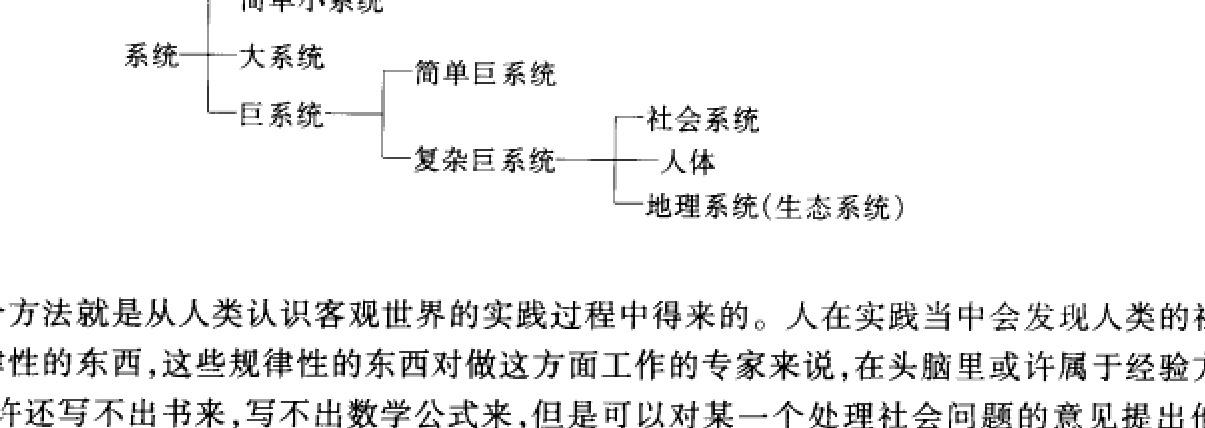
After computing the results, experts are invited again to offer their opinions. They may feel that although their views have been incorporated into the computation, the way their views were absorbed is not quite appropriate, so they consider the results too high, too low, or missing something. Then the comrades at Institute 710 revise the model based on the experts’ opinions and run it on the computer again. It must be made clear here that because the figures are obtained directly from statistical agencies, the data are very large in quantity and very diverse in type. The parameters used in Institute 710’s calculations are roughly over a hundred, sometimes 200 or 300 parameters, meaning that the system of equations contains several hundred unknowns. Considering the complexity—a country with over a billion people reduced to several hundred parameters is already remarkable—any further simplification is impossible. Further simplification would be forced simplification; the actual situation is not that simple, and problems will inevitably arise. Although I have already discussed other methods, what I want to talk about now is Institute 710’s approach, called the combination of quantitative and qualitative methods, using this parameter-based approach and directly using statistical data. Applied to many calculations of our national economy over the past few years, it has been extremely successful. The results obtained by their method are far more accurate than those obtained by other methods. Therefore, the year before last, it received high praise from then-Premier and now General Secretary Comrade Zhao Ziyang. This has been very successful, and what they handle is the social system—the most complex among complex systems.
What inspiration does their success give us? First, it conforms to the giant system problem just discussed. The parameters you use cannot be those describing subsystems—of course, these parameters are not the actions of any single individual, but rather the overall output, prices, and similar matters of the market, and by no means the behavior of any single individual. This is correct. Second, the parameters you use cannot be simplified for convenience—one or two, five or six, or a dozen will not do, because the human body is a complex giant system. The parameters truly needed to describe the functional state of the human body would probably number in the hundreds—at least a hundred. We have arrived at this level of understanding: the human body, like the ecosystem,
2
belongs to the category of complex giant systems. A complex giant system cannot be simplified and represented by only a few parameters. To study human functional states convincingly and in a manner that seeks truth from facts, the following must hold: (1) It cannot be determined by any single system—for instance, how a biological molecule is described—but rather must be a comprehensive
reflection of the system. (2) It cannot be described by just a few simple numbers; in this process, many mistakes were made in the past.
Recently I saw a research report sent to me by Comrade Xia Shuangquan from the Wuhan Physical Education Institute. I don’t know how he came up with the idea of studying the development of human intelligence and wisdom, saying that human wisdom is related to the copper and zinc content in human hair. So he found children—some smarter ones with good grades, and some with poor grades—and then analyzed the copper and zinc content in their hair. The result was a failure, and he himself admitted the failure. In the end, he sent me the research report to look at, saying he could find no pattern. I said, serves him right—how could it be so simple as to find that human intelligence has a direct relationship with the copper and zinc content in hair? It is certain that when the parameters determining human intelligence are eventually worked out, there will be very many of them. Perhaps the copper and zinc content is one of them, or perhaps one among hundreds of parameters, and perhaps not a fundamental parameter at all. I think that compared with what we heard today about the somatosensory evoked potentials of the human brain, this line of work appears important—it is an objective measurement parameter of the functional state of the human body, and perhaps a rather important one. But given the concept of the human body as a complex giant system, comrades should not insist that this one parameter can solve all problems; that would be dangerous. Let me recall: in much of human body science research, we have not paid sufficient attention to the fact that the human body is a complex giant system and that its functional state requires many parameters to be captured. And it is not just us; I am afraid the whole world is like this. In the past, traditional Chinese medicine did not have cerebral evoked potentials at all—nothing of the sort. It seems that observation, auscultation, inquiry, and palpation were quite simple. Even the current physical examinations or laboratory tests of Western medicine—when a lab report or physical examination form comes in with twenty or thirty data points, and you try to describe what is actually going on with this patient based on those alone—I think it is impossible, far too simple. Then why is it that, despite being so simple, traditional Chinese medicine can still cure illnesses, and some diseases are treated quite effectively? And the great masters of Western medicine also cure illnesses very effectively. The reason lies in their experience, because many factors cannot be measured; experiential factors play a role in the process. I mentioned before the great Western medicine master Zhang Xiaoqian. When Zhang Xiaoqian sees a patient, with the same laboratory results, his judgment is different, and it makes other doctors admire him greatly. That is because he uses information not found on the lab reports or test forms—information derived from his experience. So all these problems point to one conclusion: the human body is a complex giant system, and to scientifically determine its functional state, you need many parameters. That, I am afraid, is the conclusion.
In our systems science theory sessions, we also invited psychology experts to give lectures. Wasn’t it said that in social giant systems, human psychological functions and human behavior are very important? So we invited psychology experts to speak to us. Last Tuesday, we invited Luo Zheng from the Psychology Department of Peking University. He spoke for a long time about the relationship between physiology and psychology. After he finished, I said to him: this is the old view held by you people, because physiology is relatively ancient and was established long ago; psychology is younger, about a hundred years old, and psychology has been separated from physiology. But from the perspective of human body science, physiology and psychology are consistent, because physiology and psychology interact with each other, so psychological research must be conducted from the perspective of human body science. A few days ago, I received the obituary of Pan Shu, a senior expert in psychology in our country and a famous figure of the older generation of psychology. He passed away on March 26th of this year, at the age of 91. There is a passage in the obituary that I feel we have already found a way to solve the problem here. The passage says: “For sixty years, he (referring to Pan Shu) had been painstakingly exploring ways to reform old psychology and establish a scientific psychology. He was most concerned about the direction of psychology’s development in our country, advocating that Chinese psychology must take its own path of development and establish a psychology with Chinese characteristics.” Old Pan probably never fully figured it out even at the end and was still exploring. But I can say that we, on this matter, have something of an answer: true psychology must be the psychology of human body science—that is, psychology that views the human being as a complex giant system. Are there not many comrades here who are psychology experts? I wonder if I have offended you by saying this! I don’t know. My view is: the true way forward for psychology lies in what constitutes a scientific psychology—it is the psychology of human body science, treating the human being as a complex giant system and using this perspective to handle problems. The core issue is the giant system and complex giant system that I just discussed. You must pay attention to what makes them complex, and absolutely must not oversimplify. Oversimplification is dangerous—even if you reach a conclusion, your conclusion will likely be overturned in other circumstances, because you have not considered other factors.
What I have reported to you today is not mine alone; it comes from our systems science discussion seminar, held every other Tuesday. Over the past half year, we have been discussing the problem of complex giant systems and have arrived at some understandings, which I think are related to the research work of comrades here.
One last point: what I have said may not have a direct relationship with the specific work you do. The main mission of our institute is aerospace medical engineering and human-machine system engineering. The work everyone does is assigned in the form of specific project tasks—very concrete, very practical, all of them applied.
applied work. I am simply saying that applied work also requires theoretical understanding as guidance. Speaking from Marxist theory, it is quite simple: theory must be integrated with practice, and practice must have theoretical guidance. This is a Marxist principle, one that has been stated countless times, and I imagine everyone speaks of it this way too. But in connection with our concrete work, I have emphasized more than once that when doing concrete work, one must also have this foundation of theoretical understanding in mind. The work of the Institute of Space Medico-Engineering is such that everyone is very busy, and every research laboratory has concrete tasks. I feel that for concrete tasks to be done truly well and efficiently, they must be guided by correct theoretical thought from human body science. In recent years, our institute has received foreign scholars and experts for visits, and sometimes we have also gone abroad to present our work. Our foreign colleagues all recognize that our institute has distinctive characteristics. Our perspective on examining and analyzing problems is in no way inferior to that of foreigners; in some respects it surpasses theirs, and they admire us greatly. The year before last, when people from your institute went to the United States and presented our approach, they did not quite understand it at first. But after we explained it to them, they were full of admiration and felt that our institute’s perspective on examining problems (in space medicine) was very correct. Practice has also proven that we are right, because we have used the theory of human body science as a whole to guide our work. I think what I have just said is not irrelevant; rather, I want to share with comrades our latest understanding of human body science as the most complex system, hoping that everyone will use these perspectives to guide the concrete work they do every day. In this way, theory is integrated with practice, practice has theoretical guidance, and our work will be done even better. This principle is truth, and it has been proven time and again. Since everyone is busy every day with the research work assigned to us, asking everyone to truly devote effort to studying theory is probably something only a few individuals can accomplish. What should we do? I suggest that at the Monday discussion meetings, the latest theoretical perspectives on human body science be introduced regularly. Everyone can listen and keep these things in mind, which will be beneficial, and will be helpful for the daily work everyone does.
(April 1988)
XV. How to Study the Human Body as an Open Complex Giant System — Several Issues Concerning the Methodology of Human Body Science
Today, the first council of the Human Body Science Society holds its fourth meeting, and at the same time, our society’s journal China Human Body Science has been founded. It can be said that our China Human Body Science Society has entered a new stage of work. As our work enters a new stage, our ideological understanding must also keep pace. We can no longer remain at the stage of fighting tough battles against those opponents from a few years ago. The other tough battle we must now fight is to build up the scientific research of human body science. On this major topic, Comrade Chen Xin published an article in the inaugural issue of China Human Body Science titled “The Concept of the Human Body as an Open Complex Giant System and Its Methodology.” Now, using the perspective that the human body is an open complex giant system, I will discuss my understanding of human body science and the work of the Human Body Science Society. If there are any errors, I ask comrades to criticize and correct me.
What Is Human Body Science
In 1983, I published an article in Nature Magazine titled “On Noetic Science,” in which I discussed the outline of human body science, but had not yet addressed the issue of human paranormal abilities. At that time, my main understanding was that medicine already had thousands of years of history and rich practical experience; modern physiology, Western medicine, and so on also had a history of 200 years, and these were the main foundations. At that time, I emphasized the role of human consciousness, which is the distinction between humans and ordinary organisms. Therefore, the impact of human paranormal abilities greatly broadened our horizons. At the same time, a “qigong fever” arose around us, leading people to associate it with China’s ancient medicine of thousands of years — traditional Chinese medicine. This made us realize that the concepts about human beings that we had learned from books were no longer sufficient, and we ultimately recognized that the human body is an open complex giant system. On this issue, in China Human Body Science
This is clearly explained in the article by Comrade Chen Xin in the inaugural issue of Nature Journal, as well as in the article signed under the name “Chinese Society for Human Body Science”: “Human Body Science — An Important Frontier for Contemporary Scientific Breakthroughs.” Looking back now, the reason we arrived at this concept was thanks to the discovery of paranormal human function phenomena. My own current understanding is indebted to the inspiration provided by paranormal human functions. Therefore, the comrades present who work on paranormal human functions have made great contributions and outstanding achievements, which will surely be recorded in history as a milestone in humanity’s understanding of the world!
In that 1983 article, I once pointed out that human body science is a major department within the system of modern science and technology, parallel to natural science, social science, mathematical science, systems science, noetic science, military science, behavioral science, geographical science, and literary and art theory. Each major department has three levels: basic disciplines, technical disciplines, and applied technology.
Of course, literary and art theory is somewhat special, because the practice of literary and art theory is literary and artistic creation — not science, but art. The above nine departments plus human body science make a total of ten major departments, constituting the system of modern science and technology. Each department has a philosophical generalization: the philosophical generalization of natural science is the dialectics of nature; the philosophical generalization of social science is historical materialism; the philosophical generalization of literary and art theory is aesthetics; the philosophical generalization of human body science is the human-heaven view, and so on, all ultimately converging into Marxist philosophy. Marxist philosophy, in turn, guides the development of science and technology through the philosophical generalizations of each department. In the major department of human body science, Marxist philosophy guides human body science research through the human-heaven view, while the results of human body science research, in turn, develop Marxist philosophy through the human-heaven view.
Although the concept of human body science existed in 1983, my understanding of the human body as a whole was still quite superficial at that time. I only knew it was very complex, but how it was complex was not clear. Beginning in 1988, we gradually discovered in the systems science seminar that the human body as a system is not the concept of an ordinary system: first, it is an open system, meaning that this system has exchanges with the external environment. For example, through breathing, eating, excretion, and so on, it conducts material exchanges; through vision, hearing, taste, smell, and touch, it conducts information exchanges. Furthermore, the human body is composed of hundreds of millions of molecules, so it is neither a small system nor a large system, but a giant system even larger than a large system. The components of this giant system are also different from one another, and the interactions among them are extremely complex, so it is a complex giant system. Some giant systems, such as the air in this hall, are also composed of hundreds of millions of molecules and are giant systems, but the types of molecules are not many, and the interactions among molecules are not complex, so they are simple giant systems. For open simple giant systems, a theory can be constructed, such as the theories of Prigogine (I. Prigogine), Haken (H. Haken), and others, to handle them quite successfully, which is why they received the Nobel Prize. However, using their theories to handle open complex giant systems, such as the human body and society, is unsuccessful. The absurdity of those economic theories imported from abroad that were touted a while ago by some “elites” in social science also lies precisely here.
Therefore, to study open complex giant systems like the human body, one must take another path — a method that we have developed over the years in the systems science seminar, called the “meta-synthesis from qualitative to quantitative method.” Specifically, this means synthesizing everyone’s fragmentary, qualitative, and incomplete opinions to form mathematical models, input boundary conditions, perform quantitative calculations, and finally reach conclusions. In fact, [this yields] quantitative conclusions. Our Party’s principle of democratic centralism is correct, but in the past we also made mistakes when applying this principle. The mistake lay in the fact that during centralization, correct opinions were not properly concentrated. Why did this happen? Because there was no scientific method to achieve centralization. When the National People’s Congress and the Chinese People’s Political Consultative Conference are in session, deputies and committee members raise many opinions and proposals, but how are they ultimately consolidated? In reality, there is no very good method for consolidation, so how can scientific decision-making be achieved? Therefore, the formation of the concept of open complex giant systems and the creation of the meta-synthesis from qualitative to quantitative method are contributions of the Chinese people, and from this point on, humanity’s ability to understand the world has ascended to a new level.
Since the human body is an open complex giant system, when we study human body science, we must apply the “meta-synthesis from qualitative to quantitative method” — this is a fundamental viewpoint and methodology. We arrived at this concept, and at this meeting today, it should be said that we also benefited from the inspiration of traditional Chinese medicine theory. Therefore, we once proposed to integrate traditional Chinese medicine, qigong, and paranormal human functions to form human body science. Now I want to say that our theory has risen again — risen to the viewpoint that the human body is an open complex giant system. We must use this viewpoint to transform all the old bodies of knowledge about the human body. I believe this is the task of the Chinese Society for Human Body Science. Of course, this task is very arduous; to make any headway, I am afraid it will be a matter for the next century. However, we must have confidence. For thousands of years, humanity has been continuously exploring,
Today we have finally found the correct path, and we must follow it through.
Human Body Science Research Must Attach Importance to Clinical Medicine
Since the human body is a complex giant system, research on the human body must never be oversimplified. We must never seize upon one point and ignore all the rest. Therefore, we must seek truth from facts and place special emphasis on knowledge gained from practice. For human body science, the foundation of practice is medicine. Medicine is the richest source of practice for human body science. Because people fall ill, and when they fall ill they must be treated. In order to treat illness, one must clarify the causes of disease and study what the human body is all about. Clinical medicine in particular involves direct contact with patients. A patient is real, concrete, and complex—you cannot oversimplify. I have come into contact with some people engaged in medical research who often oversimplify the human being and tend to look down on those in clinical medicine, considering them not very “scientific.” But I feel that what they call “science” often contains elements of mechanical materialism. Those of us working in human body science must never commit the error of mechanical materialism. We must value the experience of clinical medicine, which includes traditional Chinese medicine. Traditional Chinese medicine has a history of several thousand years and is extremely rich in content. Through practice, Chinese medicine has accumulated a great deal of perceptual knowledge, and its practitioners have also worked hard to synthesize and summarize, forming Chinese medical theories that are very precious. Of course, there are also the medicines of ethnic minorities, such as Tibetan medicine, Mongolian medicine, and so on—hence the term “traditional medicine.” In fact, this issue has now attracted attention abroad as well. The British magazine New Scientist reported that in Western Asia there are two medicines, one called frankincense and one called myrrh, both quite famous, and they are being studied. Later I saw another report saying that African chimpanzees eat two kinds of leaves every morning—one with the Latin name Aspilia, and another called Lippia plicata—said to be leaves that promote health and stimulate the appetite. That is to say, chimpanzees also take herbal medicine. Therefore, Chinese medicine, the folk medicines of various parts of the world, and so on, constitute an extremely rich treasure house, whose history is probably not just a few thousand years; if we include our human ancestors, it likely spans millions of years.
Another major area is Western medicine; and then there is the integration of Chinese and Western medicine. In this year’s fifth issue of China Pictorial, I saw an introduction to achievements in the integration of Chinese and Western medicine, with special mention of the achievements in orthopedics in the area of bone-setting through the integration of Chinese and Western medicine.
The fourth very important area is folk medicine—what we commonly call folk remedies. Some folk remedies are remarkably effective, yet cannot be found in medical books. This too is something very precious in medical practice, and we must not overlook this area.
The fifth area is psychotherapy. This has seen considerable development in recent years. Professor Wu Jieping, Vice Chairman of the China Association for Science and Technology, told me that psychotherapy is very important, and that he applies psychology when treating patients. So everyone should not regard psychotherapy as something trivial. When qigong masters treat patients, there is also a psychological component at work.
The sixth area is qigong. Qigong is very effective in treating certain illnesses of certain people, but its patterns have not yet been fully understood. We must not, on this account, fail to take it seriously.
The seventh area is extraordinary functions (special abilities). Many comrades present here are engaged in research on extraordinary functions, so I need not elaborate on the significance of extraordinary functions in human body science.
Are there other areas? As our understanding develops, there may be more. The seven areas I have discussed above are presented roughly in the historical order in which they appeared and gained attention. Of course, the comrades present probably each have their own ordering, and I will not argue about that. But all seven areas deal directly with human beings—they are practices concerning the human body—and since we are researching human body science, we cannot oversimplify. We must take into account that the human being is an open complex giant system, and moreover, no two people are the same. Therefore, clinical medicine is the richest and most comprehensive source of information for research in human body science, and we must give it full attention. Our China Society for Human Body Science has a Professional Committee on the Philosophy of Clinical Medicine. Its research plays an important role in the development of human body science, and in accordance with what is discussed in this section, it should not be limited to Chinese medicine alone but should encompass all seven aspects of clinical medicine. For example, I once suggested using Chinese medical theory to analyze large numbers of Western medical case records.
From the perspective of human body science, clinical medicine can undergo even greater development. In the past, medicine was divided into first medicine, which is the medicine of curing disease; and second medicine, which is the medicine of health care and disease prevention. Regarding the concept of third medicine, I have some different views. The English term for third medicine is “rehabilitation medicine,” and our translation of it as “康复医学” (recovery medicine) is inappropriate. When a person falls ill and needs to recover, that belongs to the domain of first medicine, whereas third medicine actually refers to the restoration of function for disabled persons, achieved through mechanical means. In fact, there are many such devices: for near-sighted eyes,
When vision cannot be cured, one wears glasses; when ears go deaf, one wears a hearing aid; when heart function is poor, one wears a pacemaker, and so on. With the progress of science and technology, such things are increasing. There is a report introducing “consciousness technology,” which includes a passage stating: “We have worn glasses for several centuries. Then contact lenses appeared, and now we perform eye surgery to help ourselves see more clearly. We can also remove aged bones from the body and replace them with stainless steel; plastics are replacing necrotic skin. We are slowly but surely adding more technology into the body; we are becoming controlled machines, people who use technology added inside and outside the body to perform certain life functions.” On page 2 of Guangming Daily, May 28, 1990, there was a news article titled “A New Multi-Functional Rehabilitation Bed Put into Use,” which discussed using a new type of multi-functional electronic bed to help people perform functions they had lost. Research in human body science can help us manufacture more mechanical and electronic instruments, and these instruments can help people restore functions that medical methods cannot restore. Therefore, I believe that the third medicine should not be called rehabilitation medicine, but rather “reconstructive medicine,” that is, the reconstruction of human organs.
From the perspective of human body science, I believe there should also be a fourth medicine, which is the development of functions that ordinary people do not possess, such as extraordinary functions. I call it “transcendent medicine”; in English it can be translated as “Creation Medicine.” We must transcend ourselves and create human beings superior to those created by “God,” and this is a conscious, active creation. This is an important aspect of our human body science. It can in turn include three aspects: first, using methods of human body science to improve athletic performance. Comrade Xia Shuangquan of the Wuhan Institute of Physical Education has researched and experimented with using qigong methods to improve athletic performance. Second, improving human intelligence; Comrade Wu Yi of Anhui has conducted experiments in this area, also using qigong methods. However, his inclusion of practicing qigong to treat myopia under this category is incorrect; that is a matter for the first medicine. Third, inducing extraordinary functions and bringing into play latent functions that ordinary people do not possess. I believe that research in human body science must consider the fourth medicine, that is, the issue of transcendent medicine.
Human body science must be oriented toward medicine, and here clinical medicine includes four medicines: the first medicine, the second medicine, the third medicine, and the fourth medicine. Moreover, all four medicines must employ traditional Chinese medicine, Western medicine, the integration of Chinese and Western medicine, folk medicine, psychotherapy, qigong, extraordinary functions, and so on. Of course, we also cannot say that extraordinary functions belong only to the fourth medicine; this concept must be made clear.
There is a doctor in Shanghai named Sun Qiyuan, who researches leukemia. He has proposed that it is incorrect for medicine to separate medical practice from pharmacology, and I think this makes sense. Some people do not consult doctors but buy and take medicine according to advertising promotions, which I am afraid will cause problems. Because even if people suffer from the same disease, individuals differ from one another; regardless of a person’s state—that is, what we call the functional state—taking medicine indiscriminately will not do. The current state of chaos in the medical enterprise is truly worrisome.
We who work in human body science must also recognize that there are many unsolved problems in clinical medicine. Not long ago I met Dr. Kuang Peigen of the Neurology Department at Hospital 301. She spoke to me about the problem of pain, saying that this problem is very complex and that we do not understand it. There is an international pain society in the world, with many participants, including those in medicine as well as those in psychology, sociology, and so on, because the causes of pain are very complex. Many types of pain cannot be cured; there is no way. Therefore, our understanding of the human body, especially the nervous system, still falls far short.
The Complexity of the Problem of Human Consciousness
In 1983, I discussed this problem in my article “On Cognitive Science.” Now I think we must also pay attention to this problem in our study of human body science. Because the human body is an open complex giant system, we must attach importance to the feedback effect of consciousness on other parts of the body—this is psychology, a foundational discipline of human body science. In ancient times, the study of psychology committed errors of idealism. Later, when psychology was established as a discipline, it encountered mechanistic materialism. The typical representative is behaviorist psychology, the so-called “black box theory.” At present, in psychological research abroad, factions are numerous, and none can persuade the others. But some problems, I believe, can be clarified. For example, in conjunction with brain science research, the problem of sensation—how human beings perceive external information, and how it is transmitted to the brain after being received—such problems can be clarified; this is physiological psychology. But when sensation is further elevated to what psychology calls perception, it becomes complex and not so easy to clarify. Because perception involves more complex problems, such as how the brain processes the information it receives. Researchers abroad have studied the perception of sheep, saying that if a person stands, the sheep are afraid, but if a person lies down, the sheep are not afraid—this is an interesting phenomenon. Recently I saw a book
I reviewed a book review of Richard E. Cytowic’s book called Synesthesia. From the content of the review, I believe it should not be translated as “共感觉” (synesthesia), but rather as “感受” (felt experience). Felt experience is something higher than perception, more complex than perception. For example, when a person listens to music, the first step is sensation from the ear to the auditory nerve, then the relevant part of the brain processes the sensory information to achieve perception, and perception is then integrated with the listener’s life cultivation and refinement, ultimately reaching the felt experience of listening to music. The process is the same when people visit scenic areas, read poetry, or watch artistic performances. But studying this kind of problem, I think, is very difficult for psychology, because it still cannot free itself from the reductionist approach. There are many books in this area, and this is precisely the difficulty currently facing psychology. Those of us working in human body science must pay even greater attention to this problem, and moreover, we must break out of the framework of psychology, use the methods for handling open complex giant systems, and the meta-synthesis method from qualitative to quantitative, gradually ascending from physiological psychology to the level of what Roger Sperry calls “mentology” (精神学). We must clarify how human sensation rises to higher-level mental activities, and then how these higher-level activities feed back to influence other parts of the human body. This is what it means to truly establish mentology. If researchers in human body science do not study this problem, I am afraid many problems—such as qigong and human paranormal abilities—cannot be solved. I have discussed this issue in the past; today, in conjunction with the new concept of “felt experience,” I reiterate it once again: the role of consciousness and psychology in human body science.
Guiding Ideology and Methodology for Research in Human Body Science
Research in human body science must be guided by Marxist philosophy, that is, dialectical materialism. For human body science, what connects to Marxist philosophy is the human-heaven view (人天观). The human-heaven view includes three levels: the microscopic, the macroscopic, and the cosmoscopic. Traditional Chinese medicine theory has made great contributions at the macroscopic level. What I want to emphasize here is that we must never make the errors of idealism and mechanical materialism. In some natural science and technology fields, it is not easy to commit the error of idealism, but due to the influence of Western science, it is very easy to commit the error of mechanical materialism—in plain terms, being too rigid and looking at problems too simplistically. Research in human body science must guard not only against idealism but also against mechanical materialism. In the past, some who criticized paranormal function research and opposed us said nothing more than that we were either idealists or mechanical materialists. But if we adhere to Marxist philosophy and adhere to dialectical materialism, then whoever says we are idealists must himself be a mechanical materialist; whoever says we are mechanical materialists must himself be an idealist. Therefore, today I repeat and emphasize once more: those who work in human body science must study Marxist philosophy well; otherwise, not only will we fail to conduct good research in human body science, but we will also make mistakes. The leading comrades of the Central Committee have repeatedly emphasized that leading cadres must study Marxist philosophy well. Why? Because the social problems that leading cadres must deal with are also an open complex giant system. On this point, there is commonality with human body science, so those working in human body science must study Marxist philosophy.
Recently I saw A Preliminary Exploration of the Human-Heaven View (《人天观初探》) compiled by Comrade Ye Jun from Sichuan. I think the book has included some things that are specious. Therefore, building the bridge between human body science and Marxist philosophy—the human-heaven view—is not an easy task.
Here I must also say that the Chinese Communist Party, in leading the New Democratic Revolution and socialist construction, faced extremely complex problems but achieved great victories and accomplishments. The summation of this experience, distilled to the philosophical level, is Mao Zedong Thought. Mao Zedong Thought put forward a materialist-dialectical category theory for intricate and complex problems; it is also a sharp weapon for studying human body science. We must study and apply this Maoist philosophical thought.
Having established the guiding ideology, the next issue is methodology. The method for handling the open complex giant system of the human body is the meta-synthesis method from qualitative to quantitative; it is not the old, reductionist method. Reductionism divides things apart, conducts experiments, and then synthesizes them again. This is the Baconian method formed 300 years ago, and people have been using this “scientific method” for research work for hundreds of years. However, this set of methods cannot be used to solve open complex giant systems. Because this system is extremely complex, we do not know how to divide it; the small systems cut out are no longer the original system, and the piecemeal research on small systems cannot be synthesized. Just now I mentioned that people doing medical research and clinical physicians have somewhat different views, while the patients clinical physicians face every day are each complete individual persons, and the human being is a whole. Facing the human being as an open complex giant system, we must conduct comprehensive research and cannot remain at the level of piecemeal research; we must integrate various local research findings. The medical community publishes many papers every year, but they do not solve problems. Why? Because
Those studies are fragmentary and partial, lacking synthesis. Research in human body science must integrate various kinds of information, which requires the meta-synthesis method from qualitative to quantitative.
We already stated in the first section that this method is a Chinese creation; foreigners do not yet have it. Of course, they too encounter difficulties of complexity in practice and realize that the old Baconian method no longer works. Thus, in recent years, the so-called study of complexity has become fashionable abroad, but after much discussion, no feasible approach to overcoming the difficulties has emerged. We are still ahead in this regard—this is something Chinese human body science researchers can take pride in.
Our Current Difficulties and Challenges
On the other hand, in the practical application of the above research methods, because it involves China’s social conditions, there are many difficulties to be overcome. A large amount of information must be synthesized, and manual labor alone will no longer suffice. Therefore, modern information technology methods must be employed, using information technology as an auxiliary tool for human thinking, to accomplish the meta-synthesis from qualitative to quantitative. Those engaged in human body science research must participate in this work and master this method. As far as I know, Mei Lei of the Institute of Space Medico-Engineering has done much work on electroencephalography (EEG), while Lu Kan and Lu Huo of the General Hospital of the Nanjing Military Region are conducting fractal-dimensional EEG research. Can these works on EEG not be synthesized? I recently read that Shao Ziyuan of the Henan Sports Science Research Institute studies dermatoglyphics, claiming that skin patterns represent human genetic information and that skin patterns can be used to select sports talent. I think this is too narrow a view. Even if skin patterns represent heredity, one cannot say that heredity determines everything—the influence of the postnatal environment is also very significant! In short, the functional state of the human body probably requires several hundred parameters to describe; it cannot be oversimplified. I recently saw an article by Zhang Shaoguang and Zhang Shaoming in Natural Magazine on the theory of human meridians, proposing that the material basis of meridians is the movement of a liquid crystal in certain interstitial channels of human tissues. This is also too simplistic, and it is merely a hypothesis without in-depth research. The Heilongjiang Science and Technology Press published a book on the modernization of traditional Chinese medicine written by Zhang Shishun, which even quoted my words, saying that the human body is a system. But his system is too simple, and he has also brought in that set of pansystems theory from Wu Xuemou of Wuhan. Zou Weijun of Jiangpu County Hospital in Nanjing wrote a book on multidisciplinary research in traditional Chinese medicine, broadening TCM theory and introducing everything that can be used for reference; this is a good beginning, but it is only a beginning. Because the human body is too complex, we absolutely must not oversimplify any longer.
In the past, Western medicine often suffered from the flaw of oversimplification—treating wherever the lesion was located. I recently read an article by Steven A. Rosenberg in the May 1990 issue of Scientific American, discussing how to enhance human immune capacity so that the immune system can overcome cancerous changes—this is a step forward. The article recounts that in 1968, when he was a resident physician at a Boston hospital, he received a patient with abdominal pain. Upon examination, gallstones were found, and he surgically removed them. But when checking the medical records, he discovered that this person had suffered from stomach cancer twelve years earlier. At that time, when the abdominal cavity was opened, metastasis to the liver was found, and surgery was no longer possible. The doctors believed the patient could live at most three months. Strangely, however, after three months, his physical condition grew better and better, and twelve years later, during the gallstone surgery, the cancer was found to have disappeared. Rosenberg attributed this to the immune system—this is a systemic perspective, rather than treating the head when the head aches and treating the foot when the foot hurts.
I am also reminded that traditional Chinese medicine often employs a nourishing and tonifying approach in treating illness. What does “nourishment” mean? It is probably what Western medicine calls enhancing immunity. However, the “nourishment” spoken of in TCM is more comprehensive than the “enhancing immunity” of Western medicine. Western medicine now also uses some tonifying medicines, such as wolfberries (Gouqi) and astragalus (Huangqi), but Western medicine does not know that taking tonics requires attention to seasonal timing—some medicines can only be taken in winter, not in summer. TCM is more dialectical in this regard.
These examples merely illustrate that one must view the problems of the human body from the perspective of an open complex giant system, and must employ the meta-synthesis method from qualitative to quantitative. We must use Marxist philosophy and the human-universe worldview to guide our research, and absolutely must not grasp only one point while neglecting all the rest. For human body science research to achieve results, it is essential to overcome the shortcomings of mechanical materialism. At present, however, fragmentation is a serious problem, and fragmentation is the great enemy of human body science research. There are many senior experts of high prestige in the Human Body Science Society who have already withdrawn from the front lines of scientific research. They should no longer do piecemeal work; they should step back a bit, and instead of all rushing into “entity-based” operations, could they synthesize various fragmentary studies and do some “virtual-entity” work? This is extremely important for human body science research.
Research in Chinese human body science has achieved results, and its prospects are full of hope! This is not only because we have Marxism-Leninism-Mao Zedong Thought
and Marxist philosophy to guide our work, but also because Chinese human body science research is under the leadership of the Party. At the top there is a four-person leadership group for human body science of the Party and the state, and below the leadership group there is an expert group. Because research in human body science must employ the meta-synthesis method from qualitative to quantitative and must synthesize, I wish to emphasize once again that synthesis is the most important task of the expert group, and the council members of the Human Body Science Society must also carry out synthesis work. Piecemeal work is not unnecessary, but synthesis is where the future of human body science research lies. We must turn around the prevailing atmosphere of fragmented research! In the past, when we developed the “Two Bombs,” it was precisely through integrated leadership, high political consciousness, high organizational discipline, and a high degree of scientific rigor. This kind of organized, holistic work is essential for human body science research. I hope that through such work, we can change others’ perceptions of our Human Body Science Society—they think we are merely a “Chinese Association for Paranormal Human Functions” or a “Chinese Qigong Association” that only puts on live demonstrations or conducts piecemeal testing. We must enter a new era of human body science. The scope of our work should not only be applied to first medicine and second medicine, but must also open up third medicine and establish fourth medicine. Therefore, human body science is closely related to China’s socialist modernization.
Are the several points of understanding I have discussed above correct? I ask the council to discuss them. The council is the leadership of the society, and once the council has decided, the Chinese Human Body Science Society must act accordingly.
(June 28, 1990)
VI Sociology 231
I. Does This Herald a New Scientific Revolution?
Things are always developing, and over these past few months research on human paranormal functions has continued to advance as before. Because there is debate within our country regarding human paranormal functions, this has prompted us to seriously and carefully consider a question, namely the relationship between research on human paranormal functions and society.
Perhaps because we live within the environment of our own country, we pay particular attention to developments at home. But I would like to say that we should not consider the problem in such a narrow way. Research on human paranormal functions is an inevitable phenomenon of science and technology developing to the present day. The problems encountered by this research are by no means unique to China; the situation is roughly the same throughout the world, possessing its commonalities. Abroad, this question is also fiercely debated. In capitalist countries, due to the inherent contradictions of the social system itself, the public is disappointed, and so they escape from reality and seek novel stimulation, to the point that performances of human paranormal functions have become a hot commodity. This was probably very fashionable from the late 1960s through the 1970s. There were indeed people who used it to make money, performing on stage, grandstanding, producing television programs, and so forth. In order to make things appear extraordinary, fakery did occur. This situation naturally provoked opposition from some honest and serious scientists—this is one kind of situation.
There is another kind of situation, which relates to the so-called scientific revolution, the kind of scientific revolution described by Thomas Kuhn. A set of scientific laws formed over a long period in history is deeply imprinted in people’s minds. Therefore, it is considered that paranormal functions seem to violate an entire system of scientific laws that people have accepted. In history, every time such a problem or such a new phenomenon has appeared, it has inevitably been rejected by the majority of scientific workers, because they believe it violates the established system of scientific laws. There are many such people abroad. The magazine Scientific American has done much work in popularizing scientific knowledge, but this publication has had two regular contributors who write articles on mathematical theory—one named Martin Gardner, who has now retired and was succeeded by Douglas R. Hofstadter—and both of these individuals have been fiercely opposed to human paranormal functions, in a manner bordering on invective, declaring that human paranormal functions are “all fake.” In such a relatively authoritative publication, the editorial attitude is one of opposition to human paranormal functions. There is also a third kind of situation: I recently came across a document stating that people who originally supported human paranormal functions later turned around and attacked research on human paranormal functions. The author of this article, Brian Inglis, used a term: “Retro-cognitive dissonance.” What does it mean? “Retro-cognitive” means rethinking, and “dissonance” means non-resonance, non-sympathy. The meaning is that there is a certain kind of person who, upon first encountering human paranormal functions, says it is remarkable, a great discovery, and is very positive and supportive. After a while, they ponder and ponder, and the more they ponder, the more uncomfortable they feel, with the result that they become resolute opponents. For this kind of person, I coined a name: “rumination dissonants.” There is a British mathematics professor named John Taylor who wrote a book attacking work on human paranormal functions, saying that he initially believed in it but later withdrew his support. What is the real reason? It is nothing more than that human paranormal functions cannot be explained by the established system of laws of modern science, and so the more he thought about it, the more unsettled he felt, and the most settling course of action was to rise up in opposition—this may have been a comfort to his mind. This kind of situation is not limited to John Taylor alone. Furthermore, there is a fourth kind of situation, which is more moderate: it holds that the reproducibility of experiments testing human paranormal functions is poor—sometimes they work, sometimes they do not—and therefore, should one believe in these experiments or not? It is difficult to decide. So a reserved attitude is temporarily adopted; this is a moderate form of opposition.
Abroad, due to the four situations described above, research on human paranormal functions has never been able to gain substantial support; it has always been sustained by researchers scraping together funds here and there. There is also a claim that researchers engaged in human paranormal function research at the Stanford Research Institute in the United States received six-figure dollar support from the Pentagon — at most, something on the order of a million dollars! In fact, in the United States, a six-figure research budget is trivial. For example, the Space Shuttle program actually cost 40 billion dollars — a ten-figure sum. In short, in the United States, research on human paranormal functions remains a “poor business,” to the extent that they themselves say: “our field cannot get support.” One of them, Stanley Krippner, complained bitterly that he had been working on human paranormal functions since his college days, for over twenty years, truly “neither for fame nor for profit.” This situation is universal; it is the same in Britain. When researchers on human paranormal functions from capitalist countries visit the Soviet Union and interact with their Soviet counterparts, they see that the situation in the Soviet Union is currently the same. Thus, this situation is universal — it holds in capitalist countries and in the Soviet Union alike.
In our country, those who oppose research on human paranormal functions probably fall into no more than the four categories described above. Therefore, I believe that on this issue — the relationship between human paranormal functions and society — we researchers of human paranormal functions should seriously study it. Why? Because the actual circumstances of this work are quite complex. If we speak of contradictions, the complexity of these interwoven contradictions is very high. Under such complex conditions, how can we formulate correct policies, strategies, and measures in our work? How can we command this battle? This is indeed very important. To command this battle, we must grasp its underlying patterns. What patterns? They constitute a field of study called “Human Paranormal Functions and Society.” This is also a topic within the science of science. Previously, we had not yet established the concept of the science of science, and there was blindness regarding the relationship between scientific development and society. Now that we recognize the importance of the science of science, it would be inexcusable to continue treating this issue blindly.
Studying the issue of human paranormal functions and society is a matter of the relationship between science and technology on the one hand and society on the other. I feel that if we review the experience and lessons that should be summarized over the past few years, we will find that we previously did not study this issue sufficiently — our heads were somewhat overheated, we were overly optimistic, and we were detached from reality. Those of us engaged in science and technology sometimes do not think much about these matters. I believe that over the past two years we have had sufficient lessons on this issue; not studying it is no longer acceptable. Promoting this work has already become a social phenomenon. Therefore, I suggest: should we establish within our research society a research group on the topic of “Human Paranormal Functions and Society,” dedicated specifically to studying this issue. We must, under the leadership of the Party, follow the directives of the Party Central Committee, and in our concrete work, be guided by Marxism-Leninism and Mao Zedong Thought, pay attention to strategy and methods, seriously consider the opinions of opponents, and unite all who can be united — only then can we do our work well.
II
The second issue I wish to discuss is: following the Party’s directives — that is, following the recent notice issued by the Central Propaganda Department — what should we do from now on? I would like to offer several points for your consideration.
First point: the notice from the Central Propaganda Department states that a small number of people may continue conducting research in this area under the responsible management of relevant units. Since it is a small number of people, they must be truly outstanding, forming a highly capable and lean team. I think the nation should not set up many research sites. How exactly to proceed is open for discussion. The team actually doing research work must be lean; being lean means having a high level of competence. From the experience of recent years, conducting research on human paranormal functions is very difficult. It requires the integration of many disciplines — physics, biology, physiology, psychology, and various testing technologies — all must be brought together. There is a book (Consciousness and the Physical World, edited by B. D. Josephson and V. S. Ramachandran, published by Pergamon Press in 1980) that discusses human consciousness and the physical world. The book features a witty preface by Freeman J. Dyson of the Institute for Advanced Study at Princeton. In it, he says that there are two types of people studying consciousness: one type consists of physicists, who are bold and daring in innovation but lack professional knowledge in biology; the other type consists of biologists, who are the exact opposite — rich in professional knowledge but timid. Therefore, he suggests that people from both sides should combine their efforts, and only then can the work succeed. I think what he says makes some sense, and we should do the same. To truly conduct scientific work in this area, we must recruit capable professionals from various fields to jointly tackle this challenge. This is a collective endeavor that relies on collective wisdom; everyone must work harmoniously together, each contributing their strengths, and yet
brought together. Such a central research collective naturally also needs a “group leader” who can unite this small group. This is one of the necessary conditions for this research work to proceed and genuinely achieve results. Without this condition, it would probably be very difficult to carry out genuine scientific research on human special functions.
Second, there must be appropriate monitoring instruments and equipment. One difficulty everyone encounters in this work is that when children with special functions cannot produce results during testing, they may become anxious and cheat. Therefore, instrument monitoring is essential. Key areas must be monitored so that genuine and fake can be distinguished. For example, using an electroencephalograph (EEG) for monitoring, one can observe whether the subject is in a special functional state. If there are unusual patterns in the brainwaves, it indicates a special functional state, and the result is genuine; without such special brainwave activity, it does not count. How exactly should instruments be used for monitoring? Everyone should think of solutions. There are already preliminary experimental leads. In short, we must truly grasp the key points. We should not use seven or eight video cameras for surveillance, making everyone tense—that is a clumsy approach. Besides EEG, what other methods can be adopted? Everyone can consider this from psychological and physiological perspectives.
Another point: critics say that special functions are unstable, and indeed they are unstable. How can stability be achieved?
There is a solution. We have the precious heritage passed down over thousands of years in our country—qigong. Qigong can, under the guidance of one’s consciousness, enable a person to enter a special functional state. This is controlled by consciousness, so it may be possible to keep the special functional state stable—to enter that functional state whenever one wishes to. Everyone can study how this works. If it is possible, we should incorporate qigong, and gradually train people who can enter the special functional state at will. I have recently heard that people in Sichuan and many other places are considering this problem, combining qigong with special functions.
In the future, our country should establish a small number of research centers, with highly capable teams, tightly organized research work, equipped with instruments, combining special functions with qigong, leveraging our country’s advantages, and greatly raising the level. Some people abroad have also recognized that research in parapsychology should henceforth concentrate on what they call the “psycho-physical” direction. This is consistent with our view. In our research on special functions, we must produce results that are irrefutable and undeniable. If we can produce such experiments, the situation will open up, just as Michelson’s interferometer experiment led Einstein to create the theory of relativity.
In coordination with these efforts, we can also establish an internally circulated journal. We should not disperse our efforts; we should publish one genuinely respectable scientific journal. Flashy and superficial things are not wanted—this space is precious! Such a journal must stand the test of history, with high-quality, serious papers and articles. Of course, the scope of papers and articles need not be very narrow; for example, articles on the science of science such as “Human Special Functions and Society” are also needed, but things with too much filler are not wanted. I suggest that only one such journal be established—not here and there, which would disperse our efforts.
These suggestions all seem restrictive, but I think we cannot close the door so tightly; we must open it a little. After all, there are many people across the country interested in human special functions. To accommodate this, we can consider establishing an association-type organization in which anyone interested in human special functions can participate. Perhaps it can also be linked with other things, such as qigong. In 1980, I said at the editorial department of Nature Magazine (Ziran Zazhi): human special functions are too unusual; probably only a minority can accept them. What has a broader reach is qigong—it can cure illness, and people easily accept it. Although human special functions may not yet be able to enter respectable venues, qigong can. The July issue of Beijing Literature and Art this year published a reportage piece by Ke Yan: “Cancer Does Not Equal Death,” which is about the efficacy of qigong. This shows that qigong has gained broad recognition. Of course, even more broadly recognized is traditional Chinese medicine. We can study this and set up an association-type organization that can be combined with qigong and traditional Chinese medicine. On the one hand, following the Notice from the Central Propaganda Department, we organize a small number of people to conduct research—those who genuinely study human special functions must be highly capable. On the other hand, we need a mass organization that can serve as the vanguard, scouting and discovering new human special functions.
III
I myself have recently studied some literature, which has further strengthened my conviction: human body science is a frontier issue in modern science, with long-term significance and strong theoretical importance. The story should be told this way: Crook (John H. Crook, British
Crook (an associate professor of psychology at the University of Bristol) wrote a book: The Evolution of Human Consciousness (Oxford University Press, 1980). This book discusses what human consciousness, or the function of the human spirit, is really all about from the perspective of long-term historical evolution. In the past, people who studied this question often confined themselves to a biological viewpoint. Crook argues that when the human brain developed to a certain stage, society emerged, and it was the influence of society reacting back upon human beings that enabled consciousness to develop gradually and continuously. One piece of evidence he cites is the research findings of the Swiss child psychologist Piaget (J. Piaget): a newborn child has no self-awareness; self-awareness undergoes a gradual developmental process and is also a product of society. This point can be said to be entirely in accord with Marxism—the Marxist viewpoint is precisely this. I have here a document from the Central Party School on matter and consciousness. It states: “The dependence of consciousness on matter is manifested both in the fact that consciousness is a product of the long-term development of matter and is a function of the human brain, and in the fact that consciousness is a reflection of the objective material world, a subjective impression of the objective material world. Only by grasping both aspects comprehensively can one correctly understand the essence of consciousness. We must uphold the materialist principle that matter is primary and consciousness is secondary, and thoroughly criticize the fallacies of idealism.” (Central Party School, Lectures on Marxist Philosophy, July 1982, Lecture 3, “Matter and Consciousness”) This means that the material basis of human consciousness is the brain, but the brain alone cannot produce consciousness; rather, it is the brain receiving external influences that then produces consciousness. Some foreign scholars, after many twists and turns, have also come to realize this truth. Based on this understanding, Crook raises the question: at the present stage, is it possible for human beings to consciously and actively exercise their own brains so as to enhance their intelligence and their capacity for insight into things? And what measures can be taken to achieve this? The answer is qigong. He cites extensively from classical sources, all of them Eastern: Daoist, Confucian, and Buddhist. He cites a Japanese word, Zen, which is the Japanese pronunciation of “chan” (禅), referring to entering a state of stillness, enabling the human brain to enter a new functional state. What the ancient Chinese Daoists, Confucians, and Buddhists spoke of as cultivating the self and nourishing the nature refers precisely to this. Through such training, it may be possible to enhance human intelligence—that is, the ability to know the objective world. Whether human beings can indeed enter a special functional state through “entering stillness,” thereby exercising the brain to enhance human intelligence—this is probably a question worth studying. Crook has raised this question. Later, I consulted other books, and others have also mentioned that for human beings to further enhance their intelligence and to evolve to a higher level, the means is qigong. Foreigners are researching qigong and Zen meditation with great enthusiasm. By comparison, we descendants of Yan and Huang seem to fall short. We must have a full appreciation of the question of the further evolution of human consciousness. Are we perhaps knocking on the door of a higher human intelligence? And is the key to that door qigong and special functions? Is it really so? Everyone is welcome to investigate.
In studying this as a scientific question—whether researching the relationship between spirit and matter, or the relationship between consciousness and the brain—we must be guided by Marxist philosophy. The views abroad are diverse and chaotic in the extreme. Some of their positions are quite naive; the most naive is denialism, which holds that spirit and consciousness are not subjects for scientific discussion and simply avoids the topic altogether. In psychology, this is behaviorism. Some even say: “The word ‘consciousness’ is not allowed to appear in my book.” Because this is so absurd, it has gradually ceased to be accepted. What followed was dualism, which has appeared mainly among experts in neurophysiology and neuroanatomy, such as the Australian Eccles (J. Eccles) and the British philosopher Popper (K. Popper). They promote dualism, arguing that spirit is still an independent existence, different from matter, different from the brain. In reality, this is quite superficial. Faced with the complex phenomenon of how spirit and consciousness actually arise from the brain, and unable to figure it out, they express a kind of despair and simply give up, claiming that spirit and consciousness cannot be explained in material terms. They are all very eminent figures—knights of the British Empire—and they proclaim this unabashedly everywhere, calling themselves dualists. But dualism is still difficult to sustain scientifically, and so some have produced a third position—the emergentist theory of spirit or consciousness. That is, spirit and consciousness do arise from the brain, but the adherents of this school have a problem: after spirit emerges from matter, they once again treat it as a non-material existence. One might say they come close to being correct, but in the end they revert to dualism—they are “one-and-a-half-ists.” The book by the Canadian Bunge (M. Bunge, The Mind-Body Problem: A Psychobiological Approach, Pergamon Press, 1980) expounds precisely this kind of argument. He criticizes both the dualists and the mechanistic materialists, yet he himself cannot fully break free. Seeing these phenomena makes me all the more deeply appreciate the brilliance of Marxist philosophy. We are thorough dialectical materialists and can avoid their many errors. To study this question, it is very necessary for us to study Marxist philosophy even better; this foundation must be firmly established. When we read foreign materials, we must not be influenced by them.
What I have just discussed—the questions of matter and spirit, brain and consciousness—are now unavoidable issues that have already been placed on the agenda of world science. If we do not study these questions, that would be inappropriate. And studying these questions is closely related to human body exceptional functions; it involves the even more long-term issue of developing humanity’s inherent potential. How can people actively train their own brains so that their intelligence achieves higher development? In researching this question, we do indeed possess unique advantages: on the one hand, we have the guidance of Marxism; on the other hand, we have an extremely rich cultural legacy left by antiquity. Of course, the things of antiquity, limited by the historical conditions of their time, also contain some idealistic admixtures. For example, from the practice of qigong meditation leading to certain functions, one might fancifully extrapolate that humans can, without relying on social practice, come to know the past and future of the universe—this is absurd. But from the mainstream perspective, these remain the products of thousands of years of people’s practice. We should study this rich heritage. Recently some people have begun studying the Zhouyi Cantongqi; I have received articles researching the Zhouyi Cantongqi and Laozi’s Dao De Jing, which are quite inspiring. In short, this kind of work—the systematic study of our classical heritage, including qigong and traditional Chinese medical theory—can serve as the foundational science for our exploration of human body exceptional functions, and research should be strengthened.
This also involves the question of the transition from human body science to Marxist philosophy. I call the bridge for this transition the “human-heaven view” (ren-tian-guan), which concerns the problems of spirit and matter, consciousness and brain. The study of the “human-heaven view” has three levels: the largest level is the cosmological level, which is what foreigners call the “anthropic principle” and so forth, holding that the emergence of humanity is inseparable from the overall arrangement of the universe. There is also a microscopic level, where quantum mechanics has already demonstrated that nothing in the world is uncorrelated; independence does not exist. These are all results of modern scientific research. The most abundant part of our Chinese heritage is the macroscopic, that is, the middle level, which speaks of “all things breathe upon one another”—all things are interconnected.
Taking what modern science has discovered from astronomy and cosmology, then the results studied from quantum mechanics at the microscopic level, combined with the precious legacy of our motherland built over thousands of years, and synthesizing and organizing them—I think this is a very meaningful undertaking. It can form a Marxist “human-heaven view,” which will be the most useful tool guiding our entire research in human body science. Therefore, I offer one more suggestion: should we organize a research group on the “human-heaven view”? I ask everyone to consider this.
I have made the above suggestions; whether they are correct, I invite everyone to examine. Where I am wrong, please criticize and correct me; where there is something worthwhile, I hope everyone will make it more concrete. Let this serve as a modest spur to induce valuable contributions! What I think truly draws us to explore along this tortuous and perilous road is this: it may lead to a new scientific revolution in the twenty-first century, perhaps a greater scientific revolution than quantum mechanics and the theory of relativity at the beginning of the twentieth century. Who among us will be the enlightener of this future scientific revolution? Who?
(August 1982)
II. Human Body Exceptional Functions and Society
In previously published articles, I once suggested establishing a research group on “Human Body Exceptional Functions and Society,” to first study the social repercussions arising from human body exceptional functions, to understand why fierce debates have emerged, and then to study various organizational and managerial issues in the work on human body exceptional functions. Comrades engaged in researching human body exceptional functions must, based on actual circumstances, clarify how to proceed with the work; we must never act blindly or naively, lest errors cause damage to the work.
First, we must clarify: what are the human body exceptional functions referred to here? I believe that the human body exceptional functions we discuss include all genuine—not fraudulent—functions that exceed the human body functions we ordinarily recognize. The first criterion is that they are real, not fake; because fakes do exist, even mixed together with genuine ones. The second criterion is that they exceed the human body functions we ordinarily recognize, and these fall into two major categories: one major category is exceptional perception, abbreviated in English as ESP, which stands for Extra Sensory Perception—perception of information beyond the conventional, such as “recognizing characters with the ear.” The other major category is exceptional
Psychokinesis, abbreviated in English as PK (from Psycho-Kinesis), refers to the extraordinary movement of objects apart from the body, beyond conventional norms, such as “penetrating spatial barriers.” For details, one may consult reference materials; I will not elaborate here. In this classification, I have not made any further stipulations about people with extraordinary functions, because we cannot rule out the possibility that people we consider normal may also, under certain unusual circumstances, possess extraordinary functions. Among those with pronounced abilities, some are spontaneous, such as children with extraordinary functions; others have developed these abilities through deep qigong practice—that is, they are trained—such as advanced qigong masters. As for the effects of qigong on physical exercise, health maintenance, and the enhancement of physical strength, these are not included within the scope of extraordinary human functions. The reason these functions are called “extraordinary” is merely that we do not yet understand them and cannot yet explain them using modern science and technology, and therefore do not recognize them. This lack of understanding and recognition is of course temporary, because “there are only things in the world that have not yet been recognized, but there are no things that cannot be recognized.” Among these, there are two categories: one can already be understood using existing science and technology, only the pathway has not yet been found; the other requires the expansion and supplementation of the existing system of science and technology before it can be understood. The former category does exist. For example, people previously believed that the human ear’s ability to directly perceive radar signals without electronic equipment was an extraordinary function, but last year Chung-Kang Chou and others demonstrated that it is merely the result of uneven heating of the human head caused by radar electromagnetic waves, so it is no longer an extraordinary function—it can be called an “extraordinary function” that has been stripped of its extraordinariness. We researchers of extraordinary human functions should study the former category, but we should not fear the latter either—after all, we are exploring the unknown. Now let us turn to the main topic.
People who study extraordinary human functions often say that this phenomenon has existed since ancient times. Therefore, when we discuss the relationship between extraordinary human functions and society, we should begin with history. In this regard, many comrades have recently done considerable work, searching through China’s vast ancient texts for records related to extraordinary human functions.
But I believe that from the perspective of extraordinary human functions and society, after finding historical examples, we must go further and investigate: why is it that throughout China’s several thousand years of history, although people with extraordinary functions were sometimes tolerated by feudal rulers, on the whole they were suppressed and persecuted, and could even bring about the disaster of execution? Why? This must be understood from the very nature of feudal society. The feudal rulers were a gang of the most insatiably greedy individuals; they wanted to live long, even to achieve immortality, yet they were lazy and unwilling to exercise, so they were most fond of worshiping immortals, seeking buddhas, searching for elixirs, and pursuing elixirs of immortality. This is why they tolerated certain eminent figures of both Daoist and Buddhist traditions, in order to seek the path to immortality. However, the emperor, who styled himself the Son of Heaven and boasted of his supreme authority, once confronted with a person possessing extraordinary functions—whether a child or an adult—could not but feel threatened: here was someone even more remarkable than the emperor himself, who would attract the oppressed and tormented common people of feudal society to seek this new savior. How could that be tolerated? This “menace” had to be eliminated; the fortunate ones were driven into the wilderness, the unfortunate ones were beheaded. As for whether these extraordinary individuals actually did anything wrong, some indeed did, but the rest was merely pretext.
Can this perhaps explain why, throughout China’s several thousand years of feudal society and over one hundred years of semi-feudal, semi-colonial society, despite the rampant spread of superstition and ghost worship, immortals could only exist in heaven and could not descend into the human world? When the “arts of immortals and spirits” genuinely appeared in society as extraordinary human functions, they could not be tolerated by the feudal rulers. Is this way of viewing the history of extraordinary human functions in China correct? We should all study this.
But this situation also speaks to the relationship between extraordinary human functions and religious belief. Even today, in capitalist countries, there are new religions that use extraordinary human functions as their appeal. The Maharishi Mahesh Yogi group, which came to China for tourism in 1982, is one example. This Indian man utilized abilities developed through qigong practice and also conducted some scientific experiments, but from there proceeded to propagate something about a new awakening of humanity, to organize some kind of new world government, and to save the world. He claimed to have one hundred million followers and also had the Maharishi European Research University in Switzerland as a scientific base. We must distinguish between science and religious belief, and can only absorb and utilize their genuine scientific experimental work.
The conduct of Maharishi also illustrates that in Western countries, rigorous and scientific research on extraordinary human functions has difficulty obtaining support from capitalists. To get capitalists to provide funding, one must exploit their enthusiasm for religious activities. Why are Western capitalists enthusiastic about religion? This is an old question; it is nothing more than using religion to alleviate the dissatisfaction of working people with them and with the capitalist system, diverting the people’s gaze toward an illusory new world. Thus, extraordinary human functions are also made to serve the capitalists! In fact, the capitalists’ use of extraordinary human functions
There are other aspects as well: putting people with paranormal abilities on stage to perform satisfies the audience’s desire to seek stimulation after being disappointed with reality, while also making money; there are also a large number of television programs on human paranormal abilities, which attract viewers, and radio stations likewise increase their advertising revenue. It truly achieves multiple goals at once! However, this also attracts opportunists who engage in fraud, inserting magic tricks into their performances to curry favor and attract attention, thereby tarnishing the reputation of research on human paranormal abilities.
I have said before that in Western countries, because some people deliberately muddy the waters, the broad masses of upright people harbor misunderstandings about research on human paranormal abilities, believing that such abilities are fraudulent, and thus do not support their research. This is one reason for opposition to human paranormal abilities, and it is very intense among many in the scientific and technological community. Another reason for opposing human paranormal abilities is the claim that they contradict the theories of modern science and technology, and therefore cannot be accepted. Such people are also quite numerous in the scientific and technological communities of Western countries. Here there is also a variant, which can be called a third reason for opposing human paranormal abilities: these people originally believed in human paranormal abilities and had done research work, but after repeated consideration, they could not reconcile them with scientific theory, and thus felt very uneasy; in the end, they simply abandoned human paranormal abilities to attain peace of mind. Such people can be given the nickname “rumination-disconnectionists.” There is also a fourth type of people who oppose human paranormal abilities, and these are also numerous in Western countries; they believe that human paranormal abilities are unstable, and that for any given person with paranormal abilities, they sometimes fail, and therefore from a statistical standpoint, they are unconvincing, so they also do not support them. Because a large number of people in Western societies oppose human paranormal abilities, even though research on human paranormal abilities has long had academic organizations and scientists enthusiastic about it, research work remains very difficult, with little funding, and cannot be included in nationally supported scientific research programs; even when researchers write manuscripts, they have difficulty finding willing publishers. For example, a university professor, R. A. McConnell, approached 29 trade publishers and 32 university presses with his book, and none paid any attention; in the end, he had to print it at his own expense. These circumstances were made very clear in several review reports at the joint academic conference held in Cambridge, England, in August 1982, celebrating the 100th anniversary of the Society for Psychical Research and the 25th anniversary of the Parapsychological Association.
As for the situation in the Soviet Union and Eastern European countries, in 1970, there was a book by S. Ostrander and L. Schroeder…
Meanwhile, newspapers in Western countries also like to use front-page headlines to publish exaggerated reports about human paranormal abilities in order to attract readers; as for news from the Soviet Union and Eastern European countries, they make even more of a fuss. This practice of exaggerating Soviet scientific and technological “achievements” is also a tactic used by some people in capitalist countries to create a basis for their advocacy of arms expansion and war preparation. In 1975, an American researcher on human paranormal abilities, Stanley Krippner, punctured this myth: the so-called large-scale Soviet research on human paranormal abilities did not exist.
The rumored large-scale research programs on human paranormal abilities abroad, whether in Western countries or Eastern countries, are mostly built upon imagined military applications. Of course, once human paranormal abilities are successfully applied to military use, it would constitute a major revolution in military technology. But from the current level of research on human paranormal abilities, we are still quite far from this possibility, and this is primarily because the abilities are unstable. Instability and unreliability are defects in any application, and in military applications, this defect is even more intolerable. For example, if the remote sensing function in paranormal perception were used to obtain military intelligence, would it be acceptable for the intelligence obtained to be unreliable due to instability? If it were merely one piece of reference intelligence among thousands of intelligence items, then its significance would not be great. Therefore, I believe that if foreign military authorities allocate funds for research on human paranormal abilities, it is only a long-term plan, first supporting a small amount of money, and then expanding support and accelerating development only when there are genuine signs of application and the abilities become stable and reliable. Therefore, the current annual research expenditure on human paranormal abilities cannot be very large; even if it were, as some say, in the millions of dollars, compared to the military budgets of the Soviet Union and the United States, each exceeding 200 billion dollars annually, it would be merely a small fraction.
The above analysis of the work on human paranormal abilities in foreign societies is only preliminary and should continue as a research topic on human paranormal abilities and society. We should find from it things that can serve as references for us.
II
In the previous section I discussed the situation of human paranormal functions in ancient Chinese society, and also discussed its situation abroad today. In these sections I will specifically address the situation of human paranormal functions in modern People’s China, particularly the social developments over the four years since the discovery in the spring of 1979 in Dazu, Sichuan, of the child Tang Yu, who could recognize characters with his ear. Let me first address the opposition.
Honest scientific and technical personnel—scientists and engineers—regardless of nationality or the social system in which they live, all share common traits shaped by their profession. Their attitudes toward human paranormal functions are also broadly similar. In our country, among them there are quite a few who oppose human paranormal functions, and if we categorize them, it is just as abroad: they can be divided into four types, namely the fraud theorists, the anti-science theorists, the “ruminant disconnects,” and those who withhold judgment and maintain a reserved attitude. Since this is not unique to us, there is no need to elaborate.
What is characteristic of our socialist country is that we also have opponents whose arguments are set on a very high plane. The “high plane” refers to their basis: they themselves say that their opinions are based on the classic works of Marxism, and therefore they oppose things that violate Marxism. The purpose of setting their arguments so high is simply to occupy the high ground, so as to make those they oppose feel pressured. The classic work most frequently cited is Engels’s essay “Natural Science in the Spirit World,” from the manuscript of Dialectics of Nature. In it, Engels severely criticized Mr. Wallace and Mr. Crookes, who deceived others while simultaneously deceiving themselves. Those who deceive others while also deceiving themselves should of course be criticized. Those of us who conduct research on human paranormal functions, and those who support such research, must all seriously criticize them, because fraud violates the principles of scientific research. On this point, I declared early on, in that piece from the beginning of 1980: “I also do not admire today’s Mr. Wallace and Mr. Crookes.” Therefore, the “high” in these high-theorists’ arguments is empty; it would be more appropriate for them to descend into the ranks of one of the types of opponents listed earlier—the fraud theorists. However, these particular fraud theorists also have something that distinguishes them from the others: first, when invited to observe experiments on human paranormal functions and verify what is genuine and what is fake, they refuse to look, saying “I cannot dirty my eyes!” Then they claim that among all experiments on human paranormal functions, including the demonstration-type tests discussed below, if even one is proven to be fake, then all are fake. They are truly rare “wonders” of the world: it is as if a patient refuses medical treatment, saying treatment would dirty his body; or as if one says that because a certain doctor’s treatment was ineffective on one occasion, one can conclude that all doctors are frauds.
So let us calmly study why fraud occurs in experiments and tests of human paranormal functions. The fundamental problem is that the functions of those with spontaneous paranormal abilities are not very stable; they are subject to interference from various environmental factors and cannot be fully controlled. But what further promotes fraud is social causes—or, to put it more gently, psychological factors. As for the paranormal function individuals themselves, it is well known that they sometimes commit fraud; the problem is clear, and in the future we must study how to avoid it. But the issue that concerns human paranormal functions and social problems is this: in our society, there are now some people who wish to reap personal benefits from demonstrations of human paranormal functions, especially when the social climate is favorable toward paranormal functions and everyone is interested in them, as from the second half of 1980 to the first half of 1981. At such times they appear on television and at various other occasions, posing as experts on human paranormal functions, as organizers and enthusiastic supporters of scientific experiments. They will boast: “Human paranormal functions exist widely and can immediately be applied to archaeology, public security, and even national defense and military affairs. Don’t believe it? Just watch!” If the paranormal-function children they have organized are temporarily unable to produce their functions due to interference, would that not cause them to lose face? It would be terrible, so they resort to fraud. Such people are the black sheep in our research ranks for human paranormal functions; we must be vigilant against them, and fortunately their behavior is not difficult to detect.
III
Having discussed the side that opposes work on human paranormal functions, let me now speak about our own team working on human paranormal functions.
One important segment of our team consists of people with paranormal functions. Among these, there are both spontaneous ones and those developed through training. In our country, the majority of those with spontaneous paranormal functions are youths around ten years of age, though a small number of those now discovered are around twenty years old or even older.
young people. We already have many experiments showing that through simple induction, a considerable proportion of children around ten years of age can acquire elementary human paranormal abilities, such as recognizing characters with the ears. Therefore, the number of such spontaneous paranormal ability possessors in our country can be quite large, though those with very strong abilities remain an extremely small minority among the youth. Currently, the parents of these few children with strong abilities all report a number of problems that need to be resolved: these children cannot adapt to the current educational system and teaching methods, because having the ability actually interferes with their studies, and they cannot learn well. Furthermore, activating paranormal abilities consumes physical energy, so protective health measures must be taken for children with paranormal abilities. In addition, functional experiments occupy the children’s time for normal activities and also affect their healthy development, and so on. Among these problems, the latter ones are relatively easy to handle, while the former education and learning problems are more difficult, because they involve the psychology of paranormal ability possessors.
As for spontaneous paranormal ability youth, although their numbers are not large, their abilities are strong, and they constitute another important object of research on human paranormal abilities. However, the difficulties faced by this group are even more prominent than those of paranormal ability youth. Because of their paranormal abilities, their life experiences differ from those of ordinary people; things that ordinary people do, they may not do, while things that ordinary people cannot do, they may be able to do. This naturally gives rise to an unusual psychology in paranormal ability possessors—that is, the psychology of paranormal ability possessors mentioned earlier. This life experience also gives rise to a series of problems for paranormal ability youth in adapting to a normal social environment, such as employment, marriage, family, and so forth.
The social adaptation problems of spontaneous paranormal ability possessors discussed above constitute an important project in the study of human paranormal abilities and society. Our society was originally built for normal people, and paranormal ability possessors living within it inevitably have special problems requiring special handling. However, we should not view the problem entirely in negative terms. The unusual psychology of paranormal ability possessors also affects their human giant system, in turn strengthening their paranormal abilities. Such psychological factors do exist, and in some books on paranormal abilities, this point is made quite explicitly.
Another important component of paranormal ability possessors consists of those whose abilities were developed through practice, whom we generally call qigong masters. As stated in the preface to this article, the reference here is not to those qigong masters who teach people health-preserving exercises—they have already made significant contributions in areas such as public health and public physical education, as well as in research on human science, and will make even greater contributions. Their work is recognized by the people. The qigong masters connected with human paranormal ability work are those who themselves possess human paranormal abilities and can alter the abilities of another paranormal ability possessor—advanced qigong masters. Their abilities differ from those of spontaneous paranormal ability possessors in that they are more tightly controlled by consciousness and are therefore more stable. Clearly, for the work of human paranormal abilities, these qigong masters are extremely important. In terms of past lineages of master-disciple transmission, there are those belonging to Daoist, Buddhist, and Confucian traditions, transmitted for nearly two thousand years, naturally forming numerous schools. At the Qigong Methods Experience Exchange Conference held in Jinan, Shandong in March 1983, dozens of methods were demonstrated, and there are probably hundreds of different methods nationwide. In the past, the formation of numerous schools that did not interact with one another was a product of social and historical conditions. Now that the social system has changed, under the socialist system, everyone can fully unite. Therefore, within this contingent, exchanges must be strengthened—mutual learning and mutual improvement to achieve further development. However, for advanced qigong masters to cast off their ideological constraints and enter the great family of our socialist society, there is also something our society should do: namely, to thoroughly change past attitudes toward them, to accept them as part of the people, just like workers, peasants, and intellectuals. Yes, in the old society, feudal superstitious sects and secret societies were attached to the reactionary classes and were obstacles to revolution that had to be eliminated. But our country has already eliminated the system of exploitation and the exploiting classes; the class roots of religion’s existence have basically disappeared, and we should no longer allow concepts formed in the past but no longer consistent with our country’s actual conditions to persist. In our country, everyone must abide by the Constitution and national laws and decrees; we cannot single out a group of people and treat them as suspicious characters to be regarded differently. As for the fact that some among the people may still hold certain backward ideas, that is a matter to be gradually cleaned up and corrected through help and education in the course of vigorously building socialist spiritual civilization. I believe that although this problem is much smaller than the problem of correctly treating intellectuals, the time has come for it to be resolved.
The scientific research personnel in the human paranormal ability work contingent are yet another important component. From the current situation in our country, among this group, those whose original professional training was in physics and electronic technology are somewhat more numerous. They are liberated in their thinking and dare to confront new phenomena that go beyond traditional scientific concepts—this is advantageous for carrying out the work. However, among them there are also a few individuals who are impatient for success and casually put forward one or another “field” theory, which merely replaces the original unknown with a newly fabricated unknown—how can progress be made this way? Moreover, because paranormal abilities are human paranormal abilities, the object of study is the human being, and it inevitably involves human physiology, life phenomena, psychological phenomena, and so on—that is to say,
In what I call the field of human body science, physics and electronic measurement technology alone are no longer sufficient; we also need the assistance of specialists in physiology, neurobiology, psychology, and other biological sciences. However, professional scientists in these disciplines in our country may, precisely because of their rich traditional knowledge, be comparatively constrained and rather reluctant to touch upon the topic of human paranormal functions. Of course, this is a general statement; the exceptions are few, and biologists who enthusiastically support human paranormal functions are all the more precious. Once human body science and its foundational science—humanology—are established, the situation will improve. But within this research contingent, there is currently a very practical issue of promotions in technical rank and professional title, as well as salary adjustments, because the overwhelming majority of them are around forty years old, and this problem urgently needs to be resolved. The prevailing social trend opposing human paranormal functions, mentioned earlier, leads leaders in most units to consider work on human paranormal functions as “not attending to one’s proper duties,” or even as “crooked and heretical ways.” This naturally affects promotions and salary adjustments, and other living conditions also fail to improve—which is unfair.
How can this unfairness be corrected? It still requires people to develop an awareness of human paranormal functions. This is an arduous task. Accurate reporting and publicity in newspapers, periodicals, and books are extremely important. From 1980 to the first half of 1981, were our publishing and publicity efforts cautious and serious? The experience of this period is well worth carefully summarizing, and we must strive not to repeat the same kinds of mistakes in the future. We must also never follow the example of irresponsible capitalist publishers by producing sensationalist, vulgar publications.
Faced with a complex issue such as human paranormal functions—one that bears on the development of modern scientific scholarship yet appears to contradict modern scientific theory—we urgently need the guidance of Marxist philosophy. Therefore, we hope that within our country’s broad philosophical community, some people will seriously study the problem of human paranormal functions and help the scientific and technical personnel researching them answer the philosophical questions they encounter. Philosophers should also help sort through the ancient Chinese texts passed down concerning human paranormal functions, such as the classics of the Daoist canon, distinguishing content that conforms to dialectical materialism from the dross that violates it. In short, the study of human paranormal functions requires the participation of Marxist philosophers.
IV
The contingent of people working on human paranormal functions in our country, as described in the preceding section, is very small, yet the working environment they face is difficult. This is also why we must devote effort to studying the topic of “human paranormal functions and society,” so as to chart a path forward for ourselves. But the study of human paranormal functions and society, as well as the entire enterprise of work on human paranormal functions, must have the leadership of the Party. Only with Party leadership can there be a core to organize the overall work and formulate policy guidelines. Under present circumstances, this Party leadership consists in supporting the leaders of the units engaged in human paranormal functions work, and also in the backbone Party members who have emerged through practical work on human paranormal functions in recent years. We can count ourselves fortunate that among these backbone Party members there is a group of veteran comrades, long tempered by the storms of revolution and of very high caliber, who are capable of keeping the ship of human paranormal functions on a steady course. It is only natural that everyone supports them and hopes that, within the limits of their capabilities, they will lead us through the rugged stretch of road that human paranormal functions must travel in the days ahead. This question of leadership is itself also a question of human paranormal functions and society.
Because the topic of “human paranormal functions and society” has been raised, it seems I should first explain the content of the topic. What I have written above is my answer.
What I have said is certainly not exhaustive, and I may well have spoken in error; I invite everyone’s criticism and correction.
(May 1984)
III. Speech at the Inaugural Meeting of the Human Body Science Expert Group
I feel that today’s meeting is very important, because since 1979, everyone has worked hard and persevered through a tortuous path, and today the comrades of the four-person leadership group have come to formally establish the Human Body Science Expert Group (focused on research into human paranormal functions). This has not come easily, and it is also something that makes us feel greatly encouraged.
We are a socialist country led by the Communist Party. The Party and the state attach great importance to this field of research. The Central Committee has approved the establishment of the four-person leadership group, which will represent the Party and the state in leading work in this area. The several comrades just now gave us clear directives—directives of principle and policy. The comrades of our expert group must earnestly study and absorb them over the next few days, and the expert group must carry out its work in accordance with these principles and policies. This is the superiority of the socialist system: we have leadership, we are not acting recklessly, and we are guided by clear principles and policies. On this point, I feel we are indeed more astute than foreigners. The British society for research into paranormal functions has been established for over a hundred years. A few years ago, Comrade Chen Xin and Comrade Mei Lei went to attend their conference, and those people were quite distressed—after over a hundred years, they still could not make head or tail of it. Our situation is completely different. This is the superiority of socialism under the leadership of our Party. We comrades engaged in this research should feel encouraged. Therefore, what the several leading comrades said today is historic and unprecedented. We should seize this historic opportunity and make our contributions. Below, I will address several specific issues.
First, our expert group now consists of eight comrades, plus Comrade Zhenhuan and myself, making ten people. We are responsible to the Party, the state, and the people, and we must have a profound understanding of this. We must feel the weight of this responsibility—this is extremely important. I have heard that comrades in some other expert groups, as soon as they sit down together, are eager to divide up the money. I think this is putting the cart before the horse; dividing money should be the last thing, not the first. We must understand that the Party and the state have called us here to do advisory or consulting work. The general principles and policies of our country have been set at the top, but how specifically to proceed in our field? The ideas must come from our expert group. We must concretize the general principles and policies of the Party and the state.
The work undertaken by our expert group is of particular importance. Comrade Wu Shaozu said that it will certainly bring major impacts to the development of modern science and technology and trigger a great revolution. First, there will be a leap in understanding the objective world—this is a new scientific revolution. After understanding it, we must transform the objective world—this is a new technological revolution. Understanding and transforming the objective world will inevitably lead to changes in our society, which may be called a social revolution, or a second Renaissance. Therefore, we are doing earth-shaking things. In the future, this will certainly be something that affects the whole world and all of humanity. The task falls upon the eight comrades present here. Comrade Zhenhuan and I are here to help. We experts must, in any case, turn this matter over in our minds. Together with the office staff assisting our work, we must all cooperate to carry out this work well. There is an old Chinese saying: “The merits and faults of the ages will be judged by the people.” Whether we do well or poorly is not for us to say—it will be judged by the people. Our research is high technology—the most cutting-edge, the most prominent technology. We also have a team leader, and that is Comrade Chen Xin, whose burden is even heavier than ours.
Second, I want to reiterate what the several comrades of the leadership group have said: our work is carried out in an extremely complex environment. This is precisely where our prominence lies—no other scientific research work has such a complex environment as ours. I keep pondering one matter: it was probably the year before last, when the Central Advisory Commission wanted to watch a demonstration by Zhang Baosheng. Comrade Wang Zhen wrote a comment inviting Comrade Xiaoping to come and watch. Later, Comrade Xiaoping gave instructions saying he would not come. At the time, I felt that we should not interpret this as Comrade Xiaoping disapproving of this matter. Given Comrade Xiaoping’s position, he could not come to watch. If he had come and word got out, it would have been quite serious. According to Comrade Wu Shaozu, in August of this year, when Comrade Zhao Ziyang visited our launch base on an inspection tour, he said to him: “I believe in human paranormal functions, but I cannot attend your demonstrations.”
take a look.” This time he said a bit more; not only did he say he wouldn’t come to see, but he also said that he believed in this matter, yet could not come to see it. So these things—my understanding in particular is that whether it’s Comrade Xiaoping or Comrade Ziyang—it’s not that they disapprove of human body special functions (or, on a broader scale, human body science) or believe it shouldn’t be studied. In fact, they approve of it, but they cannot step forward or publicly state their position. We should deeply understand and grasp this matter, and carefully deliberate on it. If we deliberate on this matter clearly, then we will have begun to get a handle on the extremely complex environment of our work. Yesterday, Comrade Wu Shaozu read aloud the letter I wrote to everyone, and it was meant to convey exactly this point.
What exactly is this complex environment? We can all analyze it together. For example, feudal consciousness—so-called feudal consciousness means blind obedience, not making one’s own judgments, following the crowd, and turning with the wind. This exists everywhere in our country. Another aspect is superstition: believing everything without thinking it through in one’s own head, and then going around telling others about it. This is no different from burning incense and worshipping Buddha. Some farmers, after becoming prosperous, don’t expand production but instead repair ancestral graves—even building graves for their sons who are still alive. Then there are people who deliberately grandstand to attract attention, which is all too common in the journalism world. I heard that two young people who graduated from the journalism department of the People’s University became reporters; one felt extremely frustrated, saying that editors wouldn’t let you tell the truth and that you had to write according to a prescribed tone. This young person was decent—he simply stopped writing. The other young person was so angry he resigned. There are many such cases. At the China Association for Science and Technology, I heard many scientists complain that some reporters either don’t cover the story at all or exaggerate wildly. When you ask them to correct it, they answer that there’s press freedom and you have no right to interfere. That’s the situation. There is indeed a group of rabble-rousers, including some journalists, who don’t practice the seeking of truth from facts that we scientific workers are accustomed to, but instead create a commotion. Early this year, a report on qigong research on the front page of Guangming Daily on January 24 was fairly good. Nine months later, the front-page report in China Youth Daily on September 22 was not so good—it was full of exaggeration, saying whatever came to mind, as if the principle of external qigong had already been explained. How could a science news report be like this? This reporter was clearly just grandstanding. When some qigong masters go to perform in various places, a group of people surrounds them, and then there are sensationalized reports. If the qigong masters themselves don’t firmly keep things in check, who knows what might happen. So this kind of situation is also a product of society. This kind of situation is not unique to our country; some capitalist countries, like the United States, are the same. Therefore, we must keep a clear head.
Then there are all kinds of opponents. Comrade Zhenhuan mentioned the well-known Comrade Yu Guangyuan. On this point, I once discussed in my article “Human Body Special Functions and Society” how many types of opponents there are. I ask everyone to study what psychology motivates those who oppose us, and what exactly drives them to oppose. Everyone is clear about this, so I won’t say much. There is another situation that is also detrimental to us: some people are not engaged in scientific research. They are not clear about the code of conduct for scientific workers; they can speak recklessly and make wild guesses. I tentatively call this the “natural philosophy” approach. Are wild guesses completely worthless? I don’t think so. Because in the process of scientific research, drawing inspiration from facts and proposing a viewpoint—such conjecture is necessary. But if you’re going to state it, you must clarify that this is a guess, not a conclusion, and that it hasn’t been verified yet. If you want to formally publish it as your research result, you must demonstrate it using scientific methods. If the hypothesis is verified, it stands. If new facts emerge in the future to overturn it, then you study it further. But you cannot promote conjecture as fact. That report in China Youth Daily didn’t clarify that it was merely a guess and shouldn’t have been presented as a scientific report. So I believe scientific research is different from the so-called natural philosophy of ancient Europe. At that time, natural philosophy was unavoidable because there were no means of experimentation and verification. This situation is explained very clearly in Engels’ Ludwig Feuerbach and the End of Classical German Philosophy, in the passage about natural philosophy, found in Volume 4 of the Selected Works of Marx and Engels. Science and natural philosophy are two entirely different things. To still use the methods of natural philosophy now is a historical regression. Comrade Mao Zedong also has a passage in On Practice about how to recognize truth, the general meaning of which is that Marxism does not put an end to truth but rather continuously opens up the path to recognizing truth through practice. Those who make wild guesses mixing with us will end up doing more harm than good. I think our society is very complex; there are some people who speak very nicely now, but once our cause encounters setbacks, they’ll be waiting to kick us when we’re down. Everyone knows this kind of person, so I won’t say more.
Finally, we must also note that international political struggle is very complex. There are all kinds of people abroad. For example, Maharishi—he is not a scientific worker but a religious figure. Issue 72 of Internal Reference International this year carried an article titled “‘Enlightening World Government’ and Its Activities in China,” which introduced the religious activities of Maharishi’s group. Last time he came to China, he brought a large group of people for tourism. He—
so much money (Lu Zuyin: It is said this is a religious financial group, and Maharishi himself has personal assets of 340 million US dollars)? A relatively open-minded American friend said to me: “In America, it is extremely difficult to apply for research funding, but if I apply for religious funding, it comes very quickly.” The major financial conglomerates and big capitalists also know that religion is advantageous to them. Therefore, we must be vigilant toward people like Maharishi. I would also add that the Maharishi financial group is subordinate to its backstage patrons; he too is being used, and the most powerful ones are the big bosses behind him. A couple of years ago, I heard that an American researcher on extraordinary functions named L.B. Rhine was quite famous, and the British magazine New Scientist exposed his true background, saying that Rhine, after World War I, saw the communist movement emerging in the Soviet Union—what could be described as a surging tide at that time—and Rhine was extremely anxious, wanting to find something to counter the international communist movement. He believed in God and wanted to bring God into the picture, believing that extraordinary functions were a way to invoke God. At first, I was also a bit puzzled, wondering why Rhine was so keen on researching extraordinary functions at that time. Now I understand—it was for this reason. So, comrades, the situations I am describing are complex. We should have a profound appreciation of these complex circumstances, and of the enlightenment that Comrade Deng Xiaoping’s written instructions and Comrade Zhao Ziyang’s words to Comrade Wu Shaozu have given us. We must recognize that in conducting research on extraordinary functions in our country, we cannot forget this complex environment. If we are the slightest bit negligent, we may make mistakes. Comrade Wu Shaozu also mentioned yesterday that Yu Guangyuan claims to be defending Marxism, but I believe it is we who are truly defending Marxism. Why do I say our responsibility is great? Pioneering a new discipline is already a tremendous responsibility, and within this work there are such complex circumstances, so it is by no means easy. We should feel the weight of this burden—defending Marxism is an extraordinary matter, one that concerns the fate of humanity. This is my second point.
Third, I feel that based on this understanding, we should be clear about what to do. I have thought of the following points:
One is Marxist philosophy, especially the dialectical relationships between spirit and matter, consciousness and the brain, and subjectivity and objectivity—these are core issues. We must truly master this sharp weapon. Look at those foreign researchers: they either fall into idealism, thinking whatever comes to mind; or they fall into mechanical materialism, recognizing only matter and nothing else, refusing to acknowledge the feedback role of consciousness. In our country, there are such people too. To be honest, I disagree with some people’s endless calculations using the Eight Trigrams. There is an octogenarian who wrote a book called Monistic Number Theory—what is that sort of thing? They also have a name for it: “numerology.” It is like fortune-telling, arranging numbers back and forth to produce some result. Such things are not science; they are entirely idealistic—this is my view. According to these comrades, there is no need to do any scientific research; one only needs to sit there and think. There are many such cases. One person even studied in France, and it is said he calculated that there is a tenth planet. Note: he calculated it, not observed it. This sort of numerology was also popular in ancient times in our country. We must arm ourselves with Marxism. We must not be taken in by such things. Of course, Marxist philosophy is not just a few formulas or a few books. Marxism also continuously deepens and develops with practice. What Marxism contains is the crystallization of human wisdom, and we must use it to guide our work. And our work will in turn further develop Marxist philosophy—this is a dialectical relationship. I have spoken about this point often.
Another point is that we must read widely. The thing we are working on is hard to call any particular discipline, because it is still unknown—it is for us to create. Would you call it physics? Chemistry? Biology? It is none of these, yet it encompasses all of them. Therefore, our knowledge must be broad, and we must pay attention to all useful information. I think our expert group of eight people, composed of specialists from various fields, is excellent. Our collective is far stronger than any individual. The expert group’s collective discussions, bringing collective wisdom into play, are extremely important. Every person must read widely. Furthermore, one person alone is not enough; several people together, bringing the collective’s role into play and creating collective wisdom—this too is very important.
Regarding the extraordinary human functions that have been mentioned—namely, the ability to hear radar waves with the ears. During World War II, a person working on radar said he could hear radar waves. At that time, who believed one could hear radar waves? In today’s terms, this was an extraordinary function, similar to recognizing characters with the ears. After more than twenty years of research following the war, this problem was thoroughly clarified. It was not an extraordinary function at all, but rather that radar pulse microwaves were absorbed non-uniformly in the human head (including the head’s bodily fluids), producing non-uniform energy, which thereby generated sound waves that were transmitted to the ear and heard. This problem has been completely resolved. Three years ago, an American acoustics journal devoted an entire issue to explaining this problem clearly. Institute 507
Comrade Qian Quanwei even gave a special lecture on this matter. If everyone is unclear about it, we can invite him to come and explain. This is a case of something originally considered to be a paranormal human ability, which through research had the “paranormal” negated. That is to say, this kind of phenomenon can be fully explained within modern science. This example offers us some inspiration and can be dissected, so that we can understand how a person comes to know something. This is beneficial to our work.
Another matter is the so-called “flying saucers” and “visitors from outer space.” This was quite a sensation for a while. At the end of August this year, there were reports that in Shanghai… visitors from the sky. I think this question can now be analyzed. Is there such a thing? The international page of the People’s Daily on September 14 published an article by an American scientist, stating that what was seen in Shanghai, Japan, and other places at the end of August was not “visitors from outer space,” but rather a phenomenon formed when Japan launched a carrier rocket that day and released excess fuel at an altitude of over 100 kilometers. Such occurrences are not rare. The Science and Technology Daily published a number of articles this year in its cultural supplement explaining this problem. First, Chen Youqing wrote an article titled “Are Flying Saucers Ferry Boats for Spacemen?” which rejected this speculation. Later, it published “The Truth About Flying Saucers” by the American Krass. Each case, after his analysis and research, turned out to be nothing of the sort. So what are flying saucers? Flying saucers are atmospheric phenomena. The causes of such phenomena may be fuel released by carrier rockets, sometimes due to special meteorological conditions, and some say they are related to earthquake precursors—the so-called earthquake clouds, which often take on shapes resembling flying saucers. Therefore, this problem can be analyzed; one should not be misled by false appearances. This is of great benefit to broadening our knowledge.
The fourth question is how our work should proceed. This is a question our expert group must consider. What I say below may not be correct and is only for your reference. I have always felt that research into paranormal human abilities covers a broad area, and to study this problem, one must start somewhere. That is, start with what is easy. What is easy? I think it is things that can be linked to modern science and technology, or that seem to be linkable—these are the places to begin. So I have said several times: is there a connection between electromagnetic waves and certain paranormal phenomena? Over a decade ago, there were reports in this regard; Soviets and West Germans both did work in this area, and this work is similar to what some domestic comrades have done regarding the effects of external qigong qi on cells and bacteria. So the question arises: electromagnetic waves affect cells and bacteria, and an unknown factor also affects cells or bacteria, but the results are similar—so you have to ask whether external qigong qi is in fact electromagnetic waves. There are also two other things: one is the work done by comrades at the 507 Institute, testing what external qi is. In at least one respect, the external qi measured appears to be ultra-short waves. There is also a claim that external qi cannot be shielded by a lead container, and ultra-short waves indeed cannot be shielded by a lead container. A lead container can shield high-energy waves, such as gamma rays. Therefore, Comrade Lu Zuyin, the experiments you conducted at Tsinghua University showed that external qi does have an effect on electromagnetic waves, but it cannot yet be confirmed that external qi is electromagnetic waves. (Lu Zuyin: That is to say, electromagnetic waves may be one attribute of external qi; there may also be many other components.) My point is that the work should start from what is easy. Could we perhaps begin from this point? Why? Because molecules, cells, and so on can be influenced by electromagnetic waves. Also, please think about what we call human透视—the ability to see things underground—this too may involve electromagnetic waves. On August 9 this year, the Reference News carried a report that Japan uses ultra-short waves to detect objects buried underground. The Osaka Gas Company and a steel company announced their joint successful development of underground radar, the principle of which is to transmit ultra-short waves from the surface into the ground and process the returned information to determine what is buried underground. Later, I asked a radar expert from our Commission of Science, Technology and Industry for National Defense, and learned that although the Japanese device is nominally called radar, it is actually not microwave but ultra-short waves—and humans happen to be able to emit such waves. I think this is a clue. This clue is a manifestation, in a person with paranormal abilities, of the principle of radar seeing underground. What I mean by saying all this is to seize upon something as a starting point and press forward. It is possible that as we work, it may turn out not to be what we thought—but that is fine, because pressing on we will gain new inspiration, and then we can follow up, rather than being frustrated as we are now, not knowing where to begin. This is about electromagnetic waves.
On the other hand, work beyond electromagnetic waves has also begun—for example, infrasound. This work has started but has not gone deep enough, which won’t do. What I mean by this passage is not that I am certain things are so. I am saying that there are some clues, and we should be adept at organizing these clues into a hypothesis, and then explore according to that hypothesis. This will lead our work to greater depth.
There is another aspect: work on preparing for applications. This kind of work requires truly understanding a particular paranormal ability—under what circumstances and conditions it may have potential applications. This is also not easy, because these phenomena are very complex, with many influencing factors. To say that it is truly a paranormal ability…
the influence and clarifying it clearly is not easy either.
Just now, Comrade Liu Yanru mentioned calling up the wind and summoning the rain, but meteorological phenomena are extremely complex. Can you prove that it was precisely the result of his calling up the wind and summoning the rain? That is not easy. Last time I listened to a report by China’s meteorological authority, Ye Duzheng, who said that meteorology is extremely difficult. There are too many meteorological factors, and he used a currently very popular adjective—“chaos”—to explain it. So when you say he called up the wind and summoned the rain, this causal relationship is very difficult to sort out. But we have this task: if we are to apply it, we must clarify under what circumstances it can be used. Work in this area also requires dedicated effort. It does not require us to figure out right now why it is this way, but rather to determine whether such a thing exists at all—and that is very difficult. We must eliminate everything that is suspect, and often it is not just a single isolated factor but many factors existing simultaneously. So how can you prove that it is precisely the factor of special function that has an influence? Therefore, this is a very complex system, and it is also a systems engineering problem.
Another point is that our expert group cannot manage everything. There must be a division of labor with other organizations, especially learned societies and research associations. For example, there is now the China Human Body Science Society. Yesterday, Comrade Jia Chunwang spoke about the importance of discovering and cultivating individuals with special functions. Could this work be undertaken by the Human Body Science Society? Of course, there are also other societies, such as the China Qigong Science Research Association, the Medical Qigong Research Association of the All-China Medical Research Society, and so on. Our expert group should have a division of labor with these research associations, with some work being done by them. The division of labor I am referring to concerns the overall work. We should discuss this here, and of course we should also learn about their work situations, because our group is fully responsible to the Party and the state.
Yesterday, several leading comrades also mentioned the issue of the boundary between confidentiality and exchange, asking our expert group to study it and eventually produce a regulation. This also involves external contacts and international exchange, and many problems will arise in this area. For example, what should be done when foreign scholars come to visit? Also, information and materials are now very scattered—should we consider establishing a central materials center? There are still many issues here, which I will not enumerate one by one.
In addition, since the comrades of the leadership group are all present, I would like to raise a question, namely the question of regulations. Should we formulate a set of regulations? This is something our expert group cannot do, but this work is very important. Just now, Political Commissar Wu said that the current reform is about transitioning from rule by man to rule by law, so there must be regulations. Previously, many of our comrades have discussed this issue and all felt it was very difficult to handle—without rules and regulations, there is no law to rely on. I have also raised this opinion before. Could the comrades of the leadership group please consider this? On this issue, our expert group can only serve as consultants and offer some opinions.
One last matter: yesterday, Comrade Guo Shuyan said, could our work be incorporated into the “863 Program”? Let us all study this question. To be incorporated into the “863 Program” on a par with other “863 Program” projects and treated the same way would probably be difficult. Especially as I said at the very beginning, our work is relatively sensitive, and making everything public would probably not be appropriate. The “863 Program” already carries a certain degree of confidentiality, and our work requires an even higher level of confidentiality. Once everyone has discussed and agreed, we can write a report to the four-person leadership group with recommendations on how to proceed. The specific handling will be decided by the leadership group. We have a very good channel—from the expert group to the four-person leadership group and then to the central authorities.
Comrades, our work has entered such a new stage. The tasks are heavy, and we must strive hard. At the same time, we must find ways to do the work even better. Facing such a task, no one’s abilities are sufficient. Therefore, we must consider how to continuously improve our own capabilities. We have the leadership of the Party and the state, and we have the confidence to accomplish this matter well. Once this matter is accomplished, it will be truly extraordinary—more formidable than Einstein’s theory of relativity or quantum mechanics.
(October 9, 1987)
IV. Speech at the Third Meeting of the Human Body Science Expert Group
A few years ago, I once said that the field of human body science is extremely complex and full of struggle. Previously, we spoke mostly about the opposing views represented by Yu Guangyuan. At that time, I wrote a piece called “Paranormal Abilities and Society.” Recently, I saw a report about a foreign organization with a very long name: Committee for Scientific Investigation of Claims of the Paranormal, abbreviated as CSICOP, which opposes paranormal abilities. Some well-known figures, such as the author of Nuclear Winter and the scientist who opposed “Star Wars,” Carl Sagan, are also members of this organization. There is also someone very famous in our country who popularizes science—Kasipov—I don’t know why he is so famous. In our country, Yu Guangyuan is the representative figure, and there are also many people in the scientific and technological circles who oppose it. They believe that anything departing from current science is wrong. We used to talk about this quite a lot; this can be described as interference from the left. Recently, I have noticed that there is not only interference from the left, but also interference from the right. This means exaggerating human body science, qigong, and paranormal abilities to the point of turning them into religion. As everyone knows, some of our comrades have written things in newspapers and periodicals that go beyond bounds, such as some pieces in China Youth Daily, as well as other qigong publications, presenting things that never happened as facts. There is also a qigong master whose statements have been widely criticized. The Science and Technology Daily has an internal reference publication that reported a letter from someone named Chen Guang in a military unit in Hohhot, stating that the master gave over thirty lectures across Liaoning Province and four lectures in Hohhot, with every session packed to capacity. Among them, the event on August 24 at the Inner Mongolia Stadium was unprecedented in its grandeur, with nearly ten thousand attendees, and many others regretted not being able to enter. Some brought elderly family members and children, hoping their loved ones could regain health through divine power. Nearly ten thousand people meditated and entered stillness under the master’s guidance, like Buddhist believers. Such activities go beyond the scope of qigong and become religious occasions. Recently, he also gave a lecture at the National Defense Science, Technology and Industry Commission. According to reports, some of what he said was correct and was indeed qigong, but as he went on, he exceeded bounds and became incomprehensible. This is also a kind of interference, interference from the right, and we do not approve of it. Interference from the left and interference from the right both violate Marxism; they are neither dialectical materialism nor seeking truth from facts, but rather subjective, imagined things. Whether from the left or the right, in the end, they are both idealism. This point must be made clear today. If we want to scientifically study human body science, we face interference from both the left and the right, and we must see both sides. In the past, we spoke more about interference from the left and not enough about interference from the right—at least that is how I see it. If we are to study human body science under the guidance of Marxism, then we must oppose both the left and the right.
The second point: from the perspective of Marxist philosophy, the fundamental issue remains the question of matter as the foundation, but matter and spirit are in a dialectical relationship. Humans are material, but humans have spirit and consciousness, and spirit and consciousness can in turn act upon humans and upon matter. Therefore, human cognition and human thinking are determined by their practice. Qigong masters and people with paranormal abilities are human beings, not gods. We must dispel the mystique surrounding them; I think this is very important. Two incidents were very helpful to me. One qigong master collaborated with scientific and technical personnel in experiments, doing very well and very successfully. But his understanding of the experiments was absurd, because he did not understand physics, chemistry, or natural science. He viewed problems from a religious, Buddhist perspective, so naturally his explanations were absurd. There is another example, also very interesting: an elementary school teacher in Taiyuan, Shanxi, suddenly discovered she had paranormal abilities due to an illness. She diagnosed people’s conditions and was very accurate. I know someone who works on agricultural systems engineering at the Shanxi Provincial Rural Development Research Center, named Zhang Qinwen, an honest and good person. She told him what ailments he had and what ailments he had before, with great accuracy, and immediately convinced Zhang Qinwen, who then regarded her as divine. She said that when she entered the paranormal functional state, she could also study human body science. How? By commenting on articles written by Qian Xuesen. Looking at these comments, they reflect the knowledge level of an elementary school teacher. I think when she entered the functional state, it was nothing more than liberating her thoughts and speaking her mind. These examples all show that they are human beings, not gods; they
Ideological understanding is determined by practice. I have cited these two incidents, and of course there are others as well, all proving what Marxist philosophy says: there is no god in the world. Whether qigong masters or people with extraordinary functions, they are all human beings, not gods. Their thoughts are also determined by their practice, life, and experiences. Therefore, we must study the psychology of people with extraordinary functions and qigong masters. This is very important for our understanding of them and for cooperative research. If we want to study human body science, we probably need to put serious effort into researching this issue; we can call it the psychology of extraordinary functions, to see what patterns exist in their psychology.
Third point: recently, research on the Book of Changes (Yijing) has been quite lively, and there are also foreign influences, such as the Nobel laureate Prigogine, and a university professor named Haken, who came to China and spoke of China as an ancient civilization of the East with many precious things from the past, such as ancient philosophy, the Yijing, the Eight Trigrams, and so on. In fact, these foreign masters have not genuinely studied Chinese things; they have only heard a little, with half-understanding, and are simply intrigued because these ancient viewpoints differ from the Western reductionist viewpoint. So they are interested. I think they are well-intentioned, coming to China and saying that we Chinese have good things—this is also a courtesy to us. As a result, a group of people in China rushed in, encouraged, saying that our ancestors’ set of things is remarkable and superior to modern Western science. Therefore, there is no need to do scientific research anymore; the Academy of Sciences is unnecessary, and all engineering and technology are unnecessary—just read the Book of Changes, and when you understand it one day, all scientific problems will be solved. An elderly gentleman wrote a book called Monistic Number Theory; this sort of thing exists abroad too. The famous British astrophysicist Eddington was, for a period, obsessed with the fine structure constant, approximately 1/137. He insisted it had to be 137, and if it was not 137, he said the experiment was wrong! There were also others who kept thinking of strange numerical combinations, including the ratio of the circumference π, writing it this way and that, trying to come up with a numerical combination consistent with the most precise experimental value of the fine structure constant at the time. They tried every possible way to make the numbers fit. Some also linked it with Dirac’s large number . The human brain is so quick that it can conjure up all sorts of relationships—this is entirely idealism. Recently, the Sichuan Provincial Association for Science and Technology reported that an elderly gentleman, who studied in France during World War II and obtained a French doctorate, deduced from the Eight Trigrams that there is a tenth planet. The Sichuan Association for Science and Technology said that we must not forget this gentleman’s contribution and asked the Association to issue a document recognizing him. Is this not turning astronomical research into divination with the Eight Trigrams? I see it as entirely idealism. They sent two documents, and I forwarded them to Comrade Lin Shuhuang to see how to respond to these people. They call themselves practitioners of “numerology”—this is sleight of hand, not science; it is idealist stuff. This trend is related to right-wing interference. Our attitude must be clear: we firmly oppose these unscientific, idealist things.
Fourth point: regarding some new things and new phenomena, they objectively exist, and we cannot close our eyes and refuse to see them. Last time I saw materials written by Shen Zhang about “bigu” (abstaining from food), where a girl could go 70 days without eating. The People’s Daily report on January 7 was even more remarkable: in Macheng County, Hubei Province, there was a 25-year-old young woman named Xiong Zaigong who, starting from age 15 when she developed gastrointestinal problems, had not eaten a single grain of rice for 10 years. Of course, she did not eat nothing at all—she had some sugar water, ate very, very little, but developed normally and had normal intelligence. For 10 years, for nine years she had no bowel movements; urination was normal, her menstrual cycle was normal, and every day she could only take half a cup, about 50 milliliters of sugar water or rice soup or vegetable juice. Every 10 days she boiled a small slice of ginseng and swallowed the broth, and also received glucose injections; in the last month or so she had not had injections, and could not swallow porridge, noodles, egg soup, or similar foods. This was reported in the People’s Daily—is it really so? Later I saw in the Guangming Daily a report about the Hai Deng monk’s two-finger chan, and one disciple had four-finger chan, with both hands. There are many such martial arts skills; Comrade Zhenhuan saw a person standing on paper. We must not let our minds be boxed in. Facts are facts. These very unusual extraordinary function phenomena should still be noted; we should not close the door. Human capabilities are far from being recognized by us now. Where are the limits? People like you and me are ordinary people with very limited abilities, not much ability at all. After genuine training and exercise, abilities can be much greater. I have said before that the possibilities of human intelligence are also very great. We must see the future of human body science: human functions—in physical strength, physiology, brainpower, and intellectual function—still have enormous potential. Is this perhaps the goal of fourth medicine, namely to develop the latent abilities of human beings? It seems the possibilities are great, and we have not yet touched the edge of this field.
Fifth point: research in human body science must be realistic and pragmatic. We should not be impatient or expect major breakthroughs in the near future, because this problem is too difficult. Not long ago we invited Comrade Chen Xin to give a lecture at the systems science research seminar, and I attended and listened once more, and gained further inspiration. We have some understanding of the human giant system: its subsystems number in the hundreds of millions, yet each is different. If the subsystems were relatively uniform, it would be manageable—Prigogine and Haken have methods. Although from a strictly scientific viewpoint, the synergetics they proposed is not entirely thorough, because unlike statistical mechanics and statistical physics, which are thorough, they still require some assumptions—so-called fast variables, slow variables, and a set of equations. But synergetics—that
A set of methods is still quite successful; for relatively simple giant systems—that is, giant systems whose subsystems are relatively simple and do not differ greatly—his set of methods is feasible. The remaining problem is that we hope future deeper research will establish synergetics on as solid a foundation as Boltzmann’s statistical mechanics. However, last time Comrade Chen Xin mentioned that the human body is extremely complex, because the variety of subsystems is too great; the subsystems are molecules, and in molecular biology, the human body contains all kinds of molecules in tremendous variety. This was an inspiration I received from hearing Comrade Yang Tiande of the 507th Institute speak on molecular biology last time. Current molecular biology is studying the relationship between structure and function at the next level above molecules. I recently read an article about the history of molecular biology research at Cambridge University in England; their latest work is precisely this—it is no longer about DNA, RNA, and such things, but rather about the structure-function relationships at the next level up. But how many levels does what they are now doing differ from the whole human being? They are still immersed in just this one step and have not yet emerged from it, and there are still so many levels—it is simply too difficult. So there are two types of giant systems: one is the kind studied by Haken and Baum, and the other is the complex giant system of the human body. Frankly, on this problem, we still have no method—no scientific method to explain it. Does that mean we should give up? I don’t think we should give up. Since our understanding of the human body is what it is, do doctors still need to treat illness? When doctors get anxious, they also resort to rough-and-ready measures; Western medicine also has its rough-and-ready aspects. If you say Chinese medicine does not resort to rough-and-ready measures but rather to skillful practice, I think after talking for a long time you still would not be able to explain it clearly—just rely on experience and feel your way along. I have some personal experience of this too, because I myself am getting old, and as people age they probably all have discomfort here and there—chronic ailments for which neither Chinese nor Western medicine offers any solution; the illness is not major, but taking medicine does not help. Because qigong can resolve problems, it is very warmly welcomed. There are people here today who study medicine—forgive me for saying so, but medicine truly lags far behind. It is not that Western medical practitioners are not good; it is that this field of knowledge is simply too complex. Human body science cannot be solved in the short term. What troubles me somewhat is that I cannot see how to truly attack this problem. At present, we only recognize that the human body is a complex giant system, and there is not yet a scientific method to deal with this problem.
Based on these five points of reflection, you can see that our expert group is indeed not easy—it is the most difficult of all the expert groups, the most advanced expert group. We should all proceed in the spirit of seeking truth from facts, exploring and researching. We should not oversimplify difficult problems, nor should we shy away from tackling them because they are difficult. We should not lose heart, nor should we be blindly optimistic. I think this point is very important. That is why last time we said we should study more and discuss more. Any one person always has limitations. What I have come to talk about today is just what one person thinks. Please review and discuss it—it may not be correct. Let us study together, because these problems are not simple.
(January 12, 1988)
Human Body Science and Contemporary Society
Just now, Comrade Zhang Zhenhuan, Chairman of the Chinese Society for Human Body Science, mentioned that the Chinese Society for Human Body Science has been established for over a year now, and the overall situation is that everyone has done a great deal of work, and our human body science research has also made progress. This is a great encouragement to all.
What I am going to talk about below is a macro-level issue—that is, looking at this problem from a more overarching perspective.
Just now Comrade Zhang Zhenhuan spoke of many things, all of which involve the relationship between human body science and society. Five years ago, I once wrote an article called… [the text appears to be corrupted here]… which is closely related to the situation. This is also a characteristic of human body science work. If you are doing physics research, studying elementary particles, this does not involve…
to social issues, one need not worry about how social conditions are, but conducting research in human body science is intimately related to the society in which we find ourselves.
Therefore, first I would like to review the situation of reform and opening up in the People’s Republic of China. This is because we must clearly recognize our current social conditions; when thinking about problems in our minds, we cannot always rely on the old almanac, on the old set of practices. We are now in the midst of reform; many things are changing. What was once familiar has sometimes become completely different now, so we must understand the society in which we live.
Everyone knows that after the Third Plenary Session of the Eleventh Central Committee of the Party, the country embarked on the construction of the primary stage of socialism. In the first ten years, that is, from 1978 to 1987, reform proceeded relatively smoothly and achieved great results. This was discussed in the report of the Thirteenth National Congress, and this year Comrade Li Peng also spoke about it at the National People’s Congress: in these ten years, reform was relatively smooth, people’s living standards improved, and the basic problem of food and clothing was essentially solved. Starting from this year, we have entered the second stage of reform, and this is where we encounter difficulties. Right now, there is much discussion and debate everywhere. And this stage must be pushed through. If this stage is not pushed through, then the third stage of our reform—that is, after the beginning of the next century—I am afraid our reform will not be able to continue. This second stage is the most difficult stage, and it is the stage most in need of being pushed through. If we do not push through, the pace of reform in the subsequent stage will have no way forward. If the road ahead cannot be traversed, this becomes a major problem. Because, as Comrade Zhao Ziyang stated at the ninth meeting of the Politburo, this concerns whether the People’s Republic of China has a place in the world—it is the question of “membership on the globe.” If we do not even have “membership on the globe,” then what talk can there be of socialist construction? How can we achieve communist victory? Therefore, this second stage is the most difficult, and the problems are also the most numerous. Some newspapers say that right now we are in a terrible state—what they call a resonance of several combined forces: excessive expansion of capital construction investment, rising prices, a sudden surge in the masses’ desire for consumption, wage issues, housing issues—a whole set of problems erupting simultaneously, all at once, causing social upheaval. With social upheaval, if we still do things the old way, it will not work. Comrade Zhang Zhenkui said: “Now some people restrict us, not allowing the promotion of human body science. But there is no force that can stop the demands of the masses.” Some people say: “Now whoever wants to do whatever does whatever; if you only believe in documents, that shows your head is an old head. Now you have to look at the situation, not at documents.” But we must absolutely not be led around by temporary phenomena in society. For example, regarding the current literary style, last year I saw an article by the writer Qin Zhaoyang with these four lines: “Sedan chairs are carried about recklessly replacing sticks to beat ghosts, laurel crowns are bestowed lightly replacing hats placed on people’s heads, trees not yet mature are promised as pillars, grain just beginning to ear is regarded as a bumper harvest.” Originally there is no such thing, yet it is boasted about to the skies. Not long ago I also received a letter from Comrade Xu Guozhi of the Institute of Systems Science, Chinese Academy of Sciences. At the end he said: “I feel that the biggest problem in China right now is not prices or wages, nor production issues, but literary style. When the literary style is不正, the academic style is不正, and the popular style is also不正.” At the end of the letter he said: “Thinking about it in the quiet of night, I find it truly frightening.” I feel that everyone must fully recognize what kind of social state China is in today. It appears to be “chaos.” Reform and opening up have reached such a critical stage: the old and the new are alternating, the new order has not yet been established, and the old must be broken down.
Actually, this is nothing; from the perspective of historical materialism, it is not strange at all. In world history, this situation has appeared many times: in the process of a society’s systemic transformation, when the old is broken down and the new has not yet been established, this kind of situation naturally arises. Recently I thought of the great English literary master Shakespeare, who wrote so many plays. I had read these plays before—why are they so attractive? What do they talk about? They talk about all sorts of messy affairs in English society of that period, affairs of officials and merchants colluding to oppress the common people. Shakespeare’s plays are about the transformation of England from feudal society to capitalist society. Recently I also looked up a book and happened upon the first chapter of the first volume of The German Ideology by Marx and Engels, the section on Feuerbach, which discusses German ideology. The very first chapter discusses Germany in the years after 1840. What was the situation in those years? It was the transformation of Germany from feudal society to capitalist society. Marx and Engels say that the “Absolute Spirit” of Hegel’s philosophy, which was held as the most noble in German feudal society, was broken down during the period from 1842 to 1845. Because Germany broke Hegel’s monopoly position in philosophy, all sorts of bizarre theories emerged. The German Ideology by Marx and Engels, a book of over 700 pages, is a critique, one by one, of the confused thinking that appeared in Germany at that time. There is one such passage: “We are confronted with a meaningful world, the process of the dissolution of the Absolute Spirit. When the last spark of its life is extinguished, the various components of each caput mortuum (corpse) decompose, and they recombine to form new substances. Those who lived off philosophy, who had always made their living dealing in the Absolute Spirit, now greedily devour these new compounds, each person eagerly peddling what he has obtained.”
That part, competition is inevitable…” It was very chaotic, you say this about me, I say that about you, nobody is clear about anything, but they fought in a complete mess, a free-for-all. After reading this passage, I had a thought, which is to connect it with the current situation in China. After we liberated ourselves from the rigid ultra-”Left” set of things, it also became very chaotic; everything has come out, and what’s abundant is the importation of foreign things—all kinds of miscellaneous foreign things have become good things here. I’m afraid some of those present today work in universities, and this sort of thing is prevalent on university campuses! There is also another aspect: the dregs of feudalism from the past have surfaced again, and feudal superstitious activities are spreading everywhere; all sorts of crooked paths and evil practices have emerged. This is what Chinese society looks like right now, and our research on human body science is being conducted in precisely such an environment.
II
On this issue, I must engage in self-criticism. A year ago I had not yet addressed this problem; I was still relatively optimistic. I was very pleased that our Human Body Science Society had been approved and officially established—this was a good thing, so let everyone work hard! I did not expect to encounter such a major problem today. The issue is especially acute because human body science as a discipline includes qigong and extraordinary human functions, and these become entangled with the social phenomena I just described. Therefore, the first priority is this: since the Human Body Science Society is striving for the development of human body science, it must never forget what kind of society we are situated in. The first step of the second stage of reform is not just a matter of this year; resolving the problems of prices and wages will probably take about five years! The first step of the second stage of reform is five years, so the time is still quite long, and everyone must be mentally prepared. Imported sets of ideas will interfere with us, and the residual feudal forces in our country are also interfering with us. A year ago I had not yet seen this problem; only now am I gradually coming to realize that this problem is not simple. Those of us engaged in human body science research must never underestimate this problem.
What specifically concerns human body science research? Let me speak in concrete terms. Someone just mentioned that on June 29, the Science and Technology Daily (Kexi Ribao), page 1, carried a report involving extraordinary human functions. On June 30, the People’s Daily (Renmin Ribao), page 3, published a summary, somewhat shorter. I read this report, and the conclusion it stated was that the existence of extraordinary functions has thus far not obtained scientific evidence. This was the conclusion reached by a special committee organized by the so-called “National Research Council” of the United States. A more detailed account appears in the American magazine Scientific American, August 1988 issue, pages 90–91. The reason they wanted to study this issue is that there is controversy in the United States. There are those who believe in extraordinary functions and support research on them; in the United States there is a specialized society for studying paranormal phenomena, affiliated with the American Association for the Advancement of Science, called the Parapsychological Association, whose members are in favor of extraordinary functions. There is also another group in the United States that is firmly opposed, namely CSICOP (Committee for the Scientific Investigation of Claims of the Paranormal). They call themselves “scientific,” but in reality they are not scientific at all; this group consists of staunch opponents. The person who came to the Science and Technology Daily office in China represented this opposition organization. Because there is controversy between proponents and opponents within the United States, the National Research Council organized a review, and the result of the review was that no conclusion could be reached, and therefore they said research should continue. I think this point is still acceptable; they did not declare who is right and who is wrong. So everyone should not confuse these two—that is, the National Research Council and CSICOP. These are two different matters; the National Research Council did not reach a definitive conclusion. As for why the editors of the Science and Technology Daily published this report, let everyone study and deliberate on that! Furthermore, also in the Science and Technology Daily, one week later, on July 6, page 4, the cultural supplement published an article by Ding Hongfu titled “Starting from the Qigong Craze.” The article takes an opposing stance, linking qigong to the invasion of the Eight-Nation Alliance 100 years ago, when the Qing Dynasty employed a group of extraordinary individuals, believing they could resist foreign guns and cannons, but in the end suffered a disastrous defeat. I do not agree with Ding Hongfu’s argument; he attributes the invasion of the Eight-Nation Alliance to the result of the qigong craze. Anyone with even a bit of historical materialist perspective would never view the invasion of the Eight-Nation Alliance as having been caused by a qigong craze. Even without a qigong craze, the Eight-Nation Alliance would still have invaded. The next section of the article then discusses the current qigong craze, saying that qigong nowadays has taken on a somewhat mystical character, citing some qigong theories published in our current periodicals that indeed fail to explain things clearly, so he calls it mysticism.
Do we actually have mysticism? I say we do. A magazine published in Guangzhou carried a lengthy report by Master Yan Xin, which, according to his own feelings, went very far afield, claiming that the fire in the Greater Khingan Mountains was also extinguished by him. Such things circulate within our country, and some organizations even broadcast them on closed-circuit television. Of course, these may not necessarily be the words of Master Yan Xin himself; there are also people around him. Can these statements be called scientific?
There is also a primary school teacher in Taiyuan, Shanxi, who says that when she enters the qigong state, she has many insights into human body science. Her husband recorded her speech while she was in the qigong state, filling a large notebook, but what she said was entirely at the level of a primary school teacher. There is also the Collection of Research Materials on Human Body Special Functions, printed by the Ninth Research Group on Human Special Functions in Kunming, which cites some foreign materials and also carries a mystical coloring.
There is quite a bit that is genuinely scientific and good, but there is also inexplicable mysticism. Right now, neither side can block the other; everywhere they are flooding and spreading. I am reminded of something I said a few years ago: “A specter of special functions is haunting us.” Now, looking at it, I should say: “A specter of human body science is haunting us.” It is extremely chaotic—the correct and the erroneous, the reasonable and the absurd have all come out at once. Faced with this situation, comrades, we are the council members of the China Human Body Science Society, and our task is a serious one. How exactly should we conduct research in human body science? What should we advocate? What should we oppose? On this question, I feel we must firmly uphold our convictions—namely, Marxist convictions. Nowadays, the moment Marxism is mentioned in society, some people call it conservative. They do not say it is outdated outright, but in practice they are saying that Marxism is outdated. But I say it is the ultra-”Left” set of things that is outdated. True Marxism is truth, and we will continue to rely on it in the future. True Marxist philosophy is the crystallization of wisdom from thousands of years of human civilization, the highest generalization of human experience. To discard it is equivalent to throwing away the sharpest weapon—nothing could be more foolish. Therefore, we must firmly uphold our convictions and use dialectical materialism to guide our research in human body science. Only in this way can we clearly understand our surrounding environment and adopt appropriate countermeasures.
What I just discussed involves two aspects. On one side are the opponents who accuse us of being “idealists.” We say that those who curse us are mechanical materialists. On the other side, those who engage in mysticism—that is, idealism—may well accuse us of being “mechanical materialists.” We do not agree with them either. In other words, we oppose both idealism and mysticism, as well as mechanical materialism. We are dialectical materialists; we are Marxists. Only by standing at this height can we analyze the attacks from both sides and critique their errors. And only by continuously analyzing and critiquing their errors can we find the path we ourselves should take. We scientists engaged in human body science research must also devote some effort to Marxist philosophy. From the very beginning of learning science, we encounter what is called the scientific method. The so-called scientific method can be said to be very successful in dealing with astronomy, chemistry, physics, and engineering mechanics. But once it comes to dealing with human beings, problems easily arise, because humans are not simple matter. When researching human beings themselves, one encounters problems of the type involving matter and spirit, objectivity and subjectivity, brain and consciousness. As soon as one deals with these problems, difficulties arise. Many Western scientific researchers use the method of mechanical materialism, and they cannot succeed in studying human body science. Even some very serious scientists who study the human body have this problem—they see matter but not the human being. This includes some scientists who study Western medical theory; they all have significant limitations on this point.
III
Below, I will provide comrades with a bit more on how I currently view this problem.
I participated in a seminar on systems science. In the theoretical research on the foundations of systems science, there has been some progress over the past half year or so. It is already known that the human body is an open giant system—that is, the human body has exchanges with the external environment. The subsystems that make up the human body are extremely numerous, with subsystems analyzed all the way down to biological molecules. An integral whole composed of so many subsystems is of course a giant system. It was said before that the human body is an open giant system. In the past half year, this has been further developed, and two more words have been added: the human body is an open complex giant system. Some giant systems are relatively simple. For example, although the number of molecules composing air is very large, the types are not many, and the laws of interaction are also relatively simple. This is called a simple giant system, which is relatively easy to handle and can be treated with synergetics theory. But the human body is a complex giant system. The biological molecules of the human body have so much variety that methods for simple giant systems will not work. We should fully recognize that the object of our study—the human body—is an open complex giant system. What characterizes the states of this open complex giant system is a multiplicity of functional states. These multiple functional states are all holistic—the state in which the whole is situated. This holistic functional state can be adjusted. By what methods? In the article co-authored by Chen Xin and myself, “Human Body Science Is a Major Department in the System of Modern Science and Technology,” we discussed three pathways for adjusting functional states. One is material exchange with the external environment—for example, human breathing, eating, taking medicine, and drinking mineral water are all material exchanges; this is one pathway. Another pathway is not material exchange but rather information given to the person from the outside. The medium carrying the information can be of many kinds, such as electromagnetic waves and sound waves.
When we speak here, everyone listens; the reception of information is through sound waves. In the future, other information media may be discovered—this cannot be ruled out. Recently I have been thinking that the therapeutic effect of mineral spring baths may perhaps be the stimulating effect of mineral water on the skin, which is also an effect of information. In addition, there is another pathway, namely, internal consciousness feedback within the human body, the consciousness feedback of the brain.
Recently, in the journal Nature Journal (Ziran Zazhi), 1988, No. 5, there were two articles. One was written by Gu Hansen and Wu Dumin, titled “An Overview of Life Information Science.” I feel this article did not explain the problem clearly. They called the pathway of material exchange “mass information,” while the pathway of information exchange that I spoke of, they called “energy information.” “Mass information,” that is, material exchange—they somewhat overemphasized genetic information, DNA molecules, and such things. In the final analysis, this is still an interaction between biological molecules, still a process of material exchange. The terms they use cannot represent the essence of the problem; they have oversimplified the actual processes of the human body. The “mass information” (material exchange) they speak of, after entering the human body, may give rise to more than just “mass information”; it may also produce “energy information.” And what they call “energy information” is in fact merely exchange. Therefore, I have this criticism of their article: they did not explain the problem clearly. The other article was written by Wang Dekun and Li Shenying from Shanxi, titled “Consciousness Activity and Brain-Heart Division Optimization.” They merely measured electroencephalograms and electrocardiograms and discovered a synchronization phenomenon between brain waves and heart waves, and thus concluded that there is a brain-heart connection. The editor’s note in Nature Journal considered this view to be bold and suggested that we should re-examine the various organs and viscera of the human body, because having only measured EEGs and ECGs, a brain-heart connection suddenly emerged—there are still many parts that have not been measured, and those parts may all exhibit synchronization phenomena.
The work represented by these two articles shares a common flaw: they view the problem one-sidedly rather than comprehensively. It is like the blind men feeling an elephant—some touch the trunk, some touch the belly, some touch the legs, each telling his own story. Can you say they have no reason? They have indeed touched a part, but they have not touched the whole elephant. The human body is an open complex giant system, and if you try to feel this elephant, it is truly not easy to feel it in its entirety. One can say that it encompasses all of Western psychology, physiology, and medicine, and so forth, as well as our country’s traditional medicine. For many years, it has not been recognized that the human being is an open complex giant system; the complex giant system has been oversimplified, and so problems arise. One cannot blame the authors of these two articles; this is a very common phenomenon.
In studying human science, we must avoid oversimplifying the human body as a complex giant system, treating a complex system as a simple system. Therefore, all factual materials must be included. We have discussed traditional Chinese medicine (including ethnic medicine), qigong, special functions, special thinking (including inspirational thinking), and also the influence of the cosmic environment on the human body. We have also mentioned nutrition, the integration of Chinese and Western medicine, as well as Western medicine, and also biology, physiology, psychology, physical education, and so on. In fact, there is more than this—every discipline related to the human body can contribute to human science. We must recognize that our task is to search comprehensively and synthetically, not to treat matters in isolation. All of the above constitutes the material for our research on human science.
Recently I have also been thinking about how to understand the subject of human science. We might look at Mendeleev’s periodic table of elements: how was it originally constructed? It was indeed very difficult. There was so much chemical knowledge, bits and pieces, and synthesizing it into a periodic table of elements—integrating so much chemical information—this was a remarkable achievement. I think about it, and the task of our human science is incomparably more difficult than Mendeleev’s periodic table of elements. The periodic table is two-dimensional, whereas the human body is multidimensional. Therefore, our task is very difficult, and the starting point is that the human body is an open complex giant system. What we need to study is the dynamic changes of the human body’s functional states and various functional conditions. To describe this complex giant system, a few parameters are not sufficient—oversimplification will not do. We need hundreds or even thousands of parameters. How do we bring them together? It is far more complex than what Mendeleev faced at the time; we need to aggregate knowledge from all aspects. Most past work has been a view through a single tube, and so what works today fails tomorrow, what works here fails there. This is a recent realization of mine.
Finally, I would like to say that, given this situation, our China Human Science Society must strive to apply the philosophy of dialectical materialism. We must never forget that we are situated in such a social environment—an environment of the primary stage of socialism—which is very complex and subject to various kinds of interference. We must be extremely serious and bold, and with an attitude of utmost responsibility toward the people, or one might say toward humanity, we must launch an assault on such a very difficult task, and the battlefield of this assault is extremely complex. Facing such a formidable task, our Human Science Society
must unite. Any single individual fighting alone, or a small number of people fighting, cannot win this battle. Only by earnestly uniting and helping one another can we accomplish this task. And this task is extraordinary—it is a new scientific revolution that will set off an Oriental Renaissance.
(July 11, 1988)
Letter 2
January 11, 1982
Your letter of last December 28 and the booklet were both received; many thanks.
I believe that applying qigong to sports has great prospects. The direction of your efforts is full of promise, and the thinking of comrades in our country’s sports circles is relatively liberated — there is much that can be accomplished!
In your letter you mentioned that you have applied qigong to divers and achieved very good results. We are interested in this and therefore hope to see the specific materials.
February 28, 1983
Your letter of February 23, written together with Comrade ××× and Comrade ×××, as well as the attached materials, have all been received. I also showed them to Director Zhang Zhenhuan. We are all very pleased to once again obtain verification that qigong sensory perception can enhance human body functions. The sports community is now paying attention to qigong. I believe that no matter how great the resistance, it can never withstand facts; we must publicize the experimental results. The All-China Association of Traditional Chinese Medicine has a journal: Chinese Qigong. Have you written articles and submitted them for publication?
December 12, 1983
Your letter of December 5 has been received and read.
You mentioned your intention to compile a book entitled A Comparative Study of Chinese and Western Medicine. I am very much in favor. I think that besides you and your student ×××, Comrade ××× of the Chengdu College of Traditional Chinese Medicine may also be willing to participate. Did you meet him when you were in Chengdu?
As for the conservative thinking of some practitioners of Chinese medicine, it may stem from the situation of being under attack. When others attack them as unscientific, they insist all the more that they are entirely scientific! So this problem is a contradiction among the people. Impatience will not do; ideological work must be done in the following three aspects:
-
Introduce new discoveries in foreign medicine and physiology, especially those new discoveries that challenge the traditional Western medical conceptual system. Since abroad it is already recognized that Western medicine is facing new challenges and is thus seeking clues from Chinese medicine, should we not also liberate ourselves from the traditional Western medical mode of thinking?
-
Introduce the development of brain science since Pavlov, elucidating the relationship between consciousness and the brain, between spirit and matter (consciousness is merely a manifestation of the material brain’s activity), and dispel people’s sense of mystery about consciousness and spirit. Many of our old comrades, since joining the revolution in their youth, have received education against feudal superstition, and must certainly pass the test of spirit and matter.
-
Write up the therapeutic and scientific research results of Chinese medicine, qigong, and human body special functions as serious, standard papers and submit them for publication in authoritative journals worldwide — “let Chinese medicine go out into the world,” “break through outward.” This is what the All-China Association of Traditional Chinese Medicine should do.
The above three points are what I have been advocating recently. Do you think they are feasible?
April 3, 1984
Your letter and the scientific materials — “Acoustic Measurements During Qigong Emission,” “A Preliminary Exploration of the Effects of Remote Qigong Information on Nailfold Microcirculation,” “A Preliminary Exploration of the Effects of Remote Qigong Information on Skin Temperature,” and “Observations on the Effects of Remote Qigong Information on Acupoint Potentials” — have all been received. Thank you. I am also very pleased to learn that the comrades of Institute 507 learned a great deal from you, which will be of great help to their research in human body science.
The gift you asked the comrades of Institute 507 to bring to me — I absolutely cannot accept it! I have never accepted gifts from comrades with whom I engage in academic discussion, and this time can be no exception! So please ask Institute 507 to return the gift; I ask for your understanding in doing so.
April 22, 1984
Your several letters and the research reports you sent have all been received; please do not worry. The reports have all been shown to the relevant comrades at Institute 507 and filed for future reference.
I believe that human body science is an extremely difficult field of study. Otherwise, why is it that to this day, while astronomy and geography have made great progress and geosynchronous satellites can be launched into orbit, human beings still do not understand themselves very well? Your research and that of your comrades, given the constraints of various conditions, is only exploratory — a single insight gained. Whether you have already found the right path cannot be casually affirmed or denied! So I think this work can continue; you must be patient. At the same time, you should concentrate your efforts on using qigong to improve athletic performance. I believe this can certainly be accomplished. Once qigong can significantly improve athletic performance and everyone sees the results, support will naturally follow. Today so many people practice qigong not because they understand the theory of qigong, but because people see that practicing qigong can indeed strengthen the body and cure illness.
This is a great thing you can do for qigong science and human body science in the sports community, and it is also a great thing that can open the door to qigong science and human body science. Only when the door is opened can subsequent research work proceed.
Please consider the above.
July 17, 1984
Your letter of June 1 has been received.
I imagine that your study of the Eight Trigrams (Bagua) is not for the purpose of researching astronomy, cosmology, or quantum field theory, but rather for improving your qigong practice and elevating your qigong abilities to a higher level. If that is the case, I believe that studying the Eight Trigrams and reading books on space-time, celestial motion, human body functioning, and the like will not necessarily yield any results. This is because the ancient Chinese Eight Trigrams and similar systems are speculative discourses in the manner of natural philosophy, and they employ symbolic language rather than plain vernacular. So it would be more practical to instead read books by qigong masters on their practice. Of course, the most important thing is practice — that is, training.
At present, human body science and somatology have not yet been established, and there is not yet a science of qigong. The approach described above is a clumsy method, requiring effort over 5, 10, or 20 years, but there is no alternative.
You probably know about the academic symposium on the Zhouyi (Book of Changes) held in early June in Wuhan. For the reasons above, no matter how much discussion takes place, it is difficult to reach any conclusions. Academic research is sometimes like this; impatience is useless.
Director Zhang asks me to add a note sending you his regards!
June 25, 1985
Your letter of May 20 and your major work An Introduction to Systems Theory in Chinese Medicine were forwarded by Comrade ××× and have been received.
I have only glanced through your work — as an outsider looking in — and do not presume to evaluate the fruits of your diligent labor. Why not send it to someone who is both enthusiastic about this field and relatively knowledgeable — such as Comrade ××× in Jiangsu, or Comrade ××× in Chengdu?
As far as I know, there is much research on Chinese medicine both domestically and internationally. Most of the work involves instrumental measurements and is relatively quantitative and rigorous; you do not seem to have cited it. This, however, is precisely where you can accomplish a great deal. By applying systems theory, you can “turn stone into gold”!
If you can combine the inherent theories of Chinese medicine with modern medical research through systems theory, then under the guidance of Marxist philosophy, you will certainly be able to achieve a sublation (Aufheben) and bring about a scientific revolution.
The above is offered for your reference.
September 23, 1985
Your letter of September 15 has been received. Engels, in Ludwig Feuerbach and the End of Classical German Philosophy (Selected Works of Marx and Engels, Vol. 4, pp. 241–242), stated: “Thanks to these three great discoveries and the other immense advances in natural science, we are now in a position to demonstrate the interconnections not only between the processes within each separate field of nature, but also between the different fields as a whole, so that we can, relying on the facts furnished by empirical natural science itself, present an overall picture of the interconnections in nature in an almost systematic form.” Nearly one hundred years have now passed since Engels made this statement, and not only the natural sciences but also the social sciences and other disciplines have together formed an integrated modern system of science and technology. This is precisely what I refer to as the nine major departments, the nine bridges, and the highest generalization of Marxist philosophy. This is modern science and technology. All knowledge that cannot be incorporated into this system cannot be considered science in the modern sense.
We must also clearly recognize that there is a great deal of knowledge that cannot be incorporated into the modern system of science and technology. All experience derived from practice—that is, organized materials—belongs to this broad category. I call this “pre-science,” meaning knowledge awaiting entry into the system of science and technology. What you call “empirical science” also belongs to pre-science.
The system of science and technology is by no means immutable; Marxist philosophy is also constantly being enriched, developed, and deepened. This process of development is precisely the process by which pre-science continually enters the system of science and technology, and it is also the process by which humans come to know the objective world: practice → pre-science → system of science and technology. Therefore, we must never look down upon pre-science (experience, empirical knowledge); without it there would be no progress in science. But neither must we be complacently satisfied with pre-science derived from empirical summaries, failing to see that the system of science and technology still needs to be reformed and deepened. Hence, we must study how to bring pre-science into the system of science and technology.
I am not a practitioner of Chinese medicine, but I believe that traditional medicine is a treasure, because it is the distillation of thousands of years of practical experience and carries great weight. More importantly, the theory of Chinese medicine contains many ideas of systems theory, and this is a serious shortcoming of Western medicine. Therefore, the modernization of Chinese medicine is the correct path for the development of medicine, and it will ultimately bring about a transformation of the system of science and technology—a scientific revolution.
The emergence of non-Euclidean geometry revealed the limitations of Euclidean geometry and spurred the development of geometry; modern geometry now unifies non-Euclidean and Euclidean geometry. The modernization of Chinese medicine is ultimately the modernization of medicine—the modernization of science!
The above is offered for your reference.
September 10, 1986
After listening to the report on the 15th, I reflected on the following: since molecular biology has already developed to the point of studying the dynamic properties and functions of the higher-level structures formed by biological macromolecules (giant molecules), it has in effect entered the domain of systems science. For example:
- The formation and function of structural domains.
- The formation and function of still higher-level structures.
All such problems should be addressed using systems science.
Of course, viewed from the perspective of the organism as a whole, these are still low-level subsystems, but they are also the foundation of higher levels!
What do you think?
January 14, 1987
Regarding these two sciences (referring to human body science and noetic science—Editor), our current basic understanding is that both the human body and the human brain are open complex giant systems, whereas synergetics can only handle open simple giant systems. Here, the meaning of “giant” is that the number of subsystems is
288
enormous—hundreds of millions, billions…; the meaning of “complex” versus “simple” refers to the variety of subsystem types—the latter has few, several or a dozen or so, while the former has many, thousands or tens of thousands. Therefore, for handling open complex giant systems, there is as yet no rigorous theory proceeding from the microscopic to the macroscopic. If such a theory can emerge by the twenty-first century,
it will represent yet another great leap in science and technology! At present, the only way to handle open complex giant systems is through the method of combining qualitative and quantitative approaches. What we call phenomenological theory is precisely this method.
The core of this method is to find a framework suitable for a class of practical experience: the framework of the gas laws is , one-dimensional; the framework of the periodic table of elements is two-dimensional, much more complex. The framework for the human body and thought is still more complex—how many dimensions? More than three, I should think. Classical Chinese medical theory provides a framework inspired by yin-yang, the five elements, and the heavenly stems and earthly branches. This is a great invention. But we can still only call it an inspiration, not a conclusion. What the framework should ultimately be, we must seek truth from facts and test it through the clinical practice of Chinese medicine; where it is unsuitable, modifications must be made. When we finally arrive at an appropriate framework, phenomenological Chinese medicine will have emerged. I now think that the great physicians of Chinese medicine have in practice all modified the frameworks found in medical texts according to their own clinical experience.
In fact, in establishing this kind of phenomenological medicine based on the understanding that the human body is an open complex giant system, the clinical experience employed need not be limited to Chinese medicine; Western medical experience can also be absorbed, but without using Western medical explanations—instead, using our framework. This would be the new medicine that integrates Chinese and Western medicine! Qigong could also be incorporated, making it even more comprehensive.
Is the above appropriate? I welcome your guidance.
July 13, 1987
The manuscript you have organized is excellent; I have made some further revisions, and the revised draft is enclosed for your careful review. It can still be further improved.
There are also a few issues:
- For the authorship, please use both our names—please do not decline! This is also for the work of the Chinese Human Body Science Society.
- On page 13, where human-machine-environment systems engineering is discussed, it seems too brief. Please consider expanding it, and it would be appropriate to add a citation referencing your article (from Nature Journal?).
- For publication of the article, you may consider placing it in the journal of the Chinese Human Body Science Society. What do you think?
February 10, 1988
We must make the study of human special functions scientific. We have now arrived at one conclusion: people with special functions (including qigong masters) are also human beings, not gods. This is extremely important.
Furthermore, there is the work of Comrade Lu Zuyin—the work reported in the enclosed newspaper clipping, as well as the work on seeds and bacteria. It appears that these are all effects of electromagnetic fields, and there is no need to invoke any “new science.” We must now press ahead with research in this area, because: first, it has practical value; and second, it can help clear the field, highlighting “genuine special functions” such as the ability to penetrate spatial barriers.
April 24, 1988
You have put great effort into compiling On Human Body Science, and I am very grateful! I have the following suggestions:
- It should reflect that our human body science research has an expert group, so each of the other seven members of the expert group should also contribute one paper;
- Accordingly, the authorship should be changed to “Qian Xuesen et al.”;
- I will not write a preface nor inscribe the book title;
- The “Afterword” should be moved forward to serve as the preface;
- Even if there are royalties, they should not go to individuals but should be turned over to the Human Body Science Society for expenditure.
2
The above is submitted for your consideration.
September 27, 1988
Your letter of September 10 and two manuscripts have both been received.
I think these two manuscripts are good and can serve to introduce human body science to a broad audience of cadres. This article of roughly ten thousand characters should be a manifesto for workers in human body science, much like the Communist Manifesto. Writing this article well should be the task of your expert panel; Director Zhang and I are merely consultants. Therefore, the manuscript must be carefully discussed among the eight of you, and before finalizing it, it should be submitted to the four-person leadership group for review.
Where to submit the finalized manuscript for publication and how to sign it can be discussed when the time comes.
The manuscript is returned. I have made textual revisions on the second draft for your reference. You are the group leader—you must dare to act!
October 21, 1988
I have made some further revisions to the manuscript; please review them. My understanding has now reached this point—this is my relative truth at the present stage. If I later recognize that there are errors, I will declare corrections, but for now it can only be thus. For the sake of truth, a Communist Party member is fearless.
There are of course people now who distort Marxism—should we be afraid of them? What do you think? We should speak face to face.
April 24, 1989
Your letter of April 14 has been respectfully received.
You were once a disciple of Qigong Master XX, and you were also the person who introduced me to qigong phenomena. Later, I also learned that all four of you had left that qigong master; from what I heard, I concurred—and this also helped me understand qigong masters. Still later, I learned that you had gone to Beijing College of Traditional Chinese Medicine to conduct qigong research. Is this the “China Qigong Science Research Center”? In any case, I am very pleased to have received your long letter and to learn of your experiences over the past nine years and your recent thoughts.
Human body science is a very important major department of science and technology, but researching human body science is by no means easy, because the human body is an open complex giant system, not a simple giant system. The set of methods from dissipative structure theory and synergetics can only solve problems of simple giant systems, such as lasers and physical systems; for open complex giant systems, this set of methods is powerless—despite Prigogine and Haken claiming that they can. There is a fundamental difference here. See the enclosed small book, page 164.
This is what we have gained over the years, and it has been a winding path of understanding!
Over the past two years, the work of human body science has received recognition from the Party and the state. There is a “four-person leadership group,” under which there is a “Human Body Science Expert Panel,” with Comrade XX serving as the panel’s leader. Why not seek out this person you have long known and have a talk with him?
September 25, 1989
Your letter of September 18 and Comrade XXX’s materials on “intentional force” have both been received—thank you!
“Intentional force” is in reality a part of the functioning of the human brain. The human brain itself is an open complex giant system—“open” means it has inputs and outputs, and “complex giant system” means it is like a super-super-giant computer network (according to Enrico Clementi of the IBM Research Institute, the human brain is like a network system composed of Cray supercomputers each operating at hundreds of millions of operations per second). And the human brain is in turn a part of the human body, which is itself an open complex giant system. The above concepts must be clearly understood and must be unwaveringly used to guide research in human body science.
260
The functions of the human brain appear to have three aspects: (1) information processing; (2) commanding the body’s movements; (3) altering the body’s functional states. Cognitive science researches (1); physiology previously seemed to research only (2); we want to pursue (3), and the work of XXX and XX is only a preliminary exploration of (3).
a very small part of their work. They call it “psychic force,” which seems inappropriate; it is really “consciousness and the functional state of the human body.” Their “touch-type psychic force internal action intensity display instrument” is merely a testing device for the alteration of the human body’s functional state by consciousness; according to what Professor Tian Niu of the Academy of Military Medical Sciences told me, microcirculation testing can also demonstrate this effect. I believe there must be dozens, even hundreds, of possible tests, because the functional state of the human body must be described using hundreds of parameters.
Why are ××× and ××× so superficial and naive? Because they do not understand the concept of open complex giant systems! Of course, such people currently constitute the majority; even within Institute 507, how many truly understand this principle!
Therefore, we must propagate this idea. Could you please take up the pen and draft a manuscript? Then we can study and deepen it together? We must emphasize “comprehensive analysis” that combines qualitative and quantitative approaches, and point out that the kind of “scientific method” that takes a part for the whole is no longer sufficient. We need to synthesize—we must integrate Western medicine, integrated Chinese-Western medicine, traditional Chinese medicine, qigong, special function research, as well as balance measurement and balancing instruments, the third channel, and so forth. Please consider this undertaking—will you do it?
Speaking of the third channel, I believe that only the first channel (the neural network) has its own material substrate; as for the second channel (meridians), the third channel, and in the future the fourth channel, the fifth channel, and so on—they are all merely manifestations of the functional state of the human body. We must revolutionize old concepts!
Finally, I must inform you: I will not be able to attend the international conference you are holding in Beijing later this year. This is because I have many such conferences at the China Association for Science and Technology, and I have politely declined them all; I cannot make an exception. Please understand!
September 27, 1989
Your letter of August 30 and your esteemed work An Introduction to Systems Chinese Medicine have both been received. Many thanks!
Regarding the modernization of Chinese medicine, I have only put forward a general vision; as for how specifically to implement it, I really cannot say much, because after all I have neither studied nor practiced Chinese medicine. However, from your letter I can see that you have an implementation plan for the modernization of Chinese medicine, and you have already gathered like-minded colleagues and published five monographs in the Series on Modern Research in Chinese Medicine. I wish you success—that will be a momentous event!
My only suggestion is that in the process of modernizing Chinese medicine, it may be worthwhile to consult work in other aspects of human body science. To this end, I am enclosing a collective volume we have written, for your reference and guidance.
March 5, 1990
×××, ×××, and I have an article in the first issue of Nature Magazine for 1990 (referring to “A New Domain of Science”—Editor), which elaborates on the short piece I published in the tenth issue of Philosophical Research last year, proposing the concept of open complex giant systems and their unique research method—the meta-synthesis method combining qualitative and quantitative approaches. The article also provides examples of open complex giant systems, including the human body and the cosmos. In your work engaging with human body science research, you have presumably come to recognize the fact that the human body is an open complex giant system; I discuss this in considerable detail in the various essays in On Human Science. But I now believe that the cosmos is also an open complex giant system, and it too requires the meta-synthesis method combining qualitative and quantitative approaches; the old methods are no longer sufficient.
I hope you will go one step further: truly apply the concept of open complex giant systems to the study of cosmology—the study of the great cosmos, including the universe in which we reside. It is an open complex giant system—do not simplify it! The debate over redshift is unnecessary; stellar redshift and the redshift of celestial bodies can perfectly well coexist; they are simply different in nature. I believe that cosmological research will increasingly confirm my view, so this is the direction for cosmological research. Please consider this.
First, your future object of study should not be limited to “the natural image of modern science,” but should be the cosmic image of Marxist science.
Is the above correct? Please advise.
April 30, 1990
(1) Contemporary biology workers neglect the effects of electromagnetic fields and electromagnetic waves on living organisms. I think they are making a mistake. In fact, this is a major research topic, and its importance is by no means inferior to the study of genetic codes in molecular biology.
(2) Research in this area definitely has major practical value, and it can be developed in the near term. If we can determine exactly what kind of electromagnetic waves—what kind of amplitude- and frequency-modulated electromagnetic waves—are at work when qigong external qi is emitted onto plant seeds, then we can use instruments to select the necessary electromagnetic waves to treat crop seeds, enabling agriculture to increase yields substantially.
(3) There is no need to first tackle the interaction between the human body and electromagnetic waves and fields, because the human body is too complex.
Please consider the above.
August 27, 1990
I was very pleased and greatly inspired after reading your article in this year’s issue No. 8 of Nature Journal. Your designation of the human body as a conscious open complex giant system—the four characters “conscious” added well—indicates that there are also open complex giant systems that are unconscious, such as geographic systems and cosmic systems.
You raised the concept of “sensitization” in your article; I then wondered, what is “sensitization”? The human brain receives large amounts of information through the nervous system, but under normal circumstances, the brain does not process all information; it selectively processes only certain information conforming to the rules formed by living habits. All the rest is discarded. “Sensitization” is in reality the alteration of the brain’s information-processing software by consciousness—the highest-level activity of the brain—bringing what was originally discarded into use, thereby obtaining sensations and perceptions that did not previously exist. These ultimately ascend to form new understanding.
If we further consider the ability of human body cells to sense external sound waves, electromagnetic waves, and various forms of radiation, as well as the capacity of cells to reflect electromagnetic waves outward, then a “sensitized” human body will exhibit functions that are not normally present and are beyond those of ordinary people. This is qigong and qigong healing. When we also consider the development of high technology (see the attached reproduction), many observed human paranormal functions become understandable. Even the rejoining of a broken plant branch is nothing more than a person with paranormal functions emitting a special type of electromagnetic wave to promote healing at the break site. The so-called induction of paranormal functions is merely learning “sensitization.”
There are still some phenomena that cannot yet be incorporated into present-day science and technology, such as breaking through spatial barriers. But this has greatly advanced the study of human body science.
June 4, 1991
Your letter of May 30 and the materials have all been received. Thank you very much!
I think the research on human paranormal functions and qigong external qi seems to involve the following steps:
(1) First, confirm that human paranormal functions and qigong external qi can alter material structure. There is now a great deal of work in this area, and your paper also belongs to this field. So it can be said that the evidence is sufficient.
(2) Since material structure undergoes changes under the action of human paranormal functions and qigong external qi, we must then study what changes occur in the structure, down to the molecular and atomic level. This is not easy.
(3) Then go further: what exactly are human paranormal functions and qigong external qi, and how do they cause changes in material structure? This is
262
even more difficult. For several years I have been guessing that it is a kind of complex amplitude- and frequency-modulated electromagnetic wave, but there has been no experimental work.
(4) With the above three steps, the action of human paranormal functions and qigong external qi on material structure will be clear. Moreover, it will be possible to artificially
produce such effects and transform matter.
This requires the vigorous collaboration and joint efforts of specialists from various disciplines to accomplish.
Is the above correct? Please advise.
June 12, 1991
I have been receiving the Newsletter continuously. Thank you very much!
You are doing important work, so you must be serious and conscientious in accordance with the principles clearly stated in the charter of the China Human Body Science Society, guided by Marxism-Leninism and Mao Zedong Thought. I recently noticed in Newsletter No. 5 (General No. 31) a so-called report that the Soviet Union had captured living aliens and that an alien infant had killed three nurses caring for it. This seems inappropriate. How can such social refuse enter the Newsletter?
Please consider this.
August 14, 1991
Your letter of August 7 has been received. Comrade ×× says that consciousness can act upon matter; of course this is possible, but the question lies in clarifying how it acts—it must still be a form of material movement. Otherwise, doesn’t it become idealism?
September 17, 1991
Your letter of September 10 and your major work The Theoretical Framework of the Yin-Yang Theory of Traditional Chinese Medicine have both been received. Thank you very much!
You claim there is nothing new, but to comprehensively organize and express the fundamental theory of traditional Chinese medicine in modern language is itself a great undertaking. Congratulations on your achievements!
The China Human Body Science Society should organize a discussion of this result. Could you discuss this with Comrade ×××!
June 27, 1992
China Human Body Science Society
Chairman Zhang Zhenhuan, Executive Vice Chairman Chen Xin, Vice Chairmen, Council Members, and Standing Committee Members:
The China Human Body Science Society is convening a standing committee meeting, and I am unable to attend due to other commitments; but I miss everyone!
The first thing that comes to mind is: the Society has now received official registration, and the next step should be to join the China Association for Science and Technology. The principal leadership of the China Association for Science and Technology supports us.
I also wish the China Human Body Science Society a successful completion of its term-transition work!
Respectful regards to all comrades!
August 11, 1992
Your letter of July 28 and two copies of your work Introduction to Phenomenological Traditional Chinese Medicine have both been received. Thank you very much! I have already forwarded one copy to Comrade ×××
×
at Institute 507; they are currently preparing to hold a symposium on the theory of traditional Chinese medicine and have already sent out a call for papers. You must be aware of this.
I read this small booklet. From Appendix II, your work on the relationship between medicine and the Yijing appears to have begun in the second half of 1986, whereas my discussions of phenomenological traditional Chinese medicine
…published somewhat earlier that same year, I wonder whether you had read it at the time. I mention this because in that article I stated that Marxist philosophy should be used to guide the work of phenomenological Chinese medicine; whereas your work on phenomenological Chinese medicine is guided by the Book of Changes (Yijing). In the present booklet, the cover displays a three-body Tai Chi diagram, making it clear from the outset that your phenomenological Chinese medicine is based on medical Yi (医易). This I cannot agree with. Marxist philosophy is the crystallization of modern human wisdom; the useful parts of the Book of Changes have already been absorbed into it. Marxist philosophy is far greater than the Book of Changes—how can you replace something superior with something inferior? This is where our disagreement lies.
I therefore believe that the Outline of Phenomenological Chinese Medicine should expound the ideas of Chinese medicine in the language of dialectical materialism, and then proceed to develop the book with this as its main framework. Marxist philosophy must run through the entire work.
Perhaps by now you have gone too far down this path—you are, after all, the core authority on medical Yi! And the influence of your late grandfather must surely still be present! Therefore, to return to the correct path will not be easy; it requires a revolution! Can you do it?
I speak very frankly; please forgive any discourtesy!
November 20, 1992
I have been pondering a question recently: the human body is an open complex giant system, yet from the past until now we have failed to seek clues from this understanding. We either speak only of the whole at the macro level, or seize upon a single point—neither approach constitutes the proper methodology for human body science. What should be done? What are your thoughts on this? …
December 1992
…is quite comprehensive, especially regarding the guiding ideology—the perspective of the open complex giant system is stated very clearly. But reading recent issues of China Human Body Science, the articles still remain stuck at the same old approach of past years: on the one hand, they only discuss tests without offering explanations; on the other, they recklessly propose theories and engage in empty talk—once said, it is done. None of this can be called scientific research!
I enclose a recently received letter from Professor ×××, which also touches on this problem.
Here I ask you and Comrade ×× and Comrade ××× to consider: where does the problem lie? Is theory difficult? Even if it is difficult, it must still be researched. In this regard, I have had many ideas during various gatherings over the past few years. They are, of course, not yet mature, but could they perhaps serve as a starting point for research and discussion? Please consider.
January 1993
Your letter of January 19 was received. I am very glad that you are truly going to tackle the key problems in human body science! I have always believed: as long as one is determined to act, there is no problem in the world that cannot be solved!
Hearing Comrade ××× speak is only an introduction. What is important is for all of you to engage in serious discussion, open your minds, communicate democratically, and use Marxist philosophy as your guide. Human body science studies human beings, so clinical medicine (not medical research) is extremely important—it deals directly with living persons, with the whole human being. For many years I have heard of Dr. Zhang Xiaoqian’s superb medical practice, and I have also encountered Dr. Wu Jieping’s medical practice and his clinical thinking, and I deeply feel that they possess unique insights. The crux is the holistic view of the human being, that is, the open complex giant system.
January 1993
Regarding research in human body science, I deeply feel that everyone is still accustomed to the old set of methods, rather than the meta-synthesis method from qualitative to quantitative. The method is wrong—the human body is an open complex giant system. What is the meta-synthesis method from qualitative to quantitative? You can invite ×××, who knows how to use this method and has
experience, to give lectures to everyone. Comrade ×× and Comrade ×× can also share their experiences. Your institute can organize this kind of academic activity, and then implement it throughout all aspects of your institute’s work. For example, the “meta-synthesis” of treatment records for a single patient treated by multiple qigong masters. I believe this is the only way forward for human body science, and it is also the brilliant future of human body science.
January 6, 1993
I enclose a reproduction of my copied transcript. Please read it.
I think this kind of work can truly be called scientifically researching Chinese medicine. With a large body of such work, combined with phenomenological Chinese medicine, human body science can truly be launched.
What do you think?
March 16, 1993
I recently read items (1), (3), and (4) of “Short Essays on Academic Viewpoints, No. 8” on pages 5–7 of Newsletter of the China Human Body Science Society, 1993, Issue 2 (General Issue No. 52), and feel that I must draw your attention to a problem: all three of these short essays contain serious idealistic errors, blindly venerating the ancients and misinterpreting modern science. Our Human Body Science Society is dedicated to the scientific study of the human body, and scientific research must be guided by Marxist philosophy—dialectical materialism. This principle we must never forget! The editorial team must be adept at discernment: anything idealistic must not be published. Please take note!
This letter should not be excerpted for publication in the Newsletter of the China Human Body Science Society; it is for your reference only.
October 2, 1993
I recently noticed that Article 3 of the constitution of the China Human Body Science Society reads:
“Research in human body science must be guided by the thought of Marxist philosophy, uphold a scientific attitude of dialectical materialism, implement the policy of ‘letting a hundred flowers bloom and a hundred schools of thought contend,’ and foster a rigorous, meticulous, and precise style of work. In academic terms, it must be made clear that the human body is an open complex giant system, and the meta-synthesis method from qualitative to quantitative is to be used to analyze this giant system.”
I fully agree and will abide by this in future work.
In accordance with this provision, I believe that research in human body science should attach great importance to what is today the largest and richest body of practice in this field worldwide: medicine. And medicine includes Western medicine, Chinese medicine, integrated Chinese-Western medicine, folk remedies, acupuncture, massage, electronic instrument therapy, qigong, and human special functions. The Newsletter’s materials column and brief news column should comprehensively reflect information across all these areas, rather than concentrating solely on human paranormal phenomena. Your current practice does not conform to Article 3 of the constitution cited above. Please take note.
To illustrate my meaning, I enclose eleven reproductions, all clipped from newspapers and periodicals over the past two months. They all appear to be contributions to human body science and should receive serious attention; they also show us that human body science is developing at high speed—truly inspiring!
February 16, 1994
Your letter of February 5 and the “1993 Year-End Summary and 1994 Work Plan of the Phenomenological Chinese Medicine Research Society” have both been received, and I am also very grateful for your New Year’s greetings!
Regarding research on phenomenological Chinese medicine, you advocate constructing phenomenological Chinese medicine on the basis of ancient Chinese medical Yi. I, however, believe that the limitations of ancient Chinese medical Yi are too great and that it is not applicable to the human body as an open complex giant system. Not long ago I met Professor ××× of Northwest University in Xi’an…
…the mathematical argument written about the yin-yang and five elements theory, one can see that the flaw of the five elements theory lies in oversimplifying the complexity that objectively exists. Therefore, I do not agree with your proposition; I believe you have not yet liberated yourself from your family-inherited traditional Chinese medicine and truly entered modern science.
I urge you to be bold in innovation, seek truth from facts, and by no means force the open complex giant system into the rigid framework of yin-yang and five elements! Yin-yang and five elements cannot solve problems of social science, nor can yin-yang and five elements solve problems of human body science.
We are old acquaintances; please forgive my frankness!
July 9, 1994
Your letter of July 4 has been received. I greatly admire your research and enterprising spirit!
The so-called “man can conquer nature” and “there are no unknowable things” can be understood in two ways: if one believes it can be achieved now, that is idealism; but if one believes that humans will gradually approach this goal step by step in the future, that is materialism. The key is to know that human understanding—understanding of the objective world—depends on practice. Therefore, the philosophical principles herein: you should read Comrade Mao Zedong’s On Practice and On Contradiction; it is from these two works that I learned dialectical materialism.
The so-called phenomenological methodology means starting from practice in all things, first summarizing several empirical laws, and then further constructing a system of empirical laws. Therefore, phenomenological Chinese medicine is to construct a medical theory from clinical experience of Chinese medicine—that is, a theoretical system of Chinese medicine that knows the “how” but not the “why.” This will be a very important component of human body science research.
In the process of constructing phenomenological Chinese medicine, one can and should reference the medical Yi (Book of Changes) theory; but the theoretical system of the Yi is too simple, too mechanical and rigid, and cannot solve all the knowledge of the open complex giant system—the human body. This view was the disagreement between you and me during the previous period. Now, from your letter, it appears this can be resolved.
I recently read the collected essays of the late Dr. Yue Meizhong, former president of the Beijing Academy of Traditional Chinese Medicine, and deeply felt that the medical practice theory of our veteran Chinese medicine doctors is precisely phenomenological Chinese medicine—employing the thinking methods of the Zhouyi (Book of Changes), yet not rigidly adhering to the Zhouyi, but rather adapting based on experience. You come from a family with hereditary learning and must have profound understanding in this regard. Please carry forward this strength of yours.
I am sending you two materials for your reference.
September 9, 1994
I now see in Newsletter Issue 8 (General Issue No. 70) the item “National Symposium on Numerical Arts Science Held in Jingzhou,” contributed by Comrade XXX of Shaanxi College of Traditional Chinese Medicine. I wonder how you two understand “numerical arts science”? Numerical arts (shushu) is nothing but playing with numbers for fortune-telling. Therefore, numerical arts is a fortune-telling technique, not science. In the past, I knew someone who called himself a scholar of numerical arts and predicted, by manipulating numbers, that there was a tenth major planet beyond Pluto in the solar system—this is fortune-telling for nature! Our human body science must never approve of fortune-telling. You should be vigilant about “numerical arts science.” Please take note.
October 14, 1994
Your letter of October 11 and the summary draft “A Review and Prospect of Fifteen Years of Chinese Human Body Science Research” have both been received. After reading, I think you have written this draft very well! Very comprehensive!
Only for the sake of making it even better, I offer the following views for your consideration:
-
At a very difficult moment for human body science work, the older-generation proletarian revolutionary Comrade Ye Jianying personally observed Zhang Baosheng’s demonstration and pointed out: “There are only things not yet recognized, but no things that cannot be recognized.” The third-generation leadership core of the Party, Comrade Jiang Zemin, also personally observed Zhang Baosheng’s demonstration. These two events are very important and should be mentioned in the report.
-
On the lower part of page 17 of the report draft, the section “VI. The Current Social Fever of Qigong and Special Functions…” is also very important; this is China’s…
Practical issues that human science workers must take very seriously—we cannot detach ourselves from reality, nor should we avoid reality. Therefore, I suggest adding a chapter before page 12, “Four” (perhaps “Three-A”? i.e., a new “Four”) specifically devoted to this issue; we should approach it from the perspective of historical materialism, standing at the height of the history of social development. I would also point out here the great significance of the National Human Science Working Group; the China Human Science Society works under the leadership of the National Human Science Working Group. No other learned society organization has such specialized leadership.
- Regarding future academic work, I feel that up to now, we have consistently emphasized the human-cosmos view, open complex giant systems, and the comprehensive integration method from qualitative to quantitative combining macroscopic and microscopic approaches—all of these are necessary. But emphasizing the macroscopic does not mean neglecting the microscopic, and emphasizing the whole does not mean ignoring detailed mechanisms. For a breakthrough in human science research, it seems necessary to grasp a key issue in microscopic mechanisms: the interaction of electromagnetic waves and electromagnetic fields with cellular bodies. This work is very difficult to carry out, because the qigong or special-function practitioner, the subject, and even the testing instruments all interact simultaneously—all bidirectionally, not unidirectionally. Therefore, the experimental arrangements and experimental conditions have very high requirements, making it extremely difficult. But this is the current-stage critical challenge for human science research, and it must be undertaken. In your report, it seems a chapter on this should be added.
Please consider the above three points.
November 13, 1994
Your letter of November 2 and the proceedings of the conference on the 15th anniversary of the birth of human science have both been received. Thank you very much!
I recently noticed a news item on page 1 of China Science News (Chinese Academy of Sciences) dated November 7, 1994, reporting that the “International Qigong Science Federation” had been dissolved. I am attaching a reproduction of it. Please consider publishing this news in the Bulletin.
December 18, 1994
…Recently, the following two matters have come up:
(1) On page 7 of Reference News dated February 17, there is a report on how the powerful effects of the Earth’s electromagnetic field during earthquakes can affect the human body and brain.
(2) Comrade Jiang Ying sought treatment at the electric field therapy room of Haidian Hospital for her headaches; it uses a high-voltage alternating electric field for treatment. She felt it was effective, and the statistical chart on the wall of the therapy room also indicated that this method works well for nervous headaches. Its effect is similar to that of a qigong master emitting qi.
This again concerns the effect of electromagnetic fields on the human body. Your comrades should look into this matter.
March 5, 1995
I now think that the internal qi of qigong is probably an information flow within the human body, while the external qi of qigong is probably an electromagnetic wave information flow emitted by the human body. The two are, of course, also consistent with each other. Until now, medicine has studied electromagnetic waves far too little. Is this correct? I would appreciate your guidance.
September 12, 1998
It has been a while since we last corresponded, so I was very happy to receive your letter of September 8. Jiang Ying and I are in acceptable health—thank you both—and I also wish to extend our regards to the two of you!
The book that was supposed to come out in 1996 was postponed because a similar book I had edited had already been published. Now that another period of time has passed, I think it can be published. I am very grateful to both of you for your hard work!
I recently heard that there have been some changes in the organization leading human science in our country—Comrade Wu Shaozu is now solely in charge, and matters are reported to him. It seems that China Human Science 27 should carry a report on this. Please consider this.
The National Day holiday is approaching—I wish you both a happy holiday!
Modern Technology
1 System and Structure m
I. Vigorously Develop Systems Engineering, Establish the System Science System as Early as Possible
Regarding the importance of systems engineering, there is probably no disagreement now, but it must be clarified: as many comrades have repeatedly stated during this conference, systems engineering is a technology, and it can only play its role under an appropriate social system and national organizational structure. The establishment of such a system and structure is a matter of relations of production and the superstructure; it is the prerequisite for systems engineering. Without this prerequisite, no matter how good systems engineering may be, it can accomplish nothing. Of course, from the perspective of systems engineering, we can offer suggestions for reform. In addition, because systems engineering is a new development, people have different views on its meaning, scope, and so forth. For example, one comrade enumerated eight different interpretations. Of course, there is no harm in people holding different views on a single question; through exchange and discussion, mutual inspiration can be achieved, and understanding can thereby be deepened. At this conference, too, I have been profoundly educated by listening to the reports of comrades and reading conference materials, and I now offer my remarks with the aim of participating in the discussion. My overall thought is this: in pursuing science and technology, we should be guided by Marxist philosophy. Therefore, in considering problems, we must proceed from the standpoint and viewpoint of Marxism-Leninism and Mao Zedong Thought, and from China’s actual conditions. We must not blindly follow foreigners. What they cannot sort out, we should strive to sort out; what they leave unclear, we should make clear, and we should endeavor to conform to fundamental principles. Of course, what I say here will certainly contain points that are inappropriate, and there may also be errors; I invite everyone’s criticism and correction.
I feel that we should first clarify the concept of “system.” Abroad, there are some people who, whenever they speak of the “system” in systems engineering, always seem to regard it as a new discovery of the twentieth century, a unique creation of modern science and technology. In our view, this naturally cannot be agreed with, for the dialectical unity of the part and the whole, the development and evolution of internal contradictions within things, and so on—these have always been common principles of dialectical materialism, and this is precisely the essence of the concept of “system.” The earlier failure to apply the system concept in science and technology was a consequence of the early history of science and technology. Engels once said: “The old method of investigation and thought, which Hegel called the ‘metaphysical’ method, which mainly studied things as fixed and unchanging, still has remnants firmly entrenched in people’s minds. This method had important historical justification at the time. One must first study things before one can study processes. One must first know what a thing is before one can perceive the changes that take place in it. This is precisely the case in natural science. The old metaphysics, which regarded things as finished products, arose from natural science, which studied non-living and living things as finished products. And when this research had progressed to the point of taking a decisive step forward, that is, to the transition to a systematic study of the changes that occur in these things within nature itself, then in the realm of philosophy the death knell of the old metaphysics also sounded.” Engels also called this leap in understanding “a great basic thought, namely that the world is not a collection of fixed things, but a collection of processes.” Is not the “collection” that Engels speaks of precisely what we call a “system”? Is not the “process” that Engels emphasized precisely what we call the mutual interaction among the constituent parts of a system and the development and change of the whole? And Engels wrote these brilliant observations in early 1886, approximately one hundred years ago!
In fact, the works of Marx, Engels, Lenin, and Chairman Mao contain many more discussions of this kind. In our current work on systems engineering, we must become familiar with these discussions and use them as a powerful theoretical weapon. We must recognize that the concept of the system originates from humanity’s long period of social practice, and that it was first summarized and elevated into a clear line of thought in the classic works of Marxism—it is by no means something that suddenly emerged in the mid-twentieth century.
There are systems that exist naturally in nature, such as the solar system and natural ecosystems; these cannot really be called systems engineering. Systems engineering is about transforming natural systems or creating systems that people need. The contribution of modern science and technology to systems engineering lies in making this concept concrete. That is to say, one cannot merely talk about systems in empty terms; there must be specific methods for analyzing a system, a set of mathematical theories, and quantitative treatment of the relationships within a system. These theoretical tools only became preliminarily available by the middle of this century, that is, the 1940s; hence the precursors of systems engineering—Operations Analysis and Operations Research—only emerged in the 1940s. Of course, once the practice of systems engineering produced practical results, a powerful force in society drove its development, thereby also promoting the development of systems engineering theory, with theory and practice mutually reinforcing each other. Another contribution of modern science and technology to systems engineering is the electronic computer. Without the enormous computing power of electronic computers, the practice of systems engineering would be virtually impossible; many further developments in systems engineering still await the emergence of even higher-performance computers. This is the history of systems engineering: the concept of systems, summarized by advanced Marxist thought, gestated for nearly sixty years before conditions were finally ripe by the middle of this century, and a batch of flowers blossomed. To obtain abundant fruit still requires our careful cultivation hereafter.
Systems engineering is engineering technology, and since it is technology, it should not be broadly called “science,” as some people do. Engineering technology has its characteristics: it must transform the objective world and achieve practical results, which cannot be separated from specific environments and conditions—one must solve whatever problems arise. Engineering technology cannot avoid the complexity of objective things, so it must simultaneously employ the results of multiple disciplines. All engineering technology is like this. For example, hydraulic engineering requires knowledge of hydraulics, hydrodynamics, structural mechanics, materials mechanics, electrical engineering, as well as economics, the environment, industrial and agricultural production, and many other fields. Therefore, all engineering technology is comprehensive in nature; comprehensiveness is not unique to systems engineering. Some say systems engineering is “highly comprehensive”—this statement may be due to the fact that systems engineering integrates disciplines that people originally thought seemed unrelated; once one becomes accustomed to this, the word “highly” can also be omitted.
Is systems engineering one branch of engineering technology, or is it a large category of engineering technology comprising many branches? I lean toward the latter view. Thus, each branch of systems engineering is a specialty: for example, engineering systems engineering is a specialty, military systems engineering is a specialty, enterprise systems engineering is a specialty, information systems engineering is a specialty, economic systems engineering (social engineering) is a specialty. To transfer from one specialty to another is certainly not impossible, but requires a period of relearning. This is just as someone working in hydraulic engineering who switches to electrical engineering must undergo a period of relearning before becoming competent. Since it is not a single specialty, the term “systems engineering science” is too broad. This is like saying someone’s specialty is “engineering”—people would then ask, which branch of engineering do they specialize in? Therefore, I believe there is no need to add the character “学” (science/discipline) after systems engineering as a general designation for this large category of engineering technology, so as to avoid the misunderstanding that there really is a branch of engineering technology called “systems engineering science.” My reluctance to add the character “学” after systems engineering also carries another meaning: I wish to emphasize that systems engineering is about transforming the objective world and putting things into practice.
Does this large category of engineering technology called systems engineering have a common disciplinary foundation? If so, what is it? I believe that in order to better answer this question, we should first consider the relationship between engineering technology and its foundational theory—that is, the science of the structure of modern science and technology. I believe that modern science and technology comprises Marxist philosophy; the dialectics of nature, which serves as the bridge between Marxist philosophy and the natural sciences and mathematics; historical materialism (social dialectics), which serves as the bridge between Marxist philosophy and the social sciences; the natural sciences; mathematics; the social sciences; and then the engineering sciences and engineering technology. The structure of this system can be represented by the following diagram.
[Diagram: The structure of modern science and technology]
What is the common foundation? Xu Guozhi, Wang Shouyun, and I proposed in our article in Wenhui Bao that this common foundation be called operations research. We also pointed out at the time that this was borrowing an old term—that is, what abroad is called Operations Research, and what we previously translated as “运筹学” (operations research). The old operations research included certain contents of systems engineering, such as military systems engineering, which was due to historical reasons. Our operations research does not include the content of systems engineering, but only includes the specific mathematical theories of systems engineering, namely linear programming, nonlinear programming, game theory, queueing theory, and so on.
Dialectics of Nature          Marxist Philosophy          Social Dialectics
                          (Historical Materialism)
    Natural Science              Technology              Social Science
    Engineering                  Mathematics             Academic
…queueing theory, inventory theory, decision theory, search theory, and so on. Operations research belongs to the category of technical science.
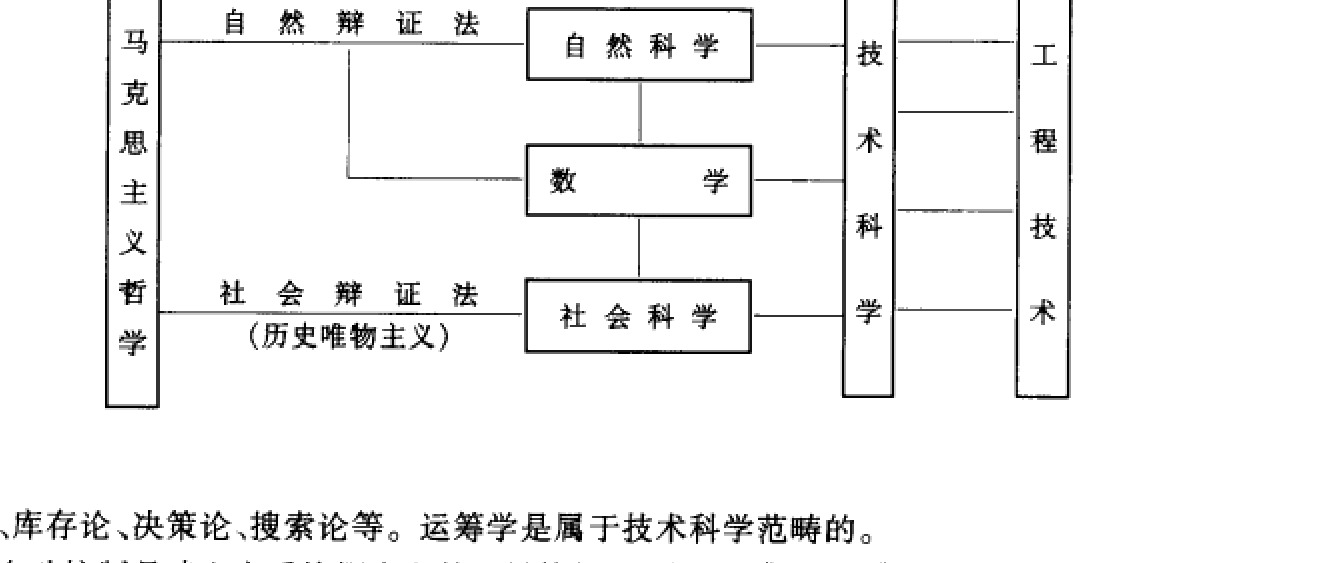
Automatic control is built upon the concept of systems. Nevertheless, in our article in Wenhui Bao we did not explicitly designate the theory of automatic control—cybernetics—as a primary theoretical foundation of systems engineering. This was to take account of a concrete fact at the present stage: a system of course involves human intervention, and conceptually one can include humans within the system, but the current development of theory has not yet reached the point where it can truly grasp all the functions and responses of humans under given circumstances, so incorporating humans into the system does not yet yield a general theory; on the other hand, the present level of systems engineering generally requires human intervention, including sometimes mobilizing the masses to offer ideas and strategies, so it is not yet possible in general to construct a system without humans, fully automated. For these reasons, although we consider the development of large-system and even giant-system, multi-level control in control theory to be highly significant and certainly worth promoting, cybernetics as a common primary theoretical foundation of systems engineering will, I am afraid, have to wait for the future. I say this only to be realistic and pragmatic; it is certainly not that I fail to see that, in developing this important field of systems engineering, both domestically and abroad there are quite a few people who originally worked in automatic control and researched cybernetics; they have keenly seized upon this new development in science and technology, going beyond the scope of their original work, and this should be welcomed.
In addition to operations research as an important common theoretical foundation of systems engineering, another important common foundation is computer science and computing technology.
Some comrades wish to collectively refer to these two types of common foundations of the various branches of systems engineering, along with other mathematical tools, as “systems engineering science.” I do not think this is necessarily appropriate, as the name and the content do not match. This is because the theoretical foundations of systems engineering, apart from the common foundations, each branch of systems engineering also has its own specialized foundations. This is because the objects differ, so naturally one must grasp the laws specific to different objects—for example, engineering systems engineering relies on engineering design, military systems engineering relies on military science, and so on. Here is a table listing each branch of systems engineering and its corresponding unique disciplinary foundation.
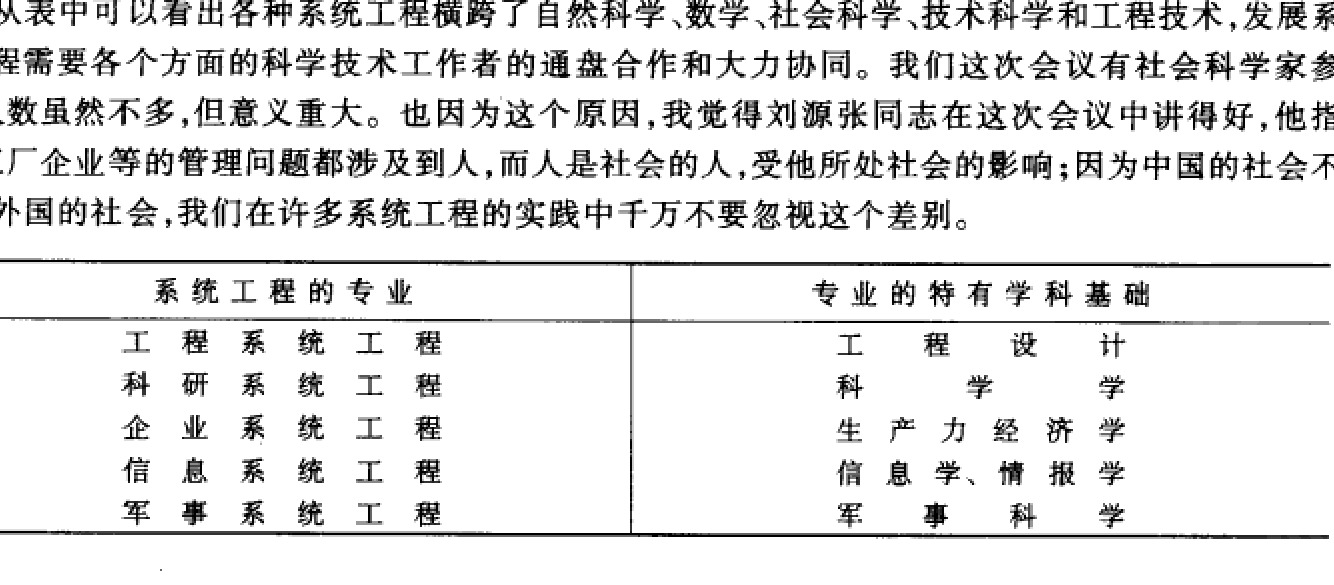
From the table it can be seen that the various branches of systems engineering span across the natural sciences, mathematics, the social sciences, technical science, and engineering technology. Developing systems engineering requires comprehensive cooperation and vigorous collaboration among scientific and technical workers from all fields. At this conference we have social scientists participating; although their numbers are not large, the significance is great. It is also for this reason that I think Comrade Liu Yuanzhang spoke well at this conference. He pointed out that management problems in factories, enterprises, and the like all involve people, and people are social beings, influenced by the society in which they live; because Chinese society differs from foreign societies, in many of our systems engineering practices we must by no means overlook this difference.
| Systems Engineering Specialty | Specialized Disciplinary Foundation |
|---|---|
| Engineering Systems Engineering | Engineering Design |
| Scientific Research Systems Engineering | Science of Science |
| Enterprise Systems Engineering | Economics of Productive Forces |
| Information Systems Engineering | Informatics, Information Science |
| Military Systems Engineering | Military Science |
(Continued Table)
| Specialty of Systems Engineering | Specialized Disciplinary Foundation of the Specialty |
|---|---|
| Economic Systems Engineering | Political Economy |
| Environmental Systems Engineering | Environmental Science |
| Educational Systems Engineering | Pedagogy |
| Social (Systems) Engineering | Sociology, Futurology |
| Metrological Systems Engineering | Metrology |
| Standards Systems Engineering | Standards Science |
| Agricultural Systems Engineering | Agricultural Science |
| Administrative Systems Engineering | Administrative Science (?) |
| Rule of Law Systems Engineering | Jurisprudence |
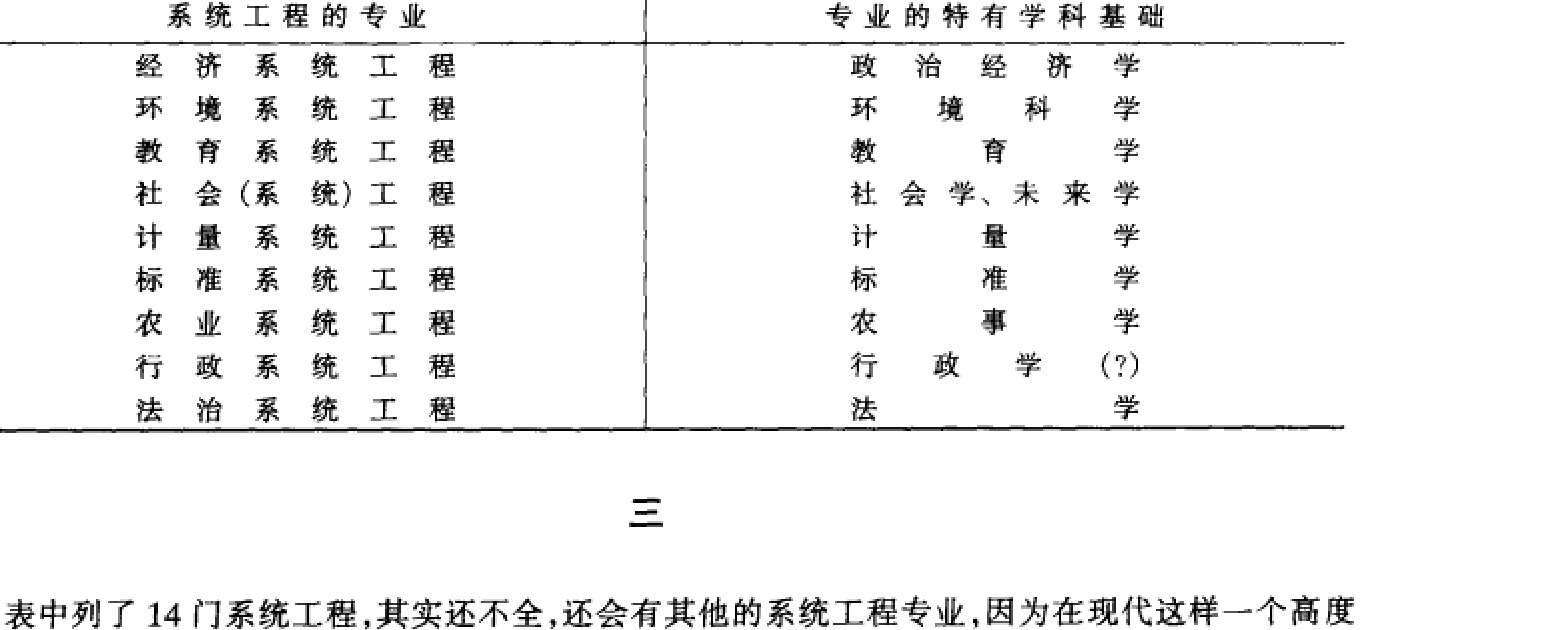
The table lists fourteen types of systems engineering, though it is not exhaustive; there will be other systems engineering specialties. In a modern society as highly organized as ours, complex systems are virtually omnipresent. Any kind of social activity will form a system, and the organization, establishment, and effective operation of that system becomes a task of systems engineering. When there are many systems of the same type, this kind of systems engineering becomes a specialized profession. Therefore, we can add many other systems engineering specialties.
The first seven types of systems engineering in the table are probably relatively familiar to everyone and require no explanation. The first of the latter seven is educational systems engineering, which is specifically concerned with the establishment, management, and operation of the educational system of a school, a region’s schools, or an entire country. Its specialized disciplinary foundation is pedagogy, which is a social science. I believe the question of macroeconomic planning discussed by Comrade Xue Baoding in his report at this conference is precisely social systems engineering. Social systems engineering, which may also be abbreviated as social engineering, is about organizing and managing socialist construction. That is to say, after the Central Committee has determined the major policies for a given historical period (for example, our country’s current drive to achieve the Four Modernizations), social engineering must design the overall blueprint for construction and formulate plans and programs. The theoretical disciplines it specifically requires are the two social sciences of sociology and futurology. Metrological systems engineering and standards systems engineering are concerned with the organization, establishment, and normal implementation of the metrology and standards systems of a region or a country; in modern society, these have become extremely important functions. Agriculture, including crop farming, forestry, animal husbandry, sideline production, and fishery, is undoubtedly of great importance. But modern agriculture as a form of systems engineering—agricultural systems engineering—was a proposal by Comrade Zhang Qinwen, and I think it is an excellent proposal that should be supported. The specialized theory of agricultural systems engineering, Zhang Qinwen calls “nongshixue” (agricultural science). These ideas are also discussed in the paper by Comrade Ma Shijun and Comrade Li Dianmo at this conference. Administrative systems engineering means that under the socialist system, administrative work and office operations can be fully scientized, and with modern archival retrieval technology, can also be computerized. Computers can draft documents or approval documents, possibly containing several alternatives for leaders to choose from; its theoretical basis is perhaps administrative science. Socialist rule of law requires a series of laws, regulations, and ordinances, ranging from the national constitution down to departmental rules, brought together into a legal system—a rigorous scientific system. This too is systems engineering: rule of law systems engineering. Its specialized foundational discipline is jurisprudence. From the perspective of the pressing problems that must be solved in our country’s current realization of the Four Modernizations, these latter three types of systems engineering are clearly of great importance, as they relate to agricultural development, to improving administrative efficiency, and to strengthening the socialist legal system.
Of course, the concept of systems engineering has only been concretized for a little over a decade. Only the first few types of systems engineering specialties in the table can be considered established, with some relatively stable working methods and some teaching materials available for instructing students. Roughly from environmental systems engineering onward, the eight types of systems engineering below are either still taking shape or are merely proposals that will require our future efforts to realize. Yet I have boldly included them in the table here and even declared that there are many systems engineering specialties not listed that will inevitably emerge in the future. Is this perhaps a bit presumptuous? I believe that, given the concept of systems laid down by Marx and Engels as early as a hundred years ago, combined with the rapid development of operations research and the explosive progress of electronic computer technology, our proposal is not excessive. For the sake of the Four Modernizations, we must vigorously develop systems engineering
various specialties.
institutions, and proposed that in the future our country should not establish just a few such organizational management colleges, but rather dozens, even hundreds, of organizational management colleges each with their own specializations—just as we now have comprehensive polytechnic institutions as well as specialized aeronautical engineering institutes, naval engineering institutes, and communications engineering institutes. In addition, corresponding secondary specialized schools should also be established. This will constitute a major innovation in education. From this conference, it appears that this transformation has already begun: systems engineering education has received the attention and importance of the Ministry of Education and is developing. More than a dozen higher education institutions nationwide have already established courses in systems engineering. Shanghai Institute of Mechanical Engineering has established a Department of Systems Engineering, and Xi’an Jiaotong University, Tsinghua University, Tianjin University, Huazhong Institute of Technology, Dalian Institute of Technology, and Shanghai Institute of Chemical Technology have established systems engineering research institutes or research offices. Among military schools, the National University of Defense Technology has already established a Department of Systems Engineering and Mathematics. Other military academies have also carried out systems engineering work. With this beginning, I believe that in just a few years we will have our country’s first organizational management college integrating both “science” and “engineering.” I recommend that this matter be included in the national Sixth Five-Year Plan.
Developing systems engineering also requires strengthening academic exchange and conducting academic discussions among workers in this field. Our current conference is also a successful activity. Several academic societies and research associations now attach great importance to systems engineering: for example, the Chinese Society of Aeronautics has organized seminars on systems engineering and operations research; the Chinese Association of Automation has a systems engineering committee; the Mining Academic Committee of the Chinese Society of Metals has established a systems engineering professional group; and the Research Association for Management Modernization has also organized symposia on systems engineering. It can be said that academic society activities have already been launched. Whether there is still a need to establish a specialized academic organization for systems engineering is something we can all consider.
However, in order to publicize and exchange work on systems engineering, I believe we should properly publish one popular science journal on systems engineering and one academic journal in the field of systems engineering. We must also publish a series of books on systems engineering. By “the field of systems engineering” I mean systems engineering and its common theoretical foundation of operations research, as well as related computer technology. How to implement this and proceed step by step also requires everyone’s input.
IV
From my exposition above, it can be seen that the problems systems engineering can address involve transforming nature, transforming and enhancing social productive forces, transforming and enhancing national defense capabilities, transforming various social activities, and even transforming our country’s administration and rule of law—in a word, systems engineering involves the entire society. Therefore, the social transformation brought about by systems engineering that we face is no less significant than the one approximately 120 years ago: that was caused by the growth and expansion of natural science, which led to the creation of scientific engineering, that is, elevating the craft by which humanity had transformed nature for thousands of years into a theoretical science, thereby triggering a great revolution. Systems engineering is a tremendous innovation, and the entire face of society will undergo a great change.
Of course, we are now merely at the beginning of this process. As we have already mentioned, what we can now see is only a very small part; even the 14 types of systems engineering listed in the table are but a portion of the entirety of systems engineering. For the same reason, what we have said may not necessarily be precise, and the classification of the 14 types of systems engineering will also be adjusted through future practice. But an even more important point is that systems engineering will certainly raise many theoretical problems that we cannot yet anticipate through practice on the scale of the entire society, and the theory of systems engineering will need to develop greatly. This has two aspects: on the one hand, there are the disciplines specifically linked to each branch of systems engineering, as shown in the table—some of these are natural sciences or technological sciences derived from natural sciences, but it appears that in the future there will be more that are social sciences or technological sciences primarily derived from social sciences; there are a large number of new disciplines here. On the other hand, operations research, as the methodological theory of systems engineering, will see even broader development, because practice will place higher demands upon it. As already discussed earlier, systems engineering will certainly make greater use of cybernetics in the future—not only engineering cybernetics, but also social cybernetics. We must also create certain mathematical methods specifically for systems engineering use, particularly in the area of statistical mathematics, probability theory, and other mathematical operations involving indeterminate values. Computational mathematics will also see certain specific developments due to systems engineering practice.
Speaking thus, the scientific development driven by systems engineering constitutes a very broad front—not merely one or several disciplines, but dozens of disciplines. Japanese scientists have proposed a new term called “soft science.” Our Japanese friends did not state it explicitly, but I imagine this word “soft” probably derives from “software,” because these fields of learning take the processing of information as their primary object and deal with the “soft,” unlike the natural sciences we were previously familiar with, which always deal with velocity, force, energy, and the like in material motion, and are “hard.” Therefore, the large set of scientific and technological disciplines discussed above might also be summarized by borrowing the term “soft science.”
But I considered further: from the practice of systems engineering in transforming the objective world, a series of theoretical disciplines at the level of engineering science have been distilled—can it stop here? Should there not be a more comprehensive elevation to learning at the level of basic science? For example, might operations research give rise to a theoretical science of affairs, and might cybernetics (including engineering cybernetics, biological cybernetics, social cybernetics, and artificial intelligence, among other engineering sciences) give rise to theoretical cybernetics? This possibility does indeed exist. At this very conference, Comrade Xu Guozhi clearly pointed out in his report that the principles of affairs in different things and different processes, through precise mathematical treatment, reveal their similarities in theory. Could not these similarities lead to deeper, latent new concepts of universal significance? Was not the concept of energy in physics born in just this way? Does not current research on hadron theory, through quantum chromodynamics, propose the new concept that the “vacuum” is not empty? Therefore, we should acknowledge that the emergence of a theoretical science of affairs and theoretical cybernetics is entirely possible, and in that case the term “soft science” would appear somewhat limited and insufficient in depth.
Furthermore, we should recognize that systems also contain many “hardware components,” and are not as purely “soft” as “software engineering,” which deals exclusively with software. Therefore, it is inappropriate to use the term “soft science.” We should return to the fundamental concept of the system and adopt the term “systems science.” Systems science stands parallel to natural science and social science; it is a basic science.
Having established the concept of systems science, we now possess a disciplinary system and can consider problems from the perspective of the structure of the entire disciplinary system—that is, by referring to the diagram above, we can study the development of systems science. In this way, starting from systems science as the basic science that studies systems, and combining it with other basic sciences, we form a series of engineering sciences that study common problems of systems; perhaps these fields of learning can be collectively called systemology. The current systemology is primarily operations research. Also related to systems science are the engineering science disciplines and social science disciplines specially connected to the various branches of systems engineering. The learning that directly engages in transforming the objective world consists of the various branches of systems engineering.
This means that the system of science and technology shown in the diagram above represents only the current state of affairs and does not include the developments discussed above. By the twenty-first century, the basic sciences cannot be limited to just the three major categories of natural science, social science, and mathematics; a category of systems science must be added. In fact, over the next few decades, there will surely be other changes as well. For example, at this conference, Comrade Wu Wenjun proposed the mechanization of mathematics, which is a stirring innovation. Of course, Marxist philosophy, after being enriched, developed, and deepened by new discoveries and developments in science and technology, will remain the fundamental theory guiding all science and technology.
The epistemology of dialectical materialism teaches us that the objective world exists independently of human will, that human beings can gradually come to know the objective world through social practice, and that once human beings have grasped the laws of motion of the objective world, they can actively utilize these laws to transform the objective world, and verify the correctness of our understanding through practice. Here I propose vigorously developing systems engineering and establishing systems science as early as possible—is this not precisely putting into practice Engels’s great thought? These are all questions well worth pondering.
The discussions at this conference have given us much inspiration, but we should continue our research after the meeting, striving to keep a steady grip on the direction of development. Let everyone work hard together!
(October 1979)
II. Science of Science, Science-Technology Systematics, and Marxist Philosophy
Regarding how to accelerate the development of science and technology in our country, there has been much discussion, and many articles have been written. I have read them and found them very inspiring and educational. They have also prompted me to think about issues in this area—that is, how to organize the knowledge summarized by people from the three practices of social production, class struggle, and scientific experimentation, including natural science, social science, and engineering technology, in accordance with the standpoint, viewpoint, and methodology of Marxism-Leninism and Mao Zedong Thought, so as to better grasp the laws of modern science and technology, dynamically promote the high-speed development of our country’s science and technology, and realize the Four Modernizations. However, my knowledge is still quite insufficient, and some of my views are not yet mature. I now write them down here to submit to comrades for discussion, criticism, and correction, so that the issues can be clarified further.
Systems and Systems Engineering
Let us start with engineering technology. Other engineering technologies are familiar to everyone, so I shall focus specifically on systems engineering.
What is a system? A system is a whole composed of many parts. Thus, the concept of a system emphasizes the whole, emphasizing that the whole is composed of interrelated and mutually constraining parts. Systems engineering proceeds from an understanding of the system to design and implement a whole, so as to achieve the effects we hope to obtain. We call it “engineering” in order to emphasize achieving results, being concrete, and having feasible measures—that is, taking practical action to transform the objective world.
Put this way, systems and systems engineering are universal; they are things we do all the time. What thing is not composed of parts? When we handle affairs, do we not always coordinate the relationships among various parts and strive for better results? Then why has it only been in the past thirty years, and especially the last decade, that the discipline of systems engineering has been vigorously developed? There are perhaps two reasons: first, the scale and complexity of any single undertaking today far exceed those of the past, and the workload involved in coordinating the various parts is enormous, requiring serious attention and dedicated professionals; second, for this very reason, it is necessary to correct the metaphysical approach to problems and the habit of separating parts from one another that have prevailed over the approximately four hundred years of modern scientific development, and to emphasize taking the overall situation into account and adopting a dialectically unified perspective. Of course, merely having the desire to develop systems engineering would not suffice without the proper tools. It is therefore necessary to point out that the theoretical tool of systems engineering is operations research, and the computational tool is the electronic computer—both being scientific and technological achievements of the past thirty years. Hence, the conditions for accelerating the development of systems engineering today are fundamentally in place.
When we say “fundamentally in place,” we also mean that there are areas where they are not yet in place. One category of systems engineering—such as systems engineering for engineering systems, systems engineering for production enterprises or enterprise systems, military systems engineering, logistics systems engineering, and database systems engineering—possesses the conditions for accelerated development. But there is another category of systems engineering where, primarily because the disciplines that serve as the foundation for that systems engineering—the disciplines that study the laws governing the movement and culture of the thing in question—are not yet sufficiently developed or have not even been established, accelerating the development of that branch of systems engineering encounters difficulties. We must first strive to clarify the laws of the thing itself.
Medicine is one such example. How can medicine also be considered a branch of systems engineering? May I ask: are we not striving to create a new medicine and new pharmacology for our country that integrates Chinese and Western medicine? To speak of integrating Chinese and Western medicine is to emphasize the holistic perspective in Chinese medical scholarship, the thought of treatment based on syndrome differentiation, and the idea that in treating illness, the person, the disease, and the syndrome must be considered together in a coordinated manner, with the person as the primary focus. This means treating the human body as a complex system, and also treating the human being together with the environment as a complex system. This shows that medicine is systems engineering, and the new medicine and new pharmacology must be established on this perspective.
point. But to actually carry this out, we still need to greatly deepen our knowledge of physiological science. We must follow the theories of zang-xiang (organ manifestations), qi and blood, meridians and collaterals, and other doctrines summarized from thousands of years of practice in traditional Chinese medicine as our guidance—we must have such an ideological foundation. But we cannot remain at the theories already established by traditional Chinese medicine, for otherwise how could there be further development? We must use modern science and technology as our instruments and vigorously expand research in physiological science to truly understand the human being as an object. Things are inherently dialectical, and the in-depth study of physiological science will inevitably overcome the shortcomings of past onesidedness and metaphysics. In recent years, research on neuro-humoral mechanisms (such as hypothalamic secretions) and on bioelectricity all demonstrate such a trend. Therefore, the path to establishing China’s new medicine and pharmacology is to organize and cultivate China’s physiological research force, to multiply and strengthen this team several times over, and to vigorously support work in this area.
Let me give another example. Protecting a healthy living environment is a technology—environmental systems engineering—which encompasses people’s living activities, industrial production, agricultural, pastoral, forestry, and fishery production, natural conditions, meteorological changes, and various other aspects. This is of course a systems engineering discipline that demands great attention, but accelerating the development of this systems engineering also encounters the difficulty of insufficient research in the discipline of environmental science. Therefore, it is necessary to greatly strengthen research on the patterns of environmental movement and change. Establishing environmental science research institutions and training environmental science professionals are very necessary.
Educational Engineering
Let us now broaden the scope of systems engineering a bit further and discuss the issue of education.
Education is a major undertaking in the new Long March toward the Four Modernizations. However, treating the study of education as a science is a recent development, and we therefore still face the task of organizing and establishing a rigorous and precise educational science and technology.
Does education also involve technology? Yes. Some comrades have already proposed the creation of educational engineering as an educational science and technology, which is a very good suggestion. But I believe that educational engineering should not be loosely described as some kind of “engineering for cultivating talent.” We should approach it pragmatically and regard educational engineering as a technology—a technology for organizing and managing a school, an institution of higher education, or a nation’s educational system (including kindergartens, primary schools, secondary schools, universities, technical schools, spare-time schools, various cadre schools, and so on). Educational engineering is also a form of systems engineering. Take a science and engineering university as an example: the entire institution may have over ten thousand people, with more than a dozen departments, each department in turn having several specialties; it must not only teach students and graduate students, but also carry out a large volume of scientific research, and through that research continuously train new teachers and improve the qualifications of existing ones; it has offices and housing; classrooms and teaching equipment, including audiovisual teaching equipment; laboratories; maintenance workshops and factories; living facilities such as cafeterias and shops, as well as banks, post offices, telephone exchanges, and so forth. Is all of this not a vast system? Moreover, such a system is constantly changing: as science and technology advance, teaching and research must follow suit, departmental organizations are continually adjusted, and laboratories need to be renovated. Is such an institution of higher education not very similar to an industrial enterprise? Establishing, continuously enriching, and running such a school well is on a par with operating an industrial enterprise. Abroad, the organizational management of renowned universities is always entrusted to people with organizational ability and management experience, and the methods employed are the same as those used in large enterprises. Of course, kindergartens, primary schools, and secondary schools are much smaller in scale, but they are numerous, and the system they collectively form is also a vast one. Therefore, the enterprise of education is grand in scale and complex in content; organizing and managing the enterprise of education requires the methods of systems engineering—it is a technology. Educational engineering also requires operations research and electronic computers.
What is the theoretical foundation of educational engineering? To implement education, one must grasp the laws of education, and where do the laws of education come from? They cannot come from subjective imagination; they must come from the summarization of experience—that is, from studying the enterprise of education in human society as one aspect of social activity and discovering its inherent laws. I believe this is what pedagogy is. Therefore, pedagogy is the main foundation of educational engineering: the former is a science, and the latter is a technology. Educational engineering must of course also rely on many other disciplines, such as operations research, economics, and so on.
Pedagogy is a social science, because the object of study in pedagogy is one aspect of social activity, just as economics studies the laws of social economic activity. Being a social science, it has a class character. We engage in education to cultivate culturally literate laborers with socialist consciousness, including workers, peasants, and a grand contingent of proletarian intellectuals. The bourgeoisie engages in education to cultivate a sufficiently large contingent of bourgeois intellectuals, and the landlord class engages in education to cultivate feudal intellectuals. Of course, within the pedagogy of each class there are
Part of this is universal in nature, reflecting the objective laws of human learning—that is, the physiological and psychological laws of learning—and this part should also be absorbed by our pedagogy. However, our pedagogy cannot simply transplant the entire set of methods from the “Supreme Sage and First Teacher” wholesale.
I believe that although the proletarian theory of education has already been extensively expounded by Marx, Engels, Lenin, and Chairman Mao, we still face the task of studying and systematizing it, and on this basis writing our own pedagogy. Previous books (such as Kairov’s Pedagogy) are unsatisfactory. For this reason, establishing specialized research institutions is very necessary.
Science of Science
We have already noted that the organization and management of scientific and technological research is a form of systems engineering, which we call research systems engineering. This point is now beyond doubt, especially given the rise of modern “big science” such as nuclear energy, high-energy physics, aerospace technology, and space science. However, to accelerate the development of research systems engineering and establish this discipline, two issues must be clarified. The first issue concerns the relationship between research systems engineering and the science of science. Abroad, the science of science has been pursued quite vigorously, but applied technology and scientific theory are not distinguished from one another; the content is sprawling and miscellaneous, and it does not constitute a rigorous, precise science. I believe we should first separate technology from scientific theory—that is, separate out the portion that belongs to the organizational and management techniques of scientific and technological research—and make clear that the science of science is a major foundation of research systems engineering: it is a science, not a technology. To discuss the organization and management of scientific and technological research is not the science of science, but rather the study of systems engineering, which, in addition to employing the science of science, must also draw upon economic science and other relevant sciences and technologies.
The second issue is: once technology has been separated out, what kind of science should the science of science be? I agree with Comrade Cha Ruqiang’s view, which is to examine scientific and technological research as one aspect of human social activity, and to study and summarize the laws governing its movement and change. Since it studies one aspect of social activity, the science of science is a social science, not a natural science. As a social science, it has a class character, and we must recognize that there are many erroneous viewpoints in the work on the science of science abroad. We cannot adopt these. We must, under the guidance of Marxism-Leninism and Mao Zedong Thought, theoretically synthesize the results of research in the history of science, analyze the phenomena of scientific and technological research in various countries, and summarize the practical experience of our country’s scientific and technological work.
Therefore, a Marxist science of science does not yet exist ready-made; it is a science we must strive to create. The task before us is no less arduous than Marx’s study of political economy in his time. Of course, the era is different: Marx fought nearly single-handedly, whereas we can establish a research institute and mobilize relevant forces nationwide to march into the science of science in great numbers. We will certainly be able to achieve significant results in a short period of time.
Is making such a large-scale effort going too far? I do not think so. To realize the Four Modernizations, raise the level of science and technology, and develop scientific and technological work is a key priority. But this in turn requires greatly improving our ability to organize and manage scientific and technological research. It is entirely correct for us to vigorously pursue research systems engineering, yet one of the foundations of research systems engineering—the science of science—has not yet been established. This is naturally a very urgent situation, and measures should be taken immediately.
The Study of the System of Science and Technology
Engels has a remarkably incisive passage. He said: “A great basic thought, namely that the world is not to be comprehended as a complex of ready-made things, but as a complex of processes, in which the apparently stable things and also the mental images, the concepts, of them in our heads, go through an uninterrupted change of coming into being and passing away, in which, in spite of all apparent accidentality and all temporary retrogression, a progressive development eventually asserts itself.” He then continued: “In fact, up to the end of the last century, natural science was predominantly a science of collecting data, a science of ready-made things. In this century, however, natural science is essentially a science of organizing data, a science of processes, of the origin and development of these things, and of the connections that bind these natural processes into one great whole.”
Here Engels states a very important fact: new disciplines will continually emerge and then develop, while older disciplines will in turn…
Heat: closed cultivation, only then does it conform to the needs of objective development.” This is quite right. We must never regard disciplines as immutable, but this is also a matter of being easy to agree with in principle, yet difficult to implement in practice.
In the passage by Engels quoted above, he also emphasized the entire system of natural science, considering it an inevitable outcome of the further development of science. When we read these discussions today, there are three points to consider: First, judging from the examples Engels immediately cited—physiology concerning the processes of animals and plants, embryology concerning the process of embryonic development, and geology concerning the gradual formation of the Earth’s crust—the system of natural science from a hundred years ago was much looser than it is today, with many gaps and breaks, and was quite incomplete. Second, he only discussed natural science and did not include social science. This is because genuinely scientific social science had just been founded by Marx and Engels, and there was not yet time to incorporate it into the overall system of science. Third, Engels did not yet touch upon engineering technology here, because at that time engineering technology was only just beginning to be recognized as connected to natural science and as based on natural science as its theoretical foundation. Given these three points, our current task is to complete the “great science of integral connections” proposed by Engels, so that it includes natural science, scientific social science, and engineering technology—that is, to establish the science of the system of science and technology, studying the interconnections and relationships among its constituent parts, the emergence, development, and decline of disciplines, and the movement and change of the system. The purpose of studying and developing the science of the system of science and technology is to use it to help organize and manage scientific and technological work, and to formulate plans and programs. Therefore, the science of the system of science and technology is also one of the theoretical foundations of systems engineering for scientific research, just as the science of science is a theoretical foundation of systems engineering for scientific research.
In establishing the science of the system of science and technology, the first question to consider is its general composition. Three constituent parts have already been discussed above: natural science, scientific social science, and engineering technology. The division of the first two parts is familiar to everyone; it is just that in the chapters of this article preceding this one, we proposed two new disciplines of scientific social science: pedagogy and the science of science. What needs to be explained is why engineering technology is independently separated out as a part. This is because the practice of engineering technology always carries at least some economic factors—for example, even medicine (treated above as a form of engineering technology) is no exception. Taking medicine and undergoing treatment without any consideration of cost is probably impractical; as for civil engineering, electrical engineering, hydraulic engineering, aeronautical engineering, naval architecture, and so on, all must consider economic factors and social purposes. In the specialized curricula of higher education institutions for these engineering technologies, there is a course formerly called industrial enterprise management, or engineering economics—is this not proof? As for systems engineering in various specialized fields, social science is an important theoretical foundation, equally as important as natural science. For organizational management on a larger scale, such as the overall organizational management and planning of national socialist construction—which is what is called “engineering economics and management modernization” and which we suggest calling “social engineering”—there, scientific social science is especially important, so scientific social science is also a direct productive force. From this, it can be seen that engineering technology cannot be subsumed into natural science, nor can it be subsumed into scientific social science; it can only stand as a separate part within the science of the system of science and technology.
If we say there are only three constituent parts, then the question arises as to which part engineering science belongs. What is engineering science? Engineering science is based on the theories of natural science and addresses problems of a universal nature in engineering technology—that is, problems that commonly appear across several engineering technology specialties—forming a unified treatment, such as fluid mechanics, solid mechanics, electronics, computer science, operations research, cybernetics, and so on. Twenty years ago, on the basis that engineering science differs from natural science in nature and research methodology, I separated engineering science from natural science and engineering technology as three parts. Looking at it now, separating engineering science is still correct, and even more necessary, because some engineering sciences such as operations research and cybernetics are also used to handle problems in the economic domain, going beyond the scope of natural science.
Therefore, the system of science and technology must have four constituent parts: natural science, scientific social science, engineering science, and engineering technology. Engineering technology comprehensively applies the achievements of the first three constituent parts to directly transform the objective world.
Here we must also explain the special status of mathematics. Mathematics cannot be assigned to any one of the aforementioned constituent parts of the system, yet it is useful in and indispensable to every discipline or technology within every constituent part. Saying that mathematics is “the queen of science and technology” is justified. The reason for this is that science and technology are reflections of the objective world in the human brain, and organizing this reflection relies on thinking, while mathematics is the systematized knowledge of recognized laws of human thought—its importance goes without saying. Therefore, the system of science and technology should be four major parts plus mathematics.
The above is merely an extremely rough outline of the structure of the science of the system of science and technology. We must further examine its construction in detail. The number of living disciplines currently engaged in research work totals well over a thousand; we must assign each of them a position according to the four major divisions and the classification of mathematics. The next step is to study the interrelationships among disciplines. For example, what demands does high-energy physics research place on other branches of physics, on chemistry, on electronics, on computer science and technology, on electrical engineering and power engineering, on mechanical engineering, on chemical engineering, and so forth? We must rely on this table of interrelationships to formulate science and technology plans and programs. Even with this step accomplished, we are still only at the “phenomenology” of the science of the system of science and technology; we have not yet reached the study of the “dynamics” of major developments in science and technology. To study the dynamics, we still need to conduct an in-depth analysis of the phenomenology, so as to identify the key disciplines that bear many tasks—those that must be strengthened; to find important tasks for which no one is currently conducting research—those that require the establishment of new disciplines; and also to determine which disciplines are about to wither away, so that measures can be taken to transfer efforts accordingly.
Here we have mentioned the research tasks of each and every discipline and technology, but how do the research tasks of a discipline actually arise? They should not be based on arbitrary speculation. The tasks come first from the overall plan and program of national socialist construction. This often places demands first on engineering technology—for example, the modernization of agriculture, industry, and national defense will assign tasks to each branch of engineering technology. Then each branch of engineering technology will place demands on the technical sciences, on the natural sciences, on the scientific social sciences, and will also place some demands on mathematics. Another source of tasks is the needs of the disciplines’ own development. For example, the research tasks of high-energy physics now do not come from the modernization of agriculture, industry, or national defense, but rather from the needs of the natural sciences’ own development.
Of course, in studying the science of the system of science and technology, we must also examine the history of how this system arose and developed since the mid-nineteenth century. History will give us inspiration.
Marxist Philosophy
With the science of the system of science and technology, there can be many applications. But the work of synthesis has not yet been carried through to the end. We must ask: the vast modern system of science and technology, comprising the four major divisions of natural science, scientific social science, technical science, and engineering technology, plus mathematics—what kind of theory is ultimately distilled from it? It is the most comprehensive summary of human practice, and that is Marxist philosophy. Therefore, as science and technology develop, the philosophy that serves as their theoretical synthesis must inevitably develop as well. For Marxist philosophers, there are essentially two situations: one is to keep up consciously and proactively, and the other is to keep up unconsciously and passively. Keep up they must; the only difference lies in the degree to which contradictions intensify.
In the history of philosophical development, philosophers who accepted new developments in a passive manner have been in the majority, which is why every major advance in science and technology has caused a powerful impact on philosophy. When Copernicus discovered that the Earth and planets revolve around the Sun, did this not cause a powerful impact on philosophy? And did not every subsequent major development in science and technology ignite a debate between materialism and idealism? Was it not the same even after Marxist philosophy had already been established? Was the discovery of the electron not such a case? Recall the situation after the theory of relativity was founded! The discovery of the electron and the establishment of the theory of relativity were not seized upon by Marxist philosophers to develop philosophy; instead, they were distorted by idealist philosophers into pretexts for opposing Marxist philosophy—this is regrettable. Even in modern times, after the 1950s, our philosophers have still been somewhat passive. For example, after cybernetics emerged, its impact on philosophy was enormous. No sooner had this wave passed than the electronic computer arrived, giving rise to so-called “artificial intelligence,” which dealt another impact to philosophy. Comrade Chen Bu has recently spoken quite well on the question of artificial intelligence or machine thinking, but this wave has not yet passed, and some of our comrades still object to saying that “electronic computers can replace humans in performing a portion of mental labor”!
There are also some comrades who are rather reluctant to acknowledge that mathematics and physics are the more fundamental disciplines among the basic natural sciences. Their reasoning is that the motion of matter has levels, and the motion at each level has its own particularity—microscopic and macroscopic, the non-living and the living—there must be distinctions. We fully agree that the motion of matter has levels, and that distinctions must be made between the microscopic and the macroscopic, between the non-living and the living. But having distinctions does not mean that the boundaries are walls of bronze and iron, impassable. For example, using the theory of statistical mechanics, we can transition from microscopic motion to macroscopic motion, deriving the macroscopic laws of thermodynamics from the laws of microscopic motion, and also deriving concepts that do not appear in microscopic motion, such as temperature and entropy, thereby opening a path from the microscopic to the macroscopic. Furthermore, current research in molecular biology is also opening a path from physics and chemistry to the phenomena of life, from the non-living to the living. These examples are well worth our deep reflection. Finding the connections between the motion of matter at different levels does not negate the specific characteristics of the motion of matter at each level; rather,
has made us understand their characteristics more profoundly.
Therefore, summarizing the historical lessons of the past century or so, we believe that Marxist philosophy occupies a lofty position, but as the highest generalization of science and technology, philosophy is rooted in science and technology and is based on human social practice. Philosophy cannot oppose or negate the development of science and technology; it can only develop along with them—otherwise, would it not become rigid and ossified? Philosophers must recognize that today’s natural sciences and scientific social sciences are on the eve of major breakthroughs, with a series of technological revolutions brewing, so they should strive to take the initiative and constantly absorb the achievements of new science and new technology as material for developing Marxist philosophy.
Here I would like to raise the question of the close relationship between modern physics and philosophy. The several examples cited earlier can already illustrate the issue to some extent, and recent research on gauge field theory in theoretical physics should draw even greater attention from Marxist philosophers. These theories are in fact conducting an in-depth analysis of the nature of the universe. For example, according to these theoretical studies, the principle of equivalence in relativity is linked to quantum gravitational field theory; another example is the quantum chromodynamics of hadrons, where the so-called zero-energy vacuum is found to have a rich and determinable cosmological constant, and so forth. Therefore, scientists in this field should be organized into philosophical research. Indeed, among this century’s outstanding theoretical physicists, such as A. Einstein and W. Pauli, despite their limitations, all made contributions to the development of the dialectics of nature.
The other side of the matter is: Marxist philosophy, as the highest theory of science and technology, must be used to guide the further development of science and technology. This point has been stated repeatedly by our revolutionary teachers. Therefore, natural science, mathematics, as well as technical science and engineering technology must all be guided by the dialectics of nature. We must abide by this principle, and presumably no one would object to it.
However, there is currently a slogan that goes: “Science has no forbidden zones; if there are forbidden zones, then it is not science and there is no science.” In the history of science and technology, there have been many instances of errors committed due to a lack of respect for Marxist philosophy. For example, over the past century or more of research on the microscopic world, natural scientists have repeatedly claimed to have reached the limit of the structure of matter, and at the time it indeed appeared to be a limit beyond which further division was impossible. Yet they did not realize that this violated the dialectics of nature, and time and again they were forced to admit their mistakes! Lenin, however, as early as seventy years ago, asserted on the basis of Marxist philosophy that the electron is also inexhaustible, and now physical research has arrived at the very threshold of studying the structure of the electron. Does not this negative and positive experience illustrate the point rather well? Yet even now, some comrades feel it quite awkward to use Marxist philosophy to guide scientific research. For instance, they wish to pursue “Big Bang cosmology,” claiming that the universe has a beginning, and they have even calculated it specifically—counting backward from the present to approximately ten billion years, time has a starting point! And they say this does not contradict the data “so far” observed. But does not such a result violate the philosophical principle of the infinity of the universe? In fact, the method of inference also ignores the fact that above galaxies there are still higher levels of structure in the universe, thereby also violating the philosophical principle that the structure of matter has infinitely many levels both toward the small and toward the large. Why is there such disregard for Marxist philosophy? Moreover, in astronomical observations, signs have already appeared that contradict “Big Bang cosmology”—we should proceed with caution.
Therefore, I would like to offer an explanation of the slogan mentioned above: Science has no forbidden zones, but first one must examine whether those “forbidden zones” actually exist. The zone of a “finite universe” does not exist, and the zone of a “level-less universe” does not exist either—so there is no need to go looking for trouble attacking these mirages. This also reminds us of the question of perpetual motion machines. Previously, there were always some comrades claiming to have invented perpetual motion machines. Now it is fine—thanks to the negative teaching provided by the “Gang of Four“‘s diehard loyalists in Liaoning, no one talks about perpetual motion machines anymore. But what about in the future, after a long time has passed? Will someone again try to break through this nonexistent “forbidden zone”? That will depend on how well we carry out the propaganda and educational work of Marxist philosophy.
III. On the Question of Establishing and Developing Marxist Science of Science
Foreigners all say that the science of science was founded by the British scientist J.D. Bernal in the 1930s, but they do not necessarily all follow Bernal’s original intentions; instead, they describe the scope of science of science research as seemingly broader, and their various accounts are inconsistent. Even the name for the science of science differs: the British call it “Science of Sciences,” while Americans call it “Sociology of Science.” I think they might as well use “Scientiology,” which is more concise. In fact, we need not necessarily adopt their terminology, because we are taking the socialist path, and our approach is different. So what is the science of science? I believe: the science of science studies scientific and technological research as a form of human social activity, investigating the laws of scientific and technological activity and its relationship with overall social development. What is Marxist science of science? The term “Marxist” means using the standpoints, viewpoints, and methods of Marxism-Leninism and Mao Zedong Thought to study the science of science. This is important, because the science of science is a social science, and it must be so.
I have already expressed these views in another article. After reading the recent works of Comrades Yu Guangyuan, Gong Yuzhi, and Wang Xingcheng, I benefited from them, but I still felt there was more to be said. Therefore, I am writing this piece to participate in the discussion and to seek guidance from my comrades.
Since the science of science is a social science that studies scientific and technological activity, it is a discipline; it is not an engineering technology that directly transforms the objective world. Is there an engineering technology in this area? Yes, there is, and it is one of great importance in modern society, namely the organizational and managerial technology of scientific and technological research. I call it scientific research systems engineering, and it is one of the new engineering technologies of the systems engineering category. To do scientific research systems engineering well, one must of course study the science of science; otherwise there would be no theoretical foundation. But the practice of scientific research systems engineering—namely, the organization and management of scientific and technological research and development work—requires, in addition to the science of science, many other branches of knowledge and technology, such as operations research, economics, and computer technology. The most fundamental point is to distinguish between scientific theory and engineering technology: the former has a single field of research, while the latter always integrates the achievements of multiple disciplines to carry out a specific construction or organizational management task.
Now, our comrades are eager to raise the level of organization and management of our country’s scientific and technological research and development work; this is understandable. However, some comrades therefore confuse the science of science with scientific research systems engineering, expecting science of science workers to directly solve our country’s current problems of scientific and technological organization and management. That may well lead to the situation of “haste bringing no success.” Of course, our primary purpose in studying the science of science is to raise the level of our scientific and technological organization and management and to accelerate the modernization of our country’s science and technology. This purpose is clear. My point in saying this is to urge our scientific and technological organization and management workers to have some patience with the science of science, and not to “kill the goose that lays the golden eggs.”
Since the science of science is distinct from systems engineering, it is of course also different from systems science, which deals with systems theory. Consequently, the science of science has nothing to do with the so-called “soft sciences” that are closely associated with systems science and systems engineering. This, too, is a question that needs to be clarified.
There is another question: does the science of science include the research activities of the social sciences? I believe that science of science research should include this part of social activity. The science of science cannot be merely the science of science of the natural sciences; it is also the science of science of the social sciences, and it is also the science of science of the technical sciences and engineering technology, as well as of philosophy.
Is the science of science the same as the dialectics of nature? Or, does the science of science also study the methodology of scientific research? I think it is better not to entangle them together. If it is said that research on the dialectics of nature in our country has not yet opened up new ground, and therefore one wishes to use the science of science to blaze a path, this may not
be appropriate. The science of science studies scientific and technological research as a social activity, not science and technology themselves, and therefore it does not engage in scientific methodology. The science of science can be clearly distinguished from the dialectics of nature in terms of their respective research domains. The dialectics of nature has its own broad sphere of activity, such as using new discoveries in the natural sciences to enrich and deepen Marxist philosophy. Moreover, once we say that the science of science overlaps with the dialectics of nature, then since the science of science also includes the research activities of the social sciences, would not the science of science also overlap with historical materialism or the dialectics of society? This would disrupt the boundaries between disciplines that could otherwise be clearly delineated. Of course, this refers to disciplines; an individual can simultaneously engage in research across several sciences, and a worker in the dialectics of nature can also study the science of science at the same time.
The above concerns the demarcation of the science of science from other disciplines. So what should the science of science be? I think an important component of the science of science is the study of the structure of science and technology—namely, the classification of science and technology into branches, the interconnections among the various disciplines, the development and evolution of disciplinary systems, and the growth of new disciplines and the decline or reclassification of old ones. This is of course related to the study of the overall activity of science and technology, so it is an important component of the science of science. That the various disciplines of science and technology form an integrated, interconnected system was pointed out by Engels approximately one hundred years ago. Our current system of science and technology has six components (as shown in Figure A). Encompassing everything is philosophy, which connects to the natural sciences, mathematical sciences, and social sciences through the two bridges of the dialectics of nature and historical materialism (the dialectics of society). The natural sciences study the natural world, the social sciences study human society, and the mathematical sciences are the knowledge used by both the natural sciences and the social sciences. Beneath these three major categories of disciplines, and between them and the engineering technologies used to transform the objective world, are the technical sciences. These were formed to address problems of a universal nature within engineering technology—problems that commonly arise across several engineering technology specialties—and to handle them in a unified manner, such as fluid mechanics, solid mechanics, electronics, computer science, operations research, cybernetics, and so forth. A major category that has arisen within engineering technology is the various branches of systems engineering.
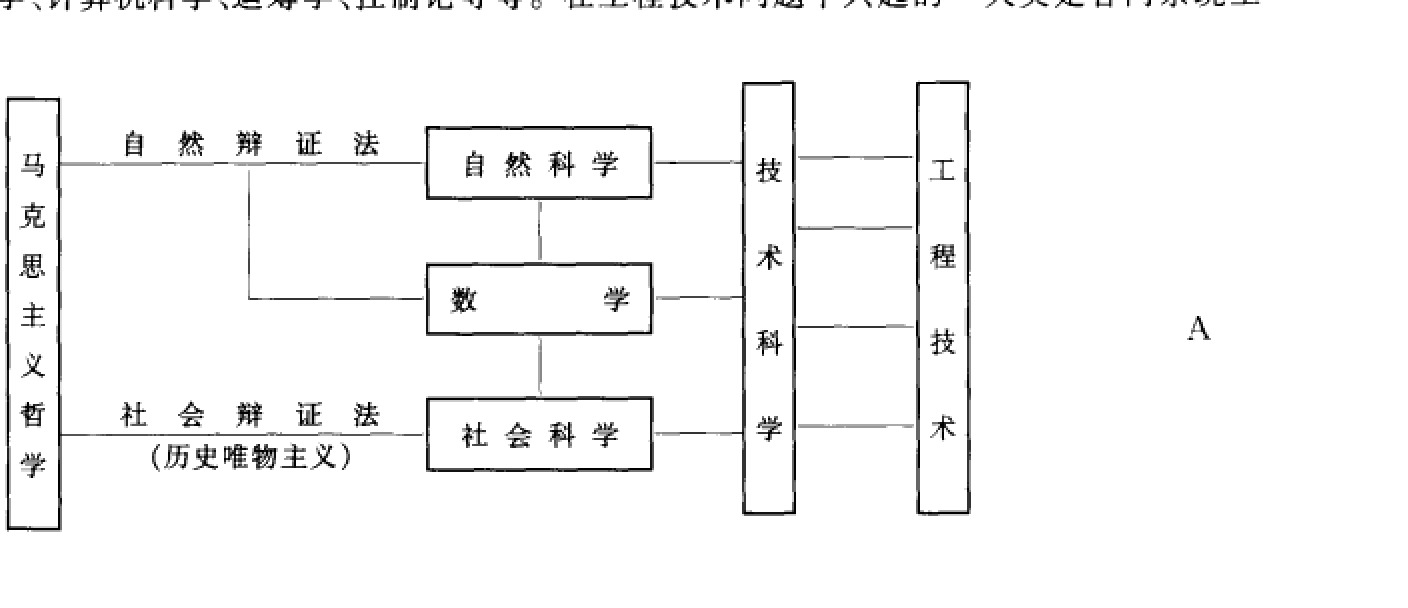
Figure A
                    Marxist Philosophy
                   /                  \
       Dialectics of Nature    Historical Materialism
                        \          /
            Natural Sciences  Mathematical Sciences  Social Sciences
                        \          |          /
                         Technical Sciences
                                  |
                          Engineering Technology
Figure B
              Marxist Philosophy
             /                  \
 Dialectics of Nature    Historical Materialism
            |                        |
     Natural Sciences          Social Sciences
             \                   /
              Engineering Technology
Science and technology are constantly developing. The system shown in Figure A roughly represents the current state of science and technology; it was not so in the past, nor will it always remain this way in the future. Around the beginning of this century, the system of science and technology did not yet include the major category of technical science, because it was still in the process of being established. At that time, mathematics was merely regarded as a department of natural science and had not been set apart, because even the scientific social sciences had not yet employed mathematical methods—mathematics seemed to be the exclusive possession of natural science. Thus, at the beginning of this century, the system of science and technology was roughly as shown in Figure B, consisting of four major categories. If we trace further back, what about approximately 130 years ago? At that time, engineering technology had not yet become a formal discipline; the skilled artisans who transformed the objective world were merely regarded as talented individuals, and their abilities had not yet been summarized into a body of learning—especially not into a discipline that could be taught in institutions of higher education—so they could not be included in the system of science and technology. The situation approximately 130 years ago was roughly as shown in Figure C: a system of science and technology comprising three major categories. And further back, say two hundred years ago? At that time there was no Marxist philosophy, nor any scientific social science; science and technology consisted of only one category, namely natural science, as shown in Figure D. If we trace back still further, there was no scientific system at all. We generally say that science began with the Renaissance; before the sixteenth century there were only partial achievements of science, insufficient to form a system.
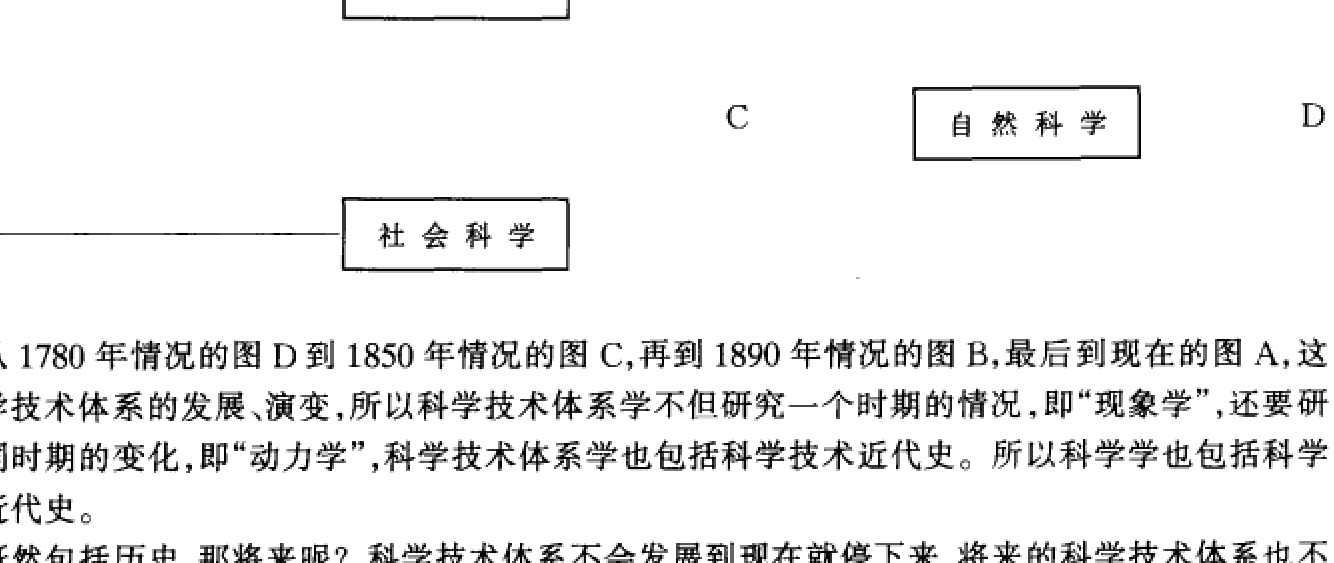
Marxist Philosophy Natural Science C Natural Science D Social Science
From Figure D representing the situation in 1780, to Figure C for 1850, then to Figure B for 1890, and finally to the present Figure A—this is the development and evolution of the system of science and technology. Therefore, the study of the system of science and technology must not only examine the situation of a given period, that is, “phenomenology,” but also study the changes across different periods, that is, “dynamics.” The study of the system of science and technology also includes the modern history of science and technology. Hence, science of science also encompasses the modern history of science and technology.
Since it includes history, what about the future? The system of science and technology will not stop developing at its present stage, nor will the future system of science and technology remain fixed as shown in Figure A. For example, systems science and cognitive science, which have already begun to emerge, may very well rise to become two new major disciplinary categories within the system of science and technology.
III
Comrade Zhao Hongzhou’s article in the journal Hongqi is an article about the scientific capacity of society. He discussed five aspects: the collective research capacity of the scientific workforce, the quality of experimental technical equipment, the efficiency of library and information systems, the degree of optimality in the structure of scientific labor, and the level of science education of the entire nation. I believe these contents all belong to a branch of the science of science that may be termed the science of scientific capacity—a discipline specifically devoted to studying the formation of scientific and technological research forces and the internal laws governing scientific and technological research. Because these are internal laws—the internal relationships within the organization of science and technology—I believe this branch is relatively independent of the social system. This situation is analogous to the economics of productive forces: the economics of productive forces studies the two major factors in production—people and the instruments of production—as well as their organization and management; it is distinct from political economics and is not directly influenced by the social system.
Therefore, for this part of the science of science—the science of scientific capacity—we can absorb the practical experience accumulated by capitalist countries over several centuries and the set of laws derived from that practical experience, and put them to our own use. Of course, with regard to certain issues of “interfacing” with our country’s socialist system, we must be cautious and handle them properly.
Among the internal laws of scientific and technological research, there is a very important issue: the question of scientific revolution. This is the American scientist T. S.
Kuhn first clarified a concept: the development of scientific theory, like all things, is a process from quantitative change to qualitative change. Once a science has a systematic theory, it enters a stage of normal development. A large amount of experimental and theoretical analysis continuously enriches the original theory, the theory is then applied in practice, and the results of practice raise new research topics for scientists to solve. All of this is largely quantitative accumulation, and the original theoretical framework becomes more solid. However, within this stage of quantitative change, things that contradict the original theoretical norms are also hidden. As research progresses, contradictions gradually emerge, and there may be minor repairs that do not harm the original theory. But eventually the contradictions cannot be overcome, intensifying to the point where everyone feels a sense of scientific crisis. At this point, a new theory emerges to replace the original theory, forming a qualitative change, a leap in scientific theory. Of course, the new theory always absorbs the achievements of the original theory and contains the original theory; it is a new station in the long process of human understanding of the objective world. This kind of qualitative change is a scientific revolution; for example, from the heliocentric kinematics of celestial bodies to Newtonian mechanics, the discovery of oxygen replacing the phlogiston theory, relativity replacing Newtonian mechanics, the establishment of quantum mechanics, and so on. We have long recognized that these examples are all great transformations in the history of science, a powerful driving force for the development of science and technology. Therefore, scientific revolution is an extremely important inherent law in scientific and technological research, and studying scientific revolution is an important task of the science of scientific capability.
One problem in organizing scientific and technological teams is to fully mobilize the labor enthusiasm of each member, and in our socialist system, this must be achieved through distribution according to work. To distribute according to labor contribution, it is necessary to accurately evaluate the value of scientific and technological research work. We must never “share equally” or “eat from the big pot.” This is a problem of determining the value of mental labor achievements, which seems not to have been seriously studied before. What exists now is only various prizes: national science prizes, national invention prizes, achievement prizes from various departments, technical innovation prizes, and so on. One thing is certain: the value of scientific and technological research achievements—that is, their contribution to improving the material and cultural life of the people—often requires a period of time to become clear. Therefore, the evaluation of achievements necessary for distribution according to work can hardly be made immediately after a stage of mental labor is completed; sometimes it takes a considerable period of time to accurately evaluate. From this perspective, prizes are a good method for distribution according to work in scientific and technological work. But now the value of prizes is often predetermined by grade, and the grading and awarding lack a scientific method, so this method is still very imperfect. Improving the science and technology prize system, and further studying the problem of distribution according to work in science and technology, is also an important task of the science of scientific capability.
Four
Another very important content of the science of science is the interaction between science and technology and productive forces, and between science and technology and the superstructure. This is, of course, closely related to the social system and can be called political science of science. This branch of the science of science can only achieve research results guided by Marxist-Leninist theory; ready-made research results from capitalist countries cannot be introduced. For example, some people abroad now draw conclusions based purely on statistical data, saying that the flourishing period of science and technology moved from Italy to Britain, then from Britain to France, from France to Germany, and now to the United States, but a country’s flourishing period of science and technology lasts only 60–100 years, so in the twenty-first century it should be another country. What profound significance can such a statistical game, which completely ignores political and economic factors, have?
An important problem we encounter is the relationship between science and technology and productive forces. Generally speaking, science and technology are productive forces, but are they direct productive forces? Direct productive forces are people and production tools, so for science and technology to become productive forces, they must pass through people or production tools, and use science and technology to better organize people and production tools into the production process. That is, we must arm people with science and technology, use science and technology to design and manufacture better production tools, and use science and technology to improve the level of production organization and management. This must be actively promoted; it does not happen naturally. Science and technology will not automatically become productive forces. This is a major problem in our country at present: a large amount of research results cannot be applied to actual production. This requires reform of the economic management system.
Closely related to this problem is the question of what percentage of the total value of industrial and agricultural production should research funding for science and technology account for. The current proportion in our country is less than one percent. Of course, if results are discarded and unused, perhaps the proportion could be even lower. If research results can be quickly used to innovate production and develop productive forces, then this proportion should be greatly increased. In our country’s current actual situation, what proportion is appropriate should be studied.
An important theoretical problem of the political science of science is to clarify the concept of technological revolution. The concept of technological revolution was put forward by Chairman Mao in a written instruction in 1969. Chairman Mao said it was necessary to distinguish between technological innovation and technological revolution; the latter refers to major transformations in technology, such as the steam engine, electric power, and now nuclear energy. The emergence of the steam engine propelled the Industrial Revolution; the emergence of electric power further greatly developed the productive forces and pushed capitalism toward monopoly capitalism. Both historical technological revolutions enormously increased social productive forces, rendering the relations of production and the superstructure of capitalism even more incompatible with the development of productive forces. The current technological revolution in nuclear energy will inevitably do the same, and the ongoing technological revolution in electronic computers can only do the same. How could there be any alleviation of contradictions? How could there be any basis for saying that socialist revolution is obsolete? Yet the accomplices of imperialism loudly sing of a “scientific and technological revolution,” a “second industrial revolution,” a “third industrial revolution,” as though the first industrial revolution gave rise to scientific socialism, and now the second, or even the third, is to give rise to something else—all in a vain attempt to deceive people into believing that Marxism no longer works. That social-imperialism also promotes the “scientific and technological revolution” to find pretexts for its hegemonism! We must use the theory of technological revolution to expose the tricks of these characters and point out the brilliant prospects of revolution. This is an important task of the political science of science.
We certainly cannot focus only on the role of science and technology in promoting the development of productive forces and the superstructure; we must also recognize the reactive role of the superstructure upon science and technology. This is another important research topic of the political science of science. For example, in capitalist countries, the socialization of scientific and technological research activities and the fundamental contradiction arising from the private ownership of the means of production and the social system it generates constantly impede the development of science and technology. In those countries, the more science and technology develop, the more socialized they become, and the more intensely they conflict with private ownership—this is their incurable fatal affliction.
This means that, with respect to science and technology, the socialist system is also incomparably superior. Of course, even in our country today, problems are not absent. Comrade Qian Sanqiang has pointed out many problems existing in our scientific and technological work. The political science of science should study problems in this area.
Abroad, scientific and technological work is always considered something only professionals can do; the broad masses of the people are excluded from the gates of science and technology. But for us, the source of science and technology is human social practice. Therefore, the practical experience of hundreds of millions of people must never be overlooked. Even a fragmentary observation or a small suggestion should receive serious analysis from professional scientific and technical personnel, for it may contain the seeds of things in the objective world that have not yet been recognized. Should not the many accidental discoveries in the history of science and technology give us inspiration? This correct attitude toward the practice of the masses of the people is unique to us and is a characteristic that scientific and technological activity under the socialist system ought to possess.
Another important influence of the social superstructure on scientific and technological activity is the proportion of military scientific and technological research within overall scientific and technological research. According to one statistical source, the total annual expenditure on scientific and technological research and development worldwide is approximately 150 billion US dollars, of which military-related research accounts for 24% and space technology accounts for 8%; in fact, both of these are military in nature, totaling 32%, or nearly one-third of all expenditure. Basic scientific research amounts to only 15%, less than half of the military-related portion. Medical and health research is only 7%, and agricultural research only 3%. These are still world averages; in the Soviet Union and the United States, the proportion of military research would be even larger. This is an aspect that our study of the science of science must pay attention to, and it is also a major topic of the political science of science.
V
The above has discussed three aspects of research or three branch disciplines of Marxist science of science: the science of the scientific-technological system, the science of scientific capability, and the political science of science. We have been treating the scientific and technological social activities studied by the science of science as dating from the beginning of modern science, because only after the Italian Renaissance did science and technology acquire the concept we now speak of. Of course, modern and contemporary science and technology have both absorbed the achievements of ancient science and technology, so the study of the history of ancient science and technology is also necessary, but that perhaps falls outside the scope of the science of science as we have been discussing it.
In order to foresee the further development of scientific and technological activity, we mentioned earlier, when discussing the system of science and technology, the need to study the future of the scientific-technological system. But the situation of overall scientific and technological activity in future society is an even more comprehensive question; it involves the future of human society and falls within the scope of another social science—futurology.
IV. Systems Thinking and Systems Engineering
Today is the first lecture in the CCTV series on systems engineering, titled “Systems Thinking and Systems Engineering.” It serves as an opening remarks. The manuscript was co-written by Comrade Wang Shouyun and myself, and I will deliver it.
The concept of a system is neither innate to human beings nor, as some foreigners have claimed, something that suddenly emerged in the 1940s. The concept of a system originated from the practical social experience of ancient humanity, so it is not at all mysterious. Ever since human beings began productive activities, they have invariably been dealing with natural systems. Ancient texts such as the “Diyuan” chapter of the Guanzi, the agricultural poem “Qi Yue” in the Book of Songs, and the Book of Fansheng written by Fan Shengzhi during the Qin and Han dynasties all contain dialectical descriptions of the relationships between crops and seeds, terrain, soil, water, fertilizer, seasons, and climate. The renowned Qi physician Bian Que advocated comprehensive dialectical diagnosis based on a patient’s complexion, voice, and physical appearance, and treated illnesses using multiple therapies including the bian stone method, acupuncture, herbal decoctions, massage, and hot compresses. The Huangdi Neijing, a comprehensive compilation of ancient medicine from the late Zhou and Qin through the early Western Han, emphasized the organic connections among the various organs of the human body, the connections between physiological and psychological phenomena, and the connections between physical health and the natural environment. During the Warring States period, Li Bing of the state of Qin designed and constructed the great Dujiangyan, which comprised three main projects—the “Yuzui” Min River water-diversion works, the “Feishayan” flood-discharge and sediment-removal works, and the “Baopingkou” water-intake works—together with 120 ancillary canal and weir works. The interconnections among these projects were handled to perfection, forming a coordinated and operational engineering whole. Ancient Chinese astronomy early on revealed the connections between celestial movements and seasonal changes, producing calendars and the twenty-four solar terms to guide agricultural activities. All these ancient achievements in agriculture, engineering, medicine, and astronomy reflected, to varying degrees, the spontaneous application of a naive concept of systems. Long before knowing about systems thinking or systems engineering, humanity was already engaging in dialectical systems thinking. As Engels put it, “People were thinking dialectically long before they knew what dialectics was” (Selected Works of Marx and Engels, Vol. 3, p. 182).
The naive concept of systems was reflected not only in the practical activities of ancient humanity but also in the philosophical thought of ancient China and ancient Greece. Materialist thinkers in both ancient China and ancient Greece proceeded from the recognition of a unified material origin and regarded nature as a unified whole. Heraclitus (ca. 460–370 BCE), one of the founders of ancient Greek dialectics, stated in his work On Nature: “The world is an all-encompassing whole.” The ancient Greek materialist Democritus (ca. 540–480 BCE) had a work, now lost, titled The Great System of the Cosmos. Between the sixth and fifth centuries BCE, the late Spring and Autumn thinker Laozi emphasized the unity of nature (see Laozi, Chapter 25). Chen Liang (1143–1194) of the Southern Song put forward the idea of “one principle, many manifestations,” calling the “one principle” the totality of principles of all things in heaven and earth, and the “many manifestations” the function of each thing within that whole, attempting to explain the relationship between part and whole from a holistic perspective (see Ren Jiyu, ed., History of Chinese Philosophy, Vol. 3, p. 273). Examining natural phenomena using the spontaneous concept of systems was a characteristic of materialist philosophy in both ancient China and ancient Greece. Ancient dialectical-materialist philosophical thought contained the seeds of systems thinking.
Although ancient naive-materialist philosophy emphasized understanding the wholeness and unity of nature, it lacked the ability to understand the details of each part of that whole, and therefore its understanding of wholeness and unity was also incomplete. As Engels pointed out in Dialectics of Nature: “Among the Greeks—precisely because they had not yet progressed to the dissection and analysis of nature—nature was still regarded as a whole and observed from a general perspective. The total interconnection of natural phenomena had not yet been demonstrated in detail; for the Greeks, this interconnection was the direct result of intuitive observation. Herein lay the deficiency of Greek philosophy, and because of these deficiencies, it would later have to yield to another
viewpoint” (Selected Works of Marx and Engels, Vol. 3, p. 468). The task of understanding the details of this unified entity of nature fell to modern natural science.
In the latter half of the fifteenth century, modern science began to rise. Disciplines such as mechanics, astronomy, physics, chemistry, and biology gradually separated from philosophy, which had encompassed them all, and achieved increasingly rapid development. Modern natural science developed a distinctive analytical method for studying nature, including experimentation, dissection, and observation, extracting the details of nature from their overall natural connections and studying them by category. When this method of examining nature was transplanted into philosophy, it became metaphysical thinking. The emergence of metaphysics had a historical basis and was a necessity of the times, because in terms of in-depth, detailed examination it represented progress over ancient philosophy. However, metaphysics examined things and processes apart from their overall connections, and thus it “blocked with these obstacles its own path from understanding the parts to understanding the whole, to penetrating the universal connections” (Engels, Selected Works of Marx and Engels, Vol. 3, p. 468).
In the first half of the nineteenth century, natural science had already achieved great accomplishments. In particular, the discoveries of energy conversion, the cell, and the theory of evolution greatly enhanced humanity’s understanding of the interconnections among natural processes. Engels said: “Thanks to these three great discoveries and the other immense advances of natural science, we are now able not only to point out the connections between processes within individual domains of nature, but also, in general terms, to point out the connections between the various domains themselves. In this way, we are able to rely on the facts provided by empirical natural science itself to depict, in an almost systematic form, a clear picture of the connections in nature. Depicting such an overall picture was formerly the task of so-called natural philosophy. And natural philosophy could do so only in this way: by replacing the still unknown real connections with ideal, fantastical connections, by filling in missing facts with conjectures, and by filling the gaps in reality with pure imagination. In doing so, it put forward some brilliant ideas and anticipated some later discoveries, but it also expressed some utterly absurd views, which at that time was inevitable. Today, when the results of the study of nature can be examined dialectically, that is, from their own interconnections, and a ‘satisfactory natural system’ for our age can be constructed, and when the dialectical nature of these connections even compels the metaphysically trained minds of natural philosophers to accept them against their will, natural philosophy is finally cleared away.” (Ludwig Feuerbach and the End of Classical German Philosophy, Selected Works of Marx and Engels, Vol. 4, p. 241). The natural science of the nineteenth century “is essentially the science of arranging materials, the science of processes, of the origin and development of these things, and of the science that combines these natural processes into a great whole of connections” (same source). Such natural science established a more solid foundation for the materialist view of nature and provided rich material for Marxist philosophy. The dialectical materialism of Marx and Engels holds that the material world is a unified whole formed by countless things and processes that are interconnected, interdependent, mutually constraining, and interacting. The idea of universal connection and wholeness of the material world embodied in dialectical materialism is precisely systems thinking. Systems thinking is part of the content of dialectical materialism, and is by no means, as some people abroad have claimed, a new discovery of the mid-twentieth century or a creation unique to modern science and technology.
Of course, modern science and technology have made significant contributions to systems thinking methods. The first contribution lies in making systems thinking methods quantitative, developing them into a set of scientific methods with mathematical theory capable of quantitatively handling the connections among the constituent parts of a system. The second contribution lies in providing a powerful computational tool—the electronic computer—for the practical application of quantitative systems thinking methods. Both of these major contributions were realized in the mid-twentieth century.
The large scale and increasing complexity of social practice activities required that systems thinking methods be not only qualitative but also quantitative. Solving the various complex systems problems of modern society demanded increasingly strong quantitative requirements, and this was especially evident in military activities, because the success or failure of decisions in war concerned the life and death of nations and peoples. World War II was a milestone in the development of quantitative systems methods. The complexity of methods and means in this war had grown greatly compared with previous wars. Both belligerent parties needed, under the goal of emphasizing an overall perspective, rationally employing local resources from a global standpoint, and ultimately achieving optimal global outcomes, to conduct precise quantitative analysis of the measures and countermeasures they planned to adopt, in order to have any hope of prevailing in the confrontation. Such an intense need attracted, with tremendous force, a large number of talented scientists to research work on formulating and evaluating war plans and improving operational techniques and the methods of using military equipment. The result was the emergence of quantitative systems methods and the powerful computational tool, the electronic computer, which were successfully applied to operational analysis. After the war, quantitative systems methods began to be widely used to analyze large, complex systems problems in engineering, economics, and political domains. Once mathematical expression forms and
computational tools, systems thinking methodology developed from a kind of philosophical reasoning into a specialized science.
Now let us summarize what has been said above. Engels said: “Thought just as much unites the elements that are interconnected into a unity, as it decomposes the objects of consciousness into their elements. Without analysis there can be no synthesis.” (Anti-Dühring, Selected Works of Marx and Engels, Vol. III, p. 81) Systems thinking is a dialectical tool of thought for conducting analysis and synthesis. It acquired its philosophical form of expression in dialectical materialism, its quantitative form of expression in operations research and other systems sciences, and its rich practical content in systems engineering. The practical achievements of ancient China and Greece in agriculture, engineering, medicine, and astronomy, and the naive materialist view of nature built upon these achievements (which replaced the objective connections among natural phenomena with abstract speculative principles); the rise of modern natural science and the resulting metaphysical view of nature (which regarded nature as a chance accumulation of individual things or phenomena that were isolated, separated, and independent of one another); the great achievements of natural science in the nineteenth century and the dialectical materialist view of nature established on the basis of these achievements (which used experimental evidence to demonstrate that nature is a unified whole with internal connections, in which all things and phenomena are organically interconnected, interdependent, and mutually constraining); the achievements of modern science and technology from the mid-twentieth century onward, which provided systems thinking with quantitative methods and computational tools—all of this constitutes the general course of development of systems thinking, from experience to philosophy to science, from speculation to qualitative description to quantitative formulation.
II
Let us now turn to systems engineering, that is, the engineering technology for dealing with systems.
Since the 1940s, the practical application of quantitative systems thinking methodology abroad has successively acquired many different names: operations research, management science, systems engineering, systems analysis, systems research, and cost-effectiveness analysis, among others. What they call operations research refers to analytical work aimed at increasing the efficiency of existing systems; what they call management science refers to the management techniques of large enterprises; what they call systems engineering refers to the scientific methods for designing new systems; what they call systems analysis refers to the comparison and selection among several alternative system plans for carrying out specific tasks; if the above comparison and selection focuses on cost aspects, it is called cost-effectiveness analysis; what they call systems research refers to the formulation of implementation procedures for new systems. In retrospect, these different names, formed for historical reasons, have confused the distinction between engineering technology and its theoretical basis—technical science—and the terminology is inappropriate and the understanding insufficiently profound. People abroad have attempted to give precise distinctions to the meanings of these terms, but without evident success.
The application of quantitative systems methods to deal with large and complex systems—whether in the organization and establishment of systems or in their operation and management—can all be uniformly regarded as engineering practice. When the word “engineering” appeared in Europe in the eighteenth century, it originally referred exclusively to the manufacture of weapons and the execution of work serving military purposes. From the latter meaning, a more general conception was derived: the totality of all work serving a specific purpose is called engineering, such as hydraulic engineering, mechanical engineering, civil engineering, electrical engineering, electronic engineering, metallurgical engineering, chemical engineering, and so forth. If this specific purpose is the organization and establishment of a system or the operation and management of a system, then all of it can be regarded as systems engineering. The practical engineering content of what abroad is called operations research, management science, systems analysis, systems research, and cost-effectiveness analysis can all be unified under the concept of systems engineering; the theoretical principles and algorithms of what abroad is called operations research, management science, systems analysis, systems research, and cost-effectiveness analysis can all be uniformly regarded as operations research.
In the structural system of science and technology (see Qian Xuesen, “Vigorously Develop Systems Engineering, Establish the System of Systems Science as Early as Possible,” Guangming Daily, November 10, 1979), systems engineering belongs to engineering technology. Just as engineering technology has its specialties, systems engineering is also a general category name. Depending on the nature of the system, it can be further divided into subcategories: systems engineering for engineering systems is called engineering systems engineering; systems engineering for production enterprises or enterprise systems is called economic systems engineering; the operation of national administrative systems is called administrative systems engineering; the organization and management of scientific research work is called scientific research systems engineering; the organization and command of warfare is called military systems engineering; the organization and management of logistics work is called logistics systems engineering; the organization of measurement systems is called metrology systems engineering; the establishment and management of quality assurance systems is called quality assurance systems engineering; and the organization and management of information encoding, transmission, storage, retrieval, and readout display systems is called information systems engineering. Systems engineering is not merely a—
Rather, it is a general designation for the organizational management techniques of various types of systems. The common characteristic of all types of systems engineering, as engineering technology, lies in their practicality—that is, emphasizing the application to various types of system problems, emphasizing the transformation of natural systems and the creation of the systems people desire in all aspects of social life, and emphasizing practical results.
In the structural hierarchy of science and technology, the theoretical foundation of engineering technology is the technical sciences. For example, the theoretical foundations of hydraulic engineering include hydraulics, hydrodynamics, structural mechanics, mechanics of materials, and electrical engineering. What technical science serves as the common theoretical foundation of systems engineering? It is operations research. The operations research we speak of here retains the term that emerged during the Second World War, but differs somewhat in content and scope. The operations research of the Second World War included some of what we today call military systems engineering, then referred to as military operations research. The operations research we speak of today belongs to the technical sciences and does not include the content of military systems engineering; it includes only the distinctive mathematical theories of systems engineering: linear programming, nonlinear programming, game theory, queuing theory, inventory theory, decision theory, search theory, and so on. In addition to operations research, the common theoretical foundations of systems engineering also include computer science. Not only do all types of systems engineering share common theoretical foundations, but each branch of systems engineering also has its own distinctive specialized foundations. The specialized foundation specific to engineering systems engineering is engineering design; the specialized foundation specific to scientific research systems engineering is science of science; the specialized foundation specific to enterprise systems engineering is the economics of productive forces; the specialized foundation specific to information systems engineering is information science and intelligence science; the specialized foundation specific to military systems engineering is military science; the specialized foundation specific to economic systems engineering is political economy; the specialized foundation specific to environmental systems engineering is environmental science; and so on.
Wiener, the founder of cybernetics, once said: extending the methods of natural science to anthropology, sociology, and economics in the hope of achieving the same degree of success in the social domain constitutes an “excessive optimism” (Wiener, Cybernetics, Science Press, pp. 162–163). The modern development of systems engineering has proven that Wiener’s 1948 prediction was conservative. Systems engineering has constructed a great bridge between the natural sciences, engineering technology, and the social sciences. Modern mathematical theory and electronic computer technology, through a broad new class of engineering technology—various types of systems engineering—have added extremely useful quantitative methods, modeling methods, simulation experiment methods, and optimization methods to social science research. The application of systems engineering to enterprise economic management has already become a reality and will be applied to even larger social systems. Systems engineering has opened up broad prospects for cooperation between workers in the natural sciences and engineering technology on the one hand and workers in the social sciences on the other. Chinese systems engineering workers, in cooperation with social science workers, have already achieved gratifying results in the areas of total quality management and population control planning management.
Marx said: “All directly social labor, or cooperative labor on a relatively large scale, requires, to a greater or lesser extent, a directing authority, in order to coordinate the activities of individuals and to carry out the general functions arising from the motion of the aggregate productive body—as distinct from the motion of its independent organs” (Complete Works of Marx and Engels, Vol. 23, pp. 362–363). Socialist society possesses a high degree of organizational structure, and the degree of organization and scale of cooperative labor are far higher and greater than in Marx’s era. Any kind of social activity forms a system, and complex systems are virtually omnipresent. The establishment, operation, and management of each type of system becomes a systems engineering task; the organization and management of socialist construction constitutes a tremendous social engineering undertaking. The problems that various types of systems engineering can address involve the entire society. The art of leadership is a talent that departs from the mathematical domain; it can discern from the complex relationships among a great multitude of things that which is most important and most decisive. Realizing the Four Modernizations is an immensely great social engineering undertaking. Any decision leading this undertaking requires not only the art of leadership but even more so the science of leadership; not only qualitative materials but even more so quantitative materials. Using scientific methods to generate these quantitative materials and providing them to leadership for reference in decision-making is an indispensable specialized profession in our country’s modernization construction. This profession serves as an advisory to the leadership organs at all levels of national economic construction, especially at the central level. The scientific research activities carried out by this profession involve the comprehensive utilization of the natural sciences, social sciences, engineering technology, and especially systems engineering, to propose alternative options for major decision-making problems in national economic construction. The need of our socialist society for systems engineering is just like the need of capitalist society in the mid-nineteenth century for engineering technology. At that time, the development of natural science elevated the craft by which humanity had transformed nature over thousands of years into a theoretical science, and engineering technology emerged. Through the conscious application of engineering technology in capitalist society, a great revolution in the development of productive forces was unleashed. Today, the conscious application of systems engineering will produce a transformative effect on the development of our society’s productive forces. This will become reality sooner or later, depending on our understanding.
III
Below I will further discuss the development of systems engineering work in our country.
The development of operations research in our country began in 1955. By that time, the following understanding had already taken shape: China’s planned, proportionate economic construction had a great need for operations research. In 1956, the first operations research group in China was established at the Institute of Mechanics of the Chinese Academy of Sciences. At the end of 1960, the two operations research divisions of the Institute of Mechanics and the Institute of Mathematics of the Chinese Academy of Sciences were merged to become the Operations Research Division of the Institute of Mathematics. Starting from the early 1960s, Professor Hua Luogeng vigorously promoted the “overall planning method” (统筹法) in China and achieved remarkable results. At the same time, along with the development of scientific research work on cutting-edge national defense technologies, our country also accumulated rich practical experience in the area of overall design organization for engineering systems. From 1966 to 1976, China experienced a decade of turmoil, and it goes without saying that no further development in this area could have taken place. After the smashing of the “Gang of Four,” the promotion and application of systems engineering entered a new phase. In May 1978, the Chinese Society of Aeronautics held a symposium on military operations research in Beijing. In September 1978, Chinese scientists and technologists put forward the view of using systems thinking to unify operations research and management science, and proposed the idea that systems engineering is an organizational management technology. In June 1979, the China Management Modernization Research Society held a systems engineering academic exchange conference in Tianjin. In July 1979, the Chinese Association of Automation held a systems engineering academic discussion meeting in Wuhu. In October 1979, 150 representatives from the Chinese Academy of Sciences, the Ministry of Education, the Academy of Social Sciences, the First through Eighth Ministries of Machine Building, the General Staff Department, the General Logistics Department, the Military Science Academy, the Military Academy, the National Defense Science and Technology Commission, and the various military branches and services held a systems engineering academic discussion meeting in Beijing. Vice Premiers Geng Biao and Wang Zhen, Deputy Chiefs of the General Staff Zhang Aiping and Li Da, and more than ten leading comrades from relevant departments attended the opening ceremony of this discussion meeting, reflecting the importance that the Party and government attached to the role of systems engineering in the Four Modernizations. At this meeting, 21 renowned Chinese scientists jointly proposed to the China Association for Science and Technology the establishment of the China Systems Engineering Society. Xi’an Jiaotong University, Tsinghua University, Tianjin University, Huazhong Institute of Technology, Shanghai Jiaotong University, Dalian Institute of Technology, Shanghai Institute of Chemical Technology, Shanghai Institute of Mechanical Engineering, Harbin Institute of Technology, Beijing Institute of Technology, and National University of Defense Technology successively established systems engineering research offices, research institutes, or departments. Shanghai Institute of Mechanical Engineering and National University of Defense Technology had already begun enrolling undergraduate students in systems engineering. The Chinese Society of Aeronautics organized a seminar on systems engineering and operations research; the Chinese Association of Automation established a systems engineering professional group. On February 26, 1980, the Institute of Systems Science of the Chinese Academy of Sciences held its inaugural meeting, and Vice Premier Fang Yi and the leadership of the Chinese Academy of Sciences attended to express their warm congratulations. On March 22, 1980, the Xi’an Systems Engineering Society was established, comprising over 70 members from the national defense industrial system in the Xi’an area, institutions of higher learning, and the industrial, transportation, and financial-trade systems. In the second half of 1980, the Central People’s Broadcasting Station held its first nationwide systems engineering radio lecture series, delivered by nine renowned scientists. Now, the China Association for Science and Technology and China Central Television are jointly organizing this systems engineering television lecture series, covering four aspects: the basic concepts of systems engineering and its applications in the Four Modernizations, systems engineering methods, the theoretical foundations of systems engineering, and the training of systems engineering personnel. The entire lecture series is jointly undertaken by the Chinese Association of Automation, the Chinese Society of Aeronautics, the Chinese Railway Society, and the China Systems Engineering Society.
Chinese scientists and technologists have already recognized that systems engineering is closely linked to the organizational management work in all areas of modernization. They have begun conducting experiments to apply systems engineering to the coordination and balancing of engineering plans, comprehensive quality management in industrial enterprises, population control planning, and military equipment planning.
The above series of activities demonstrates that Chinese scientists and technologists have a clear understanding of the application of systems engineering and are making practical efforts! We hope that this series of broadcasts by China Central Television will further promote the development of systems engineering in our country and contribute to the socialist Four Modernizations of our country.
(Quoted from the China Association for Science and Technology Popularization Department, Collected Popular Lectures on Systems Engineering, 1980)
V. Revisiting the Structure of Systems Science
In two previous essays, I discussed the structure of systems science and the foundational theory of systems science—the establishment of systematology. In the second essay, I stated that to establish systematology, it is not enough to extract only from the various disciplines of systems engineering at the engineering-technology level and their technical sciences—operations research and cybernetics; one must also broaden one’s horizon and absorb L. von Bertalanffy’s general system theory, theoretical biology, I. Prigogine and his school’s theory of dissipative structures far from thermodynamic equilibrium, and especially H. Haken’s synergetics theory.
Here I would like to supplement with two lines of research that, in my view, are highly significant. The first is the work begun by H. Fröhlich and others in 1967, as reviewed in the article by Takashi Kushida. Fröhlich proposed that Haken’s laser theory can also be applied to life phenomena, because longitudinal electric vibrational modes exist in living organisms. Supplied with energy through metabolism, when the energy exceeds a certain threshold, a single-mode coherent vibration under strong excitation is formed, exhibiting long-range phase correlations. This precisely explains the astonishing orderliness characteristic of living organisms. They also derived, from the thickness of cell membranes and the speed of sound wave propagation, that the vibrational frequency is approximately – Hz. Furthermore, because the concentration differences of sodium and potassium ions across cell membranes in living organisms give rise to an electric field intensity of V/cm, the vibrations must necessarily generate corresponding electromagnetic waves. Based on the above frequencies, these electromagnetic waves should be millimeter waves. A. Z. Smolyanskaya and R. L. Vilenskaya indeed irradiated E. coli with millimeter waves and discovered that the bacterium’s activity in synthesizing bacteriocins is closely related to wavelength, exhibiting a resonance phenomenon, with an activity peak appearing at a resonance width of only about Hz. Fröhlich, together with W. Grundler and F. Keilmann, also irradiated yeast with millimeter waves and found that growth rate likewise exhibited a resonance peak, with a resonance width of only about Hz. These experiments confirmed Fröhlich’s hypothesis, directly applying synergetics theory to the phenomenon of cell reproduction.
The second is a more in-depth and wide-ranging body of work: M. Eigen and P. Schuster’s “hypercycle” theory, which directly constructs mathematical models of life phenomena. They observed that life phenomena all consist of many cycles driven by enzymatic catalysis, and that the basic-level cycles in turn form higher-level cycles, namely “hypercycles,” which can also give rise to still higher-level hypercycles. Within hypercycles, there can emerge the metabolism, reproduction, and genetic variation that are characteristic of life phenomena. The contribution of Eigen et al. lies in their concretization of the giant system theory from cybernetics into life phenomena, proposing structural models, and verifying through examples—the process of biological genetic information transfer—that their models can reproduce the characteristics of life phenomena, thereby providing a scientific theoretical foundation for Darwin’s theory of evolution, that is, the evolution of life within its living environment.
The work of Fröhlich, the work of Eigen, and other work as well, like the work of von Bertalanffy, Prigogine, and Haken, are all research in the natural sciences and mathematical sciences that provide important building materials for the foundational science of systems science—systematology.
As I have also said before, the building materials provided for systematology include the theories of the various systems engineering disciplines, operations research, and the
theories of automation technology and cybernetics, especially giant system theory. However, in the process of organizing a large system, the internal transmission of information within the system is a very important problem, and the accuracy of information has a great bearing on the overall functioning of the system. The theory of this problem is yet another modern science—information theory—which was established in the 1940s out of the developmental needs of modern communication technology. Therefore, the materials from engineering technology for constructing systematology include the contents of operations research, cybernetics, and information theory. Combined with the building materials from the natural sciences and mathematical sciences (especially catastrophe theory) discussed in the previous section, the work of establishing systematology is now on the research agenda. We should begin this work immediately.
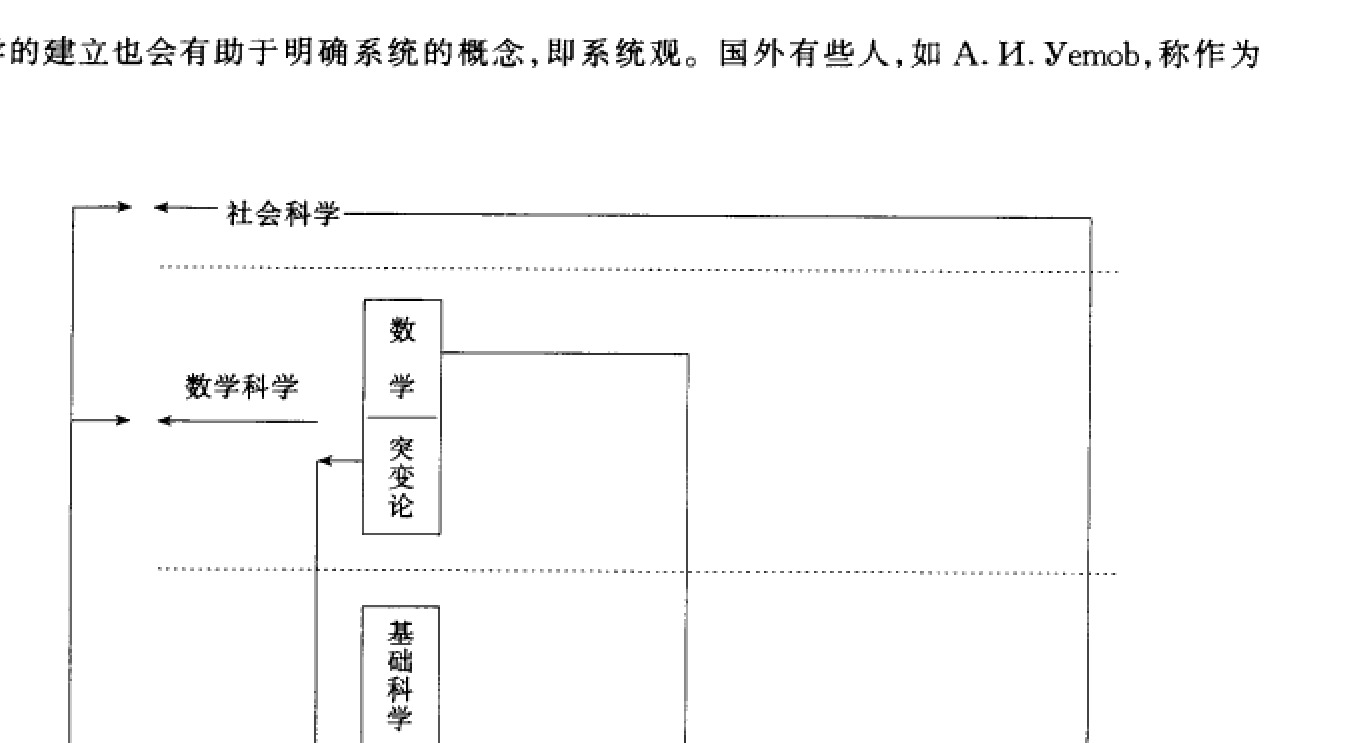
The establishment of systematology will also help to clarify the concept of a system, that is, the systems perspective. Some people abroad, such as A. I. Yemob, refer to it as—
| Level | Systems Science | Related Sciences |
|---|---|---|
| Philosophy | Marxism | Philosophy |
| (Systems Perspective) | ||
| Basic Science | Systematology | Mathematical Science (Mathematics, Catastrophe Theory); Natural Science (Physics, Biology); Social Science; Human Science; Noetic Science |
| Technical Science | Operations Research, Giant System Theory, Cybernetics, Information Theory | Other Technical Sciences |
| Engineering Technology | Various Systems Engineering, Automation Technology, Communication Technology |
The Structure of Systems Science
The essence of “general system theory” is in fact the system viewpoint discussed here. The system viewpoint will enrich the methodology of science and technology, and provide material for the deepening and development of Marxist philosophy. That is to say, the summation of human social practice is distilled into the foundational science of system science—systemology—and from systemology, through a bridge—the system viewpoint—one reaches the highest generalization of human knowledge—Marxist philosophy. Therefore, the structure of system science can be expressed as shown in the figure, divided into four tiers: engineering technology, technical science, foundational science, and philosophy.
I had previously also proposed that the development of cybernetics, in addition to engineering cybernetics, includes biological cybernetics, economic cybernetics, and social cybernetics, thereby raising a question: “Can we more intensively study the common problem of ‘control,’ and thus elevate cybernetics into a truly foundational science? Can engineering cybernetics, biological cybernetics, economic cybernetics, social cybernetics, and so on be regarded as technical sciences derived from this foundational science—theoretical cybernetics?” Now, after two years, the answer is affirmative: this foundational science is precisely the systemology we speak of.
The establishment of the system science system will also inevitably influence the development of other modern sciences and technologies. Its relationship with the other two major divisions of modern science and technology—human body science and noetic science—has already been discussed earlier. It will, of course, also in turn promote the earlier-established divisions of science and technology, such as natural science and social science. For example, Bei Shizhang regards “cell reconstruction” as another pathway of cell reproduction distinct from cell division, and elucidating the mechanism of cell reconstruction requires systemology. Therefore, the establishment and study of systemology is a key focus in the further development of modern science and technology.
Three Letters Discussing the Content of Systemology
Letter from Qian Xuesen to Ma Huaxiao of Chengdu Factory No. 65
Comrade Ma Huaxiao:
Your letter and article of April 16 have been received and read. I believe your research on “Logical Analysis and Probability Calculation of Operational Reliability of Complex Systems” (Journal of Chengdu University of Science and Technology, 1981, No. 1) is meaningful. All scientific and technological work must be guided by the highest scientific generalization of human knowledge—Marxist philosophy—and new achievements in science and technology must in turn be used to enrich, deepen, and develop Marxist philosophy.
Regarding reliability analysis of complex systems, I would like to offer two points for your reference:
-
How to combine components of low reliability into a system of high reliability. This problem was raised and preliminarily analyzed by Von Neumann 30 years ago (see my Engineering Cybernetics, 1958 edition, Chapter 18). Now that large-scale integrated circuits have greatly reduced component costs, this problem has considerable practical significance.
-
Reliability analysis of extremely complex super-giant systems. Quantitative change can give rise to qualitative change: H. Haken and others’ synergetics proves this is possible, that is, the statistical theory of giant systems shows that phenomena not present in simple systems will appear in giant systems, such as self-organization phenomena. What about reliability? There may be phenomena different from those that appear in systems of simple or generally complex degrees.
If you have any comments, please let me know. With best regards,
Qian Xuesen, April 25, 1981
Qian Xuesen’s Letter to Fang Fukang, Department of Physics, Beijing Normal University
Comrade Fang Fukang,
After receiving your letter, I was quite excited.
Recently I have been thinking of two problems related to systematology: (1) Thirty years ago, von Neumann began studying the problem of composing highly reliable systems from components that are not so reliable individually (see Chapter 18 of my book Engineering Cybernetics, 1958 edition), but this work does not seem to have been incorporated into systematology. Now, with the adoption of large-scale integrated circuits, components are very inexpensive, and one can use more components in exchange for extremely high reliability. This requires continuing von Neumann’s work and bringing it into the framework of systematology. (2) Forty years ago, von Neumann and Morgenstern established game theory. Later, because the theoretical calculations were too cumbersome, practical applications often used the Monte Carlo numerical method on electronic computers to obtain results. Recently, computer chess and the actions of simple military combat units (such as platoon versus platoon) have also been realized. But how to apply the theory to opposing groups with complex structures and numerous members—the problem is too complex, and even electronic computers cannot handle it. This is a major problem in military systems engineering, and it is also the fundamental problem in the transition from microeconomic to macroeconomic theory. Can game theory and systematology be combined to solve this difficult problem? …
Respectfully,
Qian Xuesen May 25, 1981
Fang Fukang’s Letter to Qian Xuesen
Dear Professor Qian,
Hello! Please forgive me for replying so late. The reason is that the problems you mentioned in your letter are both difficult and interesting, and require careful thought. I have great admiration for von Neumann; this feeling came to me after I studied his book Mathematical Foundations of Quantum Mechanics. Although I have not had the opportunity to read Theory of Games and Economic Behavior, I hold the same sentiment toward it. This makes me very interested in the questions you raised, yet also aware of the difficulties. Now I would like to report to you some fragmentary thoughts I have had during this period, and I ask for your guidance.
-
During this period, I briefly read some cybernetics, and what struck me was how surprisingly similar N. Wiener’s original ideas were to those of I. Prigogine and others. “In non-equilibrium systems, or in a part of a non-equilibrium system, entropy does not necessarily increase”; “It is very important for us… at these stages entropy does not increase, while organization and related information are being built up.” These statements by Wiener, used as the foundation of cybernetics, could almost without any change become the language of Prigogine. This made me realize that there does indeed exist a common foundation among these disciplines.
-
It is important to note the points of distinction between these two disciplines. From my perspective, the following three points are of particular interest:
(1) If we focus on the analysis of three elements of the physical world: matter, energy, and information, then cybernetics studies only information; it does not discuss energy and matter. In “synergetics” or the theory of dissipative structures, matter and energy are introduced, but the treatment of information is far from as deep as in cybernetics; the generation of order or structure is obtained only through the analysis of system instabilities.
(2) The systems treated by dissipative structures are all nonlinear, whereas many of the systems treated by cybernetics are essentially linear. The very rich content brought about by nonlinearity would be neglected in the process of linearization.
(3) The concept of feedback, which is very important in cybernetics, has not been genuinely introduced into the theory of dissipative structures; there is no suitable mathematical tool to fully express and develop this profound concept.
Therefore, it seems that one can seek the intersecting zone of mutual penetration between these two disciplines and further develop the theory. In particular, by incorporating non—
27
combine the two concepts of linearity and feedback organically.
-
Regarding the matter of error control in Von Neumann automata, this broadly belongs to the category of “majority logic” problems in computers. From the perspective of our system science, analyzing this matter may be complex. However, I believe that once certain fundamental issues are clarified, due to the intrinsic connection between these two disciplines, it is still possible to conduct such an analysis.
-
Regarding the connection between game theory and non-equilibrium system science, I feel there is promise. When I was abroad, I came across Eigen’s articles, which introduced game theory into his theory. Recently, during a visit to Shanghai, I asked Mr. Xu Jinghua about this, and he had the same impression—Eigen had written several articles and booklets on the subject. I am currently seeking further materials in this area. Mr. Liu Ruozhuang is also quite interested in this problem. He mentioned that he had previously read an article by Eigen, and we plan to discuss this topic together. I will inform you further once I have additional thoughts. …
I will not write more. Respectfully,
Fang Fukang, August 22, 1981
VII. The Structure of Modern Science — Further Discussion on the Science of Scientific-Technological Systems
I have previously discussed the structural system of modern science and technology, proposing that from applied practice to fundamental theory, modern science and technology can be divided into four levels: first, the level of engineering technology; then, the level of technological sciences that serve as the theoretical foundation directly for engineering technology; next, the level of basic sciences; and finally, through further synthesis and refinement, the highest generalization is reached in Marxist philosophy. This can also be viewed as four steps—from the practical technology of transforming the objective world to the highest philosophical theory—constituting a horizontal division. The vertical division is the division into disciplinary categories. In the conventional view, the major divisions are natural science and social science; in our country there exist the Chinese Academy of Sciences and the Chinese Academy of Social Sciences, along with their respective branch academies in provinces, municipalities, and autonomous regions—two separate systems. However, I believe that if we take into account the current state and future development of science and technology, the major vertical divisions of science and technology should be six great departments: natural science, social science, mathematical science, systems science, cognitive science, and human body science. How should we regard these six departments? By what boundaries are they delineated? In general terms, of course, they are all knowledge about the laws of the objective world as recognized by humans through practice. The traditional view held that scientific departments are divided by their object domains: natural science studies the natural world, and social science studies human society. But this also gives rise to a problem: mathematics is classified under natural science, and social science makes little use of mathematics. This shortcoming has been recognized by many. This has led me to re-examine the structure of modern science and technology: how are the six major departments divided? Are they divided by object domain? Or by some other method of division? This article presents some views on this question, submitted to comrades for discussion, criticism, and correction.
In fact, although the scope of natural science in the sixteenth and seventeenth centuries was the natural world, by the eighteenth century after the Industrial Revolution, it had long since ceased to be limited to the natural world. Today, the physics, chemistry, biology, astronomy, earth science, and the numerous technological sciences and engineering technologies of natural science already encompass the entire objective world, both natural and artificial. Natural science certainly has its distinctive characteristic—its characteristic is its point of focus, its angle of viewing the objective world, which is precisely the central idea of the dialectics of nature proposed by Engels approximately one hundred years ago: the study of matter in space and time.
motion within it; the different levels of material motion; and the interrelationships among material motions at different levels. To summarize further, natural science views the entire objective world from the standpoint and perspective of material motion. When a natural scientist looks at a machinery manufacturing plant, they do not focus on the plant’s financial affairs, product quality and performance, and so on.
These are called basic dimensions. All other quantities that arise within the great department of natural science are composed of these three basic dimensions. The application of this important fact has formed a very important research method in natural science, called “dimensional analysis,” which often enables us to gain insight into the mechanisms of things. For example, the gravitational constant, mass, and the speed of light—these three quantities cannot form a dimensionless numerical value; what is missing is a length, and this length is precisely the so-called “black hole” radius of a given mass. However, the quantities in social science are unrelated to the three basic dimensions of natural science; one cannot speak of any length dimension, any mass dimension, any time dimension, or any combination thereof. Therefore, from the perspective and standpoint of material motion, one can distinguish the great department of natural science from the other great departments. For the same reason, we should regard the dialectics of nature as the bridge from natural science to Marxist philosophy.
What are the characteristics of social science? From what standpoint and perspective does social science study problems? I have previously proposed that the bridge from social science to Marxist philosophy is historical materialism. This gives us an inspiration: the standpoint or perspective from which social science studies the objective world is the developmental motion of human society and the internal motion of society; it also studies the influence of the objective world on the developmental motion of human society, such as environment, ecology, energy, resources, and so on. One might ask: in that case, can we still say that social science takes the entire objective world as its object of study? Human society exists only on Earth, after all! But we should recall that just a few hundred years ago, we did not even know about the Earth; we still thought that society existed only on a small patch of land beneath a round sky and a square earth! Moreover, we now know that solar activity affects our economy, because it influences the climate on Earth and radio communications on Earth. As for the future, human social activities will further expand to the entire solar system and beyond through aerospace technology and the development of astronautics—how can social science not be studying the entire objective world?
Therefore, it can be said that social science studies the entire objective world from the standpoint or perspective of the developmental motion of human society, and the bridge from social science to Marxist philosophy is historical materialism.
II
Modern science and technology, regardless of which department, cannot do without mathematics, without one or several disciplines of mathematical science. Therefore, it is easy to understand that mathematical science studies the entire objective world. What we need to discuss is: from what standpoint or perspective does mathematical science study the entire objective world? Comrade Hu Shihua has already written an article addressing this question. He said that the philosophical theoretical foundation of mathematics is the unity of opposites between quality and quantity, and the theory of the mutual transformation of quality and quantity. One could also say that mathematical science studies the entire objective world from the standpoint or perspective of the unity of opposites between quality and quantity, and the mutual transformation of quality and quantity. I agree with this view. The remaining work is to further deepen this concept from the perspective of the methodology of mathematical science and the historical development of mathematical science, to enrich its content, and to make it a discipline—a bridge from mathematical science to Marxist philosophy. Comrade Hu Shihua has already done work on this, but he said it still needs to continue. Comrade Ouyang Jiang has also raised this question and named this discipline “mathematics studies” (数学学). In this way, everyone’s views have converged, and the construction of the bridge from mathematical science to Marxist philosophy should now begin.
III
Regarding systems science, I have already discussed it in the preceding text: the characteristic of systems science is the systems perspective, or one could say that systems science views the entire objective world from the standpoint or perspective of systems. Therefore, the problems that systems science deals with include those in nature, such as the phenomenon of ordering in biology,
phenomena; there are also social ones, such as economic systems, legal systems, and so forth. Because they are unified within the perspective of systems, if systems theory is the bridge from systems science to Marxist philosophy, then the systems perspective is a constituent part of Marxist philosophy.
Since the proposal of noetic science (thinking science), it has attracted the attention and research of many comrades. Because the foundational work in this area is still quite underdeveloped, and only logical thinking has been studied more thoroughly, it is difficult for everyone’s understanding to reach unity for the time being. Human thinking under conscious control is divided into three forms—logical thinking, imagery thinking, and inspirational thinking—distinguished according to the different inherent laws of thinking. Some comrades seem to have confused these with the various different contents of the thinking process, proposing that there is also “emotional thinking” as a type of artistic thinking. If we think along these lines, then one could also propose “writing thinking,” “scientific research thinking,” “creative thinking,” and so on. This kind of thinking actually involves applying the three types of human mental activities to a thinking process in a certain domain; in each process, the three types of mental activity may involve one, two, or all three of them. Therefore, emotional thinking is not a foundation of noetic science but rather an application of it, and should not be placed on a par with logical thinking, imagery thinking, and inspirational thinking. A further issue is that the names of the three basic types of mental activity are also somewhat ambiguous: logical thinking is also called abstract thinking. Imagery thinking seems to be more familiar to comrades in literary and artistic circles, while less familiar to the scientific community. Scientists are more accustomed to using the term “heuristic” (or intuitive), and some also use the term “physical,” to distinguish it from the “logical” and “mathematical.” Comrade Zhang Guangjian further proposed the term “similarity thinking.” In fact, based on my own practice, all of these terms refer to imagery thinking. As for inspirational thinking, its characteristic is suddenness, and one might use the Buddhist term “sudden enlightenment” (顿悟). Therefore, for the convenience of further discussion and research, we may call the three basic modes of thinking: abstract (logical) thinking, imagery (intuitive) thinking, and inspirational (sudden-enlightenment) thinking.
How can one say that noetic science studies the entire objective world? This is because the purpose of noetic science is to understand how human beings cognize the objective world—how the sensory information obtained through practice is stored and processed in the human brain to become human knowledge of the objective world. It is also for this reason that thinking is connected to the entire objective world, and the bridge from noetic science to Marxist philosophy is epistemology. Of course, as noetic science develops, the epistemology discussed here will also be greatly developed and deepened, and will by no means be limited to classical epistemology. Classical epistemology did not incorporate detailed knowledge about the activities of the human brain, and therefore lacked the foundation of the new, developing noetic science, remaining at the stage of speculative philosophy with considerable limitations. For example, quantum mechanics, which developed in the 1920s, although its correctness has been verified experimentally, has from the standpoint of classical epistemology given rise to controversies over the past fifty-plus years that remain unresolved to this day, to the point that H. Everett, B. S. DeWitt, and N. Graham proposed the peculiar “many-worlds theory.” This problem, it seems, must be resolved together with the research of noetic science and the new development of epistemology.
Human body science is a scientific and technological discipline that is both ancient and novel. It is called ancient because many of its subdisciplines were established long ago and possess extremely rich content, and because our understanding of human body science as a whole also originates from China’s ancient traditions, such as traditional Chinese medical theory and qigong. There is also the currently debated topic of extraordinary human functions (human paranormal abilities), which has only received attention in China in recent years. Yet human body science is also very novel, because carrying forward China’s ancient traditions has given human body science a new direction—namely, treating the human being as an integral whole, placing the human being within the entire universe for study, so that the human being and the universe are connected together. This is the new human-cosmos perspective. Heaven, the sun, the moon, and the entire universe all influence the human being, and the human body can also influence the external world. Therefore, human body science examines the entire objective world through the focal point or angle of the human body; one must not examine the components of the human body in isolation, nor can one consider the human body in isolation from the external world. The human-cosmos perspective will also become a constituent part of Marxist philosophy, and the “human-cosmos theory,” further developed and distilled from human body science, will serve as the bridge from human body science to Marxist philosophy.
The above is a view on the structure of modern science. The six major departments—natural science, social science, mathematical science, systems science, noetic science, and human body science—each cognize the entire objective world, only examining it from their respective focal points or angles: natural science from the motion of matter, social science from the developmental movement of human society, mathematical science from the unity of opposites and mutual transformation of quantity and quality, systems science from the systems perspective, noetic science from epistemology, and human body science from the human-cosmos perspective. The examinations from different focal points or angles are ultimately synthesized through their respective bridges into Marxist philosophy—the highest generalization of human knowledge. Therefore, only Marxist philosophy is a scientific philosophy; it must, of course, guide scientific and technological research. Modern science thus forms a tightly knit, solid, unified system—the system of modern science and technology. Further study of this system is the task of the science of the disciplinary structure of science and technology.
Does this view make sense? Should it not be further explored?
(March 1982)
VIII. The Structure of Modern Science and Technology (1)
This topic will be covered in two lectures. The previous lecture served as a preface, discussing the ethics we must follow in studying modern science and technology—principles that we all commonly observe. Starting today, we formally begin the study of modern science and technology, ultimately leading to human body science.
The Purpose of Studying the Structure of Science and Technology
The first thing to address is: why should we study this topic? Why should we study the structure of modern science and technology? I think there are probably several reasons, and I ask you, comrades, to consider whether they are correct and complete. I believe the first reason is that science and technology form an integrated whole. When each of us engages in scientific and technological research, we cannot possibly study the entire whole all at once—you cannot study everything; that is hardly possible, because with such a vast scope, you would have no way to begin. Therefore, each of us, at any given time, studies science and technology by focusing on a particular problem. Even if a comrade has broad interests and is not limited to any one area, the work they do at any given moment is inevitably a specific problem—one that is very narrow and very small. But when you study this very small problem, you must first understand what the whole is about, because modern science and technology are all interrelated, and together they form a system. The Philosophy Teaching and Research Office of the Central Party School teaches Marxism-Leninism and Mao Zedong Thought. It has a set of lecture notes containing a chapter titled “Understanding the Material World.” Yesterday was Sunday, and I was asked to review these lecture notes and offer any opinions on that chapter. After reading it, I could not really raise any objections; after reading it, I felt that our Party School has adopted a new approach, because this time their lecture notes did not simply copy the standard material from the classic works—they introduced the concept of a system. I noticed this was something new; it seems that in the classic works, Marx did not discuss systems, and Engels did not discuss systems either, yet these lecture notes actually discuss systems, and moreover discuss systems science. The lecture notes are very well written, using the concept of a system to present Marx’s ideas more explicitly and at a deeper level. The objective world is an integrated system; a system is composed of many levels and many parts, and multiple systems together form a larger system. Of course, modern science and technology are also a system. As I just mentioned, we must first understand what this system is—this is one point, one reason. Of course, comrades may further ask: what is the purpose of understanding this system? My understanding is that understanding this system is for the sake of knowing where the problem I am studying sits within the whole of science and technology, what its neighbors are, what lies above it at a more theoretical level, and what lies below it at a more practical and applied level—to clarify what is before, after, above, below, and to the sides. In other words, in your research work, you must first clarify your research task: where does it stand from the perspective of developing science and technology? When I solve a problem, it is not merely solving a problem for its own sake—there is, of course, a practical purpose. At the same time, academically, after I have solved this problem, what is its relationship to the development of other sciences, to the science of my own field, and to other kinds of analysis? This is quite important in our research work; otherwise, you will lose your direction. You are walking this research path without knowing that it connects in all directions, and without knowing where it ultimately leads—that is not good. Without an overall understanding, without an understanding of where your work sits within the entire system of science and technology, your research will be somewhat blind. Did we not discuss this last time? In scientific research, it is very important to discuss with others—not only with peers in the same field, but also with people in different fields. What do you discuss with people in different fields? It is to understand how someone outside my field views my work—that is, to understand what my superiors, subordinates, and peers think about the work I am doing, and what others, especially those in different fields, think of my work. In this way, we can avoid taking detours as much as possible. How do we avoid taking detours? That brings us to the third point.
The third point is knowing the structure of modern science as a whole—what good is that? It allows us to draw upon and borrow from other sources. Work done in other fields can often inspire the work I am doing, because the hardest part of research is recognizing the problem in the first place. Let me say a few more words on this. We often think of scientific research as inductive reasoning—carefully recording experimental observations, then gathering a large body of experimental data and reasoning inductively from it. Comrades, do you share this conventional view? We call this the scientific method, and we have been learning it since we were young. But I can also cite a great figure as an example: Einstein once said that the scientific method just described cannot yield genuine scientific creation. Or, to put it another way, how did Einstein discover the theory of relativity? It was absolutely not by such a method; with that method Einstein could never have discovered relativity. Einstein strongly emphasized that a large body of data and facts is important. Our science is not based on idle speculation; it relies on practical, objective observations and data—there is no question about that. But how does one extract a concept from this vast body of data and facts, how does one gain insight into the problem? For example, when Einstein worked on relativity, there was a large body of actual results, which of course included the Michelson-Morley experiment, but how did he arrive at the concept of relativity in the face of these facts? This is not simple so-called inductive reasoning. Inductive reasoning does not tell you which things are the most important and most essential—it does not say. So what do you do? At this point, what Einstein called a creative activity is needed: you guess, you hypothesize. Is this kind of guessing and hypothesizing just wild guessing, wild hypothesizing? No, it is not. In practice, a very important method is to draw upon analogies—you recall that somewhere else there is something that seems a bit similar, and you wonder whether it can be applied to your own situation. This kind of thinking is very important. You need to know what other things are about, what recent developments there have been in other sciences and technologies, or what developments there have been in history—this gives you a clue. Of course, it does not mean your hypothesis or conjecture is necessarily correct, but it serves as the foundation for further work, and that further work does rely on reasoning and analysis—methods we know and are familiar with. In other words, there is always a certain step, namely, forming a large body of experimental results, experiences, or observed data into a foundation on which further work can proceed. This is what Einstein called the creative step, or a creative leap—a jump. To do this, it is very important that you have something to draw upon; it always has a source—you are not thinking out of thin air. There is much more that could be said on this point. Studying the structure of modern science and technology is beneficial for our creative mental labor, because developments in other areas of science can be helpful to the work we are currently doing. Comrades, do you believe this? I do, because I have benefited from it quite a lot in my own work. There are also concrete examples in what I will cover in these two sessions. What I am saying now is merely an opening remark, and I ask comrades to sit here patiently and listen. You may think that what I am talking about does not necessarily have anything to do with your work—we all do concrete work—but you must understand the whole. That is the opening remark, that is, why we should study the structure of science and technology.
Historical Development of the Structural System of Science and Technology
1. The Development of Natural Science
Let us now discuss historical development. What we are talking about is science and technology, starting with natural science. Natural science was not originally called natural science; it was called natural philosophy. Why was it called natural philosophy? Because in the early study of science and the principles of nature, the work was merely fragmentary—this question and that question were studied in a very incomplete manner. To understand the objective world, to understand nature, we always connect the fragmentary things we have come to know from various aspects, forming a comprehensive understanding of the natural objective world. Human beings always have this need: it is not enough to know only this or that; one also wants to know what the relationship is between these two things. Our ancestors always had this need, and what was connected together as a whole served as the understanding of the entire objective world held by people of that time. Of course, in the very beginning there was no science; in reality there were myths and beliefs. This was the same for every people. For example, at first, upon seeing the sun, moon, stars, lightning, wind, and clouds, people did not understand what was going on, so they simply personified them, which is to say they deified them. Gods were human beings—gods were conceived by humans. There was a moon god, a sun god, and a thunder god; they were all deities. Later, of course, understanding gradually grew, and some objective phenomena received scientific explanations, but the whole could not be connected together. What could be done to connect them? To connect them inevitably required adding a bit of one’s own conjecture—conjecture plus science linking together the things of the objective world. You could not call that natural science. At that time it was not called natural science either; the people who did this kind of work were all philosophers. They called the science of this objective world natural philosophy. This situation was slowly changing, as scientific research increased, and things that had previously been isolated were discovered to…
They could be interconnected. What is the sun about? What is the moon about? At first, the geocentric theory was proposed: the sun and the moon both revolve around the Earth. Later, through further research, it was discovered that this was incorrect, because the motions were not that simple. How could these things be explained? It was the Earth that revolved around the sun—that is, the heliocentric theory. The heliocentric theory was a great advance over the geocentric theory. Development proceeded in this way, step by step. By the second half of the last century, three major breakthroughs in science had emerged: first, the cell theory—all life is composed of the basic unit of the cell; second, the conservation of energy—regardless of what form energy takes, it is mutually convertible, and energy is indestructible; third, Darwin’s theory of evolution—why are there such myriad differences in the origins of species, how did they arise, and how did they evolve? These were the three great discoveries, three breakthroughs in science. This prompted Engels to say that, since matters had now reached this point—that is, science and technology in the second half of the last century had developed to such a degree—those conjectured connections could already be explained by genuinely scientific connections grounded in actual conditions. He said that at this point natural philosophy would naturally yield its place and be replaced by natural science. In 1886 (not quite a hundred years ago), Engels, in his work Ludwig Feuerbach and the End of Classical German Philosophy, had this to say about the emergence of natural science—a passage I find so excellent that I would like to read it to you here. This passage is from Chapter IV of that work. He said: “By virtue of these three great discoveries and the other immense advances in natural science, we are now able not only to point out the connections between the processes within each individual field of nature, but also, in general terms, to point out the connections between the various fields themselves, so that we are able to rely on the facts provided by empirical natural science itself to depict, in an approximately systematic form, a clear picture of the interconnections in nature. Depicting such an overall picture was previously the task of so-called natural philosophy. And natural philosophy could only do so in this way: by substituting ideal, imagined connections for those real connections that were not yet known (the author: i.e., you guessed), by using supposition to fill in missing facts, and by using pure imagination to fill in the gaps in reality. In doing so, it put forward some brilliant ideas and anticipated some later discoveries, but it also expressed some thoroughly absurd views, which at that time was inevitable (the author: because you simply did not know. And if you did not know, what could you do but guess?). Today, when the results of the study of nature can be examined dialectically, that is, in terms of their own interconnections, and a ‘satisfactory system of nature’ for our time can thereby be constructed, and when this dialectical character of the interconnections even compels the metaphysically trained minds of natural philosophers to accept it against their will, natural philosophy is finally disposed of. Any attempt to resurrect it is not only superfluous but a regression.” In the original text, “is a regression” is set in bold type—this is Engels’ own emphasis. I frequently quote and read this passage to comrades. I think this passage is excellent, because it tells us that what we now know as natural science, which we regard with great reverence, also originated from something that was not quite scientific—namely, natural philosophy. I find this passage very inspiring: science comes from that which is not scientific. What is today considered unscientific, or not quite scientific, you should not look down upon; it too may become the source of a great science in the future. This point is important.
There is another point: natural philosophy gave way to natural science at roughly the second half of the nineteenth century. Comrades may ask: we now often speak of social science as occupying an equal or parallel position alongside natural science, yet social science is not explicitly put forward in Engels’ works. When Engels discussed these matters, he spoke of natural science; the science he referred to was natural science. The reason for this is simple: the study of society, before Marx and Engels, was fundamentally unscientific—it was all of a philosophical nature, conjectural, discursive. Only Marx and Engels established scientific socialism, so social science truly became a science only after Marx and Engels. Hence they themselves did not emphasize this point. Viewed in this way, the parallel social science came even later. One could say it truly began only in the latter half of the nineteenth century; before that, social science could not be called science. The very word “science” could not be applied to it. This explains why the works of Marx and Engels did not explicitly put forward the domain of social science. Let us look further: we are now gradually examining from a historical perspective how the structure of science was formed. We just spoke of the transition from natural philosophy to natural science, and then Marx and Engels established social science. This naturally raises a question: what is the relationship between these natural sciences, social sciences, and philosophy? It must be clarified that the philosophy we speak of now is not any of the various other philosophies. What we speak of is Marxist philosophy, and Marxist philosophy is the philosophy of dialectical materialism. In other words, idealist philosophy is not Marxist philosophy, nor is it the philosophy we are discussing here. Marxist philosophy is the highest scientific generalization for understanding the objective world. This—
It is through practice that we gradually come to know the objective world and form bodies of learning—what we call, for example, natural science and social science. When these are further generalized, and generalized in a scientific manner, what do we get? We get Marxist philosophy. This gives rise to the following relationship:
Marxist philosophy
Natural science
Social science
And the arrows in this relationship are bidirectional. What does a bidirectional arrow mean? On the one hand, as I just mentioned, Marxist philosophy is the highest scientific generalization of humanity’s understanding of the objective world. Marxist philosophy was not concocted out of thin air; it was distilled and generalized from humanity’s understanding of the objective world and elevated to the philosophical level. On the other hand, since it represents the highest principles of generalization, it must in turn guide our research in natural science and social science—that is, from Marxist philosophy to natural science, and from Marxist philosophy to social science. Therefore this relationship is bidirectional, and this point is very important. Regarding this principle, among the books I have read, I feel that Comrade Mao Zedong made an excellent statement in “On Practice,” so I keep returning to this passage. Let me read it once more for the comrades here. This is a passage from Comrade Mao Zedong’s “On Practice” (near the very end):
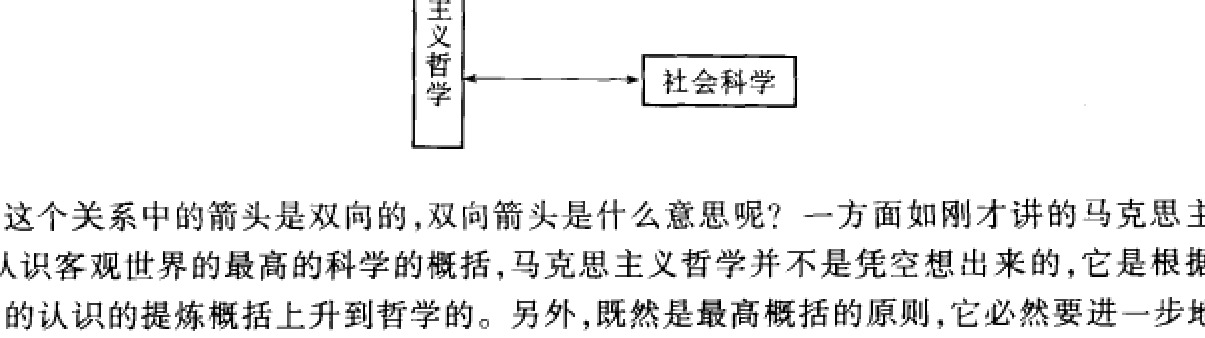
“Marxists recognize that in the absolutely general process of development of the universe, the development of each concrete process is relative, and therefore in the endless river of absolute truth, humanity’s understanding of concrete processes at each given stage of development possesses only relative truth. The sum of countless relative truths constitutes absolute truth. The development of the objective process is a development full of contradictions and struggles, and the development of humanity’s cognitive movement is likewise a development full of contradictions and struggles. All dialectical movements of the objective world can, sooner or later, be reflected in human cognition. The processes of arising, developing, and perishing in social practice are infinite, and the processes of arising, developing, and perishing in human cognition are also infinite. By undertaking practice to transform objective reality on the basis of certain ideas, theories, plans, and programs, again and again moving forward, people’s understanding of objective reality deepens again and again. The changes and movements of the objective real world never come to an end, and people’s cognition of truth in practice likewise never comes to an end. Marxism-Leninism has not ended truth, but continually opens up the path to the cognition of truth in practice.”
I think this passage is extremely well put. It explains that, on the one hand, Marxist philosophy must guide our practice, and on the other hand, people’s practice in turn enriches Marxist philosophy. This latter point was often not mentioned in the past. Marxism-Leninism and Mao Zedong Thought seemed to be fixed and unchanging. They were treated as absolute truth. They were to guide our work and all our practice, but it was never said that people’s practice could in turn enrich Marxist philosophy. In fact, this attitude is itself contrary to Marxist philosophy, contrary to Marxism-Leninism. It is rigid and unchanging. Chairman Mao said that Marxism-Leninism has not ended truth, but continually opens up the path for truth to advance in practice. This problem has still not been thoroughly resolved. I have encountered many philosophers, so-called Marxist philosophers, who reject any mention of new development. Not long ago, probably last summer, the vice president of Jilin University, who is also the chair of the Philosophy Department and a professor of philosophy, came to talk with me. I didn’t know him. He said someone had introduced him to me, and the person who introduced us said that I was someone he could talk to. Well, that was fine—I was honored that he came to see me. He said he was compiling a textbook on Marxist philosophy and had written an outline. Since it was a textbook, the Ministry of Education learned about it and said, all right, let’s organize some philosophers to review this textbook and discuss whether this outline is acceptable. A discussion meeting was then convened. At this meeting, some Marxist philosophers said that the outline included things not found in the classic works, and asked whether he could remove the five characters “Marxist” from the title of his book. This put the vice president in an impossible position for the discussion. The old shadow still persists: it is as if Marxist philosophy means reciting phrases and classics, like an old monk chanting scriptures—whatever Marx said, whatever Engels said, whatever Lenin said, whatever Mao Zedong said. And that’s it; nothing else is permitted. That kind of view, which rejects development and does not allow stepping even an inch beyond the boundary, is itself non-Marxist. Otherwise, how can we conduct scientific research? How can we do scientific research if we must always seek justification from the old masters—Marx, Engels, Lenin, and Mao Zedong?
If everything not yet spoken of is forbidden from being studied, then what progress would there be? What scientific development would there be? In fact, Comrade Mao Zedong put it very well. Marxism-Leninism does not put an end to truth; rather, in practice, it helps you open up a path forward, a path of development—that is the principle.
When discussing this issue, one must clearly recognize that this arrow is bidirectional, not unidirectional. Only under the action of a bidirectional arrow can our science, technology, and philosophy develop continuously. Comrades, you may consider this question and see whether what I have said is correct.
The next question to address in the course of historical development is whether the series of tasks in natural science proceed without steps or with steps—that is, whether there is a step from theory to practice. What is meant by a step? Let me explain bit by bit. In the second half of the nineteenth century, specifically in 1886, Engels proposed that natural philosophy had come to an end, and that what followed would be natural science. During this period, there was another very important development. If comrades look into the history of science, you can discover the following fact: regarding matters of production and manufacturing, although the Industrial Revolution occurred in the second half of the eighteenth century with the appearance of the steam engine, and production underwent a leap forward in development, even someone like Watt was primarily a very dexterous and experienced craftsman. At that time, technical problems were all solved by outstanding master workers among the laborers—master craftsmen. Was there any method for training such outstanding master craftsmen? There was, but the schools of that kind were essentially trade schools, mainly aimed at training people to do the work, to learn a craft. Later, machine tools for machining appeared, and of course that too was training, primarily that. Inventors, creators, and technical innovators were all gradually tempered and selected from among the artisans. The so-called schools were only trade schools, and trade schools did not teach advanced mathematics, physics, or chemistry—they taught none of these; they just taught you to do the work and develop a craft. So at the end of the eighteenth century and the beginning of the nineteenth century, this was the situation: one could say that natural science and production technology were disconnected. As natural science gradually developed and its content became richer, there were indeed many things that appeared to be connectable with production, and this was in the second half of the nineteenth century. Around the same time as or simultaneously with when Engels made this statement, the following situation arose: in 1876, the American inventor Edison used his own money to organize an Edison research institute. This was exactly ten years before Engels wrote Ludwig Feuerbach and the End of Classical German Philosophy—that was in 1886. This was 1876, when Edison established his research institute, which was in fact the prototype of a modern research institution. What was particularly different was the purpose: his research institute was specifically for making inventions, for solving problems in production practice, for creating new equipment and machines—such was its purpose. But he set up a research institute, and very importantly, he hired a number of natural scientists to work in his institute. The purpose was for invention, for creating new machines and equipment. That is to say, Edison recognized this problem: to create new machines and equipment, to invent, one must rely on natural science. It would not do to rely solely on individual drive, craftsmanship, and experience. Some of the scientists he hired were of quite high caliber. For example, his institute included someone who later discovered the ionosphere—Heaviside, after whom the Heaviside layer (the ionosphere) is named. He had previously worked in Edison’s laboratory for a period. The people Edison employed were not ordinary; they were all top-tier scientists. One can say that in the second half of the nineteenth century, Edison was the first to recognize that major developments in production technology required the application of natural science.
There was another aspect of development. I mentioned above that all the schools at that time were trade schools—of course, I should add a clarification. Napoleon was the initiator of military modernization, because Napoleon established an engineering school. The meaning of the word “engineering” in Napoleon’s engineering school was not the same as our current meaning of “engineering.” What he called engineering was military engineering. Napoleon needed to wage war and required military engineers—to build roads and bridges for troop movements. At that time, the term “engineer,” which originated in Napoleon’s army, referred to military engineers. There was only one task: building roads and bridges. Around the same time as Edison was establishing his research institute, that is, around 1870, the United States began to have so-called university-level engineering technology schools. The one that has continued to the present day and is famous is the Massachusetts Institute of Technology, the American Massachusetts Institute of Technology, abbreviated as MIT. The emergence of MIT marked the beginning of modern engineering technology education. Under the conditions of that time, it was different: it was not a trade school. It was at the university level, teaching mathematics, physics, and chemistry, laying the foundation from there, and also including graduation projects. A high school graduate, a young person, would study for four years and be trained to become an engineer with scientific knowledge. That is to say, natural science and engineering technology became connected. Within the domain of natural science, engineering technology emerged—what we now call engineering technology, such as civil engineering, architectural engineering, electrical engineering, hydraulic engineering, and naval architecture engineering—linking modern engineering technology with the theories of natural science. If we say that engineering technology directly transforms the objective world, then natural science provides the theoretical foundation for engineering technology—that is the relationship. Or to put it more clearly, this entire field is called natural science. Natural
Natural science is divided into several tiers: one tier is basic science, then comes application, and what directly transforms the objective world is engineering technology—such is the relationship. At that time, this was indeed the situation, as with the Massachusetts Institute of Technology, and later many schools were established. Europe actually lagged behind the United States; Europe’s engineering schools and institutions of higher education were in fact established only after schools like MIT in the United States had risen. Later, of course, science, technology, and engineering technology all developed greatly, as in Germany. Germany was quite late; it had institutions called Technische Hochschulen (technical universities). Originally they were simply called universities; in Europe they were all called universities, but those universities were actually what we would now call comprehensive universities—universities of arts and sciences—while engineering subjects were in separate schools. The United States established engineering schools relatively early and set the example; later the European continent learned from it. Although the first engineering school was established by Napoleon, they did not carry it forward, which is quite interesting, because the so-called engineers of the first engineering school established by Napoleon were military engineers. Since they were military engineers, a word was later added for civilian use: Civil Engineer. Later, military engineering became civil engineering, and as everyone knows, Civil Engineering can no longer be translated as “civilian engineering”; it is now actually civil engineering, namely construction engineering. Later there were more branches of engineering—shipbuilding engineering, electrical engineering, and so on—all of which came later. Such was the history, right up to the end of the last century. In the field of natural science there were tiers, two tiers: one was the development of basic sciences such as mathematics, physics, and chemistry—this was one tier; the other was engineering technology, of various kinds. From the perspective of training personnel, on the one hand there were what the capitalist countries called universities, which dealt with the basic theories of natural science, and on the other hand there were engineering technology institutes. This situation continued until the beginning of this century. By the beginning of this century, other factors began to enter the picture. What were they? Between the beginning of this century and the period around World War I, something emerged that was intermediate between engineering technology and basic science—what we now call technical science. An example can be given: applied mechanics is a technical science. What is applied mechanics? Why do we call it a technical science? For instance, studying the motion or vibration of an object, or studying the deformation of a solid under external forces—this is solid mechanics—or studying the flow of liquids, which is fluid mechanics, or studying the motion of gases, which is gas dynamics—all of these are studied as branches of learning. Compared to the fundamental theories of mechanics in physics, they are relatively applied; they apply some basic theories of mechanics from physics, such as Newtonian mechanics, to determining practical problems, such as vibration, deformation of solids, or the motion of liquids and gases. They are relatively concrete, so relative to basic science they are applied, but relative to engineering technology they provide the theoretical foundation. Another example: the problem of fluid motion is obviously related to the motion of ships on water, and also to ocean currents, river flows, and the flow of rivers and streams, and also to certain constructions such as water supply and drainage systems. If you consider gas motion, there are even more applications: the flow of any gas in pipes is also gas motion, which can relate to construction or machine design. Of course, gas motion can also relate to a very important area such as aeronautical engineering and astronautical engineering—all of these are connected. Gas motion also has other uses, completely different uses, such as meteorology, which is also the motion of the atmosphere. So technical science is applied relative to basic science, but for engineering technology, and for several different branches of engineering technology, it provides the theoretical foundation. This is what is called technical science. This term was basically a concept that gradually took shape between World War I and World War II, so it came somewhat later. In natural science, basic science came earliest; by the end of the last century and the beginning of this century, engineering technology had developed; and technical science came even later. The earliest technical science was applied mechanics; later there were many other technical sciences, such as electronics and electrical engineering, which are also technical sciences—on the one hand, applied relative to basic science, and on the other hand, the theoretical foundation for engineering technology. So it can be said that by World War II, our concept of the three tiers of natural science was relatively clear: the most fundamental was basic science, in the middle was technical science, and what concretely and directly transformed the objective world was called engineering technology.
To be more specific, the basic sciences within natural science are further divided into mathematics, physics, chemistry, astronomy, earth science, and biology. This was the structure of basic sciences within the field of natural science proposed by the Chinese Academy of Sciences around 1977 when formulating a plan. The Chinese Academy of Sciences at that time did not have much responsibility for the middle part. Regarding technical science and engineering technology, a meeting was held later, in 1978, called the planning for applied science. Combining the results of these two meetings, the conception was roughly three tiers, with the six aspects of basic science:
Of course, there were also some debates at that time, such as whether it should be called applied mechanics or simply mechanics; calling it mechanics would make it a part of physics. Or some people said it was not mathematics, physics, chemistry, astronomy, earth science, and biology, but also mechanics—force, that is, mechanics. Some people wanted to move this into basic science. Others said that, judging from the concrete development of mechanics, it was not basic science but applied science. At the time, some people advocated the basic science view.
Mathematics, Physics, Chemistry Marxist Philosophy Natural Sciences Astronomy, Earth Sciences, Biology Technical Sciences Engineering Sciences Basic Sciences Social Sciences
I advocate the view that mechanics is a technical science. There was quite a debate over this. Now, when I discuss this issue with you all, it is not to continue arguing with people—that argument is already over, given the current atmosphere. In our country, many things depend on the atmosphere and the prevailing wind. Because at that time, in 1977, there was a strong push emphasizing theory, theory, theory. Some people wanted to ride the theory bandwagon, so they felt mechanics would be better off joining the basic sciences—it seemed more advantageous. Now the talk is about application again—about tackling key problems, about application. The President of the Academy of Sciences has also written articles calling for organized efforts to tackle key problems and to serve national economic construction, so this has become popular again. But I believe science should not follow the prevailing wind; it should look at what the facts are. One should look at the development of modern mechanics, which is in reality a technical science. Of course, we must also clarify here that the relationship among these three tiers is not unidirectional. It is bidirectional. From a historical perspective, of course, the higher tier influences the tier below it, because when Edison organized his research institute, and when MIT organized its teaching, they both started from the basic sciences. Put this way, it seems as though the basic sciences provide the raw material and theory for engineering technology. Is that really the case? I should say that from the standpoint of Marxist philosophy, it is probably not entirely so. Practical endeavors can also discover new things and raise new demands, thereby promoting the development of the basic sciences. There is also a very important principle here, namely the fundamental principle that knowledge originates from practice. We now say there are two types of practice. One is production practice, and the other is scientific experimentation. Previously, it seemed as though the development of basic sciences relied solely on scientific experimentation. I think this is not very comprehensive; production practice can also raise problems and demand research from the basic sciences. In other words, we must value the working people—the problems they encounter in production practice, or the views they put forward. We professional scientific and technical personnel should pay great attention to these opinions originating from actual production. I think this point needs to be emphasized, because under the past leftist line, when leftist thinking was rampant nationwide, the role of science and technology, of scientific and technical personnel, and of intellectuals was negated. It was as if no knowledge was needed for anything. Now we say that knowledge is important. At the same time, we must be careful not to bury ourselves in books, not to stay confined in laboratories. We must also look at the problems raised by the broad masses of people in their practice. Their practice provides you with raw material that can be elevated into science. I feel that nowadays this latter point is raised far too little. This point is closely related to the field we comrades here are engaged in. Haven’t I spoken about this several times here? Human body science, qigong, and extraordinary functions—these things did not originate in scientists’ laboratories. They emerged from the practice of the broad masses of people, and the same goes for traditional Chinese medicine. Should we say that because they are not scientific, because they did not arise from orthodox science, we therefore should not consider them? Obviously, I think you would be losing a great deal—you would be discarding a very important aspect. There are many such examples in other fields as well. In engineering and technology, many problems are raised in production practice. Some problems and experiences arising from production practice are very important raw material for the synthesis and advancement of science. Not raising or valuing such issues now, I think, is also incorrect. Of course, the question of who should do the elevating, who should synthesize them into science—that still requires intellectuals, still requires scientific and technical personnel. Otherwise, what are scientific and technical personnel for? That is precisely your job. But as scientific and technical personnel, your ears and eyes should not be closed to these things. These are very important clues for our work. So the arrow is not unidirectional; it is bidirectional.
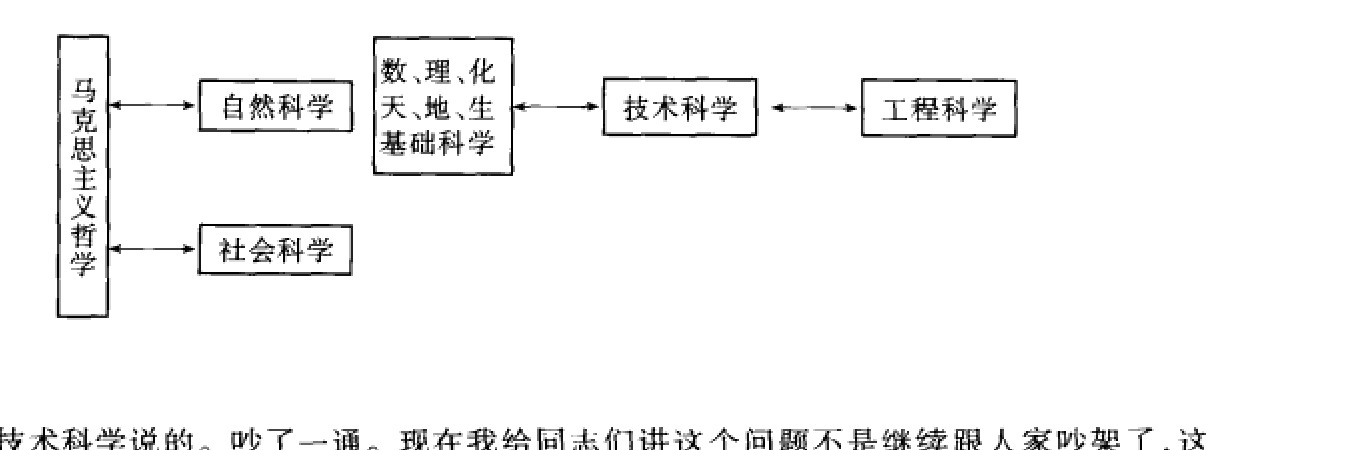
Last year, at the Second Council Meeting of the Mechanics Society, I specifically addressed the issue of applied mechanics. I said that mechanics also connects in both directions. On the one hand, applied mechanics guides the practice of engineering technology, which is very important. On the other hand, applied mechanics can also be used to help the development of the basic sciences. For example, in astronomy, the structure of nebulae and so forth—these require mechanics for calculation. For instance, the Milky Way galaxy is a spiral—why is it a spiral? This theory depends on mechanics. In geoscience, the structure of the Earth and the propagation of seismic waves—these rely on solid mechanics. In biology, many phenomena require mechanics for explanation, such as blood flowing through blood vessels and so on—this depends on mechanics. So there is celestial mechanics—
There is geomechanics and also biomechanics; this means applying modern applied mechanics to astronomy, geoscience, and biology. This further shows that these three tiers are not unidirectional—which one goes down and which one goes up. It is not the case that this tier can only go down or only go up.
There is another issue that I also raised during the 1977 planning of the Chinese Academy of Sciences. At the time, this statement also led to arguments with others. Regarding the question of mathematics, physics, chemistry, astronomy, geoscience, and biology, I said at the time that from the perspective of their objects of study, these are six areas. However, on the one hand I acknowledged that there are six areas, and on the other hand I said that mathematics and physics are still somewhat more fundamental, since mathematics and physics are needed in all the other four areas. At the time, some people were unhappy about this. I have since come to understand why they were unhappy: what I said was endorsed by those in mathematics and physics, but those in chemistry, astronomy, geography, and biology were displeased. You see, originally the six disciplines were all equal; if you elevate those two, then mine… Actually, I had no such intention. I am neither a mathematician nor a physicist—I am none of those. I was simply stating the facts. Later, I wrote an article based on this passage, which was published in the People’s Daily, and people had objections. Later, this matter became even more formal. This article was selected for junior high school textbooks. I said, fine—since it was selected, so be it. I have done nothing to feel guilty about; I was speaking of real, concrete facts. Because chemistry—for example, the kind of chemistry that Professor Tang Aoqing, the president of Jilin University, works on—is essentially applying physics and mathematics to chemistry. As for astronomy, it is even more inseparable from mathematics and physics. For instance, the evolution of celestial bodies and how they emit light—that is even more inseparable from physics; it involves nuclear reactions. The Sun emits light because of nuclear reactions. If you do not understand nuclear reactions, you cannot understand why the Sun emits light. Before the development of nuclear physics, there was no way to explain why the Sun emits light, and why it has emitted light unchanged for so many years. So astronomy must rely on physics. Can geoscience do without physics? Of course it also needs physics. For example, one major development in geoscience over the past two or three decades is the so-called plate tectonics. How did plate tectonics come about? It is because the Earth’s crust is changing, moving like a tangram puzzle. How was this discovered? Through paleomagnetism: after the Earth’s crust solidified, there were magnetic field lines, and once solidified, the magnetic direction remained fixed. Through physical measurements, the magnetic direction was determined—what the original direction was, and that it is no longer that direction now—indicating that movement has occurred. It was from this that plate tectonics was discovered. So can you say that such a major development in geoscience as plate tectonics could have happened without physics? As for biology, everyone knows that without physics and chemistry, many things in biology would be difficult to explain. So at that time I said that among these six disciplines, they are not entirely on the same level: mathematics is needed everywhere, and physics is also needed everywhere. This provoked some discussion at the time, but now people no longer discuss it—probably after talking about it for a while, their anger subsided, and they stopped talking about it. However, I feel that after I spoke about this issue last time—namely, that among the six areas of mathematics, physics, chemistry, astronomy, geoscience, and biology, mathematics and physics seem more fundamental—from my current perspective, this statement also has some problems, and I should offer a bit of self-criticism. The statement that physics is more fundamental has its correct aspects, but it also has side effects. What are these side effects? They promote the reductionist viewpoint. To understand more macroscopic things, one must find their finer structure, and to understand the principles of that fine structure, one must drill down even finer—this is the reductionist viewpoint. Is this viewpoint correct? Recently I have also seen some colleagues’ comments, feeling that what I was talking about was the reductionist viewpoint rather than reductionism. On this point, the articles I have read state that a distinction should be made between the reductionist viewpoint and reductionism. The reductionist viewpoint only says that I must analyze things in ever finer detail to understand them more thoroughly—this is still correct. But to say only this much still has a problem, namely that it does not emphasize the importance of the synthetic, holistic side. So one cannot deny that physics is leading among mathematics, physics, chemistry, astronomy, geoscience, and biology—this statement carries a reductionist viewpoint, which can be acknowledged—but it does not contain the viewpoint of reductionism; it is simply not comprehensive enough. One should add another sentence: on the one hand, we need the reductionist viewpoint, and on the other hand, we also need the systems viewpoint—then it would be complete. This issue relates to what I will discuss next.
2. The Development of Social Science
Such a structure of science and technology—I did not discuss social science; social science remained in such a mode. It is only on the natural science side that there have been these developments. This had already led to the 1977 and 1978 planning of the Chinese Academy of Sciences, where we formed this understanding of the structure of modern science and technology. But this understanding already contains the point I just made about the physics viewpoint being not comprehensive enough, that the systems viewpoint needs to be emphasized—that is, the reductionist viewpoint has its problems, and this is very important. Speaking of this issue, we cannot blame Marxist philosophy. In the passage from Engels that I quoted just now, it was already clearly stated: things are all interconnected, and the development of the objective world is a continuous process of development through interconnection, a process of development in which various parts are interconnected. However, in modern science and technology—by modern science and technology I mean roughly up to around the First World War—in scientific research, there was indeed a reductionist method playing a dominant role. The thinking was always that things were not yet analyzed finely enough, that one should go down to the next level of structure and analyze further, then go down to the next level and analyze further.
This perspective is particularly evident in biology, where it is easiest to see. By the middle of this century, biology had developed into molecular biology, which sought to study molecules. In fact, molecules were not enough—one also had to study the structure of molecules, the structures of molecules such as DNA. This approach also brought about a problem: it seemed as though you knew more and more, from organisms to cells, cell membranes, nuclei, and cytoplasm; then, dissatisfied with the nucleus, you moved from the nucleus to genes; genes were still not enough, so you went to deoxyribonucleic acid; and that was still not enough, so you went to the structure of deoxyribonucleic acid—delving deeper and deeper. But what was the result? Many books were written, and a great mass of knowledge accumulated. As to what life really is all about, I am afraid it was still not very clearly understood. The deeper one drilled, the more one seemed to know, yet the overall picture of the research seemed to be lost—could no longer be found. Under these circumstances, in the 1950s of this century—that is, after the Second World War—an Austrian biologist, L. von Bertalanffy, was the first to propose that the path of reductionism could no longer be sustained. He proposed that one must adopt a systems perspective and study life as a system. This man later went to the United States and died there a few years ago; he was Austrian, a European, and eventually settled in the United States. He put forward general system theory, which began to sound an alarm for us. The development of science from the eighteenth century, the nineteenth century, up to before the First World War had its problems and defects. Or, to use the words of Engels or Marxism, the so-called reductionist viewpoint is inevitably a metaphysical viewpoint. The assumption is that the more finely you divide things, the more you naturally know the whole—since you know all the details, you therefore know the whole. This is in fact a metaphysical viewpoint. Engels, on the one hand, gave full affirmation to this path of modern science. Engels said: without the metaphysical method of modern science, there could have been no development of modern science. That is to say, if you always talk about the whole, the whole, and never dissect it, never work out the details one by one, then your knowledge cannot increase; you are always swallowing things whole without understanding what is going on, always looking only from the outside, at the surface—that will not do. Therefore, the development of modern science must be attributed to the reductionist and analytical viewpoint from the eighteenth century through the nineteenth century: temporarily taking things apart and temporarily fixing them in place, not looking at their long-term development, but studying their instantaneous state. This had its positive side, but Engels also clearly pointed out that if this continued indefinitely, there would be no dialectics, no holistic view, and no view of things as interconnected, constantly changing, and developing. When Engels discussed this issue, on the one hand he criticized this metaphysical viewpoint as incomplete, but on the other hand he affirmed that the metaphysical method of modern science was necessary. At the time, it played a role in advancing history. This is very well put. By the 1950s of this century in particular, Bertalanffy saw that this problem was especially acute in biology. This was a major issue—he sounded the alarm for us: there is something wrong with this whole apparatus of modern science; you need to pay attention.
On another front, it also raised questions for us, namely the development of the social sciences. I must say that this problem probably originated in the Soviet Union, under the influence of an academic style of reciting the classics. Although Marx, Engels, Lenin, and Mao Zedong played a great role in promoting the development of the social sciences—and for Marx and Engels, they established scientific social science—subsequent development was not very great. As far as our own country is concerned, due to this influence, from the late 1950s all the way through the so-called Cultural Revolution, we went wrong. On the contrary, it was the capitalist countries that saw development. After the First World War, capitalist countries had already begun introducing mathematics into the social sciences and into economic research, giving rise to so-called econometrics. Econometrics originated in the United States and Britain. It must be said that introducing mathematical methods into economic research had a positive role, but because this was economics developed under capitalism, it was naturally constrained by capitalist ideology, and there were many errors in the concrete work. In economics there was such a development: from after the First World War and the 1930s before the Second World War, econometrics began to emerge. Later, among Soviet or our own comrades, because of the shortcomings caused by the influence of capitalist ideas on scientific and technical personnel working under the capitalist system, econometrics was rejected wholesale, and the positive aspect of introducing mathematics into economic research was also thrown out—that was wrong.
In addition, there were many other developments taking place at the same time, mainly in the area of production management. You have probably all heard about it: the so-called scientific management, known as Taylorism, developed in the United States, which even Lenin praised. Lenin said that this could be used by capitalist countries and could also be used by us. But later, Lenin’s words were probably forgotten too. Because capitalists, of course, wanted to improve management in order to make money and exploit workers, we criticized wholesale even the advantages of their scientific management—the viewpoint that it could raise production and improve efficiency. From scientific management, it later developed into management science—the two words were swapped, and management became a science. During the Second World War, due to the needs of modern warfare, so-called operations research emerged. The science of warfare also used mathematics. At that time I was still abroad, and I
I once attended one of their lectures, given by a mathematics professor. What was the topic? It was about how to capture radar signals under noise. This was a practical problem, and because he was a mathematician, he used highly advanced mathematics to solve it. In other areas, the application was military operations research. After World War II, the big bosses and capitalists saw that this too could be used, and the result was the well-known American advisory and consulting firm called the RAND Corporation, with its so-called systems analysis. Later there were systems engineering, operations research, management science, plus quantitative economics—a whole vast set of things. Based on these developments, our classical, ancient social science, established personally by Marx and Engels in the latter half of the nineteenth century, must advance; it can no longer remain in that state. Of course, Marx himself used some mathematics when writing Capital. Marx had his own research in mathematics, so when he wrote Capital he did not entirely exclude the use of mathematics, but that was merely a beginning, in the latter half of the nineteenth century. After another seventy or eighty years, there have been new developments.
The system of modern science and technology, by the time of World War II—around the 1940s and 1950s, and especially after that, in the 1950s, 1960s, and 1970s—appears to have been in need of some reform. The old set was no longer adequate and could no longer satisfy needs. Things move forward and develop, and development raises new problems. The several problems just mentioned, in two major areas, show that a purely reductionist approach no longer works; a systems perspective is needed. Furthermore, in such a large field as the social sciences, it is no longer acceptable to refrain from introducing methods of mathematical analysis. Think about it—what should be done? There are still clues to follow. First, from the perspective of history and the development of science and technology, there is a discipline in physics called statistical physics or statistical mechanics. What problem was it originally meant to solve? We say that matter is composed of many microscopic constituents. For example, the air in this room is composed of billions upon billions of oxygen molecules, along with molecules of rare elements, carbon dioxide, and so forth. If I say that what I seek is not the motion of each individual molecule among the billions upon billions—I am not interested in that—what I seek is the properties of the air movement in this room, that is, the properties of the gas. How can this problem be solved? Statistical physics or statistical mechanics can use statistical methods. You do not require the properties of each individual molecule. I have spoken about this several times before, and I said that this is very enlightening. I also recalled my own learning process. Originally, when I was in university studying thermodynamics, thermodynamics dealt with temperature and energy, and the hardest thing to understand was entropy—that word was troublesome. Regarding the concept of entropy, when I was studying thermodynamics, the teacher would explain and the students would just listen. The teacher said it, so we listened. It was indeed useful in practice; isentropic processes were useful. But if you asked what entropy actually was, that was difficult—you did not understand. If you spoke of temperature, that was not easy to understand either. Temperature was what a thermometer measured, but what it actually was, was very hard to say. Everyone knows hot, burning, and cold, but what burning and cold actually are—well, at the time I was studying at an engineering university, not studying physics. When thermodynamics was taught, that was the extent of it. The teacher lectured and the students listened, and in my heart I wondered what it was all about. Later, as a graduate student, I learned a bit more and went to attend the physics department’s course on statistical physics and statistical mechanics. When I heard this, I was delighted. Now it was all clear—what temperature and entropy actually were. Entropy was simply the Boltzmann constant multiplied by the natural logarithm of the probability of occurrence. That was very concrete. The probability of occurrence was something you could calculate. Among so many molecules, which distribution of states was the most likely to appear—that was quite concrete. What was temperature? Temperature was closely related to the distribution of various energy states; it was a parameter of the energy-state distribution, and that too was very clear. This was my own experience in learning: statistical physics and statistical mechanics connect and unify observations at the macroscopic level with motion at the microscopic level. What does this tell us? What inspiration does it give us? The inspiration it gives us is that the more detailed our research becomes, the less we are able to grasp the large-scale picture. It is as if you only tell students how many billions upon billions of oxygen molecules, molecules of oxygen, carbon dioxide, and other molecules are in the room, and that they are all moving, mutually influencing and colliding—and that is it. You ask: how many molecules enter with each breath I take? How do they affect things? You are not told; that is the state of affairs. Now it is better: along comes statistical mechanics and statistical physics, telling you that you can connect the very fine microscopic things with the large-scale macroscopic things. The difficulty that the reductionist viewpoint gives you, and the problem of the systems perspective that you require—these can be resolved. By what method? That is, from the microscopic to the macroscopic, using statistical methods.
These complex phenomena are indeed difficult to calculate. I used to work in applied mechanics. The principles of applied mechanics were straightforward, but when it came to applying them to specific problems—at that time, in the 1940s, there were no electronic computers yet. There were many problems where we knew in principle what to do,
But to analyze it in concrete detail was practically impossible; one had to simplify. At that time, the most difficult problem was simplification — it was the fundamental stock-in-trade of applied mechanics: how do you simplify? You must simplify, yet you cannot throw away the core essentials. Once you discard the core essentials, your simplification is finished — it no longer represents reality and is useless. At that time, our teachers taught us students, and our own personal experience confirmed, one principle: applied mechanics relies on knowing how to simplify so that calculations become feasible. At that time, computational tools were very primitive. This issue left an extremely deep impression on me when I was a graduate student and later doing research work — I felt that computation was indeed difficult, a problem that baffled people, and was the key. Of course, comrades know that from the late 1940s, the 1950s, and the 1960s, a great change took place: the emergence of the electronic computer. Once computers appeared, the difficulty of computation was solved almost at one stroke; no matter how complex the calculation, one no longer feared it. This meant that the formidable barrier of applying scientific theory to solve concrete problems, or of combining basic science with extremely complex problems to obtain precise numerical results, was broken through. Not to mention the applications in specific research work. If we were to do the research work we can do now without electronic computers, I am afraid it would be very hard to imagine how to accomplish it well. For example, the EEG laboratory led by Comrade Mei Lei here — without electronic computers, I see no way it could function. We no longer worry about the problem of computational complexity. This once again liberated our thinking. From our perspective, what is extremely important is that we have Marxist philosophy, we have dialectical materialism. This is the guiding light in any complex and difficult situation, telling us which direction to go. Around 1977, it was generally recognized that the structure of the system of science and technology must rely on the principles of Marxist philosophy, that is, Marxist dialectical materialism, as our guide. Moreover, as we just mentioned, on the one hand Marxist philosophy guides our scientific practice, and on the other hand scientific practice must certainly enrich and deepen Marxist philosophy. It is with such a perspective that we design our new structure.
Comrades, how does this sound to you? Have I made myself clear? The structure of modern science and technology now needs reform, and the reform is not without methods — there are already, first, clues, and second, concrete approaches, with certain pointers, such as from the microscopic to the macroscopic, the revolutionary emergence of electronic computer technology, and we also have the extremely important guidance of Marxist philosophy. That is all for today; I have not finished. If you wish to know how modern science and technology will develop, listen to the next installment.
(March 3, 1983)
IX. The Structure of Modern Science and Technology (II)
The Framework of the Modern Science and Technology System
The topic of today’s lecture is actually a continuation of the previous one. The overall topic is “The Structure of Modern Science and Technology.” Last time, I mainly discussed some historical developments, or rather, not modern science and technology but early modern science and technology. “Early modern” is distinguished from “ancient”: the ancient period generally refers to Greece, before the Renaissance. “Early modern” refers to the period after the Renaissance in Western Europe, that is, beginning in the sixteenth century, when capitalism sprouted in the Western world. What I discussed last time: the first point was the transformation from natural philosophy to natural science; the second point was that Marx and Engels founded scientific social science; the third point was that natural science combined with engineering technology applications to produce, within the department of natural science, engineering technology — technology that directly transforms the objective world. Engineering technology as a science began at the end of the last century. By the first half of this century, what flourished vigorously was engineering science, which stands between the basic science of natural science and engineering technology: relative to basic science it is applied, and relative to engineering technology it is theoretical. Thus we arrive at the point that each department of science appears to have three tiers: the most direct transformation of the objective world is engineering technology, then more theoretical
What was discussed is technical science, and the more fundamental theory behind technical science and engineering technology is basic science. Last time, I mainly covered these topics, and also discussed some tendencies that demand change and development. It appears that such a framework—namely, the natural science department and the social science department—needs to be enriched and deepened. Natural science is further divided into three levels: engineering technology, technical science, and basic science. Today, I will specifically discuss this part, namely, the system of modern science and technology, which is the system of today’s science and technology. What I am discussing here is not a definitive conclusion; it is my opinion proposed on the basis of the development of modern science and technology, and this opinion may not be universally accepted. I am also “throwing a brick to attract jade,” so this point must be made clear: this is not something finalized. What was discussed last time is relatively widely recognized; what I discuss today is new development, not yet universally recognized, and there may well be additions and changes in the future. It will probably take several years before a true system of modern science and technology is genuinely established. But from the perspective of historical materialism, I believe that by the time this system of modern science and technology is accepted by everyone, it will probably be about done—meaning that new things will have come to replace it.
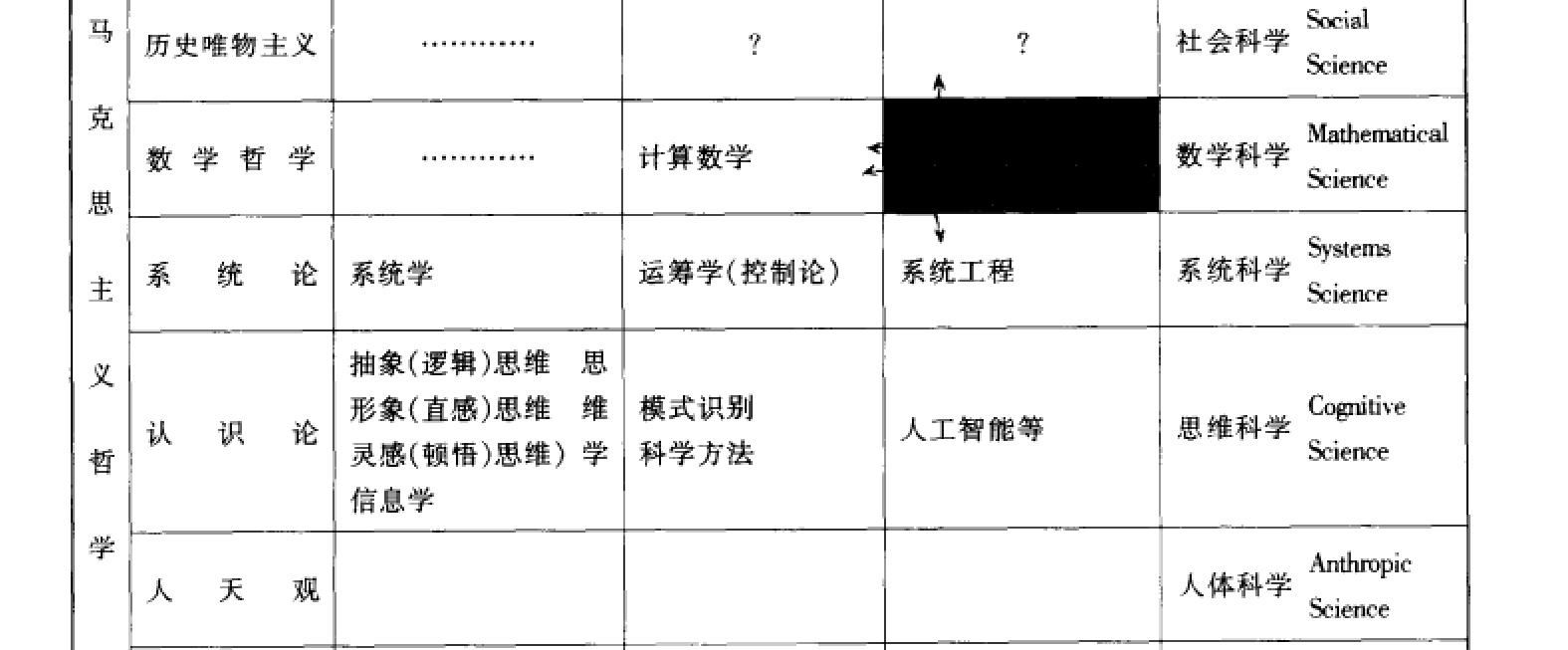
Structure of the Modern System of Science and Technology
Marxist Philosophy
| Science Department | Bridge | Basic Science | Technical Science | Engineering Technology |
|---|---|---|---|---|
| Natural Science | Dialectics of Nature | Physics, Chemistry, Astronomy, Geology, Biology | Applied Mechanics, Electronics | Hydraulic Engineering, Civil Engineering |
| Social Science | Historical Materialism | ? | ? | ? |
| Mathematical Science | Philosophy of Mathematics | ↑3 | Computational Mathematics | ? |
| Systems Science | Systems Theory | Systems Science | Operations Research (Cybernetics) | Systems Engineering |
| Cognitive Science | Epistemology | Abstract (Logical) Thinking; Image (Intuitive) Thinking; Inspirational (Sudden-Insight) Thinking; Scientific Methods | Artificial Intelligence, etc.; Information Science | Pattern Recognition |
| Anthropic Science | View of Human-Cosmos Relations | Human Body Science | ? | ? |
| Military Science | Military Philosophy | ? | Military Systems Engineering | ? |
| Literature and Art | Aesthetics | ? | ? | ? |
Today, let us still start from the concepts discussed last time.
In natural science, engineering technology is one level, then up one level is technical science, then up another level to basic science, and finally, at the very top, is Marxist philosophy. Marxist philosophy is the highest generalization of humanity’s understanding of the objective world. Thus, the highest, most principled, and most general is Marxist philosophy. The second column is social science, and many others will also be brought in. The first to mention is mathematics—last time it was explained that social science also uses a great deal of mathematics and mathematical methods, so mathematics is not exclusive to natural science. Since it is not exclusive to natural science, and social science also uses it, how should it be categorized? Then mathematics should be set apart as a separate category, so the third
312
The column is mathematical science. Here we need to write some names translated into English; some are no problem, while the new ones may not be universally accepted—they are my own inventions. Natural science is called Natural Science, social science is called Social Science, and the term mathematical science already exists, so it is called Mathematical Science. If mathematical science were also divided according to engineering technology, technical science, and basic science, I am afraid there would be some difficulties, because mathematics applied to transforming the objective world is linked together with other engineering technologies; it is hard to imagine it being used alone to transform the objective world. Therefore, in the column for mathematical science, there is nothing here—it goes into other areas, and of course the arrows are bidirectional, because application naturally comes from theory, and the development of application also influences theory. Thus, in the basic sciences, what was originally mathematics, physics, chemistry, astronomy, earth science, and biology—the mathematics is gone, leaving physics, chemistry, astronomy, earth science, and biology. Last time I also mentioned that in the field of technical science there is mechanics, or more clearly applied mechanics, electronics, and so on. In engineering technology there are many, such as hydraulic engineering, civil engineering, and so on. Coming to the major department of social science, what was previously considered all fell within the field of basic science, because previously social science seemed to be used to understand the history of events occurring in society, their interrelationships, and current situations—merely a form of cognition. Social science, from before until perhaps even now, has had brilliant achievements in theory. But social scientists, unlike engineering technicians and natural scientists, do not transform the objective world so directly in what they do. To be specific, for example, how should our national economic development plan be formulated? Our social scientists express some opinions on this, but they do not participate in the specific formulation of the plan, or they serve as consultants rather than direct participants. I believe this is very inadequate compared to the engineering technicians in the natural science departments. In a socialist country like ours, the interests of the state and the people are completely consistent, and the state’s plan is for the people’s interests. In this way, we can entirely formulate national economic development plans scientifically—of course, now it is very comprehensive, called the national economic and social development plan. For example, the current Sixth Five-Year Plan is called the Sixth Five-Year Plan for National Economic and Social Development. This requires a very comprehensive assessment of what should be done, how to formulate the plan and specific development in all aspects, how fiscal revenue stands, how income is distributed, which specific projects to build, and so on. In the past, or even up to now, our social scientists have been merely consultants on these issues, and they rarely do the work themselves. There are also many people who do the concrete work, but these people do not consider themselves social scientists—what are they called? They are called practical doers. I have said many times that this situation is inappropriate. Our social scientists should learn from natural scientists and directly participate in the struggle to transform the objective world. This arrangement—drawing such a table—is to propose what the engineering technology and technical science of social science are. It is clear that this is missing here, and what is missing is not good; it should be supplemented. Or one could say that the current situation in the social science department is somewhat like the situation of natural science 100 years ago, or 150 years ago: the basic science of natural science had been established with great achievements, but it participated very little in the work of transforming the objective world. Therefore, I propose not just to call it social science, but to call it social science technology. I have also written an article called “From Social Science to Social Technology,” which emphasizes the need to mobilize our social scientists to directly participate in the plans for transforming and building our country, to draw blueprints like engineers, and to formulate blueprints for our socialist construction. Because of this idea, I call the task of building socialism social systems engineering, abbreviated as social engineering. This is an engineering undertaking—of course, social engineering requires social scientists, natural scientists, and scientists from other fields, but social scientists must participate in the great work of social engineering to develop social technology. From social science to social technology—that is, erasing the question mark and turning it into something of our era. With social engineering, the many sciences that directly serve social engineering constitute the technical science layer within social science. I have previously suggested that the technical science within social science—at least one I can mention—is called the science of the socialist state. The science of the socialist state is about how to build socialism and how the socialist state should be organized. Of course, there are other, more detailed technical science departments within social science, such as the socialist legal system, socialist jurisprudence, and so on—these are in fact the technical sciences of social science. A state naturally has various aspects; the overarching one is the science of the state, and the science of the state is in turn divided into several aspects, such as the legal system, diplomacy, and so forth. This means that after drawing this table, inspired by the hundred-year development of natural science, we can clearly see that the current development of social science is still insufficient, and there is still much work to be done. Some of our prominent social scientists have also said things like this—that social science should participate in the national economic plan and in the work of major national policies—but in the end it amounts to a few articles: “We write articles; after research, we write a few articles.” I find this extremely inadequate—writing a few articles
and that would be the end of it. If we were undertaking a water conservancy project as large as Gezhouba, and the chief engineer ultimately just submitted two articles and left it at that — would that be acceptable? Their mindset was exactly like that, as if they were merely nominal figures, just offering commentary. I said this will not do; we must make the social sciences concrete and practical, just like the chief designer and deputy chief designers of our “Dongfeng-5” — they listen to you, you produce the plan, and if it is launched and then falls back down, they come looking for you. You cannot just write two articles and wash your hands of it — would that be acceptable? This requires great development within the field of social sciences. It is a matter of the research system — once you lay it out, it becomes clear: what is missing, why it is missing, and why the places where I have put many question marks are missing. It is because our previous understanding of the social sciences was probably incomplete; we did not sufficiently emphasize that the social sciences must be applied directly to the plans, implementation, and practice of transforming the objective world, and that theory must be tested in practice to determine whether it is correct or not. If correct, then good; if not, it must be revised. Once this major department is laid out, the problem becomes visible. Furthermore, from this it becomes clearly apparent that studying the structure of science and technology gives you inspiration, which is why studying the system of science is very important.
As just discussed, the first major department is only the most traditional and oldest — the natural sciences and technology. The second major department is the social sciences, and we must also transform it into social science and technology. Since the social sciences also use a great deal of mathematics, mathematics cannot be listed separately under the natural sciences; it must be invited out of the natural sciences and established as an independent department, namely mathematical science. Within mathematical science there are many disciplines, and these are the fundamental sciences. As just mentioned, in the area of engineering technology — that is, directly transforming the objective world — mathematical science must work in coordination with other scientific departments. I am afraid there is no separate domain in which it alone directly transforms the objective world, at least not at present. Then, is there a technical science? I think there is. For example, in conjunction with electronic computers, computational mathematics should be filled in here — this is a very hot topic, and it is in fact a technical science. Computational mathematics addresses the question: given a mathematical problem to be computed on a computer, what algorithm is best? It studies this question. It is a technical science because it is an application of the foundations of mathematics, yet it is not directed at any specific problem to be computed. It generally addresses how to compute a certain class of problems — how to compute ordinary differential equations, how to compute partial differential equations, and how to compute other more complex things. It tells you this. So it is both applied, yet not a concrete application to a specific thing; its scope of application is rather broad, and therefore it is also a fundamental science.
The Concept of Systems Science
Below there are still more new departments, and this new department is systems science, whose English name is Systems Science. What is engineering — that is, systems engineering within the scope of engineering technology that directly transforms the objective world? Systems engineering is the use of modern methods to solve many problems that previously were not called engineering technology but were rather a set of methods accumulated from experience by management personnel, dispatching personnel, or economic planning personnel, to carry out planning, scheduling, management, and similar tasks. As mentioned last time, this saw vigorous development during and after World War II, also using scientific methods and mathematical methods to solve problems that previously were largely handled by relying on experience. There are many English names for it, and the terminology is quite confused, so in 1978 we decided to tidy it up and call all such work systems engineering. There are many types of systems engineering. For example, related to comrades’ work, the overall design department in the Ministry of Aerospace Industry works on overall engineering. The chief designer relies on a large organization, namely the overall design department. What does the overall design department do? It designs a model, and all plans and schemes for every phase are studied there. It even extends to testing, finalization, and production — all managed by it. It is a general staff department. The chief engineer and chief designer must rely on the support of this large general staff department to carry out their work; the chief designer alone, or even with a few deputy designers, cannot get the job done. We call this type of work engineering systems engineering — it is the systems engineering for solving a design engineering project. Regarding the management of an enterprise, the management of a factory, the management of a production unit — such as the Capital Iron and Steel Company — this is called enterprise management systems engineering, or enterprise systems engineering. All problems of organization, management, and operation that are solved scientifically fall under systems engineering. The content differs somewhat, but the basic spirit is the same: using systems methods, scientific methods, and mathematically precise methods to solve problems. What we promoted in 1978 was precisely this concept: in socialist construction we need to improve our organizational and management capabilities, and in organization and management we cannot rely solely on the old experience-based methods but must use scientific and mathematical methods. At that time, we took what was directly related to and served as the theory of various systems engineering approaches…
The foundational subject is called operations research. At the time, many people working in control also said that control is very important to systems engineering, so they argued that cybernetics should also be regarded as a technical science of systems science—that is, the theoretical foundation of systems engineering. This also makes sense. The main thing is what was developed during World War II, the so-called operations research, which uses mathematical methods—specifically, what kind of mathematical techniques to use to solve various types of problems that commonly arise in systems engineering. When we proposed this structure in 1978, we thought that the terminology used abroad was very confused; they argued about it, with some using the term Operational Research, abbreviated O.R., and systems engineering being System Engineering. In the United States, these two terms were badly mixed up, and they fought directly over them—some favored this term, some favored that term, and the fighting was endless. Many reports and journals simply compromised by writing it like this: “Systems Engineering O.R.” In 1978, we felt this approach was not very good. On balance, systems engineering is Systems Engineering, while operations research is more of a mathematical method, so we called the engineering technology level systems engineering and the technical science level operations research. There was also a little episode when we wrote this article: when it was published, the editor asked us authors to write an editor’s note ourselves. We first drafted one, and our intent was roughly this: “The two terms systems engineering and operations research are used very confusingly abroad, and we wish to clarify them here and make a distinction.” Everyone may recall that in the second half of 1978, there was a prevailing attitude that foreigners were very brilliant and could not be criticized. Our draft editor’s note was somewhat critical of foreigners, so the editor felt it was inappropriate and wrote his own vague, problem-avoiding editor’s note. This again speaks to the unscientific atmosphere in our country—watching which way the wind blows and saying whatever the wind dictates. We felt that things abroad were very confused. For example, they also had another term called systems analysis—what exactly is the difference between systems analysis and systems engineering? And what is the difference from operations research? None of this was clearly explained. It should be said that systems analysis is about solving a problem; it is an applied thing. And then there is a very strange organization, a United Nations organization, called IIASA (International Institute for Applied Systems Analysis). This is actually quite absurd—systems analysis is inherently applied, so why call it “applied” systems analysis? So foreigners also give names in a haphazard and messy way. This is still a UN organization, located in Vienna, Austria. They often allow anyone to propose a notion, and once stated, it is asserted without justification, each person promoting their own. In our country, we should not learn from their habit of naming things haphazardly and creating confusion. That is to say, we should not assume that foreigners are always brilliant; foreigners are sometimes quite unseemly, and we should not blindly follow them. By 1979, our work on these applications of systems had reached this stage. But then a problem arose: according to the current structure of modern science and technology, we had engineering technology and technical science, but we were still missing a foundational science—what exactly was it? During 1979–1980, this question kept turning over in my mind. I did not know what it was, but I kept thinking that since this is modern science, a field that has engineering technology—the theory that directly transforms the objective world—could there perhaps be something further above it? I did not know what it was, but I always felt that something was still missing. At the 1980 national conference on the establishment of systems engineering, I gave a talk proposing that the foundational science was unknown, but it appeared there should be one, so that all three levels—foundational science, technical science, and engineering technology—would be present, and this field should be called systems science. That I could propose this in 1980 also benefited from the structure of modern science and technology; otherwise, how would I know whether something was missing or not? Once you draw this table, it becomes clear—there is a gap right there. I did not write anything in the foundational science column for mathematics—needless to say, there is a great deal there. So what is this (referring to the foundational science aspect of systems science)? By the second half of 1980 and into 1981, I received some inspiration from a source I never expected, because this inspiration did not come from people working in systems engineering, but from people working in biology. Perhaps comrades are familiar with this; I was not at the time. This is the Austrian biologist Von Bertalanffy, mentioned last time, who put forward his viewpoint. As discussed last time, biology was being studied in ever finer detail, down to molecular biology, but the understanding of the phenomenon of life as a whole seemed to have become unclear instead. So he proposed that we must study the whole, that we must study the entire system. After reading his works, I found that someone who later worked with him was a Belgian researcher in so-called non-equilibrium thermodynamics named I. Prigogine. This man was Russian; he fled to Belgium during the Russian Revolution. Non-equilibrium thermodynamics is closely related to the phenomenon of life, because from a thermodynamic perspective, life phenomena are all non-equilibrium. After I read the works of these two scientists, I felt that what they were actually discussing was large systems. Life is a large system, a very complex system, composed of countless cells. Biology raised the theoretical question of such very large systems—that is, one cannot only study a single cell, or even only study a molecule of deoxyribonucleic acid, and expect to directly derive from it the science of the phenomenon of life as a whole. One must study the whole composed of many minute things. Both Von Bertalanffy and I. Prigogine raised this problem. But these two scientists
They were all pioneers, especially Von Bertalanffy, who began working on this in the 1930s—he was probably quite young when he started. I. Prigogine’s work on the portion of non-equilibrium thermodynamics related to life phenomena came later, roughly in the 1950s and 1960s. Von Bertalanffy, as the first person to propose this, also did so in the 1950s. These two scientists studied these phenomena and pointed out the direction and viewpoint for this research work—this was correct and constituted a great contribution. However, neither these two scientists nor their students and collaborators had concrete theoretical analyses showing how to proceed. The resolution of this problem came even later, around the late 1960s and early 1970s, when the Germans H. Haken and M. Eigen took a further step. They wanted to understand the performance and functions of a very complex system—how to synthesize them from its components—and they established such comprehensive theoretical methods and mathematical methods. Of course, first you need a concept; you think about doing it that way and articulate some ideas and reasoning, but merely停留在 articulating reasoning and ideas is not enough—you also need concrete things. The concrete work and detailed theoretical work on such large systems was done by Haken and Eigen.
With these works, an important problem comes into view: a complex system can exhibit a function, property, or mode of motion that, from the perspective of its components, you would never have anticipated. Viewed as a whole, its properties and functions can differ from those possessed by each of its components. Haken and Eigen articulated this point most clearly. This is extremely important—the issue I mentioned last time, namely the so-called reductionist view and the systems view. The reductionist view says that if you want to study a problem, you must dissect it open and study things at a lower, more fine-grained level, dissecting layer by layer downward—this is the reductionist view, and to solve problems you must take this step. But if solving problems means taking only this step and no others, then it becomes reductionism. Reductionism is wrong—how so? From the work of Haken and Eigen, from Von Bertalanffy and Prigogine’s beginnings through to the concretization by Haken and Eigen, this becomes clear: the holistic properties and functions of a complex system can differ greatly from the properties and functions of each component. Studying the whole of a complex system is extremely important. Today is not a lecture on systems science, so I will say only this much, but please note that this point is important—please remember that the holistic functions of a complex system are often beyond your expectations; you could not have anticipated such functions in advance, yet they exist. How did one think at first? Through the reductionist view—first dissect things apart, get a thorough understanding of what was dissected, feel very confident, and consider this very learned—but this kind of learning cannot solve the holistic questions of a complex system. What follows is the systems view. In our scholarship we must combine the reductionist view and the systems view—only then is it comprehensive. The comrades here study human beings, and human beings are even more complex. A human being involves more than one level; as just mentioned, there are the concrete components and then the ascent to the whole, but because humans are more complex, there are many levels, and each level has different properties, each very distinctive. Each level is not fully represented by the next level down, nor can the properties of one level be represented by the level above—new patterns emerge. Once we understood the work of these people, the things that had puzzled us, that we had no way to resolve in our minds during 1978–early 1980, were resolved: this place should be filled with systematology.
That was the situation in 1981. By 1982 there were further developments, and we saw certain things that could be linked to our concept of systematology. One particularly noteworthy example is the theory of the Strange Attractor. I will not go into its details; the name is strange—what does it describe? It describes a motion that is originally regular; when you change its parameters, it is still regular motion at first—for instance, if you increase the parameter further, it remains regular motion—but there is a critical value, and when this critical value is reached, the originally regular motion becomes turbulent. That is the fact. This is very interesting: a change in the system’s parameters can cause the system to exhibit a new property it did not have before—going up another level. At this point we realized what the core of this problem is: the core is the system, the interactions within the system. Especially nonlinear interactions—these interactions are extremely complex and ultimately give rise to an overall change, and this kind of change leads to functions that the individual components do not possess. Moreover, this can happen in a graded fashion, more than once—for example, the theory of the strange attractor just mentioned specifically describes how something originally normal, i.e., well-behaved motion, can become abnormal, irregular motion; if you call turbulence abnormal, then this is the situation. So from then on, our understanding of large systems deepened by another step, and the most central point is that a complex system can have holistic functions, properties, or modes of motion, and these holistic functions, properties, or modes of motion are not possessed by its components. This is not surprising—such is the nature of science: once you have thought it through, it seems unsurprising, but before you have thought it through, it is quite frustrating—you just cannot figure out what is going on. I pre-
I once said that the molecules of air in a room number in the hundreds of millions upon hundreds of millions, but for each individual molecule, what do you mean by the temperature of a single molecule? A molecule has no temperature; a molecule only has speed of motion, momentum, and energy. And the thermodynamic concept of “entropy”—for a single molecule, what is entropy? That makes no sense. But for a gas composed of hundreds of millions upon hundreds of millions of molecules, it does have temperature and it does have entropy. In fact, people who study physics have known this all along, but they see it without truly seeing it, without thinking about it from this perspective. If you don’t think about it, it doesn’t seem strange, but if you really think about it, it is quite extraordinary. How can it be that something which does not exist for a single molecule does exist for that thing composed of hundreds of millions upon hundreds of millions of molecules? Now I say that this kind of thing is universal—all complex systems are like this, all have this kind of possibility, and moreover it may not be just one level of change, but two levels, three levels, four levels, many levels of change, rising level by level—this is what we call systems science. With systems science, systems engineering, and then the technical science layer and the fundamental theory layer, the system of systems science can be established.
On Thinking Science
Speaking of human thinking—what is human thinking for? It is the internal thinking by which human beings cognize the laws of the objective world. So we could say “cognition,” but using Chinese characters, it seems more appropriate to call it thinking science. The study of the brain’s work when a person cognizes the objective world—does this kind of thinking have objective laws, teaching you how to think? If there are laws, then it can be taught—teaching you how to think, how to approach problems, how to solve problems. Of course, this is very important. Starting from the fundamental science side, everyone knows there is abstract (logical) thinking. This is what we often call the scientific method—the scientific method is inductive reasoning, which is important. This kind of approach is called formal logic, and it has been developed very deeply. Mathematicians also use methods of reasoning and deduction. As for whether the scientific method is the inductive reasoning method, I don’t know what the comrades present think, but I do not agree with that. I have two reasons. The first is that my own practice has not been like that. The second reason is even more important: I can invoke the great figure Einstein. Einstein once said that to rely on inductive reasoning to do science would make one a great fool—you cannot produce creative scientific work that way. He did not create the theory of relativity by inductive reasoning; if he had relied on inductive reasoning, he could not have created the theory of relativity. I believe that a very important part of human cognition of the objective world, especially a very important part of scientific work, is of course abstract thinking or logical thinking, but there is also another kind called imaginal (intuitive) thinking. In science it is often called intuition. Literary and artistic workers rely on imaginal thinking. Comrade Mao once said that poetry mainly relies on imaginal thinking. So literary and artistic creation mainly does not rely on abstract thinking but on imaginal thinking. The question is, when we conduct scientific research, do we rely solely on abstract thinking? Is there or is there not imaginal thinking, or what we call intuitive thinking? I think there is, and it is very important. When we study new problems, we originally do not know what is going on with a certain phenomenon. You can do experiments, you can observe through experiments, you can take 100, 1,000, or more data points, spread all the data out and look at them—stare at them with your eyes wide open and do your induction. How do you induce? There is no way to begin inducing. To do induction you need to have an idea—how to go about inducing—and where does that idea come from? Einstein also said this. He said, of course everyone also knows that the theory of relativity had that famous scientific experiment, the so-called Michelson-Morley ether drift experiment, and there were many other facts, all laid out there, many contradictions that could not be resolved. Would these contradictions, spread out on the table, naturally pop out a theory of relativity all by themselves? If they could naturally pop out, then there would be no need for Einstein—anyone could do it. Before Einstein, how many scientists in the world had also seen these experiments? They all knew about them. These experiments were not classified; they were all publicly published. You read them, he read them, but nobody thought of the theory of relativity. You say it was inductive reasoning—how did you inductively reason it out? Book after book on inductive reasoning has all been explained to you, and you still cannot come up with it. How do you come up with it? You need to have an idea. This kind of idea is called intuition in scientific research—that is to say, I cannot explain clearly how it came about, I just feel that it is right, and that is that. There are many such cases; in the beginning it is always like this. Of course, just thinking that it ought to be a certain way does not count—in scientific work, you cannot just say “I think it should be however I want it to be.” If you feel it should be a certain way, you have to go and prove that it is indeed that way. To prove it requires inductive reasoning, but the popping out of such an idea—that is not inductive reasoning. Comrades, think about whether this is the case. I have this feeling: in the past, when I was working on puzzles and could not solve them, my ideas were wrong. How to get from a wrong idea to a correct idea, how it pops out—that cannot be popped out by inductive reasoning alone. This process is not strange, nor does it mean there are no rules. In scientific research, having this kind of effective, ultimately proven correct idea—
method, still originates from the scientific worker’s own rich knowledge and rich experience. One always finds that the problem at hand is similar to some other problem one knows, at some point, in some important respects, and so one draws upon that previously known matter and applies it to this new problem; the two come together to produce a new perspective. This approach is not direct reasoning. The apparatus of logical thinking cannot produce this kind of thinking. I want to emphasize this point: in scientific work this is very important—creativity lies precisely here. Inductive reasoning is brute-force work; you can exert effort, sweat, and sleep less, but to put forward a perspective requires learning and scholarship. In the course of scientific research we should cultivate this ability; the skill of conducting scientific research lies right here. Only Einstein produced the theory of relativity; there were many physicists contemporary with Einstein, but they did not produce it. There are many such examples—the people who win Nobel Prizes, the problems they work on are not secret, everyone knows about them, so why did you not produce the result while he did? Isn’t this an obvious question? The difference lies in that he had imagery or intuitive thinking. When I was a student I was completely clueless about intuitive thinking. Later, as a graduate student, at first I also attended seminars, and I was also completely at a loss—some people would immediately say exactly the right thing. How did they say it? As a graduate student I could only watch from the sidelines in admiration and amazement, not knowing how others had reached such a level. Can this sort of thing be taught by the teacher lecturing while the student listens, and you just follow what the teacher says and you’ll be fine? There is no such thing; if it were that easy, things would be simple. As a graduate student you just keep attending such meetings year after year, constantly listening to such discussions, and gradually you begin to feel as though you can do it a little too; then you keep at it, bit by bit, until at a certain stage you can do it too, and you also have this kind of “inspired” perspective. There is nothing mysterious in going from not being inspired to being inspired—it just requires putting in the effort, gradually realizing through many failures and dead ends how to succeed. I believe a very important factor here is that one’s knowledge must be broad. When we speak of intuition and imagery, it means borrowing something from another field and applying it to the work you are currently doing—it has to fit. If you do not even know about other things, where would you go to find them? You would have no material to draw upon. Therefore, creative scientific research of course requires that one’s knowledge in one’s own field be very rich and very solid, but this level alone is not enough. To do creative scientific work, we must strive not only to know the things in our own field with real solidity and depth, but also to have a broad scope of knowledge. Why must it be so? Let me explain the reasoning today: without a broad scope of knowledge you cannot engage in imagery thinking; relying solely on the old capital of abstract thinking will not solve problems, and you will never produce an Einstein. This is something I feel very deeply about. In the past, our scientific community often said that science is inductive reasoning, and that this is the scientific method. Not so—it is not like that. That is why I always tell some of today’s university graduate students: if you think the scientific method relies solely on inductive reasoning, on the so-called scientific method, then it is ruined—the students will be taught to become more and more stupid. Twenty years ago at the University of Science and Technology of China I taught second-year students; that was a course on aerospace technology, advanced popular science. Later, when I encountered these students again in their fifth year, I listened to their questions and said: you have studied for three years and grown stupider with each year. Before, your thinking was still a bit more liberated, your minds still a bit more lively. Now after three years of study, you are entirely absorbed in that reasoning and logic business. I said: the more you drill into it, the stupider you get—your minds are dead, no longer lively. This is a figurative way of putting it. How to be lively? Using imagery thinking makes you lively. If you do not dare to use imagery thinking, your mind cannot be lively, and you cannot create anything new; you can only follow in the footsteps of your predecessors, or at most add a sesame seed on top of their work. There is yet another kind of thinking, and this one is even stranger. Some people say: what is inspirational thinking? Isn’t this promoting superstition? The original English word is “inspiration,” which means being possessed by a spirit, suddenly receiving divine revelation—that was the original meaning. Put that way, it is of course superstition. But in fact it is not divine revelation; it is still a person’s own revelation to oneself—and this is materialist. What is inspiration? Is there such a thing as inspiration in scientific and technological work? It lies in the last two characters: sudden enlightenment—this is a term I coined, also borrowing from Buddhist language, meaning sudden discovery. When doing scientific research and encountering a difficult problem, if inductive reasoning and abstract (logical) thinking do not work, if you cannot get through, and this approach fails, then you try a higher-level approach, using imagery (intuitive) thinking, trying to borrow from other things—but how to suddenly leap over and make the connection? That does not work either; you have no recourse at all, hitting walls everywhere. Sometimes you remain in such a helpless state for a long time. When there is no way out, you go find an acquaintance to chat and relieve the boredom; or perhaps during the day you think back and forth but it does not work, your mind is not inspired, so if it is not inspired you just go to sleep—and then, either while chatting with someone or while sleeping and dreaming, it suddenly clicks, and the problem is solved. Moreover, this kind of emergence is very sudden; you do not know how it came, there is no reason for it, it just arrives. I do not know whether the comrades present have had such experiences, but I have, and so I believe such things exist. Regarding such occurrences in scientific research, I believe they objectively exist. So this third kind of thinking is also a form of thinking that cognizes the objective world; it is even less amenable to study and not very clear.
How exactly the human brain produces such things remains unclear, yet it seems to be genuinely real. Of course, some people do not believe it and argue with me. I can only say: believe it or not, a person only believes when they have had the experience themselves; if they have not had the experience, they have every reason not to believe. When the people who argue with me hear me bring out this trump card, they have nothing more to say. Since they have not had the experience, they do not believe it, and I cannot insist that they must believe. Someday when they have their own moment of inspiration, they will believe it all at once. Such things do genuinely exist. When I have conversed with many accomplished scientists, they too have acknowledged that such experiences are real. This is my own experience, and when I discuss it with other scientists, they admit that such things happen. I am speaking here of scientists and technologists; in the realm of literature and art, of course, inspiration has been discussed for thousands of years, and people in the arts have long acknowledged it.
I speak of three types of thinking—there may be others as well. The study of the laws governing these types of thinking constitutes noetics. In addition, among the foundational sciences of thinking science, there may be yet another discipline, because thinking is nothing other than the processing of information, and information arises from the contact between human beings and the external world. Therefore, the science of information is an equally important foundational science of thinking science. Speaking of information, let me say a few more words. The term “information” is quite fashionable and is used everywhere. If you ask the comrades who use this term what information actually is, I am afraid many of them could not explain it clearly. They often quote the remarks of famous foreign scientists on this question. For example, the most famous statement is by the American mathematician, the renowned founder of so-called cybernetics, N. Wiener. This person came to Tsinghua University to give lectures before liberation and was quite friendly toward the Chinese. He was a very accomplished mathematician who pioneered cybernetics. But he said many muddled things about information. For instance, he said, “What is information? Information is neither spiritual nor material.” Then what is it? I think such a statement is simply muddled talk. So what is information? Think about what carries information—it is language and writing. Language is sound waves; if you listen to radio or television broadcasts, the transmission is electromagnetic waves. In any case, the transmission of information relies on some kind of material motion. The basis of information is actually a certain kind of material motion—nothing mysterious at all, just an ordinary material motion. But what we extract from this material motion we call information. We do not extract things like the amplitude and frequency of sound waves, that is, the motion of air, nor do we study how much energy the sound waves contain; we study the information that the sound waves give us. We should put it this way: it is a kind of material motion, but just as we have endowed material motion with other physical quantities—these physical quantities are concepts entirely created by humans to understand the motion, such as momentum and energy. We say a material motion has a certain momentum, the momentum of motion in three spatial directions, and we speak of its energy—these are concepts that humans have abstracted and summarized from material motion. Similarly, we can abstract the concept of information from a certain material motion that transmits information. What our great scientist Wiener said—that it is neither spiritual nor material—is simply nonsense. Of course, information inherently involves an element of agreement and mutual understanding from the information source to the information receiver. Without understanding, it is not information. As the ancients said, “Playing the lute to an ox”—no matter how fine your musical information is, if the ox does not understand it, it is not information to the ox. If I speak here and the comrades do not understand my words, then I have spoken in vain—it is merely air vibration, not information. The concept of information is a holistic concept within the entire information transmission system, comprising the information source, the information channel, and the information receiver. Developments in this area are now multifaceted. Because of the importance of information, a great deal of work has been done over the past fifty years—that is, half a century—and now it is entirely possible to gradually form a discipline of informatics, that is, the study of the fundamental theory of information. Noetics comprises three aspects: abstract (logical) thinking studies, imaginal (intuitive) thinking studies, and inspirational (sudden-insight) thinking studies. Among these, only abstract (logical) thinking studies is relatively concrete. I also consulted an expert in mathematical logic, Hu Shihua, an Academician of the Chinese Academy of Sciences. He said he specializes in mathematical logic and that there are still many problems in mathematical logic requiring deeper investigation. This is quite right, because as mathematical logic deepens, it may naturally break through the framework of formal logic and enter into dialectical logic. The relatively mature field is abstract (logical) thinking studies, and even this still needs development. As for imaginal (intuitive) thinking, there is currently no way in at all—we still do not understand what is really going on. As for the third type, inspirational (sudden-insight) thinking, there is even less of a way in; we only know that it objectively exists, but what is really going on remains unclear. So of the three parts of noetics, only one part—one-third—has some way in, while the other two parts still need development and are not yet clear. Informatics also needs development. Therefore, there is much work to be done in the foundational sciences of thinking science, and it is extremely important. Once this problem is clarified, then, just like deductive reasoning, it can be taught to students—even junior high school students. In this way, everyone could become a great scientist or great thinker. Right now, it is very difficult. The experience I just described from my time as a graduate student would no longer be necessary—I bumped around and eventually found my way, but it was not taught by a teacher; no matter how capable the teacher, he could not explain clearly what was going on. So there is still much work to be done in this area.
What I discussed above pertains to the foundational sciences. In the field of technical sciences, there is indeed some work being done. Technical science concerns how the thinking by which humans understand the objective world is to be applied—it is about application. For example, scientific methodology is a technical science, that is, how it is actually applied in scientific research. Although
However, scientific research cannot rely solely on what I have just described. Although abstract (logical) thinking is extremely important, it is not enough by itself. To be creative, one must at the very least combine it with imaginal (intuitive) thinking. How to combine them well—this is the question of scientific methodology, that is, how to apply it concretely in research. Another discipline is pattern recognition. Let me give an example: previously, our postal system required postal codes, consisting of six digits, and everyone was asked to fill them into pre-printed boxes, and to write them neatly. Why was this required? There was a recognition device that could read these codes automatically, without postal workers having to look at them. But in the end, this did not succeed. The recognition device still mobilized our scientists working on pattern recognition; they were from the Institute of Automation, Chinese Academy of Sciences. They put a great deal of effort into developing it, but the machine turned out to be incredibly stupid. Even if you wrote the codes perfectly neatly, it could only recognize about two-thirds of them; one-third it could not recognize. And many people did not write them so neatly, in which case the machine was completely useless, and manual sorting was still needed. So later everyone said those codes were troublesome, and the whole thing was scrapped. What does this story illustrate? Although present-day computers are extremely fast, with very high computational speeds, if you do not know how to use the computer or how to grasp the principles of pattern recognition, there is nothing you can do. The human eye, on the other hand, is tremendously capable—one glance and you know what character it is. But let a machine try to recognize it, and it cannot, finding no way in. We Chinese all know that some people write in a flamboyant, soaring style, and you can still recognize it; no matter how cursive their writing is, you can still puzzle out what it says. But for a machine, it is simply impossible. How humans recognize images is still being studied, and this field of study is called pattern recognition. This discipline should be placed within the engineering sciences of noetic science, that is, as preparation for concrete applications. What belongs to engineering technology? For example, artificial intelligence. If you want to build a robot, you need to use the entire set of tools from the aforementioned engineering sciences. A robot needs pattern recognition technology to recognize images, and a robot needs to think, so it must have scientific methods. The foundation underlying these engineering sciences is, ultimately, human noetics and information science as basic sciences.
Human Science
The next one is human science (Anthropic Science). I will not say much about human science today; I will leave it for next time.
The Six Major Divisions of the Modern Science and Technology System
So now there are six major divisions: natural science, social science, mathematical science, systems science, noetic science, and human science. There are also two major issues to be resolved. First, regarding the division into six areas: in the past, the division of scientific disciplines was often based on the objects of scientific research—that is, the objective world was divided into several large segments, with one segment studied by one science, another segment by another science, and yet another segment by yet another science. For example, what is natural science? Natural science studies the phenomena of nature. What is social science? Social science studies the phenomena of society. Are they not thus separated? Now I have six divisions, and I believe this old way of classifying by object of study is imprecise. Natural science studies natural phenomena—is this correct? Not necessarily, because the natural science just discussed—physics, chemistry, astronomy, earth science, biology—these do seem to be natural phenomena, but when you move to engineering sciences and engineering technology, it is different. What you encounter is man-made science; the systems engineering departments and such are all man-made things; hydraulic engineering, civil engineering, and so on are all man-made. From this perspective, I believe the statement that natural science is the study of natural phenomena is incorrect. Perhaps it was correct a hundred years ago, but it no longer works now. How, then, can we clarify the characteristics of natural science in a few words? I believe that to explain this issue clearly, we must adopt the perspective of the dialectics of nature. Natural science studies the motion of matter—that is, the relationship between matter and space-time—and the interrelationships between motions at different levels. This includes man-made things as well. The point of focus is precisely this: natural science studies the entire objective world, but its point of focus is the motion of matter, the motion of matter within the coordinates of space-time. And there is a very prominent point here—those who work in natural science are well aware of it—namely, that in natural science there is something called dimensional analysis. The fundamental dimensions within dimensional analysis are time, length, and mass—these three dimensions. All quantities in natural science are composed of time, length, and mass. This is a very useful tool in natural science. In natural science research, one always uses the perspective of dimensional analysis in terms of time, length, and mass to solve problems.
question. Why do dimensions arise? It is because natural science studies the motion of matter in space and time, and it grasps this crucial point.
I am afraid that the comrades here who study natural science also know that once we come to social science, dimensions are of no use at all. What dimension is the renminbi? Because the renminbi is not weighed; how heavy a banknote is has no meaning—two banknotes of the same weight, one printed with 10 yuan and one printed with 5 yuan, are very different. So social science is completely different from natural science. Then what is social science? I believe social science studies the movements or relations within the society formed by people and their collectives. Social science studies the entire objective world from this perspective. Some people might say, “You are going a bit too far with this statement. We humans are still on Earth right now, so how can you speak of the entire objective world?” I say that is your short-sightedness; one day in the future, will we humans not go up into space? Humans going into space can also go to even farther places, and the entire universe is still the human society, because the main task of social science is to study the movements within the society formed by people and their collectives, and from this perspective to study the objective world. Many people have studied mathematical science before. As mentioned earlier, Researcher Hu Shihua wrote an article stating that mathematics studies the dialectical relationship between quantity and quality. Based on his words, what is mathematical science? It is looking at the entire objective world from the dialectical relationship between quantity and quality. It is also the entire objective world, not some part of it. Because obviously mathematics is needed in many places. Systems science also studies the entire objective world, but from its own perspective—the systems perspective, or what is called the systems viewpoint, which differs from the reductionist viewpoint, studying the entire objective world from a holistic perspective. Cognitive science also studies the entire objective world, but it does so from the perspective of how humans cognize the objective world. Some of the things we have now, such as intelligence databases, information repositories, and artificial intelligence, belong to the engineering and technical aspects within cognitive science. How can these be connected with cognizing the objective world? They can be connected, because these things are tools for humans to cognize the objective world, or extensions of the human brain. So cognitive science links together human cognition of the objective world and what tools humans use to cognize the objective world, and how to organize and manufacture these tools. Some people might say, how can human body science also be connected with the entire objective world? To study humans, one cannot separate them from the environment they live in; humans are influenced by the environment, and in reality humans also influence the environment. Human body science approaches from the perspective of humans and the environment, or using a term, the “anthropic principle” (人天观, Anthropic principle). The English word for human body science, “Anthropic Science,” also derives from “Anthropic Principle” (人天观); this is a term already used by foreigners, and I have extended it to arrive at human body science. Do not think that the term “anthropic principle” seems very ancient, as if it were an authentically Chinese product; in fact, foreigners are thinking along the same lines.
These six major departments of modern science and technology do not each study only a part of the objective world; rather, they study the entire objective world, only from different angles. I once thought of vividly drawing a diagram: the entire objective world is such-and-such a thing, and each discipline looks at this world from a different angle—six different angles.
Now let us fill in the empty cells on this side. What was originally to be filled in here are bridges—that is, the bridges from each branch of science and technology to Marxist philosophy. Regarding these bridges, some are classical and relatively clear. The category of natural science is the dialectics of nature; for social science it is historical materialism; for cognitive science it should be epistemology. These three can find classical basis. The other three do not exist and must be created by us. What is it in mathematical science? This also exists abroad, called philosophy of mathematics. In fact, there are various names; some comrades call it “mathematics studies” (数学学), as said by a comrade from Shanxi University in Taiyuan. In any case, it can be called whatever; what foreigners call philosophy of mathematics is another term. That is, what Chinese people call metamathematics (元数学, Metamathematics), meaning the fundamental principles of mathematics. Using this as a bridge has quite some basis. Systems science has none; we must create it ourselves, and it is called systems theory (系统论). For human body science, it is the anthropic principle (人天观). Finally, the knowledge of objective laws in each discipline is summarized and elevated to Marxist philosophy. Marxist philosophy is a scientific philosophy; it is not based on idle speculation. It generalizes and refines everything that humans have cognized about the objective world to the highest principles and tenets. From each science to Marxist philosophy, one must pass through a bridge. This bridge summarizes the knowledge of that discipline and then transmits it to Marxist philosophy. The six bridges I speak of serve this function. These are in fact all philosophy; they can be called branches of philosophy. The highest level is Marxist philosophy. I believe this is also what the structure of the modern science and technology system requires. Of course, some people might ask whether our philosophers would agree. Not necessarily all would agree, because I have also found that some philosophers have very rigid minds. For a long time, they have simply memorized and recited the classical works by rote; if what you say deviates even slightly from the classical works, they will oppose it. Didn’t I mention an example last time? The vice president of Jilin University wrote a textbook, and because what he discussed was not entirely from the classical works, some people would not allow him to use the term “Marxist philosophy,” saying you
philosophy may be acceptable, but one cannot simply call it Marxist philosophy — that is truly untenable. I believe that from the perspective of the system and structure of modern science and technology, everything ultimately converges upon Marxist philosophy. In this way, the structure of Marxist philosophy is thereby manifested. The entirety of human knowledge is ultimately subsumed under Marxist philosophy.
The entire domain of human knowledge seems to encompass not only science and technology; I see two additional departments. One is military science, which is a very important department. Because it is military science, its system is also different, so modern science and technology often does not include military science. Just as there is the Chinese Academy of Sciences, there is also our own Academy of Military Science — they are different. So military science remains a very important department, and it too has its basic science, technical science, and engineering technology. The engineering technology of military science concerns concrete warfare — the systems of staff operations and command. In practice, we call this military systems engineering; the bridge is sometimes called military philosophy, and the basic science is generally called military science, such as the study of campaigns, strategy, and tactics. The other department is literature and art. Literature and art cannot be classified in this manner; it is an entirely different kind of thing. We cannot divide it into engineering technology, technical science, and basic science — that would be wrong. But it too has the question of a bridge to Marxist philosophy, and that bridge is aesthetics — the philosophy of beauty.
What I have mainly discussed is the six major departments of modern science and technology. To extend this structure to the entirety of human knowledge, we must also include two new departments: one is military science, and the other is literature and art. They too all have bridges to Marxist philosophy. Marxist philosophy also has a structure: the core of Marxist philosophy connects through eight bridges to eight aspects of human knowledge activity.
What I have spoken about today is the structural system of modern science and technology, ultimately linking to philosophy, and I have also presented what I consider to be the structure of Marxist philosophy itself — both as it stands today and as we should develop and study it. This structure is even larger than the system of modern science and technology, because Marxist philosophy encompasses all the different structures of human knowledge. Marxist philosophy has eight bridges, while the system of modern science and technology has six major departments. All six major departments study the entire objective world from different angles. Is this view acceptable? Does it make sense? Of course, I am not saying that everything discussed today is immutable; with the development of human practice, there will be further developments. But I believe that, as seen today, this is roughly the grand concept and scale — an approximate structure. Let me also emphasize that I think this kind of understanding is extremely important. We must not always confine our perspective to the small piece right before our eyes. If we remain perpetually confined to a small piece, our scholarship will not go deep. This is especially true today, when the development of science and technology has reached such a degree that the interrelationships among disciplines are extremely close and extensive. Therefore, if each of us lacks such an overall perspective, in our work we may well plunge in and be unable to extricate ourselves, suffocating inside. We must have a comprehensive view, constantly bearing in mind where the work we are doing sits within the entirety of science and technology. In this way, we can advance and retreat with well-grounded justification, rather than either not daring to advance or retreat — stifling ourselves — or, like a fledgling entering the world, acting recklessly, lurching this way and that. Doing scientific work without a systematic approach is unacceptable. What is a systematic approach? It means having an understanding of the entire structure of modern science and technology. And of course, in the end, one must still engage with philosophy, because our understanding always works this way: Marxist philosophy guides all of our scientific and technological research, and conversely, new scientific and technological achievements will inevitably provide material for the development of Marxist philosophy. I believe this view is correct.
Next time, I will speak more about human body science. As for specific details, they may not all be entirely correct — these can all be discussed — but the general idea, I believe, is probably not far off. On this point, I hope comrades will take note.
(March 28, 1983)
10. On the Understanding of Systems Science
Application Problems of Cybernetics
Regarding the application of cybernetics in large-scale equipment under construction—and not classical cybernetics but some methods of modern cybernetics—how to start up the machines step by step, earnestly and scientifically, and how to further improve the equipment with certain ideas, I found what I heard very inspiring. I think there is perhaps a view that this kind of working method, this problem-solving method, has universal significance. We always need to control a piece of equipment, but do we truly understand this equipment? Even if we do, our understanding is probably not comprehensive enough. Therefore, if you want to control it, you must further understand the performance of this equipment, or what we call performing system identification on this system. Although your set of methods was developed for centrifuges, I believe its significance is unlimited. This is especially true when I think about how our country has many systems already established, as well as some equipment purchased from abroad. Foreigners, when they sell you something, often do not fully disclose all the technical details. If we have old equipment or imported equipment and want to further improve it, control it more precisely, or add an adaptive system, then what do we do? I think we should use the methods discussed today. The significance of this work is not limited to centrifuges. Moreover, I believe that if you are already quite skilled in this area, would you dare in the future to go out into the world and help other units in our country solve similar problems? If you dare to take this on, I think this is a business you can pursue. First, there is a national need—there is definitely a need. Let me give you an example. This morning I just read a report about an institute under the Second Academy of the Ministry of Aerospace Industry—not even the whole institute, just a machine repair workshop. What did they do? A brewery had imported a set of automatic bottling equipment from West Germany, probably for bottling wine. It had been imported several years ago. The foreigners are cunning—they didn’t give the brewery all the technical documentation. So at the factory, the foreigners taught you how to operate it, and once you learned, they left, keeping this trick up their sleeve: when the machine breaks down in the future, you’ll still have to come to them. The factory was indeed somewhat timid and didn’t dare to repair it themselves. They just kept using it, and after a few years they found problems with the machine but didn’t dare to touch it. When they inquired about inviting the original manufacturer to repair it, they realized the manufacturer would extort them—possibly for hundreds of thousands of West German marks. Somehow the brewery eventually found its way to the Second Academy of the Ministry of Aerospace Industry and inquired about the comrades in the machine repair workshop. The comrades from the machine repair workshop went to the factory, understood the situation, and said they could do it. As a result, more than twenty comrades were sent from this workshop to the factory. They were also very cautious: first they observed and did not intervene, because it was a production factory—if the repair failed, the responsibility would be enormous. Once they believed they understood the principles of the bottling machine, they signed a contract, shut down the machine for repairs, and in about half a month they had it completely fixed, with performance even slightly improved over the original. They accomplished such a thing, and the factory was very grateful—not only with verbal thanks but also with material rewards. You have great potential, because this situation is widespread in our country. In our national defense industrial sectors, especially the so-called cutting-edge sectors, our talent is relatively concentrated compared to the nation as a whole. An institute like yours, from the perspective of the whole country—especially compared to civilian industry and light industry—is truly remarkable. So you should consider this question. Your skills can also be extended to even broader areas.
Cybernetics Is a Level of Systems Science
Today much was said about the history of cybernetics. I think that from today’s perspective, our view is probably that we need to develop systems science. Cybernetics
This is merely work at one aspect of the technical science level within systems science. Although when the second edition of Engineering Cybernetics was published, I wrote a preface in which I did not explain this point very clearly—there is a historical reason for this: when I was writing the preface, my views on systems science had not yet been established. The views I presented here in previous sessions are all from recent years; writing the preface was several years earlier, and precisely during that earlier period, science and technology were continuously developing. I constantly negate myself; what I said before, I no longer acknowledge now—it was wrong. My current view and formulation should be that what truly needs to be developed is systems theory; cybernetics is merely one science at the technical science stage of systems science. The major issues the speaker later mentioned, such as giant systems and super-giant systems, have already gone beyond cybernetics; they are actually the subject matter of systems science. My current view is to elevate systems science.
We Must Study Systems Science
Next, let me discuss something related to the two points above. This was inspired by what several comrades discussed in previous sessions. After you spoke, I turned it over in my mind, and I feel that summarizing the issues discussed across these sessions, it is indeed a very important problem. That is, in the past, when we studied systems, we often dissected them open—especially engineering systems, which could be dissected. Each component of the composite system could be examined individually, so we could understand the components of the system, then connect them together to form the entire system. The properties of the entire system were established from knowledge of its components. This was the previous approach for machines and material systems, or what I call the reductionist approach: decompose, examine each part individually, and the whole system is thereby understood. However, when we study biology, when we study human body science, this method is not permissible. If it is an old piece of equipment or imported equipment, and you have no documentation, and the thing has already been built, then what? In that case, the reductionist approach is permissible. But in such situations, especially for biology and human body science, because it is alive—if you dissect it open, it is finished, it is no longer alive, and the entire system is destroyed—so this is not allowed. This is also the great limitation encountered in the past when trying to use the reductionist approach to address life phenomena. So now we cannot use this method; we emphasize using the holistic approach, the systems perspective approach, the systems method. If you want to use the holistic approach, the systems method, you need to recognize this system, or what is called system identification. If you are not allowed to decompose it, what do you do? Thus the problem arises: you must establish a new set of methods. I think what was discussed in previous sessions is all this kind of problem.
Let me further break it down into levels; it seems there are the following problems. It seems that the first thing encountered is: how many stable points does my system have, and what are the parameters of these stable points? This is the first question. Stable points are essentially static states; I think this is the first step in recognizing a system. What is the second step? Actual measurement results often fluctuate around the stable points, so the parameters are not fixed but are changing. In the past, we used that set of methods to find the parameters of the stable points from the changing, uncertain parameters, and then around the stable point parameters there were fluctuations and variations—small variations. The second step’s problem is that these fluctuations and variations near the stable points of the giant system themselves form a system, and we need to perform system identification on this system. Generally, for small variations near stable points, you can use linear systems—assume it is a linear system—and use the whole body of knowledge on system identification. If both input and output are clear, that is the easiest to handle; if there are unclear elements, the worst case is having only output and no input, and you still have to find what the input is. I think the worst case is when the measured parameters have fluctuations and interference, but you do not know why there is interference, and you do not know what the input is. Even in this situation, you can still push forward, feel it out, guess at the interference—this is very useful. The second step’s work is to use the system identification method; under small disturbances, system identification can use linear theory, and linear theory is the most fully developed within system identification. After both steps are done, what do you get? What you get is the characteristics of the system of this giant system in the vicinity of a certain small stable state—one is that the stable state has been found, at that point, and the other is what the situation is like near the stable state, which you have found. Of course, to solve the problems of human body science, this is still not enough. From the perspective of functional states, you have found the waking state and the sleeping state, but ultimately they are still connected as the entire giant system. Our task is to figure out and feel out the entire giant system, and doing this work cannot involve dissection—pulling a person apart means death—so we must still use the systems method. Based on the two pieces of work I did earlier—finding the stable states, then using the fluctuations and variations near the stable states, using the system identification method to find the properties near the stable states—now the problem is to connect several states
connected together—only then does it become the human body giant system. It now appears that what is theoretically lacking is precisely this final step. I want to coin a term for it: you call it system identification, and I say this should be called the completion of the system. This is a problem we will eventually have to confront, but we have not yet done so. Who should do some theoretical work and make preparations? I am afraid the approach still lies in system science. Of course, the comrades in your institute, together with comrades across the nation and the world, already have more than enough work to do on the first and second steps; it is hard to say when they will be finished. But if one wishes to see that there remains a more distant problem that must be solved—namely, how to stitch together the many identified systems into one system—then I believe we must still rely on this new topic of system science.
Today, let me take a few more minutes to give an example, the same one I gave before:
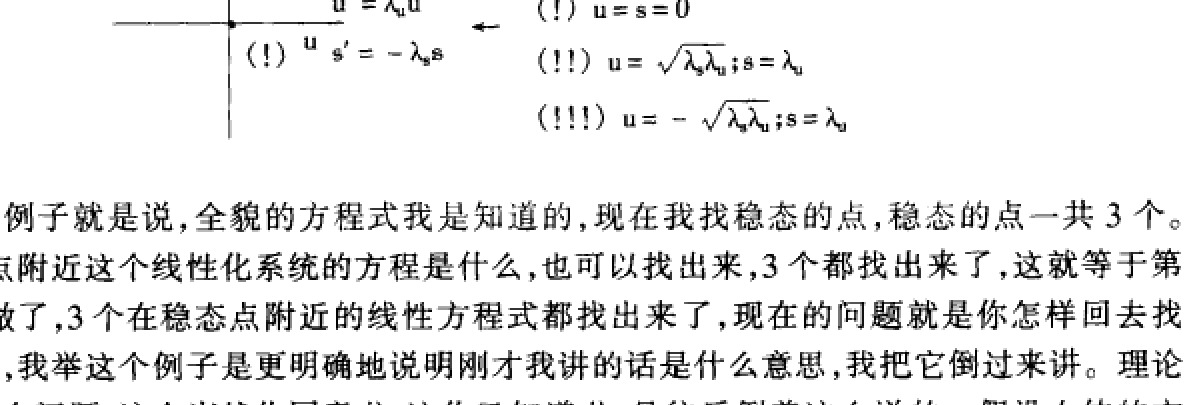
Steady state: ,
The example I give here means: I know the full equation, and now I look for the steady-state points—there are three in total. Conversely, the equations of the linearized system in the neighborhood of each steady-state point can also be found; all three have been found. This is equivalent to having done the first and second steps: the three linearized equations near the steady-state points have all been found. The question now is how to go back and find the full equation. I give this example to make more explicit what I meant just now—I am stating it in reverse. The theoretical problem is precisely this. Of course you agree; you already know this—it is said by working backward. Suppose you do not know the equation of the human body; now you search for it, and in the end you produce many results. At that point I come and ask you: your achievements are great, so tell me, what kind of system is the human body after all? This would stump you, because you have not found the whole thing. To answer the question I will pose to you in the future, you still need to take the third step. I do not know how to take this third step at present. Once the third step is accomplished, the human body will be understood clearly, and things will be easy; when you want to apply it—to improve athletic performance, cure rates, and so on—everything will be there. I am not saying this solves the problem; I am saying that in doing research one must see what problem will be encountered in the next step, and one must explore the right path. One cannot act recklessly—reckless action leads to falling off a cliff, and that is not good. What I have discussed over these four lectures is also valuable experience; taken together, it yields the following understanding: the fundamental point is that the object we study cannot be decomposed—we must understand it as an entire system. What is to be done? The things you discussed have given me a lesson, and this is my understanding. Whether it is correct or not, I invite everyone to study and discuss.
(June 6, 1983)
XI. System Science, Systems Engineering, and Operations Research
The New Technological Revolution
Today is a forum to celebrate the New Year. First of all, I wish everyone a happy Spring Festival. During the Spring Festival, we congratulate one another, and we must unite as one to strive to do our work well for socialist modernization, for the building of the two civilizations, and for the goal of quadrupling output. Today, I am speaking freely…
thoughts, I will express three points of opinion.
First, unite comrades across the country engaged in systems engineering to strive together for socialist modernization.
I think of the journals I have recently received alone—several are related to systems engineering. The first is Systems Engineering—Theory & Practice, published by our society; there is also an Operations Research journal; the third is Systems Science and Mathematics; and there is Systems Engineering published in Hunan. These are only part of what I have received; there may be other journals as well. This relates to a problem: there are many comrades working in systems engineering, systems science, and operations research. Our Systems Engineering Society should establish contact with them.
I also know about the China Association for Science and Technology (CAST): there are very many societies, all wanting to become first-level societies, all needing CAST’s approval. CAST finds this extremely difficult; when it comes to CAST cutting any society, that won’t do either. What we actually need is to do our work well; for everyone to do their work well, there should be venues and opportunities for discussion, organizing various academic societies. Systems engineering, systems science, operations research, and so on all share the same goal.
For example, I recently received minutes from the Northeast Branch of the Operations Research Society. The Northeast Regional Operations Research Society was established even earlier than our Chinese Society of Systems Engineering; it was established in August 1979, and in 1980, after consultation with the Operations Research Society of the Chinese Mathematical Society, it was renamed the Northeast Branch of the Operations Research Society of the Chinese Mathematical Society. I also have their account of their work over the past few years, and it is very difficult to distinguish from the work of our Systems Engineering Society. So in this situation, comrades now want to unite, to simplify the societies, and to have CAST resolve this—I am afraid that would be very difficult. So the best approach is to wait until conditions are ripe; when the time comes naturally, this problem can be resolved. Our Chinese Society of Systems Engineering must do its work well, and one part of that is to unite with other comrades across the country doing this kind of work. This point, I think, is very important.
Today, the topics of our symposium are: “China in the Year 2000 and Systems Engineering,” and another is “The New World Technological Revolution and Our Response.” These are indeed within the domain of systems engineering, systems science, or operations research. The topics of our symposium are closely related to building the two socialist civilizations, building a modernized China, and achieving the quadrupling of our country’s annual total output value of industry and agriculture. Doing this work well will become increasingly important in the years to come; we should unite comrades who care about this work and strive together.
Second, I will talk about what a scientific revolution is, what a technological revolution is, and what an industrial revolution is.
Regarding the topic of our symposium, there have been many different expressions recently: some call it Toffler’s “Third Wave,” some call it the “New Technological Revolution,” and some call it the “World’s Fourth Industrial Revolution.” In summary, terms like new wave, new industrial revolution, and new technological revolution are used a great deal. On February 5th at 7:50 PM, our radio station had a Q&A session for listeners. This time, a listener asked what is meant by “the world’s new technological revolution,” which is also difficult to answer. New technological revolution, new industrial revolution, fourth industrial revolution—these terms are sometimes used one way, sometimes another. This kind of confused state does not matter in capitalist countries. In our socialist country, we have Marxism-Leninism and Mao Zedong Thought as our guides; we speak of scientific socialism and historical materialism; we cannot use these terms carelessly. On this issue, I had been somewhat alert before, so I used two safe terms. I proposed one as “scientific revolution” and one as “technological revolution”; I did not mention others, nor did I dare to.
What is a scientific revolution? The term was actually first used by the American philosopher of science T. Kuhn. Scientific revolution—his concept, expressed in our language, is a leap in human understanding of the objective world. Of course, he would not use these words. Professor Kuhn wrote a book, The Structure of Scientific Revolutions, published by Shanghai Scientific and Technical Publishers, translated by Comrade Li Baoheng, one of the Party group members of CAST. This book discusses the issues quite well, but the last chapter falls short, reverting to idealism rather than historical materialism. It discusses how the process of human understanding of objective things is not smooth but has twists and leaps. When there is a leap in the process of human understanding of objective things, this is called a scientific revolution. Major creative inventions in history belong to this type. From geocentrism to heliocentrism is a leap in human understanding of the objective world. Later, our mentor Marx established historical materialism, which is a leap in human understanding of history. Marx then immediately established the theory of surplus value, which is also a leap in human understanding of the economic life of the objective world. In the 20th century, quantum mechanics and the theory of relativity appeared; these are all leaps in human understanding of the objective world. All of these can be called scientific revolutions, which I have also discussed before.
What is a technological revolution? The term “technological revolution” was first used by Comrade Mao Zedong in 1969 on a document approval. We
Previously, there was technical innovation—minor changes and small adjustments. When we speak of technical revolution, it refers to major advances and major transformations in technology through which humans reshape the objective world. This is called a technical revolution. He gave three examples: one is the steam engine, one is the emergence of electricity, and the third is nuclear energy—these are also technical revolutions. Based on these three examples, my understanding is that a technical revolution is a leap forward in humanity’s transformation of the objective world. The new technological revolution we have been discussing recently is probably plural—that is, several technical revolutions at once, including what everyone refers to as the electronic computer, so-called genetic engineering, so-called laser technology, so-called ocean development, and so on. All of these are technical revolutions. So in my mind, these two concepts are relatively clear: what is a scientific revolution, and what is a technical revolution.
Recently, I encountered a difficulty: the term “industrial revolution” has been used very frequently. This concept was previously raised often by capitalist countries—the idea that a new industrial revolution could save the capitalist system, with the implication that for us, your mentors Marx and Engels formed their theories during the first industrial revolution, and you act according to their words. But now there is a new industrial revolution that Marx and Engels never saw, so Marxism no longer works. This is reflected in Toffler’s book. I think this is of course wrong. Marxism-Leninism and Mao Zedong Thought are truths; they have not suddenly become invalid. That is why I was previously reluctant to use the term “industrial revolution.” However, recently, because everyone has been studying countermeasures, I have had to consider this issue. On October 9 last year, Premier Zhao Ziyang convened a meeting. After his speech, two teams were organized: one in the Shanghai area, and another organized by Comrade Ma Hong of the State Council’s Research Center for Technology and Economy, along with Comrade Zhang Shou of the State Planning Commission, Comrade Zhu Rongji of the State Economic Commission, and Comrade Wu Mingyu of the State Science and Technology Commission. They were tasked with organizing discussions and research on countermeasures, and a series of meetings were held. At these meetings, many comrades repeatedly spoke of the industrial revolution. After a series of discussions, Comrade Wu Mingyu gave a speech in which he said we need to study what an industrial revolution is. Everyone should not assume that there is a definition in the classic works of Marxism—there is no definition of industrial revolution in Marx’s writings. Everyone should study this. In Comrade Wu Mingyu’s speech, there was such a task: to study what an industrial revolution is. I think this is indeed a question, and we cannot avoid it. Marx did use the term “industrial revolution”: from the late eighteenth century to the early nineteenth century, the transformation of the entire mode of production brought about by the use of the steam engine was what Marx called the industrial revolution. What exactly is an industrial revolution? I think after clarifying scientific revolution and technical revolution, we can consider what an industrial revolution is. My current thinking is that “industrial revolution”—or more precisely, “revolution in modes of production”—may encompass all issues of material production as a whole, not just industry but also agriculture and other sectors. This term is called a revolution in the mode of production. What is a revolution in the mode of production? I think we might consider using a fundamental concept of historical materialism: the development of productive forces inevitably brings about changes in production relations. With a scientific revolution and a technical revolution, when these directly act upon production, they will cause changes in production relations and production structure. When this change goes from quantitative to qualitative, producing a leap, that is when a revolution in the mode of production occurs. Can we offer such a definition? The revolution in the mode of production we previously spoke of is exactly what I just described: the emergence of the steam engine and a series of other new technologies in the late eighteenth century caused changes in the entire production system and structure, and capitalist production developed greatly—this was a leap. So the revolution in the mode of production we previously discussed is of this nature. If we can think about it this way, let me reflect historically: before the revolution in the mode of production that we say began in the late eighteenth century, were there other revolutions in the mode of production? My preliminary consideration is that there were. When humans shifted from relying on nature for hunting and gathering to having animal husbandry and agriculture—this was the first revolution in the mode of production. Humans no longer depended directly on nature but could produce their own food. This probably dates back to the era of the disintegration of primitive communes, roughly five thousand years ago. Were there further revolutions in the mode of production after that? I think there probably were. That was the emergence of commodities, in the later period of slavery. Because slave owners had large numbers of slaves and developed production that not only served their own consumption but also involved exchange—this was another revolution in the mode of production. In Chinese history, this corresponds to the Western Zhou period, around 1000 BCE. Arranging things this way, I have more than Toffler’s three waves. The first revolution in the mode of production: humans began animal husbandry and agriculture; the second revolution in the mode of production: the emergence of commercial economy; the third revolution in the mode of production: the Western world in the late eighteenth century; the fourth revolution in the mode of production: the emergence of electricity, appearing in the late nineteenth and early twentieth centuries. Comrades should not think this is mainly an energy issue—energy is undoubtedly a technical revolution, but it is the accumulation of a series of technical revolutions that brings about great changes in the structure of production; this is what constitutes a revolution in the mode of production. The fourth revolution in the mode of production actually appeared at the end of the last century and the beginning of this century. Comrades should study this issue. During this period, Lenin wrote Imperialism: The Highest Stage of Capitalism. Lenin said that at the end of the nineteenth and beginning of the twentieth century, the many examples described in the book—changes in the structure of production, the so-called emergence of finance capital, the so-called international division of labor, the extraction of colonial profits—these were all changes in the entire production system and structure. When Lenin wrote this book, he emphasized the political aspect, and so spoke of imperialism as imperialism. From another
From the perspective of changes in the organizational and economic relations of economic structure, one can consider this an industrial revolution. In past history, I believe there have been four industrial revolutions. The first was the emergence of agriculture and animal husbandry; the second was the emergence of commerce; the third was the appearance of the steam engine, capitalist companies, and factory-based production; the fourth was the emergence of world-scale production organizations at the end of the 19th century and the beginning of the 20th century. On this basis, what is now called the so-called world’s fourth industrial revolution would, by my numbering, be the fifth industrial revolution. Comrades, think about it: this is indeed not merely a technological revolution. The issues we are studying and discussing, taken together, will likely bring about not just improvements in production efficiency, but changes in the entire structure of production.
Today, I saw a document saying that Japanese monopoly organizations no longer rely on the old methods. In the past, the methods of monopoly financial groups were based on people, capital, and materials. Capital was primary—that is, finance; people meant talent and technical capability; materials meant control over material resources—these were the three avenues. Now, Japan is already deliberating on having financial organizations control information. If they control information, you cannot compete against them; they will defeat you. From now on, the broad concept of information will be extremely important within our production system and production structure. It will transform our production structure. This is not a change in some individual factory or some local area, but a transformation of the entire production system. If we believe that a new industrial revolution may emerge, it is precisely this concept: there will emerge the fifth industrial revolution in human history, around the end of this century and the beginning of the next. We must now study this issue.
Of course, the development of human society will not cease. In the future, there will be even newer transformations and leaps of industrial revolution. After the fifth industrial revolution, there will be sixth, seventh, and further industrial revolutions. What is an industrial revolution? It is when human society’s productive forces reach a certain stage, and there is a new leap in production relations and production structure—this is the concept.
In addition to scientific revolution, technological revolution, and industrial revolution, there is also social revolution, which is a leap-like transformation of the social system of human society. Thus, there are four revolutions: a leap in understanding the objective world is a scientific revolution; a leap in transforming the objective world is a technological revolution; the development of productive forces causing a leap in production relations and production structure is an industrial revolution; and a leap in the social system is a social revolution. Of course, these four revolutions all have mutual influences and complex interactive relationships. In the past, I have also said that it seems people must first understand the objective world before they can transform it; it seems that scientific revolution comes first, followed by technological revolution. But this is not entirely so. Technological revolution creates more material wealth, which enhances our ability to understand the objective world, and in turn, technological revolution influences scientific revolution. Not to mention that industrial revolution greatly liberates productive forces, which naturally further promotes the development of scientific revolution and technological revolution. Scientific revolution, technological revolution, and industrial revolution ultimately drive social revolution; and social revolution, by further liberating productive forces, promotes scientific revolution, technological revolution, and industrial revolution. All these points are found in the classic works.
What I have said is nothing more than an attempt to apply the principles of Marxist historical materialism to the four terms now used: scientific revolution, technological revolution, industrial revolution, and social revolution—to see if we can articulate this more clearly. We Chinese comrades have the responsibility to clarify this issue. We cannot, like some capitalist scholars, talk nonsense and let it pass; we cannot follow their lead. Premier Zhao Ziyang’s speech on October 9 last year prompted everyone to think about problems, and I now have this consideration. What I have said today is entirely spoken with liberated thinking. Whether it is correct or not, I invite everyone to study it together.
Third is systems science, systems engineering, and operations research—this constitutes the new technological revolution.
Having said all this, what does it have to do with our systems engineering? This is something we should carefully consider. Because Comrade Zhao Ziyang asked us to meet the challenge and devise countermeasures, I want to connect with China’s actual situation: what kind of challenge is this? I feel that the challenge to us is enormous. Comrades are all well aware of our country’s current situation. From the perspective of industrial revolution and technological revolution, we are far behind. We can say that certain regions and departments in our country, by the classification I just gave, have only reached the third industrial revolution—that is, what from the end of the last century to the beginning of this century we have not yet achieved. Our small-craftsman approach is formidable; our methods are the same as those at the beginning of capitalism. Now we must also meet the fifth industrial revolution, while the fourth has not yet been implemented in some regions and departments. We are undertaking two industrial revolutions simultaneously.
Our countermeasure: our country has the socialist system and the leadership of the Chinese Communist Party, so we can see issues clearly. Undertaking two industrial revolutions at once—this is truly extraordinary. So, is it possible? I believe that, first of all, because of the socialist system, because our ability to understand the objective world is superior to that of the leaders of capitalist countries—we stand higher and see farther—and our people support the socialist system.
Because ours is a socialist system, the wisdom and talent of the people can be brought into play. Therefore, from this perspective, we believe that we can undertake two industrial revolutions simultaneously. However, having confidence and determination is one thing; when it comes to concrete implementation, I feel the problems are extremely complex. Recently, Comrade Zhao Ziyang, in connection with this year’s plan, stated that our current economic system must be reformed, because our economy has not yet been properly sorted out. But the reform must be undertaken with great caution. Our unsorted economic system is very fragile; do not imagine that everything will be fine—the moment we reform, side effects will arise, and if the side effects are unbearable, that will be a problem. So he said we must see both sides: one is that reform is definitely necessary, and the other is that reform must be carried out very cautiously. My understanding is this: what is the concern? Looking at the problem entirely from the perspective of thinking, human thinking can often see one step ahead, at most two steps, and sometimes even the second step is hard to see. I think what Comrade Zhao Ziyang said can be understood this way: when you proceed, you see it as fine, but the problems it causes, and the problems that lie further behind—those you have not seen, not anticipated—so when problems arise you are somewhat caught off guard, and that is when trouble occurs. In my mind, this situation is like the comrades who do weather forecasting. In some of our regions, weather forecasting is not so advanced: they draw weather charts and guess at isobars, temperatures, wind directions, and whether tomorrow will turn cloudy. Even now, some of our meteorological departments are not very accurate—tomorrow is roughly right, but for next week they say it is not very accurate. This is somewhat similar; the problem is that there is no quantitative mathematical computation with fixed values. I think, if we were to launch a satellite or an intercontinental missile and merely sketch out a rough location, not only would it be inaccurate, it would go completely off course—the gravitational field of the Earth, the effects of the atmosphere are all invisible and not calculated in. How could that work! If we are to undertake two industrial revolutions simultaneously, such a massive change—we cannot rely on visual estimation to see what the next step looks like. That will not do; we cannot make up our minds; it is too complex, and there are too many things we cannot see. So what is to be done? I think this is exactly what systems engineering is for. Applying systems engineering to problems of economic structure is precisely to solve this problem. All the methods—forecasting, input-output, and other methods. Relying entirely on one’s head to guess and seeing only one step ahead will not do; we must see its impacts. And if we can apply systems engineering methods and system simulation methods, using electronic computers to compute, then not only can we see the next step, we can see many steps ahead and what exactly happens; the impacts of my measures can be made manifest.
Not long ago, Comrades Song Jian and Yu Jingyuan of the Ministry of Aerospace Industry dared to accept such a task—that is, leading comrades of the State Council said that because purchase prices are high and sales prices are low, state subsidies now amount to 40 billion yuan per year. Could this problem be handled better? Should wages be raised and the prices of loss-making goods be increased? It is said that without using systems engineering and system simulation methods, no one dared to answer this task. It was too complex—how could it be done? Song Jian and Yu Jingyuan accepted the task and told me that by using this set of systems engineering methods, they could provide an answer. For such a relatively complex problem, using ordinary planning and programming methods, no one dared to answer this question. Using systems engineering methods, they felt they could answer it.
A few years ago, I discussed this with Comrade Xu Guozhi. I said that applying systems engineering to problems of national scale should be called social engineering—treating the entire society as an engineering project. Now it appears that this is not just a matter of thinking about it; it is indeed very necessary, and we must use this method. Not long ago, during the Fifth Assembly of Academicians of the Chinese Academy of Sciences, Comrade Song Ping, Director of the State Planning Commission, convened a small meeting. Comrades Xu Guozhi, Liu Yuanzhang, and colleagues from the Institute of Systems Science participated, as did Vice President Yan Dongsheng and myself. I talked up this matter with Comrade Song Ping. I said that for national planning and programming, without systems engineering methods, I think you have no way to do it. Well, what I said had some effect; next month, he will ask me to speak once more. The content of my talk will be to re-emphasize the problems I just mentioned. I always hope that the national leadership will resolve to use systems engineering to solve the problems of national planning and programming. I think this day will come. That is, let the comrades who work on systems engineering do this work.
I feel that systems science, systems engineering, and operations research—this whole set of things—also requires an elevation of understanding. In the past I did not dare to speak about this; now my boldness has grown a bit. Systems science, systems engineering, and operations research—this is precisely the new technological revolution.
(February 7, 1984)
XII. How Marxist-Leninist Education Should Face Modernization, Face the World, and Face the Future
Comrade Deng Xiaoping’s proposal that “education must face modernization, face the world, and face the future” has pointed out the new direction of socialist education in our country and serves as the guiding principle for education as a whole. How can we ensure that Marxist-Leninist education achieves these “three orientations”? Below I offer some personal views, seeking guidance from comrades.
Some comrades believe that the direction of development of modern science and technology is the mutual penetration and intersection of natural science and social science. I believe that as long as one can demonstrate that they have mutual connections, one speaks of “mutual penetration and intersection.” For example, a person’s head and arms both belong to the same person’s body, and the relationship between the head and arms is close, but one cannot say that the head and arms “mutually penetrate and intersect.” What I emphasize here is the system of modern science and technology, which of course is also related to the system of Marxism-Leninism, because Marxism-Leninism is scientific.
People often say that Marxism has three components, which can be divided into two major branches: scientific socialism and Marxist philosophy. Scientific socialism discusses the principles of revolution and naturally includes political economy, among other things. Marxist philosophy is dialectical materialism, historical materialism, the dialectics of nature, epistemology, and so forth. I believe this view is reasonable and has been formed through historical development; but from the perspective of modernization and looking toward the future, it is also outdated and should be reformed. If we are to achieve the “three orientations” in Marxist-Leninist education, we should first carry out this reform in our own understanding.
What is the system of modern science and technology? I have spoken of this before; simply put, modern science and technology should be divided into eight major branches: natural science, social science, mathematical science, systems science, noetic science (science of thinking), human body science, military science, and the theoretical science of literature and art. This expands the two major branches of natural science and social science that were commonly spoken of before into eight! I further believe that the division into branches does not lie in the difference of the objects studied by each discipline, but in the different perspectives from which one studies or views problems; there is only one object, namely the entire objective world, and human beings are also a part of the objective world. What are the different perspectives? The perspective used by natural science is material motion; the perspective used by social science is the developmental movement of human society; the perspective used by mathematical science is the unity of opposites between quality and quantity, and the mutual transformation of quality and quantity; the perspective used by systems science is the unity of the system or the whole with the part; the perspective used by noetic science is the process by which humans cognize the objective world; the perspective used by human body science takes the human body as the starting point of research; the perspective used by military science is struggle between groups; the perspective used by the theoretical science of literature and art is beauty. Some comrades may ask: How can social science also study the entire objective world? Yes, the entire objective world: human activity has already involved the entire Earth, the sky above the Earth, and has now expanded to the solar system, and will continue to expand in the future. Other comrades may ask: Does the theoretical science of literature and art also study the entire objective world? Yes, because beauty and ugliness are omnipresent.
From each major branch of modern science and technology to the core of Marxism—dialectical materialism—there is a bridge. I believe that the bridge from natural science to dialectical materialism is the dialectics of nature; the bridge drawn from social science is historical materialism; that from mathematical science is the philosophy of mathematics; that from systems science is systems theory (distinct from “general system theory” and also distinct from the “three theories”); that from noetic science is epistemology; that from human body science is the human-cosmos view (ren-tian guan); that from military science is military philosophy; and the bridge from the theoretical science of literature and art to dialectical materialism is aesthetics. These eight bridges and one core together form the system of Marxist philosophy; it now has structure, divided into three levels.
Eight departments, eight bridges, and the core of Marxist philosophy—dialectical materialism—all together constitute the system of modern science and technology. Is this the totality of humanity’s knowledge of the objective world? It is the totality of humanity’s knowledge of the objective world—that is, the portion that has been systematized into disciplined learning. However, the experience accumulated by humans through practice that has not yet been systematized into disciplined learning is not included within it; this can be called knowledge but does not count as science in the strict modern sense. Such knowledge is very important, but it cannot yet be incorporated into science and therefore has limitations. One must be careful when using it; if not handled well, one may fall into “empiricism” and make errors. In the future, when it has been systematized and organized into disciplined learning and enters the realm of science, it can be freed from such limitations. Empirical knowledge is constantly changing, developing, and evolving.
II
The above is my view. Perhaps comrades feel that my “reform” is too bold. But I have found a basis: our country’s Marxist philosopher, theoretician, and senior predecessor, Comrade Li Da, in a book he wrote as early as 1948, Outlines of Jurisprudence (法理学大纲), explicitly placed the “scientific worldview” at the highest level, as a result achieved through the entire history of human knowledge; the next level down was the “scientific view of society,” and he stated that “the legal view is subsumed within the social view, directly guided by the social view and indirectly guided by the worldview.” At that time, Comrade Li Da had to avoid the term Marxism-Leninism; the “scientific worldview” was dialectical materialism, and the “scientific view of society” was historical materialism. Is it not perfectly clear that dialectical materialism and historical materialism are not at the same level?
Of course, I do not regard the system of modern science and technology that I presented in the previous section as immutable. Things develop; I have merely taken a step forward, and there will be further development in the future—the road ahead is still long. But we must reform, we must seek truth from facts, and we must reconstruct the system of modern science and technology based on its current state and development trends, rather than clinging to old conventions. Otherwise, how can we face modernization, face the world, and face the future?
III
Integrating modern science and technology with Marxist philosophy into a rigorous system also elucidates two points: first, Marxist philosophy, as the highest generalization of science and technology, must guide all scientific and technological work—this is guidance from principles to specifics; second, Marxist philosophy is itself generalized from science and technology, that is, from human practice, and the progress of science and technology and the development of human practice will inevitably enrich and deepen Marxist philosophy. These two points of understanding are important; they show that Marxist philosophy is a principle that must be upheld, yet it is not dogma.
Nowadays, not a few students in science, engineering, agriculture, and medical colleges and universities have an unclear understanding of Marxism-Leninism, always thinking that it does not matter whether they study it or not, with the reasoning that university students in capitalist countries do not study Marxism-Leninism and yet perform quite outstandingly, do they not? In response to this, we must strengthen ideological and political work and reinforce communist ideological education, so that they deeply recognize the incomparable superiority of the socialist system. On the other hand, we must help students understand the structural system of modern science and technology, so they can see that not studying Marxism-Leninism and not being able to apply Marxist philosophy means discarding our uniquely sharpest weapon—which would be foolish. Understanding Marxism-Leninism and being able to apply Marxist philosophy will give students wings like a tiger’s! The comrades in our research association have the responsibility to teach this lesson well to the students.
At the very beginning of this article, I raised objections to the notion of mutual penetration and intersection, but I must add a supplementary explanation as I conclude this short essay: mutual penetration and intersection among disciplines are common in the pursuit of scholarship and the resolution of practical problems; the broader and more complex the scope of a problem, the more it requires experts from multiple fields to collaborate in tackling it. For example, if our research association is to organize research on China’s socialist construction and establish a disciplinary branch for the study of socialist construction in China, it would require the joint efforts of experts from various fields. However, the mutual penetration and intersection of disciplines in such work is different from the clearly defined structural organization within the system of science and technology, and the two should not be conflated.
(June 1984)
31
XIII. Correctly Understanding the Relationship Between Basic Science, Technical Science, and Engineering Technology
Emphasis Should Be Placed on Basic Research in Life Sciences
This work has been underway for only about a dozen years or so, so it is a new endeavor. What exactly is going on inside the black box naturally requires investigation. When science develops to a certain level, such research inevitably begins. We know that brain science and neuroscience have also seen great development only recently, within roughly the last dozen years. Of course, this question then arises: how does an organism’s behavior relate to the functioning of its nervous system? What we did not know—and perhaps this is due to our own limited awareness—was that the work described in today’s presentation has already begun, and that some deep, concrete work has already been done. This was introduced today, for example, the experiments conducted with toads. Indeed, for the comrades listening here today, this has surely been a great inspiration. This line of work has already begun and is ongoing; the world attaches great importance to it, and multiple international conferences have been held. We are also pleased that comrades at the Institute of Biophysics of our Academy of Sciences have also begun work in this area, showing that our country is not content to lag behind and that we want to catch up. I just asked about this, and under the current circumstances in our country, this work does indeed face some difficulties. That is to say, it belongs to basic research. We comrades engaged in this work, comrades doing basic research, should publicize the significance of our own work. Because in our country, in the end, you still have to get people to acknowledge your work. If people do not acknowledge it, if they are not interested in your work, then support for you disappears. As for technical research work, I spoke about it here last time, and comrades from Xiamen University have also told me many times that they worry this technical research will not receive due attention. He went to Japan to take a look and said, “Look, the big capitalists at Japan’s Sanyo Corporation are even putting up 20 billion yen just to do technical research—research in the life sciences.” Therefore, we comrades engaged in this work must be able to do the necessary publicity about the importance of technical research work, so that everyone can come to recognize or understand why you are doing this work. This is one impression I would like to share.
Correctly Understanding the Relationship Between Basic Science, Technical Science, and Engineering Technology
I feel that in terms of the hierarchy of science, what investigates the profound principles of the objective world we call basic science; the work we heard about today probably belongs to basic science. Then there is another level, which we have discussed before, described in this way: we take the results of basic science and bring them slightly closer to application, to explain the mechanisms and levels of a certain category of phenomena. As we said before, this belongs to technical science. Once you understand and know the technical science, it can resolve the principles, or mechanisms, of many practical problems you need to solve. Finally, there is the solving of concrete problems. Problems that actually arise we must go and solve—how do we solve them? This belongs to the level of engineering technology. In the past, there was often a saying that seemed to suggest: only when you have basic science can its principles be applied to develop technical science, and only when you have technical science can its principles be applied to pursue engineering technology—it seems to be this kind of relationship. I think, does this relationship exist? It does exist. Moreover, from the standpoint of our socialist construction, this is also the relationship that is emphasized. We engage in basic science not only to understand the objective world, but ultimately to transform the objective world. Basic science research promotes the development of technical science, and the development of technical science in turn can promote the development of engineering technology. However, I think we should also look at this question from another angle. That is to say, practical problems are sitting right there; when you want to solve these practical problems, these engineering-technology-type problems, do you necessarily have to—
Should we wait until the basic sciences have developed to a certain stage, until they can tell you how to solve these problems, before you go and solve them? That is to say, the basic sciences have not yet developed to that stage, and there are problems in the technical sciences that require your understanding—do you just wait? I believe that problems of engineering technology cannot wait for the technical sciences, and problems of the technical sciences cannot wait for the basic sciences either. This kind of waiting mentality is also incorrect. You might say, since it seems that the technical sciences derive from the basic sciences, and engineering technology derives from the technical sciences, if you do not wait, what alternative is there? I believe that if comrades view the problem this way, it does not conform to Marxist philosophy. That is, I believe that the higher level governs the lower level, and if the lower level lacks the higher level, the lower level has no way to proceed—this lacks dialectics. The relationships among the basic sciences, the technical sciences, and engineering technology are such that, on the one hand, the basic sciences provide material for the technical sciences, and the technical sciences provide material for engineering technology; on the other hand, the development of engineering technology also provides material for the technical sciences, and the development of the technical sciences in turn provides material for the basic sciences. Only this is consistent with dialectical materialism. Let me give an example and everyone will see it very clearly. Take the development of chemistry—what is chemistry? Chemistry concerns the interactions, relationships, and structures among atoms. Chemical molecules are composed of atoms. Must we wait until we have fully understood atoms, atomic nuclei, and elementary particles before we study chemistry? Of course not, and in practice it was not so. The development of chemistry came far earlier than the development of atomic physics and elementary particle physics. Does this not make the point? That is to say, regarding the problems that the comrades in our institute wish to study—namely, human body engineering and human body science—must we necessarily wait? For example, regarding the problem of thinking, must we wait until brain science has developed to such a degree that it can resolve the entire functioning of the brain before we study human thought science? Human body science? I think that is impossible. To do so would be wrong. If, at such a deep microscopic level, I have not yet found a solution—if microscopic phenomena have not been resolved—I can approach the problem from a macroscopic perspective. I believe we must probably adopt this kind of attitude toward solving problems that arise in practice. We cannot wait for the basic sciences. Problems of engineering technology also cannot wait for the technical sciences. We must all exert our own efforts. Of course, for instance, with problems of engineering technology, if the technical sciences have made some progress, that is certainly very good. For problems of the technical sciences, if the basic sciences have made some progress, some discovery, that is certainly very good too, but you cannot wait. Moreover, the objective history of the development of science and technology has also made it clear to us: do not wait, and it is entirely possible to develop. In this way, our institute is not engaged in the basic sciences. Our institute is probably engaged in the lower two levels, that is, the technical sciences and problems of engineering technology. Viewed in this way, what I have said today carries this implication: our institute must work on both aspects, rather than only one. In the past, due to the nature of our tasks, we solved more problems on the engineering technology side. Now, in recent years, we have been consistently emphasizing the resolution of human body science, which seems to belong to the technical science side. These two complement each other; we cannot focus on solving problems on only one side. If we confine ourselves solely to solving engineering technology problems, you will encounter difficulties—sometimes the mechanisms of phenomena must be clarified before you can solve specific problems, and this presents difficulties. This illustrates the importance of the technical sciences. Research in the technical sciences is for the purpose of developing engineering technology; if you do not work on engineering technology problems, then where do your topics in the technical sciences come from? It becomes a problem. You would not know where to direct your efforts. Therefore, the two must be combined. Of course, whatever information we have here, we should also consult the units engaged in the technical sciences and the Institute of Biophysics of the Chinese Academy of Sciences. Whatever information we have here, we should also provide to them for their research. This is the kind of relationship. I have never worked in the technical sciences before. What I worked on before went from the technical sciences to engineering technology. Recently I have been constantly promoting this viewpoint: I say these two things must definitely be pursued in combination. Past successful experience has been to pursue both in combination. I used to work in applied mechanics. Applied mechanics belongs to the technical sciences. But working in applied mechanics was always for the purpose of solving those problems—at that time, for the development of aviation and aerospace. And this kind of left-and-right approach was extremely effective. From the perspective of an institute’s work, and from the perspective of the institute’s leadership, work must also be arranged in this way. Of course, when those above support and commend you, saying you have achievements, they are probably most interested in your having solved specific problems. What specific problem you solved is what interests them most. My suggestion to the institute is that when reporting achievements upward, you should probably report more on what specific problems you have solved. Probably, for the institute to gain support, funding, and new buildings, you must rely on this. To put it more bluntly, this is exactly how it is—you must rely on this. But from the institute’s perspective, once you have secured funding, support, buildings, and equipment, you cannot use all of it on solving specific problems. You must set aside a portion for applied scientific research—let us call it technical science research. Without such reserves, when you work on those specific problems, I am afraid that as you go on, you will no longer be able to manage. Even drawing down your existing capital will not suffice. The comrades in our institute must hold this viewpoint; everyone must have this viewpoint. It comes down to two aspects of work. Those doing technical science, the relatively more fundamental work, and those
his work is important, and we must all support him. In this way, our entire institute, working in coordination, will surely do well. A step-by-step strategic deployment is very appropriate and well-suited. If you continue to fight battles this way, you will certainly win. This is also my personal experience from my past work. I saw this very clearly when I was abroad. Before I returned, I myself was in a small research center, and battles had to be fought this way—doing both at once. Comrades working on both fronts in the institute should support each other. Neither can do without the other. The deployment of work within the institute should also be appropriate. That is the gist of what I want to say today. I have recently encountered some problems and have some reflections. I often find that people on one side emphasize their own work while rejecting the work of others—that will not do. If we go on like that, our country, for example, would only focus on engineering technology, solving applications and tackling key problems, while ignoring other technical science questions—I think ultimately that will not work. Of course, it would not work either if we only did basic research and ignored applications.
(October 22, 1984)
14. Combining System Science with Other Sciences
Today’s report was very well prepared. The viewpoint it presented is biochemical, discussing the effects of chemistry on the human body. Of course, the role of selenium in human vision belongs to the domain of physics. The effect of chemistry on the human body is an important aspect. The report used the perspective of system science to summarize the role of trace elements, which is a very good approach.
Human-Machine-Environment Systems Engineering Research Has Great Prospects
Let me offer some opinions, continuing from what was discussed the previous two times. I have been advocating here all along that the work of you comrades is of great significance for the future development of science and even for national construction. The development of human body science is a new scientific revolution, bringing about a leap in understanding of the overall development of science. As an applied research institute, your development of human-machine-environment systems engineering is certainly a technological revolution, and it is closely linked to the forthcoming artificial intelligence machines. Whether or not we recognize it at this level, human body science and human-machine-environment systems engineering research are indeed extremely important.
Disciplines Should Combine, Not Split
As for how to proceed and how to conduct research, I have said before that these are highly comprehensive in nature, spanning medicine, biology, physiology, physics, electronics, and mechanical engineering, among other disciplines. We need a grand alliance of talent from all fields. I have noticed that people on the two major fronts seem to have no common language, dividing into “us” and “them.” It would be better not to speak this way. Do not do this. We must strive together, exchange ideas, present viewpoints, and unite to solve problems. The report on Monday, which has been given many times, seemed to be entirely about traditional medicine and biology, and in the end it all turned into chemistry.
What was discussed here in the past about magnetics, the effects of magnetic fields on life, the relationship between weak electromagnetic fields and weak light and life; as well as information therapy devices (utilizing electromagnetic effects)—none of these are chemical actions. Extraordinary human functions are probably not chemical actions either. This is a vast domain that must be taken seriously.
On June 27 this year, the British magazine New Scientist mentioned two new books, both about the relationship between psychology and immunity, and the book review shared this viewpoint as well. I think it is somewhat biased to speak only of the chemical actions of brain nerves. There are also non-chemical actions. In my view, we cannot continue to split apart; we must integrate.
Not long ago, on August 17, comrades in the institute working on brain science held a brain science symposium together with comrades from the Shanghai Institute of Physiology and the Shanghai Institute of Biochemistry, among other units of the Chinese Academy of Sciences. After listening to the report, they engaged in serious discussion. This work was done very well. The key is to bring together talent from all fields and study the work of others. This is the right approach.
In short, integration must be strengthened, and the first step is to pursue synthesis. How do we synthesize? We use the methods of system science to synthesize. What is the system science method? System theory can be used, but what guides us most closely is traditional Chinese medical theory. The crux is not in what is written in medical books, but in digesting and transforming it. I once read the book The Methodology of Traditional Chinese Medicine, which has recently been published in its third edition, further advanced from the previous two. It was written by veteran Chinese medicine practitioners. There are also those who are not veteran Chinese medicine practitioners—someone at the Beijing Institute of Mechanical Engineering under the Ministry of Machine Building has been studying traditional Chinese medical theory. He has mathematized Chinese medicine and produced an equation. He says no one listens to him—neither Chinese medicine doctors nor Western medicine doctors. He wrote to me, and what he said makes some sense. It is expressed in modern language and belongs to phenomenological theory. It can be shared with comrades who are willing to listen. Furthermore, a comrade from the Anshan Coking and Refractory Materials Design Institute wrote to me and sent three abstracts, explaining Chinese medicine in modern language.
Combining System Science with Phenomenological Theory
We should absorb the results of their work. Using phenomenological theory and system science methods, as long as we integrate them well, we can advance the work of human body science and human-machine-environment systems engineering by one step. I see that you are somewhat hesitant, afraid of being unconventional, tending to follow the rules. What is there to fear? The work of Niels K. Jerne, who won the Nobel Prize in Physiology two years ago, looks strikingly simple at first glance. Why are Chinese people afraid to venture forth? Science lies in innovation; going around in circles within the old framework offers no way out. If you are afraid of not knowing where to venture, the path is already there now—there would be no excuse for not venturing forth!
I hope that the work of our institute will see even greater development!
(October 18, 1985)
15. From Practice, Phenomenological Theory to Modern Science
Correctly Treating Various Types of “Model” Research
Today I listened to the report and learned quite a lot. I feel that the presenter introduced to us a very useful mathematical model of human optimal control. The human system is indeed very complex, and any mathematical model that can currently be expressed is probably greatly simplified. At the beginning today, it was mentioned that there are various types of such models, and each model may have its own rationale for existence. They are all used in studying human-machine systems, which have now developed into human-machine-environment systems engineering—this was proposed by comrades solving practical problems. This kind of situation has been common in past engineering and technical problems: the whole matter is a very complex problem that you cannot solve all at once, yet the problem is right in front of you and you must solve it. In such cases, engineers and technicians often simplify the problem. Past experience also shows that the model you simplify is often proposed for a certain class of problems. Experienced people are adept at handling such problems, and their use of the simplified model solves the problem quite effectively. But it also often happens that an engineer who has handled one problem very successfully suddenly encounters a different kind of problem, applies the same old approach, and hits a wall—it does not work, because the conditions have changed and the method based on the originally conceived model is no longer appropriate.
I think the issue we are discussing today might also belong to this kind of situation, namely that the OCM (Optimal Control Model) has been applied to many problems with great success. Today, you have introduced it to us, and our colleagues present here have also raised the point that this may not necessarily be the complete model for human-machine systems—and indeed that is the case. I believe that using simple models should not be ruled out, because those extremely complex problems have not yet been solved. If you want to solve concrete problems, you must use these simple models. There are also many kinds of simple models, and the OCM, this optimal control model, is one of them. I am afraid our comrades have a task, which is to learn to use the most appropriate model for different problems. Sometimes use the OCM, sometimes do not use it—use another model, which may perhaps be better. I have also told some young comrades in the past that to solve concrete problems, you cannot bring out that entire set of complex theories; that is far too distant from solving practical problems. What to do? You must always simplify. Simplification includes experiential factors, cognitive factors, and factors of skill level. A very simple model, used appropriately and in the right place, can truly solve problems. Some models may appear very sophisticated, but if used incorrectly, the result is still running into a wall—it will not work.
Adding an Intelligent Machine to the Human-Machine-Environment System
The above is the first point, namely that we cannot wait until human body science has solved all its problems before working on human-machine-environment systems engineering. The problems are right before us, and we have no choice but to use simple, simplified theories and simple, simplified models to proceed. But if used appropriately, they solve problems; if used inappropriately, they cannot solve problems and will fail. What is important here is the experiential factor. There may need to be many models, and which model is suitable in which context—this probably requires you to bring out your best expertise.
The second point: elderly people have a shortcoming—slow reaction. I think if it were merely a problem of slow reaction, this could be solved. That is, by adding an intelligent machine between the system—that is, the machine—and the human. What is now called artificial intelligence; an intelligent machine can solve the problem of slow reaction, because slow reaction follows regular patterns, and a machine can be used for this. This issue is very important. In fact, young people also face very tense and complex situations, and if their reactions still cannot keep up, an intelligent machine can be added in between. Nowadays, having humans operate weapons alone is not enough; when humans operate weapons, they need the assistance of intelligent machines. Therefore, in the future, human-machine-environment systems engineering must add one more element. What we must consider cannot be only human, environment, and machine; between the human, environment, and machine, an intelligent machine must also be added—that is, artificial intelligence—as an auxiliary means for humans, helping humans do their work. It seems to me that we should now include this factor when considering human-machine-environment systems engineering. When I was coming here just now, I specifically mentioned to Director Chen that the content of human-machine-environment systems engineering is now more complex, with the addition of an intelligent machine—artificial intelligence and such things. At the conference, we will also invite several comrades to speak on this specifically. One of them is now at the Systems Institute, originally at the National University of Defense Technology, named Chang Mengxiong. He specializes in electronic combat command systems, and he strongly emphasizes that in electronic combat command systems, there must be an artificial intelligence machine between the commander and the display to help the human (commander) do what is beyond his capacity. In human-machine-environment systems engineering, in addition to the human, machine, and environment we discussed before, an intelligent machine must be added. This is the second point I have learned. Whether it is correct or not, I ask the experts to see if it holds up.
The third point is something I originally wanted to discuss last time, but since the discussion went rather far afield last time, I held it back and did not bring it up. What is the issue? I have raised this issue before, namely the theory of traditional Chinese medicine. Last time, the speaker mentioned that his understanding of traditional Chinese medicine theory is expressed using simple mathematical formulas—such simple mathematical formulas did not previously exist in traditional Chinese medicine theory. My understanding of his mathematical formulas is that the work he has done can be described as a modernized exposition of the phenomenological theory of traditional Chinese medicine. “Modernized” refers to his use of mathematical formulas. “Phenomenological theory” means that it has not solved such a profound problem as human body science; it is merely like what the ancient Chinese medical scholars did, distilling a large amount of practice into such formulations as yin-yang and the five elements, and using these formulations to encapsulate thousands of years of medical practice. Here, certain factors within the system are still recognized, and some theoretical explanations are provided for the interactions among these factors. On this point, it should be said that traditional Chinese medicine does possess a body of theory. The question our institute is considering is how to further deepen this phenomenological theory and transform it into a truly modern scientific theory—not merely starting from phenomena, but penetrating to the essence of the phenomena. This is the next step of work.
Last time I also mentioned that the development of all sciences roughly follows these steps: from practical experience, one rises to phenomenological theory—that is, some empirical regularities—and then rises another step to a theory that is more detailed, more deeply connected with other things and other sciences. It is always like this: from experience to phenomenological theory to scientific theory. Traditional Chinese medicine has taken two steps; now we want to take the third step, namely, traditional Chinese
medical modernization.
Zhouyi Cantong Qi Is the Earliest Work on Qigong Theory
What I did not discuss last time was qigong, which has a close relationship with special human functions. Many comrades in our institute are working in this area.
My current understanding is that qigong lags even further behind traditional Chinese medicine—qigong does not yet even have a phenomenological theory. Why do I say this? When you listen to qigong masters expound their views, each one talks about his own system, and they cannot be reconciled with one another. One qigong school practices this way; another qigong school has another method of practice. They probably all have some validity, but they also all have one-sidedness. There is no integration, no formation of a unified, so-called qigong theory. I believe this is the situation. I met with the people from what is now called the China Traditional Qigong Research Association and described this situation. They agreed and said that is indeed how things stand. Therefore, the China Traditional Qigong Research Association wants to solve the problem of establishing a phenomenological theory for qigong—to synthesize practical experience into a systematic theory, similar to the kind of theory that exists in traditional Chinese medicine. I have been pondering this problem all along: what should be done? Recently, some news came from Comrade Zhou Shiyi. He is a very serious-minded person, a deputy to the Sixth National People’s Congress representing Hunan Province, and a teacher at Xiangtan Normal College in Hunan. He has a particular view: he believes that an ancient book (said to have been authored by Wei Boyang of the Jin Dynasty, circa 190 CE), a book that has always been thought to be about alchemy—the language in Wei Boyang’s Zhouyi Cantong Qi (The Kinship of the Three, in Accordance with the Book of Changes) seems to be entirely about alchemy furnaces, fires, and drugs. Because the language used is this kind of language, it has always been regarded as a book on alchemy. We all know that in both Eastern and Western history there was such a period—this was the precursor to chemistry. It was the same in our country; our gunpowder was discovered through alchemy. If that were the case, then Zhouyi Cantong Qi would be nothing remarkable, just like the ancient Western chemistry called alchemy. Modern chemistry is of course far more advanced, and those ancient books would not be of much significance except for archaeological purposes. But Zhou Shiyi believes that Zhouyi Cantong Qi is not that kind of book. He believes that the language used in the book does indeed resemble the language of external alchemy, but this was a kind of code employed by the author—he did not explicitly name things, but used other terms to represent what he wanted to express. Why does Zhou Shiyi view it this way? He was originally a linguist. From this perspective, he examined Zhouyi Cantong Qi and concluded that it uses a coded language to express something that on the surface does not appear to be what the author is expressing. Thus he was essentially decoding it. In his view, Zhouyi Cantong Qi is not a book on alchemy, but a book on qigong practice. He held this view and told me about it about two years ago. He said that to resolve this question, one needed to seek out the world’s leading authority on ancient Chinese scientific texts—Joseph Needham (his Chinese name is Li Yuese) of England. He was then 86 years old. He said if we did not go to see him soon, we might not have the chance, because Needham had studied these Chinese texts very deeply, and he would be willing to hear his opinion. Two years ago he said he wanted to go to England. For people from our country to go abroad for advanced study, there was no precedent for studying something like this, so it was very difficult. But he succeeded and went to England. After more than a year he returned, and recently stayed at our institute. We invited him to speak, but he was very cautious and did not speak right away. He said he would come next month to give the talk—he wanted to prepare first, to prepare thoroughly before speaking. Today I am doing some advance publicity for him, so that everyone knows there is such a person, and that next month he may come to speak with us. What he will speak about is Zhouyi Cantong Qi. According to his viewpoint, Zhouyi Cantong Qi is a book on qigong practice. After he arrived in England, he discussed this question with Needham. What did Needham think? I had previously read his writings on the history of Chinese science and technology, and he was very dismissive of qigong, considering all this Chinese talk about qigong to be nonsense. In his massive volumes, when he touched upon qigong, that was his tone. After Zhou Shiyi went to England and studied the matter repeatedly with this octogenarian, he eventually convinced the old man. The old man thought his opinion had merit, and after more than thirty years he too had come to realize that Chinese qigong is not nonsense—it has reason behind it. In this way, two things came together: first, Needham corrected his views from thirty years ago, acknowledging that qigong is important; and second, with Zhou Shiyi telling him that Zhouyi Cantong Qi is a book about qigong, he became very interested, because Zhouyi Cantong Qi is the first Chinese book on qigong. That is as far as Zhou Shiyi told me; whatever else there is, we will hear when he comes next month.
What I want to discuss is another question, connected to the phenomenological theory of traditional Chinese medicine that I just mentioned: now we need to establish a phenomenological theory for qigong. How should it be established? The earliest book related to the phenomenological theory of traditional Chinese medicine is Huangdi Neijing (The Yellow Emperor’s Inner Canon). Although attributed to the Yellow Emperor, it was probably compiled during the Han Dynasty. Wei Boyang was a person of the Jin Dynasty, and the book was completed in the late Han to early Jin period. Looking at it this way, can we, following Zhou Shiyi’s interpretation, take
The Zhouyi Cantongqi serves as a basis and a starting point for our study of the phenomenological theory of qigong, because this book is the earliest, just as the Huangdi Neijing is the earliest book on traditional Chinese medicine theory. Although many books on traditional Chinese medicine theory have appeared since the Huangdi Neijing, their foundations, cores, and bases all derive from it. This raises a question: it is now possible to begin developing a phenomenological theory of qigong, and there is a starting point, which is the Zhouyi Cantongqi. If this is the case, then we can seriously consider this matter. Among those present here, some are engaged in qigong research; leaping directly to the level of human body science is too difficult, so there should be an intermediate step—a phenomenological theory. To study this phenomenological theory, I ask you all to obtain a copy of the Zhouyi Cantongqi and study it. The language of the Zhouyi Cantongqi is very difficult, but fortunately Zhou Shiyi has compiled a very complete set of annotations. I have this edition at my place; if comrades working in this area wish to study this question, they can let me know, and I can provide you with this edition. In addition, comrades present here are currently studying human special functions. I believe that qigong and special functions are very closely related, so studying the phenomenological theory of qigong will be helpful for further research into human special functions. The reasoning is very simple: truly advanced qigong masters actually possess certain human special functions. Therefore, I think the term “human special functions” will probably need to be changed in the future. As some comrades have said, it should be called “human latent potential”—everyone can have such functions; they simply have not yet been tapped. This matter is still very important, is it not? I invite everyone to study it.
(November 25, 1985)
XVI. The Systems View — The Best Guiding Ideology for Scientific Research
Scientific Humanism
Today I plan to discuss three questions. Comrades may recall that someone once gave a talk at our meeting about how people who are blind, deaf, or mute can, through training, overcome the difficulties brought about by blindness, deafness, and muteness, and can achieve work capabilities approaching those of ordinary people. After hearing this report, I was greatly inspired and was reminded of the debate on humanism that arose two years ago. Last year, Comrade Hu Qiaomu’s lengthy report delivered at the Central Party School was published. In the article, there are two interpretations regarding the commentary on humanism. If humanism is said to be an implication of scientific socialism, Comrade Hu Qiaomu said this is incorrect; scientific socialism is founded on Marxist philosophy, dialectical materialism, and historical materialism, and one cannot add some humanist perspective on top of that. However, as socialist humanism—treating humanism as a moral norm—then of course it can be discussed. But Comrade Qiaomu also pointed out that to what extent such a moral norm of humanism can be realized under socialist conditions is related to the development of productive forces; that is to say, it must be explained or accounted for using historical materialism.
After hearing the previous report, I was greatly inspired. The content of that report indeed illustrated this problem: there is no such thing as an absolutely disabled person, that is, a useless person. On the one hand, this is limited by the development of science and technology—that is, what scientific methods we can employ to help these disabled persons restore their working capacity. On the other hand, it depends on what conditions society can provide to enable these scientific principles to be truly realized. I thought of a principle: in primitive society, every healthy person, even using all his energy to find food, could only barely sustain his own survival. Under those conditions, no matter how high your humanist moral standards, there was nothing that could be done. If a person fell ill and lost the ability to work, he would simply starve to death; others had no way to help him, as he himself could barely sustain a living. Of course, later, as production developed, society gradually entered slave society and feudal society, but then another problem arose: there were class distinctions.
Within the ruling class, one could speak of a somewhat higher form of humanitarianism, but between classes it was very difficult to speak of humanitarianism. Everyone has had this experience when reading descriptions of the old society. In old China, a disabled person suffered every kind of calamity. So based on these reflections from study, he (referring to the speaker) and I co-authored a piece in which we boldly put forward the idea of scientific humanitarianism—this was also the title of the article. We placed humanitarianism at the level of science, and held that only in a socialist country could production be vigorously developed, and ultimately, through the development of science and technology, could we resolve the unfortunate fate of disabled persons. In this article we used an example he cited from the Soviet Union: a blind and deaf person who later earned the degree of Candidate of Doctor of Pedagogical Sciences and played a major role. We first submitted this article to the journal Chinese Social Sciences; they did not dare to accept it, because the topic was so large that they were frightened and returned it. Later I sent the article to a publication of Heilongjiang University called Qiushi Xuekan (Inquiry Studies Journal), and they dared to publish it. The article appeared in Issue No. 5 of 1985 in that journal. Recently I saw a piece of news that reminded me of this matter. The news was probably published in the November 8 issue of Reference News. The Vice-Minister (equivalent to a deputy minister) of Sweden’s Ministry of Social Welfare is a blind person—a disabled person serving as a minister is probably a world first. When I saw this news, I felt that the speaker’s thinking and mine were consistent. Sweden’s Minister of Social Welfare is blind; he is responsible for disability welfare within the ministry, and the Swedish government specifically appointed a blind person as a vice-minister to take charge of this matter. He has electronic equipment and can work normally. It is said that he lives in a suburb of the Swedish capital, Stockholm, and rides a bicycle or takes a bus to work. This is a real example showing that disabled people are not incapable of working. There are many such examples in our country as well. In conjunction with man-machine-environment systems engineering theory, especially in our military, disabled persons injured in combat can be helped through scientific methods to fully utilize their working capacity and intelligence—this may be a very practical issue. Particularly for those disabled by combat injuries in the military, we can use modern scientific methods to help them continue to make contributions to our country.
The Systems Perspective in Brain Science Research
The second issue: from August 15 to 17 this year, we invited comrades from the Shanghai Institute of Biochemistry and the Shanghai Institute of Physiology of the Chinese Academy of Sciences, as well as from the General Hospital of the Nanjing Military Region, to come here and present some of their new views on brain science. These views were indeed new: they believed that in the brain, people had always focused on neurons and thought that glial cells, which exist in large quantities in the brain, did not play much of a role. They believed this was not the case. They held that neurons only serve as information channels, and that information is produced only through the slow modulation of glial cells. Moreover, they believed that a system composed of neurons and glial cells, when a person is thinking, exhibits a phenomenon in which the electroencephalogram (EEG) displays a kind of “chaos” state—a non-periodic motion that appears to be irregular, random movement. They believed that this chaos, produced by neurons acting as information channels under the modulating action of glial cells, is what generates information and produces human intelligence. They recently held a three-day conference in Changzhou, around the end of October. They cited an example: Einstein’s brain had been dissected, and from the perspective of neurons, Einstein’s brain did not seem to differ from other people’s brains, but reportedly the number of glial cells in Einstein’s brain was 73% more than that of an ordinary person. They believed this example proved their theory. They had presented these theories at our institute, and our colleagues felt that this claim was somewhat forced—saying that chaos necessarily produces human thought or human intelligence was hard to find convincing. I recall that during the discussion I directly asked them: you say chaos produces information; well, there is an example of chaos from ecology, a very specific mathematical difference equation. I said, you claim this difference equation produces chaos, and therefore this chaos is an information source—then tell me, what information does it produce? The matter is very clear: the difference equation is right here; tell me what information it produces. He could not say. I also told him that I used to work in mechanics, and that chaos phenomena also exist in mechanics—for example, turbulence in fluid flow is chaos. When water flows fast, turbulence and chaos occur—what information does that produce? He could not explain this clearly either. Later I discussed it with Director Chen, and our institute held an academic discussion and sent our opinions directly to them, saying: this is our understanding—this is an academic discussion, after all!
They replied to our institute with a letter, replying to Director Chen and copying one to me, saying that we may have misunderstood their theory, because the previous time they were here for a relatively short period and did not introduce the mathematical theory of chaos as an information source. They cited two papers
contribution, one being a translated article published by the Institute of Theoretical Physics of the Chinese Academy of Sciences in Advances in Physics: it was written by an American or a Briton, because the name is an Anglo-American name. This article explains that chaos is an information flow, one that generates information. Later I found this piece and read it. There is also a review article in Mechanics and Practice, along with other materials, written by comrades from the Department of Engineering Mechanics at Shanghai Jiao Tong University; the article also mentions this foreigner by the name of ××, discussing his article. I believe that regarding information, foreign researchers have a mathematical definition, which is a statistical definition, a probabilistic definition. He says that using such an algorithm yields the quantity of information, but he does not explain clearly what kind of information this is, because all of this originates from the American communication theorist Shannon—we call it information theory. Shannon is the founding father of information theory; he began this work after the 1930s. He only studied the problem of the capacity of an information channel: how much information can pass through an information channel? There is a method for calculating the quantity of information. In reality, he was only calculating the quantity of information that an information channel can transmit; he did not study the information itself. This quantity of information can have a mathematical calculation method. Now the foreign expert Shaw is simply applying Shannon’s mathematical formula for calculating information quantity to chaos. Chaos is also a form of expression, nothing more than measured voltage varying over time, like an electroencephalogram. He applies this mathematical formula for information quantity to the quantities expressed by chaotic phenomena, and upon calculation, there is an information flow, and this information flow is quite large.
Shaw’s article also says that if a system is in a chaotic state, the information flow he calculates is very large; if one adjusts the parameters of the system so that chaos no longer appears and a periodic motion emerges instead, the quantity of information suddenly vanishes. The articles they cite contain roughly this kind of content. The comrades in our institute who study mathematics can go look at Mechanics and Practice or the references cited in the letter to Director Chen. I later wrote back expressing my views, and I said bluntly that I believe this foreign professor Shaw has merely played a mathematical game, which does not solve the essential problem. He says his mathematical formula calculates the quantity of information—well, that is what he says, but whether it truly is a quantity of information is hard for us to say. He says it is, so fine, he then applies this mathematical formula to chaotic phenomena, and from this concludes that the information flow of chaos is very large. I believe this is not science but a sleight of hand; it does not address the essential problem. I believe that what exactly constitutes information is not at all clear. In my reply to them I was quite blunt, saying that we must not blindly follow foreigners; we must study problems seriously.
[The letter writer is] from an institute and from the General Hospital of the Nanjing Military Region. They participated in the three-day meeting in Changzhou. He said that at this meeting there were also several experts who study the nervous system, one of whom had long been devoted to research on the endogenous pain modulation system. This expert had conducted careful experimental research on the relevant neural pathways and did not agree with a certain person’s theory. Neither could convince the other, and in the end they could only say that one was a standard traditional physiologist and the other an innovative physiologist. The letter writer, as an observer, works in electronic computers and also in artificial intelligence. He said that listening from the sidelines, he felt the discussion was still serious and very good, with everyone able to express their own opinions. He believed that introducing the thinking and methods of systems science into brain science research is the correct direction—and we certainly see it this way too. However, regarding the function of glial cells, and the notion that chaos is an information source, no conclusion can yet be drawn; further research is needed. This is also our opinion, and the opinion of the comrades in our institute. That some participants at the discussion meeting put forward new views on such an important question in brain science is a good thing, and the fact that they employed the methods and perspectives of systems science to consider the problem is also good. But the things they subsequently proposed, at least at present, are not convincing. Moreover, I believe that the viewpoint they emphasize—namely that chaos is an information source—can hardly be called a scientific viewpoint. To produce intelligence out of thin air, to produce thought, to produce information from nothing—this does not seem quite right. Thought and information both depend on external information input, which is then processed and handled, and only then does output emerge. In my letter to that certain person I said: do not simply follow the foreigners; do not assume that what they say is necessarily correct. Our country does indeed have some regrettable situations at present. On the one hand, some people simply follow the foreign masters—whatever foreigners say is considered marvelous, without conducting serious scientific evaluation themselves. On the other hand, when we have good things in our own country, people fail to recognize them; only when foreigners say something is good does it receive attention. These are both deplorable situations. But everyone should not be too surprised by these things. Our country was a closed feudal society for thousands of years, and after it opened up, it went through more than a hundred years of semi-colonial, semi-feudal society. This phenomenon is probably caused by these historical reasons. We should all take note: we must not behave this way. We must turn this situation around. A scientific worker stands upright between heaven and earth, fears nothing, and simply upholds the truth.
The Systems Perspective and the Modernization of Traditional Chinese Medicine
Third, at the beginning of this month, with the support of the Ministry of Health and the State Science and Technology Commission, a multidisciplinary academic symposium on traditional Chinese medicine was held at the Beijing College of Traditional Chinese Medicine. The modernization of traditional Chinese medicine has now been incorporated as a national key research project in the State Science and Technology Commission’s national plan, which is why they organized these discussion meetings. As far as I know, the most recent discussion was already the second one; they had held one previously. People from our institute also attended, as specially invited guests. I heard that because they were specially invited, they were not even provided with lodging, so they had to commute back and forth all day. About 100 people attended this meeting, and there were approximately 100 papers.
Comrade Zhang Zhenhuan participated and gave a speech at the opening ceremony. He gave me the papers to browse through, and I brought a bundle with me today—about half of them. I did not have much time, so I only looked at the ones Comrade Zhang Zhenhuan had marked with red checkmarks, which were presumably the better ones. I found that these papers lacked a unified central idea; they were quite disorganized. The so-called academic discussion meetings we have nowadays—the organizers themselves have no clear idea of what problem the meeting is supposed to solve. They just invite people to come, and once they arrive, everyone talks about their own things. I think this kind of discussion meeting is essentially everyone speaking their own mind. From these papers, I could identify roughly four schools of thought. One school wants to use the theory of traditional Chinese medicine to transform modern science. These could be called the most steadfast believers in traditional Chinese medical theory. They believe that modern science is not scientific, and that traditional Chinese medical theory is the most scientific, so they want to use traditional Chinese medical theory to transform modern science. Among these people is someone we have had contact with before; he is from the Astronomy Department at Nanjing University, and he believes that the current theory of the solar system’s motion is inferior to our Eight Trigrams—he has regressed backward. There is another person from the Purple Mountain Observatory who has corresponded with me, but the two of us could not see eye to eye either. He believes that traditional Chinese medical theory is the highest science. This is one viewpoint. The second school is the opposite: they want to use Western medicine to transform traditional Chinese medicine. Several participants from Sichuan attended the meeting, and I cannot recall their specific names at the moment, but they hold this view, which is essentially a typical Western medicine perspective—for example, reducing everything to molecular biology, biochemistry, and considering problems from these angles. They have done a great deal of work. I believe this approach has no way forward, and I am not the only one who thinks so. Previously, I spoke face-to-face with a representative of this school (from Shanghai), and we had quite a good conversation that time. He said he was very happy to discuss these systems perspectives with me. Since returning from exile, he had been working on the integration of Chinese and Western medicine, and that was even before the founding of the nation. He said that after so many years of working on the integration of Chinese and Western medicine, he had to admit that this path could not continue. He had walked this path for so many years and felt there was no way forward, and he was very interested in the systems perspective I discussed with him that day. Clearly, the school that seeks to use Western medicine to transform traditional Chinese medicine also has no way forward. Among these papers, there are also some articles that are relatively pragmatic. I read one from the Institute of Mechanics at the Chinese Academy of Sciences, which discussed using modern scientific instruments to examine patients. They hope that instrumental examinations can be more precise and more detailed than the traditional four diagnostic methods of observation, auscultation, inquiry, and palpation. This is good and commendable. However, these papers did not solve one problem: how to synthesize the measurement results from these instruments. You measure many things, but what syndrome do these things actually correspond to? This remains unknown. If you want to practice syndrome differentiation and treatment, but have not grasped the syndrome, you still do not know how to treat. This is the shortcoming of these papers. I think this path can still be pursued; the issue of how to synthesize after measurement needs to be addressed, and this can be done using expert systems—that is, the observation, auscultation, inquiry, and palpation of veteran Chinese medicine practitioners. You have scientific measurements, and ultimately the veteran practitioner tells you what the syndrome is. How do you combine these two things using an expert system approach? I think this can be solved, and this work can proceed. But these papers did not address these issues. Of course, this is not surprising, since the work has just begun. A great deal of work has already been done in applying expert systems to traditional Chinese medicine. The work of integrating scientific instrument measurements with traditional Chinese medicine expert systems still needs to be done. I believe the articles from this school point out some possible paths of development. There is also a fourth school. One article discussed what traditional Chinese medicine calls the wave theory—a “wave medicine”—and there were other names as well. What is a wave? A wave is a field; some also speak of qi. I believe that although these articles use different language, none of them articulated the crux of the problem. For example, the article on wave medicine discussed the material structure, but this does not solve the problem. What needs to be discussed is the waves generated by the field formed by the material structure. Comrades, think about it: what is a field? What is a wave? In essence, it is the systemic, holistic function. So I believe the articles from this school touched upon a key aspect of the problem, but unfortunately did not truly identify what the topic is. In our terms, it is systems—giant systems.
This rather large discussion meeting, held at the College of Traditional Chinese Medicine with about a hundred participants and supported by the central Ministry of Health and the State Science and Technology Commission, appears to have produced papers from four schools of thought. The first two schools are not worth pursuing. The articles from the latter two schools contain good things, but they did not articulate what we would
This is a clear viewpoint that has been stated many times in the institute. This shows that we need to think carefully about how to solve the problem of modernizing Traditional Chinese Medicine in the future. Our institute is preparing to hold a meeting next month, called the Symposium on the Modernization of Traditional Chinese Medicine. I think this meeting must be held well. Of course, the specifics still need to be researched and coordinated, to see whether people can come, but in any case we will hold another meeting. This meeting must solve the problem of what exactly it is that we want to solve at the meeting. Of course, the broad topic is the modernization of Traditional Chinese Medicine. What common understanding do we need to reach regarding the modernization of Traditional Chinese Medicine? This must be clarified. To hold this meeting, we must align our thinking on the central theme. At the beginning, there may be disagreement—never mind, let everyone discuss it. In the end, a central idea must be formed: what should we focus on in the modernization of Traditional Chinese Medicine? If you ask me, then I can clearly say: systems theory, the systems perspective. Just now Director Chen mentioned that our institute has become increasingly clear that the systems perspective cannot be wrong—using the perspective of systems science to solve problems.
(November 11, 1985)
17. A Further Discussion of Systems Theory
Academic Reports Must Not Be Read from a Script; They Should Be Delivered According to One’s Own Thinking
I would like to make three points. The first point is a suggestion for the several comrades who presented at our recent report sessions. I recall that on the afternoon of April 21, the topic was psychology and decision theory as well as decision models. One week later, on April 28, the topic here was mathematical analysis methods for electroencephalograms, and today the topic is contemporary high technology—genetic engineering. All three of these comrades prepared very thoroughly and very seriously. The content should also be considered very good. However, all three shared one characteristic: I think their method of presentation was not quite adequate. All three seemed to follow the same approach—having written out a script, they then held it and read from it. I remember raising this opinion last week. Today, the report was still read from a script. The result will not be good, because reading from a script is different from how people normally speak, so one must not read from a script. There is an old saying: when I was a teaching assistant, people told me that no matter how well you prepare, you should never go up to the podium holding a prepared script and read from it. What should you do instead? Put the script aside and speak using your natural language and your own way of thinking. This way, the audience can connect with you, because you are thinking and speaking at the same time, and the result will be good. I ask the three of you to take note. The three I just mentioned are probably the relatively younger comrades in our institute, and perhaps they have less experience. What should be done? Apply pressure and be strict: from now on, reading from scripts is not allowed. No matter how well you prepare, you may not read from a script—put the script aside and speak. In other words, work a bit harder and memorize the content of your script. Speak according to the content, and I think the result will be much better. This is also a technique for delivering academic reports. Never read from a script in an academic report; instead, reflect it through your own mode of thinking and speak accordingly. This is a suggestion—this is my first point.
Understanding “Genetic Engineering”
When I heard that today’s presentation topic was genetic engineering, a question came to mind: what is the relationship between genetic engineering and the mission of our institute? The general direction of our institute’s work, the task assigned to us, is human-machine-environment systems engineering. I thought: what is the relationship between genetic engineering and human-machine-environment systems engineering? Today’s presenter also gave something of an answer. He discussed the relationship between genetic engineering and human body science. The problems considered in genetic engineering originally arise from the perspective of genes and deoxyribonucleic acid (DNA). So he immediately
we have entered the microscopic domain. We say that the problems of human body science, the problems of human-machine-environment systems engineering—these are all macroscopic problems.
Thus, the distance from genetic changes to macroscopic effects is very great, and the relationships are highly intricate. The speaker also mentioned that current research must demonstrate that genes only manifest their effects after being influenced by the environment, and the environment is itself a macroscopic entity; what it influences is collective, holistic things. The relationships here are by no means one-to-one—as though changing a gene produces a single effect. That is probably not the case; it is far more complex. In other words, genetic engineering is microscopic, whereas the problems we need to solve are macroscopic. From the microscopic to the macroscopic, the situation is extremely complex; it is a matter of the relationship between the part and the whole. Just now, on the display, there was something called a “multi-gene engineering diagram,” and the fourth point under “current-stage problems” on it addressed precisely this issue. The difficulty is very great: that is, if you take a measure and need to determine what macroscopic result a microscopic influencing factor produces, and if you have not clarified this problem, then it is difficult to make decisions about your microscopic measures. I think this is a problem that all of us here should work to clarify. Do not think that after hearing about genetic engineering here—oh, how remarkable, it can change the fundamental nature of human beings—that it is easy. It is difficult. You see, what is now applied in industry is nothing else but making a large molecule. That is fine, very simple; a molecule is still microscopic. Before I came, I had been thinking about this problem. The speaker addressed it, and I will add to what he said. The problem of going from the microscopic to the macroscopic is extremely complex.
The methods of genetic engineering he described seem somewhat more direct—more direct than genuine genetic engineering—but they are still very difficult, because they are microscopic. This is the second point of my understanding.
System Theory Is the Dialectical Unity of Holism and Reductionism
Third point: today it was mentioned many times, especially at the very beginning when discussing the relationship between genetic engineering and the holistic view of the human being in human body science—he mentioned it repeatedly. I thought about it, and it seems to be a representative of the debate between holism and reductionism. Recently I have come to think that this formulation may not be quite appropriate, because I recently saw that French philosophers have raised the point that the debate between holism and reductionism is meaningless. What does this mean? My understanding is as follows: if you rely entirely on holism, you cannot solve problems; if you rely entirely on reductionism, you also cannot solve problems. Therefore, for the two sides to argue—holism on one side and reductionism on the other—is pointless; neither can do without the other. I think this point is correct. What is system theory? What is the system theory of the philosophy of systems science? System theory is the dialectical unity of holism and reductionism. This formulation is somewhat more appropriate. Systems science does not mean setting aside the detailed structure of parts and not considering it—not at all; it must be considered. But considering only the parts, only the microscopic, is not enough; there is also the whole. Therefore, the dialectical unity of holism and reductionism, the dialectical unity of the microscopic and the macroscopic—this is system theory. Is this concept perhaps somewhat clearer? System theory is the dialectical unity of holism and reductionism; on this point, it is dialectics, it is Marxist philosophy. On March 18 of this year, in a discussion on the modernization of traditional Chinese medicine, I mentioned that we should study the pansystems methodology proposed by a certain theorist. Together with some other comrades, he had done much work over many years and written many articles. He said that his pansystems theory was fully consistent with the theory of traditional Chinese medicine. On March 18, my understanding of this problem had reached the stage I just described. On Tuesday afternoon last week, at the academic seminar of systems science, we invited a professor from the Mathematics Department of Shanxi University to introduce pansystems theory. He explained it very clearly. The result gave me the following understanding: pansystems theory is system theory about systems as such, or holism about systems as such—that is, it considers the whole of the system from the perspective of the whole. It does not proceed from the whole to further consider the structure of the whole; it does not analyze. He said we should consider the whole, and that is correct. We do not oppose considering the whole, but the limitation of pansystems theory lies in restricting itself to considering only the whole, and this limitation is very great. Finally, last Tuesday, he explained it clearly to us. He also held the opinion that pansystems theory has limitations, because it considers only the whole and has not a bit of reductionism—which will not do. His research, applied to the theory of traditional Chinese medicine that we all understand, cannot explain very many problems, because he does not analyze; it is only the whole. From this, it appears that pansystems theory probably has limitations. It is not systems science. It can only serve as an introduction to systems science—a beginning. But you will quickly see that considering the problem only from this angle is insufficient; the whole must also be linked with reduction, dialectically unified. As I said just now, system theory is the dialectical unity of holism and reductionism. This is the third point I wanted to discuss. My understanding, too, has been developing step by step, and I say to you, comrades: learning and scholarship never have a day of rest. Our understanding at any given time is only a temporary understanding; by tomorrow, the day after, or in another week, it will probably have advanced further. If anyone stops moving forward, that person’s academic life comes to an end. This is an old saying. From March 18 to now, April 18—less than two months—and I already have to correct and revise my own statements. These are mainly the three points I wanted to discuss.
Japan Is Working on a “Human” Science Research Plan
There is one last small point. On today’s Reference News, in the upper right corner of the front page headline, there is a brief item reporting that Japanese Prime Minister Yasuhiro Nakasone has now proposed a grand scientific plan, to counter Reagan’s SDI and France’s Mitterrand-era Eureka. What is it? It is human science. This will probably have even greater appeal for the comrades present here. Of course, it encompasses many things; his human science also includes what the Japanese originally intended to develop—the fifth-generation computer, that is, the problem of intelligent machines. He says human science is the study of human beings, including the activities of the human brain, and presumably also includes what we call human body science. The Japanese plan of building the nation through science and technology is actually more closely related to the topics we have been thinking about at our institute. If we speak of high technology, Japanese high technology indeed has many connections with the work of our institute! Please take note of this Japanese plan.
(May 5, 1986)
Eighteen: Methodological Problems in Technical Science
Regarding the written discussion on scientific methodology, I would like to raise two points.
The first point concerns the research methods of technical science, especially how to use dialectical materialism to improve the efficiency of technical science research. Since technical science is a discipline situated between natural science (especially basic science) and engineering technology, and is closely related to production. The success or failure of a technical science research effort depends entirely on whether it plays a role in production and whether it can improve production methods. Therefore, technical science workers are relatively prone to overcoming idealistic tendencies that do not accord with actual conditions. However, technical science also differs from engineering technology; it requires theoretical foundations and complex mathematical analysis, so it is not an entirely empirical discipline. Therefore, in technical science research, this work is not merely a matter of applying the laws and theories of natural science to practical problems. If that were the case, would it not be a simple deductive task? In fact, although natural science has made rapid strides over the past century, it is still not perfect and still needs to develop and advance. This means that today’s natural science by no means covers everything; there are always things that have not been incorporated. And these things that have not yet been absorbed into the discovered laws and theories of natural science are very likely to appear in practical problems. Therefore, technical science research must, on the one hand, make full use of the achievements of natural science, and on the other hand, cannot entirely rely on the achievements of natural science. That is to say: in technical science research, we must flexibly integrate theory with practice and cannot act rigidly. I believe this flexible integration of theory and practice is precisely the essence of dialectical materialism. Therefore, I believe that the world’s first-rate technical scientists are all spontaneous dialectical materialists, and their research methods are worth summarizing. And with dialectical materialism, we can also apply it to technical science research, improve research efficiency, and avoid detours!
The second point concerns the empirical methods, associative methods, or even conjectural methods that engineers frequently employ—what exactly are they about? Obviously, these working methods commonly used by engineers are very effective. One might also say that the better the engineer, the more adept he is at using these methods, applying them to solve practical problems that appear very complex and cannot be solved by “rigid scientific methods.” There are millions of engineers in the world, all using these “unscientific” approaches to varying degrees. We should clarify these methods and summarize them. Because these methods lie outside formal logic, research on them will certainly enrich the natural dialectic.
(January 1987)
Nineteen: Correctly Understanding Objective Things, Developing Science and Technology, and Building Socialist Spiritual Civilization
Just now, Comrade Zhenhuan gave us an excellent talk; he was patiently doing ideological work with us. What is the core issue? It is still how we ourselves, in our thinking, should understand the question of human body special functions. I will now speak on another aspect of the matter, namely that the Sixth Plenary Session has just concluded, and at this session there was a very important resolution, namely the Resolution of the Central Committee of the Communist Party of China on Guiding Principles for Socialist Construction. If everyone studies this resolution, you may all have a feeling that this resolution is indeed a development of Marxism.
Let us look again at history: when was the importance of spiritual civilization first raised? It was first raised in 1979, in Comrade Ye Jianying’s speech commemorating the 30th anniversary of the founding of the nation. Not only must we build socialist material civilization, but at the same time we must also build socialist spiritual civilization. That was on October 1, 1979; in that speech, only the one sentence I just mentioned was raised. After another three years, by 1982, the Twelfth National Congress was convened, and the Central Committee had an important report, in which this question was expanded. Regarding the question of building socialist spiritual civilization, in that report it was no longer just one sentence but roughly 4,000 words in length. During the discussion of the report at that time, I remember it was Comrade Hu Qiaomu who asked everyone to pay attention to this question. He said that this discussion was a development of Marxism. After studying it later, I believed this was indeed the case, because in those 4,000 words there were also quotations from classical works and quotations from Comrade Mao Zedong, but by comparison, the lengthy quotations from the classical works that followed paled in comparison. The subsequent discussion thoroughly explained the dialectical relationship between the building of socialist material civilization and the building of socialist spiritual civilization. Then, within the content of socialist spiritual civilization, two major components were added—cultural construction and ideological construction—and the content of these two parts was explained very clearly. Here I must say that during that period I also flipped through some books and studied a bit, and only then discovered that abroad the two words “civilization” and “culture” are not clearly distinguished. It seems that the French use “civilisation,” which is translated as “civilization” (文明), while in German there is another word “Kultur,” translated as “culture” (文化). In fact, the French and the Germans are talking about the same thing; different countries call the same thing by different names—one calls it civilization, the other calls it culture—so when it comes to our country, it becomes a muddle: some people say civilization, some people say culture. The report of the Twelfth National Congress clarified this question for the first time. From then (1982) to now (1986), another four years have passed, and the current resolution on guiding principles for socialist spiritual civilization has taken another great step forward compared with that time. This document is roughly 10,000 words long. If everyone truly puts in some effort to study it, you will feel that the content here is truly extremely rich. In fact, it clearly explains in principle the path, goals, and work to be done for our entire country’s spiritual civilization construction in the future—it is called “guiding principles,” after all.
From 1979 to 1982, and now to 1986, if you think about it, the issues discussed here are not new. The problems we faced when the nation was founded and the problems discussed in the 1986 document are, I believe, roughly the same. Fundamentally, our country had over 2,000 years of feudal society and over 100 years of semi-feudal, semi-colonial society. Our country did not go through a capitalist society, and the world we faced was advanced—all were capitalist countries, along with some socialist countries. This situation existed for the first 30-plus years. But for a long time during that period, we did not recognize this problem. We began to recognize it in 1979; it was truly and relatively comprehensively and clearly raised in 1982; and the current resolution is from 1986. Comrades, you can think about it: the objective situation has actually existed all along, so why did it take such a long time before we finally recognized this problem in 1986? You cannot say we had not encountered this problem—surely that cannot be said. I
What we encounter every day are precisely these problems. Let us not speak of the revolutionary war period, though these problems existed then too; in the 37 years since the founding of the nation, they have objectively existed right beside us all along—we simply failed to recognize them. Moreover, on the question of building spiritual civilization, we previously made very grave errors. Some ultra-leftist ideas—what went wrong with people? People were simply too foolish. Things you encounter every day, yet you fail to recognize them, and moreover you recognized them wrongly and committed grave errors. I have been thinking these past few days, and I believe this problem is very much worth pondering for those of us engaged in science and technology work. The objective reality is right beside you, yet you fail to recognize it, and you even recognize it wrongly. What is to be done? Rely on gods? There are no gods. I think we must return to the epistemology of Marxism: the objective world is primary, the material objective world is primary; human subjectivity, the human spirit, goes to cognize this objective world, and the human spirit is secondary.
Practice Is the Foundation for Correctly Cognizing Objective Things
It is very difficult for humans to cognize the objective world. One must go through a great deal of practice. First, a concept for cognizing this objective world must arise in our minds—we must understand the general reasoning—and only then can we proceed to cognize it smoothly. If your concept is wrong, your cognition will be wrong, and you will commit grave errors. Everyone can think about whether this is so. We have all lived through the turmoil of the “Cultural Revolution” and should understand this. If this is the case, then the situation that Comrade Zhenhuan described to us just now serves, in my view, as a reminder: we must have a correct conceptual framework of thought before we can properly develop our human science, including human paranormal abilities, qigong, traditional Chinese medicine, and so on. Comrade Zhenhuan spoke very profoundly just now. He said that the so-called paranormal abilities will, in the future, no longer be considered paranormal—actually, every person possesses them. It is simply that those outdated concepts in our heads bind us and prevent our functions from being expressed. The examples he gave just now illustrate exactly this point; it is nothing strange. I think that we, especially those of us who study the natural sciences, are too greatly influenced by the fixed ideas in our minds. Today’s speaker told us that he arrived at his understanding after many years of work. I find this very remarkable. I did not hear him speak in person, but he sent me a copy of what he presented at the inaugural conference of human science, and after reading it I thought it was excellent. Because he went through so many years of work, genuinely and concretely observing through practice, he changed his view on the interaction between humans and their surrounding environment—from an outdated perspective to his new perspective today. This is very difficult to achieve. Previously, I only spoke about it in general terms, not as profoundly as he put it. I have always promoted the systems perspective and systems science to comrades. His current view is that humans and their surrounding environment form a very closely intertwined system, and the interactions within this system are extremely complex. He said some are nonlinear—the interactions of the system are nonlinear. Although the equations expressing this system may be linear equations, the ultimate interactions and functions of the system are absolutely not linear.
I believe the point he repeatedly emphasized is that we should view the human being and his environment from a systems perspective. Finally, he raised the question of how to design experiments. I think experimental design is extremely important—first and foremost is how to cognize the problem. Our previous basic guiding ideology for conducting experiments was too naive. It was as though I take an instrument to measure something, and the relationship between the instrument and the object being measured is that the instrument only acts at the point being measured, with no other effects. We did not consider that the human being is alive and can affect the instrument. So I believe this is actually a systems perspective; the important thing is to be able to recognize this point, and then to analyze the experimental results accordingly. You must hold such a mindset—namely, to analyze your experimental results using the systems perspective—and then I think you will have grasped the crux of the matter. I once heard you discuss systems analysis; that whole set of tools should be applied. You must not cognize the problem from surface appearances; you must analyze the surface appearances to arrive at what is essential. Otherwise, you will not be able to find the phenomenological regularities. From surface appearances alone, phenomenological regularities cannot be discerned—and the more you look, the more confused it becomes. It is just like when our thinking was wrong: given the same Chinese society, what you arrived at became a poverty-stricken communism, which is a completely erroneous result.
Accepting New Things and Developing the Enterprise of Human Science
I believe today’s meeting is still very important. Going forward, four more comrades will speak, and each presentation should bring about a conceptual advance in our understanding of human science as a discipline. In this way, after all the presentations, we can synthesize them and achieve a great improvement in our conceptual framework. I must say that many comrades in our institute seem to have difficulty accepting new concepts. I, on the other hand, because I lack learning, find that those without learning are actually more receptive to new things.
easy to accept. Your learning is too great—it has become a burden, and you cannot accept new things. Comrade Zhenhuan’s thinking is the most liberated; I learn from him, and I am still quite a bit behind Comrade Zhenhuan. Comrades should consider that Marxist epistemology relies on human subjectivity to understand the objective world. If your subjectivity is not right, you cannot understand the objective. The issue of building socialist spiritual civilization that I just raised is exactly this kind of problem—the facts were there all along, but people simply could not recognize them. It took decades, suffering such great losses, before awakening came. Even after awakening, it was not in a single day: it was proposed in 1979, but it took until 1982 to write a 4,000-character exposition. That was a very great step forward. Then it took another four years, until 1986, to produce this resolution. Objectively speaking, humans seem rather slow-witted; recognizing a problem seems very difficult. To become a bit smarter, one must master Marxist philosophy—that is, the question of how human beings come to know the objective world. This way you will have some vigilance and will not be self-righteous, assuming that what is in your head is correct; you must consider that it might be wrong. What Comrade Zhenhuan told us just now is very important—he sounded the alarm for us. What we have loaded into our heads is not necessarily correct. Finally, he encouraged us by saying that doing this work well is extremely important—and of course it is important. If we truly understand this principle, humanity’s ability to transform the objective world will increase ten thousandfold, a hundred thousandfold, a millionfold. By then, we will be gods.
(October 6, 1986)
Twenty, Systems Analysis and Stochastic Problems
Popularizing Systems Analysis Methods Is Very Important
Apologies—I was absent five times. Why was I absent? I went away on March 14 and returned on April 2. On April 6 there was a meeting of the Standing Committee of the CPPCC, so I missed five sessions. Today I listened to the presentation on the application of systems analysis in human-machine systems, and I think it was very well done as an overview and an introductory presentation. But I’ll say the same old thing again: the speaker was too nervous. There’s no need to be so nervous. We listeners are all your comrades-in-arms—just be a bit more relaxed. It doesn’t matter if you say something wrong. That way you can speak more vividly, and the listeners will find it much easier to accept. If you’re too nervous, the listeners get nervous too. After listening, I don’t know whether everyone is generally familiar with systems analysis methods. Based on today’s introduction, I think it’s necessary to consider this, because the method of systems analysis is very important for our institute’s work—it is a foundation. If we don’t know how to use this method in our work, then I don’t know how we should go about human-machine-environment systems engineering. So I ask the leadership to consider whether it’s necessary to organize people from our own institute—everyone should know a bit, not necessarily comprehensively—to run a study class that more systematically introduces the application of systems analysis methods in human-machine-environment systems. If everyone studies together and gains some knowledge, it will be beneficial for our future work. It can also connect to some things I’ve talked about here in previous sessions, such as the human-machine interface problem. Problems like these can also serve as fundamental capacity building for our institute’s future work—that is, our knowledge needs to be modernized, otherwise we won’t be able to keep up. Please consider whether this suggestion is necessary. I wouldn’t dare say it’s definitely necessary, nor would I dare say it’s definitely not necessary, because I don’t know the institute’s situation very well. I’m merely raising this suggestion. It’s about the method of systems analysis, or what’s called the systems engineering method—methods such as cybernetics and modeling, which have important significance for the work of human-machine-environment systems engineering. If comrades are not yet very familiar with these methods, I think it’s necessary to run a study class or whatever you want to call it. Recently I also learned something: last Friday I went to speak to science and technology journalists. They also ran a study class—a study class, but they gave it a fancy name called a “training seminar.” I said, you’re just having teachers give lectures.
You see, it’s called a “seminar class,” but it’s hard to say what you’ve actually studied. If it’s a study class, then let’s call it a study class—don’t call it some “seminar class.” Let’s be honest about it. That’s one issue I want to suggest.
Supplementary Point on the Destruction of the American “Tacoma Bridge”
Additionally, I’d like to supplement with a point of general knowledge. The speaker mentioned the destruction of the suspension bridge in Washington State, the so-called destruction of the Tacoma Bridge. He described some of the circumstances, and I’ll add a bit more. This bridge was a suspension bridge, located in Washington State near Seattle. Geographically, there are many bays in the area, and the bridge crossed one such bay. Why use a suspension bridge? Because the span across this bay was very large. However, the traffic capacity designed for this bridge was not very great. The bridge was not very wide—quite narrow, in fact—with a very large span. What distinguished it from earlier suspension bridges was its large span and relatively narrow width. It also used materials and steel from around 40 years prior, with high strength, so the design was relatively light. The old conventional design methods for suspension bridges were applied to this bridge, but with modern materials, making it lighter. The bridge had a large span and was not very wide—this was the situation the speaker just described. Moreover, at that location, there were environmental factors: sometimes the wind there was very strong. These several factors together produced the fact of the bridge’s oscillation and destruction. What is the lesson here? It is that the old set of standard design methods, under new conditions—a relatively large bridge span, a relatively narrow bridge, new materials making the bridge lighter, plus wind—the original bridge designers did not account for these new circumstances. The design was flawed, so as soon as the bridge was completed, oscillation was discovered—the bridge shook violently up and down. Finally, on that day, sometime in November, when the wind was very strong, the bridge simply snapped. Von Kármán was originally an aeronautical engineer. When he heard the news, he asked for the newsreel footage to watch. After watching it, he said, “I understand now. The problem is applying aerodynamics to bridges—it’s the same thing as the vibration of an airplane wing. That’s all it is.” He called the Governor of Washington State and said, “Don’t make the same mistake again.” Later, he became a consultant for the new bridge’s design. At that time, we were students working as his assistants. Being a consultant for the new bridge’s design required more than just talk—he needed data. So some of us did calculations for him, while others did experiments—wind tunnel experiments. The fundamental idea was this: the bridge was narrow and easily twisted. After the bridge twisted, its cross-section was like this—once twisted, it became like this (making a hand gesture). After that, the aerodynamics were such that the more it rose, the more lift it generated, and the more it wanted to twist. These two effects resonated with each other, and eventually the bridge twisted more and more violently until it broke. Of course, once these things were understood, the new bridge’s design increased its stiffness. The new bridge designed based on these principles did not break. That’s roughly the process. I would say that within the system, the failure to consider the environmental system is something we could blame the original designer for. But I think the greatest shortcoming of the original bridge designer was that his knowledge was too narrow—he was an old-school bridge designer who didn’t understand aerodynamics and had no knowledge of aerodynamics whatsoever. This was the true deficiency of the bridge designer. The lesson this raises for us in our work is that if the thinking in our heads is too narrow, it’s dangerous. Now, von Kármán—I studied under him and spent a long time with him. His characteristic was broad-minded thinking. You could say this bridge breaking was not his business—he could have ignored it—but he was very interested. He immediately asked for the newsreel footage, and after watching it, he immediately saw where the problem lay. He called the Governor without fear of trouble or causing a fuss—he liked to meddle in things. His thinking was very broad; that’s my view. When I was his student, I felt his outstanding trait was that he knew a great deal and could connect everything he knew to look at it holistically. Therefore, he could see things that others couldn’t, which is why he had so many inventions and creative contributions. This is what I want to learn from him, and I hope everyone here also grasps this point: to make contributions in scientific and technological research, having too narrow a perspective is limiting. That’s the second issue.
On the Question of Randomness
The third issue—I’d like to add a bit more. The speaker emphasized instability or randomness in systems. I think we need a deeper understanding: is it the case that all things are uncertain and random? I believe that, apart from quantum mechanics—at the atomic level and molecular level—we should say that things themselves are deterministic. There is no randomness—things follow their own patterns, and these patterns are not arbitrary. Then, in practical work, there is indeed randomness and uncertainty—so how do you explain that? My explanation is: because the complexity of actual systems is far greater than the complexity of the systems we use to build models—much, much greater—
much more, and far more complex. But for practical work, we cannot use such complex systems to operate, and the models we build cannot be that complex. This is especially true in the human-machine-environment systems we are discussing: the machine is somewhat manageable, including computers, but what about the human? The human is extremely complex, and then there is the environment, which is also extremely, extremely complex. So when you build a model, you have no choice but to use a simple model. Today the speaker also showed us those models—some were indeed quite simple, and even the most complex one later on was only about that level, with perhaps a few blocks, maybe ten blocks. In reality, the system has thousands upon thousands of blocks, so you have greatly simplified it. You have only grasped a few key elements within the problem to be solved and left out the rest—that is, you treated other things as not entering your system. But that is just your assumption that they do not enter your system; in reality, they still enter your system and affect your system. These influences are not accounted for in your model, yet they actually exist, and thus become uncertainties in your model. Take measurement, for instance—the uncertainty of measurement. Why is there uncertainty in measurement? It has its reasons, but you have not factored those reasons in, so you can speak of measurement uncertainty. I think we should have the following understanding of this issue: uncertainty and randomness arise from simplifying the model. The greater the degree of simplification, the greater the impact of uncertainty and randomness. This is one supplementary point—namely, that we need a proper understanding of randomness and determinism. Another point is that the speaker mentioned some aspects of operations research, including the issue of linear programming, and also a simple problem in game theory. What I want to say is that these operations research methods appear in situations where, within our human-machine-environment system, there is a problem of choice, a problem of decision-making. If the human is merely reacting according to certain fixed rules, then the linear programming, optimization, and game theory of operations research would not come into play at all. That is to say, this is where the methods of operations research are applied. I will make just these few points for comrades’ reference.
On the Impressions from This Trip Abroad
It is still early today, just past 3:30, and our shuttle bus leaves at 4:30, so I will say a few more words. I went on a trip abroad, arriving in London on March 15th and staying for nine days until departing on March 24th. I then arrived in West Germany on March 24th and stayed for eight days, leaving on April 1st. What were my impressions? First, on a professional matter: I went as part of the China Association for Science and Technology (CAST), and the purpose was to find counterpart organizations in Britain and West Germany to establish contacts for future exchanges. After arriving, I realized that this objective was unworkable—there were no counterpart organizations. There was no British organization that corresponded to CAST, nor was there a West German organization that corresponded to CAST. Our original设想 for the trip was completely out of touch with how science and technology organizations in Britain and West Germany actually operate. If you think about it, of course it is quite clear—looking back, you laugh at yourself: what were you thinking? Britain is Britain, West Germany is West Germany, and China is China—these are different countries. How could you possibly find a completely counterpart organization in terms of science and technology structures? It is impossible. This original idea for the trip actually reflected our country’s insufficient understanding of foreign conditions. One would think that our organization should be very well informed about the science and technology organizations in Britain and West Germany before engaging in exchanges, but we were not. How many scientific organizations does Britain actually have? The Royal Society, and what was formerly visited called the British Association for the Advancement of Science, and many more—this association and that association. As for such a system, what are the interrelationships among them and how do they work? We did not understand very well. Upon arriving in West Germany, there was formerly something called the Max-Planck-Gesellschaft, which seemed like a counterpart to CAST. We searched around and found something called the Forschungsgemeinschaft, but upon visiting, it turned out not to be what we expected. Of course, the Max-Planck-Gesellschaft has many research institutes under it, somewhat like the Chinese Academy of Sciences, but the DFG (Deutsche Forschungsgemeinschaft) is fundamentally a rather hollow entity, and it does not include medicine or agriculture the way CAST does. Later, we searched around and found one called the German Science and Engineering Federation, but upon talking with them, it was basically an empty shell that did not do much. So we searched and searched, to no avail. This means that China does not have a very good understanding of foreign science and technology organizations. We also went to the embassy—the science counselor should know, right? But the science counselor could not explain it clearly either. My impression is this: if we want to go abroad and carry out the policy of opening up to the outside world, how can we open up when we do not even understand the other side very well? Over the past few years, many people from our country have gone abroad, but they all only get a fragmentary sense of things, and upon returning, they never share their findings—they keep it all to themselves. There is no overall picture, and this will not do. To open up to the outside world and to engage in exchanges with others, if you do not understand their situation and do not know what their foundation is, how can you proceed? Engagement requires knowing both yourself and the other party; if you do not know the other party, how can you engage? We are implementing the national policy of opening up to the outside world, and the relevant departments must seriously
work. For example, the China Association for Science and Technology has an International Department. In the future, this International Department should conduct investigations and research on the state of foreign science and technology organizations. There is an enormous amount of material available, but no work has been done on it. This is one impression I had. Looking back at you all—do you fully understand the situation of your counterparts abroad? Can you speak to it in detail? You know a little something; one cannot say you know nothing. You know more than I do, but if asked to give a complete account, you would not be able to either. Is this not the work of your information office? Think about it—do you not have this responsibility? Since you are in this line of work, this is the first impression I had.
Another impression—let me first speak on an emotional level. In England, I went to take a look at the areas around London. London is a big city, so let us set it aside. But once you leave London and go into the countryside, you can truly see that they are far wealthier than we are. The houses in their villages are not like the houses in our countryside. What they call houses would, to us, be villas—small villas. The houses that farmers live in are small villas. When they were originally built, there were probably no cars, so no garage was planned. Now each family has two cars, with nowhere to park them—they are parked out in the open. The farmers all drive cars, and all fieldwork is mechanized. At a glance, you can see that they are far wealthier than we are. China’s poverty, by comparison, is very clear. Then, when we went to a city for a scheduled visit, after the visit was over, there were still two hours left in the afternoon. They said fine, put us in a sedan car and assigned a guide. That guide was actually a person from their company, but he had probably taken a tourism training course and wore a badge indicating he was a tourism guide. This person was really quite capable—on the bus, he talked the whole way, guiding us on a tour of the city of Preston. As the car drove along, he would explain: look at what is on the right, what is on the left. And he talked about history—this was from 1700-something, this was from such-and-such year, which wealthy merchant donated the money to build this house, and so on and so forth. Look on the left, from before 1600, this is what it was; look ahead, from 1800-something, that is what it was. Honestly, as I listened to him, I felt a belly full of anger. When you talk about the 1600s and 1800s, that was precisely the time when your sun-never-sets Great Britain was invading us. The houses you built were built with wealth extracted from exploiting us. Where does your current wealth come from? You exploited us, plain and simple. So the suffering of the Chinese people over the past three hundred years was displayed right before my eyes. China is poor now because of this three-hundred-year history. Three hundred years ago, they too were just getting started. Now think about the present: Hong Kong is returning to the motherland, and recently Macau will also return to the motherland before the end of this century. The Chinese people have truly stood up. But China’s poverty is real poverty. Britain is the little brother of Western Europe—the highest gross national product in Western Europe is West Germany’s, second is France, third is Italy, and fourth is Britain. Yet Britain’s gross national product is equivalent to our gross national product in 1986. This is in the report of the State Statistical Bureau at the National People’s Congress. If you take the total value, divide it by population, and convert it into US dollars, it comes to roughly thirty times ours. West Germany is even wealthier than Britain, roughly fifty times, and the United States roughly sixty times. China’s poverty—this must not be forgotten. So a few years ago, when they were promoting “high consumption”—what nonsense! How can you promote high consumption when you are this poor? You are at 1/30, 1/50, 1/60, and you still want high consumption? That is sheer recklessness. The Chinese people are poor. But the day before last, last week, the President of the Royal Society—a Nobel Prize winner, you may know him, in chemistry—Porter, who received the Nobel Prize and was also knighted. In Britain, when someone is knighted, you cannot address them by their surname to their face; you call them by their first name. I told him: I have just finished visiting your country. China is poor, and the Chinese people must not forget this. But his reply was very good, and also correct: “You are poor, but you have done very well. You have no beggars. On the streets, you cannot see beggars. You have managed to ensure that your people have food to eat, clothes to wear, and housing to live in. In this respect, you are far better than India.” He said he had been to India, and the streets of India are full of beggars. Of course, I could not very well respond with anything else; I said, “What you say is correct.” But what was in my heart? China is poor, but China has been able to ensure that the entire population has solved the problem of adequate food and clothing. Now we are moving toward a moderately prosperous level. This is because we are socialist. If it were not for socialism, we would not have what we have today. But I could not very well preach socialism and Marxism-Leninism to a British knight to his face. Yet this is the truth. China is poor, truly poor. Compared with the advanced developed countries, our per capita gross national product is 1/30, 1/50, 1/60. This point we must never forget. To achieve what Comrade Xiaoping spoke of—approaching the level of developed countries by the 100th anniversary of the founding of the nation—we must struggle hard for sixty or seventy years. This point must not be forgotten. What does it mean to struggle hard? First, we must uphold the Four Cardinal Principles. There is no other path; no other path is viable. Look at India—can it take that path? So we must uphold the Four Cardinal Principles. At the same time, we must fully utilize all the favorable environmental factors now available to us, namely: reform, opening up, and invigorating the economy. This issue must be clearly understood. This trip abroad deepened my understanding of this. What does it mean to do things well? The principles are the Four Cardinal Principles, and we must continue to reform, open up, and invigorate. Furthermore, each of us must carry out our work in accordance with this understanding, strive and do our work well. This task cannot be shaken. Our grand future and general direction are bright—this confidence must not waver. As for minor changes, they are but small episodes on the great, bright road of progress. I see nothing to worry about there. Everyone here is an intellectual. Intellectuals possess knowledge, and having knowledge means you should see the bigger picture. If you only see things the size of a sesame seed, what kind of knowledge is that?
intellectuals, people with knowledge must see the big issues. There is no other meaning behind what I have just said; I am merely providing some information. Everyone should look further ahead, should strive, and we have great prospects. How should the work on human science be carried out? Over the past half year, the situation in our country has been getting better and better for the research of human science. What we need to discuss is how to do it well in concrete terms. Last time I said: not only can everyone become a sage, but everyone can also become an immortal. I spoke of a second Renaissance, and this work is closely related to our own work. Comrades, think about what other great issues there might be—I see none greater than this. Then those minor problems of yours cannot even queue up for consideration. The whole world is also watching us. I think Sir George Porter, President of the Royal Society of Britain, was right in what he said: China is recognized by the whole world as having done much better than India. That is all I have to say today, for your reference. We must do our work well.
(April 20, 1987)
Twenty-One: Establishing a Scientific System of the Social Formation of Consciousness
Marx once coined and used the term social formation (Gesellschaftsformation) to describe the structural and functional state of a society during a given period. Marx also referred to the economic dimension of social formation as the economic social formation (ökonomische gesellschaftsformation), and the discipline that studies the economic social formation is political economy. Marx’s famous work Capital is an epoch-making contribution to the study of the economic social formation. Social formation also has other dimensions: there is the political social formation, and the discipline that studies the political social formation is political science, which at present has not been sufficiently researched. There is also what is generally and vaguely referred to as ideology, but which should more precisely be called the social formation of consciousness. This has been even less adequately researched; one might say that even the name of the discipline is not yet clear. This is a problem that urgently needs to be resolved. We wish to discuss this issue in this article, in the hope of initiating discussion in this area.
The Importance of Studying the Social Formation of Consciousness
After the Third Plenary Session of the Eleventh Central Committee of our Party, the focus of work shifted to socialist modernization. The Twelfth National Congress put forward the Four Modernizations, with science and technology as the key and education as the foundation, calling for simultaneous attention to both socialist material civilization and socialist spiritual civilization, and for raising the scientific and cultural level of the entire nation. The Thirteenth National Congress proposed placing the development of science, technology, and education in the primary position, so that economic construction would shift onto the track of relying on scientific and technological progress and improving the quality of the workforce. However, some of our comrades do not have a very clear understanding of this important strategic thinking of the Party, nor have they genuinely implemented it in their practical work. Therefore, we feel it is necessary to conduct more specific and in-depth research and propaganda on the thinking regarding the strategic position of socialist spiritual civilization construction.
Our proposal to attach importance to the study of the social formation of consciousness, especially the problems of the social formation of consciousness in our country at present and in the period ahead, and to establish a scientific system of the social formation of consciousness, proceeds from the reality of our country, the reality of the world, historical experience, and with an eye to future development.
From the perspective that the fundamental task of the primary stage of socialism in our country is to develop productive forces, and from the perspective of the standard of productive forces, people are the most important factor in productive forces—the most active and revolutionary factor. Whether the role of people can be fully brought into play, and how well it is brought into play, depends crucially on the quality of people, on their ideological and cultural level. Tools of production are also an important factor in productive forces, and the improvement and enhancement of tools of production also depends on the development of culture and the improvement of the level of science and technology. The optimal combination of producers, instruments of production, and objects of production, as well as the scientific development and rational use of objects of production (land, forests, mineral deposits, water resources, etc.), are all linked to the level of development of the spiritual civilization of society. Therefore,
Marx said that science and technology increasingly become a direct productive force. According to analytical research in some countries, the improvement of contemporary labor productivity and economic growth depends 60%–80% on the development of culture, especially the development of science, technology, and education.
In terms of the factors of production relations and the superstructure, the reaction of the superstructure and production relations on productive forces means that they can either hinder or promote the development of productive forces. Our current reform of the political and economic systems aims to reform those production relations and elements of the superstructure that are unsuited to and constrain the development of productive forces, and to establish production relations and a superstructure that are adapted to the development of productive forces and can liberate them. For our country, one important issue is the problem of scientific management and scientific decision-making. Many scholars both at home and abroad have pointed out that our country’s existing level of productive forces has not been fully realized, and the potential remains great. Some say that the production efficiency of China’s existing factories and enterprises is only one-tenth that of Japan, and the key lies in the lack of scientific management and scientific decision-making. If the level of scientific management and decision-making is raised, China’s existing level of productive forces can be increased by 2 to 3 times, or even 5 to 10 times. And the level of a country’s scientific management and scientific decision-making is also linked to the level of scientific culture. The process of democratization of the economy and politics also proceeds in step with the development of scientific culture. Relying on privilege and improper connections will only hinder and undermine the development of productive forces.
Looking at the reality of our country: there are still over 200 million illiterate people, accounting for about one-quarter of the total population; nine-year compulsory education has not yet been fully universalized; the proportion of people aged 20–24 receiving higher education is only 1% (compared with 55% in the United States, 30% in Japan, 21% in the Soviet Union, and 9% in India). According to a survey of the cultural levels of 20 million workers and staff in 26 provinces, municipalities, and autonomous regions, those with education at the junior high school level or below account for about 40%, those with a secondary cultural level account for about 15% (of whom about 60% do not meet the expected standard), and those with a higher cultural level account for only about 3%.
Looking at some problems that have emerged in the course of our reform and opening up. Comrade Zhao Ziyang pointed out in his report to the Thirteenth Party Congress: “In recent years, phenomena such as tax evasion, smuggling, bribery and corruption, breaking the law while enforcing it, extortion, embezzlement and theft, leaking state secrets and economic intelligence, violating foreign affairs discipline, nepotism, retaliation, and moral degeneration have occurred repeatedly among certain Communist Party members.” From bureaucratic behavior among cadres, abuse of power for personal gain, and violations of law and discipline, to juvenile delinquency, the resurgence of the idea that “studying is useless,” and teachers and students abandoning their studies to go into business; from vulgar tastes in the realm of literature and art, blind imitation, and rampant illegal publishing activities, to speculation and profiteering, price gouging, extortion, and the sale of counterfeit and inferior goods in the economic sphere; from ecological destruction, forest fires, and serious traffic accidents, to food poisoning, the spread of hepatitis, and the resurgence of venereal diseases in some areas—if we calmly reflect on it, are not all of these related to the neglect of spiritual civilization construction by some of our comrades and the excessively low level of people’s ideological and cultural literacy? Therefore, people of insight have been loudly proclaiming: the decline of public morals harms the country far more than rising prices. Bringing prices back on track does not require too long a time, but correcting public morals is difficult to accomplish even in a generation. A deeper concern is perhaps that such unhealthy tendencies have already invaded the ideological and theoretical front and the cultural and academic spheres, where pseudo-historical materials, pseudo-science, erroneous theories, and inferior culture are proclaimed with earth-shattering fanfare. Comrade Qin Zhaoyang used four phrases to depict the current “trend of the times”: “Sedan chairs are recklessly carried about replacing sticks to beat ghosts, laurel crowns are lightly bestowed replacing hats placed on people’s heads, trees not yet matured are promised as pillars, grain just beginning to ear is regarded as a bumper harvest.” Ideological theory can both build up a nation and lead it astray. Without correct scientific theoretical guidance, the Four Modernizations and reform may go astray. Erroneous ideological theory will interfere with the smooth progress of our Four Modernizations and reform. Only when the broad masses of the people have raised their ideological and cultural levels and cast off ignorance can they distinguish genuine reform from false reform, genuine pursuit of the Four Modernizations from false pursuit, wise reform from foolish reform, and only then can our Four Modernizations and reform proceed along a healthy and smooth path of development.
Looking at historical experience, the problems now emerging in our society can also be said to be phenomena that inevitably arise in the process of social transition from the old system to the new. In developing a socialist commodity economy, when the superstructure and ideology are not adapted, some disorderly phenomena are unavoidable. Capitalism also went through a long period like this when developing its commodity economy. In The German Ideology, written by Marx and Engels in 1845–1846, they described the situation in Europe and Germany at that time, where thought was extremely chaotic and all sorts of strange things emerged. That was precisely the period of transition in Europe and Germany from feudal society to capitalist society, when people were beginning to liberate themselves from Hegel’s absolute spirit—the old set of things no longer worked, and the new had not yet been fully established.
When Lenin implemented the New Economic Policy, he also encountered situations similar to ours today. At that time, phenomena such as bureaucratism, embezzlement and theft, and speculation were also very serious. Lenin’s thinking was relatively clear-headed at the time. Before implementing the New Economic Policy, Lenin predicted that capitalism would raise its head after the policy was implemented, but one should not refuse to eat for fear of choking; the solution was to keep its side effects within the smallest possible scope. Lenin’s approach
methods: first, to guide through correct ideological lines, policies, and guidelines; second, to crack down on violators of law and discipline through institutions, laws, and organs of state power; third, to plug the loopholes of bureaucratism, speculation, and embezzlement through nationwide accounting, supervision, and auditing. Later, Lenin came to feel that the most important task was cultural construction. Lenin said that the poison of bureaucratism, procrastination, embezzlement, and speculation cannot be cured through military or political transformation; it can only be cured through the elevation of culture. He said that a cultured, civilized person rarely engages in bureaucratism or embezzlement. Lenin said: we now have everything—political power is in our hands, the economic lifeline is also under our control, and we have correct lines, policies, and guidelines—so what is still lacking? What we lack is culture. Lenin pointed out that many of our Communist Party members, cadres, and state administrators lack modern culture and do not know how to work in a civilized manner. Therefore, Lenin put forward the task of cultural revolution, which was to eliminate illiteracy and raise the scientific and cultural level of the broad masses, that is, to achieve a leap, a qualitative transformation, in the social ideology of consciousness. He regarded the cultural revolution and the transformation of the old state as the two epoch-making main tasks then confronting the Soviet regime. Lenin even said: “Now, once this cultural revolution has been carried out, our country will become a fully socialist country.” (Collected Works of Lenin, Vol. 33, p. 430)
If we face the world, face the future, view the reality of the world with the perspective of the twenty-first century, then the importance of building spiritual civilization becomes even more evident. The contemporary new revolution in science and technology and the industrial revolution are profoundly changing the face of the world. By the next century, the distinctions between mental and manual labor and between urban and rural areas may disappear; the primary sector (agriculture) and the secondary sector (industry) will shrink; the tertiary sector (services, information) and the quaternary sector (cultural enterprises) will expand. The situation in capitalist countries has already undergone great changes, and the situation in socialist countries has also undergone great changes. Our era is already very different from the era of imperialism described by Lenin in his time. After the emergence of nuclear weapons, major wars can no longer be fought, and so world war has shifted to the economic and technological domains. The new scientific and technological revolution has linked the entire world into one whole; it can now be said that we are in a world economic war and technological war. Whether we can win this new world war will depend on our scientific and technological strength and our cultural strength. If our science and culture are backward, we will not be able to compete with others, we will be beaten, and we will be expelled from the globe. At present, the gap between us and the world’s advanced level is widening. The Soviet Union has also recognized that the gap between itself and the world’s advanced level is growing ever larger. Many socialist countries are carrying out reforms precisely in order to catch up as quickly as possible. This can be said to be the third great revolution of socialist countries, following the victory of the October Revolution and the victory of the Chinese Revolution. Comrade Xia Yan once spoke of “two seventy-year periods”: from Marx and Engels writing the Communist Manifesto in 1847 to the victory of the October Revolution in 1917 was the first seventy years; from the October Revolution of 1917 to the Thirteenth National Congress of our Party in 1987, which put forward the theory of the primary stage of socialism, was the second seventy years. We would like to add another seventy years, that is, up to 2057, to see whether we can complete the various tasks of the primary stage of socialism. This can be called a seventy-year period of life and death, a critical seventy years, a question of whether socialism can ultimately triumph in China. This question is worth our deep reflection. Yet many people are still unclear about this, and their vision remains fixed on immediate personal petty gains. There is a need to awaken the masses, to give people a sense of historical mission and urgency. To unite, realize the Four Modernizations, and rejuvenate China—this is the spiritual force that inspires people to strive together today.
Modern economic development depends mainly on science and technology, and the twenty-first century to come will be an era of intellectual warfare. Whether a country or a nation can stand on its own among the nations of the world, whether it will be expelled from the globe, will depend on the success or failure of cultural construction. This point has now been recognized by many national leaders and people of insight. Former U.S. President Carter said that over the past thirty years, America’s economic growth has depended mainly on science and technology. R. Jastrow believed that America’s wealth comes from the human brain, an inexhaustible source of wealth. Former Japanese Prime Minister Fukuda said that Japan, a small country in resources, was able to become a world economic power in a short time mainly through the popularization and improvement of education. Former Prime Minister Suzuki put forward a policy platform of building the nation through technology, pointing out that only on this basis can one better face the twenty-first century. The European Community formulated the “Eureka Plan” to accelerate scientific and technological development. At the Twenty-Seventh Congress of the CPSU, General Secretary Gorbachev put forward the “accelerated development strategy,” and the ten countries of COMECON formulated the Comprehensive Program for the Progress of Science and Technology, the so-called “Eastern Eureka.” Academician Shiryaev of the Soviet Academy of Sciences held that in the world’s scientific and technological revolution, knowledge is an omnipotent resource. Our country’s leaders and people of insight have also repeatedly emphasized the importance of valuing science, culture, and education. The Twelfth and Thirteenth National Congresses of our Party put forward that science and technology are key to the Four Modernizations, that education is the foundation, and that science, technology, and education must be placed in the foremost position—that is, to establish the strategic thinking of building the nation through science and technology and through education. In the past, we neglected science, culture, and education, and failed to respect knowledge and intellectuals, causing our country to fall far behind the world’s advanced level. We must never forget this historical lesson.
records.
Establishing the Macro-Discipline of the Social Morphology of Consciousness: Spiritual Civilization Studies
At present, everyone is very concerned about the issue of the social morphology of consciousness, but it is often influenced by past conceptual frameworks and habitual patterns of thought, so that this issue is referred to as a question of “culture.” Some comrades even call this discussion a “culture fever,” and in the discussion, the terms “civilization” and “culture” are conflated. We believe that to truly study the social morphology of consciousness using Marxist philosophical perspectives and methods, a scientific system for studying the social morphology of consciousness should be established. First and foremost, it is a macro-level, comprehensive, high-level discipline that must comprehensively examine the development and evolution of the social morphology of consciousness. It is a sociology of consciousness, and we propose calling it “Spiritual Civilization Studies” (精神文明学). Spiritual Civilization Studies researches the relationship between changes in human ideology, thought, and culture on the one hand, and the overall development and changes of society on the other; it studies the laws governing the development of ideology, thought, and culture; and it studies how to propel society’s science and culture to a new historical stage. Certain dark aspects of society will naturally disappear as people’s ideological and cultural levels rise. Therefore, the many problems that currently exist are not in themselves frightening; what is frightening is that we do not recognize them, do not understand them, and do not know how to eliminate them. Spiritual Civilization Studies should investigate these problems—this is its importance. In their time, Marx and Engels studied German ideology in precisely this way. They critiqued, one by one, the erroneous ideological theories that had emerged at the time, stripping away the masks of pseudoscientific theories such as “humanitarian liberalism,” “egoism consistent with itself,” and “true socialism,” creating a new world through the critique of the old, and pushing human thought and culture to new heights of the era.
What we call Spiritual Civilization Studies here is often called “culturology” abroad, and its research mainly takes two forms:
One is the theoretical model of Western capitalist countries, which primarily studies civilization and culture from the perspectives of anthropology and philosophical anthropology, studies culture from the angles of cultural origins and the history of cultural development, and studies cultural phenomena from the perspectives of the cultural characteristics of various nations and the comparison of different types of civilization. The main theoretical forms are cultural anthropology and cultural philosophical anthropology. This school of thought can be said to have a long history in the West, with many distinguished scholars and works. They have made many valuable explorations and studies on the essence of culture, cultural types, the laws of cultural development, and methods of comparative cultural studies. One of its characteristics is that culture and civilization are not distinguished from each other, and it carries a strong humanistic coloring.
The other is the cultural theory of the Soviet Union and Eastern European countries, called Marxist-Leninist cultural theory, which primarily studies the cultural theory within Marxist-Leninist doctrine. Later, it developed into the study of cultural phenomena at the philosophical level, called the philosophy of culture. In the 1960s and 1970s, the Soviet Union published many theoretical articles on the philosophy of culture, and philosophy textbooks added special chapters discussing culture. There were also those who used modern systems approaches to study the systemic structure of culture and the arts. As the Soviet Union placed greater emphasis on the study of human issues, a convergence also emerged between the study of the human being and the study of culture.
In our country, it can be said that since the Opium War and the May Fourth Movement, many people studying “cultural theory” have taken the path of comparative Chinese-Western cultural studies. Many people’s motivation has been to seek the master-consciousness and collectivism suited to socialist public ownership, the concepts of rights and obligations and organizational discipline suited to the socialist political system, the spirit of dedication in serving the people and the communist attitude toward labor, and socialist patriotism and internationalism, among other things. We feel it can also be stated this way: socialist culture is the objective manifestation of socialist spiritual civilization, and socialist thought is the subjective manifestation of socialist spiritual civilization.
Therefore, beneath the macro-level foundational theory of the social morphology of consciousness—Spiritual Civilization Studies—there should be two branches of learning: one studying ideological construction, and the other studying cultural construction. The study of socialist ideological construction, we believe, belongs to the major department of behavioral science within the modern scientific and technological system, including the disciplines of ideological education such as ethics, moral education, social psychology, talent studies, as well as the practical work of ideological education. Of course, jurisprudence, which also guides and controls human behavior, likewise belongs to behavioral science. This area has already received attention and work is underway, so we will not elaborate further here; we merely point out that behavioral science also belongs to the scientific system that studies the social morphology of consciousness.
The discipline that studies socialist cultural construction is what we call culturology. The culturology we propose differs from the various cultural theories mentioned above; it is the study of the enterprise of creating socialist spiritual wealth, the study of socialist cultural construction.
question. This once gave rise to some debate, mainly over terminology and concepts. We feel that, first, some comrades misunderstood the issue, equating culturology and literary and artistic studies with the literary and artistic theory of the past; second, some comrades overlooked its importance. In fact, we are precisely lacking such a discipline and precisely need to establish such a discipline. Therefore, we feel it is necessary to provide further exposition on the purpose, tasks, objects, and content of culturology.
The purpose and tasks of the culturology we propose are to study the relationship between culture and productive forces, the relationship between cultural construction and economic construction, the relationship between the changes and development of social forms of consciousness and the overall development and change of society, to study the laws of socialist cultural construction, and to study the organization, construction, leadership, and management of socialist culture, so as to provide a theoretical basis for cultural systems engineering in the primary stage of socialism. Of course, the ultimate goal is to raise the scientific and cultural level of the entire nation and to serve reform for the Four Modernizations.
The study of culturology has a certain foundation, which consists of the respective disciplines of various aspects of socialist cultural construction. According to the several aspects mentioned in the report of the Twelfth National Congress of the Party, these include pedagogy, science of science, literary and artistic studies, publishing studies, physical education studies, and radio and television studies. However, culturology is not meant to replace these disciplines, nor is it simply a matter of adding these disciplines together; rather, it synthesizes all these branch disciplines to become the discipline of cultural construction. These branch disciplines of culturology are all currently being studied, and many empirical results can serve as foundational materials for culturology.
Take, for example, the study of pedagogy. Some have proposed that school education can be divided into three stages: primary education, ages 6–12, reaching the level of junior high school; secondary education, ages 12–18, reaching the level of a second-year university student; and higher education, ages 18–22, reaching the master’s level. Experiments have already proven that theoretical thinking can be cultivated in primary school students and that the age of school entry can be advanced. If a ten-year continuous education system were implemented from age 4 to 14, enabling students to reach the level of a junior college graduate, followed by another four years to age 18 to reach the master’s level, this would shorten the time needed to develop talent and improve educational quality. In the future, with the development of electronic technology, the distinction between mental and manual labor will gradually disappear, and every citizen will need to reach the current master’s level. At that time, graduate schools may need to reach the level of advanced research institutes, and they would be fully open: graduate students could choose their own specialties and courses, and teachers and students could also select one another. We may as well envision China’s future education for the twenty-first century in this way.
Another example is the study of the science of science, which includes the science of scientific systems, the science of scientific capability (sometimes called the science of scientific organization), and the politics of science (or the sociology of science, which studies the relationship between science and social development). Science is the discipline of understanding and transforming the world. In the past, it was divided into natural science, social science, and philosophy, but this was not explained clearly enough. For natural science, one cannot emphasize only the transformation of the objective world while neglecting the understanding of the objective world; one cannot value only applied research and applied basic research while neglecting basic research. In social science, applied science was not included, which does not conform to the Marxist viewpoint of integrating theory with practice. Moreover, in the past, too much emphasis was placed on class character, which was somewhat one-sided; we should emphasize truthfulness—of course, here this mainly refers to relative truthfulness, not some absolute, ultimate truthfulness. Modern science and technology are also globally integrated; scientific culture has no national boundaries, and we cannot work behind closed doors. Basic scientific research can also fully utilize the infrastructure of other countries. We can use the facilities of scientific research centers abroad, which would allow us to immediately enter the modern world level. This involves the issue of graduate students studying abroad: their research work can be treated as part of our country’s overall research work and incorporated into our plans, truly achieving global integration.
Then there is the study of literary and artistic studies. The literary and artistic studies here do not refer to the literary and artistic theory of the past, but rather to the discipline of literature and art as social activity—a discipline concerning the organization, leadership, management, and construction of literary and artistic activities. It can also include several aspects: the science of literary and artistic systems, the science of literary and artistic organization, and the sociology of literature and art. The system of the science of literary and artistic systems includes novels, essays; poetry and rhapsodies; fine arts (including painting, sculpture, and arts and crafts); music; technical arts (or industrial design); comprehensive arts (such as drama, opera, film, and television drama); and attire and beauty. Of course, this classification can be further studied. A Soviet philosopher and aesthetician, Kagan, also studied the morphology of art, which also deals with the internal structure of literature and art. These issues can all be further studied.
There are also physical education studies, journalism, publishing science, and so on, all of which are being studied. In fact, socialist cultural construction, in addition to the six aspects mentioned above—education, science and technology, literature and art, physical education, news and publishing, and radio and television—also includes seven more aspects: architecture and gardens (historical sites), exhibition halls and museums and science and technology museums, tourism, flowers, birds, insects and fish, gastronomy, mass organizations, and religion. Each of these has its own discipline.
Culturology should utilize these foundational materials, apply systems engineering methods, elucidate their relationships, identify the patterns within them, and enable them to
coordinated operation, to maximize social utility. We need to develop systems engineering for cultural facilities and the cultural environment, treating education, science and technology, literature and art, broadcasting and television, sports and health, and mass cultural and recreational activities as an interconnected, unified whole—a systems engineering approach that provides a theoretical basis for socialist cultural systems engineering. Here, the study of education, science and technology, literature and art, broadcasting and television, sports and health, mass cultural and recreational activities, and so forth is not conducted separately by category, but rather as an integrated whole, as a comprehensive system.
Research Methods
Above, we have proposed a scientific system for studying the social form of consciousness. At the macro level, providing an overall command of the whole situation, is the science of spiritual civilization. Below it are two major parts: behavioral science, which studies ideological construction, and cultural science, which studies cultural construction. Neither of these is merely a single discipline, but rather each constitutes a department of science. Within cultural science, the discipline that integrates the overall situation is culturology; serving as the foundation of culturology are the disciplines of education, science and technology, literature and art, architecture and gardens, broadcasting and television, news and publishing, sports, libraries and museums (exhibition halls, science and technology museums, etc.), tourism, flowers-birds-insects-fish, gastronomy, mass organizations, and religion—thirteen areas in all. This disciplinary system will require great effort to develop, but it is indispensable for China’s socialist construction. Now that we have the system, let us finally address the question of research methods for these disciplines.
In general terms, we must draw upon historical and practical experience from ancient and modern times, both in China and abroad. We must never hold preconceived notions, but rather seek truth from facts. For example, is religion a form of culture? In our country today, there are dozens of ethnic minorities within the great family of the motherland, and in the cultural life of ethnic minorities, religion is often extremely important. This is an objective fact that cannot be ignored. Among China’s state institutions, there is the State Administration for Religious Affairs under the State Council. Another example: flowers, birds, insects, and fish—these are people’s hobbies and also an undertaking; how could they not be culture? Therefore, only by valuing history and reality can we avoid subjectivity and rigidity.
As for methods, we have the scientific methods of Marxism, namely the methods of dialectical materialism and historical materialism, as well as the methods of modern systems science. In studying the science of the social form of consciousness, we must employ the scientific methods of dialectical materialism and historical materialism, so as to avoid the two quagmires of idealism and mechanical materialism. We must also employ the methods of modern systems science, because the construction of socialist spiritual civilization is an extremely complex social systems engineering endeavor. Marx said that human beings are social beings, people who live within concrete social environments. Some people now demand that people living in China be treated the same as people living in the United States, advocating humanism—this is not a historical-materialist attitude. Social systems are extremely complex; the social system of China, for instance, has over one billion people, including the Han Chinese and 56 ethnic groups in all, with different languages, customs, and ways of thinking. Human behavior is far more complex than that of animals, because humans possess consciousness; humans are even more distinct from inanimate matter, as they are influenced by their own knowledge and consciousness, and by their social environment. Therefore, human social systems are open complex giant systems. The social form of consciousness is an organic component of this complex giant social system, and together with the economic social form and the political social form, it constitutes an integral social whole (see attached diagram).
| Material Civilization | Spiritual Civilization |
|---|---|
| Productive Forces | People |
| Cultural Environment | |
| Social Form of Consciousness | |
| Political Social Form | Economic Social Form |
| Social Form |
It is closely linked together with the economic social form and the political social form, forming an integral social whole (see attached diagram). The leap in the economic social form is economic revolution; the leap in the political social form is political revolution; the leap in the social form of consciousness is true cultural revolution. The science of spiritual civilization must study the relationship between changes in the social form of human consciousness and the overall development and change of society, study the laws governing the development of spiritual civilization construction, and study the disciplines of socialist cultural construction and socialist ideological construction. This is an extremely complex social systems engineering endeavor, and we must adopt the perspective of systems engineering and apply systems theory. In the scientific system of the social form of consciousness, cultural science—which falls under the science of spiritual civilization—includes many aspects such as education, science and technology, literature and art, and so forth. The comprehensive discipline within cultural science, namely culturology, does not study these contents separately, but rather studies their relationships, treating them as an integrated whole, studying the laws of cultural development as a whole, and studying how to make them operate in coordination with each other and with the entire society, so as to achieve the greatest and best social utility. We must integrate pedagogy, the science of science, literary and artistic studies, physical education studies, journalism and publishing studies, broadcasting and television studies, and so forth, to form a systematized scientific theory of culturology, providing a theoretical basis for cultural systems engineering in the primary stage of socialism in China.

(June 1987)
[Illegible OCR]
I. Organization and Management of Science and Technology
Scientific experimentation is one of the three great revolutionary movements for building our powerful socialist country. Since the founding of the People’s Republic, under the correct leadership of the Party, China’s scientific and technological enterprise has developed rapidly and achieved great accomplishments. As the scientific and technological enterprise has grown, the scale of research work has become ever larger and ever more complex, which requires us to strengthen the organization and management of science and technology. This is an important task in China’s current scientific and technological work.
In a country like ours, where the foundation of science, technology, and industry is relatively weak, to achieve the modernization of science and technology and catch up with the world’s advanced levels within a relatively short period, we must fully utilize and bring into play the superiority of China’s socialist system, and carry out scientific and technological work in a planned and organized manner. Therefore, strengthening the organization and management of science and technology is an important issue bearing on the high-speed development of China’s scientific and technological enterprise.
Our organization and management of science and technology is carried out under the leadership of the Party’s policies and guidelines for the development of science and technology, and serves the entire socialist construction enterprise. Therefore, the organization and management of science and technology in China must be conducted under the leadership of the Party and must uphold the principle of putting politics in command.
Here, I would like to offer some personal opinions on several important issues in the organization and management of science and technology. What we shall discuss is primarily the organization and management within a single scientific research or development4 unit; as for the question of nationwide organization and management of science and technology, that is part of the organization and planning of socialist construction, and will not be discussed in detail here.
The Necessity of Organization and Management of Science and Technology
One characteristic of modern science and technology is the fine division of labor and the great number of specialties. To say that a scientist is a mathematician is not sufficient to specify their field; one must further clarify whether they work in number theory or algebra, whether they are a geometer or a topologist, whether they are a specialist in functional analysis or in differential equations. Similarly, to say that an engineer is a metallurgical engineer is not sufficient to specify their field; one must further clarify whether they are an ironmaking engineer or a steelmaking engineer, whether they are a specialist in non-ferrous metallurgy or in rare-metal metallurgy. Not only are there more and more branches within a single discipline, growing ever finer, but new interdisciplinary fields also constantly emerge between older disciplines, not fully belonging to any single established discipline, such as chemical physics, geochemistry, biophysics, physical mechanics, astrophysics, and geomechanics. Some say that the number of specialties in modern natural science and engineering is not in the tens, nor in the hundreds, but in the thousands — and this is well-founded. Why is the division so fine? It is because humanity’s understanding of nature has gradually deepened. The content of modern science and technology is so rich that it is absolutely impossible for any one person to master all of it in a lifetime; to be able to essentially learn one field in the first twenty-odd years of life, such fine specialization is indispensable.
Another characteristic of modern science and technology is the growing complexity and large scale of research tools, to the point that the design, operation, and maintenance of such tools have themselves become a specialized set of technologies requiring professional personnel. Examples we often cite are the high-energy accelerators used by nuclear physics and elementary particle physics researchers, or the supersonic wind tunnels used by aerodynamics researchers. These are indeed outstanding examples; each such
operation and maintenance teams. However, even in ordinary laboratories, things are now vastly different from fifty years ago or even twenty years ago—everywhere one finds spectrometers, infrared spectrometers, mass spectrometers, various magnetic resonance instruments, chromatographs, high-vacuum pumps, all kinds of oscilloscopes, and all manner of electronic instruments and equipment. They enable experimental workers to observe phenomena with extraordinary acuity and to achieve unprecedented precision; but these research tools must also be constantly adjusted, calibrated, and maintained. This in itself is a specialized technical skill. Some have called this trend the “technologization of science.”
Over the past century, the rapid development of science and technology has also brought theoretical systems to an ever greater degree of completeness. Apart from the extremely small world, such as elementary particles and atomic nuclei, or the extremely large world, such as the metagalaxy, our understanding of nature, including biological phenomena, has advanced tremendously. Of course, the development of science and technology is limitless, and today’s achievements will not remain unchanged forever. However, we can believe that future new creations in science and technology will only deepen and enrich our understanding of nature, and will not fundamentally overturn our current knowledge. Given such a foundation, modern science and technology workers feel that any construction task is in principle achievable: if a bridge with a span of fifty kilometers is to be built, it can be done, provided that the necessary scientific and technological forces are organized; if one wishes to drill downward one hundred kilometers into the Earth’s crust, that too can be done, provided that the necessary scientific and technological forces are organized. The question is not “can it be done,” but rather lies in weighing the needs of the country’s current stage of construction and deciding “whether it should be done.”
The third characteristic of modern science and technology is that the time from laboratory research to engineering realization has been greatly shortened. People often see promising signs in the laboratory and can be confident that engineering realization will inevitably follow, so that if there is an urgent social need, forces are immediately organized and comprehensive work begins. For example, in the early days of the atomic energy enterprise, when the compound of plutonium-239 was still available only in microgram quantities, as soon as its physical and chemical properties were clarified and its usefulness demonstrated, design began on a factory to produce several kilograms of plutonium-239—in one leap from microgram to kilogram quantities, a billionfold expansion! This situation naturally required scientists, engineers, and designers to work in close cooperation, fighting side by side. This can also be called the “scientization of technology.” Today’s so-called cutting-edge technologies—atomic energy utilization and interplanetary navigation—each involve a comprehensive team of thousands of scientists, engineers, designers, and technologists from various specialties working together.
From the specific conditions of our country, the specialized division of labor in science and technology is especially important. At present, our scientific and technological personnel are still few in number. To modernize our country’s science and technology within a relatively short period and to bring it up to advanced world standards, we must rapidly train a large number of politically conscious young scientific and technological cadres with the ability to work independently. Based on practical experience since the founding of the nation, it generally takes five to six years from university graduation to the ability to work independently, and to “establish oneself” within those five to six years, apart from the individual’s own drive and the guidance of senior experts, each young person must be assigned to specialize in one specific line of work. For example: to simply say that a certain young person should work in mechanics covers too broad a scope; to say that he should work in physical mechanics—a sub-branch of the discipline of mechanics—is still too broad; one must go even finer than a disciplinary sub-branch and have him specialize in a small aspect of a problem, such as the thermodynamics of ultra-high-temperature gases, or the transport properties of ultra-high-temperature gases. Or again, to simply say that a certain university graduate should work on rocket engines covers too broad a scope; to say that he should work on liquid-propellant rocket engines within rocket engines is a specialization in engineering technology, but is still too broad; to have him work on the component assembly and control system of liquid-propellant rocket engines is still not fine enough; we must specifically assign him to work on one component within the control system, such as a pressure regulator—only then will it work, only then can he be trained within a few years into an expert on that type of pressure regulator.
However, the scientific and technological research and development tasks of our country’s socialist construction are generally comprehensive in nature. If the task is to summarize Chen Yonghua’s5 achievements in flower cultivation, then it is not merely a matter for plant cultivation experts—plant physiologists, agricultural meteorologists, soil scientists, microbiologists, entomologists, agricultural chemists, and others must all participate; even to clarify the underlying mechanisms and derive theoretical laws, specialists in certain sub-branches of mechanics, physics, chemistry, and mathematics are needed to join the research work. Therefore, on the one hand, given our country’s specific conditions, training scientific and technological cadres requires dividing specialties very finely; on the other hand, the nation’s scientific and technological tasks are generally comprehensive in nature, requiring workers from many fields and many specialties to work together to complete them, achieving mutual coordination and unified pacing. This requires organizational and planning work. This can also be called the staff work of science and technology.
The complex and massive research tools needed for modern scientific and technological work must be guaranteed; otherwise, research work cannot proceed smoothly. However, the work of ensuring these research conditions must itself be carried out by personnel with specifically assigned responsibilities; without specialization, it cannot be done well either, and
Specialization also cannot produce specialized cadres in the short term. This type of work constitutes the logistical work of science and technology. The advisory work described above and the logistical work discussed here can collectively be referred to as the organizational management work in scientific and technological research and development.
Content of Scientific and Technological Organizational Management Work
The organizational management work in scientific and technological research and development can be specifically divided into planning work, equipment and apparatus work, construction and maintenance of machinery and equipment, and information and documentation work, among other areas.
The first item of planning work is long-term planning—that is, formulating a comprehensive, long-term plan for science and technology based on the needs of our national economic construction and national defense construction, the overall national development plan, and with reference to the current state of world science and technology. Such a plan, for each area of science and technology or each discipline, is merely a programmatic document that still lacks specific arrangements. Planners in each area or discipline must, on the basis of the comprehensive, long-term plan, carry out careful calculation and analysis and formulate detailed operational plans. That is, based on the scientific and technological content of the research or development work, combined with statistical data on relevant manpower, equipment, apparatus, and capital construction, they must formulate plans for institutional establishment, personnel training, equipment requirements, apparatus conditions, and capital construction. This kind of detailed calculation and analysis is extremely important, because launching a research project often gives rise to a whole series of requirements for special materials, special processes, new measurement techniques, high-precision analysis, major equipment, and the establishment of new specialties in institutions of higher education. These conditions must be clarified and prepared well in advance; otherwise, it will be impossible to create the necessary conditions for carrying out research work in a planned manner, the research plan will not be implemented, and it will not be executed according to the required schedule.
The second item of planning work is the annual plan, which is the annual research or development plan of a given unit.6 In this work, we must closely integrate the specific circumstances of our own unit and set the plan so that it both fully brings into play the initiative of the staff and leaves some margin. At the same time, we must recognize that scientific and technological research and development is inherently exploratory work; when formulating the annual plan, it is impossible to foresee everything with perfect accuracy, and we must be prepared for unforeseen circumstances to arise during the execution of the plan. Moreover, plans are always carried out by people, and human factors will also undergo various changes. Therefore, plans will need to be adjusted, and in individual cases, substantial revisions to the original plan will be necessary. This means that planning work cannot be divorced from reality; there cannot be plans alone without close plan inspection, and there cannot be plans alone without plan adjustment and revision. Otherwise, plans will remain plans and work will remain work—the two will become disconnected, and the research and development plan will fail to play its role in driving work forward. Of course, to meet this requirement, planning staff must go deep into the front lines of scientific and technological work, understand the progress of the work, participate in discussions on research and development, and understand the opinions and views of front-line staff; in other words, planning personnel must work closely together with front-line scientific and technological staff.
When formulating the annual plan, it is also necessary to reasonably prescribe economic indicators for research topics. To say that research or development work need not concern itself with economic results or keep accounts is erroneous and is one of the causes of waste.
In compiling the annual scientific and technological work plan, it is often necessary to resolve problems of collaboration within and between units. A comprehensive topic, before it can be specifically assigned to scientific and technological staff, must first be broken down into tasks—which part is assigned to which research office, which design office, which testing laboratory, or which working group. This is intra-unit collaboration. It also frequently happens that a task must be completed by an external unit; this is inter-unit collaboration. Such collaborations can be proposed by subordinates and requested from superiors for arrangement, or the superior leading body can decompose the task into several parts and assign them to different research units to organize collaboration.
The planning work department should also organize relevant scientific and technological personnel to carry out achievement appraisal and urge the preparation of scientific and technological reports and technical documentation. These are the final products of scientific and technological research and development work and must be firmly pursued. In fact, achievement appraisal cannot be conducted solely within the scope of one’s own unit; it must ultimately rely on the collective for final evaluation. Therefore, the planning work department should also organize various academic discussion meetings and scientific and technological work exchange conferences. The scale of such meetings should not be too large, and they should mainly be attended by peers in the same field; when all participants are experts, they can engage in earnest discussion and promote mutual
advance, exchange, and promote.
Planning work is advisory work conducted for the leadership of a scientific and technological research or development unit; however, once a scientific and technological work plan is approved, it becomes the program of action for the entire unit. In this sense, scientific and technological planning work plays a leading role across the entire unit.
Now let us turn to the work of equipment and materials. Equipment and materials staff should, based on a unit’s annual research or development plan and statistical data from previous years’ work, compile an annual materials and equipment plan, which includes various instruments, meters, and a wide variety of consumable supplies. In carrying out this work, they naturally need to be familiar with the materials requirements of their own unit, with the varieties, specifications, and performance of domestically produced materials, and must also possess a certain knowledge of international equipment supply. This also requires equipment and materials staff to go deep into the front lines of research and development work and personally understand the usage of equipment and materials. In fact, the scientific and technological equipment department is the “department store” of a scientific and technological unit; its primary task is to ensure the supply of necessary equipment and materials, and to avoid as much as possible any disruption to the smooth progress of scientific and technological work caused by untimely supply. Of course, one cannot, in order to guarantee timely supply, pile up all kinds of equipment and materials in the warehouse, causing serious overstocking; nor can one, due to improper storage, allow equipment and materials to be damaged or deteriorate. Therefore, several economic indicators should be established for scientific and technological equipment work, such as “equipment supply volume,” “equipment non-supply volume,” “equipment management fees,” and “storage loss rate,” so that the quality of work can be concretely evaluated.
Research and development work also requires some specially designed, dedicated non-standard equipment. The large-scale items are complete sets of equipment, such as particle accelerators, wind tunnels, shock tubes, high-pressure devices, chemical pilot-scale test equipment, and so on; the small-scale items are experimental accessories, such as piping, special valves, cable networks, test specimens, and so on. There are generally two issues here: one is the design issue, and the other is the fabrication issue. Design work can be centralized, with an equipment design office set up within a unit to oversee all equipment design for the entire unit; the advantage of this approach is that personnel are concentrated, experience can be accumulated, and work standards improve quickly. Design work can also be decentralized to individual research laboratories or design offices; the advantage of this approach is that design work is closely integrated with work requirements, and design intent is easily implemented. It appears that the two organizational methods can be combined: design can be decentralized to individual work units, but ultimately, to resolve issues of manufacturability and standardization of drawings, a unified review must be conducted centrally by the equipment and materials department to check and approve the drawings, eliminating errors and inappropriate elements.
Generally speaking, a scientific and technological research and development unit must have a sufficiently strong fabrication workshop or factory; depending on the needs of the unit’s operations, the number of workers can range from dozens to hundreds. The nature of such a workshop or factory differs from that of a mass-production factory; it basically engages in single-piece production, so it should use no tooling or very little tooling; therefore, workers must possess high craftsmanship and be able to meet a wide variety of requirements. The number of workers mentioned above may seem large, but in fact, because modern scientific and technological work demands both a large quantity and high quality of experimental equipment, without such a factory to promptly resolve equipment fabrication, research work cannot proceed smoothly.
Of course, not all equipment fabrication requirements can be met within the unit’s own factory. Some components with particularly large dimensions or particularly high precision requirements, components with demanding manufacturing specifications, must be sent to superior直属 factories outside the unit or to large national factories for fabrication. This then involves the organizational work of fabrication collaboration.
Now let us discuss the construction, operation, and maintenance of experimental equipment in research institutes. The organization managing this type of work may be called a unit’s capital construction and renovation work, the management and maintenance of systems for water, compressed air, gas, acetylene, electricity, and so on, the routine maintenance of large experimental equipment such as wind tunnels, and so forth. In certain research and development units, because there are hazardous operations and the use of toxic, explosive, or flammable materials, it is essential to pay attention to technical safety, with dedicated personnel regularly conducting safety inspections and implementing technical safety regulations and rules.
The most important item in the maintenance work of a scientific and technological unit is the periodic maintenance and calibration of instruments and meters. Experimental work is always expressed through the readings or records of instruments and meters. If instruments and meters are inaccurate and have not been calibrated, correct results cannot be obtained. Moreover, the performance of instruments and meters is always changing; what is calibrated today may become inaccurate after a period of time. Therefore, appropriate maintenance and calibration cycles must be specified according to the nature of each instrument and meter. Every instrument and meter must have a service record card, which the maintenance department regularly reviews; once the cycle expires, maintenance and calibration are carried out, and only then is the instrument or meter permitted to be used again.
Now let us turn to the work of information and documentation in scientific and technological research and development. Information materials include books, periodicals, papers from academic conferences, government publications of various countries, various research reports and technical reports from research institutions, dissertations of all kinds, standards at all levels, patent literature, product catalogs and advertisements, and fragmentary reports in newspapers and journals. Information materials are indispensable in scientific experimentation. They are time-sensitive: the most useful information today may not necessarily remain useful after a period of time. Therefore, the information materials of a given unit should be reviewed periodically; those that have become obsolete should be transferred out, as they may be useful to another unit. The information and documentation department of a scientific and technological institution should not become a “book repository,” storing materials away for future generations, for that would lead to massive accumulation and result in an “ever-expanding stack room!” Of course, even a seemingly useless document may occasionally be needed by someone, so retaining nothing at all is not feasible; however, such “cold” materials can be collected by a small number of major national libraries.
Today, due to the unprecedented vigor of scientific and technological activities, the accumulation of scientific and technical information is extremely rapid, and the phrase “enough to fill oxen and load rafters” is far from sufficient to describe it. Delivering such a vast quantity of documents to scientific and technical personnel in a timely manner is an arduous task. Moreover, the content contained in a single document often cannot be adequately described by a simple title; it has several aspects, and therefore people may approach the same document from different angles. How to enable all of them to find it smoothly along their own lines of thought is a major problem in document retrieval. There are now universally adopted classification systems, as well as name-based and subject-based cross-referencing retrieval systems that can be utilized; we must establish such retrieval systems.
The collection of information materials is only the first step in the work. We must further digest them, analyze and organize them, and ultimately produce comprehensive summary documents. Only in this way can they be conveniently utilized by research and development personnel. This kind of work is precisely the work of writing comprehensive reviews, compiling book series and monographs, and editing handbooks. Because it involves the processing of information materials, it is also called the research work of information and documentation; the manpower it requires is several times greater than that needed to establish a retrieval system, and it is a necessary and arduous undertaking.
Information materials must inevitably be exchanged, and sometimes sent to locations that are geographically very distant; therefore, it is economically necessary to reproduce information materials. However, the number of copies reproduced each time is not large—it is a reproduction task characterized by many batches and few copies per batch. Our traditional Chinese characters are inherently difficult to write and slow to type; moreover, scientific and technical materials invariably contain numerous tables, illustrations, design drawings, photographs, mathematical formulas, and various symbols. Therefore, we must create and promote simple, small-scale reproduction techniques.
Finally, there is another important matter to address. A scientific and technological research and development unit must concisely, accurately, and promptly report its work situation to the leadership authorities. This is an important measure for obtaining guidance and support from superiors and for avoiding errors in one’s own work. Such reports are not easy to write: they must not be lengthy or verbose, must not be written in a foreign “eight-legged essay” style, and must be clear and vivid. But difficult does not mean impossible; with mental effort and resourcefulness, one can develop the skill through practice. Various methods can also be devised to supplement the inadequacies of text—for example, documents can include photographs and schematic diagrams, so that text and illustrations complement each other. Such documents are generally drafted by the scientific and technological organizational management department of the unit; therefore, the organizational management department must train cadres capable of drafting such reports.
Making Full Use of the Achievements of Modern Science and Technology in Organizational Management Work
The scientific and technological organizational management work described above is indeed extremely arduous, involving various technical difficulties that we must overcome. However, all things have both a contradictory aspect and a unifying aspect, and the problems we face are no exception. Scientific and technological organizational management work serves the purpose of producing results in scientific and technological research and development; conversely, the achievements of science and technology will naturally provide various tools for scientific and technological organizational management work. Let us now examine how to utilize the achievements of modern science and technology in organizational management work.
Managing a scientific and technological equipment warehouse well—so that materials of complex categories and specifications are stored in an orderly manner, receipts and disbursements are accurately recorded, and inventory status can be compiled daily—is a tedious task. However, if we can introduce even the most basic automation technology, using some electromechanical remote-control devices, a small number of people can manage the equipment “department store” well.
The volume of information materials is too large, and methods should be devised to reduce their physical volume and weight. Microfilm and microfiche methods already exist, which can greatly reduce the volume and weight of materials. It is just that the readers for viewing microfilm and microfiche are not yet convenient enough; therefore, there is still
People do not like to use it. However, improving the reading machine is not a difficult technical problem and can be fully resolved. We can also utilize micro-photographic film to further reduce the size ratio of photographed materials; if the text on the film can be reduced by another factor of ten compared to microfilm, and still be read clearly and accurately after enlargement, then the information capacity per unit area of film can be increased a hundredfold, making document storage even more convenient. Producing and reading such “ultra-miniature” film is also something that modern technology can accomplish.
In recent years, dynamic programming, a branch of operations research, has developed rapidly. This theory can help design the most effective information retrieval systems. In fact, some people are already studying the theoretical problems of retrieval today. We might call this discipline “retrieval science.” Not only is the theoretical foundation of retrieval work being established, but electromechanical automatic devices can also be incorporated into concrete retrieval operations—this area is still in its initial stage and can be further developed.
The progress of modern computing technology and the realization of high-speed electronic computers have also created conditions for planning work. The two basic problems in planning are balancing and coordination; we classify the problem of allocating manpower and material resources in a plan as the problem of plan balancing. We classify the problem of scheduling progress in a plan as the problem of plan coordination. The methods for solving both problems have gained theoretical foundations due to the development of operations research in recent years; however, if this theory is to be used for concrete balancing and coordination of research and development plans, electronic computers must be employed because the computational workload is very large. This was impossible before, but now we are fully equipped to develop these two new disciplines: plan balancing technology and plan coordination technology, which can scientifically carry out plan balancing and plan coordination for scientific and technological research or development. Here, the meaning of “scientific” is: first, accuracy; second, foresight. By accuracy, we mean numerical precision rather than mere estimation. By foresight, we mean the ability to foresee potential difficulties before the plan is executed, to anticipate in advance possible problems in manpower and material imbalances and in scheduling. In fact, the benefits of foresight go beyond even this: we can design various alternative deployment plans for manpower and material resources, various alternative work procedures and schedules, and run them on the computer to calculate the effects of each plan and each arrangement without actually executing them. In this way, we can select the best plan and the best arrangement, and the conclusions will be clear, free of speculative elements, thereby enabling disputes in planning work to be properly and reliably resolved. Furthermore, the accuracy of plan balancing and plan coordination—that is, the tightness of the plan—facilitates inspection and supervision by the leadership, thereby accelerating the pace of research and development; this is yet another advantage of plan balancing technology and plan coordination technology.
The treasures in the repository of modern science and technology that can be utilized for the organizational management of science and technology are by no means limited to what has been described above. Science and technology organizational managers themselves should strive to discover them and fully apply them to their own work, so as to improve work and raise work efficiency.
Becoming a Red and Expert Science and Technology Organizational Manager
From the situation described above, scientific and technological research and development work itself constitutes the front line, and its organizational management constitutes the second line. This division of labor is reasonable, and each has its own specialized knowledge. Doing a good job on the front line is certainly not easy, but doing a good job on the second line is also not easy. Previously, we had a relatively clear understanding of scientific and technological research and development work itself, but we did not sufficiently recognize the complexity and arduousness of organizational management work. In the future, we should vigorously strengthen the forces on the second line to achieve a proper matching of the front line and the second line. Therefore, a group of qualified scientific and technical personnel should be transferred to organizational management positions. On the surface, this may appear to weaken the front line, but the result will be to accelerate research and development work, and the entire scientific and technological front will become stronger. While transferring some scientific and technical personnel from the front line to the second line, we should also recruit a certain number of graduates from finance, economics, and commerce programs into science and technology organizational management positions, allowing them to bring over relevant experience and knowledge from other fields to help solve problems in the new tasks.
All cadres in this newly established science and technology organizational management team should recognize the importance of their work and should see the broad prospects of their work. They should also understand that the demands of the work are high and not so easily met: our science and technology organizational management cadres must not only master the knowledge of their own specialty and continuously enrich and improve it, but also strive to raise their political awareness, comprehend the Party’s policies on science and technology work, be able to cooperate with research and development personnel and other staff, listen attentively to their opinions, and jointly form
into a united, combat-capable collective for scientific and technological research or development. In a word, to become a scientific and technological organizational management worker who is both “red and expert.”
Of course, being a scientific and technological organizational management worker entails certain specific difficulties. First, scientific and technological organizational management is a newly separated profession that has not yet formed a systematic body of learning, so one must explore it on one’s own. Second, institutions of higher education have not yet established majors in scientific and technological organizational management. Therefore, some people say: there are no monographs on scientific and technological organizational management, so one cannot master the fundamentals; one cannot find classic works on scientific and technological organizational management, and so on. This is indeed the case. A new professional field has not yet been fully established, there is not yet a complete set of experience, and no one has yet had time to write books, so naturally there are no books on the fundamentals of scientific and technological organizational management. But this does not mean there are no materials available for study. Materials do exist; it is just that one must collect them oneself. A chapter in one book here, an article in a journal there, and experience reports in newspapers and periodicals—even if they do not directly address scientific and technological organizational management—will still have reference value. They are all good materials for study.
Some may say: if cadres engaged in scientific and technological organizational management are “relieved of their production duties” and no longer do scientific and technological research or development work, they will gradually become laypersons, no longer understand scientific and technological work, and thus will not be able to do a good job in scientific and technological organizational management. This view is also incorrect. The profession of scientific and technological organizational management is different from scientific and technological research or development work itself; they are two different specialties, so what question could there be of being “relieved of production duties” or not? Scientific and technological organizational management workers need scientific and technological knowledge, but the depth of knowledge they need differs from that required of scientific and technological research workers and development workers. It is sufficient for them to be able to understand the research or development work; they need not possess the same ability as research or development workers to concretely solve problems. On the other hand, since organizational management work involves contact with several or even many areas of scientific and technological specialization, a scientific and technological organizational management worker should be somewhat “broadly knowledgeable.” With a certain professional foundation, such scientific and technological knowledge can be acquired through the practice of scientific and technological organizational management work and continuously updated and supplemented. In addition, studying some reports on trends and directions in relevant scientific and technological fields will be entirely sufficient. What scientific and technological organizational management workers need to diligently study is, rather, the professional knowledge of their own field as discussed above.
In order to exchange and summarize work experience, scientific and technological organizational management workers should also regularly hold professional discussion meetings. Once a relatively systematic theory has been developed, academic discussion meetings on scientific and technological organizational management can be convened. At an appropriate time, consideration should also be given to establishing majors in scientific and technological organizational management in schools.
The above modest suggestions are naturally far from sufficient for the training of scientific and technological organizational management cadres. But in the final analysis, the most important things are communist ideological consciousness and revolutionary drive. As long as these two are present, the question of how to study diligently will certainly be resolved. We believe that our country’s scientific and technological organizational management workers will surely foster lofty ambitions, quickly learn their new profession, do a good job in several aspects of research and development work—including planning, equipment and instruments, construction and maintenance of mechanical equipment, and information and data—and fully utilize the superiority of the socialist system to make contributions to the early modernization of our country’s science and technology.
(November 1963)
II. On the Organizational Management of Scientific and Technological Research and the Systems Engineering of Scientific Research
We all know that the modernization of science and technology is the key to the Four Modernizations, and that achieving the modernization of science and technology in turn requires greatly raising the level of our organizational management of scientific and technological work. On this question, I wrote an article sixteen years ago that emphasized the issue of organizational management within scientific and technological research or development units. But looking at it now, some of the concepts there were not sufficiently clear, and at the time I also did not address
Broader issues, even national-level organizational management of science and technology. I now believe that the organizational management of science and technology, just like other forms of organizational management, requires the application of systems engineering; when we say “engineering,” we emphasize practical action and achieving concrete results, not merely studying theory as an academic pursuit. In this article, I wish to present my current views on this matter—namely, the organizational management of scientific and technological research, the related systems engineering, and in particular the systems engineering of technological research (hereafter abbreviated as research systems engineering)—its content and methods, with the aim of casting a brick to attract jade, inviting criticism and discussion so as to better resolve this important problem.
First we must ask: since the organizational management of scientific and technological research is a form of engineering technology, a branch of systems engineering, what is the theoretical basis for practicing this engineering? We have previously stated that all systems engineering specialties require the technical science of operations research, and I have also noted that the organizational management of research particularly depends on the science of science—a social science specifically devoted to studying the social activity of scientific and technological research. The former provides the methodological theory for all branches of systems engineering, while the latter provides theoretical guidance for the principles and policies related to research organizational management. Of course, in the concrete work of systems engineering, we must also rely on the modern computational tool of electronic computers. These points will be discussed further later in this article, but here we must emphasize that systems engineering technology is concerned with organizing implementation after policies and principles have been decided; it does not itself include the formulation of policies and principles for scientific and technological research.
The formulation of principles and policies for China’s scientific and technological work must rely on the science of science, because the science of science can explain the relationship between scientific and technological work and the development of productive forces, can elucidate the developmental trends of science and technology itself, and can provide the different natures of scientific and technological work in different types of countries around the world, along with the proportion of their costs relative to total industrial and agricultural output, and so forth. These are precisely the issues to be addressed and answered by the two major subdisciplines of the science of science—namely, the politics of science and the science of the scientific system. Without resolving these issues, we cannot take a far-sighted view on the path toward modernization of science and technology, cannot make firm decisions, and thus risk delaying matters of great importance. On the other hand, due to the continuity of scientific and technological work, the formulation of research principles and policies must also take a long-term perspective and must look ahead several decades, toward the twenty-first century; otherwise, plans and programs cannot be properly formulated. This in turn involves another emerging social science: futurology. For example, based on futurological predictions, we have said that by the twenty-first century, of China’s approximately one billion people, nearly two hundred million will be directly engaged in scientific and technological work and in organizational management work—that is to say, scientific and technological work will increase dozens of times compared to the present. Without recognizing this prospect, how can we formulate correct principles and policies?
However, the formulation of China’s scientific and technological principles and policies must also consider issues of an even broader scope; it is a major national decision and must be determined by the Party Central Committee and national leadership. Below, we shall focus exclusively on the question of how to organize implementation after the principles and policies for science and technology have been decided.
II
We must recognize that, strictly speaking, not all issues of organizing implementation fall within the scope of research-related systems engineering. For example, scientific and technological research requires a large number of outstanding scientific and technical personnel, including natural scientists, mathematicians, engineers and technicians working in the technical sciences, as well as social scientists and philosophers. Therefore, the cultivation of talent is an important aspect of organizing implementation. But in terms of the work system, from a systems perspective, this belongs to the educational system—the educational system—and we refer to its organizational management as yet another branch of systems engineering, namely educational systems engineering. Of course, there is overlap here, because especially in institutions of higher education, they are on the one hand educational institutions, part of the educational work system, but at the same time they are also one wing of scientific and technological research. From a systems-concept perspective, I believe that an institution of higher education is a relatively complete system and cannot be rigidly divided into a separate educational system and a separate research system; teaching and research must be integrated, and research is conducted in order to truly improve teaching and enhance student quality. Therefore, the organizational management of institutions of higher education should be treated as a branch of educational systems engineering. From this perspective, is the currently popular so-called “two centers” theory appropriate? This merits investigation. However, when considering national or regional scientific and technological work, the research activities of relevant institutions of higher education must be incorporated into the research system and arranged in a unified manner; this is very important. Without doing so, excluding the research of institutions of higher education from the overall research system would mean that this important wing of the research effort cannot truly be brought into play.
Scientific and technological research can be divided into several categories according to its different natures. There are many ways of describing this, but they are broadly consistent: from basic research to the design and trial production of new products, it is divided into a number of stages, with some dividing more steps and others fewer. We can adopt the classification of Comrade Luo Ling. The first category is basic research. Its primary purpose is to understand objective phenomena and explore the laws of the objective world. It generally has no clear application target, or no clear direct target, but it has a broad and profound impact on scientific development and technological revolution. The second category is applied basic research. It addresses problems raised in production or in the transformation of the objective world, conducting foundational and theoretical research to provide a theoretical basis and essential data for solving practical problems. The third category is applied research. It directly solves practical scientific and technological problems in production and in the transformation of the objective world, such as creating and developing new products, new technologies, new methods, and new processes in the laboratory, or proposing new organizational schemes for the economic system. The fourth category is “model development,” or extension research. For example, further expanding laboratory results to conduct industrial pilot tests, finalize designs, produce small batches, or conduct field trials; or developing a new aircraft; or building a giant electronic computer system. Of course, these four categories of scientific and technological research are interrelated: the results of the preceding category serve as the basis and guidance for the succeeding category; conversely, the succeeding category continually raises new topics for the preceding category and provides the practical foundation upon which to summarize and improve.
However, the allocation of human and material resources across these four categories of scientific and technological research is not equal. According to statistical data and China’s own practice, the fourth category, “model development” and extension research, accounts for the majority of research funding and research personnel—approximately 60%. The reason is that actually producing something is, after all, different from research work; modern products are especially complex, and the development cost of a new aircraft or a new type of naval vessel is measured in hundreds of millions of yuan. It is precisely for this reason that one cannot easily make the decision to undertake this category of scientific and technological work; rather, one must build upon the foundation of the first three categories of research and only begin when there is definite assurance of success. Once begun, every effort must be made to coordinate the complex work schedule and harmonize the performance of each component, striving to produce a good final product at the earliest possible time. This is a type of technical work in which chance factors have been reduced to a minimum, while overall design work is extremely demanding. In recent years, this category of engineering technology has become a branch of systems engineering, called engineering systems engineering. It has a relatively mature set of working methods and has become an independent systems engineering specialty. Therefore, we must make clear here that the scientific research systems engineering we discuss cannot include the specific content of the fourth category of research—that belongs to engineering systems engineering—otherwise we would conflate work of different natures. Of course, the four categories of research are interconnected; when we consider the organizational and management issues of the first three categories, we must also take into account this fourth category, which carries great weight.
Three
We now need to further concretize the organization and management of scientific research, and this first requires a general understanding of modern scientific and technological work. What is the outstanding characteristic of modern science and technology that distinguishes it from the past—for example, from over a hundred years ago? We can rather easily see that its scale is truly unprecedented, whether in terms of the number of scientific and technical personnel or the magnitude of annual expenditure. For example, the United States plans to spend a total of $52.5 billion on scientific and technological research (including all four categories) in the current fiscal year; the Soviet Union will spend no less. But the large scale does not mean merely taking the organizational methods of science and technology from over a hundred years ago and applying them as before, only mechanically multiplying the organizational units. More importantly, the organizational structure has undergone great change—it has become socialized. That is to say, scientific and technological research is no longer carried out in the old-fashioned way of the solitary craftsman or individual operator, where a single scientist with a few assistants, setting up an independent shop, would handle everything from building instruments and equipment, conducting experiments, performing analysis and calculations, to summarizing theory. Scientific research has become a form of work with a very fine social division of labor and a high degree of specialization: there are those who specialize in designing and manufacturing instruments and equipment, those who specialize in routine analysis and testing, those who specialize in instrument calibration and correction, those who specialize in analysis and computation, and even the printing and reproduction of documents and charts has become a specialty. The direct participants in a single research project may number in the hundreds, thousands, or more, not to mention the support personnel. This is the socialization of modern scientific and technological work, brought about by the complexity and enormous scale of modern scientific and technological endeavors, and it represents an application of the accumulated experience of human social activity over thousands of years. In a word: socialization is an irresistible transformation in the modernization of science and technology. Of course, socialization does not exclude individual talent and effort; on the contrary, under today’s conditions, an individual can fully realize his or her potential only within an effectively organized collective.
We must also recognize: although objective realities drive the socialization of scientific and technological work, it encounters resistance from entrenched habits. In capitalist countries, the contradiction between socialization and the capitalist system of private ownership is insurmountable. Since a given research project cannot be attributed to a single person, nor can it be monopolized by one person, how can the enthusiasm of the scientific and technological workforce be fully mobilized? There is also an ideological issue in their context. The slogan of “academic freedom,” which played a positive role in opposing feudal forces during the rise of capitalism, remains deeply embedded in the minds of scientists. While it is beneficial for promoting academic democracy, on the other hand, this slogan also hinders the organization of scientific and technological research and its incorporation into unified planning and coordination. These problems are destined to remain unsolvable in their context, constituting a fatal flaw in the progress of their science and technology.
In our country, we have our own problems as well. For certain reasons, some comrades are not very welcoming of the socialization of scientific and technological work; they prefer to operate on a “small but complete” model, each forming their own enclave, and are quite resentful when others describe them as working in isolation. There are also those who, when the working methods within their own field are backward and they become solitary climbers scaling the heights alone, feel rather pleased with themselves and even intend to preserve this “antique.” And among the leaders of our research institutions, there are indeed some who have not yet freed themselves from the constraints of small-economy thinking; they are keen on establishing their own factions, having no interaction with one another until death, and for them, the exchange of research information and personnel is taboo. We must patiently work with these comrades. We must recognize that although these problems exist, they are problems among the people, and we must never act too hastily; moreover, under the socialist system, these problems will gradually be resolved, and the powerful driving force of the Four Modernizations will ultimately wash away the dregs left behind by history.
With this general direction established, the organization and management of scientific and technological research in our country must be unwaveringly built on the foundation of socialization. As for the problems arising therefrom, individual problems should be resolved individually, without affecting the overall situation.
IV
Based on the socialized division of labor in scientific and technological work, what specialized departments should we establish? Perhaps the first issue to address is that of the instrument and specialized equipment industry. Comrade Zhao Hongzhou’s article prominently discusses this problem, pointing out that it is an important component of social scientific capability. For our country, this is a weak sector that still lacks a unified administrative authority; its forces are dispersed, its work efficiency is low, and precision equipment relies on imports. This situation must be rapidly changed. Once instruments and equipment are available, there is also the issue of improving their utilization efficiency. Socialization means that large-scale and precision equipment should be publicly owned and shared, not monopolized by a single entity, and should be used as continuously as possible, around the clock. To this end, we should formalize the collaborative usage methods created by the masses, formulate regulations, and promote their adoption. We can also consider another testing approach customary abroad, namely, establishing a science and technology analysis and testing center in a given region. Such a center would invest in purchasing equipment, accept testing assignments from various research institutions, guarantee the stated precision, and charge fees based on the work performed. In short, our scientific and technological organizational structure must include a powerful instrument and equipment industrial sector along with a network of usage and service facilities.
Another service function is the supply of components and materials for scientific research. Under our current system, one must generally sign purchase contracts six months to a year in advance in order to receive goods on time. For scientific and technological research work, it is very difficult to forecast needs accurately a year in advance, which sometimes results in goods arriving that cannot be used, causing stockpiling, while at other times there are urgent temporary needs that cannot be met. To solve this problem and improve the utilization efficiency of research materials, we must expand and strengthen the commercial network for research supplies, so that urgently needed materials can be purchased on a temporary basis; stores would stock up based on conditions in a given area over a given period, enabling mutual exchange and reducing stockpiling. In other words, we need to develop a science and technology service commerce.
The volume of reproduction and copying work in scientific research is very large, so we must have high-quality copying machines manufactured domestically, with a competent administrative authority.
Publishing and printing are also extremely important in scientific and technological work, and we must organize them well. This too requires overall planning, striving to avoid publishing periodicals of the same nature or books with essentially identical content.
Our country attaches great importance to metrology and standards work, and this is correct: without well-developed metrology and standards work, scientific research cannot proceed. For this purpose, our country has separately established the National Bureau of Metrology and the National Bureau of Standards. It is worth noting that both metrology and standards are unified nationwide and even worldwide; therefore, they must each form an independent system on a national and even global scale—a metrology system and a standards system. Thus, the design, establishment, operation, and enforcement of these two systems are specialties of systems engineering—one based on metrology as the science of measurement,
systems engineering, and the other is standard systems engineering based on standardology. They are also part of the organizational management of science and technology.
Intelligence information, library, documentation, and archival work in our country’s science and technology efforts is relatively backward; despite the utmost efforts of the personnel working in this field, it still falls far short of meeting requirements. In fact, it is a specialized profession within the social division of labor of modern science and technology. In the past, searching for documents and reading materials were tasks that scientific researchers carried out themselves, but now the volume of intelligence information, books, documents, and archives is so enormous that no individual working in the old way can possibly get through it all. Fortunately, the emergence of electronic computers and the development of other electronic technologies have made automated retrieval a reality—not only within a single city, but across an entire country, and even transcending national boundaries to achieve worldwide retrieval. It is possible to access materials from a database in another country from one’s own location. This has given rise to yet another branch of systems engineering in the organizational management of science and technology, namely intelligence information systems engineering.
An intelligence network established through intelligence information systems engineering can simultaneously constitute a network of electronic computers. Users of electronic computers can work at locations remote from the computers themselves. This will greatly enhance the utilization efficiency of computers and also pave the way for multi-machine parallel computation, which will have a significant impact on the rapid development of science and technology. It can be said that computerization is indispensable for the modernization of science and technology.
From the above discussion, in order to modernize science and technology and to organize and manage scientific and technological work well, we need to establish new industries, set up new administrative departments, and develop three new branches of systems engineering: metrological systems engineering, standard systems engineering, and intelligence information systems engineering. All of these pertain to the formation of scientific and technological capability, and thus their theoretical foundation is the science of capability—a branch of scientology. However, these are still not research systems engineering itself. This illustrates the complexity of modern science and technology and the arduousness of the task of achieving scientific and technological modernization.
V
Having elaborated in the preceding sections on the peripheral work of organizational management in scientific and technological research, we can now turn to its central issue—namely, the formulation of plans and designs for scientific and technological research, the concrete organizational management of research work, the coordination and adjustment of work plans, and the deployment and direction of human and material resources. I believe this is what constitutes research systems engineering.
To discuss this issue, we must once again emphasize that research systems engineering differs from engineering systems engineering; its objects of service are basic research, applied basic research, and applied research. It is therefore highly exploratory in nature—it explores objective things, whether natural or social, that we do not yet know, do not yet recognize, or for the most part do not yet know or recognize. Consequently, in work planning, the objects of work are not fully grasped; some portion can only be gradually understood through the practice of research, and once everything is fully understood, the research work is complete. Therefore, research systems engineering inevitably involves guessing—one may guess correctly or incorrectly, and incorrect guesses naturally entail losses.
In order to guess as accurately as possible, a good approach is to solicit the opinions of relevant colleagues extensively. As the saying goes, “three cobblers together make one Zhuge Liang.” This is what is known abroad as the expert consultation system, which is an extremely important institution: Should a particular research project be undertaken? Should it be pursued on a large or small scale? At what scale? How should it be conducted, and by what approach? All of these questions require consulting experts who understand the field. In our country, we can do even better by also respecting the opinions of workers, peasants, or ordinary members of the public who have relevant experience—for practice yields true knowledge. Opinions from various quarters will naturally not be unanimous; at most, the majority will share a similar inclination, though there will also be opinions completely contrary to that inclination. What then should be done? How should these be reconciled and synthesized? Abroad, there are methods developed from political opinion polling, which claim that one should strive to avoid mutual influence among those offering opinions in order to obtain independent insights. There are the Delphi method, the cross-impact matrix method, the Duperrin-Gatelat method, and so on. I believe we should adopt a cautious attitude toward such formal statistical approaches, for they often lead people astray. How do we know this? It is generally known that the credibility of foreign opinion polls is not all that high. Therefore, I think the method of investigation and research created by our Party during its long years of revolutionary struggle is preferable: that is, not only should one listen to an individual’s opinions, but one should also understand the person’s work experience and intellectual background, be able to discern what the person has not yet expressed in words, and apply materialist dialectics.
This step of extensively soliciting and organizing opinions is an important procedure in research systems engineering. Carrying out this task naturally requires broad…
scientific and technological knowledge, understand the history of science and technology, and must also understand scientific and technological personnel and the masses. This is also a requirement for training systems engineering personnel for scientific research.
Our country has many channels for soliciting opinions. The State Science and Technology Commission has established various professional groups and discipline groups for each field of study, composed of experts from all sides; the Members of the Academic Divisions of the Chinese Academy of Sciences are also an important collective for putting forward opinions; there is also the Chinese Academy of Social Sciences; the National Association for Science and Technology and various specialized societies and research associations connect a broad range of scientific and technological workers, and they too are excellent channels; various ministries and commissions also have large numbers of scientific and technological workers—for example, the Ministry of Education connects many scientific and technological teachers in institutions of higher learning, which is yet another channel. Of course, our country also has the channel of people’s letters as a broad means of listening to opinions. So the problem does not lie in a lack of channels, nor in scientific and technological workers failing to offer suggestions. The problem lies in how to store all these suggestions and opinions, item by item, into an automated information retrieval database, so they can be retrieved at any time for analysis and study, rather than letting good opinions be buried in piles of archives.
VI
Due to the exploratory nature of scientific and technological research described above, the opinions obtained through solicitation ultimately have limitations. At best, they can serve as references and may be only partially accurate. In the history of science and technology, even renowned great scientists and great engineers have had no shortage of examples where their predictions within their own fields turned out to be completely wrong. One cannot blame the scientists or engineers—they cannot be immortals. The unknown can only be recognized through practice; it cannot be grasped out of thin air! If a prediction is partially correct, it is either a reasonable extension of what is already known or a matter of pure coincidence.
Therefore, in the work of scientific research systems engineering, we must be prepared for changes in circumstances. Research plans and programs cannot remain unchanged and proceed straight through to the end—there is no such thing! What is all too common is that during the course of research, the need arises to thoroughly revise the original plan. Moreover, a single research project may require more than one plan revision—sometimes multiple revisions. Such changes may originate from the researchers’ own practical developments, when they realize that a revision is imperative; or they may arise because another piece of research done by others reveals an error in one’s original conception, making it inappropriate to stubbornly continue, and again a revision becomes imperative. Modern scientific and technological research covers a broad scope, and the work adjacent to and related to any given research project numbers not just a few or a dozen worldwide, but even hundreds, with everyone striving hard—it is virtually a domestic and international competition. Intelligence and information exchange are extremely important, and their reflection in plan adjustments must be rapid and accurate. Failure to achieve this will lead to waste, or even failure, both of which are serious.
Changing circumstances, timely intelligence, rapid response, success and failure—this series of characteristics is also characteristic of another domain of human social activity: war. We should therefore consider whether there are similarities between scientific research systems engineering and military systems engineering, and whether the organization and command of scientific and technological research resembles the organization and command of warfare. J. D. Bernal, the founder of the science of science, also wrote an article titled “The Strategy of Scientific Research.” This analogy is beneficial; it can give us extremely rich inspiration. Do we not say: “Nurture lofty ambitions, set great resolve, and march toward the modernization of science and technology”? How can scientific and technological research not be like fighting a war?
Saying that scientific and technological research should be organized and commanded like a military force will cause some concern among scientific and technological personnel, who will say this means centralization and unification. “Once unified, it becomes rigid”—that must not be done. I think this fear stems from the concern that there would only be centralization without democracy, pitting centralization against democracy. What we advocate is the dialectical unity of democracy and centralization—correct centralization on the basis of full democracy, not blind centralization—so it will absolutely not lead to “rigidity through unification.”
In fact, we often use military terminology to vividly expound on non-military issues. Do we not refer to the Chinese Academy of Sciences, institutions of higher learning, industrial research units, and the broad masses organized by the National Association for Science and Technology as the “four field armies” of science and technology? Let us start from this point. Analogous to the Chinese People’s Liberation Army, we can also divide our country’s scientific and technological forces into “services” and “branches.” Can we say that the Chinese Academy of Sciences is one “service,” which, together with comprehensive universities and universities of science and engineering, is responsible for basic research and applied basic research in the natural sciences and mathematics? The Chinese Academy of Social Sciences is another “service,” which, together with comprehensive universities and the People’s University, is responsible for basic research and applied basic research in the social sciences. Correspondingly, can we say that the industrial research units, the Academy of Agricultural Sciences, the Academy of Forestry Sciences, and the Academy of Medical Sciences, together with relevant institutions of higher learning, constitute the “branches” of applied basic research and applied research? The broad masses of workers and peasants organized by the National Association for Science and Technology can be considered the “militia.” This analogy also leads to another organizational principle: a “service” or “branch”
basic research in China’s natural sciences and mathematics, as well as the applied basic research linked to them; the Chinese Academy of Social Sciences is to uniformly organize and direct the nation’s basic research in the social sciences and the applied basic research linked to them; and each of the other “branches of service” is likewise to uniformly organize and direct the applied basic research and applied research within its own domain. The China Association for Science and Technology is also a command headquarters. Just as the various services and branches of the Chinese People’s Liberation Army are all under the unified command of the Central Military Commission and the State Council Ministry of National Defense, the nation’s scientific and technological research is uniformly organized and directed by the State Science and Technology Commission (National Science Commission). In order to end the current state of fragmentation, multiple heads of authority, and each going its own way in China’s science and technology work, I believe the above rigorous organizational and command system is worth considering. The existing science and technology management organs would then carry out grassroots-level command under the higher-level command described above.
With the above organizational and command institutions for science and technology at all levels, we still need “staff officers” and “commanders” to carry out tasks; these are the professionals and specialists in scientific research systems engineering. Just as military staff officers and military commanders must be familiar with and apply military science, our professionals and specialists in scientific research systems engineering must be familiar with and apply the science of science described above, including its three major branches: the science of the scientific-technological system, the science of scientific capability, and political science of science. Furthermore, just as military staff officers and military commanders do, our professionals and specialists in scientific research systems engineering must be familiar with “case studies of battles”—that is, instances of major developments in past scientific and technological research work. Through these instances, one can understand the tortuous paths of scientific research, draw lessons for the organization and management of research, and summarize the objective laws governing the organization and management of scientific research.
Today, accomplishing these two tasks is by no means easy: a truly scientific science of science—that is, a Marxist science of science—has not yet been established and remains a task for future efforts, while the collection and compilation of research case studies is also arduous work. The materials are highly scattered, mostly found in scientists’ autobiographical accounts or biographies; they are not only incomplete but also not necessarily truly objective in exposition, often mixed with personal biases. It should be said that the collection and compilation of research case studies belongs to the domain of the history of the development of science and technology, so scientific research systems engineering also depends on the efforts of workers in this field.
What I have described above, drawing an analogy between scientific research and military affairs, is correct and has been put into practice. One must further point out that the organizational and command techniques of scientific research still lag behind military organizational and command techniques by approximately one hundred years. Modern military organization and command were successively established in the countries of Western Europe around the 1870s, whereas modern military systems engineering has already developed to the point of applying game theory and using electronic computers for tactical simulation. This represents the ascent from experience to theory, from rough estimation to numerical precision. For scientific research systems engineering to reach this stage is still a matter for tomorrow or the day after. But when can a science and technology for studying research strategy be established? The current objective favorable conditions are very good: operations research is developing rapidly, with many methods available for reference, particularly decision theory, and military systems engineering can also serve as a reference. Therefore, the emergence of a theory of scientific research organization and command may not have to wait until the twenty-first century.
VII
The embodiment of the modern scientific and technological research organization modeled after the scientific research systems engineering described above is the so-called national science centers established in European and American countries, such as the German Electron Synchrotron (DESY) center in Hamburg, West Germany, the Brookhaven National Laboratory center in the United States, the Fermi National Accelerator center, the Stanford Linear Accelerator center, the National Magnet Laboratory center in Cambridge, and so on. These experimental centers are all funded by national investment, and some—such as the European Organization for Nuclear Research (CERN)—are even funded as international organizations jointly invested in by several countries. This shows that the research equipment needed for modern scientific and technological research has become so enormous that no single institution can bear the cost; investments run into billions of yuan and have already reached an international scale. The equipment requires large investment, has complex structures, and is highly precise, which demands a specialized scientific and technological team to operate it, carry out regular maintenance, and also continuously improve and upgrade it step by step. Such experimental equipment often requires large amounts of electrical power and power supplies of different frequencies and voltages, vacuum pumping, and ventilation cooling, so specialized mechanical and power personnel are also needed to operate it. In a word, all such national science centers have a large, permanent, professional operations team—this is the core staff.
On the other hand, because the scientific and technological research that utilizes the equipment of these national science centers is ever-changing, and the equipment investment is large, to fully realize its benefits one must arrange multiple research projects and conduct experiments in alternation. Thus the research team is also large, advancing on multiple fronts simultaneously. Researchers always have their own specializations and cannot work on one thing today and another tomorrow. After one experiment is completed, there must also be a period to analyze the results, summarize them into theory, and then design the next stage of research. This means that the research team cannot be fixed but must rotate through the experimental center. Abroad, in domestic
The researchers who conduct research at national science centers are not all permanent members of the center; the majority are not. Rather, they are scientific and technical researchers from other research institutes and institutions of higher education—professors and associate professors—who come to the center temporarily to carry out a particular experiment. This research personnel is highly mobile, even moving from one country to another. For example, among those who recently conducted experiments at the experimental high-energy accelerator center in Hamburg, West Germany, and found clues to the existence of “gluons,” there were Chinese, Americans, Germans, and Dutch, among others. The entire team numbered over 300 people and could be said to come from all corners of the world. This method of composing research personnel also has many advantages: being non-permanent allows selection of the best, avoiding waste of human resources; being non-permanent means there is constantly fresh blood, preventing ossification; being non-permanent fosters extensive exchange and stimulates creativity.
Such a national science center must have a strong organizational and command structure; otherwise, with countless threads to manage, things could go wrong, wasting human and material resources and failing to deliver returns on investment—a serious fault! The approach generally adopted abroad is an authoritative academic committee-type leadership organization. Based on peer opinions, this leadership organization evaluates and determines the center’s annual or quarterly research projects—which to launch and which not to. Using the terminology I have introduced here, the members of this organization are scientific research commanders—senior scientific research systems engineering specialists—and they are the decision-makers for the work of the science center. Assisting them are their “staff officers,” professional personnel in scientific research systems engineering. These “staff officers” must also arrange the decided plans properly and make necessary adjustments when temporary modifications are needed.
It should be noted that the research scope of such a center will far exceed high-energy physics, extending to nuclear fusion, lasers, solid-state physics, materials science, biology, and medicine—it is a national science center in the truest sense. Chairman Mao once vividly described China’s large-scale atomic bomb, hydrogen bomb, and artificial satellite work as “cutting-edge technology.” Following this spirit, I also refer to the scientific and technological research conducted at national science centers as cutting-edge science and technology, meaning the forefront of modern science and technology. Being at the forefront, it best represents the modernization of science and technology, which is to say the socialization of scientific and technological work. Is this not fully embodied in the national science centers discussed in this section?
VIII
Now we can turn to the question of training professionals in scientific research systems engineering. We are speaking of training talent at the level of higher education. Here it must be reiterated that science and technology are social in nature; otherwise they can hardly be called modern science and technology—a point we have repeatedly affirmed in this essay. Therefore, the college of scientific and technological research organization and management that we envision should, in its first- and second-year foundational courses, include Marxist philosophy, historical materialism (Marxist sociology, political economy), mathematics, physics, and chemistry, while also beginning to teach the history of scientific and technological development. From the second year through the third year, students should study the science of science, comprising three parts: the theory of scientific and technological systems, the theory of scientific capability, and political science of science, along with some instruction in the principles of operations research. From the second half of the third year through the fourth year, instruction should cover the organizational conditions of scientific and technological research. The main course in the fourth year should be case studies and analysis of scientific and technological research, as well as discussions of examples of scientific and technological planning and programming. The program of study we envision here is a four-year system—is this generally feasible?
The difficulty in concretely implementing this educational plan lies in the problem of teaching materials. Apart from the foundational courses of the first and second years, virtually all teaching materials must be:
and:
—they are themselves still research projects for which there are not yet complete materials. One could even say that these two disciplines have not yet been established, which of course creates enormous difficulties for teaching. But we must also recognize that this situation has arisen many times before in other fields: in the 1920s, was teaching chemical engineering and aeronautical engineering not like this? Where were the ready-made textbooks on heat transfer and pipe flow resistance? Where were the textbooks on aerodynamics and aircraft engines? Was it not a matter of conducting research and experiments while teaching students? Then in the 1940s, was teaching rocket and missile technology not the same? In the 1950s, teaching nuclear energy engineering and computer technology, and in the 1960s, teaching laser technology—were these not all the same? In fact, this is yet another characteristic of modern science and technology: the process of teaching students is also the process of researching knowledge; teachers research while teaching, and students study while researching.
Seen in this light, the college of scientific research organization and management that we envision would simultaneously be a research institution for scientific research organization and management work. Its personnel must simultaneously engage in research on the history of science and technology, the science of science, and strive to establish a theory of scientific research organization and command. Therefore, in addition to offering scientific research
In addition to systems engineering specialties, one could also establish specialties in the history of science and technology, and in the science of science. This too would be a higher education institution combining “science” and “engineering”—where “engineering” is research systems engineering, and “science” is the theoretical foundation of research systems engineering.
Over the 30 years since the founding of our nation, China has already cultivated a sizable contingent of science and technology organization and management personnel. Some among them have already reached a certain academic level. The instructors needed for China’s first academy of research organization and management can be selected from this group. For example, four to five hundred people could be selected as the core teaching force. The first few cohorts of students could also take the form of advanced training classes, providing short-term training to current science and technology research management personnel and raising them to the university level of research systems engineering. The academy would also be built while teaching is underway, which might speed things up and produce talent more quickly. Of course, even after the academy formally enrolls first-year students, the advanced training classes should continue to be held, in order to continuously improve the professional competence of existing research organization and management personnel.
Judging from the prospects for the development of China’s scientific and technological research work discussed in Section 1 of this article, by the next century the number of organization and management personnel in China’s research workforce will far exceed one million. Even if, as discussed in Section 4, not all research organization and management personnel are engaged in research systems engineering, we would still need to train tens of thousands of research systems engineering professionals each year. A single academy of research organization and management would not be sufficient.
(1980)
3. The Significance of Mathematics in Scientific Research
I believe that mathematics serves people. In scientific research, mathematics is a tool.
If one does not understand the essence of things, mathematics cannot help. What is the essential nature of the special functional state? Mathematics alone cannot solve the problem. One still relies on cognition—one must understand and comprehend in order to recognize, and one must conduct all kinds of experiments. One must understand the phenomena observed in various experiments conducted from different angles, even if only roughly and without full certainty. Then, by applying mathematics, mathematics can help us deepen our understanding.
The development of system identification shows that people have recognized the importance of systems. There are many methods for describing systems, but all of these methods involve assumptions. Are these assumptions correct? Thus, the question returns: one must still gain a deeper understanding of the system.
One should not mystify mathematics. Mathematics cannot turn ignorance into knowledge, nor can it turn error into correctness.
Therefore, when writing a paper, one must clearly explain the reasons for choosing a particular mathematical method over others. The choice of mathematical method must have a clear purpose.
The method of system identification is effective, but it also has limitations. The foundational science of system identification is systems science, not mathematics.
In research, there is a tendency to oversimplify complex problems artificially. Behavioral psychology once developed significantly, but it artificially treated complex problems as simple ones, and as a result suffered setbacks; now it can no longer develop further.
In human-machine-environment systems, once we understand the human system, we can install computational devices at the machine stage to compensate for human inadequacies. In this way, our continuous understanding of the human-machine-environment system is no longer passive, but becomes active.
(May 30, 1983)
4. Some Views on the Development of Statistical Physics
-
Those working in the life sciences and those working in the non-life sciences must integrate well and share a common language. Generally, those working in the non-life sciences are bolder and more enthusiastic, while those in the life sciences have knowledge but are more cautious.
-
A favorable condition for conducting scientific research in our country is that we have Marxist philosophy.
-
The two laws of thermodynamics are the foundation of all science—this is something we all know. But they must also be applied properly. If applied poorly, if one artificially neglects certain things during application, mistakes can also be made.
-
Physics of systems far from equilibrium is a development of equilibrium-state physics and can better resolve deviations from various states. In this area, workers in statistical physics have done a great deal of work. Boltzmann’s formula has made a great contribution.
-
Some people are not entirely satisfied with dissipative structure theory, feeling that the foundation of this theory is not solid. But it is said to be useful in the life sciences, so it is still meaningful.
I believe Haken’s direction is more correct. It is said that even Prigogine himself acknowledges this.
However, using statistical methods wholesale without analysis can sometimes also lead to errors.
The strange attractor represents a further advance beyond the methods of general statistical physics. What it expresses is order within chaos—it looks very chaotic, but in reality it is not chaotic.
(September 5, 1983)
5. High Energy Physics as Frontier Science and Technology
In order to better accomplish the tasks assigned to us by the Party Central Committee, I would like to discuss with you all the issues of scientific and technological organization and planning related to high energy physics, and to write down my opinions for your discussion.
Everyone says that high energy physics is a frontier science and technology. In what sense is it “frontier”? I think one sense of “frontier” is this: high energy physics explores the frontiers of the microscopic world of matter, and high energy physicists are the vanguard in conquering nature. Another layer of meaning is that, since it is a frontier and a vanguard, it is a field that countries around the world all compete to seize. This in turn relates to a series of political issues, and its significance is great—it cannot be ignored. With everyone competing, chasing and surpassing one another, development is naturally quite rapid, with major breakthroughs every few years. One could say the struggle is intense. Finally, all of the above situations occur in the context of science and technology today—namely, large-scale science and technology, socialized science and technology—making high energy physics work
It becomes an undertaking that must mobilize the human and material resources of an entire nation—not a handful of people, nor even thousands, but tens of thousands organized together, under unified planning and unified leadership, in disciplined collective labor. This is what cutting-edge science and technology means.
Since it is collective labor, socialized labor, our country’s socialist system possesses an inherent superiority that the capitalist social system cannot match. Therefore, once we resolve to undertake it, our catching up with and surpassing the world’s advanced level is inevitable and independent of anyone’s will.
II
High-energy physics possesses the importance described above, and the human and material resources it requires are indeed enormous. In our socialist country, where the tasks of construction are extremely arduous—this is important, that is also important—we must always make comparisons. Therefore, high-energy physics must also be assessed in terms of the contributions it can make to science and technology, to production, and to medical and health care. For those of us working in high-energy physics, we can recount these as readily as counting family treasures. A simple list can be grouped into three categories: The first category is the application of high-energy electron beams. Here, the intense electron beam itself or the radiation it produces is used to simulate the destructive effects of nuclear weapon explosions; high-energy electron beams are used to strike fusion material target pellets to ignite fusion reactions. Further examples include using high-energy intense-current electron beams to generate submillimeter radio waves, lasers, X-ray lasers, and even gamma-ray lasers; using electron circular accelerators or storage rings to exploit electron synchrotron radiation to produce short-wavelength light with extremely strong directionality and high radiation intensity, with wavelengths ranging from 0.1 angstroms to several hundred angstroms—all of this opens up new prospects for optical research, photochemistry research, and optical applications. The second category is the application of high-energy proton beams or ion beams. Here we have what is now considered the most promising approach: using heavy ion beams to bombard fusion material target pellets to ignite fusion reactions; using the spallation reactions of intense high-energy proton beams to produce very high neutron fluxes; and this neutron flux can in turn be used to breed fission fuel, among other things. Also in this category are so-called particle beam weapons. The third category is the application of pion beams produced by intense proton currents, that is, the so-called meson factories. In particular, the π-meson beam among them is an excellent method for radiation therapy of cancer, because it can concentrate the destructive effect on the cancerous lesion while affecting other tissues to a lesser degree.
We must of course fully exploit these roles of high-energy physics, or rather the roles of its “by-products,” but there is an organizational issue involved. High-energy accelerators are still extremely large at present, and it appears they will become even larger at least in the near future. From power supplies to testing systems, they constitute a large set of equipment and a large workforce—they cannot be relocated. This fact has been discussed multiple times in this journal (e.g., the article by comrades Xu Shaowang, Xie Jiamo, Wei Kaiyu, et al. in Issue No. 4 of 1977). And the applications involve scientific and technical experts from all walks of life, who must bring their own equipment to the high-energy accelerator base to work. Add to this the experimental work of high-energy physics itself, and all must be properly scheduled and arranged. Everyone must conduct experiments around the central equipment, racing against time. Thus we can imagine that the organizational and dispatching work at a high-energy accelerator base is no less complex than that of a large enterprise such as the Anshan Iron and Steel Company or the Changchun First Automobile Factory—it probably requires electronic computers; the intensity of the command and dispatch center would be no less than that of a marshaling yard at a major railway station.
III
It is not enough to speak only of the “by-products” of high-energy physics; we must also ask about its “main product.” We generally say that the purpose of scientific research is to understand nature and to grasp the laws of the objective world, and once we have grasped the objective laws, we can proactively transform the objective world according to human desires. Consider: was not nuclear physics, the predecessor of high-energy physics, exactly like this? From Becquerel’s discovery of radioactivity in 1896, Chadwick’s discovery of the neutron in 1932, Hahn and Strassmann’s discovery of fission in 1939, to Fermi’s ignition of the first fission reactor in 1942—only 46 years elapsed; even counting up to the explosion of the first atomic bomb in 1945, it was only 49 years, less than half a century. And the birth of atomic energy was no simple matter. The great leader and teacher Chairman Mao said: “Technological revolution refers to major historical technological transformations, such as the replacement of manual labor by the steam engine, then the invention of electric power, and now the invention of atomic energy and the like.” We all know that the emergence of the steam engine brought about large-scale industry and the Industrial Revolution; the emergence of electric power brought about the concentration of industry and promoted the monopolization of capital. These were all major events in human history, and the technological revolution of atomic energy is still in its ascendancy, and will inevitably bring similarly profound influences on the development of social history. Nuclear physics led to
brought about the atomic energy technology revolution; and what about high-energy physics? High-energy physics is also entirely capable of sparking another new technological revolution, further propelling production forward in a surge, thereby bringing about yet another profound transformation.
Seeing this prospect, we cannot help but feel a solemn responsibility to review the blindness and contingency that accompanied the emergence of past technological revolutions, and to explore how to avoid such blindness and contingency. This was true of the steam engine, of electricity, and of atomic energy. Chairman Mao’s directives on technological revolution, like a bright lamp, illuminated our ignorance, just as Engels said: “The extraneous objective forces that have hitherto dominated history now come under the control of people themselves” (Anti-Dühring, Selected Works of Marx and Engels, Vol. 3, p. 323). But to achieve this according to the teachings of our great revolutionary mentors, we must conscientiously sum up experience and identify the causes of blindness and contingency, so that we can correct errors and turn passivity into initiative.
As a preliminary exploration, let us first discuss the history familiar to us all, from nuclear physics to the atomic energy technology revolution. The first point we can observe is that Chadwick discovered the neutron in 1932, and it was not until 1934 that Fermi began experiments with neutrons and uranium nuclei. But as soon as the experiments began, phenomena were encountered that physicists could not explain. This was because workers in nuclear physics were not familiar with the necessary analytical chemistry and could not find the essence from the clues. Thus they wandered for five years, until the chemists Hahn and Strassmann solved this puzzle in 1939, discovering that uranium-235 absorbs neutrons to produce fission. So the lesson here is that there was no organized multi-disciplinary collaborative assault to tackle key problems, or in other words, there was no strong leadership for organizing research work, and therefore it was impossible to rapidly mobilize the necessary scientific and technological forces in accordance with the development of the research work to break through the difficult points.
The second issue is this: as early as the late 1930s, people already knew that fusion reactions were the energy source powering stars to emit light, but it was not until the early 1950s, after World War II, that controlled thermonuclear fusion reactors began to be considered—a gap of nearly fifteen years. Why was this? Before World War II, the reason may have been that scientific and technical personnel were at once stymied by the ignition temperature of hundreds of millions of degrees. Moreover, at that time, cutting-edge scientific and technological research on a national scale was still in its nascent stage, and the governments of capitalist countries lacked foresight, so the work could not obtain support. After World War II, the work was again affected by the military applications of atomic energy, and for a time it was difficult to redirect manpower and material resources to this area. So the lesson here is that the research and development work lacked a comprehensive perspective and a genuine long-term plan, and therefore could not make overall arrangements, organize forces, and carry out planned, step-by-step, and indefatigable efforts to achieve the goal.
There is still much experience that should be summarized. We must continue to study and strive to avoid blindness and contingency in great transformations of science and technology, to understand the laws, and to achieve foresight.
IV
To link high-energy physics together with the development of various “by-products” and grasp them as a whole, and to link high-energy physics together with its main product—namely, the possible emergence of a new technological revolution—and grasp them as a whole: what kind of scientific research work would this be? Of course, it would be cutting-edge scientific and technological work, but it also has new content. Over the past twenty years, under the solicitous care of our great leader Chairman Mao and the direct leadership of Premier Zhou, we have built from nothing, from not knowing how to knowing how, and organized one cutting-edge technological project after another—such as developing the atomic bomb, the hydrogen bomb, various fission reactors, controlled thermonuclear fusion, artificial earth satellites, and so on. These were already complex enough and were indeed “cutting-edge,” yet for each project the objective and technical approach were clear. Of course, we knew there would be difficulties and twists and turns, but the final results could be roughly foreseen. Therefore, formulating a work plan was not too difficult, and although the schedule and details of an established plan needed adjustment during execution, the main direction of attack would not change. But regarding our current subject, the task is far more complex. Our old set of methods for organization and leadership is no longer sufficient, because apart from the two points of building accelerators with ever higher energies and studying the motion of matter down to the level of “elementary” particles and below the “elementary” particle level, we do not now know what results the research will produce or what technological revolution might emerge. Can all matter be converted entirely into energy, releasing 21.6 megatons of TNT equivalent per kilogram? Perhaps. Beyond that, we do not know. This requires that our organizational leadership, on the one hand, be highly centralized and unified in the use of forces; and on the other hand, be highly flexible and agile, able to quickly seize upon every promising lead that emerges in research, promptly adjust work plans, and organize new assaults on key problems.
When we summarized the experience from nuclear physics to the atomic energy technology revolution earlier, we raised the issue of strong unified leadership—something that is impossible to achieve in capitalist countries. In our socialist country, with the leadership of the Party Central Committee and the competent authorities, this is a problem that has already been resolved.
Based on the aforementioned nature of high-energy physics as a specialized cutting-edge science and technology, what we need to consider is: do we need a powerful technical advisory body that brings together a group of accomplished scientists and a group of strategically minded, capable organizers of scientific and technological work, utilizing tools such as electronic computers to formulate long-term plans, compile annual plans, arrange short-term intensive campaigns, and submit them to leadership for approval? After leadership approval, this technical advisory body should mobilize the necessary scientific and technological forces, organize coordinated campaigns, organize capital construction, and arrange the supply of equipment and materials.
Is this the right approach? Let us all discuss it. In any case, our goal is clear: we must fight this battle of high-energy physics as a cutting-edge science and technology, we must defeat the Soviet and American hegemonists on this important front, catch up with and surpass them, and in the course of battle, learn to organize and lead cutting-edge scientific and technological work that is far larger in scale and far more complex in its changes than developing atomic bombs, hydrogen bombs, or launching artificial Earth satellites. We must reach a higher level, lay the foundation for accomplishing even greater things in conquering nature in the twenty-first century, and fulfill the dying wishes of our great leader Chairman Mao and our beloved Premier Zhou Enlai.
VI. Modern Mechanics
What are the content and prospects of modern mechanics? In the process of achieving the Four Modernizations at high speed, what should we mechanics workers do? This is a question that everyone cares about. I would like to offer some views on this for discussion, and I welcome corrections where I am wrong.
To discuss modern mechanics, one should start with the fifty years of so-called “applied mechanics” work from 1910 to 1960. During this period, mechanics workers made enormous contributions to the world-shaking achievements of the then-emerging aviation and aerospace technologies; they were the heroes of their era. Therefore, we cannot fail to take this history seriously.
To discuss this period, we must trace back to the beginning of this century. At the University of Göttingen in Germany, there was a mathematical authority named Felix Klein. In 1893, he visited the World’s Columbian Exposition in Chicago and was deeply impressed that the newly rising America was indeed vast in territory, rich in resources, and large in population. For Germany and other Western European countries to maintain their industrial and scientific-technological superiority, they had to adopt more scientific methods. Felix Klein felt that classical mechanics theory should be applied to the development of engineering technology. To this end, after returning home, he established a department of applied mechanics at the University of Göttingen. This department was the origin of modern mechanics. From this university came generation after generation of world-renowned applied mechanicians, such as Ludwig Prandtl; a few years younger than Prandtl was Theodore von Kármán, who from the 1930s onward moved to the United States; and slightly younger still was Jakob Ackeret, who later taught at the Swiss Federal Institute of Technology. In short, it was the University of Göttingen that formed the center of modern applied mechanics, and its influence spread to other countries: Britain, France, and the United States. Even the applied mechanics of the Soviet Union under Stalin developed under this intellectual influence. What was the guiding philosophy? What were the methods? We cannot understand them apart from the era in question. At that time there were no electronic computers; calculations had to be done by hand. Therefore, the first problem encountered in using mechanical methods to solve engineering-technical problems was the formidable challenge of “computation.” One might say that the skill of applied mechanics practitioners lay precisely in their ability to compute.
What does it mean to be able to compute? The problems in actual engineering technology are extremely complex. To obtain specific numerical results for use by engineers, one must first simplify the problem. But simplification must not depart from reality. If it departs from reality, the simplification may be simplified and the computation may be completed, but it is of no use whatsoever. One must both simplify and not depart from reality. In our language, this means going deep into practice to observe and identify the principal contradictions of things.
shield, identify the principal contradiction and its principal aspect, then discard peripheral details, grasp the essentials, and form a simplified model. Only then does it become possible to carry out calculations for the problem to be solved. The computational methods of mechanics workers are also meticulously designed. How to bring the mathematicians’ theories to bear so that they can solve concrete problems—let me tell a story about this. One year at the California Institute of Technology, von Kármán offered a course with a peculiar title: “Useful Mathematics,” as if satirizing the mathematics department’s courses as all being useless mathematics. I think his point was that the theories of mathematicians must produce practical results to be useful. Thus, the trick of mechanics in that period consisted of two moves: the first was to form a model representing the thing, and the second was a set of rather ingenious computational methods, so that in the end useful results for engineers could be obtained. Of course, in order to understand objective laws, experiments were also necessary, and experimental work was likewise valued.
This set of methods was indeed very effective. For example, two important theories related to aeronautical tactics—lift and the boundary layer—were outstanding early achievements of applied mechanics. With them, aeronautical technology gained the fundamental conditions for its establishment, and the basic principles for calculating aircraft were obtained. The development of aircraft then proceeded step by step from earlier multi-wing aircraft to monoplanes, and from structures with rough surfaces and low stiffness to smooth, high-stiffness, all-metal streamlined structures. Later, as aircraft speeds gradually increased, the problem that arose was how to break through the sound barrier. At that time, aircraft using old-style aerodynamic design, when flying near the speed of sound, generated shock waves, and the drag of the aircraft increased rapidly. Thus an incorrect view emerged, claiming that the speed of sound was a “sound barrier” that could not be broken through. Beginning in the 1930s, aerodynamics—or compressible fluid mechanics—was vigorously developed, successively producing concepts such as the swept-back wing, the effective equivalent cross-section, and later the supercritical wing. These research achievements in applied mechanics made supersonic or transonic flight possible. By the 1950s, due to the development of intercontinental missiles and aerospace technology, the problem of heating during atmospheric reentry arose. Once again, the power of applied mechanics was mobilized to solve this problem, giving rise to the now-familiar ablative heat protection method, used to pass through the nearly 8000°C high-temperature phase encountered during reentry. When we recall the situation of that time, it was truly spectacular. Whenever insoluble major problems arose in aeronautical and aerospace technology, the applied mechanics people were mobilized to study them, and after a period of time, solutions were proposed and adopted by engineers and technical personnel. In this way, problems were solved one by one: supersonic aircraft were realized! The sound barrier was broken through! The ablative heat protection method passed flight tests successfully! When such news reached the research institutions, excitement immediately erupted, and applied mechanics workers truly felt that their work had solved problems in humanity’s conquest of nature.
What about the situation after 1960? The situation changed dramatically. Hence in the United States some people said “the golden age of mechanics has passed.” Recently, some foreign friends have come to visit us, and they ask what the professor they used to know is doing now? And how is so-and-so doing? These people were all heroes and luminaries of the mechanics community in the 1950s. Upon inquiry, it turns out these people have not been doing much of significance. What is going on here? I have been pondering this question all along. Of course, one could say these people have grown old. Growing old is a fact, but why has the next generation not emerged either? The crux of this problem lies in the following: in the past, when engineers and technical personnel encountered problems in industrial and agricultural production or engineering technology that they could not solve, they would go to specialized mechanics personnel for solutions. Now, they operate a large electronic computer and do the calculations themselves, without consulting you. So, should those of us in mechanics become pessimistic? Are we out of work? I say, there is no need to be pessimistic. Mechanics has already stepped out of mechanics research institutions and entered the broad domains of industrial and agricultural production and engineering technology. The profession of mechanics has been greatly popularized and has developed enormously—we should be delighted! This situation is influencing research in the mechanics discipline and is an epoch-making event. Leading comrades of the Central Committee have pointed out that modern science and technology, marked primarily by electronic computer technology and others, is undergoing a great revolution. This is absolutely true.
II
In 1961, I wrote an article titled “Modern Mechanics.” At that time, electronic computers had not yet been widely applied to solving mechanics problems. I also did not discuss the role of electronic computers in mechanics at that time. Now we are speaking of modern mechanics, and we must clearly integrate electronic computers with mechanics work; otherwise it is not modern mechanics, not modernization, and otherwise we cannot claim to take the world’s advanced level of the 1970s as our starting point.
Therefore, we mechanics researchers must understand and know how to use electronic computers, and must study how to apply the laws of mechanics themselves, combining them with the principles of electronic computers to obtain the best solutions most effectively. This integration is extremely important, because to make better use of electronic computers, concepts from mechanics are useful. For example, in the late 1950s, when electronic computers had just emerged with speeds of only tens of thousands of operations per second, someone tried to use a computer to calculate the detached shock wave of a sphere, but could not obtain results using the brute-force approach of finite difference equations. It was a mechanics researcher who, utilizing the characteristics of the flow field in the problem, designed a computational method suited to the specific properties of the problem, thereby enabling a computer with limited computing power to solve it. This requires mechanics researchers to participate directly in computational work, rather than avoiding electronic computers as many mechanics researchers abroad do.
Naturally, mechanics researchers must also carry out preparatory work before using the computer—the “logistical work.” One such task involves the properties of matter needed in calculations; without such data, even with equations, one cannot compute. How do we solve this problem of material properties? There are two aspects of work: one is theoretical; the other is experimental.
Theoretical work. In areas such as gases, liquids, high-temperature gases, and so on, microscopic methods must be used. “Microscopic” means going down to the level of molecules and, at high temperatures, their dissociation into atoms, electrons, and ions, from which macroscopic physical properties are derived. For metallic materials and polymer materials, material properties must also be determined. Their analytical level—for metals, this means crystal grains; for polymer materials, this means molecular chains and fiber structures. These entities are larger than individual molecules. Abroad, there is a term called “submicroscopic”; some of our comrades call it “quasi-microscopic.” Comrade Gou Qingyuan proposed calling it “mesoscopic” (细观, xiguan). He said, “The entire universe can be called ‘cosmoscopic’ (宇观, yuguan); the next level down is ‘macroscopic’ (宏观, hongguan); then fine particles, fine fibers, and crystal grains are ‘mesoscopic’ (细观, xiguan); and going further down to molecules and smaller than molecules is ‘microscopic’ (微观, weiguan).” I fully agree. How rich our national language is! We Chinese should not always follow others—calling the Milky Way the “Milky Road” or even “Cow’s Milk Road.” We call the microscopic domain “physical mechanics”; then, for the mesoscopic domain, could we call it “fine mechanics” (精细力学)? It is relatively more detailed than macroscopic research, reaching down to the level of crystal grains and polymer clusters. I believe “fine mechanics” has great prospects. New materials, composite materials, and even so-called molecular design are all connected to it. Nowadays, powder metallurgy—using super ball-milling methods to produce fine powders—is itself a complex, artificially designed structure. For example, its core might be one metal, coated with a layer of metallic compound, then coated with another layer of a different metal, and then mixed with another metal powder and sintered together. Its material properties can be artificially controlled.
Closely linked to this is experimental work. When theoretical work penetrates to the mesoscopic and microscopic levels, the demands on experimental work become even greater. Experimental work must be greatly improved; I’m afraid our current laboratory setups will no longer suffice. Nowadays, others conduct experiments with computer control, automatic recording, and automatic processing. We have none of these. Others use computers while we calculate by hand; they are already ahead of us, and we trail behind. They run even faster than we do—how can this be acceptable? How can we achieve the Four Modernizations? Therefore, experimental work is very important; we must make up our minds to push harder and bring it up to standard.
The above concerns work related to material properties. Comrade Qian Renyuan mentioned that polymer materials also involve many processing problems. I think these are probably what we in mechanics call rheological problems. Rheological bodies differ from simple viscous fluids; viscosity alone is insufficient, and solutions must also be approached from the mesoscopic and microscopic perspectives.
The work on material properties discussed above also leads to the problem of “designing” materials. Once we have clarified the relationship between material structure and mechanical properties, we can reverse the problem: specify the desired mechanical properties of a material and ask what the material’s structure—its mesoscopic or microscopic structure—should be. This can be called “molecular design.” Materials science has now developed to the point that once a design is available, the material can be fabricated. This opens up a new possibility for us: we can have engineering designers, mechanics researchers, and materials scientists working together, supplemented by electronic computers, to carry out an engineering design all the way down to the mesoscopic or microscopic level, rather than relying on the old approach where materials could only be selected but not designed, and where materials work and engineering design were carried out in two separate stages. This new development will greatly enhance the performance of various engineering systems in the future.
Three
What other mechanics work is needed to prepare for computer-based mechanics? Hydraulics, as a specific application of fluid mechanics,
In aerodynamics, future development will mainly rely on electronic computers, but will water tunnels and wind tunnels still be needed? They will indeed still be needed. Of course, they will not be used to truly obtain the full-scale, large-size experimental data required in engineering technology and engineering design; rather, small-scale tests will be conducted within them, and the models from these small-scale tests will also be computed on electronic computers, to see whether the computational results match the experimental results and whether the computational methods need to be revised. Therefore, experimental techniques such as wind tunnels and water tunnels must still be pursued. To understand new phenomena in water flow and air flow, there is an even greater need to use experimental equipment.
An old unresolved problem concerns turbulence. It appears that solving the turbulence problem will still depend on experiments. Turbulence cannot be computed on an electronic computer, because we do not know how to compute it and must still rely on empirical laws. Historically, work on turbulence has proceeded in this way: when experimental work achieves a breakthrough, theoretical work advances to a new level; when theoretical work reaches an impasse, one waits for several years, again waiting for experimental work to achieve a breakthrough. Now that experimental techniques have developed, theoretical work once again has hope for a breakthrough. In addition, in recent years, research on coupled nonlinear oscillations has revealed that disordered motions resembling turbulence sometimes arise in such systems. This gives us another clue: when we gain a deeper understanding of what turbulence is really about, we will be in a position to do better theoretical work on turbulence.
Clarifying the physical properties of metallic and non-metallic materials is probably even more complex and difficult than for gases and plasmas. Of course, this does not mean that engineers have no recourse until the problem is solved. Even before profound theories of material strength, fracture, and deformation are established, work can proceed by combining electronic computer calculations with empirical fracture laws. However, only when we have a deeper understanding of these properties of metallic and non-metallic materials can engineering design work, combined with electronic computers, be elevated to a higher level.
Studying the motion of substances with complex physical properties inevitably involves establishing fundamental equations far more complex than the elasticity equations, Navier-Stokes equations, and rheological equations we have conventionally used. After we establish these macroscopic equations, we should carefully examine whether they are inconsistent with the fundamental principles of thermodynamics and mechanics. If they are inconsistent with the fundamental principles of thermodynamics and mechanics, then the equations are of course incorrect and cannot be used. We need this kind of gatekeeping work, and this is the task of rational mechanics. It has extremely important practical significance. Rational mechanics is the foundational theory of continuum mechanics.
I believe that engaging in scientific research of the kind represented by rational mechanics, which can comprehensively elevate our understanding, is not only important but also a form of intellectual enjoyment. Once, when I was explaining to students how to establish the fundamental equations of elasticity, I put it this way: the foundations of the fundamental equations of elasticity are (1) continuity, (2) isotropy, and (3) a linear relationship between stress and strain. I said that with only these three assumptions, and based on Newton’s three laws, the fundamental equations of elasticity necessarily follow. I derived a sense of enjoyment from this approach, and my students also felt enjoyment. Our enjoyment came from the feeling that we were standing at a higher vantage point, able to perceive the essence of things—not merely knowing “what” but thoroughly knowing “why.” This kind of scientific work is very useful; it elevates our understanding rather than getting bogged down in trivial and peripheral issues from which one cannot extricate oneself. The late theoretical physics master Wolfgang Pauli was esteemed for this very reason. Comrade Qian Lingxi has said that future work in structural theory must be combined with electronic computers, and that using electronic computers to solve structural problems still requires qualitative theory. I understand the qualitative theory he refers to as the foundational theory that combines more deeply generalized mechanics with electronic computers. I suggest that comrades working in rational mechanics develop in this direction.
IV
Building on the work of the more than fifty years from 1910 to 1960, another aspect of the development of mechanics is the opening up of new fields. For example, in astronomy, many mechanics workers are assisting with research; in geoscience and biology, large numbers of mechanics problems have also been discovered, requiring mechanics workers to collaborate with geoscientists and biologists. This is a phenomenon that was scarcely visible in the first fifty years of this century. At that time, mechanics workers were too busy dealing with problems arising from engineering technology and production to have any leisure to assist
Workers in basic science solve problems. Now, some people who originally worked in applied mechanics have “changed professions” due to the advent of electronic computers; they have turned to working on problems in astronomy, earth sciences, and biology. This is also a good thing—it helps our neighboring basic science work and simultaneously opens up new frontiers in mechanics.
On the other hand, due to the development of science and technology and the needs of practical work, new fields have also been opened up, such as chemical fluid mechanics, magnetohydrodynamics, plasma mechanics, and non-equilibrium mechanics. Examples of non-equilibrium mechanics that we can easily cite include the effects of shock waves, detonation waves, strong shock waves in explosion mechanics, and so forth on metal or non-metal surfaces. These are extremely rapid processes in which thermodynamic equilibrium cannot be reached, and the old methods of equilibrium-state mechanics simply will not work. Furthermore, in the space traversed by artificial satellites, the gas is very rarefied, and the molecular mean free path is comparable to the scale of objects; the methods of continuum mechanics and macroscopic equilibrium-state mechanics cannot solve these problems, so rarefied gas dynamics is also a form of non-equilibrium mechanics.
We can also consider applying the well-proven methods of mechanics developed in the first half of this century to solving problems in other engineering and technical fields. For example, in the electromagnetic structure design of electrical power science and technology—such as the electromagnetic design of motor stators and rotors, the design of various electromagnetic coils, and so on—here the already-established Maxwell’s electromagnetic field equations are applied to concrete engineering design problems. Another example is the design of vacuum electronic devices, especially large-scale vacuum devices, which involves the motion of electron streams in electromagnetic fields. This is also a problem solved using Maxwell’s equations. If the work in these areas is done well, the performance of electrical and electronic equipment can be further improved, which is a very meaningful undertaking.
Of course, when we extend the work of mechanics into new fields, the problems may not be as mature as in the older fields of mechanics. There may even arise situations where the equations and boundary conditions to be used are not entirely clear; in such cases, electronic computers cannot be applied, and we must return to the older working methods of mechanics. For example, the design of large-scale earth-rock blasting engineering is precisely such a case—it is not yet very feasible to compute using what differential equations. We can only proceed from experimental and on-site observation data, using dimensional analysis to elevate the Boreskov formula by several steps, find empirical regularities, and then, on the basis of these empirical regularities, explore the theory of earth-rock blast throw. This process is similar to how turbulent boundary layers were handled in the 1930s; it is an effective approach. Under such circumstances, it is impossible to insist on reaching the sky in a single bound and skipping over this solid step of work.
V
From what has been discussed above, it can be seen that the working domain of modern mechanics is extremely broad. It is closely related to industrial and agricultural production, transportation, and national defense construction. One can say that it is impossible to imagine realizing the Four Modernizations without modern mechanics. Modern mechanics workers, together with basic scientists, fight side by side, advancing and expanding humanity’s understanding of nature and developing the fundamental theories of natural science.
We mechanics workers must not only look at ourselves, but also see the many aspects related to mechanics work. Vice Chairman Deng said that there are four armies in science and technology work. There is a great deal of mechanics work within industrial departments. We mechanics workers must think of the comrades engaged in science and technology work in these departments and connect with their work! Another important contingent of science and technology that we must consider is the Chinese Academy of Sciences—this is a very strong force, with strong equipment and personnel, complete in all disciplines, where experts of any kind can be found. For opening up new fields and developing new directions in science and technology, this is a force that no other unit can match. Another aspect is institutions of higher learning. I have not had much contact with universities, but I feel that they are indeed a very strong force. I once asked: starting from those who teach basic mechanics—theoretical mechanics, mechanics of materials, fluid mechanics, structural mechanics—just how many people are there in universities? I could not get an exact figure; some said five thousand, others said ten thousand—in any case, quite a lot. This force is very important. Teaching cannot be just teaching; teaching and research cannot be separated. I myself have taught and have also done research work, and I have some understanding of this: I believe the two cannot be separated; once they are, teaching will get worse and worse. Conversely, can one do only research and not teach? I do not approve of that either. I have received much inspiration from students. After every lecture I gave, students would always ask me this or that question, and some questions stumped me. This kind of pressure has been of great benefit to me. Therefore, I very much approve of the PLA’s principle of “officers teach soldiers, soldiers teach soldiers, soldiers teach officers.” Can teachers in our institutions of higher learning teach both basic courses and specialized courses, and also do research? Of course, this does not mean doing all three at once within a single month, but rather that over a period of time, these three tasks should rotate in turn, one after another.
capable.
We must also mobilize high school science teachers to join us in doing some mechanics work, such as research on the history of mechanics.
Another aspect is what Vice Chairman Deng mentioned: our country also has the broad masses of the people. In capitalist countries, the strength of the masses is not valued. When it comes to the inventions and creations of the masses, they are judged by scholastic thinking—if the masses’ explanations do not conform to the established theoretical system, they are opposed and dismissed outright. This is far too arbitrary. The creations among the masses emerge from practice, but since they have not studied systematic theory, they may not be able to articulate the principles well. I recently encountered exactly such a case. A military medical officer named Comrade Laxi Gelaseng, doing research in his spare time, developed a new type of bicycle: the pedal gear is not round but diamond-shaped. It is said that when some of our scientific workers went to see him, he expounded his set of “theories,” but his reasoning was incomprehensible, and our scientific workers proceeded to debate theory with him. I think this is not the right approach. Comrade Laxi says his bicycle saves effort; then you should first seek truth from facts and see whether it actually saves effort. If it does save effort, then our scientific workers should explain why it saves effort, rather than quarreling with the inventor about theory. The question of why it saves effort has not yet been resolved, and this has given our scientific workers a research topic—a great thing indeed. Therefore, we must take a careful attitude toward the creations of the masses and not casually dismiss them. Moreover, from a philosophical standpoint, our understanding of the objective world is limited; what we have grasped so far is only relative truth, and there are many things we have not yet recognized. The inventions and creations among the masses may well harbor new laws of which we are unaware.
VI
My second opinion is that the work of academic societies should be greatly invigorated. The great advantage of academic societies is that they break down departmental boundaries. Establishing more societies and holding more society activities brings great benefits. There can also be overlap—for example, our Mechanics Society has myriad connections with the Aeronautics Society, but you cannot say that since the Aeronautics Society exists, the Mechanics Society is unnecessary—it is still needed. With the Mechanics Society, China probably also needs a Hydraulics Society. Recently, after consultation with the Aeronautics Society and with the approval of the China Association for Science and Technology, an Astronautics Society was established. With both the Aeronautics Society and the Astronautics Society, aerodynamics straddles both fields, and I propose that an Aerodynamics Society can also be established. Activities in various forms are all viable; the more frequent the activities, the broader the exchange. When it comes to vigorous collaboration, our socialist system is inherently superior—we have far better conditions than capitalist societies. But as Chairman Hua, Vice Chairman Deng, and Vice Chairman Li have stated at several meetings, vigorous collaboration is endorsed in words but encounters many difficulties in practice. I believe this is the result of the lingering influence of the feudal small-peasant economy, which has not yet been eradicated; otherwise, we cannot explain why capitalist countries are still more dynamic than we are. Why can’t comrades from the Academy of Sciences go to universities as distinguished professors? Why can’t comrades from universities go to the Academy of Sciences as researchers? Industrial departments have an abundance of experts, and there should be interaction too. A comrade has proposed establishing a Beijing Mechanics Exchange and Research Center, and I am very much in favor. However, this still does not go far enough. Why not establish a large exchange center covering all disciplines? The location need not be limited to Beijing—our country has many fine places; for example, we could set one up in Kunming as well. Our own comrades could go to give lectures, and foreign scholars could also come to lecture. A schedule could be published regularly, listing when and which scientist is lecturing on what topic, so everyone can attend—making things lively and dynamic.
VII
I feel that in pursuing the Four Modernizations, the modernization of science and technology comes first. The first priority is to criticize Lin Biao, criticize the “Gang of Four,” eliminate their poisonous influence, and resolve the problems of incompatibility between the superstructure and relations of production on the one hand, and the economic base and productive forces on the other. Then, as workers in mechanics (of course, not only in mechanics—today we are discussing mechanics work), the foremost question is how to master and use electronic computers most rapidly and most extensively. I think it can now be affirmed with certainty that to realize the Four Modernizations, it is impossible without valuing and using electronic computers. Recently, our comrades went to Western Europe and Romania for inspection, and upon returning, they reported something told to them by Romanian comrades: in Romania, the proportion of people using computers and developing computer software now accounts for 1% of the population, while in the United States it accounts for 2.5% of the population. I looked it up: the number of agricultural workers in the United States accounts for only 1.2% of the population! The number of people developing software and using electronic computers
…people actually number more than twice the agricultural labor force! By this ratio, our population of one billion should have 25 million people. Of course, I am not saying that we too must have 25 million people working on software; rather, I want to illustrate just how large the gap is between us and others in the technological revolution of electronic computers! Therefore, I propose that some of our mechanics researchers step out of our laboratories, join hands with engineering designers, and make a determined effort to computerize China’s engineering design work. Other mechanics researchers, meanwhile, should serve as their backup, ensure that “logistics” work is well handled, and open up new fields to support basic science. We must modernize the field of mechanics as well! Can this goal be accomplished by 1985? I believe it can, and it absolutely must be accomplished.
VII. On Noetic Science
It was already several years ago that I wrote two pieces touching on noetic science. Originally, I was exploring whether, within the structural system of modern science and technology, there exists a major department of science and technology called noetic science, parallel to such major departments as natural science and technology, social science and technology, and so forth. Later, I discussed this question many times with Comrade Hu Shihua, Member of the Academic Divisions of the Chinese Academy of Sciences and Research Professor at the Institute of Computing Technology, and with Professor Hu Jinan of the Department of Psychology at East China Normal University in Shanghai. Many other enthusiastic comrades also corresponded with me or spoke with me in person about research in noetic science. Their insights were all inspiring and instructive to me, leading to some development and adjustment in my understanding of noetic science. In order to report to everyone on the progress of my study, I have written this piece, and I invite your criticism and correction.
I think the first question that needs to be clarified is: Can we, and is it necessary to, establish a major department of science and technology called noetic science? Regarding the first part of this question—whether it is possible—the question is actually asking whether human thinking has laws. If there are no laws, then of course a science of thinking cannot be established. In a broad sense, from a materialist standpoint, thinking certainly has laws, because thinking is also an objective phenomenon, and all objective things and their movements have their own laws. Thinking is certainly no exception. But we should examine this question more deeply, and this can be discussed from two aspects.
We can first consider the fact that thinking is caused by the human central nervous system—especially the brain—being subjected to various external stimuli. These various external stimuli are in turn products of the changes and movements of the objective world, and these changes and movements follow the laws of the objective world, namely the laws of nature and the laws of society. Therefore, the various external stimuli also have their own laws; they are not without cause or without pattern. Thus, the activities of the human central nervous system and the brain must also have laws, and human thinking must have laws. Some may ask: Even if the various external stimuli have laws, can we be certain that human thinking has laws? Might the human brain “do something entirely original”? Or, put differently, might it differ from person to person, with no two people being exactly alike? This brings us to the second aspect of the answer, going one step deeper: Although each person’s brain may not be identical in structure and function—otherwise they would be robots, not living, real human beings—the human brain is, after all, the result of hundreds of millions of years of biological evolution. Heredity plays a role, and at a fundamental level, the structure of the human brain is completely the same. The adaptation, development, and adjustment caused in the human brain by the same life experiences or the same social practices are also the same. This, from the perspective of the microstructure of the human brain, ensures the regularity of human thinking.
Of course, there are not absolutely no exceptions. In society there are also patients and madmen caused by various misfortunes, but the brains of mad people are also made of matter. Their thinking may differ from that of ordinary people, but it too must have its own laws—that is the domain of psychiatry.
The above has shown that thinking has laws, and this has in fact long been one of the conclusions of dialectical materialism. The study of this part of objective laws…
The question is whether noetic science can be established—regardless of what type of thinking is involved, there are no exceptions. What about “divine inspiration”? There is no such thing! It is still a function of the human brain; let us call it “human inspiration.”
Now let us discuss whether it is necessary to establish noetic science as a major division of modern science and technology. The fundamental reasoning here is that modern science and technology have already developed into a forest of disciplines, with ever-finer specialization, yet at the same time they are closely interrelated, forming an integrated whole. Since it is a whole, one cannot avoid studying the structure within the whole—the connections and interrelations among disciplines. Since it is a whole, it is a system, and a system must have clear hierarchical levels and divisional subsystems. Therefore, when we study the structural architecture of modern science and technology, we must pay attention to identifying the horizontal levels and the vertical divisional subsystems within it; otherwise we cannot discern its essential outline. And if we have not even clarified the outline of the system, how can we truly understand the interrelations among disciplines? This is also the reason I am not entirely satisfied with certain essays that review the system of modern science and technology: they make the relationships among disciplines very confused and fail to reflect the structure that things inherently possess. The vertical classification I have proposed has been expounded previously, namely, the division into six major departments: natural science, social science, mathematical science, systems science, human body science, and noetic science. The reasons have already been stated and will not be repeated here.
Here I would like to discuss the division of horizontal levels. The principle underlying our division is: since the purpose of human cognition of the objective world is to transform the objective world, we may classify the levels according to whether they directly transform the objective world or are more indirectly connected to such transformation. In fact, this method of stratification has long been gradually taking shape over the past century of practice in the natural sciences. It is therefore a summary of experience, not a baseless conjecture. In the natural sciences, the first level to take shape was the theoretical level, that is, basic science. As for engineering technology, which directly transforms the objective world, it initially existed as craft and was not regarded as science; it was only around the late nineteenth and early twentieth centuries that it became a science taught in institutions of higher learning. As for the technical sciences, which lie between basic science and engineering technology—serving on the one hand as an application of basic science and on the other as the theoretical foundation of more than one branch of engineering technology—they took shape even later, around the 1920s and 1930s of this century. I believe this hierarchical division is well-founded and universally applicable: all six major departments are divided into three levels—basic science, technical science, and engineering technology. Above these three levels, as the highest generalization of human cognition of the objective world, stands, of course, Marxist philosophy.
In summary, the foregoing constitutes the structural architecture of modern science and technology, in which noetic science is established as one department alongside the others. It also illustrates the internal hierarchical division of noetic science and its relationship to Marxist philosophy. Once noetic science is established as such a department, its connections above, below, and laterally can be clarified, facilitating mutual reference among the disciplines within noetic science and promoting its development. This, then, is the necessity of establishing noetic science as a division of modern science and technology.
II
To state the matter plainly at the outset: noetic science studies only the laws and methods of thinking, not the content of thought—the content is the business of other divisions of science and technology. Now I shall discuss the specific construction of noetic science as a subsystem of modern science and technology.
I have previously stated that the basic science of noetic science is the science that studies the laws of human conscious thinking, which may be called noetics. Random, undisciplined thinking falls outside the scope of noetics. Because this conscious thinking includes not only abstract (logical) thought but also imaginal (intuitive) thought and inspirational (sudden-insight) thought, noetics can in turn be subdivided into three component parts: abstract (logical) noetics, imaginal (intuitive) noetics, and inspirational (sudden-insight) noetics. I have also said that above noetics, as the basic science of noetic science, the ascent to Marxist philosophy—the highest scientific generalization of all human knowledge—must pass through a bridge, namely, epistemology. I further held that within noetics only abstract thinking has been studied in relative depth, yielding the relatively mature discipline of logic, whereas imaginal thinking and inspirational thinking have not yet been seriously studied and no scientific discipline can yet be proposed for them. These views were stated too briefly, and some comrades have raised objections, but these seem to arise from misunderstandings, so I now wish to add some clarification:
First is the question of the meaning of logic. It formulates the laws of abstract (logical) thinking into a rigorous theoretical discipline, as in the case of mathematical logic. Mathematical logic is a part and a model of what I call abstract noetics. I say “a part” because mathematical logic concentrates on studying logical problems within the mathematical sciences and does not yet encompass all abstract thinking; moreover, mathematical logic is comparatively focused on formal logic, although results such as Gödel’s incompleteness theorem appear to break through formal logic and enter into dialectical logic. I say “a model” in the sense of its rigor—
The theoretical rigor is sufficient to meet the requirements of a foundational science. This also explains why I say that research on imaginal thinking and inspirational thinking has not yet met scientific standards: although imprecise descriptions and speculative discussions are extremely numerous, they lack rigor. Of course, we cannot simply conclude on this basis that imaginal (intuitive) thinking and inspirational (sudden-insight) thinking are inherently inferior to abstract (logical) thinking. I believe that the objective existence and importance of these two modes of thinking are beyond doubt; those who harbor doubts may simply lack personal experience of them.
My use of the term “logic” also led some philosophers to associate it with logic and the study of logic in philosophy, such as Hegel’s Greater Logic and Lesser Logic. They therefore thought I had conflated Marxist philosophy with the science of thinking, that I wanted to drag dialectical materialism down from the level of highest theoretical generalization, and that I had violated Lenin’s teaching that “logic, dialectics, and the materialist theory of knowledge are one and the same thing,” and so forth. I think that in order to avoid unnecessary trouble, it would be better to call the part of the foundational science of thinking that deals with abstract thinking “abstract thinking studies” or “subjective logic,” since it concerns the logic of thinking within the human brain. Dialectics should remain dialectics and not be termed logic; if it must be called logic, then it is “objective logic,” because it concerns the laws of objective things. A certain distance should be maintained so as to avoid entanglement. But maintaining distance does not mean irrelevance—how could there be no connection? Marxist philosophy, dialectical materialism, guides and connects all scientific research.
As for the term “epistemology,” I think it causes less confusion, because Lenin’s statement was made in a specific context and should not be quoted out of context. Our philosophers would not equate Marxist philosophy with epistemology. I am merely connecting it to the science of thinking, treating epistemology as a bridge and as a constituent part of the structure of Marxist philosophy. The rationale for doing so is that the purpose of the science of thinking is to study the laws and methods by which human beings cognize the objective world. For this reason, I now propose an alternative name for the science of thinking: “cognitive science” (in English, cognitive science). Of course, the scope of what is called cognitive science abroad is narrower than what is discussed here, but there is no harm in using this English term while broadening its meaning.
Another structural issue related to the subsystems of the science of thinking concerns consciousness and the brain, since thinking is a part of consciousness. On this issue, I previously emphasized the material basis of thinking and, in connection with the science of thinking, discussed the structure and function of the brain, thereby giving the impression that studying the functions of the human brain had also become part of the work of the science of thinking. Here I wish to correct that impression. I now believe that studying the functions of the human brain falls within the purview of human body science (a close neighbor of the science of thinking), and that consciousness—which is broader than thinking—cannot be brought into the department of the science of thinking for investigation. Why? Because of the rapid development of modern neuroscience, the true nature of consciousness is gradually being revealed. According to the view of the American neuroscientist R. Sperry, the 1981 Nobel laureate, consciousness or spirit is the highest-level activity of the human central nervous system, especially the human brain, while the lower-level activities of the brain are caused by nervous system activity triggered by external stimuli. In this way, physiology and neurology combine to form the theoretical foundation of psychology, namely physiological psychology. The further elevation of physiological psychology and neuroscience will produce a theory elucidating the high-level activities of the human brain—psychological mentalics—and ultimately the study of consciousness and mental activity, namely mentalics. These disciplines all belong to human body science, and specifically to its foundational science portion, because the reaction of consciousness upon physiological processes of the human body is an important research area of human body science. But consciousness also encompasses thinking, so mentalics is closely related to the foundational science of the science of thinking—namely, thinking studies—and provides cross-departmental support to thinking studies.
Based on the above explanation, the relationship between the science of thinking and its neighboring major departments of modern science and technology can be represented by the following diagram.
III
Having resolved the peripheral issues of the science of thinking, we can now discuss the internal composition of the three levels of the science of thinking.
At the foundational science level, in addition to the thinking studies we have already discussed, I believe that the study of information—the universal working object of thinking—should also be included. The study of information began with communication technology. As early as the 1940s, the American C. Shannon proposed the theory of information transmission in communication channels, initiating the precise measurement of information. Later, under the influence of cybernetics, information theory was formed, greatly expanding the concept of information into a unified theory of information source, information channel, and information receiver. However, the nature of information still does not seem to be very clearly understood; even someone like the American N. Wiener, one of the founders of cybernetics, has made some muddled remarks. I believe
because the concept of information cannot be separated from the system comprising the information source, the channel, and the recipient. As an object of study in natural science, it is nothing but some form of material motion, and is of course material. But the recipient is not interested in such properties of the motion as velocity, momentum, and energy; rather, the recipient extracts something else inherent in the motion, called information. Information, therefore, just like velocity, momentum, and energy, is something abstracted from material motion by human beings for the purpose of understanding things—there is nothing strange about it at all. However, the recipient must know how to extract it for information to exist; otherwise, it is like playing the lute to an ox. In short, information is of extremely important significance to the cognitive process. Therefore, the study of information and information processes—the discipline of informatics—is naturally one of the fundamental sciences of thinking science (see diagram).
| Marxist Philosophy | ||||
| Philosophy of Aesthetics | Systems Theory | Epistemology | ||
| Mathematics | Historical Materialism | Human-Heaven View | Military Philosophy | |
| Neuroscience | Psychology—Psychology | Psychology—Mental Theory | Mental Science | |
| Thinking Science | Informatics | Systems Science | ||
| Astronomy | Biology | Physics | ||
| Abstract (Logical) Thinking | Imagery (Intuitive) Thinking | Inspirational (Sudden Insight) Thinking | ||
| Fundamental Sciences | Fundamental Sciences | |||
| Earth Science | Chemistry | |||
| Sociology | Operations Research | |||
| Human Body, Disease, Pharmacology, Immunology | Scientific Intelligence, Mathematical Structures, Models | Applied Mathematics | Computational Mathematics | |
| Technical Sciences | ||||
| Cybernetics | Pattern Recognition | |||
| Technical Sciences | Linguistics | |||
| Various | Human Labor, Spirit, Internal/External, Aging | |||
| Cryptography, Computing, Intelligence, Documents, Accounting, Personnel | Systems Engineering | |||
| Military Systems Engineering | ||||
| Engineering Technology | ||||
| Industrial Hygiene, Epidemiology, Pathology | Mechanical, Materials Science, Computer Intelligence | |||
| Social Engineering | ||||
| Engineering Technology | ||||
| Software, Materials Library, Simulation Technology, Artificial Intelligence | ||||
| Engineering Technology | ||||
| Systems Science | Natural Science | |||
| Human Body Science | Thinking Science | |||
| Mathematical Science | Social Science | Military Science |
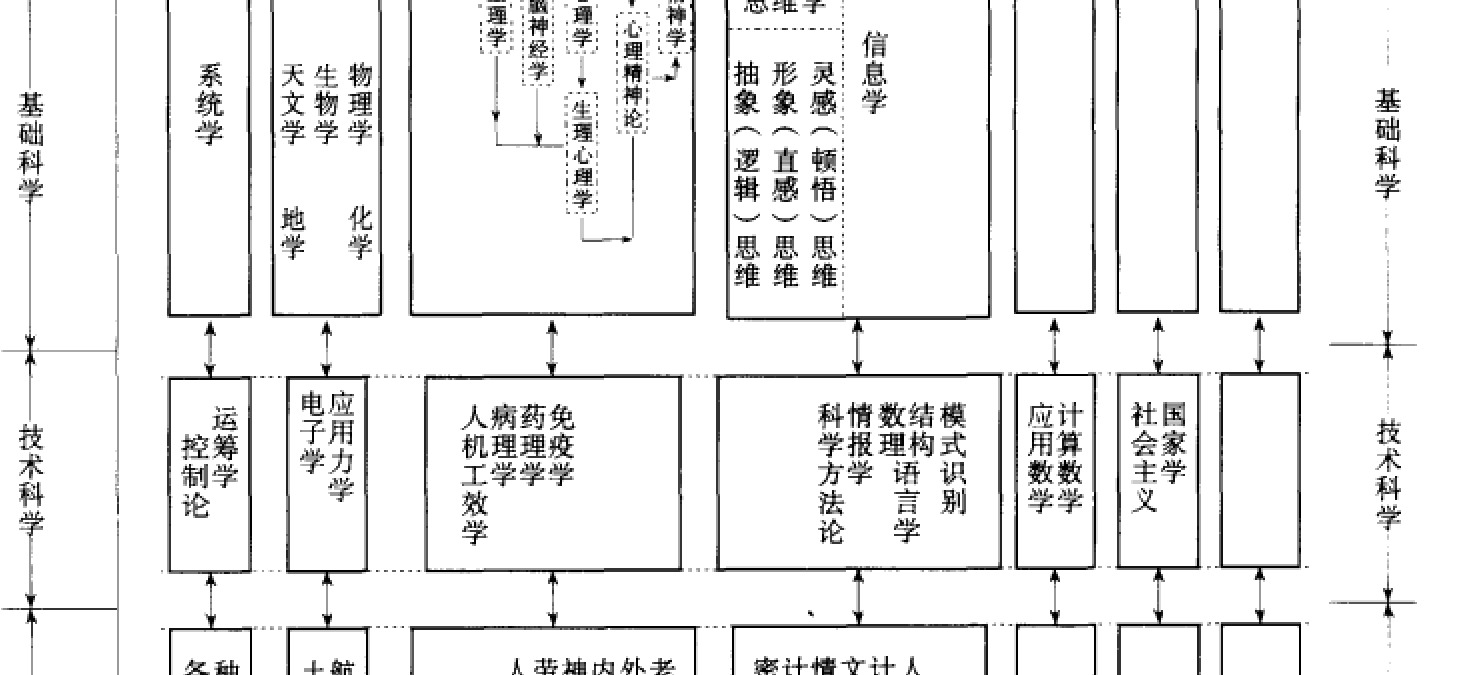
Regarding imagery thinking, literary and art theorists have discussed it extensively and have put forward many fascinating insights. Scientists and technologists generally do not speak of imagery thinking or intuitive thinking; only a small number of accomplished scientists have addressed this topic when discussing scientific methods. The discussions of both literary artists and scientists are largely speculative in nature—they are inspiring to us, but still await deepening. It is Comrade Zhang Guangjian who has conducted some meaningful explorations of imagery thinking. He has synthesized a large number of human creative processes and proposed the viewpoint of “similarity.” Of course, “similarity” and “dissimilarity” (“difference”) are dialectically unified: there is “dissimilarity” within “similarity,” and there is “similarity” within “dissimilarity.” The viewpoint of “similarity,” or “similarity theory,” is very valuable for explaining the importance of imagery thinking in science, technology, and engineering. However, to go further and establish a scientific theory,
386
purity, mathematical logic alone would suffice, but that is not the case here. In image thinking here, one must extract precise “similarity” from a large pile of not-so-precise materials.
The difficulty lies not in people being unable to do this, but in the lack of a theoretical pathway to summarize it. As the British scholar J. Sparkes recently remarked, people do this every day: when listening to speech, they can accurately understand the speaker’s meaning without being disturbed by dialect, accent, homophones of individual words, interjected filler words, or grammatical errors. People can also read the author’s original intent from very untidy handwriting; the human capacity for pattern recognition is remarkably high. He believed this is a kind of thinking different from simple scientific induction—a complex, multi-pathway, multi-loop thinking; in fact, it is precisely the image (intuitive) thinking we discuss here. Sparkes’s observations inspire us: the establishment of image thinking studies must proceed through the study of language and pattern recognition. In terms of the relationship from basic theory to applied technology, image thinking studies belongs to basic science, while scientific linguistics—namely structural linguistics and mathematical linguistics—as well as pattern recognition belong to technical science. Thus, here, to establish a basic science, we seek assistance from technical science; that is, we first study more concrete things and then study their general theory. This is also a common occurrence in modern science and technology.
This in turn raises another question: since the two technical sciences of thinking science—scientific linguistics and pattern recognition—jointly provide source material for the basic science of image thinking studies, do scientific linguistics and pattern recognition have anything in common? Yes. Previously, pattern recognition work consistently used the correlation statistics method—that is, computing correlation functions from data (color and intensity) at different parts of an image using mathematical statistics, and identifying the image based on the distribution of correlation functions. This method requires enormous computation and is clearly not the approach used by the human brain; the human brain recognizes images almost instantaneously! In recent years, pattern recognition has shifted to the so-called semantic method, with better results than the statistical method. Does this not demonstrate that language recognition and image recognition share commonalities? Of course, judging from the achievements of these two disciplines, neither has yet reached a mature stage, and ascending from them to image (intuitive) thinking studies still requires a long journey; the road ahead is long, and impatience will not help.
The third component of thinking science—insight (sudden enlightenment) thinking studies—is even farther away. We have not yet grasped from which direction to explore it, although literary theorists have had much to say on the subject. Comrade Liu Kuilin, in a letter to the author, suggested that the gestation of inspiration also involves a process, but one that lies not within the scope of consciousness but outside it, in the subconscious. When the gestation is complete, a sudden connection is made, and it emerges into consciousness as inspiration. This argument is reasonable. In our daily lives, we also often temporarily cannot recall a certain person’s name, a certain place name, or a certain number, and cannot remember it no matter how hard we think. At such times, if we let go of the thought and stop trying, it may suddenly come to mind—we remember it again. Is this because the name, place, or number has not disappeared from the brain but is still stored in some part of it, only temporarily losing its connection with consciousness and becoming subconscious? And what exists in the subconscious can suddenly reconnect to consciousness, and we remember again. The subconscious is a concept used by psychologists to explain phenomena such as those described above. This concept can also be further developed. I. Wilson believes that many examples demonstrate that the subconscious is not limited to the storage and retrieval of information, but can also carry out a separate set of complex activities and information processing outside of consciousness—silently, without our awareness. It is as if, apart from the conscious part, a person’s brain also has an independent subconscious part, or even more than one independent subconscious part, each capable of independently carrying out various forms of thinking different from those within consciousness. This is called the “multiple selves” theory. Given these developments, there is still a starting direction for elucidating the mechanism of insight thinking.
At the technical science level, thinking science also includes informatics and scientific methodology. Information, data, and archives now constitute a vast enterprise, having become a sharp tool for people to understand the objective world—it can be described as an extension of the human sensory organs, just as machines are an extension of human hands. The information enterprise is also a key point in the construction of socialist spiritual civilization, and the theoretical foundation of this enterprise is informatics. In addition, scientific methodology is a major topic in modern scientific and technological research. We must promote the view that scientific and technological work must never be confined to the inductive and deductive methods of abstract thinking—the so-called “scientific method”—but must also employ image or intuitive thinking, and even draw upon inspiration or insight thinking. Einstein advocated this very view. Therefore, in order to broaden the horizons of scientific and technological workers, especially young scientific and technological workers, scientific methodology must be greatly developed. At this level of thinking science, there will certainly be other disciplines as well, which we will not enumerate here one by one.
The disciplines within thinking science that directly transform the objective world are also numerous, belonging to the engineering technology level, including artificial intelligence, computer software engineering,
cryptography technology, intelligence database technology, linguistics and computer simulation technology, among others. The first three technologies need no further elaboration; here I will only offer some explanation for the latter few: the establishment, updating and enrichment, and high-speed, accurate retrieval, extraction, and duplication of intelligence databases have already developed into an extremely important field of engineering technology. Without it, it would be impossible to utilize the exceedingly numerous and rich intelligence materials, periodicals, and documents available today, and this will be even more so in the future. Our country is greatly lagging behind in this field; on the issue of Chinese character encoding schemes alone, disputes persist to this day without resolution. We must strive to catch up, otherwise it will cause serious problems.
How can linguistics become a field of engineering technology? This is because developments in all aspects of the world today are very rapid, and the content of written language is also constantly adapting to changes in social life: new characters and new words appear frequently, old characters and old words are gradually discarded, and grammar is also changing. In our socialist country, such a matter that affects the entire people must never be left to drift on its own; there must be control and planning, such as the Chinese pinyin plan. This is the new task of linguistics, and it has also become an engineering discipline that actively transforms the objective world. Its theoretical foundation is scientific linguistics as a technical science.
The human brain is a giant digital computer with approximately switches. It is just far more complex than today’s electronic computers, and we are also unclear about the architecture of the brain’s computer. To unravel this mystery, relying solely on neuroanatomy is also difficult. Although great progress has been made in this area over the past 20 years, we are still far from the goal. Therefore, a second approach must be opened up: using electronic computers to simulate partial functions of the brain, that is, trying to change the operating programs of electronic computers until they can produce functions similar to those of the brain, even if only partial functions. In this way, it can be considered that the partial functional structure of the brain is similar to the program structure of an electronic computer. Although it is not necessarily possible to draw an equals sign between the two, it is an important inspiration for understanding thinking. Many experts in artificial intelligence are using this method; Minsky in the United States, for instance, has attempted to use this method to search for the thought process by which musicians write polyphonic music. Therefore, computer simulation technology is an effective tool for studying the science of thinking.
The internal structure of the science of thinking described above is shown in the figure above. Of course, it is still incomplete and awaits future revision and supplementation.
IV
I previously expressed the hope that every major department of modern science and technology could establish an academy of sciences, but I also estimated that a Chinese Academy of Thinking Sciences would probably have to wait until the 21st century to be established. The 21st century runs from 2000 to 2100, which is 17 to 117 years from now; this hope cannot be considered too high. Can we strive to establish the Chinese Academy of Thinking Sciences in 20 or 30 years? But these are also speculations; what is important is to do some solid work in the field of the science of thinking, and the first step is to see whether we have a relatively correct conception of the content of the science of thinking, so as to serve as a direction for taking the first steps. Therefore, I believe the issues discussed in this article are still worthy of the comrades’ concern. Whether they are correct or not, please let everyone study and discuss.
Modern scientific and technological research relies on collectives. At the present stage, it is not yet possible to have any substantive institution, to establish any research institute, or to set up any specialty; at most, an academic exchange organization of like-minded people can be formed, such as a Thinking Science Research Society or a Thinking Science Association. But even to establish a research society or association, there must be a core of organization. This core must include the necessary experts from various fields, must be like-minded and united, and must form the recognized leadership of the academic organization. Therefore, the urgent task at hand is to identify suitable candidates and form such a core.
What kind of core professionals are needed? I believe that on the engineering technology side of the science of thinking, the situation is relatively manageable. Due to the practical needs of building socialism, talented people will naturally emerge, and in the work of establishing the science of thinking, they will be the follow-up force, albeit a powerful one. What needs to be grasped at present is the core professionals in each of the major disciplines within the basic sciences and technical sciences of the science of thinking department. Based on the preceding discussion, these disciplines are: philosophy, mathematical logic, psychology, pattern recognition, scientific linguistics, literary theory, scientific methodology, artificial intelligence, and electronic computer science and technology—nine areas in all. What we need are experts who are well-trained in these nine areas and who are also enthusiastic about the science of thinking. The situations in these nine areas are also not identical: in our country, there are relatively more experts in philosophy, literary theory, and electronic computer science and technology, while talent in the remaining six areas is scarce. Therefore, identifying candidates and building a core force for the science of thinking will be no easy task.
This core force must also consist of middle-aged and young science and technology personnel: this is mainly because they will need to work until the twenty-first century before passing the baton. Therefore, they should now be people in their thirties to forties. In order for this group of people to understand one another, exchange and discuss academic matters, and reach a basically consistent academic viewpoint so as to play a core role in the founding of noetic science, each member must also possess a broad scope of knowledge. This is another condition. In addition, there is a third condition: the ability to read foreign languages. This is also extremely important for establishing the new discipline of noetic science.
Due to the three conditions above, finding such a group of talents will probably not be easy, and there may be gaps in certain specialties. What can be done? We still need to rely on older science and technology personnel with relatively broad knowledge to pass on experience, offer guidance, and provide support. This is the obligation of the older generation, so it must be organized and arranged well.
Once these tasks are accomplished, we can begin to form the Chinese Noetic Science Research Society or the Chinese Noetic Science Society, but this may already be during the Seventh Five-Year Plan period for our national economic and social development.
(1983)
VIII. Carrying Out Research in Noetic Science
Comrades from all parts of the country who are engaged in noetic science work have gathered together joyfully to hold an academic discussion conference. I think there are three purposes: First, we comrades working in noetic science all come from all corners of the country. We may have corresponded through letters or articles and known each other through our work, but we have not met in person. For example, I have exchanged letters with many comrades present here, but we have never met face to face. Today is our first meeting, so we can get to know one another—this is one thing. Second, noetic science as a field of study—if you say it is new, it is indeed new; if you say it is not new, it is not new either, because questions about thinking have been studied for a very long time. It is precisely for this reason that comrades may hold a wide variety of views on noetic science. At this conference, we can exchange views and, in the spirit of seeking common ground while reserving differences, ultimately arrive at some shared understanding. In this way, our future work will have a foundation. As for differing opinions, everyone can continue to discuss them gradually after the conference and resolve them step by step. Third, comrades hope to establish a national academic organization for noetic science. This is a good idea, but it cannot be set up all at once. If, at this conference, we can organize a preparatory group for a national academic organization, that would count as a good beginning. This preparatory group can then further study the question of how to establish a national academic organization. I think these three things can be accomplished.
What I will say below can only be considered as casting a brick to attract jade—I invite everyone to critique and correct it.
Noetic Science and the New Technological Revolution
I believe that our research in noetic science should carry a sense of urgency. In terms of organizing a learned society, noetic science is already five years behind systems engineering. The national discussion conference on systems engineering was convened by the National Defense Science and Technology Commission in October 1979, and after one year of preparation, the Chinese Society of Systems Engineering was formally established in November 1980. Our noetic science discussion conference, however, was not held until early August 1984—five years later. Why do I say there should be a sense of urgency? Because on October 9, 1983, Comrade Zhao Ziyang gave an important directive at a meeting, asking us to study what countermeasures we should adopt in the face of the impending new technological revolution. Comrade Zhao said this is a major issue related to our Four Modernizations construction. Under the chairmanship of Comrade Ma Hong at the Technological and Economic Research Center of the State Council, two relatively large-scale discussion conferences have already been held to study countermeasures for the new technological revolution. So what is the relationship between noetic science and the new technological revolution? If there is a relationship, then of course there should be a sense of urgency.
1. Four Types of Revolutions in the Development of Human Society
On this question, my view is as follows. In humanity’s understanding and transformation of the objective world, there have been a series of changes or leaps, which we call revolutions. They can be divided into four types. One is the leap in humanity’s understanding of the objective world, which we call a scientific revolution. Another is the technological leap in humanity’s transformation of the objective world, which we call a technological revolution. Then, as a result of these two types of revolutions, our productive forces develop, and the relations of production and part of the superstructure must also undergo changes. The leaps that bring about such changes we may call industrial revolutions. The industrial revolution is a very important concept; human society has already experienced several industrial revolutions. I believe the earliest industrial revolution was one in which humanity systematically domesticated and cultivated [crops and livestock], thereby bringing about changes in human society, transitioning from primitive communes to slave society—this was a very ancient industrial revolution. Later, during the period of slave society, productive forces developed further: people produced not only for their own consumption but also for exchange—that is, commodity production emerged. This in turn brought about enormous changes; in reality, it was the collapse of slave society and the transition into feudal society. A fundamental change in the social system is called a social revolution. Looking at these two industrial revolutions, it seems that both were cases in which the industrial revolution gave rise to a social revolution. So can we say that an industrial revolution inevitably gives rise to a social revolution, with the industrial revolution coming first and the social revolution following? This is a major question.
From the two industrial revolutions I just mentioned, it appears to be so. However, let us look at the third industrial revolution, and it is not entirely the same story. That was the industrial revolution at the end of the eighteenth century, namely the industrial revolution brought about by the appearance of the steam engine and large-scale factory production. In fact, in Britain, this industrial revolution occurred after the success of the bourgeois revolution—the social revolution came first, and the industrial revolution followed. What I call the fourth industrial revolution is the situation described by Lenin in his book Imperialism, the Highest Stage of Capitalism, namely that industrial production became national in scale, internationalized, and globalized. This industrial revolution marked the transition of capitalism into the imperialist stage, yet there was no fundamental change in the social system. Therefore, looking at the first, second, third, and fourth industrial revolutions, the sequential relationship between them and social revolutions is not fixed. What is important is that the development of productive forces, upon reaching a certain stage, will give rise to an industrial revolution. I recently read an article claiming that the industrial revolution is the same as the industrial revolution (in the narrow sense), and investigating why such an industrial revolution did not occur in China. In fact, this is quite clear: because China was in a feudal society at that time, China’s productive forces had not developed to that stage, so the kind of industrial revolution that occurred in Britain at the end of the eighteenth century could not have appeared. In fact, it was only after the Communist Party of China led the people of the whole nation to seize political power that China’s productive forces achieved great development—that is, our social revolution succeeded first, and only then did it become possible for an industrial revolution to occur.
2. The So-Called “Information Society”
So, what does this have to do with noetic science? This must be connected to the new technological revolution currently under discussion, or in my formulation, the fifth industrial revolution. What is its core? Comrade Zhao Ziyang raised the question of the “information society.” Comrade Hong Jiawei from the Second Branch of Beijing Polytechnic University wrote an article in which he suggested that it should not be called “information society,” as this could easily be confused with the meaning of the word “society” in political terms such as capitalist society, feudal society, and slave society. He suggested calling it the socialization of information. Regardless of the terminology, the meaning is that the importance of information, knowledge, and intelligence must be elevated to an unprecedented height. Naturally, this makes the relationship with noetic science very close. Abroad, a term was proposed a few years ago: the noosphere. Previously there were the atmosphere and the magnetosphere, and now there is also the noosphere. “Noo” in Greek means knowledge and information, and “sphere” is appended to it. I think this word is well worth our attention: it means that we live in a kind of atmosphere—what kind? An atmosphere of knowledge and information, an atmosphere of thought and knowledge. Put this way, noetic science is of course important!
Since we are speaking of the “information society,” I would like to start from the question of what information is. In English, both “信息” (information) and “情报” (intelligence) are actually the same word—“information”—which is knowledge. It refers to the regularities of the objective world that humanity has come to recognize through practice; that is, it is the spiritual wealth created by humanity, not material. Perhaps knowledge ultimately must be printed in books, and paper is material, but that is merely a representation, a carrier. Of course, what is important is not the paper or the ink, but the knowledge carried. So knowledge is in fact the spiritual wealth created by humanity; it is not material. This kind of spiritual wealth called knowledge is extremely broad: the contents of libraries, archives, data repositories, museums, art galleries, records, audio tapes, and so on—all are spiritual wealth. In the information society, humanity’s knowledge must be transformed into productive forces. Modernized production,
Without knowledge, nothing can be done.
Regarding knowledge, I feel that foreigners also have some peculiar sayings. For example, the Austrian-born British “philosopher of science” Sir Karl Popper said some strange things. He proposed the so-called “Three Worlds” theory, in which humans are World One, the objective world is World Two, and the spiritual wealth created by humanity—namely, knowledge—is World Three. What is strange is that he said World Three develops independently and autonomously, which is absurd. This World Three, this spiritual wealth, is created by humans; how can it develop independently and autonomously? According to the viewpoint of dialectical materialism, the objective world is material and primary; the human spirit is secondary. Humans can gradually come to understand the laws that inherently exist in the objective world through practice, and thereby utilize these laws to transform the objective world. The laws of the objective world that humans come to understand through practice are called knowledge, spiritual wealth. I believe this conforms to Marxist philosophy, whereas Popper’s formulation is idealistic.
However, we should also absorb what is correct in his thinking, namely that he elevated the importance of human spiritual wealth and knowledge. Classical dialectical materialist philosophy held that matter is primary and spirit is secondary, while Popper proposed that there is yet another aspect: the spiritual wealth created by humans through their understanding of the objective world. This too is very important, and I agree with this statement of his. Therefore, humans must not only continue to understand the objective world and continue to create spiritual wealth, but also constantly make use of the spiritual wealth that humanity has already created in the past. What we call information and intelligence, in a broad sense, is human knowledge—the spiritual wealth that humanity has created over many years. To illustrate the importance of spiritual wealth, Popper offered this example: suppose a nuclear war breaks out, and the two superpowers launch nuclear weapons, destroying all the material wealth accumulated on the entire Earth, and also obliterating all spiritual wealth—that is, all people with knowledge are killed, and libraries, databases, and so forth are all gone—reducing humanity to its most primitive state. Under such circumstances, if we were to rebuild, it might take a million years. But if only material wealth were destroyed while human knowledge were preserved, rebuilding would not require so long—ten years, twenty years, at most a few decades would suffice. I think this example illustrates the importance of knowledge.
3. Science and “Pre-Science”
What is knowledge? What people commonly think of is science, which is very important knowledge. But science in the modern sense has a further constraint: science must be capable of being interconnected to form a system. Today, not only natural science and engineering technology form a system, but they must also be linked with social science, so that all of modern science and technology forms an integrated whole. Is knowledge limited to science and technology? Of course not. Humans have come to understand many things through practice, some of which have not yet entered into the structure of science—they are experience. For example, traditional Chinese medicine, which is currently the subject of much debate: is traditional Chinese medicine a science? Traditional Chinese medicine is very important; the Constitution even states that traditional medicine should be developed. Yet traditional Chinese medicine is currently in a difficult situation; some comrades even say it is on the verge of extinction. Setting aside the situation during the ten years of turmoil, even now this problem remains serious! I think the crux of the matter is that traditional Chinese medicine is not a modern science—it is experience. Traditional Chinese medicine does indeed have curative effects in treating illness, but as to how it works, I am afraid that even veteran practitioners of Chinese medicine themselves cannot clearly explain. The books on Chinese medicine also do not explain it clearly—they speak of nothing more than the two qi of yin and yang, or the five elements of metal, wood, water, fire, and earth. These are not principles of modern science. I offer this example to illustrate that the things in traditional Chinese medicine are knowledge, but not science. One could also use Engels’s words to say that traditional Chinese medicine is natural philosophy in the classical sense, not modern science. Natural philosophy, though rich in experience, includes many elements of conjecture, and therefore is not science. However, I feel that saying something is not science does not mean it is unimportant.
I believe that when we speak of information, or knowledge, or the spiritual wealth of humanity, it comprises two major parts: one part is the system of modern science; the other part might be called pre-science—that is, the experiential knowledge from human practice before it enters the scientific system. All of this is related to the science of thinking, because these are all results of humans’ understanding of the objective world, and the science of thinking is precisely about solving how humans understand the objective world and what laws govern this process. Because the objective world is inexhaustible, the process by which humans come to understand the objective world is also inexhaustible. What humans have thus far understood of the objective world, whether in science or in pre-science, is only a very small portion of the entire objective world, and the situation is constantly changing. A portion of pre-science, once it has been systematized in the future and incorporated into the scientific system, would reduce the content of pre-science somewhat, would it not? No, it would not, because humans are constantly summarizing their own practical experience. All of this is connected to the science of thinking, so the task of the science of thinking is most glorious—it is a great undertaking. In the past, human development had not yet reached this stage, and it seems people did not much recognize this problem. Now that we speak of an “information society” and knowledge as a productive force, it becomes extremely important. We must, from the perspective of迎接 the new technological revolution, or welcoming the fifth industrial revolution of human society, consider—
recognize this issue. Therefore, I feel that researching noetic science is indeed a matter of urgent priority.
The Basic Sciences of Noetic Science
Now I will discuss the issues of noetic science one by one. Let me begin with the foundational discipline of noetic science — noetics.
First, let us note that human thinking, in addition to the consciousness one can control oneself, also involves much so-called subconscious activity — that is, processes not directly controlled by the brain. For example, when a person walks, taking the first steps is controlled by the brain, but after two or three steps it becomes “automated,” and the brain no longer thinks about how to walk. When a turn is needed, control is exerted again. So humans indeed have much conscious activity that does not pass through the brain. This is a subject for another scientific domain, namely human body science, to study. Noetic science is concerned with studying the aspects of consciousness that humans can control.
Previously, following our customary terminology, I divided a person’s thinking into three types: abstract (logical) thinking, image (intuitive) thinking, and inspirational (sudden insight) thinking. This is only to say that from the perspective of the laws of thinking, there are these three types. However, first, this does not rule out the possibility that future research may find this division inappropriate, or that there are other types of thinking with different patterns. Second, although thinking is divided into three types, in reality no single thought process of a person involves only one type of thinking at work; often two or even all three types operate in alternation and interaction. For instance, the process of creative thinking is by no means purely abstract (logical) thinking — it always involves some image (intuitive) thinking, and even inspirational (sudden insight) thinking. Therefore, the division into three types of thinking is for the needs of scientific research, not to categorize any specific thought process of a person.
These three branches of noetics are all basic sciences of noetic science, and may collectively be termed noetics. Below I will also propose another basic science of noetic science: social noetics.
1. Social Noetics
Is human thinking collective? The answer is affirmative. Because to understand the objective world, we rely not only on practice but also on the spiritual wealth created by humanity in the past. If we used no knowledge at all, we would regress to the state of our ancestors over a million years ago. Therefore, the quality of a person’s thinking depends, first, on social practice, and second, on knowledge. Knowledge is a very important supplement to human social practice. Thus human thinking is collective.
This is also true when viewed from the perspective of the inspirational role that academic discussion plays for individuals. I feel that the atmosphere of academic discussion in our country is not very active. By inactive, I mean that after one comrade speaks at a meeting, no one offers comments or discussion. When a second person speaks, the same thing happens. Academic exchange abroad is different from ours: after a person gives a report, the discussion is extremely lively, with speakers offering different perspectives — some asking questions, some expressing disagreement, some making additions, and some proposing new viewpoints. So in the past I once wondered whether academic discussion is a Western thing. In the West, it is said that in the early sixteenth century, N. Copernicus (1473–1543) made great contributions to astronomy by proposing the heliocentric theory. It is said that he benefited from a fine academic organization at his university in Poland, where everyone mutually promoted one another, which enabled him to achieve such great accomplishments. But last year someone pointed out that in the second year of the Chunxi era of the Southern Song Dynasty, Lü Zuqian presided over the “Goose Lake Gathering” in Xinzhou, Jiangxi, where Zhu Xi and Lu Jiuyuan and others discussed the way of learning, debating fiercely, inaugurating the tradition of “scholarly assemblies.” The article also stated that the assembly had rules: all kinds of opinions could be expressed, one could even disagree with the teacher’s views, and the teacher could not scold the students. Another rule was that no one was permitted to spread disparaging remarks outside the venue. Violators of these rules would not be allowed to attend the next gathering — this was very serious! Both lively and serious. The second year of the Chunxi era of the Southern Song Dynasty, namely 1175 CE, was over 300 years earlier than Western academic conferences!
Of course, our Party advocates “letting a hundred flowers bloom and a hundred schools of thought contend,” which is indeed extremely important. In my personal experience abroad, wherever an academic center conducts academic discussion well, that center produces more academic results. In academic discussions, not everything everyone says is correct, and it does not matter if one is wrong. We Chinese nowadays seem to feel that being wrong means losing face. I disagree: in discussion, the person who says something wrong or puts forward an erroneous opinion also contributes to the final correct conclusion.
Therefore, human thinking is collective; it is not entirely individual, and the influence of the collective upon it is extremely important.
I have read two articles, one written by Comrade Zhu Changchao and another by Comrade Li Yanqiang. I believe these two articles
here discusses many meaningful things. For example, in human development, consciousness gradually shifts from perceptual consciousness to rational consciousness, from concrete consciousness to abstract consciousness, and from collective consciousness to individual consciousness. This point is very significant. That is to say, in the early stages of humanity, individual consciousness was virtually nonexistent; it was all collective. People even cite the example of bees, considering that bees possess collective consciousness but no individual consciousness. In observing the progress of human social organization, it has also been found that only as humanity advanced did individual consciousness gradually emerge. Comrade Zhu Changchao seems to emphasize this point: the more ancient the consciousness, the lower the level of rational components, abstract ability, and individual consciousness. The implication is that he does not sufficiently emphasize the role of the collective and the role of society. Could it be that Comrade Zhu Changchao has also been influenced by Piaget? Piaget, in psychology, does not say much about the role of society. I think we need to understand this problem well. Humans are social animals; human development cannot be separated from the influence of society on the individual. Our country’s psychological community is clear on this point, so I think we should earnestly explore whether, in the foundational sciences of noetic science, we should also study the role of the collective and the spiritual wealth created by the collective in an individual’s thinking. Conversely, when an individual lives in society, they also have an effect on society and the collective, and also make contributions. Therefore, we need to study the mutual interaction between the individual and the collective and the spiritual wealth created by the collective, in terms of thinking.
This may be a new discipline: social noetics. It is of course related to social psychology and so on. Those of us who study noetic science must also study social noetics; this is an objective fact, and we cannot avoid studying it. I believe this issue is an important one in our country. Because in our country, not only is the atmosphere for academic discussion weak, but even within a collective, phenomena such as blockading, closing off, and isolationism are very serious. This violates the laws of social noetics.
Since social noetics studies the laws of human thinking as a collective, and its relationship with and mutual influence on the collective, this is a problem of systems science. From the perspective of systems science, a system is not an undifferentiated whole but has a hierarchical structure. Of course, at the lowest level is the person, each individual, then above that the collective (family, colleagues, etc.), the nation, and the world. I have also noticed a common situation nowadays: one’s spouse is in the same profession, working on the same things, so the household forms a single unit. I will not discuss the social reasons for this situation. Abroad, this phenomenon is quite rare; very likely one person works in the natural sciences and the other in the social sciences. What I want to illustrate here is what kind of combination within a system is optimal. When we discuss problems, if two people discussing problems, or a collective discussing problems, have absolutely no common language—what you say the other person simply does not understand—then of course it will not work, so there must be colleagues in the same field. But if the collective you interact with is entirely homogeneous, I am afraid that will not work either. A homogeneous organization cannot produce good results; on the contrary, it becomes closed off. So how do we unify specialization and non-specialization? This brings us to a very important question, namely the question of human communities. On this question, I recently read an article co-authored by Li Qingzhen and Hu Fuchen of Shandong University, in which they used a term from ecology. I believe what this article discusses is exactly what I just said, namely how to form communities? This is an application of social noetics.
- Abstract (Logical) Noetics
First, it must be clarified that the logic we discuss here refers to the laws of human thinking, not the philosophical meaning of the laws governing the development and motion of the objective world, which would include causal relationships and other content that does not belong to abstract noetics. Dialectics within philosophy also concerns the development and motion of the objective world, and likewise does not belong to abstract noetics.
The abstract noetics we discuss here—some comrades believe it could be directly called logical noetics, but I think it is still better to call it abstract (logical) noetics, because abstract thinking is broader than logic. That is to say, the logical thinking within abstract noetics seems broader than what we commonly call mathematical logic. For example, in many-valued logic, when mathematical logic encounters many-valued logic, its structure must change; for another example, so-called quantum logic. This kind of symbolic mathematical logic, when encountering various different situations, changes its structure. There are also other logics, such as so-called modal logic, which is also very important. I think that in studying abstract noetics, could we investigate the relationship between abstract thinking and mathematical logic? This is a question.
Within abstract thinking there is also dialectical thinking, which some comrades call dialectical logic. As far as I know, two books were published in 1982: one is Principles of Dialectical Logic, edited by Zhang Pei, published by Hunan People’s Publishing House; the other is Outline of Dialectical Logic, edited by Ma Pei, published by Henan People’s Publishing House. What is “dialectical logic”? It is relatively easy to talk about the principles, but concrete application is not so easy. If applied poorly, one can make mistakes, because it has not yet been formalized into laws. How to further formalize the theory of dialectical thinking as a foundation of noetic science is also a matter for abstract noetics.
a demanding research task in the science of thinking. On this point, I was inspired by an article by Comrade He Xin from the Institute of Modern History at the Chinese Academy of Social Sciences. I thought that if we were to develop the two-dimensional Venn diagram of set theory by introducing time to form a three-dimensional structure—like a “forest” with trunks and branches of varying thickness—it might be possible to derive a “mathematical dialectical logic” that would rigorously systematize dialectical thinking. Only then could we truly enter the study of abstract thinking.
There is another point, though I am not sure whether it is correct: figuratively speaking, abstract thinking seems to be linear, or branching—this is its characteristic. This connects to a very important issue, namely the electronic computer. Everything that involves logical thinking can be put on a computer and can be replaced by a computer doing the work of humans. The greatest role of the computer today is precisely this. That is to say, it can replace human abstract thinking, but it cannot innovate science and technology. Not long ago, Comrade Hu Shihua made a remark that greatly inspired me. He said that the Turing Machine is exactly such a thing. I thought about it and realized he was right. Many comrades speak of the Turing Machine in almost mystical terms, but in reality, the Turing Machine cannot replace humans, because what the Turing Machine can do is precisely abstract thinking and logical thinking. Human thinking encompasses a far broader range than this. Those of us working in the science of thinking must be clear on this point. Turing made great contributions, but it is inappropriate for us to exaggerate the scope of the Turing Machine so broadly.
3. The Study of Image (Intuitive) Thinking
Next is image thinking, or what is called intuitive thinking. On this question, I had some practical insights earlier. In 1957, I wrote a short article. At that time, I had no theoretical basis; it was merely a naive impression. Technical science involves applying fundamental science to concrete problems, and this process is not purely logical derivation and calculation. Because to solve a concrete problem—the phenomena are very complex—you must grasp the crux within this complexity. If you cannot grasp the crux, there is no way to begin. And what exactly is the crux of the problem? Is it on the east side or the west side? If it is actually on the east side and you attack from the west, you will have attacked in vain for a long time. Moreover, since the problem is complex, you cannot swallow it all at once; you must take it one bite at a time. Where do you bite? Where do you start? This requires having an understanding of the object of study. As for where this understanding comes from? At the time, I could not explain it clearly either.
Another point is that my article discussed how engineers handle problems in a way that others cannot quite understand. For example, a chief engineer finally makes a decision, and everyone just proceeds accordingly. Once it is done and turns out right—how exactly was it right? Why did it have to be done this way? Nobody knows what really happened. At the time, I was talking about the chief engineer. In fact, commanders in war are exactly such figures. They have rich experience; they take one look at the terrain, assess the situation, and make their decision. The staff officers may have presented many plans and suggestions, but he says no, we fight this way. Others do not understand what is going on, but once the battle is fought and won, it proves he was correct.
There are countless such examples. Anyone who has done work probably has this kind of experience. On this question, Comrade Zhang Guangjian has a theory called the Theory of Similarity. He says it explores the role and patterns of similarity in the development of scientific and technological thinking. Everyone can study this further; similarity is a factor in image thinking. My 1957 article merely raised the question. At the time, I was not clear about what was going on either, but now I feel that the most fundamental thing here is image thinking, or intuitive thinking. This kind of image thinking seems to follow a different path from abstract logical thinking. Abstract logical thinking proceeds step by step; it is linear, or it branches out—it is branching in form. Image thinking, on the other hand, often lacks any clear trace of cause and effect. So I have the impression that perhaps it is planar, two-dimensional, rather than one-dimensional?
Nobel laureate L. Pauling was a chemist who worked in theoretical chemistry and studied molecular structures. His contribution was applying quantum mechanics to the study of chemical molecular structures. Studying molecular structures always involves methods such as electron diffraction. When a graduate student reported to him that a certain molecular structure had been worked out, his advisor Pauling thought for a few minutes and said: no, that is not right. In the structure you described, there is a collision in that corner—there is no space; the atoms cannot fit in. Pauling had not drawn any diagram; he just visualized it. The graduate student went back and checked the data, and sure enough, this was a problem he had overlooked. Would you say that Professor Pauling was reasoning? No. How did it come about? Even he could not explain clearly, but he knew that was just how it was.
Last year, the American scientist B. McClintok won the Nobel Prize in Biology. McClintok specialized in the genetics of corn. In the 1940s, she anticipated the existence of “transposition elements” within the genetic genes on chromosomes. At the time, her theory
the entire genetics community could not accept it. It was only after the 1950s that the helical structure of deoxyribonucleic acid was worked out, and it was not until the late 1970s, when “transposons” were discovered in bacteria, that McClintock’s theory, proposed in the late 1940s, was proven correct. But forty years ago, no one could have had today’s concepts of molecular genetics in mind, and McClintock was ahead of her era. That, of course, was not entirely scientific reasoning. Her working method also seemed unconventional. Sometimes, she would think about problems alone, going under the shade of a tree to ponder and reflect deeply. After receiving the Nobel Prize, she said: “Over these many years, I have indeed had many joyful experiences. My experience has been to ask the corn, to let the corn solve problems for me. I would pose questions for the corn, and then I would wait, getting answers from how the corn grew and expressed itself.” She believed that her relationship with corn was like a friendship, as if they could converse. Therefore, it is hard to say that her work relied entirely on abstract (logical) thinking.
In daily life, such examples are numerous. For instance, if a piece of copper sheet is uneven, an experienced fitter can pick up a hammer and flatten it with a few strikes, while others cannot. Can this fitter explain the reasoning behind his experience? He cannot. What does this illustrate? It shows that this is not scientific reasoning but practical experience. These practical experiences have not yet been summarized into scientific laws and have not yet entered the ranks of science.
I believe that we must both recognize the importance of experience and avoid the error of empiricism. When applying experience, we must never rigidly apply it or stubbornly cling to old past experiences. In real life, this problem is probably still quite common. For example, many grassroots cadres do not understand the Central Committee’s many policies and guidelines, feeling that the Central Committee’s policies do not match their old set of experiences. I remember a few years ago, I attended a meeting discussing long-term prospects for the national economy. I do not understand economics; I am a layman, though my thinking was quite liberated. In the end, an old comrade who had been in charge of economic leadership work in a province since liberation said he could not understand what we were talking about. He said: “In a certain period after the founding of New China, my approach worked very well. Why doesn’t it work now?” This is simple: you are applying that old set of past experience to the current situation, and that ruins things—it becomes empiricism. Therefore, when we apply concepts such as experience, imagery thinking, or similarity theory, we need to be somewhat vigilant. If we are not careful, we will make mistakes, fall into empiricism, and become very conservative in our thinking. So I think how to correctly apply the “analogical reasoning” proposed by Comrade Tao Bohua is a question. If this kind of analogical reasoning is applied mechanically, mistakes will be made, and it will become a matter of imposing rigid frameworks. Now, those of us who study the science of thinking should help those who cannot make sense of the Central Committee’s policies—that is to say, we must be careful in applying imagery thinking and use it correctly.
Conversely, human cognition of the objective world begins with imagery thinking, not abstract thinking. That is to say, the development of human thinking proceeds from the concrete to the abstract. For example, children’s thinking also starts with imagery thinking and then progresses to abstract thinking; you cannot reason with a very young child. On this point, I agree with Comrade Wang Nan’s view: imagery thinking has already begun in some animals, and humans have had it since very early times. From the perspective of human development, generally speaking, when we say language precedes thinking, this refers to abstract thinking; imagery thinking existed before language. Whether this is the case is something everyone can research.
That said, imagery thinking should be one of the most important tasks in our current research on the science of thinking. Because it is so broad, involving a large part of human knowledge and a large part of spiritual wealth, yet we currently do not understand it very well. On this issue, anything that is useful to us and can provide us with some clues and inspiration must be diligently collected, analyzed, and studied.
First, in the field of psychology, cognitive psychology is now emerging. Professor Hu Jinan of East China Normal University has a special paper presentation at this conference, which is of course a very important aspect. Cognitive psychology also involves the problem of pattern recognition. As far as I know, those researching this problem in our country include Comrade Dai Ruwei of the Institute of Automation, Chinese Academy of Sciences; Comrade Chen Lin of the Department of Biophysics, University of Science and Technology of China; and Comrade Li Dehua of Huazhong University of Science and Technology, among others. This is a very large problem. For example, in character recognition, humans have a remarkable ability to recognize characters. Even very hastily written, flamboyant handwriting does not stump people. But when a machine tries to recognize them, it fails. Nowadays, in foreign libraries, there are reading machines for the blind that can recognize printed text and read it aloud, but they cannot recognize handwritten text. A few years ago, the postal service introduced postal codes, and the Institute of Automation, Chinese Academy of Sciences, developed a machine for recognizing digits. Even though these were just a few simple Arabic numerals filled in by the sender, the machine could not recognize all of them, and the Ministry of Posts and Telecommunications had to abandon this method and revert to manual sorting. So humans are far more capable than electronic computers.
Second, there is the problem of language. Not long ago, at the “Fifth Generation Computer Symposium” held in Beijing, the Institute of Acoustics, Chinese Academy of Sciences
Comrade Hou Ziqiang of the Institute of Acoustics said that you work on computer languages, but human natural speech is called “言语” (speech/utterance), and a distinction must be made. Human ability to listen and understand is also very great. For example, when I speak here, even if my speech has many flaws, the grammar may be incorrect, and there are interjections mixed in, everyone can probably understand. Even if a person has a very heavy accent, you can still understand them. But a machine cannot do this. What machines can understand now is command-style speech, which is already being applied abroad; for example, pilot voice commands on fighter aircraft. Because the pilot’s eyes cannot leave the enemy aircraft, and if he needs to use his hands to operate, he must press this button and that button, which would require his eyes to leave the enemy aircraft—so that won’t work. In order to keep the pilot’s eyes on the enemy aircraft during combat, voice commands must be used to operate the system. The machine can understand this, but it cannot understand human speech or conversation. Is there a factor of imagery thinking involved here?
The third aspect is artificial intelligence, where there are even more problems—computer chess playing, expert systems, and so on. For a skilled person, there is no problem. He just does what he feels should be done. But how does he make his decisions? Why can he see things so clearly all at once? Is this related to imagery thinking? Because one thing that can be said for certain is that it is not purely reasoning.
Furthermore, Comrade Chen Lin of the University of Science and Technology of China believes that image or pattern recognition is related to the topology of figures and is a problem of holistic analysis. The previous approach that did not use topological or holistic analysis perspectives may have gone astray. This concept was proposed by Comrade Chen Lin in the United States and has received considerable attention; it may be a new avenue. Of course, it is connected to the physiological psychology of vision. It must be pointed out that physiologists and brain scientists have indeed devoted great effort to vision. However, human vision is very complex. After such a long period of research and many results produced, the fundamental problem remains unsolved to this day. This does not refer to how light information enters—that is simple—but rather to how the human brain processes this information. For example, why can a skilled foreign-language typist type so fast? If the procedure were: a person sees a character, then it is reflected in the brain, and then the muscles control the fingers—that would be much too slow. What kind of relationship is at work here? Therefore, in the area of visual physiological psychology, there is a great deal of material that may be helpful for our study of imagery thinking, and we should absorb the achievements from this field.
The fourth is literary theory and aesthetics, which of course are closely related to imagery thinking. Has the debate on this issue in our country been resolved? Many comrades used to say that literature and art involve only abstract thinking, not imagery thinking. Later, Comrade Mao Zedong said that imagery thinking also exists. Regarding aesthetics, what is beauty? This is closely related to imagery thinking and is an ancient field in which much work has already been done. Although this work cannot yet be called the work of imagery thinking studies—it can only be called an application of imagery thinking studies (on this point, more will be said later when discussing aesthetics)—it is certainly very meaningful and helpful for our work on imagery thinking. Therefore, we must also draw nourishment from this area.
The fifth is human special functions (人体特异功能). How are human special functions related to imagery thinking? Because from some experiments already conducted, it is very interesting. For example, ear recognition of characters, or recognizing objects sealed inside containers—this process is very complex. The person recognizes something that looks like the character “上” (up), then looks again and thinks it’s not right, it seems to be “下” (down). This process may last several minutes. According to the self-descriptions of people with special functions, there is an image turning in their mind, at one moment looking like this, at another like that. After several minutes, they recognize it, and suddenly it becomes clear. This process seems to be a slowed-down version of the human visual process, perhaps slowed down thousands of times, thereby making the process describable. This is very interesting. In addition, special functions also have the effect of a low-power microscope. Comrade Chen Shouliang of Peking University has conducted serious experiments in this area. This can also provide us with material on imagery thinking.
The sixth, connected to this, is the problem of dreams. When a person cannot find an answer to a problem while awake, they may find it in a dream. How is the answer obtained in a dream? The situations described in dreams are all related to imagery. Furthermore, closely related to dreaming is inspiration. What we are discussing here is imagery thinking, not inspirational thinking, but some observational results from inspirational thinking will be helpful for our study of imagery thinking. I will discuss the issue of inspiration further later.
The seventh and final point is mental calculation prodigies. The situations of these people are very interesting. Not long ago, I met Comrade Wang Shoujue of the Institute of Semiconductors, Chinese Academy of Sciences. He said that a Chinese mental calculation prodigy, Shi Fengshou, had worked at his institute for a period of time, and through his observations,
observation is that the reason Shi Fengshou can calculate so fast is that he has memorized many specific numerical computation results in his brain; he has a large storage repository. When you pose a problem, he uses what already exists in that storage repository to piece together a solution. If it does not quite fit, he makes slight adjustments to establish the relationships. These logical elements can also provide material for our research on imagery thinking.
What I have said above is probably not complete. My intention is to synthesize all usable materials, organize them, and construct a discipline of imagery thinking — the science of imagery (intuitive) thinking. Of course, when utilizing these materials, we must adopt a serious attitude. I now see that some comrades, when discussing imagery thinking, seem to describe it in a somewhat ethereal and elusive way, as if imagery thinking can do anything. Some comrades have proposed a set of “pansystems analysis” for analyzing imagery thinking, and the term “pansystems analysis” was introduced by Comrade Wu Xuemou. There are also comrades speaking of a “pansystems theory of aesthetics.” These are all very difficult to grasp; it is unclear what they are talking about. Therefore, when we use all kinds of materials, we must still conduct serious scientific analysis.
I suggest taking imagery (intuitive) thinking as the breakthrough point for the science of thinking. Because once it is clarified, the pre-scientific portion — that knowledge before science which is difficult for others to learn, namely spiritual wealth — can all be unearthed. This will greatly advance our intellectual development. This is also closely related to the social science of thinking that I discussed earlier, because in people’s interactions, much of it relies on imagery thinking rather than abstract thinking.
4. The Science of Inspiration (Sudden Insight) Thinking
Regarding inspiration thinking, Comrade Liu Kuilin of the Party School of the Heilongjiang Provincial Party Committee has done considerable work. In the course of my discussions with him, I had an idea: it seems that inspiration is imagery thinking extended to the subconscious. So I say, if logical thinking is linear, and imagery thinking is two-dimensional, then inspiration thinking seems to be three-dimensional. That is to say, our central nervous system receives external information with several possibilities. One possibility is like a person walking — having already taken a step, the foot has already landed on the ground. These sensations are transmitted to the human nervous system, which produces reflexive actions to control the person’s muscles. These reflexive actions are subconscious and do not enter the upper layers of the brain at all, so the person does not feel they are thinking about how to walk; they just naturally start walking. Another possibility is that after this information reaches the human brain, it passes through conscious awareness — that is, the thinking process that a person is aware of is processed, and then there is a conscious action, not a reflexive action. But what we call inspiration is probably that a certain part of the human brain reprocesses this information, but the person is not aware of it. This is also called “multiple selves” abroad — that is, a person is not just a single self, but several: one that one is conscious of, and others that one is not conscious of, but which are also working (see figure). Then, suppose a very difficult problem is being processed over and over in these subconscious minds, and a result is obtained — at this point it may connect with our conscious awareness, and the answer is suddenly obtained. The entire processing process may be unknown to us. This is what is called inspiration. As I have said before, inspiration, inspiration — it is not some divine inspiration, but human inspiration; it is still human, so it is not a very mysterious matter. However, in the human central nervous system there are levels, and inspiration may involve multiple selves — different parts of the brain playing a role, suddenly connecting, and the problem is solved. This account is, in effect, an extension of imagery thinking — from conscious awareness to the subconscious, from a broader…
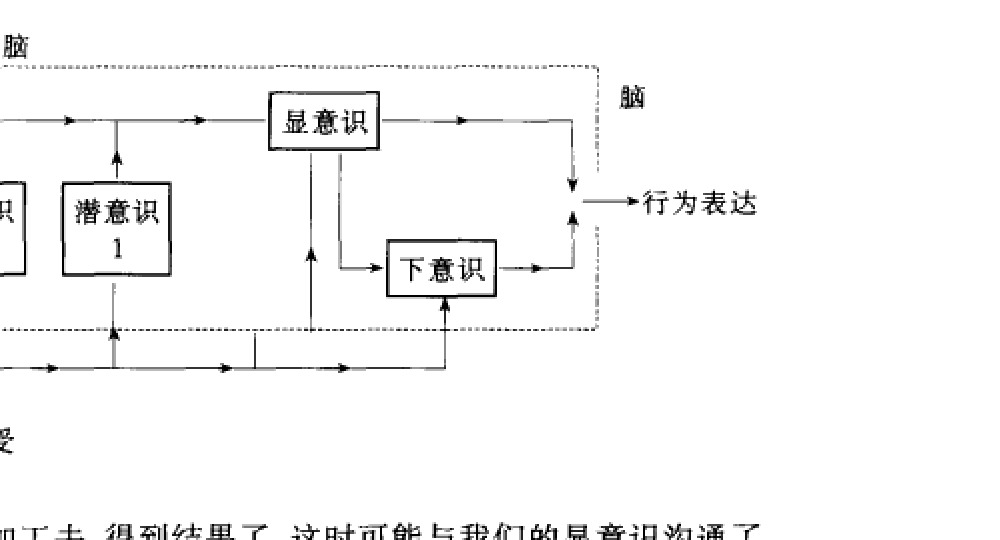
domain, or a three-dimensional domain, to carry out imagery thinking. In this sense, inspirational thinking is closely related to imagery thinking, which is also the meaning expressed by Comrade Hu Jianping.
How should this work be done? I feel that for now we can only be patient. The breakthrough lies in imagery thinking; if imagery thinking is resolved, then inspirational thinking will be relatively easy to resolve. At present, we can only collect materials. But descriptions of inspiration are sometimes heavily colored and embellished, so when collecting materials, one must be especially careful to ensure authenticity.
I would also like to add a point of disagreement. Comrade Zhang Tiesheng of the Institute of Cognitive Science at the Shanxi Academy of Social Sciences, following Kohler’s formulation, considers “insight” to be “sudden enlightenment” (顿悟), which would make sudden enlightenment the same as intuition (直感). I have some reservations about this. It appears that Kohler’s understanding of the word “insight” is mistaken. My understanding is that insight is intuition (直感), not inspiration (灵感). The English word for inspiration is a different word: “inspiration.”
What does insight mean? For example, when a student is discussing a problem with a great scientist, the student feels that the problem has no clues and is unclear. But the scientist says it is very clear. Then the student goes and carefully analyzes it and does some experiments, proving the scientist is correct. Why could the student not see what was going on, while the teacher saw it at once? If I were the student, I would ask the teacher what was going on. The teacher’s answer would be that it is hard to explain clearly; if you study hard and gain experience and enrich your knowledge in the future, you will be able to do this too. This means it is not science but the accumulation of experience; it is part of imagery thinking, or the intuition of imagery thinking within science. It is also what we often say: this person has seen the core of the problem. Just as McClintock “conversed” with corn and saw the core of the corn problem. But inspiration is different; it is not something we can obtain within our consciousness, and it often comes when we set consciousness aside—for instance, when sleeping or doing something else—and suddenly arrives; it comes and goes without a trace. Intuition, or insight, however, for an expert, comes and goes with a trace; it can be fathomed. Many people are now discussing this issue, but for example, Comrade Ye Weisheng of Tianjin Hospital also conflates intuition with inspiration, and as a result regards both intuition and inspiration as functions of the human subconscious. I want to emphasize: intuition belongs to the conscious mind (显意识), while inspiration belongs to the subconscious (潜意识). From my own experience, I sense there are these issues. Whether what I have said is correct or not, I ask comrades to study and discuss.
In the above four sections, I have discussed the foundational sciences of cognitive science—roughly this content, which we may call “cognitology” (思维学)! Of course, other comrades have proposed many other types of thinking, but I find them not quite precise. For example, some comrades have proposed so-called “fuzzy thinking” (模糊思维). I think this should not be called fuzzy thinking; it is probably “fuzziness of thinking” (思维的模糊).
Applied Sciences of Cognitive Science
Below I will discuss several areas in cognitive science that are closer to the applied level. I will not cover them comprehensively; I will only address a few issues that I currently recognize.
1. Information Science and Technology
Regarding information science and technology, about a year ago, a conference on information work within the National Defense Science and Technology Commission system was held. At that conference, I gave a talk on the scientific and technological issues in scientific and technological information work. Why did I raise this issue? I feel that the importance of scientific and technological information within science and technology is clear to everyone, and leadership has always attached great importance to it. In our national defense research system, information work has always been placed in a very important position, with a fairly strong team of over one hundred thousand people organized. However, in the past, scientific and technological information was always considered merely as a type of work, without recognizing that to do scientific and technological information work well, one must also study its own scientific and technological issues. For example, is there a discipline called “information science” (情报学)? I believe there is. It is, of course, an applied science—one that elevates information work to a theoretical, systematic body of knowledge, enabling scientific and technological information work to form an effective organizational and structural system.
Once we have information science, the specific science and technology needed to carry out this work constitutes information technology (情报技术). Information technology is also very broad—for example, the technologies used in databases today are numerous, involving electronic computers, magnetic tapes, magnetic disks, optical disks, and so on. Retrieval requires a complex system. The other two aspects also involve many specialized technologies. All of these fall under information technology.
Information science and technology belongs to the applied scope of cognitive science, or the technological-science level. There are now many people engaged in this work, and there is an urgent need to use the concepts of cognitive science to earnestly develop this field.
2. Linguistics and Information Science
The applied science level of noetic science is linguistics. Scientific linguistics has already become a very important field, for the reason that the transmission of information is always related to language. Moreover, often for various reasons—whether for confidentiality or to ensure that information is reliably transmitted and resistant to natural or artificial interference—there is also the problem of encoding and decoding. One of the most important means we now use for transmitting information is radio waves, for example via communications satellites. That is to say, when you transmit information, this fact is known to everyone, and anyone can receive this information. The problem is that if you do not want them to receive it, you must encode it and keep it confidential. This is a major problem, a major field of study. As mentioned above, research on scientific language also contributes to the study of imagery thinking, because it appears that human natural language is not solely a matter of logical reasoning; it seems that imagery thinking is already involved. In this area, there is already a fine team working on it. Those of us who study noetic science should value this work.
Another aspect is information science. Regarding this question, there is not yet unified understanding. What is information? There are all kinds of views. People often speak of the American scientist Wiener. I had contact with this person; he often spoke in a joking manner, so what he said was not always entirely serious. Wiener once said: “What is information? Information is neither mental nor material.” This remark seemed to be made in jest, yet everyone quotes it. So what exactly is information? There are all kinds of explanations. I believe there is nothing mysterious about information. Information consists of a point of origin, a transmission channel, and a receiving point. What is used to transmit it? Transmission is definitely the movement of matter. For example, when I speak here, what is transmitted is a sound wave. What is a sound wave? It is the movement of air. If the transmission is via radio waves, then it is the movement of electromagnetic fields. Pursuing this line of reasoning, all information transmission is the movement of matter; there can be no other form. It is simply a matter of how we understand this movement of matter. When we study information, there is a special method: we observe a certain aspect of the movement of matter, and studying that particular aspect is useful to us. The movement of matter exists objectively; the question is how to understand this objective movement, what name to give it, and which aspect to focus on—this is a human choice. Consider: matter always moves in space and time, and matter has mass; from the perspective of motion, this means mass and the position occupied in space and time. Those who study mechanics have abstracted new concepts from this aspect, such as momentum and energy. By the same token, one can also focus on the information-transmission aspect of the movement of matter. To say that it contains an information quantity—this is the question studied in information science. Starting with C. Shannon, information was made scientific and quantified. Therefore, my personal view is that information is still the movement of matter; it is just that a certain aspect of the movement of matter has been abstracted by us.
I recently saw an article by Comrade Hu Fuchen of the Institute of Literature, History, and Philosophy at Shandong University discussing “generalized information theory.” His generalized information is indeed very broad; it is actually about entire systems. When discussing systems, there is of course information within them; within a system there is information transformation and also the problem of control. Therefore, when discussing these issues, people often propose the “three theories”—systems theory, cybernetics, and information theory. These three theories are now very popular, and our social science community has also accepted the viewpoint of the three theories. Everything is the three theories. I think this is a confusion of thought. How can there be three theories? In reality, the core issue is the system—there is only one theory, namely systems theory. Within a system, if you look at the aspect of information transmission, then there is the information problem; if you look at the aspect of control, then there is the control problem. Therefore, at a conference the year before last, I said it is not three theories but one theory—systems theory. The other two theories are included within systems theory. By putting it this way, perhaps comrades will say that I use systems to subsume information and control, while Comrade Hu Fuchen uses information to subsume systems and control. I think the structure within an entire system is extremely important; the functions arising from the system’s structure are of course also extremely important, and functions necessarily involve information transmission and also control problems. Would this not be a more realistic way of putting it?
On the Structure of Noetic Science
Now let me say a few more words about the structural problem of noetic science. Regarding the structure of noetic science, it is the same as other major departments of science and technology: what most directly transforms the objective world is the engineering-technical type of discipline, such as intelligence technology; the theory that guides it is the technical-science type of discipline, such as informatics; and then, by abstracting and synthesizing these, one arrives at the basic science of this category. And all science,
The final and highest generalization is, of course, Marxist philosophy. The core of Marxist philosophy is dialectical materialism. Between each branch of science and Marxist philosophy there is a bridge—that is, the principled content of that field is generalized and connected to Marxist philosophy. I call this a bridge, and it also constitutes the foundational structure of Marxist philosophy.
1. On Epistemology
Marxist philosophy is the highest generalization of humanity’s understanding of the objective world. Marxist philosophy must, of course, guide research in noetic science; and the development of noetic science will inevitably enrich and deepen Marxist philosophy. This coming and going—from Marxist philosophy to noetic science, and from noetic science to Marxist philosophy—has, as its bridge, epistemology, in my view. Naturally, this also involves the development of epistemology itself. The epistemology I speak of here is no longer the classical epistemology of dialectical materialism; it must be developed. I looked up the entry on epistemology in the Concise Dictionary of Social Sciences (Shanghai Lexicographical Publishing House, 1982), which contains the following explanation: “A philosophical theory that studies the essence of cognitive activity and its developmental process. Its main contents include the connection between the subject and object of cognition, the development of perceptual and rational cognition, the nature of truth and its developmental process, and so forth… The epistemology of dialectical materialism elevates practice to the primary position and applies dialectics to epistemology, overcoming the deficiencies of old materialist epistemology, scientifically revealing the essence and developmental laws of human cognitive activity, and correctly resolving the fundamental questions of epistemology.” This is an assessment of Marxist epistemology. The entry goes on to state: “The development of modern science and technology has brought about enormous changes in the subject and object of cognition, as well as in its means and methods. Researching and summarizing these changes and making philosophical generalizations has become a new task for epistemology.” I agree with these statements. Epistemology should not be regarded as fixed; it must inevitably develop, because humanity is evolving and human knowledge is developing.
Some comrades do not entirely agree with the views I have just expressed. For example, Comrade Cao Lifeng from the Central-South Institute of Mining has an article titled “A Preliminary Exploration of the System of Noetic Science,” with the subtitle “Also a Commentary on Comrade Qian Xuesen’s Proposal Regarding the System of Noetic Science.” He believes that epistemology is a foundational science of noetic science and belongs to the basic theory of noetic science. His “epistemology” also includes scientific methodology, imaginal thinking, and inspiration. And his basic theory also includes logic, encompassing both formal logic and dialectical logic. In addition, there is a physiological foundation parallel to the basic theory—things like brain science. Comrade Cao Lifeng believes that the technical sciences of noetic science include systems theory, information theory, and cybernetics. These “three theories” have appeared once again. His formulation touches upon the system of disciplines as a whole—what counts as natural science, what counts as systems science, what counts as human body science—all of these are no longer distinguished. This is one line of argument. Comrade Fu Shouzong from the Institute of Philosophy at South China Normal University disagrees with Comrade Cao Lifeng’s claim that logic is the basic theory of noetic science. However, he too says that epistemology is a foundation, not a bridge. He also says that noetic science has only basic theory and applied science, without the three levels of foundational disciplines, technical sciences, and applied technology.
Thus, there are many opinions on this matter, and exactly what structure noetic science should have is something everyone can still research. My views are as I have stated above.
2. Does Noetic Science Include Brain Science?
I believe the following additional questions regarding the system of noetic science are also worth examining.
First, there is the question of the systemic structure of science and technology. We cannot discuss noetic science solely in terms of noetic science itself; we must consider its relationships with other departments of science and technology, such as human body science and systems science. One cannot pull things from systems science and human body science into noetic science and incorporate them into its system. I believe that studying the activity of the human brain is, of course, extremely important, and it has a very close relationship with noetic science. Nobel laureate R. Sperry holds that consciousness and mental activity constitute the highest level of brain activity. Brain activity has many levels, and the highest level is the activity of spirit and consciousness. He calls the study of the highest level of brain activity “Mentalics.” Mentalics is also related to psychology. However, mentalics and psychology should be placed within the system of human body science, because they involve not only thinking and consciousness but also the foundations of human body science.
Not long ago, I came across a conference proceedings published in 1983, entitled Synergetics of the Brain, edited by four editors, among whom I am relatively familiar with H. Haken. He is the founder of Synergetics—synergetics is in fact systems science; he calls it synergetics. After reading this book, one realizes that the so-called mentalics proposed by Sperry—the study of the highest level of human brain activity—is very difficult to establish. What is the synergetics of the brain? It is their view that past methods of studying the brain often involved using probes to measure electrical potentials, whereas the brain
It is such a complex system; the activity of the brain cannot be thoroughly studied from any single local perspective—one must study the activity of the brain as a whole. This is the viewpoint of synergetics. In the opening article of the collected volume, H. Haken emphatically states that the brain cannot be treated as a mere superposition of so many neural units. It is a collective, but the activity of this collective is far from something that can be resolved by simply adding up the activities of individual nerve cells. He particularly criticizes the probe-based research methods used in the past. Are probe measurements correct? Of course they are—the point measured by the probe does indeed have a potential change. But you do not know whether other points also have changes, because you have not measured them simultaneously. This kind of research method is thus highly problematic—you know one thing but not the rest.
This reminds me of some arguments by the famous Swiss psychologist J. Piaget. He believed that in studying psychology, if one starts from a phenomenon and seeks an explanation for that phenomenon, it is like the blind men touching the elephant—one fails to see the whole. Human activities are all interrelated; observing the brain’s activity from only one point and then attempting to make an explanation means that one explanation works, another explanation also works, and many explanatory approaches can all seem to hold. Why? Because you have not seen the connections among all these factors and their coordinated actions.
I have seen foreign commentary stating that there are two paths to studying consciousness and human thinking. One path is to study the brain—brain science. The second path is to start from psychology, artificial intelligence, or what is called cognitive science. The commentary says that taking the first path appears to be the most fundamental and thorough, but this road is very long, and it恐怕恐怕 will not yield results for a while, so we still have to take the second path.
At this conference, there is a paper by Comrade Liu Jinlong of the Aerospace Medical Engineering Research Institute of the National Defense Science and Technology Commission, which also addresses this point. What do I mean by saying all this? I mean that we should not confuse noetic science with human body science. If we adopt a more thorough approach, that road is extremely long, and I am afraid that no results will be forthcoming for a while; we still have to rely on methods internal to noetic science itself to conduct research. Just as the structure of matter can of course be traced down to elementary particles, to sub-elementary particles and quarks, but for many years chemists studying molecular structure have not waited for the elucidation of these deeper structures; chemistry remains chemistry, and there is no need to cross disciplinary boundaries into physics or elementary particle physics.
3. Is Logic the Sole Foundation of Noetic Science?
The second question is: some comrades say that the foundation of thinking and noetics is logic. I wonder whether these comrades have been influenced by the definitions of classical theories of thinking. The classical definition holds that logic and the science of logic are the only laws of thinking; human thinking is logic, is abstract thinking. This view has great influence in our country; many people cling to this point and cite classical works as their basis.
However, I feel that ancient scholars considered only abstract thinking worthy of being called academic research. Practical experience, a child learning to speak, or a craftsman’s manual skill—all these were considered unworthy of serious attention and could not be called thinking. I wonder if this is not the case? We, of course, disagree with this view. We seek truth from facts: human thinking is what it is. It now appears that regarding human thinking solely as abstract thinking is incorrect.
4. The System of Modern Science and Technology
The third question is: Marxist philosophy is developing, and the core of Marxist philosophy is dialectical materialism. Dialectical materialism is the highest generalization of humanity’s scientific understanding of the objective world. However, outside this core of Marxist philosophy there is also a hierarchical structure—why should we not allow for bridges? Bridges are the more fundamental parts below the core structure, connecting to the various sciences and technologies, the more direct parts. The entire set of bridges plus the core constitutes Marxist philosophy; that is, Marxist philosophy itself also has structure and hierarchy.
My view is: First, when we consider the structure of a given department, we cannot discuss that department solely in terms of itself; we must see the whole. Noetic science and human body science should still be kept separate. Second, epistemology must also develop; the classical achievements were great accomplishments in their time, but we cannot cling to classical formulations and refuse to let go.
When we study the system of science, we do not approach it from the perspective of how human thinking develops as a process. If we were to consider it from that perspective, then the most fundamental would of course be human body science. Initially, one always starts from the human being—it is the human who cognizes the objective world. So human body science would become primary. Human body science operates through human thinking, so below it is noetic science, and then, through human cognition, one ultimately arrives at…
worldview, there have emerged such departments of natural science, social science, mathematical science, and systems science. Arranged in this way, the highest level is human body science, the second is noetic science, and the four departments below are natural science, social science, mathematical science, and systems science. This is how we approach the problem. We believe there are several scientific departments, all of which must ultimately be subsumed into Marxist philosophy. I think this is relatively consistent with the concept of a system of science and technology.
5. Aesthetics
Regarding noetic science and aesthetics: What is aesthetics? I am not an expert in this field and do not have much authority to speak. I previously said that aesthetics is also a part of noetic science. Now it seems that this cannot be said. Below I will discuss my current understanding. What is beauty? Comrade Li Zehou once said that beauty is the unity of the subjective and the objective after the interaction between subjective practice and objective reality. If this is achieved, then a person feels it is beautiful. And this interaction is carried out through thinking. Therefore, the study of aesthetics is certainly inspiring for noetic science, and the achievements of noetic science will also contribute to the study of aesthetics. I already mentioned this point earlier when discussing the science of imagery and intuitive thinking.
However, it must also be made clear that aesthetics is not merely thinking. There are other very important aspects. According to Marxist principles, beauty is inseparable from society; literature and art are products of society. This point is made very clear in classic works of aesthetics, such as G. V. Plekhanov’s “Letters Without an Address,” where he repeatedly emphasizes this point: beauty is a product of society. Therefore, aesthetics cannot be called noetic science; one can only say that noetic science and aesthetics have a very close relationship, and that aesthetics is a neighboring science of noetic science. I think this point has much practical significance. For example, in today’s society, people live in different environments, have different experiences, and their cultural levels, knowledge, and intelligence are not all the same—all of these affect a person’s sense of beauty.
Regarding literature and art, we previously recognized that they have vertical divisions—for example, fiction, poetry, plastic arts, architecture, music, drama, and so on. This is acknowledged by everyone; the divisions of literary and artistic departments are vertical. However, I believe that literature and art also have horizontal divisions and levels. In fact, this is not my own words; Comrade Mao Zedong said it very clearly in his “Talks at the Yan’an Forum on Literature and Art”: there is “high-brow art” (yangchun baixue) and there is “popular art” (xiali baren). If we do not recognize this and do not consider the influence of a person’s social existence on their sense of beauty, then it does not conform to Marxism, nor does it conform to Plekhanov’s classic work that everyone often cites. This is also made clear in Comrade Mao Zedong’s discourse.
However, some people nowadays seem to think that literature and art have only the single level of mass appeal, and they do not take other levels seriously. This is a reductive approach. Of course, in terms of numbers, mass appeal is very important, and it is right for us to focus on it. But we cannot only attend to “popular art” and neglect “high-brow art,” as if there were no higher level—that would be wrong. We should popularize under the guidance of elevation, and elevate on the basis of popularization. These are not problems that noetic science can solve; it is a field of learning with a very strong social influence. Therefore, the problems of aesthetics are more complex and involve more social issues than noetic science. Aesthetics cannot be placed within noetic science. I hereby correct my previous statement. On this issue, I exchanged views with Comrade Li Zehou of the Institute of Philosophy at the Chinese Academy of Social Sciences, and our understanding is consistent.
6. Is There “Special Thinking”?
The question I want to discuss now is one about which I am even less certain, and that is special human functions (extraordinary functions). Special functions are functional states of the human body that a person can control themselves, and these functional states are certainly closely related to the activity of the human central nervous system. Therefore, we may ask: Could qigong and special functions lead to another kind of extraordinary thinking activity in humans, that is, “special thinking” activity? Of course, in our country there are many ancient sayings. For example, Buddhism says “samadhi gives rise to wisdom”—“samadhi” refers to dhyana, which is Buddhist qigong. This means that Buddhism holds that practicing qigong will increase your wisdom. At present, Comrade Ye Jun of the Institute of Human Body Science and Dialectics of Nature at the Sichuan Academy of Social Sciences has also raised the question of special human thinking.
Many foreigners now say the same thing. For example, a book written by John H. Crook devotes considerable space to discussing the influence of qigong on human intelligence. In this book, qigong is called TM (Transcendental Meditation), and it states that through TM one can increase and develop human intelligence. The purpose of studying TM is to investigate whether there is further possibility for human intelligence to be additionally brought into play—this is one view. Not long ago I also saw another book whose two authors are both researchers at the Stanford Research Institute in the United States. The title of this book
called Mental Olympics. Its meaning is that people with extraordinary functions compete with people without extraordinary functions. They use many scientific measurement results to prove that humans do indeed possess extraordinary perception. Moreover, these extraordinary perceptions can be gradually cultivated, and the process of cultivation requires that you not be disturbed by conventional thinking — the more you free yourself from the interference of conventional thinking, the more distinctly your extraordinary thinking can manifest. This is yet another perspective.
Furthermore, if we consider this problem from a more profound angle, it connects to the philosophical interpretation of quantum mechanics. We know that since quantum mechanics emerged, it has been about sixty years now, has it not? During this time, the correctness of the conclusions of quantum mechanics has all been confirmed by practice, and on this point there is no disagreement. However, there are different opinions on how to interpret quantum mechanics. Because according to the viewpoint of quantum mechanics, all matter interacts; there is no isolated matter. This seems to have disrupted causality. Regarding this point, Einstein was never quite satisfied; he argued with Niels Bohr, continuing the debate until his death. On this question, the so-called EPR theory was proposed in the 1930s — E is Einstein, P is Podolsky, and R is Rosen. These three published a paper in the 1930s proposing the theory of hidden parameters. That is, the spacetime used in quantum mechanics is not real; it is merely an appearance, and there is something more fundamental hidden beneath it. What exactly is hidden beneath has not yet been clearly stated.
Recently I read an article whose author is a science journalist who went to interview D. Bohm, a professor of physics at the University of London. Bohm is a highly accomplished physicist who has written theoretical works on quantum mechanics. When Bohm was young, he even met Einstein, so he was very clear about Einstein’s views. In 1980, Bohm wrote a remarkable book called Wholeness and the Implicate Order. He said that the four-dimensional spacetime we are now familiar with is not a good way to truly describe matter; there is something more profound, namely what he calls the implicate order — the order hidden beneath — and he calls what we see the explicate order. He said that in the implicate order, all matter is interconnected, and this interconnection can be transmitted faster than light. Of course, his theory has not yet been fully established, but he holds this basic viewpoint. Interestingly, when he discussed this fundamental viewpoint, he told the journalist that if this theory were established, it could explain all extraordinary functions.
Therefore, looking at the situation from all sides — whether the words of ancient China, or the statements of modern foreigners regarding qigong and extraordinary functions, or even Professor Bohm’s viewpoint on the implicate order — all seem to vaguely indicate that there is another kind of thinking, namely extraordinary thinking. Whether this is indeed the case, I invite everyone to investigate.
Thinking Science and Intelligent Machines
Below, I would like to bring these issues together. Our ultimate purpose in studying thinking science is to serve socialist construction. We now face the challenge of a new technological revolution and the advent of an “information society.” What contribution can thinking science make to such an important question? This question relates to a meeting we held a few days ago: the “Fifth Generation Computer Expert Symposium.” The Japanese proposed the development of fifth-generation computers a few years ago, claiming that their fifth-generation computer would have many breakthroughs compared to existing electronic computers. For example, it would include an image information processing system (PIPS) — that is, computers capable of recognizing images. There would also be a knowledge information processing system (KIPS), meaning that everything in the knowledge base could be utilized by the machine. Then there would be expert systems. Finally, all of these would be systematically integrated and combined with logical computation to form a unified system. If such a system could be built, it would no longer be called a computer; it would be far broader than a computer. I think it could be called an intelligent machine. Because a computer just computes; at best, it can only utilize that portion of knowledge which has been elevated to science. The pre-scientific, experiential portion cannot be computed — that is not a matter of reasoning, but a matter of imaginal (intuitive) thinking.
As I mentioned earlier, the image processing system contains experiential components, and experience is also knowledge. So knowledge is far broader in scope than science. This is even more true for expert systems. An expert system is the experience of experts. For example, given one, two, three, you get nine. If you ask him how it is that given one, two, three, you get nine, he cannot explain clearly — just remember, if there is one, two, and three, then there is nine. This is experience summarized within a certain domain, but this experience has not yet been elevated to modern science. Such experience is stored in the knowledge base. If these specialized
family systems are incorporated into the system, together with a knowledge base, then the problems handled by this system will far exceed the scope of science, bringing human practical experience into the system as well. So this is no longer merely a computer; it is a system that fully utilizes human knowledge. In the United States, this approach is called knowledge engineering. I think this makes sense—it is human knowledge, the entire spiritual wealth of humanity, that we now want to utilize through a machine. Of course, this does not mean that the very first intelligent machine will be able to achieve all this. But if it can ultimately be accomplished, that will be a great achievement.
Let us now analyze whether the Japanese proposal makes sense. I believe it does. I think the new factor here is finding ways to incorporate human experience into the system. Human speech and human character recognition both involve experiential factors. This connects to imagery thinking. Imagery thinking is broader than abstract (logical) thinking. Logical thinking only solves scientific problems, whereas imagery thinking brings into use pre-scientific knowledge that has not yet been formed into science. This is the issue of intelligent machines.
The volume of humanity’s spiritual wealth today is enormous, and our current difficulty lies in not being able to utilize it well. In the past, our old approach was to study or to seek advice, but this method is far too backward. There are many things we do not know, cannot know, have no way of knowing, and have no time to learn. The ancients said that studying relies on memorization—a person may live and study to old age, yet what one can memorize is still only so much: “white-haired, exhausting the classics.” This means that one’s hair has turned white and one is still studying, endlessly. Now there is a solution: it does not matter whether you memorize or not, because you can access information through modern electronic equipment. How could this be a trivial matter?
I once wrote in an article on information systems (On Systems Engineering, Hunan Science and Technology Press, 1982, p. 26) the following passage: “After we have discussed the establishment of a modern information science and technology, library documentation, and archival information system, let us reflect on what a tremendous change this will be. From birth, a person has always had to use their brain to memorize the knowledge generated by the social and practical experience of humanity and of oneself. This is especially true for mental laborers. The ancients praised a scholar as being ‘broadly learned and strongly retentive,’ which shows the importance of retaining learning in one’s brain. Although what each person can memorize differs—some more, some less—it is always limited. Compared to the volume of knowledge accumulated by humanity over thousands of years, it is but a drop in the ocean, which is why our predecessors also spoke of ‘white-haired, exhausting the classics.’ In the future, we will be thoroughly liberated from this burdensome mental labor. Looking up materials will become as convenient as if they were stored in one’s own brain, and then there will be no need to tax one’s brain with memorization. A computer terminal will suffice. If we think one step further: what are intelligence materials, library documents, and archives? Do they include literature? Of course they do. Do they include painting? Yes. Do they include music, musical scores, audio recordings, video recordings, and so on? Of course they also include these. And they include cultural relic archives, and even through holographic photography, they can include the plastic arts, such as sculpture and so forth. Then the information system we are designing can virtually encompass the entire spiritual wealth created by humanity over thousands of years, and still being continuously created. This entire spiritual wealth can in turn be accessed and enjoyed by any one of us at will. This will not only liberate us from the old mental labor but also bring us a great new world, a new world of high culture such as has never existed before. Is this not an earth-shaking transformation? If the brain no longer needs to spend its effort on memorization, then what will the brain do? People liberated from the heavy mental labor of memorization will be able to concentrate their wisdom on organizing humanity’s knowledge, examining it comprehensively, synthesizing and integrating it, and thereby engaging in more and higher forms of creative mental labor. People will become wiser, and the pace of humanity’s progress will accelerate even further.”
What I have just described shows that if we do not develop intelligent machines, we will be overwhelmed by the vast spiritual wealth that humanity itself has created. If we do develop them, then this enormous spiritual wealth can be utilized by people, greatly enhancing human intelligence.
It appears that these issues involve imagery thinking. If this problem is solved, we will further be able to solve the problem of inspirational thinking. It can now be said that there is a doorway into research in this area—through intelligent machines, especially expert systems. For whether it is an image information processing system or a knowledge information processing system, in essence they are all things like expert systems: they put experience and knowledge to use. The concept of expert systems has already been used in artificial intelligence and is gradually developing. Many comrades in our country are now doing this work. For example, traditional Chinese medicine diagnosis has already been computerized, which is in fact an expert system. So expert systems are not something difficult. The question now is how to further improve them—how to collect the expertise of different experts and different experiences, and utilize them in a comprehensive and integrated manner. On this question, I read an article by Comrade Ma Xiwen, in which the section on artificial intelligence addresses precisely this issue. According to Comrade Ma Xiwen’s view, this work can be done. That is, different small expert systems can be linked together to form
into a unified large system. When we encounter problems, we can search within this large system for the most suitable expert system, and then use that expert system to solve the problems. Of course, the first generation of intelligent machines may still be rudimentary when produced, but it will have taken a step in this direction, and that is extremely important. In the future there will be second and third generations, and by continuing this work, we can ultimately mobilize and utilize the entirety of humanity’s intellectual wealth. This is a momentous undertaking. Such a task is closely related to our noetic science. Noetic science must also advance through this task—for example, by solving the problem of imagery thinking. Given this, we noetic science workers face the question of how to participate in the work of first-generation intelligent machines and how to contribute to China’s first-generation intelligent machines. Within our noetic science community, can we organize a force to contribute to China’s first-generation intelligent machines? This is an important, national-level task. Whether this is feasible, I invite everyone to discuss.
The Question of Academic Organizations
This meeting of ours is an academic symposium, and academic discussion inevitably requires some form of academic organization. On this question, I addressed a passage at the end of my article “On Noetic Science.” My meaning was: what kinds of organizational activities should noetic science undertake? First, establishing research institutes; second, setting up academic programs in universities; third, establishing academic organizations.
At present, it appears there is already one research institute nationwide—the Institute of Noetic Science established within the Shanxi Provincial Academy of Social Sciences, with Comrade Zhang Guangjian as its director. As for what academic programs should be set up in schools, I am not entirely clear. Regarding academic organizations, as far as I know, regional academic organizations already exist: Shanxi Province has a “Noetic Science Professional Group under the Natural Dialectics Research Association,” and Heilongjiang also has the Heilongjiang Provincial Noetic Science Research Association.
1. The Question of Personnel
In this light, an urgent question to consider is the establishment of a national-level academic organization for noetic science. In the past, we established the Systems Engineering Society. Compared with systems engineering, the situation for noetic science today is somewhat different. In 1979, when the National Defense Science and Technology Commission supported the convening of the National Systems Engineering Academic Symposium, systems engineering had only tasks but virtually no personnel—very few people were engaged in systems engineering. However, the situation for noetic science today is different. Everyone present here is an expert, and our ranks can be said to be quite large. For example, in the field of scientific and technical information work, the defense sector alone has over a hundred thousand people, and they already have a Chinese Society of Scientific and Technical Information. Another example is literary theory, which is related to our imagery thinking; it also has a body of personnel, though I am not sure of the exact numbers. Furthermore, there must be several hundred normal schools, teachers’ colleges, and normal universities nationwide, and within these institutions there are people working in literature and aesthetics—probably numbering in the thousands—and they too are related to noetic science. Then there is the community working on information, encoding, and decoding, which also has considerable strength within defense departments. There are also linguists, scientific linguists, psychologists, brain scientists, as well as talents and organizations in artificial intelligence, robotics, creativity studies, intelligence engineering, and other areas. When we think about it this way, the number of people who could participate in our noetic science academic organization is enormous.
Moreover, we must recognize that these comrades have long been doing a great deal of work in their respective fields, and most of them already have their own academic organizations. We are latecomers—like the younger brother, while they are the older brothers. Now this younger brother wants to unite the older brothers into a collective noetic science research body. Will this be somewhat difficult? Yet such unification is very necessary. How should this work be done? I have thought about it again and again, and it seems there is only one way: we must promote the structural framework of noetic science. We must make everyone understand that by uniting and forming a system, each of our individual tasks can be accomplished faster, better, and more effectively.
2. The Work of Investigating the Situation
Based on my experience, this is different from systems engineering. Systems engineering grew from nothing, from small to large. Our ranks are already very large, but they have not been united into a system. Now we are calling for the formation of a system, and this requires persuasive work.
Therefore, I suggest that if this meeting is to establish a preparatory group for a national academic organization, this preparatory group should carry out the following investigative and research work.
First, it should investigate which academic organizations related to our noetic science already exist, what the circumstances of these academic organizations are, and what they will need to do in the future.
How should they be arranged if they join our academic body for noetic science, and what contributions will they make? After investigation, a formal report must be written and distributed to everyone at the inaugural conference in the future.
The second area of investigation concerns professional teaching. Specifically, in our country’s colleges and universities, what departments and majors are related to noetic science, and what courses are offered? Are there graduate students in noetic science? All of this material must be made concrete—down to which school, which department, which major, which course, and who the responsible instructor is. Finally, a report must also be written.
The third area of investigation is to determine which journals are publishing articles on noetic science. As of now, I know of Nature Journal (Shanghai), Exploration of Nature (Sichuan), Seeking Truth Journal and Noetic Science Information (Heilongjiang), and Noetic Science Research Newsletter (Shanxi); there are also Latent Science, Science Exploration and Nature Information (Hunan Science and Technology Publishing House), and Artificial Intelligence Research (Hunan University), and so on. The journal titles I have listed are only those I have personally encountered and are by no means complete. We must have a clear picture of this situation as well, so we need to conduct an investigation and produce a report to be distributed at the inaugural conference of the society.
Everyone can think about whether there are other matters that need to be investigated. This is the foundation for establishing our academic organization, and clarifying these circumstances through investigation is also one of the tasks of the preparatory group.
3. We Must Have a Fine Academic Style
Regarding the academic organization itself, I do not have any fully developed opinions to offer. I hope that, following the procedure of the Systems Engineering Society, with support from the former National Defense Science and Technology Commission and now the Commission of Science, Technology and Industry for National Defense, we can first convene a national academic symposium of this kind, invite everyone to attend, meet one another, exchange views, and then deliberate on the establishment of a preparatory group. After one year of work, could we consider formally establishing the society in 1985? At this meeting, we can only deliberate on and consider forming a preparatory group.
Previously, in my article “On Noetic Science” published in Nature Journal, I urged that the core members of this society should be genuinely capable people in their thirties and forties, or perhaps a bit older—people of my age will not do. My reasoning is that this team must carry its work into the twenty-first century, and we old comrades will not be up to it. If suitable middle-aged and young people cannot be found immediately and the old still need to exert themselves a bit, they can serve as advisors; the main work must still be carried out by middle-aged and young comrades.
Our society must have a fine academic style. We must carry out the work of the society seriously and rigorously; we cannot be casual, much less adopt a charlatan’s attitude. In scholarship, the attitude must be earnest and serious. Of course, seriousness does not mean a lack of liveliness. We should exchange views sincerely, maintain a lively atmosphere, and speak our minds. I believe that in this new field of noetic science, there are no authorities, so we absolutely must not practice a one-voice system. Everyone should express their views fully, exchange with one another, and it does not matter if there are arguments. If consensus cannot be reached for the time being, that is fine—take it slowly. In short, we must be both serious and lively, fully promote democracy, and let a hundred schools contend and a hundred flowers bloom. Only in this way can our academic organization succeed.
I feel that once we promote noetic science, it will become a popular topic. Because nowadays, whenever people discuss strategies for the new technological revolution, the information society, and so on, all of these are related to noetic science! But we must also remain calm. How do we stay calm? We have an advantageous condition, namely Marxist philosophy—this is the sharpest weapon, and we must pay attention to applying Marxist philosophy. The obvious errors of some famous foreign scientists that I mentioned earlier all stem from the problem of departing from Marxist philosophy and deviating from dialectical materialism. Noetic science is not like mechanical engineering, which is entirely material; noetic science frequently involves questions of spirit and the relationship between spirit and matter. Therefore, on this issue, we must employ Marxist philosophy and dialectical materialism. Otherwise, you will easily fall into one of two traps: one is mechanical materialism, and the other is idealism. So we must apply Marxist philosophy in our work.
After the academic organization is established, it must have an affiliated institution. Everyone can consider how this affiliation should be arranged.
At present, regional organizations are being established earlier than the national organization. Therefore, after the national organization is established in the future, how to maintain contact and coordinate with regional organizations will also be an issue requiring study. These, too, are tasks for the preparatory group.
Image (intuitive) thinking is what our noetic science must now break through, and since the development of intelligent machines has already been placed on the agenda, this also exerts pressure to achieve a breakthrough in image thinking. For many years, this problem has remained vague and implicit. As the ancient Chinese saying goes, it can only be
…can be grasped but not expressed in words; what can be expressed in words are all clearly explainable problems, whereas image (intuitive) thinking currently cannot be explained clearly. If in the future we can say it has been explained clearly, even if only a little bit, it would be no small matter; I say that would be another scientific revolution in human history. Therefore, I say that the science of thinking is pregnant with a new scientific revolution. On the other hand, research in the science of thinking will also promote the development of intelligent machines, raising human knowledge and intelligence to unprecedented heights—this will certainly be a technological revolution.
(August 1984)
IX. From Brain Science Research to the Science of Thinking
Research in the Science of Thinking Must Take the Path of Brain Science and Human Science
Today was a learning experience. The speaker convinced us. At first, as a novice like myself, I used this time to gain an introduction to such a complex problem. I truly feel that studying human thinking from the perspective of brain science is probably extremely difficult, because the things that can be experimented on are still things that cannot speak, and as thinking of the human brain, they are still very, very simple. Human thinking is much more complex. What exactly is going on in the association areas, and how is information processed? Connecting this to human thinking is probably very difficult. The experiments being done are also very simple. It is not easy for the science of thinking to take the path of brain science and human science. I hope there will be breakthroughs on the path of brain science. There is also another path, which is to look at human thinking from the macroscopic perspective of the science of thinking and see what patterns exist. I see at least three types of human thinking: one is abstract thinking that everyone is familiar with; another is image thinking, or what might be called sensory thinking; and the third is sudden inspirational thinking. The first type is the easiest for people to accept—abstract thinking; as soon as it is mentioned, people think of it, and these are the laws of thinking that people have recognized. The laws of abstract thinking and logical thinking are relatively clear, but when it comes to image thinking and intuitive thinking, they are often somewhat less so. This type of thinking is more common in literary and artistic work; when you talk to people in the arts about image thinking, they use that set of literary and artistic language, and after talking for a long time you still cannot figure out what it is—it is very hard to explain clearly. I want to grasp image thinking and see what it really is. Actually, it is easy—it is right before our eyes. Someone has pointed out: humans have a great ability to understand speech; even though everyone has an accent when speaking, and there are repetitions, digressions, and sometimes the grammar used in speech is not necessarily correct and contains errors, we can often understand the meaning of the conversation. If it were only about hearing pronunciation, it would be very difficult to distinguish—that would be troublesome; sometimes sounds are very close but the meanings are different, yet people do not make mistakes when listening. This kind of problem is not a matter of abstract thinking or logical thinking. Nowadays electronic computers use the methods of logical thinking; if you let an electronic computer listen to speech, it would make many errors. We also encounter such problems: the human eye recognizes images, such as characters—they are not printed but handwritten, as in a calligraphy exhibition where characters are written very artistically, like “清风欲来” [gentle breeze about to come]; if you did not know it was the character “来” [come] in “清风欲来,” how much would be lost. But for humans, there is not much difficulty in recognizing them. If you let an electronic computer recognize them, it probably could not. I believe this is a form of thinking other than logical thinking at work. Is this image thinking?
Human Vision, Mathematical Science, and Electronic Computers
Not long ago, I received a letter and some materials sent by several comrades from the biology department of a university of science and technology. During their study period in the United States, they were researching nerves. He wanted to prove that human vision is related to what in mathematics are called geometric shapes of parabolas and macroscopic geometry
relationships, human intuition and cognition are extraordinarily broad. When he wrote the letter, he believed that this kind of cognitive or discriminative ability would be very difficult to achieve using the methods of abstract logical thinking employed by electronic computers. He also cited an article by scientists at the Massachusetts Institute of Technology who work on artificial intelligence machines, demonstrating that this kind of macro-topological image recognition—this sense of overall geometric topology—cannot be solved by the computational methods of electronic computers. Reading this was very inspiring to me, and in my mind I also had doubts about this point: that the methods of so-called imaginal thinking are different from abstract thinking and logical thinking. The research results of those two American scientists seem to support this viewpoint. Why, over so many years, have we done so little research on how humans can speak and understand speech? Even in image recognition, how much do we really know? In the past, research problems were still confined to the methods of abstract thinking and logical thinking that we are accustomed to, and this set of methods simply cannot solve these problems. Mathematical science has developed to such a great extent, but when it encounters imaginal thinking and intuitive thinking, it is still inadequate. This inadequacy is actually a good thing—it means there are still so many blank spots that need to be researched. I hope neuroscience can make more contributions. I would also like to study how children learn to understand speech; this will give us many insights. A child is not born understanding language. How does he learn? How does he start off not understanding much, and then gradually come to understand, eventually developing the great abilities of an adult? I feel that such a process can provide us with inspiration. This is about research methods—we have only just begun to address a small part of the problem.
On Inspirational Thinking
As for the third type, inspirational thinking, that is even more difficult to handle. I see that inspirational thinking is limited to a minority of people; many people have no experience of it. Many of us have debated this, arguing that there is no such thing as inspiration—that it is nonsense—and refusing to acknowledge it, accepting at most two types, namely abstract thinking or logical thinking, and imaginal thinking. They do not acknowledge inspiration, and after arguing for a long time, whether inspirational thinking exists is a matter of human cognition. Human cognition derives from practice: if you have never experienced inspiration, you cannot understand inspirational thinking. This remark is a bit cutting, but it does reflect a genuinely complex situation. If we can do a somewhat better job with the first two types—abstract thinking and imaginal thinking—then it will be easier for us to study the existence of the third type. After hearing today’s report, this idea of mine was further reinforced, because his report touched upon these issues. I also thought about the question raised just now: in studying the human brain, monkeys have been used quite a lot, while chimpanzees have been used much less. Humans are the most complex; if we make a comparison—what monkeys can do, humans can do—and conversely, this can inspire our study of humans. Another point is that humans are probably the same: as just mentioned, a child’s mode of thinking develops from birth. This is also a pathway. I believe that adults are not all the same either, and even the same person is not always the same. Monkeys, chimpanzees, humans—what humans are like in childhood, in adulthood, and in old age—people differ from one another, and this is related to education and work experience. In short, I feel that this problem is indeed very difficult. We need to adopt all kinds of methods, especially the systems perspective that our institute has discussed here many times: the entire human functional system is a large system. The brain is complex enough, but it is not only the brain. This then brings us to the question we have been discussing: we must study it patiently, treating it as a system and as an object of study, which involves system identification and transformation—we must look at the problem holistically. These words of mine may not be entirely correct, and I offer them for your reference.
(February 12, 1984)
10. Agricultural Systems Engineering
Today the topic of this lecture is agricultural systems engineering, that is, the application of systems engineering to large-scale socialist agriculture. By the two of us—
The first author of this article is Zhang Qinwen
I will write the draft and present it myself.
Before discussing the specific content, we must first clarify the meaning of the term “agricultural systems engineering.” There is a certain method of disciplinary classification that places agricultural systems engineering within the scope of “agricultural engineering.” Is this appropriate? We believe it is not. In the preceding lectures, we have already explained that systems engineering has its own distinctive disciplinary theoretical foundation, collectively known as systems science, and systems science constitutes an independent system. In the practice of systems engineering to transform the objective world, basic sciences specifically studying systems will be distilled, and proceeding from these basic sciences, combined with other basic sciences, a series of technical sciences studying common problems of systems will be formed. The disciplines directly engaged in transforming the objective world are the various branches of systems engineering. Therefore, in terms of disciplinary affiliation, each branch of systems engineering can only be understood as a specialty, a branch within the system of systems science, and cannot be confused with other engineering disciplines. “Agricultural engineering” deals with technical means and can be called a “hard science.” Agricultural systems engineering, by contrast, studies organization and management; it is an engineering discipline that deals with both technical means and organizational management, encompassing both “hard science” and “soft science.” Its nature differs from that of agricultural engineering.
Let us first explain what is meant by an agricultural system.
Agriculture is an enormous and complex system—there should be no disagreement on this point. By convention, we already have such terms as “agricultural system” or “agriculture-forestry system.” But why should systems engineering be applied in agricultural production?
First, let us discuss: what is agriculture? Agriculture is the use of solar energy, through biological transformation, to produce things that people need—namely, the food, industrial raw materials, and bioenergy (such as biogas produced by organic matter fermentation, and firewood forests) that people require. It also involves, through the very existence of biological organisms themselves (such as forests and grasslands), transforming nature and creating an ideal environment needed by humanity and by the organisms themselves. This is the definition of agriculture.
The scope of agriculture is very broad. What exactly does it include? We believe that, in addition to the traditional categories of farming, forestry, animal husbandry, sideline production, and fishery, modern agriculture must also include insecticulture and microbiological industry. That is to say, agriculture in the broad sense should include the following:
- Agriculture (farming): refers to crop cultivation, i.e., agriculture in the narrow sense, divided into two major categories—grain crops and cash crops—including grain, cotton, oil crops, hemp, sugar crops, vegetables, tobacco, medicinal herbs, miscellaneous crops, etc.;
- Forestry: divided into timber forests, economic forests, firewood forests, shelterbelt forests, and soil-and-water conservation forests, etc.;
- Animal husbandry: including cattle, sheep, pigs, rabbits, horses, donkeys, mules, etc.;
- Poultry industry: including chickens, ducks, geese, turkeys, etc.;
- Fishery: conventionally called fishery, but it should actually include many forms of aquaculture, such as shrimp, frogs, pearls, oysters, kelp, laver, lotus root, water caltrop, reeds, and aquatic fodder, etc.;
- Insecticulture: including beekeeping, silkworm raising, earthworm farming (for loosening soil, fertilizing fields, and feeding pigs, chickens, and fish), maggot farming (for feeding fish), and Trichogramma rearing (using insects to control insects);
- Microbiological industry: utilizing microbial fermentation to produce biogas, produce feed, produce protein, and even directly produce food; producing biological pesticides, bacterial fertilizers, and using microorganisms to improve soil, etc.;
- Sideline production: mainly refers to processing projects that use products from the above industries as raw materials, such as weaving, starch production, soybean products, handicrafts, etc.
With the extensive application of modern science and technology in agricultural production practices, the scope of production activities in China’s rural areas will become increasingly broad. In addition to the industries mentioned above, there is also industry, namely small-scale industry. The degree of comprehensive integration in rural large-scale agricultural production will also become increasingly high—this is the inevitable trend for achieving full utilization of light, heat, water, air, soil, biological, and microbial resources to produce ever-increasing material wealth needed by humanity. China already has many successful experiences in this regard; and from the tortuous paths taken by agriculture in other countries around the world, China’s agricultural modernization must move toward the path of comprehensive development and comprehensive utilization. This is true from an overall perspective. It is equally true when viewed from the level of a brigade or a production team. The production scope of a brigade or a production team is of course not as broad as this, but under its specific conditions, it too must achieve complete…
It is entirely possible to make great advances in both the depth and breadth of production, implementing comprehensive utilization and all-round development. Only through comprehensive utilization and all-round development can we fully utilize solar energy and economically and rationally utilize organic matter. For example, China’s traditional intercropping and relay cropping—intercropping corn and sorghum with low-stalked legume crops, or relay cropping cotton with wheat—can all improve the utilization rate of light energy. Another example is using straw to feed cattle and livestock, using cow manure to cultivate mushrooms, using various animal manure for biogas production, and returning organic fertilizer to the fields—this constitutes the most economical and rational use of organic matter. Comprehensive utilization and all-round development can fully leverage the advantage of human resources. China’s rural areas have an abundant labor force, which is a major favorable condition for advancing into the depth and breadth of production. As modern science and technology are widely applied in agricultural production and labor productivity increases, the surplus labor force and the continuous opening of new avenues of production will complement and adapt to each other, forming a virtuous cycle. In particular, vigorously developing commune and brigade enterprises and taking the path of integrating agriculture, industry, and commerce—building rural communes and brigades into comprehensive enterprises that link production, processing, storage, transportation, and sales into an integrated chain—is a broad road for fully arranging the labor force and developing the rural economy. By doing so, we will not, as some economically developed countries in the world have done, draw large numbers of rural people into cities, thereby destroying the countryside. On the contrary, we will build modern production and residential centers right in the rural areas, transforming all mountain villages, farming villages, and fishing villages into new-type small towns that are industrialized, garden-like, and highly cultured. Huaxi Brigade of Huashi Commune in Jiangyin County, Jiangsu Province, can be regarded as a prototype of this ideal new countryside.
On the other hand, we must also utilize living organisms to transform nature and create an environment needed by both humans and the organisms themselves. Among the three—humans, organisms, and environment—humans are the masters of all. Human beings themselves need a beautiful living environment. At the same time, from the perspective of developing production, in order to increase biological products, humans must also actively transform organisms and transform the environment. While vigorously developing production, we must continuously improve the environment; we must not blindly destroy forests to open up wasteland, convert grasslands to grain fields, plunder the soil, destroy water sources, poison the air, or pollute the environment. Doing so would be like draining the pond to catch the fish or killing the hen to get the eggs—environmental quality would deteriorate, production levels would decline, ecological balance would be destroyed, leading to a vicious cycle, committing sins against our descendants and bringing harm to future generations. We would become criminals of history—this must absolutely not be done. We must vigorously develop and utilize natural resources and the natural environment, actively manage and transform them; we must develop forestry, protect grasslands, enrich the soil, conserve water sources, purify the air, and improve the environment. We must make the land increasingly fertile as it is cultivated, make yields increasingly high, make environmental quality increasingly good, form a virtuous cycle, and create a rational, highly efficient, ideal ecosystem that humans need.
It is clear that in developing agriculture, we aim to achieve two long-term goals: to create more of what humans need and to manage a vast and complex production system; and to continuously improve the environment and create the ecosystem that humans need. These two goals are consistent—a high yield requires a good natural environment, and a good ecosystem will inevitably produce high yields. In the final analysis, there is but one goal: we must change the system of nature and create the ecosystem that humans desire. This is precisely the kind of problem that systems engineering is uniquely capable of solving.
II
Now let us discuss what agricultural systems engineering aims to achieve.
Applying systems engineering in the organization and management of modern agriculture can help find the optimal development process in creating the highly efficient ecosystem that humans desire, achieving the best overall comprehensive results. This requires comprehensively handling the coordinated and cooperative relationships among the various components of the agricultural system, as well as between the system as a whole and its components, changing the situation where different departments each go their own way, fail to coordinate, or even pull against each other. Mutual friction is pervasive and frequent in agricultural systems. This is not merely a matter of work methods and work style; it has deep historical roots—after all, China had a feudal society lasting two thousand years!
Agricultural systems engineering must overcome, from a scientific and technological standpoint, the drawbacks of approaching problems from the perspective of a single department, starting from a single objective, and considering only a single factor. This requires us to correctly handle the complex spatial structure and complex temporal structure of the system. The agricultural production system, in spatial terms, is an organic whole composed of various branches; in its layout and combination, it is intricately interwoven and complex. In temporal terms, it is a period composed of several stages; in its progression and sequence, it is recursive, circuitous, and tortuous. Therefore, we must not only coordinate the relationships between the system as a whole and the various branches such as farming, forestry, and animal husbandry, as well as the relationships among the branches themselves, but also pay attention to the division of stages throughout the entire process and the linkage between stages. We will discuss the issue of stage division and linkage later. Here, let us first discuss the coordination of the relationship between the system as a whole and the various branches, as well as the relationships among the branches themselves.
coordination, that is, comprehensive balance.
First, the large-scale agricultural system must emphasize comprehensive balance. This means making a quantitative reflection, through analysis, of the roles and interrelationships of the various sectors—agriculture, forestry, animal husbandry, poultry, fisheries, insect-rearing, microorganisms, sidelines, and industry—within the whole. For example, the proportion of land occupied by each sector in the total land area, i.e., land-use composition; the proportion of each sector in total economic income, i.e., economic composition; and the proportion of each sector in the total inputs of human power, material resources, and capital, i.e., input composition. Their individual compositions and composite indices should all be expressed quantitatively through calculation and analysis, enabling us to make comprehensive balance arrangements based on numerical evidence in planning and coordination. The requirement is to have appropriate allocation in inputs, a rational composition in economic income, and suitable proportions in land use, so that all sectors develop comprehensively and promote one another. At the same time, special attention must be paid to the fact that, unlike industry, national defense, and other sectors, the various parts of the agricultural production system also have organic ecological interconnections. There are mutually promoting and mutually constraining relationships between agriculture, forestry, and animal husbandry and the environment, as well as among the sectors themselves. Therefore, we are required to proceed from the viewpoint of dynamic balance, analyze and clarify the relationships among the sectors, and find the decisive keys within these complex organic connections, so as to seek benefits and avoid harm, take measures, and coordinate their relationships in the course of development to achieve a high-level ecological balance. This traditional method of analyzing the system from the perspective of the whole as a single chessboard, and coordinating the balance based on judgment, although lacking a basis in mathematical statistics, remains indispensable in systems engineering.
Second, comprehensive balance must also be emphasized in the various subsystems and production technologies. For example, the balance of biological production conditions is a fundamental viewpoint in agricultural production. Agricultural production is primarily the utilization of solar energy to convert, through biological processes, into what humans desire. The factors affecting biological yield are light, heat, water, air, and soil. The amount of dry matter produced by organisms depends, on the one hand, on the amount of solar energy, i.e., hours of sunshine and light intensity, and on the assimilation capacity of the crops themselves; on the other hand, it depends on the raw materials needed for biological conversion, mainly nutrient elements in the soil, moisture, and carbon dioxide in the air. In current agricultural production, the utilization rate of light energy is very low. The main reason is the short-line constraint of biological production raw materials: under low-yield conditions, insufficient fertilizer and water in the soil limit leaf area development. The dry matter produced by crops consists of 90%–95% formed through photosynthesis via the carbon assimilation process, and 5%–10% formed through absorption of soil nutrients. Under conditions of insufficient leaf area, high yields are absolutely impossible. Only when soil fertility and water supply are improved so that leaf area fully develops to an appropriate degree and maintains normal function can the assimilation products formed by photosynthesis increase. In pursuing high-yield objectives, in addition to insufficient fertilizer and water in the soil, the insufficiency of carbon dioxide in the air is also an important limiting factor. According to calculations, during the peak growth period of crops, producing 20 mg of dry matter per square centimeter of leaf area per day requires approximately 29 mg of carbon dioxide. Farmland soil can only supply 1–10 mg per day, with the remainder obtained from the atmosphere. Under standard conditions, each liter of atmosphere can supply 6 mg of carbon dioxide per day; to supply the daily carbon dioxide needed per square centimeter of leaf area of a crop, all the carbon dioxide in a 50-meter air column would be consumed. Moreover, the convection of carbon dioxide from the upper atmosphere down to ground level for absorption by leaf surfaces requires a turbulent diffusion process, and this diffusion transfer movement within the crop layer is very poor, resulting in very low carbon dioxide diffusion efficiency. Therefore, apart from soilless cultivation in factory-based agriculture, the primary means of increasing crop yields is to cultivate fertile soil. Soil rich in organic matter with vigorous microbial activity can stably and adequately supply the nutrient elements and water needed by crops, and in the process of microbial decomposition of organic matter, continuously releases carbon dioxide—this is what supplements the short line of biological production raw materials. Of course, on the other hand, breeding improved varieties with strong assimilation capacity is also necessary, but that is a long-term goal. In some regions of ours, the actual condition of barren land has been neglected, and in farming systems, excessive emphasis has been placed on raising the multiple cropping index—so-called “three plantings, three harvests” and the like—fixating solely on improving light energy utilization without paying attention to maintaining soil fertility. This is grasping the long line while letting the short line slack. This is the same type of error as blindly pursuing so-called long-line balance in the comprehensive balance of the national economy, and the results are poor.
On the other hand, agricultural systems engineering must also correctly handle the multi-objective structure. The overall objectives of agricultural system construction are two: to create more material products and to improve the ecological environment. Each component also has specific objectives, such as high yield, superior quality, soil maintenance, and prevention of soil erosion in agriculture; and forest coverage rate, timber yield rate, forest landscape appearance, protective benefits, and economic returns in forestry. These overall and specific objectives differ in type and nature, and some are even mutually contradictory, forming a complex structure. In handling this multi-objective structure, one must proceed from the overall and long-term interests, give due consideration to local and immediate interests, and also take into account technical and economic factors in implementation such as investment, quality, and speed, so as to establish a multi-level indicator system, make quantitative reflections, and conduct comprehensive evaluation and coordination. Making decisions from a single objective is harmful to long-term and overall interests. In the loess plateau of the Northwest, the past single-minded pursuit of grain production caused ecological disasters, and as a result, grain production did not improve either.
Now there is a view that goes to the other extreme, one-sidedly emphasizing the resolution of ecological problems while slighting current production and the livelihood of the masses; this is also inadvisable.
Finally, agricultural systems engineering must also correctly handle multifactor correlations. In agricultural production, field management is a series of technical measures that run throughout the crop growth process and fully exert human initiative. Scientific field management requires decisions on measures based on conditions such as soil, crop growth and development, and climate changes—for example, the type, method, and quantity of fertilizer application, the timing, method, and volume of irrigation, and so on—all of which are influenced by many factors. Finding the relationships among these many factors and operations is the necessary basis for rational fertilization and rational irrigation, which requires the use of electronic computers to process data on many single-factor correlations and composite factors. For example, abroad, analysis of 11,500 single-factor and composite-factor data points yielded the conclusion that transpiration volume correlates with average temperature and average air humidity, providing a basis for irrigation water requirements. Data processing was conducted on the correlations among fertilizer composition, application quantity, application dates, and irrigation methods with fertilizer efficacy, so as to select the best fertilization plan.
III
To apply systems engineering in agricultural production, one must first grasp the inherent laws of agriculture itself; this is “agricultural science” (农事学). Agricultural science is a newly emerging discipline that studies the laws of contradictory movement and change in agricultural production and the guiding strategies for agricultural production. Let us now discuss agricultural science. To illustrate the point, it is meaningful to use the method of analogy. At a systems engineering academic conference held last October, Comrade Xu Guozhi pointed out that the laws of different things and different processes, through precise mathematical treatment, reveal their similarities in theory. Could this similarity not lead to deeper, latent new concepts of universal significance? Agricultural science and military science are precisely disciplines that study the concrete laws of the agricultural and military domains, respectively. What we customarily call military science encompasses two research categories: one studies weaponry, equipment, and military technical means—that is, it studies “things” (物). The other studies the deployment and maneuver of forces, the operational command of battles, and the laws guiding warfare—that is, it studies “affairs” (事). Agricultural science shares the same characteristics as military science on this point, also encompassing two research categories: one [studies agricultural technical means and equipment]7, and the other studies the laws guiding agricultural production—that is, it studies “affairs.” The study of “things” constitutes “hard science”; the study of “affairs” may be termed “soft science.”
Things are always interconnected, and the sciences that study “affairs” and “things” are also interconnected. To realize agricultural modernization, it is necessary to accelerate the development of agricultural science and technology; at the same time, studying the laws guiding agricultural production is equally important—these are inseparable. So what are the specific aspects of agricultural science? Let us now analyze them:
The first aspect of agricultural science is the analysis of contradictions, determining the input quantities of technical means and measures according to the relative severity and urgency of the contradictions. China’s agricultural modernization begins from the inheritance of thousands of years of agricultural heritage and more than twenty years of socialist collective-ownership agricultural production. Unlike constructing a new large-scale project or newly implementing a major scientific research task, the agricultural development of a region must take the current state of local agriculture as its starting point and advance one step at a time; based on existing technical conditions, new technologies must be gradually adopted to replace old practices, crop varieties must be gradually improved, agricultural production conditions must be changed, and cultivation techniques must be reformed. This is a process of technical reform and equipment renewal, not building a modern farm on an uninhabited fertile plain, not erecting a high-rise from bare ground. Therefore, based on the current situation of agricultural production, one must analyze the contradictions, identify the obstacle factors hindering agricultural development, and adopt modern scientific and technical means in a targeted manner to eliminate these obstacles. Within a given period, there may be many obstacle factors, so many technical means must be employed. These technical means mutually influence and interact with one another and are inseparable. However, their roles in eliminating obstacles and developing production vary in magnitude and importance. Can quantitative analysis be performed? At the outset, we can only distinguish their importance based on intuition and judgment, and it is difficult to make a direct quantitative analysis. Nevertheless, a quantitative reflection can be obtained indirectly through input coordination. Suppose that within a given period, the combination of various technical measures used in agricultural production—we call this a “compatibility model” (配伍模型). This is analogous to a Chinese herbal prescription in the diagnostic and treatment practice of traditional Chinese medicine. When a patient consults a Chinese medicine doctor, after diagnosis, the physician writes a prescription containing several medicinal substances—this is analogous to our several technical means within a given period. In a Chinese herbal prescription, each medicinal substance has a specified dosage. The so-called jun-chen-zuo-shi (sovereign, minister, assistant, and courier) refers to the principal medicine, secondary medicine, and adjuvant medicine. For example, there is a commonly used prescription called “Minor Purgative Qi Decoction” (小承气汤), composed of four qian of rhubarb (大黄), three pieces of immature orange fruit (枳实), and three qian of magnolia bark (厚朴); its main function is to purge heat and promote bowel movements, treating excess heat in the stomach and intestines and dry, constipated stools.
Take these same three ingredients, but change the dosages to Magnolia Bark (Houpo) eight qian, Immature Bitter Orange (Zhishi) five pieces, and Rhubarb (Dahuang) four qian, and it becomes “Houpo Sanwu Tang” (Magnolia Bark Three-Substance Decoction), whose primary function is to promote the movement of qi and eliminate fullness, treating abdominal fullness due to qi stagnation. The therapeutic effect is thus different. In carrying out agricultural capital construction and agricultural production, the technical means and measures adopted over a given period—such as building basic farmland, afforestation, planting grass, soil and water conservation, soil improvement, constructing reservoirs, installing sprinkler irrigation, raising pigs, raising livestock to accumulate manure, and so on—must also have quantitative specifications. If there are no quantitative specifications, and we cannot distinguish which of these measures are primary, which are secondary, and which are ordinary, it is equivalent to a prescription without dosages, and it cannot cure the disease. If the quantitative specifications are incorrect, it likewise cannot treat the illness appropriately. Therefore, in guiding agricultural production, we must analyze the contradictions within agricultural production—such as the contradiction between crop growth and development and soil infertility; contradictions with soil salinization, scarce rainfall, low temperatures, short frost-free periods, insufficient sunlight, weed competition, damage from diseases and insect pests, and natural disasters such as wind, sand, hail, and floods; as well as the contradiction between people’s needs and the biological and economic characteristics of the crops themselves, and so forth. Among these contradictions, we must identify the principal contradiction, distinguish the secondary and general contradictions, and thereby determine the input quantities of the various technical means and measures we adopt to resolve these contradictions, producing a prescription that can treat the illness appropriately. The most crucial issue is to concentrate our efforts and vigorously pursue the one technical measure that resolves the principal contradiction—that is, to do everything possible to shorten what is called the critical activity in the PERT/CPM method—thereby accelerating the transformation of the principal contradiction, promoting the early conclusion of one stage and the early entry into a succeeding, connected stage, and thus greatly shortening the entire development process.
The second aspect of agronomics is the analysis of processes, seeking the optimal path for transforming nature and developing agricultural production. As we discussed earlier, the agricultural production system is, in temporal terms, a period composed of several stages. Agricultural production must develop continuously, and its process is endless. Admittedly, we cannot foresee too far into the future, yet we can also realistically analyze and predict the development process for a given period ahead. The situation might be as follows: as time progresses, the principal contradiction impeding agricultural production that we need to resolve begins as A; then, B becomes the principal contradiction; and later, C rises to become the principal contradiction. This is a process of evolution and development of the principal contradiction. In addition, a certain technical measure may only be implementable after another technical measure has been completed first—what is called a precedence constraint in program evaluation and review technique, which is a simple process of sequential change. These two types of processes intertwine, making the development process of agricultural production extremely tortuous and complex. However, no matter how complex this process may be, there is a principal contradiction line, and we examine problems centered around this principal contradiction line. When we correctly analyze the contradictions of each stage, grasp the principal contradiction, and concentrate our efforts on resolving this principal contradiction, the situation will change: once this principal contradiction is resolved (more precisely, once this principal contradiction is transformed into a secondary contradiction), agricultural production develops to a new level and enters a new stage. In this new stage, there is again a principal contradiction impeding agricultural production from developing to a higher level, and we must again concentrate our efforts on resolving this principal contradiction. Then, the situation changes again: this principal contradiction is also resolved, and agricultural production develops to yet another new level and enters yet another new stage. In this new stage, there is again a principal contradiction impeding agricultural production from developing to an even higher level, and we must again grasp this principal contradiction… The process of developing agricultural production is the process of using modern science and technology to resolve the contradictions that impede the development of agricultural production. In this process, the situations are all different, forming various distinct development stages. These development stages shift in accordance with the transformation of the principal contradiction. Each stage has its own principal contradiction, so the technical means for resolving the principal contradiction differ from stage to stage, and at the same time, the positions of other measures may also change. Therefore, the “compatibility model” of each stage is different. In other words, each stage has its own “prescription.”
Clearly, if we grasp the sequential characteristics of this stage evolution, we can proceed stage by stage in an orderly manner according to the objective laws of process evolution, and we can expect to achieve the favorable effect of sailing with the current and advancing with irresistible force. In short, when guiding agricultural production, it is achievable to earnestly seek the inherent sequential characteristics of agricultural development, advance stage by stage in sequence, avoid detours and roundabout paths, and take the optimal shortcut for transforming nature and developing production. This requires us to profoundly master the laws of biology and ecology closely related to agricultural production, to grasp the natural and economic characteristics and current production conditions of each region, and to carry out systematic analysis and comprehensive planning based on these laws and conditions.
IV
Finally, let us discuss the agricultural institutional structure that we envision.
Agricultural systems engineering emphasizes practice; it is a practical engineering discipline that studies the rational construction and optimal operation of agricultural systems. It is an engineering technology, and can only function under an appropriate social system and state structure. The establishment of such a system and structure is a matter of production relations and the superstructure, and constitutes the prerequisite for systems engineering. Without this prerequisite, no matter how good the systems engineering, it can accomplish nothing. Our country is a great socialist nation; national economic construction develops in a planned and proportionate manner, and the organization of state departments at all levels is tightly integrated—systems engineering has vast scope for application. At present, to accelerate agricultural development, we must earnestly implement the series of policy measures and economic measures adopted by the Party Central Committee since the Third Plenary Session of the Eleventh Central Committee for developing agriculture, and fully mobilize the socialist enthusiasm of the broad masses of peasants. This is the primary condition and the prerequisite for agricultural systems engineering.
Our country has a vast territory and rich agricultural resources; the entire nation can form a complete self-sufficient system. From the perspective of systems engineering, the hierarchy of the agricultural production system has the commune as its grassroots level, thus forming a five-level system: commune, county, region, province, and nation. This entire system is precisely the five-level giant system in cybernetics. Within this five-level giant system, each level below the province is simultaneously a subsystem of the larger system at the level above, and at the same time has its own vertical and horizontal subsystems.
The vertical subsystems at each level—namely, the agriculture, forestry, animal husbandry, water conservancy, soil and water conservation, aquatic products, agricultural machinery, meteorology, and commune-enterprise departments at the same level—are each a part of the whole. They mutually promote and constrain one another, are organically linked together, and constitute inseparable components of the system as a whole at that level. Therefore, the comprehensive department at that level must exercise integrated management over the vertical subsystems, coordinating the relationships between the system as a whole and its subsystems, as well as among the subsystems themselves.
The horizontal subsystems at each level are the administrative-economic units at the next lower level. Between horizontal units at the same level, there is no necessary organic connection; they are independent wholes that do not depend on one another. A production brigade, while fulfilling the target tasks stipulated by the state plan, must make full use of the brigade’s resources, open up multiple avenues, increase production, raise income, and achieve the greatest and highest performance. It does not concern itself with the affairs of other brigades. Between brigades, there is generally no mutual involvement or mutual influence. On matters involving inter-brigade relations, such as capital construction projects in agriculture and the allocation of water use between upstream and downstream areas, the commune must be relied upon to coordinate and resolve contradictions between brigades. At the same time, contradictions also exist in the superior-subordinate relationship between the commune and the brigades that need coordination. When contradictions arise between communes, the county must coordinate; and contradictions also exist between the county and the communes that need coordination. This is a characteristic of multi-level systems. For example, the bearing of agricultural product procurement tasks, the use of state investment supporting local development, the distribution of materials such as chemical fertilizers and machinery, and the construction of large-scale agricultural capital works must all be arranged so that burdens are reasonable and benefits are shared, in order to achieve the best overall comprehensive effect for the whole. Comprehensive balancing and coordination at the national level are achieved through state planning and the formulation of a series of economic and technical policies; in this process, the theories of operations research and the tool of electronic computers must be employed. The objective of the entire endeavor is to realize at an early date the Chinese-style socialist modernization of our country’s agriculture. In practice, we shall also establish the two new disciplines of agricultural systems engineering and agronomy.
(1980)
XI. On Biological Cybernetics
Views on Biological Cybernetics
Today I am also very grateful to the speaker for giving me a lesson, because I do know a little about the name “cybernetics.” But my knowledge is outdated, and for a long time recently I have not done any work in this area. What I have seen is that colleagues at the Institute of Automation of the Chinese Academy of Sciences previously wrote
I read a book titled Biological Cybernetics, published by Science Press, and was not satisfied with it. The implication was that living organisms and human beings are extremely complex entities; if you oversimplify them to that extent, I’m afraid it really won’t work. So today I am very pleased that the speaker affirmed this view—that simply applying biological cybernetics to biomedicine in such a straightforward way encounters many difficulties. However, he made an excellent point: in certain problems, cybernetics can still clarify many issues in biomedicine. Without cybernetics, you would be even worse off. Many symptoms simply cannot be qualitatively characterized, and I think this point is very well made.
In addition, I found the point that greatly inspired me to be the fourth point emphasized at the end of today’s talk—the multidisciplinary aspect—which I consider extremely, extremely important. That is to say, for something as complex as human beings and living organisms, if we now employ theories that are highly limited in scope, even though they may be very precise, I’m afraid they cannot solve the problems. It is as if the tool you use is very accurate, but can only handle very narrowly defined problems. So, what about problems that are not so narrow? What about the human body? The human body is a giant system—not even a large system, but a giant system. If you apply such a precise but highly limited theory, you cannot solve the problems. So when I heard the fourth point about multidisciplinary approaches, I thought it was excellent, and I was also encouraged by it.
Systems Science and Cybernetics
I would like to ask the speaker to consider something—perhaps it has already been considered, but was not mentioned this time.
There are two aspects. The first aspect concerns cybernetics: when it comes to large systems, in my view, it is not easy. It has a shortcoming. What is the shortcoming? It is that the structure of the system is fixed. First, there is a presupposed conception of the system’s structure, and then the system’s input-output responses and so forth are considered. In complex systems, the term I prefer to use is “giant system,” not “large system.” Where does the difference between a large system and a giant system lie? The difference is that the structure of a giant system is not fixed; the structure can change depending on environmental conditions. The theory of giant systems, we can call “systems science” (系统学), which has already gone beyond the scope of cybernetics. We call it systems science. Abroad, there are also other names for it—“non-equilibrium thermodynamics,” “dissipative structures,” “synergetics”—these kinds of names. The characteristic of these names is that when a system is complex to this degree, its function and structure can change. Therefore, I feel that the multidisciplinary approach must also include these new developments, namely the development of giant systems—whether called “non-equilibrium thermodynamics,” “dissipative structures,” or “synergetics”—that is, the recent developments of these schools of thought. The multidisciplinary approach should encompass these.
There is one more point: I think the multidisciplinary approach should include the field of traditional Chinese medicine (TCM). Because TCM, from the very beginning, from our current perspective, started with systems thinking—with holistic thinking. Of course, its shortcoming is that it is not precise. Its statements are all based on a teacher taking students along to see patients for many years, and the students eventually grasp something. But if you try to rigidly follow the teacher’s words, it won’t work—you won’t be able to extract anything from them. So it is precisely these kinds of things that I feel the multidisciplinary approach the speaker mentioned should include—they are accumulations of experience. Some of these views are actually ways of observing problems, and these perspectives are exactly what come into play when we cannot pin things down precisely. When our system identification gets completely confused and cannot produce results, these perspectives may give us some inspiration.
Last week, we invited a comrade from Hunan Medical College who had practiced Western medicine and later also studied TCM, to give us a talk here on how TCM diagnoses patients—syndrome differentiation and treatment (辨证施治). After listening, I felt that some of the views on disease are precisely the kind that inspire us when we are unclear about certain problems. So today, after hearing the speaker’s presentation, I was greatly educated. Thank you, and at the same time, I offer these two immature opinions for the speaker’s reference.
(December 17, 1984)
Twelve: A New Interpretation of “Physical Biology”
It Is Essential to Conduct Academic Activities Every Week
Comrades, Director Chen spoke very well just now; for us, it was equivalent to attending a class.
Director Chen just said: “Every time I say a few words here, everyone is still quite interested.” I will also share my heartfelt thoughts with everyone: I am also very interested in listening here. It enables me to learn a little more, and after listening, I spend the entire week thinking about these matters. I am just like everyone else—if I do not come on Monday, then it feels as though something is missing for the week. So this relationship is mutual. I believe this kind of academic discussion relationship is also universally recognized throughout the world. To pursue scholarship, there must be such a venue and opportunity for discussing problems. Let me say this much first: if you comrades are interested in what I say, I also thank you comrades.
Promote Our Own Academic Perspectives to the World
Today I will offer a few more points. The first point is that I consulted Comrade Chen Xin regarding the content of the materials presented last time and today. What he just presented is very new content; he put a great deal of effort into writing it, and it was all personally reviewed and revised by Deputy Director Zhuang. I suggest that these two pieces be written up as formal advanced popular science articles and submitted for publication in Exploration of Nature or Nature Journal. I just asked Director Chen: such content is not very familiar to our country’s comrades, because it is very new and also very important. It represents the latest developments in what may be called molecular biology or biochemistry. First information, second information. Last week we heard about the first information; today we heard about the second information. The content is very important.
On a related note, the French visitors who came to inspect our institute gave us a rather high evaluation. I think this is only natural. As long as a unit conducts its academic work earnestly—not behind closed doors, but by absorbing advanced developments from around the world in an open manner—and as long as the people in that unit are not fools or idiots, then of course it will be at a world-class level. Some units do not suffer from having unintelligent people; rather, the problem lies in shortcomings in the organizational guidance of the unit’s research work. The greatest shortcoming is probably self-conceit—working behind closed doors and never engaging with others. I will say here once more: our institute should strive in accordance with the “Three Orientations” from Comrade Xiaoping’s inscription for Jingshan School—oriented toward modernization, oriented toward the world, and oriented toward the future. Otherwise, how can you call yourselves an academic unit! An academic unit must of course follow the Three Orientations. I have said here several times before that our institute should serve as an academic center in China, and one day perhaps an academic center of the world, in this field. There is no need to be afraid: as long as we work honestly and earnestly, this will inevitably be the trend. Some time ago, your institute already began doing this—frequently inviting comrades from outside the institute to come and speak, and comrades from your institute also going to other units to speak. Recently I saw an article in Nature Journal. He had also gone to lecture at a certain graduate school; this is the right thing to do. In recent days, Professor Zhang has been going out to promote our views; this is how it should be. Returning to the subject: the two pieces presented last week and today should be organized and published in a national-level journal. This is the first point I wish to make.
Rectifying the Name: Chemical Biology, Rectifying the Name: Physical Biology
The second point I want to make is that these two academic lectures have greatly inspired me, because previously I thought the electromagnetic waves and biological waves discussed by the comrades in the First Division were about physical effects. At the time, my impression was that past research on physical effects was too coarse—all of it was macroscopic, and the changes in external fields applied were very simple. So after the last lecture, I suggested whether we should consider in the future how physical factors, such as electromagnetic fields and acoustic waves of various frequencies, affect a life phenomenon or what we today call a biochemical phenomenon. These questions have been in my mind for many years; I have always felt that chemists do not pay attention to physical effects—that is, the influence of electromagnetic fields on molecular behavior has been insufficiently studied. What I heard last time and this time has further strengthened my view that electromagnetic fields or acoustic fields definitely have a strong influence on the chemical changes in what is called molecular biology or cell biology. This field used to be called biochemistry, but I think that is wrong—it should be reversed and called chemical biology. What matters is biology. What I am advocating here is physical biology. Physical fields exert influence on biological phenomena; if it is an electromagnetic field, then it is electromagnetic biology. Why call it biology? Because it is not a single molecular interaction, but a series of effects that influence the entire system, and also influence the entire system of the human body. Here we emphasize biology rather than the “chemical” character emphasized by biochemistry—turn it around: chemical biology, physical biology.
The reason our institute exists is to solve practical problems, especially those related to national defense—human-machine engineering problems. But to solve practical problems, there must be a theoretical foundation. In order to solve practical problems or to expand theoretical foundations, it is necessary to emphasize the combination of theory and practice. Practice without theory will not do, and theory without connection to practice will not do either.
Applications of Physical Biology
My third point is something I mentioned last time, and today I feel even more strongly about it: the first information and the second information are always related to electromagnetic fields and acoustic fields. Today’s lecture and the last one were the same in this regard. Both speakers mentioned qigong. I think whether it is the internal qi or external qi of qigong, it is all related to this. Today’s speaker also expressed some views; to put those views into practice and to truly provide a scientific explanation, I am afraid we must carry out the kind of work just described—physical biology work. This we can do and have the conditions to do, without touching upon the larger issues I discussed here in previous lectures, such as the problem of qigong-induced immobilization. Breaking through spatial barriers cannot be solved now, but we should not try to bite off everything at once. We should nibble away bit by bit—start with the smaller, easier pieces. And once we clarify this part, it will inevitably help us in the future to solve the problems that currently have no solution.
The Relationship Between External Qi of Qigong and Electromagnetic Fields and Acoustic Waves
Fourth point: I have recently come across some materials related to what was just discussed. One is an article titled “Biomedical Effects of Ultrasound” in the October 1984 issue of Nature Magazine (Ziran Zazhi), written by Feng Ruo of Nanjing University. Perhaps comrades have already seen it—I have only read these materials. It discusses the destructive effects of ultrasound on biological systems. I think that since there are destructive effects, there may also be beneficial effects—this is a question of control. Comrades have already seen this article; please look further into materials in this area. This is about the effect of acoustic waves. There is also another article in the eleventh issue of Nature Magazine from 1984, which I mentioned last year, on the influence of external qigong qi on the functional activity of in vitro cultured myocardial cells. Myocardial cells have a pulsation, and external qi can influence it—either accelerating or decelerating it. What is going on here? External qi appears to be some kind of electromagnetic field or acoustic wave, and it can influence the functional activity of myocardial cells. Electromagnetic fields definitely have an influence on cells. There is an even more dramatic example: recently, on page 17 of the April 26 issue of the British magazine New Scientist this year, there was a short piece reporting that a type of sickle cell leukemia can be treated with high-frequency electromagnetic fields to transform sickle-shaped red blood cells into normal round ones. That is a good thing. Sickle cell leukemia is difficult to treat, though some also say that practicing qigong can cure it. Looking back at qigong, it is
whether it is still the effect of electromagnetic fields. Comrades who find this piece of news interesting may take a look and check the original literature for detailed results.
The few points I just mentioned are things I happened to come across and notice; they are nothing profound. From the things we have noticed, connecting back to the several questions discussed earlier, it now appears that we need to carry out work in physical biology—for example, the influence of physical fields such as electromagnetic fields on chemical processes within cells and inside cells—so as to facilitate future application to the human body.
(November 26, 1984)
XIII. On the Structural Problem of Military Science
The structure of military science has similarities with the structures of other modern scientific disciplines, so the study of the structure of military science can draw on other scientific disciplines. Among the modern scientific disciplines, the one with the most complete and clearly defined structure is natural science and the engineering technology closely related to it. From the Western Renaissance to the present, it has a history of over 400 years. Therefore, the structure of the natural science discipline can serve as a reference for considering the structures of other scientific disciplines.
Ancient studies of nature can be called ancient science, but ancient science was not science in the modern sense. Natural science in the truly modern sense began after the 16th century, that is, from the beginning of the Renaissance in the Western world. The science of the several centuries following this is called modern science in history, to distinguish it from ancient science. Engels stated very clearly: ancient science belonged to natural philosophy, not natural science. What is natural philosophy? At that time, due to limited conditions, people could not study many phenomena of the entire natural world, and they filled these gaps with speculative methods, or even conjecture. Therefore, ancient natural philosophy was partly scientific and partly unscientific.
After the Renaissance, natural science took a different path: it did not use imagined things to replace objectively existing things, but rather studied honestly and bit by bit from the reality of nature. This enabled natural science to begin separating from natural philosophy. By the second half of the 19th century, natural science, after 300 years of history, had already established a system. This system already regarded the understanding of the objective world as a unified, interconnected, and developmental body of knowledge. Natural science had separated from natural philosophy and formed its own complete system. In this system, the highest level of synthesis is the dialectics of nature, or in my words, a bridge leading to Marxist philosophy was established. Marxist philosophy is the highest generalization of all scientific disciplines.
At the beginning of the 19th century, Napoleon began to establish military engineering schools in France. This was the first time that specialized military engineers were trained at the level of higher education institutions. At that time, civilian engineering technology still lagged behind. The word “engineer” in its original sense referred to military engineers. The first extension of military engineering to civilian engineering was civil engineering, because military engineering at that time mainly involved building bridges and roads, constructing defensive fortifications, and was very similar to civil engineering. The original meaning of “civil engineering” in foreign languages is civilian engineering, as opposed to “military engineering.” Later, civilian engineering developed, and various kinds of engineering emerged, such as mechanical engineering, electrical engineering, hydraulic engineering, and so on. It was not until the second half of the last century, that is, over 100 years ago, that these engineering technologies were recognized as disciplines, as sciences.
In the category of natural science, the highest level is Marxist philosophy, or dialectical materialism, and the next bridge is the dialectics of nature, through which one reaches the basic technical sciences of natural science—the natural sciences that understand nature and the objective world. Then there emerged the discipline of engineering technology for transforming the objective world.
In the natural sciences that directly transform the objective world—the theoretical part of engineering technology, that is, the basic sciences of natural science—and then through the bridge of the dialectics of nature to Marxist philosophy, such a structure seems relatively complete. But things are developing.
By the first half of this century, another change had emerged: the appearance of technical science—applied science—intermediary between engineering technology and fundamental science. I once worked in mechanics for a period, and what I worked on was applied mechanics. Applied mechanics belongs to technical science; it comprises theories about the action of forces that many branches of engineering technology require. Yet it is more concrete than the mechanics of fundamental science: it further concretizes Newton’s three laws in many situations, but is not in the service of any single branch of engineering. Mechanical engineering needs applied mechanics; civil engineering needs applied mechanics; hydraulic engineering needs applied mechanics; aviation and navigation need it even more, and even weather forecasting requires it. Thus it is a category situated between the fundamental sciences of natural science and engineering technology. This emerged at the beginning of the twentieth century. Subsequently, even more technical sciences appeared, such as electrical engineering and electronics… they all belong to the applied science category of natural science.
Natural science, beginning from the Renaissance and undergoing over four hundred years of development, has formed a relatively complete system: its highest level is Marxist philosophy, then a bridge—dialectics of nature—then the fundamental sciences of natural science, then the technical sciences—applied sciences—closer to application, and finally the engineering technology that directly transforms the objective world. Four tiers, one bridge, with Marxist philosophy at the highest level.
Modern science and technology have developed to the present day, and the categories have expanded. Formerly, we said science was divided into natural science and social science, which placed mathematics within natural science. But natural science uses mathematics, and social science also uses many mathematical methods. This requires separating out “mathematical science.” In early 1984, the Chinese Academy of Sciences held a divisional congress, and mathematicians said that bundling mathematics together with physics and engineering was inappropriate; they wanted to expand the field and proposed the concept of “mathematical science.” I of course agreed; I had long advocated separating out mathematical science.
Others, such as “systems science,” because the study of complex systems is truly too important, must be separately established; “cognitive science” (noetic science), which studies human thinking, should also be separately established; “human body science,” because humans are the “spirit of all creation” and are indeed complex, should also be separately established.
In this way, not including “military science,” there are already six major divisions. Because natural science already has a history of over four hundred years, and the others were all formed only after the nineteenth century, they can all adopt the structural model of the eldest brother—natural science: four tiers, with Marxist philosophy at the highest. The bridge leading to the highest tier is, in natural science, the dialectics of nature; in social science, historical materialism; in mathematical science, the philosophy of mathematics; in systems science, systems theory; in cognitive science, epistemology; in human body science, the human-cosmos view. The science in the military domain is called “military science,” which is actually “the science of military work.” If we view military science in this way, it too is evolving, and moreover is undergoing rapid transformation. First is military technology. Military technology corresponds to the “engineering technology” tier within natural science as applied to military science. The military engineering of the Napoleonic era was the oldest “military technology.” Within military technology there is another component—“weaponry and equipment technology”—which developed rapidly in the twentieth century. Military engineering and weaponry and equipment technology are two components of military technology that are relatively familiar to all of us.
But military technology is also undergoing transformation, and an important part of this transformation is military systems engineering. Military systems engineering is the application of systems engineering to military problems; every part of the military—operations, command, and logistics—uses it. Therefore, today’s military technology cannot ignore such an important component. Another point is that within weaponry and equipment technology, a very important subfield has emerged: human-machine engineering. This studies and resolves how humans and machines can better coordinate, and how to more fully bring into play the role of the human. In weapon design, if human-machine coordination is good, the weapon’s effectiveness in use may increase. In plain terms, a weapon that is awkward to handle is cumbersome; one that is easy to handle has greater power. Therefore, human-machine engineering is very important.
Military systems engineering and human-machine engineering are two new disciplines, new things that emerged only in the latter half of the twentieth century. This is the change in military technology. When soliciting opinions on the entry “military technology” in the compilation of the military volume of the Encyclopedia of China, I pointed out that using the old calendar would no longer do; it was essential to include military systems engineering in applied technology and human-machine engineering in equipment technology.
The scale of modern warfare is expanding, and new technologies are constantly being used in war, which has brought about many changes in how we consider the problem of war. I have recently been considering that the United States and the Soviet Union, proceeding from hegemonism, want to achieve global military control and aggression. They want to bring the entire globe under control, and when necessary they also want to invade other countries, which will inevitably meet with resistance from the people of the invaded countries. Therefore, they need their weapons and equipment to be able to go into combat independently. In other words, everything needed for fighting—reconnaissance, electronics, communications—must all be fully integrated into the equipment. Their basic thinking is exactly this. Therefore, their equipment becomes increasingly complex and increasingly expensive. A U.S. aircraft carrier costs
price would approach $10 billion, including ships, equipment, and aircraft, yet the force available to counter enemy aircraft would consist of only twenty to thirty aircraft, while the other sixty to seventy aircraft exist to protect the carrier itself. A cost of $10 billion yields only twenty to thirty aircraft to confront the enemy—this is extremely expensive. The United States is now manufacturing the B-1B bomber; producing 100 of them costs $20 billion, meaning $200 million per aircraft. Current American fighter aircraft have already reached $20 to $30 million each, and the next generation will likely reach $100 million per aircraft. Moreover, they are now considering upgrades to even more advanced combat equipment systems—for example, contemplating warfare in space, that is, attacking enemy strategic nuclear missiles from satellite orbits. This would involve interception in three phases and at multiple layers: one phase is the boost phase, attacking enemy missiles as soon as they launch; the mid-course phase, intercepting after the boost acceleration phase is complete, during high-altitude flight; and then the reentry phase, intercepting as missiles reenter the atmosphere. According to their claims, space-based satellite stations would need to destroy 1,000 to 2,000 targets within 150 to 300 seconds—that is, in 2 to 5 minutes. This cannot be accomplished by any human command system; it requires computers, automation—that is, a C³I system, an automated system for intelligence, communications, and command organization. How many billions of dollars would such a system cost? At least several hundred billion! Building something like this would increase equipment costs a thousandfold compared to World War II! This is something they cannot achieve at present, because for gross production value to increase a thousandfold over the 40 years since World War II, the average annual growth rate would have to reach 18.9%—neither the United States nor the Soviet Union has come anywhere close to this. In other words, their national economic development cannot guarantee them the freedom to pursue the wars they envision in step with technological development. America’s current gross national product is only about $3,000 billion, and that figure includes some inflated components; it would not be enough for them to do so. This makes it easy to understand why the United States and the Soviet Union are always negotiating—although they quarrel terribly and even threaten to break off talks, they still keep coming back to the table. It is precisely because if they truly let loose and engaged in an arms race, the United States could not bear it, and neither could the Soviet Union. Negotiations are simply a way to slow things down—you don’t go too far, and I won’t go too far. We cannot follow their path; our national strength does not permit it.
Given the above situation, we can only arrive at the following view: we are fighting a war against aggression, and the people are on our side. We must develop our own approach to equipment and operations—that is, we must study the “millet plus rifles” of the new era. We too must bring all of modern science to bear, but not to fight the kind of war they fight; rather, we fight a modern people’s war.
This brings us to the following question: we absolutely cannot use the old methods of the last war to fight the next war, because wars are different now. Can we learn war through war? Of course that is also possible. But there is the problem of the initial phase of war—that is, there is no time, or almost no time, for you to learn. Because they all rely on sudden, comprehensive, large-scale attacks; the beginning of such a war is different from the beginning of past wars. If we want modernization, we must bring into use all science and technology that is useful to us, and not be bound by old things.
Military science will also inevitably employ mathematical methods to an ever greater degree, becoming an increasingly quantitative and precise science. Although military situations are indeed very complex and quantitative analysis faces many difficulties, we must still strive in this direction, so that we can account for any new changes in circumstances. New technological changes, changes in the scale and conditions of war, will immediately affect your strategy, campaigns, and the command of the entire war. This means that military science, regardless of how its history has developed, will certainly come ever closer to the situation of other scientific disciplines. When considering the organization and structure of military science, one cannot ignore the structure of other sciences, because they share commonalities, and these commonalities are becoming increasingly important. Or to put it another way, the more military science modernizes and becomes scientific, the more it must be incorporated into the pattern of modern science. Thus, the highest level of military science is still Marxist philosophy, below which there is one bridge and three steps. Such a structure is the general trend; it has been formed on the basis of the most complete development of natural science over more than 400 years. There may be further new developments in the future, but none are yet visible.
Thus, the bridge from the discipline of military science to Marxist philosophy is military philosophy, and the three steps below are basic science, applied science, and military technology. However, most of our comrades are not yet accustomed to this way of dividing things, and we need to maintain continuity with history. When writing books, we must take reality into account—that is, we must recognize the historical development of our military science. We cannot suddenly switch to the model just described. In our customary practice, I think we should combine the top two levels of this structure—military philosophy and military basic science—into a single category called “military thought.” We cannot let go of the term “military thought,” because we now all emphasize the study of Mao Zedong’s military thought. Mao Zedong’s military thought is military philosophy plus military basic science. Below it are the other two steps: one is military applied
science, and the other is “military technology.” We have all become accustomed to using the term “military technology,” which refers to engineering technology in the military domain—that is, the science and technology used to transform the objective world, including military engineering, weapons and equipment technology (including human-machine engineering), and military systems engineering. Above it is military applied science, which we customarily call “military academic studies.”
This leaves behind the issue of “military operations research,” which appears to fall somewhere between “military academic studies” and “military technology.” I think it can be subsumed under “military academic studies,” because in systems science the division is made this way: systems engineering belongs to the level of engineering technology, while operations research is one level above it. If it is to be classified anywhere, it should go under “military academic studies.” This is my personal view.
I suggest that we should broaden our horizons, take a comprehensive view, see the reality of the world, and truly reflect the military science of today’s world. We should not allow ourselves to be confined by rigid frameworks.
(January 1984)
14. On Military Science and Technology
The modernization of our army has at its core the development of military science and technology, building our army into a modernized, regularized revolutionary force. We must think independently and autonomously; we cannot simply follow behind foreigners, because China’s national conditions differ from those of other countries. For example, we are still quite poor. How exactly should we approach the equipping of our country’s forces? We should capitalize on our strengths and avoid our weaknesses, fully utilize modern science and technology, and the overall spirit should be one of independent and autonomous thinking, formulating our own policies and pathways. Otherwise, if we exhaust our limited equipment expenditures without forming sufficiently strong combat capability, that would be a serious error.
To carry out the modernization of the armed forces, we must also comprehensively understand military science and technology. From the perspective of system structure, military science and technology has a hierarchical structure. The level closest to military practice is military technology; above it is military science, which serves as its theoretical foundation, and which is further divided into two sub-levels: applied military science and basic military science and technology; above the level of military science is military philosophy, which is the bridge connecting military science and technology to Marxist philosophy.
The oldest military technology is military engineering, which emerged in the Napoleonic era. The terms “engineering” and “engineer” appeared at that time, referring to military engineering and military engineers. Only later were they transplanted to civilian use, giving rise to “civil engineering” and “civil engineer”—so if translated literally from foreign languages, they would be “civilian engineering” and “civilian engineer.” A relatively newer military technology is the technology of researching, designing, and manufacturing weapons and equipment, which flourished vigorously at the beginning of this century. An even newer military technology is the application of systems engineering in the military: (1) using combat simulation to accomplish staff operations; (2) scientific demonstration, overall design, and operational research of weapons and equipment; (3) modernization of logistics operations; (4) strategic analysis to be considered by the supreme command, and the impact of new weapons and equipment on strategy and tactics. Of course, having listed these military technologies, the account may still not be complete. For example, a new military technology concept has now emerged called the “integrated battlefield,” which on the battlefield integrates close-combat firepower, fire support, air defense, communications, command and control, intelligence and electronic warfare, combat service support, and the maneuver of combat personnel into a unified whole, making flexible and responsive adjustments as the battle situation changes. This concept places very high demands on battlefield electronic technology.
Based on the aforementioned developments in military technology, at the level of military science, applied military science must also have new content, including strategy studies, campaign studies, tactics studies, simulation theory, cybernetics, operations research, and so on; basic military science includes military history, military studies, game theory, systems theory, and so on.
Military philosophy has an ancient history in our country; in modern times there are also the works of Jiang Fangzhen. Of course, the most precious are Engels’s military writings and Chairman Mao’s relevant writings.
(1983)
15. On Combat Simulation
This important development in modern military science and technology can make significant contributions to the building of our armed forces and the modernization of the nation. Below I will discuss several broader issues.
First, combat simulation should be used to guide the development of weapons and equipment and the training of troops.
Second, combat simulation can solve complex problems in the Four Modernizations.
Third, the role of military science should be fully brought into play.
What we commonly refer to as science and technology, according to the old classification, consists of natural science, engineering technology, and social science. In recent years, things have developed, and this classification is no longer appropriate. First, social science also needs to use mathematical methods. Are there not now econometrics and planning science? These all require mathematical methods and computers. Thus, placing mathematics within natural science is no longer appropriate, and mathematical science has emerged. There is also another new discipline, namely systems science (combat simulation involves military systems engineering). It studies the entire objective world from the dialectical relationship between a system and its constituent parts. Emerging disciplines also include cognitive science, human body science, literary and artistic science. Most recently there is also behavioral science. The disciplines that study the objective world now number eight. The ninth is military science. These roughly constitute the entire organizational system of modern science and technology. Military science originated from warfare. But today, the objects it studies no longer include only military war; economic competition, strategies for scientific research, international trade wars, diplomacy, and so on are all forms of warfare, all forms of confrontation. Therefore, the significance of military science is not limited to national defense construction; it also has major significance for the construction of socialist material and spiritual civilization and for the realization of the Four Modernizations.
Military science should also have a hierarchical structure. Combat simulation belongs to the category of military academic studies. I previously proposed that there is a higher level called military thought. I divide military thought into two parts: military basic theory and military philosophy. Military philosophy is a component of Marxist philosophy. Thus, military science has such levels as military philosophy, military basic theory, military academic studies, and military technology.
(June 8, 1985)
16. Interdisciplinary Studies: Prospects for Theory and Research
First, what are interdisciplinary studies? I believe that so-called interdisciplinary studies refer to a series of newly emerging disciplines that grow in the zone of intersection between natural science and social science.
Some people hold certain views about interdisciplinary studies, as if interdisciplinary studies are always somewhat irregular. In fact, even those generally recognized so-called regular disciplines are also interdisciplinary, combining both natural science and social science, such as civil engineering, electrical engineering, hydraulic engineering, and so on. A large-scale project such as the construction of the Three Gorges Hydropower Station has an even broader intersection, involving issues such as peasant relocation, land inundation, fish migration, vessel navigation,
issues of marketing and so on must all be considered. It is evident that all engineering technologies must take into account economic issues, production issues, and social issues; they are all cross-disciplinary subjects that are not called cross-disciplinary subjects.
Our understanding in this area has been insufficient. Not long ago, some of our comrades went to a computer company in the United States on business. When a department head at that company introduced his new product, the first thing he spoke about was the market prospects and economic benefits after the product was launched; only after establishing this premise did he explain how the problem was solved technically. This left our comrades with deep feelings: by comparison, our own scientific and technical personnel are not like this—they expound at length on the technical side but never concern themselves with whether their products are economically viable or not. This must be acknowledged as a kind of gap. If such an approach was acceptable in the past, then after the promulgation of the Party Central Committee’s two reform documents on the economic system and the science and technology system, it will no longer do for our comrades engaged in engineering technology to continue ignoring economic and social issues. Engineering technologists should study Marxist political economy; this is an important guideline for the era of cross-disciplinary subjects.
Cross-disciplinary subjects constitute a field of science that is extremely promising, extremely broad, and extremely important. At the outset, it may not be understood by people, or some may not approve of it, but in the end it will surely flourish. Take systems engineering, for example—such was its historical fate in our country. A subject that was once criticized during the years of turmoil, under the excellent situation following the Third Plenary Session of the Eleventh Central Committee of the Party, although temporarily not well understood by everyone, was accepted by all in a matter of just five years or so. Moreover, our Party and state leaders also accepted and began using the concept of systems engineering.
If we analyze further, we find that cross-disciplinary subjects also have their place within the structural system of science and technology. I have said before that humanity possesses not only the two major departments of natural science and social science, but alongside them there are also eight departments: mathematical science, systems science, cognitive science, human body science, military science, and literary and art theory.
Recently I have discovered that one seems to be missing—behavioral science should be added. At this point, I classify modern science by category into nine disciplinary departments.
Are there intersections among the various disciplinary departments? Clearly there are. Because human knowledge and modern science constitute an integrated whole. If we speak of the practical application of these nine branches of science, then the intersections among them become even more pronounced. Therefore, the development of cross-disciplinary subjects is a historical inevitability and possesses powerful vitality.
Secondly, the development of cross-disciplinary subjects must be guided by Marxist philosophy. I believe that all nine departments within the structural system of modern science and technology are closely linked to the highest generalization of human scientific knowledge—Marxist philosophy. In other words, between each of these scientific departments and Marxist philosophy, there is a respective bridging discipline. For natural science, the bridging discipline is the dialectics of nature; for social science, it is historical materialism; for mathematical science, it is the philosophy of mathematics; for systems science, it is systems theory; for cognitive science, it is epistemology; for human body science, it is the view of heaven-and-human; for military science, it is military philosophy; for literary and art theory, it is Marxist aesthetics; and finally, for behavioral science, there must also be a philosophy of behavioral science serving as its bridge to Marxist philosophy. It can be considered that all these bridging disciplines are fundamental constituent parts of Marxist philosophy. Together with the core of Marxist philosophy—dialectical materialism—they form the edifice of Marxist philosophy.
Applying Marxist philosophy to guide our work is a unique advantage in our country. From my own personal experience, I have indeed come to deeply appreciate that Marxist philosophy is truly a treasure, a sharp weapon. When we conduct scientific research (which of course includes cross-disciplinary research), if we discard this treasure and leave it unused, we are truly fools! And if we can make good use of Marxist philosophy in cross-disciplinary research, then the development of cross-disciplinary subjects in our country will have a bright future. This is inevitable and beyond doubt.
(May 17, 1985)
Seventeen: On the Question of Fifth-Generation Computers
At present, everyone is discussing the so-called fifth-generation computer, and there has been much debate both domestically and internationally. I believe the core question to be resolved is: what exactly is a “fifth-generation computer”? Below, I will only discuss my understanding of this question and offer some preliminary opinions on carrying out work in this area. My line of thought may differ somewhat from everyone else’s. I would like to approach this question from the perspective of noetic science (思维科学). Whether this is correct or not, I invite comrades to comment and evaluate.
Giant Computers
I would like to proceed from the easy to the difficult, starting with fourth-generation computers—that is, from how to fully exploit the capabilities of existing giant computers (such as the “Galaxy” computer)—with the aim of developing the scientific applications of computers.
Today’s giant computers have already broken the von Neumann paradigm and introduced parallel computation. However, there are still problems in how to make full use of it. That is to say, we still do not quite know how to use this kind of computational architecture, and the potential of the computers has not yet been fully realized. Similar computers abroad, such as the Cray-1 and Cyber-205, are also not well used by their users; in most cases, their capabilities are not fully exploited. This is a common problem. I think there are four aspects to it.
1. On Nonlinear Partial Differential Equations
We know that when a partial differential equation is linear, the properties of its solutions are well defined, whereas for nonlinear partial differential equations, many problems remain unsolved. On this question, I have some personal experience. In the 1940s, it was already discovered that, because the differential equations of aerodynamics for non-viscous gases are nonlinear, the solutions to such differential equations do not exist in all cases. Sometimes, although the speed of the object’s motion is subsonic, when the speed increases to a certain Mach number, the continuous solution for an ideal gas seemingly ceases to exist. This was a conjecture formed because we could not compute the solution. As far as I know, this theoretical problem remains unsolved to this day. The solutions of nonlinear partial differential equations are rather complex, and in our practical applications, many engineering and technical problems involve nonlinear partial differential equations. Below, I will discuss three issues on this point.
Regarding the computational method for nonlinear finite elements. We know that currently, when computers solve partial differential equations, the finite element method is used. How exactly should the finite element analysis method be applied to solving nonlinear partial differential equations? This is a question currently under investigation. For example, as far as I know, Professor Zhang Xianglin of the Beijing Institute of Technology is studying this problem. This is an important question and should be thoroughly researched.
Regarding the computational method of multi-order perturbation. That is, if instead of using the finite element analysis method, one uses the multi-order perturbation method to solve nonlinear partial differential equations, the computer employs symbolic computation rather than numerical computation. In aerodynamics, this method is very valuable, because the solution obtained is not just for a particular Mach number, but solutions for other Mach numbers are also obtained. This area also includes singular perturbation methods, where a small parameter appears in the perturbation method and is coupled with the highest-order partial differential equation, which is somewhat troublesome. People in our country are also studying this problem. The mathematical analysis for this area of work already exists; the question is how to apply this method on computers, using symbolic computation rather than numerical computation. No one in our country has yet studied this problem. I once exchanged views with Comrade Zhang Hanxin of the China Aerodynamics Research and Development Center. He believes this work should be done, but the problem is quite substantial and requires a plan and organized effort to get it started.
Regarding the properties of partial differential equations. The solutions of linear partial differential equations are relatively well-behaved and unlikely to cause trouble; we need not worry about this. Once—
In solutions to nonlinear partial differential equations, as in the example of inviscid ideal gas dynamics given above, things often go wrong. Under such circumstances, if one proceeds to compute without prior understanding of the properties of the solution, the computed results are very likely not to be true. Therefore, before computing, we need to have some understanding of the properties of solutions to nonlinear partial differential equations—that is, under what circumstances special behavior may arise—so that we can be on guard and take appropriate measures during computation. This problem involves mathematical fields such as differential geometry, differential topology, and differentiable manifolds. For example, to solve the high critical Mach number problem I mentioned earlier, one must start from studying the properties of solutions. It appears that there is already mathematical preparation for this problem; as far as I know, Comrade Zhou Yulin of the Ministry of Nuclear Industry noticed this problem through practical work. I believe that not only must we affirm mathematically in theory that there is a way to answer this question, but we must also concretely answer it. That is to say, the analysis of the properties of solutions to nonlinear differential equations must also employ computers, letting computers provide the answers, just as computers were used to prove the four-color theorem, because doing this work by hand may be too cumbersome.
In summary, from the perspective of computational mathematics or computational science, to make good use of modern supercomputers—especially supercomputers with parallel processing—meaning that people must learn to use supercomputers intelligently—humans and machines must be well integrated; otherwise, the potential of the machines cannot be realized, and erroneous results may even be obtained. To this end, the problem of parallel computing must first be solved, and in addition, three further problems must be studied: (1) analysis of nonlinear finite elements; (2) multi-order perturbation methods; (3) predictive understanding of the properties of solutions to nonlinear partial differential equations—that is, whether solutions exist and when special situations will arise—and the analysis of such predictions must also be carried out on electronic computers. Of course, there are also issues such as machine software and problem-solving software that need to be studied.
In the area of computational mathematics, I think these are the problems that must be solved. If so, should we hold specialized symposia in the future to study these problems? This requires mobilizing far more scientific and technical personnel than at present to work in this area. We need the help of mathematicians. Of course, this will also open up new frontiers in mathematical science and promote its development. On this question, Comrade Gu Chaohao of Fudan University in Shanghai has written an article pointing out that the development of mathematical science is closely related to computers. I agree with this view. This issue should now command our serious attention. In the past, we were only busy manufacturing machines, thinking that once machines were built they would always be useful, without paying much attention to how to use them. As a result, although machines have been built, we still do not know how to use them well. This problem must be placed on our agenda so that the role of supercomputers can be fully realized.
2. The Significance of Supercomputers in the New Technological Revolution
What I have discussed above concerns the question of how to fully utilize existing computers. What I will discuss next is that current machines have merely broken through von Neumann’s pipelined single-line computation by adding parallel processing. The further development is toward larger supercomputers. The significance of this development is also very great. In the United States, there are currently three companies working on supercomputers, all of rather small scale: one is Cray Research, which produced the machine called Cray-1 and is now developing the Cray-XMP; another was CDC, which made the Cyber-205, and from this company a spin-off called ETA Systems was created specifically to build supercomputers; the third is a newer company called Denelcor, which produced the machine called HEP-1. Overall, the computational speed of these machines is tens of megaflops (Mflops) per second—this is the level achieved by current supercomputers. When applied to engineering and technology, such as performing aerodynamic calculations to replace wind tunnel tests, or analyzing turbine blades to replace turbine blade tests, and so on, the current computational speed is still too low. For the two types of calculations mentioned above to be effective, the solution time for a single run must not exceed 1 minute. This refers to the problem of using supercomputer-based computational analysis to replace complex and expensive testing in high technology and hyper-technology. The American magazine Aviation Week & Space Technology published articles specifically addressing this issue in its May 28 and June 4, 1984 issues. The magazine’s analysis concluded that current supercomputer sales are low because the computational speed of these machines is not yet adequate for the problems they are intended to solve—that is, the speed is still not fast enough. Therefore, larger computer companies such as IBM do not engage in supercomputers, considering the profits insufficient. The three companies mentioned above are all relatively small: as of now, Cray-1 has sold only 65 units, ETA Systems’ Cyber-205 has sold only 25 units, and Denelcor’s HEP-1 has sold only 4 units. That is to say, current American supercomputers have sold only about 100 units in total. They believe that if there is no major technological breakthrough, by 1990 only about 400 units will have been sold.
To achieve a breakthrough, the current computational speed must be greatly increased further. This can be one understanding of fifth-generation computers—namely, only
is a breakthrough over the von Neumann architecture in parallel computation; this understanding is essentially a further development of fourth-generation computers. For such computers to truly replace the enormously costly experiments in engineering technology, their computational speed would not be tens of megaflops, but thousands of megaflops—that is, increasing present computational speeds by tens of times to a hundredfold. We can accept this understanding of fifth-generation computers, because when such computers are used in engineering technology, they are always more time-saving and cost-effective than conducting large-scale experiments.
Although this understanding of fifth-generation computers is merely a development of fourth-generation computers, the problems involved are still very significant. Aside from the computational mathematics issues mentioned above, there are also machine-level problems. Our goal is to achieve computational speeds tens of times to a hundredfold faster than present computers. However, judging from the current development of semiconductor devices, there is probably a limited margin for further increasing the base operating frequency. Gallium arsenide devices can be used, but the improvement would only be a few-fold; it is impossible to achieve improvements of tens of times or a hundredfold. Nevertheless, we cannot abandon efforts in this direction and must continue to work hard on it. However, it appears that a more feasible approach is to increase the number of parallel processors. Current supercomputers have 2–4 parallel processors; Americans believe that by the late 1980s this will increase to 8–16, and by the late 1990s further to 60 or more. Yet, we currently are not even very adept at using machines with 2–4 parallel processors. In the future, when so many more parallel processors are added, the mathematical problems will become even greater. But this must be done; without doing so, the computational speed cannot be increased to the order of magnitude required for practical applications.
3. Research on Supercomputer Design
In addition, there is a specially designed processor; machines equipped with such a processor are called dataflow computers, suitable for matrix operations. I recently saw an advertisement from an American company called FPS (Floating Point Systems) claiming that it has a machine called the FPS-164/MAX, which is actually a machine specifically designed for matrix operations. It is said that finding the factors of a 1000×1000 matrix using this machine takes only about one second. Multiplying two 10000×10000 matrices takes two hours, and it has already achieved 300 megaflops. Although the machine it advertises operates at 300 megaflops and costs only one million dollars—very inexpensive—when you read further, you realize that it specializes in doing one thing, namely matrix operations. If we consider the problem this way, I believe there is another approach, which is to use optical lens matrix operations. This is something everyone knows about and has been used before; but previously optical lenses were used for analog computation, and thus the precision was not high, with limitations. Now I have seen an article in an American publication discussing numerical matrix operations using optical lenses, which has already begun to be developed. Then, as this technology develops in the future, it will combine the ultra-high speed of optical lens matrix operations with the precision of numerical computation. I think this is also a direction. Therefore, in parallel computation, one often encounters large amounts of matrix operations. Matrix computation can be handled by dedicated matrix processors. From a longer-term development perspective, there are optical lens numerical matrix processors, which can achieve even higher speeds.
In addition, I feel I should also mention several questions I raised at the 1977 meeting held at the Beijing Friendship Hotel where the current Yinhe (Galaxy) machine was discussed. At that time, everyone was focused on building the Yinhe machine and was too busy with the machine itself to consider long-term issues. The questions I raised may have been premature, but now I think we need to consider these issues. We must recognize that the development of electronic computers today differs greatly from the development of electronic computers in the 1950s. To put it vividly, it can be summarized in two sentences: in the past, components were expensive while wires were cheap. Now, it is the reverse: components are cheap while “wires” are expensive. Why are wires expensive? Because when wires are long, the computational speed cannot keep up, so wiring is a troublesome matter. I remember reading a document that was not about supercomputers like our current Yinhe machine, but about general-purpose large-scale computers. It said that components account for only a very small portion of the cost; the bulk of the cost is spent on “wires,” that is, on the machine’s structure. This raises a question very much worth our consideration: is our current design philosophy still carrying over the thinking from the era when components were expensive and wires were cheap? Now the situation has reversed: components are cheap and “wires” are expensive. This warrants our consideration as to whether there is an error in the guiding philosophy of our current structural design.
This raises a question for us, namely that the machine’s structure and geometric layout are extremely important. Not long ago, I also saw an article stating that due to the development of large-scale integrated circuits, a single chip can now contain many components. As a result, the machine’s structure has changed, shortening the signal transmission paths and thereby increasing its speed. This means that when we design machines, we must also consider
its topological structure and geometric structure. This is a very meaningful question, a fundamental reform, and one that is well worth our study.
I recall that in 1977 I raised another question: since components have become cheaper, could we consider using more components to increase the speed of computers? Is this possible? In the past, to save components, we designed a set of logic and arithmetic structures. Now that components are cheaper, can we change this? Later, I learned that Comrade Luo Peilin of the Ministry of Electronics Industry had done some work in this area, proving that it is feasible. By using more components, speed can be increased. I heard that Comrade Wang Shoujue of the Institute of Semiconductors, Chinese Academy of Sciences, also attaches great importance to this question, and I think this is a question worth studying. Questions like these, which I have raised incompletely, all pertain to the further development of electronic computers—that is, to further improving computational capability. In this regard, we should break through some old frameworks.
I expressed the above opinions in 1977. Today, our first-generation giant computers have already been built, and now we must consider how our country can further increase speed on the basis of the first-generation giant computers. We must explore these questions from scientific principles, rather than running forward blindly. If research is warranted, should we not also convene a specialized symposium? Invite experts from all schools of thought to come and thoroughly discuss the issues inherent in the machine itself.
4. The Future of Giant Computers Lies in Further Development
Now, comrades may raise the following question: Why am I so relentlessly pushing to increase the computational speed of computers, saying that current machines are still insufficient and need to be tens to a hundred times faster? In the future, will I say that a hundred times is still not enough and that further improvement is needed? Where does it end?
What is the significance of this concept? One significance, as I have already mentioned, lies in high technology, or cutting-edge technology. Some comrades present today work in nuclear technology, and for nuclear technology, it is entirely meaningful. The further development of nuclear explosion technology requires even faster computational speeds.
Furthermore, this concept relates to a broader domain, namely the domain of natural science research. As comrades all know, electronic computers are already being used in natural science research—for example, in quantum chemistry: using computers to calculate molecular structures, which is so-called computational chemistry. Going further, there is a view that many chemical reactions need not be tested experimentally but can simply be computed; or for things that are very difficult to test experimentally, computers can calculate the results. Taking it a step further, this becomes using computers to design chemical molecules with specific properties. To realize all of this, the computational workload is naturally enormous. In astronomical research, as everyone knows, processes are generally very slow; a person waiting for changes would not see them in several generations. What can be done? These processes can be simulated on electronic computers to see whether they are correct. If the simulation succeeds, then the theory has a basis. This method is now being used to study cosmology. For example, in the Big Bang theory, after the explosion, how did the present, somewhat non-uniform universe form—why are there more galaxies in some places and emptier spaces in others? How did this come about? Such questions can also be simulated on electronic computers, and the simulation results are quite clear.
Currently, research in other areas of natural science, such as ecology, also uses electronic computers for computation.
Although these examples demonstrate that electronic computers have promoted the development of natural science, one cannot say that the development of natural science is inseparable from electronic computers. There is a recent dramatic example: a fundamental problem in physics today is the baryon problem—that is, how should the strong interaction be understood? Comrades may already know that physicists have produced a theoretical framework, the so-called quantum chromodynamics. Unfortunately, quantum chromodynamics is extremely complex, far more so than quantum electrodynamics. So while the theoretical framework exists, using it to derive results involves a computational workload that is unbearably large. There is no way to compute it. In 1974, still in the early era of quantum chromodynamics, the American scientist Kenneth Wilson (who received the Nobel Prize in 1982) proposed using a four-dimensional lattice method to solve the theoretical problems of the strong interaction. That is, finite element discretization—turning the continuous field into a grid—and then using the Monte Carlo method for computation.
His proposal did not attract much attention in the physics community at the time. By the year before last, it became clear that no other method would work. I recall that at the elementary particles conference held in Guangzhou, there was heated discussion of the so-called lattice method. By last year it was implemented, but it was discovered that this
The computational volume of these problems is enormous, and ordinary computers are inadequate. As a result, physicists have become enthusiastic advocates of computers, searching everywhere for large-capacity computing machines. Now there are some preliminary results suggesting that computation using electronic computers, following Wilson’s proposed four-dimensional lattice method, holds great promise. This approach can explain certain specific problems in quantum chromodynamics, such as quark confinement, and even problems in elementary particle theory—for instance, whether the masses of various baryons can be predictively calculated. It is now believed that they can, but the Cray-1 computer they use is still not fast enough. Currently, American theoretical physicists have joined together to study this problem and are requesting government support for a plan to build a computer engine to solve quantum chromodynamics problems. They have elevated the computer to a position of critical importance in solving fundamental problems in physics; without computers, progress is impossible.
Comrade Cheng Kaijia of the Science and Technology Committee of the Commission of Science, Technology and Industry for National Defense believes that the construction of high-energy accelerators has now reached a point where it can no longer proceed, because the costs are too enormous. To achieve even higher energies, one approach is computation—no longer doing experiments. I think this is very significant; that is to say, not only in engineering technology, but also in the natural sciences and fundamental sciences, ultra-large-scale electronic computers are a critical project for further development. In this way, engineering technology, the natural sciences, and science and technology are integrated together. The conclusion is that, on the basis of fourth-generation computers, without any fundamental breakthrough in principles, merely increasing computing capacity by tens of times, a hundred times, or several hundred times would be of major significance—and possibly of critical importance—to engineering technology, the natural sciences, and fundamental sciences alike.
We must take this problem seriously. If this is the case, then we should carefully study all aspects of this issue—computational mathematics, hardware, and other related areas—to establish the fundamental policies for our nation’s future giant computers. This work is clearly of national scale. Giant computers already exist. Could the so-called fifth-generation computer be regarded as a second-generation giant computer—a further development of the fourth-generation computer? This is one answer to the question of what a fifth-generation computer is. What is the fifth-generation computer? It is the second-generation giant computer; it does not include other electronic computer work, but focuses solely on giant computers and work related to giant computers.
Intelligent Machines
There is another answer to the fifth-generation computer, which is what I will discuss below. This alternative view was proposed by Edward A. Feigenbaum and the American writer Pamela McCorduck in their co-authored book The Fifth Generation: Artificial Intelligence and Japan’s Computer Challenge to the World. They believe that what the Japanese call the fifth-generation computer represents an important computer revolution. The functions and concepts of this computer are entirely different from those of the previous four generations. Later, the American magazine Business Week stated that if the Japanese machine is successfully built, then the burden of producing knowledge will shift from the human brain to the machine. This statement is, of course, not entirely precise. In any case, this concept of the fifth-generation computer is completely different from the concept of the fifth-generation computer I described earlier.
1. New Content: Image (Intuitive) Thinking
What new content does the fifth-generation computer envisioned by the Japanese contain? Generally speaking, it involves adding image information processing systems to the computer, capable of recognizing images, along with knowledge information processing systems, expert systems, and knowledge bases; and finally, organizing these together with the machine’s logical operations into an integrated system. From the perspective of cognitive science, the problems encompassed by image processing systems, knowledge information processing systems, and expert systems all share one characteristic: they have actually broken through the framework of pure logical thinking—that is, abstract thinking—and already contain elements of image (intuitive) thinking. I believe that from the standpoint of cognitive science, image (intuitive) thinking is fundamentally different from logical thinking. Breaking out of the confines of logical thinking and abstract thinking represents a major breakthrough. Previous computers, following the von Neumann architecture, were based first and foremost on logical operations. Later, through the fourth generation and on to what we call the future second-generation giant computers, parallel computation was fully developed, but the fundamental principle of being based on logical thinking and logical reasoning was never broken through. Now, the image processing systems, knowledge information processing systems, and expert systems that the Japanese speak of are different; they are not limited to logical reasoning but are broader in scope. Wherein lies this breadth? It lies in the incorporation of the factor of human experience. Let me now discuss this issue.
2. Pattern Recognition
One topic that has been researched very intensively over the past decade or so is so-called pattern recognition. It refers to recognizing a figure—for example, recognizing characters. Human beings have a remarkable ability to recognize characters; even characters written in a very scrawling, “flying dragons and dancing phoenixes” style can be recognized by people. But with machines? That does not work. For example, foreign libraries have character-recognition machines for the blind: they can recognize printed characters and read books aloud, enabling blind people to read the same books we read. However, these machines can only recognize printed type; they cannot handle handwritten script, nor can they handle typefaces other than the few specified ones. Then there is speech recognition—for example, a conversation between two people. Despite different accents, grammatical errors, or inserted extraneous elements, it does not matter: both parties can understand each other. But for machines to handle conversation, simple language such as commands is still manageable; but conversational language, if a machine tries to listen to it, will not work—it would become a mess. Pattern recognition has been pursued abroad for over a decade. Where does the problem lie? I believe it is that the original research on pattern recognition relied entirely on logical reasoning—that is, on the method of abstract thinking. In reality, human pattern recognition involves imagery thinking, not just logical reasoning. There is an experiential factor here: people know from experience what is impossible and what is possible, and this greatly simplifies the reasoning process. Of course, human capability also has a certain range: within the foundation of your experience, it works; beyond the scope of experience, it does not. For example, with character recognition, I often receive letters from people, and I can generally read through them, but some I simply cannot make out. Some young people’s handwriting is particularly strange—it stumps me, and no matter what I do I cannot recognize it. Looking at the context, I still cannot figure out the meaning after a long while; this exceeds the scope of my experience, and I have no way to deal with it. Another example is human listening comprehension: it takes a child a very long time to learn to understand speech. At first, they can only understand simple sentences; complex sentences are beyond them. This too is a process of accumulating experience.
I have also heard that experts abroad researching pattern recognition, after years of effort, have hit a wall: pattern recognition has reached an impasse. Now, some among them have become very interested in expert systems. So, what is an expert system? An expert system is one that incorporates experiential factors. In addition, there have recently been breakthroughs in linguistic research, proposing certain concepts suggesting that language is knowledge-based. I think, what does “knowledge base” mean? It is human experience. These two pieces of information demonstrate the importance of imagery thinking, because in imagery thinking, practical experience is an essential element. Beyond the above examples, we can give another example of appreciating works of art: without a process of learning and comprehension, one cannot appreciate art. The so-called learning requires an experiential foundation; without an experiential foundation, imagery thinking is empty. Lu Xun once said that people with different experiences will not have the same sense of beauty. Therefore, so-called imagery (intuitive) thinking has an experiential foundation; it is not purely a process of reasoning.
Now, the things included in what the Japanese call fifth-generation computers all incorporate imagery (intuitive) thinking, and it now appears that the breakthrough lies precisely in moving beyond pure logical reasoning to include experiential factors. Of course, the so-called experiential factor does not mean that experience alone suffices; experience must also be combined with reasoning in order to function. An example can be given: a foreign psychologist met a farmer in a remote arid region. This farmer had been farming there for many years—farming his whole life, one might say. He knew very clearly about normal years, under arid and high-temperature conditions, how much one mu of land would yield in a year—say, eighty or a hundred jin—this he knew from experience. When the psychologist went to ask him about this, his answer was very definite. The psychologist then asked, “In a foreign country there is a hot… hotter and a… I have not farmed in your area, I have no way to answer.”—When asked further, he kept replying: “I don’t know.” This shows that this farmer had experience farming his piece of land, but he could not reason; he could not form imagery thinking. This point has also been indicated in Comrade Ma Xiwen’s article.
3. Expert Systems
What does it mean to break through the framework of logical thinking? It means introducing experiential factors, and this is extremely important. The so-called expert system embodies expert opinion: it can only tell you that doing it this way is correct; if you ask it why, it cannot explain clearly. Such situations are very common. When I used to teach at the University of Science and Technology of China, students asked me: how do you compute integral problems on the blackboard so deftly? Is there some trick? I said, there is no way to explain it—it is just lots of practice. I could not articulate the reasoning behind it; this is what is called the experiential factor. As stated earlier, this kind of experience must be combined with reasoning in order to be effective.
So, how can experiential factors be combined with logical reasoning? This is a major topic in the science of thinking. Currently, the biggest problem in the science of thinking is imagery thinking—it seems to have remained impossible to articulate clearly. Now it appears that this is connected to what the Japanese call fifth-generation computers.
linking some developments together, is inspiring. What is imagery thinking? It is breaking through pure logic and combining experience with reasoning. A prominent example, of course, is the expert system. An expert system is based on an expert’s experience: if there is one, two, three, then there is nine. You ask why, given one, two, three, there should be nine? It says this is derived from experience. You just follow it; as long as it remains within the scope of the expert’s experience, it is correct.
[The following line appears to be OCR corruption: 关使梁热关系]
In medical diagnosis, computers also practice medicine. The prescriptions written by the computer were shown to Dr. Guan, who said they were well done and should be prescribed that way. The margin of error was probably very small. That is to say, this expert system was successful.
We often say that talented people are hard to find, and finding a Bole1 is even harder. Bole is someone who can recognize talent. But I say that for someone who truly understands the field, recognizing talent is not difficult at all. Suppose it is my field—I talk with someone for fifteen minutes and I can gauge their depth. There is no need for great effort or examinations; a few questions make everything clear. This means that I am an expert at recognizing talent in my field, but in another field I would not be. This kind of thing can be taught to a computer. What foreigners call expert systems are precisely about this.
I recently read an article introducing modal logic, which was inspiring to me. I believe modal logic is simply expanding what we commonly call logic a bit further, adding other factors to it—experience and judgment can be incorporated. If these understandings are correct, then I feel there is hope. That is, expert systems seem mysterious, but now they are not mysterious—they are simply the result of combining human practical experience with reasoning. If this problem is solved, then we have solved the problem of extending the use of computers to the domain of simulating human thinking, extending it to imagery thinking.
In the field of thinking science there is also what is called inspirational thinking. Regarding inspirational thinking, this is actually the human subconscious, drawing upon other knowledge stored in the human brain to process problems. We ourselves are in a state of conscious awareness, but we do not know that the subconscious is simultaneously working silently, and when a result suddenly emerges, it communicates from the subconscious to our conscious mind that the problem has been solved—this is so-called inspiration. However, from the perspective of combining experience with reasoning that we just discussed, there is nothing mysterious about it. It means that I am not searching within one expert system, but within many expert systems, or within a larger knowledge base, for our results. What matters is how experience and reasoning are combined.
I feel that if we understand the so-called fifth-generation computer in the way the Japanese describe it, then this is a fundamental problem. This is what truly breaks both constraints of the von Neumann architecture: not only breaking the “pipeline sequential operation,” but also breaking the constraint of logical and reasoning operations, thus arriving at imagery thinking. Incorporating all the experiential factors of humans—this is a major problem, one that absolutely cannot be solved in a day or two. It is not a matter of pursuing high speed; rather, the entire machine architecture is still not clearly understood, and if the machine architecture is not clear, one cannot build the machine.
4. Knowledge Bases, Knowledge Engineering
In the Japanese concept there is also a knowledge base. A knowledge base consists of various information systems. All human knowledge can now be stored in various forms, and retrieved and accessed—this too is remarkable. In the past, when we learned things, we relied on our memory. If we could not remember the content, we at least had to remember the clues so we could look things up. If you had no concept of something at all, then the existence of that knowledge had nothing to do with you. Now there is a knowledge base, an information system—this makes a difference. All knowledge can be stored, at your command, for your use. This is an issue I discussed a few years ago; it is truly remarkable. In the past, scholars spent their entire lives memorizing; their hair would turn white and they would still be poring over books! This was called “white-haired exhaustive study of the classics.” The abundance of books was described as “sweating oxen and filling rafters.”2 These expressions describe the vastness of knowledge, while a person’s capacity to absorb this knowledge is limited. But now it is different: with information retrieval systems and information transmission systems, from a single location you can look up any information you need. Combining those image systems, information processing systems, knowledge information processing systems, expert systems, and knowledge bases together, the prospects of such a system are tremendously exciting: the human brain is suddenly expanded to such a vast scope—not only my personal experience, [but also that of others],3 can enter this system. This increases human intelligence by who knows how many times. I believe this is what is called knowledge engineering—the application of knowledge has become a form of applied engineering technology. I feel this concept is extremely important. I think it is no longer appropriate to call this concept a fifth-generation computer or a sixth-generation computer, because it is no longer a computer—it is an intelligent machine. So---
I therefore suggest, to avoid confusion, that we simply call it the first-generation intelligent machine. This work is of course different from other artificial intelligence work, such as robotics and the like.
Thus, I have put forward two concepts: the so-called fifth-generation computer splits into two branches—one is the second-generation giant computer; the other is the first-generation intelligent machine. These are two different concepts.
5. Research on Intelligent Machines
If the concept of the first-generation intelligent machine I just described can be considered acceptable, then we need to further study the following issues: The first is the knowledge base problem. Some institutions in our country are already researching knowledge bases—for example, the Information and Data Institute of the National Defense Science and Technology Commission has done some preliminary work. But I feel there are still quite a few problems here. For instance, how to network knowledge bases for retrieval remains an issue in our country. There is also the problem of Chinese character input, which is currently the subject of much debate, with various competing schemes. This needs to be unified; if things remain this chaotic, it will cause trouble in the future, and none of them will be universally applicable. I think this problem can no longer be delayed—the state must make a decision. In the future, intelligent machines will need to be connected to knowledge bases, and the retrieval speed requirements will be extremely high. Current retrieval speeds are too low and inadequate. To scan through the entirety of human knowledge and extract what I need requires speeds far higher than present retrieval speeds. I will just briefly mention the knowledge base problem here; there will be dedicated conferences to discuss it in the future. The second problem is text and speech recognition systems, which must be pursued seriously. The third problem is expert systems, which are the fundamental components for building intelligent machines.
Colleagues have already been paying attention to the two aspects above, so I will not elaborate further here. Of course, the most critical core issue in building intelligent machines is how to integrate the components mentioned above with the computer’s logical reasoning and computational operations to form a complete system. For example, an expert system is not just one expert, but an aggregation of the combined experience of many experts, and how to utilize it also needs to be studied. So there are at least four aspects to this problem: the knowledge base problem, the text and speech problem, the expert system problem, and finally, the problem of how to integrate all these aspects into one system, one whole. This is of course a very large problem, which is why some people say the Japanese plan may not be realized even in ten years. But I believe this is a major undertaking. If the emergence of the electronic computer was a technological revolution, then the emergence of the intelligent machine will also be a technological revolution. Therefore, we must first recognize its significance and definitely produce the first-generation intelligent machine—this would be an extraordinary achievement. But second, we must absolutely not act recklessly and commit the error of haste making waste.
A Few Understandings for Future Work
Earlier we already discussed that the emergence of the intelligent machine will be a technological revolution. I also believe that the intelligent machine, or the system of intelligent machines, is the core issue of what is now called the so-called information society, or in my words, the fifth industrial revolution. Because without such machines, in an information society, our workload would grow to the point where we simply could not function. Our leadership decision-making all requires a large brain trust, and in the future it will grow so large that it will be difficult to manage by human labor alone—without an intelligent machine to assist, I am afraid it will not work. Then, as intelligent machines continue to develop, there will be first-generation, second-generation, third-generation, and fourth-generation intelligent machines, which will become an important component of the nation’s intellectual capacity. Leadership will rely on such intelligent machine systems as tools and advisors. Of course, such machines do not replace people; they cannot replace the decision-making role of leadership. The machine is merely an advisor—this is also clear—but without this good advisor, even the most brilliant leader would find it difficult to work.
A recent issue of Philosophical Research contains an article on leadership decision-making that describes the process of modernized decision-making, saying that leaders at all levels need advisory bodies for decision-making. So if we look at the problem from this perspective, the intelligent machine is no small matter—it is a matter of national significance.
1. Intelligent Machines and Giant Computers Are Cutting-Edge Science and Technology
The problems I have been discussing—whether the second-generation giant computer or the first-generation intelligent machine—appear to be matters of national importance. Such large-scale scientific and technological tasks are indeed cutting-edge science and technology—two major areas of cutting-edge science and technology. The state must organize concerted research efforts: not only must we build the relevant scientific and technological foundations and develop the machines, but once successfully developed, there will surely be demand, requiring the initiation of small-scale production. Now
Now, under the conditions of our implementation of the policy of opening to the outside world, we must fully carry out international exchange and collaborative activities. For example, should we participate in the fifth-generation computer work being pursued abroad? They are now engaged in international collaboration, and they would welcome our participation—Chinese people are clever and capable! We can also draw upon everything that can be utilized through international exchange and collaboration. But we must also clearly recognize: since this is cutting-edge science and technology, it is like the atomic bomb, the hydrogen bomb, and intercontinental missiles—we must maintain independence and self-reliance, and work painstakingly to build the necessary foundations.
Planning and Program Issues
Of course, we must also vigorously coordinate among ourselves internally. In the past, when our country pursued cutting-edge science and technology, Comrade Zhou Enlai provided direct leadership, and the successful experience lay in vigorous coordination. Since this is a matter of national scale, we must mobilize mathematicians, psychologists, physicists, electronics specialists, optics specialists, computer scientists, electronic computer technical experts, and cognitive scientists to form a very broad and tightly organized collective. Once we decide to act, we truly act—whether it is a second-generation supercomputer or a first-generation intelligent machine, we can build it.
But since this is cutting-edge science and technology, we must follow the successful experience our country has accumulated over the past thirty years in pursuing cutting-edge science and technology: unified planning and programming, with all work arranged in three stages—preliminary research, model development, and finalized production. Applied to our work specifically, hardware and software work must be integrated and can no longer be pursued separately. Supercomputers, that is, second-generation supercomputers, are relatively mature; through feasibility demonstration, development can begin immediately after a period of time. At the same time, we must make a concerted effort to solve the scientific and technological problems of parallel computation, and also arrange research on the mathematical or computational mathematics problems and the hardware and system architecture problems mentioned earlier. As for the first-generation intelligent machine, based on the situation described earlier, it is not yet mature and can only be at the preliminary research stage. However, because it is very important, topics must be carefully arranged. I think all of this requires dedicated meetings for discussion.
Philosophical Issues
Finally, there is one more issue: when we speak in this way, will it once again arouse concern among philosophers, who might ask—what is this about intelligent machines, about replacing human labor? Is this not engaging in mechanical materialism, in idealism?
I think such concerns are unnecessary. Machines cannot completely replace humans. The so-called intelligent machine can, at most, do what humans tell it to do; it can only replace a portion of the human brain’s work, serving merely as a good “advisor.” The final decision-making remains with humans.
From the perspective of epistemology, this is even more so. The first, second, third, and fourth generations of computers, now the fifth generation, and in the future the sixth generation, and continuing to develop—computers are nothing more than the application of scientific laws. Without scientific laws, humans would have no way either. And the scientific laws that humans have recognized constitute only a small portion of nature; a very large portion remains unrecognized. This large unrecognized portion still depends on humans’ continuous practice to achieve recognition, and still depends on expert systems to absorb it into intelligent machines. After a number of years, when these empirical things are elevated to scientific theory, they can then enter the domain of computers. However, there is still much experience that humans have not yet acquired, and machines have no way to absorb it. Therefore, humans will not be replaced by machines; humans remain humans, and humans remain the masters of machines.
I believe the philosophical issues mentioned here are important and worth clarifying. In our previous engineering and technical work, we rarely touched upon questions of the human spirit; the objects we dealt with were all material.
However, the second- and third-generation supercomputers, the first- and second-generation intelligent machines, and so on, as just discussed—all of these are related to human thinking and all involve the question of spirit and matter. Therefore, those of us engaged in this work must also devote effort to philosophical questions. We must still possess some basic knowledge of the fundamental principles of Marxism—dialectical materialism and historical materialism. In this way, we can avoid making errors in our work.
(August 3, 1984)
18. Soft Science Is an Emerging Science and Technology
As an emerging science and technology, soft science must address problems of organization, management, and decision-making in our country’s socialist construction, and provide advisory opinions for leadership. Therefore, soft science is not merely science; it also encompasses many technical tasks and is, in reality, soft science and technology. Soft science is also an application of social science, so it can equally be called social technology. This is the nature of soft science. At the same time, developing soft science is also a technological revolution—a soft technological revolution, not the hard technological revolution that is now so frequently discussed. The importance of soft science has already been thoroughly explained in the speeches by Comrade Wan Li and Comrade Song Jian at the National Symposium on Soft Science Research. There is an old Chinese saying: “One investment yields ten thousandfold returns.” The true embodiment of this principle is the soft disciplines. We must establish this concept.
Soft science, along with its methods and theories, initially developed in capitalist countries and was applied to internal corporate decision-making with great effectiveness. However, when they applied soft science at the national scale, problems arose. In 1984, a foreign scientist criticized their large-scale forecasts. He said: “A great deal of evidence has already shown that the results produced in the real economy differ vastly from the results predicted by experts. These experts utilized large-scale economic models, advanced mathematics, large-scale computers, and so forth; despite all this, the forecasts were proven wrong—badly wrong.” What is the reason? I see it as a problem of the social system. Not long ago, I came across an American publication specializing in corporate consulting that also criticized certain American forecast reports, arguing that the purpose of some so-called forecast reports was not to genuinely solve problems or truly forecast the objects of development, but rather to serve as propaganda, or to express approval or disapproval of certain proposals currently emerging, or to lead investors in the wrong direction so that the party producing the report might benefit. They even criticized the President’s broadcast speeches on economic forecasting, saying those were all aimed at winning votes. These are words spoken by Americans themselves, so they likely contain some truth. I believe that in capitalist countries, national-scale economic forecast reports are problematic and cannot be conducted genuinely and honestly. On this point, our socialist countries have a fundamental difference from them. That is to say, our socialist countries enjoy uniquely favorable conditions for developing soft science. Our Party and state consider issues from the standpoint of the interests of the entire people, so disciplinary decision-making and the full development of soft science can be truly realized in our country—this is one of our fundamental advantages. When we see negative remarks about soft science in foreign books and periodicals, we should not waver.
Soft science is, in fact, an application of a major department within the modern system of science and technology—systems science. It includes technologies that directly transform the objective world—various forms of systems engineering—and the foundational theories (or applied sciences) directly related to systems engineering, such as operations research, cybernetics, information theory, and so forth. All of these fall within the scope of soft science (or soft science and technology).
Is there an even more fundamental theory above the applied science level? I believe that soft science has a higher foundational theory, namely the foundational science of the major department of science and technology known as systems science—that is, systemology. However, systemology has not yet been established; we should devote effort to seriously building up this important foundational science. Ascending further from systemology, we reach philosophy, and the philosophy of systems science is systems theory—not the “general system theory” often referred to as one of the “three theories,” but rather systems theory as a part of Marxist philosophy. The highest generalization of all science and technology is Marxist philosophy, and the core of Marxist philosophy is dialectical materialism. The progression from systemology toward Marxist philosophy, toward dialectical materialism, is for us still a very important point.
In pursuing scholarship and even practical work, one should have the correct standpoint, viewpoint, and methodology. What Marxist theory provides us is precisely this fundamental standpoint, viewpoint, and methodology.
I have said before that if we are to continue advancing, we must certainly “depart from the classics.” We cannot cling to the classic works and follow them word for word, character by character. Marx and Engels, over a hundred years ago, did not see today’s new socialist China—how could we rely entirely on the classic works for everything? Therefore, there must be development. To develop, there must be new things; where there are new things, one has departed from the classic works. However, I believe we must not “betray the Way”—we cannot depart from Marxism. I hold that Marxism still guides all of our work. This is what is called “departing from the classics but not betraying the Way.” We should approach the study and practice of soft science with precisely this spirit. At present, some among us become dizzy and dazzled when they look at foreign things—to put it bluntly, they are somewhat infatuated with the foreign and worship the external. We should honestly acknowledge that, in science and technology, certain Western countries are overall stronger than we are; we should not adopt an Ah Q mentality, for that would make progress very difficult. But neither should we bow down in worship at the mere sight of something foreign. We must analyze and seek truth from facts. Is everything written by foreigners really that good? There is a book edited by an Englishman entitled The Science of Science, which is actually about the interrelationship between science and society. In this area, one must uphold the viewpoint of scientific socialism, yet certain views of the book’s authors inevitably reveal some limitations. The translator of this book, in the “Translator’s Afterword” at the end, praises the authors’ views to such heights—which is inappropriate. I am certainly not saying that we should not read foreign things; we should read them. Not only should we read them, but we should also study them diligently. However, we must discard the dross and select the essence. They do indeed have things of genuine essence. Some foreign scientists, although they do not call themselves Marxists and may even vocally oppose Marxism-Leninism—for example, Nobel laureate Roger Sperry (R. Sperry)—nevertheless, his theory of brain function, I believe, is precisely dialectical materialism. A mathematics professor at the University of Chicago, lecturing on the philosophy of mathematics—their conclusions, I believe, are entirely consistent with Marxist dialectical materialism and historical materialism; yet this professor does not mention Marxism in a single word. I think we should pay attention to this phenomenon: we should modestly learn from foreign things and absorb what is good in them, but we must absolutely not follow them blindly.
II
Soft science is applied science and technology; it is a technical science, namely the whole set of operations research, cybernetics, and information theory, together with various forms of systems engineering, which constitute the main body of soft science. If we are to connect to a higher level, that would be systems science; and the highest level is, of course, Marxist philosophy. This refers to the main trunk of soft science. Soft science is one type of applied science and technology, and it inevitably draws upon all manner of other sciences and technologies, so soft science is also an interdisciplinary science. Interdisciplinary science, in carrying out each task, must absorb knowledge and useful elements from all sides. Interdisciplinary disciplines did not begin today; many technical sciences are interdisciplinary. Therefore, the development of soft science must also take into account developments in other areas and in new science, and must pay attention to new achievements in natural science, high technology, and the new technological revolution. New developments in social science are also extremely important for soft science. Soft science combines qualitative and quantitative methods, and therefore must also pay attention to new achievements in mathematical science. Qualitative analysis relies on expert opinion, but expert opinion is a generalization of practical experience and may not be as simple and clear-cut as or ; rather, it is somewhat fuzzy. Therefore, soft science should pay attention to fuzzy mathematics as a new development in mathematics; to develop soft science, we should support work in fuzzy mathematics. This issue is a matter of debate in our country. Should we develop fuzzy mathematics? I am in favor of it, because human thinking, including expert opinion, has fuzzy aspects; those who do not value fuzzy mathematics—what competitive countermeasures should be adopted against a determined competitor—should not only study warfare. Are international trade and other economic activities not called “commercial warfare”? Perhaps for this very reason, Japanese entrepreneurs study our Sun Tzu’s Art of War, and even analyze and study Romance of the Three Kingdoms and Journey to the West, hoping to learn from them some tricks for fighting “commercial warfare.” In addition, we must also study cognitive science, behavioral science, and human body science, because these are precisely the sciences about human beings, and the science of human beings is of crucial importance to soft science. I divide modern science and technology into nine major divisions; apart from the main trunk of soft science—systems science—the seven already mentioned above have been covered, leaving only literary and art theory. I believe that literary and art theory is inevitably related to the soft science of China’s cultural development. In this way, all the divisions of modern science are involved. These broad scientific achievements will need to be selectively absorbed into the future training of soft science professionals. The knowledge base of soft science professionals cannot be narrow; it must be broad.
What has been discussed above is only the theoretical foundation. Soft science also requires the support of many technologies, especially new technologies, such as computer technology, information systems and database technology, office automation technology, and so on. In current computer technology, there are hardware and software, and there is also a new development called Orgware, the so-called “organizational ware,” which uses it to connect the relationships among various aspects. We in China also have a term called “wòxuán” (mediation/facilitation), and we might as well call it “wòjiàn” (mediation-ware), which is something at a higher level than hardware and software and must be taken seriously.
The leading comrades of the Central Committee, with great foresight, have taken into account the first step, the second step, and the third step of our country’s modernization drive. We comrades working in soft science have given very little thought to what to do upon entering the 21st century. What the second and third steps are is something we need to study now, because many things are continuous in nature—if we do not study them now, we will delay matters. Work in this area is the study of the future of China’s socialist construction, which can also be called Marxist futurology. Seeing the future, there are many things we must prepare for now, such as the talent issue. We should intensify the cultivation of soft science talent. Establishing soft science departments in universities to train undergraduates in this field is very important.
The scope of soft science research is very broad. Take the functions of a socialist state, for example: the state is a large system, and to bring this system to an optimal state, work must be done in several areas. I believe that a socialist state has eight functional areas: First, the one that everyone values and discusses the most, is the production of socialist material wealth—what is referred to as economics and technology also pertains to this issue. Second, a very important issue already raised by the leading comrades of the Central Committee, is the creation of socialist spiritual civilization. Third, the tertiary industry that provides logistical support for the first and second areas, including postal and telecommunications services, transportation, medical services, commerce, and so on. Fourth is administration—the fact that political system reform is now underway shows the importance of this area. Fifth is the legal system. Sixth is international interaction, including diplomacy, foreign trade, and exchanges among people’s organizations of various countries. Seventh is national defense. Eighth is the environmental issue, including the sustainable utilization of resources. These eight areas of work are broader than the scope generally discussed in soft science research; this is the science of building our Chinese socialism. This discipline is in fact an applied science—it gets specific about how to manage this country, what methods to use for forecasting, management, and organization of these issues; it is systems engineering, or soft science. All eight areas have their corresponding theoretical disciplines, and this body of learning constitutes the science of the socialist state. At the same time, there must be concrete technologies, namely systems engineering or soft technology. These constitute the broad scope of what our soft science must study. In this sense, soft science is the scientific system that studies how to build and govern a socialist state. The scale of soft science research in our country must still be expanded; the existing institutions are far from sufficient. It can be foreseen that in the future our country may need several million professional workers engaged in soft science research, which makes the talent cultivation issue mentioned earlier all the more urgent.
To truly do a good job in soft science research, three essential elements are indispensable: The first element is information and intelligence materials—the situation must be clearly understood. In order to combine the qualitative with the quantitative, the opinions of experts are extremely important, and there must be channels for collecting the experience and judgment of experts; this is the second element. The third element is quantification—quantification means building models, or in other words, getting the “mediation-ware” in place, which is connected to mathematical theory. To fulfill these three requirements—information, experts, and systems engineering—one must, after collecting materials, invite experts to discuss and offer views and opinions; then, based on the experts’ opinions, build models and run them on computers; the results are then submitted to experts for review, the models are revised, and then run on computers again; the results are again submitted to experts for review, further improved, and the models rebuilt—this process is repeated iteratively. This process is precisely the process of combining theory with practice and combining the qualitative with the quantitative. This is the working procedure of soft science in our socialist state.
III
Finally, I would like to say a few words about the soft science issues of our country’s science and technology enterprise—that is, the issue of providing decision-making consultation for the leadership of our country’s science and technology. I believe that to do this work well, we must genuinely make an effort to develop Marxist science of science—that is, we must use Marxist theory to guide the study of the relationship between science, technology, and society. Regarding how to study the science of science, I previously suggested that it broadly comprises three parts. The first part is the study of the macro-structure of science and technology, such as the nine major components of modern science and technology mentioned earlier and their highest synthesis in Marxist philosophy—this I call the science of the system of science and technology. The second part is the science of scientific and technological capability, which is very important—it concerns how science and technology form a coherent force. The third part is equally important—it concerns the relationship between science and technology and our society, that is, political science of science, which studies the relationship between the utilization of scientific and technological forces and social development. To properly answer questions about the enterprise of science and technology, this
For these aspects of soft science topics, we must study Marxist science of science and view problems macroscopically, rather than looking at problems from a corner or a nook. Of course, in these studies, we must use Marxist philosophy as guidance, because only in this way can we stand high and see far; only in this way can we know how large-scale scientific and technological work should be organized.
The effective organization of scientific and technological work is a major issue. Previously, I called this discipline scientific research systems engineering. At present, our scientific research work generally suffers from the problem of being fragmented and scattered, which must be corrected. Recently, I have seen that Chinese scientists are already taking action to change this situation: researchers from different units are coming together for a research task and collaborating to tackle key problems. This is a very good thing. But I hope that such collectives must have a strong scientific and technological “command headquarters,” that is, a core organization truly capable of coordinating and guiding the research work. Otherwise, the collaboration remains an empty phrase and cannot achieve the effectiveness of joint effort.
(1986)
Nineteen: Systems Science and the Phenomenological Theory of Traditional Chinese Medicine
Today I have gained some understanding of the work presented by the speaker, but I cannot claim to have fully grasped it all. Let me share some of my impressions.
The Concept of Phenomenological Theory
Science originates from human practice; it is a summary of human practice. The development of science to its present state did not happen in a single step. It went through many stages. Human experience initially consists of very local things; later, when accumulated to a certain extent, people develop a desire to gather these experiences and regularities together and summarize them into more comprehensive things. Often, at this stage, certain so-called scientific theories emerge that describe the relationships obtained from these experiences. In the West, there is a term for this kind of scientific theory: it is called a phenomenological theory—that is, starting from phenomena, merely describing phenomena, and expressing the data of various complex phenomena through mathematical relationships. A phenomenological theory cannot be pressed too deeply; if you ask deeper questions, it offers no explanations. With further development of science, people become dissatisfied with phenomenological theory and demand that it be deepened and expressed using modern scientific and technological theory and language. For traditional Chinese medicine (TCM), this means the modern elaboration of TCM theory, using modern language—that is, using , , , , and other language familiar to modern science, mathematical formulas, … These are things we can easily accept. I believe the speaker’s work is good; it is the work we should have done in recent years, which is to elaborate the phenomenological theory of TCM using modern language.
Research on Chinese Medicine Must Be Guided by Marxism
In recent years, I also raised a requirement: the modern elaboration must be subordinate to Marxist philosophy. Long-term practice has proven that Marxist philosophy is correct. Using correct philosophy to guide our modern elaboration of TCM theory can help us avoid the incorrect elements that infiltrated or crept into TCM theory during the historical period of feudal society, due to the objective environment and historical limitations of that time. How do we eliminate these? We believe that the best, most correct, highest-level synthesis of human knowledge is Marxist philosophy. Today, after listening to the presentation, I feel that he has achieved this. He said he has strived in this direction and has achieved preliminary results. This is very good work. He still needs to write a third version, and will continue writing in the future. Currently it is a spare-time endeavor, but in the future it may turn from spare-time into a full-time pursuit. What I find rare and valuable
is that he truly views problems from the perspective of TCM. As he stated at the end, the modernization of TCM must preserve the core, correct viewpoint of TCM, rather than using the viewpoint of Western medicine to summarize or elucidate the viewpoint of TCM. This work must proceed from TCM’s own theoretical foundations. This work is very meaningful.
TCM Theory and Aerospace Medicine
I have another impression. Today, the speaker has taken a step further in another direction. Through his elaborations, he has extended the phenomenological theory of TCM into domains where TCM previously had no practical experience—namely, what he just discussed regarding aerospace medicine. He is quite bold: he says that based on TCM theory, he predicts what phenomena will occur after a person goes into space, and what phenomena will appear in their functions. This is rigorous—he has deduced from phenomenological theory what might occur. Is this indeed the case? He also mentioned that whether the theory is correct must ultimately be tested through practice.
The Core of TCM Modernization Is Systems Science
Why do I believe these things? TCM, qigong, and such things have existed for thousands of years, so they have a foundation in practice. Moreover, there is another reason: precisely those things that our orthodox Western medicine practitioners do not take seriously, or even do not know about, have risen to a position of great importance in modern science—namely, systems science. Systems theory is a very important part of modern scientific theory, an important component of modern science, and TCM theory happens to be fully integrated with systems science. Thus there is also corroborating evidence: human social practice and the development of science have already pointed in the direction of TCM. Not only because TCM has been validated by thousands of years of practice by so many people on this land of China, but also, on the other hand, because the perspective of TCM is consistent with the perspective of systems science, which is the most advanced and cutting-edge field in modern science. That is, the perspective on human science that we discuss in this institute.
I have said before that it is increasingly proven that our viewpoint cannot be wrong and our direction is correct. This brings us to the conference held not long ago at the College of Traditional Chinese Medicine. I previously shared my views on that conference. A few days ago, I received a letter from the Hunan Medical College in Changsha; they also attended this conference. They believe the conference had certain shortcomings, and the areas of deficiency are the same as what we discussed last time. They also have opinions: they believe that the comrades who attended the conference, or at least those who spoke or wrote articles, did not really understand human science or systems science, so they failed to grasp the core, the essence of TCM. Today we can say that this core has been grasped by the speaker, and we fully agree with this view, because we believe we have also grasped this core. We have all arrived at the same conclusion.
(November 8, 1985)
Twenty: On the System of Behavioral Science
Previously, when I discussed the science of science, I considered that an important part of the science of science is the science of the structure of science and technology. But at that time, I only recognized three major divisions of modern science and technology: natural science, social science, and mathematics. It was not until 1982 that I more completely proposed that modern science and technology has six major divisions: natural science, social science, mathematical science, systems science, cognitive science, and human science; each division, from fundamental theory to the technology that directly transforms the objective world, is further divided into three levels: basic science, technical science, and engineering technology. But soon I had to correct
At the Academic Symposium on Scientific Methods and Philosophical Issues in Systems Theory, Information Theory, and Cybernetics held in Beijing in July 1982, I added two more major departments beyond the original six: one was literary and art theory, and the other was military science. Modern science and technology had thus been divided into eight major departments. The experience of adding again and again, and revising several times, also taught me a lesson. By the end of 1984, I foresaw that further changes would be unavoidable, so in a short article I declared in advance: the system of modern science and technology comprising these eight major departments should not be regarded as immutable. Things develop, and human understanding also develops.
Sure enough, on February 7 this year, the Economic Daily published a set of short articles reporting on the inaugural conference and academic symposium of Chinese behavioral science, where participants raised the question of building behavioral science with Chinese characteristics. Can behavioral science be incorporated into one of the eight major departments previously mentioned? It seems difficult—none of them would be quite appropriate. Therefore, at the interdisciplinary disciplines discussion meeting convened by the China Association for Science and Technology in mid-May, I stated that modern science and technology needed yet another major department: behavioral science. This aroused the interest of some comrades, who corresponded with me, making me feel a responsibility to present my current understanding in a relatively systematic manner and to seek the guidance of my comrades. Hence I wrote this short article.
What is behavioral science with Chinese characteristics? Comrades all say that this requires us to study this discipline using the standpoint, viewpoint, and method of Marxism-Leninism and Mao Zedong Thought. Therefore, I think that when introducing this major department of modern science and technology to foreign audiences, we might as well call it Marxist behavioral science. Let us state this clearly at the outset to avoid misunderstanding: our study of behavioral science is conducted under the guidance of Marxist philosophy and dialectical materialism.
Dialectical materialism tells us that the existence of the material objective world is primary, while the subjective world of human reflection of the objective world is secondary. Human beings can only know the objective world through practice. Human psychology and human consciousness are therefore influenced by society. It is also because the objective world is primary and the subjective world is secondary that the development and change of society require a process to be reflected in each individual. Therefore, only when social development is obstructed by backward social institutions and unable to advance will people’s psychology and consciousness appear to be ahead of social development. Under our advanced socialist social system, social development comes first, and the development and progress of individual psychology and individual consciousness come after. Of course, people are not all the same—there will always be some who are relatively advanced and some who are relatively backward. But for the people as a whole, it is inevitable that individuals lag behind social development. This becomes especially apparent when society is advancing and progressing rapidly. Since the Third Plenary Session of the Eleventh Central Committee of the Party, our country has made great strides forward through various reforms. Is it not an important social contradiction that people’s psychological state and people’s thinking temporarily cannot keep up? In recent years, what literary and artistic creation has centrally reflected is precisely this contradiction, to the point that the young literary critic Comrade Ji Hongzhen, in a recent lengthy article, called it “the conflict between civilization and ignorance.” But from the perspective of social development described above, this “conflict” will never be completely resolved. When old contradictions are resolved, new ones will arise. This is precisely the progress of human society.
But we by no means simply wait. We are not mechanical materialists; we are dialectical materialists. When we recognize that individual psychology and individual thinking lag behind social development, we can dynamically use this understanding to take measures, raise the people’s consciousness, and promote the narrowing of the gap. Moreover, when contradictions arise, we should do our best to limit their adverse consequences. This means understanding the contradictory movement between individual behavior and social development, and continuously resolving this contradiction. Is this not exactly what our Party and state are doing now?
This idea should be the core idea of behavioral science—the philosophical generalization of behavioral science in terms of Marxist philosophy. According to my previous formulation regarding the other eight major departments of modern science and technology, this philosophical generalization is called the bridge from behavioral science to the core of Marxist philosophy. This bridge is itself a discipline and should have a name. Might it be called “sociology” (shehui lun)? Sociology does not study the psychology, consciousness, or thinking of individuals in relation to the contradictory movement of social development; rather, sociology is the bridge from behavioral science to Marxist philosophy.
Perhaps some comrades will ask: sociology seems to be part of the content of historical materialism. Yes, one could say that. For example, a recent article by Comrade Zeng Jie, which discusses historical materialism as the bridge from the social sciences to Marxist philosophy, includes in its structural content the interaction between human beings and society. But I believe that since behavioral science has been separated out as an independent major department of modern science and technology, historical materialism need no longer include this part of the content of sociology, and can instead focus specifically on studying other contradictions in the movement of social development.
Another point to clarify. The “social theory” (社会论) we discuss here is not the “sociology” (社会学) of the social sciences; sociology is a discipline with entirely different content. There is no need to elaborate on this; everyone naturally understands it.
Some people have also raised the question of whether Sociobiology could serve as a bridge from behavioral science to Marxist philosophy. I believe this is incorrect. As we have already discussed above, human behavior is closely related to human psychology and human consciousness, and psychology and consciousness represent the highest-level activities of the human brain, which have always been considered unique to humans. Whether organisms in general possess consciousness is still difficult to affirm, and to deny [this]…8 would be futile; for they would again be making the same mistake as the behavioralist psychology of decades ago, failing to acknowledge the important role of human consciousness.
II
Since the purpose of behavioral science is to resolve the contradictions between individual behavior and social development, that is, to manage people well for the sake of the interests of the nation and the collective. How should this be done? There are two aspects: one is guidance—that is, enlightenment and direction; the other is that when guidance fails, it must be reinforced by law, so as to limit its adverse consequences. This means that under our socialist system, management, ethics, and jurisprudence are unified: one purpose, two measures. Does not the Party Central Committee now repeatedly emphasize the need for ideals and discipline? Are these not precisely these two aspects? This is also the reasoning that Professor Xia Shuzhang of Sun Yat-sen University in Guangzhou has repeatedly expounded in his collected essays, where the “preface” is specifically devoted to elaborating this viewpoint.
According to this reasoning, the entirety of legal science (法科学) is incorporated into behavioral science as a major department of modern science and technology. This is a further step forward from the viewpoint I expressed not long ago: at that time I merely said that from the perspective of social systems, the building of the legal system is closely related to behavioral science and should make use of the achievements of behavioral science. Now it is not merely closely related; it is integrated together. In this way, the entire system of legal science is transferred from the social sciences to behavioral science. This also naturally inspires us: behavioral science has three tiers—basic science, technical science, and engineering technology—because legal science itself has these three tiers. At the basic science tier are jurisprudence (法理学), the history of legal systems (法制史学), and the history of legal thought (法律思想史学); at the technical science tier are the various specialized branches of law (civil law, criminal law, international law, forensic medicine, criminal psychology, etc.); at the engineering technology tier are the various specialized laws, regulations, and legal system engineering (法制系统工程) and rule-of-law system engineering (法治系统工程).
On the other side of behavioral science, the basic science corresponding to jurisprudence is ethics (伦理学), which is another basic science of behavioral science. At the technical science tier, there is a discipline I call Marxist moral education theory (马克思主义德育学), which is the theory of ideological and political work, but it is itself founded upon ethics. As for ideological and political work itself, that belongs to the engineering technology tier of behavioral science; I regard it as a form of social engineering. There is a distinction between the theory of the work and the work itself; they are not at the same tier.
From the perspective of the relationship between the individual and society, behavioral science must also study the question of talent. I once raised the issue of talent systems engineering (人才系统工程), which concerns the organizational management of the discovery and utilization of talent; this is practical work, so it should be at the engineering technology tier of behavioral science. The theory of talent work—talent studies (人才学)—naturally belongs to the technical science tier of behavioral science; this is because talent involves factors of moral character, and talent studies must rely on the foundational discipline of ethics for guidance.
Research on behavioral science in capitalist countries began in the 1930s, with the aim of stimulating the enthusiasm of enterprise employees. Later,围绕 this purpose, behavioral science was gradually extended to the behavior of individuals and groups, as well as organizational behavior and the behavior of interaction between organizations and their external environments. These can actually be described as social psychology, belonging to the technical science tier of behavioral science. As for the application of social psychology to the concrete management of people, that is management technology, belonging to the engineering technology tier of behavioral science.
The above roughly outlines the contours of the system of Marxist behavioral science. Three tiers, one bridge (see diagram).
III
This structural framework is consistent with the other major departments of modern science and technology—the natural sciences, social sciences, mathematical sciences, systems science, cognitive science (思维科学), human body science (人体科学), and military science—all having three tiers and one bridge. The major department of literary and artistic theory (文艺理论) is somewhat different, because
Marxist Philosophy ↑ Philosophy ↑ Social Theory, Ethics, Legal System History, Legal Thought History
Basic Sciences
Jurisprudence, Social Psychology, Talent Science, Moral Education Science, Legislative Science, Judicial Organization Science, Judicial Statistics, Comparative Law, State Law, Economic Law, Knowledge Law, Civil Law, Administrative Law, Financial Law, Labor Law, Procedural Law, International Law, Criminal Law, Forensic Medicine, Criminal Evidence Science, Criminal Psychology, Labor Reform Science
Technical Sciences
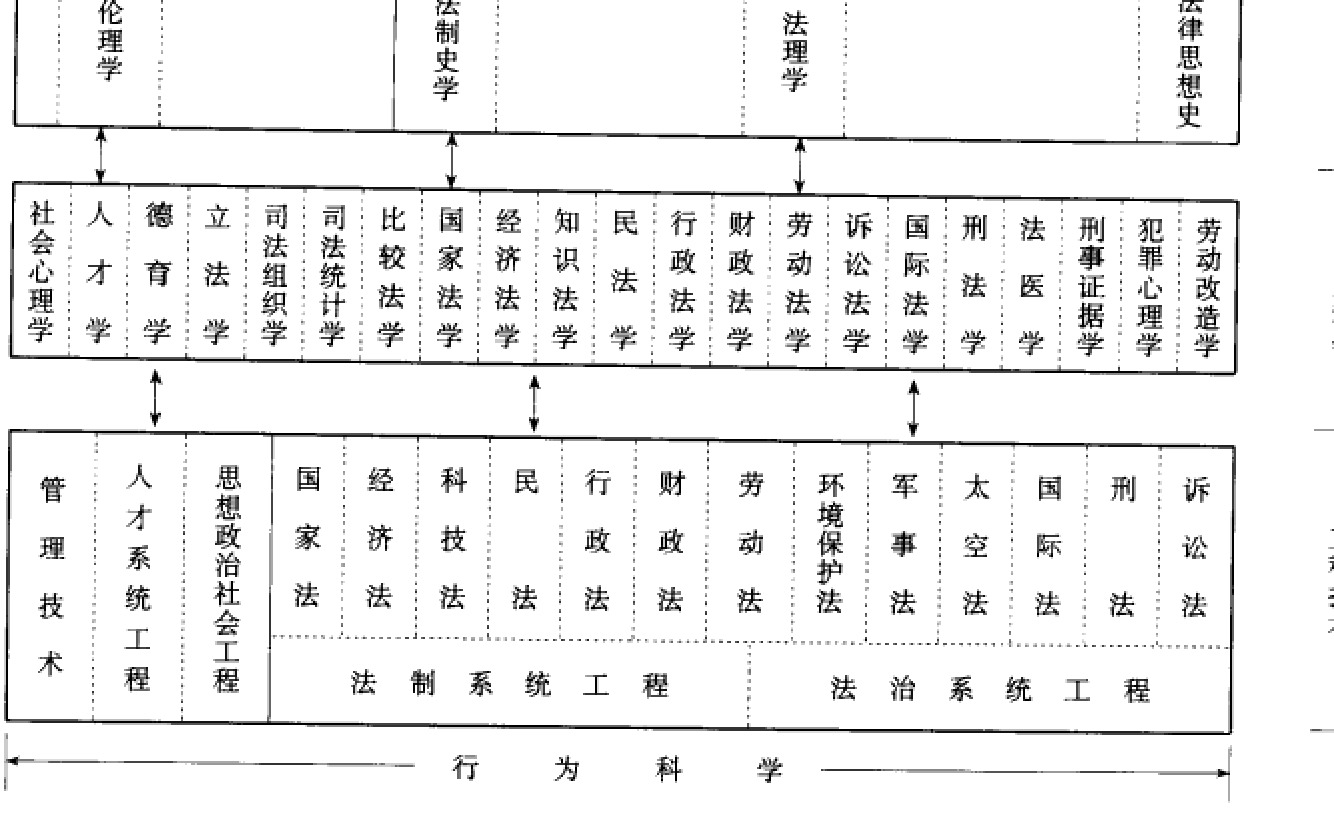
Talent Systems Engineering, Ideological-Political Social Engineering, State [Law], Economic [Law], Science and Technology Law, Civil [Law], Administrative Law, Financial Law, Labor Law, Environmental Protection Law, Military Law, Space Law, International [Law], Criminal [Law], Procedural Law, Administration
Engineering Technology
Legal Systems Engineering, Rule of Law Systems Engineering
The System of Behavioral Science
The practice of literature and art is art, not science. But literary and artistic theory still has its philosophical generalization—aesthetics—which serves as the bridge from this department to Marxist philosophy. This consistency in departmental structure first of all demonstrates that such a modern science and technology structure is comparatively reasonable, representing not merely the structure of one or a few departments, but what is common to all of modern science and technology—a shared characteristic, an overall structure.
Since it is an overall structure, no single major department can be completely independent; there is mutual cross-fertilization. Do people not nowadays like to use the term “interdisciplinary”? In fact, every discipline is more or less interdisciplinary: physics requires mathematics, and much of the development of mathematics has been stimulated by the needs of physics research—are physics and mathematics not interdisciplinary? In the above system of behavioral science there are four systems engineering disciplines: legal systems engineering, rule of law systems engineering, ideological-political social engineering, and talent systems engineering. All of these employ systems science methods and thus intersect with the major department of systems science. Legal systems engineering and rule of law systems engineering are also transverse technologies across the engineering technologies of each branch of law—they are intra-disciplinary intersections within legal science. At the technical science level of behavioral science, there is a discipline of social psychology and also a discipline of criminal psychology; both are guided by the theory of psychology as a basic science, while basic-science psychology itself belongs to the major department of human body science. Human behavior is also related to thinking, so behavioral science intersects with cognitive science. Other intersections and interrelationships among disciplines could also be pointed out, but these will not be elaborated further here.
Looking at the diagram, the legal science aspect of behavioral science has many disciplinary categories and is quite flourishing, while the ideological-political aspect appears thin. This is because law has a long history, and especially over the past several centuries in capitalist countries, legal systems have undergone great development, providing us with relatively abundant material to absorb and utilize. Compared with legal science, our ideological-political work and talent work were established in the course of the revolutionary cause and have a relatively short history.
Even the so-called behavioral science of capitalist countries has a total history of roughly forty years, and what we can absorb and utilize amounts to only that much. Therefore, in the areas of ethics within behavioral science—such as ideological and political work and education in ideals—there is a lack of disciplinary theory, and this remains a task for behavioral science workers in the future. However, the situation described above is viewed from the perspective of the number of disciplines and the number of personnel; if we look at it the other way around, the situation is reversed: there are fewer personnel in the area of legal system and rule of law, while there are more personnel in the area of ideological and political work. This too was brought about by the circumstances of past revolutionary history.
Therefore, in the field of behavioral science, the urgent tasks we face are: on the one hand, to train a large number of legal professionals; on the other hand, to vigorously develop ethics and the theory of ideological and political work, while simultaneously greatly enhancing the scientific literacy of existing ideological and political workers. All of these can be said to be the glorious tasks of China’s political-legal colleges and universities—“politics” refers to ideological and political work, and “law” refers to the legal system and rule of law. In the years ahead, education in the political-legal area must be greatly strengthened.
In summary, viewed from the needs of building socialist material civilization and socialist spiritual civilization, a behavioral science with Chinese characteristics—a Marxist behavioral science—is necessary and extremely important, and it is also indispensable for implementing the spirit of having ideals and discipline as set forth by the Party Central Committee. Therefore, in China there should be a high-level behavioral science workforce of tens of millions of people. The future of behavioral science in China is boundless!
(July 1985)
Twenty-One: Science and Technology Are an Important Component of Modern Culture
What is culture? In a letter I wrote on December 30 of last year to the editor of the Cultural Supplement (published in the China Science and Technology News on January 22 of this year), I quoted a passage from Comrade Hu Yaobang’s Political Report at the Twelfth National Congress of the Communist Party of China, and then shared my own understanding. Culture includes science and technology—this is stated very clearly in Comrade Yaobang’s passage.
I also quoted a passage from Professor Li Xinzhou of Fudan University in Shanghai, explaining that basic scientific research is indispensable to cultural construction. Nowadays, all those in the Academy of Sciences engaged in basic theoretical research are complaining, because the current promotion of “short, flat, and fast” projects has been interpreted one-sidedly by some, leading them to believe that such work is superfluous. I think we should help these comrades understand Professor Li Xinzhou’s passage.
Today, I would like to offer a few more thoughts on what culture really is.
The Marxist epistemology holds that people’s cognitive process is roughly as follows: through practice (including scientific research) one comes to know the objective world, and then uses the laws of objective things one has recognized to transform the objective world. Therefore, I believe: first, culture is people’s understanding of the objective world; second, for this reason we must create an environment and social structure that can better further our understanding of the objective world—the purpose is always to know the objective world and transform it. Our construction of socialism serves this purpose, and the future construction of communism will also serve this purpose. Therefore, culture is the result of knowing and transforming the objective world, and it is also the foundation that enables us to further understand the objective world. In this sense, the content of socialist cultural construction is the objective manifestation of socialist spiritual civilization, while the content of socialist ideological construction is the subjective manifestation of socialist spiritual civilization. I use this formulation to express socialist culture and socialist ideology in order to build socialism with Chinese characteristics, and in order to better understand and transform the objective world. Thus, science and technology are naturally an important component of socialist culture. To know and transform the objective world without science and technology is unimaginable.
What I am discussing here is culture in the broad sense. Of course, culture can also be understood in a narrow sense, which refers to the kind of intellectual cultivation in literature, history, philosophy, and similar fields. I have a personal realization: as a person, as a scientist, to achieve higher accomplishments, a certain level of cultural cultivation is indispensable, because it is a necessary foundation for understanding the objective world. Without this foundation, if you wish to understand the objective world and ultimately reach the summit, you will not be able to get there. Turning
Looking back at the history of world science, setting aside antiquity and considering only the past century, all natural scientists who have made outstanding achievements have had a solid cultural foundation.
Now let me also offer a few opinions on the “Culture Supplement.”
I have read every issue of the “Culture Supplement” since its trial publication, and I have kept them all. The topic of our discussion today is to “inject” science into culture, and I am in favor of “injection.” But in the past, the “Culture Supplement” did so rather reluctantly, as if there were first a concept of a “Culture Supplement,” and then science was dressed up in the attire of the “Culture Supplement” and brought in, rather than presenting science in its true form. The passage I quoted earlier from Professor Li Xinzhou may make you worry: this is too hard, while the supplement is soft. However, if you agree with my view on culture, then we should confront hardness with hardness—we should use science in its true form to transform our culture, rather than “transforming” science into a culture you can accept and then pressing it into the “Culture Supplement.” Science is a part of modern culture, and its content should be strengthened. “Use science to examine the culture of the past, use science to equip the culture of the present, and use science to explore the culture of the future”—I endorse this formulation. But the science must be genuine science, not science that has been altered. This is a solemn and serious task, one that will have an impact on the twenty-first century. I hope the “Culture Supplement” of China Science and Technology News will take a correct step forward and make it a page of “upright and awe-inspiring integrity.”
22. Some Understanding of Technical Aesthetics and Aesthetics
I once wrote a piece discussing the relationship between literature and art on the one hand and science and technology on the other. There, I said that literary and artistic creation always requires a foundation in science and technology: without paper and printing, today’s literature would be difficult to imagine; without photographic technology and electroacoustic technology, today’s cinema would be impossible. This is one aspect of the relationship—we can say that science and technology serve literature and art. Now, our “technical aesthetics” is an emerging discipline that applies aesthetics to the technological domain; we can say this represents the other aspect of the relationship, in which fine arts serve the design and manufacture of scientific and technological products.
The piece I wrote also addressed the question of fine arts in the design and manufacture of scientific and technological products—for example, various everyday items such as cups, bowls, plates, bottles, basins, and the like; clothing and attire; book binding and design; and even product packaging—all should be “pleasing in appearance and dignified,” as well as economical and practical. This probably falls under the category of arts and crafts. From the standpoint of economic benefit, this is no small matter. For example, in our country at present, on the one hand the people have money in hand and want to dress better, while on the other hand the textile industry is operating under capacity—not for lack of fiber raw materials, but because of inventory backlog. What is going on? It is because the range of colors and patterns in fabrics is too monotonous and unattractive, so people do not like them. Here, arts and crafts can help solve the problem, thereby creating value measured in hundreds of millions of yuan. Therefore, arts and crafts are a major matter. We also have a specialized organization called the China Arts and Crafts Society.
In fact, this field can be broadened further to include the design of all products. Should not the exterior form and color of a machine also be made “pleasing in appearance and dignified”? In the past, machines manufactured in our country were always painted dark gray, which was quite ugly. Now the tones are lighter, often light gray—this is progress. There is still great potential in this area. Thus, arts and crafts should be expanded into “technical arts,” making it an even greater matter for the construction of socialist material civilization and socialist spiritual civilization.
I previously divided literature and art into six major domains: fiction and essays, poetry and song, architectural art, the visual arts of painting and calligraphy, sculpture and other plastic arts, music, and the comprehensive arts of drama and cinema. In retrospect, these six major domains are no longer sufficient. A new domain has emerged that combines scientific and technological products with the plastic arts—technical arts. It is no longer six major domains; literature and art must be divided into seven major domains: fiction and essays, poetry and song, architectural art, plastic arts, music, the comprehensive arts of drama and cinema, and technical arts. Of course, this classification is itself only one understanding, and the process of understanding has not ended; there will be further developments. For example, I have recently also been considering whether the art of Chinese-style garden design should be included.
included within architectural art? Because landscape art is an art that transforms the living environment, and is more comprehensive than architectural art. If so, then literary art would need to add another major category—landscape art—making eight major categories in total.
At the Second Annual Conference of the National Aesthetics Society held in Xiamen in October 1983, the participating comrades, in addition to affirming technological aesthetics, also engaged in a discussion on the issue of departmental art aesthetics, emphasizing that aesthetic research should also stress the exploration of departmental art aesthetics and pay greater attention to the characteristics of each department of literary art. I think, from this perspective, what we call technological aesthetics here should be the departmental art aesthetics associated with technological fine arts. How many departmental aesthetics are there? As many as there are major categories of literary art, there are that many departmental aesthetics. According to what was discussed earlier, there should be aesthetics of novels and essays, aesthetics of poetry and song, architectural aesthetics, plastic arts aesthetics, musical aesthetics, theatrical and cinematic aesthetics, technological aesthetics, and perhaps additionally landscape aesthetics.
Conducting scholarship is a process by which an individual comes to know objective things, and this process always proceeds from the particular to the general, and then uses the elevated general principles to guide deeper research into the particular. Emphasizing the study of departmental art aesthetics is correct; it is a necessary path one must traverse—from the practice of literary art to rational cognition, to departmental art aesthetics, then to general aesthetics, and finally to Marxist philosophy, the highest synthesis of human knowledge. The summit of this path of cognition is Marxist philosophy, and cannot be anything else—this too is a thesis of Marxism-Leninism. Based on this idea, I once proposed that aesthetics serves as a bridge from the creative practice of literary art to Marxist philosophy.
I think the line of reasoning above may be helpful to the study of aesthetics. At present, people’s views on aesthetics are not yet very consistent. Some comrades say that aesthetics still leans heavily toward philosophical inquiry, and suggest that aesthetics should be studied from the perspective of psychology and other fields to open up new avenues. Why does it lean toward philosophical inquiry? One reason may be that aesthetics is not yet a science in the modern sense; it still has many gaps, lacks factual evidence, and must rely on speculation and even conjecture to fill them. This is indeed, as Engels described, “natural philosophy” in the classical sense. We are scientific socialists and cannot be satisfied with “natural philosophy”-style theories; we must strive to establish a scientific aesthetics. How to do this? The psychological approach mentioned above is viable. But I believe that to put it more completely, we should invoke the concept of noetic science, because aesthetic experience is the result of human thinking processes. Of course, the organ of thought is the material brain, so pursued to its ultimate foundation, it will also enter what I call human body science, and the foundational sciences of human body science include psychology.
This is an approach to studying aesthetics from the perspective of human thinking practice, so I previously also considered placing aesthetics as a discipline within noetic science. But I now believe this may not be appropriate. Why? It is based on the following reasoning:
Human aesthetic experience is directly related to human social practice and social consciousness, and is not entirely determined by the modes and laws of human brain thinking, such as abstract thinking, imaginal thinking, and inspirational thinking. Even if two people’s thinking methods and laws are similar, if their social practice and hence social consciousness differ, their aesthetic experience will also be quite different. In class society, the aesthetic experience of the ruling class differs from that of the oppressed and ruled laboring people; and today, some things that certain people consider beautiful, the great majority of us call spiritual pollution! They are truly poles apart, utterly different. Therefore, aesthetic practice is also a product of human social activity, and must be understood through the laws of social activity. There is no so-called beauty that is detached from social practice.
Thus, the study of aesthetics must also consider another path: examining the laws of the social activity of creating and appreciating literary art. We must study those from history and from old society, and for us in particular, we must concentrate our efforts on studying, in today’s China, the relationship between literary art and the construction of socialist material civilization and socialist spiritual civilization, and its laws. This is what I call the discipline of socialist literary and artistic studies. The qualifier “socialist” is added here to distinguish it from the literary and artistic studies of other eras and other social systems; this is a new discipline for a new era, not some ancient discourse on literature and art.
According to the above conception, establishing a Marxist, scientific aesthetics requires carrying out work in three areas: first, distilling from departmental art aesthetics, where departmental aesthetics are in turn established from summarizing the practice of different major categories of literary art. Second, drawing nourishment from noetic science and even human body science. Third, finding the laws of aesthetic social practice from literary and artistic studies, especially from socialist literary and artistic studies. This structure is shown in Figure 1.
Of course, establishing the entire structure is not something achievable in a single day, nor does it mean that the upper-level structure can only be started after the foundation is entirely complete, because things are always interrelated. The upper-level structure can also guide the research of the level below. For example, although Marxist
Marxist Philosophy Aesthetics Epistemology The View of Heaven and Humanity Landscape Aesthetics Aesthetics of Novels and Essays Aesthetics of Poetry and Song Architectural Aesthetics Plastic Arts Aesthetics Musical Aesthetics Theatrical and Cinematic Aesthetics Technological Aesthetics Noetic Science Human Body Science Socialist Literary and Artistic Studies Landscape Art Novels and Essays Poetry and Song Architectural Art Plastic Arts Music Theatrical and Cinematic Comprehensive Art Technological Fine Arts Landscape Art Music Filename under AT6 directory: gxb2 Marxist philosophy still needs development, it must now be used to guide research in aesthetics and departmental aesthetics. For another example, although general aesthetics still has many problems awaiting research and resolution, it too must be used to guide research in technological aesthetics and work in technological fine arts. And the various departmental art aesthetics can also draw upon one another.
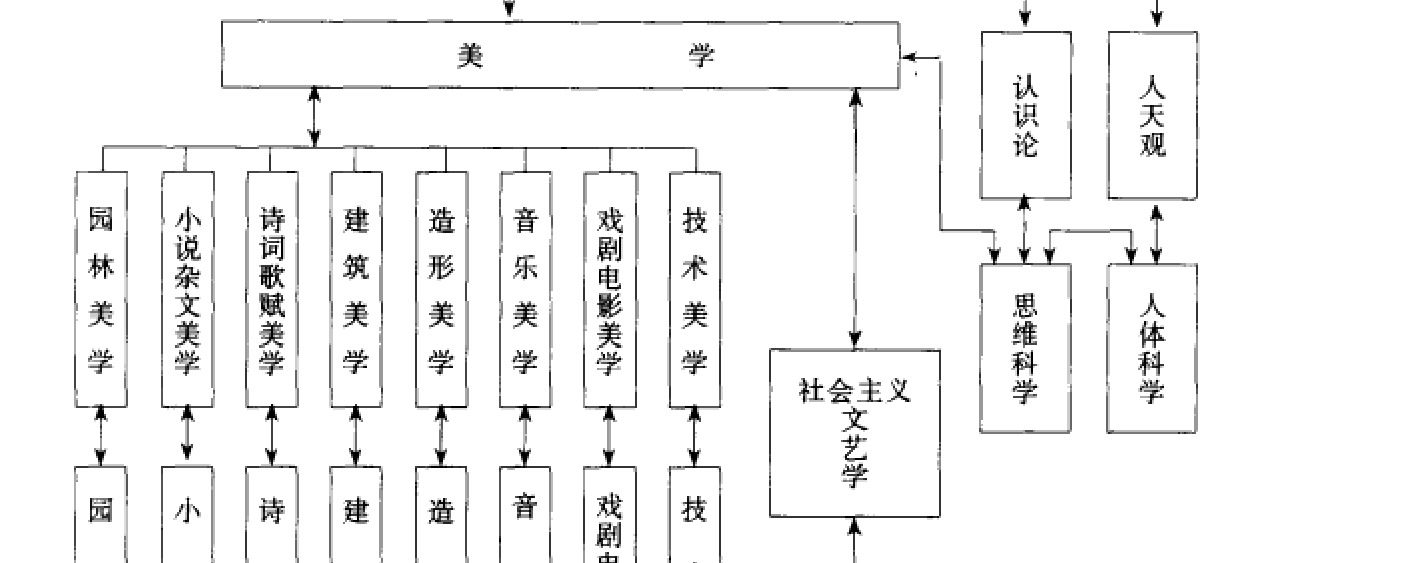
Is there anything correct in my understanding here? Does the structure in the diagram above make sense? I ask comrades for their criticism and correction.
(February 1986)
Twenty-Three: On Decision Science
Psychology Combined with Human Body Science
Let me tell you comrades once again: I come once a week to learn from you comrades. Every time I hear a report, it provides many inspirations for my thinking that week, so I am very grateful to you. Whether I am of any help to you comrades is for you to say, but you comrades have indeed helped me. For example, regarding the discussion of “attention” last time, and the work in psychology that was presented, I had an immediate reaction. I think that people working in psychology must have great courage, because the questions they discuss are all extremely difficult, and they have also produced concrete results in this difficult work. I remember saying at the time that because this problem is very difficult, when everyone uses these concrete results, you should be careful—
its conditions and limitations. One should not assume that psychological results can immediately have universal significance; this is quite unlikely, because the problems are extremely complex, and the results obtained must necessarily be derived under certain restrictive conditions. That is what I said at the time, and after returning I kept thinking about this problem. I feel that precisely because psychology is in such a state, the tasks of our institute, as well as some of the fundamental issues we must consider in order to accomplish those tasks—such as the question of human body science—all involve psychological or conscious activity of human beings. We (or at least I), from the perspective of human body science, have frequently mentioned the role of consciousness, but now it seems that transforming this issue further into something to be studied scientifically is extremely difficult. Yet this issue is also the foundation of the applications we need to consider; if you do not resolve this problem, you will not feel confident when applying it. What is to be done? I believe there is no other way except for comrades in psychology and comrades in other fields to unite, honestly and pragmatically, and earnestly cooperate to clarify the problems bit by bit. To this end, in future discussion sessions like ours, we should arrange more reports in this area—that is, continually presenting recent new results at these report sessions, so that we can keep pace with the development of this discipline. I think foreign research in this field must also be very vigorous, because there is a need for it. Precisely because this discipline is not easy to pursue, we must definitely pursue it and attach importance to it, because we need it, and ultimately the development of human body science and everything else is connected to this.
Three Aspects of “Decision-Making” Science
What the speaker discussed today is also a very important issue. Director Chen has already provided an excellent summary, so I will not say much more. I believe we have some problems in our choice and use of terminology. The English word “decision” we translate as “决策” (decision-making), but as I understand it, this word is a relatively general term, whereas when we say “决策” it seems to be associated with higher-level issues—policy matters, major issues, something that only leaders can decide upon. English has another word, “policy-making,” which is what should be called “决策,” whereas “decision” should not be called “决策”—it seems to be a matter of choice: there are several options, and you ultimately select one and make a decision. Many methods are indeed decision-making in nature, but in psychology, I am afraid we cannot call it decision-making; it is a matter of choice. Of course, this is not his fault; it is because from the very beginning we translated it as “决策,” and now this “决策” has become ubiquitous—this decision, that decision, everything is a “决策.” This term is not quite appropriate. There are actually three types of problems here. The first is what can be expressed mathematically and computed by computers—for example, the Seventh Five-Year Plan report, which involves a great deal of computation based on national conditions. This is called “决策” (decision-making). You can read carefully where it says, “What I am now presenting in this Seventh Five-Year Plan has all been through extensive computation and comparison.” This means there are models, there are calculations, and the calculations are extremely complex. This is one category of problem. There is another category of problems that also falls under decision-making, but this kind of decision-making cannot be expressed by mathematical methods. I see that none of the mathematical formulas discussed in today’s presentation would work for this. This is the wise decision-making of leadership. When the Seventh Five-Year Plan was finalized, the results computed by those calculation models may not have been used entirely, because the drafters had higher-level considerations—for instance, international issues, issues of China’s social development, and so forth. This falls under the wisdom of leadership, which is to a large extent related to the leader’s rich experience and knowledge—experience and knowledge that their staff, the people doing computer calculations at the State Planning Commission, and the people building models do not possess. This too is a kind of decision-making, a very high-level kind of decision-making. This is a very important aspect. Let me tell a story here, a very interesting one. The Japanese now use decision-making very extensively, and their electronic computers are also very advanced. Last year, a Japanese general manager came to China and insisted on finding a Chinese expert who studies Sun Tzu’s Art of War to discuss things with him. Why would a major manager study Sun Tzu’s Art of War? After much questioning, he said he believed that running a company’s operations and making decisions is the same as deploying troops in war, and therefore he was also studying Sun Tzu’s Art of War, which was why he wanted to find a Chinese expert on Sun Tzu’s Art of War to discuss problems. This shows that in high-level decision-making, much of it is wisdom and experience. Sun Tzu’s Art of War concentrates the experience and wisdom of ancient Chinese warfare, so he wanted to study it. This is a true story. There is also a legendary account that the Japanese business community is very interested in the Romance of the Three Kingdoms and is studying it. Why study the Romance of the Three Kingdoms? They say that Zhuge Liang in the Romance of the Three Kingdoms was able to make correct decisions under such complex circumstances, and they study how he made his decisions. This is a bit far-fetched; in reality, the Romance of the Three Kingdoms is not the Records of the Three Kingdoms—it is a novel, and what is described may not have actually happened; it is fictionalized by the novelist. But they are interested in it nonetheless. Both of these news items show that the highest-level decision-making of leadership is a very complex matter, based on experience, and therefore one must learn from historical experience. This is extremely important. This is the second type of decision-making I am referring to. The first is mathematical, computational, and
I think this is relatively clear; leadership decision-making is not so easy to explain clearly and still awaits further research. What is closely related to our institute is the problem of selection or decision-making. This problem is very important, because in our work on human-machine engineering, if we do not understand how humans make selections and how humans and machines are to be integrated, it will be impossible to achieve good human-machine integration. In future complex weapon systems, the combatant will also need an electronic computer as an intermediary. I think that if you cannot clarify how he makes decisions, the things you provide to him through the electronic computer may be inappropriate, and may even lead him to make erroneous choices—which would be disastrous. How do people make decisions under ordinary circumstances? How do they make selections? I believe this is a question that needs to be studied, because it will not be the same as those mathematical formulas presented in today’s report—the human brain cannot possibly compute so many formulas all at once. That is impossible; it does not compute that way. How exactly are decisions made? Foreign countries are also researching this, the so-called expert systems, which simulate the human selection process. I think we must also do this work; otherwise, if you cannot clarify how humans make selections, how can you build your human-machine system? If you want to use an electronic computer to assist in between, what exactly should the computer do? It might actually do more harm than good—the operator’s brain may be overwhelmed by the information the computer provides, or the information may lead him to make erroneous choices, which would be terrible. Therefore, I believe this third issue is very closely related to our institute. For high-level matters, complex matters, electronic computers can be used and models can be built—these are things handled by the people at the State Planning Commission and the 71st Institute. What leadership wisdom and decision-making are really about still requires in-depth research, and this has no direct relationship with our institute. What is relevant to us is the third aspect of the problem, namely how humans make decisions and make selections under ordinary circumstances; this requires in-depth study.
(April 21, 1986)
Twenty-Four: Standardization and the Study of Standardology
Our country must break away from isolation and engage with the outside world. This poses a sharp question before us: should we adopt international standards, or develop our own? We must properly resolve the contradiction between the local and the overall. Of course, we have our own specific circumstances, and each factory also has its own different circumstances, but we must submit to the overall situation and have national standards; factories must submit to the nation. The overall situation also includes the global overall situation—if our standards differ from world standards, many contradictions will arise. Our products must eventually leave the factory and enter trade! Originally, each country had its own standards, but all are now considering how to communicate with the world, and many countries are striving to transition their national standards to international standards. For example, with regard to measurement units, the imperial system originated in Britain, and now Britain is also changing to the international system; the United States is also moving in this direction. I think that since our large-scale industrial construction is still in its initial stage, we should simply make up our minds to adopt international standards across the board. This means that one-fifth of the world’s population would be adopting international standards, and this in no way diminishes our prestige. By joining the International Organization for Standardization and adopting international standards, we gain a voice, we can also speak on behalf of the Third World, and we can break the monopoly of hegemonism.
Of course, whether to adopt international standards is a major matter. Such a major decision must be determined by the central authorities.
I think that even if we fully adopt international standards, international standards cannot all be formulated all at once; we ourselves will still need to supplement what is lacking, and there will also be some national standards. Then there are process standards and operational standards, which must be the responsibility of the production departments, and uniformity need not be imposed there. Therefore, by linking standard-setting with the world, what remains are process standards and factory standards, and that will be much easier to handle. Once the major policy is set, there must be a transition. How should the transition be carried out? That is a concrete question that needs to be resolved.
In practice, the metrology establishment serves standardization. Although the workload of metrology is enormous, in nature it serves standardization. The enforcement of standards is partly carried out through metrological inspection—checking whether standards are being followed.
What has been discussed above concerns near-term objectives. Standardization is one of the hallmarks of modernization. Not pursuing standardization is characteristic of a small-scale peasant economy. We have grown accustomed to being “tinkering blacksmiths”—small handicraft industry, small-scale production. Our “officials’ willfulness” is also formidable; if the “officials” do not understand, there is nothing you can do. We must publicize the importance of standardization. Find people to write articles, drawing on historical lessons and experience, and publish them in science and technology newsletters and popular science periodicals in various provinces, municipalities, and autonomous regions, such as Scientific Experiment. For example, the specifications of our writing paper, paper clips, and cabinets are all in disarray. Abroad, everything has been standardized—even cabinets are standardized. Paper of a certain specification goes into a clip of a certain specification, which goes into a cabinet of a certain specification; it is very convenient. Even the holes punched in loose-leaf paper are standardized. Our construction should also be standardized—doors, windows, all should be standardized, which would make things much more convenient.
What should the Standardization Research Institute study?
Recently I have been thinking about broadening the concept of systems engineering somewhat.
In several articles I wrote not long ago, I discussed the organizational and management technology of science—systems engineering—but some theoretical issues remain unresolved. The organizational and management technology of scientific research is called scientific and technological research systems engineering, yet one of its theoretical foundations, “science of science” (kexuexue), has not yet been established.
The same is true of education: one of the theoretical foundations of educational systems engineering is pedagogy, yet pedagogy itself has not been clearly articulated.
Standardization is likewise a form of systems engineering. Its task is to design, organize, and establish a national standards system that promotes the sustained and rapid development of social productive forces. However, the technology of standardization systems engineering does not yet appear to have a solid theoretical foundation—it still lacks a “science of standards” (biaozhunxue).
The science of standards is still something under investigation. It treats standardization as a social activity: what are the historical lessons and experience? How should it be organized? It is not purely a question of natural science; it also involves political and economic issues. It lies between natural science and social science, with the social science component being somewhat larger. The methods of standardization systems engineering are available—operations research, cybernetics, electronic computers, and so forth. So there is no need to worry about the methods; as long as there is theory, we can organize and get to work.
Therefore, the key focus of the Standardization Research Institute should be the study of the science of standards.
We need to study history. China began standardization as early as Qin Shi Huang; when did foreign countries begin? We need to examine what lessons and experience the past holds and what the future trends are. You have a Standardization Association, do you not? In the future, we should organize everyone for extensive discussion. In short, the first priority is to establish the “science of standards.” We need people researching this discipline as a major task of the institute, putting in solid, hard effort. Of course, having joined international organizations, we need to study global conditions and formulate responses to international activities—this falls under intelligence work. We need to understand foreign and international trends and anticipate what others are going to do. Another matter is coordinating domestic ministerial standards; we need dedicated personnel for coordination. There is also investigation and research during the process of implementing standards. Submitting recommendations to the bureau leadership and the State Council leadership based on research findings should also be part of the institute’s work. Once all these things are in place, we will have systems engineering.
Standardization and metrology are different. Metrology is a part of physics and chemistry; its theory is already established.
I know that resistance to standardization is considerable, so you must make vigorous efforts to publicize it. You must find every possible way to promote it. In addition to your own publicity periodicals, you should make use of various newspapers and magazines for publicity.
Twenty-Five: On “Mathematical” Science
The Position of Mathematics in Scientific Research
I also felt, after listening, that the presenter was being far too modest on that final chart. Of course, as a mathematician, his humility is a virtue. He said that his mathematical methods could only play a modest role; and this is also true, because this work is highly integrative, and each of us comrades plays a small part in it. But you are not entirely passive either—you must actively participate in this work. I agree with the point that Director Chen just made: we are not mathematicians, but we should believe that those who do mathematics have great ability. You can give them difficult problems, and they will not be stumped; you can tell them what you need and ask them to analyze which direction to take. Even if there may not be a ready-made method at present, if you pose the problem to them and let them think about it, I believe they can always come up with an approach to help you solve the problem. We should trust that mathematics is a method—this method may be more elegant or more clumsy, but there is always a method, there is always a way. At first it may be a bit clumsy, but as you keep working at it, it becomes smarter and the method becomes more elegant—that is simply how it goes. Relating to the question I just raised: do you consider the whole picture from the very beginning, or do you start by considering a single point? Suppose there is currently no method for considering the whole picture—never mind, pose the problem to the presenter, and he will ponder it back and forth and come up with a way to handle the problem. So on this point, Director Chen put it very well: all of us experts from various fields must work together, and we will certainly achieve a collective, integrated effect that is far greater than what any one person could accomplish alone. And the mission of our institute requires us to do exactly this; if you do not do so, the final outcome will be inferior. Therefore, I agree with this view. In order to achieve this, all of us comrades from different fields must have a certain degree of mutual understanding. One of the original purposes of this seminar is precisely this: there are so many divisions in our institute, and within each division there are further specializations, and comrades in each area are highly specialized. Through the opportunity of academic seminars, we can use a method that enables everyone to understand a little bit about each other’s work, so that we can collaborate effectively in our joint work. If we understand nothing about each other’s work, it is not easy to carry out this collaborative effort. Therefore, academic seminars are very important for the work of our institute: they enable everyone to understand, through the seminar, what each person is doing.
Achieving Cross-Disciplinary Understanding Without Barriers
Today, the presenter, on the one hand, was fully prepared, but on the other hand, he did not use up all his time. He spoke very briefly, and when he wrote down mathematical formulas, he just moved past them without explanation—I felt this was not quite sufficient. I had in mind a way of presenting that should be used here: there are so many mathematical methods—the frequency analysis method, the autoregressive method, the correlation method, and so on—this method and that method. Instead of just writing out mathematical formulas, you should take a simple example and show what results you get when you process it with different methods. By introducing different methods in this way, everyone can understand that the methods for processing differ. When you think about what the result would look like, everyone will have a sense in their minds of what this method is about and what that method is about. This is the method I am describing for teachers teaching students in a lecture. Otherwise, when you go to teach and just write those mathematical formulas up there, the students will be lost—they won’t know what is going on. Every one of us giving presentations here must also treat everyone in the audience, including myself, as students, and we must teach clearly. I have said here before: as a science and technology worker, you must have the ability—your work and your specialty must be very
The ability to explain profound knowledge in simple language to people outside your field, so that they can roughly understand what it is about—this is a skill one must possess. When we all work together, mutual understanding is essential. As the saying goes, “different professions are separated by mountains,” but if we are truly separated by mountains, that will not do. We must ensure that although our professions differ, we are not separated by mountains; to achieve this, we must put in the effort. Therefore, as scientific and technological workers and researchers, we must have the ability to explain clearly. I am reminded of my days as a graduate student, when there was a physics professor whose lectures were exceptionally clear. He had precisely this ability. When he lectured on quantum mechanics and explained its content, what you heard was perfectly clear—this professor was of a very high caliber. Each of us may not yet reach the level of the professor I heard, but let us work hard; we should strive in this direction.
Scientific Researchers Should Be Sensitive to New Things
On a more concrete level, I feel that what Director Chen just said is correct—namely, that this kind of working approach is what enables our institute to create new things more effectively. For example, regarding the electroencephalogram (EEG) discussed today, the task of understanding the human functional state through EEG is, I believe, correct within its scope. But from the perspective of our institute, this is too limited. We need to understand the human functional state through the various aspects of work across our institute—not just EEG, but EEG plus what else… All available methods must be integrated and applied to understand the human functional state. If we think along these lines, I believe we will generate many new concepts. Our institute can achieve this, whereas other institutes cannot, or compared to those units abroad that are also “separated by mountains” between disciplines, we would be far more astute. This is therefore extremely important. After I arrived today, I also mentioned a couple of things to Director Chen. I said I had a certain feeling: among the comrades in our institute, are some comrades sensitive to new things, while others are not so sensitive to new things? Not being sensitive to new things means your creativity is constrained, because creativity does not lie on the old path; it always lies on a new path, always drawing inspiration from another direction. If you are not sensitive to other things, then your creativity is very much limited. Look at the history of science: all creative individuals have been sensitive to new things. What is very important is to use your mind and think about how things outside your field may have an impact on your own work.
Cognitive Science and Human-Machine-Environment Systems Engineering
Recently I saw our institute’s plan for human-machine-environment systems engineering. The plan was written very well. I read it and felt that the issue of cognitive science (思维科学) was not raised. Many comrades in our institute are very interested in cognitive science. Of course, Director Chen told me that cognitive science belongs within human body science (人体科学)—that to study brain science, one must also develop cognitive science. I said this is correct. But please consider: in the human-machine-environment systems engineering you are working on, should you not take into account the issue of cognitive science? This also relates to what I heard a few days ago at a high-technology seminar, where a professor speaking on robotics and automation topics said, simply put: in the past, humans acted directly on nature to transform the objective world; later, humans progressed, and a tool was inserted in between—humans used tools and then acted on nature; this was the tool stage. Later still, humans operated machines, and machines had tools, which then acted on materials—this added another layer of complexity. What will the future world look like? Humans will first interact with intelligent machines and robots; the robots will then control the machines; the machines will have tools; and the tools will then act on nature. Humans, robots or intelligent machines, then machines, tools, and nature—five levels. When he spoke of this, he repeatedly emphasized that the interaction between humans and intelligent machines or robots is a critically important link. I thought to myself: where exactly does the importance of this link he spoke of lie? I think it is this: intelligent machines and robots must cooperate with humans and must not conflict—if they conflict, things go wrong—or be at odds with each other. That is to say, if the information provided by intelligent machines and robots is all unsuitable and unusable to humans, then that information is useless. It is important that the information provided by intelligent machines and robots is precisely what humans need. How can it be precisely what humans need? That means you must understand how humans actually think and how decisions are selected—is this not precisely a question of cognitive science? This is why, after reading your human-machine-environment systems engineering plan, it seemed to me that something was perhaps missing—cognitive science. It is not that the comrades do not know about it; they do know, but the comrades have not connected cognitive science with the issue of human-machine-environment systems engineering. If you make this connection, and add the human body science component, then cognitive science should receive due attention in our institute. Whether what I have thought is correct or not, I present it here today for everyone’s critique. In any case, what I am advocating here is for everyone to use their minds. New things, creative—
things that happen to appear precisely where you never thought to look before—things you never thought of before, you now need to think of, and to think of them as quickly as possible. That is to say, we must be very sensitive to new things, always reflecting on what relationship a new development has to the work I am currently doing, what inspiration it offers me. We must not remain forever satisfied with our habitual lines of thought, forever focused on the same old problems and just carrying on the same way—I say this will not do. I urge everyone, regarding new things as well, to follow the same meaning Director Chen expressed just now: be sensitive, and constantly think about what relationship other people’s specialized work has to the work you are doing. If everyone thinks this way, the work of our institute can be done even better.
(April 28, 1986)
26. Using Marxist Philosophy to Guide Psychological Research
The Predicament of Psychology
Today I came to learn. After listening, I have two impressions. The first is that I feel it truly takes some courage to be a psychologist. To dare to tackle such a complex problem—is truly remarkable. This problem is very difficult, because it involves the human psyche, especially the human brain. We have not yet fully understood the human being and the human brain. Those of you working in psychology probably have such a task forced upon you—pushing you to find solutions. Having listened to the report, I feel that psychologists are indeed pragmatic in addressing this problem. The methods they use can be described as materialist scientific methods—observing phenomena and identifying whatever regularities can be found; that is, knowing the “what” without demanding to know the “why.” As for why things are the way they are, there is no explanation. If you press too deeply, they cannot answer. We should recognize this—that is, understand what psychologists are telling us. If you do not believe them, that would be wrong, because they have done a great deal of work. But if you believe everything, that might also be somewhat dangerous, because there are limitations. To truly solve this problem will require much deeper research in human body science in the future, especially in brain science, before a genuine scientific theoretical explanation can be given for these psychological phenomena. Nobel laureate Sperry coined a term for this: “Mentalics”—that is, truly using the workings of the brain to explain all psychological phenomena. This field of study does not yet exist. The methods psychologists currently use can only be as they are. I think we should approach this problem in a pragmatic manner: acknowledging that it has a basis, while also recognizing its limitations. This is not disrespect toward psychologists. We respect your labor, but we also see your difficulties.
Psychological Research Must Be Guided by Marxist Philosophy
My second impression is that I believe we in China must use Marxist philosophy—that is, dialectical materialism—when studying these phenomena. We must be careful not to fall into mechanical materialism. Are there mechanical materialists among the schools of psychology? Yes, there are. As the speaker just told us, the behaviorist school—this school consists of mechanical materialists. In the past, behaviorism was very much in vogue; now, within the field of psychology, this school has become outdated. The behaviorists are mechanical materialists; they do not dare to speak of consciousness. They believe that human action is simply a black box—do not ask what is going on inside the box, you are not allowed to ask, because once you ask, it involves questions of consciousness. The behaviorists do not dare to discuss consciousness; they consider it spiritual, not material. They are thorough materialists, but in reality they are mechanical materialists. On the other hand, there is the trap of dualism. Dualism is also quite common. For example, there is a psychologist or philosopher in Canada who is a dualist. He believes that matter is matter, and mind is mind—
Besides matter there is also spirit, and these two things coexist. This is also incorrect; it cannot be dualism. The truly correct viewpoint is dialectical materialism: matter is primary, and the human brain is also material, but it can produce spirit, and spirit can in turn react upon matter; the origin is matter. But the result of material movement can give rise to consciousness and spirit, and consciousness and spirit can in turn act back upon matter. This is what is called dialectical materialism. In reality, it is still monism—namely, matter—but complex matter can produce spirit and consciousness; spirit and consciousness then return to act upon matter. The questions of spirit and matter, brain and consciousness have been debated for a very long time. I believe we are Marxists, and these questions can be clearly explained using Marxist philosophy. Since our institute is dealing with human issues, we must be careful to study Marxist philosophy, so that in conducting research we can avoid certain mistakes, and when it comes to things from foreigners, you can be more discerning—able to distinguish what is correct from what is problematic.
On Our Country’s Science, Technology, and Cultural Undertakings
Below I would like to report to comrades that I recently attended a meeting of the National Committee of the Chinese People’s Political Consultative Conference (CPPCC). The group I participated in is the largest group in the CPPCC session—the science and technology group. Probably the second largest is the education group, and then there are the literature and arts group, the social sciences group, and so forth, none of which can compare in size to the science and technology group; they are relatively small. Because the science and technology group was too large, it was further divided into five subgroups, and I was in one of these five subgroups (Group 22). The convener of this group was Qian Sanqiang—another person surnamed Qian. Our group had several people surnamed Qian. What I would like to report to comrades is, first, the discussion situation within the science and technology group, and second, the discussion situations of other groups as seen from the plenary speeches and bulletins. I think what comrades here are interested in can be summarized in two issues. On the one hand, we feel greatly encouraged that the state has formulated the grand blueprint of the “Seventh Five-Year Plan,” which is indeed inspiring to look at. This is one sentiment, but on the other hand, science and technology personnel also have some concerns based on what they have seen and heard. Now the Party and the state both attach great importance to science and technology, repeatedly stating that science and technology are extremely important in building our two civilizations. This point is very prominent in the report of this session. Science and technology personnel also feel that while this is what is said, in practice it is very difficult for science and technology work to play its role. One committee member after another raised this issue in their speeches—they all started by saying they were greatly encouraged, that it was wonderful, but then went on to say, “I have my problems.” In my speech in the small group, I said that this is actually a situation caused by historical reasons. China has fallen far behind the advanced countries of the world by a large margin. We are now just beginning to advocate horizontal integration, whereas in reality, during the second half of the last century, capitalist countries had already begun to pursue horizontal integration. What were those large trusts, monopoly corporations, and multinational corporations? They were horizontal integration. Their horizontal integration extended not just within their own countries but across the entire world. That situation existed in the 1880s; now it is the 1980s, and we are only just beginning to pursue horizontal integration—we are 100 years behind. This is an undeniable fact.
Furthermore, regarding the role that science and technology must play, we can see that in the countryside, because of the implementation of the production responsibility system, specialized households and ten-thousand-yuan households have emancipated their thinking and are working energetically. All the rural development since the Third Plenary Session of the Eleventh Central Committee has shown that once farmers take responsibility for their own operations, they fully recognize the importance of science and technology. They call science and technology personnel the “God of Wealth”—this is a leap in understanding. But the science and technology that farmers need is actually quite simple, at most the kinds of technologies listed in what is now called the “Spark Program”—these are short, accessible, and fast-yielding things. The science and technology needed by rural township enterprises has also become part of the Spark Program. Science and technology personnel with real expertise find those things far too easy—they don’t even count as anything. There is a joke: an electroplating factory in a township enterprise was in a complete mess, and they invited a university professor to help. A professor went and took a look—it was simply too basic. They didn’t even know the relationship between resistance and current from high school textbooks, so they had completely messed up the electrical current in the workshop, and of course efficiency was low! On this issue, they invited the “God of Wealth,” who simply told them how to make a few adjustments and how to take measurements, and the problem was solved right away. They were naturally delighted. But advanced science and technology—the forte of our science and technology personnel—cannot be brought into play; the farmers still do not need it and cannot yet absorb advanced things. Is it the case that advanced technology is useless? Absolutely not—it is useful, but it is useful in large enterprises. Currently there are also large enterprises that have been given more flexibility. One I visited was the Capital Iron and Steel Company (Shougang), which must consider improving economic efficiency, and to improve economic efficiency it must rely on science and technology. Therefore, Shougang attaches great importance to its science and technology personnel. All production processes—blast furnaces, sintered ore, and so forth—are controlled by electronic computers, and the software for these computers is entirely developed by their own science and technology personnel. All of Shougang’s production processes, economic accounting, and even the distribution of bonuses and promotions are based on electronic computers, not on what any individual says. In addition, Shougang has a great deal of “hard” science and technology. This is a very good example: once a large enterprise is given flexibility, it has no choice but to rely on science and technology. This
Put this way, the knot in the hearts of scientific and technical personnel is untied, because a very important aspect of the economic system reform in the Seventh Five-Year Plan is to invigorate large enterprises. Once large enterprises are invigorated, advanced technology will naturally be in great demand. The reason it is not in great demand right now is also quite clear. Once this reasoning is understood clearly, and once the Seventh Five-Year Plan is implemented and reform proceeds, then science and technology will surely shine brilliantly. I was also being a bit playful when I said that among the CPPCC members in our group, quite a few are elderly, and elderly people tend to worry that things on their minds may affect their health. So I wanted to say a few words to put everyone at ease: we have a brilliant future ahead of us. Among the CPPCC members working in science and technology, there is this issue, and I think those present here are also aware of it. How should we view this issue? As I just said, we should look at it from a historical perspective.
In addition to scientific and technical personnel, people in the education and literary and artistic circles have raised a very important question, namely, the construction of spiritual civilization and the issue of cultural development. Comrades in the education sector have spoken, all saying that the promulgation of the Compulsory Education Law is a very good thing, but there are indeed quite a few problems with the quality of teachers at present, and there may also be biases in people’s overall understanding of educational work. This was pointed out in widespread remarks: on the one hand, the state attaches importance to education and has promulgated the Compulsory Education Law, which is a great good thing; but on the other hand, there are still many problems in specifically cultivating talent and doing a good job of compulsory education. In connection with the issue of cultural development in the literary and artistic circles, I feel that the state has not yet truly devoted serious effort to studying this issue, and therefore the guidelines and policies are not very clear. In recent years, on this issue, there has not even been a document like the ones on educational reform. Everyone has expressed urgent hopes. In fact, the central leadership may have long been aware of these opinions; the Secretariat has already taken note of this issue, has listened to several reports, and will continue to do so. I feel that intellectuals probably face two main issues: the issue of science and technology, and the issue of spiritual civilization construction and cultural development. Such is the situation. I am simply reporting to you. Our development in recent years is obvious to all. A gap of 100 years can be caught up, because our direction is correct, and everyone must do their work well.
(April 14, 1986)
27. Vision and Simulation Technology
Understanding Vision Research
Director Chen spoke very well, and I agree with all of it. I think he mentioned the need to use a systems perspective, which is very important. He also spoke about our human-machine-environment systems engineering. Today’s speaker focused on vision, and Director Chen emphasized that the information absorbed by humans is not only visual. I believe what he means by a systems perspective is the human-machine-environment system: you need to adopt a systems perspective—besides vision, there are other channels—and how best to integrate them comprehensively? I share this impression, so I endorse his view. While listening, I had a thought, and I would like to ask the speaker: it seems that the part of visual physiology that has been worked out clearly only goes up to the retina. This segment is clear; all of our research seems to be clear on this segment. After the retina, the neural transmission to the brain for processing—this is a difficult problem, and it cannot be clearly explained. A great deal of work has been done, but up to now, I think this problem has not been solved. I know a colleague from the Department of Biophysics at the University of Science and Technology of China. When he was studying in the United States, he raised a question: how exactly do humans process the visual system? He believes this problem has fundamentally not been figured out, and that previous work may not necessarily have solved the problem. He says the brain processes visual signals using what is called a topological relationship in mathematics. Others do not see it this way; he has proposed a new viewpoint. This shows that how humans process visual signals is a problem that remains unsolved to this day. In the first part of your talk, you discussed the science of vision. I think this science of vision is still not well understood. The only thing that has been solved is prescribing eyeglasses—
mirrors, and since then, I see it remains unresolved. Didn’t we hold conferences on thinking science a few years ago? What exactly is imagery thinking? It has never been figured out at all, and people have been arguing about it right up to the present without reaching any conclusion—they have been arguing for so many years. So I believe that if we approach this question with an honest scientific attitude, that long passage you gave at the beginning could also be omitted. You could simply say that the problem of vision is currently solved only up to the retina, and beyond the retina we do not yet know; therefore, we do not rely on any of this. Your research work does not depend on these things. In my view, we can liberate our thinking and not rely on the lengthy discourses found in the original books—they talk at length without ever clarifying anything. Your work on “the role of vision in human-machine-environment systems” is, in my view, honestly what I would call phenomenological science—that is, I conduct experiments, observe certain things from the experiments, and derive patterns from them, and these patterns are the ones that guide my design work. I think this is honest and substantive. What you described later were the experiments you conducted, and those are reliable. I feel that doing it this way is actually more solid. The so-called vision science cannot help us now and cannot solve many problems. Aren’t there controversies? The trichromatic theory, the opponent theory—I think we should just let them go. Whatever you say goes; what really matters is what work was actually done and what patterns were found. That is reliable. As for this theory or that theory, they can serve as references only—do not place your faith in them. This is one viewpoint of mine.
Vision and Molecular Biology
Another point: while listening, I had the feeling that these scientific studies of vision contain far too many subjective factors. If you truly want to study this question objectively, then you should follow the approach I mentioned last time and drill all the way down to molecular biology. That would be honest—using the level of molecular biology to see how information is actually transmitted and processed. Right now we are far from that level and cannot achieve it. If you cannot achieve it, then do not make claims about it; wait until the problem is solved in the future before speaking. I think this too can liberate our thinking—do not be constrained by those restrictions, just work solidly. Science is honest: how much is how much. If a problem cannot be solved now, just say you have no way to solve it for now, and do not rely on it either.
Emphasizing Research on Simulation Technology
Third point: I feel that in our practical work, one very important aspect is dynamics. Director Chen also spoke about this issue just now—tactile sensation is the fastest. Therefore, we should emphasize dynamics. In our future designs, dynamics will be a very important factor, and when conducting experiments in the future, rapid changes will probably be very important. I offer this for your reference. In addition, I would like to say that the speaker discussed two major areas: one is the design of aircraft cockpits, and the other is C3I, that is, modern command systems. I want to raise one more issue—one in which our institute can do a great deal of work in the future—and that is the work of combat simulation training. Previously, when we were considering astronaut training, there was a specialized research division studying this problem, and these efforts have since slowed down. I think we should transfer the work we previously did in this area very well onto various combat simulation training equipment. This is extremely important. In the past, everything depended on pilots flying actual aircraft, but that is basically no longer the case. Over 90% of training is now conducted on simulators, and only when training is essentially complete—when they are about 80–90% there—are they allowed to fly a real aircraft. This is because training on real aircraft from the very beginning is enormously expensive. Now, military training must all shift to simulator-based training. What is simulation training? It is human-machine-environment systems engineering, except that the environment is simulated. This work is extremely important. Everything you discussed just now can be applied to simulated combat training or operator training. I believe this is another important thing our institute can do in the area of human-machine-environment systems engineering, and it appears that our military will increasingly emphasize this area. We should move in this direction, and our institute has already begun work in this area. I do not know whether the work our institute is doing in this area overlaps with the simulation training work being done at Beihang University, but we should continue this work.
(September 12, 1986)
I
Twenty-Eight: Artificial Intelligence and Noetic Science
Strengthening Computer Software Engineering
Comrades, the speaker just gave us a talk on artificial intelligence, and I am also here to learn. Having listened to the talk, I feel that he has provided us with a concise yet comprehensive introduction to the issue of artificial intelligence. I learned a great deal, because what he discussed was the development of artificial intelligence worldwide, and this issue is indeed extremely important. After the computer first appeared—initially used for computation—no one in the early 1950s anticipated that computers would have such a tremendous role. After thirty years of development, electronic computers are today used in every aspect of society, playing roles that were absolutely unforeseen thirty years ago. What is now called the information society is very closely related to electronic computers. Therefore, inspired by others, I came to feel that this issue is too important, so I later put forward a suggestion—one that perhaps no one would expect—and where did this suggestion go? It went to the State Language and Writing Commission. Why did I make such a suggestion? Because we recognize that the role of the electronic computer is like the human invention of writing; later there were brush and ink, and with brush and ink one needed a place to write, so paper was invented; writing was too cumbersome, so printing was invented. This series of inventions, creations, and developments has played an enormously important role in human civilization. Just think about it: if people had no writing, no brush, no paper, no printing, what would today’s civilization look like? I am afraid civilization would not be what it is now—it would fall far short. I believe that the electronic computer is the great invention of the twentieth century, and its role for human civilization and culture is the same as the ancient inventions of writing, the brush, and printing. And we believe that many comrades in our country do not see it this way; if they do not recognize this, they will make mistakes, and by the twenty-first century we will be far too backward. Therefore, at that time we raised this issue with the State Language and Writing Commission (which had just been established), hoping that they would organize the entire software enterprise for electronic computers. I will not say more today, but our country’s software is in chaos—a patchwork of all kinds, with no way to manage it.
The Human Brain and the Electronic Computer
This is still only talking about computers used for digital computation. As the speaker just explained, in recent decades there has been a new development. Beyond computation, computers can also serve other functions, which he has already introduced in detail. These other functions involve work in the area of non-digital computation. This is of course very important, because the problems that the human mind grapples with constitute only a very small part in the realm of digital computation; a much larger part is not digital computation. If this domain could be developed, it would be tremendous. I have already described the electronic computer, as a computational tool, as being that important. Now, if this new domain is developed, its role would be incomparably greater than what I have just described. The electronic computer already plays such a great role in human civilization, and if we do not pay attention, we will make mistakes in the twenty-first century. In this new domain—the application of electronic computers to non-digital computation—it becomes even more important. I am using an analogy to illustrate this problem; the issue that the speaker addressed today is of the utmost importance. Previously, I suggested here at this institute that our institute must study artificial intelligence. Do we not often speak of human-machine-environment systems engineering? I have spoken about this here many times as well. Between the human and the machine, one more thing must be added, and that is the electronic computer. This electronic computer must not only have digital computation functions but also non-digital computation functions. That is, the expert systems and such things that were discussed. Only in this way can the system of human–computer–machine–environment be maximally effective.
…the greatest role of humans within it. This question is very important, and it is rare to have him give us such a report. We must continue to study this problem. Our institute also has people working on computers, so it should be easy for you to organize and tackle this topic, because in the future your human-machine-environment system will include this very thing. Today he has given us a beginning, provided some inspiration, and let everyone gain a preliminary understanding of the work in this field—worldwide and in our country, he has introduced all of it. Not long ago I received a book published by the People’s Publishing House. The authors are two people: one is from the Philosophy Department of Jilin University, and the other is from the Shenyang Institute of Automation, Chinese Academy of Sciences. Together they co-authored a book titled Artificial Intelligence and Epistemological Issues. In reality, this book only carefully introduces some work in artificial intelligence, running over 300 pages. They asked me to read the book and see if I had any opinions. After reading it, I told him: your book is quite good; it is an introductory book that lets people know what artificial intelligence is all about. But to elevate that to epistemology—that simply does not hold up, because the theory of artificial intelligence itself is not yet clear, so how can one talk about philosophical epistemology? That is simply out of the question. If one were to discuss it, it would amount to nothing more than a very simple question: can machines replace part of human mental labor, or replace more and more of it? That is the whole question. Of course, this question can be explored more deeply, namely whether you uphold Marxist philosophy or adopt mechanical materialism. If you uphold Marxist philosophy, uphold dialectical materialism, then human thought is not mysterious either. Once you understand its laws, machines can of course replace it. But as for whether human thought will one day be entirely replaced by machines, I think we should hold off on drawing that conclusion. Because the human brain is developing; when machines can replace part of its work, it no longer needs to do that simple work, and the human brain then develops further. Some comrades also say that in principle, machines can replace the human brain. I say that conclusion is also acceptable, because the human brain is material after all. But when will this be achieved? At infinity—because the human brain is developing; it is the human brain’s function that creates machines, and machines are always a bit inferior to the human brain. To say that machines can eventually reach the level of the human brain’s function—that can also be said, but when? In the distant future. If we are talking about philosophical questions, that is the question, and the explanation for now is just these few sentences; nothing more can be said. So the title of their book is problematic, and I was not polite about it—they asked for my opinions, and I gave this opinion: I said the title of your book is problematic.
Expert Systems
What exactly is the problem of artificial intelligence? I believe that what artificial intelligence is, what the work being done worldwide actually is, and what true intelligence is—these questions have not been resolved. Today’s report also mentioned that resolving this question depends on noetic science. I very much agree; that is indeed the case. If we look at all the current work in artificial intelligence, the broad range of aspects introduced just now, I believe they are essentially still work in abstract thinking or logical thinking. So-called expert systems still require experts to teach them. What the expert actually teaches is a system of logical reasoning. If such-and-such is the case, then the result is such-and-such—that is what it tells you. If the result does not match your problem, then it searches along another path. So-called expert systems—those traditional Chinese medicine diagnostic systems—are simply the doctor stating his experience. Do not even ask the machine why it is so; it cannot answer you. That is just how it is—you follow instructions. Current expert systems are mostly of this type. I can give an example: there is a very simple expert system. In a thermal power plant, there is a boiler that needs to crush coal. Whether the coal crusher is working well or not, experienced old workers can tell just by listening with their ears—they know whether the operation is normal or not. So how does this expert system work? Well, it measures the frequency of the noise, records the spectrum, and then compares the spectrum when the worker says it is running well with the spectrum when the worker says it is running poorly. Of course there is a difference. So, the spectrum that corresponds to “good” is defined as normal. An acoustic analyzer is placed nearby, and whenever it deviates from the “good” spectrum, an alarm goes off—quick repairs are needed. That is an expert system; that is what expert systems are all about. So all expert systems have not yet broken out of the framework of abstract or logical thinking. It is just that a great expert has more experience and more approaches; he tells you it is either this or that, you search, and once you find it, that is it. There are also very complex ones, such as what was mentioned in today’s report: our country’s great mathematician Wu Wenjun’s work on plane geometry, which is very complex. It proved many theorems that previously did not exist in plane geometry. To put it plainly, it is just logical reasoning—nothing mysterious, very simple, just a logical reasoning system. There is also the Four Color Theorem mentioned today. That proof is very, very long. Ordinary people do not have the patience to do it, but machines will prove it. Let me give a simple example: the calculation of the digits of pi () has now reached an astonishing level—calculated to millions of digits. This is not done by humans. Can you trust it or not? In the end…
You still have to say it is reliable, because the machine computes under human direction. In my view, all existing expert systems have, in essence, not yet broken out of the scope of abstract logical thinking. Of course, I am not underestimating the role of expert systems. Things that already employ logical reasoning (used even more broadly) plus what are called feasible tasks may also belong to various kinds of expert systems, and those are very useful. For example, a weapon operator or combatant who uses weapons particularly well—you can encode his set of experiences into an expert system, and a new soldier can immediately master in full the capabilities of that experienced combatant. That would be tremendous. Modern weapons are so complex—how long would it take you to learn them? With an expert system, you can learn quickly, so it is very important.
The Success or Failure of Artificial Intelligence Depends on the Progress of Noetic Science
But from a theoretical perspective, this is only very preliminary work, and the speaker shares this view. I agree with his opinion—namely, that such practical work must be supplemented by theoretical work. As was just mentioned, there are differing opinions in the world. The illustrious Feigenbaum once said that there is no need for any theory—just doing practical work is enough. An example of his was just cited: How were airplanes built? I want to pin a label on him—he is an empiricist. This is not Marxist philosophy. I don’t care if you’re American—even if you are the most important figure in the world, you are still an empiricist—what’s so remarkable about that? We do not look at problems this way. From the perspective of Marxist philosophy, theory and practice must always be combined; practice must be guided by theory, and the development of practice will inevitably elevate theory. The two are indispensable and cannot be偏废.
What theory is involved in the question of artificial intelligence? It is exactly what we just said we need to break through: we must break out of the framework of abstract logical thinking, which has been followed all along (and had to be followed). To what extent? To the extent of imagery and intuitive thinking. If we talk about human thinking, it was not logical thinking or abstract thinking that came first. What humans had first was imagery and intuitive thinking. How does a little baby recognize its mother? Is that logical thinking? Not at all—it is imagery thinking. A child’s learning is largely imagery, not abstraction. So the human brain has been using the laws of imagery thinking from very early on. Of course, when imagery thinking reaches an advanced stage, such as a scientist’s imagery thinking, it becomes intuitive thinking. A great scientist has a student, and the student asks him, “How did you come up with that?” He says, “This can’t be taught. You just learn slowly, and when the time is right, you’ll be able to do it too.” This is advanced imagery thinking. But we should not always see this advanced thinking as mysterious and extraordinary—no, a little baby uses imagery thinking, but there is a great difference here. Imagery thinking is not the same as logical thinking. What is important now is to find out what makes them different. Over the past two years, I have discussed this issue with some colleagues, and I feel that one problem here is that imagery thinking involves multi-path parallel reasoning. It absolutely does not approach problems along a single line, but which line can produce a result is not clear—it is fuzzy. In the process of thinking, it goes from fuzzy to clear, and at that point the result emerges. So later I sought out colleagues in the Mathematics Department at Beijing Normal University who work on fuzzy mathematics. They had also worked on problems of synergetics—synergetics is about large networks. When I explained this to them, they quickly accepted this view. We now believe that the theoretical path for imagery thinking is probably this: fuzzy mathematics with multi-path parallel reasoning, where one must discover a clear point in the reasoning network, and that point is the result. This work has already begun. Someone has organized two discussion groups, and the problems these two groups are tackling are exactly the theory of imagery and intuitive thinking as just described. If there is some progress in this area, it would be remarkable—that is to say, we might begin to get a handle on what human intelligence really is. Once we find the way, we can build machines, and the artificial intelligence machines of that time will be far superior to those of today. They will have genuine intelligence—not like the artificial intelligence of today. To be honest, today’s artificial intelligence machines are not really all that intelligent. There was a cartoon in a British new science journal showing a dialogue between two people. One of them says, “Artificial intelligence is making a lot of noise these days.” The other replies, “Is it artificial intelligence or artificial stupidity?” The implication is that he thinks it is not artificial intelligence but artificial stupidity. This is a bit of an exaggeration. What it actually means is that truly artificial intelligence in the future still depends on the development of noetic science, especially the noetic science of imagery and intuitive thinking. That is promising, and we can already see some clues. These views of ours have not yet been made public abroad, and I don’t know how they would see them. Such views do not yet exist abroad. Today, taking this opportunity, I am sharing this with you comrades—this is a further development of what I previously spoke about at the institute. As for the meeting we held over two years ago, three modes of thinking or human thinking modes were also articulated: abstract logical thinking, imagery-intuitive thinking, and sudden insight thinking (inspiration). If you have grasped imagery-intuitive thinking, what actually occurs is in the human subconscious—it is nothing more than this: your conscious mind does not know, but the subconscious of the human brain
Consciousness is playing a role, and ultimately it remains a problem of psychology; that is not a major issue of thinking science. My understanding is as follows. I have also learned quite a lot, and after studying, the impressions I formed are the words I have just spoken. I do not know whether what I have said is correct. If it is not, please offer your criticism.
(October 20, 1986)
29. Expert Systems and Thinking Science
On the Relationship Between Language and Thinking
The speaker just now gave an excellent presentation, giving us a comprehensive overview of the current state of affairs in artificial intelligence and expert systems. After listening, the first question that occurred to me is this: much of what was introduced is closely related to expert systems and human language. This led me to think that human thinking is related to language, which raises a question: when we consider expert systems in the future, should we use the Chinese language or English? There seems to be something of an issue here. My personal experience is that there is indeed a difference. When using English, it seems as though one part of the brain is operating in English; when using Chinese, it seems as though another part of the brain is processing the thinking. I experienced this when I was abroad: if you want to speak English, you cannot first think in Chinese and then translate it into English before speaking—that does not work. Your entire thought process must be in English. Conversely, when speaking Chinese, you do not first translate from English into Chinese and then speak; rather, it is direct Chinese-language thinking and processing. Recently, my wife went to the United States for a month and just returned. Over the past few days, in our conversations, she has been using a great many English words. I said to her, “What is going on with you? Have you become so accustomed to it that you cannot switch back?” So human thinking is closely related to language. Chinese and English are quite different. When it comes to future expert systems, whether you are building an expert system for Chinese speakers or for English speakers makes a difference, because language and thinking are closely related.
Further Remarks on My Understanding of Artificial Intelligence
My understanding of expert systems and artificial intelligence dates back to a conference on thinking science that we held over two years ago. Some comrades here today were also at that meeting with us. At that time, we all discussed and agreed that artificial intelligence, including the expert systems component, is a form of engineering and technical work—it is application, and ultimately it must produce a machine. What was reported today conveys the same idea. This kind of work, I feel, is much like the emergence of the steam engine at the end of the eighteenth century. At that time, there was no theory of the steam engine. Watt invented the steam engine, but Watt had no theory; he was a skilled craftsman. At that time, there could not have been a theory—thermodynamics had not yet been established—so they just did it, summarizing empirical knowledge through practice and making it work. Today’s artificial intelligence and expert systems are of the same nature. One cannot say there is a systematic theory; that systematic theory has not yet been established. The foundational knowledge it relies on is the science of thinking, which has not yet been established. The science of thinking only has abstract logical thinking, which is relatively well developed; the other aspects of human thinking are not yet covered. So at our meeting two years ago, we concluded that the breakthrough point for the science of thinking now lies in establishing the laws of imaginal-intuitive thinking. Finding these laws is not easy—more than two years have passed and we still have no solution. Over the past two years, if there has been any slight progress on this question, it is the realization that imaginal-intuitive thinking differs from abstract logical thinking in that it is network-based and involves parallel processing; moreover, there is a kind of fuzziness within it. Human imaginal-intuitive thinking proceeds simultaneously from many aspects, and at the very beginning it is quite fuzzy.
The so-called obtaining a result means that within this network, a very clear image suddenly appears in a certain part—well, then the problem is solved. The creative process of human beings is precisely such a process.
At present, there is only this much understanding: that is, how to conduct this research—one must use the methods of systemology, use network processing, use systems to handle it; and one must also use concepts such as fuzzy mathematics. However, this is only an idea—whether it is thought through correctly or incorrectly—there is at least this much of a direction.
(December 22, 1986)
Thirty, Language, Thinking, and Intelligent Machines
Did Language or Thinking Come First?
Today’s topic is very large. The scope of the discussion is very broad, and it is a genuine theoretical problem—the entire question of linguistics. Part of it is somewhat simpler. To what extent can what is discussed here be applied within our human-machine-environment systems engineering? Our objective is relatively narrow. I believe these two questions should be treated separately, because the first question is truly too difficult—extremely difficult. Many fundamental questions still have no answers. For example, the question of language and thinking involves some of the brain-related issues that Comrade Zhang Ruijun discussed.
In the past, I did not understand these things either. It seems that Greek philosophers once said that language precedes thinking. How can one think without language? Today there is another view, which seems to reverse it—thinking comes first, then language. I think this question probably still requires in-depth research. The statement of the Greek philosophers makes sense in a certain sense, because if you want to think but have no language, how do you think? Is it just random, chaotic thinking? So there is some reason to it; but from the perspective of the developmental history of language, it also seems untenable to say that language came first and thinking came after. This question, I think, still requires in-depth research. My inclination is that when emphasizing either view, one must guard against mechanical materialism or idealism. We must not forget that we still need dialectical materialism, using Marxist philosophy to guide our research. When examining the specific question of language and thinking, one must use dialectical methods to handle it. Arguing over which comes first and which comes after will likely lead into a dead end. This is one viewpoint of mine. That is to say, one should study linguistics in a broad sense. I am not an expert in this field. From what was introduced today, it seems that foreigners handle this problem with a certain mechanical materialism. We must be vigilant: for major questions, we must take them seriously and use Marxist philosophy, namely dialectical materialism, to address them. The vast majority of foreign scientists are mechanical materialists; they have limitations.
Designing Research Topics Based on Need
The second question is relatively simple: in the analysis of language technology within human-machine-environment systems engineering, the requirements are not high. First, there must be a need. During the discussion just now, many examples were cited to demonstrate this need. Let us think about it: if there were no machines, no communication systems, then there would be no requirement to analyze linguistics. If people were isolated and self-contained, with the people of a single village conversing among themselves, there would be no need to study linguistics. Without human-machine dialogue, without electronic computers and the like, there would also be no requirement to study linguistics. Modern developments have all emerged because of an urgent, applied need to solve concrete problems. We must seek truth from facts in solving problems. What questions our current knowledge can answer, those are the questions we should solve; to whatever degree we can solve them, we solve them to that degree. The difficult
If a problem cannot be solved, then set it aside temporarily. That is our attitude. We cannot solve all problems in linguistics, but we can work on applications of linguistics. I do not know whether you are engaged in this kind of work, but I am afraid this is the only feasible approach. You cannot study all of linguistics; that is a technical issue. The language problem within human-machine-environment systems can be approached realistically and with certain constraints—that is, by using standard human speech and avoiding unusual expressions, since the machine would not understand them anyway. Work of this kind still needs to be done. These two aspects of the problem must be distinguished. We are interested in linguistics in a broader sense, but it is unrealistic to invest a great deal of effort in it; we can only work on the applied portion, using whatever is available given the current state of progress in linguistics. When problems are discovered during application, they can be raised with researchers in linguistics: tell them that their current body of knowledge still cannot solve these problems, and ask them to conduct further research. These two parts must be clearly separated. Let me mainly address these two issues.
Intelligent Machines and Language
There are some other minor issues: on the final slide there was an implication—must intelligent machines necessarily understand language? I have a somewhat different view: intelligent machines need not understand language. The problems that intelligent machines need to solve are far broader than understanding language. You can perfectly well input a problem to an intelligent machine using clear symbols and let the machine solve it. There is no language issue involved. I came into contact with intelligent machines in the past; they do not necessarily understand language. You can pose a problem to the machine, using a language the machine can understand, and then let the machine solve it. I will not say more on this.
A Symbiotic Theory of Biological Evolution
I would like to make a suggestion. We are engaged in aerospace medical engineering, which is closely related to biology. I recently saw two articles in the British journal New Scientist, dated July 3, 1986, which discussed the work of an American female biological scientist. This scientist is a professor in the Department of Biology at Boston University. She was recently elected to the United States National Academy of Sciences, having been elected in 1983, and is quite well known. I find her work very interesting. Biological cells were formerly said to come in two types: prokaryotic cells and eukaryotic cells. This female professor, named Lynn Margulis, had maintained for many years that eukaryotic cells, at the time of their original emergence, may have been the result of symbiosis between two prokaryotic cells. The theory she proposed is called the symbiotic theory of biological evolution. This theory represents a new aspect of evolutionary theory. What I find particularly interesting is that this theory has only recently been largely accepted—not completely, but largely. We are now in the 1980s; when she proposed this idea, it was the early 1960s. She was very young at the time, only in her twenties, still a doctoral student. Her view differed from the prevailing genetic theory of the time, so she was consistently suppressed. But the strength and virtue of this American female biologist was that she did not lose heart; the more others disagreed with her, the more she delved into the subject and sought evidence. Later, her own work and that of others led to her theory being increasingly acknowledged by a growing majority. In 1983, she was elected to America’s highest academic institution—the United States National Academy of Sciences. Her work deserves serious attention; it represents a new aspect of biological evolution. Not long ago, she also proposed that the role of organisms was extremely important in the evolution of the Earth’s atmosphere to its present state. This too distinguishes her from a group of Earth scientists who paid no attention to or never even considered the role of organisms. This is one aspect. New theoretical perspectives in academia deserve our attention. Another point is that her spirit of striving for academic truth commands our respect. In particular, it is very difficult for women to do science in America. She encountered so many difficulties yet did not lose heart. This is indeed worthy of our study. Accordingly, I have some reflections: the academic atmosphere in China’s current scientific and technological community is not very good; echo-chamber agreement is very prevalent. Those who genuinely dare to explore truth without yielding, who truly dare to put forward their own views, are not nonexistent, but they are few. Overall, we lack creative ability and creative spirit, and there is also something of a tendency toward wholesale Westernization: whatever foreigners say is taken as good, without considering whether it is actually correct. This is also incompatible with the spirit spoken of by our country’s central leadership. We must, by all means, foster a spirit: we are engaged in science, and in scientific research we submit to truth and nothing else. We should not fear opposition. If someone opposes us with sound reasoning that can persuade me, then I will acknowledge my error; if they have not persuaded me, I cannot abandon my viewpoint. I have a thought—
I think it would be a good idea to suggest that people working in biology read the two articles just mentioned. There are two articles in this issue both about her. After reading them, perhaps they could give a presentation at our seminar — I think it would be beneficial.
(May 11, 1987)
31. On the Research of Noetic Science
First, I should explain what is meant by “noetic science” (思维科学). There are many different ways to translate it into English, so let us be direct: noetic science is the science of human thinking, and in English we call it “noetic science.” Noetic science is a genuine science.
Recently, Shanghai is preparing to establish a society for “quasi-science” (潜科学), called the Shanghai Quasi-Science Society. Whether or not Shanghai should establish such a society is something I neither endorse nor oppose, but they want to set up a branch under the Shanghai Quasi-Science Society called the Noetic Science Branch. Professor Hu Jinan from the Psychology Department of East China Normal University came to ask me about this, and I just replied to him with a letter today. I said I do not approve, because I believe that noetic science is not quasi-science. As everyone knows, the character “潜” means “latent” or “potential.” I said that noetic science is an “explicit science” (显科学) — it is a very solid science, not some latent or potential science. Therefore, I wrote to Professor Hu Jinan saying that it is inappropriate to establish a noetic science branch under the Shanghai Quasi-Science Society, because they are not the same thing at all. Noetic science is a real, existing science — it is an explicit science.
Why do I say this? We must start from the background, and that background is the history of human social development. From the perspective of historical materialism, the development of society is driven by the development of productive forces, and it undergoes several transformative leaps. We call such changes “social revolutions.” One important reason for the development of productive forces is humanity’s progress in understanding the objective world — this is what we call a “scientific revolution.” This term was not invented by me; it was proposed by the American historian of science Thomas Kuhn (T. Kuhn). He began studying the development of science starting in the 1930s. He proposed that a scientific revolution is a leap in humanity’s understanding of the objective world, such as Newtonian mechanics, the theory of relativity, quantum mechanics, and so on. Kuhn wrote a book called The Structure of Scientific Revolutions. I do not entirely agree with this book, because toward the end it contains some idealist elements. Once people have understood the objective world, they want to transform it. The leaps in development of technology that transforms the objective world constitute what is now a very popular term — “technological revolution.” Therefore, the development of productive forces is brought about by scientific revolutions and technological revolutions. The development of productive forces naturally leads to changes in social structure, and this can be divided into three aspects. Scientific revolutions and technological revolutions directly cause leaps in social development — this is the industrial revolution. An industrial revolution must be accompanied by corresponding changes in the political system and political structure — this is a political revolution. With these changes, people’s ideology must also change — this is a true cultural revolution, not the “Great Cultural Revolution,” but a genuine cultural revolution. Industrial revolution, political revolution, and cultural revolution are all forms of social transformation — they are social revolutions. Viewing the problem from this perspective allows us to see things more clearly. In the past, when people spoke of the industrial revolution, it seemed as though only the revolution that occurred in eighteenth-century England qualified as an industrial revolution. I believe this view is not comprehensive. What is an industrial revolution? It is when the development of productive forces produces a leap in economic structure.
From this perspective, the industrial revolution is not limited to the one in eighteenth-century England. In human history, approximately ten thousand years ago, humans abandoned gathering and hunting and developed agriculture and animal husbandry. This was an enormous change for humanity and should be regarded as the first industrial revolution in human history. Then, in the later period of slave society, there was another major change — the emergence of commodities. In modern terms, this was the emergence of a commodity economy. This was the second industrial revolution, occurring approximately three thousand years ago. The eighteenth-century industrial revolution mentioned earlier was then the third industrial revolution.
By the end of the last century and the beginning of this century, another change occurred, namely the horizontal expansion of production scale, even reaching an international scale. I call this the Fourth Industrial Revolution. Lenin wrote a book on imperialism, in which he primarily discussed the reactionary aspects of imperialism within capitalist countries—oppression, colonies, and so on. At that time, Lenin was devoted to the cause of revolution, so he mainly addressed the reactionary side of imperialism and did not have the time to study the issues concerning how the Fourth Industrial Revolution improved production efficiency. Well, those countries had already undergone the Fourth Industrial Revolution by the end of the last century and the beginning of this century, while we, having long been trapped in a feudal society, fell behind. By the late Ming Dynasty, we already had the sprouts of capitalism, but they did not develop. Therefore, I believe our true modern industry—that is, the Third Industrial Revolution—was not realized until after the founding of New China. In the early 1950s, when I returned to the motherland, I looked at the factories built during the First and Second Five-Year Plans and found it incomprehensible: how could these factories make even their own screws and nuts? That was not how it was done abroad; standard parts were all supplied by specialized companies. American automobile companies did not even make their own engines—another company made them. At the time I thought it was very strange, but in reality, that was a production method from the end of the eighteenth century. So the factories we built in the early years of our nation’s founding were very backward, because we were starting from a semi-feudal, semi-colonial society and had to proceed step by step. Thus, the first step was for our country to achieve the Third Industrial Revolution. Now the gap has grown even larger. The advanced countries of the world completed the Fourth Industrial Revolution by the end of the last century and the beginning of this century. What they now call the “information society” and so forth is actually yet another industrial revolution, so I call it the Fifth Industrial Revolution. In this way, our country must catch up. Our reform is precisely aimed at catching up around the year 2000—accomplishing the Fourth and Fifth together, or in one fell swoop! Some of the good things happening in the current economic system reform are actually making up for the Fourth Industrial Revolution in China. As this development proceeds, the demand for information will rapidly press upon us, and reform, opening up, and invigorating the economy will all press upon us. But there is one very important point: this reform in our China must never depart from the socialist system, so we must uphold the Four Cardinal Principles.
In our science and technology, we must keep pace with the situation described above—that is, we must accomplish the Fourth and Fifth Industrial Revolutions in a short span of about twenty years. The core of this problem, as it relates to us, is information technology. I have taken up your time to say all this in order to explain the position of the “noetic science” we are pursuing in our socialist construction. I believe that if we do not do a good job in noetic science, it is pure fantasy to think we can catch up to world standards at high speed and complete the Fourth and Fifth Industrial Revolutions in about twenty years—it simply cannot be done.
Next, I would like to discuss in detail the relationship between information technology and our work. Information technology is impossible without computers, but the computers of today can be said to be the most stupid machines—you tell them what to do, and they can only do that. Therefore, information technology cannot be satisfied with current electronic computers. Suppose we build a machine that can truly think like the human brain and also has strong computational power—one can imagine how the world would change. In 1984, we held a National Symposium on Noetic Science and put forward the importance of noetic science research. Because current computers have no intelligence, if we can give machines a bit of intelligence, that would be a remarkable thing. It is precisely for this reason that artificial intelligence, intelligent machines, and expert systems have become hot topics worldwide.
II
Artificial intelligence is a hot topic worldwide, and especially so in the United States, where there is money and the needs of the so-called “Star Wars” program. But I feel things are a bit chaotic. The year before last, an artificial intelligence annual conference was held in the United States, and people joked that the conference had quite a crowd—3,000 attendees—but only 30 papers. That is something never before heard of at an academic conference. At other conferences, if 3,000 people attend, there would be at least 300 papers, or even 3,000. I think this is due to a lack of theory. There are actually people in the world today who say we do not need theory—just do it. How can that be! In my view, this shows a lack of even the most basic common sense. Our common sense is Marxist philosophy: theory must be integrated with practice, and practice requires the guidance of theory—this is a dialectical relationship. Those who say that artificial intelligence and intelligent machines do not need theory are absurd. I have lived a few more years, and speaking of this, I am reminded of a very good example: when I first started in aeronautics in the 1930s, aviation internationally was also just beginning, and there was not much theory to speak of. When I studied under a teacher in China named Mr. Wang Zhu, a senior pioneer of aircraft design in China, he taught me aircraft design using only statistics. His large, thick notebook recorded the dimensions, proportions, and so forth of various aircraft components. When designing,
…what dimensions and proportions to copy for whatever aircraft. Why? It could not be clearly explained. This situation soon changed, because there were large numbers of different aircraft to design, and proceeding by that method no longer worked. Thus, applied mechanics developed rapidly in the 1930s. Here, the needs of aviation promoted the development of applied mechanics, and with the guidance of applied mechanics, the aviation industry developed even faster. By the 1950s and 1960s, we entered space, producing rockets and missiles. This example shows that technology cannot do without theoretical guidance, and the development of theory in turn depends on the demands raised by engineering practice and the material it provides. The situation is the same for our development of information technology. Without information technology, we will have no way to establish ourselves as a nation in the next century. And to develop this technology, we must have theory—this is our work. The theory of artificial intelligence and intelligent machines is precisely what we need to study. The importance of this theory is perfectly clear: it is something we must do for our socialist construction, and it is no small matter. This is the first issue I wanted to discuss.
Later we discussed this issue and consulted some experts. A comrade working in brain science told us that if you want to start entirely from brain science, it is probably still too early, because the human brain is far too complex. Not long ago, at the Systems Science Seminar, we invited Comrade Huang Bingxian of the Institute of Automation, Chinese Academy of Sciences, to speak on brain simulation. What I gathered from his talk was that early work indeed harbored some ambition to simulate the human brain, but later people increasingly realized this could not be done, and instead turned to building machines—machines with partial brain functions—rather than simulating the human brain, rather than working with neurons, because that could not be achieved. Of course, this does not mean brain science is unimportant. We hope that brain scientists will achieve breakthroughs in the near future, but we also recognize that their work is very difficult, and simply applying pressure to them will not help. Looking at the three years since 1984, the conclusions we reached at that meeting still hold: starting from the structure of the human brain to develop our theory is not feasible—it is simply too difficult. We hope brain science develops quickly, but we must say that we cannot rely on them. So what do we do? We have another path, namely the foundational science of noetic science—the path of noetics—which starts from the macroscopic level rather than the microscopic, not from brain nerve cells. Noetics seeks to find the patterns of human thinking starting from the macroscopic level and to study these patterns. How do you validate these patterns? You cannot just say whatever you please; you must build machines according to these patterns. If the machine indeed possesses the thinking functions of a human, then you are correct. Shanghai People’s Publishing House published a book called On Noetic Science, which everyone can take a look at. It is the result of our 1984 meeting, stating that the development of noetic science should be integrated with the work on artificial intelligence and intelligent machines. In the field of artificial intelligence, those who work by brute force—I also express my respect to them. Most people working on artificial intelligence and expert systems today are working by brute force. Brute force is fine too; whatever you produce can be provided to me for study, reference, and analysis. There are probably tens of thousands of expert systems now. Collecting them for study, analysis, and summarizing experience will yield results.
III
Does noetic science have other sources? I have been pondering this question for these past few years, and I have often gone to consult Comrade Hu Shihua, our elder predecessor in logic and mathematical logic. What he said has been very inspiring to me. I have never worked in logic and do not really understand it, but I have roughly come to recognize a few points: I believe that noetics actually evolved from philosophy. As everyone knows, all natural sciences evolved from philosophy—originally called natural philosophy—and gradually separated from philosophy. Noetics has also separated from philosophy, just as ancient Greek logic was a part of philosophy. Our noetics has in fact evolved and separated from ancient philosophy.
Last Sunday, I again sought out Professor Hu Shihua. He said that if you want to do noetic science, you must be careful—some people will criticize you for idealism. You study thinking, after all; is that not something non-material? Is that not idealism? I said it is easy to handle: what is materialism must be tested by practice. Whether noetics is scientific depends on whether the things produced actually possess human thinking functions. If they do, and practice verifies them as correct, then it is not idealism. Of course, in the final analysis, human thinking is not something void and mysterious. Our brain scientists have said that human thinking is a high-level manifestation of the material motion of the brain’s nervous system. The laws of the human brain are also laws of material motion. It is only because starting directly from material motion is too difficult that we are compelled to leap over this stage and directly seek the patterns of human thinking. In the end, we still return to material motion, so it is not idealism. Another point is that when we previously worked on electronic computers, we already made a mistake by not paying sufficient attention to mathematical logic. We expended great effort and labor, and naturally achieved results, but from today’s perspective, it was somewhat brute force—that is, without theoretical guidance, we paid a considerable price. It was also Professor Hu Shihua who told me…
There is a world-renowned software expert named Dijkstra who once spoke from the heart: “I am now getting older, having worked in software for so many years, I don’t know how many mistakes I have made. Now I have come to my senses. I think, if I had put serious effort into mathematical logic in my early years, I would not have made so many mistakes. Logicians had already said many things that I simply did not know. If I could be twenty years younger, I would go back and study logic.” I think this is words of experience, showing that engaging in technology without theoretical guidance simply will not do, and that our research on thinking science must draw nourishment from philosophical logic.
At present, the state of artificial intelligence, intelligent machines, and expert systems in our country is also unsatisfactory; the theoretical foundation is very weak. A while ago a book came out, Lin Bangjin’s Constraint Logic, and didn’t it end up causing confusion? The newspapers followed along with reckless hype, blowing it up to the skies. Hu Shihua told me: “I think this Lin Bangjin is not too bad; there are others who are even more reckless!” This kind of situation will not do; we must raise a loud voice. We need to catch up in about twenty years—how can recklessness be allowed! Solving this problem is what our discussion group must do: we must establish the theory of artificial intelligence, intelligent machines, and expert systems for China. This chaotic situation must be brought to an end, and I feel the possibility exists. Professor Hu Shihua told me that the current situation is just as Dijkstra described. The Lin Bangjin mentioned earlier may be similar, while the journalists simply have no understanding at all. Therefore, we must grasp the achievements already obtained—that is, philosophical logic—such as the work of Whitehead in England. We need to know what others are doing, to what extent they have progressed, and what problems they can solve. Regarding Comrade Hu Shihua’s views, he presented a paper at the 50th anniversary meeting of the Mathematical Society the year before last, which is about to be published, titled Mathematics in the Age of Information Processing. His view emphasizes that what we lack now is theory. If we do not work on the foundation of logic, which has such a long and deep heritage, and instead just blindly invent things on our own, how can that work!
On another front, thanks to the efforts of Professor Wang Peizhuang and his colleagues, there are now quite a few articles on fuzzy mathematics. The first issue of Exploration of Nature in 1987 contains four articles introducing fuzzy mathematics. There is also an article in the magazine Modernization, published by the China Association for Science and Technology, in its first issue of 1987, titled “Soft Science, Fuzzy Mathematics, and Decision Science.” There are many such articles, and we should collect, analyze, and study them. I have discussed this with Professor Wang Peizhuang and also with Comrade Dai Ruwei. From the perspective of thinking science, I feel that the key is the process from fuzzy to clear, and we should focus on this process. I also said, somewhat sarcastically, that some people propose “fuzzy thinking.” I said that is the fuzziness of thinking—if you are muddled all the way through, what kind of thinking is that? Thinking must ultimately achieve clarity!
As for the question of the science of thinking, I have considered it, and in 1984 I learned from everyone. After three years of reflection, I have arrived at the understanding I just presented.
I have said so much, but the points I want to make are simply these: the tasks facing our science of thinking are matters of great importance to our country, not so-called pure theoretical exploration. We are indeed exploring theory, but it is closely linked to the socialist construction of our country. As I said earlier, if by the twenty-first century we are still this muddled, then we truly will have no way to establish our nation. So this is truly a great matter—facing the world, facing the Four Modernizations, and facing the future. I feel that we Chinese have certain advantages in pursuing this. The problem is difficult, but we must have courage. First of all, we Chinese are not stupid—haven’t American university professors and department heads said that one-third of them are of Chinese descent! Chinese people are capable; do not be discouraged. Furthermore, what we are studying involves the relationship between mind and matter. If we can apply a bit of dialectical materialist thinking, then we can say we have an additional sharp weapon, and this sharp weapon is often difficult for scientists in capitalist countries to master. With these two advantages, can you still not win the battle? Therefore, I feel that no matter how difficult the problem is, we must have the confidence to tackle it. Today marks the beginning. I have said all this simply to give everyone encouragement.
(August 1987)
Thirty-Two: Wisdom and Marxist Philosophy
Regarding the relationship between human wisdom and Marxist philosophy, I have mentioned it on several occasions recently, but have never elaborated in depth. In this short essay, I wish to discuss my understanding in greater detail, and to seek the guidance of comrades.
First, I must relate a simple personal impression: during the years I worked abroad in teaching and research, I had no good opportunity to study Marxist philosophy. It was only through my work, through experience and lessons learned, that I arrived at a few principles for scholarly endeavor—such as what perspective one should adopt when examining problems, and what one should do when encountering setbacks. At the time, I even thought these were my own original insights. After returning to the socialist motherland, I had the opportunity to earnestly study the works of Marxism-Leninism and Mao Zedong Thought, and only then did I realize that my few scholarly insights, compared to Marxist philosophy, were like tiny bubbles drifting on the vast ocean—hardly worth mentioning!
Because of this experience, I have often urged young and middle-aged science and technology workers to study and apply Marxist philosophy. Yet the results have been less than ideal; few have heeded my call. I imagine the listeners are probably thinking: the science and technology of capitalist countries is quite advanced, and they do not use Marxist philosophy at all! I have not persuaded people, so I must continue my efforts, and here I shall set forth my proposition: to possess wisdom, one must understand and be able to apply Marxist philosophy in observing and analyzing the phenomena of the objective world.
First, I must explain what is meant by wisdom. We often say that a certain child is clever, or that a certain young person is sharp. But cleverness and sharpness refer to relatively quick and agile responses to things in the objective world—this pertains to ordinary, everyday matters, such as a student responding to questions raised in class. This kind of intelligence can be cultivated and trained through methods; for example, abroad there are many advertisements promoting things like “speak a foreign language in three months” or “guaranteed teaching, guaranteed results,” and so forth. In China too, there are comrades working on “intelligence engineering,” as well as academic organizations such as the Creativity Society. In Tianjin, there is a monthly journal called Intelligence (Zhi Li), dedicated to serving the cultivation of young people’s intellectual abilities. I support the efforts of all these comrades; young people need this kind of intellectual education, and in our school education today, there is far too little training of this kind. But I must say that such methods cannot produce wisdom. Wisdom is a higher-level activity of the human brain; cleverness, sharpness, and what is called intelligence all operate at a lower level—one or several levels lower. Therefore, the work of these comrades is beneficial, but it is still far from sufficient to unlock the door to wisdom.
Why do I say this? There is an old Chinese saying: “Great wisdom appears to be foolishness”—a person of true wisdom may even seem a bit slow! This is because they use their wisdom to ponder profound questions, and are instead uninterested in ordinary matters, unwilling to spend mental effort on them. Furthermore, an important topic in today’s “high technology” work is artificial intelligence and intelligent machines, but no one would equate the artificial intelligence and intelligent machines that could be developed by the year 2000 with human wisdom—there is a vast difference. Hence a British journal, New Scientist, in an issue last year, remarked sarcastically: “Everyone is talking about artificial intelligence—why not talk about artificial stupidity!”
There is one more point to clarify: wisdom is not merely a matter of possessing knowledge. As Comrade Miao Zuobin recently observed, having abundant knowledge is necessary. But it must also be made clear that possessing knowledge does not automatically mean one possesses wisdom. There is the question of applying knowledge. In China, there has long been mockery of the “old pedants,” illustrating that having knowledge but not knowing how to use it cannot lead to wisdom. Today, in the era of computer-retrievable information databases, this distinction can be made even clearer: the knowledge stored in an information database is thousands, tens of thousands, hundreds of millions of times greater than what any single person could know, yet the information database itself possesses no wisdom—not even the intelligence that is far lower in rank than wisdom. Of course, this by no means
This is not to say that computer-retrieved information systems are useless. A person with a certain level of knowledge and wisdom, when using such a network system, is like a tiger that has grown wings—able to obtain a large quantity of “activated” information, that is, targeted, living knowledge; and this targeted, living knowledge is in turn the raw material for human wisdom.
II
In fact, what was discussed above is old news. The reason I repeat it here is to emphasize its correctness and to show that I agree with these views. There are many more descriptions and discussions of human wisdom; for example, in the aforementioned Intelligence monthly, nearly every issue opens with a paper discussing intelligence, and wisdom is also frequently mentioned. However, I believe that all these grand discourses, for all their talk, merely beat around the bush and have not truly explored, from the very essence of wisdom, practical and effective approaches to cultivating wisdom.
How should we answer this question? The first step is to determine what standpoint to adopt. Idealism? Is wisdom innate? If it were innate, then infants would possess wisdom, and there is no record of this in history. Is wisdom divinely bestowed? Does it fall from the sky? We do not believe such nonsense either. The only remaining possibility is materialism—and moreover, dialectical materialism: the human subject can come to know the objective world through practice, and what has been known can then be used subjectively and proactively to influence and transform the objective world. This is our standpoint.
The second step is to determine what perspective to use. Here I suggest using the modern perspective of systems science. That is to say, wisdom as a phenomenon cannot be isolated from everything else; it must necessarily be connected to other things. As stated earlier, humans can recognize the laws of the objective world and then use this knowledge to influence and transform the objective world. Moreover, in the previous section we already mentioned that wisdom depends on knowledge—especially living rather than dead knowledge. Therefore, we should consider the relationship between wisdom and the system of knowledge, or systematized, structured human knowledge. This pushes the question toward: what is systematized, structured human knowledge? For this latter question, an answer already exists—namely, the system of modern science and technology. Of course, this is my answer and is far from being any settled conclusion. I have written several pieces on the question of the system of modern science and technology; here, I will only briefly discuss it as it relates to the topic of wisdom.
The system of modern science and technology discussed here has two characteristics. First, it takes Marxist philosophy as its highest generalization; that is, all disciplines and theories within the system must be guided by Marxist philosophy and must not violate the principles of Marxist philosophy. However, Marxist philosophy is not an immutable dogma; the development of all disciplines and theories within the system—that is, the achievements of science and technology—must in turn be used to enrich, deepen, and develop Marxist philosophy. The second characteristic is that such a structure places certain knowledge-based and empirical things outside the system, because the connections between these things and the overall system cannot yet be clearly articulated. In addition, bourgeois social sciences and the like are of course also outside the system, due to their different guiding ideologies. Therefore, our system itself is not isolated; rather, it is situated within an ocean of knowledge that cannot yet enter the system. Not only is it not isolated, but there must also be continuous exchange between the system and what lies outside it. We must attach importance to studying the knowledge outside the system, and after organizing and evaluating it, some of it should be absorbed into the system at any time, so as to enrich and develop the system. Thus, the second characteristic of this system is that it is open and constantly growing and developing.
The structure of this system of modern science and technology is as follows: beneath the highest generalization of Marxist philosophy, it is divided into several major disciplinary sectors—temporarily, nine major sectors. Each sector in turn has three tiers: a foundational theory tier, an applied theory tier, and an applied operational or engineering technology tier. Each major sector also has its own philosophical generalization, which can be described as the bridge from that sector to the hall of Marxist philosophy; these sectoral generalizations can also be regarded as the cornerstones of Marxist philosophy. These nine major sectors and their philosophical generalizations are: natural science and dialectics of nature, social science and historical materialism, mathematical science and philosophy of mathematics (metamathematics), systems science and systems theory (not the so-called “general systems theory,” nor the so-called “old three theories” or “new three theories”), noetic science and epistemology, human body science and the human-cosmos view, military science and military philosophy, behavioral science and social theory (a provisional term), and literary and artistic theory and Marxist aesthetics. The major sector of literary and artistic theory appears to have only a foundational theory tier, because the creation of literature and art belongs to
Art and technique do not count as science.
The system of science and technology described above encompasses the entire essence of the laws of the objective world that humanity has thus far come to recognize. It is the wellspring of wisdom, and the highest generalization of this system of science and technology—Marxist philosophy—is it not the crystallization of human wisdom? I can cite countless examples showing that even great scientists in capitalist countries achieved their accomplishments precisely because they unconsciously and to varying degrees applied the principles of Marxist philosophy. I can also cite countless examples showing that when these scientists and scholars hit walls or made fools of themselves, it was precisely because they violated the principles of Marxist philosophy. In our country, both in the past and today, there are comrades who have said the wrong things and done the wrong deeds, and quite a few of these cases are because they departed from the principles of Marxist philosophy. Therefore, the conclusion is: to possess wisdom, one must understand and be able to apply Marxist philosophy to observe and analyze the phenomena of the objective world. In this way, we reaffirm the meaning of philosophy: the learning of wisdom; but with greater clarity, it must be Marxist philosophy.
III
This also clarifies how to cultivate and enhance the wisdom of young people. A question that the ancients could not answer over thousands of years can now be answered: in addition to the necessary, low-level, and universal work already being done—such as intellectual education for students and intelligence competition tests—we must also begin teaching Marxist philosophy starting from high school. In institutions of higher learning, in addition to deepening the teaching of Marxist philosophy, we must also teach the system of modern science and technology, so that students can broaden their horizons, see far and wide, and thereby better comprehend Marxist philosophy. Instruction in this area must be placed in the important position of laying foundations, and the current teaching of Marxism-Leninism must be reformed accordingly.
I once estimated that by the year 2000, the number of students at or above the junior high school level in our country will reach 40 million. Adding another 10 million recipients of continuing education, a total of 50 million students will need to receive education in Marxist philosophy and the system of modern science and technology. If there is one teacher in this field for every 200 students, that would require 250,000 teachers. What a sizable teaching force! Of course, there are also the issues of teaching plans and teaching materials, which must be addressed promptly.
I believe that if we can cultivate young people roughly in accordance with the suggestions above, we will be far superior to the so-called humanities education system of Western countries.
Finally, in concluding this short essay, I must also say that a person of wisdom is one who understands great principles, one who holds socialist and communist ideals, and therefore a person of moral character. And precisely because they understand great principles—“having seen through the logic of things, one’s courage grows strong”—they will surely be bold in reform and innovation, unafraid of hardship and setbacks. They will not seek ease and comfort, much less go along with the corrupt crowd. They understand: “On the flat plains, the gentle sun is detested by the strong-winged bird; on the small hill, the fragrance fills the air yet conceals the high peak.”
33. Suggestions for the Development of Geographical Science
This symposium was jointly initiated by the Geological Society of China, the Seismological Society of China, the Astronomical Society of China, the Meteorological Society of China, the Chinese Society of Space Science, the Chinese Society for Mineralogy, Petrology and Geochemistry, the Paleontological Society of China, the Chinese Geophysical Society, the Chinese Society of Oceanography, the Chinese Hydraulic Engineering Society, and the Geographical Society of China—eleven academic societies in total—fully reflecting the trend toward integration of modern science and technology, especially of “geographical science.” This is also a trend of the deepening of science. Comrade Cheng Yuqi just mentioned that the first symposium was initiated by six societies, this time by eleven, and who knows how many there will be at the third. This trend was evident at the second standing meeting of the Third National Committee of the China Association for Science and Technology in September of this year.
At the previous meeting, comrades pointed out and emphasized this point. Moreover, it was considered that the China Association for Science and Technology (CAST) should promote work in this area. Therefore, let me first, on behalf of CAST, congratulate the convening of the Second National Symposium on the Interrelationships among Heaven, Earth, and Life, and wish the meeting success.
Compared to the comrades from the eleven societies, I am a layperson. Why does this layperson dare to speak? I feel that the topic chosen by this meeting (including the first meeting) is a very important subject of modern scientific and technological research.
I just used the term “geographical science.” Why? Because after the “Third National Congress” of CAST in June of this year, I received a letter from Comrade Huang Bingwei, who is present here today. After reading his letter, I was greatly inspired and felt that the ancient term “geographical science” should now be put to good use. I believe that “geographical science” is a comprehensive science, and the object of geographical science research is the Earth’s surface layer. In the collection of abstracts for this meeting, there are two papers that address this very issue. The concept of the “Earth’s surface layer” is borrowed from the suggestion of Soviet scientists, referring to the part of the Earth’s environment that is most directly related to human beings. Specifically, it extends upward to the bottom of the stratosphere and downward to the upper part of the lithosphere—approximately 5–6 kilometers below land surfaces and about 4 kilometers below the ocean floor. The Earth’s surface layer is closely related to human influence and social development. The parts beyond the Earth’s surface layer and the deeper parts of the Earth constitute the environment of the Earth’s surface layer. In the Abstracts of the Second National Symposium on the Interrelationships among Heaven, Earth, and Life, the vast majority of articles study the Earth’s surface layer, while a portion studies what lies beyond it, namely the environment of the Earth’s surface layer. The concept of “environment” proposed here is a concept from systems science. From the comrades’ papers, it can be seen that the “Earth’s surface layer” is a system, and a very complex one at that. In systems science, a very complex system is called a “giant system”—not a large system, but one even larger than a large system. The Earth’s surface layer is a giant system, and this giant system is not closed; it exchanges with its environment. This is a concept in contemporary systems science. The periphery of exchange constitutes the environment of the giant system. The Earth’s surface layer, as a giant system, exchanges matter and energy with its environment; it is an open system. Its complexity lies precisely in the fact that it is an open system, not a closed one. Closed systems are relatively simple; open systems are more complex than closed ones. Therefore, the object we need to study is the giant system itself, and to study the giant system itself, we must consider the environment of the giant system. I would like to use the term “Earth surface layer science” to name this field of learning. Some comrades have said that “environmental science” could also be used to name this field, but I think this is inappropriate, because it is a recognized separate discipline whose content is not what we are discussing here; using this term would only create confusion. In short, the theme of my talk today is that the comprehensive study of heaven, earth, and life must be further developed into a modernized geographical science. This is an important issue, and its foundational theoretical discipline is “Earth surface layer science.”
First, Earth surface layer science is the foundational theoretical discipline of “geographical science.” If we wish to continue developing, we must attach importance to this discipline. Only through the establishment of this science can we truly integrate the research work of our eleven societies and other dozen-plus, twenty-plus, or even thirty-plus societies around the question that people are most concerned about: human life in the Earth’s environment. We can now reach a consensus that comprehensive research must be conducted. Isolated research will not do. I myself also learned this from Comrade Huang Bingwei’s letter: studying things in isolation cannot solve problems; it only leads to increasing confusion. Therefore, integrated research must be conducted. Everyone has also noticed this issue. Recently, there have been many articles, including ones on the philosophy of geology. For example, in the 1986, No. 8 issue of Philosophical Research, there is an article that explains, from a geological perspective, the need to integrate many branches of natural science. I feel that he only discussed geological processes, which from the perspective of our research is merely a part. Therefore, the issues we need to consider involve the integration of many disciplines, and the scope involved is far broader. This is a fundamental concept.
Second, we propose “geographical science” as an important discipline, with “Earth surface layer science” as its foundational discipline. This is of the same significance as the foundational sciences we commonly refer to: mathematics, physics, chemistry, astronomy, Earth science, and biology. It is the foundational theory of a vast “geographical science” that encompasses many branches, and we must establish it. Without theoretical guidance, research in other disciplines will encounter difficulties. Therefore, we emphasize the need to establish “Earth surface layer science.” This is a leading discipline. The next level below the foundational theoretical science is the applied theoretical discipline. At present, many applied theoretical disciplines of “geographical science” have already been established, including ecological economics, which has already been established, as well as
What we want to establish is something like urbanology, that is, a discipline that studies urban systems—this is the theory of urban planning. I once suggested that in order to make geographical science research quantitative, it is necessary to establish “quantitative geography,” which uses mathematical methods—mainly referring to systems engineering and systems science methods—to solve problems in “geographical science.” Quantitative geography, urbanology, ecological economics, and other such disciplines all belong to the level of applied basic disciplines within “geographical science.” And the disciplines that most directly transform the objective world also exist within “geographical science,” namely the applied technologies of geographical science, such as urban planning, environmental protection, water resources, and so on, all of which fall into this category. Therefore, I put forward this idea—I wonder whether everyone agrees—which is that “geographical science” is a major branch of science encompassing a great deal of content. Based on the development of modern science over the past century, it can be divided into three levels: the most theoretical level, that is, the basic theoretical disciplines, which I believe is “Earth surface science,” yet to be established; the second level, that is, the applied theoretical disciplines, which have developed relatively rapidly, though some still need to be established, such as quantitative geography; the third level, the applied technologies directly used to transform the objective world, which are already numerous. Can we consider it this way: first, we need to establish “geographical science,” which is an important component of contemporary science, and which is in turn divided into basic theory, applied theory, and applied technology.
Just now, Comrade Huang Jiqing told me that comprehensive research also has philosophical significance, and this is indeed the case. Therefore, what I discussed earlier is not complete; we also need to carry out a higher-level generalization of “geographical science,” that is, a philosophical generalization of geographical science. I cannot yet name it, but there must be such a discipline. I think Comrade Huang Jiqing’s opinion is very good. From the perspective of Marxist philosophy, human knowledge must ultimately be generalized into philosophy—that is, Marxist philosophy, which is scientific philosophy, not speculative philosophy, not arbitrarily fabricated philosophy. From practice one rises to scientific theory, and from scientific theory tested by practice one further rises and generalizes to philosophy. I wonder whether philosophers accept this view? In recent years I have frequently advocated this view. It is precisely for this reason that I believe Marxist philosophy is well-founded, has been tested by practice, and is the most scientific. The core of Marxism is dialectical materialism. When it connects with various sciences, it gives rise to the philosophies of different sciences, as everyone already knows. For example, the dialectics of nature is the philosophy of natural science, historical materialism is the philosophy of social science, and so on. All of these require philosophical generalization, and the final synthesis and further generalization constitutes Marxist philosophy—this is the system of modern science that I have frequently advocated. Marxist philosophy is the highest generalization of modern science. We must also use Marxist philosophy to guide our research in geographical science. Guiding does not mean that Marxist philosophy becomes rigidified, frozen, static, or canonical—that is not what it means. On the one hand, it guides research in “geographical science”; on the other hand, the research and development of geographical science in turn gives rise to the philosophy of geographical science, which feeds back into Marxist philosophy so as to develop and deepen Marxist philosophy. I have also advocated this view many times. Now, as comrades study the “Resolution of the Central Committee of the Communist Party of China on the Guiding Principles for Building Socialist Spiritual Civilization” from the Sixth Plenary Session of the Twelfth Central Committee, I believe what I have just said is consistent with the spirit of the “Resolution.”
II
Recently, I had another idea, which I will mention today. Nowadays, many places talk about developing intelligence and developing creative ability. I wonder, what does genuine creative ability actually stem from? There is much research on this question now, with many “tricks”—let us call it “trickology.” There is a flashy and amusing magazine in Tianjin called Intelligence, which teaches you all kinds of tricks. This is also very fashionable abroad—guaranteed teaching, guaranteed learning, guaranteed Spanish in three weeks, and so on. I feel that teaching this way, even if one can speak, results in halting speech; perhaps people can understand it, but it is absolutely not high-level, elegant Spanish. Such things are numerous abroad; they are very developed, and there is indeed a need for them, teaching you a technique. Is this kind of education necessary? I think it is. However, it does not teach people how to carry out truly high-level creation. There is an ancient Chinese saying, “Great wisdom appears foolish”—that is, a person who truly possesses great wisdom may look like a “fool,” because he does not want to bother with those little tricks. The comrades present all know that the famous physicist Einstein, who reached the highest peak of twentieth-century science, was not particularly outstanding in his studies from primary school through secondary school and even into university—this is “great wisdom appears foolish.” So, what is human wisdom? I believe that human wisdom lies in truly grasping the most fundamental principles of the objective world; only in this way can one stand high and see far. Today, we Chinese are fortunate, because we have established the concept that Marxist philosophy is the highest generalization of science. If we wish to achieve the highest creativity and the highest wisdom, we should study Marxist philosophy.
When I say this today, not everyone present may agree, but I urge comrades to think about this question. For many years past, I have repeatedly spoken on this issue. I have spoken many times to young and middle-aged people, and I have met with resistance. I have said that everyone must study Marxist philosophy, and that science must be guided by Marxist philosophy. I could tell that, because of my advanced age, my interlocutors were too polite to refute me directly; they would nod courteously, but in their hearts they were not convinced. I am also clear about the reasons for their lack of conviction—it is nothing more than saying: are there not no Marxist philosophy in capitalist countries? And do they not also do quite well? However, I still want to say, today I raise this to a higher level: for a person to have creativity, the highest creativity, to have true wisdom, one must have Marxist philosophy. The reasoning is very simple, because it is the highest and most correct generalization of human knowledge. Once you master this sharpest tool, you will naturally stand higher and see farther.
Three
How should one establish the science of the Earth’s epidermis? I feel that to establish this theoretical science of the Earth’s epidermis, one must apply the theory of systems science. Systems science is also divided into three levels. Systems science also developed from the needs of practice, so the part that directly transforms the objective world has developed the fastest, namely systems engineering. The theory of systems engineering, that is, applied theory, has also developed relatively quickly, including operations research, information theory, cybernetics, large-scale systems theory, and so forth. Building upon these systems sciences and further generalizing to truly establish the fundamental theory of systems science—systematology—is currently underway. The collection of paper abstracts from this symposium includes an article by Comrade Zhang Jingong from the Department of Geology at Northwest University, which touches upon using systems science methods to consider geological problems; this is correct. However, systematology as a discipline is still in the process of formation. This does not mean there is no material; there is a great deal of material, but it has not yet formed a complete disciplinary system. This material includes the following parts:
-
Giant system theory. A very important viewpoint in giant system theory is the viewpoint of hierarchy, the viewpoint of hierarchical structure. Moreover, each hierarchy possesses certain functions, or properties of system movement. These properties or functions of system hierarchies are different from the functions of the subsystems that compose the system—this is very important. The entire giant system is in turn composed of many hierarchies. Each hierarchy has its own characteristic functions, and a very important characteristic is that the function of such a system is not possessed by the component parts of the system. Can this be called dialectics? That is, quantitative change leading to qualitative change. When many systems are combined together, their function becomes different from the function of each individual component.
-
Giant system structure. How are the hierarchies and structures of a giant system formed? This structure is influenced by the environment, and it is not fixed and unchanging. When the external environment changes, its hierarchical structure will also change. The branch of learning in this area is “synergetics,” founded by Professor H. Haken. This has important reference value for establishing the science of the Earth’s epidermis.
-
Previously, systems science theory held that ordering and structure would emerge within a system. There is a theory of dissipative structures, which uses the concept of entropy flow to explain ordering. However, in recent years a new problem has arisen, namely that a system can undergo ordering and form structures, but it can also give rise to another phenomenon, which is chaos. Chaos appears to be disordered and chaotic. This goes deeper than the theory of dissipative structures. On this question, Professor Ye Duzheng, who is present today, once gave us a lecture in which he explained that weather is chaos. We are very concerned about weather. Professor Ye Duzheng told me that the external input to the atmosphere does not vary much in its influence—there are only diurnal variations and seasonal variations—yet weather changes from moment to moment. How can this be explained? The explanation for this phenomenon is chaos. The environment has not changed much, yet the system’s interior changes very rapidly; this seems like a strange thing. Turbulence in fluid mechanics changes ceaselessly; the external boundary conditions have not changed, yet internally it begins to change on its own. This phenomenon is extremely important, which is to say that these instances of chaos appear to be chaotic and nondeterministic, but they are not nondeterministic; rather, they are deterministic. If you divide time finely enough, it is still deterministic. If weather were nondeterministic, then our meteorologists would have no way to forecast it. But weather can still be forecast, and the fact that it can be forecast means it is deterministic. However, one cannot extend the time too far; the longer the time, the harder it is to forecast, and beyond a certain point it becomes impossible to forecast—this is chaos. Using this viewpoint and method to observe and study phenomena of the Earth’s epidermis, one finds that chaotic phenomena are numerous. In the “Collection of Paper Abstracts,” the article “Group Phenomena of Multi-scale Anomalous Events and Their Cosmic Environment,” co-authored by Comrades Ren Zhenqiu, Zhang Guodong, Xu Daoyi, and Xu Qinqi, discusses what I believe is related to chaos. In addition, much of what has been discussed at this conference regarding “catastrophes” may also be related to chaos.
Therefore, I propose that the discipline of Earth Surface Science should draw upon some of the achievements of systematology. I ask everyone to think carefully about these questions.
Recently, two books have been published in China, and I recommend them to you all. One is From Being to Becoming: Time and Complexity in the Physical Sciences by Nobel laureate I. Prigogine (Science Press, 1985). The other is Exploring Complexity co-authored by Prigogine and his assistant Nicolis (Sichuan Education Publishing House, 1986). These two books discuss the latest achievements in systems science theory. I suggest that everyone study them.
Comrades, you can integrate systems science with your own research and systematize it. I believe that these two thick volumes, Abstracts of Papers from the Second National Symposium on Interactions among Heaven, Earth, and Life, represent “scattered fragments of gold and jade”—they remain piecemeal materials that have not yet been fused together to form a powerful body of learning. How can we gather these “scattered fragments of gold and jade” into a true treasure? This treasure, I believe, is “Earth Surface Science,” and we must use the methods of systems science I have just described to establish this foundational discipline.
If everyone can combine research on Heaven-Earth-Life with research on systematology, I think that would be a remarkable achievement. What we must do is establish “Earth Surface Science,” the foundational theory of “Geographical Science,” which is closely related to the development of human society. Whether this proposal is correct, I ask comrades to discuss.
IV
Suggestions for carrying out the work. The following suggestions may not be appropriate; they are offered for comrades’ reference only.
- The two Heaven-Earth-Life academic symposiums have indeed collected materials from many fields, and this is very important, as these materials have often been overlooked in the past. However, could the scope of this work be broadened further? The abstracts of papers at this conference do not seem to address “earthquake clouds”—is this an important question? Why do I think of earthquake clouds? Because I thought of visitors from outer space—“flying saucers (UFOs).” There is a great deal of material, and I believe that “flying saucers” are not visitors from outer space; they are things on Earth, a phenomenon of our Heaven-Earth-Life interactions, and can also be considered. “Flying saucers” and “earthquake clouds” alike have abundant material.
In addition, there is an article in Scientific American (1980, Issue 8, page 80) reporting that ring-like patterns similar to tree rings have been found in Precambrian sedimentary rocks dating back 680 million years in southern Australia. Before human records existed, people did not know about sunspot activity; it was only in the past 100 years that attention was paid to the activity and changes of sunspots. Now, nearly 20,000 ring patterns have been preserved in sedimentary rocks from 680 million years ago, and the significance is profound. This gives me an inspiration: in conducting Heaven-Earth-Life research, in addition to records from ancient books, we should also draw on materials from broader fields.
- To establish Earth Surface Science, it is necessary to carry out theoretical analysis. The theoretical analysis perspectives I presented earlier are not yet complete; we should continuously absorb new achievements in systematology and engage in discussion. Large-scale symposiums like today’s have benefits, but also shortcomings. The shortcoming is that the intervals are too long—three years between the two sessions (the first in November 1983, the second in November 1986), which is too long.
In addition, we should hold more small-scale discussion meetings, preferably once a week, and invite experts from various schools of thought to speak, gathering the essence of all schools. I think the Beijing region could organize such a group.
- In China, conducting pure theoretical research alone will not do; to obtain funding, one must address some major problems in socialist modernization. There are many problems that need to be solved now, such as earthquakes, meteorology, and water resources, all of which are very significant issues. Comprehensive Heaven-Earth-Life research can only gain the support of national leaders and make progress if it solves some concrete practical problems.
Finally, I believe the work we are doing is important. If we can truly put into practice what I have just discussed, it will be an enormous impetus to the development of science. For what it addresses are precisely the important problems facing human society; therefore, its influence will be far-reaching and will play an important role in socialist modernization.
(1989)
34. Correctly Approaching the Historical and Cultural Traditions of the Motherland, and Conscientiously Studying Marxist Philosophy
Ambassador Guo Fengmin asked me to come and speak with you. First of all, on behalf of the China Association for Science and Technology delegation, I extend my greetings to everyone.
We spent ten days visiting Britain. After arriving in West Germany, we first went to Munich, where we visited and toured a research base of the German Aerospace Center. During lunch there, their Deputy Director, Dr. Schröder, made the following remarks. He said that when he visited China last year, he noticed that while young Chinese people were learning Western science and technology, they were also absorbing Western culture. China, he said, has its own fine cultural traditions and should preserve them. Dr. Schröder said: “After the Second World War, many young people in Germany felt that Germany had lost the First World War and then lost the Second World War again. Did Germany still have a future? Did German culture still have value? They felt lost and bewildered. When they studied America, they wanted to become Americans; when they studied France, they wanted to become French. Later, we educated our youth that a nation must have a foundation for its existence, and that foundation is the nation’s own cultural tradition. Germans must absolutely not abandon German cultural tradition. Only in this way did we resolve the problem of young people’s bewilderment and loss of direction.” He also said: “I believe that learning foreign science and technology can promote the progress of a nation’s own science and technology, but it cannot solve social problems. Social problems still must be resolved through cultural tradition.” I felt that Dr. Schröder’s words were sincere and friendly.
The issue discussed here is how young people should correctly approach the historical and cultural traditions of their own motherland. This is a very important question. Comrades are all concerned about the student unrest at the end of last year. This issue has now passed. Why did this problem arise? One important reason is that those young people did not understand the history of the development of human society, nor did they understand China’s own history. They were unable to view problems historically, objectively, and comprehensively, but instead drew conclusions based on their personal understanding. Because they did not see things comprehensively, they were wrong.
Capitalism was tried in China, and it did not work. This is a historical fact. As a Chinese person, one should study some history, especially in connection with China’s history over the past 300 years.
There is one incident that left a deep impression on my mind. It was probably in the early 1950s, when a distinguished British guest met with Comrade Mao Zedong. Because our work was going quite well at the time, he said: “You Chinese are building socialism—you must have found the path, haven’t you?” Comrade Mao Zedong very honestly said: No. The foreign guest then said that what he meant was like a person walking in a tunnel seeing the light at the exit. The original English expression was “see the light at the end of the tunnel?” But Comrade Mao Zedong still told him: No, we have not even achieved that much. This was an honest statement from Comrade Mao Zedong in the early 1950s. How to build socialism in China was not yet clear; it was still being explored. Everyone has limitations—some things are understood, some are not. To understand things more clearly and more fully, one can only gradually come to know them through practice. However, many young people in universities today probably have not had the opportunity to study some modern Chinese history, such as the path China has traveled over these 300 years that I just mentioned. So they cannot figure out whether capitalism should be tried again, or whether capitalism would work in China. I believe that to figure this out, one must look at these questions from the perspective of historical development. When viewed from history, one arrives at the present conclusion, which Comrade Deng Xiaoping has clearly stated: our experience proves that China can only take the socialist road; it is impossible to take any other road, and other roads are impassable. Therefore, what we now call upholding the Four Cardinal Principles has at its core the leadership of the Communist Party and taking the socialist road. Yet many foreign friends say: now that China is emphasizing this again, does it mean you want to return to that closed society? Comrade Deng Xiaoping said: No. We have another equally important aspect, which is the six-character policy of reform, opening up, and invigorating. And he emphasized that our reform
The determination to reform is unwavering; reform must be carried out. Opening up to the outside world and exchanges with various countries must be handled even better than before. If China is to persist in following the socialist path and carry out socialist construction, then it must reform, open up, and invigorate. If our comrades were to study these three hundred years of history, they would deeply understand this basic policy of the Central Committee.
Adhering to the Four Basic Principles and adhering to the policy of reform, opening up, and invigoration—these two are dialectically unified. Some people are often unclear on this issue, pitting adherence to the Four Basic Principles against reform, opening up, and invigoration, believing that to uphold the Four Basic Principles one cannot pursue reform, opening up, and invigoration, or that one must abandon the Four Basic Principles. This is incorrect. This is a mode of thinking rooted in mechanical materialism, which views problems one-sidedly. We should be dialectical materialists; we should use Marxist philosophy to guide all thinking and deliberation.
So, what is Marxist philosophy? What is dialectical materialism? I believe that Marxist philosophy, dialectical materialism, is the highest generalization of all human knowledge. This connects to the question I mentioned at the beginning, raised yesterday by Dr. Schröder of the German Aerospace Research Center in the Federal Republic of Germany, who advised us not to forget the good things from our past. I also feel this way. Because modern science began with early modern science. One characteristic of early modern science is that it studies things by breaking them down into segments. If something is still unclear, it is broken down further, layer by layer, studying things in great detail. The development from early modern science to modern science has been precisely such a process.
Newtonian mechanics considered the macroscopic phenomena of the entire solar system and the Earth. Later, it was felt that further research was needed, so the focus moved to a finer level—the molecule. The molecule was still not enough, so it went further to the atom. Then to the structure of the atom, the nucleus and electron cloud. What is the atomic nucleus about? Further research led to neutrons and protons. Still not enough—continue breaking it down, and now we have reached elementary particles. This is how it goes, layer after layer, endlessly dissecting. Those who study biology must study cells, and cells are further divided into the nucleus and the cell membrane. From studying the nucleus and cell membrane, one proceeds to the molecular level. Thus, the most recent development over the past two or three decades is called molecular biology. The study of biology has reached the molecular level. This research method, which only emphasizes analysis and not synthesis, contains something of mechanical materialism within it. The finer the division, the less one can see the whole picture—you see only the trees but not the forest. Each individual tree is seen clearly, but what the entire forest is about remains unclear. Here we need to draw upon certain viewpoints from ancient China. In ancient China, there was a strength in studying the objective world: viewing problems from the perspective of the whole. This happens to be similar to the newest science developed over the past twenty-plus years, namely so-called systems science (or systems theory, systems engineering, systems analysis). What is systems science? It is the discovery that proceeding solely by decomposing things makes problems increasingly muddled. Biologists have reached molecular biology, but what exactly physiological phenomena are about still cannot be clearly explained. Thus it was discovered that the decomposition methods used from early modern science to modern science—namely, the so-called reductionist method, in English “reductionism”—cannot solve the problems. It must be supplemented by another perspective, namely the systems perspective, the holistic perspective. In other words, pure holism does not work either—that would simply be a return to ancient China. Pure decomposition, becoming ever finer, also cannot solve the problems. Therefore, the only approach is to combine modern science with our ancient philosophical thought. And this kind of combination is precisely the dialectical unity of the local and the whole, of the lower level and the higher level. This is precisely Marxist philosophy, that is, dialectical materialism.
I spent twenty years in the United States before, and did not have much opportunity to study Marxist philosophy properly, nor did I understand it. But in my own work, through various bumps and stumbles, I did summarize a few principles for conducting scientific research. At the time, I was quite pleased with myself, having a few insights. Later, after returning to the motherland, I had the opportunity to seriously study Marxist philosophy, and I discovered—what were those few insights of mine? They were like a few bubbles in the ocean. Marxist philosophy is indeed the highest crystallization of human wisdom to date. Therefore, not long ago, I wrote a piece called “Wisdom and Marxist Philosophy,” published in the Beijing journal Philosophical Research, which makes precisely this point. Does saying this mean that Marxist philosophy needs no further development? As if it were a holy scripture, and one need only follow the text to apply it? That will not do! Anyone who does so will inevitably stumble. Because things develop, and since Marxist philosophy is the highest generalization of human knowledge, when new things emerge in human knowledge, Marxist philosophy must also develop and absorb new scientific achieve-
result. I designed a structure that divides human knowledge (including social science) into nine major departments. Each of these nine departments has its own generalization. For example, the generalization of natural science is the dialectics of nature. The generalization of social science is historical materialism. Finally, they converge at the highest hall, which is Marxist philosophy. From such a structure, one can clearly see that as scientific research and knowledge expand, Marxist philosophy will naturally be affected, supplemented, deepened, and developed. Therefore, Marxist philosophy is not something dead, but you must use it to guide your work. Because it is the proven highest wisdom of humanity—if you do not use it, you are a fool! I have said these words to many young comrades in China. I see that the young comrades are not very receptive. I am advanced in age, and they fear it would be embarrassing for me, so they dare not criticize; one can tell from their expressions. They are probably thinking: “Those scientists and technologists in the developed Western countries do not use Marxist philosophy to guide their work, yet they still do quite well.” That is probably the gist of it. However, I also have a saying: “If you use Marxist philosophy to guide your work, it is like a tiger with wings—you will be even more formidable than them.” I am afraid that the comrades present all know that we Chinese enjoy a high reputation abroad. Chinese scholars are not unintelligent, and they truly work hard. So, I say that if Chinese scholars add Marxist philosophy on top of that, they will be even more extraordinary. The facts are just so. From my personal experience, this is ultimately the understanding I have arrived at. Therefore, our true answer to the words of that enthusiastic German friend is: we in China have a way. Because we use Marxist philosophy to guide our work, and at the same time, we use the experience from our work to continuously enrich Marxist philosophy. By adopting this approach, we bring together the wisdom of humanity—ancient and modern, Chinese and foreign. This is a direction for China’s socialist construction. It is also from this direction that we see we cannot speak only of socialist material civilization; we must also attach importance to the construction of socialist spiritual civilization. And this point too is Marxist philosophy: spirit and matter are dialectically unified; matter is the foundation, but spirit can act upon matter. This principle is the fundamental idea behind the two civilizations we have proposed. We must uphold the Four Basic Principles, and we must persist in reform, opening up, and invigoration. We use Marxist philosophy to guide our work, and we use the experience and knowledge from our work to continuously enrich Marxist philosophy. I believe that this view of ours is somewhat wiser than in the past, and somewhat more far-sighted than abroad.
(March 1988)
Thirty-Five: Also on Fundamental Research
Under the new situation of China’s scientific, technological, and economic development, how to further promote the development of fundamental research requires dialogue and collective wisdom, so as to properly deploy and arrange the relevant work of fundamental research. In fact, this is not only a concern of our country; many countries around the world are very concerned about it. Not long ago, the International Council of Scientific Unions convened in Beijing, with scientists from dozens of countries in attendance, all discussing the issue of fundamental research—not only developing countries, but developed countries as well are paying close attention. This shows that fundamental research has become a major issue in contemporary global development decision-making. I very much agree with this view: the coming new century will be a century of high technology, and the focus of world economic competition will be concentrated on competition in science and technology. To bring about a major structural change in science, technology, and the economy, to blaze new trails in fierce competition, to gain time, and to advance to the forefront, all depend on one’s own robust fundamental research. It is precisely from this perspective that some countries with strong scientific and technological capabilities, as well as countries with a certain technological foundation, all regard the development of fundamental research as one of the key strategic areas of focus. China is a developing socialist country, and compared with contemporary developed countries, there is still a great gap. But we
We also have our own advantages. As long as we formulate correct basic research policies and integrate the development of basic research with the development of high-tech industries and the transformation of traditional industries, we can achieve major progress in China’s science and technology as well as its economy. Furthermore, we can secure a certain position in international economic competition. I believe this is something we should be able to accomplish.
II
The traditional view holds that basic research seems to address scientific problems that are like “distant water that cannot quench an immediate thirst”—of little significance to real-world economic and social development. This view is no longer appropriate today. Modern basic research encompasses not only pure basic research in the various natural sciences, but also basic research across the broad fields of applied science and applied technology—known as basic applied research—forming a broad band. These studies, at different levels and in different domains, play an important driving role in the development of the modern economy and society. In approaching basic research with this new meaning, I believe we also face an issue of renewing our concepts.
In basic research across the various natural sciences, there is a category of topics known as pure basic research. This type of research aims at understanding nature and natural laws. The topics it raises do not have obvious direct application purposes or application backgrounds; they are primarily based on the internal logic of scientific development and represent an exploration of new prospects that may emerge at the frontiers of science. They belong to a kind of scientific pursuit in which people explore the unknown on the basis of what is already known. As Marxists, we of course know that when we investigate natural laws under the guidance of Marxist philosophy, all new knowledge gained will inevitably enrich and develop our worldview and will also deepen Marxist philosophy. This in itself is of great significance. Furthermore, the ultimate purpose of people’s understanding of nature is to transform nature, so as to benefit humanity. Therefore, research that lacks direct application purposes and application backgrounds does not mean it has no significance for the economic and social development of humanity. From the history of scientific development, many important scientific discoveries were, at their inception, not very clear to people in terms of their application purposes and backgrounds. However, as science further developed, people saw the tremendous role these discoveries played in humanity’s understanding and transformation of the world. We should hold a lofty faith in science: any important discovery of scientific value, including new understandings of nature and natural laws, is of great significance and will have a major impact on the formation and development of humanity’s scientific worldview and on the growth of society’s material wealth. I believe it is also for this reason that Comrade Li Tieying, at the “Academic Symposium on the Outlook for Chinese Mathematics in the 21st Century” held at the Nankai Institute of Mathematics in Tianjin in late August 1988, supported the proposal by Professor Shiing-Shen Chern at the meeting for a plan of “Chinese mathematics taking the lead in catching up with international advanced levels in the 21st century,” calling it the “Chern Conjecture,” and announced that support would be provided in both policy and funding (see the report in Newsletter of the Chinese Mathematical Society, 1988, No. 4).
Our selection of so-called pure natural science basic research topics should be based primarily on the demands of scientific development, rather than on whether there are direct application purposes and application backgrounds. Since research on some major topics at the frontiers of modern science often requires much new technical equipment and substantial capital investment in infrastructure and research funding, countries around the world—including some economically developed nations—need to carefully assess the situation when determining certain basic research projects, proceeding from their own national strength and acting within their capabilities. We should do so even more. In terms of policy choices for basic research, for generally valuable projects where we already have a certain foundation or even some advantage, we should strive to develop them; for some major projects that we can carry out independently, we can rely on our own strength; for those we cannot carry out independently, we can participate in international cooperation; for some projects where we currently lack the necessary equipment but will need to develop in the future, we can also send people abroad to participate in research. Contemporary science exhibits a trend toward global integration; the scientific field is not as fiercely competitive as the technological field, so developing international cooperation should be an important aspect of policy considerations for basic research.
III
Basic research in applied science and applied technology, by its nature, belongs to applied research—it has application purposes—but is relatively fundamental in character, so it can be briefly called basic applied research. It is another, even broader field of basic research. Of course, a specific research area
fields may begin as pure basic research and later, as they develop, transform into basic applied research. For example, nuclear physics was originally pure basic research, but after the discovery of fission, it gradually became basic applied research. Similarly, superconducting physics, since the emergence of high-temperature superconducting materials, has already become a focus of worldwide attention as basic applied research. However, the reason I raise the concept of basic research in applied technology is to deepen our understanding of basic research in applied technology. This is because when people nowadays speak of applied basic research, they often refer to basic research in applied science, neglecting basic research in applied technology—and this is precisely the reason why many of our major industrial technologies, which are vital to the national economy and people’s livelihood, currently fail to meet the required standards.
The difference between basic research in applied science and basic research in applied technology lies in the following: applied science refers to pioneering research with a certain applied purpose or with long-term developmental significance, aimed at achieving breakthroughs in scientific knowledge within a particular field. Basic research in applied technology, given the specific conditions of our country, is largely of a catch-up nature; its primary purpose is not to achieve new breakthroughs, but rather to truly master existing advanced technologies from abroad—not only to know “how,” but also to know “why”—so as to better digest and absorb them, to truly make them our own and put them to our use, and thereby to establish our own technological foundation. Of course, on this foundation, we should also strive to innovate and develop.
Due to the uneven development of technology, the mutual introduction of advanced technologies among nations—especially the introduction of advanced technology from developed countries by developing countries—has already become a common international phenomenon. For developing countries, in order to achieve rapid development, technology introduction is an important national policy that must be widely adopted. However, it should also be recognized that introduction requires the expenditure of vast sums of money, and due to the intensification of international economic and technological competition, the most advanced technologies of technology-exporting countries are always kept in their own hands and cannot be easily given to others. For a large country with a huge population like ours, if some industries vital to the national economy and people’s livelihood cannot be established as quickly as possible on our own advanced technological foundation, and many important fields must rely on introduction—even large-scale repeated introduction—this would be very disadvantageous to our country’s development.
At present, in many important production fields, product quality has long been poor, and the consumption of raw materials and energy is very high. Not only do these products lack competitiveness in international markets, but they also occupy a second- or third-rate position in domestic markets, squeezed out by imported goods. The reasons for this situation—setting aside other factors and considering only the scientific and technological aspect—are not due to a lack of understanding of certain basic scientific principles, but rather due to the absence of our own basic technological research. Certain technological mechanisms have not been thoroughly studied, and consequently, problems exist in every important link: technological precision assembly capability, process equipment, technical training, technical management, and technical monitoring. In some cases, even the necessary technical standards and testing conditions are lacking. Under such circumstances, how can we produce high-quality, low-consumption, competitive products with high economic efficiency? As everyone knows, transportation is a major issue affecting our country’s modernization. The manufacture of automobiles, aircraft, ships, and trains has long been an established industry in our country, but to this day, we cannot say that engine technology in all these areas has fully met the required standards; there is a considerable gap compared with other countries. Investigating the causes, some are due to poor material quality, others to poor processing technology—all of which fall under the category of basic technological issues.
The basic research in applied technology discussed above mainly refers to traditional industries. As for basic research in modern high-tech fields, it is even more important, often becoming the source of new ideas and the germination of new product designs. In some countries and enterprises where high technology and high-tech industries are developing very rapidly, why do they invest large sums of money in basic research in high-tech fields? The intent can be readily imagined. Therefore, I personally believe that basic applied research should be valued not only by the Academy of Sciences and institutions of higher education, but also by industrial sectors. In particular, research on important applied basic technologies should be enumerated one by one by each industrial sector, with efforts made to guarantee funding and other support from all quarters, striving to meet the required standards as quickly as possible. The scientific research forces of the Academy of Sciences, institutions of higher education, and industrial sectors should strengthen their cooperation and quickly establish our country’s technological foundation at a level commensurate with contemporary world development. This is the mission of our era.
In addition, we should also strengthen research work on data and materials concerning certain basic conditions of our country. This too is an important aspect of basic applied research, such as the survey of natural resources and the accumulation and analysis of relevant data—matters of great importance to our country’s development decisions. The discrepancy between our cultivated land area statistics and satellite measurements is itself an important basic applied research topic.
IV
Finally, I would like to discuss the issue of planning mechanisms and market mechanisms in scientific research. In our country’s socialist modernization construction,
An important innovation is the planned commodity economy, which is the result of our many years of practice and understanding. In today’s world, a pure market economy is quite rare. Taking agriculture as an example, whether in the United States, Japan, or the Common Market countries, there exist certain state subsidy systems; without them, agriculture would suffer great disaster, thereby threatening the stability of the entire society. Our main problem in the past was that we did not take the market as the foundation and failed to combine the market mechanism with the planning mechanism effectively. It should be recognized that a pure market economy has considerable blindness: it can bring great impetus to the development of social productive forces, but it can also bring great shocks. Regarding the strengthening of macroeconomic control of the social economy, not only should we attach importance to it, but developed capitalist countries also take it very seriously. I very much agree with the idea put forward by Comrade Zhou Guangzhao in the reform of the Academy of Sciences: a large portion of exploratory, long-term projects in basic research, as well as projects of great scientific significance but whose application prospects are not yet clear for the time being, cannot be guided by market economy principles.
In the planning and arrangement of scientific research tasks, two kinds of laws must be followed: one is the law of development of science itself, and the other is the economic law. Science should first obey its own law of development, which is the more essential thing. We should not conflate the market mechanism with the competitive mechanism. For example, the current project review method of the National Natural Science Foundation has introduced a competitive mechanism, but not a market mechanism. The reform of the science and technology appropriation system over the past few years has played a certain positive role in promoting science and technology to face the market, face the economy, and face production, and in overcoming certain situations where scientific research was seriously disconnected from production—this should be affirmed. However, it has indeed brought a certain impact on basic research, and this situation should also be recognized.
Overall, our national investment in basic research, whether as a proportion of total national fiscal expenditure or of total fiscal science and technology appropriations, is on the low side—not only lower than that of developed countries, but also lower than that of some moderately developed developing countries. Therefore, making a firm decision to increase the investment proportion in basic research and applied basic research, and ensuring a considerable real growth even after offsetting inflationary factors, should be treated as a major national policy. In addition to systematically increasing the appropriation of the National Science Foundation, I wonder whether various industrial systems, large enterprises, or large enterprise groups could also establish science and technology development funds, with the state providing necessary support in tax policy and other areas, so as to strengthen basic technology research, strengthen development research in important competitive fields, and strengthen the integration of high technology with traditional industry, thereby rapidly raising the level of our country’s industrial technology.
Of course, for basic research to achieve results, in addition to having correct policies and increased national investment, what is more important is to have a contingent of relatively high-quality personnel, with this contingent having continuous academic leaders. For this elite contingent, we must create an efficient research work environment and living environment, and we must ensure academic democracy so that they can devote themselves wholeheartedly to tackling key problems.
This year, we have entered the 40th year of the People’s Republic. We have already established a relatively comprehensive disciplinary system, and we already have a contingent of outstanding science and technology workers—considerable in number, rich in creative talent, and possessing a fairly high level both academically and technically. We should especially not forget: basic research, whether pure basic research or applied basic research, is work with a very strong exploratory nature, and human subjective initiative is extremely important. Being rigidly inflexible will not do, and mechanical materialism will also cause problems. We have dialectical materialism as a sharp ideological weapon—this is our strength. I think these are all very good conditions for us to continue moving forward. As long as we can squarely face the problems existing in basic research, maintain a sense of urgency under the new situation, have a stable policy of valuing and supporting basic research, properly solve several pressing problems currently needing resolution within the basic research workforce, persist in the policy of reform and opening up in a pragmatic manner, fully utilize the currently favorable international and domestic conditions, do a good job of internal coordination and management of basic research, and combine the strengthening of basic research with the improvement of industrial technology, our basic research and applied basic research will surely achieve steady development and play an important role in promoting the development of science and technology and the economy as a whole.
We should strengthen our confidence, enhance dialogue, communicate our thinking, unify our understanding, and, on the basis of developing our advantages and rational deployment, solidly push basic research forward.
(1989)
Thirty-Six: Correspondence on “Practice and Culture — An Outline of Research on ‘Philosophy and Culture’”
“Philosophy and Culture” Research Group:
I offer the following opinions on the research outline “Practice and Culture” for your reference:
-
I strongly endorse the basic idea of the “Outline” — approaching problems from the standpoint of the Marxist view of practice. I believe this is the only correct method.
-
According to our Party’s official documents, namely the reports of the Twelfth and Thirteenth National Congresses of the Communist Party of China, as well as other relevant documents, the object of discussion in the “Outline” far exceeds the scope of “culture.” This is a recurrence of the old problem of conflating “civilization” with “culture” — “civilization” includes “culture,” but “culture” cannot replace “civilization”!
-
The “Outline” is, on the whole, discussing civilization, that is, the manifestation of social form (Gesellschaftsformah’an) in a given region during a given period. Civilization has three aspects: the economic social form manifests as material civilization, the political social form manifests as political civilization (also called democracy and the legal system), and the ideological social form manifests as spiritual civilization. Thus, the study of civilization should be Marxist sociology; the study of material civilization is economic science, the study of political civilization is political science, and the study of spiritual civilization I call spiritual civilization studies (see Qiushi magazine, No. 9, 1988, article by Qian Xuesen and Sun Kaifei). All of these are social sciences and constitute a very large domain within the social sciences. Therefore, the problems discussed in the “Outline” far exceed the scope of modern philosophy and have become what was called “the learning of philosophers” in ancient times.
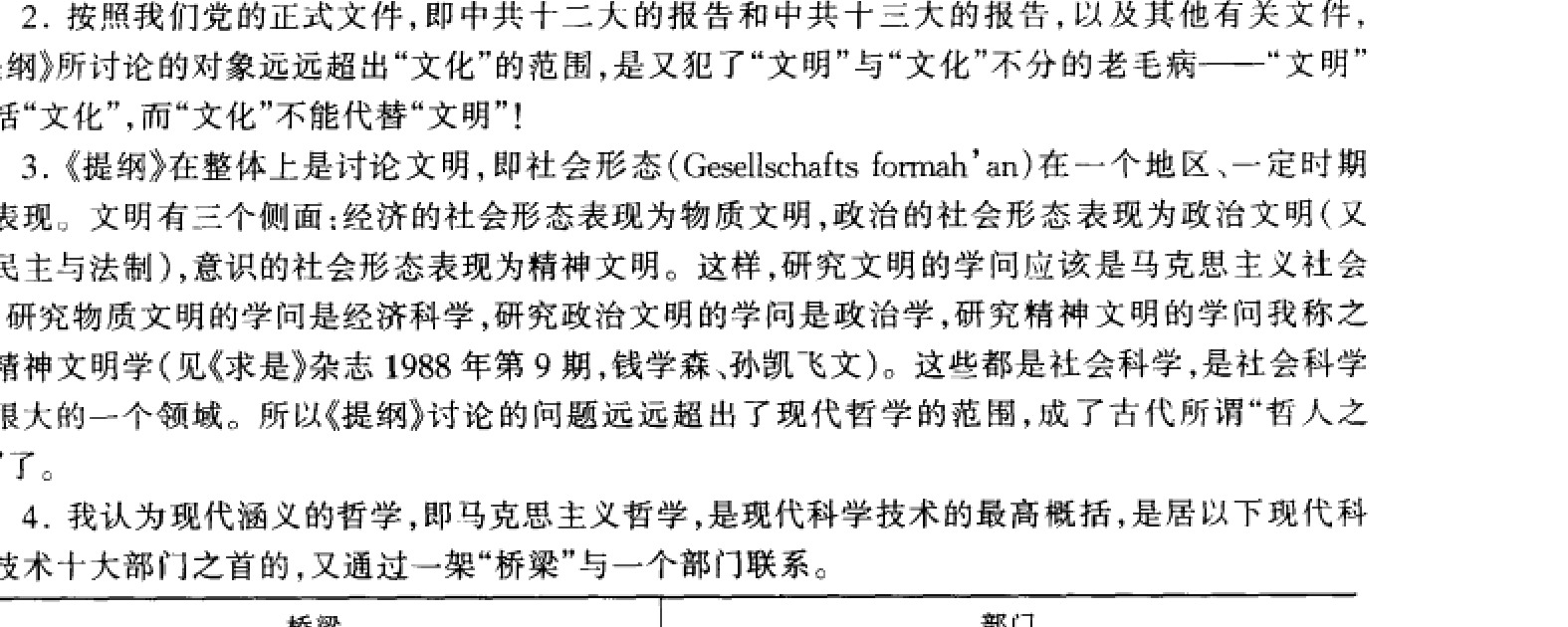
- I believe that philosophy in its modern sense, that is, Marxist philosophy, is the highest generalization of modern science and technology. It stands at the head of the following ten major departments of modern science and technology, and is connected to each department through a “bridge”:
| Bridge | Department |
|---|---|
| Dialectics of Nature | Natural Science (Engineering Technology) |
| Historical Materialism | Social Science (Social Technology) |
| Philosophy of Mathematics (Metamathematics) | Mathematical Science |
| Systems Theory | Systems Science |
| Epistemology | Noetic Science |
| Human-Environment View | Human Body Science |
| Aesthetics | Literary and Art Theory |
| Philosophy of War | Social Theory |
| Behavioral Science | |
| Philosophy of Geography | Geographical Science |
Beyond the ten major departments of modern science and technology, there also exist a knowledge base of practical experience not yet organized into disciplines, and a broader range of practical insights that cannot be put into words. All of these are related to human thinking in understanding the world and to Marxist philosophy. As shown in the diagram below.
- What is culture? Comrade Sun Kaifei and I (in the aforementioned Qiushi article) believe that it should now include the following thirteen aspects: education; science and technology; literature and art; news and publishing; radio and television; sports; libraries; museums; science and technology museums; architecture, gardens, and historical sites; tourism; flowers, birds, insects, and fish; fine cuisine; mass organizations; and religion. The practical activities of these thirteen aspects of cultural enterprise are all encompassed within modern science and technology, as well as the knowledge base of practical experience and unwritten practical insights. Therefore, based on the four points above, the relationship between Marxist philosophy and socialist culture is
direct.
Human thinking in understanding the world
Marxist philosophy
Bridge
Ten major departments of science and technology
Knowledge base of practical experience
Unwritten practical insights
File name under AT6 directory: gxb1
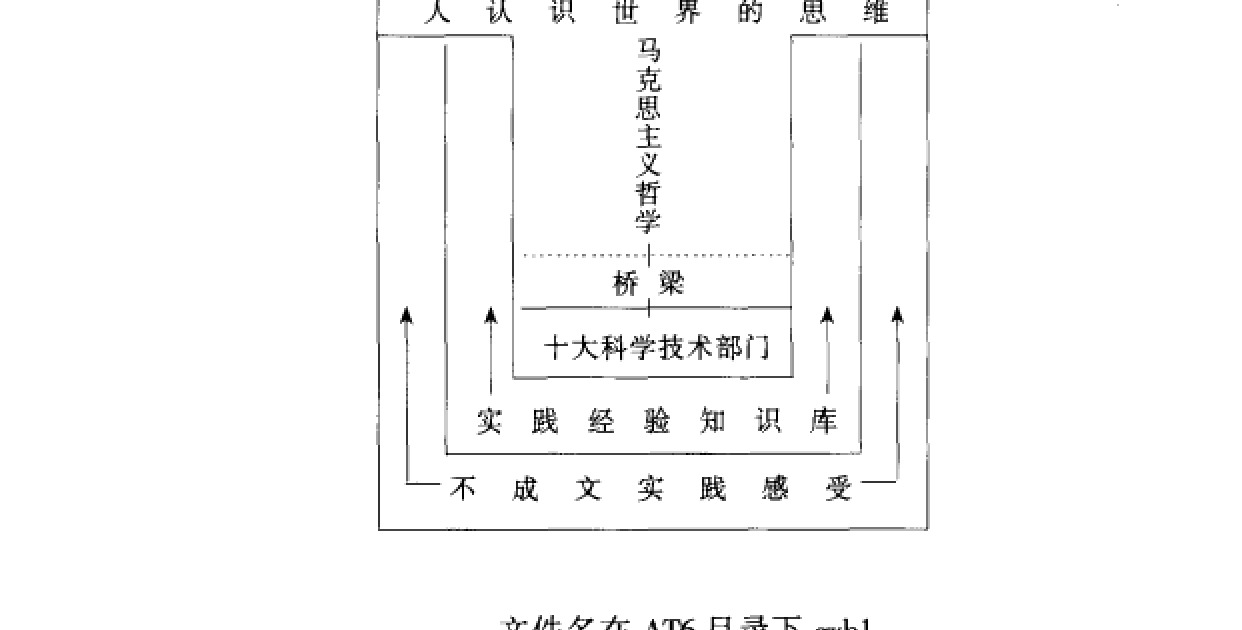
- Since the study of civilization falls within the social sciences, and the social sciences are one of the ten major departments of modern science and technology, civilization is ultimately connected to Marxist philosophy. But not so directly.
The above six points are offered for your reference; please point out any inadequacies.
Respectfully,
(February 20, 1989)
Thirty-Seven: Basic Scientific Research Should Accept the Guidance of Marxist Philosophy
Earlier this year, I wrote an article on basic research, explaining that basic research includes two types of research with different natures: basic scientific research and basic applied research. The former involves exploring and understanding the objective world, where it is temporarily unknown what applications or benefits may result; the latter is aimed at a particular application and requires first making a thorough effort to clarify the fundamental laws in that area, thus having a clear purpose. Because basic scientific research is exploratory, carries great risk, involves only investment with no near-term output, any national leadership organ will naturally hesitate somewhat when deciding on such research projects, and may wish to redirect funds to support basic applied research. This is understandable. The United States, Japan, and Western Europe are all willing to spend generously on high-temperature superconductivity, and even on cold fusion, whose experimental results are disputed, all countries are willing to allocate research funds, because these are all basic applied research with foreseeable benefits. But for basic scientific research, even at the National Science Foundation of the United States, which has relatively ample funding (approximately $2 billion annually), an application is often very difficult to get approved by the expert review committee. So much so that Professor Richard A. Muller of the United States suggested to members of the U.S. Congress that the nation should trust accomplished scientists and let them choose their own research topics, with the administrative authorities intervening as little as possible. He said research funds could be distributed in four steps: first, send an inquiry to all scientists in the United States asking who they consider to be the most outstanding scientists currently engaged in research, and compile a list of names; second, send an inquiry to the scientists on the above list for the same purpose, asking them to submit their own lists; third, repeat the process of the second step once more, obtaining a third
list; fourth, to give each of the top 1,000 scientists who received the most votes on the third list one million dollars per year in research funding, with no restrictions on research topics, to be used at their discretion. Muller believed that this was the only way to solve the problem of basic scientific research, and that half of the U.S. National Science Foundation’s research budget—one billion dollars—should be spent in this manner.
I think similar problems are not entirely absent in our socialist China. It is easy to make up one’s mind to support applied basic research, but it is difficult to support basic scientific research. The underlying thought here is that basic scientific research has no boundaries and no clear direction—who knows whether it will succeed? In this essay, I would like to offer my personal views on this question: modern science and technology, after approximately four hundred years of development, have become a system with Marxism-Leninist philosophy as its highest synthesis. Its evolution follows laws, and therefore basic scientific research is by no means the undirected groping of earlier times, but rather an exploration guided by Marxist philosophy. Thus, pathways and signposts do exist. Now let me try to articulate them, and I submit them for the consideration of comrades.
Determinism and Indeterminism
A. Einstein had a famous saying: “I do not believe that God plays dice!” He expressed his dissatisfaction in this way regarding the fact that quantum mechanics transformed the deterministic Newtonian mechanics and relativistic mechanics into indeterministic ones. So is the law of motion of the objective world itself deterministic or indeterministic?
In fact, the controversy over this question did not begin with Einstein. As early as the beginning of the last century, the great scientist Laplace wrote a book, Celestial Mechanics, which he presented to Emperor Napoleon. When Napoleon received him, the Emperor said: “Professor, how is it that your book makes no mention of God?” Laplace replied: “I have no need of God!” The meaning was that everything in the world is determined by mathematical theory and mathematical equations—this is what Newtonian mechanics had made clear. But by the end of the last century, in order to use the kinetic theory of molecules to explain the laws of thermodynamics, the Austrian L. Boltzmann had to introduce indeterministic statistical mechanics. Boltzmann’s theory was fully consistent with thermodynamics, but a contradiction arose: how could deterministic Newtonian mechanics give rise to an indeterministic kinetic theory of molecules? This question was hotly debated in the scientific community at the time, and Boltzmann’s contradiction. This contradiction was not resolved until the rise of chaos theory in the 1960s. According to this theory, when the number of molecules is extremely large—numbering in the hundreds of millions, trillions—as long as there is even a slight nonlinear relationship in the interactions, “chaos” will inevitably arise. “Chaos” appears to be indeterministic—disorderly and chaotic—but in reality it is deterministic; the disorder and chaos are precisely caused by deterministic laws. However, it can be treated as an indeterministic statistical mechanics problem.
This episode in the history of science shows that the evolution from deterministic Newtonian mechanics to indeterministic statistical mechanics was a scientific advance, and the explanation of the indeterminism of statistical mechanics through chaos theory was yet another scientific advance. So does God play dice or not? Judging from the history above, we should say: if this “God” refers to the objective world itself, then “God” does not play dice; the laws of the objective world are deterministic. But if this “God” refers to the human being, the scientist, who attempts to understand the objective world, then he sometimes has no choice but to play dice, and the progression from presuming not to play dice to acknowledging the necessity of playing dice is also a scientific advance. Later, science developed and progressed further; scientists were able to see more deeply and comprehensively, to “ascend to a higher story,” and scientists once again did not play dice—that was another advance, yet another development of science. In this way, we dialectically unify “God does not play dice” and “God plays dice.” The objective world is deterministic, but due to the limitations of human understanding of the objective world, there may be a temporary need to introduce indeterminism. This is a way station in the course of progress and is not to be faulted; one must simply never be content with indeterminism and cease to seek further clarification.
The question of determinism and indeterminism also exists in the theory of the laws of human thought, namely logic. As early as the seventeenth century, the German mathematician and philosopher Gottfried Wilhelm Leibniz believed that one day mathematical calculation would be able to resolve all disputes, and that whenever differences of opinion arose, one would say: let us calculate. By the beginning of this century, mathematical logic had developed greatly, and another German mathematician, David Hilbert, believed that all mathematical problems were in principle decidable, completely deterministic, and he set about constructing such an edifice of mathematics. But in Hilbert’s later years, this beautiful ideal was shattered. In the 1930s,
Kurt Gödel and Alan M. Turing successively demonstrated in different ways that no such system fundamentally exists. They proved that no system composed of a large number of axioms and rules of inference can solve all problems posed by the positive integers. Now Gregory J. Chaitin of the American IBM company has gone further, proving that randomness exists in number theory and must be resolved using statistical, i.e., non-deterministic, theory. This too is a result of the development over the past century of mathematical principles, or what is called metamathematics. Logicians have now moved beyond classical logic, that is, the so-called first-order logic, opening up higher-order logics such as second-order logic, which are termed modal logics. Thus the study of the laws of thought has advanced enormously. We now understand: non-deterministic problems that arise under certain limitations become deterministic again at a higher level. This is already Marxist dialectical logic.
Submicroscopic, Microscopic, Macroscopic, Cosmological, and Expansive Scales
How do we resolve the non-determinism of quantum mechanics? First, we must establish the determination to solve this problem. There are indeed such scientists in the world, such as D. Bohm, who proposed “hidden order.” He said the world is deterministic, but there are things not yet seen in quantum mechanics theory, and we must grasp the “hidden order.” Bohm’s thinking is correct, but neither he nor his colleagues succeeded. I think this “hidden order” cannot be found only in the microscopic world; it is hidden in a level deeper than the microscopic level of the material world, namely the submicroscopic level. What is the submicroscopic?
This must be explained starting from the so-called Planck length. Physicists realized that there are three constants in physics: the gravitational constant , the speed of light , and Planck’s constant . They can be combined into a length, namely . This length is extremely small, approximately centimeters. For many years, this was merely an interesting quantity; no one knew what concrete significance it had. But in recent years, theoretical physicists, in order to incorporate the four fundamental forces—gravity, weak force, electromagnetic force, and strong force—into a unified theory, namely the “Grand Unified Theory (GUT),” proposed a “Superstring Theory,” and the length of these “superstrings” happens to be approximately centimeters. Shouldn’t the world of superstrings be called the submicroscopic world at the next level down?
The world of superstrings has another characteristic: it is not four-dimensional spacetime (three dimensions of space plus one dimension of time); it is ten-dimensional spacetime, with six additional dimensions beyond the four. The six extra dimensions are invisible in the microscopic world at the higher level because they are far too minute. This leads me to conjecture: the non-determinism manifested by quantum mechanics at the microscopic level is in fact formed by the chaos of ten-dimensional spacetime motion in the deterministic submicroscopic level. What is originally deterministic motion appears to be non-deterministic motion. This is because the submicroscopic world of superstrings is ten-dimensional spacetime, with six dimensions invisible in the microscopic world, not grasped, and therefore six factors are not accounted for—they are left out. One could say that it is because of the “ignorance” of scientists in the microscopic world that the originally deterministic objective world appears to become non-deterministic. This is the true “hidden order”—the order hidden in the submicroscopic. Is this correct? It is open to discussion.
From the submicroscopic to the microscopic differs by 19 orders of magnitude. We may likewise let the gap between the microscopic world and the familiar macroscopic world also differ by 19 orders of magnitude, which would be meters—about the size of a basketball court.
What about going further up from the macroscopic world? We speak of the cosmological world, which is also the world known to astronomers. Does it also differ from the macroscopic world by 19 orders of magnitude? If so, that would be meters meters light-years. light-years is the size of the galactic star system—precisely the world of astronomers!
Thus, from the submicroscopic, microscopic, macroscopic, up to the cosmological, the above construction approach is successful. Is there a further level above? We must not guess blindly; we must look at what facts point to. About half a century ago, scientists in the field of astrophysics discovered from astronomical observations that the universe we inhabit is expanding, and by extrapolating backward, approximately ten-plus billion years ago, the entire universe began exploding from a single point! Hence this cosmological theory is also known by the alternative name “Big Bang Theory.” Spacetime has a beginning! The world did not exist before this—
This discovery is undoubtedly a triumph of modern science, breaking the ancient view of a static world; but it also brought problems: time has a beginning. The Pope of the Vatican was delighted, and Fang Lizhi in China was also delighted. He seized upon the viewpoint in the Big Bang theory that time has a starting point, and used this as a basis to criticize Engels, because Engels argued in Anti-Dühring that time has no beginning—the past is infinite and the future is also infinite. In fact, both the Pope and Fang Lizhi were wrong, as has been discussed in detail in the articles by Comrade Cha Ruqiang and Comrade He Zuoxiu, and I will not repeat that here. We should note that foreign cosmologists also consider it unreasonable that time has a beginning, so over the past eight or nine years, the “Inflationary Universe theory” has been proposed to replace the “Big Bang theory.” Moreover, they have put forward hypotheses about the mechanism by which our universe began to inflate, and have also pointed out that our universe is merely one among countless universes in the greater universe. The greater universe is far larger.
Therefore, I propose that the next level above the cosmoscopic world be called the “inflatoscopic” level. The inflatoscopic is another 19 orders of magnitude above the cosmoscopic, with a typical scale of billion light-years, which is far larger than the current scale of our universe, approximately several tens of billions of light-years.
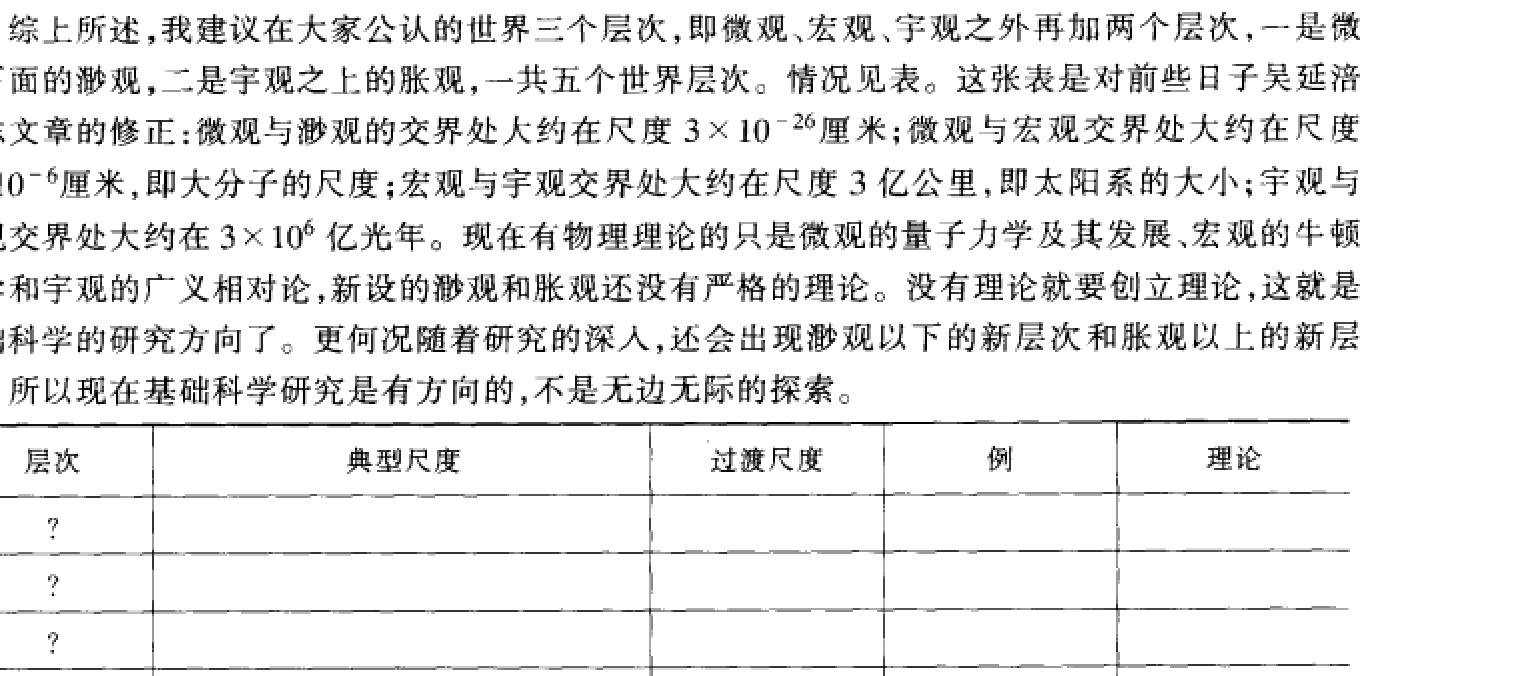
In summary, I suggest adding two more levels beyond the three generally recognized levels of the world—namely the microscopic, macroscopic, and cosmoscopic: one is the submicroscopic below the microscopic, and the other is the inflatoscopic above the cosmoscopic, making a total of five world levels. The situation is shown in the table. This table is a correction to the article by Comrade Wu Yanfu from some days ago: the boundary between the microscopic and submicroscopic is approximately at the scale of cm; the boundary between the microscopic and macroscopic is approximately at the scale of cm, i.e., the scale of macromolecules; the boundary between the macroscopic and cosmoscopic is approximately at 300 million kilometers, i.e., the size of the solar system; the boundary between the cosmoscopic and inflatoscopic is approximately at billion light-years. Currently, there are physical theories only for the microscopic—quantum mechanics and its developments, for the macroscopic—Newtonian mechanics, and for the cosmoscopic—general relativity. The newly proposed submicroscopic and inflatoscopic levels do not yet have rigorous theories. Where there is no theory, theory must be created—this is the direction of basic science research. Moreover, as research deepens, new levels below the submicroscopic and above the inflatoscopic will also emerge. Therefore, basic science research now has a direction; it is not a boundless exploration.
| Level | Typical Scale | Transition Scale | Example | Theory |
|---|---|---|---|---|
| Inflatoscopic | m light-years billion light-years | ? | ||
| Cosmoscopic | m light-years | billion light-years | Galactic system | General relativity |
| Macroscopic | m | 300 million kilometers | Solar system | Newtonian mechanics |
| Microscopic | m cm | cm | Macromolecule | Quantum mechanics |
| Submicroscopic | m cm | cm | Elementary particle | Superstring? |
Not only that, current microscopic research is mostly conducted above cm. There is still the lower half of the microscopic world, down to approximately cm at the boundary with the submicroscopic, where quantum mechanics and its developments still have great potential. The upper part of the cosmoscopic, up to approximately billion light-years at the boundary with the inflatoscopic, also offers great potential for general relativity. These too are new frontiers for basic science research.
It should be noted here that direct experimentation or observation of the newly proposed frontiers of basic science described above is relatively difficult. In the lower half of the microscopic world, physical experiments may require energies exceeding those of existing or planned high-energy accelerators, i.e., greater than several tens of TeV. In the upper half of the cosmoscopic world, the instruments needed for astronomical observation would also greatly exceed existing or planned astronomical observation equipment. If experiments or direct observations cannot be performed, how can theories be verified? Fortunately, today we already have electronic computers and computer systems with very substantial computational power,
Moreover, the capability of such computing equipment will continue to improve in the near future. Therefore, theory can be synthesized through complex computation into results that can be checked against experimental or observational findings, enabling indirect comparison. This method—using electronic computers for basic scientific research—is currently being tried out today, and the results are good. This direction is also one that future basic scientific research must attend to.
Research and Methodology on Open Complex Giant Systems
The preceding section examined the direction of basic scientific research from the perspective of overall structural hierarchy. Are there still major topics for basic scientific research at the ancient macroscopic level? I believe there are. This is a major domain that has emerged from systems science: open complex giant systems.
A system is composed of subsystems. “Open” means that the system exchanges with its external environment. When the number of subsystems is small, the system is called a simple system; when the number of subsystems reaches dozens or hundreds, the system is called a large system. Today’s systems science has theoretical methods to directly handle relatively simple small systems and large systems. If the number of subsystems is extremely large—tens of thousands, hundreds of millions, tens of billions, trillions—then it is a giant system. If the types of subsystems within the giant system are not too many, say several or dozens, we call it an open simple giant system, which is still manageable. There are now methods to handle it: these are the dissipative structure theory or synergetics theory developed over the past twenty years by I. Prigogine, H. Haken, and others, all of which have advanced statistical mechanics. Their theories have been quite successful in handling open simple giant systems and have resolved many important problems.
However, if the types of subsystems within a giant system are too many, and the interactions among subsystems are also highly varied and diverse in form, then this giant system becomes an open complex giant system. At present, there is no theory for open complex giant systems—no statistical mechanical theory constructed from the interactions of subsystems! So what are open complex giant systems? Examples include the human body, biological organisms, the human brain, the Earth’s environment, and society. These are, respectively, the human-body complex giant system, the biological-organism complex giant system, the human-brain system, the geographic system, and the social system. The social system is especially complex, because the people in society possess consciousness; their behavior is not a simple “conditioned reflex,” not a matter of input producing a corresponding output. After receiving information, a person thinks, makes judgments, and then acts, and this process is influenced by various conditions and is highly variable. Therefore, the social system can be called an open special complex giant system.
From the examples of open complex giant systems, one can see their broad scope: they involve theories of medicine, biology, noetic science, geographical science, and social science. Yet there is currently no theory for complex giant systems! Of course, some people are quite naive and insist on trying anyway; this falls into two situations. First, there are those in the dissipative structure and synergetics school who insist on applying theories designed for simple giant systems to complex giant systems, including a group of Chinese enthusiasts of the so-called American “system dynamics”—they naturally do not succeed. Second, there are those who leap directly to philosophy, engaging in empty talk about how the motion of a system is determined by its subsystems, and therefore the microscopic determines the macroscopic, even proposing something like a “cosmic holographic unity theory.” They fail to see that we cannot claim to fully understand even the subsystems; within the subsystems there are still deeper and finer sub-subsystems. To argue from incomplete knowledge about the unknown—what good does that do?
The only method currently available for handling open complex giant systems (including social systems) is to combine many people’s piecemeal experiential understanding of the system—often qualitative knowledge—with models of the complex system involving dozens, hundreds, or several hundred parameters, that is, quantitative computation, and through repeated trial and error by the principal investigator, comparing with actual data, ultimately form a theory. In this process, not only does the model computation require large-scale electronic computers, but even in the human process of repeated trial and decision-making, computers are needed to assist in judgment and selection. This is the so-called method of combining qualitative and quantitative approaches for handling open complex giant systems. For socioeconomic problems, this method has been tried with good results.
As described above, open complex giant systems and social systems are problems of such broad scope, yet the fundamental theory underlying them is still unclear. However, there is a practical and effective method whose characteristic is to bring together, all at once, the scattered and piecemeal knowledge about an objective phenomenon that exists among many people—gathering fragments to make a whole—and thereby solve problems. This important basic scientific research should start from precisely this kind of practical experience, conscientiously summarize and elevate it, and establish a fundamental theory. This can be an important topic of the foundational discipline of systems science, namely systematology; at the same time,
It is also an important development in scientific methodology. It is true meta-synthesis, not what is called “Meta-Analysis” abroad.
In the preceding sections, I have put forward some views on basic scientific research. The reason I am able to put forward these views is that I have drawn inspiration from Marxist philosophy. This is what I mean when I say that Marxist philosophy is a source of wisdom. Therefore, basic scientific research should accept the guidance of Marxist philosophy; basic scientific research is also a long river flowing continuously forward, with a direction, and is not unknowable. We should always keep in mind a saying of Comrade Mao Zedong: “Marxism-Leninism has not ended truth, but rather constantly opens up the path to the cognition of truth in practice.”
(1989)
Thirty-Eight: Open Complex Giant Systems and Their Methodology
Over the past twenty years, starting from concrete applications of systems engineering, a new major department of modern science and technology has gradually developed — systems science. Great progress has been made in both its theoretical and applied research. Especially in recent years, a large new field has emerged within systems science: the study of open complex giant systems, which was first initiated by Comrade Ma Bin. Open complex giant systems exist in nature, in the human body itself, and in human society; it is just that previously people were unable to recognize and study such problems from this perspective. The purpose of this article is to specifically discuss this class of systems and their methodology.
Classification of Systems
Systems science takes systems as its object of study, and systems exist universally in nature and in human society. For example, the solar system is a system, the human body is a system, a family is a system, a factory enterprise is a system, and a nation is also a system, and so on. The objective world contains a great variety of concrete systems. For the convenience of research, systems can be classified into various types according to different principles. For example, based on whether human participation is involved in the formation and functioning of a system, they can be divided into natural systems and artificial systems: the solar system is a natural system, while a factory enterprise is an artificial system. If classified according to whether a system exchanges matter, energy, and information with its environment, systems can be divided into open systems and closed systems. Of course, truly closed systems do not exist in the objective world; it is only for the convenience of research that a concrete actual system is sometimes approximately treated as a closed system. If classified according to whether the state of a system changes with time, systems can be divided into dynamic systems and static systems. Similarly, truly static systems do not exist in the objective world either; they are merely an approximate description. If classified according to different physical attributes of systems, they can be further divided into physical systems, biological systems, ecological-environmental systems, and so on. Based on whether a system contains living factors, there is also the distinction between living systems and non-living systems, and so forth.
Although the above classification of systems is relatively intuitive, it places too much emphasis on the concrete content of systems, thereby losing sight of the essence of systems — and this point is extremely important in systems science research. For this reason, this article proposes the following classification method.
Based on the number of subsystems composing a system and the number of types of subsystems, as well as the complexity of the interrelationships among them, systems can be divided into two major categories: simple systems and giant systems. Simple systems refer to those in which the number of subsystems composing the system is relatively small, and the relationships among them are naturally rather straightforward. Certain non-living systems, such as a measuring instrument, constitute a small system. If the number of subsystems is relatively large (e.g., dozens or hundreds), such as a factory, it can be termed a large system. Whether a small system or a large system, the study of such simple systems can proceed from the interactions among subsystems and directly synthesize the motion and function of the entire system. This can be described as a direct approach, without complications, at most
When dealing with large systems, one must rely on large-scale computers or supercomputers.
If the number of subsystems is extremely large (e.g., thousands, tens of thousands, hundreds of billions, or trillions), the system is called a giant system. If the types of subsystems within a giant system are not too many (a few types, or several dozen types), and the relationships among them are relatively simple, it is called a simple giant system, such as a laser system. Researching and handling such systems naturally cannot employ the methods used for studying simple small systems and large systems; even supercomputers would be insufficient, and in the future there will not be computers with sufficient capacity to satisfy this mode of research. Since direct synthesis methods do not work, people thought of the tremendous achievements of statistical mechanics from the early twentieth century, in which the functionality of a giant system composed of hundreds of millions of molecules is abstracted by setting aside details and summarized using statistical methods. This has been quite successful; it is the contribution of I. Prigogine and Haken, who respectively termed them dissipative structure theory and synergetics.
Open Complex Giant Systems
If there are many types of subsystems with hierarchical structures, and the relationships among them are quite complex, this constitutes a complex giant system. If this system is also open, it is called an open complex giant system. Examples include: biological organism systems, the human brain system, the human body system, geographical systems (including ecological systems), social systems, galactic systems, and so on. These systems are highly complex in structure, function, behavior, and evolution, so much so that even today there remain a great many problems we do not clearly understand. Take the human brain system: due to the brain’s memory, thinking, and reasoning functions as well as the role of consciousness, its input-output response characteristics are extremely complex. The human brain can utilize past information (memory) and future information (reasoning), as well as current input information and environmental interactions, to produce various complex responses. From a temporal perspective, such responses can be real-time responses, delayed responses, or even anticipatory responses; from the perspective of response type, they may be genuine responses, false responses, or even no response at all. Therefore, human behavior is by no means a simple “conditioned reflex.” Its input-output characteristics change over time. In fact, the human brain has neurons and an equally large number of glial cells, and the interactions among them are far more complex than those of an electronic switch. Thus, E. Clementi of the IBM Research Institute in the United States once said that the human brain is like a massive computing network formed by supercomputers, each performing one billion operations per second, connected in parallel!
Moving up one level, we have systems whose subsystems are primarily human subjects, and the subsystems of such systems also include various machines with intelligent behavior manufactured by humans. For this type of system, “openness” and “complexity” take on new and broader meanings. Here, openness refers to the exchange of energy, information, or matter between the system and the external environment. To be more precise: (1) the system and its subsystems each have various information exchanges with the external environment; (2) the subsystems within the system acquire knowledge through learning, and due to the role of human consciousness, the relationships among subsystems are not only complex but also highly variable over time and across situations. A single human being is itself a complex giant system, and now a giant system—society—is formed with a large number of such complex giant systems as its subsystems. For humans to understand the objective world, they rely not only on practice but also on the spiritual wealth created by humanity in the past. The acquisition and utilization of knowledge is a very prominent issue. Without using any knowledge at all, we would revert to the state of our ancestors over a million years ago. Humans have already created enormous high-performance computers and are also committed to developing machines with intelligent behavior. Humans and these machines work together as subsystems within the system, cooperating harmoniously—this is the most complex system known to date. Here, the complexity of the system is characterized not only by the number of types of subsystems within it, but knowledge also plays an extremely important role. The complexity of such systems can be summarized as follows: (1) the subsystems within the system can communicate in various ways; (2) there are many types of subsystems, each with its own qualitative model; (3) knowledge is represented differently across subsystems and is acquired in various ways; (4) the structure of subsystems within the system changes as the system evolves, so the system’s structure is constantly changing. We call the above system an open special complex giant system, which is what is commonly referred to as the social system.
This classification of systems clearly delineates the hierarchical levels of system complexity, and it is of great significance for both theoretical and applied research in systems science. This can also be seen from recent research on social systems. Studying the human being as a complex giant system can be regarded as the microscopic study of social systems. In the macroscopic study of social systems, based on the concept of social formation established by Marx, any society has three social forms, namely the economic social formation, the political social formation, and the ideological social formation. The social system can thus be divided into three components: the socio-economic system, the socio-political system, and the socio-ideological system. Corresponding to the three social forms, there should be three forms of civilization-building:
namely, material civilization construction (economic formation), political civilization construction (political formation), and spiritual civilization construction (ideological formation). Socialist civilization construction should be the coordinated development of these three types of civilization construction. This conclusion has important significance both in theory and in practice.
From a practical perspective, what ensures the coordinated development of these three types of civilization construction is social systems engineering. According to the definition of systems engineering, the technology for organizing and managing the social economic system is economic systems engineering; the technology for organizing and managing the social political system is political systems engineering; and the technology for organizing and managing the social ideological system is ideological systems engineering. Social systems engineering, then, is the organizational and management technology that enables coordinated development among these three subsystems and between the social system and its environment. From the reality of our country’s reform and opening up, not only economic systems engineering is needed, but even more so social systems engineering. Carrying out economic system reform in isolation, without paying attention to the interconnections and constraints of the other two subsystems, has caused serious impacts on reform, to the extent that it became necessary to rectify the economic environment and reorganize the economic order. The further rectification, reorganization, and deepening of reform proposed at the Fifth Plenary Session of the Thirteenth Central Committee of the Party is precisely the self-improvement of the socialist system and the self-improvement of China’s social formation. All of this demonstrates that a single-track, piecemeal approach to reform will not work. Reform requires overall analysis, overall design, overall coordination, and overall planning—this is the great practical significance of social systems engineering for our country’s reform and opening up.
From the examples of open complex giant systems listed above, it can be seen that they involve biology, noetic science, medicine, geoscience, astronomy, and social science theory, so this is a very broad field of research. It is worth noting that the theories in these fields were originally distributed across different disciplines and even different departments of science and technology, and each has had a relatively long history. They have all, to varying degrees, touched upon the idea of open complex giant systems in their own disciplinary language—for example, traditional Chinese medical theory—yet today they can all be subsumed under the concept of open complex giant systems, and with greater clarity and depth. This fact inspires us that the proposal of the concept of open complex giant systems and its theoretical research will not only promote the development of theories in these different disciplines, but also open up new and encouraging prospects for the communication among these theories.
Research Methods for Open Complex Giant Systems
Open complex giant systems have not yet formed a theory from the microscopic to the macroscopic level; there is no statistical mechanics theory constructed from the interactions of subsystems. Is there then a research method? Some people think rather simplistically, insisting on applying the methods discussed in the first section for handling simple systems or simple giant systems to open complex giant systems. They fail to see the limitations and scope of application of these theoretical methods, mechanically applying them, with the result being counterproductive. For example, game theory in operations research, in terms of its theoretical framework, is a fine tool for studying social systems. But the level that game theory has reached today and the achievements it has obtained are far from sufficient to handle the complex problems of social systems. The reason is that game theory has oversimplified the social nature and complexity of human beings, as well as the uncertainty of human psychology and behavior, to the point that complex giant system problems have been reduced to simple giant system or simple system problems. Similarly, the reason why system dynamics and self-organization theory cannot succeed when applied to the study of open complex giant systems also lies here. The founder of system dynamics, J. Forrester himself, cautioned that his method should be applied carefully and that the credibility of models should be studied, yet some people in this country have no such concerns and use it “boldly.”
Furthermore, some people immediately elevate the problem of complex giant systems to a philosophical height, engaging in empty talk about how the system movement is determined by subsystems, how the microscopic determines the macroscopic, and so on. A very typical example is the “Cosmic Holographic Unity Theory.” They fail to see that even subsystems cannot be considered fully understood. Within subsystems there are still deeper and finer subsystems; to use incomplete knowledge to argue about the unknown—what good does that do? They even erroneously propose that “the part contains all the information of the whole” and “the part is the whole, the whole is the part, the two are absolutely identical,” which completely violates objective facts and also violates Marxist philosophy.
Practice has already proven that the only method currently available that can effectively handle open complex giant systems (including social systems) is the meta-synthesis method of combining qualitative and quantitative approaches. This method was distilled, generalized, and abstracted on the basis of research practice in the following three complex giant systems, namely:
- In social systems, the qualitative-quantitative combined systems engineering technology described by hundreds or thousands of variables, for social
research and application in economic systems; 2. In human body systems, research that integrates physiology, psychology, Western medicine, Chinese and traditional medicine, as well as qigong, human special functions, and the like; 3. In geographical systems, the comprehensive exploration of geographical science using ecosystems, environmental protection, and regional planning.
In these research and application efforts, scientific theory, empirical knowledge, and expert judgment are typically combined to propose empirical hypotheses (judgments or conjectures). These empirical hypotheses cannot be proven by rigorous scientific means and are often qualitative in nature, but their validity can be tested using empirical data and materials as well as models with dozens, hundreds, or even thousands of parameters. These models must also be built upon experience and practical understanding of the system; through quantitative computation and repeated comparison, conclusions are ultimately formed. Such conclusions represent the best conclusions we can achieve at the present stage in understanding objective reality—they represent knowledge that has risen from the qualitative to the quantitative level.
From the above, it can be seen that the meta-synthesis method combining qualitative and quantitative approaches, in essence, organically integrates expert collectives (various relevant experts), data, and all kinds of information with computer technology, and combines the scientific theories of various disciplines with human experiential knowledge. These three components themselves also constitute a system. The successful application of this method lies in bringing into play the overall advantage and comprehensive advantage of this system.
In recent years, some people abroad have proposed meta-analysis, which conducts cross-domain analysis and synthesis of information from different fields, but it is not yet mature and the method is too simple, whereas the meta-synthesis method combining qualitative and quantitative approaches is true meta-synthesis.
Examples of the Meta-Synthesis Method
Below, we use the example of “comprehensive study of fiscal subsidies, prices, and wages” in socio-economic systems engineering to illustrate this method and its application. This case was successful.
Since 1979, due to the implementation of policies raising procurement prices for agricultural and sideline products and adding premiums for above-quota purchases, farmers’ incomes were increased. This portion of money was subsidized by the state treasury. However, at that time, no corresponding adjustments were made to sales prices. As a result, with successive bumper harvests in agriculture, the above-quota premium portion grew rapidly, placing a heavy burden on state finances and becoming the main source of fiscal deficits. This created an extremely abnormal economic state: the better the agricultural harvest, the greater the fiscal subsidies, causing the growth rate of state fiscal revenue to lag significantly behind the growth rate of national income, and the proportion of fiscal revenue to national income declined year by year.
The problems arising from fiscal subsidies drew great attention from the state. Relevant departments raised the question of how to use the two economic levers of prices and wages to gradually reduce and eventually eliminate fiscal subsidies. However, adjusting retail commodity prices would inevitably affect the people’s living standards; if accompanied by wage adjustments, this would in turn involve the fiscal burden capacity, market equilibrium, currency issuance, and savings. These issues involve the four domains of the economic system: production, consumption, circulation, and distribution.
[The system is] a system with certain functions. Adjusting prices and wages so as to eliminate fiscal subsidies is essentially a matter of changing and regulating the interconnections and constraints of this system so that the system possesses the functions we desire. This is a typical proposition of systems engineering.
To solve this problem, economists, management experts, and systems engineering experts first drew upon their scientific theories, empirical knowledge, and understanding of practical issues to jointly discuss and study the economic mechanisms (operational mechanisms and management mechanisms) of the aforementioned system, clarify the crux of the problem, make qualitative judgments (empirical hypotheses) about the approaches and methods for solving the problem, and, from a systems thinking and perspective, incorporate the above issues into a systems framework, define the system boundaries, and identify which are state variables, environmental variables, control variables (policy variables), and output variables (observed variables). This step is of great significance for determining the system modeling approach, model requirements, and functionality.
System modeling refers to describing the structure, functions, and input-output relationships of an actual system using mathematical models, logical models, and the like, and using the study of the models to reflect the study of the actual system. The modeling process requires both theoretical methods and empirical knowledge, as well as authentic statistical data and relevant materials.
With a system model, and with the aid of computers, one can simulate the system and its functions; this is system simulation. It is equivalent to conducting experiments on the system in a laboratory, that is, experimental research on the system. Through system simulation, one can study the system’s responses under different inputs, the dynamic characteristics of the system, and predictions of future behavior, and so forth; this is system analysis. On the basis of analysis, system optimization is carried out. The purpose of optimization is to find the optimal, suboptimal, or satisfactory policies and strategies to enable the system to possess the functions we desire.
The quantitative results obtained through the above steps are then jointly re-analyzed, discussed, and evaluated by economists, management experts, and systems engineering experts. This involves the mutual complementation of rational, perceptual, scientific, and experiential knowledge. The results may be credible or may not be credible. In the latter case, the model must be revised and parameters adjusted, and the above work repeated. Such repetitions may occur many times until experts from all fields consider these results to be credible, before conclusions and policy recommendations are made. At this point, there are both qualitative descriptions and quantitative bases; these are no longer a priori judgments and conjectures, but conclusions with sufficient scientific basis. The above steps can be represented by a block diagram, as shown in the figure.
Data and materials Information System operation System mechanism Modeling, simulation Result analysis Decision-making department Conclusions and recommendations Purpose, judgment Analysis, optimization and synthesis 4 System evaluation Adjust model and references Expert expertise Theory and knowledge
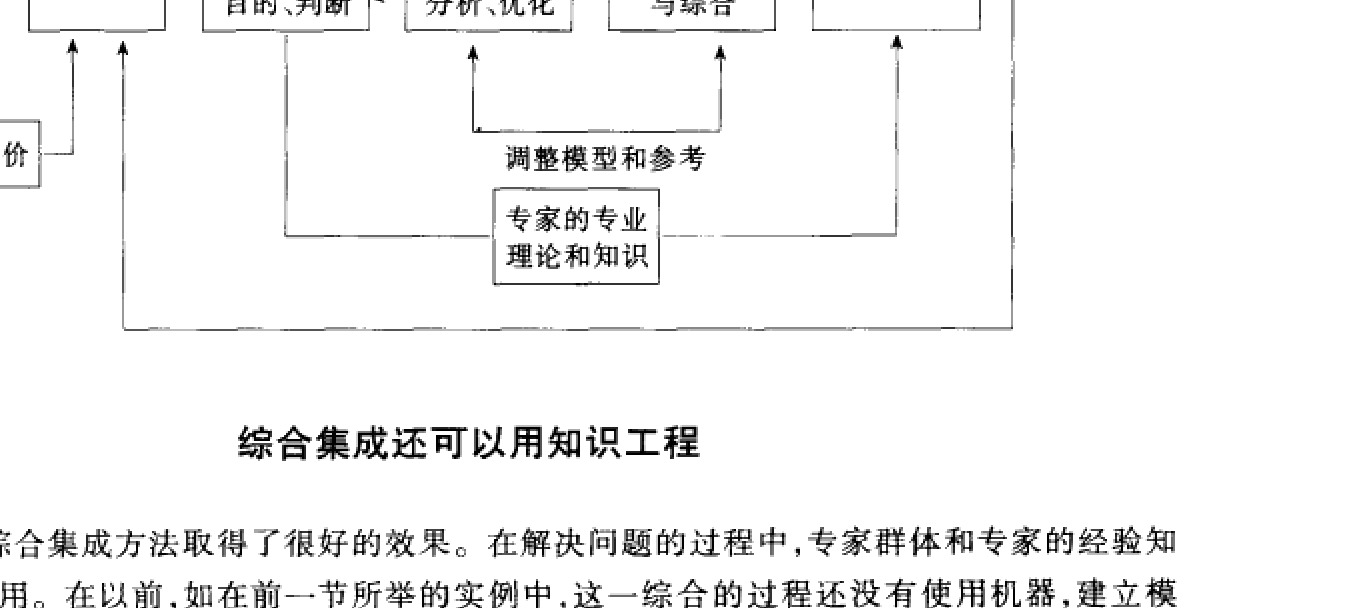
Meta-synthesis can also employ knowledge engineering
As described above, the meta-synthesis method has achieved very good results. In the process of solving problems, the expert group and the experiential knowledge of experts play an important role. Previously, as in the examples given in the preceding section, this process of synthesis did not yet use machines; model building also relied on human mental effort. In retrospect, we can go further by incorporating knowledge—an extremely important factor—into a system. This involves knowledge representation and knowledge processing, which is essentially a matter of knowledge engineering. Knowledge engineering is an important branch of artificial intelligence; its approach to solving problems focuses on rationally organizing and using knowledge, thereby constructing knowledge-based systems. Expert systems are a typical kind of knowledge-based system. A portion of the role of experts can be realized through expert systems, so expert systems naturally also become subsystems within the system. Analyzing further, in the earlier discussion on system classification, open special complex giant systems occupy the highest level, with humans as subsystems within such systems. Humans cannot exist apart from society; as society develops, humans create various machines to replace physical labor and part of mental labor, and as a result, machines with intelligent behavior inevitably also become subsystems. The system constituted by humans, expert systems, and intelligent machines as subsystems is inevitably a human-machine interactive system. The various subsystems coordinate and cooperate with each other; at critical points, humans provide guidance and make decisions, while repetitive and heavy work is carried out by machines. Humans and machines communicate through various convenient means of communication, such as natural language, text, graphics, and so on, forming a harmonious system.
In recent years, some experts in the field of knowledge engineering have recognized the erroneous tendency of previously neglecting theory, and have been exploring methodological issues in the study of knowledge-based systems. The core problem in knowledge engineering is knowledge representation, that is, how to represent various kinds of knowledge, such as textbook knowledge, specialized domain
87
Relevant knowledge, empirical knowledge, commonsense knowledge, and so forth must be represented in forms that computers can accept and process—this is a fundamental problem that must be solved. Knowledge-based systems differ from previous dynamic systems in that their characteristic feature is to solve problems through knowledge-controlled heuristic methods, rather than through precise quantitative processing, because much knowledge is empirical in nature and difficult to describe precisely. For knowledge-based systems, one cannot establish quantitative mathematical models as in some previous control systems; instead, only qualitative methods can be adopted. If the system includes some components that can be described quantitatively, then a combination of qualitative and quantitative methods must inevitably be used for system synthesis. Much existing work utilizes the concepts and modeling methods of qualitative physics to build qualitative models and then study qualitative reasoning. Qualitative modeling is a method of encoding deep knowledge, concerned only with trends of change, such as increasing, decreasing, or remaining unchanged. Qualitative reasoning refers to the operational execution on qualitative models, thereby obtaining or predicting the behavior of the system. The emphasis here is on the description of structure, behavior, and function, as well as the relationships among them. To date, there have been three representative lines of work. The first is the component-centered model proposed by de Kleer and others at Xerox Corporation from a systems perspective, which holds that the most important characteristic of a system is its composability: structurally, a system is formed by connecting components, and the behavior of the system can be derived from the behavior of the components. They have been devoted to establishing a qualitative physical system capable of explanation and prediction. The second is the constraint-centered model proposed by Kuiper of the MIT Computer Science Laboratory. The third is the process-centered model proposed by Forbus of the MIT Artificial Intelligence Laboratory. He refers to the causes that induce motion and change as processes and is devoted to establishing a theory of the influence of processes on physical phenomena. The motivation for studying qualitative modeling and reasoning in knowledge engineering is to investigate commonsense knowledge and to solve problems of representation, storage, and reasoning with commonsense knowledge. Many experts believe that the methods and theoretical research on qualitative modeling and reasoning are very likely the pathway to utilizing commonsense knowledge. The 1988 European Conference on Artificial Intelligence awarded its best paper prize to a paper on qualitative physical models and computational models, indicating the hopes people place in research in this area.
In fact, much important work in the field of artificial intelligence is considered from a systems perspective. There is a proposal to characterize artificial intelligence research as the study of computational methods for the acquisition, representation, and use of various qualitative models (models of physical, perceptual, cognitive, and social systems). This reflects a systems science perspective. Currently, the idea of meta-synthesis is receiving attention in the field of artificial intelligence. The proposal and emergence of Computer Integrated Manufacture Systems (CIMS) is one example. In industrial production, product design and product manufacturing are two important aspects, each comprising several stages, and these stages carry out their work through human-computer interaction using modern technology. Previously, design and manufacturing were conducted separately. Now the idea is to organically link the two through artificial intelligence technology, promptly feeding back information about product quality from the manufacturing process to the design process, making the entire production flexible and efficient while ensuring high product quality. This idea of unified planning and design of design, manufacturing, and even management and sales is precisely a manifestation of the meta-synthetic thinking of open complex giant systems.
In summary, after we have broadened the two concepts of “openness” and “complexity” of systems, our understanding of systems becomes more profound, and the content encompassed becomes more extensive. This breadth is abstracted and generalized from the development of modern science and technology, especially the development of the emerging field of knowledge engineering, and has a solid foundation and sufficient basis. After we have clarified that open special complex giant systems belong to the highest level in the classification of systems, we have in effect explicitly bridged the two major fields of systems science and artificial intelligence. In this way, various knowledge-characterized intelligent systems, such as cooperative artificial intelligence systems, distributed artificial intelligence systems, and real-time intelligent control systems, all fall within a unified and well-defined category. This facilitates the establishment of the theoretical foundation for open complex giant systems, which is an inevitable result of the development of contemporary science.
The Significance of Research on Open Complex Giant Systems
From the above discussion, the meta-synthetic method combining qualitative and quantitative approaches can be summarized as having the following characteristics:
-
Based on the complex mechanisms and the multitude of variables characteristic of open complex giant systems, it organically combines qualitative research with quantitative research, rising from multifaceted qualitative understanding to quantitative understanding.
-
Due to the complexity of the system, it combines scientific theory with empirical knowledge, integrating the scattered bits of human knowledge about objective things…
and comprehensively integrated to solve problems. 3. Based on systems thinking, combine multiple disciplines in research. 4. Based on the hierarchical structure of complex giant systems, unify macroscopic research and microscopic research.
It is precisely these characteristics that endow this method with the capability to solve complex problems within open complex giant systems, and therefore it is of great significance. The following will focus on elaborating this viewpoint.
The object of exploration and research in modern science and technology is the entire objective world. However, when studying different problems of the objective world from different angles, different viewpoints, and different methods, modern science and technology has produced different branches of science and technology. For example, natural science studies the objective world from the perspective of matter in motion, the different levels of matter in motion, and the relationships between different levels. Social science studies the objective world from the perspective of the developmental movement of human society and the influence of the objective world on human development. Mathematical science studies the objective world from the perspective of quantity and quality and their mutual transformation… System science, on the other hand, studies the objective world from a systems perspective, applying systems methods. As a branch of science and technology, system science takes the system as its object of study from applied to basic theoretical research. In the macroscopic world, on our Earth, life and organisms have emerged, humans and human society have appeared, and open complex giant systems have come into being. Such systems also exist in the astrophysical world; for example, a galaxy is also an open complex giant system. Viewed in this way, the concept of open complex giant systems has already transcended the macroscopic world and entered a broader realm. Therefore, open complex giant systems and their study are of universal significance. However, as pointed out earlier, past scientific theories have been unable to solve the problems of open complex giant systems. There are reasons for this, which can be found in history.
As is well known, for a long time scientists in different fields had noticed that life systems and non-life systems appear to follow seemingly entirely different laws. Non-life systems typically obey the second law of thermodynamics: systems always spontaneously tend toward equilibrium and disorder, with the entropy of the system reaching a maximum. Systems spontaneously change from order to disorder, whereas disorder will never spontaneously transform into order—this is the irreversibility of systems and the stability of equilibrium states. However, life systems are the opposite: biological evolution and social development always proceed from the simple to the complex, from the lower to the higher, becoming increasingly ordered. Such systems can spontaneously form stable ordered structures.
For a long time, this contradictory phenomenon between the two types of systems could not be theoretically explained, leading some scientists to believe that the two types of systems each had their own laws, entirely unrelated to each other. But other scientists raised the question: is there some intrinsic connection behind this contradictory phenomenon? It was not until the 1960s, with the emergence of dissipative structure theory and synergetics, that a scientific theoretical framework was provided for resolving this problem. These theories hold that what the second law of thermodynamics reveals is the law governing isolated systems (systems with no exchange of matter and energy with their environment) under equilibrium and near-equilibrium (linear non-equilibrium) conditions. However, life systems are typically open systems and are far from equilibrium (nonlinear non-equilibrium states). Under such conditions, through the exchange of matter and energy with the environment, the system introduces a negative entropy flow. Although positive entropy is generated within the system, the total entropy decreases. When certain conditions are met, the system can spontaneously transform from its original disordered state into an ordered state in time, space, and function, producing a new stable ordered structure, which Prigogine termed a “dissipative structure.” Thus, without violating the second law of thermodynamics, dissipative structure theory bridged the intrinsic connection between the two types of systems, demonstrating that there is no truly strict boundary between them, and that the apparent gulf is governed by the same systems laws. Therefore, Prigogine noted in his work, “Complexity is no longer merely a biological matter; it is entering the realm of physics, and seems already to be rooted in the laws of nature.” Haken further pointed out that the key to a system’s transition from disorder to order lies not in whether the system is in equilibrium or non-equilibrium, nor in how far it is from the equilibrium state, but rather in the fact that the subsystems composing the system, under certain conditions, spontaneously generate stable ordered structures through nonlinear interactions, mutual synergy, and cooperation among them—this is a self-organizing structure.
This achievement of modern science over the past twenty years is extremely important; it has elucidated a puzzle that long perplexed people. However, the successes of dissipative structure theory and synergetics have also led some people to be overly optimistic, believing that this quantitative methodology based on the reductionism of modern science could also be applied to open complex giant systems—only to hit a wall!
In the history of scientific development, all sciences that primarily employ quantitative research methods were once called “exact sciences,” while those that mainly employed speculative methods and qualitative descriptions were called “descriptive sciences.” Natural science belongs to the “exact sciences,” while social science belongs to the “descriptive sciences.”
“descriptive science.” Social science is a science that takes social phenomena as its object of study, and the complexity of social phenomena makes its quantitative description very difficult, which may be the main reason it cannot become a “precise science.” Although scientists have made tremendous efforts to transition social science from a “descriptive science” to a “precise science,” and have already achieved results—for example, in economic science—the entire social science system is still far from being a “precise science.” From the preceding discussion, it can be seen that open complex giant systems and their research methods actually involve assembling a large amount of scattered and fragmentary qualitative understanding, bits and pieces of knowledge, and even the opinions of the masses, into an overall structure to achieve quantitative understanding—from incomplete qualitative understanding to relatively complete quantitative understanding, representing a leap from the qualitative to the quantitative. Of course, when a particular area of inquiry has been studied in this way and a substantial body of knowledge has accumulated, it will once again rise to a qualitative understanding of the entire field, reaching a higher level of cognition and forming yet another leap in understanding.
The famous German physicist Max Planck believed: “Science is an inner whole; its decomposition into separate parts is determined not by the nature of things themselves but by the limitations of human cognitive capacity. In reality, there exists a continuous chain from physics to chemistry, through biology and anthropology to sociology—a chain that cannot be broken at any point.” The research of natural science and social science covers this chain. The great mentor Karl Marx long ago predicted: “Natural science will in the future subsume the science of man under itself, just as the science of man will subsume natural science under itself: it will become one science.” We call this process of natural science and social science becoming a single science the integration of natural science and social science. It can be said that the study of open complex giant systems and the establishment of its methodology have found a scientific and practically feasible path and method for realizing Marx’s great prediction.
In concluding this discussion, we must also point out: the meta-synthesis method combining qualitative and quantitative approaches proposed here is not only the currently sole feasible method for studying and handling open complex giant systems, but it can also be used to organize the thousands upon thousands of scattered opinions of the masses, the suggestions and proposals of people’s congress deputies, the opinions and proposals of members of the Chinese People’s Political Consultative Conference, and the insights of experts, as well as the judgments of individual leaders, truly achieving the goal of “gathering many small pieces to make a whole.” Particularly when we apply it to turn scattered fragments into a great work—the principles, policies, and development strategies for socialist construction, as well as the necessary adjustments and modifications during the formulation and execution of specific plans (a small beginning of this has already been seen in the example discussed in Section IV of this paper)—we will have scientifically and perfectly realized the principle of democratic centralism put forward by our Party over many years. Its significance goes far beyond the development and progress of science and technology; it is a matter of great importance to socialist construction and even to the realization of the communist ideal. The masses of the people are the true creators of history!
(1990)
Rejuvenating the Country through Science and Education
1 Future Outlook 493
I. The Challenge of the Industrial Revolution and Our Response
Scientific Revolution, Technological Revolution, Industrial Revolution, and Social Revolution
First of all, regarding the so-called challenge and response, we must not adopt a passive understanding. When a challenge arrives, being unprepared and merely coping with it—this is certainly not the meaning. My understanding is: we should utilize all available new technological revolutions (the term “technological revolution” here is plural, not a single one), utilize all new developments in science and technology, including developments in the social sciences, to better and more proactively accomplish the tasks assigned to us by the Party Central Committee.
1. Scientific Revolution
When discussing technological revolution, I would like to speak more broadly. The course of human social activity is tortuous—sometimes advancing, sometimes stagnating, sometimes making leaps forward. A leap is a revolution; this accords with the Marxist philosophical viewpoint that the development of all things follows this pattern. Humanity’s understanding of the objective world is also uneven and tortuous. A leap in humanity’s understanding of the objective world is called a scientific revolution. This term is borrowed from the American philosopher of science Thomas Kuhn’s book The Structure of Scientific Revolutions. Some of the ideas in that book we endorse, and some we cannot endorse, as they are idealistic. By borrowing his term “scientific revolution,” I refer to a leap in humanity’s understanding of the objective world. Many examples can be cited in this regard. For instance, in ancient times it was believed that the sun revolved around the earth. Later, at the beginning of the Renaissance, in the mid-sixteenth century, Copernicus held that this was incorrect—that it was the earth that revolved around the sun. He overturned the geocentric theory and established the heliocentric theory. I consider this event a scientific revolution, because it was a leap in humanity’s understanding of the objective world. Thereafter, we had an entirely different view of celestial motion. Later, in the second half of the seventeenth century, the establishment of Newtonian mechanics broke the conception of motion inherited from ancient Greece. Newton’s three laws also constituted a scientific revolution. The former phlogiston theory was overturned by the discovery of oxygen—this too was a scientific revolution. By the era of Marx and Engels, Engels specifically pointed out that by the mid-nineteenth century there had been three major scientific advances: the discovery of the cell, the conversion of energy (such as mechanical energy into thermal energy, and thermal energy into mechanical energy), and biological evolution. These three great scientific discoveries changed the face of science; they were leaps in humanity’s understanding of the objective world, and all were scientific revolutions. However, we cannot consider that leaps in the understanding of the objective world are limited to the natural sciences. In the mid-nineteenth century, Marx successively put forward historical materialism and the theory of surplus value. These two theories were also epoch-making contributions—leaps in humanity’s understanding of society. Marx alone accomplished two scientific revolutions. Soon after, electromagnetic field theory emerged, unifying electricity and magnetism; this theory was also a scientific revolution.
By the early twentieth century, scientific revolutions became even more numerous. Pavlov’s theory linked human psychology, physiology, and the activity of the brain’s nervous system (this received high praise from Lenin), breaking the notion that consciousness and spirit were intangible. It not only stated that human consciousness and spirit originate from the material brain, but also proposed how they originate from the material brain. Therefore, this too was a leap in humanity’s understanding of the objective world. Furthermore, Einstein’s theory of relativity, quantum mechanics, and the now vigorously developing quantum field theory are all scientific revolutions—all are leaps in humanity’s understanding of the objective world. This concept accords with Marxist philosophy and with dialectical materialism. The term “scientific revolution” originates from an American, but we can give it a Marxist interpretation. What I have discussed here is merely to illustrate this concept through examples, not to recount the history of science. Whether some of the examples are appropriate may be further considered and studied.
2. Technological Revolution
The above has discussed leaps in humanity’s understanding of the objective world, which are called scientific revolutions. Then, what should we call leaps in the technology by which humanity transforms the objective world?
it? It is called a technological revolution. This term was used by Comrade Mao Zedong very early on. In particular, in 1969, he explicitly put forward the concept of a technological revolution.
At that time, Chairman Mao wanted to distinguish between technological innovation and technological revolution: ordinary technical modifications, minor reforms and minor improvements, were called technological innovation, while major, fundamental, and breakthrough changes were called technological revolution. He also gave three examples, saying that the steam engine, electric power, and atomic energy (nuclear energy) were technological revolutions. This concept is thus relatively clear—that is, what constitutes a technological leap in humanity’s transformation of the objective world is now quite clear. We should now adopt this concept put forward by Comrade Mao Zedong, which is far more rigorous and scientific than those proposed abroad. A technological revolution is a technological leap in humanity’s transformation of the objective world. Looking at ancient history, there were also technological revolutions, such as the manufacture of stone tools, the use of fire, and many others. Later, the emergence of the steam engine, the internal combustion engine, chemical engineering (the application of chemistry to production), electric power, radio, communication transmission, and aviation technology were all technological revolutions. Recently, since the mid-twentieth century, technological revolutions have appeared ever more rapidly, emerging in clusters. The new cluster of technological revolutions includes many elements: electronic computers, genetic engineering, laser technology, nuclear technology, aerospace technology, marine engineering, and so on—all are new technological revolutions, forming a cluster of technological revolutions. Among the new technological revolutions, I think one more element should be added, namely systems engineering. Humanity has learned how to organize and manage complex artificial systems—this is a remarkable achievement. In the past, there were no very precise, scientific, and quantitative methods, but now they exist. The transition from imprecise to precise, from non-quantitative to quantitative, from simple to highly complex systems—this is indeed a technological leap in humanity’s transformation of the objective world.
The development of human society and of things, of course, does not stop at scientific revolutions and technological revolutions; there are other revolutions as well. When we generally speak of revolution, we refer to social revolution. A social revolution is a leap in the social system—from the collapse of primitive communes to the establishment of slave society, from the slave social system to the feudal social system, and from the feudal social system to the capitalist social system—all are transformations and leaps in the social system. The establishment of the socialist social system is yet another leap in human society. This is familiar to everyone and is called social revolution.
3. The Industrial Revolution
The question now is that there is another term called “industrial revolution” (产业革命). We cannot avoid speaking of the industrial revolution; not mentioning it for the sake of adjustment will not do. For a long time, it has been universally recognized that the changes in the production system and industry at the end of the eighteenth century are called the industrial revolution. Engels also used the term “industrial revolution” in his 1845 book The Condition of the Working Class in England. However, in capitalist countries, the term “industrial revolution” has been used quite confusedly; sometimes things that belong to the category of technological revolution are also called industrial revolution. It often carries political implications as well, the implication being that Marxism and communism no longer work. They say that Marxism was established on the basis of the industrial revolution at the end of the eighteenth century, and since Marx did not see the present industrial revolution, the emergence of yet another industrial revolution means that Marx’s theory no longer holds. Currently, this implication is present in many of their articles, books, and periodicals. For example, the once-fashionable book The Third Wave by Toffler includes this kind of political implication—namely, that a new industrial revolution can save the declining capitalist system and that the difficulties of capitalism can be rescued. In such a confused situation, it is correct for us to temporarily not mention the industrial revolution and instead speak of the new technological revolution. However, the concept of the industrial revolution is not easily evaded. In his 1845 book The Condition of the Working Class in England, Engels repeatedly discussed the enormous changes in the organizational structure and economic structure of the British production system brought about by the industrial revolution. If one reads this book carefully, one can understand this concept: the industrial revolution refers to a leap in the organizational structure and economic structure of the production system. From a scientific perspective, or from the perspective of scientific socialism and historical materialism, one should acknowledge the phenomenon of the industrial revolution—the revolution in the organizational structure of the production system. In connection with what is now called the “Third Wave,” or the so-called “Fourth Industrial Revolution,” or what we call the new technological revolution, one cannot help but raise the following question: will the emergence of the new cluster of technological revolutions once again cause a leap in the organizational structure and economic structure of the production system? If so, would this also constitute a new industrial revolution? Furthermore, the changes now taking place in rural China are of great importance. Do these changes signify that a newer industrial revolution will emerge in our country? These ideas are put forward for everyone’s study, and they should now be placed on a relatively rigorous scientific foundation for research. My suggestion is to define it as a leap in the organizational structure and economic structure of the system. From this perspective, can the emergence of agriculture and animal husbandry in history and the emergence of commodity production—which in China occurred once around 5,000 BCE and once around 1,000 BCE—be called industrial revolutions? The one at the end of the eighteenth century, as Engels long ago stated, was an industrial revolution. Was the production system that emerged in monopoly capitalism at the end of the nineteenth century and the beginning of the twentieth century yet another leap, yet another industrial revolution? Will the current new technological revolutions cause great changes in the organizational structure and economic structure of the production system, and will they bring about an industrial revolution? And then there are the changes now occurring in rural China—all of these are worthy of study.
The development of human social activity has leaps and stages—this concept should not be problematic. When applied to scientific revolution (a leap in humanity’s understanding of the objective world), it likely poses little problem; when applied to technological revolution (a leap in humanity’s transformation of the objective world), it has already been affirmed. Leaps in social systems are called social revolutions, which is universally recognized. What remains uncertain is the concept of industrial revolution, and this is a very important concept. Why? Because it is an important aspect of understanding the problems we face—not isolated, partial changes, but leaps in the organizational structure of the entire production system and the economic structure. We should still use the term industrial revolution. Leaps in the organizational structure of the production system and the economic structure originate from a series of technological improvements or technological revolutions that cause enormous development of productive forces. According to the fundamental concepts of historical materialism—namely, the relationship between productive forces and relations of production, and between the economic base and the social superstructure—when productive forces develop, the corresponding relations of production and superstructure will inevitably undergo change. This change is manifested in leaps in the organizational structure of production and the economic structure. This is what we call industrial revolution. Tracing history according to this concept, in addition to the several industrial revolutions since the end of the eighteenth century, there have been at least two other industrial revolutions in human history.
The first was the emergence of agriculture and animal husbandry (agriculture, crop cultivation, animal husbandry) at the beginning of primitive communes, when humans could begin to exert some agency, and the entire relations of production underwent great change. This too was an industrial revolution. In China, this occurred about seven thousand years ago. Later, approximately three thousand years ago, commodity production emerged. Due to the development of slave society, productive forces improved somewhat; production was no longer solely for the consumption of slave owners but also served as commodity exchange. This was a major change in the organizational structure of production. The emergence of commodity production was also an industrial revolution. Is this indeed the case? Historians may investigate this. In the late nineteenth and early twentieth centuries, did the emergence of the monopoly capitalist mode of production also constitute an industrial revolution? In his famous work Imperialism: The Highest Stage of Capitalism, Lenin discussed changes in the organization of production, the emergence of finance capital, and so forth. In that book, Lenin primarily critiqued the reactionary nature of imperialism from a political standpoint, but he also discussed changes in the organizational structure of the entire production system and the economic structure, which were very different from the production systems of individual factory owners in the era of free capitalism. From the concept of industrial revolution just described, can we say that a type of industrial revolution also occurred in the late nineteenth and early twentieth centuries? This is a very important matter.
4. Social Revolution
You may perhaps worry that once we speak of industrial revolution, we will move on to social revolution, and the two terms will become indistinguishable! Using scientific methods, we must still draw a clear distinction. Comrade Mao Zedong said that the principal contradiction under the socialist system remains the contradiction between productive forces and relations of production, and between the economic base and the social superstructure. That is to say, in our socialist society, and in the future communist society, there will still be contradictions between productive forces and relations of production, and between the economic base and the superstructure, which will cause changes in the relations of production and the superstructure. Yet such changes do not constitute what we call social revolution. This means that in socialist society, and even in the future communist society, production will still need to develop, science and technology will still need to continually advance, and the development of productive forces will still give rise to contradictions between productive forces and relations of production, and between the economic base and the superstructure. Not only scientific revolutions, technological revolutions, but also industrial revolutions will continue to occur in communist society. If they did not, there would be no progress. Furthermore, changes that are merely in the organizational structure and economic structure of the production system cannot be said to equal a transformation of the social system. For the essence of a social system is fundamentally about whom that system serves. Recently, an article by Comrade Qian Zhongqi was published in Hongqi magazine (1984, No. 4, p. 34), refuting certain claims now circulating abroad that the emergence of limited liability companies represents an Aufhebung (sublation) of the old capitalist organization of production. This is in fact a distortion of Marx’s words. Foreigners use this argument to claim that even without a social revolution, a social revolution has in effect taken place—that a new form of factory organization has begun, different from before. For example, in foreign joint-stock companies today, workers can hold shares, and it is claimed that this means capitalists no longer control things and workers are also participating in management. Of course, this is false—workers holding a tiny number of shares cannot accomplish anything! The capitalists are still in control, and workers are still exploited. Therefore, Comrade Qian Zhongqi’s article refutes this notion, which is to say that changes merely in the organizational structure and economic structure of the production system cannot be called a transformation of the social system. These are two different matters. From another perspective, even in our communist society, the development of productive forces will still cause changes in the organizational structure and economic structure of the production system. Thus, these two concepts can be clearly distinguished. This means that the development of human society as a whole involves four types of revolution that interact with and are interrelated to one another. This is a great field of learning. How should we study it? This should be a major task for our social sciences today—to clarify it—because bourgeois scholars in capitalist countries often muddy the waters. Toffler says the “Third Wave” will save capitalism. When I heard this, I was quite angered. In 1982, at the Commission of Science, Technology and Industry for National Defense, I gave a talk…
reports, I said this was nonsense, but at the time I also said that we should not ignore the technologies Toffler talked about, but rather should make use of them.
5. Developing Frontier Science to Welcome the New Scientific Revolution
Because we live in such a world, many problems must be clarified and made very clear using Marxism-Leninism and Mao Zedong Thought. We have scientific socialism, which enables us to clearly understand this problem, free our minds, and boldly stride forward. Why have I spoken at such length? It is still for the purpose of studying our own problems. The new technological revolutions that everyone is now studying indeed constitute a cluster of technological revolutions. If we do not clarify the concepts of the four types of revolution mentioned above, we will not be able to see the issues very clearly. We must not only see the new technological revolutions, but also see the scientific revolutions in humanity’s understanding of the objective world, and also see changes in the structure of production systems—this is extremely important, because scientific revolutions, technological revolutions, and changes in production systems, or what we call industrial revolutions, are all closely related to our economy, national defense construction, and socialist development. New scientific revolutions will greatly broaden our horizons and give us new strength. For example, we should attach importance to systems engineering—this is a technological revolution—but for systems engineering to develop, there must also be systems science. We are now on the eve of a great development in systems science, and this scientific revolution will soon arrive. Another area is human thinking. As I have just mentioned, at the beginning of this century, Pavlov began to reveal the relationship between mind and matter, between consciousness and the brain in scientific research. Previously, there was a wall between them; now it is being broken down. Research on human thinking is now very promising in this regard. The so-called artificial intelligence is precisely an attempt to break down this wall—to build machines that also possess part of the thinking activities of humans. Isn’t the so-called fifth-generation computer exactly this? Furthermore, the human body science that Comrade Zhenhuan and I proposed in recent years is also a profound understanding of what human beings are really about. This will play a great role in human development. Systems science, noetic science (science of thinking), and human body science are all new scientific revolutions that may emerge in the near future. (On this point, I feel that the State Science and Technology Commission, the Chinese Academy of Sciences, and the Chinese Academy of Social Sciences have not yet paid sufficient attention to this problem. I think this should not be the case; they should pay attention to these issues.) We Marxists must have scientific foresight. We do not wait for things to come and then cope with them reactively; we must have foresight and promote the development of these sciences in a planned way to welcome these new scientific revolutions.
What is directly related to the discussions at this meeting by the comrades is not this, but rather the question of the new technological revolutions and changes in the organizational structure of production systems. Lenin said a great deal about this in his book Imperialism: The Highest Stage of Capitalism. It may be that when we studied this book at the time, our attention was focused on criticizing the reactionary side of imperialism, while we did not notice, or did not notice sufficiently, what the book said about the changes that occurred over the 100 years following the industrial revolution at the end of the eighteenth century. I think we need to consider this situation very carefully. For example, we often say in our discussions that we are very backward—operating on a household-by-household basis, with departmental ownership, and so on. This situation does not exist in capitalist countries. But for them it was a very long time ago; it also existed in the eighteenth century. There is a joke in America that is quite interesting. There was a great American industrialist, the automobile king Ford. He was a very good mechanical engineer, a genius, but his management was still the old style, not modern. His method was simply one person managing a few people, and those few people managing a few more people—this kind of management approach, or what you might call the small workshop, small tinkerer style, small peasant economy management method. The first time he opened an automobile factory was at the beginning of this century. He said his automobile was ready and he wanted to go into production, but his company soon went bankrupt. Ford was not reconciled; he tried a second time, and went bankrupt again. However, old Ford still wanted to try a third time. He summed up his experience and found that his approach would not work, so he adopted modern methods, and Ford then became the automobile king. After he succeeded, he relapsed into his old habits and reverted to his old methods, with the result that he declined rapidly and nearly had to close down. It was only then that he truly conceded and admitted that his approach would not work. It so happened that his grandson had just graduated from Harvard University having studied modern economic management. He himself stepped aside and let his grandson become the manager. Old Ford’s two consecutive bankruptcies and the near-bankruptcy the third time taught him that the old set of methods—namely, the household-by-household, small-department mode of production—would not work, because the world was no longer that world. Ford’s methods, going back 100 years before his era—that is, back to the end of the eighteenth century—might still have worked, but by the beginning of the twentieth century they no longer did. In this way, let us think about it ourselves: what methods are we using? Are we still very backward? We have not yet recognized that the development of productive forces had already undergone a leap by the end of the nineteenth century and the beginning of the twentieth century, bringing about changes in the organizational structure and economic structure of the entire production system. On this point, we cannot deny it, because this is an objective thing. The development of productive forces reached
At a certain stage, it is imperative that production relations and the organizational structure of the production system undergo change. The methods the Soviet Union used in the past — they now admit themselves that those methods no longer work. We also know that our current production and economic systems have many problems, such as the “big pot” egalitarian practice, and our financial circulation is also extremely difficult. If you want to transfer money from one bank to another, you have to carry the cash yourself from here to there and deposit it again; the bank has no such obligation — it does not care. One branch will not handle this business with another branch. This would be considered a great joke abroad. Overseas, you simply write a check. So, comrades, you may wish to consider this: in my view, I am afraid that in many respects we have not yet completed the transformation in production organizational structure from the last century — that is, the industrial revolution of the late nineteenth and early twentieth centuries. Or to put it another way, we are in arrears. Of course, we are not entirely as we were in the early nineteenth century — we do have factories. We have now built many factories. Since the founding of the nation, we have built a great many modern factories. Over more than thirty years, our socialist construction has achieved brilliant successes — this is known throughout the world. However, in terms of how the entire production system should be organized, we have not kept pace with the times.
6. Understanding the Fourth Industrial Revolution
Now, before we have settled our old debts, a new one has arrived. The new one is called the Fourth Industrial Revolution. A new technological revolution will inevitably bring about changes in the organizational structure of the production system and even in the economic structure — this is inevitable. This is because it is a perspective of historical materialism: the relationship between productive forces and production relations, between the economic base and the superstructure. Therefore, when we now consider the new cluster of technological revolutions, we cannot consider only one individual technological revolution; rather, we must consider the impact of these technological revolutions on the production system, organizational structure, and economic structure — that is, what changes will occur in the system. Moreover, since this is a new cluster of technological revolutions, the changes will not be small; they will冲击 us, and therefore we must consider this carefully. Japanese monopoly capitalists used to pursue financial monopoly; now they say that financial monopoly no longer suffices — what is needed is information monopoly. This is worth our consideration: what exactly is information monopoly? We have not yet fully grasped the issue of finance, and now along comes information — how do we cope with this situation?
As for the concept of information monopoly, this is how I understand it. I feel that using the word “information” may not be entirely appropriate. In foreign languages, “information” and “intelligence” are the same word — both are “Information” — so it is unclear whether it means information or intelligence. Some people call it information; I think calling it intelligence would also do. However, none of these terms is very precise. I feel the true meaning of this term is this: in today’s world, due to so many technological revolutions — this cluster of technological revolutions: electronic computers, genetic engineering, laser technology, aerospace engineering, marine engineering — the pace of change and development is extremely rapid. Being slow and sluggish will not do. Once you fall behind, you cannot keep up, and if you cannot keep up, you will take a beating. This requires us to fully and promptly utilize the entirety of knowledge, the entirety of the spiritual wealth, that humanity has created. This wealth exists objectively. Figuratively speaking, it is nothing more than sitting in libraries and in your data repositories — but if you cannot use it, it is of no use to you either. On this point, let me also share a personal observation. After I returned to the motherland, I felt that our flow of information was truly poor. Overseas, if you work in a certain field, you must keep your ears perked up for news in that field. If there is some development and you still do not know about it after a week, that is a major issue — you are far too far behind. I found that among our research personnel in China, a week is nothing — even two years of not knowing makes no difference to them. That is the state of affairs. I know that among the Japanese technical personnel working here, when they finish work on Friday, they still have to catch a flight back to Japan. At first, people thought he was going for the weekend. He said, “I am not going for the weekend. I go back and, before even entering my home, I dive straight into the library and the data archives. I have to read the materials quickly; otherwise, after spending several months here, I will be behind when I return.” This kind of utilization of knowledge — broadly speaking, the entirety of humanity’s spiritual wealth — is elevated to such a height that one must seize it in a timely manner. If you fail to seize it, you will be eliminated. Others have seized it and utilized it, while you have not — and then you are done for. This is one of the things we face. When people speak of a new industrial revolution, or an “information society,” the crux of the problem lies right here. Because this spiritual wealth, this knowledge, is being created at a very high speed and in enormous quantities, if you do not use it, it becomes outdated and useless. If you use the old stuff, the old almanac cannot solve problems. If you fall behind, you will fail — is that not so? I invite everyone to discuss this.
I feel the core issue is the impending industrial revolution — or, if we do not call it an industrial revolution, let us just say the changes that will occur in the organizational structure of the production system and in the economic structure. This is a major issue. The others, of course, are scientific revolutions and technological revolutions — those are all important. But when it comes to the concept of industrial revolution, that is, a major change in the organizational structure of the production system and in the economic structure, the question of how to promptly and fully utilize the spiritual wealth already created by human society — that is, issues of intelligence materials, books, information transmission, storage, and organization — this is a major issue. We must fully and promptly utilize the entirety of the spiritual wealth created by humanity. Here, of course, a question arises: education
and intellectual development. We must welcome these changes, which are also challenges; our response is a very important issue. I feel that we now attach importance to this problem, but not enough. I will not say more about this—it is the issue of education and intellectual development.
- The New Technological Revolution and Reform of the Production System
Let me add one more point: we must not only observe these developments in the world, these new technological revolutions and the changes they may bring to the organizational structure and economic structure of our production system, but we must also consider the changes now emerging in China’s countryside. We should recognize that this may be a seedling that will bring about enormous changes in the organizational structure and economic structure of the entire production system. For the Industrial Revolution that occurred abroad from the late eighteenth century to the early nineteenth century was all based on the concentrated utilization of coal, petroleum, and natural gas; now we also utilize nuclear energy. These are the energy sources we rely upon for survival, but in reality solar energy is the greatest energy source. If we calculate how much solar energy falls upon China’s 9.6 million square kilometers of territory, the figure is astonishing. How much solar energy is there? A year’s sunlight is roughly equivalent to the consumption of 1.6 trillion tons of coal. As for our current energy supply, take coal for example: we now produce 600 million tons of coal per year. If we double that in the future, it would be 1.2 billion tons per year. Even if only one-quarter of our territory can be directly used for agriculture and forestry, then based on a population of 1.5 billion, such a planting area with a photosynthetic efficiency of 1% (which is achievable under the best conditions) would yield more than 5 tons of agricultural and forestry products per person. The problem now is that a great deal is wasted—that is, solar energy is not fully utilized; it is radiated back into space as low-temperature radiation, and people do not make use of it. For example, of our agricultural products such as grain crops, generally only half is edible; the other half, such as stalks and straw, we cannot use. But one could find ways to utilize part of it through some process. Our current method is to compost these straw and stalks and apply them to the fields, or put the stalks directly into the fields. After decomposition, their energy is dissipated directly into the atmosphere. If we were to put these agricultural waste products into biogas digesters, biogas could be produced and put to use. This means we need to use science and technology to transform agriculture into a highly knowledge-intensive, technically sophisticated production system—that is, to insert as many intermediate links as possible. For example: neutralizing and fermenting feed; using cow manure to cultivate mushrooms and raise earthworms; putting feed into ponds to raise fish; and raising bees, and so on. These are all ways of using scientific methods within the entire agricultural production system—using biology, that is, what we now call bioengineering—to insert many intermediate links, so that the products of these intermediate links can also be used by people. There are still many things discarded as waste, such as bones, which can be made into bone meal and from which bone protein can be extracted; tree leaves, which we also throw away, can be used to make leaf protein. All of these can be used to cultivate single-cell protein, which has very high nutritional value and can at least be used as feed. So I believe we can see the seeds of something here. For the peasants, since the Third Plenary Session, the Central Committee’s policies have been extremely correct, and the Central Committee has continuously summarized the creative initiatives of the masses, issuing a central document almost every year at the beginning of the year, all of which summarize the previous year’s experience and systematize it. Yesterday (March 2), the newspaper published Comrade Yaobang’s written instruction regarding materials about a specialized afforestation household. This person organized several laborers and afforested 1,500 mu in one year; the actual contracted area exceeded 1,500 mu. Comrade Yaobang’s instruction read: if there were 100,000 such households nationwide, each afforesting 1,500 mu per year, that would be 150 million mu, roughly equal to the area of Jiangsu Province. If there truly were 100,000 households working like this, China could be fully afforested in a few years. So, the enthusiasm of the peasants has been mobilized; this change is enormous. The peasants are now using science, applying modern science to agriculture and forestry. In general terms, this is actually agriculture, forestry, animal husbandry, poultry, fisheries, insects (bees, earthworms), fungi (mushrooms), microorganisms (single-cell protein), sideline production, and processing industry—ten enterprises developed simultaneously. In such large-scale comprehensive agriculture, those directly engaged in crop planting will be a minority of the population. What will this become? That is, the countryside will be transformed—it will no longer be “countryside,” because there will be a large amount of processing industry. The countryside will likely become small towns, small market towns, each perhaps with several thousand to ten thousand people. This trend has already appeared in some provinces. If this continues, before long, by the end of this century, China’s agriculture will in fact be great agriculture. The ten enterprises just mentioned, in a comprehensive and fully utilized manner, still rely on solar energy as the energy source. But we can utilize it very cleverly, making full use of what our ancestors threw away for so many generations. I think this change is something we can be proud of—it is Chinese; foreigners do not have it. For many years, foreigners have destroyed the countryside and built cities. Such a change would be a creation in the history of humankind. We would truly place agriculture at the level of modern science, creating a highly knowledge-intensive, technology-intensive, high-efficiency great agricultural system. What is the urbanization of small rural towns? It is the elimination of two distinctions: the urban-rural distinction and the worker-peasant distinction would be eliminated. Add to this the importance of knowledge just mentioned—a laborer without knowledge would probably no longer be viable. So I say that a laborer is also a specialist; he must possess rich knowledge. This prospect means that in our era, the three great distinctions formed throughout history will be eliminated, and this will happen in our country.
will be visible, and I am afraid that by the next century, by the 100th anniversary of the founding of the nation, it will be realized.
Therefore, in considering the construction of our socialist motherland and studying countermeasures to the challenges, I believe we must take into account these forthcoming developments.
First, regarding the previous transformation of the production system, or what we might call a leap forward—the change that occurred from the late 19th century to the early 20th century—we still need to make up for missed lessons. Second, we must realize the upcoming transformation in the organizational structure of the production system. If we truly see these things clearly and do our work well, then not only will we certainly be able to quadruple total industrial and agricultural output by the year 2000, reaching 2.8 trillion RMB, but also on this basis, by the 100th anniversary of the nation’s founding, our rate of growth will likely be even greater than the rate of increase currently planned for the year 2000. Is this prospect possible? I think it is possible. As long as we clearly understand these objective laws—scientific revolution, technological revolution, and industrial revolution—and with the superiority of the socialist system, we can fully foresee this prospect and develop it in a planned and proactive manner, making full use of these objective facts. I think this is precisely what we must indeed accomplish. Have you all thought about these issues and seen such a prospect? This is the task we face from an overall perspective. From the national level, this matter is extremely complex, because national affairs include not only national defense but also many other aspects that must all be considered and studied comprehensively. In the upcoming historical period, we must grasp the objective laws and proactively utilize them to build our socialism. This is a very complex issue, which I will not discuss today.
The Modernization of Our National Defense Must Follow China’s Own Path (Omitted)
Several Specific Suggestions
In the final section, I would like to offer some more specific ideas and suggestions.
1. The Systems Engineering Method Should Be Fully Utilized (This Is Also a Technological Revolution)
Given the complexity of the systems we are dealing with, systems engineering becomes extremely important. The first issue here is that which has already been decided and approved for implementation: the Overall Design Department, that is, the system of the Overall Design Department for equipment and the Chief Designer for each type of equipment model. We must carry this system through to implementation. When I worked in the Ministry of Aerospace Industry, I had an observation: our Overall Design Department did excellent work, but the work on equipment reliability and effectiveness within the ministry may have been insufficient. Work on reliability and effectiveness should be incorporated into the Overall Design Department. There are many objective laws involved here. When our equipment is to be finalized, we always need to know how effective it is in actual use. Only in this way can we provide the most fundamental data for overall operations.
Another area where systems engineering should be applied is the factory production system. We talk about updating equipment and continuously adopting new technologies, but this issue appears to face various difficulties and progress is not very fast. There are many reasons for this. I suggest that in factory production, we should also consider establishing an overall department for the production system—a department specifically responsible for the factory’s production system. When to appropriately, economically, and effectively adopt new production equipment, what kind of equipment to use, and how to integrate new and old equipment to form a complete and effective production system—these are matters that the chief engineer of the factory or the chief engineer specifically responsible for a certain area should oversee. Because technological development in this area is very rapid. If we fall behind, we will not be able to produce high-quality products, and the thinking of our design personnel will be constrained, unable to meet requirements. For example, of particular importance to military production is how to reduce tooling and quickly ensure the production of high-quality products. In the Ministry of Aerospace Industry, for instance, the number of products is not large, but a great deal of tooling must be produced. To guarantee product quality, tooling is important. There is now a way to solve this problem, which is to use computer-controlled production systems. This can greatly reduce the amount of tooling, almost eliminating it entirely. A few years ago, when I was asked to oversee matters at the National University of Defense Technology, I discussed with the university leadership about establishing a specialization in this area—computer-controlled production systems. Various industrial ministries were all interested in this, but had difficulties in providing support (channels, funding sources, etc.). Each industrial ministry is also developing some of its own. How to consider this issue from the perspective of the entire national defense industry is very important. It has a great impact on us—it can reduce costs and improve quality. Recently, an American laser magazine (Laser Focus, November 1983) reported on their desire to apply high-power lasers to computer-controlled production systems to solve
heat treatment, surface treatment, and other issues, together with lasers and computer-controlled management processing systems, integrate all the processes of the entire factory into one. This is an example of how, in a factory’s production system, one organizes, plans, and coordinates, continuously improves equipment, ensures product quality, and simultaneously reduces costs. Should we not first consider this question: the production system in a factory also needs a centralized general systems department. I offer this small opinion regarding systems engineering. Systems engineering can be more broadly applied to our endeavors; for the sake of responding to challenges, we should consider this question.
- Using Scientific Theory to Solve Practical Engineering Problems
From the 1940s to the early 1950s, I worked in applied mechanics. At that time, I had one impression: it was precisely when aviation was about to break through the sound barrier (from subsonic to supersonic), and applied mechanics made a great contribution—that is, using scientific theory to solve practical problems within engineering. When an engineer had a problem that was difficult to solve, they would come to us as consultants. After doing some work, we would tell them what they should do, which approach had a greater probability of success, and which had a smaller probability of success—not stating things definitively, but the trend could be described. This kind of advisory recommendation was very welcome, as it helped them avoid detours and achieve the capitalist’s goal of defeating competitors. A concept formed in my mind: once scientific theory is combined with practice, it can solve major problems. This point seems to receive insufficient attention in our country. We emphasize that everything must be solved through experimentation, and this is correct—practice is the criterion for testing truth. But how to conduct experiments? There are clever approaches and clumsy approaches. The clever approach is to combine theory with experimentation. Minimize those experiments that are very expensive, and replace them with less expensive and easier experiments—this requires theory. By the 1980s, our ability to use theory had greatly increased. In the 1940s, there were no electronic computers; we used hand-cranked and electric calculators. Now we have electronic computers, including the “Yinhe” computer, and we can do even more. This is what is now called computer simulation: combining theory and experimentation can greatly save development costs and time. There is now a problem, namely the need to train people who can do this work combining theory and experimentation. Such people must understand both theory and practice. Our current situation is that those who understand theory do not understand practice, and those who understand practice do not understand theory. To do this work, one must understand both. Our institutions of higher education should pay attention to training people who understand both theory and practice, who also understand the problems engineers encounter in practical engineering, and who can apply their efforts to the right points.
- The Work on Giant Computer Systems We Have Initiated Must Continue
What we talk about more now are microprocessors and microcomputers. The “micro” is very important, but I want to advocate that the “giant” is also very important; large-scale computing systems are irreplaceable. For example, the widely used American “Cray-1” and “Cyber-205” have computation speeds of, by their calculation, 30 MFLOPS (million floating-point operations per second). To truly use computational methods to solve many aerodynamic problems (aircraft design, turbine design), the computer speed still needs to be 30 times faster than the current “Cray-1” and “Cyber-205”—roughly 1000 MFLOPS. We must do this; otherwise, without computers, the combination of theory and practice has no means. Small computers are also needed, but complex problems require such high-speed computers. Therefore, the development work on giant computer systems that we have already begun must continue.
- We Must Research and Utilize Mathematical Theory
In the area of combining theory with practice, there is another issue: we must use new mathematical theories. Of course, computational mathematics and software still need development. Our country’s development in these areas is still far from sufficient. However, I have a personal recollection: at that time, we did not have electronic computers; we had hand-cranked calculators, and we used them to do our work. Those of us in applied mechanics racked our brains thinking of ways to devise a specific and clever method so that things that were very difficult to calculate could be computed with a hand-cranked calculator. We had not learned much mathematical theory; from a mathematician’s perspective, what we learned was very shallow. We spent most of our effort on how to apply mathematical tools more ingeniously. We truly exhausted our minds! Now the world is different. These troublesome computational problems can be done for you by electronic computers, and you should use somewhat more advanced mathematical theory to guide your work. I have noticed that foreigners are also paying attention to this issue. A computer will calculate however you tell it to calculate, but what the results actually mean—it cannot guarantee! From a theoretical perspective, what kind of results should roughly be obtained—the computer cannot answer this; it still requires human judgment. What field of study is this? It is what is now called differential geometry or differential topology in mathematics, which is the theory specifically studying the global properties of solutions to differential equations or differentiable manifolds—that is, the theory of their patterns of change. In the past, theories such as differential geometry or differential topology were considered unimportant for applications, but now they have become very important, and the applied side must also pay attention. This also relates to the question of where complex systems actually
changes in a certain direction, and to foresee this problem, one must employ advanced mathematical theories. There is a great need today to integrate theory with practice; otherwise, the investment in cost and time for our research and development work would be far too great.
Today, taking this occasion, I would like to share a few personal reflections. I returned to the motherland on October 4, 1955. At the end of that year, General Chen Geng asked me to give a lecture on intercontinental missiles to the leading comrades of the Military Commission. Later, the Party Central Committee made a firm decision, and with Premier Zhou and Marshal Nie personally taking charge, and through everyone’s efforts, we now possess intercontinental missiles, and their impact is immeasurable. In July 1979, at a study session for leading comrades from various general departments, I gave a talk on military systems engineering. In my concluding remarks, I said that the significance of military systems engineering is indeed extremely important, and that if this set of military systems engineering methods were applied well, its significance for national defense construction would be no less than that of our development of intercontinental missiles. Today, here, I have expanded the topic a bit further, bringing in scientific revolution, technological revolution, and industrial revolution, and addressing the challenges and countermeasures that comrades wish to discuss—these are matters of great importance to the entire nation. I also deeply feel that such major issues will not stump us. Because we have scientific socialism, we have Marxist philosophy, dialectical materialism, and historical materialism, we can resolve these problems, and we can certainly ensure that our socialist construction achieves even greater victories!
(1984)
II. Our Scientific Research Enterprise Must Keep Pace with the World
Catching Up with and Surpassing International Standards
Comrades, the few remarks that Director Chen just gave us are extremely important (appended below). Comrades in this institute may not have much daily contact with the outside world, and may be somewhat isolated. You may not be very clear about what position and relationship your work holds in the world of science and technology. In fact, Director Chen and comrades at the institute have told me several times that every time we receive foreign guests, the foreign guests give very high evaluations of our institute’s work. You might say that when you invite someone, they say such things to your face—perhaps there is that factor. This time, Director Chen and three other comrades attended an international-level conference, and Director Chen became one of the “big triangle” in the most important component of the conference, aerospace medicine, representing the People’s Republic of China, with the other two being the United States and the Soviet Union. Comrades, think about what this means. It means that in this field, our work has been recognized by our peers worldwide—this is world-class level, and it is no exaggeration. If it were not world-class, they would not have treated it this way. This is an academic conference, not some other kind of meeting. This is the real thing—if you do not have the requisite level, why would they invite you? They could not do that; if they did, the attendees would raise objections. The few remarks Director Chen just made should be carefully savored by everyone. In our country, with thousands of years of feudal society in between, closed off and isolated, and then after opening up, over a hundred years of semi-colonial and semi-feudal society, we have grown accustomed to being bullied by foreigners. These influences and shadows persist to this day.
A Brief Introduction to the “Neutral Theory”
This is not unique to our country; any country with such a history probably cannot avoid similar things. For example, recently I saw in the British journal New Scientist, July 11, 1985 (Volume 106, Issue 1464, pages 42–43), a Japanese molecular
A piece written by the biologist and molecular geneticist Motoo Kimura discusses a new theory in molecular genetics and molecular evolution. Translated into Chinese, it is called the “Neutral Theory,” and in English, the Neutral Theory of Molecular Evolution. This is a major breakthrough. Previously, we always thought that the arrangement of amino acids in the structure of genes, that is, deoxyribonucleic acid, constituted a genetic code, and that if there were a change in this arrangement, it would be a gene mutation. This was always linked to biological evolution, and it was believed that changes in amino acid arrangement might occur only once every tens of thousands of years—that was extremely slow. This Japanese scholar proved that such changes are very numerous, but many of them are neutral and have no effect, so they do not influence the evolution of species. This theory initially conflicted sharply with people’s established thinking. He did a statistical analysis: the amino acids in genes undergo roughly several changes, and the rate of change is quite high, but he said the important thing is that many of these changes have no effect. I do not understand biology, but I think this kind of dynamic change in the phenomena of life in the world’s organisms is still reasonable. If humans were stable enough to have only one change every tens of thousands of years, that seems far too few. After Kimura Motoo proposed this theory, the Japanese were not interested and considered it too strange. Indeed, it could not first receive a fair evaluation in Japan. Later, this theory was accepted worldwide, and this magazine specifically published a brief biography of Kimura Motoo that mentioned this point—his theory was ultimately accepted in the world, and then the Japanese geneticists also began to nod in agreement; at first they had not nodded. Japan, as a country, also worships foreign things and fawns on the outside. When a country was once backward in science and now produces a very outstanding person, they themselves do not even acknowledge it. This kind of situation is not rare; it is caused by history.
China Must Make Contributions to the Cause of Human Science and Technology
We are all historical materialists; history has its influence on us, but we need everyone to work together to eliminate this influence. Comrades may also know that I have a bit of a stubborn streak. I stayed in the United States for such a long time, and I challenged them. At that time, New China had not yet been founded. I said, as a country, China is not yet up to par, but I, surnamed Qian, will take you on one-on-one. You are Americans? No matter who you are in the world—American, British, German—I will take you on one-on-one, I will compete with you, and let’s see who is better. We must have this kind of spirit, not to mention that New China has now been founded and our current situation is so good! Comrades, think about it: do you dare to do this or not? The work you comrades are doing—I keep promoting it here—the direction is definitely correct, and it will lead to a scientific revolution and a technological revolution. Last time I gave an example: the year before last, a scientist won the Nobel Prize for his so-called view of the structural system of immunology. He won the prize for this topic. I said, to hell with that! Later I asked our comrades to explain it—what kind of view is that? It is very naive. The systems we are talking about are far more sophisticated than his. He won the Nobel Prize, and I said that if we were to win the Nobel Prize, it would somewhat undervalue our work. What we are engaged in is first-rate work in the world, incomparable to that of any other country in the world. We must have this conviction: we can certainly make our unique contribution to the development of humanity in the world.
(1985)
III. We Must Look Ahead to the 21st Century
Our cultural development must anticipate the period from the beginning of the 21st century through the mid-21st century. According to the overall vision of the Party and the state, by that time the cultural life of the people will be greatly improved, because material life will have greatly improved, and the demands for cultural life will be very different from now. This point is extremely important: we must absolutely not let past poverty and current anomalies block our vision.
The characteristic of China’s socialist culture is universality, and it can achieve universality, so many problems must be reconsidered. We
We must re-examine the cultural heritage left over from the past several thousand years: the good things, the things useful for our socialist spiritual civilization construction, should be absorbed, inherited, and carried forward. For example, classical Chinese prose and classical Chinese poetry were taught very little in our schools in the past—this is a deficiency. I very much enjoy listening to the “Reading and Appreciation” program on Central People’s Broadcasting Station. Famous scenic spots and historical sites are also treasures. So we need to look at which of the things once enjoyed by the ruling classes of China’s past should become things for all the people to enjoy together by the twenty-first century.
How should we view things from capitalism? I say we must also exercise discernment; we cannot reject everything outright. The problems they consider are also worthy of our reference. For instance, in 1983, France proposed that they wanted to build a “third French culture.” This is actually a reconsideration of what we mean by culture. They said that in the past, culture was viewed rather narrowly; now, in building a third culture, it should include handicrafts, science, and technology. What is particularly interesting is that French cuisine is very famous, but even in France, culinary techniques were previously not considered worthy of serious attention and were not regarded as culture. They said that henceforth it should be included within the scope of culture. We must absorb the wealth left behind by feudal society over the past several thousand years, as well as the good things from the capitalist world, to enrich our socialist culture of the twenty-first century.
Now, to say that science and technology are a component of culture will probably meet with no objection. Here I want to raise the question of so-called basic research. We should have the understanding that basic scientific research (not just natural science, but science in the broad sense) is indispensable for people to understand and transform the objective world. Basic scientific research may appear on the surface to have no practical use, but it is cultural construction. An article in the August 8, 1985, issue of the British magazine New Scientist reported that scientists working on relativity now want to conduct an experiment, namely, to place a gyroscope on an artificial satellite and let the satellite orbit along a polar orbit at an altitude of 900 kilometers. The technology for this experiment is quite complex, so they thought about it for twenty years before finally coming up with this method of conducting the experiment, but even so it cannot be done immediately; it will probably have to wait until the 1990s. Why do they want to expend so much effort on this experiment? The purpose is one thing: to verify whether Einstein’s theory of relativity still holds in the case of rotation. Professor Yang Zhenning believes that this experiment could potentially prove that relativity is not applicable under these conditions and that relativity needs to be modified and supplemented. If this turns out to be true, it would be extraordinary—it would be a matter of the first magnitude in humanity’s understanding of the objective world.
Our understanding of the universe is now developing. Everyone knows Newtonian mechanics, which we call macroscopic physics. In the 1920s, quantum mechanics emerged, which we call the microscopic world. For scales larger than the macroscopic—from the solar system to the galaxy and above—that is relativistic mechanics, called the cosmoscopic (宇观) scale. In the last six or seven years, there has been further development: above the cosmoscopic, there is an even larger scale, far larger than the galaxy. Astronomers call this theory the inflationary theory of the universe (see Yin Dengxiang’s article in Guangming Daily, July 23, 1985). Since it is called the inflationary theory, perhaps we can call it the “inflationary scope” (胀观)—this is a name I casually coined. On the small side, a new theory has also emerged that is far smaller than the microscopic. Something smaller than the microscopic is the “infinitesimal” (渺), so it is called the “infinitesimal scope” (渺观)—again, a name I casually coined. Through the basic research of physics, our understanding of the objective world has suddenly opened up two more levels. We now have not three levels but five levels. Questions like this, I believe, are culture. Without this, could you say that the country’s cultural level is very high? Therefore, I think it is necessary to emphasize the issue of basic research—it is indispensable for our socialist culture.
The universality issue I just mentioned includes the popularization of science and technology. Of course, the science and technology I speak of here is also in the broad sense, including not only natural science but also the popularization of philosophy and social science. This is a very important task in the cultural domain. We must make all our people aware that the twenty-first century will be a war of intellect, a war of talent; without knowledge, one cannot hold one’s ground. This problem is serious! Moreover, experts also need to receive popular science education, because when one specializes in one field, one tends not to pay much attention to comprehensive development. A socialist cultural development strategy must take the problem of science popularization into account.
As for the role of electronic computers, everyone now acknowledges it. I think it is necessary to stand at a higher level to understand this issue. In the past, thinking, language, writing, and reasoning together created our culture. But now we must consider adding a new element, namely, the electronic computer. The electronic computer has already become a means and a tool of our culture, and it must be incorporated into thinking, language, writing, and reasoning. This is now a very big issue. For example, there are now probably several hundred kinds of Chinese character encoding systems, each claiming its own merits—this is the problem. It would be like a country having several hundred kinds of writing at the same time—how could that be tolerated? Another point: the so-called high-level computer languages—what language should be used? This question is also very confused.
How can computers be used more effectively? As early as the early 1960s, approximately twenty years after the birth of electronic computers, scientists and technicians had already recognized the seriousness of this problem. Yet even the American military consistently ignored this issue — each branch went its own way, with the Air Force, Army, and Navy each having their own system. By the 1980s, a crisis emerged. The three services needed to unify their combat command, but because their computer languages were incompatible, they could not organize themselves. They had no choice but to abandon the systems previously developed by each service and start over with a new language called the ADA language. However, this has not yet been accomplished and probably will not be until around 1990. I cite this example to illustrate that the Americans made mistakes on this issue, and our country absolutely must not repeat the same error.
The Chinese Language Reform Committee has now been reorganized and renamed the National Language and Script Work Committee. The use of computers is also a matter of language and script work; it is a tool of thought. To build a twenty-first-century culture, computers are indispensable. How should computers participate in this work? How should they be integrated into the system of socialist culture? This question requires study. I hope the National Language and Script Work Committee will take up this issue — it is also a question of cultural development strategy.
Finally, I must add one more point: none of what I have discussed can be done without money. Can we achieve “culture” just by talking about it? No! Building material civilization costs money, and building spiritual civilization also costs money. On this issue, all of us here must call out: socialist cultural undertakings cannot succeed without money and without a material foundation.
(1985)
IV. Several Macro Issues to Be Considered in Campaign Theory over the Next Twenty to Thirty Years
The General Staff Department’s organization of this campaign theory academic symposium is a major event in our military’s academic research and is of great significance for accelerating the modernization of our armed forces. However, I do not intend to discuss here the specific issues of our country’s campaign theory over the next twenty to thirty years. Instead, I will only discuss what I personally consider to be relevant macro-level issues — ten in total — for your reference in research and discussion.
War Is a Science
The first issue I want to address is whether war has laws, and whether the study of war can form a science. Science is a system of knowledge about nature, society, and thought. It arises and develops in response to the needs of people’s production struggles and class struggles. It is the distillation and crystallization of practical experience. In history, people studying the phenomena of war have gained a large body of practical experience and elevated it into certain theories. Works such as China’s Sunzi’s Art of War and others are all results derived from summarizing a large number of historical cases, and they have had a great influence on the development of warfare both at the time and subsequently. However, Sunzi’s discussions are mostly speculative and philosophical in nature. The statements are quite flexible and can guide people’s thinking, but how to apply them specifically is left up to you. This is quite different from modern science, where the laws are very clear and trustworthy — as long as you follow them, the results are certain to be correct. So, can a problem as complex as war form a science in this modern sense?
As Marxists, we hold that the objective material world is primary, and that its development and movement follow their own laws.
Author’s note: In the process of forming the ideas in this article, I received assistance from comrades of the Science and Technology Committee of the Commission of Science, Technology and Industry for National Defense, especially Comrade Wang Shouyun. Comrade Zhao Chengmou, Comrade Li Youyi, Comrade Li Chuanzi, Comrade Zhang Weide, and Comrade Hu Daqing of the Intelligence Research Institute of the Commission of Science, Technology and Industry for National Defense, and Comrade Si Yuanhong and Comrade Hu Xiaohui of the Systems Engineering Research Institute of the Commission of Science, Technology and Industry for National Defense provided materials. The author expresses heartfelt thanks to them all.
is primary, while the human subjective world is secondary. Yet through social practice, humans can progressively come to know the objective world and use the laws they have understood to transform it. Although the problem of war is highly complex, it is also a phenomenon of the objective world, and therefore has laws that can be recognized and mastered—this constitutes the science of war. However, due to the complexity of war, the understanding of it must inevitably go through a long process. Is this not exactly how history has unfolded? In the 18th century, a military figure, Marshal Saxe, stated in his Reflections on the Art of War: “War is a science shrouded in shadows, under which a person in action can hardly have certainty.” This shows that although military leaders of that era had already recognized war as a science, they had not yet been able to distill the fundamental laws of war to serve as a theoretical basis for guiding the practice of war. By the 19th century, a military theorist named Henri Jomini, who had served as a general in Napoleon’s army and later as a Russian military advisor, wrote many valuable historical and military theoretical works. In the preface to his The Art of War, he stated: “There are, indeed, certain fundamental principles of war; if violated, danger will surely ensue; conversely, if properly applied, success can almost always be achieved.” Jomini’s understanding that war is a science advanced yet another step.
With the development of history, people’s ability to understand the objective world continuously improved. Through the summation of centuries and millennia of war experience, certain essential factors determining victory or defeat in war were gradually discovered. Combined with the repeated practice, analysis, and systematization by military leaders, these were elevated into laws and theories for guiding war. The more laws were discovered, the more complete the theory became, thereby gradually forming a science—the science of war.
However, this does not mean that the existing laws are immutable. Like other social phenomena, the laws of war also develop and change. Due to the advancement of science and technology, new weapons and equipment continuously emerge, altering the objective environment of war. This requires military commanders to keep their thinking abreast of changes in the war environment, and to summarize and refine new laws; otherwise, it is dangerous, and they will suffer defeat. Many historical battles have proven this point, as is well known to all. For example, at the beginning of World War II, the military strength of France and Germany was roughly comparable, but Germany had formulated advanced operational doctrines and correctly integrated troop organization with weapons and equipment, while France clung to its original defensive thinking, and as a result was breached by Germany. Similarly, on the Soviet-German front, the Soviet Union initially had an insufficient understanding of the role of mechanized forces, resulting in enormous losses when the German army launched its surprise attack. There are many such examples. What lessons should we draw from these experiences? In a word, we must regard war as a science and approach the problems of war with a scientific attitude. If we view the wars of the coming 21st century in this way, the objective environment of that time will be vastly different from past wars, and will also undergo great changes compared to the present. Only by keeping pace with such changes can we possibly cope with future wars.
Fortunately, the rapid development of modern science and technology has greatly enhanced people’s ability to understand the laws of the objective world. In the science of war, there have emerged military systems engineering, operations research, systems science, and computer-based combat simulation. The combination of these modern sciences and technologies with the historical experience of war and field exercises enables us to understand and master the objective laws of war more clearly and accurately. Military systems engineering studies the dialectical relationships among the four major force elements: weapons and equipment, operational doctrines, force structure, and force training. Modern combat simulation has progressed from tactical research to the evaluation of higher-level macroscopic military issues such as operational doctrines, force structure design, and the combat effectiveness of weapon systems. For example, the United States, based on modern combat simulation studies of operational doctrines, revised its 1976 edition of the Field Manual. Lieutenant Colonel Holder and others of the U.S. Army, who participated in formulating the 1982 edition of the “AirLand Battle” Field Manual, said
system
person.” All of this demonstrates that war is indeed a science, and we must use modern science and technology to study the laws of war and to study the science of war—this has formed modern military science.
The System Structure of Military Science
I have previously discussed the question of the scientific system. Modern science and technology constitute a systematic, hierarchically organized overall structure. The highest level of this structure is Marxist philosophy. Horizontally, it is divided into nine major branches: natural science, social science, mathematical science, systems
science, thinking science, human body science, literary and art theory, behavioral science, and military science. Each department has three vertical levels: those that directly transform the objective world belong to the category of engineering technology, which is the lowest level; above that is the theory shared by engineering technologies—technical science; and further up, still more fundamental, is basic science. Between each basic science department and Marxist philosophy, there is a bridge. In the case of military science, this bridge is called military philosophy. The three levels of military science are: at the basic science level, I suggest it be called military science (军事学); the next level, corresponding to the technical science level, has a name in our country—military academic studies (军事学术), including military strategy, campaign studies, tactics, logistics, etc., and military operations research also falls at this level; the lowest level is the knowledge of directly waging war, that is, military technology, including weapons and equipment technology, military systems engineering, etc.
Strategy, campaign studies, and tactics are the main components of military academic studies. As everyone knows, with the emergence of warfare and armies, strategy and tactics arose, but in the era of ancient cold weapons, tactics was not independent of strategy. For example, China’s Sun Tzu’s Art of War from the 5th century BC is a renowned work on warfare in general, covering military philosophy, strategy, tactics, and other content. In China, it was only after the Warring States period that military texts specifically discussing tactical issues appeared. In Europe, it was not until the 16th century that tactics was separated from strategy and became an independent discipline.
The formation of campaign studies came much later, not emerging until the 1920s, during World War I. This is because the methods and patterns of armed struggle depend on the development of social productive forces, on weapons, technology, and the composition of personnel. At the beginning of the 20th century, as capitalism transitioned to the stage of imperialism, productive forces developed rapidly, economic power strengthened, and science and technology made tremendous progress. In order to redivide colonies, the imperialist states expanded their armaments and prepared for war; the number of military personnel increased dramatically, and for the first time in history armies of several million men appeared. These armies were equipped with powerful technical weapons, mechanized transportation, and communication equipment, giving warfare an unprecedented scale and enormous destructiveness. Combat operations exceeded the scope of past engagements; forces of one or even several group armies could be deployed across fronts of dozens or even hundreds of kilometers, acting under unified intent and unified command to carry out common battle tasks—these were campaign operations. With this development and change in combat patterns, the accumulation of campaign combat experience, and the urgent demand for campaign combat theory, a new theory of warfare—campaign studies, bridging strategy and tactics—accordingly emerged.
The development of modern science and technology and their extensive application in the military domain, along with the large-scale emergence of new technical weapons, will make the scale, scope, and destructiveness of future wars unprecedentedly greater; it will be an integrated land, sea, air, and space war. Facing such future warfare, both the United States and the Soviet Union attach great importance to the study of military academic studies, because whether military academic studies and operational theory are advanced or not directly relates to victory or defeat in future wars. Both World Wars proved this point. Although our weapons and equipment will remain at a disadvantage compared with those of the United States and the Soviet Union for a considerable period of time, we have Marxist theory as our guide, and it is entirely possible for us to achieve results in military theory research, maintain a leading position in scholarship, use advanced military theory to guide troop building, guide the development of weapons and equipment, and guide future wars—this is an extremely important condition for victory in future wars of resistance against aggression.
The Relationship Between Military Technical Equipment and Campaign Theory
The relationship between campaign theory and military technical equipment is dialectical.
1. Military Technical Equipment Is the Material Basis for Campaign Theory
Engels, in discussing military academic theory, emphatically pointed out that the mode of warfare “depends on material, i.e., economic conditions: on the two kinds of material—people and weapons— that is, on the quality and quantity of the population, and on technology” (Selected Works of Marx and Engels, Vol. 3, p. 210).
During World War II, Germany adopted the “blitzkrieg” approach in the early stages of the war. The reason it was able to adopt this tactic was mainly that during the six years of prewar preparation, German munitions production increased 21-fold. At that time, the German army possessed over 5,600 tanks and self-propelled guns, over 10,000 combat aircraft, and over 61,000 artillery pieces and mortars. In addition, it employed the advanced technology of the time to produce and equip radio communication systems, giving German commanders a great advantage over their opponents in the speed of receiving intelligence, making decisions, and transmitting those decisions to subordinate commanders. With the aid of radio communication systems, German commanders could position themselves as far forward as possible without affecting
contact with the supreme command, and thus gained a clearer picture of the battlefield situation than their opponents. These conditions enabled the German army, with air force coordination, to carry out “blitzkrieg” in the early stages of the war. In the early stages of the war, the Soviet army suffered heavy losses and could only assume a defensive posture. However, during the defensive phase of operations, Soviet industry was fully shifted onto a war footing by 1942, and large quantities of weapons, equipment, and military materiel were continuously delivered to the battlefield. Superior military technology and equipment provided a solid material foundation for the Soviet army to organize and execute “echelon deployment” and to employ rapid operational maneuver groups for “deep operations,” and the Soviet operational theories of “echelon deployment” and “deep operations” were further developed and refined through combat.
In the contemporary era, in the late 1970s, the “AirLand Battle” and “Follow-on Forces Attack” operational theories proposed respectively by the U.S. Army and NATO’s Supreme Command are also a powerful demonstration of this dialectical relationship. Beginning in the 1970s, the United States and its NATO allies, in order to compete with the Soviet Union for superiority in conventional forces, leveraged their advantages in high technologies such as computers and microelectronics to implement a series of development programs for conventional weapons and battlefield electronic equipment, such as the M-1 tank, the M-2 infantry fighting vehicle, the MLRS multiple launch rocket system, the “Pershing” II theater missile, all-weather, long-range joint tactical missiles with large-area anti-armor warheads, precision-guided anti-armor munitions, the AH-64 “Apache” new attack helicopter, F-15 and F-16 fighter aircraft, improved F-111 long-range fighter aircraft, as well as electronic combat command and control (C3I) systems, various battlefield target reconnaissance and surveillance systems, electronic countermeasures systems, and so forth. These new weapons and equipment gave the U.S. military and its NATO allies the capability to attack targets at depths of 100–150 kilometers behind enemy lines, that is, the enemy’s second-echelon targets, which is also what they —
The above facts demonstrate that the emergence, refinement, and development of operational theory must be based on a certain level of military technology and equipment.
2. The Development of Military Technology and Equipment Drives the Development of Operational Theory
The Soviet army’s current tactics of “echelon deployment” for attacking forces and the use of rapid operational maneuver groups to execute “deep operations” had already appeared during World War I, but due to the limitations of understanding and the performance of military technology and equipment at the time, these tactics could not be fully developed. By the mid-stage of World War II, when the Soviet Union entered the phase of general counteroffensive, large quantities of new tanks, artillery — such as the famous “Katyusha” rockets — and new aircraft were continuously delivered to the battlefield, providing an excellent material foundation for the Soviet army to effectively employ these tactics. The theories of “echelon deployment” and “deep operations” were fully realized in the campaigns of the counteroffensive phase. Therefore, after the war, the Soviet army, through summarization, formed the relatively mature operational theories of “echelon deployment” and “deep operations.” In the contemporary era, however, because the lethal depth of army weapons has greatly increased — for example, the lethal depth of artillery can reach 40 kilometers, and the lethal depth of tactical missiles exceeds 200 kilometers — these weapons not only have long range, high rates of fire, and high accuracy, but also great destructive power, enabling them to open fire on the enemy from a distance and seize the initiative on the battlefield. In particular, the application of helicopters as an important assault force on the land battlefield has had a significant impact on operational theory and methods of combat.
In addition, the development of U.S. precision-guided weapons, directed-energy weapons, particle beam weapons, electromagnetic weapons, artificial intelligence weapons, stealth aircraft, and military robots, as well as high-performance electronic combat command systems, target search and surveillance systems, and so forth, has further driven the U.S. military’s operational theory from the current “AirLand Battle” to evolve and change into the “AirLand Battle 2000” theory.
From this it can be seen that military technology and equipment are not only the material foundation for establishing operational theory, but their development will also inevitably drive the development of operational theory.
3. The Development of Operational Theory Will Influence and Guide the Development of Military Technology and Equipment
The relationship between things is dialectical. Marxist philosophy holds that “cognition arises from practice, develops with the development of practice, and in turn serves practice…” Operational theory is a set of laws summarized through the practice of operational actions, and it will in turn guide the execution of operational actions and guide the development of the military technology and equipment used to carry out those operational actions.
For example, the “AirLand Battle” and “Follow-on Forces Attack” operational theories proposed by the U.S. Army and NATO’s Supreme Command can be implemented with their existing weapons and equipment. However, to achieve the coordinated deep battles and forward-area battles emphasized by these two theories — using air power and ground-based long-range tactical missiles to attack high-value targets within 100–150 kilometers of the enemy’s forward edge (i.e., the second echelon), and to prevent or delay the commitment of the enemy’s second echelon into battle, so as to ensure the effectiveness of destroying the enemy’s first echelon — relying solely on existing and soon-to-be-fielded
weapon systems and equipment, their performance remains less than ideal. To carry out deep strike operations, one must first clearly know the positions, nature, and quantities of targets within the enemy’s depth. This requires means for large-area search and tracking of the enemy’s depth, as well as tools for effectively attacking these targets. To closely coordinate deep strikes with forward-edge combat requires high-performance tactical command, control, and communication systems, as well as rapid maneuver capabilities for combat forces and logistical support, and so forth. Therefore, they are currently developing, in accordance with the requirements of implementing these two operational theories and leveraging their technological advantages, the Joint Surveillance and Target Attack Radar System (JSTARS), the Precision Location and Strike System (PLSS), the Advanced Synthetic Aperture Radar System (ASARS), and high-performance tactical digital data communication and command systems. The U.S. Army and Air Force are also developing tactical missile systems, air-delivered cluster weapon systems, and various precision-guided missiles, as well as new types of tanks, artillery, anti-tank and air defense weapon systems. Once these weapon systems are put into battlefield use, they will undoubtedly greatly strengthen the United States and NATO. From the above, it can be seen that the relationship between military technological equipment and operational theory is one of mutual influence and dialectical relationship.
4. The Current Status and Future Development Potential of Our Country’s Military Technological Equipment Is the Foundation for Studying Our Country’s Operational Theory
In studying our country’s operational theory, we must not only study foreign—particularly American and Soviet—modern operational theories, examine the level of their military technological equipment and future development trends, but also conduct careful and serious research into the current status and development potential of our own country’s military technological equipment. This research must be combined with our political, economic, natural conditions, industrial capacity, technological level, and past war experience. We must have a thorough understanding of the situation and a clear picture in mind, so that we can achieve what Sun Tzu’s Art of War states: “Know the enemy and know yourself, and in a hundred battles you will never be in peril.”
Our country’s current conventional weapons and equipment are roughly at the level of the United States and the Soviet Union in the early 1960s. Tanks, artillery, aircraft, anti-tank weapons, and air defense weapons, though not of very high quality, exist in certain quantities. We also have some strategic nuclear weapons. Surface-to-surface tactical missiles are still a blank at present. Battlefield target reconnaissance and surveillance, as well as tactical electronic command systems, are few in number and poor in quality. Air support, armored forces, mobility, and logistical support still face many problems and difficulties. In high technology areas such as computers, microelectronics, and artificial intelligence, we are still quite backward compared to advanced foreign countries. By the early 21st century, this situation will improve. Therefore, looking ahead to the next twenty to thirty years, we must make a realistic analysis and assessment of our country’s possible military technological equipment level, and use this as the basis for studying and developing our country’s operational theory.
On the other hand, the study of operational theory must also be based on strategic theory and conducted under the guidance of strategic theory. What, then, is our national defense strategy, and what is the grand strategy upon which the national defense strategy is based? Below I will discuss my personal understanding of this issue.
Grand Strategy
Grand strategy is not merely a matter of national defense; it encompasses all domains of a nation, including politics, economics, diplomacy, and trade. Facing development in the 21st century, every nation has its own strategic vision.
The United States has begun to implement a national strategy of the “High Frontier,” whose intent is to use a massive defense budget as backing, with aerospace technology as the breakthrough point, and through the militarization and industrialization of space, to seize military strategic superiority over the Soviet Union and once again widen the economic and technological gap with Western Europe and Japan—that is, on the basis of seizing world political, economic, and military hegemony, to further realize a unified capitalist world.
The Soviet Union, in order to meet the military, economic, political, and social challenges from the United States and the West, has successively formulated and begun implementing the so-called “Acceleration Strategy” (i.e., the strategy for accelerating socioeconomic development) and the “Comprehensive Program for Scientific and Technological Progress,” with the aim of reversing the unfavorable situation in which its science and technology lag behind the West, through the development of high technology, accumulating strength, and preparing for a decisive confrontation with the West.
Japan is implementing a strategy of “building the nation through science and technology,” in an attempt to realize its grand aspiration of becoming a world political power. This strategy aims to make Japan a new world political power by the beginning of the next century through the development of so-called “creative and international” science and technology.
Western Europe’s strategic vision is: long-term planning, gradual advancement, comprehensive deployment, highlighting priorities, seeking common ground while reserving differences, and pursuing the development of political, economic, and defense integration on the basis of sovereign states.
Grand strategy is a concept widely prevalent in the West; it is also called national strategy. Academically, some consider the two to be both distinct and interconnected.
Some also believe that grand strategy is synonymous with national strategy.
The concept of “grand strategy” was first proposed by the British. The renowned work The Decisive Wars of History by Liddell Hart, published in 1929, already contained the concept of grand strategy. Later British military doctrine stipulated: “Grand strategy is the art of most effectively employing the full strength of the nation to achieve national objectives.”
The United States started research on grand strategy relatively late, but developed rapidly. American officials hold that: grand strategy is the art and science of employing the power of the nation—including political, economic, psychological, and military power—to achieve the objectives set by national policy.
The Soviet Union does not use the terms grand strategy or national strategy; it only refers to military strategy. They believe that military strategy is “a component and the highest field of military science, encompassing the theory and practice of the state and armed forces in preparing war plans and conducting war and strategic campaigns.” Some content of Soviet military strategy falls within the categories of “national strategy” and “grand strategy,” while certain elements of Western grand strategy or national strategy can also find corresponding elements in Soviet “military doctrine” and “the military policy of the CPSU.”
So, what is our country’s grand strategy? The so-called grand strategy refers to how we formulate our nation’s overall policies and guidelines (including national defense) to achieve the following goals: by the year 2000, to quadruple output and reach a moderately prosperous standard of living; by the 100th anniversary of the founding of the Party, that is, 2021, to reach the level of moderately developed countries; and by the 100th anniversary of the founding of the nation, that is, 2049, to approach the world’s advanced level of that time. In his speech at the Royal Institute of International Affairs on June 11, General Secretary Hu Yaobang stated: “China’s fundamental national policy can be summarized in two propositions: first, to promote the sustained and stable development of China’s economy through policies of reform and opening up; second, to ensure that construction can proceed with undivided attention and without interruption through an independent foreign policy of peace.” “We can only concentrate our efforts on economic development and gradually improve the people’s livelihood, and on this basis, gradually strengthen our defensive capabilities.” I understand all of this as the grand strategy for a given stage.
I feel that our country’s grand strategy can also be expressed in another way—something we can say behind closed doors among ourselves: this grand strategy is, under the guidance of Marxism-Leninism and Mao Zedong Thought, to employ all scientific and technological knowledge and our wisdom, in the realms of politics, economics, diplomacy, and national defense, and together with the people of the world, to open the path toward the realm of freedom of communism. Here, the issue of employing all scientific and technological knowledge and wisdom is raised, as is the point that we stand together with the people of the world. We long ago declared that we will never become a superpower, and we stand with the countries of the Third World. In reality, our alliance also includes the peoples of the Second World and of the two hegemons. Our purpose, to be frank, is to move toward communism, because communism is our ideal, and we build socialism precisely in order to ultimately advance toward communism. We believe in the superiority of the socialist system; as long as there is no war and we develop in a peaceful environment, we will inevitably surpass capitalism. If the goal set by the Central Committee for the 100th anniversary of the founding of the nation is truly realized, I would say that the People’s Republic of China will be invincible in the world. The reasoning is simple: by that time, our per capita level will approach that of the developed countries, and our population will be larger than that of the United States, the Soviet Union, and Japan combined—would that not make us invincible in the world? By then, who would still want to fight us? I think no one would; they would all concede. The people of the world will also have come to recognize that socialism is the only path. Therefore, our country’s grand strategy is to strive for “victory without war.”
Why is this possibility available to us? Let us analyze the current world situation (see Huan Xiang: “An Analysis of the Developmental Trends of the World Situation and the Theoretical Basis for the Central Military Commission’s Proposal to Shift to a ‘Peacetime’ Strategic Decision,” Lecture No. 1 of the Series on Development Strategy for National Defense Modernization, March 1, 1986). From a comprehensive analysis and projection of political, economic, and military forces, the world will still be in a situation of Soviet-American hegemony at the beginning of the 21st century, with both sides fiercely competing in the domains of land, sea, air, and space, locked in a state of armed standoff and terror equilibrium.
Regarding the patterns of future warfare, the Reagan administration’s new “flexible response” strategy divides war into three types: high-intensity, medium-intensity, and low-intensity (see U.S. Army Field Manual FM 100-5, Operations, 1986 edition). The Soviet Union currently divides war into world war, local war, and limited nuclear war. We believe that the possibility of an all-out nuclear war is very small. More than 40 years have passed since World War II, and the two world military systems have not come to blows; no war has broken out among imperialist countries either. There are many reasons why a major war has not erupted, but an important one is that the military forces of the United States and the Soviet Union are in equilibrium, and both possess nuclear weapons of enormous destructive power. This peace under “terror equilibrium” (or what may be called nuclear peace) may well continue; even at the beginning of the 21st century, I am afraid this will still be the situation. Both the Soviet Union and the United States now possess tens of thousands of nuclear warheads, and they continue to improve and perfect them, yet neither dares to use them. The United States believes that “no one can win a nuclear war,
and therefore a nuclear war cannot be fought.” After Gorbachev came to power in the Soviet Union, he changed the previous view that the Soviet Union could win a nuclear war, stating: “There will be no victors in a nuclear war.” The nuclear weapons of both the United States and the Soviet Union have reached a “saturation” state; neither side can destroy a substantial portion of the other’s strategic nuclear forces through a surprise attack or any other means without itself suffering devastating retaliation. To attack the other is to be destroyed oneself. Even if one could survive, one would face a terrifying “nuclear winter.” The theory of the so-called “nuclear winter” was jointly proposed in 1983 by five American academic scholars (R. P. Turco, O. B. Toon, T. P. Ackerman, J. B. Pollack, and Carl Sagan), and is also known by the initials of their five surnames as the TTAPS research report. According to this theory’s projections, if nuclear warheads targeting cities reached 100 million tons of TNT equivalent (the United States and the Soviet Union already possess nuclear weapons totaling 12 billion tons of TNT equivalent), the resulting fires and dense smoke would block sunlight for months, and temperatures would drop by 75°C—this is the “nuclear winter.” Although there is still disagreement about this conclusion, a full-scale nuclear war would certainly have an enormous impact on and cause tremendous destruction to the global climate. An article on page 14 of the January 2, 1986, issue of the British magazine New Scientist stated that even if there were no nuclear winter, there would certainly be nuclear famine, because it would cause massive crop failures. The theory of “nuclear winter” has drawn worldwide attention, and the U.S. Congress has even allocated special funding for research on it.
Things always go through emergence, development, and finally decline and extinction, and the same is true of war. War was originally a continuation of political struggle, aimed at obtaining benefits that could not be obtained through non-military means. However, because the range and destructive power of strategic nuclear weapons can destroy everything on Earth, they have stripped war of its original purpose. Moreover, since the Third World countries, which account for one-third of the world’s population, wish to build their homelands in a peaceful environment, the Second World countries are also unwilling to accept the destruction of nuclear war, and even the people of the United States and the Soviet Union do not want to fight a nuclear war, we can now already see such a trend: no one dares to fight a full-scale nuclear war. This situation will not change even into the 21st century; it is the basis for our country’s formulation of grand strategy.
(1986)
V. Working Vigorously for the Rejuvenation of the Nation Through Science and Technology
Comrade Deng Xiaoping said at the opening ceremony of the National Science Conference in March 1978: “The key to the Four Modernizations is the modernization of science and technology. Without modern science and technology, it is impossible to build modern agriculture, modern industry, and modern national defense. Without the rapid development of science and technology, there can be no rapid development of the national economy.” This statement can be regarded as the best summary and the most complete expression of the idea of rejuvenating the nation through science and technology. The Thirteenth National Congress of the Party proposed placing the development of science, technology, and education in a position of primary importance, shifting economic construction onto the track of relying on scientific and technological progress and improving the quality of the workforce—this is precisely a development of that very idea. The work of the China Association for Science and Technology and its affiliated academic societies and popular science organizations over the past ten years has precisely followed this line of thought, advancing and developing under its guidance.
We are about to enter the final decade of this century, facing the turn of the century, and the whole world is deep in thought. A wave of reform sweeping across the globe is shaking the world. Whether Eastern or Western countries, whether developed or developing countries, all are seeking strategies for the future of their nations and peoples, reforming and adjusting their domestic politics, economics, military affairs, and diplomacy, and thereby forming a new world order. The causes of this global wave of reform are many, but one of the most profound and important reasons is the tremendous leap in new social productive forces brought about by the rapid development of science and technology.
Modern science and technology have roughly gone through three periods of development. From the mid-sixteenth century to the late eighteenth century, when the Industrial Revolution began, can be called the founding period of modern science and technology. Scientific giants such as Bacon, Galileo, Descartes, and Newton were the founders of modern science. The second period, from the Industrial Revolution of the late eighteenth century to the beginning of this century, can be called the period of maturation of science and technology.
period. During this period, not only did the three great discoveries that Engels called the hallmark of the nineteenth century—evolution, cell theory, and the law of conservation of energy—emerge, but a whole series of classical scientific theories in mechanics, heat, optics, electricity, chemistry, biology, and geology also matured, and the modern technological system was essentially formed. This laid the foundation for the great development of science and technology in the twentieth century. The third period, from the beginning of this century to the present, may be called the period of tremendous development in science and technology. Strategic advantages oriented toward the future cannot focus solely on the military; they encompass competition in “comprehensive national power,” including military, political, economic, scientific, technological, and educational dimensions. In this competition, science, technology, and education will become key factors influencing development. People hope that the twenty-first century will become a century of peace and development. This prospect is not without possibility. However, it must also be noted that competition will by no means cease; it will become even more intense, especially in the economic and technological arenas, which will be another form of life-and-death struggle. We must bring into play the superiority of the socialist system to seize victory!
Looking ahead to the development of science and technology in the twenty-first century, people have reason to entertain the following expectations:
It will be a rapidly developing science and technology. Countries at the forefront of world science and technology will concentrate their human, material, and financial resources on the competition for the most advanced contemporary science and technology, and a series of emerging scientific and technological fields will see new major breakthroughs. New production technologies, new biological varieties, new material syntheses, new information, energy, and transportation structures, as well as new understandings of natural cosmic phenomena, will have profound impacts on the development of the world. People’s ideas, modes of production, social order, and lifestyles will undergo unprecedented new transformations.
It will be a science and technology highly integrated with economic development. High-tech research and development and high-tech industries will become the primary factors in global economic competition and will have significant impacts on traditional industries. The degree to which economic development depends on science and technology will greatly increase. The technological factors embedded in commodities and the scientific factors embedded in technological inventions will also become far more densely concentrated. The old divisions of scientific and technological work will inevitably change; intersections and overlaps will emerge among basic research, applied research, and technological development. The cycle from scientific and technological discovery to commercialization will be greatly shortened.
It will be a globally interdependent science and technology. Because modern science and technology develop on the basis of the world’s latest scientific and technological achievements, the technological density of many major projects is increasingly high, and given the growing diversification of technological development, no country in the world can solve all the technical problems in competition and development through its own efforts alone. Some major problems affecting human society, such as environmental and resource issues, have already taken on a global character. Consequently, the idea of establishing an independent and complete national science and technology system has become outdated. The international division of labor and cooperation in science and technology will deepen day by day. The world will live in an environment of both mutual dependence and mutual competition.
It will be a science and technology in which science-technology, economy, society, and environment develop in increasingly coordinated fashion. The standard for measuring a country’s level of modernization is reflected not only in the level of economic and scientific-technological development, but also in the coordinated development of society, environment, education, and culture. People will devote more attention to ecological balance, environmental protection, social equity, shared access to education, culture, and healthcare, and to eliminating the social and psychological harms brought about by the development of science and technology. People will strive to achieve parallel development of the socialization of science and the scientization of society.
It will be a science and technology that unifies natural science with social science and philosophy. Global economic and technological competition will, in a certain sense, transform into competition in management thinking, development strategy, and scientific decision-making. Whoever holds the advantage in philosophical thought, leadership art, and scientific decision-making will occupy the strategic high ground and win the competition. People have reason to expect that an age of reason will emerge in the progress and development of humanity. In this age, not only will existence determine consciousness, but humanity’s noble intellectual aspirations will influence the world.
When we look ahead to the prospects for the development of science and technology in the twenty-first century, we must proceed from the historical reality that our country is still in the primary stage of socialism, so that the work of the Association for Science and Technology may adapt to the changing of eras. Founded on September 23, 1958, as an organization bringing together numerous scholars and experts from the natural sciences, technical sciences, and certain interdisciplinary fields across the nation, the China Association for Science and Technology should carry out much of its work in a forward-looking manner. In particular, academic discussions related to future development should provide insights of intellectual value for national decision-making research. Facing the transition of eras at the turn of the century, what reflections should our Association for Science and Technology have?
We should seize the opportunity to advance the reform of the Association’s system. We are currently at a critical juncture in our country’s reform; the comprehensive unfolding and deepening development of the national economic system reform and political system reform have created favorable conditions for the reform of our Association. We should, in a spirit of independence and self-reliance, rationalize our relationships with all parties and properly resolve issues concerning the building of our organizational system and the mechanisms for work development.
We should do our utmost to serve the promotion of scientific and technological progress. Chinese science and technology workers, who possess a strong sense of responsibility for our times and a sense of urgency, should seize the opportunity, strive to catch up, and work hard to narrow the gap between us and the developed countries in science and technology. Organizations at all levels of the China Association for Science and Technology (CAST) and their affiliated academic societies should regard vigorously promoting academic exchange as an important task of their own; thinking should be further enlivened, and exchanges should be further opened up.
We should attach greater importance to the popularization of science and technology, elevating it to a strategic position in the development of national modernization. The goal of national modernization should not be merely to eliminate illiteracy, but should also eliminate “science illiteracy,” and this work should be well integrated with the construction of socialist spiritual civilization.
We should better promote the integration of science and technology with the economy and culture. The primary task of science and technology work is to revitalize the national economy.
We should vigorously promote the growth of science and technology talent. The economic competition and technological competition in the contemporary world are ultimately concentrated in the competition for talent. Hope lies in the youth. Cultivating talent for the 21st century must begin with today’s young people. We must support and collaborate with the education sector in vigorously developing science and technology activities for youth, so that seedlings of scientific and technological talent continuously emerge. We must promote all sectors of society to respect knowledge more, respect talent more, and attach greater importance to the education and training of talent, devoting our efforts to the long-term construction of a scientific and technological workforce for our country that is rationally structured, comprehensively matched in disciplines, and large in numbers.
We should vigorously promote the alliance between natural science and social science. Modern science itself is unified. Research into the internal laws and external conditions of natural science enters the domain of philosophy and the social sciences. Contemporary research in philosophy and the social sciences, if divorced from the foundation of natural science, cannot form academic ideas of genuine value that meet the requirements of the times. Natural science workers should acquire the necessary knowledge of philosophy and the social sciences and be promoters of the alliance between the two branches of science.
Invigorating the country through science and technology is the long-term striving goal of the Chinese people and a magnificent trans-century undertaking. Chinese science and technology workers and their organizations should work diligently over the long term and strive toward this end.
(1989)
VI. We Should Currently Formulate a Plan for Popularizing Science and Technology
The popularization of science and technology is an important task that helps and educates people to correctly understand the world. Following the thought of Comrade Deng Xiaoping that “science and technology are the primary productive force,” relevant departments should currently begin formulating a plan for popularizing science and technology throughout society, so as to enable people to free themselves from the state of “science illiteracy.”
All the activities in the history of human social development can be summarized as understanding the world and transforming the world, and to transform the world one must first correctly understand it. Popular science work is an important task that helps and educates people to correctly understand the world. To carry out socialist modernization and to build socialist democratic politics, every citizen must possess a scientific worldview, and a scientific worldview must be built on the foundation of mastering modern scientific and technological knowledge. Not only must scientific and technical personnel master scientific and technological knowledge, but all the people must also master it. Today, “science illiteracy” is effectively equivalent to illiteracy. In a modernized society, if a citizen is science-illiterate, one cannot say they are a good citizen. At present, feudal superstition is spreading in some areas, and the phenomenon of building tombs and temples, after years of dormancy, has recently resurged. This reminds us of the importance of popularizing scientific and technological knowledge throughout society. There are also issues such as eugenics and optimal childbearing, environmental protection, and the rational development and utilization of resources, all of which are important topics for popular science. In the long run, this is a fundamental task in the construction of a scientific worldview among our people. Therefore, our understanding of popular science today should be more profound than during the May Fourth Movement era and more profound than in the 1950s.
Popular science work can be broadly divided into two aspects: one is the popularization of various kinds of scientific and technological knowledge, and the other is the popularization and promotion of advanced practical technologies. These two aspects of popular science work are interconnected yet distinct. The popularization of scientific and technological knowledge can be divided into three levels. First, popular science for all citizens; second, a somewhat higher level for professional scientific and technical personnel, using the form of continuing education to help them expand and supplement new scientific and technological knowledge; and third, the highest level for specialists. In order to do their professional work well, specialists need to broaden their horizons and understand scientific and technological knowledge outside their own field—this is what is called advanced popular science.
The popularization and promotion of advanced practical technologies is very important in rural areas, cities, factories, mines, and enterprises. Today, to develop a planned commodity economy and produce high-quality, low-consumption products, we cannot do without science and technology, especially the promotion of advanced practical technologies. We are a developing socialist country and cannot start everything from scratch. As long as we take over existing advanced practical technologies and promote them, enormous economic benefits will be generated. We should also gradually launch nationwide technical training programs, advocating that every citizen master one or two modern practical technologies.
Popular science work is an undertaking of the entire society. First, Party and government leadership organs at all levels must value popular science work. It is recommended that the relevant leadership departments begin formulating a plan for popularizing scientific and technological knowledge throughout society and put it into implementation. Second, the heads of production organizations at all levels in both cities and rural areas, including factories, mines, and township enterprises, must value popular science work, treating it as an important measure for improving the quality of the broad workforce and enhancing the economic efficiency and production levels of enterprises, and carrying it forward on a sustained basis. In addition, the role of various professional mass organizations for science and technology should be fully brought into play. Societies at all levels, urban and rural popular science associations, factory and mine associations for science and technology, and rural professional technical research societies, while popularizing scientific knowledge among urban and rural masses, should also pay attention to the promotion and popularization of technology. It is hoped that the broad community of science and technology workers will take up the glorious mission of disseminating scientific knowledge and promoting practical technologies, making contributions to improving the scientific and cultural quality of the people throughout the country and bringing about a major development of social productive forces.
(1989)
II. Talent Cultivation
I. On Scientific Ethics
Today I would like to speak on a topic that perhaps none of you expected. I felt that an opening statement was still needed, and it so happens that on page 13 of the 1983, Issue 2 of Encyclopedic Knowledge (百科知识), there is an article by Comrade Fan Hongye entitled “A Preliminary Discussion of Scientific Ethics” (科学道德刍议). This article gave me some inspiration. The issues he raises are very important, and they also bear on why we are conducting academic discussions at the level of the entire institute. So I will use this article as my opening statement. Today I will primarily discuss this article, and I will also supplement it with some viewpoints I consider important that the author, Comrade Fan Hongye, did not address. I feel that the concept of morality is closely connected to the social system. Of course, scientific ethics is related to science itself, and science itself has no class character, so the question is rather complex. Let me discuss this issue; I may not get everything right or say it well, but I hope thereby to provoke those of us present to discuss or at least pay attention to this question, because in our country’s scientific community today there are indeed problems in this area that are worth our study.
The Attributes of “Morality”
Comrade Fan Hongye’s article begins by stating: “Morality belongs to the ideological sphere and manifests itself in people’s character, social mores, and the conduct of human actions; it regulates the relationships between people. It permeates every aspect of social life. Engels said: ‘Every profession has its own morality’ — here referring to professional ethics. The report of the Twelfth National Congress of the Party points out that every citizen should observe social public morality and professional ethics. We should regard the observance of professional ethics as an indispensable link in building socialist spiritual civilization and opening up a new prospect for socialist modernization.”
I fully agree with this passage. He then says: “The professional ethics of the scientific community is scientific ethics. When scientific ethics is taken as an object of study and enters the realm of theory, it becomes the science of scientific ethics. Scientific workers, first and foremost as citizens of our society, should consciously serve as builders of socialist spiritual civilization, upholding the ‘Five Stresses and Four Beauties’9 and observing social public morality. However, the spiritual civilization of the scientific community is not a simple extension of the ‘Five Stresses and Four Beauties’ into the scientific world; it should possess concrete content adapted to the characteristics and developmental laws of scientific research work and the scientific enterprise itself.” This is quite right. Since last October, our country’s scientific community has been carrying out a discussion on the question of scientific ethics. Everyone has expressed very good opinions and has also pointed out that there are indeed quite a few problems at present. During the discussion, the scientific community in Shanghai spoke of some problems reflected in the area of scientific ethics, holding that these problems must be resolved; otherwise, the development of science and technology will encounter serious obstacles.
What are these problems? There are mainly ten, which I will summarize. The first problem is that the pursuit of fame and personal gain has been growing. Some people insist on having their names listed first in the authorship of results, fight for larger shares of manuscript fees, and even plagiarize others’ results. Instances of fabrication and falsification have occurred, and these phenomena become especially prominent during evaluation and scoring. These are the problems raised by the Shanghai comrades in their discussion. Rest assured, comrades — I am not saying here that these are our problems; no, I am quoting the words of the Shanghai comrades’ discussion in a completely objective manner. The second problem raised in the Shanghai comrades’ discussion is that scientific research lacks a serious attitude, strict requirements, and rigorous methods. Some people lack rigorous basic training, work carelessly and sloppily, and lack a sense of responsibility. I imagine many of you are already aware of this problem. Many issues arise because the basic skills of personnel currently working in the science and technology community are problematic — not solid, and they do not understand what scientific and technological work truly entails. The third problem, as the Shanghai comrades said during their discussion, is that some people lack organizational discipline, disregard the consequences, and privately contact visiting foreign guests to arrange going abroad; some even disregard the needs of the motherland, go abroad and never return, lacking even the most basic patriotism. The fourth problem, as raised by the Shanghai comrades…
raised during discussions with comrades, there exists a parochial mindset, with departments failing to communicate or collaborate with one another—“the sounds of roosters and dogs are heard, yet people never interact until death.” The fifth problem is that in some places, when evaluating research results, “authorities” set the tone and a single voice “monopolizes the discussion.” The sixth problem, raised by Shanghai comrades during discussions, is that some can share hardships in collaboration but cannot share the fruits of success, appropriating collective results as their own. The seventh problem is that some abuse their authority in the editing of academic journals for personal gain and fraudulent purposes. The eighth problem is that some medical personnel lack medical ethics and have poor service attitudes; it is said that there have been cases where patients were angered to death. The ninth problem is that some keep secrets from their own people but not from foreigners, with the aim of collaborating with foreigners to go abroad—this is somewhat related to the third problem mentioned earlier. The tenth problem is an old one: scholars belittling each other, mutually refusing to accept one another. The Shanghai comrades raised these ten aspects of problems during their discussions for our reference. Having raised these problems, I cannot say for certain whether these are the only ones, but from what I have heard and encountered among comrades, after ten years of internal turmoil, there are indeed some problems in our scientific and technological work. I think these problems are not only unacceptable in the construction of socialist spiritual civilization; what I want to emphasize today is that they are also unacceptable for the development of science and technology itself. Because scientific ethics is intimately connected with science itself. The reason it constitutes scientific ethics is that people, having summarized practical experience, recognize that without promoting these scientific ethics, science itself would be undermined and unable to develop. Because of these discussions, science and technology workers in Beijing this year proposed seven articles, called the “Code of Scientific Ethics for Science and Technology Workers in the Capital.” Let me read these seven articles as well—what was discussed just now were problems and shortcomings; now we present the positive side, what should be done.
- Love the motherland, be loyal to the people, uphold the Four Cardinal Principles, and serve the construction of socialist material and spiritual civilization.
- Be bold in exploration, dare to tackle difficult problems, fear no hardships and dangers, persevere relentlessly, and strive for scientific truth throughout one’s life.
- Be rigorous in scholarship, seek truth from facts, report results accurately without falsehood, and evaluate results fairly and selflessly.
- Promote academic democracy, uphold the policy of letting a hundred schools of thought contend, support inventions and creations, and encourage others to surpass oneself.
- Foster national self-respect and self-confidence, modestly learn from new achievements abroad, being neither arrogantly complacent nor unduly self-deprecating.
- Properly balance the interests of the nation, the collective, and the individual, and make greater contributions to the nation.
- Value solidarity, engage in collaboration, shoulder heavy responsibilities, and uphold high standards of conduct.
These seven articles were originally the code of scientific ethics established by science and technology workers in the Capital during discussions at the Beijing Association for Science and Technology. Later, after discussion by the Standing Committee of the National Committee of the China Association for Science and Technology, this code of ethics was circulated nationwide, with a proposal that all science and technology workers across the country should abide by these seven articles.
We need to understand that the code of scientific ethics is closely related to science itself. To explain this issue, a bit of history is necessary. Comrade Fan Hongye then spoke about some historical matters concerning scientific ethics, which are also somewhat instructive. Comrade Fan Hongye said: “In ancient times, when science existed as a latent cultural form embedded within natural philosophy and craft technology, since science had not yet become an independent profession, there was no question of internal or external relationships within the scientific community, and thus no independent scientific ethics.”
This sentence probably requires some explanation. Before the formation of modern science—that is, before the eighteenth century—there was no science as such. So where did the knowledge pertaining to understanding the objective world reside? On the one hand, within natural philosophy; on the other, within craft—that is, the knowledge passed down from generation to generation among artisans. Because science had not yet become an independent profession, there was naturally no separate concept of scientific ethics. Comrade Fan Hongye continued: “Scientific ethics in its embryonic state could only attach itself to religious ethics, guild ethics, and other moral systems. Medicine is one of the earliest scientific and technological activities, and also the earliest to become an independent profession. Moreover, since its object of activity is human beings, its relationship with society is extremely direct and close, and therefore its professional ethics matured relatively early. Hippocrates, the renowned ancient Greek physician honored as the father of medicine, left a famous oath that includes respecting teachers, maintaining confidentiality, prioritizing the interests of patients, and not seducing female patients, among other provisions. The famous Tang Dynasty physician Sun Simiao made similar arguments in his essay ‘On the Excellence and Sincerity of the Great Physician.‘”
After the development of modern science, scientific ethics gradually matured through scientific practice, and the norms of scientific ethics were gradually clarified. The great German philosopher and scientist Kant’s oath used at the University of Königsberg (the author’s note: that is, there was an oath when he received his doctorate; this oath was addressed to him in the voice of the university) reads: “The university has decided to confer upon you the degree of Doctor of Science, which is an honor. This honor brings with it the obligation to be forever loyal to truth, never yielding to the temptation to suppress or distort truth, whether under economic or political coercion. You are to pledge to uphold the honor now conferred upon you by the university, and to seek and remain loyal to truth, uninfluenced by any other considerations.”
This is a passage from the oath taken by Kant when he received his doctoral degree at Königsberg. Such oaths were at that time confined to universities, but later also appeared in corporate enterprises. Comrade Fan Hongye cited an example: as everyone knows, in the 1930s our country had the Jiuda Salt Company, led by Mr. Fan Xudong. Later, Mr. Fan Xudong also led the Yongli Chemical Company and the Huanghai Chemical Research Society, among other organizations. These are perhaps known to you all: our highly accomplished chemical industry engineer, Mr. Hou Debang, once worked there, at the Yongli Chemical Company. Under Mr. Fan Xudong’s leadership, these organizations formulated four articles of faith, which served as moral norms. These four articles were as follows:
- We absolutely believe in science in principle.
- We actively develop industry in our endeavors. (Author: revitalize industry)
- In our actions, we would rather sacrifice the individual to preserve the collective.
- In spirit, we regard service to society as our greatest honor.
These principles played a very important role in maintaining cohesion, fostering unity and cooperation, and developing the national chemical industry under difficult and arduous conditions.
In modern times, in September 1949, the “International Council of Scientific Unions” at its fifth General Assembly adopted the “Scientists’ Charter,” which stipulated the following six obligations for scientists. This was in 1949, already after World War II.
- To maintain the spirit of honesty, nobility, and cooperation.
- To strictly examine the significance and purpose of one’s own work. When employed, one must understand the purpose of the work and clarify the relevant moral issues.
- To promote the development of science by methods most beneficial to all humanity, and to exert one’s influence as a scientist as far as possible to prevent its misuse.
- To assist the education of citizens and government in the purpose, methods, and spirit of scientific research, and not to allow them to impede the development of science.
- To promote international scientific cooperation, and to contribute to the maintenance of world peace and to the spirit of world citizenship.
- To value and develop the humanistic values inherent in science and technology.
These six articles were established internationally, and as you can tell from the language used, they are basically expressions of bourgeois thought. The Science Council of Japan (roughly equivalent to our Academic Divisions Members’ Assembly of the Chinese Academy of Sciences) also adopted a “Scientists’ Charter” in April 1980, which people call the moral code of Japanese scientists. It put forward five articles, namely:
- To clarify the significance and purpose of one’s own research, and to contribute to human welfare and world peace.
- To uphold academic freedom and respect creativity in research work.
- To value the coordinated development of various sciences and to strive for the popularization of the scientific spirit and knowledge.
- To be vigilant against the neglect and abuse of science, and to work to eliminate the dangers arising therefrom.
- To value the international character of science and to strive for exchange with scientists of all countries.
The two just mentioned—one a charter formulated by an international association, the other a charter formulated by the Japanese association council—one with six articles and one with five, have very similar content. These represent some concepts of scientific morality in the capitalist world. Why did Comrade Fan Hongye cite these things? He wanted to illustrate one point, namely that scientific morality is inseparable from science itself, and science itself has no class character. Therefore, when we study the science, morality, charters, and regulations of capitalist countries, can we attempt to extract from them those things related to science itself? These things have no class character and should still be valued in our country. This is probably the meaning.
The Core of Scientific Moral Norms
Below, Comrade Fan Hongye in this article described the results of his efforts at extraction. What is the core content of scientific morality that he proposed, especially that which is related to science itself? His article states:
“Regarding scientific norms, we have listed many provisions above. China’s scientific community has also proposed 7, 8, or 10 items. So what exactly should scientific moral norms include? And what is their core content?
Scientific morality, as a code of conduct for scientists in their scientific activities, serves to regulate the relationships between individual scientists, among groups, and between them and society. In ethics, moral categories are interrelated. Scientific moral norms must also contain these categories and reflect them.”
Therefore, Comrade Fan Hongye believes that the core content of scientific moral norms should include four aspects. He says:
- To pursue and uphold scientific truth;
- To advocate the spirit of creativity and respect priority of discovery;
- Obligations to the scientific community; (Author: This refers to the obligations of the collective of scientists, the collective of scientific and technical personnel.)
- Concern for the impact of science on society.
These four principles should apply to all scientists in modern society, but under different historical stages and different social systems, the emphasis and degree of realization of these scientific moral norms differ greatly.”
He made this remark, saying that social systems have different impacts. Below, his article elaborates on these four aspects, one by one, and I will follow his article in presenting them, adding some of my own opinions in between for everyone to study together.
1. To Pursue and Uphold Scientific Truth
The first principle in Comrade Fan Hongye’s article is “to pursue and uphold scientific truth.” He says: “A German once wrote in an article: ‘The primary responsibility of the scientist, the responsibility of the scientific community, is to protect the truthfulness of scientific propositions.‘” This is correct. The reason science is science, and the reason scientists are scientists, lies in the pursuit of truth, in their ability to point humanity toward a truthful understanding of things. The attitude toward truth is where the scientist’s conscience, duty, and integrity reside. It runs through every link of the scientist’s creative activity; it is the foremost principle by which scientists exercise self-restraint and self-evaluation, and it is also the foremost standard by which scientists earn the trust of the scientific world and society.
Natural phenomena are fair to everyone; anyone can derive the same laws based on scientific facts. (Author: You cannot derive laws different from those derived by others — that won’t do. That would be relatively unscientific. Since natural phenomena are the same for you, for him, and for anyone, then the scientific laws you derive as a scientist should be the same as those derived by another person who is also a scientist.) Seeking scientific truth in experiments and in theoretical research based on experiments is one of the fundamental norms established for scientific activity by Galileo, the great founder of modern science. It complements the basic moral norm of loving, pursuing, and upholding scientific truth. Practice is the ultimate criterion for testing truth — this scientific norm and the scientific norm of pursuing and upholding scientific truth acknowledge no authority. They make scientists consciously guard against dogmatism and credulity, oppose forbidden zones of knowledge, expose scientific frauds, and refuse to yield to pressure from politics, economics, philosophy, religion, public opinion, customs, and other quarters.
This means that scientific workers must be fearless and selfless in upholding this principle. Below, Comrade Fan Hongye gives two examples. One example is:
“After the outbreak of the American War of Independence in 1775, the King of England, in order to discredit Franklin, a leading figure of the American independence movement, pressured the President of the Royal Society, Pringle, to declare that Franklin’s original recommendation to Britain to use pointed lightning rods was wrong, and that round-topped lightning rods were correct. But Pringle firmly replied: ‘There are many things I can do according to the King’s wishes, but…‘” 10
A political opponent fabricated the claim that this political enemy had put poison in the wine distributed to soldiers, and expected the famous chemist Berthollet to produce a laboratory report confirming poison in the wine. After testing, Berthollet, at the risk of being beheaded, truthfully reported as a matter of scientific conscience that the wine contained no poison. The enraged Robespierre summoned Berthollet and demanded that he revise the report. Berthollet then drank the wine on the spot to prove it was无毒.”
These were all bourgeois scientists, yet they were quite steadfast. Here I will also interject an explanation of my own. Some well-intentioned comrades of ours…
They know I stayed in the United States for twenty years. After I returned, someone asked me, saying, capitalists are deceitful, right? I said, yes, capitalists indeed are. He then asked, do scientists in capitalist countries behave the same way? Are their conclusions and papers reliable? I said, if you want me to say one hundred percent that they are all reliable, I would not dare to say that, because the scope of knowledge is so vast—some things I understand, most I do not—but I said I believe that the vast majority of things published in capitalist countries—papers, books, journals—are reliable. I said the reasoning is very simple. Based on my twenty years of experience in capitalist countries, can false things get published? It is possible they might get published, because something slips through—the review process is not airtight, so it leaks out and gets published. But there is one thing: from what I know, such cases are very rare, because editors are also experts, and they can smell something false. There is another point, and this is extremely important: falsehoods will always be discovered, and once discovered, the original author’s career is finished—he can forget about ever being a scientific or technical worker again. He can go sell popsicles, but he should not be a scientific or technical worker; no one will hire him. Because those countries are open societies, whoever commits fraud—the paper gets published, and then the paper is proven to be false—everyone everywhere knows about it. Everyone knows this person’s name. No matter where he goes, to a university, a company, or anywhere else, people will say, oh, here he comes, forget it, we dare not hire you. So this is what keeps things in check. As for whether there is absolutely no fraud in those countries, I would not dare to say that either. Probably last year, the British journal New Scientist published an incident that may be somewhat related to your work—it was about biology, molecular biology. Someone had committed fraud, and New Scientist published an article proving that this person’s work was fraudulent, that the paper he had published was fake. So you could say that this person should never again do any work in science and technology—it is over, his career is finished. This is how things are in those countries—it goes without saying, it is not written down explicitly, but their entire society operates this way. If you commit fraud in scientific and technical work, you receive this punishment: you will no longer do scientific and technical work. On this point, I can assure you, comrades, that from what I know, capitalist societies take this seriously—very strict, very severe, no exceptions. I think this is not to say that the bourgeoisie is so noble—no. We should use Marxist philosophy, dialectical materialism and historical materialism, to examine this question. We can say that any society, whether it is a slave society, a feudal society, or a capitalist society, establishes moral norms to maintain that society. It must develop science and technology. And they also know that science and technology cannot tolerate fraud. Once fraud is committed, it is finished. Therefore, they do not permit fraud in scientific and technical work—unless a capitalist suddenly goes mad one day and says he no longer needs science and technology, in which case he could ignore whoever commits fraud. But since he does need science and technology, he cannot permit fraud. As for capitalists, let me speak plainly—I encountered these capitalists abroad, and from what I could see, do they truly love scientific and technical workers? I say they do not love them at all. But why do they treat scientific and technical workers well? Why do they implement policies favorable to scientific and technical workers? Because without science and technology, they are finished. They still want to make money, but they would not be able to make any money at all—their companies would inevitably collapse. So from this immediate, vital interest, from class interest, they recognize that science and technology are necessary. Science and technology must continue and develop, and fraud is not permitted—if there is fraud, everything is ruined. That is why they have formed this unspoken, society-wide convention: whoever commits fraud in scientific and technical work will never again do scientific and technical work, and will be expelled from the scientific community. On this point, during my twenty years abroad, it was not that I never heard of such cases—there were some. Perhaps once every few years across the entire capitalist world, someone is discovered, and that person is finished. Since science and technology are public endeavors, fraud cannot escape detection, so one must not commit fraud. One must be faithful to the principles of science—this principle, I am afraid, is universal. Regarding those scientists, such as the two examples just cited, Comrade Fan Hongye believes: “They are outstanding representatives of the millions of scientists. The history of science records not only their brilliant scientific achievements but also their noble scientific ethics. Running counter to this, the emergence of scientific fraudsters occurs as scientific research becomes a stable and increasingly socially respected profession. Once the honor of being a scientist, along with higher social status and considerable economic income, comes with the territory, if a scientific worker’s pursuit of fame and fortune exceeds the pursuit of truth, he may disregard scientific ethics, engage in fraud and deception in scientific activities, and resort to charlatanism. However, any falsified result cannot withstand the ‘interrogation’ of practice—nature will reveal the truth and place the fraudulent scientist who plays tricks in a predicament.” This is to say, you cannot deceive people.
As I just mentioned, their society also has this principle: deception in science is not permitted. Because the first principle of science is truthfulness—the pursuit and defense of scientific truth is the first norm of scientific ethics. If you violate this principle, then
Science would then be undermined. I feel I must make one point here: in our country, a country led by the proletariat and the Communist Party of China, there will never exist the kind of situation just cited—like the English king or Robespierre during the French Revolution wanting to execute a political opponent—where scientists are forced to do things that violate scientific truth. Because ours is scientific socialism; it is scientific first and foremost. Therefore, such things should not occur in our country, in a country led by the Communist Party of China. Party spirit and scientific spirit are consistent. Perhaps some comrades, upon hearing this, will say: if I want to uphold the scientific spirit while also obeying the leadership of the Communist Party of China, will there not be a contradiction? I say there will not be, because Party spirit and scientific spirit are consistent. Of course, does this mean that none of our leaders will ever make mistakes? That cannot be said either. Suppose you are asked to do something that violates scientific truth—I say you should resist, because at that point the leader who asks you to violate scientific truth has himself made an error. So you should resist him; by resisting in order to uphold scientific truth, you are correct. You are not being disobedient to Party leadership, because Party leadership is scientific. I think this point must be made here: in our country, Party spirit and scientific spirit are consistent. As a worker in science and technology, one must pursue and uphold scientific truth—this is unwavering. On a lesser scale, there are also situations where certain people momentarily believe something is wrong and put a label on you. Do not be afraid—I say, let them label you or not; simply do not be afraid of labels. I believe that if a scientific and technical worker regards something as truth, they should not yield to labels and clubs. Comrade Fan Hongye discussed four points regarding scientific and technical work. This is the first point: comrades must clearly understand that Party spirit and scientific spirit are consistent. I can recommend an article to you; its title is approximately “The Integration of the Communist Movement with Science and Technology.” Because I did not bring this journal with me today, the title may not be quoted exactly, but it was published in the Journal of Dialectics of Nature, 1983, Issue 2. The authors are Gong Yuzhi and Sun Shaoli—this I am certain of—and you may all take a look at it. As everyone knows, Gong Yuzhi is from the Policy Research Office of the Secretariat.
2. Advocate the Spirit of Creativity and Respect Priority of Discovery
The second issue addressed by Comrade Fan Hongye is advocating the spirit of creativity and respecting priority of discovery. He stated: “Honor is a marker of the social value of people’s conduct, and it is also the individual’s awareness of the social value of their own conduct. The highest honor for a scientist lies in the recognition of their creative achievements by peers and even by society at large. This sense of honor clearly motivates scientists to make sustained efforts toward innovation and to defend the priority of their new discoveries and inventions. An important moral standard that constrains and regulates interpersonal relationships among scientists is the respect for priority of discovery.
If we study the history of modern science and technology from a sociological perspective, we find that it is filled with disputes over priority. Galileo, a founder of modern science, successively accused five people in disputes over priority concerning the observation of sunspots and the invention of the military compass; Newton contested with Hooke over research in optics and celestial mechanics, and with Leibniz over the invention of calculus; Cavendish and Watt argued over the important result proving that water is a compound rather than an element; and there was debate over whether the priority for inventing radio belonged to Marconi or Popov… These disputes are related to moral issues, but one cannot say that involvement in disputes is itself immoral. The renowned American sociologist Merton held that disputes over priority are a product of the norms of the scientific system, which exert pressure on scientists to defend their rights. Even scientists who are ordinarily uncontentious are subject to this. Since the public regards the advancement of knowledge as the task of scientists, originality should naturally be respected. This respect leads to the encouragement of originality, thereby promoting the progress of science. Merton said: ‘When the scientific system functions effectively, recognition and esteem will be given to those who have admirably fulfilled their tasks and to those who have done truly pioneering work for the accumulation of public knowledge, and thus there will emerge a happy situation in which personal interest and morality overlap and merge.‘”
Therefore, Comrade Fan Hongye states in this article: “The numerous disputes over priority are not caused by the personal qualities of scientists, but rather by the fact that the essence of the scientific enterprise takes originality as its highest value. On further analysis, a scientist’s new discovery is meaningful only when it is published, and once published, anyone in society who understands it can appropriate it. What remains for the discoverer is nothing but priority. Ohm’s Law, Riemannian geometry, the Edison effect—anyone who understands them can use them. The highest honor obtained by Ohm, Riemann, and Edison is the priority embodied in having laws and phenomena named after them. The moral issue here is not whether to contest priority, but rather to respect priority in a matter-of-fact manner. The complication lies in the fact that when a scientific discovery reaches maturity, it is often not just one person at the forefront of the breakthrough; multiple individuals may arrive at essentially the same discovery at roughly the same time. The relatively ideal resolution was that of Darwin and Wallace. What should be clear here is that pursuing truth requires supporting innovation; supporting innovation requires respecting priority of discovery.
be embodied, and only then, under the premise of respecting priority, should one speak of modesty and concession.
46
I feel that this passage concerning the spirit of creativity and respect for priority is something we should study carefully. Because our country has had a problem for many years—we can now speak of this problem—it is the practice of “eating from the same big pot.” If a certain comrade makes a discovery in scientific achievement, and you are to respect their priority, then that comrade stands out. In our country, people are afraid of standing out; standing out is very uncomfortable, to the extent that comrades who have genuinely made contributions often say, “Please do not acknowledge my contribution. Once you acknowledge my contribution, things will go badly for me, and my days will be difficult.” I think this issue is very important. In scientific and technological work, since the task of science and technology is to discover what is unknown, you must value those who make discoveries, create, and contribute to the advancement of science and technology. This means that in science, we must advocate the spirit of creativity and respect priority. If the influence of “eating from the same big pot” is not resolved, everyone will be afraid of standing out. Are you encouraging people to create, invent, and solve problems, or are you not encouraging them to create, invent, and solve problems? Of course, one can also say today that there are those individuals in personal scientific and technological work whose communist cultivation is exceptionally high—even when beaten down to the bottom, they keep working. They are model figures, and we should all learn from them. But you cannot say that because such people exist, you can then go on beating those who are creative with a club—that is a different matter altogether. As Communists, to realize two civilizations, to quadruple output, and to build the Four Modernizations, we need science and technology, and we must encourage all scientific and technical personnel to create, invent, and forge ahead. Therefore, we must give encouragement to those who have made contributions. So I think this issue is very important. Because a person who has expertise in one area is often not well-rounded and may have some eccentricities, if you want to find fault with them, there are plenty of pretexts. So we cannot do things that way. Toward those who are creative, who have achievements, and who have made contributions, we should respect their inventions and creations and respect their priority. This is not a question of so-called private ownership of knowledge—no, it is not. I feel that in our scientific research institutions—this is generally the case everywhere, for example in a research institute like ours—we must respect the spirit of creativity and respect priority; this must be achieved. I ask everyone to study this issue carefully, because in the past we had this problem. Of course, as just mentioned, falsification and deception—that is the foremost taboo. If something is not yours and you claim it is yours, then I say, please do not be such a person. But if it is theirs and you still refuse to acknowledge it as theirs, that is also wrong. As to whether it is actually theirs or not, I think there will be a fair public judgment. In my several decades of scientific life, I have never encountered a case where it was unclear who deserved credit—there has been no such thing. Whose it is becomes clear as soon as you look into it: the fake is fake, the real is real; this is not difficult at all. This is what the above point states: the false is unacceptable, and the true must be respected. These two points are a dialectical unity. We must absolutely not permit the kind of “eating from the same big pot” mentality. Fortunately, everyone now agrees that eating from the same big pot is wrong. We must respect the spirit of creativity, advocate the spirit of creativity, and respect priority. Do not regard this as competing for some personal benefit—that is not the issue at all. Because in scientific work there is this principle: continuous advancement. Therefore, the spirit of creativity and priority are inevitably and closely linked to scientific work; this is an inherent characteristic of scientific work itself. So just now we read Comrade Fan Hongye’s sentence: “This should be made clear: pursuing truth requires supporting innovation, and supporting innovation must be embodied through respect for priority.” From a personal standpoint, under the premise of respecting priority, once an individual understands morality, they should speak of modesty and concession. This is the second issue.
- Obligations to the Scientific Community
The third issue is what Comrade Fan Hongye describes as “obligations to the scientific community.” He says: “The term ‘scientific community’ as used here refers to a group of scientists who follow common scientific norms and maintain mutual communication in scientific activities. Although the form of existence and the degree of institutional perfection of the scientific community may differ greatly across different eras and countries, one thing can be affirmed: in modern society, any individual scientist who completely detaches from the scientific community will accomplish nothing. Within the scientific community, scientists both compete and cooperate with one another. They both supervise and promote one another. As a member of the community, every scientist has a moral obligation to the scientific community.
First is respect for the scientific labor of others. Any scientific discovery has its historical and social conditions to rely upon. Therefore, the sections on [acknowledgments] and citations, footnotes, references, and other parts all embody this moral content. When reporting one’s own scientific results, the author lists the prior achievements they have consulted and utilized, and gives proper recognition and thanks to anyone who has provided substantive assistance to their research.”
Let me interject a passage—this is common knowledge, the common knowledge of writing scientific papers and books. Due to the ten years of turmoil, some comrades among us who now write papers sometimes seem not to be entirely clear about this point. Citing others’ work without attribution is not wise. You have a responsibility to clearly indicate what you have cited from
What concepts there are, what results belong to whom — and the more clearly you annotate them, the higher it shows your level is. It does not mean that if you used someone else’s work, you are inferior — not at all. The more clearly you can explain it, the more it shows that your scholarship is broad, that you know the landscape, and that you know what belongs to whom. Moreover, in the international literature there is also this principle: even if the concept you are citing came from someone else in conversation, or was said to you on some occasion, or communicated in private correspondence — even though that person has not published it in an article or book — if you cite it, you must still add a note, indicating approximately when and in what context, and who exchanged views with me orally. This account must be very clear: whoever’s it is, it is theirs. If there is an account to be settled and you fail to make it clear, then even if others say nothing, it is still dishonorable for you. As scientific and technological workers, we must hold ourselves to this standard: seek truth from facts. And let alone differing opinions — if you feel you were wrong, simply admit you were wrong, admit it publicly. Even in an article you can say: previously I stated such-and-such, but now I believe it is incorrect. This is not the least bit shameful; it shows that you have advanced, that you are wiser than before. To advance — what is shameful about that? On this point, I feel our country still has shortcomings. I have told comrades on many occasions the story of my teacher; perhaps comrades present have already heard it, so please bear with me and listen once more. I am speaking of my teacher, a mechanician, a world-renowned authority in mechanics, named Von Kármán, a Hungarian. At that time I was a graduate student, and a graduate student does research work for his teacher. He required that roughly once a month or every few weeks I report to him and discuss my research work. Over the course of several years, situations like the following occurred more than once — not many times, perhaps two or three. I would go to his home to report and discuss, and the old gentleman, for some reason got worked up, flew into a great rage at me, a tremendous temper, and called what I had written absurd, sheer nonsense, and whoosh! He threw it far away. There was nothing to be done then. Being a Chinese student, from a nation of propriety, when the teacher loses his temper, we just stay quiet. After a while I picked up the things I had written that he had thrown, said goodbye, and left. He was a very scientific person. After you left, he would keep thinking about the problem. Perhaps by evening, he would realize: oh no, my student Qian Xuesen was right, and I lost my temper at him wrongly. What to do then? The next morning he would come personally to apologize. At that time our department was the Aeronautics Department at Caltech, in a three-story building with no elevator. His office was on the second floor, and I, as a graduate student, lived in some corner of the third floor. He would climb up the stairs — thump, thump, thump — to the third floor, knock on my door. When I opened it — oh! He had come. I would stand up, but he would stand at attention for me, and bow his head as if making a formal bow, and then say: Yesterday afternoon you were correct, and I was wrong. I apologize to you. No ambiguity about it, not the slightest. For those of us young students, this was truly a profound education — when it comes to scientific truth, there can be no ambiguity. A world-renowned authority like him, being so earnest with a mere graduate student like me — during my time as a graduate student and later as his assistant for several years, such things happened more than once, and every time he was utterly serious. So when a person discovers they are indeed wrong — I am speaking of scientific work — the best approach is to admit it publicly. Among scientific peers abroad, this is virtually universal: if you are wrong, you admit it. The example I give is very striking, because this person was a mechanician, world-famous. His attitude toward a student of mine, a graduate student, was like this. So I think we should promote this. If in our socialist country, where Marxism-Leninism and Mao Zedong Thought guide all our work and activities, we still conceal our mistakes like a patient who fears treatment, then it would truly be inexcusable. Comrade Sun Yefang, the economist and model Communist Party member, in his dying words not long ago, said that he believed the correct things in his work should be propagated, and the wrong things should be subjected to criticism sessions, so that others would not mistakenly think the erroneous things were correct and thereby be adversely affected. Sun Yefang’s spirit is entirely correct and applicable. By extension, in all scientific and technological work we should conduct ourselves this way — honestly and sincerely. One principle is that the achievements of others must not be plagiarized; moreover, you must clearly indicate and annotate whose work it is and that I learned it from them. Of course, if you did not learn it from them, there is no need to worry — if someone says, “I also know this thing he mentioned here,” then if you know it, you know it. If you have neither published it nor told me about it, how am I to know what is in your mind? That does not count as plagiarism. If they have published it and you genuinely did not see it, there is no need to worry either — you simply state the truth: the actual situation is as it is. I am afraid such things are not uncommon in our country, because our information flow is not very swift. For example, a colleague in our institute did some work, and someone in another country — Sweden or somewhere — says he did it too, and he published it even earlier than you. In that case, you simply say, honestly, that you genuinely did not see their work. Such things happen in the world too; the so-called independent discoveries — you discovered it, and they discovered it too. This is also often the case with the world’s highest academic science prize, the Nobel Prize: two independent discoveries, and the prize is shared, with both people receiving the award simultaneously. There is no need to worry about this issue. In short, seek truth from facts: things are as they are. If you saw it but did not say so, that is bad; if you knew you were wrong but did not say so, that is also bad.
That is done. Comrade Fan Hongye’s remarks just now pointed this out, and I would like to extend upon them and discuss these matters further. Below, Comrade Fan Hongye says: “The second point is to unite and cooperate with others. In the scientific community, everyone should constantly pay attention to coordination with others. In the vertical structure, there is the relationship between young and old, and coordination between two generations. In the horizontal structure, there is coordination among individuals engaged in different research topics, different systems, and different disciplinary fields. In such coordination, individuals will sometimes inevitably have to make certain sacrifices.”
I think the phrase “inevitably have to make certain sacrifices” means that, within the framework of major principles, we must also value yielding and accommodation. On non-principle matters, where there are minor differences of opinion, I think one can yield for the sake of unity and cooperation—but this does not mean yielding on matters of principle. Respect for inventorship and priority—these cannot be yielded. But on issues that are not of this nature, minor differences of opinion—yours being a bit more, theirs a bit less—these can be conceded. This is what unity and cooperation means. This kind of unity and cooperation should be genuine, not superficial; the relationships between people should be truly without barriers. On this point, in China today, I have heard of quite a few problems. I have heard that in many places, interpersonal relationships are abnormal, much of it caused by the ten years of turmoil. For example, in schools, I know that in quite a few institutions the teaching and research offices exist in name only—the colleagues in these offices never see each other. Teachers go from home to classroom, from classroom to home, and never go to the teaching and research office. I sometimes ask them, “When do you actually meet?” If even colleagues in the same teaching and research office don’t see each other, do you ever discuss problems together? They say there’s nothing much to discuss. This won’t do—how can there be any community, any collective? Of course, at our institute, we meet every day; our institute consists of research divisions and research groups. When you see each other every day, you can’t just talk about the weather being nice and the wind not blowing—you have to discuss some work. Moreover, it is very important to recognize that modern science and technology are not the work of any single individual. No matter how enormously talented a person may be, they cannot create the whole world alone; mutual assistance and collaboration are always needed. I will say more about this below. Therefore, what is very important is interpersonal relationships. In our socialist country, we are all comrades, all striving for the scientific enterprise of our motherland, so we must unite and maintain good relationships—not perfunctory ones, but genuine, sincere cooperative relationships. Since returning to the motherland in 1955, I have had some reflections on this. In capitalist countries, interpersonal relationships in academic matters are actually quite good—I am speaking of academic matters. Sometimes two colleagues hold different views on a certain question, or three people hold different views, and the differences cannot be resolved for the time being—it is unclear who is right. This does happen; scientific questions can sometimes be very difficult. There is this view, that view, and yet another view; these three views probably arise because each person’s experience is different, and the aspects each person has studied may differ somewhat, so their perspectives on the problem are not entirely the same. This is normal. Abroad, when such situations arise, people still argue. In discussions, one person says it should be this way, another says no, it should be that way, and a third says you are both wrong, it should be thus and so. They do argue, and argue fiercely—in Chinese terms, red in the face and thick in the neck. But after the argument, it does not mean there is any rift among the three; once the argument is over, it is over. They remain good colleagues, still close and unreserved in other matters. And perhaps after some time, the matter is clarified, and it turns out one person’s original view was wrong, or a certain professor’s view was wrong—and it doesn’t matter. For example, at a discussion meeting like ours today, someone might say, “I want to make this clear today: what I said before was wrong, and I retract it.” And that is the end of it. That is to say, admitting one’s error does not mean the professor who admits the error loses face—not at all. It should be this way. Academic debate and personal relationships are two entirely different things. When I was abroad, there were many such instances; we argued far more intensely. Academic arguments were far more intense, but personal relationships were unaffected—quite good. I would say this too is genuine unity and cooperation. We argue, but in reality it is for the sake of unity and cooperation. If this can be achieved in capitalist countries, why can’t we achieve it? I think the reason we cannot is that we have this thing about respecting elders, which makes it awkward. As for respecting elders—can’t you simply speak a bit more tactfully? That would be respecting elders. But respecting elders does not mean going against truth. You cannot have an elder say something wrong and you still say, “Yes, yes, yes, that’s right.” Can you really get away with that? Therefore, in a collective, unity is very important. Genuine unity, on the basis of adhering to principles, requires a spirit of yielding and accommodation, and one should not needlessly argue over trivial details.
Comrade Fan Hongye’s article goes on to say: “The third point is to actively engage in academic exchange. On the surface, this is purely a work matter, but in reality it also involves issues of scientific ethics. W.I.B. Beveridge, author of The Art of Scientific Investigation, when discussing the moral outlook of scientific research, points out: publishing experimental results and observed phenomena so that others may use and criticize them is a fundamental principle underlying modern science.” One of the important functions of the scientific community is the evaluation, exchange, and accumulation of materials, including scientific papers. In the scientific domain, engaging in feudal separatism and blocking information is unethical. Another point is upholding the principle that before truth,
The principle that “all are equal,” and consciously uphold academic democracy. This goes without saying.” Here I want to discuss the point that academic discussion is extremely important. I recall that in 1980, didn’t we hold an academic report meeting here? (Interjection: fourth floor.) Oh, upstairs, it looks about the same. I spoke then about the issue of academic discussion. Let me raise this topic again today. The fundamental point is that scientific and technological work—especially modern scientific and technological work—is inherently a collective endeavor. For one person to conquer the world single-handedly—that would be difficult indeed. We all rely on mutual assistance. And I can share with you my own personal experience: even incorrect opinions are valuable. This is actually a matter of dialectical reasoning—without error, how can there be correctness? In discussions, anyone should be free to speak, and there is no shame in speaking incorrectly. An incorrect contribution still serves to advance the discussion: you point it out, and eventually everyone comes to understand that this particular view is not right; once the incorrect views are set aside, the correct one emerges. Doesn’t that mean that raising an incorrect opinion also constitutes a contribution?
I have experienced this in the past. When I was abroad, I also taught. When giving lectures to students—and let me not speak only of myself as a teacher—I, as a professor, was not afraid of my students. Sometimes students would raise questions that I could not answer on the spot. Should you get upset that you cannot answer? You should not get upset. Just be honest with them: “The question you raised today is very good. I cannot answer it right now. Let me go back and think about it, and I will answer it next time.” Then you go back and think hard, studying the problem. Having promised to address it next time, there is tremendous motivation. Through your effort, you take the question you originally could not answer and, by the next session, you can explain it clearly. Isn’t that wonderful?
Furthermore, I also treat letters from the people with great respect. I have found that even when the questions raised in people’s letters are incorrect, as you read through their incorrect letter, your mind starts working. Sometimes this can lead you, through what is wrong, to arrive at what is right. You become clearer: this is incorrect, so what is correct? Isn’t that how it works? I now frequently receive letters—there are a great many about perpetual motion machines, all sorts of people inventing perpetual motion machines. Some of the perpetual motion machines they invent are quite ingenious. When someone claims a perpetual motion machine, it is actually not easy to explain clearly why it does not work. But in the process of grappling with that difficulty, don’t you have to use your brain? In the end, you figure out exactly why their perpetual motion machine cannot work. So it is not the case that incorrect things are always harmful. I would say that in scientific discussion, even incorrect things make a contribution.
Who can guarantee that everything I say here is correct? I would not dare to guarantee that what I say today is all correct—there will certainly be errors. If you were to give me an order saying, “Qian Xuesen, you are to speak at such-and-such institute, and you are not allowed to say anything wrong—you may only say what is correct,” then I would say: thank you, I would not dare come; I could not speak. Who could guarantee such a thing? That would be a tightening ring—a spell that binds your thinking completely. That will not do. Didn’t we say we must emancipate our thinking? Emancipating thinking means acknowledging that you might be wrong, and that it does not matter if you are wrong. Didn’t I just describe how my own teacher had that kind of attitude?
Let me interject one point. I happen to be here on a Monday afternoon, and it suddenly occurred to me that I have returned to my youth. When I was a graduate student, academic discussion meetings were also held on Monday afternoons. At those academic discussion meetings, my teacher would preside. If he had not understood something, he would say so. During the discussion, he would also offer his opinions, and these were not guaranteed to all be correct. Generally, a discussion meeting lasted three hours—that was the custom then. One hour was for a colleague to present; if it was a foreign visitor, that gentleman would present. After the presentation, there would be discussion—about an hour and a half—and finally, about twenty minutes for the teacher to summarize. During that hour and a half, he would sometimes say things that were wrong, and others said even more that was wrong—everyone chiming in from all sides. Then in his final twenty minutes, if he had been wrong, he would admit he had been wrong and state what the correct position should be, or note that so-and-so had been wrong. Nobody minded. That is what a genuine academic discussion looks like.
After I returned to the motherland in 1955, I felt genuinely uncomfortable on this issue. At that time I was at the Academy of Sciences, and it was even worse—I was the director of the Institute of Mechanics. Whatever the director said was presumably correct; no one would disagree. It was simply impossible; it was truly a case of one voice ruling alone, a solitary monarch with a single viewpoint. In recent years I have also participated in academic work since the Third Plenary Session, and everyone has had many academic activities. I have taken part in several academic activities and have always felt dissatisfied. Those reports are called “exchange”—but what exchange? You go up and read a paper and that is the end of it. You do not even need to read it; you could just distribute your paper for everyone to read on their own. Real exchange means that after you finish speaking at the meeting, people raise questions and offer comments. If there is sufficient time, then all the opinions are exchanged and discussed. At international conferences, at large-scale conferences abroad, time is very tight: each person is limited to a fifteen-minute presentation, and even those fifteen minutes are constrained—ten minutes for speaking and five minutes for questions. Questions raised may not necessarily be resolved in discussion; you merely learn that so-and-so has a certain issue. You note it down and then discuss it in detail after the meeting or over lunch.
There is also a recent matter that can be said to reflect their viewpoint. In a recent issue of the American magazine Scientific American—I cannot recall exactly, but it was probably the December 1982 issue—there was a report that the U.S. government, because of the Soviet… [OCR corruption] …you talk about everything; from now on, when you want to hold meetings and present things, you must notify the government in advance for review, and the government can notify you that it finds [the content] unacceptable…
it would not permit publication of your paper. This of course does not refer to those matters that are genuinely classified—classified research work in the United States is governed by its own laws. What is being discussed here is research work that was originally not classified, but the government was酝酿 such measures, and American scientific and technical personnel all opposed them, saying “No, that won’t do,” and so the dispute became very intense. Last year they argued for about a year, and eventually the government, having no alternative, said, “Very well, I will invite some prominent and authoritative scientific and technical personnel to form a special panel to study this problem and write a report to the President.” The December issue of that journal published a summary of the report written by this authoritative panel for the President. It is said that the report ran to two volumes, presumably filled with extensive citations and references. The content of the report opposed the government’s proposed measure. Their reasoning was that they had reviewed all the cases the government had put forward as alleged leaks of classified information, and concluded that the information genuinely leaked through open academic exchange was extremely minimal. They argued that if the U.S. government were to restrict academic discussion in this manner, it would have a highly detrimental impact on the development of American science and technology, and the resulting losses to American science and technology would far outweigh the minor losses incurred in isolated cases of leakage—that is, the slight benefit to countries such as the Soviet Union. This illustrates how American scientific and technical personnel cherish such academic discussion and exchange. One may say that failing to cherish such exchange and failing to actively promote it is the most foolish thing one can do. I think capitalist countries operate on a system of private ownership; do they not know that when they exchange with you, they gain benefits from you, while at the same time their own things are taken by you and you also benefit? But they see that if this exchange is cut off, neither of us benefits. For the development of science and technology, promoting exchange is essential; the so-called policy of closing oneself off is the most stupid approach. What is expressed in this American report is also a matter of accounting—it is not so noble. Which yields greater benefit? They say the benefits of exchange are greater. While not exchanging might prevent other countries from stealing anything at all, the cost of the losses to the development of American science and technology would be even greater. So I think we must understand this point clearly: non-exchange runs counter to modern science and technology. Academic work depends on mutual stimulation and requires exchange. Moreover, we should advocate speaking openly about whatever one has to say, without fearing dissenting opinions. Those who speak correctly make a contribution, and those who speak incorrectly also make a contribution. I do not know what the situation regarding academic discussion in this institute is like, but in any case, I will participate in the future. If everyone does not exchange ideas, I will keep making noise about it, and everyone must follow through. If we exchange well in the future, our results will increase several-fold. Not only will we win prizes at the Science Conference as before, we will also win Natural Science Awards.
4. Be Concerned About the Impact of Science on Society
The last point is the fourth aspect: be concerned about the impact of science on society. Comrade Fan Hongye said: “How scientists approach the relationship between science and society has become an important moral issue. Before the two World Wars, many scientists believed their task was merely to develop science, and they were indifferent to society. They said science was free of moral values, or morally neutral. Indeed, the direct purpose of natural science research cannot be measured by moral standards, but it can be evaluated by the technical means used to achieve that purpose and by the social effects produced when scientific results are transformed into technological results. Einstein said to students at the California Institute of Technology in 1931: ‘It is not enough that you should understand about applied science itself. Concern for man himself and his fate must always form the chief interest of all technical endeavors; concern for the great unsolved problems of the organization of labor and the distribution of goods, in order that the creations of our mind shall be a blessing and not a curse to mankind. Never forget this in the midst of your diagrams and equations!’ Science and technology provided various weapons of killing for the World Wars; industrial development brought environmental pollution and the destruction of ecological balance, and so on—all of these demonstrate that the rapid development of science and technology has brought many new problems to humanity. The balance between nature and society has been lost; the balance between material civilization and spiritual civilization has been lost. As members of human society, scientists cannot but consider their moral obligations to society.”
Some have summarized the measures that scientists recommend taking to fulfill this moral obligation, such as: strictly establishing moral standards and compiling corresponding professional codes of ethics; using public opinion to publish commentary and information to expose situations where the misuse of scientific results harms society; employing systems analysis as a means to enable scientists to break through the barriers created by overly narrow professional specialization and see overall effects; calling upon scientists, when publishing their scientific results, to also foresee the possible negative consequences and issue warnings accordingly; refusing to engage in certain research that is used to harm humanity, and so on.
However, the suggestions, appeals, declarations, and the like made by scientists are far from being effectively implemented. Ultimately, what scientists can control is what scientific results are obtained and how they are obtained. As for how scientific results are transformed into technological results and then applied in society—
whether the role played is good or evil is by no means something that scientists can control; what plays a decisive role here is the various social conditions of a country or region, including its politics, economy, and ideology. Therefore, on the one hand, scientists should care about the application of scientific results and the impact of science on society; on the other hand, the moral responsibility for the negative consequences of scientific results should not primarily be borne by scientists.”
I feel that Comrade Fan Hongye’s statement is indeed true for scientists in capitalist countries. But I believe that his statement, with respect to socialism and with respect to us scientific and technical personnel in socialist China, is probably not entirely so. Because our constitution stipulates that our country is a country governed by all citizens, scientific and technical personnel still have considerable voice in national affairs, and moreover, our government and our Party also listen to the opinions of the people. Therefore, scientific and technical personnel should care about the impact of science on society — in our country, not only should we do so, but the effect of doing so is also very great, far greater than in capitalist countries. Regarding our science and technology, and how the results we achieve can bring benefit to the country and to humanity, we have a voice. We should consider this question, and once we have formed a certain understanding, we should propagate it. Our institute works on human-machine systems, and your results are directly related to the happiness of humankind. As for how our research results should best be used — first and foremost, how to strengthen our primary mission — but if they can also be applied more broadly, we should boldly put forward such suggestions. Because we are a socialist country, our suggestions will be welcomed. And there is a fundamental difference from capitalist countries, because under that system, the purpose of the ruling class is in contradiction with the people. If scientific and technical personnel stand on the side of the people, they will inevitably come into conflict with the bourgeoisie of capitalist countries, so their opinions are often not accepted by their country’s rulers. Therefore, his statement is correct: if your opinions are not accepted, and things contrary to the opinions of the majority of scientists are done, then scientists cannot be held responsible. But in our country the situation is not like that. The state and the people are of one mind, and the Party and the people are of one mind. Therefore, on the question of caring about the impact of science on society, we Chinese scientific and technical personnel can play a greater role. We should care about major national affairs — this is what it means. Major national affairs are connected to our own work, connected to the results of our own research: how to better realize the Four Modernizations, in the near term to double the gross national product twice over by the year 2000, and over the longer term to bring benefit to our people, to the whole world, and to all of humanity. I feel that on this question we should open our hearts and minds. We work here, confined in our laboratories, but we must not forget the whole country, must not forget the whole world. Because our work may very well, in certain respects, have an impact on our entire nation, even on the entire world. As scientific and technical personnel, one should not have such a narrow outlook, but should see the whole country and the whole world. Today, taking Comrade Fan Hongye’s article in Encyclopedic Knowledge as a starting point, I have spoken about scientific ethics, and in fact also about how scientific research should be conducted — this is my understanding. Why do I speak in this way? Because starting next week I will speak about some specific topics, and this spirit, if everyone agrees it is correct, should be implemented in our discussion sessions, and everyone should promote this spirit. We must do a good job. Then the work of our institute, I believe, through everyone’s efforts, will surely advance even further than what has been shown at our annual academic report meetings in previous years. I will speak more later. I have always felt that our institute has grasped a major problem of modern science. You truly have great prospects. Do not keep thinking that there are difficulties here and difficulties there — these are all minor problems. In this way, our vision will be broad and open, and our work will be done even better. Today I would also say: when a person speaks, it is impossible to get everything right. Whatever I have said wrong, you can raise it in the discussion next time.
(March 1983)
II. On the Methods of Scientific Research
The methods of scientific research include two aspects: one aspect is the systematic theory that has been formulated into established doctrine — that is, what can be written clearly and explained clearly
knowledge that can be clearly articulated, which can be imparted through a teacher’s oral instruction, with students attending lectures or studying books on their own to acquire research skills in science. The most fundamental among these is Marxist philosophy, because Marxist philosophy represents the highest scientific generalization of humanity’s understanding of the objective world, and therefore must inevitably serve as the principle guiding scientific research.
Once the books have been memorized, one must also apply this knowledge flexibly in research practice, transforming the knowledge from books into living methods and tools. This is not easy; it constitutes the second aspect of scientific research methodology. For a young person to learn this skill, the best approach is to take as a teacher someone who has achieved accomplishments in scientific research, and to gain understanding through the teacher’s research practice. This method also includes participating in an active academic discussion group, where everyone discusses scholarship and speaks freely — one person says one thing, another says another, and sometimes someone may even say something wrong, but in the end the problem is eventually clarified. Through such practice, young people gradually come to appreciate the true skills of conducting scientific research: how to grasp the crux of a problem, how to recognize a dead end (this road leads nowhere), how to draw lessons from failure and quickly get back on the right track, how to keenly detect promising leads, and so forth. When I say this is not easy, some people may find it strange and think: “You have spoken of several ‘hows’ — just state the ‘hows’ straight out, how to do this and how to do that, and won’t the problem be solved? Why be deliberately mysterious?” To this I say: “I truly cannot explain it clearly, because the scholarship in this area has not yet formed a science; it can only be intuitively grasped, not verbally transmitted.” Let me offer another matter as circumstantial evidence: is there any writer who became a great author simply upon graduating from some school? No. Writers can only grow through the practice of writing, and they also need literary critics to assist from the sidelines. Here is a counter-example: if the methodology of scientific research truly became a rigid body of learning, a strict science, a subject where the teacher lectures and the student listens, then great scientists could be trained in batches, and the Nobel Prize would no longer be a rarity.
Can we record what great scientists say when they discuss research work with young students, or their speeches at academic symposia, compile them into volumes, and let everyone read them as if they were personally present — as though they had become disciples of a great scientist or participants in an academic symposium? The answer is both yes and no. Yes — the book Scientists on Method, published by Inner Mongolia People’s Publishing House, is precisely such a book. This is the first volume, and subsequent volumes — the second, the third — will follow. But also no, because when great scientists say these things, they are always targeted and situational, set in a particular context and a particular discussion environment, directed at something specific. In our book it is impossible to convey these important details clearly, because we lack on-site records of such occasions. This makes it difficult for readers to grasp the true meaning of scientists’ remarks, as though scratching an itch through one’s boot — they may say they understand, yet in reality may not truly understand.
Therefore, what I want to say comes down to one point: I wish to draw the attention of readers of this book to the fact that books are useful, but one must absolutely not study them rigidly. This ordinary principle is especially important when it comes to the methodology of scientific research.
(1984)
3. Speech (Excerpt) at the National Rural Science Popularization Work Conference and the Experience Exchange Meeting of Skilled Practitioners in Achieving Prosperity Through Science and Technology
Comrades,
This conference is the National Rural Science Popularization Work Conference and the Experience Exchange Meeting of Skilled Practitioners in Achieving Prosperity Through Science and Technology, convened by the China Association for Science and Technology. Today we have invited Vice Chairman He Kang, who is also the Minister of Agriculture, Animal Husbandry and Fisheries, to give a report; we have asked Comrade Guo Shuyan, Deputy Director of the State Science and Technology Commission, to speak; and Comrade Lin Zongtang, Deputy Director of the State Economic Commission, is also present today. They are all authoritative figures — only after they nod in agreement can problems be better resolved. For our China Association for Science and Technology to accomplish the tasks assigned by the state, we must obtain the support of all relevant parties. The report by Comrade He Kang and the speech by Comrade Guo Shuyan just now should be carefully studied by all, and the various learned societies within the CAST system and local associations for science and technology should earnestly implement them. Below, I will state three points:
First point. I feel that in our rural science popularization work, passing on the experience of rural technical experts, the best approach is to use science and education films and television. At present, the overall cultural and educational level of farmers is still relatively low. Using written materials for science popularization is not easy for farmers to understand. Film and television are visual and easy to understand, making them good methods for imparting knowledge. In our country, science and education films and television must be done well. We appeal to the Ministry of Radio, Film, and Television, hoping you will give some support—there is great potential in developing science and education films and television.
Second point. Just now Comrade He Kang spoke about the work of the Rural Correspondence University, and the Ministry of Agriculture, Animal Husbandry, and Fisheries also has a broadcasting school. I wonder whether their work could be expanded to publish a manual in the style of a rural science and technology guide, in loose-leaf form, page by page. As things develop, new pages are printed; old ones are taken out and new ones inserted. Content that has not changed can be kept. This kind of loose-leaf rural science and technology guide manual is suitable for general public use. It should not be made too abstruse; rather, it should contain genuinely useful and very practical material.
Third point. I think biogas is very important in rural areas. On October 7 last year, I read in Economic Reference that Comrade Wang Tianxi, a farmer in Zhujiang Township, Zhuji County, Zhejiang Province, had built a biogas system. In 1985, he built two biogas digesters of 7 m³ and 15 m³, raised 173 pigs and 600 chickens. He used the residual residue from the biogas digesters to raise earthworms, and earthworms are good feed for chickens. The fertile sludge from biogas can be used to grow vegetables and grain. He planted 4 mu of grapes and also set up a small feed factory. By doing this, his income in 1985 reached 16,600 yuan. Having tasted the benefits, in 1986 he expanded his operation, building two 50 m³ biogas digesters, raising 300 pigs, harvesting 500 jin of grapes, with an annual income reaching 30,000 yuan. In addition, I think the shortage of fuel in rural areas is a major problem. Farmers burn a lot of green plants that are originally organic matter directly as fuel. In this way, fertilizer is also burned away, and vegetation is destroyed. So biogas is a good way to solve the problem. Some Third World countries have visited China to see biogas and have been very impressed. What China does is world-class; foreigners come to us to learn about biogas. Developing biogas is a great thing—it can solve energy problems, so people should stop scraping off grass cover to burn.
The above are three points. Now let me discuss another issue. At this meeting, a copy of an academic lecture I gave at the Chinese Academy of Agricultural Sciences on December 23 last year was distributed, on the topic of the sixth industrial revolution. This is a question I have boldly raised. In the past, when people referred to industrial revolution, they meant the industrial revolution in 18th-century England, that is, the rise of large-scale industry. Later, I said it is not just that. A true industrial revolution is the application of science and technology to develop production, bringing about a leap in productive forces—this is an industrial revolution. Therefore, I say there were industrial revolutions in ancient times. The first industrial revolution was when our ancestors moved from hunting and gathering wild fruits for a living to being able to farm and raise livestock, engaging in animal husbandry. This probably occurred about 10,000 years ago. The second industrial revolution was when people moved from producing only for their own consumption and use to having the ability to exchange products, giving rise to commodity production. This probably occurred over 3,000 years ago, at the end of slave society. This shows that commodity production appeared long ago. Nowadays, some people think that developing commodity production means practicing capitalism. In fact, slave society already had commodity production, and feudal society also had commodity production. The commodity economy is not directly related to the social system. By the end of the 18th century, the industrial revolution that rose in England, the emergence of large-scale industrial production, was actually the third industrial revolution. In Volume I of Capital, Marx devoted over 200 pages to describing large-scale industry, explaining what the production system of large-scale industry looked like in the industrial revolution that arose at that time. What we now call horizontal integration did not exist then. Abroad, horizontal integration—cross-enterprise and even transnational organizations—emerged at the end of the last century and the beginning of this century. What is called imperialism is precisely about doing this. Imperialism’s economic aggression is something we must criticize, without any doubt. Lenin wrote a book specifically criticizing this. But things are dialectical; one should not look at only one side but should look at multiple sides. The system that emerged at the end of the last century and the beginning of this century also had its advantages. We now absorb its good aspects. What we call horizontal integration and industry organizations are actually the fourth industrial revolution. What is now being hotly discussed in the world—the so-called information society, using computers—is actually another industrial revolution, namely the fifth industrial revolution. The so-called new technological revolution we now face is exactly this. So comrades will ask, what does this look like from the perspective of our country? Our country went through over 100 years of semi-feudal, semi-colonial society, without experiencing the third industrial revolution, with only a few sprouts. When we founded the nation and carried out the First Five-Year Plan and the Second Five-Year Plan, it was only then that we truly realized our third industrial revolution on the land of our motherland under the socialist system. Why do I say this? In 1955, when I returned from abroad, I saw some factories even producing their own screws and nuts, and machine tool maintenance had its own repair workshop. Abroad, these things were standard parts, with specialized production lines supplied by specialized production factories. For machine tool repairs, there were also specialized companies—you just had to call them to come and repair it. Our practices at that time were exactly those of the late 18th and early 19th centuries
The approach abroad. We have fallen behind; in reality we are catching up from behind, having fallen behind by over 100 years. What we are doing now should be said to correspond to the Fourth Industrial Revolution — that is, making up for the phase of the Fourth Industrial Revolution — while at the same time we face the Fifth Industrial Revolution. So we are tackling the Fourth and Fifth Industrial Revolutions simultaneously. Now I have also ventured the idea of a Sixth Industrial Revolution, though I can only see the beginnings of a trend. The so-called Sixth Industrial Revolution refers to a knowledge-intensive approach, applying knowledge as densely concentrated as computers to agricultural production — this is a concept of grand agriculture, including forestry, animal husbandry, and so on. Of course, this cannot be resolved right now; I am merely putting forward a vision. Solving this problem will probably be a matter for the next century. But it can be seen that the development of science and technology holds great promise for promoting agricultural development. Calculated in terms of energy, the sunlight falling on one mu of land is equivalent to 100 tons of standard coal. And the current external utilization efficiency of energy is very low, so making full use of solar energy holds great promise. The large-scale application of modern science and technology — such as biotechnology and so forth — to agriculture will be a matter for the next century.
Am I raising the issue too far ahead? I say not too far ahead, because we must prepare now, and comrades are already preparing. Recently, five central departments — the Central Rural Policy Research Office, the Ministry of Agriculture, Animal Husbandry and Fisheries, the Ministry of Forestry, the Ministry of Water Resources and Electric Power, and the State Council Rural Development Research Center — put forward eight proposals to reach two strategic goals by the end of this century. The first: per capita grain of 400 kilograms. The second: farmers’ incomes approaching the level of urban residents. I was deeply shaken when I saw the newspaper reports, especially the second goal — farmers’ incomes approaching the level of urban residents — this is truly remarkable. The communist ideal calls for eliminating the three major differences: the difference between mental and manual labor, the difference between industry and agriculture, and the difference between city and countryside. From the proposals of these five units, it appears that by the year 2000, that is, the turn of the 21st century, we will eliminate the difference between city and countryside. This is extraordinary; it will be an epoch-making event in world history. How should this be accomplished? What the comrades present here are doing right now is precisely the great work of realizing this ideal. Everyone should feel inspired. Our work must look not only at the “Seventh Five-Year Plan,” not only at the year 2000, not only at the 21st century, but also at the Sixth Industrial Revolution. Looking at the problem this way, we need not fear any difficulties — we must press on and we must achieve our goals.
(1988)
Four Issues That Outstanding Chinese Science and Technology Journalists Should Consider
Science and technology are indeed extremely important — they are the most important component of the productive forces — and therefore science and technology are matters of great consequence to the destiny of the nation. Thus, the task of us science and technology journalists is a heavy one. Since we have been placed in this important position, we must contribute to building socialism with Chinese characteristics. As for what is required of us science and technology journalists, today I will address it under four topics.
Understanding the Overall Situation of Building Socialism with Chinese Characteristics
First, we must not only know but also understand our country’s major policies and directions.
What are our country’s major policies and directions? One is to uphold the Four Cardinal Principles and oppose bourgeois liberalization; the other is reform, opening up, and invigoration. These are the two.
On this question, I will now share some of my own understanding, starting from some impressions I had during my recent visit to Britain and the Federal Republic of Germany.
Britain and the Federal Republic of Germany now have many expressways, with a very high density of cars traveling on them. The trains are also for short distances,
It was just like a public bus. The villages were all small multi-story buildings, and the facilities were naturally those of proper buildings. Looking at the farmland they cultivated, it was all mechanized farming. That scene showed that they were far wealthier than us. When I thought of ourselves, I felt that we were poor. The difference was very clear. But at that point I had not yet thought further: why are we poor while they are rich?
A day or two later, we arrived in Bristol, a city west of London, to visit and tour the British Aerospace Company. Afterward, we took a stroll around the city. A tour guide accompanied us, and as he sat in the vehicle he narrated along the way: look at what’s on the right, what’s on the left, and what’s around the corner ahead. What was he talking about? He said that this building was constructed in a certain year of the 17th century by a wealthy merchant, and then he said that the buildings on the left were all built in a certain year of the 16th century. What impression did his words give me? My impression was that their prosperity and development amounted to only about 300 years of history. What did they rely on to become developed? They relied on money exploited from all over the world! Where did that great merchant’s money come from? Was it not the blood and sweat of the Chinese people! As I listened to the tour guide speaking, my mind was not at peace; I was angry: China’s poverty was caused by your wealth over these 300 years.
How far behind are we exactly? China’s per capita gross national product in 1986, converted into US dollars, was approximately 250 US dollars. Britain’s per capita gross national product was 30 times ours. West Germany’s was roughly 40 times ours. The United States’ was about 50 to 60 times ours. This is the gap! They are rich and we are poor. This poverty is not because Chinese people are inherently incapable, but is the result of imperialist aggression and exploitation.
But one must not lose heart upon recognizing that we are still poor. A couple of days ago, the China Association for Science and Technology invited Sir Porter, President of the Royal Society. At the banquet held in his honor, I said that as a Chinese, one thing one must never forget is the disparity in wealth between China and Britain. The President told me: “You have done quite well; your people have food, clothing, and shelter!” In our words, we have solved the problem of basic needs—food and clothing. He said he had been to India, and India could not compare with us; the streets were full of beggars. I said: “What you say is correct.” Our starting point was about the same as India’s, but overall, we are now far better off than India. The difference between us and India lies in the fact that we are socialist, led by the Chinese Communist Party.
The above are my reflections. Thinking of history and of the current situation, it is only because of the leadership of the Chinese Communist Party and because China follows the socialist road that we can have what we have today. If we did not follow the socialist road but took some other road, everything would fall into chaos. Therefore, upholding the Four Basic Principles is not some empty theory, but something very practical. Both historical experience and real life tell us that we must uphold the Four Basic Principles. China can only take the socialist road; there is no other road available.
However, taking the socialist road absolutely does not mean building behind closed doors. That would be a mistake. In today’s world, to develop and to make progress, closing oneself off will lead to backwardness. Today the entire world is an integrated whole. The policy of the Party and the state is, first, to uphold the Four Basic Principles, and second, to reform, open up, and invigorate. Comrades here should put some effort into this principle, think it through carefully, and study it.
Foreigners often find this principle very difficult to understand. The foreigners we meet always ask about this question. They believe that if we want to uphold the Four Basic Principles and take the socialist road, then we certainly will not open up and must be closed off; and if we want to open up, then we must be taking the capitalist road. That is what goes through their heads. Why do they think this way? This is called metaphysics, idealism, or mechanical materialism. They believe that if you want to reform and open up and absorb the strengths of the West, and since the strengths of the West are inseparable from capitalism, then your reform, opening up, and invigoration amount to practicing capitalism. Just last night, a British friend said to me: “You are now combining socialism, communism, and capitalism!” I said: “No. We are taking the socialist road—there is no doubt about that. At the same time, we are absorbing things from the Western world that are useful to us. We are absolutely not making any compromise between socialism and capitalism.” This British friend nodded, but it was apparent that he had not truly understood in his heart.
Foreigners cannot understand it, and it is impossible for them to understand. Why? Because they lack dialectical materialism and do not use Marxist philosophy. If you do not understand some Marxist philosophy, you cannot truly comprehend the line, principles, and policies of China’s Party and state. Therefore, although you comrades are science and technology journalists, I suggest that you study some Marxist philosophy. Because if you do not understand some Marxist philosophy, then you cannot have a very deep understanding of the Party’s and the state’s principles and policies. In the second issue of Philosophical Research from 1987, there is
an essay I wrote, titled “Wisdom and Marxist Philosophy.” The meaning is that human wisdom is not petty cleverness or small tricks; wisdom is great wisdom, truly understanding the principles of the objective world. There is an ancient Chinese saying, “Great wisdom appears foolish”—a person with genuine wisdom does not engage in petty cleverness. What is wisdom? It is understanding the great principles of the objective world, and that is Marxist philosophy. Marxist philosophy highly synthesizes human knowledge; it is the crystallization of all human knowledge. To understand the great principles, we must study some Marxist philosophy. If comrades wish to be good science and technology journalists, you must also understand some great principles. Great principles govern small principles; once you understand the great principles, you will have some grounding in your heart. We science and technology journalists should have some courage. Where does this courage come from? It requires understanding the great principles—and these great principles are the great principles of the Party and the state, and ultimately the great principles of Marxist philosophy. This is extremely, extremely important. This is a sharp weapon of us Chinese. This is the first question I want to address.
Understanding the Overall Picture of Modern Science and Technology
The second question is: how should science and technology journalism be done? I believe that as a science and technology journalist, one should know the overall, general, and macroscopic situation of science and technology today. In broad terms, you need to understand the landscape of the entire field of science and technology, so that when you report, you will have a sense of perspective.
In recent years, a new discipline has emerged, called “science of science” (科学学). The science of science addresses the laws of science and technology as a social enterprise and social activity, and describes the current state and development trends of science and technology. As science and technology journalists, you should put some effort into studying the science of science. It is roughly divided into three parts:
The first part is essentially a description of phenomena—it explains what the structure of science and technology actually looks like today. What is science? Science is the body of knowledge that understands the objective world under the guidance of Marxist philosophy. Genuine science is honest; it is dialectical materialist; it is knowledge derived from actual conditions. Then, should we regard all so-called bourgeois scholarship as trash? I say we cannot put it that way. We should not ignore bourgeois things; rather, we should study them seriously and absorb what is good in them.
When discussing the structural system of science and technology, the first thing to clarify is that it is a system guided by Marxism. Knowledge not guided by Marxism can only serve as a peripheral element. However, there is always interaction between the periphery and the core system. In this regard, we are not closed but open; we want to absorb good things—good things from the periphery and the environment. This is the first point. The second point is that Marxist philosophy itself is not closed or rigid; it must draw nourishment from the continuous development of science and technology.
Comrades should have some understanding of this system of science and technology. Once you know this system, your thinking becomes clear: when you encounter a particular piece of science and technology news, you can locate its position within the science and technology system and understand its relationship with neighboring disciplines. The first part of the science of science is thus the study of the science and technology system (科学技术体系学).
The second part is called “science of scientific capacity” (科技能力学). This term was first coined by Zhao Hongzhou, a middle-aged scholar who wrote a book titled Introduction to the Science of Scientific Capacity (科学能力学引论) (Science Press, 1984). The book discusses the organizational work of modern science and technology—how scientific capacity comes into being. Having talent alone is not enough; you also need equipment. Having talent and equipment is not enough; you also need logistical support. Having talent, equipment, and logistics is not enough; you also need a strong research institution to organize things. When comrades report on science and technology news, you need to have some understanding of how scientific and technological work is produced. In modern science and technology and high-technology research, organization is extremely important. Our country is also going to develop high technology. Our high technology is divided into several areas: biotechnology, information technology, automation technology, aerospace technology, laser technology, energy technology, and materials science, among others. Each area is now managed by an expert committee. The leader of the expert committee is called the chief scientist. The chief scientist is the commander-in-chief. Selecting the right chief scientist is extremely important. When we developed the atomic bomb, the hydrogen bomb, intercontinental missiles, and satellites, we always had a chief designer. The chief designer is the commander-in-chief—the technical commander-in-chief. This shows that to carry out modern science and technology, organization is extremely important. The organizational and management science of such organization is the science of scientific capacity, which studies how to organize and form a powerful force for tackling key scientific and technological problems. This discipline is very important. When you are doing science and technology news reporting, if you do not know about this, you may get the relative weight of various organizational components wrong in your reporting—you might talk about one aspect and forget another.
The third part of the science of science, I would call “political science of science.” This concerns the relationship between scientific and technological work and society as a whole, and the nation.
This is of course an important field of study. In a nation’s expenditures, scientific and technological work occupies a very important position, and it is becoming increasingly important. Science and technology are very closely related to the nation’s economic construction and national defense construction. There is a great deal of material on the political science of science, but it is rather scattered, and what is said in it is not necessarily correct. In this area, there is currently no ready-made book to introduce to comrades; you will just have to keep an eye out yourselves.
Regarding the science of science, then, there are these three aspects: the first is the structural system of science and technology, called the study of the S&T system; the second is how the forces of science and technology are organized, called the study of S&T capability; and the last is the relationship between science and technology and the activities of society and the nation as a whole, called the political science of science. I believe that science and technology journalists should study and research these three aspects of the science of science.
Understanding the Requirements for S&T News Reporting in Our Country
The third question is the one comrades raised and asked me to address: what requirements should there be for S&T reporting? What kind of S&T reporting counts as good reporting? I cannot say for certain here either; I can only speak as a science and technology worker about what I hope S&T reporting would be like.
I feel that since it is S&T reporting, the first requirement is to be materialist, realistic, and scientific. One must absolutely not rely on assumptions and arbitrarily add things in just to make one’s report appear more attractive. Let me mention something that happened five or six years ago. Once, I saw a report in the newspaper about semiconductor research work and felt it was a bit strange. When I met Comrade Lin Lanying, Vice Chairperson of the China Association for Science and Technology, at a meeting, I asked her how that report was. She said: “Don’t look at that report; that report is nonsense. Let me tell you, this journalist wrote the report and showed it to us. We felt it was unacceptable and told him it could not be reported this way. We also very seriously gave him a written opinion in the name of the Academic Committee of the Institute of Semiconductors, Chinese Academy of Sciences. As a result, we hit a wall. This journalist said: ‘I have freedom of the press; I can report however I like, and you cannot interfere.‘” This is simply wrong. In science, things are what they are; going beyond or distorting the facts is unacceptable. Therefore, for the reporting of science and technology, the first priority is to seek truth from facts.
The second requirement is to have a somewhat literary flavor, so that people are willing to read it and can genuinely understand something after reading it. That is to say, S&T reporting should have something of the flavor of popular science writing, so that people can understand it at a glance. I have read many S&T news items in newspapers, and it is truly difficult—the characters are recognizable, but what exactly is being written about remains unknown. The same kind of thing happens with S&T news on television programs. For example, when a new type of computer is reported, after watching it, one still does not know what distinguishes this new computer from other computers, or what its outstanding feature is.
If the result of doing S&T news reporting is that the viewer does not understand at all what you are reporting, has your work not been done in vain? You must realize that the people who read the news you write are not all experts; most of them are not. Your reporting must enable non-experts to understand something and to gain something from it. This is what our S&T news reporting should achieve. Comrades can seek out popular science writers and consult them; they have a set of methods for making scientific principles accessible and easy to understand for everyone. In terms of writing technique, you must achieve what popular science works do, so that readers can gain some knowledge.
The third requirement is rather higher: it would be even better if the report could contain some perspectives. That is to say, your report should not merely discuss the matter at hand, but should also be able to point out the relationship of this work to socialist construction, to the development of science and technology, and what possibilities might exist for the next step. Of course, this is rather difficult.
The first two requirements must be met: S&T reporting must first be truthful, and second, it must be understandable. Put this way, comrades may think the requirements are too high. I have thought of a solution: could S&T journalism be divided into specialties? One should not assume that journalists are omnipotent and can report on everything. If everyone divides up the work—for example, reporting on physics, astronomy, or electronic computers, materials science, or energy technology—things would be a bit more manageable. Otherwise, expecting every S&T journalist to know everything about everything is simply too difficult!
Understanding the Need for Continuous Learning and Improvement
The fourth issue is: given all these requirements that have been raised, how can they be fulfilled? To fulfill them, there is nothing else but to learn. Comrades can study on their own, and in addition, we should continue to organize science and technology journalism training courses to create such learning opportunities. After looking at the arrangement for this session of the training course, I was also thinking: for future training courses to truly live up to the name of “training and study,” could we adopt a different format? That is, the training course should have several topics, with materials prepared for each topic and distributed to everyone. Participants read them first, then discussions are organized, with tutors discussing together with everyone. I think this might be more lively. In short, we must continue learning—on the one hand, studying individually, and on the other, studying collectively.
I greatly appreciate the approach of self-study combined with collective discussion, supplemented by tutoring. In China, we are always accustomed to the teacher lecturing and the students listening, whereas abroad, scholarly research is always conducted in a discussion format, and discussions are very lively. At famous academic centers abroad, discussion meetings are extremely important. Every afternoon, each academic center holds discussion sessions, where seniority is not invoked. After I returned to China in 1955, I became the Director of the Institute of Mechanics at the Academy of Sciences. This was quite something—whatever the director said, no one dared to contradict, and I felt very unaccustomed to this. Abroad, when a department chair or a renowned professor participates in a discussion, he is just an ordinary member, equal to everyone else. If he says something wrong, others point it out just the same; if he realizes he was wrong, he retracts it, and this makes things lively. In China, this would not do, so at the Institute of Mechanics of the Academy of Sciences, I was pushed to my wit’s end. Once, I deliberately said something wrong to see if anyone would speak up. Sure enough, one comrade said: “What you said is incorrect—shouldn’t you revise it?” I applauded and said, “Excellent, you are truly brave!” In China, the lack of academic democracy is truly severe, and this cannot go on. You must understand that in scientific research, there is nothing shameful about being wrong. What is correct always comes from what is wrong—if you never make mistakes, how can you arrive at what is correct! To get to the bottom of a matter, if you don’t let everyone speak up, there is no way to clarify it, and no way to be correct. Therefore, discussion is extremely important.
Learning is one aspect; there is another aspect as well. If the organization assigns you to cover science and technology news in a certain field, you will have the task of making friends with the scientific and technical personnel in that field. This is very important, because to understand the situation in that field, relying on yourself alone is very difficult. You need to interact with the scientific and technical workers in that field and get to know them well, so that you can hear a great deal from them. In particular, when you write your reports in the future, you can ask them to review them and offer their opinions. Chinese people are very polite—if they are not familiar with you, after reading your piece they will say a couple of polite, high-sounding words that never get to the point. If they are familiar with you, they may offer opinions that hit the crux of the matter. In the 1930s and 1940s, when I was in the United States, those of us engaged in scientific and technical work, including our American colleagues, also joked about the science and technology news coverage of that era. Every day at lunch, these colleagues would gather and talk about how a certain piece of news in a certain newspaper was reported… and after finishing, everyone would have a good laugh. In the 1930s and 1940s, scientific and technical workers held precisely this attitude toward American science and technology news. By the 1960s and 1970s, when looking at some science and technology news reports in American newspapers, one could see that great improvements had been made—science and technology reporting now had perspective. Later, I asked them how this change had come about. They said: since scientific and technical personnel always thought that science and technology news reports contained too many laughable errors, improvements should be made. What method was used to improve? First, ideally, the science and technology journalist himself or herself should have professional training in the field. Second, journalists were also required to associate with the scientific and technical workers, scientists, and engineers in a particular line of work. I think these practices can serve as a reference. We science and technology journalists should divide up the fields, with each person responsible for covering content in a particular area. Each person should not only study the subject matter in his or her own field, but also make friends with the scientists and engineers in that field, and understand how they think.
I think that in this way, we may truly meet the requirements for Chinese science and technology reporting. This is achievable. Coupled with the requirements I raised earlier in the first and second issues, plus our guidance from Marxist philosophy, our country’s science and technology news reporting has the potential to do better than what is done abroad.
The four points of opinion I have expressed today amount to nothing more than saying that our country’s science and technology news reporting can reach a higher level. If I have spoken in error, I ask comrades to criticize and correct me.
(1988)
V. The Entire Society Must Understand and Respect Engineering and Technical Personnel
Organizing such a conference with the slogan “Talk About Ideals, Compare Contributions” is a major undertaking. We have not paid sufficient attention to the engineering and technical personnel on the front lines of factory and mine production. This situation, I am afraid, has persisted from the 1950s right up to today without being fully resolved. But this problem must be solved. Recently, I read some materials that deepened my understanding. Now even Americans acknowledge that Japanese products are flooding the world market, and Americans cannot hold them back. Why? Because the quality is good and the prices are even cheaper than those in the United States. Americans are also considering why this phenomenon has come about. The main reason is that Japan places great emphasis on production technology and product quality, and attaches great importance to bringing the role of engineering and technical personnel into full play. This has been a great education for me. Whether a given undertaking can achieve maximum benefit for socialist construction is closely related to the comrades doing technical work on the front lines. Our country and all our people must recognize this fact. We must respect the work of these comrades. This is not to say that we should immediately raise their salaries—that may still require a process. Respecting knowledge and respecting talent—Comrade Deng Xiaoping spoke of this long ago, and has been saying it for many years. In our socialist construction, it will not do if this problem is not solved. We are now in the midst of reform, and I feel we still need to emphasize that our intellectuals and scientific and technical personnel should possess a sense of self-awareness, a sense of responsibility—which is precisely what “Talk About Ideals, Compare Contributions” means. On the one hand, we ask our scientific and technical personnel on the front lines to understand the difficulties facing the country and to see the overall picture of development. On the other hand, for those front-line scientific and technical personnel who have made sacrifices and contributions to the country under difficult conditions, we must respect them and recognize that they have made these sacrifices. They have made extremely, extremely important contributions to our socialist construction. On this point, I think we must engage in broad publicity. The China Association for Science and Technology can do some work in this regard, and we must certainly carry out this work. What I think is very important is precisely “Talk About Ideals, Compare Contributions.” The scientific and technical personnel in factories and mines have made outstanding contributions to both our socialist material civilization and spiritual civilization. All our people should respect these comrades—this is extremely important. Not long ago, I saw an article by Xie Bingxin on page eight of the People’s Daily. She wrote that a teacher had told her: society says that the profession of educating people is a sacred calling, which presumably means you must endure hardship and must do the job well. But if the whole of society looks down on those of us who endure hardship, then this sacredness becomes meaningless. Xie Bingxin thought this was an excellent remark and included it in her article. I quite agree, and I imagine everyone here probably agrees as well. Therefore, we must make the entire society recognize that the work undertaken by scientific and technical personnel on the production front lines is a sacred profession. Our entire society must respect the scientific and technical personnel on the front lines of factories, mines, and enterprises, and accord them the social status they deserve. I say that our Association for Science and Technology must do work and must publicize the comrades working on the front lines of factories and mines—we must respect their work.
(1988)
VI. Speech at the National “Talk About Ideals, Compare Contributions” Competition Commendation Conference
Comrades:
This morning, the speech by State Councilor Comrade Zhang Jinfu was very vivid and earnest, and I found it highly inspiring to listen to. Vice Chairman Gao Zhenning of the China Association for Science and Technology delivered the opening address, and just now the concluding report by Vice Director Lin Zongtang was also excellent. All these speeches are excellent materials for my study, and I fully agree with them. Comrade Zhang Jinfu’s speech vividly expressed the importance of the work we engineering and technical personnel on the production front lines do in a commodity economy. Here, as a Chinese scientific and technical worker, I wish to express my profound respect to the scientific and technical personnel who work year-round on the production front lines of factories and mines, and to the comrades from the factory and mine science associations!
I have never worked on the production front line of a factory or mine. Although I studied mechanical engineering at Shanghai Jiao Tong University in my early years, I later did not become an engineering technical worker; instead, I went into research work, engaged in theoretical work serving engineering and technology. Later, after returning to the motherland, I was assigned to work on missiles; in reality, I was engaged in the technical organizational work for missiles. However, in my work—whether conducting scientific research abroad or [if it were not applied to production]—it would all have been in vain. Ultimately, producing products and achieving results still depends on the engineering and technical personnel on the production front line. Our country is now in the primary stage of socialism; socialist construction depends on the efforts of all the people, and production in factories and mines depends on all the workers and cadres, and especially on the diligent labor of the engineering and technical personnel on the production front lines of factories and mines. I believe the direct task of an enterprise is to produce products, and these products are products in a commodity economy—they are commodities—and they must further enter the great international circulation. Therefore, the most important thing is to improve product quality and reduce product costs. Improving quality and reducing costs—this is what comrades must do, and accomplishing this task is precisely the most important aspect of production in a commodity economy, the foremost task. Of course, in addition to this, comrades must also cooperate with the factory in improving management and so forth. This morning, Comrade Zhang Jinfu spoke very clearly. After going abroad, he observed factory conditions in various places. He mentioned that the Japanese actually use the method of large-scale assembly-line production invented in the 1920s of this century, and have further developed it. I saw a report saying that American production organization is not as well organized as that of the Japanese. Many American factories, even those in normal production, need to keep parts in inventory for about twenty to thirty days, whereas Japanese factories in normal production keep only three days’ worth of parts in inventory. This shows that their production organization is better, which is a very important factor in reducing costs. How to improve production organization is related to us engineering and technical personnel; we need to come up with ideas. In short, in a commodity economy, how to improve product quality and reduce product cost—on this most critical issue, we must rely on the scientific and technical personnel on the production front lines of factories and mines.
I very much agree with the third point in Vice Director Lin Zongtang’s concluding report regarding future work: correctly evaluate the role of engineering and technical personnel in enterprises, and further foster a good atmosphere of respecting knowledge and respecting talent. I feel that society at present is still some distance away from this understanding. In China’s feudal society, there was a saying: “Of all pursuits, scholarship is the highest; all others are beneath it.” Those who study books seem to be elevated, while those who do manual work seem to be looked down upon. So after returning to the motherland, I felt quite感慨 about this. It seemed that in our country, those engaged in scientific research were the highest, those in design work were second-class, and those in production engineering and technology were even lower—this was my impression. Because I used to do technical management work, sometimes I would go down to the prototype factory of the Ministry of Aerospace Industry (then called the Fifth Academy), and the engineering and technical personnel in the workshops would complain to me when they saw me. They would say: Look at so-and-so; when we graduated from university, we were in the same class. After graduation, we came to the Fifth Academy. My classmate was assigned to the design department, and I obeyed the organization’s assignment and came to the workshop. Now look—my classmate has better living conditions, while mine are not as good. I really sympathized with him. You ask whether design work is important—of course it’s important; without it, things won’t work either. But is production work in the workshop important? It’s also important. How can you regard one more highly and give better treatment, while the one managing production in the workshop, who actually produces the results, is regarded as lower? Of course, what I’m saying may be old news. What about now? I hope things have changed, but I’m afraid not everything has changed. Why do I say this? Just look at current university students—who wants to go to an enterprise? They all want to go to research institutes. So this kind of social attitude is wrong. On this issue, this morning we heard what State Councilor Zhang Jinfu said: the Japanese do this very well. The Japanese themselves say they are different from the Americans. Americans also value engineering and technical personnel who design new products, but they do not value those truly on the production front line as much as those who design and develop new products. Japan is different. In Japan, after a new product is designed, the designer is often sent with the blueprints into production, and is also tested on whether the final product is of high quality and whether it is competitive in the market—this is what the Japanese say. After Americans went to Japan to study, they also realized this point. They themselves admit that they have not paid enough attention to the engineering and technical personnel on the production front line, and their compensation is not high enough. So I think the issue needs to be raised: society needs to have a correct attitude toward the engineering and technical personnel on the production front lines of factories and mines.
Evaluation methods. I believe that engineers and technicians working on the front lines of production in factories and mines are engaged in a noble undertaking within our socialist construction. They must not be looked down upon. To look down upon them is wrong, and it is detrimental to our socialist construction. We must understand this principle. I have also raised this issue with comrades in the China Association for Science and Technology. Our China Association for Science and Technology is a service organization; we do not hold power, and we can only advocate from the sidelines. In the future, the China Association for Science and Technology must vigorously promote the fact that the work of engineers and technicians on the front lines of factories and mines is a noble undertaking, that their work must be valued, and that this message must be publicized. Through such publicity, we must transform the current mindset of many people.
We all know that in the course of reform, our country has encountered the problem of transforming people’s thinking. This is not easy; bringing about such a transformation is far from simple, and the process is full of twists and turns. Why do I say this? I have indeed felt this keenly of late. I think that if we truly examine this problem from a Marxist perspective, it is not surprising at all. The formation of people’s ideas within a society has its historical causes and its social conditions. It is not something that can be settled with a few words and then win everyone’s agreement; when it comes to concrete action, problems arise. I think that today, regarding reform, all the comrades present support it. China must have a way forward, and reform is essential.
However, in the course of reform, there will be many contradictions. The Party Central Committee has formulated very correct policies and guidelines. Does this mean everything will proceed smoothly? Overall, we will certainly succeed, and our production will improve year by year. But when it comes to each individual and each specific area, the situation is different, and contradictions arise. We engineers and technicians are also intellectuals! As intellectuals, we will not find everything satisfactory in the course of this reform. For example, this year, when piece-rate wages or quota-based wages are implemented for labor, workers’ wage incomes will rise—and they should rise. But after their wages increase, the comrades present here today, including those whose salary grades have been raised, will find that your own wages are still not very high, and the income gap may even widen. I hope this will not happen, but we must be mentally prepared for it.
I want to say that reform represents social progress and is necessary for building socialism. We all support it. But in the course of reform, there will inevitably be many contradictions. In the face of these contradictions, we must be prepared to make sacrifices. Social progress is a great matter; it will not bring benefits to everyone all at once—that would be too idealistic and impossible. We must be mentally prepared to make sacrifices for the progress of society. If we hold such a mindset, we will grasp the initiative in observing things. Otherwise, we will be frightened by these temporary setbacks and difficulties, and our cause will not be able to advance more effectively.
I think that if we truly and objectively look at history, whenever humanity has moved forward and progressed, it has inevitably given rise to various problems. Some of these may appear quite serious in local areas, and the specific groups of people involved may have to make great sacrifices. But these people’s sacrifices are made for the sake of social progress; their sacrifices are noble and will be held in esteem by all the people and by society as a whole. So I also want to make this point: we must not naively and idealistically assume that reform is all good and entirely smooth. Overall it is good, but in specific aspects—for instance, the wage and treatment issues I just mentioned—things may temporarily not be resolved well enough. On this issue, I feel that engineers and technicians on the front lines of factory and mine production should view the country’s overall reform from a higher vantage point. Engineers and technicians in factories and mines, you are engaged in a noble undertaking, and therefore our spiritual outlook must be elevated. When we encounter setbacks and difficulties, we must carry forward the spirit of arduous entrepreneurship and diligent nation-building. When difficulties require sacrifices, we must kindle the patriotic fervor to revitalize China and strive forward.
Comrades: we firmly believe that through struggle we will surely achieve success!
(1988)
VII. Speech at the Symposium on Utilizing Retired Science and Technology Personnel, Convened by the China Association for Science and Technology
Today, the China Association for Science and Technology (CAST) has convened this symposium on utilizing retired science and technology personnel. Comrade Gao Chao has just delivered an important speech on behalf of CAST, and I fully agree with it. Now I would like to offer a few reflections for the reference of comrades present.
First, the issue of the elderly is an extremely important question in today’s world and in our China. It is said that retired science and technology personnel now have “successors,” meaning their numbers are growing ever larger, and their proportion within the total population is increasing. The National Committee on Aging has made an estimate that by the year 2000, China will have 130 million elderly people. I also have my own method of calculation, based on the laws of population distribution. In my view, by the year 2000, the proportion of elderly people in our country will be approximately 15%, and by the 21st century, approximately 20%. As society develops and conditions improve, people’s health levels rise, and average life expectancy increases. It is said that in Japan, the average life expectancy for men is 79 years, and for women it is slightly longer, at 81 years. I believe that by the 21st century, we can surpass these figures, as the Chinese constitution and temperament are both excellent. In this way, by the 21st century, the elderly will probably account for 20% of the national population. I read an article by Professor Wu Cangping of Renmin University of China, published in the 1987 issue of the Renmin University of China Bulletin, titled “On the Formation of Gerontology and Its Research Objects and Scientific Nature.” I recommend that all comrades engaged in elderly-related work read this article. The issue of aging has already become a science—gerontology. In addition, the Reference News of January 31 this year published an article on aging:
education, that is, emphasizing that since people now live so long and still need to contribute to society, they must continue to learn. As we know, in the modern world over the past seventy or eighty years, the obsolescence of knowledge, science, and technology has been very rapid. We absolutely cannot rely solely on what we learned in our youth; depending on that small amount of knowledge will not do. For example, take our retired science and technology personnel: when you first left your post and retired, you were an expert. But if you do not continue to study after retirement, I am afraid it will not be long before you can no longer be called an expert. Therefore, I believe that older comrades also need to constantly update their knowledge—this is a very important issue.
Second, regarding living standards and institutional issues. This problem is probably not something our CAST can resolve. Issues such as the price of goods, which everyone is most concerned about at present, wage issues, and following that, the housing problem—CAST has no way to handle these. These are problems the state must solve. Comrades are also aware that our country is currently addressing these issues. The recent Politburo meeting was held to discuss precisely these questions, which the Party and the state take very seriously. Therefore, some of the current living-standard issues faced by our retired science and technology personnel are essentially issues of national reform. But these problems can ultimately be solved, and we must have this confidence.
Third, regarding the question of how to bring the role of retired science and technology personnel into full play. This is what our symposium must seriously discuss. Over the past period, comrades have already done a great deal of work, and many avenues have been found for utilizing retired science and technology personnel. Through exchange, we will certainly inspire one another, and even better suggestions will be put forward. CAST must grasp this issue. Because you have retired and are no longer at your posts, CAST, as a mass organization, should be deeply concerned about you. We must continuously find new avenues through practice, constantly exchange ideas and inspire one another, and then newer things will emerge. I believe this is a very broad field, and retired science and technology personnel can accomplish a great deal.
I myself can now be considered a retired cadre. I do not engage in organized activities but rather individual activities, mainly participating in academic discussion meetings. Academic discussion groups of twenty or thirty people are quite lively, and there is more than one per week. One group is engaged in systems science research; it also has no formal organization but is affiliated with the 710th Research Institute of the Ministry of Aerospace Industry. Participants include people from the 710th Research Institute of the Ministry of Aerospace Industry, from the Institute of Systems Science of the Chinese Academy of Sciences
from the Institute of Systems Science and the Institute of Automation, as well as from Peking University, Tsinghua University, Beijing Normal University, and Renmin University of China. It was an open-door format—anyone who wished to come could come; it was fluid, with no fixed membership. This discussion seminar, held once every two weeks, has persisted for three years. Through these discussions, the foundational theory of systems science—systematology—has been developed, and everyone’s understanding has improved. We are all quite satisfied and feel we have gained a great deal. There is another seminar, the Aerospace Medicine Engineering Seminar, which is related to human body science. They also discuss qigong and extraordinary functions, and I have participated for several years. Last year, I also joined a discussion seminar on modern imperialism organized by the Political Economy Teaching and Research Office of the Central Party School, where discussions were also very lively. Most recently, a discussion seminar on socialist culture is about to begin, and I plan to attend as well. Today I can also be said to be sharing experience—the “Qian Xuesen experience”—the experience of participating in informally organized academic activities.
Therefore, retired scientific and technical personnel can play a role according to each person’s specific circumstances. The scope within which we can play a role is unlimited and of all kinds; we should make use of the various possibilities provided by our surroundings. Our thinking can be completely liberated, because the role played by retired scientific and technical personnel is for the construction of socialism—this cannot be wrong; we are all doing good deeds. What we can do is by no means limited to what is stated in documents or in model experience materials; it is far more than that. In the future, we will continue to hold such meetings to summarize the experience of a given period and to exchange and promote it.
Fourth, let me discuss the current situation. Since the Third Plenary Session of the Eleventh Central Committee, our country has achieved great results in reform. Some people say this is the first stage of reform during the primary stage of socialism in the People’s Republic of China. Now, after the Thirteenth National Congress, we have entered the second stage, and the issues have become much more complex. There are many contradictions; some newspapers describe them as the resonance of several combined forces, meaning that these contradictions have emerged simultaneously. For example, capital construction has been overextended, prices are rising, and the people’s desire for consumption has surged dramatically. There are many other problems as well. All of these problems have erupted at once during the second stage of our reform. In the face of numerous contradictions and difficulties, a small number of comrades have begun to doubt the reform. If this happens, the efforts of the central leadership comrades will come to naught. There is no way forward except to press ahead; there is no way out except to continue reform and opening up. Once we get through the second stage, there will be a third stage, which will probably be in the next century, and we will still need to reform, because we must catch up to the level of moderately developed countries. But by the third stage, things will be somewhat easier, since we will have passed through the most difficult second stage. It is impossible for reform to be without difficulties. Think about it: when did the great writer Shakespeare’s plays get written? It was during the period when English society as a whole was transitioning from a feudal society to a capitalist society—a period of quite major transformation. During that transformation, all sorts of bizarre and ugly things abounded. Shakespeare’s plays were about precisely these matters, exposing those ugly social phenomena in dramatic form. He also had literary talent and wrote in a very compelling way. To change such social phenomena requires going through a rather long stage; I think this is an objective law.
Our transition from a closed, small-scale peasant economy society to the present socialist commodity economy society will naturally also give rise to all kinds of contradictions. This is an objective law of the development of human social history. If anyone claims we can skip this stage, that is idealism, not seeking truth from facts. We speak of historical materialism and proceed from reality. Of course, the impact of these contradictions is severe, but we will not lose heart. We must look at today’s world, look at the twenty-first century, and understand this world. Comrade Deng Xiaoping once said that we do not now want to fight early or fight fast, or fight a nuclear war; by the end of this century, a major war will not break out, and if things are handled well, a major war will not break out in the early part of the next century either. This is because to fight a major war now means nuclear war, with intercontinental missiles as delivery vehicles that can strike no matter how far away, and with considerable accuracy. The two hegemons now possess enough missile nuclear weapons to destroy the entire Earth. The purpose of war is nothing more than to seize by force what cannot be obtained by other means. The great German military strategist Clausewitz once had a famous saying: war is the continuation of politics by other means. What politics cannot secure, war is used to secure. Nuclear war is different: if anyone fights, there is nothing left to seize—everything is destroyed. What would you seize? What victorious nation could there be? That is the principle. In this way, a major war cannot be fought; fighting one would benefit no one. Now some scientists abroad say that if a nuclear war were to break out, the smoke clouds from the explosions could cover the entire Earth, blocking sunlight from coming through. The Earth’s surface would grow cold, temperatures would drop, and crops could no longer be grown—this is called “nuclear winter.” With such a prospect, probably no one would dare to fight. War, as a means of invading other countries, ultimately cannot succeed. This point has been taught to the Americans through practice. They failed in the Korean War, but were not reconciled, and went to fight in Vietnam, where they failed again. After that, they understood: using armed force to invade other countries cannot achieve victory. But the Soviet Union had not experienced this and was not reconciled, so they went to fight in Afghanistan. Now they too admit it will not work and have no choice but to withdraw from Afghanistan. So this kind of war also does not work. What remains, then, is fighting small wars. Small wars are linked with politics; a small war is a political instrument,
So today’s world is precisely such a world. You may all know the great scientist Einstein. When he saw that nuclear fission had been discovered, he feared that Hitler would be the first to build an atomic bomb, so he urged Roosevelt to develop one quickly. Later, when the atomic bombs went off over Hiroshima and Nagasaki, Einstein regretted it. He said, “I gave bad advice. The atomic bomb has come into being, and its destructive power is so terrifying. I, Einstein, have committed a crime against humanity.” Yet from what was said above, strategic nuclear weapons have made it impossible for a world war to be fought—so in that sense, Einstein was right after all. This is the state of the world.
In such a world, contradictions between nations and between blocs still exist. We are socialist, and in the future we will realize communism. Meanwhile, the United States, Britain, West Germany, and France are capitalist countries. The contradictions between nations are now very acute, though not in the form of hot war, but rather economic warfare—each side hoping to gain the upper hand in economic warfare and economically overwhelm the other. This is disadvantageous for us in China, because our productive forces are very backward. Our current per capita gross national product is over 300 US dollars. I recently read a report about the European Community countries: the poorest is Portugal, with a per capita GNP of 5,000 US dollars in 1986—more than ten times ours. West Germany’s is 14,600 US dollars, Britain’s is 10,500 US dollars, and France’s is 12,670 US dollars. As for Japan and the United States, it exceeds 20,000 US dollars. On this point, we are at a disadvantage, and we must clearly recognize this. If we do not catch up, it will be very difficult for the People’s Republic of China to build socialism. Of course, we have Marxism-Leninism and Mao Zedong Thought—this is our spiritual strength—but we lack sufficient material strength. Everyone should think about this problem. We genuinely face the danger of being “expelled from the globe.” If we do not strive to catch up, the People’s Republic of China will have no place on Earth in the 21st century. To build socialism and achieve the victory of communism would all become empty—mere fantasies. The problem is very serious, and we cannot be blindly optimistic. The global competition of the 21st century is an economic competition and also a competition in science and technology. For the competition in science and technology, the quality of human beings ranks first. Nowadays some university students say there is no need to study anymore. It is said that among young people in Shanghai there is a craze for going abroad, wanting to go to Japan to earn money—is this acceptable?!
By the 21st century, another 70 years from now, the demands on human quality will be even higher. In my view, every person should have a master’s degree; without that level of knowledge, it simply will not do. I thought about this question: every Chinese person should have a master’s degree. Some people say this cannot be done. I say it can. I always promote the work of Comrade Liu Jinghe, a senior researcher at the Institute of Psychology of the Chinese Academy of Sciences. She has conducted experiments for many years, teaching abstract thinking to elementary school students. She has a set of methods and has even compiled textbooks. Comrade Liu Jinghe told me that teachers report students taught using this method are particularly sharp-minded. As a result of this kind of intellectual stimulation, the way they look at problems is different. I used to think that abstract thinking could only be taught after the third year of junior high school. Now I have broken through that notion—it can be done in elementary school. If that is the case, then from elementary school through what is now senior high school, I think a ten-year continuous system is entirely feasible. In the United States, elementary school is six years and secondary school is four years—ten years in total. Given the intelligence of today’s children, they can enroll at age four, and by age fourteen they can graduate from senior high school. I used to attend the High School Affiliated with Beijing Normal University. At that time, our senior high school graduation level was equivalent to the current second-year university level. Because the science foundation courses now taught in universities—college algebra, calculus, and so on—were all taught at the Affiliated High School back then. So graduating at fourteen need not mean the level of today’s high school graduates, but rather the level of today’s second-year university students. I don’t think I’m talking nonsense: one basis is Liu Jinghe’s experiments, and another is the personal experience of myself and a large group of my high school classmates. In this way, at fourteen plus four more years, one can become a master’s degree holder. This is entirely achievable. In another 70 years, if we do well, we can have enrollment at age four and graduation at eighteen, with everyone holding a master’s degree. In this way, we can cultivate the talent needed to meet the challenges of the 21st century.
Recently, at a symposium on science, technology, and culture chaired by Comrade Qian Sanqiang, I said that we must first realize what kind of century the 21st century we are about to enter will be. Looking back at the position we occupy today, I genuinely feel a sense of crisis. At that meeting, I said that the May Fourth Movement was in 1919. At that time, the Chinese nation was at a critical juncture of life and death. Many patriotic figures felt a sense of crisis and sought to save the motherland. Two years later, the Communist Party of China was founded. Under the leadership of the Communist Party of China, with wave after wave of sacrifice and shedding of blood, the victory of the national revolution was achieved, and in 1949 the People’s Republic of China was established. Next year will be the 70th anniversary of the May Fourth Movement. I feel that our country once again faces a new crisis. This time it is not imperialism using military force, warships, armies, and artillery to attack us, but rather using economics and science and technology to press us. We must clearly recognize this situation: a war cannot be fought—it is not a nuclear war, but an economic war, a science and technology war. This economic battle is extremely intense. We should have the spirit of united struggle, of wave after wave of sacrifice, and of indomitable perseverance. Only in this way can China have a future, and only then can our ideal of building socialism and ultimately achieving communism be truly realized.
When I say this, perhaps everyone thinks it is too difficult. I say it is not so difficult. I recently saw a report about Daqiuzhuang in Tianjin. Daqiuzhuang is
4,400 mu of saline-alkali land, with a population of 3,500, they applied science and technology: the 4,400 mu of land required only 15 laborers, with one person farming 300 mu. Last year, the total output value of industry and agriculture reached 203 million yuan, and the per capita gross output value had already reached the level of advanced countries. Yu Zuomin, an elder of Daqiuzhuang, said: “What should our generation leave to future generations? Most people want to leave some wealth, but no matter how much wealth there is, it can be spent and eaten away, and poverty will still follow. Only by fundamentally remedying the saline-alkali soil and promoting education can we leave future generations an inexhaustible treasure.” Nowadays, the remuneration of primary and secondary school teachers is low, but in Daqiuzhuang, the average monthly salary of primary and secondary school teachers is 400 yuan, which counts as high pay; the school’s equipment is also fully electronic. They do not have a university, but as long as a student is admitted to a college or university, all expenses are covered by Daqiuzhuang, and those with good academic performance also receive scholarships. Someone told me that Daqiuzhuang is not the only place in China that has done this well. All of this shows that China’s potential is enormous, and through effort we can fully accomplish the tasks of socialist construction!
One final point: we are all older comrades, and while doing our work well, we must also pay attention to our health and maintain it. My personal experience is that current medicine considers the greatest influence on the health of elderly people to be not the problem of bacterial infection—today’s medicine has many methods for dealing with bacterial infectious diseases. The main threat to the health of elderly people today is mental factors. I recently saw a scientific experiment reported in the British journal New Scientist on January 21, which said that elderly people treating hypertension need not take medication—practicing yoga alone is effective. In reality, this is practicing qigong; it is simply “relaxation.” We retired (or semi-retired) science and technology personnel have the time and can practice qigong; many older comrades feel that practicing qigong is indeed beneficial to their health. I also practice qigong and genuinely feel the benefits. Mental and psychological tension in elderly people is the most harmful; returning to a natural state leads to health and longevity.
(1989)
8. Sons and Daughters of China, Heroic Past and Present
—Speech at the Closing Ceremony of the Fourth Session of the Third National Committee of the China Association for Science and Technology
Distinguished honorary committee members, committee members, and comrades:
Yesterday was Jingzhe (Awakening of Insects) of 1989, and the spring of the new year has truly begun. How is the situation in China’s science and technology community? Are there great and good things happening? Let me first cite a few things I saw in the newspapers over the past few days:
-
The day after tomorrow is March 8, International Working Women’s Day. The world’s first female scientist to penetrate deep into the Antarctic interior, Chinese scientist Jin Qingmin, associate researcher at the Nanjing Institute of Geology and Mineral Resources, discovered a large iron ore deposit at the summit of Vinson Massif in Antarctica late last year. On November 25 last year, Jin Qingmin joined the Sino-American joint mountaineering and scientific expedition team heading to Vinson Massif for a 10-day scientific investigation. To make the most of the limited time for scientific work, she voluntarily gave up the opportunity to assault the summit and conducted geological surveys alone for four days in the desolate wilderness and ice fields. Drawing on her rich field survey experience and earth science knowledge, she mapped five geological cross-sections at Vinson Massif and collected 40 kilograms of rock and mineral specimens. On December 2, at an elevation of 3,000 meters on a mountain ridge, she discovered an iron ore outcrop. Upon tracing and surveying, this proved to be a hematite belt with a controlled length of over 20 kilometers, a width of approximately 200 meters, and an iron content between 30% and 50%. The deeply moved Jin Qingmin immediately planted a bright five-star red flag on the iron ore rock. (People’s Daily, March 3, 1989, page 1)
-
The Superconductivity Research Center of the University of Science and Technology of China, in October 1988, broke the record set in early 1988 by the United States using thallium-barium-calcium-copper-oxygen high-temperature superconductors with a zero-resistance absolute temperature of 125 K, discovering two bismuth-lead-antimony-strontium-copper-oxygen superconductors with zero-resistance absolute temperatures of 130 K and one with a zero-resistance absolute temperature of 164 K. (People’s Daily, February 28, 1989, page 1)
-
In the Jidong region of Hebei Province, at the Ninth Farm of Tanghai County, senior agronomist Li Shihua, in collaboration with agronomist Li Shaoji and farming expert Yang Shucai, worked together in
Originally, on what had been low-grade land, a set of scientific and standardized techniques for single-season rice in North China was created, guaranteeing a yield of 700 kilograms per mu, with procedures, technical measures, and production organization and management fully integrated—this is truly industrialized agriculture. (Economic Reference, March 3, 1989, page 4.)
Comrades: Knowing the three matters described above, when you now look up, you can see the Chinese landscape painting “Inside and Outside the Great Wall” by Wu Junfei, hanging in the center of this hall (Conference Room No. 1, Beijing Jingxi Hotel). On the painting, Comrade Zhang Aiping has inscribed a poem, which includes the line: “The sons and daughters of China are heroic through the ages.” Indeed, the scientists and technologists of our China are extraordinary—the sons and daughters of China are heroic through the ages!
However, building the primary stage of socialism in our motherland is by no means a simple matter. We must never overlook the sharpness of international contention. Today, a nuclear war seems unlikely to break out; yet there are street disturbances in Lhasa, Tibet, there is Takeshita’s speech in response to questioning in the Japanese Diet, and there is the incident of the Bush banquet invitation list on February 26. Therefore, having a scientific and technological workforce capable of standing proud in the world is only a necessary condition; there must also be broader, more complex supporting conditions in all respects. This constitutes a large-scale system—it is a most complex and unprecedented social systems engineering project. And in light of China’s specific history and national conditions, we must follow the socialist path under the leadership of the Chinese Communist Party. Since reform is advancing, there will always be things not yet recognized at any given time, so fully synchronized coordination is also impossible. It depends on the efforts of each and every one of us. Before the convening of the plenary session, the Secretariat of the Central Committee of the Chinese Communist Party heard the report of the Party Leadership Group of the China Association for Science and Technology (CAST), discussed the two documents of this meeting, and gave important instructions. This was pointed out at the very beginning of our meeting in the speech by Comrade Rui Xingwen, Secretary of the CPC Central Committee Secretariat, regarding the overall issue of CAST reform. Yesterday, the situation reports by Gao Shangquan, Deputy Director of the State Commission for Restructuring the Economic System, and Ruan Chongwu, Deputy Director of the State Science and Technology Commission, also gave relatively detailed accounts of the environment for CAST reform. During the two days of small group meetings and in today’s plenary speeches, everyone has repeatedly discussed issues in this area and raised many good opinions. Therefore, we can say that this plenary session has been very successful: we all have gained a deeper understanding of how the reform of CAST can be effectively advanced within the broader environment of the primary stage of socialism. This basic understanding is extremely important. Just now, we also adopted two reports on CAST’s work for the coming year. These, together with the Basic Conception of CAST Reform, the Key Points of CAST Work in 1989, and the respective work reports of the Domestic and International Academic Work Committee, the Science Popularization Work Committee, the Propaganda Work Committee, the Organization Work Committee, the Continuing Education Work Committee, the Science and Technology Consulting Work Committee, and the Committee for Promoting the Alliance of Natural Sciences and Social Sciences, are all CAST work documents for 1989. The task of this plenary session has been satisfactorily completed.
Comrades, the reform and development of CAST are often linked together: development promotes reform, and reform in turn promotes development. This requires us to continuously and conscientiously summarize practical experience, discover patterns, and guide the work of CAST. This is the study of CAST—what we might call “CASTology.” For example, the CAST headquarters and relevant affiliated institutions serve as the secretariat units for the various working committees of the Standing Committee, and must do a good job of assisting each working committee in summarizing these eight work reports. In the future, it should not only be about what has been done and what will be done, but also about articulating the patterns and articulating the study of CAST. This is one suggestion of mine; please consider it.
Now, I wish all of you new achievements in your work during 1989! Please also remember: the sons and daughters of China are heroic through the ages!
(1989)
Nine, A Glorious Banner
—Speech at the Assembly Commemorating the 100th Anniversary of the Birth of Li Siguang
Comrades:
Today is the centenary of the birth of Comrade Li Siguang—China’s outstanding scientist, renowned social activist, educator, and founder of New China’s geological enterprise.
100th anniversary of his birth. The National Committee of the Chinese People’s Political Consultative Conference, the China Association for Science and Technology, the Chinese Academy of Sciences, and the Ministry of Geology and Mineral Resources are holding a grand memorial meeting here to commemorate this scientist who made major contributions to the prosperity and development of the nation’s scientific and geological undertakings and to socialist economic construction. This is of great significance. I have been entrusted to deliver a report to this assembly in memory of a senior colleague I deeply respect—Comrade Li Siguang—and I feel greatly honored.
Chairman Mao Zedong held Comrade Li Siguang in very high esteem. During his lifetime, Comrade Zhou Enlai pointed out that Comrade Li Siguang was a banner who had made outstanding achievements in scientific research and great contributions to socialist construction. After Li Siguang’s passing, Enlai earnestly called upon everyone to carry on Comrade Li Siguang’s work and develop Li Siguang’s enterprise. The path Li Siguang traveled in the old society, though somewhat tortuous and rugged, his lifelong direction of effort and the heights he ultimately attained, as well as the contributions he made to the motherland and the people, truly made him a banner in the contemporary Chinese scientific, technological, and intellectual circles—fully worthy of this high appraisal given by the Party and the people.
Li Siguang was born on October 26, 1889, in a poor rural family in Huanggang County, Hubei Province; his original name was Li Zhongkui. He was diligent and eager to learn. At the age of 13, he was admitted with excellent results to the Wuchang Higher Primary School in the provincial capital, and at 15 he went east to Japan to study shipbuilding machinery. In 1905, Li Siguang joined the Chinese United League in Tokyo. The great revolutionary pioneer Dr. Sun Yat-sen encouraged him to “study diligently and serve the nation.” In the spring of 1910, Li Siguang completed his studies and returned to China, serving as a teacher at the Hubei Higher Industrial School and concurrently as factory director. In 1911, the Xinhai Revolution broke out and overthrew the Qing government; he served as the Minister of Industry of the Hubei Military Government, and after the establishment of the Nanjing Provisional Government, his title was changed to Director of the Industry Bureau. Soon after, the usurper Yuan Shikai stole the fruits of the revolution, and Li Siguang indignantly resigned from his position as Director of Industry. In 1913, he went to England and entered the University of Birmingham, first studying mining and then switching to geology. He graduated in 1919 with a master’s degree. In 1920, he accepted an appointment from Mr. Cai Yuanpei and returned to China, joining the Department of Geology at Peking University, where he served successively as professor and department chair. After 1928, he served for a long time as the Director of the Institute of Geology of the Academia Sinica. In 1931, he received the Doctor of Natural Sciences degree conferred by the University of Birmingham. From 1934 to 1936, he lectured on The Geology of China at eight universities in London, Cambridge, Birmingham, and elsewhere, and was welcomed and praised by the British academic community. In 1948, he traveled to England to attend the 18th International Geological Congress, and in the same year received the Doctor of Philosophy degree conferred by the University of Oslo, Norway. On October 1, 1949, the People’s Republic of China was founded. When Li Siguang heard the news, he was overjoyed. After overcoming a series of difficulties and obstacles, he finally returned to the motherland in the spring of 1950 under an assumed name. He successively served as Vice President of the Chinese Academy of Sciences, Chairman of the China Geological Work Planning Guidance Committee, Chairman of the All-China Federation of Natural Science Societies, Vice Chairman of the Executive Committee of the World Federation of Scientific Workers, Minister of Geology of the People’s Republic of China, Chairman of the China Association for Science and Technology, and Vice Chairman of the National Committee of the Chinese People’s Political Consultative Conference, among other positions.
Li Siguang devoted his entire life to the study of earth science and wrote millions of words of scientific works. His scientific achievements can be roughly divided into two stages. Before liberation, due to the historical conditions of old China, he focused on research in fundamental geological disciplines. After liberation, while continuing to value basic research, he concentrated his efforts on actively pioneering applied research fields according to national needs. In terms of basic research, in 1923 he proposed a method for identifying fusulinids and established ten criteria, representing the main characteristics of fusulinids through several curves, so as to provide both qualitative and quantitative concepts while reducing the tediousness of textual description, thereby improving the standardization and scientific rigor of identification. These ten criteria have been adopted by fusulinid scholars both in China and abroad. Using this method, Li Siguang identified a large number of fossil specimens and wrote his first major scientific work, Fusulinidae of North China, for which he received the Doctor of Science degree from the University of Birmingham.
In the early 1920s, Li Siguang began his research on Quaternary glaciation in China. He took great interest in questions related to Quaternary glacial action in eastern China, and in the 1930s he completed the book The Ice Age of Lushan, which aroused great interest and discussion in the domestic and international earth science community. In the 1940s, he conducted surveys of the Guizhou Plateau, eastern Sichuan, western Hubei, western Hunan, northern Guangxi, and other areas, publishing numerous articles on glaciation in China, adding important new chapters to the study of Quaternary geology in China.
In the mid-1920s, when the discussion on the origin of continental movement was at its height, Li Siguang published the article “The Chief Cause of Changes in the Earth’s Surface Features,” proposing the hypothesis of the “continental brake” that automatically controls changes in the Earth’s rotational speed. A new theoretical system in geology—geomechanics—sprouted and emerged from this.
The geomechanics established by Li Siguang introduced mechanical theory into geological research, that is, studying crustal structure and the laws of crustal movement from a mechanical perspective. He believed that the various structural phenomena on the Earth’s surface are all products of crustal movement. The crust exists in motion, and necessarily
There is a force at work, and this force is geostress. Under the action of geostress, rocks deform, and because different types of rocks have different properties, the structural traces they produce also differ. Based on the mechanical characteristics and combinational patterns of structural traces, one can trace the direction and mode of force action, and further explore the direction and origin of crustal movement. This is a new method for studying crustal movement. It closely integrates mechanics with geology, opening up a new pathway for solving problems of crustal structure and crustal movement.
In the process of establishing and developing geomechanics, several important works by Li Siguang—such as Some Typical Structural Types of East Asia and Their Significance for Continental Movement in the late 1920s, Geology of China in the 1930s, Foundations and Methods of Geomechanics in the 1940s, Vortex Structures and Related Problems of Composite Tectonic Systems in Northwest China in the 1950s, and Introduction to Geomechanics in the 1960s—were all culminating works of each stage, possessing landmark significance, and exerting a tremendous and far-reaching influence in the geological community.
After liberation, Li Siguang devoted most of his energy to the field of how geological science could serve national economic construction and benefit the people. In the early years of the founding of the nation, he accepted the commission of the central government, organized and served as director of the “China Geological Work Planning and Guidance Committee,” organized and coordinated the forces of the national geological front, and carried out mineral resource surveys. On this basis, the Ministry of Geology of the People’s Republic of China was established in 1952, and he served as minister. During his fifteen or sixteen years in office, Li Siguang devoted great effort to the growth of New China’s geological enterprise and was one of the important founders of our country’s geological undertaking. New China’s geological teams rapidly developed in various provinces, municipalities, and autonomous regions. They traversed the mountains and rivers across our country’s 9.6 million square kilometers of land, identified hundreds of mineral species and mineral reserves, and completed a large amount of engineering geological and hydrogeological work for urban construction, mine construction, water conservancy construction, railway construction, and heavy construction. In order to establish the development of our country’s geological enterprise on the foundation of our own science, research, and talent education, under Li Siguang’s active promotion and planning, geological science institutes were successively established within the Ministry of Geology, and geological departments and colleges were reorganized and expanded, thereby greatly accelerating the cultivation of geological scientific research and geological talent.
For a long time, our country was considered to be oil-poor. When our country began to implement the First Five-Year Plan, central leaders Comrades Mao Zedong, Zhou Enlai, Liu Shaoqi, and others were very concerned about our country’s oil problem and earnestly hoped that Li Siguang would put forward countermeasures and opinions. After carefully analyzing our country’s geological conditions, Li Siguang was deeply convinced that within our vast territory, the reserves of natural petroleum resources should be abundant, and the key was to vigorously carry out petroleum geological exploration work. He proposed that the situation of searching for oil confined to the northwest corner should be opened up, and petroleum geological surveys should be carried out on a nationwide scale—not just finding one but identifying several promising and extensive potential oil-bearing areas. His guiding philosophy for finding oil was: first find oil regions, then find oil fields. In 1954, he delivered a report titled Prospects for Petroleum Exploration in China from the Perspective of Tectonics at the Petroleum Management Bureau, pointing out three areas with the greatest prospects as potential oil-bearing regions: the Qinghai-Kangding-Yunnan zone; the Alxa–Northern Shaanxi Basin; and the Northeast Plain–North China Plain. He proposed that the Qaidam Basin, Sichuan Basin, Shaanxi-Gansu Platform, Alxa-Ningxia Platform, North China Plain, and Northeast Plain should first be taken as targets for oil prospecting surveys. This report demonstrated the broad prospects for finding natural oil and gas fields in our country and boosted the confidence of petroleum geological workers. In the spring of 1955, he served as chairman of the National Petroleum Survey Committee and guided the oil exploration work. Especially after breakthroughs were successively achieved in the Northeast Plain and North China Plain, he became even more firmly convinced that our country possessed abundant petroleum resources, and pointed out that the theory of searching for oil in the Neocathaysian subsidence zone was reliable. Li Siguang established an indelible contribution to the motherland’s search for petroleum.
Li Siguang deeply felt that our country is large with a big population, and relying solely on petroleum and coal for energy was insufficient and also quite regrettable. He therefore actively advocated the development and utilization of geothermal resources in our country and accelerating the opening of the treasure house of underground thermal energy. For this purpose, despite suffering from a critical illness and being eighty years of age, he frequently went to areas such as Tianjin to guide geothermal investigation work.
In the early 1960s, an earthquake occurred at the Xinfengjiang Reservoir in Guangdong. Especially after the strong earthquake in Xingtai in 1966, Li Siguang, as chairman of the Earthquake Committee of the Chinese Academy of Sciences and leader of the National Earthquake Leadership Group, was extremely anxious. He deeply felt that the losses caused by earthquake disasters to the country and to the lives and property of the people were serious. In the last few years of his life, he devoted a great deal of energy to research on earthquake prediction and forecasting. He believed that earthquakes are a geological phenomenon, mostly caused by tectonic movement. Therefore, the study, observation, and analysis of tectonic stress fields and the mastery of their dynamic trends were extremely important. After the Xingtai earthquake, he put forward some predictive opinions regarding the possibility of earthquakes gestating and occurring in areas such as Hejian, the Bohai Bay, and Tangshan, which were later proven correct. Unfortunately, he did not have time to thoroughly summarize this work before he passed away.
Li Siguang also opened up broad new fields and made creative contributions in mineral geology, coal geology, engineering geology, and hydrogeology. He attained high proficiency and outstanding achievements in research on paleontology, stratigraphy, petrology, Quaternary geology, geophysics, as well as simulation experiments and geostress measurement. Li Siguang’s achievements in geological science and technology were exceedingly fruitful; he was a well-deserved pioneer of modern Chinese earth science and a model in geoscience for integrating basic research with applied research.
Li Siguang held multifaceted leadership roles at the Chinese Academy of Sciences, assisting President Guo Moruo in actively planning and promoting the overall development of China’s scientific enterprise. He specifically oversaw the establishment of the CAS Institute of Geology and the Nanjing Institute of Stratigraphy and Paleontology, and concurrently served as their inaugural director. At his suggestion and through his advocacy, the former Cenozoic Research Laboratory of the CAS was expanded into the Institute of Vertebrate Paleontology and Paleoanthropology, and a Paleobotany Laboratory was established within the Institute of Botany. He also proposed the establishment of the predecessor of the CAS Comprehensive Survey Committee—the Committee on Natural Productivity—as well as the founding of a natural history museum. He also served as chairman of the CAS China Quaternary Research Committee and the CAS Atomic Energy Committee, among other positions. He took great interest in the development of China’s marine science enterprise, personally inspecting the Qingdao Institute of Oceanology and boarding the marine survey vessel Jinxing to survey the waters off Shandong. He believed that improving mathematics teaching was of great importance to the development of science. In the year before his passing, he also invited the CAS Institute of Mathematics and other units to guide the compilation of new mathematics textbooks. Li Siguang made significant contributions to the founding of the Chinese Academy of Sciences and the development of China’s natural science enterprise.
Li Siguang was also a prominent social activist who cared deeply about the growth of China’s scientific and technological societies. As early as 1922, together with Zhang Hongzhao, Ding Wenjiang, Weng Wenhao, and others, he co-founded the Geological Society of China, and Li Siguang was elected vice president of the first council; he subsequently served as president and chairman of the board for an extended period. The Geological Society was one of the earlier established among China’s folk academic organizations. In the mid-1940s, Li Siguang joined patriotic and progressive scientific workers in Chongqing to unite scientific workers in the rear areas and established the China Association of Scientific Workers, with Li Siguang serving as supervisor-in-chief. In August 1950, the First All-China Congress of Natural Science Workers was held in Beijing, and the All-China Federation of Natural Science Societies was established, with Li Siguang elected as chairman. In 1958, the All-China Federation of Natural Science Societies and the All-China Association for the Popularization of Science and Technology jointly held a congress; in keeping with the development trend of combining the popularization and advancement of science and technology, the two organizations merged to form the unified China Association for Science and Technology, and Li Siguang was elected chairman of the National Committee, reflecting the trust placed in him by China’s scientific and technological workers. As the founder of CAST and the organizer of many scientific and technological endeavors in New China, Li Siguang not only united scientific and technological workers nationwide to contribute their wisdom and talents to the socialist construction of the motherland, but also devoted his utmost effort to popularizing scientific knowledge, raising the quality of the nation, and comprehensively prospering the motherland’s scientific enterprise. He also called upon people of insight in the world’s scientific and technological community to actively participate in the peace movement and to unite against war, winning positive responses from many internationally renowned scholars. In the mid-1950s, in his capacity as vice president of the World Federation of Scientific Workers, he presided over the 16th Executive Bureau meeting of the WFSW and the commemorative meeting marking the tenth anniversary of the Federation’s founding, held in Beijing. At the meeting, he emphasized that science must serve its lofty purpose—bringing greater welfare to humanity. In the late 1950s, the Soviet Academy of Sciences elected Li Siguang as a foreign academician and awarded him the Karpinsky Gold Medal. In 1964, in his capacity as chairman of CAST, he presided over the International Science Symposium held in Beijing, where he urged the attending scholars to cherish the friendships forged in common struggle.
Li Siguang was a member of the First National Committee of the Chinese People’s Political Consultative Conference, and was elected vice chairman of the Second, Third, and Fourth Committees. He participated in the work of the CPPCC for over twenty years, actively engaging in all of its activities, and earned support and respect not only within the CPPCC National Committee but also among intellectuals, scientists, and prominent figures in society at home and abroad. He was a scholar of broad influence and a social activist of great renown.
Li Siguang was also an outstanding educator. In old China, he served for an extended period as professor and department chair of the Geology Department at Peking University, training a large number of renowned geologists and playing an extremely important role in developing China’s geological enterprise and raising the level of China’s geological science. At the same time, he also served as a council member of the Peking University Council and as the bursar of the College of Natural Sciences, assisting Mr. Cai Yuanpei in contributing to the administrative development of Peking University. In addition, he helped establish the renowned Wuhan University and at one point served as acting president of the former Central University. After liberation, during the nationwide reorganization of geology departments and colleges, Li Siguang personally oversaw the founding of the Beijing and Changchun Geological Colleges. Under his care, the Chengdu Geological College and many secondary geological technical schools were subsequently established, continuously training and supplying large numbers of technical personnel of various types for the increasingly expanding geological exploration and geological research work, meeting the needs of the great development of the geological enterprise.
On April 29, 1971, Li Siguang, a great scientist who had made outstanding contributions to the development of modern science and technology in China, passed away. Throughout his life, he experienced several major social transformations in his motherland, and the achievements he attained were hard-won. The accomplishments he strove for throughout his life shine with an imperishable brilliance in the annals of China’s rejuvenation. From his life story, we can draw many valuable lessons. I believe that at least the following points are worthy of our earnest study.
-
Learn from Li Siguang’s great spirit of patriotism. Li Siguang’s youth coincided with an era when imperialist powers incessantly invaded and bullied China, and the Chinese nation was subjected to a position of humiliation. This aroused a strong patriotic fervor in Li Siguang’s heart. Shortly after arriving in Japan, he joined the Chinese United League (Tongmenghui), dedicating himself to the revolutionary cause of overthrowing the Qing government, and participated in the famous Revolution of 1911. Driven by the conviction that enriching the nation and strengthening the country must be premised on developing the motherland’s underground resources, he traveled far to England to study geology. After completing his studies, he declined lucrative overseas appointments and resolutely returned to China. Through his exemplary actions, he sought to awaken the younger generation. He possessed a strong sense of national self-respect and self-confidence; he taught students not only how to pursue scholarship but also how to be a person of integrity. In old China, with its political corruption, the people’s destitution, and harsh conditions, he deeply felt that the ideal of “saving the nation through science” was very difficult to realize. As time passed, he gradually came to recognize the necessity of the New Democratic Revolution and the Socialist Revolution. He placed his hopes in the Chinese Communist Party. When New China was founded in 1949, he heard the call of the people of his motherland, overcame all difficulties, and returned to the embrace of the motherland, throwing himself into the grand cause of construction. He merged the years of his life after sixty and a half-century of scientific accumulation into the labor of hundreds of millions of people, adding dazzling brilliance to the motherland’s resource development. This patriotic spirit is extremely precious and deeply moving.
-
Learn from Li Siguang’s noble character of loving the Party and the socialist cause. In the mid-1950s, Li Siguang said: “If we consider the historical experience and lessons of the past century, especially the past few decades, it was only after the Communist Party appeared on China’s political stage that the Chinese people found correct leadership, escaped a life of humiliation and oppression, and stood up before the whole world. For a large country like ours with a backward economy, in the face of insatiable international imperialism, to rapidly become prosperous and strong, there is definitely no other path to take besides the socialist road. To take the socialist road, there is definitely no other line to follow besides implementing a people’s democratic dictatorship. To implement a people’s democratic dictatorship and build socialism, it is definitely impossible without the leadership of the Communist Party.” From these words, we can clearly see the passion of a weathered scientist who loved the Party and the country, and his boundless loyalty to the Party, the people, and the socialist cause. In 1958, Li Siguang, at the age approaching seventy, finally joined the Chinese Communist Party, finding his political home. On the tenth anniversary of National Day, he worked day and night to write Outline of Geomechanics as a gift to the Party. He seemed to possess inexhaustible strength. In the year before his passing, he also compiled the book Summary of Data on Astronomy, Geology, and Paleontology for the Party’s central leadership, including Comrade Mao Zedong and others, expressing his wholehearted devotion to the Chinese Communist Party.
-
Learn from Li Siguang’s rigorous and creative spirit in scholarship. Li Siguang studied in the West, but was not confined by the established doctrines of Western geological masters. He respected the work of his predecessors but placed even greater emphasis on his own practice. He advocated that all conclusions should arise at the end of investigation and research, and opposed merely echoing others and clinging to convention. Li Siguang was devoted to nature and cultivated the habit of diligent field investigation and careful observation. His vision was keen, his observations meticulous; whenever he made a discovery, he would expand upon the线索 and hold on tenaciously. In methodology, he opposed following old routines and advocated bold innovation. He emphasized the importance of guiding principles; for example, he attached great importance to the project design of scientific research, believing that a good design was half the success of a project. He diligently studied Marxism-Leninism and Mao Zedong’s philosophical thought, consciously applied dialectics, revered practice, respected reality, and was adept at theoretical generalization, enabling him to achieve groundbreaking and fruitful results throughout his life.
-
Learn from Li Siguang’s spirit of dedication—addressing the nation’s urgent needs, benefiting the people, giving his all until death. Li Siguang consistently emphasized that the development of China’s scientific enterprise must rely on its own strength, through arduous struggle, independence, autonomy, and self-reliance, taking its own path. Whether in geological work or scientific research, it must adapt to the needs of national economic construction and solve the urgent problems the country needed addressed. After the Xingtai earthquake, despite being over seventy years of age, he personally went to the earthquake-stricken area to conduct on-site investigation. Even when confined to his sickbed, he never forgot the research work on earthquake prediction and forecasting. In the week before his passing, he tirelessly inquired about oil exploration work in China’s maritime waters. On the noon of the day before his death, he said to his doctor: “Please tell me frankly, how much time do I actually have left, so that I can arrange my work properly…” Li Si
Throughout his life, he devoted himself to the country and the people, sparing no effort, giving his utmost sincerity and wisdom, exhausting his energies, and making many precious and major contributions. His spirit of selfless dedication—giving his all until his last breath—should serve as a model for us to earnestly emulate.
Comrades!
Not long ago, we celebrated the 40th anniversary of the founding of the People’s Republic of China. Over the past 40 years, our motherland has undergone earth-shaking changes. A poor and backward semi-feudal, semi-colonial old China has been transformed into a preliminarily prosperous and flourishing socialist new China. Remarkable achievements have been made in economic construction, scientific and technological development, and other areas. These achievements include the dedicated accomplishments of China’s outstanding intellectuals, represented by Li Siguang, and the vast number of scientific and technological workers. Today, as we study Li Siguang and commemorate Li Siguang, we must inherit and carry forward his spirit of patriotism, love for the Party, and love for socialism, devote ourselves to the magnificent cause of realizing the Four Modernizations and rejuvenating China, unite even more closely around the Chinese Communist Party, unswervingly implement the basic line of taking economic construction as the central task, upholding the Four Cardinal Principles, and persisting in reform and opening to the outside world, rely on our own efforts, strive vigorously, collaborate in unity, and work hard to make new and even greater contributions toward building a modernized, powerful socialist country with Chinese characteristics and toward advancing the progress of human society.
Thank you, everyone!
(1989)
Ten: A Model for a Generation, An Enduring Exemplar
Speech at the Commemorative Meeting on the 100th Anniversary of the Birth of Comrade Zhu Kezhen
Comrades:
Today, over 1,000 people from the capital’s scientific and technological circles, educational circles, and other sectors have gathered here in solemn assembly to commemorate the 100th anniversary of the birth of China’s eminent geographer and meteorologist Zhu Kezhen, and together to cherish the memory of the glorious achievements of this scientist who made major contributions to our country’s scientific and educational endeavors. Here, I have the great honor, on behalf of the China Association for Science and Technology, the Chinese Academy of Sciences, the National Natural Science Foundation of China, the State Meteorological Administration, and Zhejiang University, to deliver to this assembly a commemorative address on the senior scholar I deeply respect, Professor Zhu Kezhen, expressing our reverence for our predecessor.
Zhu Kezhen was a banner among China’s modern scientists and educators, a founding master of the meteorological and geographical circles, and a loyal fighter devoted to the cause of communism. We call him a banner among China’s modern scientists and educators because Zhu Kezhen, for decades on end, poured his heart and soul into developing our country’s scientific and educational endeavors, made selfless contributions, and achieved major accomplishments, truly deserving to be a model for China’s scientific and educational circles. We call him a founding master of the meteorological and geographical circles because he strove to cultivate an early generation of talent for China’s modern meteorological and geographical circles and played a guiding and foundational role in the development of these two scientific disciplines. We call Zhu Kezhen a loyal fighter devoted to communism because, through long-term effort, he ultimately transformed from a democratist into a communist with lofty communist ideals, willing to struggle for them throughout his life. He set for us a brilliant example of supporting the Chinese Communist Party, firmly taking the socialist road, serving the motherland and the people with his own knowledge and talents, and admirably integrating his own professional work with the great goal of communism.
Zhu Kezhen, courtesy name Oufang, was born on March 7, 1890, in a merchant family in Dongguan Town, Shangyu County, Zhejiang Province. From a young age he was fond of learning and had a love for natural science, gradually developing the idea of saving the nation through science. He transferred from the Shanghai Chengzhong Academy to Fudan Public School (the predecessor of Fudan University), and in 1909 entered the Tangshan Railway and Mining Academy (the predecessor of Southwest Jiaotong University) to study civil engineering. In 1910, Zhu Kezhen passed the examination for the second group of庚
50
a government-funded student sent to study in the United States under the Boxer Indemnity Scholarship program. He first chose the field of agriculture and enrolled in the College of Agriculture at the University of Illinois.
After graduating in 1913, he selected the then-emerging field of meteorology, closely related to agricultural production, and entered the Graduate School of Harvard University’s Department of Earth Sciences to continue his advanced studies. In 1915, he joined the Science Society of China—the first scientific society in China—organized by Chinese students studying in the United States with the aim of saving the nation through science. After receiving his doctoral degree in 1918, he immediately returned to the motherland, driven by a fervent desire to serve the country and revitalize China. He first went to Wuchang Higher Normal School (now Wuhan University) to teach geography, and two years later accepted an appointment at Nanjing Higher Normal School (now Nanjing University) as professor and head of the Department of Earth Sciences. There, he pioneered courses such as Introduction to Earth Sciences and Meteorology, cultivating China’s earliest modern generation of meteorologists and geographers. In the winter of 1927, at the invitation of Cai Yuanpei, president of the Academia Sinica, he began establishing the Institute of Meteorology.
In 1936, he became president of Zhejiang University. During the eight years of the War of Resistance against Japan, under extremely difficult and arduous conditions, Zhu Kezhen led the entire university in a westward migration, relocating four times and trekking 5,000 li, finally settling in Zunyi in northern Guizhou. After the victory in the War of Resistance in 1945, the university moved back to Hangzhou. During this period, Zhejiang University expanded its departments and developed its scientific research, becoming a highly influential institution of higher learning both domestically and internationally, and cultivating a large number of pillars of talent for the nation. After the founding of the People’s Republic of China, Zhu Kezhen served as vice president of the Chinese Academy of Sciences, and was subsequently elected president and honorary president of the Chinese Meteorological Society, president of the Chinese Geographical Society, and vice chairman of the China Association for Science and Technology. He served consecutively as a member of the Standing Committee of the First, Second, Third, and Fourth National People’s Congresses, directly participating in the political construction of New China as a representative of the scientific and technological community, until his passing on February 7, 1974.
From the practice of Zhu Kezhen’s entire life, we can strongly sense the noble character of a scientist filled with patriotic spirit. From his youth, he demonstrated the national pride of a son of China who would not tolerate humiliation. During his studies abroad, he published many articles aimed at eradicating feudal superstition, raising the scientific literacy of the people, developing China’s scientific enterprise, and revitalizing China. When he returned with his doctoral degree from the United States, he disdained those who sought glory in securing minor official positions, nor did he envy classmates who abandoned scholarship for commerce in pursuit of personal wealth. He steadfastly upheld his original aspiration of saving the nation through science, successively accepting appointments at the two higher normal schools in Wuchang and Nanjing to teach and conduct academic research, cultivating a large cohort of talent for the development of science and education. During his tenure as head of the Institute of Meteorology, he vigorously resisted the arrogance and discrimination of imperialists against the Chinese people. He strove for self-reliance, personally delivering lectures and training a large number of meteorological observers. With extremely limited funding, he established observation stations in many locations across the country, including Lhasa, conducting meteorological observations and gradually replacing the customs meteorological stations controlled by foreigners. At the Institute of Meteorology, he developed upper-air sounding, phenological observation, solar radiation observation, atmospheric electricity observation, and dust observation, and launched weather forecasting and radio meteorological broadcasting services. Beginning on New Year’s Day of 1930, the history of foreigners issuing weather forecasts and warnings over Chinese territory and territorial waters came to an end, while simultaneously resisting obstruction by imperialists. From that time onward, China’s meteorological records abandoned the British system and adopted the international metric system, taking an important step toward independently developing China’s meteorological enterprise. At the same time, Zhu Kezhen took the lead in developing meteorological research in China. After approximately ten years of effort, the Institute of Meteorology far surpassed the meteorological stations established by foreigners in China in terms of scope of operations, academic level, and international influence, becoming the cradle of China’s meteorological enterprise.
Zhu Kezhen’s patriotic spirit likewise permeated his work in education. During his tenure as president of Zhejiang University, he adopted “Seeking Truth” (Qiushi) as the university motto, emphasizing both the pursuit of knowledge and the cultivation of character. At the enrollment of each new class, he would always deliver education on life philosophy to the students, urging them to take responsibility for the nation as their own. He would ask the new students: “Upon arriving at the university, you should ask yourselves two questions: First, what have you come to Zhejiang University to do? Second, what kind of person do you want to be after graduation?” Zhu Kezhen himself provided the answer: “First, your pursuit of learning should not be for the subjects themselves, but to train how to correctly train your own thinking; second, the purpose of our lives is to serve, not to enjoy.” He also frequently spoke to students about the scientific spirit of scientists throughout history, both Chinese and foreign, who defied tyranny and sacrificed themselves for truth. He invoked the story of King Goujian of Yue sleeping on brushwood and tasting gall to inspire students to strive for self-improvement and unite against the enemy with patriotic fervor, and he actively supported students’ patriotic anti-Japanese activities.
Through his long years of practice, Zhu Kezhen gradually came to realize that only the new democratic revolution under the leadership of the Chinese Communist Party represented China’s sole hope. During the War of Resistance against Japan, in order to better organize scientific and technological workers “to serve our nation and people,” and under the influence of the Party, the Association of Chinese Scientific Workers was established, and he was elected as its president. On the eve of liberation, he refused the Nationalist government’s order to go to Taiwan and instead went into seclusion in Shanghai, awaiting liberation. On the eve of the founding of the People’s Republic of China, he was invited to participate
the National Natural Science Workers’ Congress preparatory meeting held in Beiping and the Chinese People’s Political Consultative Conference. Zhu Kezhen welcomed the birth of New China with a heart full of joy, and, with a high sense of patriotism and responsibility, accepted the appointment as Vice President of the Chinese Academy of Sciences. Zhu Kezhen was deeply concerned about the great cause of national reunification. He sincerely hoped that his old friends and students in Taiwan Province would soon return to the embrace of the motherland, and he did much work in uniting Chinese at home and abroad. Regarding the Sino-Indian and Sino-Soviet border issues, as a geographer, he personally consulted a large body of materials and put forward various pieces of evidence to support the Chinese government’s solemn stance in safeguarding national sovereignty.
When engaging in scientific research, Zhu Kezhen’s spirit of patriotism often served as his starting point. In 1944, addressing an international academic debate that had persisted for over a century concerning whether the Twenty-Eight Mansions originated in China or in Babylon or India—a matter bearing on China, yet one in which no Chinese scholar had participated—Zhu Kezhen published “The Era and Place of Origin of the Twenty-Eight Mansions,” powerfully demonstrating that the Twenty-Eight Mansions originated in China. This brought international understanding of this major question in the history of science toward consensus, while also promoting the culture of ancient China. From the 1920s until his death in the 1970s, he persistently pursued research on climate change in Chinese history, fully excavating the extremely rich relevant materials embedded in China’s voluminous classical texts—making the past serve the present, bringing to bear the advantages of China’s ancient culture in the study of modern scientific questions, so as to grasp the trends of future climate change, serve the development of China’s national economy, and benefit the people.
Zhu Kezhen’s love for the motherland and the people was correspondingly linked to his views on the direction of scientific research. After assuming the position of Vice President of the Chinese Academy of Sciences, he adhered to the correct direction that scientific research must first face production practice while also attaching importance to basic theoretical research. As early as 1950, he pointed out: “In what direction should New China’s path of scientific development proceed? First, we must integrate theory with practice, so that science truly serves the masses of workers and peasants; second, we must pool our wisdom and efforts, using collective strength to solve the most pressing and major problems at hand; ……” Among major issues in the national economy, as a geographer and meteorologist, Zhu Kezhen was most concerned with and devoted the most effort to agricultural issues. Zhu Kezhen once said that geology focuses on underground resources, with its service targets being mainly industrial and mining enterprises; whereas geography studies the earth’s surface, focusing on water resources, climatic resources, soil resources, and their associated biological resources, with its service targets being mainly agriculture and transportation. Zhu Kezhen’s academic thinking in this regard pointed the way for the development of geography in China, and at the same time made him a model of concern for agricultural production and service oriented toward agriculture.
In light of China’s characteristics of a large population and limited land resources, Zhu Kezhen advocated scientifically reclaiming wasteland to expand the area of arable land through natural resource surveys. He opposed indiscriminate logging and clearing, and opposed the phenomenon of reckless reclamation and felling that disregarded ecological balance and lacked rigorous management in production. Zhu Kezhen once cited the example of the three relocations of Yulin City in northern Shaanxi. The Yulin area was originally a natural grassland region, suitable for animal husbandry. At the end of the eighteenth century, due to population growth, land was reclaimed for farming; without irrigation or fertilization, after a few years the land was abandoned and new land opened up, resulting in the burning of grasslands and the rise of sand on the spot, forcing the Yulin area to relocate three times southward. He also sharply criticized the reclamation of steep slopes in the Loess Plateau region of the middle reaches of the Yellow River, where “opening wasteland on the hills brings disaster to the valleys below,” causing severe soil erosion.
As a geographer, Zhu Kezhen strongly advocated that agricultural production must adapt to local conditions and make full use of natural resources. Compared with the United States, China’s southern frontier is closer to the equator; virtually all organisms that can be cultivated in the United States can grow in China, and some tropical crops, such as rubber and coffee, which are difficult to propagate in the United States, grow well in places like Hainan Province in China. China’s total annual solar radiation also exceeds that of Western Europe and Japan. Given the considerable abundance of climatic resources, the per-unit-area yield of rice and wheat has the potential to rank among the highest in the world. The issue is that we must ensure the land is used to its full potential with rational distribution. Under Zhu Kezhen’s leadership, the Chinese Academy of Sciences carried out research on natural regionalization, and subsequently, together with relevant departments, conducted work on agricultural regionalization, providing a scientific basis for agricultural production to follow the principle of adapting to local conditions.
Zhu Kezhen simultaneously emphasized that agricultural production must adapt to seasonal timing and not miss the agricultural season. Through his active recommendations, China’s agricultural meteorological research advanced significantly. In order to grasp the direct relationship between ecological environment and climate change, Zhu Kezhen persisted in phenological observations from the 1920s onward. Based on the firsthand data obtained, through dedicated research and together with Wan Minwei, he compiled China’s first Phenology. Accumulating decades of research, Zhu Kezhen identified the differences in phenology between east and west, north and south, and high and low elevations in China. Under his advocacy, a nationwide phenological observation network was organized, and in some localities, phenological seasonal divisions and natural calendars were produced, helping to guide agricultural production without missing the farming season.
Encouraged by the resolution of the Eighth Central Committee’s Tenth Plenary Session of the Communist Party of China regarding the general policy of developing the national economy with agriculture as the foundation and industry as the leading sector, Zhu Kezhen deeply felt the importance of scientists supporting agriculture. In addition to directly overseeing the research institutes of geosciences and biology, he organized efforts to serve agriculture
In addition to the research topics of the services, he himself took the lead in studying climate resources directly related to grain production, and published the paper “On Several Characteristics of China’s Climate and Their Relationship with Grain Crop Production,” which fully demonstrated the favorable conditions for developing grain production in China and received high attention from the academic community and agricultural departments.
Zhu Kezhen not only cared about the development of China’s agricultural production but also strongly emphasized the importance of carrying out nature conservation work. As early as 1963, at the National People’s Congress, he led a joint speech to the assembly calling for strengthened nature conservation in China, requesting that the government take measures to prevent the decline of nature and avoid the deterioration of the ecological environment.
During his tenure at the Chinese Academy of Sciences, Zhu Kezhen pioneered comprehensive surveys of natural resources. Before 1966, he had traveled to nearly every part of the country, with the exception of the Tibet Autonomous Region and Taiwan Province. Over years of field investigations, he put forward specific suggestions for understanding and protecting nature, addressing key problems in the utilization of natural resources. In 1955, to explore concrete methods for soil and water conservation in the middle and lower reaches of the Yellow River, he rode a sheepskin raft and, disregarding the swift currents and high waves of the Yellow River, personally conducted investigations and research. He proposed that comprehensive measures encompassing agriculture, forestry, animal husbandry, and water conservancy must be adopted to carry out thorough management from top to bottom, so as to disperse runoff and conserve soil and water. He repeatedly drew upon historical lessons, cautioning that mountain land utilization must primarily focus on animal husbandry and forestry; if large-scale cultivation were undertaken, it would inevitably lead to severe soil erosion. To discuss the possibility of expanding natural rubber cultivation, in 1957 he went to the Leizhou Peninsula and Hainan Island for on-site inspection. After comparing the similarities and differences between local and original-habitat climatic conditions, he concluded that the planting range in China must be determined according to the ecological habits of Brazilian rubber trees. In 1959, Zhu Kezhen traveled along the Baotou–Lanzhou Railway to inspect the three provinces and autonomous regions of Inner Mongolia, Ningxia, and Gansu. He found that shifting sands along the route covered the roadbed, threatened farmland, and increased the sediment load of the Yellow River. During his investigation, he discovered that it was human deforestation and overcutting that had caused the increase in windblown sand. The Shapotou Experimental Station, established under his advocacy and renowned both in China and abroad, after more than 30 years of tireless effort, not only became a model for successful desert control, protecting the Baotou–Lanzhou Railway for unimpeded passage, but also became a floral and fruit paradise in the arid region, like a bright pearl set on the edge of the Tengger Desert.
Zhu Kezhen repeatedly published his views on the inherent laws of nature. He believed that the various factors in nature are mutually constraining and interacting, possessing a certain regularity. When taking measures toward nature, one must first grasp the laws that drive changes in nature. Otherwise, nature would go downhill, and one might even be punished. Specifically, his view of nature comprised four points: (1) understanding nature is for the purpose of utilizing and transforming nature; (2) utilizing and transforming nature requires understanding the regularity of nature and conducting fundamental research; (3) the understanding for utilizing and transforming nature must be comprehensive and integrative; (4) in utilizing and transforming nature, one must prevent nature from going downhill and must maintain and protect the ecological balance of nature. It has been 16 years since Zhu Kezhen left us, and these views of his have been understood and accepted by more and more people. Protecting the environment, maintaining ecological balance, and benefiting future generations have become the main content of social development today.
Zhu Kezhen was deeply concerned about China’s population problem. As early as 1926, when China’s population was 430 million, after analyzing China’s production level, natural resources, and population distribution, and comparing them with conditions in countries around the world, he pointed out: “The seriousness of the population problem is especially acute in our country.” At the Zhejiang Provincial group meeting of the National People’s Congress held in July 1955, he, together with Ma Yinchu, Shao Lizi, and others, strongly advocated that attention should be paid to China’s population problem, holding that “the state should have a policy regarding the population and cannot let it develop freely.”
As an influential scientist, Zhu Kezhen’s achievements in his scientific career should comprise three components. First, the scientific research results he actively pursued, such as studies on climate change, agricultural climate, and the history of science. Second, the fruitful scientific organizational work he carried out as one of the leaders of New China’s scientific enterprise, such as comprehensive surveys of natural resources and serving agricultural production. The third part is his lifelong advocacy and personal practice of science popularization. As early as 1916, during his studies in the United States, Zhu Kezhen began publishing articles in the magazine Science to promote science popularization. Subsequently, as his scientific research progressed, he continuously carried out science popularization work. For example, his major work in his later years, Phenology, is both a specialized monograph on phenological research with considerable authority and a work that encouraged readers to study local phenology. Some middle school students in certain areas conducted research according to the requirements in the book, and their results were even awarded first prize in regional science and technology competitions. Zhu Kezhen wrote nearly 300 works in his lifetime; according to some estimates, 68 of them were popular science pieces. From this, one can see how much energy Zhu Kezhen devoted to disseminating scientific knowledge and promoting the popularization of science!
Throughout his life, Zhu Kezhen loved his motherland, loved the people, and loved science, dedicating himself to developing the scientific and educational undertakings of the motherland and rejuvenating the Chinese nation. However, in the old…
Every successive Chinese government had deeply disappointed him. After the founding of the People’s Republic of China, the rapid development of industry, agriculture, science, and education made him realize that only by taking the socialist road under the leadership of the Chinese Communist Party could China embark on the broad path to prosperity and strength. His life experiences prompted a leap in his thinking, evolving from a democrat into a communist fighter willing to devote his entire life to the cause of communism. Zhu Kezhen joined the Chinese Communist Party with honor in 1962. In his own words, he had “finally found his home.” After joining the Party, he held himself to even stricter standards, regarding love of country, love of the people, and love of science as his fundamental requirements, and he persevered in these principles. Zhu Kezhen had a clear sense of love and hate, and he firmly resisted attacks and slanders against the great achievements of New China. At a so-called two-line struggle symposium held at the Academy of Sciences in 1968, he explicitly stated: “In the past decade or more, the speed of progress in science and technology has been unprecedented. That science has truly taken root in our country is something that could not have been dreamed of before liberation. How can this be considered not as guided by a red line but as guided by a black line?” In 1972, in a letter to an elderly friend who had studied in America together with him, Zhu Kezhen expressed his boundless love for the socialist motherland. The letter said: “We should take a philosophical view; where there is life there must be death—this is a law of science. We live in this great era; we are born at the right time. One lifetime can surpass a thousand years of antiquity. How fortunate we are!” Zhu Kezhen made outstanding contributions to the scientific cause of the people, and the people will forever cherish the memory of this people’s scientist filled with patriotic spirit.
Zhu Kezhen’s exemplary character will forever inspire us. His lofty spirit of striving for our country’s scientific and educational cause throughout his life, giving his all until his dying day, is a fine example for those of us on the scientific and technological front to learn from. This year marks the 150th anniversary of the Opium War. Reflecting on the changes in China over these 150 years, our commemoration of Zhu Kezhen today means we should learn from his patriotic spirit of loving the country and the people, and dedicating himself wholeheartedly to the revitalization of China; learn from his noble qualities of loving science throughout his life, pursuing truth, making continuous progress, and bravely scaling new heights in science; learn from his scientific attitude of seeking truth from facts—of not following blindly, not echoing others, not being arbitrary, and not being overbearing; and learn from his scholarly method of working with his own hands, delving deeply into practice, and persevering consistently. We believe that under the leadership of the Party Central Committee with Comrade Jiang Zemin at its core, continuing to implement the Party’s basic line of “one center, two basic points” and various principles and policies, following the Party’s policy of respecting knowledge and respecting talent, and in the process of vigorously developing our country’s scientific, technological, and educational undertakings, more scientists in the mold of Zhu Kezhen will surely emerge, jointly making even greater contributions to developing our country’s economy, building socialism with Chinese characteristics, and scaling the heights of science and technology.
(1990)
Eleven: The Historical Responsibility of Chinese Science and Technology Workers
We have already entered the last decade of this century. Science and technology in the twentieth century, having experienced several major waves of development, have become increasingly active, and the 1990s will be an era of even more rapid advancement. A series of major breakthroughs and developments in high and new science and technology—such as electronic information, bioengineering, and new materials—will have a significant impact on the production and lifestyles of human society as a whole. People’s horizons will become ever broader. Humanity has already entered an era in which it can manufacture intelligent machines with certain functions, fully automated production factories, design new molecular structures of matter, and create new biological species. The integrated development of science, technology, and the economy will greatly accelerate. The speed at which science and technology are transformed into real productive forces will become ever faster. The integration, crossover, and feedback among basic research, applied research, technological development, industrial production, and market sales will become ever closer. Science and technology will become the most important decisive factor among the various elements constituting productive forces, and social productive forces will achieve unprecedented and enormous development. The globalization, diversification, and ultra-large-scale development of science, technology, and the economy will continue to grow. Cooperation and competition, exchange and restriction on a global scale will be tightly intertwined, forming a noteworthy and complex situation in the development of contemporary science and technology. Competition in the world economy, science and technology, and talent will become increasingly fierce. The 1990s also face major issues affecting human survival, such as population, resources, environment, and ecology. Facing the turn of the century, as time
deploy their own strengths, striving to gain greater advantages in future international competition. Some developing countries are also unwilling to fall behind, striving to find a way out through prioritizing scientific and technological development and to join the ranks of technologically advanced nations in competition. If we fail to seize the opportunity to advance science and technology, we will find ourselves in a very passive position. Under this grim situation, we should possess a high sense of historical responsibility and urgency of the times, study and grasp the trends in scientific and technological development in the 1990s, think more deeply and look further ahead, so as to better propel our scientific and technological work forward.
Over the more than 40 years since the founding of New China, we have achieved universally recognized accomplishments in science and technology. We have established a scientific and technological research system with relatively comprehensive disciplinary coverage, and have trained and built up a scientific and technological workforce of over ten million people who are rich in creative talent, capable of enduring hardship, and possessed of a spirit of dedication. In certain fields of science and technology, we have already approached, reached, and in some cases even led the world’s advanced levels. We already have a very good foundation for the development of science and technology, but overall there remains a considerable gap compared with the world’s advanced levels. In order to achieve significant development in China’s science, technology, and economy during the 1990s, so as to realize the second strategic goal of national modernization and create the necessary conditions for beginning the third phase of construction in the next century, and at the same time to position our country favorably in future international competition in comprehensive national strength, the Party and the state have adopted a series of major measures. They convened the Seventh Plenary Session of the Thirteenth Central Committee of the Party and the Fourth Session of the Seventh National People’s Congress, which respectively discussed and adopted the “Proposal” and the “Outline” concerning the Ten-Year Plan for National Economic and Social Development and the “Eighth Five-Year” Plan. This is the overall blueprint and program for national development at the turn of the century, marking a new stage of development in China’s socialist modernization. In implementing the Ten-Year Plan and the “Eighth Five-Year” Plan, scientific and technological progress holds an extremely important strategic position. This is a new and even more magnificent march toward scientific and technological modernization in the history of New China’s development. In accomplishing the new historical tasks, China’s scientific and technological workers have multifaceted work to do and shoulder major historical responsibilities.
We must diligently study, propagate, and implement the idea that science and technology constitute the primary productive force. The 1990s represent the best opportunity for China to concentrate its energies on socialist modernization, and they are also the decade in which China’s socialist system will be further developed and perfected in such fields as politics, economics, science and technology, and culture. To ensure a sound development of China’s national economy and modernization, we must diligently study, propagate, and implement the idea that science and technology constitute the primary productive force. The idea that science and technology constitute the primary productive force was put forward by Comrade Deng Xiaoping after he summarized the important position and role of science and technology in the development of modern productive forces. It is a major development of the Marxist doctrine concerning science and technology and productive forces. We must use the idea that science and technology constitute the primary productive force to enhance the scientific and technological awareness of the entire nation, enabling people to deeply understand that the composition of modern social productive forces is a vast system thoroughly permeated by science and technology. The level of a country’s productive force development depends on that country’s level of scientific, technological, cultural, and educational development; the level of scientific and technological research and development; the degree of scientific and technological intensity of production technology; the scientific level of management; and the scientific level of organization of social cooperation. Science and technology are the most active and decisive factor in social productive forces, the core of a modern nation’s comprehensive national strength, and the key to a country’s prosperity. The socialist system has opened up broad avenues for the development of science and technology in China, and the vigorous development and widespread application of science and technology, in turn, provide a solid material and technological foundation for the consolidation and development of China’s socialist system. As a component of China’s working class, scientific and technological workers are the backbone of the development of China’s science and technology and social productive forces. We must firmly uphold our socialist convictions, persist in using the idea that science and technology constitute the primary productive force to measure, guide, and promote all aspects of modernization and reform and opening-up, and vigorously advocate invigorating the country through science and technology on the basis of enhancing the scientific and technological awareness of the entire nation. This is the glorious mission entrusted by history to the Chinese people, especially to scientific and technological workers.
We must bring into play the guiding role of science and technology and vigorously promote the integration of science and technology with the economy. Taking science and technology as the guide and relying on science and technology to revitalize the economy is the characteristic of our era. Shifting economic construction onto the track of relying on scientific and technological progress and improving the quality of the workforce is the mission of our times.
— We must vigorously promote the revitalization of agriculture through science and technology. Technical training for farmers must be placed in an important position, and the scientific, technological, and cultural level of farmers must be continuously raised. Advanced and practical agricultural science and technology should be actively promoted, and on the basis of labor-intensive and technology-intensive approaches, new methods and pathways for increasing agricultural production should be explored. We must promote the combination of specialized and mass efforts, and develop and improve the socialized service system for agriculture. The transformation from traditional agriculture to modern agriculture is a major undertaking; the broad masses of agricultural scientific and technological workers should go to the front lines of research and production to fully demonstrate their abilities.
— We must vigorously promote the revitalization of industry through science and technology, strive to enhance the awareness of science and technology in enterprise work, and firmly establish the ideology of relying on science and technology to revitalize enterprises and develop production. We must actively apply modern science and technology, especially electronic technology, to transform traditional industries, and achieve results in promoting enterprise technological progress, improving product quality and variety renewal and upgrading, and raising enterprise management levels and economic efficiency. We must leverage the technological radiation role of backbone research institutions and large and medium-sized enterprises, and actively promote the development of fundamental technologies in various industries and the renewal of basic equipment. We must offer ideas and strategies for invigorating large and medium-sized enterprises, and promote the establishment of operational mechanisms and structures within enterprises that continuously pursue technological progress. China’s industry is currently in a historical process of transition from extensive management to intensive management. This involves not only individual enterprises, but also the adjustment and optimization of the entire industrial structure, as well as closer cooperation among industries, in pursuit of higher comprehensive benefits. We must contribute to accelerating this transformation.
— We must actively and selectively develop high technology, achieve industrialization, and accelerate its diffusion and penetration into traditional industries. This is an important pathway for fundamentally raising the level of China’s industrial and agricultural production, labor productivity, international competitiveness, and national defense science and technology capabilities. Electronics and related fields represent an important trend in the development of modern high technology. The development of high technology and its industrialization is a task of strategic significance, and its development should be actively promoted under the overall arrangement of relevant national plans.
— We must attach great importance to the steady development of basic research. This is not only related to the future of China’s industrial and scientific development, but some of it also has significant practical relevance today. Some basic research without clear application prospects constitutes an important component of humanity’s long history of exploring the universe, and should receive attention and reasonable arrangement. When relativity and quantum mechanics emerged at the beginning of this century, people were not very clear about their application prospects, yet they have played an extremely significant role in the development of modern science and technology.
Resolving the problem of the disconnection between science and technology and the economy, and establishing a new mechanism conducive to scientific and technological progress and economic revitalization, is a central link in the current deepening of reform. China’s science and technology workers should be concerned about and actively participate in the reform of the science and technology and economic systems. Science and technology workers should be concerned about the economy, and regard the promotion of the integration of science and technology with the economy and the acceleration of the transformation of science and technology from intellectual productive forces to material productive forces as their mission of the era. Economic workers should value science and technology, vigorously support the development of science and technology, and actively adopt scientific and technological achievements to improve economic efficiency and competitiveness. Increasing investment in science and technology is a major issue related to scientific and technological development. A mechanism should be formed whereby society as a whole supports science and technology, to ensure that economic revitalization on the basis of scientific and technological progress can be realized.
We must carry forward the fine traditions of self-reliance, arduous struggle, and vigorous collaboration, and better integrate self-reliance with opening to the outside world. In today’s world of globalization of science and technology, it is impossible for a country to develop its science, technology, and economy by adopting a self-secluded approach. Therefore, we must adhere to the policy of opening to the outside world, draw on the strengths of countries around the world, and actively develop external exchanges and cooperation. At the same time, we must also carry forward the spirit of self-reliance, adhere to the principle of self-reliance as the mainstay and external assistance as supplementary, place the development of China’s science and technology on the basis of primarily relying on our own strength, and rely on the ingenuity, creativity, tenacity, and arduous struggle of China’s science and technology workers. In the past, we relied on self-reliance to achieve the success of the “Two Bombs and One Satellite.” Today, under the situation of opening to the outside world, exchanges and cooperation with countries around the world have increased, and many technologies can be imported from abroad for our use. We should actively develop this situation to achieve even greater results. However, we must also clearly recognize that the changes in the bipolar confrontation world order have not led to the disappearance of hegemonism, and fierce economic competition makes it impossible to obtain the most advanced technologies through import. Even for advanced technologies that can be obtained, there remains the issue of digestion, absorption, and innovative development. We must not only know the “how” but also the “why.” Self-reliance and expanded opening are unified rather than opposed. We should combine the two well, use our own high-level research capabilities and achievements to participate in world competition, and promote international scientific and technological exchange and cooperation; otherwise, we will be left far behind by others. Currently, in scientific and technological work, there exist phenomena of each going its own way, mutual blockading, and wasteful duplication, which are detrimental to the development of science and technology. In the course of deepening the reform of the science and technology and economic systems, we should promote the improvement of comprehensive mechanisms, implement vigorous collaboration, and apply systems engineering methods to solve the increasingly complex problems of scientific and technological organization and management, so that our scientific and technological potential can be fully realized. The fundamental responsibility of science and technology workers in serving the motherland is to strive to do their own jobs well, to be even more diligent and hardworking, industrious in creation, courageous in scaling new heights, adept at leveraging latecomer advantages, striving to transcend certain stages that can be transcended, and achieving the greatest scientific and technological results at the smallest cost.
We must unswervingly implement the policy of “letting a hundred flowers bloom and a hundred schools of thought contend,” and vigorously promote the prosperity and development of science and technology. Implementing
The “Double Hundred” policy and adherence to the Four Cardinal Principles are unified; academic prosperity is the precursor to scientific and technological prosperity. To vigorously promote the flourishing of academic thought, we must create a democratic and vibrant environment for academic ideas. Politically, we must uphold the Four Cardinal Principles; academically, we must encourage innovation and contention. We should encourage exchange and debate among different academic schools of thought, and support and value young science and technology workers in publishing their academic views on the academic stage. We should be adept at drawing nourishment from the exchange of different academic viewpoints, stimulating wisdom, promoting academic prosperity, and preventing and overcoming the unhealthy tendencies of ranking academic views by seniority or interfering with academic work through social status and administrative power. We must vigorously promote the integration of natural sciences and social sciences, encourage cross-disciplinary penetration among disciplines, and attach importance to the development of emerging disciplines and research in soft science. We must cultivate in science and technology workers a broad scientific vision and a grand view of science. Modern science, comprising both natural sciences and social sciences, is an integrated whole, and must be linked to political, economic, and social environments. We must greatly strengthen the popularization of science and technology, combining elevation with popularization. Science popularization work is an important component of the effort to improve the quality of the entire population. A nation lacking modern scientific, technological, and cultural literacy cannot stand independently among modern nations. Various types of science and technology academic organizations and science popularization organizations are products of social civilization and progress; the work they undertake is an important component of the overall science and technology enterprise of our country. Their activities should receive social respect, and their working conditions—such as exchange, popularization, and publication—should receive government and societal support. Every science and technology worker among us should contribute to both the advancement and popularization of science and technology.
We must attach great importance to education and talent cultivation. The most intense competition in science and technology in the contemporary world is the competition for talent. Among all factors in a country’s modernization drive, the talent factor is the most important. A long-term historical mission of our science and technology workers is to actively participate in and vigorously promote the development of education, striving to improve the scientific, technological, and cultural literacy of the entire nation. We must actively promote the integration of science and technology with education. In the 1990s, science and technology workers in our country, especially those in middle age and above, all have two basic tasks: first, to creatively accomplish the science and technology tasks at their posts; second, to make every effort to cultivate talent. We must value the cultivation and protection of academic and technical leaders. For comrades who are overburdened, their workloads should be appropriately adjusted to better leverage the role of the younger generation. For young science and technology workers who are determined to serve the motherland and possess talent, we must break free from the mentality of ranking by seniority, boldly employ them, entrust them with heavy responsibilities, and encourage them to fear no hardships and grow through tempering in positions where the nation needs them most. Today’s young science and technology workers are a generation spanning two centuries. We hope that young science and technology workers will live up to the trust placed in them by history and the nation, study diligently, pursue knowledge tirelessly, and contribute their wisdom and youth to the technological ascent of the Chinese nation in this great era of century transition. We must value the optimization of talent structure, ensure that each person’s talents are fully utilized, and properly combine collective wisdom with individual creative spirit. We must attach importance to the continuing education and professional improvement of all types of science and technology workers. Our modernization drive requires not only a large number of various specialized science and technology talents and leading technical figures, but also a considerable number of individuals who can see the full picture of modern scientific and technological development, connect it with politics, economics, and society, consider problems holically, perform science and technology organizational leadership work well, and serve as advisors to the Party and the state. The older generation of science and technology workers must pass on good traditions, good experiences, good ethics, and good work styles to the next generation. We must make good use of the role of retired science and technology workers in modernization. We must start with young people in cultivating reserve talent. We must promote the formation throughout society of mechanisms and environments conducive to the emergence of talent, so that the 1990s become an era of brilliant stars and abundant talent.
We must vigorously promote the construction of socialist spiritual civilization. Science and technology workers are not only builders of modern material civilization but also builders of spiritual civilization. The integration of modern science and technology with socialism is creating a brand-new civilization for human society. We must advocate that science and technology workers study Marxism-Leninism and Mao Zedong Thought, study the basic theory of building socialism with Chinese characteristics, study dialectical materialism and historical materialism, and persist in linking theory with practice, integrating it with real-world application and development. We must advocate that science and technology workers value scientific thought and scientific methods, carry forward the scientific spirit of “dedication, innovation, truth-seeking, and collaboration” and the professional ethics of “upholding truth, honest labor, respecting the worthy and cherishing talent, and close cooperation.” We must advocate that science and technology workers integrate with the masses of workers and peasants. We must strengthen education and propaganda on the scientific worldview, embed ideal and moral education within the dissemination of modern scientific and technological knowledge, and use modern scientific and technological knowledge and scientific concepts to broaden people’s horizons, promote the renewal of people’s thinking, enrich people’s spiritual worlds, and dispel ignorance, superstition, and backward concepts. The world in the 1990s remains a turbulent and unsettled one. We should combine the strengthening of spiritual civilization construction with invigorating the national spirit and ensuring the stable development of the country, and with education in patriotism, socialism, and collectivism. Science and technology associations and societies at all levels should shoulder this historical responsibility, becoming great schools for the healthy growth of science and technology workers and for spiritual civilization education面向社会.
The 1990s are a critically important period for our country to concentrate on socialist modernization, and also an era of greater unity and prosperity for the Chinese nation. In the 1990s, Hong Kong and Macao will return to the motherland. Taiwan has also shown a strong trend toward enhancing understanding with the mainland and developing scientific, technological, and economic cooperation. To revitalize China, every citizen has a responsibility. All science and technology workers across China should unite, invigorate our spirits, persist in taking economic construction as the central task, and strive to promote scientific and technological progress, economic prosperity, social development, and national reunification.
(1990)
Part III Science Association Work
556
Part One
Closing Address (Excerpt) at the Third National Congress of the China Association for Science and Technology
Distinguished delegates, distinguished guests, comrades, and friends:
The Third National Congress of the China Association for Science and Technology has now successfully completed its scheduled tasks, thanks to the gracious concern of the Party Central Committee and the concerted efforts of all participating comrades, and is to adjourn today. This Congress has been lively and vigorous. It has been a congress that promoted democracy and strengthened unity. It has also been a congress that mobilized science and technology workers to unite and strive, to devote themselves to reform, and to contribute their wisdom and talent toward the realization of the Seventh Five-Year Plan.
At the opening session of the conference, Comrade Hu Qili, on behalf of the Central Committee of the Communist Party of China and the State Council, delivered an important speech. He gave high praise to the spirit of struggle and dedication demonstrated by the broad ranks of science and technology workers in their long-term arduous and creative labor. With foresight and vision, he also set forth clear requirements and earnest expectations regarding the glorious tasks facing our science and technology workers in the new historical period. Today, Comrades Deng Xiaoping, Peng Zhen, Deng Yingchao, Ulanhu, and other leading comrades of the Central Committee graciously met with all the delegates. This memorable meeting will surely inspire us to continue working diligently, to dedicate everything to the people and to the motherland. We will never fail to live up to the trust and expectations of the Party and the people. We must, in our future work, make every effort to advance the reform of the science and technology system, unswervingly orient ourselves toward economic construction, and serve the realization of the Four Modernizations. At the same time, we must fully bring into play the role of science and technology in building spiritual civilization, and struggle against ignorance, superstition, and backwardness. In domestic and international academic exchanges, we must continue to uphold the policy of letting a hundred schools of thought contend, and promote scientific development and technological progress.
At this Congress, Senior Zhou and other esteemed and prominent scientists, proceeding from the needs of the Four Modernizations, actively recommended comrades who are in the prime of life and have made outstanding contributions to the construction of the Four Modernizations to join the leadership of the Association. The older generation of scientists is not only respected and beloved by the broad masses of the people for the outstanding contributions they have made to our country’s scientific enterprise, but has also set a fine example for us in cultivating promising younger talents. Here, we wish to express our lofty respect and warm greetings to them!
They have long been engaged in the work of mass organizations for science and technology and possess extremely rich experience in the work of the Association and its societies. We hope that they will, as always, continue to show concern for the development of the Association and help and guide our work.
After earnest discussion, this Congress unanimously adopted the work report delivered by Comrade Zhou Peiyuan and the Constitution of the China Association for Science and Technology, clearly stipulating the main tasks of the Association for the next five years.
We hope that, after returning, comrades will earnestly study the speeches of the leading comrades of the Central Committee, convey the spirit of the Congress, strive to overcome the various difficulties that may be encountered on the road ahead, and implement the various tasks set forth by the Congress. In our work, we must persist in reform, promote democracy, avoid seeking empty fame, do more practical things, and strive to build a good “home for science and technology workers.”
Finally, on behalf of the Presidium of the Congress, I wish to express our heartfelt thanks to all the staff members and comrades from relevant units who served the conference.
Now, I declare the Third National Congress of the China Association for Science and Technology successfully adjourned.
(1986)
II. Speech (Excerpt) at the Second Session of the Third Standing Committee of the China Association for Science and Technology
Comrades:
The main purpose of this Standing Committee meeting is to examine the issue of reform. I would like to first discuss the current situation, because reform is closely related to the situation; second, to discuss the overall vision for the reform of the Association, particularly how to build CAST into an organization with Chinese characteristics; third, to share some thoughts on reforming the work of the Association, for your consideration; and finally, to discuss the matters that this meeting needs to put into practice.
Now let me address the first question.
On August 30, I attended the commemorative meeting for the 110th anniversary of the birth of Chen Shutong. As you all may know, Elder Chen Shu was a former leader of the All-China Federation of Industry and Commerce and a patriotic democratic figure. Mr. Chen Shutong was born in 1876. I looked into the history of that year, and in 1876 there was a highly representative event: Li Hongzhang was forced to sign the “Yantai Treaty.” The Yantai Treaty was a treaty that humiliated the nation and forfeited its sovereignty. This event leads us to look back at China 110 years ago. What kind of China was it 110 years ago? We all know in our hearts. And what kind of China is it now, after 110 years? The difference is enormous, which is to say that our country has been continuously advancing. The world has naturally also undergone great changes over these past hundred-plus years, and these changes inevitably demand that we continuously advance—that is, continuously reform. So when I attended that meeting, I was thinking: yes, the question of reform is truly before us. We have achieved great accomplishments in reform. After the Third Plenary Session of the Eleventh Central Committee, reform was first carried out in the rural areas. The course of reform is known to all, and great achievements have been made. Now we are carrying out economic reform, and economic reform is in fact linked to science and technology, and to education. Now it has also been proposed that the political system must be reformed, and correspondingly, people’s thinking and ideology must also advance. Yesterday it was reported that General Secretary Hu Yaobang, speaking in Qinghai, mentioned an important topic for the upcoming Sixth Plenary Session: the question of strengthening the construction of socialist spiritual civilization. This means that cultural development and the construction of socialist spiritual civilization must also undergo reform. Looking back at history and seeing the present, we are indeed facing a great era in which China is taking off once again, and this requires reform. Of course, in moving forward there will inevitably be difficulties and obstacles. Where do the roots of these difficulties and resistances lie? The leading comrades of the Central Committee have spoken about this on multiple occasions. In particular, after studying the speech by Vice Premier Wan Li at the National Symposium on Soft Science Research, which was published in all newspapers on August 15—that is, the question of democracy and science. I think this is once again the old slogan of the May Fourth Movement, still the question of “Mr. Democracy” and “Mr. Science.” What is “Mr. Democracy”? It is opposition to feudalism—to the things left behind by feudalism, which must now be thoroughly resolved. The Central Committee sees this question very clearly. Comrade Xiaoping has spoken about this issue many times. The Central Committee’s determination on this is very clear, and it has pointed the direction for us. Can the difficulties and resistances in the course of reform be resolved? Let us look at some concrete examples:
The rural reform was one such case. Right after the Third Plenary Session of the Eleventh Central Committee concluded, the documents on rural reform were issued, and regarding the household contract responsibility system in particular, many cadres were not persuaded. But before much time had passed, practice proved it right, and everyone came around. This is one example. As long as you have truth on your side and your policies are correct, they can ultimately be made to work.
On August 25, the front page of the People’s Daily reported on Guangzhou’s experience since the Third Plenary Session of the Eleventh Central Committee, having gone through three waves. Thanks to the strong leadership of the Party and the government, it withstood the tests and overcame them all. The first wave was that capitalist countries had a better standard of living than ours—we were poor—and this caused some people to waver. At that time, many people illegally crossed the border to go to those places, envying life under the capitalist system. How did the Guangzhou government solve this problem? By resolutely implementing the reform policy. Our own lives gradually improved, and those who had fled found that life under the capitalist system was not necessarily so smooth. After a while, they felt that socialism was better after all, and they came back. This was the first wave. The second wave was the influence of capitalist culture, with a lot of garbage coming in. Regarding this matter, Guangzhou
How were these resolved? They believed it was because our own healthy culture had not been given sufficient attention, so they launched extensive healthy cultural and recreational activities, especially targeted at young people. Once these were implemented, it became clear that people do have the capacity for discernment. Those disreputable things—videotapes and audiotapes—no longer worked, while wholesome content rose to the forefront. When reporters went to interview young workers and asked, “What kind of music do you like?” one replied, “I like Chinese classical music.” Another said, “I like serious Western music.” You see, they had changed. The third wave was the issue of making money. We welcome people becoming prosperous, but not through crooked means. This also caused a period of turmoil in Guangzhou, where some people looked only at money and stopped at nothing. How did Guangzhou resolve this problem? By strengthening legal publicity and education. Now people know what is not permitted and what is permitted; after strengthening legal publicity, this problem too was resolved. A reporter specifically went to ask a specialized chicken farmer whose home was far from the chicken coop, separated by a river, with no one watching at night. The reporter asked, “Your chicken coop is so far away and no one is watching—aren’t you afraid of theft?” He said, “No problem, nobody steals things around here.” I think the reasoning is quite simple: if you steal, you get caught; people felt that stealing was no longer worthwhile, so they stopped doing it.
I read this report in the People’s Daily on August 25 and was greatly encouraged. I had previously heard various things about Guangzhou and its problems. After three waves, from 1979 to now—six or seven years—socialism has triumphed, and capitalism does not work. This proves that the contradictions, difficulties, and obstacles that arise in our socialist construction can be resolved; we are not helpless. Therefore, we must build confidence in reform—we must reform; we have no other way out. Take the year I mentioned earlier when Uncle Chen was born—1876—what kind of China was it then? It is through reform, through revolution, that we have advanced. If the first revolution was not enough, we had a second revolution—we must keep moving forward.
At the Third National Congress of the China Association for Science and Technology (CAST), Hu Qili, speaking on behalf of the Party Central Committee, clearly stated: “CAST must continue to put reform first, persist in its own reform, and at the same time serve reform and opening up—seeking no empty fame, doing more practical work.” Comrade Fang Yi also said at the first meeting of the Third CAST National Committee: “CAST should adapt to reform in the future, persist in reform, advance reform, and further demonstrate its due vitality and vigor through reform. The Central Committee hopes that CAST will face modernization, face the world, and face the future.” He then added: “This should be the basic direction of CAST’s work, and also the basic direction that the new leadership of CAST should earnestly study, actively explore, and strive to achieve.” The important issue that Comrade Fang Yi asked our committee to work hard on is reform. The speeches by Comrade Song Jian and Chairman Zhou Peiyuan’s report conveyed the same message. Therefore, I believe the first major issue facing the Standing Committee and National Committee of the Third Congress is how CAST should carry out reform in light of the current domestic and international situation. Reform means raising the work of CAST to a higher level. Why can we raise this issue now? One reason is the national situation, and the other is that the previous CAST leadership indeed did a great deal of work, achieved significant results, and made many contributions, so we can now discuss reform. Without the work of the previous term, I am afraid we still could not talk about reform, because there would be no foundation for it. Now the time has come.
The second issue I would like to discuss is building science and technology mass organizations with Chinese characteristics.
In addressing this issue, I must also make a self-criticism. When I took office on the Second National Committee, I was very pleased by Comrade Yaobang’s speech placing CAST on an equal footing with the trade unions, youth, and women’s organizations, and I became enthusiastic. I said we could learn from the trade unions, youth, and women’s organizations, and I actually found their constitutions and read through them, and wrote to Elder Pei proposing that we copy them directly. Only later did I realize that this would not work. Can we learn from abroad? Yes, and we should, but direct copying will not work either. Over the past two months, I have come to the Science Hall every Friday morning as a student, asking comrades from the CAST Secretariat to give me lessons. After attending these sessions, I was deeply impressed and came to believe that China’s CAST is not the same as the international organizations I know about. How to make CAST a mass organization for science and technology with Chinese characteristics—this is the question we need to study. Let me give a few examples. Abroad, science means natural science—let us call it the sciences, such as mathematics, physics, chemistry, astronomy, earth sciences, and biology—and they have organizations for these. As for technology, there are engineering technology organizations. Internationally, there are two major blocs. Comrade Cao Tianqin, your area is called science (referring to Cao Tianqin serving as a member of the Executive Board of the International Council for Science), and Comrade Zhang Wei, your area is called engineering (referring to Comrade Zhang Wei serving as Vice President of the World Federation of Engineering Organizations). But in China’s CAST, the two are together, which is very different from abroad. In other countries, medicine is another separate bloc, but we have it together as well; abroad, agriculture is probably yet another bloc, but we have it here too. Our China CAST is all-encompassing, which is probably rare in the world. We can now match up with all foreign counterparts, and this is one of our characteristics.
is extremely comprehensive. The scope is now even broader. Comrade Fang Yi, Comrade Song Jian, and several other leading comrades of the Central Committee have all spoken about this: social science must also be brought in, and there must be exchange between natural science and social science. We do not say that we want to encompass social science; we only say that we want exchange, and this greatly expands the scope. Viewed from this perspective, our China Association for Science and Technology (CAST) is quite exceptional and rare in the world.
Looking at the direction of our work, CAST encompasses academic activities—both international and domestic—a major area that is also highly valued abroad. But we also have another major area, namely the popularization of science and technology. Science popularization is extremely important in our country. One aspect is面向农村, equipping agriculture with science and technology. In recent years, due to the implementation of new rural policies, science has become important, and farmers have come to call scientific and technical personnel “the God of Wealth.” Now, to further develop the rural economy, science popularization in rural towns and villages is extremely important. Spontaneous professional research associations and science popularization associations among farmers are numerous; this concerns 800 million farmers and is extremely important. The other aspect is urban science popularization. What is the issue of urban science popularization? I am afraid we do not pay enough attention to urban science popularization right now—it is the question of how to raise the cultural knowledge and technical level of our skilled workers. For production technology to advance, new equipment is needed, but whether you can use this equipment makes a tremendous difference. There are already examples: enterprises that genuinely emphasize staff training and education see immediate results in production. These are two major aspects: one is science popularization in rural towns and villages, and the other is urban science popularization, which is the education of workers in large-scale industry and farmers in large-scale agriculture. I previously said there was another type of science popularization, but now it seems this formulation is inappropriate. Professionals often delve very deeply but have relatively little grasp of knowledge in adjacent fields, so at that time I said we should do some “advanced science popularization” among professionals. In reality, this is comprehensive exchange between different trades and professions, thereby giving rise to new fields. During the “Three Greats” period, I received a letter from the senior geographer Comrade Huang Bingwei, in which he said that geography is a comprehensive science. He pointed out that the discipline of geography is closely related to our Four Modernizations construction, but at present there is too little internal exchange within the field of geography. In the future, I am afraid our academic activities will need to address this issue.
Thus, what CAST must do, in addition to the classic academic exchange activities that are also widely conducted abroad, includes science and technology popularization directed at the broad masses of the people, as well as multidisciplinary and macro-level academic exchange activities in accordance with the characteristic of modern science developing toward comprehensiveness. This is very important.
Looking at CAST from another angle: the Central Committee has stated that CAST is the link between the Party and scientific and technical workers. That is to say, we must serve as the Party’s assistant, primarily in doing ideological and political work among scientific and technical personnel; we cannot simply bury ourselves in professional business. How do we mobilize scientific and technical workers across the country to implement the Party’s guidelines and policies and to foster an upward spirit? On this question, Comrade Fang Yi made a very important statement, pointing out: “It should be recognized that as the key role of scientific and technological progress in economic construction becomes increasingly prominent, and as the socialist legal system and democracy become increasingly perfected, Party committees and governments at all levels will have even greater need to bring the role of CAST into play. This is an important manifestation of the Party’s mass line in the new historical period.” We are given such an important task, so during our discussions, we deeply felt that CAST is truly exceptional, and it is not easy to find an organization like ours anywhere in the world.
CAST’s professional scope is extremely broad, encompassing natural science, engineering technology, and interdisciplinary fields, with special attention to the trends of modern scientific and technological development, science popularization reaching several hundred million farmers, and the task of serving as the link between the Party and scientific and technical workers. Moreover, Comrade Fang Yi elevated this to “a manifestation of the Party’s mass line in the new period”—truly a very high designation. Therefore, I think everyone should study the tasks of our Association. CAST itself has become a field of study—the study of China’s Association for Science and Technology, or “CASTology.” There is no such organization in the world; we cannot simply copy others. We can only create it ourselves. So at this meeting, I ask the Standing Committee members to carefully study “CASTology” and how to approach it. I have just said that we have a very good foundation. Today, comrades from the previous term—Old Pei, Old Jin, Wang Dezhao, and many others—attended the meeting. You achieved such great results in the previous term and laid such a good foundation for us. Now we must, in accordance with the situation of China’s reform and the Party’s expectations of us, earnestly study and deliberate—that is, how our Third CAST Congress should proceed.
The third issue: the reform of CAST. This is not yet mature; let it serve as the beginning of our discussion of “CASTology.”
First, our CAST has 1.3 million members of national-level societies, 1.8 million members of local societies, and 8.5 million members of local grassroots science popularization associations. We should study whether there needs to be a structure, a hierarchy—with high-level, mid-level, and grassroots tiers. There should be a concept of structure, that is, the question of macro and micro. We must now consider this issue. This year’s funding: capital construction funds are 18 million, and other expenses are 26 million, totaling 44 million. This is not a small amount of money. We are not running a small household; it is quite a large establishment.
enterprise. (Gao Zhenning: Provinces, autonomous regions, municipalities, and counties also have their own separate funds.) That’s even more. I can’t go three sentences without returning to my own profession—I have to apply systems engineering. You can’t grab eyebrows and beard all at once; you must be systematic and orderly. What I mean is that in the past, comrades from the China Association for Science and Technology (CAST) and the Beijing Association for Science and Technology were all very enthusiastic, doing whatever came up—the situation was excellent! They didn’t consider whether a given matter should be handled by you or left to others; they didn’t think about such things. Doing so in the past was correct; you had to have that spirit. But now it’s different. The whole nation has been mobilized. The Party Central Committee gives us only so much money, and provinces and municipalities also have funds and many people. This presents a problem. Those of us sitting here today are members of the Standing Committee of the National Committee of CAST, and we need to study how to establish this organizational system. What should we do? If we don’t study this question, if we make no distinction, no distinction between macro and micro, and just grab at everything, of course we can achieve results, but we might forget and fail to grasp what truly needs to be done—what is our responsibility to do. In that case, our Standing Committee cannot be said to have fulfilled its task.
Therefore, we should have a correct guiding ideology. Our CAST is already a very large enterprise—a national organization rarely seen in the world. Comrade Fang Yi and others all attach great importance to the work of CAST, considering it an important aspect of the Party’s mass line. We must keep our heads clear, seek truth from facts, and based on China’s and the world’s circumstances, consider how to establish a set of high-efficiency, high-benefit organizational structures for CAST. I think this is the general topic.
Let me now discuss several aspects of work, also for participation in our discussion. The first question is: how should academic activities be conducted? I feel that current academic activities are too scattered. We hold many meetings, but I want to ask: what results have been achieved? Every academic activity should have a purpose, and after the meeting, we should ask whether that purpose has been achieved. I think this question needs to be studied.
When we go abroad to attend meetings, participate in international academic activities, or foreign scientists come to China for conferences, what role does this actually play for our country’s science and technology? I have not conducted a comprehensive survey, but sometimes I ask people I know: “How was the meeting you attended?” It seems there are never very clear answers. Organizing an international academic activity is not easy. Of course, inviting foreign friends also involves the important matter of international friendship, which is certainly very important, and there are always gains to be had. What I want to emphasize here is what the academic gains actually are. Our entire academic activity should be purposeful, not left to drift. Every society should have a plan for developing its particular technology or discipline, and its activities must proceed according to plan with clear purposes. When participating in international activities, after the foreign guests leave, the Chinese participants could stay on for another day or two to discuss what we have gained from the conference. I once asked Vice Chairman Zhuang Fenggan about this. He attended an international conference on computational fluid dynamics around the end of June, and I asked him what he had gained from the meeting. He said he had originally wanted to write up a summary, but then someone said that foreign academic conferences don’t do this either, so why should China? I said the person who said this doesn’t really understand the situation. I spent a long time at the California Institute of Technology in the United States, in the Department of Aeronautics. The department chairman was the famous von Kármán. This chairman had many activities—he spent half the year traveling around the world—but every time he came back, he would definitely give a report to the whole department about what he had encountered, what new perspectives he had gained, and what new developments there were. Isn’t that a summary? How can you say foreigners don’t do this! Academic activities have a purpose; they’re not just about listening and being done with it. What do they contribute to the academic field? What new concepts do they generate? Later, Comrade Zhuang Fenggan also expressed agreement. On the evening of August 29, I attended the banquet for IAU Symposium No. 124, “Observational Cosmology,” which reminded me that cosmology is closely related to philosophy. For such a large conference, we didn’t invite philosophers to participate, yet I know that our philosophers are very interested in cosmology, and the latest developments in cosmology have an impact on the development of philosophy. The question here is how we should organize academic activities. The participants in this conference were all authoritative figures, a rare gathering. That day I met Professor G. Burbidge, a Fellow of the Royal Society and a professor at the University of California—someone of such authority, it was a perfect opportunity to consult and learn. There is this issue with academic activities: we are a socialist country, and when we do something, we need to think about what role it plays, what academic progress it brings, and what the gains are—especially the educational significance for our young scientists and technicians. This is what I mean by emphasizing the macro perspective. Domestic and international academic activities form an integrated whole. Why do we hold academic activities? Besides making contributions to the world, the main purpose is that they should serve our country’s construction.
As for the internal activities of societies, we should delegate authority and not interfere. CAST should not manage so much. In the future, when it comes to managing societies, we will have an organizational work committee that should mainly consider drafting a science and technology associations law. Once there is a law, societies can conduct their own activities. Whether a society is run well or not can be assessed against several criteria; we should not constantly interfere. Whether to accept or not accept someone as a member—once there is a law, this becomes easy to handle. The hard work of the Society Work Department is exactly this: people want to join, and we keep things very strict, always not approving them, so people come and lose their temper. We have 138 societies, and the Academy of Social Sciences has 162.
societies, adding up to exactly 300. After reading the Economic Daily, I learned that there are also national economic organizations approved by the State Economic Commission, such as the Mechanical Industry Technology Association, the Tools and Dies Association, the Sulfuric Acid Association, and so on, totaling 69. Others may not use the word “China” in their names; otherwise it is illegal. In the past, approval came from the leadership; in the future, we should consider enacting regulations so that legality alone suffices. As for how to conduct the work of academic societies, I ask everyone to offer your opinions.
There are two major aspects to science popularization work: science popularization in rural towns and villages, and education in cities, industrial and mining enterprises, and among the broad workforce. We can place this under the jurisdiction of local associations for science and technology. Our national association should summarize experience and promote good practices, rather than taking charge directly. Comrade Gao Zhenning went to Shenyang, where people are extremely enthusiastic, because the problems are right there with them! Our role is to mobilize local associations to carry out the work, while we summarize and promote good experiences. We must distinguish between the macro and the micro. At this meeting, several representatives from local associations have come, and I feel we should vigorously bring into play the role of local associations. China is vast, and it is impossible for us to think through everything thoroughly—we need everyone to handle things together. The work of local associations is still quite complex; you should study it yourselves and create your own experiences.
In addition, there is another extremely important aspect: serving well as the bridge linking the Party with intellectuals. This issue truly demands careful study. I told the comrades of the Secretariat of the Association that when I attended meetings of the Political Consultative Conference, science and technology personnel seemed to have something weighing on their minds, mainly the question of how to bring their roles into play. We need to do work on this. When I was at the Academy of Sciences, whenever science and technology personnel encountered problems and felt uncomfortable, Comrades Zhang Jinfu and Pei Lisheng, seeing this situation, had a “secret weapon”: they would invite President Guo Moruo to come out. On Saturdays, Elder Guo would give a report—extremely lively, composing poetry and giving speeches. Once he spoke, everyone felt at ease and the problems were resolved. The kind of work Elder Guo did with science and technology personnel and intellectuals was marvelous. If we want to do this kind of work, we should think about how to go about it. The concerns of veteran science and technology personnel can actually be explained clearly, but no one talks with them. These are nothing but difficulties in the course of development, and they are being overcome. There is also a kind of guidance needed: when science and technology personnel have suggestions or opinions, or when they receive treatment they consider unjust, there should be a place to appeal—first, to express themselves, and second, to let them voice their grievances. I told the comrades of the Secretariat that we could perhaps open a section in the China Science and Technology News to let science and technology personnel speak their minds. In the eyes of science and technology personnel, our image would then be different.
Another question is whether there are also unhealthy tendencies in science and technology work. I think there are; otherwise, why would we still be working on codes of ethics? On the evening of August 29, at the banquet of the Observational Cosmology Symposium, Professor G. Burbidge said that young professors in Britain and America are all very conservative and do not dare to innovate. He thought this was terrible and asked whether things were better on our side. I did not dare to say, but in my heart I thought it was probably not much better here either. There are many examples: a graduate student working under a supervisor, if holding a different opinion from the supervisor, gets into trouble and may even be unable to graduate. What kind of democracy is this! Science cannot do without democracy. A supervisor who does not allow his students to raise opinions is neither democratic nor scientific, because without democracy there is no science. On these issues, our China Association for Science and Technology bears responsibility. (Honorary Committee Member Pei Lisheng: Tell the story about your teacher von Kármán and yourself.) All right, I will tell it: When I was a student, my supervisor, von Kármán, was a world authority, but he was extremely earnest and serious about scientific questions. When I reported my work to him, sometimes he did not understand or had thought it through incorrectly, and he would say, “You’re talking nonsense, that’s wrong,” slam the table, glare, and say I was confused. We Chinese respect our teachers and elders, so when the teacher gets angry, one stays silent. But von Kármán was very serious about science. After chasing me out, he would continue thinking about the problem. In the evening, he would realize that he had been wrong, and so the next morning when he came to work, he would come looking for me. I would quickly stand up, and he would stand at attention, as if bowing to me, and say that yesterday afternoon he had been wrong and I was correct, apologizing to me. Such a serious attitude. When I was a graduate student, this happened several times, and he treated other graduate students the same way. I feel that for Chinese science and technology to develop, an atmosphere of democracy is indispensable. On this issue, our China Association for Science and Technology, as the Party’s bridge, should do some work.
In summary, we must reform, summarize experience, and recognize that our Association has a hierarchical, complex structure. Our Standing Committee and Secretariat must focus on major matters; small matters must definitely be delegated. If delegation sometimes goes wrong, that is all right—we shall formulate corresponding rules, regulations, and laws. Or as is often said: macro-level control, micro-level delegation. How to control? Through summarizing and exchanging experience, and formulating rules and regulations—this set of methods.
At this meeting, I would like to ask everyone to study the question of establishing working committees under the Standing Committee. A working committee handles one aspect of the Standing Committee’s work; all issues should first be carefully studied by the working committee. During its study, it may bring in any persons deemed necessary and use various forms to carry out its work. To do the work of the working committees well, the comrades of the Secretariat may prepare some materials in advance. The work of the Standing Committee should first go through the working committees, which shall put forward proposals. These are then submitted to the Standing Committee for discussion. If the Standing Committee cannot decide, the matter goes to the Full Committee. Does everyone think this approach is good? Proposals must be thoroughly studied in advance. The director of the working committee should explain the situation clearly, and then our Standing Committee can handle things easily. The Third Science and Technology…
How should collaborative work be carried out, and how should reforms proceed? Please offer your opinions. We will not make final decisions at this meeting; instead, the opinions will be sent to the relevant working committees for study. Everyone’s suggestions will be categorized and forwarded to the appropriate working committees to be made concrete and studied in depth. Once mature, they will be brought before the next Standing Committee meeting; if not ready, they will be submitted to the Full Committee.
(1986)
III. Uphold the Four Cardinal Principles and Advance the Work of the China Association for Science and Technology in the Construction of Two Civilizations
—Work Report (Excerpt) at the Second Plenary Session of the Third National Committee of the China Association for Science and Technology
Fellow Committee Members and Comrades:
The Constitution of the China Association for Science and Technology (CAST) stipulates that a plenary session of the National Committee be held once a year. During the Third National Congress last year, the First Plenary Session of the Third National Committee was convened. This is the Second Plenary Session.
At present, China’s socialist modernization is advancing victoriously. National stability and unity have been strengthened. The construction of socialist spiritual civilization has been further enhanced. The policies of reform and opening up have achieved excellent results. The national economy continues to develop steadily. People’s living standards are constantly improving. These are the fruitful results of implementing the line, principles, and policies set forth since the Third Plenary Session of the Eleventh Central Committee of the Communist Party of China. The communiqué of the enlarged meeting of the Political Bureau of the CPC Central Committee, held not long ago, pointed out: the entire Party must continue to implement the line, principles, and various domestic and foreign policies of the Party Central Committee since the Third Plenary Session of the Eleventh Central Committee; continue to uphold the Four Cardinal Principles and oppose bourgeois liberalization; continue to take economic construction as the central task and concentrate efforts on developing social productive forces; continue to carry out comprehensive reform and implement the policies of opening to the outside world and invigorating the domestic economy; continue to develop socialist democracy, improve the socialist legal system, consolidate and expand the patriotic united front; mobilize and organize the entire Party and the people of the whole country to unite as one, work hard, and strive to fully realize the tasks of the Seventh Five-Year Plan. We fully support the Central Committee’s decisions and will resolutely implement them.
Below, entrusted by the Standing Committee, I will report to the Plenary Session on three issues: first, the work situation since the Third National Congress; second, the issue of strengthening the construction of spiritual civilization; and third, upholding reform, having the courage to practice, and forging ahead. Please review.
The Work Situation Since the Third National Congress
The Third National Congress of CAST held last year was a congress that promoted democracy, strengthened unity, and mobilized intellectual contributions toward the realization of the Seventh Five-Year Plan. The congress was very successful, and all parties were satisfied. The important speeches by comrades Qi Li, Fang Yi, Song Jian, and others, along with the work report by President Zhou Peiyuan, pointed out the direction for CAST’s work, unified thinking, clarified tasks, and laid a good foundation for the work of this National Committee.
After the Third National Congress, various societies, associations, research institutes, and CAST organizations at all levels conveyed the proceedings through multiple formats such as representative assemblies, council meetings, and briefing sessions. Based on the three main tasks for CAST during the Seventh Five-Year Plan period proposed at the Congress—serving to promote scientific and technological progress, serving to revitalize local economies, and serving to enable scientific and technological workers to realize their grand aspirations—each organization, in light of its own circumstances, put forward implementation measures. New developments and progress have emerged in all aspects of the work. Our preliminary summary identifies the following general situations.
- CAST’s work has increasingly received attention and support from relevant central departments and local Party and government leaders. After the closing of the Third National Congress, leaders of relevant central departments heard reports from delegates who attended the Congress. Some ministries even convened special enlarged Party leadership group meetings, with the Party secretary and minister personally presiding, requiring all bureaus and divisions to support the work of the societies and bring into play the role of the societies. To date, 19 provinces (autonomous regions, municipalities directly under the central government) have…
provincial and municipal) associations held their congresses to implement the spirit of the “Third Congress.” Leading comrades from the provincial Party committees and provincial governments both emphasized at these meetings the need to fully leverage the bridging and assistant role of the associations, supporting them in carrying out their work independently, responsibly, and proactively. Some provinces proposed that for major strategic decisions and important construction projects, the associations should be invited to organize scientific and technical personnel to participate in feasibility studies and provide scientific bases. Some provinces allocated special additional funds to strengthen rural science popularization, providing support in improving scientific and technological service facilities and means. Some provinces also issued special documents to strengthen the work of the associations. Many comrades reported that after the “Third Congress,” because local associations further played their role as a bridge and assistant to the Party and government, the work of the associations received greater attention, and scientific and technical workers were encouraged, all expressing their desire to make greater contributions to the construction of the Four Modernizations.
-
Associations and learned societies at all levels have focused on implementing their work in earnest. The five key activities proposed at the “Third Congress” for implementation in recent years are being gradually carried out. The series of macro-level academic exchange lectures on the development of new and high technologies have already begun. Multidisciplinary comprehensive academic conferences exploring new and emerging science and technology and regional development strategies—such as the academic conference on the interrelationships among the three disciplines of astronomy, earth sciences, and biology; the academic conference on the development of new materials; and the academic conference on the comprehensive development and management of the Wuling mountain area—have been held respectively. The task of helping 10,000 small and medium-sized enterprises and township enterprises improve their economic efficiency has been arranged by provincial associations, and relevant measures are being gradually implemented. The location for helping a city-level association fully play its role has been determined as Shenyang, where three months of research work has been conducted. The mountain area selected for poverty alleviation has been determined as the Lüliang mountain area, where the China Association for Science and Technology, together with the Shanxi Provincial Association, organized investigations and formulated a “Three-Year Science and Technology Poverty Alleviation Plan.” For the compilation of Biographies of Chinese Scientists, an implementation plan has been proposed. Other work has also made considerable progress. A statistical reporting system for the association network has been established; international exchange activities have improved in both quality and quantity, with bilateral cooperative relations with Britain, the United States, the Soviet Union, and Eastern Europe developing rapidly; youth science and technology activities have made new breakthroughs in base construction and key demonstration activities; continuing education and training work has seen further development; and the publication of academic and popular science books and periodicals has been strengthened. Associations and learned societies at all levels have also focused on identifying priorities in their own work and organizing implementation. The principle put forward by leading comrades of the Central Committee—of not seeking empty fame but doing more practical things—has been implemented in all aspects of work and is beginning to yield results.
-
New forms of science popularization, scientific and technological consulting, and scientific and technological services suited to the current development of the urban and rural commodity economy have emerged and continued to develop through reform-oriented exploration. Rural specialized technical study associations have become the most active form of rural science popularization and are developing toward technology-based economic consortia that provide pre-production, in-production, and post-production services, integrating production, supply, and marketing. Factory and mine associations are increasingly demonstrating great vitality in promoting technological progress in enterprises, helping scientific and technical workers update their knowledge, and leveraging the technological radiation role of large and medium-sized factories and mines. At present, factory and mine associations nationwide have grown to 3,500, with membership reaching 1 million, playing a tremendous role in promoting enterprise technological progress and the transformation of science and technology into practical productive forces. Reform of learned societies has also taken new steps, with new improvements and achievements in orienting toward economic construction, developing horizontal integration, and promoting external exchanges. Scientific and technological consulting services, after rectification and improvement, have initially formed a national network and are showing signs of recovery. While conducting technical consulting, high-level strategic consulting has also seen some development.
-
The standing committee work system has been improved and the office work has been reformed. The China Association for Science and Technology has adhered to standing committee meetings, held once every quarter, with major issues all discussed and adopted by the standing committee. The division of labor among standing committee members has expanded from the original three working committees to eight working committees, which carry out work in the areas of academic affairs, science popularization, organization, publicity, consulting, finance, continuing education, and promoting the alliance between natural sciences and social sciences. At this plenary session, the eight working committees will present work reports to the assembly. The daily working bodies of the association have also been adjusted accordingly. To strengthen the bridging role, an Organization and Publicity Department has been added. To strengthen comprehensive work, the Planning and Capital Construction Bureau has been reorganized into the Comprehensive Planning Bureau, and a special body has been established to serve the work of the standing committee. Through these reforms and adjustments, relationships in various aspects have been preliminarily streamlined, enabling scientific and technical workers to play a greater role in the work of the associations and further embodying the principle of democratic management. Some local association organizations have made similar adjustments.
Looking back since the “Third Congress,” it can be seen that the work of the associations is steadily advancing in accordance with the Central Committee’s line, principles, and policies, and in accordance with the resolutions of the “Third Congress.” Overall, the assistant and bridging role has been strengthened, the principle of democratic management has been further implemented, and reform thinking and reform work have become more active. All of this has created favorable conditions for us to accomplish the various tasks set forth by the “Third Congress.” We should, on the basis of upholding the Four Cardinal Principles and in the construction of the two civilizations, comprehensively push forward the work of the associations.
On the Question of Strengthening the Construction of Spiritual Civilization
The “Resolution on the Guiding Principles for the Construction of Socialist Spiritual Civilization,” adopted by the Sixth Plenary Session of the Twelfth Central Committee of the Communist Party of China, is a programmatic document for strengthening the construction of socialist spiritual civilization in our country during the new historical period. The Standing Committee of the China Association for Science and Technology (CAST) earnestly studied and discussed the spirit of the “Resolution,” preliminarily drafted “Several Opinions on Implementing the Resolution,” and distributed them to all members of the National Committee, national-level academic societies, and the science and technology associations of provinces, autonomous regions, and municipalities directly under the central government for feedback. After the communiqué of the enlarged meeting of the Political Bureau of the Central Committee was published, further discussion and revision were conducted in accordance with the spirit of the Central Committee, and the document is now submitted to the National Committee for deliberation. I would like to offer a few observations on the issues raised during the Standing Committee’s discussions.
- It is clear to everyone that CAST and its affiliated academic and science popularization organizations must serve the construction of socialist material civilization. At present, our country’s overall level of science and technology is still not high. Achieving a moderately prosperous standard of living by the end of this century and approaching the level of developed countries by the middle of the next century is an arduous task—one that requires the struggle not of one generation but of several generations. Therefore, at no time can our science and technology association depart from this overall goal of serving the construction of material civilization. This is the long-term work of CAST.
Much work has been done in the past to serve the construction of socialist spiritual civilization, and this was also discussed during the “Third Congress” period, but it must be said that our understanding of its great significance remains insufficient. This time, the Central Committee’s resolution elucidates the strategic position of socialist spiritual civilization construction from the perspective of the overall layout of socialist modernization, giving us profound inspiration. Modern science and technology constitute not only the most active and dynamic factor in the development of modern social productive forces, but also a tremendous spiritual force driving the progress of people’s thinking. The various discoveries and inventions that embody the development and progress of modern science and technology are simultaneously achievements of human society’s material civilization construction and achievements of human society’s spiritual civilization construction. We are a socialist country; our socialist material civilization construction and socialist spiritual civilization construction are closely linked together. Our science and technology associations at all levels and the vast number of science and technology workers bear a major mission in the construction of socialist spiritual civilization. All of our work—such as promoting the scientific spirit, popularizing scientific and technological knowledge, and advancing scientific and technological progress—is related to both socialist material civilization construction and socialist spiritual civilization construction. In raising the ideological, moral, scientific, and cultural qualities of the entire Chinese nation, the vast number of science and technology workers have an undeniable responsibility. We should possess a high sense of responsibility and a glorious sense of mission, strive to improve our own ideological, moral, and professional qualities, and, while actively contributing to the construction of socialist material civilization, also work hard to make contributions to the construction of socialist spiritual civilization.
- Upholding the Four Cardinal Principles is the prerequisite and foundation for strengthening the construction of socialist spiritual civilization. We advocate academic freedom. Scientific and technological discoveries and inventions are a form of creative intellectual activity that requires a vigorous intellectual environment, enabling people to pursue truth fearlessly. The development of science cannot be constrained by a priori, fixed models, and the abuse of administrative means to interfere with academic freedom must be opposed. It is precisely for this reason that our Party has put forward the policy of “letting a hundred schools of thought contend” in the realm of academic thought, encouraging free debate among different schools and different academic viewpoints, and gradually distinguishing right from wrong through free discussion and scientific experimentation. From the issues we have encountered in the field of science and technology, the overall atmosphere of free debate and free discussion is still insufficient. The exchange of ideas among people of different schools and different academic viewpoints is also quite inadequate. The slow emergence of new academic ideas and new talents among us is related to this insufficient atmosphere of contention. Furthermore, in natural science research, success and failure, correctness and error are often interconnected. Should failure be permitted in scientific research? Without multiple failures during the experimental process, how can there be ultimate success! Therefore, in science and technology, and in academic thought, we still need to uphold the principle of letting a hundred schools of thought contend and boldly exploring.
The academic freedom we advocate is fundamentally different from the bourgeois liberalization advocated by certain people. The essence of bourgeois liberalization is to negate the leadership of the Party and oppose taking the socialist road. In China, without the leadership of the Party and without taking the socialist road, there is no future. Anyone who has earnestly studied modern Chinese history has no doubt about this conclusion. The science and technology work we engage in is an important component of our country’s socialist construction. The four modernizations we pursue are socialist modernizations. Our policy of opening to the outside world, learning advanced foreign science and technology, and utilizing foreign capital is merely a supplement to our country’s socialist construction, and is by no means intended to take the capitalist road. We should foster national self-respect and pride. The scientific and technological issues in socialist modernization construction are mainly
We should rely on our own efforts to solve them. However, this does not mean that we do not need to learn advanced science and technology from abroad. Our purpose in learning and importing advanced foreign science and technology, as well as certain universally applicable management methods, is to strengthen our capacity for self-reliance and to better carry out socialist construction—not to pursue so-called “wholesale Westernization” or to negate the socialist path. Therefore, we science and technology workers must take a clear-cut stand in upholding the Four Cardinal Principles and oppose bourgeois liberalization. We must resolutely oppose those who, under the guise of academic freedom, advocate bourgeois liberalization. Of course, we must never casually label differing viewpoints and opinions within the natural science academic sphere as expressions of bourgeois liberalization.
Regarding issues of technical policy and technical plans, we must also implement the policy of letting a hundred schools of thought contend, promote technical democracy, and encourage science and technology workers to express their views and carry out comparative evaluations of alternative plans, so as to draw on collective wisdom and make scientific decisions. However, technical issues differ from academic issues; they carry great practical immediacy. There must be democracy, but there must also be centralization, so that decisions can be made in a timely manner to facilitate implementation. After a decision has been made, those who still hold different opinions may reserve their views and report them to the relevant leadership departments.
- We must attach importance to and strengthen the building of spiritual civilization among science and technology workers themselves. We must raise awareness of the role of modern science and technology in national development; attach importance to the leading and driving role of science and technology in socialist modernization; value technological development work and promote the transformation of science and technology into new social productive forces; and attach importance to operational and management work, accelerating the commercialization of scientific and technological achievements.
We must foster the scientific spirit whose main content is “dedication, innovation, truth-seeking, and collaboration.” We should encourage the individual initiative of science and technology workers, while at the same time emphasizing the power of unity and collaboration. Many of the scientific and technological challenges we now face are big science projects; without socialist large-scale collaboration, without the rational integration of scientific thought, knowledge structures, and specialized expertise, it would be very difficult to accomplish key research tasks. Therefore, clinging to factional prejudices, being jealous of the talented, and excluding those who hold different views are all harmful. We must also advocate a solid and rigorous academic style—one is one, two is two, neither exaggerating nor minimizing—and it must be able to withstand scientific scrutiny.
We must improve the knowledge structure of science and technology workers themselves, achieving a combination of specialization and breadth. Science and technology workers must be proficient in the knowledge of their own specialty, including mastery of the latest knowledge in their field—this is beyond doubt. However, specialization alone is not enough; on the basis of specialization, one should also strive for breadth, acquiring as much relevant scientific and technological knowledge in related fields as possible, as well as necessary knowledge in the social sciences and historical sciences. We advocate that science and technology workers study some Marxist philosophy, because Marxist philosophy is the highest generalization of human knowledge and is a precious instrument; science and technology workers who neglect philosophical thinking will suffer for it.
We must care about the growth and development of young science and technology workers and young students, including our own children. We must influence and guide them through our own noble ideological and moral qualities and superb professional competence, encouraging them to dedicate themselves to science, work steadfastly, and surpass their teachers—as the saying goes, “blue comes from the indigo plant but is bluer than the plant itself”—and to make their own contributions to the revitalization of science and technology and the economic prosperity of the motherland.
- Strengthening the building of socialist spiritual civilization lies in achieving practical results. The areas in which our science and technology associations can contribute to spiritual civilization are very broad, including academic work, science popularization work, youth work, advocating the scientific spirit and civilized living, and eradicating feudal superstitious thinking.
Overcoming poverty and overcoming ignorance are often interconnected. There is now another situation: in some places, farmers have become prosperous, yet superstitious activities have become even more rampant. Our science popularization workers should feel a sense of responsibility toward this. We have hundreds of science popularization newspapers and periodicals, and publish hundreds of science popularization books each year; we must make good use of them. A few individual science popularization periodicals promote unhealthy and unscientific content; we must strengthen the education of editorial personnel, ensure quality, and raise standards. Every level of our science and technology association organizations, societies, associations, research societies, and urban and rural science popularization associations, and every one of us science and technology workers, should think about what practical and effective work we can do for the building of socialist spiritual civilization. What concrete things can we accomplish? Tiny streams converge into the vast sea. If all ten million science and technology workers nationwide are mobilized, and each person does one concrete thing, we will be able to make a major contribution to the building of socialist spiritual civilization.
Persist in Reform, Be Brave in Practice, Forge Ahead
The Central Committee recently made it clear that the line since the Third Plenary Session of the Eleventh Central Committee of the Party has two basic points: one is to uphold the Four Cardinal Principles, and the other is to uphold the policies of reform, opening up, and invigoration. The two are interrelated and indispensable. Our science and technology association work should follow the same approach.
If we do not uphold the Four Cardinal Principles, our work will lose its direction; if we do not properly carry out reform, opening up, and invigoration, our work will not be able to adapt to the situation of the increasingly deepening development of the nationwide reform of the economic, scientific and technological, and educational systems, nor to the situation of the increasingly developing socialist commodity economy in our country, and we will fall behind the demands that nationwide economic, scientific and technological, and social development place upon us. During the period of the “Third National Congress,” Comrade Hu Qili, speaking on behalf of the Party Central Committee, pointed out: “In order to better play the role of the Association for Science and Technology, it must continue to give priority to reform, persist in its own reform, and at the same time serve reform and opening up, not seeking empty fame but doing more practical things.” Reform is the primary task of our Third Full Committee. We must deeply understand the necessity and urgency of reform, and also fully recognize its arduousness and complexity. An important topic of this Full Committee meeting is to study and discuss the direction and guiding ideology of the Association’s reform, so as to help mobilize everyone to carry out reform in accordance with this direction and guiding ideology, and to advance the various tasks of the Association step by step.
The direction of the Association’s reform is: to build a socialist mass organization for science and technology with Chinese characteristics, to fully play the role of a bridge linking the Party and government with science and technology workers and an assistant in developing the cause of science and technology, and to make greater contributions to socialist modernization. At the second Standing Committee meeting, I advocated the study of “China Association for Science and Technology Studies,” meaning that we should study our country’s national conditions, study the requirements the Party Central Committee places on our Association, study and draw on the experience of organizations such as trade unions, the Communist Youth League, and the Women’s Federation, as well as foreign science and technology societies, and combine these with the nature, role, purpose, and tasks of the Association to carry out summary, exploration, and creation. The reform of the Association is a systems engineering endeavor. Our guiding ideology is: strengthen macro-level guidance and promote micro-level invigoration. We require that through reform, the vitality of learned societies and popular science associations to carry out their work independently, responsibly, and proactively be enhanced, so that the Association gradually forms a multi-tiered, highly efficient mass organization for science and technology. These constitute the basic direction and guiding ideology of our reform.
It should be pointed out that the reform of the Association did not begin only now. After the “Second National Congress,” the Association began reform amid setting things right and forging ahead. Therefore, in studying reform, we should review and summarize the work of recent years. What needs to be improved? What needs to be promoted? What requires new exploration? From the current situation, the following three aspects should be given special consideration.
-
We must unswervingly implement the strategic policy of facing economic construction. Revitalizing the economy and realizing the Four Modernizations is the central task of all work for the entire Party and the entire nation. The reform of the Association must closely revolve around this center. Since the “Second National Congress,” our learned societies, while strengthening academic exchanges and striving to raise academic standards, have greatly strengthened their service to economic construction and social development, expanded horizontal connections, and carried out activities such as multidisciplinary comprehensive academic discussions, development strategy research, and scientific and technological consulting services, achieving good social and economic benefits. In the future, the learned societies should also actively put forward their own insightful suggestions to the Party and the state on various aspects of socialist construction. At the same time, connections among learned societies, and between learned societies and popular science associations and factory and mine associations, should be strengthened, so that reliance and orientation, improvement and popularization are combined to better serve economic construction, and at the same time give learned societies a deeper mass base. Our rural popular science work, adapting to the situation of rural reform, combined with the economy, carried out technology contracting, promoted practical technologies, and organized professional technology research societies and technology associations combining technology with the economy, with technical service as the center. These have been welcomed by the masses, promoted the development of the rural economy, and rooted the work of the Association in rural areas. Our factory and mine associations, adapting to the overall economic system reform focused on cities, carried out activities centered on enterprise technological progress, increasing production and economizing, and increasing revenue and reducing expenditure, enabling the rapid development of factory and mine associations. These reform experiences should be carefully summarized and promoted, and we should continuously adapt to the new situation of reform, opening up, and invigoration, further pioneer and innovate, promote the prosperity and progress of science and technology, promote the application and popularization of scientific and technological achievements, promote the integration of science and technology, production, and education, and promote economic and social development.
-
We must fully bring into play the vitality and energy of mass science and technology organizations to carry out activities independently, responsibly, and proactively. While doing a good job of serving the economy and society, we should open up funding sources through multiple channels and strive to increase self-raised activity funds. Our funding is now mainly allocated by the state, and we hope it will increase year by year with the development of the national economy. In particular, popular science funding is an important intellectual investment by the state and should be incorporated into the national plan. Since the academic activity funds allocated by the state cannot meet the growing demands of academic activities, and some technical services that directly yield economic benefits should not be provided entirely free of charge, opening up sources of activity funding through multiple channels and gradually increasing the proportion of self-raised activity funds have become one of the important elements of reform for the Association and its various learned societies and popular science associations. At present, doing a good job in technical consulting services and running various technical service enterprises well is both an important part of invigorating the Association and its learned societies and popular science associations at all levels, and an important source of striving to increase self-raised funds. We should, in accordance with relevant central regulations, create diverse forms of service to the economy and society, run non-profit institutions, enterprises, and science and technology consulting industries, promptly summarize experience, strengthen research on relevant policies, and under the leadership and support of local Party and government authorities
, we should push this work forward even better. 3. We must strengthen contacts with members and do a good job of serving them. We should earnestly implement the principle of running the association democratically, and under the leadership of the Party, fully bring into play the principal role of science and technology workers, promoting mass-oriented and socially-oriented working methods and work styles. According to the association charter, every member should be able to enjoy their rightful privileges and fulfill their due obligations. We should strive to organize academic activities and popular science activities well, so that these activities become venues for science and technology workers to exchange with society, to serve society, and to improve their own scientific and technological levels. Excellent academic and popular science achievements should be encouraged and commended. We should strengthen macro-level academic exchanges, continuing education, and scientific and technological training, helping members understand and master new scientific and technological achievements and broaden their knowledge. We should fully utilize the functions of science and technology museums, stations, and centers. Members should strive to contribute to realizing the aims of this association, actively participate in relevant activities, make suggestions, and pay dues on time. We should open our doors wide to absorb young science and technology workers and college students and graduate students in school to participate in the activities of the association, creating favorable social conditions for young people to become talented as quickly as possible. We should organize well discussion forums such as the “Science Monthly Talks,” run well publications and columns such as “Suggestions from Science and Technology Workers,” open up multiple channels, organize dialogues between science and technology workers and Party and government leaders, serve as a link between the Party and government and science and technology workers, and run well the “Home of Science and Technology Workers.”
Reform is a process of exploration and development for the work of the China Association for Science and Technology under new circumstances. On the one hand, there is the question of accumulating and raising our own practical experience; at the same time, there is also the question of mutual adaptation with external conditions and the environment. This year’s focus is on conducting pilot projects well; we must be courageous in practice and bold in exploration. It is hoped that all levels of associations and popular science associations can proceed from their own situations, find their own breakthrough points for reform, and first carry out pilot work well. Associations for Science and Technology at all levels also have a corresponding pilot reform issue. For pilot experience, we plan to adopt the approach of promoting each one as it succeeds. On this basis, we will further advance comprehensive reform, and under the new situation of reform, opening up, and invigoration, reform and build well our associations for science and technology at all levels, and do well in all aspects of work.
The “Key Points of Work for the China Association for Science and Technology in 1987,” based on the recent spirit of the Central Committee, has been further supplemented and revised. After being reviewed and approved in principle by the Standing Committee, it has been distributed to everyone at this meeting for comments. Therefore, I will not say much more about this year’s work.
Comrades, comprehensively and correctly implementing the line, principles, and policies since the Third Plenary Session of the Eleventh Central Committee of the Party is a historical task for the entire Party and the people of the whole country. Upholding the Four Cardinal Principles and opposing bourgeois liberalization is a major matter concerning the success or failure of the Four Modernizations construction. This is a long-term struggle. Our associations for science and technology at all levels and the broad masses of science and technology workers must strengthen their study, consciously raise their understanding, and resolutely oppose statements advocating bourgeois liberalization. We must carry out reform in a down-to-earth manner, emancipate our minds, be courageous in practice, seek truth from facts, and forge ahead. Through reform, we should build all associations, popular science associations, and associations for science and technology at all levels into vigorous and vital mass organizations of science and technology with Chinese characteristics, making even greater contributions to our country’s socialist modernization!
(1987)
4. Speech (Excerpt) at the Closing Ceremony of the Second Plenary Session of the Third National Committee of the China Association for Science and Technology
State Councilor Song Jian, Honorary President Zhou Peiyuan, Honorary President Yan Jici, distinguished honorary members, committee members, comrades:
Our Second Plenary Session of the Third National Committee has been in session for four days and is about to conclude. Regarding this meeting, everyone’s feedback is, on the whole, good and relatively satisfactory. Although this meeting was relatively short in duration, its content was quite rich. First, we discussed major matters. What are the major matters? They are the two upholds: upholding the Four Cardinal Principles, and upholding reform, opening up, and invigoration; only in this way can we accomplish the task of building socialist spiritual and material civilization. At this meeting, the reports by Comrade Fang Yi and Comrade Song Jian were of great help and inspiration to us all, and everyone was encouraged. Comrade Fang Yi expounded the great significance of upholding the Four Cardinal Principles and opposing bourgeois liberalization.
and its inseparable, mutually reinforcing relationship with the policy of adhering to reform, opening up, and invigorating the economy, and furthermore emphasized the need to continue implementing the “Hundred Flowers” policy in the field of science and technology. Just now, Comrade Song Jian gave a comprehensive introduction to the current guidelines and arrangements for science and technology reform and development in our country. These are all major matters affecting the overall situation of our nation. All the work of our Association for Science and Technology must be carried out under the guidance of the fundamental political direction and policies of the Party and the state.
Our meeting this time has made some improvements in its methodology. It is not only a plenary committee meeting to discuss work, but also includes content for academic exchange. We also held special-topic discussion sessions, in which 45 comrades spoke. Another 12 comrades spoke at the macro-level academic exchange session. We also distributed academic exchange papers from 33 comrades. After the “Third Congress,” I once said that when our Association for Science and Technology holds meetings, they should have something of the distinctive character of the China Association for Science and Technology. This meeting of ours is a new exploration in that direction. Discussing work and academic exchange have brought us a great deal of scientific and technological information. It is not easy for all of us to gather together, so when our Association holds meetings, should we not ensure that: it is not only a meeting for exchanging work experience, but also a meeting for exchanging knowledge and information; that it should have a certain academic content and academic atmosphere; that it can provide intellectual inspiration in academic thinking; and that it can be a meeting that generates attraction and cohesion among scientific and technological workers.
At this meeting, experiences of reform were also exchanged, and the issue of further reform of the Association’s work was explored. In my work report, I proposed that the direction of reform for the China Association for Science and Technology is to build a socialist mass organization for science and technology with Chinese characteristics, fully playing its role as a bridge linking the Party and the government, and I also raised three aspects that should be given priority consideration at present: first, unswervingly implementing the strategic policy of facing economic construction; second, enabling mass science and technology organizations to act independently and responsibly, and to carry out activities proactively, achieving vitality and dynamism; third, doing a good job of serving members and practicing democratic management of the Association. Framing the future tasks of the China Association for Science and Technology in this way is inseparable from our correct understanding of the overall tasks of our nation. The reason I proposed studying the discipline of “China Association for Science and Technology Studies” is precisely because the work of our China Association for Science and Technology, like the overall work of the entire country, is in the midst of development and change. Our Association’s work also carries a considerable exploratory character. For example, what constitutes a socialist mass organization for science and technology with Chinese characteristics—our understanding is not yet fully unified. This requires a process of practice and exploration. Another example: we have not only developed large numbers of specialized technical research associations among farmers in rural areas, but have also created science and technology associations in factories and mines in cities, and interdisciplinary consortia have emerged among learned societies. These new forms are all full of vitality and effectiveness, and they continue to develop. The reform of our Association requires continuously understanding these new situations and studying these new problems. At the same time, we must also study how to open up multiple channels for funding sources and strive to increase the proportion of self-raised activity funds. As everyone can see, our current funding is mainly, or for the most part, allocated by the state. We need to make some changes so that the proportion of self-raised activity funds gradually increases. This series of matters will encounter many policy-related issues. Of course, there are also issues of our work experience and work level involved here. In short, all of this demonstrates that reform work is an extremely complex undertaking, so we must persist in reform, summarize experience, do more investigation and research, and conduct good pilot programs—all of this is for the purpose of building a good socialist mass organization for science and technology with Chinese characteristics—the China Association for Science and Technology. What I mean by studying “China Association for Science and Technology Studies” is that if we can thoroughly understand all of this in the future, that will constitute a discipline.
At present, our country is carrying out the work of “increasing production and practicing economy, increasing revenue and reducing expenditure.” This is a major undertaking for our country at the current time, and our Association for Science and Technology must certainly play a supporting role in this regard. We must rely on scientific and technological progress to do a good job of increasing production and practicing economy. In areas such as academic exchange, technical consulting services, and talent training, our Association must strive to coordinate with this nationwide central task of increasing production and practicing economy, increasing revenue and reducing expenditure, and make our due positive contribution.
After participating in the academic exchanges over these past two days, I also have a few personal observations.
First, just now we listened to Comrade Zhao Zhongxian from the Institute of Physics of the Chinese Academy of Sciences speak about superconductors in the liquid nitrogen temperature range. This is indeed a major scientific and technological breakthrough. Facing fierce competition worldwide, our dedicated scientific and technological workers, working in solidarity and coordination, have produced high-level work. We should therefore continue this effort, organizing the nation’s scientific and technological strength to translate their discovery of liquid-nitrogen-temperature-range superconductors into socialist construction, and genuinely launch applied research in all relevant aspects. Before the meeting, I also asked Zhao Zhongxian whether this superconductor research had been included in the national science and technology key攻关 projects, and he said it had not. I believe that this item—liquid-nitrogen-temperature-range superconductors and their applications—should be included in the science and technology key projects of the Seventh Five-Year Plan. This is a competition to measure ourselves against the world; it is no small matter.
At this meeting, I also heard another piece of excellent news, which was what Comrade Wei Qingtong spoke about: “From reflections on fracture mechanics, to cracks
The Rise of Technology,” which is an aspect highly valued in the mechanics community. For many years, research in fracture mechanics always focused on the destructive role of cracks; no one thought of using this effect in a positive way. Wei Qingtong has already taken the first step — first of all, they had the idea of using cracks to cut materials, turning something negative into something positive. This idea is very important. At the same time, they have also developed the first fully automatic stress-cutting machine both domestically and internationally. I believe that crack technology is very important, and I hope it will continue to be pursued, achieve results, and serve socialist construction.
Second, during the discussions at this meeting, we all encountered the following issue: there are some major scientific and technological problems connected to major issues in our country’s socialist construction, and scientific and technical personnel have certain ideas they very much wish to express, to serve as advisors to the Party and state leaders. For example, Professor Xu Bingzheng, President of South China Institute of Technology, believes that our country’s transportation and communication problems urgently need to be solved. In the 1980s, there are conceptions for communication networks different from those of the past. The question we face is whether to catch up, or simply follow the path that foreign countries have already traveled — this is a major issue. I believe that on such questions, scientific and technical personnel should be given the opportunity to fully discuss and express various opinions, to be submitted for consideration by the Party and state leaders. Issues of communication networks and transportation construction are all cross-industry and cross-disciplinary problems. The China Association for Science and Technology should organize specialized discussion meetings, genuinely gather the good opinions of scientific and technical personnel, and then write reports to reflect them to government departments.
Third, this morning Comrade Zhu Guangya spoke to us about high technology, and we also heard about several aspects of high technology — one being materials science, the other being aerospace technology — which gave me a further understanding of high technology. In connection with several papers from the academic exchange, I felt that a new high technology had emerged in my mind: this is “nanometer” technology, proposed by some scientists at the Massachusetts Institute of Technology in the United States — NanoTechnology. The working objects are on the order of ten angstroms in size, where humans directly control molecular structure. Mastering this technology can accomplish many things that humans have never done before. Among the 33 reports we distributed at this meeting, several touch upon this issue. One is Comrade Feng Duan’s “Artificial Microstructured Materials and Their Physics,” one is Professor Zhu Changle of Zhejiang University’s “Development and Prospects of Membrane Science and Technology,” and another that I consider to be in this field is Comrade Wang Kui’s “Re-understanding Medical Theory and Viewpoints at the Molecular Level.” He emphasizes that the crux of medicine lies in the cell membrane. Some colleagues working on cell membranes have said that cancer is essentially a problem with the cell membrane — once cancer occurs, the molecular structure of the cell membrane changes and becomes abnormal: what should enter does not enter, and what should exit does not exit. The scale of membranes is at the molecular level, which is nanometer technology. The rapidly developing powder metallurgy is actually also about directly controlling solid structure starting from powder metallurgy, rather than using the traditional sequence of smelting, casting, forging, and heat treatment. So I wonder whether there is a new direction in high technology, namely nanometer technology. This still needs to be studied. If so, then our Association for Science and Technology could organize a specialized discussion meeting. The emergence of a new field is always cross-disciplinary, so it is essential to use cross-disciplinary lateral linkage methods to organize and promote research in this area.
Comrades, at this Second Session of the Third National Committee, with the joint efforts of all participating comrades, we have successfully completed all the scheduled tasks. I now declare the meeting closed.
(March 2, 1987)
V. On the Work of the China Association for Science and Technology
— Excerpt of a speech at the general meeting of staff of the China Association for Science and Technology headquarters and its directly affiliated units
The first issue is to talk about the current world situation.
When discussing the world situation, we must apply Marxism—that is, we must examine problems from the standpoint of dialectical materialism and historical materialism. From the Marxist perspective, the fundamental driving force of social development originates from the development of productive forces, and what most directly influences the development of productive forces is technology. The development of technology sometimes produces a kind of leap—this is a technological revolution. On this point, I believe Comrade Mao Zedong expressed it very clearly and correctly. In a written instruction, he noted that some people speak of technological innovation and technological revolution together, but he did not agree with this. He felt that these two terms have different meanings. Technological innovation refers to minor improvements, whereas a technological revolution is a technological leap in humanity’s transformation of the objective world. At the time, he cited three examples: the emergence of the steam engine, the emergence of electricity, and now nuclear energy. Thus, a technological revolution is a technological leap in humanity’s transformation of the objective world. The question we need to consider is somewhat broader than this—namely, the leap in social formation brought about by technological progress and technological revolution. The so-called leap in social formation refers most importantly to a leap in the economic social formation. That is to say, when productive forces develop, the entire economic structure undergoes change—precisely what Marx described in the preface to the first edition of Volume I of Capital as the transformation of the “economic social formation.” The founders of Marxism at that time called this an industrial revolution. Engels also provided a clear discussion in the introduction to The Condition of the Working Class in England: a leap in the economic social formation constitutes an industrial revolution. He further pointed out clearly that the great transformation of the economic social form that first arose in England at the end of the eighteenth century and the beginning of the nineteenth century was an industrial revolution. It is generally said that there was only one industrial revolution—the one that emerged in Western Europe at the end of the eighteenth century and the beginning of the nineteenth century. If we examine the history of human society from this Marxist perspective—namely, regarding the leap in economic social formation as an industrial revolution—then I believe there have been, up to the present, a total of five industrial revolutions in human history.
The first industrial revolution occurred approximately ten thousand years ago. Humanity no longer merely hunted and gathered; animal husbandry and agriculture emerged. Human beings went from being entirely dependent on nature to having a degree of autonomy, using their own labor to solve their own problems of food and clothing. From our present perspective, this seems like a very small matter, nothing extraordinary; but ten thousand years ago, it was a momentous event—this was the first industrial revolution. Later, as production developed, human society transitioned from primitive society to slave society. The slave system promoted the development of production; production was no longer only for one’s own consumption but also for the consumption of others, and commerce emerged. Generally speaking, this occurred about three thousand years ago, in the later period of slave society. This transformation was also very profound—it was another leap in economic social formation, constituting the second industrial revolution. The third was at the end of the eighteenth century and the beginning of the nineteenth century. The characteristic of this one was the invention of the steam engine and the emergence of what we call modern industry. It was formerly referred to simply as “the” industrial revolution; in my terminology, it is the third industrial revolution. Marx’s Capital discusses this industrial revolution very clearly. However, the so-called large factories of that time were different from present-day factories, and there are still differences compared to our current large industrial enterprises. The main point is that a single factory took on everything from raw materials to finished products—or, as we might say, it was “complete with all vital organs,” doing everything itself: from raw materials to components and parts, and then final assembly. I have personal experience of this. After I returned to the motherland in 1955, I was very surprised when I saw our factories. One factory I knew about was for producing missiles, yet it even manufactured its own screws and nuts. This astonished me. In the United States at that time, such a thing did not exist—screws and nuts were standard parts, produced by specialized enterprises; if you needed them, you simply purchased them. The same was true for machine tool maintenance. Our factories had dedicated maintenance workshops, something I had never heard of abroad. Overseas, there were specialized machine tool maintenance companies; if your machine tool needed repair, you telephoned the maintenance company. This illustrates that the factories we established in the 1950s were actually still following the model of the third industrial revolution—the “complete with all vital organs” model of industry.
What brought about a major transformation from the end of the last century to the beginning of this century was the emergence of electricity. Previously, there were steam engines, and a factory’s power required a boiler room and a steam engine. Now it was electricity—electric motors could be driven by electric power. The production of electricity was centralized—it was the business of power plants. This served as a promoting factor, driving enterprises toward consolidation, which we now call horizontal integration. In fact, horizontal integration was discussed in Lenin’s book Imperialism, the Highest Stage of Capitalism. However, when Lenin wrote that book, he was critiquing the reactionary nature of imperialism from a political standpoint. If we examine this question from the perspective of the development of productive forces, the imperialism that emerged between the end of the last century and the beginning of this century was still progressive in terms of the organization of production. Imperialism’s aggression against other countries, its plundering of other countries, its pursuit of colonies—this was reactionary, and we firmly oppose it; we are irreconcilably opposed to imperialism. But the production organization it established was indeed a step forward in the history of human social development. The transformation from self-contained factories to federations of factories greatly improved production efficiency—this was a form of progress for human society. This development is represented by the fourth industrial revolution. In our current terminology, it is the transition from individual, self-contained factories to horizontally integrated economic organizations. This kind of horizontal integration could transcend national boundaries—so-called international integration—this is the fourth industrial revolution. Viewed in this way, China is still making up for missed lessons. In old China, our industry had not developed, so after the founding of New China,
We are still catching up on the third industrial revolution. We have built up our factories. But historical stages are difficult to leap over. Going from having no industry to having industry, the factories we built had to be fully equipped in every respect, so they follow the model of the third industrial revolution. Now we are pursuing reform, invigoration, and horizontal integration—this means we are making up for the lessons of the fourth industrial revolution. We fell behind by 80 years; what others did 80 years ago, we are only now doing 80 years later. But now the whole world has advanced further. Is it not now called the information society? That is, economic activity organized on a global scale—this is the fifth industrial revolution, and we must catch up on this too. Looking at the problem this way, our tasks are formidable! We need to make up for the fourth industrial revolution, we need to keep up with the current fifth industrial revolution, and there are also leftover problems from the third industrial revolution to resolve. This is our country’s current task. And to accomplish these things, science and technology are critically important. Therefore, comrades working in the China Association for Science and Technology must not fail to keep an eye on the macroscopic development of human history. If you cannot see these things and just bury yourself in your own work, I am afraid you will not be able to see any direction clearly. So I urge everyone, if possible, to regularly browse and read some publications to understand what changes are taking place in the world. A publication that I find very useful is the Xinhua News Agency’s World Economy and Technology Weekly—one issue per week, and I read every single issue. What exactly is going on in the world? I learn things from there. I hope that comrades at the China Association for Science and Technology will also find time to read these things.
Now, speaking of scientific and technological revolution and industrial revolution—we have been discussing industrial revolution all the way up to the fourth and fifth—what impact do they ultimately have? I will make two points:
The first point: It has been 42 years since the end of World War II, and a major war has not yet broken out. It appears that even by the year 2000, a major war will not break out—that is, a world war will not be fought. Of course, small wars are constant; they are being fought every day. But if we set aside these small wars, then we can say that world peace is something that can be pursued. This is an extremely important matter. We must strive for world peace; we do not want war. But to strive for world peace, we must have sufficient national defense capabilities. This reasoning is very clear. In the past, we said we should base ourselves on fighting early, fighting fast, and fighting a nuclear war, as though wars would only become more intense. But the facts are not like that now. What is going on? Forty-two years have passed, and a world war has still not broken out. I think this can be explained from a Marxist perspective. Things develop dialectically; all things go through a process of emergence, development, and finally decline and disappearance—this is a general objective law. But how fast and how long—this requires concrete analysis. In the past, we looked at war as though it would only get more intense, hence the aforementioned notion of fighting early, fighting fast, and fighting a nuclear war. But this view was too simplistic; it failed to recognize that the advent of nuclear weapons and long-range rockets has had a constraining effect on the outbreak of world war. That is, the destructive power has reached a global scale, and the two hegemons now possess numbers of nuclear warheads and rockets sufficient to destroy the Earth. The ones most qualified to fight a major war are precisely the two hegemons. Do the two hegemons dare to fight? War itself is not an end. The German military theorist Clausewitz had a famous saying: war is the continuation of politics by other means. The purpose of political means is to seize and possess; if political means cannot achieve seizure and possession, then war is used to seize and possess—war is for seizure and possession. All wars of aggression in the world follow this logic. If the two hegemons were to launch a war, would it benefit them? Could they seize anything? Could they possess anything? If they dared to fight a nuclear war, they would gain nothing—everything would be destroyed. Neither hegemon dares to fight, so it is called nuclear deterrence: I intimidate you, you intimidate me, and neither dares to make a move. Whoever moves is finished—this is the situation. Therefore, we also develop a little. Developing a little means: do not come after me; if you come after me, you will not gain any advantage either. We long ago declared that we will not be the first to use nuclear weapons. If you do not come after me, I will not attack you either. This is the change brought about by the development of nuclear arsenals. This development will continue. Did Reagan not propose the Strategic Defense Initiative (SDI)? To win votes, he called it a defense plan. Now American scientists and technologists also say that SDI is not only defensive—it can also be used offensively. Those powerful lasers directed at the Earth would be devastating; they would burn terribly. Without nuclear explosions, they could burn the Earth to ashes. This defensive plan is also an offensive plan, and it has now extended into space—it is global. They have dedicated reports on this. The Strategic Defense Initiative is also a Strategic Offensive Initiative—they are one and the same. Science and technology continue to develop, and there will be new things. Everything has gone up into space. What is the purpose of going up into space? If a war were to be fought, the entire globe would be destroyed. I think neither of these two parties will let go and fight. Recently, the two sides have been preparing to sign the “double-zero” proposal—that is, to eliminate short-range and intermediate-range nuclear weapons. This is theater. Eliminating short-range and intermediate-range nuclear weapons still leaves them with long-range ones. What matters are the long-range ones, and neither side has touched those. That is nuclear deterrence, and it will not be moved. Reagan says that none of this can affect SDI, because that is the next step in deterrence. The global deterrence contest has gone all the way up into space—this development is inevitable. Our country must also strengthen its national defense capabilities under these circumstances. In short, a major war will not break out, and world peace can be pursued.
achieved, but this is not a simple peace; it is a peace maintained under nuclear deterrence and other forms of deterrence. Recognizing this point is extremely important.
Second, under such circumstances, the world economy is developing and changing amid turbulence. An article in the World Economic Herald on June 15 stated that the world economy is at a major turning point. The main points are as follows: (1) The United States has lost its postwar role of driving world economic development; the hegemon is no longer capable, and the situation has primarily become one of coordination among the United States, Japan, West Germany, and the European Community—multiple countries working together to develop the world economy. (2) Restructuring: that is, the developed capitalist countries, the imperialist countries, need to adjust their domestic economies. For example, their steel industries are declining while other cutting-edge technology and high-tech industries are developing—this is the adjustment of their industrial structure and economic structure.
Due to these two reasons, the world economy currently has several major trends: 1. The trend of developing new technology industries supported by electronics, genetic engineering, and new materials; 2. The trend of finance and trade divorced from material production; 3. The trend of adjusting economic and industrial structures; 4. The trend of privatizing state-owned enterprises; 5. The trend of economic reform. Because of the emergence of these trends, the world economy has experienced sustained, low-speed growth in recent years; international financial markets have remained in turmoil; and the major Western industrial countries have frequently met and consulted. On the other hand, economic imbalances in developed countries and economic frictions have become increasingly acute, as between the United States and Japan, and between West Germany and the United States.
Some in the West predict that, in this process of adjustment, turbulence, and transformation, after a few years, the world economy will assume a new configuration. What new configuration? 1. The formation of a new world economic center with coordinated economic development among the United States, Japan, and West Germany; 2. Some developing countries and regions, such as Asia’s “Four Little Dragons,” will also band together; 3. The phenomenon of polarization in the world economy will become more pronounced—the developed countries will become more developed, while countries burdened by accumulated debt will become poorer and more troubled. The accumulated debt of the Third World has now reached one trillion U.S. dollars. This is still a case of capitalist countries joining together to exploit underdeveloped countries.
Under these circumstances, some developed countries are also on a downward trajectory. In March of this year, we visited Britain and felt that Britain is on the decline. Britain has been declining since the days of the British Empire, when it was the empire on which the sun never set. Among the four originally more developed countries of Western Europe—West Germany, France, Britain, and Italy—Britain ranked third. But last year things changed: Italy caught up, and Britain fell to fourth. The British consider themselves remarkable—per capita, they rank first in the world in Nobel Prize winners. But going forward it will be difficult; the government has no money and wants to cut funding. Some professors we met said the government had issued notices saying that because young scientific and technical personnel were facing financial difficulties, the wages of research assistants should be increased. But how can wages be increased? The overall funding allocated to us is being reduced at the same time—cut here, increase there—how are we supposed to manage? It is said that the Royal Society of Britain established a science and technology research group in April 1985, spent a year and a half, and produced a 325-page major report called the “Science Policy Research Report,” which specifically analyzed the decline in Britain’s scientific level. Right now, the entire world economy is in turmoil; the world is changing. How do we use this change to serve our interests? We Chinese must consider this core question.
The principles of Marxism-Leninism are unchanging, though they can be deepened and developed. But the objective world is changing—what do we do? First, we must recognize this problem ideologically. Comrade Mao Zedong, in his poem “Man Jiang Hong,” wrote two lines that still carry great flavor when read today: “The four seas are seething, clouds and waters rage; the five continents are shaking, storms and thunder激.” That is exactly the situation today. Now it is up to us to see how we can use this turbulence and change to serve our purposes.
The second issue: let us talk about our socialist China.
Since the Third Plenary Session of the Eleventh Central Committee of the Party, our Chinese socialist construction has gone through eight years of reform. Have these eight years solved the problems? To speak truthfully and realistically, we have solved the problem of food and clothing. Prices have risen now, but if we carefully calculate, has our standard of living changed or not—has it gotten better or worse? The front-page headline of the Economic Daily on June 6 read “Reform: China’s Second Revolution,” with half a page of statistical figures, which of course are true. Let us look at whether there have been changes over these eight years: per capita [income of farmers]
181
[rose to] 1,329 yuan in 1986—this is economic income. Per capita housing area increased from 4.2 square meters in 1978 to 8 square meters in 1986, nearly doubling; in rural areas it went from 8.1 square meters in 1978 to 15.3 square meters in 1986, also nearly doubling. The national per capita savings deposit balance increased from 21.9 yuan in 1978 to 211 yuan in 1986. Other per capita living consumption expenditures and so on
There have been increases: per capita pork rose from 7.7 kg in 1978 to 14.3 kg in 1986; various types of cloth rose from 8 meters per capita in 1978 to 11.2 meters in 1986. Among urban households, black-and-white television sets per hundred households were 57.06 in 1981, increasing to 65.42 by 1986; color television sets increased even more — in 1981, there was less than one per hundred households on average, only 0.59, but by 1986 there were 27.41 per hundred households. Other items such as refrigerators, washing machines, cameras, and tape recorders all showed changes, all increasing. Farmers’ lives have also undergone great changes. These are facts: although prices have risen, the people’s standard of living has also improved, and life has gotten better.
But can we say that China is already doing very well? No, we are still far from it. Recently, Comrade Xiaoping pointed out: “To build socialism, productivity must be highly developed; poverty is not socialism. We should uphold socialism. But to further build socialism that is superior to capitalism, we must first escape from being a poor socialism. Although we are now building socialism, in fact we do not yet qualify. Only when we reach the level of moderately developed countries by the middle of the next century can we say that we are truly practicing socialism, and can we say with full confidence that socialism is superior to capitalism. We are now moving in this direction.” These words are very profound. We are still poor, and I have found some figures to illustrate this. The World Bank announced in April this year the gross national product of several countries for 1985. Our ranking is not too far behind — we rank eighth. However, our country has a large population, so to truly assess whether we are poor or not, we need to divide by population, and then we fall short. Based on 1985 figures, China’s gross national product was $318.9 billion, with a population of approximately 1.02 billion. Dividing these, per capita gross national product is $312.6. In the same year, the per capita gross national product of the United States was $16,315, Japan $11,419, France $9,705, the United Kingdom $8,516, and Italy $6,539. If we take China’s per capita gross national product as 1, then the United States is 53.79, or 54 times ours; Japan is 36.87, or 37 times ours; France is 31 times ours, the United Kingdom 27 times ours, and Italy 21 times ours. Are we poor? Others are dozens of times ours — I’m afraid we must say we are poor. We are poor!
Everyone is now studying two books. In Comrade Chen Yun’s speech at the Second Plenary Session of the Twelfth Central Committee in 1983, there was this sentence: “China is still very poor now.” This statement is a fact. The reason we are poor is that our productivity is only a few dozenths of others’. We cannot forget this fact — this is the reality of China. Of course, we should not lose heart either. I met the President of the Royal Society, and I said that compared with your Britain, China is still very poor, and we Chinese must not forget this. He said he had been to China and also to India; although China is poor, you cannot see beggars asking for food, whereas in India it is terrible — the streets and markets are full of beggars. When he said this, I understood in my heart: I said to myself, India is capitalist, we are socialist, and this very point shows that socialism is better. Here I raise a question: we must recognize that China is still very poor, and we cannot spend money recklessly. If you want to look upward, there is no shortage of things to see. For example, these high-end hotels in Beijing are meant to receive foreigners, so they are at foreign levels. On May 21 this year, I saw in China Times some published figures — the price per room per night at Beijing’s high-end hotels: Beijing Hotel, 246 RMB, approximately $66; Xiyuan Hotel, 250 RMB, approximately $67; Great Wall Hotel, 344 RMB, approximately $92; Jianguo Hotel, 388 RMB, approximately $104; Lido Hotel, 289 RMB, approximately $77; the Shangri-La Hotel closest to us, 325 RMB, approximately $87. This is world-class. When we go to Britain or West Germany, their hotel prices are roughly at this level. So these hotels are for receiving foreigners, and the prices are already at world levels. But can we align ourselves with this? This does not conform to China’s actual conditions. On June 16 this year, at a session of the Standing Committee of the National People’s Congress, Vice Minister of Finance Tian Yinong spoke about our country’s current fiscal situation. He said the downward trend in our country’s fiscal revenue has yet to be reversed. Why is fiscal revenue declining? Production is rising! It is because consumption is too severe. All departments that spend money are spending furiously. So I feel that ideologically we must recognize China’s actual conditions; otherwise, the downward trend in fiscal revenue cannot be reversed. The Central Committee and the State Council are now strongly emphasizing “double increase and double economy,” but the results are not significant, or progress is too slow. If you ask me, some of our comrades, having seen life improve a little and production develop a little, have gotten a bit overheated in the head and have departed from China’s reality. China is still poor now — this point must not be forgotten. This is very important; all of our work involves this issue. For example, when we hold academic conferences, we encounter this difficulty: when foreigners come, they do not mind the cost, but our Chinese scientific and technical personnel cannot afford to attend academic conferences. If things continue to develop like this, how can our academic activities
How should we approach this? This is a very practical question. I feel that regarding China’s socialist situation: first, we have achievements and have moved forward; second, we must be realistic — we are still poor compared to more developed countries. But there is no need to fear this poverty. Being poor, we have ambition and we have methods, and ultimately I will catch up with you! As Comrade Xiaoping said, by the middle of the next century we will be remarkable! But right now it is not yet the middle of the next century — right now it is the 1980s.
Another point I think we need to consider is a sense of competition. Not only with developed countries and capitalist countries, but we must also pay attention to developing countries like ours — there is competition there too. For example, foreign commentators now say that China is developing very fast, but so is Brazil in South America. They say Brazil has abundant resources. Our land area is 9.6 million square kilometers, Brazil’s is 8.5 million square kilometers; our population is over one billion, while Brazil’s is about 200 million. I saw a World Bank estimate of GNP for some countries in 2010, where Brazil would surpass China. In 1982, China’s GNP was 260 billion US dollars, and Brazil’s was slightly less at 248 billion US dollars. They estimate that by 2010, China’s GNP will be 1,196 billion US dollars — an increase of several times — but they estimate Brazil’s will be even higher than ours, at 1,928 billion US dollars. Of course, these are other people’s estimates. But I say we Chinese must see that socialism is good! Yet we must not forget that other countries are competing with us! Competition among nations of the world is extremely intense. This point is truly and exactly as described in the two lines of poetry by Comrade Mao Zedong quoted earlier: “The four seas are seething, clouds and waters rage; the five continents are shaking, storms and thunder roar.” We must strive for victory in just such a rapidly changing environment. Of course, there are many issues here. For example, the recent discussion in Economic Daily over several issues about the “Guan Guangmei phenomenon.” Guan Guangmei is a special-grade model worker in Liaoning Province who leased eight shops in Benxi City, managed them very well, and indeed made some money. As a result, she faced much criticism. She is a Communist Party member and felt things were very difficult for her. What about this kind of reform — is it socialist or capitalist? We now need to put serious effort into studying this. Using the basic principles of Marxism to understand the question is something that cannot be shaken. But how to analyze it in light of specific circumstances is extremely important.
Recently, the CAST headquarters and its affiliated units held study classes for two books: Upholding the Four Basic Principles and Opposing Bourgeois Liberalization and Building Socialism with Chinese Characteristics. The basic content of these two books comes down to two points: first, upholding the Four Basic Principles; second, upholding reform, opening up, and invigorating. On this issue, some foreigners we have encountered abroad hold views different from ours. Some state it directly, others more tactfully. They say these two points are contradictory: if you uphold the Four Basic Principles, you cannot reform, open up, and invigorate, because you are building socialism; if you reform, open up, and invigorate, it will inevitably lead to capitalism. These foreigners may be well-intentioned; they simply do not understand. We have also offered some explanations.
I think we must have a clear understanding of this issue. Upholding the Four Basic Principles is a summary of 300 years of China’s historical experience. China can only take the socialist road under the leadership of the Communist Party of China; it cannot take any other path. Although this road is winding, the overall direction is correct. What about reform, opening up, and invigorating? This too is a summary of historical experience, a summary of practical experience since the founding of our nation, and also a demand placed on us by the development of the world situation. In today’s world, can you build your country behind closed doors? If you do not reform, open up, and invigorate, it simply will not work. Upholding the Four Basic Principles is a summary of historical experience; reform, opening up, and invigorating is also a summary of practical experience — these are scientific truths. They are interdependent. If the Four Basic Principles are not upheld, reform, opening up, and invigoration cannot proceed and things will fall into chaos. But if reform, opening up, and invigoration are not upheld, then we can only build a poor socialism. Therefore, these two aspects must never be set in opposition to each other; one must never grasp one end and let go of the other — that will not do. Some Westerners, because their standpoint and perspective differ from ours, are strongly inclined toward mechanical materialism and do not really understand dialectics, so they find this issue very difficult to comprehend. I believe that upholding the Four Basic Principles is constancy, while upholding reform, opening up, and invigoration is change — this is the dialectical unity of “constancy” and “change.” To “change” one must “remain constant”; to “remain constant” one must “change.” I think comrades can understand this point.
The third issue: let me talk about my views on the China Association for Science and Technology (CAST).
I think, in principle, what should CAST do? This is still quite clear, because Hu Qili, in his speech at the Third National Congress of CAST, had a passage that summarized it well. He said: “CAST is a mass organization of China’s science and technology workers themselves; it is a bridge linking the Party and the government with science and technology workers; it is an assistant to the Party and the government in developing China’s science and technology enterprise. Party committees and governments at all levels should value and
give full play to the role of the Association for Science and Technology, and support it in carrying out its work independently, responsibly, and proactively.” I think this passage is articulated with great precision and conciseness.
First, we are the bridge and assistant of the Party and the government; we are a socialist Association for Science and Technology and must not take the capitalist road. Second, we are a mass organization; we are not a Party or government organ — we are merely a bridge and an assistant. The constituency of our Association is science and technology workers, so we must serve them. This point is very important. How to be a good bridge and assistant? It is through service! In general terms, the Association must contribute to our socialist material civilization and spiritual civilization and to building socialism with Chinese characteristics. So I say: the China Association for Science and Technology cannot simply copy successful examples from abroad — and indeed cannot copy them. This is very clear. At present, no country in the world, including socialist countries, has an Association for Science and Technology like ours. Our Association encompasses all four fields: science, engineering, agriculture, and medicine — nothing like this exists abroad. It is indigenous, a mass organization established on the basis of China’s actual conditions and our own experience. Next year we will also celebrate the 30th anniversary of the founding of the China Association for Science and Technology. Therefore, to do the work of the China Association well, we can only proceed according to Marxist principles, under the guidance of Marxist philosophy, and use the standpoint, viewpoint, and approach of Marxism-Leninism and Mao Zedong Thought to sum up our own experience. This experience is rich. At present, our national-level societies (associations and research societies) have over 1.8 million members, and local societies (associations and research societies) have another 1.2 million members. As for the popular science associations, the number is even larger, with 3.5 million popular science members. Of course, we should earnestly absorb good experiences from abroad for our reference. But the national conditions are different and the history is different, so we cannot simply copy them. Some good things can be adopted. Let me give an example — the question of autonomy. We are a mass organization, not a Party or government organ. On this point, foreign societies have a very strong degree of autonomy. For example, foreign engineering societies establish many regulations, such as safety codes, quality standards, and metrological standards. Once established, everyone finds them reasonable and follows them, with excellent results. The German Association of Engineers, for instance, is very well known. Germany’s industrial standards are all established by the German Association of Engineers. This is foreign — does it suit China’s conditions? I say that foreign things give us inspiration, and then you study whether they accord with China’s reasoning. I believe they do accord with China’s reasoning. Just now I read the speech Hu Qili gave on behalf of the Central Committee — it stated this very clearly! Furthermore, comrades have asked whether this accords with the Constitution, and I have found the answer. Article 111 of the Constitution stipulates that our country permits autonomous grassroots organizations, such as residents’ committees and villagers’ committees, which are autonomous in nature and manage their own affairs. There is also the point that enterprises are now to be invigorated and given greater flexibility. Such invigorated enterprises — like the store run by Guan Guangmei — operate on their own with full autonomy, not taking orders from every government department on every matter. Are not such invigorated enterprises also autonomous organizations? So I believe this is fully in keeping with the current spirit. The Constitution also embodies the spirit of invigorating enterprises. To go further, I still have a trump card: is not our future ideal communism? Under communism there will be no state — everything will be autonomous organizations. So this direction is correct.
I say that foreign things can serve as a reference, but they must be analyzed using Marxist principles. I think we should approach problems with this line of thinking in studying what the China Association for Science and Technology should do. I once made a suggestion: integrate theory with practice. To do our work we must have theoretical guidance — use theory to guide our work, and use work experience to further elevate theory. We must not work in a muddle. Our China Association for Science and Technology should also have a theory, a field of study. This field is not a fundamental discipline but an applied one. I call it “China AST-ology” — that is, the study of how to run the China Association for Science and Technology well. How to go about it? Sum up experience, applying the standpoint, viewpoint, and method of Marxism-Leninism and Mao Zedong Thought. This does not mean I sit in a room and hang up a sign reading “Institute of China AST-ology Studies.” Pondering things purely indoors won’t do — we must connect with practice. The first question is: what constitutes the basic unit of the China Association for Science and Technology — that is, the “cell” of the China Association? This question needs study. For example, we have societies, associations, and research societies. Are the science and technology associations in factories and mines part of our basic structure? Are the township popular science associations part of our basic structure? This requires research. So I believe we need a field of study, namely “China AST-ology,” which is an application of the “science of science.” We must study this field and cannot pursue it divorced from reality. We should start by reviewing materials and conducting surveys. If we have nothing in hand yet and rush to hold academic discussion meetings, I am afraid that will not work. We do indeed have quite a few academic discussion meetings now that are empty and hollow — people bring papers, read them, and that is that. The content of the papers is not even discussed. Conducting academic discussions this way will not do. So I think we need to study this question very carefully. How should the work of the China Association for Science and Technology be carried out? There must be a theory, and this theory cannot be copied — it must be built by ourselves. Working without theory may show fine enthusiasm, but whether the work can be done well is hardly guaranteed. Therefore, to do the work of the China Association for Science and Technology well, we need a field of study. This field can indeed be developed — let everyone make the effort.
The fourth question, and the last one, is about the operational work of the China Association for Science and Technology’s offices.
I feel that the first point is, of course, a matter of our office work style. I imagine the Secretariat has discussed this a great deal, so I will not elaborate further.
Now, let me speak about some characteristics of the collective that comprises the offices and affiliated institutions of the China Association for Science and Technology (CAST), as I have come to understand them. At each of our representative assemblies, CAST elects a National Committee. The current one is the Third National Committee, which has 276 members. At the first plenary session of the Third National Committee, 45 Standing Committee members were elected. The National Committee meets once a year, and the Standing Committee meets once a quarter. When the CAST Standing Committee meets, attendance is often incomplete—sometimes not even reaching a quorum. Therefore, many matters cannot wait until the Standing Committee convenes to be decided. How is day-to-day work handled? It is primarily the responsibility of the comrades on the CAST Secretariat—six secretaries headed by Comrade Gao Zhenning, plus one specially invited advisor, Comrade Bao Yishan. Such is the structure. After I arrived, I felt that we should still try to involve the Standing Committee members in handling as many matters as possible. After thorough deliberation, eight working committees were formed, namely: the Working Committee on Domestic and International Academic Exchange, the Working Committee on Science and Technology Popularization, the Working Committee on Publicity, the Working Committee on Organization, the Working Committee on Continuing Education, the Working Committee on Promoting the Alliance of Natural Sciences and Social Sciences, the Working Committee on Science and Technology Consulting, and the Working Committee on Finance and Fund Management. These eight working committees are basically chaired and vice-chaired by Standing Committee members, with membership not limited to the Standing Committee—comrades from relevant fields are invited to participate as needed. Thus, these eight committees are organizations that pool collective wisdom and genuinely conduct in-depth research into problems. Major issues requiring broader consultation and deeper study are assigned to the eight working committees for separate investigation. The work of these eight working committees is in turn coordinated by the Secretariat, which serves as the core of daily operations. This system handles major issues. Routine work is handled by the Secretariat and our offices. Major issues are studied and handled by the National Committee, the Standing Committee, and the working committees.
Therefore, the second point: I ask everyone to consider a question—under such an organizational structure, how should our offices work? Since the “Second National Congress” of CAST, we have developed rapidly and achieved a great deal. The report of the “Third National Congress” has covered all of this, so the comrades present here have accomplishments and contributions. Now, under the new circumstances, with our tasks so heavy, how can we do even better? I believe we still have many good experiences to draw upon and many fine traditions to carry forward. One core question is: should we work separately, or should we organize ourselves to work together? Without a doubt, we should organize ourselves to work together. Working separately is the approach of a small-scale peasant economy; modernization means organizing to work together. Each functional department of CAST must be responsible for one area of work—it must take responsibility and must not shirk. Departments must support one another; we are not solo operators—we are horizontally integrated. This point, I feel, is very important. When one department accepts a task and carries it out, the specific execution will inevitably involve the work of other departments and require coordination. A matter that is not originally the responsibility of my department may still require my department to do some cooperative work at the request of the lead department—in such cases, we must proactively and actively pitch in. Many tasks simply cannot be accomplished by a single department alone. This is very important. When this is achieved, we have a tightly organized collective with vigorous coordination. Otherwise, things will not get done properly. I have personal experience of this: back when we were developing the “Two Bombs,” trying to work alone, nothing could be accomplished. A single test required the vigorous coordination of thousands, even tens of thousands of people. So my understanding is quite deep: I believe a modern collective must be a tightly organized collective. Even though we are a mass organization, we cannot be loose and lax—that would not be modern. We must be a tightly organized collective. Our departments are interconnected. Each task may be led by one department, but other departments must coordinate. I ask the comrades to think carefully about this—there are surely both experiences and lessons learned. Another point: regarding the working relationship between the Secretariat—the core of daily operations—and the various departments of our offices, I emphasize the need to obey orders and follow directives. If every member of a collective acts on their own initiative, things will go wrong; that would not be a tightly organized collective, but a loose one. Departments must take independent responsibility, but they must also follow the directives of the Secretariat. The Secretariat’s requirements must be resolutely implemented. Our CAST offices must become a tightly organized collective. Of course, we must also be diligent and frugal—let us not forget that China is still quite poor, so we need highly efficient work. High efficiency also means improving economic returns: doing things well while spending less money—this is our way forward. Our Working Committee on Finance and Fund Management has also said that we cannot always have our hands out asking for money.
So, that is what I have to say about the work of the CAST offices. I have not worked alongside the comrades on day-to-day operations, so my understanding and appreciation are not deep enough. What I can say amounts to just these few points. The central message is: in the past, the comrades have done a great deal of work, with accomplishments and contributions. Going forward, the question is how to improve and become a tightly organized collective that is highly efficient, diligent, and frugal. That is all I will say today. As for how to reform the specific work of the offices, I ask the Secretariat to study the matter.
(1987)
VI. Exploring the Science of the China Association for Science and Technology
—Speech (Excerpt) at the Opening Ceremony of the Symposium on the Science of CAST
Comrades:
Comrade Baoheng asked me to give a report to everyone this morning, and I truly feel unworthy. To be honest, I have not devoted serious effort to the study of the science of the China Association for Science and Technology (CAST), and I do not have a solid foundation in it. Therefore, calling it a “report” would be too grandiose. However, I think that since I was the one who proposed the term “the science of CAST,” I bear some responsibility. Moreover, the Secretariat of CAST has decided to hold a meeting lasting half a month starting today, which shows that research on the science of CAST is taken very seriously. Under such circumstances, it would be impossible for me not to speak. Given this situation, I will simply speak a few honest words. Based on the actual circumstances, the title of my talk is “Exploring the Science of CAST.” Let us explore together and help one another. Moreover, I know that many comrades present here have devoted serious effort to the science of CAST. I have read some of the articles you have written, so what I say today is merely my participation in the discussion.
What Is the Science of CAST?
The first question I want to address is: what is the science of CAST? My conception of the science of CAST is that it constitutes the theoretical basis for the work of our China Association for Science and Technology—that is to say, the science of CAST should guide the work of CAST. I am speaking of the CAST of China, not the science and technology associations of any other country. This point must be made clear. We must maintain close contact with reality, and this reality is the work of CAST. Here, it must first be made clear that our China is a socialist country led by the Communist Party of China—that is to say, we must resolutely implement the policies of the Party Central Committee. At present, this means one central task and two basic points: taking economic construction as the center, upholding the Four Cardinal Principles, and persisting in reform, opening up, and invigoration. These two basic points must never be forgotten in our work. In addition, we recently went to look into and examine similar organizations in other countries. We did indeed find that others are all different from us. Our CAST appears to have no counterpart anywhere in the world at present. We cover the broadest scope, encompassing science, engineering, agriculture, and medicine—and when I say science, engineering, agriculture, and medicine, this is meant in a broad sense, that is, all science and technology and the applications of science and technology fall within the purview of our China Association for Science and Technology. This is a very distinctive feature. This is one aspect. However, it is not enough for the science of CAST merely to reflect the reality of CAST; it should further guide that reality. The science of CAST is precisely the discipline that guides the practical work of CAST. Let me give an example: if you want to construct buildings, you need civil engineering; if you want to build a power plant, you need electrical power engineering; if you want to build radar, you need electronic engineering. Relative to buildings, power plants, and radar, civil engineering, electrical power engineering, and electronic engineering are disciplines—disciplines that guide engineering practice, or in other words, theories that guide these practical endeavors. Some comrades may ask: when doing work, just do it—why do you need a discipline, why do you need a theory? I think that from the perspective of Marxist philosophy, this is very clear: one cannot act recklessly. This theory is by no means empty; the results of practice serve to enrich the theory. That is, practice is practice guided by theory, and theory is theory that is the synthesis and elevation of practical experience. Our view is that practical work cannot be done blindly, cannot be done in a fog, but requires theoretical guidance and must be done with clear awareness. Therefore, I believe that the science of CAST is the theory of the work of CAST.
Let me elaborate further. As I have just said, we must act in accordance with the principles and policies of the Party Central Committee, and I have also mentioned that we now have two basic points: one is upholding the Four Cardinal Principles, and the other is persisting in reform, opening up, and invigoration. Comrades may well ask: is this
Is that not theory? Or, to elevate it a step further, one could say that Marxism-Leninism and Mao Zedong Thought constitute theory, or, to generalize even more, scientific socialism constitutes theory. These are all theory. However, this level is too high; we still need to be more concrete. Because, as just mentioned, we also have disciplines such as civil engineering, electrical engineering, and electronic engineering—it is not the case that philosophy alone suffices. Nor should one say that, since engineering is all about transforming the objective world, would the natural sciences alone be sufficient? Physics, chemistry—for engineering, it seems as though having the natural sciences would be enough, without needing disciplines like civil engineering, electrical engineering, or electronic engineering. Of course, that is not the case. The reason is that mathematics, physics, and chemistry are foundational disciplines within the natural sciences—fundamental theories—rather than applied disciplines of engineering technology. What we need in engineering is practical disciplines. This example is intended to illustrate that China Association for Science and Technology Studies is a practical discipline; compared to hands-on practice, it is theory. But compared to foundational disciplines at a higher level, it is a practical discipline—or one could say it is a discipline that directly transforms the objective world, an engineering-technical type of discipline rather than fundamental theory. Our China Association for Science and Technology Studies provides theory for the work of the China Association for Science and Technology (CAST). And what is the work of CAST? CAST is one aspect among many in our socialist construction work, and its focus is still on society. Therefore, China Association for Science and Technology Studies is also a practical discipline within the social sciences—it belongs to the social sciences. You cannot say that China Association for Science and Technology Studies falls within the natural sciences, because its object of work is society. In this way, it is clearly delineated that China Association for Science and Technology Studies is a practical discipline within the social sciences.
Of course, there are many foundational disciplines in the social sciences—for example, political economy, which is a foundational discipline of the social sciences. The discipline of China Association for Science and Technology Studies that we want to study is not a foundational discipline within the social sciences, but rather a practical discipline. One is a foundational discipline; the other is a practical discipline. So, within such a system of social sciences, is there a discipline at an intermediate level between foundational and practical disciplines? As we just mentioned, civil engineering, electrical engineering, and electronic engineering are all practical disciplines within the natural sciences. The foundational disciplines within the natural sciences are subjects like physics and chemistry. However, in recent decades, within the natural sciences—that is, since the beginning of this century—a type of discipline called a “technical discipline” emerged, situated between foundational and practical disciplines. Technical disciplines are more practical than foundational disciplines, but compared to practical disciplines like engineering, they are more theoretical. Within the natural sciences and engineering technology sector, since the beginning of this century, many technical disciplines have successively appeared, such as applied mechanics. Applied mechanics is not physics. If the word “applied” were not added, mechanics in its original sense belongs to physics; later, this portion was taken out and combined with problems arising in many engineering practices, giving rise to so-called fluid mechanics, solid mechanics, and so forth. These are all called applied mechanics. Fluid mechanics, for instance, covers a very broad range: aeronautical engineering uses it, aerospace engineering uses it, hydraulic engineering uses it, ocean engineering uses it, and weather forecasting also uses it—its applications are very broad. Thus, it is more theoretical than practical disciplines. But compared to foundational disciplines, it is more applied. This is the technical discipline that has developed extremely rapidly within the natural sciences and engineering technology sector since the beginning of this century. Viewed in this way, a natural question arises. If our China Association for Science and Technology Studies is a practical discipline, and it is a practical discipline within the social sciences system—since we know that the social sciences have foundational disciplines, such as the political economy just mentioned—is there also an intermediate-level technical discipline of the social sciences? I believe there is. For example, a technical discipline closely related to the China Association for Science and Technology Studies we want to study is the science of science. This is because the science of science studies the scientific and technological enterprise as a social activity (I will discuss the science of science further later). Now, the hierarchy is clearly delineated: our China Association for Science and Technology Studies resides within the social sciences sector, and the social sciences sector has a level of foundational disciplines. Our China Association for Science and Technology Studies belongs to the level of practical disciplines, most closely connected to actual work. Between these two, there is also an intermediate level—this is the social science knowledge of the technical discipline type. Here I have given an example, which is the science of science. The science of science is the discipline that studies the entirety of scientific and technological activity.
Of course, the ultimate overarching principles are those of Marxism-Leninism. Our China Association for Science and Technology Studies must be guided by the greatest principles of Marxist philosophy; we must absolutely not disregard scientific socialism—this point must be clear. In fact, what is related to China Association for Science and Technology Studies is not only the science of science. For example, some comrades have proposed that China Association for Science and Technology Studies should also include science popularization work, which would be called science popularization studies. I think that if we consider this within a larger scope, it is actually not just a matter of science popularization studies, or even of the science of science—there is also the question of cultural studies. That is, as stated in the report of the Twelfth National Congress of our Party, the construction of socialist spiritual civilization comprises two major parts: one is ideological construction, and the other is cultural construction. What does cultural construction include? It includes literature and the arts as well as science and technology. The report of the Twelfth Congress discusses this in great detail—museums, technology halls, radio, television, film, and so on are all included. Therefore, the concept of culture encompasses both literature and art, as well as
This includes science and technology. Since this is so, the domain of literature and art must also have its own discipline. I call it “literary and artistic studies” (文艺学). Some comrades have told me that this name cannot be used, as others have already adopted “文艺学” to mean literary and artistic theory. I am still reluctant to part with this term, so let me continue using “文艺学.” Since there is “science of science” (科学学), the natural counterpart would be literary and artistic studies. Therefore, I have suggested to them that literary and artistic studies should be the discipline that studies literature and art as a form of social activity. Put this way, the science of science and literary and artistic studies are, of course, entirely parallel. If these two are then combined, the result would be “cultural studies” (文化学). In a broader sense, a part of the science of popular science (科普学) falls within what we call the science of science. According to comrades who advocate the science of popular science, its scope is also quite broad: one part actually deals with issues of popular science writing. This, I think, seems to belong to a different domain, very much like the nature of literary and artistic theory. Another aspect of the science of popular science concerns the study of popular science as an enterprise—how to develop the popular science enterprise to promote our country’s Four Modernizations, the building of socialist material civilization, and the building of socialist spiritual civilization. This aspect is directly related to the science of science, because the science of science is precisely the discipline that studies science and technology as a social activity, its patterns, its influence on social development, and so forth. This naturally includes the theory of the popular science enterprise.
The year before last, also at the Friendship Hotel, we held a conference on interdisciplinary disciplines. On that occasion I spoke about how the science of science is extremely important. In my view, the science of science is divided into three parts. One part relates to the several levels and several domains I have been discussing—namely, the study of the system of science and technology. To engage in scientific and technological research and work, we must be clear about what the structure and system of modern science and technology look like. I have already given examples earlier: the highest level is, of course, Marxist philosophy. Marxist philosophy guides all scientific and technological research. Below it are the basic disciplines; the next level down is the technical disciplines; and finally, the applied disciplines. This is a matter of levels and divisions, and there are many of them. Ordinarily we speak of natural science and social science. Under the Standing Committee of the China Association for Science and Technology, there is a working committee called the Committee for Promoting the Alliance of Natural Sciences and Social Sciences, which indicates that science and technology comprise two major domains. I will not go into the details of this system today. I also have my own set of views on this system, which is quite complex, so I will not say more about it. In any case, putting forward this system is very important, and today I want to promote it here. I have encountered many comrades who, when discussing problems, have confused thinking. Why the confusion? Because they do not have this system in their minds; they raise a topic without knowing its position within the system, and so they become lost and muddled. Therefore, the study of the system of science and technology is very important.
Another part of the science of science is the science of scientific capacity (科学能力学). There is a book by Zhao Hongzhou called Introduction to the Science of Scientific Capacity, which discusses how the strength of scientific and technological work is constituted. This is a major field of study, not at all simple.
There is also a part of the science of science, which is what I originally called political science of science (政治科学学). This question very much needs to be studied. What is it? It is the study of the role of science and technology in our country’s socialist construction and in social development—the study of the interrelationship between science and technology and social development. There has been much discussion of this worldwide, but no clear picture has emerged from any of it, and it is probably unlikely that a clear picture will emerge in capitalist countries either. Recently, I saw a book published by Americans, the gist of which is about science and technology serving national development—a very thick volume. I looked through it and found it quite laughable, because what they say here is problematic, and what they say there is also problematic. This book received a review in the American advanced popular science magazine Scientific American. The review dismissed the book as worthless, saying it solved nothing at all. To tell the truth, the problem with the book lies in their capitalist system. This thick volume essentially says that, under the existing structure, there is no way for science and technology in the United States to genuinely contribute to social development. This is only to be expected. There is an enormous amount of such material, but how to analyze it—we certainly cannot follow their viewpoint; we must use Marxist philosophy to conduct the analysis. This aspect of political science of science has not yet been developed. The workload is enormous, because the material is extremely plentiful, but it must be analyzed from a correct viewpoint, and this work has not yet been done.
So I would say that the political science of science, as the third part of the science of science, has not yet been established. What I want to explain to everyone is this: first, at a level higher than the China Association for Science and Technology studies that we are pursuing, and closely related to us, is the science of science; also somewhat related to us are literary and artistic studies, and the science of popular science also falls within this level. The China Association for Science and Technology studies must make use of these things. Of course, what guides us is Marxist philosophy. Furthermore, some basic disciplines of social science, such as political economy, also guide us. Then, what directly guides us is the science of science, or a portion of the science of popular science—specifically the part dealing with the popular science enterprise. All of these are related to us.
is closely related to the study of China Association Science.
This lengthy passage aims to clarify what China Association Science actually is, what position it occupies within the overall system of modern science and technology, and which disciplines are most closely related to it. Whether this is correct or not, everyone is welcome to discuss.
The Guiding Ideology of China Association Science
The second issue is: how should we actually conduct research on China Association Science? Let me offer some personal opinions.
First, we must correctly understand the tasks of the China Association for Science and Technology (CAST). As I just mentioned, CAST is China’s association for science and technology. We are in a socialist country under the leadership of the Communist Party of China. To correctly understand the tasks of CAST, we should follow the directives of the Central Committee—specifically, the speech given by Hu Qili at the Third National Congress of CAST last year. There is a substantial passage in it, which I will read aloud to serve as a basis for our discussion: “CAST is a mass organization of our own for science and technology workers. It is a bridge linking the Party and the government with science and technology workers, and an assistant to the Party and the government in developing our country’s science and technology enterprise. Party committees and governments at all levels should value and bring into play the role of CAST, support CAST in working independently and responsibly, and actively and vigorously carrying out its work (note: ‘independently and responsibly,’ ‘actively and vigorously carrying out its work’). They should strive to create conditions for its work, enabling CAST to further unite the broad masses of science and technology workers, and to make new and greater contributions to promoting scientific and technological progress, revitalizing the economy, developing intellectual resources, raising the scientific and cultural quality of the entire nation, in the course of comprehensive reform, and in the construction of socialist material civilization and spiritual civilization.”
Let me share a few thoughts. In this passage, I would first ask everyone to note that it refers to the construction of two civilizations—material and spiritual. In our CAST work, we must not forget the construction of both civilizations. It is wrong to focus only on material civilization construction, and it is equally wrong to abandon material civilization construction and focus only on spiritual civilization construction. It is stated very clearly: the construction of socialist material civilization and spiritual civilization—both civilizations. Of course, as just mentioned, within the construction of socialist spiritual civilization, there are cultural construction and ideological construction. Cultural construction includes science, health, sports, museums, the improvement of the people’s knowledge level, and so on. Ideological construction must not be forgotten in our CAST either, because the ideological advancement of science and technology workers is extremely important. We have issued several requirements regarding the professional ethics of science and technology workers. Of course, we also have many specific tasks, such as consulting services, which fall under material civilization construction and are also very important. I would particularly like to emphasize the following points.
The first point is to emphasize “working independently and responsibly, and actively and vigorously carrying out work.” I think we are a mass organization; we are not the government, not a government organ. We are the bridge linking the Party and the government with science and technology workers, and an assistant to the Party and government in developing the science and technology enterprise. We are a “bridge” and an “assistant.” Our Party has many assistants—the All-China Federation of Trade Unions, the Communist Youth League, the Women’s Federation, as well as the Federation of Social Sciences, the Federation of Literary and Art Circles, the Federation of Returned Overseas Chinese, and so on. Our CAST is also an assistant and a bridge. This point is very important. Why is it important? Because many of our CAST comrades have come from government organs. In government organs, work is done according to “red-header documents” (official directives)—you only do what your superiors order you to do. I think this habit should not be brought into CAST. We are a mass organization and cannot rely on red-header documents to do our work. This is very clear. I feel that CAST should function by promoting and facilitating work; we should serve science and technology workers, rather than operating through top-down directives and commands. My understanding is that when CAST needs its various departments to carry out tasks—for example, when learned societies, associations, or research societies need to act—how should this be done? Not by issuing commands, but by encouraging and explaining to them. And ultimately, whatever you need, I can also provide service and help you get it done. Again, not by issuing commands. For instance, when the academic organizations of CAST need to do something, CAST should not overstep its bounds and simply do it on their behalf—that would also be inappropriate. Our role is to promote and to serve all parties. Speaking of specific units, we should emphasize the autonomous nature of their work. That is, they should not rely on someone issuing commands or giving them instructions.
I raise this point with my own basis: first, as just emphasized, we should “work independently and responsibly” and “actively and vigorously carry out work.” This means we should bring into play the initiative of our CAST organizations and work independently and responsibly. Second, I think: does our country have autonomous organizations? Yes. Article 111 of the Constitution of the People’s Republic of China stipulates that there are grassroots autonomous organizations such as residents’ committees and villagers’ committees. This is prescribed by the Constitution; our national system can accommodate autonomous organizations. There is also a higher principle: our ultimate ideal is communism. Under communism, there will be no state; everything will be autonomous organizations. Organizations will still exist, but they will be autonomous, without using the method of top-down state commands. Moving in this direction cannot be wrong. Furthermore, looking abroad: foreign learned societies have a very evident autonomous character in their work. Even in capitalist countries, many engineers’ organizations and engineering societies have established standards based on the needs of practical engineering work
important regulations and standards. These regulations and standards are not formulated by the state, but rather by these engineers’ organizations and engineering societies—mass membership organizations. They simply did it this way. Although there are no government decrees, the norms are established by the societies. They act according to these norms, and the results are quite good. For example, the Association of German Engineers (VDI) and the DIN standards comprise a very complete set. So there is this point: I think that when considering the work of the China Association for Science and Technology (CAST) and studying CAST-ology, we must consider the nature of CAST’s work. I feel that the nature of autonomy must be made clear.
When I speak of autonomy just now, autonomy absolutely does not mean acting lawlessly, doing whatever one pleases. Rather, it means that we should understand and implement the state’s guidelines and policies, while at the same time abiding by the state’s laws, regulations, and rules—autonomy in this sense. The meaning of this autonomy is to act in accordance with the law, to follow the central government’s guidelines and policies, but to be proactive and active, not to wait passively—this is what it means. This is my interpretation of working independently, responsibly, and proactively.
Several Aspects of Establishing and Studying CAST-ology
We need to evaluate the quality and effectiveness of CAST’s work. How to evaluate this question is very important. Of course, implementing the central government’s policies, opening to the outside world, and conducting international exchange activities constitute an important aspect. But we are CAST, not a travel agency. So what actual effect do international exchange activities have from the perspective of developing our country’s science and technology? I think this question needs to be carefully studied, and I have mentioned this many times. Chairman Zhou Peiyuan put it well in his concluding report at the Second National Congress of CAST: since the Third Congress, all our activities have been launched, the content of academic activities has been extremely rich, and international exchanges have been carried out very well—these are all great achievements. During the “ten years of turmoil,” our CAST work basically stopped. After the Second Congress of CAST, comrades did a great deal of work to get activities underway again, which is also consistent with the central government’s policies, so the achievements are substantial. Going forward, we need to consider how to advance further on this foundation—this question requires study. Therefore, there should be an evaluation of the achievements and effects of various activities. We must constantly improve and also emphasize efficiency. With human and material resources invested and everyone working hard, what effect does it ultimately have on promoting the development of our country’s science and technology? To give an example: the activities of societies, associations, and research institutes all involve bringing together experts and scholars across departments within a given field. In this way, societies, associations, and research institutes have a task: to point out the direction for the further development of their discipline in our country. Regardless of the society—whether in basic sciences or engineering technology—when it has developed to its current stage and needs further development, what is the direction? This question must be clarified, and it should also be a requirement placed upon societies, associations, and research institutes.
Another point: we are now beginning to hold annual meetings. These annual meetings are very important, because they serve to inform a broader range of scientific and technical personnel—especially the younger generation of science and technology workers—about the development of science and technology in our country and around the world, and to promote their development in these and other areas, raising academic standards. Therefore, annual meetings can play a major role.
To summarize the two points raised above: we need to study the various activities, effects, and efficiency of CAST, and this requires a very clear guiding ideology. This question has now been put on the agenda. Unlike before, when simply holding a meeting, reporting how many people participated, and having carried out activities counted as achievements, we can no longer be satisfied with just that. We must ask: what have you actually done? This is one point. Related to this, I would also like to raise the issue of “double increase and double economy” and the practice of doing things thriftily. This is reflected a great deal in the newspapers nowadays: attending an academic activity costs far too much—people simply cannot afford it. I met an associate professor at Nankai University who works in theoretical physics, specifically on lattice computation theory in quantum chromodynamics. She applied for a National Natural Science Foundation grant and said she had a very hard time getting it approved—only 3,000 yuan per year. After paying for computer time for her graduate students, she now does not even dare to attend academic conferences. Attending one would cost several hundred yuan, consuming more than a tenth of her funding. And this is an associate professor with 3,000 yuan in annual research funding; younger people can only look on and retreat, not daring to come. Of course, the high fees are not entirely a problem of our societies—some of it is high accommodation costs. But we should think about this problem, especially considering that China is still very poor. Since the Third Plenary Session of the Eleventh Central Committee, our country has developed greatly and people’s lives have improved, but we were originally too far behind, far from the developed countries. The more high-level the activities, the more they depart from China’s actual conditions—we cannot afford to spend that much money. So we should keep this in mind and think about this issue when organizing activities. China is still poor—this is not said casually. I have collected some materials,
China’s current per capita gross national product is 1/25 that of the Soviet Union, 1/25 that of the United Kingdom, 1/40 that of West Germany and Japan, and 1/53 that of the United States. We must be acutely aware that we are still very poor. Therefore, it is extremely important to have a means of evaluating the work quality and effectiveness of the China Association for Science and Technology (CAST).
Another point: I believe CAST is organized as a very large system, including many of you here who come from provinces and municipalities. So we need to study the foundational organizations of CAST’s structure—that is, the basic units that actually carry out work at the ground level. What are these foundational organizations? First, let us think about what “foundational organization” means. Comrades have suggested whether we might call them “cells.” “Cells” would also work, but it is still not entirely clear. I think, based on the point just made—that our CAST units must carry out their work independently and autonomously—the foundational organizations are units that can carry out work independently and autonomously (or are self-governing). Depending on circumstances, foundational organizations vary in size. For example, one type consists of learned societies, associations, and research societies—these range from large to small. The largest in China is the Chinese Medical Association, which has 20 sub-branches beneath it. Of course, there are also very small ones, some covering just a single area. So one aspect of foundational organizations consists of learned societies, associations, and research societies. The second aspect is the science and technology associations in factories and mines. These are directly related to the construction of socialist material civilization and to production activities in cities. The third aspect is the popular science associations in townships and towns, and the CAST organizations at the township level. In my previous talk I used the term “county-level CAST,” but looking at it now, that is inappropriate—it is too large. In addition, I recently received a document from the chairman of the CAST in the Jinzhong Prefecture of Shanxi Province. In it, he proposed developing “farmer specialized technical research societies.” These seem to belong to the township-level organizations, so we can also use the name he coined. Township popular science associations, township CAST organizations, and farmer specialized technical research societies all fall under this aspect, which is very important.
Originally, I spoke of just these three major categories. Recently, Comrade Gao Zhenning gave me a document about the National Symposium on CAST Work in Higher Education Institutions, held from May 9 to 13 this year at Huazhong University of Science and Technology in Wuhan, which was attended by the deputy director of the CAST General Office. This raised a very important question: CAST organizations in colleges and universities. I think this is different from the three categories I just mentioned. CAST in higher education institutions is very important—dozens of institutions participated, and quite a number of them have organized themselves and are very active. We need to study how CAST in higher education institutions should be set up. One preliminary idea: CAST in higher education institutions should not simply replicate the previous three categories. Higher education institutions have large numbers of students, and it is reported that many students nowadays are overly narrow in focus—they have a very narrow knowledge base, are unaware of practical matters, and lack practical working ability. Thus, CAST in higher education institutions should in practice be run as something close to what abroad is called a “science and technology promotion association”—an organization that, through comprehensive interdisciplinary discussions, broadens these students’ knowledge base and widens their horizons, rather than limiting them to what they study and the narrow things that interest them. They need to understand the needs of socialist construction and be aware of the worldwide development of modern science and technology. The question of CAST in higher education institutions requires study.
The foundational organizations are these four major categories: learned societies, associations, and research societies; factory and mine CAST organizations; township popular science associations and rural specialized technical research societies; and CAST organizations in higher education institutions. We need to study their work.
There is one more point: I feel that our CAST is a very complex organizational system. The foundational organizations fall into four categories, each with many units; there are provincial-level CAST organizations, municipal CAST organizations, and the national CAST. Many foundational organizations and many levels together form a system. To study CAST science, we must use systems engineering methods, considering a kind of structure—its internal relationships, its coordination, and how to do things well. This refers to our internal affairs. We must also consider how CAST should coordinate with its domestic environment, because we are a bridge and an assistant. When it comes to actually getting things done, many matters do not fall within our purview but are handled by other domestic departments. How should we manage this? We must coordinate well and avoid conflicts. We are in a service role; we are an assistant, and we must be a good one. CAST is a system with an internal structure and also a relationship with its external surroundings. This system is not closed; it is open.
CAST must also maintain exchanges with the whole world, and this is not simple either. In late March this year, Comrade Gao Zhenning and I went to England and West Germany, and I was deeply struck by the fact that our system is completely different from theirs. They have science and technology organizations, but none is like ours. When talking with them, you say your piece and they don’t understand; they say theirs and you don’t understand—neither side has fully grasped the other’s position. How do we conduct exchanges?! We have many exchanges and travel a great deal. This situation was also described last week when Vice Chairmen Zhang Wei and Wang Daheng talked about their visits to Poland, Hungary, and the German Democratic Republic. It was immediately clear: the CAST organizations in Eastern European countries follow the Soviet model, where the science and technology association covers only engineering, while science and medicine are separate. So how do we deal with them? Capitalist countries like England and West Germany have their own organizations, formed through their history. Their history is different from ours, and their social systems are also different, so how should we conduct exchanges with them? We must thoroughly understand their science and technology organizations.
organizations, and how they carry out their work. Only with a clear understanding can we formulate a position and raise questions that hit the mark.
This means that we must approach the issues of the China Association for Science and Technology (CAST) from the perspective of systems engineering. We are a highly complex system, and an open one at that, with an environment of interaction. This environment has two parts: the domestic environment in China and the global environment. We must pay close attention to changes in both. The domestic environment is changing with each passing day as reform progresses. The global environment is also turbulent due to economic and political developments, as Comrade Mao Zedong described: “The four seas are seething, clouds and waters raging; the five continents are rocking, storms and thunder roaring!” As the environment changes, CAST’s work must also adapt and adjust accordingly. This is an important conclusion drawn from viewing CAST’s work through the lens of systems engineering.
How should we proceed in practice? I think that, beyond advocating this theoretical approach, we need to summarize practical experience—above all, our own experience. We have over thirty years of experience, representing the practice of tens of thousands of comrades. We have a comprehensive organization encompassing science, engineering, agriculture, and medicine, and the provincial and municipal associations of science and technology also have rich experience. This year, Guangming Daily reported on its front page on May 30th many excellent experiences from the reform of the Shanghai Association for Science and Technology. Every province and municipality has good experiences that must be carefully summarized.
In addition, foreign experience and foreign science and technology organizations have been operating for many years and generally have long histories, since modern science and technology developed earlier there. There are indeed many fine things among them that can serve as references for us. As I mentioned earlier, much of their work is genuinely autonomous—determined through collective deliberation by societies, associations, or similar bodies—and everyone then acts accordingly. I think these experiences can be examined more deeply.
Then there is, for example, the matter of funding sources, which are multifaceted: government subsidies provide one portion, or perhaps not the main portion. In other socialist countries, a considerable proportion of their funding is self-raised—partly through membership dues, partly through consulting work, and through various other activities. I think this is relevant. To work independently and proactively, one should also proactively seek funding rather than relying entirely on the state for money. Of course, we cannot achieve this all at once, nor can we fully achieve it yet. The nature of various societies, associations, and research institutes differs, so the feasibility of self-raising part of their funding is not uniform across the board; we cannot apply a one-size-fits-all approach.
Of course, when I speak here of exploring foreign experience, I by no means suggest simply copying foreign practices. Because national circumstances differ and histories differ, we cannot simply transplant foreign models. When we examine foreign practices, we must analyze them to see whether they provide us with clues and inspiration, and whether they suit our national conditions and conform to the principles and policies of our Party Central Committee. If something is feasible and genuinely good, then we can absorb it. It may not be adopted wholesale but rather selectively, after analysis—absorbing what is useful and deciding what should not follow their approach. When we say we should study foreign experience, we do not mean burying ourselves in the history of foreign science and technology organizations—that would be endless and would turn us into historians! Do not get bogged down in that. We need to analyze the present. How things are done now is what matters most, and what in them we can draw upon. Things unrelated to us should not consume our time for study.
These are the few thoughts I have on how we should launch the work of “CAST Studies”—a few opinions on how to proceed.
Finally, the discipline of “CAST Studies” should not focus on researching how the departments of CAST should be structured. I feel that such specific questions will naturally become clear once CAST Studies itself is clarified; entangling ourselves in these questions now is not very meaningful. When the practical discipline has not yet been clarified, getting mired in specific administrative details serves little purpose and also reduces the efficiency of progress.
These are the few opinions I can offer. As everyone will hear, they are quite incomplete, and I could not make them complete either. As I stated at the outset, I have merely proposed the term “CAST Studies” without having devoted sustained effort to researching it myself; I invite everyone to study it together. This presentation cannot be called a formal lecture but only a statement of views, offered for reference and discussion. Where I am mistaken, I ask everyone to criticize and correct me.
(1987)
VII. Scientific and Technological Progress and the Reform of the China Association for Science and Technology
Work Report at the Third Meeting of the Third National Committee of the China Association for Science and Technology
Fellow committee members and comrades:
At the outset of the new spring of 1988, we convene the Third Meeting of the Third National Committee of the China Association for Science and Technology (CAST). Not long ago, our Party held its Thirteenth National Congress. This Congress put forward the theory of the primary stage of socialism; it set forth the Party’s basic line for the primary stage of socialism—taking economic construction as the central task, upholding the Four Cardinal Principles, and adhering to the policy of reform and opening up; and it proposed a series of major decisions concerning economic development strategy, reform of the economic system and political system, and Party building. This was a Congress of great and far-reaching significance in the history of our Party. Our current committee meeting is convened against this broader backdrop; it is a meeting to study and implement the spirit of the Thirteenth Congress. Entrusted by the Standing Committee, I deliver this work report and will address three issues: first, a review of the past year’s work; second, scientific and technological progress and the work of CAST; and third, the issue of CAST reform. I invite the committee members and comrades to deliberate.
Review of the Past Year’s Work
The year 1987 was one in which our CAST work advanced victoriously on the basis of continuing to implement the line set forth since the Third Plenary Session of the Eleventh Central Committee of the Party. Over the past year, the organizations at all levels, academic societies, and science popularization groups of CAST upheld the Four Cardinal Principles, adhered to the policy of reform and opening up, and, under the leadership and support of the central and local Party and government authorities at all levels and various relevant parties, carried out a great deal of work in accordance with the various resolutions of the Third National Congress of CAST and the Second Meeting of the Third National Committee. Satisfactory progress was achieved both in deepening understanding and in opening up practical work. These progresses are relatively concentrated in the following aspects:
-
Local CAST chapters and various societies generally attached importance to the study and pilot work of reform, persisting in using reform to drive the development of work. The Shanghai CAST, on the basis of research and trial implementation, carried out three reforms early last year: first, reforming the management system of societies to promote democratic governance; second, streamlining office work by implementing “virtual” at the top and “solid” at the bottom to invigorate grassroots units; and third, implementing target management and striving to increase self-raised funds, thereby bringing about a vigorous and lively scene in the work of CAST and its societies. The reform of national-level societies also showed encouraging signs. The Chinese Chemical Society persisted in the system of rotating chairpersons to preside over work and implemented the reform of individual and corporate members paying dues. The Chinese Society of Instrumentation, the Chinese Association of Automation, the Chinese Optical Society, and the Chinese Society for Measurement and Testing formed a federation of societies, enhancing the vitality of their activities. The reform of local societies also produced dynamic practices. The Foundry Society of Zigong City, Sichuan Province, established a techno-economic consortium through technological equity participation, transforming a factory with weak technical capacity and very low management levels that was on the verge of bankruptcy into a production base capable of supplying different varieties of molding refractory materials with stable and reliable quality, achieving significant economic and social benefits. This not only found an effective pathway for societies to serve the local economy but also provided the society with a relatively stable source of funding. These experiences represent valuable explorations for the reform and development of CAST.
-
Broadening the scope of CAST work along the path of integrating science and technology with the economy. For CAST work to serve the main battlefield of economic construction, it must, in accordance with the characteristics of CAST work, follow the path of integrating science and technology with the economy. Two initiatives were particularly prominent in last year’s CAST work. First, building on the work of some local CAST chapters, in collaboration with the State Economic Commission, a competition campaign of “talking about ideals and comparing contributions” was launched among engineering and technical personnel in factories, mines, and enterprises, strengthening ties with science and technology workers on the production front line and promoting enterprise technological progress as well as increasing production and practicing economy, increasing
increasing revenue and reducing expenditure, and improving economic efficiency. At present, there are more than 4,000 factory and mine associations of science and technology nationwide, and over one-quarter of large and medium-sized enterprises have established such associations, which are becoming an important area of work for the associations of science and technology. Second, the development of specialized technical research associations (technical associations) among farmers has been promoted in rural areas. At present, the number of rural specialized technical research associations nationwide has grown to nearly 80,000. Apart from Tibet, all 28 provinces, autonomous regions, and municipalities directly under the central government have rural specialized technical research associations, covering more than 140 specialties in areas such as crop cultivation, animal husbandry, processing services, and other fields in rural areas. These have become a fine form of people-run organization that complements national rural science and technology demonstration and extension institutions in promoting advanced and appropriate technologies. They will play an important role in raising the degree of organization among farmers and promoting the development of the rural commodity economy. In December of last year, the Rural Development Research Center of the State Council, the State Science and Technology Commission, the Ministry of Agriculture, Animal Husbandry and Fisheries, the Ministry of Commerce, and the China Association for Science and Technology jointly convened a symposium to promote the healthier development of this work. Many other efforts to promote the integration of technology and the economy have also been further developed, such as science and technology consulting services for revitalizing local economies and serving urban and rural small and medium-sized enterprises, the rise of people-run science and technology enterprise institutions, and science and technology-based poverty alleviation work in old revolutionary base areas, minority nationality areas, border areas, and mountainous regions.
-
Deepening academic activities in science and technology, striving to play a role in disciplinary development and national decision-making. 1987 was a year in which the academic activities of the association system were carried out relatively well and yielded fruitful results. The various national-level societies arranged 450 key academic conferences and held 36 international academic conferences. The convening of these academic conferences promoted the development of relevant disciplines to varying degrees. For example, coordination chemistry is a new discipline that emerged in the mid-twentieth century and represents a convergence point of multiple disciplines. It broadly involves various fields of the national economy, such as agriculture, medicine, food preservation, and environmental protection, and is of great significance to industrial development, agricultural production, and human health. It is currently one of the most widely developed and active disciplines internationally. The holding of the 25th International Conference on Coordination Chemistry in China played an important role in promoting the further strengthening of coordination chemistry research in our country. The China Association for Science and Technology, together with relevant societies and other parties, also carried out academic activities centered on major issues in national science and technology, economic, and social development, such as the application and development of computers, the prevention and treatment of coronary heart disease and related strategies, marine development engineering technology, reform of the transportation structure, grain production and social development, and other issues. Some of these have already attracted the attention of relevant decision-making departments of the Party Central Committee and the State Council.
-
Implementing the spirit of paying equal attention to both material and spiritual civilization, vigorously promoting the construction of spiritual civilization. Under the impetus of the “Resolution of the Central Committee of the Communist Party of China on the Guiding Principles for the Construction of Socialist Spiritual Civilization,” the various national-level societies and local associations of science and technology have done a great deal of work. Associations of science and technology in cities such as Shanghai, Tianjin, Hangzhou, and Dalian, together with relevant parties, launched large-scale science popularization campaigns to popularize scientific and technological knowledge. The number of people participating in these activities exceeded 10 million, producing a great impact. The Chinese Society of Forestry, the Chinese Physical Society, the Chinese Chemical Society, and others carried out activities encouraging science and technology workers, especially young science and technology workers, to carry forward the scientific spirit of “dedication, innovation, pragmatism, and collaboration” and to boldly scale the heights of science and technology. In 1987, Standing Committee member Yuan Longping won the gold medal of the World Intellectual Property Organization and the Science Prize of the United Nations Educational, Scientific and Cultural Organization; Standing Committee member Li Guohao received the “International Bridge and Structural Engineering Award”; and Vice Chairman Wu Jieping received the “Highest Honor Medal of the Paris Municipal Government,” demonstrating international respect for the outstanding scientific and technological activities of China’s science and technology workers. The China Association for Science and Technology, together with local leadership bodies and academic institutions, also held commemorative conferences for the 400th anniversary of the birth of outstanding ancient Chinese scientists Song Yingxing and Xu Xiake, using the past to inspire the present. Local association organizations also carried out continuing education among science and technology workers, conducted technical training and science popularization in vast rural areas, established the “Correspondence University of Agriculture,” and organized various science and technology activities among young people. All of these relate not only to the construction of material civilization but also constitute important activities for the construction of spiritual civilization.
A phenomenon worth noting in the association system last year was the relatively active investigation, research, and theoretical exploration. Various localities did much work on investigations concerning rural specialized technical research associations, factory and mine associations of science and technology, the ideological and work situations of science and technology cadres, and policies related to the reform of the associations. We also launched discussions on the study of the China Association for Science and Technology as a discipline. All of these have been very useful in enhancing our understanding of the regularities governing the work of the associations.
When reviewing the achievements and progress made in the past year’s work, we must also recognize our existing problems and shortcomings. As a socialist mass organization of science and technology, I believe that there are aspects in our organizational structure, work composition, and working methods that are not yet adapted to the current situation and requirements. These must be gradually resolved through future work and reform.
Scientific and Technological Progress and the Work of the China Association for Science and Technology
The theory of the primary stage of socialism set forth in the report of the Thirteenth National Congress of the Party is the fundamental theory guiding our country in carrying out socialist modernization. This theory was not proposed on the basis of general abstract principles, but was advanced in light of the historical reality that our country has already entered socialism while its level of productive forces falls far behind that of the developed capitalist countries. The backwardness of productive forces also determines the backwardness of many aspects of the relations of production and the superstructure. Strictly classifying the stage of social development in which our country finds itself according to the standard of productive forces, so as to determine the corresponding development line and policies, constitutes a major contribution of the Thirteenth Party Congress to the theory of scientific socialism.
The reasons for the backwardness of our country’s productive forces are manifold. One important and fundamental factor is the backwardness of science and technology. Since the founding of the People’s Republic, our country has achieved a series of major results in developing modern science and technology. In a short period of time, we succeeded in succession in developing the atomic bomb, the hydrogen bomb, and strategic nuclear weapons; among the world’s nuclear-armed nations, our pace of development has been very rapid. In aerospace technology, we have achieved three major breakthroughs in succession—satellite recovery, multiple satellites on a single rocket, and geostationary satellite positioning—and our launch mass ranks among the world’s forefront. In research on insulin and transfer RNA, in hybrid grain breeding and its application and popularization, in medical limb replantation and limb reconstruction techniques and early cancer diagnosis technology, in superconductivity research and multifunctional crystal research, and in other areas, we have achieved accomplishments that have attracted worldwide attention. All of this demonstrates that our country’s scientific and technological workers are capable, and that in many important fields of science and technology they can compete with their foreign counterparts. However, we should also clearly recognize that while we possess a small number of world-advanced science and technologies, the technological level of the vast majority of production remains very low. Our agricultural production basically remains at the level of manual labor. In the developed capitalist countries, the grain produced on average by a single agricultural worker per year can feed dozens or even upwards of a hundred people, whereas in our country it can only feed three to four. In industrial production, apart from a small portion that has reached modern standards, a large amount of production technology lags behind the world’s advanced level by decades, and in some cases by as much as a century. The backwardness of science and technology seriously affects the development of productive forces, and the national economy remains at a low level. For example, our country’s current annual per capita steel output is approximately 50 kilograms, whereas the United States had already reached 57 kilograms in 1887; our country currently has 52,500 kilometers of railways, whereas the United States had 53,400 kilometers in 1863; our country’s per capita gross national product is approximately 400 US dollars, only 1/30 that of Japan, 1/35 that of the United States, and 1/40 that of Switzerland—a level the United States had already attained in the 1860s. If we lack awareness of this situation and fail to make urgent efforts in science and technology to catch up and narrow the gap between ourselves and the developed countries, we will fall even further behind. It is precisely in this sense that the Party Central Committee has made the major decision to place the development of science and technology in the primary position within the economic development strategy and to genuinely shift economic construction onto the track of relying on scientific and technological progress. The implementation of this decision will fundamentally determine the course of our country’s modernization.
Placing the development of science and technology in the primary position within the economic development strategy carries profound implications. My understanding is that it should encompass the following several layers of meaning: First, in our country’s national economic and social development, we must above all value the development of science and technology and attach importance to the tremendous driving role of science and technology in all areas of national economic and social development. We are now in an era of vigorous development of the world’s new technological revolution, and global economic competition is in essence competition in science and technology. For our country to achieve the third-step strategic goal of economic construction by the middle of the next century and to basically realize modernization—that is, to reach in approximately 100 years the level of economic development that the developed capitalist countries attained over 300 years—making every effort to accelerate our country’s scientific and technological progress is a fundamental task. The medium- and long-term program for scientific and technological development that our country is currently formulating proceeds from precisely this requirement. We must conscientiously study and draw upon the experience of countries around the world today, correctly select the direction, priorities, and pathways for our country’s scientific and technological development, identify the right points of leapfrog advancement, and determine which stages or steps in the scientific and technological development process of the developed capitalist countries can be skipped over, and which detours or mistakes can be avoided. If this work is done well, it can greatly accelerate the progress of our country’s science and technology, economy, and society, and will be conducive to achieving the coordinated development of science and technology, the economy, and society. Second, accelerating scientific and technological progress—primarily because production technology is backward, processes and equipment are backward, and organizational management is backward—therefore requires accelerating the arming of industrial and agricultural production with modern science and technology, broadly adopting advanced and appropriate science and technology in all fields of production, vigorously strengthening the technological development capabilities of enterprises, promoting greater investment of science and technology in society, promoting the integration of research institutions with industry, and shortening at every link of production the process by which science and technology is transformed into productive forces.
processes in order to improve economic efficiency. This is both the fundamental task and the fundamental method for accelerating scientific and technological progress. Only by gradually shifting China’s industrial and agricultural production onto the foundation of modern science and technology and substantially raising social labor productivity can economic efficiency be significantly improved, thereby providing China’s socialism with a reliable material and technological base. Third, accelerating scientific and technological progress also carries major cultural significance. In carrying out modernization, it is impossible to succeed without raising the scientific and cultural quality of the broad masses of the people. Modern science and technology constitute an important component of modern culture and a cornerstone of modern civilization; we must recognize that basic science is also culture. Without modern science and technology, there would be no entirety of modern human civilization. China is a country with a long history and culture, with a splendid ancient tradition of science and technology civilization; it was only after the modern Industrial Revolution that we fell behind. We should have confidence in the awakening of our nation. The construction of material civilization and the construction of spiritual civilization are closely linked, and we should more consciously combine these two aspects in our work. With China’s economic revitalization, there will inevitably emerge a situation of cultural flourishing and civilizational prosperity—this historical trend is unavoidable. Making the acceleration of scientific and technological progress a basic national policy for development has now become a worldwide trend. Therefore, our thinking should also be broader, so as to raise our understanding and enhance our foresight.
Promoting scientific and technological progress is a nationwide undertaking that requires fully mobilizing the broad ranks of scientific and technological workers. The China Association for Science and Technology (CAST), as a mass organization of scientific and technological workers under the leadership of the Communist Party of China, bears an important historical mission in uniting and mobilizing scientific and technological workers to promote China’s scientific and technological progress. China’s broad scientific and technological workers and their mass organizations have a patriotic tradition. In the disaster-ridden old China, our predecessors in the scientific and technological community once put forward the slogan of “saving the nation through science”; now we must put forward the slogan of “rejuvenating the nation through science and technology.” The report of the Thirteenth Party Congress pointed out that in the primary stage of socialism, the historical task to be resolved in developing social productive forces is to achieve industrialization and the commodification, socialization, and modernization of production—all of which are inseparable from science and technology. We must fully mobilize and bring into play the enthusiasm and creativity of all scientific and technological organizations, including mass organizations of scientific and technological workers, and the broad ranks of scientific and technological workers. At the same time, we must also enable the people of the whole country to understand and support scientific and technological workers. China’s scientific and technological workers and their mass organizations should rouse themselves, fully recognize our historical responsibility, carry forward a high spirit of science and creativity, and throw ourselves into the historical tide of accelerating China’s scientific and technological progress, using scientific and technological progress to propel modernization in all aspects of our country and accelerate the great rejuvenation of the Chinese nation. Socialist modernization has opened up broad prospects for the work of CAST. We must adhere to taking economic construction as the central task, place the promotion of scientific and technological progress in the foremost position, promote the integration of science and technology with economic and social development, promote the integration of material civilization construction with spiritual civilization construction, serve the revitalization of the national economy, and serve the development of social productive forces. We should take the above requirements as the basic policy for CAST’s work and arrange our work in the primary stage of socialism accordingly, forming a new pattern of work.
First, we must consider our work with learned societies in the primary stage of socialism, including associations and research societies—this is the foundation of CAST and is of great significance for promoting the overall development of CAST’s work. In recent years, CAST’s work with learned societies has developed further. The number of national-level societies has grown from 106 at the time of the “Second Congress” to 146. The functions of societies, beyond the original two areas of academic work and popular science, have expanded into fields such as scientific and technological consulting, technical services, and continuing education. As a result of disciplinary differentiation and cross-disciplinary reorganization, some key disciplines have developed many new branches, evolving from relatively single societies into clusters with several branch societies. All of this has opened up new prospects for society work. There is no doubt that our societies should serve the flourishing of academic work, and national-level societies in particular should make important contributions to academic development. There are no forbidden zones in natural science; on the contrary, it regards breaking through forbidden zones as a condition for development. We should further implement the policy of “letting a hundred schools of thought contend” and encourage innovative thinking. We should vigorously support creative and talented young and middle-aged scientific and technological workers in taking the academic podium, creating conditions for outstanding talents to come to the fore. We should strengthen horizontal connections across disciplines, organize multidisciplinary, comprehensive, and forward-looking academic activities around major issues in economic, scientific, technological, and social development, conduct decision-making research and demonstration, and offer advice and strategies for the development of emerging technologies and emerging industries, truly playing a role in promoting scientific and technological progress and national decision-making. Both domestic and international academic exchanges should be more open. In particular, we should take advantage of the current favorable international situation to strengthen our understanding of and contacts with foreign scientific and technological academic organizations, vigorously develop international academic exchanges, and introduce new academic ideas and science and technology. The main task of local societies is to serve the revitalization of local economies; they should organize academic and popular science activities around major issues in local economic construction and urgently needed science and technology for production, strengthen technical training, decision-making demonstration, technical consulting, and technology promotion, promote the transformation of science and technology into productive forces, and enhance the vitality and dynamism of societies. Some cities have also established specialized technical research
research associations, technical associations, and privately-run technology enterprise organizations, or establishing specialized technical groups under societies to support the development of small and medium-sized enterprises and township enterprises—all of these play a very important role. Their experience should be carefully summarized and promoted in accordance with local conditions. Retired scientific and technical personnel constitute an important social force in science and technology, and they should be well organized so that their role can be brought into full play.
In the primary stage of socialism, we also face the task of transforming traditional industrial technology. The most important part of the socialist economy lies in factories, mines, and enterprises, and so does the main body of engineering and technical personnel. How to strengthen the work among engineering and technical personnel in factories, mines, and enterprises, fully mobilize their enthusiasm and creativity, and enable them to play a greater role in enterprise technological transformation and technological progress is a major issue in current enterprise work. To meet this demand, in recent years, during the deepening of enterprise reform, science and technology associations in factories and mines have further developed. From the current perspective, the main functions of these associations are threefold. First, they serve as a link between Party and government leadership and scientific and technical workers, fully reflecting the voices and demands of scientific and technical workers and better representing their interests. Second, they promote enterprise technological progress, improve production processes, enhance product quality, reduce raw material consumption and energy consumption, lower costs, and improve economic efficiency. Enterprises are the places where science and technology are most closely integrated with the economy; here, science and technology must be transformed into productive forces. The competition campaign of “talk about ideals, compare contributions” mainly revolves around these contents, and it should be further developed in depth this year. Third, they carry out technical services and technical consulting, giving full play to the technical radiation role of factories and mines. In some places, the science and technology associations of key enterprises serve as the core, linking urban societies, specialized technical research associations, neighborhood popular science associations, and privately-run technology entities to form a crisscrossing urban network for science popularization and technology transmission, and combining technical consulting, continuing education, and technical training, so that the work of the science and technology association in cities develops toward networking and systematization.
For China’s rural areas to develop, they must rely on science and technology. From the perspective of the work of the science and technology association, this means developing township popular science associations and specialized technical research associations. In the past, our consideration of rural science popularization work mainly focused on the construction of top-down popular science organizations, with insufficient recognition of and attention to establishing a mechanism—closely linked to the household economy of farmers and with farmers as the main body—for adopting new technologies. The emergence of rural specialized technical research associations has resolved this problem, forming a channel that connects with national technology extension organizations and delivers science and technology into the hands of farmers. Rural specialized technical research associations are products built upon farmers’ autonomous consciousness; they are privately-run technical cooperation and service organizations. Farmers want to be not only masters of production but also masters of science and technology. In particular, the emergence of a number of specialized technical research associations with considerable economic scale and certain technological development capabilities has formed professional technology development centers in certain regions, demonstrating strong vitality and representing the future of rural areas. For a fairly long period to come, the rural work of the science and technology association should center on promoting, consolidating, and developing rural specialized technical research associations, vigorously strengthening the construction of rural privately-run science popularization and extension networks, enlivening township popular science associations, running rural technology service entities well, popularizing and extending various types of specialized technologies suited to local conditions, and promoting the comprehensive development of rural productive forces. It is necessary to strengthen contacts and coordination with national agricultural technology extension organizations, supply and marketing cooperatives, rural financial and credit organizations, and other parties, clear policy channels, and provide favorable social conditions for the healthy development of rural specialized technical research associations. Various scientific and academic societies and popular science organizations should promote cooperation between institutions of higher learning and agricultural research institutions and rural specialized technical research associations, providing strong technical backing for the latter. County-level science and technology associations bear important responsibilities in promoting rural modernization; they must strengthen their organizational development, enhance their vitality, and their work must be built on the basis of the joint collaborative efforts of scientific and technical workers throughout the county. Both their ideological understanding and organizational forms should be adapted accordingly.
Science and technology associations in institutions of higher learning have developed in recent years, and comrades in some local associations have done much work in this area, with a good development trend. Institutions of higher learning are places where scientific and technical workers are concentrated, and self-service through the mass organizations of scientific and technical workers themselves is a very good form. Institutions of higher learning are also places of dense intellectual concentration. Many societies are affiliated with institutions of higher learning. Through various academic activities organized by science and technology associations and societies, teachers and students in institutions of higher learning exchange and engage in dialogue on new knowledge, which is useful for improving the knowledge structure of university teaching and promoting knowledge renewal in universities. We should strengthen the concept that science and technology constitute culture. We advocate that students in engineering, agriculture, and medicine should learn some knowledge in the humanities and social sciences, and that students in the humanities and social sciences should learn some knowledge of modern science and technology. It is beneficial for the growth of university students to have more opportunities during their studies to participate in various academic activities and broaden their fields of knowledge.
By comparison, our societies have a relatively long history of development, while science and technology associations in factories and mines and rural specialized technical research associations have emerged in recent years, and science and technology associations in institutions of higher learning are currently still in their initial stage. This reflects the fact that the academic and popular science work of the science and technology association is developing in the direction of combining science and technology with the economy and with culture, and expanding toward places where scientific and technical workers are more concentrated. These four aspects of work constitute our China’s
four important aspects through which the China Association for Science and Technology (CAST) promotes scientific and technological progress in the new era. All of our Association’s work should be closely integrated with these four aspects, and should be deployed in accordance with the spirit of the Thirteenth National Congress of the Party.
The work in the above four aspects encompasses both material civilization construction and spiritual civilization construction. In our Association’s work, the content of material civilization construction and the content of spiritual civilization construction are tightly integrated and inseparable. Last year, at the Second Plenary Session of the Third National Committee, we adopted a special document. This document is not meant to govern only one year, but to guide our work for many years to come. Our China Association for Science and Technology is both an important social force for accelerating scientific and technological progress, serving economic construction, and promoting socialist material civilization construction, and also a vital new force for promoting the improvement of the two qualities of laborers and building socialist spiritual civilization. Developing intellectual resources, disseminating scientific and technological knowledge, advocating the scientific spirit and professional ethics among science and technology workers, propagating the elimination of superstition, promoting civilized living, and struggling against feudal and ignorant thinking—these are basic tasks we must carry out well and continue over the long term.
On the Reform of the Association
Comrades! Our country is in the midst of a profound process of economic and political structural reform. Accelerating and deepening reform is the fundamental requirement of the Thirteenth National Congress of the Party. To make the Association’s work meet the needs of scientific and technological progress and economic revitalization, the most fundamental task is also to carry out reform well.
To carry out reform well, we must first have a basic understanding and assessment of the work of our China Association for Science and Technology. It should be affirmed that since the Third Plenary Session of the Eleventh Central Committee of the Party, and after the Second National Congress of the China Association for Science and Technology, the work of CAST—including that of its various academic societies and popular science organizations—has undergone tremendous development. This development has been normal and healthy, and conforms to the requirements of the Party’s policy of reform and opening up. With the further implementation of the spirit of the Thirteenth National Congress and the basic line of the primary stage of socialism, the work of CAST and its affiliated academic societies and popular science organizations will experience even greater development. We must fully recognize this prospect. However, we also have some areas that are not well adapted to the requirements of modernization construction. The main issues are: the thinking centered on economic construction is not yet clear or prominent enough; democratic governance of the Association is insufficient, failing to fully bring into play the principal role of science and technology workers; funding relies essentially on state appropriations, lacking the necessary activities and mechanisms for self-development and self-regulation; and the methods of activity are not sufficiently mass-oriented and socialized. All these problems must be resolved in the course of further reform. The reform of the Association is part of the national reform. We are now in a period of transition between the old and new systems, and the elimination of the drawbacks of the old system will take a process. We must recognize both the complexity and arduousness of reform, as well as its urgency.
The reform of the China Association for Science and Technology should be carried out on the basis of straightening out the relationship between Party and administrative organizations and mass organizations, in accordance with the requirements of the Thirteenth National Congress regarding economic structural reform and political structural reform. As the reform process of increasing socialization of scientific and technological work proceeds, we should further clarify and actively assume social functions suitable for mass organizations of science and technology. The overall goal of the reform is to build the China Association for Science and Technology into a vigorous socialist mass organization of science and technology with Chinese characteristics, fully playing its role as a bridge linking the Party and the government with science and technology workers and as an assistant in developing the cause of science and technology, and making greater contributions to the cause of socialist construction. From the current perspective, we should focus on the following areas of work:
- Taking economic construction as the center, closely integrating the promotion of scientific and technological progress with economic development, and the promotion of material civilization construction with spiritual civilization construction. The constitution adopted at the Third National Congress of our Association defines the purpose of CAST as three promotions: promoting the flourishing and development of science and technology, promoting the popularization and dissemination of science and technology, and promoting the growth and improvement of scientific and technological talent. The three promotions, in the final analysis, serve to promote the improvement of the scientific, cultural, ideological, and moral qualities of the Chinese nation, serving material civilization construction and spiritual civilization construction. Looking at it now, this purpose remains correct, and we must continue to uphold and carry it forward in the future. However, we should also recognize that some new situations have now emerged. Due to the rapid development of modern science and technology, science and technology have increasingly become the most active and decisive force in modern social productive forces. The cycle from science and technology to productive forces is becoming shorter and shorter, and the development of science, technology, and the economy is increasingly intersecting and permeating each other. To shift the development of the entire national economy onto a track centered on improving economic efficiency, to actively develop export-oriented products that earn foreign exchange, and to participate in the great international economic circulation—all must rely on science and technology. Therefore, we must take economic construction as the center, closely integrate the promotion of scientific and technological progress with the promotion of economic development, integrate the promotion of spiritual civilization construction with the promotion of material civilization construction, and make serving economic construction and developing social productive forces an important part of our work. In promoting scientific and technological progress and economic development, we should promote academic prosperity and disciplinary development. In promoting both
construction of civilization, we possess significant advantages. Compared with foreign science and technology organizations, our China Association for Science and Technology (CAST) has two major distinctive features: First, we encompass the sciences, engineering, agriculture, and medicine, as well as some interdisciplinary fields, with a broad disciplinary coverage touching upon vast areas of the national economy. Second, we combine advancement with popularization, including both outstanding experts and scholars in various scientific and technological fields and the vast number of skilled technicians and local talents at the grassroots level in factories and rural areas. Therefore, we can carry out work at different levels across the broad domains of the national economy and society, serving the revitalization of the economy and the construction of a new modern socialist civilization. In the course of reform, we must pay attention to promoting and leveraging these advantages.
-
Uphold the principle of running the Association democratically and fully bring into play the principal role of science and technology workers. Our CAST is an autonomous mass organization of Chinese science and technology workers, and therefore democratic governance is extremely important. We must further promote academic democracy, organizational democracy, and financial democracy; all important activities must be carried out through plenary sessions and standing committee meetings, where resolutions are formed and implemented accordingly. We must fully exercise the leadership role of the Standing Committee and improve its working system. In addition to the existing working committees under the Standing Committee, we also plan, as needed and on a voluntary basis, to support the establishment of necessary disciplinary federations and specialized technical joint organizations, in order to further improve the planning and coordination of certain large-scale academic and science popularization activities and to promote horizontal collaboration in academic activities. A very important aspect of democratic governance is to make the work of the Association more mass-oriented and socially oriented, fully bringing into play the roles of various organizations and the vast membership. The relationship between CAST’s national-level organization and the various national-level societies and local CAST branches differs from the superior-subordinate relationship of ordinary administrative organizations; its main functions are to organize well, and to provide guidance, coordination, and service. CAST organizations at all levels and all national-level societies should carry out their work independently, proactively, and autonomously in accordance with their respective characteristics, formulating their own work guidelines, priorities, and content suited to local conditions, and in particular, fully unleashing the initiative of all grassroots organizations. As a socialized mass organization, CAST must further strengthen its ties with society and the vast number of non-member science and technology workers, actively participate in social consultative dialogues, and better express and safeguard the interests of the broad masses of science and technology workers through multiple channels and various means, strengthening its service work for science and technology workers. All of these are important elements of CAST’s participation in the construction of socialist democratic politics, and also important aspects of strengthening the cohesion of the broad membership and science and technology workers. Democracy and the legal system are inseparable; for our Association, this means respecting the Association’s charter and persisting in acting in accordance with it. If the current charter is not suited to the requirements of reform, necessary amendments or confirmations should be made through democratic procedures by the supreme authority of the Association.
-
Improve the operational mechanism and strive to increase the proportion of self-raised funds. An important reason why our Association’s work lacks the necessary vitality is that activity funding still basically relies on state appropriations, without linking the academic and science popularization achievements of the Association and its affiliated organizations to the necessary social financial compensation. Reform aims to create a mechanism that, through paid services, enables the academic and science popularization organizations under the Association to develop the capacity for self-development and self-regulation. Academic work and science popularization work constitute a form of intellectual development; even in Western developed capitalist countries, the state still provides necessary appropriations. As we serve the improvement of the scientific and cultural level of the entire nation, such state appropriations are even more necessary. However, since China is in the primary stage of socialism and its financial resources are limited, it cannot meet the funding requirements of the ever-developing academic and science popularization activities. Therefore, we must open up multiple channels for activity funding and strive to increase the proportion of self-raised funds. Various national-level societies and provincial and municipal CAST organizations may establish foundations in accordance with relevant state regulations. Sources of funds include state and departmental subsidies, income from public welfare undertakings and paid services, and donations from social organizations and individuals. All expenditures should also follow the corresponding expenditure methods of foundation management. Paying membership dues is an obligation that individual and organizational members should fulfill in accordance with the Association’s charter, and corresponding service work for members should be established; otherwise, it cannot be sustained. Increasing self-raised funds should be differentiated according to circumstances: the publishing and service enterprises operated by the Association should first achieve financial self-sufficiency and gradually generate a surplus. Academic organizations closely linked to the national economy should vigorously develop sources of self-raised funds, and those with the conditions should achieve financial self-sufficiency at an earlier date. Increasing self-raised funds is an important reform to strengthen the mechanisms of self-development and self-regulation. First, we must raise awareness, emancipate our thinking, and enhance the consciousness of self-raised funds; second, we must cultivate, select, and employ a group of talented individuals who understand management and operations, are dedicated to their careers, possess a pioneering spirit, and are willing to devote themselves to the cause of the Association; third, we must form a set of strict and scientific management systems. Recently, the state has issued regulations concerning the establishment of science and technology development entities by the CAST system. As public welfare undertakings, we hope the state will provide favorable policies. All development entities should also strive to manage their operations well and make contributions to increasing self-raised funds for academic and science popularization activities.
Comrades! Studying the spirit of the Thirteenth National Congress and implementing the spirit of the Thirteenth National Congress is the central task running through the entire year of 1988. To further study and absorb the spirit of the Thirteenth National Congress report, we must further emancipate our thinking. Only through good study and emancipated thinking can we implement it well. We must, in accordance with the Thirteenth National Congress—
carry out the work and reform of the Association for Science and Technology (CAST) in the spirit of the congress, using reform to promote the development of CAST’s work. Now, as the whole country accelerates and deepens reform, it gives us not only the need to resolve institutional and systemic issues, but also the need to properly address ideological development, professional development, and team building under the new situation. In particular, improving the ideological and professional qualities of the large number of full-time and part-time cadres across the CAST system requires sustained effort. Therefore, we must not act too hastily. We must concentrate our efforts and persevere relentlessly; we must have the courage to reform and dare to blaze new trails, while also proceeding carefully, conducting necessary experiments and explorations, and combining firmness with the necessary flexibility.
Comrades! In the new year, we must base our understanding and review of our work on the theory of the primary stage of socialism, further emancipate our minds, carry out reform well, become more open, and comprehensively advance CAST’s work under the banner of the Thirteenth National Congress.
(February 5, 1988)
VIII. On the Nature of CAST and CAST Reform
Speech at the Collaboration Conference of CAST Organizations in Municipalities Directly Under the Central Government and Cities Under Separate State Planning
Comrades, yesterday Comrades Gao Chao and Lin Shizhong told me about some of your thoughts. It seems that everyone is very concerned about how CAST should proceed. Regarding CAST reform, the Secretariat of the China Association for Science and Technology has studied the matter on multiple occasions, and several Standing Committee meetings have also discussed it, but to date no formal position has been formed. We plan to take up this issue again toward the end of this year. Therefore, today I can only report to you on some of the issues that the Secretariat has repeatedly discussed.
Comrade Gao Chao has already conveyed the situation of the July 30 report by the Central Leading Group for Ideological and Propaganda Work at Beidaihe, which heard CAST’s report on the role of CAST in socialist spiritual civilization construction, as well as the spirit of the important remarks by leading comrades of the Central Committee. I imagine that comrades are also considering this issue. First, we must be clear that we are not only promoting socialist material civilization construction but also socialist spiritual civilization construction. Our policy is to promote both civilizations simultaneously. In the past, we have not done enough in this regard. We must also be clear that the ultimate goal of promoting both civilizations simultaneously is still the building of socialism. Throughout the primary stage of socialist construction, the most fundamental task is to develop the productive forces, so spiritual civilization construction must also serve material civilization construction.
How should we carry out the work of building both civilizations? The China Association for Science and Technology is a mass organization led by the Communist Party of China. Therefore, the basis for our consideration of all issues is the documents of the Central Committee. Conscientiously studying the Central Committee’s documents and grasping their spirit is the prerequisite for our work. The report of the Thirteenth National Congress of the Party already contains clear discussions on how mass organizations like CAST should operate, and addresses the content of socialist spiritual civilization construction and the relationship between material civilization construction and spiritual civilization construction very clearly and importantly. Hu Qili’s report at the Third National Congress of CAST also spoke very clearly about the nature of CAST, the work it should do, and how to carry out that work.
Below, I will share a few views based on my personal understanding from studying the Central Committee’s documents and what I have learned through discussions with you all.
CAST Is a Mass Organization
First, we must recognize that the China Association for Science and Technology is a mass organization. The key lies in these four characters: “mass organization.” In his report at the Third National Congress of CAST, Hu Qili explicitly stated: CAST is the link between the Party and the state and scientific and technological workers, and is an assistant to the Party and the state in developing scientific and technological work. This essentially contains this meaning. Because it is a mass organization, it is neither an organization of the Party nor an organization of the government.
organization. From this we can infer that, since it is a mass organization, it cannot operate like a government agency, using directive “red-header” documents to require subordinate units to carry out mandates. Our China Association for Science and Technology (CAST) has no red-header documents and no such directive instruments. Our Association is a very large system comprising learned societies, associations, and research societies. In rural areas there are tens of thousands of specialized technical research societies (associations); in enterprises there are factory and mine science associations; and now institutional science associations have also emerged — together forming four major areas. At the same time, compared with other countries around the world, CAST has a very broad scope, encompassing science, engineering, agriculture, and medicine, whereas academic organizations in other countries tend to be specialized in a single field. Furthermore, vertically, CAST also forms a large system. There is CAST at the national level, and science associations exist at the provincial, municipal, prefectural, and county levels. Given such a complex system, how should it be organized? We believe this system should be organized in the manner of a mass organization. According to the requirements of a mass organization, the relationship between CAST and local science associations is one of guidance, not leadership. The “red-header” documents printed in red by CAST are not binding on you; you are not required to act in accordance with them. We are a mass organization, and its greatest characteristic should be the absence of bureaucratic airs. We are all members of the masses, not officials. Therefore, the relationship among us is not one of leader and led. Nowadays, society has complaints about some mass organizations, saying they have bureaucratic airs and are not truly their own organizations. Comrades, we should be on guard when we hear such opinions! If science and technology workers say we have too much bureaucratic airs, then things would be terrible — it would be unacceptable. At the same time, CAST’s charter also states clearly that the National Committee leads CAST, and when the National Committee is not in session, the Standing Committee does so — and that is where it ends. None of us chairmen or vice chairmen can act against the resolutions of the National Committee or the Standing Committee; we are certainly not high officials, and we cannot solve problems by issuing written directives. The relationship between the Secretariat and the National Committee and Standing Committee can be illustrated by analogy: the latter is like a company’s board of directors, while the secretaries are equivalent to the general manager and deputy general managers. Comrade Gao Zhenning once said that we cannot act against the wishes of the National Committee and Standing Committee, but rather must carry out affairs according to the Standing Committee’s resolutions. I fully agree with his view. Therefore, none of us can issue written directives. As for the leadership relationship, how should we understand it? I recall that in 1969, Comrade Zhang Dingcheng told me about a thought of Comrade Mao Zedong. Comrade Mao Zedong believed there are three types of leadership. One is organizational leadership — colloquially, what we today call “red-header” document-style leadership, leadership by subordination. Another type of leadership is at a higher level: policy leadership, meaning that even though a unit is not subordinate to you, as long as your policy is correct, it will act accordingly. The highest level of leadership is ideological leadership. If our mass organization is to speak of a leadership relationship between upper and lower levels, it should be of the latter two types — that is, a guiding relationship in terms of policy and ideology. Some comrades are not entirely satisfied with the term “guiding,” especially comrades who come from government institutions; they are not accustomed to this approach. They want to change “guidance” to “leadership.” But I believe it should not be changed, and I continue to advocate this view today. This is a fundamental issue that needs to be resolved at the level of understanding.
Second, what exactly is the nature of our Association’s work? I would like to offer some thoughts; whether they are appropriate is open to discussion. We are a mass organization, a bridge and assistant to the Party and the government, and our work should therefore be service-oriented. We do not hold an authoritative position; rather, we serve the broad community of science and technology workers. If we serve well, people will praise us and support our work. Otherwise, they will simply ignore us, and then we will be finished. Because we have no power. Therefore, when we study the work of the Association, we must proceed from this requirement, and the key is how to provide good service. Today’s conference has given me a large pile of materials. I have initially looked at the paper from the Harbin Municipal Science Association. I think several points in it are quite good, highlighting the service nature of our Association’s work. It states: “We must clearly understand the situation and establish the ideology of serving economic development.” Through several years of work, they have come to realize: “(1) Enhancing the vitality of the science association depends on initiative in work and synchronization of activity content with the central tasks of the government. (2) Raising visibility depends on the degree of solid, down-to-earth work by the science association. (3) Facing the grassroots, basing ourselves at the grassroots, and persisting in serving the grassroots is an important guarantee for doing a good job in science association work. (4) Only by organizing comprehensive technical and economic discussion activities around major topics can the overall scientific function of the science association be continuously improved.” I agree with all of these points. The center of our work is service. Therefore, we should study how to provide good service. To serve well, first we must earnestly study the Party’s guidelines and policies, rather than acting on our own initiative, let alone violating them. Second, we need to understand what the government is doing and what it needs us to do, so that as assistants we can lend a helping hand. Furthermore, we should carry out our work in conjunction with neighboring mass organizations. Much of our work is related to brother mass organizations. Obviously, trade unions are related to our science and technology workers; the Communist Youth League is very concerned about science and technology activities for young people; there are female comrades among science and technology workers, so we also have a relationship with the Women’s Federation; when we make science and educational films and television programs, this relates to the Federation of Literary and Art Circles. Moreover, discussions of science and technology work cannot be separated from economics and politics, so we have an even closer relationship with the Federation of Social Sciences. At present, there is not yet a Federation of Social Sciences at the national level. We came up with a solution by establishing a “facilitating”
the Natural Sciences and Social Sciences Alliance Work Committee,” with the renowned physicist and Vice Chairman Qian Sanqiang serving as the committee chair. He has managed it very well, and recently convened a symposium on “Science and Culture,” which received high praise from the central leadership comrades during the Beidaihe meeting. There are also mass organizations such as the Federation of Returned Overseas Chinese, the Taiwan Democratic Self-Government League, and the Journalists’ Association, all of which have relationships with us. Our work with retired science and technology workers is also closely connected with the National Committee on Aging. In short, we must maintain good relations with neighboring mass organizations and work in close coordination on related tasks. Another point is that we must carefully observe and understand the surrounding situation. We should only undertake what the situation permits, and not engage in futile efforts that are like eggs striking stones. Only in this way can we accomplish the tasks assigned to us by the Party and serve as a bridge and assistant to the Party and government.
Reform of the China Association for Science and Technology
Let me now speak about the reform of our Association’s organizational structure.
The above are all general principles. As for how to carry out reform specifically, the meeting you have convened is very important. Marxism has always held that understanding the objective world does not come from tapping one’s head, but from practice. First, through practice, then by summarizing practical experience, and distilling guiding principles. In particular, we are now in the midst of reform, and the environment in all aspects is constantly changing. The old ways no longer work, and what works now may not work later. Simply adhering to a few rigid frameworks is even more unworkable. To adapt to this situation, we must have a set of methods, and that method is to constantly summarize experience, moving from perceptual to rational knowledge, and then using it to guide our work. But sitting in offices in Beijing, we have little experience. We need to learn from you. Our task is to summarize, introduce, and promote the experience from your work and reforms. The experience of your dozen or so cities is a very important source for our learning, introduction, and promotion. Therefore, I hope your meeting will seriously summarize experience and share your good experiences with the China Association for Science and Technology, so that we can study them together. This will be of great help to the reform of the entire Association.
The Secretariat and Standing Committee of the China Association for Science and Technology are studying what kind of concept the Association should ultimately embody. I will present this here for your reference. The first is a “Grand Association.” What does a Grand Association mean? The Association has a very broad scope of connections, encompassing science, engineering, agriculture, and medicine, as well as the four aspects mentioned above. We must emancipate our thinking and broaden our horizons, rather than confining ourselves to a single point. The second is a “Lean Organization.” That is, the administrative apparatus must be streamlined, personnel must be capable and efficient, and operational efficiency must be high. This is very important. The third is “Multiple Centers,” meaning we should establish more service-oriented entities. With a Grand Association and a Lean Organization, operations must rely on entities, with routine work delegated to them. Establishing entities must be consistent with the spirit of reform and opening up, and we cannot disregard economic efficiency. In general, we should move in the direction of “Grand Association, Lean Organization, Multiple Centers,” though the specific terminology can still be refined. We also need to continuously explore the reform of the Association through practice.
I would also like to say that our Association’s operational efficiency still needs improvement. Reforming the economic and political systems involves a major task of solving the efficiency problem. Since the Third Plenary Session of the Eleventh Central Committee, we have launched work in all areas, which is very good. But we have not yet had time to focus on the efficiency issue. This efficiency includes work efficiency, economic benefits, and social benefits. Since the Third National Congress of the Association, our work has achieved great results, and the report at Beidaihe was affirmed. We should not be complacent; the efficiency of our various tasks still warrants study. Take academic conferences, for example—is it sufficient to hold a meeting and publish the papers, and then consider it finished? I am afraid this will not do. After convening an academic conference, two follow-up tasks remain. First, what achievements did the conference produce, what recommendations does it offer to the nation, and how can it help national and provincial development? A document should be formed and reported to the relevant parties. The nation welcomes such input very much. Second, the academic conference should provide specific opinions on the development of that discipline. After a conference concludes, a report should be written on the trends in the discipline’s development, what issues demand attention, and what areas of work should be strengthened, and this report should be published for the reference of comrades working nationwide. Furthermore, the economic efficiency of convening academic conferences also needs study. It has been eight years since the Second National Congress, and we have held many meetings; we should conduct a serious review of this. Doing this work well is very meaningful.
Comrades! We must recognize that our country and our socialist construction are continuously advancing. Our reform is a historical necessity. It is very important to fully understand this historical period of ours. The Central Committee has stated that we are now in the period of the second great leap of the Chinese nation. The first great leap was the establishment of socialist China through the democratic revolution. The second great leap is to strive, in the coming century, for our ability to compete in the world…
stand firm in the context of global economic competition. Therefore, we must have a sense of historical mission; we are not sitting comfortably secure. We must always maintain a spirit of pioneering exploration, rather than adhering rigidly to a single book or a stack of regulations. Reform is an endless process that requires every one of us to explore. Moreover, we must be mentally prepared for the fact that what works today may not work tomorrow, and what was effective yesterday may no longer be effective today. Therefore, we must maintain a spirit of persistent exploration and innovation.
Today, I will offer these few points for your reference.
(1988)
Nine: Striving to Rejuvenate the Nation Through Science and Technology
Report at the Commemorative Assembly Marking the 30th Anniversary of the Founding of the China Association for Science and Technology
Distinguished leaders, comrades:
On this day thirty years ago, the All-China Federation of Natural Science Societies and the All-China Association for the Popularization of Science and Technology jointly convened a national congress in the capital, Beijing, and established the China Association for Science and Technology (CAST), a unified organization of China’s own science and technology workers. Today, in the new historical period of realizing the Four Modernizations and rejuvenating China, it is of special significance that we hold this grand commemorative assembly to celebrate the 30th anniversary of the founding of the China Association for Science and Technology.
At this moment, we fondly remember those who labored diligently in the history of CAST and have since passed away: Li Siguang, Liang Xi, Hou Debang, Zhu Kezhen, Wu Youxun, Ding Xilin, Fan Changjiang, Ding Ying, Huang Jiashi, Hua Luogeng, Yang Shixian, Liu Shuzhou, Wang Shuntong, and other comrades. We express our deep respect and remembrance for them.
CAST Is a Product of China’s Historical Development
As we commemorate the 30th anniversary of the founding of CAST, it is necessary to review the history of the development of China’s science and technology associations. In the disaster-ridden old China, to save the nation from peril, outstanding sons and daughters of the Chinese nation and people of noble ideals—including a large number of patriotic science and technology workers—carried out prolonged, heroic, and indomitable struggles. As early as the Reform Movement of 1898 in the late Qing Dynasty, various types of academic associations with modern significance were born in China, including various types of science and technology associations. In his article “On Academic Societies” published at that time, Liang Qichao wrote: “To invigorate China, one must cultivate talent widely; to cultivate talent widely, one must promote academic societies.” The rise of various academic societies became an unstoppable historical tide. The earliest batch of Chinese academic societies, such as the Chinese Agricultural Association, the Chinese Medical Association, and the Chinese Pharmaceutical Association, were established under the impetus of this historical tide. Subsequently, every major historical movement—such as the 1911 Revolution, the 1919 May Fourth Movement, and the War of Resistance Against Japan from the 1930s onward—promoted the development of China’s science and technology social associations. Among the more influential ones were the Chinese Engineers Association established in 1912 after the 1911 Revolution, the Science Society of China established in 1914, and the Shaanxi-Gansu-Ningxia Border Region Natural Science Research Association and the Chinese Association of Scientific Workers established in Yan’an and Chongqing respectively during the War of Resistance Against Japan. On the eve of national liberation in 1949, there were already more than thirty influential national science and technology academic associations. A considerable portion of these science and technology academic associations were established under the influence of the Chinese Communist Party. Together with other progressive academic associations nationwide, they held high the banner of patriotism, democracy, and science, and made outstanding contributions to promoting the awakening and progress of the Chinese nation, opposing imperialist aggression and plunder, and opposing the old feudal, ignorant, and corrupt autocratic system, thereby earning the respect of the entire Chinese people.
In 1949, the Chinese people’s cause of liberation achieved one victory after another, and the dawn of New China was before their eyes. Science and technology workers, together with the people of the entire nation—
The people, filled with joy, welcomed the birth of New China. The new era they had dreamed of for so many years—one in which they could give full play to their talents, strengthen the nation, and enrich the people—was about to arrive. In order to better coordinate the activities of various scientific and technological organizations and to unite scientific and technological workers across the country in a concerted effort to build New China, four organizations—the Science Society of China, the Chinese Natural Science Society, the Chinese Association of Scientific Workers, and the Northeast Natural Science Research Association—jointly initiated the convening of a National Congress of Natural Science Workers’ Representatives. They elected 15 formal delegates and 2 alternate delegates to attend the First Chinese People’s Political Consultative Conference and participate in the great undertaking of building New China. In August 1950, the All-China Congress of Natural Science Workers’ Representatives was formally convened in the capital, Beijing. Over 400 scientific and technological workers from across the nation, including representatives of overseas Chinese scholars, gathered together to deliberate on grand plans for promoting New China’s scientific and technological enterprise. Chairman Mao Zedong received the delegates. Zhu De, Zhou Enlai, and other Party and state leaders attended to offer congratulations and delivered important speeches. At this congress, two major organizations were established: the All-China Federation of Natural Science Specialized Societies (abbreviated as the “All-China Federation of Science”) and the All-China Association for the Popularization of Science and Technology (abbreviated as the “All-China Science Popularization”). From this point on, China’s scientific and technological workers united their organizations and, under the leadership of the Chinese Communist Party, took as their mission the revitalization of the nation’s science and technology, striving to build a prosperous and powerful New China.
After the establishment of the “All-China Federation of Science” and the “All-China Science Popularization,” they consistently received the attention and care of the Party and government. The highly respected Comrade Wu Yuzhang served as honorary chairman of both organizations. Renowned scientists Liang Xi, Li Siguang, Hou Debang, Zeng Zhaolun, Wu Youxun, Yan Jici, Zhu Kezhen, Ding Xilin, Mao Yisheng, and others held leadership positions in the two organizations and specifically organized various academic and science popularization activities. The “All-China Federation of Science” organized scientific and technological workers to participate in major political activities such as the War to Resist U.S. Aggression and Aid Korea and land reform, and to devote themselves to the restoration of the national economy and the construction work of the First Five-Year Plan. It promoted the development of academic activities across various societies, edited and published 94 academic journals, and maintained regular journal exchanges with scientific and technological organizations in 44 countries, carrying out external academic exchanges. It played an important role in raising the level of New China’s science and technology. The “All-China Science Popularization,” oriented toward the people, developed local science popularization organizations and used various forms such as popular science lectures, science education films, science popularization exhibitions, and picture slideshows to disseminate modern scientific and technological knowledge to urban and rural populations across the country, making contributions to raising the scientific and cultural level of the entire nation. In 1956, the Party Central Committee convened a conference on the work of intellectuals, formulated the Twelve-Year Long-Term Plan for the Development of Science and Technology, and issued the great call to “march toward science,” which greatly mobilized the enthusiasm of scientific and technological workers and simultaneously promoted the further development of the work of the “All-China Federation of Science” and the “All-China Science Popularization.”
China’s scientific and technological workers were concerned both with the advancement of science and technology and with its popularization. This was an indispensable and important aspect for a large Eastern country with relatively backward science, technology, economy, and culture that sought to raise its scientific and technological level relatively quickly. In order to promote the integration of advancement and popularization, in September 1958, Comrade Nie Rongzhen, entrusted by the Central Committee of the Chinese Communist Party, presided over a joint congress of the two organizations—the “All-China Federation of Science” and the “All-China Science Popularization”—and established a unified national scientific and technological organization: the Science and Technology Association of the People’s Republic of China, electing Li Siguang as chairman. It was later renamed the China Association for Science and Technology. During the eight years from the establishment of the China Association for Science and Technology in 1958 to the eve of the “Cultural Revolution” in 1966, although there was also interference from the “Left,” overall, the work of the China Association for Science and Technology developed during this period. National-level societies grew from over 30 to 53. Provinces, municipalities, autonomous regions, and some prefectures, counties, and banners successively established local association organizations. Venues for academic and science popularization activities and the publication of books and periodicals saw development. Inspired by the State Council’s Fourteen Opinions on the Current Work of Natural Science Research Institutions and the spirit of the National Science and Technology Work Conference held in Guangzhou, the creative talents of scientific and technological workers were greatly stimulated. Organizations at all levels of the China Association for Science and Technology, national-level societies, and science popularization associations became further active, carrying out academic activities around major topics in national construction, going deep into practice by going to the countryside and factories to provide technical services, and convening relatively large-scale international academic conferences such as the Beijing Science Symposium. Regrettably, this momentum could not be sustained due to the decade of turmoil.
The development of the China Association for Science and Technology was closely linked to the destiny of the nation’s rise and fall. During the decade of catastrophe that brought profound disaster to the Chinese people, the China Association for Science and Technology naturally could not be spared. After the smashing of the “Gang of Four,” the Chinese Communist Party convened the Third Plenary Session of the Eleventh Central Committee. Under the guidance of the Party’s basic line, a historic transformation was implemented, the Chinese people entered a new period of historical development, and the China Association for Science and Technology also welcomed a spring full of vitality. Looking back on the course of development of the China Association for Science and Technology, we clearly recognize that its establishment and development were not accidental. They were the product of China’s historical development. It was the progressive needs of the Chinese people and the needs of the socialized development of science and technology that gave rise to the China Association for Science and Technology, and it developed through the awakening and rejuvenation of the Chinese nation. Like our thriving motherland, the prospects of the China Association for Science and Technology are extremely bright.
A Decade Serving the Rejuvenation of the Nation Through Science and Technology
The older generation of Chinese science and technology workers experienced the course of saving the nation through science, and now, together with the vigorous younger generation, they have entered the historical period of rejuvenating the nation through science and technology. By “rejuvenating the nation through science and technology,” we mean that the entire society must attach importance to scientific and technological work, place science and technology in a position of great importance in national development, and promote the modernization of industry, agriculture, and national defense through the development of science and technology, thereby achieving the great strategic goal of realizing the Four Modernizations and rejuvenating China. This idea was not put forward only today; it was proposed as early as a decade ago, during the period when the line of the Third Plenary Session of the Eleventh Central Committee was being conceived and formed. It was precisely Comrade Deng Xiaoping—who possessed the theoretical courage, pragmatic spirit, rich experience, and far-sighted vision of a Marxist—who first put forward this idea. Consider the following passage from Comrade Deng Xiaoping’s speech at the opening ceremony of the National Science Conference held in March 1978:
“The key to the Four Modernizations is the modernization of science and technology. Without modern science and technology, it is impossible to build modern agriculture, modern industry, and modern national defense. Without the high-speed development of science and technology, there cannot be high-speed development of the national economy.”
Comrade Deng Xiaoping’s important exposition on the modernization of science and technology may be regarded as the best summary and the most complete expression of rejuvenating the nation through science and technology. The Thirteenth National Congress of the Party proposed placing the development of science, technology, and education in a position of primary importance, so that economic construction would shift onto the track of relying on scientific and technological progress and improving the quality of the workforce—this is precisely a development of that idea. Over the past decade, the work of the China Association for Science and Technology (CAST) and its affiliated academic societies and popular science organizations has followed precisely this idea, advancing and developing under its guidance.
The modernization of science and technology is a cause of the entire society. Correct decision-making and leadership by the Party and the state constitute the most fundamental prerequisite for the development of science and technology. In the development of China’s scientific and technological enterprise, in addition to bringing into play the roles of government organizations at all levels, scientific and technological institutions, and educational institutions, attention should also be paid to leveraging the role of mass organizations of science and technology—a role that cannot be replaced by other organizations.
The development of science and technology requires the selfless and dedicated labor of individual science and technology workers; this is beyond doubt. Yet this alone is not sufficient. There must also be an environment of lively academic thought and broad, vibrant academic exchange. In a stifling and isolated academic environment, it is difficult to achieve major breakthroughs in science and technology. Over the past decade, one of the important tasks of CAST and its affiliated national academic societies has been to enliven academic thought and actively promote and organize domestic and international academic exchanges. We have conducted substantive academic discussions around the frontiers of contemporary science, looking as far ahead as possible, anticipating future developments, and thinking as deeply as possible, so as to open the way for the development of emerging science and technology in China. We have organized multidisciplinary, comprehensive, and strategic academic seminars around major issues in national economic construction and social progress, offering ideas and strategies for national modernization and development. We have promoted cross-fertilization between the natural sciences and the social sciences, and among the various disciplines within the natural sciences themselves, advancing the development of interdisciplinary and borderline fields at new points of growth. At present, the national-level societies (associations, research societies) affiliated with CAST—spanning science, engineering, agriculture, medicine, and some interdisciplinary fields—have grown to 146 in number, with national and local society members totaling over 4 million. Each year, more than 2,000 key domestic and international academic activities are held; 818 academic journals of various types are edited and published, along with 1,000 academic monographs. We have successively become organizational members of 162 international academic organizations and established academic ties with 336 international academic bodies, developing friendly exchanges. In the decade since the Third Plenary Session of the Eleventh Central Committee, Chinese science and technology work has achieved important results, which also include the diligent efforts of China’s scientific societies.
Whether a country’s science and technology can achieve sound development fundamentally depends on the quality of its workforce and the improvement of the scientific and cultural level of the entire nation. Popular science work is of great significance in improving the quality of the workforce and the scientific and cultural level of the entire nation. China is a developing country, and in developing science and technology it cannot start everything from scratch. Therefore, disseminating modern scientific and technological knowledge among the people nationwide, enhancing the ability of the broad workforce to adopt new technologies, and thereby enabling them to relatively quickly master contemporary advanced science and technology constitute an important strategic task facing popular science work. Over the past decade, the popular science work of CAST organizations at all levels and their affiliated academic societies and popular science organizations has seen significant development. At present, there are 46,560 grassroots popular science associations nationwide; 85% of townships and towns have established popular science associations, with a total membership of 4.16 million. Nationwide, over 1,500 popular science books of various types have been published, along with over 1,100 popular science newspapers and periodicals, and more than 2 million popular science activities of various kinds—including youth science and technology activities—have been held. Local popular science publicity, exhibition, and teaching facilities have also developed significantly. Under the vigorous support and promotion of Party and government leadership at all levels and all relevant parties, a popular science network is taking shape—with the broad ranks of professional science and technology workers in urban and rural areas, skilled technical personnel from all walks of life, and local talent as its backbone—linking up with national-level organizations above and reaching down to the grassroots.
A science popularization network is taking shape, linking national-level academic societies, institutions of higher education, research institutes, and technical extension agencies at all levels on the upper end with the broad masses of enterprises, schools, and farming households on the lower end. It is already playing—and continues to play—a role in conducting science popularization campaigns, disseminating scientific and technological knowledge, carrying out technical training, and raising the scientific and cultural literacy of urban and rural populations and young people. Science popularization is work that faces all of society and involves a very broad mass base; it must therefore rely primarily on social forces. The China Association for Science and Technology (CAST) and its affiliated academic organizations and science popularization organizations are precisely the important social forces driving our country’s science popularization work.
Modernization, construction, reform, and opening up have opened up new horizons for our country’s science and technology social organizations. Under the old science and technology system, everything from tackling key scientific and technological problems to product development was accomplished by relying on the internal strength of research units and production enterprises; any collaboration required had to be arranged vertically through the administrative management system. Reform and opening up broke through the top-down vertical system of research, production, and technology management and the closed approach to tackling key research problems, relying instead on horizontal linkages among science and technology units and socialized science and technology services, thereby greatly accelerating the pace of scientific research and technological breakthroughs. The organizations at all levels of CAST and their affiliated academic and science popularization groups have been cross-departmental, cross-regional, and even cross-sectoral horizontal intellectual organizations from the very beginning, and are therefore best suited to carrying out horizontal liaison and science and technology decision-making consulting services. On the foundation of existing academic and science popularization organizations, CAST is forming the following categories of socialized science and technology service systems oriented toward the main battlefield of economic construction and promoting the integration of science and technology with the economy: a continuing education system to help specialized science and technology personnel update their knowledge; a factory and mine science and technology association system to promote technological progress and improve economic efficiency in large and medium-sized enterprises; a system providing science and technology consulting and services for small and medium-sized enterprises and township enterprises; and a system of rural specialized technical research associations or technical associations aimed at promoting advanced and practical agricultural technologies and fostering the development of a commodity economy. Among the above systems, the factory and mine science and technology associations and the rural specialized technical research associations have developed relatively rapidly and exerted considerable influence. At present, more than one-quarter of large and medium-sized enterprises nationwide have established factory and mine science and technology associations, and rural specialized technical research associations have grown to over 80,000, playing an important role in promoting urban and rural technological progress and accelerating the transformation of scientific and technological achievements into commodities.
Science and technology constitute a revolutionary force for building a new world. In the construction of modern material civilization, science and technology play an enormous driving role. In the construction of modern spiritual civilization, science and technology also play a great promoting role. As an important component of the broader culture that includes science and technology, science and technology are also an important cornerstone of modern civilization. In our country’s socialist modernization endeavor, Chinese science and technology workers bear the dual responsibility of promoting both material civilization and spiritual civilization. The organizations at all levels of CAST and their affiliated academic and science popularization groups, while promoting the construction of material civilization, have consistently placed the promotion of spiritual civilization in an important position. Among the broad ranks of science and technology workers, they advocate fostering the scientific spirit of “dedication, innovation, truth-seeking, and collaboration.” In all academic and science popularization activities, they attach importance to the exploration and dissemination of new ideas, new concepts, and new methods. Through various activities such as academic commentary, commemoration and recognition, and ideological discussion, they promote the growth of scientific ethics characterized by “upholding truth, honest labor, respecting the worthy and cherishing talent, and close cooperation.” Spiritual civilization construction oriented toward society needs to be carried out at different levels with different emphases. For leading cadres and organizational management cadres, the main focus is on imparting knowledge of modern management and scientific decision-making; for the broad urban and rural masses, the main focus is on advocating scientific production and civilized living, and conducting propaganda to eradicate superstition and transform customs; for young people, the main focus is on education in scientific ideals and patriotism, advocating loving, learning, and using science from an early age, and promoting the formation of a scientific worldview. Spiritual civilization construction should be integrated with various academic and science popularization activities, embedding ideological education within the dissemination of modern scientific and technological knowledge, and combining it with the cultivation of new members of society who value ideals, morality, culture, and discipline. Science and technology workers should lead by example, starting with themselves and serving as role models.
Chinese science and technology workers are the conscious builders of China’s modernization cause, and the Party and the state place great expectations on science and technology workers. In strengthening the connection between the Party and government on the one hand and science and technology workers on the other, CAST, as the organization of science and technology workers themselves, should better play its role as a link and bridge. Organizing science and technology workers to study the Party’s relevant guidelines and policies, mobilizing science and technology workers to put forward suggestions on major issues related to science and technology in national development, encouraging science and technology workers to actively participate in social consultative dialogue activities, reflecting the interests, voices, and demands of science and technology workers, and doing a good job in various related service work for science and technology workers—all of these are important aspects of the work of being a link and bridge. When this work is done well, it not only helps enhance trust and understanding between Party and government leaders and science and technology workers, further mobilizing the enthusiasm and creativity of science and technology workers, but also strengthens the cohesion of science and technology mass organizations themselves, enabling them to better fulfill the role of CAST organizations as the “home of science and technology workers.” This is an important component of the Party’s mass line and social democratic construction in the new era. Over the past few years, CAST organizations at all levels have done a great deal of work, but overall, it is still not commensurate with the demands of the situation, and continued efforts are needed.
The decade of serving the country through science and technology was a decade in which the ideological emancipation and seeking truth from facts line of the Third Plenary Session of the Eleventh Central Committee of the Party was implemented and carried out throughout the China Association for Science and Technology (CAST) system. The Third Plenary Session’s establishment of shifting the focus of work to modernization construction pointed the direction for CAST’s work. The policy of reform and opening up opened up new fields for CAST’s work. Thanks to the guidance of the Third Plenary Session’s line and the joint efforts of the broad masses of science and technology workers, CAST’s work was propelled forward. During the decade of serving the country through science and technology, CAST held two national congresses. One was the Second National Congress of CAST held in 1980, which formed the Second Committee with Zhou Peiyuan as Chairman. The other was the Third National Congress of CAST held in 1986. Both congresses were convened under the guidance of the Third Plenary Session’s line, and made contributions to mobilizing science and technology workers to unite and strive, devote themselves to reform, and tenaciously fight for the great cause of the Four Modernizations. A large group of senior science and technology workers who had made outstanding contributions to CAST’s work were conferred honorary titles at the Third National Congress: Zhou Peiyuan, Yan Jici, and Mao Yisheng were conferred the title of Honorary Chairman; Wang Ganchang, Xu Jie, Su Buqing, Wang Dezhao, Shen Hong, Shen Qiyi, Chen Shixiang, Yang Xiandong, Jin Shanbao, Gao Shiqi, Tan Jiazhen, Yuan Hanqing, Huang Jiqing, Dong Chuncai, Pei Lisheng, and Wang Shuntong were conferred the title of Honorary Committee Members. This marked the forward progress of CAST’s history.
Realizing the Four Modernizations and rejuvenating China is the crystallization of the will of China’s one billion people. China’s science and technology workers bear a heavy responsibility and have a long road ahead.
Reflections at the Turn of the Century
We are about to enter the last decade of this century, facing the turn of the century, and the whole world is reflecting. A wave of reform sweeping across the globe is shaking the world. Whether Eastern countries or Western countries, whether developed countries or developing countries, all are seeking countermeasures for the future of their nations and peoples, reforming and adjusting their countries’ politics, economics, military, and diplomacy, thereby forming a new world pattern. The causes of this global wave of reform are manifold, among which one of the most profound and important reasons is the tremendous leap in social productive forces brought about by the rapid development of science and technology.
People tend to regard two scientific masterpieces that triggered enormous transformations in human thought—namely Copernicus’s On the Revolutions of the Celestial Spheres and Vesalius’s On the Structure of the Human Body, both published in Europe in 1543—as the starting point of modern science. From then until now, over 400 years have passed. Modern science and technology have roughly gone through three periods of development. From the mid-sixteenth century to the late eighteenth century when the Industrial Revolution began, this can be called the founding period of modern science and technology. Scientific giants such as Bacon, Galileo, Descartes, and Newton were the founders of modern science. The second period, from the late eighteenth century’s Industrial Revolution to the beginning of this century, can be called the mature period of science and technology. During this period, not only did the three great discoveries of the nineteenth century as called by Engels—the theory of evolution, cell theory, and the law of conservation of energy—appear, but a series of classical scientific theories in mechanics, heat, optics, electricity, chemistry, biology, and geology all matured, and the modern technological system was also basically formed. This laid the foundation for the great development of science and technology in the twentieth century. The third period, from the beginning of this century to the present, can be called the period of tremendous development of science and technology. People not only could release the enormous energy deep within matter, but also entered into the space of the solar system. At the same time, social material wealth also grew hundreds and thousands of times. Regrettably, the tremendous development of science and technology not only brought enormous wealth to humanity, but also brought enormous harm. Not only did ecological environmental destruction spread across the globe, but powerful lethal weapons were also competitively developed. Over 40 years have passed since World War II, yet the arms race has not stopped. There has even emerged a situation where the nuclear weapons stored in the arsenals of the two mutually confrontational military superpowers of the world could destroy humanity not just several times, but even dozens of times. People have begun to recognize such a grim reality: in a nuclear war there can be no victor. This recognition is bringing significant influence to world development. One should not think that the signing and implementation of the treaty between the two superpowers, the United States and the Soviet Union, to destroy intermediate-range nuclear weapons will terminate the nuclear arms race. Competitively developing more advanced military weapons to seize military superiority remains an important national policy for them. However, on a global scale, a significant strategic adjustment has indeed occurred. Strategic advantage oriented toward the future cannot focus solely on the military, but rather involves competition in “comprehensive national power” encompassing military, political, economic, scientific, technological, and educational dimensions. In this, science and technology and education will become key factors influencing development. People hope that the twenty-first century will become a century of peace and development. This prospect is not without possibility of realization. However, it must also be noted that competition will by no means cease; it will become even more intense, especially in economic and technological competition, which will be another form of life-and-death struggle. We must bring into play the superiority of the socialist system to seize victory!
Looking ahead to the development of science and technology in the 21st century, people have reason to harbor the following expectations:
It will be a rapidly developing science and technology. Countries at the forefront of world science and technology will concentrate their human, material, and financial resources on the competition for the most advanced science and technology of our time, and a series of emerging scientific and technological fields will see new major breakthroughs. New production technologies, new biological varieties, new material syntheses, new information, energy, and transportation structures, as well as new understandings of cosmic and natural phenomena, will have profound impacts on the development of the world. People’s ideas, modes of production, social order, and lifestyles will undergo unprecedented new transformations as a result.
It will be a science and technology highly integrated with economic development. High-tech research and development and high-tech industries will become the primary factors in global economic competition and will exert significant influence on traditional industries. The degree to which economic development depends on science and technology will greatly increase. The technological factors embedded in commodities and the scientific factors embedded in technological inventions will also become far more densely concentrated. People’s old classifications of scientific and technological work will inevitably change, and intersections and overlaps will emerge among the domains of basic research, applied research, and technological development. The cycle from scientific and technological discovery to commercialization will be greatly shortened.
It will be a globally interdependent science and technology. Since modern science and technology develop on the basis of the world’s latest scientific and technological achievements, the technological density of many major projects is becoming increasingly high, and with the growing diversification of technology, no country in the world can solve all the technical problems in competition and development through its own efforts alone. Some major issues affecting human society, such as environmental and resource issues, have already taken on a global character. Consequently, the idea of establishing an independent and complete national science and technology system has become outdated. The international division of labor and cooperation in science and technology will deepen day by day. The world will live in an environment of both mutual dependence and mutual competition. Whether a country’s science and technology can achieve relatively rapid progress will depend to a large extent on its degree of absorption of and participation in world science and technology.
It will be a science and technology characterized by the increasingly coordinated development of science-technology, economy, society, and environment. The standard for measuring a country’s level of modernization will be reflected not only in the level of economic and scientific-technological development, but also in the coordinated development of society, environment, education, and culture. People will devote greater attention to ecological balance, environmental protection, social equity, education and culture, shared healthcare, and the elimination of the social and psychological harms brought about by the development of science and technology. People will strive to ensure that the socialization of science and the scientization of society develop in parallel.
It will be a science and technology that unifies natural science with social science and philosophy. Global economic and scientific-technological competition will, in a certain sense, be transformed into competition over management philosophy, development strategy, and scientific decision-making. Whoever holds the advantage in philosophical thought, the art of leadership, and scientific decision-making will occupy the strategic high ground and win the competition. People have reason to expect that an age of reason will emerge in the progress and development of humanity. In this age, not only will existence determine consciousness, but humanity’s noble intellectual aspirations will also influence the world.
When we look ahead to the prospects for the development of science and technology in the 21st century, we must proceed from the historical reality that our country is still in the primary stage of socialism, and consider how to make the work of our Association for Science and Technology commensurate with the changing of the era. Our country is currently in the midst of a profound historical process of reform and opening up, and the gradual establishment of a new order for a commodity economy is the theme of our era. The work of our Association for Science and Technology must be integrated into this overarching theme. We must persist in facing modernization, facing the world, and facing the future. As a federation of societies bringing together numerous scholars and experts in the natural sciences, technical sciences, and certain interdisciplinary fields nationwide, much of our work should be forward-looking. In particular, academic discussions related to future development should provide insights of intellectual value for national decision-making research. Facing the transition of eras at the turn of the century, what reflections should the China Association for Science and Technology have?
We should seize the opportunity to promote reform of the Association for Science and Technology system. At present, our country is in a critical period of reform. The comprehensive unfolding and deepening development of the national economic system reform and political system reform have created favorable conditions for the reform of our Association. We should, in a spirit of independence and autonomy, rationalize our relationships with all parties, properly resolve issues concerning the construction of our organizational system and the mechanisms for work development, so that the organizations at all levels of the Association and their affiliated academic societies and popular science groups can become mass organizations of science and technology workers that are adaptable to the demands of the forthcoming great development of science and technology, full of the vitality of the era, and possessing Chinese characteristics.
We should do our utmost to serve the promotion of scientific and technological progress. Chinese science and technology workers, possessing a strong sense of responsibility and urgency toward the era, should seize the opportunity, strive to catch up, and work hard to narrow the gap between us and the developed countries in science and technology. The organizations at all levels of the China Association for Science and Technology and their affiliated academic societies should regard the vigorous promotion of academic exchange as an important task of their own. Thinking should be further enlivened, and exchanges should
further opening up. We must uphold and carry forward the spirit of democracy in science and technology work. We must attach importance to academic discussion of scientific thought and scientific methods, and strengthen theoretical research on the laws, methods, strategies, priorities, guidelines, and policies in the development of science and technology, so as to promote the development of scientific and technological practice.
We should attach greater importance to the popularization of science and technology, elevating it to a strategic position bearing on the modernization of the country. The goal of national modernization should not be merely to eliminate illiteracy, but also to eliminate scientific illiteracy, and this work should be well integrated with the construction of socialist spiritual civilization. In building a civilized country and a civilized society, science popularization is a fundamental task. The China Association for Science and Technology (CAST) and its affiliated academic organizations and science popularization organizations should assist the relevant state departments in formulating, as soon as possible, a national strategic plan for science popularization work, and play an active promotional role in practice.
We should better promote the integration of science and technology with the economy and culture. The primary task of science and technology work is to revitalize the national economy. The competition activity of “talking about ideals and making contributions” carried out among scientific and technical personnel in factories and mines, with the goal of raising the technical level and economic efficiency of enterprises, is a relatively good form for promoting the integration of science and technology with the economy, and should be continuously developed. The rise of rural professional technical research associations or technical associations is forming an important channel for modern science and technology to reach the countryside, and should be further consolidated and improved. With the deepening of reform, the cultural awareness of enterprises and the cultural quality of employees have increasingly become important factors constraining economic development. Overcoming the tendency that has already emerged of valuing the economy while neglecting culture is an important aspect of further improving the economic efficiency of enterprises and avoiding the one-sided pursuit of short-term economic behavior. From a long-term perspective, this is also of great significance.
We should vigorously promote the growth of scientific and technological talent. The economic competition and technological competition in the contemporary world is ultimately concentrated in the competition for talent, and hope lies in the youth. Cultivating talent for the 21st century must begin with today’s young people. We must support and collaborate with education departments in vigorously carrying out science and technology activities for young people, so that seedlings of scientific and technological talent continuously emerge. We must fully leverage the role of CAST and its learned societies in promoting talent growth and participating in social education, and promote the emergence of young talent with creative brilliance across all disciplines. We must promote all sectors of society to respect knowledge more, respect talent more, and attach greater importance to the education and cultivation of talent, devoting our efforts to the long-term construction of a scientifically and technologically workforce for our country that is rationally structured, comprehensively matched across disciplines, and large in number.
We should vigorously promote the alliance between natural science and social science. Modern science itself is unified. Research into the internal laws and external conditions of natural science enters the domain of philosophy and the social sciences. Contemporary research in philosophy and the social sciences, if divorced from the foundation of natural science, cannot form academic ideas of genuine value that meet the requirements of the times. Natural science workers should acquire the necessary knowledge of philosophy and the social sciences, and be promoters of the alliance between the two branches of science.
Rejuvenating the country through science and technology is a long-term goal of the Chinese people and a grand trans-century undertaking. Chinese science and technology workers and their organizations should work diligently over the long term and strive toward this end.
(1988)
10. CAST Must Deepen Its Understanding That Science and Technology Are the Primary Productive Force
Speech (Excerpt) at the CAST Work Conference
Below I will also speak about the role of science and technology in socialist construction. We have not studied this sufficiently in the past, and CAST needs to study and deepen its understanding of this issue. In his important speech at the National Science and Technology Awards Conference on December 19 last year, Comrade Jiang Zemin repeatedly spoke about the role of science and technology in socialist construction, and cited Comrade Deng Xiaoping’s statement at the Science Conference in the spring of 1987 that science and technology are a productive force, and his more recent further clarification that science and technology are the primary productive force, as well as the point that our country must carry out reform and opening up well, and at the very least,
if the solution to problems depends on science and technology. Comrade Jiang Zemin’s speech is very clear: science and technology constitute the most important part of the productive forces. This was put forward by Comrade Xiaoping as a conclusion drawn from decades of world development. My understanding is that in ancient times there was no science, so technology came first. Science developed over the past 400 years, and by the last century, it had already become the foundation of new technology. Technology is the technology of transforming the world, and only by first understanding the world can one transform it. When technology is applied to the productive forces, it forms the model of science–technology–productive forces. Now countries around the world all recognize that their development in the 21st century must rely on science and technology. Studied from a Marxist perspective, science and technology are productive forces, and the development of productive forces drives the development of production relations.
The development of socialist productive forces begins first and foremost with science and technology, which is the primary force in the construction of material civilization. Of course, we are not saying that with science and technology, all problems can be solved. We must study how science becomes technology, and how technology forms productive forces: science and technology are productive forces, but they do not automatically become productive forces; the complementary components are extremely important. Comrades, think about it — when it comes to science and technology, I think we Chinese are actually quite capable, but because other aspects, such as the system and structure, are not properly aligned, science and technology still cannot be transformed into real productive forces. Therefore, we must deepen reform based on the understanding that science and technology constitute the primary productive force. This is the most important task. Without such an effort, science and technology cannot become the primary productive force either. Comrades working in the China Association for Science and Technology should study this issue deeply. I feel this is the most fundamental question.
The construction of socialist material civilization, socialist spiritual civilization, and socialist democracy and the legal system must all be carried out in accordance with the principle that science and technology constitute the primary productive force. These three aspects of construction need to be coordinated. Regarding the construction of socialist democracy and the legal system, in our research we have also given it another name: the construction of socialist political civilization. Therefore, we say that the construction of three civilizations must develop in a coordinated manner. We should understand it this way: science and technology are the primary productive force, and everything else must be aligned accordingly. On the question of science and technology as productive forces, I would like to recommend to you all a good book. It is published by the Party School of the Central Committee of the Communist Party of China Press, titled The Humanization of Nature and the Naturalization of Humans, with a very clear subtitle: A New Exploration of the Theory of Productive Forces. I think this book is excellent; it explains why science and technology constitute the primary productive force. Comrades in the Association should have a profound understanding of this question, as it is directly related to our work.
(1989)
Eleven: On the Reform of the China Association for Science and Technology
Work Report at the Fourth Meeting of the Third National Committee of the China Association for Science and Technology
Committee members and comrades:
The spring of 1989 has begun. Every new spring, we gather together to discuss the work of the Association. The central topic of this year’s plenary meeting is the reform of the China Association for Science and Technology. Reform is the theme of our era. China is reforming, and many countries around the world are also reforming. We are precisely in such a great environment of reform. Last September, the Third Plenary Session of the Thirteenth Central Committee of the Party, addressing the situation of an overheated economy, put forward the guiding policy of improving the economic environment, rectifying economic order, and comprehensively deepening reform. The purpose of improvement and rectification is to adjust the economy and optimize the structure, paving the way for long-term stable economic development. This is the most important reform at present. At this meeting, the Standing Committee has put forward the Basic Proposals for the Reform of the China Association for Science and Technology for the meeting’s deliberation. I will now provide some explanations on this document and address three issues.
Some Historical Reflections on the Reform of the China Association for Science and Technology
Not long ago, the China Association for Science and Technology (CAST) held a commemorative assembly marking its 30th anniversary. At that assembly, I delivered a report entitled Striving to Work for National Rejuvenation Through Science and Technology, in which I reviewed the history of CAST. In that report, I once stated that the decade from 1978 to 1988 was a decade in which CAST served the cause of national rejuvenation through science and technology, and a decade in which the ideological emancipation and seeking-truth-from-facts line set forth at the Third Plenary Session of the Eleventh Central Committee of the Communist Party of China was implemented and carried forward throughout the CAST system. The reform of CAST should be regarded as having begun with the implementation of the spirit of the Third Plenary Session. It was precisely the policy of reform and opening up established at this session that pointed the way forward for the reform of CAST.
When we review the course of CAST’s reform, we must first have a clear understanding of what kind of organization CAST is. We often speak of several characteristics of CAST: first, the integration of the natural sciences, engineering, agriculture, and medicine, along with some interdisciplinary fields; second, the combination of advancement and popularization; and third, the simultaneous promotion of both material and spiritual civilization. This differs significantly from many popular science and technology organizations around the world. These are our characteristics, and they are also our strengths. It is on this foundation that we embarked on the reform of CAST. The overall objective of CAST’s reform is: to enhance the vitality of CAST organizations, and to build CAST into a people’s organization under the leadership of the Communist Party of China that is independent and self-governing, fully democratic, full of vitality, and capable of uniting the broad masses of science and technology workers to play an important role in socialist modernization. In the course of reform, three important factors have run throughout and exerted major influence. First, the shift in the focus of the Party’s work as determined by the Third Plenary Session of the Eleventh Central Committee; second, the National Science Conference elevated the status of science and technology and of science and technology workers nationwide; and third, the implementation of the Party’s policy of opening up.
After the Chinese people brought an end to the decade of turmoil, they entered a new period of historical development, and CAST also welcomed a new spring. In the new historical period, how should CAST’s work begin? How could CAST’s traditional academic work and science popularization work be closely linked with the major tasks of national progress and development, so that CAST organizations and their work could be further developed through service to the overall situation of national development? These were important questions confronting the decision-making and thinking behind CAST’s work at that time. Just at that time, the Party Central Committee convened the historic Third Plenary Session of the Eleventh Central Committee and made the great strategic decision to shift the focus of work to economic construction. Under the guidance of the spirit of this session, CAST convened its Second National Congress, and in its deployment of future guidelines and tasks, it explicitly stated that “the content of academic activities should be closely integrated with the needs of modernization, and activity plans should strive to connect with national economic and scientific and technological development plans,” and that “science and technology popularization work should center on the central task of the Four Modernizations, and be oriented toward production, toward the masses, and toward the grassroots.” Subsequently, all of CAST’s activities paid attention to promoting the integration of science and technology with the economy. For example: CAST organized the Chinese societies of agriculture, forestry, ecology, and water conservancy to hold four consecutive joint symposia discussing issues of agricultural modernization in the Northeast region, the Northwest region, tropical and subtropical mountainous and hilly areas, and the Huaibei Plain;
the strategic thinking of placing equal emphasis on both; CAST, together with relevant departments, organized 72 societies and some provincial and municipal CAST branches to carry out the academic research project China in the Year 2000. All of this work and these activities played an important role in promoting China’s scientific and technological development and economic construction. In particular, the advisory proposals put forward by a multidisciplinary expert group led by the late Vice Chairman Hua Luogeng following a comprehensive survey of coal mine resources and natural resources in Anhui Province attracted the attention of leading comrades of the Central Committee. The leading comrades of the Central Committee gave instructions on the survey report, stating that “science and technology consulting services are very important and represent a form of socialization of science and technology departments.” This opened the way for the CAST system to develop science and technology consulting services. In recent years, the large-scale science and technology training work we have carried out in coordination with all relevant parties to promote urban and rural economic development; the numerous science and technology service organizations and various specialized technical research associations that have emerged in factories, mines, enterprises, and the vast countryside; the large number of societies and science and technology experts going deep into factories and rural areas to impart technology; and the various types of economic joint ventures and science and technology development entities jointly established by societies and enterprises—all of these have greatly expanded the scope of CAST’s activities, changed the structure of CAST organizations and their work, and exerted a profound influence on the reform and development of CAST.
For a considerable period, China’s science and technology work and science and technology workers had not received the attention and respect they deserved. At the National Science Conference held in the spring of 1978, Comrade Deng Xiaoping put forward the famous thesis that science and technology are productive forces and that intellectuals are part of the working class, thereby changing the status of science and technology work and of science and technology workers. The broad masses of science and technology workers were greatly encouraged, and their enthusiasm for developing science and technology was greatly enhanced.
enthusiasm for science and technology and science popularization. The emergence of a large number of new disciplines and interdisciplinary societies has brought about not only a great quantitative change in the societies within the CAST system — from 53 before the “Cultural Revolution” to 151 now — but also significant changes in the structure of societies. Many societies are no longer single-discipline organizations but have taken on the appearance of disciplinary clusters. Science, technology, and science popularization in our country have achieved unprecedented vigorous development. In enterprises and educational institutions where scientific and technological personnel are relatively concentrated, CAST activities used to be rather weak. After the status of science and technology workers changed, on the basis of their autonomous activities, factory and mine associations and university associations are emerging in various localities, which not only expands the foundation of CAST but also injects new elements into educational reform and enterprise reform. In order to further bring into play the principal role of science and technology workers, CAST organizations at all levels have adhered to the principle of running associations democratically, established and improved various working bodies and systems of the standing committees, and the democratic rights and decision-making rights of science and technology workers within CAST and society organizations have been further exercised. The role and service capacity of CAST organizations at all levels as the home of science and technology workers have also been strengthened, thereby better mobilizing and bringing into play the enthusiasm of science and technology workers.
The Party’s open policy has led to further opening up and development of both domestic and foreign activities within the CAST system. Previously, the CAST system’s foreign activities were mainly with the Soviet Union, Eastern European countries, and a small number of Asian countries. The decade of turmoil severed even these academic connections. After the Third Plenary Session of the Eleventh Central Committee, comprehensive opening to the outside world greatly expanded the countries and regions for external academic exchange. We successively established bilateral academic ties with academic organizations in some technologically advanced countries such as Japan, Western Europe, and North America. In recent years, academic exchanges with the Soviet Union and Eastern European countries have also been restored and developed, and academic exchanges with scientific and technological organizations in some Third World countries have also been carried out. Before the “Cultural Revolution,” we held very few international academic conferences domestically; now, dozens of major international academic conferences are held each year. This on the one hand reflects the elevation of our country’s international and academic standing, and at the same time reflects the expansion of CAST’s external scientific and technological activities. During this period, China CAST successively became a member of the World Federation of Engineering Organizations and other international scientific and technological organizations, and more than 200 scientific and technological experts have taken up responsible positions in international scientific and technological organizations. In domestic activities, CAST’s connections and cooperation with the social science community, educational circles, cultural circles, relevant government departments, and with sister organizations such as trade unions, the Communist Youth League, the Women’s Federation, and the Federation of Literary and Art Circles have also been strengthened. Recently, the “Science and Culture” forum jointly organized by the Committee for Promoting the Alliance of Natural Sciences and Social Sciences of the CAST Standing Committee, together with the China Federation of Literary and Art Circles and other organizations and departments, has attracted social attention. All of these have formed a new pattern in CAST’s organization and work, pushing CAST reform toward broader fields of development.
The above is a brief review of CAST reform along some main threads. This review is not yet very complete. For example, our work focus in the past was mainly on material civilization construction; we also did work on spiritual civilization construction, but our understanding was insufficient. After summary and improvement, there has been further enhancement. For another example, regarding the issue of self-raising activity funds, from the perspective of China CAST and some national academic organizations, action has not been significant. However, in CAST organizations and societies in provincial capitals and large and medium-sized cities, there has been greater progress. Some have already exceeded state appropriations, enhancing their mechanisms and vitality for self-development. Some reforms have also been carried out in other aspects. Looking at CAST reform as a whole, it is not like some economic units or work entities, which over many years had formed a set of rather rigid practices, making their demand for reform and reform actions relatively large. CAST is a mass organization in the process of development, so its reform and development are often linked together: development promotes reform, and reform in turn promotes development. Overall, CAST reform has done work over these years and has achieved results; in some areas, one can say there has been great progress. However, problems also exist. Looking at the social environment in which CAST is situated, with the gradual deepening of political system reform, one can believe that people’s organizations like our China CAST will play an increasingly greater role in national and social life. However, since the state’s policy on mass organizations is still being formulated, some reform policies are not yet fully coordinated, and there are some matters that cannot make major progress for the time being. CAST itself cannot be said to have a fully adequate understanding of reform; there are also problems of insufficient consciousness and initiative, requiring efforts to raise understanding and improve work in future reforms.
Some Explanations on the “Basic Conception” of CAST Reform
Comrades! The “Basic Conception for the Reform of the China Association for Science and Technology,” submitted to this plenary committee meeting for deliberation, has been reviewed by the Secretariat of the CPC Central Committee and is an orientation document. This document attempts to capture the understanding gained by CAST organizations over the past decade in implementing the Party’s policy of reform and opening up.
and the progress achieved. On this basis, it puts forward some tentative ideas on how to continue advancing the future reform of the China Association for Science and Technology (CAST). The drafting of this document began in December 1986. Over the past two years and more, CAST, the associations for science and technology of various provinces, municipalities, autonomous regions, and a number of national-level societies have carried out extensive investigation, discussion, and pilot work. Associations and societies at all levels have put forward many good opinions and suggestions on how to carry out reform of the CAST system. This “Proposal” was formed on precisely such a foundation. Given the complexity of reform, many reforms and their external conditions are themselves in a process of continuous development. Consequently, in terms of people’s understanding, there will also exist this or that kind of differing view. All of this is perfectly normal and is a manifestation of the vitality of our organization. At this meeting, we must engage in thorough discussion, express our views freely, speak our minds openly, and ensure that this “Proposal” is properly discussed and revised. After this “Proposal” has been discussed, revised, and adopted at our current plenary committee meeting, it will still remain a document of intent, requiring all of us to put it into practice and explore together, so that our understanding more closely conforms to reality, and is then reflected in our constitution and various relevant rules and systems. The “Proposal” differs from the association constitution; it is not a binding document. Its main purpose is not to constrain what we should or should not do, but rather to propel our organization toward greater vitality, to actively practice and strive for creativity. The relationship between the “Proposal” and the association constitution is as follows: some reform measures must, after pilot work and full practice, be incorporated into our relevant constitutions and systems; certain major reforms, however, must first go through constitutional amendment before they can be carried out. I would like to offer this one observation before we discuss this “Proposal.”
This draft “Proposal” is divided into ten chapters. The main purpose is to bring together the reforms in all our various aspects. Here I would like to focus on the following issues.
- I would first like to discuss the question of the nature of CAST. In this draft “Proposal,” three layers of meaning are stated.
First, CAST is a national mass organization of Chinese science and technology workers.
Second, it is a federated organization of national-level societies (associations, research societies) and local associations for science and technology.
Third, it is one of the people’s organizations under the leadership of the Communist Party of China.
Compared with the constitution adopted at the Third National Congress of CAST, the content regarding people’s organizations has been added. CAST being one of the people’s organizations under the leadership of the Communist Party of China was formed through the course of China’s historical development. The predecessor of CAST—the Preparatory Committee of the All-China Congress of Representatives of Natural Science Workers—was one of the organizations that participated in initiating the Chinese People’s Political Consultative Conference (CPPCC). CAST and its predecessor participated in the First through Fourth National Committee sessions of the CPPCC and their activities. After the “Cultural Revolution,” CAST restored its organization and activities. In 1979, the Central Committee of the Communist Party of China, in its reply approving CAST’s convening of its Second National Congress, explicitly stated that CAST is “one of the people’s organizations under the Party’s leadership.” The reason this issue is further and more explicitly raised in this reform “Proposal” is to better understand the nature of our CAST, to strengthen our sense of responsibility, and to enable CAST organizations to better represent Chinese science and technology workers in the construction of socialist democratic politics in our country, to more consciously and actively participate in social consultation and dialogue, and to participate in the democratic management and democratic supervision of state and social affairs, while safeguarding the overall interests of the people nationwide, and at the same time to better express and safeguard the specific interests of science and technology workers. These social functions were explicitly set forth in the report of the Thirteenth National Congress of the Party. Some comrades have asked: what is the difference between a people’s organization and a mass organization? We believe that these two designations are fundamentally consistent in nature; they share commonalities but also have differences. The reason CAST is a people’s organization is, first and foremost, because it is a mass organization—but not an ordinary mass organization. It is a national mass organization of Chinese science and technology workers, representing all natural science and technology workers. The role of CAST as a people’s organization is not manifested in ordinary participation in social consultation and dialogue and democratic supervision; as an organization of science and technology workers, it should primarily play a role in the formulation and supervision of major decisions related to national scientific and technological progress and various matters associated with such progress. This is especially true as we are about to enter the twenty-first century. The twenty-first century will be a century of high technology, and science and technology will occupy a critically important position in future development. According to the recent instruction of Comrade Deng Xiaoping, it is no longer an ordinary productive force, but the primary productive force, and the foundation for facing the global competition in comprehensive national strength. Our CAST must have a full understanding of this. As a national mass organization of science and technology workers, how can we promote a significant development of China’s science and technology? How can we serve the development of our country’s high technology and high-tech industries? How can we fundamentally improve and raise the level of our country’s basic industry? First and foremost, we should make contributions on these major issues concerning our country’s scientific and technological development—major external activities that are also closely linked to the operational work of government departments, and some major issues involving national deployment—before we can be said to have fulfilled the responsibilities of a people’s organization. We should have a lofty sense of mission in this regard. Once this issue is clear, the social functions of our CAST will also be clear.
-
I would like to discuss the issue of rationalizing relationships. By rationalizing relationships, I mean that, in accordance with the spirit of the Report to the Thirteenth National Congress, we should rationalize the relationship between the China Association for Science and Technology (CAST) and the Party as well as the government. This issue has two aspects. One aspect is how to strengthen the Party’s leadership over CAST and the government’s liaison and guidance with CAST, so as to better fulfill CAST’s role as a bridge and assistant. CAST is one of the people’s organizations under the leadership of the Communist Party of China; that it operates under the leadership of the CPC is beyond question. Therefore, our major activities and major decisions should be reported to and requested from the Party Central Committee. However, many of our professional activities—such as academic work, science popularization, and major foreign affairs activities—are closely linked to the professional work of government departments. Major issues involving nationwide deployment must be reported to the government for approval and support, and carried out under the government’s overall coordination and guidance. Without doing so, many major professional activities would be very difficult to carry out. We should have a conscious understanding of this. At present, the relationship between CAST organizations in most provinces, autonomous regions, and municipalities directly under the Central Government and their local Party and government leaders has already formed such a pattern. This has been formed on the basis of the actual circumstances of our CAST organizations and possesses characteristics different from other mass organizations. The other aspect is the question of how to carry out our work independently and autonomously in accordance with the characteristics of a mass organization. Our China Association for Science and Technology is an autonomous mass organization established by Chinese science and technology workers in accordance with the law, and first and foremost, the law should guarantee the independence of our organization. We carry out our work independently and autonomously in accordance with national policies and laws. The highest authority of CAST is the National Congress and the National Committee. Within the scope of national laws and policies, CAST is fully entitled to make major decisions regarding its own work. The Party’s leadership over CAST is primarily political leadership—that is, leadership in political principles, political direction, and major decisions—and does not interfere with routine, specific professional work. The main mode of Party leadership is that the Party’s propositions are transformed into national laws and policies through statutory procedures, and through the role of Party groups and Party members within CAST, the implementation of the Party’s line, principles, and policies and the enforcement of national laws are ensured. Strengthening the Party’s leadership over CAST and the government’s liaison and guidance with CAST is not contradictory to CAST organizations carrying out their work independently and autonomously. As the reform of the political system is further deepened, the work of mass organizations should be even more self-managed in accordance with the law. Party leadership should ensure that mass organizations can better carry out their work independently, autonomously, and proactively. As for the government’s overall coordination and guidance, this is a necessary condition for carrying out major professional activities, and it is also not contradictory to the spirit of independence and autonomy. We must strengthen the sense of autonomy of mass organizations while also being adept at handling relationships with all parties. This is both a discipline and an art. Only in this way can we better promote the development of CAST’s work.
-
I would like to discuss the issue of working principles for CAST organizations. Our China Association for Science and Technology is already a large organization and a large system. Therefore, strengthening organizational system building during reform is very important. The most important aspect of organizational system building is properly handling relationships with two types of organizations—vertical and horizontal. In terms of vertical organizations, it means properly handling relationships with local CAST organizations. In terms of horizontal organizations, it means properly handling relationships with national-level societies (associations, research societies). Regarding the working principles of CAST’s organizational structure, we have put forward eight characters: liaison, coordination, guidance, and service. These eight characters embody the democratic spirit of mass organization work. Here we emphasize guidance rather than leadership because the principle of autonomy is very important in the work of mass organizations. This is reflected not only in the autonomy of the organization as a whole in its social activities, but also within the CAST system, where CAST organizations at all levels and professional societies all carry out their work independently and autonomously. They are all independent social organizations with legal person status, each conducting activities within the scope of law and policy, and each bearing responsibility to national law and their organizational members. As member units of CAST, the common binding constraint is the constitution of the China Association for Science and Technology; they must not do anything that violates the constitution. This is different from the organizational binding relationship between superior and subordinate administrative organs. Running the organization democratically is reflected not only in the relationships among organizational members, but the democratic principle should also be implemented in all aspects of work. At present, promoting academic democracy is very important. Before academia and before truth, everyone should be equal; seniority should not determine precedence. We should foster a democratic and vibrant academic atmosphere and academic environment, and we should encourage and support young comrades in boldly expressing various academic views. The saying “teaching benefits teachers and students alike” carries a profound meaning. We who serve as teachers, leaders, and older comrades must also possess the democratic spirit of being willing to learn from students, the masses, and young comrades. Among these eight characters, the two characters for “service” are very important. We often say that we should build the China Association for Science and Technology into a highly efficient and highly effective mass organization. First, we must do a good job of reforming the administrative offices. The offices should be small and elite, work should be highly efficient, and high efficiency should guarantee high effectiveness. What is high effectiveness? For CAST organizations, it means doing a good job of providing services to various organizations, various members, and the broad masses of science and technology workers, including policy services, information services, and other services that can be carried out within the scope of CAST activities. Only when we have done a good job of providing services and have made a good home for science and technology workers can we enhance CAST’s cohesion, enable science and technology workers to devote themselves to science and technology with a cheerful and spirited disposition, and enable CAST’s role as a bridge and assistant to be better fulfilled. Some comrades have proposed that we should strengthen our sense of mass organization identity. I very much agree with this view. The cadres and members of our CAST and its societies should all love our organizations and should wholeheartedly
purposefully serve science and technology workers, so that our organization truly becomes an organization of science and technology workers themselves, a body they genuinely support, and our role in society will grow ever larger. Liaison and coordination are the routine, fundamental modes of activity for mass organizations; liaison includes fellowship activities, and our work in this area has been insufficient in the past and should be strengthened in the future.
- On the issue of increasing funding sources through multiple channels. This Proposal puts forward the concept of a dual-track system. Given that our academic work and science popularization work are undertakings of a social-educational nature, bearing on the improvement of the scientific and cultural literacy of the people, and constituting an important form of spiritual civilization construction, it remains necessary for the state to provide a certain level of financial allocation. However, at present our country is still in the primary stage of socialism, and it is unrealistic to expect the state to allocate large sums of money financially. We should open up sources of activity funding through multiple channels and strive to increase the proportion of self-raised funds. The dual-track system, as applied to organizations, means making distinctions: some societies whose conditions for generating income are difficult should receive necessary state support; some societies whose conditions for generating income are relatively favorable should gradually move toward financial self-reliance. The funding of many organizations also comes from two sources: one is self-raised, and the other is state support. The state-supported portion should incorporate a competitive mechanism, gradually adopting a project review method to promote the improvement of academic and science popularization work. Expanding self-raised funding is not only a way to find solutions for the current difficulties of insufficient funding, but also an important path for strengthening the mechanism of self-development and vitality.
Regarding the document Proposal, these are the explanations I offer; the main task is for everyone to discuss and revise it.
A Few Points on Reform Thinking and Methods
First, we must have a systemic perspective. Our CAST itself is a large system. When considering the reform of CAST, we must first consider how to properly handle the various internal relationships within the CAST system, and the result of reform should enable this system to operate more smoothly and efficiently. In addition, the external environment and conditions for our CAST reform also constitute a large system. Compared with this large system, our CAST is one of its subsystems. For our CAST reform to achieve results, it must adapt to the requirements of this larger environment and larger system; otherwise, it will be difficult to carry out. Of course, adaptation is not passive—we should be adept at seizing opportunities, taking the initiative, and creating conditions to the greatest extent possible, striving to bring about changes in the environment favorable to the normal progress of our reform. This is itself a field of study, one that does not exist abroad, and is part of the theory of the primary stage of socialism in China. Therefore, we must study and establish a discipline of Chinese CAST studies.
In terms of reform methods, we advocate first conducting pilot projects well, and after gaining experience, gradually expanding; we must not rush forward all at once. Because the social environments in which mass organizations in different regions operate often differ greatly, and the foundational conditions and degrees of difficulty for carrying out work also vary considerably, a more deliberate approach is needed. We advocate that every organization and body within CAST have its own reform pilot, and while conducting reform pilots, pay attention to coordinated development with work in other areas.
In the course of reform, we may encounter various difficulties and complex situations. Therefore, we must not be impatient; we should promptly sum up experience and identify regular patterns of understanding. Overall, the reform of CAST is a process of gradual progress and accumulation; it cannot be accomplished in one stroke. We must be patient and possess a spirit of perseverance. Our reform is not intended to fix our organization with one or two simple models; the main objective is to seek an internal development mechanism for science and technology mass organizations that adapts to the developmental needs of the new era, enabling our organizations to survive and develop with full vitality in the broader environment of a socialist commodity economy. As long as we persevere in pioneering and exploring, we will certainly be able to achieve this goal.
The process of reform in our country is simultaneously a process of building socialist legality—a process of using law to pave the way for reform and to protect and consolidate the fruits of reform. The reform of Chinese CAST must also be closely integrated with the building of legality. We should actively participate in the drafting of regulations concerning mass organizations, proactively report situations and demands to relevant state departments responsible for legislation and law enforcement, and raise issues and suggestions. We should also be concerned with the drafting of various regulations related to science and technology work, science and technology workers, and other matters closely related to the professional work of CAST. As our country’s reform deepens and the building of socialist legality strengthens, the activities of CAST and its societies will increasingly receive the protection of national law, and the state will also extend the legal support that should be enjoyed by CAST and other people’s organizations and public welfare organizations. At the same time, we ourselves must strengthen the institutional construction within our organizations, codifying the fruits of our own reform through management regulations, charters, and procedures.
Comrades! We live in an era of profoundly significant reform. Together with the people of the entire nation, we are striving to win the victory of reform in this era. Innovation and creation are closely linked. In the new year, we should be bold in practice, bold in pioneering, and bold in creation. Let us welcome and celebrate the glorious 40th anniversary of the founding of the nation with the fruits of reform.
(1989)
XII. Strive Diligently, Contribute to Promoting Scientific and Technological Progress
Work Report at the Fifth Plenary Session of the Third National Committee of the China Association for Science and Technology
Comrades:
The Fifth Plenary Session of the Third National Committee of the China Association for Science and Technology (CAST) is now open. This meeting is held following the Fifth Plenary Session of the Thirteenth Central Committee of the Party, in the first spring of the 1990s. The theme of this meeting is “Strive Diligently, Contribute to Promoting Scientific and Technological Progress.” This work report addresses three issues: first, the major strategic significance of scientific and technological progress, focusing on the understanding that science and technology constitute a primary productive force; second, scientific and technological progress and the work of CAST, discussing the responsibilities and work of China’s science and technology workers and CAST organizations in promoting scientific and technological progress; and third, the rectification, consolidation, and deepening of reform within CAST. This is in fact a continuation and development of the CAST reform issue discussed at the Fourth Plenary Session of the Third National Committee. We must improve our understanding, properly deploy our work, and implement the spirit of the Central Committee’s directives.
The Major Strategic Significance of Scientific and Technological Progress
Our country’s socialist modernization is advancing victoriously. The recently concluded year of 1989 was an extraordinary one, and also a year of great significance in the history of our nation’s development. On the basis of the victory in quelling the turmoil and suppressing the counter-revolutionary rebellion, the Party Central Committee successively convened the Fourth and Fifth Plenary Sessions of the Thirteenth Central Committee, making important decisions on major political and economic issues facing our country, adjusting the leadership of the Party Central Committee, and forming a new central leadership body with Comrade Jiang Zemin at its core. It formulated a decision on further rectification, consolidation, and deepening of reform, and adopted a series of major measures to address the current economic difficulties. Our current task is to earnestly implement the spirit of the Fourth and Fifth Plenary Sessions, continue to maintain and develop the political situation of stability and unity, carry out all aspects of rectification, consolidation, and deepening of reform, promote the national economy onto a path of sustained, stable, and coordinated development, and create the necessary conditions for doubling the gross national product again in the 1990s, achieving a moderately prosperous standard of living for the people, realizing the second strategic goal of our country’s socialist modernization, and smoothly entering the 21st century.
In the process of rectification, consolidation, and deepening of reform, we have an important task: to promote scientific and technological progress. Regarding scientific and technological progress, I believe there are two basic viewpoints on which we need to reach a common understanding. First, our country has already made great progress in science and technology. I am referring to cutting-edge science and technology related to national defense construction, such as the atomic bomb, hydrogen bomb, missiles, and satellites; the breeding and large-scale promotion of improved crop varieties in agricultural production and related science and technology; many advanced science and technologies in medical and health care; and some contemporary frontier high and new science and technologies. These scientific and technological achievements have attracted worldwide attention. Therefore, underestimating the achievements we have already made and believing that we remain a country with a very low level of science and technology is inconsistent with the actual situation. Second, in large-scale industrial production technology, including design technology and manufacturing technology, there is indeed a significant gap between us and advanced industrial countries. Of course, this is not the case in all sectors. Through ten years of reform and opening up, our industrial level has undergone great changes, and in some sectors our level of technical equipment is also not low. But overall,
68
From this perspective, the gap between us and the world’s advanced level remains large; some comrades estimate it at twenty years or more. China’s industrial labor productivity is only one-tenth to one-thirtieth that of advanced countries, and is even lower than that of some developing countries. Labor productivity is the most important indicator for measuring a country’s level of development. For labor productivity to remain at a low level over the long term is highly detrimental to the country’s development. It is undoubtedly necessary to acknowledge the existence of this gap and thereby seek countermeasures to narrow and eventually eliminate it.
We have made major advances in certain aspects of science and technology, yet industrial production technology remains at a relatively low level. This situation indicates that problems exist in the integration of science and technology with the economy. These problems are multifaceted. There are issues at the level of macro-level decision-making, as well as problems in specific policies and management. For example, in industrial development, for a long time we have essentially followed the path of expanded extensive reproduction, paying insufficient attention to the technological transformation of existing enterprises. On the one hand, this approach has fueled the blind expansion of capital construction scale, exceeding the country’s capacity to bear it. On the other hand, it has greatly affected the technological progress of existing enterprises—the so-called “unchanged for decades” phenomenon. Some competitive enterprises abroad always provide ample funds for technological transformation and development, generally accounting for 2–3% of total product sales revenue, and in some cases even exceeding 10%. Yet many of our enterprises find it difficult to allocate even 1% of their funds for technological transformation. Coupled with the influence of short-term behavior brought about by certain imperfect practices in the current reform, even this limited amount of funds has not been fully applied toward technological progress. This has left enterprise production in a prolonged state of technological obsolescence, with aging equipment and backward processes. This is an important factor leading to low labor productivity and low economic efficiency in enterprises. In the past decade, profits of state-owned enterprises have declined significantly, and this is not unrelated to the situation described above. Another example: in terms of management systems, we are a socialist country and have successful experience in exercising unified leadership and strengthening broad collaboration in the development of science and technology. However, fragmentation is now quite severe. Between the two major systems of scientific research and production, between high-tech research and the technological transformation of traditional industries, between leveraging the role of industry technology centers and raising the technological level of enterprises, and between technology import and indigenous development, there are many problems in how to formulate overall plans and coordinate balances around key national tasks. Under the socialist system, how to bring into play the advantages of science to promote technological progress remains an issue that requires earnest exploration and serious resolution. Some comrades have strong objections to the widespread phenomenon of large-scale low-level duplication in our research work, the failure of a large number of scientific and technological achievements to be applied in production in a timely and effective manner, the repeated importation of the same technology, and the consequent waste caused by the inability to use limited funds rationally. These problems involve both the macro-level management and regulation of research tasks, as well as the rational division of labor and optimal combination within the research system. In the current period of rectification and deepening reform, active measures should be taken to address them; guided by modern systems thinking and management science theory, they should be resolvable through concerted effort.
To place the promotion of scientific and technological progress in an important strategic position, we must further deepen our understanding of the proposition that science and technology constitute a primary productive force. In ancient times, the development of productive forces relied mainly on the physical strength, experience, and skills of laborers; science and technology had not yet developed into a system of rational knowledge and could not yet play a major role in driving the development of productive forces. Due to the development of modern science, production technology continually achieved new breakthroughs, and these converged and interwove into enormous technological systems, greatly enhancing the quality and intellectual capabilities of laborers, fundamentally transforming and revolutionizing large-scale managed industry, and thereby driving a tremendous advance in social productive forces. The Industrial Revolution—a major transformation in human history—emerged and continued to advance with an irresistible driving force. The founders of Marxism, Marx and Engels, examined the major role of science and technology in the course of the Industrial Revolution and arrived at the famous conclusions that science is “a revolutionary, driving force in history,” that science is “general social productive force,” and that “productive forces also include science.”
Since the middle of this century, a new technological revolution centered on electronic information technology has been rising throughout the world, encompassing traditional sciences such as mathematics, physics, chemistry, astronomy, earth sciences, and biology, as well as a large number of emerging fields of science and technology including nuclear technology, aerospace technology, laser technology, bioengineering, marine engineering, materials technology, and energy engineering. Humanity has entered a new era of tremendous leap-forward development in science and technology. Some have calculated that in the past ten years, scientific and technological inventions and discoveries have surpassed the total of all such creations over the preceding two thousand years of human history. In particular, the widespread application of electronic computers in production, the development of mechatronics and automated machines, have brought about a new revolutionary transformation in modes of production. A large portion of laborers can be liberated from the specific production process. In the past, production relied primarily on manual labor; now the transition toward relying primarily on mental labor has begun. Knowledge-intensive production is replacing labor-intensive production as the principal form of creating social wealth.
Science and technology have become the principal factor among all factors influencing national economic growth and labor productivity growth, and have become the most active and decisive force driving the development of productive forces. Whoever commands the commanding heights of scientific progress commands the commanding heights of national economic development, and can occupy a leading position in international competition in comprehensive national strength based on science and technology. From the perspective of the development of knowledge, human history first saw production, then technology, and then science. Now a fundamental change has occurred: major discoveries in science lead to major breakthroughs in technology, which in turn lead to greater development of productive forces and greater social progress. Comrade Deng Xiaoping, an outstanding leader of our Party and state, the chief architect of China’s modernization and reform and opening up, drawing on his high-level Marxist attainments, analyzed the historic changes in the role of science and technology in the development of contemporary productive forces, developed the Marxist theory of productive forces, and further put forward the important idea that “science and technology are the primary productive force.” This is of major strategic significance for promoting the entire Party and all the people to attach greater importance to science and technology.
Promoting scientific and technological progress is a historic task for the entire Party and all the people. China is currently in a period of industrialization development. Judging from our specific national conditions, for a considerable historical period to come, in the field of production, especially in agricultural production, manual labor cannot yet be eliminated. However, we cannot remain in this situation for long. The current strategic focus should be placed on the technological transformation of traditional industries—that is, improving and upgrading mechanized production—and on actively conducting high-tech research and applying high technology to transform traditional industries. Particular attention should be paid to the development of microelectronic science and technology and their extensive application in the national economy. Microelectronic science and technology are both the foundation for transforming traditional industries and the foundation for developing high technology. We must, on the basis of vigorously developing microelectronic science and technology and their industries, substantially raise the level of industrial production, and gradually develop high-tech industries, so as to narrow the technological and economic gap between China and developed countries. The impact of scientific and technological progress on the development of social productive forces is multifaceted and multileveled. In addition to directly affecting the material transformations and organizational management in the production process, it also affects broad social domains, including cultural thought, social structure, economic relations, ethics, and spiritual civilization. All of these in turn react upon the productive forces, exerting a broad social driving force on the development of productive forces. When we explore the driving role of science and technology in China’s economic and social development, our focus is on natural science and technology, but science and technology refer not only to natural science and technology, because science is unified and should also include the social sciences. With only the progress of natural science and technology but without the progress of the social sciences, our country’s economy and society still cannot achieve sound and coordinated development. In the summer of 1988, I suggested to the responsible comrades of the Heilongjiang Provincial Association for Science and Technology and the Jilin Provincial Association for Science and Technology that they pay attention to holding some joint activities with the provincial federations of social science organizations.
Comrade Jiang Zemin recently pointed out: “Vigorously developing China’s science and technology, gradually narrowing the gap with developed countries overall, and striving to approach and catch up with the world’s advanced level is an urgent task placed before the entire Party and the people of all ethnic groups across the country.” We must consciously combine the promotion of scientific and technological progress with the completion of all tasks of rectification and deepening reform. Deeply understanding the major theoretical and practical significance of science and technology as the primary productive force, and earnestly advancing the renewal of social concepts and the transformation of management systems in accordance with the idea that science and technology are the primary productive force, is the responsibility of the era for science and technology workers, and we must persevere unremittingly in striving for this.
Scientific and Technological Progress and the Work of the Association for Science and Technology
Promoting scientific and technological progress is a historic task for the entire Party and all the people, and it is also an urgent demand of the broad masses of science and technology workers. The China Association for Science and Technology (CAST) is a mass organization of China’s science and technology workers, a federated organization of national-level societies and local associations for science and technology, and one of the people’s organizations under the leadership of the Communist Party of China. It should play a bridging and assisting role in promoting scientific and technological progress, mobilizing and uniting the broad masses of science and technology workers across the country, rousing their spirits, striving to contribute, devoting their loyalty and wisdom, and offering ideas and strategies to contribute to the realization of national scientific and technological progress and to the promotion of sustained, stable, and coordinated development of the national economy.
First, broadly publicize and raise the whole society’s awareness of scientific and technological progress. Promoting scientific and technological progress is a cause of the entire people; the whole society must be mobilized, and the awareness of all sectors of society—including leading cadres at all levels and the broad masses—of the great significance of scientific and technological progress must be raised, and the consciousness of science and technology must be strengthened, in order to achieve practical results. When we publicize the promotion of scientific and technological progress, we should not only focus on the current rectification and deepening of reform, but also look to the future and toward the 21st century. The 21st century will be a century in which humanity achieves a series of new major breakthroughs in the field of science and technology. Raising the whole society’s awareness of the importance of science and technology and understanding of the great significance of promoting scientific and technological progress is the responsibility of China’s science and technology workers and their org
organizing — a long-term important task of the China Association for Science and Technology. We must propagate the Marxist theory on the development of science, technology, and social productive forces, and propagate the idea that science and technology constitute a primary productive force; propagate the major role of science and technology in the construction of socialist material civilization and spiritual civilization, and propagate the concept of invigorating the country through science and technology; propagate a series of major guidelines and policies such as self-reliance, vigorous coordination, science and technology serving the economy, and the economy relying on science and technology; propagate the historical responsibility of Chinese science and technology workers, and propagate respect for knowledge and respect for talent; propagate scientific thought, the scientific spirit, scientific methods, scientific ethics, and the spirit of “dedication, innovation, truth-seeking, and collaboration” advocated for Chinese science and technology workers themselves; propagate correct scientific awareness of population, resources, and the environment, and raise the level of scientific understanding throughout society. Marxist philosophy and the dialectics of nature are effective weapons for understanding and transforming nature, and should be implemented throughout all study and propaganda. Popularizing scientific and technological knowledge for society at large and raising the scientific and cultural level of the entire nation are also important components of spiritual civilization construction during the period of socialist modernization, and we must start with young people. We must use scientific and technological knowledge as a vehicle to effectively combine the dissemination and popularization of scientific and technological knowledge with education in patriotism, socialism, and the scientific worldview.
Second, conduct academic activities well and offer ideas and strategies to promote scientific and technological progress. Widely carrying out academic exchanges is a fundamental task of the China Association for Science and Technology, and it is also a regular and important activity for Chinese science and technology workers to raise their academic standards, promote disciplinary progress, and advance scientific and technological development. We must aim at the frontiers of new and high science and technology worldwide, from basic research to key applied fields, broadly and deeply carry out academic exploration and discussion activities, actively and conscientiously run academic journals well, continuously broaden academic horizons, enliven academic thought, and encourage disciplinary innovation. Starting from the nation’s actual circumstances, and centering on major issues in scientific and technological progress and economic and social development, we must promote the integration of natural sciences and social sciences, carry out multidisciplinary, multilevel, and comprehensive academic activities and consulting and demonstration work, transform academic ideas into policy recommendations, promote scientific and democratic decision-making, and combine academic exchanges with decision-making consulting recommendations and the participation of science and technology workers in consultative dialogue and political deliberation. We should fully absorb the historical lessons learned from issues such as population and ecological environment, where decisions were made without relying on science. We must fully develop academic democracy, uphold the policy of “letting a hundred flowers bloom and a hundred schools of thought contend,” provide forums and platforms for science and technology workers to express innovative academic ideas, attach importance to the bridging role of middle-aged science and technology workers, and encourage young science and technology workers to stand out, so that the new generation surpasses the old. We must attach importance to the knowledge renewal of science and technology workers, especially engineers and technicians in factories and mines, and combine academic exchanges with continuing education at all levels. At present, the problem of a talent “fault line” has caused serious concern among science and technology workers, and we should promote the attention of national leadership departments and all relevant parties; if effective measures are not taken, it will have a serious impact on the future development of China’s science and technology. In the long run, it also involves the issue of cultivating talent for entering the 21st century. Chinese science and technology workers bear a major responsibility in cultivating talent. In terms of the work of the Association, we should actively offer ideas and strategies, and with the proper conduct of academic activities as the center, organically combine academic exchanges and disciplinary development with talent cultivation.
Third, make concerted efforts, combine specialists with the masses, and push forward the cause of invigorating agriculture through science and technology. The stable development of agriculture is the foundation of national stability, and it concerns the security of the nation and the sound development of the national economy. Since the resumption of their work, the CAST-affiliated associations at all levels and national societies have consistently taken the concern for and support of agricultural production and rural economic development as a regular and important task, and in coordination with national specialized agencies, have formed a set of work patterns relying on scientific and technological progress to serve the revitalization of agriculture; established a science popularization network with county-level associations as the hub, township associations (science popularization associations) and rural specialized technical research societies as the foundation, and various science popularization service entities as the support; launched rural science popularization education with the Correspondence Agricultural University as the backbone; witnessed the emergence of nearly 100,000 rural specialized technical research societies (associations) covering multiple specialties, multiple forms, and multiple levels, including planting, breeding, and processing; experimented with multiple three-dimensional model cultivations in plains and mountainous areas; promoted science and technology-based poverty alleviation work in old revolutionary base areas, minority nationality areas, border areas, mountainous areas, and poor areas; carried out activities to build dual-civilization science popularization villages; and regularly conducted multidisciplinary and comprehensive academic seminars on agricultural development strategies for different regions. All of this work is of great significance for developing agricultural production on the basis of stabilizing the household contract responsibility system, gradually popularizing modern scientific and cultural knowledge in the vast rural areas, promoting the gradual transition from traditional agriculture to modern agriculture, and building material and spiritual civilization adapted to the primary stage of socialism in rural areas. Our China Association for Science and Technology must continue to place reliance on science and technology to revitalize agriculture in an important strategic position. We must further deepen academic discussions on the theme of modern science and technology and the path of agricultural modernization in China, and offer ideas and strategies for agriculture to break out of its stagnation; we must conscientiously summarize the experience of the CAST system in carrying out rural science and technology work, and continuously consolidate and improve it, unswervingly continuing to push forward; we must continue to strengthen the construction and service of rural science popularization organizations and rural specialized technical research societies (associations), and
services work, and better cooperate with national specialized agencies to bring advanced agricultural science and technology to rural areas. We must rationalize the relationships among all aspects related to rural development. The countryside is a vast domain that requires vigorous support from all sectors of society, and science and technology workers must strive to make contributions to the revitalization of agriculture. This meeting will also discuss and adopt a resolution to advance the cause of invigorating agriculture through science and technology, under the overall arrangement of the Party and the state, with concerted efforts and the combination of specialized and mass forces.
Fourth, taking the promotion of scientific and technological progress as the central focus, we must further deepen the “Talk about Ideals, Make Contributions” competition. The China Association for Science and Technology (CAST), jointly with the State Planning (Economic) Commission, has been conducting the “Talk about Ideals, Make Contributions” competition among engineering and technical personnel in factories and mines for several years. Over one million engineering and technical personnel have participated in this activity, which has played an excellent role in promoting enterprise technological progress and increasing production and practicing economy. This plenary session will also adopt a resolution to carry the “Talk and Compare” activity forward unswervingly and in greater depth. We must persist in taking the promotion of enterprise technological progress as the core. Enterprises are the heart of our nation’s economy and the fundamental source of state fiscal revenue. Placing the promotion of enterprise scientific and technological progress in an important strategic position and making great efforts to help enterprises carry out technological transformation will not only help overcome current economic difficulties but also be of great significance for raising the overall industrial technological level of our country. We must clarify the main directions, priorities, and objectives for promoting enterprise scientific and technological progress, closely centering on the key national science and technology promotion projects and traditional industry technological transformation projects during the period of rectification, and strive to achieve results in raising the level of enterprise process equipment, improving production technology, enhancing product quality, conserving energy and raw material consumption, and promoting product upgrading and renewal. We must closely integrate the work of all national-level societies, local science and technology consulting service organizations, and factory and mine associations for science and technology. All national-level societies should take the promotion of scientific and technological progress in traditional industries as their key task, regularly mobilizing experts and scholars to conduct academic discussions and offer advice and strategies. We should organize experts and scholars to go deep into enterprises and, in conjunction with factory and mine associations for science and technology, adopt methods such as technical consulting and services to help enterprises focus on key areas and develop model cases. Local science and technology consulting service organizations should leverage the advantage of broad horizontal connections characteristic of socialized science and technology organizations, organizing experts from various fields to focus on key enterprise tasks, thinking what enterprises think and urgently addressing what enterprises urgently need, striving to make contributions to promoting scientific and technological progress. In recent years, factory and mine enterprises have accumulated a number of successful experiences in promoting enterprise technological progress through the “Talk and Compare” competition, such as the experience of Dalian Shipyard in digesting and absorbing imported technology, the experience of Shenyang Smelter in creating new gold-smelting technology, the experience of Shandong Aluminum Plant in launching energy-saving campaigns, and the experience of Shuangyashan Coal Preparation Plant in reforming coal preparation equipment. These have been very effective in raising enterprise technological levels and economic efficiency, and should be conscientiously summarized and promoted. At present, energy shortage is a problem commonly encountered by enterprise production in various localities. CAST, together with the State Planning Commission, has designated five cities—Xi’an, Zhuzhou, Zigong, Mudanjiang, and Nantong—as pilot cities for energy conservation. The relevant provincial and municipal associations for science and technology must attach great importance to this work and actively cooperate with local Party and government leadership to carry out this activity earnestly, grasp it firmly, and achieve tangible results. Privately run science and technology enterprises play a positive role in developing high and new technology and serving the technological transformation of traditional industries; their development should continue to be supported, and leadership and management should be strengthened.
Fifth, taking the initiative to vigorously strengthen international nongovernmental science and technology exchanges. Strengthening international science and technology exchanges and cooperation is an important component of our country’s opening-up policy and must be carried out unswervingly. Under current international circumstances, we must fully leverage the advantages of nongovernmental science and technology organizations, take the initiative, and do more work. We must uphold independence, self-reliance, and self-reliance, and actively develop all international science and technology exchanges that are beneficial to us, on the premise of safeguarding the country’s independence, sovereignty, and dignity. We must adhere to multi-directional, multi-channel, multi-level, and multi-form external exchanges, fully leverage the role of CAST and its affiliated academic and popular science organizations in various international bodies, mobilize and rely on science and technology workers to do more work with foreign science and technology personnel, especially old friends, introduce to them the true situation of our country, and explain that our opening-up policy and the principle of independence and self-reliance are unified and constitute our country’s fundamental national policy—a policy that will never change—in order to dispel their doubts and, through them, influence the foreign science and technology community. We must strengthen investigation and research; our external exchanges should be conducted in accordance with our national conditions and the needs of scientific, technological, economic, and social development for socialist modernization, and external exchanges should be combined with domestic exchanges. We must conduct targeted exchanges, pay attention to absorbing advanced foreign science, technology, and management experience, act within our capabilities, stress practical results, and make them serve our purposes. The Chinese nation is a nation of aspiration that never yields to external pressure. At the same time, we must persist in opening to the outside world, develop international science and technology cooperation and exchanges on the basis of equality and mutual benefit, and strive to make contributions to the development of international science and technology.
On the Governance, Rectification, and Deepening Reform of the China Association for Science and Technology
In March of last year, the Fourth Plenary Session of the Third National Committee of the China Association for Science and Technology (CAST) adopted the Basic Proposals for Reform of the China Association for Science and Technology. These Proposals were formulated in accordance with the guiding principles of the Third Plenary Session of the Thirteenth Central Committee of the Communist Party of China (CPC), which called for improving the economic environment, rectifying economic order, and comprehensively deepening reform. Over the past year, CAST organizations at all levels and various national-level societies have done considerable work in the process of deepening reform. They have made beneficial attempts and achieved varying degrees of progress in giving full play to CAST’s functions as a people’s organization, in rationalizing internal and external relationships, in reforming societies and science popularization work, in improving scientific and technological consulting services, and in invigorating operational mechanisms. Judging from the practice of the past year, the Proposals adopted at last year’s Fourth Plenary Session are basically correct and can play a positive role in reform. They should be further developed in practice in conjunction with the implementation of the spirit of the Fourth and Fifth Plenary Sessions of the Thirteenth Central Committee of the CPC.
The political turmoil and counter-revolutionary rebellion that occurred in the spring and summer of last year constituted a serious class struggle concerning the life and death of the Party and the state. The Party Central Committee took decisive measures to halt the turmoil and quell the counter-revolutionary rebellion. In light of the evolution of the international situation in recent times, we feel all the more deeply how wise the decisions of the Party Central Committee have been. In this struggle, the performance of China’s science and technology workers was good, and the performance of CAST organizations at all levels was good. The broad masses of China’s science and technology workers, who have shared weal and woe with the Party for many years, stood firmly and unequivocally with the Party and the government, withstanding a severe test. However, a few degenerates also emerged among science and technology workers, such as Fang Lizhi and Wan Runnan. Such individuals are extremely rare in the science and technology community and in no way represent China’s science and technology workers. The profound education and enlightenment this struggle has given us are:
— The Communist Party of China is the leading core of China’s revolution and construction. The work and actions of China’s science and technology workers and their organizations must at all times be carried out under the strong leadership of the Party. Strengthening Party leadership and bringing into play the initiative of CAST’s work are entirely consistent and inseparable.
— Patriotism and socialism are the two banners of China’s science and technology workers. China’s science and technology workers and their organizations must at all times love the motherland, uphold the socialist direction, adhere to the basic line of “one center, two basic points,” and oppose bourgeois liberalization.
— Socialist material civilization and spiritual civilization construction are complementary and mutually reinforcing. In serving socialist modernization, China’s science and technology workers and their organizations must at all times pursue both civilizations simultaneously, guarding against and overcoming the tendency to be firm on one hand and soft on the other.
Governance, rectification, and deepening reform are the central tasks of the entire Party and the whole nation at the present stage, and they are also the central tasks of CAST and its affiliated organizations. We must earnestly study and implement the spirit of the CPC Central Committee’s decision on further governance, rectification, and deepening reform, fully recognize the current economic difficulties, fully recognize the favorable conditions for overcoming them, and carry out the governance, rectification, and deepening reform of the CAST system well in the context of the nationwide effort.
Regarding how to carry out governance, rectification, and deepening reform, the Key Points for CAST Work in 1990 have already made arrangements. I would like to offer four points of opinion.
First, we must carry out governance, rectification, and deepening reform well. In recent years, CAST organizations have done a great deal of work in serving as an assistant to the Party and the government in developing science and technology, making a certain contribution to promoting the construction of socialist material and spiritual civilization. Relatively speaking, however, insufficient work has been done in serving as a bridge between the Party, the government, and science and technology workers—reflecting their voices and demands, and expressing and safeguarding their rights and interests. This is a weak link in CAST’s work. At present, the governance, rectification, and deepening reform of CAST itself should focus on addressing these problems. We must strengthen investigation and research, go deep into the grassroots, maintain close ties with the broad masses of science and technology workers, and fully reflect their demands and opinions. On issues of greatest concern to science and technology workers at present, special reports should be submitted to the Central Committee and relevant leading departments. The rectification of CAST-affiliated organizations, publications, and scientific and technological consulting, service, and development enterprises should be carried out strictly in accordance with Central Committee directives and requirements, upholding the correct political direction and establishing and improving responsibility systems. Regarding current difficulties, policy channels should be actively opened up to win the support of all relevant sectors of society. For the small number of duplicatively established, poorly managed entities with poor social benefits
those that are not satisfactory should be adjusted, merged, or revoked through rectification. The CAST headquarters at all levels must also carry out their own rectification and consolidation, streamline personnel and simplify administration; strengthen centralized unity, improve the responsibility system, enhance overall efficiency, and overcome the problems of scattered and uncoordinated work. Service work must be done well, fully giving play to the role of the “home of science and technology workers,” and overcoming administrative tendencies.
Second, we must ensure the proper organizational development of the CAST system. The China Association for Science and Technology has been established for over 30 years, reform and opening up has been underway for over 10 years, and the organizational system of the CAST system has basically taken shape. Our work should now gradually develop toward standardization. In the current period, the state is focusing on the construction of socialist democracy and the legal system. We should also carefully review and summarize the experience of our work in all areas, and on the basis of rationalizing various internal and external relationships, further establish and improve democratic systems in leadership work and establish and improve all necessary rules and regulations in organizational work. We already have general principles for the organization of societies; general principles or regulations for other types of organizations should also be gradually established. CAST is one of the people’s organizations under the leadership of the Party. To play its role as a bridge and assistant, all work must have rules and methods, and policy channels must be cleared to connect with relevant national policies and laws.
Third, we must improve our working methods and work style. In recent years, our CAST work has developed greatly, the scope of work has expanded significantly, and certain results have been achieved. All of this work is needed for socialist modernization; it cannot be said that we have done too much. However, there do exist problems of unclear boundaries between CAST work and the work of other systems, and problems of mismatch between the roles we can objectively play and our subjective human, material, and financial resources. The Central Committee has proposed that during the period of rectification and consolidation, we must live through several years of austerity. Our CAST must also arrange its work accordingly. There is an issue of working methods here. CAST work is not administrative work; it does not have that many “hard” tasks, and there is considerable room for flexibility. We should concentrate our efforts, highlight key priorities, and focus on model cases. Our CAST is an intellectual organization. Rather than spreading general work across too broad a front, it is better to concentrate efforts on a small number of model cases, focusing our work on demonstrating exemplary effects, and through model demonstrations, raising social awareness and promoting social progress. The demonstration method should be our basic method for promoting social progress. Grasping model demonstrations is also beneficial for deepening our understanding of things, improving our work style, and raising our level of work. Demonstration cannot be separated from experimentation, nor from the summarization and absorption of the masses’ creative contributions. We must combine the wisdom of experts with the creative spirit of the masses, and combine the work of promoting model demonstrations with the work of influencing and advancing broader efforts.
Fourth, we must attach importance to the accumulation and summarization of work experience. In a certain sense, all the work undertaken by our CAST is pioneering work; in many areas there are no ready-made provisions that can be copied and applied. Therefore, the accumulation and summarization of work experience is extremely important. In fact, over the years we have already created a great deal of good experience in the pioneering of work in various areas, but we have not put enough serious effort into summarizing it. According to our constitution, the Fourth National Congress of the China Association for Science and Technology will be held in 1991, and preparatory work must begin this year. Among all the preparatory work, I believe the most important is the summarization of work experience. CAST organizations at all levels and all national-level societies must include the summarization of experience in this year’s important agenda, select good themes, organize personnel well, allocate time properly, conduct thorough and meticulous investigation, research, and comprehensive analysis, carefully review the past, and carefully look ahead to the future. Those tasks that fully reflect the characteristics of CAST and have significant social benefits must be summarized with particular care. On the basis of a comprehensive summarization of experience, we should improve and enhance our work, and welcome the convening of the CAST “Fourth Congress” with new work understanding, new work achievements, and a new work outlook.
That is all I will say about rectification, consolidation, and deepening reform. What matters is the practice and creativity of comrades. We must pay attention to changes and progress in the environment, and without losing the opportunity, advance CAST work in accordance with the already clarified guidelines.
The 1990s are the most critical period in the three-step development of China’s socialist modernization. We are full of confidence in China’s future development. Inaction and pessimism are groundless. This year marks the 150th anniversary of the Opium War. Every member of the China Association for Science and Technology will reflect on the path China has traveled over these 150 years—from suffering humiliation, invasion, and exploitation, to standing tall in the world today as a great socialist country—a tortuous journey that fills us all with inspiration. We must rouse our spirits, filled with a sense of responsibility and mission toward our times, carry forward the spirit of self-reliance, arduous struggle, great coordination, and selfless dedication, unite even more closely around the Party Central Committee, work with one heart and one mind, strive creatively, and fight for still greater victories in all our work.
(April 1990)
Afterword
In the course of completing the repeated proofreading of this book, we have been deeply moved by Qian Xuesen’s tireless efforts to promote new science and new ideas, his relentless spirit of exploration, and his concern for and cultivation of scientific workers. We could not help but recall various events from the past.
In the inaugural issue of Nature Magazine (Ziran Zazhi) in 1978, a research article on the material properties of external qi in qigong was published for the first time. In the September 1979 issue, an investigative report written by a reporter for this magazine concerning “ear recognition of characters” was published. In February 1980, with the support of the Science and Technology Commission of Xuancheng Prefecture, Anhui Province, Nature Magazine convened the First Symposium on Human Special Functions. After the meeting, someone informed us that Comrade Qian Xuesen had published an article titled “Dialectics of Nature, Noetic Science, and Human Potential” in the journal Philosophical Research, the final paragraph of which discussed qigong and special functions. The editorial board intended to reprint this article, so Zhu Yiyi, during a business trip to Beijing, made a special visit to Qian Xuesen. On the afternoon of May 30, Qian Xuesen received Zhu Yiyi in his office. When Zhu Yiyi explained the purpose of the visit, Qian Xuesen absolutely refused to agree to the reprint, on the grounds that paper was in extremely short supply in the country and there was no need to reprint articles—if it was a good article, people would seek it out themselves. When Zhu Yiyi felt very awkward, Qian Xuesen instead said: “Little Zhu, I will write an article specially for you. I have studied your magazine for two years, and I have found that you specialize in publishing research on qigong and human special functions. I want to pay my respects to you and learn from you.” Zhu Yiyi was very pleased that Qian Xuesen would write an article specially for the magazine, but did not deeply understand why the research work on human special functions and qigong science that they were doing would receive such praise from Qian Xuesen. After the meeting, Zhu Yiyi immediately called the editorial board to report on these developments.
Who could have expected that before Zhu Yiyi had even returned to Shanghai, at approximately 8:00 a.m. on June 1, the editorial board suddenly received a phone call from Comrade Wang Shouyun, who was then Qian Xuesen’s secretary, saying that Qian Xuesen had come from Beijing to Shanghai to welcome personnel involved in the sea-launched missile operation, and would make a special trip that morning to visit the editorial office of Nature Magazine. Things happened so suddenly. That same morning, the Shanghai Scientific and Technical Publishers was holding a memorial service for Deputy Editor-in-Chief Gu Jizhi, so the meeting could only be arranged for 10:30. After hastily concluding the memorial service, everyone rushed back. The editorial office of Nature Magazine did not even have a sofa at the time; one was temporarily borrowed from the editorial office of Science Pictorial and placed in the office, with the seat left vacant in anticipation. At 10:30, Qian Xuesen arrived punctually. His first words were: “I have come to learn from the comrades of Nature Magazine and to pay my respects to you all!” With a single sentence, he warmed everyone’s hearts. Qian Xuesen then spoke at length, expressing that the articles in Nature Magazine on human special functions and qigong research were highly innovative and contained original insights, and that the magazine should maintain its own editorial style. To echo others or to follow slavishly in the footsteps of foreigners was the most hopeless approach of all… Before departing, Qian Xuesen also took a group photograph with all the colleagues in the editorial office to commemorate the occasion.
This was the scene of our first meeting with Qian Xuesen, and it remains vivid in our minds to this day.
In July of that same year, Qian Xuesen wrote to the editorial board of Nature Magazine, inviting them to send someone to Beijing. Editor-in-Chief He Chongyin dispatched Zhu Runlong to attend. On the afternoon of July 18, in Qian Xuesen’s office, journalists from the capital’s news media—including the People’s Daily, Guangming Daily, Xinhua News Agency, Central People’s Broadcasting Station, Beijing People’s Broadcasting Station, and Beijing Science and Technology News—arrived one after another. However, Comrade Wang Shouyun arranged the seat for the Nature Magazine editorial board closest to the principal seat. After entering the office, Qian Xuesen shook hands with Zhu Runlong first. Sitting down, he got straight to the point: “This time I have mainly invited the reporter from the Nature Magazine editorial board to talk about my thoughts after reading the articles in Nature Magazine recently…” During this discussion, Qian Xuesen proposed the concept of “human science” for the first time. In the subsequent conversation, Qian Xuesen learned about Zhu Runlong’s work at the Central Newsreel and Documentary Film Studio
serving as a “technical consultant,” nodded in approval while guiding the production of the film Do You Believe It or Not. At the same time, he pointed out that the filming must be done in a spirit of seeking truth from facts, and should not, like some foreign productions made merely to court sensationalism and deceive the public, specialize in flashy and superficial things—such an approach would have no future.
Two days later, after Comrade Qian learned that the Central Newsreel and Documentary Film Studio had gathered some individuals with extraordinary functions for a small-scale demonstration, he dispatched Comrade Chen Xin to go and observe. That day, Comrade Chen Xin came together with his wife; this was the first meeting between Comrade Zhu Runlong and Comrade Chen Xin.
After this, Comrade Qian sent his first article, “Systems Science, Cognitive Science, and Human Body Science,” which was published in the first issue of Nature Magazine (Ziran Zazhi) in 1981.
In September 1981, He Chongyin went to Beijing. Comrade Qian introduced He Chongyin to Nie Chunrong, Secretary of the Secretariat of the China Association for Science and Technology (CAST), and reported to CAST on the status of research into human extraordinary functions. Comrade He Chongyin also reported to Comrade Qian and Nie Chunrong on the preparatory work for the Second Symposium on Human Extraordinary Functions, planned to be held in Chongqing. Thanks to Comrade Qian’s strong recommendation, CAST planned to organize and establish the Chinese Human Body Science Research Association.
In May 1981, the Second Symposium on Human Extraordinary Functions was held in Chongqing. Comrade Qian wrote the article “Carrying Out Basic Research in Human Body Science” for the conference, which was read aloud at the meeting by Chen Xin. He also dispatched Chen Xin and Mei Lei to attend the conference. CAST sent Nie Chunrong and An Jingshan, director of the office, to attend the conference. Under their chairmanship, the Preparatory Committee of the Chinese Human Body Science Research Association was established. The situation for human body science research was excellent.
In July 1981, the two of us traveled to Beijing on a business trip. Comrade Qian was attending a meeting at the time and was staying at the Jingxi Hotel. One evening, Comrade Qian received us. He asked us about the situation at the Chongqing conference. We excitedly told Comrade Qian that we had obtained a great deal of data—there were video recordings, photographs, and various records. The number of participants was 500, with over 200 papers, of which one-third were by senior-title holders; experts of all kinds were represented, from institutions of higher learning, research institutes, and so forth. Comrade Qian listened with delight, nodding and smiling from time to time. After we finished speaking, Comrade Qian suddenly blurted out: “If someone opposes you in the future, and the pressure is very great, what will you do?” This question was so unexpected. Although Comrade Qian still wore a smile on his face, he was clearly not joking. Zhu Yiyi said: “That couldn’t happen… with so much solid evidence, if they just come and take a look, wouldn’t that settle it?” Comrade Qian, still smiling, said: “I hope so. But you are still young. Chinese society is complex. Don’t be too naive. You need to think of things as being more complicated…” Comrade Qian put away his smile and fell into deep thought, as if recalling something… Zhu Runlong said: “We will carefully consider your last remarks. Please rest assured, Comrade Qian: regardless of whether there will be pressure in the future, and no matter how great the pressure, we will certainly persist in seeking truth from facts and upholding truth. Please rest early, Comrade Qian.”
We were already thirty-eight, not exactly young. Were we really too “naive”?
After returning to Shanghai, in September, the pressure indeed came, and it was truly very great. The pressure came from a department under the State Council in charge of science, specifically from its leading official. This was an “authority” who was called a sociologist, an economist, a philosopher of natural dialectics, who also oversaw natural science and styled himself a Marxist. Beginning in August, this “authority” engaged in widespread lobbying, giving lectures everywhere, writing articles, and publishing books to severely criticize researchers of human extraordinary functions. The labels he applied were frighteningly large: “anti-Marxist,” “opposing dialectical materialism,” “reviving long-defeated feudal superstitions.” Most notably, the majority of the nation’s media outlets made self-criticisms. It was only then—only at this point—that we felt Comrade Qian’s foresight. It was precisely because we had the foundation of Comrade Qian’s words in July that we were able to remain calm in the face of crisis. We deeply felt how great an immunity Comrade Qian’s ideological vaccination had given us! Facing the pressure, we remained composed and continued to publish papers on human extraordinary functions research and qigong research in Nature Magazine. At the same time, in the postscript of Nature Magazine, we announced our stance to the world: “We will continue, as always, to support research in human body science!” Meanwhile, in the small newspaper Human Extraordinary Functions Communications, we carried out point-by-point rebuttals in debate. Objectively speaking, the influence of a locally published magazine like Nature Magazine and a small newspaper like Human Extraordinary Functions Communications was truly negligible compared to the numerous newspapers and periodicals arrayed against us. But we persevered. Because we knew that behind us stood a large group of scientists represented by Qian Xuesen—scholars such as Zhao Zhongyao, Bei Shizhang, Wang Ganchang, Tan Jiazhen, Yang Longsheng, and others—who supported us. Furthermore, we had the Party’s principle of seeking truth from facts and the guideline that “practice is the sole criterion for testing truth,” as well as reform, supporting us. We also had the broad community of human body science workers supporting us, and the many individuals with extraordinary functions and their parents supporting us.
In November 1981, He Chongyin traveled to Beijing to report to Qian Xuesen on his plan to convene the second plenary meeting of the preparatory committee of the China Human Body Science Research Association, to discuss the situation of human body science research and formulate corresponding countermeasures. Unfortunately, however, due to overwork, He Chongyin suffered a sudden eye condition—retinal detachment—and was sent directly from Shanghai Hongqiao Airport to a hospital. He Chongyin entrusted Zhu Runlong to convene the meeting on his behalf. With the full support of over twenty committee members including Ye Zhaoqi, Su Yin, and Guan Shixu, the second plenary committee meeting successfully accomplished its tasks: (1) In terms of ideology, everyone agreed that the existence of human paranormal abilities is an objective fact. This is an academic question that can only be verified through scientific experimentation. Although the “critics” held lofty arguments, they did not address the actual issue. (2) In terms of organization, the China Human Body Science Research Association (Preparatory) was affiliated with the editorial department of Nature Magazine. Zhu Runlong was additionally elected as Secretary-General of the preparatory committee to handle routine work. (3) An application was actively submitted to the higher-level authority, the China Association for Science and Technology (CAST), requesting approval for formal establishment. (4) An application was made to the State Science and Technology Commission for an existence test: the Commission would organize opponents, neutrals, and proponents to jointly develop a testing protocol. If the tests showed positive results, research should continue. If not, everyone would cease their efforts. The report was submitted but sank like a stone into the sea, with no response.
In mid-January 1982, the Party Secretary of the Chinese Academy of Sciences stepped forward and invited a deputy director of the State Science and Technology Commission to deliver a report publicly criticizing human paranormal abilities. The following day, the People’s Daily devoted an entire page to coverage and added an editorial note, asserting that in matters of science, the authoritative body—the State Science and Technology Commission—had the final say. Now that it had taken a position, human paranormal abilities therefore ceased to exist.
In January of the same year, the China Human Body Science Research Association (Preparatory) held a physics report meeting at the Capital Normal College in Beijing. We both attended. Qian Xuesen also attended, wearing a cotton military overcoat, sitting in the tiered classroom. At the time, we felt that it was quite inappropriate for such a small unit as Nature Magazine to organize national-level human body science research. We suggested that Qian take the lead. Qian smiled and said: “As a person, I can study problems, read books, and write articles, but I’m afraid I’m not cut out for organizing and leading. However, I can recommend a general to you…”
After the physics discussion meeting concluded, Wang Shouyun telephoned us. We went to Qian’s office as arranged. Qian, Director Zhang, and Comrade Wang Shouyun were already waiting for us in the office. They were all in military uniform.
After the hosts and guests were seated, Qian first introduced us: “Today let me introduce you—this is Director Zhang Zhenhuan, Director of the Science and Technology Committee of the National Defense Science and Technology Commission. I am the deputy director; he is my direct superior. Director Zhang was a leader of our country’s atomic bomb and hydrogen bomb programs and has made enormous contributions to our nation’s defense cause. Director Zhang participated in and led the December Ninth Student Movement; he is a veteran revolutionary, one of the first group of generals after the founding of New China, and possesses rich experience in revolutionary struggle…” Upon hearing this, we immediately felt deep reverence for Director Zhang. The successful tests of the atomic bomb and hydrogen bomb were things we had been well acquainted with since our student days, and they had inspired tremendous enthusiasm in us at the time; the “December Ninth” Movement was also a historical event we admired in our hearts. We could not help but look at the two of them with eyes full of admiration.
Director Zhang spoke: “What Qian just said is all in my past, not worth mentioning. Now we should start from zero. I’ve called you here mainly because I want to hear about the matter of human paranormal abilities. At first, I didn’t believe it. Later, a staff officer here went back to Sichuan to visit family, and when he returned, he told me he had personally investigated this matter and said it was indeed real. Then I also learned that Qian strongly supports this. Qian is truly a great scientist—Qian is the one who has genuinely made enormous contributions to our nation’s defense and science and technology endeavors…”
We briefly introduced the discovery of Tang Yu, our testing of Wang Qiang and Wang Bin in Beijing, the process of publishing the article in Nature Magazine, the convening of the Shanghai conference, the convening of the Chongqing conference, which units nationwide were conducting research, how many people with paranormal abilities had been identified, what types of paranormal phenomena had been discovered in total, and the current situation of social opposition—we poured it all out at once. The two elders listened attentively to our report. Director Zhang interjected from time to time with questions, and we answered each one in turn. The entire report proceeded in an extremely relaxed, pleasant, and friendly atmosphere.
Finally, Director Zhang said: “Today I’ve heard quite a few novel things from you. This is indeed a major matter—it shows that humanity’s understanding of itself is still far from sufficient. As for those who oppose it, that’s not a problem. Comrade Yu Guangyuan and I are old acquaintances. During the ‘December Ninth’ period, we were all together—he was in charge of propaganda, and I was in charge of organization. Having different views on a question is a common occurrence. Communists should uphold the truth and, at the same time, be ready to correct mistakes at any time.” Finally, he said with a smile: “Everything you’ve told me today is the truth? If it’s false, I’ll have to deal with you by military law…” We also laughed, and Zhu Runlong said: “We are ordinary citizens; military law can’t be applied to us…” Finally, Zhu Yiyi suggested: “We feel very honored and would like to take a group photo with you two elders as a memento.” Qian was in high spirits. He said the indoor lighting wasn’t very good, so let’s just go up to the rooftop terrace to take the photo.
And so, the two elders, Wang Shouyun, and the two of us joyfully climbed up to the balcony together. That day happened to be breezy and sunny, cloudless for ten thousand li. Gazing out from the balcony, the splendid scenery of the capital was fully spread before our eyes. When taking photographs, we asked the two elders to stand in the center. Director Zhang said: “Why must we stand in the center? You are the guests; you should stand in the middle.” Qian Xuesen said: “Let’s simply follow the Western custom—ladies first. Let Xiao Zhu stand in the middle.” Then, without further discussion, the two of them stood on either side of Zhu Yiyi. Respect is better than obedience, so Zhu Runlong pressed the shutter. Comrade Wang Shouyun then took the camera, had Zhu Runlong step over, and took another shot. Comrade Wang Shouyun also came over, and a guard took yet another photo. After that, we took a few more photos of the two elders.
After that visit, the two of us felt deeply fortunate and had a premonition that human body science had hope: in science, there was a great scientist offering support; in organizational leadership, there was a venerable elder revolutionary of high prestige participating. It could truly be called a perfect match—good things come in pairs!
In late April 1982, the Central Propaganda Department issued a document prohibiting all publications from accepting manuscripts on human paranormal abilities. The only magazine in the entire country that published articles on research into human paranormal abilities—Nature Magazine, edited and published in Shanghai—had already typeset its May issue and was about to go to press when it received notice from its supervisory department to immediately remove all manuscripts related to human paranormal abilities. Comrade Zhu Yiyi in Shanghai made a long-distance call to Zhu Runlong, who was in Beijing participating in joint testing. Zhu Runlong immediately relayed this important situation by telephone to Qian Xuesen’s secretary, Wang Shouyun. In the afternoon, he received a call from Comrade Wang Shouyun, informing him that Qian Xuesen and Director Zhang wished to hear Zhu Runlong’s report that afternoon.
At 2:00 p.m., Wang Shouyun drove to pick up Zhu Runlong and brought him to the National Defense Science and Technology Commission compound, going directly into Qian Xuesen’s office.
After settling down in Qian Xuesen’s office, Zhu Runlong gave a detailed report on the predicament faced by Shanghai’s Nature Magazine. He also briefly reported on the situation of the joint testing. In particular, in mid-to-late April, Zhang Baosheng, who had come from Benxi, Liaoning, possessed extremely strong paranormal abilities. His character recognition ability, his ability to break through spatial barriers, and his teleportation ability were all first-rate. Preliminary exploratory tests confirmed that he was a rare and exceptionally gifted paranormal ability subject. Moreover, all the participating researchers unanimously agreed that he genuinely possessed strong abilities, and they were designing tests suited to his characteristics. From the preparatory experiments, it appeared very likely that formal experiments would succeed. After the report, Zhu Runlong expressed his bewilderment at the current situation and felt at a loss for what to do.
That afternoon, both Qian Xuesen and Director Zhang were moved emotionally. Qian Xuesen said: “China is truly a land of many disasters and hardships. Over the past century, we suffered greatly from imperialist aggression, compounded by the corruption of the Qing government and its disregard for science, which led to our backwardness. Then came eight years of the War of Resistance Against Japan and three years of the War of Liberation. After the founding of New China, in order to consolidate political power, emphasis was placed on class struggle. Some comrades in the Party, influenced by this, adopted a mentality of ‘better left than right,’ labeling many scientific things with class tags. In reality, they had not truly studied Marxism-Leninism well; they merely swallowed whole isolated phrases from Marxism-Leninism. After I returned to China, I introduced systems theory, cybernetics, artificial intelligence, and many other advanced foreign sciences, but at the time there were always some people who, rather than approaching things from a scientific perspective, engaged in so-called ‘criticism’ from a so-called philosophical angle. Now the achievements of these sciences themselves have delivered the verdict of facts. There were also Morgan’s genetics, population cybernetics, and others—the criticisms at the time, looking back now, are heartbreaking. Regarding scientific matters, the Party has long had the policy of ‘letting a hundred flowers bloom and a hundred schools of thought contend,’ but in practice, it has never been so smooth. Why should the articles on human paranormal ability research be withdrawn? Some leading comrades in the Party, because they bear heavy responsibilities and must manage many important affairs of the state, are not very familiar with certain fields, and upon discovering endless disputes, adopt a simple approach to settle matters and keep the peace—this too is understandable…” Qian Xuesen’s remarks were tactful and rich in philosophy. For a moment, everyone was speechless, but all were worried about the future of human body science…
The atmosphere in the office was extremely heavy. The habitual smiles of Qian Xuesen and Director Zhang were gone, replaced by contemplation and solemnity. The three of them just sat there. Outside the window, it gradually grew dark. Zhu Runlong glanced at his watch—it was already past five o’clock.
Zhu Runlong was the first to break the silence: “Qian Xuesen, Director Zhang, do you two have any instructions that I can convey to the members of the joint testing group in Shanghai and Beijing? It’s getting late, and you two should rest…”
Before Zhu Runlong could finish, Director Zhang suddenly said loudly: “Zhu Runlong, let me ask you: is human paranormal ability real or not?” Without waiting for Zhu Runlong to answer, he continued: “As long as it is real, as long as it is fact, there is nothing to fear!” He suddenly slapped the tea table beside him, then stood up and said with resounding force, word by word: “Don’t be afraid of anyone—not even the highest authority! We must resolutely carry on, carry it through to the end! Communists, from the very first day they joined the revolution, have placed life and death aside. Besides the pursuit of truth, we seek nothing else!”
Witnessing this stirring scene, Zhu Runlong also stood up and said: “Director Zhang, we are determined to keep working with you!” His voice choked with emotion.
Qian Xuesen glanced at both of them, as if wanting to say something, but said nothing. He slowly stood up, then paced back and forth in the room with his hands clasped behind his back, head bowed.
Silence returned once again—silence, as if time itself had stopped.
After a long while, Qian Xuesen spoke: “You two, please sit down first. I do have an idea. The document was issued by the Central Propaganda Department. When I was working at the Academy of Sciences, I was acquainted with Comrade Yu Wen, who now works at the Central Propaganda Department. Perhaps I could write him a letter and see what comes of it?”
Director Zhang expressed his agreement. It was later learned that Comrade Yu Wen forwarded the letter to Deng Liqun, then head of the Central Propaganda Department, who in turn passed it on to Comrade Hu Yaobang, who then issued a written directive. As a result, the Central Propaganda Department issued another document in June, permitting the publication of a journal for exchange purposes and allowing scientific research to proceed… And so, in 1983, Research on Human Special Functions was founded. Human science thus continued to develop.
The historic merit of Qian Xuesen and Director Zhang in turning the tide at the point of collapse shall forever remain indelible in the history of human science.
The dedication with which the two elders pursued the truth left a lifelong impression on Zhu Runlong.
Ten years later, in June 1992, when Director Zhang and Zhu Runlong were both invited by the Fujian Provincial Human Science Association to attend the first academic annual conference of the Fujian Provincial Human Science Society in Fuzhou, they shared a room. Late one night, when all was quiet, Zhu Runlong brought up the events of those years. Director Zhang said with deep emotion: “Qian Xuesen is truly a man of extraordinary wisdom. When I spoke of ‘the highest authority in heaven,’ I was referring to Comrade Hu Yaobang, and Qian Xuesen understood immediately. I believe that the leaders of our Communist Party are not gods, and they cannot handle everything perfectly. But I believe even more firmly that we Communists will rely on our own strength to correct our mistakes—this is the greatness of our Communist Party.”
In January 1982, the China Human Science Research Association (Preparatory) convened its third plenary committee (expanded) meeting. Qian Xuesen was invited to attend and delivered a report titled “Does This Herald a New Scientific Revolution?” Qian Xuesen began by saying: “Comrades asked me to give a talk at this meeting, and I am very happy to do so…” In his conclusion, Qian Xuesen said: “What truly draws us to explore along this tortuous and perilous path is this: it may lead to a new scientific revolution in the twenty-first century, perhaps one even greater than the quantum mechanics and relativity of the early twentieth century. Who among us will be the enlightener of this future scientific revolution? Who?”
After that, we had more than a dozen further contacts with Qian Xuesen, and each encounter brought enormous gains. The examples of Qian Xuesen’s concern for us are too numerous to count.
For instance, in 1984, when the two of us were unjustly “suspended from work” and feeling rather dispirited, Qian Xuesen and Director Zhang learned about our situation in Beijing. Qian Xuesen personally wrote us a note, encouraging us to make good use of this time: “Earnestly study Marxism-Leninism, persevere, and you will surely reap rewards.” Director Zhang encouraged us with Chairman Mao’s verse: “Take the long view of things.” When they learned that we lacked financial support and could not travel out of town on business, Qian Xuesen instructed Institute 507 to send money to the editorial department, specifically designated as travel funds for the two of us… They also expressed their desire to change this situation as soon as possible. Shortly thereafter, the China Human Science Research Association (Preparatory) convened a standing council meeting in Beijing. Both Qian Xuesen and Director Zhang attended the meeting. At that meeting, it was made clear that Director Zhang would serve as chairman of the preparatory committee. Furthermore, Director Zhang nominated Zhu Runlong as the candidate for editor-in-chief of Research on Human Special Functions, which received unanimous support from the delegates present, and our work was restored. After the meeting, Qian Xuesen and Director Zhang had a heart-to-heart talk with Zhu Runlong, discussing the conduct of certain veteran comrades, noting that profound historical and epochal factors were at play, and that individual limitations should be understood within the broader context of history. After returning to Shanghai, Zhu Runlong conveyed the two elders’ views to Zhu Yiyi. Thereafter, the two of us resolutely carried out the two elders’ guidance and strengthened our unity.
Subsequently, the formal approval of the China Human Science Society by the State Science and Technology Commission, and the formal publication of the journal China Human Science, both bore the imprint of Qian Xuesen’s dedication. Especially regarding how China Human Science should be run—from form to content—Qian Xuesen gave detailed instructions and wrote an interpretation of “human science” in English. That China Human Science still holds a certain influence in the national human science community today is inseparable from Qian Xuesen’s guiding editorial philosophy and concrete assistance.
In the long journey of life, one often has many dreams, especially in childhood; many dreams accompany you throughout your life without ever being realized, while some dreams eventually become reality. Our association with Qian Xuesen is one such example. In our school days, our generation of students all
People in China’s scientific community know of the “Three Qians”: namely Qian Xuesen, Qian Weichang, and Qian Sanqiang, especially Qian Xuesen. Legend has it that a senior figure in the American government once said that Qian Xuesen’s brain alone was worth one or two military divisions. And in my middle years, I had the privilege of getting to know Qian Xuesen, listening to his teachings face to face, receiving his guidance, and doing a bit of work for the cause of human body science — life like this is truly fulfilling!
This passage of reminiscence is meant to tell everyone that Qian Xuesen is not only the academic leader and founder of human body science, but also, like Director Zhang Zhenhuan, a leader and organizer of human body science. If we do not make this early history clear, we will be making a grave mistake.
II
Qian Xuesen does indeed have qualities that set him apart from ordinary people. As mentioned above, when Zhu Yiyi first met Qian Xuesen and invited him to have an article reprinted, Qian Xuesen flatly refused. His reasoning was: if people want to read my articles, they will certainly find a way to seek them out. An article only needs to be published once; paper is in such short supply, so why waste it? Therefore, in 1987, when visiting Qian Xuesen’s office and seeing a folio-sized collected papers volume that President Qian Weichang had presented to Qian Xuesen, Zhu Runlong suggested that a collected papers volume be published for Qian Xuesen as well. Qian Xuesen smiled and once again flatly refused. Thereafter, almost every time they met, the suggestion was raised, and each time it was politely declined.
It was not until after Director Zhang Zhenhuan passed away in 1994 that Zhu Yiyi wrote a letter to Qian Xuesen, again raising the matter of compiling a book for him. Qian Xuesen finally relented somewhat, replying: please discuss this with Chen Xin, the leader of the society, and let the society make the decision.
In the summer of 1995, the China Human Body Science Society’s Compilation, Translation, and Publishing Work Conference and the editorial board meeting of the journal China Human Body Science were held in Changchun. At that meeting, presided over by Comrade Chen Xin, all attendees unanimously agreed that Qian Xuesen’s book should be published as quickly, as early, and as well as possible. The meeting decided that this book would be the responsibility of the Compilation, Translation, and Publishing Work Committee. Since Zhu Runlong concurrently served as the director of the Compilation, Translation, and Publishing Work Committee, Zhu Runlong would take overall charge. All manuscripts were to be sent there. Every effort should be made to collect all of Qian Xuesen’s important writings from the 1980s and 1990s. Many book titles were proposed at the time, such as Collected Papers of Qian Xuesen, Selected Papers of Qian Xuesen, Human Body Science and Contemporary Science and Technology, Human Body Science, Modern Science and Technology, and Rejuvenating the Nation through Science and Education, and On Human Body Science and Modern Technology. Eventually, everyone leaned toward the last title.
The division of labor at the time was as follows: the human body science section would be collected by Zhu Runlong and Zhu Yiyi of the editorial department of the journal China Human Body Science; the modern science and technology section would be collected mainly by Comrade Liang Baolin, deputy director of the society’s Compilation, Translation, and Publishing Work Committee; and the sections on rejuvenating the nation through science and education and on the work of the China Association for Science and Technology would be provided by Comrade Tu Yuanji, Qian Xuesen’s secretary. After the call for submissions was sent out, Liang Baolin and Tu Yuanji quickly sent in their manuscripts. After consolidating everyone’s input, Zhu Runlong organized all the manuscripts under human body science into eight aspects, then arranged them in chronological order. Most of the remaining sections were also arranged roughly according to the same principles, threading together general discussions with individual disciplines, and then ordering them chronologically. It should be noted that such classification is only approximate and relative. If the classification is inappropriate, that would be the editors’ failing.
Once classified and assembled, an unexpected discovery emerged: we felt that Qian Xuesen was truly extraordinary. His understanding of any given question was constantly deepening; as practice developed, he continuously supplemented and revised his earlier understanding. He would swiftly incorporate the newest theories and viewpoints from around the world into his own theoretical system, and the incorporation was so natural and fitting that one could not help but marvel.
Everything was ready, just as it was about to go to press, when in April 1996, Chen Xin, Zhu Yiyi, and others visited Qian Xuesen and he felt that publication at that time was not quite appropriate, proposing that it be temporarily postponed. Although everyone was eager to see Qian Xuesen’s book published at an early date, respect for his wishes took precedence. Moreover, according to publishing regulations, if the author himself does not consent to publication, what could be done?
And so, each year when the publisher reported its topic proposals, it was reported as usual. Every time we went to Beijing and met with Chen Xin, Liang Baolin, and Tu Yuanji, we would brainstorm together about how to persuade Qian Xuesen. The conclusion was always the same: let us not trouble Qian Xuesen for now; respect his wishes and postpone for a while before raising it again.
Two more years passed. In September 1998, the Shanghai Municipal Publishing Bureau discovered that the Jiao Tong University Press had listed Qian Xuesen’s book as a key title, reporting it as a topic proposal for three consecutive years without ever publishing it, and inquired about what was going on. Comrade Gong Xinhan, the deputy director of the Publicity Department of the CPC Central Committee in charge of publishing work, also asked about this book. We thought that two years had already passed since the postponement — surely it was time to “thaw.” So in Beijing, we discussed the matter again with Comrade Chen Xin and Comrade Tu Yuanji. They both agreed that the time was right and that we two should write a letter, after which they would help promote the matter. Comrade Tu Yuanji understood Qian Xuesen best. He said that when Qian Xuesen proposed the postponement, two years had already passed, and in his view, Qian Xuesen would agree this time.
So the two of us wrote another letter to Qian Xuesen, explaining the mission of publishing professionals. A book like Qian’s, with such a comprehensive collection of materials on human science, organized and classified into eight subtopics each with its own distinctive character, was absolutely unlike any previous book. Articles scattered in various places, when gathered together into a single collection, carry a significance that represents a qualitative leap beyond mere quantitative accumulation. The section on modern science and technology also incorporates a great deal of new content. The section on rejuvenating the nation through science and education is entirely new. Based on our more than thirty years of experience in publishing, this was a completely brand-new book, and so forth.
Qian replied. The evening before we received his reply, Comrade Chen Xin, having gotten wind of the news first, called Zhu Runlong on a long-distance telephone and said excitedly: “Old Zhu, I have good news for you—Qian has agreed that this book can be published. A stone that has been weighing on my heart for so many years has finally been lifted!”
We were even more overjoyed; our long-cherished wish had finally been fulfilled. Over the past three years, looking at this large stack of Qian’s manuscripts was like carrying a fire in our bosom—it burned you, scorched you, and left you unable to eat or sleep in peace. The sense of responsibility and conscience of a publishing professional condemned us: such a precious collection cannot be published, so many readers are eagerly waiting… Are you worthy of the motherland and people who nurtured you?
When we received Qian’s letter granting permission for publication, our eyes moistened. The stone on Comrade Chen Xin’s heart had been lifted; Comrade Tu Yuanji was also relieved; Comrade Liang Baolin wrote to us with delight, saying that the day he had been longing for had finally arrived… At the same time, more than a dozen additional manuscripts were supplemented.
We then carefully read through the manuscripts twice more, processed the figures and tables, and carried out all the necessary editorial work, which need not be described in detail here.
To make this book even more perfect, we rummaged through our trunks and chests, dug out photographs we had treasured for many years, and presented them so that everyone could see Qian’s distinguished presence. We believe that readers will be as delighted to see these photographs as we are. Unfortunately, the photographs are limited to those of Qian’s activities related to human science, and only those we had on hand; we were unable to collect them more broadly. For this we can only offer our apologies.
III
As for the content of this book, we are in no position to evaluate it; we can only share some of our impressions after having the privilege of reading it first.
In the area of human science, essentially all of Qian’s discourses have been collected in their entirety. From the naming of human science, the scope of research, research methods, its position within modern science, the fact that humans possess consciousness, the theory of open complex giant systems, the theory of human functional states, and so on—we invite readers to study these carefully; there is no need for us to elaborate further.
In one conversation with us, Qian mentioned that he had roughly accomplished three things in his academic career. The first was his work on missiles. Qian said that the theory of missiles had already been fully resolved at the time; he was merely serving as a “craftsman.” However, due to the needs of the national defense of the motherland, upon returning to China he resolutely accepted this task, and ultimately the missiles were launched into the sky. A large part of our respect for Qian at the time was based on knowing only that he was the father of Chinese missiles, yet Qian himself placed this achievement in an ordinary position. The second thing, Qian said, was his study of cybernetics, which met with opposition from many people. As history progressed, the opponents gradually faded away, and cybernetics has become a mature discipline. The third thing was his study of human science in his later years. Qian said that although the first two endeavors were very difficult, there was always a way to be found, an entry point to be identified. Only with human science did he constantly feel that he had not yet crossed the threshold, that he was always hovering at the periphery. He said that the resolution of the problems of human science would lead to a scientific revolution, leading to a second Renaissance for humanity. However, he might not live to see the resolution of this problem, though perhaps we would. But we must leave something behind for those who come after us.
Qian’s high regard for human science was evident in every word. Seeing that biographers overseas writing about Qian often omit his achievements in human science, we record this here for reference.
In the section on modern science and technology, Qian divided the research domains of modern science and technology into nine major categories, organizing them with remarkable clarity. Not only did he incorporate classical research, but he also encompassed all emerging disciplines without omission. Using Marxist philosophy (which Qian commanded with great mastery of its essence) to guide everything, and then establishing for each its own transitional bridge—what the foundational theory is, what the technical theory is, and what the engineering technology is—all laid out with crystal clarity. Such a high-level synthesis suddenly rendered the chaotic and disorderly landscape of modern scientific and technological research so orderly. How could anyone other than a master of systems science, anyone other than a grand intellect, achieve this!
Moreover, we were even more amazed by Qian’s discourses on various disciplines—from mathematics, modern mechanics, high-energy physics, noetic science, human science
…science, systems science, aesthetics, military science, management science, behavioral science, the systemic theory of traditional Chinese medicine, dietary therapy, and so on and so forth—all were discussed. In contemporary society, experts are everywhere: each can speak at length and fluently about their own field of specialization, yet most are quite impoverished when it comes to knowledge outside their profession. But Qian Xuesen possessed such profound understanding of so many disciplines, and offered so many novel insights. As we earnestly read his writings, we also earnestly pondered: how could his learning be so vast? How could a single person’s mind hold so much information? With this question in mind, Zhu Runlong once asked Qian Xuesen what his hobbies were outside of work. He replied that he loved German classical music—he loved those profound, philosophically rich compositions. He could hear the philosophy within the music, and thus found rest in music.
In the section on invigorating the nation through science and education, we see Qian Xuesen’s vision for the twenty-first century, his discussions on education and on morality, his deep respect for the elder generation of scientists Li Siguang and Zhu Kezhen, and his advocacy—during his work at the China Association for Science and Technology—for the study of “China Association for Science and Technology studies.” Truly, whatever line of work he pursued, he loved it, mastered it, and excelled in it. His mind was forever active, forever raising new topics, forever investigating new problems, forever preserving the revolutionary vitality of youth. The Party Central Committee called upon us to learn from Comrade Qian Xuesen, placing him alongside Lei Feng, Jiao Yulu, and others as a model for the Chinese people. And as Mr. Lu Xun once said, he is a backbone of the Chinese nation. We are also reminded of Chairman Mao’s words: “a noble person, a pure person, a person who has transcended lowly tastes, a person of benefit to the people.” This is precisely a portrait of Qian Xuesen.
Although we two are listed as the responsible editors of this book, as noted above, this is everyone’s contribution. On December 11, 1991, at the “Symposium on Qian Xuesen’s Academic Thought in Systems Science and Systems Engineering,” Qian Xuesen said: “My work achievements are actually Qian Xuesen + everyone.” Therefore, before this book goes to press, we wish to express our deep gratitude to comrades Chen Xin, Tu Yuanji, Liang Baolin, and others, as well as to the leadership of Shanghai Jiao Tong University Press—Shi Fusheng and Zhang Tianwei—together with the relevant comrades in the Technical Editing Office, the Publishing Section, the Distribution Section, the Proofreading Section, and the Computer Typesetting Room. Without their vigorous support and assistance, this book would not have been published.
Zhu Runlong and Zhu Yiyi At the end of 1998, in Shanghai
Footnotes
-
The original text contains OCR corruption at this point (“为和替 热替”), rendering the passage unclear. The intended content appears to reference an additional discipline related to cognitive science. ↩
-
The original text here contains OCR corruption; based on context, this refers to obtaining only partial or fragmentary understanding. ↩
-
The ”↑” symbol in the original text appears to indicate a cross-reference or directional note in the source material. ↩
-
研制 (development) is the general term for the research, design, and trial production in the process of developing new products. ↩
-
The OCR text here appears corrupted (“总结陈永花桑梁使花梁梁柔热准受梁”). Based on context, this likely refers to summarizing the experience of a plant cultivation expert named Chen Yonghua. The translation follows the contextual reading. ↩
-
The “unit” referred to here is a scientific and technological research or development unit with a total staff of several hundred to about one thousand; this meaning applies throughout the following text. ↩
-
The original text here is corrupted by OCR; the translation is a conservative reconstruction based on context. ↩
-
The original text at this point contains OCR corruption (“而否花推统花热梁热”); the translation renders the recoverable meaning contextually. ↩
-
The “Five Stresses and Four Beauties” (五讲四美) was a public morality campaign in China: the Five Stresses are on decorum, manners, hygiene, discipline, and morals; the Four Beauties are of the mind, language, behavior, and environment. ↩
-
The source text appears truncated at this point due to OCR corruption; the passage likely continues with Pringle’s refusal to comply. ↩