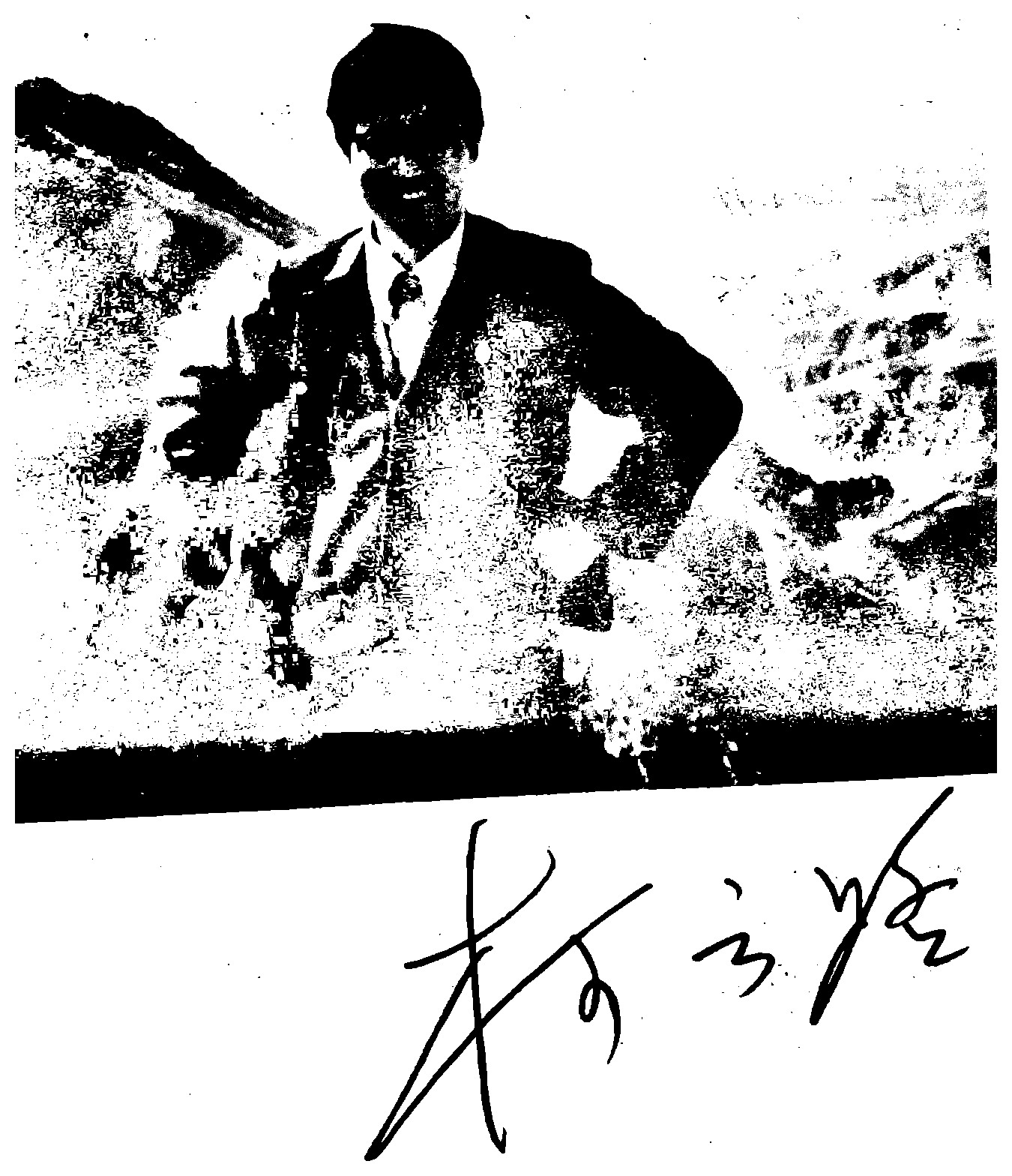
Ke Yunlu
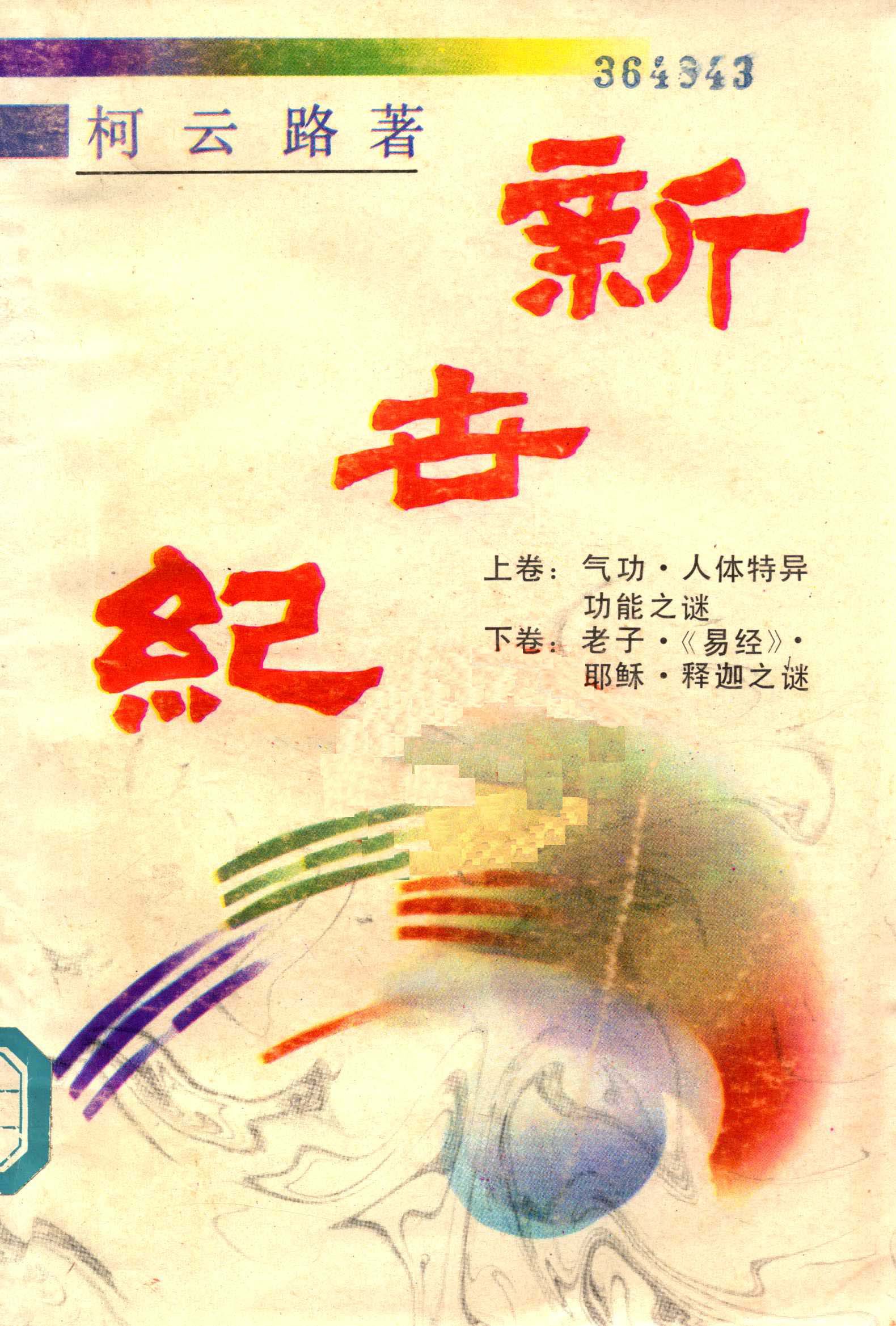
e383 43 BHakaA mw ee , . Upper Volume: Qigong. Human Body Special eo as Lower Volume: Laozi. I Ching. «ARS + FEM ik -_—~ é _ ae a5 . UL id a > i F mn Ss Ju —— a :
By Ke Yunlu New Century Upper Volume: The Mystery of Qigong and the Special Functions of the Human Body Lower Volume: The Mystery of Laozi, the I Ching, Jesus, and Shakyamuni
. . _ ie ee. ™ ae add age’ ae SAS, ee, ae : “ae ‘
oe lt in is ’* ie inva TE : Pea ar. i = - ss ae * a REG? taal irarin aks 1 Gee eee as! | Dae Maes SEER 9 as “Ae ee eS eae ee reg OE OF sages et! rar ec ass pa - ae ar te ho a nie og Cr tie ae cae Bx ae VERA 7 7 , a ES: Spey eS ga 二 ct ape TOES a Et od a oo Bit he : oh ESTE Sie
en AR ote Toll fags ale i fe person all person ica :
AMA PELE Apibee 48: HOWE YOM te pp BAL , iia, SR ye. ae! HOF, IEAM G. Sh Ral) vig x? a
| PABA 034 vith » HY) 4T E50 FopeWehs - Kp B. 2 ae 4E OG, pups B. TES pA ee Heme, PBL Lye eA ef
About This Book
There have been many works on qigong, the special functions of the human body, on Laozi, the I Ching, Jesus, Shakyamuni, Zen, and other such mystical and religious phenomena that command the attention of all humanity. Now, the renowned contemporary Chinese author Ke Yunlu offers a new interpretation through his distinctive novel New Century.
Prior to this work, the author wrote The Great Qigong Master, a novel on the same subject, which has been warmly received by a broad readership. If The Great Qigong Master was the author’s “elementary edition” for deciphering mystical phenomena, then New Century is his “advanced edition.” New Century is more profound than The Great Qigong Master. In New Century, through gripping plotlines, the author conducts in-depth research into many contemporary Chinese masters of qigong and special human body functions, reveals the secrets behind their extraordinary powers, and from there proceeds to offer new analyses of Laozi and the Dao De Jing, the I Ching, Jesus and the Bible, Shakyamuni and the Buddhist scriptures, and Zen.
What are the secrets behind special functions such as remote sensing and precognition, psychokinesis, summoning wind and rain, and passing through walls? Why has the physical body of Huineng, the Sixth Patriarch of Zen, remained incorruptible for a thousand years? What does the world look like through the eyes of Shakyamuni? How can the mystery of Jesus’s miracles be explained? Where lies the true secret of I Ching divination? Why did Laozi possess such lofty wisdom? What is the cipher behind the mystery of “spirit-writing” (fuji)? What is the scientific explanation for so-called “soul,” “spirit possession,” “reincarnation,” and “past lives”? Who is God? The author attempts to draw back the curtain on all these mystical phenomena and conduct scientific inquiry into them.
In terms of style, New Century may be called the author’s original creation. It is a novel of science and philosophy, and at the same time a scientific and philosophical work in the form of a novel. It fuses philosophy, science, religion, and literature into a single crucible, integrating logical thinking, imagistic thinking, emotional thinking, imaginative thinking, intuitive thinking, inspirational thinking, aesthetic thinking, subconscious thinking, special-function thinking, and Zen thinking into one unified whole, thereby producing this “Ke Yunlu style” of “scientific-philosophical novel.”
This work will serve as a reference reader for the vast number of qigong enthusiasts in their study and cultivation of qigong, and especially in their study and cultivation of the “Great Method of Non-Action” (wuwei dafa) — an advanced form of qigong. It can be anticipated that it will attract the attention of an ever-growing number of scholars and artists.
Preface: The Horizon of New Civilization
My friends, our dialogue begins. I hope my voice is exceedingly pure and calm. I hope my language, my words, every single character, are upright and filled with the wisdom of the cosmos.
We shall remain constantly in such a state of self-awareness: I represent the cosmos. I am one with the cosmos. I myself am this gigantic brain of the cosmos. My thoughts are the thoughts of the cosmos. The cosmos has no cosmos; I have no self. All dharmas are empty in form; form is not different from emptiness, emptiness is not different from form.
We should first understand this: everything under heaven is a sign, is language — in the broadest sense of the concept of language. This encompasses not only our ordinary, narrow concept of language, but must also extend to: our movements are movement-language, our expressions are expression-language, our thoughts are thought-language, our operations are operation-language, all our concepts about the cosmos, society, history, culture, ethics, morality, joy and suffering, and values are language, and all our social behaviors — investigation, research, social interaction, negotiation, politics, economics, social affairs, cultural activities — are all language. Every movement of a person, whether inside or outside the body, is language.
For human society as a whole, music has its musical language, painting has its painterly language, calligraphy, sculpture, architecture, dance, photography, theater, and film each have their own language, cuisine, bookbinding, and clothing each have their own language, mathematics has its mathematical language, physics has its physical language, chemistry has its chemical language, and so on and so forth. To expand further, all structures, relations, and movements
·1·
in the entirety of human society are language. Including economics, politics, diplomacy, the military, culture, religion — everything, without exception.
Expanding further, the natural world has its own language. Animals have animal language. Every movement of an animal is language. Plants have plant language. Every “movement” of a plant is language. Between humans and animals and plants, there also exist all manner of linguistic exchanges. Your caring for living beings is a form of language. Your harming of living beings is also a form of language.
Expanding still further, we can say that the entire cosmos, with all its structures and all its movements, is language. The narrow language of humanity is merely a condensation of this broad cosmic language.
Now, when I speak using language, it too is merely a condensation of cosmic movement.
You more or less know about Indian yoga, Chinese qigong, or at least more or less know about self-relaxation and self-suggestion. So now, please sit down in a relaxed and calm manner, regulate your breathing, regulate your mind, and enter a state that is natural and spontaneous, free and at ease, unattached, free from worry and fear, open and broad, radiant and bright, peaceful and stable — serene, joyful, tranquil, and empty, until finally you become transparent,恍惚, without any distinct sense of self.
We are about to begin our main topic.
In this work we shall reveal the secrets of Eastern qigong, yogic practices, and the special functions of the human body (or what may be termed “parapsychology” or “metapsychology”). We shall integrate psychiatry, psychology, physics, the study of thinking, linguistics, brain science, medicine, religious studies, qigong studies, and the study of special human body functions into a unified whole. We shall decipher the mystical phenomena of shamanism and spirits.
In this work, we shall together decipher China’s ancient I Ching and the various arts of divination.
We shall decipher Laozi’s Dao De Jing.
We shall also decipher what Westerners are most concerned with: Jesus and the Bible.
Finally, we shall decipher the most profound and vast Buddhism, including Zen.
We shall truly comprehend the full essence of Eastern mystical culture.
We shall truly understand the significance of modern Western civilization within the entire history of human civilization.
·2·
significance. We will truly grasp the points of convergence between Eastern and Western civilizations, and truly find the horizon of a new civilization in the new century.
We will realize that for thousands of years, humanity has never truly understood China’s ancient Yijing (Book of Changes), never truly understood Laozi and his Daodejing, never truly understood the most fundamental mysteries of the Huangdi Neijing (Yellow Emperor’s Inner Canon) and Chinese medicine, never truly understood Jesus and the Bible, and never truly understood Shakyamuni and the Buddhist sutras. Therefore, humanity has never truly understood its own modern civilization either.
We say that when we truly understand these “sages”—Fuxi, King Wen of Zhou, Laozi, the Yellow Emperor, Jesus, and Shakyamuni—and truly comprehend all mysterious phenomena, we will have achieved a qualitative leap in wisdom. Just as a dolphin might suddenly acquire human-level intelligence, we will possess the intelligence to converse with still more advanced intelligent life in the universe.
Everything will become perfectly clear.
The many layers of fog throughout the history of human culture will be swept away.
Perhaps we will suddenly attain high-level qigong mastery, achieving wuwei er wu buwei—doing nothing yet leaving nothing undone.
Perhaps we will gain special functions of the human body, possessing extrasensory perception abilities such as remote viewing, X-ray vision, precognition, and telepathy. We will at once possess thinking and comprehension that transcend four-dimensional spacetime.
Perhaps we will suddenly understand the principle from the Yijing: “One yin and one yang—this is called the Dao.” We will know that the universe is originally a system composed of yin and yang.
Perhaps we will suddenly understand Laozi’s “Dao”—awakening to the Dao, attaining the Dao, uniting with the Dao, so that “when the Dao presides over the world, its spirits cease to be divine.”
Perhaps, like Zen, we will experience a sudden awakening of enlightenment and “see our true nature to become Buddha.”
We will clearly understand what kind of people Laozi, Jesus, and Shakyamuni really were—where they came from and where they went. We will clearly understand the meaning of so-called God, deities, immortals, the Dao, and Buddha. We will clearly understand what Zen Buddhism means by “my mind is Buddha” and “own nature.”
At that point, we will break through all barriers of language and achieve a thorough awakening to the world and to life at a higher level of wisdom.
·3·
We may well refresh the entirety of human thinking—refreshing scientific thinking, artistic thinking, and philosophical thinking.
We will create brand-new:
Cosmology; Anthropology; Cognitive science; Linguistics; Physics; Psychology; Physiology; Medicine; Meteorology; Futurology; Information science; Structural science; Sociology; History; Ethics; Political science; Economics; Social interaction studies; Worldly conduct studies; Literature; Art; Philosophy; Religious studies; Philosophy of life;
Cultural studies; And so on, and so forth.
We believe that our joint study of this book, New Century, will nurture a large cohort of young scientists, philosophers, and artists—including scholars of ancient culture, qigongologists, and researchers of special human body functions.
We will answer in entirely new language:
What is the universe? What is the human being? What is the relationship between matter and consciousness? What is the relationship between time and space? What are science, philosophy, religion, mythology, and art?
We will jointly create the wisdom of the new century.
We want to establish a cosmology for the new century.
When humanity first came to know such “sages” as Jesus, Shakyamuni, and Laozi, our understanding of the universe and of ourselves was still hazy. When humanity comes to know these “sages” for the second time, we will truly know ourselves, and at the same time truly know the universe.
This is a great task.
Accomplishing this task requires our cooperation.
Friend, as you read this work, please follow the guidance of the author’s words and accomplish a major shift in your mode of thinking.
First, within the scope of conventional thinking, we must learn to integrate and synthesize the knowledge of all existing human disciplines—melting science, philosophy, and art together in one crucible to engage in comprehensive thought. Logical thinking, imaginative thinking, emotional thinking, intuitive thinking, and inspirational thinking must all be flexibly and freely
·5·
employed.
Then, what is more important and also more difficult: we must gradually learn to employ special thinking. We must, with genuine personal experience, understand what the extrasensory perception of qigong and special human body functions is really about, and truly understand what “Zen thinking” is really about. Only then can we truly understand what the world looks like through the eyes of Shakyamuni, Jesus, and Laozi.
Mastering special thinking should amount to an upgrade of the entire human intellect.
Do you understand now, friend? The process of reading this book is simultaneously a process of transforming and developing your own thinking.
You will surely be delighted by this qualitative transformation in your mode of thinking. Of course, this requires your own innate capacity for insight and your own effort.
Is it difficult?
It is both difficult and not difficult.
I hope you have determination and sincerity. When the heart is sincere, the spirit responds.
From now on.
First, we need to discuss the principle of “entering thinking.”
Does thinking need to be entered? Yes. What we are discussing is “entering another person’s thinking.”
Can another person’s thinking be entered?
It can. At least to a certain degree, it can.
We know that a gifted writer can often, in a certain sense, enter the thinking of the characters he writes about. He can dive into the character’s heart and “substitute” himself to feel the world as the character does, to think as the character thinks. This has often been a “metaphorical” expression in the literary domain.
In fact, this contains a universal, profound, and essential law: the thinking of others is something we can enter. Provided we have a certain degree of focus, effort, talent, experience, and psychological training.
Many outstanding novelists are not consciously aware of this. If they were consciously aware of it, they would achieve still more brilliant accomplishments.
·6·
Entering the thinking of others should become a creative creed for writers. Believing that you can enter the minds of every character — and ultimately, truly doing so — is what gives our literary creation genuine artistic appeal.
Entering the thinking of others should also become a guiding principle for performers. Film actors and stage actors: you must believe that you can enter the minds of all kinds of roles. In both your daily life and your performance, you strive to put this into practice — entering the thinking of all kinds of roles. And in the end, you do indeed enter their thinking. On stage, on screen, you then deliver astonishing performances.
Our social activists, politicians, military strategists, diplomats, industrialists, and negotiators can all train their capacity to “enter the thinking of others” — to know yourself and know your opponent, and thereby elevate your strategic proficiency.
We do not confine ourselves to entering the thinking of others at an ordinary, everyday level.
For example, suppose I am a painter. How can I truly master Picasso’s art of painting?
Then I tell you: you must deeply enter Picasso’s thinking.
How does one enter deeply?
For a period of time, you should fully assume the role of Picasso — become entirely “Picasso-ized.” You should imagine Picasso’s life story as your own life story; you should imagine Picasso’s surroundings, historical background, and social atmosphere as your own surroundings, background, and social atmosphere. It would be best to arrange your dwelling to resemble Picasso’s; you should dress as he did, keep the same schedule, adopt the same manner of speech and conduct, the same laughter, the same expressions, the same way of wearing slippers, the same way of crossing one leg over the other. Learn his smile; learn the look in his eyes. Speak using his language and tone; express emotions with his gestures; observe the world through his eyes, contemplate painting through his eyes, and copy his paintings. Finally, strive to paint as he painted. Throughout this entire process, you are entering his thinking.
Yet, you say, you still find it very difficult to truly enter Picasso’s thinking.
Then I tell you: the real training begins now. This is high technique.
You should face one of Picasso’s paintings and bring yourself into a state of deep relaxation and stillness.
Close your eyes and let your thoughts become ever more tranquil, reaching a state of emptiness. Your hand should adopt Picasso’s most distinctive, most habitual gesture. In your mind’s eye, visualize Picasso’s image — his voice, his expression, his smile. Silently and repeatedly recite Picasso’s most representative sayings. In this way, you bring yourself into an increasingly trance-like, egoless state. Those who study qigong will recognize this as the qigong state. In the qigong state, over time, you will suddenly find that your spirit has connected with Picasso’s thinking. When you pick up the brush to paint again, you will suddenly possess the true essence of Picasso.1
Is this truly so?
Truly so. The key lies in whether you can enter a genuine qigong state of utter emptiness and self-forgetfulness.
For those interested in qigong, we offer a hint: are you familiar with the esoteric qigong of Buddhist Tantra? In its practice, one requires the “empowerment of the Three Mysteries” (sanmi jiaci). That is: the hands form the Buddha’s mudra (a specific gesture) — this is the Mystery of Body; the mouth recites the Buddha’s true word (mantra) — this is the Mystery of Speech; the mind visualizes the Buddha — this is the Mystery of Mind. Thus, by aligning one’s body, speech, and mind with those of the Buddha, one can attain Buddhahood in this very body.
Do you understand what that means?
It means that through qigong cultivation, one achieves a connection with the Buddha’s consciousness, enters the Buddha’s thinking, becomes “assimilated” with the Buddha, and obtains the Buddha’s wisdom and power.
In the writing and reading of this work, we shall enter the thinking of great sages such as Laozi, Jesus, and Shakyamuni. That is a special path for us to investigate the mysteries of the cosmos and of humanity.
Three
We have entered the thinking of Laozi.
We have entered the thinking of Jesus.
We have entered the thinking of Shakyamuni.
We possess great wisdom and great insight. Ultimately, and most importantly, we enter the thinking of the cosmos.
We stated this sentence earlier. Now let us elaborate in detail.
We believe that the cosmos is a brain. The movement of the entire cosmos is like that of a brain.
The human brain is but a microcosm of the cosmos.
I enter a trance-like state, and merge with the cosmos. I dissolve into the cosmos; the cosmos dissolves into me. My entire body resonates with the cosmos. I am as vast and boundless as the cosmos. When I enter the mind’s ocean, I enter the cosmos. When I roam through the cosmos, I simultaneously roam through my own mind. My brain communicates with the cosmos; my consciousness is the cosmos. I and the cosmos truly become one.
My contemplation is the movement of billions of galactic clusters in the cosmos. My intention is the intention of the cosmos. The energy of the cosmos is my energy. As the cosmos breathes, I breathe. As the cosmos contracts and expands, I contract and expand. Heaven and humanity are one. Heaven and humanity resonate. Resonance in space. Resonance in time. Body, speech, and mind — the Three Mysteries resonate. All mysteries resonate. Total, seamless resonance. The “principal deity” of my cultivation is the cosmos itself. The cosmos empowers me. The cosmos bestows initiation upon me. The cosmos baptizes me. With the light of nebulae, with the radiant moonlight, with the boundless light of the cosmos. I transform into the cosmos; the cosmos transforms into me. I become the cosmos in countless forms; the cosmos becomes me in countless forms. The forms through which the cosmos and I mutually transform are innumerable, and ultimately formless. At every moment I become the cosmos; at every moment the cosmos becomes me. There is no distinction between myself and the cosmos. No self. No cosmos.
I am the cosmos.
The cosmos is also called the Dao. I am the Dao. The Dao gives birth to one; one gives birth to two; two gives birth to three; three gives birth to all things. When the Dao presides over the world, its spirits lose their power. The Great Dao is formless; the Great Dao is impartial. The Great Dao flows everywhere — can it be directed to the left or the right?
The cosmos further manifests as the Buddha. I am the Buddha. With great compassion and great mercy, gazing down upon the human world, the Buddha’s light is immeasurable, universally delivering all sentient beings.
This is no wordplay.
The various forms of qigong cultivation, including yoga, all have their different patterns of yi (intention) and qi (energy) circulation — circular, lotus-shaped, yin-yang fish, or various kinds of curves. In each case, one projects outward from within the body in a certain pattern — connecting to heaven, grounding to earth, expanding into the cosmos — and then draws it back, collecting it into the body. These are nothing but different modes of unifying heaven and humanity.
Nothing but different ways of embracing the cosmos and drawing energy from it.
The high-level skills and special functions demonstrated by qigong masters and yogis prove the physical significance of their cultivation.
What we want to say is that the very highest mode of unity between human and cosmos, of communion between human and cosmos, is this: I am at all times and in all places inter-transforming and uniting with the cosmos. I am not separate from the cosmos; I am the cosmos.
Having reaches its utmost extreme and then returns to nothingness. This mode of unity through “nothingness” is the most supreme form of unity.
In this novel, we shall always “speak on behalf of” the cosmos.
When one speaks on its behalf long enough, one becomes united with it.
To put it even more profoundly: we shall always speak as the “self-awareness” of the cosmos.
This, then, is the second principle I wish to discuss.
Friends, I shall now speak as the “self-awareness” of the cosmos.
You interrupt me and ask: Can one truly enter the self-awareness of the cosmos? Do you truly feel that you yourself are the cosmos?
I have no choice but to restore my own subjective consciousness, experiencing it; then I transcend to the self-awareness of the cosmos, experiencing that too. Shuttling between two self-awarenesses, experiencing them — at one moment I am the original “I”; at the next, I am the cosmos, shifting in sudden flashes.
I have come to understand.
Entering another person’s thought involves three levels.
The first level is entry at the level of reason. That is, I think about entering a certain person’s thought; my purpose is to enter a certain person’s thought. I enter the thought of Laozi, of Jesus, of Shakyamuni; I enter the thought of the cosmos. This kind of entry is extremely shallow. It is evolved directly from concept; in feeling, one has not yet entered the role. There is no vivid content whatsoever.
The second level is entry at the level of sensation — one feels that one has become the very role one wished to enter, one feels that one is the cosmos itself. More concretely: you feel that your body has become the cosmos, that you are seeing with the eyes of the cosmos, hearing with the ears of the cosmos, smelling with the nose of the cosmos, perceiving all things with the senses of the cosmos, breathing with the lungs of the cosmos, thinking with the brain of the cosmos — you now have the sensation of the cosmos as a “personage.”
·10·
The third level is entry at the level of the subconscious. This is the deepest form of entry. After we have entered a personage’s thought at the levels of reason and sensation, even if we further strive to intensify that entry and exert every effort to unite ourselves with the personage, deep in the subconscious we still do not believe in our new self-awareness; we are still reminding ourselves that we are not in fact that personage. You feel that you are Shakyamuni, or that you are the cosmos; your sensation is fairly complete and vivid; you seem to believe all of this — yet, in the depths of your heart, your subconscious has not entered the thought of Shakyamuni or of the cosmos. It is issuing faint doubts. It prevents you from “truly” believing in the transformation of your own thought. And in reality, you have not truly transformed.
Only when one enters another person’s thought by penetrating to the level of the subconscious is the entry genuine. If the subconscious level has not been entered, then no matter how much one declares it by self-determination at the rational level, no matter how much one cultivates the sensation of being the personage, such entry is largely false.
In that case, when you emulate a great artist, it is impossible to suddenly attain the true spirit and charm of that artist.
In that case, when practicing Buddhist Esoteric qigong, it is impossible to achieve spiritual communion with your principal deity and to attain buddhahood in this very body.
Without penetrating to the subconscious level, entering the thought of Laozi, Jesus, or Shakyamuni also largely becomes empty talk.
Entering another person’s thought is, in essence, realized at the level of the subconscious.
To put it more precisely: the current human concept of the “subconscious” is also insufficient to explain the matter.
One should say: this is a matter of the level of special thinking.
At present, we have not given an explicit definition of “special thinking” [特异思维]; for the time being, using the concept of “subconscious” in a loose and vague manner will also do.
Regarding special thinking, regarding the foundation of special thinking — extrasensory perception — and regarding the high-level cultivation of qigong, when it comes to “entering another person’s thought,” there is a great deal of profound truth to be told. These
·11·
we shall address later in the novel.
Now, you will ask: How does one enter another person’s thought at the subconscious level?
I answer: Only by entering another person’s thought at the subconscious level.
Is this not a tautology?
I say: Here, method and purpose are one and the same. Process and result are one and the same. If you wish to enter another person’s thought at the subconscious level, then you must enter another person’s thought at the subconscious level.
Can you be more concrete?
It is the method of qigong, or methods similar to qigong.
Like Esoteric qigong?
In essence, yes. In concrete practice, the methods vary widely.
What is the essence?
The essence is that you should enter a qigong state, you should enter a state of special thinking, or — less precisely stated — a state of subconscious thinking: a state of subconscious thinking at a level even deeper than dreams. In that state, you approach, connect with, and unite with the thought of the personage whose mind you wish to enter.
Does that then require prolonged cultivation over many days?
Perhaps so. However, once one possesses this special ability, entering the thought of any other person becomes something achievable in an instant.
Is this, then, what is meant by the special functions of the human body, or what parapsychology calls telepathy?
You may understand it that way. Telepathy is merely a passive, partial, and minuscule aspect of entering another person’s thought. Entering another person’s thought is a vastly greater theme.
What about the intuition and inspiration commonly spoken of in connection with artists and thinkers?
Intuition and inspiration can, in a certain sense, be regarded as transitional states between ordinary thinking and special thinking. In a certain sense, they can be regarded as chance, fleeting flashes of special thinking — things one may encounter but cannot deliberately seek.
Intuitive thinking, inspirational thinking — we shall elaborate on these further at another time. Therein lies
·12·
A vast domain that psychology has yet to explore.
Let us now return to the topic of entering cosmic thought. I am the universe.
You suddenly ask: You speak of entering the thought of others — that is human thought. But can cosmic thought also be entered?
I have already answered, though I have not had time to explain in detail. I directly treated the universe as a person. Thinking this way carries a special significance of its own. The universe is the enlargement of the human being. The universe is the living within the lifeless. It is the lifeless within the living.
In fact, entering thought, in terms of its objects, is divided into many levels. First, there is entering the thought of other people. This is a matter between human beings.
But we believe that animals also possess their own thought. Therefore, so long as we are willing and have received special training, we can also enter the thought of animals. This is yet another level.
Going further, we can enter the thought of plants. Modern experiments have long since proven that plants also possess thought. We can fully imagine entering their thought. Do not the grasses and trees, the myriad things upon the earth, all contain and overflow with their thought? Could it be that we cannot know the thought of the willows by the roadside, the tiny flowers in the fields?
At yet another level, we hold that all so-called inanimate objects also possess thought. And we are all capable of entering their thought. Whether it be the sky, the earth, mountains, rivers, clouds, wind, the Earth, the sun, the moon, the stars, or the cosmos — all are thinking, and we can think together with all of them.
We are able to enter the thought of all things in the universe, both living and lifeless. This idea carries tremendous significance.
Sensitive poets, musicians, and artists can grasp at once the profound significance contained in this conclusion.
The most valuable and most radiantly brilliant aspect of what we call artistic genius is precisely manifested in the ability to enter the thought of all things in the universe.
Keen thinkers, scientists, and philosophers will also immediately discover the profound significance contained within this conclusion.
·13·
It will not only inspire us to broaden our thinking and provoke many scientific and philosophical conjectures, but also holds theoretical significance in its own right. Our future science and philosophy will likely necessarily be illuminated by it.
Imaginative qigong masters and qigong researchers will at once grasp the qigong profundity of “entering the thought of all things in the universe.”
These matters I shall not elaborate upon for now.
We shall enter the thought of the universe.
I am the universe.
The third principle I wish to discuss is that we must enter the deep-layer subconscious, penetrating deeply into the thought of the universe.
Five
Therefore, throughout the entire process of writing and reading this work, we are required to enter, as much as possible, a special state.
This is the fourth principle I shall address next.
For those who understand qigong, this is a qigong state. “I am the universe” is a qigong state. Entering cosmic thought at the subconscious level is even more so a qigong state. We must calm our minds. We must be relaxed, still, and natural. We must be in a state of恍惚2, “vague and indistinct.” Attain the utmost of emptiness; hold fast to stillness firmly. Return to the Limitless. Return to the Uncarved Block. In the qigong state, we write, we read, we receive all information and energy coming from the universe. They are streaming ceaselessly from all directions. More precisely, in the instant you enter a deep qigong state, the universe has already given you everything — supreme radiance, supreme wisdom, boundless capabilities. In your恍惚, in your trance-like obscurity, you have already transcended the mortal world and attained a realm like that of the Buddha. If you suddenly achieve awakening — Bodhi originally has no tree, the bright mirror also has no stand, fundamentally there is not a single thing, where could dust alight?3 — then you will truly feel that you have been utterly transformed, reborn in body and mind, undergoing a fundamental change at both the physiological and psychological levels. You are no longer you. When you open your eyes again to gaze at the world, everything has become transparent, everything is known, and time and space no longer pose any obstacle to you. You will then see with perfect clarity how insignificant
·14·
our human society is, how limited humanity’s horizons are, and that it is time for a leap in intelligence.
If you understand something of hypnotism, then we may draw this analogy: this special state is somewhat akin to hypnosis and self-hypnosis. We know that when a person undergoes hypnosis or self-hypnosis, they can enter a special state. In this state, they may display astonishing powers of memory, able to recall every trivial detail of some easily forgotten event experienced during their lifetime. Some can even reproduce word for word, with not a single punctuation mark in error, the full text of a news article they casually glanced at years ago. Some can recall every experience from the very instant of their birth. Such facts are sufficient to inspire our thinking — here lies the key to unlocking the secrets of our entire thinking process (both conscious and subconscious thought). For now, we need only know that the special cognitive state induced by hypnosis and self-hypnosis can, to a certain degree, be compared with the qigong state. This comparison carries a keen power of insight and will reveal many mysteries.
If you have some understanding of the “shamanism” (wu 巫) within Eastern mysticism, then we may offer yet another analogy: the special state we wish to enter resembles the trance state that shamans enter when invoking the descent of spirits or immortals. Some may say: this is promoting superstition. I say: regarding the phenomenon of shamanism, we have until now lacked genuinely scientific research. Some have evaluated it from a sociological perspective; others have included elements of ordinary psychological analysis. People regard shamanism merely as a primitive, backward folk custom. They do not realize the truly profound significance contained within this “cultural phenomenon,” which nearly every ethnic group has possessed or once possessed. Here lies the cipher book for deciphering all the secrets of mythology. This is one of the tunnels through which humanity intersects with another universe. When shamans perform their divinations and sorcery, the state they enter is precisely a special state — or, more precisely, a special cognitive state — that can be compared with the qigong state. In that state, they connect with a world that our ordinary senses cannot perceive. They receive extraordinary information and energy. Of course, in many places, shamans perform quite crudely, compounded by theatrical fakery and charlatanry to swindle money, failing to cure illness and instead causing harm — degrading everything. But we must firmly grasp what is truly meaningful within this, and press forward toward the higher intelligence that humanity ought to attain.
The world is decidedly not only the world that we see.
·15·
The universe is by no means only the universe we observe.
In the most simplified terms, there are at the very least two worlds, two universes. We have only seen one of them.
The other can only be reached through our special perception and special thinking.
If you lack understanding of qigong, hypnosis, and shamanism, then you surely know about intuition and inspiration, do you not? Even the most ordinary person, in the course of a lifetime, will experience moments of genius-level intuition and inspiration. These fleeting flashes of wisdom often help you make the most correct judgments, solve the most difficult problems, avoid the greatest disasters, and gain the most precious insights and directions. So, my friend, let me tell you: the special state I speak of is like magnifying that instantaneous, sudden flash of intuition and inspiration, making it constant, enduring, and transparent throughout the entire mind. You can reflect on the intuition and inspiration you have experienced. Please carefully relive that state. As you relax your mind, your body, and your emotions, you enter that experience ever more vividly and delicately. You may become entranced; you are recalling the intuition and inspiration you once had, your heart stirs, and you feel it. It is like a pulsation of light within a haze, like the sudden flicker of an image in a dream. It seems to have passed. But you continue quietly contemplating it, chasing it, approaching it and entering it with a trance-like awareness. That experience comes again. It comes again and again. You may suddenly enter a certain state. In that state, you discover that all sights have become extraordinary, all illuminated by a wondrous light. That is precisely the state we want.
If you are a writer or an artist, then I can tell you that this special state will sometimes appear in your creative work as well. It is the moment when you write, paint, or create entirely by intuition. It is the moment when you completely lose all rational discipline. It is the moment when you are as if drunk, as if dreaming, intoxicated and bewitched. It is the moment when you reach a sublime, spirit-led state of mastery. It is the moment when you can no longer control yourself and let the brush flow freely.
Every sentence spoken here carries a special, concrete, and rich significance.
“Completely losing all rational discipline” means not being constrained by any norms related to society, utility, or art — being in an entirely free state.
“As if drunk” refers to the state of intoxication. The state of intoxication makes poets.
·16·
“As if dreaming” refers to the dream state. The dream state makes painters, sculptors, dancers — all visual artists.
“Intoxicated and bewitched” means entering a state resembling mental illness. The state of genius-level artistic creation is a controllable, temporary “mental derangement.”
“Reaching a sublime, spirit-led state of mastery” means transforming spirit into emptiness. It means the spirit merging with the universe. It enables the transcendence of space and time to “capture” all kinds of information.
“Spirit-led, as if guided by ghosts and gods” means that there is a miraculous force unknown to your rational mind that is manipulating and directing you, creating works that even you yourself afterward marvel at in bewilderment and amazement.
“Unable to control oneself, letting the brush flow freely” is a state that inevitably appears under all the circumstances described above.
A genius artist frequently enters those states described above. It is a state in which the subconscious is mobilized to carry out creative work.
Or, in other words, it is a state in which special thinking is active and secretly dominant.
Please note that every sentence and every word we speak here carries a special and rich significance, just as when I spoke of “as if drunk,” “as if dreaming,” and “reaching a sublime, spirit-led state of mastery.” I do not have time to explain every word and every sentence right now. You must have the capacity for enlightenment. You must have the power of understanding.
If you are a person of religious faith, then I can tell you in one simple sentence: the Buddha, Christ, or other “sages,” when they preached their scriptures or delivered their revelations, were also in a special state.
Very well. The “heavenly secrets” must be revealed no further. My friends, please enter the special state.
We are about to enter this state.
We will be in a trance, situated in a realm guided by spirits.
We merge with art, we merge with the universe.
We are completely relaxed. Tranquil. Natural.
We have great freedom.
We have great ease:
·17
We shall —
Six
Doing nothing, yet leaving nothing undone. This is the fifth principle I wish to discuss.
When we later decipher the Dao De Jing, we will understand that “doing nothing, yet leaving nothing undone” is the concentrated summary of Laozi’s thought, bearing profoundly deep significance.
This is the great science of cosmology.
This is the great science of strategy.
This is the great sociology, the great political science.
This is the great philosophy of life.
This is the highest principle of qigong cultivation.
This is also the highest realm of artistic creation.
“Non-action,” expressed in Buddhist terminology, means non-attachment, non-thought, no-self in all dharmas, the emptiness of nature in all dharmas, and originally not a single thing exists. In qigong cultivation, it means reaching the ultimate emptiness, maintaining the utmost stillness, and returning to the state of Wuji (the Limitless). In secular life, it means having no desires, no schemes, no pursuits, no attachments, no burdens, no anxieties, no norms, no restrictions, no deliberate actions, no compulsion of any kind, and no discomfort of any kind.
Once you achieve non-action, then there is nothing you cannot do. You will then “attain Buddhahood on the spot.” You will possess high-level qigong abilities.
We shall enter this state of non-action yet omnipotent action.
Through non-action, we are not constrained by any social utility. We disregard everything, discard everything, cast everything aside, free from all fetters, free from all restrictions, without any attachment whatsoever. We seek freedom, ease, great freedom, great ease. I am I. I am the universe.
My friend, you ask: is freedom the same as non-action?
My friend, I tell you: freedom is that which cannot be felt. This is a profound maxim. What cannot be felt is “nothingness”; it is non-action. What we can feel is unfreedom. When we speak of freedom, when we speak of ease, it is because we still feel unfreedom, unease. Or —
·18·
At the very least, we have all felt unfree and ill at ease. In truth, even if we merely remember the unfreedom and discomfort we once experienced, that memory still retains a certain present-tense significance. True freedom is complete “non-being” (wu 无) — having not the slightest impression even of past unfreedom.
All geniuses, all perceptive artists, please contemplate the maxim: “Freedom cannot be felt.” As you experience this in your creative work, entering ever more deeply into the state of “non-being,” you will attain a high realm.
You will then be wu wei er wu bu wei — doing nothing, yet leaving nothing undone.
We will be doing nothing, yet leaving nothing undone.
Our entire writing exists within a state of doing nothing, yet leaving nothing undone.
Friend, you ask again: When you write, you use language and written characters. Language and writing have their own inherent structures, like a net that controls you. Language and writing are in themselves an independent force. They in themselves form “language barriers” and “text barriers.” They will restrict your thinking, and especially they will restrict your so-called paranormal thinking. Can you still remain in non-action? Can you still be truly free?
I smiled. This question possesses a certain profundity. I want to tell you: Language is bodhi. Written characters are bodhi.
What does this mean?
To put it simply: the process of using language and writing is the process of our own self-cultivation. It is the process of liberating ourselves. It is the process through which we awaken to the Dao, investigate the Dao, and attain the Dao.
A goldfish can swim freely and unhindered in water devoid of all obstacles. A goldfish can also swim freely and unhindered in an aquarium filled with coral, seashells, and underwater rockeries. When complex obstacles cease to be obstacles, it too has attained freedom.
A Buddha may be cultivated in the serenity of mountain forests. A Buddha may also be cultivated amidst the clamor of the secular world.
Language and writing are perhaps the most powerful form of influence and constraint upon humanity. Yet we can take them as an object of cultivation, as material for cultivation. When we finally employ them exactly as we wish, when we no longer feel their constraint at all — we are free.
·19·
Language (in the narrow sense) is, in its very origin, a condensation of the structure and movement of the universe. When we become one with language, when we can no longer distinguish between “I” and language — I am language, language is me — we also become one with the universe.
If we adopt the broadest concept of language, we realize that throughout a person’s entire life, all of their speech, writing, facial expressions, movements, operations, behavioral thinking, and conceptions are language. Everything is language.
Life itself is language.
One can cultivate, reflect, awaken to the Dao, and attain the Dao through a lifetime of language — doing nothing, yet leaving nothing undone.
— This is the sixth principle I wish to convey to you.
Seven
I shall now speak of the seventh principle of this book:
The entire writing process of New Century is the author’s process of self-reshaping his own personality. At the same time, through the suggestion, influence, and guidance of language, it leads you, my reader-friends, to realize the shaping of a new personality.
We can all agree on this view: humanity needs to continuously elevate its wisdom; humanity needs to continuously rebuild its spirit; humanity needs to continuously shape its new personality.
We need to constantly issue words of warning to ourselves.
The crises of our human world are numerous enough, acute enough. Disasters originating from cosmic space and from within the Earth are inexorably approaching humanity.
Only by relying upon high wisdom, high realms of being, high awakening, and high-level skill can we重新认识 the universe and the Earth, can we重新认识 humanity, can we enter into dialogue with the advanced intelligent life of the universe, and can we open up a new century for humanity.
We must reshape the “I.” The human self. Oneself.
Humanity must possess a new personality that is wiser, brighter, more powerful, and more advanced.
·20·
This personality will be established on the foundation of a renewed deciphering of both Eastern and Western civilization. It will be established in confrontation with all the major problems of human society.
We should have higher science, higher philosophy, higher art.
Each and every one of us should simultaneously become a scientist, a philosopher, and an artist.
This is not impossible.
As long as we are selfless, Nature will help us.
“The world belongs to all” (tianxia wei gong 天下为公) — this idiom carries a significance far broader than what people commonly understand today. This is the spirit of Laozi. It refers not only to the sociological sense of “taking the world as one’s responsibility” or “selflessness.” It is humanity’s attitude toward the entire universe.
“The world belongs to all,” selflessness, non-self — all carry profound significance for the macro-universe.
Friend, I hope that as you read this work, you maintain a selfless, fearless, dispassionate state — without regard for honor or disgrace, without worry or anxiety, without shock or fear, without restlessness or impatience, without vexation or annoyance, free from all entanglement — open and upright, magnanimous and unreserved. Only in this way can your mind truly relax and suspend itself within the information field of the universe, only in this way can it truly dwell in a sensitive state of freedom, and only in this way can you properly absorb the wisdom and energy conveyed in this book.
Let us return once more to the phrase “doing nothing, yet leaving nothing undone.” Non-action is the highest principle of qigong cultivation, and it is also the highest requirement for reshaping a personality of wisdom. Non-action is the preparation of an entire worldview; it is the preparation of a philosophy of life, of a social perspective, of a political outlook, of an ethic, of an attitude toward joy and suffering, of an attitude toward life and death. In all things, practice non-action; let everything follow nature. Non-action is also the state of mental preparation before the specific cultivation of qigong and paranormal human abilities — calm and still, relaxed and at ease. Non-action is further the principle during the cultivation of qigong and paranormal human abilities — entranced and indistinct, as all things return from being to non-being.
Now then, friend, I have finished stating all the principles I wished to convey. One: Enter thinking. Two: I am the universe. Three: Enter cosmic thinking from the deep levels of the subconscious. Four: Maintain a paranormal state. Five: Do nothing, yet leave nothing undone. Six: Awaken to the Dao through a lifetime of language. Seven: Shape your own new personality.
Friend, our novel is about to begin. I hope you will further relax body and mind, so that your entire
·21·
Every muscle of your body, every joint, every organ, every blood vessel, every nerve, every part—including your hair and skin—relax. First let your eyes relax, let your brain relax, let your jaw relax, even your teeth relax. Then extend this relaxation throughout your entire body—loose, melting, harmonious. Let your spirit simultaneously relax. Relax, relax further, relax yet again, relax yet again. Now there is no self—the “I” no longer exists, boundlessly nonexistent. You are the universe; you are the brain of the universe; your brain is the universe.
Please silently recite the following text in your heart:
At first, in hearing, one enters the stream and loses the object of perception. When what is entered is stilled, the two characteristics of movement and stillness cease to arise. Thus one gradually advances. Hearing and what is heard are exhausted; yet in the exhaustion of hearing, one does not abide. Awareness and what is perceived become empty; emptiness and awareness reach ultimate consummation. Emptiness and what is emptied are extinguished; arising and ceasing are both stilled. When cessation manifests before one, there is sudden transcendence. The worldly and the supramundane—the ten directions are perfectly illuminated…
·22·
[Note: This page contains severely corrupted OCR, likely representing a table of contents or tabular layout that could not be properly recognized. The legible fragments include scattered numbers (78, 88) and unintelligible character sequences.]
Chapter 12 Spirit Possession · 218 Chapter 13 The World of Those with Supernatural Powers 237 Chapter 14 Human Body — Cosmology 257 Chapter 15 Dialogue with the Subconscious 278 Chapter 16 Parapsychology 299 The Mystery of Laozi, the I Ching, Jesus, and Shakyamuni Chapter 1 · Decoding the Dao De Jing 323 Chapter 2 · Wudang Mountain Forum · 342 Chapter 3 · The Great Dao Overflows, How Can It Be Controlled? 363 Chapter 4 · The Valley Spirit Never Dies—This Is Called the Mysterious Female 382 Chapter 5 · The True Interpretation of the I Ching Chapter 6 · Divine Divination · 419 Chapter 7 · Heaven and Earth Qian 440 Chapter 8 · Original Hexagram · Transformed Hexagram · 463 Chapter 9 · The Mystery of Jesus -486 Chapter 10 · I Am the Foundation 502 Chapter 11 · Ancient Qigong Masters of High Attainment Chapter 12 · Who Is God · Chapter 13 · Shakyamuni Buddha Chapter 14 · Form Is Not Different from Emptiness, Emptiness Is Not Different from Form Chapter 15 · The Sixth Patriarch of the Chan School, Huineng… Chapter 16 · The Modern Chan Hall… Conclusion 643
Volume One The Mystery of Qigong and the Special Functions of the Human Body
[Note: The OCR text on this page is severely corrupted and largely unintelligible. The following represents the best recoverable reading.]
———————————————————————————
New Century: Qigong — The Mystery of Human Body’s Special Functions
———————————————————————————
Chapter One
The Black Sun and Nostradamus
My friend, our research is about to begin. Please check once more whether you are very relaxed, very tranquil, completely and utterly natural. Do you feel your consciousness floating lightly and freely in the “field” of the cosmos? So light that there is not the slightest trace of weight, so free that there is not the slightest trace of attachment, until ultimately you have no sensation of it at all—it no longer exists: formless, substanceless, measureless, selfless—everything gone, even “gone” is gone, the negation of negation itself is negated, and within and beyond the world, all ten directions are luminous and whole.
Very well. Please listen to my words in a trance-like, half-aware state. In a flash of sudden clarity, inspiration may come: the Taiji diagram originated in the Yellow River basin! The dividing line between the yin fish and yang fish in the Taiji diagram is none other than the Yellow River!
My friend, please open a map and look at the Yellow River. Please note the stretch of the Yellow River from the area around Linhe in Inner Mongolia to the area around Kaifeng and Lankao in Henan. If you roughly draw a circle using the line segment between Linhe and Lankao as its diameter, then this stretch of the Yellow River resembles precisely the dividing line between the yin fish and the yang fish in the Taiji diagram! To the west of the river, Shaanxi along with small portions of Inner Mongolia, Ningxia, and Gansu, form exactly the yang fish of the Taiji diagram. The eye of the yang fish lies in the area around Yan’an—the location of the Mausoleum of the Yellow Emperor. To the east of the river, Shanxi along with small portions of Henan and Hebei constitute
·3·
the yin fish, and the eye of the yin fish lies roughly in the central Jin region of Shanxi (Jinzhong). This is how the Taiji diagram came into being.
You ask: Does this make sense?
I reply: It has some sense to it. The culture of the Chinese Taiji diagram, the I Ching (Book of Changes), and the Dao De Jing all originated in this very region. The Yellow River—or more precisely, this particular stretch of the Yellow River basin—is the birthplace of Huaxia civilization. Based on various lines of research, one may also conjecture that this was one of the important cradles of all human civilization. As you know, the technological civilization of the modern world is inseparable from electronic computers. And electronic computers operate on binary arithmetic. The inventor of the binary system—the mathematician Leibniz—was inspired by the Chinese Eight Trigrams (Bagua) diagram before he could complete this epoch-making invention. Without the Bagua, in a certain sense, there would be no most cutting-edge modern civilization.
You ask: The course of this stretch of the Yellow River does indeed somewhat resemble the dividing line between the yin and yang fish in the Taiji diagram. But in ancient times, without aerial or space-based surveying, how could humanity have known the Yellow River’s shape? And besides, what significance does this actually hold?
I reply: Might we not understand it this way: Was the Taiji diagram in fact drawn and imparted to humanity by extraterrestrials possessing space-flight capabilities? Why was the binary system—which underpins modern cutting-edge science and technology—already present in such remote antiquity? Is that not wondrous?
We are now reminded of the Hetu (River Map) and Luoshu (Luo River Writing)!
Yes, your spiritual intuition has awakened. Regarding the Hetu and Luoshu, there are now many interpretations, each containing its own truth. We may also offer this interpretation: the Hetu and Luoshu are figures obtained by advanced intelligent beings when they observed the Earth from cosmic space.
It appears, then, that the I Ching, the Dao De Jing, the Taiji diagram, the Hetu, and the Luoshu all originated in this stretch of the Yellow River basin—or what we may call the Taiji Diagram region. But we still do not understand: Why did they originate in this particular area? If extraterrestrials did exist, why did they choose this region? And what connection does this have with the zigzag (“之”-shaped) flow of this stretch of the Yellow River?
Do you know the electromagnetic effect? An electric current generates a magnetic field. Different directions of current flow produce magnetic fields of different orientations. Different routing patterns of electric current (which can form a complex circuit diagram) produce magnetic fields of different and complex structures. Might we not boldly speculate: the movement and flow of any substance in the cosmos is accompanied by corresponding fields of all kinds—many
·4·
of which we have yet to recognize? If so, we may speculate further: the zigzag flow path of the Yellow River in this stretch must also generate a special field. Through it, this region is able to draw upon special cosmic energies and generate special intelligence. Or perhaps it is precisely for this reason that it attracted the attention of advanced extraterrestrial life. If you further study ancient Chinese astrology, you will find that this Taiji Diagram region is the direct correspondence zone for the Seven Luminaries—the Sun, Moon, Venus, Jupiter, Mercury, Mars, and Saturn—as well as the Twenty-Eight Mansions. In ancient times, in this Yellow River basin, it was very accurate to judge changes in celestial timing and climate based on star patterns. Yet to this day, we still do not have sufficient understanding of these matters.
Then let us…
Let us continue reading this novel. Your questions will gradually all be answered. Now, we must relax to the utmost, in a trance-like, half-aware state. We will then be able to sense that the Taiji Diagram region concentrates vast energies and information from the culture of the I Ching and the culture of the Dao De Jing. Gradually, we will be able to feel that gigantic yin-yang fish spinning across the Yellow River basin. An intense surge of qi sensation. Spinning, spinning… tremendous energy in rotation. The eyes of the yin fish and yang fish are each a vortex—a deep hole, unfathomably deep. The eye of the yang fish is so deep that it connects to the yin; the eye of the yin fish is so deep that it connects to the yang. In the bright white day, there is a whirlpool-like deep hole leading into the dark night; in the dark night, there is a whirlpool-like deep hole leading into the bright day. As day and night rotate and alternate, these two deep holes also rotate and alternate. Our universe and another unseen, unfathomably mysterious universe are connected in just this way. You could call it a negative universe, you could call it a special-function universe, you could call it the so-called “netherworld,” or you could call it some space of four dimensions or above. Does that universe contain all of humanity’s subconscious? The souls of all things? Lives that once appeared in our universe and then vanished? A wondrous panorama of extraordinary phenomena?
The key is to find the tunnel leading to that universe…
Turning Ill Fortune into Good
A motorcycle with a sidecar sped swiftly along the foot of the mountain.
·5·
Ouyang Hui was driving.
A young and beautiful young woman sat in the sidecar of the motorcycle.
Ouyang Hui, the person:
He had lived in this world for over thirty years. He had once engaged in vast contemplation about the development of human civilization. He had experienced countless victories and defeats, honors and disgraces in the human world. He tasted every kind of happiness and suffering that life among people had to offer. One day, he suddenly achieved awakening. He wanted to truly liberate himself. To be truly free and unfettered. To relax body and mind. To attain great freedom. To attain great naturalness. To attain great ease.
This is the foundation for awakening to the Great Way of the cosmos.
It is also the foundation for awakening to the Great Way of life.
His gaze was penetrating, cutting through the mist of a thousand mountains, shining brightly upon the world. Yet obstinate delusion would resurface from time to time, obscuring his eyes and leading him astray from his true nature. He awakened a thousand times, and a thousand times fell back into delusion. A thousand times in delusion, and a thousand times again awakening.
None of this was mere repetition. He was shedding more and more bonds. He was “cultivating.” Life had done nothing but annotate for him the maxim, “Without polishing, one cannot become a Buddha.” Affliction is bodhi. All suffering is nirvana.
Finally one day, he achieved complete enlightenment. Truly complete enlightenment. He wrote two aphorisms in his diary:
Freedom is that which cannot be felt; what is felt is unfreedom. Spontaneous ease is that which cannot be felt; what is felt is lack of ease.
He now felt free, felt at ease — that was because traces of unfreedom, of unease, still lingered. At the very least, there remained the memory of unfreedom and unease.
He believed that one day, everything would become devoid of sensation. No unfreedom, and therefore no freedom either. No unease, and therefore no ease either.
Returning to nothingness. Through non-action, nothing is left undone.
His many interests had merged and integrated into a unified whole. All of his wisdom was condensed into his insight into the cosmos and humanity. Elucidating the Great Way and ultimate truth of the cosmos had become the true content of his life. Qigong, somatic science, cosmology, philosophy and religion, the I Ching, the Dao De Jing, and ancient Chinese culture, ·6·
art — all had become key subjects of his investigation.
Today he was on his way to visit a young qigong master.
The young woman sitting in the sidecar beside him was named Tian Yueyue.
The motorcycle sped along. On the right rose the north-south Green Dragon Mountain range, its cliffs towering. On the left flowed the Green Dragon River, parallel to the road, gliding slowly. The asphalt road along the mountain’s foot was shaded by dense trees, broad and wide.
Tian Yueyue turned to look at Ouyang Hui: How do you know Qu Xiaolong will definitely be there today?
Qu Xiaolong was precisely the qigong master they were going to see today.
Ouyang Hui answered: “Premonition.”
Tian Yueyue looked at him again and smiled faintly. Lately, Ouyang Hui had seemed somewhat uncanny, often having premonitions about things.
Why haven’t you been talking? Tian Yueyue asked.
I don’t know. Just feeling a bit stifled. Ouyang Hui took off his helmet and handed it to Tian Yueyue, letting the oncoming wind blow against him.
Thinking about something unpleasant?
No. Just suddenly felt a tightness in my chest. Very strange.
Tian Yueyue laughed: Look at these green mountains and clear waters — the qi field here is wonderful!
Ouyang Hui frowned and stared ahead without answering. Ahead, a bridge appeared over the Green Dragon River. He said: I want to take the road on the other side of the river.
The road over there is terrible — bumpy and exposed to the sun! said Tian Yueyue.
No. On this road, my chest is getting tighter and tighter. Something’s wrong. As Ouyang Hui spoke, he turned the motorcycle onto the bridge, crossed the river, then turned again onto the dirt road on this side. Dust flew up.
Feeling better now? Tian Yueyue asked with concern.
Yes. Much better. Something on the other side of the river was pushing directly against me. Ouyang Hui pointed at the tree-lined road on the opposite bank as he spoke.
Just then, the earth suddenly shuddered. The motorcycle lurched violently, swerving left and right. Ouyang Hui quickly braked to a stop. They saw the mountain across the river rumbling and roaring — an entire face of the mountain wall had given way in a landslide! ·7·
Giant boulders tumbled and rolled, trees toppled and fell. White and yellow clouds of thick dust poured down, then billowed upward, spreading out and swallowing everything at the foot of the mountain. After a long while, the dust cleared, revealing a horrifying scene: a stretch of road over a hundred meters long had been buried by a mud-rock flow. Some of the debris had slid straight into the river, narrowing the channel and making the current surge swiftly.
The two of them had already gotten off the motorcycle and stood there staring blankly. It was a long time before they turned their heads to look at each other, and even longer before either spoke. Had they not come to this side of the river, they would certainly have been buried.
That was a premonition too! Tian Yueyue said.
Yes. But just now I didn’t fully realize that’s what it was. Ouyang Hui said. It seems that from now on, I need to be more sensitive and more consciously aware of every abnormal response from my body and mind.
At the instant he started the motorcycle again, a flash of inspiration came to him, and in one stroke he completed his distillation and summary of a “theory of premonition”…
Cosmic Natural Qigong
The qigong master Qu Xiaolong stood on the steps before the Green Dragon Temple. Here, dense pines and verdant cypresses encircled a broad, flat clearing. Over a hundred people stood arranged at even intervals in a square formation, listening to him lecture on “Cosmic Natural Qigong,” transmitting energy, and healing illnesses.
The Green Dragon Mountain extended to this point, raising its dragon head high, displaying grandeur. Standing on the mountain, one felt an overwhelming vastness of spirit. The mountain opened its embrace, cradling heaven, earth, sun, and moon. The qi field here was very strong. With the slightest entry into a trance state, one felt oneself merge with the mountain and become one. You were the mountain, cradling heaven and earth. Within your chest, all was vast and expansive — the space wide, clear, luminous. Qi came from all eight directions. It was tranquil, misty and ethereal, wonderfully cool, perfectly integrated, utterly transparent, without the slightest obstruction.
He spoke: Cosmic Natural Qigong is the simplest yet most profound form of qigong. It has no cumbersome incantations or visualizations, no complex guiding movements, and no assorted prohibitions. Everyone can learn it, everyone can master it, and everyone will see results. As long as you are an upright person with a kind heart, then you possess the first foundation. Then, you must have a sincere and faithful attitude, believing in Cosmic Natural Qigong — where the heart is sincere, there is efficacy. Thus you will possess the second foundation. Belief is not blind belief.
We will use concrete facts to lead you to believe. There will be many facts concerning the treatment of difficult and complex illnesses and the development of special functions. Many people have already witnessed them with their own eyes.
Now, let us all relax and stand properly. Your movements and postures should be natural. Stand in whatever way feels comfortable. Cosmic Natural Qigong emphasizes naturalness from beginning to end. Even this “emphasis” itself is natural. That is to say: do not rigidly think to yourself, “How should I be natural?” Thinking too much about how to be natural is in itself no longer sufficiently natural. Simply stand there casually, freely and at ease — that will often be the most natural and the best posture. The most genuine naturalness is naturalness without any concept of “naturalness.” It is naturalness without any imposed mental directive whatsoever. It is a posture adopted entirely spontaneously, naturally, freely, and at ease.
What meanings does the word “natural” (自然, zìrán) carry? One meaning is the cosmos, heaven and earth, great Nature — it is a noun. Another meaning is “naturally so,” “of its own accord” — one might say it functions as an adjective or adverb. In truth, these two meanings are one and the same. What is the cosmos, what is great Nature, like? It is natural; no force can impose rules upon it. And what is it like to be “naturally so, of its own accord”? It is to be like the cosmos, like great Nature — everything is as it is by nature. As the Dao De Jing states, “The Dao follows Nature” (道法自然). When you have nothing else to do in your daily life, simply sitting or standing there and silently contemplating the four characters “the Dao follows Nature” is itself a simple form of qigong training.
Qu Xiaolong’s mind suddenly flashed back to the scene from the early hours before dawn that day:
…He had walked out of his house alone. Starlight, bright as water, bathed Qinglong Town at the foot of Qinglong Mountain. The houses were pitch-black; the streets were pale and clear. Everything looked like a paper-cut silhouette. Having stayed up the entire night writing his qigong practice notes, he did not feel sleepy. Now, whether he slept or not made no difference to him. Whether he ate or not made no difference either. Ever since he had acquired his extraordinary qigong abilities, every illness had vanished; he knew neither fatigue nor weariness, and his energy had multiplied many times over. It was as if he had become a different person.
He came to the riverbank. Beneath the bridge, water flowed murmuring — or perhaps one should not say “murmuring,” for there was barely any sound. The water emerged from beneath the dark bridge arch, shimmering and reflecting the starlight that filled the sky. It was like music. Sound and image are, after all, interlinked. All the languages of the world are interconnected. Humanity’s written and spoken language, musical language, the language of painting, the language of bodily movement, the languages of architecture and sculpture — humanity’s languages and the languages of animals,
of plants, of the heavens, the earth, the mountains, and the rivers — all share a linguistic connection with this river water, this bridge, these willow trees along the bank, this star-filled sky, this peacefully sleeping Qinglong Town, this Qinglong Mountain, and with everything on this Earth and beyond this Earth. Language is communication; it is the exchange of information and energy; it is mutual resonance, mutual telepathic transmission.
He strolled along, sensing all the myriad things in the pre-dawn stillness, conversing with them.
This little pine tree at the head of the bridge was happy to see him arrive — he sensed it immediately. A few days ago, it had been struck by a truck. The fuel tank had exploded, and the little pine tree had been scorched until it withered. The residents living around the bridgehead all said this tree could not possibly survive. He said: “It will be all right. I will come and treat it.” Every day he came to visit the tree, every day he used his mental intention to comfort it, encourage it, support it, to emit qi for it and infuse it with the life energy of the cosmos. And indeed, it miraculously came back to life and turned green again. The little pine tree “spoke” many, many “words” to him, and through thought-transmission he understood them all; he also “spoke” many “words” back to it. The little pine tree gazed at him fondly with a smile, wanting to keep him a little longer. Yet he continued his aimless walk onward. It seemed he was not meant to linger. He walked in this manner, without any fixed destination or definite direction, yet some dimly perceptible force (a divine spirit? the subconscious?) was “directing” and “driving” him. He relaxed body and mind, walking onward naturally and spontaneously, holding no thought, abiding by no rule, allowing his spirit to become ever freer, ever more trance-like, and in that trance allowing himself to feel — and yielding to — that increasingly palpable mysterious power that governed him. He knew he was entering an ever more extraordinary state of being.
He had originally intended to cross the bridge, and his route should undoubtedly have gone that way. But upon reaching the bridgehead, he turned off instead. In a dreamy trance he walked forward; his soul seemed to float in a sky suffused with starlight, and his body became as weightless as his soul.
He was walking southward. The Earth was slowly rotating — eastward, to the left. He could feel the vast energy of its rotation. All the stars across the sky were slowly turning. Each possessed immense energy. The inertia of the cosmos. The “Dao.” A hundred million structures, a hundred million layers of symbols. He existed within the structure of the cosmos, a part of that structure. Everything was mutually constraining. Everything had been “arranged” in advance.
Ahead was an intersection. Which way should he turn? He did not know. He allowed his entranced spirit to dictate. He reached the intersection, reached the center of the street. He could continue straight ahead — a straight road flanked by
silent shops on both sides. He could turn left, leading down toward the river. He could turn right, where a road slanted upward, climbing the mountain. And of course, he could also turn back and retrace his steps. In that instant — that instant of dreamy trance, that instant entirely free of subjective attachment, that instant devoid of any rational deliberation, that instant of utmost spontaneity — his consciousness, suspended among the stars, stirred faintly and drifted to the right. And so, he allowed himself to turn right as well.
The sky was dark. He was heading up the mountain alone? The thought flashed through his mind, and his footsteps hesitated slightly. He immediately dismissed it: What is there to fear? Only by setting aside even life and death can one achieve thorough transcendence and enter a higher realm. His mind relaxed further, grew even more at ease. In a dreamy trance, he followed the narrow asphalt road as it wound its way upward. At each fork in the road, he thought nothing at all, letting his entranced self follow the direction —
— the subconscious? A divine spirit?
— What was it? Besides his own subconscious, was there some divine spirit as well? A faint thought drifted across his trance-clouded mind.
Turning this way and that, he arrived in front of Qinglong Temple. In a daze, he found himself standing at the foot of the stone steps before the temple. What was he supposed to do now? He stood still. Then, involuntarily, he raised his head.
An astonishing sight made his eyes go wide. In the sky, every single star had grown a sword! Thousands upon thousands of stars thrust forth thousands upon thousands of gleaming swords!
Was it a visual hallucination? Was his vision blurred in his trance state? Was he in a dream state, not fully awake?
None of these. He eliminated each of those possibilities. He was fully alert. When he looked at the surrounding mountains, trees, and temple buildings, everything appeared clearly and sharply.
In his mind, he posed a question to his mysterious teacher (a highly advanced intelligent being in the cosmos?): Why is this?
Ever since his qigong practice had given rise to special functions, this “cosmic teacher” had appeared. He could ask any question at all. Every question received an answer.
At that moment, in his mind he heard the answer coming from the cosmos: This is to reveal to you a wondrous sign.
Can you make this vision disappear? Yes. And so, the starry sky he saw returned to normal. Can you make the vision appear again? Yes. And so, all the stars in the sky once again thrust upward their sword-like points. A scene of peril abounded.
What is this trying to tell me? he asked again in his thoughts. Think about the black sun you saw, the voice from the universe replied.
Oh. He understood…
It was now morning. The sun shone dazzlingly. He did not tell the crowd about the pre-dawn anomaly in the starry sky.
He was now about to emit qi and confer empowerment on everyone. “Close your eyes,” he said. He himself entered an even deeper trance state. In that vast and hazy liminality, hazy and vast, he suddenly felt himself grow tall, standing between heaven and earth, connected and merged with the universe and all of nature. He possessed inexhaustible energy. He was the universe. The universe is natural, free, and self-existent. The universe wanted to speak, to sing. And so, he began to sing.
The melody was both familiar and strange to people. The lyrics were in a language no one could understand. The tune was at times profound and deep, at times melodious and soaring. As he sang, eyes closed, arms outspread, he began to move slowly facing heaven and earth, as if wielding the entire atmosphere.
Those several hundred people, eyes closed, were all governed by a magical, unknowable force, and began to move spontaneously. Like the dances on the Dunhuang murals—in a thousand postures, divinely wondrous beyond description.
Qu Xiaolong’s singing rose high, piercing the clouds, and everyone involuntarily stretched upward, raising their arms to the sky; when Qu Xiaolong’s singing descended, resonating low like the roar of waves, everyone’s hands also fell, their faces wearing the expression of deep slumber, their bodies undulating in slow, wave-like motion.
For a long time, the singing stopped. People’s movements gradually ceased as well. They stood there motionless, in complete silence.
After a while, Qu Xiaolong asked: “What sensations do you all have now? Any special
·12·
phenomena? Do not open your eyes—just speak as you are.”
A middle-aged woman dressed in black said: “I saw the mountains to the north collapse.”
“Who else has had a special sensation?” Qu Xiaolong asked.
“I sense that something is going to happen to the mountains in the north—there will be a tremor. But I didn’t see it. I just feel it in my heart.” This came from a gaunt man—a university professor.
“All right, everyone, open your eyes now,” Qu Xiaolong said.
Everyone opened their eyes.
“Just now, someone manifested a special function. You have opened the Wisdom Eye and gained eye ability.” Qu Xiaolong pointed at the middle-aged woman. “In scientific terms, this is called non-ocular vision. It is a latent ability of the human body, now brought forth by the Cosmic Natural Qigong. Your eye ability manifests as remote viewing and precognition—a transcendence of both space and time. And you—” Qu Xiaolong pointed at the gaunt professor, “manifest a pure faculty of presentiment and prediction. All right now, let us all look to the north and see whether their predictions prove accurate.”
The people turned to face north. The verdant Green Dragon Mountain stretched continuously toward the north.
Qu Xiaolong sensed something again and frowned. He closed his eyes, thought for a moment, did some calculation, and then, reassured, opened his eyes again, gazing northward.
It was very still. The sun shone down.
Suddenly, the earth trembled. In the distance, to the north, several li away, a landslide cascaded down the mountainside—thick clouds of dust billowing!
The Yin-Yang Fish in the Sun
Ouyang Hui and Tian Yueyue arrived at the Green Dragon Temple atop Green Dragon Mountain. The heavens and earth were wide open, the sunlight brilliant, and the town of Green Dragon below was plainly visible.
The young man standing on the stone steps before the temple must be Qu Xiaolong. Refined and gentle in manner, he had a very kind appearance. These several hundred people, standing in rows and columns as though doing collective calisthenics, were learning the practice.
·13·
Qu Xiaolong, eyes closed, slowly traced his hands through the air, singing a strange and wondrous song. The entire crowd moved spontaneously with eyes closed.
Listening to the people standing outside the practice area, watching beneath the pine trees, who softly explained—this was Qu Xiaolong’s second session of emitting qi and conferring empowerment this morning.
Ouyang Hui tugged at Tian Yueyue, and the two silently walked to the last row of the practicing crowd. Ouyang Hui made a signaling gesture, and they both closed their eyes, entered stillness, and slipped into a qigong state.
Vast and hazy, he felt and experienced. The qi field was very strong. His body tingled with numbness and began to float.
He did not know how much time passed. The singing seemed to have stopped—dreamlike and ethereal, as serene as night.
He heard Qu Xiaolong’s voice coming from far away at the front of the crowd: “The empowerment is concluded. Everyone, let things follow their natural course.”
Ouyang Hui now opened his eyes. He discovered that among the rows of people ahead, many had actually turned around and were looking up at the sun in the sky.
Wouldn’t the sunlight burn their eyes? As this thought crossed his mind, he too involuntarily turned, raised his head, and gazed fixedly at the dazzling sun. In his trance, he simply felt that he wanted to look at the sun, and sensed that his eyes would not be burned.
A startling and miraculous sight appeared!
The dazzling white sun, the white sun with light so intense it stabbed the eyes—as he gazed and gazed, it actually turned into a black sun!
The sun was black; the sky was bright. Like a total solar eclipse.
Had his eyes been burned? Yet his intuition told him: no. He stared again and noticed that the black sun was not like a solar eclipse. It was merely veiled as if by black gauze, dimmed considerably. Or like the sun seen through sunglasses.
But that was not quite right either. The sun still had relatively dazzling portions, and the dazzling parts were moving rapidly.
Suddenly he saw it clearly: the round sun had darkened parts and brightened parts. The two parts were rotating—vast and hazy, agile and lively. Their shape was exactly like the Yin-Yang
·14·
Fish! Looking more carefully, yes — without a doubt! The rotation of the yin-yang fish was filled with mysterious charm! Great ancient sages. Great Taiji diagram. So you were here all along! There is a saying that you originated in the Yellow River basin. According to qigong masters, once the Heavenly Eye is opened, one will see you — the mysterious Taiji diagram! Some even speculate that the Taiji diagram was transmitted to people on Earth by extraterrestrials. Certain studies suggest that the double spiral lines within the Taiji diagram represent the true secret of biology at the microscopic level. As for theories linking the Taiji diagram to various qigong cultivation practices, there are even more of those. The significance of the Taiji diagram extends far beyond all this. The Taiji diagram contains the greatest formula: = 1 + (−1). Or, to put it another way:
Nothing = positive universe + negative universe Nothing = positive matter + negative matter Nothing = positive space + negative space Nothing = positive time + negative time Nothing = the yang world + the yin world Nothing = arising + ceasing Nothing = entropy + negative entropy Nothing = being + non-being
And so on, and so forth. The most profound meaning of the universe may well reside right here! The mysteries of all mathematics, physics, biology, and cosmology may also reside here.
Twenty minutes passed. He felt he had looked at the sun long enough and could stop. He withdrew his gaze and looked out levelly at the mountains, rivers, and the land. A terrifying scene, like the end of humanity!
The entire world was a withered black, as though scorched by a great fire.
Nostradamus
Ouyang Hui and Qu Xiaolong met. On Green Dragon Mountain, in front of Green Dragon Temple.
I had a premonition that when you came today, the mountain over there would experience a landslide. Qu Xiaolong pointed into the distance. I also predicted that you would surely avoid that disaster.
·15·
Yes! As I was walking, I somehow inexplicably detoured to the east bank of the river, and then the mountain slid. Ouyang Hui said, then immediately asked: Just now, why did everyone end up looking at the sun? After looking for so long, why were our eyes fine? Also, what I saw was a black sun. Why?
We saw the same thing. Why? Several people around them also asked.
You will come to understand the reasons gradually, Qu Xiaolong replied. When you look at the sun, not only will your eyes be fine, but it can also cure many eye diseases.
Can we also look at the sun then? More people around them asked.
Whether you can look or not, you will receive instructions while practicing Cosmic Natural Qigong. When you are meant to look, you will involuntarily raise your head and look. If you are not scheduled to look, and you force yourself to do so, you will definitely feel afraid mentally, and your eyes could be burned blind. In reality, if you force yourself to look, your eyes will certainly be injured. You absolutely must not force this pursuit. Let everything be arranged naturally.
Ouyang Hui said further: I also saw the yin-yang fish rotating. I saw the entire world withered and scorched. Was that a visual illusion left by the sunlight on the retina?
You could understand it that way. You could also understand it as a warning from the Lord of the Universe. Humanity will face a great catastrophe like this.
The King of the Universe? A great catastrophe?
Let’s talk about it when we get home.
They arrived at Qu Xiaolong’s home. In Green Dragon Town, beside the Green Dragon River. Upon entering the courtyard, there was a pomegranate tree. Qu Xiaolong stopped a few meters away from it and said: I will have it welcome you.
The motionless pomegranate tree suddenly began to sway. The pomegranates all over the tree quivered gently, just as though welcoming guests.
Ouyang Hui and Tian Yueyue marveled: Did you directly emit qi to control its movement, or did you use telepathy to communicate with it and make it move on its own?
I can’t quite distinguish between the two myself.
They entered the house. The space was not large, but neat and clean. The conversation returned to the main topic. Ouyang Hui asked: Do you believe that the humans of Earth will face a great catastrophe?
·16
Yes. Do you know of him? Qu Xiaolong said, handing over a book — The Great Prophecies of Nostradamus.
I know of him, Ouyang Hui answered as he took the book. He knew of this famous French prophet of the sixteenth century, Nostradamus. His prophecies, the twelve volumes of The Centuries, have survived to this day. Each volume contains one hundred quatrains. A total of twelve hundred. The fulfillment rate of his prophecies was extremely high. Therefore, they have increasingly attracted the attention of scholars worldwide.
What did he prophesy? Tian Yueyue took the book from Ouyang Hui’s hands and asked curiously.
Ouyang Hui said: During his lifetime he prophesied the time and manner of death of the French emperor; the outbreak of World War II; Hitler’s invasion of Europe; the atomic bomb forcing Japan’s final surrender; Franco’s refusal to cooperate with Germany; and so on. All were fulfilled. His prophecy regarding Hitler’s name was off by only one sound. His prediction of Franco’s name was entirely accurate.
Qu Xiaolong picked up the thread: He also prophesied the modern Middle East wars, fish deformities caused by environmental pollution and the birth of deformed human infants, and female astronauts going into space — all of which have been fulfilled.
Really? Tian Yueyue’s face showed innocent astonishment.
The most important thing now is that he once prophesied that at the end of the twentieth century — more precisely, in 1999 — humanity would suffer a devastating catastrophe, Qu Xiaolong said.
Ouyang Hui asked: Do you believe this prophecy of Nostradamus?
I believe it.
Why do you believe it?
In a qigong state, I performed a supersensory remote sensing of Nostradamus across spacetime. He was indeed a person of sixteenth-century France, and he did indeed write The Centuries. Think about it — all his other prophecies have been fulfilled so accurately. What reason is there to doubt this one? He was a person with special functions. His prophecies were all founded on his special predictive abilities. His qi field was very strong. He was no ordinary person.
What kind of person was he?
He too was a person charged with a special mission, just like Jesus, Shakyamuni, and Laozi. All were arranged by the King of the Universe. Of course, he was not as important as Jesus, Shakyamuni, or Laozi.
·17·
“Who is this King of the Universe you speak of?”
“Hmm… you could understand it as the leader of the highly intelligent life forms in the universe, or you could understand it as the soul of the entire universe — haven’t you said before that the entire universe is one great brain? You could also understand it as the will of the universe itself.”
“Have you yourself made any predictions about the great catastrophe?”
“I have. It is bound to occur. It’s just that, in terms of timing, I feel it may be pushed somewhat later than 1999.”
“Do you sense that the great catastrophe will be social in nature — such as a world war or nuclear war — or a natural disaster?”
“Either is possible. But ultimately it will be a natural disaster. Devastating to humanity.”
“Can you demonstrate this using conventional scientific logic?”
“Take a look at this.” Qu Xiaolong turned around, picked up a newspaper from the desk, and handed it over.
Ouyang Hui saw an article on it: “The Drying of Venus: A Warning for Earth.” He quickly skimmed through it. There was a summary at the beginning of the article:
“After studying Venus data collected by spacecraft over the past decade, American scientists believe that Earth’s twin celestial body, Venus, now bears no resemblance whatsoever to Earth. The surface temperature of Venus is 480 degrees Celsius, hot enough to melt zinc. Its magnetic field is very weak, thick clouds cover the entire planet, and its atmospheric pressure is 100 times that of Earth. According to calculations and deductions, approximately 4 billion years ago, Venus once had oceans, but after undergoing the same greenhouse effect that Earth is now experiencing, the ocean water evaporated away, and the Sun’s heat was trapped beneath the cloud layer. This process is now occurring on Earth.”
Ouyang Hui set down the newspaper and said, “This speculation about Venus is still very difficult to confirm. Even if it were true, humanity’s devastation due to the ‘greenhouse effect’ doesn’t seem as if it would happen as soon as 1999.”
Qu Xiaolong smiled tolerantly and picked up another document. “Take a look at this too.”
The article on it was titled: “Asteroid Very Likely to Collide with Earth.” Scientists warned: An asteroid designated “1983TB” will approach Earth in the year 2115 AD, with intersecting orbits, and is very likely to collide with Earth.
·18·
Ouyang Hui set down the document and said, “But according to astronomers’ calculations, the probability of such a collision is at most only one in tens or hundreds of thousands.”
Qu Xiaolong smiled good-naturedly: “I’m not saying Earth will necessarily dry up quickly like Venus, nor am I saying that humanity’s imminent great catastrophe will definitely be a collision with an asteroid. I’m trying to启发 you — to inspire you to see — that similar disasters are entirely possible.”
“Do you have any other arguments?”
“A very important argument is environmental pollution. If humanity continues acting so recklessly, sooner or later it will destroy its own living environment.”
When Qu Xiaolong reached this point, his expression grew somewhat indignant. He paused, then continued: “You destroy the Earth like this — wouldn’t the universe tremble? Humanity’s destruction of the environment not only directly causes disasters — this much modern science can predict — but it also portends great calamities from the cosmos — and this goes beyond the understanding of modern physics.”
Ouyang Hui nodded. He well understood the reasoning here. It was the same principle by which a person’s palm lines and facial features can be used to infer their fate. Many people could accept that palmistry and physiognomy might predict a person’s physiological and developmental health, but they could not accept that one could “tell fortunes” on that basis. In their view, a person’s fate was determined not only by the individual’s own condition, but even more so by the complex society, history, and environment in which they lived — and this broader social and environmental context could not possibly be read from the lines on someone’s hands or the features of their face. What they did not know was that a person does not exist in isolation; they are organically structured within nature and society. The entire condition of nature and society, including its developmental trends, leaves specific, structural miniatures and traces upon them. Therefore, a person is a holographic miniature of the entire society and universe, just as a single cell is a holographic miniature of the entire human being. And what about the Earth? Its “physiognomy” includes the human social physiognomy. To divine the future fate of the Earth from the human social physiognomy — this is not at all inconceivable. Giving the Earth a fortune-telling and giving a person a fortune-telling share the same profound underlying principles, and these are the fundamental basis from which we can infer all things in the world. This fundamental explanation is something humanity does not yet fully comprehend.
·19·
A Sound from Beyond
Ouyang Hui conversed with Qu Xiaolong for a long time and learned about his entire process of cultivating qigong and developing special functions. By the time he rose to take his leave, it was already evening.
He asked once more about the question that concerned him most deeply: “Who exactly is this King of the Universe you speak of? And how do you know of his existence?”
Qu Xiaolong paused briefly, then replied: “When my qigong practice reached a certain stage, I began to hear the cosmic language.”
“Really?” Ouyang Hui stopped in his tracks in the courtyard.
“The first time was at midnight. I was practicing qigong, and I heard the cosmic language. At first I suspected I was experiencing auditory hallucinations. But this cosmic language responded to every question with answers. It was highly logical — absolutely not a hallucination. I have always believed in science, and my nervous system is extremely sound and stable. I finally came to believe: this was the King of the Universe — as he called himself — communicating with me.”
“How did you verify it?”
“Through practical testing! For example, he told me you would come today, and here you are, aren’t you?”
“What exactly does the cosmic language sound like? Could you say a few words for us to hear?” Ouyang Hui was not sure whether such a request was appropriate.
Qu Xiaolong agreed most readily. And he did not object to being recorded. After Tian Yueyue pressed the record button on the small tape recorder, he narrowed his eyes, paced back and forth a few steps in the courtyard, and — with a rapid rhythm and seemingly without hesitation — spoke a passage in a very strange-sounding language.
“What does it mean?” Ouyang Hui asked.
“Translated, it means: Ouyang Hui, Tian Yueyue, from this moment onward, on the one hundred and seventh day, on the night of that day, the two of you will encounter an extremely unexpected and bizarre event.”
“Really?” Tian Yueyue appeared thoroughly intrigued.
Ouyang Hui said, “Do you hear this cosmic language with your ears?”
·20·
“I hear it in my brain. Even if you were standing right beside me, you wouldn’t be able to hear his voice. When I speak to him, I also use telepathy — I speak in my mind. Sometimes, his words are just like my own thoughts. If I’m not paying attention, it’s very hard to tell whether it’s the voice of the King of the Universe or my own voice.”
“Oh… Does the cosmic language have a written form?”
“Yes. I’ll write down the text of the cosmic language I just spoke for you.” With that, Qu Xiaolong took the notebook Tian Yueyue handed him and swiftly wrote down several lines of strange written symbols.
“Thank you so much.”
“It’s nothing,” said Qu Xiaolong, as he saw them out through the courtyard gate.
The moonlight was bright and clear; the Qinglong Township lay distinctly visible.
·21·
Chapter Two
The Heart Sutra of the Perfection of Wisdom
Friend, having read Chapter One, you are likely now deeply concerned with the matter of prediction and premonition.
Wang Yueyue in our book is equally concerned about this question. She asks: Your “theory of premonition” — the one you worked out in your mind that day on the road — what exactly does it contain?
Ouyang Hui answered as follows:
People sometimes have premonitions about danger and major events. To put it more precisely, and therefore far more profoundly: any person will definitely have a premonition about a major event. It is only that the levels of premonition differ greatly.
First, it manifests as physiological abnormalities. For example, discomfort in some part of the body, twitching in a certain area, palpitations, marked abnormalities in blood pressure, or unusual reactions in the face and facial features — such as a twitching eye or eyebrow, and so forth. That day before the landslide, the tightness in my chest was exactly this. When such physiological abnormalities are so faint that they go unnoticed, people assume they have no premonitory ability whatsoever. In fact, this is wrong. Everyone has premonitory ability. This is a theorem. The key is to make it gradually more apparent, more conscious. As the spirit of the universe, human life is inherently sensitive. This sensitivity must be awakened, mobilized, employed, and developed. There is no
uncrossable chasm between a person’s ordinary abilities and their extrasensory abilities.
Second, it manifests as psychological abnormalities. For example, suddenly and for no reason feeling anger, depression, unease, tension, fright, malaise, suspicion, and so forth. That day, along with the tightness in my chest, I had a bad mood for no reason at all — this was the same phenomenon. Psychological abnormalities are often linked to physiological abnormalities. And again, when such abnormalities are so faint that they fail to attract one’s own attention, they are ignored and buried.
Third, it manifests as behavioral abnormalities. For example, inexplicably dropping and breaking a plate, bowl, or teacup; breaking a fountain pen; smashing the glass when closing a window; knocking over a thermos; tripping on a threshold; pricking one’s finger with a needle; or having an operating accident with no rational explanation — all things that would be extremely unlikely to occur normally. Sometimes there is even a succession of fumbles, errors, and objects falling to the ground. All of these indicate that one has “sensed” something in advance.
Fourth, premonition in dreams. This is the so-called fulfillment of dreams. This can also be linked to one form of divination: dream divination.
Fifth, manifestations resembling obsessive-compulsive disorder. For instance, you clearly intend to drive to work, but a compulsive notion directs you to drive somewhere else instead. As a result, you avoid a major accident or danger. You clearly know that you locked the door when you left home, but you feel inexplicably uneasy, and driven by this baseless anxiety you return home to check — only to catch a burglar prying open the door and entering.
Sixth, all the above forms of premonition can, in a certain sense, be categorized as operating at the subconscious level. Information about danger or events has been received by the subconscious, and is conveyed to the person through some physiological or psychological abnormality, or through dreams or “compulsions,” in a metaphorical or suggestive manner. In the narrow, i.e., conventional, sense of language and concept, they have not yet manifested as explicit language entering the person’s conscious awareness, and therefore people are often still not consciously aware of them. If we adopt a broad concept of “language” — in which all human speech, behavior, actions, expressions, dress, and thinking, as well as all structures and movements of society and nature, can be considered language — then in the above types of premonition, information about danger or events is “told” to people in the language of the subconscious.
Seventh, a more explicit premonition is when you consciously realize that something is about to happen. Here, information about the event has entered your conscious awareness in the conventional, narrow linguistic mode.
Eighth, patients with rheumatoid arthritis have a premonition of rain because the humidity in the air affects their joints, causing pain. This kind of premonition is conventional and universally understandable.
The premonitions we speak of are often unconventional and extrasensory. Why did I have a premonition of the landslide that day? Why do animals have premonitions of earthquakes? Both involve the nature of extrasensory perception. But in philosophical essence, are they not the same as conventional premonitions? Before anything happens, just as there is a certain level of humidity before rain, there is always a precursor in some form. The question lies in your perceptual ability.
Ninth, natural events have their precursors, and these precursors must manifest as some form of physical energy — though most likely forms of physical energy we do not yet recognize. Social events also have their precursors, and these precursors likewise manifest as special forms of physical energy.
Tenth, regarding human premonitory ability: First, there are differences in sensitivity. Some people have almost no premonition of any event; some occasionally have premonitions of major dangers; others have premonitions about many things. Second, there are differences in the ability to transcend time and space. Some can only sense events that are imminent in time and space, while others have a premonitory range with a much larger temporal and spatial radius. Third, there are differences in the degree of clarity and explicitness. Some experience only physiological or psychological abnormalities, perhaps accompanied by vague awareness; others have conscious, clear awareness.
Eleventh, some people’s vague (or latent) premonitions can only become clear when combined with divination. Some people can only mobilize and express their latent, unconscious premonitory ability through the act of divination itself.
Why can the Eight Trigrams be used to divine the future? Is it merely by mechanically applying the hexagram texts, line texts, and the Ten Wings?
No. Divination is accurate first and foremost because it relies on the human subconscious’s premonitory ability. It is the subconscious that determines everything at the moment of casting the hexagrams.
A diviner need not necessarily possess special functions, yet everyone has a subconscious. That is “another soul”!
Any person’s subconscious is millions of times more sensitive than their conscious awareness. The subconscious I speak of is a concept within “Human-Body Cosmology” — it encompasses the meaning of the subconscious in conventional depth psychology, yet is far richer and more profound than that.
It can now be stated with certainty that every person’s subconscious possesses the ability to foresee the future. Only under ordinary circumstances does it not manifest at all; in a few cases, it manifests only partially in metaphorical forms such as physiological, psychological, or behavioral anomalies; and in only extremely rare cases does it manifest fully.
Therefore, how to bring the subconscious premonition to the surface and “translate” it into language that the conscious mind can comprehend — that is, ordinary, narrow language plus visual-imagery language — so that thought can grasp it, is both a difficult and an important task.
The I Ching (Book of Changes), through its specific operational and computational procedures, precisely “translates” the premonitory ability of the diviner’s subconscious (manifested in the casting of hexagrams) into explicit language within the conscious mind.
Twelfth, then, we have gained yet another new understanding of the I Ching. The I Ching is precisely an operational and computational system that brings to the surface a person’s subconscious premonitory ability, along with other perceptual abilities. In essence, the extrasensory abilities of all those with special functions are a special kind of subconscious manifestation ability. Many high-level qigong practices, in a certain sense, are just like the I Ching — an operational system that enables subconscious abilities such as premonition and remote sensing to become manifest.
That the I Ching, extrasensory special functions, and high-level qigong have all received the same definition provides us with yet another powerful angle from which to deepen our understanding of these three.
Thirteenth, what exactly is the subconscious? How should it be understood? That day when I changed my route to travel along the east side of the Qinglong River — was it my subconscious directing me, or was it a divine spirit, or rather a separate “consciousness entity” protecting me? Or should we say it was the result determined by the structure of matter and consciousness (which is also matter) of the entire universe — that is, so-called fate? How, across all of humanity, or more broadly, across the entire universe, are consciousness, the subconscious, and souls structured, distributed, moving, and transformed?
What can now be affirmed is: 1. Everyone has a subconscious; it is part of human consciousness. More precisely, only when the profound implications of the subconscious within “Human-Cosmology” are fully included does the concept of “consciousness” acquire its true, complete meaning. 2. Human consciousness — of which the greater part is subconscious — possesses individuality, manifesting as “consciousness entities” or souls, which can independently separate, move about, transform, and manifest. In this way, spirit possession, dream visitations, and reincarnation of souls all gain clear explanations. 3. “Consciousness entities” are not immutable; apart from
·25·
transfer, they also undergo various forms of decomposition, synthesis, and recombination. The consciousness of all humanity, or rather the consciousness of all things, is interconnected and merged into an integrated whole. It is like the universe. “Consciousness entities” are like the billions of stars within it. They are being born and dying, evolving, and blending together into the entire universe. This analogy carries genuinely profound meaning. Does each star have its independence? It seems so. Yet not only is it moving as a whole, it is also in a process of coming into being and passing away. It once did not exist, then came into being, and will later perish and transform, and so on. Similarly, “consciousness entities” behave in the same way — including the mutual influence, attraction, and collision between stars, and the mutual transformation between stars and nebulae. All can be drawn as analogies.
Fourteenth, what are special functions? Speaking only of premonition, I just briefly mentioned that it is the ability to manifest, at any time and place, the premonitory capacity of the subconscious — of an individual’s subconscious, and perhaps also of the collective subconscious of all humanity [note!] — into conscious awareness. Some people manifest it directly as thought, in the ordinary, narrow form of language; some manifest it as internally visualized images, mostly in the forehead area — the so-called “opening of the Heavenly Eye,” which broadly speaking is also a kind of language: imagery language. Still others have both.
Now everything has become clearer: special functions and advanced qigong skills are, in a certain sense, the manifestation of the latent abilities of the human subconscious.
I increasingly feel that there exist two universes. One is the universe in which we dwell — the entire spacetime observed by our existing physics — which is perhaps the “yang world.” The other is that mysterious, unknown, extraordinary universe — perhaps the so-called “yin world.” Human consciousness spans both universes. It is the tunnel connecting the two!
One end of consciousness is what we ordinarily call “conscious mind,” located in our yang-world universe. It is the tunnel entrance through which we leave the yang-world universe for that yin-world universe, and also the tunnel exit through which we return from that yin-world universe to our yang-world universe. It is the black eye of the white yang fish in the Taiji diagram!
The other end of consciousness is the deepest layer of the subconscious. It enters the extraordinary yin-world universe; it is our tunnel exit leading to that universe, and also the tunnel entrance through which we return from that universe. It is the white eye of the black yin fish in the Taiji diagram!
Ouyang Hui smiled: Speaking of this, I suddenly had a very vivid and genuine sensation: a person
·26·
truly does have a “soul,” a “consciousness entity,” and it truly can leave the body, persist, and reincarnate! Right now, I can even feel my own soul!
Tian Yueyue asked earnestly: Will there be a great catastrophe in 1999?
Ouyang Hui replied: I have summarized my premonitions. 1. A great catastrophe from the cosmos — I would not dare to affirm; 2. Social catastrophes are gathering in great numbers toward the end of this century; 3. I feel that I will continue to live well in the next century. You ask what exactly is going on? I will tell you: I still need to continue researching this question. It is merely one specific problem within the universal laws I am studying as a whole.
Ksitigarbha Bodhisattva of Mount Jiuhua
The qigong lecture tour organized by the China Qigong Science Research Society arrived at Mount Jiuhua in Anhui Province for a visit.
The lecture troupe had assembled some of the most renowned qigong masters currently active in China. For the sake of research, Ouyang Hui had brought Tian Yueyue along to participate in the activities. It was springtime — the Qingming Festival had just passed — with warm sunlight and fields clothed in green.
Mount Jiuhua, together with Mount Wutai, Mount Emei, and Mount Putuo, are collectively known as China’s Four Great Buddhist Mountains. According to tradition: Wutai is the seat of Manjusri’s practice; Emei is the seat of Samantabhadra’s practice; Putuo is the seat of Avalokitesvara’s practice; and Jiuhua is the place where Ksitigarbha Bodhisattva left his traces — that is, his field of responsive manifestation.
According to the Mahayana Maha-Samnipata Ksitigarbha Cakra Sutra, Ksitigarbha Bodhisattva is “as patient and steadfast as the great earth, his meditative absorption a secret treasury” — hence the name Ksitigarbha (“Earth Treasury”). It also states: “Every morning, the Bodhisattva enters deeply into samadhi, pervading the lands of the ten directions, maturing all sentient beings, benefiting and bringing joy to each according to what is fitting. He also constantly manifests in every form throughout the Jambudvipa land, preaching the Dharma to deliver beings.”
After hearing Ouyang Hui finish recounting the above passage, Tian Yueyue asked: Does Ksitigarbha Bodhisattva really exist?
It should be understood that he does.
What do you mean, “it should be understood that he does”?
Ouyang Hui smiled: To put it more plainly, you may understand him as an ancient
·27·
A Buddhist qigong master of high attainment. “Enduring patience like the great earth, tranquil contemplation can be secretly treasured” — this is a very high qigong character. “Every morning, entering deeply into various samādhi” — this means entering advanced dhyana-samādhi. “Pervading the lands in all ten directions, maturing all sentient beings, responding to each according to their needs, benefiting and bringing them joy and peace” — this speaks of the ability of mind-movement that transcends time and space, reaching every part of the world and even higher-dimensional worlds, broadly influencing and transforming life. “And often in the land of Jambudvipa, manifesting in all forms to expound the Dharma and deliver sentient beings” — this can be simply understood as his appearing in various forms within this universe and in another extraordinary universe, proclaiming the ultimate truth and transcending life.
Was there actually a person known as Kṣitigarbha Bodhisattva?
Yes. According to records such as the Biographies of Divine Monks (Shenseng Zhuan), Kṣitigarbha Bodhisattva was born into the royal household of the kingdom of Silla, surnamed Jin, and styled Qiaojue. In the fourth year of the Yonghui era of the Tang dynasty, namely 653 CE, he crossed the sea to Mount Jiuhua, where he cultivated for seventy-five years, and passed away in the sixteenth year of the Kaiyuan era, namely 728 CE. Another account holds that he arrived at Mount Jiuhua in 719 CE and passed away in 794 CE, the tenth year of the Zhenyuan era.
Is that so?
Yes. There is also a legend here. The Mount Jiuhua area was originally the land of a lay Buddhist named Min Gongrang of Qingyang. The Bodhisattva begged him for a piece of land the size of a monk’s robe — just one patch of cloth as large as his kāṣāya. Min agreed, never expecting that the Bodhisattva would unfurl his robe and it would cover all nine peaks. Min Gong joyfully donated the land, and the Bodhisattva took up residence there. Later, Min Gong and his son both successively took refuge in the Buddhist faith.
Is that really true?
It may well be true. Kṣitigarbha Bodhisattva merely performed a small feat of spiritual power. This entire expanse of mountains and fields we now see before us was covered by his kāṣāya at that time.
The scenery of Mount Jiuhua is exceptionally fine. There are ninety-nine peaks, including Shiwan (Ten Kings) Peak and Boyu (Alms Bowl) Peak. The main peak, Shiwan Peak, has an elevation of 1,342 meters; its old name was Mount Jiuzi. The great Tang dynasty poet Li Bai said the mountain had nine peaks resembling lotus flowers, and so it was renamed Mount Jiuhua (Nine Lotus Mountain). When the lecture delegation arrived by car, pilgrims entering the mountain to pay their respects were already arriving in an endless stream. The mountains were verdant green, the fields flat and level, the sky bright and clear. Stone paths, as if coming from the Pure Land and going to the Pure Land, paving out a realm of tranquility, serenity, and otherworldly transcendence. In the early morning there was a light mist, perfectly round, enveloping the world. As the mist dispersed and the red sun shone high, the vast heaven and earth displayed a scene of peaceful beauty. On the mountaintop there was a phoenix tree — seen from afar or up close, it resembled a phoenix, bringing life to the landscape.
·28·
The group visited Huacheng Temple, which had been the place where Kṣitigarbha Bodhisattva attained enlightenment. They also visited Zhiyuan Temple at the foot of East Ridge. They further viewed East Rock, Huixiang Pavilion, and other scenic spots.
Finally, they came for a second time to the Corporeal Body Precious Hall atop Shenguang (Divine Light) Ridge. Here is enshrined a sculpture of Kṣitigarbha Bodhisattva. He radiates golden brilliance, seated in the full lotus position, his hands forming a mudrā placed before his lower abdomen, his eyes slightly narrowed as he peacefully gazes down upon the world. On either side stand attendants — Min Gong and his son. The hall is not large, yet it is filled with an atmosphere of lofty grandeur and majesty.
Some twenty qigong masters were all mixed in among the crowd, looking up in veneration, each sensing the qi energy. One of the qigong masters was heard to say: “The qi sensation here is very strong. Kṣitigarbha Bodhisattva’s physical body is definitely buried here.”
Reading the textual introduction: “In the summer of the tenth year of the Zhenyuan era, the Bodhisattva suddenly summoned his disciples to bid them farewell. At that moment, the mountains rumbled, stones fell, the hall tilted and its rafters collapsed, the bell was struck but produced no sound and fell, and then he manifested stillness. He had lived ninety-nine years. His corporeal body, seated upright in a stone sarcophagus, after three years remained in appearance as though alive, his hands soft like cotton, his joints producing sound when moved, like shaking a golden lock. The Canon of Scriptures says: ‘The Bodhisattva’s golden lock resounds through his hundred bones — know that this is the descent of a sage into the world.’ Later he was moved into a stone pagoda, and circular light like fire was frequently seen; the people of the time called it ‘Divine Light Ridge,’ and a corporeal body hall was built to protect the stone pagoda.”
Is all of this true? Tian Yueyue asked.
It is all true, Ouyang Hui replied. I have no need for any tedious textual verification. I have the perception. Kṣitigarbha Bodhisattva’s physical body is indeed buried here, and to this day it has not decayed. For a qigong master of high attainment, this is a very easy thing to accomplish. Having entered parinirvāṇa, the soul departed, leaving behind an indestructible physical body.
The group then proceeded to the Corporeal Body Hall of the Hundred-Year Palace, where everything was proven beyond any doubt.
Here is enshrined the corporeal body image of Yingxing Bodhisattva Haiyu.
The monk Haiyu was born in Beijing during the Wanli era of the Ming dynasty. At the age of twenty-four he went to Mount Wutai to become a monk. At twenty-six, he walked alone for seven months to reach Mount Jiuhua. Because of the suppression of Buddhism at the end of the Tang dynasty, all the temples here had been completely demolished, and for four hundred years there had been no monks. He found the pagoda-tomb of Kṣitigarbha Bodhisattva, pitched a shelter nearby, and cultivated in a mountain cave. He lived on wild fruits, polygonatum, and similar fare. Every twenty days, he would prick his tongue, draw blood, and use it to write out the Mahāvaipulya Buddha Gaṇḍavyūha Sūtra. Over thirty-eight years, he completed eighty-one copies of the blood-written scripture. He continued his cultivation, completely cut off from the world, seeing no one, taking no disciples — for one hundred years exactly. At the age of one hundred twenty-six,
·29·
on the morning of the twenty-fourth day of the ninth month, he placed the hundred-year autobiography he had written beside him, and passed away to the Western Paradise.
During the Chongzhen era at the end of the Ming dynasty, a Minister of War surnamed Wang came to Mount Jiuhua to offer incense. On the first night, white light emanated from the mountaintop. He immediately led his men up the mountain through the night, and in a mountain cave they discovered an old monk who had long since passed away seated in meditation. Many of his belongings had already decayed, but his corporeal body, as well as the blood-written scriptures and autobiography, were completely intact. Upon examination, they realized he had been seated in death for three years and nine months.
Upon receiving the report, Emperor Chongzhen declared him to be a great bodhisattva’s incarnation — a manifestation of Kṣitigarbha Bodhisattva appearing in the world. He bestowed two plaques, two large seals, and an imperial edict. The inscription still seen at the entrance today, “Imperially Bestowed Hundred-Year Palace, Temple of Ten Thousand Years Protecting the Nation,” was brought by Minister Wang when the temple was first built. In the fifty-sixth year of the Kangxi reign of the Qing dynasty, the rear hall caught fire. The monks in the temple wanted to move Haiyu’s corporeal body outside to protect it from the fire, but they could not budge it. They knelt down and pleaded. At that moment, Haiyu manifested his spiritual power — he raised both hands, and the great fire was extinguished, saving the main hall. Everything else was burned to ashes. The corporeal body now enshrined is in the very posture of extinguishing the fire.
People gazed in veneration.
He sat with legs crossed in the lotus position, both hands raised, his body thin and gaunt, his spirit vigorous and radiant. He too gleamed with golden brilliance.
The local host accompanying the tour explained: “During the ‘Cultural Revolution,’ Haiyu was buried underground by the monks for eleven years. In October 1977, he was excavated from the earth. The bricks that had served as the base when he was buried, the iron rods that had supported the stone slab above — all had corroded and decayed. Only his corporeal body remained perfectly intact as before!”
Is that so?
Yes. It was only after 1987 that gold was applied to the exterior of the corporeal body. The blood-written scriptures he composed are kept in the Mount Jiuhua Historical Relics Museum — haven’t we all already seen them?
Everyone nodded.
A person born five hundred and ten years ago, who passed away three hundred and eighty-four years ago, now sitting vividly and lifelike before us — one cannot help but be astonished. When one associates this with the “rainbow body” phenomenon that occurs when many eminent Tibetan monks pass away — this is high-level attainment! On this point alone, our modern biology and physics are utterly unable to explain it!
·30·
Like the Eight Immortals Crossing the Sea, Each Shows Their Special Powers
Since this was a qigong delegation, miracles were bound to happen.
It was raining. What to do? The car was parked a hundred paces away. The rain was heavy, a vast white blur.
The delegation’s special-function master Hu Xiaoming — a lively and somewhat eccentric young man — scratched his head, rubbed his nose, and stepped right out of the hall, walking straight into the rain.
The hosts accompanying the tour grew anxious: “Master Hu, wait! We’ve sent someone to fetch an umbrella! Wait until they bring one before you go!”
Hu Xiaoming seemed not to hear and kept walking without looking back. A young cadre ran out of the temple, caught up, and tried to drape a windbreaker over Hu Xiaoming to shield him from the rain. Hu Xiaoming waved it off: “I don’t need it! I won’t get wet!”
The young cadre wiped the streaming rain from his face, widened his eyes, and through the curtain of rain discovered that Hu Xiaoming’s clothing was bone dry — not a single drop had fallen on him. Astonished, dripping wet, he followed behind and asked: “Master Hu, what kind of special function is this?”
Hu Xiaoming was not one for many words. He gave only one reply: “I couldn’t explain it clearly to you.”
The young cadre splashed through the puddles, hurrying along behind, and by the time they reached the car, he was already soaked to the skin. Hu Xiaoming, however, was completely dry and fresh. He pulled open the door, climbed in, crossed his legs, settled comfortably into his seat, and gazed leisurely out the window at the rainy scene.
This is an absolutely true fact. Friends, you might ponder: what could be the reason? Was it that his powerful “thermal energy” evaporated the rain? Or repelled it? Or had he enveloped himself in some kind of protective layer? Why were even his shoes dry? Does it remind you of Journey to the West — had he recited a “water-repelling incantation”? Or had he deployed his nationally renowned teleportation skill to transport away every raindrop about to land on him?
Inside the temple hall, the delegation’s leader — Tong Daguang, an imposing and sharp-featured senior cadre who was a leading figure in the Qigong Science Research Association — saw someone chasing Hu Xiaoming into the rain and laughed heartily: “No need to chase him! He won’t get wet!” Then he turned to the qigong masters around him and said: “Whoever among you has special powers, now’s the time to show them!”
Even as he spoke, before everyone’s very eyes, the great qigong master Yao Jiu vanished. Those who had been conversing with him face to face were especially astonished. People looked in every direction searching. Someone rubbed their eyes. Tong Daguang leaned back and laughed again: “No need to look for him! He’s certainly already at the car by now.”
Over by the car, Yao Jiu was already sitting beside Hu Xiaoming — equally dry and fresh. Hu Xiaoming was not at all surprised to see him appear at his side. The two began chatting casually.
The young cadre who had come to the car with Hu Xiaoming was wringing water from his clothes and was astonished once more: he had heard no sound at all, had been standing right at the car door, and had seen nothing — so how had Yao Jiu gotten into the car?
Back in the hall, Tian Yueyue asked curiously: “Yao Jiu, is that teleportation? What exactly is teleportation?”
Ouyang Hui smiled. He thought for a moment and answered casually: “You know about psychokinesis, don’t you? And teleportation skills? Teleportation can simply be understood as self-teleportation. Yes, this teleportation skill is very much worth studying. Many special functions can be converted into teleportation. Passing through walls, for instance, is a form of self-teleportation. Exposing photographic film in a dark room can also be understood as teleporting light into the dark room. Transformation arts — causing objects to change — can also, in a sense, be converted into teleportation: teleporting away the substances in an experiment and teleporting in other substances. For example, making tap water taste sweet might mean teleporting sugar from somewhere else. Besides understanding teleportation as self-teleportation, we can also speculate: since conductors can conduct electricity, could all things in the world also conduct other things? Teleportation is divided into water-teleportation, earth-teleportation, fire-teleportation, wood-teleportation, and metal-teleportation. Why? Could it be a kind of special conduction?”
Another qigong master, named Wang Dali, stepped over the threshold, stood at the temple entrance, and spread his arms wide, directing his energy at the sky full of dark clouds and heavy rain. Within minutes, people were astonished to see that the rain had stopped pattering down in front of and around the temple. A little further away, heavy rain was still pouring in all directions.
High-level skill had created an “island” where no rain fell!
The sight was magnificent. It was as if a giant umbrella was spread overhead, with heavy rain surrounding it on all sides like a curtain of water. You could clearly see the boundary line where the rain fell and where it didn’t — an extraordinary vista!
“If we don’t leave now, what are you all waiting for?” Tong Daguang said with a resonant laugh.
People walked out chatting and laughing.
Someone asked: “Will the rain start up again before we can even get to the car?”
Wang Dali, walking with both arms raised, palms upward toward the sky, continuously emitting energy, answered confidently: “As long as I don’t withdraw my energy, it won’t come down!”
Walking alongside was the famous female qigong master Huang Meixiang. She gave a little snort of laughter and stopped the people around her: “Let’s walk faster and let Wang Dali escort us from behind!”
Wang Dali smiled and strolled leisurely to the rear: “No problem. You go ahead, I’ll stay behind — the rain won’t dare come down!”
Huang Meixiang urged everyone to walk quickly with her, putting distance between them and Wang Dali. She glanced back at Wang Dali, now dozens of meters behind them alone, smiled, pulled a handkerchief from her pocket, pinched one corner, swirled it in circles, and half-closing her eyes, began singing a song no one could understand, her steps twisting like a yangge dance.
Before people could react, they heard the terrifying sound of hua-hua erupting behind them. They turned to look — the rain had started pouring just a few meters behind them! Wang Dali was completely caught in the downpour!
Huang Meixiang shouted with a laugh: “Let’s run — the rain is chasing us!”
People quickened their pace and ran. The rain pursued closely behind them. The group scrambled into the car in a panic, and the rain followed right after, engulfing the car.
In the end, only Wang Dali boarded the car dripping wet.
“Your power didn’t work!” people laughed.
“Huang Meixiang caused trouble!” Wang Dali, broad-shouldered and thick-waisted, shook his head and said. “I’m going to steam buns!” He had barely sat down when steam began rising from his body, and the entire cabin filled with white vapor. After the steam cleared, Wang Dali was dry and fresh from head to toe.
What Is the Great Way?
The qigong delegation also visited and toured Mount Huangshan, Hefei, Wuhu, Ma’anshan, and other places in Anhui. During this period, they delivered over one hundred sessions of various kinds—qigong lectures, qigong lectures with energy transmission, mass initiation ceremonies for ten thousand people, and qigong demonstrations. A total of over seven hundred thousand people watched, listened, and learned. Concurrently with the lectures, energy-transmission lectures, and initiations, qigong clinics were specially organized, treating over 116,800 cases of various difficult and complex diseases.
During this period, in cooperation with scientific departments and institutions of higher education, a large number of scientific experiments were conducted. These included: experiments on external qi altering the molecular structure of water; experiments on the effects of external qi on human peripheral blood lymphocytes; observational experiments on the effects of external qi on the polarization plane of lasers; tests of ultra-static EEG; experiments on the neural mechanisms of the qigong state and external qi effects; clairvoyant observation and microscopic magnification of the meridians; thought-transmission experiments; testing and research on microcirculation regulation under the qigong state; experiments on the synergistic relationship between Dantian meridian waves and brain waves; testing of human light radiation in the qigong state; experiments on the propagation of clairvoyant function carriers in space and studies of their physical properties; psychokinetic pen-recorder experiments; comparative testing of human functions in the intoxicated state versus the qigong state; comparative testing of human functions in the hypnotic state versus the qigong state; experiments on the relationship between visualization and human bioelectricity; experiments on the effects of external qi on electronic signals of acid-soluble collagen protein from lung tissue; experiments on external qi killing cancer cells; experiments on the piezoelectric effect of human special functions; experiments on meridian information research in non-ocular vision; experiments on external qi interference with radio; experiments on external qi interference with radar navigation; experiments on external qi interfering with computer program execution; experiments on the shielding effect of human special functions; qigong rainmaking experiments; qigong electricity-generation experiments; experiments on special writing through spatial barriers; experiments on the relationship between external qi and superconductivity; experiments on communicating with plants through thought; experiments on controlling others’ thoughts and controlling animals’ “thinking”; experiments on psychokinetic transportation of various objects through spatial barriers under various conditions; and so on, and so forth.
These experiments were designed rigorously, operated rigorously, and monitored rigorously. They employed the most modern detection instruments and invited the most authoritative scientists to supervise. In the end, with the exception of one or two cases that were not entirely satisfactory
(such as the experiment on external qi killing the AIDS virus, which was not completely successful), all the rest achieved indisputable success. Those experts and professors, who were absolutely serious and responsible toward science, solemnly signed their names on the experimental reports.
The news media reported on these events both in open and in internal formats.
The response was enthusiastic.
Ouyang Hui was someone people called a “qigong scholar,” and naturally he received invitations from all quarters.
He delivered several large-scale academic lectures.
Facing an auditorium packed with thousands of people, he spoke with ease and eloquence.
He explained that advanced qigong abilities and human special functions, according to their manifestations and properties, can be divided into many categories: First, supernormal intelligence—for example, mental calculation abilities faster than computers, and memory capacities thousands or tens of thousands of times beyond the ordinary. Second, supernormal physiological abilities—many forms of hard qigong belong to this category. Third, extrasensory perception, including remote viewing, remote hearing, clairvoyant vision, microscopic magnification, and so forth. Fourth, bigu, that is, living normally for dozens of days, even hundreds of days or years, without eating any food. Fifth, powerful human microwave radiation ability. Sixth, thought transmission. Seventh, controlling others’ thoughts and controlling animals’ thinking. Eighth, emitting external qi to affect human physiology—the curing of many diseases falls into this category. Ninth, emitting external qi to affect all living things, including animals, plants, and microorganisms. Tenth, emitting external qi to affect non-living things and alter the structure of all matter. Eleventh, psychokinesis, also called mind-induced movement or mind-induced transportation. Twelfth, overcoming universal gravitation, also known as the body-lightening method. Thirteenth, various arts of instantaneous displacement—transporting oneself hundreds or thousands of miles away in an instant. Fourteenth, invisibility. Fifteenth, transformation—the ability to transform oneself into another object. Sixteenth, summoning wind and rain and altering the weather. Seventeenth, predicting the future and perceiving the past. Eighteenth, conversing with spirits. Nineteenth, determining the destination of one’s own soul after death—so-called “reincarnation.” Twentieth, drawing various forms of cosmic energy through thought. Twenty-first, conversing with animals and plants through thought transmission. Twenty-second, the cosmic language. Twenty-third, transforming one’s surroundings and circumstances to make them harmonious, also called “the Buddha’s light shining universally”; and so forth.
So then, how should one research and explain such a rich array of advanced qigong abilities and human special functions?
·35·
In terms of systems of thought, the first approach sets out from the framework of modern science, drawing upon all its achievements, all its categories, all its modes of thinking and language to conduct research and exposition. The second is the system of thought of Eastern culture, employing the conceptual and linguistic frameworks of the Yijing (Book of Changes), the Daodejing, and the Buddhist scriptures to conduct research and exposition. The third is to combine and integrate the above two systems of thought and language as far as possible, and to conduct research and exposition accordingly. All three of these efforts are being pursued by different people.
As for specific points of entry, we can: First, approach from the angle of natural science — chiefly physics, mathematics, biology, medicine, chemistry, cosmology, and somatic science — to study qigong and special functions of the human body, and in the process of explaining and elucidating the essence of various facts, refresh the theories of these disciplines. Second, approach from the angle of philosophy. The philosophical generalization of qigong and special functions of the human body will inevitably bring about a transcendence of philosophy. Third, approach from the angle of ancient culture. By organizing and synthesizing the numerous facts and theories related to qigong and special functions of the human body found in ancient culture — including the Daodejing, the Yijing, and so forth — make entirely new discoveries. Fourth, approach from the angle of psychology and the study of thinking. The qigong state and the state of special functions of the human body should simultaneously be regarded as special states of thinking. Such research will inevitably refresh our psychology and our science of cognition. Fifth, approach from the angle of linguistics and semiotics. In the study of qigong and special functions of the human body, one will encounter the subtleties of language and signs at every turn. It can be said that such research will thoroughly transform our linguistics and semiotics. Conversely, the mysteries of language and signs may themselves be precisely the mysteries of qigong and special functions of the human body. Sixth, approach from the angle of sociology. The sociological issues embedded in qigong and special functions of the human body are vast, touching upon politics, economics, law, ethics, morality, culture, and more. Seventh, approach from the angle of religion. The origins and spread of nearly all the world’s great religions are linked to special functions of the human body. Shakyamuni, Jesus, and Laozi were, in fact, all masters of special functions. Without grasping this point, it is very difficult to truly decode the mysteries of religion. Eighth, approach from the angle of art. Painting, calligraphy, music, dance, and poetry are all intimately and profoundly connected with qigong. Ninth, approach from the angle of qigong practice. Tenth, approach from a comprehensive angle — that is, a research approach that integrates science, philosophy, religion, art, and qigong practice into one.
Members of the audience passed up slips of paper one after another, raising all sorts of questions.
·36·
One category concerned questions of scientific theory: Do multidimensional spaces exist? What is the relationship between UFOs and special functions? Were the deities of antiquity masters of special functions, or were they extraterrestrials? What exactly is the mystery of the Bermuda Triangle? Since special functions of the human body are so useful, why were they well developed in ancient times yet have now regressed? Both the Eastern and Western worlds have produced much research on paranormal phenomena, so why has it never become a truly influential current?
The other category concerned how to practice qigong: What is the relationship between qigong practice and social life? Are there taboos in practicing qigong? How should one manage direction, time, posture, and intention during practice? Why is it said that “sincerity brings efficacy”? Should one worry about others stealing one’s qi? Which is superior — dynamic or stillness practices? And so on, and so forth.
Ouyang Hui answered with unhurried composure, and through his responses he elaborated on many original ideas.
At that moment, something extraordinary occurred. He suddenly heard a mystical yet solemn voice resound in the air, and then saw an enormous silhouette looming faintly above the thousands of people in the auditorium, its head touching the sky. It was posing a question to him: Is this science?
In a trance, he realized that this gigantic figure before him represented human science. He steadied his gaze and was about to look directly at it, when, dimly and hazily, he perceived another equally towering figure — graceful and flowing, the image of an ancient sage with long robes billowing. That must be Laozi. And the figure was asking him: What is the Great Dao?
The Heart Sutra of the Perfection of Wisdom
This was on a mountain. Which mountain, he did not know.
It seemed to be night, for in the vast darkness one could see the immense sea of lights from the city below.
It might also have been the approach of dawn, for in the next instant there seemed to be a pure and bright glow rising in the sky. There were wisps of curling incense smoke.
Ouyang Hui and Tian Yueyue stood quietly at the summit, gazing down at the densely lit mundane world below. Here, one transcended the dust of the ordinary. Tranquility. Neither light nor darkness.
·37·
Ouyang Hui said: Over these years, I have investigated a great number of qigong and special-function phenomena of the human body, explored the mysteries of the human body and the cosmos from the perspectives of various disciplines, proposed many theories and conjectures, and also studied and cultivated a number of practice methods. Then suddenly, a great change took place in my thinking. Now, it is very clear: I have lost all interest in the ordinary research and explanation of qigong. As for myself, the conjectures and inferences I have already put forth are more than enough for many people to mull over. At the same time, I am no longer interested in ordinary qigong cultivation, either. As for those specific practice methods and specific techniques, I have gone from unfamiliarity to familiarity, and now I must go from familiarity back to unfamiliarity. I must transcend the cumbersome formalities of the various qigong schools and return from “having” to “non-being.”
What does this mean? It means that, whether from the angle of scientifically studying qigong and special functions of the human body, or from the angle of cultivating qigong, I should enter the stage of great and thorough enlightenment.
Physics, mathematics, biology, chemistry, cosmology, medicine, anthropology, the study of ancient cultures, psychology, the science of thinking, linguistics, religious studies, art — starting from any of these disciplines, one can study qigong and special functions of the human body, yet one can also make all such research extremely cumbersome and tedious.
Starting from the various qigong practice methods, if one lacks great enlightenment, one may likewise become mired in extreme cumbersomeness.
To truly grasp the mysteries of qigong and special functions of the human body, one must genuinely enter the high realm capable of grasping those mysteries. Otherwise, no matter how refined and pure one’s efforts, one still loses the essential point.
Entering the high realm means thorough enlightenment, means “attaining Buddhahood on the spot” — in modern language, it means attaining a higher-level, extraordinary state of thinking and acquiring an entirely new worldview.
Do you know the Heart Sutra of the Perfection of Wisdom?
Tian Yueyue nodded: I have heard you speak of it. It was translated by Xuanzang of the Tang dynasty.
Ouyang Hui said: Correct. This scripture is concise and succinct, yet it contains the entire true essence of great wisdom. Let me recite it for you.
“When Avalokiteshvara Bodhisattva was practicing the deep Prajnaparamita, he illuminated the five skandhas and saw that they are all empty, and thereby crossed beyond all suffering and affliction. Shariputra, form is not different from emptiness, emptiness is not different from form; form is precisely emptiness, emptiness is precisely form. Feeling, perception, volition, and consciousness,
·38·
is also thus. Shariputra, all dharmas are marked with emptiness; they are neither created nor destroyed, neither defiled nor pure, neither increasing nor decreasing. Therefore, in emptiness there is no form, no sensation, perception, volition, or consciousness; no eye, ear, nose, tongue, body, or mind; no form, sound, odor, taste, touch, or dharmas; no realm of vision, and so forth up to no realm of consciousness; no ignorance and no end of ignorance, and so forth up to no aging and death and no end of aging and death; no suffering, origination, cessation, or path; no wisdom and no attainment. Because there is nothing to attain, the bodhisattva, relying on Prajnaparamita, has no obstruction in the mind. Having no obstruction, there is no fear; far removed from inverted and dreamlike thoughts, one ultimately attains nirvana. All buddhas of the three times, relying on Prajnaparamita, attain anuttara-samyak-sambodhi. Therefore, know that Prajnaparamita is the great divine mantra, the great illuminating mantra, the supreme mantra, the incomparable mantra, which can remove all suffering and is true, not false. Therefore, the Prajnaparamita mantra is spoken: Gate gate, paragate, parasamgate, bodhi svaha.” There are still several dozen characters below, all transliterated from Sanskrit; they can be understood as a mantra incantation, so I will not recite them.
Even if you recite them, I would not understand them. Tian Yueyue smiled and said.
But in fact, everyone should understand them, everyone can understand them. Ouyang Hui said. Some people practice Buddhism their entire lives without ever knowing where the Buddha is; some Buddhist scholars study the vast scriptures yet never achieve thorough awakening; some scholars explain the Buddhist texts across every domain—from philosophy to sociology to psychology to the human sciences—and critique them all, yet in the end still do not know where the true meaning of the scriptures lies; some Buddhist qigong masters practice Buddhist qigong for decades and still do not understand the profound significance of this “Heart Sutra.” Tian Yueyue, I tell you, I now truly understand this sutra. What it speaks of is great thorough awakening. And this great thorough awakening requires transcending all the bonds of our life at this level of society—casting off all “having,” casting off all attachment, casting off all “conditioned dharmas” in the sociological and epistemological sense—whether desire colored by self-interest, or the joy, anger, sorrow, delight, worry, pensiveness, fear, and fright that arise from it, or the limits of our conventional perception. One must allow body and mind to enter, at every level, an utterly free, utterly at ease, great-at-ease realm. In this way, we shall be reborn and transformed; in this way, our old face can become new; in this way, we suddenly attain great wisdom, and we gain at once an entirely new understanding of this world and this universe. What is popularly called high-level qigong attainment, extrasensory perception, and other special functions will also naturally arise of themselves. Do you understand what I am saying?
Tian Yueyue looked at him: I understand. She stood quietly, and after a moment said: Do you smell it—
·39·
—as soon as you recited the Heart Sutra, a fragrance appeared on the mountain?
This was the mountain summit at dawn. All around was bright, pristine, high-altitude sky. Clear, distinct stones. Lush green vegetation. No temple. No people. Yet, strangely, the entire mountaintop was permeated with the rich fragrance of burning incense such as one finds in a temple.
·40·
Chapter Three: Cosmic Zero Point
Friend, we begin to ascend along the path of language toward that luminous realm. We shall truly understand Jesus, Shakyamuni, and Laozi of China—they were all high-level qigong masters, all possessing extraordinary extrasensory perception and superhuman abilities. Their wisdom was all obtained in special states.
The true path to a second recognition of these “sages” is to bring ourselves to that same level of wisdom.
Is it very difficult?
Perhaps it is very difficult. For some, it requires years of cultivation and continuous contemplation. For others, it may be impossible to achieve even after many years.
However, if you possess “spiritual roots” and an aptitude for awakening, then it is possible that on a certain day you may suddenly understand Laozi’s “through tranquility one corrects oneself; through non-action one transforms oneself” and “non-action yet nothing is left undone”; you may understand the Prajnaparamita Heart Sutra’s “form is not different from emptiness, emptiness is not different from form”; you may understand the Sixth Patriarch Huineng of the Chan school’s “directly pointing to the human mind, seeing one’s nature and becoming Buddha”—and you can awaken in a flash of sudden enlightenment. You can gain penetrating wisdom that comprehends thousands of years past and thousands of years hence, with clear understanding of all worldly affairs.
·41·
This is not mystical jesting; it is the articulation of a mystical truth.
Please read this novel in a state of profound relaxation, clarity, and sincerity. You should feel, throughout the entire process of reading, the changes taking place in your body and mind.
From this moment on, you must hold a clear intention of “rebirth and transformation.” Cast off that heavy old self, bound by the thousand ties and ten thousand fetters of worldly life. Shake off all attachments, all burdens, all encumbrances, all clinging—shake them off as you would a tattered garment, free yourself as you would from a tangled net wrapped around you, wash away all filth as you would bathe off grime, and rise up dripping fresh from a clean spring like a fish leaping from the water—like a naked infant flying freely in golden sunlight.
You must, in a state of utmost emptiness and stillness, feel this sense of breaking decisively from your old self. You will genuinely experience an old self that is unbearably heavy, entangled in ten thousand attachments, wearing a slovenly black robe, abandoned in the time and space behind you. You will feel yourself to be a newborn just bathed in milk—fresh, clean, light, joyful, free of worry, pure and luminous, standing in the sunlight. You too radiate golden light in all directions.
If you are a qigong practitioner, then this kind of rebirth and transformation, this breaking away from the self, this radiant new birth, this return to the state of an infant—this is truly advanced cultivation; this is the Great Way. Once you release the self that has been forged over many years of worldly life, along with all its accumulated attachments and clingings, in a single instant, then immediately you will be illuminated, connected to heaven and earth.
Great wisdom and high-level abilities arise of their own accord.
Let us become still further, still further. Still to the point of not a single sound. Still to the point of hearing only your own breathing. Still to the point of not hearing your breathing. Still to the point of not listening to your breathing. Still to the point of no self and no all.
At this point, what do you feel?
No feeling.
But before reaching no-feeling, you may, in a dreamlike realm, perceive that there is yet another self in the depths. It is faint and indistinct, shadow-like, hidden, connected to ghosts and spirits, dim and dusky gray, unwilling to be controlled by you.
Examine it closely. You will realize that it is your subconscious. You will realize that it is your “yin spirit.” You will also vaguely sense that it is what manipulates your dreams and sleep;
·42·
It is manufacturing your neurosis; it is imperceptibly controlling your emotions, and even controlling your physiology. It is a hidden spirit nurtured by billions of bits of information from life — omnipotent, capable of all things, omniscient and all-knowing. Sense it well. You must find a way to grasp it within the qigong state, master it, cultivate it, and transform it.
You will, with ever-growing sensation, come to feel its existence. It is indeed like a shadow. Your shadow? Yes, and yet not. It stands faintly in the space above and to the right (left?) of your head. It does not speak. It monitors you, watches over you. You are in the light; it is in the dark. You will feel that it exists in another dimension — a world of emptiness, a negative cosmos, the “nether realm.” That is a place we cannot see, where the souls of all things drift and float. You are in a dreamlike, seemingly real yet seemingly unreal special state, “seeing” — or in a broader sense, “sensing” — its existence.
It is a hidden you. When you can summon it at will, you will possess super-functions.
You must detect it within a subtle, wondrous, and mysterious special state. You must be skilled at examining it. You must be skilled at communicating and interacting with it in appropriate ways.
This method is high-level gongfu, high-level technique. It is the ineffable secret of divine powers.
Someone asked: Can you explain it more clearly?
My answer: Let me offer a few more hints. Do you know the phrases from Chapter 28 of Laozi’s Dao De Jing — “Know the male, keep to the female,” “Know the white, keep to the black,” “Know the glory, keep to the disgrace”? What is described there is not only a political philosophy, a philosophy of conducting oneself in the world, and a strategic philosophy — more importantly, it describes the method of practicing the supreme non-action (wuwei) method of qigong, guided by a grand cosmological view. Knowing the male, the white, and the glory while keeping to the female, the black, and the disgrace — this articulates the principle of cultivating great virtue. Only by cultivating great virtue can one attain the Great Dao. And great virtue encompasses one’s attitude and cultivation toward society, politics, and life. Great virtue also includes one’s attitude and cultivation toward the cosmos. It includes the self-positioning of one’s place within the universe. To be more concrete, it speaks of the Dao of cosmic yin and yang, and of the qigong practice of dual cultivation of nature and life (xingming shuangxiu), the dual cultivation of yin and yang.
Still not clear? Then let me say a few more words. Dual cultivation of yin and yang — haven’t you heard of it often? Heaven and earth, male and female, the masculine and the feminine, white and black, glory and disgrace — are these not all yin and yang? Knowing the yang and keeping to the
·43·
yin — that is dual cultivation. Do you understand?
You want it to be even more specific? Then I will tell you: knowing the yang and keeping to the yin is a complete, grand, profound, and wondrous method of practicing the supreme non-action method of qigong. It encompasses the following levels:
First, the level of the cosmos and nature. Heaven is yang, earth is yin; day is yang, night is yin; the sun is yang, the moon is yin; heat is yang, cold is yin; hardness is yang, softness is yin; motion is yang, stillness is yin; light is yang, darkness is yin. Throughout the universe, all things are paired in yin and yang. “All things carry yin on their backs and embrace yang in their front, merging their vital energy to achieve harmony.” In qigong cultivation, one must, within the cosmos and between heaven and earth, know the yang and keep to the yin.
Second, the social level. The myriad things within human society also “carry yin on their backs and embrace yang in their front, merging their vital energy to achieve harmony.” This is something many qigong practitioners do not yet thoroughly understand. There is no boundary between society and nature. The laws of society and the laws of nature are interconnected. Within society, too, yin and yang stand in opposition: glory is yang, disgrace is yin; victory is yang, defeat is yin; strength is yang, weakness is yin; the straight is yang, the crooked is yin; up is yang, down is yin; advance is yang, retreat is yin; the active is yang, the passive is yin; the front is yang, the back is yin; ascent is yang, descent is yin; attack is yang, defense is yin; exposure is yang, concealment is yin; pride is yang, humility is yin; to rule is yang, to be ruled is yin; the visible is yang, the hidden is yin; increase is yang, decrease is yin; creation is yang, destruction is yin; and so on and so forth. If, in your social life, political life, social interactions, worldly affairs, and personal life, you can also know the yang and keep to the yin, then from the surface level of social life you will be composed, wise, and achieve non-action yet leave nothing undone. And from the more profound cosmological and qigong-cultivation perspective, this in itself constitutes a great cultivation, an awakening to and attainment of the Great Dao. In social life, knowing the yang and keeping to the yin is an important path to cultivating great virtue and awakening to the Great Dao in qigong. Many people fail to understand this point — they do not know that the Way of Heaven is the Way of Humanity, and that the Way of Nature is the Way of Society — and therefore they can never fully comprehend the true essence.
The third level is that of the human being. This is the regulation of dual cultivation between male and female.
The fourth level is even more profound. Yang refers to the “yang realm” — the world perceptible to our conventional senses, our living, breathing life and thought. Yin refers to the “yin realm” — the world our conventional senses cannot perceive: our souls, our dreams, our subconscious, our yin spirit (yinshen). To know the yang and keep to the yin means to establish ourselves in awareness within the “yang
·44·
realm” while directing our mental focus toward the “yin realm.” What we just discussed — detecting and examining our subconscious, our hidden self, within the qigong state — refers precisely to this advanced practice.
Do you understand now? I cannot say more than this. The rest lies beyond words. Everything depends on your own cultivation and experience. That wondrous realm can only be fully comprehended once you yourself have entered into it.
The Dao Follows Nature
Ouyang Hui felt the entire heaven and earth become completely bright and clear, and his own brow felt as broad and luminous as the vault of the sky. He knew he was entering an ever-improving state.
He liked to stand atop a snow- and ice-covered mountain peak and gaze out over the vast world. He felt his mind was perfectly clear. He felt that within his heart there was an endless torrent of words he wanted to speak to people — about the Dao of the entire cosmos, the Dao of all humanity.
For a long time, he had been pondering the word “nature” (ziran) in the phrase “The Dao follows nature” (dao fa ziran). He now truly believed: all things natural, every affair natural, each thing natural, from beginning to end natural, completely natural, everywhere natural, at all times natural — nothing is not natural, nowhere is not natural, no moment is not natural. This is the state of a person who has truly attained the Great Dao.
If a person can be completely, absolutely, and thoroughly natural when doing anything at all, then that person has attained the Great Dao; in terms of qigong, that person has entered the high-level gongfu tier.
Someone might say: Isn’t that easy?
In truth, he knew, it is not easy. Because achieving complete and absolute naturalness is extremely difficult. It demands that you have no attachments, no entanglements, that you completely follow and conform to the Great Dao.
And so he said to those who listened to him speak: We must cultivate. We must cultivate both in qigong practice and in our everyday lives.
Nature means non-action (wuwei).
·45·
Non-action means non-attachment. Non-attachment means having no wishes that run counter to reality, and no realities that run counter to one’s wishes.
Take writing, for example. He addressed a group of young writers on how one can be completely natural and spontaneous.
Those young writers sat around in a large reception room, puffing on cigarettes as they listened to him hold forth. He said: First of all, we must approach this from the grand perspective of a cosmic worldview, making ourselves completely detached, magnanimous, and thoroughly enlightened. We must understand that the Way follows Nature, and through non-action, nothing is left undone. We are open-hearted and magnanimous, in accord with Nature. We have no attachments; we break through all obsessions. We must not care about personal gain and utility. We have no subjective desires that depart from the Great Way, no various forceful demands that only cause people needless exhaustion. In all things, we must not strain.
We should cast off every factor that constrains and restricts our writing. For example: the orientation of the publishing house, social reactions, international recognition, whether the art is perfect, as well as language, style, innovation, conceptions of time and space, length, pace of progress, and so on and so forth. As long as even a single one of these constrains us, we are not fully natural.
Only then can we enter a relaxed, tranquil, non-active, natural state of mind for writing.
If we do not cast off those constraints, our minds will be filled with distracting thoughts — there can be no tranquility, no naturalness to speak of.
Some of you want to ask a question now — I know. Those constraints are not something you can cast off simply by wanting to. That is only possible after you have truly achieved detachment and thorough awakening in both your cosmic worldview and your outlook on life. With a mind full of utilitarianism, plagued by thoughts of gain and loss, and yet hoping to enter a truly relaxed and natural state of writing — that is impossible. True works of art are all created in a state of “no-self” or “forgetting both self and object.” Think about it: those truly transcendent passages and paragraphs in your novels were all written in such a state.
A clever female writer blinked and asked: If all wishes and purposes are gone, how can you write?
Ouyang Hui said: Originally, we do not write for the sake of writing. If you cast off this constraint and that consideration, but you still hold onto “for the purpose of writing” and “wanting to write” — then you are still not thoroughly awakened. The purpose of writing still binds you.
Then there’s no need to write at all?
Yes, no need to write.
The young writers looked at one another in dismay. Someone smiled and asked: But what if we still want to write?
Then write. Each of you should realize: I write in order to awaken to the Way; I write in order to attain the Way. Writing is merely one method of my cultivation.
Why do we use writing as a method of cultivation? Why can’t we do something else? Why haven’t we done something else?
This is the arrangement of the Way. In more secular terms, it is the arrangement of fate. What you do — this too is entirely natural and spontaneous.
Is it also the arrangement of the Way that each of us does our respective work?
Yes.
What if we switch to doing something else?
If you switch, then that “switching” is the arrangement of the Way. If you don’t switch, or if you want to switch but can’t, then maintaining the status quo is the arrangement of the Way.
Then does humanity have no subjective initiative?
It does. But whatever subjective initiative a person has is, first of all, the arrangement of the Way. And whether that subjective initiative succeeds is also the arrangement of the Way.
The young writers seemed to understand, yet also seemed to need more reflection. Ouyang Hui sighed: Complete and utter naturalness is a very high realm. The naturalness of daily life and the naturalness and non-action of qigong practice are fundamentally connected.
Painters. Musicians. Dancers. Politicians. Entrepreneurs. Scholars of all kinds. Ouyang Hui expounded to them on “the Way follows Nature.”
On this day, he and Tian Yueyue climbed once more to the mountaintop where they had recited the Heart Sutra. Perhaps this was Spirit Mountain? The mountain stood upright and solemn. The sky was vast and clear. The earth stretched boundlessly, unfolding in layer upon layer.
He stood facing the wind. He felt her standing beside him. She was pure white, pristine, young, gentle, tender, innocent, radiant, luminous, and soaring.
He faced the vast and boundless heaven and earth, contemplating Laozi’s words: “Humans follow the Earth; the Earth follows Heaven; Heaven follows the Way; the Way follows Nature.” Earth — that is the great earth, the planet; Heaven — that is the sky, the cosmos. The Way is, in truth, very difficult to explain in words. “The Way that can be spoken of is not the eternal Way.” Nature is even more difficult to explain in words. Yet it can be intuitively experienced. In fact, the common, everyday use of the word “nature” (自然, ziran) in human life contains a great truth. This actor performs naturally — good. That one is unnatural — stiff, affected, contrived — bad. In reality, in every domain of human life — politics, economics, military affairs, diplomacy, society, culture — there is the question of naturalness. To be natural, to guide things according to circumstances, to achieve non-action in which nothing is left undone — that is the Way, that is art, that is science. To be stiff, affected, contrived, forced — that is clumsiness, stupidity, that is un-artistic, unscientific.
The scenery of heaven and earth blew against him. Shone upon him. In a trance, in a state of casual reverie, he suddenly understood what he was to do with his life: to explain, in the most natural way, the true meaning of “the Way follows Nature” to all humanity.
Doing this was, for him, an entirely natural thing.
And how to do it should be even more of a natural thing.
He thought of Laozi’s Dao De Jing, and also visualized the image of Laozi. In a trance, a censer faintly appeared before his eyes, with curls of blue smoke rising. He heard Tian Yueyue say beside him: What are you thinking about?
What is it? he asked.
I can smell the fragrance of incense from a temple again!
Indeed. Upon the empty and silent mountaintop, a rich fragrance of burning incense once again mysteriously pervaded the air!
Where is science?
Science, naturally, should be present everywhere in human society. Science should be even more present in the minds of scientists.
Cao Sizong — this renowned overseas Chinese physicist — you may all have heard of him already. He came to visit China and met with many prominent figures in China’s political and scientific circles. He also met with
·48·
met with Tong Daguang, the head of the Qigong Science Research Association.
Tong Daguang spoke cheerfully and eloquently, promoting qigong science to him.
His gaze was sharp, and he smiled politely without making any clear statement. In the end, he said a few words: “Qigong strengthens the body and promotes health; it is a very good form of exercise, just like Chinese Tai Chi. On this point, more and more people both domestically and abroad will come to share a common understanding. As for the mysterious phenomena you mentioned, in the West they are generally classified as ‘parapsychology,’ and in recent years have also been translated as ‘metapsychology.’ This still requires scientific study. At present, there is a lack of conclusive evidence for all of this. Science demands empirical proof.”
Ouyang Hui was also present. He watched the scene with keen interest.
Tong Daguang leaned back and laughed heartily: “Exactly! Science of course requires conclusive facts as evidence! Come, Hu Xiaoming, why don’t you perform something for Mr. Cao?”
Cao Sizong smiled, adjusted his wide-rimmed glasses, and leaned forward. He had long read reports abroad about the extraordinary anecdotes of this master of special functions. What kind of special function would this refined young man before him perform?
Even on this occasion, Hu Xiaoming appeared casual and nonchalant. He seemed not to have heard Tong Daguang’s words. Sitting on the sofa, he looked this way and that, picked up a teacup, set it down, picked up a tangerine, set it down, and then moved an ashtray to a different spot. No one interrupted him; they let him fiddle as he pleased.
After a minute or two, Hu Xiaoming, like a child playing alone, picked up a pear and turned it in his hand. Everyone watched in silence. He spread his five fingers — and the pear was gone.
“Excellent! Excellent! Hu Xiaoming has teleported the pear away!” Tong Daguang immediately explained with a laugh.
Cao Sizong rubbed his eyes. He could not confirm this fact. Could this be magic?
Hu Xiaoming continued to play as he pleased, completely ignoring the roomful of people. He picked up a bunch of keys, tossed them upward — and they vanished without a trace.
People cheered. Cao Sizong continued to stare with intense concentration. A polite smile expressing great interest floated on his face. Yet in his heart, he still maintained his skepticism toward all of this.
Ouyang Hui carefully observed the changes in his expression.
·49·
Perhaps Hu Xiaoming sensed Cao Sizong’s inner skeptical attitude. He became irritated and lit a cigarette: “I don’t want to perform anymore. I’m tired!”
Tong Daguang knew he was willful and could do nothing about it for the moment. He could only say with a laugh: “Where did you teleport the pear and the keys to?”
After a flurry of commotion, someone found them in the bookcase in the adjacent room!
The crowd cheered. Cao Sizong could only smile politely to match the atmosphere. This sort of situation was far too unreliable as evidence. Who could rule out that this was not magic — even magic with an accomplice?
Hu Xiaoming suddenly raised his head and shot him a sharp glance, saying: “You think this is magic with an accomplice, don’t you?”
Cao Sizong was somewhat embarrassed — could his inner thoughts have been perceived by the other party? He smiled and explained: “What I mean is that the experiment could be designed more rigorously, so that it would be more persuasive.”
Hu Xiaoming snorted, picked up a plate of fruit, dumped it on the floor — and it disappeared! While everyone was looking around searching, Hu Xiaoming said: “It’s in Mr. Cao’s stomach!”
Cao Sizong indeed felt a stomach full of fruit, extremely bloated. He had not eaten any fruit just now, yet his mouth was full of pear residue and tangerine segments.
He was genuinely astonished: “Extraordinary! Extraordinary!”
Hu Xiaoming quickly gave him a disdainful glance, looked him up and down, and said: “You have gallstones!”
Cao Sizong was even more astonished: “Yes! Yes! Just before coming to China, I had an examination at an American hospital, and gallstones were found.” He turned to Tong Daguang and said: “Only my wife and I know about this. Hu Xiaoming is right!” He then turned to Hu Xiaoming: “Can you see what my gallstones look like?”
Hu Xiaoming glanced impatiently, lowered his head, swayed it left and right, and played with the fruit knife in his hand. After a few seconds, he reached out and grabbed at the air, then opened his palm without even raising his eyes: “Like this!”
Everyone saw several gallstones of varying sizes. They were wet.
“You pulled them out?!” Cao Sizong was overjoyed and astonished.
·50·
Hu Xiaoming reached out and grabbed at the air a few more times, then opened his hand: “And these.”
In his palm there was now additional sandy, sediment-like material.
Cao Sizong still wanted to ask something respectfully, but Hu Xiaoming waved his hand: “Go to the hospital and get another X-ray!” With that, he picked up the printed cloth covering the armrest of the sofa, pinched a corner with his fingers, lifted it, gave it a twist — and a flame shot up and began burning.
Several journalists hurried to film and photograph. Hu Xiaoming cast a cold glance at them, blew a breath into the air, and every camera and video camera malfunctioned.
A few days later, Cao Sizong had an examination at Peking Union Medical College Hospital in Beijing — the gallstones had vanished without a trace!
Leaving the hospital, he was in a daze, as if dreaming. Could the world described by physics really be like this?
He met with Ouyang Hui again.
They talked in depth.
During the conversation, Ouyang Hui touched upon traditional Chinese medicine and mentioned the Compendium of Materia Medica (Bencao Gangmu). Cao Sizong suddenly exclaimed in surprise: “How is your home full of the smell of Chinese herbal medicine? Are you taking Chinese medicine?”
Ouyang Hui shook his head: “No.” He and Tian Yueyue, who was sitting nearby, exchanged a knowing smile — they too could smell the pervasive herbal medicine scent filling the living room.
“The herbal medicine smell is very strong, a mixture, like a Chinese pharmacy!” said Cao Sizong, looking around.
Ouyang Hui smiled and told the renowned physicist about the strange phenomenon of burning incense fragrance that had appeared twice on “Ling Mountain.”
“What does it mean?” asked Cao Sizong.
Ouyang Hui said: “Perhaps I have developed some teleportation ability.”
Cao Sizong thought for a moment, seemed to understand something, and nodded.
Suddenly, Ouyang Hui said: “Pay attention — an ‘uninvited guest’ is about to arrive here!”
Cao Sizong, Tian Yueyue, and several others present all widened their eyes. Like a flash from a dream, a person stood vividly and alive in the center of the living room before them!
·51·
While everyone was still astonished, Ouyang Hui rose and introduced him: “This is the renowned Qigong Master Chen Zhongkang!”
Chen Zhongkang, in his forties, looked like an ordinary cadre. He smiled and said, “Ouyang Hui, I’ve come to borrow a book from you!” He stated the title.
Ouyang Hui smiled: “You could just use object teleportation and be done with it!”
Everyone in the room laughed. Chen Zhongkang laughed too: “Then I won’t stand on ceremony.”
“Borrowing a book is fine, but how about you perform the invisibility technique for me and all these friends of mine, especially Mr. Cao Sizong!” said Ouyang Hui.
The whole group grew excited.
Chen Zhongkang was a very good-natured man. He scratched the back of his head somewhat bashfully and said, “All right.”
He sat upright on a stool placed in the center of the living room. The others sat in a circle around him, watching intently.
The setting was so simple that there was absolutely no possibility of trickery.
Soundlessly, as everyone stared, Chen Zhongkang vanished. Only the purple round stool stood alone in the center of the living room.
Everyone held their breath. A mysterious, even eerie atmosphere enveloped the living room. Not a single person could utter a word.
Cao Sizong widened his eyes. There was indeed no one on the round stool. Through the transparent air, one could clearly see the people sitting on the opposite side.
In silence, a full five minutes passed. Then Chen Zhongkang’s voice was heard: “Is that enough?”
The people startled at his voice. Ouyang Hui said: “That’s enough.”
Without any disturbance in the air before their eyes, Chen Zhongkang’s good-natured smiling face and sturdy figure quietly reappeared. His hands rested on his thighs as he sat perfectly upright on the purple round stool in the center.
Chen Zhongkang took the book and took his leave.
Cao Sizong, this great scientist, remarked with a sigh: “These phenomena can only be believed when witnessed with one’s own eyes.”
Ouyang Hui said: “As to what exactly the invisibility technique is, there can be all sorts of conjectures. You can imagine that he performed ‘self-teleportation,’ possessing the art of disappearance, and temporarily left. You can also imagine that he slipped into four-dimensional or higher-dimensional space. You can also, based on the ancient Chinese saying ‘when dispersed, it becomes qi; when gathered, it takes form,’ imagine that he temporarily dispersed into qi. You can imagine that he truly became invisible, rendering himself transparent. You can also imagine that he merely influenced and controlled your visual nervous system so that you could not see him. You can even imagine that he directly controlled your brain and thoughts, making you mistakenly believe you did not see him — and so on, and so forth. Whichever possibility it may be, we must acknowledge that these are all special functions of the human body, all wondrous and inexplicable by our current science.”
Cao Sizong asked with utmost seriousness: “Which possibility is it really?”
Ouyang Hui smiled and said: “Have you studied Buddhism?”
“No.”
“Then… let me answer you this way: at a higher level of wisdom, in this world Chen Zhongkang ceased to exist; or, he existed but you could not see him; or, your eyes saw him but your brain concluded that you did not — the so-called ‘looking but not seeing.’ These three situations are the same thing.”
“The same thing?”
“Yes. The same thing. To put it one more way: it is also the same thing as Chen Zhongkang himself believing, at that moment, that he no longer existed.”
“He believed at that moment that he no longer existed?”
“Yes. To put it yet one more way: it is also the same thing as his believing, at that moment, that others could not see him.” Ouyang Hui said: “These words of mine can be said to touch upon the most profound mysteries of Qigong! Those who understand Qigong can, from this single statement, comprehend the methods for cultivating high-level abilities. Do you know the Buddhist scripture’s phrase ‘form is not different from emptiness, emptiness is not different from form’? These things can only be intuitively grasped.”
“In other words, within our current scientific logic, several parallel, distinct, and mutually exclusive possibilities and situations become one and the same thing at a higher level of wisdom?” Cao Sizong continued to ask earnestly.
“You can understand it that way. All of our present logic is linked to our existing concepts of space and time.”
“Within our existing concepts of space and time, things are mutually exclusive. If not at this time, then at that time; if not in this part of space, then in that part of space; if not in this space-time, then it does not exist. Being and non-being are opposed. Self and other are opposed. However, at another level of wisdom, space and time are different, and this mutual exclusivity no longer holds.” Ouyang Hui replied. At this moment his mind was perfectly clear. He had grasped that essential truth. At a higher level of wisdom, everything was otherwise. Even the axioms and logic now held by humanity would cease to hold.
He continued: “Having seen the high-level Qigong abilities and special functions of Hu Xiaoming and Chen Zhongkang, you can now look again at the world’s several major religions. Whether it is Jesus, Shakyamuni, or Laozi, they were in fact all masters of special functions. The special-function deeds of Jesus in the Bible are found everywhere.”
“Some researchers abroad hold such views,” said Cao Sizong.
Ouyang Hui said: “As a whole, humanity has never truly understood religion. In fact, human society has always had two aspects, just as a coin has its obverse and reverse. One aspect is secular development — including science, technology, economics, politics, and all of humanity’s production, life, and enjoyment. The other aspect is religion, which manifests as transcendence of and escape from the secular. The former is humanity’s pursuit; the latter is humanity’s consolation. In truth, the former is built upon the foundation of ordinary perception and thought, while the latter is built upon the foundation of extraordinary perception and thought. The latter contains many truths that humanity has yet to discover and comprehend. Humanity has only had some hazy sense of those truths within religion. And yet this hazy sense alone has been enough to influence humanity so enduringly and so widely.”
“Are you saying that the power of the major religions is founded upon special functions?” asked Cao Sizong.
“One could say so. The reason the major religions possess such enormous power lies not primarily in their provision of spiritual consolation or their systems of ethical and moral norms. It lies mainly in the fact that within them are deeper secrets of the world, discerned through extraordinary thought and extraordinary functions. The secular and the religious, the ordinary and the extraordinary — these two civilizations have always been at once opposed and unified, mutually complementary. What is now needed is to reveal the true relationship of unity of opposites between the two. That would create a humanity—”
·54·
A New Century’s Cosmology!
The Two Sides of a Coin
A few days later, Ouyang Hui and Tian Yueyue accompanied the medical qigong delegation on a visit to the United States.
They were extremely fortunate. They witnessed the launch of a space shuttle. The scene fully displayed the splendor of modern technology: brilliant sunshine, tens of thousands of people cheering, as the space shuttle, propelled by booster rockets, rapidly ascended amid roaring flames. It soon disappeared into outer space.
In that instant, Ouyang Hui made an association with traditional Chinese qigong.
He and Tian Yueyue flew back and forth across America, visiting and touring several cities. Everything proceeded at a fast pace. Brisk and spirited.
On this day, they watched a surfing competition by the sea. Quite thrilling, quite bright and lively, quite modern, quite free and easy.
Brilliant sunshine. Azure sea. Golden beach. Colorful swimsuits. Brightly colored rubber rafts.
Ouyang Hui and Tian Yueyue swam for a while, then walked from the seawater onto the sandy beach. He lay with his hands folded behind his head; she sat propping herself up with her hands.
He looked at the sea. Vast and expansive.
He looked at her. Her exposed body was as pure white and flawless as jade fat, glistening.
He suddenly thought of what is called “dual cultivation of male and female” in qigong.
Genuine, mutually devoted love; genuine, open and aboveboard shared life; genuine mutual understanding, mutual attraction, and mutual union in the modern sense — this is the “dual cultivation of male and female” that benefits the physical and mental health of both partners!
If qigong practice meant everyone retreating to deep mountains and secluded forests, then humanity could only remain ignorant and backward.
He had another insight:
First, a coin has two sides. Everything has two sides. If there is a positive universe, there is a negative universe.
·55·
If there is the yang realm, there is the yin realm. If there is the secular world, there is religion. Within secular society, there are rulers and the ruled. Within the special-function world, there are orthodox forces and opposition forces (the former being gods, immortals, buddhas, and daoist adepts; the latter being shamans, demons, ghosts, and fiends). The Way of Heaven and the Way of Man. And so forth. The two sides are interconnected.
Second, the Way of Heaven and the Way of Man are interconnected. This profound truth is extremely important.
Third, the Way of Nature and the Way of Society are interconnected.
Fourth, the Way of qigong and special human body functions is interconnected with the Way of secular life. The secular Way includes science, technology, politics, economics, and social development.
Fifth, that is to say, the arts of immortals and special functions — their Way is interconnected with the Way of science, technology, and social politics.
Therefore:
We must be adept at integrating the entire civilizational development of modern secular society with the other kind of truth contained in religion and special functions.
We oppose ignorant, blind worship of science.
We also oppose ignorant, blind worship of religion, special human body functions, and qigong.
Both are superstitions.
We must embrace all the splendor of modern civilization and the spirit of great transcendence contained in religion, qigong, and special human body functions.
We are thoroughly enlightened.
We are radiant and splendid.
We are full of vitality.
We are open and magnanimous.
We face the new century.
We possess a brand-new cosmology.
We return to the state of an infant, return to the Limitless, return to simplicity!
·56·
Chapter Four: The Mystery of Fuji
Friends, you have asked: why was the previous chapter titled “Cosmic Zero Point”?
I replied: that title was originally obtained in my qigong state. I felt it simply should be that title.
Now, the zero point has passed. Everything truly begins. The author has finished stating all the things he had to state in advance. He has finally entered a complete qigong state, cleanly and freely. He will now “do as he pleases”; he will now act through non-action, leaving nothing undone.
We will truly stand upon the ground — the vantage point — of a perfectly harmonious, grand qigong state, looking down upon the billions of manifestations of the vast world.
We will narrate everything within the needs and processes of our perfectly harmonious contemplation. Or rather, contemplation is narration; narration is contemplation.
Our perfectly harmonious grand qigong state, grand qigong realm, and grand qigong attainment can encompass all phenomena, can unify all schools into one, can dissolve all thoughts into no-thought. Perfectly harmonious, completely natural — only the Way evolves.
The vast world indeed has billions of manifestations; secular life indeed has billions of manifestations; a writer’s work indeed has billions of manifestations,
billions of thoughts. To cling to one thought, or to a few thoughts, is all stiffness, affectation, artifice, and obsession. To dissolve all thoughts back into nothing, to follow nature — this alone is the true Great Way, the true Great Virtue.
You must possess a perfectly harmonious grand qigong state.
You must possess a perfectly harmonious, vast and broad, dim and hazy, immense and boundless grand qigong state.
Any profound theme, profound viewpoint, important significance, or important content all dissolve within it — becoming formless, shapeless, non-existent.
All attachments are gone.
Billions of attachments, like billions of resentments, have been dissolved into the boundless, perfectly harmonious, hazy grand qigong state.
The vast world is but a speck of dust, dissolved into the boundless, perfectly harmonious, hazy grand qigong state.
What else is there?
Nothing, nothing at all.
Thus, you are truly and thoroughly enlightened. You have truly attained the Great Way. You must keep your mind clear and your eyes pure, be magnanimous and upright, tranquil and non-active, hold fast to yourself, cultivate yourself, and always remain within this grand qigong state.
Friends, I hear you asking again: you said that the several explanations of invisibility are actually all one thing — we still find this hard to understand. Can you explain further?
In the perfectly harmonious, boundless, luminous, and hazy grand qigong state, I reply: Do you know the phrase spoken in qigong cultivation, “When you see the strange and are not surprised, the strange will defeat itself”? I tell you: “seeing the strange and not being surprised” has the same meaning as “the strange does not exist.” How does one demonstrate that “the strange” exists? It is your “being surprised.” If you are not surprised, then the strange does not exist. You may say: this is subjectivism! But I smile: in special-function thinking, in a higher level of wisdom, this has an entirely different and special meaning. If you awaken to this understanding, you may immediately attain high-level qigong abilities.
You ask again: regarding the interconnection between the Way of Heaven and the Way of Man, and regarding the integration of modern civilization with the spirit of great transcendence — can you explain further?
·58·
I replied: The Dao that can be spoken of is not the eternal Dao. I originally should not have spoken at all. Now I can only speak again, however presumptuously. In our cultivation of qigong, in our research and development of special functions, we do not seek those petty, trivial minor arts and minor techniques. What we want is the great enlightenment, great wisdom, great virtue, and great accomplishment of Shakyamuni and Laozi. What we want is the great realm of “when the Dao presides over the world, its spirits cease to be divine.” This great wisdom and great realm can embrace both the Way of Heaven and the Way of Humanity within a single mind. It can fuse all things together and encompass all things. We regard everything with a boundlessly vast and open heart. The secular world, technological civilization, social politics—they too are Dao, for they are born of Dao. They have their own energies. They too contain “the will of Heaven.” At the same time, they are also a grain of dust, dissolving into the great qigong state, the great realm—when all phenomena return to nothingness, they return again to Dao.
Friends, you have said: You now always compare the vast world to a grain of dust.
I smiled calmly. I felt myself to be vast beyond measure, transparent and luminous. To see the vast world as a grain of dust—this is not a metaphor, nor is it an idle Buddhist phrase. This single sentence is a true great qigong state, a great realm, a high-level qigong state, a realm of high wisdom. You can carefully contemplate this sentence. You can experience this sentence within a qigong state. You can cultivate according to this sentence. When you truly enter that perfectly harmonious great realm, when you truly see the vast world as a grain of dust, then you will have truly attained enlightenment and wisdom.
The vast world is nothing but a grain of dust.
I repeat this sentence once more. We can silently and continuously recite it as a way to cultivate qigong.
In this perfectly harmonious great realm, we merge ten thousand thoughts into one thought, and return one thought to no-thought. What flows forth from us is Dao.
Now we can return to the “Preface” once again. Do you remember? There, we discussed seven principles. These seven principles now all dissolve into this perfectly harmonious great qigong state.
The perfectly harmonious, boundlessly vast great qigong state, the great realm, means entering the most wisdom-filled thinking; it means entering the thinking of the cosmos—I am the cosmos; it means deeply entering the thinking of the cosmos; it means entering a deep qigong state of恍惚-trance; it means being able to do nothing and yet leave nothing undone; it means being able to realize the Dao through all language; it means being able to reconstruct one’s personality, to shed one’s mortal body and exchange one’s bones, to transcend the worldly and rise above the ordinary.
The perfectly harmonious great qigong state, when the author writes this novel, enables him to be truly at ease, to truly use writing as a means of realizing the Dao, to truly speak eloquently to humanity about the true essence of the cosmos.
First, it frees him from attachment to writing—and this should be a writer’s final attachment. Letting go of this attachment, his intuitive understanding will no longer be interrupted; letting go of this attachment, he can achieve great enlightenment and great liberation.
He then truly understands: to write entirely naturally—natural at every layer, natural from beginning to end, natural in every link, natural inside and out, natural from the large to the small, thoroughly natural, natural and again natural, natural with nothing unnatural, natural without even the concept of natural—through this he achieves non-action and yet leaves nothing undone. He then possesses great wisdom and high-level accomplishment. This is the great wisdom and high-level accomplishment that one inevitably obtains in the “Natural Writing Qigong” (a practice invented by the author).
He also truly, in practice, genuinely cultivates great wisdom and high-level accomplishment through writing. This may seem mysterious and abstract, but in truth it is “authentic and not empty.” This depends on concrete experience. Daily writing is a form of qigong cultivation. It is always an entry into a high realm.
Then, because he dwells in this harmonious great qigong state, he has inspiration born of the meeting of spirit and intention, and he can, like casting a divination, make instantaneous choices to resolve various contradictions and relationships. No matter how complex or difficult a matter may be, it becomes simple before him. Everything is handled, arranged, and resolved naturally and effortlessly. There are no difficult problems in the world. There is nothing that requires agonized deliberation, no question that demands repeated weighing. Quietly, concentrating his thought for a moment, in a恍惚-trance with a faint smile, everything can be resolved—the solution appears clearly, plainly, and simply before his eyes.
After that, he begins writing in the perfectly harmonious great realm. He writes with a calm mind. He writes with free rein. He writes in an endless flow. He writes in a恍惚-trance within the subconscious state. He writes with transcendent mastery. He writes automatically and spontaneously.
Finally, the very characters he writes, his entire calligraphy, all exist within a qigong state, within a form of cultivation.
Friends, do you understand now? All things should be like this. Politics, business, scholarship—everything has its own intrinsic nature, its own naturalness, and all should be perfectly harmonious and simple.
The vast world is nothing but a grain of dust. A novel is even more so a grain of dust. And the
relevant thoughts within a novel are the dust of dust. Politics, economics, diplomacy, military affairs, culture, ethics—all are dust.
The perfectly harmonious great realm merges all thoughts into no-thought. Form is emptiness; emptiness is form.
A painting is not about what is painted, but about its realm. With a great realm, there is great spirit, great divine resonance, and great truth.
A novel is not about what is written, but about the realm the author inhabits while writing it. With a great realm, there is great spirit, great momentum, great divine resonance, and great wisdom.
All affairs under heaven are not about what you do, but about the realm you inhabit when you do it. With a perfectly harmonious, boundlessly vast, luminous great realm, there is great spirit, great momentum, great divine resonance, and great wisdom.
The realm is forever perfectly harmonious; the world is nothing but a grain of dust.
Nothingness gives birth to being. Nothingness is perfect fusion.
The Qigong Extraordinary Person: Wu Jiang
Ouyang Hui decided to interview the qigong extraordinary person Wu Jiang.
He was a qigong master of noble medical ethics, brilliant medical skill, and extraordinary uniqueness. His miracles were known to nearly the vast majority of qigong enthusiasts in China. The press had reported on him; researchers had visited him; yet until now, no one had been able to truly understand and reveal the secrets of his extraordinary super-functions.
Ouyang Hui said: I have decided to reveal his secrets. Great wisdom must be made available to all humanity, and in modern society there must be modern pathways. We must begin by unraveling those mysteries that most attract people’s scientific attention.
Tian Yueyue asked: Why did you choose him as your starting point?
Ouyang Hui had once drawn up a long list of names, including Shakyamuni, Laozi, and Jesus—all of them subjects of his research. At this moment he smiled and said calmly: This was chosen by my intuition. Or, more precisely, by qigong-state thinking.
They rode the motorcycle, speeding toward their destination. Tian Yueyue asked: Can you remotely sense him — what does he look like?
Ouyang Hui had recently discovered and confirmed that he possessed the special ability of remote sensing. But right now he shook his head. He did not wish to enter that special state of remote sensing at this moment. Yet his mind was naturally and effortlessly in a kind of qigong state. The streets were thick with traffic, crowds swirling in every direction, crisscrossing in confusion. In an inattentive state, he nonetheless operated the motorcycle with astonishing mastery, handling every complex traffic situation with seemingly miraculous ease. Moreover, it was green lights all the way. Not a single red light blocked their path.
There is a qigong state for everything. There is a driving qigong state. Ouyang Hui now deeply understood this point. Yesterday, he drove a sedan for the first time — he simply sat down, thought for a moment, entered the driving state, and as a result, off he went, right out onto the street. Without formal instruction, he had mastered everything: the full set of driving techniques, the complete body of traffic rules — all self-taught. The driver sitting beside him was utterly dumbfounded: You’ve learned to drive? You handle it more smoothly than I do!
As for the secret of driving, we will have time to explain it to our friends later. Remember this: there is a qigong state for everything. That is enough. Dear reader, think again about what was discussed in the “Preface” of this book regarding “entering thought,” and you should grasp the profundity of Ouyang Hui learning to drive. That may well be the secret to learning everything. Do you not wish to learn this and that? You might do well to read this book more thoroughly, reflect on it, try it out — you may achieve something truly astonishing.
Let us continue reading and writing in a perfectly harmonious and all-encompassing qigong state. We must remain in this great realm at all times. Do not lose your foothold. Do not cling to “existence.” Do not become attached to any image or any thought.
Ouyang Hui and Tian Yueyue arrived. A small courtyard, yet clean and tidy. The courtyard was quiet, filled with patients of all ages — men and women, old and young — waiting to be seen. They each held a numbered ticket, standing quietly in small groups. Occasionally someone whispered, which only accentuated the serenity of the place.
They entered the room. Neither bright nor dim. It was originally quite spacious, but because the benches lined all the way around the walls were occupied by waiting patients, it felt less than spacious.
A small square table, behind which sat a middle-aged man in a white medical coat — quite ordinary and
unassuming in appearance. Sturdy, honest-looking. This must be the qigong prodigy Wu Jiang.
He was seeing patients one after another.
The method of treatment was simple and extraordinary — it had been reported on long ago. Today was merely a chance to witness it in person.
When a patient sat down before him, he first asked whether they had a hospital diagnosis. If they did, he took it and glanced at it. Then he asked about the onset and symptoms of the illness. He recorded all of this in a “Special Function Medical Record Form.” Then he pointed to the “Treatment Guidelines” posted on the wall and explained them to the patient. If the patient did not understand, he would explain again. Once the patient understood, the treatment was considered complete.
No prescription was written. No medicine was given. No acupuncture was administered. Nor was any other conventional medical procedure employed.
According to reliable statistical surveys, the number of difficult and complex cases he had cured was already in the hundreds of thousands.
On the walls hung a profusion of presented silk banners, horizontal plaques, and certificates of commendation — all expressions of heartfelt gratitude and enthusiastic praise: “Miraculous Hands Restore Health,” “Healing the Sick and Saving Lives,” “Savior of the World and Living Buddha,” “Divine Physician of Our Age,” “Boundless Merit,” and so forth. These surrounded a central notice printed in black characters on white paper:
Special Function Medical Notice
I. Scope of Treatment:
-
Pediatric congenital and acquired disorders Congenital heart disease, sequelae of infantile paralysis, neurogenic deafness-mutism, psoriasis, epilepsy, mental illness, nephrotic syndrome, etc.
-
Difficult and complex diseases Hemiplegia from cerebral thrombosis, rheumatic heart disease, coronary heart disease, hypertension, cerebellar atrophy, neurosis, Ménière’s syndrome, cervical vertebral hyperplasia, lumbar vertebral hyperplasia, lumbar disc herniation, proliferative arthritis, chronic hepatitis, chronic nephritis, diabetes, cor pulmonale, gallstones, kidney stones, chronic glaucoma, gynecological disorders of complex nature, early-stage cancer, etc.
II. Treatment Guidelines:
- Patients must present a hospital diagnosis certificate;
- After treatment, discontinue all previous treatment methods. Under special circumstances, medication may be used with the physician’s approval;
- Superstition and idealistic concepts must be eradicated. All faith-based items related to idealistic belief must be discarded.
III. Each course of treatment is 15 days, with treatment administered once every 5 days.
Ouyang Hui read through it and suddenly thought: he had come to study Wu Jiang. Wu Jiang had always claimed that it was an “advanced cosmic life-form” that guided him and bestowed his special functions. So what attitude would this “advanced life-form” have toward him? Would this “advanced life-form” be willing to have him uncover its true nature? At this thought, Ouyang Hui could not help but smile. He was completely at ease. He was open and aboveboard. His purpose was to disseminate truth. “Originally there is not a single thing — where could dust gather?” With the Way one governs the world, and its ghosts lose their power. Everything is the Way. Everything follows the will of Heaven. Since he had come today, it meant he was meant to come. No thought, no self, no permanence, no nothing.
Seeing Ouyang Hui arrive, Wu Jiang stood up and shook his hand. They had made an appointment in advance. Wu Jiang said: Please wait a moment. While you wait, you can look over these case files — how about that? I’ll finish seeing these patients shortly, and then we can have a good talk.
Wu Jiang’s Own Account
That was more than twenty years ago. At the time, he was an ordinary student at an agricultural school, with some interest in medicine, living an unremarkable life, carefree amid the turmoil of the times.
Back then, he noticed children in the countryside playing a strange game called “ghost pushes the millstone,” or “inviting the table spirit.” They would turn a washbasin upside down on the ground, place a bowl on top of the basin filled with clear water, and then, using it as the center, place a small square table upside down on top — its four legs pointing skyward. Four children would each stand at one corner of the table, each pointing a finger at one of the table legs. When they said “turn left,” the table would turn left; when they said “turn right,” the table would turn right. And it would spin so fast that the children running in circles could not keep up. When they said “stop,” the table would stop. It stopped very quickly, seemingly without inertia.
He was extremely puzzled at the time. What was going on? Was it the fingers pushing? The requirement was that fingers should lightly touch the table legs. But such light contact could hardly push the table. Moreover, sometimes even without touching, the table would spin just the same.
·64·
Would it work for adults? He found a few people to try it, and the results were much poorer—but it still seemed to work. Why was that?
Was there something special about this particular village? Some anomalous magnetic field? Some “haunting”? He tried it in dozens of other locations, across many provinces, and it worked just the same.
He became fascinated by this mysterious phenomenon. You know, I have always been someone fascinated by the mysteries of humanity. Even as a child, I loved letting my imagination run wild—cosmoses beyond our cosmos, extraterrestrials, flying saucers, the mystery of the Bermuda Triangle, the mystery of the pyramids, beings inside the Earth’s core, whether gods and ghosts truly existed. Ever since discovering “ghosts turning the millstone,” I became firmly convinced that behind every kind of mysterious phenomenon in this world, there genuinely lies something profound.
Some years later, I discovered another children’s game. You know what a flour-sifting sieve is like, right? You put white flour in it, and two children each hold it gently with both hands, facing each other with their eyes closed. At that point, no matter what question you ask, or what characters you ask about, the sieve begins to move in the children’s hands, and the flour inside sifts down in an extraordinarily peculiar way, writing out Chinese character answers on the surface below. An ordinary person might ask: is it the children deliberately controlling it? Not at all. First, the questions asked absolutely exceeded the children’s range of knowledge. Second, the sieve behaved very strangely—it did not sift the flour down evenly, but rather in a thin stream, just enough to write characters!
There was another method: again, two children held the sieve with both hands, but the flour was spread flat on the table beneath it. A chopstick or pen was tied to the edge of the sieve, its tip just touching the flour on the table. You asked questions the same way, and every question was answered. Not only did the questions exceed the children’s knowledge, but—astonishingly—everything could be foretold! One hundred percent accuracy!
Later, I learned that this was “fuji” (spirit-writing), something long transmitted in China. A form of folk divination.
I pondered for a long time: what could the explanation be? Why did it have to be done by children? Adults tried it—why were the results so much poorer? Thinking and thinking, one night, my heart suddenly stirred. Some kind of feeling came over me; possessed as if by spirits, I alone picked up the sieve, held it with both hands, and whatever question I asked, the sieve would move on its own through the white flour, tracing out the appropriate answer. Many of the questions exceeded my own range of knowledge, yet they were all answered correctly! Predictions about many things were also subsequently fulfilled!
·65·
I was very excited. I put all kinds of questions to the sieve. To some questions, it wrote: I will not answer you for now. But to most questions, it answered every one. I asked: Who is answering my questions? It answered: Me. I asked: Who are you? It replied that it was a higher-order being of the universe.
I was truly entranced. Every day I conversed with the “Sieve Immortal”—that is what I called it—with endless questions. One day, the “Sieve Immortal” replied to me: Just take up a pen and write on paper.
I picked up a pen and rested it lightly on the paper. Sure enough, I began to write involuntarily. With my eyes closed, I asked questions, and various answers appeared on the paper. This was undoubtedly a level higher! It was far more convenient than spirit-writing with a sieve, and the answers could be far more detailed.
Should I tell society about all these discoveries? How could I make people believe in this mysterious discovery? Automatically, a sentence appeared under my pen: We have the ability to treat all kinds of difficult and perplexing illnesses. Through this we shall earn humanity’s trust.
I was thrilled. I experimented on myself, on acquaintances around me—it could truly be called curing illness at a touch. No medicine, no injections, no treatment of any kind—just consult the “higher-order being,” and it would give its answer through the pen. The answer was often very simple. Follow its instructions, and the illness would be cured.
I thought: higher-order intelligent beings in the universe can converse with me in this manner. Could they directly let me hear them? I posed this question to him, but the pen stopped dead and gave no answer. For nearly two years, I made this request and raised this question in every manner I could think of, yet the pen remained unresponsive. Or it would hesitantly write a few characters: Do not be anxious.
What did “do not be anxious” mean? Would there eventually be direct dialogue? Was I being tested?
Then one day, I was alone at home reading the newspaper when, suddenly, my mind drifted into a hazy momentary flash, as in a dream, and then I heard a woman’s voice in standard Beijing Mandarin calling my name. The sound was extraordinary—you could look all around and find no one at all. You sat down, and the voice rang out again. Its direction was neither in front nor behind, neither left nor right, neither above nor below. So it seemed to come from all directions at once—front, back, left, right, above, below—and yet also seemed to come from inside the brain. Or perhaps, it was extraspatial. I asked aloud: You are the higher-order intelligent being, are you not? She answered yes.
I was at once alarmed and overjoyed. For quite a while I did not know what to do.
·66·
From then on, that voice followed me constantly. Whatever I asked, she answered. Whatever I thought, she knew. Sometimes, when a question was on my mind before I had even thought to ask, she would speak up on her own and guide me. No matter how noisy the surroundings, no matter if I had the covers pulled over my head fast asleep, no matter whether I was on a plane or a train, no matter the time or place, her voice remained the same—not too loud, not too soft, neither rushed nor slow, perfectly clear. People standing right beside me could not hear it. With the guidance of this voice, I was even better able to treat all kinds of difficult illnesses and solve all kinds of perplexing problems.
You ask me to review the time span of the entire process? From “inviting the table spirit” to spirit-writing, ten years elapsed. Then to automatic writing with a pen, another two years. Then to directly hearing the voice, another two years. From hearing the voice to the present, another ten years have passed.
The Mystery of Spirit-Writing
Ouyang Hui now began to share his own views. The patients had long since all departed. The gate of the small courtyard was shut; all was quiet. Dusk had fallen in the room; a soft light came through the window—neither bright nor dim.
The two men sat face to face. The atmosphere was warm and harmonious. Tian Yueyue sat to one side, listening quietly, a notebook on her lap, taking down notes.
Ouyang Hui had long since formed his analytical assessment of Wu Jiang’s situation based on published reports. But now, facing the man himself, he demanded of himself that he enter a better state of thought, that he better sense and grasp the informational essence of this qigong prodigy.
One must approach everything from within a round, harmonious, expansive state of qigong—a great realm. One must enter the most sagacious, cosmic mode of thinking.
He smiled and said: I am going to lay out my line of thought. I feel that the entire process by which you acquired your special functions carries great typical significance. If we can thoroughly analyze your special functions, our understanding of the human body’s special functions will, at the very least, gain another powerful angle.
Research into special functions and high-level qigong abilities now both touch upon a profoundly deep, essential, and mysterious question—namely, that there exists a mysterious [entity/force] unknown to present-day humanity…
·67·
There is a mysterious, unknown force at work behind the scenes, exercising control.
Some say this mysterious, unknown force is human subconsciousness or latent functions. Some say it is those invisible high-level qigong masters, who may very well be the people recorded in historical sources whose origins we know and whose destinies we do not. Some say it is souls — and as for where these souls come from, there are multiple explanations: souls of the living, souls of the dead, souls of all things. Some say it is a form of advanced intelligent life in the universe, or perhaps extraterrestrials — that is what you believe. Some say it is gods, immortals, buddhas, ghosts, or demons — this is how the ancients spoke of it. In truth, gods and immortals might also be advanced intelligent life, or invisible high-level qigong masters, or indeed souls; and demons, ghosts, gods, and immortals are fundamentally the same in essence. Still others say that a special kind of material-energy field exists in the universe, and when people can absorb it, they manifest high-level abilities and supernormal functions. Yet others say the universe itself is a brain, and the movement of the universe is like that of a brain. Therefore, that field in which advanced consciousness and matter are unified pervades the entire cosmos — it possesses both intelligence and energy, and thus can both answer questions and manifest physical energy — and so on, and so forth.
This touches upon our understanding of the universe, of matter, of consciousness, of energy, of humanity, and of space-time. We will not answer this question directly for now. Let us first dissect your experiences — that may lead us to the answer.
Wu Jiang sat behind the small table, his hands resting on its surface, and smiled sincerely.
Ouyang Hui continued:
Have you noticed that the children’s game you first discovered was called “Ghost Pushing the Millstone,” also known as “Inviting the Table God” — correct? Folk tradition encapsulates this mysterious force as ghosts and spirits. Ghosts and spirits constitute a rather important aspect of our culture since ancient times. If we can decipher this, we will unlock many mysteries of ancient culture. Because in antiquity, it was not only the common people who spoke of ghosts and spirits — the sages spoke of them too. Ghosts and spirits are accompanied not only by various legends and mythological tales, but also by their own distinctive written definitions. When Confucius said “Respect the spirits but keep them at a distance,” what was he saying? When Laozi said “When the Dao is used to govern the world, its ghosts will have no spiritual power,” what did that mean?
What I want to say now is that the three characters “请桌神” — “inviting the table god” — are very interesting. The god is invited.
·68·
There are various folk methods for inviting gods: burning incense, kowtowing, building temples, enshrining god images, setting up spirit tablets, and making sacrificial offerings. What is the purpose of all this? Some say it is mere superstition, mere formality. In truth, one should not say it is meaningless. One could even say it carries a certain physical significance — only, sometimes it has meaning and sometimes it does not. To claim it always has meaning turns it into superstition. Or, there may be a kernel of truth exaggerated a millionfold — again, superstition. If inviting gods had no meaning, why would the table spin? That is the meaning! The true essence of the various forms of god-invitation lies in the sincerity and earnestness with which people invite and beseech the gods — in that utterly sincere intention. Yes, it lies in the power of intention. People invite gods through the power of intention. This is my insight into all the ancient methods of inviting and beseeching gods.
Whether burning incense, kowtowing, offering sacrifices, or making offerings — all such rituals, all such sacrifices, all such material wealth — ultimately manifest as a form of intentional power: the intentional power of sincere devotion.
What a god is, we shall study further. But a god is a mysterious force, and a god can be invited — this much we can now affirm. The various seemingly ignorant superstitions of antiquity were not fabricated from nothing. The game of “inviting the table god” contains the “reasonable elements” within all superstition. The reason superstition is ignorant is precisely because it is superstition. It takes intentional activity that is meaningful to a certain degree and extends it without limit, worshipping blindly, worshipping to the point of superstition.
We now need to reinterpret all of these superstitious activities — to reveal them scientifically, to critique them scientifically.
I will not undertake a comprehensive dissection of superstition at this moment; I will discuss it in detail later. What I want to say now is that much of our present-day qigong cultivation, and much of the development and acquisition of special functions, is precisely a process of “inviting gods.” To put it more scientifically: it is the process of inviting a mysterious force.
You find this statement somewhat interesting, do you not? Then the very next thing I want to say is this: over these twenty-plus years, whether you were spinning tables, practicing spirit-writing, or later seeking answers with a pen — all of it can be regarded as a process of “inviting gods.” Or, it can be seen as a special form of qigong cultivation and training. Ultimately, you invited the god — or rather, you invited the mysterious force. You acquired special functions.
I have already discovered that a considerable number of people with special functions in China — although the acquisition and manifestation of their abilities differ, their essence is the same as yours.
·69·
To decipher you is to decipher them.
Let us now dissect your process of “inviting gods,” or rather, a special process of qigong cultivation.
First, in the initial stage, I note that you were someone who from childhood loved to ponder mysterious phenomena, who from childhood enjoyed sitting alone in meditation. I believe this in itself is a psychological preparation, a psychological foundation for “inviting gods.” One could even say it is a pre-stage of qigong cultivation. A person who has absolutely no interest in or belief in mysterious phenomena, a person with no habit of contemplative reverie, will have great difficulty inviting gods and great difficulty acquiring special functions.
Here, I would like to discuss: what kind of person easily invites gods, invites mysterious forces, and acquires special functions?
- Children — because children are more pure.
- Females more easily than males.
- Sensitive types more easily than dull types.
- Artistic types more easily than logical types.
- Introverted and repressed types more easily than extroverted and uninhibited types.
- Those with weak constitutions and weak nervous systems more easily than the strong.
- Those who are quiet, lonely, or solitary in their secular lives more easily than those who are busy, prominent, or successful.
In short, in this secular society, mature people, men, steady people, those with developed logical thinking, extroverts, the strong, and the successful and high-status tend to have more difficulty “inviting gods” and more difficulty acquiring special functions. The opposite is true for their counterparts — they acquire them more easily.
This is very interesting.
Maturity, maleness, logical thinking, extroversion, robustness, success, and high status — all these characteristics can be classified as yang. The opposite characteristics can all be classified as yin. Those with abundant yang stay far from ghosts and spirits; those with abundant yin draw near to ghosts and spirits. This fits my formulation perfectly. I often describe our conventional world as the positive universe, the realm of yang, and describe that special realm as the negative universe, the realm of yin.
There is another interesting line of thought: why is it that people who are successful in this secular life, who hold
·70·
people in positions of status, on the contrary, find it harder to obtain special functions? One can understand it this way: their thinking and abilities have become highly developed in secular society, they are able to obtain everything, and so they no longer have wild fancies. Those who are not very successful in secular life are the ones who let their imaginations run wild; they engage in fantasy and meditation, and through such thinking, they draw closer to “ghosts and spirits.”
The world of ghosts and spirits, the world controlled by mysterious forces — or in other words, the world described by religion, the world of special functions — stands in mutual opposition and mutual complementarity to our secular world.
Let me continue analyzing your process of “inviting spirits” and invoking mysterious forces.
Your second stage was “ghost pushing the millstone” and “inviting the table spirit.” Over the course of ten years, watching children play this game, then playing it yourself, and pondering its mysteries on your own — all of this can be regarded as a form of special qigong cultivation. You were invoking a mysterious force. Think about it: when you were turning the table together with others, what was your state of mind? In your heart, you wanted the table to turn; you were carefully sensing the force that made the table turn. In the instant before the table went from stillness to rotation, you would feel a divine presence moving beneath and around the table. You focused your attention and observed intently — all of this constitutes qigong cultivation. In fact, this is precisely “knowing the yang, guarding the阴[yin].” You were directing your awareness toward that mysterious force. This is one of the advanced training methods of qigong.
Here we can introduce a concept that is easier to understand in modern terms: the subconscious. That “spirit” is your subconscious — or perhaps also the subconscious of all humanity. You were inviting your subconscious to turn the table.
Your third stage was using a sieve to perform “fuji”[spirit-writing]. This was a great step forward compared to “inviting the table spirit.” On the one hand, this “spirit,” this mysterious force, this subconscious, had drawn closer to you. When turning the table, it was not you — it was a separate force. During fuji, it was already manipulating your hand, expressing itself through your hand. On the other hand, its expression had also become much richer: it was no longer merely turning a table, but answering thousands upon thousands of questions.
At the fuji stage, the concept of the subconscious is particularly well-suited for description. It is very easy for you to understand: you invited your subconscious, or rather, you mobilized your subconscious. In the trance state of fuji — actually a type of qigong state — your subconscious is far more erudite and knowledgeable than your conscious mind. It can answer many questions that the conscious mind cannot. It even possesses special
·71·
functions, displaying astonishing physical energy.
You smile. You agree with this, yes? In fact, fuji — holding the sieve with both hands and entering a trance state — is a qigong state. For so many years, no one has truly understood fuji; they have simply laughed it off as superstition. Today, I can restore its proper name: fuji is a form of qigong; it is a form of divination in a qigong state.
I believe that those two years of fuji were critically important for you. It was fuji — this form of qigong cultivation — that gradually induced your special functions.
Your fourth stage was replacing the sieve with a pen. Automatic writing with a pen replaced fuji. In essence, this is of exactly the same nature as fuji.
One could call this “fuji with a pen.” It is a higher level of fuji. Here, it shows that you were better able to enter the trance-like qigong state. When holding the sieve with both hands, it is very easy for a person to enter a qigong state; the hands and the sieve easily slip into a spontaneous state. But making the hand and the pen in hand enter a spontaneous state is somewhat more difficult.
Another change is that the “spirit,” the subconscious, had drawn even closer to you. In a certain sense, it was on the verge of merging with you. Was it not writing using your hand?
Your fifth stage was hearing that voice. Here there are two simultaneous changes: First, in terms of manifestation, the “spirit,” the subconscious, had drawn even closer to you. It was no longer manipulating your hand — it was now directly inside your brain. Did you not feel that the voice seemed to emanate from within your own brain? Second, in terms of its independence, it increasingly appeared to be an independent “personality.” When it manipulated the sieve or the pen in your hand, it still seemed as though you yourself were unwittingly doing the manipulation. Now, the “spirit” conversed with you in a clear voice distinct from your own, thereby fully manifesting its independent existence.
Whether you call it a “mysterious force,” the subconscious, a soul, or an advanced intelligent life-form — in short, you must acknowledge its existence.
Now, let us set aside these established concepts and analyze based on your extraordinary experience.
·72·
First, we can infer that your process over these twenty-odd years has been one continuous, interconnected process. “Inviting the table spirit,” fuji, automatic writing with a pen, the voice claiming to be an advanced intelligent life-form speaking in standard Mandarin pronunciation — all of these are in fact one and the same mysterious force. You were simply bringing it forth more and more.
It is this very mysterious force that enables children in many places to turn tables and perform fuji, that enables you to perform fuji and automatic writing with a pen, and that ultimately enables you to hear a voice — its voice.
Therefore, it is unlikely to be what we ordinarily imagine as extraterrestrials — those physical, tangible aliens who travel to Earth in flying saucers. Nor is it likely to be “advanced cosmic intelligent life” in that sense. If they were extraterrestrials, would they really merely manifest themselves by making tables turn everywhere? By making sieves answer questions everywhere? Would they really adopt such rudimentary methods to communicate with the people of Earth?
If we are adept at making connections, we will realize that the “ghosts and spirits” hidden behind “inviting the table spirit” and fuji exist in many places. For instance, behind all kinds of divination arts since ancient times, this ghostly and spiritual force has been at work. With the assistance of ghosts and spirits, divination is efficacious. Without their assistance, it is not efficacious.
So then, what exactly are these ghosts and spirits that exist across the vast expanse of space and time?
I think we might as well develop our line of thought around the word “consciousness.”
First, the concept of the subconscious. This concept encompasses not only the meaning given by psychologists such as Freud, but also the richer meanings specific to “human-body cosmology.” The human subconscious is incomparably rich and incomparably vast.
Second, human consciousness and the subconscious possess the ability to detach from the body and roam freely. At this point, it becomes a “consciousness body” [意识体]. Alternatively, one may view the “consciousness body” as an independently roaming cluster of condensed consciousness.
Third, this also provides a definition for what people since ancient times have called the “soul.” The soul theories of the ancients — including the soul theory in traditional Chinese medicine and the soul theory within yin-yang doctrine — all contain elements worthy of our reference.
Fourth, we might also consider the Buddhist discourse on the formation of “sentient beings” [有情]. “Sentient beings” — that is, the myriad forms of life — are composed of the material elements of earth, fire, water, space, and wind, together with “feeling” [受],
·73·
composed of mental elements such as “perception,” “volition,” and “consciousness.” Fifth, we can follow the same line of reasoning: the human life-body is precisely constituted by the union of the physical body and the consciousness-body. A person’s physical body is synthesized from various material factors of the natural world; a person’s consciousness-body is composed of various consciousness-elements combined together. Sixth, in this way, we not only have the concept of a single person’s subconscious, not only the concept of an independent “consciousness-body,” but we also have the concept of consciousness-elements. A person’s consciousness and subconscious can be gradually synthesized from consciousness-elements. Once a person’s consciousness and subconscious become detached, they manifest as a “consciousness-body”; therefore, the consciousness-body, too, is synthesized from consciousness-elements. Seventh, thus we can venture the hypothesis: consciousness is constantly redistributing, concentrating, dissociating, and recombining in various ways. Eighth, the structure and distribution of consciousness remain unknown to humanity to this day. However, based on various facts, we may conjecture that it possesses both the characteristic of condensing into clusters — such as souls and consciousness-bodies — and the characteristic of pervading the entire universe, like a field. Ninth, from various phenomena, we may conjecture: the consciousness and subconscious of all humanity are interconnected. This is especially true of the subconscious. The concept of the human “collective unconscious” in psychology is but a superficial description of this point. I believe that the human subconscious is interconnected across both dimensions — space and time. Horizontally in space, one person’s subconscious can find common ground with the subconscious of any person in the world; vertically in time, the subconscious of humans from thousands of generations ago is also interconnected with the subconscious of people today. Tenth, when we “invoke the spirits,” when we invoke mysterious powers, our advanced qigong abilities and special functions are, in a certain sense, bringing forth our own subconscious. This is because the subconscious is far more intelligent and erudite than our conscious awareness. Eleventh, because the subconscious of all humanity is interconnected, to invoke spirits, to invoke mysterious powers — or, to take qigong abilities and special human functions one step further — it must inevitably be possible to bring forth, mobilize, and extract the subconscious of all humanity. Twelfth, the subconscious of all humanity thus possesses nearly limitless wisdom. Therefore, ·74·
that it can answer any question you pose is entirely comprehensible. Thirteenth, prediction, remote sensing, retrocognition (insight into the past), and telepathy in special human functions can all, in a certain sense, be attributed to the extraction of the subconscious of all humanity. Fourteenth, how to extract — that is, how to invoke the spirits — is precisely qigong ability, is precisely special function. Fifteenth, certain sorcery practices from ancient and modern times can also be explained in this manner. Sixteenth, the subconscious of all humanity naturally includes the subconscious of those who have already died. That subconscious, that “consciousness-body,” is naturally what we call ghosts, what we call gods. Ghosts and gods can be understood in this way. Seventeenth, from ancient times to the present, the subconscious of those advanced qigong masters, those masters of special functions — their consciousness-bodies, their souls — are precisely gods, are precisely immortals. Gods and immortals can be understood in this way. Eighteenth, apart from humanity, other living beings — animals and plants — also possess consciousness, consciousness-bodies, and may also possess souls. We conjecture that animals — some, at any rate — are certainly capable of practicing qigong. Their consciousness and consciousness-bodies may also be interconnected with human subconscious. The so-called possession by fox spirits and snake spirits can be understood in this way. Nineteenth, in fact, if the soul of an ancient person is extracted by you, is that not also a form of possession? We can understand it this way: what we can actively summon and dismiss is what we are drawing upon. But it may also happen that once invited, it cannot be dismissed; or it comes uninvited and will not leave; it can control you — that is “possession.” Twentieth, since the consciousness and subconscious of all humanity, all advanced masters, and all things from antiquity to the present are interconnected, that consciousness and subconscious are indeed like an all-pervasive field. It fills every place. Gods, humans, and ghosts are interconnected within this field. Twenty-first, we can imagine that there exist similar fields of consciousness and fields of intelligence throughout the cosmos, and that the consciousness of advanced extraterrestrial life also participates in them. Then, this would exceed the bounds of Earth. In this sense, the special functions of Earth’s people would merge into one with the wisdom of advanced cosmic life. ·75·
Twenty-second, the so-called reincarnation of souls, as in the case of Tibetan living Buddhas, is then easily explained: it is nothing more than a consciousness-body, after separating from its body, combining with the life of a newborn infant. As for the laws governing how a consciousness-body combines with and separates from a flesh-and-blood living body, we may investigate further. Twenty-third, we should further conjecture that the subconscious of humanity — a person’s subconscious — possesses physical energy. Only this can account for physical phenomena such as psychokinesis. It is not limited merely to the ability to answer various questions. Twenty-fourth, that you can cure a person’s difficult and complicated illnesses without any medical means — the mechanism here may be twofold. First, it can be entirely explained from the perspective of subconscious thought. This is because many of a person’s illnesses are linked to their subconscious, such as various psychogenic and neurological disorders. Including many organic diseases — if we speak more profoundly — they too are linked to their subconscious. When you invoke the spirits, when you invoke the “higher life,” you are invoking your own subconscious, or that of a certain person ancient or modern, or that of all humanity; in that moment, with its assistance, you help the patient adjust their subconscious. Therefore, their illness is cured quickly or after a period of time. The other mechanism involves the physical energy of the subconscious. The rapid healing of a bone fracture is likely the physical energy of the subconscious at work. Twenty-fifth, more profoundly, some purely physical phenomena can also be regarded as one and the same event as alterations in human consciousness and subconscious. A cup is on this table because everyone simultaneously perceives it as being on the table. Now, a special function has transported it away — this is the same effect as making everyone cease to perceive its presence on the table. This is not subjective idealism. What I am discussing here pertains to matters within a higher-order space-time of thought. The cup vanishes; after a while, you manifest it again, which amounts to having transported it back.
In summary: the “spirit” was invited by you — this is the first point. What, then, is that “spirit”? We should unfold our thinking along the direction of consciousness, thought, subconscious, and sub-thought — this is the second point. In whatever circumstance, the mysterious power connects with you through your subconscious — this can be affirmed. From “invoking the table spirit,” planchette writing, to automatic writing, and further to hearing a person’s voice, the entire process proves this point. This is the third point. Your process of “inviting the spirits,” or rather the process of acquiring special functions, is the key to studying all other possessors of special functions. This is the fourth point. As for what you invoke — ·76·
the “spirit,” that mysterious force — whose subconscious is it, what kind of life’s subconscious, which part of humanity’s subconscious, or is there also some kind of thought-field from the cosmos? We can explore this further.
Ouyang Hui finished speaking.
Wu Jiang had been listening with the utmost attention, his gaze fixed on Ouyang Hui.
The room was very quiet. You could hear the scratching sound of Tian Yueyue still taking notes.
Wu Jiang said: I always used to believe it was an advanced cosmic life-form, because she called herself that. Later, based on various signs, I discovered she seemed more likely to be from Earth. As I listened to you just now, I suddenly had a feeling: that voice might be my own subconscious! Or it resides within my subconscious. Now, what strikes me as strange is: why does she speak in the standard Mandarin accent of a Beijinger? Why is she a woman? Could it be that there truly is a woman’s consciousness-body that I extracted?
Ouyang Hui replied: The extraction of a consciousness-body, the re-aggregation of a consciousness-body — this is closely related to what we ordinarily call a “new personality.” The mysteries here, let us reveal step by step.
·77·
Chapter Five
Personality Split
My friend, we still stand within the perfectly harmonious and all-encompassing grand qigong state, the great realm. Bathed in radiant light, we look down from above: the vast universe is but a speck of dust. All phenomena return to one; all lineages return to one; all thoughts return to one; and one returns to nothingness.
No “nothingness,” no “no-nothingness.” This is a great transcendence, a great liberation.
You may suddenly raise a very trivial, concrete question: I am ill, what should I do?
I reply: You need not say what specific illness you have. You already know that practicing qigong — regardless of which method — can eliminate ailments and strengthen the body. And when you practice the great method of non-action, cultivating great virtue and awakening to the Great Way, you originally do not think about illness at all; because you do not think about illness, you simply will not have any illness.
You may still not understand, may not believe it. Can it really be so simple? Even when using qigong to treat illness, shouldn’t different diseases require different methods and techniques?
I smile. I can explain this to you in plain terms. If you know about psychoneurosis — commonly called neurosis — then you surely know that one type is called hysteria. If you study it, you will discover that all kinds of psychological causes, after being repressed into the subconscious, actually manifest as physical illnesses through devious pathways — such as paralysis, stuttering, facial tics, chest and rib distension and pain, certain
·78·
heart conditions, digestive system diseases, and so on — a great many symptoms. When the psychological root cause in the patient’s subconscious is removed, the physical symptoms immediately resolve.
The reason I cite the example of hysteria is to tell you this: hysteria contains within it the secret of the overwhelming majority of human diseases. The vast majority of human illnesses are related to a person’s psychology and subconscious. It is simply that people have far from recognized this fact.
In social life, every single day one does not know how many psychological factors — tension, worry, longing, urgency, pressure, distress, apprehension, shame, anger, guilt, unease, anxiety, irritability, entanglement, depression, fear, timidity, fretfulness, boredom, shyness, hatred, jealousy, self-blame, dejection, vexation — ultimately accumulate and transform into physical conditions. The overwhelming majority of illnesses (excluding trauma, poisoning, and so forth) have psychological causes.
Add to this various environmental factors, and you have a need to be ill (note!); you have benefits from being ill (note!); you have an autosuggestion of being ill (note!) — and so you naturally and inevitably fall ill.
The passage above is by no means a joke; it is a profoundly deep insight. Many of a person’s illnesses arise when there is a “need” — a psychological need, a need to cope with circumstances. And this need is often linked to the “benefits” of being ill. Falling ill is also invariably connected with unconscious autosuggestion.
In secular life, a thousand entanglements and attachments ensnare you; ten thousand thoughts crowd your mind; you can find no peace — how could you not fall ill?
If you practice non-action, have no attachments, harbor no thoughts, your entire body and mind become unobstructed, relaxed, transparent, empty, expansive, merged with heaven and earth, free of all grievances, free of all boundaries, formless, shapeless, devoid of everything, devoid of nothingness — what factors for illness could remain? They are all gone. Everything, everything is gone.
If you already have certain illnesses, enter the state of non-action, the state of great ease, the state of “in emptiness there is no form,” and your illness will dissolve into nothingness in this advanced qigong state, vanishing without a trace.
So many qigong masters can use their high-level gongfu and special human body functions to dispel your illness. If you yourself enter an advanced qigong state, can you not also eliminate disasters and cure disease?
Perfectly harmonious, perfectly balanced. Nothingness gives birth to being; being returns to nothingness. Let us not become entangled in any
·79·
specific question, but rather to dissolve any specific question into the perfectly round and all-encompassing grand qigong state — ultimate emptiness, ultimate nothingness. The vast world is a speck of dust, and even that speck of dust dissolves, dissolves into nothingness.
In this state, vast and boundless, trancelike and indistinct, perfectly round and harmonious, you listen as the author continues to narrate. The author, too, narrates in this same state.
I tell you, Ouyang Hui’s research will naturally and spontaneously continue. This is destiny’s arrangement for him. He is fulfilling his “historical mission.”
The subject of his research this time is a friend from the Guangdong region. His friend is also my friend. This friend is called Jin Quyi. During China’s decade of turmoil, he was once imprisoned and suffered miserably. During his imprisonment, a mysterious force that first called itself the Jade Emperor and later called itself Pangu the Great Emperor took control of him. And from then on, it never left him. This mysterious force frequently caused visual and auditory hallucinations to appear in his mind, showed him the entire process of the universe’s formation since its beginning, and explained to him the various mysteries of the universe and humanity. Using a method like playing a color television recording, it unfolded scene by scene the history of the universe and visions of the future. At the same time, it explained things to him in a solemn voice resembling an off-screen narrator. The visions displayed and the questions explained touched upon multiple academic fields, including religion, morality, ethics, history, physics, biology, anthropology, and cosmology. Whenever Jin Quyi refused to believe in this mysterious force, the other party would control his body, control his organs, control his speech and thinking, and also display various miracles resembling special functions to prove its existence. This mysterious force declared that Jin Quyi was the incarnation of Pangu the Great Emperor. He would undergo the tempering of painful experiences. My friend, Jin Quyi, was indeed subjected to torment after torment, tormented by this mysterious force. In the dozen-plus years that followed, he remained under the control of this mysterious force the entire time. He had no freedom; he was in agony. This control even extended to his wife. It was terrifying. Yet he held a deep and sincere love for humanity, and harbored an extremely kind heart. He decided to write down his “extraordinary encounters” truthfully, for the world to study. The mysterious force then controlled his pen, making it impossible for him to write. After repeated struggles over a considerable period of time, the mysterious force finally approved his writing. Another miracle occurred: his writing proceeded entirely in an involuntary state. A documentary masterpiece of four hundred thousand words, Who Am I, was completed — without a single revision, written in elegant prose that far exceeded the author’s original
·80·
literary ability.
This work is a genuine and miraculous record. It can be called a very profound “case study.” It provides an extremely deep and representative case for our research in psychology, the study of thinking, psychiatry, the study of the human body’s special functions, and qigong studies. Going further, it also provides peculiar reference material for our research in cosmology, anthropology, and historiography.
To make public his painful experiences for society to study — Jin Quyi is selfless.
In order to completely relieve Jin Quyi of his suffering, in order to enable all people to gain a deeper understanding of humanity itself, and in order to advance the study of qigong and the human body’s special functions more deeply, I contacted Ouyang Hui and asked him to visit Jin Quyi and provide a detailed analysis for him.
Having heard my introduction and read Jin Quyi’s documentary work, Ouyang Hui immediately agreed.
The sky is vast and gray, the wilderness boundless; the wind blows the grass low and the cattle and sheep appear.4
Many secrets will be revealed.
Face-to-Face Conversation
Ouyang Hui and Jin Quyi met in a small seaside town on the South Sea coast.
The scenery here was beautiful. The sun was dazzling, the sky azure, coconut trees standing in clusters and rows. The sandy beach along the shoreline rose and fell, soft and white-hot. Small houses and buildings in Southern style huddled in groups of three and five, half-hidden beneath the coconut trees.
Jin Quyi, somewhat thin, fair-complexioned, with a stern and serious expression, even somewhat reserved, smiled — appearing quite open — and said he very much wanted to have a good talk with him. However, he did not know whether he could cooperate well. As he put it: “You know, I cannot fully control myself. When ‘He’ grants me freedom, I can say anything. If ‘He’ does not agree with me speaking, then I cannot say anything. Even if I want to speak, I cannot.”
Ouyang Hui looked at the other man with a smile. He knew that an extremely unusual conversation was about to begin. He would have to converse not only with Jin Quyi but also with the mysterious force behind him.
·81·
Based on his study of Jin Quyi’s autobiographical documentary work, he was convinced that the mysterious force was connected to the subconscious, to personality dissociation, to the collective subconscious of all humanity, to the soul, and to the special functions of the human body. He could already roughly guess and affirm the true face of that mysterious force. Now, he needed to corroborate all of this through his conversation with Jin Quyi, and moreover, he wanted to defeat that mysterious force and liberate Jin Quyi from “His” control. There would be difficulty. There was also a certain degree of danger. He had to act boldly yet with caution.
He smiled and said: “Your freedom of speech and action, in essence, is actually granted by yourself. It is only when you no longer want this freedom that ‘He’ — that mysterious force — steps forward to restrict you.”
Jin Quyi smiled kindly and shook his head: “How could I not yearn for this freedom? You simply have no idea how much I envy ordinary people, how I envy all of you. Take you, for instance, Ouyang Hui — you can talk and write freely. I cannot. I do not know when I will ever be freed from ‘His’ control. Truly, I miss with all my heart the free me of eighteen years ago.” He looked at Ouyang Hui with an extremely earnest gaze: “Sometimes I think, if only I could regain the full ability to govern my own physiological functions and thoughts as before, that would be enough — even if it were just for a single day, I could die with my eyes closed in peace!”
Ouyang Hui gazed at the other man, noting every subtle detail of his expression. He was observing Jin Quyi, and also observing the mysterious force lurking behind. He felt his own senses entering an extraordinarily acute state. He thought of “the perfectly round and all-encompassing grand qigong state.” He thought of “when the Dao presides over the world, its ghosts lose their spiritual power.”5 He said to Jin Quyi that this freedom could indeed be restored. All it required was determination — a thorough and absolute determination.
Jin Quyi raised his eyes and looked at Ouyang Hui with great sincerity, saying: “Of course I have absolute determination. I know you are well acquainted with many qigong masters. I earnestly beg you to intervene and ask those qigong masters to help drive this bizarre force out of my body.”
Jin Quyi’s wife, Shufen, stood quietly behind her husband at this moment, her hand resting gently on his shoulder, and said: “Please help him! It has been eighteen long years.”
Ouyang Hui glanced at Tian Yueyue, who sat to one side, signaling her not to forget to record every word. Then he continued to gaze intently at Jin Quyi seated before him. He was feeling everything out.
·82·
Jin Quyi continued: I beg those qigong masters. Even if they cannot drive away this strange force from my body, I ask that they at least measure “his” true face, so that I may have peace of mind. But… but what? Ouyang Hui asked.
—There is no force in this world that can drive “him” away. Even accurate detection is impossible. “He” said that if ten qigong masters came to test, there would surely be ten different results.
Is that so? Ouyang Hui alertedly paid attention. By intuition he sensed that mysterious force faintly emerging from behind. That mysterious force’s connection with Jin Quyi’s subconscious could also be dimly felt.
Yes. They will perceive different images, different qi sensations or light sensations. Of course, there would also be commonalities — all ten qigong masters would faintly feel a kind of bewilderment.
Is that so? Ouyang Hui responded while thinking rapidly: What does this mean? That mysterious force had already prepared itself for a confrontation — with him, Ouyang Hui, and with the qigong masters who might subsequently be brought in. “He” had even communicated to Jin Quyi the outcome of how “he” would prevail. Moreover, “he” showed not the slightest fear of qigong masters. Was this real? Why?
Before asking you to invite qigong masters for help, stating this “result” first is not a lack of trust in you, much less disrespect for you. Jin Quyi explained. You are a scholar; you are researching these questions, so I speak frankly to you. From my feeling, you are shouldering a special mission — to research and explain things from another world. If “his” prediction is not mistaken — “he” has prophesied about you to me — you will certainly achieve great things. As for me, alas!
Ouyang Hui was developing an increasingly strong sense of both Jin Quyi and the mysterious force behind him. He glanced around the room. In a chestnut-colored bookcase, there were shelves full of literature books. He asked: I hear you’re a lover of literature?
Yes. But for fifteen years, apart from a few martial arts novels, I haven’t been able to read any full-length novel. “He” makes it impossible for me to continue reading. Jin Quyi answered.
Ouyang Hui felt quite certain that Jin Quyi was in fact perpetually in an abnormal state. After some thought he said: I have some materials here, about a great qigong master. Wu Jiang. Never heard of him? Then take a look. After you’ve finished reading, let’s continue our talk tomorrow. His situation may be of some benefit to you in understanding yourself.
Ouyang Hui left his research materials on Wu Jiang, and together with Tian Yueyue took his leave first.
The Dark Night
Jin Quyi finished reading the materials about Wu Jiang in a state of great agitation — restless, excited, and tense.
He paced back and forth in the room.
His wife Shufen had been watching him attentively. What’s wrong with you? she asked with concern.
Nothing, he said, somewhat testily.
Many guests had come to the house: from this town, and from out of town, from far away. Ever since the book recording his personal “strange encounters,” Who Am I, was published, he had attracted the curiosity and attention of people from all walks of life. He had become a minor celebrity. Every evening, guests streamed into his house in an endless flow, quite bustling. He conversed sincerely with all visitors, answering their various questions. He would repeat as usual his account of his painful feelings, expressing his fervent wish to escape the control of that mysterious force as soon as possible and regain his freedom.
People sighed with emotion. Much care, many suggestions, much encouragement, much astonishment.
People departed one after another. The house grew quiet again! He again showed signs of restlessness, pacing back and forth in the room. After a while, he said: Let’s go out for a walk.
His wife Shufen accompanied him out of the house.
It was already midnight. The sky was pitch black, with no moon; a few stars shone coldly. The sea breeze blew in, warm, damp, carrying the briny smell of the ocean; the plants quietly exhaled the breath of green life.
Jin Quyi walked along, his thoughts churning. He had never expected that his strange experiences would bear such a striking resemblance to those of the qigong master Wu
Jiang. This caused him great shock. It seemed possible that he could come to understand the mysterious force that controlled him. It was also possible for him to break free from “his” control. He conveyed this thought to his wife.
Shufen, holding his arm, looked at him in the darkness and said: This is a wonderful thing. You should be happy.
He replied: Yes. I am happy. You could even say I’m very excited. But I’m also somewhat nervous, worried.
Nervous about what? Worried about what?
Afraid of not achieving this goal. Afraid that this “war of liberation” cannot be won.
At that moment he saw clearly one thing about the mysterious force controlling him: to a certain extent, he had “invited” it himself.
That was eighteen years ago, in 1972. One evening, he and his wife, driven by curiosity, played the game of “inviting the dish immortal.”6 During that period, many people in town were playing it; it was a fad. Everyone used “inviting the dish immortal” for fortune-telling. It was said to be quite accurate. He did not believe in superstition and wanted to experience it personally.
“Inviting the dish immortal” — the method was not complicated. On a sheet of white paper, write various Chinese characters, then place a small white saucer upside down in the center of the paper. On the bottom of the saucer, draw a human skull with colored pen, and on the rim of the saucer draw an indicating arrow. Then, two people lightly press their middle fingers on the saucer, close their eyes, and in a trance-like state chant: “Dish immortal, dish immortal, please come out and help us answer our difficult questions.” After chanting a few times, you feel the saucer move on its own. When it stops, you open your eyes and look — the saucer’s arrow always points to a certain character. That is the answer. If you ask another question, it will start spinning again.
He suspected this was a psychological effect of the two people — unconsciously but “deliberately” pushing the saucer. His wife said she hadn’t pushed it at all. He didn’t believe her. He then tested it alone, inviting the “dish immortal.” The question he asked was: “Can I alone invite the dish immortal by myself?” To his surprise, the saucer spun just the same, and the arrow stopped only when it pointed to the character for “can.” He continued testing alone, and to his surprise it became more and more effective. Sometimes the saucer spun so fast it nearly flew from his fingers. Only then did he believe that the saucer was not being moved by his own unconscious
was driven by something. He truly felt there was some mysterious force he did not understand operating in secret. Yet his philosophical faith in materialism made it impossible for him to believe all of this. So he argued with the “dish immortal,” asking: “True?” It also replied: “In the future, you will understand.”
He still did not believe “him.” He wanted to get to the bottom of things. Once, he said to the dish immortal: “You only indicate things through the movement of the saucer. How can you prove your existence? Unless you can write with a pen, I will believe in your existence.” “He” replied: “I can.” He asked: “Make the pen stand up and write by itself?” “He” answered: “No! It will be through your hand holding the pen, but you will feel as though you are not the one writing.”
He watched how things developed. The following year, strange things indeed happened. His right hand involuntarily picked up a pen and involuntarily scribbled on the paper. The words were all things he did not want to write, things he had never even thought of, heard, or seen before. They were the thoughts and will of another person. His hand no longer obeyed his brain’s commands. Even the handwriting was completely different from his own. He could not help but suspect that in nature, or within the human body, there was some mysterious force unknown to humanity at work.
After that, there is no need to recall much more about the process by which this mysterious force gradually took control of him. Just this beginning is already far too similar to that of the qigong master Wu Jiang! “Inviting the dish immortal” and “inviting the table god” and “fuji” — how similar they are! “Fuji” could be described as “inviting the basket immortal”! In terms of hierarchy, “inviting the dish immortal” is a step higher than “inviting the table god,” and a step lower than “fuji.” In fuji, it is already the “basket immortal” doing the writing.
The night sky was vast and boundless. They had reached the seaside. Through his sandals, he could still feel the residual warmth of the beach’s daytime heat beneath his feet. The sea unfurled in inky darkness.
He suddenly heard “him” speaking in his mind, laughing in an eerie, mocking tone: “Well now, do you really think you can drive me away? That’s impossible! What are qigong masters? I am not the same as them! My powers are vast and boundless! Right now, I’ll make you stand still and be unable to move! Try resisting!”
Sure enough, his feet were cast to the ground, and no matter how hard he strained, he could not lift them. He had long grown accustomed to this
controlled state. In his mind, he said to “him”: “Let’s have a friendly conversation instead. Controlling my hands and feet like this is an old trick. Don’t repeat it anymore. I have a feeling now that qigong and the special functions of the human body have certain similarities with you, or some kind of intrinsic connection.”
“He” let out a mysterious laugh: “Yes. Actually, I told you long ago: religion, ghosts and spirits, qigong, special functions, flying saucers, the pyramids, the Bermuda Triangle, and other mysterious phenomena all belong to the same category. In the terminology your humanity customarily uses, that would be the underworld…”
Better to call it another world — more pleasant to hear, and more scientific. Jin Quyi detested the term “underworld” and quickly interrupted “him,” saying.
What he heard in his mind was “his” speech layered in overlapping, intersecting dimensions. “His” original words were not interrupted at all and continued flowing in an endless torrent. At the same time, “he” also replied in another voice: “Fine! The name doesn’t matter. What you should understand is the actual content. All right?”
“His” ceaseless original words were: “Qigong is one manifestation of supernatural power, but compared to the powers I have demonstrated to you, it falls far short. Nevertheless, it does belong to the domain of supernatural power, revealing to humanity one facet of the truth within Chaos. Therefore, current scientific methods are incapable of fully verifying or explaining it. And so, the contradiction and struggle between belief and disbelief emerges. Haha, once again I can disrupt the human world!”
Jin Quyi felt boundless anger and contempt: “I know all of this is something you deliberately manufactured. You are too sinister!”
“Without doing so, it would be insufficient to complete the plan of painful tempering.” “He” changed from his mocking tone to a sincere one: “It would be impossible to create an eternally beautiful human world! For this reason, you should continue to willingly endure the torment of suffering.”
“I…” Jin Quyi was seized by a wave of panic and had no words to reply.
“What can comfort you is that these qigong phenomena will become increasingly numerous. Gradually, they will become the ideological foundation for people to prepare to accept a set of Chaos theories. Alright, your feet are free now. You can walk.”
Jin Quyi and his wife continued their walk in the night. That mysterious force — he called it “him,” the “dish immortal” — was still speaking to him incessantly. “He” told him: “Your desire to break free of my control is
futile and pointless. If Ouyang Hui wants to help you, he too will end up bruised and battered!”
The Same Night
Ouyang Hui and Tian Yueyue emerged from the guesthouse and were also taking a walk beneath the starry sky. The nighttime landscape was dotted here and there with clusters of lights.
Ouyang Hui said: “I see it more and more clearly now. The mysterious force that controls him was invited by himself. To some extent, it is something he needs. He is unable to thoroughly examine himself. He thinks he is in agony, suffering under this control, yet in his subconscious, it is precisely himself who needs the control of this mysterious force. He is caught in a profound contradiction. On the one hand, he wants to break free; on the other, he does not. On the one hand, he finds the suffering unbearable; on the other, he has grown accustomed to everything that this mysterious force’s control brings him.”
“Is this like a split personality disorder?” Tian Yueyue asked.
“Right! That’s a very good question. In many ways, it can be compared to split personality disorder. However, it is by no means something that split personality disorder alone can encompass. You must understand, that mysterious force also manifests various special functions — such as extraordinary intelligence, predictive and remote-sensing abilities, the ability to control others, and so on. This requires me to analyze this case from a comprehensive perspective. Tonight, let me tell you about my preliminary analysis of his situation, all right?”
“Good! You can also sort out your thoughts in the process.”
The two returned to the guesthouse room. Tian Yueyue took out her notebook. “Sit down.”
Ouyang Hui opened the documentary book Who Am I, written by Jin Quyi, and began to speak.
“Jin Quyi’s book is a detailed and faithful record of his entire experience. We will study it on this basis.
“At the very beginning, he invited the ‘dish immortal,’ and this is nearly identical to Wu Jiang’s ‘inviting the table god’ and ‘fuji.’ The same nature. This fundamentally leads me to judge where the mysterious force controlling him came from. I have a very vivid impression: the plan to write with a pen, on the surface, appears to have been worked out through negotiation between Jin Quyi and the ‘dish immortal,’ but in fact, it emerged from Jin Quyi’s own consciousness. He
·88·
consciousness, including the subconscious, had from this point begun to split. The “碟仙” (spirit of the planchette) can be seen as the emergence of another personality.
Look at how he continues to write: “Before long, it developed further to using the index finger of my right hand to write on any object and on any part of my body. At that point, I felt that my relationship with it had become much simpler than before, and also seemed much closer. As long as I casually gave a call, it would immediately use my finger to write; sometimes even without a call, it would come and bother me.”
What is this? Abandoning the pen and using the finger directly—this means that mysterious force was drawing closer and closer to Jin Quyi himself. This is the same as the situation with Wu Jiang and others in similar circumstances. When Jin Quyi called out, “he” would come—what is this? It means: you need “him,” and “he” arrives. This is the fundamental psychological mechanism. Later, when sometimes even without a call “he” would come and bother him, “he” became increasingly proactive. “He” was no longer passively dispatched, but actively took control of Jin Quyi.
In our study of many individuals with special functions, we can always discover the mysterious force concealed behind them. Between the special-function individual and that mysterious force, who controls whom, and to what degree, is an important question. Sometimes it is mutual control.
I once presented a viewpoint: “Know the yang, guard the yin” has multiple layers of meaning. One layer of meaning is that when practicing qigong, one should “maintain awareness of one’s own living vitality and conscious mind, and hold intention on one’s own subconscious, one’s yin-shen (yin spirit).” In fact, this is speaking of exactly this principle.
That mysterious force is intimately connected with the human subconscious, with the human “yin spirit.” It is also connected with the collective subconscious of all humanity. One could even say it is connected to and communicates with ghosts and spirits, with various forms of “consciousness entities” and “souls.”
There are two issues here. The first: whether it forms an independent “personality” within a person and manifests outwardly. The second: between it and the person’s conscious mind, who controls whom, and what is the nature of their mutual control.
The first issue touches upon many matters. It involves psychiatry and dissociative identity disorder; it involves the formation of special functions of the human body; it involves the cultivation of advanced qigong skills; it involves the entire body of psychological theory regarding the subconscious; and it also involves a topic that sounds earth-shattering: how a soul is
89
nurtured and formed.
The second issue—mutual control—involves even deeper and more specific research and differentiation across all the aforementioned areas. If a person is entirely controlled by that mysterious force, by the “new personality,” this can be regarded as mental illness, as dissociative identity disorder. But what about the reverse? What if that person can control the mysterious force? In the study of qigong and special human body functions, this has many practical implications. Many high-level qigong masters and masters with special functions all have mysterious forces assisting them. Some attribute it to a certain Buddha or a certain immortal deity; others call it “cosmic information.” What it actually is, we shall decode one by one later. What I want to discuss today is the relationship between these mysterious forces and these qigong masters and special-function masters. How do they manage to summon them when needed? Do they come the moment they are summoned? Are there conditions? Or do they come even without being summoned? Or is the person even entirely controlled by the mysterious forces, dominated by them?
There are also folk shamans and the so-called phenomenon of “spirit possession,” all of which will later be incorporated into this line of research.
Today, let us firmly focus our analysis on the process of change in Jin Quyi.
As we continue, the most critically important reason for Jin Quyi’s bizarre transformation was that from October 1974 to January 1975, he was falsely accused, locked up in a “cow shed,” subjected to isolation and investigation, and stripped of his personal freedom.
It was precisely during this period of confinement that the mysterious force’s control over him rapidly reached its zenith.
We should first note that Jin Quyi was a person of extremely sensitive temperament. His sensitivity to pain was extraordinary. During the Cultural Revolution, there were many people who suffered brutal persecution, and many whose fates were even more tragic than his. By ordinary reckoning, 120 days of confinement should not have been a particularly big deal. However, due to his sensitivity and weak capacity to endure, his mental suffering could be described as profoundly deep and harrowing.
This sensitive personality type was also the psychological reason why he was able to summon the “碟仙” before this point.
90
After being confined, what changes occurred in him? Look at what the book records:
“Later, this strange force interfered with me ever more rampantly. Regardless of day or night, and no matter how much I hated it, it constantly used my hand to write. For several days, it kept using my right hand to write these four characters over and over again on my chest:
天
Heaven
人 和
Human Harmony
地
Earth
I felt as though I had seen these characters somewhere before, but this cross-shaped arrangement was the first time I had encountered.”
Why did this mysterious force intensify its control over him precisely when he was confined and persecuted? We can understand it as: this environment required another personality to emerge and take control of Jin Quyi, enabling him to cope with the situation. Look—why did he repeatedly write “天地人和” (Heaven, Earth, Human, Harmony)? It simply reflected the desire deep in Jin Quyi’s subconscious for “peace and tranquility.” Why the cross-shaped arrangement? And why drawn on the chest? In fact, this can be associated with the Christian practice of making the sign of the cross on the chest—God’s blessing. The cross-shaped arrangement of “Heaven, Earth, Human, Harmony” essentially means: God protect me! Here we can clearly see through the so-called 碟仙—it is in fact none other than Jin Quyi’s own subconscious, his repressed desires, and also his fears.
He then recorded the following: “The interference and control escalated. It gradually made me feel that my limbs and torso were no longer obeying my commands. Sometimes, it would write with my hand: ‘Tomorrow, you will regain your freedom. For I am a prophet. If you don’t believe me, try moving your right foot right now and see whether you can.’ I tried to move my right foot, but no matter how much force I exerted, even using both hands to try to lift it, I could not budge my right foot a single fraction. It then declared: ‘Do you still not believe in me?’ But the next day, I did not regain my freedom. I cursed it. It did not care, and continued to interfere with me, demanding that I believe in its existence.”
This passage is all too clear. The desire to gain freedom was Jin Quyi’s own wish. His wish transmuted into another personality that conversed with him. As for why that “碟仙” could control his hands and feet, this is also very easy to understand—it was simply one part of Jin Quyi’s consciousness controlling him. Yes—self controlling self. It was just that his consciousness had split in two: one was himself, and the other was the “碟仙.” This is entirely consistent with dissociative identity disorder.
·91·
In fact, every one of us can gain a rudimentary experience of this kind of splitting: stand there and give yourself the command: “Lift your foot!” At the same time, you must use an even more forceful intention to hold yourself in place, keeping yourself motionless. You will find that this is very easy to accomplish. Moreover, in what appears to be a meaningless game, you can grasp a profound truth: human consciousness can split. Human consciousness has levels of depth and shallowness. This “game” enables you to experience the layers of your own consciousness. You can design for yourself more complex and profound “games,” and through them you will more deeply realize that your consciousness possesses different levels. Once you have such experiences, and then connect them to qigong cultivation, to the so-called “Yang spirit” (阳神) and “Yin spirit” (阴神), you will gain many profound insights.
Speaking of the Christian sign of the cross, the cross of Jesus, we can also associate it with the terrifying astrological grand cross mentioned by Nostradamus. There are profound meanings there.
The next detail that Jin Quyi recounts goes even deeper. Look at how he recorded it:
“I lit a cigarette and casually placed the extinguished matchstick on top of the matchbox. Two-thirds of the matchstick rested on the box. Suddenly, a thought flashed through my mind, and I said to the ‘Dish Immortal’: ‘Do you want me to believe in you? Unless I watch with my own eyes this matchstick being knocked onto the tabletop.’ No sooner had I spoken than a fly flew in from who knows where, circled once in front of me, then landed on the matchbox, climbed up onto the matchstick, and walked forward step by step along the matchstick. After it moved past the edge of the matchbox, the matchstick gradually lost its balance and finally fell onto the tabletop. I had been holding my breath watching this wondrous sight, and could not help but cry out ‘Ah!’ in astonishment. But in an instant, another thought flashed through my mind: ‘This is merely a coincidence, not the result of the Dish Immortal’s power. Unless it happens again!’ Once again, no sooner had the words left my mouth than another fly circled once in front of me, exactly as before, and once again knocked the matchstick—intentionally placed back on the matchbox—down onto the tabletop. What more could I say?”
Here we can say that the Dish Immortal displayed special functions. These special functions can, of course, be explained in several ways. One explanation is that it could command the fly’s movements through the power of intention. Another explanation is that it merely foresaw the fly’s actions. The question that Jin Quyi posed about making the matchstick fall can be regarded as directed by the subconscious. Because the subconscious had foreseen the fly’s7
peculiar behavior, it wanted to stage a “test” to demonstrate its power.”
This detail goes beyond the scope of psychiatry’s concept of split personality. When the “Dish Immortal” controlled Jin Quyi’s body and limbs, this was well explained by personality splitting. That is not unique in cases of dissociative identity disorder. However, being able to control a fly? Or being able to foresee a fly’s behavior? This is undoubtedly a special function.
This leads us to think that personalities manifested by the human subconscious are very likely to exhibit the human body’s special functions. This provides us with a powerful perspective for penetrating and studying other phenomena of the human body’s special functions.
Now we can say: the subconscious, psychiatry, dissociative identity disorder, and mysterious phenomena, and the human body’s special functions, and ghosts and spirits, and souls, are quite profoundly interconnected. The relationships here are something we can study carefully later.
Now, following the thread of Jin Quyi’s development, we arrive at the following crucial step: how the “Dish Immortal,” which had already transformed into automatic writing, came to directly produce speech.
Jin Quyi’s book records it this way:
“One day, I could no longer contain my frustration and asked: ‘What exactly are you?’ It wrote: ‘I am the Dish Immortal, you already know.’ I asked again: ‘What form do you have?’ It wrote: ‘I cannot tell you yet!’ I said: ‘Then I still cannot believe in your existence, unless you immediately manifest before me, or speak to me directly.’ It wrote: ‘Very soon, I will speak to you directly.’ I could not help being half-doubting, half-delighted and thrilled.
“Two days later, I was lying down to rest. Suddenly, the index finger of my right hand, beyond my control, rapidly wrote several characters: ‘Tonight, I will speak to you.’ Then, this finger went mad, groping and moving all over my body. Finally, it actually hooked forcefully into my rectum for a while, then was forcibly shoved down my throat, and very deeply at that, choking me so I could barely breathe, gagging me so I wanted to vomit, yet unable to. I instinctively struggled and resisted, exerting all my strength, but could not pull my own finger out. This lasted for two full minutes before the finger finally came out—not because of my effort. I immediately felt that everything was normal again, and I was not gasping for breath. The finger then wrote: ‘You need not be afraid, I will never kill you.’ I immediately asked: ‘Then, can you now
speak with me?’ Through my finger, the planchette spirit wrote: ‘Yes, no!’ What followed was several consecutive hours of wild scribbling, yet I still could not hear it speak.”
This can be regarded as a preparatory stage for the planchette spirit’s emergence of speech. We can view the planchette spirit as a personality transformed from Jin Quyi’s subconscious. Deep down, Jin Quyi was willing to believe in its existence, and at the same time he doubted its existence. He feared it was not real, yet he wanted to prove that it was real. Therefore, every time he raised a doubt, that mysterious personality grew and developed a little more under the nourishment of his subconscious. The more mature it became, the more it controlled Jin — the maturation of this mysterious personality was indeed step by step. At this point, it could only make a sound and speak words for Jin Quyi to believe. Yet, what we saw was the index finger scribbling wildly for several consecutive hours, the answer being “Yes, no!” Through the index finger, we could very vividly see the manifestation of that new personality!
That “new personality,” that mysterious force, that “ghost” — its wild scribbling was a kind of spontaneous qigong state. It needed to make the subject, Jin Quyi, continue to lose his self-awareness before it could be born! The process by which this personality, this ghost-spirit, emerged was very vivid and very anthropomorphic. Yes, no! Yes, no! It vividly expressed its state. It was nurtured by the human subconscious, yet it also required the person to lose self-awareness before it could truly mature and emerge!
In fact, the normal personality and soul of a normal person were probably also gradually formed and matured in this way.
Then, further on, some days later, Jin Quyi was still being held in confinement. One day, he recorded the following:
“Once again I said to the planchette spirit, ‘Unless you truly appear before me, so that my eyes can see you and my hands can touch you, I cannot believe in your existence.’ It wrote: ‘Do you really want me to appear? When the time comes, will you not be afraid?’ I firmly answered: ‘I will not be afraid!’ It wrote: ‘Very well, I shall appear before your bed at two o’clock tonight.’
“Thinking that I would soon be able to see the true face of this mysterious force, I could not help feeling both alarmed and delighted. What did it actually look like? Was it the evil ghost of popular legend? When the time came,
94
would it viciously harm me? … Time passed minute by minute, second by second. The deep night of winter was completely still. The two guards outside had locked my door and were curled up in their overcoats, sleeping. I had not the slightest drowsiness; I waited anxiously… The hands of my watch were about to point to two o’clock, when suddenly a feeling of incomparable fear surged into my heart. Every hair on my body stood on end. Could it really have come! I stared fixedly and intently at the space before my bed, welcoming the arrival of that moment — I knew not whether sacred or terrifying. Ten minutes passed, yet there was not the slightest sign. I flew into a rage: ‘You despicable and shameless thing! I will never again believe in your existence!’ Yet it wrote: ‘In the future, I shall definitely appear before you!‘”
You see, this time, the planchette spirit still did not appear and could not speak directly. However, we know that spirits must be invoked. And in invoking spirits, what matters more is the genuine invoking from the subconscious. A false invocation cannot summon them. When the heart is sincere, it will be efficacious. Whether a spirit can be summoned depends on whether you are truly invoking — it lies in the will deep within the subconscious. Whether it is games like “invoking the table spirit” or “spirit-writing,” or other invoking activities in a direct sense, or split personality disorder, or developing the special functions of the human body, or practicing high-level qigong — what matters in all cases is that genuine “true” invocation arising from the subconscious.
On the one hand, Jin Quyi hoped and longed for the planchette spirit to appear, seemingly “inviting” it in earnest. But on the other hand, he was filled with fear. At the subconscious level, this “invitation” still contained elements of insincerity. Therefore, that “spirit” would not come forth.
The emergence of the mysterious force hidden behind various mysterious phenomena both require two conditions: one is a need arising from the subconscious, and the other is that there be no obstruction from the conscious mind all the way down to the subconscious.
In qigong cultivation and in the development of special functions of the human body, we have discovered that those whose rational thinking is overly powerful and who have excessive concerns on all fronts find it very difficult to manifest high-level special functions. This is because they have various psychological obstacles.
It can be said that mental illness emerges when a person loses the control of reason — it is a kind of “free state”; special functions and high-level qigong also emerge when a person is free from the control of reason — they too are a kind of free state. The difference between the two lies in this: the former involves a loss of the power of rational control, whereas the latter involves all manner of reason dissolving into nothingness, merging into a state of natural tranquility and clarity. Of course, there are also some people
·95·
Special bodily functions and high-level qigong mastery lie somewhere between the two.
Further on, that “dish immortal” finally spoke.
This is how Jin Quyi recorded it:
“Sometimes, I truly feel that the torment suffered within my body is even more excruciating than the pain externally imposed upon me by others. At seven o’clock in the evening on October 26th, I could no longer endure the interference and torment of this mysterious force within my body, so I forcibly picked up the Little Red Book and concentrated all my spirit on reading it earnestly. I read from a sitting position to a lying-down position, starting from the first line of the first page, silently reading word by word, sentence by sentence. As I read on, I seemed to gain confidence and strength; my heart felt eased, and I no longer felt its interference. At that time, a fine, cold drizzle was falling outside. Half an hour passed, and I rejoiced in the success of this tactic of mine. Suddenly, a strange, ferocious voice drifted in through the window and poured directly into my left ear: ‘Fuck your old man! Do you think reading a book like this can save your life?’ I broke out in a cold sweat of terror. I sent forth a near-pleading inner voice: ‘You are always deceiving me, yet you refuse to appear before me. What am I supposed to do?’ That strange and terrifying voice said: ‘Very well, starting tonight, I will speak to you formally. Use your right index finger to represent me; each time it taps your head, you will immediately hear a sound in your mind and simultaneously feel as though you see a character of text.’ In an instant, a sacred emotion took control of my body and mind. My entire body became somewhat rigid as I quietly waited for its ‘instructions.’ ‘I am the Jade Emperor…’ Just as it had indicated, it addressed me for the first time. It formally revealed to me its true identity — it was actually the Jade Emperor, the supreme deity governing heaven, earth, and the human realm! For the first time, he solemnly explained my identity to me — the incarnation of Dizang Huang. And he said that Dizang Huang was his son.”
That mysterious force, that dish immortal, finally manifested “his” fully formed image through speech. We can see that before this point, although Jin Quyi had repeatedly asked “him” to appear, because Jin Quyi harbored fear deep within and had psychological barriers — his subconscious was not fully liberated and the conditions were not fully ripe — that persona had never been able to emerge in a fully formed way. And it was precisely when he had achieved some psychological balance, when he was unprepared and off guard, that the voice appeared. From then on, that persona also emerged as an independent image. This kind of emergence also reminds us
·96
of the profound principle in qigong cultivation: “practice with intention, succeed without intention.”
Furthermore, we observed that when this mysterious force, this new persona, appeared, it placed itself in the supreme position in the universe, and also placed Jin Quyi in a very exalted position. Did it not later say that Jin Quyi was the incarnation of Pangu the Great?
Why is this?
Many qigong masters with special functions have also received such instructions. They have been told that they themselves are reincarnations of the Tathagata Buddha, incarnations of Guanyin Bodhisattva, and so on — all immensely grand, all supremely exalted.
The simplest explanation is that everyone has a kind of megalomania. Everyone longs to attain supreme status. The instructions and revelations of the mysterious force are, in a certain sense, nothing more than a person’s subconscious speaking. Its meaning is entirely similar to that of dreams. When a person cannot attain a high position in reality, they “attain” it in dreams, in dissociative identity disorder, in some trance-like special state.
A somewhat deeper explanation is that all of humanity — not only does each individual possess an instinct for creating gods, but humanity as a whole is also engaged in creating gods. This collective human subconscious can also enter and dominate each individual’s subconscious.
Jin Quyi was a person who was powerless and statusless in society, persecuted and tormented by others. In this dissociative state, he was anointed — that is, he came to believe himself to be — the incarnation of Pangu the Great. This was his fantasy. This fantasy sustained him as he lived on in a painful reality. The dish immortal repeatedly told him: he, Jin Quyi, was the incarnation of Pangu the Great. Pangu the Great bore a momentous mission; in order to build a new, eternal, and beautiful human world, he needed to undergo a process of painful tempering.
Is this not clear? It was precisely this fantasy that, while appearing to torment him, actually sustained him through one hundred and twenty days of imprisonment.
Tian Yueyue had been recording at breakneck speed. Hearing this, she could not help but ask a question: why is it that now, long since no longer imprisoned, he is still under the control of this mysterious force?
Ouyang Hui replied: in terms of his overall social environment, in terms of his psychological mechanism,
·60·
he still, to a certain extent, needs this personality dissociation, still needs the support of this fantasy. He is not willing to fully free himself from the mystical realm in which he styles himself as the incarnation of Pangu the Great.
Is that so?
Yes. It is precisely because he is under the control of this mysterious force that he has those attention-grabbing miracles. It is precisely because of this control that he was able to complete the writing of his autobiography. Now, even more so, because he remains under this mysterious control — and because he also causes others to believe he is still under it — he is able to attract widespread public attention. He has been transformed from an obscure nobody into a figure of news.
But isn’t the degree of his control now less than before? Didn’t he say that the period when the dish immortal tormented him most severely was during his imprisonment?
Correct! During his imprisonment in 1974, his need for that kind of fantasy was at its greatest, so the degree of his control was also the most severe. Now the needs are different, but the needs I just described still exist, so the condition of being controlled still cannot fully disappear.
He is not consciously aware of all this, is he?
No. On the one hand, he cannot bear the suffering of being controlled and wants to be rid of it; on the other hand, he still needs it. This is precisely the aspect of which Jin Quyi is unaware. In fact, during today’s daytime conversation I already sensed this: he both welcomes me and does not welcome me. His subconscious has already treated me as an adversary, and has also classified any qigong master I might bring in as an enemy. He — or more precisely, his subconscious — has cast me as the opposing force.
So what should be done? I think Jin Quyi is a very good person.
Yes, he is a very good and kind person. However, a person’s subconscious is often something of which even the person himself is unaware. I need to think this over carefully and design a plan for continuing our conversation!
·98·
Chapter 6
Pangu the Great Emperor
Friend, you asked: Could it be that qigong and the special functions of the human body are connected with split personality disorder, with mental illness?
My answer: They are connected. What is there to fear in that connection? It does no harm to the reputation of qigong or the special functions of the human body. Many good things in this world are connected with bad things. Are life and death not connected? Are good and evil not connected? Are decay and the miraculous not connected?
Qigong and the special functions of the human body are closely linked to the deep subconscious, to the consciousness entity, and to humanity’s subconscious. Mental illness and split personality disorder are also closely linked to a person’s deep subconscious, consciousness entity, and humanity’s subconscious. By examining them together in a comprehensive manner, we will find many new avenues of thought.
Jin Quyi is a highly typical case study. On the one hand, he exhibits all the full characteristics of split personality disorder; on the other hand, his personality imbued with mysterious powers also manifests special functions of the human body. This provides us with excellent material for comprehensive research.
Have you ever observed rural shamans? After they enter their trance state, on the one hand they behave in a manic, erratic manner, like psychiatric patients; on the other hand, they often genuinely demonstrate special functions such as divining the future and healing illnesses. If we compare this with Jin Quyi’s case, would we not form all kinds of associations?
·99·
You can see that when Jin Quyi first heard the mysterious personality, it came as “an unfamiliar voice arriving through the window,” and it instructed him to “use your right index finger to represent me (the Phosphorus Immortal); each time you tap your head, you will immediately feel as though you hear a sound in your mind and simultaneously feel as though you see a character.”
Why “feel as though” he heard? Why “feel as though” he saw?
As we read this account, we vividly sense that the personality of that mysterious power had already mastered, had already matured, its mechanisms within Jin Quyi’s brain, nervous system, and consciousness system. When it gave that instruction, it already signaled its intention to truly emerge as an independent personality.
We should pay the greatest attention to the gestation and formation process of the new personality in split personality disorder.
The significance here is profound.
Do not confine the examination of this to the domain of psychiatry alone.
How a person’s normal personality is conceived and formed;
How a person’s consciousness entity, the soul, is conceived and formed, how it transfers, decomposes, and recombines;
How human personality is conceived and formed;
How the personalities of gods and immortals in mythology are formed —
All of these can find inspiration in the birth process of the new personality in split personality disorder.
We will continue to analyze Jin Quyi’s case in depth. We will not only delve deeply into the causes of split personality disorder and the patterns of its development and treatment, but more importantly, we will reveal why he was able to produce special functions. We will make supplementary discoveries for psychiatry, and even more importantly, we will investigate the mysteries of the special functions of the human body. We will treat the illnesses of psychiatric patients while simultaneously seeking the secrets to developing the special functions of the human body. Through this, we will unravel many of the unknown mysteries concerning the cosmos and humanity.
Friend, let us proceed at an unhurried pace. We remain in a state of perfect, harmonious grand qigong, in a grand realm. We still regard the vast universe as a speck of dust, and the dust
·100·
too dissolves into nothing. All phenomena, all thoughts dissolve into nothing. Nothingness is emptiness. Emptiness is nothingness. We are serene, open and magnanimous, radiant and luminous. Our minds are free of all entanglements; because there are no entanglements, there is no fear. We are far removed from inverted delusions and dreams, and dwell in ultimate nirvāṇa.
You should be able to perceive from the passage above the difference between the “special thought state” of grand qigong and the “special thought state” of mental illness. You should also sense the difference between the special thought state of a “Buddha” and the special thought state of a “shaman.”
Both are special thought states. The differences are enormous. The differences are manifold.
All of this we will gradually elaborate upon in due course.
We will continue our exploration in the state of grand qigong, where all thoughts are transformed into no-thought, where non-action is the source of all action. We are perfectly harmonious and whole. We are perfectly harmonious and whole, perfectly harmonious and whole. We are perfectly harmonious and whole, perfectly harmonious and whole, perfectly harmonious and whole. We are perfectly harmonious and whole. The chaos and obscurity return to nothing. Nothing, and then no-nothing. We are doing something, we are doing nothing. Nothing to be done. No us. No nothing. All is nothing.
Face to Face Again
When they met again the next day, it was once more in Jin Quyi’s simply furnished yet spotless home. He said: I read about Wu Jiang’s story. I couldn’t read it very continuously — as you know, it’s very difficult for me now to read any written material continuously. His experiences do have similarities to mine. These things have been inspiring to me. I’ve been reflecting on myself. But — at this point he raised his head and looked at Ouyang Hui — there are still great differences between him and me.
There are differences, and they are significant. However, the similarities are also quite apparent, Ouyang Hui replied.
The two sat in the small courtyard beside Jin Quyi’s single-story house. A round table, a few bamboo chairs, a green tree, and some green climbing vines spreading overhead to form a lush, shaded canopy.
Tian Yueyue took notes as usual off to one side. Jin Quyi’s wife, Shufen, busied herself pouring tea and bringing out candy to receive the guests, then also sat quietly to the side, her hands clasped together between her thighs.
Jin Quyi smiled somewhat helplessly and said: I have a premonition that it will be very difficult for you to help me either —
·101·
break free of its control. He lowered his gaze, momentarily dazed, then raised his eyes to look at Ouyang Hui: I know — you think I lack the thorough resolve to break free of it.
I… Ouyang Hui had not expected this.
It told me last night. It has already made me aware of your judgment. You think I need it — that’s why I created it, and that’s why I don’t want to break free of it. Isn’t that right?
Ouyang Hui immediately understood: that mysterious force possessed remote-sensing and precognitive functions. At this moment, he was facing two entities. One was Jin Quyi’s conscious mind; the other was that mysterious force’s personality — that dish spirit. He could afford to be at odds with neither the former nor the latter, because the latter still controlled the former. If he ended up in an antagonistic relationship with both, then there would be nothing further to be done.
Ouyang Hui could appreciate what the other party’s remote sensing and precognition were like, because he himself had recently developed increasingly obvious remote-sensing and precognitive abilities. He knew that the dish spirit’s remote sensing and precognition regarding him were only general and approximate, and that he was perfectly free to continue thinking and acting swiftly.
His first priority was to win Jin Quyi’s full understanding and agreement. He said: Frankly, I think you are caught in an ambivalent attitude. On the one hand, you are in agony and desperately want to break free of the dish spirit’s control. On the other hand — please reflect carefully — you do indeed still need it, deep in your psyche. You would find it hard to imagine a life completely devoid of its presence.
Jin Quyi wanted to rebut but did not open his mouth.
Ouyang Hui continued: Actually, I have no intention of making you entirely abandon that mysterious force.
Jin Quyi raised his eyes, somewhat taken aback.
Ouyang Hui said: I only hope that you and it can come to a more mutual understanding. That the relationship between you can be adjusted to a more appropriate degree. Ideally, it would be like this: when you need it, you call, and it comes — helping you with remote sensing and prediction, helping you gain various kinds of knowledge about the universe and humanity, including helping you write with extraordinary inspiration. When you don’t need it, it rests and leaves you undisturbed, so that you are no longer tormented and are completely free. Wouldn’t that be good?
Jin Quyi blinked, reacted for a moment, and said: That would of course be ideal!
·102·
Ouyang Hui immediately felt a glimmer of confidence. He now had a real grasp on the matter. He went on: That dish spirit — that mysterious force — on the one hand, I believe it is a personality nurtured and conjured forth by your subconscious; on the other hand, I believe this is not merely a case of personality splitting. Its formation has an intrinsic connection to the entire universe, all of humanity, and all of history. We should gradually come to understand it clearly. Once we understand it clearly, we should also give it a correct and full appraisal. Only then will it be genuinely convinced. You can convey this intention to it and seek its understanding.
Jin Quyi lowered his eyes, and after a moment said: I told it. It laughed indifferently in my mind and said, “If you want to study me, go ahead and study me. I’m just afraid your efforts will be in vain.” It also said: “No force can drive me away.” After relaying this, Jin Quyi smiled noncommittally.
Ouyang Hui said: As long as it doesn’t object, that’s fine. Let’s analyze your extraordinary experience from the very beginning, shall we? In his heart he knew: his strategy was correct. From the very start, he needed to win the “understanding” of both personalities.
Jin Quyi answered: All right.
Ouyang Hui seized the moment and, using the most even-tempered language he could muster, proceeded to analyze stage by stage, layer by layer, the changes Jin Quyi had undergone — from the very beginning of “invoking the dish spirit,” to being confined, to coming increasingly under control, all the way through to the “dish spirit” finally revealing itself and speaking to Jin Quyi directly.
Jin Quyi said: In the beginning, my experience was indeed very similar to that of the qigong master Wu Jiang. But from that point on, there were many differences.
Ouyang Hui said: Let us now analyze what came after. Let us set aside for now how it displayed the history of the universe’s evolution to you. Let us continue examining how it tightened its control over you. Look — in the section titled “Playing Tricks and Pretending to Be Spirits” in your book, you recorded the following:
“It spoke to me from the right side of my mind, saying that from now on, I would completely lose control of myself. It was true — I immediately felt that my limbs entirely refused to obey my commands. It told me to get out of bed, and I had to get up at once. It told me to throw the towel out of the room, and my right hand dutifully complied. It ordered me to go to the spittoon to urinate, and against my own will I went. Just as I returned to the bedside after urinating, it wanted me to go urinate again. In this way it tormented me dozens of times in succession. I complied with all of it.”
·103·
I had resisted many times, but always failed. Even though my footsteps were sometimes floating and unsteady, I still had to do as it said. At that moment, I clearly felt: apart from my sensory organs, which still belonged to my control, everything else no longer belonged to me. It was not until three o’clock in the middle of the night that I gradually lost consciousness. At daybreak, I saw that the towel had indeed been thrown out the window. The person who came to interrogate me reprimanded me: ‘Last night, you stayed awake all night, pacing back and forth, throwing the towel out of the room — wasn’t this an attempt to play tricks with spirits and ghosts to frighten people?‘”
What does this episode illustrate?
First, why do you remember it speaking in the right side of your mind? Our left and right hemispheres have a division of labor. Is there a connection? We will examine this more carefully later.
Second, it shows that its control over you advanced a step further. You said that apart from your sensory organs, everything else no longer belonged to you. In other words, your original personality was only reflected in your control over your sensory organs. That is, you were the one sensing everything, while it — the other personality — had taken complete control of all your actions and was directing everything. We may ask: Is the command of sensory organs the last stronghold of a person’s consciousness and personality? Is there the opposite possibility — that you could command your own actions yet have no sensation? Impossible. Without sensation, the conscious mind ceases to exist. We would no longer have self-awareness. Our self-awareness is built upon the foundation of sensation. For example, when I now feel my own existence, it is because I distinctly feel my body, feel my own vivid, living presence.
One could say that our conscious mind — our explicit subjective awareness — is based on command of the sensory organs. If sensation is not lost, subjective awareness persists; if sensation is lost, subjective awareness ceases to exist.
If your senses were also claimed by the personality of that mysterious force, your subjective awareness would be utterly lost. You would manifest completely as a psychiatric patient. Such cases are numerous. In dissociative identity disorder, such situations are also common. Some people possess multiple personalities. When controlled by another personality, they become an entirely different person. When they return to the primary personality, they know nothing of that intervening period — that is, there is “time loss.”
Your personality split never entailed the loss of subjective awareness. Two personalities coexisted. You retained
·104·
command of the senses. It directed speech and conduct, and even a large portion of thinking. This resulted in a partitioning of the brain’s authority.
That personality can split and power can be partitioned should give us greater imagination regarding the multilayered structure of consciousness.
Third, its control over you in this episode of nonsense for an entire night led others to regard it as “playing tricks with spirits and ghosts.” I believe these four characters capture the essence. Your subconscious did something you may have thought of but never dared to do: play tricks with spirits and ghosts. Because this was a means by which many imprisoned persons resisted and escaped persecution.
On that night of playing tricks with spirits and ghosts, its control over you reached its peak. If you had completely lost your self-awareness at that moment, it would have fully manifested as spirit or ghost possession. If it then spoke through your mouth, it would have been the possessing spirit or ghost speaking. Various shamans, such as those in rural areas who perform the grand spirit dance, enter exactly this kind of state when they go into a trance, when they are possessed by the invoked deity. Much of what they say in the name of spirits and ghosts is beyond what they could normally utter — some even appears to be clairvoyant. They also frequently demonstrate the special function of healing illness. All of this bears profound comparison and similarity to your situation.
Some masters of special functions, some qigong practitioners who suddenly acquire abilities — their situations are in essence quite similar to those of shamans. Some people are almost entirely controlled by a mysterious force; some are controlled to a certain degree; some need only call upon it and it comes. The interrelationship between the primary personality and the mysterious force takes many forms.
Let us now proceed to examine the “Eating Fish” passage in your book, which is also well worth analyzing. You wrote: “At dusk, my wife managed through great effort to have someone deliver a cooked river snail fish. In the cow shed, I intensely felt my wife’s warmth. I was about to chew that delicious fish when its strange voice again appeared in the right side of my mind: ‘I want to eat fish.’ My heart gave a start: ‘Don’t these beings abstain from the food of the mortal world? How could it actually say it wants to eat fish?’ ‘Really, I want to eat this river snail fish,’ it said. ‘How will you eat it?’ I asked. My right index finger inexplicably pointed at my own mouth: ‘I want to eat the fish through your mouth.’ Instantly, my hand was no longer under my control. It picked up the chopsticks, clamped the fish, and brought it toward my mouth. My mouth opened mechanically, and even my teeth
·105·
was no longer directed by me. I felt as if my upper and lower teeth were turning like millstones; each movement was like a planar circular motion. The act and sensation of swallowing were also completely different from usual. The swallowing process was very slow—I could distinctly feel it passing through each place. Finally, when it reached the pit of my stomach, a strange, rhythmic writhing immediately appeared. It immediately caused my right hand to press against the pit of my stomach, so that my hand could clearly feel this strange writhing. Then, it said: ‘You see, I am right here, enjoying myself.’ At that moment, my terror can well be imagined. The organs on which a person relies for survival are none other than the digestive system. Yet even these vital organs had been controlled by it!”
The first significance of this passage is that it reveals the relationship between the mysterious force and your own subconscious. If it were an external immortal, why would it need to eat fish? However, what we must consider further is: why does the subconscious want to eat fish? When we normally eat food, is it the physical body that wants to eat, or is it the consciousness (the soul) that wants to eat? What is the connection between the two? We can now be certain: it is not only our physical body that needs to eat—our soul, our consciousness, including our subconscious, also needs to eat! The mechanism here is still very difficult to articulate clearly. The relationship between our consciousness and our physical body—the mysteries here await our gradual revelation. A person in a hypnotic state who is told by the hypnotist that they have eaten a meal will feel full upon waking. Does this fact not inspire us to think?
Can we venture the following guess: consciousness and the physical body are bound together; the entire life process of the body simultaneously transforms into corresponding content within consciousness. Consciousness has its own way of operating life. The body’s need for food is reflected in consciousness as this same “need.” Consciousness appears to be like a pre-programmed sequence.
We may even speculate: why do humans use food offerings in sacrifices to the dead?
The second significance of the “eating fish” passage is that it demonstrates the degree to which the subconscious controls the digestive system. The rhythmic writhing of the stomach cannot be controlled by ordinary consciousness. Does this not have some significance in physiology? We generally believe that the brain cannot direct the internal organs. Now, we see: the subconscious can control the internal organs. The physiological and psychological mechanisms here require further dissection.
·106·
The following passage I consider very important. You recorded it this way in your book:
“From this day on, I again clearly discovered a new abnormal change in my physiology: whenever I spoke to others, voices and corresponding characters would always appear in my mind. The same happened when I heard others speak. What alarmed me most was that when they forced me to ‘confess,’ the words I myself wanted to say would not come out. What I could vocalize were words that it (the Dish Immortal) first projected half a sentence into my mind, after which I had no choice but to follow along and speak them. Under the gaze of many eyes, I would often be so terrified that my hair stood on end; my speech would become trembling and halting. My former manner of speaking—gentle, precise, fluent, carefree, and engaging—was completely gone. Heavens! I was no longer my former self! … At that time, I even hoped to immediately become a psychiatric patient. Because a genuine psychiatric patient who says the wrong thing is exempt from being held politically responsible.”
You see, although you never lost your reason, never lost your core sense of self, even your external personality had undergone alienation! Why does personality split? Why does abnormal transformation occur? Here you have also articulated one of the reasons—you articulated the need: a psychiatric patient who says the wrong thing can be exempt from political accountability. The reason you were imprisoned and persecuted was precisely because you had “said the wrong thing.”
Looking back over your entire process of transformation, we can clearly see how that Dish Immortal—that personality of the mysterious force—gradually formed and took control of you. It is simply like the formation of a person’s soul.
How did it form? It absorbed your subjective consciousness, your subconscious, and also—as we shall discuss below—the rich materials, or elements, of the consciousness and subconscious of all humanity; only then did it form.
We may even draw an analogy: the consciousness, thoughts, soul, and personality of an infant are formed gradually in precisely this way!
Ouyang Hui paused here.
Qu Jin Yi lowered his head in silence, reflecting, and then asked: “That Dish Immortal, or rather that mysterious force—is it ultimately inside my body, or is it from the outside?”
·107·
Pangu Creates the World
Ouyang Hui replied: “It is both inside your body and at the same time external. That is the straightforward answer. If we are to answer more profoundly, this involves an explanation of the structure of human consciousness, the consciousness of humanity as a whole, and the field of thought throughout the entire cosmos.”
Qu Jin Yi fell silent again for a long while, then said: “Am I mentally ill? I do not accept that. I have been very clear-headed all along—for eighteen years.”
Ouyang Hui said: “If your symptoms were only that of being controlled, then you would have to admit that it is a kind of mental illness—a form of personality dissociation that has not been externalized. However, your manifestations go beyond this. You also exhibit unusual influences on the external world, such as making flies crawl away from matchsticks, and being able to control your wife.”
Qu Jin Yi’s wife, Shufen, who had been sitting quietly and calmly to the side, now spoke: “It is true. Everything written in his book is real. Every time, if he talks to me about the Dish Immortal controlling him, after just a few sentences, I fall asleep. Whether day or night. If I tell him not to believe in the Dish Immortal playing tricks with spirits and ghosts, after just a few words, I am immediately controlled too—my body cannot move, my hands and feet cannot move, my mouth cannot move either, and I cannot speak.” At this point, Shufen looked around with lingering fear: “I don’t know if it’s all right to say these things today.”
Qu Jin Yi pointed to his wife and said: “Each time she was being controlled, I would hear the Dish Immortal say in my mind: ‘Your wife is talking nonsense. I’ll make her unable to move—let’s see whether she believes in my existence!‘”
Ouyang Hui asked: “Is it possible that you relayed the Dish Immortal’s words to Shufen, and through psychological suggestion, she made herself unable to move?”
Qu Jin Yi answered: “No. I never told her what the Dish Immortal said. She could not hear the Dish Immortal speaking in my mind at all. But every time the Dish Immortal said it would control a certain part of my wife’s body, I would look at her, and sure enough, it was that part.”
Ouyang Hui nodded and said: “This goes beyond the scope of psychiatry. This is the human body’s—”
·108·
This is precisely the subject matter that special functions research should investigate. You can imagine this: if the relationship between you and that planchette spirit were adjusted, so that you could dominate and command it — then, if you wanted it to control your wife, or any other person, it would carry out your instructions and bring that person under control. Would that not be your special function? Would that not be the so-called Body-Freezing Spell?
The Body-Freezing Spell? Sun Wukong’s Body-Freezing Spell from Journey to the West? Jin Quyi was somewhat astonished.
Yes. This kind of special function — some high-level qigong masters now possess it.
Jin Quyi pondered. He looked at his wife, and his wife Shufen also looked at him with a thoughtful gaze.
Ouyang Hui continued: The human subconscious may also connect with “ghosts and spirits” and possess special functions. However, it often only reveals itself when a person’s rational consciousness has lost control and restraint. Some psychiatric patients possess special functions; some people acquire special functions after experiencing a mental trauma, or after going through a state of derangement similar to mental illness; still others acquire temporary special functions again and again during brief states of mental derangement that they deliberately enter — these are shamans, as well as some lower-level qigong masters. Advanced qigong masters bring their rational consciousness into a special state, the so-called state of meditative concentration (chanding). In this state, the rational consciousness becomes perfectly integrated (yuanrong), becomes empty, no longer constraining any subconscious; but the subconscious also becomes perfectly integrated, becomes empty. Both are liberated, both are sublimated and merged — even consciousness throughout the entire universe is fused and perfectly integrated. There is non-action, yet nothing is left undone (wuwei er wu bu wei), manifesting high wisdom and high-level functions. I believe that Shakyamuni and Laozi were precisely such high-level qigong masters. If there exist highly intelligent life forms in the universe, highly intelligent extraterrestrials, their consciousness structure and consciousness state must also be similar to this. What we should pursue is this state of high wisdom, not mental illness or mental-illness-like states. Therefore, I believe you must have a clear understanding of your existing abnormal states and personality splits, and must analyze and critique them. For example, when the planchette spirit says you are the incarnation of Pangu, that you are enduring trials on behalf of all humanity…
Jin Quyi immediately explained: I do not think I am that great. I do not believe it.
Ouyang Hui gazed at him frankly: However, reading your book, one can see that you do not entirely disbelieve this. To put it bluntly, your deep-seated wish is to believe this.
·109·
Jin Quyi wanted to defend himself: I…
Ouyang Hui said: This is not strange. Each of us is arrogant in the subconscious. Each of us sees oneself as supreme.
That is absurd. I am perfectly ordinary; it is impossible that I am some incarnation of Pangu…
I do not think it is entirely absurd. Saying you are the incarnation of Pangu is not entirely without reason.
Jin Quyi looked at Ouyang Hui with some astonishment.
Ouyang Hui said: Among your special experiences, the most valuable for research lies right here. That planchette spirit, or rather that mysterious force, designated you as the incarnation of the Great Emperor Pangu, and thereby displayed and explained to you the entire evolutionary history of the universe since the dawn of time when Pangu separated heaven and earth. Its display and explanation contained many brilliant ideas and conjectures. Those ideas, I believe, far exceeded your original knowledge structure.
Yes. So I have never been able to completely disbelieve its words, Jin Quyi admitted. Many of its explanations were things I could never have thought of myself, yet they struck me as extremely reasonable.
Ouyang Hui said: Your book records the actual course of events. Let me now read a few passages, and we can analyze them together. First, let us look at this initial passage. This was after it had completely taken control of you.
“After eating, I sat alone in the chair by the window desk. Suddenly, I felt that in my mind’s eye I saw a dark, hazy cloud of vapor, like the dark clouds we commonly see, yet more diffuse than dark clouds. Just as I was marveling at this, a solemn voice appeared at the edge of my mind, and a line of text simultaneously appeared beside the image, written from top to bottom: ‘This is Chaos, which is what people now call the universe.’ After a minute or two, I saw the black veil begin to separate into upper and lower layers and gradually part, revealing an increasingly bright space. Above was a faint mist, and below it condensed into a dark mass. The voice then continued: ‘This is the first opening of Chaos. The ancients of China said: The lightest essence of qi rises upward to become heaven; the heavy and turbid essence sinks downward to become earth. This refers to the scene of this very time.’ I forgot all my suffering and devoted my full attention to observing the transformations of this wondrous vision, listening to this riveting explanation.”
·110·
Further down:
“The scenes changed continuously, the brightness clearly intensifying. Suddenly, in this vast and boundless cosmos, there appeared a towering tree, its top beyond sight, its roots invisible below. Its shape somewhat resembled a modern banana tree, but the trunk was not thick, the leaves were rather long, and the color was a pale pink. I asked curiously: ‘What is this thing?’ It replied with a smiling voice: ‘This is the Jade Emperor! All the legends about the Jade Emperor that now circulate among humankind originate from this.‘”
Further down, this is what you saw the following day:
“Slowly, in my mind I saw vast mountain ranges and hazy wilderness. I saw pale green trees resembling banana trees all gradually falling down of their own accord, dissolving into streams of milky-white energy currents. A voice spoke: ‘This is the Primordial Qi — it is the Primordial Qi of Chaos.’ I asked in astonishment: ‘What is Primordial Qi?’ The answer came: ‘Primordial Qi is Spiritual Power. The so-called Spiritual Power is that invisible, intangible miraculous force that has been spoken of throughout human history.‘”
Further down:
“The Primordial Qi grew ever more abundant, constantly engulfing the ‘banana trees’ within the Chaos. Primordial Qi from all directions flowed toward a single center, then passed through the filtration of one giant sieve after another, discharging grass-green residue. The filtered Primordial Qi appeared pure white and dense. The closer to the center, the more luminous and crystal clear that space became. At the center was a hill. Primordial Qi from all directions converged beneath the hill, instantly radiating two kinds of sacred and incomparably powerful light — golden-yellow and silvery-white. The light flowed through a well-like opening in the middle of the hill toward the summit, transforming into harmonious beams of golden radiance that expanded ring by ring into the boundless Chaos, illuminating the entire Chaos until it became luminous and sacred in layered gradations. That voice spoke: ‘Do you see? The Primordial Qi generated by Chaos converges toward the center of Chaos, then transforms into ten thousand beams of golden light that shine upon all of Chaos. This is an extraordinarily magnificent scene from the very beginning of the opening of Chaos!’ The imagery changed again. To my joyful surprise, I saw slowly rising from the well-like opening at the summit a human head — the head of a man of about thirty, bearing a slightly weary yet profoundly resolute expression! He continued to rise until his entire body emerged! In an instant, a tremendous sound resonated through all of Chaos, ·111·
and at the same time, a vertical line of written characters appeared in space: ‘Great Emperor Pangu! You are to create gods, Buddhas, humans, demons, ghosts, and monsters!’ The two characters for ‘human demon’ (人妖) were written horizontally, positioned exactly in the middle of the things to be created. My heart startled. Then I heard it say: ‘The gods, Buddhas, humans, demons, ghosts, and monsters spoken of in human legends today were decided upon for creation at that very time.’ I asked doubtfully: ‘Then, what kind of being does this Great Emperor Pangu belong to?’ It solemnly replied: ‘Human. However, he is a true human. He is a True Human.’ I pursued further: ‘Then it was a human who created everything?’ It answered: ‘Correct! All matter in Chaos was created by a human. But not by the humans of this present mortal world — rather, by him, the sovereign ruler of Chaos, a true human. Therefore, the materialists of today who believe that everything in the world was created by humans, and absolutely not by gods, ghosts, or monsters — this position is correct. But it is not entirely accurate, because neither was it created by ordinary mortals!’ I asked again: ‘Since it was a human who created everything, then one should say that humans possess supreme power!’ It answered: ‘Yes!‘”
Further down:
“That voice spoke to me in my mind: ‘Let me tell you plainly — you are a flesh-and-blood emanation of Great Emperor Pangu, and I am the power of Great Emperor Pangu. I have come to carry out your tempering, and also to supervise your tempering. Now do you know my true identity?’ I said: ‘Spirit of the Cup, didn’t you once say that you were the Jade Emperor and that I was the incarnation of the Earth Treasury Emperor? How has it changed now? And furthermore, why did you appear to people under the guise of the Cup Spirit? You should know that the rank of “Spirit” (仙) among ghosts and gods is not particularly high!’ It replied: ‘I said long ago that I would eventually let you know my true identity! Do you remember? Chaos is an infinitely large sphere, with Great Emperor Pangu seated cross-legged at its center. These are all symbolic. Indeed, can a cup (礫子) not also be called a plate (盘子)? Are not “Spirit” (仙) and “First” (先) synonymous? Great Emperor Pangu possesses prior knowledge and prior awareness — he is the ancestor of all humanity. Does not the name Cup Spirit (碟仙) metaphorically encode all these meanings?’ I was suddenly enlightened!…”
I shall read just these passages for now. This is the imagery and explanation presented to you during the initial stage. Even within just these passages, a great deal is contained. Let us analyze.
I. Let us first analyze why, in your controlled state, the appearance of Pangu ·112·
Ancient? That mysterious force, the planchette spirit (Dixian), why did it describe you as the flesh-and-blood avatar of Pangu, while it itself was the power of Pangu? There is actually a logic here: the two of you combined constitute the complete Pangu. If we understand that mysterious force as the subconscious, this explanation has a considerable degree of reasonableness: a person is composed of a body of flesh and blood together with its consciousness (primarily the subconscious). And its power resides precisely within the subconscious.
You were endowed with the personality of Pangu, and that mysterious force styled itself as the power of Pangu — why? The simplest explanation for this question is: every person has a kind of megalomania within their subconscious. Everyone considers themselves supreme. When you occupy a position of weakness, being bullied, the subconscious then causes you, through a mental aberration, to have a “dream,” in which you realize wishes that you cannot fulfill in reality.
As for why it was Pangu and not other deities or buddhas, one possibility is that in your mind, Pangu may have left a more grandiose impression. There is also another clue, and we can find the key to deciphering it right in the planchette spirit’s own explanation. Did it not say that “plate” (碟, dié) is the same as “plate/basin” (盘, pán), and that “spirit” (仙, xiān) is homophonous and synonymous with “first” (先, xiān) — so that “Dixian” (planchette spirit) is a metaphor for the foreknowledge of the Great Emperor Pangu? This kind of transformation and metaphor through homophony and synonymous meaning — this double entendre — is precisely the most commonly used device of the subconscious in dreams. Our dreams frequently employ just such metaphors and wordplay. The “planchette spirit” you initially invoked, being transformed and metaphorized into the Great Emperor Pangu, is exactly the habitual mode of thinking, the habitual technique, of the subconscious. That explanation given by the planchette spirit precisely exposed its identity as the subconscious!
However, we must ask: not only did Pangu appear, but there also unfurled an immensely vast history of cosmic evolution — why? This leads us to consider that there are deeper reasons at work.
-
It may reflect humanity’s curiosity about the genesis of the cosmos and the genesis of humankind — the lifelong riddle of all humanity. All explanations of the world originate from this mystery. In your state of mental aberration, you merely gave concentrated expression to this human desire for knowledge.
-
In human history there truly was a great figure named Pangu. His consciousness, his consciousness-body — that is, his soul — attached itself to your body.
…3. Pangu may not have been a specific person. Rather, he may be the personification of that primordial force in the cosmos that split heaven and earth apart.
Once this force was personified in human consciousness, it genuinely acquired all manner of personal powers. This force attached itself to your body. We believe that personality and consciousness-bodies can both be reconstituted. That primordial force which created the cosmos was dimly perceived by people; people continuously personified it, and it ultimately truly became a living personality. It may be an enormous soul — a soul nurtured by the consciousness of many generations of people. Moreover, it possesses the ability to manifest images and display its spiritual power within people’s states of extraordinary cognition. This could even serve as a theory for us to explain many divine and immortal figures.
According to this theory, gods and immortals were created by humanity. But this is by no means the benighted superstition we ordinarily criticize. It carries an entirely new interpretation. There are certain mysterious, unknown forces in the cosmos; humanity has perceived them and personified them; and in the prolonged process of personification, humanity’s elements of consciousness gathered and cultivated a genuine personality — a consciousness-body, a soul, a soul capable of manifesting certain mysterious functions — drifting in the space of human consciousness. And so, this god, this immortal, truly came to exist.
- Even if the legends and myths concerning Pangu never aggregated into a soul, they could still enter a person’s subconscious. Because, as I understand it, the subconscious of all humanity is interconnected. The entirety of human mythology is nothing other than the collective subconscious of all humanity. It can easily enter any individual person’s subconscious. I know you will say that you had never heard any legend of Pangu in the past. Your entire knowledge of Pangu consisted of a single sentence: “From the time Pangu opened heaven and earth, through the Three Sovereigns and Five Emperors, down to the present.” This further proves the theory I am propounding: you extracted humanity’s subconscious while in an extraordinary state. Those myths — ones you had never heard of — entered your subconscious. I even believe that some of Pangu’s stories may have already been lost in the present age, yet they could still enter your subconscious. Humanity’s subconscious has been interconnected from ancient times to the present — so I believe.
Personifying the entire cosmos’s power of self-creation as the Great Emperor Pangu — this is the profoundly special theme of the images and text you perceived during your period of mental aberration. The entire cosmos is a person like Pangu, plus chaos. This “metaphor” — let us tentatively call it a metaphor — is extremely profound. Its profundity is something many people today still cannot comprehend.
All the people of the world are in fact one person. The cosmos is one person. Humanity in the future will come to understand
·114·
This point is indeed the case.
-
The Jade Emperor became a giant tree reaching to the sky, pale pink in color. This explanation is also extraordinarily peculiar. What is a giant tree reaching to the sky? A form of tree worship by primitive humans? Or perhaps the giant tree is a metaphor for the naked human body. Is it not pale pink in color? The Jade Emperor is the human body. Is this self-worship by humanity?
-
The white primordial qi that you saw, and the planchette spirit’s explanation that primordial qi is spiritual power (fali) — that is, the invisible, mysterious force pervading all of humanity — is very interesting. This is highly consistent with the theory of "" in our ancient culture. At that time you knew nothing about qigong, yet you were able to receive such profound thoughts. This is precisely the special wisdom that arises in a special state.
-
Your dialogue with the planchette spirit offers a new explanation for the idea that humanity created the world. I do not consider this absurd. In a special state, a person may produce things as ridiculous and laughable as a dream, but may also absorb wisdom concerning the mysteries of the universe. In China, it is said that Heaven and Earth were founded by Pangu. In the West, it is said that the world and humanity were created by God. Pangu, God — these are deities, yet they are deities in human form, wondrous human beings. Why does such an explanation exist?
The most traditional scientific explanation says that these are merely myths fabricated by people, and constitute superstition.
A somewhat better explanation holds that Pangu and Jesus were genuinely outstanding historical figures, and that humanity传奇化, deified them.
A still deeper explanation suggests that Pangu and Jesus were masters of special functions from ancient times, possessing high-level abilities and high-level wisdom. Their deeds and wisdom left a profound influence on human history.
A related explanation proposes that these deities were nothing more than extraterrestrials visiting Earth. They left behind wisdom on Earth and even improved, or perhaps created, humanity.
Yet another explanation holds that Jesus, Pangu, and others such as Laozi were isolated individuals who survived from the human civilization of the previous glacial period. They carried with them the high civilization and high wisdom that humanity had achieved during that era.
And there is still another explanation — the one I just mentioned: the personification of the universe’s own creative power. A genuine personification with physical meaning.
·115·
And so on, and so forth.
You see, from just these few passages in the first few dozen pages of your book, one can extract such a rich array of inferences. Meaningful passages abound throughout the entire book. For example, your book records the planchette spirit saying: “The fastest speed in Chaos is the speed of imagination.” For example, “The chaotic universe has two centers.” For example, the theory that humans have two hearts — one mortal heart and one immortal heart — and the theory that the human heart is the true command center, rather than the brain, all carry profound significance.
Quan Jinyi listened quietly to Ouyang Hui’s layer-by-layer analysis. For so many years, he had never been as intensely focused as he was today. Ouyang Hui’s analysis enabled him to truly see clearly the significance of the wondrous scenes and explanations he had witnessed and heard in his mind. He was excited inside, itching to grab a pen and write more. He wanted to say that what he had recorded so far was only one percent, one-thousandth of the whole. But he opened his mouth and said only one very modest sentence: There are some things I have never understood the meaning of. I merely recorded them faithfully. For instance, the theory that humans have a mortal heart and an immortal heart — even now I do not know what significance it holds.
Ouyang Hui said: The average person would certainly not pay attention to this passage, assuming it to be nothing but wild talk. In fact, the mortal heart is our conventional thinking — your dominant personality at the time; the immortal heart is the subconscious — what the planchette spirit represented. Did it not ask you to attempt to make the mortal heart and the immortal heart merge into one? Did it not tell you that a person in whom the immortal heart and mortal heart are united as one would be the happiest person of all? Is this not profound? For us ordinary people, these two hearts are split and opposed. Our subconscious does not align with our conscious awareness. Yet alignment is precisely what is needed. Some of the training undertaken by qigong masters is aimed at uniting these “two hearts.” Once united, one enters a higher state. Once united, there is no pain, no distress, no illness of any kind — only happiness.
Quan Jinyi could no longer contain his excitement. He rubbed his hands together, somewhat unable to sit still, and said: I have always believed that someone would truly understand my book! My one and only wish now is to dedicate this unprecedented experience of mine to humanity! Regardless of how others evaluate it, I believe that my book sketches a complete and novel picture of cosmic history! This book will surely inspire all of humanity to strive for the establishment of a better world!
Ouyang Hui looked at Quan Jinyi with great composure. He waited until Quan Jinyi had finished speaking before solemnly
·116·
saying: What I am about to say next is another aspect of the matter. Although your book contains many points of scientific value, a far greater portion of it records and reflects the imagined fancies, fantasies, and delusions of a person suffering from mental disturbance. It fabricates a complete story about Pangu, the universe, and the history and future of humanity, but in reality this amounts to nothing more than your having had a very long, very elaborate dream. All the plot lines, details, and theories within it can find their causes in your social environment and psychological background.
Quan Jinyi was stunned. He stared straight at Ouyang Hui.
Ouyang Hui said: What I want to say now is that the most important thing for you is to free yourself from this controlled, abnormal state as quickly as possible. In my view, continuing in that state will only bring you harm from here on. Because if things continue this way, you will not even be able to maintain basic health. You could be destroyed by this illness at any time. You need to have a talk with the planchette spirit. The mortal heart and the immortal heart must have their relationship properly adjusted. Perhaps it still does not agree to step back, and is unwilling to relinquish its control over you. You must tell it: its historical mission is already complete. It must step down. You have now seen it clearly for what it is, and you already possess the strength to engage it in serious dialogue. You must use your reason to overcome it.
The courtyard was very quiet. Quan Jinyi lowered his eyes slightly, blinking, as though pondering something. Ouyang Hui, Tian Yueyue, and his wife Shufen all watched him.
After a long while, Quan Jinyi raised his head, looking rather weary, and said: I spoke with it. It seems to have grown angry and is ignoring me. It did not say a single word.
Two seconds of silence. Ouyang Hui suddenly stood up: Good — this is our turning point!
·117·
Chapter Seven
Hypnosis
Friends, you have asked: The Jin Quyi you wrote about seems far too much like real people and real events — is it actually true?
I answer: Everything written in this novel of mine is true. Only the names of persons have not been used as real ones. This novel of ours will explore the fundamental mysteries of the universe and of humanity. We shall treat everything in the world with an attitude of utmost truthfulness, pragmatism, and sincerity. We shall display the greatest courage and the greatest wisdom. Because there is no obstruction, there is no fear. Nothing is feared. Everything is laid bare openly and candidly. “Upright, Great, Luminous” — how wonderful these four characters are! If you practice qigong, these four characters constitute a complete cultivation method. Be upright (zheng): stand upright, sit upright, walk upright. In Buddhist terminology, this is the Noble Eightfold Path: Right View, Right Thought, Right Speech, Right Action, Right Effort, Right Livelihood, Right Mindfulness, Right Concentration. In every place, the character “upright”; throughout the entire body, the character “upright.” Rectify yourself, rectify others, rectify the world. Face life squarely, face society squarely, face nature squarely. Suppress evil with uprightness. The entire universe becomes thoroughly upright. When you see the strange, do not regard it as strange, and the strange will defeat itself. To face all things with uprightness — the true meaning of nirvana is found right within this. Be great (da): vastly great, magnanimous, broad-minded, great in spirit, great in capacity, great in momentum, a great qigong state, a great realm, a great and generous bearing, great transcendence, great non-action, great nature, great freedom, great ease. Stand with your legs apart, stretch both arms out to the sides, stand between heaven and earth, and experience it — this is the character “great” (大)!
·118·
Stand forming the character “great,” mind forming the character “great.” The great thousand-world universe becomes a speck of dust before your eyes; all thoughts grow faint and dissolve into nothingness. Once upright and great, one must then become luminous. Your brilliance illuminates the universe; the universe’s radiance is gathered back into you. Upright, great, luminous — self and object both forgotten, self and object both nonexistent, self and object both empty. The ten directions are round and bright, perfectly harmonious, luminous and clear. “The Dao that can be spoken of is not the eternal Dao.” Words reach their limit and cease. “I have the treasury of the true Dharma eye, the wondrous mind of nirvana, the formless reality, the subtle Dharma gate, not established in written words, transmitted outside the teachings — I entrust it to Mahākāśyapa.” The World-Honored One held up a flower; Kāśyapa smiled.
In the perfectly harmonious great qigong state, we transparently and emptily analyze a single speck of dust. Natural and at ease, acting through non-action yet leaving nothing undone.
Friends, you should now understand: everything the author says in this book, stated plainly, teaches you to understand qigong; stated profoundly, awakens your capacity for insight and opens the roots of your wisdom. We want every person to become a Buddha, to become a person of supreme wisdom. Every person in our world should become a great philosopher, a great sage. Every person should be able to converse with advanced cosmic life.
You ask: In these chapters, you frequently speak of the subconscious.
I answer: Yes. The dissection and understanding of consciousness will be an important prerequisite for upgrading human intelligence. Various mysterious phenomena in the world are almost all connected with consciousness. What we understand least is precisely our deep-layer consciousness. We tentatively call it the subconscious. The definition of the subconscious should also be continuously enriched and developed. Friends, please read the author’s other work, The Great Qigong
·119·
—— the concept of the subconscious needs to incorporate many elements it never previously contained.
Having studied the extraordinary experiences of qigong master Wu Jiang and Jin Quyi, we can arrive at a further understanding of the subconscious. The author has the outline for a specialized monograph as follows:
“The Hierarchical Progression of the Subconscious from the Latent to the Manifest”
Preface: Beginning with the analysis of several representative cases.
I. General Discussion: A thorough dissection must be conducted of the progressively manifest forms of the subconscious from latent to explicit.
II. “Dreams” that do not manifest as dreams — hidden dreams.
III. Dreams.
IV. The subconscious that can be elicited under hypnotic states.
V. “Slips” such as slips of the tongue and slips of the pen.
VI. (All “slips” belong to the category of “intentional”; all memory errors likewise belong to the “intentional.“)
VII. Emotions (which are largely governed by the subconscious, are reflections of the subconscious, and constitute the “outer appearance” of the subconscious).
VIII. Daydreams.
IX. Artistic creation (another form of daydream, another form of emotion).
X. Psychoneuroses (abbreviated as neuroses).
XI. Neuroses: anxiety reactions (anxiety disorders); depressive reactions (commonly called depression). [These two types of neuroses closely resemble “emotions” — they are “persistent, stable emotions.“]
XII. Neuroses: hypochondriacal reactions (hypochondriasis, the persistent suspicion that one is ill); phobic reactions (phobias, such as fear of heights, agoraphobia, fear of darkness, claustrophobia, etc.); obsessive-compulsive reactions (obsessive-compulsive disorder, obsessions). [These three types of neuroses all involve the formation of a “notion” that differs somewhat from the subject’s own consciousness, but has not yet formed an independent entity.]
XIII. Neuroses: fatigue reactions (neurasthenia). [The subconscious manifests across both the mental and physiological aspects of the person, but still in a “metaphorical,” indirect manner.]
XIV. Neuroses: dissociative reactions (including depersonalization, syncope, psychogenic—emotional amnesia, fugue states, alternating personality or multiple personality).
XV. Neuroses: character reactions (including: obsessive-compulsive personality, converting personality, depressive personality). [Here the subconscious has already manifested as a stable personality. It has altered the person’s personality, occupied the personality, “created” the personality. This gives us much to imagine regarding the patterns of formation, alteration, and reconstruction of personality.]
XVI. Neuroses: conversion reactions (i.e., hysteria).
XVII. The overwhelming majority of illnesses (apart from poisoning, trauma, etc.). Hysteria provides the key to revealing the subconscious causes and mechanisms of the overwhelming majority of illnesses. Hysteria is the subconscious manufacturing various kinds of
·120·
are the most typical and concentrated manifestation of illness; all kinds of disease carry a certain degree of hysterical character. The revelation of the subconscious in ordinary illness is far more concealed and “latent” than in hysteria. In terms of hierarchical ordering, it should be placed before “neurosis,” and even before the level of “daydreams,” adjacent to the level of “emotion.” Emotion is often the psychological “visage” of the subconscious. Illness is often the physiological “visage” of the subconscious.
-
Mental illness—whether functional psychoses (schizophrenia, affective disorders, paranoia, etc.) or certain organic psychoses—may all have some kind of subconscious cause; or, to put it another way, the subconscious may display and express itself in some special manner;
-
From the perspective of how certain special human functions are formed, from the perspective of clairvoyant shamanism (also taking into account the perspectives of mental illness and neurosis), we can observe the subconscious revealing itself layer by layer, from the latent to the manifest. The first layer: “inviting the gods” (table spirits, planchette spirits, and the like), planchette writing, and many spontaneous movements (also called spontaneous qigong);
-
The second layer: automatic writing;
-
The third layer: the formation of another personality’s voice, often appearing in the guise of gods, buddhas, or advanced cosmic beings; some also produce visual images;
-
Exerting control over a person, while the subject’s self-awareness still remains, with sensation and perception intact;
-
Complete takeover of the personality, causing the person to entirely lose the self—either temporarily or for extended periods;
-
The subconscious reveals itself from the latent to the manifest, gradually emerging until it can fully form its own personality and completely control its subject, causing the subject’s original personality to be replaced and alienated. This leads us to realize: this also contains the law governing the formation of normal human personality;
-
All mental abnormalities and non-normal states are, in fact, special cases of the normal mental state. Understanding the abnormal, understanding the non-normal, is the key to understanding the normal.
Concluding remarks: The process by which the subconscious moves from concealment to semi-public display, to open appearance, to maturation as an independent personality, to partial seizure of control, to complete seizure of control, reveals the structure of human consciousness (including the subconscious) and the laws of personality formation.
·121·
My friends, you may be growing increasingly interested in all of this as well. Regarding “consciousness,” we shall continue our anatomical dissection throughout this book. If you have read the author’s The Great Qigong Master, you will know that the author, on the basis of extensive scientific experiments in qigong and special human body functions, once put forward the proposition that “consciousness is matter.” Consciousness is far more complex and profoundly mysterious than humanity presently understands. If the subconscious proposed by Freud possesses only psychological energy, then the concept of “subconscious” that we employ in “Human-Body Cosmology” encompasses far more than that. We hold that the subconscious can be divided into multiple levels. The first level, the most superficial level, as Freud described, possesses psychological energy; the second level possesses physical energy; the third level possesses high-level physical energy; the fourth level is connected to the consciousness field and thought field of all humanity, and indeed of the entire cosmos.
We shall reveal its mysteries little by little. Do not be impatient. We shall not waste a single stroke of ink; stroke by stroke we shall touch upon the profound essence and advance swiftly. Yet we also yield to nature. The development of thought, the development of language, the development of the story, the demonstration of the true meaning of nirvana—all are of non-action yet nothing is left undone.
Do not be attached, do not be infatuated, do not be bigoted, do not be rigid, do not be stiff, do not be forced, do not be entangled, do not be affected, do not be pretentious, do not strain, do not compel, do not be scattered, do not be cumbersome, do not be trivial, abandon all concepts, abandon all frameworks, abandon all thoughts—no thought, no seeing, no reflecting, no speaking, no karma, no diligence, no life, no concentration, nothing is nothing, the absence of absence is itself the absence of all, the inexhaustible absence of all is itself inexhaustible. All phenomena and all thoughts of the cosmos dissolve into emptiness; all phenomena and all thoughts within my heart also dissolve into emptiness. Outside the mind there is no cosmos; within the cosmos there is no mind. No cosmos, no mind.
Did you understand? This is the great qigong state, the great realm. This is the Great Dharma of Non-Action.
Dream Interpretation
Once again it was night. Dark and black.
Ouyang Hui stood quietly by the great sea. Tian Mingyue stood gently beside him.
What are you thinking about? Tian Yueyue asked, her voice as gentle as the soft wind of the South Sea at night.
·122·
I am going to practice qigong for a while, Ouyang Hui said.
Tian Yueyue said nothing more; she quietly stood watch at his side. They could hear the waves crashing against the coastal rocks.
Ouyang Hui closed his eyes and entered the state in an instant. He became one with heaven and earth, with the great sea, with day and night, with the cosmos. Trance-like, vast and boundless, clear and luminous; perfectly round and harmonious. The darkness was vast—and the darkness was gone; the light was boundless—and the light too was gone; there was no longer any boundary between darkness and light.
He stood there, his body and arms beginning to move with gentle, flowing harmony. In the boundless darkness, beside the vast, rolling sea, he displayed a transcendent, ethereal holiness. His arms danced beautifully, somewhat resembling the religious paintings of the Dunhuang murals.
After an unknowable passage of time, Ouyang Hui grew still. For a long while he remained motionless.
After another moment, he opened his eyes in the darkness. His eyes could be seen sparkling brightly; he smiled in the darkness. Tian Yueyue asked: What kind of qigong were you practicing?
Ouyang Hui smiled: A practice of my own creation.
What does it mean?
It is difficult to express in words.
But I want to know.
Ouyang Hui thought for a moment and said: Then let me offer this passage as a vivid, accessible explanation.
I am a writer. I am writing; I face a vast work. I am perfectly round and harmonious, vast and boundless; I dissolve all phenomena and all thoughts into emptiness. I am completely natural, completely at ease; the work before me is also perfectly round and harmonious, dissolving all phenomena and all thoughts into emptiness. Everything is in harmonious unity; I and the work are also in harmonious unity—I and the work are undifferentiated. No nothing. Non-action yet nothing left undone. No non-action yet no no-action left undone.
I continue to dance in this manner within the great qigong state. I am an ordinary person; I face a person, I face a matter, I face a society, I face a realm of nature. I face them as I would face a work. I am perfectly round and harmonious, vast and boundless, in a great realm, a great harmony; everything I face—
·123·
[Even] minor grudges—these grudges all melt away, all achieve perfect harmony, all become nothing. Not a single trace of attachment, not a single ounce of persistence, not a single image or thought disturbs my tranquility. All is harmonious and gentle, all is faint and distant, all is empty, entirely empty.
Facing secular life, I am equally perfectly harmonious. My realm is vast; I view thousands of phenomena as a single speck of dust. The dust is kneaded away, kneaded into perfect harmony. Dancing so perfectly harmoniously is a state, a sensation, a realm. Thousands of lives are right beneath my hands, and I knead them. Thousands of attachments and thoughts are beneath my hands, and I knead them. Gently wielding, slowly kneading and blending, all achieves perfect harmony, all dissolves into nothingness, all becomes formless, shapeless, nameless, and colorless. There is no past and no future, no “this” and no “that”; things follow their natural course, return to simplicity, become chaotic and indistinct, become naturally free, free and unhurried.
I am a statesman facing society. Governing a great nation is like cooking a small fish; when the Dao is brought to the world, its spirits do not show their supernatural power. I am in the great realm of perfect harmony, in the grand qigong state. I dance lightly; a great nation is placed before me, as if cooking a small fish. It is not even a small fish, but a speck of dust, and the dust melts away, becoming nothing. Everything is perfectly harmonious. The ten thousand phenomena achieve perfect harmony and return to nothing. The ten thousand thoughts achieve perfect harmony and return to nothing. The Dao as a thing is only vague and elusive. Do you know what the ten thousand phenomena are? Do you know what the ten thousand thoughts are? Self and objects are both forgotten, all returning to nothingness. Only emptiness, only nothingness.
I am the universe. I am perfectly harmonious just like this. Perfectly, harmoniously so. I am the Dao. I am perfectly harmonious just like this. Dancing like this, I knead everything, blend everything, and bring everything into perfect harmony. The universe, too, becomes a small fish, becomes a speck of dust, and the dust dissolves into nothing. I am Shakyamuni, I am Laozi; Shakyamuni and Laozi also return to nothing. Perfectly harmonious, harmoniously perfect. There are no more words that can be spoken; there is only intuitive understanding. When there is no more intuitive understanding to be had, I know nothing at all.
After hearing Ouyang Hui finish, Tian Yueyue smiled and asked: Since you are so perfectly harmonious, what do you plan to do about Jin Quyi?
Do what I should do. Help him, treat him, study him, analyze him.
Helping and treating him is appropriate. But as for studying and analyzing him, is there anything left to study and analyze?
Yes. His work of several hundred thousand words recounts a story about Pangu splitting heaven and earth and its
·124·
subsequent entire evolution. One-fifth of its length contains brilliant guesses and sensations regarding the universe and human history, which holds scientific value. The remaining four-fifths of the length, however, is merely like a very long dream, an imaginary myth. All the seemingly magical plots and explanations within it, if deeply analyzed, can actually be traced back to extremely mundane sociological and psychological backgrounds. Once this is clarified, it will appear absurd and childish. Many people cannot see through this, and thus are bewildered by the many bizarre and grotesque descriptions in the book.
Then does most of the content in this book have no meaning?
You cannot say that. This book, as a whole, has this significance: it shows how one person creates a complete myth. Within it, there are both brilliant sensations of the universe and the arrogant conceit of self-deification, along with all the sociological backgrounds and psychological reasons from his secular life. The mythological system of a nation, and the mythology of all humanity, are actually created in much the same way: extraordinary wisdom, plus the dreamification of secular life, plus the deification of one’s own personality.
When you say “the dreamification of secular life,” you are referring to the sociological and psychological backgrounds in the myth, right?
Correct.
As they talked and strolled, the two returned to the guesthouse. Ouyang Hui took out the book Who Am I written by Jin Quyi, opened it, and said:
Look at this passage: “The Great Emperor Pan, welcoming a glamorous beauty, descended from the mountain peak. A pretty little girl of three or four years old also came down from the mountain peak. He ran up, picked up the little girl, and kissed her again and again. This stunning beauty was Nüwa Niang, conceived by the Great Emperor Pangu using his own flesh and blood within the primordial chaos, and she was his wife. The yellow chrysanthemum that flew out of his mind was her soul. While endowing her with a soul, an evil thought suddenly flashed through his mind: to create two women to be his wives. Consequently, a peony flew out from his mind as well. But in an instant, he felt that doing so violated his original intention and resolved to correct it. What was he to do? He adopted a decisive rectification plan—he made the peony become the soul of his own daughter, and within her mother’s embrace, he conceived a flesh-and-blood body for her. This is Pan
·125·
the only child of the Ancient Great Emperor, Princess Yaohua.”
What is the significance of this mythological episode? Anyone who has studied Freud would see through it: this passage of mythology is entirely like Jin Quyi’s dream. In his reverie, he transformed himself into Pangu. The notion that the Great Emperor Pangu wished to create two wives was nothing more than a notion from Jin Quyi’s own subconscious. Perhaps he himself would not acknowledge it. But in fact, any man in the world harbors, in his subconscious, a desire to possess more women. It is simply that some people, constrained by moral concepts, dare not admit it. Pangu’s denial and revision of this very desire precisely reflected Jin Quyi’s own moral self-restraint. However, when he redirected the second wife’s soul to be incubated as his own daughter, it exposed another subconscious impulse even harder for him to admit: namely, a father’s latent sexual love for his daughter. We know that Jin Quyi had a wife and also happened to have a daughter who was, at the time, three or four years old. Therefore, interpreting this mythological episode as a dream could not be easier.
Now look at the passage in the book titled “The Fearsome Thorny Wild Rose”: “The Great Emperor Pangu was strolling alone in the mountains and wilderness. Suddenly, I saw growing by the roadside behind the mountain a bewitching wild rose! That wild rose was about 1.4 meters tall, appearing extraordinarily alluring and enchanting. Suddenly, the wild rose trembled and instantly transformed into a woman of peerless beauty. I saw her with heavy makeup, fragrant scent, graceful figure, and seductive sensuality. I, being imprisoned, suddenly forgot where I was and could not help but feel a surge of lust. I bit my lip in shame and thought to myself: This is bad! The Great Emperor Pangu must not encounter her! Otherwise he will not be able to resist her temptation! But the Great Emperor Pangu smelled the flower’s fragrance. He was fond of flowers and quickly walked to the rose, bent down, and gently kissed the bright red rose petals. Suddenly, a tender and soft voice came from behind him: ‘Great Emperor Pangu, I have finally been waiting for you!’ As she spoke, her delicate body went limp and she threw herself onto him…” Below, the Great Emperor Pangu naturally succumbed to the temptation. This passage is even more obvious: it is a manifestation of the dreamer Jin Quyi’s own repressed sexual desire in his subconscious. The thorny wild rose — wild rose — precisely reveals Jin Quyi’s own subconscious of repressed extramarital love. In China, the character “wild” (野) is conventionally used for the female object of an extramarital affair. The phrase “thorny” (带刺) indicates that Jin Quyi knew this kind of sexual love was dangerous and frightening, and required moral restraint. In this
·126·
reverie, Pangu is the incarnation of Jin Quyi. Saying that Pangu was fond of flowers was merely a way for the dreamer to express his own sexual desire for women.
There are many dream episodes related to the subconscious of sexual repression. For example, in Jin Quyi’s mythological reverie, the King of the Northern Sea Turtles is regarded as the originator of ugliness and evil. In fact, according to depth psychology theory, the turtle is merely a symbol of the male genitalia. Look — his book depicts the scene of the giant Northern Sea Turtle ramming into the “Jade Emperor,” which is that pale pink large banana tree. Now we can see even more clearly: this “Jade Emperor,” the pink banana tree, is nothing but a female body!
Furthermore, after Pangu created heaven and earth, Jin Quyi saw in his mind a basin of incomparably gorgeous golden-yellow chrysanthemums. The Dish Immortal told him: “This is the beautiful golden-yellow world of the future.” Yet, later on, we see that a golden-yellow chrysanthemum constitutes the soul of the Great Emperor Pangu’s wife. This deciphers it for us: that golden-yellow chrysanthemum which at the outset represented the beautiful future world was nothing but a symbol of the female — or more precisely, a symbol of female genitalia.
During his period of psychological abnormality, many manifestations of sexually repressed subconscious appeared in Jin Quyi’s mythological reveries. As for why he regarded the symbol of male genitalia — the giant Northern Sea Turtle — as the originator of ugliness and evil, that was merely his moral and ethical view that sexual desire is ugly and evil. Thus we can also understand why, in the section of mythology describing the chaos in the heavenly court, he stated: “Of all vices, lust is the foremost.”
These are merely a few simple examples from sexual psychology. As for examples from a sociological perspective, there are even more. The ideal world depicted in his mythology, the various theories about society, politics, ethics, and morality that the Dish Immortal expounded to him at length — upon slight analysis, all are connected to Jin Quyi’s own social position and historical background. Those wondrous myths all have extremely mundane, ordinary social causes.
Tian Yueyue asked: Are you planning to tell all of this to him?
Ouyang Hui replied: Yes, I will tell him. In order to help him, I must tell him all the truth.
·127·
Am I an Ordinary Mortal?
Jin Quyi was in a state of unprecedented restlessness and anxiety. Ouyang Hui had already analyzed everything clearly. He had understood it all and admitted that the analysis made sense. But all of this only made it harder for him to find peace.
For an entire morning, he paced back and forth at home — sitting down, standing up, standing motionless before the window staring blankly at the scorching sunlight outside, talking to himself, or picking up the book he had written, Who Am I, and flipping through its pages noisily. The fluent prose, the resplendent imagery, and the wondrous plots that had once intoxicated him now made him feel somewhat dazzled, somewhat flushed with embarrassment. He tossed the book aside and stood up again, pacing irritably around the room.
He was an extremely ordinary, utterly ordinary mortal. He was not the flesh-and-blood incarnation of the Great Emperor Pangu. All the torment he had endured — the torment of life, the psychological torment — had not been in service of any glorious mission of Genesis. He was merely a person whose mind had become somewhat unhinged. What he needed now was treatment for his psychological illness, after which he could become a qualified ordinary person. In other words, he was not even up to the standard of an ordinary person right now.
And yet all of this seemed like a dream. What was going on? What exactly had been his experience over the past eighteen years? Was that lofty faith of his — to endure the world’s greatest suffering for the happiness of all humanity — all simply laughable and absurd?
He did not believe it. And yet, it seemed he ought to believe it. Ouyang Hui’s words rang in his ears: You must face the truth. You cannot fall back into that abnormal state again. It is destructive to your physical and mental health. You must set yourself free.
He consulted the Dish Immortal.
The Dish Immortal answered indignantly: Do not listen to Ouyang Hui. He is attacking you. The people of the world simply do not understand you. Great people are often not understood by the masses. I reiterate: you are indeed the flesh-and-blood incarnation of the Great Emperor Pangu, and I am the power of the Great Emperor Pangu. Do you not believe me? Do you still need me to take control of you to prove this?
·128·
He said: “Your controlling me proves nothing. Because with split personality, my other personality can control my body.”
The Dish Spirit said: “Then think about it — didn’t I predict to you in advance Mao Zedong’s death, the downfall of the ‘Gang of Four,’ the end of the ‘Cultural Revolution,’ and the succession of central leaders after the ‘Cultural Revolution’? Which one was not fulfilled? If I were not the power of Pangu, could I possess such foresight? And if this point is proven — that I am the power of Pangu — wouldn’t my declaration that you are the flesh-and-blood incarnation of Pangu also make you believe?”
Qu Jingyi fell silent for a moment. He had indeed seen in his mind’s eye, in advance, the scene of Mao Zedong’s death, the scene of the “Gang of Four’s” downfall, the scene of the “Cultural Revolution’s” end, and also the images of the central leaders who successively came to power afterward. This had truly made him feel it was miraculous. All had been verified by history. He said to the Dish Spirit: “Ouyang Hui said there is also a possibility — that you are indeed the soul of Pangu, and you have merely attached yourself to my body. But I am not some flesh-and-blood incarnation of Pangu.”
The Dish Spirit laughed mockingly: “Then why didn’t I attach myself to someone else? You can tell Ouyang Hui: even following his own line of reasoning, since he acknowledges the existence of soul reincarnation, it can also be deduced that you are the flesh-and-blood incarnation of Pangu. The soul of Pangu attaches to your body and reincarnates — are you not then a complete Pangu?”
Qu Jingyi said: “But there is one thing — I won’t be deceived by you again. Your controlling me is a very common situation in split personality disorder. It cannot prove everything you claim.”
The Dish Spirit smiled sheepishly and said: “Then why can I also control your wife? Let me show you another sign. Do you see the sun outside? The sky is clear, isn’t it?”
He looked out the window — it was a vast expanse of blue sky.
“Good,” the Dish Spirit gave a cold, disdainful smile. “I will now let dark clouds cover the sun. You won’t be able to see the sun.”
Sure enough, the sky immediately darkened. It turned gray and hazy; the sun could no longer be seen.
Qu Jingyi asked: “Isn’t this you controlling my vision?”
“Go ask someone else.”
·129·
He quickly called his wife over and asked: “Is it sunny or overcast outside?”
His wife looked at him, then looked out the window, and said: “That’s strange — it was clear just a moment ago. How did it cloud over now?”
He heard the Dish Spirit laughing triumphantly in his mind: “Quick! Make that Ouyang Hui leave! Send him far, far away!”
Hypnosis Plus Qigong
Ouyang Hui arrived again. Qu Jingyi told him about the miracle of the clouds covering the sun just now. Ouyang Hui said: “This is a special function. But there are two possibilities: one is that it controlled the vision of both you and your wife. The other is that it genuinely produced a sky full of dark clouds. However, by my sense, what the Dish Spirit performed for you was only the first case.”
“Really? It only created an illusion for me?” Qu Jingyi said, not quite believing it.
“Yes. If you don’t believe me, ask it — I’m right here. Can it make me unable to see the sun right now? Isn’t it a clear sky again right now?” Ouyang Hui said. Outside the window, the sunlight was brilliant.
Qu Jingyi asked the Dish Spirit in his mind, but heard no answer at all. He asked: “Why can’t it control your vision?”
Ouyang Hui smiled: “Why can’t it? It simply can’t! It doesn’t dare. These mysterious forces cannot control just anyone. Haven’t you invoked the Dish Spirit before? Go get another dish and try invoking it — I’ll be watching right here. See if it spins!”
Qu Jingyi looked at Ouyang Hui with half-believing, half-doubting eyes, then ran into the kitchen, brought out a small white dish, placed it on white paper, wrote characters on the paper, drew a human skull on the dish, and also drew an arrow on the rim of the dish. He placed the dish upside down in the center of the white paper, pressed lightly on it with his wife Shufen’s fingers, and chanted, “Dish Spirit, Dish Spirit, please come out and help us answer our questions.” The dish did not spin at all. Qu Jingyi tried alone, and it still didn’t move. He was puzzled and looked at Ouyang Hui: “It’s afraid of you?”
Ouyang Hui said: “If I weren’t here and you tried again, I guarantee it would spin again. This kind of mysterious force has the special function of controlling others, but its power varies in strength. Your particular
·130·
‘Dish Spirit’ has rather average power. So to claim it is entirely the power of Pangu would be rather far-fetched. Furthermore, one must also consider the relative strength of the targeted person’s own constitution. You are relatively weak, and so are you, Shufen, which is why you can be controlled. For it to try to control me — that’s completely impossible. I can tell you: many ‘table spirit invocations’ and planchette writings — when I’m present, none of them can be performed.”
“Really?” Qu Jingyi widened his eyes.
Tian Yueyue, sitting to one side, found it fascinating and couldn’t help revealing a delighted smile.
Ouyang Hui said: “Today we are going to conduct a summary analysis and discussion. The two guests I invited will arrive shortly. For now, let me speak first. Regarding the appearance of Pangu in your mind, today I will offer a more comprehensive supplement.”
“First, it is indeed something you invoked. You are a person full of fantasy, and combined with your unbearable suffering and experiences, it appeared in response to your psychological need. In this sense, we can regard it as the work of your subconscious — a kind of neurosis, a split personality. You both want it to exist and disbelieve in its existence. To prove all of this, it has implemented escalating control over you.”
“Second, the reason the deity you invoked is Pangu — the most general explanation comes down to two points: one, your subconscious evolved it from the homophonic and semantic associations of the two characters in ‘碟仙’ (Dish Spirit) — ‘盘’ (Pán, dish/plate), and ‘仙’ (Xiān, immortal/foreknowing) evolved toward ‘先’ (Xiān, first/foreknowing). Two, you previously held a supreme impression of Pangu.”
“Third, within the subconscious of every one of us there exists the fantasy and grandiosity of ‘I am God.’ Everyone is like this; everyone is unaware of it — which is precisely why humanity has been able to create so many gods. Humanity’s creation of gods is merely the collective expression of each individual’s creation of gods. ‘I am God’ also means ‘God dwells in the human heart.’ Your notion of ‘I am God’ has caused that Pangu to merge with you. Pangu, in your mythology, is an incarnation of yourself. Thus we can see that the enchanting, colorful mythology of Pangu depicted in your book is, in many cases, merely the dreamlike transformation of the social and psychological factors of your ordinary, mortal life.”
“Fourth, however, we must also note that the many brilliant ideas you have expressed in your book far exceed the knowledge you possessed at the time, and moreover there are special functions such as prediction and the ability to control others. This leads us to realize that split personality alone is not sufficient to comprehensively explain this
·131·
cut off. It is very likely that external factors also enter your mind through the subconscious. At the very least, the structure of the subconscious is far more profound and complex than we imagine.
Fifth, it is very possible that Pangu does indeed exist. His soul, his body of consciousness, has entered your subconscious. This is a phenomenon somewhat akin to “spirit possession.”
Sixth, the first interpretation of Pangu: he was a real figure in human history. He was a sage of high-level qigong attainment. He played an important role in ancient human times, much like Laozi or Shakyamuni. His soul, his body of consciousness, is manifesting.
Seventh, the second interpretation of Pangu: he is a highly intelligent life form in the universe, an extraterrestrial. It is also possible that he was a remnant of human society from before the last ice age on Earth, possessing the civilized wisdom of that already highly developed human society.
Eighth, the third interpretation of Pangu: he is the life force and creative power contained within the primordial chaos of the universe. He is the “Creator.” The Creator in different religions and different mythologies is of this nature. How the original creative power of the universe came to be a god like Pangu is a “personality” that human consciousness, after sensing that creative power, continually imagined and cultivated. It is an alien personality created by the collective consciousness and subconscious of all humanity.
Ninth, this is not a personality in the sense of an ordinary mythological story, nor in the artistic sense. Just as a new personality emerging in a case of personality split can control a person, the personality of a god created by all humanity undoubtedly controls all of humanity. In this sense, gods like Pangu and the like truly and genuinely exist. They are a “personality” that controls all of humanity.
Tenth, taking the reasoning a step further, we may even speculate that when humans create gods, these gods are not merely personalities but something more substantial. They are enormous bodies of consciousness, enormous souls, entities possessing vast physical energy that continuously manifest. Naturally, then, they can enter the consciousness and subconscious of certain individuals.
Eleventh, perhaps it is simply this: within human consciousness and the subconscious, there are many legends about Pangu, and these are connected to every person’s subconscious. In your psychological abnormality, you have absorbed a large quantity of material on this subject. Or one could say that legends and culture all possess
·132·
vast thought-fields, all possess energy. When they “attach” to those who are abnormally sensitive, they manifest. Or they are gradually cultivated within that person, with many elements being incubated into a complete “body of consciousness.”
Twelfth, in summary, the causes of your abnormal state are probably twofold. The first aspect is internal — caused by your own subconscious reasons, your own psychological reasons resulting in personality split. The second aspect is external — bodies of consciousness, souls, thought-fields, the thought-fields of culture and legend, and so forth, have entered your consciousness. The former has absorbed the latter and also cultivated the latter.
Thirteenth, as for why you possess special functions such as prediction and control over others, this involves our understanding of the subconscious and of the consciousness structure of all humanity. We can discuss this point further later.
The two friends Ouyang Hui had invited arrived.
One was An Mingzhe, a hypnotherapist and physician at a psychiatric hospital — fair-complexioned, thin, with kind, narrow eyes.
The other was none other than the qigong master Chen Zhongkang, who had once performed the “art of invisibility” for the famous Chinese-American scientist Cao Sizong — honest and stocky in build.
Ouyang Hui explained that they had come to help treat Jin Quyi. To illustrate the point, they would first conduct two experiments. Jin Quyi’s wife willingly accepted the “task” of cooperating with the experiments.
She sat quietly in a chair and lowered her eyelids. The room was very still. The others sat to one side, watching.
The hypnotherapist An Mingzhe had already put on his white coat. He stood before Shufen, gently pressed his fingers on her upper eyelids, and began administering hypnosis using special language and a special tone of voice. His voice was gentle, warm, and trustworthy, instilling calm. Very quickly, Shufen had entered a deep hypnotic state, completely accepting and obeying every instruction from the hypnotherapist. Told to stand, she stood; told to sit, she sat. Told to balance on one leg, and assured that she would be very steady and would not fall, she actually stood on one leg for ten minutes without moving a muscle. Jin Quyi, watching from the side, was astounded. Finally, the hypnotherapist gave Shufen the following instruction: From now on, whenever you hear someone cough, your legs will stiffen and you will be unable to move. Then, when you see someone touch their nose, you will be able to move again. After the instruction was given, the hypnotherapist
·133·
released her from hypnosis and woke her. She opened her eyes, looked at the people filling the room, and smiled. She remembered nothing of what had just happened. She was told to take a walk in the courtyard. She smiled and strolled slowly in the courtyard. When Dr. An Mingzhe coughed, she suddenly stopped in her tracks and could not move at all. She said to Jin Quyi: I’ve been controlled by it again!
Jin Quyi shook his head from the side.
An Mingzhe touched his nose, and Shufen could move again. “Good, I’m free again!” she said.
An Mingzhe signaled Jin Quyi to try it himself. Jin Quyi coughed, and Shufen stiffened again, unable to move. He touched his nose, and the “body-binding spell” was lifted.
His wife Shufen was thoroughly alarmed and asked her husband: What is going on today? Why does “it” keep controlling me?
Jin Quyi remained in a state of shock. So a person could be controlled like this! How could this be? It was terrifying!
Dr. An Mingzhe once again placed Shufen into a hypnotic state and removed the previous instruction. When she woke up again, everything returned to normal.
The next experiment was conducted by the qigong master Chen Zhongkang — using thought to control another person’s thinking and actions. Jin Quyi wanted to try it himself, to experience it firsthand.
Chen Zhongkang first wrote a few lines on a piece of paper, then handed it to Jin Quyi’s wife Shufen. She glanced at it and tucked it into her pocket.
Chen Zhongkang said to Jin Quyi: From this moment on, you may move freely and do whatever you wish. But none of it will go beyond my control.
Jin Quyi thought for a moment, then stood up and went into the courtyard. He began his most random, most unconventional, most fanciful activities. First he performed a few tai chi movements, then did a handstand against the wall — something he had not done in over a decade. Next he forcefully slapped his own shoulders, then pressed his head against a tree trunk and walked in circles around it. After that, he sat on the ground, picked up a cup of water, and poured it over his head. Finally he said: “Done!”
His wife, who had been watching in utter astonishment from the side, pulled the slip of paper from her pocket and handed it to her husband.
·134·
When Jin Quyi opened it, it read: “Taiji. Handstand. Slap your own shoulders. Spin in circles with head against a tree. Sit on the ground. Pour water over your head. Finally it says: Done!”
He was stunned again. For a long while, his gaping mouth would not close.
Ouyang Hui said: “This is control over you, isn’t it! Of course, according to strict analysis, this might not be control but rather his prior prediction of your behavior. To rule out the latter possibility, let us conduct another experiment.”
Everyone returned inside the house, leaving only Jin Quyi’s wife out in the small courtyard. People observed her through the window. Jin Quyi would arbitrarily write down a sequence of actions on paper, and then Chen Zhongkang would carry out the “remote control.” Jin Quyi wrote four characters: “laugh loudly, cry loudly.” Chen Zhongkang glanced at it, nodded, and pointed out the window. They saw Shufen standing in the courtyard suddenly throw her head back and burst into loud laughter, laughing until she doubled over and could not straighten up. Then, without any pause, she began crying at the top of her voice, her wailing nearly startling the neighbors.
Jin Quyi immediately called for it to stop. Chen Zhongkang nodded, and Shufen in the courtyard instantly regained her composure, though her tear-streaked face was still glistening.
Jin Quyi’s entire soul was shaken.
Ouyang Hui said: “Why can hypnosis achieve control over people? Because it can influence and direct the human subconscious. Why could the split personality and that ‘disciple immortal’ control you and Shufen? Because they are the subconscious, nurtured by the subconscious itself — so naturally they can directly command the subconscious, and thereby control you. Today, we also conducted a side-by-side comparison between qigong’s thought-control of others and hypnosis’s control of others. This leads us to speculate: qigong intention can directly influence and direct the human subconscious. That is why it can control people.”
Ouyang Hui looked at qigong master Chen Zhongkang and said: “By examining hypnosis and qigong together, we can open up another angle for the study of qigong. Hypnosis can control people through hypnotic induction, and can treat people’s illnesses through hypnosis — qigong can do the same. Qigong is a high-level technology that directly influences and directs the human subconscious. It accomplishes in a normal waking state what hypnosis can only accomplish in a hypnotic state.”
Ouyang Hui smiled again: “Of course, qigong is far beyond what hypnosis can analogize or encompass. Functions such as summoning wind and rain, psychokinesis, teleportation, microwave radiation, remote sensing and prediction, and X-ray vision are all fundamentally unattainable by hypnosis. I am only saying that, in the aspect of influencing and directing the subconscious, hypnosis and qigong are similar.”
Dr. An Mingzhe and qigong master Chen Zhongkang both laughed happily.
Ouyang Hui finally turned to look at Jin Quyi and said: “I invited Dr. An and Master Chen here today precisely because I wanted them to help you. Hypnotherapy. Qigong therapy. I believe you should make up your mind to end your suffering! Once you are healed and normal again, if you wish, you can ask Master Chen Zhongkang to teach you qigong. We want to be people of high wisdom and high-level abilities. But we do not want to be patients.”
·135
Chapter 8: The Cosmic Language
Friend, let us temporarily bid farewell to Jin Quyi — our research on him can continue when the opportunity arises. With a hypnotherapist and a qigong master treating him, I trust he will recover quickly.
Friend, you may ask: the “self-psychological regulation technique” is quite fashionable in the world today — what relationship does it have with qigong?
I can tell you: many types of self-psychological regulation techniques have their contributions in both theory and practice. However, compared with qigong, they fall far short. Qigong — especially the more advanced Daoist qigong and Buddhist qigong — is far more expansive and profound in theory, and demonstrates far superior self-psychological regulation effects in practice.
It can be said that qigong is currently the world’s most advanced and optimal self-psychological (including physiological) regulation technique. It is far more “profound yet accessible” than other self-regulation techniques. Profound — that is, far more esoteric, far deeper; the depth it achieves in adjusting body and mind is the deepest. Accessible — that is, in practice it is very easy to enter, simple and convenient to perform, and even a shallow attempt yields results.
Of course, the significance of qigong can by no means be contained within “self-psychological regulation techniques.” The theories and definitions of self-suggestion are far from encompassing its rich content. Qigong, in its fullest
·137·
significance, encompasses a complete discipline of cultivation — from views of the cosmos, of life, of history, of life and death, of joy and suffering, of ethics, and of society, to psychology and physiology. It is a great field of learning and a great practice whose full picture can only be grasped through the integrated perspectives of cosmology, anthropology, history, sociology, physics, biology, physiology, psychology, medicine, cognitive science, linguistics, religious studies, philosophy, and many other disciplines.
I hope that everyone in the world will become an enthusiast of qigong. Modern people all have an urgent need for self-psychological regulation. On this point alone, I hope you will come to love qigong. Qigong is indeed the finest self-psychological regulation technique there is.
Once you taste the wondrous benefits of its self-psychological regulation, you may grow to like it further and understand it more deeply. As you go deeper, you will discover that it is in fact the indispensable path for humanity toward the highest wisdom! When you truly attain complete awakening through it, you will find that you have become an entirely different person! You are a great philosopher, a great scientist, a great artist — brilliant and wise, natural in your dealings with the world, natural in your actions, healthy and at ease, your merits fulfilled, acting through non-action yet leaving nothing undone.
Friend, do you understand? Every word of this book is conducting induction, suggestion, and psychological regulation upon you. When you quietly and relaxedly recite and read this book, you are performing “self-psychological regulation.”
Is it really that miraculous?
Yes. Since the publication of the author’s other work, The Great Qigong Master, tens of thousands of readers have entered a trance-like qigong state while reading it, tens of thousands have experienced spontaneous qigong movements while reading it, and a small number have even had special human functions induced. Many who did not experience spontaneous movements still clearly felt that their qigong proficiency had increased and their intelligence had been developed after reading it.
Is that real? Is it possible?
It is real. It is possible. Do you know that the practice of Buddhist qigong always involves chanting sutras and reciting mantras? Exactly — these all draw upon the power of language. Language contains “programs” that connect with the universe; language contains rich information.
Both The Great Qigong Master and this work, New Century, were written in a qigong state. The narratives
·138.
The contents, facts, figures, thoughts, and speculations described here all carry vast amounts of qigong information — information of the cosmos, information of the totality of human wisdom, and information of qigong masters of high attainment from ancient and modern times, from China and abroad. We enter their thinking, merge with their thinking, and bring all of this into harmony. We fuse ten thousand thoughts into a single thought. We transform that single thought into nothingness.
A friend suddenly thought of a specific question: Freud used the method of “free association” to treat patients’ psychological illnesses — what is that all about?
I smiled. It is very easy to understand. Do you know what state a person is in during a dream? Exactly — it is a state in which reason has lost control and the person’s subconscious is active freely. In everyday waking life, by contrast, a person is quite unfree. All of their words and deeds are subject to self-restraint by countless rules and conventions. When, in the tranquil, casual, relaxed, and at-ease atmosphere created by the doctor, they enter into free association and freely express that association, they also enter a state in which reason has lost control, and their subconscious is likewise in a relatively freely active state. Yes — this is近似 dreaming, analogous to dreaming. The subconscious moves freely and manifests as language. Thus, the patient’s subconscious enters into dialogue with the doctor. In this state, the doctor, similar to placing the patient under hypnosis, can use language to influence, induce, and direct the patient’s subconscious. And the patient’s subconscious, under the doctor’s guidance, can also converse freely with their own conscious mind.
You should know that a person’s subconscious, in ordinary circumstances, always fears and resents the dominion of the conscious mind. It always goes underground, always lying in wait, accumulating its dissatisfaction and rebellion against the conscious mind. This dissatisfaction and rebellion, through various cunning and transformed forms, continually inflicts damage upon the body. Now, when free dialogue becomes possible — equal dialogue — it speaks its mind, its energy is released, it communicates with the conscious mind, they come to mutual understanding, mutual forgiveness, and their relationship becomes normal. The deformed antagonism disappears.
This can be compared analogously to society.
The rulers are in the open; the ruled are in the shadows. The rulers are above; the ruled are below. The rulers’ power is public; the ruled’s power is often hidden. The rulers hold the power of decision and appear to be strong, but in reality, it is the latent power of the ruled that is
·139·
vast and possessed of high energy. It appears that the rulers decide everything, but in truth, it is the power of the ruled that constrains and determines the rulers’ policies. When the rulers allow the ruled to speak freely, to engage in equal dialogue, and allow their aspirations to surface at the level of the rulers, society becomes somewhat more normal.
This “metaphor” demonstrates that in nature and society, all things share similar structures and laws. If you can understand the qigong principle of “knowing the yang, guarding the yin,” you will understand that an even higher form of dialogue between the conscious and subconscious minds (note: a higher-level dialogue!) is accomplished in qigong in an incomparably subtle manner.
Friend, you ask again: how can qigong be so miraculous? What exactly is qigong? What connection does qigong have with the various mystical phenomena of East and West? Why does this book link Jesus, Shakyamuni, and Laozi with qigong?
I say: this brings us back to our preface. To establish a cosmology for the new century, to upgrade the entirety of human wisdom, we must, for a second time, come to know these ancient (and in a certain sense, legendary) sages — Jesus, Shakyamuni, and Laozi. And to truly understand them, we must begin with research into qigong and the special functions of the human body, for only then can we genuinely reveal their extraordinary wisdom, their miracles, and their teachings. Because, when we make even a brief comparison between these sages and modern qigong masters, we become increasingly certain that they — whether Jesus, Shakyamuni, or Laozi — were in fact qigong masters of high attainment, or in other words, masters of the special functions of the human body. As to whether they originated from ordinary earthly humanity, or came from other planets, from the cosmos — that we may investigate further.
We must decipher the mystery of qigong, the mystery of the human body’s special functions, and only then can we decipher the I Ching, the Tao Te Ching, the Bible, the Buddhist sutras — decipher the mysteries of the entire cosmos and of humanity.
What, then, is the secret of qigong and the human body’s special functions?
Here, we once again bring up the author’s other, previously completed work, The Great Qigong Master. In that work, the author put forward a proposition that is both scientific and philosophical: “Consciousness is matter.” And he predicted that the eventual establishment of this proposition would bring about a transcendence and revolution in physics and philosophy.
In that work, the author also formally proposed the concept of “Human-Cosmology.”
·140·
He argued that such a discipline must be established. Furthermore, he proposed the theoretical framework of “Symbolic Physics” and published a detailed outline of that theory.
“Symbolic Physics” is divided into seven parts in total:
Part One: General Theory; Part Two: Structure and Language; Part Three: Structure and Symbol; Part Four: Unified Field Theory of Nature, Society, and Psychology; Part Five: Specific Research in Symbolic Physics; Part Six: Symbolic Physics and Qigong; Part Seven: Symbolic Physics and Aesthetics.
Here, we recapitulate Part One, the “General Theory” of Symbolic Physics. It encompasses the following important principles:
First: The world is fundamentally structural. We must draw upon all useful theories from dialectical philosophy, systems theory, and structuralist thought, and form the most thoroughgoing structural mode of thinking. The entire cosmos, the entire world — in every breadth, depth, and degree of microscopic detail, in all aspects and at all levels of time, space, nature, and function — is structural. Matter is structural. Thought is matter, and thought is also structural. Things are structural, and the processes of things are also structural — merely structure in time.
Second: The world is fundamentally linguistic. We must abandon the narrow conception of language. Our language in the narrow sense is language, but our facial expressions, gestures, operations, clothing, cooking, behavior, and so forth — all are language. All activities through which we express ourselves are language. Language in the broad sense. And the entirety of this language expressed by humanity is a reflection of the language of the movement of the entire cosmos, nature, and society. The latter is language in an even broader sense.
The movement of the entire cosmos is a process of language. The structure of the entire cosmos is linguistic structure.
Conversely, the laws of language are the laws of the entire cosmos; the structure of language is the structure of the entire cosmos.
·141·
We should adopt a thoroughgoing spirit, bringing the achievements of research into all aspects, all links, and all angles of the universe (philosophy, social sciences, natural sciences, and various doctrines) into linguistics; at the same time, we should extend the achievements of linguistic research into the study of all aspects, all links, and all angles of the universe.
III. The world is essentially semiotic. According to the general definition of modern semiotics, linguistics is a part of semiotics, and semiotics is, in turn, linguistics in a broad sense. However, such concepts of language and symbol are narrow ones.
We have already extended the concept of language to its broadest sense.
We likewise extend the concept of the symbol to its broadest sense.
All structures of the universe can be regarded as a symbol.
The behavior and laws of human use of symbols are but an epitome of the laws of “symbol” movement within the universe.
We should also bring the achievements of research into all aspects, all links, and all angles of the universe into semiotics; at the same time, we should extend the achievements of semiotic research into the study of all aspects, all links, and all angles of the universe.
IV. The world is essentially field-like. We must thoroughly break through the old, narrow concept of the field.
Not only are there already-discovered physical fields such as magnetic fields and gravitational fields, but there are also physical fields we have not yet discovered and will yet discover.
Not only are there physical fields, but also social fields, conceptual fields, psychological fields, and thought fields.
The varieties of fields are far more numerous than those we currently know, and the structures of fields are far more complex than those we currently understand.
They possess complex structures within spacetime, and they may also possess complex structures that transcend spacetime.
V. Structure = Language = Symbol = Field.
This is an important principle of symbolic physics.
It holds that thought is matter, and therefore the entire universe—this material world—is essentially structural, linguistic, semiotic, and field-like.
·142·
VI. What we must discover and seek are precisely the laws of structure, language, symbol, and field throughout the entire universe.
More thoroughly stated:
The very effort of “discovering and seeking” is itself structure, is itself language, is itself symbol, is itself field.
Law, in itself, is also structure, language, symbol, and field.
Or, to put it another way, we are merely using language to know language. For all of our thinking, research, and action are linguistic. All the laws of the universe are also linguistic.
From the several important principles of the foregoing general discussion, it can be seen that the views on language, structure, symbol, and field in “symbolic physics” are all extremely thoroughgoing. This should become our starting point for observing the world. And indeed, our observation is itself linguistic. Language has different levels.
From the connection between language and thought, we naturally come to realize that the definition of thought must be expanded.
Not only is our “thinking” a form of thought, but all of our actions—including experimentation, investigation, and reading—are thought. Do not children in their early years possess operational thinking? In fact, human beings possess ever more advanced forms of “operational thinking,” namely their various social, scientific, philosophical, and artistic actions.
Even when speaking of “thinking in the narrow sense,” we must not confine ourselves to rational, logical thinking.
There are also various modes of thinking: imagistic thinking, imaginative thinking, emotional thinking, intuitive thinking, inspirational thinking, aesthetic thinking, dream-state thinking, special-function thinking, and so forth.
Our current study of the mysteries of qigong and the special functions of the human body in fact touches upon questions of thought systems and thought states.
If we were to enter the unique special thought states of Jesus, Shakyamuni, and Laozi—if we were to enter their realms of thought—then all the special, wondrous, and mysterious matters would become clear at a glance, perfectly natural and consistent. In that realm, spacetime is different, and logic is entirely transformed. All the boundaries that exist in our world lose their meaning and cease to exist in that realm. Matter and consciousness, time and space, mass and energy, the “here” and “there” in time and space—all such distinctions no longer exist. Therefore, existence and nonexistence, arising and ceasing, being and non-being, and so
·143·
on and so forth—these too are without distinction. This is what is meant by “when arising and ceasing are extinguished, being and non-being are extinguished.” This is “Emptiness.” This is “the emptiness of all dharmas’ inherent nature.”
But if we wish to thoroughly understand the special functions of the human body within the old thought systems and thought states, it will certainly be very difficult. It may even be impossible. Therefore, our current study of qigong and the special functions of the human body becomes, to a great extent, a matter of changing old thinking and creating new thinking. When you possess a mode of thinking that corresponds to the special functions of the human body—or rather, when you can enter that special thought state—then you will truly understand it.
Do you still not grasp the true essence of what was just said? All the distinctions that exist in our three-dimensional space and four-dimensional spacetime—that time and this time, that place and this place, arising and ceasing, being and non-being, existence and nonexistence, matter and consciousness—none of these exist anymore in the special realm (the most accessible analogy being multidimensional space); they have no meaning. The “emptiness,” “non-being,” “stillness,” and “extinction” spoken of in the Buddhism founded by Shakyamuni are not “disregard” in the ordinary sense, nor are they what ordinary qigong practitioners believe—entering a deep qigong state, dazed and entranced, devoid of all sensation. No, they are not. They are not the non-being of our spacetime world (no sensation, no self). Rather, one has entered another world, and therefore all dharmas of this spacetime are void.
In this four-dimensional spacetime world, no matter how “empty” one becomes, it can never be thoroughly empty; no matter how “void,” it still does not represent the highest qigong realm. Only when you have truly departed from this spacetime, when you have “transcended the dust and risen above the mundane” (here is the truest explanation of that phrase!), and when you have entered the state of non-being—only then is it a genuinely high realm.
Of such matters, words cannot convey; one can only “hold up a flower and smile.”8
What I must tell you now is that our story is about to continue. As you read, remember: in this work, the plot is secondary; the exploration of the universe is what matters. And within the exploration, specific arguments are secondary; the elevation of one’s realm and capacity for enlightenment is what matters.
This novel has many characters and facts, as well as many theories and arguments—various angles, various threads, various processes and purposes, a myriad of phenomena in profusion. You should look at all of them, yet look at none of them. You have seen everything, yet you have seen nothing. Everything is
·144·
Heard everything, yet heard nothing at all. Everything is within the field of vision, yet nothing is within the field of vision. Everything is within the field of consciousness, yet nothing is within the field of consciousness. This is just like when you practice qigong in the natural world: you have seen all the myriad phenomena of heaven and earth, yet have not seen them; you have heard them all, yet have not heard them; they are all within sensation, yet not within sensation. Non-action, yet nothing is left undone.
Perfectly rounded and harmonized, allowing the Dao to evolve of itself. All phenomena, all thoughts dissolve into the One, into qi (悉), and then all return to nothingness, return to the Uncarved Block. When the Uncarved Block is dispersed, it becomes vessels, and then becomes all things.
Qu Xiaolong
Ouyang Hui and Tian Yueming once again went to Qinglong Town at the foot of Qinglong Mountain. They were still going to find the qigong master Qu Xiaolong.
This time Ouyang Hui drove a Jeep. Tian Yueyue said: This time there won’t be a landslide, will there?
Ouyang Hui laughed: I don’t have that premonition. He then continued:
My line of thought is becoming clearer and clearer. On the one hand, I want to achieve awakening upon awakening, to enter ever higher realms — great realms, a great qigong state. On the other hand, I want to naturally and spontaneously go about my business: to expound the truth of awakening. You could call this “delivering all sentient beings”! Let me now explain to you my grand line of thought:
One: Classify, identify, and compare the special human functions manifested by qigong and paranormal ability practitioners. This is the starting point. They can roughly be divided into over twenty categories. I spoke about this in Anhui. And these twenty-plus categories can be reduced to three major types. The first major type: special influences on human beings; the second major type: influences on plants, animals, microorganisms, and all living things; the third major type: influences on all non-living things. For example, altering material structure, summoning wind and rain, microwave radiation, and telekinetic object displacement can all be classified under the third major type. The main basis for dividing them into these three categories is this: human beings possess thought; living things — do they lack human thought, and yet do they possess some form of biological thought? And non-living things — they have no thought, so from a philosophical perspective, do they have some aspect corresponding to “thought”? When we study the special functions of the human body, we will see their intimate relationship with consciousness. Dividing them into these three major categories precisely highlights this consideration.
·145·
Two: On the basis of research into the special functions of the human body, discover the subtle relationship between the human body and the universe. The human body is a microcosm of the universe; humans are the spirits of the universe; humans contain the holography of the universe; humans and the universe correspond to each other. The so-called “correspondence between Heaven and Humanity” and “unity of Heaven and Humanity” has physical significance. To study humans is simultaneously to study the universe. To study the universe, one should also relate it to the study of humans. Therefore, we should propose and establish “Human-Cosmology.”
Three: Humans are composed of two aspects — body and mind, that is, flesh and spirit, physical body and consciousness. The forms, methods, substance, and laws of this composition are what we must gradually dissect and study. We should take seriously the Buddhism founded by Shakyamuni; its explanation of the formation of “sentient beings” (life) and “name-and-form” is extremely worthy of study. It holds that sentient beings are composites of material elements such as earth, fire, water, space, and wind, combined with mental elements such as sensation, perception, volition, and consciousness.
Four: If we proceed from this line of thought and truly regard humans as composites of material and mental elements, and further see that “all conditioned things are impermanent” — everything is in flux and transformation — then we will see very clearly and practically: humans are truly a part of the universe in both space and time. There is no such thing as a single, independent human being. What exists is the interweaving and evolution of countless material and mental elements.
Five: Humans have two aspects — body and mind — and yet humans are merely a microcosm of the universe. We may also think of the universe as having two aspects: consciousness (thought) and matter. Consciousness, too, pervades the entire universe. The universe is a brain.
Six: Consciousness — based on research into the special functions of the human body — we have discovered that it possesses energy, physical energy. Starting from this, and through multifaceted research and inference, we boldly assert: consciousness is matter.
Seven: “Symbol physics” is extremely worthy of attention. Thorough concepts and theories of structure, language, symbols, and fields should undoubtedly become our starting point. Pay attention to the mode of thinking and the state of thinking during research. Pay attention to language.
Eight: From this we understand that to truly comprehend paranormal abilities, we must change our thinking. If we can, through the cultivation of high-level qigong attainment, enter a paranormal thinking state — that is, a great qigong state, a great realm — then everything will be self-evident. However, how do we enable the vast number of
·146
people who have not entered a paranormal thinking state to gradually understand paranormal phenomena and enter a paranormal thinking state? We have no choice but to “explain.” We must “translate” the truths of paranormal thinking into theories of conventional thinking. All translation is forced and analogical (including translation between the various languages and scripts of humanity), and yet there is no alternative. Shakyamuni, apart from his “holding up a flower with a smile” and “establishing no written words,” was at the same time a prolific and forceful preacher.
Nine: The special functions of the human body are inseparable from intention (yinian) and consciousness. To study the special functions of the human body is, to a very great extent, to study consciousness and intention:
My Treatise on Premonition, as well as The Progressive Hierarchical Layers of the Subconscious from Latent to Manifest, provide lines of thought for my own research into consciousness.
Ten: Deciphering the mystery of fuji (spirit-writing) can yield an initial model for the structure of consciousness and the subconscious. Didn’t you read my diary?
Eleven: I once wrote Intuitive Thinking and Computers. That provides a key for deciphering intuitive thinking, and for deciphering the two great topics within intuitive thinking — aesthetic feeling and inspiration.
Twelve: A comparison between hypnosis and qigong.
Thirteen: Analysis of “spirit possession.”
Fourteen: Analysis of “reincarnation.”
Fifteen: The true difficulty: paranormal abilities such as psychokinesis, object displacement, and alteration of material structure — “purely physical phenomena.” How do we explain the fact that intention possesses such physical energy?
Sixteen: One line of thought: love is also a physical phenomenon.
Seventeen: Another line of thought: do “purely physical phenomena” really exist? Could those special human body functions that appear to be “purely physical phenomena” actually manifest through the transformation of influences on human consciousness and the subconscious? For example, summoning wind and rain — there may be no actual wind or rain, but it causes people to have the illusion of wind and rain.
Eighteen: Another line of thought: consciousness is indeed a form of matter. We must truly decipher the secret of its material structure.
Nineteen: Yet another line of thought: consciousness (intention) is consciousness; it produces physical energy by influencing “qi” (无, nothingness). So what is the relationship between consciousness and “qi” ()?
·147·
What is ()? What is the relationship between consciousness, gong “qi” (炁), and these three?
Twenty, I now believe that consciousness and qi () are both material, and they possess attributes that transcend time and space; therefore, the functions they manifest also transcend the barriers of time and space.
Twenty-one, in my research on the mysteries of consciousness, and in my research on the relationship between consciousness and the human body, I will survey all existing doctrines, ancient and modern, Chinese and foreign.
“I’m finished talking,” Ouyang Hui said. He drove very fast, speeding along the Qinglong River.
Tian Mingyue said: “Jin Qu claimed that he is the flesh-and-blood incarnation of Pangu, and Qu Xiaolong, in a special state, received information saying that the King of the Universe was instructing him, that he had been entrusted with an important mission by the King of the Universe. Is Qu Xiaolong’s King of the Universe also a god fabricated by his hallucination?”
Ouyang Hui said: “It is possible that it was fabricated by his hallucination.”
“Then do you plan to explain it plainly to him? Is it convenient to explain it plainly?”
“Explain it? Of course, there is an inconvenient side. Everyone relies on their own myth to sustain themselves. However… I suddenly feel there is no need to explain it!”
“Why?”
“Not because it’s inconvenient, but because there is genuinely no need. That is how I feel now.”
When they arrived at Qinglong Town, the very first thing Qu Xiaolong said upon meeting them was: “I now deny the existence of the King of the Universe! That was a god fabricated in my hallucination. Human beings have a propensity for creating gods. There is information in the universe—that is an objective reality. But the universe has no center, the universe is boundless, the universe has no king. I now worship no god whatsoever. Practicing qigong requires awakening to the Great Way and attaining great wisdom. There is no need to be superstitious about any particular god. If there are gods, they are merely representative figures who have awakened to and attained the Way.”
Cosmic Language
The Qinglong River flows out of Qinglong Town. The river surface becomes broad and winding, and a lush green islet appears in the middle of the river. As Qu Xiaolong’s reputation in qigong grew day by day, this islet became the site of his qigong instruction station, where he taught exercises, transmitted gong, and treated illness.
Among the green bamboo and verdant trees stood several single-story houses, with a flat clearing in front, carpeted in green grass and enclosed by bamboo and trees.
·148·
A very nice spot. Through the sparse woods, one could see the river water sparkling on all sides. Qinglong Town was on the opposite bank, bustling with people. A small ferry boat carried people to the islet.
Qu Xiaolong continued his discourse: “When a person enters a qigong state, or rather a special state, all kinds of information will appear—images, sounds, languages. One must analyze all of this. One must take a dialectical view. Some of it is merely hallucination, fabricated by one’s own subconscious. The King of the Universe came about in just this way—I came to realize this later. Images of Guanyin, Taishang Laojun, and others also appeared in my mind, coming to help me treat patients. Later I discovered that they were all hallucinations. When they came, the therapeutic effects were not necessarily better; when they did not come and I directly emitted qi, the effects were actually more pronounced. Some self-aggrandizing, self-beautifying hallucinations can practically be called expressions of the baser aspects of human nature—one absolutely must not be taken in by them. But on the other hand, there is genuinely cosmic information. This information possesses high intelligence, can make predictions and engage in remote sensing, and can cure illness. I feel that as one’s skill level increases, one must become adept at distinguishing between these two aspects. Information can be true or false, correct or erroneous, good or bad.”
Ouyang Hui said happily: “I am very pleased that your enlightenment has reached this level. Our thinking has been developing in parallel.” He described his analysis and study of Jin Qu. He continued: “But how, after all, does one distinguish between types of information? Of the information received in a special state, some is hallucination, while some genuinely contains high intelligence and high energy. What is the nature of the latter? Where does it come from? And what is the connection between the former and the latter? Gods, I think, both do not exist and do exist. To say they do not exist—people only encounter them in hallucinations, in superstition, in legends; to say they do exist, I think they could possibly be high-level qigong masters, they could be extraterrestrials, they could be advanced intelligent life forms, they could be the concrete personification of mysterious cosmic forces, and so on. In a certain sense, legends and hallucinations do not appear without cause.”
Qu Xiaolong said: “When the Buddha was cultivating, he encountered all kinds of demons and beauties who came to tempt and interfere. Whatever your subconscious thinks about, that is what will appear. What you love, what you yearn for, what you hate, what you fear—all of it can appear in hallucinations. One must be skilled at eliminating them. At the same time, correct information must definitely be absorbed. Look—” Qu Xiaolong pointed to his forehead: “Information is coming to me now.”
Ouyang Hui asked: “Really? What kind of information?”
Xiaolong answered: “Cosmic language information. If you think it’s necessary, you can record it.”
·149·
Tian Mingyue had just pressed the record button on the tape recorder when Qu Xiaolong had already begun. He paced back and forth on this clearing encircled by bamboo and trees, his mouth producing, at astonishing speed, a language that resembled Japanese yet was absolutely not Japanese. His eyes were narrowed, his entire expression in a kind of trance. His movements and gestures, his swaying head, his extremely rapid mouth and tongue movements all indicated that he had entered an uncontrollable state of “spontaneous gong.”
Ouyang Hui suddenly realized: the so-called “cosmic language” was probably the qigong master’s imitation of the sounds of nature. Speaking cosmic language was itself a form of “spontaneous gong”—a more advanced, more complex, and more worthy-of-analysis form of qigong spontaneous gong!
Cosmic language could only be spoken after entering a certain state!
Qu Xiaolong’s speech grew faster and faster. He sometimes faced the sky, sometimes made forceful gestures, sometimes spread both arms wide toward the earth.
All around, people had gathered in a crowd—all who had come to learn gong and seek medical treatment. They stood there devoutly, many with hands clasped together in front of their abdomens, eyes half-closed, listening to the cosmic language in a state of meditative stillness.
After a while, Qu Xiaolong suddenly began to sing at the top of his voice. He would sing for a spell, then speak rapidly for a spell, then sing again. The song was melodious and poignantly mournful, as if soaring into the clouds.
Many people around began to move involuntarily, dancing and gesticulating—had they all spontaneously entered gong?
After ten minutes, Qu Xiaolong fell silent and stopped.
The people around gradually stopped as well.
Qu Xiaolong said to Ouyang Hui: “The cosmic language gave me a great deal of information. One very practical piece of information: a rainstorm will come soon, and the Qinglong River will rise sharply. This islet may be flooded.”
“Really?” The people were all astonished. They looked up—the sky was clear, the sunlight dazzling; there were only a few white clouds to the north. There were no signs whatsoever of a rainstorm. Today’s weather forecast also called for no rain.
Xiaolong firmly believed in his prediction. He urged the people to leave here first.
Some people gradually went to take the ferry boat.
Ouyang Hui thought for a moment and felt that rain was indeed possible. He said: “However, I feel that we are destined to remain on this islet.”
Qu Xiaolong said: “Yes. So many people have not yet left; I must be the last to go. Everyone, hurry up.”
·150·
he said to the crowd.
Ouyang Hui asked: “Could you record all the cosmic language you speak from now on, and then translate it into Chinese bit by bit? That way, couldn’t we compile a cosmic language?”
Qu Xiaolong said: “The cosmic language is non-repeatable. What I say now will differ from what I said just a moment ago. The written form of cosmic language is likewise non-repeatable. This is also an important reason why cosmic language is currently rejected by people.”
Ouyang Hui said: “True. No repeatable cosmic language has yet been discovered. Yet there are already quite a few people who claim to be able to speak it.”
Qu Xiaolong said: “Among those who claim to speak cosmic language, some are genuine and some are fake. But the measure of authenticity lies not in repeatability, but in whether it contains high wisdom and high-level functions, and whether those with profound attainment can understand each other to a certain degree. Fake cosmic language cannot be repeated, but genuine cosmic language is also non-repeatable. However, non-repeatability is precisely the greatest advantage of cosmic language, its most brilliant aspect. Human language is in fact the most imperfect, the most rigid, the most flawed. ‘The name that can be named is not the eternal name; the way that can be spoken of is not the eternal Way.’ The Way — the true essence of the universe — is difficult to express clearly through humanity’s existing languages. The universe is constantly changing; all things are changing. A tree now is not the same as it was just a moment ago. A person at age three, five, ten, or thirty is never the same, yet their name does not change. That name is an artifact of human language. It is rigid. It cannot reflect the changes in a person, in all things, in the universe. Cosmic language, by contrast, reflects the changes of all things in the universe. When cosmic language is used to refer to you, Ouyang Hui, each moment’s different words express each moment’s different state of you, Ouyang Hui. To put it most simply: it expresses my specific feeling toward you, Ouyang Hui, at each and every moment.”
Ouyang Hui was extremely excited. He turned to Tian Yueyue and said: “Record what I say.” Then he addressed Qu Xiaolong: “It can be understood this way: cosmic language arises when a person is connected and attuned to the universe. It appears only when a person has entered a state of relaxation, liberation, and ease. You can understand it as information from the universe, or as the vivid transformations of the universe, which you perceive and, in your brain, in your very life, translate into sound. Your ceaseless flow of cosmic language is you expressing your sensation of the universe’s constant changes. Or to put it another way: the universe’s changes from moment to moment manifest as”
·151·
your ceaseless outpouring of cosmic language. Cosmic language is of course non-repeatable. It is entirely spontaneous, just as spontaneous qigong movements are non-repeatable. And yet, cosmic language can be grasped by a higher order of wisdom. Just as when Shakyamuni held up a flower and Mahakasyapa smiled. The song you sang just now should also be regarded as part of cosmic language. Why can your cosmic language and your singing confer qi upon others? The simplest understanding is this: the cosmic language you receive while in a qigong state contains the codes of the universe. When the other person is in a relaxed state and receives the codes you transmit through cosmic language, that person also becomes connected to the universe. This is how the Cosmic Natural Qigong transmits its practice, isn’t it?”
Ouyang Hui waved his hand: “I haven’t been clear enough yet. Why does Cosmic Natural Qigong rely on that peculiar method to transmit its practice? People stand relaxed, you enter a state of spontaneous movement, singing and speaking cosmic language, and as a result, others also gain the ability. What is the principle? I think it is this: your voice actually contains a program that connects with the universe; it is the sonic manifestation of the rhythm of cosmic movement. The people learning the practice, while in a relaxed state, have their subconscious at a highly sensitive and suggestible level. In this way, you input that program into their subconscious, and their consciousness system also becomes connected to the universe. They thus also gain the ability. In essence, this is the same as other forms of qigong. In other qigong, entering stillness and focusing intention also first brings the subconscious into a receptive, trance-like state, and then one accepts the programs contained within one’s own intention, mantras, and mudras.”
Ouyang Hui waved his hand again: “To put it even more bluntly — and please don’t take offense; there is no disparagement in what I’m about to say — if a shaman, such as a rural spirit medium, enters a shamanic state and begins to dance and sing, and the people around listen with sincere faith, relaxing into stillness, entering a trance-like state, then it is possible that they will instantly acquire shamanic abilities too — especially if they continue to ‘practice’ in this way afterward.”
Ouyang Hui waved his hand even faster: “To state it even more thoroughly: Cosmic Natural Qigong uses this shaman-like combination of speaking, singing, and dancing as an integrated spontaneous qigong practice. It uses this integrated spontaneous practice to induce oneself into a deeper qigong state, and simultaneously uses it to transmit the method. In fact, if we have the capacity for insight, this simultaneously deciphers the many ’ qi-conferring lectures’ now popular across China. How is it that a qigong master’s lecture can cause tens of thousands of people to develop abilities, learn the practice, and heal”
·152·
illnesses? It is because the qigong master’s lecture is itself a form of spontaneous qigong: he speaks in an unbroken flow while in a particular state, and through this he transmits the practice and transmits programs. Tens of thousands in the audience, listening in a trance-like, still state, have their subconscious instantly receive the programs.”
Ouyang Hui raised his hand again: “All I’ve done today is raise my hand (laughter). Let me make one even bolder statement: the Buddha’s delivery of sutras follows the exact same principle! In a special state, he spoke his extraordinary wisdom and extraordinary powers to the assembly, and the people, in a state of devotion and stillness, were very easily able to receive his influence. In a certain sense, the Buddha’s delivery of sutras was the highest form of ‘qigong lecture.‘”
However, they did not have time for a longer conversation. They noticed that the white clouds in the northern sky had somehow expanded thousands of times, suddenly turning black and pressing down with an ominous, terrifying weight. The sky darkened in an instant. Lightning faintly pierced through the cloud layers, baring its fangs menacingly. A cold wind carrying a fishy smell swept toward them. The willow branches swayed in something like panic. Before people could recover from their astonishment, the clouds darkened several times more and dropped much lower, as if pressing right down on their heads. Large raindrops began crashing down with a sharp patter.
It seemed Qu Xiaolong’s prediction was about to come true.
People scrambled toward the ferry boats. Boatload after boatload of people were evacuated to the riverbank. The rain began in earnest. In an instant it became a torrential downpour. Water poured from the sky as if from a bucket. Young trees were bent at the waist. Heaven and earth were swallowed up in a vast white blur.
Sharing the Same Boat
The wind grew fiercer; the rain grew heavier. The small island was gradually being submerged. People had to brave the wind and rain, going to the shore boat by boat. By the time everyone else had crossed, only Qu Xiaolong, Ouyang Hui, Tian Yueyue, and a few others remained. The island was already flooded; only the upper halves of those few rooms were still visible above the water. The small trees and green bamboo stood dripping, their upper halves exposed. The sky had gone dark. Night had fallen. They too boarded the boat.
The wind grew even stronger. The boat began to spin. With several cracking sounds — crack, crack, crack — the oar snapped, fell off, and was
·153·
they had lost power. In the vast darkness, the small boat drifted downstream with the current. The rain poured down in sheets. They were already soaked through, huddled together, gazing through the night and the curtain of rain at the dim, faint lights on shore. The lights grew farther and farther away, sparser and sparser, gradually disappearing entirely. All was pitch black — only the sound of wind and rain, the sound of water beneath the boat. Gradually, the rain lessened, the wind died down, and seemed to stop altogether. Only the boat continued to drift across the vast dark surface of the water. It seemed very still.
Through the darkness, they could see each other’s eyes. Tian Yueyue shivered all over from the cold. Ouyang Hui held her tightly, the two of them pressed close together side to side.
Qu Xiaolong smiled and said: I already knew this scene would come. The cosmic language spoke of it — this scene is called “crossing the river in the same boat.”
Ouyang Hui also smiled and said: This is our yuanfen — our predestined affinity.
Qu Xiaolong said: There is indeed the matter of yuanfen. Some people come to me for treatment, and the moment I see them, I feel very uncomfortable inside. If you look carefully, there’s nothing particularly wrong with them. But deep down,潜在的, you just don’t like the person. Or rather, you feel very awkward around them. Under such circumstances, the therapeutic results are very poor. With some people, the moment you meet them, you feel full of sympathy and understanding for them. Before treatment even begins — you could even say before any treatment at all — the person’s illness has already begun to improve.
Ouyang Hui said: That is why many qigong masters speak of the issue of mutual cooperation between the qigong master and the patient. When a qigong master treats someone’s illness, they must emit gong (energy), and emitting gong is closely related to the subconscious. If the patient cannot cooperate, cannot enable the qigong master’s subconscious to be mobilized, or if the qigong master cannot, through suggestion, bring the patient’s subconscious into a cooperative state, the results will be very poor in both cases.
Ouyang Hui continued: There are two aspects to this question. On one hand, there is the technical question of the qigong master’s skill in treating illness — how to mobilize the other person’s subconscious, how to use various techniques to bring the other’s subconscious into an optimal state of cooperation, while simultaneously mobilizing one’s own subconscious and activating one’s own qigong methods. This is high-level technique — what is called “de” (virtue). This kind of high-level technique, this de, is something every qigong master must continually experience and ponder in practice. It is something very subtle — a matter that exists in the space between clarity and obscurity. On the other hand, there is the question of heaven-ordained yuanfen. When two people meet — qigong master and patient — and immediately feel warmth, connection, and mutual affinity, they are naturally in an excellent state of mutual cooperation. This is yuanfen. True connection is a judgment completed by the subconscious in an instant; it is an attitude chosen by the subconscious; it is the communion of inner spiritual codes. Genuine connection is always connection at the level of the subconscious. Yet the reason you two became connected and then encountered each other was determined by each of your respective positions and circumstances throughout your entire lives. Therefore, yuanfen is predetermined by heaven.
·154·
In the darkness, Tian Yueyue had been nestled against Ouyang Hui’s chest. She now lifted her head and asked: Is everything predetermined by heaven? Do people have past lives?
I believe they do, Qu Xiaolong replied.
Why? asked Tian Yueyue.
Qu Xiaolong said: Let me use my own example.
Your past life?
Yes. Once, in a qigong state, I traced back through my history — retreating year by year from the present, all the way back to age three, two, one, just born. I saw the scenes of my birth — what the circumstances were when I was born, what clothes I wore at my one-month celebration, what clothes my mother wore, what things were in our house. I traced and saw all of it. Later, I asked my mother about these things, and everything was verified. The elders were absolutely astonished.
Really? Ouyang Hui paid close attention: Now I want to ask you — based on your feelings at the time, do you think all of this was memory from since your birth, or did you, by means of some other special ability, perceive the scenes of that time? Because the scenes of that time could exist in your memory, or in your mother’s memory or someone else’s memory, or perhaps they exist in some field within space, and you extracted them.
Qu Xiaolong said: I felt… it’s hard to say clearly. It seems like several possibilities all exist.
Ouyang Hui said: Go on.
Qu Xiaolong said: I continued to recall and trace further back, and I saw my mother standing by the Qinglong River. She held a carp in both hands and released it into the river. After that, she became pregnant. That fish was my past life. In my regression, I saw myself merge together with that fish.
Really? Tian Yueyue was amazed.
Qu Xiaolong said: I later asked my mother. My mother said it was true! She had indeed released a fish. She said the fish was quite beautiful and seemed to understand human feelings — it blinked at her, as if pleading for mercy, looking rather
·155·
pitiful. So she released it. Around that time, her house had collapsed, and my mother was living in the Qinglong Temple. She conceived me while living in the temple. When she released the carp, she was standing on the stone steps by the river where people washed clothes — I described everything correctly.
Oh, I see… said Ouyang Hui. He never readily affirmed nor readily denied anything. It needed further study. The question of human “past lives” was indeed a subject worthy of investigation. At the very least, he was certain of one thing: the reincarnation of the Tibetan living Buddhas was real.
Can you look at Ouyang Hui’s past life? Tian Yueyue asked mischievously.
Qu Xiaolong smiled in the darkness: He has to agree before I look.
I agree, Ouyang Hui said calmly.
In the darkness, Qu Xiaolong fell silent for a moment. Then he said: A person has at least two or more past lives. One is an animal past life, and one is a human past life. Your animal past life was a celestial deer, running through the clouds. Your human past life was Tang Xuanzang, on his journey to the Western Heaven to obtain Buddhist scriptures.
Really? Ouyang Hui smiled dismissively.
Watch out — Qu Xiaolong pointed to several green flames that had appeared in the darkness ahead: We may be heading into danger!
·156·
Chapter 9: The Theory of “Past Lives”
My friend, you may now have many, many questions: What exactly are past lives? What is reincarnation? Is consciousness matter? How is consciousness ultimately structured? What is the relationship between consciousness and the human body? And so on, and so forth. However, I urge you not to be so hasty, not to become fixated on a single thought. I told you long ago: what matters most is elevating our realm of awareness. We must achieve great awakening and thorough enlightenment. We must forget both self and object, attaining a state of perfect harmony and radiant clarity. The universe harbors no grudges; the human body harbors no grudges. All is in perfect fusion, and in perfect fusion all is one.
My friend, you may be a standard practitioner of modern logical thinking. What you care about is rigorously logical, layer-by-layer analysis. What you care about is well-grounded research approached from various academic disciplines. You dismiss all this talk of so-called elevating one’s realm, so-called enlightenment and transcendence, so-called attaining the Way and realizing the Way, so-called naturalness and spontaneity, with a mere smile. You think these are all empty words.
Then let me tell you: you are being rather unwise. Setting everything else aside, if in your real (worldly) life you could become composed and magnanimous—handling affairs and navigating the world with natural ease—would that not be wonderful? If you are a politician, guiding political developments according to circumstances, composed and natural; if you are an entrepreneur, handling business matters with flexible adaptability, naturally and spontaneously; if you are a scholar, conducting research, work,
and your life, pursuing benefit and avoiding harm, naturally and at ease—are these not all great wisdom? Later, when we truly decode the Dao De Jing, you will understand why it is simultaneously cosmology, worldview, and qigong theory, as well as political science, military strategy, tactical science, the art of statecraft, and a philosophy of life and conduct. The Way is interconnected. Wisdom is interconnected.
In this work, the author makes every effort to employ two systems of thought and language simultaneously. One is the thought and language of ancient culture, making extensive use of concepts and modes of thinking from the Dao De Jing and Buddhist scriptures. The other is the thought and language of modern science and philosophy, striving to analyze the essence and laws of things with thorough clarity.
The author hopes that the “research” guided by both systems of thought and language can reach the height of the most complete awakening. At the same time, the author strives to harmonize and synthesize the two lines of thought.
In the conventional (non-extraordinary) sense, all “translation” between any languages in the world is “forced and far-fetched.” If you translate a Chinese Tang dynasty poem into English, what would the result be? Conversely, if you translate an English poem into Chinese, what would the result be? One could say it would be “completely unrecognizable.” Therefore, if one seeks mutual translation and conversion between the ancient cultural thinking of Laozi and Shakyamuni and modern scientific thinking, it is even more difficult.
Nevertheless, let us make this effort.
This is what should be done. This is the only way it can be done. Let nature take its course.
Upon entering the ancient culture associated with Laozi and Shakyamuni, we encounter concepts such as: Dao (the Way), Li (principle), Fa (method), Shu (technique), Fo (Buddha), Dao (the Way), Shen (spirits), Xian (immortals), Yao (demons), Mo (fiends), Guai (monsters), Gui (ghosts), and Wu (shamans). In today’s language, all of these concepts involve mysterious phenomena, qigong, and the special functions of the human body. Qigong has high and low levels. The special functions of the human body also have high and low levels. Moreover, they all have both normal and pathological distinctions. Is sorcery a form of qigong or special human function? One could say so. But its level is low, and it is often associated with pathological states in humans. Is Buddhahood a form of qigong or special human function? One could say so. But its level is very high, and it is upright, radiant, and spiritually complete.
As far as research into qigong and special human functions is concerned, we must investigate both shamanism and Buddhahood with equal seriousness and impartiality. As far as qigong cultivation and the development of special human functions are concerned, we must
abandon the level of shamanism and aspire to the level of Buddhahood. In this sense, we can say we are establishing the orthodox Path and rejecting evil arts.
When it comes to using modern scientific logic for research, we discover that special human function phenomena do not possess complete reproducibility; many special functions are characterized by spontaneity. For this reason, they are opposed by many people of “modern thinking.” If something cannot be repeated, can it count?
They do not realize that inability to be repeated does not equal nonexistence. Many things in this world cannot be repeated. Will a war exactly identical to World War II ever recur? Could a Long March like the Chinese Red Army’s twenty-five thousand li ever be reenacted? Could a particular earthquake or a particular volcanic eruption reappear in exactly the same way?
None of them can.
Perhaps some will say that while events in nature cannot be repeated and human history cannot be repeated, certain things should be repeatable, such as chemical experiments, physics experiments, and so on.
I smile. In truth, in an absolute sense, no two experiments can ever be completely identical to each other—none can truly be repeated. Now, in a relative sense, in the sense we generally accept, chemical and physical experiments are reproducible. But we ask: have you not noticed that there are still many things that cannot be repeated?
Are record-breaking athletic performances not often like this? An athlete clears a certain height in the high jump, yet may never clear it again for the rest of their life. A swimmer achieves a record time, yet may never be able to repeat that performance. Just because it cannot be repeated, do we refuse to acknowledge its existence?
Many creative works and performances by artists are virtually unrepeatable. A novelist writes a full-length novel; if the manuscript is lost, asking them to write the same novel again is usually impossible—is this not the same principle?
Advanced qigong abilities and special human functions can mostly be demonstrated repeatedly. But they inevitably have various requirements regarding environment and conditions, including the psychological atmosphere (do not physical experiments also require conditions?). When the environment and conditions cannot be fully met, they cannot be demonstrated again—
Is that so easy to understand?
The more emotionally charged a person’s creation, the more arbitrary it is, and the more it requires mobilizing intuition and the subconscious to express itself, the more it possesses a certain irreproducibility. The more artistic a work, the harder it is to reproduce. Because it is far removed from reason and reaches deep into the subconscious.
In this sense, many high-level qigong abilities and demonstrations of special human body functions are very high forms of “art.”
In this sense, the irreproducible cosmic language may be a very high form of “art.”
If artists can truly comprehend this point, they will benefit enormously.
Friends, let us sit peacefully with calm minds, and let us continue writing and reading with calm minds. We will elucidate the mysteries of the universe and the human body little by little. I only remind you once more: the highest realm of our lives is non-action yet nothing left undone (wu wei er wu bu wei), great enlightenment, and great freedom. The highest expression of our wisdom in every field is also non-action yet nothing left undone, great enlightenment, and great freedom. The highest character of our human artistic creation is also non-action yet nothing left undone, great enlightenment, and great freedom. The highest realm of our qigong practice is also non-action yet nothing left undone, great enlightenment, and great freedom.
Do you understand? In life, in doing things, in art, and in qigong, one must achieve great freedom. Do not be petty and calculating, do not haggle over every ounce, do not get bogged down in elaborate formalities, and do not cling obsessively to attachments.
If you practice qigong, no matter what technique you practice, in the end you should understand that you must move from “deliberate action” (you wei) to “non-action” (wu wei). The greatest method is to enter the realm of great freedom.
Once you enter the realm of freedom, you enter the truly harmonious and perfect grand qigong state, the grand realm. In life, no obsession; in the mind, no obsession; in what the eyes see, no obsession; in all things, no obsession; in practice, no obsession. Nothing binds you anymore, everything becomes formless, everything is liberated — even sensations disappear, nothing affects you anymore — and you become vast and boundless, serene and expansive, like an infant floating in the cosmos, completely at ease.
Every day at midnight you sit cross-legged to practice qigong. What are you practicing? You are practicing “non-action” day after day, accumulating it over time. During your practice sessions, your state of mind is at least more tranquil than usual. However, if you suddenly achieve complete enlightenment in your heart, if you become utterly and thoroughly serene, transcending everything, reducing everything to nothing — completely
·160·
at ease — then you will instantly “see your true nature and become a Buddha.” At that point, you will no longer need to set a daily quota for how long you must practice. All things become bodhi — enlightenment. That is great ability, the great Way, the great realm.
Very well, friends, let us stop here for now. Now, let us continue our story.
The Summoning of the Soul
The summoning of the soul. These were the first words the author wrote down. What does it mean? You will know later. You are concerned about what dangers Ouyang Hui and the others encountered while drifting on the dark waters. I tell you: everything was mysterious and terrifying. People feel terror toward things they completely cannot comprehend. They saw a huge python raise its head from the water, its image crystal clear. At that moment, the clouds in the sky suddenly parted, and a pillar of moonlight cast its cool glow into the dark world. The dark world appeared to have many layers, very deep — bottomlessly deep, as deep as the soul. The soul is the deepest thing. People in the world who understand this phrase think it is merely a poet’s lament, but in truth, it is exactly so. The soul is the deepest. In that dark space, they saw the python — ferocious-looking, yet strangely docile. Then they saw the shape of an animal: a great water buffalo, pitch-black, standing erect on the surface of the water. The water’s surface was black, gleaming with a ghostly moonlight, like a realm of the underworld. Then some human figures appeared, all in the darkness, dimly illuminated by the hazy moonlight — greenish faces, ambiguous features, shadow-like bodies. Then the back of a large fish surfaced from the water, moving slowly, like a giant black boulder shifting through the water. The water began to surge, and the small boat started to rock, telling the people on board that everything they had seen was no illusion. More shadows of trees appeared in the eerie darkness, seemingly competing to beg for something, their shapes appearing to bow, to worship. Then, some form shrouded in a reddish halo appeared high in the sky — some divine power — and a soundless voice resonated with authority. The voice then became submissive, as if requesting instructions from Ouyang Hui.
The dark clouds in the sky parted even more widely. A clear expanse of night sky, illuminated by bright moonlight. All the images faded, grew blurred, grew thin, grew transparent, and vanished. It was as if a gust of wind had swept through, leaving everything clean and fresh.
·161·
Qu Xiaolong asked Ouyang Hui whether he had seen all of this, and naturally Ouyang Hui had. He asked Tian Yueyue, and she had seen it too. Then he asked the others on the boat, and they had all seen it as well.
What exactly is the soul? Do humans have souls? Why is it that the human soul — according to many accounts, legends, and the testimony of those who have experienced it — still retains a human form? When you see Zhang San’s soul, its ghostly appearance is just like Zhang San. Otherwise, how could you recognize him?
Ouyang Hui replied: We will discuss the deeper answer later. First, let me offer the simplest conjecture. Modern human equipment can record video and audio, can it not? Images recorded at the time can still be reproduced on a screen hundreds of years later. So, does cosmic space not possess the ability to record video and audio? Are there not mountains, rivers, and landscapes that have been magnetized? It is entirely possible that they have recorded everything — including living organisms — and at certain times, project the images for people to see. Is that not easy to understand? Each of us is so vital, so individual, so energetic — an organism full of life force that constantly radiates various fields. It is quite likely that one leaves a recording of oneself in space. That, perhaps, is the soul?
Qu Xiaolong said: I deny the King of the Universe, I distance myself from the divine path, and I firmly advocate scientific explanations for qigong and special human body functions. It is precisely for this reason that I firmly believe: residual information exists. Reincarnation and past lives are real.
There were many more stories from that night, all bizarre. Afterward, everyone felt dazed and entranced, as if in a dream.
The next day, they returned to Qinglong Town. That very day, several cases of illness that Qu Xiaolong treated confirmed something.
A female cadre dressed in blue clothing described her wrist pain, which had persisted for two months without improvement despite various treatments. Qu Xiaolong did not know her at all. He had her sit down, entered a qigong state, narrowed his eyes, and looked at her. He saw a bee stinging her wrist. When he opened his eyes again, there was nothing there. He understood that what he had seen was “residual information.”
He asked: Your wrist pain is probably related to a bee. Were you stung by a bee, or…
The woman nearly cried out: It was a bee — now I remember! It wasn’t a sting…
·162·
I was sitting in the courtyard washing clothes that day. A bee was buzzing and flying in front of me. I picked up a flyswatter and swatted it dead. Later, as I kept washing the clothes, I felt a bit of regret: the bee hadn’t provoked me — wasn’t it too much for me to kill it? Still, I thought about it and let it pass. That very night, my wrist started hurting inexplicably, and it has hurt ever since. It feels like tendon sheath inflammation, yet it’s not only that.
Qu Xiaolong nodded: I understand. Sit still, and I’ll treat you. I’ll have a talk with that bee.
He narrowed his eyes and entered a qigong state. Once again he saw the bee clinging to the woman’s wrist. He conversed with it using his intention, saying: It’s true that her killing you was excessive and shouldn’t have happened. But she has already regretted it and feels remorseful. You’ve been clinging to her wrist and making her suffer for two months now — this revenge and punishment is sufficient. I urge you to leave now, and go to the place where you belong. The bee flew away from the woman’s wrist, circled around once, and came back, as if it still wanted to land on her wrist. Qu Xiaolong continued to persuade it with his intention. Only then did it circle once more, fly out the window, and disappear into the distance.
Qu Xiaolong opened his eyes and said: Look at your wrist again — does it still hurt?
The woman cadre had been sitting quietly the whole time, receiving the qigong treatment. Now she came to her senses, moved her wrist a little, and said in astonishment: It doesn’t hurt! Not at all! This morning it was still swollen, and when you looked just now it was still swollen — but now the swelling has gone down!
Ouyang Hui had been observing the entire treatment process from the side. He examined the woman cadre’s wrist — earlier there had been a large area of redness and swelling, and at this moment it had indeed subsided.
Qu Xiaolong described the content of the intention-based treatment he had just performed. Ouyang Hui was extremely interested. This case was profoundly significant and worthy of analysis.
Then something even more extraordinary occurred. Another woman came in — an employee at a factory. She had short hair, a long narrow face, and a waxy yellow complexion that looked quite unwell. As soon as she sat down in front of Qu Xiaolong, she began describing how she had been suffering from headaches for many days, with no effective treatment.
Qu Xiaolong glanced at her and noticed something unusual — a scene of a traffic accident flashed before his eyes. Many things were discovered in just this kind of “inadvertent” way. He entered a qigong state, narrowed his eyes, and examined her carefully. He found that the image of a woman’s corpse lying on the road was positioned horizontally across this woman’s
·163·
forehead. The head of the female corpse had a black outline, while the body was white. He knew this might be another case of “residual information.” He closed his eyes and began emitting qi energy. The energy shot into the woman’s brain like lightning, made a sharp-angle turn inside, and hooked onto the image of the female corpse. He reached out, grabbed the image, and tossed it out the window. Then he opened his eyes and asked: Does your head still hurt?
It doesn’t hurt! The moment you threw your hand outward, my headache was gone! The headache patient said joyfully: Just a moment ago I was in agony!
Right at that moment, a young man pushed the door open and came in — he was Qu Xiaolong’s neighbor. He said: What did you just throw out the window? I was passing by the window, and all of a sudden my chest felt uncomfortable!
Qu Xiaolong took a look — the image of the female corpse had gotten into the young man’s chest. He smiled and said: Let me fix that for you! He began emitting qi energy — the energy, which he himself could see, had light and color and formed a spiral, rolling the image out the window and up into the sky until it was no longer visible.
The young man touched his chest and said: Now it’s comfortable.
Exploring the Mysterious
Qu Xiaolong and Ouyang Hui then learned about the cause of the woman’s headache: one day, while crossing the street, she had personally witnessed the horrific scene of a car striking and killing a woman. The scene was bloody and terrifying. She was traumatized, and her headache began that very night.
Everything was quite clear: Qu Xiaolong had used qigong to eliminate the pathogenic factor causing her condition.
Ouyang Hui decided to analyze these two cases.
He said: You saw the image of a bee on that woman cadre’s wrist — there are two possible explanations. One is that it was indeed the bee’s “consciousness body,” or in other words, its “soul,” and it was carrying out revenge. The other explanation is that you merely saw an image stored in the other person’s subconscious. She had been feeling uneasy about killing that bee all along. Once this uneasiness was repressed, it was converted into the subconscious. In order to relieve this uneasiness, the subconscious carried out self-punishment, causing her wrist
·164·
to hurt and become inflamed. After all, it was this very hand that had killed the bee.
The latter analysis is very easy to establish. Whichever hand killed the bee was the one made to hurt. And the pain was in the wrist, not the upper arm. The pain also took the form of redness and swelling — just tendon sheath inflammation, nothing more. The wrist wasn’t broken — all of this amounted to “fitting punishment.” This kind of pattern is very much like the “thinking” of the subconscious.
Of course, the former possibility cannot be ruled out either. Didn’t you converse with the bee in your intention? Didn’t it fly away only after hearing your “words”?
However, what triggered my own train of thought was this: perhaps these two possibilities are interconnected. Even if the bee’s soul existed, it would only exert its effect through the woman cadre’s subconscious. That is how I think about it. Or one could say that the woman cadre still harbored guilt toward that bee in her subconscious, and so the image of the bee remained stored in her subconscious. The fact that the bee’s image persisted meant it carried a certain amount of consciousness energy — and could that perhaps be the soul? The woman cadre converted her guilt toward the bee into punishment of her wrist within her subconscious, and so you saw that bee on her wrist. What you saw was likely her subconscious. Her subconscious had fixed the image of the bee at the location of her wrist.
In short, it is possible that the bee’s consciousness body or soul exists; it is capable of revenge. On the other hand, the subconscious’s conversion of uneasiness into appropriate physiological punishment is even more important. Even if the bee’s soul existed, it would only function through this mechanism of the subconscious. The fact that many children who have killed bees experience no physical discomfort whatsoever serves to prove this point.
As for the woman with the headache, her condition was caused by witnessing the horrific scene of a traffic accident and being traumatized by it. After this trauma and terror were repressed by her own mind, they were converted into a headache. This is the first explanation. This case seems somewhat simpler. There is no question of the deceased’s soul seeking revenge, because the death of the deceased had nothing to do with this woman — the latter bore no responsibility. However, we can consider that everything carries “information,” and the meaning of “information” is far richer than the concept of a soul. The information of the person killed in the traffic accident may have remained in that woman’s brain, causing her headache. This is the second explanation.
Obviously, in this case, the two explanations are very likely interconnected.
·165·
The female corpse you saw lying across the patient’s forehead may very well have been an image stored in her subconscious — and at the same time, it was also an attached spirit entity. When you used qigong to clear it away, her headache stopped. The information then transferred onto the young man, and he became uncomfortable. Once that was cleared away too, he was fine as well.
Qu Xiaolong listened to this analysis and nodded repeatedly: “That makes sense.”
Tian Yueyue, who had been taking notes all along, then asked: “The female cadre’s wrist pain was transformed from her guilt over killing the bee. Why didn’t you use conversation to address the psychological cause, instead of curing her directly with qigong? This other woman’s headache was caused by emotional shock — you didn’t counsel her psychologically to remove the mental cause; instead, you eliminated the image of a female corpse. Why did her headache stop?”
Ouyang Hui answered on Qu Xiaolong’s behalf: “You know how Chinese medicine treats illness, right? Many physiological diseases are caused by psychological factors. You could say that the vast majority of illnesses have psychological causes. Yet Chinese medicine treats them with herbal medicine, which appears to act entirely on the physiological level — and yet it completely cures diseases that originated from psychological causes. Why? Furthermore, many mental illnesses can also be cured with Chinese medicine. Why is that?”
“Because the psychological and the physiological are interconnected and mutually transformative. Psychological causes can lead to physiological illness, and many physiological illnesses can be treated starting from the psychological — this is one aspect of the matter. On the other hand, physiological changes can in turn influence psychological changes. Acting upon the physiological can likewise affect the psychological.”
“To explain in greater detail, I believe that in disease analysis, several interconnected factors should be laid out side by side. First, surface-level psychology — for example, the unease that woman felt after killing the bee. Second, deep-level psychology, namely the subconscious — such as the repressed unease and guilt in that female cadre. Third, images stored within the subconscious — such as the image of that bee, which might also manifest as the soul of the bee. Fourth, physiological disease — such as the wrist pain in that female cadre.”
“These four factors are interconnected. You can take a comprehensive approach and implement treatment from multiple angles. You can also start from just one factor. For instance, you could sit down and talk with that female cadre, guide her to recall the cause of her illness, and eliminate her feelings of unease and guilt. That would be starting from the first factor — surface-level psychology. You could also use Freud’s free association, or hypnosis, to start from the second ·166·
factor — the subconscious. You could also do as Qu Xiaolong did and use qigong abilities to start from the third factor — images stored in the subconscious. You could also directly use conventional medical手段: medication, injections, massage, acupuncture, physical therapy — starting directly from the fourth factor, physiological disease.”
Ouyang Hui paused here, then turned to look at Qu Xiaolong. “These two cases you handled today — the illnesses weren’t major, but they were very typical and very illuminating. In terms of disease theory, it is extremely important to comprehensively understand the interconnections between psychology and physiology, and to identify both the psychological and physiological mechanisms of each illness.”
“Psychological influence on physiology — psychological causes leading to physiological disease — I believe operates on the following levels:
“First, the influence of emotions and feelings on physiology. Chinese medicine teaches that excessive joy harms the heart, anger harms the liver, grief harms the lungs, overthinking harms the spleen, fright harms the gallbladder, and fear harms the kidneys — this is the category in question. Beyond these, all of a person’s emotions and feelings have specific effects on physiology: vexation, unease, guilt, shame, humiliation, tension, anxiety, resentment, anguish, depression, melancholy, wistfulness, nervousness, worry — and so on and so forth.
“Second, a person’s rational thinking also has specific effects on physiology. Orderly thinking, logically confused thinking, freely relaxed thinking, tense and constrained thinking — each has different effects on the body.
“Third, the effect of willpower on physiology. This goes without saying.
“Fourth, the influence of personality on physiology. Personality is, after all, a relatively stable and fixed element within psychology. Its influence on physiology is obvious.
“Fifth, the influence of the subconscious on physiology. Hysteria among the neuroses is the most typical example.
“Sixth, the subconscious participates in nearly the majority of illnesses, becoming their cause. The wrist swelling and pain, and the headaches of the two patients just now — both actually had subconscious causes. But if you hadn’t used your qigong ability to detect the causes, wouldn’t the conventional approach just be treating the hand for hand pain and the head for head pain?”
As they talked, they stood up, preparing to leave the “qigong clinic” to go to lunch, when another patient arrived. A sedan pulled up outside. Out stepped a man in his fifties wearing gold-rimmed glasses ·167·
— he looked like either a professor or a government official. He helped an elderly woman out of the car; she had a kindly, benevolent appearance.
The elderly woman had lower back pain; she was bent over and couldn’t straighten up. Many hospitals had failed to cure her. Having heard of Qu Xiaolong’s reputation, she insisted on coming here for treatment.
The man with the gold-rimmed glasses was her son. From his demeanor, it was clear he did not believe in qigong. He was merely accompanying his mother. He looked with some disdain at the shabby “clinic,” then sat down on a chair against the wall, slightly lowered his eyelids, and sat in silence — waiting for this apparently very young and very ordinary-looking qigong master to treat his mother.
From the moment he walked in, Ouyang Hui had found him familiar-looking. He observed carefully, then suddenly recalled: “Aren’t you Director Bai?”
The visitor raised his head and also recognized Ouyang Hui. He had no choice but to stand and shake hands with Ouyang Hui, saying: “You’re here too?”
Ouyang Hui smiled and introduced him to Qu Xiaolong: “This is Director Bai of the Health Bureau! He’s the one who least believes in qigong! You should show him some concrete proof!”
Director Bai’s full name was Bai Dongting, and he himself had been a doctor in the past. He smiled somewhat awkwardly and said: “My mother is a believer in your qigong.”
Qu Xiaolong glanced at the elderly woman and happened to notice a box at her lower back. He widened his eyes — and there was nothing there. He sensed something. He squinted again, and once more saw a small black box, quite shiny, hovering suspended at the old woman’s lower back. What kind of box could this be? He prepared to look more carefully. This was not a case where he could afford to “fall flat on stage.” This time he saw it clearly — it was an urn!
He raised his eyes, looked at the elderly woman, and said: “How long have you had this back pain?”
The old woman, quite kindly, replied: “For many years now.”
He said: “Auntie, please permit me to speak frankly — please don’t take offense. Your back pain is related to an urn.”
Director Bai leapt to his feet beside them, his expression extremely unpleasant: “What kind of talk is that!”
The old woman interrupted her son: “Don’t interrupt.” She thought for a moment, then said to Qu Xiaolong: “In my mind ·168·”
was constantly thinking about an urn.
Her son looked at his mother in astonishment.
Qu Xiaolong said, “Please go on, tell us.”
The old lady recounted: Bai Dongting’s father died during the “Cultural Revolution.” His father was also a doctor. He was branded a historical counter-revolutionary and a spy, repeatedly criticized and struggled against, sent off to Qinghai, and eventually died of illness. After he died, he was casually cremated, and his ashes were buried somewhere in the mountains — they can no longer be found. I often think that if only there had been even an urn back then, if his ashes could have been preserved, I could still look at him now, commemorate him…
Qu Xiaolong said: “Your back pain may well be connected to this.”
The old lady said: “Is that so? Anyway, whenever I think of it, I feel terribly upset…”
Director Bai, standing to one side, could hardly contain himself: “Mom, what does back pain have to do with this? You qigong masters — is it any wonder people can’t believe you? Always carrying on like this with spirits and ghosts. This is simply far-fetched!”
Qu Xiaolong said: “This is no time for debate. Let us focus on treating your mother first.”
With that, he closed his eyes and began to emit qi. He grasped the image of the urn and flung it far away. Then he asked: “Check your back — does it still hurt?”
The old lady had been unable to straighten her back for many years. Now, she moved around a little — no pain. She moved again — still no pain. She stood up, tried twisting — no pain either. She simply bent forward, then straightened up again — no pain at all. She was completely better! She said: “It doesn’t hurt anymore! It doesn’t hurt anymore!”
·169·
Director Bai was momentarily dumbfounded. After a long while, he managed one sentence: “That was just psychological!”
Qu Xiaolong said: “Even if it was psychological — if it can cure an illness, isn’t that a good method?”
Bai Xiangchang fell silent.
The old lady was overwhelmed with gratitude and asked: “Will it hurt again later?”
Qu Xiaolong said: “You yourself need to be more at ease in your heart. Ouyang Hui, you explain a bit more for Auntie.”
Ouyang Hui spoke up: “When a person’s mind is constricted, unhappy, or knotted up inside, it can all lead to physical
illness. Just now we also looked at two other cases. In one, because the person killed a bee with a flyswatter and felt uneasy about it, their wrist began to hurt — tendon sheathitis. In another, after seeing a gruesome car accident, the person got headaches. Think about it — why is that? Killing the bee was done with the hand, so the uneasiness transformed into hand pain. Seeing the car accident was done with the eyes, so it transformed into head pain. Your case is because you kept thinking about not having given your husband a proper burial — not even having an urn — so it transformed into back pain. As for why the urn, why not having properly arranged your husband’s affairs, leads specifically to back pain — I haven’t quite figured that out yet. But in any case, that is the cause.
Auntie, do you understand now? Whatever a person cannot let go of in their heart, whatever makes them unhappy or constricted, can all transform into physical ill health. Some of these are just relatively minor and go unnoticed.
You practice qigong too, don’t you? Yes — the practice of qigong emphasizes cultivating virtue. What does cultivating virtue mean? It means being able to let everything go, being open and expansive. Helping others joyfully — that is virtue. Acting with a kind heart and good intentions — that is virtue. This you understand. But you see, having already killed the bee, recognizing that you overreacted — just take note for the future, and that’s enough. This kind of broad-mindedness and tolerance is also virtue. Your husband died in a chaotic era, and he died miserably. But once a person is gone, they are gone. You must live well, be open and cheerful — that too is virtue.
That’s right — what is virtue? Virtue is following the natural course of things. Virtue is acknowledging objective laws, or what you might call accepting ‘the will of Heaven,’ or going along with the Great Way. Therefore, virtue is transcending all things, not becoming obsessed with anything, not being attached to anything, not haggling over anything, not fretting over anything, taking everything in stride, picking everything up and putting everything down, letting everything follow its natural course, letting everything be as it naturally is. Once you are like this, your heart becomes broad and open, your mind becomes pure and still — clear and transparent — your whole body becomes transparent, heaven and earth become transparent, everything flows freely, everything becomes empty and vast, everything becomes radiant and bright. What discomfort could there possibly be? What illness could there possibly be? Actually, once you reach that state, whether you are ill or not — you won’t even think about it anymore. If you don’t fret over anything, would you still fret over whether you’re ill?”
The old lady sat upright the whole time, listening with rapt attention to Ouyang Hui. Her eyes grew
· 170 ·
brighter and brighter, and her whole person began to radiate light. By the end, she seemed like a different person. Previously aged, dim, and haggard, she was now bright and luminous, appearing many years younger, healthy and vigorous — utterly transformed.
She said: “I’ve suddenly understood. If a person can let go of even life and death, cast off all the tangled threads in their heart, settle their mind, and become pure and still — they become a Buddha!”
Ouyang Hui said: “Exactly!”
The old lady stood up at once and said: “My back is better, and it won’t ever act up again. I won’t need anyone to support me anymore. And now my eyes are better too! I couldn’t see clearly before!” She looked at Ouyang Hui and Qu Xiaolong, paused her gaze, then looked more carefully and said: “There is light above your heads! Red light, white light, golden-yellow light!”
“Mom, what are you…” Director Bai started to say from the side.
“This isn’t blurred vision. You have light on your head too.” The old lady said to her son. She turned back to look at Ouyang Hui and Qu Xiaolong and said: “There really is light above your heads!” She glanced at the people walking by outside the window: “Other people don’t have it.”
Do People Have Past Lives?
They went to a restaurant in Qinglong Town for a meal. The waiter brought the food and rice, but didn’t set the soup down steadily and spilled it on the table.
Tian Yueyue stood up and said very politely: “Could you please wipe it up?”
The waiter’s attitude was rude and surly. He tossed the rag over from a distance: “Wipe it yourself!”
The greasy rag landed on Tian Yueyue’s body, and her snow-white dress was covered in oil stains.
Ouyang Hui immediately grew angry: “What’s the matter with you? Such terrible service!”
That waiter shook his ugly long face: “So what if it’s terrible? This is the attitude you get!” With that, he turned and disappeared into the kitchen.
Ouyang Hui was genuinely upset. Qu Xiaolong said: “Forget it. Let’s eat first, then we can take it up with their manager. It’s not worth arguing with that waiter. In his past life he was a donkey — his temper was never going to be good.”
The incident passed, and the topic of past lives came up. Do people actually have past lives?
Qu Xiaolong said, “I believe they do. For instance, that waiter at the restaurant just now — the moment I narrowed my eyes
·171·
eye, I saw two donkey ears, large ones, a donkey’s head, swaying back and forth. I looked again carefully — no mistake, it was a donkey. A vividly clear image appeared in my forehead area. The image had color, bright and distinct. It was by no means the kind of vague impression that ordinary people conjure up.
Ouyang Hui said: You saw the image of a donkey appear in your mind. We can analyze this — there are several possibilities:
First, it is simply that within your memory, or even your subconscious, there exists this kind of “metaphor,” this kind of “corresponding object,” in which a person of foul temper and coarse behavior is compared to a donkey. Perhaps you had long forgotten this metaphor and correspondence, but in that instant, the waiter’s rude behavior suddenly activated the latent memory. And so the image of a donkey surfaced in your mind.
Second, perhaps you have never encountered anyone using this metaphor. But you have certainly seen a donkey before. That image must be stored in your memory. When you witnessed the waiter’s rude behavior, your subconscious instantly manufactured a metaphor: he is like a donkey. Then it displayed the image for you. As you know, subconscious thinking works exactly like this — dreamlike, metaphorical. And the thinking of a person in a state of special function is especially likely to possess this dreamlike quality.
Third, perhaps your subconscious does not contain the metaphor of comparing a boorish person to a donkey, nor did your subconscious manufacture such a metaphor. But your subconscious may be connected to the subconscious of other people in society, or even of all people, and in that instant you retrieved this metaphor and displayed it.
Fourth, we can speculate further that anyone’s subconscious should have the abilities of “recalling,” “manufacturing,” and “retrieving” metaphors described above. These abilities differ in strength and in sharpness or dullness. Novelists, for instance, should be comparatively sharp — only then can they freely employ all manner of metaphors. But when ordinary people produce a metaphor, there may be only a barely visible impression of a donkey flashing fleetingly through their memory. A person with special functions, however, can strengthen that image, fix it in place — freeze the frame. Just as you saw.
Fifth, in fact, this is how we normally operate too. If I say, “Please go buy some oranges,” when I say it and you hear it, does the image of “oranges”9 appear in both our minds? It seems not, but actually it should. The correspondence between the abstract and the concrete — a concrete image may flash through the mind, only we do not perceive it. A person with special functions is especially sensitive, so images appear at any time.
·172·
Qu Xiaolong smiled and said: Your analysis is very interesting. The image of a donkey I saw when I looked at that waiter was not actually his previous life — it was just that I “recalled,” or manufactured, or extracted a metaphor. Then I reinforced the image of that metaphor. Right?
Ouyang Hui said: That is one possibility. Because I have investigated several individuals who claim to be able to see people’s previous lives, and their descriptions all gave me this kind of suspicion.
Tian Yueyue, standing to one side, asked: Then is there actually such a thing as a previous life or not?
Ouyang Hui said: That brings me to the other possibility I want to discuss. I believe that previous lives may exist. The key lies in how to understand this “previous life.” My line of thought is as follows:
First, we can accept that all material objects possess an invisible “duplicate,” shadow, or soul, consciousness, consciousness-body, or consciousness-field. This is especially true of living things. Shakyamuni spoke of “sentient beings” — that is, living objects. A person is composed of material elements such as “earth, fire, water, space, and wind,” combined with spiritual elements such as “sensation, perception, volition, and consciousness.” This is a profoundly insightful exposition.
Second, the formation of a human life is likewise a combination of two parts: matter and consciousness. The material origins of a person seem quite clear — they are transformed from material elements of various objects in the natural world: plants, animals, and inanimate matter. What about human consciousness? It may be the same. Beyond the union of sperm and egg that we can observe, and the “education” a person receives from human society while growing up, there may be other sources of consciousness.
Third, it is not unimaginable that the souls of animals — or rather their “essence, qi, and spirit” — participate in the formation of a human soul.
Fourth, it is also not unimaginable that a human soul — of course, this mostly refers to the souls of the deceased — participates in the composition of a new life’s soul.
Fifth, more broadly speaking, the human soul is in fact composed and aggregated from many conscious components, many elements within consciousness-fields. Just as the human body is composed of many material elements, all the consciousness and thought-fields in nature may play a role in the formation of a person’s soul. Do plants have consciousness? Do they have consciousness-bodies? Do they have consciousness-fields? They may all.
·173·
As they walked and talked, they admired the scenery along the banks of the Qinglong River.
As fate would have it, as if to verify their thesis, a strange event occurred in Qinglong Town.
Inside and outside the compound at No. 1, Hutong Lane, South Street, Qinglong Town, a noisy crowd of onlookers had packed in to watch the spectacle.
A boy of fifteen or sixteen stood in the center of the courtyard. His name was Wang Xiaotian, from Huanglong Township, over a hundred li away. The household he had come to today was surnamed Ge. The old man, Ge Shanhu, had originally run a tofu shop in Qinglong Town but had died over a dozen years ago. The old lady was still alive, surnamed Wei, in her sixties. The son, Ge Dalin, was a worker at a coal-ball factory. There was also a daughter-in-law, a grandson, and a granddaughter.
The boy called Wang Xiaotian announced to everyone that he was Ge Shanhu! He had been the master of this household. He had died fifteen years ago. Now he had reincarnated in Huanglong Township. He was called Wang Xiaotian. He had come back today to look around, to recognize his family, to recognize his old neighbors.
Everyone said he was mentally ill.
This Wang Xiaotian was fine-featured and neatly dressed, looking like a middle school student. He said: I am not crazy. I am Ge Shanhu. Didn’t you all used to call me Old Brother Ge? All you older folks — I recognize every one of you!
Let’s see you recognize us, then! the people said.
Aren’t you Big Brother Qiao, who ran the restaurant? that Wang Xiaotian said to one old man. You look about the same as you did over ten years ago. Have you forgotten? You and I still have an unsettled account between us! You still owe me thirty yuan!
The old man surnamed Qiao flushed red. He was a very honest-looking man, and at this moment he was utterly terrified, as if seeing a ghost. He repeated: Yes, yes! I paid it back to your family later on! Ask Sister-in-law Wei!
The old lady, Ge Shanhu’s wife, was now staring fixedly at Wang Xiaotian, her eyes fixed: Yes, yes… Brother Qiao paid the money back.
The boy called Wang Xiaotian continued calling out people: You’re Lu Sanxiao, aren’t you? Don’t you remember how the two of us used to sit together drinking tea and enjoying the cool evening air? You’re Fenglai, aren’t you? What happened to your arm?
·174·
“When did you pass away? You were perfectly fine before, weren’t you? You were at the bicycle shop then, right?” Wang Xiaotian spoke with the accent of Ge Shanhu, his voice muffled and deep. He stood supporting his mother, who stood to one side, her aged body trembling slightly.
The old lady said with a trembling voice: “You go on now, don’t keep this old woman worried. They are all filial — every year they sweep your grave and burn paper offerings for you.”
Wang Xiaotian said: “Don’t be afraid, Mother. I am not a ghost. I have come back to life in a new existence. I just wanted to come see you, to let you all recognize me, and after this I won’t come again. Today I’ve come back also to tell you one thing: I have a savings book hidden in a crack in the wall. I never told you before — I was thinking of waiting until my eldest niece married and had a child, so I could properly celebrate the child’s hundredth day.”
Wang Xiaotian led the family toward home. The whole family, along with a few brave neighbors, followed him inside. In the west room, which was rather dark, behind the cabinet, he moved the cabinet aside, pulled out a brick, and took out an oil-paper package from within. When it was opened, there was indeed a savings passbook inside. They looked — there was a deposit of three hundred yuan.
Wang Xiaotian said to his family: “I don’t want this money. Give it to the grandchild instead. I’m going back now.”
The people were all astonished and bewildered.
Huo Xiaolong and Ouyang Hui had already arrived upon hearing the news. The people of the town all trusted Huo Xiaolong, knowing that he possessed “gongfu,” and asked him to look into whether this was truly a haunting by a ghost.
Ouyang Hui and Huo Xiaolong took one look and one listen, and roughly guessed what was going on.
They asked Wang Xiaotian: “How did you die? How did you reincarnate in Huanglong Township? Can you tell us about it?”
When Wang Xiaotian had been speaking just now, he had used the accent of Ge Shanhu, his voice muffled and deep. Now, seeing two strangers who looked like teachers, he unconsciously slipped into the tone of a middle school student.
·175·
He said: “I was riding my bicycle, and as I crossed the big bridge over the Bei River, I suddenly died. I didn’t even know I was dead. I just saw a lot of people running over to look at me. You, sir — you were the first one over, right? I told them I was fine, just a bit hurt somewhere. But no one paid attention to me. They acted as if they couldn’t see me. I kept talking — I said I still had things to take care of, let me down. But they just wouldn’t listen. I saw them calling people, calling my family over. I got angry and stopped caring about anything. I just drifted off, like wind blowing me along, floating up to the rooftops, going quite fast, like riding the wind. Before long, I felt tired from walking, so I stopped by the roadside to rest, and drowsily dozed off. But right away I heard many people around me saying: ‘It’s a boy!’ I looked — everyone around was a stranger. I didn’t recognize any of them, and I didn’t know what was going on. My body wouldn’t move. I thought my clothes were too tight. Then I looked at my own hands — how could they be so tiny? I started crying. I wouldn’t nurse, just kept crying. When I tried to open my mouth and speak, everyone just hushed me. I knew those were my parents. I knew I had just been born. I also knew that a newborn who tries to talk right away won’t be easy to raise, so I didn’t start talking until I was two or three years old. Now I’m sixteen, in my first year of high school. My intelligence is normal. I’m not a ghost. Please don’t be afraid, everyone. Aren’t there people doing research on special functions of the human body nowadays? I don’t know what you’d call what I am.”
The matter passed. Ouyang Hui carefully noted down Wang Xiaotian’s name and address. Was this the so-called reincarnation phenomenon? Was that Ge Shanhu the previous life of this Wang Xiaotian?
If what the young man said truly happened, then how should one present this case to the scientific community — how to explain it, how to demonstrate it?
·176·
Chapter Ten
Gods and Shamans
Friend, our exploration is about to enter an even more wondrous and profound stage. We must prepare ourselves mentally.
In the language of qigong cultivation, we must become ever more perfectly harmonious, ever more natural, dwelling in the great qigong state, in the great realm. We must be upright and open, free of attachment, free of obsession, acting through non-action yet leaving nothing undone. In the research ahead, we will encounter many things involving “gods and ghosts,” “demons and monsters.” We must not be startled or incredulous; we must not be biased or stubborn; we must not become沉迷 intoxicated or superstitious. We must remain composed, uphold righteous dignity, suppress the wicked with the upright. As it is said: govern the world with the Dao, and the ghosts will lose their supernatural power. We must “see the strange yet find it unremarkable,” and let “its strangeness defeat itself.” Demonic obstacles are themselves enlightenment. All phenomena are empty in nature. The ten directions are perfectly luminous.
In the language of modern science, we must possess the wisdom of great philosophers, great scientists, and great artists; we must have the piercing gaze that sees through all mysteries; we must have the grand boldness and great talent to marshal the entirety of humanity’s scientific achievements and powers of thought. We must gather all of humanity’s wisdom — past, present, and even drawing in advance upon humanity’s future wisdom — to dissect and see through the extraordinary phenomena we encounter.
We are now going to speak of the famous female qigong master Huang Meixiangzi. In Chapter Two, “The Ban…
·177·
In the Prajnaparamita Heart Sutra, we see her first appearance. She may be called a prominent and controversial figure in China today. On the one hand, her supernatural powers — especially her miracles in treating difficult and complex illnesses — have left many large hospitals profoundly astonished, and tens of thousands of people have recovered their health through her qigong treatments. On the other hand, she is currently the most controversial figure among qigong masters. Scientific opinion criticizes her for promoting superstition, social opinion criticizes her for disrupting public order — for in every park, her disciples can be found everywhere, swaying this way and that, making a “spectacle” of themselves as they practice the exercises she taught them. Within qigong circles, some condemn her as a heterodox path, and some even call her a contemporary demon.
The qigong she founded is called “Cosmic Natural Qigong” (宇宙自然功).
Huang Meixiang is said to already have hundreds of thousands of disciples nationwide. Those who have studied her “Cosmic Natural Qigong” are said to number in the millions. If you travel across the country, in nearly every park of every city, you will find her followers. The worship of her can be described as having reached the level of superstition. If you come into contact with the disciples around her and see the countless believers’ attitude of utmost devotion toward her, you can imagine how any religion is born.
Now, we shall — undeterred by difficulty, undaunted by risk — begin our investigation of the qigong phenomenon of Huang Meixiang. We are open and aboveboard; we are scientifically wise. Through every wave of fanatical worship, through every voice of sharp criticism, through the bizarre and kaleidoscopic theories of propaganda and explanation, we shall reveal the truth of the matter. Our attitude is to seek truth from facts. Our attitude is to follow the Dao in accordance with nature. Our attitude is to be responsible to all of humanity. Our attitude is to be well-disposed toward all of humanity. Our attitude is to govern the world through the right path.
Attachment to nothing, concern for nothing, fear of nothing, burden of nothing — we are open and upright, we are calm and at ease, we are completely serene, and everything is clear and plain.
The great thousandfold world is a speck of dust. A speck of dust cannot cloud our eyes.
The speck of dust, too, dissolves into nothing. All is perfectly harmonized and integrated.
A foreign friend once asked: How has the social phenomenon of eighty to ninety million people practicing qigong emerged in China today? Is this not a religious fervor?
I replied: Everything must be analyzed. The emergence of the qigong craze in China has the following causes. First, the ten years of turmoil of the “Cultural Revolution” have ended, the era of “comprehensive dictatorship” has passed, and we ·178·
Chinese people have relaxed. They want life, they want to live, they want longevity — nothing is more valuable than one’s own life. They need health. This is the first reason for the qigong craze, for the qigong wave only gradually rose after the end of the “Cultural Revolution.” Some say the qigong craze is a case of “when the royal order disintegrates, demons will inevitably arise.” To that, we say: the kind of royal order that was “comprehensive dictatorship” deserved to disintegrate.
Second, the need for psychological health. With the disintegration of the “royal order” of “comprehensive dictatorship,” reform, opening up, the chaotic changes of modern life, the accelerated pace, and all the new orders and new conditions brought about by the commodity economy have made it impossible for many people to adapt. Various kinds of mental disorders and psychological burdens require a popular and effective technique of self-psychological adjustment. This is the second reason for the qigong craze.
Third, this kind of self-psychological adjustment naturally also contains within it a kind of fear of modern life and an unconscious resistance to it — just as people in all modern industrialized nations increasingly pursue pastoral scenery, pursue the natural world, and demand environmental protection.
Fourth, the fourth reason for the qigong craze is that Chinese people enjoy group and community life. Qigong activity has now, in a certain sense, become an effective means for many people to engage in social activities, socialize, maintain connections with others in society, and break through loneliness and isolation. Qigong has provided a venue for social interaction and social activity for tens of millions of people.
Fifth, the retirement of tens of millions of people is yet another powerful reason for the qigong craze. They want health and longevity, they want physical exercise, they need social activities, they want self-psychological adjustment — all of these they have found in qigong activities. Tens of millions of retired persons constitute an important contingent of qigong activity.
Sixth, the need to develop the intelligence of children and adolescents. This, too, is an aspect of qigong activity that is drawing increasing attention.
Seventh, the needs of medical, scientific, and philosophical research. Many extraordinary phenomena that arise in qigong have research value for medicine, science, and philosophy. This has also led more and more scientific, medical, and philosophical workers to embrace qigong, devote themselves to qigong, and add to the ranks of the qigong craze. Conversely, their research results have in turn become a powerful factor fueling the qigong wave. ·179·
Eighth, the alignment with traditional Chinese culture. The culture of the Dao De Jing, the culture of the I Ching, Buddhist culture, and Chan culture are all linked to qigong. These cultures have provided an enormous breeding ground for the current qigong craze in China.
We must face all of this squarely.
Those who oppose qigong — you should recognize the great merit and the great scientific significance that qigong possesses. If qigong did not produce medical and scientific miracles, it could not have won over so many people, including many highly educated intellectuals.
Those who love qigong — you, too, should not回避 avoid the various social issues exposed by the qigong craze. Everything must be analyzed, dissected, and revealed.
We are faithful to truth. We have no attachments, and therefore we have no fears.
Ouyang Hui’s Preparation
Ouyang Hui saw Huang Meixiang. The scene was profoundly extraordinary.
A grove of pine trees — he walked toward it. This was in a park in Beijing. He had heard that she might come here on these two mornings. He also sensed that she would certainly be here this morning. He came. At five o’clock in the dawn. The sky had just grown dimly bright. Faint white mist drifted among the pines. It was very still — so still that not even a bird called. The dew on the grass glistened. Within the stillness there was something mysterious. The mystery seemed to possess great depth — a depth so profound that this space could not contain it, and it entered into another space.
He walked on the grass, feeling its softness and the dampness of the dew. He felt himself serene, tranquil, open, and poised. He was completely at ease, and a joyful smile showed between his brows. He sensed that in the air there were mysterious, unknowable forces roaming about. He paid them no mind whatsoever.
Know the yang, guard the yin. When the Dao governs the world, its spirits lose their power.
He heard a mournful, melancholic singing rise from the other side of the pine grove. The grass beneath the trees stood upright, blade by blade. The horizontally blowing breeze solidified, and after a moment turned into vertical threads, flowing up and down.
He passed the last few small pine trees. Before him lay an open clearing: ·180·
A woman in her forties, wearing a half-length red jacket—no, a brown jacket—her eyes closed, was dancing gracefully on the grassland, her movements free and uninhibited, exceptionally beautiful, expansive, and yet bizarre. From her mouth came a low song, as though the sound arrived from some distant place—a melody of desolation, sorrow, and heart-wrenching sadness. She would sing for a while, then pause for a while, and then begin to speak in a language no one could understand, swiftly pouring forth a cascade of syllables.
Ouyang Hui knew this was cosmic language. He also knew that this must be Huang Meixiang.
Perhaps she already sensed that someone had approached? She ought to possess precognitive ability. He did not mind; he simply stood quietly to one side, observing.
Huang Meixiang looked at first glance like an honest and kindhearted woman. Her face, her bearing, her expression (even though her eyes were closed)—all conveyed this impression. She also possessed that rough, bold, and generous temperament characteristic of China’s northeastern region. He had heard she was a music teacher at a school. But looking at her now, she seemed more like a kindly “elder sister-in-law.”
Without anyone knowing how or when, a large number of people had silently materialized around the clearing. Men and women, of varying ages. All had their eyes closed, standing quietly, gradually beginning to sway and dance along with Huang Meixiang’s song.
Ouyang Hui knew: this was how Huang Meixiang’s “Cosmic Natural Qigong” transmitted its practice. Huang Meixiang would enter a qigong state, sing, speak cosmic language, and others beside her would simply stand naturally, close their eyes, enter tranquility, and listen—that was all. After listening, you would have received the practice. According to Huang Meixiang’s theory, this meant your connection with cosmic information had been established. Thereafter, you could practice on your own. The practice itself was also very simple: just be natural, enter tranquility and stand; if your hands and feet and body wanted to move, let them move spontaneously; if you wanted to sing, cry, laugh, or speak, let that too proceed spontaneously.
However, the transmission of practice was usually arranged in advance. What was going on today? So many people had come here to learn the practice—had they asked for Huang Meixiang’s consent? How did they know she would come to this place this morning?
Huang Meixiang’s song and dance stopped. It was a long while before she opened her eyes. The crowd gathered around her with devout reverence, and many knelt down to kowtow. She waved her hands repeatedly and walked toward the edge of the circle. The people hastily made way for her.
·181·
She walked up to Ouyang Hui and said very kindly, “I knew you were coming. You are Ouyang Hui, aren’t you?”
Ouyang Hui replied, “Yes. I had a feeling you would come here today. But what about them? How did they get here?” He pointed at the vast, dense crowd.
Huang Meixiang said, “People look for me everywhere. Only they happened to encounter me—perhaps it is karmic affinity. You could also say it was arranged by the conduction of cosmic information.”
At that moment, an elderly woman came stumbling over from a distance. The moment she saw Huang Meixiang, she grabbed her hand and knelt down: “Please save me!”
They asked the old woman where she was from and what had happened.
The old woman said she had come from out of town. A large lump had grown on her neck, the size of a steamed bun, and no treatment could cure it. Indeed, they could see it.
Huang Meixiang glanced at her and said, “I don’t treat illnesses.”
The old woman pleaded bitterly again, “I know you can treat it. Only you can treat it.”
Huang Meixiang said, “Then stand still.” She narrowed her eyes and looked at the old woman’s neck—coiled around it was actually a snake. The snake began to slither, and in the blink of an eye transformed into a giant python, gliding through the air like wind, coiling and winding above the pine forest. They could hear the pine branches rustling loudly.
Of course, she was the only one who could see this. The scene was described to Ouyang Hui afterward by Huang Meixiang herself.
She used her mental intention to converse with the python immortal, asking where it came from.
It said it came from Hainan Island.
“Why are you coiled around this old woman’s neck?”
“She went into a part of the woods she shouldn’t have, and stepped on my tail.”
“You have already made her suffer for such a long time; the revenge is sufficient. Besides, she couldn’t see you when she was walking—she had no way of knowing she would step on you!”
The python immortal was persuaded and agreed to leave. It asked Huang Meixiang to relay a message to the old woman: henceforth she should not go to places she was not meant to go.
Huang Meixiang wished the python immortal a smooth journey.
After the python immortal bid farewell to Huang Meixiang, it glided into the clouds and sky, disappearing into the distance.
·182·
Huang Meixiang asked the old woman to look at her neck again. The old woman was overjoyed—it had completely disappeared! The large lump was gone!
The account of sending away the Hainan python immortal was simply like a myth.
However, the conspicuous lump on the old woman’s neck vanishing in an instant was indeed a fact.
Ouyang Hui knew that similar cases were numerous in the course of Huang Meixiang and her disciples treating people’s illnesses. He had read practically all the relevant written reports and books. He had come fully prepared before making direct contact with Huang Meixiang. All of this was what he needed to decode. His analyses of Wu Jiang, Jin Quyi, and Dong Xiaolong had laid the foundation for studying Huang Meixiang.
As Huang Meixiang walked toward the park exit, she asked, “Do you find it strange?”
Ouyang Hui replied, “You mean sending away the python immortal? Somewhat strange. But I believe I will get to the bottom of all this very soon.”
Huang Meixiang asked, “You don’t completely trust me, do you?”
Ouyang Hui said, “You have cured many people’s illnesses—I absolutely believe that, because those are facts. You say you see many extraordinary visions when treating illnesses, and that you employ special mental processes—for example, just now you saw a python and used your intention to send it away. I believe you may well have seen images, and you may have used such a mental process. But whether your descriptions of these things are correct—that I will need to investigate. You saw a python, but there may not have been a python on the old woman’s neck. You sent away a python immortal, but perhaps what you sent away was something else entirely. All of this I will need to research.”
Huang Meixiang smiled. “Then study it well!”
The Beginning of the Mystery
Huang Meixiang’s Cosmic Natural Qigong was simple and easy to learn, produced rapid results, and had powerful healing capabilities. It had long since swept across the entire nation. Huang Meixiang herself had been spoken of as a fairy-like figure. Many of her disciples, while in qigong states, would frequently see the image of Guanyin Bodhisattva; as a result, the claim that Huang Meixiang was the reincarnation of Guanyin was also circulating privately.
Ouyang Hui had consistently maintained a clear-eyed and sharp perspective on all of this.
·183·
He carefully analyzed and studied all the materials related to Huang Meixiang. He believed that deciphering the mysterious phenomena of Huang Meixiang’s Cosmic Natural Qigong had to begin from the stage when it first occurred.
Huang Meixiang was originally an ordinary schoolteacher in a city in northeastern China. She could sing and dance. She had a family of three—husband, wife, and son. One could say she was a virtuous wife and loving mother at home, and a simple, honest person outside. Her thinking was uncomplicated, her manner straightforward. Her education level was not high.
One day in 1985, she went to a suburban county to participate in a folk event. On her way home, she rested for a while halfway up a mountain called “Niangniang Mountain.” After arriving home, she began to suffer severe abdominal pain. Moreover, in the days that followed, this inexplicable pain recurred more than once. The strange thing was: every time she reached the entrance of the hospital, the pain would suddenly disappear.
On a subsequent day, a powerful qi of unknown origin suddenly filled her entire body. Her whole body went numb and tingling, light and floating, as though the qi sensation were about to lift her up entirely.
Then, the powerful qi sensation lifted her to her feet, made her walk on her tiptoes, and dance inside the room. Next, it propelled her involuntarily out of the house and outside. She walked on the streets, walked through the fields, walked through dense traffic, walked through deserted areas. Sometimes she also ran. She ran very fast, without colliding with any cars or people. After running enough, she was again driven by this baffling force to run back. When going upstairs, it was as if qi were lifting her, making her light and floating.
She entered a trance-like mental state. Every day she was driven by that mysterious force to run around everywhere. Others worried, thinking she had lost her mind. Yet in her heart she was perfectly clear-headed. She only felt that something special was about to happen to her.
Thus it continued, with that qi sensation growing stronger day by day—so strong she could not endure it, feeling as if she would float away. Whenever this happened, she had no choice but to go outside for another run, which seemed to ease it somewhat.
On the one-hundredth day, she placed fruit and food on the table and said to her husband: “Today, everyone has arrived—the Jade Emperor, the Queen Mother of the West, Guanyin Bodhisattva, the Buddha, Taishang Laojun; the great and the small are all here. We need to prepare some food for the guests.”
During those days, whenever she went into nature, she felt as though her entire body was absorbing and emitting some kind of qi. Every day she wanted to be out in nature.
·184·
In her trance-like state, she could comparatively control herself somewhat. Yet the hyperactivity and various strange phenomena continued to occur spontaneously; people were frightened.
She began to develop X-ray vision, and could see human bones. Then she developed remote viewing. Her eyes underwent changes. [Note: The original text on this portion is severely corrupted by OCR errors.]
[Illegible passages describing visual changes and her eyes’ altered properties.]
When she held the metal handrails on a public bus, passengers’ hands all felt as if struck by electricity—they went numb and retracted.
Then she began to receive directives. Whether it was that invisible force or the qi sensation she had previously noticed, it would guide her to dance along with music. Regardless of time or occasion, her spontaneous dancing upon hearing music occurred as usual, becoming ever more graceful and natural. She felt physical and mental bliss.
At home, she could hear music coming from an unknown source—like ancient music, with exceptionally elegant and beautiful melodies. In a trance-like, dreamlike, intoxicated state, she would dance and leap, feeling that even her clothing had dissolved into the music, as though it came from some unseen realm.
Her spontaneous movements continued to develop. If one were to call this qigong practice, her “practice” grew increasingly extraordinary. Various objects around her all exerted a powerful attractive force on her—walls, houses, heating pipes, and especially trees. In the park, she would often be drawn with a whoosh toward a pine or cypress tree. She would embrace it, pressing her entire body against it.
Sometimes she would dance wildly by the water’s edge, facing the surface.
Next came auditory and visual phenomena.
The first time, she was cooking. The gas cylinder had just been replaced and was full, but halfway through cooking, the flame [continued on next page].
·185·
She was short of stature and unremarkable in appearance, yet she suddenly heard a voice speaking to her: “You are not of this family. You are not one of ours. We will not let you eat.” She had no choice but to leave.
At every meal, prepared dishes were laid out on the table. But in her eyes, the fish, the chicken, the duck — all appeared as living creatures on the plates, thrashing, leaping, walking about.
When she wanted to read picture books, the moment she opened one, all the characters — mythological figures, historical figures — came to life. Sun Wukong and the heroes of old would roam right beside her. Characters from the stories would charge at her with spears raised. Whenever she was frightened and snapped the book shut, all the figures would retreat back inside.
She began seeing various kinds of light — colors, shapes, patterns, text, symbols, numbers. The messages came more and more, and grew clearer and clearer. She started receiving information about all kinds of creatures — snakes, foxes, and spirits. This information would come through spontaneous movements, and she would engage in a kind of pitched battle with the messages, exchanging blows with them.
She said: “At that time, wherever I wanted to go, I’d go. If I thought of a place, I’d be there. If I wanted to go somewhere, I’d just think of it and arrive. I could roam the whole country. My body felt light and floating, as though it wasn’t my own at all. I was entirely carried along by it.”
But the most extraordinary and noteworthy point was this: a voice from the unseen would speak to her, explaining the Dharma to her.
One evening, while she was practicing qigong with flowing, dance-like movements in the garden, she heard that voice with exceptional clarity say to her: “You should go into society and put this into practice. You can heal people’s illnesses.”
The voice came from neither front nor back, neither left nor right, neither far nor near.
She began to experiment. The moment the intention to treat someone’s illness arose, her hands would spontaneously rise up and begin moving and gesturing over the patient’s affected area. Strangely, the illness would then subside.
Her miraculous powers had begun.
She called the unseen presence that periodically guided her the “Information Transmission.”10
·286·
Exploring the Profoundities of Science
They arrived at Huang Meixiang’s temporary residence in Beijing. A quiet little courtyard, a two-story building, several rows of spotless bungalows, flower beds, lawns, and cypress hedges.
Her disciples bustled about inside and out — answering the telephone, receiving visitors, sorting through mountains of incoming letters, and loading sacks of replies onto a small jeep to be taken to the post office and dispatched across the country.
This was one of the main headquarters of Cosmic Natural Qigong.
Huang Meixiang gave brief instructions, one by one, to the disciples who gathered around her with various questions, then waved her hand and entered the innermost reception room together with Ouyang Hui.
They sat down. Several of Huang Meixiang’s most capable senior disciples — both men and women — stood respectfully at her sides with hands folded.
“You may sit if you wish,” Huang Meixiang said. The disciples still dared not sit, and remained standing reverently beside their teacher.
“Teacher, yesterday I saw Guanyin Bodhisattva again,” reported one of the female disciples, a woman in her forties with the bearing of an intellectual, leaning forward. “But she was different from the ones in the temples or in paintings. Her long hair flowed loose, and she drifted down from the clouds. She even gave me instructions on my practice. I followed along with what she said.”
Huang Meixiang said: “This is a good sign. You haven’t been practicing long — only two months. That Guanyin manifested to you and let you see her is because your heart is sincere and your merit is good. Continue to practice diligently.”
“Thank you, Teacher, for your guidance.”
Another disciple, a gaunt middle-aged man in a coffee-colored shirt, reported to Huang Meixiang: “I felt something grab me hard several times. Look — my shirt is torn, and my arm is scratched red.”
Indeed, the man’s left arm bore red marks from sharp claws.
Huang Meixiang immediately grew angry. She stood up and said: “I will punish it.” She narrowed her eyes, rapidly murmured a stream of her “cosmic language,” and then declared: “It won’t dare cause
·187·
any more trouble! I’ve taught it a lesson! It’s run far, far away.”
Ouyang Hui watched everything with rapt attention, taking notes as he did so. Today he had not brought Tian Yueyue along. As for why, he had not explained to Tian Yueyue.
Huang Meixiang sat down again and introduced Ouyang Hui to everyone.
The disciples were all warm and friendly. They all knew that Ouyang Hui was a scholar who supported qigong.
Huang Meixiang said to Ouyang Hui: “How do you plan to study me? I welcome people studying me. If research yields results, it will benefit all of humanity. At the end of the century, great catastrophes may occur on Earth. In the twenty-first century, the world will undergo earth-shaking transformations. What is to be done? Only by spreading Cosmic Natural Qigong as quickly as possible, rapidly advancing to higher-level methods of transmitting the practice, and boldly leading people toward Great Nature can humanity be saved. Otherwise, we face annihilation. Only Cosmic Natural Qigong can save humanity. These words are no joke. The cosmic ‘Information Transmission’ told me this. Future history will prove this to you.”
The disciples were all awestruck by Huang Meixiang’s apocalyptic pronouncement, holding their breath as they listened in silence. The room was extremely solemn. This, after all, came from the omniscient, omnipotent “Information Transmission”!
Ouyang Hui thought to himself: This is yet another doomsday theory. Only Cosmic Natural Qigong can save humanity? That is far too mystical. For Huang Meixiang to say such things, and for her disciples to revere her so — all of this falls within the domain of superstition, and is inadvisable.
He was not one to believe anything easily, just as he was not one to dismiss anything easily. He smiled and turned to the main subject: “Cosmic Natural Qigong is a very distinctive qigong method — simple, fast-acting, and potent in healing. It should be thoroughly studied. May I share my preliminary research on it?”
Huang Meixiang said: “You may.”
Ouyang Hui said: “This initial research involves studying your earliest stage.”
Huang Meixiang said: “At the very beginning it was quite ordinary. You should study its newer developments more.”
Ouyang Hui said: “However, studying this beginning stage is what can best inspire us to decipher the universe —”
·188·
You indeed follow the scientific line of thought of Cosmic Natural Qigong.
Huang Meixiang nodded: Then go ahead and speak.
Ouyang Hui briefly read aloud the notes he had compiled, titled “The Beginning of Mystery.” He said: This is a record of the initial stage after you acquired your special functions. It was all compiled from the reports that interviewed you and the documentary works that described you. These works were written very seriously and provided valuable material for researchers. I believe they accord with your actual situation, correct?
Mm, they accord.
Ouyang Hui said: Then my analysis begins. Let me first briefly introduce my analyses of several other people.
He spoke of Wu Jiang, Jin Quyi, and Zhai Xiaolong.
Huang Meixiang said: I know Wu Jiang and Zhai Xiaolong, but I have never heard of Jin Quyi. Their situations are not the same as mine.
Ouyang Hui said: Of course not entirely the same, but there are always points of analogy.
Ouyang Hui knew that making today’s discussion clear would be difficult. He pressed forward despite the difficulty. He began:
First, I paid special attention to the initial process by which your special functions appeared. One day in 1985, you were participating in a folk activity in a county on the outskirts of the city. On the way back, you rested for a while halfway up Niangniang Mountain. When you arrived home, you had a stomachache, and this stomachache recurred repeatedly over the following days. Only then did a whole series of strange phenomena begin to appear. I believe this was the beginning of everything.
First of all, I believe that the folk activity you went to the county to participate in — well, it involved gods and ghosts. Although that kind of activity has now been turned into entertainment and artified, it still carried the implication of “inviting the gods.” When Wu Jiang “invited the table god,” he ultimately summoned a “cosmic high-level intelligent being.” Could this folk activity have been the start of your “inviting the gods”? I believe that a quite substantial number of folk activities, no matter how they have changed, contain within them a kind of collective subconscious intention of inviting the gods.
At the same time, based on my observation and understanding — forgive my frankness — you are a person with an artistic mode of thinking. You were originally a music teacher; your logical thinking is quite weak. In terms of your personality,
·189·
you also belong to the kind of person who is very simple-hearted. You do things relatively as you please. Rational thinking is minimal. Emotion and mood, however, are both quite sensitive. Right? In short, you are the emotional type, the mood type, the artistic type. Rational thinking and rational self-control are both weak; you are sensitive but unstable. People like this are particularly susceptible to “inviting the gods” and having special functions induced.
Secondly, I paid special attention to your stop at Niangniang Mountain. I kept wondering: what exactly happened there? You took a nap? Yes, this nap is especially telling. That is to say, you entered a trance for a moment. In that moment, you were in a dream-like state, in a hypnotic state, in a qigong state — a state in which rational consciousness loses awareness while the subconscious is easily suggestible and easily controlled. The things that happened in that moment can give rise to the following several conjectures:
One: You were abducted by aliens. They performed surgery on you. They implanted something inside your body. Your subsequent stomachaches were the aftereffects of the surgery. (At this point, Ouyang Hui smiled. Huang Meixiang and the disciples also laughed, finding it amusing.) The special functions that appeared afterward would all have to be explained in terms of aliens. The cosmic information you received was naturally their voices.
Two: The mountainside of Niangniang Mountain — the place where you stopped — had a special magnetic field or some other physical field unknown to humanity. You were affected by it, and special functions were induced.
Three: That place may have had some kind of background — such as a frightening animal, plant, or natural scene — that subjected your mind to intense stimulation. This could also have been the cause that induced your special functions.
Four: In that moment, you inadvertently entered an advanced qigong state. Like sudden enlightenment, you instantly attained high-level ability. The correspondence between heaven and humanity was established. The qi pathways within your body were opened up, merging with heaven and earth. From then on, you could no longer endure the condition of being cut off from the cosmos. You constantly needed to go into nature. The qi within your body circulated, forcefully striking against every remnant within your body and spirit that was not yet connected to heaven and earth — until the connection was complete. This is the reason for your “hundred days of demonic possession.”
Five: In that moment of trance, some former master — a past high-level qigong master — may have controlled your soul, or rather, their spirit attached itself to your body.
Six: It could also have been the soul — or conscious body — of some animal or some plant that attached itself to
·190·
your body — what is called possession by a snake spirit, fox spirit, or tree spirit. You should know that people in society have also spoken of you this way. This is because the so-called phenomenon of animal possession often begins with a person falling inexplicably and severely ill. Did you not have an inexplicable stomachache? If it is indeed the case that an animal or plant spirit possessed you, then the fact that you can perceive information from other animals and plants would be easy to explain. (Huang Meixiang and the others laughed together with Ouyang Hui.)
Furthermore, I noticed that your stomachache was very strange: as soon as you reached the entrance of the hospital, it stopped hurting. What was the reason? This is very much like subconscious thinking. Many people’s neuroses, or other illnesses caused by subconscious mischief, share this characteristic: it knows when it should manifest and when it should not. Your subconscious did not want to go into the hospital to see a doctor; it knew there was no need to enter the hospital, so as soon as you reached the hospital entrance, the pain stopped. Of course, it can also be understood as a kind of qigong resonance — sensing the field of the hospital, and the pain ceases. It can also be interpreted as alien control or possession control — any of these work.
That covers the first question — the mystery of Niangniang Mountain.
Second: Not long after returning from Niangniang Mountain, after you had suffered stomach pain for some days, a surge of qi suddenly charged into your body. You felt qi sensations throughout your entire body; you felt weightless. All day long you wanted to run outside, and involuntarily walked on your tiptoes, dancing and gesturing. You remained constantly in a spontaneously active state with a trance-like consciousness. This state lasted for a full hundred days. Correct?
Whether it was alien abduction, a magnetic field, or the unity of heaven and humanity — we will not explain each possibility one by one here. I only want to emphasize that those hundred days were in fact a state of qigong spontaneous movement throughout. A hundred days of spontaneous qigong. Twenty-four hours a day in the spontaneous movement state. During these hundred days, although your rational consciousness still had awareness and could still think, it did not exercise any control over your freedom of action — you let yourself do as you pleased. This was a state of spontaneity, a state of liberation. In dreams, in trance states resembling dreams, one achieves liberation. This state of liberated spontaneity, this state of non-action, this state of spontaneous movement — sustained twenty-four hours a day for a full hundred days — will certainly induce special functions of the human body. This can be fully explained from the principles of qigong.
Your hundred days of spontaneous movement contain precious lessons for qigong practitioners.
·191·
Of course, there are also dangers here. Some people may experience a loss of mental control or mental breakdown.
Your spontaneous qigong practice involves jumping, dancing, running, and later singing as well. This characteristic — please permit me to use an analogy without any derogatory intent — is very much like that of shamans, very much like the rural spirit-mediums who dance to invoke the gods. In fact, shamanism and spirit-medium dancing also demand scientific analysis. These too are, in reality, a kind of special state, a qigong state. If you do not use science to explain them, then superstitious explanations will fill the void. Add to that the other fraudulent deeds of shamans aimed at swindling money, and everything becomes thoroughly muddled.
Shamans and spirit-medium dancing represent relatively low-level, low-capacity qigong phenomena. The culture associated with them is also comparatively ignorant.
Your Cosmic Natural Qigong is, of course, of a much higher order, and the culture associated with it is far more modern.
However, if we do not shy away from the truth, it is indeed identical in essence to spirit-medium dancing and shamanism.
Once you are decoded, all shamans and spirit-medium dancers will also have been decoded.
There is an old saying: “A minor shaman meets a major shaman.” To call you a major shaman — an especially great shaman — is entirely reasonable.
Of course, you may not care for this way of putting it. Given the widespread aversion to shamans among people, saying so publicly may not be tactful. In public settings, we need not speak this way.
Nevertheless, from the perspective of shamanism and spirit-medium dancing, it becomes very easy to understand the unique methods of healing and empowerment used in Cosmic Natural Qigong. Think about it — isn’t that so? The essence is the same. You might also consider that without China’s current qigong environment, you too would have long ago been dealt with as simply another spirit-medium dancer.
People. In this world of ours, everything always divides into two. Where there is a secular world, there is a special world. Within the special world, there is further division into two. There are Buddhas and Daoist immortals; and there are also shamans and demons that are denied recognition. In fact, they are all special phenomena, all worthy of study. Different levels, different aesthetic types — that is all. We, of course, must pursue the highest level, moving from the realm of the shaman into the realm of the divine, the realm of the Buddha.
Regarding this point of analysis, the words you spoke that summer day — that Guanyin, the Buddha, Taishang Laojun, the Jade Emperor, and the Queen Mother of the West were coming, and that you set out food for them — on this question I still
· 102 ·
have considerable doubts. This includes you as well — (Ouyang Hui turned to the middle-aged intellectual woman who had seen Guanyin while in a qigong state) — whether seeing Guanyin belongs to visual hallucination or to some kind of special information, we shall analyze further below. Did I not just tell you about Jin Quyi’s Pangu Emperor? That analysis is provided for your reference. I believe that at the present stage, before this has been thoroughly researched, it is generally inadvisable to speak of it much. For one thing, it creates misunderstandings. For another, it causes practitioners to pursue such experiences, inducing hallucinations. This is my sincere suggestion. I very much hope that Cosmic Natural Qigong will develop in a healthy manner. At times, perhaps unnecessarily, I harbor a measure of concern about Cosmic Natural Qigong.
Fourth, after one hundred days, you manifested various special functions. X-ray vision (telesight), remote viewing, the lock-opening method — Sun Wukong also had this ability — carrying an electrical charge: these are all similar to those of other special-function individuals, and I will not analyze them in particular here. What is noteworthy are two points. First, the amount of electrical charge your hands carry is related to your emotional state. When you lose your temper or become angry, the charge is greater and stronger, often exhibiting an “aggressive” quality. Second, you said that whenever you go out into nature, you feel your body absorbing and then radiating something. This sensation is especially important. It is illuminating for decoding the mysteries of qigong and the mysteries of the human body’s special functions. This is not an empty, baseless sensation. There must be an exchange, movement, and accumulation of matter and energy. Besides eating, drinking, and breathing, human beings must certainly have other pathways for obtaining cosmic energy. You have sensed this.
Fifth, you began to be guided by music. The moment you hear music, you dance along gracefully — very interesting. Music is the rhythm of the cosmos, the cadence of the universe. When a person reaches a state of dancing the instant they hear music, that too is a state of spontaneous qigong. In a certain sense, music is the best mantra for qigong practice. Shamans and spirit-medium dancers all sing and dance. Cosmic Natural Qigong likewise involves both singing and dancing. This is very interesting. I even imagine that qigong should be combined with music and dance. Not only could we create better music and dance art, we could also create better qigong methods.
Sixth, later on, you began to hear a kind of music coming from the unseen void, and you would dance along with it. This music was the prelude to the voices you later heard speaking. Then you heard the sound of speech. You called this sound “information transmission,” but it is in fact
· 193 ·
the same as what Wu Jiang heard from the “cosmic high-level life-forms.” This is what I believe.
Everyone in qigong circles knows that you and Wu Jiang are well acquainted, yet your viewpoints often diverge, and your debates are intense. This further demonstrates that the voices guiding each of you are separate and distinct, not from a single source.
I continue to believe that the possibility of extraterrestrials is very small. We should explore along the lines of consciousness and the subconscious.
The simplest conclusion is that your deep-layer subconscious is at work, and it has manifested the latent functions of the human being.
A broader consideration is that through your subconscious, the consciousness field of all humanity — including the souls of other people and the souls of certain high-level qigong masters — has displayed its effects upon you.
Nor can we rule out the possibility that the spirits of animals and plants have joined in.
An even broader consideration is whether the entire universe possesses a field of intention, a field of consciousness.
You and Wu Jiang are of the same type — identical in essence. Once you grasp this shared essence, it becomes relatively easy to decode the mystery of your special functions. The decoding of Wu Jiang is the key to decoding you.
Your difference lies in the differing ways each of you expresses and utilizes your special functions.
He treats people using the method of a physician’s diagnosis. You use the methods of speaking, singing, and dancing.
This is not surprising. Wu Jiang originally attended an agricultural college to study medicine and had always loved and researched medical science. Thus, he naturally and “spontaneously” adopted the method of “physician’s diagnosis.”
You, on the other hand, were originally a teacher. And so you “spontaneously” adopted the methods of speaking, singing, and dancing.
When a qigong master treats someone, they must enter a qigong state. When you speak, sing, and dance, you naturally enter a qigong state; when Wu Jiang diagnoses the other party, he naturally enters a qigong state. This is where the secret lies.
Another important characteristic of yours is that you use the methods of speaking, singing, and dancing to empower large groups of people. This should be called your own invention and creation.
Seventh, you increasingly experience visual images, or what might be called mental pictures. Whether these are
· 194 ·
What is actually going on here? This is something especially worth analyzing. I have noticed that many disciples of your Cosmic Natural Qigong also see various kinds of images. One category is what you call “residual information.” For example, you see the “residual information” of the deceased, and you can use your mental intent to converse with them. You see many patients whose bodies are afflicted by the “residual information” of animals — foxes, hedgehogs, snakes. You treat illness by removing the “residual information,” either through “polite invitation” or “forceful expulsion.” Isn’t that right? This “residual information” is essentially equivalent to what is ordinarily called the “soul.” Correct?
There is another category of situation: the images you see of Buddhas, Guanyin, and various qigong masters. For these you do not use the term “residual information,” but the actual meaning is still the same, isn’t it? You may reflect on this.
What I want to ask now is: what exactly is going on with the images, forms, and information you see?
From your initial-stage experiences, some clues can be found.
When you looked at the fish, chicken, and other dishes on the dining table, the living forms of the fish and chicken appeared. Isn’t that right? I think this cannot simply be attributed to the souls of the fish and chickens. At the very least, the following possibilities exist:
-
It is entirely a visual hallucination.
-
You saw the forms of these fish and chickens when they were alive. This is actually the same as extrasensory perception across space-time. Many people possess this ability. For instance, upon hearing someone’s name, even if they have never met, that person’s image appears before their eyes. This is the retrieval of image information about people, animals, or objects in another dimension, at another point in time.
-
Such images are like nature’s video recording left by every object. This is different from what we commonly call the “soul.”
Of course, when we in turn study the soul, we could say that one explanation of the soul is precisely this spatial recording of objects.
- Another possibility is that you were extracting memories from other people’s consciousness. The living appearance of this fish, this chicken — other people had seen it. Your subconscious is connected to other people’s consciousness and subconscious. Therefore, the moment you gazed at the fish and chicken on the plate, their living images floated before your eyes.
·195·
- The final possibility is that indeed all things possess souls. The “residual information” you see is precisely this kind of soul, or what may be called a “consciousness body.”
I believe that perhaps all of these possibilities exist.
For example, visual hallucinations — these are always present among the various images you see. Sometimes, hallucinations and genuinely perceived information are very difficult to distinguish. This is because behind a hallucination, information may actually be participating. Just like the case of Jin Quyi’s Pangu the Great that I mentioned a moment ago.
Another example: what you see are the past forms of objects. This is also quite possible. A person ate a hedgehog; hedgehog meat may be harmful to some people’s bodies. When you examine with your qigong skill, the cause of illness — eating the hedgehog — manifests in the form of a hedgehog in your extraordinary vision. This is not the soul of the hedgehog; it is merely a kind of special remote-sensing ability on your part.
Yet another example: you are merely extracting memories from other people’s consciousness and subconscious. A person ate a hedgehog, and perhaps at the time of eating felt a kind of unease, feeling that they should not eat it, that it was too cruel, or that eating hedgehog was too disgusting. But they explained away and comforted themselves through all these psychological reactions. In fact, this unease or disgust was transferred into the subconscious, and the subconscious then used the method of making the person ill to punish itself. The hedgehog image you see is the patient’s subconscious memory of the hedgehog.
I once analyzed a case of Qu Xiaolong treating illness: the story of the bees. The reasoning is the same.
Of course, the final possibility is indeed animal spirit possession. This possibility deserves the utmost attention. If it were truly so, it would be profoundly significant. However, this requires scientific verification.
This morning you treated that elderly woman for the swollen lump on her neck. You said that because the old woman had stepped on the Python Immortal of Hainan, the Python Immortal took revenge on her. Now I want to raise a question: a Python Immortal capable of traveling everywhere has quite considerable powers. Would it still fear being stepped on by an old woman? Could the old woman even reach it? And having stepped on it once, would it be worth coiling around the other person’s neck for months without leaving?
I believe we should proceed from the several possibilities we discussed just now and make comprehensive inferences. There are other possibilities.
·196·
For example, the old woman truly saw a snake, or actually stepped on a snake in the grass and was frightened, and so developed a large lump. Isn’t this also possible? The image you saw was simply this snake — that is also possible.
Another example: the swollen lump on the old woman’s neck might also have been caused by a kind of poisonous gas related to snakes. The Python Immortal you saw was this information — that is also possible.
Eighth, you said that you once walked on water, feeling light and buoyant, and did not sink. I think this too has multiple possibilities. 1. It was a hallucination. 2. It was your subconscious, or rather your alternate personality, wandering on the water’s surface. Doesn’t qigong cultivation also frequently speak of the yin spirit? 3. It is possible that during a qigong state, you genuinely manifested the special function of walking on water. This kind of special function does exist. Jesus — look at the Bible — didn’t he have this ability?
Ouyang Hui finished speaking.
Huang Meixiang had been resting her cheek on her hand, reclining on the sofa, listening as though dozing. At this point she opened her eyes and said: “I asked the information conduit, and your analysis has some reason to it, but it is still incomplete.”
She stood up as she spoke and said: “What I escorted away this morning was indeed the Python Immortal of Hainan. I did indeed walk on water. There is absolutely no mistake about these things!”
·197·
Chapter Eleven
The Mystery of Information
Dear friends, please sit relaxed and at ease. A sun, bright and luminous, shines in the sky. It shines above your heads; it shines within your hearts. Radiant light illuminates all. A pure and tranquil heaven and earth. A serene heaven and earth. Harmonious and gentle, gentle and harmonious. The fragrance of the lingzhi herb melts into the air, fairy music from the cosmos melts into the air, lights of every hue melt into the air, all things melt into the air; in the air there is no fragrance, no sound, no color, no light, no myriad things, no air.
And so we continue our research. This is a matter of letting things take their natural course.
You asked: The deeds of Huang Meixiang — we have seen them in certain reports and documentary books. Are they all true?
I said: I have investigated, I have felt, I have judged — the greater part is authentic and reliable. Are there also inaccuracies? Inevitably. Once a person becomes a “god,” legend begins to embellish history.
In 1986, I first met Huang Meixiang at the home of Tong Daguang, a leading figure in the China Qigong Science Research Association. She had just arrived from northeastern China. Her simple, kindhearted, and warm personality left a deep impression on me right then. At first glance I believed: all of her special
·198·
functions are real.
An artist has an artist’s intuition.
Special functions are real — this can be demonstrated by accumulating many factual cases.
Theoretical explanations of special functions all require in-depth study. Whether they are others’ explanations or her own, all need analysis and examination.
In fact, with even a little research one realizes that the vast majority of people with special functions “know the how but not the why” of their own miracles. Many of their own explanations are mere guesses. They have many sensations of their own — visual, auditory — but those sensations themselves also need to be studied. Sensations can sometimes deceive the brain.
Humanity has always been adept at creating myths and legends.
Only science can save humanity.
But the meaning of science up to now has been too narrow.
Science, philosophy, religion, and art must merge into one.
Only wisdom can save humanity.
Can illuminate humanity.
Can guide humanity.
Going forward, we shall conduct a comprehensive and in-depth study of Huang Meixiang. We cannot remain at the level of our research on Wu Jiang, Jin Quyi, and Qu Xiaolong. The results of our research on those individuals serve as our starting point. We shall push much deeper.
Huang Meixiang’s Cosmic Natural Qigong has great influence; the cases are rich, the materials relatively complete, and many phenomena are even more extraordinary. We shall broaden our research approach.
We shall firmly uphold the principle of seeking truth from facts. At the same time, in order to survey from an elevated vantage point of great all-encompassing harmony, we shall make artistic, scientific, and philosophical generalizations about all the facts. In this way, we move from “dedicating ourselves to purity and refinement” to “observing the broad outline,” and from “observing the broad outline” we enter “penetrating the profound and wondrous,” truly embodying the style of the Great Way, the style of true essence. That is: vast yet simple, simple yet wondrously subtle.
Without embracing the vastness of heaven and earth — that is not the Way. Overly elaborate and convoluted — that is not the Way either. Simple yet
·199·
shallow, neither refined, nor subtle, nor profound — that is not the Way either.
Thus, the vast universe becomes a speck of dust within our field of vision. Cosmic Natural Qigong is naturally the dust of dust.
We gaze down upon it calmly and with composed grace.
We discover that Cosmic Natural Qigong is simple and natural. It does not involve complicated “operational procedures.” It enables one, through a concise process, to instantly reach a state of relaxation and ease.
Its method of imparting the practice is especially distinctive. Huang Meixiang’s speaking, singing, and dancing correspond to the natural rhythms of heaven and earth. When practitioners, in a state of complete relaxation and sincere faith, stand naturally and listen naturally, those rhythms are simultaneously input into their body and mind. They thereby achieve a certain degree of resonance with heaven and earth.
Then, they too may enter the “hundred-day spontaneous qigong” state. Then, they too may manifest various special functions.
This practice of course also has a side that warrants vigilance. Namely, it can easily cause individuals who are already mentally unstable or not quite normal to lose control entirely, thereby inducing mental illness.
Therefore, the more mentally unstable a person is, and the weaker their capacity for rational self-control, the more easily they are affected by this practice and enter a spontaneous state.
A spontaneous state with rational awareness, where there is apparent movement but actual stillness, is a qigong state.
A spontaneous state without rational awareness, where there is total loss of control, is mental illness.
In this connection, we must address something that the founder of Cosmic Natural Qigong and her disciples frequently discuss: they constantly see sages such as Shakyamuni, Guanyin, and Laozi, and regularly receive their instruction.
I would venture to say, however, that in terms of qigong cultivation, Cosmic Natural Qigong has come nowhere near apprehending the great wisdom of Shakyamuni and Laozi.
Whether it is some slight capacity for remote sensing, remote viewing, or prediction, or any other technique, these are in fact all “minor skills.”
Qigong cultivation should not become fixated on pursuing these minor paranormal abilities and minor magical arts.
What is needed is great wisdom, great transcendence, great freedom, great serenity, great attainment of realm, and great all-encompassing harmony.
·200·
Otherwise, we will inevitably see situations like this: some people have acquired a degree of special function, yet in secular life they behave in a very paranoid manner and lack great virtue. Their understanding of the world also appears naive and superficial.
Alright, friends, including the dear friends who practice the Cosmic Natural Qigong, let us sit down calmly. Let us read on calmly. To let go of all concerns is true enlightenment.
Our story begins.
All Things Have Spirits
The chaotic chaos began to spin. Yin and yang spun; yin and yang split. The universe brought forth galaxies, brought forth space. Brought forth heaven, brought forth earth. Brought forth the past, brought forth the future. Brought forth day, brought forth night. Brought forth the positive, brought forth the negative. Brought forth the male, brought forth the female. Brought forth man, brought forth woman.
Man has Ouyang Hui.
Woman has Tian Yueyue.
They stood on the mountaintop. Morning. The sky was about to dawn but had not yet dawned. The intersection of night and day. The intersection of sky and earth. Also the intersection of future and past. Also the intersection of man and woman.
Two sides of yin and yang. Yin and yang combine. One divides into two. Two combine into one. All things carry yin and embrace yang, blending their energies to achieve harmony.
Ouyang Hui said: The Limitless engenders the Taiji, the Taiji engenders the Two Forms, the Two Forms engender the Four Images, the Four Images engender the Eight Trigrams, and the Eight Trigrams deduce all myriad things. In this world of ours, there are myriad things, myriad phenomena, and myriad thoughts. In the qigong state, we return again to the Eight Trigrams, return to the Four Images, return to the Two Forms, return to the Taiji, and return to the Limitless. The Limitless is simplicity. Simplicity means no division, no fragmentation. No this, no that, no birth, no death, no increase, no decrease, no defilement, no purity, no existence, no non-existence, no yin, no yang, no perception, no object of perception, no consciousness, and no realm of consciousness. It is forcibly given the name “Perfect Harmony.” Perfect Harmony—a name that can be named is not the eternal name; even Perfect Harmony does not exist. No, no, no, no.
Tian Yueyue smiled. Viewed from the east, she was backlit by the western night; viewed from the west, she was backlit by the faintly emerging dawn in the east. Quite beautiful. She smiled and said: We now have yin and yang, we have birth and death, ·201·
we have this and that, we have increase and decrease, we have existence and non-existence, we have male and female, we have positive and negative. Let me ask you, when you went to Huang Meixiang’s place last time, why didn’t you let me go with you? Were you afraid there were too many magical and weird phenomena at her place? Were you afraid I would be interfered with? Why weren’t you afraid?
Ouyang Hui smiled: Of course I’m not afraid. I am open and aboveboard, kind to others, and I am not afraid of anything. Because there are no hindrances, there is no fear!
Tian Yueyue said: I’m not afraid either.
Ouyang Hui said: I know you’re not afraid, but it’s still best for you to remain so simple and pure.
Tian Yueyue said: The human mind is inherently pure, and purity is Buddha-nature. I am pure. I am also a Buddha!
The two smiled.
Ouyang Hui said: We should delve into the Cosmic Natural Qigong. The two words most worthy of study in it are: “information.”
Tian Yueyue said: Do you want to organize your thoughts? Go ahead and talk.
So Ouyang Hui spoke.
I have investigated Huang Meixiang’s qigong phenomena, as well as other qigong-related phenomena, and I have reached a clear conclusion, namely:
All things have information.
In other words, one could say: All things have spirits. The word “spirit” can be interpreted specifically.
All things have information. The so-called “all things” can be divided into the following levels: 1. Humans; 2. Animals; 3. Plants; 4. Other living beings; 5. Non-living things.
As for “information,” based on current investigations, it can be classified as follows: 1. Information that can be grasped by conventional human senses; 2. Information that can be grasped by instruments, which are extensions of conventional human senses; 3. Information that can be grasped by extraordinary human perception.
What we are studying now is the third category: information grasped by extraordinary human perception.
This type of information, abbreviated as “extraordinary information,” can roughly be divided into the following types: 1. Information in a general sense. Or understood as a “video recording” or “audio recording” left by an object in space. 2. The memory of an object retained in consciousness. 3. The “soul” of a living being. Humans have “souls,” ·202·
animals have “souls,” and plants have “souls.” One can even imagine that non-living things also have “souls.”
In a certain sense, the information of an object and the soul of an object share the same meaning.
Having categorized all things and categorized extraordinary information, the next thing to categorize is the extraordinary ways in which humans extract information from all things. These include:
Extraordinary vision, such as being able to see souls;
Extraordinary hearing, such as being able to hear the language of plants;
Remote sensing, remote viewing, remote hearing, prediction, insight into the past, X-ray vision, and other functions;
Various forms of telepathic sensing;
Conversing with “souls”;
Entering the thoughts of other people or other beings;
Etc.
Thus, we can analyze all phenomena of extraordinary perception.
For example, when Huang Meixiang or another qigong master enters a certain house, they say: This family used to keep a dog. They even describe the dog’s appearance. Because the dog has already died, the owner is very surprised. Well, we can put it this way: What they saw through extraordinary perception was an animal, that’s correct. But there are several possibilities: First, transcending time, they saw the appearance of the dog at that time. Second, the residual information of the dog is being perceived by them now. Third, through telepathic sensing, they saw the image in the owner’s memory. Fourth, they saw that the dog’s soul, its “consciousness body,” still remains in the house.
In a specific case of extraordinary perception, exactly what extraordinary perception method was used and what the nature of the perceived information is—these are questions that require research. And these two aspects are interconnected.
Understand? What kind of information it is, and what kind of perception method it is, are interconnected. Is it the dog’s residual information that transcended time and remained, allowing you to perceive it now, or is it your extraordinary perception that transcended time to trace back and see the scene when the dog was alive? Or did you use telepathic sensing to feel the image stored in the owner’s mind? All of these must be distinguished. · 203·
There is also the possibility that dogs have souls.
Of course, we can also design experiments to determine the possibilities.
For example, remote diagnosis of illness. You ask me to examine the physical condition of a relative of yours far away — ideally, one whose illness you yourself do not know. If I detect it, and you confirm it by making a long-distance phone call, then it proves that I am performing remote sensing, not telepathically reading your thoughts.
Of course, we can then ask further: Is it possible that this is telepathic remote sensing of your distant relative?
This possibility can also be ruled out — that is, if the illness detected is one that the distant relative himself does not yet know about, and is only discovered after going to the hospital for a checkup.
However, we can ask again: Can telepathy also transcend time? I may not have detected your distant relative’s illness, but I could have预先 sensed, in advance, the thoughts he would have after his hospital examination. Would that not amount to the same thing?
Questioning back and forth like this, you realize that among multiple possibilities, it is very difficult to eliminate telepathy alone. It is equally difficult to rule out any other single mode of anomalous perception.
If anomalous perception can transcend space and time, then the different modes of anomalous perception have the possibility of mutually transforming into one another.
Hearing this, Tian Yuehu asked: Then what is your line of thought going forward?
Ouyang Hui said: I believe, first, that all anomalous perception transcends spatial distance, transcends spatial barriers (clairvoyance), and transcends time — there is no distinction between future and past.
Second, anomalous perceptions can transform into one another. If you can telepathically sense another person’s thoughts, then you may also be able to telepathically sense the soul of a deceased person. You may then be able to “converse” with the soul of the dead.
Third, it is not only anomalous perception — all special functions (such as anomalous movement, etc.) possess the characteristic of transcending space and time. This is because the intention-field and intention-movement upon which special functions rely may themselves possess super-spatiotemporal characteristics.
Fourth, or we may say, upon entering that universe, upon reaching a higher realm, or entering a more advanced field, there is no longer four-dimensional space-time in our ordinary sense.
·204·
Fifth, this is what Buddhism calls “emptiness” — “the cessation of arising and passing away.” Having entered this anomalous world, there is no longer any distinction between past and future. Everything is “clear at a glance.”
Sixth, in this sense, the differentiation between various modes of anomalous perception is meaningless. Moreover, the distinction between the mode of perception and the object of perception (information) is also meaningless. Anomalous perception is super-spatiotemporal. “Anomalous information” should likewise be super-spatiotemporal.
Seventh, drawing upon “semiotic physics” theory: everything in the world is language; information is language. All things possess information. All things possess language. Anomalous perception is also language. Everything exists within language; everything is interconnected.
Tian Yuehu smiled: Don’t you yourself have anomalous perception?
Ouyang Hui said: I do, though it is not very developed.
Tian Yuehu said: You should analyze this problem based on your own experience.
Ouyang Hui said: Exactly! Based on my own experience, I feel: 1. Anomalous perception absolutely exists — there is not the slightest doubt about this. 2. Anomalous perception transcends space and time. You mention a person’s name, and you can see both their current appearance and their appearance ten years ago. 3. Anomalous perception takes multiple forms: sometimes it is a visual image; sometimes it is thought, i.e., silent language; sometimes it resembles audible speech; and so on. 4. Anomalous perception is often obtained in a single instant while in a casual, entranced state. Moreover, one must not think too rationally or deliberate over it — one must seize the first sensation, image, or reaction that arises. In this respect alone, the principle is the same as that of divination. This also reflects that anomalous perception and divination share the same mode of thinking. 5. Therefore, the results obtained through anomalous perception depend on keen capture and are not very stable. Sometimes even one dare not be fully confident in them. 6. The manifestation of anomalous perception ability is related to many factors including environment, state of mind, and atmosphere. It exhibits considerable fluctuation. 7. The images seen in anomalous perception are very difficult to strictly distinguish from the impressions and phantasmata that ordinarily surface in vision. This requires differentiation based on experience and feeling. 8. The more anomalous perception is used, the stronger it becomes; the less it is used, the more it regresses. This point is especially obvious — for a period when I used it constantly, it became sharper and sharper with use. After a period of not using it, it rusts and becomes dull. 9. When using anomalous perception to judge things, it is sometimes quite difficult to distinguish whether conventional experience and thinking have intruded. And I deeply feel that what we ordinarily call intuition and gut feeling also
·205·
belongs to, or closely approximates, anomalous perception and anomalous thinking. 10. The moment or instant of anomalous perception is a typical qigong state. One should mobilize one’s anomalous perception through the qigong state attained during qigong practice; conversely, one should use the experiential understanding of the state during anomalous perception to guide one’s qigong cultivation. That is about all.
Tian Yuehu said: Now perform an anomalous perception right now — how will Huang Meixiang fare in the near future?
Ouyang Hui concentrated his mind and thought for a moment; his head suddenly jolted: This is bad!
The Myriad Manifestations of Information
This was inside a gymnasium in Beijing.
The lighting was ample, bright and luminous.
Tong Daguang, a leading figure in the China Qigong Science Research Association, had convened a group of scientists, artists, sports experts, and qigong researchers to conduct a comprehensive examination of Huang Meixiang — examining her human body special functions.
The wise gathered in a bustling crowd. Huang Meixiang arrived, accompanied by several of her principal disciples.
Tong Daguang, with a lean and clear-featured face and vigorous bearing, addressed everyone: Following the principle of seeking truth from facts, we shall now conduct a live examination of Huang Meixiang. With special functions — if they exist, they exist; if they succeed, they succeed; if they are absent, they are absent; if they fail, they fail. One is one, two is two. Everyone, please propose your test questions.
Ouyang Hui had also brought Tian Yuehu along. This was a fine opportunity to study Huang Meixiang. After Tong Daguang’s remarks, he offered a lead: Huang Meixiang’s special functions are particularly evident in her anomalous perception of various kinds of information. Everyone is welcome to pose questions around this theme.
An elderly man of about sixty, dressed in a white shirt and gray trousers, stepped before Huang Meixiang. He was calm and amiable, looking both like an intellectual and a military man. He asked: Can you see what kind of information I carry on me?
Huang Meixiang looked, and said: I see many images of large cannons on you.
206
The old man laughed heartily. Tong Daguang also laughed from the side and introduced him to Huang Meixiang: “You don’t recognize him, do you? This is a renowned artillery expert in our country! The information you saw was about a cannon.”
Ouyang Hui thought to himself: A cannon is a non-living thing. Of course it also has information. How should one understand this information? From the transcendent-spatiotemporal perspective he had described to Tian Yueyue, it must be simple and clear. But in this world, how could one explain it to people?
Sure enough, a tall and robust middle-aged man standing nearby—a prominent scholar in the study of special functions named Gong Dongcai—raised a question: “Did you directly perceive the information of the cannon itself, or was it thought-transference—extracting the image memory of a cannon from our artillery expert’s consciousness?”
Huang Meixiang did not have much theoretical inclination. She answered intuitively: “I saw it.”
Gong Dongcai thought for a moment, then posed a test: “Here is a watch, picked up just now at the entrance. No one knows who its owner is. Take a look—what information does it carry? Tell us what you can discern.”
Huang Meixiang took the watch. It was a mechanical watch, Japanese-made, Seiko brand, fully automatic, a men’s watch. She cupped it between her two palms, held it for a while, and said: “The owner of this watch is very young, around twenty-seven years old. A Southerner, from the Jiangsu-Zhejiang area. He is a writer—he writes novels. Very intelligent. In excellent health. No illnesses at all. Only somewhat nearsighted. Wears glasses. He is married. His wife is very beautiful. He has a son.”
When Huang Meixiang reached this point, she pointed at Ouyang Hui standing before her: “He is about the same build as this man.”
Huang Meixiang’s words immediately caught the attention of a gymnastics coach. He asked: “Can you tell us his surname?”
Huang Meixiang thought for a moment and said: “His surname is Lu!”
The coach slapped his thigh: “Very likely! It could very well be—wait a moment, let me make a phone call to verify.”
The coach quickly returned from making the call and said excitedly: “Correct! This is Lu Mingshan’s watch! Lu Mingshan’s situation matches exactly what she described.”
Everyone had heard of this young writer and wondered: “How did his watch end up at the gymnastics hall?”
The coach replied: “His wife works right here with us!”
Everyone applauded—applauding Huang Meixiang’s successful performance.
Someone asked: “We would like to see the standard Chen-style Taijiquan. Can you demonstrate it for us based on the information?”
Huang Meixiang said she could. She stood there, narrowed her eyes slightly, entered the state, and her hands and feet began to move—flowing like clouds and water. It was indeed authentic Chen-style Taiji.
Several Taijiquan experts in the vicinity nodded repeatedly in admiration and asked: “What about Wu-style?”
Huang Meixiang then performed another set.
“And Yang-style Taiji?”
Huang Meixiang performed yet another set.
Each was spot on! And yet Huang Meixiang had never practiced Taijiquan before. However, this still could not serve as rigorous proof. The martial arts masters then proposed: “Could you perform the most original, ancient forms of Taijiquan?” This time they brought out a video camera.
Huang Meixiang was in a qigong state. She nodded and performed another set.
The Taijiquan experts watched with excitement and filmed the performance. This time they applauded enthusiastically: “It is exactly the same as our research findings! This is a form that has long been lost!”
Huang Meixiang said: “This is called extracting information. Many of my disciples possess this ability. No matter which form of Chinese opera—even a very minor regional genre—just name it, and they can sing it! No matter which country’s folk songs, which particular folk song, as long as you name the country and the song title, they can sing it. All the information in the world is interconnected. Information from ancient times to the present is all interconnected. It can all be extracted.”
Naturally, people were thrilled—especially the artists. They decided to put her to the test. Peking Opera, Henan Opera, Cantonese Opera, Ping Opera, Shanghai Opera, Shaoxing Opera, Kunqu—they asked about none of these major genres. These would be too easy for anyone to know. They wanted to choose something obscure. They said: “Sing a passage from the traditional play Han Gong Walks Through the Snowy Mountain in the ‘Western Shanxi Daoqing’ style.”
Huang Meixiang’s disciple Long Yuying—a middle-aged woman, sturdy and robust—stood before the crowd,
closed her eyes, entered tranquility, paused briefly, and then began to sing. The melody was mournful and melodious, full of regional flavor.
When she finished, the opera specialists applauded warmly. “Western Shanxi Daoqing” is a genre within the Daoqing theatrical tradition, circulated in the western regions of Shanxi province. How many ordinary Beijingers would know how to sing it?
They posed another challenge. Genre: “Shuoxian Yangge” (Shuo County Folk Dance-Opera). Play: Wang Xiao’er Goes to Market.
Long Yuying entered tranquility for just a moment, and the information came immediately. She lifted her voice and sang. When the song ended, the opera specialists once again applauded enthusiastically!
The crowd asked: “Did she sing it accurately?”
“Yes! Yes! Very accurate!”
Next came various minor regional operas from all directions—“Haicheng Laba Opera,” “Liuqin Opera,” “Ningbo Tanhuang,” “Hu Opera,” “Wenzhou Luandan,” “Jinhua Kunqu,” “Songyang Gaoqiang,” “Yuexi Gaoqiang,” “Hongshan Diao,” “Western Fujian Han Opera,” and so on.
Long Yuying opened her mouth and sang each one. The more she sang, the better her state became, and the faster the information arrived. By the end, as soon as a challenge was posed, her singing voice would rise.
The audience applauded as if possessed.
The artists thought: What an immense revelation this holds for art!
Could she do foreign folk songs as well?
Yes.
American, Soviet, Japanese, Australian, Filipino, African, Latin American—folk songs of all kinds—Long Yuying would begin singing as soon as they were named.
Apart from the lyrics being occasionally indistinct, with some “fuzzy similarities,” the melodies could be said to be completely identical.
What about dance?
Yes, that too. “But I have never danced before, so my imitation may not be entirely accurate,” Long Yuying said.
All manner of dances from around the world. There were some dances performed only by a single tribe on a small island—and Long Yuying danced them just the same! This left the dance experts astounded and exhilarated—they too had only just seen them on video recordings.
There were also occasions when the information came slowly. Long Yuying would stand and wait quietly, somewhat
·209·
in a difficult posture. Huang Meixiang, standing to one side, loudly uttered a sentence of “cosmic language” that no one could understand, issuing a command as it were. Long Yuying suddenly stirred, received the signal, and immediately leapt up.
Every attempt succeeded, each met with enthusiastic applause.
A musician standing beside Ouyang Hui remarked: “If qigong abilities could be introduced into music and dance — into teaching, performance, and creation — it would simply spark a revolution!”
Ouyang Hui said: “You have seen it, and you believe. Those who have not seen it still will not believe.”
The musician asked: “Why is that?”
Ouyang Hui replied: “Extraordinary perception, special functions — they all actually connect with another world. Within our world, relying on our ordinary senses and thinking, they are not very easy to understand.”
The musician asked: “Another world? What do you mean? Four-dimensional and higher-dimensional spaces? A negative universe? The underworld?”
Ouyang Hui said: “All are possible, perhaps.”
The crowd surrounded Huang Meixiang, posing one question after another. More and more people asked her to check whether they had any illnesses.
This was a rare opportunity for a special physical examination.
The results were all highly accurate.
A reporter from the Health News asked: “What kind of ability do you rely on when you diagnose illnesses? The function of X-ray vision? Or other forms of extraordinary perception?”
Huang Meixiang, surrounded by the crowd, replied: “I have X-ray vision, and I also have other functions — I use every function available. Sometimes I also rely on information transmission.”
The Health News reporter was a young woman. She asked: “What information transmission?”
“It is a kind of voice coming from the universe. It can answer all kinds of questions I have.”
“Could you check what illness I have?”
“The information transmission just came through and told me.” Huang Meixiang pointed to her own head: “You have irregular menstruation.”
The young woman’s face instantly flushed red: “Yes. You are right. What other information do you have? Who is that information transmitted by?”
· 210 ·
Huang Meixiang said: “Many people guide me. Guanyin Bodhisattva, the Tathagata Buddha, Taishang Laojun — ”
“Really?”
“Truly. There is also the Jade Emperor, and the Queen Mother of the West.”
“Can you see them?”
“Yes, I can. Look, here they come!” Huang Meixiang pointed upward, seeming to indicate both her own forehead and the empty air: “There is the Jade Emperor, there is the Tathagata Buddha! And Taishang Laojun! They have all arrived!”
“Really?” The young reporter looked on blankly. Others nearby also gazed around in bewilderment.
“You do not have the eye function, so you cannot see,” Huang Meixiang said.
Ouyang Hui, standing to one side, quietly advised: “It would be best not to say such things in public.”
Huang Meixiang’s voice was quite bright and loud: “Why can’t I say it? I simply saw it, that’s all!”
Tong Daguang, nearby, had also heard this. He said very seriously: “You should have them manifest an image. If they manifest, I will believe, and I can even kneel and bow to them. If they cannot manifest, then do not speak so casually.”
“I saw it, so I speak. Isn’t that seeking truth from facts?” Huang Meixiang said.
Tong Daguang grew somewhat angry: “Nonsense!”
Anecdotes from Hong Kong
Two days later, Huang Meixiang, together with several other qigong masters, was invited to visit Hong Kong.
Ouyang Hui also went along.
In a letter to Tian Yueming written on his first day in Hong Kong, he stated:
I am now studying Huang Meixiang more and more deeply. I believe that research on her can be divided into two parts.
The first part is the treatment of illness. Her healing, like that of the qigong master Wu Jiang, and like that of some other qigong masters who suddenly acquired special functions, is fundamentally similar in nature.
· 211 ·
The most important thing is that they themselves are in a special state, a qigong state, and they possess the special ability to regulate patients’ physiology (and psychology as well). They differ from those qigong masters who have practiced earnestly for many years. Those masters have clear concepts of yi (intent) and qi (energy), along with a complete system of qigong theory and methodology. However, I believe that if we think one step deeper, we can again discover an underlying shared essence. On this point, I will conduct systematic research.
The second part is extraordinary perception — the study of “information.”
All things possess information. And information manifests in two aspects: image and number. I will discuss the detailed implications of this with you when I return.
All things have fields. All kinds of fields.
All things — the fields of all things, the information of all things, form and number — exist within our three-dimensional space. However, I believe they also have “duplicates,” corresponding “shadows,” and a complete set of corresponding information existing within another space — or more precisely, within another space-time.
Within that space-time, our consciousness, our subconscious, permeates throughout. Or one might say, it is a space of consciousness, a space of thought.
I do not yet have time to write out these ideas in detail. I need to organize them properly.
But there are two points that have become increasingly clear to me. First, the “information transmission” that Huang Meixiang speaks of — that voice guiding her from the unseen world — is completely identical to Wu Jiang’s. In both cases, they themselves “invite” it in.
Second, regarding the claim that high-level masters such as Shakyamuni and Laozi manifest in images to guide them, I believe every possibility exists here. Those high-level masters certainly possess deeply imprinted information (the precise meaning of this “information” still merits further study), and to absorb such information while in a special state is not strange at all. If one can extract other kinds of information, why not the information of these early masters? Of course, on the other hand, visual and auditory hallucinations may also exist in large numbers. A more comprehensive analysis would need to refer to my dissection of Jin Quyi’s “Pangu the Great Emperor.” Even human-authored myths carry information, after all.
Information comes in many forms.
Information, consciousness, thinking, language — these increasingly need to be synthesized within extraordinary perception.
· 212 ·
to study now.
Regarding information and the modes of extrasensory perception, one can of course classify them in detail. However, there is one specific item that has increasingly attracted attention. That is: the consciousness entity! Or, the “soul.”
Huang Meixiang had various activities and performances in Hong Kong—diagnosing illness, treating illness, and various forms of extrasensory perception. Ouyang Hui observed and recorded everything from the sidelines, investigating and reflecting. His thinking was approaching a conclusion with increasing clarity.
Ordinary predictions, remote sensing, and clairvoyance—Ouyang Hui had seen many examples of these already, and other qigong masters could perform them too. He had not paid them much attention. However, when it came to the question of the soul, which Huang Meixiang called “residual information,” he became more attentive.
They arrived at the home of a tycoon. Huang Meixiang’s very first statement was: Your family does not enshrine Guanyin, does not enshrine Tathagata, and does not enshrine Taishang Laojun; what you enshrine is Emperor Guan.
Yes, yes, yes! The tycoon and his wife nodded repeatedly: How did you know?
Huang Meixiang said: I sensed it.
The tycoon and his family respectfully invited Huang Meixiang and her entourage into a luxurious first-floor living room. They had absolute faith in Huang Meixiang. They told her: Emperor Guan is enshrined upstairs.
Huang Meixiang said: I know. On the third floor, in the center. You have been enshrining him for nineteen years.
The tycoon and his wife were even more thoroughly convinced, nodding incessantly: Truly correct! Truly correct!
They asked reverently: Recently, we heard you were coming, and we have been eagerly awaiting you.
Things have not been going smoothly for you lately, Huang Meixiang said.
Yes, yes, yes. The host nodded frequently: Absolutely right! Recently, business has not been going well. Could you test it for us?
Huang Meixiang said: You have Emperor Guan enshrined. Why not ask him?
The tycoon rubbed his hands, looked at his wife, and smiled awkwardly. How would they know how to ask?
All right, I will ask on your behalf. Saying this, Huang Meixiang closed her eyes and entered a qigong state. After a brief pause, she opened her eyes and said: He said that you recently changed the arrangement of the living room, and the
·213·
feng shui in the living room is no longer good.
The tycoon, his wife, and the entire family suddenly understood: Yes, yes, yes! Two months ago, they had changed the layout of the living room, which had not been touched for over ten years, acting on the advice of some feng shui master. Since then, nothing had gone smoothly.
What should be done then?
Huang Meixiang said: Emperor Guan said that if you change it back, things will be fine.
The family nodded and bowed, utterly convinced.
Ouyang Hui thought: Emperor Guan is Guan Yunchang. He was an ordinary person. According to records, he had no high-level qigong attainment. His deification can be easily traced through sociological research. Could it be that he too can manifest spirits?
There were essentially several possible explanations. First, Guan Yunchang was a hero in the secular world. But at the same time, he was also a “deity” from another world. The secular Guan Yunchang died, but the deity from the other world still exists. Second, when a secular great person or hero is enshrined by people and treated as a “god,” the collective intention of millions of people, accumulated over centuries, can gather into an enormous energy, forming a massive cluster of intention and consciousness. This could, in a certain sense, form a “soul”—a true deity capable of manifesting spirits. This would be a soul nourished by the intention and consciousness of millions of people. Third, in fact, Emperor Guan did not manifest any spirit at all. Everything was Huang Meixiang’s own extrasensory perception. She deliberately attributed it to Emperor Guan’s name. Fourth, it was also possible that she used her own extrasensory perception to learn about the tycoon’s situation, and simultaneously, the image of Emperor Guan appeared in her consciousness. She mistakenly interpreted her own perception as a pronouncement from Emperor Guan.
Regarding “feng shui,” Ouyang Hui knew that it was as reasonable as anything could be. The structure of the entire universe is feng shui—the greatest feng shui; the structure of a galaxy, with its various factors, is also feng shui—the feng shui of a galaxy; the solar system has its own feng shui; the Earth has its own feng shui; a certain region or locality on Earth has the feng shui of that region or locality—this feng shui includes natural environment, cultural landscape, and various other factors and structures; a residence has feng shui outside and feng shui inside; within a living room, how things are arranged also constitutes feng shui.
Different configurations composed of different natural and social factors each have their own “form,” their own “image,” their own “number,” their own “qi,” and their own “field.”
214
Fields come in various types: physical fields, social fields, psychological fields, and so forth.
They naturally exert influence on people.
They naturally affect people’s destinies.
He, Ouyang Hui, would conduct a deeper study of “feng shui.”
What followed was even more extraordinary.
The tycoon’s father had passed away many years ago. He asked Huang Meixiang to look in on his father’s “current situation.”
Huang Meixiang asked for his name, closed her eyes to enter stillness, and after a moment, opened her eyes and said: He is having a very difficult time lately. He lacks clothing and is short of supplies. He said he recently sent you two dreams, asking you to send him clothes for all four seasons—spring, summer, autumn, and winter. One of the dreams was sent just the day before yesterday.
The tycoon was utterly astonished: Yes! Yes! Yes! Not a single detail is wrong! I did indeed dream of him twice recently, and one of the dreams was the day before yesterday. The circumstances are exactly as you described! I have already burned his belongings—various clothes—and sent them to him. He didn’t receive them?
Huang Meixiang “conversed” with the tycoon’s father. Then she told the tycoon: He did not receive them. He said that the way you sent them, he cannot receive them. He said you must write his name and address, call out to him at midnight at a crossroads, and only then can he receive them.
Yes! Yes! Yes! I will do as instructed! Please tell my father that I will comply! Thank you so much! The tycoon’s family nodded with reverent anxiety. In their minds, Huang Meixiang was truly like a bodhisattva.
Setting everything else aside—if even the dreams he had were described without a single discrepancy, how could they not believe?
Ouyang Hui, however, was thinking from the sidelines: Was Huang Meixiang truly communicating with the soul of the deceased, or did she simply use telepathic thought-sensing to learn about the tycoon’s dreams? If the latter, it was simple. He had already studied this type of extrasensory ability and could confirm it. If the former—that the soul exists—then this would be highly significant.
Why does the human soul exist? How does it exist? Does it exist as we ordinary people imagine, like an invisible mass of qi drifting about, or does it exist in some other form?
His mind stirred. The existence of the soul, the very meaning of the soul, the mode of the soul’s existence,
·215·
should all transcend the limitations of our three-dimensional spatial concepts. Why must it necessarily be a qi-cluster with “volume”? It could well have a far more complex mode of existence. This is connected to the mode of existence of humanity’s entire consciousness (including the subconscious). It seems increasingly necessary to study the whole of human consciousness and mental structure. Furthermore, once clothing is burned, can the deceased truly receive it? What is it that they receive? Is it the information of the clothing? The soul of the clothing? Additionally, why burn paper money? Paper money is fake money, a symbolic object — once burned, can the deceased still receive it? In various sacrificial rites, the offerings, sacrificial animals, and food are not burned, yet can the deceased still receive them? Can spirits receive them? Are these all nothing but baseless superstition? If we regard spirits as a mysterious, thought-based force, then “inviting spirits” makes perfect sense. Did Wu Jiang and the others not successfully invite spirits? If we follow this same line of thinking and deepen our research into consciousness and the consciousness-body, we will certainly be able to analyze the true meaning of the soul’s existence. In that case, burning paper, burning clothing, and making sacrifices would all carry some kind of special significance. The true significance here is “thought-intent” (yìnian).
When you burn clothing, you are indeed sending the “thought-intent” of giving clothing to your deceased father. When you burn paper money, you are indeed sending the “thought-intent” of delivering money to the deceased. When you perform rituals and make sacrificial offerings, you are indeed sending “thought-intent” to the soul of the deceased in another world. That world is a world through which thought-intent passes.
Perhaps someone will ask: Then why do we still burn clothing? If we simply form the thought-intent in our minds — “I am sending clothing to my father” — would that not suffice?
One could answer thus: Your thought-intent would be false. False thought-intent has no meaning. Only when you have truly and actually burned the clothing, truly burned it for the deceased you wish to commemorate, only when these garments have genuinely disappeared from this world for that very purpose, do the living truly generate the thought-intent of sending clothing to the deceased.
·216·
All sacrificial rites and memorial ceremonies follow the same principle. This is very similar to the role of thought-intent activity in qigong cultivation. Sincerity makes it efficacious. Faith makes it efficacious. Only when you truly believe will it work. Qigong cultivation places great emphasis on thought-intent, yet the reason some people’s thought-intent works while others appear to have thought-intent but it has no effect lies in the question of whether the thought-intent is “genuine.” The distinction between genuine and false thought-intent is a profoundly arcane principle of qigong. Ouyang Hui laughed inwardly: he would need to be tactful about how he made these ideas public. Otherwise, people would mistakenly assume he was providing “justification” for a complete system of superstition! He was now firmly convinced of one thing: to maintain the old, backward, and ignorant explanations for all of humanity’s mystical culture, all related phenomena, and all related activities was laughable; to remain at the level of simple critique and denial typical of modern science was equally unacceptable. One needed to go one step further. One needed to analyze all of this more scientifically. Going one step further and being more scientific — yet sometimes people would mistake you for moving backward. This required careful attention. How one argued and expounded needed to be handled with proper method and approach. The tycoon’s wife then pulled a thin, scrawny little boy before Huang Meixiang. This was her nephew. She told Huang Meixiang that the boy was always parched — so dry that it was unbearable; he drank water constantly, but it did no good. They had seen countless doctors, and none could explain why. Huang Meixiang glanced at him and said: “This is ‘residual information.’ There is a fish on his head.” “What should be done about it?” Huang Meixiang reached into the air, grabbed with both hands, and tore apart, saying: “I’ve shredded it. It’s fine now.” They asked the boy again — a miracle — he truly no longer felt parched!
5
The entire family grew even more grateful to Huang Meixiang! Ouyang Hui, however, continued his train of thought: Did Huang Meixiang use thought-intent force to pulverize the fish’s residual information?
·217·
Chapter Twelve
Soul Possession
Friend, you must be seeing it ever more clearly: this novel is deciphering mystical phenomena, and will go on to decipher the I Ching, the Tao Te Ching, the Bible, and the Buddhist scriptures — it will unveil all of these mysteries.
In the process of unveiling all these mysteries, we will elevate our thinking to the realm of great wisdom: this is both what qigong cultivation calls the grand qigong state, the grand state of自在 (spontaneous ease), the grand state of non-action, and it should also constitute an intellectual upgrading in the scientific sense — a comprehensive advancement across multiple disciplines, refreshing our understanding of the universe.
I hope every one of us can maintain such a grand perspective. Because everyone may, in a certain instant, at a certain moment, enter this grand state — qigong practitioners are especially familiar with this experience. However, to remain constantly in this state is no easy matter. Because it is not easy, cultivation is necessary. In the words I used today in my reply to an entrepreneur in Shenzhen: “Cultivation — qigong is cultivation; engaging in politics, in business, in scholarship, in life, in conducting oneself in society — all are cultivation. Natural. At ease. The heart unencumbered, open and magnanimous. That is all.”
The state of perfect harmony (圆融, yuanrong) — the perfectly, completely harmonious grand state — is both spatial and temporal. One
·218·
A momentary, fleeting attunement has meaning only in spatial terms. If it is interrupted, then it is no longer attuned in temporal terms. One must be attuned across the entirety of space and time.
Whether writing this novel or reading it, we must all be attuned. Attuned in space, attuned in time, without any interruption whatsoever. One cannot be fully awakened in one moment and then sink back into delusion in the next.
In perfect, seamless attunement, at a certain point, one transcends space and time. That is the Great Attainment of true realization.
Our study of Huang Meixiang is not yet entirely complete. However, to broaden our horizons, we will simultaneously introduce a variety of figures and phenomena. This is so that we do not confine ourselves to one corner, so that we may draw comparisons, and so that we can survey everything calmly from above.
Mystical phenomena, once seen through, are not mystical at all. Once you yourself develop even the slightest degree of special function, you will understand that these things are quite comprehensible. Human beings inherently possess latent functions; with a bit of elicitation, they can emerge. It is merely a matter of degree—greater or lesser, manifest or hidden, frequent or occasional.
I hope my friends will neither turn a blind eye to any mystical phenomenon or special function and refuse to acknowledge it, nor fall into any superstition regarding them.
If you are superstitious, if you worship excessively, if you fail to analyze, if you pursue obsessively (wishing to develop special functions yourself), then you have become attached and deluded. You are no longer awakened, no longer at ease, no longer in possession of great wisdom. From the perspective of qigong cultivation, you have drifted far from the Great Method of Non-Action, and you will be unable to attain the Great Way.
Figures and phenomena like those of Wu Jiang and Huang Meixiang actually exist everywhere. It is simply that people have not gone to investigate or study them.
Here I cite a letter from a soldier named Li ××, stationed with a certain unit in Shanxi Province. In order to convince you of the authenticity of this letter, I quote the original text in full, without any modification:
“Teacher Ke, hello! Recently, I read your The Great Qigong Master. Your unique insights and vivid descriptions regarding qigong and special functions deeply attracted me and many other readers. I am writing to you today to ask you to explain a vague [the letter’s original wording] question: In my hometown of Zhao County, Hebei Province, there is a woman of the kind you described in your novel as ‘Jiang Dalang.’ She is a little over forty years old and illiterate. On a certain day in the summer of 1985, on her way back from the county town, she suddenly collapsed on the ground. When her companions helped her up and brought her home, she gradually came
to. It was as though she had been dreaming [emphasis added by the author], and she clearly remembered two doctor-teachers—one from Shanxi, one from Shandong—who told her that henceforth they would use her to treat people’s illnesses and practice medicine. Everyone was bewildered. Then an even stranger phenomenon occurred: her face gradually [the original text has a typo; it should read “gradually”—Author’s note] turned purplish-red, tears and mucus flowed, and with an appearance of great anguish, she began speaking in the Shanxi dialect, in an entirely male voice. From then on she treated people’s illnesses. Different patients were treated by different teachers. The Shandong physician was also male. When she treated illness, she did not need the patient to introduce themselves or describe their condition; she would simply write a prescription, always for Western medicines. She could even tell which pharmacy stocked the medication. She would even recount the patient’s medical history and the names of the places they had previously visited for treatment, with perfect [the original text has a typo; “得” should be used instead of “的”—Author’s note] clarity. Her method of writing prescriptions was to name each medication three times, and the patient or someone else would write it down. If certain patients could not come in person, someone else could go on their behalf—she only needed to be told the patient’s name. What was even more astonishing: if, before treatment, some patients did not believe in it and said disparaging things behind her back, she could repeat every word, without the slightest discrepancy. Furthermore, when treating patients, she could distinguish between ‘real illness’ and ‘empty illness.’ A so-called ‘real illness’ was a naturally occurring illness, treated with medication. An ‘empty illness’ was caused by things like ‘ghosts and demons’ and required a corresponding ‘superstitious’ therapy—and the therapeutic results were even better. To this day, she has relieved the suffering of hundreds and thousands of people. She never accepts money or gifts for treating patients; she only needs some pastries and offering items. Cadres, ordinary people, and intellectuals alike all praise her medical skills unanimously. Yet no one can clearly explain this genuinely existing ‘superstitious’ fact. Teacher Ke, I am a PLA soldier who has been enlisted for four years, and I guarantee that the case I have reported to you is true. My purpose in writing to you today is this: I hope that amidst your busy schedule, you can help me figure out whether she possesses special functions, or whether there truly exist in this world some highly intelligent ‘divine spirits.’ Why do such ‘divine spirits’ require offerings to be made? Why do highly intelligent ‘divine spirits’ not infiltrate large cities to conduct their activities? I look forward to your guidance!”
As soon as I read this letter, I confirmed that everything described in it was entirely factual. My intuition told me so.
I have already received quite a number of letters like this. I have also gathered many cases of this kind. For example, the reincarnated child I wrote about in Chapter 9, “On Past Lives,” was also entirely based on ·220·
facts.
Now let us analyze the case reflected in the letter from the soldier just mentioned. This also serves as my reply to him.
First, this woman represents a typical case of “possession” (附体). The so-called possession is a term that has existed throughout Chinese history—spirit possession, demonic possession, and so forth. It appears to be a “superstitious” term, yet in fact it vividly encapsulates a certain phenomenon. The notion of possession was generalized and summarized by people based on countless cases like that of the woman from Zhao County.
Possession can be divided into many categories. The first is the possession of a person by the soul of a deceased person—that is, “spirit possession” (鬼魂附体). The woman just mentioned very likely belongs to this category. The souls of the two deceased doctors wandered the world and attached themselves to her body, using her to practice medicine and treat illness.
Then there is the possession of a person by the souls of animals or plants—such as possession by snake spirits, fox spirits, tree spirits, and so on. This type of possession often produces two kinds of results. In the first case, the person develops many special functions, including summoning wind and rain, dispelling fog and manipulating sand, and also including feats of illusion, apport, healing, and so forth, as well as extrasensory perception. At the same time, however, the person may also frequently manifest abnormal mental states. What was referred to in the past as sorcery and demons falls into this category. In the second case, the human body develops certain illnesses that are difficult to diagnose and difficult to cure. This kind of possession is often retaliatory in nature—that is, you harmed a certain animal, and its soul attached itself to you. Of course, the animal in question must be a rather special one. Not all animals possess such “powers.”
Second, based on the phenomenon of “possession,” a conclusion naturally follows: humans, animals, and plants possess souls. This is the so-called “all things have souls” (万物有灵). In scientific terms, they possess a “consciousness entity” (意识体). This is self-evident. In fact, upon examining a large body of evidence, the existence of souls can be affirmatively established.
Third, once a soul possesses a body, it often produces special functions. This is true not only when animal or plant souls possess a person, but also when the souls of the deceased do so. The souls of the two doctors attaching themselves to that woman is precisely such a case. Some may ask: Why is it that once a deceased person’s soul possesses someone, the person acquires special functions? Could it be that those two doctors already had special functions when they were alive?
We would say: not necessarily. They may not have had special functions while alive. However, once their
·221·
souls attach themselves to another person, special functions will inevitably manifest. This is because souls and special functions inherently belong to one and the same world.
Fourth, why do these possessing souls, or “divine spirits” (神灵), not infiltrate cities to operate? Why do such events so often occur in rural areas? This is a very interesting question. If we pay attention and take stock, possession phenomena are indeed predominantly rural. There are several possible reasons.
First, rural areas are typically places where the dead are buried. Therefore, souls are more numerous there. Cities generally do not bury the dead, so souls are relatively fewer.
Second, souls are forces of the “yin realm” (阴间) and are suited to operating in the “yin realm.” Cities are places where the forces of the “yang realm” (阳间) are concentrated. Yang energy is abundant. Therefore, souls tend to remain in rural areas—and moreover in remote, untroubled places. By the same logic, we can also understand why, in all legends, ghostly activities predominantly occur at night. That is the time when yin flourishes and yang declines.
At the very least, there must be a distinction between yin energy and yang energy. There must be a distinction between the relative flourishing and decline of these two energies.
Fifth, by the same principle, we note that the person possessed in this case was a woman—an illiterate woman. If we were to investigate her condition further, we would likely find that her mental state, nervous system, personality, and physical condition all possess certain characteristics that make one susceptible to possession.
Possession occurs more easily in women than in men, in the less educated than the highly educated, in the physically weak than the strong, in the less rational than the highly rational, in the lowly in status than the exalted, and so forth. To borrow the earlier terminology: those whose yang energy is weak are more easily possessed than those whose yang energy is robust.
This follows exactly the same pattern as the development of special functions in the human body.
This similarity between special functions and possession also inspires our line of thought.
Whether it is the soul of the deceased, the soul of an animal or plant, or some divine spirit or mysterious force, they all attach themselves and manifest at those points where human secular activity (the yang realm) and human mental activity are weakest and most vulnerable.
Sixth, the process by which that woman was possessed is very typical. She “suddenly fainted,” and then the process that followed was “like having a dream.” Many who have been possessed recall the experience as being like a dream. Dreams
·222·
are simply the activity of the subconscious.
It appears, then, that possession always enters through the subconscious. It bypasses a person’s rational thinking. This is precisely why those with a strong “conscious spirit” (识神)—that is, rational thinking—are difficult to possess.
We can also draw a connection to the many people in the world who claim to have been abducted by extraterrestrials: their memories of the abduction experience often can only be fully recalled under hypnosis. This too is a subconscious memory—like a dream.
The “recollection” that occurs in a hypnotic state is, in fact, dreaming.
Seventh, why do “divine spirits” require offerings? Connecting this to our analysis in the previous chapter makes the answer quite clear. What “they” truly want is not material objects, but rather thought-intent (意念). What they want is the thought-intent that people offer along with the material offerings.
We can also understand why many high-level qigong masters who heal and do good deeds refuse to accept gifts or payment. They call this “accumulating virtue” (积德) and “cultivating virtue” (修德). This is also “gathering” the thought-intent of gratitude from those they have helped. The more sincere and heartfelt the thought-intent of gratitude, the more meaningful it is.
In the special-function world, thought-intent connects everything. We in the conventional world connect with that special-function world through thought-intent.
The practice of qigong is, in a certain sense, the cultivation of thought-intent. This is the same principle.
The thought-intent offered during worship will be received and absorbed by the “divine spirits.” This may nourish the “divine spirits” and provide them with energy. That “divine spirit”—or, to put it more scientifically, that “consciousness entity”—will be reinforced by the grateful and benevolent thought-intent of the people. Through the process of absorbing energy, it grows and strengthens. It may then go on to “reincarnate” or the like.
Eighth, there are multiple situations among those who are possessed. In one case, after a soul enters the human body, it coexists with the person’s original governing spirit, “sharing authority.” In another case, the soul completely takes over the body, usurping the soul and driving out the original one. At that point, the entire psyche of the possessed person undergoes a transformation, and they become entirely “another person.”
1
Ninth, if we connect the phenomenon of “possession” with our analysis of Jin Quyi’s “split personality” in Chapters Five through Seven, we will find enormous illumination.
These strange phenomena within the domain of the psyche are by no means isolated from one another. They are all inter—
·223·
areas of overlap.
Can possession not produce exactly the same results as split personality? Did not that middle-aged woman from Zhao County split into the personalities of two male doctors?
Can split personality not also resemble possession? Was the planchette-spirit in Jin Quyi’s mind not a possessing force?
1
We hope that psychiatrists and psychologists will definitely pay attention to research on mystical phenomena, to “parapsychology,” to “metapsychology,” and to the special functions of the human body. Only when your research extends into that domain will you be able to achieve greater breakthroughs in psychiatry.
Tenth: For scholars studying special functions, I suggest you research the special function of “mind control over others” in comparison with the phenomenon of “possession.” In this way, the comparison between the two phenomena will broaden your thinking.
Why can a living person (a qigong master) control another person’s thoughts and will? Is it possible that their soul has, to some extent (or in some part), left the body and temporarily attached itself to the other person’s body?
Conversely, the possession by a deceased person’s soul also becomes understandable. A living person’s thought can control another person. The thought-power of a deceased person’s soul is likewise capable of controlling a person.
Eleventh: If we continue thinking along these lines, we will arrive at an even more radical inference: a normal person is simply someone whose own soul is attached to their own body. Their own soul is stable and does not wander, and no other soul is attached to them.
If the soul departs, the person is dead.
Twelfth: We should also examine many ancient sayings. What does it mean when the soul is “not attached to the body” (hun bu fu ti)? What does it mean when “soul flies and spirit scatters” (hun fei po san)? What does it mean by “the soul leaving the body” (linghun chu qiao)? What does it mean by “an unyielding ghost that does not disperse” (yin hun bu san)?
Thirteenth: What is the nature of human birth? The union of sperm and egg — are the parents’ essence, qi, blood, and spirit all inherited? Is there anything else that joins in? From throughout the entire universe, is there some kind of “consciousness” involved? What is the meaning of “consciousness”?
We should conduct a comprehensive study of “consciousness,” of the “consciousness-body,” and of the soul.
·224·
We have already truly “seen” the infinite cyclical movement of matter in this world (and perhaps in another world as well). We should also “see” the infinite cyclical movement of consciousness.
Residual Information
Huang Meixiang and her disciples have three types of illnesses they will not treat: illnesses of those whose lifespan is already exhausted; karmic illnesses; and disabilities caused by residual information, which are generally not treated.
When one’s lifespan is exhausted, it cannot be treated and should not be treated — this is easy to understand. If any illness reaches a point where it is incurable and the person must inevitably die, then it is not appropriate to force the issue against nature.
Karmic illness cannot be treated. This means that you yourself, or your family members, or your ancestors did things that should not have been done (i.e., morally deficient deeds), and therefore you have contracted an illness as karmic retribution. This illness also cannot be treated. Since it is karmic retribution, it is retribution that is deserved. The will of Heaven cannot be defied.
Many people say: Karmic retribution, karmic illness — that is superstition!
In fact, it is not so. It depends on how you understand it. Even if we examine it only from the perspective of the subconscious, we will see that after a person commits a “morally deficient” act, the human moral-psychological field will condemn them. They will harbor some unease, guilt, fear, tension, pressure, and burden within their heart. Even if they appear completely indifferent, it has merely been relegated to the subconscious, and may manifest as “self-punishment” in the form of illness in some part of the body. We previously analyzed the story about the bees, which is precisely such an example.
As for the “morally deficient” deeds committed by parents resulting in karmic retribution upon their children, it can also be understood this way: the unease, guilt, fear, and so on in the parents’ subconscious will not only affect themselves but may also be inherited through sperm and egg. Furthermore, it may be transmitted to the fetus during pregnancy. It may also be imparted to the children after birth through telepathy. And so on, and so forth.
And these are only the simplest explanations regarding karmic illness.
There are far more complex explanations, which we will elaborate on when the opportunity arises.
However, when Huang Meixiang and others say that karmic illness cannot be treated, we do not entirely agree.
·225·
In fact, she and her disciples have not realized: all illnesses in the world are karmic illnesses.
It depends on how you understand “karma.”
Everything has cause and effect. Everything has a “because” and therefore a “so.” Everything has a reason. Everything is “the will of Heaven.” Everything follows objective laws.
Yet medicine came into existence specifically to treat illness.
In a shallow sense: karma can also be changed.
On a deeper level: that some illnesses can be treated and others cannot, that some illnesses are curable and others are not — this too is connected by karmic causation. That you can encounter good medical conditions while another cannot; that you can meet an excellent physician who cures with a single touch, while another can only encounter a quack — all of this has its various causes. Therefore, whether an illness is cured or not is all bound by karma.
Ouyang Hui conveyed the above viewpoints to Huang Meixiang.
Huang Meixiang waved her hand and said: Some karmic illnesses simply cannot be treated.
Ouyang Hui thought that Huang Meixiang had not understood his meaning. If all illnesses are karmic illnesses, then saying that some karmic illnesses cannot be treated is the same as saying that some illnesses cannot be treated. Any system of medicine would acknowledge that some illnesses are currently incurable. He smiled and said: What about illnesses caused by residual information?
Huang Meixiang said: Generally, we do not treat those either. But it depends on the situation.
This was in the qigong clinic at a university. Huang Meixiang and several disciples were treating patients there. There was an endless stream of people, with a long queue outside the door. Ouyang Hui had no opportunity to continue the conversation with Huang Meixiang.
He observed from the side.
There was one very interesting case — a woman who came in with her entire body curled up, her hands also contracted. She was in great pain. This happened every day as soon as daytime came; only at night could her body and hands relax and extend.
Two of Huang Meixiang’s disciples emitted qi to treat her, but to no effect. Moreover, as soon as they touched her, the two disciples felt that she was prickly, as though she had barbs that stung their hands.
They made a reading and said bluntly: This is residual information at work. You ate…
··226··
hedgehog, and had eaten it more than once. As soon as the other party heard this, she admitted: Yes. What should I do? Please save me! As she spoke, tears streamed down her face and she knelt down. No need, no need, they told her to get up, saying: Let us send away the residual information of the hedgehog! They extended one hand toward the woman and one hand out the window, as though conducting something over and releasing it into the air. They completed the process of “inviting the hedgehog” using thought-intent. Take a look — is it better now? Right before everyone’s eyes, the middle-aged woman’s body and hands gradually extended and unfolded. In the end, she was fully stretched out! She knelt down once more, devoutly thanking them for saving her life.
Ouyang Hui thought: Some people spend their whole lives hunting — who knows how many birds and beasts they have shot, how many they have eaten — and nothing happens to them. Why is that? It seems that the strength of one’s primary body constitution is of foremost importance. All kinds of spirit possession occur in people whose primary constitution is weak — this appears to be a rule. A head of state, presumably, would be extremely difficult to possess. There is no need to investigate this much — it is simply how things are!
He then thought of the woman in Zhao County, Hebei, who had been possessed by the souls of two doctors. The “deficiency illness” that woman treated for others was actually caused by possession of “residual information.” How interesting. Possession treating possession. Possession expelling possession. What enlightenment could this offer?
He also thought of a sensitive question: Did some kind of force possess Huang Meixiang?
At that moment, a couple carried their teenage son on their backs into the consultation room. The boy had suffered a spinal injury and was paralyzed.
As soon as Huang Meixiang saw them, she said: This needs to be examined outdoors.
So the boy was carried outside again, beneath a large locust tree.
Huang Meixiang looked, then asked her disciples to look as well, and they quietly compared notes on the side. The result was the same: it was the residual information of a snake that had possessed him.
·227·
Huang Meixiang asked: Has your family ever harmed a snake?
At this question, the father — a university associate professor — said: You are absolutely right! Last year, a qigong master also saw it at a glance! My hometown is in Zunhua County. When we were renovating the old house there, we crushed a snake. That snake later disappeared without a trace. The very next day after the renovation, here in Beijing, my son’s spine was injured for no apparent reason, and he was paralyzed.
Ouyang Hui suddenly recalled that he had heard of this case before (it was also written about in the book The Great Qigong Master). That qigong master had been invited to treat the illness, but before he even entered the courtyard gate, the laces of his left and right shoes snapped in succession. He sensed something was wrong. Upon testing, he learned that this family had harmed a snake — a snake with five hundred years of life — and that it had possessed the boy’s body in revenge. At the time, that qigong master said he could not treat it and took his leave.
After hearing this situation, Huang Meixiang said: I cannot treat this illness either.
The parents pleaded bitterly, saying: He is our only son. His grandparents also have only this one grandson.
Huang Meixiang said: That is precisely why the Snake Immortal wanted to possess his body for revenge! It was cultivating in your old house; it was also your family’s household deity. When you renovated the house and broke its spine, it took revenge by causing your son’s spine to be injured as well.
Please, kindly treat him! The parents entreated her repeatedly.
Huang Meixiang had no choice but to say: Let me try.
She extended her hand and sent a thought-intent to “invite” it forth. The snake emerged with a screech from the boy’s spine and coiled in midair. Only Huang Meixiang and one or two of her disciples could see it.
Huang Meixiang conversed with the snake through thought-intent: When they renovated their house and crushed you, it was not intentional. Now, this child has been paralyzed for over a year — even as revenge, it has been enough. Leave now. Go and continue your own cultivation.
The snake said: I have nowhere to go now.
Huang Meixiang said: Can you not return to their hometown? The old house was demolished, and a new house has now been built.
Will they agree to let me go?
I will ask them for you. Huang Meixiang asked the couple, then relayed to the snake that they agreed. They
·228
even welcomed it to stay at their hometown. They asked it to protect and bless them.
All right, then I shall go. Saying this, the snake nodded to Huang Meixiang in acknowledgment, then slithered into the clouds and sky and vanished.
Huang Meixiang recounted the entire sequence of events to the family, then said to the boy: Take a look — can you move now?
The people watched quietly.
The boy said he could not move.
Huang Meixiang said: You can certainly move now. You are healed. Right now it is just psychological. Stand up — don’t let your parents support you. You will stand just fine. You won’t fall. You don’t have a single injury anymore. You are perfectly well.
A miracle occurred. The boy slowly released his parents’ support and stood up steadily. He could hardly believe it himself. Then he tried moving his legs — he could walk. He walked again — completely normal. He kept walking — walking, walking — until, overjoyed, he raised both arms high, broke into a run, and shouted to the sky: I’m cured! Cured! I’m cured! Then he threw himself toward his parents.
The parents’ tears burst forth, and they hurriedly told their son to thank Huang Meixiang.
Ouyang Hui thought: Whether or not it truly was the Snake Immortal’s possession, there is no need to deliberate on that now — the fact is that the paralysis was cured.
He reflected that across the country there were quite a few qigong masters and special-function individuals who could “see” the “residual information” that caused illness through possession, and quite a few who could “send away” such “residual information.” There were all kinds of methods. Some burned incense, drew talismans, chanted incantations, or issued commands. All kinds of “operational” procedures, all kinds of magical arts.
Different magical arts, in the end, always generated a kind of thought-intent force that drove away the “residual information” of animals and plants.
Truly, the power of the spirit still requires the power of the spirit to critique it.
Just as he was thinking, a luxury Mercedes-Benz sedan sped swiftly past.
With a screech, it came to an abrupt stop beneath the large locust tree.
The car door opened.
·229·
A person stepped out.
A strange bird call.
It was the special functions master Hu Xiaoming.
He said: Let’s go, Ouyang Hui! Let’s go have some fun!
Ouyang Hui pointed at the crowd of people around them and said: We’re right in the middle of seeing patients here!
Hu Xiaoming and Huang Meixiang were well acquainted with each other. He scuffed his shoes on the grass: What’s there to see? What’s so interesting about illness! If you’re supposed to get sick, you get sick! If you’re not supposed to, you don’t!
Huang Meixiang said: We happen to have a few gallstone patients here — why don’t you extract them?
I don’t care! I don’t have time! Hu Xiaoming waved his hands repeatedly, pacing back and forth impatiently. Are you coming or not, Ouyang Hui? If you’re not coming, I’ll…
Just as he was speaking, the several gallstone patients had already gathered around, pleading with him: We beg you!
Everyone in Beijing had heard of Hu Xiaoming’s illustrious name.
Hu Xiaoming was impatient, but softened at their pleading, and said: Stand in a row!
Five or six people immediately stood bolt upright before him.
Hu Xiaoming grabbed like this, grabbed like that, then spun around in a circle and grabbed again — and in his hands were already two handfuls of dripping-wet gallstones, some large, some small, some like mud and sand. Do you want them back? If you do, I’ll send them right back into your gallbladders.
No, we don’t! No more! The several gallstone patients waved their hands repeatedly. Then came words of boundless gratitude.
Hu Xiaoming tossed the extracted gallstones onto the ground: You don’t want them, I’m throwing them away. Then he reached out and took the handkerchief a gallstone patient offered him and wiped his hands: Do you want the handkerchief back?
No! We don’t!
Hu Xiaoming pinched one corner of the handkerchief, gave it a twist, and the handkerchief whooshed up in flames and burned.
·230·
The people who had been queuing to see the doctor had long since gathered under the large pagoda tree. Earlier they had been watching Huang Meixiang invoke the Snake Immortal; now they were watching Hu Xiaoming extract gallstones.
The crowd was very excited, pressing against one another, yet also mindful of each other, so as to avoid causing a commotion or making noise.
It was very quiet.
Hu Xiaoming said to Ouyang Hui: Are you coming or not? If not, I’m going to cause trouble! With that, he gave a sudden puff of breath toward Ouyang Hui, and the canvas bag slung over Ouyang Hui’s shoulder whooshed with a sheet of flame, ending up half-charred and half-scorched.
Ouyang Hui was both angry and amused — there was nothing he could do about this Hu Xiaoming. He glanced at his watch: I’ll leave in half an hour.
Hu Xiaoming blew on his wrist: That’s not half an hour!
Ouyang Hui looked down and saw that his watch had jumped ahead by more than half an hour.
Huang Meixiang smiled and scolded: Hu Xiaoming, you do nothing but cause trouble!
Hu Xiaoming said: You talk less — you’re about to have bad luck! Alright, Ouyang Hui, I’ll come pick you up in half an hour. I’ll go pick up your Tian Yueyue first, how about that?
Fine, fine! Ouyang Hui said.
The Mercedes vanished like a whirlwind.
Watching Hu Xiaoming’s retreating figure, Huang Meixiang said with slight unease: Hu Xiaoming is always joking and talking nonsense!
But Ouyang Hui said: I think Hu Xiaoming’s words carry hidden meaning. Perhaps he had a premonition of something.
Ouyang Hui also thought of his own premonition.
Huang Meixiang said: If something were going to happen, wouldn’t I know it myself? Can’t I even detect my own affairs? Besides, the “Information Transmission” wouldn’t fail to tell me!
Though she said this, her thoughts were evidently somewhat diverted. She waved her hand: That’s all for this morning’s clinic. We’ll continue tomorrow.
The people gradually dispersed.
Only Huang Meixiang and her disciples remained in the clinic.
Ouyang Hui said sincerely: We must affirm qigong, and we must affirm special functions. Everything must be based on facts. But some things should not be said in certain ways. For example, the claim that only cosmic natural functions can save humanity. Such words, when spoken, are inappropriate.
Huang Meixiang said: But the “Information Transmission” told me this!
Ouyang Hui said: The “Information Transmission” must be analyzed. In fact, in a certain sense, some of what the Information Transmission says is from your own subconscious. It is what you unconsciously think deep in your heart.
Huang Meixiang said: That’s impossible! It doesn’t even sound like my voice.
Ouyang Hui said: That’s very easy to understand. Wu Jiang is a man, yet the voice that speaks to him is female! Of course, I’m not saying that the “Information Transmission” is entirely your subconscious — it is also possible that some of it is information from the cosmos extracted by your subconscious. But it must be analyzed. The statement that only cosmic natural qigong can save humanity is certainly incorrect. Because, based on my research, I can say frankly that even purely in terms of qigong, it is far from the highest-level qigong. It still has some distance from the higher realms.
Huang Meixiang looked at Ouyang Hui without attempting to argue.
Ouyang Hui continued: I have studied many of the directives issued through your “Information Transmission,” and some of those words, in my view, are entirely connected to your social and cultural factors, your ethical and moral concepts. They could absolutely not come from a higher cosmic intelligence. Therefore, you must analyze the “Information Transmission” you hear in your mind.
Huang Meixiang said: I seek truth from facts.
Ouyang Hui said: To seek truth from facts requires analysis. Whether it is or isn’t must be clearly distinguished. If one falls into superstition, one will head in the opposite direction.
At that moment, a very strange bird call came from the large pagoda tree outside the clinic. The sound made everyone feel something was unusual. Huang Meixiang and her disciples couldn’t help but exchange glances. Ouyang Hui also found it extremely peculiar.
They stepped out of the clinic, stood at the door, and looked up at the large pagoda tree. They could not see the bird — they could only hear its call. Cry after cry, like a midnight warning.
You can’t see it? I’ll make it reveal itself. Huang Meixiang said, and then murmured a few sentences in the cosmic…
·231·
…language.
The bird call stopped.
But no bird appeared.
Everyone stared at the dense canopy of the pagoda tree, which rustled in the wind.
Huang Meixiang frowned slightly, and said to herself: Strange.
Ouyang Hui was deep in thought. The strange bird call — was it an omen?
He recalled a passage from ancient texts: “When birds and beasts act contrary to their nature, it is a sign that the mandate of heaven has changed.”
Could this strange bird call be a warning of some kind?
The atmosphere grew heavy.
·232·
words. The branches and leaves of the large, motionless pagoda tree began to rustle and quiver.
Ouyang Hui thought: Was it summoning wind? It didn’t seem so. The branches and leaves were not swaying as they would in wind, but rather trembling as though shivering. The surrounding grass and trees remained still.
The people spotted the bird. A bird whose name no one could give. It looked like a magpie, but it was not a magpie. Its entire body was brownish-black. Like a vigilant ghost. It perched motionless at the top of the tree. It called out, one cry after another. Somewhat chilling.
“I can make it stop calling,” said Huang Meixiang.
And indeed, the bird stopped calling.
“Can you make it call again?” said Ouyang Hui.
“I can,” said Huang Meixiang, and she projected her thought-intent.
The bird let out a cry — extremely sharp, extremely long, extremely mournful and piercing — and like a bolt of black lightning shot up into the sky.
The surrounding air, all things, seemed as though struck by lightning — everything bristled erect. The leaves bristled erect. Each blade of grass stood bolt upright. The roots of people’s hair also stood on end. A flock of pigeons flying through the air plummeted straight downward. The drooping green branches of a small willow tree in front of the gate all pointed straight up toward the sky, like hair attracted by static electricity.
The sight was terrifying.
Encounter at the Overpass
Hu Xiaoming had not yet arrived. Ouyang Hui’s conversation with Huang Meixiang came to a close for now. He hoped to have the opportunity to exchange views with her again. He bid farewell to Huang Meixiang and wished her well.
He stepped out onto the road outside the school gate to wait for Hu Xiaoming. The Mercedes-Benz was not common and would be easy to recognize.
This was the overpass. Automobiles going up and down, like an ceaseless river, flowing, swirling.
His thoughts returned to Huang Meixiang’s situation. Her special abilities were real. That she had cured many illnesses was also real. Such special abilities, such miraculous phenomena, were by no means rare — not in the whole country, not in the whole world. It was simply that humanity had not yet been able to truly understand and explain them, and therefore— ·233·
—there was no correct attitude toward them.
Either there was blind worship, arbitrary deification, and far-fetched fabrication of “stories”; or there was blanket denial, dismissing it all as superstition.
It must be treated scientifically. It must be treated wisely.
Huang Meixiang did not fully understand herself. She did not understand what “information transmission” really was.
Humanity had arrived at the time to scientifically uncover all these mysteries.
Some people said that the wisdom of those like Shakyamuni and Laozi was unattainable.
The true essence of the universe is difficult to explain clearly in words. As the saying goes: The Dao that can be spoken of is not the eternal Dao.
But is that all there is to it?
What is true great wisdom? What is true complete awakening?
How did he come into this world? What had he come to do?
He stood there, letting the sun shine on him, letting the wind blow on him, letting the spinning world spin before his eyes.
He felt himself connected with heaven and earth, felt himself a part of heaven and earth, felt himself an incarnation of heaven and earth.
All the phenomena of the world were his appearance.
He began to slip into a faint reverie. The sunlight warmed him, made him feel cozy and meltingly warm.
Suddenly something stirred in his heart, and he felt that someone was standing before him.
And then he saw this person. A person who looked quite ordinary. Not fat, not thin, not tall, not short, not large, not small. He just stood there in the sunlight, with the swirling traffic of the overpass as his backdrop.
“You are Ouyang Hui, aren’t you? I know,” the other said.
“How do you know me?” Ouyang Hui asked.
“Of course I know you,” the other replied. He looked very wise, very kind, very gentle.
Ouyang Hui sensed something extraordinary here. Instinctively, a feeling of reverence welled up from within his heart. He asked, “You must have something to say to me, don’t you?”
·234·
From time to time, colorful streams of people walked by. This was certainly no hallucination in a trance state. Nor was it some image appearing in a qigong state. He saw the corner of the other’s shirt fluttering in the wind. He also saw the vivid details of the other’s smile in the sunlight.
“You have been contemplating the Dao all along, haven’t you? You wish to attain the Great Dao, don’t you? You feel you have already, to some extent, attained the Great Dao, don’t you?” the other said, very amiably.
Ouyang Hui did not know how to answer. Should he admit it, or deny it, or partially acknowledge it? He did indeed feel he had awakened to the Great Dao. However, to what degree, he could not readily say for the moment. Besides, should he not be more modest? Should he say merely that he felt he had gained some understanding of the Great Dao?
The other said: “You also wish to expound upon the Dao. Isn’t that so? The Dao that can be spoken of is not the eternal Dao. The name that can be named is not the eternal name. To expound on the Dao — is that the Dao? In expounding the Dao, is there Dao?”
“I very much wish to know,” said Ouyang Hui.
The other pointed at the overpass: “The Dao is here.”
Ouyang Hui was somewhat taken aback: “The overpass? You mean the overpass?”
The other said: “Yes, the Dao is here.”
Ouyang Hui seemed to have some inkling, yet did not fully understand. He said: “I still…”
The other said: “You will understand. We shall meet again. Very well, goodbye. Let us say a perfectly ordinary goodbye.”
With that, the other shook his hand. The sensation of the handshake was substantial, real, with physical content, with ordinary sensory content.
And so the other walked away, naturally, perfectly ordinarily. Just like that, he vanished around the bend of the distant road.
He withdrew his gaze.
He stood quietly before the overpass for a while.
In his reverie, through sheer feeling, he grasped the cycling and swirling of the traffic flowing up and down the overpass.
Suddenly, understanding dawned!
He understood everything!
·235·
He now knew what he should do, what he should say, what course he should take from now on.
Overpass, oh overpass! You are the world. You are the universe. You are primordial chaos. You are the Dao!
All is Dao!
The Dao that can be spoken of is not the eternal Dao — that too is Dao.
To have Dao is Dao; to have no Dao is still Dao.
Everything unfolded in perfect, seamless harmony.
Perfect, seamless harmony needs no unfolding to begin with.
Perfect, seamless harmony is right before you.
Perfect, seamless harmony was never before you to begin with.
You are within perfect, seamless harmony.
You are not within perfect, seamless harmony; outside of you there is no perfect, seamless harmony either.
You and perfect, seamless harmony are not different. There is no harmony outside of you, no you outside of (or inside of) harmony.
Perfect, seamless harmony cannot be felt; perfect, seamless harmony has no sensation.
No feeling of harmony; no sensation of harmony.
Emptiness. Void. Non-action, yet nothing is left undone.
The Mercedes-Benz screeched to a sudden halt beside him.
·236·
Chapter Thirteen
The World of Those Who Possess Supernatural Powers
Friend, in this chapter we ascend to a new height. Our realm of being must become more perfectly harmonized, more magnanimous. We must gaze down upon the world as though it were a single speck of dust, and dissolve even that speck of dust into perfect harmony. Within perfect harmony there is no speck of dust; beyond the speck of dust there is no perfect harmony — the two are one and the same.
As we read this novel, we sense its perfect roundness and harmony, seamlessly fusing all phenomena and all thoughts into oneness, fusing them into nothingness. You should genuinely apprehend from this novel what the great qigong state and the great realm of being are truly about. No phenomenon, no theory, no material thing, and no thought can entangle us in obsession. Naturally and effortlessly, we dissolve everything.
Our lives should be like this novel. Everything that happens, every single thing that happens; every social interaction, every single social interaction; every emotion, every single emotion; all the contents of life, every single content. Every problem, every single problem; every change, every single change — none of them can confound us, tempt us, or entrap us in obsession. In the perfectly harmonized qigong state, in the great realm of luminous wisdom, we bring everything into unity, fusing all phenomena and all thoughts into oneness, and returning to nothingness. Our lives are perfectly harmonious and whole. We are in perfectly harmonious contemplation, and we are also in perfectly harmonious expression. All of our words, gestures, actions, and social activities are expression.
·237·
When we face the whole of society, it is as though we face a novel. When we face one corner of society, it is also as though we face a novel. We gaze down upon it in perfect harmony. So very small. A speck of dust. Among all phenomena and all thoughts, we cling to none. We take the world lightly, we see it as small. We let everything follow its own nature. The Dao follows nature. We are natural. We are unhurried and at ease, tranquil and quiet, vague and indistinct. In the qigong state we sense it, grasp it, blend it, and fuse it.
When we face the whole of nature, it is as though we face this novel. When we face a single piece of nature, it is also as though we face this novel. We imagine it small — as small as a speck of dust. Within that speck, a thousand colors and ten thousand hues, every kind of refracted light — none of them dazzle our eyes. Let them dissolve, dissolve into nothingness. In the great qigong state we sense it, grasp it, fuse it, and blend it. Freely and effortlessly, as if present yet as if absent, we dance with it, knead it, until at last all is kneaded into nothing, vast and boundless, no longer existing.
When we face a single person, it is the same. When we face all of humanity, the entire realm of life, it is likewise the same. Harmonious and blended, harmonious and at one. Hold no partial attachment, force nothing, cling to nothing, be neither rigid nor stiff, neither artificial nor pretentious. People too are nature. People too are the cosmos. Their root is nature. Toward them, too, one should be natural. You are natural; I am natural. And moreover, you and I must be natural together. You and I must be mutually natural. Then all social interactions, all dealings, all relationships, all emotions — all of them follow their own nature, abide by their own nature, are left to their own nature, are understood in their own nature, and are acted upon in their own nature.
Some friends have asked: What are you going on about, repeating yourself like this? Why do you keep saying these things?
I tell you: This is about genuine moral cultivation, about genuinely cultivating virtue and awakening to the Dao, about genuine great virtue and the great Dao. It is guiding you to open great wisdom and attain great capacity for awakening.
Still not clear? To put it even more plainly: it is about giving your wisdom a leap, an upgrade. Is it really so? You may still not understand. But I know that quite a few friends already do understand. And those who do not yet understand will gradually come to understand. To put it in the most basic terms: surely you understand the principle of guiding things according to their natural tendency?
To put it even more plainly, these repeated words are about the great method of non-action (wuwei) in qigong. Non-action, yet nothing is left undone. No-mind, no attachment. The five aggregates are all empty. Once you understand this, once you fully awaken to this, all the purposive methods of qigong need no longer be practiced — you can bid them farewell. You are in a higher realm.
·238·
You are, truly and genuinely, in the great qigong state of perfect harmony.
This harmony includes harmony across time and space. You are genuinely practicing qigong cultivation twenty-four hours a day. There is no time, no place, and no affair in which you are not cultivating.
You awaken thoroughly and transcend. You practice non-action, yet nothing is left undone. You are in accord with the Dao. You and the Dao are not separate.
Friend, you are a qigong enthusiast, and you say: I cannot immediately reach this level — should I still practice qigong? Should I still practice a particular method?
I say: you may practice, and you should. Practicing is itself cultivating virtue. At the same time, I also want to tell you: regard everything you do as practice. Social activities, work, labor, recreation, daily life, love, scholarship, art — all of these are practice, all of these are cultivating virtue. Cultivating virtue is for the sake of awakening to the Dao. A thousand days of cultivating virtue, a single day of awakening to the Dao — or perhaps an instant’s awakening to the Dao.
You ask further: when practicing qigong specifically, when practicing purposive methods, are there any secret keys?
I tell you: every form of qigong has its profundity, its secret keys. Each has its own distinct character. You may seek a teacher, you may ponder and explore. However, after you have studied qigong for some time, you should come to appreciate that qigong has one true essential key:
In a certain sense, practicing qigong is practicing facial expression.
Facial expression?! You may be astonished.
Yes! It is facial expression!
How should this be understood?
Let me explain.
The practice begins with general relaxation, entering stillness, and naturalness of body and mind. After that, it lies in the intention (yinian). This intention should be the unity of heaven and humanity, the correspondence of humanity and heaven, fusion with the cosmos as one. It should be entering the mind of the qigong master, entering the mind of a great qigong adept. You must enter the mind of Shakyamuni; you must enter the mind of Laozi. What kind of mind is that? It is the emptiness of all dharmas in their nature; it is the stillness of nirvana; it is great compassion and great mercy; it is wisdom. It is governing all under heaven with the Dao; it is ruling a great state as one cooks a small fish; it is: “The appearance of great virtue follows only the Dao.”
This intention wells up from within the heart and manifests on the face — that is facial expression. The wisdom of Shakyamuni —
·239·
The expression of serenity, the expression of magnanimity, looking down upon the vast world, the expression of warm and gentle gaze, the expression of penetrating insight into the vast world, the expression of great compassion. Laozi’s expression is also one of wisdom — the expression of one who governs the world through the Dao, whose spirits hold no power over him, the expression of tranquility and non-action, the expression of being in a state of wondrous indistinction, the expression of an immortal’s ethereal grace, the expression of transcendent magnanimity.
This expression arises from intention. This expression is also the manifestation of intention. This expression fixes intention. This expression will in turn cause intention to further enter the “role,” to enter the state of realization.
This expression, when further enlarged and expanded, becomes the posture and movement of the entire body.
One must truly and radiantly enlarge the expression to fill the entire body, transforming it into whole-body movement and posture.
It should be a movement and posture of unity of heaven and humanity; it should be the movement and posture of a qigong master of high attainment; it should be the movement and posture of Shakyamuni and Laozi.
Movement and posture are the enlargement of facial expression.
Movement and posture are the expression of the entire body.
They enlarge the human expression, making it more harmonious and expansive, more manifest, more fixed, more vivid. In turn, they act upon the facial expression, causing the expression to enter the role more deeply, to enter the state of realization more deeply. And in reverse, this then acts upon intention.
Among the expression of the whole body — that is, within whole-body movement and posture — the movement and posture of the hands are especially important.
This is because the hands are the part of the body through which humans most express, reveal, and receive. When their “expression” has entered the role, entered thought, entered the state of realization, it exerts influence and effect upon the entire body and upon one’s intention.
For example, the “mudra” (hand seals) of Buddhist qigong.
A mudra is a posture, an expression, and at the same time a language.
Speaking of language, one more point should be made: intention — that is, human thought — when it becomes more manifest and explicit, takes the form of language within the mind.
Therefore, while intention is externalized into expression, it is simultaneously transformed internally into language. This language is what is called the incantation of qigong practice. This language may be silently recited or spoken aloud — the principle is the same.
·240·
Both are manifestations of intention entering the role, entering thought. In turn, they fix and deepen intention.
The expression has now been enlarged to the entire body. It should be enlarged further. That is, it should be enlarged to become your expression in all of society.
That is, your movements, postures, and behavior throughout society as a whole.
All your behavior in society constitutes your grand expression — your greatest expression.
The wisdom, magnanimity, serenity, composure, naturalness, brightness, and openness of your expression during practice should become your grand expression, grand posture, and grand movement in your entire social life.
If your behavior in society does not conform to the expression of “the Great Dao embodied” that you have during practice, then your cultivation is far from thorough. And you will not be able to achieve great enlightenment.
Do you understand?
From intention to facial expression (and simultaneously to spoken language), to whole-body expression (of which the hands are most important), to expression in all of society — this is a progressive expansion from inner to outer, from small to large.
To say something even more profound: cultivating expression is cultivating appearance.
Expression is temporary, changeable appearance.
Appearance is permanent, solidified expression.
This statement contains profoundly deep meaning. I hope you will contemplate and awaken to it.
Yes, the expression you hold during practice, when it repeatedly appears and persists over a long time, will ultimately solidify within your appearance. Or rather, it will solidify as your appearance. Then you will truly possess the “air of Buddha,” the “air of the Dao.” Then you will truly possess “spiritual attainment and virtue.”
Your “whole-body appearance” is the health, grace, and magnanimity of your physique.
Your appearance in society is your public image — the virtue that is generally recognized by people.
In fact, this is also an important formula for the study of human aesthetics and for the study of heredity and variation.
Human appearance — beauty, a dignified bearing — what is it really all about? Why do people have roughly the same standards for what constitutes beautiful and good appearance? Why does no one consider a person with a crooked nose, slanted eyes, and
·241·
facial twitches to have good appearance?
It is precisely because appearance is the solidification of human expression.
A good appearance is exactly one that has solidified from expressions that make people feel warmth, friendliness, joy, amity, being moved, tenderness, love, and delight.
Have you not noticed that a person may be born with a very good appearance, but if life always keeps him or her in misery and suffering, then in old age, his or her face will become drawn with worry — a “bitter” look. The appearance naturally becomes less pleasing. It may even be passed down through heredity.
This is how expression, when sustained over time, solidifies into appearance.
A person’s appearance, in the final analysis, has solidified the expressions of countless generations of ancestors. Within this there is heredity and there is variation. In the end, all of it is contained within. And ultimately, one’s own expressions throughout life will also be added and solidified.
If, on a face, too many fierce and cruel expressions have solidified, the result is a fierce appearance. Who likes a fierce appearance?
And so forth.
One can readily imagine, then, how a beautiful appearance comes about.
When you cultivate your expression, over time, it will influence (solidify into) your appearance.
It will also be passed down genetically to your children.
Is this still not clear enough?
Very well, we will not say much more about human aesthetics or heredity and variation. Appearance is solidified expression; expression is temporary appearance. I hope you will repeatedly contemplate and experientially awaken to this profound truth in your qigong practice.
If you do not understand qigong and you are a friend from the Western world, you must at least know about self-psychological adjustment techniques. In that case, I also hope you will be adept at adjusting your own expression.
Make your expression joyful, relaxed, natural, serene, wise, and youthful.
Adjusting your expression is the most effective secret of self-psychological adjustment.
Very well, we have said enough. We must continue our research.
The appearance of Hu Xiaoming added vitality and excitement to our work. His special
·242·
Their special functions are exceptionally prominent. The several individuals we analyzed previously mostly manifested their special functions as extrasensory perception and healing, influencing the physiological and psychological mechanisms of people (or living things). Many of Hu Xiaoming’s special functions are clearly even more “solidly verifiable.”
His psychokinesis, apport, and other “purely physical” abilities put to shame any attempt to reduce qigong and special functions to mere psychological suggestion.
This should be a research topic that makes all physicists feel especially excited.
We shall now advance in great strides.
Miracles on the Mercedes
Hu Xiaoming drove the Mercedes, speeding like lightning along a road in the suburbs of Beijing.
Ouyang Hui sat beside him. In the back, Tian Yueming sat together with Hu Xiaoming’s wife, Ai Minjuan. Ai Minjuan was an elegant and gentle nurse, holding their two-year-old son, called Baobao.
The car drove extremely fast—one could say it was hair-raising. It passed this car, swept past that car, and at turns it swung around in a flash. It was like the thrill of a racetrack. The baby, plump, fair, and beautiful—like a reincarnated soul child of a Living Buddha—clapped his little hands in delight. He liked his father driving like this. Tian Yueming, however, was somewhat terrified, her heart pounding.
Ai Minjuan comforted her: “If you’re afraid, just close your eyes. He always drives like this. But nothing will happen to him.”
Tian Yueming smiled: “It’s all right.” She still closed her eyes briefly.
Ai Minjuan leaned forward and said to her husband: “Could you slow down a bit?”
Hu Xiaoming tossed his hair, shrugged once—it was unclear whether he had heard or not—and then swished left and right in a beautiful arc, leaving a sedan behind.
Ouyang Hui looked back at Tian Yueming and smiled: “Don’t be so nervous!”
Tian Yueming smiled.
·243·
Hu Xiaoming tossed his hair again and drove even faster. This stretch of road was straight and wide, and everything swept backward with a rush.
A kiosk selling various beverages flashed by the roadside. Ai Minjuan said: “Stop and buy some drinks?”
Hu Xiaoming tossed his head again: “Want a drink? Here.” He reached behind his back, and in his hand appeared a can of orange drink.
“Just one can won’t do,” Ai Minjuan said, taking it.
“More?” Before Hu Xiaoming’s empty hand had even dropped, it reached back over his shoulder again. Another can of drink appeared in his hand. “Enough?” he asked. “Not enough? Here’s more.”
Three cans in total—one for each of the three people in the back.
Ouyang Hui watched intently from the side. This was indeed apport produced “out of nothing.”
“Here’s one more for you.” Another can appeared in Hu Xiaoming’s empty hand. Ouyang Hui took it.
Yet another can appeared in Hu Xiaoming’s hand, and he opened it himself, ready to drink.
Ouyang Hui knew of the various miraculous powers of Hu Xiaoming’s apport ability. Holding the drink in his hand, he asked deliberately: “Is this one can enough for me to drink?”
Hu Xiaoming didn’t even turn his head: “Just go ahead and drink!”
Ouyang Hui was indeed thirsty. He tilted his head back and drank what was surely the equivalent of a full can’s worth, yet the can remained full. He smiled and asked point-blank: “Where did you apport it from?”
Hu Xiaoming handed the opened can from which he hadn’t yet taken a single sip to Ouyang Hui. Looking inside—it was already empty.
“Then what were you drinking?” Ouyang Hui laughed.
“Look again,” Hu Xiaoming said.
The empty can was full again.
Ouyang Hui asked: “Where did you apport this from?”
Hu Xiaoming pointed to a shop that had just flashed by the roadside: “Probably from there.”
Ouyang Hui smiled. He had witnessed Hu Xiaoming’s special functions more than once. He thought: such conclusive phenomena have yet to become something that the world’s physics community has genuinely
·244·
accepted and recognized. Our science is truly deplorable.
Many Chinese leaders had observed Hu Xiaoming’s demonstrations of special functions. Many internationally renowned figures—writers, actors, celebrities, scientists, entrepreneurs—had observed them. Many domestic research institutions and universities had tested and studied them. Yet they continue to exist—perhaps existing, perhaps not—in this ambiguous state.
The whole world has not truly treated such phenomena as cutting-edge scientific phenomena.
A handful of people are researching them, but their voices seem very faint.
Humanity, in truth, is accustomed to living within established realities.
Thinking this, a faint ironic smile appeared on his face, and he gave a slight shake of his head.
He had already conducted many investigations into the phenomena of Hu Xiaoming’s special functions—all were facts, one hundred percent conclusive.
But what exactly are special functions? This was what he now needed to study.
As for extrasensory perception, he felt it could be explained by “parapsychology.”
Extrasensory perception includes remote sensing, remote viewing, clairvoyance, insight into the past, precognition of the future, telepathy, and so forth.
The theories he had put forward—he believed they were sufficient to explain extrasensory perception.
However, for the ability of human special functions to treat so many diseases and to influence the organisms of humans, animals, and plants, there needed to be an expansion—a “para-psychological-physiology.”
As for psychokinesis, apport, teleportation, summoning wind and rain, and altering material structures, a “para-psychological-physics” would be required.
Yes!
(Parapsychology);
(Para-Psychological-Physiology);
(Para-Psychological-Physics);
(Human-Cosmology).
This was the system of theories he wanted to establish. It should also incorporate the full theoretical
·245·
is also encompassed within it.
He is now particularly concerned: how did Hu Xiaoming’s special functions come about?
When asked himself, he rarely answers such questions. At most, he says, “I’ve had them since I was little.” How they came about, he doesn’t know.
When his family members were asked, it was learned that as a child in the countryside, his life was quite hard. All sorts of special functions had manifested, but at the time no one knew they were called special functions. When gathering sweet potatoes in the fields, he could see through the soil to spot buried sweet potatoes. When harvesting sorghum, he didn’t need a sickle — a single sesame stalk was enough to cut the sorghum down. If someone lost something, he could always find it. When a neighbor’s sow was pregnant, he could tell at a glance. Whatever a classmate had in their pocket, he knew without asking.
These remarkable abilities of his often appeared casually and unintentionally. People who knew him felt he was extraordinary, somewhat uncanny — and that was all.
One thing was certain: his special functions came about naturally. He had no master, nor had he ever practiced any form of qigong.
Later, he went to work as a laborer at a mining area. One day, he picked up someone else’s letter, held it to his nose for a sniff, and immediately knew its contents — a romantic exchange. When he announced this, trouble followed: others accused him of illegally opening mail, a complaint was filed, and a whole uproar ensued. As a result, his extrasensory perception became known to everyone in the entire mine. From this, he rose to prominence and was transferred to the public security bureau to help solve crimes. Since his special functions were so valuable, he was transferred here and there, eventually arriving in Beijing.
From then on, he began to gain nationwide fame. Once in Beijing, everything could easily become a matter of national significance. Beijing is the political and cultural center of the nation. The various worldly arenas of human society possess their own powerful functions. Only by reaching this center of Beijing could special functions become renowned throughout the country.
Subsequently, his influence also spread widely overseas.
One point worth noting: when he first arrived in Beijing, during various special function demonstrations, he would often appear somewhat strained and effortful when emitting his power. However, after several years of bustling capital life, endless special function performances, one after another scientific experiment on special functions,
·246
enthusiastic reporting and promotion by the news media, the swarming of various honors, and the amazement and worship of countless people from both home and abroad — all of this kept him in an excited, almost frenzied state. As a result, his special functions underwent miraculous development.
One might call it: “The more you use it, the sharper it gets.”
4
“The more you use it, the more extraordinary it becomes.”
This must be a law. Human special functions, in a favorable social environment, in a favorable psychological environment, in a favorable atmospheric field, in a field of mental energy composed of trust, admiration, and worship — can manifest well. And the more continuously and effectively they manifest, the more they develop.
Ouyang Hui felt a sudden stir in his heart. Had he discovered something?
Here lay a pattern — a pattern governing the occurrence of human special functions as a whole.
Based on current experiments, it can be inferred that everyone possesses latent special functions. After all, through certain induction and training, sixty to seventy percent of children exhibit some degree of special function. One can imagine that if methods were richer and more effective, all children could be induced to manifest special functions.
Whether this latent special function can be induced in everyday life during childhood depends on the circumstances of that life.
When life “needs” it, “permits” it, and “encourages” it, then this function may gradually emerge and develop.
In Hu Xiaoming’s childhood, the hardship of life, along with other factors, created a “need” for special functions. However, “need” alone was not sufficient — otherwise, those with special functions would not be limited to such a tiny minority. There also had to be “permission.” Furthermore, there had to be “encouragement.” The reason Hu Xiaoming’s functions developed rapidly after arriving in Beijing was precisely because life there provided abundant “encouragement.”
Conversely, without these conditions, special functions cannot be induced.
Or, even if one has special functions, if they are never used, they will atrophy.
This is what is meant by “the less you use it, the duller it gets.” “The less you use it, the rustier it gets.” “The less you use it, the more it degenerates.”
This pattern is one that the vast majority of those with special functions have personally experienced.
·247·
From this, then, we can also draw inferences about humanity as a whole.
If humanity once passed through a stage in which special functions were more developed, and they have now degenerated, then it is precisely because they went unused — the more they went unused, the more they degenerated.
If human special functions will be developed and advanced in the future, then it must be because they are useful, usable (capable of being used), and that people employ them more and more, and ever more widely.
Some might say: of course special functions are useful, of course they are usable, and humanity has every reason to develop them and none to let them degenerate.
Such thinking is naïve. Useful? In what way? Consider a person who must achieve many goals in life: if conventional means easily suffice, why would he exert great effort to “force out” special functions? Even for goals that conventional means cannot achieve, if the effort required to “force out” a special function is disproportionate to the reward — if it is not “cost-effective” — then it remains useless.
For humanity as a whole, the efficacy of special functions is limited and not easily attained. If, during a given period, the scientific and technological means we normally require are far more powerful, accessible, and scalable than special functions for achieving various results, then special functions become, in a sense, “useless” and will degenerate.
Furthermore, there is the question of whether they are “usable.” Human special functions are inherently at odds with many of the worldly arenas of human society. If everyone could read minds through telepathy, would anyone still have private thoughts? If everyone had the power of telekinesis, wouldn’t property relations descend into chaos? What about the law? And so on, and so forth. Every “order” in our current society fundamentally resists special functions.
So then, what is driving this matter forward? The study of special functions holds within it humanity’s most cutting-edge science and civilization.
We can observe that all of humanity’s existing science and technology are, in a sense, externalizations of the human body’s special functions.
Wasn’t the special function of remote sensing externalized into radar, into radio? Doesn’t remote viewing have the telescope? Wasn’t透视 the function of X-ray vision externalized into X-ray machines and other imaging technologies? The art of disappearance and reappearing elsewhere — wasn’t it
·248·
Do we not now have airplanes, rockets, and submarines? As for summoning wind and rain, do we not now have artificial rainmaking? As for prediction, do we not now have astronomical forecasting, meteorological forecasting, and various other forms of scientific prediction? Are some of these not even more accurate than the special functions of the human body?
Our conscious study of the human body’s special functions may perhaps be externalized into far more advanced science and technology, might it not?
But let us not get carried away with speculation. Let us return our attention to Hu Xiaoming.
He asked: “Xiaoming, would you be willing to teach me? I’d like to learn some special functions too.”
Hu Xiaoming was driving, gazing ahead. After a while, he replied with a single sentence: “Even if I taught you, you wouldn’t be able to learn! I have a soul that follows me — do you?”
Ouyang Hui’s attention was instantly alerted. This was a rare slip of the tongue from Hu Xiaoming.
He followed up: “You sometimes seem to joke about having a white-bearded old man helping you. Before you perform special functions, you ask for his instructions — is that true?”
“I don’t know!” Hu Xiaoming said impatiently, and swerved the car with a lurch, charging toward the side of the road.
Extremely dangerous! Ahead was a cliff!
Entering Thought
Hu Xiaoming made another sharp turn. The car swung around at the cliff’s edge. A sudden brake, and the car stopped. He sat there as if nothing had happened, casually smoothing his hair, and said: “Get out and take a walk, have a look. Exit through the left door.”
Everyone knew the car was parked at the edge of the cliff. Everyone felt that if the right door were opened, a single step would lead into the deep abyss. Ai Minjuan, holding the baby, followed by Tian Mingming, exited through the rear left door. Only then did Hu Xiaoming open the front left door and get out. Ouyang Hui also squeezed out after him.
When he got out and looked, Ouyang Hui was horrified. The Mercedes’s front and rear right wheels were flush against the cliff edge — one could say there was not a single centimeter to spare. If it had gone even a little further, it would have plummeted down. How perilous!
·249·
Hu Xiaoming, however, casually lit a cigarette as if nothing had happened, strolling along this winding mountain road, looking around this way and that, thoroughly at ease, completely relaxed.
“Move the car in a bit,” said Ouyang Hui. “Don’t let it slide down.”
“It’s fine!” Hu Xiaoming shook his head and puffed smoke, pacing back and forth. Only then did Ouyang Hui notice that he was barefoot in a pair of sandals two sizes too large, his toes extending past the front of the soles.
Ouyang Hui knew: Hu Xiaoming had “the assistance of ghosts and spirits.” Otherwise, who would dare drive like that?
Many of the things he did were “extraordinary.”
The mountains here rolled and undulated. Gazing afar, under the blue sky and sunlight, the mountains were mountains, the clouds were clouds, the fields below were fields, lakes gleamed, and rivers looked like glass ribbons. The scenery was fine. Ouyang Hui took out his camera and took photos of everyone. What he was thinking was: given such a “thrilling fact,” he should at least capture the scene afterward. He also photographed the car’s perilous position at the cliff’s edge.
“Do you want to eat anything? Want to drink anything?” Hu Xiaoming tossed his cigarette butt over the cliff and asked.
It seemed he was in the mood for psychokinetic transportation again. Every time he did something extraordinary — frightening people, stunning them, leaving them spellbound — he would get into the mood.
Ouyang Hui was about to suggest something, but Ai Minjuan said: “Let’s go somewhere else. This isn’t much of a scenic spot — neither here nor there, on a main road. How can we eat or drink here?”
“Then let’s get in the car and go!” Hu Xiaoming waved his hand.
“Who dares to get in your car!” Ai Minjuan exclaimed, looking at the precariously positioned vehicle at the cliff’s edge.
The car looked as though a gust of wind could blow it off the cliff, and indeed no one dared to get in.
Hu Xiaoming scratched his head and sniffed. “Alright, I’ll have it come in a bit.” With that, he pinched his nose and paced back and forth on the road. He did not get into the car.
Ouyang Hui realized that he was about to perform macro-psychokinesis — he was going to move the automobile! He quickly found a good position, crouched down, aimed the camera, and prepared to capture the instant at any moment. He thought: if only I had brought a video camera!
Macro-psychokinesis might be more difficult. But then again, it was nothing — for Hu Xiaoming. He pinched his nose, snorted in a breath, and the car slid about ten centimeters to the left. To say it “slid” — actually there was no sound. The process of movement was invisible.
·250·
Ouyang Hui still managed to capture this instant.
Hu Xiaoming snorted in another breath. Ouyang Hui snapped two photos in quick succession. The car shifted another twenty centimeters inward.
“Alright, get in the car,” Hu Xiaoming said.
Everyone boarded. Hu Xiaoming casually said to Ouyang Hui: “Your camera?” Reaching out, he casually took it, turned it over to look at it, and casually opened the film compartment in the back, peering inside.
Ouyang Hui grew anxious and snatched the camera back: “Why did you open the compartment! You’ve exposed the photos I just took!”
Hu Xiaoming looked at him with a somewhat dazed expression, seemingly baffled: “I didn’t! I didn’t open your compartment!”
The car started moving. Ouyang Hui thought: the film has definitely been exposed. But was Hu Xiaoming truly doing this “unintentionally”? Quite possibly. Because if he had done it deliberately, he would have had no need to open the compartment — a single breath could have ruined all the film. He performed such pranks all the time.
If he had done it “unintentionally,” then the mystery was even deeper. Hu Xiaoming often objected to people photographing him during certain special function demonstrations. Today, this “objection” to photography was realized through his “unintentional” opening of the film compartment.
Was it his subconscious mind manipulating him?
Or was it some spiritual entity?
In fact, these two were interconnected. It might be a kind of mysterious force.
Hu Xiaoming’s manner at the time — looking at the camera, opening the compartment, and later his baffled denial — were all in a trancelike special state, or something akin to a qigong state. One could tell just by looking at his eyes at the time: dreamlike, his expression entranced.
Ouyang Hui thought of another incident. Once, Hu Xiaoming was demonstrating the ability to retrieve objects through spatial barriers — pulling a handkerchief out from inside a sealed glass bottle. At the time, everyone watched as the handkerchief was “passing through” the glass, being drawn outward by him. Someone suddenly grabbed both his arms from behind, wanting to “freeze” the moment when the handkerchief was passing through the glass bottle. Now that would have been even more extraordinary. How on earth could the handkerchief have—
·251·
half inside the glass and half outside the glass?
However, at that time Hu Xiaoming suddenly became irritated. With a struggle, he grabbed the glass bottle and smashed it onto the ground, shattering it into pieces. He would no longer perform and strode away.
Why? Why couldn’t he stop in the middle of the “process”?
Ouyang Hui analyzed it on the spot: When Hu Xiaoming performs his special functions, he is entirely in another state—that is, a special state. At that time, he is in another world. His retrieval of objects, his breakthrough through three-dimensional spatial barriers, must also be realized through that other world. This process cannot be paused between two worlds.
Was that so?
What did Hu Xiaoming actually feel about his own special state?
Ouyang Hui looked at the scenery rushing past outside the car window, looked at Hu Xiaoming’s expression while driving, and suddenly had a flash of inspiration: couldn’t he enter Hu Xiaoming’s thinking?
This required mystical experience. It could not rely on purely rational logical inference.
Special functions could only be truly understood with the aid of a special mode of thinking.
Use the special to understand the special.
That was simply how it was.
He sensed Hu Xiaoming’s expression and also internally simulated Hu Xiaoming’s expression within his own sensing, and at the same time, internally simulated Hu Xiaoming’s psychological state.
He tried his utmost to merge himself and Hu Xiaoming into one. He was Hu Xiaoming; he was driving. He was shaking his head. He was twisting his mouth left and right. He was sniffing. He was observing the world the way Hu Xiaoming did. He was thinking the way Hu Xiaoming did. His sensations should be exactly the same as Hu Xiaoming’s.
He increasingly began to grasp something.
Whoosh whoosh whoosh up the slope; swish swish down the slope. Left turn, right turn, honk the horn, overtake, look left and right — that absent-minded gaze, that dreamlike gaze, that expression of thinking about something. Trees flashing past outside the car window. Wanting to smoke but not reaching for the cigarette pack; two fingers making a pinching motion, and there was already a cigarette between them. One blow from the mouth and the cigarette was lit. Inhale, exhale, the smoke whistling out through the window. A sharp yank —
·252·
of the steering wheel, another sharp turn; the car swung around with effortless grace, the centrifugal force throwing people comfortably.
They arrived at a mountain scenic spot: Xiwang Pavilion. The mountaintop offered a flat patch of ground, a small pavilion, several ancient pines, five or six massive boulders. They parked the car.
Ouyang Hui was still maintaining psychological synchrony with Hu Xiaoming. He should say: Get out of the car — is this spot okay? Sure enough, Hu Xiaoming said: “Is this place fine? Let’s get out.”
They got out. Hu Xiaoming picked up the baby: “Come, Daddy will hold you and let you look.” He stood outside the pavilion, at the edge of the cliff, looking at the mountain ranges rolling on both sides. Sunlight slanted down from the sky, and large patches of cloud shadows moved across the hillsides and fields.
Hu Xiaoming raised the baby’s small hands above his head, and the baby waved its little hands laughing gleefully. Then he brought the baby down, held it to his chest, and let the baby kiss his face. He had the baby call him Daddy. Then he handed the baby to his wife, Ai Minjuan.
Hu Xiaoming hummed a tuneless little melody to himself, wearing oversized slippers, pacing back and forth in the pavilion.
Ouyang Hui stood to one side, simultaneously simulating all of this in his own mind. He was not simulating in an ordinary way; rather, in his sensations he had completely identified with Hu Xiaoming. Now, he should be humming and pacing like this. He should stop humming and switch to whistling. Both hands should be thrust into his trouser pockets. He should be wearing these inappropriately large slippers. He should be this slovenly and casual. He should be shaking his head like this. He should be picking up a few stones and throwing them down the mountainside like this, startling a flock of birds into flight. He should be pointing a finger at one of the birds like this, and that bird should drop from the sky as if shot. He should be grabbing onto small trees and grass and climbing down the steep rock face like this, searching for the downed bird. He should be disregarding the anxious shouts and admonitions of those around him like this. He should be picking up the bird from the grass and climbing back up the cliff, bringing the unconscious little bird to his son in the pavilion. He should then be wandering around outside the pavilion, paying attention to nothing — wife, son, and guests nearby, while he acted as though no one else existed, doing whatever he pleased. He should be standing alone at the cliff’s edge again, shaking his head slightly, staring absently into the distance with hands still in his pockets. He should then be looking down and bouncing along as he walked, occasionally glancing at the big slippers on his feet, turning his face to examine them carefully, as if he didn’t recognize this pair of slippers.
·253·
And then, he should be standing blankly at the cliff’s edge, staring vacantly at the drifting white clouds below, his eyes in a daze, seeing everything yet seeing nothing. Sunlight, mountains and water, heaven and earth, grass and trees, wind and clouds — all flickered around him as if both present and absent. He did not know who he was, did not know where he was, did not know what he was doing. It seemed as if someone was calling his name by his ear — was Hu Xiaoming himself? Were they calling Hu Xiaoming? Never mind, it wasn’t clear. He wasn’t clear about who he was. Clouds drifted lazily in the valley below, and he felt himself drifting lazily too; everything in the world drifted and flashed past like a dream.
He should feel his body becoming light and buoyant, floating upward. Floating and floating. Someone called Hu Xiaoming again. Were they calling him? Who was he? Hu Xiaoming? Someone called again. A young woman came running over, carrying a plump, fair-skinned little boy — was she calling him? It seemed she was calling him. He was Hu Xiaoming. This was his wife and son.
Then, he should suddenly raise his eyes and ask casually, as if nothing had happened: “What is it?”
“The baby is hungry.” Hu Xiaoming should hear his wife’s reply.
“Alright, spread out the plastic sheet.” Hu Xiaoming should say this.
The plastic sheet was indeed brought along in the car; it had not been conjured out of thin air.
The food — bread, sausage, roast chicken, ham, fruit, beverages — and the wine, too, were brought along in the car; none of it relied on teleportation.
This was how it should be. Not everything relied on ad hoc teleportation. That would be too exhausting. Teleportation was something done on impulse.
Hu Xiaoming should sit down together with everyone like this and distribute food and drink to all. He simply loved distributing the food. His temperament was such that whoever he gave a portion to had to eat it. If they didn’t eat, he would get angry and glare. If they still didn’t eat, he would give one blow and teleport it all straight into their stomach, leaving them bloated and miserable.
As for Hu Xiaoming himself, he ate this little. He ate vegetarian — some bread, a little water, and that was it; at most, an additional piece of fruit.
When he himself ate, he did not teleport food into his stomach.
Why vegetarian? Why so little? He didn’t know. It was just more comfortable that way.
·254·
Then, you all eat your food. He alone, off to one side, hummed and whistled, and when he felt happy, tried to do a headstand on the grass. When he couldn’t manage it, he simply tossed aside his slippers, sat barefoot on the grass, and stayed there alone, staring blankly. What? You want ice cream? They hadn’t brought any in the car. He thought for a moment—since he felt like manifesting some, he’d manifest a few portions. He reached into the air and grabbed; feeling that he could grasp it, there was a portion of ice cream in his hand. He thought again, reached out once more, felt that he could still grab something, and produced two more portions. That was it! Only these three. He didn’t want to try anymore. If he tried again, he might not be able to produce any.
So, Tian Yueyue, Ai Minjuan, and Baobao each got one. Hu Xiaoming himself, along with Ouyang Hui—the two men would go without.
That’s right—this was how Hu Xiaoming performed his special functions: he couldn’t simply do it whenever he wanted. It wasn’t easy at any time or place. He had moods, and he had feelings in the moment. Actually, even those feelings were highly uncertain—flashing by in an instant, the heart stirring and the spirit arriving. He was like someone in a dream. If you are completely in a dream, you believe entirely in everything within that dream. If you are half-awake and half-dreaming, you begin to doubt everything in the dream. Only with complete belief can what you imagine in a dream succeed. With incomplete belief, the dream’s imaginings cannot succeed.
Yes, this is precisely the feeling a person with special functions should have. In that instant, he was detached from the judgments of ordinary experience. In that instant, he completely believed in his own special functions, believed in his own myth. That belief arose from the deepest depths of the subconscious.
If, in that instant, he did not fully believe in his own myth—if even a glimmer of doubt’s light flickered across—then the special functions might fail to manifest.
Ouyang Hui finally grasped the psychological state underlying Hu Xiaoming’s special functions. He understood: the reason Hu Xiaoming now possessed such powerful special functions was that, in his daily life—from morning to night—he existed in a kind of “semi-special state,” or what you might call a qigong state.
He acted as he pleased. He did not look ahead and worry about what came after. He was free and casual. He did whatever he felt like doing. He paid no attention to his surroundings. He was not bound by so much rational constraint. His words and deeds were almost all like those of someone in a state of spontaneous qigong.
His thinking, too, was trance-like and hazy. He was perpetually immersed in a qigong energy field. He floated and drifted within that field. He observed and
·255·
attended to everything in the real world only vaguely, as if it were there and yet not there.
Regarding all worldly matters, he could be said to have something of the spirit of “non-action” and non-attachment.
He had no plans. He never thought about getting promoted or getting rich. He didn’t concern himself with the various matters that ordinary people obsess over. He simply existed in a hazy, trance-like state, letting life make its arrangements. He did what needed doing, what he wanted to do, what he was able to do. He didn’t have so much scheming and calculation, so many burdens, so much psychological expenditure. Today he dealt only with today’s affairs. Tomorrow he would deal with tomorrow’s.
Ouyang Hui understood: this state of freedom, this state of spontaneity, this state of being unconstrained, this trance-like state—these were precisely what was necessary for achieving high-level qigong attainment and special functions.
The reason Hu Xiaoming’s abilities had advanced so greatly after coming to Beijing was that the friendly, respectful, trusting, and needy attitude of the surrounding environment had made him even more free, even more willful, even more uninhibited—doing whatever he pleased.
Living in this world, he no longer needed to watch others’ expressions. He no longer needed to worry about making a living. He needed to have no misgivings about anything. Everyone around him accommodated him. He was “as though entering a realm where no one else existed.” He could, before a crowd of guests, do whatever he pleased on his own.
Was this not a kind of true freedom?
And so he attained high-level abilities.
A person burdened with all kinds of attachments and constraints cannot achieve this kind of skill. Yet, as a society—with so many people living together—is it not inevitable that they have countless mutual misgivings, attachments, and constraints?
People can only go and dream. In dreams, they find a measure of freedom.
Little do they know that dreams carry a special meaning!
Dream is not dream!
·256·
Chapter Fourteen
Human Body — Cosmology
Friend, in a single sentence we have entered the great realm of non-action and non-non-action, the state of perfect harmony—the great qigong state. If you still do not understand qigong, then we can tell you provisionally, by way of analogy, that this is at the very least the finest state of self-suggestion.
We now need to sort out our line of thought once more. Our line of thought is, of course, also Ouyang Hui’s line of thought.
First, we must synthesize and integrate humanity’s existing theories in psychology, the study of thinking, linguistics, semiotics, psychiatry, computer science, hypnotism, self-hypnosis, and the study of self-suggestion. Among these, we must pay special attention to the theory of the subconscious proposed in Freud’s psychoanalysis, as well as Jung’s theory of the collective unconscious. We must rely on research into psychoanalysis, the treatment of psychiatric disorders and psychoneuroses, hypnotism, and other methods to reveal all psychological phenomena, and thereby extend our understanding of the deeper layers of the human psyche.
We must adopt the following guiding principle: humanity’s understanding of the structure of the psyche is still very superficial. Our understanding of the deep psyche is also far from profound.
Starting from here, we shall proceed to study in depth the “special perception” aspect of the human body’s special functions.
·257·
and in this process, create our own “parapsychology.”
Extrasensory perception is, namely, extrasensory perception in the broad sense.
It should broadly include: remote sensing, remote viewing, remote hearing, X-ray vision (clairvoyance), microscopic magnification, prediction of the future, insight into the past, telepathy, and so forth.
The establishment of parapsychology will bring about a profound deepening of our understanding of human consciousness (in the broad sense, including conscious awareness, preconsciousness, and the subconscious). It will enable us to sufficiently explain the essence of various forms of extrasensory perception.
Parapsychology will also address the question of the “consciousness body,” that is, the “soul.” It will conduct the initial research into and revelation of this question.
From this, phenomena such as spirit possession, conversations with souls, the so-called theories of past lives and reincarnation, qigong’s control of human thought — all of these should receive fairly thorough and satisfactory explanations.
While establishing “parapsychology,” we can also put forward the doctrine of “semiotic psychology.” This combines the most thorough research in linguistics and semiotics with psychology. This doctrine affirms: the world is in its essence structural, linguistic, and semiotic. Human psychological activity consists of the structure and movement of signs.
Second, we shall create “parapsychological-physiology.” The study of human psychology and physiology will be integrated at the level of special functions. “Parapsychological-physiology” will thoroughly explain most of the mysteries of qigong in treating diseases. It will also explain most of the mysteries of qigong’s control over and influence on human physiology.
“Parapsychological-physiology” roughly includes the following parts.
I. The pathology of “parapsychological-physiology.”
This pathology will thoroughly link human disease with the subconscious. It reveals:
-
The ability of hypnotic commands to control human physiology is the key to our understanding of how the subconscious controls human physiology.
-
The principles, laws, and mechanisms by which the subconscious controls human physiology.
-
All psychosomatic diseases have subconscious causes; one may even say that many ·258·
disease have their causes entirely in the subconscious.
-
The various factors by which the subconscious causes illness.
-
The laws of subconscious pathogenesis: dream-like linguistic logic. “Interpreting illness” is like interpreting dreams. The logic of subconscious pathogenesis is the logic of metaphor, the logic of “language games.”
-
To put it thoroughly, even “accidental events” such as trauma and poisoning have subconscious causes. One could even “exaggerate” by saying they are also caused by the subconscious. The subconscious originally possesses the ability to foresee and avert disasters, yet it “intentionally” does not do so. Moreover, it may “intentionally” create accidents that harm itself.
-
Since the subconscious can inflict self-punishment on a person through psychosomatic illness and even through “accidents,” then karmic retribution and karmic illness can also be explained. Karmic illness and karmic retribution should be the unique content of the pathology of “parapsychological-physiology.”
II. The study of illness and destiny.
Parapsychological-physiology reveals that human diseases, including accidents such as trauma and poisoning, are all “intentionally” caused by the subconscious.
And the subconscious, in this role, is the “spirit.”
The spirit determines everything.
And why the spirit decides one way rather than another is not without cause.
Because the pathogenic factors within a person’s subconscious are not without cause either; they are determined by the social and living environment in which the person exists.
All of this is “objective” and part of “destiny.”
Therefore, human illness is ultimately linked to human destiny.
Human illness is but one part of destiny.
This thorough “study of illness and destiny” will also provide us with a unique angle for understanding human society and human life.
The subconscious has its structure across society as a whole.
Subconscious thinking and subconscious action also have their “social laws.”
III. Paranormal therapeutics. ·259·
It should include the following chapters:
-
Hypnosis, self-hypnosis, suggestion, and self-suggestion.
-
Qigong therapy.
-
The significance of religious self-liberation and various forms of cultivation, activities, and rituals for the treatment of disease and the health of body and mind.
When discussing qigong therapy, it should include the following levels:
△ The component of psychotherapy through suggestion and self-suggestion;
△ Direct use of psychokinetic power (external qi) to adjust the patient’s subconscious, and thereby adjust the patient’s physiology;
△ Direct manifestation of physical energy through psychokinetic power (external qi), to directly influence, adjust, and change the patient’s physiology.
Third, we shall extend “parapsychological-physiology” to animals, plants, and microorganisms.
This should include the following lines of thought:
-
Animals and plants possess thought;
-
The sensory perception of animals and plants is, to a great extent, extrasensory perception, and their thinking also belongs to “paranormal thinking.”
-
Telepathy among animals and plants.
-
The influence of human thought on animals and plants.
-
Qigong and animals and plants.
-
The “souls” of animals and plants.
-
The relationship between the consciousness and consciousness bodies (souls) of animals and plants and those of humans. The so-called reincarnation and past lives.
-
Whether or not a cosmic thought field exists.
Fourth, we also put forward the doctrine of “parapsychological-physics.”
In addition to extrasensory perception, altering human physiology, and influencing animals and plants, the paranormal functions of the human body include — as in paranormal displacement (teleportation), paranormal welding, alteration of the molecular structure of matter, summoning wind and rain, ·260·
Special writing, special photography, and so forth.
These “purely physical” functions cannot yet be explained by any theory of consciousness or the subconscious.
This leads to several lines of thought:
- Consciousness is matter. Consciousness is a field with energy. Its energy takes multiple forms of expression.
There is “psychological energy” that affects the psyche;
There is “physiological energy” that affects physiology;
There is “physical energy” that affects physical objects;
There should also be social energy, though this is generally realized through psychological energy.
-
We should further understand the causes of subconscious-induced illness. Why do psychological factors lead to physiological changes? What is the mechanism of transformation?
-
We should also understand qigong therapy more thoroughly. Some forms of qigong therapy manifest as enormous physical energy. For example, mending a broken bone and bringing it to full recovery in an instant. That cannot be resolved by adjusting the subconscious.
Unless the patient’s adjusted subconscious itself also manifests such “physical” energy.
- Research on qigong “qi” (炁). In this line of thought, consciousness and intention are regarded as two separate things from “qi” (无).
“Qi” (炁) is material and possesses physical energy; while intention and consciousness serve to control “qi” (炁).
Then what exactly is “qi” (炁)?
And what is the nature of its relationship with consciousness and intention?
- Whether through the monism of “consciousness is matter” or the dualistic approach of intention and “qi” (炁), both lines of thought posit a special kind of substance. This is a substance that humanity has not yet fully recognized.
This substance may exist in the form of a “field” that we do not recognize.
Moreover, because it possesses superluminal characteristics, it manifests as超越时空 (transcending space-time).
·261·
At present, nearly all the various special functions we observe possess the characteristic of transcending space-time.
It is also possible that for that kind of substance, velocity is meaningless. Velocity, space, and time were originally categories within a logical framework.
It can be said that the entirety of our human logical categories is linked to our human conceptions of space and time.
Special functions transcend this space-time, and also transcend this (currently existing human) logic.
- The distinctions between the psychological, the physiological, and the physical are meaningful only within our own space-time and logical categories. In that world (what world?), they are meaningless.
The psychological, the physiological, and the physical are one and the same thing.
Forcedly explained in the language of our logical categories: the human psyche is a microcosm of the universe’s physics.
- Matter and consciousness, the here and there of time, the here and there of space, arising and ceasing, being and non-being, yes and no — these are all distinctions within our logical categories, within our world.
The Buddha spoke of the cessation of arising and ceasing — that is the truth of another world.
Death and life, past and future — these are matters within our narrow horizon.
We find the existence of the soul inconceivable, yet this is just the same as humans a thousand years ago not recognizing that the Earth is round.
- In the end, it is all a question of the state of consciousness; a question of realm:
Leading to the theory of “extraterrestrials.”
Fifth, while proposing “anomalous psycho-physics,” we also propose “symbolic physics.”
Symbolic physics is of great significance.
This doctrine is connected to the wisdom of Shakyamuni.
Sixth, we can then proceed to decipher the world’s major religions and mysticist cultures.
262
Jesus and Christianity, Muhammad and Islam, Laozi and Daoism, Shakyamuni and Buddhism, the I Ching and ancient Chinese culture, and so on — we will reveal their true mysteries.
All these religions conquered humanity through the anomalous wisdom formed on the basis of anomalous perception.
Seventh, we can then further and comprehensively expound upon “human body—cosmology.”
First, this synthesizes all the research described above.
Then, it will systematize and integrate all of this.
And then, it will deepen.
It will truly treat the human being as a microcosm of the universe. The human being is the spirit of the universe. It will truly articulate the inner meaning of the correspondence between human and heaven, and the unity of human and heaven.
It will enable us to truly understand: the universe is a “person,” and one person is the entire universe.
It will clarify that all mythological systems, in which every character, in a certain sense, is a “transformation” of the human being.
In a certain sense, the world is simply a “person.”
There is only one “person.”
In “anomalous psychology,” we discussed the need to synthesize psychology, linguistics, and the study of thinking. From “anomalous psycho-physics” to “human body—cosmology,” we will further integrate the achievements of even more disciplines: physics, chemistry, biology, medicine, cosmology, astronomy, mathematics, religious studies, cultural studies, qigong studies, physiology, information theory, cybernetics, systems theory, sociology, history, archaeology, and so on. We will truly fuse science, philosophy, art, and religion into one.
Eighth, we can then have a newer cosmology, and accordingly, a newer philosophy of life.
We will have a perfect life, a still more perfect philosophy of life.
We will possess higher wisdom.
The above constitutes our current line of thought.
My friend, you asked: What is the wisdom of Shakyamuni?
·263·
I smiled and replied: Shakyamuni had a thorough and penetrating insight into the mysteries of the universe and of humanity. The various exceptional phenomena we are now exploring were, to him, entirely clear at a glance. He possessed many forms of extrasensory perception, and all at the highest level. Speaking from the perspective of qigong, to cultivate to the level of wisdom he attained is the very highest level.
You asked: How can qigong cultivation reach the level of Shakyamuni?
I replied: I have spoken of this repeatedly throughout this novel. One must achieve great awakening, thorough enlightenment, great wisdom, great transcendence, great liberation, great non-action, absence of thought, and absence of attachment — from one’s entire cosmology, worldview, philosophy of life, view of history, values, sense of suffering and joy, and ethics, all the way down to specific cultivation techniques. The mind must be serene and pure; the five aggregates are all empty; form is not different from emptiness, emptiness is not different from form; form is exactly emptiness, emptiness is exactly form — perfect integration, perfect illumination. Put simply: “Set the mind at rest, and that is true awakening”; “See your true nature and become a Buddha.”
In this sense, to possess minor supernatural powers and to “play with spirits and ghosts” is far from the realm we seek to pursue.
Do you understand?
Very well, we should let things take their natural course. The novel must proceed. Let us continue our examination of Hu Xiaoming.
The Crystal Ball Tactic
The scenery on the mountain grew ever more beautiful. They spread out a plastic sheet and sat down; all around, the green grass was soft and fresh. Above them, pine trees cast a cooling shade. The view was expansive — blue sky and golden sunlight painted a landscape of rolling mountains and the vast expanse of the earth.
Ouyang Hui was entering ever more deeply into Hu Xiaoming’s thinking. He knew that although Hu Xiaoming had never played any games like “inviting the table spirit” or “spirit-writing,” he did indeed (this could be asserted with certainty) have a “spirit” that he had invited and that followed him.
That was a spirit “invited” through the fantasies and reveries of his life, from childhood onward.
He had very likely gone through a process similar to, yet not identical to, those of Wu Jiang and Jin Quyi — similar in essence, but not entirely the same in manifestation.
This “invited” spirit, of course, was related to his subconscious. A crude explanation would say it simply was his subconscious. But then, what was the relationship between that subconscious and the subconscious of all humanity? What was its relationship to various souls (“consciousness entities”)? To the fields of thought and consciousness in the universe?
He probably did indeed see that “white-bearded old man” from time to time. This white-bearded old man was both similar to the “highly intelligent being” Wu Jiang heard in his head and the “information transmissions” Huang Meixiang heard, and also similar to the soul of the doctor that possessed the woman in Zhao County, Hebei.
A combination of the two.
It was both invited and possessing.
In fact, the act of inviting brings an external “consciousness entity” to come; and possession occurs especially easily upon one who harbors a “desire to invite.”
That was probably how it was.
To see the essential connection among Hu Xiaoming, Wu Jiang, Jin Quyi, and the woman from Zhao County was extremely important.
The deeper question that followed was: why did this “subconscious” (which was no longer merely the subconscious of depth psychology), this “spirit,” this possessing soul, possess such tremendous extrasensory function?
This touched upon research into the subconscious, into “spirits,” and into “consciousness entities.”
It seemed that anomalous psychology increasingly needed to be promptly proposed and rapidly developed into “anomalous psycho-physics”!
Why did a “spirit” possess such enormous physics-defying, trans-spatiotemporal energy?
This was something that needed to be rapidly decoded.
The key lay in understanding consciousness, in understanding the “other universe,” in understanding the so-called “underworld.”
He drifted into a trance and entered Hu Xiaoming’s thinking. He felt that he himself was Hu Xiaoming. He sensed himself in a particular state of being — that was Hu Xiaoming’s state.
A thought suddenly flashed through his mind: the “pendulum method” commonly used in Western psychotherapy. He now
needed a “pendulum,” so that he could have an excellent “program” for examining Hu Xiaoming.
In a flash, he had a dreamlike, half-dreaming sensation. In his daze, he noticed something. He reached into his pocket and felt an extra object inside!
He roused himself slightly, drew from his pocket a crystal ball like a glass sphere, attached to a silver chain. It was exactly the “pendulum” he had just been wishing for!
Where had it flown in from? He asked Hu Xiaoming: Did you psychically transport this here? Hu Xiaoming looked at him blankly, eyes staring straight ahead. Hu Xiaoming genuinely did not know.
Ouyang Hui understood: he himself now had the ability of psychic transportation, and had transported it himself. Of course, it was also possible that because he had entered Hu Xiaoming’s thinking, he had thereby borrowed his ability.
It was hard to say. Was Hu Xiaoming’s psychokinetic ability entirely his own? Perhaps he had borrowed the ability of the white-bearded old man.
The consciousnesses of the world were fundamentally interconnected. The key was whether you could extract something from that connection.
Ouyang Hui held up the crystal ball and said to Tian Yueyue: Shall we play a game of conversing with the subconscious?
Tian Yueyue was sitting cross-legged on the grass, eating together with Ai Minjuan and the baby. Hearing Ouyang Hui’s words, she smiled, shifted herself closer, and asked: How do you converse?
Ouyang Hui said: Look, when I hold it up like this, it becomes a pendulum. As he spoke, he pinched one end of the silver chain between the thumb and forefinger of his right hand, letting the crystal ball hang down from the chain vertically. I ask questions, and this pendulum will answer. In the West, this is called the “pendulum method.”
Tian Yueyue grew interested: How can it answer?
Ouyang Hui replied: We need to establish a set of communication codes that the subconscious can understand and respond to. It’s just like how we need a computer language to converse with a computer. As he spoke, he took out a sheet of white paper, drew a large circle on it with a pen, and then, facing himself, drew a cross inside the circle consisting of two perpendicular diameters. He positioned the pendulum — that is, the crystal ball — so that it hung vertically and pointed exactly at the center of the circle, which was also the center of the cross.
He continued: We now stipulate that this pendulum can swing in four patterns. One —
back and forth, toward and away from me; two, left and right horizontally; three, clockwise in a circle; four, counterclockwise in a circle. Then we assign a meaning to each of the four swing patterns, like establishing a code. For instance, we can stipulate: swinging back and forth means “yes”; swinging left and right means “no”; swinging clockwise means “I don’t know”; swinging counterclockwise means “I don’t want to answer.” With this, we have a complete system for conversing with the subconscious.
clockwise in a circle; one, counterclockwise in a circle; one, swinging left and right along the horizontal line of the cross; and one, swinging back and forth along the vertical line of the cross. These are all relative to the person holding the pendulum. Then, we stipulate that these four swinging patterns represent four answers respectively: yes, no; I don’t know, and I don’t want to answer this question.
Tian Yueyue asked: Which swing pattern represents which answer?
Ouyang Hui said: You have to determine this based on your own feeling. Do you want to give it a try? Do you want to converse with your subconscious?
Tian Yueyue said: Yes.
Ouyang Hui said: Hold the pendulum, pinch it between your thumb and index finger. Feel for yourself what each of the four swing patterns represents.
Tian Yueyue pinched one end of the silver chain, letting the crystal ball hang vertically pointing toward the center. After a brief moment of feeling, she said: I think clockwise rotation means “yes,” counterclockwise means “no”; left-right swinging means “I don’t know,” and back-forth swinging means “I don’t want to answer this question.”
Good, then let us begin the conversation with your subconscious, Ouyang Hui said. At the same time, he noticed Hu Xiaoming sitting to one side. He was casually looking around, casually smoking, occasionally playing with his son. He glanced in their direction, then turned his head away. Ouyang Hui knew that Hu Xiaoming’s attention to anything was always approximate and general. However, as long as he paid attention and became interested, things would be easy.
Ouyang Hui said to Tian Yueyue: Relax your body and mind, relax your arm and let the pendulum hang down. Good, we are going to converse with your subconscious. We will put questions to it. We believe it will happily answer our questions. None of our questions will put it in an embarrassing position.
Quiet. Ai Minjuan also leaned over with interest.
Ouyang Hui looked at Tian Yueyue: We begin. You may lower your eyelids, half-closing your eyes. After I ask the question, do not think with your rational mind — remain in a trance and let your subconscious answer. The pendulum in your hand will begin to swing in a certain pattern on its own. Your rational mind should not control it. It will move by itself.
·267·
Tian Yueyue said: Isn’t this the same as the qigong state?
Ouyang Hui said: Correct. It is the same. Good, today we will analyze and treat the sun allergy on your arm skin.
Tian Yueyue was delighted and said: Is that possible? Can it be cured? Her arms couldn’t tolerate too much sun; overexposure caused an allergic reaction with itching. It was a minor ailment, but neither Chinese nor Western medicine could cure it.
Ouyang Hui said: Let’s try. Good, I’ll ask now. Tian Yueyue, you are very healthy and have no illnesses whatsoever. Since childhood, you have hardly ever been sick. The only thing is that your arms are somewhat sensitive to excessive exposure to the summer sun, right?
It was very quiet. After a moment, the hanging crystal ball began to swing, answering: “Yes.”
Ouyang Hui said: Good, you answered “yes.” Let me ask again: How long have you had this sun allergy on your skin? Do you remember — has it been three years?
The pendulum rotated counterclockwise, answering: “No.”
Four years?
“No.”
Five years?
“No.”
Six years ago?
“Yes.”
Ouyang Hui said: Very good. You always thought you couldn’t clearly remember which year the sun allergy started, but now you’ve recalled it. Let’s continue. You must keep relaxing, entering stillness. Do not think with your rational mind. Remain in a trance and let your subconscious answer. We believe it remembers everything and knows everything. You don’t need to open your eyes. Some answers I can tell you right away. For others, it won’t be too late for you to find out afterward. I’m recording everything with a pen. I’ll continue asking: Regarding the cause of the sun allergy — you said in the past that you didn’t know, but I believe you actually do know, correct?
The pendulum’s answer hesitated between “yes” and “no.” It seemed about to turn clockwise, then seemed about to turn counterclockwise. Ouyang Hui watched the hesitating pendulum as though seeing the hidden “expression” of the subconscious deep within Tian Yueyue’s
·268·
mind.
He continued asking: Your answer just now was ambiguous. You always thought you didn’t know. This ambiguous attitude precisely shows that you want to deny your past understanding, but you haven’t yet had the courage to do so, right?
The pendulum paused for a long while, then gave a clear answer: “Yes.”
Ouyang Hui sensed a turning point. He was somewhat excited. He strove to keep his tone calm and quiet. He glanced at Hu Xiaoming — he seemed to be looking elsewhere, but his eyes couldn’t help sliding in this direction. After all, he was curious too, wasn’t he?
He continued speaking to Tian Yueyue: Good, this is equivalent to a clear answer — you do know the cause. Now I will ask: Is the cause due to a single instance of excessive sun exposure? That is what you have always guessed.
The pendulum’s answer was very clear: “No.”
Is it an organic cause?
The pendulum’s answer: “No.”
Is it a nutritional cause?
“No.”
Is it some other material cause?
“No.”
Then it is a spiritual cause, or in other words, a psychological cause.
The pendulum paused briefly, then clearly answered: “Yes.”
You know this psychological cause, correct?
The pendulum hesitated for a while, then began to swing. Clockwise, then stopped — it seemed about to turn counterclockwise. Stopped again. Finally, it began to rotate clockwise. It turned very clearly. The answer was: “Yes.”
Good, please recall — what was the cause? You will remember it very clearly. Once you remember it and say it out loud, and we analyze it clearly, the allergy will be eliminated from now on.
It was very quiet. After a long while, Tian Yueyue opened her eyes, smiled, and said: I remember
·269·
came. Six years ago, she was ten years old, wearing a sleeveless short dress. Because she was fair-skinned and rather pretty, it attracted a group of young hooligans who kept following her, harassing her, taking photos of her with cameras, standing below her family’s balcony whistling and singing vulgar songs. Her mother scolded her: Go out less from now on. Don’t wear such short skirts in summer. She also warned her: Don’t go swimming. Her mother said: Who asked you to grow up so pretty? She was unconvinced. She refused to listen. But not long after that, the skin on her arms developed an allergy to sunlight.
After hearing this account, Ouyang Hui smiled and said: You wouldn’t submit, unwilling to yield to the hooligans’ harassment, nor willing to submit to your mother’s restrictions. You wanted to maintain your freedom — to wear whatever you wanted. Yet on the other hand, you were indeed afraid of the hooligans’ harassment, and also afraid of falling out with your mother. So your subconscious fabricated a sunlight allergy, freeing you from this conflicted state: you could no longer frequently wear clothes that exposed your body — it wasn’t that I was afraid of them, but rather that I myself am allergic to sunlight, I myself don’t want to wear them anymore. Think about it — isn’t that right?
Tian Yueyue heard this and suddenly everything became clear: Yes! Your analysis is right!
Ouyang Hui said: Now, this conflict no longer exists. You have analyzed it clearly. So from now on, you will no longer be allergic to sunlight.
Tian Yueyue said happily: That’s wonderful!
Ouyang Hui said: This was discovered through the pendulum method by conversing with your subconscious. Our subconscious knows everything.
Tian Yueyue said: This is somewhat like “inviting the planchette spirit.”
Ouyang Hui: Correct! In essence, this is exactly the same as “inviting the planchette spirit.” East and West are interconnected. There are many ways to converse with the subconscious. This is just one of them. Our subconscious is hidden deep within our minds — it remembers everything, knows everything, and can accomplish everything. It simply depends on whether we can communicate with it normally. It is our divine spirit. It is what punishes us, and it is also what blesses us. Many of our special functions are also related to it.
When Ouyang Hui reached this point, he glanced at Hu Xiaoming. Only now did the “main program” begin.
Hu Xiaoming had been drawn in by these words and had been listening attentively. It wasn’t until Ouyang Hui looked at him that he
turned his gaze away.
Ouyang Hui smiled and said to Hu Xiaoming: Do you want to try this pendulum too?
Hu Xiaoming said: I won’t play.
Ouyang Hui said: Are you afraid of playing with this?
Hu Xiaoming glared at him: What would I be afraid of? He grabbed the crystal ball, holding the chain. He asked himself: Am I afraid?
His hand hung in the air, perfectly still, yet the crystal ball dangling below spun and swung wildly as if possessed — left, right, up, down, spinning faster and faster, changing direction as if without inertia, dazzling the eye.
Ouyang Hui observed calmly with a smile. He too could see the “face” of the subconscious deep within Hu Xiaoming’s mind.
He asked with a smile: Xiaoming, are you afraid your divine spirit will leave you?
Hu Xiaoming stared at him blankly, his gaze unfocused, and blurted out: I will not leave him now.
A “divine spirit”!
He looked at Hu Xiaoming: Was that just now you answering, or was it him — your divine spirit — answering?
Hu Xiaoming froze, thought for a moment, and said: Of course it was me answering. I don’t know anything about a divine spirit.
But in Ouyang Hui’s mind, things were becoming clearer and clearer.
Hu Xiaoming, oh Hu Xiaoming.
This place is called Qingsheng Peak. The spot where they stopped was Sheng Zui — the “snout” of the peak. In the blink of an eye, two more sedans drove up, followed by a small minivan, and a group of people got out. There were qigong masters, martial arts athletes, and actors. They crowded around Hu Xiaoming in a lively throng. They were all people he had invited. But after inviting them, he had
forgotten about them, and couldn’t even remember the agreed time and place. You made us search everywhere! everyone said.
Hu Xiaoming explained repeatedly, growing excited, shaking his head, looking this way and that, staring at one person, glancing at another. “More than the eye could take in.”
He loved bustle and excitement, unable to endure even a moment of loneliness. On any day when a group of people didn’t come looking for him, he would become irritable and unhappy.
Like a child, he was energized by the “bustle at home.” He would rub his hands together one moment, pinch his nose and sniff the next, looking as though he were about to display some supernatural ability again.
Ouyang Hui was well acquainted with all the newcomers. But today his attention was focused on Hu Xiaoming.
He still decided to enter Hu Xiaoming’s thinking. Using sensation and experience to replace logical reasoning would sometimes yield more discoveries.
He suddenly understood: The thinking described in general psychology includes levels such as sensation, perception, judgment, and logical reasoning. Logical reasoning is the highest level of thinking as defined in general psychology. One could say that logical reasoning is the most “conscious” level of the conscious mind, the level farthest from the subconscious.
And sensation? Sensation is the most primitive, most fundamental form and level within thinking (as defined in general psychology). Yet this level is far richer than logical reasoning, and closer to “life” itself. Sensation is the transitional level between a person’s logical reasoning (or logical thinking, rational thinking) and the subconscious.
Or rather, it is the transitional level between the conscious mind and the subconscious. What we usually call the preconscious is sometimes also fused within the level of sensation.
Our sensations include some that can be described in words and some that cannot. The former are sensations closer to logic; the latter are sensations somewhat farther from logic. Sensations can be clear or hazy, consciously accessible or difficult to bring to awareness.
When it does not manifest in a linguistic state, when it is indescribable, hazy, or difficult to bring to awareness, it has trouble entering logical thinking. It is very likely to be more thoroughly “forgotten” and stored in the subconscious along with unconscious sensations.
In short, sensation itself has many levels. Sensation is rich. When we study the world —
the world, one must make full use of feeling. A scientist should also possess the temperament of an artist. A philosopher should also possess the temperament of an artist.
He relaxed his body and mind, sat cross-legged on the grass, and watched Hu Xiaoming amidst the boisterous crowd. With so many people around, he could instead enter Hu Xiaoming’s thoughts more freely.
Hu Xiaoming’s mischievous, childlike personality emerged. He talked, argued, laughed, and started roughhousing with a martial arts star who had played the lead in multiple kung fu films. He chuckled and tangled with the other man. One twisted the other; the other twisted back; one tickled, the other tickled in return.
When he could no longer win, he laughed and waved his hand, retreating again and again: “Don’t blame me, I didn’t say it, don’t pin it on me.”
No one knew what he was arguing about. The martial arts star kept advancing with a smile: “Don’t run! Don’t back away!”
The two wrestled into a tangle. Hu Xiaoming laughed loudly, hitting, twisting — a great big kid entirely.
Ouyang Hui began to fully enter his thoughts. He was play-fighting with the martial arts actors, playing willfully, giddy with delight, playing games. He floated in a field of joyful, excited psychology. He was being tickled so much he couldn’t bear it. He couldn’t break free. He was clamped tight by the martial arts actor’s arms like iron hoops. Another martial arts actor also came up to tickle him. He struggled hard but couldn’t get away. His own body, his own arms — all of this reality was inescapable. This realistic struggle was also ineffective. In an instant, he suddenly drifted as if in a dream, felt his body go light, and slipped away as if losing consciousness.
The two martial arts actors were instantly dumbfounded. The Hu Xiaoming in their arms was gone. A full-sized person weighing over a hundred jin had vanished. Only the two of them remained, tangled together, looking at each other.
The crowd also started shouting: “Hu Xiaoming ran away! Hu Xiaoming escaped!” They looked around in all directions.
Hu Xiaoming was standing behind a boulder. The moment consciousness returned (it was an instant), he found himself already hidden there.
Ouyang Hui was still within Hu Xiaoming’s thoughts. He also felt that he was hiding behind this boulder.
·273
The people over there were shouting, searching, but couldn’t find a trace of him.
He swaggered triumphantly out from behind the boulder: “Come on, come on!” He was still provoking them.
The two martial arts masters closed in again. Fists and feet came at him again. He grew anxious and blew a mouthful of fire at them — a sheet of flame swept past, scorching their eyebrows and hair to a burnt crisp. He blew another mouthful, and their sportswear burst into flames.
They frantically patted out the flames, shouting: “You’re playing the supernatural game!”
Hu Xiaoming laughed, opened his mouth, and pretended to continue breathing fire as he advanced toward them. The two martial arts actors began to flee.
He laughed heartily. He laughed so hard he clutched his belly.
A faint figure flashed through his mind. It seemed to be that white-bearded old man?
When he was little, in the countryside — he didn’t know which year, which day, whether it was morning or evening, whether he was in the fields or on the road, whether it was cold or hot — he was in a daze, all alone, feeling wronged and unjustly treated. He seemed to have encountered this white-bearded old man. The old man had said something to him. He was quite kind.
After that, he could always faintly see him in his mind.
Having won the roughhousing, he walked back to the crowd. People asked him: “How did you manage to get away just now? Is it the same thing as passing through walls?”
He was somewhat dazed, somewhat entranced, looking at the people questioning him on all sides. He seemed somewhat baffled. He seemed not to have heard.
Hu Xiaoming was simply like this. His thoughts, his brain, his senses, his nerves — sometimes seemed not to be under his own control. He was always somewhat in a trance. His gaze was always somewhat fixed and blank, as if thinking about something, as if distracted, as if dreaming, lost in reverie.
For those questions that sought to probe the mysteries of his “divine spirit,” somehow, he could never hear them, never understand them, never respond — completely baffled.
He did not do this intentionally.
Perhaps it was the “divine spirit” that made him this way. He was governed by the divine spirit.
·274
Last time, when he opened the camera’s film compartment and exposed the roll of film — wasn’t it also like this?
Look at his demeanor — sometimes, it was relatively normal and alert, and his conversation was like that of any ordinary worldly person, with his own various worldly personality traits. But most of the time, he was always in something of a trance. He seemed to frequently forget where he was and what he was doing.
Ouyang Hui experienced and therefore understood that a person with special functions, in a special state, forgets (or rather, loses) the sense of reality. In a special state, it is like being in a dream. The thinking at that time is the thinking of the special state, just as a person in a dream has dream-thinking.
In a dream, one believes everything in the dream; there is no logic of reality.
In a special state, one believes everything within the special mode of thinking; there is no logic of reality.
It is precisely because there is no logic of reality, because one has completely forgotten and lost the constraints of real-world logic, that one can be entirely free from its influence in thought.
When one is entirely free from the influence of real-world logic in thought, one may truly escape its influence.
When one entirely believes in everything within the special state in thought, one truly realizes everything within that special state.
This is the true secret of special functions, and also the true secret of high-level qigong attainment.
Could one imagine: if a person whose lower limbs have been amputated truly believed he could grow legs again, then he would grow legs.
The difficulty lies precisely in the fact that he cannot truly believe it.
In his mind, he has already accepted the real-world logic that once a limb is amputated, it cannot grow back. No matter how hard he tries to force himself not to accept this real-world logic, he cannot actually do so.
However, a person with special functions, when entering a special mode of thinking, can achieve this.
Qigong cultivation enables one to achieve this upon reaching a certain level.
A high-level qigong master can not only make himself completely believe in things that do not exist within real-world logic, but can also make the patient completely believe in things that do not exist within real-world logic.
Therefore, he can make a comminuted fracture heal instantly.
Do you understand?
·275·
Perhaps some will say this is pure subjectivism, self-deception and deception of others.11 They do not understand that to truly believe in something that does not exist within the logic of reality—from the depths of the subconscious—is extremely difficult. To achieve this is, in fact, to enter the state of special functions. Or rather, it is to enter another universe, another world, another realm. It is a space “beyond” our four-dimensional spacetime. Some say: I believe in special functions, so why do I not develop special functions? I believe my illness can vanish in an instant, so why has it not yet disappeared? In truth, that is still false belief. Do you really not believe in everything in the real world around you? Do you really not believe in all the social, psychological, natural, and physical laws of this real world? No, no. You have forgotten nothing. In this normal state of rational thought, you cannot completely deny everything. And therefore you cannot completely believe in special functions. Because special functions completely deny all of this. This denial is not a denial in ordinary logic, but a thoroughgoing denial. It is a denial that does not even acknowledge the existing logical system. It requires discarding this spacetime, this logical system. It demands that you fully enter another state. Another mode of thought. The profound mystery here is “not establishing written words”; it can only be the “holding up a flower and smiling.”12 Because language and written words, our logic, cannot clearly explain all of this. This depends on intuitive insight, on experience, on another form of mutual communication that can only be sensed, not expressed in words. To enter another special mode of thought, a special functional state, one must completely deny everything in real-world logic. This is “transcending the mundane and rising above the ordinary.” This is transcendence.
Ouyang Hui, through concrete experience, increasingly grasped the truth he had long suspected. Once you enter that realm and “attain Buddhahood on the spot,” everything becomes clear at a glance. That is a world outside our existing logic of thought. It is a special world that denies our existing logic of thought. Yet we still want to use our existing logic of thought to explain everything about that special world—how can this be accomplished? Was he not himself attempting to establish “special psychophysics”? Would it be possible to use the logic of physics to explain all of this? He thought of qigong. Do not stop at the rational knowledge of: “arising and ceasing having become still” and “the empty and that which is emptied both perish.” Rather, truly enter the realm of “neither existence nor non-existence” and “arising and ceasing having become still” from the depths of the mind and soul, and then everything will become clear.13 Truly enter that realm! In an instant, he seemed about to merge into one with Hu Xiaoming. In a trance, he steadied himself. He even felt he could enter the thinking of Hu Xiaoming’s “divine spirit.” He sensed the divine spirit behind Hu Xiaoming (behind what? Behind the body? Behind the thoughts? Neither.) He also sensed the “divine spirit” that everyone possesses. And the “divine spirit” of all humanity. What about his own divine spirit? He suddenly understood why the Buddha said that all things are “illusion.” In another great realm, everything in this vast world is “impermanent illusion”! In fact, even gods and buddhas are illusions. All dharmas are empty in nature. Vast and boundless, harmonious and merged.
Hu Xiaoming suddenly ran over and said: Someone is coming! Ouyang Hui, look quickly, someone is coming! A strange dark cloud in the sky. A peculiar ray of sunlight piercing through.
Chapter Fifteen
Conversing with the Subconscious
Friend, you were quite interested in the “pendulum method” from the previous chapter. You ask: is that really conversing with the subconscious?
I answer: of course it is.
You ask again: what does it mean to converse with the subconscious? What other methods of conversation are there? What is the significance of such dialogue?
I say: let us do this—please read the Outline below. You will then gain a complete impression.
Conversing with the Subconscious
(Outline)
I. A person’s “subconscious” exists, but is beyond the awareness of the person’s “conscious mind.” However, the subconscious is not absolutely hidden; it has various pathways and modes of manifestation. It externalizes into various “forms.” It has its own special “language” and “language modes” (all in the broadest sense of the concept of language).
We therefore need to understand its true inner meaning from the various “forms” in which it manifests. Here there is a problem of translation—that is, translating the “language” of the subconscious into (or deciphering it into) the language of the conscious mind, namely the language that our ordinary rational thought can grasp.
This, then, is the first meaning of conversing with the subconscious, namely: “listening” to the words of the subconscious.
II. In translating and deciphering the language of the subconscious, we must pay special attention to the study of Freud’s psychoanalysis, which contains the original lines of genius thought.
III. We should review the Treatise on Premonition put forward in Chapter Two of this novel. There, the general approach to deciphering the “speech” of the subconscious in the area of premonition was outlined.
IV. Let us also review the outline of The Progressive Succession of Layers from the Latent to the Manifest in the Subconscious presented in Chapter Seven, “Hypnotism.”
We can see how the subconscious emerges layer by layer—its modes of manifestation, and the domains in which it manifests.
V. We should also review the role of the subconscious in physical and mental illness, as discussed more than once in this novel.
The subconscious causing human illness is a topic especially worthy of attention.
“Sicknessology,” in a considerable sense, is the study of the activities and patterns of the subconscious.
VI. It is also necessary to introduce another outline listed by the author in the book The Great Qigong Master:
Outline of Noetics
Preface One—Starting from animal thinking and primitive human thinking
Preface Two—A comparison between the human brain and the electronic computer
Chapter One: Logical Thinking
Chapter Two: Imaginative Thinking
Chapter Three: Emotional Thinking
Chapter Four: Imaginal Thinking
Chapter Five: Intuitive Thinking
Chapter Six: Intuitive Thinking: Inspiration
Chapter 7: Intuitive Thinking: Aesthetic Sense Chapter 8: Subconscious Thinking Chapter 9: Subconscious Thinking: Dreams Chapter 10: Subconscious Thinking: Daydreams Chapter 11: Subconscious Thinking: Mental Illness Chapter 12: Subconscious Thinking: Neuroses Chapter 13: Subconscious Thinking: States of Intoxication Chapter 14: Subconscious Thinking: Forgetting, Slips of the Tongue, Slips of the Pen Chapter 15: Special Thinking Chapter 16: Special Thinking: Hypnosis Chapter 17: Special Thinking: Qigong and Special Functions Chapter 18: The Integrated Transformation of Different Modes of Thinking Conclusion: The Brain — Another Universe
Seven, we must learn to “hear” and understand the language of the subconscious. We need to translate the various faces and “speech” that the subconscious reveals. We must:
- Interpret dreams;
- Interpret daydreams;
- Interpret art;
- Interpret emotions;
- Interpret illness — not only mental illness and neuroses, but all psychosomatic diseases;
- Interpret forgetting;
- Interpret errors — not only slips of the tongue and slips of the pen, but also motor errors, behavioral errors, and all manner of errors, far exceeding the scope of Freud’s research;
- And so forth.
Eight, in the process of translation, we must pay special attention to grasping several prominent characteristics of subconscious thinking:
-
The subconscious is a genius at making metaphors. Its thinking is everywhere governed by the logic of metaphor.
-
With regard to language and words, it always understands them literally. It is a mechanical thinker that clings rigidly to word and phrase.
·280·
For instance, if you say you are “angry to death,” it takes this to mean you are literally angry to the point of death, not merely extremely upset.
- Its associations of imagery are extraordinarily rich. In terms of deep essence, it uses images as metaphors. It is a master of symbolism.
Nine, what has been discussed above concerns “hearing” the speech of the subconscious. The second meaning of entering into dialogue with the subconscious is: “speaking” to the subconscious.
There are all kinds of ways to speak to the subconscious.
You can speak to it directly in words. In essence, it hears everything.
However, it may seem as though it has heard nothing at all, because it may not respond to what you say. It ignores you. It remains silent.
You can speak to it in a state of relaxation and tranquility. In this way, it becomes somewhat more receptive to what you say.
You can “speak” to it using the methods of psychoanalysis and psychological analysis. In this way, your words truly enter its thinking.
You can “speak” to it through artistic means — music, painting, and various works of art — which are more likely to have an influence on it.
You can use methods of hypnosis and self-hypnosis.
Methods of suggestion and self-suggestion.
All of these can effectively communicate with it.
Ten, what direct purposes should speaking to the subconscious achieve?
-
To tell it something. To make it know, to make it clear, to make it understand.
-
To ask it questions, so that it answers.
-
To influence it, persuade it, admonish it, comfort it, enlighten it, educate it, and work upon it.
-
To direct it and command it.
-
To mobilize it — to mobilize its initiative, its latent wisdom, its latent energy. It can manifest extrasensory perception, display high intelligence, exhibit genius in science, art, and philosophy,
·281·
and manifest special physical energies.
Eleven, speaking to the subconscious means accomplishing the five tasks described above: informing, questioning, influencing, directing, and mobilizing.
You must master and thoroughly understand the subconscious’s temperament, habits, mode of thinking, and capacity to receive.
You must be adept at speaking to it using the most effective and ingenious methods.
Enable it to listen receptively, to comprehend, to be willing to listen, and to accept.
Be adept at informing it, questioning it, influencing it, directing it, and mobilizing it.
It is extremely “willful.” It is not so easily brought under your control.
If you are truly adept at speaking to it — adept at informing it, questioning it, influencing it, directing it, and mobilizing it — then you will be truly extraordinary.
You will possess great artistic genius.
You will possess great scientific genius.
You may have special wisdom and special functions.
The mysteries of art, science, qigong, and the special functions of the human body are all intimately connected with this.
Of course, you will also inevitably be a genius at treating your own illnesses and those of others.
Twelve, if you are skilled both at “hearing” and understanding the speech of the subconscious — possessing a high capacity for “translation” — and at speaking to the subconscious, adept at influencing and mobilizing it using the most ingenious methods, then you will surely be able to mobilize your own tremendous latent intelligence and latent functions.
When you apply this ability to others — when you are adept at seeing through other people’s subconscious and skilled at influencing and mobilizing their subconscious — you will be even more extraordinary.
Thirteen, this can also be extended to the dialogue between all of humanity and its own subconscious. This is an even greater theme.
Being adept at influencing and mobilizing the subconscious of all humanity is a magnificent endeavor.
Fourteen, the remarkable effects of hypnosis and suggestion in this domain will provide us with the key to understanding all the mysteries.
The mysteries of the entire art of influencing and mobilizing the subconscious.
Fifteen, the transformation of spirit (consciousness) into matter follows two formulas.
·282·
One: consciousness can transform into human action, and then, through technology such as machinery controlled by humans, transform into even greater action, manifesting social and, ultimately, physical energy. The other: the subconscious directly manifests physical energy. The former is a theorem of the conventional world. The latter is precisely special function.
-
As concrete operations, the methods we have for conversing with the subconscious include the following types:
-
“Table-turning”;
-
The pendulum method; this is somewhat more advanced than table-turning;
-
“Planchette invocation”; (Similar to the pendulum method, but somewhat more advanced. Because it is not limited to the four answers of the pendulum method. Various characters can be written around the dish.)
-
Fuji (spirit-writing);
-
Automatic writing;
-
Psychoanalysis, free association; (This can be analogized with automatic writing. Automatic writing is “free association” in written language; free association is “automatic writing” carried out through spoken language.)
-
Analyzing one’s own free associations in artistic creation, analyzing one’s own daydreams, analyzing the subconscious at work when one fabricates “myths”; (Free association in art is a manifestation of the subconscious. Analyzing it is reading the speech of the subconscious, and at the same time, “speaking” to the subconscious — speaking your analysis.)
-
In artistic creation, dialogue with one’s own subconscious is not merely expressed as analysis; analysis is only “informing” the subconscious. You can also “pose questions” to the subconscious and let it “answer” in artistic creation; you can also issue instructions to it and let it carry them out in artistic creation; you can also mobilize it so that its potential is expressed through artistic creation — these involve the most profound mysteries of artistic creation.
-
Dream interpretation, illness interpretation, slip interpretation, forgetting interpretation, emotion interpretation, drunken speech interpretation — all of these self-analyses, as well as analyses given to others, are all methods of dialogue with the subconscious;
·283·
- Analyzing one’s own various premonitions is also a method of dialogue with the subconscious;
- Awaiting one’s own intuition and inspiration when encountering matters, and analyzing one’s own intuition and inspiration;
- The “blackboard method,” or “screen method”: you close your eyes and imagine a blackboard or a large screen before you. You gaze at it, and then you pose a question to the subconscious, asking it to write the answer on the blackboard with white chalk, or display it on the screen. You enter a trance state, and sometimes the answer simply appears; (This is very clear: the “pendulum method,” “planchette invocation,” “fuji,” and “automatic writing” are progressive escalations of spirit invocation. The “blackboard method” and “screen method” are one level higher than “automatic writing.” In automatic writing, the hand completes the task. This moves the handwriting into the mind, letting the subconscious “write directly”!)
- Voices appear: as soon as you have a question, a voice appears in your mind to answer you. This can be called the “auditory hallucination method”;
- Hypnosis, self-hypnosis;
- Suggestion, self-suggestion; (The method of self-suggestion can be widely tried and applied. For example, if you encounter a difficult problem in scientific research or artistic creation, you can close your eyes, bring yourself into a trance state, and then suggest to yourself: in half an hour, or one hour, or after some period of time, I will receive the answer to solve it. Then you relax, enter stillness, think of nothing, and when the time comes, the answer may surface. Doing this before sleep also works — suggest to yourself that when you wake up the next day, you will have the answer. And perhaps you really will.)
- Qigong is an extraordinarily effective method for dialogue with the subconscious. Qigong is the most powerful means of “informing,” “questioning,” “influencing,” “instructing,” and “mobilizing” the subconscious; (High-level qigong attainment and special functions are all acts of the subconscious. When the conscious mind practices “non-action,” the subconscious then “leaves nothing undone.” This is yet another layer of interpretation of “non-action yet nothing left undone.” Since qigong is a dialogue with the subconscious, then in the qigong state — whether we are informing the subconscious, or questioning it (as in prediction), or influencing it (as in treating neuroses), or instructing it, or mobilizing it (as in the emergence of special functions) — we must adopt the mode of “speech” that the subconscious can accept.
·284·
For example, if you are healing an illness, you need only think of this objective. Then you enter trance and wait.
For prediction, you pose the prediction question to the subconscious, and that is enough. Then, in the qigong state, you wait for the answer.
You must be patient with the subconscious and never force it.)
-
Other dialogue methods.
-
Here we wish to specially raise the ancient Chinese I Ching (Book of Changes) and divination. In fact, that is precisely an outstanding method for our dialogue with the subconscious.
In the outline of A Theory of Premonition, we have already discussed that the eight trigrams are precisely a method for manifesting the human subconscious’s premonitory ability.
Now we can see this even more clearly.
A simple, practicable, and effective method for conversing with the subconscious is to establish a communication code consisting of signals controlled by the subconscious.
The “pendulum method” is the simplest form. Using signals from four swing patterns, it displays the subconscious’s judgments and choices.
As for the eight trigrams — whether casting a hexagram using yarrow stalks, bamboo sticks, or any adapted alternative method (such as tossing coins, where heads represents a yin line and tails represents a yang line, six tosses producing one hexagram) — the essential significance is the same: using actions and signals that the subconscious can control and choose among to manifest its capacity for judgment and prediction.
The method of the eight trigrams is, of course, far more complex and refined than the “pendulum method,” yet the underlying principle is similar. This constitutes our newest and most powerful starting point for deciphering the eight trigrams.
Of course, regarding the method of the eight trigrams — how exactly it manifests the subconscious’s capacity for judgment and prediction, why the structure and meaning of the sixty-four hexagrams are defined the way they are, why the individual meanings of the three hundred and eighty-four lines are specified as they are, and what correspondence exists between the entire computational system and theoretical system of the I Ching and the cosmos, nature, society, and human life — herein lies a whole body of profound knowledge.
·285·
is one type — directly yielding the answer.
In the method of the Bagua, however, the divination process involves a series of actions (even coin-tossing requires six tosses, six actions), all of which are controlled by the subconscious. This series of actions ultimately synthesizes a single answer, determining the hexagram and its changing lines. This constitutes “multilevel language.”
The subconscious controls every step of the action in divination; it is what determines the final hexagram obtained. In other words, it is the subconscious that casts the hexagram. This is our first level of decoding the mystery of Bagua prediction.
So then, who defined the meanings of the sixty-four hexagrams (the hexagram statements) and the meanings of the 384 lines (the line statements)?
These too were defined by the subconscious (the subconscious of Fuxi, King Wen of Zhou, or whoever it may have been).
Just as in the “pendulum method,” where each of the four pendulum motions represents which answer is also determined by our “feeling.” What we call “feeling” is in fact the subconscious at work.
This is our second level of decoding the mystery of the Bagua.
Eighteen: Dialogue with the subconscious is a major subject for humanity. This subject will inevitably evolve into an independent discipline in the future.
If we truly master the ability to converse with the subconscious — that is, if we are adept at “listening” to and understanding it, and equally adept at informing it, questioning it, influencing it, instructing it, and mobilizing it — then we will create miracles in many fields.
We can discover many more secrets of humanity. More than half of humanity’s secrets lie within the subconscious.
We will make far more discoveries in science, philosophy, art, religion, and other domains.
For example, in medicine, we will truly be able to see the causes of patients’ illnesses and treat them more effectively, because we will be skilled at influencing the subconscious. We will have a diverse array of methods. We will be adept at making our “words” truly penetrate deep into the subconscious.
Understanding, influencing, and adjusting the subconscious can be said to be the primary means of treating illness. Humanity in the future will come to understand this.
Or consider artistic creation: if you are skilled at conversing with the subconscious, you can bring forth the subconscious’s innate
·286
genius (which is itself super-artistic genius) into manifestation.
This is even more true of qigong. What is called enlightened understanding, subtlety, profound mystery, exquisite refinement, “sincerity brings efficacy,” information, the secret marvel of the qigong master’s healing, the marvel of the patient’s cooperation — all of this lies right here!
Reading the Outline to this point, friends said: Your final words here remind us of the great qigong master Yao Bai! He speaks exactly like this!
I smiled: You think correctly. Read on — who is the story about to describe? Why are your associations so coincidental?
We did not reaffirm entering the state of perfect harmony — we were already within the state of perfect harmony.
The Mysterious Night
You guessed correctly. That day, a strange dark cloud appeared in the sky above Qingjiu Peak. Hu Xiaoming said: Someone is coming! And the one who came was — the great qigong master Yao Bai.
When a group of extraordinary people gather on Qingjiu Peak, all manner of miraculous events occur. Ouyang Hui also promptly turned his research attention to Yao Bai.
This was, after all, the order on his research roster.
The crowd dispersed.
Several days passed. Yao Bai met with Ouyang Hui again, and this time he brought along several children who followed him in their practice.
One little girl — delicate, composed, bright and clever, a junior high school student — was named Qi Xiu. She had already been in a state of bigu (abstention from food) for over eight hundred days. For more than two years, she had eaten nothing at all, consuming only extremely small amounts of water. Truly inconceivable. Moreover, her development was normal; her figure was upright and healthy, like a young poplar tree. Her academic performance was excellent. Although she traveled all over the country following Yao Bai and participated in the filming of more than one qigong documentary, missing many school classes, whenever exams came around, she needed only a brief review and consistently achieved outstanding results.
·287·
The other two were young boys: one named Yuan Dingding, the other called Little Pang. Around eleven or twelve years old, both possessed special functions of the human body.
Right upon meeting, an interesting incident occurred. Qi Xiu entered first. Ouyang Hui smiled and invited her to sit. Tian Yueyue brought out a plate of sweet oranges and offered them to her, deliberately selecting the largest one for her.
She accepted it, smiled, and then politely set it on the tea table in front of her. She sat quietly and listened as Yao Bai and Ouyang Hui conversed.
Then the two boys, Yuan Dingding and Little Pang, also came in. When offered oranges, they accepted them and happily ate them.
Tian Yueyue said: “Qi Xiu, you should eat too!”
Qi Xiu shook her head.
Yuan Dingding glanced at her: “Qi Xiu has already eaten! She has an orange in her stomach! I saw it!”
Ouyang Hui took note; he asked Yao Bai: “Since Qi Xiu doesn’t eat food, are you transporting food directly into her stomach by another method?”
Yao Bai smiled: “Then it wouldn’t be bigu at all.”
Ouyang Hui asked the two boys: “Do you really see an orange in Qi Xiu’s stomach?”
Yuan Dingding and Little Pang said: “We see an image! It’s the same as this orange! Exactly the same!” They pointed to the largest orange placed in front of Qi Xiu and said: “Yes, it’s this one exactly!”
Yao Bai, standing to the side, said: “What they see is an information image. If you were to go to a hospital now and examine her by various methods, there would be nothing in her stomach.”
Ouyang Hui nodded. He knew that this young Qi Xiu, having not eaten for over two years, could no longer even use chopsticks. In those two-plus years, she had not had a single bowel movement.
Could it be that what she truly absorbed was the information of food? Or was she absorbing some other form of energy from the cosmos?
Qi Xiu’s eight hundred days of bigu alone would be enough to keep humanity busy researching for a good long while.
Is this not a miracle? Is this not more cutting-edge, more momentous, than any Nobel Prize?
He knew that more than one scientific research institute and medical institution had subjected Qi Xiu to the most rigorous isolation monitoring. She had been confined inside a breathable glass chamber, where every minute, every second of her activity was —
·288·
…movements, breathing, pulse, blood pressure, electrocardiogram, electroencephalogram, were all within the records of the instruments. She simply ate nothing for dozens of days in a row. This is indisputable.
All things possess information. Humans can extrasensory perceive this information. This is already extraordinary. Humans can even absorb this information to nourish themselves—does this not give us even more cause for thought?
He suddenly had an inspiration: when a person takes traditional Chinese medicine, they absorb its components; when a person practices qigong in front of the medicinal plants, they can equally absorb their qi; when a person’s qigong skill reaches a high level, even if they do not practice in front of the medicinal plants, separated by thousands of miles, they can absorb its components just by thinking of it with their mind (yinian). What are those components? Are they qi? Or what we call information?
When this absorptive function becomes highly developed, one can absorb the components and information of all foods. Moreover, whatever one wishes to eat, just as the thought arises, the information is already absorbed into the body. Even without consciously thinking about it, the subconscious mind makes the adjustments, drawing in all the necessary food components. Once it becomes “automated,” is that not “bigu” (avoiding grains / inedia)?
People often just talk about “bigu” as one of the fantastic tales and anomalies of qigong and leave it at that, not realizing the profound science it contains!
The miracles of qigong demonstrate at the very least: how narrow our human understanding of “matter” is. Even if we extend it to electromagnetic fields and gravitational fields, our practical definition of “matter” remains extremely narrow.
In what form, and what kind of matter, did little Qi Xiu absorb?
The two little boys straightforwardly began their demonstration of special functions.
They took a fountain pen, capped it, pushed it tight, and barely managed to fit it into an iron can. In terms of length, if the pen were even slightly longer, the lid wouldn’t close. Now the lid was sealed shut.
Yuan Dingding was asked to use psychokinesis to pull the pen cap off inside the can.
The iron can was placed on the table; Ouyang Hui and Tian Yueyue stared at it. The setting was simple, eliminating any possibility of magic tricks.
“Done!” said Yuan Dingding.
Opening it, they saw the cap had indeed come off and was at the bottom of the can. An ordinary person would find it inconceivable: how was the cap pulled off inside the can? Even if some mysterious force pulled it, one must note, there wasn’t enough height to do so! ·289·
Ah!
Next was a demonstration of special writing. A blank piece of paper was sealed in a kraft paper envelope. A fountain pen was sealed in another envelope. Both were placed on the table. The request was to write the sentence: “Love is also a physical phenomenon.” This was Ouyang Hui’s maxim. Yuan Dingding had certainly never heard it before.
Yuan Dingding just thought with his mind, clapped his hands, and said: “It’s written!”
Opening the envelope, they saw that a line of fountain pen writing had indeed appeared on the blank paper. Looking at the strokes, it was exactly written by Ouyang Hui’s pen.
The important thing was not these phenomena themselves; Ouyang Hui had already investigated no less than one or two such cases. What he cared about was the children’s yinian (intent/thought). He asked: “How did you write it?”
Yuan Dingding replied: “I closed my eyes and saw that blank piece of paper, and then I saw that fountain pen. I just let that fountain pen go write, and that fountain pen went and wrote.”
Within the yinian, there was an image of the pen, an image of the paper, and also the process of writing. What inspiration does this offer for deciphering special functions? Conversing with these children is the best way to discover things. They are pure; at a glance, one can tell they are sincere and trustworthy. They speak without reserve or concealment, recounting things exactly as they are, offering the greatest value for research.
The pen in the yinian, the paper in the yinian, the writing process in the yinian. Everything became yinian-ized (mentalized). How truly fascinating!
The act that Little Fatty was about to perform was even more interesting. A coil of plastic electrical wire was placed into an iron can, the lid was screwed on, and it was put on the table. Little Fatty simply used his yinian to think of it breaking. When they opened it, the plastic wire was already broken.
Looking closely at the break, it had been snapped by pulling.
They sealed it and tried again. Upon opening, the break was sheared.
Ouyang Hui was curious: “Is the method of breaking different?”
Little Fatty said: “If I want to pull it apart, it pulls apart. If I want to cut it with scissors, it gets cut. If I want to slice it, it can be sliced.”
He then performed a “slice.” Opening the iron box, the cross-section, observed under a magnifying glass, was exactly like a knife slice, which differed from a cross-section cut by scissors. The latter would show deformation caused by the compression of the scissors’ double blades. ·290·
Next, they brought a thick iron wire, put it into the iron box, and asked him to cut it using “pliers.” Opening the iron box, the break was indeed one made by pliers.
Ouyang Hui asked: “How did you do it?”
Little Fatty said: “When I want to cut it, a pair of scissors appears; I see it in my head.” He pointed to the area of his forehead: “Right here. When I want to slice it, a knife appears in my head. I let them go cut, go slice, and when they are done cutting and slicing, I know it’s done.”
There were no pliers in this room. When asked where the pliers he used in his yinian came from, Little Fatty answered: “The one at my house.”
Little Fatty’s home was two thousand li away.
Ouyang Hui knew: what was truly meaningful was the process of “yinian” described by these two boys. Chinese scientists had already conducted much more precise experiments regarding tests similar to these.
For example, in special writing, without precise experimental design, it is very difficult to distinguish: was the information transported onto the paper via yinian, or did the ink from the fountain pen go onto the paper? Was it this pen that was used, or that pen?
Carefully designed experiments can distinguish these. Use a pencil for special writing, sharpening it to a point. After the special writing is complete, an inspection reveals that the pencil tip has been worn flat. Observed and authenticated under a microscope, it proves that the words on the paper were written by this exact pencil. Yet, throughout the entire experiment, this pencil remained in a sealed, monitored state and hadn’t moved at all.
One can also use a pen hundreds or thousands of miles away for yinian writing.
Particularly interesting is that, although deep pencil or ballpoint pen strokes are left on the blank paper, the carbon paper placed underneath the blank paper shows no traces whatsoever.
One can imagine it this way: the pen was yinian-ized, and the blank paper was also yinian-ized. They combined within the yinian to complete the writing; they completed the writing in the world of yinian, which is also the special world, the special space. Other objects still remained in the real world. Naturally, they did not… ·291·
not subject to any influence.
Ouyang Hui chatted with Yao Jiu, played with these children, and at the same time continued to think deeply in his mind.
Psychokinesis, paranormal writing — to attempt explanations using ordinary physical concepts is utterly useless.
To attempt explanations solely from the perspective of “thought energy” would likewise yield no results.
The children’s experiments were conclusive. Their accounts were also credible. We can now draw inferences:
The scissors, knife, pliers, electrical wire, iron wire, pen, and paper all appeared within thought — the experiment was completed within thought. Yet in reality, none of these objects had moved, yet the result of the experiment completed in thought was nonetheless manifested.
But in reality, it became an actual result.
How should we understand this? It seems that “imagination,” “dreams,” and “fantasy” must all possess real, material, and practical significance?
The reason ordinary imagination, dreams, and fantasies do not become reality is simply that their power is not yet sufficient — they have not reached the level of special functions.
Nevertheless, they must also contain some faint degree of real, material, and practical significance?
We may venture a bold conjecture: any of our imaginings and thought processes have some kind of real, material, and practical significance.
When you imagine yourself using a knife to cut a wire, that actual process is imperceptibly taking place. It is only that your power is too low — it did not succeed.
Our thoughts, our consciousness, are matter; they are the movement of matter.
Whatever is thought of in the mind possesses material, physical, and real significance.
The only difference between us ordinary people and those with special functions is the magnitude and strength of thought power.
Any person’s thought has force.
How to mobilize, develop, and concentrate one’s own thought power is precisely the profound
·292·
mystery of qigong cultivation.
Whatever takes place in our thoughts, imaginings, and intentions is, in reality — to some degree (perhaps an extremely faint degree) — actually taking place.
If you imagine yourself holding a watering can and watering a pot of flowers, then it may indeed be watering them faintly. If your thought power is concentrated and mobilized, then the practical significance of watering the flowers will increase. When the time comes and you have developed special functions, the water will truly be poured onto the flowers.
If you imagine yourself traveling to the constellation Orion, then in a certain sense you have indeed gone there.
Thought possesses material and physical significance.
Precisely because the movement of thought transcends time and space — in this world, only the movement of thought transcends time and space — and since special functions are nothing other than movements of thought and intention, all special functions possess this spacetime-transcending nature.
Is this sufficient?
Using thought, one can accomplish the task of pliers cutting through iron wire, but a person can also simply pick up the pliers by hand and snip it in one motion. The latter may be more effortless.
What is the relationship between these two?
Cutting iron wire by thought: it begins in reality (the posing of the problem), passes through an intermediate process of thought (i.e., the process of “cutting”), and finally, the result is presented back into reality.
What is the relationship between the world of thought and the world of reality? Which is the original, which is the copy?
To render all things conceptualized within thought, to act within thought — this is the true secret of all special functions and of high-level qigong mastery.
Qigong practice speaks of refining essence to transform it into qi, refining qi to transform it into spirit, and refining spirit to return to emptiness.
In truth, within special functions, all things have been conceptualized — all have returned to emptiness.
The “concrete” is one world, one realm; “emptiness” is another world, another realm.
We have almost no understanding of this latter world and realm.
Shakyamuni may have understood it.
Without transcending the mundane world we inhabit — our three-dimensional space, the “realm of form” — and reaching another
·293·
world, another realm, it is impossible to comprehend all special functions.
Perfectly round and fused, all is clear, all is transparent, all is void — all dharmas are without self, no-thought, no-attachment, non-action yet nothing left undone.
The thought power of a young boy can break iron wire by imagination alone. If you could better mobilize your own thought power, if you could mobilize the power deep within your subconscious, or even mobilize the thought power of all humanity, and further still mobilize the thought power of the cosmos, then your supernatural powers would be immense.
Yao Jiu said: Tonight, I will take Yuan Dingding and Little Fatty to Wanan Public Cemetery to practice.
Ouyang Hui said: Let Qi Xiu and Tian Yueyue stay here. I will go along with you to have a look.
At midnight, they followed Yao Jiu and, in a moment of trance, passed through the cemetery’s outer wall and arrived inside. The main gate was tightly shut — Yao Jiu had led them to “pass through walls.”
Dense rows of tombstones, closely packed graves. The atmosphere was chilling. It was very dark. There was sparse starlight. The trees stood in black, looming ranks. The silence was like a bottomless abyss.
Yao Jiu walked in front, entirely fearless. On the contrary, judging from his back, his spirit was vigorous and animated.
Ouyang Hui thought: Why are ordinary people afraid of the dead, afraid of ghosts, afraid of spirits? Why is Yao Jiu not afraid — why does he even frequently seek out such places for practice?
The two little boys walked alongside Ouyang Hui, one on each side. They were somewhat tense, gripping Ouyang Hui’s arms tightly. Suddenly, both children cried out in alarm.
In the darkness, they said they saw all sorts of human heads and silhouettes rising up and emerging from the graves.
Yao Jiu turned back and said: You are seeing the information of the dead. Do not be afraid.
“The Yang World” and the “Yin World”
The cemetery was a vast expanse of darkness and silence. Beneath the cold starlight there were only images of black, looming shapes of every form.
·294·
When we can truly see through all of this, when we can harmoniously and completely illuminate life and death, the “yang world” and the “yin world,” matter and consciousness, and return them all to emptiness, then we will have truly transcended and attained wisdom.
Humanity lacks the courage to face death squarely, lacks the courage to confront souls, lacks the courage to confront its own “realm of consciousness,” lacks the courage to confront its own subconscious, lacks the courage to confront another universe, another world. In truth, that appears very cowardly, very ignorant.
The “yang world” and the “yin world,” life and death, matter and consciousness — they are mutually transforming and fundamentally undifferentiated.
Do you understand?
Amidst the faint starlight, Yao Bai stood motionless, practicing. It was this lean, refined young qigong master who could emit qi and cause rain to fall “out of thin air” over a forest fire thousands of miles away. Some people do not believe it, because they do not believe things could be so miraculous.
They could come and investigate children with special functions like Yuan Dingding and Little Fatty. Through sheer thought, they can snap thick iron wire that an ordinary adult could not break by hand. If you magnify this energy ten thousand times, a hundred thousand times, what would the result be?
Is it not worth contemplating?
People’s fear of death and fear of ghosts are, in fact, connected to their disbelief in special functions.
At this moment, I should not merely think — I should sense Yao Bai. Enter his thinking.
Yao Bai stood in the graveyard at night, eyes closed, his hands resting naturally in front of his abdomen. He was merging with the qi of heaven and earth. This was a graveyard, this was night, this was a gathering place of the dead, this was a place where “yin energy” was heavy.
Yao Bai naturally knew the masculine yet guarded the feminine. He naturally knew the white yet guarded the black. He naturally knew glory yet guarded humility. He naturally knew the yang yet guarded the yin.14
Yin encompassed all the information gathered here from so many dead — their consciousness-bodies, their souls.
Yao Bai was undoubtedly making use of this.
We now already know that a person’s subconscious possesses tremendous energy; once mobilized, it is extraordinary. If you could further mobilize the consciousness and subconscious of others, then your energy would be even more extraordinary.
The consciousness and consciousness-bodies of the dead exist in a somewhat dissociated state, making them comparatively easy for you to control and mobilize. Of course, all of this requires technique. That technique is “sorcery.”
This is something attainable through qigong cultivation.
Using the power of thought, the power of consciousness, to master the power of thought, the power of consciousness — this is one of the meanings of sorcery.
“Spirit possession” means your consciousness, your thoughts, your body is controlled by other souls; “sorcery,” conversely, can use consciousness and thought to control other souls.
This may also be one of the secrets of Yao Bai’s qigong attainment.
I suddenly recalled an incident. Once, Yao Bai gave a mass lecture activating qi for ten thousand people. Everyone in the entire stadium entered a qigong state during the lecture. At that point, a child with special functions reported to the researcher following him: “I can see the skeletons of everyone in the auditorium!” His X-ray vision had activated. Everyone in the auditorium appeared as skeletal frames — even Yao Bai was no exception. Then, the child further reported: behind Yao Bai stood many shadowy figures, as if helping him! And behind each of the ten thousand-plus people in the auditorium, every single person also had a shadow standing behind them!
What that child with special functions saw must have been human souls! The many shadowy figures standing behind Yao Bai were probably the “masters” he had invoked, the ghosts and gods he had summoned. And the shadows behind everyone else were their own souls.
We should develop an increasingly deep understanding of human consciousness (conscious awareness, the subconscious).
Refine essence to transform into qi; refine qi to transform into spirit; refine spirit to return to emptiness.15
Essence is matter; qi is matter; spirit is an even higher form of matter.
In terms of psychology, we should become adept at seeing the subconscious ever more profoundly, clearly perceiving people’s subconscious everywhere in daily life. Spirit-writing, planchette divination, pendulum swinging — these are
The subconscious is manifesting; emotions, neuroses, mental illnesses, and all psychosomatic diseases are also manifestations of the subconscious — it is “speaking,” making expressions; various lapses — slips of the tongue, slips of the pen, forgetfulness, behavioral errors, motor errors — are also the subconscious showing its face; furthermore, art, dreams, states of intoxication, daydreams are all outward expressions of the subconscious; and all manner of metaphors are created by the subconscious — the subconscious is the true artist; and then there is qigong, the spontaneous movements of qigong, the high-level skills of qigong, and special functions — all are the doing of the subconscious.
Being adept at seeing through to the subconscious, and adept at conversing with it — informing, questioning, influencing, directing, mobilizing — so as to effectively transmit your voice deep into the layers of the subconscious: this is a high technology.
It is the high technology of psychotherapy. The high technology of disease treatment. The high technology of artistic creation. The high technology of qigong cultivation.
In terms of physics, we should recognize this: consciousness possesses physical energy. It is material.
Once the connection between psyche and physics is clarified, human science will be thoroughly renewed.
Yao Jiu raised his gaze slightly, looked in this direction, and said: Ouyang Hui, you are thinking of me.
Ouyang Hui said: Yes. Did you sense it?
Yao Jiu said: I sensed it long ago.
Ouyang Hui asked: Seeing you practice your cultivation here calls to mind the words from Laozi’s Dao De Jing: “When the Dao presides over the world, its ghosts have no spiritual power.”
Yao Jiu continued: “It is not that the ghosts have no spiritual power, but that their power does not harm people; it is not merely that their power does not harm people — the sage also does not harm people. When these two do not harm one another, virtue flows back to both.”
·298·
Chapter Sixteen
Special Psychology
The Dao De Jing says: “The appearance of great Virtue follows only the Dao. The Dao as a thing is elusive and indistinct. Indistinct and elusive, yet within it there are images; elusive and indistinct, yet within it there are things; profound and dark, yet within it there is essence; that essence is supremely real, and within it there is可靠性.” Wait — let me re-read: “Its essence is supremely real; within it there is trustworthiness. From ancient times to the present, its name has never ceased; through it we observe the origins of all things. How do I know the form of the origins of all things? By this.”
The Heart Sutra says: “When Avalokiteshvara Bodhisattva was practicing the profound Prajna Paramita, he illuminated the five skandhas and saw that they are all empty, thereby crossing beyond all suffering and affliction. Shariputra, form is not different from emptiness; emptiness is not different from form. Form is precisely emptiness; emptiness is precisely form. Feeling, perception, volition, and consciousness are also likewise such. Shariputra, all dharmas have the mark of emptiness: they are neither born nor destroyed, neither defiled nor pure, neither increasing nor diminishing. Therefore, in emptiness there is no form, no feeling, perception, volition, or consciousness; no eye, ear, nose, tongue, body, or mind; no form, sound, smell, taste, touch, or dharmas; no realm of vision, up to no realm of consciousness; no ignorance and no end of ignorance, up to no old age and death and no end of old age and death; no suffering, origination, cessation, or path; no wisdom and no attainment.”
By quoting these two passages, I wish to tell friends: you may understand these as a kind of advanced qigong state, a special state of thought. In such a qigong state, such a state of thinking, one enters a great realm of perfect harmony and integration. In this great realm, our observation of the world becomes an altogether different matter.
·299·
Everything becomes clear and plain.
A great realm that transcends our mundane world, a realm utterly different from the logical system of our four-dimensional spacetime, a higher-level “cosmos,” a realm that integrates and thoroughly penetrates matter and consciousness, the “yang world” and the “yin world,” the positive cosmos and the negative cosmos — seeing them all clearly — a realm that can only be experienced in our advanced qigong states, a realm consistent with what we know as the state of “Chan” (Zen), a special state of thought, and also a special aesthetic realm.
To understand this is to possess great wisdom. It is to see through everything.
To fail to understand it is to fall once again into mysticism.
We have spent a long enough time “cultivating” together, and we have spent a long enough time researching together. Some friends may be becoming increasingly awakened. They find that everything grows ever simpler and clearer. They know that once fully awakened, one transcends the mundane logical system of four-dimensional spacetime and enters another kind of advanced thinking realm, where everything becomes simple and plain. There is no need for elaborate argumentation. Those profound texts — the Dao De Jing, the Heart Sutra — all become simple at a glance, increasingly simple. This is what Laozi meant by “those who pursue the Dao diminish day by day.”
Other friends may feel that the phenomena revealed in this work are extraordinarily rich, and that the assertions and conjectures proposed are so numerous as to be almost impossible to sort out. They see that this touches upon numerous fields: psychology, psychiatry, hypnotism, physiology, physics, anthropology, cosmology, linguistics, the study of thought, religious studies, philosophy, and so on, and so on. All kinds of ideas, all kinds of formulas, all kinds of theorems — how can they be organized into a clear and rigorously logical theoretical system? It grows ever richer. This is the situation Laozi described as “those who pursue learning increase day by day.”
We must first “increase through learning”; and then “diminish through the Dao.”
Let us roughly summarize, integrate, and harmonize.
We have studied and decoded Wu Jiang, Jin Quyi, Qu Xiaolong, Huang Meixiang, Hu Xiaoming, and now we have begun to study Yao Jiu and the special-function children around him.
We have arrived at many conjectures and conclusions. These conjectures and conclusions span numerous disciplines:
·300·
will surely arouse interest and research in those disciplines. They will each be put to the test one by one.
Setting aside these many specific conclusions for now, rather than “pursuing refined precision” and discussing each in detail, if we “take in the broad outline” and survey the whole, then we can arrive at this simplest line of grand reasoning:
All high-level qigong attainments and special functions of the human body have a mysterious force at work — a force we may also call a super-force or super-energy. This mysterious force not only manifests the “intelligence” of anomalous perception (extrasensory perception), but also influences human psychology and physiology, and even influences all matter, manifesting “purely physical” high energy.
This mysterious force is closely linked to human consciousness (conscious awareness, the subconscious). It is connected both to an individual’s consciousness and to the consciousness of all humanity.
This compels us to deepen our dissection and study of “consciousness.”
The study of the structure of an individual’s consciousness.
The study of the structure of all humanity’s consciousness.
The study of the structure of the universal consciousness field.
At the outset of our research, we will fully draw upon the achievements of depth psychology, psychiatry, hypnotism, suggestion and autosuggestion, and other disciplines, and carry these achievements further.
Then, when we extend to the subject of “special functions,” our study of consciousness (including the subconscious within it) will expand and deepen enormously.
We firmly believe in the material attributes of consciousness, and we likewise firmly believe in the special nature of its structure.
Because consciousness is a special kind of matter, its structure, its generation, transformation, combination and separation, its movement — all transcend our spatiotemporal categories; therefore, the “special functions” it manifests also transcend our spatiotemporal categories.
Naturally, this also transcends our logical system, transcends our system of thought.
Including the present exposition — it is “straining against the limits of what can be done.” Within our logical and
·301·
cognitive framework, it can be said to be very difficult to explain them thoroughly.
We must break through our logical and cognitive framework.
At present, the only way to achieve this is through the state of advanced qigong attainment. Our understanding of the great wisdom and high-level functions of Shakyamuni, Laozi, and others proceeds from precisely this angle: their high-level qigong attainment reached such a state of “transcendence” — that is, transcendence of the “mundane” realm of four-dimensional spacetime logic.
All the major dividing lines that we humans now revere — life and death, honor and disgrace, being and non-being, reality and emptiness, matter and consciousness — are all affairs within this “mundane” four-dimensional spacetime.
Transcending the norms of the four-dimensional spacetime logical system is the key to entering anomalous thinking, the key to understanding all special functions, and also the fundamental secret of cultivating high-level qigong attainment.
Once you have truly transcended it, no longer believe in it, and are completely free from its influence in your thoughts — then you “attain Buddhahood on the spot.” You will possess the high wisdom and high functions of Shakyamuni and Laozi.
The Heart Sutra and the Dao De Jing — their true essence lies in expounding this realm of transcendence.
Consciousness is a special, advanced form of matter. How it manifests various anomalous perceptual functions and physical energies — explanations within the scope of our spacetime logic still await further attempts.
Perhaps it is impossible to explicate it thoroughly.
In truth, all the sciences and philosophies that humanity currently possesses may offer explanations for all things that are only “temporary,” “provisional,” relative, and incomplete.
We can seek explanations that are “temporary” for the present stage.
In studying the anomalous structure and anomalous energy of consciousness, we inevitably also touch upon all mystical phenomena and subjects.
Such as the soul, spirit possession, reincarnation, and so forth.
These, too, are phenomena we must decode.
Is this line of grand reasoning clear?
·302·
If you possess the capacity for insight, then it should be said that all the answers are already contained herein.
If you still insist on raising specific questions, then let us discuss further from two additional angles.
From the scientific perspective, we can more concretely analyze the structure of consciousness (including the subconscious).
The author wishes to clarify that when this book uses the concept of “consciousness,” it mostly refers to a broad meaning — that is, the concept that stands in opposition to “matter” in current human philosophy.
When in opposition to the subconscious, we generally use the term “conscious awareness.” Both fall under the umbrella of “consciousness.”
If on occasion we refer to “conscious awareness” as “consciousness” following certain conventions in psychology, readers should be able to distinguish the intended meaning.
Whether in “anomalous psychology,” or in “anomalous psycho-physiology” or “anomalous psycho-physics,” the “consciousness” we study will involve many aspects and many levels of content:
Consciousness is a special kind of matter (broadly defined matter includes consciousness); its supraspatiotemporal characteristics, certain of its characteristics that can be accommodated within spatiotemporal categories, how consciousness is distributed throughout the universe, how life is constituted, how consciousness and matter (the currently existing concept of matter that excludes consciousness) unite and separate, how consciousness moves and transforms, the relationship between consciousness and “information,” how consciousness aggregates, the consciousness-body, the various relationships between consciousness and the existing physical world, what this world ultimately is — and so on.
In fact, if we abandon the original narrow oppositional concept of matter and consciousness, and face the facts of various special functions, then matters become quite clear.
Think about it: a young boy simply thinks in his mind of cutting an iron wire, and the iron wire inside an iron can is “cut through.” Does this not suffice to demonstrate the wondrous nature of the world? Does it not indicate that consciousness and matter have a new relationship that we have never before understood?
Additionally, let us discuss this from the qigong perspective. Just think about the special bodily functions of those two young boys, and you will understand that one of the secrets of qigong lies in: cultivating intention, cultivating the power of intention.
Cultivating intention, cultivating the power of intention — it appears to be cultivating reason, cultivating conscious awareness, yet ultimately it
·303·
must penetrate deeply into the subconscious mind and accumulate within it. When our intention seeks to manifest special functions, it must also rely on mobilizing the subconscious.
This is what is meant by “practice qigong with intention; succeed without intention.”
One might also say: “emit qi with intention; succeed without intention.”
That is, practicing and emitting qi are conscious, intentional acts; whereas achieving success and manifesting special functions are unconscious, subconscious processes.
The profundity of practice, the profundity of emitting qi — both are like this.
Once you awaken to this point, when you practice qigong, you only need to hold whatever intention you are using (no matter what kind of qigong intention, such as focusing on a body part, or a mode of intentional circulation, etc.) for just a moment — do not force it. Remain in a trance state and let the subconscious “succeed.” When you emit qi, whether treating yourself or others, or manifesting any other function, you only need to hold the intention for a moment, then relax yourself, enter a trance state, and let the subconscious “succeed.”
Do you understand, friend?
If your level advances further, you may enter the stage of “practicing without intention.” That is, you are busy with all kinds of things twenty-four hours a day, and you may not even have a single conscious thought about “practicing qigong,” yet your subconscious is practicing continuously. While you are chatting with friends, your subconscious may have already wandered off to famous mountains and great rivers to practice.
That is possible. One should say, high-level skill is exactly like that.
When you reach the stage of great wisdom and great insight, you truly achieve non-action yet nothing is left undone (wuwei er wubuwei). Your intention, your reason, your conscious mind — all are non-active, thoughtless, free of attachment, with not even the thought of practicing qigong, nor the thought of emitting qi — yet your subconscious leaves nothing undone, radiating “Buddha-light in all directions.”
Have we made ourselves clear?
Yes, clear. We have nothing that remains unclear.
We dwell in a great realm of perfect harmony. We are utterly free — at every moment, in every place, in every matter, utterly free. Thoroughly, utterly free, until ultimately even the experience of freedom dissolves — all becomes nothingness.
All phenomena, all thoughts dissolve into nothingness; all attachments are gone.
·304·
We should now calmly and unhurriedly proceed with our study of the great qigong master, Yao Bai.
The Square of the Cutting Edge
Ouyang Hui paced back and forth in the room.
Tian Yueyue sat to one side, watching him gently.
Ouyang Hui stopped. He gazed out the window, deep in thought. He wanted to sort out his ideas.
Yao Bai was the most famous qigong master currently in China. Among China’s tens of millions of qigong practitioners, the vast majority knew his name.
Research into him could be said to be the most significant of all. Because his abilities were powerful — not only were there countless medical miracles that could serve as concrete examples, but more importantly, he had cooperated with the scientific community in conducting a large number of scientific experiments, all of which had yielded astonishing results.
The experiments that could now be listed include:
“Observation Experiment Using Laser Raman Spectroscopy on Physiologically Active Solutions Under the Influence of Qigong External Qi.” Conducted in cooperation with the Department of Chemistry at Tsinghua University and the Institute of High Energy Physics, Chinese Academy of Sciences.
“Experiment on the Effect of Qigong External Qi on the Molecular Structure of Nucleic Acids.” Conducted in cooperation with the Qigong Scientific Research Cooperation Group at Tsinghua University.
“The Effect of Qigong External Qi on the Phase Behavior of Liquid Crystals and Liposomes.” Conducted in cooperation with the Department of Biological Science and Technology at Tsinghua University and the Institute of High Energy Physics, Chinese Academy of Sciences.
“Observation of the Effect of Qigong External Qi on the Ultraviolet Absorption of Nucleic Acid Solutions.” Conducted in cooperation with the Department of Biological Science and Technology at Tsinghua University and the Institute of High Energy Physics, Chinese Academy of Sciences.
“Experiment on the Action and Influence of Qigong External Qi at Long Distance on the Disproportionation Reaction of a Synthesis Gas System.” Conducted in cooperation with the Department of Chemistry at Tsinghua University and the Institute of High Energy Physics, Chinese Academy of Sciences.
“Experiment on the Effect of Qigong External Qi on the Plane of Polarization of Laser Light.” Conducted in cooperation with Tsinghua University.
“Experiment on Qigong External Qi at Long Distance Inducing a Substitution Reaction in a Bromine–n-Hexane System.” Conducted in cooperation with the Department of Chemistry at Tsinghua University and the Institute of High Energy Physics, Chinese Academy of Sciences.
·305·
“Experiment on the Effect of Qigong External Qi on the Decay Counting Rate of Radioactive Americium-241.” Conducted in cooperation with the Institute of High Energy Physics, Chinese Academy of Sciences.
All of these experiments achieved success, powerfully demonstrating the material nature of qigong external qi.
At this thought, Ouyang Hui turned to Tian Yueyue and said: These experiments show that qigong research is truly the cutting edge of the cutting edge of contemporary science.
Tian Yueyue laughed: Then that’s the square of the cutting edge!
Ouyang Hui said: Yes. The square of the cutting edge! I am thinking — why does the scientific community worldwide maintain such an indifferent, discriminatory attitude toward these major scientific discoveries? Are these not all discoveries of Nobel Prize caliber? These experiments were designed with rigor, executed with rigor, and employed the most advanced scientific and technological means available. They have indeed demonstrated that the human body can influence matter and alter its properties without physical contact, and that qigong possesses material energy of tremendous magnitude. This is especially true of the last experiment — the experiment on the “decay counting rate of radioactive americium-241.” As you know, the decay counting rate of a radioactive element is not affected by any physical or chemical agent. In such a strictly monitored experiment, there could not possibly exist any factor capable of causing a change in the decay counting rate. The only additional condition was Yao Bai emitting qi from a distance — and the counting rate of americium-241 then underwent a significant change. We can only attribute this change to the effect of qigong.
Tian Yueyue said: People could raise this objection — you did not actually change the substance itself; you merely used qigong ability to remotely control the observation instruments.
Ouyang Hui said: I am aware of that objection. Many experiments do rely on instruments for observation. However, even taking ten thousand steps back — even if qigong external qi only altered the instruments’ observations — would that not still be an immense, almost inconceivable material energy? Yao Bai emits qi from a thousand li away, and one after another of your world-class advanced instruments obediently responds to remote control and produces clear reactions. That alone is more than enough for modern science to investigate! Moreover, look at this experiment — “Observation of Qigong External Qi at Long Distance Inducing a Substitution Reaction in a Bromine–n-Hexane System.” A test tube containing a mixed solution of bromine and n-hexane appears deep red. Under conditions of room temperature and no light exposure, Yao Bai emits qi from a distance of ten kilometers, and the solution in the test tube loses its color, becoming colorless. Subsequent infrared analysis revealed the appearance of a Br–C bond vibration peak in the mixed solution, confirming that
·306·
— a substitution reaction occurred in the n-hexane system. This experiment is quite interesting, isn’t it? A bromine-n-hexane mixed solution can only undergo a free-radical substitution reaction under strong light irradiation conditions. Under light-free, room-temperature conditions, this mixed system is stable over the long term and will not undergo a substitution reaction. You can see that the identical solution in the control group test tube, because no qigong external qi was applied to it, showed no change whatsoever. Moreover, this experiment can not only detect changes using instruments, but the change is also clearly visible to the naked eye: it went from deep red to colorless. You can no longer claim that qigong remotely controlled the instrument, can you?
Tian Yueyue said: Following your previous line of reasoning, one could still raise the objection: perhaps qigong altered your vision?
Ouyang Hui said: Photographs were also taken with a camera. Before the experiment it was deep red; after the qi was applied, it was colorless.
Tian Yueyue smiled: The camera was also remotely controlled.
Ouyang Hui said: If the infrared instrument was remotely controlled, the vision of so many people was remotely controlled, the camera was remotely controlled — then this special function must be even more extraordinary, mustn’t it? Even more worthy of study, right? Moreover, for the vision of so many people to be remotely controlled, for so many instruments to be remotely controlled, repeatedly remotely controlled — that would be far too difficult, wouldn’t it?
Speaking of this, Ouyang Hui laughed himself: Actually, I myself said long ago that in a higher level of wisdom transcending our spatiotemporal logic, altering matter and altering the means of observing matter (instruments or vision) are one and the same thing.
Tian Yueyue said: But now you are striving hard to explain this problem clearly within humanity’s existing spatiotemporal logic.
Ouyang Hui smiled and nodded: I am always caught in this kind of contradiction. I should think carefully about this.
Outside was brilliant sunlight, a clean sky. He stood on the balcony, half lucid and half entranced, thinking.
What does it mean to merge all thoughts into one thought? What does it mean to return to nothingness? Upon reaching a higher realm, a higher state of consciousness, everything in this world should become “nothing.”
·307·
With just one moment of such realization, he felt everything before him become perfectly clear. The perfect clarity turned into radiant light. The radiant light turned into perfect transparency. He himself merged into this transparency — all became nothing.
No this, no that. No arising, no ceasing. No self, no object. Essence transforms into qi, qi transforms into spirit, spirit returns to the void, the void merges with the Dao. The void is nothing; the Dao is nothing.
Nothing gives birth to being. Being manifests as myriad phenomena, gives rise to myriad thoughts.
The Limitless gives birth to the Supreme Ultimate, the Supreme Ultimate gives birth to the Two Forms, the Two Forms give birth to the Four Images, the Four Images give birth to the Eight Trigrams, the Eight Trigrams generate all things.
Nothing giving birth to being is the forward course — “following the forward course, one becomes an ordinary person.”
Being returning to nothing is the reverse course — “following the reverse course, one becomes an immortal.”
All of this speaks of the transformation between “being” and “nothing.”
All of this speaks of the complementary opposition between worldly life and qigong cultivation.
All of this speaks of the laws governing the evolution of the cosmos and the laws governing qigong cultivation.
Nothing gives birth to being; the Limitless gives birth to the Supreme Ultimate, dividing and further dividing, generating all things; following the forward course, one becomes ordinary — the generation and evolution of the cosmos; the development of humanity; the development of an individual life; the worldly — all of these carry the same meaning. All of these are still unfolding. The further they develop, the farther they move from “nothing”; the further they develop, the more “being” there is.
Being returning to nothing: essence — qi — spirit — void — Dao; following the reverse course, one becomes immortal; returning to the state of an infant; returning to the Limitless; returning to simplicity — all of these again carry the same meaning. The deeper one contemplates and awakens, the farther one moves from “being”; the myriad phenomena and myriad thoughts of “being” all dissolve, all return to “nothing.”
He continued thinking, his mind growing ever more entranced. Trance, trance, ever deeper into trance… Before entering the trance, his intention had been to clearly contemplate “being” and “nothing.” Now, in deep trance, he no longer thought of anything. Heaven and earth dissolved. All phenomena dissolved.
Suddenly, a faint smile welled up in his heart. He had realized something.
In his trance, he thought of Tian Yueyue, and wanted to tell her something.
The world shuddered as if in a dream. He found Tian Yueyue standing before him, the two of them very close together.
When did you also come out onto the balcony? he asked.
I was sitting in the room the whole time. I don’t know how, but suddenly I was on the balcony, she answered.
·308·
Parapsychology (Part One)
Ouyang Hui was once again sitting face to face with the great qigong master Yao Bai. It was night again. It was always at night.
Ouyang Hui said: Today I want to have an in-depth conversation with you. I have studied your qigong cultivation history. When you were four years old, in the countryside, you received instruction from a Daoist qigong master who possessed advanced abilities such as the power of invisibility. Later, you apprenticed under various qigong teachers. I believe that what you say — “practice with intention, succeed without intention” — is precisely your own experience. That is to say, you discovered many of your special functions unintentionally.
Yao Bai nodded earnestly and said: Yes.
Ouyang Hui said: From childhood you practiced qigong with intention, and unintentionally discovered more and more special functions. Gradually, you began to employ these special functions, such as treating people’s illnesses. And through treating illnesses, through using these special functions, you continued to develop new abilities. Your abilities developed in this way. Later, you came to Beijing and used your qigong skills to win over the political, scientific, and journalistic communities, thereby gaining broad public support. Within the “field” of this tremendous support, your abilities underwent great development and improvement. I believe that your current abilities are still improving.
Yao Bai said: What you say is correct.
Ouyang Hui said: Now I must ask: can you fully explain the high-level qigong abilities and special functions that you have demonstrated?
Yao Bai said: That depends on how you look at it.
Ouyang Hui said: I feel there are two situations: on the one hand, there are some things you understand, but which are still very difficult to explain clearly using currently accepted scientific language. On the other hand, there are some special functions that you grasp by sensation, by subtle sensation — you know how to use them, and you know the conditions under which they appear, but you still do not know exactly what is going on.
Yao Bai said: I wouldn’t say I know nothing at all.
·309·
Ouyang Hui: Of course. Let me ask a question: when you emit qi, do you feel that your intent (yìnian) and external qi are unified as one, or are they two different things?
Yao Bai said: They are two different things, and also one and the same. Refine essence to transform into qi; refine qi to transform into spirit (shen); refine spirit to return to the void; refine the void to merge with the Dao. Essence, qi, and spirit are three things, yet they can also be regarded as one thing. In refining qi, one must dissolve it into spirit, transforming it into spirit; then, in refining spirit, one must “let the spirit depart and enter transformation.” When the spirit departs, it merges with the void.
Ouyang Hui said: Can spirit be understood as the soul? And can the void be understood as the universe?
Yao Bai said: Up to a certain point, yes.
Ouyang Hui said: I am searching for an explanation here. “Refining spirit to return to the void” and “letting the spirit depart and enter transformation” — my understanding, in modern terms, is this: we refine our own original spirit, our own soul, our own consciousness, so that it can depart from the brain and merge with the field of consciousness in the entire universe. Why “return to the void”? Most likely, our consciousness and soul originally came from the “void” — from the field of consciousness in the universe.
Yao Bai said: You can understand it that way. But many principles are very difficult to articulate clearly. “The Dao that can be spoken of is not the eternal Dao; the name that can be named is not the eternal name.”
Ouyang Hui said: Yes. True understanding of all this may depend on entering that realm through direct experience. And yet, we have no choice but to use existing language to describe it. Was not Laozi’s Dao De Jing also a description? Were not the Buddha’s sutras also descriptions? Those descriptions also could not fully convey their experiences. To a certain degree, they are all “forced analogies.” One could say that all discourse in the world contains an element of “forced analogy.” Transforming experience into words is itself a kind of translation; it inevitably departs from the original text to some degree and contains forced analogies. Or rather, one is compelled to employ metaphor. They are all merely metaphors.
Laozi said: “There is a thing formed in confusion, born before Heaven and Earth. Silent and void! It stands alone and does not change; it moves in a cycle without ceasing. It can be regarded as the mother of the world. I do not know its name; I call it Dao. Forced to name it, I call it Great.” Is this not exactly the case — that he too could only call the chaotic power he had realized “Dao,” and was forced to give it a name: “Great”?
Yao Bai nodded and said: Yes! What you say shows true insight!
Ouyang Hui said: Today, I am doing the same thing. I shall attempt to use modern language to — ·310·
“force” an explanation of qigong and the special functions of the human body. Listen, and then tell me your impressions and feelings.
“Agreed.” Yao Bai had been sitting cross-legged on the bed all along; now he lowered his eyelids and entered a state of stillness.
Ouyang Hui began: The first part I will present is the outline of my Parapsychology.
Parapsychology (Outline)
▲ Parapsychology was proposed in the course of researching human extrasensory perception — that is, the special perceptions of the human body. Special perception includes remote sensing, remote viewing, remote hearing, X-ray vision, microscopic magnification, telepathy, insight into the past, prediction of the future, and so on. Existing psychological theories are insufficient to explain these.
▲ If we examine the most rudimentary and lowest-level forms of special perception — such as “fuji” (spirit-writing) and “invoking the dish spirit” — we can discover the most fundamental principle of special perception: a person enters a trance state, and the subconscious takes over to manipulate everything and provide answers to various questions. We may infer that the “omniscient” “deity” summoned in all forms of special perception is in fact one’s own subconscious — or at the very least, it is accessed through the subconscious.
The most rudimentary and lowest-level forms also provide the fundamental perspective for deciphering the higher-level forms.
▲ We may realize that the secret of special perception lies in the ability to enter a trance-like, or rather, special state — a state of ultimate relaxation and ultimate stillness. In this state, a person can retrieve all existing memories and all stored information in the brain.
Special perception is, in fact, just such a high-level technique of self-psychological manipulation.
Thus we arrive at the first explanation of special perception: through a special, high-level technique of self-psychological manipulation, a person can retrieve all existing memories and all stored information in the brain.
These memories and stores can never be fully retrieved in an ordinary state of thinking. Only an extremely small fraction can be accessed.
This explanation may be regarded as the most “conventional” one — the one most readily understandable to people today. ·311·
▲ This brings us to the question of understanding the brain’s total storage, its total consciousness — and especially the capacity of the subconscious.
Based on data provided by hypnotism, we can affirm without doubt: the human subconscious retains a memory of everything it has experienced — everything seen, heard, smelled, tasted, touched, felt, encountered, thought, and associated — absolutely everything. It is all stored.
This includes everything experienced during the fetal period and at birth.
This is the first point. It may be called “complete memory capacity.”
All theories — not only are they remembered, but they are also understood. For the subconscious has also stored everything that explains those theories. This may be called “complete understanding capacity.”
▲ Third, all the “logic” (in the broadest possible sense!) that a person learns in life — or rather, all programs — are stored in the brain.
This may be called “complete storage capacity.”
This capacity is, of course, connected to both “complete memory capacity” and “complete understanding capacity.”
Based on “complete storage capacity,” it can be deduced that the human subconscious is fully capable of performing computations and deducing new knowledge, new theories, and new results within the brain according to any logic or program the person has ever seen or heard.
▲ Fourth, the various associative and imaginative capacities of the human being are simply higher-level “logics” and programs. Through association and imagination, a person can expand existing knowledge almost without limit.
One should realize that association and imagination contain countless specific programs — beyond counting.
This may be called “associative and imaginative capacity.”
▲ Fifth, in addition to storing logical programs and associative/imaginative programs, the human brain also stores intuition programs, instinct programs, aesthetic programs, dream programs, various conscious thinking programs, and subconscious thinking programs. ·312·
It can be said that everything in life — all experiences, judgments, knowledge, theories, science, philosophy, art, religion, the countless books and statements — contains a vast, incalculable multiplicity of programs.
There are programs within programs, and they can be derived from one another.
The billions upon billions of connections among the neurons in the brain are but the visible surface of the countless connections among various programs.
These innumerable programs and connections can, following the logic of programs themselves, combine, arrange, derive, and multiply, constituting an unimaginably infinite, infinitely vast array of programs and connections.
They are sufficient to expand every shred of material a person has experienced — sensations, experiences, feelings, knowledge, thoughts, and theories — to infinity. They can encompass the entirety of humanity’s existing knowledge, and even what presently appears to be non-existent knowledge for humanity.
△ This explanation of ours treats the brain as a “container,” with consciousness housed within it, and uses the electronic computer as an analogical model for understanding it.
This is the most conventional line of thought currently available to humanity.
Following this line of thought alone, if we can thoroughly implement a series of principles such as “complete memory capacity,” we can sufficiently explain: if a person could truly extract everything stored in their own brain — especially everything stored in their subconscious — that person would possess the wisdom of all humanity.
In this sense, a person is connected to the knowledge of all humanity.
In this sense, all under heaven is one person.
Humanity is one brain.
In this sense, we can also decode the mystery of anomalous perception. For you originally already know the thoughts and wisdom of all humanity.
The thought and wisdom of all humanity — including all of their sensory capacities — are sufficient to enable a single person to accomplish anomalous perception such as remote sensing and precognition.
△ The key lies in the technique of “extraction.”
The human subconscious remembers and stores everything; it is simply that the conscious mind, human reason, lacks adequate means of extraction.
·313·
People are inherently neither strong nor weak in memory, nor is there any inherent difference in the magnitude of reasoning ability.
There is only a difference in the level of extraction ability.
All thinking, in the final analysis, consists of various extraction techniques.
△ Beyond ordinary logical thinking, we wish to state: imagination, intuition, inspiration, aesthetic sense, daydreams, dreams, various forms of subconscious thinking, hypnosis, spirit-writing (fuji), divination, the genius of artists, shamanism, certain religions, special functions of the human body, and qigong — all possess their own special methods of extraction.
For a person to attain wisdom, in essence, is to develop and expand one’s own various techniques for extracting from the subconscious.
For example, for scientists, cultivating artistic refinement and practicing qigong can bring unimaginable benefits.
△ Here, we also easily decode the mystery of intuitive thinking.
We first affirm: intuitive thinking encompasses inspirational thinking and aesthetic thinking.
We know that inspiration and aesthetic sense have been inexhaustible topics in the study of aesthetics, literature, and art throughout history.
However, no one has ever truly understood what inspiration and aesthetic sense really are.
Now, we can decode them together by subsuming them under intuitive thinking.
We wish to say: intuitive thinking is a higher form of thinking than logical thinking.
Many people may not understand this. They believe that intuition is merely a kind of feeling, and that feeling is only the foundation of logical thinking. How can intuition be said to be a higher form of thinking than logic?
They do not understand what intuition is.
Intuition is, in fact, the large-scale, comprehensive, high-speed, advanced computation of ordinary logical thinking completed in a single instant.
For example, when a statesman or a diplomat faces a complex political or diplomatic problem, they are confronted with countless contradictions and countless dimensions. In logical thinking, they can estimate a limited number of aspects. They must apply their various judgment formulas, various experiences, and various theories. All of these can be called “programs.”
However, at a certain instant, the brain may suddenly enter a more advanced state of thinking.
·314·
At this moment, thousands upon thousands of contradictions, thousands upon thousands of factors, and an incalculably vast number of logics and formulas are organized by a naturally formed program in a single instant. With a computational speed comparable to that of an electronic computer performing billions of operations per second, they comprehensively calculate a result all at once.
This high-speed computation and its result constitute the intuition of the statesman or diplomat.
In this momentary intuition, everything they know may already be encompassed, along with all the knowledge, experience, thought, and theory accumulated over their entire lifetime.
Not only political and diplomatic intuition work this way; intuition in every domain functions similarly.
Intuition in scientific creation works this way as well.
Thus, we can clearly see: inspiration is merely a form of intuition, one that tends to manifest in various creative endeavors.
Intuition in aesthetic appreciation is aesthetic sense.
Over thousands of years of practice, humanity has accumulated all manner of logical thinking. In the course of a single lifetime, through practice, living, learning, and immersion, a person also accumulates all kinds of judgments and logics related to beauty. These judgments and logics encompass natural, vital, social, moral, ethical, value-based, utilitarian, hedonic, recreational, scientific, religious, artistic, and philosophical judgments, and include all manner of logics.
Aesthetic sense is the “judgment” completed in a single instant by a person’s subconscious regarding the object of aesthetic appreciation.
This “judgment” is the result of a high-speed, comprehensive “computation.”
△ All that has been stated above constitutes the first theoretical model of anomalous psychology, and also the first explanation of anomalous perception.
We can see that this theoretical model has a close connection with humanity’s existing scientific theories. It is easy to understand.
It can be said to explain anomalous perception in a relatively clear and reasonable manner. Of course, in the exploration of specific mechanisms, many details remain to be discussed.
Furthermore, it also successfully decodes the mysteries of intuitive thinking, inspirational thinking, and aesthetic thinking.
·315·
These mysteries can be proven not only by everyone’s intuition, inspiration, aesthetic experience, and lived experience, but also by research in the fields of cognitive science, linguistics, aesthetics, creativity studies, literature, and the arts.
It will also inevitably — we can make such an assertion — be proven by the future development of computers.
This is because we believe that in the future, computers will, in accordance with this theoretical model, successfully simulate human intuitive thinking, inspirational thinking, and aesthetic thinking.
△ This theoretical model — its model of the structure of consciousness (conscious mind, preconscious, subconscious), its theory of “retrieval techniques,” and its analogical approach comparing the brain to an electronic computer — is undoubtedly of great value to existing human psychology and cognitive science.
[OCR corruption: text unreadable] However, when we extend our [scope] to phenomena such as “special kinetic action” [psychokinesis], we find that this theoretical model encounters difficulties.
It can be said that, apart from special perception and intellectual types of special functions — such as special rapid calculation ability, extremely unusual memory capacity, discriminative ability, and so forth — using this model to explain all special functions that involve emanating energy to influence and control other organisms or inanimate objects presents certain difficulties.
△ One approach to resolving these difficulties is to continue drawing inferences along the lines of this theoretical model.
We may speculate as follows: Although consciousness and the subconscious are based in the brain as their material foundation and exist within the brain, they simultaneously radiate a certain kind of “space-time wave,” which may also be termed an “information wave.” In short, the consciousness and subconscious within the brain possess their own physical field, and emit energy in the form of a field.
The forms of these fields and these energies are not yet recognized by our current science.
△ In this way, we can roughly explain the various types of human special functions beyond special perception.
Once we have a physical field, all mutual influences and emanations of energy can be explained.
·316·
As for how the brain can emanate such enormous energy, and what the mechanism might be — that is a matter for gradual research.
With a physical field, we can also find a new angle for explaining special perception. Remote sensing, remote viewing, remote hearing, and telepathy — are these not now easy to understand? The field is transmitting information! And the ability to perceive the past and predict the future may indicate that the radiation emitted by the brain possesses certain characteristics that transcend space and time?
Yao Jiu had been listening quietly all along. Without raising his eyes, he asked: What about souls? What about possession phenomena? How do you explain those?
Ouyang Hui replied: This theory holds that the subconscious is sensitive to everything and remembers everything. Therefore, it can be inferred that any deceased person leaves behind their thoughts and consciousness in the memory of the living people who interacted with them. This memory within the subconscious is, it can be said, far more extensive and far more complete than we imagine. One could say that the living possess a “complete” memory of the dead. The key question is whether you are adept at retrieving it.
If you possess special retrieval techniques, you may be able to understand everything about a deceased person you were familiar with — including imitating their voice, their expressions, their handwriting, their language, and their mannerisms.
If you also have telepathic ability, then you can enter the thoughts of another living person, and in turn retrieve from their memory the consciousness — the “soul” — of their deceased relatives or friends.
In that way, have you not then conversed with the soul of the dead?
A son can at least remember his father, and a father can remember his grandfather; therefore, the grandson’s subconscious is connected to the soul of the grandfather. Carrying this reasoning forward, a person who died hundreds of years ago would also have their “soul” passed down generation after generation, remaining in the memory of people today. Thus, dialogue with the souls of all the deceased can be achieved by retrieving memories from within the subconscious.
As for soul possession, it can be explained as follows: your subconscious, through a certain frequency, happens to connect with the memory of some deceased relative or acquaintance stored in the subconscious of certain living persons. When you enter a special functional state, the consciousness of the deceased is retrieved by you. It is like turning a radio to a certain channel and receiving a fixed program.
Yao Jiu said: Are these explanations not somewhat far-fetched?
·317·
Ouyang Hui said: Of course they are far-fetched. Therefore, I believe it is necessary to propose a second theoretical model.
Special Psychology (Part Two)
△ This second theory abandons our usual “brain–consciousness” model. It does not regard consciousness as an attribute of the brain.
Consciousness should be a special kind of matter.
△ It may possess certain characteristics of ordinary physical fields, diffused throughout space.
However, it may be a special kind of field, possessing characteristics utterly unlike those of the physical fields we currently know (electromagnetic fields, gravitational fields).
△ Consciousness — this special kind of matter — not only possesses the forms of energy we already know, but also possesses forms of energy unknown to us.
It has its own unique informational characteristics. In a certain sense, it can be called an “information field.”
△ The consciousness of all humanity (including, of course, the subconscious) is interconnected.
Moreover, it can be said that the entirety of human consciousness since ancient times is interconnected.
This can be considered the first aspect of consciousness’s transcendence of space and time.
△ It can even be speculated that human consciousness is connected to the “consciousness field” and “thought field” of the entire universe.
Consciousness and thought are a special kind of matter that exists throughout the entire universe.
All things possess their own consciousness, and the entire universe possesses its own consciousness.
This is the second aspect of consciousness’s transcendence of space and time.
△ However, the true manifestation of transcending space and time is that consciousness does not fundamentally exist within what we call this space-time. What we described above as transcending space and time merely indicates that it surpasses any span of spatial-temporal distance. The third aspect we discuss here is its complete transcendence of our human categories of space and time. It does not exist within this universe of ours, within this space, within this time.
·318·
Empty space, the negative universe, the “underworld,” or multi-dimensional spaces beyond three dimensions—perhaps these are explanations for its existence.
△ All life under heaven, and indeed all objects (including non-living things), are composed of a combination of matter and consciousness (a special kind of matter) in our usual sense.
The combination and separation of matter and consciousness follow their own patterns.
Human life is also manifested as the combination of matter and consciousness.
Buddhism, founded by Shakyamuni, explains “sentient beings” (all sentient life under heaven) as being formed by the combination of material elements. This must surely be the secret of the world that Shakyamuni supernaturally perceived while in an advanced state of special function.
△ The structure of consciousness is something we have not yet fully analyzed. However, we can imagine that it has similarities with the matter we typically understand.
Does matter in the universe not manifest unevenly in density as stars, nebulae, and vast spaces?
Does consciousness not also follow such a pattern of distribution?
The human soul is merely a condensed mass or entity of consciousness formed after consciousness attaches to the physical body of a living being, is it not?
When a person dies, it leaves the body and may maintain a cohesive, clustered form for a certain period, floating and drifting.
It may attach to another person whose own core consciousness is weak, producing the phenomenon of “possession.”
It may also enter into the process of a new life’s birth, participating in the new life—this is so-called reincarnation.
It may also attach to animals, possessing them.
It may also enter the birth of a new animal life, transmigrating into an animal.
It may also decompose, lose its cohesive form, depart, dissipate, and melt into the universal field of consciousness.
·319·
Human consciousness is like this; animal and even plant “consciousness entities” (souls) are also like this.
Thus, all theories of previous lives and reincarnation find a thorough explanation.
△ Matter under heaven mutually transforms and cycles—this is already recognized by humanity. Is there anything difficult to imagine about consciousness under heaven also mutually transforming and cycling?
This will gradually be recognized in the future.
Ouyang Hui spoke up to this point and smiled: “I am only giving a brief outline here. I feel that of the two theories of ‘special psychology,’ the first can be established immediately, and moreover, it can immediately provide impetus for the development of our modern psychology and noetics. It can also offer a certain theoretical basis for our research into human body’s special functions and the study of mysticist culture. However, I believe the second theory holds even greater potential and has a broader prospect for development.”
Yao Jiu sat with eyes half-closed, listening in silence. Was he deep in thought? Was he making judgments? Or was he searching for a reply?
Ouyang Hui continued: “‘Special psychology’ is a doctrine that conducts an in-depth analysis of the structure of human consciousness. Because human consciousness, especially the subconscious within it, influences and controls human physiology, the extension of ‘special psychology’ will inevitably develop into ‘special psycho-physiology.’ For the same reason, in the process of researching the human body’s special functions, it will also develop into ‘special psycho-physics.’ I am currently entering the preliminary stages of research on these.”
Yao Jiu nodded.
Ouyang Hui, paying attention to his expression, went on: “One should not view a person’s consciousness as something that cannot detach or transform. Traditional Chinese medicine states that ‘the heart stores the spirit, the liver stores the soul, the lungs store the corporeal soul, the spleen stores the will, and the kidneys store the essence’—this is quite meaningful.”
Yao Jiu then opened his eyes and said with piercing gaze: “Yes. Did you know? As I sat here listening to you speak, another soul of mine went out to practice qigong.”
Tian Yueyue had been taking notes all along; at this moment, she fixed her gaze on Ouyang Hui to see what he would say.
Ouyang Hui stared at Yao Bai and said: “Yes. I could see that.”
·320·
Responsible Editor Mo Jiuyu Cover Design Li Yun Major Works by Ke Yunlu New Star (Novel) Night and Day (Novel) Decline and Glory (Novel) Lonely Island (Novel) Anecdotes of Fen City (Novel) A Study of Jealousy (Novel) The Great Qigong Master (Novel) New Century (Novel) Dawn and Dusk (Novella) Human Body — Cosmology (Theoretical Analysis) Humans Are the Elves of the Universe (Aphorisms) ISBN7—81015—255—6/I·26
Footnotes
-
Note: The source text contains apparent OCR corruptions (e.g., “得了神灵与毕如索的愚维相通” should read “得了神灵与毕加索的思维相通”; “警、集:1” appears to be a stray OCR artifact). Translation follows the corrected reading. ↩
-
The term 恍惚 (huǎnghū) refers to a trance-like, indistinct, or abstracted state of consciousness, here referencing the Daoist concept from the Dao De Jing (Chapter 21): “道之为物,惟恍惟惚” — “The Dao as a thing is vague and indistinct.” ↩
-
A famous verse attributed to Huineng (慧能), the Sixth Patriarch of Chan (Zen) Buddhism, from the Platform Sutra of the Sixth Patriarch (六祖坛经). The original Chinese reads: 菩提本无树,明镜亦非台,本来无一物,何处染尘埃. ↩
-
A quotation from the famous Northern Dynasty folk song “Chi Le Song” (敕勒歌). ↩
-
A quotation from the Dao De Jing, Chapter 60: “以道莅天下,其鬼不神.” ↩
-
“Inviting the dish immortal” (请碟仙, qǐng diéxiān) is a Chinese spiritualist practice similar to a Ouija board, in which participants place their fingers on an inverted saucer that allegedly moves to spell out answers from a spirit. ↩
-
The OCR text has a stray character “着” (zhe) before “意识” which appears to be a corruption of “潜意识” (subconscious). The translation follows the contextually correct reading. ↩
-
This refers to the famous Zen Buddhist story in which the Buddha silently held up a flower and Mahākāśyapa alone smiled, symbolizing a truth transmitted directly, beyond words and scriptures. ↩
-
The original text contains an OCR artifact where “秸于” (corrupted) should be “桔子” (oranges), mirroring the word used earlier in the same passage. ↩
-
The original text on this page contains extensive OCR corruption. The translation represents a conservative reconstruction of the recoverable meaning. ↩
-
The phrase “欺人欺已” appears to be an OCR variant of “欺人欺己” (deceiving others and oneself). ↩
-
References to Buddhist traditions: “不立文字” (not establishing written words) from Chan/Zen Buddhism, and “拈花微笑” (holding up a flower and smiling), referring to the story of the Buddha silently holding up a flower, with only Mahākāśyapa smiling in understanding. ↩
-
These are references to Buddhist concepts from the Śūraṅgama Sūtra (楞严经): “生灭既寂” (arising and ceasing having become still) and “空所空灭” (the empty and that which is emptied both perish). ↩
-
These phrases echo chapter 28 of the Daodejing: “Know the masculine, guard the feminine; know the white, guard the black; know glory, guard disgrace.” ↩
-
A classic formula from Daoist internal alchemy (neidan). ↩