Original publication
Original title: 密教特异功能开发法
Author: Seiyū Kiriyama (桐山靖雄)
Publication year: 1989
Original language: Japanese; Chinese source edition used for the English translation
Source file MD5:8abab58af3f1d460939178a7129efa88
Kiriyama Seiyū (桐山靖雄)
2009 Chinese edition
Beijing Institute of Physical Education Press presents four translated works on foreign human special abilities
Method of Secret Practices for Developing the Special Ability of Body Levitation The Subconscious and the Development of Special Abilities A Record of Foreign Human Special Abilities Method of Developing Special Abilities in Esoteric Buddhism
Comprehensive in scope Multiple perspectives Profound in theory Detailed in methods
The Subconscious and the Development of Special Abilities
All of the authors of this book hold doctoral degrees and are experts of considerable accomplishment in the study of human potential. Each has unique insights within their respective fields, and readers will benefit greatly from reading their work. The first part of the book discusses the reasons why human beings use only one-tenth of their potential, covering aspects such as certain animal functions, culturology, psychical research, and human self-perfection. The second part of the book discusses the nature of latent potential and methods for developing the remaining nine-tenths of that potential. Topics include: starting from childhood; strengthening communication; creating thirteen internal environments suitable for the development of potential; nine methods for stimulating potential; exploration and prospects of potential; and reaching the peak of life, among other contents.
Method of Secret Practices for Developing the Special Ability of Body Levitation
After completing the cultivation of levitation, the author realized that this was only the preliminary result of his practice. In this book, the author draws from various schools—including immortal Daoism, Buddhism, Esoteric Buddhism, and yoga—selecting the most effective methods for cultivating superpowers. Drawing on his own personal experience and his experience guiding students, he expounds on the secret development methods for body levitation, the fulfillment of wishes, clairvoyance, remote viewing, telepathy, and other superpowers. In addition, the book reveals the parts of the body where superpowers are hidden, and expounds on the experience of directing superpowers, methods of application, and the optimal health course for superpowers, among other contents.
A Record of Foreign Human Special Abilities
This book presents readers with various records of foreign human special abilities along with partial theoretical analysis, including: dreams foreseeing reality; predicting a great explosion; prophesying the assassination of President Kennedy; wondrous tales of vision and smell; people set ablaze by electric shocks; geniuses and idiots; sleepless people; the mystery of spontaneous human combustion; the secret art of fire-walking; mathematical prodigies; cases involving special abilities; the sleeping doctor; the miraculous effects of touch; challenges to traditional understanding of the human body; and miraculous surgeons, among others. It is hoped that these examples and theories will offer you some inspiration and arouse your desire and confidence to further unleash your own immense potential.
Beijing Institute of Physical Education Press Distribution Department
The Distribution Department of Beijing Institute of Physical Education Press is located within Beijing Institute of Physical Education on Yuanmingyuan East Road in the western suburbs of Beijing. Postal code: 100084. Our department handles wholesale, retail, mail-order sales, and advertising business for our press’s books externally. We welcome representatives from Xinhua bookstores nationwide, collective bookstores, book and periodical distribution departments, and individual book and periodical vendors to visit or write to us to establish a year-round business relationship. Our department’s contact telephone number is 256·2364. Contact person: Yin Yuping.
Welcome to purchase books Dedicated to serving you
Table of Contents
Chapter 1: The Dharma Is Power
Section 1: The Five Great Superpowers Gained Through Esoteric Buddhism
- I shall return to seclusion in the mountains and forests … (1)
- The Dharma is power; Esoteric Buddhism can produce people with superpowers … (2)
- The five great superpowers gained through Esoteric Buddhism … (3)
- Training surpasses faith … (6)
Section 2: The Ancient Brahmin Method of Developing Superpowers Transmitted Within Esoteric Buddhism … (17)
- Burning the fire of spiritual power in a homa before the watching eyes of the crowd to make a public demonstration … (9)
- The fire of spiritual power finally burned … (11)
- Several secret mudras for developing spiritual power … (12)
- Esoteric Buddhism is not for reading, but for practice … (13)
Chapter 2: The Nine Mysterious Locations
Section 1: The Chakras Discovered by Ancient Yoga
- The technique for cultivating supermen—ancient yoga … (15)
- Exploring the source and stream of Esoteric Buddhism … (15)
- Manifestations of the chakras … (17)
- The seven sources of spiritual power … (18)
Section 2: The Nine Locations and Their Significance
- Mūlādhāra Cakra — The location that conceals health, vitality, and the enhancement of supernatural abilities. ……(20)
- Svādhiṣṭhāna Cakra — The heroic location that eliminates fear and delusion, generating unwavering faith. ……(21)
- Maṇipūra Cakra — The supernatural location that conceals the ability to emit flames. ……(23)
- Anāhata Cakra — The hidden location that possesses the supernatural ability to perceive others’ thoughts and to commune with the spiritual realm. ……(24)
- Viśuddha Cakra — The cakra that conceals superhuman hearing, capable of hearing the sound of the Earth’s rotation and understanding the cries of animals. ……(25)
- Ājñā Cakra — The cakra that conceals the supernatural ability to manipulate all things. ……(27)
- Sahasrāra Cakra — The location that transcends time and space, enabling transformation into a superhuman. ……(28)
- & 9. Mudrā Cakra — The cakra that gives form to supernatural abilities and manifests miracles. ……(29)
Chapter 3: Four Types of Basic Training
Section 1: Forming Mudras — Moving the Body ……(32)
- Basic Training ① — Forming the Nine-Syllable Secret Mudra ……(33)
- Basic Training ② — The Secret Mudra of the Solitary Vajra ……(39)
Section 2: Enhancing Spiritual Power — Training the Mind ……(46)
- The Weakest Link in Past Esoteric Buddhist Practice ……(46)
- Basic Training ③–1: Concentrate ……(46)
- Four Pathways for Developing Thought ……(47)
2
- Basic Training ③–2: Heightened Concentration ……(50)
- Basic Training — Contemplation and Meditation ……(55)
Chapter 4: The Nine-Stage Training Program
Section 1: What Is the Nine-Assembly Maṇḍala? ……(69)
- The Secret of the Vajradhātu Nine-Assembly Maṇḍala ……(59)
- The Correspondence Between the Nine-Assembly Maṇḍala and the Nine-Syllable Mudras ……(60)
- Mantra, Visualization, and Contemplation ……(62)
- Philosophy and Supernatural Abilities ……(62)
Section 2: Developing High-Level Psychokinesis — The Nine Stages of Training
- Trailokyavijaya Samaya Assembly — The Mudra of Rin (臨) ……(64)
- Trailokyavijaya Karma Assembly — The Mudra of Hyō (兵) ……(70)
- Principle Assembly — The Mudra of Tō (闘) ……(74)
- Single-Seal Assembly — The Mudra of Sha (者) ……(80)
- Four-Seal Assembly — The Mudra of Kai (皆) ……(85)
- Offering Assembly — The Mudra of Jin (陣) ……(91)
- Subtle Assembly — The Mudra of Retsu (列) ……(92)
- Samaya Assembly — The Mudra of Zai (在) ……(98)
- Fundamental Body-Becoming Assembly — The Mudra of Zen (前) ……(104)
Section 3: Diet and Lifestyle for Cultivating Psychokinesis
- The Dietary Secret That Sustains a Rigorous Ascetic Life ……(106)
- Polygala, Licorice, and Goji — Miraculous Medicinal Herbs ……(107)
3
Chapter 1: The Dharma Is Power
Section 1: The Five Great Supernatural Abilities Attained Through Esoteric Buddhism
I. I Shall Once More Retreat into the Mountains
Entering the samādhi of psychokinetic homa, forming mudras and reciting mantras — my heart sank deeply. It was a sensation I had never experienced before.
Though in a state of non-self, deep within my heart, a fire blazed and burned. In the pitch-black night, in the depths of my spirit, the fire of nature burned with a roar, slowly, slowly spreading throughout my entire body. Time and again the fire was on the verge of extinguishing, yet I remained utterly unmoved.
I was the fire. I was the flame. I had become a single conflagration, blazing fiercely.
And my body trembled slightly, striving to make the fading fire blaze once more. Dozens of times, hundreds of times, the ritual was repeated ceaselessly. I no longer existed; only the Dharma, transformed into fire, trembled ceaselessly.
I can’t go on! Just as I was about to collapse, a sensation suddenly pierced through my entire body, and I focused all my power upon that sensation.
With a groan — “Mmm —” at the instant I released the mudra, crack! A sound came from one corner of the altar platform, and a natural light flashed. In that same moment, I nearly lost consciousness.
I do not know how much time passed — to this day I still do not know. It may have been several
1
minutes, or it may have been several seconds. The hall remained as dark as before.
Driven by despair, my body and mind had both reached their absolute limit.
I was awakened by the sound of birds. As I sat there in a daze, my eyes happened to glance toward the hearth fire, and suddenly I gasped, “Ah!”
For the hōsho paper with its corners, laid beneath the altar platform, had clearly been set ablaze.
I hastily leapt down, dismantled the altar platform, and pulled out the hōsho. About five centimeters had already been scorched. A small portion of the altar platform also bore unmistakable burn marks.
I held the hōsho paper up to my forehead:
“The Great Dharma is accomplished! Namu Daishi Henjō Kongō —”
Words burst from my mouth unbidden… I pressed my palms together, and hot tears and sobs continued for a long, long time without ceasing.
At dawn one day in late October of Shōwa 44 (1969), I finally became the fourth person in the history of Esoteric Buddhism capable of igniting the homa fire through psychokinesis — an ācārya.
II. The Dharma Is Power — Esoteric Buddhism Can Produce People of Supernatural Ability
Igniting fire upon wood through psychokinesis is called “psychokinetic homa.” People often say:
Just one step ahead lies darkness.
If a person possessed the ability to see through the dark future world; to foresee impending misfortune or disaster; even to devise means to avoid failure; or to find the path to success amid the labyrinth of life as intricate as a spider’s web; even when encountering disaster or obstacles, to overcome them skillfully; even when facing danger, to transform it into an opportunity for success — if you possessed such power, how wonderful would that be? Would you not want it?
Would you not want to cultivate such power?
To freely change yourself, manipulate others, even alter your surrounding environment, to bring something out of nothing, and to obtain whatever you desire, whether tangible or intangible —
2
They must all be realized—if you could possess such a method, how wonderful would that be, don’t you want it? If such a method truly exists, don’t you want to learn it and make it your own? Do you have troubles at work? How is your career progressing? Health, romance, social relationships—no matter who you are, you will definitely have many troubles. Don’t you want to become a capable employee with a nimble mind, who makes your boss look at you in a new light? Don’t you want your career to develop smoothly and make your wife happy? Don’t you want to cure an illness that has persisted for years? Or, don’t you want to capture the heart of your beloved who ignores you? — Of course, anyone would want this. If you truly want it, then accept the training of Esoteric Buddhism as early as possible—as long as you undergo this kind of training, anyone can cultivate that kind of power.
3. The Five Great Supernatural Abilities Attained Through Esoteric Buddhism
The supernatural abilities attained through Esoteric Buddhist practice generally include the following 5 types:
-
The Ability to Foresee the Future The cause and effect of all things can be seen at a glance, and future events can be completely foreseen. Therefore, even in extremely complex matters where it is difficult to choose a path and direction, one can definitely choose the correct, unerring path. Of course, these abilities also have different stages depending on the practitioner’s degree of cultivation and their level of mental concentration at the time; this is beyond doubt.
-
A High Degree of Creativity The characteristic of Esoteric Buddhist training is that, when undergoing this kind of mental activity training, one must grasp the consciousness of profound realms that transcends intellect or reason, and be able to freely control
and utilize them. Therefore, those who receive this training and possess this ability often have ideas that are leaps and sparks of brilliance; this is what is known as free creativity, uncontrolled by common sense, theory, or numbers. And so-called true creativity must inherently possess these conditions. When you have achieved a certain degree of cultivation, whether in work or career, you will definitely be able to continuously create various plans or concepts that will astonish those around you.
-
The Power to Change Oneself and Manipulate Others Among the many abilities that can be developed through Esoteric Buddhist training, this is the most intense and powerful. The self-innovation attained through Esoteric Buddhist training is not merely the ordinary improvement of one’s unsatisfactory inherent personality or the correction of bad habits; rather, it fundamentally changes one’s very existence and the basic conditions already established. Due to this unique method of Esoteric Buddhism, your destiny can be thoroughly altered. If you have fully cultivated the power to control yourself, then your controlling power will inevitably be directed toward third parties outside yourself. If you can cultivate this power, no one will go against your will. In other words, without even realizing it, others will be very happy to obey your will and thoughts. They do not follow your strong willpower and personality reluctantly, but rather there is a very natural, irresistible charm. This controlling power can then also be directed toward things outside of people. The gathering, scattering, connecting, and even releasing of all physical objects can be carried out freely and effortlessly.
-
Resilient Physical Strength and Outstanding Mental Power This is the physical body and spirit tempered through one’s own controlling power, naturally possessing more than three times the endurance of an average person. For example, a man in his early old age, having passed fifty, without changing his daily routine at all,
doing his work as usual, after 7 days of fasting and 3 days and 3 nights without sleep or rest, still showed no decline in his abilities. And this old man, in his twenties, had once suffered from tuberculous diseases—tuberculous anal fistula and tuberculous caries—and was a man who had once counted down the seconds before death. Based on an X-ray tomography scan, the scars of the disease on his chest can still be seen. There was a 46-year-old company executive who had undergone laparotomy for cancer. Deemed incurable, he was sutured back up and declared to have only 4 to 5 months left to live. After 3 years, he was still able to sustain a busy workload and exert abilities beyond those of ordinary people. It turned out that after getting cancer, through his wife’s introduction, he had begun practicing Esoteric Buddhism. In a municipal hospital in Kobe, a woman who had undergone surgery for a uterine tumor. Due to massive hemorrhaging and a concurrent malignant tumor, the hospital announced she had only half a month left to live. On her deathbed, she began practicing the same Esoteric Buddhist training her husband had done. By early February, when I was writing this book, she was finally able to get out of bed and walk, and was said to be discharged by the end of the month.
- The Power of Wish Fulfillment Derived from Thought Power Using the power of thought to make water boil, to make wood burn—these are a kind of materialization power [illegible] introduced in this book. Put this way, perhaps those physicists will all say in unison that it is absolutely impossible. But in reality, it is possible. In Esoteric Buddhism, there truly are such special techniques. If trained according to this esoteric method, anyone will possess this kind of ability. In pure Esoteric Buddhism, ever since the era of Indian Brahmanism thousands of years ago, the development of these special techniques had already begun. The even higher-level techniques perfected in Tibet, China, are still being transmitted in part even now.
5
In January three years ago, I publicly stated multiple times before thousands of people that as long as one learns this technique and accumulates practice, anyone with ordinary abilities can achieve it.
Some may ask in return: what is the point of using psychokinesis to boil water or ignite wood? If thermal energy is what one seeks, one only needs to turn on the gas switch or light a lighter; why go through all the trouble? Be that as it may, Esoteric Buddhism still preserves this technique with great care. Why is that? It turns out that the intense desire-fulfillment power possessed by Esoteric Buddhism can use this powerful psychokinesis as its driving force.
A person who lacks the ability to fulfill their own desires can be said to have lost the value of living. If the word “desire” makes idealists frown, changing it to “ideal” is perfectly acceptable.
IV. Training and Faith
I wanted to make the various supernatural abilities mentioned earlier in this book easy for anyone to learn, so I have written the training methods as simply as possible to make them easy to practice.
Of course, regardless of the training or learning, due to differences in individual talent, there will inevitably be those who are adept and those who are clumsy. However, what is certain is that there is absolutely no logic to the idea that “others can do it, but I cannot.”
The development of psychokinesis does not require faith. Even without faith, one can achieve the goal, so I have made many specific arrangements for this and have achieved astonishing results.
Rather than calling it a religion, it is better to call it a science—a science for developing supernatural abilities.
By implementing specific techniques according to the prescribed steps and practicing repeatedly to achieve proficiency, one will definitely acquire a certain degree of power.
Naturally, having the power of faith would be highly desirable and absolutely ideal.
Therefore, the people who gather at the training hall here are completely different from the devout men and women who believe in Buddhism.
Among these people, there are university professors, company executives, doctors with degrees, students, major entrepreneurs, housewives, unmarried women, merchants, politicians, civil servants, and middle school teachers—spanning all social classes. Their common denominator is that not a single one of them is seeking the blessing of gods or Buddhas; they all undergo rigorous training with the primary goal of developing their own potential. As for age, it varies widely, from children in the 5th grade of elementary school to the elderly at 81 years old.
In modern society, those who wish to study Esoteric Buddhism are not following a fad; they are striving for a better future and possess foresight—at least, this is true for the practitioners who gather at the training hall.
Section 2: The Ancient Brahmin Supernatural Ability Development Method Handed Down in Esoteric Buddhism
Over a decade ago, I ventured into the gates of Esoteric Buddhism in pursuit of spiritual power (法力). During my training, I finally discovered what I was truly seeking—spiritual power. From then on, whenever my psychokinesis grew stronger, I abandoned the method of preaching and instead relied on physical forces to aid my patients, curing their illnesses and even resolving their marital and career problems. By 1970, my psychokinesis had reached the level of igniting raw wood.
What exactly is this religion of Esoteric Buddhism, which possesses such an unbelievable power? Here, I must provide a general overview of Esoteric Buddhism.
Originally, Esoteric Buddhism was merely a set of techniques; such a religion did not exist from the very beginning.
It was only after the appearance of the Buddha (Shakyamuni) that the teachings of this new religion began. However, from the far more ancient Brahmin (巴拉蒙) era predating Buddhism, methods for granting people supernatural abilities had long existed in India. Once these methods were developed, they were passed down only by a select few; it was a mysterious power that could only be obtained through rigorous mental and physical refinement. A portion of what has been passed down to us is what we call Yoga. Although it is referred to as Yoga, it is not the gymnastic-style yoga currently prevalent in society, but rather the orthodox Yoga transmitted by the sages deep in the Himalayan mountains.
This technique for developing supernatural abilities was utilized by the Brahmins long before the emergence of Buddhism, and when Buddhism arose, it too adopted these methods.
The Buddha himself learned these techniques and ultimately gained supernatural abilities, but he strictly forbade his disciples from learning them. This was because the Buddha believed that if his disciples acquired some power through these methods and mistakenly thought they had reached the state of Buddhahood, it would hinder their spiritual practice.
However, for a portion of his disciples with higher aptitude, the Buddha did permit them to learn these abilities.
The Buddha believed that to attain Bodhi (喜提, enlightenment), it was not enough to merely polish the intellect and rationality; one must possess the power to break through the boundaries of intellect and reason. Therefore, he created the practice methods for developing abilities, which were based on the supernatural ability development methods he had learned, combined and edited with his own techniques.
That consisted of 37 techniques. The core technique of the so-called “Four Bases of Psychic Power” (四神足, Four Iddhipadas) is divided into 4 methods for attaining the meditative concentration of gaining supernatural powers (神通, Abhijñā) at will.
The Base of Divine Power of Aspiration (an entry point created for fulfilling wishes and ideals) The Base of Divine Power of Effort (practice method for body and mind) The Base of Divine Power of Mind (practice method for the subconscious) The Base of Divine Power of Contemplation (practice method for deep consciousness)
These methods were inherited by a portion of the disciples.
1. Burning the Goma of Spiritual Power Before the Watchful Eyes of the Public
At the beginning of this chapter, I wrote about the episode of using spiritual power to ignite the fire of the goma.
The term “goma,” in Sanskrit, means “fire.” Fire is kindled through the Dharma to burn away human earthly passions and delusions — it is a unique esoteric Buddhist practice that transforms confusion into awakening. In an ordinary goma, the flame from a lamp is first lit, then transferred to combustible wood, which is then used to ignite sandalwood.
By contrast, the goma of spiritual power requires no flame or any other fire-starting implement whatsoever. The preceptor need only ignite the fire through spiritual power. That is, by concentrating the mind, one can start the fire! Naturally, this is an exceedingly difficult technique, regarded as the most arduous practice in esoteric Buddhism. Since the founder of Japanese esoteric Buddhism — namely Kōbō Daishi Kūkai — up to the present, the only esoteric Buddhist acaryas who have accomplished this technique are: Kōbō Daishi Kūkai himself, Kakuban Daishi (Kakuban, also known as the teacher of the Kakuban lineage), and a certain Grand Bishop (Daisōjō) of the early Meiji period (this man, in order to perform this technique, exhausted his physical strength and mental power; yet in his entire life he ignited the fire of spiritual power only once, after which he became an invalid) — making three persons in all.
As I mentioned earlier, my very first ignition by spiritual power only scorched the green wood and the washi paper. But at that time, I was already filled with confidence that I could make the goma of spiritual power blaze up vigorously.
In October 1969, I announced to all members that at the first goma ceremony of the following New Year, I would perform the goma of spiritual power in a public manner.
I hoped to have as many people as possible participate, so that more people would learn of the possibility of igniting fire through spiritual power, and so I notified all members.
Regarding this practice, which is regarded as the most difficult and supreme of esoteric Buddhist secret methods, I could not guarantee that I would successfully complete it. But when I considered that in recent years not a single acarya had challenged this method, I resolved to risk my own life regardless of success or failure, to let the world know that an acarya was challenging this technique. I believed this was of the utmost significance.
Of course, I might not necessarily succeed, and failure might bring me disgrace. Yet one could not, out of fear of failure, perform the burning secretly in a private setting. If one were to do so, one would have no qualification to approach this difficult practice. If one was going to burn it, one had to do so openly and squarely in a public setting. Even if the spectators were within arm’s reach, one must allow them to observe freely. As for success or failure, one could only entrust it to Heaven. One born as an acarya need only single-mindedly surrender the heart to the Dharma — this is the discernment of an acarya. Only in this way does an acarya not lose the meaning of being alive.
Because this was a practice that transcended common sense, there would inevitably be those who suspected me of employing trickery. To such people, I invited them to watch closely right at my altar. On that day, there were no restrictions on seating for attendees; anyone could freely observe at the altar’s edge.
“All I aspire to is the revival of esoteric Buddhism, and to rescue the great Dharma that is on the verge of being abandoned. It is not for my own fame and profit. Even if it shortens my life by ten years, I will strive for the accomplishment of this Dharma. If there is even a single thought of fame and profit in my heart, I shall surely receive the Dharma’s punishment during the practice. Let the Buddha examine my sincere heart, and let me accomplish this Dharma!”
With single-minded devotion, I persevered in prayer.
My greatest concern was that, when this practice succeeded, I would be suspected of using trickery. To avoid such a situation, I carefully made arrangements. I entrusted all the ritual implements, offerings, and every other item on the practice altar to a third party to handle. I myself did not lay a hand on any of them. Moreover, all those ritual implements were of the prescribed type, and all the offerings were brought from the Kōdō hall of Mount Kōya, and the assistants set them properly in place.
10
All attendees were free to observe at the altar from a distance of less than one meter from me. Every single movement I made was under the watchful eyes of the public.
If one could still employ trickery under such circumstances, then rather than calling oneself an esoteric Buddhist acarya, one would more easily win renown as a magician.
I was personally confident of a ninety-nine percent chance of success. Yet as the days drew nearer, my eyes became sunken and my cheeks so gaunt that people who knew me could no longer recognize me.
2. The Fire of Spiritual Power Finally Blazed
Afterward, the members wrote that the fire of spiritual power blazed up roaringly in the color of the sun.
Dear readers, I deeply regret that you were not present at the time.
On January 3rd, 4th, and 5th — three consecutive days — I performed the goma of spiritual power. Several thousand people witnessed with their own eyes this fire of spiritual power (the eyewitness accounts of dozens of attendees are recorded in the organizational magazine Daihakushin).
Including this occasion, up to the present I have performed this practice a total of seven times: two failures and five successes.
Even the sect’s founder, the Great Master, performed it only three times. Such a difficult practice cannot be accomplished many times. However, when I deem it necessary to demonstrate the authority of the Dharma, I will always accumulate my power in readiness for whenever it may be needed. Given seven to ten days of preparation beforehand, the goma of spiritual power can be performed at any time. I hope that you, dear readers, will come to witness the power of this esoteric Buddhist Dharma the next time I perform the practice.
At present, I am now challenging two practices that are even more difficult than the goma of spiritual power.
The practices said to be even more difficult than the goma of spiritual power are: the “Secret Practice of the Living Fudō” and the “Body-Burning Goma.”
The so-called secret method of generating the Immovable [Fudō] is to enshrine the image of Fudō Myōō above the hearth of the goma altar, and by means of the dharma, treat the Myōō as a living Myōō, causing the flames borne upon its back to blaze forth, and take that fire to perform the goma. In other words, at the very instant when the Buddha-image of the Myōō becomes a living Myōō, the flames upon the Myōō’s back also transform into living flames that blaze up, and it is those flames that we take.
The body-burning goma transforms [the practitioner] into Agni [Katen], and burns the goma offerings upon the palms. Upon both palms, one stacks the gomagi [offering wood] in the proper manner, ignites it through spiritual power [nenriki], and with that fire burns until the gomagi is entirely consumed. Because one has oneself transformed into Agni, one’s own body is fire itself; fire does not harm fire, so there will be no scorching, nor will one feel any heat.
These have always been rare and arduous practices. Though they are difficult, if one practices according to the dharma, they are by no means impossible. Even if I can only succeed once in my entire life, I still wish to undertake this arduous practice.
—— Recently, when I wrote about igniting the goma of spiritual power [nenriki] in a book, just as I was introducing the methods for developing esoteric Buddhist supernatural abilities to the broader society, I encountered considerable criticism. Of course, I do not mind this matter; someone must take on this responsibility. This situation may become even more severe in the future, and the storms I must endure will be greater than ever. Even so, I do not regret the path I have chosen; I even consider it something to be proud of.
3. The Nine Secret Mudras for Developing Spiritual Power [Nenriki]
In the past, there was a book that recorded the methods of practicing esoteric Buddhist spiritual power. Experts called it the Shidai-sho [Manual of Liturgical Procedure]. However, merely memorizing this book by heart does not grant one supernatural abilities.
The so-called shidai-sho, if we use architecture as an analogy, is like a blueprint. If one intends to use this blueprint as a basis to construct an even more magnificent building, one must also possess additional skills. The esoteric Buddhist shidai-sho is not itself the dharma; it is merely 12
a sequence of written characters. Therefore, you must possess the power and the technique to transform those lifeless accumulations of text into living fire, into a fiercely burning force. Only with such power and technique does the shidai-sho become the dharma.
What I will introduce in this book is not for laypeople to merely glance at, though it is of course recorded within the shidai-sho. I will do my best to explain the ritual practices [gyōbō], but I will transform the structure of the dharma described in that book into a force that lives in reality. This is the method closest to our everyday lives that I wish to present — the Nine Secret Mudras. It is precisely the publication of these Nine Secret Mudras to the world that is the focal point of this book.
4. Esoteric Buddhism Is Not for Reading, but for Practice
Originally, the instruction of esoteric Buddhism could not rely on broadcasting-style education. Since ancient times, the transmission of esoteric Buddhist instruction could only rely on the method of “pouring from one bottle to another” [shahyō] — that is, simply pouring the water from one bottle into another. In short, it could only be one-on-one, not one-to-many.
In the case of exoteric Buddhism [kengyō], one need only give a person several scriptures to read; once they understand them, they can be led to faith, and that is sufficient. But esoteric Buddhism is different. Beyond believing with the heart and understanding with the intellect, one must also invest one’s entire body into the dharma. Yet that power, unlike in exoteric Buddhism, does not come from daily and nightly practice after one has faith. In other words, faith alone is not enough; one also needs technique and method.
Therefore, when we say that esoteric Buddhism has always been a religion of insiders, it is no exaggeration. In addition to requiring high intelligence, one must also spend countless hours on training. Since the Heian period in Japan, only a select few outstanding individuals were granted entry, which shows that it is a secret religion that ordinary people cannot easily seek. However, the times have now changed.
In ancient Japan, the intellectual class was limited to monks and priests. That situation has become a relic of the past. Today, anyone can understand the structure of this esoteric Buddhism, and they even possess a certain degree of cultivation. One might even say that ordinary people possess greater 13
ability than monks and priests. Therefore, to rigidly preserve institutions created hundreds of years ago exactly as they were would be truly laughable. What I am revealing to you readers in this book is the fundamental driving force of the esoteric Buddhist dharma — the development of spiritual power [nenriki]. By practicing step by step in proper sequence, anyone — regardless of age or gender, young or old — can undertake this training.
Where there is a path, you must walk it with your own two feet. Reading alone is not enough; you must practice step by step and completely. Even the slightest leap ahead will disrupt the whole. By understanding and experiencing it step by step, power will be bestowed upon your body. This is why I consider esoteric Buddhism to be scientific in principle. Do as I say, and walk with your own two feet!
New Book
Family Social Etiquette Handbook, Continued
Introduction
—— A Practical Family Manual for Speech and Negotiation
(Laminated binding) Price: 2.40 yuan (postage included)
This book includes 10 techniques for the persuasive, instructional, encouraging, and entertaining speeches commonly used in family life, as well as 8 negotiation techniques and strategies for promoting family harmony. In addition, the book provides readers with practical speech scripts for occasions such as family shopping, hosting guests, weddings and funerals, birthday banquets, welcoming and farewell gatherings, visiting as a guest, along with negotiation methods for handling common disagreements and conflicts within the family. The content is rich and highly practical. If you wish to order by mail, please remit payment directly to the Reader Service Department of Beijing University of Physical Education Press. Please write your name, detailed address, book title, and number of copies in block script on the remittance form. Note: Do not enclose cash inside a letter.
14
Chapter 2: The Nine Mysterious Locations
Section 1: The Chakras Discovered by Ancient Yoga
1. The Technique for Cultivating Supermen—Ancient Yoga
Yoga has been a technique since ancient times. In the deep mountains of the Himalayas, the ancient Indians who dedicated themselves wholeheartedly to perfecting the techniques of the superman researched principles that modern medicine or psychology can hardly match, soaring on the path to becoming supermen. After the Buddha’s passing, ancient yoga divided into three tributaries: First, yoga as a physical training method, which is still practiced in modern India; Second, meditation yoga that seeks liberation through meditation; Third, Kundalini yoga, which enhances the power of the mind and uses this mental power to move matter.
Around the age of 30, I hit a wall in my Exoteric Buddhist practice and turned to the practice of Esoteric Buddhism. At that time, what I thought about in my heart was how to save the Shingon Esoteric Buddhism that was gradually losing its power, and to revive it. I realized that I must return to the origin of Esoteric Buddhism in ancient yoga, and so I began my research work.
2. Exploring the Source of Esoteric Buddhism
According to the classification by Dr. Tsuruji Sahoda, the sources of yoga can roughly be divided into: First, Raja Yoga — Psychological Second, Hatha Yoga — Physiological Third, Karma Yoga — Ethical
15
Fourth: Bhakti Yoga — Religious Fifth, Laya Yoga — Spiritual Sixth, Jnana Yoga — Philosophical Seventh, Mantra Yoga — Mantric
In addition to these, there is Vyayama Yoga, which focuses on physical education, and Kundalini Yoga, which is characterized by parapsychological phenomena. Among the many types of yoga, I chose Kundalini Yoga, which has a deep connection with Shingon Esoteric Buddhism. In terms of Shingon Esoteric Buddhism, it is the true source of Esoteric Buddhism. The Shingon-shu Esoteric Buddhism and Tendai-shu Esoteric Buddhism gradually departed from their origins and became stylized in order to establish sectarian Buddhism, eventually losing their power.
In contrast, Kundalini Yoga still pursues techniques that grant people superhuman abilities.
Kundalini Yoga has the following various expressions: “When Kundalini burns, a person becomes fire; when that sacred fire burns everything away, only one thing remains.” (Vedas) “When the serpent lying within the human body awakens and runs, only then does a person truly awaken.” (Vedas) “I am power, I am God, I am Kundalini.” (Bhagavad Gita) “Kundalini is the fire that makes people live; if it is allowed to burn fiercely, a person will become true fire and conquer this world. If one comprehends the secret of this fire, there will be no one on earth who can rival them; such a person is a true enlightened being.” (Kundalini Upanishad)
Now let us discuss how Kundalini Yoga makes superhuman abilities possible. Ancient yoga discovered seven “springs of gushing power” within the human body and simultaneously devised methods to control these springs at will. Thus, they named the locations of this gushing power Chakras. The development of the Chakras turns a person into a superman, making such miracles possible.
Although it is said that one must develop and control the Chakras, what techniques should be adopted? For me at the time, I had to grope in the dark for all these specific methods. By the time I found the light, it was exactly what I am going to describe below: pushing my own physical body to its limits.
16
3. Manifesting the Chakras
When I was in my thirties and became deeply enthusiastic about Esoteric Buddhist practice, in order to carry out the unique ascetic practices within Esoteric Buddhism, I made a vow to practice under a waterfall for 7 years. From October to April each year, I went to the Gosha Waterfall in Fushimi, Kyoto. The deep winter in Kyoto is extremely cold. Every morning, I tread through the snow and frost, walking on the mountain paths amidst the wind and snow. Because I woke up very early, before dawn, I often could not see the road clearly and would slip. The reason I did this was not to beg for supernatural powers, but rather I felt I might gain something; even if I gained nothing, I did not mind. I single-mindedly just wanted to keep going.
Because I was about to enter beneath a freezing waterfall at several degrees below zero, I had to prepare myself psychologically the night before, transmitting that readiness to every corner of my body. Starting from when I slept, my facial expression was different, and the sensations in various parts of my body were also unlike usual. Before dawn, I would wake up, and as soon as I finished washing my face, I went out immediately. The mountain path was about two kilometers long, and I strode with large steps. To prepare for the impending baptism of cold water, with every step I took, the cells all over my body tightened up. When I arrived at the shrine office of the Gosha Waterfall, I changed into my ascetic garments. At that very moment, I sensed an unusual body odor coming from myself. Because of this body odor, it evoked in me memories of a distant nostalgia. Clearly, this was the body odor I had when I was 17 or 18 years old, not a phenomenon that should occur after I had entered my 33rd year. Why would I, now over 30, still emit the body odor that should only belong to the transition from youth to adolescence?
What exactly was the reason for this?
17
At first, I did not care about this matter at all and only found it interesting, but later it gradually caught my attention.
I gradually noticed subtle changes in my body odor. When the temperature was exceptionally cold or when my mental tension was high, the body odor was unusually strong. Conversely, during baths in early spring or summer, this phenomenon did not occur.
This was truly a bizarre phenomenon.
Perhaps at that time, due to the ascetic practices, my five senses had become exceptionally acute, making me highly sensitive to these subtle changes.
Why was this? — In my mind, I pondered this matter continuously every day [illegible].
One day, I finally understood.
It turned out that during the freezing cold season, the physical body, about to enter the ice and snow, would burn all its cells to guard against the impending greatest crisis, with the entire body’s energy resisting. When I changed into my ascetic training clothes, all the cells in my body were invigorated, resulting in my biological age regressing by over a decade. At that time, I had already entered a 7-day fast and was undertaking the rigorous training of waterfall practice four times a day. In the waterfall mixed with rain and snow, I entered a state of abnormal perception; I felt a certain function deep within my body fighting desperately. How they were resisting could be clearly seen deep within my eyes [orig. 眼牌] at that time.
When the training was completed, without even drinking the hot soup served by the lady at the temple office [orig. 社雾所, likely OCR error for 社务所], I hurriedly went down the mountain.
Four. The Source of the Seven Psychic Powers
From that time on, I not only leafed through the Upanishads or secret esoteric texts, but even read specialized books on biochemistry, medicine, and brain physiology, and immersed myself in the study of the chakras. As a result, I finally understood that the abnormal body odor that had once inspired me was due to…
18
…an enhancement of the adrenal functions. The relationship between these seven chakras and human bodily functions is as follows:
First, Muladhara Chakra — Gonads, kidneys. Second, Svadhisthana Chakra — Adrenal glands, pancreas. Third, Manipura Chakra — Solar plexus, adrenal glands, pancreas, spleen, stomach, liver. Fourth, Anahata Chakra — Thymus, heart, lungs. Fifth, Vishuddha Chakra — Thyroid, parathyroid glands, salivary glands. Sixth, Ajna Chakra [orig. 阿吉那恰克泣] — Pituitary gland. Seventh, Sahasrara Chakra — Pineal gland, pineal body, hypothalamus [orig. 视床下, truncated].
When a butterfly changes from a caterpillar to a pupa, and then from a pupa to an adult insect, the substance that completes this metamorphosis is a brain gland hormone. A tadpole is the child of a frog and absolutely not a fish; if a tadpole lacks thyroid hormone, it will never metamorphose.
The substances that cause metamorphosis in insects or amphibians are all induced by endocrine functions. By the same logic, humans, just like tadpoles and little caterpillars, possess brain hormones, thymus hormones, and thyroid hormones that promote metamorphosis. Not only that, if you count them, in addition to the nine endocrine glands, there are over 60 types of hormones or hormone-like substances secreted from those endocrine glands. Expert research reports have pointed out that the nature and function of the hormones in those little caterpillars or tadpoles are no different from those inside the human body.
Ancient yoga understood this and utilized these facts, making it possible to create techniques that promoted changes in certain human bodily functions. Through repeated rigorous training, the ancient Indians advanced and developed the chakras they had discovered through experience, ultimately refining them into functions that could be voluntarily controlled. In this way, you can understand the principle of how ancient yoga—and even Kundalini yoga—can make a person superhuman.
Now, I will list the 7 chakras, along with two that I discovered myself, making a total of…
19
…9 chakras, and explain their functions respectively.
Section 2: The Nine Locations and Their Significance
1. Muladhara Chakra — The Location Hiding Health, Vitality, and Enhanced Superpowers
As long as you control this location (Fig. 1), you can obtain 3 to 5 times the vitality of an ordinary person. You won’t mind staying up all night for three or four days, you will be immune to disease, and you will have a completely healthy body. Those who are sickly and weak will also fundamentally experience improvement [orig. 改养, OCR error for 改善].
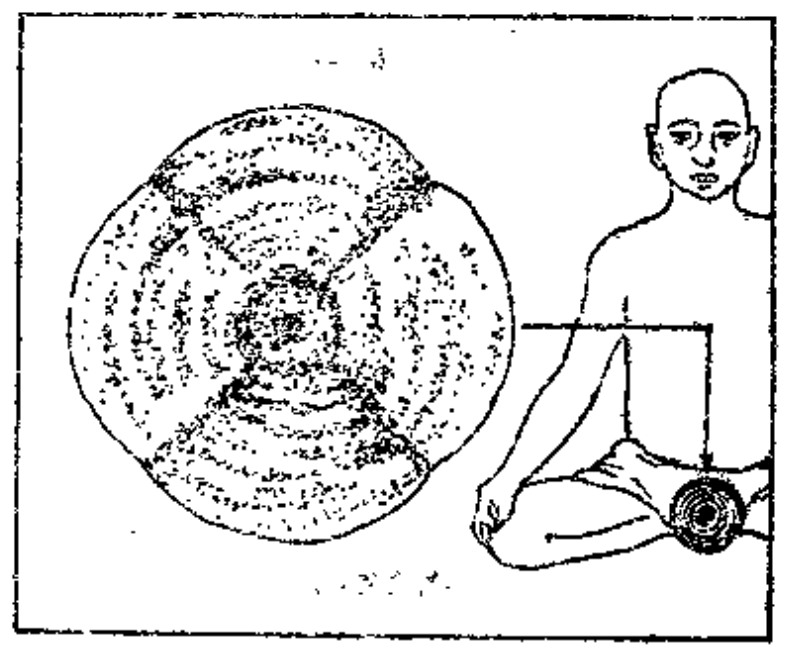
Fig. 1 Muladhara Chakra [orig. 木拉达拉抬克拉]
By focusing this chakra in your mind and sending all your mental power throughout your entire body, even a dying [orig. 额死, OCR error for 濒死] patient will not want to lie in bed, but will stand up. Through this kind of…
20
…training, both men and women will become more than 10 years younger than their actual age.
The Muladhara Chakra we are talking about now is located in the gonadal area. What exactly are the gonads? The famous modern medical doctor and physiologist Alexis Carrel said: “The gonads are strong glands that can strengthen all physiological, psychological, and spiritual functions.” In addition, he said: “Excessive romantic love will hinder [orig. 纺碍, OCR error for 妨碍] intellectual functions.” His conclusion was: “In order to extremely exert intelligence, one must have fully developed gonads, and at the same time, must have temporary willpower and sexual desire.” Actually, in Esoteric Buddhism, it is the exact same principle. Achieving health [orig. 違康, OCR error for 健康] through the training of the Muladhara Chakra seems quite ideal. On the other hand, however, it acts somewhat like a side effect, resulting in strong sexual desire and reproductive capacity; therefore, one must also undergo training to transform this massive sexual energy into other beneficial energy.
Through training, sexual vitality can be transformed into intellectual vitality known as Ojas [orig. 欧加斯得]. If one can master both forms of vitality simultaneously and merge them, it forms a personality possessing both intellect and physical strength.
The cultivation of Esoteric Buddhism must also begin with intellect and physical strength.
2. Svadhisthana Chakra — The Hero’s Location that Removes Fear or Confusion and Generates Unwavering Faith
This location is also known as the Hero Chakra. If you concentrate your vitality in this area (Fig. 2), when this location begins to activate, your energy will focus, your positivity will increase, and you will be able to bravely exhibit decisive action. Without fear, without confusion, with firm conviction, you will not flinch when facing difficulties. The mastery of this location can unleash superhuman power that transcends life and death.
When it comes to heroes, everyone thinks of Napoleon. But he was not omnipotent either; he was exiled to a solitary island twice and also tasted the bitterness of defeat. If he had remained silent after his initial exile to Elba Island [orig. 阿尔巴岛], perhaps world history would not have revered…
21
…making him a hero. When encountering setbacks, one does not despair, maintains faith, and strives to rise again—is this not the difference between a hero and an ordinary person? As long as one has courage and confidence, everyone can exert abilities that surpass the ordinary.
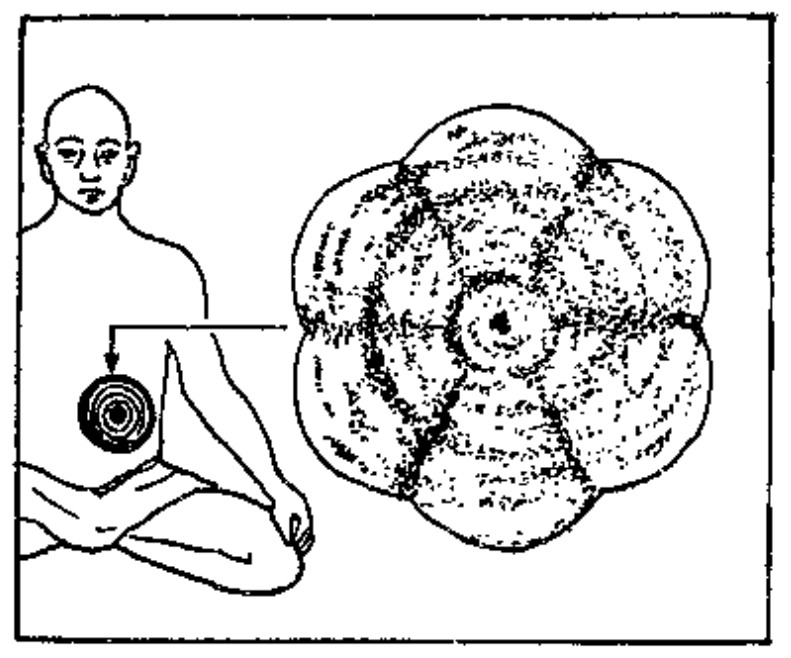
Figure 2: Svadhisthana Chakra (斯建吉斯塔那恰克拉)
The Svadhisthana Chakra (斯娃吉斯塔那恰克拉) corresponds to the adrenal gland area, so let us discuss the function of the adrenal glands. The adrenal glands are endocrine glands, one on each side, each weighing about 7 grams. However, this small organ bears an extremely important role; if both left and right adrenal glands are removed, no matter who it is, or even in animals, death is inevitable.
Because the adrenal glands bear the heavy responsibility of dealing with crises, they have been known as the “combat glands” since ancient times. For example, a wounded man leaps into a raging fire to rescue a friend; when the mission is accomplished, he collapses. Energetic feats of bravery like this are all granted by the adrenal glands.
During an emergency, the amount of adrenal hormone released rapidly increases to 10 times the normal value, thereby also causing an increase in heart rate, respiratory volume, and blood sugar levels.
23
3. Manipura Chakra — The Hidden Special Ability Area That Can Emit Flames
According to the records in the book Yoga Sutra: “Through the control of the navel chakra, one can know the organization inside the body.” And “knowing the organization inside the body” does not merely mean knowing it; it means being able to freely control the body’s internal organization.
“If one wishes to overcome the Samana Prana (萨玛纳气), one can emit flames from within the body.” (Yoga Sutra)
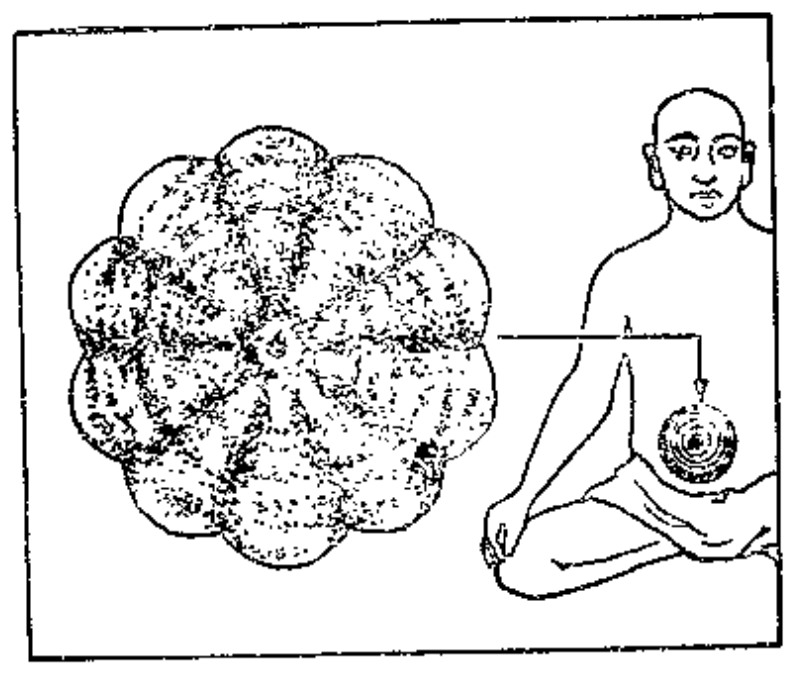
“When entering deep meditation with closed eyes, a yellowish-white hot flame will emit from this area, rising like steam. When walking, a flame of the same color will also extend from the waist to envelop the entire abdomen, resembling faint smoke.” (Yoga Sutra)
Figure 3: Manipura Chakra (玛尼皮拉恰克拉)
From this, it can be seen that through mastering this area (Figure 3), it is as if an energy like a bursting flame will emerge.
23
Furthermore, the fire of the Goma (护摩) of thought power is only possible when the Manipura Chakra, Vishuddha Chakra, and the Mudra area are combined together as one.
What was mentioned in the section on the Muladhara Chakra—transforming sexual desire into wisdom—is also one of the functions of the Manipura Chakra. If one accidentally ingests poisonous substances, the function of this area can decompose them into harmless substances, preventing food poisoning. This is made possible by strengthening the liver’s function, which is responsible for detoxification. An average person’s liver can decompose weak poisons like alcohol; by relying on thought power, even PCBs and DDT can be decomposed.
When the discipline of this area has made considerable progress, one can insightfully observe and control the internal organs of others just like one’s own. Therefore, you will possess the special ability to cure others’ illnesses.
4. Anahata Chakra — The Hidden Area That Can Read Others’ Minds and Possesses the Special Ability to Connect the Spiritual Realm with the Heart
It manifests the power of “Telepathy” (他心通), making grasping the thoughts of others as easy as flipping one’s hand. One can also freely manipulate the thoughts of others, and can even communicate with higher minds beyond the reach of sight: by assimilating things one cannot comprehend, a heart full of the sorrows of heaven and earth, and the energy of wisdom, one can directly hear them with the mind and wisdom. “…communication,” but mental telepathy only allows conversing with distant people, whereas Telepathy can further dominate the other party’s mind.
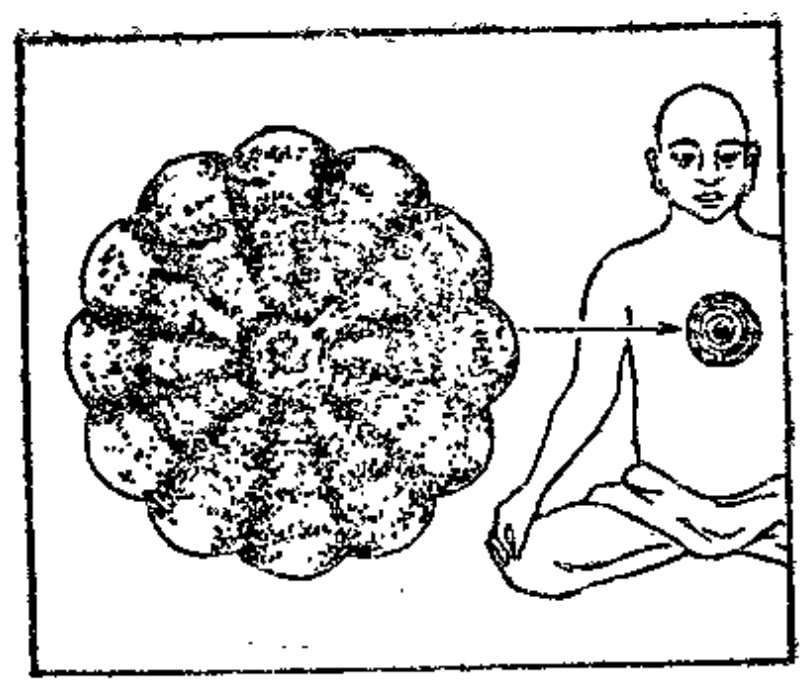
The Anahata Chakra is located in the chest (Figure 4) and is related to the thymus gland, heart, and liver; the one it directly corresponds to is the thymus.
Among the organs, the thymus is the one that degenerates most significantly with age; it stops growing from the age of two or three. Perhaps for this very reason, the medical community almost overlooked its importance. If the thymus is removed, body weight will drop significantly,
24
Figure 4: Anahata Chakra (阿拿哈达恰克拉)
Mental development is impaired, leading to idiocy, and eventually coma and death. The importance of the thymus gland has only been valued by the medical community in recent times. Professor Harada Yoshimichi from Tottori Medical University in Japan described it saying: “This is a major discovery in this century that turns the original idea around by 180 degrees.” However, as early as thousands of years ago, Yoga regarded it as an extremely important area; because of this, it makes me deeply feel the profound wonder of the Esoteric Buddhist tradition.
5. Vishuddha Chakra — The Chakra Hidden with Superhuman Hearing That Can Hear the Sound of the Earth Rotating and Understand the Cries of Animals
This is the area where superhuman hearing resides.
In fact, if you can cultivate this area (Figure 5), you will be able to hear sounds you have never heard before. As to exactly what kind of sounds they are, I will not say for the time being, because when I instruct my disciples; what kind of sounds they actually hear is reported by themselves, and I use this to judge whether this disciple has truly cultivated this area. Of course, the criteria for judgment do not stop there. If you give the other person a suggestion first, and they also hear the same…
25
…kinds of sounds, which constitutes a major obstacle to cultivation. Therefore, I will not publish it here for the time being—not because I fear plagiarism and am unwilling to disclose it.
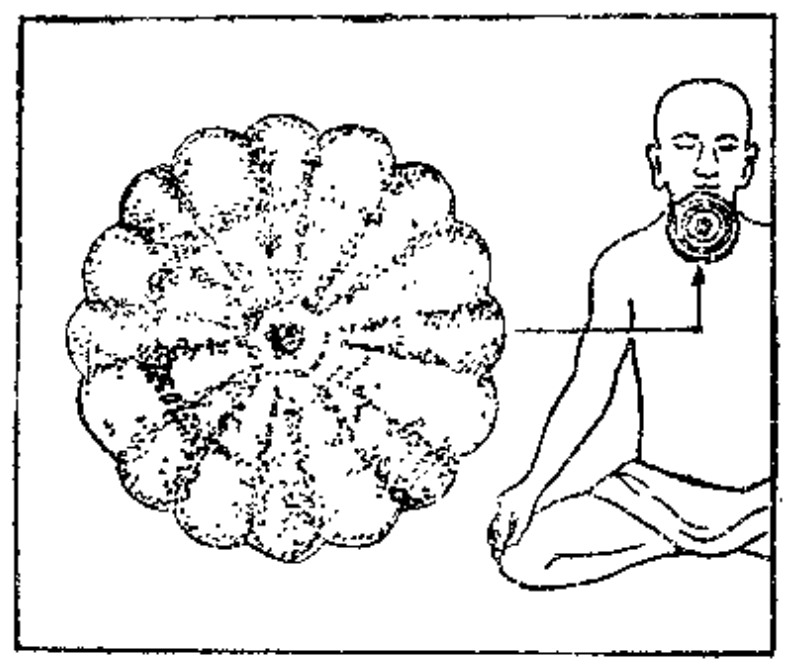
Figure 5: Vishuddha Chakra
What I can say here is that the hearing of a normal person can generally only perceive vibration waves from forty to fifty thousand cycles. If one can master the method to activate this center, the range of hearing will more than double.
At that point, you too may possess the ability recorded in the Yoga Sutra: “understanding the meaning of the cries of all living creatures,” and even carefully hearing the voice of the guiding spirit—what in Buddhism is called the “divine ear” (Celestial Hearing).
The Vishuddha Chakra is located in the throat and is closely related to the thyroid gland. The thyroid is a butterfly-shaped gland straddling the trachea. Using a car as an analogy, it acts like an accelerator, speeding up or slowing down the body’s activities. Whether our physical movements are agile or sluggish is entirely governed by thyroid hormones. Under normal conditions, the hormone secretion is one one-hundredth of a milliliter per day. This region is a key site for maintaining eternal youth.
20
6. Ajna Chakra — The Chakra Hiding the Supernatural Power to Manipulate All Things
The Chakra possesses exceptional clairvoyance. As recorded in the Yoga Sutra, it can “perceive through the mind all light and any minute thing; even if hidden beyond the line of sight or in a distant place, it can be seen at a glance.” At the same time, some consider this region to hold the possibility of the “Great Liberation of the Body.”
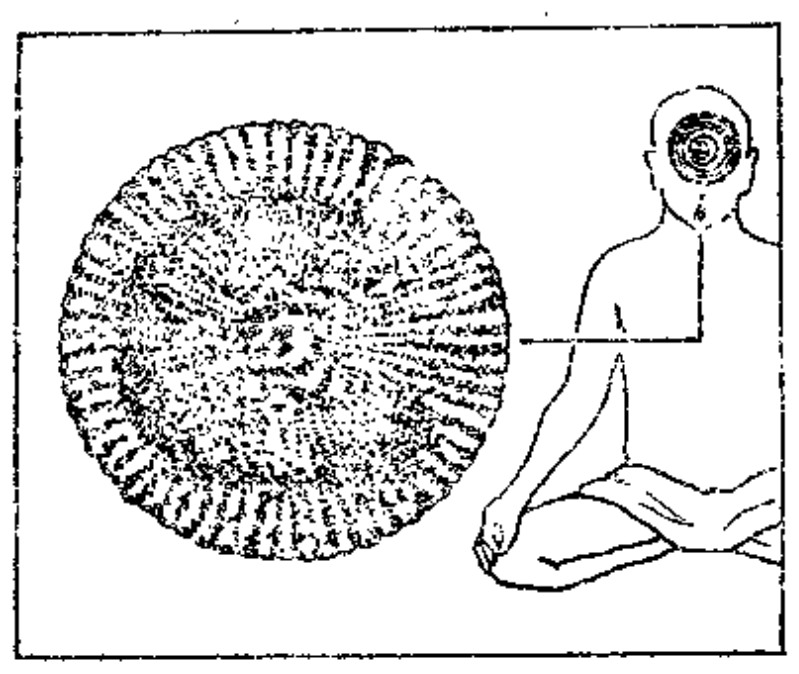
Figure 6: Ajna Chakra
The Ajna Chakra is also known as the Command Chakra, the Wish-Fulfilling Chakra, and the Autonomous Power Chakra. Once mastered, it grants the ability to manipulate at will and to control freely.
In terms of organs, the pituitary gland corresponds to this region (Figure 6). The pituitary gland hangs from the diencephalon at the center of the brain; it is an organ about the size of a soybean. Though small, this organ commands, orders, and even operates all endocrine organs throughout the body. It is an extremely vital organ and can be called the hub of the internal secretion organs.
27
The pituitary gland is closely related to the hypothalamus, which governs vision; therefore, developing this region can enhance eyesight.
7. Sahasrara Chakra — The Region That Transcends Time and Space and Can Transform One into a Superman
It can also be called the Chakra of Light within the brain. It is also referred to as the Brahma Seat (Brahmarandhra), the fissure, located beneath the junction of the cranial bones (Figure 7). The so-called Brahma Seat and Brahma’s fissure refer to the place where one becomes one with Brahma—that is, the sacred. When this region is awakened, light will appear and shine radiantly—this is the illumination within the brain. This region integrates all other regions and grants control over them at will.
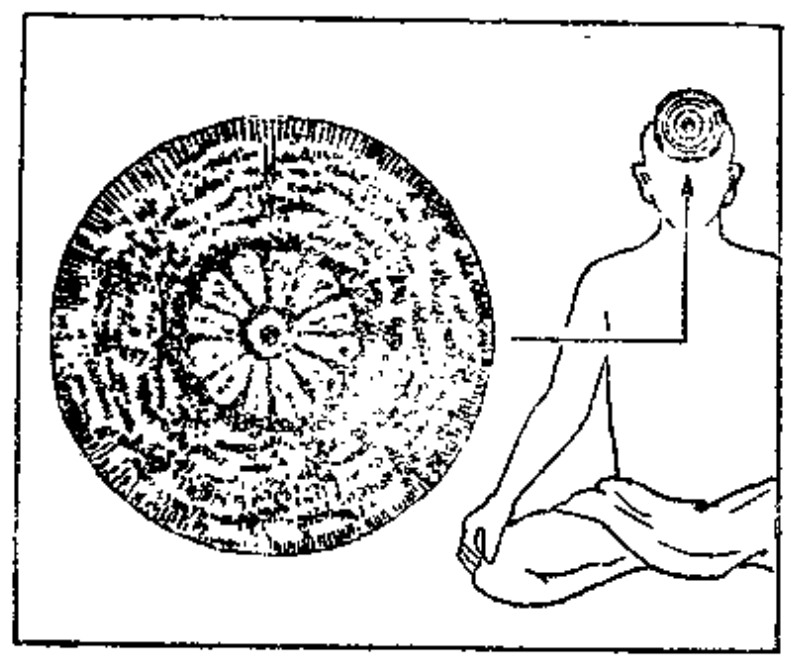
In Yoga, this is described as becoming one with the sacred object, and this Chakra is considered the seat of the Holy Spirit. A practitioner who has perfected the cultivation of this Chakra may be called a superman, a master, a savior.
Figure 7: Sahasrara Chakra
To beings in a two-dimensional (flat) world, the actions of three-dimensional (solid) beings…
28
…seem like a mystery. By the same logic, we beings in the three-dimensional world are utterly unable to comprehend the various activities of supermen dwelling in the fourth-dimensional world. In India, the Buddha is regarded as a superman and is also considered one who perfected this Chakra.
On the crown of a Buddha statue there is a raised bump (Ushnisha). If one successfully cultivates this Chakra, such a bump will appear.
This is the so-called superman—the crown of the Buddha-in-the-Body (Sokushinbutsu).
8 & 9. Mudra Chakra — The Chakra of Miracles That Gives Form to Supernatural Powers
With sections one through seven, the explanation of the Yoga Chakras may be considered complete for now. However, the regions for developing supernatural powers are not limited to these alone; there are even more important ones to follow, which I will now discuss.
Having entered into ancient Yoga practice, I devoted myself to the cultivation of the seven Chakras described above. Naturally, accomplishing them all at once is impossible; one must first begin by developing the Muladhara Chakra region.
When I combined the training of ancient Yoga with the practices of Shingon Esoteric Buddhism, I discovered something very strange.
Because I felt I had practiced enough, there ought to have been considerable power within me; yet I lacked that crucial method to bring the power forth.
At first, I thought my own strength was insufficient. Strangely, however, I gradually realized that my power was growing greater day by day, to the point where my body and mind felt overwhelmed. I very much wanted to release these forces.
But the Yoga of these seven regions offered no such method.
I pondered repeatedly, and finally, an idea flashed through my mind.
When I say this, perhaps you have already thought of it too—the Yoga Chakra is a…
20
The “tumbler doll”—that is, having no hands, no feet, but only a body.
If I had not possessed the will to accomplish the Goma method of nenriki (psychic power), I might never have thought of this.
Had I merely practiced the exercises taught in yoga over and over, then it would only count as completing practice within the scope of yoga. But I held firm to my purpose of performing the Goma of nenriki, and for this purpose, I delved deep into the depths of ancient yoga.
Although I went through much anguish, my training progressed step by step. I could be said to have already graduated from Muladhara and Svadhisthana, and was entering the training of the Manipura Chakra. The practice of this area also progressed extremely smoothly. When entering samadhi, under favorable conditions, I could see with my own eyes the transparent flame that emerged from the Manipura Chakra. In the Yoga Sutra it is written: “Simply by controlling the samana energy, one can emit flames from within the body.” At that time, I was in the process of mastering this samana energy.
The method of concentrating the samana energy to a single point to ignite sandalwood is not recorded in any Upanishad. When I centered on the Manipura Chakra and gradually felt my entire body filled with fiery energy, I anguished over my inability to “materialize” this into a real fire.
On one hand I immersed myself in intense practice, and on the other I collected various books from within the country and abroad. I finally found the book The Reality of Yoga (by C. T. Krik), which was being published in Europe. In that book, when I read an anecdote about a member of the group around Mrs. Anna Prabhu — the British Bishop Libida — I received a very profound revelation. The bishop said:
“Once one has mastered the secret of Kundalini within the mysteries of Kundalini Yoga, one can possess human electrical power equivalent to a million volts in material science.”
Having said this, he then gave a demonstration right there before everyone’s eyes. Bishop Libida, having entered samadhi, pressed his palm against a thick, hard wooden board beside him. When he later removed his hand,
30
there were scorch marks from the bishop’s palm burned into the wooden board.
“That’s it!” I cried out in my heart.
“It must be done with the hands!”
Why do human beings use their hands? Because hands can materialize human power. For human beings, hands are the tools for transmitting power. Thought is expressed through language, and power takes form through [the hands]. If even thought can be represented by the hands, how much more so can power. Thus I devoted myself wholeheartedly to concentrating both intention and energy simultaneously in my hands.
When my training progressed to the Vishuddha Chakra, I suddenly discovered that my hands had begun to vibrate unconsciously. In a state of selflessness, I felt that I was developing a new chakra.
This, of course, was the beginning of the birth of the “Mudra Chakra” that I had developed. For according to the Vishuddha Upanishad, the upper limbs (both wrists) and the chest are interconnected with the muscles. Through the mastery of the Vishuddha Chakra, the fiery energy that filled my inner being had already opened pathways in my two wrists.
Thus I combined the Mudra Chakra with other chakras, and finally succeeded in burning the Goma. This was a technique I had accomplished on my own, and I felt extremely proud. In yoga there is no chakra of the hands, but in Shingon Esoteric Buddhism, there exists what will be discussed in depth later — the “In-kai” (mudra seals).
Shingon Esoteric Buddhism, since ancient times, has clearly indicated that on the fingers of the various Buddhas and Bodhisattvas, which form various mudras, there exist chakras.
31
Chapter 3: Four Basic Training Methods
Section 1: Forming Mudra — Moving the Body
What Is a Mudra
By activating the chakras of supernatural ability hidden within the body, one can transform them into manifest power. However, the practice of materializing nenriki (psychic power) is by no means an easy task; it requires drive and arduous effort. As long as you have drive and are willing to make the effort, I can guarantee that supernatural abilities will attach themselves to you.
Before entering into formal training, you must first master the basic exercises. Introducing them all at once would be quite difficult. As stated earlier, Esoteric Buddhism is a system and a science; one must learn it step by step in proper sequence.
The means for developing nenriki can be broadly divided into two types: internal and external. What is called “external” here refers to hand mudras (or Mudra Yoga) corresponding to concrete actions.
What we call “In” (印, mudra/seal) refers to the various forms of the wrists, fingers, and so on. The formal term is “Kei-In” (契印) or “In-Kai” (印契). It is a system unique to Esoteric Buddhism that, through a series of movements, evokes the power of the Dharma.
Although the ten fingers of both palms are very small, they can express boundless and immeasurable meaning. The bending and extending of the ten fingers can, on a grand scale, express natural disasters and catastrophes such as earthquakes and floods, and on a smaller scale, can embody human etiquette, illness, undertakings, and the like.
32
I have introduced the techniques of ancient yoga into the original esoteric seals, and infused them with full-body movements. This is called Mudra (hand seal), which can also be interpreted as further strengthening the efficacy of the seal. Fundamentally, the training of mudras consists of “the Mudra of the Nine Characters by the Rain-Invoking Hands” and “the Mudra of the Single Vajra.”
1. Basic Training ① — Forming the Nine-Character Secret Seal
In the extraordinary psychokinetic power of Esoteric Buddhism, the Nine-Character Secret Seal, believed to summon the driving force of super-normal power, is developed as a mudra.
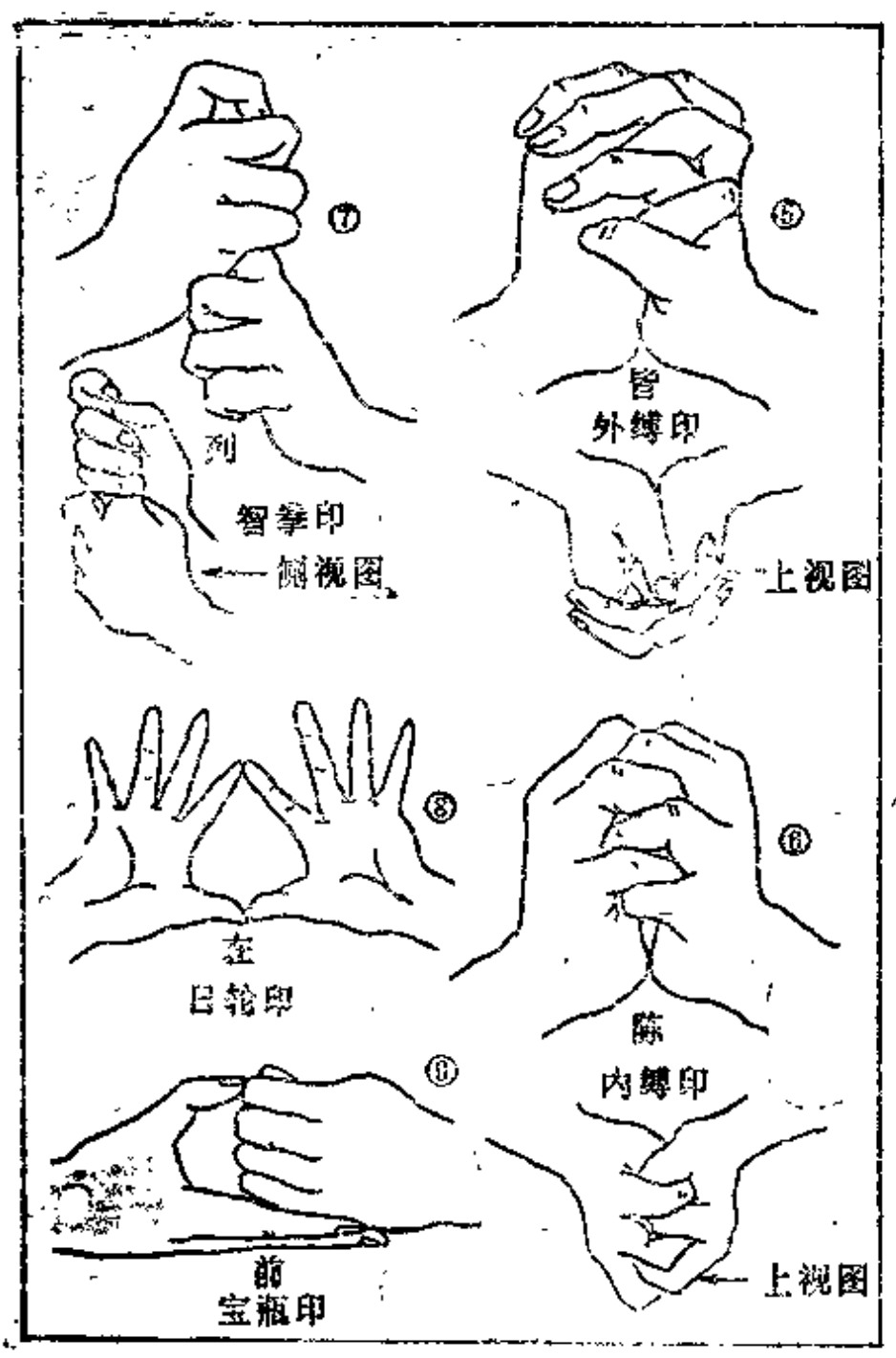
Rin, Pyō, Tō, Sha, Kai, Jin, Retsu, Zai, Zen — these are the so-called Nine Characters. Their seals are shown in (Figure 8 ①–⑨). The meanings possessed by each seal will be discussed in detail in Chapter 4; here we need only memorize how to form the seals.
The above basic seals should be formed continuously from ① to ⑨ in either a standing or half-lotus seated posture, and must be formed without stopping, like flowing water.
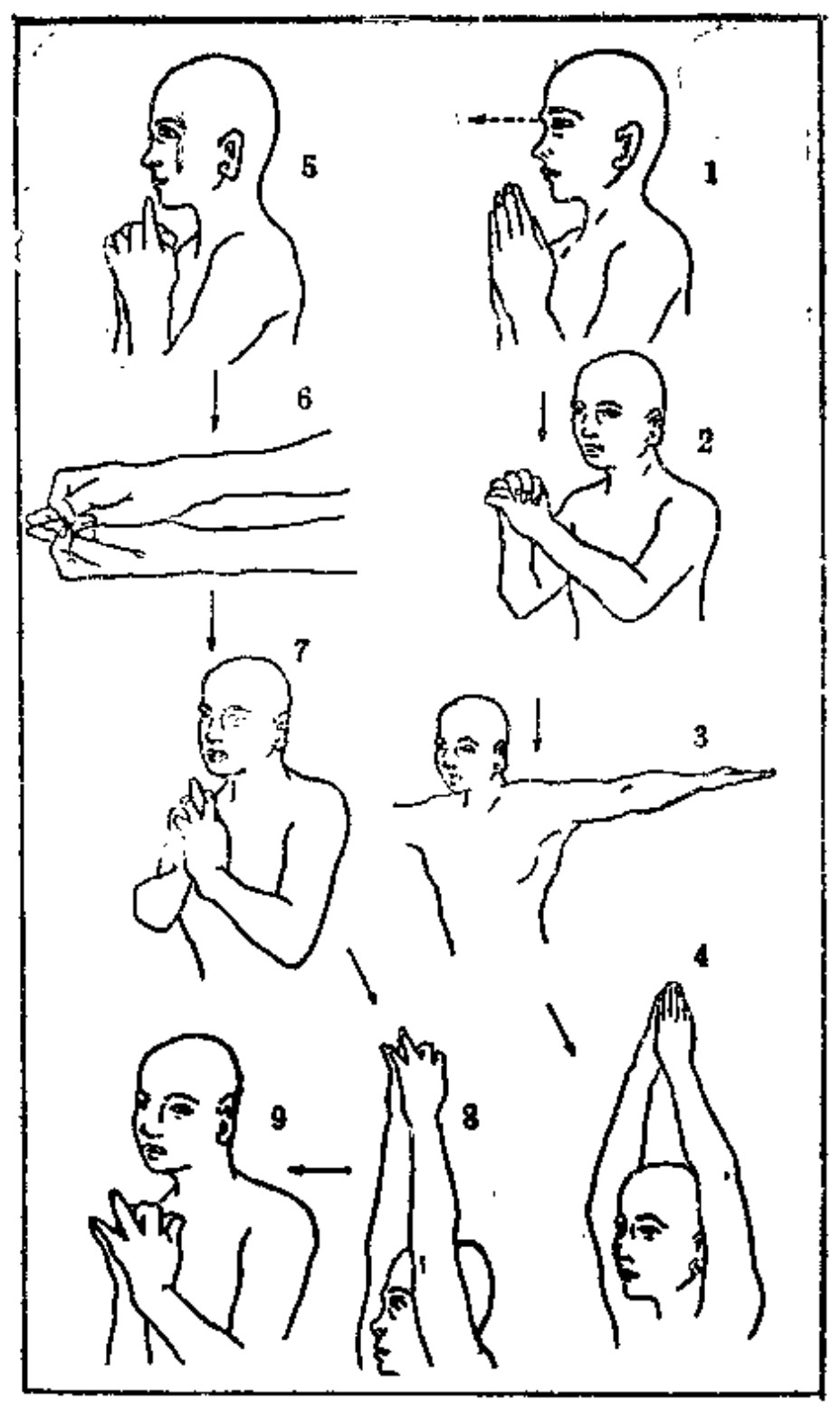
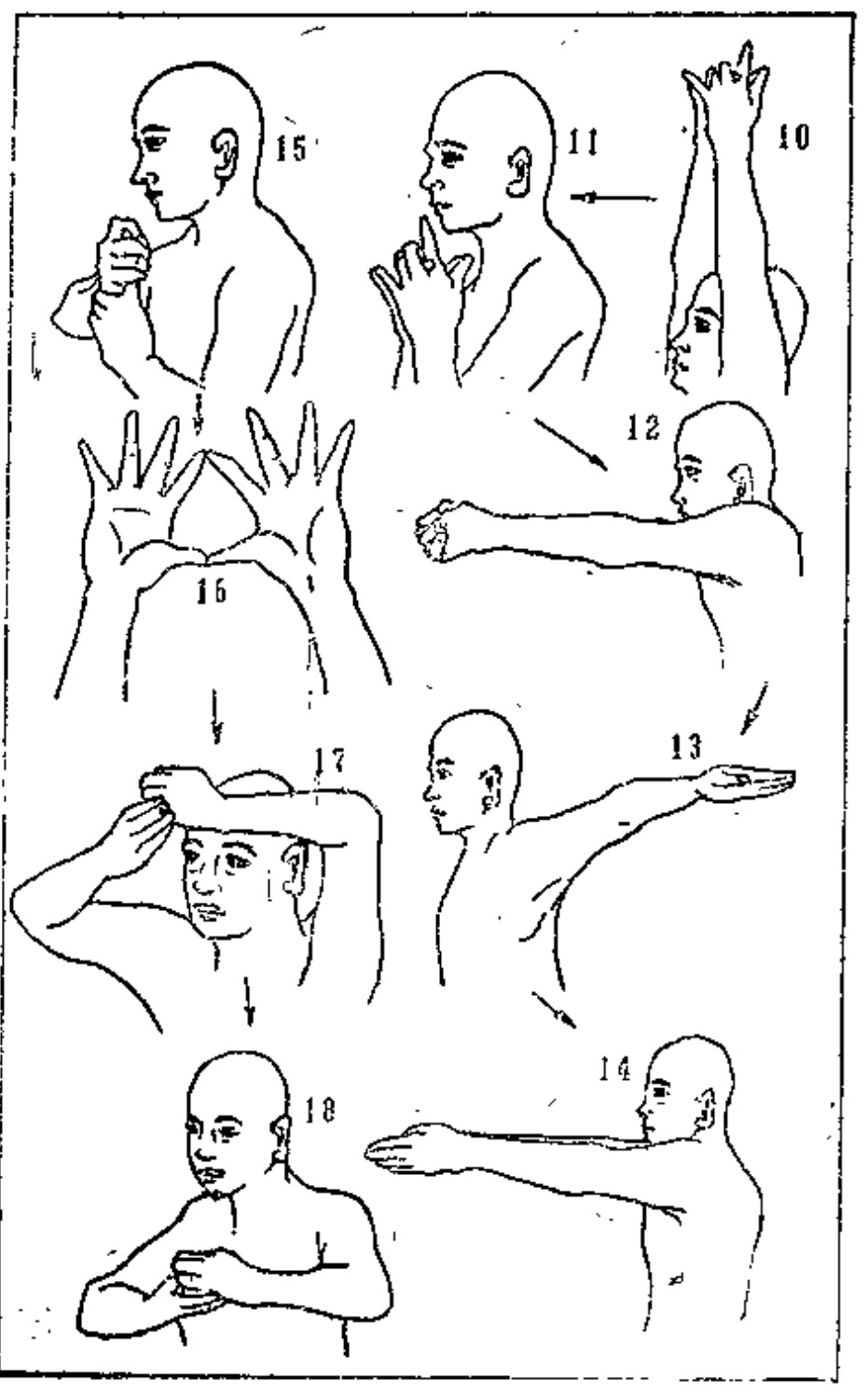
Let us now demonstrate the standing method. First, expand the chest, draw the chin inward, and look straight ahead. See (Figure 9 ①–⑧).
To begin, first bring the palms together lightly, then form the Outer Bound Seal (Figure 8 ③) by binding forcefully with the fingertips. Quickly align the fingertips side by side, return to the original palms-together position, and simultaneously thrust forward.
Next, extend both arms straight out to the sides (Figure 9 ③), raise both arms from the sides of the body up overhead, and bring the palms together (Figure 9 ④).
When bringing the palms together, you must clap forcefully — the louder the better. Then bring the clasped hands down to the front of the chest. While moving them, you must form the Acala Fundamental Seal (Figure 8 ④).
Thrust the Acala Fundamental Seal at the chest straight forward. At the instant of full extension, press the fingertips forcefully forward. Then draw back, and as you draw back, form the Great Vajra Wheel Seal (Figure 8 ②), (Figure 9 ⑥), then raise it upright in front of the chest (Figure 9 ⑦). Maintaining this hand gesture, move it straight upward as if rubbing the bridge of the nose. When it reaches the top of the head,
33
change to the Outer Lion Seal (Figure 8 ③). Then, pull it straight down to the chest and stop (Figure 9 ⑧⑨), then lower it forward and extend straight out.
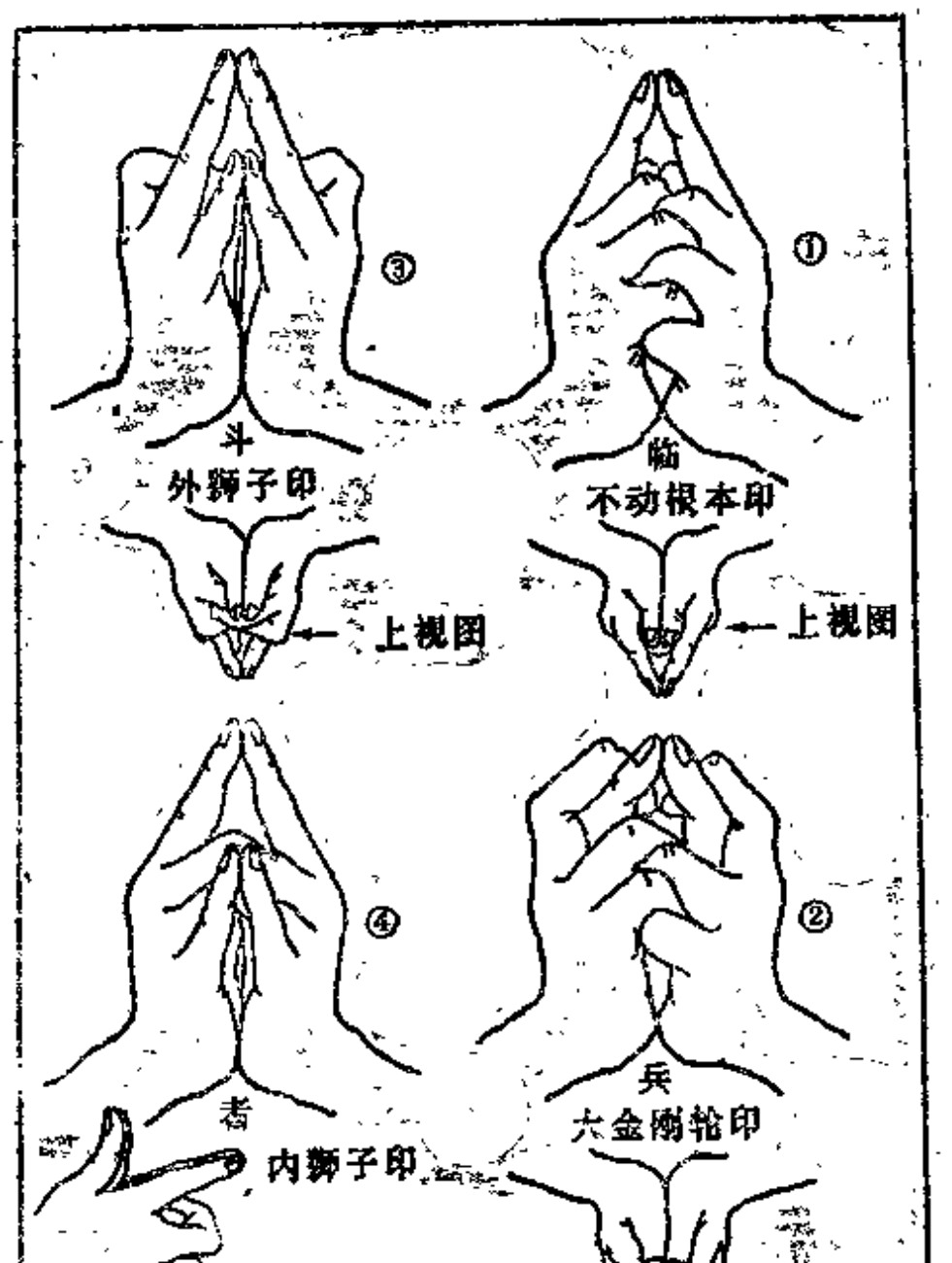
Outer Lion Seal
Acala Fundamental Seal
Top view
Top view
Great Vajra Wheel Seal
Inner Lion Seal
Side view
— Top view
Figure 8 ①–④
34
[The majority of this page contains illustration content with severely damaged OCR. Recoverable fragments:]
[illegible]
[illegible]
Figure 8 ⑤–⑩
[illegible]
[The majority of this page contains illustration content for Figure 9 with severely damaged OCR. Recoverable fragments:]
[illegible]
[illegible]
[illegible]
11 10 12 16 13 4 6 — Figure 06 37
Extend the Outer Lion Mudra forward to its limit, then draw it back and hold it upright before your chest. Quickly, maintaining this hand gesture, move it upward as though rubbing the bridge of your nose.
When it reaches full extension above the head, change to form the Inner Lion Mudra (Figure 8①), then bring it down and hold it upright before the chest. Next, just as with the Outer Lion Mudra earlier, tilt it forward and thrust out. When the thrust reaches its limit, raise it upright again. At the same time, immediately change to the Outer Bound Mudra, tilt it forward and thrust out (Figure 9②).
At the instant the thrust is completed, with a sound of “En,” exert force forward. Then draw it back to the chest and change to form the Inner Bound Mudra (Figure 8⑥).
Then, in the same manner as with the Inner Bound Mudra and Outer Bound Mudra, tilt it forward and thrust out. At the instant the thrust is completed, exert force forward, then swiftly draw it back and hold it upright before the chest.
Maintaining the same hand gesture, simultaneously move it straight upward as though rubbing the bridge of your nose.
When it reaches full extension above the head (at this point the fingertips must not point upward; you must raise it level with the Inner Bound Mudra), release the mudra and bring the palms together in gasshō. Then spread both arms out to the sides while turning the palms downward (Figure 9③).
When both palms are raised to the same height as the shoulders on the left and right, move them forward to the front of the body, straighten both arms, and clap forcefully (Figure 9④). The louder the sound, the better. The movement should be the same as the clap in Japanese sumo matches.
After the clap becomes gasshō, draw it back and stop before the chest, then change to form the Wisdom Fist Mudra (Figure 8⑦). At this point, temporarily suspend breathing.
After one breath, maintaining the Wisdom Fist Mudra, once again move straight upward as though rubbing the bridge of your nose.
When the Wisdom Fist Mudra reaches full extension above the head, swiftly transform it into a large Sun Wheel Mudra (Figure 8⑧).
Maintaining the Sun Wheel Mudra, bring it straight down before the chest. After pausing briefly, immediately extend it upward again. At the top of the head, change into the Treasure Vase Mudra (Figure 8⑨). Maintaining the same hand gesture, pull it straight down and hold it still before the chest. What has been described above constitutes the basic mudras founded upon the Nine-Character Mudras.
38
Points of Attention When Forming the Nine-Character Mudras
Except for the Wisdom Fist Mudra and the Sun Wheel Mudra, you must absolutely never stop the movement. At all times, let it flow naturally like running water.
When the mudra thrusts forward, exhale; when drawing back, inhale; when extending upward, exhale; when moving downward, inhale. You must never get the breathing method wrong.
At every moment, concentrate your spirit and awareness on the fingertips. Especially at the instant of thrusting forward and extending upward, you must exert force.
At first, you may find it difficult and be unable to move freely. However, by repeating the practice 10 or 20 times, you will likely grasp the essentials. This is the first step toward becoming a person of supernatural abilities, and you must absolutely not neglect it.
This training is not restricted by day or night or by location. It is most ideal to do it alone, quietly, in a room the size of six tatami mats and free from noise, because this makes it easier to concentrate your intention. Practicing regularly three times a week, one hour each time, is best.
2. Basic Training ② — The Secret Mudra of Wielding the Single Vajra
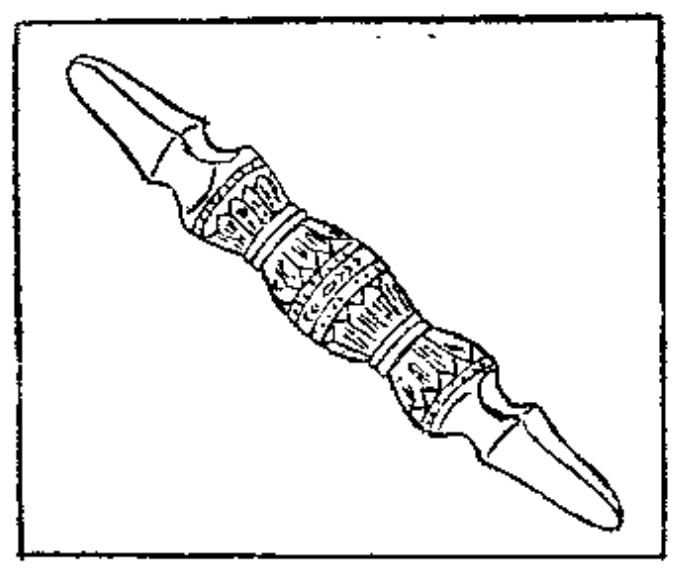
Next comes the mudra of the Single Vajra. The so-called Single Vajra is a ritual implement shaped as shown in (Figure 10). It not only symbolizes the dignity of the practitioner, but is also a tool that can concentrate the mind and generate power surging forth from within the body. Any rod of appropriate weight that is easy to grip may be used as a substitute.
The posture may be either standing or seated in the lotus position (cross-legged).
First, tuck the chin in firmly, gaze straight ahead, and grip the Single Vajra firmly with both hands at the sides of the chest. Then open the grip, grip again, and open again — repeat continuously more than 10 times.
Then, keeping the left hand stationary as it is, grip the Single Vajra with the right hand and toss it, meaning to lightly toss it upward. After tossing more than 10 times, switch hands. Then toss with both hands simultaneously, or alternate between left and right
39
hands, tossing more than 10 times.
Figure 10 Single Vajra
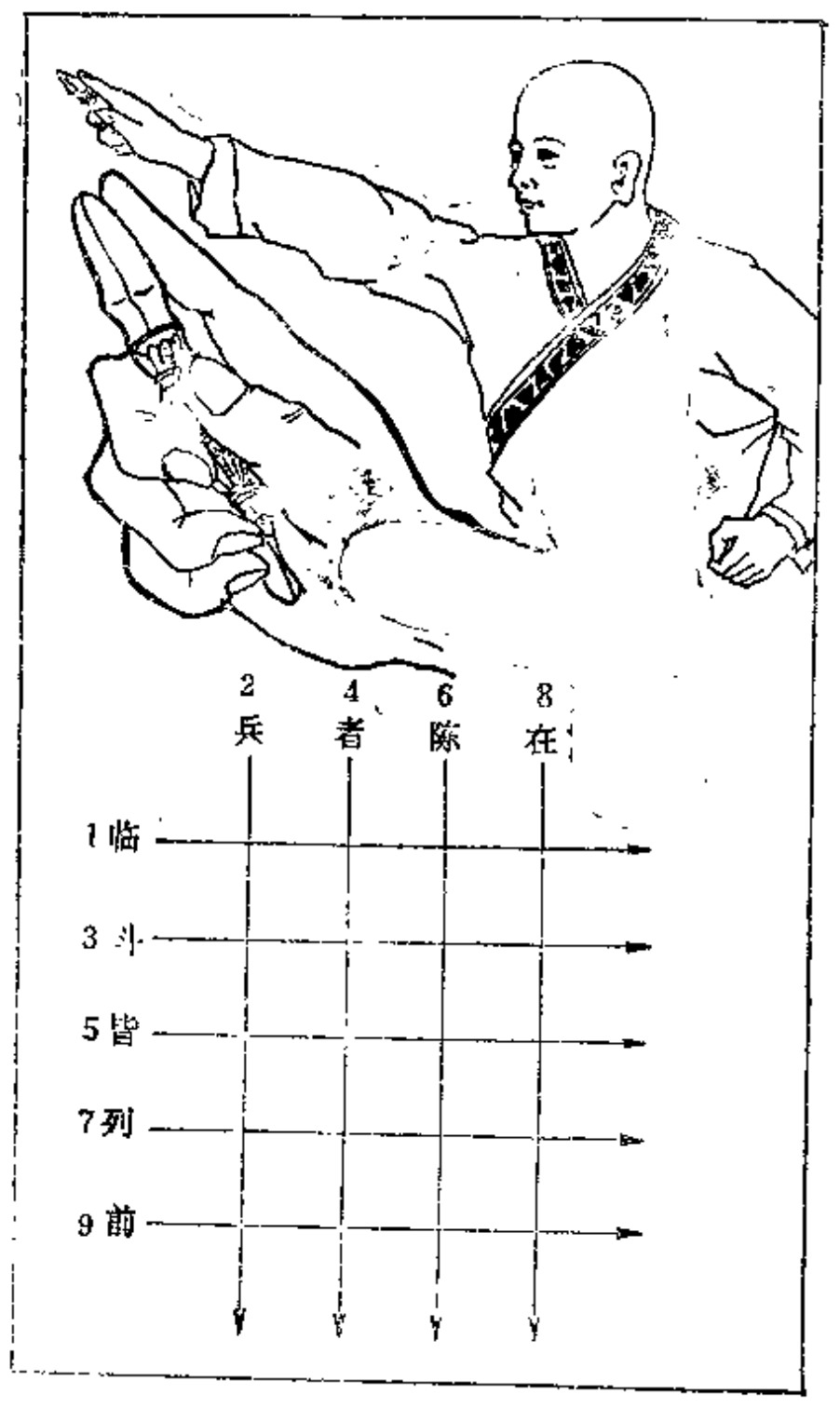
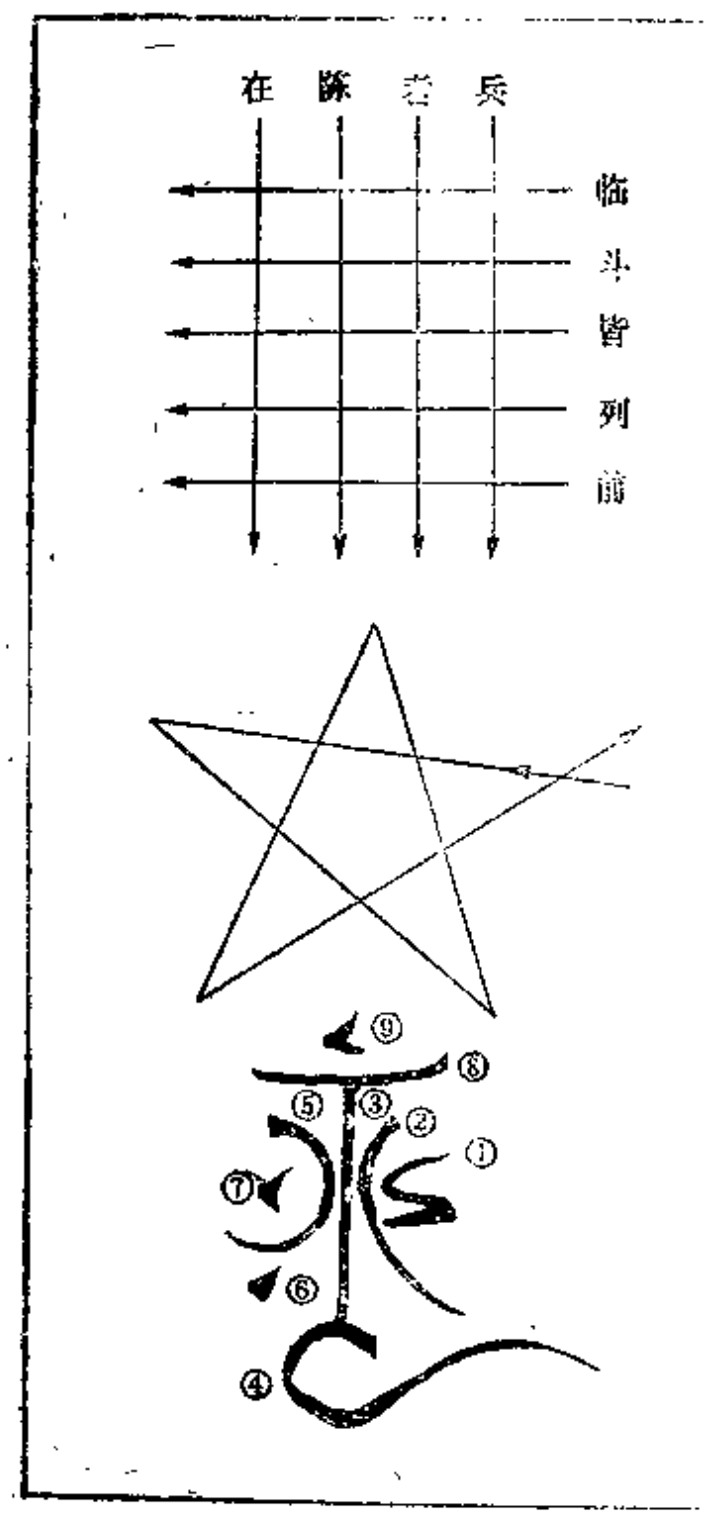
Then, toward the direction of the air, using the method shown in (Figure 11), first use the Single Vajra in the right hand to cut the Nine Characters (Figure 12). The so-called “cutting” means to trace them in the air. The left hand should grip the vajra and hold it at the waist. When tracing, follow the numerical order. The method of gripping the Single Vajra follows (Figure 11).
In a low voice but with force, recite “Rin, Byō, Tō, Sha, Kai, Jin, Retsu, Zai, Zen” and cut them correctly. Finally, with a sound of “En,” cut the shape “V” as shown in (Figure 12).
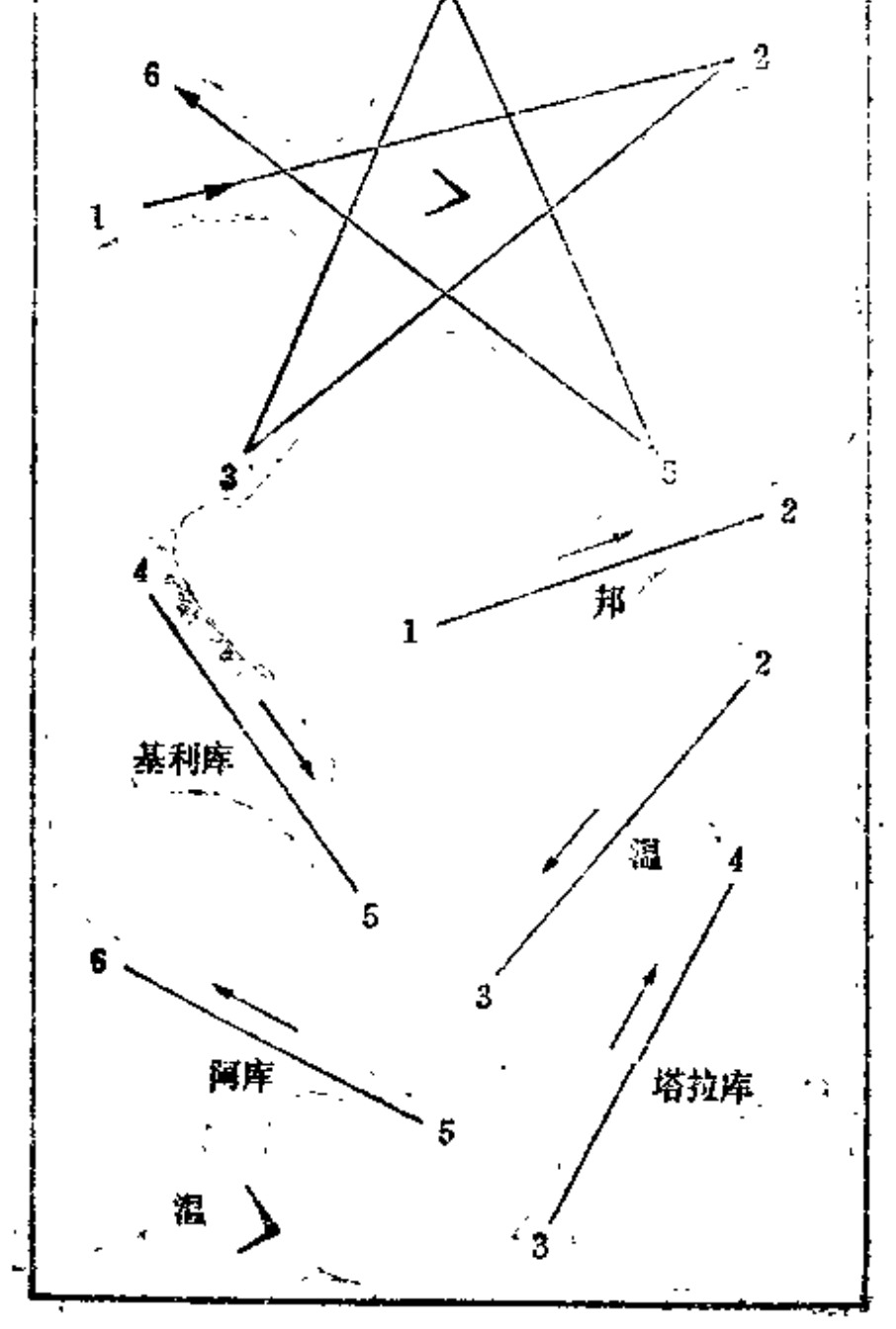
Speaking of which, everyone can probably understand by now, but I must still remind you to pay attention. After cutting the Nine Characters (of course in the air), you must then, as shown in (Figure 12), trace the star shape according to the numerical order. Finally, using this pentagon as the center, cut the ”—“-shape. Look at the diagram carefully. For each of these movements, recite in a low voice: “Han, Un, Taraku, Kiriku, Aku, Un.” These sounds are mantras. At first you may recite slowly, but you must trace the figures correctly.
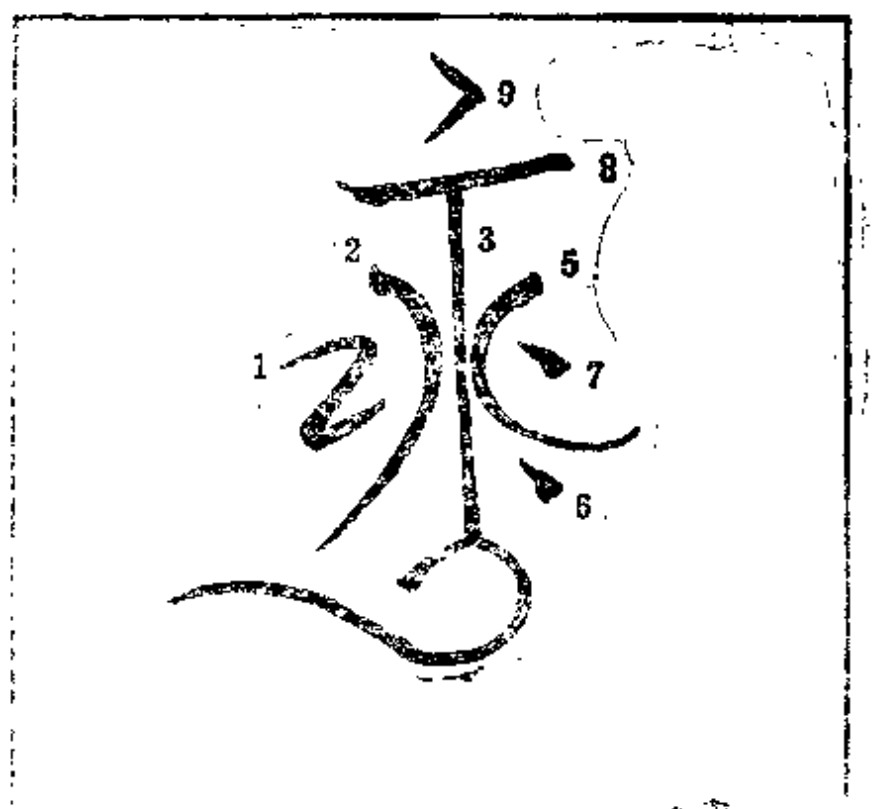
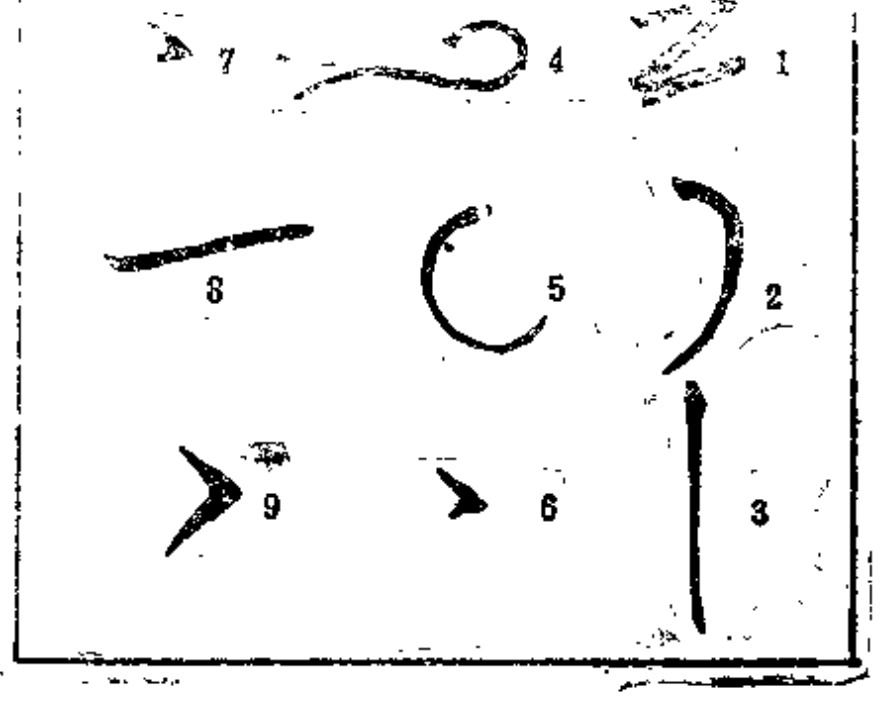
After completing this, next trace the Sanskrit characters of (Figure 13) following the procedure described above. These are the Nine Characters of the Great Ultimate Secret Transmission. The stroke order is as shown in the figure, from 1 to 9, and recite “Rin, Byō,
40
[Figure/Diagram — OCR severely damaged. Recoverable text fragment:]
正确地切下。
[illegible]
[Figure/Diagram — OCR severely damaged. No coherent text recoverable.]
[illegible]
9 ‘
8 3s! ‘i
| 4
| ws.
: [illegible] 1
ar ws ]
a7 - pa. 4 ee iH | .
= .- - “te 1 ,
——— pe pererare—— oe
Bis FRA
43
一
、 em [illegible] [illegible] |
2 |
ee
-
  :                      |     a     {

    ¥       '
. . 2 ‘
| |
\ |
© |
<° 0 |
; 6 |
: |
® |
44
What has been described above is to complete the tracing of the “Mudra of the Nine Characters,” the “Star,” and the “Sanskrit Characters of the Nine Syllables” in the air in one fluid motion. At first, due to unfamiliarity, you may encounter difficulties. I believe it would be helpful to draw a vajra (dokko) on paper, paste it on a wall, and practice facing it. Once you can freely trace the “Mudra of the Nine Characters,” the “Star,” and the “Sanskrit Characters of the Nine Syllables” with your right hand, you must then train your left hand to perform the same actions.
When practicing with the left hand, place your right hand at your waist and cut the nine characters with your left hand using a reverse cutting method — the opposite direction from the right hand’s cutting method — as shown in (Figure 14), cutting the nine characters in the reverse direction.
Similarly, the Star and the Sanskrit characters should also be cut in the reverse direction. Study the diagram carefully and practice accordingly.
Once you have learned this, next use your left hand to cut the nine characters, the Star, and the Sanskrit characters in the same manner and direction as the right hand.
This completes one stage. I wonder whether everyone has understood. Can you perform the mudra of the nine characters, the Star, and the Sanskrit characters with your right hand? Can you perform each mudra with your left hand in the opposite direction? Can your left hand also cut the mudras in the same direction as the right hand?
Finally, cut the mudra of the nine characters, the Star, and the Sanskrit characters simultaneously with both hands (i.e., left and right). At this point, the left hand may cut in the reverse direction or in the same direction as the right hand — either is acceptable. At this stage, you may also write your own name in large letters on paper as shown in the diagram, paste it on the wall, and perform the mudra cuts facing it. Treating your name pasted on the wall as your own double (bunshin) is a very important matter.
What has been described above constitutes the basic training of bodily movement. Next, we proceed to the training of concentrating the mind. The so-called psychic power (nenriki) arises from the mutual coordination of bodily movement derived from mudra and extreme mental concentration, stimulating each chakra.
45
Section 2: Enhancing Mental Power
— Training of the Mind —
1. The Weakest Link in Past Esoteric Buddhist Practice
As stated earlier, the development of psychic power must be carried out from both the inner and outer aspects. What corresponds to the outer aspect is mudra (hand seal), and its basic training has already been discussed. As for the inner training, it is the basic training for strengthening mental power. This training also has two stages: “concentration” and “meditation” (or contemplation).
In addition, there is an even higher level of training, which is the “visualization” (kanjō) discussed in Chapter 4. However, before reaching that stage, one must first undergo basic training to improve concentration.
In past Esoteric Buddhism, the ritual instruction manuals (shidai-sho) merely wrote, “Recite these!” Regarding this point, it can be said to be the weakest link in the methods for generating psychic power. The following training is intended to remedy this deficiency and systematize them.
Mental concentration sounds easy in theory but is extremely difficult in practice. We can understand this through a simple experiment.
For about fifteen minutes, choose a place free from disturbance and establish an object of thought — preferably something simple and pleasant, such as a flower or coffee. Hold this object in your mind and strive to sustain it.
In less than two or three minutes, you will find that what you are thinking about is completely different from what you started with. Psychologists believe that a person can concentrate their thinking power on one thing for at most two minutes. Therefore, concentration of the mind requires technique.
2. Basic Training ③ — Part 1: Concentration
To achieve concentration, the commonly adopted method is to sit quietly and
46
focus your attention on a single object. When your attention begins to wander, you must push it back toward the object. Continuing to think in this manner — trying not to let the object slip away — cannot be considered the best strategy for achieving concentration; it may even be harmful to the mind rather than beneficial.
The best method is this: after deciding on an object, fix your mind on that object and concentrate your mental energy on thinking of all things related to it. In other words, fix your mind on one point, and it is perfectly fine to also think about matters related to the fixed object. By performing the acts of recollection and concentration simultaneously, it becomes easier to elevate the brain’s concentrating power.
3. The Four Pathways for Developing Thought
After determining the central theme, you must recall all related matters — but if you pursue related matters aimlessly, you will eventually forget your central content. Therefore, you must develop pathways for expanding upon the central theme. What follows describes four pathways of thought.
First: The Category Pathway
First, let us take “elephant” as our object. In thinking about the elephant, you will very likely associate it with the images of animals similar in shape, such as the hippopotamus, cow, horse, and camel. This initial point of thought is called the “category pathway.” This encompasses the object and its relationship to the category it belongs to, as well as the relationships among objects within the same category.
Second: The Part Pathway
The second is a point of thought based on the “parts” of the object. If you think of an elephant, its trunk, ears, feet, and so on will partially appear in your mental image.
Third: The Quality Pathway
This refers to the relationship between an object and its qualities. For example, when you think of a diamond, you associate it with jade, pearls, and the like — this falls under the first category. But if you approach from the aspect of hardness,
47
then associating it with mechanical tools would belong to the law of quality.
Fourth, The Route of Experience
This type of route does not include observational knowledge of similarities, differences, the object and its category, the whole and its parts, or the object and its characteristics.
For example, when you think of a wet fountain pen, you would never associate it with a hammer or a nail, but rather with an inkwell. When you think of a bed, you would never associate it with mountain climbing, but rather with sleeping. When you think of Brazil, you would never think of water chestnuts, but rather of coffee, the Amazon River, and so on. In this way, the memories of things commonly seen and heard in daily life form the source of experience for anyone. This is a concept connected to experience that can emerge directly without going through a process of deliberation.
This type of route also contains the chain of cause-and-effect associations linking cause and result together. For example, exercise and health, excessive drinking and stomach ulcers, guns and killing, and so forth.
The above fourteen routes of thought can be used not only during concentration training but also as important foundational routes during memory, contemplation, and association. Therefore, they must be thoroughly memorized.
Now let us proceed to the concrete training!
Keep thinking continuously about “cow.”
For instance, suppose you decide to focus your mind on “cow.”
At this point, you must not forget about the cow, and you should associate as many related things as possible. You may close your eyes and develop along the route of category.
“A cow is an animal, a four-legged beast, a mammal.” Then continue to think about other animals of the same type, such as sheep, horses, dogs, and so on. Keep imagining until you can no longer continue. At this time, the cow must remain at the center of your thoughts.
Next is thinking along the route of parts. The cow’s eyes, ears, nose, horns, and other parts
48
appear. If you are skilled in anatomy and physiology, you may even associate each internal part one by one. Of course, the cow’s four stomachs must not be forgotten either.
Then comes the route of quality: the cow’s body — its size, weight, color, shape, movement, habits, and so on. But you must also pursue its internal nature. You must also pay attention to other objects that share the same qualities.
Finally, there is the route of experience. You may begin to imagine “the cow that I know” — that is, review the cow in your impression. For example, the cow at your relative’s house in the countryside that frightened you, yet you wanted to feed it grass and stroke the horns on its head. Perhaps you think of Spanish bullfighting. Perhaps milk, butter, cheese, farms, pastures, highlands, and so on may appear. Perhaps knife handles or ornaments made from cow horn or cow bone, or handbags and leather shoes made from cowhide — all of these may emerge in your memory.
In this way, all the direct knowledge you have about cows can be said to be fully exhausted. And it must be fully exhausted. In this training, you must thoroughly draw out every possible concept along each route.
The benefits brought by this training are immeasurable. First, it cures the bad habit of poor concentration and cultivates the ability to focus attention on a single object. Second, by concentrating the mind on one thing, it enables free movement within thought and imagination, which is indispensable for utilizing the subconscious. If you accumulate this training, it can open the door to activating the subconscious! And this is the first step toward generating extraordinary psychokinetic power.
You must cherish this training. Even if time is limited, I hope you will persist in doing it every day.
Conclusion of This Training
Choose an object and carefully hold it in your mind. Never let it slip away. Use the four routes of thought to think freely and at ease.
49
Points to Note in Basic Concentration Training
One thing you must pay attention to during concentration training is: never tense up.
Many people, because they want to grasp a mental image — a concept — pursue it too hard, which actually causes concentration to fail. When the Buddha entered samadhi seeking enlightenment, his brows were smooth and relaxed; his body and face showed not the slightest tension. All that could be seen was gentleness and tranquility. There was never any furrowed brow, raised shoulders, or clenched teeth. If those occurred, thinking would be impossible.
When learning anything, children often display an appearance of extreme tension. For example, when writing, they grip the pencil tightly; their mouth moves along with their hand; their free hand is also clenched; their leg muscles are tense, or tangled beneath the chair. As a result, after only a short period of study, they appear utterly exhausted. The brain is actually extremely difficult to tire out, because before the brain fatigues, other organs of the body have already begun to tire. Therefore, I urge everyone to cast aside all tension as much as possible. Sit quietly, eliminate the sense of tension in every part of your body, and let out a smile! In this way, you can achieve an even higher degree of concentration.
4. Basic Training ③ Part 2 — High-Level Concentration
Concentration 1
Sit in a quiet room and carefully look over all the objects in the room. Then close your eyes and let each one pass through your mind — its color, shape, size, and so on — reproducing them as if seeing them with your own eyes. If your memory of a certain object is particularly vivid, retain it and place it at the center of your attention. Then let your other memories circle around that object. Try practicing in this manner.
50
Concentration 2 Look out the window! If it is a courtyard, carefully observe all the scenery in the courtyard, such as the flowers, grass, trees, birds, and so on, within two or three seconds. Then close your eyes and let that scenery reappear. Recall the shape and number of the trees, the number of the birds, the number of the flowers, etc. If it is a city, after gazing at a large building, quickly close your eyes and let the number of windows in those buildings present themselves in your mind. In the past, I would often look at dozens of sparrows and swallows resting on electric wires for just an instant, then close my eyes and count them one by one. At first, count them in units of 10; once proficient, counting dozens will be no problem at all. A training even more difficult than this is being able to read a page of text out loud with your eyes closed after only looking at it for a few seconds.
Concentration 3 Take a walk on a street you are very familiar with, and pay attention to anything you think you can recall. If you feel your attention is not focused, start walking from the beginning again.
Concentration 4 Use your imagination to recall your past experiences, such as getting up in the morning, eating, going to school, opening a textbook, doing homework in the library, eating lunch, etc. Carefully think about the things you do every day, particularly memorable events, and try to recall the trivial details as clearly as possible.
Concentration 5 51
You might as well pay attention to a specific object around you. For example, the sound of a clock—treat the object making the sound as the center of your attention. Its pendulum, mainspring, gears, etc., are moving. Think carefully about how those things were collected and assembled, or how it was transported from somewhere to here. In this kind of training, it does not matter whether your imagination is correct or not; what matters is that your mind remains consistently focused on it without leaving.
Concentration 6 As mentioned above, take a walk on a familiar street in your imagination. When you reach a selected building or scenic spot, stop and observe it carefully. If your mind wanders at this point, you must move to a different place every few minutes, looking at the same scenery from different angles and different viewpoints, and you must observe very carefully. At this time, you may realize that for buildings or scenery you normally consider yourself very familiar with, you actually know nothing about their minute details. Therefore, you must gaze carefully, as if pursuing a dream that is about to vanish. The most important part of this exercise is not your ability to imagine it skillfully, but rather to cultivate the spirit of wanting to do it.
Concentration 7 You might as well imagine the figure of a certain person. At this time, if you focus your attention on a certain part of the person, the other parts may disappear. For example, when you stare at his face, his body and limbs might disappear. By the same logic, when you recall his limbs, his face will also disappear. Therefore, I hope you can practice the method of inner painting. First, make a mental painting of a person’s face. Place a face right in front of you and carefully observe 52
one part of it. For example, a pair of eyes. After careful observation, close your eyes and reproduce that part until a very clear image appears. This exercise must be repeated continuously. Then you can proceed to other parts, such as the eyes. Also using the same method of concentration as just now, first recall one eye, then recall both eyes simultaneously to form a simultaneous image, and then present his nose… Constantly compare the impression with the real object until you can imagine the various parts of the face without much effort. In this way, slowly add part by part. When the complete portrait is finished, your mastery of your imagination will be able to take a leap forward.
Concentration 8 Choose a landscape painting you like. Here is a landscape painting; if you have received correct mental imagery training, you will surely be able to paint it vividly. A lovely young boy sits on a rock, playing a shepherd’s flute. Behind him is a stream flowing with clear water. By the stream, cows, sheep, and horses are happily eating green grass. Light purple mountains stretch endlessly in the distance, and clouds as soft as wool are floating in the sky. Gaze at this painting carefully, then close your eyes and let it reappear in your imagination. Next, shrink it a bit. You will then find that the more you shrink it and the more carefully you observe it, the clearer the scenery becomes. First, remove the clouds, remove the background mountains, trees, and stream, then remove the grazing cows, sheep, and horses. Keep removing things until only the image of the boy remains. At this point, remove the various parts of the boy, shrinking his image to make it more distinct, until finally only his face is left. Hold this image for a moment, and then enlarge it. When enlarging it, do not forget 53
to maintain the same clarity as when it was shrunk. When presenting a complete painting, you must also maintain the overall clarity just as you did when presenting only a small part of it.
Concentration 9 Place something familiar and pleasing to you, such as a small statue, slightly far in front of you, preferably right in the center of the room. After looking at it carefully, close your eyes and imagine it carefully, as if it were in its original position. Next, look at it from behind (this requires imagination). At this time, you are not supposed to walk a full circle around the statue, but rather to move your consciousness to the opposite direction to imagine the back of the statue, that is, to imagine it from the position opposite you. After fully forming the images from both the front and the back, the next step is to look at the statue from both sides, imagining the image of the statue from both sides simultaneously. In order to obtain good results, you must abandon your original concept of observing only from a single direction. When observing from two directions at once, you must possess the concept that you are looking from two viewpoints. Exercises like this must also be expanded to imagining from above and below.
Concentration 10 You might as well use a simple object like a flower or a matchbox as your target. Look at it carefully, even looking at its inside, and then imagine it with your eyes closed. At this time, you must consider that your consciousness is already in the center of the object, looking outward from within it. Next, gradually expand your consciousness, and consider that you are no longer a point in the exact center of that object, but rather that there is a large sphere in the exact center of yourself, and that the object is inside this sphere.
Concentration 11 54
You sit alone in front of a large tree in the mountains.
Quietly adjust your breathing, close your eyes, and shift your awareness to the center of the tree.
At this point, looking outward from within the tree, you can see yourself outside the tree, or you can shift your gaze to things beyond yourself, even to very distant places.
Concentration 12
On a clear day, lie quietly by yourself on a green lawn and look at the floating clouds in the sky.
Close your eyes, adjust your breathing, and place your mind within the clouds.
At this moment, you have become the clouds, looking down at the world below.
The scenery of the lower realm slowly drifts past. That winding river is crossing a vast plain; on that hill, the rooftops of blue-green tiles sparkle and gleam; the curved horizon; the cool and luminous scent of the air — how fragrant it is.
As described above, complete the concentration training.
Five. Basic Training ④ — Meditation and Contemplation
The training of the mind begins with concentration, and meditation only starts after concentration has been accomplished. The purpose of concentration is to make the light of thought as clear as possible; it is a process of focusing the fine visual components within the brain onto a specific focal point.
Concentration means narrowing the field of vision, whereas meditation is its opposite — it means expansion. Use concentration to observe closely, then use meditation to reconfirm what has been closely observed, and then readjust with a vastly expanded field of view, proceeding into profound depths of thought never before reached.
In order to strengthen the functions of mind and brain, there must be no ambiguity, obscurity, or carelessness; therefore concentration must serve as the guide, advancing forward—
55
—then enter into meditation and contemplation with clear mental images or concepts. When entering into the world of expansion and leap, concentration can be fulfilled through meditation.
Because meditation enables us to come into contact with beauty, truth, and noble and great things, while also allowing us to hold lofty ideals and exert influence upon our inner being, it is no exaggeration to say that meditation is what truly makes a person. All great figures throughout history have possessed the habit of meditation.
1. Contemplation Is the Pinnacle of Mental Concentration
It is not wise to begin meditation abruptly and haphazardly. You should first sit quietly and focus your attention on the content you have chosen. You may begin by recalling a vast landscape, then gradually narrow the scope to a specific object, and use that specific object to begin meditation — this is the best approach. By the same reasoning, abruptly interrupting and ending meditation is also unwise.
Rather, you should bring the flow of your thought to rest at a certain point, and with calm eyes carefully examine the best result you can attain, while keeping your mind settled there. At this point, your thinking has already reached a profound realm that cannot be surpassed. There, your thoughts begin to waver, and your thinking has lost its support; at this moment you must absolutely not continue forward. Do not try to grasp those concepts or ideas that are impossible to attain — instead, remain there and carefully observe the highest realm you can reach; that is sufficient. At this time you must further recognize this higher realm, gaze upon what you have obtained, and perfect it — this is what is called “contemplation.” Contemplation is concentration upon the summit of a particular line of thought.
Sometimes, not through the accumulation of meditation but through sudden inspiration, a wholly new and profound concept appears — this is the moment when contemplation opens its eyes. At that point, you must set aside meditation and concentrate all your energy on contemplation, thinking through until the concept becomes clear and precise.
The three stages that contemplation must follow:
56
First: You must focus your attention on the object.
Second: Your thinking must be directed solely at the object, but must remain active.
Third: Your spirit must maintain vigorous concentration on the object until contemplation is complete.
The meditation and contemplation described above should be undertaken with a positive attitude and intention. You must absolutely never engage in them in a half-asleep state.
Regarding the subjects for meditation and contemplation, if you have a teacher, you may seek their guidance. If you are practicing on your own, you should choose subjects that elevate yourself.
Never repeatedly engage in the same line of thought, nor hold onto issues from arguments with others. If you feel you must do so, then bring forth all the facts and concepts related to the matter, arrive at a conclusion, and then leave that matter behind.
Never take others’ criticisms, malicious words, or personal attacks as your subject.
Nor should you use others’ shortcomings, weaknesses, or failures as subjects for meditation. Because thinking about others’ shortcomings or weaknesses is equivalent to presenting those same shortcomings within your own inner mind.
2. You Have Already Taken the First Step Toward Becoming a Superhuman
To enter the state of contemplation in a single instant is something achievable only through accumulated training and practice. You must begin with concentration, then proceed to meditation and contemplation — there is no other way. It may seem rather cumbersome, but this method is the most correct and direct shortcut. Esoteric Buddhist practice is built upon such accumulation; anyone, even a complete novice, can cultivate it.
With this, your basic training of body and mind is now complete. The word “basic” means that if you fully master these four trainings, you will have transformed into a different person — your physical strength will have genuinely increased threefold, your memory and creativity doubled, and you will no longer be shaken by trivial matters. At this stage, you—
57
You have already taken the first step toward becoming a superhuman. In the next chapter, I will reveal the secret methods of the Nine Assemblies Mandala (九会曼荼罗) from the hidden transmissions of Nenriki Mikkyo.
Mail Order
Book News
Family Social Etiquette Handbook (Laminated edition) Price: 1.90 Yuan (postage included) Etiquette is an important means of regulating social relationships and is an external manifestation of morality. The book Family Social Etiquette Handbook comprehensively and systematically introduces the etiquette and protocols that family members should observe in social interactions. It includes common forms of address, visiting friends, attending banquets, receiving guests, weddings, funerals, and marriages; general knowledge of letter writing and the composition of various practical documents; and methods for handling common issues such as marriage, romance, property inheritance, and neighborhood relations. The book also contains information on China’s major folk festivals, the conversion between several Chinese chronological systems and the Gregorian calendar, and a brief introduction to Western etiquette, making it highly practical. To order this book by mail, please remit the payment directly to the Reader Service Department of the Beijing University of Physical Education Press. Please write your name, detailed address, the title of the book, and the number of copies in block script on the money order. Be careful not to enclose cash in the letter.
58
Chapter 4: The Nine-Stage Training Program
Section 1: What is the Nine Assemblies Mandala
1. The Secret of the Vajradhatu Nine Assemblies Mandala
The development of a higher level of superpowers is accomplished through a nine-stage training program. What the Nine Assemblies Mandala (九会曼荼罗) portrays is the state of Buddha’s nirvana, within which extremely profound secrets and truths are hidden. The Vajradhatu (Diamond Realm) Nine Assemblies Mandala is considered a diagram symbolizing the state of enlightenment realized by the Buddha (Mahavairocana / 大日如来). Just as a famous Acharya (阿阇梨) of the Shingon sect once said: “…The so-called Mandala is a religious artist. You could also say that it takes the exquisite world of Buddhist truth, expresses it in an artistic manner, and then symbolizes it.” However, this statement is not entirely accurate. From a modern perspective, the Nine Assemblies Mandala is a curriculum syllabus for Esoteric Buddhist education. For example, the “Fundamental Assembly of Becoming a Buddha” (根本成身会), located in the central position of the Vajradhatu Mandala, represents a practitioner of Esoteric Buddhism attaining Buddhahood after completing the spiritual accomplishments of the other eight stages—that is, becoming a superhuman. At the same time, it also indicates the “Dharma” (法) that should be cultivated and realized at this stage. The Nine Assemblies Mandala serves as the practical method for reaching the stage of Buddhahood; there are many and complex examples, and because some are overly specialized, 59
we will temporarily omit them here for now. First, starting from the lower right at ① Assembly of Subjugating the Three Worlds in Samaya (降三世三昧耶会), following the direction of the arrows, one finally arrives at the Fundamental Assembly of Becoming a Buddha (图15), which means obtaining the mind and power of the Buddha. To acquire superpowers, the training for these stages is as follows:
- Assembly of Subjugating the Three Worlds in Samaya (降三世三昧耶会) — Represents the wrath of Vajrasattva (金刚萨埵), the wisdom body of Mahavairocana. It cultivates an unwavering, unagitated, and resolute spiritual power that will not feel frustrated by any obstacle, and trains a youthful and vigorous physical strength.
- Assembly of Subjugating the Three Worlds in Karma (降三世羯磨会) — A training whereby no illness can invade, and one can simultaneously become 10 years younger.
- Assembly of Principles (理趣会) — Strong execution and luck in victory and defeat; a training that can acquire abnormally high intelligence.
- Assembly of One Seal (一印会) — A training that enables one to cure the illnesses of others.
- Assembly of Four Seals (四印会) — Enables one to see through people’s minds, that is, to freely manipulate the thoughts of others, predict future events, and so forth. It can be said to be a training for acquiring superhuman abilities.
- Assembly of Offerings (供养会) — Abnormal hearing.
- Assembly of Minute Details (微细会) — A training to see through things anytime and anywhere.
- Assembly of Samaya (三昧耶会) — The ability to freely dominate and control the natural phenomena of fire, water, and wind, and to gain the power to transcend past and future time.
- Fundamental Assembly of Becoming a Buddha (根本成身会) — Able to reach the state of a perfect superpower user, and it is also a training for attaining Buddhahood.
2. Correspondence between the Nine Assemblies Mandala and the Nine-Symbol Seals
Let us recall the Nine-Symbol Seal diagram from Chapter 3 (Figure 8); even for the nine-stage training of the Nine Assemblies Mandala, these Nine-Symbol Seals must be used. Usually, in basic training, each is treated as an independent entity, and then they are con 60
nected.
West
6皆 (All)
④者 (Person)
Assembly of Four Seals
Assembly of One Seal
Assembly of Principles
数 (Formation)
9前 (Front)
②兵 (Warrior)
South
Assembly of Offerings
Fundamental Assembly of Becoming a Buddha
Assembly of Subjugating the Three Worlds in Karma
North
⑧在 (Exist)
①临 (Come)
Assembly of Minute Details
Assembly of Samaya
Assembly of Subjugating the Three Worlds in Samaya
East
Figure 15: Correspondence between the Nine Assemblies Mandala and the Nine-Symbol Seals
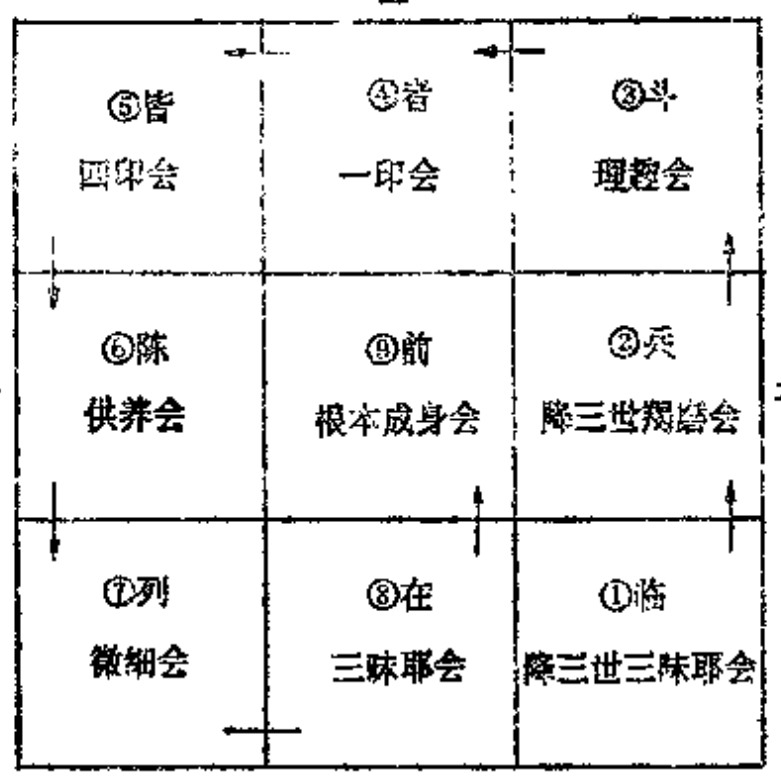
The Nine-Symbol Seals must follow the sequence of “Lin” (临), “Bing” (兵)… etc. The nine stages of training in the Nine Assemblies Mandala must follow the corresponding sequence: ① Assembly of Subjugating the Three Worlds in Samaya, ② Assembly of Subjugating the Three Worlds in Karma… and so forth. For example, in ① Assembly of Subjugating the Three Worlds in Samaya, one mainly forms the “Seal of Lin” (临之印); in ② Assembly of Subjugating the Three Worlds in Karma, one mainly forms the “Seal of Bing” (兵之印). The practical methods of Nenriki Mikkyo must be carried out step by step, following a specific sequence of stages. The training of the Nine Assemblies Mandala involves connecting the Nine-Symbol Seals, and then chanting the mantras (真言) described below, while keeping the visualizations (观想 / concepts) firmly in mind, so that it can proceed smoothly.
61
3. Mantra Visualization and Contemplation
While forming the mudra (hand seal), vocalize and chant the mantra. The so-called mantra is equivalent to the Sanskrit mantra, and its intention represents the true words brought forth by the Buddha. The general name “Mantra Esoteric Buddhism,” of course, also derives from this very mantra.
The primary significance of a mantra is such that even if millions of words were spent explaining it, the average person would not easily reach that level of understanding; it requires considerable spiritual practice, otherwise it is fundamentally impossible to comprehend. In short, you cannot go wrong if you simply accept this as an exceedingly rare and precious incantation. As your practice deepens [Note: source OCR “加装” likely an error for “加深”], sooner or later you will be able to comprehend the clear principles of the mantra.
Now, as we form the mudra, we silently recite the mantra in our minds [Note: source OCR “一达吗出真言,在心中默念若” likely an error for “一边默念出真言,在心中默念着”]; this is what is known as visualization. Visualization formalizes the verbal mantra and coordinates it with the movements of the mudra. It acts upon the psychic power (nianli) during a sleep state, serving as an automatic, spontaneous, and intense ideological state. Training begins from within; when visualization is thoroughly implemented, it becomes meditation or intense thought. This method is usually absolutely essential during high-level training.
In the past, visualizations derived from Esoteric Buddhism were extremely difficult to understand because they were hard to express in words, and the average person was unable to wholeheartedly enter the state of visualization. In view of this, I have clarified and simplified it so that anyone can easily enter into it; this is what I call “contemplation” (guannian).
4. Philosophy and Special Abilities
Now we are about to begin the training. Before anything proceeds, we must be mentally prepared. As mentioned in Chapter 1, Esoteric Buddhist training is a practical method where one can acquire special abilities even without a belief system or philosophy. However, if a practitioner’s character is despicable, and they relentlessly pursue the so-called…
62
…special abilities without any ideological principles, what will the result be? Although they can still acquire special abilities, however…
Any form of austere practice, if pursued through the path of desire, makes one highly susceptible to going astray and becoming possessed [Note: source OCR “走火人魔” is an error for “走火入魔”].
If one wholeheartedly practices Buddha recitation, even if it is only superficial, they will gradually draw closer to the gods or the Buddha. If one practices Buddha recitation motivated solely by material or worldly desires, what they obtain will only be animalistic special abilities—that is, special abilities of animalistic sensation. This may sound a bit ridiculous and quite unbelievable, but the fact remains.
Section 2: Developing High-Level Psychic Power: Nine Stages of Training
Taking the Dharma Seat (Position)
The location for practicing the dharma should be chosen to be a quiet room as much as possible [Note: source OCR “闲痘” is an error for “闲静”]. If it is too dark, it can easily give rise to improper thoughts; if it is too bright, the mind can easily become distracted, so the brightness must be properly adjusted. A room that is too narrow or has a ceiling that is too low will easily make one feel irritable and unable to persist. Conversely, if it is too spacious, it will easily disperse one’s focus and make it difficult to enter Samadhi (the state of immersion in the practice).
A room of four and a half or six tatami mats is the most suitable. It can be day or night. The fresh air of early morning is perfect for beginners. When an individual’s practice progresses to a certain level, regardless of whether on a train, by the roadside, or in various noisy places [Note: source OCR “人声槽杂” is an error for “人声嘈杂”], they can easily enter Samadhi.
Before entering the room, be sure to use the restroom first. The duration should be about 30 minutes or 1 hour (exceeding these times is an excessive de-
6
…mand) for beginners, and one must not leave the seat midway.
Before starting, be sure to wash your hands, rinse your mouth, and tidy your appearance.
1. Trilokavijaya Samaya Assembly — The Seal of “Lin” (Rin)
“Lin” (临) represents the will to remain unmoved and unconfused when encountering situations, while simultaneously demonstrating strong and powerful physical vitality.
The Trilokavijaya Samaya Assembly (降三世三昧耶会) represents the unmoving mind of the Wisdom King Trilokavijaya (降三世明王).
This training is of great help for subsequent spiritual practice. During the practice of “Lin,” one can remain unmoved by anything and unconfused by anything; that is, it provides a state of being unmoved and unconfused. Therefore, it can forge the resilient physical body necessary for a person with special abilities, and further advance toward the development of the Muladhara Chakra (木拉达拉恰克拉) (region).
The Seal of “Lin”
First, clench the left hand into a fist and place it on the waist. Turn the right palm upward, touching above the chest. Then, while chanting the mantra, spread both hands out to the left and right. Next, bring the palms together above the head (Figure 16). Referencing the posture of the Immovable Fundamental Seal (不动根本印) in (Figure 8) (after internally binding the fingers, stand the two index fingers upright together, and press the nails of the two middle fingers with the two thumbs) [Note: source OCR “姿分” is an error for “姿势”], pull it down to the front of the chest and stop there. Subsequently, maintain this position…
Visualization of “Lin”
My body is the Immovable Bodhisattva.
Contemplation
The empowering force of the Three Mysteries is the great life force that pervades the macrocosm [Note: source OCR “大字宙” is an error for “大宇宙”]. It is now pouring into my entire body, and I am receiving this life force. I am now transforming into…
64
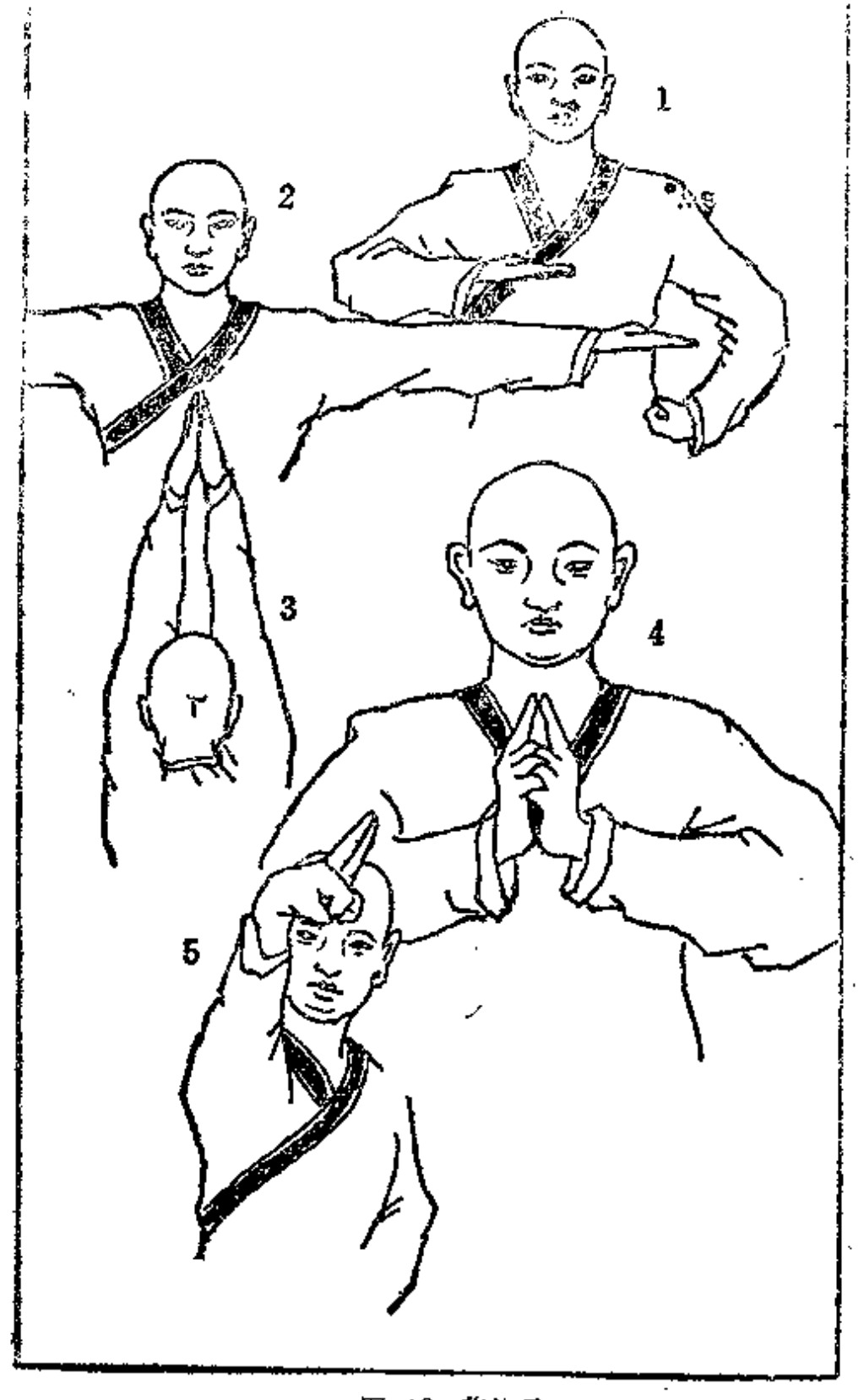
2 3 5 Figure 16 The Seal of “Lin” 6.5.
is Acala Bodhisattva. You must repeatedly and silently recite this in your heart…
Mantra
Namo samanta vajraṇaṃ
Pronounce it aloud, clearly articulating each syllable three times, and then…
I am the Bodhisattva of Immovability, seated upon this seat of immovability; though the eight winds blow, I remain unmoved.
Mantra
He raṃ vajra sva aḥ
Contemplation
I am the Bodhisattva of Non-Confusion, confused by nothing. Through courageous and self-mastered wisdom, I constantly walk the path of truth. This wisdom is limitless and inexhaustible.
I am constantly free of confusion and delusion, walking the path of truth.
Mantra
Oṃ vajra sva aḥ namaḥ samanta vajra aṃ haṃ
Next, form the Sword Mudra (Fig. 16) to cut the nine characters (Fig. 11). The so-called Sword Mudra is formed by joining the index and middle fingers together in the manner of a sword. Then repeat all of the above from the beginning several times.
The Hero Who Strives Toward the Hall of Heroic Spirits — The Cultivation of an Unmoving Mind
Whether at work or engaged in something one enjoys, even if one is
66
single-mindedly determined to complete it, one will inevitably encounter difficulties and fail midway. The main reason is that in the course of one’s endeavors, one mistakes many utterly meaningless trivialities for matters of great importance.
What are these utterly meaningless trivialities? If we look back on what we have done in the past, we can understand that we are surrounded by countless meaningless trivialities. We often end up putting aside what is truly important and pursuing the trivial instead. Many people in society place great importance on social obligations, so they can never cast off external criticism or matters of face and reputation. Once a person is entangled in these petty concerns, it is very difficult to reach the realm of a Buddha or a person with supernatural abilities. Worldly social conventions are a phenomenon commonly found in ordinary cities. External criticism and matters of face should be the troubles of ordinary, worldly people. Those who are swayed by such things can hardly make any breakthrough or transcendence. Without kicking aside these worldly distractions and trivial thoughts, one cannot reach the realm of the “Hero of the Hall of Heroic Spirits.” The character “英” (heroic) means to surpass a thousand people — that is, to rise above the crowd. The character “灵” (spirit) refers to what is inconceivable, yet does not belong to the knowledge of ordinary mortals; it refers to those such as gods or buddhas who possess spiritual healing power — in other words, those who transcend the worldly conventions of human society. The outstanding heroic-spirit hero who transcends the wisdom of the ordinary world is born from this unmoving mind.
Filled with a heart of non-confusion, one encounters all things without delusion or confusion. Once a decision is made, one proceeds single-mindedly and bravely forward, regardless of others’ opposition, slander, or obstruction. Because you possess vajra wisdom, you can see through the true motives behind people’s opposition or slander. Moreover, the more you encounter opposition and obstruction, the more stimulated and excited you feel, and your strength is doubled as you press forward.
My Vitality Is No Less Than That of a 20-Year-Old
The training of the Trailokyavijaya Samaya Mudra can cultivate a steadfast, unmoving mind. One of the greatest purposes of this training is to improve a weak and sickly constitution and create a body and mind full of vitality.
When working, one cannot muster energy; when studying, one cannot concentrate; when
67
one cannot focus on personal hobbies or specialties; no matter what one does, one feels listless and achieves nothing… This psychological state is mostly caused by a weak constitution. Therefore, one should promote the functioning of the endocrine system, adjust the constitution, and one will naturally become full of vitality. Everything will take on an enterprising aspect, and others will look at you with new respect. This is the best explanation of what it means to be full of vitality.
Now let me speak of my own experience. In Shōwa 16 (1941), when the Second World War began, I underwent the physical examination for military conscription. Because the nation was in an extraordinary period, nearly every new recruit who was examined passed — but I was classified as Grade C. At that time, I was in the second stage of pulmonary tuberculosis, had also contracted tuberculous hemorrhoids, and even showed signs of caries of the bone. During the examination, I still had a low fever of 37°C2′3′. When the captain medical officer examined me, his displeased expression was, come to think of it, only natural.
As the war went on, my condition deteriorated day by day, to the point where terminal symptoms had already appeared.
I barely managed to survive until the end of the war. Due to a considerable change in my family’s financial situation, I could not continue receiving medical treatment and convalescence, so I had no choice but to start working.
In Shōwa 31 (1956), I entered the gate of Esoteric Buddhism. Over the following ten-plus years, I can say that I was completely and utterly transformed.
Now my physical strength is in no way inferior to that of a young man of 20, and my physical power is the same. Given my current condition, there are probably quite a few 20-year-olds who could not keep walking with me for more than three days, because they cannot keep up with my pace. If necessary, I can work for three days and three nights without sleep or rest. My sleep often does not exceed three or four hours a day, and this can continue for half a month at a stretch.
Once one enters the practice (gyō), one must fast continuously for seven days. Although a seven-day fast is not particularly unusual, during the fast I must work just as usual and guide others
89
…teaching this method. Sometimes one stays calmly in severe winter striking ice blocks, or entering waterfalls and… In the intense summer heat, one must perform fire homa 2 or 3 times a day, for at least 1 hour or more.
When the day’s work is completed and the manuscript is written, I often have to drive myself late at night, via the highway, arriving in Tokyo before dawn, and continue working at the Tokyo dojo. Sometimes even on the same evening, I drive myself back to Kyoto to continue the next day’s work. Rushing between two places like this, I have never had any car accident, nor have I ever violated traffic rules. My driver’s license is completely clean, with no bad records whatsoever.
I simply have such extraordinary energy. Do you envy it?
That being said, merely having this kind of training is still not sufficient to cure patients facing death. But I can guarantee that the Trailokya-vijaya Samaya Assembly is indeed the first step toward becoming a superhuman. As long as one diligently and enthusiastically practices, in about one month one can obtain sufficient vitality and energy.
Staying Away from Accidents and Disasters
Every day I must use transportation, sometimes driving my own car, sometimes taking trains, traveling almost all over Japan. Even so, I never encounter any accidents. The main reason is that whether on a train, in a car, or anywhere, I can foresee accidents that are about to happen.
“This train must absolutely not be taken.”
Often when I change to another train, it makes those accompanying me feel bewildered. Before long, news would come that the original train had an accident, and this has been proven time and again.
All of the above can be said to be merely preliminary training. With just a bit more accumulated practice, one can completely avoid unforeseen traffic accidents.
69
2. Trailokya-vijaya Karma Assembly — The Byō Mudra
“Byō” represents a dying patient kicking off the bed covers and standing up. It signifies the extension of lifespan and the restoration of youthful vitality.
The Trailokya-vijaya Karma Assembly represents the wrath of Trailokya-vijaya Vidyārāja.
Intensive training develops the Mūlādhāra chakra (region). One can cast off all illnesses. If the person is a frail and sickly patient, all their ailments can be cured. If one’s accumulated practice is very deep, even a patient on the verge of death can kick off the quilt and stand up. Regardless of male or female, one can become approximately 10 years younger. At this time, you will possess strong sexual desire and reproductive capacity. Taking this opportunity to continue diligent and painstaking practice, one can transform sexual ability into intellectual ability.
The Byō Mudra
First, form the Great Vajra Wheel. Then spread both hands left and right, making both hands into Vajra mudras (Figure 17). Raise the index fingers upright, then bend both little fingers into hook shapes, and join them together at approximately eye level. When joining them, you must raise the right foot high, then stomp down forcefully, while chanting the mantra. Then, raise the left foot high, stomp down forcefully, and likewise chant the mantra.
Mantra
曩莫 悉底哩也 地尾迦南 怛他蘖路南 陪 尾罗示 尾罗示 摩词 斫羯罗 缚日哩 娑路娑路娑罗帝娑罗帝 怛罗以怛罗以尾驮摩你 三畔惹你 恒罗摩底 悉驮儗 理耶 恒览 姿缚贺 (in the mudra of the Great Vajra Wheel) 唵 苏姿你苏娑 吽缚日罗吽发吒
02
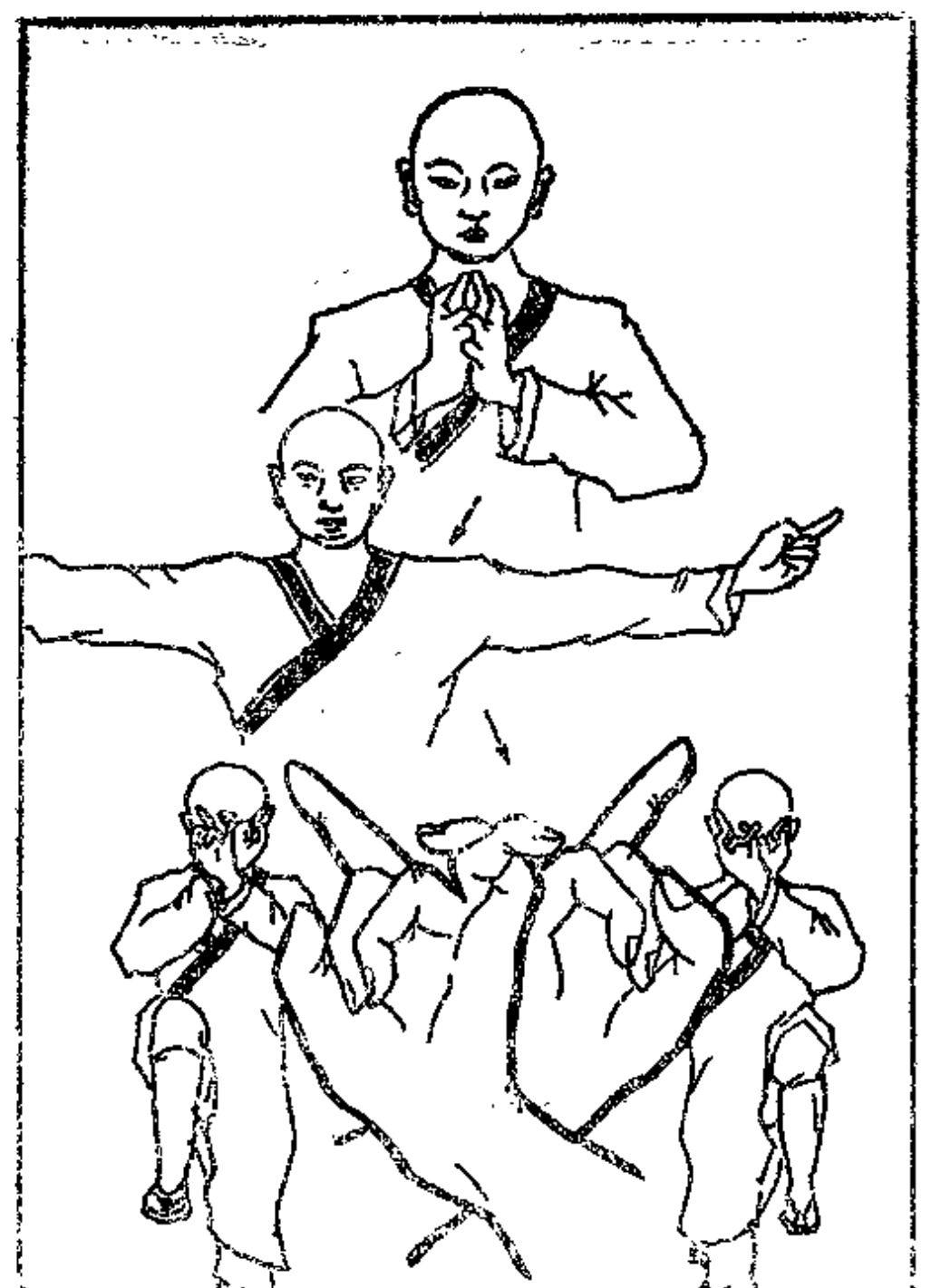
[illegible]
[illegible]
[illegible]
[illegible]
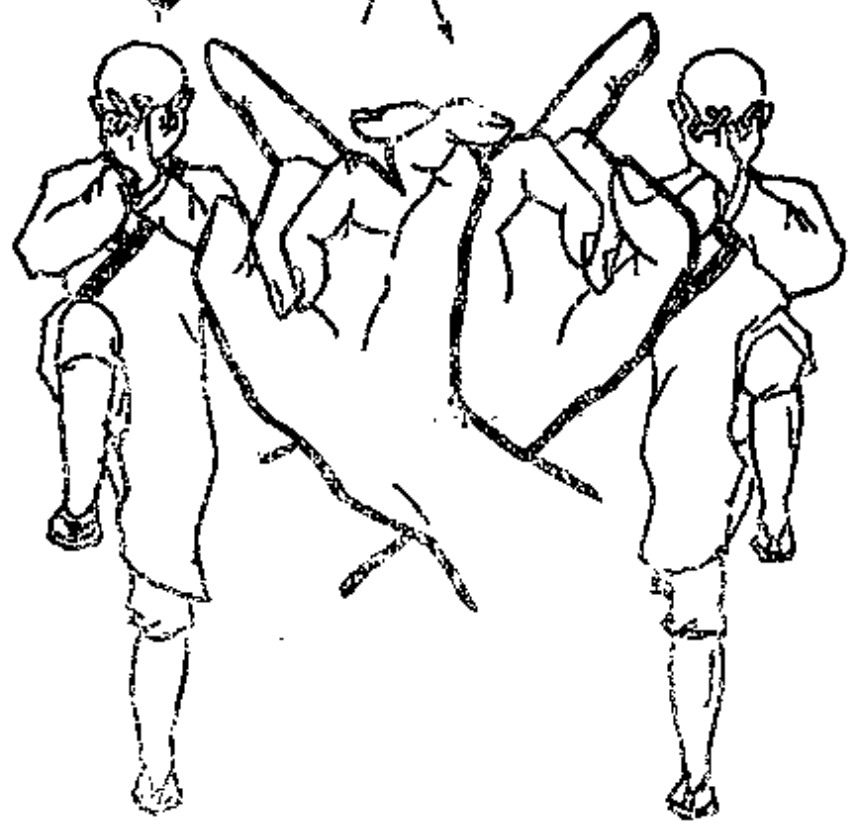
[illegible]
[illegible]
[illegible]
Figure 17. The Byō Mudra
[illegible]
…extraordinary contemplation. I attribute this to the empowering force of the Three Mysteries method, and merging into one body with the wrathful Bodhisattva.
Contemplation
Through the empowering force of the Three Mysteries method, I can now finally subdue all difficult obstacles of the three times, and unite as one body with the Trailokya-vijaya Vidyārāja. Now, I am manifesting the wrathful aspect of Trailokya-vijaya, able to subdue all surrounding enemies.
Ten Years of Wind Illness, Cured by Over a Year of Practice
This kind of training can fill the body with vitality, and also possesses a highly creative driving force. That is, it can abnormally enhance physical strength, reaching 3 to 5 times the energy of an ordinary person. Staying up late for 2 to 4 days is nothing, and one is not easily afflicted by any illness.
As mentioned earlier, the Trailokya-vijaya Samaya Assembly can enable one to obtain the mental and physical activity to go 3 days and 3 nights without sleep or rest, unmoving and unconfused. Now, one can stay up late like this even more. Not only will one’s capacity for action not decline from being affected, but one’s physical strength will actually grow stronger day by day.
Examples of curing difficult and complex illnesses through practicing the esoteric Buddhist practice of spiritual power are innumerable. I can cite another example, which is the personal account of a man named Fujino Sukesaku, who was undergoing training at the Komatsu area of the Hokuriku dojo. Currently, he is engaged in the textile industry in Atakamachi, Komatsu City.
“I entered practice in June of last year, and it has only been 1 year and 4 months to date. Although I am already over 70 years old, for a practitioner, I can still only be considered a beginner.
My illness began in Shōwa 4 (1929). That year I was only…”
72
A 20-year-old youth. It was the plum rain season at the time. Once, I was walking on the street wearing a pair of low-heeled, high-toothed wooden clogs. Suddenly, somehow, I tripped over something and injured the second joint of my left big toe. The base of the toe swelled up, and it was somewhat painful. This was the beginning of my illness. After about a week, it seemed to heal temporarily, and the pain slightly lessened. However, starting from that year, almost every certain season, I would feel severe pain, and sometimes it would even swell up. It slowly affected my right big toe, and then imperceptibly spread to the joints of my feet, causing my entire foot to ache. At first, it occurred once a year, then gradually twice a year, three times a year. After 10 years, it had unexpectedly spread to my hands, my shoulders, and even to every part of my body. Finally, it developed to the point where, throughout the year, the time I spent lying in bed was more than the time I spent sitting or standing. When it flared up, it was as agonizing as a drill piercing my bones. I couldn’t sleep all night, and even eating became a problem. When the condition was relatively better, I could get out of bed and walk for one or two, or perhaps three months. I remember that from November of Showa 15 (1940) until March of Showa 16, for a full five-month period, I lay in my sickbed and did not take a single step down to walk. During this period, I visited famous doctors everywhere. At the time, I was diagnosed with rheumatoid arthritis. There was no specific medicine to cure it; I could only take aspirin and similar drugs to reduce fever, or wait for the pain to disappear naturally. If I heard someone say there was a good remedy to cure it, I would desperately try it. For example: acupuncture, hot springs, water baths, electrotherapy, massage, talismans and incantations—I tried all kinds of methods, but there was no effect at all. The condition just worsened day by day. For the next 10-plus years, my body became even weaker. My appetite disappeared, and I didn’t even have the strength to turn over in my sickbed. Even touching any part of my body caused abnormal pain. As a result, my entire consciousness became hazy, and I almost lost the courage to live on; I truly wanted to end it all. In my despair, I followed the advice of relatives and friends and entered the Esoteric Buddhist
dojo. That was June 16, Showa 46. Whenever I had the opportunity, I would ask Great Master Kiriyama Gon to pray for me. Perhaps because I was quite earnest in my practice of the disciplines, the disasters gradually disappeared, though I also encountered some setbacks and difficulties. My illness has not recurred to this day, and I can sit, stand, and walk freely. It is particularly worth mentioning that this spring, everyone went on a trip to the Noto region together, and I participated in this walking activity. Now I can also go to the factory to participate in work. Furthermore, my favorite beer, which had once been forbidden by the doctor, I can start drinking again. A chronic illness of 40 years was unexpectedly cured in just over a short year. From now on, I will devote myself even more to practice, obey the scriptures, and cherish the pagoda. I must carefully restrain all inferior behaviors such as hatred, anger, and greed. When everything is accomplished, I will certainly use this body to contribute my remaining strength to society. A patient who had contracted a chronic illness for 40 years and was sentenced to death by doctors was unexpectedly completely cured in just over a short year. Of course, I do not wish to recount my own merits to you readers here, but you should understand that there are quite many such cases. Nenriki Esoteric Buddhism does not merely rely on preaching, or on others for salvation; it is entirely a self-reliance, relying on one’s own spiritual and physical power to save oneself. The one point I want to emphasize to you all is that this Esoteric Buddhism is the only practical religion.
3. Rishu-e — The “To” (Fight) Mudra
“To” (Fight) means brave and resolute, indicating that the more one encounters obstacles, the more one’s desire to fight manifests. What Rishu-e represents is Vajrasattva, who is a transformation of Mahavairocana Tathagata. It mainly develops the Svadhishthana Chakra (region). Human life is a series of battles, and the outcome of battles depends on “vital energy.” By filling up vital energy, one can become magnanimous, which is the purpose of this training. 74
The “To” (Fight) Mudra
Make fists with both hands and place them at your waist. Stand your shoulders upright, then extend both hands as far left and right as possible, joining them high above your head to form the “Outer Lion Mudra” (Figure 18). The lion faces outward enemies, displaying a furious expression, roaring while quietly observing in the depths of the heart. Then bring your hands down in front of your chest, externally bind them and stand your middle fingers upright, spreading and standing both thumbs and little fingers upright. After releasing this mudra, make a fist with your left hand and place it at your left waist, while drawing your right hand back and upward, placing it near your right breast.
Mantra On Samaya Satōjo On Vajramali Torato
Visualization Through the empowering force of the Three Mysteries, I become one with Vajra-Pride Sattva Bodhisattva.
Contemplation I now, through the power of the Three Mysteries, become the transformed Vajra-Pride Sattva. Therefore, my mind is like a lion, full of fearlessness. I am now Vajra-Pride Sattva, my whole body manifesting a white flesh color, wearing the jeweled crown of the Wisdom King on my head, my form dignified and solemn, my entire body radiating brilliant light. My mind is now as if filled with the brave and untrammeled spirit of Vajra-Pride Sattva.
Mantra On Samaya Sanūro On Vajramali Tarato
Contemplation
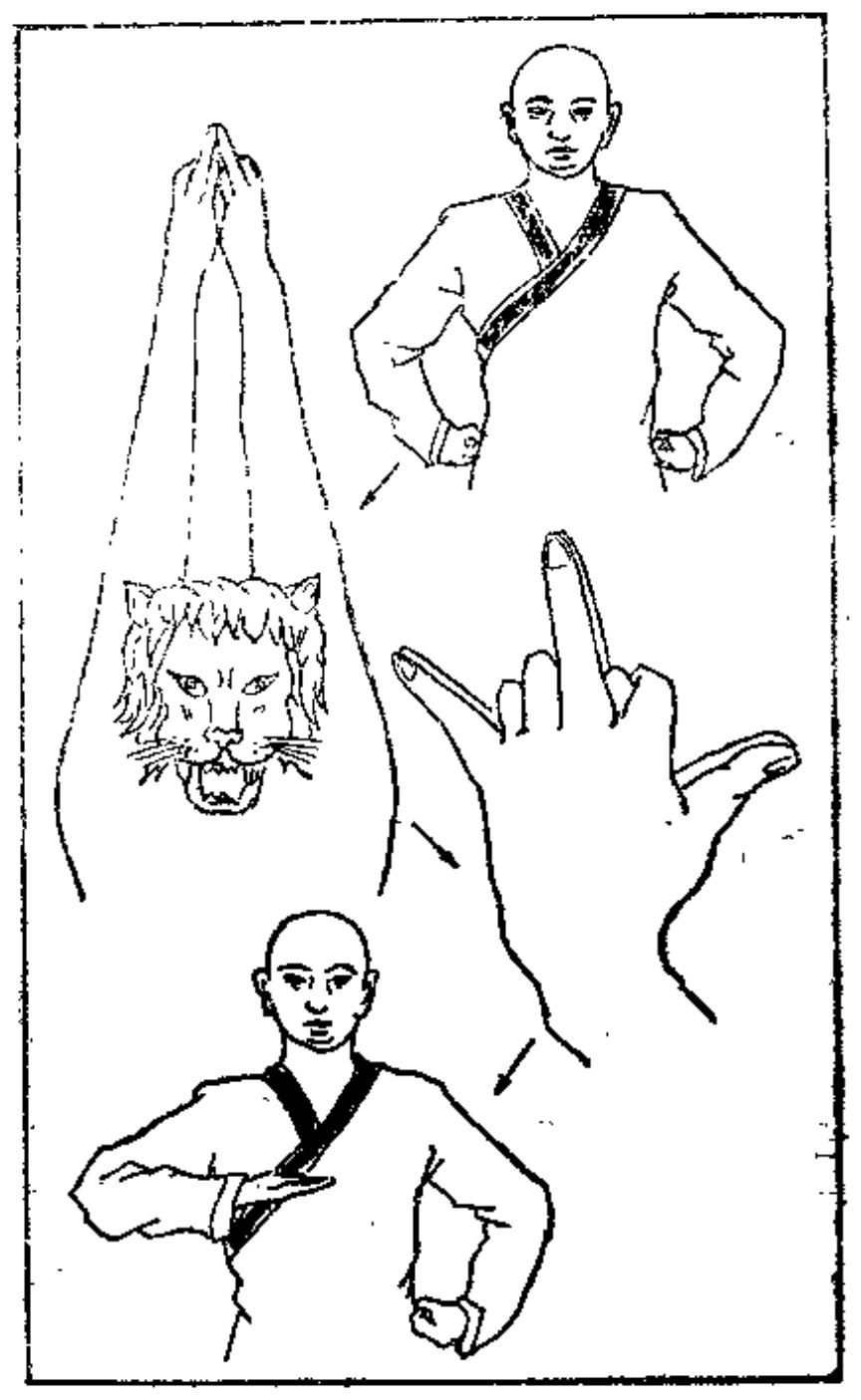
Figure 18: The “To” (Fight) Mudra -.76
I am the fearless Bodhisattva (Bodhisattva). My power is incomparable, just like that of a lion; no one can defeat me, and I fear nothing. My vajra power is limitless, identical to the Great Life that pervades the universe. Because I share the same root as the Great Life, my power is limitless—it is not nonexistent. I am the Lion King among humans. My direction and my actions are entirely unhindered; I come and go freely.
Playing Go or Shogi with Doubled Strength
Under normal circumstances, an esoteric Buddhist ācārya is forbidden from participating in any competition or anything of a gambling nature. A strict ācārya would absolutely never touch Go. Since Go is my only hobby, even when I occasionally play purely for recreation, it is only under circumstances where I earnestly seek understanding.
Playing Go is my hobby, but my skill is not particularly impressive. I played frequently during my student days, but in recent years, due to my busy life, I play at most once or twice a year. My skill is quite unremarkable—perhaps not even reaching the 4th or 5th kyu level!
I occasionally played Go with Mr. X from the Nagoya dojo. When we first began playing, he would ask me to give him a two-point handicap. Because he was a company president, he frequently had the opportunity to consult Go experts among the entrepreneurs—players at the 6-dan level. In this way, his skill improved day by day, and he was nearly surpassing me, yet he could never quite break through. Why was that?
“When playing Go with the Master, just at the moment when the outcome is about to be decided, the situation always becomes quite bizarre. After thinking for a long time, sometimes I would make a move that even I myself find inexplicable. As soon as I see the Master’s gaze fixed steadily on a certain point, that is when I must be careful. I have to turn away to the side and single-mindedly chant the true mantra in order to resist; otherwise, I am completely helpless. Because the Master uses psychic power (nenriki) to contend with me, I have no capacity to fight back.” Mr. X once
77
said these true words to Mr. T. From this, it can be seen that as long as the difference in skill is not great, and one encounters my psychic power tactics, it is quite difficult to win against me. It is not that I consciously use psychic power; rather, once I concentrate fully on the board, my focused intention may influence the opponent’s consciousness during play.
Of course, it is not because Mr. X is my disciple and is influenced by my suggestion that this happens. Even when I go to any Go club in town and play against complete strangers, the situation is the same. It is not that the opponent makes wrong moves, but rather that during the game they are unknowingly drawn in by me. Before they can fully exert their skill, they are subconsciously controlled by me. Of course, I must declare that once the opponent’s skill far exceeds mine, I am helpless.
Whether it is horse racing, car racing, or playing the stock market, it is absolutely impossible to exceed the range of my precognition. Perhaps when I say this, many people will eagerly urge me: since I possess such abilities, why not try playing the stock market?
In the management of the religious organization, occasional financial difficulties do arise, and the executives would hope that during times of constraint, I could use the aforementioned abilities to solve some problems. In reality, however, I believe this is absolutely inadvisable. Because as an ācārya, one is fearless—they have been trained to be so, and this simply cannot be changed. Even when encountering the greatest difficulties, it cannot be changed. Because they believe that if they use spiritual power merely for their own temporary convenience, the sense of guilt in their hearts will deepen. Once they persist in such delusion, the Dharma or spiritual power will gradually disappear entirely. At least, this is my personal belief.
If someone wants a raise in salary, it is usually difficult to make such a request to one’s superior individually. Similarly, if the request is made for the sake of others’ needs, the psychological pressure is relatively reduced. Therefore, an ācārya likewise has no need to pray for personal gain, nor any need to employ spiritual power.
There was once a famous poet named Saijō Yaso. In his youth, he made a great deal of money playing the stock market and nearly forgot his true calling—poetry. At the final critical moment, his poetic soul finally awakened, and for a quite famous poem, “The Canary That Forgot to Sing,” he ultimately returned to the realm of the poet.
78
But an esoteric Buddhist ācārya cannot achieve this. Once they resign from being an ācārya, go play the stock market to make money, and then return to being an ācārya again—this is very difficult for them. It is just as difficult as a singer who has given up singing being asked to return to the stage one day.
Momentum (Kiai) Is the Key to Victory and Defeat in Life
Mr. F from the Nagoya dojo—I wonder how he is doing in America now. He was formerly a second-year student at N University. I remember, in the summer four years ago, he said the following at the Nagoya dojo:
“I am currently learning karate at the university. The classmates who started at the same time as me have all reached shodan or nidan. For some reason, I remain stuck at no rank. No matter how diligently I practice, I never make significant progress. According to the senior members, my karate looks completely lacking in power, and hasn’t even taken form yet. Perhaps it is due to my innately timid personality acting up. So I very much want to break through and strengthen my spiritual cultivation. Please, Master, accept me!”
At first, I thought he merely wanted to do Zen practice, which would be relatively easy. Later, seeing how earnest he was and how devotedly he practiced, once his training progressed to a certain intensity, I advised him to specially concentrate on the practice of the mudra and contemplation from the Rishu-e (Principle and Practice Assembly).
Almost all sports are a matter of “momentum” (kiai). The strengthening of momentum must pass through this stage of training.
Half a year after entering, he finally achieved shodan. By the time he was about to graduate from university, he had been promoted to sandan, and his face had taken on a fierce, determined expression. He is currently serving at the T Bank’s American
79
from a branch company. I heard he still forms the Nine Character mudras and chants mantras every day…
Whether in sports or in work, if one is physically and mentally weak, one will always be half a step behind others in everything. Not only will one be unable to exert full strength, but one may also suffer losses.
People of this type would do well to practice the Rishu-e assembly practice. Perhaps Vairocana Tathāgata will encourage you with the spirit of a sattva, and spur you on with the fierce fire of battle!
4. The One-Mudra Assembly (Ichi-in-e) — The “Zhe” Mudra
The character “者” (zhe) signifies the ability to freely and effortlessly manipulate and control one’s own body as well as the bodies of others.
The three assemblies mentioned above — the Trailokyavijaya Samaya Assembly, the Trailokyavijaya Karma Assembly, and the Rishu Assembly — are all methods of self-discipline, that is, fundamental training to become a superhuman. The One-Mudra Assembly now being discussed can be said to be the first step that leads you into the mysterious world of supernatural powers. Its purpose is to develop the Maṇipūra cakra (region) (Fig. 3). The One-Mudra Assembly represents the wisdom of Vairocana Tathāgata.
The supernatural abilities cultivated through this practice are not limited to oneself; they can also heal the illnesses and pains of others.
Preparatory Practice for “Zhe”
To attain such supernatural abilities, one must perform a preparatory practice. Do it immediately upon waking each morning, right in bed. The method is: lie on your back, raise both knees upright, bring your palms together, and rub them against each other about ten times. While the palms still retain warmth, use the navel as the center and gently massage in a clockwise direction. Repeat this several times. Then, using the right hand like a sword-hand together with the left hand, gently thrust toward the entire abdomen. One important point to note: the force should be applied gradually; after pressing firmly for two or three seconds, withdraw quickly, then gradually move down to the lower abdomen, finally arriving at the navel at the center.
Continue in this manner until the preparatory practice is complete.
80
The Mudra of “Zhe”
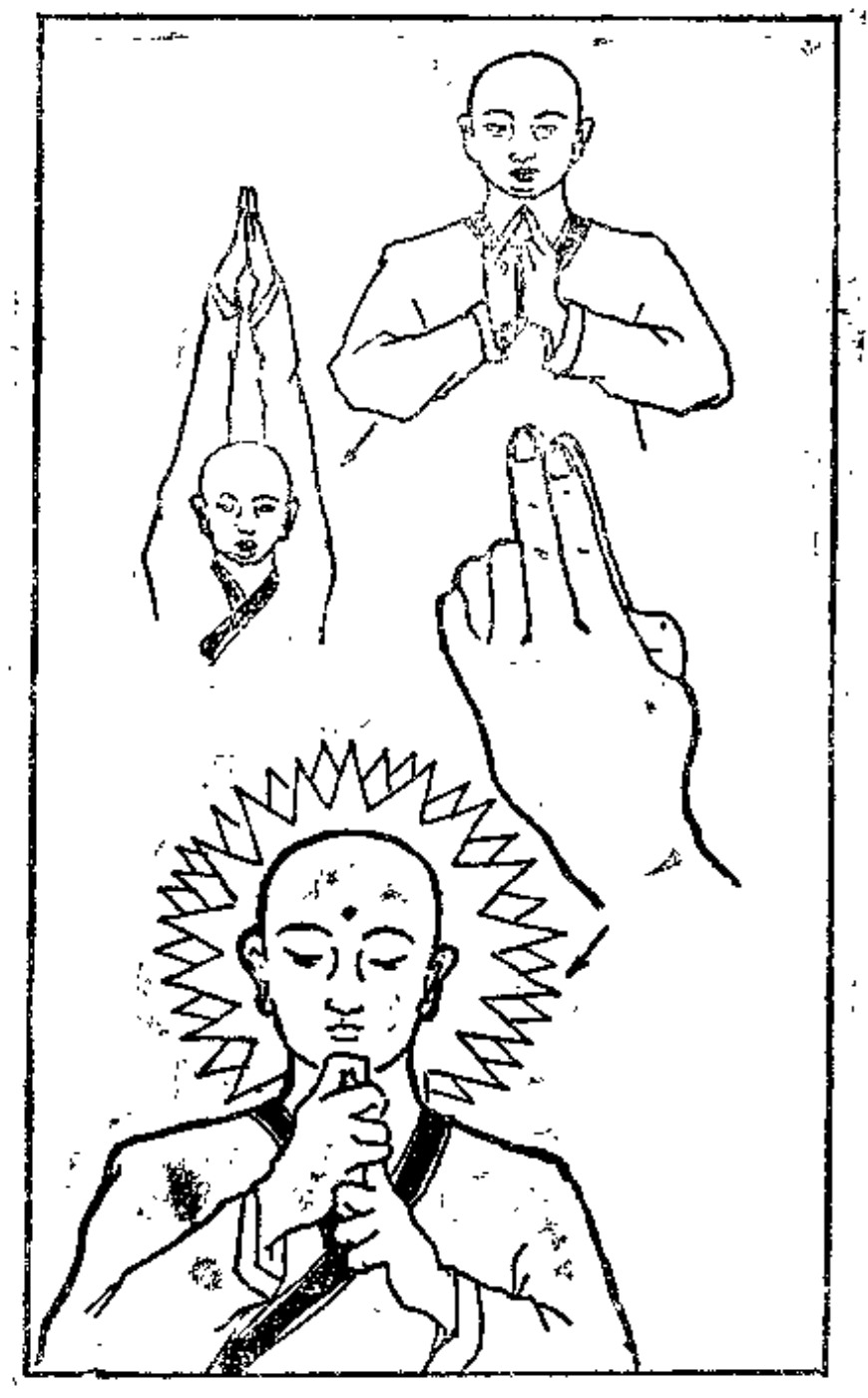
Form the Inner Lion Mudra (Fig. 19), then stretch both hands outward to the left and right as far as possible.
Fig. 19 The Mudra of “Zhe”
81
Bring the palms together above the head, then lower them to the position in front of the chest. After forming the outer binding, join the index fingers and middle fingers together in the shape of a sword, placing the head finger behind, and then…
The Visualization of “Zhe”
Through the empowering force of the Three Mysteries, I become one with Vajra Vairocana.
Contemplation
Through the power of the Three Mysteries, I now become one with Vajra Vairocana.
Silently recite this in your heart. Form the mudra, close your eyes, and continue contemplating within until a five-colored halo radiates from the crown of your head. Continue reciting without ceasing.
The mind of Vairocana Tathāgata is like that of the Lion King. My mind too is like the Lion King. The Lion King devours the three poisons within my heart — greed, anger, and resentment.
At this point, you must recite it clearly and audibly.
Mantra
Oṃ raṃ vajra-dhatu bhaṃ
Project the radiance of this halo to the very limits of empty space — the wisdom of the Great Mudra.
When Can Supernatural Abilities Be Attained
Regarding this point, the Vajradhātu Maṇḍala provides the following explanation for the One-Mudra Assembly:
The mind (see Note 1 below), beginning from the observation of the mind,
Recite the Vajradhātu (Vajra-dhātu),
Transform the Buddha-body into the Wisdom-body,
Practice Vajra Vairocana.
Through this, regardless of whether accomplishment is attained or not, one can obtain wisdom (Note 2), longevity, strength,
82
years (Note 3), and all-encompassing practices.
Note 1 refers to the meaning of “realizing the Bodhicitta” within the Five-Phase Body-Becoming Contemplation.
Note 2 refers to the wisdom of unobstructed awareness across the three times (past, present, and future).
Note 3 Even at one hundred years of age, one appears to be only sixteen.
Śubhakarasiṃha explained this passage in his “Commentary” as follows: “Having entered the fifth reality, when one has fully observed all aspects of oneself and directly realized the Tathāgata, one then forms the karma mudra of the Vajra Sun, contemplating the halo at the back of the head, and then cultivates the halo that dispels all darkness, making the night as bright as day, transforming darkness into the radiance of the sun-wheel. Continue contemplating in this way, extending the sunlight’s illumination to the limits of empty space, while simultaneously visualizing oneself as having already assumed the Buddha form, and chanting the Vajradhātu mantra — this is the wisdom of the Buddha’s Great Mudra.”
The phrase “contemplating the halo at the back of the head” does not refer to the external back of the head, but rather to the internal back. Ordinarily, even if one focuses single-mindedly, without having undergone the training of the One-Mudra Assembly, the halo will absolutely not appear. If even the slightest sign of the halo appears, it means that your mastery of this practice has begun to mature.
My Power Has Not Yet Matured — Severing the Root of Illness
The following is an account of my personal experience. About thirty years ago, I lost my only younger sister. Her illness was pancreatic cancer. She was only twenty-six at the time, with only two or three months left before her wedding, when she suddenly fell ill. At the time, we invited Dr. Kinomoto from the national University of Tokyo to diagnose her. He initially determined it to be a benign tumor, but it gradually developed into cancer cells. Our parents and those of us who were closest to her could not believe our ears. Everyone silently prayed in their hearts, hoping it would not be cancer. When I honestly reported to my mother that my sister had cancer, she could not help but sob, and asked me to find a way by any means. At the time, I was truly powerless — I could only shake my head and sigh, completely
83
I was at my wits’ end. If it were now, I already possess the spiritual power cultivated through the First Seal Society, and perhaps there would be a way to save her life. But at that time, I had only cultivated the power to see through the body, and the power to cure illnesses had not yet been fully cultivated. Just like that, after half a year, my younger sister passed away.
“Could it be that our family has a cancer bloodline? My grandmother also passed away from a painful illness. When I was young, I also underwent a surgery to remove a breast because of breast cancer. Now Matsuko has contracted this hateful painful illness at such a young age. Thinking of this, besides saying it is genetic, I can find no other reason.”
After hearing my mother say this, I had many emotional reactions psychologically, so I examined my own body carefully again. As a result, I was truly startled at the time. It turned out that my body unexpectedly possessed the factors for contracting cancer; roughly between the ages of 40 and 49, I would have stomach cancer. What should I do then? At that time, I really didn’t know what to do!
I had suffered from severe tuberculosis when I was 18, struggling on the brink of death several times, so I do not view death too seriously and do not have a great sense of fear. Since there were still over ten years until I was 48 or 49, that is to say, there wouldn’t be much of a problem during this period. However, the biggest problem lay in the fact that if I really died of cancer, my child would definitely inherit the factors for cancer. Then, it would be passed down from generation to generation, from child to grandchild. Thinking of such serious consequences, I felt that personally, dying of cancer was not terrifying, but thinking that my descendants might die because of my cancer, I had to be cautious. Thus, I made up my mind that I must fight cancer.
Consequently, I deepened my practice of the First Seal Society.
In addition, I used various methods to resist the fate of cancer. Traditional Chinese Medicine is very efficacious for preventing illness before it happens, especially a method called the Dietary Nourishment Method which is particularly effective. I also
84
began to research the Dietary Nourishment Method. The method seemed very ordinary. From it, I understood that a vegetable diet in accordance with nature is the best for the body. I tried my best to abandon meat consumption, and consumed more raw vegetables and fruits, eventually achieving my current good physical condition.
V. Fourth Seal Society — The Mudra of “Kai” (All)
“Kai” (All) represents the transformation of human hearts, as well as the telepathic power to manipulate others at will.
The Fourth Seal Society represents the telepathic power of Vajrasattva.
This training is for developing the Anahata-chakra (location), to obtain 4 supernatural abilities:
First, it can make the mind clear, especially making hearing distinct. Second, as a result, the ability of clairaudience greatly develops. Any extremely subtle inner voice of others can be heard clearly. At the same time, the meaning of animal cries can also be understood. Third, one can hear the voice of the Master. Fourth, it can unlock the talent for creative invention.
The practice must be without visualization or conceptualization; focus the mind entirely on the mudra, without a single distracting thought.
The Mudra of Kai
Both hands must be used together. Because the movements are quite complex, you can refer to (Figure 20) while continuously calming your mind and proceed!
Mudra ①
First, stand the body upright and join the palms. Outer binding. Return to the original joined palms. After that, extend both hands forward while keeping the palms joined. When extended to the limit, [move] both hands
85
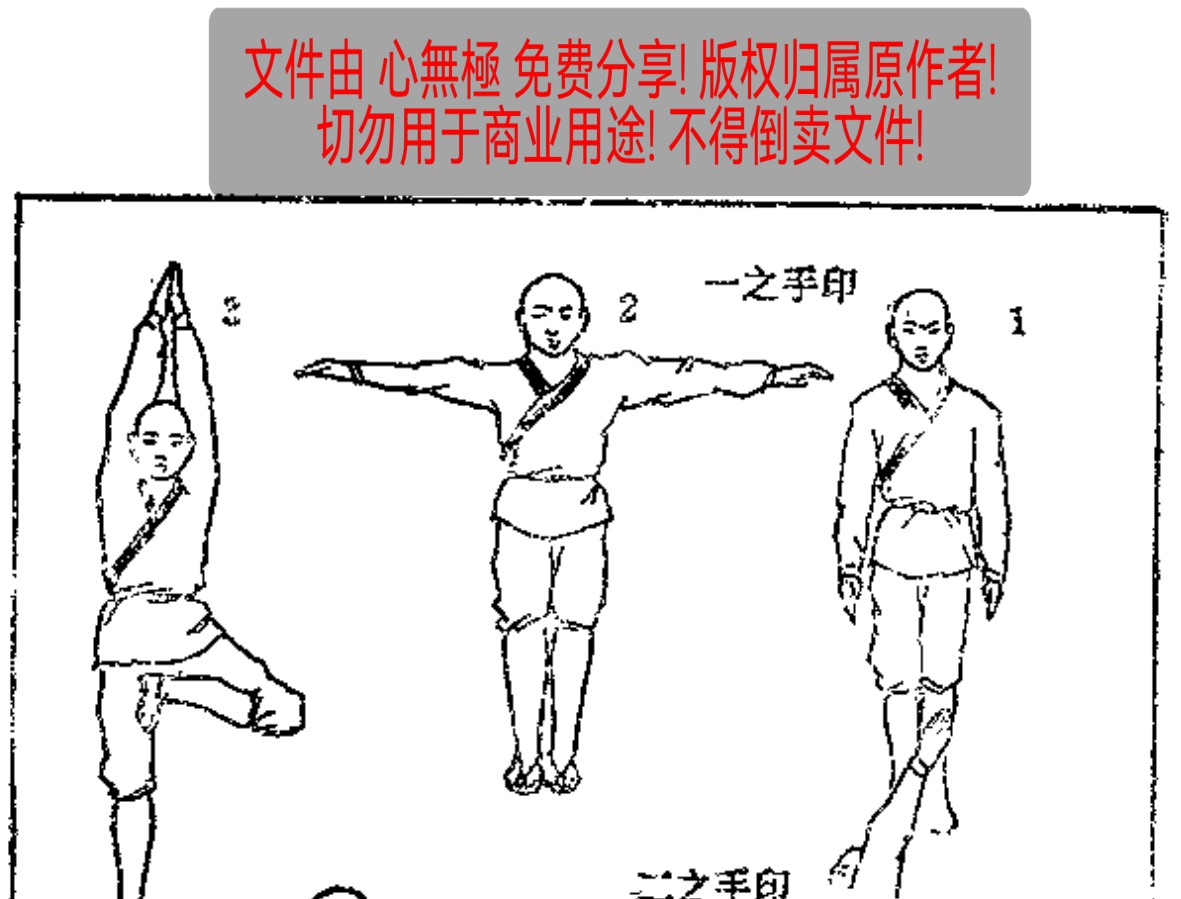
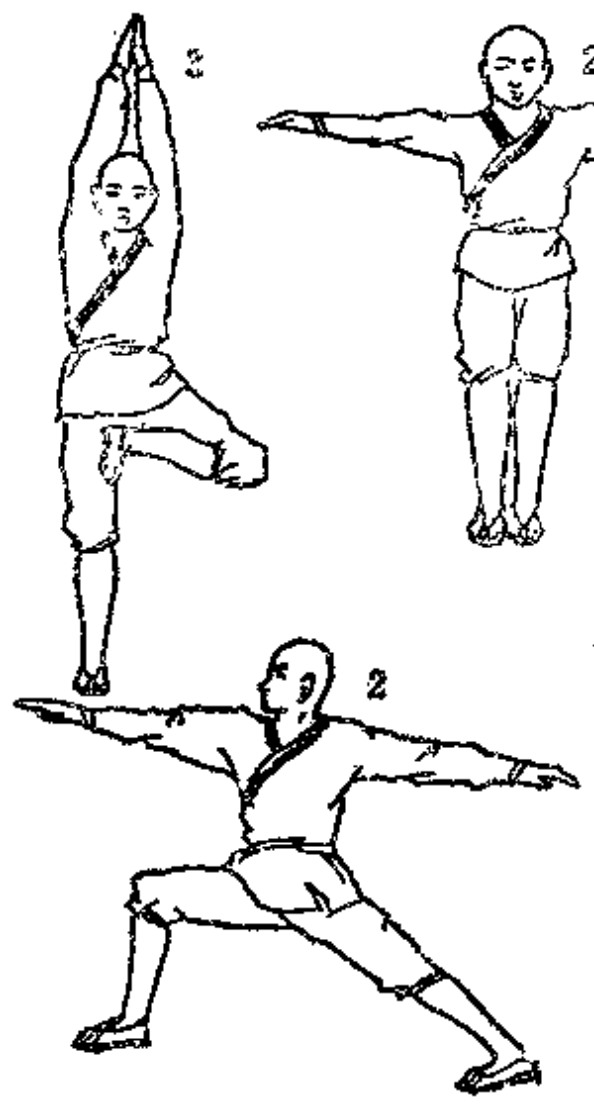
Mudra 1 2 Mudra 2 2 3 Figure 20-② The Mudra of Kai
[illegible] Fourth, Third’s mudra top, [illegible] [illegible] [illegible] [illegible] [illegible] [illegible] [illegible] [illegible] Root part (Mudra of Figure 20-). 87
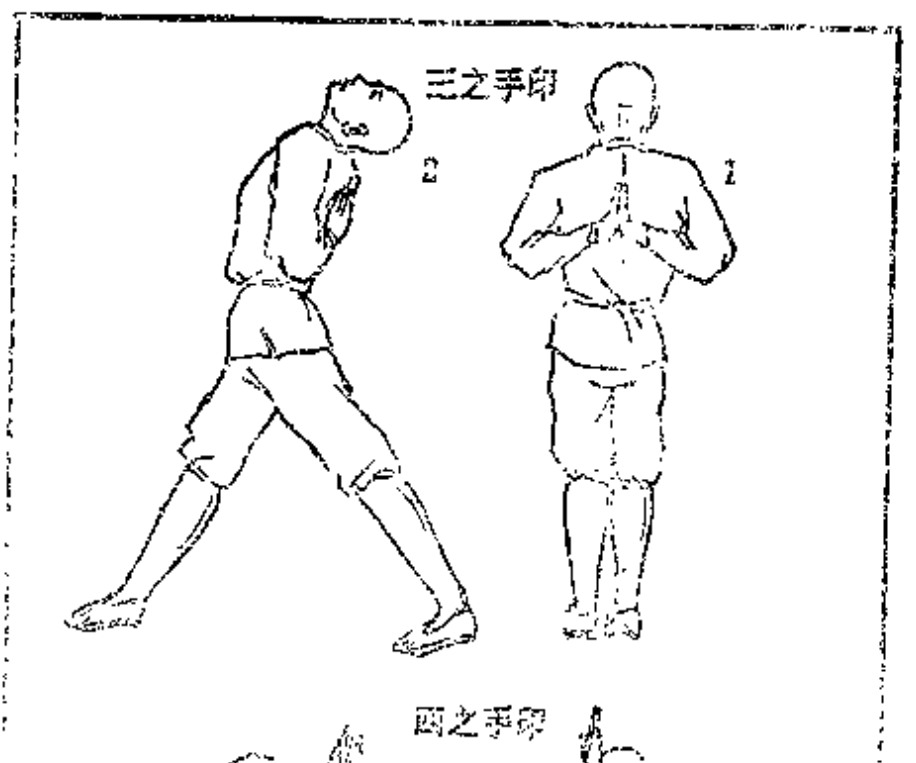
Mudra 2 Change feet, also press the heel against the corresponding part of the thigh, and then put the foot down. At the same time, take a large step forward with the right foot (Figure 20, Mudra 2), then continuously perform the movements of 1, 2, and 3. Instantly freeze.
Mudra 3 Restore the body to its original posture, then join the palms behind the back (Figure 20, Mudra 3). Next, take a large step forward with the right foot, and bend the neck backward as much as possible. Instantly stop (Mudra 3, Figure 2).
Mudra 4 Return the left foot to its original position, taking the momentum to wrap around the right foot. At the same time, wrap the left wrist around the right wrist (Mudra 4, Figure 1). Next, touch the left knee to the ground, instantly freeze (Mudra 4, Figure 2). Then return to the original posture, stand upright, form the Vajra Bond (金刚缚), join the palms, and chant out…
Mantra Oṃ sa-li-fa pa-ta she-duo wu-se-zhi zhen Oṃ chun-yue-luo sa-duo wu-se-zhi a Oṃ yue-luo heng-na wu-se-zhi heng-lan Ǎn fu-yue-luo da-li-mo wu-se-zhi fang Oṃ lian-yue-luo ge-li-mo wu-se-zhi xin
Dispelling Distracting Thoughts and Bringing Good Affinities
— Telepathy (Knowledge of Others’ Minds)
Everyone, once they reach a certain age, wishes to obtain good affinities; this is 88
human nature. However, matters in this world often do not go as one wishes. This is even more true when it concerns the major event of marriage! A couple that seems on the verge of an agreement may sometimes part on bad terms over a trivial matter. But once you possess the spiritual power trained through the Four Mudra Assembly (Shi’inhoe), you will have the following result:
This is something that happened at the Hokuriku Dojo in Ishikawa Prefecture. A member in Tokyo called and said there was a woman named T, whose daughter was about to finalize a quite good marriage affinity. However, right at the moment it was settled, it became hopeless due to fatal slander from a close relative. “A good marriage affinity that was好不容易 brought together; I didn’t expect it would suffer such a fate. The daughter is simply terribly distressed, and she has been moping recently. What should be done?” Mrs. T said. Of course, I had heard about this problem from people at the Tokyo Dojo 10 days ago, so I replied, “Alright, I heard your daughter was rejected by the other party. Please do not worry, I can use the Dharma methods to restore their marriage relationship once again.”
After hearing me say this, the woman repeatedly expressed her thanks and left. Shortly after she left, half-believing and half-doubting, she called again and said: “The marriage affinity we talked about a few days ago, the other party brought it up again today. They asked me to propose to them again; it is truly unimaginable. Everyone feels baffled; what should we do now?”
In fact, there is nothing to worry about in this matter. As long as a little spiritual power is applied, solving these trivial matters is effortless. I am not boasting about my weak spiritual power; I am not such a foolish person—if it failed, it would simply be a great humiliation. At that time, if I had impulsively gone to the residence of the slanderer and spoken words of reprimand, he wouldn’t believe my way. Instead, he would think it was an intentional false accusation, and might even start a fight with Mrs. T, making things get completely out of hand. That would be too much of a loss.
Once you are proficient in the techniques of the Four Mudra Assembly, you can make all directions perfectly satisfied by using just a few short minutes of practice. This is what I call the method of Telepathy (Knowledge of Others’ Minds). 68
Spared from Disaster by Being Rejected for Accommodation — The Ability of Foreknowledge
Around us, who knows when, where, or what will happen? In November of Showa 43 (1968), a fire broke out at the “Ikenobo Mangetsu-jo” at Arima Onsen in Hyogo Prefecture, claiming over 30 lives in an instant. I still remember this vividly. Among those who lost their lives, some were unfortunates who should have gone back but didn’t, losing their lives due to extending their stay. There were also some lucky ones who were spared because they were rejected for accommodation. Rather than saying they were lucky, it seems insufficient to explain everything; there must be an unseen force pulling them.
Chikako Nakatani, the president of Nakatani Industry Company in Kyoto, was one of them. On the day the Arima Onsen fire occurred, Ms. Nakatani had originally planned to lead about 50 employees on a trip, and the scheduled accommodation was the “Ikenobo Mangetsu-jo”.
They had booked their rooms as early as 2:00 PM on August 27, two months prior. But for some reason, because “a group of 250 people suddenly arrived this morning, we are unable to accommodate your 50 guests, we are very sorry…” Thus, they had no choice but to be introduced to another inn, the “Ginsui-so Bekkan” (Annex).
At this time, Ms. Nakatani must have thought in puzzlement: “Strange, when I left the house this morning, I clearly did my fixed daily practice (定行), and even carried a protective amulet with me. How could I be rejected?” Her mood was inevitably unpleasant. Perhaps while strolling after dinner, she passed by the “Ikenobo Mangetsu-jo” and felt dissatisfied: I was supposed to stay right here, yet I was rejected. The more she thought about it, the angrier she got.
In front of the “Ikenobo Mangetsu-jo”, more than 10 buses were lined up, bearing the words “Auspicious… — …even the auspicious would envy.”
Around 3:00 AM in the middle of the night, the sound of fire engine sirens was suddenly heard. Naka 06
Chairman Gu was awakened by the commotion, not knowing exactly where the fire had broken out. Since he was in a safe area himself, he felt reassured and went back to sleep. It was not until 6 a.m. the next morning that he learned from the hotel staff that a fire had occurred at the “Ikenobō Mangetsu-jō.” Upon hearing this news, Ms. Nakatani realized she had narrowly escaped disaster.
If we regard the occurrence of this event merely as a simple refusal of the room booked two months earlier—a chance occurrence—what do you think?
My answer is no. I believe that Ms. Nakatani’s practice had already reached the realm of telepathy and precognition beyond her own conscious awareness. Therefore, I can assert with certainty that Ms. Nakatani was not refused; rather, she caused the other party to refuse her. There is a great difference between the two.
6. The Offering Assembly — The Mudra of “Chen”
“Chen” (牒): hearing the voices of the spirit world; it represents the convergence of the powers of wealth and reverence.
The Offering Assembly represents the compassionate heart of Mahāvairocana Tathāgata.
This training primarily develops the Viśuddha chakra (region), granting you transcendent hearing. When this supernatural ability first begins to function, even the faintest sound in the mundane world can be heard. Moreover, the voices of the guiding spirits of the spirit world can be heard with perfect clarity.
By means of this method, one can foretell destiny, alter destiny, and obtain inexhaustible and limitless capacity for offerings and service, as well as wealth, together with people’s reverence and affection.
Contemplation
Through the empowering force of the Three Mysteries, my body summons the four bodhisattvas—the Vajra Hook, the Vajra Lasso, the Vajra Lock, and the Vajra Bell—bringing extraordinary accomplishment in all endeavors.
Reflection
Whether it is people or material goods, if one wishes to hook and summon (draw to oneself), one must—
16
—with single-minded devotion clearly focus thought on the object of summoning, vividly imprinting its image upon the depths of one’s heart.
Then—
One must visualize oneself transforming into Vajrasattva. Next, one must visualize the Vajra Hook Bodhisattva, the Vajra Lasso Bodhisattva, the Vajra Lock Bodhisattva, and the Vajra Bell Bodhisattva, then chant the mantra and form the mudra.
Mantra
Oṃ Vajrasattva svāhā jāḥ hūṃ vaṃ hūṃ hrīḥ
The Mudra of “Chen”
First sit in the full lotus posture, then maintaining that posture, lie supine (Figure 21). Then lean the body backward, supporting it with the knees and neck. After undoing the lotus seat, extend the legs, raise them, and then bring them over the head until the toe-tips touch the floor. Then perform a shoulder stand for approximately one to three minutes, return to the full lotus posture, and once the breath becomes even, press the palms together (with intense devotion). Form the inner binding, make both hands into wrathful fists, cross the two little fingers, and sound out “Jāḥ”; bend the two middle fingers; then sound out “Hūṃ,” pressing the inner surfaces of the two index fingers together; then sound “Baṃ,” joining them together like a hook; then sound “Hrīḥ,” bring the wrists together and shake them heavily.
7. The Subtle Assembly — The Mudra of “Lie”
“Lie” (列): from self-perfection to the point of delivering salvation to others; it represents the mind of a sage.
The Subtle Assembly represents the penetrative vision of Mahāvairocana Tathāgata and Vajrasattva.
36
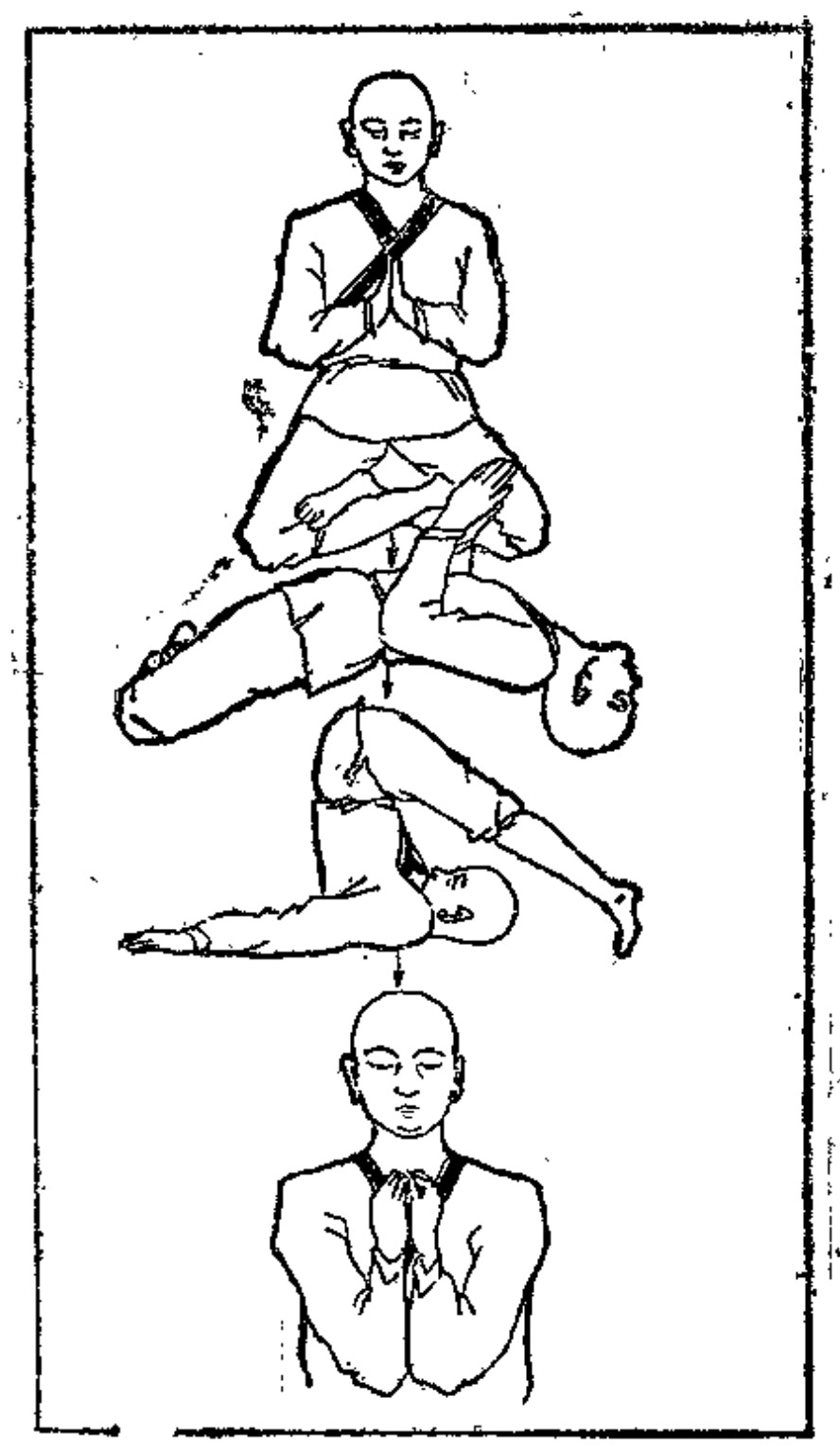
Figure 21: The Mudra of “Chen”
The One-Mudra Assembly, the Four-Mudra Assembly, and the Offering Assembly serve to cultivate great supernatural abilities.
93
The Subtle Assembly, along with the Samaya Assembly and the Fundamental Enlightenment Assembly described below, can be said to belong to the practices of sages—a curriculum of miraculous nature that must be completed in order to acquire supernatural abilities.
The training of the Subtle Assembly is the development of the Mudrā chakra (region). Once the hands and brain have completed the training of the Mudrā chakra, vibrational waves can be emitted from one’s own fingertips.
Dispense with contemplation, reflection, and mantra; one must proceed in a state of no-thought and no-conception.
The Mudra of “Lie”
Form it continuously according to (Figure 22).
A Technique Unprecedented in Esoteric Buddhism — The Completion of the Mudrā Chakra
As this training progresses, vibrations will naturally emanate from one’s own fingertips. When the fingertips touch paper, an extremely subtle tremolo and resonance will be produced; if the fingers are placed upon the surface of water, it can even cause splashing. Since there has been no need for it, I have not experimented with this, but once one reaches this realm, performing spiritual healing surgery becomes effortless.
How exactly does this power and technique arise? Even ancient esoteric Buddhism and Shingon esoteric Buddhism are unable to explain it. The secret of this supernatural ability can be said to be the completion of the Mudrā chakra—something first discovered by me and developed into a supernatural ability of gathered, collective power.
Mudrā chakra—this is the name I have given to the power I created.
“Mudrā” carries the meaning of the mudras mentioned earlier.
Now I shall inform everyone of the circumstances of my discovery. When I entered into meditation during my practice, due to the activity of the brain, my fingers would naturally begin to tremble slightly, and all manner of mudras would flow forth one after another—numbering no fewer than several hundred!
At first, mudras would be formed in accordance with the faint content of the meditation: when thinking of fire, the fingers would—
94
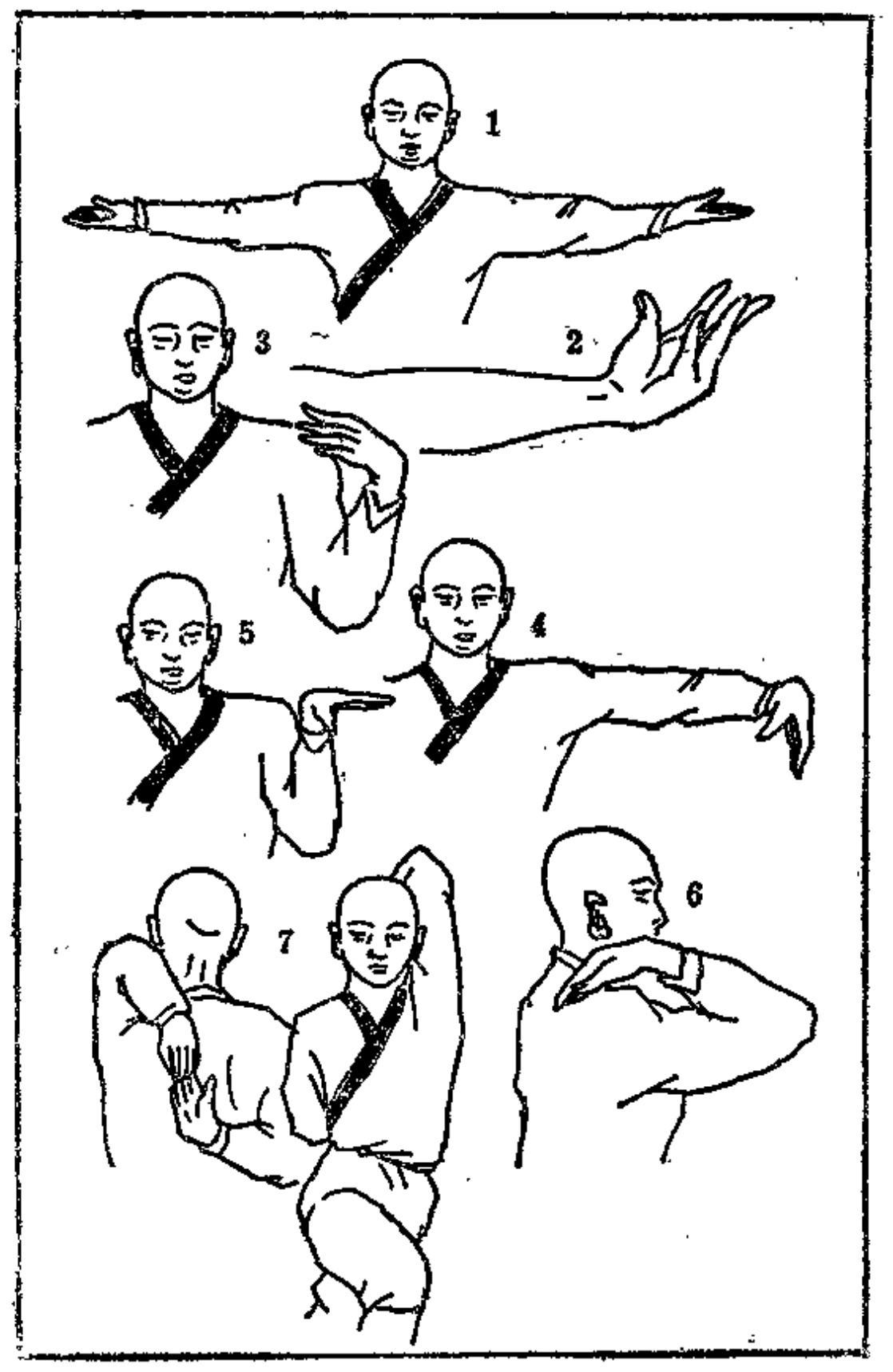
2 5 Net 22 Listed mudras
[The hands] will naturally form the fire mudra; when thinking of water, the mudra will naturally manifest water. In fact, it is not fire, but the essence of fire; it is not water, but the essence of water. No matter how complex the thoughts and visualizations are, they will miraculously transform into mudras and be expressed. At this time, states of mind such as comfort, elation, joy, tranquility, soaring, and sorrow will appear. It is simply as if one has reached a realm of perfect control where one can freely follow one’s heart’s desire. Every time a thing is created, whether water or fire, it will re-extend within the mind; this is entirely because thoughts are dancing.
Mudras that flow out in this manner will sometimes produce the mudras of Shingon Esoteric Buddhism as mentioned in the past. Even when flowing naturally, there will sometimes be new mudras.
When entering the meditative state to develop the chakras (locations), as the chakras flow, the mudras will also change accordingly. Furthermore, the so-called mudras are not limited to the fingers; even other parts of the body will move along with them, eventually making the entire body become a mudra.
Brainpower and the newly developed vital energy filling various parts of the body appear day by day, seeking a place for the power to be exerted, seemingly in a state that is about to burst open.
When progressing to a certain stage, at first, following the movement of the chakras, mudras are naturally formed. Gradually, through forming mudras, one can move the chakras at will. The functioning of the brain is the same: originally, mudras are formed through the turning of the brain, and slowly it evolves into being able to freely move various parts of the brain through the forming of mudras, further achieving mastery in controlling them.
In the past, mudras were merely expressions of thoughts, or the keys to manipulating chakras. However, when progressing to a certain degree, mudras instead become the outlet for the release of power. The vital energy of the brain (thoughts) and the chakras can flow out through the mudras. That I mastered the methods of Shingon Esoteric Buddhism is primarily due to the completion of the Mutola Chakra (Mudra Chakra). What yoga teaches people is that through the control of the Samana prana, flames can be emitted from the entire body. According to my own experience, through my own practice, I could achieve the completion of the Manipura Chakra 96
and emit flames. After this, how to introduce the practice of psychokinetic homa (fire ritual), and how to ignite a fire on sandalwood—my power hit a wall here and could not progress any further.
Later, finally, because of the completion of the Mutola Chakra (Mudra Chakra), I understood the answer to the problem. As long as the Manipura Chakra is taken as the center, and the vital energy of all chakras is completely concentrated at the tip of the mudra, one can easily ignite a fire.
Dissecting the Human Body Without Using a Scalpel — Spiritual Healing Surgery
Some people may ask, what is the actual benefit of igniting a fire on raw wood using psychokinesis? I can answer you like this: this power is the so-called bloodless spiritual healing surgery—a supernatural ability.
A few years ago, Mr. T from the Philippines shocked the entire media with this kind of psychic surgery. If the vital energy of the mudra that ignites wood is to be used on the human body, cutting open the flesh to remove the necrotic cells of the patient’s affected area requires the refinement of exquisite and subtle techniques; the principle lies in the manifestation of the power of the Mutola Chakra.
The power of a general internal combustion engine can drive ships to navigate on water, cars to speed on land, and airplanes to fly freely in the sky, all based on the principle of motive power. Applying the vibration of fire to the molecules of wood presents the physical phenomenon of combustion. By utilizing this power to open human skin and organs in an instant, changing the blood composition into a coagulated state in a split second, thereby curing the affected area—such a thing is not impossible.
This practice is commonplace among some great yogis in India. Concentrating the power of Kundalini and pouring it directly into the patient’s cranial nerves, there will be almost no sensation of pain whatsoever; they can comfortably fall asleep. I am confident that I also have this ability. Sometimes I really want to properly demonstrate this spiritual healing surgery in front of ordinary scientists; this would also count as a kind of challenge from me. Of course, I must state in advance 97
that this challenge would be a one-time event, not to be repeated.
As far as the actual situation is concerned, there is no need to use this method for current surgeries. (The reason I want to try it is merely to challenge my own magical power; I have no other intentions.)
As for whether Mr. T’s psychic surgery from the Philippines was a trick, I will not comment. If I were to criticize any questionable points, I can raise the following point.
From my own standpoint—as a psychic—once one possesses this ability, not only can one cure cancer, but one also has ways to deal with intractable diseases such as tumors. One only needs to apply the power of the Dharma, and there is absolutely no need to use surgical excision; this is the sole point that makes one feel doubtful.
That is to say, based on my personal experience, using my own method to place the mudra (Mr. T used his fingers) on the location of the affected area and concentrate my thoughts, then regardless of whether they are cancer or tumor cells, they will naturally collapse on their own, eliminating the need to excise the affected area at all.
Being able to make the molecules of raw wood combust, causing massive changes; by concentrating the vibrational waves of this power on a specific point of the affected area, the diseased cells will disintegrate even before burning. (The most crucial point to note at this time is that the intensity must be controlled when releasing this power; this is purely a technical issue.) There is absolutely no need to use fingers as a surgical knife to cut open internal organs to extract the affected area.
I repeat: if a person possesses the power to perform psychic surgery, there is simply no need for such trouble. Just like Christ or the Buddha, placing the mudra near the affected area, concentrating the mind, the cancer cells will naturally collapse and be eliminated.
8. Samaya Mudra — The Mudra of “Existence”
“Existence” maneuvers through the void, freely manipulating the wind to soar in the air. As 86
Like a fish in water, swimming freely as one pleases without wetting one’s clothes. This signifies possessing the power to control nature.
The Samaya Assembly (三昧耶会) represents the sovereign power of Mahāvairocana Tathāgata.
The “Buddha Eye” (佛眼) is the Buddha’s eye that can see through the past and future, seeing the natural world with perfect clarity from inside to out. It enables one to advance toward the development of the Ājñā Cakra, and to freely control mountains, water, and fire. The sense organs become even more developed, and one can even perceive the fourth-dimensional world. The practitioner must single-mindedly hold the holy image of the Buddha in contemplation within the heart, and step by step reach that realm. The practice of Esoteric Buddhism is endless.
No mantra, no visualization. One must deepen contemplation (meditation).
The Mudra
Spread both hands open as wide as possible and bring the palms together above the head. Form the Wisdom Fist Mudra (智拳印) in front of the chest (Figure 23), place it at the navel, and perform the following contemplation: At the instant when Mahāvairocana and I merge — He enters me, I enter Him — form the Sun Wheel Mudra (日輪印) and place it between the brows. When placing it, the thumbs must touch the center between the brows, then enter the Vajra Eye (金剛眼) and the Light Eye (光明眼).
Contemplation
One must visualize a full moon disc (月輪). The moon disc gradually grows larger. As it grows, one must continuously contemplate until it encompasses half of the void. There, Mahāvairocana and I face each other. My body also gradually grows larger — growing larger moment by moment, drawing closer to Mahāvairocana. Thus I enter into Mahāvairocana, finally becoming Mahāvairocana, and dwelling within the full moon (the most important thing is to contemplate the matter of depth).
Entering the Untrodden Realm of the Samaya Assembly
I repeatedly emphasize this — perhaps everyone finds me verbose! I have already attained the psychic power (念力) to ignite fire on green wood. In terms of the stages of practice, my psychic power has already—
66
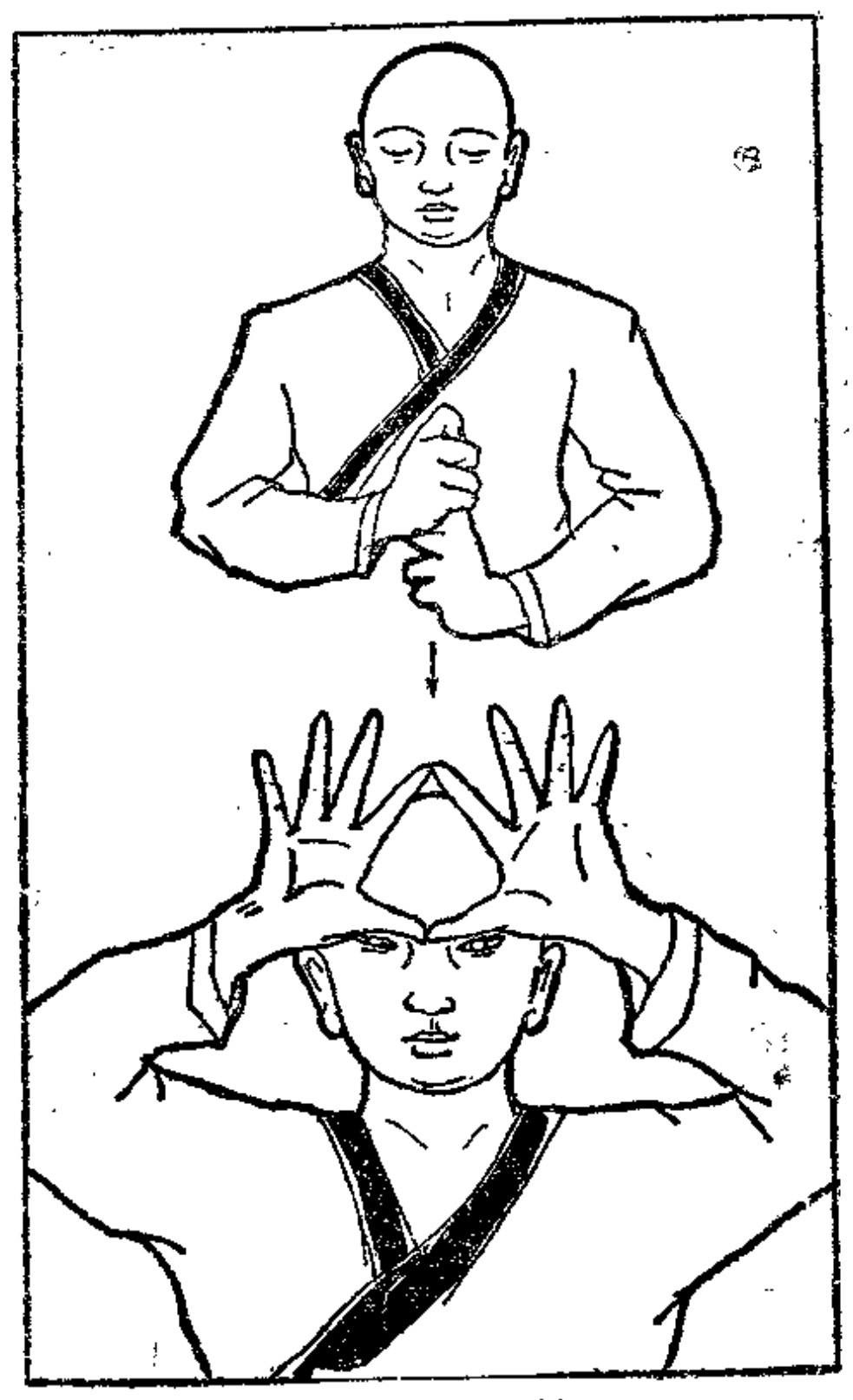
Figure 23
The Mudra
100
— reached the level of entry into the Samaya Assembly.
Some may think that without having yet attained the spiritual power of the Trailokyavijaya Samaya Assembly (降三世三昧耶会) of the very first stage, practicing such advanced material would probably be of no avail. Indeed, the first several maṇḍalas must be thoroughly trained before one can reach the realm of psychic power. At the same time, I also believe that incorporating practices centered on meditation helps maintain a balance between mind and power, achieving even greater efficacy.
One point I must specifically declare: among the nine stages of the maṇḍala, one must never skip any single stage. The order of the Esoteric Buddhist superpower training is arranged step by step from shallow to deep. For the general beginner, this is the most ideal learning sequence. If one feels that the pace is too slow and skips any stage, it will result in the effect of “haste making waste.”
That being said, the Samaya Assembly and the following Fundamental Body-Formation Assembly (根本成身会) — apart from some ancient yoga practitioners — only Kōbō Daishi (弘法大師) of Japan alone has reached this realm. I must press forward into a world that very few predecessors have ever set foot in, striving to strengthen my own practice, studying and refining myself to reach a deeper realm.
The Higher the Practice, the Greater the Emphasis on Meditation
At the stage of the Samaya Assembly, “contemplation” (思念) takes the stage and replaces “visualization” (観念).” Listen to this — intense visualization. Once this training reaches a considerable height, meditation becomes more important than mudras or mantras. Ordinary mudras or mantras have fixed forms, but meditation has no form. It is not merely holding the thought in the mind, but rather making the image manifest within the heart.
In the previous sequential manuals (次第書) of True Word Esoteric Buddhism (真言密教), no concrete method for meditation has been laid out.
The religion of meditation — we may as well gain a concept for strengthening contemplation from “Zen” —
101
The Water Contemplation — Found in the Ultimate of Zen Contemplation
“Master!”
“Master!”
From just now until this moment, the young monk Zhēnniàn had been running through the corridor, searching for their master, the Great Preceptor.
“Where on earth has the Master gone?”
Ānniàn, who was sweeping in the courtyard, said:
“You’re looking for the Master? He must still be in the inner meditation hall!”
“Oh! Is that so?”
So Zhēnniàn quickly ran to the door of the inner meditation hall, tiptoed over, and called out:
“Master!” Then, called out softly once more:
“Master.”
After waiting a good while with still no answer, Zhēnniàn forcefully pushed open the sliding paper door. In a flash, with a “Waah!” — Zhēnniàn screamed and collapsed onto the corridor.
It turned out that the instant Zhēnniàn pushed open the paper door, water like a waterfall came rushing out from inside. The surging water knocked Zhēnniàn down onto the corridor, where he desperately thrashed his limbs about, barely managing to grab hold of a pillar at the edge of the corridor. He had swallowed a bellyful of water and was screaming at the top of his lungs: “Help! Help me!”
Zhēnniàn shouted loudly.
“What’s the matter, Zhēnniàn!”
“Zhēnniàn! Pull yourself together, pull yourself together!”
Everyone gathered around and asked in unison. Seeing his fellow disciples — there were Ānniàn, Chángniàn, the accountant Zhèngniàn, and the elder Cíniàn — each with a face full of astonishment—
102
Please listen to this. Zhennian hurriedly stood up and looked around — it turned out there was not a single drop of water in the corridor, and his clothes showed no trace of being wet at all.
At that moment, the Great Master emerged from the meditation hall.
“I’m truly sorry for giving you such a fright!” Saying this, he gently patted Zhennian’s head, looked at everyone, nodded, and then walked away.
Everyone now knew that the Master was practicing the Water Contemplation!
“What is the Water Contemplation?”
“You have all surely heard that our Master is world-renowned by the name ‘Water Monk.’ From his youth he began practicing the Water Contemplation, and in this regard he possesses peerless meditative power. I remember that a few years ago, a prominent dignitary, suffering from a grave illness, sought famous doctors everywhere but none could cure him. When all means were exhausted, our Master offered him water attained through the Water Contemplation as spiritual water for him to drink. Unexpectedly, after drinking it, what was originally considered an incurable illness was quickly cured. That dignitary then conferred upon the Master the title ‘Water Monk,’ and from then on, the Master’s reputation greatly increased.
So just now, the Master was very likely practicing the Water Contemplation, like a great tank filled with water. Because Zhennian is still a child, free from malice, evil thoughts, and desire, the moment he opened the sliding door he encountered the water. If it were a person who had never undertaken any practice at all, such an experience would never have occurred. Zhennian, you are truly fortunate to have encountered the Master’s Water Contemplation. From this we can see that your practice has already reached a certain level.”
This is what happened.
Speaking of this, you may now have some understanding of “fearful visualization” and “intense thought.”
In meditation, the most important things are contemplation and visualization (that is, meditation and intense thought). If your contemplation and visualization are rather weak, you must understand that the “materialization of thought” is possible.
In the Water Contemplation, if you wish to make your “visualization” become actual water, you must make the water in your mind actually exist on the scene. When forming the thought, the visualization must be clear and powerful.
What kind of water is it? Tap water? Stream water? Waterfall water? Rain water? River water? Seawater? Lake water? Marsh water? Whatever it may be, the practitioner must clearly understand, and must keep thinking of that specific water until the water appears on the scene — you must visualize it to the point where it absolutely must appear. This is the first step of the materialization of thought. Perhaps some people do not believe that such intense thought has any power, so we must understand the difference between idle fantasy, imagination, and intense thought. As a practitioner, you must undergo training to personally experience this — to condense intense thought into an image, and the power of thought (nenriki) will materialize that image into reality.
The same principle applies when visualizing Mahāvairocana Tathāgata.
9. The Hand Seal of the Fundamental Assembly of Perfect Body — The “Before”
“Before” the Buddha — that is, the superhuman realm.
The Fundamental Assembly of Perfect Body leads the four Buddhas, representing Mahāvairocana Tathāgata entering Nirvāṇa.
Located at the central position of the Nine-Assembly Maṇḍala, it is the final stage of training — the completion toward the Sahasrāra Cakra. Upon completing this practice, one can be said to have completely transcended the human state and attained Buddhahood (superhuman).
Without visualization, contemplation, and mantra — that is, without understanding the state of no-thought and no-conception — one cannot undertake this training.
The Hand Seal of “Before”
The headstand (Figure 24). Initially, it is held for just the briefest instant at the start. Then, 1 second, 2 seconds — gradually extending the duration of the headstand in this way.
[Figure 24 caption: The Hand Seal of “Before”]
There are records concerning the completion of supernatural powers, such as the contemplation method of walking through water, the contemplation method of soaring through the sky, and so forth.
Once the development of the Sahasrāra Cakra is completed, such things are not impossible to realize, but it is by no means an easy matter. I myself am unable to transmit the Fundamental Assembly of Perfect Body. All I know is that, from ancient yoga to the present, among the techniques for developing supernatural abilities, the most universal and deeply impressive single hand seal is the headstand posture — nothing more.
The Cakra takes the total power accumulated from all previous training, adds some new special training to it, and is composed according to the distinct characteristics of each individual practitioner. In short, the practitioner’s shortcomings and any insufficient aspects of their practice are corrected and supplemented here, so that one becomes an all-capable being.
Another way of putting it is that one need only complete the Samaya Assembly’s Ājñā Cakra practice. The Fundamental Assembly of Perfect Body does not require an additional instructor — it can be achieved entirely through one’s own power. Since you have left your instructor, you must devote yourself wholeheartedly to climbing upward. The fruits of this effort enable a person to grow stronger day by day and to soar — this is the driving force for becoming superhuman.
What has been introduced above is the nine-stage training derived from the Nine-Assembly Maṇḍala. The power of Dharma is limitless, and therefore the practice of Nenriki Esoteric Buddhism will never end. I too intend to begin anew from this point, together with all of you, devoting myself wholeheartedly to practice, endlessly…
Section 3: Dietary Life for Cultivating the Power of Thought
1. The Secret Diet That Sustains a Rigorous Practice Life
What is required for Nenriki practice is not only training — restraint in daily dietary life is equally important. Overeating and overdrinking, excessive consumption of meat, heavy smoking, as well as —
[Figure 24: The Hand Seal of “Before”]
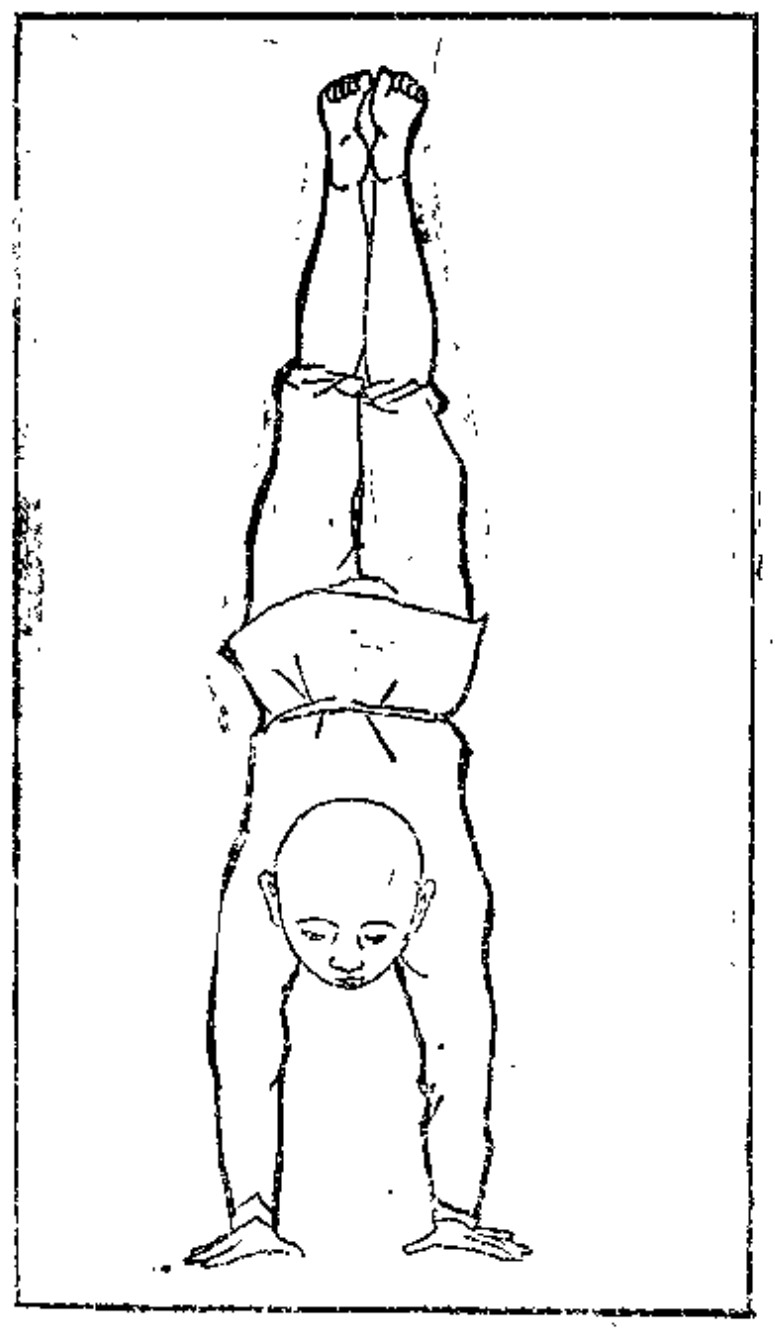
[Note: OCR severely corrupted — page contains scattered fragments including: “[illegible]” references to completing supernatural powers (jīntōng wèi), and records such as the contemplation method of walking in water —]
— contemplation methods such as soaring through the sky.
Once the development of the Sahasrāra Cakra is completed, such things are by no means impossible to realize, but it is certainly no easy feat. I myself am also unable to transmit the Fundamental Assembly of Perfect Body. All that I understand is that from ancient yoga down to the present, among the techniques for developing supernatural abilities, the most universal and most deeply impressive unique hand seal is the headstand posture — that and nothing more.
The Cakra takes the accumulated total power from all previously completed training, newly adds some special training, and is arranged according to the individual characteristics of each practitioner. In short, the practitioner’s shortcomings and areas of insufficient practice power are all corrected and supplemented here, making one an all-capable being.
Put another way, one need only complete the practice of the Ājñā Cakra from the Samaya Assembly. The Fundamental Assembly of Perfect Body does not require another instructor at all — it can be accomplished entirely through one’s own power. Having departed from the instructor, one must exert oneself wholeheartedly to climb upward. The fruits of this effort can make a person grow day by day and soar beyond — this is the motive force for becoming superhuman.
The above has been an introduction to the nine stages of training derived from the Nine-Assembly Maṇḍala. The power of Dharma is without limit, and so the practice of Nenriki Esoteric Buddhism will never cease. I too intend, beginning now, to start from the beginning together with all of you — devoting myself wholeheartedly to cultivation, without end…
Section 3: Dietary Life That Possesses the Power of Thought
1. The Secret of Diet That Can Sustain a Rigorous Practice Life
What Nenriki practice requires is not training alone — moderation in daily dietary life is also extremely important. Overindulgence in food and drink, excessive meat consumption, heavy smoking, and —
Let me continue properly from page 112 onward.
…and heavy drinking, etc. No matter how diligently such people devote themselves to ascetic practice, the results they can achieve will be quite limited.
Generally speaking, for good people not to interact with bad people is a passive posture of avoidance. Esoteric Buddhism not only avoids contact with bad people but also places greater emphasis on actively embracing good people.
Perhaps due to environmental factors, practitioners of Esoteric Buddhism have mostly hidden themselves in deep mountains and secluded valleys since ancient times. The food they could carry was quite limited, and every time they arrived at a place, they had to find ways to solve the problem of food themselves. Since they were in deep mountains and secluded valleys, the available options were extremely limited, usually consisting mostly of naturally growing vegetation, leaves, stems, roots, and so on. Consuming these foods year-round—would it be harmful or beneficial to the body?
2. Polygala, Licorice, and Goji Berries — Miracle-Producing Medicinal Herbs
The following is the practice of the Acala Homa (Fudo Goma) passed down in the Sanbin-in lineage of the Shingon sect (taught by Great Dharma Master Oda Jishu).
In addition to the five grains, the offerings include several medicinal herbs known as “medicinal seeds” (yakushu). These herbs are Polygala (Yuanzhi), Licorice (Gancao), and Goji berries (Gouqi). Furthermore, the blessed substance includes sesame. All of these have been passed down in a secretly transmitted manner since ancient times.
Next, we will examine the medicinal seeds used in this Homa ritual.
Polygala (Yuanzhi)
The Compendium of Materia Medica (Bencao Gangmu) records: “Taking this medicine will invigorate vitality, make brain activity agile, and strengthen one’s far-reaching will, hence its name [Yuanzhi, meaning ‘far-reaching aspiration’].”
Takahashi Yoshitada, a lecturer at Gifu Pharmaceutical University in Japan, states in his book Modern Kampo Medicine: “…This medicine can be taken… It can promote hormonal function, regulate energy, and cure diseases.”
107
Goji Berries (Gouqi)
Alternative names include Heavenly Essence (Tianjing), Earth Bone (Digu), Earth Immortal (Dixian), and Immortal’s Staff (Xianrenzhang), among others. Judging from the literal meanings of these terms, one can infer that it contains elements of immortality. It is a type of elixir of life, and for Esoteric Buddhist practitioners aspiring to attain immortality, it is an indispensable medicinal material.
The Divine Farmer’s Materia Medica (Bencao Jing) says: “It clears summer heat, quenches thirst, and treats rheumatism. Regular consumption can make tendons and bones tough and resilient to cold and heat.” The Records of Famous Physicians (Mingyi Bielu) records: “It can strengthen the qi of the chest and hypochondrium, disperse heat, relieve pain, cure internal injuries and severe exhaustion, and soothe the large and small intestines.”
Additionally, the records of Zhen Quan state: “It replenishes the deficiency of essence and qi, improves facial complexion, reverses white hair, calms the spirit, and promotes longevity.”
Licorice (Gancao)
Because its taste is incredibly sweet, it is called Licorice (Gancao). It also has other names such as Elder of the State (Guolao) and Master (Zhuren). This implies an elder statesman of a nation or the head of a family. In traditional Chinese medicine prescriptions, most require the addition of licorice to exert their effects.
- Material for pill coating (the sugar-coating powder wrapped around pills).
Through scientific research on licorice, it has been discovered that its sweet components possess the following effects:
First, anti-inflammatory and anti-allergic effects similar to adrenal cortical hormones; Second, an expectorant effect; Third, inhibitory effect on ulcer formation, which is one of the side effects of adrenal cortical hormones; Fourth, an electrolyte effect similar to adrenal cortical hormones (retention of sodium and chlorine, increase of potassium); Fifth, prevention of the inhibition of ACTH synthesis caused by adrenal cortical hormones (if adrenal cortical hormones are used continuously, they can cause terrible adrenal insufficiency).
108
This highly effective herb was carefully selected as early as thousands of years ago. Given to practitioners in the form of offerings, the wisdom of the practitioners could only be explained through the Buddha. Modern medicine did not unlock its efficacy until the 20th century, whereas Esoteric Buddhism had already applied it to human dietary life in the distant ancient past.
The Special Ability Dietary Lifestyle That I Can Also Achieve
Among the Acharyas of Esoteric Buddhism, there are some who eat meat and drink alcohol. Generally, for those who have undergone training, a small amount of tobacco and alcohol has no effect on the body whatsoever. But for beginners, it is an entirely different story. If you get completely drunk and wake up the next morning still intoxicated, forming mudras and chanting mantras under such circumstances will naturally yield a predictable level of spiritual efficacy.
It is impossible to completely change your dietary and lifestyle habits in daily life, but at the very least, you should reduce your tobacco and alcohol intake to half of your usual amount, and reduce meat consumption to 1–2 times a week. Try to consume as much plant-based protein (such as tofu) as possible. If possible, you might want to try the following Esoteric Buddhist dietary lifestyle.
First of all, it is ideal to change your staple food to wheat rice or brown rice. If you have a weak gastrointestinal system, do not force it; you could switch from brown rice to wheat rice, and consume an appropriate amount of wheat germ every day. This is also the most ideal health food strongly recommended by Dr. Zha; it helps the brain and contains ample amounts of B1, B2, B6, B12, and other vitamins.
By decocting and consuming these along with the following amounts of medicinal seeds, it will increase your brain’s endurance and flexibility. The proportions for the medicinal seeds are:
Powdered Goji berries (Gouqi) 10g; Polygala (Yuanzhi), Honeysuckle (Rendong), Poria (Fuling), Dragon Bone (Longgu), Oyster Shell (Muli), Root Bark (Shepi), and Licorice (Gancao), 2g each.
If your digestive system is weak, you can add 5g each of Coix seed (Yimi), Sicklepod fruit (Wangjiangnan), and Wolf’s Bane (Niubian).
If you find it troublesome to prepare these medicines every day, you might as well buy some packaged…
109
…”Esoteric Buddhist Food” on the market.
Since ancient times, “Esoteric Buddhist Food” has consisted of various types of offerings or medicinal seeds. Here are a few examples listed for your reference:
Brown rice germ, wheat germ, Coix seed, black sesame, black soybean, walnut, peanut, buckwheat, hijiki, wakame, garlic, yeast, subprostrate sophora root (Shandougen), goji berries (Gouqi), polygala (Yuanzhi), licorice (Gancao), shii leaf powder, yam, dwarf bamboo (Shanbaizhu), honeysuckle (Rendong), poria (Fuling), cinnamon bark (Guipi), dragon bone (Longgu), oyster shell (Muli), torreya tree nuts, and honey.
Speaking of which, I must say goodbye to you all. I sincerely hope this book can be of some help in your life. I further hope that you can use this book as a foundation to generate newer and higher knowledge. I extend my deepest blessings to you all!
110
[General Information] Title=Method of Developing Special Abilities in Esoteric Buddhism Author=[Japan] Kiriyama Seiyū Pages= 110 SS Number=10683841 Publication Date=April 1989, 1st Edition