This is an English translation of त्राटक साधना सिद्धि (Trāṭaka Sādhana Siddhi) by Ramesh Chandra Srivastava, a practical Hindi manual on trataka practice, concentration, visualization, and related contemplative exercises.
Original title: Trāṭaka Sādhana Siddhi (त्राटक साधना सिद्धि)
Author: Ramesh Chandra Srivastava
Original language: Hindi
Edition translated: Third edition, July 2020
Publisher: Nirvana Duniya Prakashan, Jaipur
ISBN: 978-93-85151-48-4
Trataka Sadhana Siddhi
Based on liberation from problems through Trataka Sadhana and Hypnotism–Mesmerism
— Ramesh Chandra Shrivastava
Trataka Sadhana can be considered a distinct form of hypnotism. Through Trataka Sadhana, you can attain the fulfillment of desires or solutions to problems in various fields. Conversely, through hypnotism-mesmerism, you can obtain information about latent events within a person’s subconscious mind. Both disciplines are distinct, but they can be appropriately utilized for human welfare. In this book, extensive information regarding hypnotism-mesmerism has been provided alongside Trataka Sadhana.
Ramesh Chandra Srivastava
Price: Paperback Edition: 225/-
Correspondence here: Jaipur Book House 389, Joshi Bhavan, Maniharon ka Rasta, Tripolia Bazaar, Jaipur-3 Phone: Office: 0141-4923092 Mob. 9352218776 E-mail: jaipurbookhouse05@yahoo.in
Author : Rameshchandra Shrivastava Shivshakti Jyotish and Tantric Center Shyama Sadan, Shivpuram, Kunda, Pratapgarh (U.P.) Mobile: 09839184870
First Edition : 2012 ( February ) Second Edition : 2014 ( September ) Third Edition : 2020 ( July )
© All rights reserved with the publisher
ISBN No. 978-93-85151-48-4
Computer Composing : Appraise Laser Graphics Shah Building, Chauda Rasta, Jaipur-3
Printer : B.R. Printers, Jaipur Mob. : 9829180028
Publisher : Nirvana Dunia Prakashan Jaipur. Phone: Office: 0141-4923092 Mob.- 9352218776, 9799906705
All rights of this book are reserved, therefore no person should use the articles included in this book directly or in a distorted manner elsewhere without the permission of the publisher. Doing so is a legal offense. Appropriate legal action will be taken against any publisher or author who does so.
Table of Contents
A Few Words from Me to You, My Own — 4 Trataka Sadhana is Wondrous — 7 Entry into the Subject — 9 What is Trataka Sadhana? — 13 Why Trataka Sadhana? — 16 How to Do Trataka? — 23 Types of Trataka — 25 Experiences and Results of the Sadhana — 30 Feeling (Bhavana) and Willpower (Sankalpa Shakti) — 37 Pranayama for the Sadhana — 42 Surya Trataka (Sun Gazing) — 48 Chandra Trataka (Moon Gazing) — 55 Deepak Trataka (Lamp Gazing) — 59 Bindu Trataka (Dot Gazing) — 70 Murti Trataka (Image/Idol Gazing) — 76 Chitra Trataka (Picture Gazing) — 79 Pratibimb Trataka (Mirror-Image Gazing) — 82 Trataka on Om and Swastika — 86 Trataka on Shri Yantra — 92 Trataka on Crystal Ball — 97 Trataka and Hypnotism — 101 Kundalini Awakening through Trataka Sadhana — 104 Curing Diseases through Trataka — 109 Mind Seed Mantras (Manah Bija Mantra) — 122 Trataka Sadhana for Planetary Favorability — 126 Trataka Sadhana on Gems — 137 Trataka Sadhana on Metals — 147 Trataka Sadhana on Fruits — 153 Criticism of Trataka Sadhana — 163 Doubts and Resolutions — 166 What is Hypnotism–Mesmerism? — 172 Key Elements Embedded in Hypnotism–Mesmerism — 176 States of Inducing Sleep — 179 Fulfilment of Desired Wishes — 182 Physical and Mental Healing — 185 Information about the Books — 189–190
Author’s Note
A Few Words to You — To My Own
Mother Durga’s boundless grace has been upon me, enabling me to dedicate this book to you after relentless effort. Every task, and the fruit of that task, has its appointed time. Until the hand of Mother Bhagavati rests upon a task, it does not reach completion within its appointed period. I had wanted to complete this book even before Shakti Sadhana and place it in your lotus hands, but Mother did not will it, or perhaps she had fixed the time for this book with some delay. I tried my utmost, and even wrote a few chapters, a few pages here and there, but all went in vain. I am Mother’s child. Mother’s grace remains upon me, but I could not comprehend the time she had determined for writing and completing this book. Be that as it may, now by Mother’s grace this book — Trataka Sadhana Siddhi — is in your hands. I express my gratitude, thanking Mother Bhagavati, that she resided in my pen and speech and brought it to completion. This work is dedicated at her lotus feet. With this sentiment—
What do I have to offer, that I could surrender to You, my Lord…
I seek forgiveness from all you readers, and from publisher Mohan Kumar Kashyap, for the delay, and I can only say that every task lies under Mother’s control. Until she wills it, that task will neither begin nor be completed. The Parameshvari holds within her authority the very devi (divine) shaktis — the power of creation (janan shakti), the power of sustenance (palan shakti), and the power of dissolution (sanhar shakti). Then how could the birth of this book have taken place without her will?
This book — Trataka Sadhana Siddhi — has become less worldly and more spiritual. Even so, I have endeavoured not to use rare language and terminology along with the rare topics of spirituality and philosophy, so that even the most ordinary reader can understand the subtleties of Trataka Sadhana and, should they wish, begin this practice themselves after understanding it and obtain the desired benefit.
The reality is that books increase knowledge and enhance practical understanding, but they do not perform sadhana. For sadhana, what is needed is a guru, a guide. This book will inspire you toward sadhana; you will begin the practice and progress. For proper guidance, remember me. Contact me by phone, contact me by letter. I want you to practise Trataka Sadhana. You will suffer no harm of any kind from this practice; on the contrary, there will be nothing but benefit. The speed at which a practitioner begins to receive benefits from this practice is unmatched — no other sadhana yields results as quickly: not mantra sadhana, not yantra sadhana, not tantra sadhana, not yoga sadhana, not bhakti sadhana, and not brahma sadhana.
I want you to practise Trataka Sadhana and reach siddhi. My desire is also that you challenge the scientists, challenge the doctors, challenge the psychologists, and challenge the philosophers — and experience for yourselves that science is dwarfed by religion and sadhana. Whether it is physical science or mental science, Trataka Sadhana encompasses all of them. A single practitioner can outweigh any scientist. Many scientists combined cannot accomplish what one practitioner can.
I have always said, and shall say today as well, that ‘science is a dwarf before spirituality, because spirituality itself is a super-science.’ From Mahashakti emerged spirituality in the form of a super-science, and from that spirituality — that super-science — emerged worldly science.
Trataka Sadhana is a practice of multifaceted development. Every person desires economic advancement. Trataka Sadhana brings about economic advancement. How? See for yourself — within a year the results will manifest. How economic advancement will occur, I cannot say, but I make the claim that a practitioner who performs one year of sadhana will experience economic advancement — divine grace will come, because the evolution of the soul will have begun.
Through Trataka Sadhana, one’s social standing will rise, because the light of the soul will illuminate the practitioner’s worldly life. Through Trataka Sadhana, the practitioner’s spiritual development will take place, because the purification of the soul will already have begun. The inner eye will have opened, and the practitioner’s inner door will have opened for self-realisation.
Through Trataka Sadhana, the union of the soul and the Supreme Soul will take place. The embodied soul (jiva) will attain the path of liberation (moksha). Then freedom from the cycle of coming and going in this world will be obtained. Whatever a person desires, all of it can be attained through Trataka Sadhana. Each attainment has its own time. Some in a year, some in two years, some in four years, and some over many years. One who turns back from sadhana or pauses along the way does not remain empty-handed either. Therefore, I once again request you, the readers, to begin Trataka Sadhana and, by giving just 15–20 minutes daily, make your life fruitful.
I do not say, nor do I believe, that all of you will advance upon the path of liberation and, having attained self-realisation, merge the soul into the Supreme Soul. But I do believe this much: many of you will advance upon the path of sadhana and complete the first stage. Of those, some will complete the sadhana of the second stage. At the further stage — that is, the third stage — only a few practitioners will persevere, and rare practitioners will cross the fourth stage and attain sid
will reach the Supreme Soul. Even so, I say—practice the sadhana. Everyone can practice the first level of sadhana; therefore, do not hesitate, do not fear, do not be lazy—simply practice the sadhana.
prārambhyate na khalu vighna bhayena nīceḥ, prārambha vighna vihataḥ, virabhanti madhyāḥ, vighne punaḥ punarapi pratihanyate mānāḥ, pāramya ca uttama janaḥ na parityajanti. (प्रारम्भ्यते न खलु विघ्न भयेन नीचेः, प्रारम्भ विघ्न विहतः, विरभन्ति मध्याः, विघ्ने पुनः पुनरपि प्रतिहन्यते मानाः, पारम्य च उत्तम जनः न परित्यजन्ति।)
Those who do not begin a task out of fear of obstacles are of a low level. Those who begin a task but abandon it midway out of fear of obstacles are of a medium level. Those who do not give up the task even after obstacle upon obstacle falls are of the highest level. Whether you become a sadhaka of the highest caliber or not, you can certainly become one of medium caliber. Since in this sadhana there is no question of any obstacle arising, you can begin the practice free of worry.
I promise, in mind, speech, and action—manasā, vācā, karmaṇā—that I shall always remain available for your assistance, cooperation, and guidance.
It fills me with joy to engage you in trataka sadhana. In this work of mine, in the success of this book, many individuals have extended their cooperation and support. First of all, I express my gratitude to my friend and colleague Shri Avadhesh Kant Ojha, who stood by me in preparing the manuscript of this book and put in tireless effort. In addition, I express my gratitude to Shri Mohan Kumar Kashyap ji, who—through tireless effort and keen interest—published this book and dedicated it into your lotus hands.
Finally, I wish that after reading the book from beginning to end, you apprise me of your critiques, so that if any shortcoming has been pointed out by you, I may remove it in the next edition; and if that shortcoming is personal to me, I may remove it myself. And lastly, I thank those readers who repeatedly urged me to write this book and who will now undertake the effort of reading it. You are mine and I am yours; hence I expect that you offer me your harshest criticism, for I believe—
The critic and the passionate one—keep them in the courtyard of your house. Without soap, without water, they cleanse one’s nature.
“Om tat śantiḥ” (ॐ तत् शान्तिः)
Yours own, Ganeshchandra Shrivastav Jyotish Tantra Sampradaya
Publisher’s Note—
Trataka Sadhana is Wondrous
In our tradition, sadhanas of various kinds have held special significance. Since ancient times, our learned rishis and maharshis attained success in achieving their desired goals through rigorous sadhanas. A definite energy circulates through all the limbs of our body. To centralize this scattered energy in one place through sadhana is in itself a distinctive practice. To harness the energy within oneself and the one-pointedness of the mind is, in its gross form, sadhana. It has many forms, but chiefly, to bring something under control through the eyes and to make it act in one’s favor is a distinctive sadhana. In gross terms, you may call this hypnotism; you may also call it the process of sammohana (fascination/mesmerism). When a person is to be hypnotized, the hypnotist can bring that person under his influence through the power of his eyes. After being hypnotized, that person goes on answering the questions asked with complete accuracy. He cannot lie even if he wishes to. Another form of this is trataka sadhana. The practice of gazing fixedly at any gross or subtle object can be called trataka. This object can be anything—such as a lamp flame, a star, a planet, a constellation, the moon, a deity’s idol, a picture, a round dot drawn on plain white paper, or any fruit, etc. This is a sadhana through which, once accomplished, one can obtain the desired siddhis.
It appears to be an ordinary sadhana, but in reality it is a distinctive and wondrous sadhana. To keep gazing fixedly at any object for a long time is not a difficult task—one might commonly think so—but it is not such an easy sadhana either. If it were easy, all sadhakas could succeed in it and obtain the siddhis they desire, but that does not happen. Gazing fixedly at an object with open eyes, or imagining an object with closed eyes and seeing it with the inner eyes—this can become sadhana only when the sadhaka’s mind becomes one-pointed. If the mind keeps wandering and you keep gazing fixedly, it is when the sadhaka’s mind becomes one-pointed [that it becomes sadhana]. If the mind keeps wandering and you keep gazing fixedly at something, then this cannot be called sadhana. The mind is extremely restless; it does not come under anyone’s control either. In such a situation, if a sadhaka keeps gazing fixedly at some object for his entire life without one-pointedness, he cannot attain success—that is, if one-pointedness cannot be sustained, then continuing to perform the trataka practice yields no benefit. The central secret of this is dhyana (meditation). When your attention remains focused and through this focused attention you…
…gaze at it unblinkingly, then you will certainly attain success in this trataka practice. While practicing trataka sadhana, it is essential to keep the eyes, heart, brain, and mind concentrated — only then would it be appropriate to hope for benefit; otherwise, to think that any kind of siddhi will be attained is simply futile.
Now the question arises here: what is trataka sadhana, how is the siddhi of this sadhana to be attained, and what benefits can this sadhana bring? This is a subject that needs to be known and understood in detail; therefore the book Trataka Sadhana Siddhi has been published. The author of this book is Ramesh Chandra Shrivastava. Before discussing this book, it would be appropriate to say a few words about the author. The author is himself a sadhaka. He has attained siddhi in many sadhanas, yet even today he describes himself as an ordinary sadhaka. Even today, the eagerness to know and understand any sadhana is the same as can be seen in any new sadhaka. Being a sadhaka himself, he has acquired expertise in writing on sadhanas. This quality of his makes the book extremely simple; the reader faces absolutely no difficulty in understanding the subject. Ramesh Chandra Shrivastava’s entire life is dedicated to dharma, jyotisha (astrology), tantra-mantra, and adhyatma (spirituality). Through his inquiring vision, svadhyaya (self-study), and the reasoned accord of his scientific outlook, the author has established a distinctive place for himself in the world of jyotisha and tantra. For this reason, even in this scientific age, you cannot help but be impressed by the author’s ideas. From the author of Trataka Sadhana Siddhi, this book will prove to be an invaluable gem for all readers.
In the end, the author has also spoken openly about the possible criticisms of trataka sadhana and has given a logical response to each criticism. Through this, if anyone has any confusion or doubt regarding trataka sadhana, it will be dispelled. It would suffice to write about this book that it is a matchless book. For sadhakas desirous of practicing sadhana, this book will prove to be an invaluable gem. The author believes that if readers seriously contemplate the subject of trataka sadhana and proceed toward the attainment of siddhi through earnest sadhana, then success will certainly be achieved. The only requirement is that one make oneself worthy of the sadhana being undertaken, so that definite success is attained. We wish all of you auspiciousness and well-being. The effort of the author and publisher has been that this book prove useful for all of you. How successful we have been in our effort — we shall await your reactions regarding this. It is your reactions that guide us.
—Publisher
Entry into the Subject
The newborn infant, born from the mother’s womb, is gazing unblinkingly with its tender, tiny eyes. At what?—I do not know. I gaze at the infant’s beautiful face, at its eyes, but it does not gaze at me. It is gazing unwinkingly in one direction. There is nothing there, but perhaps a lamp is placed at a distance. Perhaps it is looking at the wick of that very lamp, at the flame, or at the dipashikha (lamp-flame), gazing at it with an unblinking stare. No… no, there are no such expressions in its eyes as would suggest it is gazing at the lamp, and yet it is indeed gazing at the lamp — yes, the feeling must be somewhere else. Elders say that infants see God, and the infant keeps looking only at God. Perhaps this is the truth, that is, the infant sees God and it looks at God because God appears to it, not to us? This question is worth pondering.
The infant’s mind-temple is still pure. The idol that is the soul within that mind-temple is also pure and sacred. The light of that soul is blazing forth; that is why Paramatma is visible to it. A pure soul becomes equal to Paramatma; therefore Paramatma dwells within the infant’s soul, and that infant keeps having darshana (vision) of Paramatma with its open, unblinking eyes — this itself is called trataka. To see God with open, unblinking eyes is true trataka.
Then why do we not see God? Neither with open, unblinking eyes nor with closed, empty eyes? The reason is clear — the grime of worldliness has accumulated over our soul. The soot of worldly passions and desires settled upon the soul has rendered the soul’s light dim, and day by day layer upon layer of the soot of impurity is being deposited over it. That is why the soul’s light is increasingly getting hidden beneath layers of impurity. The more layers that form, the more the light will diminish. The more the light diminishes, the more the antarchakshu (inner eye) will be covered. Gradually the inner eyes will close, and the soul’s light will grow ever dimmer.
When the inner eye is closed and the soul’s light is diminished, then how will one see within the soul? The soul is an amsha (fraction) of Paramatma; therefore the Paramatma tattva (principle) pervades the soul — that is, Paramatma resides within the soul itself. That Paramatma will be visible in the soul only as long as the soul’s light is blossoming forth. When the soul’s light stops radiating or diminishes, then seeing Paramatma within the soul will cease. Since the inner eye too has become clo
Therefore, with what eyes will one be able to see the Supreme Being? The Supreme Being is not seen with the outer eyes; rather, the world and worldly impurities are seen with the outer eyes.
To an infant, God, the Lord, and the Supreme Being are seen with the inner eyes and also with the outer eyes. The infant sees the Supreme Being with closed eyes as well as with open eyes. That is precisely why a sleeping infant laughs, smiles, startles, hiccups, and when the vision of God ceases, it begins to cry in its sleep.
As the infant gradually grows older, the vision of God gradually diminishes, because worldliness gradually begins to enter into it, and the feelings of attachment (moha), illusion (maya), sensory desires, anger, craving, the sense of “mine and others,” merit and sin, karma, truth, falsehood, theft, jealousy, selfishness, and so on begin to increase. These very things are the worldly impurities. From their dark stain, the infant — who has now become a child — has a covering of impurity’s black grime continuously forming over the soul. Therefore, first the child ceases to see the Supreme Being with its outer eyes, and then gradually, even with the inner eyes, God is no longer visible.
Where, then, will we see God? Our age has reached fifty or sixty years. During these years, we remained connected to the world every moment, every instant — so how many layers of impurity’s grime must have been deposited over the covering of our soul? Within how many layers must the soul have been hidden? In such a condition, the light of the soul becomes so hidden and covered that it cannot pierce through the covering of impurity and emerge. Along with the light, the soul’s power — that is, soul-force (ātma-śakti), willpower (icchā-śakti), vital energy (prāṇa-ūrjā), electrical power, magnetic power, will power, super power — also becomes weak, diminished, and virtually dead. Without soul-force and willpower, a person can neither advance toward the Supreme Being nor enjoy the happiness and joy of worldliness. He will attain neither liberation (mukti) nor enjoyment (bhukti).
The effort (puruṣārtha) of a person possessing diminished soul-force and willpower also becomes filled with inadequacy. Without effort, action (karma) cannot take place, and without action, one cannot enjoy — that is, no worldly or spiritual attainment can be his. The reason is that this world has one eternal law: action leads to enjoyment, enjoyment leads to action. Here or there, everything exists. All the means of liberation and enjoyment are scattered about, but for the action-less one, all remains unattainable.
All things exist in this world; the action-less man attains nothing.
Whether one wishes to attain the world or the Supreme Being, whether one wishes to obtain worldly pleasures, enjoy them, move toward liberation, or attain spiritual joys, experience supreme bliss in the truest sense, proceed toward liberation, or attain God — the being must perform action. To perform action, one must awaken effort (puruṣārtha), and to awaken effort, one must increase will power, willpower (icchā-śakti), and soul-force (ātma-śakti). Then one will indeed have to attain the light of the soul,
the power of the soul — but the soul is covered with the black grime of worldly impurity. In such a condition, how can you attain light or power?
To obtain the light and power of the soul, a person must now begin a reverse countdown — that is, just as by committing unwholesome actions the person has, layer by layer, created the covering of worldly impurity’s black grime over the soul, in the same way, by going in reverse — that is, by performing virtuous actions (satkarma) — one will have to peel away that covering layer by layer, one will have to wash away the grime that has been painted upon it by the impurity of sensory desires and the like. This process will occur only through virtuous actions, but how will this worldly being become inclined to perform virtuous actions? He has himself become, inwardly and outwardly, entirely a puppet of sensory desires. Merely through virtuous action and pure conduct, a person cannot wash away the blackness of the covering of impurity lodged upon his soul. He will need some other medium to wash away the blackness and to become established in virtuous actions. Along with that, he will also have to take the shelter and grace of divine powers.
That medium shall be — the path of worship (pūjā), adoration (upāsanā), and spiritual practice (sādhanā). The path of yoga, meditation (dhyāna), exercise (vyāyāma), and postures (āsana). A person must first prepare himself, in body and mind, to become fit for the righteous path. Therefore, he must practice the purification of his body and mind, and mental concentration (mānasika ekāgratā), through exercise, postures, mudrā, and yoga. When his body and mind begin to move in the direction of purification, from that very point the grime lodged upon the soul will begin to be washed away.
Then, the need for some form of spiritual practice (sādhanā) will inevitably arise. For this, the path of devotion (bhakti-mārga) or the path of knowledge (jñāna-mārga) may be taken as support, or one will have to take recourse to yoga-sādhanā, dhyāna-sādhanā, trāṭaka-sādhanā, or kuṇḍalinī-sādhanā. The path of devotion is simple, but through this path the union of the soul and the Supreme Soul cannot take place, because the devotional saint does not seek liberation; he seeks supreme bliss. Let birth occur again and again, and in every birth may his mind remain fixed at the feet of Rama, at the feet of God, so that through devotion he may continue to receive that precious supreme bliss of the Lord’s grace. For followers of the path of devotion, supreme bliss is paramount.
Birth after birth may I remain at Rama’s feet; this boon alone I seek.
Walking the path of knowledge (jñāna-mārga) is not easy. The aim of the saints on the path of knowledge is liberation (mokṣa) itself. Such saints desire the union of the soul and the Supreme Soul and seek release from the cycle of coming and going (āvagamana), but walking the path of knowledge is not within everyone’s capacity. This path is like the edge of a sword. Walking this path is extremely difficult and rare. While traversing this path of knowledge, the danger of falling, of becoming fallen, is greater. Therefore, through the path of knowledge, the purification of the soul and the merger of the soul into the Supreme Soul are not within everyone’s capacity; even if one walks some distance, it will not take long to go astray, to become fallen. The awakening of Kuṇḍalinī and the merger of the soul into the Supreme Soul are not within everyone’s control. This is the rigorous spiritual practice of yoga. For this,
One has to offer one’s own life as a homa (fire sacrifice). Therefore, one must choose the path of trataka sadhana. For this, a mature person of fifty-sixty years will have to become an infant. The infant who is truly born, who is filled with divine power, whose soul is equal to the Supreme Soul (Paramatma). One must become like that infant and, keeping the eyes open and gazing steadily, have the darshan (vision) of the Paramatma. The infant’s trataka sadhana is innate, it is formed of samskaras (impressions), it is the result of penance and sadhana spanning birth after birth.
You too will have to practice trataka sadhana. You too will have to find God by gazing steadily. The infant did not find God; God Himself had found the infant, because the infant is a fully surrendered being of God. Its soul was pure and spotless, it was a pure fragment of the Paramatma, but your soul, even though it is a fragment of the Paramatma, has not remained pure. Therefore, it must be purified; only then can the union of the soul (atma) and the Supreme Soul take place somewhere, and this will be possible through trataka sadhana. This is such a sadhana which has both simplicity and charm. It is also a medium of kriya (action) and inspiration. In trataka sadhana, there is no discrimination of any kind such as secrecy, casteism, communalism, or nationalism. People of all castes and religions, such as Hindus, Muslims, Christians, Parsis, Buddhists, Jains, etc., can engage in this, because there is no specific method of worship in its sadhana and kriya. This is the sadhana of yoga, of dhyana yoga (the yoga of meditation). The organized effort of the eyes, mind, and antahkarana (inner faculty) is the main feature of this sadhana. Therefore, you, the sadhaka (practitioner), will have to dedicate your body and mind to it. There is no pretense in it, no hassle of any paraphernalia, worship materials, or mala (rosary), etc. There is no display of objects in it. Remain as you are and practice the sadhana. You will receive the fruit; do not worry about the fruit, God Himself will give the fruit. Children, youth, the elderly, men, women, girls, the mature—all can perform this sadhana. Everyone will receive only benefits. There is not even a fraction of a chance of harm.
This sadhana gives both liberation (mukta) and enjoyment (bhukta)—happiness, bliss, and supreme bliss. Whatever feeling the sadhaka wishes to cultivate, whatever they imagine, they will attain exactly that. The sadhaka should practice as far as they can. Whatever kind of sadhana they perform, they will receive the corresponding fruit. The principle is indeed: Action leads to experience, and experience leads to action.
The universe is founded on karma (action) as primary; whoever desires hundreds of such fruits, then perform karma. Practice sadhana. Practice trataka sadhana.
What is Trataka Sadhana?
The practice of gazing fixedly at any gross or subtle object is called trataka. The practice of watching any object—natural motion, a point, a shape, a light, a lamp, stars, planets, constellations, the moon, the sun, deity idols, or a picture—with an unblinking gaze is called trataka. In trataka, it is essential to fix the eyes on any manifest or unmanifest object, or to focus the meditation (dhyana) to one-pointedness (ekagra). Now the question arises that if looking at an object unblinkingly is itself trataka, then this sadhana is very simple. If it is said about such a simple sadhana that it is a spiritual practice and through it the power of the soul (atma shakti) can be developed, then it is natural for some questions to arise in the mind. Can an ordinary human become a mahamanav (great human) solely through this trataka sadhana? Yes, it is true that through trataka sadhana, a soul can become a great soul and a human can become a great human. There is not even a fraction of doubt in this.
Merely understanding this—that the sadhana of trataka is the practice of looking unblinkingly at an object, a light, an image (bimb), or a reflection (pratibimb)—is not the complete truth. Therefore, not everyone can practice this sadhana. Those who practice trataka sadhana do so understanding merely this—that to gaze unblinkingly at an object is the sadhana itself, and by continuing to look at an object unblinkingly for some time over a few days or a few months, they will attain success and achieve the siddhi (perfection) of the sadhana. Many people practiced trataka sadhana in this manner for months, daily or twice a day, yet they did not attain success. Some people gave up and abandoned this sadhana, some found faults in it, some criticized this great sadhana calling it nonsense, but some people contacted their guru and removed their own shortcomings or the defects occurring in their sadhana. Then they saw something. Then the power of the sadhana, its miracles, and the preliminary power of knowledge became visible to them.
In reality, in trataka sadhana, the sadhaka only grasps the superficial aspects mentioned above. He merely understands that trataka sadhana is completed simply by the act of looking at an object unblinkingly for some time. While this practice is indeed correct, its fundamental secret is dhyana. Truly, when your dhyana is concentrated and with that concentrated dhyana you look at an object unblinkingly, only then is this sadhana considered to be
The fundamental element or core secret of trataka is observing an object with unblinking eyes in a state of focused meditation, or with a concentrated mind, closing the eyes and meditating upon a light (jyoti), mantra, or deity (murti) with the inner eyes. The focusing of the mind while practicing trataka sadhana is the fundamental element of trataka; this alone is its principal secret. If concentration cannot be maintained, then no benefit or siddhi (accomplishment) can be attained simply by continuing to perform the trataka practice. You might open your eyes and keep looking at an object, direction, or picture, but if your mind wanders to some other place, in such a state, even if your eyes remain wide open and keep gazing at an object, you will not see anything in that object.
It is essential to maintain the concentration of the mind and to keep the eyelids open, continuously looking at the object in front of you with open eyes. If the mind begins to wander, it should be centered again, and one must keep practicing with an unblinking, fixed gaze along with mental concentration. Therefore, those practitioners (sadhakas) who are practicing trataka sadhana, or who have practiced and left it, or who are new people wishing to begin the practice, must firmly understand this fact: while practicing trataka sadhana, the eyes, heart, brain, and mind must be kept concentrated; only then will the practice be possible. The practice of focusing the mind—trataka sadhana is not the only practice; rather, whether it is any spiritual practice, maintaining the concentration of the mind is essential in all of them. The concentration of the mind itself is meditation. But the mind is extremely fickle, fast-moving, and never remains calm and steady. No matter what you do, the mind keeps running here and there. Even while sleeping, although the body may be motionless, the mind is always active. Every day, students, family members, elders, parents, and gurus keep saying the same thing: study with focus, work with focus. Maintain the concentration of the mind.
Even after all this, due to its fickleness, it simply cannot remain steady in one place. A person performs worship for five or ten minutes, yet even then the mind does not become focused; rather, within those five to ten minutes, it runs off to who knows where. One has to pull the mind back again and again, yet it still wanders off. Therefore, to bind the mind, to maintain control over the mind, and to focus the mind is the practitioner’s foremost requirement in any trataka sadhana practice, because if the mind itself is not focused, how will meditation set in? If meditation does not set in, then no practice will be completed. If the practice and sadhana, etc., are not completed, then not even a fraction of success can be attained in that sadhana. Thus, just like in other sadhanas, if meditation does not set in during trataka sadhana, the practitioner cannot attain any success in trataka sadhana.
For this very reason, to concentrate the mind, the method of pranayama is being explained ahead. The practitioner can gradually discipline and focus the mind through practice via the medium of asana and pranayama.
The core secret of mesmerism and hypnotism is hidden in trataka itself. What a hypnotist calls visual power, visual control, or visual alignment is precisely trataka sadhana in Indian spiritual practice. The principles of mesmerism and hypnotism are foreign. Those people did not know about Indian higher sadhana at that time. In the practices of hypnotism (sammohan), subjugation (vashikaran), and attraction (akarshan), Indian seers were far ahead of them. In those people in whom the power of trataka sadhana awakened, magnetic power permeated them inside and out, and the power of hypnotism itself would manifest within them.
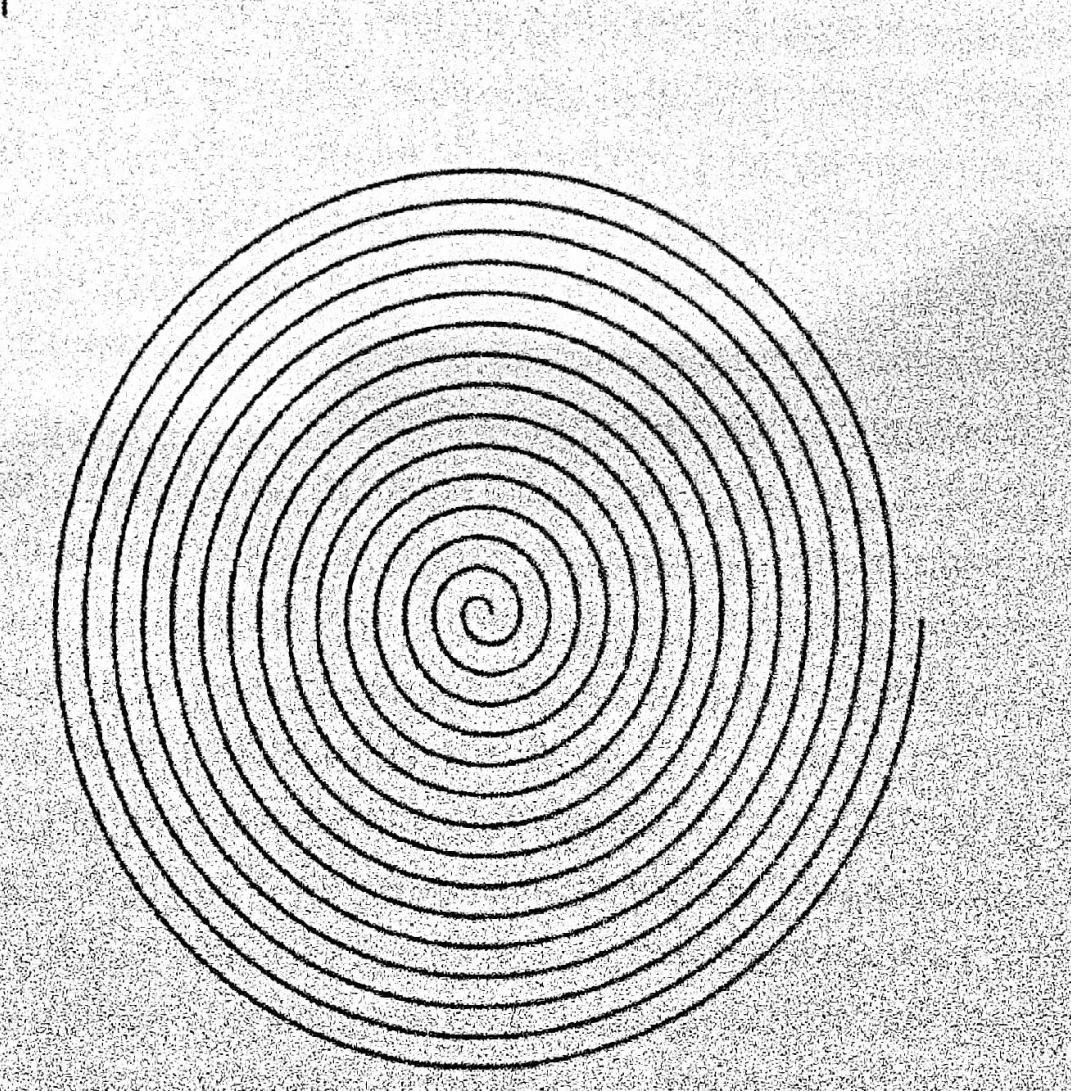
Why Trataka Sadhana?
By great fortune, a human body is obtained. This human body is said to be rare even for the deities. The question is, why? There must be some such distinctiveness in the human body compared to other bodies, because of which the human body is considered superior to the bodies of other beings. In experience, in appearance, compared to other beings, compared to the deities, humans are superior—this we all understand and know. We have not seen the deities, no one has seen them. Thirty-three crore (330 million) deities have been imagined, or we can say that our rishis and sages have acknowledged and named thirty-three crore deities, but till date no one has seen or understood even a single deity. The reason for this is that they possess a sukshma sharira (subtle body) and a bhava sharira (emotional/mental body), but not a karma sharira (physical action body). The karma sharira is possessed only by humans. Therefore, from time to time, the deities, Brahma, and Paramatma (the Supreme Soul) have had to incarnate by assuming a human body. In the Satya Yuga there was Harishchandra, in the Treta Yuga Ramachandra, in the Dvapara Yuga Krishnachandra, and in the Kali Yuga there have been various incarnations like Mahavir Jain, Mahatma Buddha, and Mahatma Gandhi. If said in an inferential manner, it would be correct to say that due to their subtle and emotional bodies, Brahma, Paramatma, deities, etc., remain eager to obtain a human body, and when an opportunity arises, when there is a need for them on Earth, they incarnate into a human body. Therefore, the human body is rare for them because, despite being omnipotent and desiring it, without a demand from Earth, they cannot appear on Earth assuming a human body. Even the deities have their own limits and code of conduct.
The community of saints and gyan-margis (followers of the path of knowledge) rejects the notion of thirty-three crore deities. They even deny the very term ‘deity’. They accept Brahma, but in the sense of a formless, attribute-less Paramatma. Their Brahma is neither Brahma, nor Vishnu, nor Mahesh. Counting the incarnations among Brahma is entirely futile. Words like Paramatma, Brahma, Ishvara (God) are merely feelings for the saints. Through these, their feeling is directed towards that omnipotent power which is called Brahma, and which is invisible, formless, nameless, yet all-pervading, imperishable, immortal, eternal, and the controller of all creations and universes down to the fathomless depths. It is one great power, a super power.
Saint Kabir also did not believe in deities, and when the sentiments of the path of knowledge come into my thoughts, I too feel that deities have no appellation, nor does Brahma have an appellation. Firstly, they do not exist; if they do exist, they are just subtle bodies or emotional bodies possessing small, large, or larger powers. Those with such subtle and emotional bodies, if they remain anxious to obtain the human’s sthula sharira (gross body) and karma sharira, then there is nothing surprising in it.
Let us leave the matter of the deities and take the case of pretatmas (ghostly spirits) that have entered the realm of ghosts and spirits, then my above-mentioned point will be proven true and authentic. Ghostly spirits exist; every religion in the world accepts this fact. Not only this, the world’s scientists, psychologists, litterateurs, philosophers, religious figures, Vedantins, gyan-margis, atheists, and theists also accept that ghosts exist and ghostly spirits wander. Scientists have even taken their photographs and psychologists have conversed with them. Ghostly spirits possess a subtle body; therefore, they too desire to obtain a human’s gross body, and sometimes they even succeed in obtaining a human body. These ghostly spirits acquire any body from them even while that person is in a living state. All this has already been proven by scientists and psychologists. In religion, there has long been an extensive discussion about the realm of ghosts.
Here, my subject is not to give a detailed description of the ghost realm or the subtle body; here, the purpose was only to clarify that whether they are deities or ghostly spirits, both possess a subtle body and they yearn for a gross body. In the human body, the gyan-indriyas (senses of perception) and karma-indriyas (organs of action) are strong; therefore, subtle-bodied or, one might say, disembodied souls remain anxious to obtain a human body.
While rejecting the appellation of ‘deities’, I accept that whatever the name of the human body, whatever the designation, it can be made into a goddess, deity, mahadanav (great demon), mahapurush (great soul), powerful being, supremely powerful being, divine person, atma purush (soul person), or paramatm purush (supreme soul person). It can even be made equal to the Paramatma situated in the temple of the indivisible, spherical universe, or indeed, made into Paramatma itself—the idol of the soul installed in the human temple. The soul exists in every living being, whether it be an elephant or an ant.
Whatever bodies living beings possess, they cannot transform the idol of the soul in the temple of their mind into the form of Paramatma, because those beings simply lack the capacity for the purification of the Paramatma. The main reason for the absence of this capacity is the absence of senses of perception, or their being weak, or some of them being inactive. In all beings, the organs of action are dominant; therefore, all beings do their work, arrange their food, fight and defend against their enemies, perform the act of reproduction, and protect their children, whether born from eggs or womb. They carry out all their tasks themselves, but they do not comprehend God; they do not comprehend the soul and the supreme soul. Their sentimentality, feeling of love, and power to think and understand is temporary, or in some, entirely absent.
The biggest difference between a human and an animal is that a human stands upright on two legs and walks upright, whereas an animal is four-legged and performs its actions accordingly. A human’s head is at the very top, then the chest, then the abdomen,
Then there are legs, but an animal’s belly is large. The head bends downward, four legs remain below, and its chest also remains below. A human’s head stays high; the brain resides in the head, and through the brain alone a human conducts the entirety of his life. An animal has a brain (bheja), which is not powerful. An animal’s life too is governed by the brain. Its brain does not possess the emotional power to think and reflect. It only has the capacity to think about itself. An animal grazes on its own, eats on its own, and sleeps on its own — this is the animal propensity: to graze for oneself alone and not think about anyone else.
A human does not graze for himself alone — he does not live to eat, rather he eats to live. He builds relationships, forms a family, builds society, and constructs a nation. He lives for others, and by awakening and activating the religious, spiritual, and mental consciousnesses within himself, he accomplishes his multifaceted development. He fulfills in his life the dictum — parahit saris dharan nahi bhai (there is no dharma equal to doing good for others). This is why he becomes a mahāmānav (great human being).
Because of all these distinctive features, the human body is important, is rare, and is obtained by great fortune. But even after obtaining this human body, the soul that has not done parahit (good for others), has not awakened its inner consciousness, has not recognized its own self-nature (ātmasvarūpa), has not purified itself, and has not had the vision (darśana) of the Supreme Soul (Paramātmā) within itself — that soul will not become a mahāmānav; rather, it will become a being inferior even to an ordinary human.
If, after obtaining the rare human body, a person wishes to become a mahāmānav, a powerful human, a superman, then he will have to take recourse to Brahma-sādhanā.
In the foregoing description I have made mention of the organs of action (karmendriya) and the organs of cognition (jñānendriya); it is necessary to understand them. Every living being possesses senses. Generally there are ten senses. Hands, feet, eyes, nose, tongue, neck, skin, generative organ, and anus — of these, five senses are called organs of action (karmendriya) and five are called organs of cognition (jñānendriya). In animals, in living creatures, and in insects and moths, the organs of cognition progressively diminish or become insensate, whereas in a human all ten senses are competent, strong, and sensitive. The organs of cognition hold sway over the organs of action, whereas in animals the organs of action hold sway over the organs of cognition. Now let us study only the human; let us leave aside the animals — that would be appropriate. In a human too there are five organs of action and five organs of cognition. Beyond these ten senses, there is one sense of special importance in a human.
That special sense is the mind (manas). Some people call it the eleventh sense, and some consider the mind to be the sense that controls all the other senses above it. The mind makes all ten senses active and sensitive. Its speed is faster even than the speed of light. It controls and directs a person’s internal impressions (sanskāra) and external impressions. It is this very mind that directs and controls auspiciousness and inauspiciousness, good and evil, virtuous deeds (satkarma) and sinful deeds.
Over the mind, two superior powers hold sway. Greater than the mind is the brain, and greater than the brain is the soul (ātmā). It is these three powers that make a human the supreme being among the eighty-four hundred thousand (caurāsī lākh) species. This is why the human body is rare.
The time it takes for the light of the sun’s rays to travel from its orbit to the earth, in that same time the mind, at its own speed, can circle the entire earth and return. It is because of this very mind that a human rules over his ten senses. He makes them conform to his will and directs them. Besides the mind, two other powers exist within a human. The first power is the brain, the second power is the soul. The mind and the soul are not gross organs of the human body; they are subtle organs. If some doctor were to dissect and examine every single organ, every single vein, every single cell of the human body, he would find neither the soul, nor the life-force (jīva), nor the mind. No scientist in the world has been able to discover the mind and the soul, nor will he ever be able to. Yet the domain of spirituality accepts their designation and holds that in the human temple the soul resides. The mind is one power of that soul.
The brain is a gross organ. It possesses the power to control all the organs. Even if mind and brain were considered one and the same, the authority of the mind could still be accepted. A human’s brain is the most powerful, the foremost, and the most active among all species. Therefore the human body is regarded as extremely rare. Likewise, superior to the brain is the soul. Though it exists in subtle form within the human body, all religions have accepted its reality with one voice. It is a fraction (amśa) of God, and like God, it is unbreakable (ajar), immortal (amar), and eternal (śāśvata). “God is a fraction; the jīva is indestructible” — Īśvara amśa jīva avināśī.
Now the question arises: why is one human superior to another, or why is one human superior to very many humans, when every human possesses mind, brain, and soul? Does that superior human have any extra sense compared to other humans? Any extra organ? Or any extra subtle element? No… certainly not. There is nothing different or new in that superior human. Only the power of his mind, brain, and soul differs.
It is because of these differences that one human is superior to another. If it is accepted that brain, mind, and soul — all three — are present in every individual, that the soul is a fraction of God, and that this fraction is equally present in all, then why does one person possess ordinary intellect, discernment, knowledge, and capacity for action, while another has all these powers in greater measure? The reason is the same: that in him the power of the mind is greater, the intellect is greater, the mental power is greater, and all of these increase or decrease in accordance with the power of the soul, whose soul…
20
…the more powerful it is, the more powerful will be its brain and mind. When the mind and brain become powerful, the karmendriyas (organs of action) and jnanendriyas (organs of perception) will also become powerful.
If there are forty students in a class, then the knowledge-science, psychology, intellect, discernment, diligence, concentration, sensitivity, etc., of all of them cannot be the same. One student memorizes a subject after reading it once; a second understands the same subject after reading it two or four times; a third keeps reading the same thing repeatedly, yet cannot understand it properly nor memorize it, even though all three students appear to be of the same age, health, and working capacity. Then why is there such a difference in understanding or memorizing after reading? Somewhere or the other, these three students differ from one another in their inner powers. This difference is attributed to their mind and brain, but in reality this difference is the difference of the soul. Ordinary people will not accept that when the divine-fragment soul is indestructible — in principle it is a fragment of the soul-Supreme Soul — and that fragment resides equally in every human-temple, then why this difference? Such people can accept the mental difference among students as a difference of the brain, because the brain is gross and the structure, health, and activity of gross objects can be examined.
The reality of this is that there is variation in the power of the soul. It is true that, in principle, the fragment of the soul is the same in every human-temple as the divine-fragment indestructible soul, but the grime of evil samskaras (impressions) accumulated over birth after birth has formed its own covering over the soul. This covering is different for each person, for each soul. There is variation in it. Therefore, there is variation in the power of the soul as well. This very difference of the soul makes one human different from another. To state it more clearly, it must be said that the difference of the soul creates a difference in the mind-brain, and the different powers of the mind and brain make one human different from another. The soul upon which the covering of worldly impurity is thinner, its spiritual power will be greater, and then the powers of the mind and brain will also be superior. The soul upon which there is a thick covering of worldly impurity, the power of its soul will be weak. In such a condition, the powers of the mind-brain will also be weak.
By weak powers is meant not only weakness of strength, but also distortion of power. If the power of the soul is weak, then in student life the child will lean towards weak intellect, weak thinking, and wrong paths. He may also misuse whatever power he possesses. When grown, that same person uses his weak power in the wrong direction; people see and hear this and say that his spiritual power is so formidable. In reality, his formidable power is indicative of negative power.
From what percentage of impure covering lies over the soul, the power of the soul can be estimated. The soul possesses a peculiar capacity to generate two types of powers. One is positive power, the other is negative power. The power of a good, pure, or somewhat pure soul is always positive, but as impurity increases, negative power increases. Along with this, mental power and the powers of the brain also generate positive and negative powers.
If we reflect upon the saying “बड़े भाग मानुष तन पावा” (great fortune it is to obtain a human body), then through this body a human being must build this life, this world, and the next world — all three. Only then will the attainment of a human body prove meaningful to this soul (jiva). If, even after obtaining a human body, one does not improve this world and the next, then one will have to descend into the dark well of hell and will be reborn in some definite species among the eighty-four lakh (8.4 million) wombs. Then who knows how many “पुनरपि जन्मनि, पुनरपि मरणम्…” (again birth, again death…) there will be, and these will keep happening until the soul once again obtains a human body (womb).
When a human body is obtained again, the soul will get the opportunity to be freed from the cycle of coming and going (āvāgamana). Even then one will have to make the effort to purify the soul, and even today one has to make the effort to purify the soul — so then what is the need to wander through the eighty-four lakh wombs? Why should we not all, from this very human birth, take up the vow of purifying the soul, and whatever is possible, accomplish that much purification of the soul in this very birth? If we accomplish complete purification, the soul will become equal to the Supreme Soul and the soul will merge into the Supreme Soul. If some impurity remains unwashed and a thin covering of worldly impurity still clings to the soul, then rest assured that our soul will receive a human body in the next birth. Through that human body we will be able to wash away and remove the covering of remaining impurity, and having purified the soul, become the Supreme Soul — then the cycle of coming and going comes to an end.
What does a human being want? Happiness, prosperity, wealth, wife, son, grandson, kingdom — in one word, bliss. All human beings want these very things. On the other hand, to be freed from sorrow, fear, death, grief, etc., is the aim of every human being. Then one would say — fear-free bliss. Here two types of bliss have been discussed. One is bliss, the other is fear-free bliss — that is, fear-laden bliss and fear-free bliss. Fear-laden bliss is worldly bliss, because the fear of the end of such bliss always remains with the person. What one is receiving today — will it continue tomorrow, or will it be snatched away? From such possibilities the mind remains fearful. Therefore, I give worldly bliss the designation of fear-laden bliss. The second is fear-free bliss. This can be called supernatural or divine bliss. There is no possibility of divine bliss coming to an end. Such bliss ever increases and is eternally enduring.
From the foregoing discussion it has become clear that the aim of a human being is to attain bliss
whether that bliss is mixed with fear or is fear-free bliss. In order to attain both kinds of bliss, enhancing the power of the soul should be the goal of human beings. If a person wishes to become great, powerful, superior to others, and to move from fear-laden bliss toward fear-free bliss, then one must attain self-realization, develop the power of the self, and wash away the defiled covering that has settled over the soul.
Now the question arises: what should we do to purify, cleanse, and sanctify the soul in order to bestow divinity upon it, so that our soul, becoming supremely powerful, becomes the Paramatma — becomes a super-power? There is only one answer to this question: through sadhana, the soul can be made powerful, equal to the Paramatma, and into a super-power. It remains to be considered — through which sadhana?
There are many sadhanas, many practices, many paths, and many principles by which, purifying the soul and increasing the power of the self, the soul can be made into a super-power or into divinity or equal to the Paramatma. Among all such sadhanas, four are principal. Their branches and sub-branches are also numerous. These branches are as follows:
- Yoga Sadhana,
- Dhyana Sadhana,
- Tantra Sadhana, and
- Kundalini Sadhana.
Within these sadhanas there are also various distinctions, that is, sub-branches, through which a person can make himself great. There are many paths to reach God, such as the path of devotion (bhakti marga) and the path of knowledge (jnana marga). Rather than discussing other sadhanas and paths here, I wish to discuss only dhyana sadhana. Making the mind one-pointed and centering the entire attention of the head on one place, or on one object, or on the void — this is dhyana yoga sadhana. Under it come many types of dhyana yoga sadhanas, among which trataka sadhana is the foremost. Through trataka sadhana, dhyana yoga sadhana is practiced and the divine bliss is enjoyed along with worldly bliss. At the same time, by purifying the soul, merger into the Paramatma is accomplished.
How to Perform Trataka?
If you have understood the description of what trataka is, then naturally the curiosity must be arising in your mind: how is trataka sadhana performed? That is, it becomes necessary to know the method of doing trataka. In external trataka, distant objects or scenes are accepted as the medium. The distance of such mediums from the sadhaka’s eyes is indeterminate. This distance can range from five to ten feet up to thousands or hundreds of thousands of kilometers; for example, in surya trataka and chandra trataka, the distance is beyond imagination. The disc of the sun is a medium of trataka. Stars and the moon are also mediums. In antar trataka and internal trataka, the distance of the medium is zero, because the medium or image or form is upon the sadhaka’s mental screen. Therefore, in the practice of antar trataka, the distance of any image or form is zero. It is my aim to guide sadhakas toward madhya trataka or madhyama trataka. Hence, here I am presenting an exposition of how to perform trataka sadhana, keeping in mind madhyama trataka and the madhyama trataka methods.
Now let the sadhaka understand all the practices from sitting down for sadhana up to rising.
Rise early in the morning, or upon rising, complete the daily routines. The stomach should be clear. Take a bath as well. If you are people of a cold region, then purify yourself simply by washing your hands and face. If you normally do some exercise or yoga, then do that as well, but after exercise, shavasana must certainly be performed. Learn shavasana; otherwise, after exercise, lie down supine on your bed for ten to fifteen minutes and let the body rest completely. Relax the limbs and body parts and remove the fatigue of exercise.
If you do not exercise and there is no fatigue in the body, then you can prepare directly for sadhana. After removing the fatigue of exercise, wash your eyes, mouth, and hands with ordinary water. After this, at the place you have chosen for sadhana, spread an asana on the ground (floor) or on a low wooden seat (chauki). It would be good and proper to spread a blanket and place a silk cloth over it. Having spread the asana in this manner, sit in padmasana, sukhasana, or siddhasana. Along with this — rather, beforehand — place the medium on which you wish to perform trataka sadhana at a distance of two-and-a-half to three feet from yourself, directly at eye level. If you wish to perform jyoti trataka or are performing it, then light a lamp, place it, and begin the practice.
After sitting by arranging the asana, perform the practice of pranayama at least seven times. In the beginning, do fewer; then gradually increase. Perform pranayama in this manner for five minutes. Some
Do not do the practice in haste or hurry. After pranayama, place the hands down in the lap or on the legs and straighten the back. Now, concentrating the mind, fix the gaze steadily on the medium (mādhym) before you, or on the bindu (dot), or the lamp flame, or the face of the idol, or on the face of your own reflection. Keep looking at the medium with unblinking eyes and a focused mind. As soon as there is slight pain in the eyes, immediately close your eyes. Then open the eyes and begin looking again. Do this five-six times and then slowly rise from the practice. Before rising, squeeze the eyes shut tightly or press them with the fingers, then get up from the seat and wash the eyes.
The mind’s concentration will be broken again and again. The practitioner must, each time, pull back the wandering mind and maintain concentration. If the mind wanders or thinks of other things, then discipline it again and focus it on the trataka medium. The wandering of the mind is natural and the blinking of the eyelids is also natural, but it is precisely over these that you must gain victory. In this manner, practice daily for three to five minutes for three-four months. When the mind begins to become steady and concentrated, and the power to gaze unblinking for long periods comes to the eyelids, then increase the time to five to ten minutes. Keep the practice time at 5 to 10 minutes for four-five months.
Keeping the eyelids steady for ten minutes and maintaining continuous concentration of mind is a difficult task; yet if the practitioner is able to do so and attains concentration of mind and steadiness of the eyelids, then practice trataka for ten minutes, and then increase it to 10 to 15 minutes. The time should be increased gradually. Never practice by straining the eyes. Continue the fifteen-minute practice continuously with full discipline. If a 15-minute practice is done daily for one year, the practitioner will attain siddhi (success) in trataka practice; success will be achieved.
The medium chosen for the practice should be free of defects, that is, it should have no kind of flaw. The practitioner should sit at a distance of two-and-a-half to three feet from the medium. The height of the medium should be at the level of the practitioner’s eyes, so that the medium is directly in line with the practitioner’s eyes. The room’s atmosphere should be calm and safe. There should be only as much light in the room as is needed for the medium in trataka; no kind of incense stick or dhoop stick should be burning. Fragrance is a good thing; it satisfies the mind and helps in building concentration, but its smoke is harmful to the eyes. If such smoke is present in the room, it can cause burning and pain in the eyes, and the eyelids may blink repeatedly, which can disrupt the practice.
Trataka practice is a practice of the mind’s eye; therefore, maintaining the mind’s concentration and continuously looking at the medium with unblinking eyes is the essential thing. This must be practiced. Only through gradual practice can the practitioner attain success.
Types of Trataka
In dhyana yoga practice, the importance of trataka is supreme. In truth, dhyana-yoga practice itself is antar (inner) trataka, and antar trataka itself is dhyana-yoga practice. Trataka is primarily of three types:
- Bahya (external) trataka,
- Madhya (middle) trataka, and
- Antar (inner) or internal trataka.
Bahya Trataka — Bahya means external. Trataka means continuously gazing at an object or scene with a focused mind. By external object or scene, it is meant that some object or distant scene is made the target of trataka, and trataka practice is done upon that target daily for a fixed time and a fixed duration. For example — the sun, the moon, stars, constellations, planets, the sky, birds flying in the sky, trees and plants, gardens, fields, fruits on a tree, a bird sitting on a branch, clouds in the sky, a lotus blooming in a water body, the sight of a flower garden, snow peaks, a river bridge, a river, a minaret, some tall building, the spire of a temple, etc. When the practitioner takes the above objects and scenes as targets and performs trataka practice, such practice is called bahya (external) trataka. In bahya trataka, the practitioner must observe various precautions. One should choose the targets of bahya trataka understanding oneself, one’s nature, and one’s health. If the practitioner is a patient of kapha-vata disorders and even ordinary cold affects them adversely, then they should not do trataka on the moon. If one must do trataka on the moon, it should be done under the guidance of a qualified guru or a skilled trataka practitioner. Rivers, waterfalls, snow-covered peaks, green fields, etc., should not be made targets of trataka.
Those who perform surya (sun) trataka need to exercise considerable caution. One can do surya trataka on the rising sun only for that duration during which the sun’s disc remains red, orange, and yellow. (For further information, read Surya Trataka Sadhana.) Similarly, before choosing an external or distant object or scene for bahya trataka, weigh its merits and faults against your own merits and faults. If it is suitable for the practitioner, then practice trataka on it; otherwise, abandon it even if you wish to continue.
In bahya trataka, the practitioner has to practice in an open environment, in an open space. The greatest difficulty in this is the changing weather before the practitioner. Rain, cold, heat,
Intense sunlight, clouds, snowfall, storms, etc., deprive the practitioner of the practice or make them averse to it. The second difficulty is that, leaving aside one or two targets, when one keeps practicing trataka on all external targets, the visions or experiences seen by the practitioner begin to appear with a delay. Compared to middle trataka, the results of external trataka begin to be obtained much later. Even so, the benefits obtained from external trataka are miraculous in themselves. The practitioner’s distant vision is strengthened and eye disorders are removed within a few days. This is only possible when the practitioner, abandoning their stubbornness, strictly continues to follow the rules of trataka sadhana.
Madhya Trataka (Middle Trataka)— Middle trataka is also called madhyama trataka (medium trataka), which is also referred to as the target of trataka. In middle trataka, that object or substance upon which trataka is performed is called the medium (madhyam) and the target (lakshya). In mesmerism and hypnotism, the word ‘medium’ is used in two senses. In the first sense, the object upon which trataka is done is called the medium. In the second sense, the person who is hypnotized (mesmerized) is called the medium, but in middle trataka, we call that very substance or object the medium upon which trataka sadhana is practiced. For example—a lamp’s flame, a bindu (dot), a picture drawn by oneself, pictures of deities or revered persons, gems and semi-precious stones, a crystal ball, a Shivalinga, Saligram stones, Om (ॐ) and Swastika (स्वस्तिक), Shri Yantra and other yantras, one’s own reflection, pieces of metal, fruits, flowers and medicines, etc. All these objects are called mediums. When a person fixes an unblinking gaze (drishti) upon them and practices with a concentrated mind, this process is called middle trataka or medium trataka.
Middle trataka is superior compared to external trataka. In this, the practitioner is called the sadhak (aspirant), the object is called the madhyam (medium), and the process is called sadhana (spiritual practice). In my view, medium trataka is the best, because in it the practitioner does not have to pass through various obstacles. In medium trataka, the person does not have to go anywhere. Their practice is completed right in their room. In such a situation, they can create an environment favorable to themselves. They can choose an accessible and simple medium from among the mediums. The adverse effect of the external environment of the room does not fall upon them. The best thing is that the practitioner can maintain the secrecy of their practice. Until the practitioner themselves discloses something about the practice to someone, no one will be able to know. It can even be kept secret from family members. Just as it is always forbidden to disclose anything about any sadhana, its accomplishments, its miracles, and its siddhi and results to anyone except the Guru, the secrecy of trataka sadhana is also esse
In middle trataka, the practitioner begins to see miraculous visions within a few days of practice. They begin to have strange experiences, which keeps the practitioner’s attraction and interest in doing the practice intact. They do not feel boredom, nor do they develop an aversion to the practice due to a lack of enthusiasm.
This should be considered very important, because in a practice where the practitioner does not get enthusiasm and is repeatedly discouraged, they cannot advance their practice. Whether the practitioner is 18 years old, 28 years old, or 60 years old, for sadhana they remain a child. The practitioner’s mind remains childlike for the sadhana. Just as children become discouraged from doing a task if they do not see any success or fraction of success in it, when they are forced to do the work in such a state, they experience boredom every moment, whether the task is studying or playing sports. It is also necessary for practitioners with childlike minds to remain enthusiastic towards the practice. If they do not see any miraculous vision for weeks or months while practicing trataka sadhana, their mind becomes devoid of enthusiasm and they start feeling bored. Their enthusiasm begins to wane; as a result, many people become averse to the practice. Those who survive advance the practice with a doubtful attitude despite being devoid of enthusiasm, through their willpower. Such people attain initial success even later, because due to their lack of enthusiasm, the concentration of their mind cannot remain steady. Sometimes the practice of such people also hangs in limbo or is dropped.
The greatest specialty of medium trataka is that from the first or second day, or within a week’s interval, it shows miraculous visions to the practitioner, which increases the practitioner’s enthusiasm, their curiosity increases, and their mind begins to concentrate, or they themselves keep making efforts to maintain the concentration of their mind. They do not feel even a bit of boredom. In medium trataka, the results and experiences of the practice begin to be obtained soon (within one to two months). Due to these achievements, the practitioner’s mind becomes continuously enthusiastic, and becoming curious, they remain attracted towards what will be seen in tomorrow’s practice. Therefore, their practice gradually increases day by day, and they move towards their definite siddhi. My advice is that new and beginner practitioners should choose the path of medium trataka sadhana. Among them too, the best is deepak (lamp) trataka sadhana. After that is bindu trataka, then others…
Antar Trataka (Inner Trataka)— Inner trataka is also called internal trataka. In this, one does not have to gaze at any object or scene with open eyes, rather one has to open the internal eyes and see with those very internal eyes on the picture-canvas of the mind. Outside
Closing the eyes and focusing the mind, with the eyes of the inner mind, on any object, picture, letter, mantra, idol, moon, the disc of the young sun, the flame of a lamp, the picture of a loved one, divine light, or the darkness of the void, is called internal or inner Trataka. In this, neither are the eyes open, nor is there any gross medium.
Inner Trataka is the most difficult and arduous. This practice is not possible for any beginner or new practitioner. In this, one has to bring the mind to a completely concentrated and meditative state right from the initial stage, or one could say, from the very first day, whereas the concentration of mind cannot be achieved in a single day or in a few days. The mind is fickle; to bind it and concentrate it is like growing doob grass on a stone. A new and beginner practitioner cannot develop concentration of mind without any medium. Those who have practiced Dhyana Yoga or meditation, or know how to meditate, may be inclined to practice Inner Trataka, but they too will have to face difficulty in concentrating the mind for a certain period, and it will take some time to settle the mind into meditation.
Practicing Inner Trataka Sadhana is akin to practicing the Sadhana of Nirguna, Nirakara Brahman (attributeless, formless Brahman). It is similar because in practicing Nirguna, Nirakara Brahman, there is no picture, shape or form, its reflection, or its subtle form—that is, no figure—on the practitioner’s mental plane (manas-patal). However, in Inner Trataka, the practitioner can imprint the conceptual image of any medium on their mental plane and, concentrating on it, perform Trataka Sadhana with their inner eyes. The worship and practice of Nirguna-Nirakara Brahman is said to be like walking on the edge of a sword; therefore, because it is similar to that, practicing Inner Trataka Sadhana is like walking on a rope. Both have their difficulties, precautions, need for mental concentration, and the necessity to be established in meditation, yet the possibility of slipping or falling from the sword’s edge or the rope remains. Therefore, this practice is not for everyone.
Even after all this, this practice is the highest, because it is a Dhyana (meditation) practice, and it is through Dhyana practice that God is attained. For yogis, sannyasis, tantriks, and saints, this practice is the most useful. Besides these, those who are practicing Kundalini Jagaran (awakening of Kundalini) and Pranayama Sadhana are proper candidates for Inner Trataka Sadhana, but not new people.
By saying this, I am not discouraging new people. New people can also become practitioners of Inner Trataka Sadhana, but before starting the practice, they should understand that in Inner Trataka, something will be seen and understood only after months of practice. When a person is aware of the secret of the practice and hopes to see a faint ray of light after months, they do not fall prey to feelings like boredom and lack of enthusiasm during the initial days of practice. Since the practitioner has already decided that they will see a ray of hope in two or three months, they maintain their enthusiasm and continue their effort to bind the mind and concentrate it in the practice.
Their effort and the practice of Inner Trataka can soon yield some good results if, apart from the practice, they continue to do Pranayama Sadhana and Dhyana Yoga Sadhana at other times. Since through Dhyana Yoga Sadhana they can achieve success in Inner Trataka, it is necessary to practice Dhyana Yoga Sadhana separately. It is necessary to deliberate upon the subject of Dhyana Yoga Sadhana, so it will be discussed in a separate chapter.
In Inner Trataka, external mediums and pictures are seen on the mental plane. If the practitioner performs Madhya Trataka (middle Trataka) on that same medium, then the picture of that medium will soon emerge on their mental plane. Then they can continue to see the picture of that medium with their inner eyes. This will make it easier for them.
The picture that is on the practitioner’s mental plane will initially give them joy. When the practitioner sees the picture of the medium, they will experience bliss within. This is the virtue of remaining engaged in the practice. After a few days, their enthusiasm and bliss will undoubtedly increase, and along with it, a magnetic power will manifest in the practitioner’s body and mind. More than their eyes, the power of attraction and mesmerism will arise in their feelings and thoughts. Whatever they think, whatever feeling they hold toward anyone, whatever feeling they hold toward themselves, will be fulfilled very easily. They can attain everything gradually, but they should not harbor feelings and desires for worldly, material, economic, or social achievements. For them, all these are trivial achievements.
Inner Trataka Sadhana is a practice that leads a person to the category of Aham Brahmasmi (I am Brahman). Therefore, the practitioner should keep themselves free from worldly attachments and, purifying their soul with divine feelings, should merge the soul into the Paramatma (Supreme Soul) with the desire for liberation. This paves the way to liberation.
Types of Trataka
In the first week of beginning the sadhana (spiritual practice), you will not have any notable experiences. You will see only the medium of Trataka you have chosen, or some faint aura or lights will be visible, or that medium itself will appear like a moving, lively, and active object.
Within 15 days from the second week, you will see the picture of your medium changing. First, beams of light will be seen emanating from the medium. That beam of light will take a spherical shape and appear to scatter various rays. After that, the rays will also become invisible for a few moments. Then, complete darkness will begin to appear. This darkness will also disappear after a while. As soon as it disappears, multi-colored figures will begin to appear. With some further progress in sadhana, within these very colorful figures, you will gradually begin to see the moon, stars, trees and plants, rivers, waterfalls, and even whatever is in your mind or whatever is dear to you. It will take a considerable amount of time to reach this state, but in seeing these rays, you will experience happiness and bliss. Your inner world will blossom. These figures will begin to appear enchanting to the mind and brain. From this, both body and mind will begin to experience exhilaration.
In the meantime, if you make a wish (suitable to your level), it will be fulfilled just by thinking about it. For instance—if you want water, just think in your mind that a certain person in the house should bring water, and they will bring you water without your asking. Or, at this time, you will begin to have the knowledge that a certain task is going to happen or a certain person is going to come. The gist is that whatever comes into your mind, it will come to pass. But do not perform any such experiment, show-off, or display of miracles right now, otherwise your sadhana will remain limited only up to this point.
At the third level, that is, when you become accustomed to doing sadhana for five to ten minutes with a focused mind and steady eyes, then you will see blooming lotuses of light from the medium placed in front of you. Bouquets of your favorite flowers will appear blooming. The moonlight and the orb of the sun will appear with rainbow colors. Sometimes, after one scene, the darkness of the new moon (Amavasya) will appear, then in a few moments that darkness will lift, and in it, the form of your medium will be seen dancing here and there, flying upwards, very high up. In this itself, the form of the entire universe will begin to appear to you.
When this state arrives, whatever you think will be fulfilled. Whomever your gaze falls upon with whatever mental disposition, it will act accordingly in that very place and in that very manner. You will get complete information about any distant person you think of. Then you will be capable of doing welfare or harm to anyone. By thinking of welfare, you may well do someone good, but never think of doing harm. By doing so, do not needlessly destroy the energy obtained from your sadhana. At this level, the power of premonition (purvabhas) will be incorporated within you.
At the fourth level, that is, when you succeed in doing sadhana for ten to fifteen minutes by completely centering the mind and steadying the eyes, then the medium of your mind will begin to give answers to everything you think, past, present, and future. In that cluster of light, in those figures, the seven universes (brahmandas) will begin to be seen. Then your subconscious mind will be filled with supernatural light and you will transform from an ordinary human into a superhuman (mahamanav), then you will have the divine vision (darshan) of God. In such a state, your soul will become equal to the Supreme Soul (Parmatma). Then the delusion and infatuation (maya-moh) towards the world will end in your mind and you will wish to remain immersed in that bliss day and night. This is the awakening of super-power.
To reach the sadhana of the third and fourth levels, one will also have to face some difficulties, because in the austerity undertaken to attain a great, high, and sattvic accomplishment, the practitioner has to face difficulties at every step. These difficulties can be any among financial, familial, and social, etc. It has been my experience that whenever any sadhana reaches its middle level, many difficulties present themselves before the practitioner. For example—physical distress to oneself, say fever, headache, or other minor ailments. There can be distress to the child, distress to the mother, distress to the father, distress to the wife, and distress to the brothers and sisters. The suffering of those people with whom you have a greater attachment is bound to happen. Why this happens, I do not know the reason. Understanding such pains and obstacles as the test of the practitioner, I have always accepted them. Perhaps God repeatedly tests the practitioner on how resolute and determined he is, that he will not turn away from the sadhana, no matter how many difficulties and obstacles he has to endure. At such times, during the period of your Trataka sadhana, you will see some pictures that may make you, i.e., the practitioner, terrified and doubtful. Upon seeing frightening pictures and scenes, the practitioner should become alert and remain firmly resolute towards the sadhana. One must have faith in the mind that no undesirable major event is going to happen.
Few people reach the third level. The rest, having obtained worldly “chocolates,” become disinclined toward sadhana. By “chocolate” I mean worldly attainments. Just as a child wants to go everywhere with his father, wherever the father goes. The child cannot be taken everywhere. Therefore he has to be coaxed and persuaded. If he does not agree, he has to be given “toffees and chocolates.” Even then, if he does not agree, toys or cash are given to him, so that, giving up his insistence on coming along, he may be pacified and become happy upon receiving the “chocolate.” Similarly, practitioners engaged in sadhana to reach God obtain, by divine grace, worldly, financial, and social attainments. It is these attainments that I call “chocolate.” Just as a child becomes happy upon receiving “chocolate” and, sucking and eating it, becomes delighted, in the same way the practitioner, upon receiving the “chocolate” of material, financial, and social attainments, begins to enjoy them and becomes delighted. At this time the practitioner’s wealth increases, the sources of earning wealth multiply, familial prestige or family happiness grows. In society, the practitioner’s respect rises, and his words begin to seem like sound counsel to people. But the sadhana breaks off, falls away, and the practitioner ceases from sadhana. This should not be regarded as the decline of the sadhana or the practitioner; it should be regarded as divine grace. At this level of trataka-sadhana, a practitioner may indeed cease from sadhana permanently, yet within his mentality the attachment toward sadhana and the desire to practise will remain powerful. It is possible that after some time he may begin sadhana again. If, in this birth, he is unable to create the conditions to begin sadhana again, then in the next birth he will again become a trataka practitioner and, completing the sadhana, will reach the category of aham brahmasmi (I am Brahman). If he cannot complete the sadhana even in the second birth, then in the third, fourth, fifth rebirths — in any birth — he will complete the sadhana and, reaching the category of aham brahmasmi, will merge the soul and the Supreme Soul. In other births, material and worldly “chocolates” will not attract him, will not entice him, and he will not wish to suck the “chocolate.”
You will ask how I can know about a practitioner’s five births. Your question is fair. To know — one practitioner can know, see, the condition and state of anyone’s four or five past births and four or five future births — but he cannot prove it logically, cannot substantiate it. I am not speaking of past and future births seen through inner vision; rather, on the basis of this very birth, I am giving a logical analysis of the conduct of rebirth.
According to the samskaras (impressions) of rebirth, the conduct, thoughts, nature, etc., of this, that is, the present birth, are formed. Even the human body is obtained again. That, on the basis of past lives’ actions and merit,
it is well known and most religions accept this. A human birth was obtained on the basis of past lives. Spiritual consciousness was obtained on the basis of past lives. Spiritual and religious development occurred on the basis of past lives. Only then does a human being become a practitioner — when his spiritual interest and aspirational curiosity persist from a past life. To fructify and blossom the aspirational curiosity of the past life, in the present birth he is again drawn toward sadhana, practises it, and takes it to one or two levels. If even in this birth he could not complete the sadhana, then it is certain that in his rebirth he will complete the sadhana, because the soul will carry the samskaras of sadhana with it into rebirth as well. Then the temple of the human body will be new, but the soul will be that same old samskara-laden one. No person, religion, philosophy, or psychology can deny this statement of mine. Those who regard the soul as imperishable and immortal and who believe in rebirth will have to accept that the soul preserves the samskaras of past lives across its birth after birth.
My second argument is that upon crossing the second stage of trataka sadhana, kundalini-awakening itself begins. Along with this, the purification of the soul begins. The soul is a portion of the Supreme Soul — this is undisputed — therefore the soul possesses the same power that the Supreme Soul possesses. When the layers of impurity encrusted over the soul begin to become clear and pure in the process of the soul’s purification, then the light of the soul, the power of the soul, becomes intense. Such a soul desires its purity as swiftly as possible, because the eagerness to unite with the Supreme Soul increases within it. If, through the medium of the human body, by practising sadhana, it could not accomplish its purification in this birth, then it is certain that in the next birth it will accomplish its purification through sadhana and merge into the Supreme Soul. Even then, if the union of soul and Supreme Soul could not occur, it will continue practising sadhana in subsequent rebirths and keep progressing on the path of liberation. In any birth, its union with the Supreme Soul can occur. It is a separate matter whether this takes one birth or five rebirths.
Bear in mind that the soul itself is the being, the person. This human body is its garment, its shell. When we utter the word “I,” it refers to the soul itself. Trataka sadhana is a sadhana spanning birth after birth. If any practitioner completes it in this birth, he should understand that his soul, having practised trataka sadhana through various human bodies in past lives and having carried out its purification, has come, in this birth, into my body (human body). Now, by washing away the remaining impurity and completing the remaining sadhana, it will reach the category of aham brahmasmi and merge with the Supreme Soul.
If in this birth his sadhana is not completed and the soul does not merge with the Supreme Soul, then certainly the next level of trataka-sadhana will be completed in the next birth,
34
Its perfection may take birth after birth. The aforementioned experiences and attainments belong to the spiritual domain, because this practice (sādhanā) is regarded as a practice of the spiritual domain. Indian literature considers this practice to be the practice of attaining God, and its attainment is the merger of the individual soul (ātmā) into the Supreme Soul (Paramātmā) — that is, liberation from the wandering of the world. This practice grants the practitioner (sādhaka) liberation (mokṣa). It grants liberation (mukti) as well. It grants enjoyment (bhukti) as well, and it also grants a blissful, self-empowered life between mukti and bhukti. In the foregoing description, the discussion covered attainments ranging from spiritual awakening to the attainment of liberation. Now a discussion is being presented on the middle path — that is, what a practitioner obtains between mukti and bhukti.
When a practitioner considers the second level of trāṭaka-sādhanā itself to be complete success, or considers it the consummation (siddhi) of the practice, and becomes indifferent toward the practice, or even after having no desire to advance further, continues to practice — even then, he obtains a great deal. Since the purification of his soul has begun, the greatest benefit he receives is that of soul-power (ātma-śakti). Through spiritual development, ātma-śakti increases, willpower (icchā-śakti) increases, will-power increases, the power of vision (dṛṣṭi-śakti) increases, and the power of fascination/charm (sammohan-śakti) increases. The practitioner becomes great in comparison to other individuals. He becomes extraordinary.
Trāṭaka-practitioners of Western countries consider this very level to be the siddhi, because before commencing the practice, their goal or aim is to reach only this level. Those who learn or practice the sciences of mesmerism and hypnotism, whether they be from Western countries or Indian, all have the purpose of developing prāṇa-energy, developing the power of vision, developing the power of fascination in the eyes and speech, and developing magnetic power in body and mind through the medium of trāṭaka-sādhanā. By reaching this level, they attain all that they had desired when they began trāṭaka-sādhanā. All of this will also be attained by the practitioner who began this practice without any desire. If he wishes, he too can, after some practice, enter the fields of hypnotism and mesmerism with skill. For the Indian practitioner, all of this is an ordinary matter.
Within Indian bābās, sādhus, saṃnyāsīs — even ordinary worshippers, ordinary tāntrikas, ordinary practitioners, magicians, and conjurers — such powers arise that they continually establish the dominance of their will-power over ordinary people. You must have seen bābās performing minor or major miracles; such people become capable of obtaining anything they wish, at any time, from anyone.
This attainment, which lies between worldliness and spirituality, also serves in works of public welfare. Self-interest is fulfilled, and sometimes taking advantage of it, deception is also practiced. By mesmerizing people, they are freed from various kinds of diseases, and through the influence of one’s mesmerism over others, one’s own selfish ends are also served. In brief, a practitioner who has attained this level becomes superior to other individuals or ordinary people in many senses. Therefore, he can apply the benefit of his superiority for good deeds as well as for bad deeds.
A practitioner who has reached this level succeeds in obtaining personal happiness, worldly happiness, and social happiness. I have written much about this subject on the preceding pages, yet in brief, some more… The person’s financial conditions begin to strengthen. The power of fascination arises in the gaze of the practitioner. If he keeps looking at a person’s back for five to ten minutes, that person will definitely turn around and look. If the practitioner makes eye contact with someone and mentally holds a particular feeling/bhāvanā, the other person will act in accordance with that very feeling. Diverting the direction of a flying bird, plucking a fruit hanging from a branch, bending a branch, bending an iron rod, making any pet animal favorable to oneself — all these are ordinary matters for such a practitioner. Turning a wild, ferocious animal into one like a pet dog simply by gazing at it with the trāṭaka gaze is an easy matter.
With the arrival of vigor and the power of fascination in speech, the capacity to dispense justice and to make others accept justice arises. Generally, such people become the heads of pañcāyats. Such people begin to receive respect and honor in society. With the dawn of magnetic power in body and mind, the qualities of a magnet arise within them. A magnet possesses the property of attraction and repulsion, and that very property arises in them as well. Only those people who are in harmony with them will be able to remain in their vicinity; those who are contrary to them keep their distance or remain fearful of even approaching them. If such practitioners enter the discipline of Tantra, they achieve success. Women and children are especially drawn toward such practitioners. Women and emotional people place greater faith and trust in such practitioners. You must have seen bābās surrounded by women or āśrams full of women — all of this is the effect of trāṭaka-sādhanā. Such trāṭaka-practitioner bābās or gurus mesmerize people and, through them, get their own propagation and expansion carried out.
Through trāṭaka-sādhanā, the journey from total worldliness to liberation is traversed. One can obtain the happiness of complete worldliness, adopt the path between the world and God, or attain liberation by adopting the supreme path of Paramātmā.
The foregoing discussion pertains to the attainments and the contrary aspects of those who reach the first and second levels of trāṭaka-sādhanā. A practitioner can, by his own discernment, make right or wrong use of the power of fascination that arises in his eyes. He can make worldly
can also do, and can also enter the spiritual realm — a magical power comes into their eyes, and through the feeling of the mind and the power of vision, they can accomplish whatever they desire.
Upon entering the third level, the practitioner’s mind begins to turn away from worldliness. A practitioner who attains success in trataka-sadhana in full accordance with the rules for fifteen minutes does not perform any worldly task. Their mind begins to grow weary of — to withdraw from — materiality and material pleasures. They become indifferent and disenchanted toward the world. Forgetting the world, forgetting false prestige and delusion-illusion (moha-maya), they become desirous of attaining the Supreme Soul (Paramatma). They retain no interest in worldly affairs, whether their own or others’. It is not that they lack the capacity to perform worldly tasks. They can accomplish or get accomplished worldly tasks merely by thinking, but they do not do so because they wish to remain immersed in supreme bliss and keep contemplating the relationship between the soul (atma) and the Supreme Soul. They themselves reach the path of “Aham Brahmasmi” (अहं ब्रह्मास्मि — I am Brahman).
In practitioners of the third level, the feeling of ego is destroyed. The distinction of “I, mine, you-yours” is eliminated from the mind. They begin to experience supreme bliss. All desires of such a practitioner can be fulfilled. Only one desire they cannot fulfill from this level — that is the attainment of the Supreme Soul, i.e., the merger of the soul into the Supreme Soul. Such a person can also travel through the subtle body to this world and the beyond. They can fulfill all worldly and spiritual desires.
A practitioner of the fourth level becomes equal to the Supreme Soul. They have completely abandoned the infatuation with the world and advance upon the path of liberation. For such a person, to accomplish any material, physical, mental, worldly, spiritual, or religious task, they need only to think. Merely by thinking, all their tasks are accomplished. They become trikaladarshi (seer of the three times) and bhavishya-drishta (seer of the future). Such a person, residing in any corner of the world, can tell the past-future and present of those living elsewhere, can describe natural changes and events that will occur in the future, and can bring about the recurrence of auspicious events. As the sadhana nears completion, they reach the category of “Aham Brahmasmi,” and then they themselves attain the power to bring about change and preservation in nature and creation. All the powers of creation (srijan), sustenance (palan), and dissolution (sanhara) come to them, but they do not use them. They only have to merge into the Supreme Soul, and they merge into the Supreme Soul — the part (ansha) becomes absorbed into the whole (anshon).
Feeling and the Power of Resolve (Bhavana evam Sankalpa Shakti)
In any worship-devotion, observance, or mantra-sadhana, two things are of supreme importance. The first is feeling (bhavana) and the second is the power of resolve (sankalpa shakti). The fruit of sadhana that a practitioner receives will be in accordance with their feeling. In this regard, Tulsidas himself has said —
जाकी रही भावना जैसी। प्रभु मूरत देखी तिन तैसी। (Jākī rahī bhāvanā jaisī, prabhu mūrata dekhī tin taisī.) “As was the feeling that remained in one, so did they behold the form of the Lord.”
The idol is not God; rather, it is a form fashioned by human hands. Yet the devotee sees God within it and also obtains the fruit of God’s proximity. Since their feeling is linked to God, they see the form of their God in idols both fashioned and unfashioned. If their feeling is that they should obtain a certain object from God, then they obtain that very object. Without feeling, nothing can be obtained. Without a goal, sadhana is not successful. Just as a traveler without a goal and purpose does not find their destination and keeps wandering through various paths, in the same way, without feeling and without a goal, the practitioner too keeps wandering.
Every religion of the world says, and every person knows, that God has no form, no shape; He has no house, no world — He is the Nirguna-Nirakara (attributeless, formless) Brahman. To reach Him, to attain Him, to see Him is by no means possible; yet the propounders of Brahman, through their feeling, through their power of resolve, endeavour to attain even the attributeless-formless One, and according to their feeling, whatever form of Brahman they have determined, or whatever they have seen in sadhana, they have expressed accordingly. Some say the Supreme Soul is divine light; some say it is a mass of light. Some practitioners say it is a cluster of shining vapor particles, but the Supreme Soul is none of these. Practitioners devoted their entire lives to the search for Brahman — then what did they find? A divine light. Brahman is neither divine light, nor a cluster of vapor particles, nor a mass of light. It is attributeless-formless. Then how did divine practitioners see the above-described form of Brahman with their divine eyes? What proof do they have that Brahman is like this or like that? Here, it cannot be denied either that they must have seen something.
The words and experiences of great practitioners, saints, ascetics, yogis, and great philosophers cannot be called false, nor am I calling them false. Indeed, what they saw, what they experienced, they expressed for us. So then the question arises — how did they see the attributeless-formless Brahman? The answer is with me — “Jākī rahī bhāvanā
38
— as, “I beheld the Lord’s form just so.” Has not the importance of feeling (bhāvanā) now become evident? Whatever feeling the saints and practitioners held, whatever form of Brahman they had installed in the temple of their minds, that very form — without any particular shape or appearance — they beheld. If formless Brahman had any one fixed form, then all practitioners, all saints, would have seen it in that one form alone; but different practitioners and saints, after long practice and austerity, saw it in different forms.
By now it must have become clear to you as well that whatever your feeling is, that is the form of Brahman you will receive. Therefore, feeling holds its own distinctive importance in every spiritual practice (sādhanā), every austerity (tapasyā). For us, this importance is of two kinds. First, before undertaking the practice, we should determine the feeling: do we wish to see the Supreme Soul (Paramātmā) within the soul (ātmā), or purify the soul, or awaken the inner consciousness (antaścetanā), or bring magnetic power into the vital energy (prāṇa-ūrjā), or merge the soul into the Supreme Soul — that is, attain liberation (mokṣa)?
The second kind of feeling is connected with worldliness. The practitioner does not seek the merger of soul and Supreme Soul; he does not seek religious or spiritual happiness — rather, he seeks worldliness. Those who desire worldly happiness must, before commencing the practice, form the feeling of what they wish to attain through trataka practice. Even within worldliness, one cannot hold the feeling for all the pleasures of the world at once; rather, one must form the feeling for attaining the world in fragments. In accordance with that very feeling, the practitioner will receive the appropriate result from the practice.
Suppose a practitioner wishes to perform gem-trataka (ratna-trāṭaka) to render a certain planet favourable to himself — then he must select the gem that represents that planet. He must perform trataka upon it, and before the trataka, during the trataka, and until the end of the trataka, he must maintain the mental feeling that such-and-such planet is becoming favourable to him. For example, to render Jupiter (Bṛhaspati) favourable, one must perform trataka on a yellow topaz (puṣparāja) and continuously hold the feeling that the divine guru Bṛhaspati is bestowing grace upon me, is becoming favourable to me, is becoming pleased with me. After practising for many days, one must also form the feeling that now Bṛhaspati has become favourable to me, has become pleased with me; the practice onward will continue with this same feeling. After this, its result will certainly be obtained.
In this world, in every task, every relationship, every connection, feeling is paramount. Without feeling, nothing happens. In a son there is the feeling of a son; in a wife there is the feeling of a wife. Not all children can bear the feeling of a son; not all relationships can bear the feeling of a wife. A mango holds the feeling of sweetness; a lemon holds the feeling of sourness. A mango cannot be a lemon, a lemon cannot be a mango — this is a common matter, everyone knows it. But in trataka practice, if one holds the feeling of a lemon in a mango or the feeling of a mango in a lemon, then in the mango one will obtain
39
the taste of a lemon, and in the lemon the taste of a mango. This is not an ordinary matter. It is a specialised spiritual matter. Only practitioners can understand this.
I wish to bring one truth to light: in trataka practice, whatever the practitioner’s feeling may be — whether spiritual or worldly — he will receive the fruit of his feeling later, but first he will gain inner consciousness. The vital energy (prāṇa-ūrjā) will become dynamic. Magnetic power will enter his personality, and he will assume a new personality that is distinct from and elevated above that of an ordinary person. This much he will certainly receive; after that, he will obtain the result corresponding to the feeling he has held.
In trataka practice, alongside feeling, willpower (saṅkalpa-śakti) holds a special place. If the willpower for trataka practice is firm, then firmness will also come into his feeling; but if the willpower is weak, then weakness will also enter the feeling, and as a consequence, weakness will enter the practice as well. The importance of willpower exists in every field; without willpower, no person can accomplish anything. For worship (pūjā), adoration (upāsanā), spiritual practice (sādhanā), yoga, and so on — indeed for śakti-practice or trataka-practice — the presence of willpower leads the practitioner towards success. Not only that, but in performing the smallest task and the greatest task alike, willpower holds importance. Without willpower, neither a small task nor a large one can be accomplished. Whatever willpower a person has within him, of whatever kind — to that extent and in that manner, he is a successful person.
Those readers who have themselves performed certain observances (anuṣṭhāna) or spiritual practices, or have had observances performed by brāhmaṇas and ācāryas, know what a resolve (saṅkalpa) is and why a resolve is taken and why a resolve is made. If you do not know, then you too should understand. Before commencing any worship, adoration, observance, spiritual practice, marriage, or other sacrament, a person makes a resolve that he will perform such-and-such act within a fixed duration, in a fixed number or quantity, and with such-and-such feeling for the attainment of such-and-such goal. In the first part of the resolve, one must also describe the place and time (deśa-kāla), the planets and asterisms (graha-nakṣatra), the day of the week, lineage and family, parents, and gotra, and one must also mention the place where one is performing the practice or adoration. If the resolve is not adhered to firmly, or if the practice is not completed within the resolved duration, then the fruit of the worship or observance that the practitioner has had performed or has performed himself, for that purpose and goal, will not be obtained, and the practitioner fails. In trataka practice, a resolve is not taken in the manner of a formal observance. Here the practitioner takes a mental resolve. On that basis alone, he continues to practise ceaselessly.
Willpower is a human being’s inner power. It is connected with strength of soul, or with self-confidence, and also with mental firmness. If someone’s mind is restless (cañcala), then the willpower cannot become firmly established. The willpower of a person of good conduct, thought, and character is automatically
becomes strong. Those who act contrary to this will certainly have weak willpower (sankalpa-shakti). Therefore, one who practices trataka-sadhana should be cultured, disciplined in conduct, speak less, be gentle of speech, and possess a steady mind and intellect—only then will their willpower remain firm and grow ever stronger.
Readers should not feel discouraged upon learning that those with weak willpower cannot practice trataka-sadhana at all. Here, the need will be for desire-power (icchha-shakti). If you have the desire to practice trataka-sadhana, and you understand that at present (in this current life) your work, your business, your conduct, your samskaras (impressions), your restless tendencies, your tamasic thoughts and behavior, your talkativeness and recklessness are rendering you unfit for trataka-sadhana, then take recourse to your desire-power. Do not become discouraged.
There is a slight difference between desire-power (icchha-shakti) and willpower (sankalpa-shakti). Many people possess strong desire-power, but their willpower is not equally strong. In some individuals, both desire-power and willpower are strong, and that is why they become successful persons. Therefore, to become a successful person, it is essential that both desire-power and willpower be strong. However, if willpower is weak and desire-power is strong or even average, then through desire-power the willpower can be strengthened—but gradually… through continuous practice. Through practice, we can develop our power. It has been said that through continuous practice, even a foolish and unintelligent person becomes a scholar.
If you have a strong desire to practice trataka-sadhana, but due to certain shortcomings you are not attaining the requisite fitness, then before commencing trataka-sadhana you will have to make yourself a worthy candidate, and your desire-power will accomplish this task. Through desire-power and practice, you can control your negative qualities. Suppose you lie at every little thing—then, through desire-power, make the firm decision: “From now on, I shall not lie.” From morning till night, keep reminding yourself that you must not lie, and yet you will still end up telling lies. Now, at night before sleeping, count how many times you lied from morning to evening. Then analyze: why did you lie? You will then find that one or two lies you told served a purpose, and the rest were meaningless. By a “purposeful lie,” I mean one that brings some benefit, has some reason, serves some self-interest. Strictly speaking, lying is wrong—it is a sin—but a worldly person pursuing self-interest does tell lies. This is what I call a purposeful lie. First, do not dwell on the purposeful lies, but analyze the meaningless lies again. Now, go to sleep with this resolve: “From tomorrow, I will exercise complete control over meaningless lies.” Gradually, your meaningless lies will decrease to a minimum. Then, make an effort to bring even the purposeful lies under control.
In this same manner, you can control other habits, tendencies, and negative qualities, and become a worthy candidate for practicing trataka-sadhana.
Strengthen willpower through desire-power, and strengthen self-power (atma-shakti) through willpower—only then, by becoming a worthy candidate, can you attain success in sadhana. Concentration (ekagrata) will come only when desire-power, willpower, and self-power all become strong. Mental concentration is the key to self-realization (atma-sakshatkara) and is the gateway to trataka-sadhana.
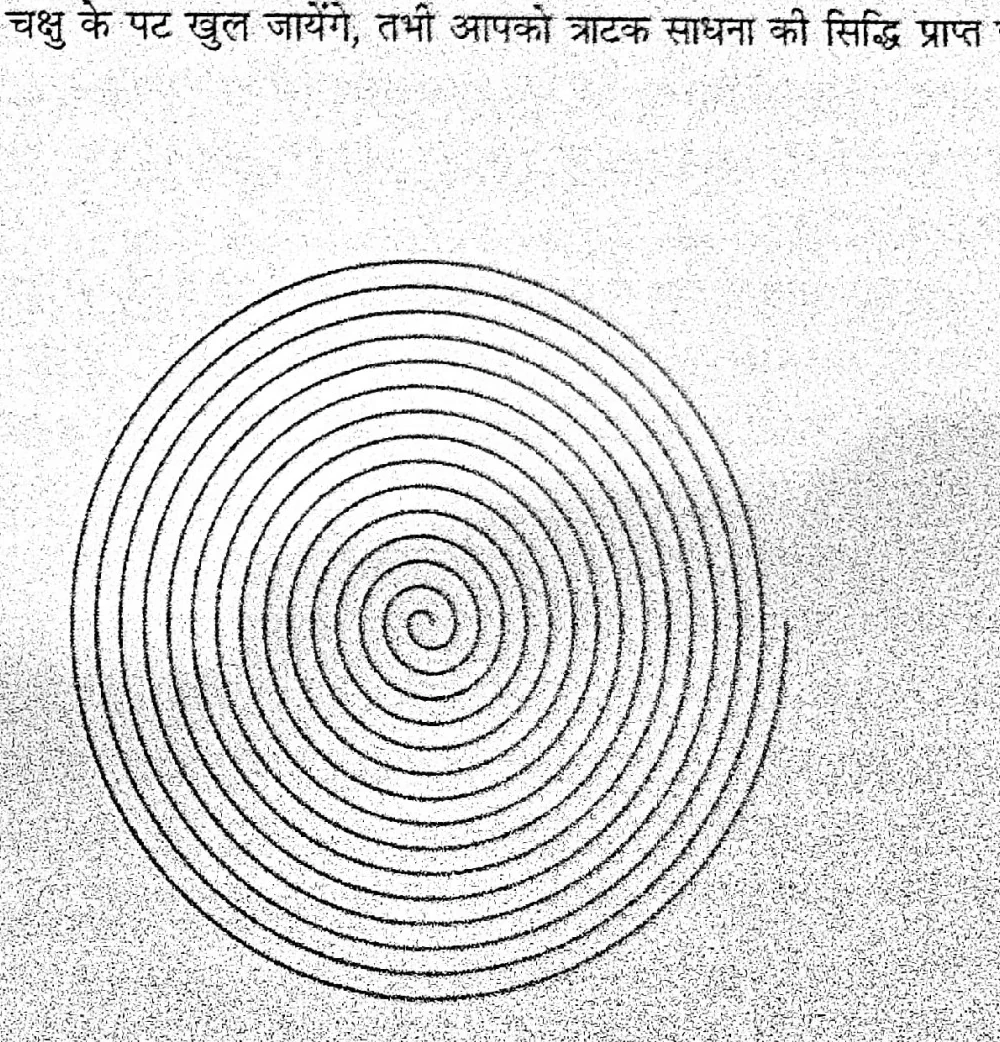
When you practice trataka-sadhana with mental concentration, steadiness will arise in the outer eyes and the veils of the inner eye will open—only then will you be able to attain success in trataka-sadhana.
Pranayama for Sadhana
Every person should exercise. Exercise makes the body healthy and energetic. Due to not exercising, various types of physical and mental diseases are generated. Today’s human being is so indifferent in their lifestyle that it is difficult for them to even find time for exercise. In this scientific and fast-paced era, a person is unable to exercise; this is their compulsion, but they do not understand that by not exercising, they are causing themselves great loss. There is a continuous loss of the body, loss of the mind, loss of lifespan, and loss of personality.
Let alone exercising, there is also a decline in physical and mental labor. This era has become the era of vehicles. A person travels by car or motorcycle according to their capacity. They mount a vehicle from home, go to school, college, or the office, and remain seated on the vehicle; the shopkeeper sends the goods and they receive them. There is no need to move hands and feet. At home, you do nothing; food and water are available on the bed or table. You eat four rotis (flatbreads) and the stomach bloats. Your diet has also become full of spicy, oily, and chili spices. The era of fast food has arrived; it is available everywhere, it is prepared in two minutes, requiring neither exertion from the maker nor the eater. In fast food, even the teeth do not have to labor, or have to labor less. The tongue has to exert only twenty percent. No labor for the hands, no labor for the mouth, just keep eating comfortably.
Then, no labor for the hands, no labor for the mouth, no labor for the teeth, and no labor for the throat, but now the intestines have to work. And when the labor of the intestines gets exhausted, decreases, and their digestive power also weakens, then there is the birth of—ulcer, cancer, constipation, intestinal diseases, and stomach diseases.
Due to improper digestion and lack of exercise, the very first disorders that arise are constipation, gas disease, mandagni (sluggish digestive fire), protruding belly, etc. If you survey young men from sixteen years old to elders up to a hundred years old, you will find that eighty percent of them are patients of gas and constipation. These figures are for cities. In villages, the number of such patients is less—
perhaps fifty percent, because the village man always does some physical labor or other. When there is no exercise and no physical exertion, all the parts of the human machine will start to jam, rust, and become lifeless. The number of patients with gout and arthritis is continuously increasing. The number of patients with diabetes and high blood pressure is continuously rising in the world. Behind all this lies the laziness of not doing exercise and physical labor. In this context, if I say that India is a country of lazy people, it would not be wrong. It is our religion that has promoted laziness. Slogans like “the contented is supremely happy,” “eat salt and roti, sleep under the shade of a tree” teach one to turn away from labor; we Indians have also taken the meaning of contentment incorrectly. Nevertheless, they have indeed become lazy.
In our country, being a “big man” or a “happy man” implies that a man who gets ready-made food conveniently on his bed, and after eating he sprawls out, servants and maids remain engaged in his service, his commands keep running, his wealth keeps increasing, his conveniences keep growing; even if he is afflicted with ten diseases, he is nevertheless a happy man, a big man, a wealthy man.
In childhood, I had heard that tuberculosis (TB) was called the rajarog (king of diseases) because it was incurable, but now it gets cured in six months. Therefore, it is no longer the king of diseases. Nowadays, diabetes has become the king of diseases. Cancer can happen even to laborers. There are many causes for it. The reason for saying all this is that I want to clearly state that a sick person cannot do trataka sadhana. How can the mind of one whose body cannot remain healthy remain healthy? If the mind does not remain healthy, the concentration of the mind will not be formed and trataka sadhana cannot happen. Sick, indulgent, and addicted persons cannot do trataka sadhana because the concentration of their mind cannot be stable.
By exercise, I do not mean wrestling or workouts that completely exhaust the body. What I am saying is that to make the body and mind healthy, do whatever light exercises you can do, whichever suits you, and take walks morning and evening. If you walk for thirty minutes without stopping, looking at your watch, without talking to anyone, then definitely, if you walk for thirty minutes without stopping, looking at your watch, without talking to anyone, then you will definitely receive a very great benefit. Cycling, swimming, doing P.T., and Surya Namaskar will keep your health disease-free and sound. The concentration of the mind will increase, there will be a surge of agility in the body, work capacity will increase, and you will move toward the accomplishment of trataka sadhana.
After exercise comes the turn of yoga and pranayama. You do not have to go into the extensive process of yoga sadhana. Only do the yoga of breaths. Some asanas for the spine and lower back
44
Do it. Then practise dhyana yoga.
For dhyana yoga, sit only in siddhasana or sukhasana, place the palms on the knees, and straighten the waist and spine. Draw in as much breath as possible through the nose, hold it for a few moments, then release it. Do this only five to ten times. On the last time, exhale so much that the entire breath is expelled. Then breathe in slowly, sit upright, close the eyes, and make the brain void of feeling and thought — that is, let nothing remain in the brain, let nothing arise.
Remaining seated in this posture, meditate on emptiness (shunya). If any feeling or thought arises in the brain, open the eyes and withdraw the mind from that feeling and thought. Then close the eyes again. In this way, first carry it on for one minute, then gradually increase it to five minutes, ten minutes… and one can take it further. After some years, for as many minutes as you can focus your mind on emptiness, you can extend your life by that many years. You will certainly remain healthy, and you can increase your spiritual consciousness by that many years. You can ascend the stairs that lead close to God. Performing pranayama after yoga is essential for trataka sadhana, because pranayama has the capacity to concentrate the mind.
According to the Patanjali Yoga-Pradipa, the process of regulating the movement of inhalation and exhalation while seated in a steady and comfortable asana is called pranayama. In pranayama, an intense process of breath is carried out. Its continuous practice must be done.
There are many types of pranayama. Without going into detail, I am giving a brief description of the pranayama useful for trataka sadhana. This is called loma-viloma pranayama. Its breathing action has three parts —
- Puraka, 2. Kumbhaka, and 3. Rechaka.
The sadhaka should make a seat (asana) from some blanket, durrie, or cotton cushion. One should sit in sukhasana or siddhasana. Bear in mind that the asana on which you are sitting should be thick enough that no part of your body touches the earth. If, under any circumstances, it does touch, then understand that your electrical energy has passed into the earth. This should always be kept in mind. Whether in sadhana or in worship, just as an earthing is provided to an electrical card, in the same way the sadhana-energy of a person’s body is drawn away by the touch of the ground — the earthing takes it away. If one has to perform any sadhana standing, then an electrically non-conducting asana should be placed beneath the soles. For example — in surya trataka and while doing chandra trataka, when the sadhaka performs the practice standing or sitting in a chair, then a footrest, asana, sack, or cloth must definitely be placed beneath the soles. These asanas have great [Illegible] in sadhana. Always remain careful in this regard. Now, sitting in siddhasana or sukhasana, perform the puraka action of pranayama.
Puraka: The action of drawing breath in through the nose is called puraka. Puraka means to complete — to fill. Whether the breath drawn in is filled in the stomach, or in the lungs, or in the brain, this filling action is called puraka. But here, in the pranayama I am discussing for the trataka sadhaka, the puraka action is drawn through one nostril. Its greater portion goes into the lungs and some goes toward the brain. This is the puraka done through the right nostril. The next time, the puraka action is done through the left nostril. I shall explain and describe all these actions in detail ahead. First, let us understand what puraka, kumbhaka, and rechaka are.
Kumbhaka: The action of holding the breath drawn and filled through puraka is called kumbhaka. Kumbhaka means like a filled pitcher. When the drawn breath is held, this holding action is called kumbhaka. Wherever the breath is held — whether in the lungs, in the stomach, or anywhere else — the action of holding the breath anywhere is called kumbhaka. In summary, keeping the breath held is kumbhaka.
Rechaka: Rechaka means to release, to become free, to expel outward. Holding the breath drawn through puraka is kumbhaka, and the action of expelling outward the breath held through kumbhaka is rechaka. The action of expelling air from any part of the inner body is called rechaka. Whether the prana-apana vayu exits on its own through the upper or lower passage, or the person expels it through effort, this action is also called rechaka. In summary, expelling air is rechaka.
Every living being continuously performs the actions of puraka and rechaka in the breathing process on its own. We inhale, then exhale, then inhale, then exhale, yet we do not even realise how much breath we took in and how much we expelled — when we inhaled and when we exhaled — because this is the natural breathing process of living beings. The coming and going of breath is the energy source of our body. This process can be stopped for a short while, but if the breathing process itself ceases, the person will die.
Drawing breath through puraka, then holding the breath as kumbhaka, then gradually expelling the held breath as rechaka — this is the very life of pranayama.
Pranayama: The sadhaka should sit on a soft, non-conducting asana. Then, bringing both legs together, sit in an asana posture. This asana posture can be padmasana, siddhasana, or sukhasana. While assuming the asana posture, the sadhaka should keep this in mind —
45
46
One should ensure that there is no kind of tension, strain, or pain in the joints of the legs, the knees, the ankles, or the feet. If one wishes to perform pranayama after sitting in Padmasana, one should first have good practice of Padmasana beforehand. In my opinion, all practitioners can adopt the posture of Siddhasana or Sukhasana. After sitting in the meditative posture, place the palm of the right hand on the nose. Hold the nose in such a way that the thumb is on the right nostril and the two middle fingers are on the left nostril. Place the index finger on the forehead at the spot where the tilaka is applied. The lower part of the forehead between the two eyebrows, just above the nose, is the place where the index finger is to be placed. This place is called Trikuti. Yogis and advanced practitioners have the vision of the soul and the Supreme Soul in this very Trikuti. Placing the index finger on the Trikuti is done to concentrate the energy of the prana-vayu. When trataka practice advances beyond the first stage of sadhana and one gains good practice of pranayama, then upon performing kumbhaka, a throbbing vibration occurs in this very Trikuti. At the second and third stages of sadhana, a reddish glow is seen with closed eyes in this very Trikuti, and after practicing for many years, the flame of a lamp is seen. This is called the divine light (divya-jyoti). Later, in this very light, the radiance of Brahman is seen, the Supreme Soul is seen. Yogis and saints call this very light and radiance the attributeless form (nirguna-swarupa) of God.
While performing pranayama, the thumb of the right hand is placed on the right nostril, the two middle fingers on the left nostril, and the index finger on the Trikuti. Now perform the puraka action—that is, loosen the fingers of the left nostril and inhale. The inhalation should be at a moderate speed—neither too slow nor too fast. Now perform kumbhaka—that is, keep both nostrils pressed with the thumb and the two fingers and hold the breath. Hold the breath only for as long as there is no strain of breath retention. Never hold it by force. Now perform the rechaka action—that is, slowly exhale through the right nostril. At this time, the thumb should be loosened. Slowly exhale the entire breath. Now inhale from the right nostril—that is, perform the puraka action—then perform kumbhaka—that is, hold the breath—then slowly perform the rechaka action.
This is one cycle (avritti). In the second cycle, again perform the puraka action from the left nostril, then perform kumbhaka, then perform rechaka through the right nostril, then perform puraka through the right [nostril], kumbhaka, and rechaka through the left nostril. This is the second cycle (avritti). The practitioner should not fix the duration for puraka, kumbhaka, and rechaka right now. For at least one month, allow your natural timing to be applied to puraka, kumbhaka, and rechaka.
After one month, fix the timing. The time taken in rechaka
47
should be doubled for kumbhaka—that is, the breath should be held for twice the duration—then the breath should be exhaled in four times the duration—that is, the duration of the rechaka action should be four times that of the puraka action, and the kumbhaka action should be twice [the puraka]. If we state or write this in summary, the count will be one, two, four. Mantra practitioners begin with two, four, eight while practicing this—that is, they perform the puraka action while chanting their chosen deity’s (ishta) mantra twice, perform kumbhaka until chanting four times, and perform the rechaka action while chanting the mantra eight times. They gradually increase this count—that is, four, eight, sixteen, then six, twelve, twenty-four, then……
Now your pranayama is complete. After performing pranayama, do Shavasana for five minutes, so that your body becomes normal from the strain of pranayama and a new consciousness comes into the external and internal body.
After pranayama, again sit in Sukhasana and perform trataka practice. If desired, perform dhyana (meditation) practice before trataka practice, but do not apply dhyana for a long time. Here, apply dhyana only to centre the mind, so that one-pointedness of mind is established and complete concentration of mind is maintained during trataka practice
Surya Trataka
Surya Trataka is considered to have a powerful effect in itself, yet there is a complete prohibition against performing it. Even if one has reached an advanced state in yoga and a practitioner becomes eager for this practice of their own inspiration, that is a different matter; however, general or beginner practitioners cannot be allowed to perform Surya Trataka practice because the fierce heat and intense light of the sun’s rays quickly snatch away the eyes’ vision. When the sun’s rays scorch the hard parts of the body, how can the eye and the delicate part inside the eye remain safe? Inside the eye, the retina is a part that resides within a fluid. In ordinary language, that fluid is called the eye’s oil. The intense light of the sun alone is sufficient to dry and burn the retina and the fluid around it, and then the fierce rays of the sun can destroy it in an instant. Therefore, one should not perform Surya Trataka.
Until 1980, I too thought and believed the same. While offering Arghya to the sun, I would often glance at the Bal Ravi (morning sun) for a moment. I had a strong desire in my mind to perform Surya Trataka, but I was afraid—what if my eyesight was lost, then what would I do? Life would be ruined. Yes, I did perform Deepak Trataka (lamp gazing), Bimb Trataka (image gazing), and Murti Trataka (idol gazing), and I was getting good results from them. I have clarified that the secret of my spiritual Prana energy is Trataka practice, but that very year, i.e., 1980, I had to go on a trip to Uttarakhand. A Baba had come from there with some problem. While returning, he forcibly brought me along. He had his own small ashram near Lakshman Jhula. I had holidays, and I was eager to meet my old practitioners and disciples in Haridwar and Kathigesh, so I went along at his insistence. He hosted us with great warmth.
One day, I was sitting on the holy bank of the Ganges, observing the scenery and discussing dharma with Baba. I was so engrossed that I lost track of time. When the sun climbed overhead, its rays started piercing the body. Baba said, “We should leave now, the sunlight has become intense.” I got up, but stopped after taking a few steps. Baba asked, “What happened?” I raised my hand to gesture towards a person standing on a rocky cliff some distance away and asked, “Is that sadhu performing Surya Trataka?”
‘Yes, he does it every day.’
‘Do you know him? Can you introduce me to him? Can he tell me this method of Surya Trataka? I am also a Trataka practitioner, but I do not have the courage to perform Surya Trataka.’ All at once, in a single breath, I asked many questions and also spoke my mind.
‘Yes… yes…, everything will be done. He is my friend, his name is Swami Chidananda. He is highly advanced, but very proud. He has one major flaw: he is also angry, but at the same time, he is compassionate. He helps the downtrodden. He possesses strong willpower and Prana energy. He can do anything.’ I understood that if he does Surya Trataka, he must be proud and angry. The Agni Tattva (fire element) is predominant in him. The Surya Shakti (solar energy) must be present in him. A strong desire to meet him immediately raced through my mind. As I proceeded a few more steps, I saw that he was descending from the rock and walking towards the Ganges. We moved further ahead, and when we turned back, he was taking dips in the current of the Ganges. I was understanding everything. In reality, just as we place a wet handkerchief over the eyes after Deepak Trataka, he was cooling his entire body and eyes in the same way. Looking at the sun unblinkingly fills not only the eyes but also the brain and body with heat. In the evening, we went to Swami Chidananda. At that time, he was engaged in Go Seva (cow service). Seeing us, he gestured for silence to sit over there. Along with Baba ji, I went towards his room. There, three cot-like wooden platforms (chauki) were already laid out. Outside the room, there was an open space like a lawn.
Baba ji smiled and said—Did you see, Chidananda already had a premonition of our arrival, which is why three platforms are laid out, with soft mats like carpets and round cushions (masand) placed on them. On one platform, a Moong Charmi (deer skin) was spread over the carpet. I was feeling good. There was a slight chill in the atmosphere. The open environment, a gentle breeze, and the fragrant smoke expanding from the Havan Kund were elating and gladdening the mind. I started saying to myself—This very environment is joyful for Sannyasis, Yogis, ascetics, and practitioners; that is why the practitioners here attain success quickly. Whether one attains Siddhi (perfection) or not, the concentration of mind and joy in the practice is certainly attained. A clean, pollution-free environment is best for yoga, devotion, meditation, etc.
Offering his own greetings, he came and sat on his Asana. Before I or the Baba ji who came with me could say anything, he gestured towards me and said—You are a Trataka practitioner. You have come from a village outside and wish to have a discussion with me on Surya Trataka…
“You wish…, don’t you… or are there any other curiosities?”
My hands came together in reverence. “You are a trikāla-dṛṣṭā (seer of three times). I had a desire to perform Sūrya Trāṭaka (sun-gazing) as well. For some days I did perform trāṭaka on the Bāla Sūrya (baby sun), but out of fear I discontinued it, or you could say I could not maintain restraint. You were performing trāṭaka on the midday sun. Seeing you practise, a curiosity arose in me to learn and understand something from you.”
“What is there to understand? Whether it is trāṭaka sādhanā or yoga sādhanā, one must practise in all. Trāṭaka cannot be done directly on the midday sun on the very first day, nor can it be done for a prolonged duration. Sādhanā is begun gradually and increased steadily. You perform Dīpaka Trāṭaka (lamp-gazing) and Mūrti Trāṭaka (image-gazing). That is simple, and even then you must have practised gradually before reaching this level of success. I have done only Sūrya Trāṭaka from the beginning. My Guru taught me Sūrya Trāṭaka from childhood itself and made me practise. You are a fitting candidate — yourself a sādhaka (practitioner), a tāntrika, and a worthy seeker. Therefore my mind says I should fulfil your wish by giving you the elementary knowledge of Sūrya Trāṭaka.”
With bowed head I said, “I shall remain grateful.” He began to explain:
“Look, first of all, you must cultivate the habit of waking and rising in the early dawn, during the Brahma Muhūrta. You city-dwellers sleep late and wake late. Once the firm habit of rising at dawn is established, make a firm resolve in your mind: ‘From tomorrow I shall begin Sūrya Trāṭaka.’ The next day, after completing the morning routines such as elimination, stand in an open space or sit on a chair and watch the Bāla Ravi (baby sun) rising, appearing. As you keep watching, when the full orb of the Bāla Ravi comes before your eyes, fix your pupils upon it. Keep the eyelids open, keep the pupils steady, and keep the gaze fixed on the solar orb. Now gradually still the mind as well and connect it with your gaze. Concentrate the mind on the solar orb. Let the mind be free of distortion, but as soon as you feel strain or pain in the eyes, squeeze your eyelids shut. This completes one day’s trāṭaka sādhanā. Even if the mind urges, even if the desire persists, do not dare to look at the sun again. This too is essential — do not yield to the mind. Restraint and discipline are also necessary in sādhanā.
“On the second day twice, on the third day three times, on the fourth day four times, and on the fifth day five times — this much practice you may do. That is, while performing trāṭaka, when the eyes grow weary, close them; then after a moment or two, open the eyes slowly and perform trāṭaka again, then close them, then open them. By the fifth day this repetition should reach five times. From the fifth day to the fifteenth day, continue doing only five times. From the sixteenth day, increasing one repetition at a time, take it up to ten times. Then permanently fix the repetition at ten times
Trataka Sadhana Siddhi 51
— ten times means a maximum of ten minutes, because it is not possible to perform trāṭaka for more than one minute at a time. Initially each repetition will gradually be 20, 25, 30, 40 seconds. Slowly that duration will increase. One thing to keep in mind: the moment you feel any kind of strain on the eyes, you must close them. Sometimes it happens that a sādhaka has reached a repetition of 30, 40 seconds or has even practised unblinking gazing for a duration of more than 60 seconds, but after doing three or four repetitions of 60 seconds, in the fifth repetition strain comes into his eyes, or the eyes begin to ache, or tears begin to flow from the eyes. In such a situation one should close the eyes immediately and press both eyes with both palms. If relief still does not come, the eyes should be wiped with a wet handkerchief or towel. If the strain still does not reduce, sprinkle water and wash them. On such occasions, any kind of stubbornness is not proper. After washing or wiping with water, if the eyes feel relief, then you may resume trāṭaka; otherwise, you should stop that day’s sādhanā right there and begin afresh from the next day. No harm comes from this. Trāṭaka on the sun should be done only for as long as the sun remains yellow, orange, and vermillion. Before it moves from vermillion towards red, the sādhanā should be concluded; otherwise, harm is certain.
“Trāṭaka sādhanā on the daytime sun can be done only by that sādhaka who has continuously performed Sūrya Trāṭaka for at least ten years and has gradually increased the duration through practice. An ordinary sādhaka or a new sādhaka has no authority to perform trāṭaka sādhanā on the red solar orb. Swami Chidānanda explained to me various types of trāṭaka along with his experiences. While staying in Uttarakhand, I discussed various aspects of trāṭaka sādhanā with him. I learned a great deal from him.
Experiences of Sūrya Trāṭaka Sādhanā
When a sādhaka, joining the eyes of the mind along with the outer eyes and his entire concentration, performs Sūrya Trāṭaka, then first of all he sees the solar disc dancing in its own place. After some days of sādhanā, that disc, transforming into black, red, and golden forms, begins to appear fixed in its own spot — that is, you will feel, you will experience, that the solar disc is moving forward and backward, in and out. Sometimes it will even disappear and only black, red, orange, or golden light will be visible. Then after some days, you will experience the dancing solar disc releasing golden rays; then rays of seven colours will appear. Rainbow-coloured rays will be seen rotating in all directions. After some time, sparks will be seen scattering from its disc. Then showers of sparks will burst forth. Wha—”
Upon continuing the practice, the practitioner will see forms of animals and birds forming, distorting, or falling within the web of sun rays, and as the practice advances further, human figures — upright or inverted, or some upright and some inverted — will be seen falling from the solar orb. Practitioners will have the experience that in the center of the solar orb there is the main entrance of some cave — a kind of hole, an aperture will appear — and through the doorway of that aperture, human puppets are falling. Advanced practitioners and those endowed with spiritual energy will have the clear experience that it is through this very doorway of the solar orb that our creation is being formed. From there itself, this creation is evolving. That very place is the point of origin of our earth.
In truth, the Sun itself is the cause of the origin and development of our earth; therefore the Sun is called the father of the world, the eyes of the world. In the Vedas, the Sun is said to have originated from the eyes of the Supreme Father — sūrye ātmā jagatasthasya cakṣuśca (सूर्ये आत्मा जगतस्थस्य चक्षुश्च).
In the Purāṇa Saṃhitā, it is stated that the Saura system recognizes twenty-four tattvas (principles). The 24 tattvas are — the pañcabhūta (five gross elements), the pañca-tanmātrā (five subtle elements), the ten indriyas (senses), manas (mind), buddhi (intellect), jñāna (knowledge), and prakṛti (nature). Everything is encompassed within these twenty-four tattvas. Even an ordinary person accepts that the Sun is the directly visible deity. Light comes from the Sun alone; the Sun is the cause of water; the Sun alone gives birth to clouds; the Sun alone gives energy and fertility to the earth. Crops are governed by the Sun alone. Beings receive energy and knowledge-intellect from the Sun alone. In a single sentence, the Sun is that deity who leads us from darkness to light, and showering happiness and good fortune upon our worldly life, grants the abode of liberation at the end of the body.
Whether one wishes to strengthen prāṇa energy, or desires worldly prosperity, or wishes to walk the path of liberation — for all worldly and transcendental attainments, one may perform Sūrya Trāṭaka (sun-gazing). The Sun is the significator of the ātmā (soul). Therefore, first of all, the practitioner’s soul will develop. Development of the ātmā means all-round development — the awakening of self-consciousness will occur, and the development and expansion of prāṇa energy will take place. The agni tattva (fire element) will also manifest. The destructive power will be born. The force of anger will become predominant within the person and will continually produce excitement at every moment. The practitioner will become the master of the three-fold powers like the Sun.
Birth, life, and death — or the creator of birth, the sustainer, and the destroyer — these are the three-fold powers that belong to God. The ordainer possesses these same powers in the Sun as well, because the Sun itself is the directly visible deity. Because of the Sun, this earth was born. Because of the Sun alone, everything from grass to humans and superhuman beings is born on this earth. The Sun alone, by orchestrating clouds, water, and weather, nourishes and sustains all of us — from a single blade of grass — and the Sun alone is the destroyer of every thing here, living or non-living. The Sun alone rains down the nectar principle
and the Sun alone is also the bestower of the poison principle.
The Sun is the supreme deity — the god of gods — praised in the Āgama and Nigama (Vedas) and affirmed by knowledge and science. The Sun is called the witness of worldly life and the light of the eyes of all living beings. Therefore the Sun is called Loka-sākṣī (witness of the world) and Jagattrakṣu (eye of the universe). Because the Sun traverses the sky, the Sun is so called — sarita ākāśe iti sūryaḥ (सरित आकाशे इति सूर्यः). Because the Sun inspires the world to action and is the protector of the world, the Sun is given the designation Ravi — suvati karmaṇi lokaṃ prerayati iti sūryaḥ (सुवति कर्मणि लोकं प्रेरयति इति सूर्यः) — sūryate iti raviḥ (सूर्यते इति रविः).
The utility of sun rays for the suppression of disease-causing bacteria is endorsed by medical science. In botany, the indispensability of sun rays for the growth of vegetation is accepted. According to agricultural science, solar light is essential for cloud formation.
From the standpoint of desiring health, removal of poverty, and obtaining progeny, etc., Sun worship, Sun adoration, and Sūrya Trāṭaka are supremely beneficial. All persons wishing for health should pray to the Sun.
In the Tantra literature and the Āgama śāstra, the science of the Sun (Sūrya Vijnāna) is held in very high esteem. Kavirāj Gopīnāth jī was both a knower of Sūrya Vijñāna and an accomplished adept of Sūrya Sādhanā and Sūrya Trāṭaka. On several occasions, he restored lifeless birds and creatures — whether in an injured state or a dead state — back to life, and that too solely through the influence of the Sun’s rays.
The sole sentiment behind writing all this is that one who practices Trāṭaka on the Sun attains within oneself the radiance of the Sun and becomes filled with powerful and divine qualities like those of the Sun. One’s mental development occurs first. From mental development comes mental concentration, and from mental concentration, Trāṭaka practice proceeds successfully along the path of attainment (siddhi). The practitioner does not have to face excessive difficulties in obtaining siddhi. Nevertheless, at every stage, one should keep consulting one’s guru or an accomplished Trāṭaka practitioner. Having attained the siddhi of Sūrya Trāṭaka practice, the practitioner reaches the category of ahaṃ brahmāsmi (अहं ब्रह्मास्मि — “I am Brahman”). Even if one does not reach siddhi, or remains only at the first, second, third, or fourth level, one still attains so many accomplishments that one reaches the category of a superman, a mahāmānav (great being).
I have said in the foregoing account that one first attains mental development and mental concentration. After that, one obtains the power of vision (dṛṣṭi śakti). From the power of vision comes the power of fascination/charm (sammohana śakti). Through the power of fascination, one may enter the fields of mesmerism and hypnotism and prove one’s usefulness in society — however,
In order to maintain development and spiritual consciousness, it is necessary that there should never be a commercial outlook in the work done through trataka sadhana. If you treat patients or perform psychotherapy, do it with a feeling of benevolence. If a practitioner (sadhak) wants to practice regularly, they have the right to fix a definite fee. One should not desire to obtain more money in addition to the fee. A person has the right to make economic progress but does not have the right to loot. If a person turns the fruits of sadhana into a business, then they should know for certain that their trataka sadhana will gradually move toward failure.
Caution is needed only up to the first and second levels. As soon as the practitioner crosses the second level, the trataka power itself will pull the practitioner, who is now inclined toward sadhana, forward to the subsequent steps. Therefore, various obstacles will continue to arise within these two levels, and the practitioner will have to cross these obstacles, this thorn-filled path, with great patience, courage, and enthusiasm.
Upon performing Surya Trataka (Sun Trataka), an abundance of the fire element (agni tatva) occurs in the practitioner’s body and mind. As a result, the practitioner experiences a lot of anger. Due to the increase in the fire element, the body’s fat or adipose tissue begins to melt. There is burning in the eyes and sweating on the forehead due to heat, yet a blazing light comes into the practitioner’s eyes and vision. Whoever the practitioner looks at fixedly with anger, that person averts their eyes out of fear and becomes terrified.
If such a practitioner locks eyes with a violent lion or animal, it will run away in fear. If one looks at a pile of dry leaves or fluffed, carded cotton for a long time with angry eyes, it can catch fire. Therefore, a trataka practitioner is repeatedly told to control their anger and maintain restraint. Usually, a person gets angry within the family, and the victims of their anger are their wife, children, or younger siblings. If the trataka practitioner gets angry at them, it could cause great harm. The practitioner should consume as much water, sherbet, juice, fruits, and salad as possible, so that they can balance the increased fire element in the body.
A trataka practitioner up to the second level becomes a person of multifaceted development. They can do whatever they want, but the practitioner should remain an ordinary person and continue their sadhana. All their worldly desires are already being fulfilled, so why shouldn’t they attempt to fulfill their final desire? The implication is that they should attain self-realization (atma sakshatkar), then, by making the soul equal to the Supreme Soul (Paramatma) and merging the soul into the Supreme Soul, [should] attain liberation and emancipation.
Chandra Trataka (Moon Trataka)
There is no kind of fear or apprehension in doing Chandra Trataka, as there is in Surya Trataka. The moon is cool; its name is also Shitakar (the cooling one). It is soft, beautiful, and attractive. It is the maternal uncle of children because it is the son of the Earth. The moon and the sun are the two eyes of the Creator (Vidhata) and also the eyes of the world. The Creator sees the world through these two and manifests himself through these two eyes. The sun is the soul and the moon is the mind.
In Jyotish Shastra (Vedic astrology), the moon has been called the mind of humans. The mind, which is great. I have already said earlier that the importance of the mind comes right after that of the soul. The soul is supreme—it is vital force (prana shakti), it is vital energy (prana urja), it is prana, and the mind is the king of the senses. A human has five sensory organs (jnana-indriyas) and five action organs (karma-indriyas); the mind plays an effective role in controlling them, it is the controller of all of them. If the senses are the horses of the chariot in the form of a human, then the mind is their charioteer. Without a charioteer, the horses can neither gather momentum nor turn here and there—nor can they move in the right direction. The mind itself is extremely restless; chanchala hi manah krishnah (चंचला हि मनः कृष्ण:) (the mind is restless, O Krishna), it is said in the Gita, but that same restless mind also keeps all the senses under control. Similarly, the lord of the constellations (nakshatras), the moon, though restless itself, keeps all the constellations under control. The moon with sixteen phases (kalas) is a great aesthete, a lover, and glorious. Even in the darkness of night, by scattering its light, it circulates consciousness, love, care, and the seven aesthetic flavors (sapta rasas) among living beings. The moon is the significator of fame, the significator of the state, the significator of health, the significator of the mother, and the significator of happiness.
A mother’s happiness, motherhood, and the mother’s longevity are seen from the moon. A person’s wealth and grandeur are seen from the moon. Form, color, beauty, attraction, and physical structure are seen from the moon. If the moon is placed in its own sign or exalted sign in the ascendant (lagna), then that native will have a fair complexion, a round face, and beautiful eyes. Their nature will be soft, hairless, smooth, and graceful. They will attain much fame in life. They will be glorious and active. Such natives definitely attain governmental success. If the conjunction of Jupiter (Brihaspati) and the moon occurs in the Taurus (Vrishabha) sign or Cancer (Karka) sign, and the Sun and Mars are not giving inauspicious results, then such a native definitely becomes a royal personage, a minister, or an administrative officer. In the modern era, they become I.A.S., P.C.S., commander, minister, chief minister, governor, Lokpal, prime minister, speaker of the Lok Sabha, Vidhan Sabha, Rajya Sabha, or Vidhan Parishad. Vice President or President,
…the native himself becomes. If the Moon is favorable, it elevates a person from the ground to the sky.
Conversely, if the Moon is afflicted, debilitated (neecha rashi), placed in an enemy sign, in the eighth or twelfth house, it bestows terrible diseases. It causes insanity, psychosis, mental disorders, breathing problems, asthma, sciatica, throat diseases, eye diseases, loss of vision, headaches, rib pain, ardhashishi (migraine), and diseases caused by vata and kapha. It also creates social and familial obstacles. It brings infamy, stigma, false accusations, and disputes. An afflicted Moon causes wife-related sexual involvement (patni-gaman) and, because of that same reason, makes one a victim of stigma and accusations. It causes tuberculosis (TB). It can also send one to an asylum or prison. A weakened Moon snatches a mother’s hand from one’s head. It brings the sorrow of lack of motherly affection. A bad Moon also causes character defects and political downfall.
If the Moon is generally good, does not fall in the bad category, and Venus (Shukra) and Mercury (Budh) are well-placed, then the native attains fame in the fields of singing, music, writing, acting, and oratory. It is also possible that their livelihood comes from these very fields. They attain fame, wealth, and splendor—as an actor, actress, lyricist, musician, artist, writer, painter, lecturer, etc.
Method of Chandra Trataka: For Chandra Trataka, it is first necessary to know that the Moon’s rising and its remaining in the sky do not occur at a fixed time. The sixteen kalas (phases) of the Moon are well-known. Those sixteen kalas are its sixteen forms. Not merely for the sake of knowing, but for practical purposes, you need to know those sixteen kalas, that is, sixteen forms. You must have heard of the significance of the Dwitiya (second-day) Moon. This is also called the Eid Moon. After Amavasya (new moon) comes Pratipada. Like Amavasya, the Moon is not visible on Pratipada (the first day) either. Therefore, what is the kala and what is the form of an invisible Moon? The Dwitiya, that is, the second-day Moon, is visible for a few moments; hence this is the first kala and first form of the Dwitiya Moon. On Tritiya (third), Chaturthi (fourth), Panchami (fifth), Shashthi (sixth), Saptami (seventh), Ashtami (eighth), Navami (ninth), Dashami (tenth), Ekadashi (eleventh), Dwadashi (twelfth), Trayodashi (thirteenth), and Chaturdashi (fourteenth) tithis (lunar days), the kalas are shown progressively increasing, until on Purnima (full moon) the complete Moon is visible. After Purnima, it diminishes from the full state to Pratipada’s Dwitiya. This is the Dwitiya of the Krishna Paksha (waning fortnight). If you count, the sixteen kalas of the Moon will be known. From the Dwitiya of the Shukla Paksha (waxing fortnight) to Purnima, there are 14 kalas, forms, and shapes. After Purnima, the Pratipada and Dwitiya of the Krishna Paksha—altogether 16 kalas and forms/shapes.
Here, one more thing should be understood: the Moon’s daily rising time is not the same, and there is no fixed duration for its remaining in the sky. In the Shukla Paksha, the Moon’s rising time is a few hours after sunset, but the setting time keeps changing. The duration of the Moon’s visibility increases daily. Suppose the Dwitiya Moon rose at six o’clock (it may be visible somewhat later, because the Moon’s visibility time differs in every city) and it remained until six-thirty or seven. The Tritiya Moon rose at six and remained until eight. The Chaturthi Moon rose at six and remained until nine. In this manner, the Moon’s form keeps increasing and so does its time in the sky, but the rising time remains the same. Then on Purnima, it rises at six and remains in the sky until sunrise. In the Krishna Paksha, the reverse happens. The rising time keeps changing and the duration of visibility keeps decreasing throughout the entire night. The form also keeps decreasing from the full Moon—that is, in the Shukla Paksha, starting from a small crescent-like shape and growing toward a round disc, and in the Krishna Paksha, after Purnima, from Pratipada onward, gradually decreasing from the full round disc.
Now you must have understood the sixteen kalas and sixteen forms of the Moon, and you must also have understood the intent behind my explaining all this: you will not be able to get the Moon in one form at the same time every day. Moreover, after the Panchami of the Krishna Paksha, the Moon will rise at a time when you will be asleep, or that time will be your sleeping time, and you will not perform Trataka sadhana in a state of sleep. Therefore, the fixed time you should maintain every day, every month, for performing Chandra Trataka is eight o’clock. At eight o’clock at night, the Chaturthi Moon of the Shukla Paksha will be available for one hour, and eventually in the Krishna Paksha, the Moon up to Chaturthi and Panchami will be available—meaning that for fifteen to seventeen days, complete Trataka sadhana can be performed by directly viewing the Moon. Even after that, you can perform Trataka sadhana, but with difficulty. Perform Trataka sadhana directly on the visible Moon for fifteen to sixteen days. On the remaining days, when the Moon is not visible or you cannot have its darshana (viewing), then perform Antarmukhi (inward-directed) Trataka sadhana. I will explain this further ahead. You must have already read the description of Antarmukhi Trataka or Antah Trataka earlier as well. Read and understand that section again.
For Chandra Trataka, first choose a place from where the Moon remains clearly visible to you. The Moon’s position changes daily and the place of its rising also keeps shifting. Therefore, you—that is, the sadhaka (practitioner)—must ensure that you fix your seating place and make it comfortable. For viewing the Moon, there should be no need to raise the cushion very high, nor should the eyes have to be raised too much, causing the eyelids to be stretched excessively. Stretching the eyelids too much will cause tension and discomfort within just a minute or two, and headaches will also begin. If done for many days, it will also have an adverse effect on the eyesight. Therefore, the sadhaka must ensure that they can view the Moon with normal eyes—such a place
Through Chandra Trataka (moon gazing), the first and foremost benefit accrues to the eyes — to the brilliance of the eyes and to the power of vision. Along with benefits to the eyes of an ordinary person, those individuals also receive benefit whose eyes are defective, whose vision is weak, or in whom there is any defect in visual power. Those whose pupils do not remain steadied in one direction — that is, they are cross-eyed (squinting) — derive good benefit from Chandra Trataka, and their squint gradually begins to diminish. Cross-eyed persons must certainly practise Chandra Trataka.
The moon possesses coolness; one of its synonyms is “Shitakar” (the cooling one), therefore the practitioner will experience the influence and sensation of coolness. Through this, the mind will attain peace and coolness. The feeling of anger will not arise in the mind. Life will become simple, contented, and joyful. Sattvic (pure) thoughts will emerge. The practitioner’s conduct in home, family, and society will become praiseworthy and commendable. However, those people who are adversely affected by cold from birth — sufferers of cold-related diseases, coryza (runny nose), the common cold, breathing trouble, and asthma — should never practise Chandra Trataka. If they wish to practise trataka, they should practise Surya Trataka (sun gazing) or Deepak Trataka (lamp gazing). Deepak Trataka will be more beneficial.
Through Surya Trataka, the practitioner can attain everything that practitioners of trataka through other mediums receive. The greatest and finest attainment will be the disease-free state of the eyes. Their near and distant vision will improve, and there will never be any eye defect or eye problem.
Among other attainments, the foremost is spiritual progress and consciousness, and the second good attainment is the correct directional flow of the electrical energy pervading the human body. This practice —
Deepak Trataka Sadhana
Deepak Trataka is also called Jyoti Trataka, because in it one has to perform trataka on a flame (jyoti). In foreign countries, candles are used in place of a lamp, so they choose candles for practising trataka on the flame. But among us Indians, candles are used very little. A lamp’s use is steadfast (firm/stable), so we should practise trataka on the flame of a lamp. Moreover, I prohibit candles, because candles are not made from wax but from fat (tallow). In auspicious places and shrines, these candles should not be used at all. If there were genuinely a wax-made candle, then performing trataka on it would be appropriate.
Lamps come in various shapes and kinds. You may choose any lamp among them. If you choose a damru-shaped (hourglass-shaped) lamp, there is no harm. There is no fear of it wobbling or shaking, and its flame remains straight. The lamp flame (deepashikha) can be adjusted — reduced or increased — to suit yourself. If the wick is too small or too large, it can be corrected. There is no fear of the flame flaring up. Therefore, the lamp flame can always remain uniform. Even so, if the practitioner wishes, they may use any type of lamp suited to them. The essential task is to perform trataka on the lamp flame. The flame of the lamp should be uniformly thick and of consistent height.
Choose any lamp that seems right to you for the practice, fit it with a cotton wick, and fill it with ghee. Never use mustard (sarson), rai, or soybean oil in the lamp. Do not use any oil whose fragrance has a pungent/sharp edge. Cow’s ghee yields the best results. Then, ghee from buffaloes and other animals is also good. If ghee is unavailable or seems expensive, coarse oils such as sesame (til), coconut, groundnut (peanut), etc. may be used. A good refined oil may also be used. My recommendation is to use only indigenous (desi) ghee. In one day’s practice, no more than one spoonful of ghee is consumed. In a whole month, perhaps one quarter-kilo (approximately 250 grams) may be used. To attain significant accomplishments, one must bear a monthly expense of one hundred to fifty rupees.
Before sitting down for the practice, after doing exercise, yoga, pranayama, and relaxation, one must definitely purify the body (tan shuddhi) and purify the mind (man shuddhi). Those who perform daily worship and devotional practice should do trataka sadhana after completing their worship. On the first day, prepare for the practice in this manner: the seat (asana) for sitting should be one metre wide and one metre long. Kusha-grass asana, deer skin, tiger skin, blanket,
You can use a cotton āsana (seat/mat). Among these, the best āsana is one made of kamval (wool), because sitting on it causes no discomfort. It is non-conducting, comfortable, and pure. A woolen cloth does not need to be washed daily; simply shaking it out makes it pure — such is the scriptural statement. Today, deer skin and tiger skin are prohibited; they cannot be used. Therefore, an āsana of woolen cloth is the best and finest for this sādhanā.
Make the arrangement to place the lamp at the height of your eyes. In earlier times, every household had a wooden lamp-stand (dīvaṭ), in which there was a provision to raise or lower the lamp’s resting platform. If you wish, you can have such a lamp-stand made; otherwise, have a straight wooden lamp-stand made — of that height which corresponds to the height of your neck when seated on the ground, so that after placing the ḍamaru-shaped lamp, the lamp-flame (dīpaśikhā) comes directly in front of and in line with your eyes. You should light the lamp beforehand, measure, and verify this for yourself. The purpose of my saying this is that the lamp-flame and your eyes should remain at the same height. You can also make arrangements to place the lamp on a low wooden stool (chaukī) or a platform (takht). The lamp’s flame should be in a straight line with your eyes, and the distance from the flame to your eyes should be three feet. This must be strictly observed. How you place the lamp, where you place it, and what arrangement you make for it — that is up to you.
For those who perform worship (pūjā-upāsanā), my advice is that they should perform the dīpa trāṭaka sādhanā at the very place of worship. This will fulfill the proverb of accomplishing two tasks at once. You already light a lamp during worship, you already light a jot (flame), and if you light a lamp with indigenous (deśī) ghee, then perform trāṭaka on that very lamp. Simply, whatever the height of your eyes when seated, you will need to arrange the lamp’s flame at that height. The atmosphere of the place of worship will also be favorable for you and will give a positive effect, by which the one-pointedness of your citta (consciousness) and mind can easily be established. In trāṭaka sādhanā, it is essential to see with the eyes of the mind.
Those who do not wish to perform the sādhanā at the place of worship should perform it in a solitary room. The room’s atmosphere should be calm; doors and windows should be closed; you may or may not install fans — but ensure that the sun’s intense light does not enter the room; you cannot run a fan because the lamp’s flame should not flicker or tremble. My purpose here is that the atmosphere be calm, no external intense light enters, and the lamp-flame does not repeatedly tremble. For this, you can make arrangements according to your convenience. This sādhanā cannot be performed in an open place. The most suitable time for this sādhanā is before sunrise and after sunset. In spiritual language, these times are called prātaḥ sandhyā (dawn juncture) and sāyaṃ sandhyā (dusk juncture). The most suitable time for this sādhanā is before sunrise and after sunset
In spiritual language, these times are called prātaḥ sandhyā and sāyaṃ sandhyā.
Now, bringing the senses under control, make the mind-citta one-pointed, and fixing a steady gaze (ṭakaṭakī), keep looking unblinkingly at the lamp-flame without blinking. You are to look at the front portion of the lamp-flame. Initially, practice looking at the entire lamp-flame. Gradually, practicing looking upward, reach the tip of the lamp-flame — but to reach this point, spend a full month.
First, red-colored sparklers will be seen; after red, orange, yellow, green, light blue, and violet rays will be seen dancing. These rays will sometimes be seen dancing fast, sometimes slow. Just as firework spinning wheels (chakrī) are bright and colorful, and how they spin, similarly, the circle (chakra) formed on the lamp-flame will first be seen dancing like a golden spinning wheel, and later like a seven-colored, rainbow-hued spinning wheel. This state will also persist as such for many days. Now the sādhaka should understand that his dīpa trāṭaka sādhanā is proceeding in exactly the right direction and heading toward success.
After the above experiences, the sādhaka will see various and miraculous visions. Sometimes the lamp-flame will be seen swaying at a considerable height, leaving its base. Sometimes sparks will issue from it, and from those very sparks, some picture, some image, some scene will be seen forming. These scenes or images will seem very dear and alluring to the sādhaka, and he will feel like continuing the sādhanā much longer than on other days and watching these scenes — but he should not do so. He should perform the sādhanā only for the fixed duration, as on every other day. If the scenes formed from sparks generate fear, doubt, and anger in the sādhaka’s mind, then the sādhaka should immediately close his eyes and end that day’s sādhanā right there. If the sādhaka proceeds further through improper effort (kuceṣṭā), he brings misfortune upon himself. From diminishing the light of one’s own eyes to mental disorders, epileptic seizures, bouts of madness — even a paralytic attack may have to be endured.
I have said from the very beginning that the success of trāṭaka sādhanā depends on the one-pointedness and unity of the mind. When the mind becomes one-pointed and steady, and it has to endure any kind of external or internal disturbance, it can become distorted in any manner. The distortion of the mind is the distortion of life. Therefore, the sādhaka should immediately stop the sādhanā in frightening situations. I have also made it clear that all the instructions given for trāṭaka sādhanā must be followed literally. Do not attempt to cross any level of the sādhanā out of your own whim, curiosity, haste, improper effort (kuceṣṭā), or stubbornness, otherwise
…one may have to suffer adverse effects. The very practice that can make you a divine soul, a mahāmānav (great being), and lead you into the category of “aham brahmāsmi” (I am Brahman), that same practice, if one goes astray, can destroy the practitioner’s life. Now this is your goal: you must practice trataka only on the upper part of the dīpaśikhā (lamp flame).
Your trataka practice began from the very day you started gazing at the lamp’s flame (dīpaśikhā)—whether you looked at the middle part, the lower part, or the upper part. The greatest benefit of lamp trataka is that the practitioner begins to see wondrous visions from the very first day. The rays or the ābhāmaṇḍala (aura) that a practitioner perceives in bindu trataka and other practices only after months of practice, they see within a single week in lamp trataka; some people see them on the very first day. The reason for this is also clear: the lamp’s flame is itself a jyoti (luminous presence). That jyoti possesses both light and radiance. Emitting rays is the natural quality of a lamp; therefore, on the very first day of trataka practice, the practitioner begins to see rays bursting forth from the dīpaśikhā. Sometimes a mass of light is also seen. Sometimes sparks (chiṅgāriyān) are seen flying from the dīpaśikhā. Sometimes the dīpaśikhā itself appears to be flying.
All of this appearing from the first day is not in the sequence of the practice. The practitioner should consider the practice to have truly begun from the day the lamp’s dīpaśikhā appears to become invisible (disappear), or when darkness is seen. In bindu trataka, the bindu (point) itself remains black, and when it appears filled with bright light, the first stage of bindu trataka practice is considered to have begun; whereas in lamp trataka, the dīpaśikhā scatters light and rays, and when the practitioner sees darkness instead of light, the first stage of trataka should be considered to have begun. After darkness, light will appear, and after light, darkness will appear repeatedly.
In the second state, instead of one dīpaśikhā of the lamp, three or four dīpaśikhās will be seen. Within a short while, it will feel as though the dīpaśikhā has severed its connection with the lamp and is swaying at a height of one inch above the lamp—that is, darkness will be seen between the dīpaśikhā and the lamp. Then, at that same height, several dīpaśikhās will be seen swaying. In a few moments, the dīpaśikhā will appear in its real position again. This play of the dīpaśikhā will recur repeatedly and will continue for the next several days. In the next stage, a web of rays will burst forth from the dīpaśikhā. Then a mass of light will be seen; phulajhaṛiyān (sparklers/firework flowers) will be seen emerging. Sometimes the mass of light, the web of rays, and the cluster of phulajhaṛiyān will be seen moving up and down, right and left. This state will also persist for several
In the next stage, fireworks (ātiśbāzī) will emanate from the dīpaśikhā. Rays will dance and form circular wheels. Sometimes at a slow speed, sometimes at a fast speed, that wheel will be seen dancing. Then colors will begin to fill into the wheel.
To keep watching the enchanting pictures formed from the sparks of the dīpaśikhā is a sign of auspiciousness. The practitioner who has reached this point should understand that he has completed half the practice and attained half the siddhi (perfection), but this will be possible only through one year of continuous practice. The practice ahead will be like walking on the edge of a sword. The practitioner who has reached this point becomes half a mahāmānav. This is precisely the stage when the practitioner begins to pass through the possibilities of falling down. Most practitioners, upon reaching this point, become distracted. Gradually their trataka practice diminishes, breaks apart, and scatters.
The reason…?
The decline of the practice occurs due to the practitioner’s śrī-vṛddhi (increase in prosperity/fortune). Let me explain this more clearly so you will understand. I have already clarified this earlier: trataka practice brings about spiritual, soul-level, social, economic, material, and worldly development of every kind. To state this in a single word—there is śrī-vṛddhi. Soul-level and spiritual development begins considerably later compared to worldly, economic, and material development. Since economic and material development begins first, the person becomes compelled to live a worldly life rather than the life of practice. Due to economic, material, and social development, he gets entangled in worldly snares. Gradually his attachment to his worldly achievements increases, and he deviates from the path of “aham brahmāsmi.”
This is what I call the chocolate given by God. Whether the practitioner is on the path of jñāna (knowledge) or the path of bhakti (devotion), this chocolate is given by God to the practitioner many times, at many levels, so that he keeps sucking on the chocolate, keeps enjoying himself, keeps relishing the pleasures of worldliness, and his practice comes to an end midway. The same happens in trataka practice. In reaching the ardha-siddhi (half-perfection) described above, the practitioner receives the chocolate many times. Wherever, at whatever level, the practitioner receives the chocolate and goes astray, his practice falls into decline right there.
It is not necessary that this happens with all practitioners; some practitioners possessing willpower advance their practice further. Although such practitioners are very few, still some practitioners with willpower and self-confidence disregard material and economic achievements and proceed on the path of practice. When such people practice, they now see bright images of deities (devī-devatā) in the dīpaśikhā, with a color like that of ripened gold. Sometimes lotus
64 Trataka Sadhana Siddhanta
Flowers, rose flowers, Son Juhi flowers, and Champa flowers are seen. At the next stage, luminous faces of idols will be seen; the full body will not be visible. Within the aura, attractive, alluring facial forms may appear around the lamp flame. Sometimes one, sometimes two, sometimes four different figures will appear, and sometimes a single figure will continue to be seen in numbers of two, three, or four.
As the sadhana progresses further, these very figures will sometimes be seen upon rose flowers, sometimes upon lotus flowers. Sometimes they will appear smiling, sometimes weeping, sometimes displaying love, sometimes displaying anger.
The sadhak must exercise caution here in two ways. The first is that, besides the aforementioned visions, the sadhak will begin receiving large “chocolates” (tempting material rewards). If the sadhak has not succumbed to the “chocolates” received after half the sadhana, he will surely succumb here. In this state, he will receive such opulence that if Brahma himself wished to take him to heaven with him, the sadhak would still refuse, because worldly pleasures are before him and heavenly pleasures exist only in imagination — should he enjoy what is before him, or go with God and remain in uncertainty? Would the happiness there even appeal to him? In such a state, he will banish all thought of moksha (liberation), paramananda (supreme bliss), and the realm of “Aham Brahmasmi” (I am Brahma), and becoming engrossed in worldly desires and passions, he will turn away from the path of sadhana, because whatever is before one’s eyes appears to be the truth.
If, having reached the aforementioned state, the sadhak wishes to proceed further, he should understand that he is now very close to “Aham Brahmasmi.” When he sees divine faces laughing and weeping, he should become alert. This is the second caution. Here, the sadhak must discriminate among the laughing and weeping faces. If sorrow, grief, and fear are perceived from certain faces, and they recur repeatedly, the sadhak should cease the sadhana for that day. If on the second and third day too, faces bearing inauspicious sentiments appear, the daily practice of a few moments should be stopped — but one should not refrain from sitting for sadhana entirely, or think that the sadhana will be resumed after two or four days; that would be improper.
Understand the sentiment of the faces. Faces that are smiling and bear auspicious sentiments are encouraging you to advance the sadhana and carry it to the goal, but their number and duration will be fewer. Faces bearing inauspicious sentiments are deterring you from the sadhana. They want you not to advance the sadhana, to stop here, and to enjoy worldly and material pleasures. At the same time, they are also indicating that some event is about to occur in your life or family, due to which you will be adversely affected and will have to abandon the sadhana. That is precisely why the divine faces are expressing grief.
Trataka Sadhana Siddhi
65
If you are adversely affected by the event occurring in your life or family, and you think that after a few days, when the situation normalizes, you will resume the course of sadhana, then understand that the saying “if not now, then never” will come true, because once the sequence of sadhana is broken, it cannot be re-formed. By this point, the sadhak has received such opulence that going astray from the goal is natural. Not only after reaching this level, but from the very beginning, obstacles and impediments keep coming continuously in sadhana. Initially, the level of obstacles remains ordinary, but as the sadhana progresses toward success, the level of obstacles becomes increasingly grave. They even become heart-rending. In such circumstances, it is natural for the sadhak to become distracted. After all, he too is but an ordinary human being.
I have witnessed many events in my life that were sufficient to divert me from the path of sadhana, and at times I have been diverted too, but then gathering myself, I kept rejoining the threads of sadhana. The parents of the Guruji from Kamakhya passed away suddenly in an accident. At that time, he was engaged in shamshan sadhana (cremation-ground practice) and shav-sadhana (corpse practice). When his younger brother came to call him, he refused to go. He said — “Go and perform the final rites. I shall offer tarpana (libations) here — do not pull me into the world.”
By coincidence, I was present there at that time. After the brother left, his composure became calm and grave. I could understand that the grief of separation from one’s parents shakes the very roots of one’s faith, but neither I spoke nor did he. After half an hour, he said — “Go, bring water.” I brought water and gave it to him. He drank the water and fell silent. After a while, rising, he said — “Water will not suffice.” He picked up his shoulder bag and proceeded toward the cremation ghat. I understood that now only a tirtha (pilgrimage) and samadhi would free him from grief. This is a true example. Countless such memories keep murmuring in my mind and heart. It is sammo-bhav (a state of equanimity). Perhaps some other time….
I was saying that a sadhak who reaches the advanced level of trataka sadhana has to pass through terrible calamities. That is why treading the sadhana at this level has been likened to walking on the edge of a sword. Yet, the sadhak who gains control over all his moha-maya (delusion-illusion) and, having attained complete indriya-nigrah (mastery over the senses), becomes free from worldliness — he alone can advance. The sadhak who, like the lotus flower and leaf dwelling in water, the water-like maya-moha and [Illegible: text lost at the page edge]
Spiritual bliss and consciousness will begin to be attained, and a shower of bliss will begin to fall in his mind and psyche. That bliss will not be ordinary happiness, it will not be external, it will not be worldly. That bliss will be internal, of the soul, of the Supreme Soul, and will be supreme bliss (Paramananda).
By now, the practitioner’s soul will have become pure, spotless, and sacred. It will have become equivalent to the Supreme Soul. It will have arrived at the state of declaring itself as Brahman. The door to saying “Aham Brahmasmi” (अहं ब्रह्मास्मि - I am Brahman) will have opened. Now, the practitioner will begin to have visions of the Supreme Soul in the form of the soul not only in the human temple, but in the mind-temple of every living being. He will have no concern with home, nor with the world, nor with relatives and friends, nor with mother and father, nor with wife and son, nor with house and shop, nor with wealth, nor with prosperity, nor with sorrow, nor with happiness, nor with his own, nor with others. He will eat to live, wear clothes to protect the body, and sleep to protect his life-force (prana). That same prana, which he must protect until it merges into the Maha-prana (Great Life-force).
Now, the practitioner will see the seated masks on the lotus and the rose for only a few days. Gradually, other figures will form from the sparks of the lamp’s flame (dipashikha). There will be visions of the Supreme Soul in the saguna (with attributes) form. The deities whom one worships in their saguna and sakara (with form) aspects, will appear in those very forms along with their embellishments and adornments. The practitioner will feel that with their boon-giving hand (varada hasta), they are casting rays of blessing toward him, that is, the practitioner’s gaze is going toward the rays, toward the lamp’s flame, and the rays of the lamp’s flame are entering his eyes through the medium of the practitioner’s gaze. The implication is that the processes of reflection (paravartana) and deflection/refraction (avartana) are occurring simultaneously in one place, even if the medium for the deflection of these rays consists of the palms of the figures formed by the sparks. That is, the practitioner will feel that the rays are coming from the raised palms in the boon-giving gesture (vara mudra) of his deities, but in reality, the rays are being reflected from the lamp’s flame itself. In reality, for reflection to occur, there must be a mirror on the other side of the lamp’s flame. The palms have assumed the form of that invisible mirror.
In reality, this is the picture of the meeting and union of the soul and the Supreme Soul. How wondrous, how supernatural, how astonishing an experience it will be for that practitioner who, having undertaken rigorous toil and having abandoned worldly pleasures, has journeyed this far, and having reached his goal, has entered the category of “Aham Brahmasmi”. Now what does he need, when his soul itself has merged into the Supreme Soul? Now he has to remain until this body grows old and worn out, or until the duration of worldly life is completed. In the end, when, that is, emerging like the light of an approaching lamp-flame from the universe, it will cross all the skies in the blink of an eye and merge into the Supreme Soul. The soul’s merger into the Supreme Soul will happen, there will be the confluence of Shiva and Shakti, the drop will merge into the ocean and become the ocean.
I know very well that practitioners who reach this level incarnate upon this earth only occasionally. Not every practitioner can reach here. No practitioner should feel disappointed thinking that he will not be able to reach his goal, so why should he begin trataka sadhana? One could think this way not only for trataka sadhana but for various other practices as well, right? No… it is not so. Whether it is trataka sadhana or any other practice, it certainly grants various types of accomplishments to the practitioner; such is my belief. In the house where devotional worship, puja, aarti, fire ceremony (havan), etc., take place morning and evening, the progress of that house inevitably continues. I am not speaking of special spiritual practice (sadhana-upasana), but of ordinary worship. Material happiness and material progress are visible to everyone, but spiritual and soulful progress is not visible to anyone. By observing material and social progress, a person should estimate that just as much of such progress has occurred through worship, far more spiritual and soulful progress has occurred in a hidden manner. Although this progress happens secretly and initially the person is unable to experience it, gradually he comes to understand and realize his spiritual and soulful progress. Anyone can survey their surroundings, neighborhood, and locality, and know or see the history—past or present—of families who perform worship. These are the accomplishments of those who perform ordinary worship. When someone performs a special practice or trataka sadhana, his accomplishments will also be special and excellent. Even if he achieves nothing else, through the practice he will certainly become a special person in his vicinity. Magnetic power will manifest in his personality.
While describing the accomplishments of a trataka practitioner, I had said that trataka sadhana helps in developing spiritual consciousness and pranic energy (prana urja), and the material and economic condition becomes stronger compared to others or keeps improving compared to before. Attraction and the power of subjugation (vashikarana) manifest in the practitioner’s gaze. People themselves begin to respect the practitioner and start loving him. Therefore, rather than desiring to reach the ultimate goal, the practitioner should begin the preliminary practices. For tratak and the lamp, candles can also be used. In foreign countries, people learning hypnotism and systematics, as well as those who inform about future events and people who tell personal futures, use candles in their practices. Those who tell the future through a crystal-ball, the crystal that tells the future, a crystal…
…and use candles. Because the use of candles is more prevalent in Western countries, and Indian-style dipaka (lamps) are not lit there, their knowledge about the dipaka and its importance is nil.
You too can perform trataka sadhana on candles. Trataka sadhana performed on candles will be successful even if accompanied by some difficulties. For this, you will have to acquire good quality candles and also ensure that whenever you need a new candle, you will be able to obtain candles of the same quality; otherwise, you will have to buy and securely store a large quantity of candles of that same quality.
The candle should be of good quality, not colored but white, not crooked or shaped into any figure, its flame (dipashikha) should be uniform when lit, and it should not emit any kind of foul smell. After selecting the candles, one should choose a candle stand. In the market, brass, steel, and iron candle stands are available in various sizes, shapes, and colors. Out of those, you should get a 6-inch tall candle stand, or you should have made or buy a candle stand as tall as the height required when you sit in your asana (posture). What I mean to say is that the sadhaka (practitioner) has to look at the flame without moving the eyelids up or down. The height of the stand and the candle should be level with the lower half of the nose. Then the height of the flame will be right in front of the eyes. Now, let the sadhaka determine the height of the stand and the candle according to their own discretion. One can also manage with just the candle or a small stand. Then you will have to take the help of a tripod, table, or stool. The best and cheapest stand can be made from a round, flat iron rod, to which a heavy iron base is attached at the bottom and a small iron bowl at the top. The sadhaka can measure and fix the height themselves.
Placing the stand in line with your eyes at a distance between three to six feet, one should begin the practice just like dipaka trataka. Other things will be the same as dipaka trataka, and the experiences and reactions of the sadhaka will also be similar to it. The first flaw of doing trataka on a candle will be seen in that the candle will decrease day by day. This does not happen in dipaka trataka. As the candle decreases, the height of the flame also decreases, due to which one has to continuously lower the eyelids to perform the practice, which is defective.
The height of the flame keeps decreasing continuously. To bring it back to the original height, the stand has to be raised every day. Doing so is not proper because to compensate for the one or two centimeters by which the candle decreases, it becomes difficult to find and place such thin objects under the stand. Sometimes the height of the flame increases, and sometimes it decreases. In fact, the candle keeps decreasing until it is completely finished, whereas this does not happen with a dipaka. When the ghee or oil is exhausted, the dipaka will extinguish, but by then the duration of the practice is completed.
The shape and form of the candle’s flame, meaning the dipashikha, can change within a single session, which acts as an obstacle in the practice. Sometimes sparks making a crackling sound emanate from the candle’s flame, which not only act as obstacles but can also be harmful to the eyes of the sadhaka.
A kind of smell emanates from the candle which adversely affects the concentration of the sadhaka’s mind. Even if it is not felt gradually, it can prove harmful for the sadhaka after a long time. This smell is greater in tallow (fat) candles and less in wax candles made from beehives. Cow’s ghee, or indigenous (desi) ghee, is used in the dipaka because burning it produces a fragrance that pleases the mind and aids in the concentration of the mind. Gradually, the effect of its fragrance continues to be felt and the concentration of the mind keeps improving. This brings adaptability and experiential sensitivity in the practice. Desi ghee has its own special importance in Indian life. Even among desi ghee, cow’s ghee holds religious and scientific importance. When cow’s ghee is not available, only then is the ghee of a buffalo or other animals used.
The presence of thirty-three crore (330 million) gods and goddesses is believed to reside in the body of a cow; therefore, cow urine (gomutra), cow dung juice (gobar ka ras), cow’s ghee, cow’s milk, and curd made from cow’s milk are used in religious works. This mixture is called Panchagavya (the five cow-products) and is also used for physical rejuvenation (kayakalpa). Therefore, pure cow’s ghee should be used in the dipaka.
Never perform Jyotish Trataka sadhana on small bulbs lit by a valve, cell, or battery. Some people ask about practicing in electric or battery-operated lamps shaped like a dipaka; this is wrong, it is harmful. From this, along with the light of the eyes, the mental power will also be adversely affected. Therefore, never do it.
Bindu Trataka Sadhana
In my opinion, after lamp trataka comes the place of bindu trataka (point-gaze practice), because like lamp trataka, bindu trataka is also simple, comprehensible, and accessible. It is fully capable of developing spiritual consciousness and prana energy (vital energy). Through its practice, all those qualities arise within the practitioner that have been described in lamp trataka or jyoti trataka. First of all, mental power becomes strong. Magnetic power comes into the visual power. For those who wish to perform attraction (ākarṣaṇa) and subjugation (vaśīkaraṇa), it is necessary to take the support of bindu trataka. If you have any kind of physical-mental defect, it gets corrected on its own. Spiritual development and development of willpower occur. By developing and perfecting the power of the mind, reading the thoughts of others’ minds becomes a simple matter.

For bindu trataka, you will need a square-shaped thick drawing paper. Take a piece of paper one foot long, one foot wide, and draw a circle of 3 inches diameter exactly in its center, then fill the circle with deep black color. Ensure that the color is uniform everywhere, neither less nor more anywhere. Paste this paper onto some cardboard, hardboard, wooden board, or wooden plank. Make two holes in the hardboard and hang it on the wall. Then determine your sitting position. You must keep in mind that the black circle should be directly in front of your eyes, neither below nor above. For practicing, you can sit on a chair, sit on a low wooden seat (chauki), and sit on the ground, but my advice is that you should sit in the posture of siddhasana. Therefore, spread a blanket seat on the ground and sit in siddhasana posture and do bindu trataka. If you wish, you can use a wooden plank or a large chauki for sitting. The distance between you and the paper should be from two and a half to three feet, and it should be in the line of your eyes, so that there is no need to do trataka by tilting the eyes down or straining the eyes wide open.
The room’s environment should be calm. The temperature should suit you, but the fan’s speed should not be so much that it generates noise. Windows and doors should be closed and curtains drawn. If practicing during the day, the light coming through the ventilator will be sufficient. If there is natural light in the room, it is not necessary for you to arrange additional light. If the room becomes dark after drawing the curtains, remove the curtain behind you. If practicing at night, let a zero-watt bulb burn behind you. This means that there should be moderate light in the room and outside noise should not reach the room. The room’s environment should be such that while sitting and practicing, you do not experience distress from heat, cold, humidity, or sweating. You can also wear clothes suited to you, especially during winter days. This is the preparation and requirement for sitting in practice.
Sitting in siddhasana posture, straighten your back, concentrate your mind, fix a steady gaze (takatakī), and focus your vision on the black circle. On the first day, do bindu trataka for one to two minutes, but keep in mind that if tension or any kind of discomfort begins in the eyes, close your eyes immediately. After keeping the eyes closed for a moment or two, open them again, fix your gaze on the black circle, and with concentrated mind, try to see the circle with the inner eyes. If within the maximum duration of two minutes you need to close your eyelids two to four times to relieve eye tension, then do so without fail. If you do not do this, a disorder will develop in the eyes, and repeated occurrence of this eye disorder can destroy or diminish your eye light.
The greatest and first benefit of trataka sadhana is to the eyes and the light of the eyes. The power of attraction, fascination, and subjugation comes into the eyes. Such magnetic power comes into the eye light that whomever the practitioner gazes at steadily for two to four minutes becomes attracted toward them. If the practitioner looks into someone’s eyes for a few moments, placing their eyes into theirs, the practitioner brings that person under their control.
It must be kept in mind that stubbornly keeping the eyelids open and doing trataka while enduring tension and discomfort can be harmful. Along with the eye light, mental trauma can also be inflicted. This mental trauma can give rise to various types of mental illnesses. The practitioner should understand just one thing: that whatever attainments, whatever benefits can be obtained from doing trataka sadhana, during the period of trataka sadhana
…mistakes committed, there remains an apprehension of receiving the same kind of opposite effects. Therefore, Trataka Sadhana must be practiced by strictly following all the instructions. There is no need for any kind of curiosity, inquisitiveness, haste, hurry, or demonstrating one’s capacity. Practice the sadhana in a straightforward and simple manner.
Closing the eyes repeatedly provides relief. Keep opening the eyes again and again and practicing Trataka. Neither let the mind’s concentration be destroyed, nor give importance to random thoughts. Thoughts will indeed come, but shake them off mentally and cast them away. Usually, during worship, devotion, and sadhana, memories from years ago and various people come into one’s thoughts. Thoughts about someone one has never even remembered also start coming. To shake off such or any other thought mentally and maintain mental concentration is the superiority of the practitioner.
By continuously staring at the black circle in this manner, changes will occur in that figure. Rays will be seen emerging from inside the circle and going out beyond the periphery. In a short while, the bright rays will become invisible and the black circle will begin to shine like the sun. In a few moments, the circle shining like the sun will become blurred and turn black. This process will happen repeatedly; after that, the circle will appear to shift from its place, then become invisible, and the very next moment it will appear. This will continue to happen repeatedly. When, with a concentrated mind, your attention and your eyes are fully centered on the black circle, you will see bright, brilliant rays in the circle. You will see this black dot like the morning sun’s orb, or it can be said that the young sun (bala surya) will be seen in this black dot. This state and this sight reveal that your mind has now become free from various thoughts, and your mind has withdrawn from every direction and become concentrated. This itself is the turiya state (तुरीयावस्था), but the sun’s orb appearing in the black orb will not last for long because your turiya state has not yet become stable. The conscious keeps dissolving into the unconscious, and the unconscious into the conscious. In straightforward and simple language and sentiment, it can be said that whenever your mind is engaged, the sun will be seen in the dot. When the mind is not engaged in concentration, only the black circle will be seen. There is a moment-by-moment interval in the formation and breaking of the mind’s concentration. These very moments will have to be brought together.
It must also be kept in mind that the repeated breaking of the mind’s concentration is not good, yet you should not become disappointed or hopeless. The mind is fickle, the fickleness of the mind is eternal, fickleness itself is the nature of the mind; in the Bhagavad Gita, Shri Krishna has said— Ca (चं)
manaḥ kṛṣṇa (मन: कृष्ण:) It is this fickle mind that one must practice binding, because without the concentration and stability of the mind, the siddhi (perfection) of Trataka Sadhana can never be attained. Let the mind be fickle, concentrate it, bind it; then if it becomes fickle, bind it again. Then…
By binding it repeatedly in this way, by concentrating it again and again, the practice of concentrating the mind can first be done for one minute, then two minutes, then three, five, seven, ten, and up to fifteen minutes. The practitioner who can center the mind for ten to fifteen minutes will become powerful mentally and spiritually. He will transform from a human into a superhuman (mahamanav). Divine light will enter his soul, meaning the impurities covering the soul will begin to wash away. Having attained self-realization, he will begin making efforts to merge the divine soul into the Paramatma (Supreme Soul). He will set foot on the path of liberation, and such a great person will enter the category of Aham Brahmasmi (अहं ब्रह्मास्मि).
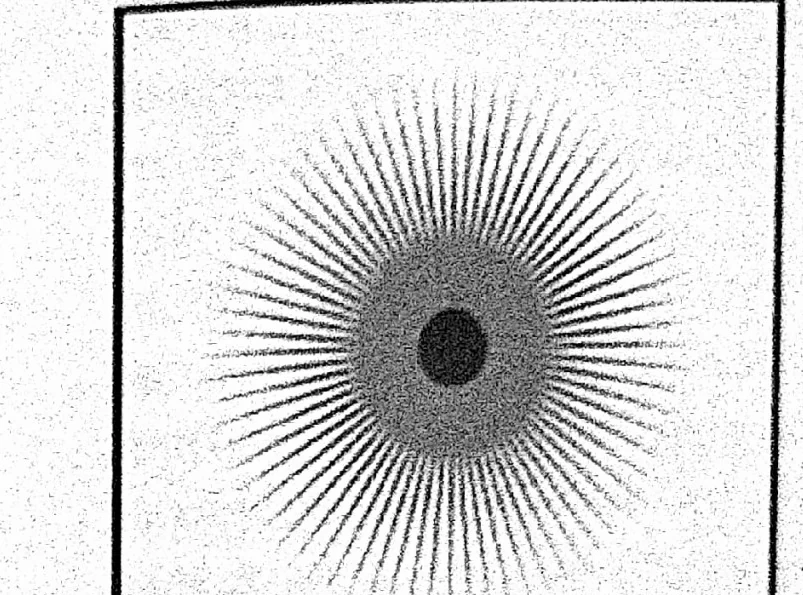
As long as the concentration and state of equilibrium of the mind remain, the young sun (bala ravi) will keep appearing in the black dot. Sometimes rays will be seen bursting forth from the dot. As your practice increases, the duration of the mass of light in the circle will also increase. Begin this sadhana from a duration of two minutes and extend it only up to a duration of ten minutes, and complete two months of sadhana in this manner.
This is the first stage of Bindu Trataka. Now, we take you forward to the second stage. In the method of the second stage of Bindu Trataka, just as in the first stage, you should make a circle of one and a half inch diameter on drawing paper, then color it with black paint and draw twenty-four small lines around it. These lines should be drawn in the same way that rays emanate from the morning sun. It must be ensured that while coloring the circle, the paint is not uneven anywhere, no stains are allowed to form, and no fibers or the like should form anywhere. The lines drawn around the circle should also be at an equal distance. Start the lines from the center of the circle and draw them to a length of exactly four and a half inches. In this way, each line will extend out of the circle and only three inches of it will remain outside. That is because the diameter of the circle made by you is one and a half inches.
Now, this figure you, as before, i.e., of the first stage’s
Draw the picture on cardboard, hardboard, or a piece of wood and hang it on the wall, and begin practicing exactly as in the first stage. Keep in mind that all the conditions and arrangements should remain exactly as they were before. The same environment, the room’s windows and doors closed in the same way, you seated in the same posture, etc. Thus, when you begin the practice with a focused and balanced mind, and your gaze is directed toward that figure, your mental concentration will increase further. Then, just as with the first figure, you will perceive light in this figure as well. The lines drawn by you will appear luminous instead of black. All the lines will not appear luminous at once; some will be black, some bright. This mixed form of darkness and light will be visible to you for only a short while. After this, the entire figure will appear black again, but if your practice continues uninterrupted, then after a short while, the black, luminous figure will start appearing to you once again. In a few moments, this form of the figure will also vanish, and in its place, you will see a golden and radiant figure. This will be such a captivating state that your mind will not want to withdraw from it; however, this kind of practice should not be done for more than fifteen minutes in a single day, because the practitioner loses all sense of time during it. Therefore, it is essential during the practice that the practitioner keeps an alarm clock near them, so that they remain aware of the designated time. After practicing in this manner for fifteen minutes, the eyes should be washed with cold water, or the eyes should be repeatedly wiped with a wet handkerchief.
One should continue practicing this exercise for a month. After this, that is, after one month, its final stage arrives. Exactly like the previous stage, for this too, take a white drawing paper of the same size and make a small black dot on it, approximately the size of a black pepper (kali mirch). Ensure that the black dot made on this white drawing paper is neither too small nor too large. Then, hanging it on the wall just like before, following the exact previous arrangement, in the evening or the first watch of the night, in a completely quiet environment with the room’s windows and doors closed, sit at a distance of three feet from the wall in the same manner and fix your gaze on the dot with a concentrated mind. After a short while, that dot will seem to completely disappear; yet, you must keep your gaze fixed on that spot exactly as before. It is possible that this dot first disappears, then appears, then appears again, then disappears, or becomes blurred. This repeated disappearing and appearing signifies that the concentration of your mind is intermittently decreasing or being disrupted, but you must keep your practice going. By continuing to make constant efforts, after a short while you will see the size of the dot increasing. This state will not last for long; it will occur only for a brief duration.
After this, you will perceive only half of the dot. It will feel as if half of it has vanished, but it will not disappear entirely; rather, it may be seen in very small, tiny forms. The more subtle the dot becomes, the more your mind’s concentration will increase. In this way, as the mind’s concentration increases—becoming strong and powerful—the mind will become deeply absorbed in the practice. As a result, such power will be infused within you that you will find yourself capable of transmitting your mind’s thoughts and your noble ideas into the mind of another person, bringing that person completely under your subjugation, that is, under your control. Coming under the sway of your will and thoughts, that person will begin acting according to you, in a manner favorable to your mind. That person will… their thoughts to you
Murti Trataka
To attain the grace of God, Murti Trataka is the most useful and swiftly successful sadhana. The greatest feature of Murti Trataka is that everyone performs it knowingly or unknowingly. Those who are idol-worshippers and perform daily worship and upasana morning and evening, accomplish Murti Trataka within the same period, or it may be said that Murti Trataka occurs spontaneously for them, and they do not realize that the action they are performing is trataka. In truth, they wish to see their Lord within the murti, and therefore they gaze intently at the murti; gazing intently is itself trataka. They perform trataka every morning and evening, but they cannot recognize it as such because they have no knowledge of trataka sadhana; they simply wish to have darshan of the deities, the Lord, and their ishṭa (chosen deity) within the murti. They do have darshan, and in the very form that corresponds to the outline of their murti. They cannot define their practice as trataka sadhana, but I can define the natural trataka sadhana that is taking place within their worship.
In the descriptions of practices such as Dipaka Trataka, Bimba Trataka, and others, you may have read that the target — that is, the lamp flame or the black dot — trembles in the first stage of practice, appears to move up and down, then rays burst forth from it, then a mass of light is seen, then showers of sparks appear, then flowers radiating luminous golden rays are seen, and then images of deities or of the sadhaka’s loved ones or of the sadhaka’s own emotions appear. Now, if you ask a murti upasaka whether, at times, an aura is seen around the revered murti, whether rays appear to burst from the face, whether supernatural light is sometimes seen, whether the deity of the murti is sometimes seen directly, whether it sometimes appears in a vast form and sometimes in a subtle form — the upasaka says that they have had darshan of the Lord. The Lord manifests in person and grants darshan to His devotees. In reality, the Lord does not manifest. The image of the Lord that exists in the upasaka’s feeling and imagination — that very image, that very form — manifests in the murti at that moment when the upasaka’s mind becomes concentrated, the eyes gaze intently, and the inner eye opens; that is, when the upasaka reaches the turiya state (the fourth state of consciousness), then the image held in his mind and heart manifests in the murti. This is Murti Trataka.
Those people, devotees, upasakas, and sadhakas who wish to have darshan of their God, Lord, Devi, and ishṭa should practice Murti Trataka sadhana. Through this, they will certainly receive the joy and fruit of their worship and upasana, they will have darshan of their ishṭa, and there will also be development of spiritual consciousness and pranic energy. What does a devotee want — God. What does a saint want — nirvana (liberation). What does an upasaka want — bliss. Enjoyment (bhoga) and liberation (moksha) — these are the two things everyone wants. After worldly enjoyment comes moksha, but the two are not obtained together. Those who desire enjoyment will obtain enjoyment, and those who desire moksha will obtain moksha; however, some people adopt the middle path. After living worldly life and enjoying it on the basis of sattvic, moral, and religious principles, they set out on the path of liberation. Such people are followers of the middle path, but to be such is difficult — very few such people exist.
The principle of spirituality is that saints are followers of the path of knowledge (jnana marga), and followers of the path of knowledge regard Brahman as nirguṇa (without attributes) and nirākāra (formless), and consider the goal of their life to be the merger of their soul into the Paramatma — that is, moksha. Secondly, there are devotees, that is, followers of the path of devotion (bhakti marga), who worship regarding Brahman as saguṇa-sākāra (with attributes and form); the goal of their life is paramananda (supreme bliss), that is, the experience of bliss — not the enjoyment of sensual desires. The foremost devotee Tulsidas has said:
Janma-janma rati rāma pada yaha varadāna na āna.
(May I be attached to the feet of Rama birth after birth — this is my boon, nothing else.)
All the above longings, desires, goals, and objectives — whether of a saint, a devotee, or an ordinary person — can be attained through Murti Trataka sadhana, because through Murti Trataka sadhana a person’s mind becomes pure, clear, and concentrated. At the second level, purification of the soul takes place. The worldly grime in the form of coverings over the soul, accumulated over countless births due to enjoyment and indulgence, begins to dissolve, and gradually the soul, becoming pure, becomes like the soul-paramatma — imperishable, immortal, eternal, and pure. Then the soul’s will, whether to merge into Paramatma and attain moksha — that is, to obtain freedom from return to the world — or to take repeated rebirths, continually worshipping Paramatma and experiencing paramananda.
All this will become possible through Murti Trataka sadhana; whatever you wish, try it and see. In Murti Trataka, no new arrangement needs to be made. Those who are already performing murti puja should continue doing so in their own way. After performing pujan, archana, stotra recitation, mantra japa, etc., while remaining seated on the same asana, perform Murti Trataka. Fix your gaze upon the face of the murti, concentrate your mind, and keep gazing intently. When the eyes become tired or strained, close them, press them gently, wipe them with a wet cloth, then once again concentrate the mind, steady the gaze, and gaze intently at your Lord. Perform Murti Trataka for five to ten minutes during daily worship, morning and evening.
People who do not perform puja (worship) or upasana (devotional practice) but wish to attain the above-mentioned attainments, my advice to them is that they should be drawn towards puja-upasana and choose a deity according to their interest, then bring an attractive idol of that very deity and perform Murti Trataka (idol gazing) on it. The idol should be attractive and captivating.
The upasaka (practitioner) should incorporate the principles of Trataka Sadhana into their puja-upasana. It would be optimal if the idol of your Ishta (chosen deity) remains at a distance of three to three-and-a-half feet from your sitting place. Along with this, also ensure that the face of the idol comes in direct alignment with your face, and the direct gaze of your eyes remains fixed on the mukha mandala (facial region) of the idol. If the level of the idol’s eyes and your eyes is the same, then quick and excellent success will be attained in Murti Trataka Sadhana.
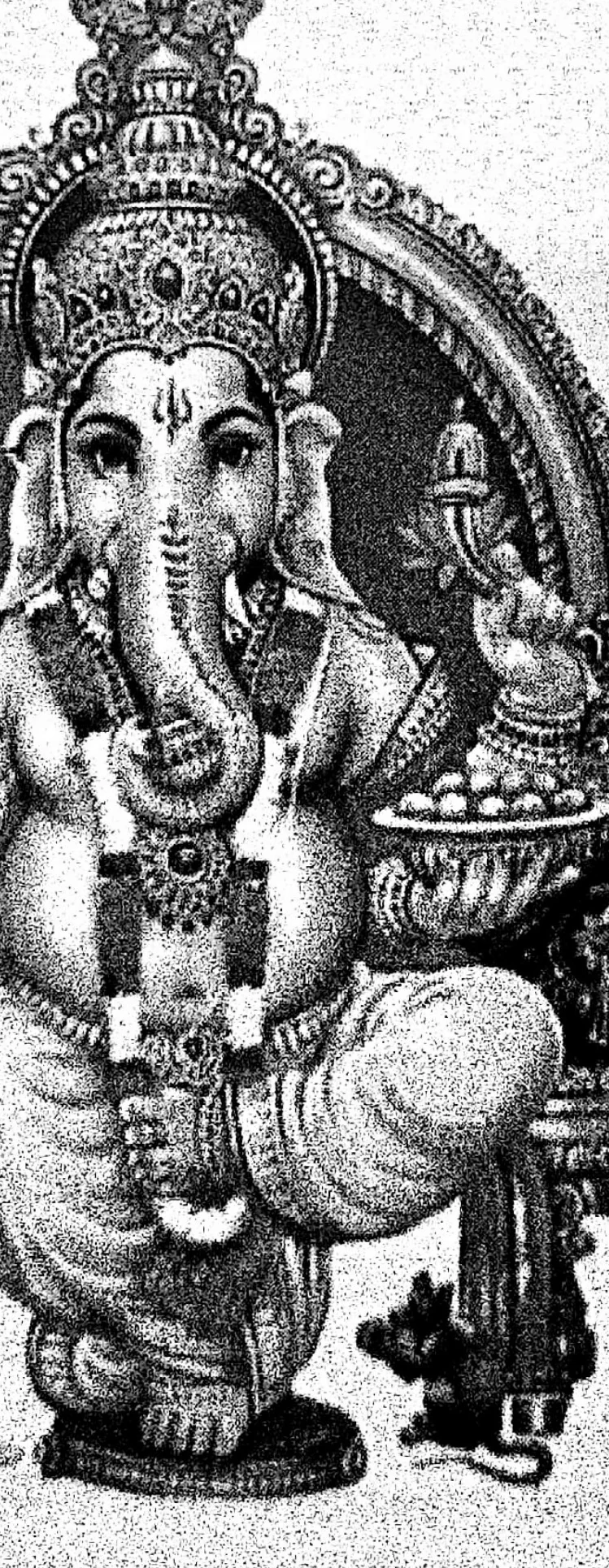
Chitra Trataka (Picture Gazing)
Chitra sadhana is a simple practice of vasheekarana (bringing under one’s influence/attraction) and sammohana (fascination/hypnosis). It is a useful practice for bringing someone into one’s favor or for calling back boys and girls who have run away from home. Performing vasheekarana on husband and wife, on lover and beloved, on high officials — all this becomes possible through chitra trataka sadhana.
I generally perform this sadhana myself whenever the need arises, and also have needy and distressed people perform it so that they may attain their desired siddhi (accomplishment). The first time I performed chitra trataka was on my nephew. This was in 1960. He had run away from home taking some money. Two friends had also run away from home with him, but after staying a day or two in Banaras, both friends left him and returned home without telling anyone. My sister-in-law and brother were very worried; they came to me and asked me to do some tantra-mantra. I took a week’s time from them and said that within a week he would return, or else I would tell them where he was. When I began trataka on my nephew’s photograph, on the very second day the scene of a sea appeared on his photograph. On the third day, along with the sea scene, a curved road and tall buildings were seen. I understood that this was the scene of Marine Drive in Mumbai, but this alone was not sufficient, because finding a moving person in such a large city as Mumbai was difficult. I continued my efforts; on the fifth day I saw Churchgate station, then a paan shop appeared, and in front of the paan shop I saw that nephew. Even this was not enough, so on the sixth day I tried again, and after the earlier scenes, the board of the paan shop appeared — “Banarasi Paan Bhandar, Churchgate, Mumbai.” Seeing this, I was overjoyed; yet that same day I performed another iteration, and then after viewing the above scenes from beginning to end, a new scene appeared — that the nephew was bringing a basket of paan and handing it to the man sitting inside the paan shop.
I was satisfied, but on the seventh day I again performed chitra trataka and formed the intention (bhavana) that the entire scene should appear to me in sequence. That day, all the scenes appeared to me like the scenes of a cinema, and in the final scene a new scene appeared — that the nephew himself was sitting inside the paan shop and giving paan to a customer standing in front of him. It was now clear — the one who had run away from home
The nephew went to Mumbai and, after his money ran out, started working at a Banarasi Paan Bhandar shop. He too, considering him a boy from Allahabad, must have kept him with him.
I phoned my brother and apprised him of the entire situation. He went to Mumbai, reached the exact address I had given him, and brought his son back.
Picture trataka is a fairly simple, useful and effective practice. It is easy to perform and easy to obtain its results, but it is not a practice that awakens spiritual consciousness. Nor is it a practice that produces lasting effects. As long as the practitioner continues the practice, its effect and results will persist. Within two to four days of discontinuing the practice, its effect ceases. This practice can be done several times a day, in multiple repetitions, and one can sit for twenty to thirty minutes at a time. Within a week, a new practitioner will begin to see new visions and will start having new experiences.
For this, take a paper of nine by nine inch size and paste upon it a black-and-white picture of some deity. Paste the picture in the centre of the paper. Coloured pictures should not be pasted in picture trataka. If pictures of deities are not available, or if one has no faith in them, one may use any picture, but do not use a series; use a single picture. One may take pictures of a hero-heroine, a sportsperson, a leader, a great soul, or a picture of a flower or of an object. One may also put up one’s own picture. The dimensions of the picture should be one and a half to two inches wide and three to three and a half inches high — neither less nor more.
Sit before the picture with a concentrated mind at a distance of approximately three and a half feet, and gaze at that picture attentively with an unblinking stare for 25 to 30 seconds, then close your eyes and try to see that picture in your imagination. When that picture becomes clear in the imagination, then open your eyes and look at it as above, i.e., for 25 to 30 seconds. After this, again close your eyes and try to see it with the mind’s eye. In this manner, make at least twenty-one attempts in one day.
By practising continuously in this manner every day, within a few days a state will arise such that whenever you close your eyes, you will see that picture. When, upon closing your eyes, that picture remains steady before your inner eye for approximately one minute, then understand that the third eye of your mind has opened, your inner eye has been activated. This
is the success of this practice. The presiding deity of that picture has become favourable to you. Whenever you close your eyes, you will see wondrous and desired visions. When this process reaches its climax, you will become capable of seeing any person’s past, future, and invisible objects as well. Memory power begins to increase from the very first day.
As one advances, there is no restriction of time for this practice. It can be practised at any time during the day. To send a message to a distant person, or to receive a message from them, or to call them near, taking the support of picture trataka will be entirely appropriate.
Through this practice, spiritual consciousness, physical-mental fortitude, and social respect do not increase, but if the practitioner, while adhering to righteous conduct, remains in the turīya state (the state of the fourth — transcendental consciousness) for a considerable length of time, then one attains prāṇa-energy, magnetic power, and spiritual strength.
Pratibimb Trataka (Reflection Gazing)
Seeing one’s own reflection in a mirror is Pratibimb Trataka. Despite being a simple and accessible practice, it is an extremely important discipline. A practitioner can perform it with ease. Every home necessarily has a dressing table, and a large mirror is attached to the dressing table. Sitting on a stool or chair in front of that very mirror, you can practise Pratibimb Trataka. In Pratibimb Trataka, you have to gaze at the reflection of your own face.
If you do not have a dressing table, or if you wish to practise Pratibimb Trataka in your private room, then you should bring a good mirror measuring one-and-a-half by two feet from the market. Hang this mirror on the wall in such a way that when you are seated, your reflection in the mirror falls directly in line with your eyes. Sit at a distance of two-and-a-half to three feet from the mirror. For the first two-three days, simply keep looking at your face, then fix your gaze on the forehead of your reflection. For two-three days, look only at the forehead. When you feel that the one-pointedness of your mind and the one-pointedness of your gaze have merged into one, and you see only the forehead in your reflection and nothing else, then from the next day onwards, centre your gaze on the Trikuti. The Trikuti is that place on the forehead where the upper part of the nose meets and both eyebrows begin — that is, the area between both eyebrows and the upper part of the nose is called the Trikuti, the place where a tilaka is applied, or where women apply a tikuli or bindiya. Now you should centre your gaze on the Trikuti. In Pratibimb Trataka, this spot is your target. This is what you have to gaze at; this is what you have to perform trataka upon — with one-pointedness of mind, with one-pointedness of gaze.
Before commencing the practice, close the windows and doors of the room. If the windows and doors have glass panes, then curtains must be drawn. The room should be clean and tidy, and the atmosphere should be peaceful. Do not run a fan, cooler, or air conditioner in the room. If there is a concern that due to heat the one-pointedness of body and mind may be disrupted, you may run the fan on number one. Ensure that no sound of any kind emanates from the fan. One hour before the practice, light an incense stick of excellent fragrance in the room so that it stops emitting smoke before the practice begins, and a gentle fragrance lingers in the room. Such a fragrance is conducive to the attainment of one-pointedness of mind, and a divine atmosphere is created in the room. The mind becomes focused and the heart becomes joyful.
Making the mind free of thoughts, concentrate it, and keep gazing at that spot of the mirror reflection which is called the Trikuti. As your mind begins to become concentrated, your reflection will appear hazy. After a few days, during the practice period, that reflection will first become hazy and then become invisible. Over the next several days, the reflection of the face will become hazy, become invisible, then reappear, then become hazy again, become invisible, and reappear — this sequence will continue. This practice should be done first for five minutes, then ten minutes, then fifteen minutes, then twenty minutes, at intervals of week by week — that is, the first week for five minutes, the second week for ten minutes, the third week for fifteen minutes, and the fourth week for twenty minutes, you may practise Pratibimb Trataka.
After one month, increase the duration of Trataka practice to twenty-five minutes and continue practising Trataka for twenty-five minutes for the entire month, then from the next month increase it to thirty minutes and always practise for thirty minutes. After four weeks of practice, you will have new experiences. When you gaze at the reflection in the mirror and the power of gaze becomes concentrated and fixed on the Trikuti, your own reflection will first become hazy and then become invisible. After that, in place of the reflection, some scenes will begin to appear. In these scenes, forests and groves, gardens, trees and plants, mountains, staircases, waterfalls and rivers, etc., pictures of deities, and also pictures of your own loved ones may appear. Such pictures demonstrate that your practice is proceeding on the right path.
From these scenes you will receive both inspiration and joy, because these scenes are proof of the fact that the images present in your subconscious mind are being reflected onto the mirror. In the beginning, you see the reflection of your gross face; later, in place of the outline of your own face, reflections of the emotions of your subconscious mind begin to appear. The things your emotions are connected with, the emotions you have imagined, the pictures you like, the loved ones you wish to meet or converse with, those who are helpful in your progress, the deities from whom you expect auspicious blessings, and all the images you have stored in the feelings of your subconscious mind — those very scenes will appear on the mirror in place of your reflection. The mirror will perform a function like that of an X-ray machine. When a person stands before an X-ray machine, the external structure of his clothing, skin, and flesh disappears, and the internal part of the body is reflected before him. In the same manner, in Pratibimb Trataka, the practitioner’s external reflection becomes invisible, and
The images of the subconscious mind appear before the mirror. In this way, some time passes while practicing. Along with these experiences, a change occurs in your physical, mental, and spiritual nature. The practitioner begins to develop a refined, moral, and ideal personality. After practicing for a few more months, he sees a light in place of his reflection. Now the previous state comes to an end; he no longer sees various kinds of images, or as soon as he sits in practice, his gross reflection is seen, which then quickly blurs and becomes invisible, and after that, a bright light remains visible. This is the Turiyavastha (the state of the fourth state of consciousness beyond waking, dreaming, and deep sleep) of the practitioner. When the practitioner reaches the Turiyavastha, no task remains impossible for him. The visual power of the eyes becomes intense, and a strange radiance settles in them. With such radiant eyes, whoever he casts his gaze upon, he brings them under his control. If the practitioner looks into another person’s eyes and holds the gaze for even a moment or two, he will mesmerize and subjugate them. Then, whatever command he gives them, they will obey. His eyes will become the eyes of hypnotism and subjugation.
With willpower and hypnotic power, when the practitioner looks at an object and keeps gazing at it for at least ten minutes, that object will come under his control, and even an inanimate object will become obedient to the practitioner. I saw a trataka practitioner at a reading desk and also observed that whenever he formed the intention to acquire his spectacles, pen, pencil, or paperweight placed on the desk, that object would lift off the desk by itself and come to him. As soon as the telephone rang, if he looked toward the mouthpiece, the telephone’s mouthpiece would lift and turn toward him. I too, out of curiosity, have experimented with this on animals and birds during trataka practice. Changing the direction of birds flying in the sky was an easy task for me. I did not do this knowingly, nor do I do it now, because it diminishes the spiritual power of the practice. At that time, I was on the second stage of trataka practice. One day, due to the heat, I was sitting on the roof. At dusk, a flock of birds was coming from the south direction; I liked that sight. I kept looking at them with a trataka gaze, when suddenly a feeling arose in me: what if two of these birds changed their direction? And upon seeing it, I was astonished myself, that as the flock of birds was moving northward over my roof, two birds from the middle row broke their formation and started flying toward the west. Seeing this, I felt both joy and sorrow. I squeezed my eyelids shut tightly and formed an intention from my subconscious mind that those poor birds should not be distressed by being separated from their flock. A few moments later,
when I opened my eyelids, I saw that after taking a turn towards the west, those same two birds were flying northward, behind their flock.
Through Pratibimb Trataka (Reflection Trataka), various types of hypnotic powers can be attained. The power of the gaze has a profound effect on objects, persons, animals, and birds. To achieve success in attraction, vashikaran (subjugation), and mohani vidya (the science of fascination), one should practice Pratibimb Trataka, but it will also be necessary to keep certain things in mind.
Only moral conduct and moral goals can grant good success to the practitioner. If I may clarify my point, practicing daily on a school-going girl is unethical. Performing vashikaran on another man’s wife is unethical. It is possible that a practitioner might achieve success in such acts the first time, but success cannot be attained every time, nor can that success be permanent.
The practitioner must ensure that the objects he is working to bring under his control are not allowed to go near water or be touched by water; otherwise, the gaze practice and the subjugation practice performed on them will immediately end. Water will destroy all the magnetic power of your visual influence, which has been built up by daily intention. One should not direct intentions toward objects kept in water, or toward aquatic creatures and flowers, because water washes away all your intentional power.
The mirror used for Pratibimb Trataka practice should be kept wrapped in a red or orange cloth. Do not use it for daily activities. Put a cover over the dressing table mirror. No one else should use such a mirror. It would be more appropriate to acquire a new, good mirror separately for trataka practice.
Trataka on Om and Swastika
Om (ॐ):- Omkara is the name of Brahman. It is Brahman directly. In Indian religion and philosophy, Om has its own distinct significance and place. In Sanatana Dharma, Om is regarded as Brahman directly. Om is directly Shiva, Brahma, and Vishnu. Omkara itself is that limitless sound and nada, which is called Brahmanada. Omkara is not any letter or vowel-consonant. It is a mechanical form. It ought not to be written in letters, as has become prevalent these days. Writing “Oum” may serve as a makeshift, but it can never be Omkara, because its pronunciation can never be Om. Even when read, the tone of Om does not emerge. You can yourself pronounce it and see and understand. O + I + M = Oum can never be read or pronounced as Om. In Vedic texts, Om is found written in various forms, but Oum is never written. If you look carefully in the Vedas and Shastras, you may possibly find this form of Om — “Om” (ओम्). This symbol “ँ” (the chandrabindu/anusvara mark) is not “u” (उ), nor is it pronounced like “u.” The pronunciation of this “ँ” symbol serves to elevate the sound of the preceding letter’s pronunciation, or to prolong the nada of that letter. Therefore the pronunciation of Om emerges like the subtle sound of a conch. It is possible that Om’s pronunciation emerges like the subtle sound of a conch. It is possible that Om’s transformed form became “Oum” or “Oum,” “Om” due to the typing system, or that people unaware of Om’s significance changed it to “Oum” in the type-press and computer system, but all of this is defective. It should not be accepted.

One must understand the tone and nada of Om. Om, Oum, On — the tone of all three may resemble Om, but it cannot match the tone of Om. When readers see and read Om written as Oum in books on Dharma, Tantra, Mantra, Jyotisha and other subjects, they feel no hesitation in accepting it as Om; but in pronunciation, in writing it anywhere, in accepting it as the form of Brahman, we ourselves feel hesitation, and we can only accept the true Om. If we do not do this, then even while explaining Om’s greatness, we will not be able to derive any benefit from its form, its shape, or its tone. Please do not read or write a Brahman-form mantra like Om in a distorted manner; read and write Om as Om alone. My request is: let Om remain Om — in this alone lies well-being, because in this form it is the Om mantra, and in this form all its powers can prove beneficial for us and for you. In Adhyatma, Om is regarded as the direct Saguna-Nirguna Brahman, and in Mantra, Om is regarded as the Pranava-form Brahman; but in Yantra, Om is regarded as a Yantra-form Brahman.
Om has various applications and uses. In its Pranava form, Om comes first in every mantra. Without Pranava, no mantra has any effect. You must already know much about the importance and application of Om even without reading about it, because Om has become so prevalent in the Indian consciousness and in Indian religion that every child in a Hindu family has begun to understand and know Om. Whether or not the child understands the importance, sentiment, and meaning of Om, the child pronounces Om and writes Om before beginning any special daily task. Whether it is a scripture, a birth chart, an auspicious letter, a merchant’s ledger, a ledger book, a day-book, government writing, or a personal letter — we Indians write Om first, and only after that do we write anything further. From this it should be understood that Om has fully permeated the Indian consciousness. One who is Hindu cannot separate this Om from oneself.
Om, while being the Supreme Brahman, Parameshwara, itself, is the Sakara (with-form) form of the Nirguna-Nirakara (without-qualities, without-form). It is a mantra; it is a yantra. Om is the Brahmanda (cosmos) and pervades all that is egg-born and womb-born, the inert and the conscious. Therefore, Om should first be accepted in its original form itself.
To perform trataka on Om, you will not need to make any special arrangement. Just as with yantras, trataka sadhana can be performed on Om as well. For your information, let me clarify that an Om made of metals can be used, or Om can be drawn on a piece of paper in black, red, or vermilion colour. For simplicity, you should take a black paper and draw Om in the centre with white colour. Draw a circle around Om and draw rays radiating outward from the circle. Now paste the paper on a wall of the room upon which light from the door or window falls. Your distance from Om should be two to two-and-a-half feet, and the image of Om should be at the height of your eyes, so that it remains in the straight line of your gaze — that is, from a distance of two, two-and-a-half feet, you should look at Om in such a way that
Your eyes should neither look upward nor downward. The eyelids should be neither lowered nor raised. While gazing, there should be no kind of strain on the eyes.
On the first day, perform trataka for only one minute. If you wish to do more trataka, then keep your eyes closed for one minute and meditate. Then open your eyes and perform trataka. If you feel that there is no strain in your eyes, that you are experiencing no discomfort in sitting in the āsana posture, and that you wish to continue trataka for a longer time, even then do not under any circumstances perform trataka beyond one minute. For one week, perform trataka for only one minute.
After one week, you may perform trataka for two minutes for up to one month. In the second month up to three minutes, in the third month four to five minutes, in the fifth month five to seven minutes, and in the sixth month up to ten minutes. After the sixth month, keep the duration of trataka at only ten minutes for one year. After that, you may increase it by two minutes each month, but there is no need to increase it beyond ten minutes, because maintaining continuous concentration for more than ten minutes — keeping the mind one-pointed — is not possible. If any sādhaka accomplishes this, then they should understand that they will attain the perfection (siddhi) of trataka sādhanā. One should not exhibit any kind of haste, rushing, restlessness, flurry, over-enthusiastic tendency, or a display of one’s own capacity. If you make the mistake of showing such enthusiasm, then many difficulties may arise later. You should apply your entire capacity to concentrating the mind.
Swastika: — The eight auspicious symbols (aṣṭa-māṅgalya) each hold their own significance. Among all the auspicious symbols, the swastika occupies the foremost place. The sentiment of worship or the auspicious belief toward the swastika is not confined to our country alone; rather, its importance has been acknowledged in many countries across the world. Its art and auspicious sentiment cannot be bound within the limits of space and time.
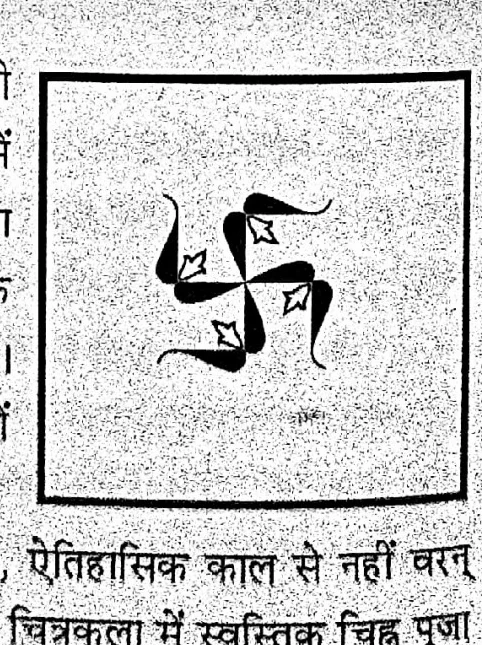
Indian scholars were acquainted with it not from the Vedic period or the historical period, but from even earlier — the prehistoric period itself. In Indian painting, swastika symbols are found in paintings of places of worship. In the art of Ajanta too, swastika symbols are depicted; in those paintings, the human figures and their attire reflect a fully primitive and wild way of life. In those paintings, the swastika is also fashioned from a double arrangement of rows of triangles. There, forms resembling a cross, i.e., a multiplication sign, are found. In the work called Śatapatha Brāhmaṇa (Sahasrārdha),
there is mention of an independent goddess named Svastikā. The worship of that goddess named Svastikā was performed considering her as the embodiment of the four Vedas. She was called the purifier of the supreme state (paramapada). Not only that, she was regarded and worshipped in the form of Vāgdevī or Sarasvatī (vāg vai pathyā svastikā). In course of time, that very Svastikā goddess came to be regarded and worshipped in the form of Vāgdevī or Sarasvatī.
The four arms of the swastika are regarded as the four Vedas. Some scholars, considering the four arms of the swastika as symbols of the four directions, have taken it to be a sign of the Sun or a symbol of the Sun. Dr. Vasudev Sharan Agrawal has written clearly: “This symbol of the quadrilateral form of the universe pervading the four directions is related to the Sun. This maṇḍala is composed of the prācī (eastern), southern, pratīcī (western), and udīcī (northern) directions, and the Sun is its central part.” This is the supreme auspicious symbol of humanity and the universe.
The four arms of the swastika were considered to represent Agni, Indra, Varuṇa, and Soma. Later, this place was assigned to the Lokapālas — the Gandharvas were associated with the east, the Kumbhīras (Vīruḍhakas) with the south, the Nāgas with the west, and the Yakṣas with the north. In this way, through the conjunction of all these, the importance and form of the swastika continued to develop and spread further. The four-footed Brahman (catuṣpād brahma) described in the scriptures is also identified within the swastika. In the Purāṇic period, its connection was conceived with the four-faced Brahmā. Wherever the importance of anything increased in the number four, there the significance of the swastika also spread. The forms of the swastika are found conceived under different names and shapes in various regions and rural areas. The swastika is also called by names such as Sakhiyā, Sāthiyā, Sāthiye, Sathiye, etc. In fact, all these words have developed from satyaka (सत्यक). It should be understood as an apabhraṃśa (corruption) of satyaka.
Indian society makes the swastika in its vows, worship, and auspicious functions. As an auspicious symbol, it is drawn above the main doorway and on walls. Whether it be Rajasthan or Maharashtra, Gujarat or Madras, east or west, north or south — in all provinces where the art of raṅgolī is developed and raṅgolī is made daily at the doorstep and in the courtyard, the swastika symbol holds an important place. Especially in Gaṇapati-worshipping provinces, the recognition of the swastika is even greater, because there the swastika is regarded as a representation of Gaṇapati. Along with the idol of Gaṇapati, the swastika is also worshipped. When there is no Gaṇapati idol, drawing a swastika and performing worship is considered equivalent to Gaṇapati worship.
In the saguṇa (qualified/with-attributes) form of ॐ, the swastika is accorded recognition. The swastika is regarded as the Oṃkāra’s
…is considered a manifested (sākāra) form. At the time of beginning education, the acharya (teacher) makes the child draw a swastika with the child’s finger on the child’s writing board. Be it religious writing or commercial writing, on ledgers and books, the mark of a swastika is made first with roli, kumkum, or sindoor (sacred powders).
In this way, it is indisputably proven that the importance of the swastika is no less than that of Om (ॐ). The powers of all four Vedas are contained within it. Its central part is in the form of Brahman (the Absolute), therefore we should worship the swastika daily.
In trataka sadhana, by focusing the mind on the complete outline of the swastika, transcendental siddhis (perfections) are attained. In the later Upanishad named Dhyanabindu, it is simultaneously described as both ashtanga (eight-limbed) and chatushpada (four-footed). When the four arms are joined, eight arms appear, hence it is given the term ashtanga. In the Yoga Shastras, the swastika is recognized as the chakras for the awakening of Kundalini. The swastika is considered the foundation of body anatomy in the form of the Kundalini chakras. In ancient times, the swastika was considered the ideal in both city planning and military array (vyuha) formations. Even today, every crossroad is in the shape of a swastika.
Considering its importance, it is regarded as a symbol of dynamism, progressiveness, and development. Performing trataka on the swastika yields benefits in both material and spiritual directions. Dynamism and progressiveness automatically enter the life of the trataka practitioner. Therefore, practitioners who wish to perform trataka sadhana on the swastika should certainly do so. By attaining spiritual consciousness, prana energy, and magnetic power, the practitioner transforms from an ordinary person into a special person. He makes his prana energy a means for the union of the soul (atma) and the Supreme Soul (Paramatma). However, those who desire physical, mental, and financial dynamism and progressiveness should also perform trataka sadhana on the swastika. For women, this symbol grants happiness, good fortune (saubhagya), wealth, grain, and sons, grandsons, etc. For students, teachers, and writers, swastika trataka sadhana will prove highly useful.
To perform trataka sadhana on the swastika, one should use swastika symbols made of brass, silver, gold, copper, plastic, etc. Nowadays, ready-made swastika symbols and Om are available in worship supply stores and other shops. Symbols of Om, Swastika, and Shri, or their idols/images, can be found at religious sites, pilgrimage places, and shops near temples. Bring them and place them somewhere; if these are made of metals and have a stand attached, or you can keep them on a table and perform trataka. If there is no stand, stick these symbols onto a stone with the help of Fevicol (adhesive), and keeping it straight upright, perform trataka. If you wish, you can also stick them on the wall. Your distance should be two high feet and your eyes should be in line with the target. Perform the rest of the sadhana in accordance with the information given about Om in the previous pages. Follow the duration of the sadhana, etc., in the same manner.
Whether you perform the sadhana on Om, the swastika, or Shri, your first experience will be that the target you are looking at will become invisible. In the second experience, it will appear to have shifted from its place, meaning it will appear to be up-down, right-left from its original place. In the third experience, remaining stationary in its place, it will be seen emitting rays. Gradually, these very rays will take the form of a mass of light, and the mass of light will take the form of fireworks’ circles, sparklers, ground spinners (chakris), spinning wheels (charkhis), etc. Seven-colored rays will also begin to burst forth. If you do not wish to use metal swastikas, then use the same method for the swastika as I have described for performing trataka sadhana on Om.
Shrim (श्रीं): — Shrim is the bija mantra (seed syllable) of Lakshmi Ji, which grants wealth. Only those desiring wealth and prosperity should perform trataka sadhana on the Shrim bija mantra. Its essential procedure is similar to the information described regarding Om and the Swastika. The actions to be performed for that are the same as what needs to be done for this. Readers can easily understand this.
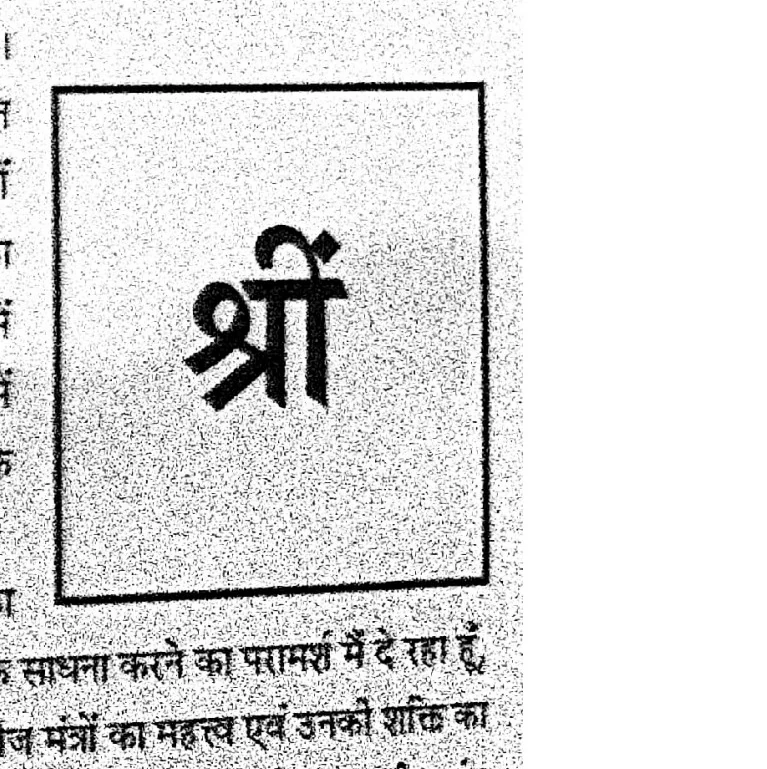
In Tantra sadhana and Mantra sadhana, bija mantras hold the utmost importance. Therefore, I am advising to perform trataka sadhana on bija mantras, but due to considerations of time and space, I cannot provide a description of the importance and power of all the bija mantras. I am mentioning the power of the primary bija mantras. Draw the image of whichever bija mantra you wish to perform trataka sadhana on, in white color on black paper.
Aim (ऐं) is the bija mantra of Saraswati, Hrim (ह्रीं) is the benevolent bija mantra, Klim (क्लीं) is the Kama (desire) bija mantra, Krim (क्रीं) is the bija of Mahakali, Haum (हौं) is the life-protecting mantra, Jum (जूं) is the Brahma bija, Aum (औं) is the bija for subjugating the world (loka vashikarana), Dam (डं) is the holding (dharak) bija, Dum (दं) is the Durga bija, Ram (रं) is the Agni (fire) bija, Yam (यं) is the Vayu (air) bija mantra, Gyam (ज्ञं) is the knowledge bija, Gyam (ज्ञं) is the knowledge and protector bija mantra. In this way, by understanding the powers inherent in other bija mantras, you can perform trataka sadhana on any bija mantra to attain your desired fruit. Yes, if you also continuously chant (japa) that same bija mantra while performing the sadhana, you can attain excellent and swift success.
Trataka on the Shri Yantra
In the Tantra Shastra (Tantric scriptures), Yantra Sadhana (yantra-based spiritual practice) holds great importance. Yantras are constructed with a geometric structure. These yantras are Vedic, Tantric, and Shabari. In mantras too, a classification is made into Vedic, Tantric, and Shabari mantras. These yantras are engraved on the earth, on Bhojapatra (birch bark), on paper, and on various metals. They are considered to be the representations of goddesses, gods, the sixty-four yoginis, yakshinis, apsaras (celestial nymphs), and spirits/ghosts. These yantras are highly powerful in themselves. Many of these yantras, especially the Shabara yantras, are used without prana-pratishtha (infusion of life force), and they assist in the accomplishment of tasks because their structure is such that an energy emanates from them, generating an electrical flow.
In the yantras of gods and goddesses, performing prana-pratishtha is necessary, which makes the yantras highly energetic and capable of generating an intense electrical flow. If the prana-pratishtha is done in the name of a specific person, these yantras quickly bring benefits to that person and provide divine power in fulfilling their desires.
The Shri Yantra is a Vedic yantra. It is mentioned in the Vedas, and the importance of the Shri Suktam is described in a glorious manner in the Rigveda. The construction of the Shri Yantra is also done in various metals. Shri Yantras engraved on copper sheets are accessible to common people. Shri Yantras engraved in silver and gold are of superior grade, respectively. Shri Yantras made on sphatik (quartz crystal) and parad (mercury) are of a high grade. Shri Yantras made on semi-precious and precious stones are the absolute best. Shri Yantras made on yellow pukhraj (yellow sapphire), with a golden embossed figure upon them, are the very form of Lakshmi Herself and are quickly fruit-bearing. The worship, adoration, and sadhana of these yantras are done just like the idols of gods and goddesses because they are themselves the representations of gods and goddesses.
To perform Trataka Sadhana on yantras, the first requirement is that the yantra should be clean, bright, and its structure should be embossed. If the yantra has become stained, it should be cleaned by rubbing it with a mixture of bhasma (sacred ash) and lemon juice. Even then, after wiping it, it should be polished by rubbing it with genuine yellow sindoor (vermilion). Since yellow sindoor is made from parad
therefore it has the power to produce a shine on metals. Brass, acid, or vessel-polishing polish should never be used. Various types of rays emanate from a radiant yantra.
While practicing trataka on yantras, you will see your past, future, and present, but all this may become visible within one to six months of practice. If your mental disposition is to see the past of your life, then while practicing trataka, pictures of your past life will surface, or a corresponding symbolic scene will appear. If you wish to see a scene of your present life, you will likewise need to practice trataka holding that sentiment. For glimpses of the future as well, the presence of the corresponding feeling is absolutely essential; however, you cannot easily analyze the future pictures you see. For that you will need to take my help. Nevertheless, I provide some general indications: when images of gods and goddesses emerge on the yantra, consider your future prosperous and happy. If images or outlines of auspicious objects such as a conch, cow, lotus, lamp, kalasha, sun, moon, twinkling stars, a green and lush field, a fruit-laden tree, fish, a woman churning curd, a weaver, a school, a temple, a priest, a brahmin, a student (male or female), a teacher, a swan, a parrot, a deer, a lion, an elephant, a blue-throated bird (nilakantha), rainfall (but not clouds), a waterfall, a river, etc., appear, then assess your future in accordance with those very images.
If clouds, a crow, a jackal, a hyena, an extinguished lamp, a broken idol, a broken temple, any broken object or place, fire, a funeral pyre, an extinguished or smoldering piece of wood, a sign of danger, a closed gate, a running train, a standing signal, an old hunched woman, a frail man, a widow in white garments, a dried-up river, waterfall or pond, a starless sky, a dim sun, a moon covered by clouds, the sun or moon during an eclipse, a black dog, a buffalo, a bull, a he-buffalo, a serpent, and such inauspicious objects appear, then one should anticipate bad and unwelcome events in one’s future.
A merchant in Delhi had ordered a Shri Yantra from me. After six months he called to say that in the center of the Shri Yantra he sees an extinguished lamp. Thin lines of smoke rising from the lamp’s wick are visible, meaning the lamp has just been extinguished. I told him, “Protect your son, he may have an accident.” By that gentleman’s words, by the result of that image, the immediately extinguishing lamp was foretelling their future: their lineage’s lamp would be extinguished. The next day I called myself and he informed me, weeping, that the boy had met with an accident while going to Hisar and was lying in a “coma” at AIIMS. I understood and said nothing; on the third day he died.
Shri Phoolchand Goyal had ordered a Kuber Yantra from me; in it he would often see flying black
used to watch clouds. They too had passed away.
Similarly, a widowed Brahmin woman from Banda district, Uttar Pradesh, had taken a Mahalakshmi Yantra. She would see a pot (kalasha) from the very first day. Sometimes she would see a conch shell above the pot and a lotus flower placed atop the conch shell. When she told me about it and asked the result of that image, I reassured her that she was about to receive money from somewhere and auspicious events would take place in her home. Perhaps her daughter’s marriage would take place this very year. Her husband had been dead for two years, but his pension fund had been held up. The daughter’s age was advancing, and there was worry about her marriage. The son was studying for a doctorate in Poona. She was running expenses with the LIC money, and that too was about to be exhausted. Upon hearing the result of the auspicious image seen on the yantra, she was pleased. Within one month, her husband’s fund and so forth were received, and from the second month she began drawing the pension.
Various such recollections are surfacing in my mind, but all the recollections cannot be written here. By performing trataka sadhana on yantras, not only the past, future, and present are seen, but the result corresponding to whatever the yantra is, is also obtained. By performing trataka sadhana on the Mahamrityunjaya Yantra, death is averted, health is gained, and well-being is built. If images of death, disease, accident, operation, childbirth, etc. appear, then one should become alert and perform the life-protecting Tantra sadhana.
Similarly, the Dhanavarsha Yantra, Kubera Yantra, Mahalakshmi Yantra, Vaibhavalakshmi Yantra, Durgavisa Yantra, Saptashati Yantra, Ganesha Yantra, etc., are givers of wealth, prosperity, and abundance. When inauspicious scenes appear in them, one should understand them as loss of wealth, poverty, theft, commercial loss, etc.; but if auspicious images appear, then auspicious events take place, such as increase in wealth and grain, growth in money, expansion of sources of income, promotion, increase in salary, return of money given, freedom from debt, commercial success, rainfall of money in business, and the purchase of gold, silver, diamonds, and jewels.
The Shri Yantra is the king of yantras. Do not, like others, regard the Shri Yantra merely as a wealth-bestowing yantra, and do not make the mistake of considering it the Lakshmi Yantra. The Lakshmi Yantra is different and the Shri Yantra is different; moreover, the Shri Yantra is not merely distinct from the Lakshmi Yantra — it is greater. Through the sadhana of the Lakshmi Yantra, wealth can be obtained. Gold, silver, diamonds, jewels, land and buildings — all can be obtained, but prosperity cannot be obtained, honour cannot be obtained, prestige cannot be obtained.
A beggar in Mumbai also amassed immense wealth from money, but while he had immense money, he had no prosperity and no honour. On the other hand, people like Vasantrao Deshmukh and Shiv Sena chief Bal Thackeray possess both immense wealth and great prestige. There is a difference between Shri and Lakshmi. Their meanings are different.
Lakshmi is understood to mean only the goddess of wealth, but the meaning of Shri is:
Lakshmi + Vaibhava (prosperity) + Sammana (honour) + Kirti (fame) + Punya (merit) + Purushartha (spiritual endeavour) = Shri.
The Shri Yantra bestows all these things, and therefore the Shri Yantra holds a glorious place in Vedic literature. A person who worships the Shri Yantra and recites the sixteen verses (richas) of the Shri Sukta can never become impoverished. His prosperity can never be touched. His honour can never be slighted.
The structure of the Shri Yantra is similar to the structure of the cosmos. Mathematicians from America, Soviet Russia, China, Japan, and Germany have, with one voice, described the geometric structure of the Shri Yantra as the discovery of an algorithm. It has also been regarded as a replica of the cosmos. Tantrics regard it as the city of Shiva-Shakti, Vishnu-Lakshmi, Brahma-Sarasvati, and thirty-three crore (330 million) deities. Therefore, through the worship of a single Shri Yantra, all thirty-three crore deities are worshipped simultaneously.
Perform prana pratishtha (life-infusion consecration) upon a Shri Yantra that is embossed, or seated upon Mount Sumeru, or placed upon a kacchapa (tortoise base) — or have it done. Then perform trataka sadhana upon it, and you will see miraculous effects and its benefits as w
While performing trataka on the Shri Yantra, you will see divine lights. Seven-hued rays will be seen flying. Then forms of gods and goddesses will appear, then sparklers or showers of sparks will be seen, then golden palaces will appear, then golden champaka blossoms will be seen falling or flying, and after a long while such a radiance will scatter all around the Shri Yantra that it will captivate your mind, and the practitioner, filled with longing for it, will remain seated with eyes wide open, gazing. Often in such a state the practitioner rolls from his seat and slips into yoga nidra (yogic sleep); then he beholds a prosperous family — complete with wealth, grandeur, land and buildings, vehicles, sons and grandsons, and relatives. This is the practitioner’s future, but it will be a worldly and material future.
In addition, he will see a heaven realm filled with gods and goddesses. Light from a golden mountain and a river of gold flowing will appear. The practitioner will see himself walking along that river, heading toward a celestial cave. This will be his spiritual future. The practitioner himself must choose what he wants and which direction he must go.
Trataka on a Crystal Ball
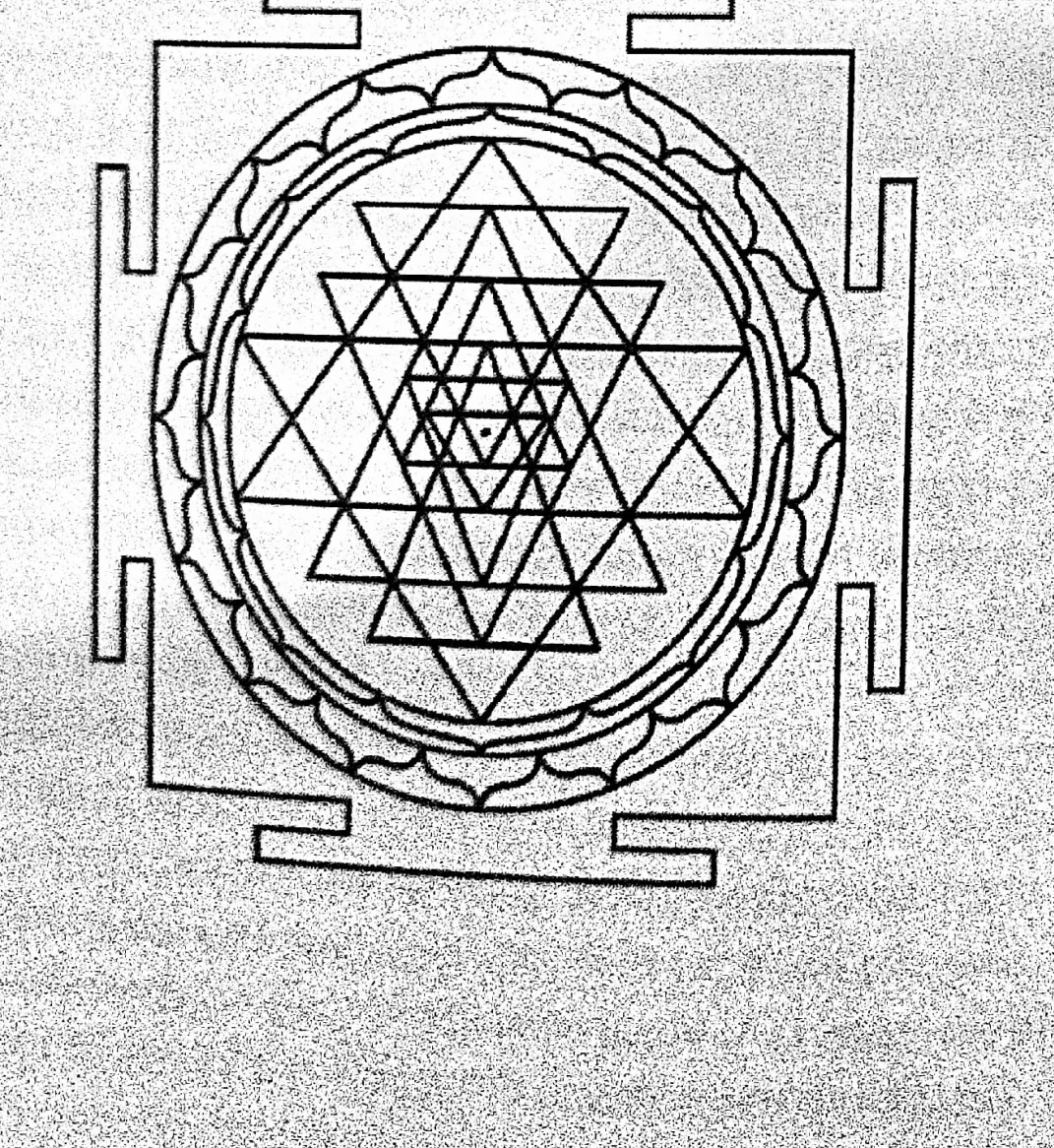
The method of telling the future by performing trataka on a sphere of crystal stone or a glass sphere is quite ancient and has been widely prevalent abroad. A crystal ball is not easily available to the common person. Besides, it is quite expensive. It is a sphere of one and a half to two inches in diameter. This sphere is completely solid and heavy. It is so solid that not even a single air bubble exists inside it. If you ever wish to buy a crystal ball, you must ensure that there is no flaw of any kind anywhere inside it; otherwise, doing sadhana upon it will be defective. Compared to glass, a crystal ball of sphatika (quartz crystal) is more useful, more successful, and yields quicker results.
You can make a crystal ball yourself; although your handmade crystal ball may not be durable, sturdy, or usable for many days, it will be so inexpensive that it will cost not even one hundredth as much as a real crystal ball. After presenting the description of trataka sadhana on a real crystal ball and of knowing the future, I shall discuss the homemade crystal ball and trataka sadhana upon it.
You can obtain a crystal ball from gem dealers, jewellers, and spectacle sellers. Bring the crystal ball; have a wooden stand made to its exact measurements so that the sphere does not wobble or fall when placed on a table without a stand. Place the crystal ball on a cloth spread over a wooden table and fix your eyes at the same height. The sitting distance should be approximately three feet, and the middle portion of the crystal ball should be at eye level. You can obtain the remaining information by reading the description of Chitra Trataka (picture trataka) or Pratibimba Trataka (reflected-image trataka). Practice of yoga and pranayama, etc., should be done as per the earlier trataka sadhana, so that your mind can become concentrated.
Those who are experienced practitioners of trataka sadhana and are performing trataka through other methods may, if they wish, place the crystal ball in their palm, raise it to eye level, and perform the sadhana. The time of twilight (sandhya) is the most suitable for the sadhana of the crystal ball. This sadhana cannot be done in daylight or in the darkness of night. If you wish to do the sadhana during the day, you can do it in a closed room. The windows and doors should be closed and curtains drawn over them. There should be no electric light of any kind. Only the natural, gentle light present in the room — that much light alone is needed for crystal ball trataka sadhana
is sufficient. One should fix the gaze with unblinking eyes on the crystal ball. Your mind and consciousness must be one-pointed, which is essential in all types of trataka sadhana. Keep in mind that continuously staring at the ball can cause your eyes to hurt. If any strain begins to build in the eyes, the eyes start aching, or water begins to flow, then close your eyes. If there is aching in the eyes, apply pressure on both eyes with your fingers; even then, if the strain or discomfort does not go away, cool your eyes with a wet handkerchief. Before sitting for the sadhana or before beginning the practice, you must keep a wet handkerchief on your seat. During the duration of the sadhana, whenever there is strain or discomfort in the eyes, cool the eyes and make them strain-free using the above-mentioned process.
With strain-free eyes, fixing your gaze and focusing your mind, look at the central part of the crystal ball. Keep the viewing duration at 5 minutes for one week. Keep increasing it by five minutes every week. After one month, limit yourself to a duration of twenty-five minutes. Follow my instruction regarding the duration strictly. Out of curiosity, never rush or hurry; otherwise, you will deviate from the correct path of the sadhana and will also create disorders in your eyes. Trataka sadhana also improves eyesight, but adopting the wrong method causes disorders in the eyes, creates vision defects, and diminishes eyesight.
While practicing trataka sadhana on the crystal ball for a week, you will have strange experiences. First, light will appear around it, then black darkness will be seen, then for a moment or two the ball will disappear, then the ball will become visible again, then the ball will fill with light, and finally, rays will be seen radiating from all around the ball. These rays will remain permanently. This is the actual state which is the accomplishment (siddhi) of crystal ball sadhana. For two months, do not create any feeling, any imagination, or any desire during the sadhana; yet, you will see some unclear pictures in the crystal ball. Do not try to make these pictures clear or to see them clearly. Keep your curiosity suppressed; do not rush or hurry.
After two months, you can create any desire, imagination, or feeling for yourself. Before sitting in the sadhana, you can form the feeling of how you were in your infancy and what your childhood activities were. After generating the feeling once, do not think about that subject again. Make the mind one-pointed, fix the gaze of your eyes, and practice trataka sadhana on the crystal ball. When you spend two minutes in the proximity of trataka sadhana with a concentrated mind and eyes, that same bright light will appear, and after that, you will see pictures of your infancy.
The picture will initially be hazy and unclear; as you concentrate your mind, the picture will become clear and you will be able to see glimpses of your childhood with great ease. In the third month, you are only allowed to see glimpses of your own life and your past.
In the fourth month, you can see whatever you wish, about whomever you wish, whatever you imagine, whatever feeling you create. You can also see your own future, and you can see the past, future, and present of anyone else. Having reached that state, you will see whatever you desire. You can even see events happening in the world while sitting at home, but you cannot do good or bad to anyone, nor should you think of doing so. The life of a trataka sadhana practitioner must be moral, cultured, and ideal.
The famous American prophetess Jeane Dixon was a practitioner of crystal ball trataka. She used to tell people’s accurate futures by looking into the crystal ball. This woman made predictions of astonishing events like the assassination of American President Kennedy and the assassination of Mahatma Gandhi long before the events occurred, but people did not believe it at the time. Later, when the events took place, everyone was startled. There are many practitioners of crystal ball trataka sadhana existing in the world who make such predictions.
Now I will tell you how to make a crystal ball at home and practice trataka on it. Bring a beaker from a shop that sells science equipment, or bring a handi (round pot) from a shop that sells electrical goods. If you cannot bring these either, then get a 200 or 400-watt fused bulb from somewhere; from the outside, these
…are found, no brush marks should be visible anywhere, no lines should form. Even while drying, ensure that dust particles, hair, or any external dirt do not fly and stick to it. If your vessel is afflicted by both of these, then your sadhana will also be defective. If a pure, clean-surfaced paint has been applied and the outer surface of the vessel has become smooth and shiny, then you will have no difficulty in performing the trataka sadhana and you will easily reach your stage, your target. One thing to note about such vessels is that if even a slight defect appears in them, they must be destroyed. In most vessels, the defect of soot settling or getting scratched occurs. It is natural for this defect to occur while keeping, lifting, or rubbing against some object. If you use a beaker, you can put a little clean water in it, but the water should only be enough so that the surface of the beaker is covered, meaning the water should remain spread over the surface.
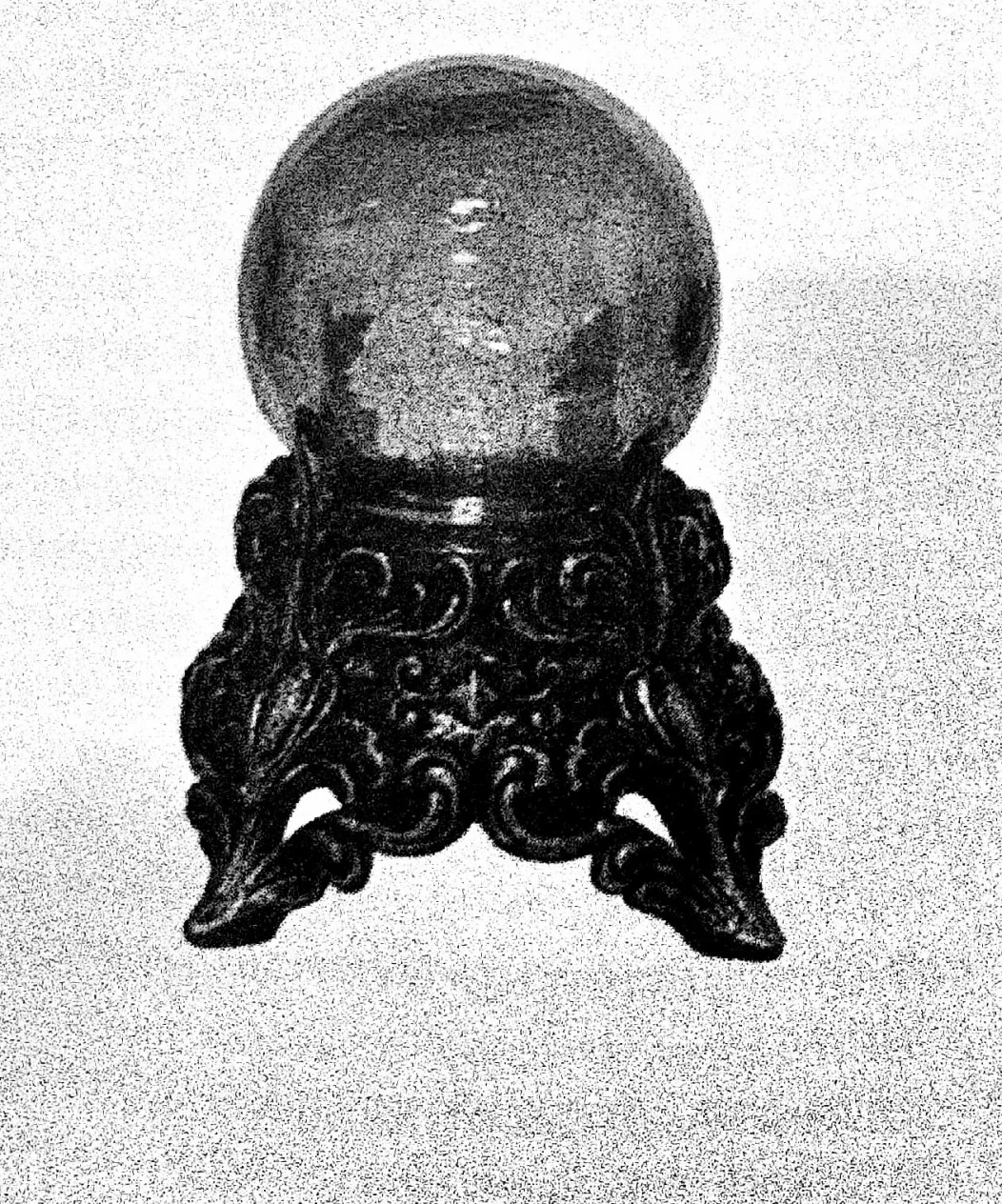
Trataka and Sammohan (Hypnosis)
Sammohan is a psychological process. By bringing any person under one’s control through Sammohan, their thoughts, their future, their activities, and their diseases can be known. By hypnotizing a patient, one can know about their disease. If it is a mental illness, it can be cured.
Hypnotism, mesmerism, and Sammohan are one and the same. It would not be an exaggeration if we call them foreign names for our ancient vidya (science). Mesmerism was born in 1968, whereas the Indian Sammohan Vidya, Mohini Vidya, Vashikaran (subjugation), Aakarshan (attraction), Mohan (infatuation), etc., tantric sciences are considered to have originated before the Puranic age. Many of these sciences and kriyas (practices) also existed in the Vedic period. In the Vedas, they would compel not an individual but nature, making use of nature’s processes, to cause rain at a specific place. The only difference was that in the Vedic period, the support of prayers was taken for attraction, hypnosis, and subjugation.
In the Puranic era, Mohan, Vashikaran, Sammohan, Aakarshan, etc., were successfully practiced through mantras and tantras. That same practice remains present in our Tantra Vidya to this day in its complete
and best form. Since the tantrics practiced these methods upon the virtuous as well as the wicked, scholars, saints, and acharyas began to view them with disdain. For this reason, these disciplines passed out of the hands of the followers of Sanatana Dharma and the Vaishnavas and came into the possession of the Shakas, Shaivas, and tantrics. With Gorakhnath, these disciplines existed in their complete power. Avadhoot Kinaram was an adept master of these disciplines. Among the tantrics, Ramacharan Lahiri, Kaviraj Gopinath, and others were renowned. I have understood, experienced, and practiced the tantric powers of attraction, subjugation (vashikarana), and mesmerism (sammohana). Many couples today are living happy married lives as a result of the vashikarana mantra.
Through trataka sadhana, the power of sammohana (hypnosis/mesmerism) can be attained, because in sammohana, the practice of trataka sadhana is undertaken first. In the foreign system of sammohana, the power of the gaze is practiced, and they perform various kinds of exercises to increase the power of the gaze. They believe that gazing at an object unblinkingly increases the power of the gaze, and when intention (bhavana) is applied, that very power of the gaze activates the object being viewed. When a practitioner mesmerizes someone, he projects the influence of his own gaze upon that person and centers that person’s gaze upon some object; then, gradually, through intention and commands, he brings that person into a state of sleep. In this way, having mesmerized the subject, he learns of the subject’s past from the subject’s own mouth, or gets his own desired work accomplished through the subject. He dispels a patient’s delusions, etc.
In trataka sadhana, emphasis is placed not only upon the power of the gaze but also upon the concentration of the mind along with the concentration of the eyes and the concentration of the inner eyes (antashchakshu). In sammohana too, emphasis is laid upon the practitioner’s competence, samskaras, and conduct; similarly, in trataka sadhana, emphasis is placed upon the practitioner’s conduct and thoughts, moral nature, and inner consciousness.
We have already stated at the outset that the practice of trataka is not merely looking at an object with open, unblinking eyes; rather, it is viewing the object unblinkingly with the external eyes, together with the concentration of the mind and the concentration of the inner eye. In various chapters of this very book, detailed information has been given regarding the practice of trataka upon fruits, flowers, and gems, and obtaining favorable effects from them. By reading all of that, you can understand how our practitioners can influence (mesmerize) all — sentient and insentient beings alike — through trataka, incorporate their energy into their own energy to derive benefit, and render those beings and their energy favorable. Now you can easily understand that trataka sadhana is the first stage of the sammohana process; rather, it should be said that the power of trataka is far more powerful than the gaze power emphasized in sammohana.
If a trataka practitioner does not wish to attain spiritual consciousness and desires to move toward worldliness, he can become a good practitioner of sammohana (hypnotism). He will not need to resort to the foreign methods of hypnotism and mesmerism. Through Indian tantric powers and the strength of trataka shakti, he can acquire powers such as attraction, enchantment (mohana), subjugation, and mesmerism, and become a good mesmerist.
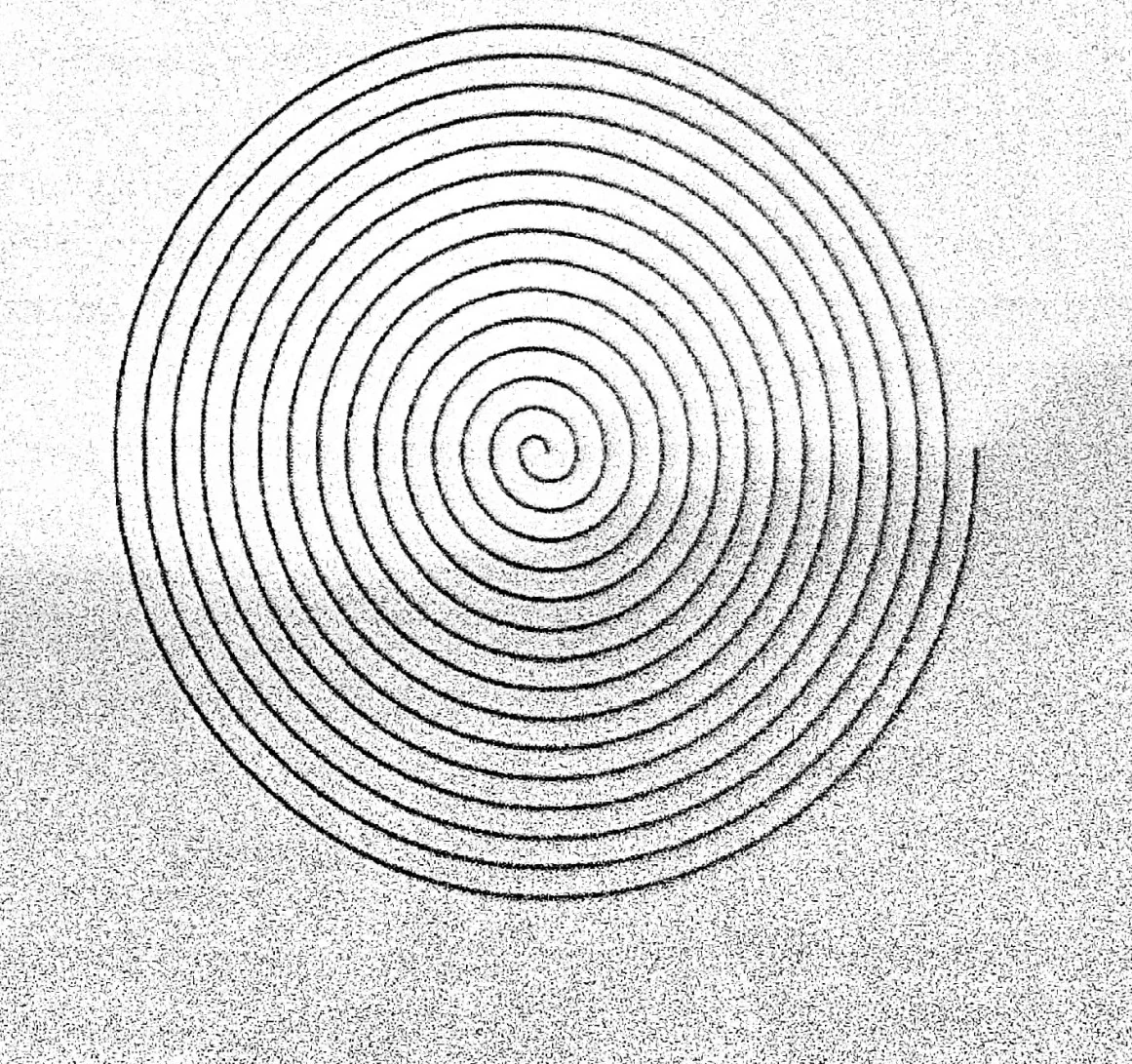
If someone wishes to perform sammohana through the foreign method, even then, through the medium of trataka sadhana, he can become a swifter and superior mesmerist compared to others. Trataka is that very path through which hypnotism and mesmerism attain success. Therefore, a trataka practitioner can become a high-caliber mesmerist
Kundalini Awakening Through Trataka Sadhana
Kundalini awakening can be accomplished through Trataka sadhana. A Trataka practitioner understands the process of Kundalini awakening more quickly compared to ordinary practitioners and assimilates its practices. Kundalini awakening is a wondrous sadhana in itself.
Through Kundalini awakening, self-realization (atma sakshatkar) occurs. One comes to recognize one’s soul, the worldly impurities overlying it, oneself, and one’s good and bad habits. When a person recognizes their entirety, they make an effort to remove their impurities (vikaras), and those impurities gradually adopt a positive path on their own. As the practitioner continues to awaken their Kundalini, their impurities continue to be removed, and when all the impurities of the body, mind, nature, actions, and thoughts are gone, then the covering of impurities or defilement (kalushta) on the soul begins to dissolve. One day, that defilement is completely washed away, and the divine form of the soul is revealed.
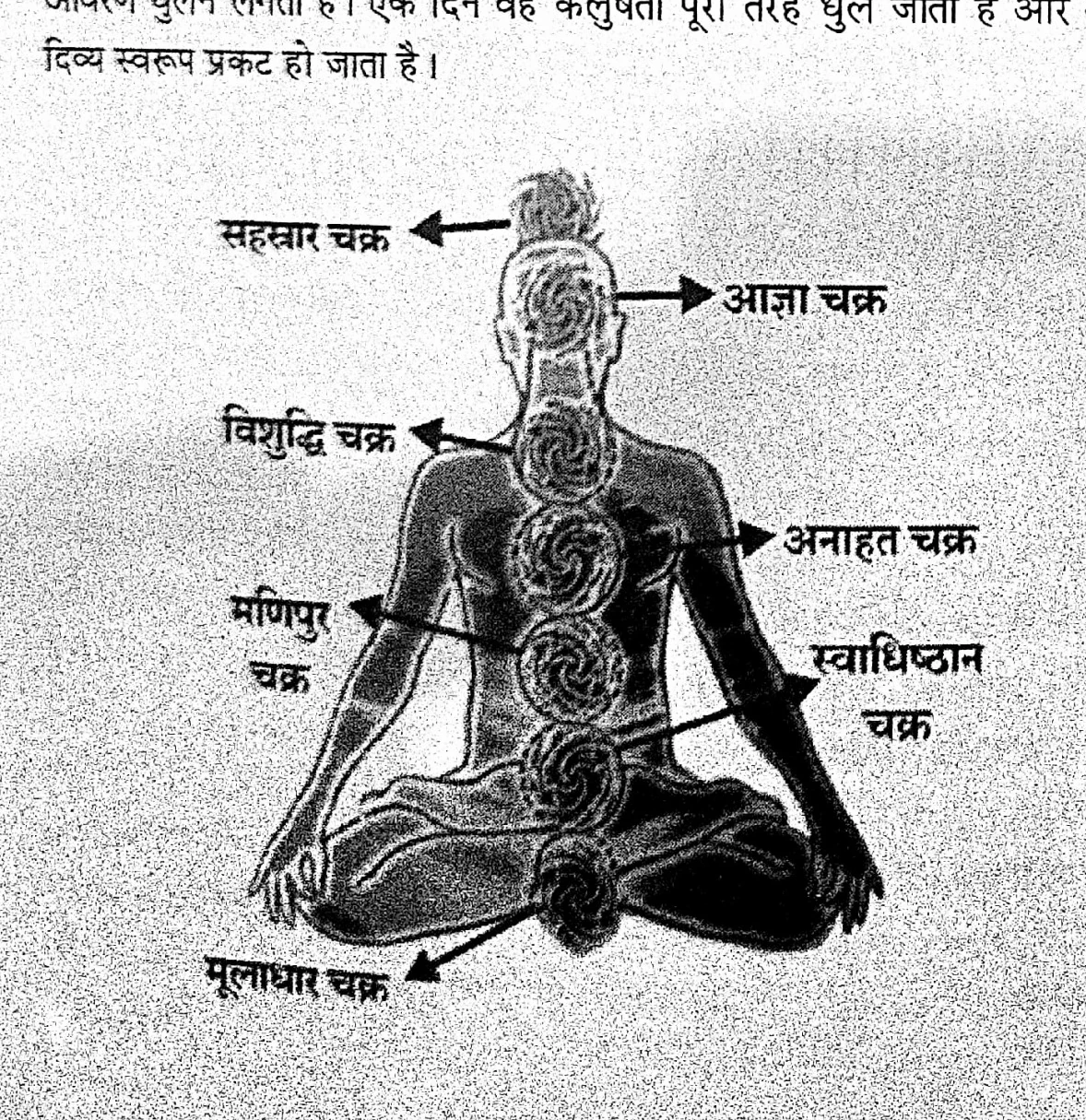
- Sahasrara Chakra
- Ajna Chakra
- Vishuddha Chakra
- Anahata Chakra
- Manipura Chakra
- Svadhisthana Chakra
- Muladha Chakra
The soul is imperishable (ajar) and immortal (amar) because the Supreme Soul (Paramatma) is imperishable and immortal. A fraction of the imperishable and immortal is also imperishable and immortal. Therefore, the power of the soul, its light, its knowledge, its bliss, its being ever-youthful, its being eternal, are just like that of the Supreme Soul. A soul with a pure form itself becomes the Supreme Soul; that is, the practitioner who has awakened their Kundalini, their soul becomes equal to the Supreme Soul, rather, it becomes the Supreme Soul itself, and that practitioner also becomes equal to the Supreme Soul. Then his voice comes forth— Aham Brahmasmi (अहं ब्रह्मास्मि) (I am Brahman).
“I am Brahman”—not everyone can say this. Only one whose soul has become the Supreme Soul can say this. What is ‘I’, have you ever thought about it? If considered from a worldly perspective, ‘I’ is ego (ahankar). ‘I’, ‘mine’, ‘you’, ‘yours’ are formed from the delusion-illusion (moh-maya) of this world. Therefore, from a worldly perspective, ‘I’ is ego, but from a spiritual perspective, ‘I’ is the Jiva (embodied soul) situated inside this body, the Prana, the soul. If you do not believe it, or if some scholar does not believe my words, then let him tell me where his ‘I’ is? Every person keeps saying ‘I’, ‘I’, but he does not know where the place of ‘I’ is in his body, where the residence of ‘I’ is, which organ ‘I’ refers to; no one will be able to tell. Just as the soul, despite being without attributes (nirguna) and formless (nirakara), is present in every body of ours, similarly ‘I’, despite being without attributes and formless, is in our consciousness. Hence, the soul itself is ‘I’, and ‘I’ itself is the soul.
If any scientist or philosopher shows me the entity of the soul or the entity of the mind, I will be compelled to accept everything they say. If scientists wish, they may dissect this body, conduct a post-mortem, and tell where the soul is or where the ‘I’ is? I believe that they will find neither the soul nor the ‘I’, because ‘I’ itself is the soul and the soul itself is ‘I’. It would be appropriate to say that both of these are one. The synonym for the soul is ‘I’. Both are without attributes and formless, both are equal to Brahman, rather, they are Brahman itself. The declaration of Aham Brahmasmi (अहं ब्रह्मास्मि) (I am Brahman) is fulfilled here. ‘I’ is equal to Atma (soul), Brahman is equal to Paramatma, asmi is equal to is = Atma itself is Brahman.
When the soul of the practitioner performing Kundalini awakening becomes Brahman, then he also becomes equal to Brahman; now the process of Kundalini movement (sanchalan) begins in his sadhana. Which starts from Muladhara and goes up to Sahasradhara. Then, piercing the Brahmanda (cosmic egg), it merges into the Supreme Soul. In Tantric language, this is called the union of Shiva and Shakti. In Sanatana Dharma, it is called Moksha (liberation). Buddhists call it Nirvana. In reality, this is the union of the soul with the Supreme Soul. Through Trataka sadhana, Kundalini awakening begins to happen automatically, but this process takes a lot of time and the practitioner does not understand that his Kundalini is being awakened. He only understands that the attainments he is receiving are of Trataka sadhana’s
is the reason that a practitioner who performs trataka sadhana for a long period is unable to carry out the process of Kundalini circulation, because he cannot understand that his Kundalini has awakened on its own.
In reality, the Kundalini of ascetics, of mantra practitioners, of tantrics, and of yogis awakens spontaneously, but they are unable to comprehend it. Although the fruits of Kundalini awakening begin to be received by them — for instance, movement begins to occur in the secret cavity where the Kundalini resides. The Ida and Pingala nadis (subtle energy channels) begin to throb. A rustling sensation begins to be felt in the spinal column of such people. In the Trikuti (the space between the eyebrows), throbbing and light begin to be seen. In the brain, there is sometimes a tingling sensation and sometimes a void descends. The bliss in the practice of meditation yoga increases. Without any practice, yoga nidra (yogic sleep) begins to come on its own. All these are the physical symptoms of Kundalini awakening. Along with these, mental, spiritual, transcendental, social, and economic accomplishments are obtained automatically. By the mere thought of such practitioners, the desires of themselves and of others are fulfilled, and the Brahman reality begins to be perceived in every particle. However, such people too, just like trataka practitioners, are unable to understand the secret of Kundalini awakening, and like the aforementioned practitioners, they begin to regard the attainment of Kundalini awakening, the fulfillment of desires, their worship, yoga, and penance as merely the means to these accomplishments. Considering it the grace of their chosen deity or of God, they continue performing that very same sadhana throughout their lives.
If anyone gains an inkling of this and understands that his Kundalini has awakened, then he is extremely fortunate. Knowing that the Kundalini has awakened on its own, the practitioner is pleased that he had not even made an effort for Kundalini awakening, yet by God’s grace, if the Kundalini has indeed awakened, then through Kundalini circulation one should pierce the Muladhara, Svadhishthana, Manipura, Anahata, Vishuddha, Ajna, and Sahasrara chakras and merge the individual soul into the Supreme Soul. Although the process of piercing these chakras is not easy, still, the practitioner or worshipper who comes to know that his Kundalini has awakened spontaneously — his soul itself becomes eager to unite with the Supreme Soul, and the practitioner becomes compelled to perform the process of Kundalini circulation and merge the soul with the Supreme Soul. Kabir has expressed this as follows:
दूलहिन गावो मंगलाचार, हम घर आये हो राजाराम भतार्। तन-रति करिये, मन रति करिहूँ, पंच तत्व बाराती। रामदेव मोरे पाहुनँ आये, मैं योवन म
107
I was saying that the Kundalini of a practitioner who performs trataka sadhana for a long period awakens on its own, and he does not even come to know of it; therefore, he is unable to grasp the importance of Kundalini awakening. Those who do understand — they gain an awareness of Kundalini awakening and then make efforts to learn and perform the process of Kundalini circulation.
Now the question arises that if a trataka practitioner wishes to practice Kundalini awakening from the very beginning or after completing a period of trataka sadhana, then how should he go about it? Here it is an essential point whether the trataka practitioner begins from the start or after some days. In this matter, I have both a directive and a conviction: a trataka practitioner should perform pure trataka sadhana for at least one year. When the fruits of trataka sadhana begin to manifest, then one should make the effort for Kundalini awakening. It is my belief that “one thing at a time, and all things in their turn” — therefore, first accomplish trataka sadhana, then proceed further.
What you need to do for Kundalini awakening is being described ahead:
- A trataka practitioner, whether starting from the beginning or after one year, needs to keep only three things in mind. With the support of these three things alone, he can accomplish Kundalini awakening. Pranayama will have to be performed in twenty-five repetitions, and the asana posture will need to be changed. Adopt the asana posture in such a manner that the heel of the left foot creates pressure at the perineal region (guda sthana) and the heel of the right foot keeps the testes controlled. A slight pressure may also be applied. Practice sitting in this asana, and after some days, practice sitting with the perineal region placed upon the heel of the left foot, so that the entire weight comes onto the heels. It is necessary to inform new readers that above the perineal region and at the lowest part of the spinal column — or one could say at the very beginning of the spinal column — there is a secret cavity, which remains filled with physical marrow. Within its very center, the Kundalini, in the form of the English double-S, remains asleep.
When the entire weight of the upper body above the waist comes to rest upon the heel of the left foot, pressure will be created on that secret cavity from both below and above. The pressure of the heel from below will be directed upward, and the pressure of the spinal column from above will be directed downward. When vibration occurs in both the upper and lower walls of the secret cavity, the marrow filling the cavity will vibrate. By repeatedly maintaining this vibration, movement will occur in the secret cavity, and the Kundalini in her serpentine form will be compelled to awaken.
- After the asana, the second essential thing is that the trataka practitioner should master the practice of keeping his spinal column absolutely taut and straight. The portion from the waist upward should remain completely straight and taut. The palms should rest upon the testes, between both thighs. By doing this, the practitioner directs the pressure of the spinal column toward the Kundalini
…can be performed on the cave (guhā).
- The internal vibration of the bīja mantras (seed mantras) must be repeated again and again so that the Kuṇḍalinī can be awakened. Below I am also giving the mantras, but understand here that just as one rings bells, beats drums, or sounds gongs to wake someone up, in the same way the sleeping Kuṇḍalinī in the secret cave must be knocked upon and vibrated by the sound and vibration of bīja mantras—only then can she awaken. This mantra is as follows:
“hūṃ… hūṃ… hūṃ… huṃkāra rūpiṇyai, jaṃ… jaṃ… jaṃ… jaṃbhanādinī। bhrāṃ… bhrī… bhrūṃ… bhairavī bhade bhavānye te namo namaḥ ॥” (हूं… हूं… हूं… हुंकार रूपिण्यै, जं… जं… जं… जम्भनादिनी। भ्रां… भ्री… भ्रूं… भैरवी भदे भवान्ये ते नमो नमः ॥)
The above bīja mantras are to be pronounced with pressure, with force, and in a halting manner—whether mental or vocal. You must learn the art of pronouncing bīja mantras with pressure. In the Rudrayāmala Tantra, numerous mantras for Kuṇḍalinī awakening have been given. The above mantra is from my own experience and its application is also simple. Its pronunciation and vibration greatly assist in Kuṇḍalinī awakening. The entire practice must be learned from some guru; otherwise the serpentine Kuṇḍalinī will indeed awaken, but after awakening she will go off in the wrong direction, and if she enters some undesired nāḍī, your death may occur. You may go mad; you may suffer a stroke.
A trāṭaka sādhaka should incorporate the practice of āsana, mudrā, and the spinal column from the very beginning, but the attempt at Kuṇḍalinī awakening should be made only after a full year, because no matter how beneficial or auspicious any sādhanā may be, sādhanā is sādhanā, and it is undertaken through the path of knowledge (jñāna mārga). All sādhanās undertaken through the path of knowledge, even though supreme and excellent, become painful in difficult circumstances and destructive in the event of failure. Therefore Gosvāmī Tulsīdās has declared the path of devotion (bhakti mārga) to be superior to and simpler than the path of knowledge. Walking on the edge of a sword and reaching the goal and attainment is not easy. You must have understood this by now. Therefore, a guru is required here.
Disease Cure through Trāṭaka
In the spiritual discipline, the importance of icchā śakti (will power), kriyā śakti (power of action), and jñāna śakti (power of knowledge) has been accepted. These three powers remain intermingled with one another. Will power inspires those actions which are understood and known through the power of knowledge, and the power of action transforms that knowledge into karma (action); that is, the power of knowledge gives us knowledge and information about what is useful for us. Will power provides the inspiration to transform the knowledge of that achievement into action. Impelled by that very inspiration, the power of action carries out the practice of attaining that achievement. In this way, the proper utilization of all three gives concrete form to—i.e., brings within our reach—our desired achievement.
Not only in the spiritual field, but in the material field as well, these three powers accomplish all small and great tasks of human beings. The accomplishment or non-accomplishment of any task does not depend upon will power alone; rather, the combined effort of these three powers assists in the execution of any task or achievement. Generally, it is said that everything can be done and attained through will power, but upon serious reflection, we find that our achievements come about through all three powers. If we address the collective group of jñāna śakti, kriyā śakti, and icchā śakti by the single term “will power,” or if we consider the power of knowledge and the power of action as inherent within will power, then it would be acceptable to say that all successes come from will power alone.
If all possible and impossible tasks can be accomplished through will power, then everyone should strengthen their will power. To strengthen will power, prāṇa energy (prāṇa ūrjā) must be enhanced, and to make both of these powerful, trāṭaka sādhanā must be practiced. A trāṭaka sādhaka must develop will power, saṅkalpa śakti (power of resolve), and bhāvanā śakti (power of feeling/imagination) in order to perfect his sādhanā. When these powers become developed within him, he easily attains any achievement in the physical, mental, financial, social, or spiritual field.
Diseases, after all, occur only in the body—that is, physical and mental diseases belong to our body (tan). To remove them, the gaze and the feelings (bhāvanās) of a trāṭaka sādhaka are sufficient. How many diseases are removed merely by fixing the gaze, but just as merely with unblinking…
It is not trataka; rather, seeing with the eyes of the mind, seeing with mental one-pointedness, is trataka. Similarly, merely casting the gaze upon a patient will yield no benefit; rather, one must cast the gaze with the feeling that they should get well, their disease should be cured. Feeling-dominated trataka alone can cure diseases. Without feeling, nothing—
Jākī rahī bhāvanā jaisī, Prabhu mūrata dekhī tin taisī. (As one’s inner feeling remains, so does one perceive the image of the Lord.)
Faith and conviction are supremely essential. If someone lacks complete conviction in the fruits of their sadhana, they cannot extend help to any patient. They do possess sadhana power, but they have no conviction in that sadhana power. Therefore, without conviction, they can accomplish nothing. Such a sadhak must awaken conviction through the electrical energy within. Upon making effort, conviction awakens and becomes firm.
There must be faith — in one’s God, in one’s Iṣṭa (chosen deity), in sadhana, and in one’s own powers. When there is faith in all these, the sadhak will succeed in curing diseases. Without faith in God, no worldly or spiritual work can be accomplished. In disease removal or treatment, the sadhak should hold this feeling: “I am performing my karma, and I am doing so through God’s inspiration. When God has appointed me for this work, He will certainly grant success.” This very faith of the sadhak becomes God’s boon. Through faith and surrender, God’s power is also obtained.
Now combine all the powers — jñāna śakti (power of knowledge), icchā śakti (power of will), kriyā śakti (power of action), bhāvanā śakti (power of feeling), viśvāsa śakti (power of conviction), śraddhā bhakti (faith and devotion). The master of these six powers is the trataka sadhak himself. When he reaches the second level of sadhana, all these powers begin to develop within him of their own accord. As he penetrates deeper into the second level, these powers begin to manifest and bear fruit.
With will power and feeling power, if a trataka sadhak gazes at a patient with the trataka gaze, that patient moves toward improvement. Stated in simple language — while holding in mind the thought that the patient before them should become free of disease, their body should become disease-free, and they should become happy, and simultaneously continuing to gaze at the disease site or the patient with the trataka gaze, then the patient will certainly begin to improve. One must maintain faith in God and conviction in the accomplishment of trataka sadhana — that all the desires of a second-level sadhak are fulfilled. Whatever he thinks, whatever he desires, all that is thought and desired shall automatically come to him as fruit.
When, with complete will power (will power), he forms the feeling toward the sick person that the patient should become disease-free, then certainly his feeling should succeed and the patient should become free of disease, but all this will not succeed in one day or in one attempt. Just as medicine is given to a patient once or twice daily, likewise the trataka sadhak must perform trataka sadhana on the patient once or twice a day and maintain the feeling that they should become disease-free. Within a definite period, the patient will recover.
On patients afflicted with syncope (mūcchrā), coma patients, states of unconsciousness, and acute fever, this application of trataka shows miraculous effects. In incurable diseases, disease removal through trataka has been carried out, and is still being carried out.
In mesmerism and hypnotism, it is through this very effect of trataka sadhana that mental patients are treated. So much so that in tooth extraction and in performing minor and major operations, by employing the hypnotic power of trataka, incisions are made without rendering the patient unconscious or numbing the affected area. Upon incision, the patient feels no pain because they remain mentally hypnotized and as if unconscious. During such time, the hypnotist or sadhak continues conversing with the patient about other matters.
In the practice of jhāṛa-phūṅka (exorcism/fanning), ṭoṇe-ṭoṭake (spells and charms), and the deployment of mantras, a trataka sadhak can be more successful than others. Many mental and physical diseases are purely psychological. The abnormal behavior of the patient is generally assumed to be the result of ghost-spirit influence, but in reality there is no negative influence of ghosts and spirits. Rather, the adverse effect of mental pressure is upon them. In rural areas, ojhās (exorcist-healers) cure such patients through jhāṛa-phūṅka. I know that those who perform jhāṛa-phūṅka do so with Śābara mantras. Such Śābara mantras have neither scientific significance nor spiritual; they have neither any meaning nor special sounds, yet the effect of such Śābara mantras upon physical and mental patients is good. From boils and pustules, hemorrhoids, jaundice, and stomach diseases to women’s secret ailments, madness, and spirit possession — the ojhā-sokhā, guṇiyā, fakir, maulvi, and mulla cure through their jhāṛa-phūṅka.
If one reflects seriously, one will find that such people possess neither power in their mantras nor any sound vibration, yet the patient recovers — so what is the scientific basis here, what is the cause, and what is the psychology?
There are only two causes. First: the faith of the ojhā or guṇiyā in God and Guru, and their conviction in their mantra. Second, which is more important: they perform jhāṛa-phūṅka with complete will power, holding the feeling that the patient should recover through their fanning.
The patient also has the psychology that they will be cured only through jhāṛa-phūṅka, medicines
will not get cured. Because he has neither faith in doctors nor belief in their medicine. Therefore, no matter how many medicines are given to them, those medicines have no effect on the patient. This is why the family members assume that the patient must certainly be under the malefic influence of ghosts and spirits, or external afflictions. Even people from good families fall under such illusions that someone has cast a spell on them or fed them something. In families where the habit of getting exorcisms (jhad-phoonk) done has become excessive, no matter how educated and civilized the people become, there are more patients in their homes who get cured by exorcisms than by medicines.
A trataka practitioner is far superior to these ojhas (exorcists) and guniyas (sorcerers), therefore he himself can cure the diseases of various patients through his feeling (bhavna) alone. If he wishes, he can choose a single mantra for himself and can keep reciting that mantra for others to see and understand. With a single mantra, he can generate the capacity to cure all diseases, but he should not live under the illusion that he is curing the patient through the power of the mantra; rather, he should let others remain under the illusion that he is curing the patient by blowing the mantra. He has to cure the patient through his own trataka power, and this is what he must understand.
The willpower, feeling, and faith in God derived from trataka practice constitute his disease-curing capacity. Contemplating the welfare of himself, his family, and the people connected to him, he can make them disease-free from their various illnesses using his willpower and trataka power. Those people who are related to the trataka practitioner and with whom the practitioner has an emotional attachment, such people will be considered the recipients of the practitioner’s grace. If they suffer from any disease and the trataka practitioner wishes to make them disease-free by applying his trataka power on them, they will become disease-free much faster compared to others. Here, there is greater love or attachment toward the patient. The patients of the second level will be those who can be called acquaintances or transactional associates. On such people, the practitioner’s application might take a few days’ time, and the practitioner might have to apply his power repeatedly.
The patients of the third level are those with whom the practitioner has neither any relation nor acquaintance. On such patients, the trataka power has to be applied for a longer duration, multiple times, over many days; only then does the patient become disease-free.
The readers must have understood the meaning of what I am saying. In curing diseases through trataka, what kind of relationship the practitioner has with the patient matters a great deal. The closer and more beloved the patient is, the quicker he will be cured; the more acquainted or unacquainted they are, they will become disease-free in that proportion, in that proportion the time
Trataka practice must incorporate willpower and trataka power into one’s speech along with one’s feeling. Like mantras, one will have to repeat one’s commands, thoughts, and words repeatedly in front of the patient. These words will also have a psychological effect on the patient. Due to the psychological effect, he will neutralize the conscious mind and stimulate the unconscious mind, so that the idea gets firmly established in the patient’s mind that he is not sick, he has no disease, he has no pain, and no kind of physical or mental harm is occurring. If any disorder has arisen in the body, it has been caused by an imbalance of the panch mahabhuta (five great elements), and as soon as balance is restored among the five elements, that disorder will automatically be cured.
While treating a patient, the practitioner should gather this information: where is the disease, what is it like, what type is it, how old is it, is it curable or incurable? If he releases rays from his eyes at the site of the disease, he should also place his palm or fingers on that spot and allow his magnetic power to flow. While providing trataka power from the eyes and magnetic power and electrical flow from the palms, he should repeatedly say these sentences to the patient—‘Nothing has happened to you… You are a disease-free and normal person… You are not in any pain at all… You are not experiencing any discomfort… This is just a disorder… This disorder is due to the imbalance of the five elements… Soon this imbalance will be removed… Then the disorder will also be removed… And you will become completely healthy… Oh, nothing has happened to you… There is no pain at all… You can smile… You can laugh… Laugh… Laugh out loud…’
Along with those sentences, the practitioner should also pronounce the name of that disease and the name of the disease-affected area. For example, if there is any discomfort in the stomach, he should place his palm above the navel and say to the patient—‘There is nothing wrong in the stomach, the pain has gone away, look, it has left… You are getting relief from the stomach pain… Now there will be no stomach pain…’ etc. Similarly, the names of the affected organs should be added to one’s vocabulary.
When the flow of the practitioner’s trataka power, magnetic power, and electrical energy reaches the patient, his unconscious mind will absorb it very rapidly. As soon as it absorbs it, a movement will be generated in the patient’s cells and he will start getting cured. This is the psychological process and the power of trataka practice through which, in a short time, even the most incurable patient will become completely healthy.
Now I am stating below the methods for the treatment of some diseases. Based on these methods, any trataka practitioner can apply his methods to other diseases as well. According to the patient, the type of disease, the objective situation, the environment, the time, and the spatial-temporal conditions, the practitioner his discretion’s
Using this, one can decide for oneself how to do it and what to do. One can oneself choose and frame the words and sentences to be spoken.
Through the above method, only that practitioner who has entered the second level of sadhana and has been practicing for some years can perform disease treatment. A beginner or first-level practitioner does not attain sufficient trataka power to cure a patient of disease through the above procedure. Methods of disease treatment for such beginner practitioners will be given in the following pages. Nevertheless, my advice to practitioners who have completed one year of sadhana is that if they wish, they may gain experience by applying the said method for disease treatment on their closest associates or members of their own family. If they succeed, well and good; if they fail, nothing will be lost.
I would like to give one stern directive to second-level practitioners: if your aim is sāttvic and elevated, and you seek the union of the soul with the Supreme Soul, then do not take on the responsibility of treating worldly individuals’ diseases through trataka power. Suppress the altruistic sentiment within yourself. The second point is that repeatedly performing disease treatment causes dissipation of your trataka power, magnetic power, and electrical energy. If you keep dissipating these again and again, you will stray from the path of sadhana. Only if it is absolutely necessary should you perform disease treatment; otherwise, remain cautious.
Some people practice trataka sadhana in order to perform disease treatment. They have every right to continue performing disease treatment, but they should not make it their profession. In Western countries, hypnotists are people of this very level. Since their objective is to obtain hypnotic powers through trataka sadhana, they perform disease treatment with the help of hypnotic power. Apart from earning money or earning a name, such people have no other higher-level goal. I have nothing to say about such people — they may practice as they wish. Such people are psychotherapists and treat diseases of the mind more than those of the body.
Now I am describing here some major diseases the treatment of which a trataka practitioner can easily perform, but it must be kept in mind that due consideration must be given to the advice I have provided in this regard:
Treatment of Mental Diseases: The effect of trataka power on the mind and brain is deeper and swifter. The trataka practitioner, looking into the patient’s eyes, forms the feeling that his disease (name the disease) may be cured soon. Hysteria, insomnia (anidrā), epilepsy (apasmāra), seizures (mṛgī), and such mental diseases can be treated through feeling alone. Dr. Charcot states that there is no mental disease that cannot be cured through the influence of the hypnotic method,
115
because hypnotic power directly affects the patient’s brain, and that hypnotic power is obtained only through trataka sadhana — whether it be trataka sadhana under classical yoga, or the cultivation of visual power under modern hypnotism.
For such mental patients, the practitioner should apply trataka power and repeatedly speak these words: “Fear has taken root within you… and nothing else has happened… take the name of God, the fear will flee… keep your mind and brain calm… your mental power is strong… you will recover soon… you will not have a seizure… seizures are nothing… there is no suffering in a seizure… you must get well… you will get well… your fear will flee… look at me… look into my eyes…” and so forth.
Removal of Spirit/Possession Afflictions: Madness and emotional frenzy have been labeled as spirit-possession, whereas in reality such patients have no malefic influence of spirits and ghosts; it is only said to be so. I do not say that spirits do not exist. Departed souls have their own separate world, but they do not harass any person; even if they do, their provocations are of an elevated and research-oriented nature. Nevertheless, the delusion that has taken firm root in the patient’s heart — it is under its sway that the attacks of spirit-possession come upon him. Under the domination of these attacks, he jumps, leaps, hurls abuses, beats — sometimes harming his own body, sometimes others’ bodies; sometimes he laughs, then begins to weep; sometimes he tears his hair, sometimes he bangs his head. Ordinary people call such a patient a possession-afflicted patient, but in psychology, such patients are given the designation of impulse- and possession-related disorders. In psychology, they are called psychotics.
For the treatment of such patients, one must have self-confidence, rely on the magnetic power, and then perform the treatment. If the patient is jumping about excessively, he should be calmed down gradually. One should not use force, coercion, binding, or beating with him. Sprinkles of water can be thrown on his face, then looking into his eyes, compel him to meet your gaze. If the practitioner achieves success in this, curing the patient becomes easy. Then one should converse with the patient holding the belief that he is in fact a departed soul. Praise should also be given to him — for example: “Oh brother, you are very brave… I feel like befriending you… befriend me… come with me… leave this creature alone… make this one disease-free…” and so on. Along with the practitioner, the patient too will speak. He will also respond to the practitioner’s words. In such a situation, the practitioner should say things agreeable to him and repeatedly ask him to come along. After doing this once or twice in the modern manner, he should say the things that are stated under the heading of mental diseases.
Treatment of Sexual Patients: The world-renowned psychoanalyst and philosopher Fr[eud]
It has been said—all of a person’s works, all activities, diseases and virtues are based on sex. Sex is the cause of all human endeavours. This notion of Freud’s proves fundamentally true. In sexual disorders, Freud’s ideology is especially understood and recognised. Unfulfilled desires make a person fall prey to feelings of inferiority. As a result, they develop various kinds of diseases. Compared to men, women fall prey to these diseases more. After marriage, many women develop irritability, psychoses, madness, hysteria, and conditions like spirit-possession episodes. Men too can develop all the aforementioned diseases stemming from feelings of inferiority. A trataka practitioner can cure such patients through his feeling and willpower.
Men should be given the suggestion—“You are entirely suited for sexual intercourse… You can satisfy any woman… You can develop erectile power within yourself… You should sleep in deep sleep so that nocturnal emission does not occur… You will not have nocturnal emission tonight… You are strong and filled with sexual vitality… Nothing has happened to you… You can perform the best sexual act…” etc.
Women can be given the suggestion—“You are supremely beautiful… Your body is the best for sexual intercourse… Do not hesitate in sexual union with men… Performing the sexual act with your husband is your dharma… You have no sexual abnormality… Your limbs are well-formed and beautiful… Enjoy the pleasure of sex… Engage freely… And make your life satisfied and happy…” etc.
At first, a sexual patient will be cured in a single sitting itself. If two to four sittings are needed for someone, they should be done. Before conducting the sittings, the practitioner should understand and comprehend the psychiatric patient’s history. If due to shame and hesitation some patient does not disclose their sexual abnormalities, then by applying trataka power they should be compelled to reveal them, but here too, instead of force or coercion, love and a sense of closeness should be demonstrated.
Treatment of Skin Diseases: Skin diseases range from scabies, itching, boils-pimples, wounds and apars (eczema) all the way to leprosy. Most of these diseases are ordinary and are cured by medicines applied and taken orally, but leprosy is considered an incurable disease and the chances of its cure are very slim, yet a trataka practitioner can, if he wishes, cure even leprosy. The practitioner should remove from the patient’s mind the notion that leprosy is a disease that can never be cured. As soon as this disease is cured, that person’s family and social life will become respectable. When such a notion forms in the patient, his subconscious will begin to cooperate with the practitioner in curing the disease. When this idea settles into the unconscious mind, then there will be a stirring in his cells, and this very stirring will make the cells mobile, active and powerful. As the cells become active, some glands will begin to dissolve, the number of glands will gradually decrease, and one day they will be completely gone.
In this way, a trataka practitioner can cure all other skin diseases through his trataka power and free patients from disease, making them happy.
Treatment of Tuberculosis: Tuberculosis is also called tapadik and T.B. This disease is of several types. Everyone knows about tuberculosis of the lungs, but there is also gland T.B., bone T.B., and tuberculosis like kanth mala (scrofula). Today this tuberculosis has begun to be cured with treatment, but earlier a person with tuberculosis would consider the end of his life before death itself. Along with him, family members would also accept that once T.B. strikes, no one survives, and so their own relative would not survive either. His disease would be cured only upon his funeral pyre, because at that time this disease was considered incurable. However long the patient lived, he lived confined to bed.
The trataka practitioner will not have to face much difficulty in curing tuberculosis, because, as with some diseases, he simply has to give the suggestion that tuberculosis is not an incurable disease. The patient will recover quickly. By repeatedly giving suggestions and feelings, the patient’s unconscious mind should be stirred in the same manner. As soon as the unconscious mind is stirred, excitement will arise in the cells. Veins and arteries will begin to throb. When this process begins, the germs of T.B. will start dying. Blood circulation will improve, fresh circulation will occur in the dying cells, and they will be transformed into new cells. Once the germs die and new cells are formed, the disease will end and the patient will become healthy.
Treatment of Abdominal Diseases: I knew a hakim (Unani physician) who would say this phrase at every opportunity—“If the stomach is clear, everything is clear”—meaning if the stomach remains clean, there will be no disease. All the diseases of the body arise from the stomach being upset. Here I am not discussing other diseases, but rather discussing diseases of the stomach. In the modern lifestyle, most people suffer from constipation and gas problems. This very gas problem gives birth to various diseases. Even mental diseases are produced due to gas. Stomach pain, diarrhoea, piles, enlargement of the intestines, ulcers and even dreadful diseases like cancer can occur.
In the alleviation of these diseases, the most prominent role is that of exercise and yoga, and then of trataka practice. The patient should be given the inspiration and suggestion to do exercise and yoga. Along with that, treatment should be carried out through trataka power. In his mind-brain, especially
118
The conviction must be implanted in the patient’s mind that their disease is not incurable. Placing the palm on the abdomen or a finger on the navel, one should also channel the flow of one’s electrical energy, fix the gaze, and reassure the patient of recovery through various statements.
By doing this, stomach pain will be immediately cured, gas will be passed, upward-moving air (ūrdhvagāmī vāyu) will move downward (adhogāmī vāyu). The expansion and contraction of the intestines will become balanced. From the stirring of the unconscious mind, the excitation of cells will increase, and mobility will come to the arteries and veins. Blood circulation will improve. With all these processes taking place, the abdominal disease will be cured. The intestinal fibers will become strengthened, and the enlarged intestine will begin to contract. The bacteria of ulcers and cancer will begin to be destroyed on their own. Disease-resisting capacity will increase, and even incurable diseases will be destroyed.
Treatment of Diabetes (Madhumeha): The royal disease of the modern age is sugar disease, i.e., diabetes. I call it a royal disease because it does not afflict laborers, those who exert themselves, those who exercise, or those who play. It afflicts those who lead a life of ease. Whether a wealthy person or an ordinary earning-and-eating individual, if they do not perform physical labor—no matter how much mental labor they do—this disease inevitably strikes them between the ages of forty-five and fifty. This is an incurable disease of the modern age. It stays with one until death; such is the belief of physicians. Physicians also say that diabetes is the parent of various other diseases. It does not itself become the cause of death; rather, other diseases generated by it become the cause of death. Through medicines, exercise, and dietary discipline (pathya), this disease can be controlled, but it cannot be completely cured.
Even such an incurable disease can be completely cured by a trataka practitioner through their trataka power. They must impart feeling and inspiration to the patient at two levels. In the feeling of the first level, placing a hand on the chest, one should use such statements that, coming under their influence, the patient’s unconscious mind forms the conviction that at the root of the disease lie the consumption of sweet substances and lack of exertion, and that one must develop an aversion to those things. Certain things have been prohibited in diabetes, such as sugar, rice, potatoes, jaggery, sweets, sweet fruits, tea with sugar, carbohydrate-containing tubers, and starch-producing substances or items, etc. On the other hand, it must be implanted in the unconscious mind that the person must walk, exercise, practice yoga, and perform physical labor daily. Once such a conviction is formed, the unconscious mind will itself lead the patient in this direction. There will be no need to give additional inspiration. Through the aforementioned process, diabetes can be controlled without the use of medicines or with the use of mild medicines. Physicians also give this counsel,
119
but the trataka practitioner does not merely counsel; rather, they firmly implant in the patient’s mind the conviction that they must continue to follow dietary discipline, walk, and exercise. Not only that, the unconscious mind makes the patient carry out all these actions compulsorily. It has even been observed that under the trataka practitioner’s treatment, people who love potatoes and rice give them up completely.
At the second level, the trataka practitioner should diminish the disease’s magnitude, severity, and effect to such a degree that the patient’s unconscious mind forms the conviction that diabetes is not an incurable disease. It can be completely cured. The unconscious mind must be stirred through one’s feelings and inspirations. When it becomes fully stirred, by its own power it will stimulate those cells that create compartments for storing sugar or cholesterol. At the same time, the blood vessels will also become stimulated. Through the stimulation of cells, new cells will be formed, and those new cells will take the place of old, destroyed, and dried-up cells. When new cells are formed in place of dead cells, the cholesterol compartment will be prepared in them, and the balance of sugar in the blood will become regulated. In this way, through their trataka power, feelings, and the flow of electrical energy, the trataka practitioner brings about the formation of new cells in a diabetic patient, whereby the balance and percentage of sugar in their body is maintained at an appropriate level.
Through the trataka practitioner’s treatment, the diabetic patient recovers completely and begins to live a normal life. Now, if they wish, they may observe fewer dietary restrictions; yet if they remain cautious, they will not have to suffer the distress of diabetes and diabetes-induced diseases, and they will be able to live a safe life.
Treatment of Heart Disease and Blood Pressure: In the modern age, blood and heart diseases have begun to afflict those around fifty years of age. The reason for this is also the lack of physical exertion. People take interest in food and drink but are afraid of exercise or exertion. As a result, cholesterol begins to accumulate in the arteries, and blood pressure begins to rise. With high blood pressure, the danger of heart attack and brain hemorrhage remains constant.
A trataka practitioner can give favorable direction to patients of blood pressure and heart disease. They can inspire them to walk and exercise, and can dispel blood pressure and heart disease through their commands and counsel. If necessary, they can melt and flush out the fat accumulated inside the arteries and the heart. For this, they must implant in the unconscious mind the feeling that blood pressure is not a major disease. As the fat is removed, blood pressure and heart disease will be eliminated from the root. The unconscious mind, once stirred, will stimulate the arteries
The fat deposited in the arteries will melt on its own and dissolve into the blood. It will then be expelled through faeces, urine, and sweat.
In blood pressure, the risk of heart failure, heart attack, and brain haemorrhage is greatest. In the event of a heart attack or the patient falling into coma due to brain haemorrhage, the danger to life increases. In such a situation, a trataka practitioner can cast his gaze upon the patient and, by transmitting his electrical current through the palm, infuse prana-energy and save the patient.
Treatment of the habit of intoxication: Through hypnotism, that is, the science of suggestion (sammohan), the bad addiction of intoxicants can be broken. A hypnotist first puts the conscious mind of the person to sleep, then exerts pressure on the subconscious mind by implanting feelings and suggestions — that such-and-such an intoxicant is harmful, and that it is in the person’s best interest to give it up.
Ganja, bhang, and tobacco are ordinary intoxicants and are widely prevalent in society. They cause a person less harm than other intoxicating substances. The addiction to opium, cocaine, brown sugar, etc., is fatal. Those who consume these suffer mental and physical degeneration. The habit of alcohol and any other type of intoxication is very bad.
In modern society, cocktail parties hold great importance. The elderly, young men, boys, women, and girls of affluent and wealthy families drink with great enthusiasm. If this drinking remains limited, it is less harmful and also gives pleasure, but once the addiction to intoxication takes hold, it becomes difficult to keep it under control. Intoxication has its own science: it keeps a person in its grip, and one day makes him a slave. Starting with a sip or a peg at a party or festival, a person reaches the stage of bottles and ruins his life. Along with him, his family’s life is also ruined. It becomes necessary to free such individuals from addiction.
A trataka practitioner can, like a hypnotist, break an addict’s habit by imparting feelings and suggestions — without even putting the conscious mind to sleep. For this, he will have to take the support of the subconscious mind. The further work will be carried out by the subconscious mind itself, just as it becomes active in other diseases. In this way, a trataka practitioner can, through his trataka power, save the lives of those who consume intoxicating substances.
The trataka practitioner can treat other curable and incurable diseases as well, in addition to those described above, through his trataka power, electrical energy, willpower, faith, and conviction. Every disease has its own scientific basis; therefore, the practitioner should thoroughly study the science of the disease, the history of the disease, and its effect on the patient, and only then proceed to treat the patient.
Those who have not reached the second level of trataka practice and are still at the first level can also treat diseases if they wish, but they do not possess the capability to treat diseases through feeling and suggestion alone. To cure a patient, they must first choose a medium whose positive influence can cure that disease — for instance, for a cold-disease (shita roga), the influence of the moon must be absorbed; for heart disease, the influence of the sun must be absorbed; for hysteria and epilepsy, the influence of the emerald gem must be absorbed. By “absorbing,” I mean that the practitioner should first perform trataka on such mediums, and then, while casting his gaze upon the patient, generate the feeling. By doing so, he can infuse the quality and disease-resisting capacity of that substance. I am presenting some examples of this below:
- If someone has a headache and you wish to cure it, you should perform trataka on a beautiful bloomed rose flower, then cast your gaze upon the patient’s forehead and give a mental suggestion. Other fragrant flowers can also be used for this purpose.
- To cure jaundice, perform trataka on the punarnava herb, cast your gaze over the liver, and cure the patient through suggestion.
- For heat-related diseases, perform trataka on dried plums (alubukhara) and, casting your gaze upon the patient, attempt to free him from the disease.
- For a person suffering from fever, perform trataka on chirayta. For alleviating eye ailments, perform trataka on sliced cucumber or sliced potato, and casting your gaze upon the patient, attempt to free him from the disease.
In this way, many substances and medicines can be chosen for trataka. The trataka practitioner may, if he wishes, perform trataka on the medicines that a physician has prescribed for the patient. After performing trataka on the medicines, he should perform trataka on the affected organ of the patient. In this way, the quality of the medicines will also be enhanced, and the effect of trataka will also act upon that organ. Thus, with the help of the physician and the trataka practitioner, the patient will quickly recover and become healthy.
I am not giving here the methods for curing various diseases, because separate chapters have been written for this purpose; in the descriptions of trataka on gems, trataka on fruits, and trataka on metals, it has been specified which substance possesses the disease-resisting capacity for which disease. Therefore, for detailed information, readers should study those chapters.
Mental Seed Mantra (Manah Bija Mantra)
Practitioners of trataka sadhana need mental seed mantras. Through them they can attain mental, physical, financial, and social progress. They can also free a patient, or those with bad habits, or those who consume intoxicating substances, from their problems.
Before beginning sadhana, the practitioner may have some disease, inferiority complex, bad habit, or addiction within. The use of pan, cigarette, tobacco, and gutkha is common. To get rid of these, mental seed mantras should be used. They should also be used while giving auto-suggestion (bhavana) to other people and patients.
In self-hypnosis and in the hypnosis of others, many sentences are used through these. Through this, the practitioner’s conduct and thoughts become refined and enhanced, and there is unprecedented improvement in his mental and physical health.
The revered Dr. S.C. Chitre was counted among the world’s renowned psychologists. Dr. Chitre, a resident of Kanpur, was like a senior elder to me. I would meet him frequently. We would discuss various subjects for hours. Among these meetings, there used to be extensive discussions on psychological treatment. His foresight was so powerful that he would call out from above by naming the person who had arrived outside or in the lower room. While sitting there and talking, he would get an intuition of who was going to come in two to four minutes.
This was in 1958 — he and the yoga physician Dr. Anand were preparing the case history of a woman mental patient sitting in the room. Just then Dr. Chitre suddenly said to Dr. Anand — “In ten minutes R…”
One cannot change one’s facial expression after eating a banana; my eyes see the feeling behind the face and the state within the mind.
“You are doing trataka sadhana, aren’t you? Your gaze will naturally become piercing. Come, sit, leave these talks aside, eat bananas and samosas, I’ll have coffee made right now.”
While peeling the banana I said, “It is your coffee that has drawn me here.”
“What do you mean to say, Ramesh bhai?” — Dr. Anand said. He could not understand the meaning of the banter and sarcastic remarks between me and Dr. Chitre.
“Dr. Sahib has attracted me by using his mental seed mantras. That is why my mind felt restless there and I was drawn here.”
“Why, Dr. Sahib — what are you doing?” Dr. Anand said.
Among us, such banter and the practice of testing each other’s sadhana used to happen often. Doing this facilitates the exchange of each other’s knowledge and experience. Dr. Chitre, as a psychiatrist, was a esteemed psychologist of Kanpur.
Dr. Chitre had formulated certain sentences for each disease. He called those sentences mental seed mantras. Through them alone he used to cure mental and physical patients. I am presenting his and similar mental seed mantras for trataka practitioners.
A trataka practitioner, one who practises yoga nidra, or an ordinary person can do these mental seed mantras at night before sleeping, in yoga nidra, or after doing pranayama by coming into the shayana mudra (lying-down posture). If the practitioner wishes to administer them to another person, he can give the suggestion (bhavana) with necessary changes in language and sentences.
For attaining health — “I, free from tension in the love of God, experience peace, and God’s health-giving life force is flowing in every limb of my body. Therefore I become healthy in mind and body.” Repeat the above sentence again and again.
For resolving problems — “I surrender all my problems into God’s hands and experience peace, and have full faith that God is omnipotent, therefore He resolves my problems. Then I experience peace and thank God.” Repeat this sentence again and again.
For success in work — “God’s infinite knowledge guides my path. God’s infinite love fills me with wealth and grain. By God’s infinite compassion, I succeed in whatever work I undertake. I thank God.”
For increase in business — “Through God’s infinite power, all obstacles in my business are removed and my entire work and business begins to run smoothly. God helps everyone. He is helping me, my business is growing, I…”
I give thanks.” To remove mutual illusion and opposition—“The infinite affection of God that is in my heart, that same infinite affection is also in my friends and relatives; therefore, through infinite love, all illusions, misunderstandings, and mental oppositions come to an end, and we both become filled with affection for each other. By God’s grace, happiness, peace, and balance are coming into our lives. I thank God.” In the aforementioned sentence, wherever “friends and relatives” is written, say the name or relation of that person, such as wife, husband, parents, brother-sister, friend, guru, classmate, colleague, or superior officer.
To remove tension (stress)—“Becoming free from tension in the love of God, I experience peace, because in God is my happiness, my health, my prosperity, my opulence, and my balance. By divine power, I now have no tension or lack. I thank God that I will become wealthy, I will become learned, I will become prosperous. I thank God.”
For the treatment of diseases—“By the light and life of God, you become healthy. Peace comes within you and your illnesses are removed. Divine consciousness pervades your every particle, which grants you new life; I thank that God.”
“God, the master of good fortune and health, is omnipotent. He grants us health and good fortune. I bow to the divine power. I keep advancing on the path of good fortune and am becoming increasingly healthy. The Lord is very compassionate. He showers His grace upon us. I thank such a God.”
To remove weakness and attain health—“Divine life makes me healthy, and now my body has become completely healthy and active. By God’s grace, my working capacity is increasing. I am becoming capable of doing my work. I thank such a God.”
To attain wealth and grain (prosperity)—“The entire universe is filled with wealth and grain. God fulfills all our needs. The omnipresent, all-wealthy God arranges wealth and grain for us. I thank such a God.”
For freedom from fear and protection—“God is free from fear. I too am free from fear. God protects everyone; He is my protector too. I too live a fearless and safe life. I thank such a fear-liberating God.”
For surrender (taking refuge)—“God gives refuge to all. I have taken refuge (sharanagat) in God. I make a self-surrender at God’s feet. God is giving me shelter at His feet. I thank such a God.”
For freedom from sin and repentance—“God is the friend of the humble; He is the savior of sinners. Before Him, I repent for my sins. He forgives me and leads me from the path of sin to the path of virtue. I am grateful to Him. God is the purifier of the fallen. He saves sinners. He will save me too. I thank God.”
For freedom from the feeling of revenge—“I forgive everyone and forget from the heart those who have ever hurt my feelings. I thank God.”
To become fearless (abhaya)—“I am fearless. I am strong. I am courageous; my nerves are filled with vigor. I am not afraid of anyone. I am the son, an aspect (amsha), and the heir of the Supreme Soul (Paramatma). The Supreme Soul is non-dual (Advaita) and fearless. The flow of life and peace are plentiful within me. I am solid, strong, and firm. I thank God.”
For cheerfulness—“I always remain cheerful. External circumstances and the sorrowful words of others are not permanent; therefore, I do not accept their influence upon myself. I only see the auspicious and bright side of everything. I thank God.”
For fearlessness—“I am fearless, supremely fearless. No one can harm me. I have strong willpower. I am resolute, powerful, and secure. I am full of splendor (tejomaya). I can do everything. I will do it. I have courage, I do it. I have attained the boon of remaining fearless. I thank God.”
For progress—“I am progressing every day in every way. I have nothing in this world. I belong to the Supreme Soul Himself. The whole world, all work, all plans, all desires, and all resolutions belong to the Supreme Soul alone. The Supreme Soul’s plan is always auspicious and is fulfilled and completed without hindrance. I thank God.”
The aforementioned mental seed-mantras (manah beeja-mantras) should also be perfected (siddh). If an ordinary person wants to use them, they should perfect them for fifteen days. Lie down on the bed at night and let the entire body relax completely. When a looseness comes over the whole body and the mind is filled with lethargy, then begin to repeat or read the mental seed-mantra that you wish to perfect from among these. One must definitely read it at least fifteen times. Gradually fall asleep while doing the mental recitation. As soon as the eyes open in the morning, repeat them once or twice again and get up. After attending to the toilet etc., after exercise (vyayama) and pranayama, meditate and repeat them fifteen times again. In this way, perfect them by repeating for fifteen days. Then, daily at the time of sleeping and while meditating, keep repeating them a few times; that is, repeat them as many times as you wish.
Through positive resolve (sankalpa shakti), the mentally desired fruit is attained. For this reason, this very prayer has been made repeatedly in the Vedas: tanne manah shiva sankalpam astu (तन्ने मनः शिव संकल्पम् अस्तु).
Trataka Sadhana for Planetary Favorability
After studying Surya (Sun) and Chandra (Moon) Trataka Sadhana in detail, you will have understood how one should perform Trataka Sadhana upon them. Along with this, you will also have understood what kinds of experiences a practitioner has while performing Trataka Sadhana, what kinds of visions appear. The effect, benefits, and experiences of Trataka Sadhana upon the stars will also have become understood. Here, a description is being given of what benefits can come from performing Trataka Sadhana upon the planets. Understanding and practising this will be quite beneficial for readers, and they will see the path to success opening up in their lives. According to Jyotish Shastra (astrological science), all living beings, all animals and creatures, and indeed all sentient and insentient things, are constantly influenced by the planets at every moment. Some planets are favorable, while some remain adverse or unfavorable. When we study human beings, we observe that every person’s good and bad times keep coming and going. No one’s entire life can be filled only with happiness or only with sorrow. Happiness and sorrow complement each other. Therefore, they keep coming and going in succession in our lives. These sorrows and joys come and go due to the benefic and malefic influences of the planets. A person may not visit astrologers in times of happiness, but in times of sorrow one keeps going around to astrologers. The afflicted person keeps performing all the remedies that astrologers and diviners suggest. Yet very few
are able to bring an end to their sorrow, because the cruel motion and cruel gaze of the planets keep troubling the human being.
For increasing happiness and for the removal of sorrow, if Trataka Sadhana is performed upon the planets and the gemstones related to the planets, then a person can certainly succeed, because Trataka Sadhana has the capacity to transform the adversity of planets into favorability. Not only this, Trataka Sadhana has the capacity to make the auspiciousness of favorable planets even more auspicious. Not just this — the merits and demerits that a person receives due to the planets, or the mental and physical afflictions and diseases one suffers, can also be pacified. Virtues can be made even more virtuous, auspicious, and benevolent, and inauspiciousness, diseases, and troubles can be reduced. Therefore, one should perform Trataka Sadhana upon the planets for oneself.
In our astrological scriptures, the Navagraha (nine planets) are recognized. Among the nine planets, they are in order: Surya (Sun), Chandra (Moon), Mangal (Mars), Budh (Mercury), Brihaspati (Jupiter), Shukra (Venus), Shani (Saturn), and Rahu and Ketu. Among these, Rahu and Ketu are shadow planets (chhaya graha). We cannot see them in the celestial sphere as we can the other planets. How can one perform Trataka Sadhana upon what one cannot see? Therefore, leaving these aside, one can perform Trataka Sadhana upon the other seven planets. If necessary, and if either Rahu or Ketu is causing affliction, then one should perform Trataka upon their representative gemstones. Gomed (Hessonite) gemstone represents Rahu, and Lahsuniya (Cat’s Eye) gemstone represents Ketu. Trataka Sadhana should be performed upon these gemstones in the same manner as described for performing Trataka Sadhana upon gemstones. The benefits of the merits and demerits of Rahu and Ketu will be obtained in the same way as the fruit of Trataka Sadhana performed upon the other planets. The practice is the same; the effect and fruit will be different.
Before performing Trataka Sadhana upon the planets, one should fully ascertain the position and presence of that planet in the sky, so that you perform Trataka Sadhana upon that very planet and not upon some other, because the fruit corresponding to the sentiment and desire — that is, the heartfelt aspiration — held for a particular planet will only be obtained by performing Trataka Sadhana upon that planet. If the sentiment is for one planet but you are performing Trataka upon another planet, then you will receive the opposite result — that is, you will incur loss — or the Trataka Sadhana will at any rate prove fruitless.
When you are performing Trataka upon a particular planet, the sentiment of your purpose must remain alert in your mind: what is your objective? Which adverse influence of the planet do you wish to make favorable, or from which disease do you seek liberation, or if you desire auspiciousness, then what kind of auspiciousness do you desire?
The reason for this is that planets influence many things. They confer auspiciousness in many ways and also confer inauspiciousness in many ways. Among these, with which sentiment, which
Remembering, and continuously repeating in the mind, that you are practicing trataka sadhana with a specific desire (kamana), must happen alongside the practice of trataka. Only then will you be able to fully obtain the benefit of Graha Trataka (planetary trataka) and also become happy and prosperous.
In my life, by having people practice trataka on the planets (grahas), I have obtained very good and favorable effects. I inspired and taught Graha Trataka to many incurable patients, and when they practiced it, they were cured. Regarding illness, it must also be kept in mind that the patient should continue taking medicines and following dietary regulations (pathya) as before. Medicines show their effect on a trataka practitioner well and quickly.
I would like to tell you here about an experienced experiment, through which the incurable disease of hysteria was fifty percent cured in just one month by practicing Chandra Trataka (Moon trataka). Upon practicing trataka sadhana continuously for six months, it will be completely cured. Today that patient is completely healthy and happy.
A girl used to suffer from attacks of hysteria. The father of a girl named Kusum, living in Delhi, contacted me on someone’s advice. I asked them to bring her birth chart (kundali). They brought both the girl and the birth chart. Before coming to me, she had undergone treatment from many doctors and was still on medication. I looked at the birth chart. In the birth chart, I advised practicing trataka on the moon and chanting the Chandra mantra—Om Khram Khrim Kraum Sah Somaya Namah (ॐ ख्रां ख्रीं ख्रौं सः सोमाय नमः). Agreeing to my words, the girl became ready to practice trataka sadhana on the moon. She was also ready to chant the mantra. I taught her the lessons of trataka sadhana. I made her understand it quite well and also resolved her doubts. When she had understood it well, I told her to sit on a comfortable chair on the open roof at night and do trataka on the moon. She kept looking at the moon comfortably. Gradually, she also reached the fundamental state of trataka sadhana, that is, trataka sadhana began.
The moon does not always appear. Its form is also not the same. It does not appear daily at a fixed time. The form of the moon also keeps waxing and waning. The time of its daily appearance also keeps changing. Therefore, I advised her to practice trataka sadhana from the Tritiya (third day) of the Shukla Paksha (bright fortnight) to the Panchami (fifth day) of the Krishna Paksha (dark fortnight). On the Tritiya of the Shukla Paksha, the small form of the moon is clearly visible and it appears right at twilight. Then the form keeps increasing and on the night of the full moon (Purnima), the full moon appears. From Purnima to Panchami, it keeps decreasing. After Panchami, the time of the moon’s appearance becomes ten o’clock; at this time, that girl goes to sleep. For such a patient, staying awake late was also not appropriate. Therefore, after Panchami, I made her do Antar-mukhi (internal) Chandra Trataka daily, that is, asked her to meditate on the moon.
On the day of the full moon, while practicing trataka, she screamed and suffered an attack of hysteria. She remained unconscious for some time. Her father telephoned. Seeing her condition, he was frightened. I assured him that she would be all right now. You people do not panic at all. This will be the last attack of her life.
He was satisfied with my words. From the next day, she started practicing Chandra Trataka again and continued it until the Panchami of the Krishna Paksha. After Panchami, as per my instructions, she started practicing Antar-Trataka (internal trataka). Antar-Trataka has a fixed time. Looking at the clock, she would sit on the same chair, at the same place from seven to seven-thirty, keeping her closed eyes lifted towards the sky. She kept the image of the full moon settled on her mental plane (manas patal). In between, when she got distracted, she would mentally chant the moon’s mantra. In this way, she continued practicing Chandra Trataka every night. After one month, when the second month passed, she herself started feeling that her disease had ended; even so, she continuously practiced Chandra Trataka for six months and became completely healthy.
Later she got married and has become the mother of her first child. Her hysteria was cured in just one month. This was the miracle of Chandra Trataka. Even after becoming completely healthy, she has made the moon’s mantra—Om Khram Khrim Kraum Sah Somaya Namah (ॐ ख्रां ख्रीं ख्रौं सः सोमाय नमः)—an indispensable part of her worship.
Surya Graha Trataka
I have written in detail about Surya Trataka (Sun trataka) on the previous pages. Here, only those points which are related to disease, misfortune (anishta), and inauspiciousness, or what benefits or harms the Sun gives, will be clarified. Readers should understand those points themselves and practice trataka sadhana. Do you want to increase auspiciousness by doing Surya Trataka, or do you want to eliminate inauspiciousness? Be careful, never set the time for Surya Trataka during the day. Do trataka only on the rising sun. Chant the Sun’s mantra—Om Hram Hrim Hraum Sah Suryaya Namah (ॐ ह्रां ह्रीं ह्रौं सः सूर्याय नमः) or Om Graṇiḥ Surya Adityom (ॐ ग्रणिः सूर्य आदित्योम).
Here I remember Vimal Prakash. He was a government officer. One day he was caught red-handed taking a bribe. He was suspended, went to jail, and was released on bail. The reality was that he was a person who worked honestly. He was against taking bribes in return for doing any work and also compelled those working with him not to take bribes. His associates were troubled by this behavior. What trend is left in government departments where one can work without taking a bribe? Therefore, from him
130
His colleagues at the police station had conspired to implicate him in a charge of accepting bribes. Because of the suspension, he was extremely distressed and troubled. All the household expenses were met from his income alone. The sons were young, still studying, and the daughters had to be married off. If the court truly found him guilty and sentenced him to prison, then what would become of the family…? How would the daughters be married…? How much infamy would there be in society…? How much disgrace would he suffer? Pondering these matters, he would panic and was unable to sleep at night. To find liberation from this problem, someone told him about me and asked him to come and meet me.
He came to me. He was weeping tears of blood. He was explaining his helplessness and circumstances. I looked at his kundali (birth chart). In the kundali, the Sun was in Virgo (Kanya rashi) along with Rahu and Saturn. It was because of the Sun being in the tenth house that he had obtained a government job. The Sun being the Bhagyesha (lord of the ninth house) and positioned in the tenth house constituted a Rajayoga, yet the presence of Saturn and Rahu alongside the Sun was also inauspicious. Moreover, in the Navamsha, the Sun was in its debilitation sign. Therefore, as soon as the Antardasha of Rahu within the Sun’s Mahadasha arrived, this condition befell him. I explained everything through the science of astrology (Jyotisha). When he asked for a remedy, I told him to offer arghya to the Sun and recite the Aditya Hridaya Stotra. Then I advised him to stand and perform trataka on the rising Sun for fifteen minutes and to chant the Surya Mantra. He asked me to have Brahmins perform an Anushthana of the Surya Mantra, but I declined. However, I did tell him to wear a ruby (Manikya), the gemstone of the Sun, and to chant the Rahu and Saturn mantras. When he began the trataka sadhana on the rising Sun in the morning, favorable results started coming within one month. In the second month, fifty percent of the problem was resolved. In the third month, he was reinstated and transferred to another location.
Surya Trataka (Solar Gaze) —
The specific influence of the Sun falls upon the abdomen. The opinion of planetary experts is that if the Sun is in an auspicious Navamsha, it will cast an auspicious influence on the abdomen, and if it is in an inauspicious Navamsha, it will cast an inauspicious influence. The implication is clear that a Sun thus rendered inauspicious will cause the genesis and increase of abdominal diseases. If you wish to protect yourself from the genesis and increase of abdominal diseases, then make an effort to remove its harmful effects through the practice of Surya trataka sadhana. The practice of trataka performed in the morning can also prove beneficial for your eyes.
In the human body, the digestive system is extremely important, and its center is in the abdomen. Therefore, from the disorder of the abdomen arises the genesis of most diseases. If the stomach is not right, then all the organs of the body cease their proper functioning. The effect of a stomach disorder falls not only upon the body but also upon the mind.
The Sun’s rays contain seven colors. Those same seven colors correspond to the seven dhatus (tissue elements) of the body
…nourish. According to sun-ray therapists, the human body also contains seven colors; if any of these colors becomes deficient, the disease related to that very color arises. For the removal of that disease, it becomes necessary to attract sun rays. The rays of whichever color is deficient in the body are attracted through a special method.
Moon Trataka (Candr Gaze):
The moonlight is filled with nectar (amṛta), which is why the moon is called Sudhāṃśu (nectar-rayed). The rays of the moon falling upon the earth invariably shower nectar. The fatigue from the day’s exertion is quickly dispelled by moonlight. The moon is a reservoir of nectar-filled cooling rays. Through it, coolness spreads into every particle of the body. The heat pervading the body is defeated and flees. Diseases arising from heat are dispelled by the influence of the moon. If there is inflammation (pradāha), burning sensation, etc. in any part of the body, relief is experienced through the moon’s rays. Even in the condition of burns from fire, these rays exert a favorable effect. In disorders of pitta (bile) and rakta (blood) too, these rays are beneficial. In hemorrhoids (arśa), it produces an obstructing effect on the falling blood. The warts of vāta-ja arśa (hemorrhoids of vātic origin) begin to shrink under its influence. Moon rays are also beneficial in skin diseases. In boils (phuṃsī) and such eruptions that appear in the summer season, easy benefit is obtained from them. Much assistance is also received from them in the removal of ringworm (dād), scabies (khāj), itching (chājan), etc. While performing trataka on the moon, one should also perform the japa (recitation) of the moon; through this, the benefit of the practice is obtained quickly. The lunar mantra is given ahead—
ॐ श्रां श्रीं श्रौं सः सोमाय नमः। (Oṃ śrāṃ śrīṃ śrauṃ saḥ somāya namaḥ)
The cooling rays of the moon are effortlessly beneficial like nectar for one suffering from eye disease. Through their influence, without any kind of medication or treatment, you can sharpen the vision of your eyes. The vision of practitioners who performed trataka practice on the moon improved and their spectacles were discarded.
According to astrology (jyotiṣa), when the moon is in an auspicious navāṃśa (ninth division), it casts a favorable influence on the heart, as a result of which no disease related to the heart or chest can arise; however, the moon situated in an inauspicious navāṃśa assists in the origin and growth of heart- and chest-related diseases.
Through the practice of Moon Trataka, one can remain completely protected from its inauspicious effects. Apart from its inauspicious condition too, if you continuously practice trataka on the moon, you can effortlessly succeed in freeing or safeguarding yourself from heart disease, blood pressure, and eye disorders, etc. This natural means of increasing the power of vision in the eyes, in the form of
Exercise is also a good means of keeping heart- or chest-related diseases at bay. In married life, you can attain complete satisfaction and contentment through this practice and lead a happy sexual life.
Trataka of Mars (Mangala):
Mars is certainly a cruel planet, and is also regarded as a retrograde (vakrī) and malefic planet. Its colour is red. If it is in an inauspicious navāṁśa, it affects the head, because Mars has a strong connection with the head. In this condition, diseases related to the head (śiro-roga) can arise in a person; but if Mars is in an auspicious navāṁśa, it will create an obstruction in the onset and growth of head diseases. In the occurrence of headache, migraine, etc., the influence of Mars becomes a major cause. In baldness of the head, in the falling of hair, and in the weakening of their roots as well, the influence of Mars is at work. Boils, pimples, ringworm, or other blood-related disorders, or defects clearly visible on the skin, increase due to the malefic influence of Mars.
From the astrological perspective, Mars is a cruel planet. It brings both auspiciousness (mangala) and inauspiciousness (amaṅgala). It is associated with red coral (mūṅgā), fire, the state, enemies, valour, courage, anger, army, mines, brothers, etc. If Mars is favourable, happiness and good fortune can be obtained through these. As a result, even an enemy can become a friend. There is then never any fear of fire. When anger is combined with courage and valour, it can make a person worthy of even royal office.
Its adversity or displeasure can be very harmful. Brothers and relatives can become enemies and cause harm, or do become so; enemies grow powerful, and then one’s own courage and valour prove fruitless and harmful. Due to the affliction of Mars, many kinds of losses can occur. By performing trataka sādhanā on Mars or its representative gem, etc., you can obtain freedom from its malefic influence. The trataka siddhi of Mars turns an adverse Mars into a favourable one.
Trataka of Mercury (Budha):
According to astrology, the planet Mercury may be associated with the gem called Paṭṭā (emerald), sculpture, knowledge, discernment, intellect, speech, profession, writing work, mathematics, dance, physician, etc. If the planet Mercury is favourable, a person can further his interests through all of these. He can attain wealth, prosperity, superior intellect, etc., along with success in profession, etc.
Mercury’s own signs are Aries (Meṣa) and Scorpio (Vṛścika). Its sign of exaltation is Capricorn (Makara) and its sign of debilitation is Cancer (Karka). If this planet is in an inauspicious navāṁśa, it affects the shoulders and neck, s—organs, diseases related to those organs arise and grow. If it remains in its auspicious navāṁśa, it does not allow the shoulders and neck to be affected by any disease; rather, it remains eager to protect them.
Conversely, if the planet Mercury is afflicted or adverse, discernment and intellect are destroyed; speech turns into foul speech and causes one’s own harm. Loss becomes visible in profession, etc. One’s own relatives and well-wishers too become alien and adverse. If a disease occurs, physicians are unable to understand it. Therefore, let alone being cured, the disease only worsens. Due to the affliction of Mercury, no progress is possible in the science of sculpture, the art of dance, etc. Loss and decline appear everywhere, and hope is transformed into despair.
If you engage in the practice of trataka sādhanā on the planet Mercury or its representative gem, etc., you can succeed in largely removing its malefic influence; but the sādhanā will be effective and successful only when you continue to perform it daily, regularly, with full devotion of mind.
Trataka of Jupiter (Bṛhaspati):
Bṛhaspati is the guru of the gods. It is an auspicious and benign planet endowed with sāttvic qualities. It is the element of space (ākāśa). Its signs are Sagittarius (Dhanu) and Pisces (Mīna). Its sign of exaltation is Cancer (Karka) and its sign of debilitation is Capricorn (Makara). It is a masculine planet; therefore, this planet is considered to be endowed with positive energy and naturally beneficial for men.
If the planet Bṛhaspati is in an inauspicious navāṁśa, it exerts an adverse influence on the lower back and private organs, whereby diseases of those organs can arise. If it remains in an auspicious navāṁśa, it does not allow disorders of the above-mentioned organs to arise, nor does it allow them to grow.
Pain in the lower back, stiffness, or certain other disorders can arise. If these disorders exist, one of their causes can also be attributed to the adversity of Bṛhaspati. Numerous diseases occur in the generative organs — such as sterility (klottva), curvature (vakratva), etc. Diseases such as semen defects (śukra-doṣa), blood disorders (śoṇitkaraṇa), nocturnal emission (svapna-doṣa), prameha, diabetes (madhumeha), gonorrhoea (sujāka), syphilis (upa-daṁśa), and the like arise and trouble a person. For their onset and growth too, the inauspicious placement of Bṛhaspati in an unfavourable portion or an unfavourable position is considered responsible.
The planet Bṛhaspati is associated with the gem called Putrarāja (yellow sapphire), as well as with wealth, dharma, deities, discernment, spirituality, friends, sons, brāhmaṇas, clothing, gold, and knowledge, etc. If Bṛhaspati is favourable, it becomes a promoter of well-being. Through these, one experiences happiness.
In the condition of Bṛhaspati being adverse or afflicted, discernment and intellect are destroyed. Wealth-dharma, friends, sons, brāhmaṇas — none stand by one. Friend turns into enemy, son becomes a wicked son, and even the deities take on corrupt forms. Spiritual power becomes diminished. Sacrifices (yajña), etc.
obstacles arise in auspicious undertakings. When you find such adverse yogas and see that wealth, dharma, sons, friends, etc. are turning contrary, scholars and scientists are not extending cooperation, and obstacles are coming in the way of performing auspicious deeds, then you should practise trataka sadhana on Jupiter or its representative gemstone. By doing this, the favourable disposition of that planet may be obtained.
Trataka on Venus (Shukra): The element of Venus is water. It is a regal, auspicious and gentle planet. Since the influence of Venus is highly favourable upon the shukra vahini (semen-carrying channels) and shukrashaya (seminal receptacle), all disorders related to shukra are dispelled. In male ailments such as weakness in intercourse, prameha (seminal disorders), shighraksharana (premature ejaculation), swapnadosha (nocturnal emission), etc., the rays of Venus are highly beneficial. They also control untimely and incessant sexual arousal. They are also found to be beneficial in women’s menstrual disorders. This is a feminine planet. Therefore it is naturally favourable for women. It is a rajoguni (rajasic) planet; hence, when at its peak potency, it makes a person rajoguni.
The own signs (swarashi) of Venus are Taurus (Vrishabha) and Libra (Tula). Its sign of exaltation is Pisces (Meena) and its sign of debilitation is Virgo (Kanya). Being endowed with golden energy, it also possesses the quality of surrender (samarpan).
The influence of Venus falls primarily on the face. When it is in an auspicious navamsha, it fully protects against facial ailments, but if it resides in an inauspicious navamsha, it becomes a giver of inauspicious results. In such a condition it generates urinary disorders and also aggravates them.
Many diseases can occur in the facial region. Pimples and acne are common ailments that afflict many to a lesser or greater degree around a certain age, but there are also skin blemishes on the face such as ringworm, eczema, spots, blotches, etc., caused by some blood disorder, which, once they appear, are not easily remedied and instead trouble people greatly. Not only that, many more diseases can occur on the face; it is not possible to discuss all of them here.
Venus is associated with the famous gemstone called diamond (hira). Ornaments, silver, splendour, entertainment, trade, vehicles, poetry, wife, carnal desire, etc. are also considered to be directly connected with this planet. If the planet Venus is favourable, you can obtain ample benefits through all of these, but if Venus is unfavourable, problems and scarcity will persistently plague all the aforementioned endeavours.
The planet Venus is associated with acting, films, television, serials, singing and music. Therefore, people connected with these fields should practise trataka on the planet Venus.
Through the affliction of Venus, carnal desire increases in a contrary manner, whereby the dhatus (tissue elements) of the body begin to waste away. The mind also becomes afflicted, and then you find yourself incapable. You experience difficulty even in facing that condition. In such a situation, if you practise trataka on the planet Venus or on some representative gemstone of Venus, etc., you can avoid all problems and attain success in your field of work.
Trataka on Saturn (Shani): Saturn is a papagraha (sinful planet). It is also called Kaal (Time/Death), Mrityu (Death), Bhay (Fear) and Andhaka (Darkness). Saturn is of the air element, therefore it is exceedingly influential. Along with being a cruel and sinful planet, it is also considered feminine and neuter (nri-napunsaka). Its own signs are Capricorn (Makara) and Aquarius (Kumbha). Its sign of exaltation is Libra (Tula) and its sign of debilitation is Aries (Mesha). It is a tamoguni (tamasic) planet; therefore, when it becomes provoked, it sometimes produces terrifying consequences. From it, generally only loss and suffering ensue.
The planet Saturn has a closer connection with the thigh (jangha) than with the knee, therefore, when it is in an inauspicious navamsha, diseases related to the thighs afflict a person. If this planet is in an auspicious navamsha, then no disease of any kind arises in the thighs, legs and other limbs, because Saturn positioned in an auspicious navamsha remains engaged in the person’s protection. This planet is also one that turns good fortune into misfortune.
Saturn is associated with the gemstone called neelam (blue sapphire). Therefore, neelam is regarded as the special representative gemstone of Saturn. In addition, Saturn is also considered to be closely connected with servants, weapons, disease, suffering, craft, agricultural land, travel, longevity, death, etc. — for example, oil, iron, black articles, etc.
If the planet Saturn is favourable to you, then all articles related to it will remain favourable to you. Craft, agriculture, travel — everything will be joyful for you. The servant will remain obedient and
For this, trataka sadhana should be done on the representative gemstone of the planet Saturn. From this, you will find that within a short time, diseases and other troubles are being alleviated and you are progressing towards health. Your becoming healthy and disease-free itself is a sign of increased lifespan. Even if Saturn is auspicious, you can still perform trataka sadhana; it will become pleased and bestow even more auspiciousness.
Trataka on Rahu: Rahu is also a cruel planet. It is known as a shadow planet, on which it is not possible to perform trataka sadhana because, due to being a shadow planet, it has no physical existence in the celestial sphere. Along with being a sinful planet, it is also considered to possess the quality of tamas (darkness or inertia). Its own sign is Virgo, its sign of exaltation is considered to be Taurus or Gemini, and its sign of debilitation is Sagittarius.
Rahu has a close relationship with the feet. If it is in an auspicious navamsha (ninth division of a zodiac sign), it maintains strength and mobility in the feet and does not allow any kind of disease, etc., to occur. If Rahu is in an inauspicious navamsha, it makes the feet immobile, weak, and diseased, due to which the person experiences great difficulty and incapacity in walking and moving around.
The representative gemstone of Rahu is Gomed (hessonite). Since Rahu is a shadow planet and thus has no base in the celestial sphere, trataka sadhana can be performed on its representative gemstone, Gomed. Through this, one can be protected from the inauspicious results of Rahu.
Trataka on Ketu: The planet Ketu is also a shadow planet. It is also considered tamoguni (possessing the quality of tamas), cruel, and a sinful planet. Its sign is Pisces, its signs of exaltation are Scorpio and Sagittarius, and its sign of debilitation is Gemini. Its representative gemstone is Lahsunia (cat’s eye). It is considered highly related to the maternal grandfather, the maternal grandfather’s lineage, expenditure, skin diseases, wounds, and sorrows, etc. Its influence primarily falls upon a person’s feet. If Ketu is in an auspicious navamsha, the feet will prove to be strong, mobile, and disease-free. If it is in an inauspicious navamsha, it can be troublesome and disease-causing for the feet, such as—pain in the feet, vata (wind/air) disorders, filariasis (elephantiasis), swelling, difficulty in walking and moving around, developing wounds, cracked heels, etc. Conversely, other diseases such as skin diseases, ringworm, itching, scabies, wounds, and dreadful diseases like leprosy can also manifest. To avoid this, it is necessary to make Ketu favorable. To get relief from the above troubles, one can perform trataka on Ketu’s representative gemstone, Lahsunia. From this, you will soon experience that relief from the acquired diseases is starting to
Trataka Sadhana on Gems
Trataka sadhana on gems is very popular and beneficial. Like lamp trataka (deepak trataka) and dot trataka (bindu trataka), gem trataka (ratna trataka) is also helpful in enhancing spiritual consciousness and prana energy. Performing trataka on a gentle gem increases the radiance of the eyes. Gem merchants, jewelers, and astrologers must definitely perform gem trataka, because their work and business are directly connected with gems. If such people perform gem trataka, they benefit in several ways. The biggest benefit is that no merchant can sell them a fake gem. When a fake gem comes before all such trataka practitioners, they will separate it out without even looking at it attentively. I advised many gem merchants to perform gem trataka, and some of them practiced it considering it an integral part of their business growth. Later they told me that if they take a handful of gems with their eyes closed, the fake gem automatically flings out and falls far away. If they look with their eyes, their gaze first falls on the fake gem, and then on the defective ones. This protects them from very cunning and deceitful types of gem sellers. Not only this, but what category the gem belongs to, how many carats it is, what its quality is, what its importance is, etc.—all its merits and demerits become immediately known to them. To the one who performs gem trataka, the gems themselves reveal their merits and demerits in the form of mental consciousness.
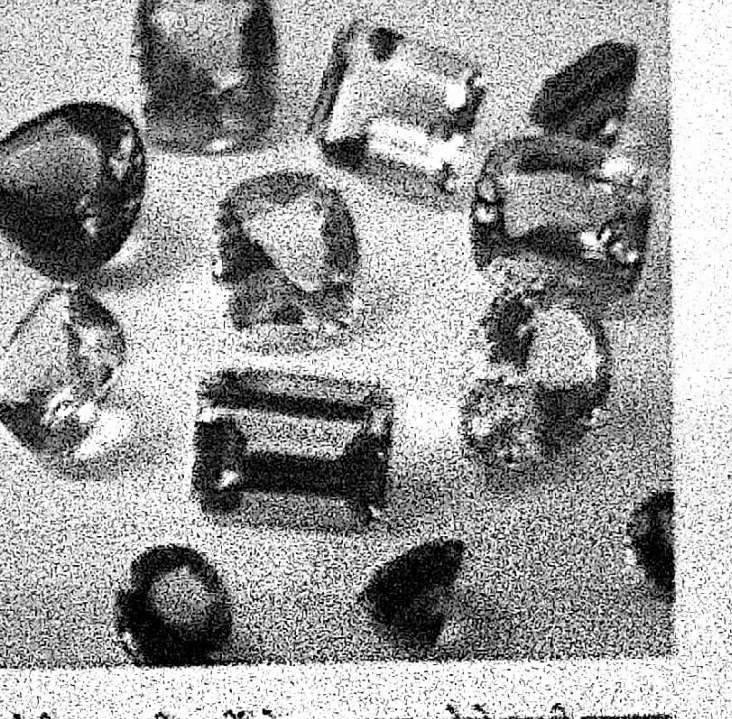
Once, a junior engineer came to me with two gems and asked me to tell him the reality of these gems. He held one gem between his fingers. As soon as I saw it, I said—this is golden, that is, I call it a topaz. Calling the second one a Naulam, he handed it to me, and without looking I closed my fist. As soon as I took the gem in my palm, a voice came to my mind: it is fake, it is made of hard plastic. Giving it back to him, I said, where is the question of fake or real, this is not even a stone, it is a plastic imitation used in cheap roadside
rings and in brass rings. At first they were surprised, because someone had given it to them calling it a real blue sapphire (neelam) and had quoted a price of twenty thousand.
A friend of mine practices trataka on gems alongside lamp trataka. He is very fond of the yellow sapphire (pukhraj). The best and most important thing is that the yellow sapphire on which he keeps practicing trataka sadhana, he sells it to someone in need when the time comes. Whatever work the buyer buys that yellow sapphire for, for those reasons and purposes, his task is accomplished immediately. I also know those gentlemen who, for their promotion, bought a yellow sapphire accomplished through trataka sadhana from him and wore it. Their promotion happened within a month. They gave a good ruby (manikya), charged through trataka, to a leader contesting an election. That leader won the election and became a cabinet minister.
A senior advocate of the Allahabad High Court came to me and gave me a blue sapphire. The blue sapphire was of very high quality. When I pressed it in my fist, the words spontaneously came out of my mouth: “This is a blood-filled (khooni) blue sapphire.” It has taken the lives of many people. It must have a red dot in the center. Hearing my words, he was stunned. Later, when it was viewed with a magnifying lens, there was indeed a red dot in the middle of the purple color.
The importance of gems in human life has existed since primordial time and will remain until the end of creation. Whether it is the realm of the gods, the realm of the demons, or the human realm, there has been a longing for gems in every realm. In Vedic astrology (Jyotish Shastra), a relationship between planets and gems has been established. So far, a total of 84 gems have been given importance. Now some more chemical gems have been added. There are also many medicinal properties inside gems, which is why Ayurvedic physicians (vaidyas and kabirajs) prepare their calcined ash (bhasma) and treat incurable diseases. Kings, Maharajas, and Nawabs used to drink alcohol from goblets made of gems and also drank medicines from them. Emperors engrossed in carnal desires used to drink beverages prepared by vaidyas and hakims in gem-studded goblets to increase their sexual power and retention power. I am just telling you about a stone; you can experiment with it yourself. If you put a stone in a glass of alcohol and drink the alcohol after swirling it slowly, the alcohol becomes more intoxicating, more inebriating, and remains effective for a longer time. Along with this, it also becomes an aphrodisiac. By adding a pearl or a cat’s eye, drinking does not cause intoxication to rise to the head.
To refine one’s personality, enhance beauty, and look dignified, gems are also set in gold and silver and worn. Wearing ornaments studded with gems brings a refinement to the beauty of both men and women.
Method (Vidhi)—Bring a pure, genuine, and large-sized gem on which you wish to practice trataka according to your need or for the fulfillment of desires (manokamana siddhi). Keep this in mind that the gem should not be defective. Generally, gems definitely have webs (jala), muddy spots (mada), lines, feathers (patth), and bubbles. Such gems are available cheaper than pure gems. If you are unable to buy a completely pure and clear gem, then ensure that your gem has the minimum number of defects. The more genuine and pure-clear the gem is, the better and swifter the benefit will be. The result will correspond exactly to the quality of the gem.
Place the gem on clean, white, smooth paper. You can use a wooden stand (chowki), stool, or table to place it. The height of the gem and your eyes should be the same. Your gaze should fall directly in the middle of the gem. The smooth, flat surface of the gem should face upwards, and the faceted, cut part should remain at the bottom. You can place clean cotton in the middle of the paper. Placing the gem on the cotton, align it level with your eyes. Your distance from the gem should be two feet. Spread a seat (asana) on the ground and sit in Sukhasana (easy pose), keeping your spine straight, chest expanded, and back and waist straight. There should be no light of any kind in the room, but the room should not be in complete darkness either. Natural light should come from the direction in which you are sitting, meaning the outside light should come from behind your back. If you are practicing trataka sadhana at night, the light should come from behind, over your head.
The second method is that you sit comfortably on a chair and practice the sadhana by placing the gem over cotton on your palm. The distance should be one foot, the gem in a straight line with the eyes, and the light coming from behind. However, in this process, your hand may ache, may tremble, and may move up and down. I have been writing repeatedly, every single time, that in trataka sadhana, one must not only look with unblinking eyes, but also unite the eyes of the mind with the outer eyes. By looking only with the outer eyes, there will be a ten percent benefit after considerable delay, whereas by looking with the eyes of the mind, there will be a fifty to sixty percent benefit quickly. By practicing the sadhana combining both the outer and inner eyes, success is achieved very quickly and one attains a one hundred percent favorable success. Through meditation yoga (Dhyana Yoga), breath control (Pranayama), and a moral course of action, the concentration of the mind can be established and enhanced. To hope for success in any sadhana without practicing mental concentration would be a mere fantasy. I have already written in detail about mental concentration.
Experiences (Anubhuti)—While practicing gem trataka, you will have the same experiences that occur when practicing lamp (deepak) trataka. Therefore, to understand the experiences of gem trataka, you must definitely study lamp trataka. Here, I am clarifying them in brief. When your sight connects with the gem, first of all, the same rays will emanate from that gem that the gem you have
has been chosen, that is, the color of the gem will be the color that appears. If it is a yellow sapphire (pukhraj), then a yellow golden glow and rays will emanate. If it is a ruby (manikya), then red or pink; if it is an emerald (panna), then green; if it is a blue sapphire (neelam), then blue; if it is a pearl (moti), then white; if it is a red coral (moonga), then yellow + orange; if it is hessonite (gomed), then like cow urine or brownish; if it is a cat’s eye (lasuniya), then seven-colored; if it is turquoise (firoza), then a green glow and rays will emanate, and then that glow will transform into a cluster. Sometimes a black circle will appear around the gem and the gem will disappear. Sometimes in place of one gem, many gems may be seen. Sometimes the gem will be seen flying from its place. Sometimes it will be seen hanging in the air. Sometimes the gem will appear large and sometimes very small. After this, the play of rays will begin. Rays will be seen shooting forth straight, then they will become circular, then rays of various colors will shoot forth, seven-colored rays will shoot forth. Sprays of light will be released and various shapes of rays will form, flowers will form — especially a flower like a sunflower will be seen. After the play of rays, the play of forms will occur. First, various kinds of forms will arise from the rays, then forms constructed from that very gem will arise. The forms can be of your choosing and also unchosen ones. There can be joy and also sorrow. Sometimes fear may also arise in the heart.
Experiences of this kind will be obtained within one to six months. The practitioner must keep all experiences secret. If excessive fear arises, then begin the japa (recitation) of your ishta (chosen deity) mantra or of any mantra.
Uses — By performing trataka on gems, spiritual consciousness will awaken, prana energy will increase, self-power will increase, and superpower will come. The practitioner’s prana shakti will increase toward becoming all-powerful. Through this trataka practice, the practitioner will be able to see his own form upon mind, body, and soul. He can enjoy all kinds of material pleasures. He can do whatever he wishes. He can turn amrita (nectar) into poison and poison into amrita. He can have darshan (vision) of the past, future, and present. Whatever you read, learned, and understood in the first part of this book regarding the benefits or importance of trataka practice — all of that will also be obtained by performing this gem trataka, but of bhoga (enjoyment) and moksha (liberation), only one of the two can be attained.
Through the ordinary practice of gem trataka, the influence of planets can be reduced or increased. If any planet is giving inauspicious results from the birth chart (kundali) or from transit (gochar), then its propitiation (shanti) can be done through gem trataka. If any planet is giving auspiciousness, then by performing trataka on that planet’s gem, its power can be further increased so that that planet will begin to confer even more benefit upon us. Suppose someone is afflicted by Shani’s Sadhesati (seven-and-a-half-year Saturn period), then they should perform trataka practice on the neelam (blue sapphire) gem. By doing so, the grace of the planet Shani will be obtained and one will be able to remain protected from Shani’s
effects. Similarly, one should understand the benefit and loss from other planets and their representative gems. Through gem trataka, one can also be protected from various diseases. This can be considered under gem therapy. I am providing a description of the gems of the nine planets (navagraha) along with some uparatnas (sub-gems). Readers can, after reading about their importance, effects, and relation to diseases, perform the trataka practice of that gem for themselves. Earlier, scholars recognized eighty-four gems and uparatnas, but now their number has increased to approximately 100. A description of 100 gems and uparatnas cannot be given here, therefore I am providing a description of the gems and uparatnas of the nine planets.
Sun Gem — Ruby (Manikya): Manikya is the gem related to the Sun. Through it, spiritual development and attainment of a royal position occur. The famous ruby used as the Sun gem also possesses disease-resistant capacity. The Sun gem ruby has the power to dispel numerous diseases. It is a useful gem for weakness of the bodily tissues (dhatus), impotence, abdominal pain, headache, digestive weakness (agnimandya), diarrhea, etc. It is also useful in blood deficiency and is antibacterial. Besides its material and gross qualities, it also has subtle qualities. Through it, fear is dispelled; energy increases; planetary obstacles, spirit possessions (bhoot badha), etc. are destroyed; and fame and good reputation lasting across birth after birth are attained. Through this gem, happiness, increase in progeny, social position and prestige, interest in religious works, desire for benevolence, and the decline of sinful mentality occur. The color of this gem is red. If it is placed upon a closed lotus bud, the bud will bloom open. By performing trataka on this gem, all its qualities are attained. For this, it is essential for you to seek out a genuine ruby gem. Performing trataka on a fake one is harmful. For its identification, one should take the help of an expert or a tantric.
Moon Gem — Pearl (Moti): The element that predominates in a pearl — the predominance of that same element must also be present in the practitioner. This is considered the gem of the Moon. It has a luster like the Moon, is smooth and pure. The pearl is a gem endowed with divine blessing for the human race. It is a gem with immense capacity for the all-round development of the body and for the alleviation of diseases. Through it, dental diseases, abdominal diseases, epilepsy (apasmara), kidney disorders, fainting, insanity, inflammation (pradaha), vata diseases, disorders of the stomach and intestines (amamashaya), nervous weakness, etc. are brought under control. Through the pearl gem, mental development and peace, strength, beauty, and the fulfillment of desires are attained. Favorability from all is obtained. Through its trataka practice, you can attain wondrous, marvelous, and divine power. It is also a very useful gem for women. Through its trataka vidya, benefits can be conferred upon others along with oneself. The practitioner should keep in mind that the gem should not be defective or fake; otherwise, a contaminated pearl, having a fruitless effect, can be harmful. In this, experts
…it is necessary to seek consultation.
Mangala (Mars) Gemstone Moonga (Coral)—The Moonga gemstone is the gemstone of Mangala. It is also known by the name Praval. This gemstone is actually found in the ocean. It is like a red-colored root (jadī). It is cut and shaped into beads (dānā). Some people consider Moonga to simply be a stone from the sea. It controls diseases across all parts of the human body. It possesses prominent astrological properties and medicinal qualities. It is especially important for the pacification of planets (graha shanti). It is beneficial for children startling in their sleep, ghost-afflictions (bhūt bādhā), planetary-afflictions (graha bādhā), marasmus/dryness disease (sūkhā rog), etc. For pregnant women, it is highly useful in conditions of miscarriage (garbhasrāv) or abortion (garbhapāt). Subtly, Moonga also has an effect on ghosts and spirits (bhūt-pret), Ḍākinī, Śākinī, etc. By practicing Trāṭaka on the Moonga gemstone, one is not affected by deceit, illusion-mantra-tantra (māyā-mantra-tantra), etc. One who practices Trāṭaka on the Moonga gemstone is not afflicted by the obstacle of the planet Mars. If a practitioner who has mastered Trāṭaka on the Moonga gemstone casts their gaze (dṛṣṭipāt) upon pregnant women, it is beneficial. If Mars is in a malefic position and has an adverse influence in the birth chart (kuṇḍalī), one can be protected from its defects by practicing Trāṭaka on Moonga. This Trāṭaka practice will be beneficial not only for you but also for others. Merely by the gaze of its practitioner, the diseases of others will be eradicated, and benefits can be gained from adverse planetary positions.
Budha (Mercury) Gemstone Panna (Emerald)—Panna is a famous green-colored gemstone. It is also known by the names Pannag, Haritmaṇi, and Bharakat Maṇi. In English, it is called Emerald. It is found in several colors. Panna is considered a gemstone that makes the planet Budha favorable. If the influence of Budha is malefic in the birth chart, you can attain auspiciousness by practicing Trāṭaka on the Panna gemstone. One will gain more benefits from Trāṭaka than from wearing it. Panna is highly useful in disorders of the rectum (guda). This gemstone is beneficial for stones (pathrī), lumps in the rectum, jaundice/anemia (pāṇḍu), malabsorption/sprue (grahaṇī), migraine (adhakapārī), vomiting (vaman), etc. In fact, the Panna gemstone strengthens the heart, brain, liver (yakṛt), stomach (āmāśaya), and the prāṇa (vital breath). It nourishes the womb of women and is beneficial for facilitating easy childbirth, etc. Through its subtle effects, ghosts and spirits run away. Black magic and spells (jādū-ṭonā) have no effect. It dispels insanity (unmāda) and helps in removing the distress of ascites/dropsy (jalodar), nocturnal emission (svapnadoṣ), and diseases of the legs. Trāṭaka practice on a fake Panna gemstone fails. Trāṭaka on a genuine Panna gemstone is a gemstone that grants liberation from the aforementioned diseases.
Bṛhaspati (Jupiter) Gemstone Yellow Pukhraj—Guru Bṛhaspati is famous for his greatness (gurutā). These
Pukhraj is known by many names such as—Puṇya Parāg, Pītamaṇi, Pīt Sphoṭik (yellow quartz), etc. In English, it is called Topaz. Simply by wearing Pukhraj on the body, one begins to attain liberation from all kinds of occurring diseases. Obstacles start to run away. It has proven helpful in removing all types of ailments. Wearing it leads to the attainment of food (ann), wealth (dhan), fame (yaś), and excellent intellect. It is helpful in the removal of cowardice, fear, sorrow, and worry. It nourishes spiritual thoughts, detaches one from selfishness, and propels them towards altruism (paramārth). Whether a maiden or a married woman, everyone should practice Trāṭaka on Pukhraj because this gemstone is a bestower of happiness, good fortune (saubhāgya), marital bliss, and the joy of offspring. If you desire peace of mind, wish to avoid worldly perversions, want to be freed from sinful actions, and want to recover from physical, mental, and financial problems, then you must practice Trāṭaka on Pukhraj. Upon succeeding in this, you can become the master endowed with all the aforementioned qualities. Pukhraj is the primary gemstone of the planet Bṛhaspati.
Śukra (Venus) Gemstone Heera (Diamond)—Heera is a gemstone related to the planet Śukra. People may also know it by the names Heerak, Kullish, Ark, etc. In English, it is called Diamond. If the affliction (prakopa) of Śukra is found in someone’s birth chart, they should practice Trāṭaka on the Heera gemstone to make it favorable. Even if Śukra is already conferring auspiciousness, one can still practice Trāṭaka on Heera. Once the Trāṭaka practice on Heera is mastered, the practitioner becomes capable of eliminating diseases related to it. It does not afflict the practitioner; merely by looking at the suffering of others, it liberates them from it. The Heera gemstone possesses the power to destroy insanity (unmāda), hysteria, impotence, semen defects (śukra doṣ), menstrual defects (rajo doṣ), dysentery/malabsorption (saṅgrahaṇī) disease, and fistula (bhagandara), etc.
It is highly beneficial in bloody diarrhea (raktātisāra), air/vāta disorders (vāyu vikāra), tears (aśru), hoarseness of voice (svarabhaṅga), jaundice/anemia (pāṇḍu), leucorrhea (pradar), chest diseases (vakṣya rog), and pulmonary inflammation (phuphus pradāh). In the condition of difficult labor (prasav kaṣṭ), quickly
144
It is also called Dṛṇāgrāhī (grain-attracting); the reason for this is that it possesses that very same quality. If even a straw is near a neelam gemstone, it sticks to it just as iron does to a magnet. If the neelam is flawless, it has a favourable influence. It is beneficial in all diseases of the body and in skin diseases. Its use is also beneficial in brain disorders. Through it, the effects of poison are also removed. Its nature is considered cold and somewhat dry. It promotes the growth of happiness and prosperity, lineage expansion, and so forth. Its trataka is capable of destroying all kinds of negative thoughts and brings success in calming the restless mind and keeping it cheerful. One who performs its trataka becomes the master of all benefits.
Rahu’s Gemstone — Gomedha: Gomedha is the gemstone related to the planet Rahu. In English it is called zircon. If Rahu’s dashā (planetary period) is malefic, it is especially beneficial for that. Through gomedha, treatment of many diseases is possible. It is beneficial for removing gastric troubles, gas pain, and kidney disorders. Being of subtle influence, it is intellect-enhancing. It has a favourable effect in matters of wealth and property, promotion, and progeny increase. It is helpful in increasing offspring and in defeating enemies. It is a very useful gemstone for dispelling various mental disorders and removing spirit-obstacles. Therefore, through its trataka you can obtain its qualities.
Ketu’s Gemstone — Lahsunia: This gemstone is related to Ketu’s sign. Due to differences of place and language, it is known by many names. In English it is called cat’s eye stone. A lah sunia gemstone that has a brownish (piṅgala) hue like a cat’s eye is considered the best. It is believed that if the genuine gemstone is placed on a bone, a hole is bored right through the bone. If you perform trataka on this gemstone, you can certainly become the possessor of divine qualities. Along with all bodily disorders, its effect also falls upon the mind and brain. It increases happiness and peace, freezes enemies, and protects from weapon-inflicted injuries. Diabetes patients benefit from its trataka. It also protects from spirit-obstacles and sudden accidents. Therefore, through trataka sādhanā on lah sunia, one can remain protected and secure in every way.
Ruby’s Upratna (Secondary Gemstone) — Lalri: The secondary gemstone of ruby is lalri. It comes in several colours, but as the Sun’s secondary gemstone, only red, pink, or vermilion ones are chosen. Lalri is worn for pacifying the Sun planet. If the Sun is debilitated (nīcha), is an obstructive influence, or is situated in the eighth, fifth, or twelfth house, one should perform trataka on lalri.
Pearl’s Upratna — Moon Stone: It is solid, heavy, white, and smooth. It possesses the power to reflect the Moon’s rays. Therefore, one whose Moon is afflicted, inauspicious, seated in a debilitated sign, conjunct with Rahu or Saturn, or seated in the eighth or twelfth house should
145
wear moon stone and, by performing trataka sādhanā on a large-sized moon stone, should reduce the malefic influence of the Moon.
Coral’s Upratna — Vidruma Maṇi: It is also called Saṅgha Maṇi. One in whose chart Mars is giving inauspicious results should wear vidruma maṇi in place of coral. If Mars is seated with Rahu or Saturn in the chart, one should wear vidruma maṇi and perform trataka on it. Mars is a cruel planet. It also forms the Māṅgalika yoga. For men and women with Māṅgalika yoga, performing trataka on vidruma maṇi brings auspiciousness.
Emerald’s Upratna — Marka j: The secondary gemstones of emerald are markaj and also firoza (turquoise). Perform trataka on green-coloured markaj or green-coloured firoza — you can strengthen and turn to your favour your debilitated, low-aspiring, ast (set), or inimical-territory Mercury. One in whose chart Mercury is in the sixth, eighth, or twelfth house should perform trataka on firoza and should wear firoza. Those who wear firoza or markaj and perform trataka on them do not suffer the fear of ghosts and spirits.
Yellow Sapphire’s Upratna — Topaz: Along with topaz, gems named sonela, piyā, kail, sonal, and kesari are also secondary gemstones of yellow sapphire. They can be worn in place of yellow sapphire and trataka can also be performed on them. If Guru (Jupiter) is debilitated, conjunct with Rahu, Ketu, or Saturn, or is in the sixth, eighth, or twelfth house, one can perform trataka on topaz. Married and unmarried women should definitely wear topaz and should perform trataka on it. Even when Jupiter is auspicious and exalted, in the absence of yellow sapphire, trataka can be performed on topaz.
Diamond’s Upratna — Opal: Not everyone can buy a diamond. In place of diamond, one can buy a chemical diamond. This is called A.D., meaning American Diamond. Russian Diamond and Chinese Diamond are also sold, but the secondary gemstone of diamond is opal. Opal reflects back the rays of Venus — the planet of diamond. Therefore, those in whose chart the planet Venus is debilitated, is in an enemy’s territory, is in the sixth or eighth house, or is conjunct with a malefic planet, should wear opal and perform trataka on opal.
Neelam’s Upratna — Neeli: Neeli is a black or deep blue-coloured, shiny, solid stone. Besides neeli, jamuniyān are also secondary gemstones of neelam. Jamuniyān is a transparent stone of the jamun (black plum) colour, whereas neeli is an opaque stone. If the planet Saturn is giving bad results, is seated in an inauspicious position in the chart, is in a debilitated sign, is in the fifth or seventh house, or if Saturn’s sāḍhe-sātī (seven-and-a-half-year period) is running, one should wear neeli and perform trataka on it. For an auspicious Saturn, perform trataka on jamuniyān.
Hessonite (Gomed) and its uparatna (secondary gem)—Turja is also an uparatna of Hessonite along with Safi. If Rahu is afflicted, inauspicious, and conjunct with Sun, Moon, or Mars; if it is debilitated; if it is in the sixth, eighth, or twelfth house, or in the fifth or seventh house, then one should wear Safi or Turja and perform trataka sadhana on them. If Rahu is well-placed, situated in the third, ninth, tenth, or eleventh house, or is forming a Rahu Tunga Yoga, or is in an auspicious exalted sign, then one should perform trataka on Hessonite.
Lahsuniya’s uparatna Godant—This is shiny like a cow’s tooth. It is found in abundance in the Gomti River. If the planet Ketu is giving inauspicious results, is debilitated, is conjunct with Mars, or is situated in the eighth, twelfth, fourth, or seventh house, then one should wear the Godant uparatna of Lahsuniya and perform trataka on it. Those afflicted by bhoot-pret (spirits), mental patients suffering from psychosis, or those who have epileptic seizures should perform trataka on Godant.
Readers have been advised on performing trataka on the gemstones and uparatnas of the navagrahas (nine planets). It is not possible to give a detailed description of the eighty-four gemstones here. Interested readers may make personal contact.
Trataka Sadhana on Metals
Metals hold great importance in our lives. You all know and understand the importance of metals used in everything from needles to building construction. The practice of cooking vegetables in an iron kadahi (wok) exists in our families precisely because iron from the kadahi transfers into the vegetables, and through the vegetables, into our bodies. It is this iron, in the form of the iron element, that produces blood corpuscles in our blood. Gold holds the highest importance. This importance is not because gold is an expensive metal, but because divine qualities are inherently present in gold. Children are made to wear the silver Chandra and Haay. This is a round piece of silver with a Haay pattern inside it. It protects children from the evil eye and from any kind of tone-totke (occult spells). Additionally, it was also worn because silver has disease-resistant properties. Copper vessels are used in worship because copper is considered sacred and pure.
Metals are used in Ayurveda to prepare bhasma (calcined ash). Patients are treated with Lauha Bhasma (iron ash), Swarna Bhasma (gold ash), Rajat Bhasma (silver ash), Tamra Bhasma (copper ash), and so on. If we perform trataka sadhana on metals, we get relief from various diseases without their direct application. In the following description, you will read and understand the properties of metals. Accordingly, you can perform trataka on the metal of your choice. There is absolutely no possibility of harm in this trataka sadhana.
Preparation—First of all, take only the pure form of the metal on which you wish to perform trataka; using an impure, dirty metal or a fragment of metal may also cause you harm. You should have the metals melted and purified and have globes (pellets) made from them. Have metal globes made the size of large rudraksha beads or children’s large marbles (glass balls). Have a loop attached to them so that they can be suspended. Clean the globes daily by rubbing them and keep polishing them to maintain their shine.
Before the practice, suspend that sphere by means of a thin cord from some elevated empty spot. Suspend it in such a way that the metal sphere remains suspended directly in the line of your eyes, at the same height as your eyes. Its cord should be fastened up high to the ceiling or to the upper frame of a door. If you wish, you can have a wooden stand made. Its shape should be like the goalpost buried in a football field. Tie the sphere’s cord to the crossbar on top of that post. By doing this, you can keep a stand anywhere indoors or in the open, suspend the sphere, and perform metal trataka. Bear in mind that the sphere must not sway, wobble, or dance. The sphere must remain perfectly still. It must remain shining. The sphere should be in the direct line of your eyes, and your sitting distance from the sphere should be two to three feet; keeping it greater than this would be improper.
Experience — First the sphere will appear shining to you, then rays of the metal’s colour will be seen bursting forth, those same rays will become multicoloured, then flowers of the metal’s colour or of seven colours will be visible. After that, it will look like a sparkler or a spinning firework (chakari). After some days the sphere will disappear from time to time in between, and black darkness may be seen. In such a situation one should neither be frightened nor disheartened. One should not entertain any kind of doubt in the mind, because within a few moments or in the next sitting the sphere will again become visible along with its lustre, and rays will be seen bursting forth from it.
Benefits — The greatest benefit you will obtain from doing trataka on metals is that the seven dhatus (metals/constituents) within you will all become balanced; or if a particular dhatu is deficient, then by doing trataka on the sphere of that metal, that metal will begin to increase in your body. For example, if someone has a deficiency of the iron element in their blood and they perform trataka on an iron sphere, then the iron element in their blood — that is, haemoglobin, that is, red blood corpuscles — will definitely increase. Similarly, if a patient of a respiratory ailment performs trataka on a silver sphere, they will obtain considerable relief in the respiratory disease. Gradually they will become fully healthy. One thing must certainly be kept in mind: while doing trataka on any target, this feeling must be maintained — “May my particular disease be cured — my disease is being cured. May my particular desire be accomplished, be fulfilled through this trataka.” Now below I am describing the properties and effects of some important metals so that you may understand:
Trataka on Gold — Gold has many well-known names such as Swarna, Kanchana, Kanaka, etc. In English it is called Gold. It is a sacred, yellow-coloured, lustrous, well-known metal, which is generally used by wealthy people in the form of ornaments. Vaidyas and Hakims prepare its bhasma (kushta) and use it as medicine. Gold is regarded as endowed with all qualities and as an extremely sacred metal. Its nature is considered calm, favourable, even, generous. Some people consider gold to be slightly hot in nature. According to the view of certain people, it is a very useful rasayana (rejuvenative) for the human body, which removes many diseases and keeps one always happy, cheerful, and disease-free. It is for this reason that the old custom of wearing gold ornaments has persisted. Among women, and especially among kings and maharajas and wealthy families, it has been used in various ways, or continues to be used. Wearing numerous ornaments on various parts of the body — such as ears, nose, neck, hands, forehead, etc. — besides, abroad, as a fancy: for instance, the Greeks used to have gold nails embedded in their teeth, which is now in vogue here as well. Important people would partake of food in gold plates and betel in gold trays, using its element to regulate and purify the body’s external and internal organisation, and so on, or continue to do so. Through this the body remains robust and plump and joyous. One’s nature becomes simple and cheerful. It is also useful in maintaining regularity of the heart’s palpitations and in relieving heart anxiety. Courage, valour, enthusiasm, joy, and love arise. Its touch and sight are also considered important. As stated: Yatha sarve gunah kanchanam ashrayanti (just as all qualities reside in gold). A person’s needless worries, sorrows, problems of offspring, etc., are easily resolved through it. It also has a favourable effect on the inhalation–exhalation process, therefore a person becomes capable of taking in sufficient quantities of fresh oxygen.
Because of its favourable effect on the heart, the blood-circulation function becomes regular and the lungs become strong. Through their strength, there remains no fear of being afflicted by any disease. Pure gold also has an effect on the seminal centre (shukrashaya). Proper activity is generated in the seminal glands located in the body. When the brain is favourably engaged, masculine potency increases. It is also beneficial in wasting disorders (shosha), prameha, diabetes (madhumeha), etc. For those who feel a diminution of sexual vitality within themselves, trataka on gold proves very useful. Through it impotence is removed and reproductive power receives a boost. Performing, or having performed, the trataka practice of gold is beneficial for both physical and mental nourishment.
Trataka on Silver — Silver is called Rupa, Rupya, Rajata, and Silver, etc. It is a white-coloured, bright metal that possesses lustre. Its ornaments are made. Vaidyas ignite silver and prepare its bhasma and consume it as medicine. It is a mineral and a well-known substance. Its nature is considered cold and light. Silver nourishes the life-force, protects it, and strengthens the heart and the stomach (amashaya). Through it all the dhatus of the body — rasa (plasma), rakta (blood), mamsa (flesh), meda (fat), asthi (bone), majja (marrow), shukra (semen), etc. — receive nourishment. By its effect, excessive corpulence is reduced and kapha disorders are also dispelled.
Silver is considered to have a close relationship with the moon. It exerts a favourable influence on the shukra-sthana (reproductive system), so it enhances copulative power but calms excitement. Because it has the quality of cooling the semen, its effect is mild and soothing. Therefore meaningless desire is pacified. It is common for children to wear a silver moon and a round silver piece inscribed with the word “haath.” This silver is also considered beneficial for boys. Some people, to ward off planetary influences, spirit-afflictions, etc., tie amulets on children or make a silver moon and put it around their neck. Silver also holds great importance in the spiritual domain. This metal is considered highly sacred, so in ancient times people used silver vessels as well. Silver is beneficial for children suffering from breath ailments, colds, and wheezing. It can be used in the form of silver bhasma (calcined ash), etc. If you practise trataka on silver, you will find that the qualities of silver have increased within you and you are obtaining freedom from those diseases whose treatment is done through silver or silver bhasma.
Trataka on Copper — In Sanskrit this is called “tamra” and in English “copper.” Its colour is brownish with a reddish tinge. Its vessels were used more in earlier times. In worship and spiritual practice, its vessels are still used even today. Tantriks use it extensively in the making of yantras. It is regarded as a sacred and good metal. Vaidyas (Ayurvedic physicians) also use its bhasma in the form of medicine. It possesses many such qualities that are highly useful for the human body. In its nature it is considered hot and dry (ruksha). It is especially useful in pacifying vata-dosha. All cold-origin diseases are cured by it. It is also useful in diseases such as pain in the joints of limbs, paralysis, etc. If there is swelling in any part of the body, it is cured by its use. It is also useful in blood deficiency and jaundice. Copper has a purifying effect on the blood, so it can be useful in all skin diseases and disorders. It is also beneficial in boils, pimples, ringworm, scabies, rashes, leprosy, etc. If a wound occurs anywhere in the body, it heals quickly with this.
Through the practice of trataka sadhana on the copper metal, one can succeed in eliminating vata diseases, blood diseases, pitta and kapha diseases, inflammation, etc. In this sadhana, benefit can also be derived for cold-origin disorders. Thus, if you perform trataka on copper, attainment of auspiciousness is possible.
Trataka on Zinc — This too is a well-known mineral substance. It is called justa, just, yashada, loomi turatiya, etc. In English its name is zinc. Its colour is white but somewhat off-white. In nature it too is considered hot and dry (ruksha). Vaidyas also prepare its bhasma and administer it as medicine. It is also
used in many tasks of craftsmanship, etc. People also use it in the form of vessels. Eating and drinking food, etc., from zinc vessels gives strength to the heart and stomach.
It also has a favourable reaction in removing vata diseases. It is primarily an anti-inflammatory. It also has an important role in eye disorders. Many eye disorders are removed merely by the touch of a probe (salai) made from it. By cleaning it, i.e. polishing it, and performing trataka sadhana on it, you can free yourself from all eye afflictions. The web-like haze, fog, and redness of the eyes are eliminated.
Trataka on Lead — Lead is called sisak, shisha, surab, etc. In English its name is lead. In colour it is black and somewhat shiny, but when tarnished it loses its shine. This too is a well-known metal. Printing-press type is made chiefly from this metal. Vaidyas and hakims also use it in many ways. It is fundamentally used in eye applications such as kohl (anjana) and surma. Its nature is considered cold and moist. Its effect falls upon the excretory system. It is also used in superficial burning sensations of the body, etc. Through its trataka you can obtain freedom from eye diseases.
Trataka on Tin — Tin is called rang or vanga. The vanga bhasma that medical practitioners use is the bhasma of tin. Its colour is white and shiny. In nature it is considered cold and dry (ruksha). Oral consumption is like a deadly poison. Its external use is beneficial for piles, anal inflammation, and itching, etc. With its surma, the eyes are freed from muddy discharge, redness, and pain. It is also useful in skin disorders. Its bhasma is used abundantly in the disease of prameha (excessive urination/seminal discharge). Through the practice of its trataka sadhana, you can successfully eliminate all your eye disorders.
Trataka on Brass — This is one such well-known metal from which vessels of every kind are made in large numbers. Not only that, divine idols and toys, etc., are also made from this metal. Medicinal properties are also found in it. By eating food from brass vessels or using other eatables and drinkables from them, there is special benefit in removing vata and kapha disorders. As a result, swelling of the spleen is removed. It is also useful in blood deficiency and pandu (anaemia-like) disease. Beneficial results for the organs related to the head are also possible from it. Its use is beneficial for the digestive system. Traditionally, food, etc., has generally been prepared in brass vessels. By practising trataka sadhana on brass, you can succeed in absorbing within yourself all the aforementioned qualities inherent in it, through which success can be obtained in gaining freedom from numerous disorders.
Trataka on Iron — The use of this metal is extensively carried out in all forms
…is obtained. It is a famous metal obtained from large mines. It is used for everything from needles to large girders, railings, machines, and various small and large spare parts, windows, doors, etc. It is also of great importance in the manufacture of weapons and in cooking utensils such as kadahi (wok) and chimta (tongs). Arrangements for cooking vegetables in a kadahi were made because it provides us with taste and nutrition. Through this, the body receives iron. This very iron, in the form of a metallic element, creates blood particles.
Medical practitioners have also made extensive use of it in the form of bhasma (calcined ash). They have been deriving portions of its properties in the form of asava (fermented infusions), etc., and from its filings. Its use has persisted in all types of indigenous and foreign medicines. From the perspective of nature, it is considered cold and ruksha (dry). It is considered extremely beneficial in resolving the problem of raktalpata (anemia). It is beneficial in pittajanya (bilious) and raktajanya (blood-borne) problems. Mainly, because it is strengthening for the amashaya (stomach), it keeps the body strong and increases ojas (vitality) in the body. It is beneficial in pacifying the vata (wind) generated by arsha (piles). It hardens the organs and causes stambhana (retention) of shukra (semen). The use of iron has been successfully employed in women’s weakness, etc. You can make yourself stronger through the practice of iron trataka. Through this, one can also obtain the benefits of stambhana shakti (retentive power) and virya vriddhi (increase in semen).
Trataka on Kānsa (Bronze)—This is also a famous metal, and its utensils are extensively used. In nature, it is considered hot and ruksha (dry). It removes the shotha (swelling) of organs, stops vaman (vomiting), and enhances intellect. It is effective in enabling the nose to grasp smells. You can attract the qualities inherent in it through trataka sadhana. Through its effect, disorders of kapha (phlegm) and pitta (bile) are pacified. Eye disorders are also eliminated.
Trataka Sadhana on Fruits
After having the darshan (sight) of Vaishno Devi, when a plan was made to go to Patnitop, I thought that we should at least enjoy the waterfalls there. The scenery of Patnitop is very picturesque. We had enjoyed that place several times before. Apple orchards also fell on the way to Patnitop. Plucking and eating apples in those orchards had its own taste, its own joy. We were traveling by car. As soon as we passed in front of an apple orchard, my fellow traveler asked— “Shall we get some apples?” The car stopped, everyone got out and went towards the orchard. I lagged behind everyone and saw that a boy was repeatedly jumping to pluck an apple hanging on the lower branch of the apple tree, but he could not reach the apple. I went up to him and said affectionately— “Shall I pluck it?” “No… no… I don’t want to pluck the apple. The apple will come to me itself.” “How? It is high up from you, it is far, then how will you get it?” “If you want to see, then watch…” Saying this, he moved five to seven feet back from the spot where he was repeatedly jumping to catch the apple. I stood in my place and kept watching his actions. He did not make any movement or gesture. He just became still and, fixing an unblinking gaze (apalak), started staring only at that apple. I understood that this boy was performing trataka on the apple, but I still could not understand when and how the apple would come to the boy on its own. After two minutes, that boy stepped two steps forward, but his unblinking gaze remained fixed on that same apple. Pausing for a minute, he took two steps forward and then stopped. This time too, his eyes remained fixed on the apple. Even while walking, his eyelids did not blink, nor did his gaze waver. A minute later, when he again took two steps forward, I saw that the branch itself was bending downwards. The branch on which the apple was hanging was slowly bending downwards. Two more steps and
When it was raised, the boy stood beneath the branch of that apple. Now he had to raise his head and gaze unblinkingly at the apple. The apple, along with the branch, had come down so low that the boy could easily pluck it, but the boy did not extend his hand to pluck the apple; rather, he kept gazing at the apple with unblinking eyes for one minute… kept gazing. The apple itself stirred a little; just then the boy placed his palm right below the apple. Even so, he did not touch the apple. The apple broke off from the branch on its own and dropped into his palm. He squeezed his eyes shut tightly, then walking toward me, opened his eyes and said joyfully — “See, the apple has come to me on its own?” I attempted to touch his feet, whereupon he gave a startled exclamation and said — “What is this… what are you doing… you are an elder, why do you touch my feet? In our way, we bow only before God — we prostrate.” Cutting off his words, I said that for me, he himself was God. One who performs such a miracle is indeed God. The boy protested, “No, I am not God, I am only a servant; here, I give you this apple, eat it, it is very sweet and delicious. I eat the apples from this very tree. Baba also likes these.”
“Do you know that this practice, which you just performed, is called trataka sadhana?” I asked. “No… Baba taught me whatever he did, and I have been doing it for two to two and a half years. What kind of practice or sadhana this is, only my Baba can tell.” Saying this, he ran off toward the elderly man seated on the other side of the garden.
I saw that a Kashmiri elderly man, dressed in Kashmiri attire, was seated on a relaxing chair. On his head was a round Kashmiri fur cap, and kohl (surma) in his eyes suited him very well. His complexion was indeed Kashmiri, and his large, broad frame was indicative of a fine personality. The boy reached him and was telling him something; just then I too approached them. I offered my respectful greetings, and he returned the salutation. “Respected sir, are you this boy’s Baba? Was it you who taught and guided this boy in trataka sadhana? He has turned out to be an amazing sadhak (practitioner). He actually bent the apple through trataka and made it drop without touching it. I am simply astonished to see his miracle. Going forward, his trataka sadhana…” The elder cut my words off midway, “I do not know whether what he is doing is trataka sadhana or some kind of magic, but I do know this much — this practice of his has made him disease-free. I did not teach it to him understanding it as a sadhana, nor do I myself know about this sadhana. A saint has been coming to my place for years; whenever he travels on pilgrimage to Gangotri, Yamunotri, or Baba Amarnath, he stays at my place for a day or two. This child fell victim to blood deficiency three years ago. He would often suffer from jaundice (pandu roga). Baba told him to gaze unblinkingly at the apple and reassured [us] that
this would be cured in six months. I learned and taught him the method, timing, practice, etc. of gazing unblinkingly at the apple, and since then he keeps his eyes fixed on the apple. Now he does not suffer from any blood-related disease. He is also becoming continuously healthier. So much power has come into his gaze that he can drop even the highest apple without touching it within half a minute each. Such power has come into his eyes and his feelings that the branches of the apple keep bending down on their own. Now he does not need to perform this practice; even so, if he does it, let him. Going forward, he will become a very great trataka sadhak, and divine power will come to reside within him. He will be regarded like the pirs and prophets.” I blessed the boy from my heart. By then my companions had begun honking the horn to call me. I took leave of the elder and the boy and returned to my companions.
I had understood that by performing trataka on the apple, the boy had absorbed the qualities of the apple within himself. In the same way, by performing trataka on any fruit, its medicinal properties can be absorbed within oneself. Ahead, I shall describe the qualities, uses, and medicinal elements of various fruits, so that readers may, on the basis of their properties, make their selection of which fruit they wish to perform trataka upon.
Method — Two methods may be adopted for performing trataka on fruits. One method is to gaze unblinkingly at the fruit attached to the branch, that is, to perform trataka upon it. The second method is to place the fruit on a stool or a chair covered with white paper or cloth. The height should be level with the sadhak’s eyes. The distance between the fruit and the sadhak should be three to four feet. The sadhak should sit in sukhasana (easy posture), perform pranayama, and then perform trataka sadhana on the fruit. While performing trataka sadhana, the sadhak must continuously maintain in mind the feeling or purpose for which the trataka sadhana became necessary.
Experience — While performing trataka sadhana, you will first experience the fruit disappearing, two or four fruits appearing, or the fruit moving here and there; then rays of the fruit’s colour will burst forth, then rainbow rays will spread, then showers of sparks will radiate, etc.
Trataka on the Mango — The mango is an extremely popular fruit. It possesses the power to destroy nervous disorders. Through it, the pranas receive strength and ojas (vital energy) increases. It strengthens the kidneys, spleen, rectum, and intestines. It also has the property of protecting against the hot winds (loo) that blow during the summer season. It is calming to shukra (semen/reproductive energy) and promotes diarrhea. Since its action occurs upon the shukrashaya (seminal vesicle), it also has the property of stambhana (arresting/retaining). Through its use, loose stools stop.
Trataka on the mango tree encompasses all the aforementioned qualities. Its small fruits
can also be chosen for trataka. For trataka sadhana, its raw fruits can be more beneficial. This practice can also be done on the leaf, but the leaf should be clean.
Guava Trataka — Guava is called jamphala. It is a highly digestible and delicious fruit. Its reaction on the digestive system is very favorable. It provides strength to the body and heart and gladdens the mind. Through it, the practitioner’s digestive power becomes sharp and restlessness is removed.
In conditions of bleeding from the mouth, guava is more useful. It is helpful in eliminating palpitations of the heart. It is important for keeping the brain moist and in all abdominal disorders such as diarrhea, indigestion, constipation, etc. Some experienced people are of the opinion that it is useful even in feverish conditions. It is especially more helpful in fever arising from constipation. By practicing trataka on guava, you can awaken all these qualities within yourself. Your sadhana can prove beneficial for the welfare of others.
Pomegranate Trataka — Pomegranate is a well-known tree. Its fruit is also delicious and disease-destroying. It is considered soothing to the abdomen, ripening the rasa (digestive juices), and a promoter of urination. If there is palpitation, excessive thirst, or weakness in the heart, these are removed by the influence of pomegranate. It is also highly helpful in deficiency of blood.
If there is hardness in the stomach, flatulence-like symptoms, pain, indigestion, sour belching, etc., pomegranate brings relief. It is effective in liver weakness, when the body is free of waste matter, and in clean, loose stools. If the pomegranate is sour, it removes inflammation of the chest. It is also beneficial in heat of the liver, pandu (anemia/jaundice), vomiting, dry itching, blood disorders, and similar conditions. It is also beneficial for bilious vomiting, hiccups, etc.
By performing trataka on the pomegranate tree, you can incorporate the aforementioned qualities within yourself and, through your gaze alone, benefit others with these qualities.
Amla Trataka — Medical scholars have regarded amla as a rasayana (rejuvenative). It is a boon for keeping human beings healthy and a granter of longevity. Its direct effect falls on the rasa-rakta (plasma and blood), therefore it strengthens the heart and lungs. Through its use, all components of the brain become strong and robust. It is also beneficial for nervous debility. Among its chief qualities, the circulation of ojas (vital essence), removal of weakness of the seminal vesicles, and destruction of impotence are noteworthy. It prevents the shedding of surface waste matter from the colon, stomach, and intestines. Its use is helpful in purifying impure doshas (humors).
For the eyes, its use is highly beneficial. By removing numerous disorders, it provides luster to the eyes. A practitioner who performs trataka on the amla fruit or tree easily attains distant vision. In any kind of inflammation or pain arising in the eyes for any reason, its sadhana is useful. It is also highly beneficial in baldness and white hair.
Walnut Trataka — The walnut tree is generally found in mountainous regions. Its fruit is delicious and nourishing. It also possesses medicinal properties. If you perform trataka sadhana on the walnut tree or fruit, you can acquire ownership of the following qualities — easy digestive power, gentle nature, increase of dhatus (tissues), health of the heart, strengthening of internal organs, etc.
Walnut destroys the weakness of the heart and makes it strong. It also removes weakness of the brain. It is helpful in correcting the body’s disordered functions caused by liver weakness. From it, quick relief comes in phlegmatic cough and cold cough.
It also has a favorable effect on abdominal diseases. By correcting the function of the intestines, it helps remove indigestion and agnimansha (defective digestive fire). As a result of the chemical action on the digestive system, the elimination of waste matter becomes effortless. When the weakness of the internal organs is removed, the body becomes healthy and the nature becomes gentle.
It also has a favorable effect on the seven dhatus situated in your body, therefore it is also considered a physical strength-promoter. It is also useful in kasa (cough) and swasa (asthma/breathing difficulty). If you practice its trataka, you can acquire the above-mentioned qualities and bring benefit to others.
Plum Trataka — This pacifies blood disorders and destroys pitta. It also removes pittajwara (bilious fever) or raktajwara jwara (blood fever). Through it, maturity comes to the stool and vyasa (looseness/dysentery) is removed. It purifies the stool and eradicates ringworm and itching. Through its use, the nature becomes soft. Performing trataka on its tree is more beneficial. The fruit is also beneficial, but in sadhana, the use of the tree or leaf is more appropriate than the fruit.
Fig Trataka — Fig is also a special delicious fruit. It too possesses medicinal properties along with nutritive qualities. It is vata- and kapha-destroying, therefore it is highly useful in kaphajwara (phlegmatic fever) and cough. It also has an extremely favorable effect on the bodily dhatus. In all vata disorders, it is more beneficial. In joint pains, it provides quick relief. Fig is beneficial for the diagnosis of valuable diseases. In liver-spleen also
…is useful. It strengthens the kidneys (vrikka) and is an opener for irregular blood circulation and various other diseases. Through fig (anjīr), kapha-origin disorders are destroyed and the movement of vāyu (air) becomes effortless. One can obtain benefits from it in ulcers, vata (neurological/rheumatic conditions), pradhusi (prameha/diabetes), hemiplegia (paralysis), etc. It is also beneficial in apasmara (epilepsy) and yoshapasmara (hysteria). Fig is also highly important for enhancing physical complexion. Freckles, pimples, etc., appearing on the face are removed by its influence. It is also beneficial in purification (shodha). You can keep the body healthy by performing trataka on the fig tree or its fruit. If the body is healthy, the mind also remains healthy; through this, you can effortlessly acquire all its qualities.
Trataka on Ak (Madar)—Ak is called Alarka in Sanskrit. It is a small tree that is generally found in many places. When broken, a milky sap exudes from it which is not fit to be touched. Applying it anywhere on the skin causes harm. It has small flowers. Its main property is to destroy worms (parasites). Its leaves and flowers possess the property of digesting food. It is extremely useful in disorders arising in the pakvashaya (rectum/large intestine). In bodily swelling arising in winter, its leaves provide relief. By practicing trataka sadhana on its tree, you can absorb all the qualities inherent in it. You can also practice trataka separately on its leaves.
Trataka on Imli (Tamarind)—Imli is a famous and useful tree for life. Its fruit is also called Katara. You can choose its fruit, flowers, and leaves for trataka. Tamarind is beneficial in rakta prakopa (aggravation of blood). It removes anxiety of the heart, provides strength to the amashaya (stomach), and makes the prakriti (constitution) mild. If there is dizziness in the head, it is relieved by it. It is useful for alleviating bodily pain and removing constipation. By performing trataka on tamarind, one can be protected from deadly diseases like epidemics (plague).
Trataka on Karonda (Christ’s thorn)—The Karonda tree is generally found in almost all provinces. Its fruit is sour, which is used in pickles, chutneys, etc. It alleviates piles (bavasir), jalodara (ascites/dropsy), and kidney pain. It is also beneficial in destroying stomach worms, bodily swelling, clearing urine, and removing constipation. In fact, Karonda is considered an opener of resistant power (immunity) and a giver of complexion. Through its trataka, you can be capable of obtaining benefits from all the aforementioned diseases. It is found to contain abundant quantities of Vitamin C.
Trataka on Kela (Banana)—The banana tree is also called Kadali. Its leaves are up to 8 feet long and up to 5 feet wide. Its fruit is white from the inside, delicious, and pacifies heart diseases. It makes the chest soft and removes weakness of the kidneys. It is useful in removing dry cough and hoarseness in the throat, nourishing the body, destroying abdominal worms, and making the prakriti (constitution) clear. Although it is highly edible and takes a long time to digest (dirgha paki), it is pleasing. Its root destroys stomach worms. Through its trataka, all the above disorders are pacified and its qualities are obtained.
Trataka on Gular (Cluster fig)—Gular is a type of fruit-bearing tree, which is used for diseases like piles (bavasir), asthma (shwas), cough, dental pain, breast inflammation (stan shoth), etc. It is considered extremely beneficial. It is also effective on the abdomen and digestive system. Through it, ear pain, diabetes (madhumeh), and other diseases are remedied. By practicing trataka on its tree, fruit, or leaves, you can obtain relief from eye strain. It has the capacity to increase sperm (shukranu).
Trataka on Jamun (Black plum)—Jamun is a large tree with dark purple-colored fruits. It is more useful for those with a hot nature (ushna prakriti). Through it, the amashaya (stomach) and liver (yakrit) become strong. It stops pittaja (bilious) diarrhea and helps in removing the anxiety caused by diarrhea. Jamun is beneficial in blood disorders. Through it, hunger and ojas (vital energy) increase. It is also beneficial in spleen inflammation and diabetes. It is also beneficial in pitta aggravation and sugar (diabetes). The powder of its seed is beneficial for diabetic patients. By practicing Jamun trataka, you can acquire its qualities and remain disease-free.
Trataka on Bel (Wood apple)—Bel is considered a holy and religiously important tree. Its fruit, flowers, and leaves have proven useful not only for humans but also for deities. Shiva devotees consider the offering of Bel leaves in the worship of Lord Shankara as a science/knowledge to please Him. It is a belief that Lord Shiva is less pleased by the Bel leaf compared to other objects. Its fruit is beneficial in every way. Be it raw or ripe, it makes the heart, stomach, and liver strong. It removes constipation, and due to its favorable reaction on the intestines, it possesses the ability to even stop diarrhea. It also removes ordinary dysentery and internal unctuousness (lubrication). Through trataka sadhana on it, the circulation of the above-mentioned qualities in the body, freedom from disorders, becoming a recipient of the grace of Lord Ashutosh, and the faith to perform effortless devotion can be attained. Its consumption acts as an infallible cure (ramban) in diseases like sprue syndrome (sangrahani), etc. Its spiritual quality is also beneficial for the human body.
Trataka on Nimbu (Lemon)—Nimbu is a famous fruit-bearing tree. Its tree and fruit are known by the same name. The fruit and leaves are generally used as medicine. In Sanskrit, it is called Nimbhu. The juice of the lemon fruit is sour in taste but is highly beneficial for the stomach, such as in indigestion (ajeerna), nausea, and vomiting, especially in pitta-origin vomiting. It gives strength to the liver and is a destroyer of thirst and burning sensation.
It is also beneficial in pitta fever (jvara). It is also useful in vishuchika (cholera-like condition) or cholera. Its use also provides benefit in cold, fever, malaria, epidemics, air disorders, and insect or bug bites. It is a highly versatile fruit. In addition, there is also the sweet lemon, whose properties include removing weakness of the heart, quenching heat-induced thirst, strengthening the stomach, and eliminating anxiety and palpitations. Thus, whichever type of lemon fruit you perform trataka sadhana on, you will be able to acquire all the qualities present in it.
Trataka on Papaya — Papaya is a fruit-bearing tree whose fruit is large and green in colour. Papaya is useful both in raw and ripe form. It provides relief in stomach disorders. It strengthens the liver and similar organs. It is a very easily digestible fruit. It is capable of curing diseases such as upadansha (gonorrhoea/syphilitic conditions). It is beneficial for freedom from liver disorders, spleen disorders, piles, etc., and pacifies gastritis (amashaya pradaha). It is also beneficial in providing strength and peace to the heart and in conditions of bleeding from the mouth. In such conditions, by practising trataka on papaya, you can obtain the benefit of all the qualities present in it.
Trataka on Phalsa — This is a famous tree of a purple-coloured fruit about the size of Kabul chickpeas, called phalsa. Its taste is sour-sweet. Phalsa provides strength to the heart, stomach, and liver. Being cooling in nature, it dispels thirst, burning sensation, and the heat of fever. It destroys pitta-born diarrhoea (atisara), vomiting, and hiccups. By regulating heart palpitations, it dispels prameha (urinary disorders/seminal discharge), burning urination, and inflammation of the chest region. Through its trataka, you can become capable of acquiring all its qualities.
Trataka on Parwal — Parwal is called patola in Sanskrit. It is the fruit of a type of vine. It is generally used as a vegetable, preserve (murabba), or in other sweets. It is very beneficial for human health. Through it, blood disorders are removed; the heart and brain gain strength; it is beneficial in pitta aggravations; it is a destroyer of intestinal worms; and it is oja-vardhaka (vitality-enhancing) and shukra-vardhaka (semen-enhancing). By performing trataka sadhana on it, you can benefit yourself and others as well.
Trataka on Ber — Ber is a thorny tree. Its fruits come in two types, large and small. Its taste is both sour and sweet. Ber is in fact a fruit that ripens quickly and dispels excessive heat. Through it, pitta-born thirst is destroyed and pure rasa (nutrient plasma) is produced in the body. It is an expeller of liver diseases, a stopper of blood flow (raktasrava), and beneficial in healing intestinal ulcers and the like. By its influence, atoms cannot climb upon the brain. By performing its trataka, you can stay away from its negative qualities and come closer to its positive qualities.
Trataka on Baheda — Baheda is a well-known medicinal fruit. It is a component of the powder called Triphala.
Triphala is made by combining three types of fruits — Harad, Baheda, and Amla. In Ayurvedic medicine, Triphala is regarded as an extremely important medicine. Through it, the medicinal functions of strengthening the stomach, purifying the internal organs of the body, keeping the digestive process favourable, and stimulating appetite are fulfilled. It binds the stool in diarrhoea. If the intestines are filled with impure stool due to a defect of mala dosha (stool disorder), it expels it through diarrhoea. It also purifies pitta-born stool. It is highly beneficial in chronic diarrhoea as well. If there is drishtimandya (dimness of vision) disease in the eyes, it is also helpful in removing it. It is favourable in piles and beneficial in relieving its pain. For mental debility, the trataka practice performed on Baheda provides strength, freshness, and vitality to the brain.
Trataka on Harad — Harad (haritaki) is a fruit. It is diuretic and a mild laxative (mridu rechaka). Through it, stool combined with vata-pitta or kapha dosha is expelled by way of diarrhoea. By making the sense organs strong, it erases the anxiety of the heart. From it, benefit is also obtained in apasmara (epilepsy) and adita and similar diseases. Harad is an important component fruit of Triphala. In abdominal disorders and vata aggravations, it is used in numerous ways. Through its trataka practice, every organ of the body receives benefit.
Trataka on Rudraksha — Rudraksha is an important tree on which the fruits that grow hold both physical and spiritual significance. Its great glory has been described or expounded upon in the Vedas and Shastras. Along with medicinal properties, it is also an object of worship. Its garland (mala) and so on are also made. Rudraksha is oja-vardhaka (vitality-enhancing), a destroyer of worms, a giver of strength and nourishment to the body’s organs, a destroyer of the disorders of vata, pitta, and kapha doshas, and beneficial in cough, cold, women’s postpartum diseases, and children’s diseases. It is also used to control blood pressure (rakta-chapa), which is hundred per cent beneficial. Through the trataka sadhana of Rudraksha, you can become capable of bringing benefit to yourself and others as well. By performing this practice, one can gain the ability to cure childhood diseases through mere gaze.
Trataka on Apple — The proverb “Eat an apple and keep the doctor away” has become popular. From this alone it is clear that the apple is beneficial for us in various ways. The apple has disease-resistant capacity. It contains the highest amount of iron, which increases the blood corpuscles in our blood storage and circulation. The quantity of calcium and carbohydrates is high. Vitamins B, C, etc., are also found in sufficient quantities. Minerals are also present as very useful elements. In heart disease, blood pressure, muscle diseases, vata aggravation, urinary burning, and mental stress, the apple is extremely useful. It performs an improving function in regulating the digestive process. It is also useful for the brain. Despite being delicious and sweet, doctors, for diabetes patients
advise eating one apple daily. Because it has the property of keeping the urinary system regulated, it also keeps the kidneys and liver healthy. Being a strength and semen enhancer, it is useful for everyone from children to the elderly. By performing trataka (fixed gaze) on an apple, all types of diseases can be removed. Blood-related disorders will certainly be cured.
Trataka on Custard Apple (Sharifa)— Custard apple is a strength and semen enhancer. It also has disease-resisting capacity. A ripe custard apple is a delicious sweet fruit. It is cooling, strength-enhancing, phlegm-producing (kaphakarak), and beneficial for freedom from heart diseases. Inside its fruit is a white pulp that sticks to the seeds. Its use provides benefits in matters of the brain, migraines (adhaseesi), and the improvement of eyesight. Through the practice of trataka on it, all the qualities found in it, whether medicinal or otherwise, will benefit you.
Trataka on Orange (Santra)— An orange, having an abundant quantity of Vitamin C and carbohydrates, is highly disease-resistant. The orange is a distinct type of delicious fruit. An orange can be peeled and its juicy segments eaten, and oranges are also used to extract juice. Oranges contain Vitamin C in abundance. Vitamin A and B are also found in sufficient quantities. It gives strength to the heart, removes panic and weakness, destroys diseases like scurvy, and is digestive and diuretic (brings clear urine). Through the practice of trataka on an orange, you can attain freedom from the aforementioned diseases.
Trataka on Grapes (Angur)— Grapes, full of sweetness, give satisfaction to the body and mind. It is strength-enhancing. It fulfills the deficiency of glucose. The ripe fruits or berries of grapes are delicious, juicy, and sweet to eat. It is blood-enhancing, blood-purifying, laxative (dastavar), and beneficial in eye diseases, fever, cough, and vata-related (wind-born) diseases. Weak and sick people should eat grapes just like apples and oranges. Grapes are beneficial for such patients. To perform trataka practice on it is to attain auspiciousness.
Trataka on Pear (Nashpati)— Pear is a blood-purifying, disease-preventing, strength-giving, and constipation-removing fruit. Pear trees are like custard apple trees. It has many varieties. Its fruit is similar to an apple. The ripe fruit of the pear is eaten peeled or as is. It is delicious and mildly sweet. It is a semen enhancer and destroys phlegm and mucus (kapha-pichanashak). You can obtain benefits from its qualities by practicing trataka on a pear. Some people believe that future visions can also be seen by performing trataka on a pear. Dr. Henderson, of foreign origin, used to cure psychiatric patients by performing trataka on pears.
Criticism of Trataka Practice
There was no need to raise this question because Trataka practice is considered important not only in India, but also in the world. Thousands have become Trataka practitioners across the world. Even today, countless practitioners are engaged in the practice, whose experiments, whose predictions have proved true, and have already proved true, on the touchstone of time. Trataka practice is completely scientific and spiritual. Renowned people at the scientific and spiritual levels of the world have already recognized it. Here, I want to prove my point by giving an example in my statement.
The famous American forecaster Jeane Dixon used to tell people’s futures by seeing them in a crystal ball through the medium of this Trataka practice. That same woman had predicted the assassinations of Mahatma Gandhi and American President Kennedy well in advance. Now, the Trataka practitioners of our country had already done a lot of work regarding this practice, but its opponents were not accepting it. They were considering it a figment of imagination; to such critics, I would only say that no one should ever consider this practice a figment of imagination or nonsense; if they have the courage, they should see for themselves by practicing it. Yes, it requires a great deal of patience and willpower. By reaching the first or second stage, you too can attain many experiences of joy and happiness. It cannot be denied that critics get an opportunity to criticize on any subject. The same mentality is visible behind the criticism of Trataka practice, because it takes a considerable amount of time to gain something or reach perfection (siddhi) in Trataka practice. To Indian and foreign practitioners and philosophers, this practice does not appear to awaken spiritual consciousness. Such people consider this practice useful for dancers, acrobats, magicians, mesmerism, and hypnotism, nothing more.
The criticisms of such people are quite superficial. I accept that in Western countries, Trataka is practiced for the success of hypnotism and mesmerism. Without Trataka practice, even the imagination of hypnotism and mesmerism is not possible. Various hypnotic psychologists have also found this practice useful, but their limits are confined to hypnosis and subjugation (vashikaran). Wherever they attained visual power, they considered that to be the end of the practice, or they considered it their perfection (siddhi). Such hypnotists
164
they do not need to advance to the practice of the other stages. Therefore, they cannot see the spiritual path. They gain no knowledge about spiritual development and the purity of the soul, and so on. Some people, while criticizing trataka sadhana, also say that it is the trivial knowledge of those who practise thuggery, cast the evil eye, and use the power of their gaze to make others commit deceitful and immoral acts. By practising such sadhana, society will gain nothing; on the contrary, immorality and fraudulence will come to dominate society. The number of thugs and cheats will increase. Some immoral people, by the magic of their eyes, hypnotize children, carry them off, make them beg, or make them do other immoral acts. Other lustful or adulterous people cast the magic of their eyes upon women and commit abuse with them. Similarly, by casting the evil eye on thugs, they carry off their belongings right in front of them, or swindle from them whatever they desire. Not only in our country but abroad as well, many people are made victims by such thugs. The main reason for this is that women possess greater sentimentality and sensitivity, no matter which country they belong to. All these criticisms of the critics are valid in their own place. In response to them, I have only one thing to say: a knife is very useful to keep. If someone uses it to cut his own throat or slit his belly, or cuts another’s throat or slits another’s belly, then the fault is not of the knife, but of the one who misuses the knife.
At the very first stage of trataka sadhana, the practitioner attains peace of the eyes and the mind. Whomever he looks in the eyes, he mesmerizes and brings under his control. This is the foremost among the attainments of trataka. Now whether the practitioner misuses it or puts it to right use depends on him, but selfish people — those who cast the evil eye, deceivers, thugs — find their selfish purposes fulfilled at this very level of practice. What fault is this of the trataka practitioner?
In the world, those Vedic people who perform mesmerism and subjugation, as well as practitioners and such diverse types who knock down sannyasis with their magical power — the institution of Catholics and Christians has also been the same. If someone mesmerizes, mesmerizes another and commits abuse with him, then this is neither the fault of mesmerism nor the fault of Christianity; it is fundamentally the fault of the person who misuses it.
Therefore, trataka sadhana cannot be criticized on the ground that its practitioner becomes entirely involved in immoral acts against society. If trataka sadhana is worthy only of such criticism, then surely all spiritual practices of the country and abroad are defective —
165
If a mantra practitioner or a tantra practitioner engages his powers in misconduct and abuse, he is called fallen. It is the person who is fallen, not his sadhana.
Whatever sadhana it may be, in heaven it is solely and benevolently oriented. Whether it is physical, mental, spiritual, social, or spiritual — no sadhana can be bad. What is bad is the person or the practitioner.
Trataka sadhana provides all-round development. It has many virtues compared to other sadhanas. The greatest virtue is this: if one has undoubtedly completed the practice of the first stage, has not deviated from the sadhana or gone onto the wrong path, and has continued the practice, then the power of the sadhana itself leads him onto the right path. The practitioner himself becomes self-protective, scientific, and benevolent. Malice, deceit, and hatred begin to be dispelled in him. In this sadhana, the practitioner receives the inspiration to advance. Only through continuous practice does spiritual grandeur come into effect. Only the practice of the first stage has to be undertaken with some patience.
This sadhana inspires the practitioner to become a benevolent being. It is a sadhana that leads even the ego and ignorance of the person to be brought into its fold. This is a sadhana of spiritual, mental, commercial, social, and scientific elements. Even those engaged in service, industries, and the practices of others should ask whether they have applied the practitioner’s sadhana in life and whether they have not practised it.
Doubts and Solutions
An insightful article on Trataka Sadhana was published in a magazine under my name. Many readers, after reading that article, expressed their desire to practice the sadhana and also commenced the practice after consulting me. Many of those people are still practicing Trataka Sadhana today, but the practice of most has been fraught with interruptions. At that time, many readers raised many queries and doubts. I had answered all of them in due time. Today, resolving all those queries and doubts, I am presenting them before you in a question-and-answer format, so that if any doubt arises in your mind, you may find its solution. Even so, if any new doubt or query arises in your mind, you can obtain its resolution through correspondence or by telephone.
Question—Is it necessary to bathe before starting Trataka Sadhana?
Answer—No, it is not necessary, but purifying the body brings concentration and stability to the mind, and freshness and vitality come to the body. Our country has a hot climate, therefore bathing is advised. In cold regions, one can practice sadhana without bathing, by keeping oneself clean. Bathing does not hold merely religious importance; it also has scientific significance, which readers should understand. In winter or in cold regions, one can sit for sadhana after washing the hands and face.
Question—Why should one sit for sadhana only after evacuating the bowels and bladder?
Answer—It is necessary that the practitioner’s stomach be light. There should be no feces or urine retained in the body. If the urge for feces or urine increases, or if there is constipation in the stomach, the mind will not engage in the sadhana. Along with this, there will be difficulty in doing Pranayama, and some defect or disorder may also arise.
Question—If someone practices sadhana in the evening, and evacuates their bowels only once, then what would you say in such a situation?
Answer—If you are to practice sadhana, you will have to cultivate the habit of evacuating your bowels at both times. If the practitioner makes an effort and practices going to the toilet twice a day for a few days, it will become a habit. Before practicing sadhana, one should completely relieve the urge to urinate and defecate, and wash the hands and feet.
Question—Should one wear a specific type of clothing while practicing sadhana?
Answer—While practicing sadhana, wear clothes according to your convenience and the season, but whatever you wear should be clean. It is necessary to pay attention to cleanliness because it has an impact on the sadhana and on the concentration of the mind. People in cold regions, or a person in winter, may wrap themselves in a shawl or blanket if they wish.
Question—My intention is regarding special garments for worship. Such as the clothes you wear, or other ascetics, monks, or practitioners wear. Does wearing such garments lead to quick attainment (siddhi)?
Answer—Not at all. One who wishes to practice only Trataka Sadhana should not wear red-yellow, silken, woolen, or cotton garments. If a person is already wearing them, there is no problem either.
Question—Can people of religions other than Hindus practice Trataka Sadhana?
Answer—Trataka is a supreme sadhana. It is not the worship or adoration of any religion. In this practice, neither is the use of any kind of idol necessary, nor is the use of mantra-tantra employed. Even at the present time, Sikhs, Christians, Parsis, and Muslims are learning and practicing Trataka Sadhana. There is no distinction of religion, sect, caste, or gender in this practice.
Question—How should one sit on the asana during the period of sadhana?
Answer—Asana has two meanings: first, how should the practitioner sit? Second, on what should one sit? Regarding this, my instruction is that the best asana is Padmasana. If there is difficulty in assuming Padmasana or sitting in that manner, then practice sadhana sitting in Siddhasana or a simple posture. Yes, the asana (seat) on which one should sit to practice sadhana should be made of kusha grass or wool. A woolen blanket is considered superior, because it does not cause distress to the practitioners. One should never sit for sadhana without spreading something underneath, even by mistake. If a woolen garment is not available, can one use a silken or cotton garment?
Question—Among the various Trataka sadhana supports (mediums), which one do you give more importance to?
Answer—Dipaka Trataka (lamp-gazing), because Trataka Sadhana on the lamp flame bears fruit quickly.
Question—On which part of the lamp flame should the gaze be kept?
Answer—The first thing is that the flame of the lamp should neither be very small nor too large. The second thing is that the gaze should be focused on the middle of the flame (wick-tip) of the lamp.
Question—What should the ghee or oil in the lamp be like? Can one on a candle
be practiced?
Answer—You can practice on a candle flame. Suitable results will be obtained from it. If a lamp (dipaka) is used, do not use bitter oil, meaning mustard, rapeseed, etc. The best is a cow’s pure ghee, or you may use ghee made from the milk of any animal. You can use vegetable ghee. If indigenous (desi) ghee seems expensive, use sesame, groundnut, or soybean oil. You can use any refined oil.
Question—Is it highly essential to do pranayama before the practice?
Answer—Pranayama is an integral part of trataka sadhana. Without pranayama, concentrating the mind is not possible. I myself practice pranayama before starting the trataka kriya. A sadhak (practitioner) should practice pranayama for a few days. Only when the practice of pranayama and asana (sitting posture) is accomplished, should one enter into trataka sadhana.
Question—Is exercise or yoga necessary before starting the practice?
Answer—It is not necessary, but those who do it should do yoga or exercise for their health. After doing any kind of exercise, one must definitely do shavasana (corpse pose). Before sitting in the practice, both the mind and body should be calm. Therefore, rest after exercising. Then sit for the practice.
Question—Some people are spending 30–40 minutes in the practice. Is this appropriate?
Answer—Spending more time is not appropriate. In the beginning, five minutes daily is sufficient. That same duration should be gradually increased, and taken up to a maximum of 15 minutes.
Question—Can the practice be done at both times, morning and evening?
Answer—You can. Those who wish to devote more time to the practice should not practice for more than 15 minutes at a time. They should practice at intervals of a few hours. The practice can be done once in the morning-evening or at both times. Those who have time can practice even three times.
Question—If, due to some tasks, one does not get the opportunity to practice for a few days or one or two days, what should be done?
Answer—A gap in the practice is not a good thing. Still, if a gap of one or two days occurs due to some tasks, there will be no problem. Start the practice again as before. If a gap of several months has occurred, that is, one practiced once, left it midway due to not understanding something, and having received inspiration again, wish to start the practice, then start like a new sadhak. Such people should properly understand the process of sadhana and only then start the practice again.
Question—How should one practice while traveling or staying outside in a hotel or at relatives’ homes?
Answer—Doing the practice depends on the willpower of the sadhak. If the sadhak’s willpower is strong, they will practice everywhere. If staying in a hotel, with a friend, or at a relative’s house, take a candle along or buy one. Do a 15-minute practice in solitude. There is nothing wrong in this, nor is it a matter of shame or embarrassment. Muslims are very strict about their rules in this matter. Wherever the time for namaz comes, they perform wuzu (ablution), spread a cloth, and offer their ibadat (worship) right there. Their willpower should be praised. There is another path for trataka sadhana, which is meditation. If you are on a train, in a bus, or on an airplane, wherever you are, sit in siddhasana on some cloth, or sitting right in your own seat, do pranayama, close your eyes, and meditate on that same object or flame on which you were doing trataka sadhana at home. If you can stabilize your meditation in the void, it will be excellent.
Question—Why is it necessary to wash the eyes after getting up from the practice?
Answer—The answer to this has already been made clear, yet readers ask repeatedly. Actually, gazing unblinkingly brings heat to the eyes. To pacify that very heat, it is necessary to wash the eyes thoroughly with cool water. If the heat in the eyes remains, it harms or can harm the vision. Before this, whenever the eyes start hurting during the practice period, one should massage the eyelids, press the eyes with the palm for a minute, or place a wet cloth over the eyes. Even if the eyes do not hurt, the action of massaging the eyes, etc., must definitely be done before getting up from the asana.
Question—Why does sleep come even when resting for just a few moments after getting up from the practice?
Answer—Sleep coming is natural and also good. During the practice, there is tension in the body and mind, and strain falls on the eyes, therefore the body, especially the brain, wants rest. Therefore, when the sadhak lies down, they start to doze off. This mostly happens to those who do exercise, yoga, jogging-walking before the practice. Otherwise, generally, one should get up after resting for a few moments. Rest by sitting on a comfortable chair or lying on the bed, and keep the eyes closed.
Question—How should those who live with their entire family in a single room practice?
Answer—There certainly can be a difficulty, but such a sadhak, regarding their practice
…must tell everyone beforehand. After this, fix a time when there is less commotion. If there is a will, the path will emerge on its own.
Question—Like in worship, is any direction prohibited in Trataka sadhana?
Answer—Not at all; whatever the direction may be, one can sit facing that direction and practice. If it is possible not to face the south direction, then it is fine; otherwise, under compulsion, that direction is also acceptable.
Question—Can those working in an organization or on shifts change the time of their sadhana?
Answer—It is best if the time of sadhana remains fixed; however, the practitioner can change the time if they wish. If someone’s job is shift-based, meaning they sometimes have to do the day shift and sometimes the second night shift, then such people can practice sadhana at a fixed time for ten days. There will be some difficulty in the beginning, but later it will resolve itself.
Question—How does one know whether the sadhana is proceeding in the right direction?
Answer—A detailed description of this has already been given in the beginning. Yes, I am clarifying one main thing here: when a practitioner continues practicing Trataka sadhana for many days, they begin to experience a kind of happiness, satisfaction, and bliss, and they wish to remain absorbed in the state of sadhana. This itself will be considered the successful effort of the practitioner.
Question—What should the diet of a practitioner be?
Answer—Whatever the diet may be, it should not be heavy; rather, it should be easily digestible and light, so that there is no difficulty in sitting and practicing during the sadhana time.
Question—What are the qualities and defects of an excellent practitioner?
Answer—A good practitioner is one who does not have ego. They should have full faith and conviction in their sadhana. Their mind should not be restless and fickle. They should have a calm and steady intellect. A good practitioner should not give an account of their sadhana to everyone. They should not be boastful. Conduct contrary to this is defective.
Question—By when is complete siddhi (perfection/attainment) achieved?
Answer—After practicing sadhana continuously for a year, the practitioner reaches a level where siddhi seems to be realized at every moment. But for complete siddhi, not just one lifetime, but two to four lifetimes may be required, because this is the greatest sadhana. The complete siddhi of this means the soul itself merging into the Paramatma (Supreme Soul). Then the person reaches the level of aham brahmasmi (I am Brahman). Yes, by continuously practicing sadhana, they attain worldly and spiritual joys and become blissful. There are many levels of siddhi.
Question—Please clarify, have you achieved complete siddhi in Trataka sadhana?
Answer—No, I consider myself an ordinary practitioner. I have been practicing sadhana for many years, and will continue to do so for the rest of my life. I would like to keep it confidential how far I have progressed in my sadhana. Consider me an ordinary person and an ordinary practitioner.
Question—Would you like to say something to your readers, many of whom have become your disciples?
Answer—I want to tell all those practicing sadhana to remain engaged in Trataka sadhana with full faith and conviction. To attain super power, one must also perform super penance (tapasya). Do not make any kind of haste in sadhana, and do not get disappointed thinking that it takes a lot of time to achieve siddhi in this sadhana. Do not abandon this sadhana after practicing it for a few months, because it is ahead that you will receive that joy and benefit, for the desire of which you started the sadhana. If people engaged in sadhana face any problem anywhere, anytime, or have any kind of doubt, they can get their problem solved without hesitation through correspondence. If even a few people reap the benefits of the sadhana, I will consider myself blessed.
***
What is Hypnotism–Mesmerism?
Generally, Trataka Sadhana, hypnotism, and mesmerism are considered to be one and the same discipline, but this is not so. Through Trataka Sadhana, the practitioner can resolve their own or other people’s problems. You would have learned about this in detail through the various chapters of this book. Hypnotism and mesmerism are other disciplines parallel to it. Through these disciplines, an attempt is made to mesmerize someone by means of one’s eyes and to obtain answers to those questions which the person is unable to answer in their conscious state. In other words, through hypnotism, a person is mesmerized and taken into the past, and then desired answers to questions can be obtained from them; after this, that person is freed from the hypnotic state and brought back to the present. Mainly through this science, many unresolved mysteries are sometimes solved. Here, our scholar-writer Sudhakar Purohit is providing you with specific information about hypnotism–mesmerism. Nirogi Duniya Prakashan has already published the following books by writer Sudhakar Purohit — Remedies for Liberation from Pitr Dosh Affliction, Correct and Complete Vastu, Obstacles from Above, Easy Means of Obtaining Lakshmi and Method of Worship.
Mesmerism and hypnotism are almost two names for the same discipline, but differences are found in their meaning and practice. If expressed in the Hindi language, hypnotism means ‘Mohini Vidya’ (the science of fascination) and mesmerism means ‘Prana Prayog’ (application of life-force), although the practices of both are carried out in a similar manner.
Mesmerism is practiced by steadying the action of the hands and calming the gaze, and through this process, the person on whom it is being applied is brought into a state of sleep, whereas in hypnotism, a person is brought under the sway of sleep merely by giving suggestions. Both these disciplines have been prevalent in these forms for approximately 200 years. If one were to trace their roots, one would find only the Patanjali Yoga Shastra. It is a modified form of the same that constitutes hypnotism or mesmerism.
In America and the European countries, the material interpretation of the Yoga Shastra has taken place in this form. The scientists there, having identified the fundamental elements of every substance, have obtained separate knowledge of their merits and defects, and through this they are inventing new devices. Initially, they felt that no belief could be placed in anything beyond tangible objects and forces, but gradually they began to gain acquaintance with mental powers and they accepted the fact that numerous tasks can be accomplished through subtle forces as well. On the basis of this thinking, the disciplines of mesmerism, hypnotism, psychometry, and so on originated and progressively developed.
The first person to invent and practice mesmerism was Dr. Mesmer of Austria. By profession, Mesmer was a physician. During the course of his work, he met a priest named Father Hehl, who was an expert in the principle of Animal Magnetism — that is, the power to attract living beings. When Dr. Mesmer learned certain things about this subject from Father Hehl, he obtained extremely astonishing facts. His faith began to grow in this direction. Through this, he achieved success in curing various kinds of diseases without any medicine. His self-confidence continued to increase. Enthusiastically, he traveled to other European countries — France, Russia, Germany, Switzerland, etc. — and introduced the learned circles there to his knowledge and got hospitals opened where treatment began to be carried out through this method.
Dr. Mesmer’s efforts were rejected by other scientists and physicians, and this was considered fraud, but gradually people began to place faith in Dr. Mesmer’s principles, and within some time, research began to be conducted on influencing other persons through mental power, and scientists gave it the name mesmerism. In this way, Dr. Mesmer came to be regarded as the progenitor of mesmerism.
According to Dr. Mesmer, every living being possesses a magnetic power, through which it can influence another person, can also remove their afflictions, and, if it so wishes, can also cause them harm. He named this Animal Magnetism. When other scientists conducted their research in this direction, they discovered further new things. The renowned hypnotist Liébeault made the discovery that not only large beings but even the smallest of creatures possess this power, and he gave it the name ‘Zoagnetism.’
According to another scientist, Paroshian, that magnetic power is a kind of subtle and thin fluid that very rapidly leaves one place and flows to another. He called it ‘Magnetic Fluid.’ Dr. Barduc stated in this regard that objects whose atoms are more dense produce within themselves such forces as are beneficial for the physical and mental condition of human beings. Among plants, leaves, and the like, the diamond is considered the most beneficial, because its atoms are the most dense.
When mesmerism was at its peak in Europe, many scholars were making new discoveries in it. During this time, Dr. Braid of Manchester propounded hypnotism in 1941. He stated that the attractive force whose independent existence Dr. Mesmer had posited cannot possibly flow from one place to another. The secret of bringing a person under one’s control and making them carry out tasks at will through commands in the practice of mesmerism can be said to be nothing other than mental resolve. When a person is convinced of something by being told in an influential manner, they begin to act accordingly.
The fundamental element of the science of hypnotism is this willpower, which in English is called “suggestion.” Under it come practices such as passing the hand, gazing at the tip of the nose, looking at a shining object, and so on. Under it, the main principle propounded is that any process by which the body-machine can be made to relax falls under suggestion. If we can bring about relaxation in a person’s eyes by casting a sharp gaze upon them, then a feeling of lassitude will also arise in their body, and after that they will begin to obey what you say. For instance, if you say — “go to sleep,” they will fall asleep. If you say — “your eyes are becoming heavy,” they will feel it. In mesmerism, tasks such as curing diseases, reading sealed letters, sending messages to persons living in distant lands, locating stolen objects, and so on can be accomplished.
History of Mesmerism:
Although mesmerism may have come into circulation after Dr. Mesmer, the disciplines related to it have existed in the world since ancient times. In India, the science of yoga became famous through Patanjali’s Yogashastra. Patanjali composed the Yogashastra on the basis of Vedic knowledge.
Apart from India, the history of this science is also found in Greece and other countries of the world. In the sixth century, Solon of Greece restored to health many patients through his vital energy who could not be cured by medicine. In the fifth century, a yogi named Jiyas living on the banks of the Nile river attained fame through this method. In 431 BCE, Dr. Hippocrates was an eminent scholar of this science. The founder of Christianity, Jesus, and his companion Moses both learned this science jointly from the pundits. Lord Jesus healed many afflicted persons through this method.
In 1700, a judge named Greatorex of Ireland relieved the sufferings of many people through his bodily electricity. In 1501, a person named Cardanus conducted unique experiments in a discipline like mesmerism. In 1649, an English scholar named William Maxwell
wrote down the fundamental elements of this science, in which he took the principles of Pythagoras as the foundational basis. Pythagoras’s time is considered to be 500 years before Christ. He would bring even fearsome wild animals under his control with a gesture of his hand.
The Lama yogis of Tibet are wondrous masters of the science of mesmerism. Many narratives related to them have been cited by various scholars in their books from time to time. After Dr. Mesmer, extensive research was conducted on mesmerism in Europe and America. Many scholars composed their new works in this field.
Dr. Gregory and Reichenbach were both contemporary practitioners. In Europe, the names of both were highly renowned in hypnotism and mesmerism. Dr. Darling and Dr. Braid promoted a distinct method of putting humans to sleep by having them fix their gaze upon a shining object, which we know by the name of hypnotism. A civil surgeon named Dr. Esdaile performed operations on his patients by rendering them unconscious through mesmerism during treatment. A scholar named Leeves discovered a form of music by which he would put patients to sleep. Regarding the Czar, the emperor of Russia, it is said that a master of mesmerism had him dancing to his signals. He would get the emperor to carry out his desired tasks. This person named Gregory is also known by the name Rahu of Russia.
After mesmerism and subsequent research related to it, scholars propounded divergent views on this principle. Among these, Mesmer’s theory, Nancy’s theory, and Charcot’s theory are considered the foremost. In Mesmer’s view, magnetic force and concentration are held to be primary. In Nancy’s view, massage and command — that is, passes and suggestion — are considered superior. According to Charcot’s view, concentration on bright, smooth objects can induce sleep, and through this very means hypnotism can occur — this is the accepted theory.
Thus far, many superior treatises have been composed on mesmerism and hypnotism, among which the following are prominent: Dr. William’s Textbook of Mesmerism, Dr. Gregory’s Animal Magnetism, Dr. William Davey’s The Latest and Practical Mesmerist, Prof. Ellise’s Miracles of Nature, Dr. Braid’s Hypnotism, James Bux’s Mesmerism, Dr. Esdaile’s Mesmerism, Allen Putnam’s Facts of Spiritualism, and Dr. W.E. Forrest’s Hidden, etc.
Principal Elements Incorporated in Hypnotism–Mesmerism
You must have heard a great deal about mesmerism and hypnotism, and various questions related to them must arise in your mind, but if you come to know the principal elements incorporated within them, then you too can become a knower of this subject. This discipline pertains to discovering one’s own mental power. The following elements are principally incorporated within it, and upon knowing them, a person can practise this discipline.
It is extremely necessary to have the means of will power, suggestion (command), and passes (sweeping motions) in mesmerism or hypnotism. Through these three sources, by generating and applying power, astonishing tasks can be accomplished with ease.
Will Power:
Everyone is familiar with the term will power. In your life, you have demonstrated strong will power for the attainment of some object or another and one day obtained that object. Through will power, a person can accomplish any task. It is owing to this very will power that a person can transcend the principles of birth and death, or wander among ghostly wombs and undergo terrifying torment. Will power only needs to be taken in the right direction.
Success cannot be attained without firm will power within the scope of mesmerism or hypnotism. The consciousness of sentient beings is filled with will, and some desire or another always persists. Will and consciousness — these two are such elements that cannot be separated from each other.
The scientist Breno has proven that a subtle atom of inert nature possesses so much power that through its explosion, a metropolis can be reduced to ashes. Such immense power has been estimated for the atoms of inert nature, but when an atom of the sentient world is investigated, thousands of times more power lies hidden within it compared to inert atoms. Conscious substances exercise complete dominion over inert substances. Conscious substances can make arbitrary use of inert substances. Among sentient beings, human beings are regarded as the supreme. They possess ordinary consciousness like other living creatures, and alongside it, self-consciousness capable of reaching the highest level of evolution also exists.
Through the force of will, a human being can perform the greatest of deeds. An ordinary capability like mesmerism or hypnotism can be easily attained. Foremost among its requirements are concentration, gravity, firmness, eagerness, intensity, and effort. Once will power is strengthened, the mental powers begin to be analysed. The feeling that arises in the mind along with intense will forms highly powerful electrical waves. These waves rush forth into the elements and set about gathering circumstances to fulfil the desired objective. For whatever object or task an intense will is generated, those electrical waves, upon reaching the destined place, begin to produce favourable conditions.
According to the principles of psychology, an intense will possesses sufficient power to influence others. Through feeling, even God can be attained — for mesmerism or hypnotism, then, ordinary will power is sufficient. In this, by integrating the mental powers through intense will, one’s message is sent toward a person, or one’s intense will is projected — and this thrust does not go in vain; rather, it produces sensational and startling results. It is this very effect that we call the miracle of mesmerism or hypnotism.
Suggestion (Command):
The human mind is like a blank sheet of paper. When a person is born, he does not know or understand anything about anyone; thereafter, the commands he is given and what he is told — his life’s standard is formed accordingly. Just as when a child follows the commands of his parents, his actions and thinking become the same. If a child is raised among animals, his habits too become like those of animals. Such examples have been observed many times. The influence of company inevitably falls upon a person. It cannot be denied.
The power of influence is wondrous. Through it, a person becomes something out of nothing. In mesmerism or hypnotism, after will power, suggestion or the power of influence is paramount. In exerting influence, the expression of thought is primary. Without speaking a word, influence is also cast by demonstrating conduct, and influence can also be cast through verbal expression of thoughts. The influence of conduct is extremely deep, because it leaves no room for doubt. For those who practise mesmerism, mere expression of thought does not suffice. To influence another, they must take the help of both speech and conduct.
If there is logic, doubt, or disbelief in the mind, then the influence cast upon others goes in vain. Those who practise mesmerism or hypnotism know full well that the outer mind possesses the power of logic and doubt, whereas the inner mind holds faith and belief. Therefore, in order to cast their influence, they employ a wondrous means. They a
178
Through spiritual practice, the outer mind is put to sleep, whereby the powers of reasoning and doubt are eliminated. Thereafter, the inner mind awakens. In this way, once reasoning, doubt, and analysis are eliminated, an influence can be easily established upon the subconscious mind. In this process, once the rational mind is asleep, whatever influence is cast, the subconscious mind accepts it. It is evident that physical and mental functions operate on the basis of the subconscious mind’s beliefs.
As long as a person’s outer mind remains asleep, the influence remains effective, and upon waking, that impression becomes established in the mind in seed form. It is according to this very science that the power of command is applied. By giving instructions and orders through speech, desired work is got done from another person — this very command or suggestion is the second source of mesmerism or hypnotism.
Mārjan (Pass):
During scientific experiments, it has already been discovered that a continuous electric current flows within the human body. We call it bio-electricity or “aura.” In Indian scriptures, it has been called “Ojas.” Dr. Mesmer named it Animal Magnetism. With the help of special instruments, a light of about six inches can be seen all around the human body, which is called the “aura.” This “aura” power also exists within the pores of a person’s hands. Therefore, in mesmerism, a person exerts influence upon another through his “aura” power from his hands. Dr. Mesmer along with other persons who have been experts in this discipline have proven that in this system of healing, the iron magnet has no importance. The flow of human electricity that emanates from the fingers of the hands — through its influence alone, diseases are cured.
In the science of mesmerism, stroking or passing with the pores of the fingers is the third source. Through this process, the practitioner causes his body’s electrical power to enter another’s body. The electrical current introduced into the other’s body produces the desired result. Through mārjan or pass, a patient’s diseases are removed and mental problems are resolved. How to stroke a person with one’s hands — the person practising mesmerism knows this well.
In mesmerism or hypnotism, all experiments are conducted through these three powers. Of these, the last practice, i.e., mārjan, is performed only under mesmerism. It is not used in hypnotism. When all three powers come together, a person becomes a knower and expert of superior mesmerism.
States of Inducing Sleep
The person upon whom mesmerism or hypnotism is applied is, at the outset, taken into a state of sleep by drawing him away from the outer brain in order to awaken the subconscious mind. This is called yogic sleep (yoganidrā) or the trance state (sammohan tantra). In the conscious state, a person physically accomplishes numerous tasks; the mind and brain are also in various kinds of conditions — there may be any kind of situation such as worry, tension, depression, anger, etc. For this reason, it becomes impossible to awaken the person’s subconscious mind. In the hypnotized state, the person is in a sense in a condition of unconsciousness; there is no kind of movement in the mind, brain, or body. In this state, the person’s subconscious mind can be awakened for some time.
This sleep is not like the deep sleep that comes at night; rather, in it the subconscious mind remains fully awake. In a sense, the person is pushed into a state of sleep by the hypnotist, so in this condition the movement and activity of the body and mind-brain cease, but this sleep has no effect upon the subconscious mind. Physically, this is a semi-sleep in which the eyes close, the limbs become relaxed, and bodily awareness disappears. The outer mind falls asleep. Thoughts of reasoning, doubt, the faculty of examination, etc., come to an end. The person upon whom mesmerism or hypnotism is to be applied should be made ready for it beforehand, and should be told that no kind of harm comes from it; rather, the mind develops. Many kinds of mental powers are awakened. Only a person who is willing for this should be hypnotized. No one should be forced.
During this experiment, the hypnotist should sit on a chair at some distance in front of the person, and before inducing sleep, should instruct the person to lean back in a comfortable chair and let his body become completely loose and inactive. He should tell him to visualise his mind floating in an ocean of water while relaxing the body completely. After having him assume a relaxed posture, he should ask him to calm and concentrate his mind. Generally, while performing hypnotism or mesmerism, one should use a place where there is no kind of noise or commotion and the light is not excessive, which makes it easier to hypnotize the subject. From this perspective, morning or evening time is favourable.
In the practice of mesmerism or hypnotism, only comfortable chairs should be used to seat the person. The chairs should be soft and have armrests. These chairs should not be made of metal; wooden chairs are superior. During this practice, electrical power is generated in great quantity. If this practice is performed on a metal chair, the greater part of the electrical power will be wasted. The face of the person on whom the practice is being performed should be towards the north or the east.
When you feel that the person’s mind has become calm and concentrated, cast a steady gaze upon their face and first fix your gaze on the pupil of their left eye. In the beginning, the gaze should be gentle. Then gradually increase its intensity. Just as we perform trataka on an object, in the same way one should perform trataka on the pupils of the eyes of the person being worked upon and transmit one’s willpower into their eyes. During this practice, the practitioner should feel that the flow of his electrical power is entering, at full capacity, through the ocular pathway of the person being treated into their brain, and that they are about to fall asleep very soon.
By performing this practice, within fifteen minutes the eyes of the person begin to blink. The eyelids grow heavy and drowsiness sets in. Their outer mind withdraws from its station. In this state, the practitioner’s willpower gains mastery over the inner mind of the subject, and he begins to make them act according to his wishes. This method is employed during mesmerism.
In hypnotism, the subject is asked to focus their attention on some shining object. In this, a bright ring of crystal glass is placed before a light and its gleam is cast into the subject’s eyes. By fixing the gaze on the stone of this ring, they fall asleep. In addition, a glass pendulum and other shining objects may also be used. During this, the practitioner speaks and gives the subject commands: “Now your eyelids are growing heavy. Now you are feeling sleepy, now your outer mind has gone to sleep, you are sinking into deep darkness,” and so forth.
In addition, place the index finger of your right hand between the subject’s two eyebrows and press lightly, and say to them that they will fall asleep shortly. Hold both thumbs of the subject’s hands in the fists of both your hands. Rub the nails of your thumbs slightly into the roots of their thumbs, and continue the trataka with the will to direct it toward their face.
When the subject has fallen asleep, “mārjan” i.e. “passes” and “ādesh” i.e. “suggestion” should be applied upon them. The practitioner should stand up from his chair and, coming near the person who has fallen asleep, straighten the fingers of both hands, bend them forward, and begin his procedure to remove the subject’s mental defects. First of all, mārjan should be done over the brain. If the defect is to be removed from the entire body, then mārjan should be performed over the whole body, and if a particular area’s pain is to be dispelled, then mārjan should be done at that place alone. While performing this action, one should hold the feeling that by one’s power of attraction one is drawing out the polluted elements and flinging them away. This renders that place free of defect. Upon completing the mārjan, at the end the hands should be shaken three times to one side, so that the attracted elements do not cling to one’s own body. Through mārjan, the subject attains great peace and passes into a deeper slumber.
Now the turn of ādesh, i.e. suggestion, has come. Standing behind the subject’s back, one should give commands in a grave, steady, and firm voice. If mesmerism is being performed for the pain of their illness, they should be given the impression that “You are healthy.” One should never mention their illness. They should be assured: “You will certainly find relief, your health is improving, you have become free of disease. When you wake up, you will be completely healthy. I am causing my prāṇa-śakti to enter your body and imparting new strength.”
When work related to increasing the intellect of the subject is undertaken, one should place the hand on their brain and give commands as follows: “I am pouring waves of intellectual power into your brain through the fingers of my hands, by which your full progress shall come about.”
In addition to the above practice, by putting the subject — the person being worked upon — to sleep, their various kinds of problems, suppressed mental states, hysteria-related problems, knowledge of past lives, and various kinds of facts can be known. The commands given during this period should be repeated many times. After this, having completed the practice, one should withdraw separately. If the subject is in deep sleep, they should be left sleeping in that very state. When their sleep begins to lighten, four mārjan, i.e. passes, should be given from the brain down to their stomach, and they should be awakened with gentle address. Thus the practice of mesmerism or hypnotism upon that person will be completed.
Fulfillment of Desired Wishes
Any practitioner who, by practicing mesmerism or hypnotism, attains proficiency in it, attains numerous siddhis (attainments) in his life. Its first beginning occurs through pranayama and trataka. Through its various experiments, any practitioner can also fulfill many of his desires; those experiments are being described here.
Focusing One’s Influence on a Distant Person:
Through mesmerism or hypnotism, one’s own distinct influence can be planted in the mind of any person. For sending an influence to the person upon whom one wishes to exert influence, one should take an object of theirs that they have used for a long time. For this practice, a handkerchief of that person would be excellent; otherwise, their nails or hair from the head can also be used. If that is not possible, their photograph, clothing, a piece of written paper, ornaments, etc., can also be used in this practice.
While performing the experiment, first concentrate your own soul-force through pranakarshana pranayama (life-force drawing breath practice). Fix your gaze upon the object or photograph of the person upon whom you wish to exert your influence, as if you are practicing trataka on it. Hold in your mind the feeling that the person is himself sitting before you. Just as in mesmerism or hypnotism one employs gazing, command, and passes (marjana), one should do the same upon those objects. In the end, you should communicate your desire to that person. By continuously performing this experiment for seven to thirty days, your influence upon that person will become very deep. This experiment should be performed twice a day — once in the morning and once in the evening.
Protection from Supernatural Obstacles (Upari Badha) and Sorcery (Abhichar Karma):
A practitioner should perform this experiment when he feels that someone has caused sorcery (abhichar karma) to be performed upon him, or that some negative power is attempting to destroy him. For this purpose, in the morning, in a secluded place, sit facing east in the padmasana (lotus posture), settled and composed. Begin pranayama. When you inhale during pranayama, feel that Lord Hanuman is entering your body with each breath, and while exhaling, feel that the negative power is going out of
your body.
After pranayama, close your eyes and contemplate your ‘aura.’ The aura is also called the tejowalaya (halo of light). The field of the aura is very luminous. No external negative influence can penetrate within it. After contemplating your aura, rest for half an hour. Thereafter, bathe with warm water. Before bathing, perform an oil massage. Wear a new yajnopavita (sacred thread), new clothes, etc. After this experiment, one must definitely wear a protective thread (raksha sutra) of Lord Hanuman and a rudraksha. You can also have this experiment performed for any other afflicted person. By having this experiment performed, even the most severe supernatural obstacles and sorcery are destroyed.
Making Future Predictions:
If you wish to know the future through mesmerism or hypnotism, the following experiment will be favorable for you. For this purpose, every morning, while lying down or sitting upright facing east, you should contemplate the light of the soul, equal in size to the thumb. Experience within yourself the soul that is free from defilement, detached, pure, and endowed with virtues. Place this luminous soul in the sky (space) and from there direct your gaze upon a particular person, country, or event. You will see that ahead and behind it, a smoke of a particular color is rising. Try to identify what color this smoke is. If the smoke is black and dark, then that person’s future is dark. If there is white and clear smoke all around, then that person’s future is bright.
Before performing such an experiment, you need extensive practice of pranayama and trataka; only then can you tell the future of a person through the said experiment. When you perform this experiment for a long time, you will begin to get glimpses of the coming (future) life of any particular person.
Understanding a Person’s Nature:
When a practitioner wishes to analyze the personality and nature of a person, the following experiment is best. For this purpose, if you wish to know about a person, perform trataka on the pupil of their left eye for ten seconds. After that, close your eyes and try to see that person’s face in meditation. When glimpses of particular colors begin to emerge before you — if you see white flashes, the person is honest; if pink, one who digests (accommodates) things; if red, hot-tempered; if orange, proud; if blue, unstable; if black, reckless and deceitful; if golden, of divine nature; if purple, selfish and
If a mixed colour appears, the person is diplomatic. However, as soon as the practitioner sees a person, he understands what character that person is of; yet if there is any doubt, the above experiment should be performed.
Knowing the Thoughts of Others’ Minds:
To know the state of the mind of the person whose mental condition one wishes to know, the practitioner should perform this experiment. Sitting in meditation under the open sky, concentrate the mind through pranayama. Look at the face of the person whose thoughts you wish to know, in the sky — that is, experience that in the entire sky only that person’s face exists and nothing else. Now, gazing at the eyes of that imagined person, perform trataka or meditation. Within a few moments, that person will reveal his feelings and thoughts through signals, or by speaking directly. The practitioner can perform this experiment only when he has attained excellent success in trataka and pranayama.
Knowing the State of Another Place through Divine Vision:
Information about events occurring at a particular place can also be obtained through hypnotism or mesmerism. In history, incidents of knowing the state of another place through divine vision are found. When a practitioner wishes to perform this experiment, first of all, sitting at a peaceful place, perform pranayama. Concentrate the mind. After meditating for fifteen minutes, when the mind becomes calm and your meditation begins to flow smoothly, then think of the place whose scenes you wish to see. Observe every object carefully. Gradually, you will begin to see whatever is transpiring there at that time. In the beginning, there may be some fluctuations, but through continuous practice you will attain the power of vision. This should be practised for many days.
Besides all the aforementioned desires, numerous wishes can be fulfilled through mesmerism or hypnotism. Through it, health can be attained, prosperity gained, worldly objects acquired, mental powers enhanced, and willpower increased. From this perspective, the practitioner should first bear in mind this fact: pranayama and trataka are the essential forces of his life. The more he accumulates them in his life, the greater mastery he can achieve in mesmerism or hypnotism. The practice of self-hypnotism or mesmerism also helps the practitioner in fulfilling the said desires. For this, the practitioner should practise trataka looking into his own eyes. In addition, he should regularly perform pranayama and meditation.
Physical and Mental Healing of Diseases
Hypnotism–Mesmerism may have spread across numerous fields today, but they were originally discovered as forms of physical and mental healing. At present, they are being extensively used in the medical field. The modern age may have adopted them in the 17th century, but before that, physical and mental problems had already been remedied through them in various countries.
After the discovery of Animal Magnetism by Dr. Franz Anton Mesmer of Austria and the adoption of its principles in the field of medicine, this science became extremely famous in Europe and America. There is no doubt that as much work as has been done in the field of science in America and European countries has not been done elsewhere. In such a situation, how could a subject like mesmerism have been left out by them?
Dr. Mesmer initially had to face considerable opposition for his ideology, but gradually many physicians began treating patients through this method. Through mesmerism or hypnotism, even the most severe mental illnesses began to be treated — illnesses about which medical science had already fallen silent. This was the reason that within a few years this method was adopted by many medical disciplines, and through it numerous complex and unusual diseases began to be treated. Many patients also benefited from it.
In mesmerism–hypnotism, patients are treated through various methods. Many research studies related to this have already been published, and this field has become highly developed in medicine. According to the renowned medical scholar Dr. William Jalna, in psycho-pathological medicine, this discipline can play a vital role. He stated that this discipline can play a vital role in the treatment of mental disorders such as disorders. By applying it, he cured thousands of soldiers and other people and inspired them to live a life of self-defence. Similarly, during the First World War, this very science was adopted to remove mental abnormalities and nervous diseases present in soldiers.
Paediatric specialists Josephine and Samuel Labern have described hypnotic therapy as extremely important for pain relief in cancer-stricken children. Through this, not only can their healing process be normalised, but a surprising reduction in pain is also seen
can be. Through it, special success has been achieved in obtaining freedom from mental problems. People afflicted with depression can obtain considerable benefit from this problem through hypnosis. In this, the hypnotist hypnotizes the depressed person and, in their unconscious state, works to unravel the knots of depression within their subconscious mind. All of this is not work that can be accomplished in a single sitting; several sittings are required for it. Apart from this, the more severely a person is afflicted by depression, the more time its treatment may take. Along with this, it is also essential that the hypnotist be proficient in his discipline, and that the person suffering from depression also holds the conviction and belief within his mind that he can definitely be cured of it.
According to Dr. Harold Wayne, chief physician at the Walter Reed Army Medical Center in Washington, the method of hypnosis can be successfully applied upon patients. It has no adverse effect whatsoever upon the patient. According to medical specialist Joseph Borber of the University of California, Los Angeles, this procedure plays an important role in pain control.
It is said of Edgar Cayce of America that until the age of 21 years, he was unable to speak due to an illness called laryngitis. Through mesmerism, not only did he become completely healthy, but he also developed his extrasensory abilities to such an extent that people began to know him as the “Sleeping Doctor.” Through this discipline, he gave new life to more than thirty thousand patients during his lifetime.
The renowned French psychologist Richet is regarded as an expert of mesmerism–hypnotism and an eminent physician. In Paris, he established a clinic where patients were treated through this method. He named this system “Psychic Excursion.”
Dr. Mesmer did the most important work in this discipline. He endowed the extraordinary mental capacity of human beings with the form of a rarified fluid—refined fluid, i.e., a magnetic liquid—and stated in his exposition that by generating this miraculous fluid through the power of hypnotism, an enterprise of disease-cure can be set up. According to Mesmer, a kind of electromagnetic current constantly flows within the human matrix, whose pulsation is greatest in the anterior portions of the fingers of the hand; by entering it into the body through these, the diseases of patients can be removed. Later, this very principle came to be known by the name of Mesmerism. This is but one method of hypnotism, in which, as a result of the attractive power of the human bio-magnet,
treatment is carried out.
The eminent psychologist Alexander Ralph has written in his work The Power of Mind that the human mind can, through the process of hypnotism, impose its will upon both the animate and the inanimate. Through it, favourable results can be obtained with ease in the treatment of diseases.
The structure of the human brain is so complex and extraordinary that only a microscope-wielder can comprehend it. According to experts in psychology, three states are observed in the conduct of the activities of the mental apparatus: wakefulness (jāgrata), memory (smṛti), and steadiness (dhṛti). In the waking state, the mind experiences the perceptions of the senses. The awareness of the storehouse of accumulated knowledge of birth after birth comes about through the medium of memory. Dhṛti is a subtler state of mind in which the capacity for thought-transmission resides. By employing it, one can become acquainted with the mental states and circumstances of other persons.
In hypnotherapy, there is no adverse effect upon a person’s electrical resistance capacity. During sleep it becomes tenfold. Medical specialists have recorded brain waves on an EEG machine and presented evidence of this kind. In dentistry, hypnosis has already met with unexpected success. Before the discovery of anesthesia-inducing drugs, recourse was generally taken to hypnosis alone.
Dr. Griffith William, a medical scientist at Rutgers University in New York, has explained in his book Experimental Hypnosis how a person becomes emotional for some reason and, upon hearing melodious music at religious festivals and kīrtana, forgets all sense of joy and sorrow. His condition becomes such as if hypnosis has been performed upon him. He states that at such a time his life-consciousness, impelled, begins to be drawn toward the specified and desired person or object. This hypnotic state is known by the name of “somnambulism.” In the language of psychology it has been called “hypnogogic.” Under it, the person falls into a state of indeterminacy. It is this very state through which the history of a person’s past lives can be easily ascertained.
According to Dr. Paul Sacerdote, psychiatrist and specialist in physical deformity disorders at Montefiore Hospital, New York, the sole cause of all psychosomatic ailments is mental disorder. The primary purpose of hypnotherapy is to purify and cleanse the dhṛti field of the mental apparatus from this very disorder, as a result of which the patient draws forth the resolve not to express regret over his past misdeeds henceforth, and obtains the benefit of health. Through his experiments and trials, he has demonstrated that hypn
Through it, long-standing mental illnesses can be reduced by up to 20 percent, and partial benefit of up to 60 percent can be obtained. This method can be used in both physical and mental types of diseases. Under it, considerable success has already been achieved in the treatment of stomach diseases, intestinal diseases, headache, high blood pressure, low blood pressure, heart diseases, impotence, weakness, swelling in the body, respiratory diseases, etc. Attaining freedom from mental tension also becomes extremely easy through this treatment method.
In India too, treatment of many types of diseases has begun through this method. Through hypnotism, mainly mental problems are treated. A terrible disease like hysteria cannot be treated by any medicine, but only through hypnotism or mesmerism.
Under parapsychology, numerous research studies have already established that some kind of unknown anxiety, depression, or intense desire embedded in a person’s mind sometimes becomes the cause of mental or physical illness in life. Due to daily activities, the person afflicted by this problem passes through various kinds of stresses and anxieties every day. This condition, progressively increasing, exacerbates many types of mental problems and diseases, giving rise to a fatal problem like depression. In the conscious state, the person is unable to distance himself from these in any way. Layers of stress and anxiety keep accumulating daily. If this remains unresolved, any kind of fatal event may occur in the future. To treat such an illness, not medicine but a hypnotic therapy like mesmerism or hypnotism is needed. Under this, the afflicted person is brought into a sleep state and, after freeing him from stress and anxieties, an attempt is made to remove the previously accumulated layers. The knots of depression are first loosened, then opened up. After some time, a reduction in this problem can be observed in the afflicted person. Considering its usefulness, this method is currently being adopted in medical science in various separate forms, and it has already encompassed many fields. Science no longer rejects hypnotism such as mesmerism and hypnotism; rather, it has begun including them in its research and study and is obtaining astonishing results.
Shankha Samhita
Based on information, mysteries, and importance of various conch shells in worship, and on astrological-vastu remedies performed through conch shells
- P. Sitaram Tripathi
- Amit Karayap
In the eternal religion (sanatana dharma), conch shells hold an exalted place. Since ancient times, various types of conch shells have been worshipped. In the Mahabharata war, conch shells were sounded by Shri Krishna and the Pandavas. Even today, those who do not have much knowledge about conch shells also possess sufficient information about the dakshinavarti shankha (right-spiraling conch). Countless people install the dakshinavarti shankha in the worship areas of their homes and workplaces and worship it daily. Even in general terms, everyone accepts that through the installation and worship of the dakshinavarti shankha, wealth and prosperity are obtained, and the blessing of Lakshmi, the goddess of wealth, is received. Especially in temples, a conch is blown at the time of worship. In many homes too, a conch is blown. Numerous benefits are obtained from this as well. Apart from these, there are also many other types of conch shells about which most people do not have complete information. Many individuals wish to obtain information about them but are unable to find it.
So that detailed information about conch shells can reach most people, the book Shankha Samhita has been published. This is the world’s first authenticated book written on conch shells. This book has been jointly authored by Dr. P. Sitaram Tripathi and Amit Karayap. In this book, complete information related to conch shells, as well as detailed descriptions of the remedies and experiments performed through them, have been mentioned. Along with this, colour photographs of conch shells have also been provided. This is the first useful book based on conch shells. Must read.
Remedies for Freedom from Navagraha Afflictions
When a child is born, the birth chart (janma patrika) is prepared on the basis of the position of the planets and constellations at that time, through which the probable events likely to occur in a person’s life can be known on the basis of the positions of the planets. Whenever a person begins any special undertaking in life, purchases a building, etc., gets married, then this same kundali (horoscope) serves as a guide for these matters. The planets positioned in the kundali have a profound influence on a person’s life; it is because of the positions of these very planets that good and bad events take place in a person’s life. When a person is in a happy situation, there is no need to examine the planetary periods (grahadasha), etc., but when problems arise in life and sorrows begin to come, then the person attempts to obtain information about their remedies through their kundali from a competent astrologer. There can be no doubt that if some remedies related to the planets causing affliction are performed, the problems begin to diminish.
What a planet is… along with providing information about which planet is causing problems, the specific remedies to be performed are given in the book “Navagraha Peeda Mukti Ke Upay.” Through this book you can obtain information about the navagrahas (nine planets), understand the specific remedies to be performed, and by applying them obtain solutions to your problems. An extremely useful book for all of you. The author of the book is Sudhakar Purohit.
Navagraha
Peeda Mukti
Ke Upay
Based on the predictions and remedies of the navagrahas in the birth chart — Sudhakar Purohit
Books published by Nirogi Duniya Prakashan
Written by Pt. Sitaram Tripathi — Amit Kashyap
- Shankha Samhita
Written by Amit Kashyap
- Miracles of Divine Materials
Written by Sudhakar Purohit
- Navagraha Peeda Mukti Ke Upay
- Shiva Sadhana
- Bhairava Sadhana
- Devi-Devata Aradhana
- Correct and Complete Vaastu
- Pitrudosh: Peeda Mukti Ke Upay
- Easy Remedies for Attainment of Lakshmi
- Oopari Badhha — Peeda Mukti Ke Upay
Written by Umesh Pandey
- Divine Herbs
- Miraculous Siddhi-Bestowing Yantras
- Vriksharaj Peepal
- Vriksha Devata
- Miraculous Simple Experiments
- Miraculous Flowers
- Miraculous Seeds
- How to Stay Healthy
- Benevolent Trees
- Infallible Remedies for Freedom from Bondage
- Ancient Proven Medical Experiments
- Spices and Your Health
- Miraculous Oils
- Miraculous Herbs
Written by Upendra Dhakare
- Dekhan Mein Chhote Lagen…
- Rare Remedies for Happiness and Prosperity
- Your Fortune — In Your Hands
- Kuchh Moti — Kuchh Seep
- Wealth-Giving Simple Experiments
- Rare Remedies for Attaining Good Fortune
- Rare Remedies for Freedom from Curses
- Pooja Kaise Karen…
- Miraculous Remedies of Yantra Shakti
- Nazar Dosh… Rare Remedies for Freedom from Affliction
- Marriage and Marital Happiness
- Sixteen Obstructive Yogas
- Sixteen Samskaras
- Fasting and Worship
- Shani Sankta Nivaran
Written by Bagaram Parihar
- Mangal Dosh: Peeda Aur Parihar
- Graha Gatha — Surya
- Graha Gatha — Chandra
- Graha Gatha — Mangal
- Graha Gatha — Budh
- Graha Gatha — Brihaspati
Written by Mohan Kumar Kashyap
- Marne Se Pehle…
- Kyon Aur Kaise…
- Deep Waters Ahead…
- It Also Happens Like This…
Written by Rakesh Soni
- Small Matters
- Freedom from Debt
- Divine Materials — Miraculous Uses
- Change Your Destiny
- Palm Reading
Written by Sudarshan Singh ‘Chakra’
- Shiva Charit
- Hanuman Charit
- Shri Dwarikadheesh
- Lord Vasudeva
Written by Mridula Trivedi – T.P. Trivedi
- Various Dimensions of Livelihood
- When Will Marriage Take Place?
- Mantra Manthan
- Mantra Manjusha
Written by Ravindranath Prasad Singh
- Life Is an Art
- Life Is an Opportunity…
Written by Dr. Suresh Kumar Sharma
- Ayurvedic Herbs
- Health-Protective Fruit Juices
- Childhood Diseases and Health
- Correct Treatment of All Diseases
- Complex Diseases: Complete Treatment
Written by Dr. R.K. Sharma
- Divine Practices of Tantra
- Siddha Yogis of the Himalayas
- Life-Saving Herbs
- Stomach Diseases: Complete Treatment
- Diabetes: Prevention Is Possible
- High Blood Pressure
- Husband-Wife and Sex
Written by Dimple
- Small Tips for Big Tasks
- The Plate of Taste
Written by Rameshchandra Shrivastav
- Deepak Tantram
- Trataka Sadhana Siddhi
Written by Paul Brunton
- Discovery of Secret India
Written by Idea Baba
- Worth-a-Million Remedies
Written by Subhash Chandra Jha
- Sex: What You Should Know
- Kam Vigyan
Written by Other Authors
- Small Tips for Relief from Distress
- Your Kitchen
- Change Your Name — Change Your Destiny
- The Miracles of Feng Shui
- Healing Through Fruits
- Laws of Indian Medical Systems
Also read these books:
Pitru Dosh Remedies for Relief from Affliction
Deepak Tantra
Small Tips for Relief from Distress
- Dinesh Vyas
Before Death… Based on the causes of suicide, prevention, and severe effects on the family
Easy Remedies for Obtaining Lakshmi
Nazar Dosh… Rare Remedies for Relief from Affliction
Read… Buy Ahead NIROGI DUNIYA ISBN 978-93-85151-48-4 9 789385 151484 Indology ₹ 225 www.nirogiduniya.com
Nirogi Duniya Publications