Original publication
Original title: 神奇的气功与特异功能
Author: East, West, South, North Magazine (《东西南北》杂志社), compiler
Publication year: 1988
Original language: Chinese
Source file MD5:cfef97672b322ec1f99357efcfe5a1fa
East, West, South, North Magazine (compiler)
1988
If Any Scientist Could Uncover This Secret
(Foreword)
Zhang Zhenhuan
The editorial department of Dongxi Nanbei magazine has compiled scattered articles on qigong and special abilities into a single volume, published under the title Magical Qigong and Special Abilities. This is beneficial for the circulation of information.
I once asked some comrades engaged in scientific research about the report carried in Guangming Daily on October 24, 1987, concerning the biophysics experiments conducted by Comrade Yan Xin in collaboration with the Tsinghua University Qigong Scientific Research Coordination Group — none of them knew about it. One of these experiments involved using distant qi emission to alter the structural properties of water molecules — a momentous event. I once heard a scientist who had long worked abroad say that missing a major piece of scientific and technological information for even a week would be unimaginable; yet in our environment, where information does not flow freely, such things are commonplace.
Nowadays, many primary school students suffer from myopia. If they were to practice the Eye-Brightening Qigong for a while, their nearsightedness would improve. During the recent outbreak of hepatitis A in Shanghai, if people had practiced the qigong technique that increases saliva secretion, their immunity would have been strengthened and their symptoms alleviated. Guangming Daily once surveyed the health conditions of students at four universities: students entered with outstanding academic records as the strongest candidates, yet were later forced to withdraw due to frail health. Why not practice qigong exercises to restore physical vitality? Newspapers frequently report that, apart from taking every possible measure to strengthen interventions, greater emphasis should be placed on qigong.
Not many people are aware of this, but in 1979 a large number of children with special abilities emerged in Sichuan, and such phenomena even appeared across many programs. Open discussion, letting a hundred schools of thought contend and a hundred flowers bloom — this is necessary. Closed-door approaches are inadvisable and will only hinder progress. Existing scientific theories are still unable to offer explanations; if we therefore dismiss these phenomena, that would be wrong. Of course, what requires confidentiality in terms of practical applications should be distinguished from general research — particularly for those comrades in charge of this area of work. Only through open dialogue can correct and feasible policies be established.
Afterward, how many letters seeking medical help did we receive? With neither staff, nor funding, nor facilities — the letters, so sincere and earnest in their urgent pleas — what would one think if such suffering befell oneself, or one’s relatives and friends? We need more eminent masters to come forward and train a large contingent of successors with exceptional abilities. How we need information to circulate! Needless to say, we must also guard against exploitation.
There are three million children [with special abilities] — this is no small number. If measures were taken to run training classes and cultivate a large corps of instructors… This book provides a wealth of information. We hope it will make a valuable contribution.
May 10, 1988
Special Topic Essential Collection, Volume 2
Contents
| Title | Author | Page |
|---|---|---|
| Opening Words — Dongxi Nanbei Editorial Department | ||
| If Any Scientist Could Uncover This Secret (Foreword) | Zhang Zhenhuan | |
| A Glorious Role Model in the Qigong World | ||
| The Ninety-Three-Year-Old Dayan Qigong Master | Yang Meijun | |
| The Magical Hands | Meng Fei, Leng Qing | |
| The Magical Qigong Acupoint Massage Method | Shi Guan | |
| Qi Soars to the Heavens and Stops the Thunderstorm | Ma Weigong | |
| Parting the Clouds, the Moonlight Flashes | Zhang | |
| Tempering Hard Qigong, Bravely Exploring | Liu Quanjian | |
| Tiger’s Roar and Dragon’s Chant Breathing Qigong | A Lu | |
| Leading the Deaf-Mute into the World of Sound | Yong Fang | |
| Believe It or Not | Pei Renming | |
| The Legend of Yan Xin | Wu Binhai | |
| A World-Rare Electric Qigong Master | Ke Xu | |
| Light as a Swallow, Treading on Balloons | Ci Zhongying |
● Legends of Qigong Masters
● Rising New Stars
● Qigong Wonders
| Title | Author | Page |
|---|---|---|
| Please Practice the Internal Nourishment Qigong | Beidaihe Qigong Sanatorium | |
| Health Preservation Qigong | Zhang Hongqiang, Du Wenjie | |
| Microcosmic Orbit Practice Method | Jin Xiaopo | |
| Shaolin Secret Transmission: Qi Exchange Method | Jin Junjie | |
| Blood Harmonization Qigong | Li Yonglian | |
| Standing Post Qigong for Treating Gastroptosis | Zeng Zhengbin | |
| Martial Arts Qigong | Chang Hongzhong | |
| Ten-Minute Qigong for Workers and Staff | Li Jianhua | |
| Peng Zu Medical Circulation Qigong: Heart Nourishment | Gu Zanhan | |
| Mawangdui Guided Hypnosis Qigong | Zang Rongxing | |
| Reclining Post Qigong for Middle-Aged and Elderly People | Lu Wang | |
| Wudang Eye-Brightening Qigong | Jing Jitang | |
| Stillness Qigong That Can Treat Hepatitis | Huang Jianye | |
| Vigorous Walking Qigong | Zhuang | |
| Qigong Methods for Young People | ||
| Student Post Qigong | ||
| Heroic Stillness Qigong | ||
| Introduction to Seated Meditation Practice | ||
| Navel Secret Qigong in Minutes |
Magical Qigong and Special Abilities
Compiled by the Dongxi Nanbei Magazine Editorial Department
Published and distributed by Jilin People’s Publishing House
First edition: June 1988 First printing: June 1988
Print run: 1–50,000
ISBN 7-206-00170-X/G·13
Price: 3.00 yuan
Magical Qigong and Special Abilities
- Crushing Gallstones Through the Abdominal Wall …
- Father and Son: Twin Heroes of Southern China’s Divine Qigong … Cao
- Japanese Friends Shout to Him in Admiration:
- A Bright Pearl in the Treasure House of Chinese Medicine … Xu Hanmei
- An Excellent Method for Invigorating the Brain and Enhancing Intelligence …
- How Liu Shikun Could See External Qi …
- Qigong Treatment for Infertility …
- Cherish Abundant Results …
- A Shooter’s Best Helper …
- Distant Qi Emission Cures Difficult Diseases … Leng Fengchuan
- How Could Qu Chunhua See Through the Internal Organs … Zhang Hua
- Two Hands Bring a Captivating Fragrance …
- A Traveler’s Misfortune, Lucky to Meet a Qigong Master … Gao Hongbo
- The Magical Qigong Hypnosis …
- My Emotional Communication with Plants … Jin Yanbin
- Qigong Cultivates a Rare Giant Shiitake Mushroom … Li Wen
- Yoga Helps Her Levitate … Feng Zejun
- A Preliminary Exploration of Qigong for Intelligence Development and Cognitive Levels …
- Did Yan Xin Discover a “New World”? … Li Shengping
- A Revolution to Change the Overall Face of Humanity … Zhang Yuegeng
- Introducing Qigong into Aerospace—Fantasy? … Wang Bin’ai
- The Crisis Facing Physics … Wang Shui
- Experiments on the Efficiency of External Qi in Killing Bacteria … Li Tonghui
- A Compendium of Overviews on Qigong Scientific Research … Tong De
- Demonstrating Divine Skill: Wondrous Effects That Defy Measurement … Hongyi
- A Personal Account of the Dayan Qigong … Sun Fang, Sun Peiming
- I Personally Experienced Remote Qi Emission … Xing Jin
- Marvellous Techniques with Astonishing Results … Li Baoqi
- Observations of Qigong Target Practice … Jin Guangzhen
- Golden Thread Catching the Pulse, Golden Thread …
● Divine Qigong and Wondrous Effects ● New Findings in Exploration ● A Record of Treasured Practices
… Zhang Huimin … Zhang Ping … Li Xiong … Mu Chengkuan, 158 … Chen Zuyao … He … Qing … Zheng … Min … 11+ … 73 … Ri 1 … Qie … tt … 89 … 85 … Si … Ba … 59 … 59 … 67 … Ri 0 … 1 Liu … 97 … 36 … 156 … C … 169 … Qi … Qi … 5 … Ba Ren
- Further Pathways for Exploring Human Body Science … Qian Xuesen, 180
- True Scientific Exploration
- Human Body Science: The Fourth Wave? … Yi
- The Unique Fitness Art of Qigong … Hu
- The Motherland’s Medicine’s Understanding of Qi … Hu
- Transcendental Meditation …
- Indian Yoga …
- How to Choose a Qigong Practice Method … Bao Ban, 118
- A Brief Discussion on Preventing Deviations in Qigong Practice … Zhao Guang
- How to Choose a Practice Location … Diao Huanxiang
- Qigong and Nutrition …
- The Wonderful Use of Swallowing Saliva … Jin Dui
- Qigong Q&A (Twelve Entries) … Hu Bin, Yan Hai
- The Basic Requirements for Practicing Qigong … Liu Guizhen
- Regulating the Mind: A Brief Discussion on Qigong Meditation … Hu Bin
- Regulating the Breath: A Brief Discussion on Qigong Respiration … Hu Bin
- Regulating the Body: Postural Requirements During Practice … Hu Bian
- Twenty-One Points of Caution in Practice … Zhang Tiange
- Methods for Correcting Qigong Deviations … Shanxi Provincial Institute of Traditional Chinese Medicine
- The Microcosmic Orbit …
- The Macrocosmic Orbit …
- Ancient and Modern Time Comparison Table …
- Zhang Liang Practices Qigong …
- Dongpo Rubbing the Soles of His Feet Was Not Accompanying Guanyin … En
- Being Completely Fearless … Zhang Zhenhuan
● Collected Essays ● Review of Foreign Practices ● Beginner’s Guide ● Practice Guidance ● Terminology Explained ● Ancient Qigong Stories
… Chen Guanhua … Ma Jiren, 192 … Weng Weijian … Wang Zizheng … Shao Tianren … Xiang … Bin … Bin … Shi … Ming … Wu … Jiu … Shi … Wu … 10 … 1 Qi Chuan … Oi.. … 189 … 188 … 76 … 98 … 65 … 68 … 84 … 88
- The Three Kingdoms Warlord Cao Cao Enthusiastically Studied and Promoted Qigong
- Hua Tuo and the Five Animal Frolics … Chen Miaozi, Guo Xiaodong, Jiang Maobin
- The Secret of Wu Zetian’s Longevity …
- An Overview of the Spread of Qigong Abroad … Xin Er’si
- Yoga Master Dhirendra Brahmachari … Li
- Superman Performance …
- A Living Saint Buried for Twenty Years Is Still Alive …
- The Saint Barodi …
- The World’s First Qigong Doctorate …
- Special Abilities—High-Level Medicine …
- Recent News of Zhang Weixiang …
- Internationally Recognized Human Special Abilities …
- An Extraordinary Person with Extraordinary Skills, Not a Myth … Yu Sai
- Peculiar Phenomena of Life
- Divine Men of China … Jin Xianfu
- Such Is the Extraordinary Man …
- The Divine Qigong of the Old Shandong Man …
- Zhang Yansheng Is Still an Enigma …
- An Eye That Diagnoses Fatal Illnesses …
- Does Huang Xiaorong Still Have Her Special Abilities? … Si
- A Collection of Strange Tales of Special Abilities from Abroad
- My Special Abilities …
- The Adventure of Mark Twain’s Wife … Liu Hui
- Those Who Foretell the Future …
- The Miracle Doctor Arigo …
- Telepathy Across Three Thousand Kilometers … Lei Yan (ed. and trans.)
- Exploring the Wonders of Human Special Abilities … Wang Dexing
● Overseas Practice News ● A Glimpse of Special Abilities
… Israeli Uri Geller
● Window of Exploration
… Yao Weimin … Zhang Quanshi (trans.) … Qu Nianzhong … Zhang Changsheng … He … Zong … He … Wen … 1 Ri K … 177 … 175 … 190 … 191 … 10 Zhou … 194 … 158 … Ba … Wu … Wu … Wu … 152 … Jia … Da San … 67 … 11 Ri … 1 Ri … 249 … 198 … 1111 … 150 … Ri … 210 Ba
- Edison Once Investigated Special Abilities … Ju Weizhou, 141
- Qigong Stimulating Special Abilities
- A Pioneer Exploring a Strange World … Shen Yingjia (comp. and trans.), 202
- Can the Human Body Spontaneously Combust? …
- Twin Phenomena …
- A Girl Who Hasn’t Eaten for Nine Years … Chen Xinzhou
- People Who Breathe Fire …
- The Electric People …
- Painting in Dreams …
- A Record of Strange People and Strange Events …
- A Guangzhou Wonder: Entire Body Conducts Electricity Yet Remains Unharmed …
- They Were Abducted by Aliens … Da Zhong, 218
- Foreign and Chinese UFO Research
- Can Humans Achiece Immortality? …
- Can Humans Be Frozen and Revived? … Ding Xiangdong, 205
- The Critical Days of Human Biorhythms That Defy Human Intent … Chen Shan, 215
- A Soviet Boy with the Strange Ability to Start Fires …
- A Living Person Frozen for Seventy Years …
- The Human Telephone …
- The Mysteries of the Human Body …
- Experimental Report … Qiu Zhanxiong, Zhang Yuxin
- A Comprehensive Discussion …
- Strange People and Strange Events ● Unsolved Mysteries
- Mysteries of the Human Body ● Celebrities Discuss Qigong ● Supplement
… Niu Jianzhao, Xu, 106 … Gui Mingyu … Zhang Zhi … Li Chaobi, 196 … Bai … Shen Zhong, 206 … Gong Hanxing, 232 … 1 Ri … 110 Ri … 110+ … 197 … 197 … 31 Da … 61 … 78
Preface
*Editorial Department of Dongxi Nanbei
Scientists in many countries around the world have predicted that the twenty-first century will be an era of exploring “life sciences.” Without a doubt, human body science — humanity’s understanding of itself, improvement of its own qualities, and development of its own potential, especially the development of human intellectual potential — will naturally become the theme of scientific research competition among nations in this era. As the renowned Chinese scientist Comrade Qian Xuesen has said: “In connection with the intellectual warfare of the twenty-first century, competition between nations will be extremely intense. If the people of one nation are a bit smarter and more capable than those of another, that would be truly remarkable.”
Faced with such a situation, what position will our nation — this land of the descendants of Yan and Huang — hold among the family of nations of the world? Some people of insight in our country have optimistically asserted that we are fully equipped to secure a leading position. One of these advantages is that we possess a treasure of Chinese civilization that is both ancient and new — qigong.
Dear reader, are you familiar with the wondrous art of qigong? Do you understand human special abilities (paranormal faculties)? Are you aware of the important connection between research and exploration in “human body science” and the transformation of humanity itself and the development of human potential? This magazine’s editorial publication of the second volume of selected thematic essays — Magical Qigong and Special Abilities — will introduce these subjects to you and help you understand them.
This volume of selected thematic essays brings together the miraculous skills and extraordinary abilities of nearly one hundred qigong masters and individuals with special abilities, from ancient and modern times, both in China and abroad. It encompasses the diverse and wondrous efficacies of Chinese qigong, overseas qigong, and special abilities. It compiles outstanding papers on human body science research, qigong principles and methods, and the exploration of special abilities. It introduces over twenty methods for studying and practicing qigong, along with relevant self-study guidance. We hope that through these profoundly mysterious scientific explorations and rich, detailed knowledge presentations, the immense practical value of qigong and special abilities, their incalculable value for scientific research, and their promising prospects for development will all be displayed before the reader’s eyes. Our aim is to attract more people to pay attention to, research, and participate in qigong practice, and to work together to improve physical fitness, develop personal potential, and enhance people’s ability to understand, master, and transform both the subjective and objective world — to prepare for the impending “intellectual warfare.” This is our sincere aspiration in dedicating this volume of selected thematic essays.
In recent years, qigong and special abilities, like other endeavors, have shaken off their difficult circumstances of suppression and had removed such labels as “metaphysics” and “superstition.” Although many aspects still await in-depth exploration, they have after all regained their rightful status as objectively existing scientific phenomena. A mass qigong movement is now rising across our homeland, with the number of participants reaching approximately fifty million. Research in human body science has also received attention and support from the State Science and Technology Commission, and the “Chinese Human Body Science Society” was officially established last year. Under these encouraging circumstances, this volume of Magical Qigong and Special Abilities, compiled from genuine insights accumulated through practice and from true records based on personal experience and observation, will serve as a guide for those who wish to explore the profound and hidden, as a helpful mentor and good friend for qigong enthusiasts studying the art and comprehending its principles, and as a reference resource for experts and explorers to keep at hand. It will play the role of dissemination that it should, in spreading Chinese qigong and strengthening research in human body science.
A Glorious Model in the World of Qigong: Comrade Wang Jialin’s Dedication to Practice
He has tirelessly devoted himself for over twenty years to the scientific research of qigong, achieving one breakthrough after another.
· Liu Quanjian ·
The journal Nature, when publishing his paper, accompanied it with a commentary article entitled “A Glorious Example of Devotion to Science.” The article declared that his scientific experiment on “qigong and bile secretion” was “the first of its kind in the world” and “plays the role of a pioneer.”
After reading two of his papers, Comrade Qian Xuesen wrote to him: “The more I read it, the happier I become,” calling them “the best and most scientific articles on qigong that I have ever seen,” and saying, “I salute you! I congratulate you!”
Who is he? Why does he command such respect and praise?
High on a mountainside near Jiaopingdu, in Luquan County, Yunnan Province — where the Red Army made its brilliant crossing of the Jinsha River — sits the Yi ethnic village of Beiduzhai. On all sides rise towering, rugged peaks, like a host of warriors with swords drawn and bows at the ready, staggered and interspersed in height along both banks of the Jinsha River. It was here that Wang Jialin, director of the Yunnan Provincial Institute of Human Body Science, was born.
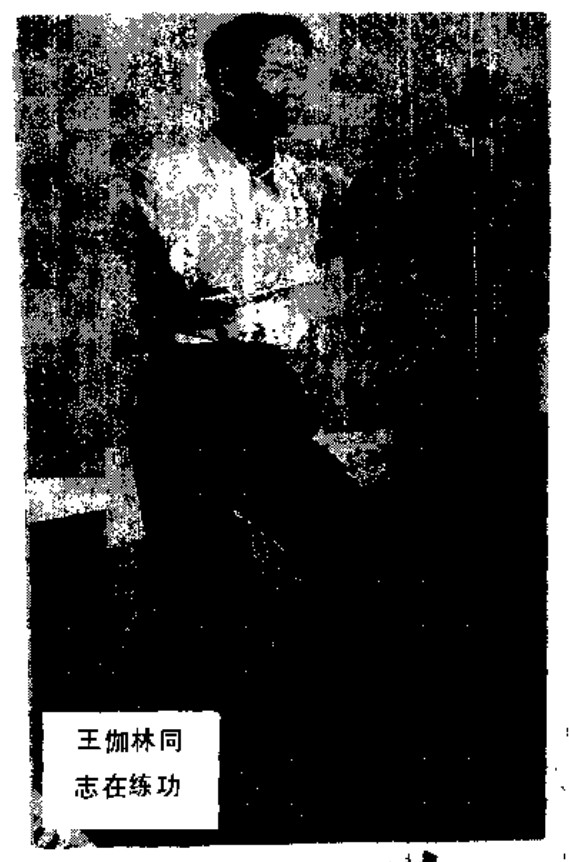
Illness, Unexpectedly Banished by a Breath of Qi
In September 1960, Wang Jialin was admitted to the Department of Physics at Yunnan University. In 1962, during a national examination of core courses at key universities, he won an award for outstanding results. Even before his graduation, a physics professor wished to take him on as a graduate student. Yet Wang Jialin insisted on running off into the halls of qigong research. What was going on?
As it turned out, this child from a Yi mountain village who had grown up drinking bitter water had, twenty years earlier, successively suffered from “duodenal bulb ulcer,” “rheumatoid arthritis,” “neurasthenia,” and “hepatitis,” to the point that his hair fell out, his eyes became nearsighted, and his teeth loosened. Looking at him — head bowed, body stooped, walking alone and unsteady — who would have believed he was a young man of just over twenty? Despite treatment by both Chinese and Western medicine, there was no improvement. So Wang Jialin sought out Professor Zhang Qiqing of the physics department for advice on treatment methods.
In the early 1950s, Professor Zhang had suffered from “essential hypertension” and had experienced significant improvement through qigong practice. From then on, he believed that qigong was a science with great prospects for development. He urged Wang Jialin to practice qigong to cure his illness and build his health. And so Wang Jialin began studying and practicing qigong.
Once, while reading in the library, Wang Jialin came across several poems by Lu You in praise of qigong practice: “Though approaching ninety years of age, my body grows ever stronger; having scrutinized ten thousand volumes, my eyes remain clear”; “From both eyes, a divine light pierces the night; upon my head, the hair of my birth is combed in the morning dawn.” This further strengthened his determination to practice qigong. In September 1963, Wang Jialin walked over ten kilometers to Xuyi Temple in Kunming to seek instruction from a qigong master. After visiting fifteen times, he finally “moved heaven” and learned the “Method of Returning to One and Attaining Purity” and the “Art of Daoyin” (guiding and pulling). Three months of qigong therapy forced his rheumatoid arthritis to flee, neurasthenia vanished along with it, his stomach ailment was greatly reduced, his teeth became increasingly firm, and his hair grew thicker.
Wang Jialin was overjoyed and practiced diligently every day. After another half year, his hepatitis had disappeared, and the vision in his left and right eyes improved from 0.7 and 0.8 respectively to 1.5. The illnesses that Chinese and Western medicine had long been helpless against were unexpectedly banished by a breath of qi — strange, wouldn’t you say? From that point on, Wang Jialin embarked on the path of qigong research.
From the Library to Huating Temple
A sail, not hoisted onto a mast, is but a useless piece of cloth; an ideal —
Without taking action, it is but ethereal mist. Wang Jialin dared to think and dared to act.
He traveled extensively through parks in Beijing, Chengdu, Chongqing, Wuhan, Zhengzhou, Shijiazhuang, Kunming, and other places, seeking masters and learning methods. He mastered multiple qigong techniques.
He frequented the provincial library nearly every other day, reading and copying qigong-related materials with voracious appetite. Mencius, Laozi, Zhuangzi, Su Shi, Zhu Xi, and the great foreign scientist Einstein had all expressed their views on qigong, but unfortunately these had never been compiled into a single volume. Wang Jialin could only seek them out page by page, line by line, from their writings. How much time and perseverance this required!
Yet fate was cruel. At the end of 1968, Yunnan launched a massive “drawing lines and taking sides” campaign. Wang Jialin was dragged out for public denunciation for resisting, and his correspondence with the elder qigong community figures Zhou Qianchuan and Chen Tao was confiscated. The two elders were labeled “spies,” and Wang Jialin, who had been in contact with them, inexplicably became a “target of dictatorship” and was thrown into prison.
At the time, Wang Jialin was a carefree bachelor with nothing to his name. Each time he was escorted back to Gejiu No. 2 Middle School for struggle sessions, he would find ways to get qigong research materials and related books through teachers who secretly sympathized with him. He would quietly bring them back to prison and, out of sight of the guards, devour them greedily. After finishing one book, he would sew it into his quilt, then move on to the second, the third…
While poring through materials, he also began his research. The ancients, when discussing the state of the “Six Penetrations,” said that a qigong master of profound attainment could, in the qigong state, “remotely sense” simple mental activities of people nearby. Certain qigong research institutions abroad had also conducted similar telepathy experiments, concluding that such phenomena genuinely existed. Could there really be such strange things? Wang Jialin decided to make “remote sensing function under the qigong state” his first research topic. In early 1964, together with his classmate Cai Changfei and a qigong master, he set out to conduct experiments.
Everything is difficult at the beginning. The experiments required money. Cai Changfei generously took off his watch and sold it, but the proceeds were still not enough to purchase even the most basic equipment. So Wang Jialin took on amateur temporary work, toiled for several months, and earned a few hundred yuan. Combined with the money from the watch, the three of them managed to acquire a simple set of instruments.
The experiment began at Huating Temple in the Western Hills. On the left it rests against Wofo Taihua Mountain Peak; on the right it is graced by Yu’an Bilu’s splendid brocade. The famous Ming dynasty scholar and literary figure Yang Shen left behind an antithetical couplet that superbly described the surrounding scenery: “A stream embraces the city to the west, mist and haze appearing and disappearing, a monk with a staff returns beyond the vast grey; a host of peaks faces the pavilion below, rain and clear skies shifting in depth and lightness, one who leans on the railing stands within a painting.” Huating Temple was truly a wonderful place for practice!
In the faint light of dawn, the three of them arrived at the woodland beside Huating Temple. One practiced still qigong; one engaged in simple mental activities such as visualizing geometric shapes, to “impact” the one practicing stillness; one took measurements and recorded data. After four months of experimentation, accumulating a notebook full of data, the basic accuracy rate of remote sensing under the qigong state reached 34.5%. This proved that the phenomenon of remote sensing under the qigong state exists objectively. Delighted, they sent their experimental report to a research institute.
At the time, the country was in the midst of large-scale criticism of foreign “telepathy” theories as “idealism.” This “telepathy” theory and the “remote sensing function under the qigong state” and the “Six Penetrations,” though differing in wording, meant the same thing. By openly paving the way and cheering for it, how could Wang Jialin and his associates not bring fire upon themselves?
Just as Wang Jialin was quietly awaiting good news, a cadre from Yunnan University suddenly announced at the university-wide graduation assignment meeting: Wang Jialin was under investigation and his assignment would be postponed. After some inquiry, the university concluded that it was a matter of ideological understanding and intended to lift the investigation. Who could have known that certain “overly sensitive” individuals would treat the numerical data from Wang Jialin’s experiments as espionage codes, writing to the local public security department claiming that “Wang Jialin’s gang is conducting spy activities at Huating Temple.” Consequently, the public security department instructed the university to place Wang Jialin under isolation for investigation. Thus Wang Jialin was investigated for over five months.
In January 1965, the public security department, finding that he genuinely had no political problems, allowed the university to lift the investigation. The university assigned him to Gejiu No. 3 Middle School as a teacher.
Soon after he began teaching at Gejiu No. 3 Middle School, the “Cultural Revolution” began. During the “great linking up” period, train travel was free. He seized this “combat opportunity” and traveled to libraries in Beijing, Chengdu, Chongqing, Wuhan, Zhengzhou, Shijiazhuang, Kunming, and other cities, voraciously reading and copying qigong-related materials. Mencius, Laozi, Zhuangzi, Su Shi, Zhu Xi, and the great foreign scientist Einstein had all published their views on qigong, but unfortunately no one had compiled them into a collection. Wang Jialin could only search through their writings, page by page and between the lines. How much time and perseverance did this require!
Chernyshevsky wrote the novel What Is to Be Done? in a tsarist prison. Wang Jialin also wanted to write books and establish his theories, and he produced a book on qigong health-preservation research. This required copying materials and writing research notes — but where to get paper? As it happened, the school and the prison gave him large stacks of paper, demanding that he write “confession materials” and “exposés and denunciations.” Wang Jialin treasured them like gold and wrote copious qigong research notes. Once finished, he sewed them into his quilt.
During his two and a half years of prison life, he was subjected to hundreds of beatings with rope bindings. Three of his ribs were broken and his right wrist was dislocated. Yet Wang Jialin took it in stride, “seizing the opportunity” to put qigong’s efficacy into practice. He thought: “If qigong cured my internal ailments, can it also heal traumatic injuries? Let’s try!” Every day he persisted in using qigong therapy to regulate himself, and another miracle occurred — the injuries healed, and to this day there are no obvious aftereffects.
When hemp rope bound him tightly in a five-point tie, he would channel and emit qi, experiencing qigong’s resistance to force.
Struggle sessions became the best occasions for practicing relaxation qigong. He paid no attention to the worn-out phrases of criticism or the waves of shouting. He simply focused on guarding his dantian and relaxing his entire body, appearing entranced.
In February 1971, the time of Wang Jialin’s release from prison drew near. Guards burst into his cell for inspection and discovered the books and qigong research materials sewn into his quilt. One guard cursed him savagely and forced Wang Jialin to kneel for two hours. All the qigong research materials were confiscated.
On March 18 of that year, Wang Jialin was released from prison and returned to school, only to be placed under isolation for further review. In the isolation room, he again studied the relationship between qigong and acupuncture. He secretly purchased one hundred silver needles and practiced needling himself all over, teaching himself acupuncture.
The long night would finally dawn. In 1977, the Gejiu Municipal Committee rehabilitated Wang Jialin as a typical case of a persecuted intellectual. From then on, his enthusiasm for qigong research grew even stronger. He wrote furiously, and the fruit of over ten years of research — a sweeping 200,000-word manuscript titled Research on Qigong Health-Preservation Methods — was completed. On March 14, 1978, the Provincial Science and Technology Commission presented it as one of Yunnan Province’s achievements in a report of triumph to the National Science and Technology Conference, and the publishing department also decided to publish and distribute it.
“Adversity can test a person’s character; extraordinary circumstances can reveal extraordinary integrity.” How well this line from a Shakespeare play captures the truth!
Exploring Mysteries through Self-Surgery, Writing Chapters with Gall and Blood
Extraordinary Circumstances Reveal Extraordinary Integrity
As soon as Research on Qigong Health-Preservation Methods was finalized, Wang Jialin set about conducting experiments on bile secretion under the qigong state.
This idea had been with him for a long time.
· 7 ·
In 1974, Wang Jialin was arrested and subjected to severe torture, causing liver damage and gallbladder enlargement that left his life in critical danger. He was released on “medical parole” and underwent a cholecystoduodenostomy at a hospital in Kunming.
His wife, Li Jiping, was a worker at Yunnan University, pure-hearted and kind. After their marriage, the couple lived apart in two different cities. When Li Jiping gave birth to their son, Wang Jialin, due to heavy work commitments, could only stay by her side for a few days before rushing back to Gejiu. His wife had no choice but to look after herself. Having endured a life of hardship and only marrying at the age of thirty-eight, how Wang Jialin longed to be with his wife day and night, to share the joys of family life!
In the hospital ward, there were many fellow patients who had undergone gallbladder surgery. At mealtimes, the patients would hold their bowls and eat. Wang Jialin noticed that the bile drainage tubes on the patients’ bodies dripped steadily, and the bile flow rate was significantly greater than usual. At this moment, Wang Jialin’s thoughts soared as if on wings: Would bile secretion change during the qigong state? Had anyone abroad ever conducted such research? Was it worthwhile to pursue this line of inquiry?
The progress of international qigong research at that time came to mind. In the 1970s, qigong research abroad had made considerable advances. Many renowned scientific research institutions and institutions of higher learning had launched qigong research programs. At Birkbeck College in England, a research organization led by two Nobel laureates, the eminent physicists Bohm and Hasted, was the first to demonstrate the material nature of emitted external qigong energy in 1974. The United States had already applied qigong to spaceflight. International academic symposia on qigong had already been held three times, and some Nobel Prize-winning physicists in physics had even attended. Qigong had become an important frontier project in human body science. Wang Jialin thought: “Qigong is a precious cultural heritage of the Chinese nation. If we do not inherit and develop it, will we eventually have to import it from abroad? No! I must win honor for the Chinese nation. I am willing to open my own abdomen to probe its mysteries, and would die without regret!” Wang Jialin finally made up his mind.
He told his wife his idea. The moment she heard it, her tears fell like beads from a broken string: “You have already tasted enough of an orphan’s bitterness—do you want your son to become an orphan too?”
To persuade her, Wang Jialin took her to see the film Li Shizhen five times, and repeatedly brought her to attend special symposia organized by the Provincial Association for Science and Technology to discuss his qigong research work. His wife finally nodded in agreement.
The family hurdle was cleared, but there was still the hurdle of getting the doctors to agree. Wang Jialin, who had already undergone a cholecystoduodenostomy, normally had to strictly avoid greasy food, because any lapse could trigger a relapse. At this point, however, Wang Jialin deliberately induced gallbladder infection flare-ups by force-feeding himself fatty meat washed down with vegetable soup every day. Each forced ingestion caused vomiting, even bringing up bile. Wang Jialin also intentionally stayed up late every night and reduced his qigong practice sessions. In this way, his biliary symptoms worsened. The doctors agreed to perform a second surgery.
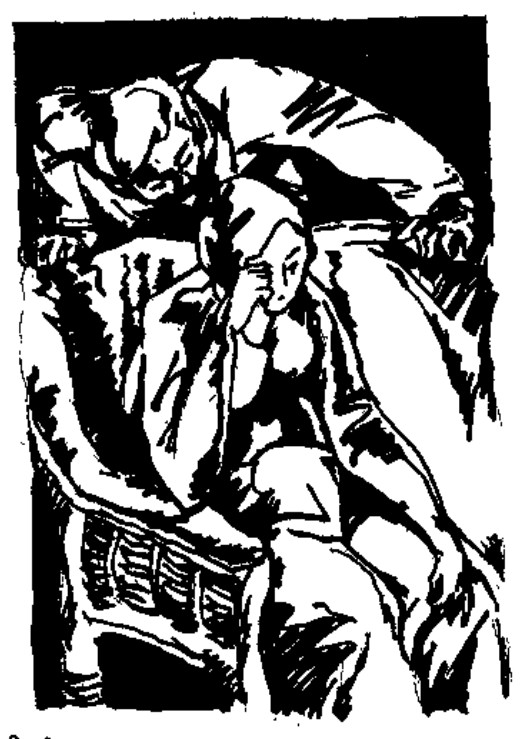
On May 16, 1979, Wang Jialin underwent surgery at the hospital, and a bile drainage tube was inserted.
His wife Li Jiping, along with Tan Qilun and Wei Ancheng, teachers at Gejiu No. 3 Middle School, came to care for him and assist with the bile secretion experiments. Having a bile drainage tube in place posed a great risk of retrograde infection. One day about two months in, Wang Jialin was so absorbed in analyzing experimental data that he accidentally allowed the bile in the tube to flow back into the biliary tract, causing an infection. His temperature soared to 40.5°C.
Under normal circumstances, retrograde infection would necessitate removal of the drainage tube, but Wang Jialin firmly refused. The doctors had no choice but to take other emergency measures to save him, bringing him back from danger.
The experiments continued. The bile drainage tube remained in Wang Jialin’s flesh and blood body for 120 days. The four of them completed 47 full measurements of bile drainage volume, obtaining systematic, firsthand, clear, and scientific data.
The experiments showed that bile secretion during the qigong state increased on average 1.5 to 2.8 times compared to the resting state.
Wang Jialin’s experiment irrefutably proved that the qigong state can promote bile secretion and enhance digestive function. Previously, this had been merely a hypothesis, a conjecture—never before confirmed by scientifically
This has been proven by scientific data. For those who still cling to the prejudice that qigong is mere “sorcery,” this is undoubtedly an excellent cooling draught—the most marvelous specific remedy.
“Overnight the winter cold fades with the water clock; in full measure the colors of spring break with the dawn.” Wang Jialin wrote up his experiment as a paper entitled “Qigong and Bile Secretion—My Experimental Study.”
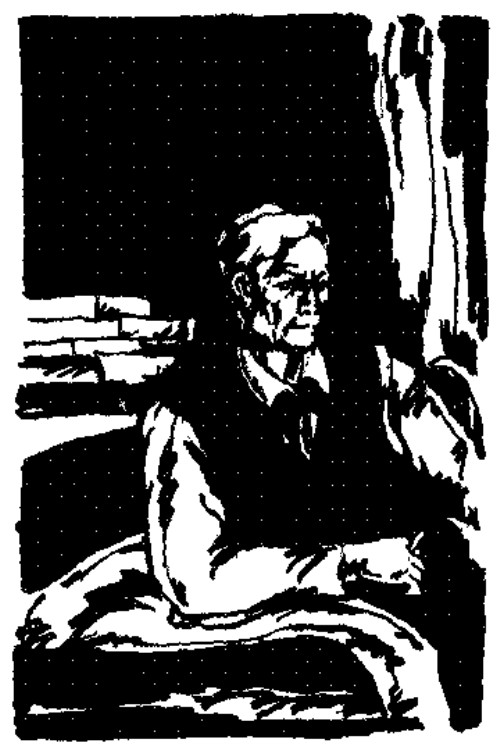
“Fear not that on the road ahead no kindred souls remain; / Throughout the world, who does not know of you?”
On September 11, 1979, the Yunnan Provincial Association for Science and Technology recommended Wang Jialin’s paper, “Qigong and Bile Secretion,” to the journal Nature—a nationally prominent publication with distinctive features in qigong research, distributed worldwide in several languages. The journal stated it “felt honored to receive this extraordinary article and to present it before Chinese and foreign readers alike!”
The paper was published in Nature magazine, Volume 3, No. 3, 1980, accompanied by a specially commissioned editorial entitled “A Glorious Model of Dedication to Science.” The editorial asserted: “Wang Jialin’s experiment itself—using scientific methods to directly observe changes in visceral function during the qigong state—is a world first; to call this experiment pioneering is by no means an overstatement.” Dozens of newspapers and magazines, including Guangming Daily, Wenhui Daily, and Sports Daily, published articles and reports on the subject. Eleven multidisciplinary experts and professors from Yunnan Province—including Cai Xitao, Xu Biaonan, and Zhang Qijun—together with the Yunnan Provincial Association for Science and Technology, jointly recommended his research findings to the China Association for Science and Technology. The letter of recommendation noted that this research “opens a new path for the development of human body science.” After evaluation by experts from relevant societies commissioned by the China Association for Science and Technology, it was classified as a major scientific research achievement. Science and technology departments, universities, and colleges in Beijing, Tianjin, Shanghai, Hangzhou, and other cities successively invited him to lecture.
Since ancient times, the worthy and virtuous have cherished new talent. From 1980 onward, the renowned scientist Qian Xuesen and Wang [Jialin] corresponded continuously. Regarding Wang Jialin’s paper, “The Important Significance of Qigong Internal Action for the Life Activities of the Human Body,” Qian Xuesen wrote in his letter of November 1980: “The more I read it, the more delighted I am”; it is “the best and most scientific article on qigong I have ever seen. Together with your Qigong and Bile Secretion—My Experimental Study, I salute you! I congratulate you!” In recent years, Qian Xuesen has consistently and warmly cared for Wang Jialin’s research work.
On September 12, 1981, the China Qigong Science Research Association was established in Baoding City, Hebei Province. Wang Jialin was invited to attend the conference and took the opportunity to visit Beijing. Qian Xuesen and Nie Chunrong, Secretary of the China Association for Science and Technology, met with him on multiple occasions and conversed at length about the prospects, directions, and methods of qigong research. Qian Xuesen, with his far-sighted vision, recognized the worthy talent, enabling Wang Jialin to stand higher and see farther. He further understood the profound significance of qigong research as pointed out by Professor Qian Xuesen: qigong research would fundamentally transform the entirety of human body science and constitute a scientific revolution; it would bring about a leap in humanity’s understanding of the human body, thereby transforming physiology, clinical medicine, and hygiene… and fully unleashing human potential. Qigong research (including Traditional Chinese Medicine theory) should be used to transform human body science, and in turn to influence the trajectory of modern science and technology as a whole. In this endeavor, qigong is the key, and Traditional Chinese Medicine theory is the catalyst.
Wang Jialin’s research achievements attracted attention from Hong Kong and abroad. Various foreign newspapers and magazines reported and commented extensively. Hong Kong’s Wen Wei Po and the Americas’ China Press published articles over several consecutive days under titles such as “Yunnan Expert Wang Jialin Measures Precious Scientific Data” and “Wang Jialin Conducts Rare Research in the History of Science—Experimenting on His Own Internal Organs,” reporting on this scientific achievement. Mr. Lin Wenwei, an American astronomy expert and the fully authorized representative of the American UFO Center, and others co-authored a book entitled China’s Four Modernizations Upsurge, which devoted an entire chapter to introducing the progress of qigong research by Wang Jialin and his colleagues. In April 1982, they sent a letter congratulating Wang Jialin, praising his “brilliant reputation in qigong research.”
For thousands of years, the fundamental concepts of traditional human life science have held that the human nervous system is divided into motor nerves and autonomic nerves: the motor nerves and the motor functions they govern are voluntary functions, while the autonomic nerves and the visceral functions they govern are “automatic functions” not subject to conscious control—involuntary functions. In fact, all the concepts, laws, and formulas of modern physiology, biophysics, biochemistry, biology, medicine, and other disciplines related to human life science are built upon this traditional fundamental concept of “automatic function” activity. Some Chinese and foreign scientists believe that the scientific conclusion demonstrated by Wang Jialin’s paper, “Qigong and Bile Secretion”—namely, that “the process of conscious internal action during the qigong state can alter the autonomic nerves and the visceral functions they govern”—constitutes a major breakthrough in human body science research.
On July 17, 1981, the Yunnan Provincial Qigong Research Association was formally established, and Wang Jialin was elected Vice Chairman. At the end of 1982, Yunnan Nationalities College transferred him to establish a Human Body Science Research Office. By this time, Wang Jialin had obtained this cup—he could be said to have become famous.
On the road after fame, there is not only
flowers and sunlight, but also thorns and clouds.
Diligent sweat, tears of struggle, blood of sacrifice—these are the true fine wine, while honor is merely the cup that holds it. Now,
Ah, truly: “Born to run through ten thousand mountains, treading every rugged path to its end.”
He was no longer fighting single-handedly.
The provincial party committee leaders specially wrote a report requesting that conditions be provided for Wang Jialin.
Flowers and honors did not cause Wang Jialin to become complacent or complacently stand still.
Provincial leaders promptly issued instructions. Before long, Yunnan Nationalities Institute transferred
He and his comrades pressed forward valiantly on the great road of qigong research, and achieved
Wang Jialin and established a laboratory for human body science research. Thereafter, his research
many new discoveries and results.
conditions gradually improved.
Wang Jialin and Yang Jianyao, attending physician at Kunming First People’s Hospital, and
Just as one wave subsided, another arose. Someone began firing arrows in the dark at Wang Jialin.
He Chengzhong and others discovered in their research that during the qigong state, not only did the volume
On March 14, 1983, the provincial government received an anonymous letter, which baselessly
of bile secretion from the liver change significantly, but the processes of decomposition and synthesis
accused Wang Jialin of “drawing a monthly salary of 150 yuan at the Jinhe Brigade Biological Information Experimental Station and swindling over ten thousand yuan from the Jinhe Brigade.”
of cholesterol and bilirubin within the human liver and body also underwent marked changes. Wang Jialin, together with Zheng Deming and other scientific personnel from the Kunming Institute of Physics, discovered in their research
What an alarming accusation! During the several months of establishing the biological experimental station, Wang
that the “external qi” emitted by qigong masters contained four different types of
Jialin spent on average ten days per month at the Jinhe Brigade, sweating profusely and expending
infrared signals.
great effort. According to policy regulations, he was entitled to certain compensation, yet he
Applying the external qi emitted by qigong masters to certain plants can
had not taken a single cent.
yield new varieties, shorten growth cycles, and increase per-unit yields. Wang Jialin and
As for the high salary, Wang Jialin’s colleagues could not forget: in recent years, certain
relevant scientific personnel from the Provincial Academy of Agricultural Sciences conducted this research. Together with
research departments in Hong Kong and abroad had offered Wang Jialin enormous salaries to go
the Jinhe Brigade of Guandu District, Kunming, they jointly established a biological information experimental station.
abroad to conduct research, but he had flatly refused them all.
The experimental station was already capable of mass-producing edible fungus mother cultures, secondary cultures, tertiary
Around us there is often this strange phenomenon: if you accomplish nothing, you
cultures, and fresh mushrooms through artificial cultivation.
can remain perfectly safe, and may even be appreciated and promoted; but if you dare
The latest research achievements of Wang Jialin and his colleagues attracted the attention of
to think independently and achieve results, you will instead attract unexpected
the scientific and technological communities at home and abroad. In April 1983, the National Symposium
trouble, with all manner of rumors and gossip constantly coming your way.
on Human Body Functional States was held in Kunming. The participating experts and scientific and technical workers
Regarding the type of people who specialize in manufacturing rumors and gossip, the American philosopher
highly evaluated the research achievements of Wang Jialin and his colleagues. Research institutions in
Francis Bacon and the Tang dynasty man of letters Han Yu both offered incisive analyses. Bacon
the United States and Japan
said: “Another man’s rise is enough to create an illusion that makes one feel as though
continuously visited, requesting to invest in Yunnan and conduct
one has oneself been diminished.” Han Yu put it even more pithily: Why is it that “when deeds are accomplished, slander arises; when virtue is high, defamation comes”? “Those who do this have their reasons and their roots: it is called indolence and jealousy. The indolent cannot cultivate virtue, while the jealous fear others’ cultivation.”
experiments together with Wang Jialin.
However, on the road after achieving fame, there were not only flowers
However, the seeds of rumor and gossip ultimately struggle to bloom and bear fruit. The
and sunshine — there were also thorns and clouds.
eyes of the Party and the people are sharp. Leaders from the Provincial Science and Technology Commission, the Provincial Association for Science and Technology, and other relevant departments
In November 1979, Wang Jialin was seconded by the Physics Department of Yunnan University from Gejiu
promptly cleared up the “problems” on Wang Jialin’s behalf, causing each and every letter of false accusation to become like a foul, hard stone sinking into the mire.
No. 3 Middle School to participate in qigong research. Considering that the qigong bile secretion
Contrary to the wishes of the accusers, the Yunnan Provincial Party Committee and relevant department
experiment had already concluded before his arrival at Yunnan University, when Wang Jialin published
leaders and experts even more resolutely supported Wang Jialin’s research work.
the paper on this research in Nature Journal, he listed only Gejiu No. 3 Middle School
In late July 1983, the State Nationalities Affairs Commission, the Ministry of Labor and Personnel, and the China Association for Science and Technology
as his sole work unit. A certain leading comrade in the Yunnan University Physics Research
jointly convened a national symposium for representatives of outstanding scientific and technical workers
Office took great offense at this matter and ceased to borrow Wang Jialin’s services. As a result,
in minority regions. Relevant departments unanimously recommended Wang Jialin to attend the meeting.
he had not only no workplace in Kunming, but not even the most basic experimental testing equipment or instruments.
At the symposium there were 180 representatives; 24 gave
Sometimes, Wang Jialin had no choice but to borrow instruments and equipment from relevant research
model speeches at the plenary session, and Wang Jialin was one of them. At the closing ceremony
units in his personal capacity. Fortunately, the Gejiu Municipal Party Committee strongly supported Wang Jialin’s
of the conference, national leaders presented certificates of award to the delegates. Amid thunderous applause,
continued qigong research in Kunming and continued to issue his monthly salary.
Wang Jialin, full of joy, accepted the certificate of award handed to him by Fang Yi,
Wang Jialin’s wife, Li Jiping, was a gatekeeper worker at Yunnan University, and
Director of the State Science and Technology Commission.
the family had one room at the university. Three generations — five people — lived in this
On the evening of April 27, 1984, several leading comrades of the Yunnan Provincial Party Committee
9.5-square-meter apartment. Considering that visitors came to the house one after another,
set aside three full hours for a heart-to-heart talk with Wang Jialin. The provincial party committee leaders
and the children were still young, when writing research papers, Wang Jialin would go to his wife’s
listened with keen interest as Wang Jialin reported on the new achievements he and his comrades had made in their scientific endeavors, and enthusiastically encouraged him to keep up the good work and make
guard post at the school gate — a tiny sentry box of less than two square meters — and devote himself to writing. Over the three years from 1980 to 1982, Wang Jialin produced twelve papers in this “humble abode,”
new contributions.
all of which were published in relevant national academic journals.
Wang Jialin knew that science is never — and never will be — a completed book;
Seeing the renowned Wang Jialin shut up all day in a tiny sentry box writing
the boundaries of science are like
papers, some senior professors were both indignant and heartbroken. They said, “Truly, the flowers bloom outside the wall while their fragrance is known within! For a scientific and technical worker with such achievements,
the horizon: the closer you approach it,
why not provide him with a proper workplace?”
the farther it recedes. Along with flowers and
What could Wang Jialin do? To console himself, he often
sunshine, our Wang Jialin is cutting
recited Liu Yuxi’s “Inscription on a Humble Dwelling” from the Tang dynasty: “A hill need not be high;
through thorns and pressing ever forward.
the presence of immortals makes it famous. A body of water need not be deep; the presence of dragons makes it divine. This is a humble dwelling, but my virtue makes it fragrant. Green moss creeps up the steps, and the color of grass enters through the bamboo curtain. In conversation and laughter, there are great scholars; among visitors, there are no common folk.”
Excerpted from Science and People
•10
China’s Sichuan Province produced a Yan Xin, praised by people as the “Divine Physician of the Heavenly Kingdom” and celebrated as the “Living Ji Gong.” He combined traditional Chinese medicine, martial arts, qigong, and special abilities in one person. With the extraordinary skills he mastered, he performed one after another of magically unfathomable and profoundly wondrous deeds for the country and the people. These genuinely existing good deeds are yet genuinely beyond people’s comprehension! Just imagine—at the large-scale lectures held for Yan Xin, thousands in the audience would experience miraculous reactions. Is that not extraordinary?
—Compiler
The Legend of Yan Xin
Guided by Famous Teachers, Mastering Every Art and Skill Strengthening Body Through Martial Arts, Thirty-Plus Years of Disciplined Practice
The story goes that in a mountain village in Jiangyou County, in the Land of Abundance—today’s Sichuan—there emerged a renowned divine physician, surnamed Yan, named Xin, thirty-eight years of age this year. Of medium build, with a fair, clean-shaven face, he spoke gently and refinedly—a model scholar in appearance. But upon closer inspection, his eyes gleamed brightly and his steps were light and agile, revealing him to be a practitioner of martial arts.
Yan Xin was the second child in his family. In his childhood, influenced by the older generation’s practice of martial arts, he loved to throw punches and kick. At the age of four, one day while playing with his young companions in the mountain forest, a middle-aged man suddenly appeared from nowhere. The children did not know that this kindly uncle was a master of formidable martial arts and qigong prowess. They saw him frequently demonstrate supreme agility skills—in the blink of an eye he would vanish, impossible to find whether searching left or right, as though he had ascended to heaven or descended into the earth. Yet in a flash he would stand smiling before the children again, leaving them spellbound and filled with admiration. Little Yan Xin clung to him and would not let go. From strangers to acquaintances, this master of supreme skill—who lived in seclusion in the mountains cultivating his practice, and who had always forbidden Yan Xin from revealing his identity—finally accepted the four-year-old Yan Xin as his disciple.
Under his master’s guidance, Yan Xin practiced with wholehearted sincerity and diligent effort. As the stars shifted and seasons turned over two to three years, he gradually felt as though every bone, nerve, and fiber of his body had transformed. His blood surged hot and fiery throughout his body, his hands tingled and burned, and his mind was like a movie playing—sometimes seemingly floating in a daze, yet perfectly clear and lucid.
During the day, while he was clearly practicing indoors, without glancing sideways or letting his mind wander, his entire body would seem to float out of the room into the open wilderness. When he closed his eyes and concentrated, sheets of brilliant white, shimmering light would float before him. After the light passed, the outlines of furniture—tables, chairs, benches—would appear in his mind. Before long, multicolored bands of light would emerge. His master told him this was the result of his skill ascending to a higher level. From then on, Yan Xin practiced with even greater determination.
At the age of eight, he also took the renowned Master Haideng as his teacher.
Master Haideng was also a native of Jiangyou County, deeply accomplished in martial arts and world-renowned. He was extremely strict in training his disciples. Yan Xin followed Master Haideng and studied the orthodox Xuantong Qigong, Bodhidharma Qigong, Shaolin Qigong, Shaolin Precision Fist, Plum Blossom Precision Fist, Grappling Luo Fist, Xingyi Fist, Arhat Fist, as well as various weapons including the saber, spear, sword, staff, halberd, and whip.
Yan Xin practiced with unwavering focus and resolve, becoming more and more absorbed. Throughout his childhood, adolescence, and youth, he successively studied under more than twenty masters to learn qigong and martial arts. These masters were either grandmasters of the martial arts world, renowned qigong experts, or accomplished practitioners possessing miraculous techniques. Yan Xin sincerely honored his teachers, and they in turn taught him with utmost dedication.
Yan Xin and his wife being interviewed by the author of this article.
His skill improved day by day. Time flew like an arrow, the sun and moon sped by like a shuttle. Hard work did not let the determined person down. Beginning at age thirteen, the external qi he emitted was already able to cure people’s illnesses. During the Spring Festival of 1983, by the pond near his hometown, under the watchful eyes of the crowd, from a distance of over ten meters he channeled qi and emitted energy, causing a cypress tree twenty centimeters in diameter to sway back and forth.
Yan Xin accumulated over thirty years of painstaking practice. Not only was his martial arts superb and his qigong profoundly cultivated, but from childhood he also loved Chinese medicine and pharmacology. At age thirteen, he began studying medicine under the veteran Chinese medicine practitioners Yan Anfang and Yan Hongxin, and later became a disciple of the hereditary Chinese medicine practitioner Zheng Bozhang and Peng Dingshan, director of Jiangyou County Hospital. In 1974, he entered the Chengdu College of Traditional Chinese Medicine to systematically study both Chinese and Western medical theory and practice. From then on, he combined Chinese medicine, martial arts, and qigong into one, gradually developing a set of miraculous medical techniques—treating injuries and illnesses, saving lives, relieving people’s suffering, and creating all sorts of incredible miracles, earning the reputation of “Divine Physician of the Heavenly Prefecture.”
Testing His Power: The Divine Physician of the Heavenly Prefecture Becomes World-Renowned
Curing Illness with a Toast: Japanese Friends Praise His Skill
Yan Xin, relying on his noble medical ethics and extraordinary skill, sincerely treated people’s injuries and illnesses, and his fame grew ever greater. More and more people came seeking his medical help. As the saying goes, a tall tree catches the wind. Regarding Yan Xin’s miraculous medical arts, some people were utterly convinced and full of admiration, while others disparaged him as completely worthless.
To determine who was right and who was wrong, the relevant leaders dispatched an investigation team to conduct an on-site inquiry.
Two comrades on the investigation team proposed personally testing Yan Xin’s invisible, intangible, traceless qi. Yan Xin thought that the investigation team comrades made this request because they wanted to understand the power of his emitted qi. If the qi emitted was too weak, people would say they felt nothing; if it was too strong, something might go wrong. He could only tell them frankly: “During the test, do not deliberately strain to resist, and I guarantee you will be fine. Otherwise, if something dangerous happens, I cannot take responsibility.”
The first comrade to undergo the test stood five meters away from Yan Xin. As soon as Yan Xin pressed his right hand forward, the man felt as though someone had shoved him hard, staggering straight toward the wall in front of him. In the blink of an eye, Yan Xin quickly pulled his right hand back, and just as the man was about to hit the wall, it was as if an invisible hand had grabbed him, immediately sending him stumbling backward several steps. Before Yan Xin could emit qi again, the man was already crying out in alarm: “Stop, quick! I’m convinced, I’m convinced!”
The second person tested was a young man named Chen. Yan Xin asked Chen to stand by the window inside the room, and then he himself stepped outside the room, emitting energy from over five meters away. After a moment, Yan Xin asked: “Do you feel anything?” Young Chen, facing the window, gazed out at the rolling Yangtze River and thought to himself: I am young and in the prime of my life, strong and vigorous. I’ve been a soldier, I’ve endured hardship. You have your qi, I have my strength—I don’t believe you can do anything to me. Having made up his mind, even though he felt an inexplicable force assail him, as if his entire body were being lifted up and pitched forward, he still stubbornly resisted with all his might, maintaining his balance while pretending nothing was happening, saying casually: “I don’t feel anything.”
When Yan Xin heard this, he smoothly pulled back the hand that had been emitting qi. Before Yan Xin could ask again, there was a loud “bang” inside the room. Hearing the sound, Yan Xin immediately withdrew his energy and rushed into the room with the others. They saw Chen lying by the bookcase, his face deathly pale, sweating profusely as if in a downpour—the floor was already soaked over a large area. Without another word, Yan Xin immediately emitted emergency energy to revive him. After Chen regained consciousness and his breathing steadied, Yan Xin repeatedly apologized to him. Chen was a frank young man and said: “I truly didn’t believe in your skill before. At first, I did feel my body falling forward, but I summoned all my strength to control my balance and deliberately said I felt nothing. Who could have known that before I could steady myself, I felt the world spinning, my chest and stomach felt as though they were being stabbed with knives, and it felt like all my internal organs were about to come out…” After a pause to catch his breath, he continued: “I’m convinced—truly convinced. Whether others believe it or not, I certainly do.”
After such investigation and testing, the investigation team reached a definitive conclusion. From then on, Yan Xin was not only illustrious in the Land of Abundance, but the news also spread quickly throughout the entire country.
At the end of 1986, Yan Xin accompanied the China Qigong Science Research Association’s friendship delegation to visit Japan. Japanese colleagues hosted a banquet in honor of the Chinese friends. During the banquet, Katsu Yoshioka, chairman of the All-Japan Qigong Science Research Association, told Zhang Zhenhuan, head of the Chinese delegation, about his bitter plight—his elbow joint had been painful for years and all treatments had been ineffective. He wanted to ask a qigong master from the Chinese delegation to treat him. Zhang Zhenhuan immediately assigned the task to Yan Xin and suggested that Yan Xin toast Yoshioka with five cups of wine, emitting energy during the toasts to cure him. This rather theatrical treatment plan was exactly what Yoshioka wanted. It turned out that Yoshioka had deep credentials and considerable skill in the Japanese qigong world, and his drinking capacity was astonishing—he once had a record of drinking eighteen bottles of strong liquor without getting drunk.
·12
record, known as a “Great Wine Hero.”
Unexpectedly, just as his qigong power was being released, there was a sudden loud “crack.” Yan Xin looked down and saw that his rubber shoe had split open for no apparent reason. Seeing this, Yan Xin immediately asked the child’s parents, “I sense a kind of energy on the child’s body that is opposed to my own. Who exactly have you sought help from?” The child’s mother was both frightened and ashamed upon hearing this. After a long pause, she finally confessed that they had sought out a witch and given her gifts.
After Yan Xin accepted the task, he composed himself and employed a small trick to thoroughly investigate Yoshioka Masaru’s condition. It turned out he was suffering from an old ligament injury of the elbow joint — no wonder it had caused pain for so long. Yan Xin then picked up a small cup of wine, held it with both hands, and presented it to Yoshioka Masaru. Yoshioka rose to accept it and gulped it down in one swallow. Just as Yan Xin was about to offer a second toast, to everyone’s surprise, the “Great Wine Hero” Yoshioka Masaru inexplicably showed signs of intoxication, mumbling, “Let me switch to beer!” Yan Xin thought beer would be fine too — but who would have expected that Yoshioka, upon receiving the cup in hand, found himself unable to drink it. This famously celebrated Great Wine Hero then bargained and negotiated, proposing that this cup of beer, which had virtually no alcoholic strength to speak of, be divided into four servings, thereby barely making up the count of five cups.
Just as Yoshioka Masaru was furrowing his brow and struggling through the last quarter cup of beer, a miracle occurred: Yoshioka’s face turned completely red as he raised his arm, stretched and retracted it several times, and happily exclaimed, “It doesn’t hurt anymore — not at all! Mr. Yan, your skill is extraordinary!” As someone knowledgeable in the field, he of course understood that Yan Xin had transmitted his qigong power through the wine offering and cured his illness.
Feigning Divine Possession — A Witch Practices Sorcery to Swindle Money
Relieving People’s Hardship — Yan Xin Releases Strong Qigong to Disperse Evil Energy
In 1983, the three-year-old son of Hu Wenhua, a female employee of the Chongqing Installation Company, suffered from a severe gastrointestinal disorder with ceaseless vomiting and diarrhea. After two months of hospital treatment with no improvement, the doctor said sorrowfully, “This child has only a few days left to live.” The mother’s heart was torn apart. In her desperation, she found a witch who was said to be possessed by divine power, pleading with her to save the child’s life. This witch, surnamed Tan, genuinely possessed “special abilities” to be honest, but her intentions were crooked. She frequently used these abilities to swindle people out of their money. When the witch arrived at the sick child’s home, she shouted incantations loudly, pretended to be possessed by spirits, and after wailing and shrieking for the better part of the day, she picked up the substantial gifts from the family and walked away. The poor child’s condition deteriorated further after being subjected to this ordeal.
It was at this time that Yan Xin was invited to the Installation Company to treat patients. The child’s parents rushed over upon hearing the news, pleading with Yan Xin to save their child. Seeing the child’s critical condition and severe depletion of vital energy, Yan Xin wasted no words and immediately released powerful qigong to rescue the child.
However, Yan Xin sensed that the child’s body bore an evil energy that conflicted with his own practice. He confronted the witch directly, and, refusing to yield, demanded that she voluntarily withdraw her sorcery and return the gifts. This witch was no ordinary character either — though her skill level was mediocre, she was hardly willing to surrender the money she had already pocketed. Relying on her “techniques,” she figured that this pale-faced scholar could do nothing to her, and flatly rejected Yan Xin’s proposal.
Seeing that persuasion was ineffective and the child’s life hung in the balance, Yan Xin internally projected his qigong power. After determining the nature of the witch’s energy, he turned and left. He went to the child’s side, exerted every ounce of his ability, and once again released powerful qigong to dispel the evil energy the witch had placed on the child. Through painstaking effort, he finally brought the child out of danger.
As the child’s condition improved — vomiting and diarrhea stopping immediately and gradual recovery beginning — the witch fell ill, and seriously so. This was because special abilities and advanced qigong are extraordinary things, with their own profound mysteries. When Yan Xin released his powerful qigong to dispel the evil energy and save the child, his profound skill — far surpassing that of the witch — caused the energy to naturally follow the trail back to its source and rebound onto the witch herself. With only her pitiful meager level of ability, how could she withstand the onslaught of Yan Xin’s powerful qigong? That very day she became dizzy and lightheaded. By the second day, her whole body was trembling, her limbs were rigid, and dark bruises appeared repeatedly on her buttocks and legs, as though she had been beaten. Even her breathing became labored. When the witch’s uncle saw his niece’s life in mortal danger, he knew it was Yan Xin who had engaged her in a contest of power, and that only Yan Xin could save her life. He immediately rushed to Yan Xin’s home in a panic, desperately pleading with Yan Xin to spare the witch.
Yan Xin, being compassionate by nature and knowing the witch had already been punished and had suffered, agreed to save her. When Yan Xin arrived at the witch’s home, he put on a stern face and lectured her thoroughly. The witch listened, nodding her head repeatedly in earnest acknowledgment of her mistakes. She then reached under her pillow and produced the gifts she had taken from the child’s family the previous day. At this point, Yan Xin projected his qigong to treat her. In just a short while, the witch returned to normal. She thanked Yan Xin repeatedly for saving her life and vowed to turn over a new leaf and abandon her wicked ways.
Extraordinary Qigong Power — Universally Praised as a Divine Physician
Miracles in Abundance — Masterful Techniques as Though Hua Tuo Reborn
Appointments and engagement letters from various scientific research institutions and universities inviting Yan Xin to serve as expert consultant, honorary qigong coach, and other positions.
Responsible comrades from the Sichuan Provincial Qigong Association (center) and the Sichuan Workers’ Daily (left) introduce the author to information about Yan Xin.
In 1985, during the construction of the Lotus Flower Pond at Chengdu Railway Station, a young migrant worker suddenly experienced severe abdominal pain, rolling on the ground in agony and breaking out in cold sweats. At that moment, Yan Xin happened to be passing by. Seeing the situation, he immediately instructed his apprentice, who was following behind him, to fetch a cup of tap water from nearby. He handed it to the young worker and told him to drink it. To everyone’s amazement, the remedy took instant effect. The young migrant worker sprang up from the ground in one smooth motion and exclaimed excitedly, “I’ve met an immortal today!” The group of fellow workers who witnessed this scene were all astonished. Some said, “That skill is just like Hua Tuo’s!”
In fact, in everyday practice, it was routine for Yan Xin to use tap water, well water, stream water, beverages, alcohol, and the like to treat patients. His ability to restore shattered and fragmented bones to their original state was even more miraculous. On the morning of April 27, 1984, around 10 o’clock, Su Ping, a young worker at the Chongqing Special Steel Plant, was riding his bicycle home happily when, unexpectedly, he was knocked to the ground by a truck near Tongjiaqiao. At the hospital, an X-ray examination revealed: “Comminuted fractures of both scapulae, with dislocation of the right shoulder joint.” After bandages and splints were applied, a month passed and he still could not move. During a follow-up examination at the hospital, the attending physician regretfully concluded: “Both upper limbs have lost their ability to work. There is no way to fix this!” For the twenty-two-year-old Su Ping, this verdict was like a bolt from the blue, and he could not help but wail in grief. Seeing her own son reduced to such a state, facing lifelong disability, his mother was so frantic that she became mentally dazed. His father was so furious that he hurled his bicycle down from the fifth floor. His fiancée, Xiao Zeng, was driven to despair.
Just then, Master Su, a coworker at the same plant, told the Su family that Yan Xin possessed extraordinary abilities and that it would be worth a try. So Su Ping was taken to the Chongqing Institute of Traditional Chinese Medicine to seek treatment from Yan Xin.
Yan Xin sat down in front of Su Ping without uttering a word. He entered a state of quiet meditation, spread his hands apart, took several deep breaths, and then began to speak: “Comminuted fractures of both scapulae, with the fracture at the outer third of the right scapula improperly reduced…” A subsequent X-ray examination at the outpatient clinic confirmed that Yan Xin’s diagnosis through emitting qi was completely accurate.
Then Yan Xin reached over and removed all the tightly bound bandages from Su Ping’s body, tossing them aside. He helped Su Ping lie face-down on the bed. Yan Xin then waved both hands, vigorously pounding and massaging Su Ping’s back. Su Ping could not tell whether the sensation was numbness, soreness, or itching — he only felt waves of coolness penetrating his back. After twenty minutes, Yan Xin concluded the session and went off to treat other patients. Another half hour passed before Yan Xin returned and said to Su Ping, who was still obediently lying flat on the bed: “Turn over!” Su Ping turned his head to look at Yan Xin, wondering if he had misheard. Yan Xin, reading Su Ping’s thoughts, said: “Don’t be afraid. Just pretend you were never injured.”
Hearing this, Su Ping exerted himself and smoothly turned over.
“Do a few push-ups!” Yan Xin then commanded. “What are you afraid of? Your injuries are already healed!” Overcome with emotion, Su Ping pushed hard with both hands and did five push-ups in a row. Then, following Yan Xin’s orders, Su Ping got out of bed, walked to the doorway, jumped up and grabbed the door frame, and did over thirty pull-ups. After coming down, he threw punches and swung his arms, and even lifted a fifty-jin weight with one hand.
Witnessing such miracles, Su Ping’s mother stood transfixed as if in a daze. His fiancée was so moved that tears and mucus streamed down her face. Everyone present marveled and praised: “Ah, truly a divine physician!” On February 10, 1985, when Southwest Hospital conducted a follow-up X-ray examination of Su Ping, it confirmed that the injuries had fully healed — not even a trace of the previously shattered bone could be found.
Now, dear reader, do not assume that Yan Xin only treats fractures and injuries. In his daily practice, patients came seeking help for virtually every kind of ailment. Liu Xiaorong, the daughter of Liu Bogui, the director of the Mianyang Cha’eryan Reservoir Management Station, was fourteen years old that year. When she was three, she had been caught in a flood accident and completely lost her hearing in both ears. Whether you beat drums, struck gongs, or even thundered and roared, she heard nothing at all. During the Spring Festival of 1984, her family sought treatment from Yan Xin. Yan Xin placed two small cotton balls into her ears and emitted qi. Five minutes later, Yan Xin concluded the session and gently removed the cotton balls from her ears. Xiaorong immediately opened her eyes wide with joyful surprise, tears glistening. After feeling a series of chirping sensations, she said happily: “I can hear!” To test the degree to which her hearing had recovered, Yan Xin placed a wristwatch beside her ear. Xiaorong promptly and clearly detected the faint ticking sound of the watch.
Through over thirty years of dedicated cultivation, Yan Xin had developed a remarkable set of medical skills that left even accomplished martial artists full of admiration. In the city of Chongqing, there lived an elderly gentleman surnamed Tang, who was past sixty years of age. In his youth, he had studied martial arts under renowned masters and had built a profound foundation with extraordinary abilities. He was especially skilled in the arts of acupoint striking and bone-setting. Yet he was utterly helpless when it came to an unsightly hard lump that had grown on his neck. This hard lump was on the left side of his neck and had been there for over twenty years, growing larger year by year until it reached the size of an egg. It appeared yellowish-purple in color, and to the touch it was rock-hard — it could not be pushed or moved. It seemed to have taken root underneath, tilting Old Tang’s entire head to one side. The suffering it caused was unimaginable. Around 1980, Old Tang’s entire body turned yellowish and he suffered ceaseless diarrhea. In early 1982, shortly after Yan Xin had been transferred to the Chongqing Institute of Traditional Chinese Medicine, he visited Old Tang at his home, drawn by the latter’s reputation. The old and the young chatted freely and enthusiastically about everything under the sun. But when the conversation turned to the accursed lump on his neck, Old Tang immediately became dejected, his face betraying utter despair. Yan Xin listened to Old Tang’s account while fixing his gaze on the hard lump, seemingly deep in thought. Suddenly, Yan Xin said earnestly to Old Tang: “Uncle Tang, let me treat this today.”
•14•
to treat this hard lump of yours.” Upon hearing this, Mr. Tang was greatly startled. He looked at Yan Xin, who sat before him with utmost respect, and thought to himself that this young man spoke with quite a bold tone—could he truly have some extraordinary skill? But then again, he reflected, this hard lump had been there for years, and so many renowned physicians at major hospitals had shaken their heads at it. What kind of miraculous remedy could this frail scholar possibly have? Nevertheless, Mr. Tang was after all a seasoned elder who had seen much of the world, and out of courtesy for a first meeting, he smiled generously and said, “Very well, let’s give it a try.”
Yan Xin rose and asked Mr. Tang to sit on the edge of the bed. He himself stepped back a few paces, briefly gathered his focus and entered a state of tranquility, immediately channeling his qi and emitting power. From his mouth came a series of whistling sounds like steam sirens. Before long, Mr. Tang felt what seemed like an electric current penetrating his entire body—both numb and hot at once. Then he felt that, apart from his head remaining in its original position, the rest of his body seemed to have become light and buoyant, drifting upward in a hazy, swirling sensation, as though riding clouds and mist. What astonished him most was that it felt as though some divine force was gripping the hard lump below his neck and pulling it outward with fierce strength—sour, swollen, tingling, and warm.
In this manner, after roughly an hour or so, Yan Xin concluded his treatment. Mr. Tang slowly regained his senses, feeling completely relaxed and light. Yan Xin looked at his neck and said, “There now, feel your neck and see.” Mr. Tang quickly reached up to feel it—the original hard lump had vanished without a trace. His head, which had been tilting to one side, was now properly upright again. Years passed, and there was never a recurrence.
Tears Fill the Chest: The “Father of the Two Bombs” Regrettably Could Not Be Saved
In Yan Xin’s medical career, the case he most wishes he could have been proud of was treating Mr. Deng Jiaxian. The renowned Chinese scientist, “Father of the Two Bombs,” and deputy director of the National Defense Science and Technology Commission, Deng Jiaxian, suffered from rectal cancer. After surgery, the cancer recurred and metastasized. His condition was critical, with excruciating pain. The organization mobilized every possible effort for rescue. Western and Chinese medicine experts and professors gathered in Beijing, but despite all approaches, no effective treatment was found. By June 27, 1986, his condition deteriorated sharply. Five high-grade potent analgesics were used in rotation but still could not control the tearing pain in his lower back, shoulders, and both flanks. Pethidine (Demerol), which had miraculous pain-relieving effects, even when two ampoules were injected at once, could only maintain the patient in a comatose state for two hours. The hospital issued a critical condition notice.
On the evening of June 27 at 11 p.m., Yan Xin was urgently invited to the hospital and immediately began emitting qi to treat him. As Yan Xin’s external qi was emitted, a miracle instantly appeared: the patient’s severe pain was relieved in an instant, and the atmosphere suddenly calmed. To save Deng Jiaxian’s life, the leadership approved the treatment plan proposed by Yan Xin: establish the patient’s confidence and courage to survive; alleviate the critical symptoms; stabilize the condition; and attack the disease. Accordingly, it was decided that Yan Xin would remotely emit qi to treat the patient three times each day, and additionally enter the ward at midnight each night to administer treatment in person. After more than thirty hours passed, by June 29, Deng Jiaxian’s body temperature returned to normal, sweating stopped, severe pain basically disappeared, appetite increased, bowel movements became normal, blood counts recovered, and he was able to get out of bed and move about.
During the treatment period, when Yan Xin remotely emitted qi to Deng Jiaxian, he was often several miles away. Sometimes the duty nurse would telephone Yan Xin’s residence over ten miles away to report: “The condition has changed; the patient is in pain.” Yan Xin would instruct: “Please observe in 10 minutes,” and immediately begin remote qi emission. Ten minutes later, the nurse would call back to report that the severe pain had indeed been relieved.
By July, Deng Jiaxian’s condition had further improved. It seemed that Deng Jiaxian’s illness could have had hope of being cured, and the life of this renowned scientist could have been prolonged, allowing him to make further contributions to the development of our national defense science. However, matters in this world are difficult to fully predict, and even harder to have everything turn out as one wishes. Due to various reasons, Deng Jiaxian’s condition later relapsed. Rescue efforts were ineffective, and he finally passed away at 1:50 p.m. on July 29.
Although Deng Jiaxian could not ultimately be saved, Yan Xin, through his miraculous qigong power and earnest treatment, did indeed play an admirable role in alleviating the condition, reducing the patient’s suffering, and extending the patient’s life.
Exploring the Secrets of Qigong: Modern Science Has Not Yet Exhausted Its Understanding
In addition to using qigong to treat illness and rescue people from danger, in recent years Yan Xin has also collaborated with scientific researchers to make contributions in the field of qigong scientific research.
The Qigong Research Group at Tsinghua University in Beijing began studying the effects of external qigong in 1981. They had used microwave experimental devices and thermal imaging equipment to test qigong phenomena, and had also conducted experiments using the organic compound liquid crystal, discovering many secrets of the external qi emitted by qigong masters. When they learned that Yan Xin, while emitting qi, could cause ordinary medicines, beverages, alcohol, and even a cup of raw cold water to acquire miraculous therapeutic effects, curing quite a number of cases, they were greatly intrigued and specially invited Yan Xin to cooperate in qi emission experiments.
Over a period of more than a month from December 1986 to mid-January 1987, Yan Xin, following the research group’s plan, emitted qi from different locations and at different distances, conducting seven experiments.
The research group placed tap water, physiological saline, glucose solution, and midecamycin, among others, each into sealed bottles (with the mouths tightly sealed), in a dark room with doors and windows tightly shut and no light penetrating. Yan Xin then emitted qi at close range, medium range, and long range via remote control. Each time Yan Xin emitted qi, the research group observed on their installed instruments that between the characteristic water peaks in the laser Raman spectrum of the tap water, a massive unknown peak appeared. That is to say, the external qi emitted by Yan Xin miraculously transformed ordinary tap water into water with a different structure. Physiological saline, glucose solution, midecamycin, and others underwent similar changes. From the changes in the “information water” after Yan Xin’s qi emission, the research group discovered that his power could alter the molecular structure of certain substances that have physiological effects on living organisms—in other words, the external qi emitted by Yan Xin could induce changes in human physiological responses. They considered this to be a major secret behind qigong’s ability to treat illness. The underlying reasons are something that existing science has not yet been able to explain.
Yan Xin has cultivated and practiced qigong for over thirty years and has been practicing medicine for over twenty years (starting at age 13). His miraculous medical skills and myth-like therapeutic effects have left behind “mysteries” that people cannot explain.
That said, although Yan Xin possesses profound skill, he is not an immortal and cannot cure all diseases. He has repeatedly stated that there are many people in the folk world who possess extraordinary skills. He still wishes to continue seeking teachers and continuing to refine his miraculous qigong. At the same time, he believes that advanced qigong and special abilities are not mysterious and unfathomable. The human brain has approximately over fourteen billion cells, but ordinary people only use about a million or so of them. The vast majority exist silently and idly. Having practiced qigong for decades, he has at most only slightly developed a very small fraction of the massive reserves stored in his own brain. His cultivation is still far from reaching its end—even a lifetime of practice would not reach the end. Truly, each person harbors unique skills and special powers; beyond every sky there is another sky, and beyond every master there is another master.
—Excerpted from Cultural Entertainment
·15·
One day in midsummer 1986, a youthful man with a clear, handsome complexion and a radiant spirit traveled from Sichuan to Beijing. He was the qigong master Dr. Yan Xin. Dr. Yan’s visit to the capital had two purposes: first, to relieve the suffering of many patients afflicted with serious illnesses; second, to visit and pay his respects to colleagues and elders in the qigong community. However, in reality, Dr. Yan also harbored a little-known aspiration at that time—namely, to collaborate with scientists and technologists and contribute his share to the development of China’s qigong scientific research enterprise. (For more about Yan Xin, please refer to the article “The Living ‘Ji Gong’ of Our Era” in this collection.)
Yan Xin, an emerging yet still controversial qigong master, was creating an incredible miracle. The news media reported on his qigong, while the qigong scientific research community sought to use his extraordinary abilities to create a “Columbian discovery of a New World” in qigong medicine.
In December 1986, China’s preeminent institution of higher learning—Tsinghua University’s Qigong Scientific Research Collaborative Group—joined forces with Yan Xin to unravel the mystery of “information water.”
The Tsinghua Qigong Scientific Research Collaborative Group began its qigong research work in the early 1980s. Particularly after 1984, they conducted in-depth studies on changes in the birefringence effect of liquid crystals—organic substances similar to biological cell membrane structures—under the influence of external qi. They proposed the view that external qi acting on liquid crystals could cause elastic rotation of the molecules within the liquid crystals along a certain direction. This work, together with research conducted at the Navy General Hospital on the bactericidal and growth-promoting effects of external qi on bacteria, attracted the attention of scientists.
But how could qigong scientific research be taken a step further? This was the common task facing China’s qigong researchers. After nearly a year of careful deliberation, the collaborative group decided to leverage the university’s strengths—its wide range of disciplines and comprehensive large-scale physicochemical analytical instruments—to concentrate their efforts on a breakthrough in the study of “information water.”
Water is one of the substances in nature most intimately connected with the development and evolution of life, and it is also the most abundant and most important component of living organisms. According to statistics, water accounts for over 95% of the body weight of a two-month-old fetus; newborn infants also contain as much as 80% water; and even in adults, approximately 65% or more of the body is water. It is now known that water is not only the most important solvent for all substances that sustain life processes in the human body, but also the medium through which all biochemical and biophysical processes occur and are transmitted within the body.
In medicine, water is an extraordinarily peculiar substance. The so-called “qi water” has long been familiar to people both ancient and modern, in China and abroad. This is in fact what we today call “information water”—a special type of water. Researchers at Beijing Xiyuan Hospital, through long-term experimental studies, confirmed the physiological effect of “information water” in enhancing the immune function of rats, providing a scientific basis for the clinical use of “information water.” Meanwhile, qigong masters at the “Xingshen Zhuang” Qigong Practice Station in Shijiazhuang, Hebei, had successfully used “information water” on multiple occasions to treat various diseases. Dr. Yan Xin had also, in a public demonstration, invited a senior
[Photograph caption: Dr. Yan Xin conducts an experiment passing 220 volts of electric current through the human body. Photographers: Li Xuemei, Zhang Jiaqing, Yu Xiaowen.]
…the prospects — the spring of qigong science will surely come.
The Essence of Qigong
…instruments for testing and analysis, revealing knowledge relevant to the science of life…
Experts in acoustics, optics, and electrical engineering developing qigong instruments…
…astronomers, mathematicians, philosophers, and psychologists working together to interpret the Bagua and the I Ching…
We should make full use of all modern scientific methods and instruments…
We should walk at the forefront — only by everyone uniting and pooling collective wisdom…
…traditional Chinese approaches such as acupuncture, acupuncture anesthesia, qigong, and others…
Famous People Talk About Qigong
Wei Wenbo
Lu Zhijun
Peng Zhen
…there is a need for qigong both at home and abroad…
…we should be at the forefront, utilizing and developing the traditional Chinese heritage…
…only through concerted effort and collective wisdom can we advance…
In testing “information water,” a hypertensive patient drank a cup of qi-emitted “information water,” causing the patient’s blood pressure to quickly drop and return to normal.
In their testing of “information water,” the collaborative group used a laser Raman spectrometer. This is a fairly advanced, large-scale analytical instrument. The working principle of this instrument is that when a beam of monochromatic light (such as a laser) is shone onto a sample, scattered light of a different frequency from the incident light is produced. This phenomenon was discovered in 1928 by the Indian physicist Raman, hence it is called the Raman effect. A characteristic of this Raman scattering is that each spectral line possesses a specific polarization property. By measuring this polarization, we can obtain information about the molecular structure of the sample. It is precisely for this reason that the laser Raman spectrometer has now become one of the most important tools internationally for studying and elucidating the positions of functional groups or chemical bonds within molecules, as well as for the quantitative analysis of complex mixtures.
The Qigong Scientific Research Collaborative Group conducted laser Raman spectroscopy tests on the “information water” emitted by Dr. Yan Xin from different distances, and in every case discovered that it was fundamentally different from the laser Raman spectrum of ordinary water. On a typical laser Raman spectrum of water, there are two characteristic O–H peaks in the low-frequency and high-frequency bands. However, “information water,” in addition to having the characteristic peaks of ordinary water, displayed an enormous unknown peak between the low-frequency and high-frequency bands. To determine whether this peak was caused by differences in water quality, the researchers conducted timed scanning tracking tests on this peak. The results showed that this peak slowly attenuated over time, thereby confirming that this unknown peak was not a feature of normal water, but was instead excited by Yan Xin’s qi emission. This experimental study also revealed to people that so-called “information water” is a form of water with a special structure. The special structure of water indicated by this unknown peak is precisely the reason why “information water” can treat diseases and benefit health.
The comrades of the Qigong Scientific Research Collaborative Group believe that the reason “information water” has such miraculous clinical effects is that this water must carry the informational secret of a qigong master emitting external qi for the purpose of healing. If we can one day discover and unlock this secret, it will undoubtedly be a major breakthrough in the course of qigong scientific research.
In order to more easily and accurately detect the informational secret, it was necessary to enlist the help of a qigong master with powerful ability. Thus, Yan Xin became their collaborative partner.
To ensure the rigor and authenticity of the experiments, the work was carried out in a double-blind format. That is, neither the direct commander of the experiment nor Yan Xin personally participated in the preparation or testing of the experimental samples. In each experiment, two groups of samples were prepared, with 2–3 samples per group. The samples were sealed in glass containers. Before qi emission, all samples were pre-tested as references. Then one group of samples was taken to receive qi emission, while the other group did not receive qi emission, serving as a control for the first group. The samples receiving qi emission were placed in a locked, dark room, while Yan Xin performed remote qi emission from outside the room at various distances. The timing of qi emission was coordinated via telephone. Immediately after qi emission was completed, both groups of samples were tested, and if any changes occurred in the samples after qi emission, they would be immediately displayed.
The Qigong Scientific Research Collaborative Group at Tsinghua University also organized several large-scale tests in order to comprehensively assess Dr. Yan Xin’s qi power and the degree of change in the samples. In these experiments, nearly twenty personnel were mobilized to work simultaneously on multiple large-scale analytical instruments, thereby obtaining extremely rich and conclusive test data.
In their novel collaborative testing of “information water,” they had at the very least captured a portion of the informational secret of “information water,” and quite possibly the greater part of the informational secret. They then hypothesized: since “information water” harbors an informational secret of miraculous therapeutic efficacy, then other physiologically active substances that had been subjected to qi emission must also carry some kind of informational secret. They therefore used multiple analytical methods to conduct extensive experiments on physiological saline, glucose, midecamycin, and many other samples. The results showed that all of these samples, after being subjected to qi emission, carried a certain kind of informational secret.
To this day, the scientific and technical personnel, working in close collaboration with Dr. Yan Xin, have conducted more than ten successful experiments.
Clearly, the success of these experiments not only confirmed the authenticity of Yan Xin’s miraculous qigong effects, but also demonstrated that under the influence of external qi, molecular structures of substances with physiological effects undergo extraordinary changes. This is the reason why physiologically active substances can treat diseases, and it is also the locus of the informational secret carried by these substances.
It is not difficult to imagine that when qigong researchers are able to fully decode and translate the codes embedded within physiologically active substances under the influence of qi, and to artificially manufacture the most economical drugs carrying information capable of treating a wide range of diseases, this will be the “Columbus discovering the New World” of the qigong medical community.
Author’s affiliation: Tsinghua University, Department of Chemistry, Catalysis Research Section
·17·
“Go, Liping, quickly go invite those two Daoist gentlemen to see you and treat your illness.”
One day, Wang Liping’s classmate rushed to his home and, without giving him a chance to explain, pulled Wang Liping out the door. “What Daoist gentlemen?” “They came over from Laoshan in Qingdao.” “Can Daoists surpass famous doctors? All those tricks of theirs—I don’t believe in them.” Wang Liping resisted.
Qi Reaching the Heavens
Indeed, Wang Liping came from an intellectual family. Of six siblings, he was the second. All had been educated after Liberation. His father had graduated from Fengtian Industrial University in 1942 and dealt with industrial information and technological data all day long. In a family so permeated by the atmosphere of modern civilized education, how could one possibly come to believe in the Daoist practices of “dual cultivation of nature and life” and “ascending to immortality and entering the Way”?
Wang Liping was a young man who did not believe in Daoism or Buddhism, but firstly out of curiosity and a desire to be cured of his illness, and secondly because he was being pulled along by his classmate, he involuntarily followed his classmate to stand before the two “Laoshan Daoists.”
The two “Laoshan Daoists”—one called “Yin Lingzi” and the other “Song Lingzi”—were around sixty years of age, and both were seventeenth-generation transmitters of the Daoist internal cultivation Dragon Gate lineage. Upon meeting Wang Liping, the two first treated his illness, and quickly drove away the demons of disease that had plagued him for years.
“This Daoist internal cultivation is quite miraculous. How is it that after circling their palms over my head a few times, my headache gradually subsided? Could it be that the arts of shamans and Daoists also possess a halo of science?” Wang Liping pondered and explored. His personal experience gave him a sudden flash of insight, as though he had glimpsed that behind this world there lay yet another world.
Like so many who had just recovered from a long illness, Wang Liping, having had his first taste of sweetness, resolved to master the Daoist healing techniques for himself, and so he formally took a master and began his studies. However, ten years of Daoist cultivation—and especially the bitterness of the first two years—were things he could never have anticipated. Of course, had he not thoroughly tasted “the bitterest of the bitter,” Wang Liping’s path of qigong would not have welcomed its brilliant dawn.
Stopping the Thunderstorm
Probably ninety-nine percent of people would not believe that, without relying on any modern technological equipment or methods, one could regulate the wind and rain in a local area. If you do not believe it, just look at the special abilities of Wang Liping of Fushun City, Liaoning Province:
At approximately 21:00 on the evening of September 14, 1986, at Beijing Railway No. 1 Primary School, after the qigong study class had ended and the students had left the school to head home, just a few minutes later, the heavens suddenly flashed with lightning and crackled with thunder, and rain began to fall. The scattered raindrops were as large as copper coins, striking the ground with an audible sound. It looked as though a torrential downpour was inevitable. Wang Liping, the main instructor of the study class, saw this and grew anxious. He wanted to temporarily hold back the rainstorm so that the students could return home safely and smoothly. He resolutely stood in the center of the school playground, raised both hands upward, and emitted qi. Strangely enough, before long the large raindrops vanished and the lightning and thunder ceased. Ha—truly, qi reaching the heavens rolling back clouds and rain! After about an hour, Wang Liping estimated that the students had all safely reached their homes, and so he withdrew his qi. The moment the qi was withdrawn, the heavens reverted to their original state and, with redoubled fury, the rain fell harder and harder, turning into a deluge. The next evening at the study class, Wang Liping asked the students whether they had been drenched by the heavy rain. The students all said in unison: “No.”
Summoning Wind and Rain
This, then, is Wang Liping’s special ability of “summoning wind and rain.” This power, always described in times past as the craft of ghosts and shamans or the miraculous feat of the Grand Old Lord of the Dao, could now manifest in a modern person. “This can’t be a new Arabian Nights, can it?” Such clouds of doubt always drift across the faces of those who hear of it.
Wang Liping, now approaching forty, is of medium height, with fair, smooth skin, a rosy complexion, gentle and modest speech, and a smile revealing two rows of snow-white teeth. Looking at his refined and cultured appearance, who would believe that he is the eighteenth-generation transmitter of the Daoist internal cultivation Dragon Gate lineage?
The young Wang Liping did not always have such a sturdy physique. Once, when the family courtyard caught fire, roaring flames shot straight toward his head. Although his skull was not scorched, from that time on, afflictions such as “trigeminal neuralgia of the head” and “left eye atrophy” accompanied him. His parents took him to every hospital in and around Fushun for treatment, but the illness stubbornly refused to leave.
—A Record of Wang Liping, Eighteenth-Generation Transmitter of the Daoist Dragon Gate Lineage
Traces
“Ascetic monk”—this is a term describing the rigors of cultivation for those who have left the household life. In truth, are not Daoist cultivators likewise “ascetic cultivators”? Wang Liping, you remember so clearly the “procedures” of the first year’s “gathering the mind” cultivation:
The first procedure: a room of about ten square meters, pitch-black and dankly damp. Every day, the master would close the door and lock you inside for four hours. This continued for two months. After you had shouted, jumped, and carried on, you would naturally recall the master’s words: “You are a person of the secular world; your mind is too wild. Therefore…”
First you must settle your mind.” The clairvoyance method: standing before the patient, kneeling and bowing, and using a knife to cut the middle finger — the second course: two meters long, one meter wide — one can see where problems lie among the patient’s five viscera and six bowels, drawing blood [to drip] into a cup of water and wine, then drinking it all in one gulp while making a vow, which includes the words: “The arts of Daoist cultivation shall never be transmitted to outsiders.”
However, twenty-one years later, Wang Liping departed from tradition and began transmitting them outward.
The third course: for two consecutive months, four hours each day, you sit in meditation inside an activity box tightly panelled on all four sides. If you lose focus or doze off and your body tilts, the boards on all sides will come crashing down with a clatter, and your master will make you start over.
The fourth course: an upside-down large pickle vat used by farming households, propped up on a few bricks underneath, and you spend a full month, four hours each day, sitting in meditation within it.
The fifth course: bigu (i.e., fasting — not eating). You train in the sequence of 3, 5, 10, 15, and 28 days. Only after passing five months will you acquire the ability to go twenty-eight consecutive days without a single grain of rice and yet “sustain your life.”
Five “courses” — each more difficult than the last, each more bitter than the one before. After clearing all five gates, the coddled Wang Liping was indeed thoroughly tormented. However, only through this could Wang Liping settle his “mind” and cultivate his “nature,” stepping across the threshold of the Daoist Longmen lineage.
The Daoist Longmen lineage has a saying about its training: “Seven times seven the blood constitution is exchanged; nine times nine the bone constitution transforms; in three years a minor accomplishment; in ten years a living immortal.” Therefore, the following year Wang Liping began his fundamental training, advancing toward “a minor accomplishment in three years”…
Wang Liping still vividly remembers the scene of taking on his masters. It was the spring of 1964, in a low, small room. His master, dressed in Daoist robes and holding a long sword, sat upright and solemn. Wang Liping, while practicing external movement exercises and elementary methods, also studied the oracle bone inscriptions and the Book of Changes (Zhouyi) — truly integrating theory with practice, theory guiding practice. The ten years of the “Cultural Revolution” were a catastrophic calamity, yet Wang Liping, from 1966 to 1976, for a full ten years, followed his two masters, “Yin Lingzi” and “Song Lingzi,” dwelling in mountain forests, studying the arts of the “Lingbao Bi Fa” (Complete Methods of the Numinous Treasure). They wandered the land, treating common people’s illnesses — ten years of tempering to achieve mastery. Though the ten years passed and he did not become a Daoist immortal with an ethereal bearing, he nevertheless acquired many Daoist special abilities.
In 1982, when he re-emerged, people were astonished to discover the extraordinary nature of his Daoist internal cultivation arts.
Signal Transmission Method — On February 8, 1987, the first evening of his teaching session in Guangzhou, at the appointed time he emitted qi from within the Guangzhou College of Traditional Chinese Medicine, located near Baiyun Airport. Over five hundred listeners in the city each received his transmitted “signal” at home. Wherever a patient had an ailment, there they felt pain; non-patients also experienced sensations of heat, and some involuntarily began to tremble.
Remote Diagnosis Method — From several kilometers, tens of kilometers, even hundreds or thousands of kilometers away, one can diagnose and treat patients’ illnesses.
Qi Men Dun Jia Arts — During the sweltering summer of 1986, at the Ba Da Chu (Eight Great Sites) sixth site, Xiangjie Temple, a Qianlong imperial palace in the Western Hills of Beijing, the outdoor temperature soared to 38 degrees Celsius, while over 170 people crammed into the palace practicing qigong in even greater heat. Wang Liping emitted qi, and the students felt as though they had fallen from a furnace into an ice cellar.
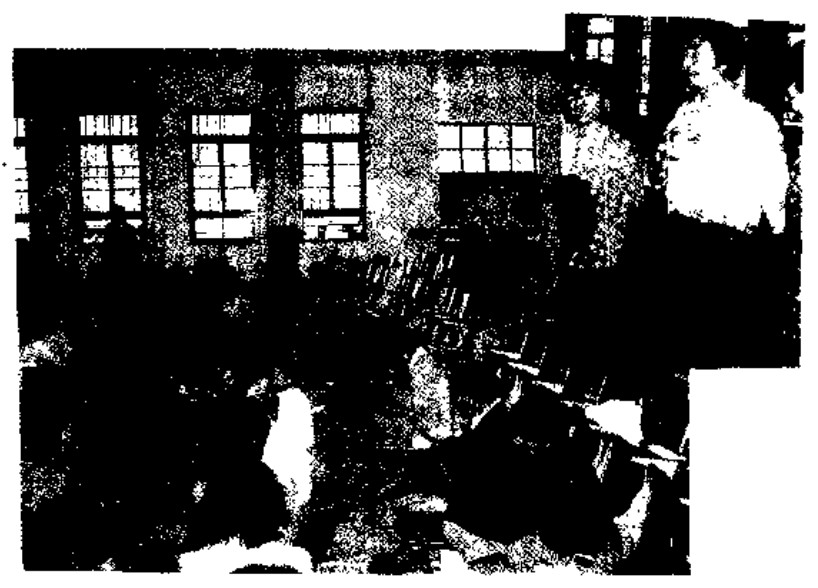
Beast Release Arts — Also at the Western Hills’ Ba Da Chu sixth site, Xiangjie Temple’s Qianlong imperial palace, Wang Liping sat in meditation and emitted qi. After about half a month’s time, the animals of the Western Hills — mice, foxes, frogs, rabbits, snakes… — all gathered around the imperial palace.
Striking Through a Person Across a Pillar Method — Emitting qi at a palace pillar held between two people, one can cause the person beside the pillar to be knocked down.
The “Wind-Calling and Rain-Summoning” arts described at the beginning of this article are all part of Wang Liping’s Daoist internal cultivation arts. Wang Liping says that Daoist internal cultivation arts, expressed in modern terminology, are special abilities (extra-sensory perception).
Whenever people teased him about this, he would solemnly reply with six words: “This is excavating a national treasure.”
Wang Liping “concealed his identity” in 1971, first going to the Fushun Steel Plant, then in 1978 to the Fushun Petroleum Plant. In 1982, at the entreaty of many, he finally “came forth from retirement.” He stated forthrightly three reasons for “coming forth”:
First: Foreign research into Chinese qigong has become quite advanced — can we ourselves remain indifferent? Chinese Daoist internal cultivation is an authentically “Chinese” brand of qigong. Therefore, excavating Daoist internal cultivation means revitalizing Chinese qigong. This is the bounden duty of a Daoist inheritor.
Second: To enable the vast community of qigong enthusiasts to clearly understand the source and development of thousands of years of Daoist internal cultivation, so as to distinguish genuine qigong from the false.
Third: In the past, Daoist internal cultivation was mostly transmitted from one person to one person. Now, by transmitting it outward, one person can teach dozens or hundreds of people. Thus, Chinese qigong can be developed and spread more rapidly and broadly.
Excerpted from “Qigong and Science”
Teacher Wang Liping teaching qigong methods at the Guangzhou Zhineng Internal Cultivation Learning Class. Photographed by Yang Hua.
19
Wondrous Arts and Marvellous Techniques
Observations from the National Symposium on Fitness and Health Preservation
Sports Culture and History and the English-language China Sports magazine, together with the State Physical Culture and Sports Commission’s Water Sports School in Huairou, a suburban county of Beijing, jointly convened the inaugural National Symposium on Fitness and Health Preservation, aimed at uncovering and exchanging the “national essence” passed down among the Chinese people over thousands of years.
The approximately sixty delegates and specially invited representatives came from twenty provinces and regions. Among them, nearly twenty were elders over seventy or eighty years of age. The oldest was the specially invited “longevity star” from Jilin Province, 116-year-old Li Jingshan. Among them were qigong masters and martial arts pugilists — some skilled in the arts of health preservation and the way of longevity; some expert in medicine and pharmacology with miraculous curative effects; some Buddhist and Daoist practitioners with profound attainment; and some devoted to the Bagua and specialised in the Yijing (Book of Changes), with considerable accomplishments. One might say they were like the Eight Immortals crossing the sea, each possessing a unique extraordinary skill.
During the conference, the author had the privilege of witnessing many wondrous and subtle arts. Though these may be rare as phoenix feathers and unicorn horns, they can open the mind and refresh the ear. I thus venture, despite my limited perspective, to briefly record what I personally saw and heard.
Remote Pulse Diagnosis at a Thousand Li
When a patient is separated from the physician by a thousand li, how can the physician know the patient’s condition without even seeing them? In terms of common sense for both Chinese and Western medicine, this is simply inconceivable. Even though there are legendary accounts of such things in antiquity, they are little known and often dismissed by modern people as absurd, preposterous, and unworthy of belief. Yet at this very symposium, the author indeed encountered such a person and such events.
Zhu Heting, over sixty years old, is a descendant of the Daoist elders of Mount Lao in Shandong’s Qingdao, born into a qigong family. From childhood he received his family’s transmission and spent decades cultivating the secret arts of Daoist masters. Today, Zhu Heting embodies qigong and medicinal dietary therapy in one person, possessing top-tier skills. The “Lao Shan Medicinal Beverage” he formulates from secret recipes for dispelling illness and nourishing the body is truly unique. Through extensive practical application, it has produced remarkable effects and has already become renowned both domestically and abroad. Companies such as PepsiCo in America and Japanese business owners, upon hearing the news, were eager to purchase the patent.
While away on business, Zhu Heting suddenly received a letter from his wife at home, written entirely in cinnabar ink, with extraordinary content. Its general meaning was: there is a qigong expert in the Beijing area whose name is Xu Yifan — young, strong, and deeply accomplished in his practice. She instructed Zhu Heting to seize the opportunity to make his acquaintance and under no circumstances clash with him, lest their qigong energies conflict.
Xu Yifan is a director at the China Children’s Art Theatre, forty-five years old this year. He began practising on his own from childhood and independently attained advanced methods from the secret arts of the Daoist school. Since Xu Yifan had neither family transmission nor a formal master, those with discerning eyes saw that he was self-taught and intuitively accomplished, secretly surmising that he had received “immortal transmission.” In recent years, with his consummate and transcendent skill, he has successively cured sequelae of poliomyelitis, rheumatoid arthritis, heart disease, thrombocytopenia, trigeminal neuralgia, cerebral thrombosis, hemiplegia, hysterical paralysis, women’s dysmenorrhea, and many other difficult and complex conditions. Among those he treated were Party and state leaders, foreign guests, overseas Chinese, and ordinary common folk. Because his treatments were instantly effective and his results extraordinary, Xu Yifan earned the honorary titles “Kunxian” (Immortal of the Kunlun) and “Jinxian” (Golden Immortal).
After Zhu Heting arrived at the conference, he indeed spotted Xu Yifan’s name on the registration list, and the two met unexpectedly. After exchanging greetings and a heartfelt conversation, they established a mutual understanding and became close friends.
After dinner, Zhu Heting was conversing freely in Xu Yifan’s room. Present were Zhang Zhenhuan, chairman of the China Qigong Science Society, along with Qu Zhaolu, a seventy-two-year-old lineage holder of Dragon-Form Taiji from Tianjin, and others.
Zhu Heting feigned knowing only martial arts and nothing of qigong, wishing to test young Fang’s abilities. Young Fang was honest and sincere by nature and did not decline, volunteering himself for the task. And so Old Zhu settled into the sofa, hands spread open and resting on his knees, sitting upright and composed. Young Fang casually pulled over a chair, sat facing him directly. The two sat opposite each other at a distance of about two feet. Xu Yifan and three others sat to one side watching, waiting expectantly.
“Teacher Zhu, is the person you wish to diagnose remotely male or female?” Fang Zonghua asked.
“Female,” Zhu Heting replied, his tone certain.
“How old?” young Fang asked again.
“Sixty-seven,” Old Zhu stated emphatically.
“Where does the person live?” young Fang asked further.
“Shanghai,” Old Zhu blurted out.
Given these three conditions, Zhu Heting had Fang Zonghua remotely diagnose the condition. Young Fang extended both hands, slightly splayed like fans, trembling gently back and forth, as though emitting energy to probe and sense certain information. What Zhu Heting did not anticipate was that this qigong insider was secretly emitting energy and releasing interference. When “qi” meets a rival, two wave streams collide. Young Fang suddenly felt tense, sweat breaking out on both cheeks, unable to steady himself for a moment. After a short while, young Fang reported his diagnostic findings, but Old Zhu shook his head repeatedly, saying they were inaccurate.
Meanwhile, Zhu Heting had been away on business and had no intention of returning to Beijing again. But it was as though his master possessed uncanny foresight, urging him once more to attend the meeting, saying he would meet an extraordinary person and must not miss the opportunity.
And so Fang Zonghua followed his master’s instructions and hastened to Beijing without pause. But before this, young Fang, Xu Yifan, and Zhu Heting had each gone their own way, with no prior acquaintance. Upon arriving at this conference, young Fang immediately saw that the abilities of Xu and Zhu were far from ordinary, and his heart was filled with admiration, wishing to form lifelong friendships.
During a moment of leisure, as the conversation turned to pulse diagnosis…
The short, stocky Sichuan representative Fang Zonghua entered. Young Fang was forty-three this year. In 1984, he was designated as the lineage-holding disciple of the internal cultivation school of the Emei Sword lineage. He had come to Beijing in October to attend the inaugural meeting of the China Qigong Science Society. After it concluded, he had just returned to Sichuan, exhausted and weary, when he received the notice for this meeting.
77-year-old Jin Yiming performing the cane technique. Zhang Guangde performing “White Ape Offering Fruit” (see page 22).
As the common saying goes: “Those involved are confused; bystanders see clearly.”
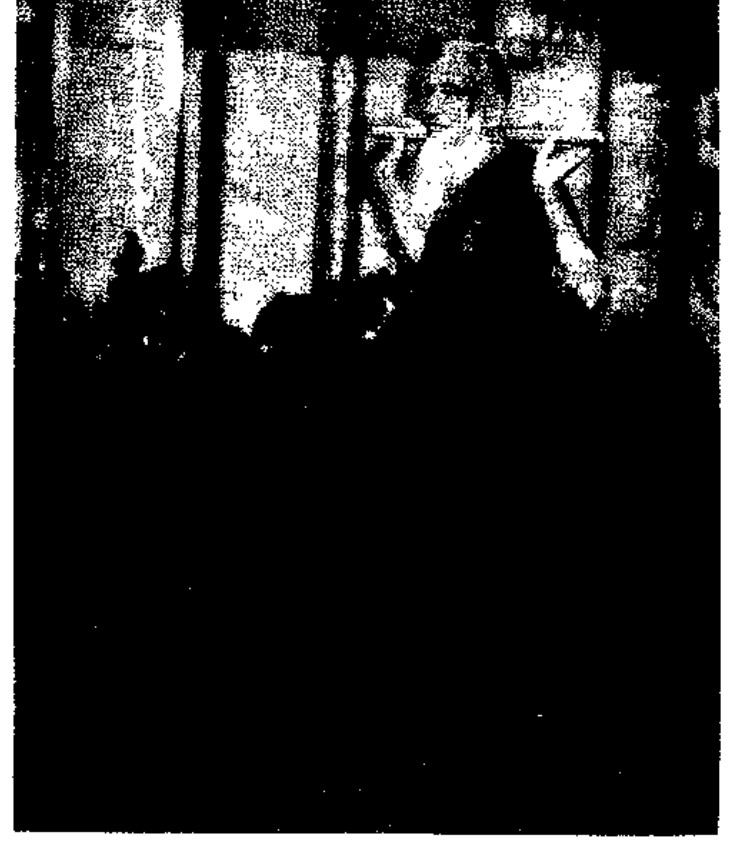
At this point, Xu Yifan took up the conversation: “Teacher Zhu, the person you mentioned mainly suffers from hemorrhoids. Am I right?” Zhu Heting clapped his hands together in praise upon hearing this: “Absolutely correct — that person is indeed my cousin from Shanghai.” Old Zhu then said to Xu Yifan: “However, you must explain how you detected it, and explain the reasoning behind it.” Several people present could not help but applaud Xu Yifan. Xu Yifan merely smiled faintly: “This is nothing more than a game.”
Afterwards, I privately asked about this matter. Xu Yifan said: “Teacher Zhu and Xiao Fang were facing each other head-on. From the side, I swiftly sent qi to respond, avoiding interference and getting there first. In truth, remote diagnosis is not mysterious at all. Once the method is explained to you, you can learn it too.”
The above account may seem abstruse and incomprehensible. Do you not believe it? That is entirely your prerogative. However, this is indeed what I personally witnessed.
The Modern-Day Bian Que
As far back as the Warring States era, the great physician Bian Que astonished people with his extraordinary abilities, so remarkable as to be called miraculous. He used the method of “diagnosing by sight alone” to determine illnesses. He treated Zhao Jianzi, cured the Crown Prince of Guo State, and diagnosed the illness of Duke Huan of Qi — tales preserved as miraculous historical legends. Han Feizi once wrote the essay “Bian Que Meets Duke Huan of Qi,” praising Bian Que’s medical mastery. The “remote diagnosis” of Chinese medicine has been renowned throughout the ages.
The Huangdi Neijing classifies Chinese medicine practitioners into two major categories: one being those who preserve form, the other being those who preserve spirit. Those who preserve spirit are open-minded and discerning, prioritizing the observation of phenomena and the search for underlying principles. They diagnose illness without taking the pulse or inquiring about the condition — they need only one glance with both eyes to comprehend everything fully, detecting the most subtle signs. Remote diagnosis by sight is precisely the wondrous application of the medical art of preserving spirit; it is by no means baseless superstition.
In August 1981, a reporter from Xinhua News Agency, after investigating and studying Jin Yong for four months, finally published a piece in an internal publication — a news item titled “Tram Dispatcher Jin Yong Cures Many Patients Using the Diagnostic Method of Knowing by Sight.” Who could have anticipated that this news would spread like wildfire. From then on, patients flocked to Jin Yong’s door in endless streams every day. From within and outside Beijing, from at home and abroad, Old Jin could barely keep up with the demand and became a “busy man.”
That day, I went to Jin Yong’s home to attend a discussion meeting. A senior reporter from the International Department of Xinhua News Agency had brought three more colleagues for consultation — two men and one woman, two of whom were editors from the Liaowang magazine. Witnessing this scene, I naturally wanted to see for myself what it was all about. And so I recorded this remarkable spectacle:
“Are you a headache case, with the pain concentrated on the left side of the brain — correct?” After Jin Yong noted down the name, age, and work unit, he got straight to the point. “Upon hearing Jin Yong’s words, the results from the hospital diagnosis were completely consistent.” The reporter could not help but be greatly startled, thinking it was simply too miraculous. This editor had not only been seen at several major hospitals in Beijing, but had also sought out renowned doctors in over a dozen provinces during reporting trips, receiving treatment letters — yet the illness remained uncured and grew increasingly severe.
“You have a left-sided migraine, with a history of over ten years,” Jin Yong continued. He then asked the editor: “Correct?” The editor nodded in agreement, entirely accurate, but puzzled and amazed that Jin Yong could even describe his medical history with such precision. Jin Yong told him: “There is a thin, flake-like object in your head — it is mainly the thing causing the obstruction.” “Is it a tumor?” the editor asked uneasily. Jin Yong replied: “It has not yet fully formed; it can be dissolved with medication.” He then wrote out a prescription and handed it to him.
Next, Jin Yong performed visual diagnosis on the other two people, describing each one’s illness and hidden ailments. Their conditions, down to every detail — the head [symptoms] and all — were astonishingly accurate.
· 21 ·
…speaking with great coherence, every point hitting the mark, even describing exactly which vertebra had problems and what kind of personality and psychological state each person had — all matching the facts perfectly. The several visitors were thoroughly convinced and praised Lao Jin [Jin Yong] as truly living up to his reputation.
Zhao Wenyue is from Qiqihar in Northeast China. His family has practiced “bone-setting for trauma” as a hereditary tradition for generations, renowned far and wide. By his generation, it was already the seventy-second. According to family rules, this unique skill was passed down only to the eldest son in each generation. Since Zhao Wenyue was the eldest, he naturally became the lineage holder. Old Zhao originally worked as a construction worker in his hometown and retired a few years ago. After deep reflection, Old Zhao broke the ancestral prohibition and taught this secret method of rapidly treating bone injuries to three of his five sons and their wives. All of them have now attained considerable proficiency.
Zhao Wenyue uses his own visual power to examine bone injuries, comparable to an X-ray machine — truly a marvel. Once, an orthopedic surgeon made a bet with him to examine a patient and determine the location and severity of the injury. Old Zhao simply passed his hand over [the patient], and the injury was vividly apparent. He described it clearly and precisely, matching the X-ray results exactly, leaving the orthopedic doctor dumbfounded.
Of course, Zhao Wenyue’s profound skill and miraculous eyesight were entirely acquired through his practice of qigong since youth. The technique he practices is called the “Ninety-Nine Hanging Shoulder Posture” (九九挂肩势), belonging to a set of Daoist secret practices. He persists in training every day, for at least one hour each time. Old Zhao said that with dedicated practice, one can grasp the essence within three years.
Every year, Zhao Wenyue spends more than a month being taken into the mountains and forest areas to set bones and treat injuries for loggers, because felling operations involve many dangers and frequent accidents. On average, Zhao Wenyue treats around a hundred or more patients each year — swift treatment, swift recovery, with remarkable therapeutic results.
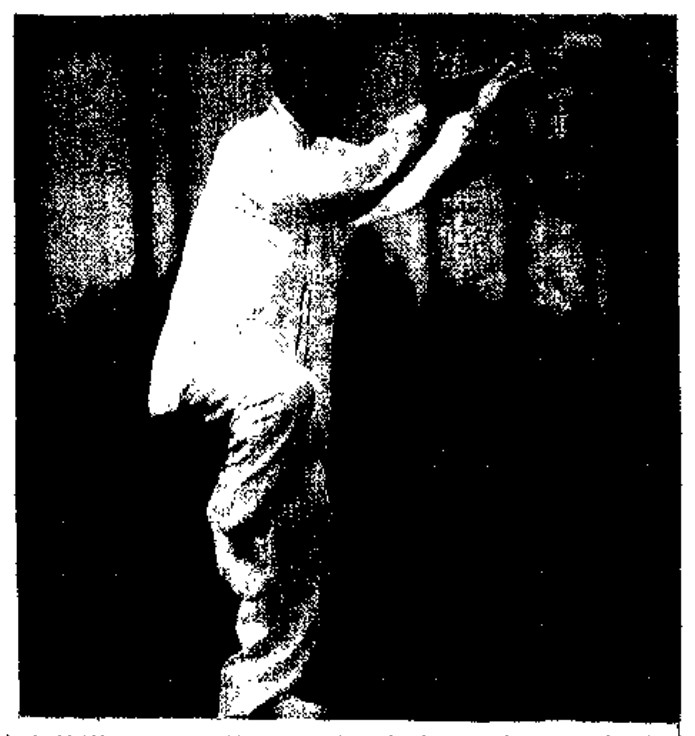
Coincidentally, 64-year-old Zhao Wenyue came from the Northeast to Beijing to attend a symposium. Through an acquaintance’s introduction, Editor Zhang invited Zhao Wenyue to his home. After examining the old lady’s injuries, he treated her on the spot. He instructed the family to buy three jin of baijiu (white liquor) and place it in a basin. Quietly emitting qi, he pressed both hands on the injured area, gently pushing and slowly kneading, rubbing, pressing, and rolling. Then, he ignited the baijiu with fire, and fierce flames leapt up with tall blue tongues of fire. One could see Old Zhao bare-handedly grabbing the burning liquor-fire and repeatedly rubbing it against the old lady’s injured area, until all three jin of liquor were completely burned away and rubbed in — lasting over an hour in total. After just this single treatment with liquor qi, the comminuted fracture sites were all realigned and joined. Right before everyone’s eyes, the old lady’s leg and foot — which previously could not move at all — could now move gently within moments, and had no strong pain sensation. Three days later, Old Zhao came to the home for a follow-up examination. The old lady’s legs and feet had an even greater range of motion, and the family repeatedly praised Old Zhao.
During the symposium, Section Chief Zhang from the aquatic sports school and his wife wanted to ask a master to examine their health. The author introduced them to Jin Yong. Old Jin gazed at them and then told Section Chief Zhang about his condition: “About 21 years ago, you had a severe case of dysentery. You were very ill. It was not completely cured at the time — not thorough. This left a root of illness.” Old Zhang was a military veteran from Henan province. He thought carefully and confirmed it was indeed the case. Twenty-one years ago, while serving in Xinjiang, he had suffered a severe case of dysentery. He was hospitalized and was ill for a long time before being discharged. After that, his health steadily declined. What was puzzling, however, was that Jin Yong had never met them before — how could he pinpoint the condition so accurately, even down to the exact timeframe? Later, Jin Yong also described their respective temperaments and dispositions, as well as their child’s personality and situation, all so convincingly that they were completely won over — as if Sun Wukong had crawled inside the Bull Demon King’s stomach and knew everything inside out. They were simply astonished.
Jin Yong not only diagnoses by reading faces, but can also treat patients he has never seen, diagnosing and treating just from a photograph mailed to him. A young woman named Zhang Liru had been bedridden with paralysis for over two years. Jin Yong simply looked at her photograph and mailed back a prescription for medication. After taking only a few prescriptions, Zhang Liru was able to get out of bed and make slight movements — very effective results. Currently, AIDS is prevalent in many countries around the world. Jin Yong has already asked someone to find about a dozen photographs of patients. He told the author: “As long as I can see the photograph, I can know the pathology and root cause of the disease, and then I have a method for treatment.” Whether this is boasting or not, let us leave it for future practice to provide the answer!
(Excerpted from “Sports World”)
The Divine Hand of Bone-Setting
Editor Old Zhang of Sports Literature and History magazine had a maternal grandmother who was 82 years old. She suffered a fall that resulted in a comminuted fracture of the thigh. Both the inner and outer sides of the upper thigh were seriously injured, with bone fragments. The old lady was sent to a hospital in the southern suburbs of Beijing. After examination by the orthopedics department, they could not admit her because the injury was located at the junction of the upper thigh — it could neither be fixed with a plaster cast nor reset with splints. They had no choice but to tell the family to take the old lady home the next day to rest and allow slow recovery. For half a month, the elderly woman suffered unbearable pain, unable to leave her bed. Even the slightest movement felt like sitting on a bed of needles, and she wished she were dead. For the convenience of care, the family had no choice but to cut a large hole in the middle of the bed board to receive her urine and feces.
As the saying goes: “For injuries to muscles and bones, a hundred days are needed.” Given the old lady’s advanced age and the hot summer months of May and June, prolonged bed rest would be unbearable. Her family and relatives were frantic with worry.
The old lady was sent to a hospital in the southern suburbs of Beijing. After examination by the orthopedics department, they could not admit her…
(Excerpted from “Sports World”)
22
It was the sixth year of the Republic of China, and the land of China was in a state of chaos. In the evening of July that year, facing the Buddha statue and holding aloft incense, her grandfather Yang Deshan, then seventy-three years old, solemnly transmitted to his granddaughter young Meijun the Great Wild Goose Qigong that he had personally received from the Kunlun Daoist priest in his youth. From then on, she rose early and worked late—running east and west with her family to scrape together a living while practicing qigong without cease. On cold winter days, as the north wind howled outside the broken windows, young Meijun, wearing only thin clothing to practice her skills, would lie peacefully on a narrow wooden bench. With each breath in and out, she visualized a basin of glowing charcoal gently warming her body. Thus, from the hands of her grandfather Yang Deshan, the intelligent and resolute young Meijun learned the complete set of Dayan Qigong, Dayan Gong, Dayan Quan, Dayan Zhang, Dayan Jian… A young fledgling, in that impoverished era, was ready to take flight.
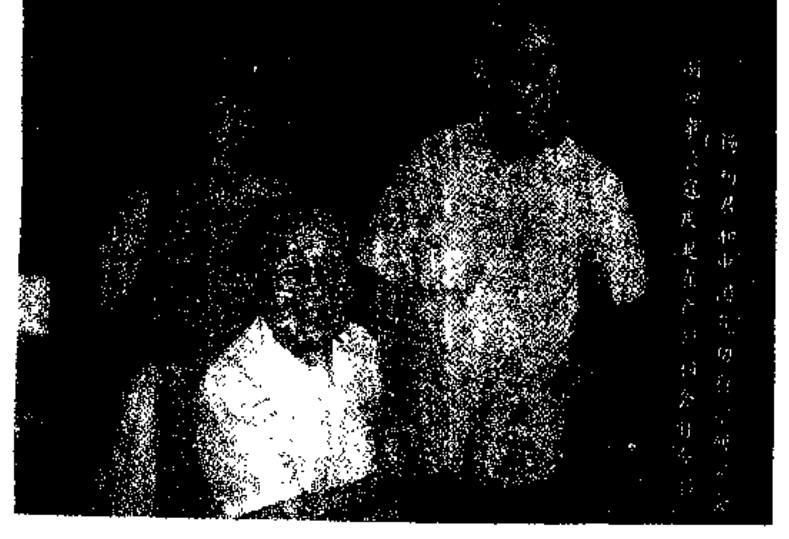
However, with the nation under occupation, the Meijun of that time was destined not to have a free sky in which to soar. When she was in her early twenties, her father, who supported the family by pulling a rickshaw, was beaten to death by a drunken Japanese soldier. Her mother and grandfather had already passed away one after another not long before. Looking at her blood-covered father, Meijun wept until her tears ran dry and shouted until her voice went hoarse. In those days, to whom could a poor person turn to right their grievances? People helped Meijun arrange her father’s funeral. Then Meijun, disguised as a man, set out on the road of wandering.
In the years that followed, relying on her martial prowess, she dressed as a man and mingled among the ranks of salt smugglers. Later, she met her husband, who was then doing underground work for our Party. Meijun then took her underage children and, together with her husband, trekked through mountains and dense forests, joining the anti-Japanese guerrilla warfare. Once, while Meijun was helping the guerrillas transport supplies, she aroused the suspicion of Japanese soldiers. The Japanese devils buried Meijun alive together with seven other captured Chinese civilians in a pit. Relying on her qigong skills, not only did Meijun survive, but she also climbed out of the pit and saved the lives of the others. During the civil war launched by the Nationalists, Yang Meijun sent her seventeen-year-old son into the revolutionary army and herself joined her husband in the War of Liberation, becoming a cultural and artistic soldier. During the turmoil of the “Ten-Year” Cultural Revolution, like many kind-hearted people, Master Meijun was also implicated. During struggle sessions, when they made her sit, she silently practiced seated qigong; when they made her stand, she gripped the ground with her toes and quietly practiced standing-post training. In that pathological era of inverted right and wrong, Master Meijun remained composed and serene, holding fast to righteous energy, free of distracting thoughts—transcendent in the pure and beautiful realm of Dayan Qigong.
Extraordinary Gongfu Power
There are many stories among the masses about Master Meijun’s miraculous abilities. Here are a few selected accounts:
— By A Tao, Shaanxi
In the auditorium of Xi’an’s Fourth Military Medical University, every seat was filled. Under the brilliant lights on stage, a white-haired elderly woman of slight build was calmly and composedly demonstrating qigong. She leaped, shifted, pivoted, and sprang—wherever her fists and feet landed, the stage shimmered with energy. Then, the elderly master gathered qi in her dantian, lightly shook her shoulders, and began to release the fragrance of flowers to the audience. Instantly, from front to back, over a thousand audience members smelled waves of rich sandalwood and chrysanthemum fragrance; wherever the scent reached, it penetrated the heart and lungs… The auditorium erupted in sustained, unceasing applause.
This venerable elder was Yang Meijun, the grandmaster of the Kunlun school’s Dayan Qigong and a female qigong master renowned throughout the nation and celebrated overseas. She was ninety-three years old that year.
An Extraordinary Life Story
Dayan Qigong is an advanced practice long held in secret by the Daoist Kunlun school. When this practice was transmitted to Master Meijun, she was only thirteen years old. At that time,
At a qigong demonstration, a young man who did not believe in qigong asked to test it. Master Meijun had this young man stand in a line of people. Master Meijun positioned herself at the very front of the line and called out: “I will test the sixteenth person!” She emitted gong power, and that young man immediately fell over, feeling dizzy, disoriented, and unable to stand steadily—while the fifteen people in front of him were completely unharmed. Everyone present was stunned, and the young man was thoroughly convinced.
A foreign qigong master, hearing that Master Meijun’s skills were miraculous, came to challenge her. Upon meeting, Master Meijun immediately sensed black qi coming from the other party. Seeing that the visitor had ill intentions, the master exchanged only a brief greeting before beginning to discharge a stream of qi. Master Meijun shot qi from her fingertips, and the foreign master was instantly defeated and frozen in place.
There are also many people who have personally seen, when Master Meijun emits external qi, angular-shaped marks appear on her palms, and some can also see fine qi threads winding around Master Meijun’s ten fingers. Experiments have been conducted: when Master Meijun grips tightly,
·23·
stainless steel short sword, when no external qi was being emitted, appeared on the closed-circuit television screen in its natural silvery luster; but as soon as she emitted external qi, the entire short sword — from hilt to tip — turned completely black.
Those who understand qigong all know that emitting external qi to treat patients amounts to transmitting the essence of one’s own qi and blood to the patient, and one’s own body will inevitably be affected to a greater or lesser degree. But facing patients, Master Mei Jun never stinted on herself. Her remedy was simply this: practice diligently, gather qi frequently, and treat many patients.
During qigong exchange conferences, patients seeking treatment and qigong enthusiasts hoping to study under her would often surround her quarters so tightly that not a drop of water could trickle through. Miracles of this kind frequently occurred: some patients were helped into the room supported by family members, but after one examination and treatment by Master Mei Jun, the patient could walk out on their own. How many patients shed tears of gratitude before Master Mei Jun!
As for the Great Wild Goose Qigong method passed down by Master Mei Jun, its miraculous examples are even more numerous than can be recounted:
Hong Li, formerly a female cadre at a certain work unit in Zhengzhou, now retired, is a disciple of Master Mei Jun. She had suffered from arthritis, bone spurs, herniated discs, and other ailments for over thirty years; whenever the weather turned slightly overcast, she would be bedridden. In April 1978, after being knocked down and frightened by a car, combined with menopausal syndrome, she developed schizophrenia — crying and laughing all day, losing all will to live. In 1981, she went to Beijing to study Great Wild Goose Qigong under Master Mei Jun. In less than a month, astonishing changes occurred in both her body and mind. Now, she is free of all illness; her hair is glossy black, her complexion rosy. At over sixty years old, she is consistently mistaken for someone in her forties. The wondrous power of Great Wild Goose Qigong gave her a new lease on life. As a disciple of Master Mei Jun, she now travels far and wide to promote the Great Wild Goose Qigong.
Chen Yuncheng works at a county coal mine and is fifty-four years old. In 1979, he contracted acute nephritis. In 1980, he developed severe coronary heart disease, frequently experiencing angina, shock, and apparent death. Doctors issued multiple critical-condition notices. His work unit had already prepared his coffin and clothing; his family had also made thorough preparations for his funeral. In the spring of 1984, he learned the Great Wild Goose Qigong transmitted by Master Mei Jun, and within half a month his body began to improve. Now fully recovered, he can ride a bicycle over a hundred li. In his own words: “Teacher Mei Jun’s Great Wild Goose Qigong gave me a second life.”
In April 1982, a police station chief in Beijing crashed his motorcycle into a tree while on duty. He bled from his ears and nose, suffered facial fractures, sustained severe head injuries, and fell into a coma. Ten days after hospitalization, his condition deteriorated sharply: frequent epileptic seizures, hemorrhaging in the digestive tract and lungs, body temperature soaring to 40 degrees, and blood pressure dropping to a critical level. The hospital issued a notice to the family to prepare for the worst. Master Mei Jun emitted qi to treat him. After about 10 minutes, the patient began to expel phlegm; after 20 minutes, he began to urinate. Two hours later, the patient’s blood pressure began to rise, and the shock gradually eased. Thereafter, despite the exhaustion of receiving numerous patients each day, Master Mei Jun insisted on emitting qi to treat the patient once daily, each session lasting about half an hour. By the fifth day, the patient’s consciousness was fully restored, and he was soon safely discharged from the hospital.
Over the years, to popularize and spread Great Wild Goose Qigong across the land of China, the white-haired Master Mei Jun traveled far and wide, her footprints covering nearly every province and city nationwide. Many patients whom Master Mei Jun had treated with all her heart have now become her accomplished disciples — she can truly be said to have pupils throughout the land. Friends from overseas — relevant institutions in the United States, France, Germany, Singapore, and other nations — sent people and letters offering high salaries, hoping she would go abroad to teach Great Wild Goose Qigong. But Master Mei Jun declined each and every one. In her own words: “The profound essence of qigong is precisely the dual cultivation of body and spirit. And the ultimate realm of qigong lies in the harmony of heaven, earth, and humanity. The sky in which I soar is in China; the ground on which I rest is in China. I — a Chinese person’s realm of being and non-being — is in China.”
This article is excerpted from “Women’s Life” (《妇女生活》); photographs selected from “Qigong and Science” (《气功与科学》).
A Noble Character
Within the Kunlun Sect Daoist Great Wild Goose Qigong lineage, there is a strict rule: a practitioner shall not teach the practice before reaching the age of seventy. Master Mei Jun’s grandfather transmitted this practice to her when he was seventy-three. Master Mei Jun’s husband passed away in 1978, and she herself had already passed the age of seventy. She thought to herself that having crossed the seventy-year boundary, she should bring out her skills to do something for people. From then on, in the small grove of trees in Beijing’s Xuanwu Park, Master Mei Jun began treating patients free of charge.
However, a sincere and devoted heart is not necessarily understood by everyone. Those who did not understand, those who were skeptical — some ridiculed, others watched coldly from the sidelines. In the beginning, even some patients came to seek treatment from Master Mei Jun with a merely lucky, tentative attitude. Master Mei Jun calmly and composedly emitted qi to treat patients as a voluntary service. After her treatments, many chronic patients recovered quickly, astonishing countless people. Later, so many patients sought her treatment that many came from thousands of miles away, and she always gave her utmost to provide prompt treatment. It was from that time onward that she earned the laudatory title “Yang the Immortal” (杨神仙).
- Yang Meijun delivering a speech at the opening ceremony of the “Great Wild Goose Qigong Intermediate Tutorial Class” in Guangzhou.
•24
Personal Experiences with Dayan Qigong
Fang Ming
The two of us brothers work in Wuhan and Guangzhou respectively. Both of us are qigong enthusiasts. When Grandmaster Yang Meijun held a training class in Changsha, we both went to attend it, independently of each other. We heard and witnessed many wondrous facts. During that time, I recorded several accounts to share with readers.
The Magical “Qi”
After practicing, [a disciple] taught us to see qi. Under her guidance, we indeed saw that from the tips of [Yang Meijun’s] fingers, columns of red light-mist about a foot long were radiating forth. Then, we each circulated qi for a while, and truly saw the qi on our own hands as well. Ten fingertips emitted white mist-like qi columns, and the spaces between the fingers were also full of qi, just like the white threads that remain connecting the middle when Chinese herbal Eucommia bark is torn apart!
In the auditorium of the PLA National University of Defense Technology, after Yang Meijun stood on stage and performed a set of the never-before-transmitted advanced technique “Kunlun Cotton Palm,” she said: “Now I will let everyone smell some fragrant qi.” We saw her walk slowly a few steps on the stage, circulate qi through both arms, then hold qi in both hands and scatter it toward the audience, saying: “Whoever smells it, raise your hand.” Many people in the audience raised their hands one after another. At the time we were in the front row, and all smelled a dense, rich sandalwood fragrance, so we also raised our hands in turn. According to Master Yang’s disciple, this is danxiang (elixir fragrance), obtained through long-term qigong practice. Master Yang’s body can emit sandalwood, green fragrance, jasmine flower fragrance, and other types of fragrant qi. Li Yanyi, a vocal music teacher at the Hubei Art Academy, also said that after practicing Dayan Qigong for several months, fragrance appears on her body after practice as well. After practicing, she extended her left hand toward us, and there was indeed a sandalwood fragrance on it, just like Master Yang’s. A qigong master who can emit several types of fragrant qi is extremely rare throughout the country.
Amazing Curative Effects
At the practice ground, we became acquainted with a middle-aged student named Old Wang, who had a robust build, agile movements, and a ruddy, glowing complexion. His “Dayan Palm” form earned praise from both the teacher and fellow students. Only after conversing did we learn that three years earlier, he had been someone plagued by multiple illnesses, nearly at death’s door! Old Wang was a cadre at the Shijiazhuang Rolling Stock Factory. He said: “After graduating from university, I always did technical work. In the 1970s I contracted hepatitis, early-stage cirrhosis, and cholecystitis, and then developed coronary heart disease, pyelonephritis, and gastritis. I was hospitalized in several hospitals, all to no avail, and my body became extremely weak. The Hebei Provincial Hospital diagnosed me with systemic lupus erythematosus. The doctor kindly told me: eat whatever you should eat quickly, drink whatever you should drink quickly, and don’t think about work anymore. When I heard that, I understood—wasn’t this a death sentence? I felt it would be too unjust to die now; I had elderly parents above and children below, and the Party had trained me for so many years—could it really be… No! I wanted to explore other paths to cure my illness. I started running; my heart condition improved somewhat, but it affected my kidneys—there was blood in my urine—so I had to stop. I then tried tai chi, but the results were not obvious; sometimes better, sometimes worse—‘push down the gourd and the scoop pops up.’ In 1984, when Master Yang Meijun held a Dayan Qigong training class in Beijing, I went. This time I found the right path! After two years of persistent and unremitting practice, I became like a different person, regaining my vitality. When I went to the hospital for a physical examination, to my surprise, all liver test indicators were completely normal. The EKG and gallbladder were also normal. The pyelonephritis and stomach problems were all cured as well. This change astonished the entire factory. First, the doctors who had previously treated me asked to learn Dayan Qigong from me. Then relatives, friends, and colleagues also came. My wife and three children all practice as well. In the past, our whole family’s health was poor, but now everyone is healthy. I have already taught over 80 people at the factory. Not long ago, the factory established a qigong and martial arts association and elected me as chairman. I was also rated an advanced worker at the factory.” He then added: “Through persistent…”
In the auditorium of Central South University of Technology, Yang Meijun gave another brilliant performance—“Channeling Qi Through,” also called “Sixty-Four Step Divine Palm.” Forty-eight people were lined up in a single row on stage like a snake formation. Yang Meijun faced everyone, circulated qi, then pushed toward the crowd with both hands, saying: “Those who feel something, raise your hands!” People raised their hands one after another. One of her disciples asked everyone what they felt. The responses varied—some felt their chests swelling, some felt their lower bodies going numb… a hot energy current spread throughout [the body]… [some] could even smell [fragrance]…
“By practicing the Big Wild Goose Qigong, one’s internal qi becomes abundant, the meridians become unobstructed, and consequently the body’s sensitivity increases. One can probe for illness with the hands, and occasionally also emit external qi to heal others.”
“You can probe for illness with your hands?” we asked in astonishment.
“Yes, as long as one persists in practicing the Big Wild Goose Qigong, it is possible to achieve this. Take a recent example! The day before yesterday, I went to the home of an old comrade at Central South University of Technology for a meal. Sitting next to me was her thirteen-year-old boy named Li Dou. I suddenly felt a blockage in my own heart. I probed with my hand in front of Li Dou’s chest — goodness! The diseased qi pricked my hand! After the meal, I said: ‘I’m afraid there is a problem with Li Dou’s heart. He should go to the hospital for a check-up.’ Li Dou said: ‘I’m not sick. I won’t go to the hospital.’ But yesterday his mother told me, crying: ‘Li Dou has been hospitalized. It’s rheumatic heart disease, and it may develop into myocarditis.‘”
We also met a quiet, young girl who showed not the slightest sign of illness. Who would have known that half a year earlier she had been a cancer patient? In March 1986, she contracted acute ovarian grape-like cancer. At Wuhan Tongji Hospital, nearly half a basin of cancerous tissue was removed. After chemotherapy, her hair fell out, her face became swollen,
Master Yang Meijun practicing qigong
Master Yang Meijun treating illness
and she had difficulty walking. The doctor told her mother that she could live for at most four more months. With no way out, her parents begged Master Yang Meijun and her disciples to treat her. Two months later, her condition improved. She shed a whole layer of dark skin from head to toe, and grew back a full head of black hair. Those who knew the story all said: it was the Big Wild Goose Qigong that had saved her!
“Are there any students in the training class who have opened the Heavenly Eye or the Heavenly Gate?”
“Yes.”
One afternoon, we asked Dr. Ling from a workers’ hospital in Changsha to perform “X-ray vision” for us. She sat down in front of Sun Peiming, gently closed her eyes, and slowly said: “You have suffered from headaches and chronic pharyngitis. Your coronary arteries have a slight insufficiency of blood supply. There is some wear and strain in your lumbar vertebrae… And there is a small hard nodule on your right buttock.” All correct! As for that small hard nodule — it was left over from an injection-related infection and inflammation in 1952. Not even her close relatives knew about it, yet Dr. Ling “saw” it. Truly miraculous!
How is the Heavenly Eye point opened? One of Master Yang’s disciples explained: “The human skull has a suture running through the middle, from the forehead to the crown of the head. At the points of the Heavenly Eye (tianmu), Spirit Court (shenting), and Hundred Meetings (baihui), there are also three transverse sutures. When qigong practice reaches a certain level, these places open up, and one can then receive and transmit information. Before learning the Big Wild Goose Qigong from my teacher, I practiced the sixty-four-move set combined with stillness qigong. In just over a year, I opened the Greater and Lesser Heavenly Circulation. Then my Heavenly Eye and Heavenly Gate opened as well.”
“What does it feel like when they open?”
“At first, I felt a swelling sensation at the Heavenly Eye point. During stillness qigong practice, golden and red circles of light would appear before me. On one occasion, I suddenly felt a booming sensation in my head — a field of white light appeared before my eyes. The next morning during practice, while doing the ball-rolling movement, I kept seeing a red dot to my right. I reached into my pocket and found it was a red thread used to tie a key. When I removed the key, the red dot disappeared. After that, whenever I sat facing someone, I would close my eyes, enter stillness, and a screen would appear before me. The bones and all the internal organs would be clearly visible. I could even see the movements of the heart and lungs and the direction of qi and blood flow. Wherever the qi was blocked or diseased, a dark color would appear, indicating illness there.”
“Not long after, my Heavenly Gate also opened. Once, Teacher Yang asked me to find someone. I closed my eyes and did a session of stillness qigong, and then discovered that this person was talking with a comrade in a certain room. This was later confirmed — at that time, the two of them were indeed talking together.”
“Once the Big Wild Goose Qigong reaches a certain level, one can emit external qi to probe for illness and heal others. With deeper attainment, one can also open the Heavenly Eye and the Heavenly Gate, and develop special abilities such as X-ray vision, remote viewing, and remote sensing.” Yang Meijun’s son, a retired military cadre named Chen Chuangang, explained to us the characteristics of the Big Wild Goose Qigong.
“What is ‘opening the Heavenly Eye’?” we asked, not understanding.
Comrade Chen Chuangang explained: The Heavenly Eye is also called the Heavenly Eye — it is the vertical eye in the middle of the forehead of the mythical figure Erlang Shen. This eye is not merely an artistic exaggeration but exists objectively. When qigong practice reaches a certain level of attainment, one can force this eye open and see things invisible to the naked eye without using the physical eyes. If one further opens the Spirit Court and Hundred Meetings points — that is, opens the Heavenly Gate — one can also remotely view places very far away and transmit information!
We listened with half-belief and half-doubt, then asked:
(From the Journal of the Guangzhou Municipal Discipline Inspection Commission: Sun Yinyue; Sun Fang and others — Social Science United Association)
The Remarkable Effects of Qigong
Excerpted from Qigong and Science, Issue 2
·26·
Miracles — truly miracles!
Retired senior cadre Li Yong had learned qigong for only a little over two months, yet already possessed a remarkable signature skill.
Crushing Gallstones Through the Abdominal Wall
— Self-Study Magazine reporter Xiao He
There is no doubt that almost everyone acknowledges that our world is a three-dimensional world. Objects extend or contract in three directions — length, width, and height. Space is filled with length, area, and volume. However, the human body science research societies that have been successively established in many provinces and cities have led some authorities to conclude that science will undergo a qualitative breakthrough, and that a fourth-dimensional world is coming toward us.
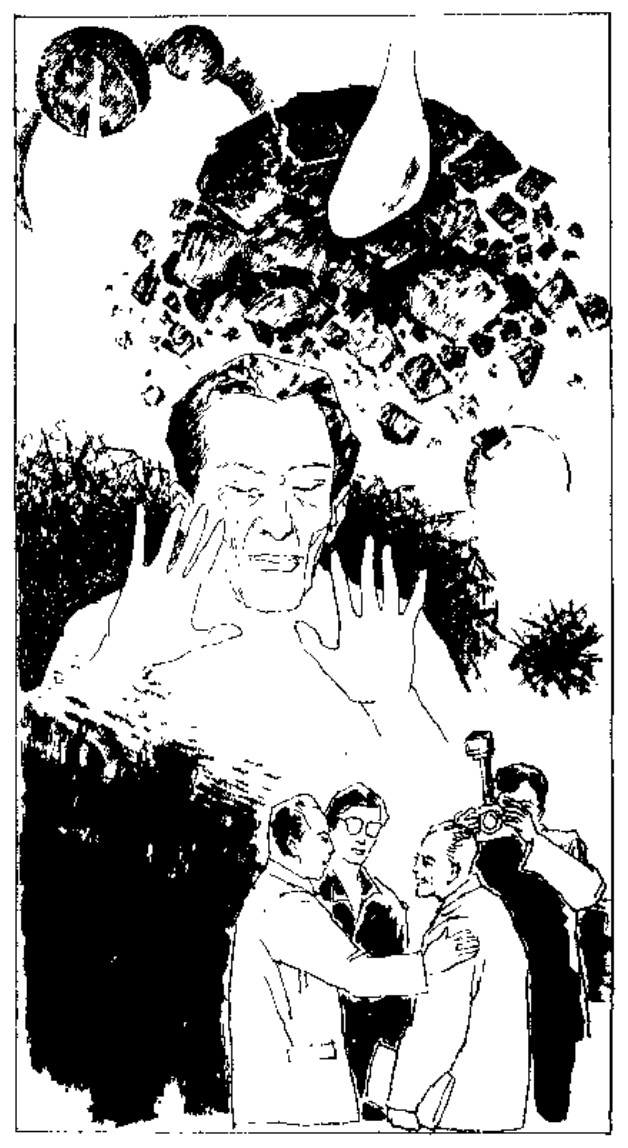
Beijing.
On a summer day in early 1987, the activity hall of a certain retired cadres’ residence under the National Defense Science and Technology Commission was bustling with unusual excitement. The sofas arranged in a circle were filled with people who had come after hearing of its reputation.
Standing among the crowd was a man, a deputy minister from a certain ministry. He appeared distracted, his face the color of wax. He unconsciously straightened up, faced the onlookers expressionlessly, and stood motionless like a clay sculpture.
This was in early 1986. He had frequently felt a gripping, colicky pain in his right upper abdomen. A B-ultrasound examination diagnosed: a gallstone measuring 2.2 × 2.2 mm embedded in the gallbladder wall. Gallstones are a common ailment, with an incidence second only to appendicitis. If they cannot be passed naturally, surgical removal must be performed; otherwise, the stones may block the bile duct, causing inflammation. In severe cases, the gallbladder may accumulate pus, or even necrose and perforate — the consequences would be unimaginable. The diagnosis was written clearly in black and white: surgical removal. This meant he would have to lie under the surgical lamps while a scalpel cut open a wound more than a foot long on his body…
He had anxiously visited several major hospitals throughout Beijing — Chinese medicine, Western medicine, folk remedies — he had tried them all. But the stone seemed to have taken root, firmly attached to his gallbladder wall, and growing ever larger.
As it happened, at just this time, he heard word that several retired cadres in the National Defense Science and Technology Commission had special abilities — they could emit “true qi” and shatter stones right through the skin without surgery… Such talk seemed almost mythical.
He was a materialist. Whether he believed it or not…
·27·
Whether one believes it or not, to escape the pain of surgery—
On a July evening in 1987, a documentary film about special abilities was being shown in the small auditorium of the Beijing Film Studio, attended by relevant experts and prominent figures from the medical community. As soon as the film ended, Zhang Zhenhuan, Council Member of the China Qigong Science Research Association and President of the China Human Body Research Association, enthusiastically mounted the stage and announced: “Today, I have brought you someone who can shatter stones — he specializes in treating gallstones — and he can compete with your large hospitals.”
The person surrounded, questioned, and invited by the crowd was none other than the retired cadre Li Yong.
The existence of a four-dimensional world is an extension of the three-dimensional world of our everyday experience. It is easy to understand one, two, and three dimensions using a three-dimensional mind, but once it becomes four-dimensional, that no longer works. The key to human body science may lie precisely here.
The news that Li Yong and his comrades could use qigong to shatter stones spread rapidly throughout the capital. This medical art, cloaked in an air of mystery, made the activity hall of this cadre residential compound bustling with visitors.
A reporter followed up with interviews.
On the morning of July 20, Li Yong raised one hand and was emitting external qi to treat a woman who had suffered from diabetes for over twenty years, while candidly answering the reporter’s questions.
“The qi I emit does not rely on matured internal qigong and does not require circulating qi to the dantian. Rather, it comes with a wave of the hand — it is external qi that can be emitted at any time.”
“External qi is a special type of biological energy that the human body communicates with and draws from the natural world; traditional Chinese medicine calls it true qi.”
“Of course, qigong is not something everyone possesses, but I believe everyone has this kind of latent potential.”
“True qi is absolutely different from the qi that ordinary people conceive of. It is a biological field of the human body — also simply called a field. When it acts upon a particular meridian or area of the patient’s body, it can regulate the nervous system and produce electrostatic changes, achieving special effects that ordinary medicine cannot attain.”
“The greatest characteristic of emitting external qi is that it is not exhausting. It is emitted at will, utilizing the natural qi of heaven and earth, with at most some minor physical expenditure. And it has absolutely no side effects for the patient.”
“The Radio Laboratory of Beijing Institute of Technology once conducted tests for me and discovered that the external qi I emit possesses a certain electrostatic effect, magnetic effect, electromagnetic wave effect, and infrasonic wave effect, among others.”
“External qi primarily has the function of accelerating the regenerative capacity of biological organisms. For example, this woman suffers from diabetes; medication had become ineffective. I used the qi-perfusion method, channeling qi in through the Baihui acupoint and drawing it out through the soles of the feet, in a continuous cycle, then perfusing qi into the pancreatic region to accelerate blood circulation, mobilize the immune functions within the body, and thereby enhance the body’s capacity for self-repair. The results were excellent — after five treatments, the ’+’ signs dropped from four to one.”
I had never imagined that this “external qi” could possess such tremendous energy.
What Li Yong spoke of so eloquently made me feel as though we were approaching a new domain leading toward the four-dimensional world.
On July 22, the reporter conducted a follow-up interview to explore the treatment of difficult and complicated illnesses with “external qi.”
— A cadre from the Ministry of Communications had suffered from allergic rhinitis and neuralgic headaches for over a decade. Treatments had been ineffective, and the condition frequently affected his work. Li Yong treated him with emitted external qi; after only three treatments, the pain completely disappeared, the rhinitis was also greatly alleviated, and to this day the headaches have not recurred.
— Zhang Xingzhu, a retired cadre from the National Defense Science and Technology Commission, and his family members had suffered from rheumatic heart disease — afraid of wind, rain, and sunlight, generally not daring to leave the house. After more than ten external qi treatments, the heart rate gradually returned to normal; the patient was able to do housework, go out for walks, and recently even traveled to Beidaihe.
— Fu Yufen, a worker at Beijing Semiconductor Device Factory No. 5, had suffered from diabetes for over a year. After multiple treatments with both Chinese and Western medicine, the results were minimal. Her constitution was weak, her diet had to be strictly controlled, and the ”+” signs still registered three to four. Li Yong treated her with emitted external qi for three to five minutes daily. After one week, a hospital examination showed all ”+” signs had disappeared; her diet no longer needed restriction, and her physical condition and spirits improved markedly.
— A young woman with lupus erythematosus suffered from chest pain and shoulder and back pain, often in unbearable agony, unable to sleep at night. She had sought out many eminent doctors and spent seven to eight thousand yuan on medical expenses, all to no avail. Li Yong treated her with emitted external qi; after only about ten sessions, her symptoms lessened and the pain disappeared.
— Xiao Chen’s sister-in-law from the driver squad of the Science and Technology Commission had taken a fall several years ago. The pain had never subsided; she walked with a limp, dared not let her heel touch the ground, and could not walk long distances. She had come to Beijing for acupuncture and other treatments, but the results were also不明显. Li Yong treated her with emitted external qi — after just one session, she recovered fully, able to climb to the fourth-floor rooftop on the spot, and the next day went out and even climbed the Great Wall.
Inconceivable medical outcomes naturally draped themselves in a veil of mystery. However,
He had come early in the morning and was first in line.
He was nothing like the image people might imagine — not a brawny, thick-waisted, barrel-chested fellow who puffed out his chest, gathered his qi with grand gestures, and swung his fists and palms about. Rather, he was a spirited, ruddy-complexioned, refined, and slender elderly man.
The physician was named Li Yong — indeed a retired cadre from the National Defense Science and Technology Commission, and even a bureau-level leading cadre.
Li Yong smiled and greeted the patient, told him not to be nervous, carefully examined the patient’s diagnostic certificate and ultrasound results, and patiently inquired about the cause of his illness and the location of his pain. Then Li Yong extended his right hand, spread his five fingers, and trembled slightly at a distance of twenty to fifty centimeters from the patient’s right upper abdomen.
The patient said the gallbladder area felt warm.
Everyone around stared with wide eyes.
Evidently, the physician had already begun emitting qi. The qi force had penetrated deep into the patient’s gallbladder. Li Yong then shifted his stance, leaned forward and planted his feet firmly, spread his other hand, brought both hands together as though grasping the gallstone inside the gallbladder, and vigorously manipulated it diagonally downward from the gallbladder.
One thrust, two thrusts, three thrusts…
The hall was dead silent.
The patient kept his eyes gently closed, motionless, showing no sign of any sensation.
Li Yong forcefully manipulated the area several dozen times, then smiled and said, “All right. Come back tomorrow.”
The patient stretched his limbs and felt everything was as usual. He glanced at his wristwatch — it had taken less than five minutes in total — and his heart was filled with doubt. To verify the result, he hurried to the hospital for another B-ultrasound examination. The diagnostic result astonished both him and the doctors: the stone had already been shattered and split into four small pieces, two of which had already passed out through the gallbladder duct. The remaining two had shifted from their original position.
A miracle — truly a miracle! The next morning, the patient was again first in line. As soon as he saw the physician, he immediately reported this wondrous result, grasped Li Yong’s hand, and repeatedly exclaimed, “Thank you!”
In fact, Li Yong had only learned qigong a little over two months earlier, and shattering gallstones through the abdominal wall was his signature skill. Of the more than thirty cases treated so far, all had shown positive results. On one occasion, Li Yong shattered nearly a full bottle’s worth (a penicillin vial) of gravel for a single patient.
Li Yong told the patient that within three more sessions — forty-one in all — all of his stones would be completely eliminated. And so forth.
The Xu Jing (Empty-Quiescent) Gong was created by us in clinical practice, based on the needs of qigong therapy and the principle of combining cultivation with nourishment. Through clinical practice, the results have been excellent.
Its method does not require focusing attention on specific points or adjusting the breath. It only requires maximizing relaxation of the entire body, bringing the whole organism into a state of emptiness and quiescence. “Xu” (emptiness) means forgetting every part of one’s own body; “Jing” (quiescence) means a calm mind with reduced distracting thoughts. This emptiness and quiescence is in a waking state—it is not drowsiness or sleepiness. Within quiescence there is clarity. Clarity without quiescence is distraction; quiescence without clarity is lethargy.
The scope of application of Xu Jing Gong is briefly introduced as follows:
- Foundational practice: Before practicing the Inner Nourishing Gong or the Strengthening Gong, first practice Xu Jing Gong for one to three days to stabilize the emotions and calm the mind, then practice other methods. The transition is generally smoother.
- Preparatory practice: Before each session of Inner Nourishing Strengthening Gong or other methods, first practice Xu Jing Gong for 3 to 5 minutes to settle the mind.
- Interval practice: When practicing a certain method and unable to sustain it for one full session (10–60 minutes), one may practice Xu Jing Gong as an interlude.
- Corrective practice: Some people experience side effects such as chest tightness, shortness of breath, headache, or dizziness during practice. They may temporarily practice Xu Jing Gong to relieve these symptoms.
- For the elderly, the frail, and those with more severe conditions: Xu Jing Gong may be practiced independently.
(Organized by the Qigong Research Laboratory, Hebei Province Beidaihe Qigong Sanatorium)
In the face of facts, people truly feel that their knowledge is insufficient, and the science of the four-dimensional world urgently awaits development and understanding.
The theory of special relativity tells us that mass increases with velocity, and that energy and mass can be mutually converted. Energy, as the material basis of the life activities of the human body, constitutes a life field—which may well be what traditional Chinese medicine calls “true qi” (zhenqi).
More and more incomprehensible phenomena concerning the human body are appearing before us, urgently demanding that humanity carefully re-examine itself. The renowned scientist Qian Xuesen believes that the various extraordinary demonstrations of qigong masters absolutely cannot be explained using concepts from biology and physics. The various transcendent-spatial special abilities achieved in ancient Buddhist meditation methods and Daoist internal alchemy can hardly be lumped together with religious superstition. Even certain descriptions in ancient myths—such as the clairvoyant eye, the clairaudient ear, and the ability to pass through earth, water, or fire—cannot simply be regarded as mythological fantasy. Very likely, at the time, there were real-life “models” for them.
There are those who are buried deep in earthen pits yet do not die; there are those who tread on raging fire without being burned; there are those who can read characters with their ears or the palms of their hands; there are those who can see through the human body; and there are even those who can project qi to the moon or predict earthquakes, and so on. These seemingly absurd facts demonstrate that the human body, after certain development or training, may indeed manifest astonishing special abilities—it is just that they have rarely been discovered by people.
In May 1987, Zhang Xianghuan invited a qigong master named Gao Zhengang from Zhejiang Province to a cadres’ sanatorium under the Commission of Science, Technology and Industry for National Defense (COSTIND) to treat retired veteran cadres. For gallstone treatment alone, sometimes he received several hundred people in a single day. This aroused great interest among some retired cadres. They took Gao Zhengang as their master, studied humbly and with dedication, and earned the grandmaster’s praise. He accepted them as disciples and used the “channel-permeation and meridian-opening method” to open their external qi, enabling each of them to receive celestial primordial qi without practicing exercises themselves, and to emit qi to treat others. He also taught them the essential formulas for healing.
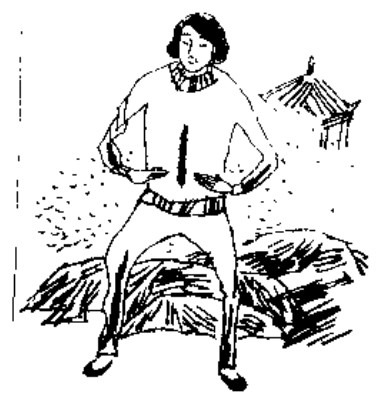
These retired cadres, following their master’s instructions, used their spare time to treat people’s illnesses without any compensation. Their skill grew ever greater, and they earned a high reputation. Among them was the qigong master Li Yong mentioned in the above report.
Sun Wukong, in the Jade Emperor’s Peach Garden, used the body-freezing spell to immobilize the nine fairy maidens who came to pick peaches. Today, using qigong to immobilize a person is already commonplace. In early July, a reporter from the Science and Technology Review came to COSTIND and three times tested the technique on himself, being immobilized firmly in place three times by the qigong master. A certain kindergarten teacher at COSTIND, Dong Xuan, was also immobilized several times, and the illusion technique could make her unable to see anything at all.
Two months ago, Li Yong was still a retired cadre suffering from multiple illnesses—long-term insomnia and a cyst on his left kidney. After Master Gao Zhengang opened his external qi, he practiced diligently, not only curing his own illnesses but also becoming able to emit external qi. He treated many difficult and complex cases, becoming a widely known physician.
On an evening in early August, a reporter encountered Li Yong while he was taking a walk on the road. He had already become a very busy person: attending meetings, treating patients, making house calls. Many major hospitals and leading comrades also made appointments to see him, and his schedule was packed full. With a radiant complexion and an open, cheerful manner, he was able to relieve others’ suffering without charging a single penny in compensation—a truly admirable spirit.
Regarding the future, he said sincerely: “In my remaining years, I hope to research the principles of external qi gong, and at the same time explore treatment methods for difficult diseases such as cancer, diabetes, and cardiopulmonary disease, to make a greater contribution to the medicine of our motherland.”
I excitedly grasped his hand and congratulated him on his early success!
Excerpted from Self-Study magazine
·29·
The History and Major Schools of Qigong
Qigong is a unique health-promoting exercise of the Chinese nation. Its characteristic feature lies in the practitioner’s conscious effort to combine mental intention (yinian) with breath (qiti) training of both body and mind, in order to achieve the goals of fitness and the prevention and treatment of disease.
In ancient times, Qigong was known by various names, including daoyin (guiding and pulling), lianqi (training the qi), jingzuo (sitting quietly), zuochan (sitting meditation), or neigong (internal practice). It has appeared in written records for over two thousand years. Among the unearthed artifacts discussing Qigong, the Xingqi Jade Pendant Inscription (Xingqi Yupei Ming), verified by Guo Moruo to date from approximately 380 BCE, is a physical specimen. Laozi’s Dao De Jing and the Zhuangzi and other famous works also contain discussions of Qigong. China’s earliest medical text, the Huangdi Neijing (Inner Canon of the Yellow Emperor), states: “Tranquil, empty, and non-attached, the true qi follows; spirit guarded within, how can illness arise?” This constitutes a further elaboration on Qigong. Thereafter, renowned physicians and notable figures throughout successive dynasties included discussions of Qigong in their writings, such as Zhang Zhongjing’s Jingui Yaolue (Essentials from the Golden Cabinet) of the Han Dynasty; Ge Hong’s Baopuzi of the Eastern Jin Dynasty; Tao Hongjing’s Yangxing Yanming Lu (Records of Nourishing Nature and Prolonging Life) of the Qi-Liang period of the Southern Dynasties; Chao Yuanfang and others’ Zhu Bing Yuan Hou Lun (Treatise on the Origins and Symptoms of Diseases) of the Sui and Tang Dynasties; Sun Simiao’s Qianjin Fang (Prescriptions Worth a Thousand in Gold); Wang Tao’s Waitai Miyao (Essential Secrets from the Imperial Library); the Yixue Daquan (Compendium of Medicine) and Shengji Zonglu (Comprehensive Record of Sagely Benefactions) of the Song Dynasty; Su Dongpo’s Su Shen Liang Fang (Effective Prescriptions of Su and Shen); Liu Wansu’s Suwen Xuanji Yuanbing Shi of the Jin-Yuan period; Zhang Congzheng’s Rumen Shiqin (Confucians’ Duties to Their Parents); Li Gao’s Lanshi Micang (Secret Treasures of the Orchid Chamber); Zhu Danxi’s Danxi Xinfa (Danxi’s Methods of the Heart); Li Shizhen’s Qijing Baimai Kao (Examination of the Extraordinary Meridians and Eight Vessels) of the Ming Dynasty; Cao Yuanbai’s Baosheng Miyao (Essential Secrets of Preserving Life); Chen Jiru’s Yangsheng Fuyu (Superficial Words on Nourishing Life); Zhang Jingyue’s Leijing (Classified Canon); Wang Kentang’s Zhengzhi Zhunsheng (Standards for Diagnosis and Treatment); Wang Yangming’s Chuanxi Lu (Instructions for Practical Living); Hu Wenhuan’s Leixiu Yaojue (Essential Formulas for Cultivation); Wang Shengao’s (Wu Yao Yuan Quan (Explanations of Medical Theory)) of the Qing Dynasty; Shen Jinying’s Shen Shi Zunsheng Shu (Mr. Shen’s Book on Respecting Life); Wang Xiangyuan’s Neigong Tu Shuo (Illustrated Explanations of Internal Practice); Xi Xifan’s Nei Wai Gong Tujie Jiyao (Collected Essentials of Illustrated Internal and External Practices); as well as modern works such as Zhang Xichun’s Yixue Zhongzhong Canxi Lu (Records of Integrating Chinese and Western Medicine) and Jiang Weiqiao’s Yinshizi Jingzuo Fa (Mr. Yinshi’s Method of Sitting Quietly). With the development of history, China’s unique health-promoting art of Qigong has also continued to evolve, its content and methods becoming increasingly rich and diverse, and its discussions ever more detailed and comprehensive.
After the founding of New China, the treasure of Qigong received further development. In particular, the application of modern medical science to organize and improve Qigong has caused this gem among health-promoting exercises to shine with ever more dazzling brilliance. It has been widely applied in health preservation and disease treatment; the latter application is termed “Qigong therapy.” Today, more and more people are learning about and studying Qigong, and Qigong is going global.
Qigong encompasses a broad range of content, primarily including regulating the body (tiaoshen, posture), regulating the mind (tiaoxin, intention, relaxation, and entering tranquility), regulating the breath (tiaoxi, respiration), self-massage, and limb movements. There are many varieties of Qigong methods: breathing-focused tuna (inhalation and exhalation) practice, stillness-focused quiet practice (jinggong), stance-focused standing pole practice (zhanzhuang gong), movement-focused dynamic practice combining motion and stillness (donggong), intention-guided daoyin practice, and health-preserving self-massage practice, among others.
China has many schools of Qigong, generally classified into five major traditions: Medical, Confucian, Buddhist, Daoist, and Martial Arts, each of which is further divided into several smaller lineages. The Qigong of each school has its own characteristics. Medical Qigong primarily aims at disease prevention, treatment, and health strengthening. Confucian Qigong primarily aims at “cultivating the self and nourishing qi.” Daoist Qigong primarily aims at “attending to both body and mind,” “cultivating both nature and life together,” and “pure, quiet, and non-action.” Buddhist Qigong primarily aims at “training the mind,” requiring “spiritual liberation.” It is further divided into two sub-schools: one called “entering samadhi” (ruding), which emphasizes that “all four elements are empty”; the other called “chan meditation” (canchan), which emphasizes “cultivating the mind and nourishing the nature, universally delivering all sentient beings.” Martial Arts Qigong primarily aims at physical training and self-defense. Although the practices of each school differ,
Feng Lida, Vice President of the Naval General Hospital and Professor, has devoted many years to Qigong immunology research.
Experiment on the Bactericidal Efficiency of External Qi
— Li Wenhui —
Through scientific experimentation, it has been proven that Qigong external qi is visible with the aid of instruments. After a Qigong master circulates qi to the palms, a substance is emitted from the meridian acupoints of the fingers and palms—this is infrared radiation with a wavelength of 8–14 micrometers. This infrared radiation has inhibitory and bactericidal effects on Escherichia coli, Shigella dysenteriae, Staphylococcus aureus, and Staphylococcus albus. After one minute of external qi treatment, the killing rates against these bacteria were:
- Escherichia coli: 11–89.8%
- Staphylococcus aureus: 16.9–97%
- Shigella dysenteriae: 66.7–98.9%
- Staphylococcus albus: 34.5–79%
Pseudomonas aeruginosa is generally insensitive to common antibiotics, yet after three minutes of external qi treatment, the inhibition rate reached 53.8–58.2%. Experiments have also demonstrated that Qigong external qi has killing effects on influenza viruses and cervical cancer cells. The answer to how Qigong can promote health and eliminate disease lies precisely here.
Excerpted from Dangdai Tiyu (Contemporary Sports)
A hemiplegic patient was carried on a stretcher by his family into the Baoding Cultural Palace. The patient’s name was Liu Bensen, a worker at the Baoding Velvet Weaving Factory. He could not move his body and could not speak. The provincial hospital could not cure him, so he came here seeking treatment from Xun Yunkun, who was at the time lecturing on the principles of Qigong healing in the city.
The Qigong master placed both hands near the patient’s cheeks. After a moment, Xun asked, “How do you feel?” The patient miraculously cried out: “Pain! Pain!” At this cry, the entire audience was stunned, and then broke into endless cheers. A few minutes later, the patient’s upper and lower limbs could also flex and extend. Next, a patient with facial nerve paralysis—Gu Zhihua, a professor at Hebei University—also had his crooked mouth corrected after the master briefly emitted external qi. In this manner, several people were treated one after another, and everyone responded effectively. What is the reason? We must turn to the scientific principles of Qigong to find out.
Qigong
Physical Cultivation Techniques
Hu Bin
Although practices differ, the emphasis is always on training the mind and training the qi.
Reducing qi volume also reduces this low-metabolic physiological state, helping to decrease the body’s energy expenditure, reaccumulate vitality, build physical strength, and lay the foundation for overcoming illness.
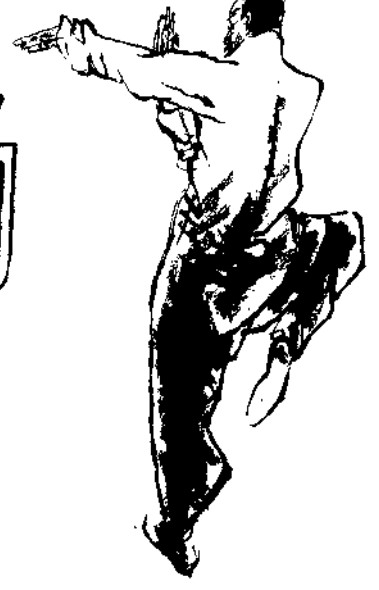
In terms of form, qigong is divided into two major categories: still qigong and moving qigong. Still qigong adopts outwardly static postures such as lying, sitting, or standing, and employs methods of mental inward focus and breath regulation, emphasizing the training of the body’s interior; hence it is also called internal qigong. Moving qigong combines intention and qi with various limb movements, such as walking-style qigong, Taiji stick qigong, and self-massage, to疏通 unblock qi and blood circulation and cultivate one’s temperament. Because it involves visible external movements, it is also called external qigong.
The Effects and Therapeutic Efficacy of Qigong
Chinese qigong has been used for healing and health maintenance since ancient times. The reason qigong can promote health and cure disease lies primarily in its beneficial regulatory effects on the cerebral cortex, the subcortical autonomic nervous centers, and the cardiovascular system; its corrective effect on the body’s abnormal responsiveness; its massaging effect on the abdominal organs; and its capacity for self-control over one’s own physiological functions, among other effects. We can observe the role of qigong in the human body from the following aspects:
From the perspective of EEG changes, there are significant differences between qigong practitioners and ordinary people. The EEG of an ordinary person in a waking state shows a large number of high-frequency, low-amplitude waves, approximately 50 microvolts, with very poor synchrony among brain waves across different regions. In qigong practitioners, however, the EEG shows a large quantity of waves at a frequency of about 8 Hz, with amplitudes reaching up to 180 microvolts, and the waves across different regions tend toward synchronization. The above characteristics are even more pronounced in the frontal and parietal lobes of the brain—the frontal lobe being the highest center of the central nervous system, responsible for intention-related activities. This indicates that qigong has an especially significant effect on the higher neural centers. The longer one practices, the better the synchronization of the wave band becomes, extending toward lower frequency bands, which can greatly enhance brain function.
From the perspective of respiratory changes: During qigong practice, the breathing frequency decreases, the duration of each breath lengthens, the ratio of exhalation to inhalation time increases, the range of diaphragmatic movement enlarges, tidal volume and vital capacity increase, and minute ventilation decreases. During deep breathing, it often appears as though breathing pauses momentarily, interspersed with multiple small respiratory movements. Animal experiments have demonstrated that when the expiratory center’s excitation increases, it can spread to the parasympathetic nervous center, and when the inspiratory center’s excitation increases, it can spread to the sympathetic nervous center. Thus, through the willful regulation of respiratory movements, imbalances in autonomic nervous system function can be brought toward equilibrium.
From the perspective of metabolic physiology: When practicing seated and lying-down forms of qigong, the body’s oxygen consumption decreases by approximately 30% compared to before practice, the energy metabolic rate decreases by approximately 20%, the breathing frequency and minute ventilation also decrease, and this low-metabolic physiological state helps reduce the body’s energy expenditure, reaccumulate vitality, build physical strength, and lay the foundation for overcoming illness.
From the perspective of self-control, when qigong and biofeedback therapies are combined, self-control becomes even easier to achieve. So-called biofeedback involves using detectors such as electromyographs and skin resistance meters to detect physiological functions (such as muscle tone, blood pressure, etc.) and convey their changes to the patient through auditory or visual signals, enabling the patient to be aware of their condition and, through their own willful control, to manage changes in physiological functions, bringing them toward normal levels to achieve therapeutic goals.
From the perspective of massage effects, because abdominal deep breathing is practiced, the abdominal organs receive a rhythmic massaging action. This effect is especially pronounced when using breath-holding techniques (as in the Inner Nourishing exercise) and reverse breathing methods. During practice, gastric juice secretion increases, the range of diaphragmatic movement increases several-fold compared to normal, and intra-abdominal pressure undergoes periodic changes. This can massage the internal organs such as the stomach, intestines, liver, and spleen, promote gastrointestinal peristalsis, reduce abdominal congestion, improve endocrine regulation, and enhance digestion and absorption functions. Therefore, after practice, appetite generally improves significantly, food intake increases, and body weight also increases accordingly, creating favorable conditions for curing illness.
From the perspective of the blood circulation system, vascular movement is related to the qigong process and the type of practice. During the practice of Inner Nourishing exercise and Relaxation-Qietude exercise, peripheral vasodilation occurs in more than half of the cases; the vasodilation is more pronounced in those practicing Relaxation-Qietude than in those practicing Inner Nourishing, while those practicing the Three-Circle Stance show vasoconstrictive responses. Those with good relaxation and high levels of practice proficiency exhibit more stable vascular changes during practice. When inhalation is longer than exhalation during qigong, the cardiac output per minute increases, whereas when exhalation is longer than inhalation, the cardiac output per minute decreases. This is the result of the respiratory center’s influence on the cardiac vagus nerve and heart rate. Whether practicing Inner Nourishing or Relaxation-Qietude, a decrease in heart rate occurs. Those who practice more frequently each day show more pronounced reductions in blood pressure.
In summary, the effects of qigong on the human body are multifaceted, but they can be归纳 distilled into the following primary functions: eliminating emotional interference and allowing the body’s physiology and biochemistry to operate at their optimal working state; the relaxation, tranquility, and breathing in qigong can alleviate the cerebral cortex’s emergency response preparation for the whole body, providing favorable conditions for the body’s rest, repair, and adjustment—that is, clearing the disruption of the “seven emotions” on the body. This reduces the body’s sensitivity to harmful external environmental stimuli, weakens the harm of the “six pathogenic factors”; through gradual adjustment, overall energy consumption is reduced, and the body’s disease resistance is enhanced.
Excerpted from Essence Edition, Volume 5 of this journal
31
One day in August 1985, a piece of news burst forth from the ancient city of Jingzhou: the renowned hard qigong master and ninth-generation successor of Tianhe Temple hard qigong, Zhang Jialing, with the support of sports commissions at all levels and fellow martial artists, had officially established the Tianhe Temple Martial Arts Hall. The elder generation of the local martial arts community felt immensely gratified — after all, Jingzhou had been a strategically contested military stronghold since ancient times, yet this hometown of martial arts, teeming with hidden talent and outstanding individuals, had never had a proper martial arts hall. Zhang Jialing had fulfilled a long-cherished wish of the older generation. The young men who loved martial arts spread the word to one another, jumping for joy, throwing punches and kicking legs to express their elation.
Amid the enthusiastic congratulations from the guests, everyone unanimously requested that Zhang Jialing perform on the spot. “Joy puts spirit in a person,” and Zhang readily agreed, striding briskly onto the stage. One could see that his entire body was agile and nimble, his fists and feet flying like the wind, his spirit soaring and his momentum surging — clean and crisp. The crowd erupted in cheers.
What was truly unique was the hard qigong of Tianhe Temple. Zhang seemed to understand the crowd’s anticipation and had his disciple bring out a gleaming triangular steel fork. Everyone present could see clearly that the fork was extremely sharp and pointed. People watched him with puzzled eyes. Zhang Jialing took off his shirt and slowly paced around the arena once; his footsteps appeared especially steady, grounded, and powerful. He then performed a swing on a fluorescent tube used as a seat pole, drawing endless admiration from the audience.
Next, he had his disciple bring two balloons and place them on the table. After briefly gathering his qi, he lay his entire body on top of the balloons. The balloons only slightly deflated and wobbled a bit — not a single one burst. Many people exclaimed in amazed praise: “If we hadn’t seen it with our own eyes, we would never believe such a skill exists in this world. It truly opens one’s eyes!” This was the very performance that was broadcast on China Central Television during the Spring Festival that year.
A disciple stood up and addressed the crowd: “Ladies and gentlemen, our Master Zhang’s lightness skill is even more astounding. Now please let him perform the supine-on-balloon technique.” Afterward, everyone unanimously demanded that Zhang Jialing perform on the spot.
One of his disciples rose and said to the audience: “Everyone, our Master Zhang’s lightness skill is even more remarkable. Now please watch him perform the back-lying-on-balloon feat.” Zhang Jialing motioned for his disciple to bring two balloons and place them on the table. After briefly channeling his qi, he lay his entire body on the balloons. The balloons merely deflated slightly and wobbled — not a single one broke. Many in the audience marveled and praised: “If we hadn’t seen it with our own eyes, we would never believe such ability exists in this world. It is truly eye-opening!” This was the Tianhe Temple hard qigong that was featured on China Central Television during the Spring Festival that same year.
The ancient city of Jingzhou is renowned throughout the world thanks to the famous historical novel Romance of the Three Kingdoms. Within and beyond the ancient walls, there is no shortage of martial artists of outstanding ability. It was here that Zhang Jialing, in the same year as New China, entered the world, born into a martial arts family.
Zhang’s grandmother possessed formidable martial arts skills, but she was unwilling to display her abilities before others. Generally, only in the deep of night when all was quiet would she urge her children to come out and practice. Seven-year-old Zhang Jialing, on his way out one night to relieve himself, discovered his grandmother and the elder generation practicing martial arts. The clever child made no sound. Every night he pretended to be fast asleep, and after the adults went out, he would slip out of bed, tiptoe over, and crack open the door to peek through the gap, watching and mimicking the adults’ movements as he observed. After a period of time, the boy actually looked quite convincing — he could even use the few stances he had learned by stealth, combined with his own improvisations, to put on a “routine” in front of the other children. His secret was eventually discovered. From then on, on the moonlit sands by the riverbank, beneath the willows in the early light of dawn, the figure of the young Zhang Jialing practicing martial arts left its mark on his childhood.
His grandmother was very strict in her training of young Jialing — failure to meet the standard meant going without food as punishment. He trained every day, through bitter cold and sweltering heat, without interruption. But she was not a dogmatic person bound by sectarian prejudices. To help young Jialing’s wings grow fuller, she also had him seek out renowned teachers and visit masters, broadly drawing on the strengths of various schools to continuously enrich himself. At the age of eight, he studied hard qigong — the Iron Head skill — under Xu Xiuming, and practiced Tai Hong boxing, Sanhe boxing, Qi staff, and Zangsi swordplay. He later learned Liuhe boxing and Liuhe staff from Chen Yushan; he also trained in the Boy’s Skill, Seven Star Skill, Basin Skill, and Thirteen Guardians Skill with Shandong qigong master Wang Taishan. He learned the Eighteen Arhat Skill from Sichuan qigong master Chen Youshan, and the Reverse-Lifting Skill and Thousand-Catapult Method from female qigong master Zhu Tianzhen. He also studied Cha boxing, Ambush boxing, free sparring, and grappling weapons with Shandong boxing master Li Guangjin. Interestingly, Zhang seemed to have been born with an innate affinity for the martial arts. During his military service, his political instructor Feng Tai was a master of Sun-style Monkey Boxing. During breaks from military training, Zhang would always hover around the instructor, humbly seeking instruction, and received Feng Tai’s thorough transmission and guidance.
How did Zhang Jialing become the ninth-generation successor of Tianhe Temple hard qigong? The story is quite legendary.
During the early period of the “Cultural Revolution,” nearly all of Zhang’s teachers suffered varying degrees of persecution. Ironically and absurdly, Zhang Jialing, then barely a teenager, was also targeted for “sweeping away.”
They even organized a “criticism” struggle session against him, but because people feared his martial prowess, no one dared to drag him onto the stage. Zhang firmly believed that there was nothing wrong with loving the martial arts. He found a shovel from a corner of the meeting room, giving the meeting organizer a start—they thought he was losing his temper. But to everyone’s surprise, he shouldered the shovel and went outside to plant trees. On one occasion, a large-scale incident of trampling crops and superstitious activities involving praying to gods and worshipping Buddhas occurred outside the city of Jingzhou. Someone filed a complaint, and Zhang was regarded as a suspected mastermind and detained for several days. The reason was simple: because he knew martial arts, qigong, and magic. His skill in magic had once caught the attention of a certain acrobatic troupe.
With great effort, he pointed with his finger at a pair of cloth shoes embroidered with twin dragons that the teacher had never been seen wearing, made a tearing gesture, then pointed upstairs, and passed away. After arranging his late teacher’s funeral affairs, Zhang tore open the dragon-embroidered cloth shoes and discovered a schematic diagram inside. He followed the diagram to locate an inconspicuous spot upstairs, where he found an exquisite wooden box. Upon opening it, he found that it contained the practice manuals of the Dahe Temple Hard Qigong, divided into elementary, intermediate, and advanced tiers, along with biographical records of designated lineage holders and
Ma Weigong
other precious historical materials.
Invited to join the organization, he had suffered various inexplicable
Tears burst from his eyes: it turned out that Zhang had long ago asked someone to express
Zhang Jialing became the ninth generation
Discrimination and cold stares. Kind-hearted people advised him to stop
He had observed Zhang for many days and found him pure in character and conduct,
Transmission holder of the Dahe Temple Hard Qigong.
Practicing the martial arts that “decent people don’t learn.” He
Innately intelligent, and especially liked his resolute character of never giving in
felt pained and aggrieved…
Before him, the Dahe Temple Martial Arts Hall founded by Zhang Jialing
In this desperate situation, he still firmly believed there would
Dai Xuezhong was the eighth generation
He had already tacitly approved.
Had already held two province-wide training classes.
Eventually come a day when right and wrong would be distinguished. He swallowed
Inheritor of the Dahe Temple Hard Qigong. He strictly followed his teacher’s teachings and diligently practiced the Tianhe
His grief and continued practicing as usual every day. One night,
The elementary eighteen movements of the Tianhe Gong, which he taught publicly for the first time. Through a period of training, the majority
Qigong for decades, and was a martial arts master proficient in hard qigong.
When all was quiet and moonlight bathed the land,
Of students reached the level of breaking stone slabs with their palms and wrapping steel wire around their necks. At the veteran cadres’ fitness study
He had befriended martial artists through competition and traveled widely overseas.
He came as usual to the grove near the Yangtze River
Class, he also publicly taught health methods… His
Traces of his journeys were left across countries in Southeast Asia.
Grand embankment to practice. His fists and kicks were vigorous and powerful.
Qigong was highly popular. Relevant provincial departments also invited
His movements were swift as thunder and lightning, whistling through the air. After a while, the stifling feeling in his chest dissipated somewhat, but
Experts to test and examine his special abilities.
His reputation grew ever larger. Some directors
When he thought of his own misfortune, he unconsciously struck out with his palm at a willow tree a foot in diameter. Because he exerted full force, the branches and leaves trembled, producing a “rustling” sound that demonstrated powerful
Invited him to participate in television dramas and films
Internal qigong power. Just then, he suddenly heard someone nearby softly praise: “Good power!” Zhang
Martial arts choreography. The martial arts coach for the television film Fragrant Flower Girl
Jialing looked out and saw a spirited, dignified elder practicing the horse stance. He was as still as Mount Tai, utterly motionless. Zhang Jialing
Called his skill “rarely seen.” In particular, after Qigong and Science published his
Stepped forward and bowed in greeting. The elder concluded his stance and said: “Young
Practice methods on two occasions, he received thousands of letters from martial arts enthusiasts both domestic and abroad, supporting him, encouraging
Man, your situation has already been told to me by others. The martial arts have done nothing wrong—let them talk. If you
Him, and seeking his instruction. Some overseas individuals even
Wish to learn the Dahe Gong from me, you will have to endure hardship. My name is Dai Xuezhong…” Zhang bowed his head and prostrated himself in respect.
Invited him to lecture abroad.
“Ah, so you are Teacher Dai…” Tears could not be held back and streamed forth.
Faced with all this, Zhang Jialing sighed with deep emotion. He often said: “My success today is entirely due to good government policy, and entirely due to the strong support of the Physical Culture Commissions at all levels. Although I, like many living martial arts masters, have suffered inexplicable grievances, I am willing to dedicate my whole life to the revitalization of Chinese martial arts.”
emperors of the time all came to seek his counsel. Later, people compiled his sayings on qigong health cultivation into a book called The Classic of Pengzu (Pengzu Jing), which remains in the treasury of Chinese medicine to this day, and many qigong methods named after the “Classic of Pengzu” continue to be circulated.
Qi is the fundamental substance that constitutes the human body. Zhuangzi said: “Human life is the gathering of qi. When qi gathers, there is life; when it disperses, there is death.” Qi has many forms of expression, the most fundamental of which is called “true qi” (zhenqi). True qi is composed of three elements: original qi, heavenly qi, and the qi of grain and water. Original qi is transformed from congenital essence; heavenly qi is the clear qi of nature, inhaled through the nostrils into the lungs; and the qi of grain and water is generated from food and drink. The direction and location of true qi’s activity — its gathering and dispersing, moving and stopping, releasing and receiving — can, to a great extent, be directed by human will.
Ancient health cultivators viewed the continuation of life from a macro perspective. They regarded the human body as a microcosm, intimately connected with the changes of the greater cosmos. The practice of qi is intended to link the internal qi of the human body with the great qi of heaven and earth, so that yin rises and yang descends, water and fire are in harmony, and physiological homeostasis is maintained. Through qigong training, one can maximally mobilize and cultivate the body’s own physiological potential — not only preventing and treating illness and prolonging life, but also inducing special human abilities.
In 1947, Wei County, Hebei Province.
A young man, gaunt and emaciated, weighing only 73 jin, was carried on a stretcher. He suffered from gastric ulcers, pulmonary tuberculosis, pleurisy, neurasthenia, and other ailments — his life hanging by a thread. Though he had long since joined the revolutionary work, those vibrant, fiery years had become a thing of the past. Now, every step was a struggle. War smoke filled the air, all supplies were so difficult to obtain, and the organization could find no medicine to cure him, so they had no choice but to send him back to his hometown. The war-torn Chinese countryside was everywhere scarred by hunger and poverty… a devastated landscape where medical facilities were out of the question. “It seems death is certain,” the young man thought silently.
At this time, an old man named Liu Dulou from the same village entered his life. The old man declared that he could use a secret method — one requiring neither medicine nor injections — to save his life. “As long as I can stay alive, I…” Driven by the desperate desire to live, the young man, holding on to a sliver of hope, submitted to the old man’s arrangements.
Was this some kind of superstition? The young man was shut in a windowless, lightless, airless black room, as if cut off from the world. He was not allowed to see visitors, not allowed to see women. Each day, a relative delivered meals on schedule — primarily eggs as food. Beyond that, the most puzzling part was that every day he had to silently recite some inexplicable phrases. In order to survive, the young man could not afford to overthink; he faithfully practiced according to the rules. As a result, after 100 days, a miracle appeared.
All of the young man’s illnesses disappeared, his weight increased by over 30 jin, and he had completely become a robust and spirited young fellow.
How incredible! The young man was filled with gratitude. What set him apart was that he was not merely moved, curious, or believing — he immediately took action. Returning to his organization, he promptly applied for organizational approval to learn the practice from the elderly Liu Dulou.
This practice had always been transmitted orally, one disciple at a time. By the time it reached the old man, it was already in its fifth generation. How could the old man agree to pass it on to him!
The young man believed: “Absolute sincerity can move even metal and stone.” He lived in the old man’s home, carrying water, cooking meals, farming the land and harvesting wheat, caring for the old man with meticulous attention. In the end, the old man finally opened up and passed the secret method to the young man.
Due to a chance circumstance, the young man changed the course of his life. He devoted his entire life’s energy to the cause of qigong, becoming one of China’s most renowned qigong masters, scattering the “lingzhi” of qigong upon the world.
He was the director of China’s first qigong sanatorium — the Beidaihe Qigong Sanatorium of Hebei Province — Liu Guizhen.
The remarkable therapeutic effects of qigong on critically ill patients are particularly astonishing.
There was a young woman, thirty-one years old, in the prime of her youth, yet she had a ten-year history of gastroptosis. The condition had been especially severe in the past five years; she had long since stopped working. Her youth had no vibrant colors, no rosy dreams, no golden songs — she could only drag out her existence under the burden of illness. She had traveled far and wide across the land, sought help from both Chinese and Western medicine, with negligible results. By this time, her stomach had descended 11 centimeters, dropping into the pelvic cavity. Thinking of how she had accomplished nothing, bent over all day long, the young woman was in agony, wishing she were dead.
She was supported by others as she came to the qigong sanatorium. Before this, she had practiced at a folk qigong retreat. In order to stand straight again, the young woman had trained with superhuman perseverance, practicing so intensely that blood sprayed from her nostrils — yet still there was no improvement in her condition.
“If there’s still no result this time, I don’t want to live anymore,” the young woman said, her ashen face trembling.
“You will get better. You must believe in the traditional qigong of our motherland — it has thousands of years of history.”
An ancient painted pottery jar from the Majiayao culture period was unearthed in the Ledu region of Qinghai Province. On the abdomen of the pottery jar is a painted relief figure, which aroused great interest among archaeologists. This figure has its eyes slightly closed, its mouth open in a near-circle and slightly everted; its abdomen is swollen, its hands spread open and placed on either side of the lower abdomen, its lower limbs bent, and its feet parallel and apart. Experts determined that this is a posture for the practice of ” swallowing qi” (fuqi). This artifact demonstrates that imitative-respiration qigong has an extremely ancient history in China, dating back five thousand years.
In the Biographies of Immortals (Liexian Zhuan) by Liu Xiang of the Han Dynasty, it is recorded that Pengzu, a grandee of the Yin-Shang dynasty, was an outstanding qigong health cultivator. From the Xia dynasty through the late Yin-Shang, his fame in qigong was known throughout the land; even the reigning
34
“Can Bring Millions of People Back from the Dead” — Liu Guizhen
Once qigong, traditional Chinese medicine, and the special abilities of the human body are integrated with modern scientific methods, they can be developed into a new science that will elevate modern science to a still higher level, and lead to a scientific revolution — an Eastern scientific revolution.
“Qigong is a holistic therapy. It does not merely treat the head when the head aches, or the foot when the foot hurts. Rather, it strengthens the body and dispels illness through self-regulation of yin and yang, qi and blood, and by clearing the channels and collaterals of the internal organs. Your body is too severely depleted and requires a period of recovery. If you trust me, continue with one more course of treatment. If there is still no improvement after the second course, you may do whatever you wish,” Liu Guizhen said with full confidence.
After the first course of treatment, the young woman’s stomach had only moved upward by one centimeter. She wept, utterly bereft of hope. Liu Guizhen tried his utmost to comfort her.
After the second course had been underway for a week, the young woman suddenly transformed — she was like a different person. Her appetite grew day by day, her weight increased by fourteen jin, and her complexion gradually became rosy. Her cheeks puffed out as if inflated with air. Upon examination, the stomach had moved upward by eight centimeters. The young woman was wild with joy; she could scarcely believe it. Qigong had given her a second life!
Another case involved a teacher at the Central Academy of Arts and Design — an artist who painted beautiful visions for humanity, yet whose own life was plunged in complete darkness. Because he suffered from duodenal ulcers and gastric ulcers that would not heal over a long period, he had been repeatedly suspected by hospitals of having cancer and effectively sentenced to death. How could an artist tolerate living in a world of despair? He attempted suicide several times, and his family members followed him every step of the way. The shadow of suffering hung over this family that had once been filled with laughter and cheerful voices.
He did not go a single week without catching a cold, nor could he get through a single meal without difficulty. What joy could life possibly hold for him anymore!
It was no mere myth — real life holds scenes even more wondrous and beautiful than any myth. After practicing qigong for just one week at the sanatorium, he was like a completely different person from the one who had been admitted. His daily food intake rose from the initial three or four liang to nine liang, and finally to one jin and one liang. In addition, he ate five eggs every day! Not only were his ulcers cured, even his colds were healed. He returned to his own artistic world. Having walked through the depths of hell, his passionate love of life — his love of life itself — could inspire how much creative inspiration and produce how many works of art! He went to Germany to study. In the past, he had barely been able to drag himself out the door, and his entire family had worried endlessly about him. Now, he had traveled so far away…
An American Chinese man had suffered a compressed lumbar fracture and severe bone spurs from a car accident, which compressed his sciatic nerve and caused agonizing pain. In the United States, it was believed that surgery was the only option, but he also happened to have diabetes and could not undergo surgery. He had no choice but to wear an electronic anesthetic device day and night. His suffering need not be described — and his condition showed not the slightest improvement. In despair, he thought of his homeland.
He went directly to Master Liu Dehua at Shenzhen University. Master Liu treated him using qigong massage. After only six days and six sessions, he had fully recovered his health. The gentleman was utterly bewildered and asked Master Liu what extraordinary magic qigong possessed.
“This is qigong massage stimulating the body’s high-level energy. There is nothing mysterious about it — it is simply that people do not yet understand it,” Master Liu replied calmly.
Human beings live on the Earth. The Earth’s field and the fields of other celestial bodies act on the human body simultaneously, and the energy flow within the human body also emits a vast and boundless biological field. The biological field interacts with the Earth’s field and the fields of celestial bodies.
Every organ and tissue within the human body possesses a bio-electromagnetic field. The strength of the electric field is closely related to the state of the organism. If the electric field becomes abnormal, it signals the onset of disease.
Qigong can not only strengthen the body and cure illness, but also cultivate health and nurture one’s character. Scholars both in China and abroad have confirmed through research that qigong has the effect of invigorating the brain — that is, developing the latent potential of human intelligence.
Liu Yafei, daughter of Liu Guizhen and a physician at the Beidaihe Qigong Sanatorium, told me: “Qigong can be learned by anyone, but to master it is not so simple. It requires perseverance, courage, and confidence.”
“Qigong effects are achieved through regulating the body, regulating the breath, and regulating the mind.” Regulating the body (tiao shen) is the training of physical posture; regulating the breath (tiao xi) is the adjustment of respiration; regulating the mind (tiao xin) is regulating the spirit, bringing body and mind into a state of tranquil, effortless stillness. The three are mutually complementary and mutually enhancing.
“In the work of researching the human body and the universe, a very important aspect is the scientific study of qigong… Qigong is a ‘key’ to the science of the human body.”
“Qigong is a brilliantly radiant pearl in the treasure house of Chinese medicine. Polished over thousands of years, it shines with dazzling brilliance — a distinguished contribution of the Chinese nation to all of humanity.”
— Qian Xuesen
“To practice qigong, one must choose a method suited to one’s own physical condition, and proceed step by step under the correct guidance of a qigong master.”
— Excerpted from Pursuit
Comrade Liu Guizhen, Director of the Beidaihe Qigong Sanatorium
3
This relaxation must achieve a state of being relaxed yet not slack.
Stillness: second, focusing intention on the Dantian, so that the entire body undergoes more profound changes. For beginners in qigong, achieving overall relaxation is relatively easy in the lying posture. However, after assuming the correct posture, one should still gently sway the entire body a few times to achieve comfortable reclining. Maintaining standing and sitting postures requires certain muscles to be in a state of tension, but even so, one must relax to the greatest extent possible. The second aspect of relaxation is relaxation of consciousness. First, accompanying the relaxation of all body muscles, the entire body should have a comfortable and pleasantly relaxed sensation. Furthermore, whether attending to the breath or focusing intention on the Dantian, one must not concentrate too intensely. Tension must be eliminated to achieve relaxation of mind and spirit. Relaxation of mind and spirit is one of the key factors ensuring the smooth practice of qigong.
The meaning of stillness refers to relative quietude. In terms of respiration, one should breathe so softly that the inhalation and exhalation are soundless, experiencing a sense of leisurely ease. In terms of consciousness, emphasis is placed on entering stillness. Through intention-holding (yishou), one eliminates distracting thoughts to achieve stillness — this point is fundamental to the therapeutic mechanism of qigong and must be taken seriously.
The relationship between relaxation and stillness is close. Whole-body relaxation promotes entry into stillness, and once stillness is achieved, whole-body relaxation will naturally manifest. The two are mutually complementary. Relaxation and stillness can be understood from two aspects. The so-called “relaxation” first means relaxation of the entire body’s muscles. Those who wish to quickly eliminate distracting thoughts when they first begin practicing qigong will find it very difficult. Only through a certain period of practice can distracting thoughts be gradually reduced, meeting the requirement of entering stillness.
The practice of focusing intention on the Dantian is one of the important elements of qigong practice, and it is also where the difficulty and subtlety of qigong lie. If mastered well, results come quickly; otherwise, results come slowly. However, as long as one practices attentively, distracting thoughts will naturally diminish. Ancient texts record: “Tranquil, detached, and empty, the true qi follows.” The meaning is that through intention on the Dantian and elimination of distracting thoughts, true qi becomes abundant — this is the true purpose of practicing qi and intention.
Fundamental Requirements of Qigong Practice
Relaxation, Stillness, and Naturalness
Practicing qigong importantly requires relaxation, stillness, and naturalness. This means that in breathing, posture, and intention-holding practice, one should not exert force, not strain, but follow what is natural. In terms of posture, whether sitting, lying, or standing, naturalness and comfort should be embodied. In the early stages of practice, things may not feel natural, but after a period of training, naturalness can be gradually achieved. The same applies to breathing — whether using reverse breathing or abdominal breathing, one should not force it, but rather practice gradually. Under conditions of natural ease, one progressively meets the requirements. In terms of intention-holding, the mind should not be overly concentrated. One must maintain a state of “seemingly holding yet not holding, continuously as if existing” — neither failing to hold nor forcibly holding.
Practicing Qi and Practicing Intention — Unity of Intention and Qi
The “qi” of qigong primarily refers to true qi (yuanqi). At the initial stage of cultivating true qi, one must begin with practicing lung qi (breath qi). The training of lung qi, due to differences among qigong methods, employs different breathing modes. Nevertheless, regardless of the method, all require the breath to be leisurely, even, fine, long, and slow. Experienced qigong practitioners have fewer breaths per minute than ordinary people — sometimes only two or three — forming a slow, gentle abdominal breathing pattern. The training of breathing must proceed from shallow to deep, from fast to slow, through gradual practice. One cannot expect to form a complete, deep, and long breath within a short period. At the beginning, intention must be used to guide the practice. After reaching a certain level, natural and rhythmic breathing can be achieved. The so-called “practicing intention” means eliminating distracting thoughts to achieve stillness.
How, then, does one combine the practice of qi and intention in the course of training? That is, when beginning breath training, one should simultaneously attend to intention on the breath, so as to help develop deep, long, and even breathing as quickly as possible. Once the breathing pattern is formed, one then attends to the rising and falling of abdominal respiration. When breath training becomes very accomplished, even without paying special attention to breathing, qi will naturally flow to the Dantian. At this point, simply focusing intention on the Dantian is sufficient. In this way, the practice of qi and the practice of intention are closely integrated, achieving unity of intention and qi, so that true qi becomes abundant — thereby attaining the goal of healing illness and strengthening the body.
Emotional Balance and Joyful Mood
Mental and emotional states are responses of the organism to external stimuli. When emotions are unbalanced — especially when one is feeling low-spirited — even healthy people are susceptible to illness. Some countries have made the following observation: in times of war, when troops were advancing and winning successive victories, the wounds of injured soldiers healed relatively quickly. Conversely, when troops were retreating or had suffered defeats, the healing of soldiers’ wounds was notably slower. This shows that emotional state plays a role in [healing]…
·36·
The Great Role [of Emotional Balance] in Disease Recovery
After closed breathing becomes proficient, then add silent recitation of phrases. [Adjust] according to the severity of the condition and constitution, from minor to greater [progression].
It is commonly observed that emotional imbalance is a causative factor in many diseases, such as neurosis, hypertension, gastric ulcers, and so on. These patients mostly have histories of psychological trauma or emotional imbalance. After these [practices] are mastered, then add the rising and falling [of breath]. After these movements have become relatively proficient, then add concentration on the Dantian (丹田). One should master the practice step by step in this manner.
One cannot apply a one-size-fits-all approach. One must individualize according to the person. One must make efforts to practice diligently, carefully experience and reflect, and constantly summarize experiences and lessons in order to avoid detours in practice.
Clinical observation demonstrates that emotional balance is difficult for chronic patients to achieve, because the persistent pain of illness makes it hard to break free at once. Especially when the condition worsens—on the one hand, the disease brings physical suffering to the body; on the other, it brings psychological burden. The two combined together most easily give rise to emotional fluctuation, despondency, or even depression, anxiety, and irritability. Therefore, it is necessary to do good ideological work with patients, helping them develop a correct attitude toward their illness, in order to reduce excessive emotional fluctuation.
Since mental and emotional states are so closely related to health and disease, in Qigong therapy one must emphasize emotional balance and joyful practice. Practicing Qigong should be treated as a pleasurable endeavor, because it can promote health and eliminate disease.
Combining Practice and Recuperation (练养相兼)
This means that practice and reasonable recuperation should carry equal weight. For example, when practicing the Inner Nourishing Qigong (内养功) or Strengthening Qigong (强壮功), after practicing for an hour one may release the closed breathing, release the concentration on the Dantian, allow the entire body to relax, lie flat on the bed, and rest quietly for 10 to 20 minutes. Afterward, one may continue practicing. In this way, alternating between practice and rest also yields good results. Of course, after practicing for a long time and genuinely developing a certain level of skill, each practice session will feel comfortable and refreshing; one may then persist continuously, which is of course even better.
Fixed Practice Methods (固定功法)
Currently, the Qigong methods circulating in various localities are numerous. Practitioners should, under the guidance of a doctor, select one or two suitable methods based on their condition, constitution, and previous habits, and train accordingly. This makes them easier to master and more likely to yield results. If one practices one method today and another tomorrow, rushing for quick results, even if the practice time is not short, no single method will have been fully mastered. The result will be contrary to one’s wishes—no effectiveness will be achieved.
Progressive Advancement (循序渐进)
The daily practice time should also vary from person to person and cannot be forced into uniformity. If the patient is fully committed, using Qigong as the primary means of treating illness, the daily practice time should be no less than 4 hours. If the disease is essentially cured and the purpose is to consolidate the therapeutic effect or strengthen the physique, 1 to 2 hours per day is sufficient. For healthy persons using Qigong as a health maintenance measure, practicing 1 to 2 hours per day is also acceptable.
Practice should be at fixed times whenever possible, so as to facilitate the formation of conditioned reflexes. If work schedules are demanding and one cannot fix a regular time, flexible scheduling is of course acceptable. But one must persevere consistently over the long term.
One of the key essentials of practice is progressive advancement—one cannot rush for quick results. When practicing Qigong to treat illness, the patient primarily masters the practice methods through self-directed, continuous training. However, during training, most people cannot expect smooth sailing. The most common problem is rushing for success, failing to proceed gradually, breathing too forcefully, or blindly pursuing certain sensations. As a result, this causes labored breathing, chest tightness and shortness of breath, or even disordered breathing, headaches, dizziness, mental tension, and the like. Therefore, beginners must be adept at summarizing experience, identifying shortcomings, and promptly correcting them. Only in this way can one ensure the attainment of steady results. The attainment of therapeutic effects also progresses from small to great, from subtle to pronounced. However, because each person’s constitution, condition, and degree of mastery of the practice method differ, the time required to achieve results naturally varies greatly. Achieving results after only a short period of practice is of course good, but one should still summarize experience and consolidate one’s achievements, striving for even better results. If results come slowly, one should be adept at identifying the causes and addressing them.
The Qigong method, while not very complex, requires genuine mastery through a period of practice, and it must also be approached progressively. Taking the Inner Nourishing Qigong as an example, one can first learn the posture and train deep breathing. When deep breathing has become relatively proficient, then add the silent recitation of phrases. After these movements have become relatively proficient, then add concentration on the Dantian. One should master the practice step by step in this manner. Only on the foundation of having mastered the methods can one gradually achieve results.
Summarize Experience and Avoid Deviations (总结经验,避免偏差)
The formation of deviations also progresses from subtle to obvious, from mild to severe. When they first begin to manifest, correction is relatively easy. As is well known, if a deviation has already formed, correcting it becomes considerably more difficult. Therefore, at the outset of practice, one must observe carefully and meticulously, summarize experience, identify deficiencies in a timely manner, and correct them promptly, so as to prevent the formation of deviations.
For various types of patients, since each person’s constitution and condition differ…
Demonstrating the suspending of the legs of a paraplegic patient of seventeen years Huang Renzhong performing a treatment demonstration at a national training class
Magical Magic Palm
A Documentary of Huang Renzhong and His Kongjin Qigong
By Lu Bo
Incredible “Miracles”
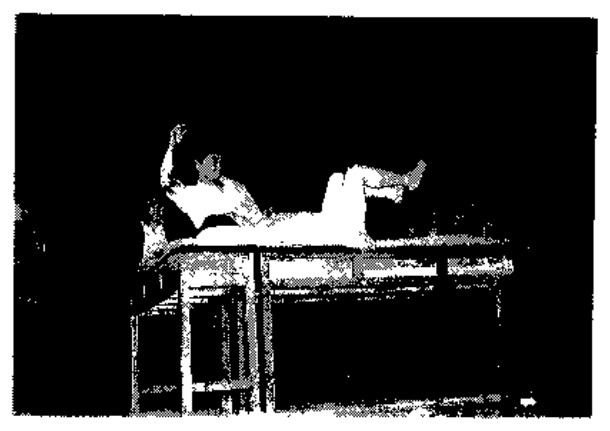
At noon on July 27, 1983, a small room in a guesthouse in Jinan City, Shandong Province, was bustling with noise. Famous Qigong masters from all over the country, who had come to Jinan to attend the National Qigong Method Exchange Conference, were gathered here to watch a unique medical treatment.
In the center of the room, a young girl with high-level paraplegia sat on a stool. A few meters away from her sat a dark-skinned, middle-aged man who looked like an athlete. This middle-aged man gently raised his right hand, and half a meter away from the girl’s legs, began to move his fingers. Suddenly, the room fell completely silent. Four or five minutes later, the girl’s hands and paralyzed legs suddenly began to move as if pulled by an invisible rope. Gradually, her hands danced faster and faster, with increasing amplitude. She seemed to have fallen into a strong magnetic field; a massive, invisible force made her seated body slowly lean backward. At the same time, it was as if another force was pulling her body, so that although she had lost her balance, she never actually fell down…
“Ah! It’s too miraculous, truly incredible, yet this is a fact I have witnessed with my own eyes.”
“To get me to deny it, you would have to make me disbelieve my own eyes.”
All the peers and spectators let out heartfelt exclamations. By this time, the girl on the stool could no longer control herself; she was waving her hands and dancing, flipping forward and backward. Half an hour later, her face was flushed red and she was dripping with sweat. Yet, the middle-aged man, while slowly moving his fingers on one hand, casually smoked a cigarette with the other. He looked like a scientist pressing buttons at a familiar experimental control console—experienced, serene, and full of confidence.
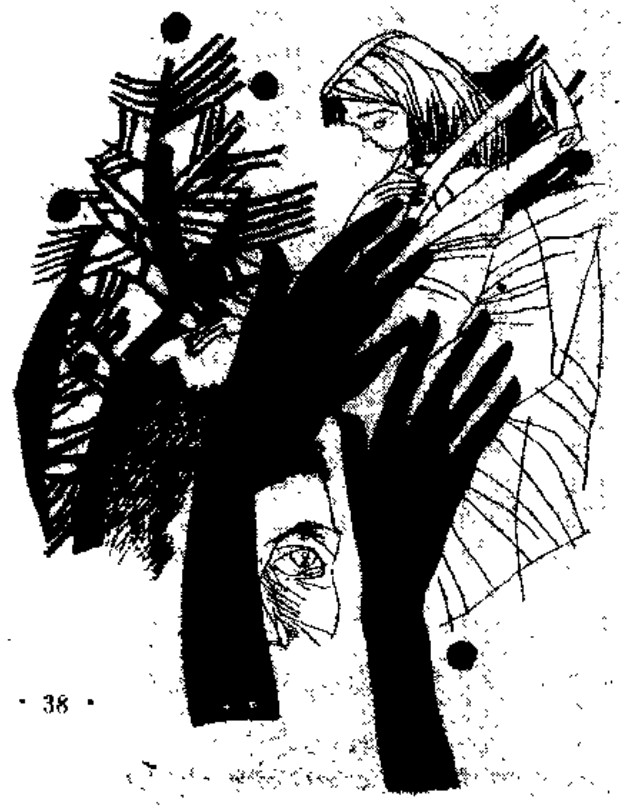
Who was this middle-aged man with such magical powers? He was the Shanghai Kongjin Qigong master Huang Renzhong, hailed by people as “Magic Palm Shanghai Huang.”
The young girl sitting on the stool was named Wang Li, 15 years old that year, the daughter of a worker in Jinan City. Three years ago, she was still an active and lively Young Pioneer. When she had her first menstruation, she unfortunately caught acute transverse myelitis from being out in the rain. This later resulted in high-level paraplegia; her limbs were numb, she had lost sensation, and her bowel and bladder movements required enemas and catheterization. She could not take care of herself and became disabled at a young age. Little Wang Li had cried her eyes swollen countless times, and her family had rushed everywhere seeking medical help, but to no avail. Wang Li’s uncle was a Qigong enthusiast. Attending the National Qigong Method Exchange Conference this time, he found the Shanghai representative Huang Renzhong among the galaxy of famous Qigong masters. At his earnest plea, Huang Renzhong agreed to utilize…
During the midday break of the conference, he emitted external qi to treat little Wang Li. Word spread, and the disease was essentially cured, with no recurrence to this day. The young couple excitedly grasped Huang Renzhong’s hands tightly. Even qigong masters from various regions staying at another guesthouse gave up their midday rest and walked forty minutes to come watch. Reporters from the People’s Daily and Shandong Pictorial also arrived with cameras in tow.
Tears streaming down her face, she told Huang Renzhong that they were going to travel to Qingdao and Dalian — to relive the “honeymoon” that disease had stolen from them. She said, “It was Huang Renzhong and our motherland’s magnificent qigong heritage that gave me a second life.”
In just the “scene” described above, before it had even fully unfolded, someone had asserted: making a diseased leg move by emitting “qi” was impossible. When little Wang Li’s left hand and left leg were “suspended” by the external qi emitted from Huang Renzhong’s palm, someone passed a note to Huang Renzhong asking, “Why don’t the right hand and right leg move?” After reading it, Huang Renzhong smiled faintly and then moved his fingers slightly. Instantly, all four of Wang Li’s limbs began moving. Then Huang Renzhong placed his hand under the table and emitted qi, and Wang Li’s hands and legs continued dancing just the same… Click, click, click — the reporters’ flashbulbs went off again and again, racing to capture this “wondrous sight” they were witnessing for the first time. Soon the film ran out, but new “wonders” kept appearing. The reporters regretted not bringing more film, while the experts in the audience — qigong masters from all over — were all won over by Huang’s “Kongjin Qigong External Qi Emission Therapy.”
Yes — how many people who have stepped onto the road to recovery from the fetters of illness cannot help but marvel at this wondrous “magic palm” in their moment of rejoicing? And how many others, filled with immense amazement and curiosity, wish to uncover the secret behind how “Huang of Shanghai’s magic palm” can create “incredible miracles.”
The Mystery of the “Magic Palm”
To heal a patient without the palm even touching them — isn’t this just sorcery? And it was said that Huang Renzhong could also employ some kind of “guidance technique,” causing his disciples to perform various movements and actions under the drive of his “mental intention.” Wasn’t this even more “exceptional” than special abilities like “reading with the ears”?
In fact, this type of “magic palm” was not invented by or unique to Huang Renzhong. In ancient China, healers had long used qigong, channeling energy through their palms to treat illness. It was only because it was extraordinary, vastly different from conventional medical methods, and people did not understand the principles behind its therapeutic effects, that it was shrouded in mystique and called a “magic palm.” In scientific terms, it is called “qigong yunqi (qi-direction) therapy,” and some also call it “qigong oscillation therapy” or “qigong distance massage.”
After three consecutive midday treatments, little Wang Li could squat on the ground and stand up by herself. Her originally bent and withered fingers could now extend, and the range of motion in all four limbs had visibly increased… Standing to the side, Wang Li’s parents were beside themselves with joy, gripping Huang Renzhong’s hands and saying excitedly, “Little Wang Li is saved! I will tell everyone I meet, so that more people will come to know the magic palm of Huang of Shanghai.” Little Wang Li expressed her heartfelt gratitude and her determination to practice Kongjin Qigong, to stride forward anew in life. The eyewitnesses — the qigong masters attending the exchange conference — gathered around Huang Renzhong, requesting to learn Kongjin Qigong. Under everyone’s insistent demands, he immediately started a Kongjin Qigong training class right there at the guesthouse.
Huang Renzhong has used his “Kongjin Qigong External Qi Emission Therapy” to successfully treat asthma, paraplegia, hemiplegia, heart disease, arthritis, sciatica, herniated lumbar disc, migraines, cerebral concussion, facial nerve paralysis, and many other conditions. According to statistics, from March 1981 to January 1982 — a period of less than one year — he took on over 130 cases of difficult and complex illnesses that had been ineffective under both Chinese and Western medical treatment, achieving a total effective rate of 84%. He was praised as possessing “divine skill and miraculous art” and “magic hands that restore life.”
His magic palm possesses such extraordinary efficacy — what exactly is the “external qi” he emits? On November 11, 1982, the University of Science and Technology of China specially conducted scientific tests using lead-shielded rooms, scintillation counters, and other nuclear physics detectors to measure the “external qi” he emitted. Using instruments, they detected the qigong information — external qi — emitted from Huang Renzhong’s arms and fingers. After repeated testing, the experts concluded: assuming that if a type of force exists within qigong information (tentatively called “bioforce”), and when Huang Renzhong emits this force (i.e., emits external qi), it simultaneously produces a kind of bioluminescence — light with a wavelength between 3,500 Å and 7,000 Å, meaning it is a form of material energy within the range from ultraviolet to infrared. The experts believed that if this substance could be tested with more sophisticated instruments, even more fundamental properties would be discovered.
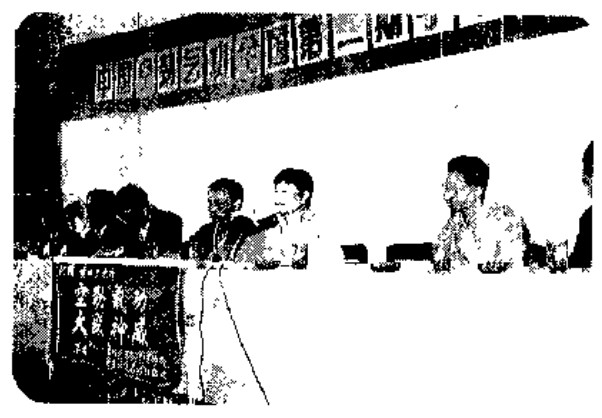
Innumerable patients thus obtained the joy and hope of life. A young Korean ethnic minority woman named Li Yingshu, paralyzed for many years, came all the way to Shanghai from Yanbian seeking medical treatment. Huashan Hospital, Ruijin Hospital, Longhua Hospital, the Chinese Medicine Hospital… she and her parents visited every major hospital in Shanghai and sought out many renowned doctors, only to meet with disappointment time and again, sliding from hope into despair. When, following a magazine’s introduction, they came to Huang Renzhong for treatment, after just a few months, this young woman who had arrived carried in the arms of her family actually discarded her crutches, performed a beautiful Korean dance to bid Huang Renzhong farewell, and boarded the train home.
A young female nurse named Cui Ping from Xinyang City, Henan Province, had been tormented by severe asthma since childhood and was in agony. After years of unsuccessful medical treatment, she had hoped that marriage might “wash away the bad luck” and improve her condition. When she saw her efforts to escape the clutches of disease fail once again, she became utterly despairing and threw herself out of a third-floor window. But she did not succeed in ending her life. Instead, she suffered a lumbar spinal fracture that resulted in lower-body paralysis. Her husband was devastated and resolved to seek out famous doctors across the entire country. From one physician, he heard the news that “Huang of Shanghai’s magic palm” had miraculous therapeutic effects, so he traveled great distances to find Huang Renzhong. After one course of treatment (15 sessions) of qi emission therapy from Huang Renzhong, Cui Ping’s twenty-year chronic condition [was essentially cured, and to this day there has been no recurrence].
Huang Renzhong giving a lecture at the Kongjin Qigong Instructor Training Class.
· 39 ·
It refers to the cultivation method. Not only can it regulate the functions of one’s own internal organs, but after reaching a certain level of proficiency, one can also use the fingers as a switch to emit external qi at any time and adjust the amount of qi emitted.
Huang Renzhong also took Empty Effort Qigong as his weapon and boldly challenged humanity’s deadly enemy—cancer—achieving certain results. In 1981, he took in 35 patients with recurrent cancers of various types. After one to two courses of “qi emission” treatment, the lesions basically disappeared in four cases; in 16 cases the lesions visibly shrank and softened, with great improvement in various clinical symptoms; in 12 cases the lesions shrank slightly, appetite increased, and spirits improved. Why does “Empty Effort Qigong” have a certain short-term therapeutic effect on cancer? Huang Renzhong believes that cancer is related to the stagnation and coagulation of qi and blood, and qigong has the effect of unblocking the meridians and regulating qi and blood. The “external qi” of “Empty Effort Qigong” can penetrate the human body to stimulate diseased cells, promote the growth of interferon, and alter the immune response of human cells. This kind of radiation can not only mobilize the favorable factors of the patient’s organism, but also carries multiple forms of the body’s material energy, playing a role in driving out pathogens and supporting the patient’s vital energy, suppressing and destroying cancer cells, thereby achieving the goal of cancer treatment.
Of course, due to various limitations, the research on “Empty Effort Qigong” is still far from sufficient. Many things that can objectively be accomplished still lack clear scientific explanations. For example, regarding the “guidance technique” mentioned earlier, I myself had on several occasions personally watched Huang Renzhong extend his “magic palm” and perform the “guidance technique” on his disciples. His hand was like a radio remote controller, able to direct disciples to perform various movements from several meters away. I had suspected that this might be a hoax, so I wrote on a slip of paper something I wanted his disciple to do. After a while, without any form of communication between him and his disciple (language, gestures, eye contact), one of his disciples slowly walked up to me and took out from my shirt pocket the pack of cigarettes I had wanted to have produced.
They said they could thereby obtain a key to unlock the mysteries of human life. They said that if this material energy could be replicated and enhanced, it would surely benefit humanity. Therefore, they considered this test a highly meaningful experiment.
Huang Renzhong himself also conducted an interesting experiment, proving that the material energy “external qi” he emits can penetrate a lead plate 10 centimeters thick, causing a diseased hand placed behind the lead plate to tremble, and also causing a healthy person’s hand to feel numbness. He had also undergone testing with an automatic photometer; the baseline reading was 4,000, while the emission force from his palm could reach as high as 240,000, with an average emission force of 180,000. From this it can be seen that “Shanghai Huang’s” “magic palm” is indeed extraordinary in its power.
Regarding this Empty Effort Qigong therapy, Huang Renzhong summarized it in sixteen characters: “External qi is taken in, internal qi is emitted outward, no mental concentration is required, circulation proceeds as normal.” This is both a highly condensed summary of his method and also broadly explains the basic principles of “magic palm” healing.
“Empty Effort Qigong” requires no mental concentration, breaking away from the traditional qigong practice methods of sinking qi to the dantian and using mental focus to guide qi. Practitioners regulate their own internal qi through the cultivation method and finger movements. During practice, one can watch television, listen to music, and converse normally, integrating qigong into daily life. This not only saves time, but also ensures that practice does not go awry and has no side effects.
In addition, “Empty Effort Qigong” uses the human body as a filter, connecting the yang qi from nature with one’s own righteous qi. The inhaled external qi circulates within the body, retaining the correct and expelling the harmful. After this “filtering,” the righteous qi that circulates within the body is transformed into a form of material energy composed of multiple components of the human body, enabling it to serve the function of “healing illness when sick, and resisting aging and strengthening the body when healthy.” If this material energy composed “internal qi” is then emitted outward, it can regulate the yin and yang of others, unblock the meridians, support the vital energy and expel pathogens, producing therapeutic effects. For healthy individuals, it can achieve the goal of promoting the circulation of qi and blood, as well as strengthening the body and promoting longevity.
“Empty Effort Qigong” has another characteristic, which is its unique…
Huang Renzhong: The Person and His Story
Huang Renzhong was forty years old in 1984, originally from Shantou, Guangdong. His journey from an acrobatic performer to a renowned qigong master was a path full of twists and hardships.
As early as age seven, he began studying Shaolin martial arts and hard qigong under Shaolin boxing master Zhu Zhenrong. In 1957, at the age of fourteen, he joined the Shanghai Red Acrobatic Troupe, excelling in acts such as the springboard and trapeze, and also mastered the art of the rope whip. He was once known as the “Divine Whip Hand” and enjoyed considerable fame for a time.
On one evening in 1962, while returning home after a performance via Julu Road, he discovered five young hooligans beating a passing youth. The nineteen-year-old Huang Renzhong stepped forward to intervene. These five hooligans, relying on their numbers, then turned their fists toward…
40
The internal-external emission therapy method was formally named “Kongjin Qigong.” He published his papers in journals on multiple occasions. Kongjin Qigong has gained renown both domestically and abroad. At the same time, he persisted in research through practice. Correspondence school departments compiled over three million characters across eleven types of teaching materials.
Editor’s Supplement
Kongjin Qigong, with its distinctive characteristics of “healing the ill, strengthening the healthy, requiring no mental focusing, and freely adjustable regulation,” stands unique in the garden of qigong in our motherland, and has received increasing welcome from the masses and recognition from experts.
Currently, a wave of enthusiasm for learning Kongjin Qigong is gradually rising. In recent years, Huang Renzhong has been invited successively to teach at the Luwan District Workers’ Union of Shanghai, the Jing’an District Elderly Association, the People’s Park Sports Field, the Chinese Medicine Hospital and the University of Science and Technology of China, as well as relevant units in Shandong, Henan, and other provinces. At the invitation of Jiefang Daily and Yangcheng Evening News, he conducted short-term classes. In total, he has run over forty sessions of Kongjin Qigong classes, with nearly ten thousand participants, including workers, peasants, government cadres, PLA soldiers, as well as renowned scholars, professors, overseas Chinese, performers, editors, and journalists. Over ninety percent of them achieved qigong results through practice. Among the chronic disease patients, many also cured their illnesses through practice and recovered their health.
Huang Renzhong currently has twenty-eight formally accepted disciples. In addition, over a dozen foreign students studying in Beijing and Shanghai have also sought him out as a teacher to learn Kongjin Qigong.
Qigong is a brilliant pearl among the cultural heritage of the Chinese nation, and Kongjin Qigong is a rare and wondrous flower in the garden of qigong. Its promotion and development will surely lead more patients onto the path of recovery, while more people can strengthen their bodies and extend their longevity through Kongjin Qigong, making greater contributions to the “two civilizations” of socialism.
May “Magic Hands Huang of Shanghai” achieve new accomplishments in his pursuit of his calling.
—Excerpted from East, West, South, North
Regarding Huang Renzhong being able to draw a whip from his waist, only to be heard a string of “crack, crack…” sounds — with his practiced and formidable whip technique, he frightened the gang of thugs into fleeing with their hands over their heads.
In his second year with the acrobatic troupe, he also took as his master Sang Shangshan, the Dharma lineage successor of the Shaolin Temple at Mount DaTai in Zhejiang, to study the Chan sect’s internal-force qigong methods. He studied with great diligence and earnestness, spending several hours each day in spare time practicing qigong with bitter effort. On the ground where he had stood practicing, there was always a puddle of sweat left behind. At age twenty-five, he also studied with Que Ashui, the successor of Shanghai’s “Internal Force One-Finger Zen,” and through his efforts, his skill advanced rapidly, earning him the deep affection of his masters.
During the decade of turmoil, the Red Acrobatic Troupe was disbanded. From then on, he devoted himself wholeheartedly to studying medical theory. He read through many medical works including Chinese Meridian Theory, Human Anatomy, and Pathology, laying a solid foundation for his future career in medical qigong. He also drew inspiration from the ancient Chinese saying “the ten fingers are connected to the heart.” Since the various fingers have corresponding and intimate meridian connections with the internal organs, could a method be developed to regulate and treat internal organs through the fingers?
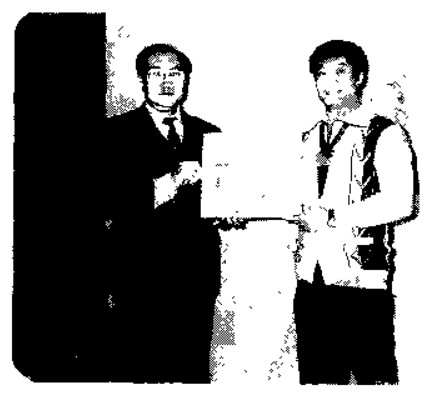
However, just as he was exploring and soaring in the field of medical qigong, an unexpected blow fell upon him. In 1971, Huang Renzhong was politically persecuted and subjected to seven months of isolated interrogation. During this period, he would always secretly practice qigong on his bed after lights-out. One day, he was paraded around for four struggle sessions during the day, standing continuously for seven or eight hours. That evening another mass meeting was to be held for denunciation. He felt dizzy and dizzy, and sensed he could hardly hold on, so he silently began practicing qigong amid the deafening sounds of denunciation. The result was immediate — his mind cleared, his spirits lifted, and his exhaustion vanished completely. From then on, whenever he mounted the stage to be criticized and struggled against, on the surface he appeared respectfully submissive and obediently compliant, standing motionless on the stage, but in reality he was secretly practicing the way of strengthening his body and preserving his health. After each struggle session, he would always replay the “movie” in his mind — revisiting the meridian sensations experienced during the day, noting their positions, analyzing the magnitude of internal qi outward emission energy as well as methods of control and directional changes. Then, on the paper issued to him for writing confessions and self-examinations, he would draw and record these findings, secretly rolling them up and stuffing them inside the steel frame of his bed…
After the fall of the “Gang of Four,” Huang Renzhong was soon “liberated.” His drive to delve into qigong medicine grew even stronger. On one hand, he intensified his qigong practice; on the other, he studied medical qigong theory and organized a set of highly effective new-style qigong in its embryonic form — “Kongjin Qigong.” At the same time, he spent a great deal of spare time treating patients free of charge with qigong, not only relieving patients’ suffering but also accumulating a wealth of clinical experience.
As the saying goes: “Where there’s a will, there’s a way.” Through years of effort, Huang Renzhong has already compiled two sets of self-preventive and self-therapeutic qigong methods for chronic diseases and twenty-six sets [of teaching materials].
The President of the Hong Kong International College of Chinese Medicine appointed Huang Renzhong as Honorary [Professor] of that institution.
·11·
A Visit to a Young Qigong Master
1
He stood up and cast a skeptical glance at Mao Fuzhou, then walked straight to a chair about one meter opposite him and sat down. At this point, Mao Fuzhou, with a tranquil expression and concentrated attention, gazed fixedly at Kiyoshi Kotani for about four or five minutes, and then began to announce the results of his remote viewing:
“First, your wife is currently at home suffering from a cold — an upper respiratory tract infection. If you don’t believe it, you can verify it by telephone.” The reception room fell completely silent. One could only hear Kotani say a few words in Japanese to the interpreter, whereupon the interpreter said:
“There’s no need to make the call. My wife did indeed catch a cold — right on the day I flew out of Osaka.”
A burst of enthusiastic applause filled the reception room, laden with admiration. Then Mao Fuzhou continued his announcement:
“Second, your wife has had surgery. There is a scar on the lower right side of her abdomen…”
Unable to contain his astonishment and excitement, Kotani leapt to his feet and exclaimed loudly: “Yō suga! (meaning ‘Completely correct!‘) My wife had surgery when she was in high school. Chinese qigong is truly extraordinary!” He respectfully performed a deep bow toward Mao Fuzhou.
Amid another round of enthusiastic applause, the leader of the Japanese delegation, Ryōtarō Fukui, stood up, applauding while loudly praising: “Impressive! Impressive!” Then he walked over to Mao Fuzhou and shook his hand firmly…
Photograph by Shu Mei
In early 1988, Mao Fuzhou treats a patient by emitting healing energy in Changchun.
A friend, could you believe that such a wondrous thing exists in this world? A Chinese qigong master, located in the city of Changchun, China, was able — through remote viewing — to sense the physical condition of a Japanese visitor’s family member in the city of Osaka, Japan?
It seems this is beyond dispute. I reflected inwardly that evening: aside from the Japanese guests, among those present watching the demonstration were also colleagues from the Changchun Institute of Posts and Telecommunications, as well as faculty and students of the “Center.” Both Teacher Qu and Teacher Zhang were eyewitnesses to the entire process — how could it be a fabrication!
As I was about to conclude this first visit, Teacher Qu Wen offered proactively: “Let’s find a time later for Comrade Xiao Mao to meet you and have him check your physical condition too. He doesn’t have time today.”
Wonderful! Overjoyed, I concluded my first fact-finding visit to satisfy my curiosity. I quietly gave Mao Fuzhou a score of “70.”
When I first heard this account, I did not believe it had actually occurred. China and Japan, though separated only by a narrow strip of water, are after all thousands of miles apart. Without any channel for transmitting information, if what was reported had truly occurred, it would indeed be a most bizarre and inconceivable phenomenon.
As the saying goes, “Hearing is believing, but seeing is the truth.” The story was recounted with such vivid detail, and it had taken place right here in Changchun, where I lived. How could I not pay a visit and witness it firsthand to determine its authenticity!
I am an impatient person by nature — especially when it comes to witnessing extraordinary people and strange events — and I was burning to see the outcome immediately.
On December 22nd last year, I went to the “Changchun Huaxia Human Body Information Science Research Center” (hereafter “the Center”). Qu Wen, director of the Center’s office, and Zhang Yongjiu, deputy director, warmly received me. The two teachers briefed me on the situation and gave me several documents to read, helping me understand the full course of events as they actually happened.
It was on the evening of September 21st last year. Several Japanese guests who had come to Changchun to give lectures happened to encounter several students (qigong masters) from the Center’s research class. They were demonstrating qigong abilities in the reception room of the Changchun Institute of Posts and Telecommunications. When the host, Teacher Zhang Yongjiu, announced that the twenty-seven-year-old qigong master Mao Fuzhou would demonstrate remote viewing, a male Japanese guest named Kiyoshi Kotani stood up and, with a look of skepticism, glanced at Mao Fuzhou before walking straight to a chair about one meter opposite him and taking his seat.
The next day (December 23rd) morning, I went again to the Center to find Teachers Qu Wen and Zhang Yongjiu. It so happened that I encountered students from the Center’s research class during their break between classes. Impatiently, I went directly to Mao Fuzhou himself and told him frankly that, with Teacher Qu’s permission, I wished to interview him, and asked him to set a time to meet me.
As luck would have it, at just that moment, Teacher Qu appeared before us. Through his introduction and mediation, Mao Fuzhou not only readily agreed on a time for the face-to-face interview, but also consented to give me an immediate “X-ray vision” reading of my physical condition. I sat contentedly in a chair about one meter away from him, quietly waiting for a miracle to unfold.
·42·
[This is no mere coincidence — at minimum, he deserves an extra 20 points.]
How could it be that from my own body, one could observe the medical condition of a family member!
Mao Fuzhou could not answer this question either. He speculated: “Perhaps it is because the information about my wife’s medical condition left a lingering imprint on my body, and then was reflected outward from my physical form. I have encountered this situation many times already.”
I fell into deep contemplation: In the field of human body science, there are things that violate our common sense and that even modern science has not yet clearly explained. If we can objectively acknowledge their existence, become familiar with them, and study them — once we have unlocked these mysteries one by one and gained the freedom to master, develop, and apply them — what tremendous value they would contribute to society! …
“Is there anything else you saw incorrectly?” Mao Fuzhou quietly asked me.
“You said the blood vessels on both sides of my head are of unequal thickness, and the bones are of different sizes…” — this likely resulted from my being a nasopharyngeal cancer patient who underwent cobalt-60 radiotherapy and had the right-side artery of my head incised for catheter-based chemotherapy. I hadn’t noticed it before, but you didn’t detect that I am a cancer patient!”
Mao Fuzhou
Mao Fuzhou is a rather handsome and refined young man. On the surface, he looks much like an ordinary college student — one cannot discern his extraordinary abilities just by appearance. One only sees him briefly close his eyes, then immediately begin gazing at my body, sequentially stating the results of his “fluoroscopy”:
“You have had pulmonary tuberculosis; the right lobe of your lung has calcification spots.” I maintained an expressionless face on the outside, but inwardly I silently admired: Impressive — the very first observation was correct.
“Chronic gastritis and duodenal bulb ulcer; the affected areas have now formed scar tissue.”
“Liver enlargement; you previously had hepatitis.”
As an old patient with many ailments, though I said nothing, when my old conditions were laid out one by one, a feeling of reverence for this miraculous ability naturally arose within me.
“You have had surgery; there is a four-finger-long surgical incision in the middle of your lower abdomen.”
“The blood vessels on both sides of your head are of unequal thickness, and the bones are also of different sizes. Recently you have experienced noticeable dizziness and vertigo.”
Because Mao Fuzhou was in a hurry to attend class, he hastily concluded the “fluoroscopy.” So as not to delay his studies, I did not explain the accuracy rate of his “fluoroscopy” to him. However, I had it tallied in my mind — I quietly gave him an “80 score.” Of course, I still greatly admired the miraculous efficacy of Mao Fuzhou’s ability. As the saying goes, even a thoroughbred horse can stumble — and besides, he was in a rushed situation, performing the “fluoroscopy” relying solely on his naked eyes! I planned to tell him the details next time we met.
The Young Are to Be Reckoned With — Valuable Successors with a Heavy Responsibility to Carry On the Legacy
I shifted the topic to using qigong to treat illness: “Fuzhou, I hear you can emit external qi to heal people. Tell me about a few cases with good therapeutic results to broaden my horizons.”
But Mao Fuzhou deflected, saying: “I am young, my skill is shallow, and I have done few good deeds. I have treated some illnesses, but nothing remarkable.”
After I pleaded with him repeatedly, even using what I knew to “expose his past,” he finally gave a superficial and dry account of a few cases.
In fact, according to teachers and students at the “Center,” Mao Fuzhou received instruction from his father during childhood and mastered the techniques of the Secret School of Bone-Setting (Zhenggu Mizong). From a young age, he set bones and treated injuries for people in his hometown, earning the reputation of a “young doctor.”
After growing up and enlisting in the military, under the care of his unit’s organization, he studied under the renowned qigong master Ma Chun, receiving direct transmission of qigong, martial arts, and the principles and methods of cultivation. Combined with his dedication to seeking instruction and diligent practice, his foundational skills deepened daily and his expertise became ever more refined.
Later, in order to draw upon the strengths of renowned masters from all quarters, he successively traveled to Mount Wutai, Mount Hua, Mount Tai, Mount Lao, Mount Zhongnan, the Shaolin Temple on Mount Song, Mount Tiantai, Mount Mang… and over twenty other locations, paying homage to eminent teachers and masters, searching for true scriptures and secret transmissions, and collecting classical qigong texts. This enabled him to make advances in both qigong theory and practical ability. In recent years, through instrumental measurements conducted by medical research institutions,
Not a Mere Coincidence — At Minimum, “20 Extra Points”
On the afternoon of December 28 at 2:00 PM, we met as scheduled. After exchanging pleasantries, I got straight to the point and brought up the previous “fluoroscopy.”
“Fuzhou, last time during the ‘fluoroscopy’ I gave you an 80. What do you say?”
“Which parts did I see incorrectly?” he asked with a smile.
“I have never had surgery; there is no incision on my lower abdomen; and recently I haven’t had dizziness or vertigo.”
Mao Fuzhou gazed at my head and abdomen for a moment, then said with great confidence: “Then it is your wife who has a surgical incision on her abdomen. And she has been experiencing dizziness recently.”
Good heavens — my wife had indeed undergone surgery! The location and length of the scar matched exactly what Mao Fuzhou had described. And recently, she had indeed been complaining of dizziness every day — sometimes so severe that she had to close her eyes and grip the back of a chair to keep from falling over.
··· 13
…1 ml of Novocain 15 ml could temporarily relieve the pain; about 20 minutes later the pain became worse than before. A month later, the patient transferred back to the regional hospital, where treatment with Chinese medicine, physical therapy, and other methods for over a month was ineffective. The patient was then transferred to the Sichuan Provincial People’s Hospital, where a definitive diagnosis still could not be made, and the recommendation was to return to the local area for observation. While in Nanchong…
…and the soft tissues of the body twitched; the pain disappeared again…
…could enable temporary relief of pain; about 20 minutes later, the pain became even more severe than before. A month later, he transferred back to the regional hospital and received treatment with Chinese medicine, physical therapy, and other methods for over a month without effect. He then transferred to the Sichuan Provincial People’s Hospital, where a diagnosis still could not be confirmed, and it was suggested he return to his local area for observation.
At that time, the patient needed dual canes to walk; he could not stand on both feet, the affected foot could not bear weight independently, and the mass at the affected site had not diminished in size.
Curing a Difficult Disease with Distant External Qi Emission
Leng Fengchuan
I am twenty-five years old, male, and a physician in the Department of Internal Medicine at the Nanchong Regional Hospital. On January 14, 1986, I discovered a mass about the size of a broad bean on the left greater trochanter of my hip, accompanied by pain. There was no redness or swelling of the skin. The pain worsened at night and while walking, resulting in a limp. After examinations including X-ray imaging and local needle biopsy, the diagnosis remained unclear. Treatments including anti-infection, anti-tuberculosis, and anti-rheumatic therapies were all ineffective. After over a month, I transferred to Xinqiao Hospital at the Third Military Medical University in Chongqing. By then my condition had worsened, and I needed canes to walk. X-ray imaging showed increased bone density at the left greater trochanter, but tomography revealed no abnormalities. I was given local block injections—each time with prednisolone and Novocain 15 ml—which could temporarily relieve the pain; however, about twenty minutes later the pain became even more severe than before. A month later I transferred back to the regional hospital and received Chinese medicine, physical therapy, and other treatments for over a month without effect. I then transferred to the Sichuan Provincial People’s Hospital, where a definitive diagnosis still could not be made, and it was recommended that I return to my local area for observation. At that time, I needed dual canes to walk; I could not stand on both feet, the affected foot could not stand independently, and the mass at the affected site had not diminished.
On the morning of September 21, 1986, at 7:00 a.m., at North Lake Park in Nanjing, after Teacher Li Binwei emitted external qi for twenty minutes, I was immediately able to walk without canes. The affected foot could stand independently, and the pain was noticeably reduced. That same day I was able to walk for thirty minutes. At the second treatment (4:00 p.m. on September 23), after twenty minutes of qi emission, during the treatment I felt a sensation of pressure at the affected site, and the soft tissues of the affected area and other parts of the limb twitched. After treatment, the pain was further reduced, and I could walk without canes until bedtime that evening. At the third treatment (September 25), the sensations were the same as before; I could walk without canes until 10:00 a.m. the next day, and the mass at the affected site had shrunk to the size of a grain of rice. At the fourth treatment (September 27), the sensations were the same as before; I could walk without canes and ride a bicycle.
After four sessions of external qi treatment, my condition had improved significantly. At this point, Teacher Li Binwei was traveling to Guangzhou to attend a national qigong instructor training course and would not return for a month. I was anxious about the interruption of treatment. Before leaving, Teacher Li told me: “Don’t worry—I will emit qi to treat you from Guangzhou at a distance. Your leg will get better.” The following afternoon at 4:00 p.m., I received Teacher Li’s distant external qi treatment from Guangzhou at home. The first time (September 29), I did not receive the signal; the second time (October 1), I received the signal—I felt a distinct sensation of pressure at the affected site, a local sensation of heat, twitching of the soft tissues of the limb, and the pain disappeared again. On the afternoon of November 3 at 1:00 p.m., after receiving Teacher Li’s distant external qi treatment, I was able to walk without canes. The mass also completely disappeared. Up to now, I can walk entirely without canes and can ride a bicycle on the street.
As a physician who contracted a difficult disease and could only walk with canes for ten months, after treatment with external qigong—especially distant treatment—I threw away my canes. This has made me feel that qigong is truly a genuine science. At present, its secrets remain unsolved, but the facts have convinced me.
Excerpted from Chinese Qigong*
…In early 1984, after Mao Fuzhou was demobilized from the People’s Liberation Army and returned to Cangzhou City in Hebei Province, he actively organized qigong training classes and enthusiastically treated the public. In addition to injuries of muscles and bones, he also treated coronary heart disease, hypertension, nephritis, cerebral thrombosis, rheumatoid arthritis, and various internal organ diseases.
Once, when an Australian martial arts delegation visited Cangzhou, two delegation members suffered from cervical and leg pain. Conventional treatments were difficult to produce results within the short period of their visit, and they specifically requested treatment from Mao Fuzhou. To the foreign friends’ surprise, after Mao Fuzhou applied pressing, stroking, pushing, and kneading techniques, within a short while both delegation members smilingly reported that their pain had completely disappeared. They gave thumbs up to praise the miraculous effects of Mao Fuzhou’s qigong.
I used this incident to apply a “goading method” with Mao Fuzhou, saying: “Even foreigners have given you a thumbs up—what are you being modest about!”
…and the evidence from medical practice, the potency of his external qi emission had reached an advanced level.
Yet Mao Fuzhou still said modestly: “Qigong is our national treasure. There are countless cases of veteran qigong masters treating illnesses. Foreign friends are simply not accustomed to it; a few words of praise are nothing to speak of.” He told me that what troubled him now was that “I can apply qigong, yet I do not understand the scientific principles behind it.” His reason for coming to the “Center’s” research class to study was precisely to lay a foundation and create conditions for engaging in scientific research on qigong.
The interview ended, and Mao Fuzhou took his leave. Yet what he said and thought left me with endless emotion: China’s new generation of qigong masters—truly formidable and precious. You carry forward the legacy and forge ahead; the burden is heavy and the road is long. The important task of using the “brick” of Chinese qigong to knock open the “door” of human body science awaits you!
44
After liberation, the elderly Li Zangshan, already over seventy, could not remain idle. He went to Heilongjiang Province to participate in a medical practitioner examination with over nine hundred candidates, and emerged as the top scorer with outstanding results. He was assigned to work at a joint clinic in Changchun. During the decade of turmoil, this eighty-seven-year-old man also had his home searched. Thanks to the protection of the masses, he was spared from persecution.
The elderly man later relocated to Changchun, where he sat for consultations at the “Qigong Acupoint Pressure Massage Therapy Clinic” on Guangfu Road. In this modest room of less than ten square meters, his medical skills enabled many critically ill patients to escape the clutches of death and regain their health.
I asked the old man: “Among all the patients you have seen, have there been any you could not cure?”
He answered candidly: “There is no divine physician in this world. It is simply that those with superior medical skills cure more patients. I naturally cannot claim to be one hundred percent successful.” Having said this, the old man produced a thick volume of case records and numerous letters of gratitude sent by patients. I browsed through them at random and found that these cases included mental illness, polio, paralysis, epilepsy, sequelae of cerebral thrombosis, and various forms of cancer. Among them were also recorded several miraculous instances of bringing the dead back to life.
There was a nine-year-old boy named Cai Zhaoheng who was playing alone at home and, in a moment of mischievous ingenuity, tied a rope to the door frame, intending to make a swing. Unexpectedly, he slipped, and the rope caught around his neck. By the time adults returned home, the child had already stopped breathing. Despite the hospital’s best efforts at resuscitation, they were unsuccessful. The mother wept uncontrollably. When Li Zangshan heard this news, he rushed over immediately and performed a session of qigong acupoint pressure massage treatment. The child actually resumed breathing. The mother, overcome with gratitude, fell to her knees at the old man’s feet.
Then there was a person named Yuan Zhongfang who went into anaphylactic shock from a penicillin injection. The hospital’s resuscitation efforts were ineffective, and the nurse who had administered the injection was so frightened she could only sob. Li Zangshan once again applied qigong acupoint pressure, and she regained consciousness.
A four-year-old child suffering from progressive paralysis with severe muscle atrophy could not stand, could not even lift his head, and drooled incessantly. The family had taken the child to many major hospitals for treatment, all without improvement. Li Zangshan gave this child only one month of treatment, after which the child could stand up and even began trying to speak.
The elderly man practiced medicine to save lives and never once asked patients for payment. Many patients, out of gratitude for his life-saving help, would bring gifts of fruit and pastries, and begged him to accept them.
Visiting the Old Qigong Master Li Zangshan
In 1986, in the People’s Labor Cultural Palace of Beijing, where crowds streamed like a tide, a remarkable sight appeared: an elderly man of 106 years sat upright and composed, treating patients. His brows were white as snow, his silver beard flowed gracefully, his complexion was ruddy and healthy, and his physique was robust and imposing — he appeared to be no more than seventy years old. One could see him performing qigong acupoint treatment for one patient, then massaging, patting, and kneading another. Though he worked up a sweat from the exertion, he showed not the slightest sign of fatigue.
Those patients who, driven by the mindset of “seeking any doctor when desperate,” came with intractable illnesses all felt their conditions lighten after the old man’s careful treatment, and smiles appeared on their faces. Observers admired the centenarian’s miraculous hands and his restorative techniques, and were even more astonished by his extraordinary intellect and vitality. They eagerly inquired about the secret of his longevity.
Relying on the advantages of my profession, and with the consideration of relevant authorities, I afterward had the opportunity to conduct an exclusive interview with this remarkable centenarian.
Li Zangshan was born in 1880 at the foot of Laoshan Mountain in Qingdao, Shandong Province, into a family tradition of qigong acupoint massage. He is the tenth-generation inheritor of this hereditary art. The qigong he practices was transmitted by the Patriarch Bodhidharma, hence it is also called “Bodhidharma Qigong.” This system of qigong comprises three forms: the Crane-Hair Youthful-Complexion Exercise, the Old-Age Rejuvenation Exercise, and the Life-Extending and Longevity-Promoting Exercise. Additionally, there is the qigong acupoint pressure massage therapy.
Speaking of his practice, the old man told me an interesting story. As a child, he was frail and frequently ill, with a sallow, emaciated complexion. Although he had repeatedly asked his father to teach him qigong, his father refused each time, because his father was concerned that his poor health would make it difficult for him to succeed in training, which might in turn tarnish the reputation of “Bodhidharma Qigong.” Despite this, he never lost faith in his desire to learn, and would often secretly imitate his father’s movements, practicing with extraordinary dedication. His sincerity prevailed, and his father was at last moved by his son’s spirit. Thus, at the tender age of nine, young Zangshan began studying qigong acupoint pressure massage therapy under his father’s careful guidance.
Qigong acupoint work required first memorizing the acupoints and their names across every part of the human body. For a nine-year-old child, how daunting this challenge must have been! Yet remarkably, Li Zangshan possessed extraordinary intellect and practiced with great diligence. His father was thoroughly satisfied. After one year of effort, at the age of twelve, Li Zangshan was already able to treat patients using this therapy.
In 1900, at the age of twenty, Li Zangshan left his hometown and traveled to Yanji in the Northeast to make a living, working in the coal mines. He continued his qigong practice and treated workers free of charge, becoming a beloved figure among the people.
truly felt that “declining would be disrespectful,” so he would place them in the clinic — to entertain guests, or give them to some patients. No wonder everyone says: “The old doctor treats people so kindly — we could never fully repay his kindness.”
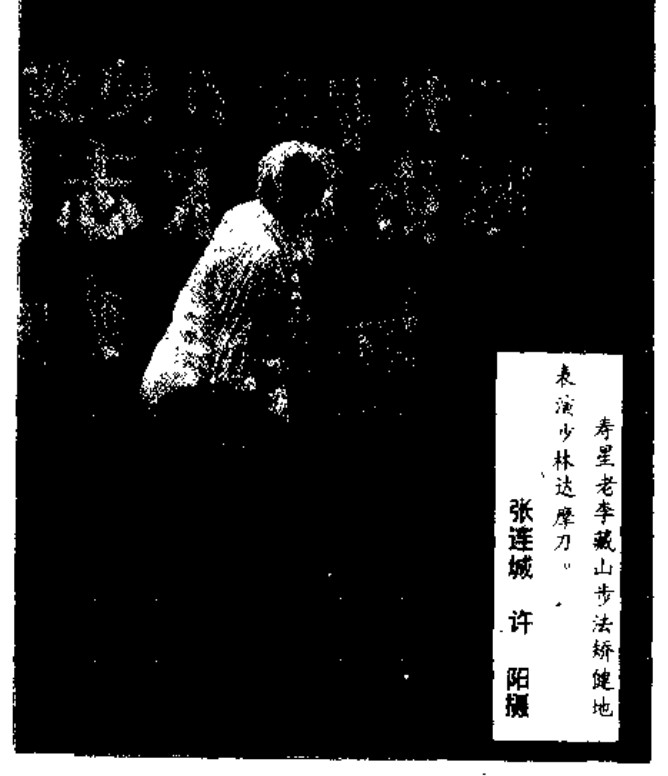
Li Zangshan practiced qigong uninterruptedly throughout his life. Apart from occasionally catching minor colds, he never suffered any major illness. Because he possessed extraordinary skills, even when he felt unwell, he would perform the Shaolin Bodhidharma Broadsword to treat himself.
When I asked the elderly man whether he still persisted in practicing qigong, he explained that he practiced twice a day, totaling four hours. First he would sit with eyes closed and legs crossed to practice the Crane-Hair-and-Youthful-Complexion Qigong, the Rejuvenation-in-Old-Age Qigong, and the Life-Extending-and-Longevity Qigong. Then he would practice a session of Qi-Movement Qigong, and finally use qigong acupoint stimulation for a round of self-massage. It seems that this is the secret of his longevity and health.
His level of health can also be seen from his appetite. His breakfast consists of two large bowls of milk plus six eggs. At lunch he eats five liang of rice with a large plate of food. He likes to eat meat and can consume a whole jin of meat at one sitting, which astonishes many people. He does not eat much for dinner, as he believes in “not eating a full meal at suppertime.” Ordinarily, the old man enjoys a little wine but never drinks to excess.
Someone asked him: “I’ve heard that vegetarianism can lead to longevity?”
The old man immediately retorted: “How could that work? If a person doesn’t eat meat, they’ll have no strength. I’ve practiced martial arts and qigong methods since childhood — if I didn’t eat meat, my body would become weak and feeble.”
There is also a “family history of longevity” behind the elderly Li Zangshan’s long life. In his family, across ten generations, the average lifespan has approached one hundred years. Among them, his great-great-grandfather and great-great-grandmother reached the remarkable age of 160, and his grandfather passed away at the age of 120. As for himself, the old man told the reporter: “Given my current state of health, living to 160 is no problem. I will even strive to live to 200!”
Throughout his life, Elder Li Zangshan devoted himself to qigong acupoint stimulation and massage. He read extensively from medical texts and accumulated rich clinical experience. As a result, his qigong skills were exquisite and his medical expertise extraordinary. In order to present this treasure from the repository of the Chinese nation’s ancient cultural and medical heritage to humanity, he devoted his spare time outside of treatment to meticulously compiling a manuscript of several hundred thousand words titled Qigong Acupoint Self-Massage. The book is richly illustrated; it not only provides detailed descriptions of self-massage therapies for various illnesses, but also introduces specific methods of qigong acupoint stimulation, accompanied by photographs or diagrams for explanation. This manuscript is now about to be formally published. It can enable readers to treat not only themselves but also others, and it is sure to be warmly welcomed.
In closing the interview, Elder Li Zangshan happily shared the “Acupoint Stimulation Verse” he had compiled, for readers everywhere to put into practice.
(Excerpted from Sports World)
Qigong Acupoint Stimulation Verse
Acupoint therapy is the treasured tool, Curing all illnesses with miraculous effect. If you ask how acupoint stimulation is understood, All healing is found at the fingertips.
For major or minor heat-related ailments, which points to stimulate? Stimulate more at Tianhe to clear the river’s waters.
For the warning signs of headache, Stimulate Lieque and the head clears.
When chest and diaphragm are stuffy and the heart is anxious, Stimulate the Neiguan point and it dissipates.
When the face and mouth suffer from wind-evil stroke, Focus on stimulating Hegu to resolve it.
For back pain from cold-dampness, Stimulate the Waiguan point more.
Open the Tiantu and Baihui points, To regulate and harmonize yin-yang, qi, and blood.
Stimulate the Daling general tendon point, And the Four Horizontal Creases to harmonize qi and blood.
Stimulate the Qize point of yin-yang, To drain fire-heat from the heart.
Stimulate Neilaogong on the Heart Meridian, To dispel wind, scatter cold, and eliminate wind-evil.
When the stomach and intestines are hot and fail to transform, Stimulate the Shangyang point on the index finger more.
When men and women suffer from coughing and wheezing, Stimulate the Zhongfu and Yunmen points more.
When the five organs and six bowels have blocked qi and blood, Open the Four Gates to save lives.
For intestinal adhesions causing heat in the abdomen, When the pain is severe and the condition is dangerous.
Ten-finger acupoint stimulation treats the early warning signs, Hands-on cure — grasping the illness away.
When pleurisy is dangerous, And the patient is unconscious and uncomprehending.
Ten-finger acupoint stimulation opens the Four Gates, The illness is cured with no aftereffects.
For hemiplegia from wind-evil stroke, Opening the Four Gates can resolve it.
For cerebral hemorrhage, the great reversal, Improper treatment means certain death.
Acupoint therapy has great divine power, Treat upon onset and it can be overcome.
When breast cancer first arises, Swelling hard and painful like a bowl or basin.
Select the Stomach Meridian point Ruzhong, Use true skill to dispel illness and dissolve stasis.
If a person falls to death and breathing ceases, Focus on the Jiming point at Jiquan to save the life.
For cold, warm and gently treat; for heat, clear it, For deficiency, tonify; for excess, drain it.
Longevity Star Li Zangshan — agile footwork, white hair and youthful complexion (Photo by Zhang Liancheng)
He performs the Shaolin Bodhidharma Broadsword (Photo by Yang)
The Remarkable Person’s Remarkable Skills
Author: Yu Qian
Numerous human potential phenomena are posing a challenge to various emerging disciplines—and indeed to the entire natural sciences!
The remarkable person’s remarkable skills introduced in this article are but one of many human potential phenomena. The remarkable person is a young staff member at a certain PLA research institute. In order not to interfere with his scientific research work, and out of respect for his own wishes, his real name has been withheld.
I first heard about this remarkable person’s extraordinary abilities in the autumn of 1981. One day after lunch, Xiao Li from our editorial office excitedly told me about what she had witnessed when the remarkable person gave a demonstration.
A few days earlier, a friend had brought a young man to her home as a guest. After the meal, everyone went for a walk in the courtyard. There was a pond in the courtyard, and the nanny, afraid the wooden basin might crack in the autumn wind, had soaked it in the water. The young man merely blew a light breath, and the pond—originally without a single ripple—and the stationary wooden basin suddenly came alive as if imbued with life. First, the wooden basin began to drift across the pond. Then it swayed from side to side, and finally the large wooden basin spun rapidly like a top. When the young man turned and walked back, everything in the pond returned to stillness.
Due to being busy with work, I quickly forgot the remarkable stories Xiao Li had told me.
One afternoon, I returned to the editorial office with a manuscript and found everyone excitedly discussing something. From their conversation, I learned that the remarkable person Xiao Li had discovered had visited our office half an hour earlier and had stirred up no small “whirlwind.” Xiao Li and Old Wang had encountered the remarkable person in the courtyard of the editorial office compound and invited him upstairs to sit for a while. The only way up to the second-floor editorial office was up a narrow staircase. Old Wang and Xiao Li led the way, with the remarkable person following behind. Upon reaching the second floor, when they turned around to invite him in, the remarkable person behind them had already vanished without a trace. In their astonishment, they looked again and saw the remarkable person casually strolling out from the innermost room of the editorial office. Old Wang remembered that the room had been locked when he went out, and now the same lock was still fastened in place.
Not a Myth
Speaking of these matters, Old Wang took off his glasses and said to me: “Isn’t that incredible! Isn’t that bizarre! Isn’t this the reincarnation of the Taoist priest of Mount Lao?”1
I never took such bizarre rumors seriously; in my heart, I fundamentally did not believe them. However, a few days later, while riding in a car to a meeting, the driver Xiao Lu mysteriously told me: that morning Xiao Li had him drive that remarkable person, and he had personally witnessed the remarkable person’s remarkable arts!
Their car had driven to the vicinity of Dongsi, where Xiao Lu parked in front of a fruit stall and bought three jin of bananas, intending to treat the remarkable person. But when he opened the car door, the remarkable person was already holding the bananas in his hands. Xiao Lu recognized them—it was exactly the other half that had been broken off when he weighed them. The remarkable person smiled at him, got out of the car, and stuffed five yuan into the hand of the banana seller, who was staring wide-eyed in bewilderment.
Xiao Lu said: “I didn’t see him get out of the car at all. How did the bananas fly into his hands? Tell me, isn’t that miraculous?” I merely smiled noncommittally.
In June 1986, our editorial office convened an awards ceremony in Beijing. Award-winning writers Su Shuyang, Shui Yunxian, Chen Zhongshi, and others all came. They stayed at the Central Commission for Discipline Inspection guesthouse. One evening, Xiao Li rushed in excitedly with a video tape and insisted that everyone watch it, allowing no refusal. If we hadn’t watched it, that would have been the end of it—but once we watched it, it truly broadened our horizons. The screen showed the remarkable person demonstrating human potential abilities at the home of a leading comrade: first, the leader personally wrote a few characters, folded the paper, and sealed it in an envelope. The remarkable person took the sealed envelope and immediately stated what characters were written on the paper, and further pointed out that one of the characters had been deliberately written incorrectly. The leading comrade was delighted to see this and was just pondering what to have the remarkable person perform next, when the remarkable person asked what time it was. The leader extended his wrist to look—his watch had vanished without a trace. The remarkable person asked the guard to go fetch the thermos bottle from inside. When the water was poured out, the watch was actually inside it.
Even more astonishing was a comedic scene witnessed by Xiao Lu and many others: the remarkable person was riding his bicycle to the north entrance of Nanxiaojie. Seeing a red light, he hurriedly dismounted and pushed his bike. A traffic police officer with his cap brim pulled very low insisted that he had run the red light and demanded a fine of two yuan, no less. The remarkable person, having no choice, handed over two yuan, smiled slightly, and rode away. Who could have expected that the police officer, tilting his head to write the receipt, would never be able to straighten his neck again from that point on. It turned out that this police officer had met the remarkable person at Xiao Lu’s home and had often heard Xiao Lu speak of his extraordinary powers. The officer did not believe it and wanted to test whether the remarkable person’s skills were genuine, so he staged the fine incident. The next day, Xiao Lu went to the remarkable person to explain the situation and plead on the officer’s behalf. The remarkable person laughed: “I recognized him early on and also wanted to play a little joke on him.” The remarkable person waved his hand a few times in front of the officer, and the officer’s neck immediately returned to normal.
In April 1985, the young writer Zheng Yi became acquainted with the remarkable person in Beijing. Upon learning that the remarkable person possessed special abilities, he earnestly begged him to demonstrate his skills to satisfy his curiosity. After several refusals to no avail, the remarkable person had no choice but to perform. He… (continued on page 19)
A Man So Wondrous — A Documentary Account of Zhang Baosheng’s Extraordinary Ability Performance
Ou Nianzhong
Zhang Baosheng was prepared. He appeared to be only in his early twenties, dressed in a white shirt and green military trousers. He sat down beside the table. To his right sat Xu Shijie, Secretary of the Guangzhou Municipal Party Committee, and to his left sat Ou Chu, Director of the Guangzhou Municipal People’s Congress. The distance to each was approximately one meter. Beyond two meters away were rings of municipal committee cadres and journalists who had come upon hearing the news.
Comrade Zhang Zhenhuan introduced Zhang Baosheng’s background, saying: “Yesterday, Zhang Baosheng performed at the provincial committee. It was successful. Whether his performance succeeds or not is greatly related to his mood. Today it all depends on everyone’s luck.” Then the performance began. Hearing that Zhang Baosheng could “see through” objects, people one after another sealed slips of paper with writing on them inside brown kraft paper envelopes, then sent them to the tabletop for Zhang to identify. Zhang pulled out one envelope from among many and used it to wrap a piece of round chocolate approximately one inch in diameter with gold foil packaging. He then asked Comrade Ou Chu to grip it tightly in his hand. After a while, Zhang Baosheng blew air onto Ou Chu’s hand, then asked Ou to open the rolled-up envelope. Strange! The chocolate had vanished into thin air.
Zhang took the envelope back from Ou, rolling it up, then spreading it open again, manipulating it for quite a while. He took a sheet of white paper and wrote a line on it: “Extraordinary ability is a science,” then wrote a line of numbers “X002807049,” and a line of letters “WUYUAN.”
The envelope was personally opened by Comrade Xu Shijie using scissors. After the envelope was cut open, a slip of paper and a five-yuan banknote were taken out from inside. Upon verification, the writing on the slip and the serial number and denomination of the banknote exactly matched what Zhang Baosheng had written. Sun Leyi, former Deputy Mayor of Guangzhou, who was sitting in the front row, said this was the slip he had written, using “Letter Paper of the Chinese Communist Party Guangzhou Municipal Committee.” After being passed around for inspection and confirmed by Elder Sun himself, it was accurate without error. Strangely, the piece of chocolate that had just vanished into thin air was now found inside the envelope. Sun Leyi affirmed that he had not placed any chocolate in the envelope. At this point, Comrade Ou Chu told everyone that when Zhang Baosheng blew air onto his hand, he felt a numbness, similar to the sensation of acupuncture.
After this, Zhang Baosheng left the stage and strolled outside. Zhang Zhenhuan explained that he needed to rest. Then a video recording of Zhang Baosheng’s experiments in Beijing was played. The video played for a while, then suddenly the image disappeared — only to reveal Zhang Baosheng standing right beside the video player. Zhang Zhenhuan said that Zhang Baosheng could interfere with television signals and cause images to disappear. During their stay at the Guangzhou Zhu Dao Hotel, he had once caused a telephone to ring on its own and changed a television image from color to black-and-white.
Zhang Baosheng returned to the table and sat down again. He picked up the medicine bottles placed on the tabletop —
Zhang Zhenhuan Says: Extraordinary Human Functions Pose a Challenge to Humanity Itself
According to press reports, last September, the former Director of the National Defense Science and Technology Commission and Chairman of the China Qigong Science Research Association, Zhang Zhenhuan, stated during an interview with a certain newspaper reporter in Guangzhou: “From Newtonian mechanics to the theory of relativity, fully three hundred years passed. Perhaps the riddle of extraordinary human functions will not be unlocked in our generation, but I firmly believe that one day there will be a breakthrough.”
Zhang Zhenhuan believes that the existence of extraordinary human functions is an undeniable fact. He gave examples: some people can predict earthquakes — their teeth will ache when pointed toward the direction of an impending earthquake; some people can emit energy through their eyes and “see through” bottle caps; others can place E. coli bacteria in a test tube of culture medium, then hold the test tube in their hand and either cause the bacteria to proliferate or cause them all to die — upon testing, the results are indeed as stated. All these phenomena prove the existence of extraordinary human functions.
Zhang Zhenhuan further believes that the phenomenon of extraordinary human functions first poses a challenge to humanity itself: the human brain has approximately fifteen billion nerve cells, yet over a lifetime only twenty percent of them are used. What role do the remaining cells play? Humans must study themselves; human understanding of themselves remains very inadequate. Secondly, it is also a challenge to physics — a challenge to modern science: physical concepts such as time, space, mass, weight, and work cannot explain many phenomena of extraordinary functions.
So what do these inexplicable phenomena actually look like? Let us observe the performance of the “remarkable man” Zhang Baosheng, who came south alongside Zhang Zhenhuan.
Xu Shijie Says: The Facts Seen Today — Everyone Can Read Qian Xuesen’s Article
On the morning of September 18, 1986, at approximately 9 a.m., some leading comrades of the Guangzhou Municipal Party Committee and municipal government filed in one after another through a side door into the municipal party committee auditorium, then took their seats on sofas arranged in a circle on the stage.
The “remarkable man” Zhang Baosheng, who had come south from Beijing, was to perform his extraordinary functions here today. Leading Zhang Baosheng south was Zhang Zhenhuan, Chairman of the China Qigong Science Research Association and former Director of the National Defense Science and Technology Commission.
Could Zhang Baosheng’s extraordinary function performance convince these “leaders” of Guangzhou? One should know that among them there were even physicists of considerable accomplishment.
In the middle of the stage was a table covered with a white cloth. On the white cloth were placed several unopened bottles of pills, prepared by comrades of the municipal party committee for
48
a glass medicine bottle. About ten minutes later, he lowered his head and blew qi toward the bottle, then continuously shook it. At this point, it was as if the bottom of the glass bottle had suddenly sprung a leak — pale yellow tablets could be seen falling, one after another, from beneath the bottle, which was sealed with wax and further secured with a plastic cap. Comrade Ou Chu picked up the tablets and said, “I have six here.” After some of the tablets had come out, in the blink of an eye Zhang Baosheng then inserted a slip of paper written by Comrade Xu Shijie and a piece of candy through the bottom of the sealed glass bottle. The entire process was completed under the watchful eyes of all present; from beginning to end, the plastic cap was never unscrewed, nor was the wax-sealed wooden bottle stopper ever disturbed. The tablets that fell out and the slip of paper and candy that were inserted were all “smuggled” through the glass wall of the bottle. When the bottle was handed to witnesses for inspection, the bottle body and seal were completely intact, without a single crack. It was a bottle of “Zhangjiefeng sugar-coated tablets,” with marks made on the outside by Comrade Xu Shijie.
Zhang Baosheng could also emit qi to burn holes through clothing. Among the witnesses, someone volunteered to take off a shirt and hand it to Zhang. At this moment, Comrade Xu Shijie was also about to take off his outer garment to try it himself, but before he could hand it to Zhang Baosheng, the garment already in Zhang’s hands had begun to smoke. Upon opening the garment and inspecting it, a hole was found that had truly been burned right through; the edges were a yellowish-brown charred color — perhaps because the fabric was synthetic, the “burned” spot had fused together.
When he went out on the street and encountered rain, no matter how far he walked, he never got wet. Upon returning home, his clothes and shoes were all dry.
We weighed him: when he stood on the scale platform, the pointer pointed to forty kilograms one moment and fifty kilograms the next. Under the influence of his mental intention, his body weight differed by ten kilograms in an instant.
A certain university in the Northeast once conducted an experiment, mobilizing over forty students to guard the auditorium doors layer upon layer, to see whether Zhang Baosheng could get in. While they were still discussing how to set up their defense, Zhang Baosheng had already appeared in the middle of the auditorium. The students were not convinced, so they tried again — they even guarded the men’s and women’s restrooms. But Zhang still got in.
Research into Zhang Baosheng’s special abilities had in fact begun long ago. Associate Professor Wang Pinshan of the Liaoning Provincial College of Traditional Chinese Medicine said that in 1982, when their college launched research in human body science, they heard that a young man named Zhang Baosheng in Benxi City possessed extraordinary and bizarre abilities, so they arranged to have him transferred on a temporary basis. Associate Professor Wang Pinshan lived together with him and shared daily life for over a year.
Wang Pinshan said: Zhang Baosheng grew up in Benxi, Liaoning from childhood. I lived with him for over a year.
Where was Zhang Baosheng from? His ancestral home was Nanjing; he grew up from childhood in Benxi, Liaoning. His special abilities were probably innate. When he was young, no matter where the family kept their money or where candy was stored — even if family members thought they had hidden it very carefully — Zhang Baosheng could see it, and could retrieve it at any time. At school, whenever classmates lost pens or small knives, he could accurately state whose desk drawer the item was in. This led teachers and classmates to suspect: “If you didn’t steal it, how do you know so clearly?”
Associate Professor Wang Pinshan gave the following account of Zhang Baosheng’s life at the Liaoning College of Traditional Chinese Medicine:
Zhang Baosheng had only an elementary school education and had never studied meridian theory. Yet after coming to our college, he could accurately discern the pathways of the human body’s meridians. Previously, when we used acoustic emission detection equipment to record the acoustic information transmitted along the human body’s meridians, we could only observe a segment of the limbs of ordinary people. After Zhang Baosheng participated in our experimental observations, all the meridian pathways were mapped out.
— We once brought him before a patient who had just undergone surgery; there was a blood vessel that hadn’t been properly sutured, and he could see it.
— We did an experiment: we tied a string of small bells to a key, then said to Zhang: “Starting now, move the key wherever you want to.” Before the words had barely left our mouths, the key in Zhang’s hand disappeared — it had been moved into a drawer. The people present could only hear the bells ringing but could not see the key moving.
After Zhang Baosheng’s demonstration of special abilities concluded, Comrade Xu Shijie said: “What we saw today are facts. Regarding special abilities, Qian Xuesen has written many articles — everyone can go read them. Today we have physicists present; I hope that research in these areas can be strengthened in the future.”
This is Zhang Baosheng as seen through the eyes of an associate professor at a college of traditional Chinese medicine. One cannot help but marvel:
What a remarkable person.
Excerpted from Qigong and Science
(Continued from page 47) He picked up a business card from Xiao Li’s desk and handed it to Zheng Yi, saying: “Write something on it.” After Zheng Yi secretly finished writing, the remarkable person then asked Zheng Yi to tear the card into fragments and then put them in his mouth and chew them into paper pulp. Zheng Yi complied. After Zheng Yi spit out the paper pulp from his mouth, the remarkable person received the pulp in his left palm, brought his right hand down to close over the left palm, and a rustling sound was heard. In a moment, a business card identical to the original was already handed back into the hands of the dumbfounded Zheng Yi. Zheng Yi took the card and looked — the two characters “Zheng Yi” that he had written with a fountain pen were vividly visible.
Then, Lao Zhu, standing in the crowd, turned his back, swiftly wrote a few characters on a slip of paper, quickly folded it up, and held it aloft saying to the remarkable person: “Guess what characters I wrote?” The remarkable person took it, briefly brought it below his nose to sniff, then immediately returned it to Lao Zhu, saying: “You wrote the two characters ××.” When the slip was unfolded, it indeed bore Lao Zhu’s name.
At this point, a young friend of mine tore his own business card to pieces and chewed it into pulp, then held it in his hand and passed it to the remarkable person. The remarkable person pressed the pulp into his left palm, and before anyone could figure out what was happening, a brand-new business card was tossed back into that friend’s hands.
Having witnessed all this, I could no longer evade this extremely stern fact: the human body does indeed possess various special latent potentials. To disregard them, deny them, or even oppose them without cause — would that not be anti-scientific and oblivious to reality? The mystery of the human body’s own latent potential urgently demands people’s effort to research and explore it. This would be of great benefit to humanity’s deeper understanding of itself and to the solving of puzzles in natural science!
Excerpted from Knowledge and Life
49
Special Abilities
A Special Abilities Physician
Interview by a “Self-Study” reporter
His methods of treating illness are somewhat bizarre — no medicine, no needles, and one cannot see him emitting qi — yet he has cured many difficult and complex diseases.
He says he borrows external skills and external forces when treating illness, relying on light energy to treat the illness according to the condition…
It was a nine-square-meter room — crammed with two single beds.
Among them was also a striking notice:
One table, two chairs.
Notice on Special Abilities Medical Treatment
In the chilly early spring of 1987, a guest invited by Chairman Zhang Zhenhuan of the China Qigong Science Research Association moved into this small room in Beijing.
I. Scope of Medical Treatment:
The guest was not tall, but handsome and dashing, his face always glowing with a ruddy complexion. His methods of treating illness were somewhat bizarre — no medicine, no needles, and one could not see him emitting qi — yet he specialized in difficult and complex cases, bringing improvement and recovery to conditions that had long resisted treatment in major hospitals.
- Congenital and acquired childhood diseases:
His reputation gradually spread. People said he was a strange and extraordinary man, connected to “advanced life-forms” in the universe, using light energy to treat people’s illnesses.
Congenital heart disease, sequelae of infantile paralysis, neurogenic deaf-mutism, psoriasis, epilepsy, mental illness, nephrotic syndrome, etc.
One person told ten, ten told a hundred, a hundred told a thousand… The footsteps of those who came seeking his name nearly wore flat the threshold of that small room. The small room began to bulge. By three o’clock in the morning, people were already lining up to register.
- Difficult and complex diseases:
Cerebral thrombosis causing hemiplegia, rheumatic heart disease, coronary heart disease, hypertension, cerebellar atrophy, neurosis, Ménière’s syndrome, cervical hyperplasia, lumbar hyperplasia, lumbar disc herniation, proliferative arthritis, chronic hepatitis, diabetes, chronic nephritis, cor pulmonale, gallstones, kidney stones, scleroderma, chronic glaucoma, macular degeneration, gynecological disorders, early-stage cancer, etc.
A. The Inexplicable Is Not Necessarily Nonexistent; the Unknown Is Not Necessarily Unknowable
II. Notice for Patients:
- Patients should present a hospital diagnostic certificate;
The only open space in the small room was occupied by a table.
- After treatment, discontinue previous treatment methods. Under special circumstances, medication may be used per medical instructions;
On one side of the table sat the special abilities physician; on the other side was a wooden chair for the patient.
- Superstition and idealist concepts must be thoroughly eliminated; all idealist faith items must be abolished.
The treatment process seemed very simple — there was no need for the hospital routine of consultation, laboratory tests, X-rays, prescribing medicine, or injections. This physician only needed a diagnostic certificate of the condition, asked in detail about the onset and course of the illness and current symptoms, recorded them in the “Special Abilities Medical Record,” and the treatment was complete — astoundingly fast.
III. Each course of treatment is 15 days, with treatment administered once every 5 days.
Nearly every patient had heard the physician repeatedly explain the principles and requirements set out in the “Notice for Patients,” especially the mandate to “thoroughly eliminate superstition and idealist concepts, and abolish all idealist faith items.” Without sincere compliance, there would be no therapeutic effect.
So was this overly hasty or simplistic? No, it was not.
Patients who had been seen and those who had not whispered among themselves, seemingly perplexed. The manner of seeing patients alone raised doubts, and then there were the additional demands regarding one’s worldview.
Many certificates of merit, silk banners, and similar items presented as gifts hung on the walls of the small room.
· 50 ·
the transformation can leave people even more baffled.
“We recently visited this physician, Dr. Zhang, and reported to him the questions raised and concerns expressed by the broad readership. Zhang Weixiang told us that there are currently so many patients seeking treatment that he has moved from that small room to a hospital and a rehabilitation center, where he holds outpatient clinics, seeing nearly a hundred patients a day. Appointments for February are already fully booked. He hopes that patients from outside the area should not blindly come to Beijing; they can make advance appointments or write to inquire about remote treatment arrangements, but they must wait for the physician’s written reply.”
“In our hometown,” the physician said with a thick Jiaodong Peninsula accent, “no matter how I explain things to those peasants, there are always some who burn incense and bow to idols, appealing to heaven and earth. Some even worship me as a deity. This inevitably affects the therapeutic results. Why does one course of treatment require three sessions? It is precisely to repeatedly do ideological work. Once people understand this therapy, the illness will undergo sudden and rapid change.”
“A famous artist in Beijing who had studied abroad asked me to treat him. Afterward, to demonstrate his sincerity, he had his son go to the Lama Temple (Yonghegong) to burn incense and give thanks to heaven and earth, and even threw in money for fireworks. That is also superstition, and the therapeutic effect was naturally poor.”
Once you become familiar with the physician and chat with him, he will carefully explain that when he treats illness, he is not emitting his own gong (energy), but rather borrowing external gong and external power, relying on a “Higher Life Form” that very few people currently understand. This life form is objective and invisible to the naked eye. He can hear the words of the “Higher Life Form”—in a pure Beijing accent—which gives him information to treat illnesses according to symptoms. The “Treatment Guidelines” were not proposed by himself; they were also required by the “Higher Life Form.”
There was an elderly woman who had suffered from asthma and emphysema for over twenty years. Long-term treatment had been ineffective, with flare-ups in all four seasons, and she survived only on heavy doses of hormones and oxygen. When she encountered this special abilities physician, she followed his instructions in a daze, and soon she recovered, her spirits lifted. When she sensed signs of relapse, she did not even bother to queue for an appointment—she simply chatted for a while within a few steps of the small room, and would immediately feel better.
Is it inconceivable or inexplicable?
February 20, 1988.
I borrowed over two hundred case files and examined each one carefully. After sorting through them for a long time, I discovered a pattern: all those who devoutly came for treatment three or more times showed marked improvement, regardless of the type of difficult illness—even patients with terminal cancer showed effects of prolonging life. Those who came only once or twice with a “just give it a try” attitude showed minimal results.
Here, the renewal of concepts appears extraordinarily important, seemingly bearing some necessary connection to therapeutic efficacy. And “belief” and “how to believe” are quite subtle matters.
Comrade Zhang Zhenhuan once offered a witty explanation: truly understanding these phenomena is probably very difficult. Viewing four dimensions from a three-dimensional perspective is like a frog at the bottom of a well looking at the sky—you won’t get an accurate picture, nor will you be able to comprehend it. And a frog at the bottom of a valley and a frog on a mountaintop see the sky differently. So when future science develops a five-dimensional mode of thinking, it will become effortless to perceive things in a four-dimensional world.
B. Marked Results! One After Another — Look at This Family
Every morning, the hallway outside the small room and the courtyard were packed with people waiting to be seen. To obtain first-hand material, I had to seize the opportunity and boldly weave through the crowd conducting interviews.
Occasionally, my arm was tugged. I turned around and saw a man nearing sixty, smiling broadly.
“You’re here to do an interview? Oh, wonderful. This should be publicized—it’s not about any one individual, it’s about science. Of course, it takes courage. Me? I’m a beneficiary. I can provide you with ‘heavy artillery.‘”
With hearty laughter, I was led out of the crowd to his home, just one building away, and we sat down.
His name is Li Jingrong, fifty-eight years old this year, deputy director and researcher at a certain PLA unit. A thoroughgoing materialist. His entire family was a well-known “household of patients.” Fortunately, they encountered this special abilities physician. As he often says, “The hand cures the illness”—the physician’s hand never arrived, the medicine never arrived, yet the whole family’s illnesses were cured.
“Let me start with my younger son. He’s twenty-nine. Eight years ago, he came down with a nervous disorder and was hospitalized. Afterward, it relapsed three times, each time worse than the last. The symptoms were: depressed and irritable, dizzy and confused, restless, unable to sleep. Since last June when he fell ill again, medication and injections had no effect, and the family was frantic. He could only sleep two or three hours a night. He increased his chlorpromazine and Valium tablets—the prescribed dose was no more than six tablets each time, but he would take ten, twenty tablets. Sometimes when he became manic, he would swallow them by the handful.
“Have you ever taken Valium? Oh, just two tablets and you can’t get out of bed. Just imagine what it felt like going down by the handful. Even taking so much medicine had no effect—he could only drift in a half-awake, half-asleep state, sleeping at most three or four hours. There were other hormone-type medications as well. He became bloated and puffy, weak and lethargic all over, dazed and groggy all day. At the time, the whole family felt it was hopeless. On March 16 of this year, with a ‘give it a try’ attitude, we asked the special abilities physician to take a look. After examining him, the physician immediately instructed us to stop all medication and to follow the ‘Treatment Guidelines.’ My son refused—at night he would go looking for his pills, suffering terribly. I hardened my heart and locked all the medicine away. It was really rough on him then. By the third day, he started bringing up acid water, vomiting day and night for three days and three nights straight, then intermittently for over half a month. His sleep gradually increased to six or seven hours. By the twenty-eighth day, his illness suddenly cleared up. The bloating and puffiness disappeared, his body became lean again, and he could guarantee eight hours of sleep every night—within ten minutes of his head hitting the pillow, he’d be fast asleep.
“In July of this year, he returned to work. To this day, he hasn’t even had so much as a cold or a headache. Look, here he comes.”
I looked up and saw a sturdy young man walk in. Though not tall, he looked full of vitality—you truly could not tell that just a few months earlier he had been in agonizing ·51
Through the intermediary role, it relies on advanced life forms. The images and information brought into your mind will be fully grasped by the advanced life forms, who will apply targeted treatment.
—And the results?
The same. The same as the results from coming here in person to see the doctor…
The physician patiently explained again and again to those who had doubts.
Qigong master Li Yong seemed to be the first to grasp the physician’s secret. He brought the medical records of his daughter-in-law, who was working far away in Taiyuan, Shanxi Province. Her name was Yao Minglan, and she served as the head nurse in the VIP ward of a certain hospital in Shanxi. Despite her exceptionally favorable medical conditions, she was unable to resolve the atrophic gastritis that had tormented her for eight years. She suffered constant, unbearable pain; if she was even slightly careless with her diet, she could not eat, and the pain kept her from sleeping. She had taken no shortage of medicine, and the results were predictable.
Following this special-ability physician’s instructions, Li Yong copied down the three “treatment guidelines,” briefly explained the fundamental principles of mentally ill patients.
“Now about my daughter-in-law,” Li Jingrong took a sip of tea. “She works at the airport. Three years ago she developed an irregular heartbeat — frequent heart palpitations and weakness, especially
and mailed them by registered letter. Over ten days later, Li Yong received his daughter-in-law’s reply saying she was better — it worked wonders. The day after receiving the letter, her stomach stopped hurting, and her appetite improved. The hospital leadership hoped the physician would come to Taiyuan for outpatient consultations, with all expenses fully covered by the unit…
when tired or hot. She couldn’t move at all and frequently had to take leave. After several treatment sessions with this physician, she never had another episode, and for over half a year she hasn’t missed a single day of work due to illness.
A female cadre from the Ministry of Communications had been
“The most remarkable case is my mother-in-law — the child’s grandmother. Her name is Wang Suqing, age 82. She has suffered from asthma and emphysema for over twenty years, wheezing like a bellows all day, her throat rasping like a bowed instrument being played, taking medicine year-round, afraid of wind, rain, and catching cold, cooped up indoors all day. You can imagine how miserable she was. Countless doctors had been consulted with no effect. After several treatment sessions with this physician, she stopped taking medicine entirely and recovered without even realizing it.
unable to conceive after her marriage in May 1985. A hospital examination revealed bilateral ovarian cysts. As a matter of course, the doctor unhesitatingly wrote four words on the diagnosis form: ‘Surgical removal.’ The family was shocked — this meant permanently losing the ability to bear children. Everyone scrambled frantically, visiting many hospitals, but nothing worked. After hearing about this special-ability physician, they registered frequently and sought treatment. Half a month later,
The old lady now regularly goes out for walks, full of energy and spirit. One day in July, the elderly woman got caught in the rain during her walk. She developed a fever and her condition flared up. The hospital examination showed low blood counts and required hospitalization. I was anxious and went to find this physician. He said it was no problem — her temperature dropped one degree every half hour, and within four or five days she had fully returned to normal.
the female cadre went to the hospital for another examination, and the results showed everything had returned to normal. A subsequent urine test came back: ‘positive’ — she was pregnant! The whole family was ecstatic. When colleagues at the Ministry of Communications heard about this, over a hundred people flocked over, seeking treatment from this physician…
Effective cases are too numerous to recount; readers may get a glimpse from these examples:
— Wang Zhipeng, an 18-year-old female student at the Postal and Telecommunications School, had extreme myopia in both eyes, averaging 0.1, with frequent dizziness. After visiting for treatment on August 24, following two treatment sessions, her mind became clear and her vision improved significantly — left eye 0.3,
“Finally, let me talk about myself. Two years ago, for some unknown reason, I developed an enlarged prostate. I wasn’t drinking much water, but I had to urinate with exceptional frequency — getting up four times every night, and the flow wasn’t smooth. I took many medicines, including over thirty bottles of ‘Qianliekang’ alone, with no noticeable effect. After being seen by this physician, I no longer needed to take that pile of medicine. Within just a few days, my urinary tract became clear,
right eye 0.2.
— A young woman, Ms. XXX, from a branch of the Quanjude Roast Duck Restaurant, had mammary gland hyperplasia. Ultrasound examination showed lumps: right breast 2.2×1.2cm, left breast 3.2×1.5cm. After the first treatment session, she felt a recurring cool sensation in her chest and the pain lessened. After two sessions, the pain disappeared entirely. A subsequent ultrasound at Hepingli Hospital showed: no abnormalities detected.
— Huang Tianli, a female cadre from a certain company under the Chongqing Electric Power Construction Bureau, had suffered for many years from chronic conditions including bronchial asthma, emphysema, tachycardia, and insomnia. After seven consecutive treatment sessions here, her lungs and heart were completely normal, and her sleep had also improved.
— Mi Zhenshan, a retired cadre from a certain unit of the Beijing Military Region, had experienced intermittent skipped heartbeats, dizziness, and chest tightness for two years. After three treatment sessions, all symptoms disappeared.
— Zhao Jiusheng, a professor at Tianjin University, had suffered from bronchial asthma for 50 years, mixed hemorrhoids for 30 years, and periarthritis of the shoulder for 10 years. These afflictions forced him to apply for retirement at age 57. After he fortuitously became acquainted with the physician, he regularly wrote from Tianjin to report his symptoms and received remote treatment. After three treatment sessions, a letter arrived stating: “Symptoms have basically disappeared, my energy has multiplied, and I have already begun eight-hour desk work and decided to withdraw my retirement application…”
and within a week it was basically normal. To this day, over half a year later, there has been no recurrence…”
Stepping out of Li Jingrong’s home, I breathed a sigh of relief. This family was fortunate. If everyone could correctly grasp the key to four-dimensional science, perhaps every family could attain an equal share of good fortune?!
A New Term for the Era of Remote Electronic Control — Applied to Thought Transmission and Distant Healing: A Whole New Concept of Space-Time
Having stayed in the small room for over three months, he had already gained considerable fame. People from all quarters flocked to seek his medical help. Some pushed for more: “My relative is out of town — should I have them come here…”
Certainly! He readily agreed. However, there was no need for such trouble. Just write down the name, gender, address, workplace, and medical certification, and remote treatment could be administered.
—Do you know the patient?
No. How could I have that much ability? I merely serve as the medium for transmitting energy…
·52
The doctor smiled happily. He had succeeded.
Speaking of the space-time worldview, the doctor frankly stated that his theory constitutes a challenge to Einstein’s theory of relativity and Darwin’s theory of evolution. He believes that thought, psychology, and intention are all forms of material activity that generate space-time waves. These space-time waves are both carriers of information and the fundamental basis of all things. They can act directly upon matter, altering its state of motion… He says he heals through light energy—a kind of omnidirectional, nonlinear light energy, a superluminal space-time wave. No matter where the patient is located on Earth, this light energy provides immediate feedback. Of course, it relies on higher-order life forms, which give him information and whose commands, issued in standard Mandarin, he can hear…
The renowned scientist Qian Xuesen recently reached a new conclusion: the human body is an extremely complex system, which we call a giant system. This giant system is also an open one—it interacts with the entire environment and even the cosmos… The human functional states related to paranormal abilities are not fixed; they can transition from one functional state to another. Qigong in traditional Chinese medicine represents a specific functional state, in which the human giant system resides during a certain period of time.
Another type of functional state…
Without understanding the background, one would surely find this alarmist—a Arabian Nights fantasy! Are all the world’s scientists fast asleep?!
The doctor smiled reservedly and said: Believe it or not. Future science can confirm this. You can also treat it as one school of thought. But so far, no one has been able to refute me.
D. Mystery—magical in appearance, hidden in essence—should not be coated with superstitious coloring. Sometimes, it can precisely stimulate scientific imagination, leading people onto a secluded, winding path.
Ten years passed. In 1978, he made another treasured discovery.
During the turbulent years, he entered an agricultural school in Liaocheng, Shandong, and became fascinated with veterinary medicine. He mapped out the meridians of livestock and, by a stroke of luck, cured some illnesses for relatives and friends.
In 1968, when factional strife was at its most intense and he was enrolling at the Liaocheng Agricultural School, he became intrigued by a magical game popular among rural children at the time. A bowl filled with water was placed on the ground, a small square table was placed upside down over it, and one person stood at each of the four legs. The four people pointed their fingers in a clockwise direction, and the small square table miraculously began to spin, faster and faster. What was the principle? He pondered back and forth, making associations with the rotation of celestial bodies, the rotation of the Earth, the rhythm of the pulse, the changes of the tides… Could it be centrifugal force? Later he discovered the table could also spin counterclockwise, and it worked whether or not there was water in the bowl—a true mystery!
Was someone playing tricks? He carefully searched the surroundings and found nothing unusual. He changed locations—Liaocheng, Chiping, Jinan… all the same.
He began to ponder deeply, losing his appetite. Someone advised him to just play for fun and let it go. If he pursued it too much, people would accuse him of practicing superstition, and if things went badly, he could end up in prison…
At that time, children were also into playing with flour-sifting baskets. As long as a clip was fastened to one side of the basket, any two children would lightly support the other two ends with their fingers. A frontal portrait of the Elderly Leader was hung on the wall. At that point, whatever characters or matters were asked about, the basket would move automatically, clearly displaying Chinese character answers beneath it.
He observed carefully from the side and posed some characters, matters, and patterns that the children could not possibly understand. The basket answered them all accurately. He invited the children to try at his own home. Seeing that the portrait of the Elderly Leader at his home was a side profile, the children said it wouldn’t work—only a frontal portrait would manifest its power. He insisted on trying anyway, and the answers appeared just the same. He took down the portrait, and it still worked. The children’s claim that it was the Elderly Leader manifesting his power was thus self-evidently disproven.
“Why is it that only when children hold the basket can characters appear?” One night, he pondered bitterly over the basket by the lamplight. Suddenly, as if drawn by some force, his dream state pulled him in. He held the basket himself, and whatever question he wanted to ask, the basket would automatically move to write out the answer. The next day, he excitedly performed for his neighbors, causing a sensation.
Later, through the basket, he learned that there exists in the world a form of life higher than humanity, and that these strange phenomena were all remotely controlled by higher-order life forms. He held the basket and asked endless questions, becoming utterly absorbed.
One time, the basket suddenly traced out a line of text: “Take up a pen and write on paper, and it will work.”
He picked up the pen, and sure enough, his hand moved involuntarily, writing out the answers to whatever he asked—a beautiful leap forward! However, he was a bit worried: how could he get others to acknowledge and believe these things? The pen began to move again, producing a line of text: “We have the ability to cure difficult and complicated diseases.”
He was so overjoyed he nearly jumped up.
First, he tried it on himself. For five years, his tonsils had been frequently inflamed, and he had been hospitalized. He asked whether it could treat his own illness. The pen immediately wrote: “Yes.” How to treat it? “No medicine, no superstition.” “Cured in 3–7 days.” He followed the instructions. On the third day, his throat felt better, and by the seventh day, he was truly fully recovered.
Subsequently, he boldly treated a nearby patient suffering from violent manic episodes. The pen displayed: “Act according to the principles. Improvement within seven days.” Sure enough, on the seventh day, that person’s mental state…
·53·
his neurological symptoms disappeared. He firmly believed that advanced life forms possessed superhuman abilities.
He was fortunate, was he not? Oh, not at all. He asked the author to conceal or delete one important detail. During the severe crackdown on criminal offenses, he had been accused by someone of “peddling superstition and deceiving the public.”
Fortunately, the facts proved otherwise — he had actually cured many patients with difficult and complicated illnesses. Quite a few people spoke up in his defense.
He was broad-minded. He firmly believed that living in this era, the tragic fate of a Copernicus or Bruno — who went to the stake — would never be repeated. Science has developed to the point where, although it still cannot explain the phenomena he received and verified, it has already attracted the attention of relevant scientists and has been corroborated by some individuals:
A young man named Liu Wei, who worked at the court in Chiping County, Shandong Province, was cured of congenital heart disease by the physician. He then sincerely followed the physician for several years, carefully studying the underlying principles. His effort paid off — he is now able to use special abilities to treat illnesses for people in his hometown, following the physician’s principles.
A division chief named Li Zaiwu firmly believed in the physician’s medical skills and views, and frequently had in-depth conversations with the physician. He can now see, with his own eyes, colorful spectra on the physician’s head and in the room, and can use mental intention to treat illnesses, curing many conditions. The difference is that each time he initiates a mental intention, an image of this physician appears in his mind.
In September of this year, a person with special abilities attending the Second International Conference on Earthquake Precursors in Beijing could visually detect geomagnetic waves to predict earthquakes. After meeting the physician, he was particularly astonished, saying that he could see the physician’s power came from cosmic light — extremely strong — unlike the light of qigong masters, which emanates from their own bodies.
He agreed to be transferred to Beijing to conduct research at the China Qigong Science Research Association.
Over the following two years, he reflected repeatedly: since an advanced life form could converse with him silently through writing using a pen, it should also be possible to hear the voice of this life form. He asked questions many times, but the pen simply would not answer.
On National Day, October 1, 1979, he was alone at home reading the newspaper when, suddenly, a female voice speaking standard Mandarin called his name. Startled, he thought someone had arrived and hurriedly rose to open the door. But there was no one in sight — not at the front entrance, not at the back, not inside the house, not outside. Puzzled, he sat back down. The voice called his name again and said twice: “Your wish has been fulfilled.” A shiver ran through him. He wondered whether he was hearing the words of an advanced life form. The voice immediately responded: “Yes.”
He was so overcome with emotion that he was speechless, and tears welled up in his eyes.
After all, he had waited a full two years.
He earnestly told the author that at the time, he was like a man possessed — running through streets and alleys, through forests and ravines, searching everywhere for this advanced life form. He reasoned: if it is a life form, it should have flesh and bone, be able to speak, and be visible to the eye. But he was wrong. After searching across mountains and fields for nine months (up to the present), that voice always answered his medical questions — neither too near nor too far, neither too loud nor too soft, neither too fast nor too slow. Even on busy city streets, under the interference of broadcast loudspeakers or earphones, even with a quilt stuffed against his ears… the voice remained at the same pitch, beautiful and pleasant to hear.
He felt as though he had obtained a heavenly secret, having made a major scientific discovery. He studied it repeatedly, tested it repeatedly, verified it repeatedly, and wrote up thick reports that he sent to the Chinese Academy of Sciences, the Purple Mountain Observatory in Nanjing, the Shanghai Academy of Sciences, the Shandong Academy of Sciences…
In May 1982, he neatly wrote what he called a “thesis” and sent it to the “Three Qians and One Hua” (Qian Xuesen, Qian Sanqiang, Qian Weichang) and Hua Luogeng…
The China Qigong Science Research Association, led by Zhang Zhenhuan, invited him to Beijing in 1986 and repeatedly verified his therapeutic results.
In early 1987, Zhang Zhenhuan again invited him to Beijing and approved the hanging of a clinic sign at that humble little room. In July, the China Qigong Science Research Association appointed him a “specially invited member,” and with his own consent and that of his work unit, he was transferred to Beijing to conduct research at the China Qigong Science Research Association.
Oh, perhaps this is too mysterious.
Nevertheless, regarding him — his path, his explorations, and the special abilities he possesses — we should not deny them.
He himself is indeed an ordinary person of flesh and blood, a genuine physician with special abilities.
His name is — Zhang Weixiang.
(Excerpt from Self-Study [《自学》])
Human Special Abilities — An Internationally Recognized Field
There has been much debate in the world over whether human special abilities constitute “science” or “superstition,” but four types are now internationally recognized:
First, visual perception (视感) — the ability to see inside the human body with the naked eye.
Second, remote perception (遥感) — the ability to use the naked eye to see through from an upper floor down to objects in a room below, and even to perceive things at great distances.
Third, telepathy (传感) — as long as you stand in front of someone with this ability, they know whatever you are thinking.
Fourth, tactile perception (触感) — in pitch darkness where one cannot see one’s own outstretched hand, one can identify what an object is simply by touching it.
In addition, a new ability has recently been discovered: psychokinesis (意念取物) — a person with this ability can take objects from your person in full view of everyone without being detected.
Human special abilities are now recognized by the International Parapsychological Association. The association currently includes the Soviet Union, West Germany, the United States, China, and other nations. China has been admitted, and one of its members is named Zheng Xiangling — a military physician. The president of China’s Special Abilities Association is the renowned scientist Qian Xuesen. Qian Xuesen considers human special abilities to be a highly promising new science.
(Excerpt from Overseas Star Cloud [《海外星云》])
·54·
True Scientific Exploration is Fearless
Why are we holding this conference? The most important reason is that the State Science and Technology Commission has officially approved the establishment of our society. On May 3 this year, the State Science and Technology Commission sent a letter to the Commission of Science, Technology and Industry for National Defense, stating, “Upon research, we agree to the establishment of the Chinese Society of Human Body Science.” Originally, after several years of preparation, the preparatory work for the Human Body Science Research Society was already complete, and the representative assembly and inaugural meeting were held in May of last year. However, we are law-abiding; before receiving official approval, we did not add the word “China.” Now that the state has officially approved us, approving us as the “Chinese Society of Human Body Science,” this is of great and profound significance.
Looking back to the report by Sichuan Daily on March 11, 1979, regarding “recognizing characters with the ear,” many scientific and technological workers across the country have conducted research on human exceptional functions. It has been exactly eight years from then until the approval of the establishment of our society. These eight years have not been calm. This official approval marks the entry of human body science research into a new stage.
The foothold of science is practice, and what scientific workers pursue is truth. True scientific exploration is fearless and cannot be obstructed by any force. In the past, some people used their positions of power to criticize research on human exceptional functions as “idealist pseudoscience.” Now, the State Science and Technology Commission has approved the establishment of our Human Body Science Society. This is by no means a victory for “idealism,” but rather a victory for true materialism and Marxism, and a victory for science. The work we are engaged in is essentially a battle to defend dialectical materialism. It brings the triumph of Marxist epistemology and also symbolizes the spirit of devotion to the pursuit of scientific truth. Without so many years of solid, serious scientific research work, we would not have reached the situation we are in today. In the future, we should aim high and step up our efforts. Comrade Qian Xuesen once said: Our research will impact the issue of scientific revolution, which can be compared to a second Renaissance. It will promote the progress of science; it is true high technology and involves the strategic deployment of the 21st century. We must follow the spirit of the Central Committee’s adherence to the Four Cardinal Principles, reform, opening up, and invigorating the economy, to forge a new path. This is one of the purposes of our current conference in deploying future work.
President of the Chinese Society of Human Body Science Zhang Zhenhuan
The struggle will not cease, and we must intensify our scientific research and keep a clear head. The 7th issue of the magazine Dushu in 1985 featured an article titled “A Few Words on the Publication of the New Translation of Dialectics of Nature,” which contained the following passage: “Natural Science in the Spirit World was not valued by researchers of natural dialectics in the past, but today it has become… an important weapon against pseudoscience propaganda. When Engels wrote it, he could never have imagined that the paper he wrote would serve as a powerful refutation of the so-called ‘human exceptional functions’ propaganda that emerged in the early 1980s in socialist China and spread across many parts of the country.” At that time, after Comrade He Qingnian and I read it, we had objections to this passage and wrote a “reader’s letter,” which naturally was not published (later, our stance was clarified and published in the 1st issue of Research on Human Exceptional Functions in 1986). This year’s 3rd issue of Dushu magazine published another new article. This piece is a book review titled Under the Banner of “Science”, with the subtitle Reading
“First, pseudoscience is a doctrine with bizarre viewpoints and fantastic ideas, cobbled together from a large pile of unorganized data according to subjective patterns.”
We need only recall our several years of scientific research on human special abilities — how was our data unorganized? How were our viewpoints cobbled together according to subjective patterns? We are conducting scientific research, not relying on hearsay. Whether it is character recognition by ear, watch manipulation, or pill shaking, we conduct experiments rigorously and organize our data with serious diligence, so this point has absolutely nothing to do with us.
His second argument is: “Pseudoscience tries every means to evade testing; it is a doctrine that cannot be rigorously verified.”
Chairman Zhang Zhenhuan of the China Qigong Science Research Association speaking at the China Qigong Demonstration and Exchange Conference held in Guangzhou. Photo by Yang Hua.
How do we evade testing? We welcome testing. But some people cannot be persuaded to come; they refuse to look. Not only do they refuse to look, they also label us — what kind of seeking truth from facts is that? We ourselves first conduct rigorous experiments, and then welcome rigorous scrutiny. Because we know that collecting facts is important, but what is most important is to study and break through the underlying mechanisms — this is a question of advancing science.
Marxism also needs to incorporate new scientific achievements to enrich and develop itself; this is the dialectical unity of upholding and developing. Over a hundred years ago, Marxism summarized the three great discoveries of science. Over the past century, science and technology have advanced with great strides, and there have been many new achievements in every field. For these new discoveries, Marxist philosophy should incorporate them, especially regarding the question of consciousness — that is, the relationships between matter and spirit, brain and consciousness, subject and object — which are well worth in-depth study. Not long ago, another pamphlet was published: A Critique of So-Called “Human Special Abilities,” published by Knowledge Press. The articles collected in it had all been previously published. A passage from its preface reads as follows:
“If the claims about human special abilities are factual, then can the basic knowledge of physics, chemistry, and biology still hold? Are they prepared to discard all of this entirely? On what scientific foundation do they intend to establish their understanding and practice?” We have not discarded these basic principles; they are undoubtedly of great use. But when this knowledge cannot explain the phenomena we have discovered, should we not develop further? Everyone knows the history of science: Newtonian mechanics developed into quantum mechanics, and there will be further new developments in the future. This year, in the third issue of Philosophical Research, there is an article by Comrade Fan Xiaojun, in which a passage (see page 14 of that journal) puts it well: “When philosophical principles and categories contradict scientific facts, one should not subordinate science to oneself, nor should one attempt to eliminate the contradictions by recombining category systems. Instead, one should, through reflection on and transformation of these categories and principles, make them accommodate the infinite richness of the object.” This is correct — when the objective world develops, the subjective should adapt to the objective, rather than imposing subjective frameworks upon it. Marx also said: “Theory is gray, but the tree of life is evergreen.” This means the same thing. Especially in the study of human science, many phenomena differ from the everyday, yet they are facts.
There is also a third argument in the book: “Pseudoscience is a doctrine put forward by those stubborn individuals who are manifestly unworthy of being called scientists.” The senior scientists present today — such as Comrades Qian Xuesen, Bei Shizhang, Zhao Zhongyao, Wang Dezhao, Yang Longsheng, and many others — have spent their entire careers doing scientific work with the utmost seriousness. They all support and guide our research on special abilities, which is extremely precious. Are they really stubborn? Last year, Comrade Fang Yi personally observed tests of human special abilities. After meeting with Comrade Qian Xuesen, he said: “This is something one absolutely must see; without seeing it, one won’t believe it, but once seen, one will believe.” On February 20 of this year, at the Science Hall, quite a number of scientists personally verified experiments on human special abilities. The senior scientist Yan Jici is extremely rigorous; he personally inspected the experimental samples, and after the experiment succeeded, he said: “What I saw is fact.” Many of our senior scientists respect facts; they are by no means “stubborn fanatics.” If the arguments in that book were applied to human special abilities, they would be extremely mistaken. Reading is a relatively well-run journal — that such a thing could still happen is well worth noting. In our research work, we must take Marxism as our guide. At the same time, Marxism itself must continuously enrich and develop itself in practice. Comrade Qian Xuesen has said that, especially when studying the problem of human beings — humans are a giant system with intimate connections to the surrounding environment — how we apply existing scientific evidence, theories, and viewpoints, combined with modern scientific methods and instruments to conduct research, is of great significance. Some phenomena of special abilities exist not only in China; they are found abroad as well. Former Mexican President Echeverría supported research in this area, saying that ancient Mayan culture has very rich content. Abroad, physicists are also researching these questions. These facts tell us: we must earnestly and rigorously carry out our scientific research work. Only by truly developing our scientific research can our cause advance and can we contribute to the development of modern science.
Regarding future work, after discussion by the Standing Council, there are mainly the following aspects:
(1) Ideological Development Work:
Human science falls within the domains of natural science, social science, and cognitive science. It respects the objective laws governing the motion of things. Its object of study is the human body itself, and there are many phenomena that still cannot be explained by existing scientific knowledge. In related fields both ancient and modern, Chinese and foreign, there is also much dross of feudal superstition, tinged with idealist coloration. Therefore, we must take Marxism as our guiding ideology, firmly establish the philosophical perspective of dialectical materialism, and use it to guide our practice. This point is very important. At the same time, we should also recognize: Marxist philosophy needs to incorporate new scientific achievements to enrich and develop itself — this is the dialectical unity of upholding and development. Over a hundred years ago, Marxism summarized the three great discoveries of science. Over the past century, science and technology have advanced rapidly, with many new achievements in every field. For these new discoveries, Marxist philosophy should incorporate them, especially regarding the question of consciousness — that is, the relationships between matter and spirit, brain and consciousness, subject and object — which are well worth in-depth study. Not long ago, another pamphlet was published: A Critique of So-Called “Human Special Abilities,” published by Knowledge Press. The articles collected in it had all been previously published. A passage from its preface reads:
“If the claims about human special abilities are factual, then can the basic knowledge of physics, chemistry, and biology still hold? Are they prepared to discard all of this entirely? On what scientific foundation do they intend to establish their understanding and practice?” We have not discarded this basic knowledge; it is undoubtedly of great utility. But when this knowledge cannot explain the phenomena we have discovered, should we not develop further? Everyone knows the history of science: Newtonian mechanics developed into quantum mechanics, and there will be new developments in the future as well. This year, in the third issue of Philosophical Research, there is an article by Comrade Fan Xiaojun containing a passage (see page 14 of that journal) that puts it well: “When philosophical principles and categories contradict scientific facts, one should not subordinate science to oneself, nor should one attempt to eliminate the contradictions by recombining category systems; instead, one should make them accommodate the infinite richness of the object through reflection on and transformation of these categories and principles.” This is correct. The objective has developed, and the subjective should adapt to the objective, rather than imposing subjective frameworks upon it. Marx also said: “Theory is gray, but the tree of life is evergreen” — meaning the same thing. Especially in research on human science, many phenomena differ from everyday experience, yet they are facts. In our research work, we must take Marxism as our guide. At the same time, Marxism itself must continuously enrich and develop itself in practice. Comrade Qian Xuesen has said that, especially in studying the problem of the human being — humans are a giant system, intimately connected to the surrounding environment — how we apply existing scientific evidence, theories, and viewpoints, combined with modern scientific methods and instruments to conduct research, is of great significance. Some phenomena of special abilities exist not only in China; they are found abroad as well. Former Mexican President Echeverría supported research in this area, saying that ancient Mayan culture has very rich content. Abroad, physics
56
conditions are relatively favorable, and our technology is comparatively advanced. If our own skills can be taught and learned, it does not seem that difficult. However, if we do not strive to conduct research, we will fall behind. Therefore, in terms of ideology, we must arm ourselves with new scientific methods and develop on the existing foundation. At the same time, we must adopt a serious scientific attitude, rigorous work style, and precise experimental methods to carry out our work and carry forward our fine traditions.
As for students with special abilities, we should cultivate them well, organize them, do good deeds for society, and make contributions to the nation—for example, by conducting consulting activities, which can also generate economic benefits.
As for the question of joining the China Association for Science and Technology (CAST), we have already submitted a report and hope that CAST will approve us, so that we can obtain leadership and strengthen collaboration with other academic societies.
(2) Regarding Organizational Construction:
First, the Council and the Standing Council should play an active role. The state is currently drafting the “Law of the People’s Republic of China on Social Organizations.” Once it is promulgated, we will make adjustments according to relevant regulations. Below the Council, we also need to establish some professional committees—please discuss this. We also need to set up a day-to-day office to strengthen contacts with various localities.
Second, and most importantly, each province, municipality, and autonomous region should be able to establish its own academic organization. At present, some provinces, municipalities, and autonomous regions have already done so, but quite a few have not yet. We hope that comrades in various localities will work through relevant local departments, such as science and technology commissions and science and technology associations, to organize local chapters. Solid work must be carried out at the grassroots level in each province, municipality, and autonomous region.
Third, it is gratifying that some universities—such as Peking University, Beijing Teachers College, Beijing Institute of Technology, Beijing Institute of Aeronautics, Sichuan University, and Fudan University in Shanghai—have established research or academic organizations, attracting a group of scientists to participate in research. They have gradually launched their work, and we need to consolidate and expand this base.
Fourth, a number of individuals with special abilities have now emerged across the country, and we should create conditions for them. In the past, some individuals with special abilities were exhausted from participating in tests, could not pass school entrance exams, and their parents had quite a few complaints. This situation is now gradually improving. Tang Yu, the first person discovered to be capable of “recognizing characters with the ear,” has already been placed in a position at the Sichuan provincial society, which is excellent. Changchun Institute of Posts and Telecommunications made an exception to admit a fourteen-year-old female student with special abilities. She scored 375 points, which fell short of the 500-point requirement, but the institute’s leadership decided after deliberation that she could be admitted under special circumstances. Currently, top athletes receive preferential treatment, top musicians receive preferential treatment, and geniuses also receive preferential treatment—so why shouldn’t individuals with special abilities receive preferential treatment? If they are well cultivated and these individuals with special abilities acquire scientific knowledge, it will be much more convenient for them to participate in research in the future. For people without special abilities themselves to study special abilities is always like scratching an itch through one’s boot—after testing many items, they cannot even explain things clearly. When individuals with special abilities conduct the research themselves, it is much more straightforward. Recently I received news that Xi’an Institute of Telecommunication Engineering, with leadership approval, specially admitted two high school graduates with special abilities without requiring entrance exams; their academic records were not poor either. But there are a total of six such graduating students—what about the remaining four? Could someone show some benevolence somewhere? I have heard that Inner Mongolia also has enthusiasm in this area, and I hope they receive support. Furthermore, individuals with special abilities are not limited to young people. I have heard that Zhu Cansheng of Nanjing University brought a qigong master who could “open the heavenly eye,” enabling some professors to also acquire remote sensing and remote viewing abilities. This matter requires further investigation. If it is confirmed to be true, it would represent a major breakthrough. If our professors and scientists could possess remote sensing and remote viewing capabilities, and combine them with their own specialized fields for research, that would be a remarkable thing. It seems this is not so strange either—recently we invited five qigong masters from Jiangyin to use qigong to expel gallstones and kidney stones in patients. We found 58 cases of patients who, without surgery and without medication, had a 93% success rate in expelling gallstones. A bureau chief from the Third Bureau of the Comprehensive Planning Department had retired and also learned the technique; as a result, he too could expel stones, though it took several days.
This article is the speech by Comrade Zhang Zhenhuan at the first meeting of the first Council of the China Human Body Science Society. Excerpted from Issue No. 8 of Dongfang Qigong, published on November 17, 1987.
·57·
In Liu Dong’s eyes, the world is transparent. Nature holds many mysteries; Seek the golden key, Life, too, holds many wonders. To solve this puzzle of science. He can recognize characters with his hands and ears, The human body possesses extraordinary functions; Identify objects through walls, read books in cross-section, and even Join forces to tackle the mystery— Use his naked eyes to see through the human body, even Do not doubt it, my friend. To the extent of seeing cells that can only be Behold a new world! viewed under a hundred-power microscope…
By a chance encounter, I came to know a young man possessing extraordinary abilities.
A Remarkable Biological Phenomenon
When I walked into my friend’s reception room, I saw him squinting intently at my friend seated on the opposite sofa, while simultaneously writing and drawing in a notebook. My friend introduced him: this young man’s name was Liu Dong, a student at a medical college in Beijing, and he was using his extraordinary ability to see through my friend’s internal organs to diagnose illness.
I found this novel — using the naked eye to see through internal organs for diagnosis was something I had never before witnessed in my life. So I sat quietly to one side, watching to see what would happen.
My friend appeared quite healthy, but I knew she had no shortage of ailments. I wondered: what illnesses could this young man possibly detect? Just as I was deep in thought, Liu Dong reported the results of his diagnostic visualization: first, the left shoulder had periarthritis (frozen shoulder); second, the cervical vertebrae were misaligned; third, the right kidney had inflammation; fourth, the gallbladder was larger than normal, with sand-like granules beneath the mucosa. The first three conditions had already been confirmed by hospital diagnosis, and Liu Dong was entirely correct. As for the gallbladder problem, it had never been discovered before. The doctors at the clinic were skeptical of the image of internal organ lesions produced by Liu Dong’s extraordinary vision, and immediately performed a B-scan ultrasound on my friend. They indeed found gallstones, and thus concluded that her previously severe stomach pain had not been a stomach ailment at all, but pain caused by gallstones. The doctors were convinced. Confronted with the facts, I too was fully convinced. And so I decided to visit Liu Dong, to gain a deeper understanding and scientific appreciation of his extraordinary abilities.
— Special Correspondent for World Vision
Liu Dong’s Extraordinary Abilities
The Earliest Perceptions
Liu Dong recalled the extraordinary sensations he experienced in childhood. The most memorable occasion was when he was eight or nine years old and went to see a movie with a classmate. The two tickets they had purchased together were, Liu Dong naturally assumed, consecutively numbered, so he sat together with his classmate. Inadvertently, he rolled up his ticket and put it to his ear to play with. Suddenly, a different row and seat number flashed into his mind. Before long, someone came with a ticket to check the seat and asked whether he was sitting in the wrong place. He took the movie ticket out of his ear and looked at it — the row and seat number on it was exactly the one that had just appeared in his mind. At the time, though he felt it was strange, he did not dwell on it.
Later on, he found that whenever he needed to find a person or an object, he could do so very easily. This was especially true when playing cards — he always knew clearly who held the “big joker” and the “little joker.” He assumed everyone could do this and thought nothing of it.
After graduating from high school and entering artistic work, he was busy every day with rehearsals and performances, and could no longer recall any special sensations from his daily life. It was not until March 1979, when newspapers reported the news that a child in Sichuan named Tang Yu could recognize characters with his ears, that Liu Dong realized he himself possessed this extraordinary ability. When his fellow troupe members were discussing the remarkable story of Tang Yu reading with his ears, he casually remarked: “What’s so strange about that? I can do it too.” Some colleagues thought he was boasting and made a bet with him: “If you can tell me exactly how much money is in my pocket, I’ll give it all to you.” Sure enough, Liu Dong stated the exact amount of money in the other person’s pocket, down to the last cent. The colleague was utterly astonished and refused to believe it. He then wrote a character on a piece of paper, placed it in his pocket, and Liu…
•58
Dong once again correctly identified the characters in his pocket…
The news of Liu Dong’s special abilities spread rapidly through Hunjiang City, Jilin Province, and many people invited him to perform ear-reading or remote-sensing of poker cards. The news reached the Jilin Provincial Science and Technology Commission, which immediately attracted great attention from the scientific community. At that time, over twenty children with such special abilities had already been discovered in the province. In order to explore the mysteries of this human life phenomenon and its practical application value, provincial departments like the Science and Technology Commission utilized the summer vacation. From July 28 to August 6, 1980, the “Jilin Province Human Body Special Abilities Scientific Research and Testing Conference” was held in Changchun City, attended by dozens of experts, scholars, and scientific and educational personnel from more than ten research and teaching institutions. Comprehensive multi-disciplinary testing and research were conducted on eleven children with strong special abilities. Under the induction and guidance of technical staff, the special abilities of seventeen-year-old Liu Dong gradually progressed from reading with his hands and ears, and remote-sensing poker cards, to seeing through walls, reading specific cross-sections of books, and performing human body clairvoyance. He could even see cells that would normally require a hundred-power microscope, causing a sensation. Many scientific research institutes in Beijing successively invited Liu Dong to perform or undergo physiological testing. After interviewing Liu Dong, all members of the Party Leadership Group of the Ministry of Health had no doubts about his special abilities. Thus, Liu Dong was transferred to a medical college in Beijing for study and training, with the hope that he would contribute to uncovering the mysteries of special abilities as a life phenomenon. In September 1981, Liu Dong became a university student. He vowed to thoroughly learn the basic theoretical knowledge of various medical disciplines, consolidate and research special abilities, and strive to serve the development of the motherland’s medical science.
A Transparent World
Some people say: In Liu Dong’s eyes, the world is transparent.
A few years ago, the academic report written by scientific and technical personnel in Changchun City after repeatedly testing Liu Dong’s special abilities proved that his abilities were indeed extraordinary. Please see the following excerpts from the test reports on Liu Dong’s special abilities by institutions such as the Changchun Academy of Traditional Chinese Medicine and the Norman Bethune University of Medical Sciences:
-
“After induction training, adolescents with special abilities gradually enhance their functions, enabling them to remotely sense and identify experimental objects at various distances. This remote sensing ability can be performed directly over a certain distance or through walls. Around 9:00 p.m. one night, in Room 70 of the Second Guesthouse (of the Jilin Provincial People’s Government), testers asked Liu Dong to remotely sense the activities of unfamiliar guests in Room 56, about fifty meters away. About a minute after accepting the remote sensing task, Liu Dong said: ‘In Room 56, right now one person is sitting reading a pictorial, and another is lying in bed reading a book.’ Several people went to verify this immediately, and it was indeed the case.”
-
“During the remote sensing experiments, it was found that the remote sensing ability also incorporates clairvoyant functions. We conducted a book cross-section experiment. In a laboratory at the Norman Bethune University of Medical Sciences, a doctor placed a book in front of Liu Dong and asked him to remotely identify the first few characters on the 110th page. After more than a minute of remote sensing, he identified these characters as: ‘Closing Remarks at the Tenth National Congress of the Communist Party of China, Deng Xiaoping.’ Verified by the monitors, it was completely correct.”
-
“Using X-rays and certain other rays to see through objects or people is a historic leap for humanity in understanding nature, transforming the natural world, protecting itself, and diagnosing diseases. After the discovery of human special abilities, through extensive experiments, it was found that the human body itself possesses the function of seeing through human bodies, objects, and buried underground items. We have personally experimented with this: in the sandpile in the backyard of the Second Guesthouse of the Provincial People’s Government, items such as a wine bottle, a teacup, a plastic comb, and an iron hook were pre-buried two centimeters deep from the surface of the sandpile, and Liu Dong and several other students were asked to see through and identify them. After about thirty minutes, Liu Dong identified a curved hard object (an iron hook) and a white plastic comb buried under the sandpile, with extremely accurate positioning. At the same time, he also identified a peach pit that had been mixed into the sandpile without anyone else’s knowledge. The monitors dug it out at a depth of about five centimeters to look, and sure enough, there was a peach pit.”
A Successful Performance
Once, a telegram called Liu Dong back from his home visit in the Northeast; it was the school inviting him to participate in a meeting with the American Qigong Delegation.
Liu Dong accompanied the leaders and experts to meet with the American Qigong Delegation. He engaged in academic exchanges and performed remote sensing of characters and counting matches. When he flawlessly wrote out the characters that had been pre-written in the foreign guest’s pocket and announced the 47 matches inside the matchbox under the watchful eyes of the audience, the entire room erupted. The foreign guests cheered joyfully: “Wonderful!”
Liu Dong was also invited to perform his special abilities for an Italian medical delegation. He performed a clairvoyant scan of a foreign guest’s internal organs, pointing out that there was a tumor under his collarbone, an enlarged liver, and an appendectomy. The foreign guest admitted in astonishment: “It is exactly the same as the results of my examination in an Italian hospital.”
During the five years Liu Dong spent studying medicine in Beijing, in order to prove to Chinese and foreign individuals that the human body genuinely possesses this special life phenomenon through his own abilities, no matter how intense his studies were or how exhausted he felt, he never declined invitations to perform, participate in consultations for difficult and complicated diseases, or undergo physiological tests at scientific research institutes. He firmly believed that true materialists respect facts. Over those five years, he gave countless performances and underwent countless tests. Whether it was remote sensing of characters, identifying objects inside shields, reading book cross-sections, or performing human body clairvoyance, one could say that every item was flawless and every attempt successful. According to incomplete statistics, over the past few years, Liu Dong has accurately used clairvoyance to identify the gender of fetuses for over a hundred pregnant women and scanned the internal organs of nearly a thousand Chinese and foreign individuals. His diagnostic results were basically consistent with X-ray or B-ultrasound imaging. His performances evoked astonishment, applause, admiration, and gratitude. They also won increasing acknowledgment, attention, and research into special abilities from a growing number of people.
A photo of Liu Dong taken in 1986.
IV. “Liu Dong could not only identify scars on the body’s surface through several layers of clothing, but could also, without having studied any anatomical knowledge, accurately identify and describe abnormalities in certain internal organs. At the Second Affiliated Hospital of the Norman Bethune University of Medical Sciences, in the surgery department, a doctor asked Liu Dong to perform fluoroscopic viewing of a patient’s (Ma Yinjiu) back. Liu Dong saw that the patient had two semi-circular lumps on his back; he then perceived that the patient’s right kidney was larger than the left, and that there were two to three small nodules inside the right kidney. Upon on-the-spot diagnosis by the doctor, the patient was found to have kidney stones, and indeed the right kidney was larger than the left.”
V. “At the Changchun College of Traditional Chinese Medicine, Liu Dong determined the fetal position of a woman five months pregnant. After gazing at her abdomen with his eyes, he pointed out the positions of the fetus’s hands, feet, and legs, but he felt that this fetus was different from a normal one — the head was unclear. So, to be more precise, he carefully and meticulously ‘fluoroscoped’ once more, and stated with certainty: ‘This fetus has no head. The amniotic fluid surrounding the fetus is especially abundant (compared to a normal fetus). Moreover, there is an object above the navel, like a rope.’
It seems to wait for the arrival of a wave. When the wave strikes the light, it instantly projects the characters on the paper wad onto the light, as though the characters exist on the wave, entering the brain
The Changchun College of Traditional Chinese Medicine and the Second Affiliated Hospital examined this pregnant woman. Based on B-ultrasound and X-ray diagnosis, both confirmed that this was an anencephalic fetus. In particular, the excess amniotic fluid that Liu Dong had pointed out is, in medicine, indeed one of the primary characteristics of an anencephalic fetus. Later, when the fetus was delivered, it was indeed
and then projected through the light. The same is true for other parts of the body. Wherever there is contact, that is where the wave originates, and ultimately everything enters the brain. The only difference is
an anencephalic child.”
in the strength or weakness of sensitivity.
“When performing fluoroscopic reading, as long as the tester requests identifying a certain page and
VI. “After Liu Dong acquired the ability to see through internal organs, researchers at the Changchun College of Traditional Chinese Medicine further guided and inspired him to observe human blood vessels.
a certain line in a book, I engage my brain — thinking, and immediately my brain produces a ‘buzzing’
At the very beginning, Liu Dong could only vaguely make out small particles on the counting plate and
sound. Very quickly, a flickering white light is produced. This light projects the book’s
could not see white blood cells. Through encouragement and inspiration, while also improving the methodology,
contents, like a camera: whichever page the brain thinks of,
helping him learn about counting plates, white blood cells, and dust particles, and adopting
that light projects that page. Through penetrating page by page,
a step-by-step approach from easy to difficult, they started with dust (since dust is opaque,
finally reaching the designated page, the fluorescent screen in the brain projects the
dark in color, and easy to see). After repeated efforts, Liu Dong could clearly see dust
entire page.
particles. Then they guided him to look at white blood cells. Liu Dong was eventually able to accurately
“When performing fluoroscopy of the human body, the brain also generates light through thought, projecting
count the number and position of dust particles and white blood cells on the counting plate. After
the internal organs — the five zang and six fu organs, bone marrow, blood vessels, etc. — as though after dissection:
a total of fifty-one tests over roughly two months, Liu Dong’s direct microscopic reading results
“Fluoroscopic viewing of the ground is the same: first the brain generates light through thought, penetrating
were completely consistent with the results obtained by laboratory technicians using a hundred-power microscope.
the ground layer to find the test object.
The reading time also decreased from an initial thirty minutes per counting plate to only about three minutes per plate. Originally, looking at even one plate would cause dizziness and fatigue; later, he could look at two or three plates without any discomfort.”
“Seeing through walls is a relatively difficult task. Once, I was invited
The ‘Fluorescent Screen’ in the Mind
to perform at the Changchun International Travel Service. The tester asked me to fluoroscope Room 226
How exactly does Liu Dong see through objects to perceive what is inside? In
on the second floor, a room I had never visited. I was very interested in this, and
answering my questions, he faithfully described the entire physiological process of his special ability. He said:
light was quickly emitted in my mind. First, I used thought to locate the door number of Room 226, then used the penetration method to enter through the door. At
“When reading characters with the ear, as soon as I place the paper wad into my ear, my brain
that point, two sofa beds appeared on the fluorescent screen in my mind, with a small table
emits a ‘buzzing’ sound, like a radio just being turned on —
between them. On the table was a red telephone. Then a man wearing a green top
a sort of static. As the sound gradually increases, a dazzling white light appears in the brain. At this point, the characters on the paper wad are projected onto the light, displayed
and glasses appeared in the room — about twenty years old, polishing his shoes.
before my eyes.
After I described this, someone immediately went to verify it — completely correct. All of this was like a
“When reading characters with the hand, as soon as I hold the paper wad in my hand, my palm
television recording.
feels a faint tingling sensation. This sensation is like a wave, rapidly rising from the palm
“When performing microscopic magnification, my sensation is this: when I want to see the cells
into the brain. At this point, the light that has already appeared in the brain
on the glass plate, my brain feels a swelling from inside out, and a ‘rustling’
seems to wait for the arrival of a wave. When the wave strikes the light, it instantly projects
sound is emitted. As the ‘rustling’ sound grows, the halo of light gradually
the characters on the paper wad onto the light, as though the characters exist on the wave, entering the brain
enlarges, and the glass plate being focused on by the brain emits a ‘buzzing’
and then projected through the light. The same applies to other parts of the body. Wherever there is contact,
information signal (wave). Through the conduction of this ‘buzzing’ wave,
that is the origin point of the wave, and ultimately everything enters the brain. The only difference
the glass plate is projected onto the white light in the mind, and then through the
is the degree of sensitivity, whether strong or weak.”
enlargement of the light, the glass plate imprinted on the light also enlarges. Then, according to the tester’s
“When performing fluoroscopic reading, as long as the tester requests identifying a certain page and
requirements, a specific area is magnified — and thus the cells within the grid,
a certain line in a book, my brain engages in thought, and immediately begins to ‘buzz.’
their positions and quantities all become clearly visible.”
Very quickly, a flickering white light is produced. This light projects the book’s
I could not help but marvel with delight — like listening to a myth. How extraordinary this was —
contents, like a camera: whichever page the brain thinks of,
·60
She and her husband tried to move to the suburbs to live, thinking that fewer people would be making phone calls there and the suffering might be reduced. But the ringing in her head continued unabated. In despair, she had no choice but to lie in bed all day, unable to get up.
Human Telephone
The ringing of a telephone in her head caused Eszter and her husband great distress, and they had no choice but to seek help from a doctor. After the doctor understood the whole situation, he too was deeply astonished. Although various treatment methods were attempted, none had any effect. A medical research institute conducted a study on her condition. According to Dr. Ames, who participated in the research:
In Germany, a woman’s brain suddenly became a telephone. On a morning of thunder and lightning, after thirty-four-year-old housewife Eszter saw her husband off to work, she chatted with a female friend on the phone as usual. Suddenly, a bolt of lightning struck the telephone, knocking her unconscious to the ground. She lay in a coma for an entire night. When she awoke the next morning, she noticed her head felt somewhat unusual — as if she could hear a telephone ringing in her ears. She told her husband about this sensation, and her husband asked her to open her mouth. When she opened her mouth, a shocking situation occurred: what came from his wife’s mouth was actually a man’s voice saying “Hello, hello,” followed by another man asking, “Are you such-and-such chamber of commerce?” He pointed out: what was most surprising was that the moment she opened her mouth, it was as if a telephone line had been connected — she could even carry on a conversation. This was just like dialing a telephone number, except that she merely played the role of the receiver.
Even stranger, whenever Eszter lay down, the ringing in her head would immediately cease, as if the telephone had lost its function. But when she sat up, the ringing would start again.
As for why a person’s brain would suddenly turn into a telephone, experts have so far been unable to find a reasonable explanation.
— Excerpted from Golden Age
Ah, the profound depths of life’s mysteries!
The Changchun College of Traditional Chinese Medicine successfully induced and trained Liu Dong’s microscopic magnification ability by one hundred times, demonstrating the prospect that special abilities can be developed in both breadth and depth. This has received serious attention and high praise from the national medical and scientific communities. China’s renowned physicist Qian Xuesen stated in his congratulatory letter to the Changchun College of Traditional Chinese Medicine: “The discovery that the human body possesses microscopic function is another important achievement in the study of human special abilities.” Qian Xuesen, in an interview with a Hong Kong reporter this year, explicitly stated: “Human special abilities are real, not fake.” He further pointed out: “Human special abilities, qigong, and traditional Chinese medicine are consistent with one another. Although they are not yet recognized or incorporated into the modern scientific system, once they are studied and truly transformed into scientific theory, they can break through the modern scientific system, advance further, and ultimately bring about a new scientific revolution.”
In fact, ancient Chinese medical texts long ago contained such records. For example, the divine physician Bian Que, when examining patients, could “see all the internal organs and their disease foci” — this is one such case. However, for thousands of years, this was passed down as mythology, believed by no one. Today, Liu Dong’s ability to see through the human body has confirmed this myth.
In recent years, many scientific and technological workers, adopting a materialist attitude, have conducted in-depth investigations and multidisciplinary comprehensive testing. With the cooperation of individuals possessing special abilities, they have obtained a large quantity of scientific data. This not only confirms the objective existence of human special abilities, but also provides a preliminary understanding of the relationship between special abilities and the human body’s meridians and qi, opening a small window for exploring the mysteries of this phenomenon of life.
Some people believe that although this life phenomenon is possessed only by certain individuals, it provides a revelation: the acquisition of perceptual knowledge by humans does not depend solely on the five senses, and brain activity does not have only one channel — the perceptual-flexible pathway.
Others believe that the human brain has approximately fifteen billion brain cells, each with distinctly different functions. Yet over a person’s lifetime, only twenty percent of them are used, with eighty percent still undeveloped. Special abilities may be the functioning of a portion of that eighty percent. Therefore, research into human special abilities should focus on surveying and developing the virgin territory of those eighty percent of brain cells, exploring new modes of thinking, revolutionizing human learning methods, developing the sixth sense, and thereby advancing into the deeper reaches of the mysteries of life.
Liu Dong expressed his willingness to join with special ability practitioners across the nation in contributing to this new scientific revolution. He hopes that after graduating from medical school, he can devote himself exclusively to research on special abilities.
I look forward to the early arrival of this new scientific revolution!
— Excerpted from East, West, South, North, compiled by Lou Lan, Volume 4
·61·
The Marvelous Abilities of “Old Shandong”
Editor’s Note from Self-Study: Why call him a “modern sorcerer”? Because his mode of behavior resembles that of an old-time shaman, yet his way of thinking is more modern than that of most modern people. Why such an assessment? When witchcraft first sprouted and grew on the ignorant steppes, it presumed that nature operates according to laws, and that through appropriate actions one could harness these rules to control the natural world. As a counterfeit system of laws, witchcraft led on the one hand to religion, and on the other to science. The ancient Babylonian astrologers believed that the stars determined the course of human affairs, but it was also they who first predicted solar and lunar eclipses. Whether in the East or the West, the primitive methods of healing invariably sought help from incantations and talismans; but since exorcism was necessary, one had to observe various symptoms—and medicine was born from just this. The ancient physicians of China had little chemical knowledge; they did not understand blood circulation, human anatomy, or muscle fiber tissue; they had no microscopes and could not observe blood cells, cells, or even bacteria. In short, entirely without the conditions of modern clinical medicine, our ancient sages, guided by the theory of yin-yang and the Eight Trigrams, summed up many things that modern medicine still cannot comprehend. This is not to say that these things are more effective than modern medicine, but it must be noted: today, having established molecular biology, one should not lightly dismiss as illusory that which cannot be observed under an electron microscope, nor should one throw out, along with the bathwater, things that cannot be expressed in chemical structural formulas. On this terrain, which still bears the traces of sorcery, it may well be possible to establish new footholds for modern medicine.
“Those who know him don’t call him by his full name—they just call him ‘Old Shandong.’ The first time I met ‘Old Shandong,’ he took my right hand, looked at it for a moment, and said: within three days your wife will have shoulder pain. At the time I didn’t take it to heart, because her shoulders had never hurt before. On the third day after he said this, my wife had me call her workplace first thing in the morning to ask for leave. I asked her what was wrong, and she said her right shoulder hurt so badly she needed to go to the hospital. I suddenly recalled ‘Old Shandong’s’ prediction, and my scalp couldn’t help but tingle—I’ve been working for quite a few years now, and I’ve seen all kinds of people. Could it be that this time I’ve met a ‘true master’?”
This was a story that came up during a casual conversation with a cadre from the Municipal Communist Youth League Committee. Many people like to hear tales of spirits and magic, and the author is no exception. The “phantom”-type stories I had heard before were pure fabrication, but this one seemed to have some substance to it.
Slippers, “Student Head,” Esoteric Buddhist Protective Deity Statue → Scar → Skin Allergy
Our conversation quickly got down to business. We asked him: reading palms is not very mysterious, because a person’s internal ailments will be reflected on certain organs—for example, the face, the hands, and so forth. But to be able to see the physical condition of a person’s spouse from their hands—that is very hard to understand.
“It’s the effect of xinxi (information/signals),” said “Old Shandong” with great confidence. “You two have lived together for a long time and have developed an exchange of information. Your wife’s information will inevitably be reflected on your right hand. The ancients said ‘men on the left, women on the right’—this has a basis.”
“How is my wife’s health?” I extended my right hand.
He used his other hand to slightly block the light, leaned forward, and studied it carefully for a moment, then said: “Your wife doesn’t eat well. There’s a problem with her duodenum, and she also has a prolapsed stomach. She has many dreams when sleeping…”
“Mm,” I said noncommittally. Even though he was right, these are ailments that many people have—one could guess eight or nine times out of ten.
We arrived as arranged at the home of “Old Shandong’s” classmate Old Sun. Old Sun is a university lecturer who has made considerable progress in his qigong practice. Speaking of “Old Shandong,” Old Sun told us: “Someone like him, having reached a certain level of attainment, can perceive new realms of experience. Do you see that thing?” As if to verify his words, he got up, went to the bookshelf in the corner of the room, and picked up a gilded bronze Buddha statue about half a foot tall. “When I went to Tibet, a lama gave this to me. It’s called a Secret School (Vajrayana) Protective Deity. When I first brought it back, ‘Old Shandong’ happened to come looking for me. As soon as he walked through the door, his expression changed. He looked around for a while and said that something in this room was emitting a kind of ‘divine energy (shenqi)’ that pushed people outward.
“I was quite puzzled. He searched around the room, spotted this Buddha statue, and said excitedly: ‘This is it! Over the course of more than a century, generation after generation of lamas sat in meditation and projected energy at it. A tremendous amount of energy has accumulated in it. I can feel it!‘”
The kind of “energy (gong)” spoken of here is even more mysterious than the “energy” emitted through qigong—and seems even more absurd. We laughed. Just then, “Old Shandong” pushed open the door and walked in.
Cloth slippers, a “student haircut,” a worn-out old military uniform with a few machine-oil stains on it—what a quintessential tall, strapping son of Shandong, easily one meter eighty-five. Perhaps from years of qigong practice, his square face had been painted by nature with an olive tint. There are some people whom you can trust the moment you meet them—“Old Shandong” is one of them.
“She has a scar under her left collarbone.”
What? He actually got it right — and this was a traumatic injury! Here, the information of the human organs and viscera is arranged according to the patterns of the Bagua, intricately and complexly, like a small map. In recent years, Zhang Yingqing, a self-taught middle-aged scientific researcher in China, revealed a new law in biology — the Biological Holographic Law. He believes that in many cellular organisms, certain local regions are similar to one another and, at the same time, resemble the whole organism in many aspects. Marxist philosophy holds that any thing, any material system, will always have mutual connections, interactions, and mutual influences with its surrounding environment. An absolutely isolated system does not exist. At the same time, any biological system can be regarded as a holographic unit within the larger system constituted by the entire surrounding environment that encompasses it.
One comrade who had come along extended his left hand. “Take a look at me first.”
“Lao Shandong” leaned over and took a look. “The year before last, you had a tooth extracted from your upper left jaw.” “You can even see that?” that comrade said, not without astonishment. He then extended his right hand: “Please take a look at how my wife’s health is at the moment.” As he spoke, he cast a covert glance at me — the implication being that his wife was at that very moment carrying out an assignment on the distant island of Hainan. There was no way he could explain the reason.
“Your wife has been unable to adjust to the local climate these past two days — she has a skin allergy.” That comrade broke his usual composure and exclaimed, “That’s exactly right! Last night my wife called me long-distance and said she couldn’t get used to southern food and broke out in an allergic rash.”
What the devil! I muttered uneasily. Bear in mind that “Lao Shandong” was meeting us for the first time, and the physical conditions of our wives that he had just described were absolutely impossible for him to have known in advance!
On this basis, we could not help but regard “hand-reading diagnosis” in a new light.
Telesensory Diagnosis → A Small Life Spared Against Great Odds
When “Lao Shandong” spoke, he liked to gesture — sometimes like martial arts moves, sometimes like volleyball actions. “The hand is very useful; it can serve as a supplementary tool for doctors. Cases where misdiagnosis has cost lives are not few. If a doctor’s diagnosis is combined with hand-reading judgment, misdiagnosis can generally be reduced. At the same time, reading the hand chart can also serve as a means of public security investigation. Who has been in contact with whom excessively, whose personal conduct is improper — all of this can be reflected on the hands. On a side note, even romantic involvement can be detected. It doesn’t necessarily require sharing a bedroom — as long as both parties have developed genuine feelings, each person’s palm will show the reflection. Of course, it has to be real, heartfelt emotion.”
During our second interview with “Lao Shandong,” we went to the large factory where he worked. Interestingly, this man who spoke of yin-yang and the Bagua was in charge of the most advanced machine tools in a factory full of instruments, gauges, and precision equipment. Since we were getting along well, he revealed his true capabilities: “Reading hand charts is nothing special. If I teach you, I guarantee you could learn it in two months. But there are some things that cannot be learned in a short time — that is telesensory diagnosis.”
We looked at him with wide, puzzled eyes.
“What is ‘telesensory diagnosis’? It means that every person has a ‘field,’ and every field is absolutely unique, just as every person’s fingerprints are different. As long as you can give me a person’s name, or that person calls me on the phone, or writes a character for me — in short, as long as I can obtain a bit of their information, it’s like tuning a radio to that person’s specific frequency, and I can tell you their physical condition.” “Lao Shandong” spoke as casually as if chatting about everyday matters.
Despite the hand-reading demonstration, we still could not help but doubt his words. We discussed among ourselves and then mentioned a comrade’s name. We saw “Lao Shandong” slightly enter a state of “stillness,” his hands spread flat, as though sensing something. After a while, he murmured to himself: “I’ve received his information — this person’s gastrointestinal system is not very good… wait a moment… he has a stomach ulcer.” His “remote sensing” was quite on target — that person did have a duodenal bulb ulcer.
We then mentioned a female comrade’s name. “Lao Shandong” wiped his hands on his trousers and grinned at us. “This is called ‘degaussing’ — wiping away the traces of the previous person’s ‘field.‘” Having said that, he half-closed his eyes, spread his arms in a relaxed manner as if gathering something back, and after a long moment opened his eyes and said to us: “Look at my hand.” We looked at his hand — it was trembling slightly. “Lao Shandong” tilted his head in thought and said to himself: “Why does her information make me so restless? She’s very nervous. What is she nervous about? Wait — is she married?” We nodded. “Lao Shandong” said: “Don’t ask her when you go back. I can tell you — there’s a little life in her belly.”
“Pregnant for two months,” I said, wiping the sweat from my forehead. “Her morning sickness was so severe that she took leave yesterday and went back to her mother’s home.”
Then we mentioned another name. “Lao Shandong,” while capturing…
89
(previously translated as “energy flow”) a record of its trajectory.
Shen Tong Qi (《参同契》) “borrows hexagram symbols to discuss the meaning of making the elixir.” So what exactly is “making the elixir”? “Inner elixir” (内丹) refers to the essence and qi within the body (which may be termed an energy flow), and “making the elixir” (作丹) refers to the process by which, through a specific sequence of special training, one perceives and masters the generation and the trajectory of movement and change of the internal energy flow in the human body. We note in particular that when the ancients spoke of the internal energy flow of the human body, they explicitly stated: “It is so small as to have no inside, so large as to have no bounds.” Of course, this energy flow cannot be seen with the naked eye, hence the Shen Tong Qi says: “The form and image of the Dao (the elixir) are truly difficult to depict”; “The three, five, and one are the utmost essence of Heaven and Earth—they can be口决’d (orally transmitted), but difficult to convey in writing.” Any normal person, provided they undergo a certain prescribed training, will have no difficulty perceiving the movement of an energy flow within the body; however, to comprehensively and systematically master the patterns of its circulation is extremely difficult. The outstanding achievement of the Shen Tong Qi lies precisely in applying images and numbers (象数) to this domain that is knowable yet invisible, “receivable yet transmissible,” making it something measurable and controllable, and providing an accurate computational model for the circulation of the internal energy flow in the human body. What is particularly thought-provoking is that the Shen Tong Qi explicitly reveals the existence of “fields” (场).
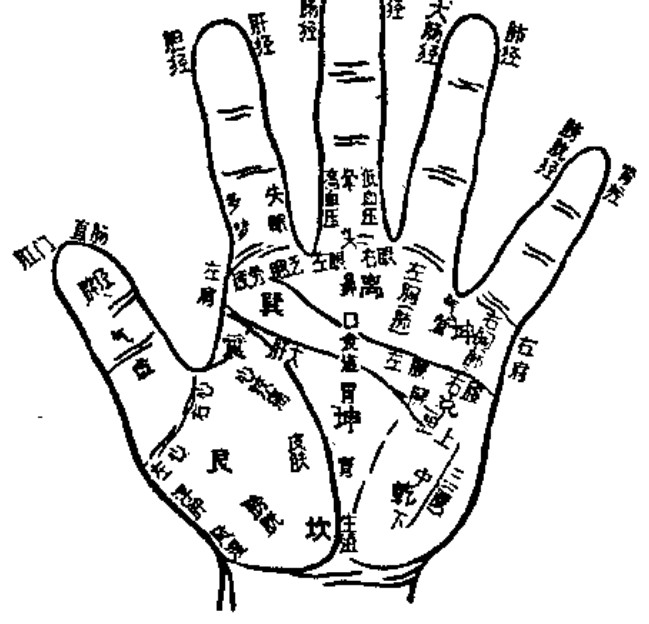
Hand Pulse Diagnosis Chart
It should be noted that Einstein’s journey through the human world began with his astonishment at the compass and ended with “field theory.” The true ultimate goal he pursued was the “unified field theory.” And in ancient Chinese classical texts, the periodicity and rhythm of the internal energy flow within the human body were already linked to the movements of the sun, moon, and stars, and the cycles of day and night, the four seasons. The original Book of Changes (《易经》) was fundamentally a book that inferred human affairs from the Way of Heaven. Among the linguistic materials固有 to China at that time, the symbolic notation of the Book of Changes also became the most appropriate mode of expression for “making the elixir.” Could it be said that ancient China had already touched upon the “unified field theory”? From the current situation, research on biological field energy is generating widespread interest worldwide. Traditional Chinese medicine—such as the meridian theory, qigong, and acupuncture—is being rediscovered and re-evaluated, thereby acquiring unprecedented and entirely new significance. And in the theoretical interpretation of elementary particle research, due to the study of the continuous form of matter—“fields”—we have moved from the ancient Greek atomic theory to the ancient Chinese theory of primal qi (元气). The living elements within ancient Chinese thought have come into direct connection with cutting-edge modern science.
Holding onto something, he said: “His right side is not so good, huh? How come the left side is not so good either? His heartbeat is very slow—strange, the organs are all not so good… the feeling he gives me is that he’s lying down.” He leaned over and asked with concern: “What’s wrong with him? He can’t get out of bed—how did someone so young end up like this?” I stood up and said, “Stop—it’s paraplegia. I’m truly convinced.” For a time, “Old Shandong’s” peculiar ability became a frequent topic of our conversation. Word reached a mother who was quite anxious about her daughter’s future, and she actually brought her daughter to the door. “Old Shandong” looked at her daughter’s hand and said: “Predicting the future—I can’t do that yet (but in theory it should be possible, and that’s exactly what I’m working toward), but I can speak of the past from this hand—your daughter had a great calamity at age sixteen, but she survived it.” According to comrades present at the time, the mother’s face turned deathly pale; her lips trembled for a long while before she said: “I’ve met an immortal today. When she was sixteen, she fell into the Songhua River. No one who fell in from that spot ever came back up, but by some mysterious dispensation she was actually rescued. It took a long time to resuscitate her before she survived.” Then “Old Shandong” turned to the daughter, whose eyes were brimming with tears from the memory: “Don’t worry about your future. You will do well, because your life force is especially strong—which is related to the fact that you survived that great calamity.”
Energy Flow → Field Theory
During the Eastern Han dynasty, Wei Boyang wrote the Zhouyi Shen Tong Qi (《周易参同契》), borrowing the hexagram images of the Zhouyi (Book of Changes) to expound on the meaning of making the elixir. Its fundamental content concerns the exploration of the inner mysteries of the human body; in essence, it is a record of the trajectory of the primal qi
“Old Shandong’s” method of “remote-sensing diagnosis” follows precisely the path of “making the elixir” mentioned in the Shen Tong Qi. What distinguishes him from others is his ability to capture the biological field—“so large as to have no bounds”—emitted by the energy flow within another person’s body. Moreover, when he brings the biological field into the large-scale consideration of the interaction between the cosmic field and the biological field, he can make certain “superhuman” judgments.
Qi Destiny → Byproduct → Methods Requiring Secrecy
At the university, a cadre had contracted a terminal illness and had reached the late stage. Someone invited “Old Shandong” to see the patient. After examining him, he returned and disclosed to friends and family that this person’s allotted span (气数) had run out—no medicine would be of any use. He calculated with his fingers and said: eighteen days before the Beginning of Winter (立冬), he will undoubtedly die. Sure enough, on that day more than two months later, the cadre’s condition deteriorated sharply; resuscitation was ineffective, and he passed away that very night. Those who had heard “Old Shandong’s” prediction
·64·
“Old Shandong” stamped his feet in anxiety and said, “I can hardly save enough people as it is. That wasn’t a prophecy — it was a matter of arithmetic. He lived on Earth, where the Earth’s field and the fields of other celestial bodies acted on him simultaneously. If you work it out according to the Eight Trigrams theory, on that day he was at his weakest. His internal field could no longer adapt to the external field, and he simply could not hold on any longer.”
A New Page in the Canon · The Character Marshall → Western Cuisine → Inlaying Bowls and Science
After this incident, “Old Shandong” vowed never to make such prophecies again, to avoid being hated for no good reason. But after all, he had real ability — if he did not demonstrate it in one area, he would in another. For instance, one year, many people had elevated transaminase levels. When analyzing the causes, some attributed it to excessive application of a certain chemical fertilizer on crops, some said it was caused by the depression brought on by the “Cultural Revolution” in many people, and others looked for reasons in environmental pollution. “Old Shandong” said, “None of these get to the point. The fundamental cause is this year’s ‘great opposition of Jupiter.‘” Starting from the Eight Trigrams theory, he laid out the interrelationships among metal, wood, water, fire, and earth and the five internal organs of the human body — and indeed it was well-founded. No one who heard it was unconvinced. “Old Shandong” was by no means the type to flaunt his cleverness, but whenever the topic came up, his sense of satisfaction always showed: “Whatever epidemic disease should appear each year, it should be possible to make estimates in advance. If the epidemic prevention departments mastered this skill, their work would become much easier.”
If one can diagnose illness through the “biological field,” then one should also be able to treat illness. His method of treating illness was emitting gong [energy]. As we know, emitting gong can cure others’ illnesses, but the person emitting it becomes depleted and exhausted as a result. For a while, I could not find him anywhere and had to go to his home to catch him. By the time he returned home in the evening, he was unwilling to talk much. I thought he had concerns about my reporting on him, but he waved his hand and said that was not it. Only later did I learn that during that period, he was emitting gong every day, and the drain was so great that he did not even have the energy to carry on a conversation.
“Old Shandong’s” search for his roots seems to involve some kind of innate quality. We must start from France at the beginning of the century.
At the beginning of the 20th century, a group of pioneers of the Chinese revolution crossed the oceans to Paris — the distribution center for various new currents of thought in Europe — to work and study. As everyone knows, quite a number of these people now occupy a place in the history of the Chinese Communist Party. However, we must still mention a person whose name is virtually unknown.
After passing through Paris to Lyon, he apprenticed at a bakery to learn Western culinary skills. At the time, the French used a metal frame to hold up large cakes when serving them at the dining table. He felt that this kind of stand was both clumsy and inedible, so he thought it might be improved with a little modification. Before long, the bakery became renowned among Parisian high society for its exclusive cake stand, described as “Nine Dragons Playing with a Pearl, Phoenix Supporting a Jade Plate.” In truth, once the secret was revealed, it was rather amusing: this Chinese man had simply used the traditional Chinese folk method of dough figurine sculpting, making the stand out of colorful dough — which made the bakery owner a fortune. After returning to China, he engaged in training work. At the time, the head chefs of Western cuisine at Beijing’s Grand Hôtel des Wagons-Lits, Tianjin’s Kiessling, and Shanghai’s Tkatsch & Co. were mostly his apprentices.
He was “Old Shandong’s” grandfather.
On the eve of the Chongqing Negotiations between the Nationalists and the Communists, the American special envoy Marshall flew to Yan’an. He never dreamed that at a dining table inside a cave dwelling on the Loess Plateau, the Communists would be able to serve authentic Western cuisine. Little did he know that this was personally prepared by the second-generation successor of the “Old Shandong” family — “Old Shandong’s” father.
What he left to his descendants was not some secret technique or craft, but rather a spirit of innovation in learning. As for what “innovation” meant, he had a unique explanation: it was to integrate Western science and technology with the ancient essence of the East, studying and applying them together. It appears that the next two generations took this lesson thoroughly to heart.
In the 1960s, “Old Shandong’s” father accepted a scientific research challenge: a certain cutting-edge experimental product contained a component — a piece of special glass bonded with an extremely thin copper plate. China did not have this adhesive, and the international market also imposed an embargo against China. The development deadline allowed no delay, yet the task was ultimately completed with savings in both labor and materials while fully meeting quality and quantity standards. Only years later did “Old Shandong” learn how this task had been accomplished. The principle was unbelievably simple — his father had drawn inspiration from the traditional craft methods of itinerant coppersmiths and tin-bowl repairmen, and had referenced the process of inlaying and mending bowls.
This unique “creation” embodied the family ethos: using traditional methods combined with modern science to solve difficult problems. As for this guiding principle, “Old Shandong,” as the third generation, not only bore it deeply in his bones but also put it into practice.
This characteristic “creation” reflected the family’s style of employing traditional methods combined with modern science to solve difficult problems. As the third generation, “Old Shandong” not only kept this guiding principle engraved in his heart but also practiced it diligently.
The nickname “Old Shandong,” apart from indicating his heavy Shandong accent when speaking, also carried a connotation of being “rustic and unsophisticated.” Indeed, when this person conversed, the Zhouyi [Book of Changes] and “Jiang Ziya” were always on his lips — rather out of place in a modern academic institution. But it was precisely this earthy quality, rooted in the national soil, that shaped him.
His name is Zhang Yansheng — the meaning is clear: born in Yan’an. After the nationwide liberation, he returned to his ancestral home in Shandong for elementary school, and in his teens went to Beijing for middle school. In 1964, he was admitted to the Beijing Institute of Aeronautics. While diligently studying aviation technology, through a chance opportunity, he obtained a false hand chart [palm diagnosis chart] from a folk qigong healer. At the time, his father was researching meridian theory and had also mastered part of the hand chart. So Zhang Yansheng combined the two types of hand charts with various human diseases and began his second vocation — amateur research in “palm diagnosis.”
“Old Shandong” — a man who walked from where the Yellow River meets the sea. The entirety of his wisdom comes not from divine revelation but from the most rustic and ancient things in China. It was precisely because he found the root that he was able to explore from root to branch.
If one can diagnose illness by reading the “biological field” through palm reading, remote sensing, studying the resonance between heaven and humanity, and emitting gong — can these seemingly unrelated techniques, when combined, give rise to a unique kind of ability? Yes. In the course of his wide-ranging explorations, at some point he figured out a new approach: inducing a function within the human body that has not yet been recognized. Here I can only briefly note it. “Old Shandong” did not accept the term “human special abilities.” He believed that all human beings, to a greater or lesser extent, possess such functions — especially among school-age children, where it manifests most clearly. The only question is whether it can be induced. It is inappropriate to casually dismiss these as “street tricks” by invoking “dialectical materialism”; true dialectical materialism would never block the pathways to the unknown world. To give an example: one comrade believed that “special abilities” were江湖 charlatanry. “Old Shandong” went to his door and said, “Let me train your two children for two hours.” The comrade reluctantly agreed. After two hours, both children could read characters with their ears. Not only those two children — “Old Shandong” successively trained over 1,100 children in Beijing, Tianjin, the Northeast, Sichuan, and other provinces and cities, each for a little over two hours. Among them, nearly 700 children were able to “recognize” characters with their ears. As for this training method, we follow “Old Shandong’s” wishes — it is to remain confidential for the time being.
He first verified the authenticity of the faulty hand diagrams by comparing the palm readings of people with the same illnesses. Using verified correct pathological locations, he replaced the organ reaction zones on the faulty hand diagrams. Then, based on the palm readings of people with varying degrees of illness, he summarized empirical formulas from changes in shape and color. After more than three years of practice and verification, Zhang Yansheng was essentially able to accurately diagnose the ailments of complete strangers, and in the process he also produced a brand-new hand diagram. (As shown in the figure.)
Naturally, the reactions of those whose illnesses he had diagnosed varied. Those he diagnosed correctly were overjoyed; those he got wrong cursed him behind his back as a practitioner of superstition, witchcraft, and a mental patient. The general public regarded him as honest and trustworthy; his supervisors felt he was not devoting his energy to his work. In light of all this, Zhang Yansheng recognized that if he wanted to completely overturn the notion of “superstition” in people’s minds, mere rebuttal was useless — only convincing scientific arguments would do. To this end, he studied a large number of specialized works in medicine, contemporary philosophy, and modern frontier science, collected a vast amount of material, and on this basis summarized the relationships between palm readings and the Eight Trigrams, Five Elements, viscera, and meridians (see table).
His goal is to establish an entirely new life science
Every existing thing has its rationale for survival; otherwise it could not have endured. Comrade Zhang Yansheng fully recognized the vitality of the endeavor he had undertaken. “My goal is to establish an entirely new life science,” he told me. “We have a whole group of people, but we’re flat broke. Actually, the first step is just to program the hand diagram into a computer — that wouldn’t cost much. Among us ‘witch doctors,’ there are plenty who are well-versed in the natural sciences. It’s just that…”
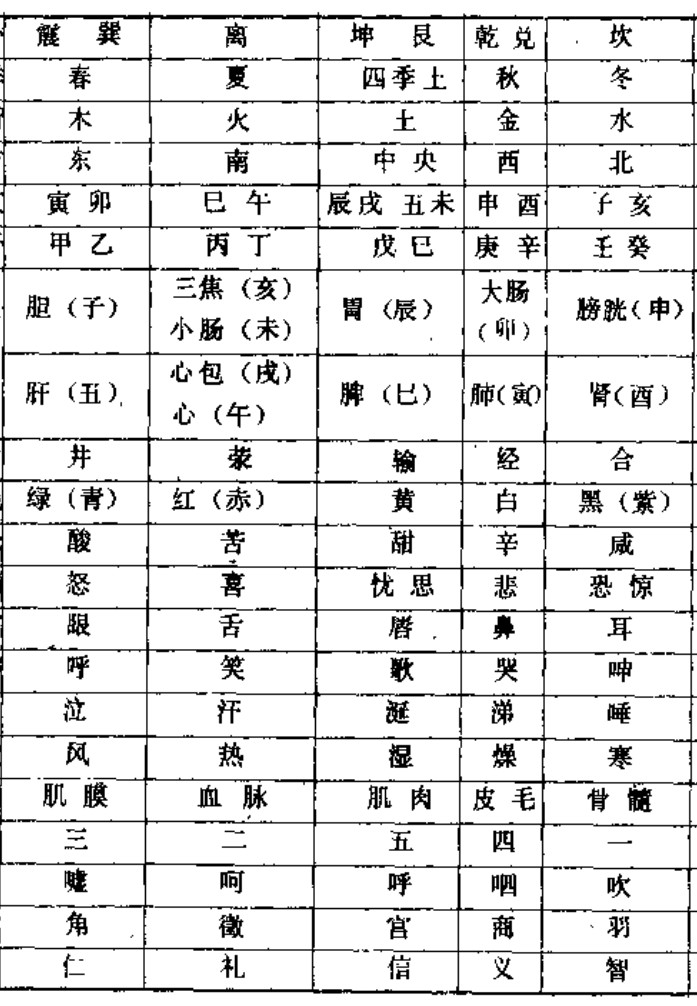
A new discipline capable of fully understanding life — so “cheap,” yet impossible to sell. After sighing over this, the author was reminded of a riddle-poem by Jia Yingchun in Dream of the Red Chamber:
The workings of heaven’s power are inexhaustible, With power but no fortune, meeting is hard; Why all this ceaseless turmoil all day long? It is only because the numbers of yin and yang do not connect.
— Excerpted from Self-Study (《自学》)
| Category | 震巽 | 离 | 坤艮 | 乾兑 | 坎 |
|---|---|---|---|---|---|
| Eight Trigrams | Zhen, Xun | Li | Kun, Gen | Qian, Dui | Kan |
| Four Seasons | Spring | Summer | Late Season | Autumn | Winter |
| Five Elements | Wood | Fire | Earth | Metal | Water |
| Five Directions | East | Center | West | North | |
| Earthly Branches | Yin, Mao | Si, Wu | Chen, Xu, Chou, Wei | Shen, You | Qian, Hai |
| Heavenly Stems | Jia, Yi | Bing, Ding | Wu, Ji | Geng, Xin | Ren, Gui |
| Fu Organs | Gallbladder (Zi) | Pericardium (Xu) | Spleen (Si) | Large Intestine (Mao), Bladder (Shen) | Triple Burner (Hai), Small Intestine (Wei) |
| Zang Organs | Liver (Chou) | Heart (Wu) | Stomach (Chen) | Lung (Yin) | Kidney (You) |
| Five Shu Points | Jing (Well) | Ying (Spring) | Shu (Stream) | Jing (River) | He (Sea) |
| Five Colors | Green (Cyan) | Red (Crimson) | Yellow | White | Black (Purple) |
| Five Tastes | Sour | Bitter | Sweet | Pungent | Salty |
| Five Emotions | Anger | Worry, Thought | Grief | Sorrow | Fear, Fright |
| Five Sense Organs | Eyes | Tongue | Mouth | Nose | Ears |
| Five Sounds | Shout | Laugh | Sing | Cry | Groan |
| Five Fluids | Tears | Sweat | Spittle | Mucus | Saliva |
| Five Pernicious Influences | Wind | Heat | Dampness | Dryness | Cold |
| Five Tissues | Muscles/Membranes | Blood Vessels | Flesh | Skin/Hair | Bone Marrow |
| Five Numbers | Three | Two | Five | Four | One |
| Five Tones | He | Hu | Yan | Chui | Xi |
| Five Modes | Jue | Zhi | Gong | Shang | Yu |
| Five Virtues | Benevolence | Propriety | Trustworthiness | Righteousness | Wisdom |
Page 66
Zhang Yansheng Remains a Mystery
By Wen Cong, correspondent for “Qigong and Science”
…but there are quite a few people who have heard his great name. And so it was that during the break, qigong practitioners attending the conference, upon hearing that Zhang Yansheng had arrived — those who knew him and those who did not — all came over. Some greeted him, some asked him to read their palms, some invited him to run I Ching workshops at their locations… Even Master Yang Meijun of the Dayan Gong made Zhang Yansheng read her palm.
The article “Modern Sorcerer” in the tenth issue of Self-Study magazine in 1984 not only made Zhang Yansheng famous throughout the capital, but also gave him a modest reputation nationwide.
I hurriedly pulled Zhang Yansheng out from the crowd of people surrounding him and “locked” him in a room at the guesthouse to begin the interview.
Zhang Yansheng — what is it all about? Let us listen to the recording.
Time: April 1986 Location: Room 408, Beijing Xiangshan Artillery Guesthouse, “China Qigong Science Research Conference” Participants: Wen Cong, Zhang Yansheng
Wen: May I ask when you started practicing qigong, and also your…
Zhang: It was like this for me — influenced by my father, I initially became interested in the meridian system. My father built the first meridian detection instrument in our country, in 1958. For decades the old man treated patients at home as an amateur; every Sunday the room was full of people, and it was like that for many years. We had a lot of books at home — medical books and whatnot, all sorts of things, both traditional and foreign, and I would read a bit of everything. I attended middle school at Beijing No. 110 Middle School, university at the Beijing Institute of Aeronautics, and after graduation I went to the “Third Front” region for several years before being transferred back to the Beijing Institute of Aeronautics.
In 1979, there was a “qigong fever” in Beijing, and I went to various parks to watch others practice. Because I could not find the right entry point, I did not practice myself and mainly continued to research the meridian system. I started practicing qigong around 1982, and by 1983 I had developed ability (chū gōngfū). I practiced stillness qigong (jìnggōng), read some scattered qigong magazines, and then, based on traditional Chinese medical theory, I would relax and enter tranquility. I practiced quite diligently — all my spare time went into it. I practiced seven or eight hours every day, at home and at the workplace. During the lunch break at work, I practiced the entire time. I did not eat much for lunch either — just grabbed two steamed buns with some pickled vegetables and called it done. I would sit in stillness, and my colleagues thought I was crazy. While I practiced there, they played cards, and they would say: “Hey, he’s sitting there sweating all over — this guy really has genuine skill, he’s not faking it.”
Wen: When you say you developed skill, what specifically do you mean?
Zhang: I could do “remote sensing.” During that period I came into contact with some people with special abilities who could perform “remote sensing” on others — that is, they could see what illness you had. But they kept it secret from me and would not give me their hand diagrams. Based on traditional Chinese medical theory, I first observed from some patients how their illnesses were reflected on their hands. After about three months, I compiled a set of methods, and then I imitated others’ approaches to give…
What exactly is a “sorcerer”?
Let’s see what the Cihai dictionary says? Oh, it makes you jump:
“A person who makes a profession of feigning divine possession and performing sorcery, praying for others.”
And so, in your mind there appears the image of a disheveled little old woman with a face full of flabby flesh, eyes gleaming ferociously, dancing and gesticulating wildly. Of course, it could also be a scrawny old man. In any case, not a good sort.
But what if you add the word “modern” before “sorcerer”?
Then it becomes hard to understand.
And so, Zhang Yansheng, who has been called a “modern sorcerer,” becomes difficult for people to understand. He is a figure with a rather strong flavor of Eastern mysticism. In the 1960s, he graduated from the Beijing Institute of Aeronautics — the cradle of China’s aviation industry and technology — receiving an education in modern science and technology. Yet his mode of behavior resembles that of a sorcerer of old. This is truly a bewildering mystery.
The first time this reporter met Zhang Yansheng was at the “China Qigong Science Research Conference” held in Beijing last year. Someone told me: there, the tall man sitting in the last row of the conference hall — that is Zhang Yansheng. Zhang Yansheng, just past forty, was unremarkable in appearance, wearing a blue cadre-style suit, with a crew cut, looking as though he were always half-squinting at something casually, carrying a dark green nylon bag. He gave the impression of being honest and down-to-earth. He had just returned to Beijing in a hurry after completing an I Ching workshop in Jiaozuo, Henan Province. In a word, he did not look like a “sorcerer.”
What is strange is that although not many people know Zhang Yansheng personally, quite a few have heard of his great name.
·67·
people’s illnesses. By July 1983, one day I was in the school’s laboratory doing a hand diagnosis for a lab technician with stomach problems — I already knew in advance that he had stomach trouble — when suddenly I felt my own stomach area go numb and cold. I had sensed it. Then I examined a lab technician’s mother. She was in Shanghai; I had never met her. Her leg was broken, and her stomach was also bad — I can’t remember exactly, but everything I said was correct.
Interviewer: What exactly is this so-called sensation of yours?
Zhang: Sometimes certain sensations just come out off the cuff, without logic. For example, when I look at a seventy-year-old man, normal logical reasoning would suggest high blood pressure. But when I read the reactions on his hands, it indicated low blood pressure. At the same time, I had an intuitive feeling — how could this old man have low blood pressure? — and I said it aloud casually. The old man said, “That’s right, I do have low blood pressure.”
One time, the Beijing Zhonglong Guang Industrial Company sent someone to Shenzhen to sign a contract. The manager asked me in Beijing, “Do you think my deal will go through?” I said, “It won’t work. The other side has raised new conditions; there will still be haggling.” He said, “That can’t be — we’ve already settled everything, and they sent a telegram calling us to come sign the contract.” Later, around nine in the evening, a long-distance call came from Shenzhen: the other side had backed out, and the contract was not signed. Early the next morning, he sent a car to pick us up: “It’s miraculous! Help me look at a few more deals, will you?”
This sensation is like a person being a computer — various software programs of information are fed in, and the result is displayed. There is a systematic pattern at work here.
This time, I went to Henan to run a Yijing (Book of Changes) training class. A female comrade in the propaganda department at the Jiaozuo Pingguang Machinery Factory had lost her bicycle — it was stolen around ten in the morning. She came to me to divine it. My first sensation was: “You can find this bicycle, and it’s in this direction. Right now the bike is still moving, so you won’t find it now. Go looking when you start work at two or three in the afternoon.” I had calculated using the Eight Trigrams. Sure enough, in the afternoon she called to say the bicycle had been found, exactly in the direction I had indicated.
Interviewer: How did you begin studying the Yijing?
Zhang: After reading an article in the Popular Science Digest about a German’s research on the relationship between the Yijing and the Eight Trigrams, I was very inspired. I also discovered that quite a few people in folk circles were skilled in the Yijing, so I began to study it. My gains from studying the Yijing have been great. In ancient times it was called the “innate natural Yi,” referring to the inherent patterned principles within nature. When I went to Henan to run the class this time, the students said after completing it, “This stuff really works!” I think — what exactly is the reasoning behind this? It will take a much longer time to come to unravel this mystery.
Interviewer: I’d like to ask in passing — your father is a scientist. What does he think of all this?
Zhang: At first he kept saying that university students shouldn’t be engaging in feudal superstition. But one time he came to believe in it. He had an old comrade-in-arms from the Liberation War whom he had been separated from. This man had seven pieces of shrapnel in his body, which my father didn’t know about. When this man came to visit, I took one look and said, “Oh, Uncle, you have three pieces of something in your body.” He said these were three fragments of shrapnel, and that there were seven pieces in all on his body. “Can you tell where the rest are?” I was able to see all of them from his hands. From then on, my father believed. Later, my father even brought a few patients to test me, asking me to read them, and the results were all very accurate. He believed. After that, whenever patients came, he would have me “filter” through them first — this became a diagnostic procedure.
Interviewer: After Self-Study magazine introduced you, what kind of reactions did people have?
Zhang: All kinds of reactions. Of course, there were also opponents and skeptics. My attitude is: whoever doesn’t believe me, I go to their place and let them test me, because I believe what I have is something scientific. Around December 1983, a certain comrade didn’t believe I could induce special abilities in children. I went to his home, spoke with his child for five minutes, and then asked the comrade to go to the next room and write a few characters and place them beside the child’s ear. Fifteen minutes later, the child had “recognized” the characters.
These things, though temporarily difficult for people to accept, actually fall entirely within the scope of ancient philosophy and are a very precious part of China’s ancient heritage.
A certain German doctor visited my father’s home as a guest. I gave him a reading, and he said that my abilities were scientific. He said that presenting them in the form of reportage literature in magazines was not serious and made people read them like mythological novels.
On the evening of May 3rd, I visited Zhang Yansheng’s home.
The Zhang residence is in a relatively nice building in Beijing’s Putaoyuan (Vineyard). Brown woven palm-fiber matting lay on the wooden floor, and on the walls hung calligraphy and paintings gifted to Zhang Yansheng’s father by notable figures such as Zhao Puchu, Qi Gong, and Huang Yongyu.
Zhang Yansheng was in the middle of diagnosing patients. Three people were waiting. He first examined their hands, then conducted follow-up consultations, looked up references in books, and wrote prescriptions. When finished, he said, “Take more of it if it works; if it doesn’t, we’ll reconsider.”
While Zhang Yansheng went to eat, I chatted with a guest in the living room — Li Qing, a coach at the Beijing Chess Club. He said, “For my own illnesses, Zhang Yansheng correctly diagnosed about seventy to eighty percent from my hands. For my wife’s illnesses, everything I knew about, he identified.”
The reporter also asked Zhang Yansheng for a hand diagnosis. Following the principle of “left hand for men, right hand for women,” I extended my left hand for him to read. I should say that he correctly identified the main symptoms. Then I extended my right hand and asked him to read about my wife, who was far away in Guangzhou — and he got about fifty percent correct.
On the evening of November 13th last year, the reporter met Zhang Yansheng again in Guangzhou. This time, he had come to the China Import and Export Commodities Fair in Guangzhou to promote a “qigong information therapeutic device.”
At the fair, word spread from one person to ten, from ten to a hundred, and both Chinese and foreign merchants all came seeking Zhang Yansheng for diagnoses. A thirty-something American arms dealer asked Zhang: “I have a girlfriend in Hong Kong. Can you tell where she’ll go in the future?” Zhang Yansheng said: “Next summer, your girlfriend will go to a place in the west-southwest of the United States. She will live in a place like this — around the house…” Before he could finish, the American exclaimed: “Oh, that’s my home!”
No matter where he went, Zhang Yansheng became a busy man. People in qigong circles sought him out to learn the Yijing; patients came to him for diagnoses; curiosity-seekers surrounded him to watch the spectacle.
This evening was no exception. I couldn’t have a detailed conversation with him, so I just pulled up a chair and watched. There was a man in his thirties having Zhang Yansheng examine his right hand to infer his wife’s state of health.
Although the man did not explicitly state how much Zhang had gotten right, when it came to the point about his wife having something on her chest and back, he told the reporter: “What he says is accurate. My wife did have surgery on her chest as a child, and she also injured her back.”
Zhang Yansheng, to this day, remains an enigma.
No one can fully explain his seemingly so absurd behavior — including himself. What is left here is merely a record of what the reporter saw and heard.
Yet one can believe this much: it is a stepping stone toward the gate of science, because those phenomena that we currently cannot understand but that objectively exist are not necessarily all sorcery.
Excerpted from Qigong and Science
Master of Qigong Transmission
Long had it been heard that the hard qigong master Lu Guozhu possessed extraordinary skills. Without seeing it with one’s own eyes, it was truly hard to believe.
In 1986, Lu Guozhu traveled to Xi’an to perform, and this reporter hurried to the Shaanxi Sports Stadium for an interview.
On the gymnasium carpet lay a long bench. Lu Guozhu lay face-up upon it. After circulating his qi, a wooden plank over four meters long was placed horizontally across his abdomen. Then, twelve young men were called down from the audience. When they all stood on the plank, the thick board was bent into a bow shape, yet Lu Guozhu’s complexion did not change — he remained entirely unharmed. The audience marveled, and thunderous applause erupted throughout the stadium. It is said that during the Korean War, inside air-raid shelters, Lu Guozhu had performed this act for the Volunteer Army soldiers, and the illustrious name “Strongman of Jiangnan” spread far and wide.
Forging Hard Gong with Diligent Exploration — A Profile of the Renowned Hard Qigong Master Lu Guozhu
Wu Binhai
This reporter hurried backstage, where Lu Guozhu was removing his stage makeup. He was a man of short stature, not particularly stout, fifty-three years old this year.
“With so many people standing on top just now, what did you feel?” the reporter asked. Lu Guozhu shook his head: “As long as the qi is circulated well, there isn’t much sensation.” He continued: Hard qigong is a specialized skill within the martial arts, with a history in China of over two thousand years. Practicing hard qigong can strengthen the constitution, serve as self-defense, and also promote health and prevent or treat illness.
At the reporter’s request, Lu Guozhu spoke of his own path of exploring hard qigong. His ancestral home was in Shanghai. At age eleven, he entered the Desheng Martial Arts School run by the elder martial artist Wang Xiaorong, where he studied martial arts and qigong. At nineteen, he joined the Chinese People’s Volunteer Army. After returning, he became a teacher at Helin Primary School in Wuxi, and studied hard qigong under a local practitioner named Yu Zhaoliang. In 1963, Lu Guozhu joined the Dangtu County Acrobatic Troupe in Anhui Province. The deputy head of the troupe, Zeng Baocheng, was a fifth-generation hereditary hard qigong master. Lu Guozhu performed there while studying under Zeng Baocheng with painstaking dedication. He also took advantage of the troupe’s constant travels to visit renowned teachers and experts far and wide. While in Nanjing, he made a special trip to Dangshan, where he called upon the monk Wuchen, then already over seventy years old, and learned the supreme skill of circulating internal qi through the dantian.
Continuously improving his hard qigong skills had become the greatest aspiration of Lu Guozhu’s life. He rose at five o’clock every dawn, sat cross-legged, and diligently practiced stillness gong. To master the Iron Head skill, he first pushed his head against a wall with all his might; in the second stage, he pasted thick paper on the wall and struck it with his head; in the third stage, he directly slammed his head forcefully against the wall. Every step forward demanded an unimaginable toll.
Through decades of painstaking exploration, Lu Guozhu had trained himself in a body of astonishing and extraordinary hard gong skills. In August 1981, at the Shanghai Traditional Martial Arts Exhibition, he stunned the audience with his Neck-Curling Twin Steel Bars and the Thousand-CatlWeight Board Press, ultimately winning first place in the acrobatic category. On a normal basis, he could perform over forty different acts. Among them, the Abdomen-Supported Steel Fork involved pressing the abdomen against the tip of a steel fork, suspending the body in the shape of the character “大” (great), and slowly rotating. It is said that at this point, the pressure borne at the abdominal fulcrum reached over two thousand catties. Currently, Lu Guozhu is a member of the China Society for Human Body Science and a lifelong honorary advisor to the Hong Kong Qigong Science Research Association.
The reporter asked Lu Guozhu to explain why hard qigong can produce such miraculous power. He said: This pertains to the understanding of the human body itself; at present it is still not fully understood, and scientists are researching it. Researchers at Fudan University have tested the external qi I emit and found that it contains infrared radiation and bioelectricity, and also generates a localized magnetic field.
Lu Guozhu told this reporter that he is now focusing his efforts on practicing the Wudang One-Finger Zen. He can already support his entire body in a handstand on a single thumb for half a minute. Lu Guozhu has three daughters. Among them, the eldest, Lu Yanyin, and the third, Lu Yanshuang, have carried on the family tradition, practicing hard qigong and also achieving accomplishments in light gong.
Hard qigong — a wondrous and vast domain. Lu Guozhu, explore bravely onward!
Excerpted from Sports Spring (《体育之春》)
•69•
Displaying Extraordinary Skill: miraculous Qigong that defies comprehension
On the early morning of October 18, 1987, the ancient capital of Xi’an was swept by a chill autumn wind with persistent fine rain. Some of the Qigong masters attending the inaugural meeting of the Qigong Theory and Methods Committee of the China Qigong Research Association were conducting exchange activities in the auditorium of the Fourth Military Medical University. Streams of people continuously poured into this grand auditorium, which could only hold a thousand people. Everyone understood that this day would, because of what they would see and hear, become an extraordinary day, etched deep in memory.
Thought-field adjustment and ancient massage techniques
Remote-sensing diagnosis and magical informational water
The Qigong master Wang Fangping from Fushun, Liaoning Province, began emitting Qi. First, he stood between the two of them, concentrating his mind and calming his Qi, making symmetric, gentle, and slow movements with his hands. Then he walked separately to the patients’ feet and emitted Qi directly at the soles of their feet from a distance of about one meter. Hou Xiaoling’s (let us number her as Patient No. 1; the other as Patient No. 2) legs trembled slightly. Wang then returned to the center to emit Qi. Patient No. 1’s whole body jerked once and she let out a groan, turning from a semi-prone position back to a supine position. At this point, Patient No. 2’s right hand rose to the top of her head. Wang went to Patient No. 2’s feet to emit Qi from a distance of one meter. Patient No. 2’s right leg rose high and did not fall back down. Patient No. 1’s head arched back stiffly, seemingly with great discomfort. Then Patient No. 1 returned to her original position, Patient No. 2’s right hand returned to its original position, Patient No. 1 continued twisting for a while, then stopped. Patient No. 2’s leg returned to its original position and lowered. The adjustment and treatment concluded. Throughout the entire process, Wang Liping had no direct physical contact with the patients, yet he caused them to produce various dynamic responses—quite miraculous—and the audience responded with enthusiastic applause.
Two tables were placed on stage, about one meter apart. Two people lay on their backs on them, with their heads facing each other. One was Hou Xiaoling, a librarian at the library of Chengdu No. 20 Middle School in Sichuan, who appeared to be under thirty years of age and was a breast cancer patient. The other was a woman of about forty, from Xi’an. Both had voluntarily come forward to receive the Qigong master’s Qi emission. The author had already conducted an investigation: today’s Qi emitter and recipients had no possibility of cheating. It was their first meeting.
The second item Wang Fangping performed was: ancient massage technique. He said that the ancient Daoist massage technique is a non-contact massage—massaging the human body’s Qi field—and that its effects are even better than contact massage. He invited four senior cadres onto the stage, among them the highly respected Mr. Hu Meicheng from Zhejiang Province. The four sat in a row, and Wang Liping stood behind them emitting Qi. After emitting Qi, one person on the left had a hand movement, but the others showed no reaction. Wang Liping said there would be results by the next morning.
The second person to take the stage was Mr. Chen Fahuang, Deputy Secretary-General of the Jiangxi Qigong Association, who had begun practicing Qigong at age eight. Two test subjects (one male, one female) stood pressed against the surfaces of two side-by-side long tables for a moment, then stepped away. Chen moved a chair and sat down facing the tables to observe, from a distance of about four meters. His assistant explained that this was diagnosis through observing residual information. Less than two minutes later, Chen wrote down the results on paper and read them aloud to the audience: “The male comrade has Qi stagnation and discomfort in the head, toothache, poor rest (poor sleep), liver hyperactivity, and irritability. The upper lung cavity shows signs of illness, insufficient Qi and blood, possible coronary heart disease. The female comrade has poor sleep, neurasthenia, gastrointestinal problems, and aching joints.”
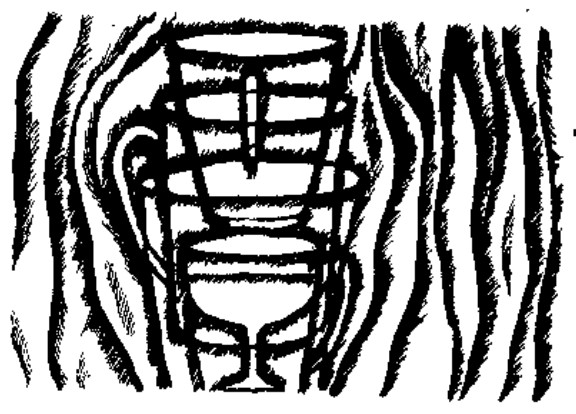
Then the patients were asked to describe their own conditions. The female comrade said: “I have arthritis, colitis, enteritis, atrophic gastritis, intestinal bleeding, and neurasthenia.” The male comrade said: “Starting from yesterday afternoon, my tooth has been hurting terribly. My airways are not good—I have asthma, mild emphysema, and irritability.” This confirmed the diagnosis was correct.
Next came treatment using informational water. Informational water is ordinary tap water that, after being treated by a Qigong master’s Qi emission, carries biological information capable of curing illness. In the past it was called “divine water”; to dispel superstition, it was renamed “informational water.”
The assistant brought four cups of tap water (cold water). Chen Fahuang, about one meter from the water cups, spread his hands with fingers trembling, emitting Qi toward the cups. After about one minute, the four patients were each asked to drink the “informational water.”
Female comrade: “After drinking it, my stomach felt immediately much lighter, and my stomach seems to hardly hurt anymore.” Male comrade: “Before drinking, my tooth was throbbing with pain. With each sip it got a little better, and with another sip it got even better. By the time I finished, my tooth no longer hurt.” Another patient, before drinking the water, had blood pressure measured on the spot at 140/100. After drinking the informational water, it changed to
Ancient Capital Xi’an Qigong · 70 ·
Respectfully Opening the Doors of the Heart, Forever Scaling the Highest Peaks
13080, the doctor was also astonished. The last patient, who originally had liver and stomach problems, drank the information water and told everyone: “I feel better!” The results were so miraculous that everyone smiled and applauded.
Mr. Chen Fahuang’s third item was sensing external qi.
Two standing tables faced each other, two meters apart. One table had a glass panel fitted underneath; originally an iron plate should have been placed there, but due to the limitations of the on-site facilities, glass was used instead. The main point was to prove that even through so many layers of obstruction, the external qi emitted by Mr. Chen could still penetrate. Ten people stood on one side of the table, all extending their right hands with palms facing a circle drawn on the table surface. On the other side of the table, Mr. Chen emitted qi with his fingers. Nearly all the test subjects cried out: “Cold qi! It’s cool!” Mr. Chen changed his hand gesture and emitted qi again; all ten subjects said, “This time it’s hot!” Mr. Chen changed his gesture once more, and they all exclaimed: “Now it’s sore and numb!”
Mr. Chen’s fourth item was the emission of multi-element external qi. The same ten people stood in a row. Mr. Chen gathered his qi, scooped through the air, and immediately extended his open palms for the ten subjects to smell. Everyone said: “Sandalwood fragrance!” Then he reached toward the sky in a plucking gesture; after the ten people smelled it, they all said in unison: “Osmanthus fragrance!” Mr. Chen changed his posture, gathered his qi, and again let them smell; they all said: “How did it change to jasmine fragrance?” Mr. Chen continued emitting qi, his hands tracing arcs, and then let each of the ten people smell his hands individually. They all exclaimed in amazement: “This time it’s magnolia fragrance!” The entire hall erupted in thunderous applause. One female comrade was an acquaintance of mine; after she came down, I asked her repeatedly: “Did you really smell it?” She said: “There’s no faking that!”
Electric Qigong — Direct Application of Electrical Energy by the Human Body
Next to take the stage was Li Qingheng from Beijing, who worked at the General Hospital of the Railway Engineering Command, in his thirties. In 1985, risking his life, he successfully discovered electric qigong, becoming the founder of electric qigong.
First item: Lighting a bulb.
The human body was connected in series with the wire; electric current passed through his body, and the bulb shone brightly as normal — voltage 230V! According to common knowledge, the maximum voltage the human body can withstand is 36 volts. Li Qingheng’s performance sparked people’s contemplation of挖掘 the potential of the human body and breaking through forbidden zones.
Second item: Electric roasting of meat.
Two copper bars skewering fresh mutton were connected respectively to the ground wire and the live wire. Li Qingheng grasped one copper bar in each hand, completing the circuit. In less than a minute, the mutton began to smoke and was nearly cooked through. Li Qingheng showed both hands to the audience: completely unharmed!
Third item: Adjusting voltage.
Li Qingheng was connected in series with the wire. An electrician measured the voltage across Li Qingheng’s two ends. Li Qingheng asked, “How many volts do you need?” “100 volts,” the electrician replied. Li Qingheng closed his eyes in meditation, and the needle on the voltmeter gradually approached 100 volts, finally stopping at exactly 100 volts!
“I want 180 volts,” another comrade shouted loudly. Suddenly the needle rose rapidly, finally stopping at 180 volts.
“200 volts!” “90 volts!” He fulfilled each request one by one.
Fourth item: Electric qigong for treating illness.
A Somewhat Barbarous Hard Qigong
The third person to take the stage was Mr. Lu Guozhu from Shanghai. He picked up an ordinary beer bottle, gathered his qi, and then struck it fiercely against his head. Everyone gasped in alarm. The bottle shattered, but Lu Guozhu’s head was completely unharmed. He smiled faintly at the audience, as if to say: The exciting parts are yet to come!
His second item began. An assistant handed up a long needle. Lu Guozhu gently twisted it and inserted it into the distal tendon of the right brachial muscle, then the needle emerged from the other side — there was no blood at all. He then tied a rope around both ends of the needle, and the other end of the rope was fastened to a large drum weighing approximately twenty-some jin. He gathered his full qi strength and gave a soft shout: “Lift!” The large drum slowly rose off the ground and rotated in a circle with him. Everyone stared in astonishment at that needle, seemingly unwilling to believe this event that defied common sense — yet fact was, after all, fact.
A Record of Qigong Exchange
Hong Yi
BOE
A patient with lung disease held the ground wire in his left hand. Li Qingheng held the live wire in his right hand and used his left hand to touch the patient’s right hand, pressing points along the Lung Meridian. The patient’s reaction was intense — sometimes twitching, sometimes trembling. After the treatment, the patient said he felt very comfortable.
Electric qigong in treating illness differs from electrotherapy, because the “electricity” of electric qigong has been processed through the human body. Not only has its wild nature been eliminated, but it also carries a great deal of biological information — electrical energy has been transformed into biological energy. What it activates is the entire meridian system, which presents us with a wonderful prospect.
The fifth item: experiencing the electric sensation.
Over a dozen people linked together in a series, connected to the live wire and ground wire — this would normally be certain death. Yet Li Qingheng wanted everyone to experience the electric sensation. More than a dozen test subjects followed instructions, holding hands in a chain, with the last person grasping the ground wire. Li Qingheng held the live wire in his right hand and used his left hand to touch the right hand of the first person in line. He could make all the subjects collapse at once — leaving people no choice but to believe that such a technique exists in this world!
“With sensation — strong sensation — no sensation.” Of course, all of this occurred only after the circuit was fully connected. He also had the subjects separately experience the “light” and “sound” of the electricity. Everyone applauded enthusiastically, as if celebrating the birth of something new.
Maya Culture and Chinese Qigong
Finally, Comrade Zhang Zhenhuan, Chairman of the China Qigong Research Association, stepped onto the stage. He said that many things are like window paper — once pierced, they are easily understood. He invited one heavy person and four thin people onto the stage. The heavy person sat in the center, while the remaining four stood symmetrically around him. He had the four thin people extend the index fingers of both hands, bring them together, and insert them respectively under the heavy person’s armpits and behind his knees to lift him. The four people used all their strength but could not budge the heavy person. Indeed, how could this be possible?
Zhang Zhenhuan then told them to stand properly and enter a state of quiescence. Then, moving counterclockwise, they sequentially stacked their hands on top of the heavy person’s head — with no contact between hand and hand, or between hand and head. The first person’s left-hand Laogong acupoint was aligned with the heavy person’s Baihui acupoint. Then each person stacked their right hand on top in sequence. Be careful not to get the order wrong! Then Zhang Zhenhuan counted: one, two, three, four, five, six, seven, eight, nine, ten! (Note that nine would not work, nor would eleven.) After counting, they immediately extended their index fingers in the same manner as before, inserting them under the armpits and behind the knees. “Lift!” The large heavy person was effortlessly raised, his buttocks lifting high off the chair! It is said that this was a game of the Maya people.
Everything thus concluded. All that had occurred was real, yet hard to believe, giving people new insights and food for thought. This was a day of sowing seeds. Qigong, special abilities, and traditional Chinese medicine will enable the Chinese nation to demonstrate its prowess in the field of human body science. Let us open our hearts, think boldly, conduct in-depth research, and courageously scale new heights to welcome the spring of human body science!
(Excerpt from Dang dai tiyu [Contemporary Sports])
Hypnosis
Mr. Tong Junjie specializes in researching Mawangdui qigong. Nearly twenty comrades voluntarily went up on stage and sat according to Mr. Tong’s instructions: seated evenly, palms facing upward on their knees, eyes closed, entering quiescence. He began distributing qi over a large area, raising his hands above his head, palms open and trembling. Shortly after, Tong began individual hypnosis. Using his “sword fingers” (jianzhi), he traced a very regular curving motion up and down in front of one woman. Before long, she fell into a deep sleep — so deep that she had no awareness even when she was carried to the front of the stage and laid down. Tong then focused on a young girl — the same few movements, and this lively little one’s head tilted and she was asleep! One person seemed to want to resist, but after Tong pointed his fingers and made a few tracing motions, that person too tilted their head and entered dreamland. A small child who had been sitting in his father’s arms with wide eyes, curiously looking all around, unexpectedly fell into a deep sleep before Tong even emitted qi toward him. Within approximately twenty minutes, in this brightly lit and very noisy environment, those hypnotized were sweating profusely, yet their pulses were not very fast — around 90 beats per minute.
Qigong
Tuoluo Gong (Top-Spinning Qigong)
Jin Xiaopo
One afternoon, Master Shen Getang, head of the Hangzhou Qigong Guidance Station, was invited to our Zhejiang College of Traditional Chinese Medicine to demonstrate Tuoluo Gong. Although Master Shen was already over fifty years old, he had a ruddy complexion and excellent vitality, weighing well over 150 jin.
After a brief word of courtesy, Master Shen took his stance within a circle roughly two meters square. “Begin!” At the shout, Master Shen began spinning in place — never moving a single step, like a spinning top — hence the name “Tuoluo Gong” (Top-Spinning Qigong). During the practice, he could perform various movements in response to signals (shouts) given to him, such as the “cloud hands” from Taiji and flying movements, with his orientation to east, west, south, and north perfectly maintained. After more than twenty minutes, he had completed 1,060 revolutions. When Master Shen stopped, his breathing was slightly rapid but not labored, he was sweating but not profusely, and his pulse was not very fast — 90 beats per minute.
According to reports, Master Shen practices Tuoluo Gong every day. After four to five years of practice, he cured his asthma — which had plagued him for as long as he could remember and defied all treatment — as well as hypertension, presbyopia, and other age-related ailments.
Although Master Shen had only devoted himself to qigong for four or five years, he drew on multiple qigong methods to create this unique practice — Tuoluo Gong. Master Shen said that during practice, the whole body feels relaxed, the brain enters a vacuum-like state, the mind is completely free of distracting thoughts, and qi sinks to the Dantian — all of which is entirely the same as other forms of qigong. However, this differs from spontaneous qigong: spontaneous qigong cannot be self-controlled and is entirely spontaneous, whereas Tuoluo Gong can be directed at will — stopping whenever one wishes.
(Excerpt from Wulin)
Southern Country Magical Skill, Father and Son Heroes: Observations of Yang Shiguan and His Son Fangfang Treating Illnesses with Qigong
Drafted by a reporter from “Friend of Science”
Jiangnan’s Yangcheng [Guangzhou] is like a poem, and Sun Yat-sen University is like a painting. Magic eyes connect to all directions; remote viewing knows a thousand miles. “Where are famous doctors? Please seek in Yangcheng: with careful skill, diagnosis is like a god.”
In this beautiful institution of higher learning in Guangzhou, banyan trees and kapok trees provide dense canopies, and various wildflowers bloom in all four seasons.
Near the Yang family’s home, patients seeking medical attention flow in an endless stream. Among them was a loving newlywed couple; the wife was named Chen Meili and worked at the Guangzhou Telecommunications Bureau. She was very beautiful, with fair skin, an oval face, big eyes, and a slightly thin build. She also loved her husband very much and often dressed up for him—wearing a beautiful sweater, black gauze fitness pants, and exquisite white leather shoes. To maintain the curvaceous beauty of her figure, she dieted year-round. However, unable to endure her rumbling stomach, she would often chew snacks. Over time, her digestive system lost its balance, and she frequently suffered from abdominal pain. When she went to the hospital for a check-up, she was actually suspected of having cancer! She cried all night; she was only 21 years old and newly married!
The first time she sought help at the Yang household, seven or eight members of Chen Meili’s family escorted her. Everyone looked tense. She was particularly heavy-hearted and melancholic. Doctors had predicted that her end was near!
Teacher Yang and Fangfang, however, said with a smile, “It’s nothing serious. You have gallstones, a blood stasis in your liver, and both your liver and stomach show signs of prolapse. It’s a trivial matter!”
After speaking, Teacher Yang immediately emitted his Qi. Relying on his intention-driven Qigong, in a few dozen seconds, he shattered Chen Meili’s gallstones and expelled the blood stasis. Afterward, Chen Meili came back a few more times, and her illness was completely cured. Her husband expressed: “We will definitely listen to Teacher Yang’s words, keep an eye on her, and have her eat more regular meals.”
Magic Eyes Connect to All Directions, Remote Viewing Knows a Thousand Miles
Yang Shiguan has practiced Daoist Qigong since childhood and has profound “Daoist attainment.” He already possesses extraordinary skills like human body fluoroscopy and remote viewing. Not only can he use his “magic eyes” to accurately and quickly point out the physical condition of visitors, but he can also, based on information provided by visitors about others, quickly and accurately state the physical condition of those absent individuals!
Knowledge Astonishes the Assembly, Articles Spread to Ten Thousand Homes
The land is rich in natural treasures and outstanding people. In the university, there is a teacher named Yang Shiguan. This person—you wouldn’t know unless told, but once told, you’d be startled.
Yang Shiguan is a native of Zhejiang from a scholarly family. He is over 40 years old this year, tall, physically robust, and with a face glowing with health. His son is named Fangfang—fair and clean, a middle school student born in the Year of the Tiger, full of tiger-like vigor. The latter will be discussed later.
Let’s talk about the field of popular science writing. Yang Shiguan can be called a rising star. In just under ten years, he has published over a million words of articles in more than 100 newspapers and periodicals, including Guangming Daily, Chinese Women magazine, Friend of Science magazine, Singapore’s Lianhe Wanbao (United Evening News), and Malaysia’s See Hua Daily News. He has produced 24 television video science and educational films, special features, documentaries, and instructional films, and has also had two major voluminous works printed. Among them, more than a dozen popular science works have won creative awards, yet the author is not a professional writer.
Teacher Yang’s writing scope is very broad. The articles he writes can be divided into more than ten categories, such as modern technology, casual chatting, health and longevity, fitness and beauty, agricultural technology, enterprise management, documentary literature, humorous essays, and science literature, among others.
For an amateur writer, achieving such remarkable results is already quite difficult. However, what is even more astonishing is that Teacher Yang and his son Fangfang are both extraordinarily skilled Qigong masters!
Intention Can Cure Illness, Qi Arrives and Illness is Eliminated
Tang Cuiying, the 13-year-old deputy manager of the Xiajin Company in Xing’an County, Guangxi Province, had experienced facial swelling since 1983. It persisted for a long time without subsiding. Many hospitals performed X-rays, scans, blood tests, and bone marrow aspirations on her, but none could make a definitive diagnosis. They muddle-headedly treated her for “lupus erythematosus.” As a result, her condition worsened with the treatment, leaving her on the verge of death, not knowing if she would last another day. Her husband, Qing Youming, the deputy manager of the Sugar, Tobacco, and Alcohol Company in Xing’an County, Guangxi Province, found Yang Shiguan’s home with a give-it-a-try attitude. Teacher Yang and his son Fangfang, relying solely on the patient’s name and age provided by Qing Youming, definitively diagnosed: “Tang Cuiying’s illness is a stasis in the upper right part of the brain; blood stasis in the swollen area, the size of a lychee; three lymphatic masses; kidney stones the size of a peanut; lumbar bone hyperplasia, between the 4th and 5th vertebrae counting up from the coccyx; facial swelling; and she has also caught a cold in the last two days.” After hearing this, Qing Youming simply could not believe his ears and excitedly repeated, “It’s miraculous! I’ve really met a god!”
Comrade Chen Jiahua, an editor at Shanghai Story magazine, was in very poor health but had never fully understood his own illness. He simply wrote down his name and age, and mailed a strand of hair to Teacher Yang. Yang then diagnosed Chen’s illness with absolute clarity. Editor Chen was deeply convinced and specially wrote a short poem in praise: “Where are famous doctors? Please seek in Yangcheng: with careful skill, diagnosis is like a god.”
At a university, Wu Jin, who worked for the school propaganda department’s journal, was treated—along with journalist Wu Xiaohua and others from business and family circles—by Teacher Yang. They used a new rapid energy-emitting technique called the “Eight Immortals Gathering Gong.” Many practitioners often fail to grasp the essentials and train for years without knowing what “qi” is, yet those who practice under Teacher Yang can emit external qi after just a few days!
Wu Jin had suffered from mammary gland lobular hyperplasia for 10 years. With the assistance of two helpers, Teacher Yang and Fangfang used intention gong to make the patient’s mammary gland lobular hyperplasia mass vanish completely—in just 5 seconds.
Cases like this are too numerous to enumerate. However, Teacher Yang said: “Qigong treatment does not have a one hundred percent cure rate. Many factors are involved. For my patients, I hope that after treatment, they will exercise more to consolidate the therapeutic effects. Treatment is passive; exercise is active.”
Teacher Yang stated: Once the “Eight Immortals Gathering Gong” is perfected, he will definitely present it to society for the benefit of the people. This is not far off.
How Many Wonders Exist — Who Knows Their Secrets?
Yang Shiguan said: “Everyone has a qi circle above their head. Some people have silver circles, some have golden circles, and some are somewhere in between. Golden circles are the best. Fangfang and I have golden circles. And the qi circle above Fangfang’s head actually resembles the shape of the Bagua!”
Fangfang then used a “time-reversal gong” to retrovision someone’s history; a “marriage gong” to see someone’s birth year and month; a “sun god gong” to gaze directly at the sun; a “clairvoyance gong” to see underground rock formations, soil layers, water layers—even to see through the Earth…
The Chinese nation has a long and venerable history. Qigong is infinitely profound and wondrous. Among the nation’s top qigong masters are two individuals—Yang Guan and his son Fangfang. On one hand, they enthusiastically treat the illnesses of the masses; on the other, they train rigorously and investigate creative mechanisms. They strive to advance even further and achieve greater accomplishments.
Creating a New Gong Method — Benefiting Countless People
There are many Chinese qigong methods. Daoist gong alone numbers no fewer than several hundred varieties. Father and son Yang flexibly apply methods based on patients’ conditions—sometimes supplementing, sometimes draining, sometimes lifting, sometimes piercing, sometimes combing, sometimes exploding, sometimes absorbing, sometimes pulling, sometimes vibrating, sometimes extracting—moving freely and naturally. The method they use most frequently is their unique “Double-Yang Clamp Gong.”
Working together, father and son use dual yang qi to clear patients’ meridians, break down lesion sites, expel diseased qi, and infuse true qi. Because two yang forces unite as one, the power is very strong. Teacher Yang and his son “cultivated the Dao” for many years, yet it has only been 5 months since they “emerged from seclusion,” and they have already treated over 1,000 patients.
When father and son use the Double-Yang Clamp Gong for diagnostic consultation, errors generally do not occur. For tumors and stones, their size, shape, color, and position can all be seen accurately. It is only when fatigued or lacking concentration that missed diagnoses tend to occur. The accuracy rate of remote diagnosis exceeds 70%.
Even more praiseworthy is that Teacher Yang grasped the true essence of the ancient Daoist Bagua formation and created the “Heaven-Earth Rotation Gong,” which has already been successfully put into practice.
The Heaven-Earth Rotation Gong relies on a group of 2 to 8 people collectively emitting qi. The number of recipients who can receive the gong for treatment is, in theory, unlimited!
On the night of the Winter Solstice in 1987, at Sun Yat-sen University, Teacher Yang treated faculty and staff patients. At one point, approximately 150 people received the gong simultaneously. Under certain auxiliary conditions, Teacher Yang emitted qi from the Qian position within the Bagua formation. Before long, true qi swirled about and golden light rotated. After completing the gong, everyone present felt extremely comfortable, and when comparing their left and right hands, they were astonished to discover that men’s left hands and women’s right hands differed in length! In some cases, one hand was nearly 2 centimeters longer than the other!
Yang Shiguan also attaches great importance to research on qigong principles. He draws on the strengths of various schools, combined with his own personal experience, and has uniquely created a method for rapidly attaining qi sensation and emitting qi—the “Eight Immortals Gathering Gong.”
Fangfang is a strong-willed and well-behaved child. In earlier years when he was in elementary school, there were many quizzes and exams. He set up his own reward and punishment rules: “Score of 100 — one chicken drumstick; two 100s — one roast chicken; below 95 in math or English, below 85 in Chinese — no meat, fruit, or snacks for one day.” Now, he rises at 6:00 a.m. under the stars to do homework, practices gong with his father, attends school during the day, and treats patients in the evening until midnight before going to sleep. Sleeping only a few hours, his energy remains abundant—his gong power is truly not to be underestimated!
Excerpted from Science and Friends (科学之友)
In October 1987, in Shenzhen, a Hong Kong businessman… [text fragment]… who weighed over 200 jin… was pulled backward more than 10 paces by 13-year-old Fangfang using only his eyes from a distance of over 30 meters!
There are even more incredible things!
In accordance with Fangfang’s request, visitors closed their eyes, stood with arms hanging loosely, and relaxed their bodies. Fangfang emitted qi toward their backs, and using only intention gong, caused them to sway back and forth. Among them was a Hong Kong businessman weighing over 200 jin who was pulled backward more than 10 steps by 13-year-old Fangfang from over 30 meters away using only his gaze!
There are even more inconceivable events!
•74•
Nine minutes later, Xiaoqiu began to change her posture, making rolling, ball-like twisting movements, and I too began to sway from side to side.
At 9:31, Director Qiao relayed a message from the other end: “Now emitting ‘head-turning gong,’” intending to make my head rotate. Coincidentally, as soon as Little Zhang put down the receiver, he noticed that my head had indeed started turning. According to his record at the time: “The head rotated through three large circles, then made four or five small turns.” My colleague’s head also moved slightly, but only as a “slight rotation.”
At 9:36, the exercise concluded. The entire emission process lasted 16 minutes, which astonished both me and my colleagues.
Bai Lin asked over the phone: “Is there someone else standing in the conference room?” I initially answered: “Only two—myself and a colleague surnamed Liu.” Bai Lin insisted: “No, there are three people.” Only then did I recall that Little Liu’s wife had been standing nearby watching. Counting her, there really were three people! How strange—how did Bai Lin know this? Was it remote sensing?
I Personally Experienced Remote Qigong Emission
Last September, I edited and published an article summarizing a report introducing that the three members of the Bai family in Shenyang could use qigong for remote diagnosis of illness, with an accuracy rate of about 73%.
A few days later, I received a phone call saying that the eldest sister, Bai Lin, mentioned in that report was right here in Shenzhen, and asking whether I would like to meet her. Of course I wanted to meet this person with miraculous abilities.
Bai Lin arrived, bringing along her nineteen-year-old daughter Xiaoqiu. Some colleagues in our editorial department asked her to diagnose their illnesses, or wrote the names of relatives and friends on paper for her to diagnose remotely. The diagnostic results could not be called one hundred percent accurate, but they were correct about seventy percent of the time.
A few days later, at the Shenzhen Jingwu Fitness Center, I experienced the effects of qigong external qi treatment for myself.
After I and several colleagues stood ready, Xiaoqiu stood behind us and began emitting qi. I could only feel waves of cool qi coming on; I felt as though I had become a puppet, moving with the emitter’s hand gestures—swaying back and forth, or rocking left and right. Those watching beside us could not help but laugh.
Bai Lin said that when she emitted qi from Xiangmi Lake (the Jingwu Center is on the east side of Xiangmi Lake), I could still receive the information even from the urban area. If I didn’t believe it, we could try it.
Try we did. I remember it was an afternoon in mid-October. Both sides agreed on a time. When the time came, Xiaoqiu would emit qi near Xiangmi Lake, while I would stand at my home in the Yuanling residential area, with my back to Xiangmi Lake.
Xiangmi Lake is at least three or four thousand meters from Yuanling in a straight line. Could the qi she emitted really travel that far? I was half-believing, half-doubting.
But when I stood ready at the agreed-upon time, before long, I felt a force pushing from behind, prompting me to sway back and forth. After a while, another force prompted me to rock from side to side.
The next experiment began at 9:30 p.m. The location was the newspaper office’s conference room. After both sides connected the phone call, neither side hung up. On our side, Little Zhang from the proofreading group took the phone and recorded notes. On the other end, Director Qiao of the Jingwu Center took the phone and recorded notes. I had invited a colleague to participate in the experiment with me.
At 9:20 p.m., Director Qiao relayed information over the phone: “Xiaoqiu has begun emitting Lingzi Gong…”
Little Zhang put down the receiver, turned his head, and saw that I was already swaying violently back and forth. The colleague standing beside me did not sway much in body, but his head was also nodding back and forth.
The second day’s experiment began at 9:30 in the evening, in the newspaper office conference room. After both sides connected the phone call, neither side hung up. On our end, Little Zhang from the proofreading team took the phone call and recorded. On the other end, Director Qiao of the Jingwu Center took the call and recorded. I had invited a colleague to join me in the experiment.
At 9:20 p.m., Director Qiao relayed over the phone: “Xiaoqiu is now emitting Lingzi Gong…”
Little Zhang set down the receiver, turned to look, and saw that I was already swaying violently back and forth. The colleague standing next to me was not swaying much in body, but his head was also moving back and forth.
To verify the reliability of the experiment, I arranged with Bai Lin to conduct another trial.
This time, I decided to take notes personally and invited two other colleagues to serve as experimental subjects. Both of these colleagues had previously received external qi treatment from Xiaoqiu.
Just as the experiment was about to begin and the phone had already been connected, Bai Lin suddenly requested that one more person who had never received Xiaoqiu’s external qi be added to participate. She said with certainty: “You have just such a person in your office right now—female, in the television room.” She even described that person’s appearance: “a somewhat roundish face,” “not a broad forehead.” She was correct—this person was a female intern from the journalism department of Jinan University. However, Bai Lin was slightly off on one point: at the time, this intern was not in the television room but in the office next door to it.
Thus, three people participated in the experiment.
I spread open my notebook on the desk. My colleagues strongly urged me to also stand and participate, and to have someone else take notes instead.
So, one minute before the emission began, I temporarily joined in as well. After twenty minutes, at the agreed-upon time, the emission concluded. In this experiment, I did not experience the miraculous effects of the previous two trials. Of the other colleagues, two felt some qi sensation, while one felt little.
After the experiment, we got on the phone. Xiaoqiu said: “There were four people seated just now—one in front, three in back.”
I was quite astonished. I had joined on the spur of the moment and had not notified them in advance. Moreover, the seating arrangement she described was exactly right—I stood in front, and the other three colleagues stood in a line behind me.
I asked Xiaoqiu how she knew. Xiaoqiu simply said: “I just felt it was so. When I emit qi, I imagine that someone is standing in the room next door, and I direct the emission toward that spot.”
I participated in three remote qigong experiments in total. The first two were remarkably effective; the third produced little sensation.
But with such distances involved, how were these messages communicated, and how did they take effect? I have no way to explain.
Excerpted from “Qigong and Science”
·75·
How Could Qu Chunhua See Through the Five Internal Organs
Humanity has existed from its origins to the present day for one million years. Having developed to our current stage, we are able to actively and dynamically enhance our own latent potential, so that human capabilities can be greatly advanced — this is of course an extraordinary matter. This will be a scientific revolution, a technological revolution, and a revolution that transforms humanity.
— Qian Xuesen
…and it also involves the left leg.” Wang Huimin was astonished, as this was essentially identical to the hospital diagnosis.
When asked what kind of practice he had used to treat Qu Chunhua’s illness, Liu Lianchun replied: “It is the Daoist Fire-Gathering Gold-Carrying Intestinal Practice, passed down through five generations of my family.”
On the afternoon of November 23, a middle-aged woman named Jiang Wanyun from the Daqing Oilfield Transport Company stood before Qu Chunhua and requested a diagnosis. Qu Chunhua took one look and immediately pointed out that the visitor had a tumor the size of a thumbnail on her liver, and that it was red. The patient and her husband were extremely impressed, as this matched exactly the hemangioma (2.3 × 2.4 cm) just diagnosed by B-ultrasound at Harbin Medical University.
To further verify the reliability of her diagnostic ability, after all the patients had left that evening, this author posed as a patient to conduct a test. This author had undergone an appendectomy. When Qu Chunhua was asked to look, she immediately identified the position, direction, and length of the incision, as well as how many stitches had been used — all through several layers of clothing — completely matching the scar on this author’s body. This author then asked her to look at what was inside the right upper pocket of this author’s jacket. After gazing for a moment, Qu Chunhua said: “Inside there is a stack of ten-yuan renminbi, folded in half with the fold opening facing upward.” When taken out and checked, it was indeed exactly as described.
A Curious Report from the Qigong Health and Rehabilitation Hospital of a Dalian Military Unit
A remarkable piece of news emerged from the Qigong Health and Rehabilitation Hospital of a certain Dalian military unit: Qu Chunhua, who had been receiving treatment from Qigong master Liu Lianchun for one year at this hospital, suddenly developed special abilities. Without the aid of any instruments, using only her eyes to scan a patient’s body, she could state which of the five internal organs, six viscera, bones, or blood vessels had disease.
This author conducted on-site follow-up observations for three days and personally witnessed the conditions of thirty-two patients diagnosed by Qu Chunhua. The vast majority matched what the patients already knew about their own conditions. On the morning of November 21, while this author was interviewing at Qu Chunhua’s location, Wang Huimin, former deputy director of the political department of the military unit, came to seek a diagnosis on account of her reputation. Qu Chunhua quietly observed Wang Huimin face-to-face for a few seconds, then said: “Your blood pressure is high, your trachea is not good, you have a lot of phlegm, your left arm is numb, and it also involves the left leg.” Wang Huimin was astonished, as this was essentially identical to the hospital diagnosis.
When asked what kind of practice he had used to treat Qu Chunhua’s illness, Qigong master Liu Lianchun replied: “It is the Daoist Fire-Gathering Gold-Carrying Intestinal Practice, passed down through five generations of my family.”2
This author subsequently interviewed Ma Zhongkui, one of the persons in charge and a military physician at the Qigong Health and Rehabilitation Hospital. He said: “The patients treated here generally achieve quite good results. This is especially true for diseases such as rheumatoid arthritis, post-stroke hemiplegia sequelae (flaccid paralysis type), geriatric syndrome, poliomyelitis sequelae, traumatic paraplegia, rheumatism, and chronic lower back and leg pain, where the effects are significant. Most of these are diseases that other hospitals cannot treat well or even cannot treat at all.” Military Physician Ma also described the advantages of Qigong treatment, such as not requiring medication and enabling rapid recovery. This author then proceeded to the hospital ward to interview several patients currently undergoing treatment.
Wang Suqing, a 34-year-old from Shenyang, suddenly fell ill eight years ago while in her postpartum confinement period, developing a high fever exceeding 40 degrees Celsius. Every possible measure was tried, but the high fever would not subside. In the end, ice blocks had to be placed around her body to bring the temperature down. After the fever broke, she became completely paralyzed, with muscle atrophy, reduced to skin and bones. After three months of treatment, she can now walk independently and manage her daily life. Her atrophied muscles have begun to grow back, and she has regained her feminine fullness. Liu Ronghong, a 16-year-old from Zhuanghe County, suffered from rheumatoid arthritis and polymyositis, with general weakness, unsteady gait, and frequent falls. After half a month of treatment, she was already bouncing around and essentially the same as a normal person.
Why Could Qu Chunhua See Through the Five Internal Organs of the Human Body?
According to Qigong master Liu Lianchun, Qu Chunhua is twenty-six years old this year. When she was three months old, she developed chorea and was unable to care for herself. Beginning in 1984, she received Qigong treatment from Qigong master Liu Lianchun, with intermittent treatment lasting nearly a year. She had already recovered to muscle strength grade three, could knit sweaters, carry meals, and walk slowly, with her language impairment noticeably reduced. On October 20, 1986, she returned for further treatment. One week later, on October 28, her special abilities were suddenly triggered. Qu Chunhua does not yet understand human physiological and anatomical knowledge; for some conditions, she can only describe the phenomenon she sees but cannot diagnose what the disease is. Currently, two doctors are responsible for giving her lessons to help her master human anatomy and other medical knowledge as quickly as possible.
Excerpted from “Qigong and Science”
External Qigong Energy Triggered Her Special Abilities · External Qigong Energy Triggered Her Special Abilities
How Could Liu Shikun See External Qi?
Zhang Ping
(Excerpted from “Qigong and Science”)
(Humorous Cartoon: Treating Patients According to Their Specific Conditions)
The patient, Liu Shikun, female, 37 years old, a worker. Diagnosed with neurosis, her illness course lasted four years. Her symptom was a daily feeling of never being fully awake; she could fall asleep at any time. The patient was in great distress. Over the years, she had tried many treatments without good results. In June 1986, she came to the Qigong Treatment Room of the Northeast General Pharmaceutical Factory. After two courses of qigong therapy, not only did her condition improve, but she also became able to see external qi.
Once, while I was emitting external qi to treat someone else, she suddenly said that there was a smoke-like substance coming from the doctor’s body, though she couldn’t clearly articulate it. Upon further induction by the author, she said she saw it clearly: not only could she see the shape of the qi, but she could also distinguish its color. Because of this, I had her observe from the side every time I administered treatment. She said that the external qi emitted by the doctor was white, columnar, and varied in thickness; the qi from the center of the palm was thicker and lighter in color, while the qi from the fingers was thinner and slightly darker in color, especially from the index and middle fingers. When the author emitted qi from a distance of 3 meters from the patient, she said the external qi could act upon the patient’s body and sometimes even penetrate through it. When the author emitted qi from the Laogong point to the Baihui point, she could see the external qi spread out flat like smoke, covering the top of the patient’s head. On another occasion, the author was feeling slightly unwell but felt she could still persevere in treating others. As she was observing from the side, when I emitted qi, she suddenly asked, “Doctor Zhang, why is the qi coming from your fingers black today?” My heart skipped a beat at the time; her eyes were truly sharp! Regarding this black-colored qi, I thought: first, it might be my own diseased qi; second, it might be some pathogenic aura in the surroundings that I absorbed and then emitted out. To be responsible to the patient, I suspended treatments for two days.
(Humorous Cartoon: Tug-of-War by Xu Feigou)
Liu Shikun had never practiced qigong before, and this was also her first time receiving qigong treatment. In just over 20 days, not only did her condition alleviate to a certain extent, but she was also able to see external qi. This was the first time I had discovered this among my patients. There are not many patients with this type of lethargic symptom. My treatment method for her was to supplement qi by leveling the Laigong point to the Baihui point to regulate and nourish the brain’s nerves, and to emit qi for guidance in order to open up the Ren and Du meridians. This patient was very sensitive to external qi, moving violently during guidance, and she felt very comfortable after each treatment. This was also the case when she observed the external qi; she showed no signs of fatigue at all.
(Humorous Cartoon)
Qigong is a very popular mass movement, but regarding the effects produced by qigong, there are some things we currently have no way of truly explaining. Taking the matter of seeing external qi as an example, those who can emit qi are not necessarily able to see it. I think if people who possess this ability to see external qi were given focused training and cultivation, it would be of certain help to our research on qigong external qi. On the other hand, they can play a role in inspecting and gatekeeping the quality and demeanor of those who conduct external qi treatments.
First Place3
Under the guidance of the theories and viewpoints regarding human special abilities found in He Ming’s book Exploring Qigong, we successfully used qigong practice to stimulate and strengthen the human body, enabling it to manifest special abilities such as extrasensory vision and psychokinesis. After more than a year of practice and effort, we have summarized a complete set of qigong methods for stimulating and strengthening human special abilities — the “Huitong Dantian Gong” — which has proven effective in practice, thereby breaking the previously held assumption that special abilities are merely accidental or exceptional phenomena. Through practicing this set of exercises, the accidental can be made natural, and the exceptional can be made ordinary. For adolescents possessing certain characteristics, practicing this set of exercises can guarantee the emergence of certain special abilities within one to three months, with long-term retention without decline.
We have conducted many experiments on these special abilities. The experimental conditions are reported below.
Experimental Report on Qigong-Stimulated Special Abilities
Di Zhanxiong, President of the Baoding Qigong Association
I. Special Ability Perceivers Can See the Qi Emitted by the Human Body
- Those possessing extrasensory vision see luminous light of various colors emitted from the fingertips of qigong practitioners. The light maintains orderly and strictly defined boundaries from the starting point, forming light columns, as if thin-walled glass tubes were filled with gaseous particles, with these gases flowing.
These light columns or particles can penetrate brick walls, lead plates, and iron plates.
To verify their findings, we had qigong practitioners extend several fingers through a wall to emit qi, and the special ability perceivers were all able to identify the number of fingers extended.
The principle of this experiment is that when a practitioner emitting external qi extends their fingers and uses mental intent to direct qi out from the fingertips, the same number of light columns as extended fingers will pass through the wall. The number of light columns determines the number of fingers, and they can accurately report the number of fingers, thus confirming that they can see the light columns. Since these light columns are the external qi emitted by the practitioner, this also proves that they can see qi.
To promote qigong and help more people understand that qi is a material substance with objective existence, we designed the “seeing fingers through a wall” demonstration. The specific method is to let the audience decide the number of fingers extended, and the special ability perceiver reports the number of fingers extended through a brick wall twenty-four centimeters or thicker.
We have performed this demonstration several times at the junior college class of the Economics Department of Hebei University, the Baoding Municipal People’s Congress and Political Consultative Conference, and the Baoding Municipal Library, with over three hundred cadres, members of the public, teachers, and students participating. All performances were successful.
-
The qi emitted from the head of a qigong practitioner requires no mental intent. Generally, practitioners have a light column above the head, appearing white, gray, or pale yellow. Its height varies, but none has been found to exceed three chi and three cun. Those with deeper cultivation have one to five halos, in white, yellow, red, blue, green, and other colors, extremely vivid. After the Heavenly Gate acupoint opens, a different scene appears (generally, the halos and light columns both disappear, etc.).
-
The qi emitted from the toes of qigong practitioners is blue and is called turbid qi. In well-cultivated practitioners, this qi can also turn from blue to white, but its purity will always be lower than the color of qi emitted from other parts of the body.
II. Special Ability Perceivers Can See Qi in Nature
Special ability perceivers have seen that qi universally exists in nature.
First is the earth. The qi extracted from the earth is either white or gray in color. When we practice and draw qi from the earth, it is best to do so where there is white qi.
There is qi existing in tree trunks and their surroundings. Previously, we knew that the qi of poplar trees is white, the qi of willow trees is yellow, and the qi of apple trees and parasol trees is red. Through observation with extrasensory vision, the above situations were further confirmed. However, the qi of pine trees is white rather than green, and the qi of cypress trees is purple rather than black — this differs from what is recorded in some books.
Additionally, it was found that the trunks of some trees (mostly cypress trees) suddenly appear yellow or golden yellow; qi clusters condense at the roots of some trees, white and luminous; some trees are entwined by chain-like qi masses, and so on.
When people practice qigong facing a tree, the person and the tree exchange qi in a wide variety of ways. For example, qi may be emitted from the Baihui acupoint and returned through the Shenque acupoint, with the tree in between — this is one form of circulation.
Qi also exists in the atmosphere and the sky. In the atmosphere, there are flowing qi clusters, golden yellow in color and of various shapes, such as elongated strips, circles, and so on. They can be made to enter the human body through special methods.
So, how can we verify that what they say is true? People have never doubted the existence of stars, simply because most people in the world have seen them. For qi in nature, those who can see it are extremely few. If through qigong practice more than fifty percent of the total population could possess extrasensory special abilities, the above problem would be fundamentally solved. Although this can currently be accomplished, it has not yet been done, making it difficult for people to believe. Nevertheless, we can also conduct several experiments to indirectly verify these claims.
We had a qigong practitioner write a simple character in the air or on a wall using qi, and several days later had the special ability perceiver identify it — they could still know what character had been written.
We had a practitioner walk a certain distance, pass through a doorway, and descend a staircase. Several days later, the special ability perceiver could still identify the practitioner’s walking trajectory.
The principle of the above experiments is that the character written by the practitioner with qi, or the qi left in nature during walking, can be preserved in nature for a long time and be recognized by the special ability perceiver — that is, qi does exist in nature.
Additionally, we can also introduce qi clusters into the human body. Under conditions where multiple special ability perceivers had not communicated with each other, they individually described the shape, location, color, and other characteristics of the qi clusters within the human body. If all descriptions match, it further confirms the objective existence of qi.
78
Nature:
Having examined illnesses hundreds of times, I conducted透视 examinations for many individuals including Jiang Bing-sheng, former Director of the Hebei Provincial Physical Culture and Sports Commission, and the world-renowned scholar Xia Yu, among others. I also established a clairvoyant diagnostic service at the Baoding City East Gate Qigong Guidance Station to perform examinations for the general public, with excellent results. Here is the testimonial from Jiang Bing-sheng, former Director of the Hebei Provincial Physical Culture and Sports Commission, as an example:
I suffered from facial nerve paralysis starting on April 13. After more than a month of Chinese herbal medicine treatment, it was not fully cured. From May 17 to 19, I came to Baoding and received qigong treatment, which essentially cured it. Only because my time was too limited could I not continue treatment in Baoding.
A clairvoyant examination of my body was conducted using extraordinary functions (ESP), and the following conditions were identified: migraine headaches, tracheitis, enteritis, heart disease, osteoarthritis in both knees, and pain in the left forearm. All were completely accurate. After brief treatment, the pain in my left knee joint disappeared, and my right knee joint improved greatly. After qigong regulation of my heart, I felt extremely comfortable. Previously, it was easy for my illness to flare up on overcast or rainy days, but this time, even though I encountered rainy weather in Baoding, the illness did not recur.
A remote-viewing examination of my relatives in Shijiazhuang City indicated the following: my wife Yu Jie suffers from migraines, spleen deficiency, and a bad right leg; my son Jiang Bin has lower back pain and heart disease; my daughter-in-law has poor gastrointestinal function, a weak spleen, and dizziness; my granddaughter has problems with both her heart and liver. The conditions of all four people described above were accurate.
Jiang Bing-sheng, May 19, 1986 Zhang Yu-lei, Office Director of the Baoding City Qigong Association
Clairvoyant perception of the human body can be classified, based on the relationship with the person being examined, into direct clairvoyance and indirect clairvoyance. According to the distance from the person being examined, it is further divided into three types: short-range, medium-range, and long-range.
So-called indirect clairvoyance requires a third party as an intermediary. In the example above, when examining Jiang Bing-sheng’s relatives, Jiang Bing-sheng himself acted as the third party. He met two conditions: first, he was within the contact range of the person with extraordinary functions; second, he could provide an information channel for the person being examined. The provision of this information channel must meet the following two requirements: (1) the third party must have an existing exchange of information with the person being examined, meaning the third party must know them; (2) the third party must be able to direct attention toward the person being examined, thereby opening the information channel. For example, before examining Jiang’s relatives, he had made the request: “Please check for me—how are the conditions of my wife Yu Jie, my son Jiang Bin, my daughter-in-law, and my granddaughter?” This is one method of establishing the information channel.
Clairvoyance that does not require a third party is considered direct clairvoyance.
Based on the distance between the examiner and the examined, clairvoyance can be categorized into short-range (tens of li), medium-range (hundreds of li), and long-range (thousands of li).
Based on the purpose of the examination, clairvoyance can be divided into: disease clairvoyance (including skeletal clairvoyance), meridian clairvoyance, and qi circulation clairvoyance.
This type of qi is extremely closely related to human beings; the parts of the human body covered by black or gray qi are precisely where the lesions are located; gold and silver can dispel black qi…
So-called disease clairvoyance is essentially the ability to see qi carrying abnormal information. The organ enveloped by this qi is the diseased organ, and the severity of the illness correlates with the density of this qi. Furthermore, qi carrying abnormal information is mostly black in color. Therefore, discovering areas covered by black or gray qi reveals the location of the lesion. The matter is just that simple, so clairvoyantly diagnosing illnesses in the human body requires almost no time.
Qi circulation clairvoyance is used to guide qigong practice and to evaluate the effects of various practices’ movements and intentions on qi, as well as their efficacy.
III. Clairvoyant Perception of Meridians and Acupoints by Individuals with Extraordinary Functions
Individuals with extraordinary functions can not only “internally visualize” their own meridians and acupoints but also clairvoyantly perceive the meridians and acupoints of others.
They observe that human meridians appear as lines, varying in thickness from 1 millimeter to 8 millimeters. Some individuals have thicker meridians, while others have thinner ones. The thickness of the meridians represents certain characteristics of a person’s personality, and through qigong training, meridians can thicken, thereby altering the personality accordingly. The color of the meridians is grayish-white when the body is healthy. In individuals who are healthy or practice qigong, the meridians appear white and luminous. Conversely, if the meridians are dark gray or broken, it indicates that the meridians are blocked.
Acupoints appear as white circular dots, ranging in size from a mung bean to a broad bean, varying from person to person. Individuals with thicker meridians also have larger acupoints.
We conducted experiments on meridians and acupoints. The meridians and acupoints traced with a pen by an individual with extraordinary functions on themselves or others can be called a living “bronze model” [referring to traditional Chinese acupuncture models]. The locations of the acupoints and the pathways of the meridians generally conform to those currently understood.
Being able to see the human body’s meridians and acupoints has created immense convenience for treating diseases. Not only does it allow for highly accurate mastery of acupoint locations, but more importantly, it has revealed the relationship between acupoints and lesions. For example, a patient suffering from headaches did not experience relief even after qi was emitted to unblock and treat the condition. At that point, we applied pressure to the Shenmen acupoint (神门) and observed that the brightness in the head increased, and the black qi surfaced. We then proceeded to emit qi for unblockage, and the headache stopped immediately.
To this end, we stimulated different acupoints separately and observed the changes in the body’s brightness, resulting in a correlation table between each acupoint and the corresponding parts of the human body. Furthermore, by simultaneously stimulating two or more acupoints, we observed the subsequent changes. Sometimes the brightened area would become even brighter, and sometimes it would darken. Therefore, when utilizing qi emission or acupuncture for treatment, the correct combination of acupoints should be selected, and incorrect combinations should be avoided. We are prepared to offer these findings to medical professionals for reference at any time.
IV. Clairvoyant Perception of the Human Body by Individuals with Extraordinary Functions
The practice of clairvoyantly examining the human body has been conducted thousands of times. This includes the public demonstrations mentioned above, as well as diagnostic examinations for cadres and the masses in Mancheng County, Baoding City. Based on these findings, we can consider this phenomenon to be genuine.
V. Individuals with Extraordinary Functions Can Perceive Changes in Qi During Disease Treatment
1. Emitting External Qi to Treat Diseases
When a qigong master emits external qi to a patient or emits qi for unblockage, an individual with extrasensory visual perception can see through human body clairvoyance that white qi is devouring and driving away the black qi. Once the white qi replaces the black qi, the illness is cured.
·79·
Sometimes the black qi recedes very slowly, and sometimes it does not recede at all; its appearance is like a mercury column rising and falling. It can also move within the muscles. In such cases, measures should be taken: for heart disease, one should pinch the first joint of the patient’s middle finger with the fingers and emit qi; it looks as though water is being poured into a bucket. It can also travel within the bones.
Eight: The Magical Method of Exchanging Qi
Through human body clairvoyance, it was discovered that qi carrying abnormal information—black qi—shrouds the diseased area. To achieve the goal of curing illness, we experimented with a new method—the Exchange Qi Method. Using certain techniques, the black qi inside the body is connected with the qi of a tree, forming a channel. Sometimes the black qi will flow along the channel into the tree, and the tree’s qi will flow back along the channel to replenish it; at this point the illness shows improvement.
Qi is a kind of substance, and like all other substances in the world, it obeys the law of conservation of matter. Through clairvoyant observation by persons with special abilities, it was discovered that during the process of emitting qi for treatment, the black qi does not disappear; rather, it escapes in a specific direction. Because it shares many affinities with the diseased organ, it can easily return to the human body—and that is precisely when the illness relapses.
- Drug Treatment of Diseases
We observed the changes in the patient’s qi after taking medication. Through clairvoyance, it was found that in the diseased area, the qi carrying abnormal information disperses and shifts under the effect of the medication, but no instances of it escaping outside the body were observed.
Nine: Gold and Silver Can Expel Black Qi
Persons with special abilities discovered an astonishing relationship between gold, silver, and qi. Gold and silver can gather together white and yellow qi, and can also drive away black qi. How can this be proven? Our special ability holders can effortlessly find gold and silver that you have hidden securely. We once gave a demonstration at the home of Xi Guang, Vice Chairman of the Hebei Provincial Committee of the Chinese People’s Political Consultative Conference. His wife placed a silver-alloy bracelet in her pocket. At the time, three special ability holders were present, and all discovered that there was a circular ring in the pocket emitting a white light.
That gold and silver can expel black qi is also a fact they observed. When qigong masters treat patients, if they carry gold or silver on their person, the patient’s black qi will not invade their body. It is understood that most qigong masters, after finishing work, frequently need to expel the diseased qi that has invaded their own bodies during treatment.
Through these experiments, through this window opened by special abilities, and through the wisdom eye of those with special abilities, information has emerged about a primordial, subtle substance called qi that exists within the human body, in nature, and throughout the cosmos—a substance intimately connected to humanity. We feel deeply that our understanding of qi is like that of a blind person who does not know of the sun, or like a nearsighted person who cannot see the stars in the night sky—we are sorely lacking in understanding.
Excerpted from Eastern Qigong (Dongfang Qigong)
Mechanical and Electronic Youth Store in front of the agency
This department’s mailing address: West Central Road, Cangzhou City, Hebei Province
Please write the user’s delivery address and name clearly and in detail so that items can be dispatched.
Upon receipt of payment, we ship free of charge by mail. Please note remittance.
This department handles both wholesale and retail business long-term. Those interested should remit payment via postal money order.
Products are guaranteed with three warranties and come with instruction manuals.
To meet user demand, we have set up a mail-order division here with stock on hand.
Prolongs youthfulness. Each bottle is eight yuan. For convenience:
For those without illness, regular use can prevent wrinkles and delay skin aging.
For acne, eczema, psoriasis, and other facial skin diseases, the cure rate reaches 90%.
It has a highly effective cosmetic and skin-nourishing function. For acne, blemishes, and rosacea:
Verified jointly by provincial-level and above hospitals and renowned experts. Each bottle is eight yuan and fifty cents.
The results are convenient for self-use with simple methods.
It removes spots painlessly without leaving marks, and is non-irritating.
The visible effectiveness rate can reach 100%. One application.
Through clinical trials, this lotion has been verified to be highly effective for facial freckles.
Chinese People’s Liberation Army Bethune International Peace Hospital.
Refined and formulated using precious Chinese medicinal herbs and premium chemical ingredients. Passed inspection by the Provincial Science and Technology Commission and the Light Industry Department.
Forever Youthful Beauty
Delays Facial Aging
This product is the latest achievement of the PLA General Hospital.
Please use the Powerful Extra-Strength |—High-Efficiency Beauty Agent
Beauty Freckle Lotion
Wang Changbo received
Hands That Bring Captivating Fragrance
One hundred people in a television hall watched a qigong performance. The qigong master Wang Xinde raised and waved both hands, and suddenly waves of pure fragrance assailed the nostrils. The audience was dumbfounded to find themselves “enjoying a feast for the nose.” Some said it smelled like osmanthus, some said it resembled the fragrance of jasmine, and others said it was like white orchid. The majority, however, said it was the clear fragrance of sandalwood. Ninety-five percent of those present experienced it. One of the leading cadres present could not help but say: “In the past, I absolutely did not believe it. This time, having smelled it with my own nose, I cannot but believe. As for a theoretical explanation, that is a matter for the experts.”
Does the human body have a material basis for emitting fragrance? While studying “olfaction and human behavior” and searching for “evidence of chemical communication between people,” foreign scientists discovered that “among the volatile components of male sweat and urine, some happen to be characteristically described as ‘fragrant.‘” A recent report has confirmed that sweat contains musk-like components (see American Science News). But why do we not detect it? This is because its inherent fragrance is too faint.
Having found the chemical substances through which the human body emits fragrance, what then can take on the task of amplifying and stimulating this fragrance? The answer is: zhenqi (true qi).
That qigong can strengthen zhenqi and activate latent human functions has already been confirmed by many experiments. For example, qigong can increase bile, gastric juice, saliva, and other endocrine secretions — so could the fragrance inherently present in the human body be excluded?! There is another possibility: could the inductive effect of the special human field generated by the qigong master have stimulated people’s long-dormant innate sense of smell, causing it to “return from extinction”?!
In the face of a complex and puzzling case, despite all manner of modern scientific methods available, humanity often still has to “resort” to police dogs with their keen sense of smell. In fact, animals not only possess the ability to “receive” scents but also have another type of characteristic, which we might call “emission.” Beyond the well-known musk deer that can emit the intoxicating and pleasant fragrance of musk, the yellow weasel is also a worthy “emission-type” exemplar: did you know that when it encounters a relentlessly pursuing enemy, it employs its “ultimate skill” and uses its foul spray to drive the opponent away?
So then, is humanity hopelessly outmatched by animals when it comes to the emission and reception of scent? The answer is: not entirely. From ancient times to the present, accomplished qigong practitioners have been able to emit a mysterious fragrance — the danxiang (elixir fragrance).
After the Daoist qigong master Qiu Changchun of the Yuan dynasty passed away, his remains emitted “a wondrous fragrance that lingered for days” (see The Complete Account of Patriarch Qiu, the Perfect Man Who Expounded the Dao). The author had the good fortune to visit the modern mountain Daoist Kuang Changxiu and noticed that his body emitted waves of a clear fragrance similar to sandalwood. This was in the reception room of the guesthouse where the Daoist conference was held in Beijing. As I looked around curiously, searching for the source of the fragrance, Master Kuang smiled knowingly and told me: “When one’s practice reaches a certain level, it comes naturally. This fragrance is the same as a certain small grass — I named that grass danxiang cao (elixir fragrance grass).” The mysterious danxiang is not limited to elderly masters. Wang Xinde, a qigong master in his thirties of the “Shaolin Vajra Divine Natural Gate,” also gave an unprecedented danxiang performance. On October 6, 1982, at the Zhejiang Hemp Textile Factory, over two hundred people filed in batches into a hundred-square-meter television hall to watch a qigong performance. They saw qigong master Wang Xinde raise and wave both hands, and suddenly waves of pure fragrance assailed the nostrils. The audience was dumbfounded to be “enjoying a feast for the nose.” Some said it smelled like osmanthus, some said it resembled jasmine, others said it was like white orchid blossoms, while the majority said it was the clear fragrance of sandalwood. Ninety-five percent of those present experienced it. Among them, one leading cadre could not help but say: “In the past, I absolutely did not believe it. This time I have smelled it with my own nose and cannot but believe it. As for a theoretical explanation, that is a matter for the experts.”
Does the human body have a material basis for emitting fragrance? While studying “olfaction and human behavior” and searching for “evidence of chemical communication between humans,” foreign scientists discovered that “among the volatile components of male sweat and urine, certain ones are quite often characterized as being ‘fragrant.‘” A recent report confirmed that sweat contains musk components (see American Science News). But why are we unable to detect them? Because their intrinsic fragrance is too faint.
Having found the chemical substance through which the human body emits fragrance, what can shoulder the task of amplifying and stimulating that fragrance? The answer is: zhenqi (true qi).
That qigong can enhance zhenqi and activate the body’s latent functions has already been confirmed by many experiments — for instance, qigong can increase bile, gastric fluid, saliva, and other endocrine substances. Can the fragrance inherently present in the human body then be excluded?! There is another possibility: could the inductive action of the special human field produced by the qigong master have reawakened people’s long-atrophied innate olfactory sense, so that it was “lost and found again”?!
In short, one explanation is amplified emission, and the other is stimulated reception. Most likely the former is primary and the latter supplementary. When a certain journalist interviewed the modern mountain Daoist Master Kuang, it was discovered that there were plenty of mosquitoes in the area, yet Master Kuang was never bitten. His natural “mosquito coil” and “Florida water” efficacy suggests to us that accomplished qigong practitioners do indeed emit a distinctive fragrance.
Dialectical materialism tells us: “There are only things in the world that have not yet been recognized, but there are no things that cannot be recognized.” We firmly believe that tracking down the wondrous fragrance is just around the corner.
Excerpted from Chinese Qigong (Zhonghua Qigong)
The World’s First Qigong Doctor
On the morning of June 29, 1987, at the Oriental Institute of Venice, Italy, a 24-year-old female doctoral candidate named Monica Esposito defended her doctoral dissertation entitled Chinese Qigong. During the defense, Monica answered all questions fluently and received unanimous approval. In the afternoon, the director conferred upon Monica her doctoral degree certificate, making her the world’s first Qigong Doctor!
Monica had previously studied at Fudan University in Shanghai, where she received specific guidance from Dr. Shen Hongxun, a honorary council member of the China Qigong Research Association. Monica not only mastered Chinese qigong theory but also learned the methods of diagnosing illness with external qi and treating patients with external qi.
The Oriental Institute of Venice is now preparing to publish her dissertation. Monica stated that after graduation, she will dedicate herself to the cause of qigong.
Excerpted from Qigong and Science (Qigong yu Kexue)
• 18.
…is the treatment of difficult and challenging diseases such as cancer and AIDS…
The influence in the field of dance, and applications in the aerospace industry, are especially noteworthy. New projects such as the development of intelligence, and the impact of qigong on sports…
After preparing to hand over all of their skills for treating deaf-muteness to the state, they still intend to develop further…
To the patients, however, there was neither pain nor itching — it could neither be cured badly nor cured well. In many people’s eyes, deaf-muteness was like a missing arm or a severed leg: whoever was afflicted simply had to accept their disability!
The mysteries of qigong are far from being fully developed. Our three-dimensional minds have shackled the hands and feet of science. The so-called “forbidden zones,” as two physicians said, are nothing more than the limitations of people’s three-dimensional thinking.
A Pioneering Choice
During 1984, a qigong craze emerged in many places across the country.
Jilin City in Jilin Province was also extraordinarily lively. People were drawn one after another to the profoundly mysterious health-building and body-strengthening exercise method of qigong. At that time, the already renowned qigong masters Li Zhaosheng and Li Shuzhen felt that they could not let their lifelong skills go to waste, and resolved to make a beneficial contribution to society. They decided to use qigong on a trial basis to treat difficult and challenging diseases. Soon, they were hired by the leadership of the suburban Traditional Chinese Medicine Hospital, and a Qigong Department was established. This Qigong Department quickly became a highly sought-after unit. More than thirty types of diseases considered difficult to treat — including Down syndrome, pineal gland brain tumors, neonatal intracranial hemorrhage, post-traumatic brain syndrome, sequelae of cerebral thrombosis, eardrum ulceration, pediatric facial nerve paralysis, and rheumatoid arthritis — all achieved good results through qigong treatment. However, both inside and outside the hospital, various rumors and gossip continued to circulate:
Xiao He, reporter for Self-Study (Zixue) magazine
— “If they can cure diseases just by waving their hands and gesturing, what’s the point of having all these doctors?”
— “Down syndrome was never cured by qigong at all. That disease gets better on its own without treatment.”
And so on. Hearing these words, they secretly made up their minds that they had to open up a convincing breakthrough and let the facts speak for themselves.
They chose — deaf-muteness. Making deaf-mutes speak should be enough to silence those people.
Is It a Forbidden Zone?
Even now, there are some people with prejudices who absolutely refuse to believe that qigong can enter the “elegant hall” of medical science. As for using qigong to treat deaf-muteness, to them it is even more inconceivable.
This is a forbidden zone!
Deaf-muteness is also a forbidden zone that modern medicine has yet to conquer!
The long queue was still silently growing…
They came from all over the country — from Henan and Hebei, from Shandong and Shanxi, and also from the northeast and south China…
Over three thousand deaf-mute patients waited devoutly. They knew full well that the agony of waiting in line was unbearable, but ahead of them lay a world of sound, full of vitality and life.
At the front of the queue were two qigong masters, fearless in the face of hardship and danger, bold in their exploration. With their own hands, they were opening the gateway to the world of sound — a forbidden zone in medicine recognized for thousands of years — allowing deaf-mute patients to enjoy the joy of the sonic world that life rightfully should have given them.
These two qigong masters — one was named Li Zhaosheng, the other Li Shuzhen.
According to records, China has at least three million people suffering from varying degrees of deaf-muteness. Approximately sixty thousand have congenital deafness, and six hundred thousand children are deaf-mute. Deafness brings enormous suffering to people’s lives. Some say that deaf-muteness is not a disease, because whenever a person is ill, it always brings one kind or another of physiological pain to some part of the body. Yet for deaf-mute patients, there is neither pain nor suffering.
Until April 1985, deaf-muteness, in the view of many people, was like a missing arm or severed leg — whoever was afflicted simply had to accept their disability!
On a day in April 1985, a woman living in Jilin City brought her daughter in. The daughter’s name was Song Xiuli. From birth, she had been both deaf and mute, living silently for twenty-seven years. After listening to the mother’s account, Li Shuzhen decisively accepted the patient and began administering qigong treatment. One day, two days passed — Song Xiuli seemed to show no change whatsoever. On the fourth day, a miracle suddenly occurred. Song Xiuli, facing her parents, uttered the first syllables of her entire life. Her mother, wild with joy, rushed around telling everyone: “My daughter can speak!”
On May 29, 1985, the Jiangcheng Daily (Jiangcheng Ribao) ran this statement as a banner headline, reporting the explosive news. Subsequently, the Beijing Science and Technology News (Beijing Keji Bao) published a further report under the headline “Qigong Masters Offer Their Ultimate Skill — The Deaf-Mute Regain Hearing and Voice.” As the news spread, deaf-mute patients from all over the country began arriving in an endless stream…
·82·
True Disciples Turned Physicians
In August 1985, with the support of local government departments, two qigong masters established China’s first deafness rehabilitation research institute, pioneering a new field in the use of qigong to treat deaf-mutism.
Their deeds in treating deaf-mutism with qigong reached Beijing.
Zhang Zhenhuan, President of the National Qigong Science Research Association, attached great importance to the matter upon hearing of it, and specially invited the two physicians to come to Beijing to demonstrate their skills. He provided facilities for them to open a clinical practice at the outpatient clinic of the Logistics Department of the National Defense Science and Technology Commission.
In order to witness them “in person,” this reporter found them within a military compound in Beijing.
Their story of practicing medicine was actually quite accidental. In 1982, a nationwide qigong craze for learning “Crane-Style Zhuang” swept the country. They were hired as instructors at the Jilin City coaching station. At the time, many people became obsessed with practicing qigong, but the “dynamic qigong” was something many could not adapt to—once they entered a qigong state, they would roll all over the ground, which was very dangerous. So they would “emit qi” to calm them down, stopping these people from moving wildly. When people saw that they possessed such fine skill, they were amazed and came one after another seeking instruction, and some came for treatment. It was precisely these accidental factors that led the two to try treating others by emitting qi. As a result, every cure attracted a whole group of new patients. Their spare time was completely filled, and even then they could not keep up. Their reputation grew accordingly, and people called them the “Two Lis of the River City.”
The relevant local authorities placed great importance on them and recruited them to open a qigong department at a traditional Chinese medicine hospital. The senior and junior fellow disciples conferred and felt they should relieve others’ suffering, and that they had a responsibility to unearth the potential of qigong science to serve society. After obtaining their master’s consent, they took up their posts. From then on, they began their careers as qigong physicians.
Seeing Is Believing
Li Shuzhen’s path to learning qigong was actually a mid-career conversion. She was originally a government cadre at the First Light Industry Bureau of Jilin City, and a member of the Communist Party of China. At the age of 32, she unexpectedly fell seriously ill. Afterward, she suffered from autonomic nervous system dysfunction, cardiac dysfunction, asthma, arthritis, gastroptosis, and more—her whole body was afflicted with illness. Eventually she could not get out of bed, and lacked the strength even to pour boiling water or fold blankets. She had no choice but to learn qigong to strengthen her body. To her surprise, the more she practiced, the more energy she gained; her skill grew ever more powerful, and her body grew strong along with it. In 1980, she entered the Wudang lineage and became a renowned qigong master.
However, it was a fairly accidental path for the two masters to practice medicine.
As early as 25 years ago, when Li Zhaosheng was just 13 years old, he apprenticed himself to the venerable master Yan Zhengchang to learn qigong. At the time, learning qigong was for him entirely like a child learning chess or playing ball—a matter of pure interest. However, circumstance enabled him to meet this master of profound skill and noble virtue. Through careful cultivation, the disciple gradually came to appreciate the depth and profundity of qigong, and developed his own fine moral character. His initial interest gradually evolved into a lifelong vocation.
His junior fellow disciple (in fact, the “junior fellow disciple” was five years older than the senior fellow disciple—though in the martial arts lineage, ranking is determined by order of entry rather than by age) — they are both true transmitted disciples of the Tiesong branch of traditional Chinese Wudang qigong. Senior fellow disciple Li Zhaosheng is also the thirteenth-generation lineage holder of this branch. Their qigong technique is mature and refined, their skill extraordinary and their courage great; within the martial arts community, they can be called “outstanding talents of their generation.”
It was a modest dormitory. The two qigong masters were very warm and welcoming. At first glance, they both appeared to be around forty years old, with no apparent difference from ordinary people.
The “qi” emitted by qigong masters is invisible and intangible. Modern science has not yet been able to unravel this mystery, and it remains in a state of “the benevolent see benevolence, the wise see wisdom.”
To verify the two qigong masters’ extraordinary abilities, the only way was to go and see for oneself and witness the results firsthand.
This reporter spent several mornings at the qigong clinic, leafed through thick stacks of case records, inquired of Chinese and Western medicine colleagues at the outpatient clinic of the Logistics Department of the National Defense Science and Technology Commission, and visited several patients and their families. Unexpectedly, what was received was almost unanimous praise, and the notably remarkable curative effects had relieved many families of their suffering.
Wang Shufang, a 26-year-old woman from the military cadres’ rest home in Tieling City, Liaoning Province, suffered from drug-induced sensorineural deafness for ten years. Her hearing range was within only two meters, and she still needed to read the other person’s lip movements to conduct normal conversations. She had visited many major hospitals across the country and consulted numerous eminent physicians, all to no effect. After one course of treatment by the “Two Lis of the River City,” her hearing improved rapidly—her low-frequency hearing was nearly the same as a normal person’s, and audiometric testing showed significant improvement. When tested for frontal hearing, with eyes closed, behind the head, and at the ear, her hearing improved from the original whisper range of one chi (approximately one-third of a meter) to —
① Physician Li Shuzhen emitting qi to treat illness.
.88.
up to 2–3 meters away, and long-standing problems such as headaches and insufficient sleep were all greatly improved.
— Fei Shuliang, a 21-year-old young man from Xiaxie Street, Xuanwu District, Beijing, became deaf at age eight after an injection of gentamicin. He was diagnosed with Type IV deafness and had unclear speech. After qigong treatment, both ears could detect faint sounds, he could answer loudly within 20 meters, and his conversational speech became normal and clear. His tinnitus disappeared.
— Chen Yazhi, a 16-year-old girl from Jiamusi City, Heilongjiang Province, had been deaf and mute since childhood due to drug toxicity. When she heard that qigong could cure deaf-mutism, her mother brought her from a thousand li away to seek treatment. Unexpectedly, by the fourth day of treatment Chen Yazhi could already hear all five groups of tuning forks. After one course of treatment, she could clearly hear soft speech and could produce many syllables.
— Li Chenglin, a five-year-old deaf-mute child from Qingdao, could only say a few simple words like “Papa” and “Mama” before treatment. His hearing was very poor—his parents had to shout loudly within one foot for him to faintly hear. After a few days of treatment, he could hear normal conversational volume, and his speech also began to become clearer. After five treatments, the child developed an interest in speaking and wanted to ask about everything around him. The children’s songs his mother taught him were pronounced quite accurately. Once he suddenly said to his mother: “Let’s go home. I miss Papa, I miss Grandma.” Seeing this scene, everyone praised Physician Li Zhaosheng, who is also a master calligrapher—he can use qigong to guide his brush, and with either hand can write in a distinctive style.
— Li Li, a girl from Haidian District, Beijing, had been deaf-mute since childhood due to medication. She could only faintly hear when someone shouted loudly beside her ear; she had no spoken language and had been attending a school for the deaf and mute. After qigong treatment by the two physicians, she could hear knocking on a door after the first course of treatment. After two courses, she could hear the sound of a key opening a door, found shouting in her ear uncomfortably loud, her tongue became more flexible in speech, her voice became finer, and her articulation gradually became clearer. By the fourth course of treatment, she could repeat whispered speech at a distance of one foot without lip-reading, and could converse with others in standard Mandarin.
— Ding Min, a little girl from Shandong, had severe deaf-mutism with no sense of language. After just five days of treatment, she could hear all five groups of tuning forks at full volume. By the sixteenth day she could clearly hear the five groups of tuning forks (mid-range tones) and had also learned to call “Papa,” “Mama,” “Auntie…”
In addition, there are countless other deaf patients who, through qigong treatment, stepped out of the world of silence into the world of sound, gaining conversational ability to varying degrees.
In the little over a year from May 1985 to the time of this article’s submission, the two qigong masters treated a total of 50 deaf-mute patients from all over the country. The youngest was 2 years old and the oldest was 62. The overall effective rate reached 77.19%.
A miracle—a breakthrough miracle.
A physician’s strength is, after all, limited, and they could not personally treat the thousands upon thousands of deaf-mute patients across the country.
“To restore hearing to all deaf-mute patients as quickly as possible and relieve the suffering of patients and their families, we plan to promote this qigong method as soon as possible and train more physicians who can use qigong to cure deaf-mutism, so that they may be distributed across every province and city. The speed of treating deaf-mutism will be greatly accelerated.”
“We are preparing to run large-scale training classes, and if conditions permit, to produce video-based instruction…”
“We also plan to establish a national rehabilitation center for the deaf and mute…”
Hearing their grand vision was truly exciting.
Their circumstances were quite favorable—they received the full support of Comrade Zhang Zhenhuan. In August, they launched the “National Zhenyuan Qigong Training Class,” enrolling over 200 people, from whom they selected more than 20 individuals with relatively good qigong aptitude, who were young and dedicated to relieving others’ illnesses, and appointed them as medical apprentices for careful instruction. Through selfless dedication, more than 10 of them soon mastered the essential techniques for treating deaf-mutism, with initial success.
The two fellow disciples were overjoyed.
Their joy was not satisfaction with the status quo, but rather the hope that one day they could be freed up to realize their long-term plans.
In their own words: “This is merely the first stop of a ten-thousand-mile Long March. The road ahead is still long…”
The road is still very, very long…
“The mysteries of qigong are far from being fully developed. After we hand over all our skills for curing deaf-mutism to the state, we intend to develop new projects—for example: the development of intelligence, the influence of qigong on sports and dance, its applications in aerospace—and in particular, the treatment of difficult conditions such as cancer and AIDS,” and so on.
Listening to this was astonishing, and one had to admit that they possessed considerable strength.
They hoped that all sectors could give them support and create favorable conditions for them. Just as the scientist Qian Xuesen urged: “Qigong is a noble scientific endeavor that requires the concern and support of all society.”
They are creating, and are also waiting for new opportunities.
The road—quietly extending beneath their feet…
Before finalizing this article, the journalist lost count of how many times they had stepped into the small clinic of the “Two Lis of Jiangcheng.”
The capital’s autumn air was crisp and clear.
Entering the treatment room, it was extraordinarily lively. Deaf-mute patients and their relatives filled the corridor. More than ten white-coated qigong physicians were lined up in a row, all emitting qi to treat patients—a rather magnificent scene.
Li Zhaosheng greeted us with a radiant complexion.
He said things had been very hectic lately; they had recruited over 20 students.
It turned out that as more and more people lined up for treatment, every day parents would bring their children to Li Zhaosheng and his fellow disciple, weeping and begging the two physicians to save their children. The two physicians were run ragged, working overtime every day, utterly exhausted by day’s end, feeling that their strength alone was insufficient to personally treat the thousands upon thousands of deaf-mute patients nationwide.
Excerpted from Zixue (Self-Study)
A Helper for Shooting Athletes
Chen Zuyao
I am a shooting coach and also a qigong enthusiast. Through long-term exploration, I discovered that using qigong to promote the sport of shooting yields quite good results.
Shooting demands a very high level of mental stillness and consistency of movement. Ordinary athletes, especially those of the excitable type, find it difficult to achieve this. To resolve this contradiction, I integrated qigong with the specific characteristics of shooting sports in training. Qigong is especially fast; the consistency and endurance of movements also improved greatly, and the team members’ physical fitness was correspondingly enhanced, their lung capacity increased, and their performance improved accordingly. In August 1984, competing in the prefectural tournament, our team achieved two team first places, two team competition team first places, four individual first places, winning a total of eleven awards, and achieved the outstanding result of first place in men’s and women’s team total scores.
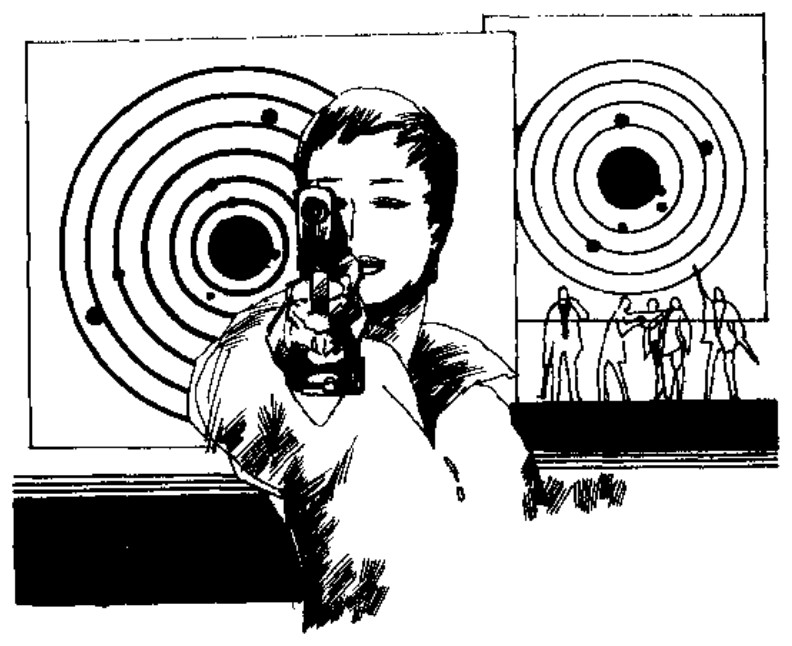
The specific methods for integrating qigong training are as follows:
Before training in each shooting position, spend about ten minutes: each person stands at their respective position. When standing, the whole body naturally relaxes, distracting thoughts are eliminated, qi sinks downward, the tongue lightly touches the upper palate, attention is focused on the Dantian, and occasionally one can internally visualize the Yongquan point. This is the practice before the three shooting positions, that is, the preparation phase.
Prone position practice: After completing the opening form, follow the prone shooting posture in a regular and rhythmic manner. Once the prone position is adjusted and ready, proceed to dry-fire practice (if holding the rifle requires eight jin of effort, do not exceed eight jin and one liang). Then proceed to the two other positions in the same manner. The focal point of the eyes should be on the aiming point. Breath holding should be regular, with breath suspended for about five seconds. Then load the ammunition; the shooting posture should be compact. After shooting is complete, perform the closing form. The closing process involves first thinking of the Baihui point, then slowly and regularly standing up, returning qi to the Dantian, then rubbing the hands together and slowly walking a few steps. The closing form is complete.
Kneeling position practice: First adjust the kneeling position and adjust the rifle sling, then place the butt of the rifle on the ground with the rifle body resting against the left shoulder. The whole body naturally relaxes, qi sinks to the Dantian, distracting thoughts are eliminated, the tongue touches the upper palate, and occasionally think of the Yongquan point for about three minutes. Then, using the rifle sling and the rifle butt against the shoulder, assume the kneeling shooting position. During this process, minor adjustments can be made to the position and sling. If the foot that is kneeling on the ground feels pain, you can relax the painful area and think about the painful area, and the pain will gradually disappear. Then proceed to dry-fire or live-fire shooting. When shooting is complete, first think of the Baihui point, return qi to the Dantian, slowly stand up, then gently rub both hands together and slowly exit the shooting line.
Standing position practice: After completing preparations for the standing position on the basis of the prone position, take the standing position at the shooting line according to the standing posture. The whole body naturally relaxes, qi sinks downward, distracting thoughts are eliminated, the tongue lightly touches the upper palate, attention is focused on the Dantian, while occasionally internally visualizing the Yongquan point for about three minutes. Then begin regular, rhythmic handling of the rifle, slowly adjusting the shooting posture, followed by dry-fire and live-fire shooting. During shooting, occasionally think of the Dantian and Yongquan point, hold the breath for about three seconds to fire one shot, and after shooting is complete, perform the closing form—return qi to the Dantian, gently rub the hands together, and slowly step in place. The closing form is then complete.
Starting in 1983, I began experimenting with some athletes, and in 1984 I implemented the training with all team members. The athletes’ results improved compared to before, and abnormal fluctuations rarely occurred. Compared with those who did not combine qigong training, athletes who did achieved mental stillness much faster—the latter required about six minutes, while the former needed at most two to three minutes. This was true even for excitable-type athletes. For example, team member Chen Hao was one such case. In 1983, he was selected for the county sports school shooting team, but his performance was inconsistent, sometimes good and sometimes bad. Later, after a period of integrated qigong and shooting training, he achieved mental stillness much faster than before, and the consistency of his movements also improved. In less than half a year of part-time training, his prone position scored above 260 rings in every assessment. Sometimes in ten-shot record fire, he could even achieve a perfect score (with an ordinary Jianwei brand small-bore rifle)—his results were remarkably stable. When competing in the prefectural shooting tournament, his 3×10 event exceeded 240 rings, meeting the national third-level athlete standard, and he achieved second place. Our entire team competed in the 1984 prefectural tournament with nine team members, seven of whom were newly recruited. The selection pool was not large either—eight were selected from one class at one school, and one from another school. Through integrated qigong training, the team members’ ability to achieve mental stillness was notably fast. Through long-term practice, they gradually achieved “the mind settled on nothing, a single thought unburdened,” after which they could use “intention” to guide “qi” and achieve “total concentration.”
Using qigong to promote the sport of shooting is merely an experiment, and there are still many imperfections. Here I have simply shared a bit of my own experience, and I hope to receive correction and guidance from experts and colleagues.
(Excerpted from Sports Spring)
Zhang Liang Practices Qigong
Wang Daozheng, Beijing Normal University
Zhang Liang, courtesy name Zifang, was a native of Chengfu County in the State of Han during the Spring and Autumn and Warring States period (in the area of present-day Yingchuan, Henan). In his youth, Zhang Liang harbored great ambitions: he loved his country and its people. After the State of Han was annihilated by the State of Qin, he exhausted his family’s wealth to hire a strongman in an attempt to assassinate the King of Qin, in order to avenge the State of Han.
Zhang Liang Practices Qigong
Zhang Liang once studied the classics in Huaiyang (present-day Chenzhou in Henan), and later traveled to the eastern seacoast, where he found a strongman. The weapon the strongman wielded was an iron hammer weighing 120 jin. Taking advantage of the occasion when Qin Shi Huang was touring the east, Zhang Liang and the strongman ambushed Qin Shi Huang at Bolangsha (located south of Yangwu County; forty li northwest of present-day Xunyi there is Bolang City). The strike missed its target and hit a decoy carriage instead. Qin Shi Huang was enraged and had portraits and descriptions posted everywhere, issuing wanted notices and conducting an intensive manhunt. Zhang Liang was forced to change his name and surname (his original surname was Ji; from then on he took the surname Zhang and the name Liang) and fled to hide in Xiapi (in the area of present-day Xuzhou).
The Tempering of Mind and Endurance
One day, Zhang Liang was strolling on a bridge at Xiapi (the original Records of the Grand Historian states: “strolling on the yi” — the ancient people of Xiapi called a bridge a yi). There was an old man named Huang Shigong, dressed in coarse cloth clothing, who came beside Zhang Liang and, seeing that Zhang Liang was not paying attention, deliberately let his shoe fall beneath the bridge. Then he said to Zhang Liang: “Young man, go down under the bridge and fetch my shoe!” Zhang Liang was very angry upon hearing this and wanted to strike him. But seeing that the man was elderly, he forcibly suppressed the anger in his heart and went under the bridge to retrieve the shoe. Huang Shigong said: “Put it on for me!” Zhang Liang thought to himself: since he had already brought the shoe up, he might as well kneel down and put it on for him. Huang Shigong received it with his foot, smiled, and departed. Zhang Liang was greatly astonished and found it very strange. He followed the old man’s receding figure with his eyes. Huang Shigong walked about a li or so, then returned and said to Zhang Liang: “Youth, you are teachable. Five days from now at dawn, meet me on this bridge.” Zhang Liang found this even more peculiar, but returned the courtesy and said: “I shall come on time.” Five days later at dawn, Zhang Liang went as promised. Huang Shigong had already arrived first and said angrily: “When you have an appointment with an elder, why are you late?” Then he added: “Five days from now at dawn, meet me here again.” Five days later at cockcrow, Zhang Liang went as promised. Huang Shigong had again arrived first and again said angrily: “Why are you late?” Then he said: “Go back. Five days from now at midnight, come and meet me here again.” Five days later, with this matter weighing on his mind, Zhang Liang went to the bridge at midnight. Before long, Huang Shigong also arrived and said happily: “This is how it should be. One should never be late for any appointment.” He took out a book — Master Huangshi’s Plain Book, Three Strategies (the Unofficial History records it as Master Huangshi’s Plain Book, Three Strategies; the Records of the Grand Historian records it as Tai Gong’s Art of War) — and gave it to Zhang Liang. Then he said: “Read this book, and you may become a teacher to emperors.” Having said this, he departed. Zhang Liang thereafter read this book day and night and benefited greatly from it. Throughout his life, Zhang Liang was indifferent to fame and profit — he was deeply influenced by this book, which states: “Nothing takes priority over cultivating virtue; nothing is more auspicious than knowing contentment.” He bore this firmly in mind and adopted it as his motto. Therefore, he never competed with others in the pursuit of fame and gain.
Encountering the Master
According to the Unofficial History, after Huang Shigong presented Zhang Liang with the book, approximately ten days later, he suddenly arrived at Zhang Liang’s residence. Zhang Liang was overjoyed and treated him with the respect due to a teacher, humbly receiving instruction. Huang Shigong said to Zhang Liang: “A young man should use stillness to master movement, and use depth to master frivolity. You must cast off frivolous energy and draw your vigorous energy inward.” He then quoted from the Plain Book, Three Strategies to instruct Zhang Liang, saying: “The sage and the noble person understand the way of rise and decline, comprehend the numbers of success and failure, discern the trends of order and chaos, and grasp the principles of advancing and retreating. Therefore, they dwell in concealment embracing the Way, awaiting their time. If the time comes and they act, they can reach the highest ministerial position. If they seize the opportunity and move, they can achieve peerless merit. If they do not meet their time, they simply pass their lives in obscurity. Thus their Way is lofty enough, and their name is revered by later generations.” He continued: “One must not act blindly; one must assess the times and circumstances before acting.” Zhang Liang suddenly understood and said with the utmost respect: “To receive your instruction surpasses ten years of study.” Huang Shigong said: “In order to cast off frivolous energy, you should learn the arts of bigu (abstaining from grain) and daoyin (guided breathing) for nourishing life” — what is today called qigong — “and cultivate well the noble righteous qi. Without studying the disciplines of investigating things to extend knowledge, making one’s intentions sincere, rectifying one’s mind, and cultivating one’s person, how can one govern a state and bring peace to the world?” Zhang Liang said: “I wish for you, sir, to teach me!”
Huang Shigong said: “Sit upright with your legs crossed. Close your eyes slightly. Press your tongue against the upper palate. Relax your entire body and quiet your mind. Let your thoughts be free of wickedness (i.e., eliminate all selfish and distracting thoughts). Concentrate your spirit in the lower abdomen (i.e., the lower dantian). Breathe naturally — exhale and inhale through the nose. The breathing should be fine, long, slow, and even. Neither force it nor forget it. When inhaling, draw the breath down to the abdomen; when exhaling, connect to the niwan (upper dantian). Practice at the hours of zi, wu, mao, and you each day. Over time, true qi is generated. When true qi arises, the ren and du meridians open; subsequently, the eight extraordinary meridians also open, and then true qi circulates throughout the entire body. The body becomes strong and healthy, wisdom arises, and the Three Strategies and Six Tactics for governing the state can be skillfully applied.” He further admonished Zhang Liang: “A pure heart and few desires are of the first priority. ‘When one is tranquil, detached, and empty, true qi follows; when essence and spirit are guarded within, how can illness arise?‘” He then transmitted the oral formula:
“Young man, know the xuanmu — xuan being the xuanguan (the mystic pass), mu being the mingmen (Gate of Life) behind the navel — and you will know the root of human life. A pure heart is the first priority; regulate your desires and nourish your essence and spirit. The xuan resides within the niwan; the mu exists between the kidneys. The xuan is the heart of Heaven; the mu is the root of Earth. When inhaling, draw from xuan into mu; when exhaling, connect to the Heavenly heart. Know where the breath comes from and where it goes — only then have you entered the cultivation of truth. Laozi spoke of the gate of xuanmu; it is the root of Heaven and Earth. This is the true xuanmu, yet ordinary people still search restlessly. Practice daoyin and breathing exercises constantly, guard the whole, and naturally you shall attain the truth. The upright Way requires utmost sincerity; take care never to transmit it to the unworthy.”
Zhang Liang reverently followed the instruction. Every day he would close his door to read, practice qigong, and study diligently without rest.
Huang Shigong would visit Zhang Liang once every ten days to supervise and inspect his practice. In less than half a year, Zhang Liang had打通 both the greater and lesser celestial circuits. His body grew healthy and light, his memory improved markedly, and he could recite from memory texts such as the Su Shu San Lue (Primeval Book, Three Strategies) and the Bing Fa (Art of War).
One day, Huang Shigong came to tell Zhang Liang: “I must take my leave. In ten years, warfare will erupt across the land, and you shall achieve extraordinary deeds and establish great accomplishments. Thirteen years from now, when you see a yellow stone at the foot of Mount Gucheng in Jibei, that shall be me.” At parting, he bestowed upon Zhang Liang these admonitions from Laozi: “He who acts for others has ever more for himself; he who gives to others has ever more himself. The Way of Heaven benefits and does not harm; the Way of the Sage acts and does not contend. He does not wish to display his worthiness. He achieves success but does not dwell upon it. It is precisely because he does not dwell upon it that it is not taken from him.”
Zhang Liang bid a reluctant farewell, keeping his revered teacher’s instructions firmly in mind. Every day, following the practice methods and admonitions, he examined his own words and deeds; whenever he discovered errors, he corrected them promptly. He cultivated his character, applied himself diligently to study, and strove unceasingly for self-improvement.
Having Mastered Qigong, He Possessed Abundant Wisdom and Strategy
After Huang Shigong’s departure, Zhang Liang faithfully followed his teacher’s instructions, practicing qigong day and night and studying tirelessly. His physical constitution grew strong, his thinking became agile, and he gained thorough mastery of the Three Strategies and Six Tactics, becoming exceedingly resourceful. Exactly as Huang Shigong had predicted, when ten years had passed, Chen Sheng and Wu Guang launched their uprising, and the realm fell into chaos. Zhang Liang also gathered over a hundred vigorous young men and marched westward to strike at Qin. At Chenliu, he encountered Peigong Liu Bang, who commanded several thousand men. Zhang Liang led his forces to join him, and Peigong appointed Zhang Liang as a general. Zhang Liang devised strategies and plans for Peigong, and employing his counsel, Peigong was victorious in every attack and invincible in every battle.
During the day, Zhang Liang marched with the army; at night, apart from sleeping, he practiced qigong without ever slackening in the slightest.
Zhang Liang accompanied Peigong to Xuecheng to meet Xiang Liang. By this time, Xiang Liang had already established King Huai of Chu. Zhang Liang said to Xiang Liang: “You have already established the successor to Chu, yet the descendants of Han have not yet been established. Among the various princes of Han, Han Cheng is the most worthy and may be established as king.” Xiang Liang dispatched Zhang Liang to seek out Han Cheng. When Han Cheng arrived, he was enthroned as King of Han. The King of Han appointed Zhang Liang as Situ (Minister of Instruction). Zhang Liang and the King of Han led several thousand troops, supplemented by several thousand men provided by Peigong, and marched westward to recover the lost territories of Han and restore their homeland. Zhang Liang’s wish was fulfilled. Later, Xiang Yu lured the King of Han to Pengcheng and killed him.
Peigong wished to advance westward to destroy Qin and could not do without Zhang Liang’s counsel and strategies. Therefore, he borrowed Zhang Liang from the King of Han and kept him as his trusted right-hand adviser, directing strategy within the command tent, staying by his side day and night without parting. Peigong and Zhang Liang led a great army southward from Luoyang through Huanyuan (a mountain in present-day Henan Province), captured Wancheng, and entered the Wu Pass to the west.
Peigong wished to attack the Qin army with twenty thousand troops. Zhang Liang said: “The Qin army is still strong; do not underestimate the enemy. I have heard that the Qin general is the son of a butcher and should be lured with profit.” Peigong said: “Good, let us lure him with profit.” He thereupon ordered Li Yiji to carry heavy treasures to tempt the Qin general. The Qin general indeed rebelled and wished to join forces with Peigong to attack Xianyang to the west. Peigong was inclined to agree. Zhang Liang said: “At present only the Qin general has defected. I fear the soldiers will not follow, and if they do not, the situation will be perilous. It would be better to watch for a moment when they are off guard and attack.” Peigong observed that the Qin army’s discipline was lax, so he led his troops to attack. The Qin army was soundly defeated, and they fought all the way to Lantian. Then, in a further engagement, the Qin forces collapsed entirely. They proceeded to Xianyang, where Ziying, the King of Qin, surrendered to Peigong. This was the first of Zhang Liang’s victorious strategies.
Peigong entered Xianyang and went into the Qin palace. He saw that the chambers, curtains, jeweled ornaments, and precious vessels were beyond counting. Entering the inner palace, there were beauties and lovely consorts numbering in the thousands. Peigong wished to reside there and claim it all for himself. Fan Kuai remonstrated with Peigong, saying: “Does Peigong wish to possess the whole world, or does he wish to become a wealthy householder?” Peigong replied: “I wish to possess the whole world.” Fan Kuai said: “Qin perished because it had these seductions of music, beauty, and material wealth. I advise Peigong to return quickly to Bashang (the Ba River in present-day Lantian) and not linger in the palace.” Peigong would not listen. Zhang Liang offered his counsel, saying: “Because Qin was without the Way, Peigong was able to reach this point. In order to sweep away the remnants of tyranny across the realm, you should esteem frugality and oppose extravagance. Now you have just entered Qin and immediately indulge in its pleasures—this is what is called ‘helping a tyrant in his evil.’ ‘Loyal words grate upon the ear but benefit conduct; good medicine tastes bitter but cures illness.’ I hope Peigong will heed Fan Kuai’s words.” Peigong listened to him and returned his army to Bashang. This was the second of Zhang Liang’s strategies.
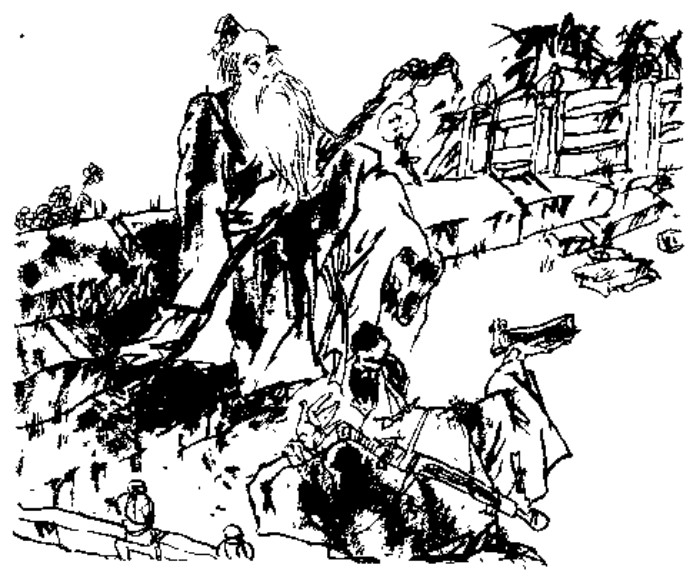
In the first month of the first year of Han, Peigong, having become king, wished to proceed to Hanzhong to take up his post. He lavishly bribed Xiang Bo to plead on his behalf, and King Xiang consented, thus he obtained the territory of Hanzhong. As Peigong and Zhang Liang led their forces advancing toward Hanzhong, upon reaching Baozhong, Zhang Liang said to the King of Han: “Why does Your Majesty not burn the plank roads along your route, to show the whole world that you have no intention of returning, and that you are content to hold this remote corner of Hanzhong with no other designs? This would lull Xiang Yu’s vigilance and cause him to let down his guard.” The King of Han followed the plan, and Xiang Yu indeed believed it to be true. He returned to Pengcheng and no longer looked westward. Because of this, the King of Han was able to rebuild his forces, conserve his strength, and—with the famous stratagem of “openly repairing the plank roads while secretly crossing at Chencang”—sweep the realm in a single stroke. This was the third of Zhang Liang’s strategies.
Zhang Liang’s strategies and counsel offered to the King of Han are too numerous to count. In sum, the assistance of Zhang Liang was no small factor in helping Liu Bang destroy Qin, destroy Xiang Yu, and ultimately unify the realm. Hence he was called one of the Heroes of Han. The ancients had a poem praising Zhang Liang: “Having mastered daoyin, his wisdom was great; his thoughts were agile, his strategies swift.”
Having Mastered Qigong, He Did Not Covet Fame or Wealth
From his youth, Zhang Liang was generous and chivalrous with his wealth, seeking assassins everywhere in his attempt to strike at the King of Qin, until his family fortune was exhausted, as has been recounted above. After Peigong escaped from the Banquet at Hongmen, rejoicing in his survival, he not only bestowed lavish gifts upon Xiang Bo but also granted Zhang Liang one hundred yi of gold (one yi equaling twenty taels) and two dou of pearls. Zhang Liang gave them all to Xiang Bo, not taking a single share for himself.
In the first month of the sixth year of Han, when merits were being rewarded, Han Gaozu had already enfeoffed over twenty great meritorious officials. The rest argued day and night over their merits, which could not yet be settled, and they had not yet received their fiefs. Han Gaozu, from the covered gallery road of the Southern Palace in Luoyang, looked out and saw the generals frequently sitting together in the sand, discussing something. Han Gaozu asked Zhang Liang: “What are they discussing?” Zhang Liang replied: “Does Your Majesty not know? They are plotting rebellion.” Gaozu said: “The realm has just been pacified. Why would they plot rebellion?” Zhang Liang said: “Your Majesty rose from the common people and relied on these men to win the empire. Now Your Majesty is the Son of Heaven, yet all those you have enfeoffed are old friends such as Xiao He and Cao Shen, as well as your own close relatives and intimates, while all those you have put to death were those you personally hated. These generals and military officers fear they will not receive fiefs, and also fear that their past transgressions will come under suspicion and lead to their execution. Therefore they have gathered together to plot rebellion.” Gaozu…
Observations of Qigong “Target Shooting”
Jin Guangzhen Department of Mechanical Engineering, Wuhan Iron and Steel College
I once had the good fortune to witness in person a remarkable qigong performance that, beyond being thrilling and magical, also provided thought-provoking objective phenomena for exploring the energetic characteristics of qigong.
Last year, while on a business trip to Wuzhou City, Guangxi, it happened that the Hunan Shaoshan Qigong Troupe No. 2 was performing a special qigong show at the Wuzhou regional auditorium. I spent sixty cents on a ticket and watched one performance, which left me thoroughly refreshed. Each show featured about a dozen acts; in addition to traditional programs such as blade-chopping-the-chest and lying-on-a-bed-of-nails, they also introduced new items such as “qigong target shooting.”
The “qigong target shooting” performed by Zeng Jianlin, a young man in his twenties, was astonishing and thought-provoking. On the stage stood a steel target about the height of a person. The qigong master stepped down from the stage and went among the audience, standing about ten meters away from the target. He directed his palms toward the target face, emitting external qi, and slowly pushed the target down onto the stage.
Before the performance, the qigong master brought the steel target down from the stage for the audience to inspect and verify its authenticity. I personally picked up the steel target and examined it closely. The rectangular steel plate target face was supported by a steel rod serving as the target post. The lower end of the post had three target feet evenly distributed in a triangular arrangement, allowing the target to stand stably on the ground. The steel target was fabricated by welding; the connections between the target face and post, and between the post and feet, were all solidly welded. The dimensions of the steel target were approximately: height 1.7 meters, weight 2–3 kg, target face steel plate thickness 3 mm, area roughly the size of a sheet of manuscript paper, approximately 18 × 26 square centimeters. The target post and feet were made of steel rod with a 10 mm diameter, and the circumscribed circle diameter of the three support points of the feet was approximately 20 cm. I deliberately placed the target on the ground and pushed it with my index finger; a pushing force of about 0.2 kg was needed to tilt the target.
After the performance, I walked onto the stage with great excitement to congratulate the qigong master on his successful performance. The lead performer, Zeng Jianlin, told me that he had previously appeared in films such as Heroes Emerge in Youth. The external qi emitted from his palms produced a pushing force of 3.5 kg at a distance of one meter. During target shooting, if the lighting was slightly dim, audience members could also see light reflected from the target face. Because he had performed chest-chopping with a blade that day, his physical exertion was too great, and I was unable to see the reflected light at the time, and the shooting distance was relatively close. If his physical strength recovered, the shooting distance could be increased by more than double. A staff member at the Wuzhou auditorium told me that she had personally witnessed Zeng Jianlin knock down the target from the very back row of the auditorium multiple times the previous day.
Excerpted from Qigong Science
Following Chi Songzi on Wanderings, Continuing to Practice Bigu and Daoyin
One day, Zhang Liang addressed Emperor Gaozu, saying: “My family served the state of Han for several generations. When Han was destroyed by Qin, I spared no expense of ten thousand in gold to hire a strongman to assassinate the King of Qin, seeking vengeance for our state, which shook the world. Now, with a three-inch tongue, I have become the teacher of an emperor, been enfeoffed with ten thousand households, and ranked among the marquises. This may be called the pinnacle of wealth and honor; my wishes are fulfilled. I am now old and wish to leave behind worldly affairs, to follow Chi Songzi on his wanderings, and to continue practicing bigu4 and daoyin5.” Emperor Gaozu repeatedly urged him to stay, but seeing that Zhang Liang’s resolve was firm, he had no choice but to permit his departure. From then on, Zhang Liang wandered with Chi Songzi in the Zhongnan Mountains and the Qinling range, practicing bigu and daoyin. Zhang Liang’s going to the deep mountains to practice qigong was not an escape from the world; he had his positive side. He wished to take on disciples and pass on the qigong he had learned throughout his life to his students, so that there would be successors, and thereby carry forward and develop qigong—our nation’s inherent treasure for dispelling illness, prolonging life, and strengthening the body.
Emperor Gaozu said to his ministers: “Devising strategies within the command tent and determining victory a thousand miles away—I am no match for Zifang. Let Zifang himself choose a county of thirty thousand households in the state of Qi.” Zhang Liang replied: “I began in Xiapi, met Your Majesty in Liu County (present-day Chenliu), and followed Your Majesty on campaigns east and west. Your Majesty employed my strategies, and fortunately they sometimes proved effective. I am content to be enfeoffed in Liu, and dare not accept thirty thousand households.” Thereupon, Gaozu enfeoffed Zhang Liang as the Marquis of Liu (present-day Chenliu, Henan).
One day, Zhang Liang saw Emperor Gaozu and reported: “My family served Han for several generations. When Han was destroyed by Qin, I spared no expense of ten thousand in gold to hire a strongman to assassinate the King of Qin, seeking vengeance for our state, which shook the world. Now, with a three-inch tongue, I have become the teacher of an emperor, been enfeoffed with ten thousand households, and ranked among the marquises. This may be called the pinnacle of wealth and honor; my wishes are fulfilled. I am now old and wish to leave behind worldly affairs, to follow Chi Songzi on his wanderings, and to continue practicing bigu and daoyin.”
Some were so blinded by greed and ambition that, failing to gain titles, they plotted rebellion. Yet Zhang Liang did not compete, and was instead enfeoffed as the Marquis of Liu. This is the best embodiment of the philosophical principle regarding Zhang Liang: “He achieved success but did not cling to it; precisely because he did not cling to it, it was not taken from him.”
Excerpted from China Qigong
·88· 2.
The sperm motility was slow, and the proportion of abnormal sperm was high, leading to infertility. Huang Canxin used external qi to clear her fallopian tubes, and one year later she gave birth to a girl.
Another man had insufficient sperm count and weak motility, resulting in infertility. Huang applied qigong treatment, first draining the pathological qi from the man’s body, and then replenishing his qi, ultimately curing his infertility.
Huang Canxin emitted qi while explaining. He pointed his right hand remotely at the supine man’s genital area while directing his left hand’s fingers at relevant acupoints. In an instant, the man said his testicles moved and then retracted; he felt a stream of cold qi being drawn out while his genital area grew warm. Huang then directed both hands at the man’s genital and abdominal areas, emitting qi. The patient said his legs felt swollen and his abdomen warm. Huang continued by pointing his right hand at the patient’s left foot while emitting qi with his left hand toward his abdomen; the patient said it felt as though his legs were rising and then retreating back toward his feet. Huang again directed his right hand at the patient’s genital area and his left hand toward his abdomen. The patient said he felt the genital area filled with qi, and the soles of his feet had also become warm. This round of qigong treatment from Huang Canxin truly broadened my horizons.
After withdrawing his qi, Huang wiped his sweat with a towel and said that he had just performed a full-body regulation along the Kidney, Liver, and Spleen meridians. In addition, the patient would need to practice qigong on his own at home and continue taking medication.
Huang Canxin looked no more than thirty-something (he was actually forty-four). Originally a long-distance running athlete, he began practicing internal qigong as early as the late 1950s. He served as a middle- and long-distance running coach in 1972, and in 1981 began training in Freewill Qigong (Suiyi Gong) under the guidance of a renowned master. From then on, his skill advanced greatly—he opened the Greater Heavenly Circuit (Da Zhou Tian)—and he began emitting external qi to treat others for asthma and rheumatoid arthritis, with remarkable results.
I had long heard that the general manager of the Provincial Sports Service Company, Huang Canxin, was an accomplished qigong master. A Hong Kong patient who had suffered from rheumatoid arthritis for many years without cure had been treated by renowned doctors in Japan, the United States, South Korea, and Taiwan, yet his condition only worsened. As a last resort, he came to Guangzhou supported by two relatives to seek treatment from Huang Canxin. The manager emitted external qi at the patient’s Kidney meridian acupoints—Yintang, Shenmen, Zusanli, Chengshan, Weizhong, and others. After ten minutes, the patient was miraculously cured of his ailments and was able to walk back on his own. Even more wondrous, Huang Canxin also possessed paranormal abilities such as remote viewing and X-ray-like perception for diagnosing illness.
However, I had come to Ershatou specifically to understand how Huang Canxin treated male and female infertility, because infertility treatment remains a difficult challenge both domestically and internationally.
By coincidence, I arrived just as Huang Canxin was emitting qi for a middle-aged man suffering from infertility.
Huang Canxin said that this man had cold kidneys and kidney deficiency. Previously, the man had gone to the hospital for examination and treatment. The examination results showed insufficient sperm count, low motility, and a high proportion of abnormal sperm, causing infertility. After numerous unsuccessful treatments, he came to Huang Canxin. Following several external qi treatment sessions, a follow-up examination revealed a significant increase in normal sperm count. However, the liquefaction time of the semen was still too long, so Huang needed to emit qi to warm the semen in order to shorten the liquefaction time.
I exclaimed in admiration: “Manager Huang, your medical skills are truly superb!”
Huang Canxin said modestly, “I can hardly claim to have superb medical skills. I still need to continue studying medicine and qigong knowledge.” As for the patients he treated, for the sake of caution, they were all required to undergo hospital examinations before qigong treatment to confirm their diagnosis. He would then determine the qigong treatment plan based on the examination results. After a period of qigong treatment, he also required patients to return to the hospital for follow-up examinations, so as not to delay the patient with ineffective treatment. He did not claim to cure all diseases—he merely had a little experience in using qigong to treat rheumatoid arthritis, asthma, and male and female infertility.
I asked with keen interest: “Since your skill has reached such profundity, do you still need to continue practicing qigong regularly?”
Huang Canxin said that no matter how busy he was, he insisted on practicing qigong three times every day: he would get up at 4:30 a.m. to practice standing for half an hour, practice lying down at noon, and practice sitting for two hours at 11 p.m. He said that before learning qigong, he had long suffered from rhinitis and was prone to catching colds. Since he began practicing, he had not needed to see a doctor for over twenty years. This shows that mastering qigong is extremely beneficial for both oneself and others. Huang Canxin was determined to continue researching the treasures of our nation’s qigong science, so that this discipline could flourish and bring benefits to the people.
In 1983, Huang Canxin began treating infertility for others. At the time, a man surnamed Cai had temporarily avoided having children after marriage because he contracted hepatitis, and his wife had used contraception. However, after Cai’s hepatitis was cured, they tried for years to conceive without success. A hospital examination revealed that Cai’s testicles had been injured when he was accidentally kicked in the scrotum while swimming, and repeated medical treatments had been ineffective. Cai therefore came to plead with Huang Canxin for treatment. Unable to refuse, Huang used his paranormal ability to examine the cause of Cai’s condition. He perceived that there was a problem with Cai’s testicles. Cai was astonished and told him the truth. Huang Canxin used external qi to drain Cai’s pathological qi, causing the inflammation in his testicles to subside. Several months later, the man surnamed Cai happily informed Huang Canxin that his wife was pregnant.
In 1984, a woman had a blocked right fallopian tube and a mildly blocked left fallopian tube,
·89
Human Body Science
The Fourth Wave
Yi Yao
In 1979, China first reported the extraordinary phenomenon of recognizing characters through the ear. Over the following years, one of the most significant advances in the scientific community was the use of scientific methods to prove that special abilities (extrasensory functions) do indeed exist. Although to date, only a small circle understands the significance of this progress for humanity, special abilities—alongside the systematic theories of traditional Chinese medicine and the study of qigong—have already revealed an enticing prospect as an emerging discipline: human body science.
The Establishment of Legitimate Status
In February 1980, the First Symposium on Human Special Functions was held in Shanghai. Several associate professors from Peking University and other institutions not only employed rigorous scientific methods (eliminating the possibility of peeking or sleight of hand) to verify the authenticity of “non-ocular vision,” but also, through typical observations, found that a large proportion of children around the age of ten possessed this latent ability to varying degrees. This result was quickly corroborated by further confirmations. Within a short period, the scope of special functions research expanded from “non-ocular vision” to X-ray-like perception of the human body, special object translocation, special penetration of spatial barriers, and more.
In the New China, where atheism had achieved unprecedented popularization, those extraordinary yet real phenomena stimulated people with a Columbus-like thrill and desire to explore. At the same time, because these phenomena were difficult to explain with modern scientific knowledge and contradicted people’s current understanding of nature, they were difficult to be universally accepted. Modern science and technology had developed over merely three to four hundred years—barely past its infancy—so it was not surprising that the long-established phenomena of human body science could not be immediately explained. Over eight years, leading comrades from the central government down to provinces and municipalities, having personally witnessed demonstrations of special functions on various occasions, promptly halted simplistic and harsh criticisms of special functions research and correctly assessed its standing. Leaders in certain departments also recognized the role this discipline might play in the social and natural sciences and expressed active support for promoting and advancing this research. At a 1983 national conference on key university research, a responsible official from the education department explicitly proposed that universities could conduct research on human special functions as basic scientific research. Thus, from Heilongjiang in the north to Yunnan in the south, from Shanghai in the east to Xinjiang in the west, special functions research was earnestly and diligently launched nationwide. Over the years, hundreds of universities and research institutions, with at least 500 researchers, devoted themselves to this work.
A group of eminent and rigorously-minded scientists who had originally dismissed special functions as traditional superstition akin to astrology—after大量 experimental results confirmed the findings, and after personally conducting tests—generously accepted the facts. They began to understand that special functions, and indeed the entire field of human body science, were scientific domains just like physics, biology, and psychology; this unknown world should not be rejected as alien but rather vigorously investigated. This demonstrated that serious scientific workers in New China respect facts and submit to truth. Scientists of high scientific attainment such as Qian Xuesen, Wang Ganchang, Tan Jiazhen, Zhao Zhongyao, Yang Longsheng, Wang Dezhao, Bei Shizhang, Zhu Guangya, and Tang Aoqing all expressed keen interest in and gave enthusiastic support to this new discipline, becoming a powerful backing for human body science research.
A basic contingent of human body science researchers drawn from fields including biology, psychology, medicine, philosophy, electronics, and computer science seemed to have glimpsed China’s enormous potential and unique advantages in human body science research. Under difficult conditions, they silently and perseveringly pursued their work, honestly conducting experiments. After eight years of trials and tribulations, they not only verified the authenticity, reliability, universality, and inducibility of human special perceptual functions, but also conducted extensive investigations into the physical properties, physiological responses, and biological effects of these special functions, ultimately establishing their validity with irrefutable evidence. In May 1987, the State Science and Technology Commission officially approved the establishment of the Chinese Society of Human Body Science. This meant that special functions, together with the systematic theories of traditional Chinese medicine and qigong studies, had obtained legitimate status as an emerging discipline.
The Human Body as a “Giant System”
Humanity has used its own intelligence and talent to drive the rapid advance of science and technology, creating countless miracles in the human world. The frontiers of scientific knowledge extend as far as distant celestial bodies 15 billion light-years away, and as small as quarks and even deeper levels of material structure. Meanwhile, technology has created a vast artificial world that has permeated every domain of social life. Yet humanity’s understanding and study of itself remains superficial. Although the current exploration and understanding of life phenomena has gradually penetrated to the molecular level and made enormous progress, compared with other disciplines, it remains only at an elementary stage. Human body science is the study of the various functional states the human body may exhibit, how to protect these functions, and how to further develop the latent potentials of the human body and human potential. Its object of study is the human being; its core idea is to use the modern systems perspective to study the holistic properties of the human body, to identify the characteristic parameters that describe human functional states, to explore the control variables that alter human functional states, and to determine the corresponding physical and biological effects produced by changes in human functional states. Experts believe that the study of human body science holds important significance
·90· Collected Essays
Selected Essays
lies in recognizing that the human body is a complex, open giant system. This extremely vast giant system not only has many levels, but also interacts with its surrounding environment. The basic task of human body science research is to study the functional states and mechanisms of the human body at different levels and from different angles, including the qigong functional state, the special ability functional state, and the “syndrome” (i.e., pathological functional state) in “syndrome differentiation and treatment” of traditional Chinese medicine, and to seek means of regulating and transforming the functional states of the human body. The main means currently confirmed by research include at least: exchange of substances, input of external information, and the reaction of consciousness upon the human body. The vigorous development of human body science can not only greatly transform traditional medical research of all kinds, but also greatly improve the working efficiency of various human–machine–environment systems involving human participation.
When the renowned scientist Qian Xuesen discussed the position of human body science within the modern scientific system, he held that human body science is a major division of modern science and technology, on equal footing with eight major divisions: natural science, social science, systems science, cognitive science, mathematical science, military science, behavioral science, and literature and the arts.
Challenges Confronting Modern Scientific Theory
Regarding human special abilities, records can be found in many ancient Chinese texts. Liezi, Xunzi, Han Feizi, Huainanzi, Huangdi Neijing (Yellow Emperor’s Inner Canon), and the Shiji (Records of the Grand Historian), among others, all contain relevant references. It is simply that the ancients, constrained by their conditions, lacked reliable experimental evidence related to the phenomena.
In recent years, exploration of special abilities can be roughly divided into two major categories: first, special abilities involving the emission of energy by the human body, such as hard qigong and psychokinesis; second, special abilities involving the perception of external information by the human body, such as reading with the ear, telepathy, and clairvoyance. From a large body of scientific experiments and spontaneous experiences, it appears that apart from the ordinary functional state with which everyone is familiar, every person also possesses some kind of special functional state. However, for the majority of people, the obstacles preventing the emergence of special abilities are too numerous, and ordinary information cannot break through these obstacles to be transmitted into consciousness; only a few gifted individuals can produce special abilities. Supernatural phenomena such as non-visual perception are by no means phantoms from a “spirit world”; they are inherent functions of the living human body — it is merely that this has been extremely little studied in the past, and thus no scientific explanation has yet been found. The appearance of special abilities occurs under certain conditions and is independent of human will.
“As long as natural science is thinking, its form of development is hypothesis.” This “mischievous child” of special abilities has burst into the kingdom of science and is no longer confined to dramatic performances. The facts have attracted widespread attention, which heralds a new scientific breakthrough. Some researchers believe that paranormal phenomena do not conflict with modern physics and other disciplines, and that within the realm of possibility, physical explanations for these phenomena can be found. Experimental research to date includes physical measurements of the radiation energy emitted by human special abilities, determinations of biological effects and physiological indicators, as well as various claims and conjectures about what the human body emits in the special ability state: electromagnetic waves, ultrasound, particle streams, plasma, faster-than-light phenomena, magnetic fields, and so forth. Others have paid attention from the perspectives of quantum physics, dissipative structures, and multidimensional space. Of course, scientists have already recognized that many facts do not fully conform to the established set of concepts — existing scientific theories, especially physics theories, are insufficient to explain all paranormal phenomena, and new physics awaits discovery and elucidation.
The Ongoing Pursuit in Applied Science
Research in corresponding fields abroad has a very long history. Countries such as Britain and the United States began over 100 years ago. They collectively refer to human special ability phenomena as “PSI,” and the discipline that studies these phenomena is called parapsychology. They consider special abilities to be innate supernatural capabilities or phenomena — an indescribable latent ability that can receive information without reliance on the five senses, transcending time and space, also called inspiration or telepathy, that is, so-called extrasensory “perception,” including the power of will that can move objects without mechanical tools and exert influence on the external environment. Countries holding leading positions in research in this discipline have already proposed a number of theoretical models and have entered the application stage.
Huang Xiaokuan is a young physician at the General Hospital of the Chinese People’s Liberation Army. He has achieved notable success in the practice and scholarship of external qi therapy. By emitting external qi, he conducts qi-channel guidance and induces limb movement in patients, and can treat a variety of difficult and complex diseases, with particularly excellent results for functional disorders of the nervous system, digestive system, and cardiovascular and cerebrovascular systems. Under the guidance of Professor Huang Meiguang, he emitted qi to treat 30 cases of paraplegia patients, achieving an effective rate of 66.6%. In his clinical work, he upholds the glorious traditions of the military — simple, rigorous, and tireless — and is deeply trusted by Chinese and foreign patients alike. Going forward, he plans to delve deeply into the clinical effects of external qi in treating cancer.
Photography: Li Xuemei, Zhang Jiaqing; Text: Zi Xiaowen
Du Yongcheng is a high school graduate who, under the support and guidance of several elders engaged in scientific research, resolutely chose the path of using qigong practice to develop human intelligence. After his life-nature cultivation (xingming gong) reached a certain level, he developed abilities such as internal vision (toushi), remote viewing (yaoshi), and remote sensing (yaogan). He has on many occasions used internal vision and intention-based qi emission to diagnose and treat illnesses for renowned Chinese and foreign figures, earning high praise. Applying his natural information-sensing ability, he conducted information-sensing prospecting experiments for national defense research departments, the Hubei Provincial Bureau of Geology, and the South China Sea Oilfield. The relevant authorities considered the clues he provided to have reference value that cannot be ignored. He is determined to create the conditions to practice the complete process of the life-nature engineering recorded in ancient texts.
Photography: Li Xuemei, Zhang Jiaqing, Yu Xiaowen
It is said that a certain country’s intelligence service once conducted “clairvoyance” experiments on two individuals with supernormal abilities. Given only specific coordinates of latitude and longitude, they were asked to accurately sketch a secret base that the country had established on a distant island, and then to remotely view the appearance of a missile base hidden in even more distant mountains. The result was that the sketches revealed more accurate and detailed information than spy satellites developed at enormous cost. Afterwards, they simultaneously remotely viewed Jupiter and Mercury from different locations; both individuals’ descriptions were largely consistent with scientists’ findings. There is also a kind of intention-force (yinianli) called “apozi,” which can instantly transport distant objects to right before one’s eyes. A certain country’s military department once invited a person with special abilities to assist in using intention-force to control a distant computer, and the result was that the computer malfunctioned. It is also said that during a 1978 world chess championship, a certain country dispatched a famous master hypnotist who attempted thought control on the foreign player competing against their own national player, disrupting the opponent’s concentration and achieving success. Yet another person with superpowers successfully stopped the heart of a frog at a distance, and when he conducted an experiment on a skeptical doctor, the doctor’s heart rate rapidly increased, and within less than five minutes he fell into a critical state.
People with special abilities in some countries are currently active in fields such as prospecting and geological surveying, and the enormous value created by their labor is increasingly receiving recognition. According to reports, of the 1,400-plus wells dug based on these individuals’ judgments, 92% produced water. In addition, valuable mineral deposits were also found. They believe that it is the body’s strong biological field that perceives sudden changes in the surrounding magnetism or energy, thereby enabling them to make highly effective judgments.
China’s research on human special abilities has progressed from special vision to thought sensing and psychokinesis, from observational documentation to the exploration of mechanisms and applied research, marking a new stage in the development of this scientific investigation. Initial clinical trials applied internal vision to assist medical diagnosis, achieving certain results in the diagnosis of fractures, tumors, and other conditions. Induction experiments on blind children—whether blind from birth or having lost their sight later in life—were able to induce varying degrees of special visual function in some of the blind subjects. Particularly noteworthy are the encouraging achievements from applying human special abilities in bionics. With unyielding perseverance, researchers, adhering to the view that special information has physical reality, captured physical quantities such as the human body’s infrared radiation information, conducted machine simulations accordingly, and successfully developed a life-information therapy device, which has already demonstrated practical significance.
The Riddle of Qigong
Chinese qigong, as a practice for health cultivation, had already reached considerable maturity by the era of Laozi (approximately 580–478 BCE), and had established its classical theoretical foundations. The use of qigong to treat illness was already prevalent at that time. Certain effects of qigong—such as the sensation of qi, physical fitness, analgesic efficacy, and the various hallucinations caused by qigong itself and by superstitious beliefs—originally existed among the shamans of primitive society. However, it was not until the Daoist school, and especially the emergence of Daoist religion, that qigong acquired clear concepts and systematic summarization. In other words, a certain qigong functional state that existed relatively commonly among “spontaneous” shamans could only develop once it was combined with particular philosophical thought.
Chinese qigong encompasses many schools and lineages; the most representative are Daoist, Buddhist, Confucian, and medical qigong. Over 400 methods have been published, of which 20 are both popular and influential. Beginning in the 1950s, while investigating the therapeutic applications of qigong, the Chinese medical community also began exploring its scientific principles. However, during the long years that followed, qigong was absurdly dismissed as “witchcraft” and “superstition,” making serious qigong research unable to enter the halls of academia. The West, however, did not see it that way. They called qigong the mysterious “Chinese Yoga,” although in practice Chinese qigong differs from the spiritual cultivation methods of Indian Buddhist “yoga.” At the beginning of this century, the British physicist [William] Crookes had already begun conducting experimental research on qigong. From the 1970s onward, qigong science attracted widespread attention from Western scientific and medical communities; qigong research institutions were established one after another, and several Nobel laureates were drawn to participate, with multiple international academic conferences being held.
As a special form of mental cultivation and physical exercise, qigong…
Selected Essays
Qi
It can transform body and mind and regulate the human body’s latent potential—this point has now been widely recognized as “genuine cutting-edge technology.” According to incomplete statistics, at least twenty million people nationwide currently use qigong to strengthen the body and treat illness. Qigong medical research institutes, specialized hospitals or clinics that use qigong to treat illness—including specialized hospitals for qigong cancer prevention and treatment—have already appeared. Many universities have established qigong research laboratories or groups; some have founded qigong departments or offered elective courses.
In recent years following the beginning of the 1980s, with the emergence of a series of wondrous, fantastical, and brilliant phenomena, qigong studies are being elevated to an unprecedented level of understanding.
—A young qigong master, from a distance, emitted qi toward ordinary tap water, physiological saline, and glucose solution, causing the chemical structures of these liquids to undergo enormous changes and become new substances.
By emitting external qi toward cucumber seeds, dicotyledonous cucumber seedlings could be transformed into monocotyledonous cucumber seedlings. External qi could also cause a sudden increase in the sugar content of sugar beets.
—A type of liquid called “information water”—that is, a liquid that has received the life information within external qi—has produced marvelous therapeutic effects in some heart disease and high blood pressure patients after they drank it…
The most persuasive evidence comes from the achievements of the Qigong Scientific Research Collaborative Group at Tsinghua University, which applied the advanced methods of modern science and technology to study the mechanism of action of external qi on matter. Nucleic acids are biological macromolecules that serve as the storage of genetic codes in organisms, determining hereditary functions and synthesizing proteins. In their experiments, this collaborative group observed that external qi can cause the hydrogen bonds in deoxyribonucleic acid, namely DNA, to break open, demonstrating that external qi has a pronounced biological effect on biological macromolecules. They also completed another meaningful experiment: the free radical substitution reaction of the n-hexane–bromine system normally requires sunlight conditions to proceed. Yet external qi caused the solution in a test tube to complete the reaction at night under light-blocking conditions.
These phenomena suggest to people that during the therapeutic process, external qi very likely adjusts and changes various biochemical processes within the human body to a certain degree, achieving the effects of killing viruses and bacteria, promoting the growth of new tissue, and regulating various metabolic levels within the body. This pioneering work indisputably proves: the human body can influence matter and alter its molecular properties without physical contact.
Scientists could not contain their excitement: external qi may also be a form of matter, except that this substance has so far been impossible to shield against. Scientific instruments have long clearly recorded the physical effects of qigong’s action at a distance, and medical instruments have been successfully developed by simulating these effects. Qigong technology can not only transform body and mind and regulate the human body’s latent potential—this point has now been broadly recognized as “genuinely cutting-edge technology.” A large body of research shows that when a well-trained qigong master enters the qigong state, they can indeed produce a series of physical and physiological effects different from those of ordinary people in normal states. Not only can they perceive the flow of information between the interior of the body and the external world, but they can also emit information flows with specific characteristics, and these information flows can exert obvious, sometimes even very intense, influences on other objects. Therefore, consciously utilizing biological information to regulate various dysfunctional states, and persevering over the long term, can certainly enable the organism to continuously maintain dynamic balance and achieve longevity. This is the medical and healthcare function of qigong.
In recent years, through testing by scientific instruments, it has been discovered not only that the human body can emit external qi, but also that it has been confirmed that qigong masters can use intention to direct external qi with the function of killing or proliferating bacteria—a special role of qigong in the bidirectional regulation of the human immune system. Researchers applied external qi to E. coli with a killing intention for one minute, achieving a kill rate of 44–89.9%; when they applied a growth-enhancing intention for one minute, the colony count increased two- to sevenfold. A large body of theoretical and practical material also demonstrates that qigong has a significant role in anti-aging. A series of successful experiments signify that China’s qigong research has advanced from the cellular level to the molecular level.

In the early 1980s, “qigong remote-sensing information” was discovered. Over the past several years, researchers have conducted extensive on-site testing and laboratory experiments. The results of comprehensive analysis indicate that qigong remote-sensing information objectively exists; the information sender and receiver require no instruments or equipment conditions whatsoever to carry out information transmission, and can produce effects such as mutual induction, synchronization, and resonance. The scientific community has acknowledged that external qi not only exists in some form, but can also be transmitted between individuals, producing both immediate and after-effects on the body’s physiological functions. At the same time, it has been acknowledged that during the qigong state, the cerebral cortex participates in the self-regulation process of the entire organism, and that this process has the characteristics of body-mind regulation. Although the work is preliminary, scientists have already boldly proposed the hypothesis that China’s future medical model is very likely to be a quantum medical model based on the internal qi circulation of the human body.
Yu Xiaofei is a young instructor in the Teaching and Research Section of Dialectics of Nature and Modern Science and Technology at the Party School of the Central Committee of the Communist Party of China. Over the past five years, he has consulted a large number of classic qigong texts from the Daoist, Confucian, and Buddhist traditions, visited many senior scholars, and conducted in-depth research into the principles, methods, and levels of traditional Chinese qigong. He believes that the purpose of traditional Chinese qigong is not merely to strengthen the body, cure illness, and prolong life; its highest realm is to achieve a higher-level unity between human beings and nature through the cultivation of one’s own metabolic and information systems, opening a path for humanity to directly understand and transform nature through its own intelligence. He hopes to learn from more senior scholars.
Photography: Li Xuemei, Zhang Jiaqing
Yu Xiaowen
·93·
It can treat illness, promote health, enhance intelligence, and even induce latent human potential capabilities. It is a major research topic in the field.
Moreover, it may open up highly efficient avenues of application in research on life sciences such as genetic engineering, cell engineering, and bionic engineering.
The history of modern natural science has proven that disciplines mutually permeate one another, and that any major scientific breakthrough inevitably involves a new view of nature and a new methodology—this is the pattern underlying the gestation and development of new types of science.
Chinese scientists seem to have sufficient grounds for elevating qigong studies to an unprecedented height of recognition. The renowned scientist Qian Xuesen holds that Chinese qigong is the most cutting-edge science and technology of the modern era—it is high technology, “genuine cutting-edge technology,” “squared high technology.”
However, at present the patterns of variation in the existence of external qi and the principles by which it heals have not yet been fully elucidated, and the various anomalous phenomena induced by external qi still cannot be satisfactorily explained by scientific principles.
Chinese qigong has aroused the interest of scientists in an increasing number of countries. Without a doubt, Chinese qigong studies embody an extremely rich and profound natural philosophy, one that is of heuristic significance for new explorations in natural science.
Human Body Science Moving Toward the Future
Large numbers of well-trained researchers are combining the experimental facts accumulated in human body science research with the frontiers of modern science and the finest elements of ancient scientific culture, exploring them under the guidance of modern scientific theory to establish the foundational theory of human body science, and using advanced contemporary technology as a means to progressively build systematic experimental techniques for human body science research. An increasing number of universities have begun teaching human body science. All of this heralds a brilliant and splendid future for human body science research.
Having endured countless difficulties and setbacks, as well as much criticism and misunderstanding, human body science—as a science—has grown and gained a firm foothold through academic debate and exploration. Its value will ultimately be universally understood and accepted by all.
The world is gestating the fourth technological revolution (or what is called the fourth wave). Unlike the previous three, the core issue of the fourth technological revolution is bioengineering, centered on the study of living organisms. People of insight generally agree that human body science not only accords with the trend of modern scientific development but also aligns with the advancement of modern science. It is at the frontier of biology—the leading discipline of the twenty-first century. Including related research abroad, it has already been conducted within a broad scientific context. The classical field theory initially proposed for application to life phenomena has been replaced by certain new systems model theories. Whether or not these theories hold is temporarily beside the point. But research of this kind clearly exhibits a characteristic: it not only employs existing achievements in quantum physics, systems theory, information theory, and cybernetics, but also subjects existing scientific concepts—primarily those of physics—to sharp challenges. The most important significance of human body science research probably lies precisely here. It makes the development of life science likely not only to lead to a breakthrough in the understanding of life phenomena themselves, but also to transform existing scientific concepts and even the entire scientific worldview.
Professor Qian Xuesen, Chairman of the China Association for Science and Technology, predicted: breakthroughs in human body science research will inevitably lead to a new technological revolution that transforms the overall face of humanity—this may well be a scientific revolution even more profound than quantum mechanics and the theory of relativity of the early twentieth century.
For many enthusiastic scientists, the most encouraging development is that special abilities (extra-sensory functions), qigong studies, and the systematic doctrines of traditional Chinese medicine have begun to be integrated and studied within the disciplinary framework of human body science. Relevant experts believe that the three are established on a common philosophical foundation. Qigong is the concrete and typical embodiment of traditional Chinese medical theory, and the highest level of qigong is the realm of special abilities.
This enthusiastic Professor Qian Xuesen believes that human body science research in China now has very favorable conditions: first, modern systems science has provided a very sharp weapon, enabling recognition of the human body as a giant system, the human-environment super-giant system, and the human-cosmos view; second, the philosophical foundation of traditional Chinese medicine; third, the development and further advancement of quantum mechanics holds promise; fourth, China has so many people with special abilities and qigong masters.
—This is the fundamental reason why Chinese human body science researchers are full of confidence.
Abundant literature shows that the development of ancient human body science was intimately related to the development of the entire ancient scientific system. Researchers believe that the theoretical core of ancient human body science is the “human-cosmos view.” Traditional Chinese medicine is an applied discipline of human body science; its essence is the regulation of functional states, achieved mainly through three means: taking medicine, information exchange, and mental regulation.
Like the theories of essence (jing), qi, and spirit (shen), and the visceral manifestation theory, the meridian theory is also an important research achievement of ancient human body science. Since the 1950s, both in China and abroad, explorations regarding meridian sensation transmission, the propagation of meridian waves, the relationship between meridians and bioelectricity, and many other questions have by now been largely clarified. However, for research into the substance of meridians, relying solely on any single method from anatomy, biochemistry, or physiology makes it difficult to achieve major breakthroughs. Researchers propose that multidisciplinary research must be conducted on the basis of human body science theory, synergetics, dissipative structure theory, and other foundations.
Researchers are devoting their full effort to exploring the mysteries of human body science through the subtle relationships between qigong and meridian theory, meridian theory and special abilities, and special abilities and qigong. What has been experimentally verified is that a significant correlation exists between qigong and special abilities: qigong can both protect and strengthen special abilities, and can also interfere with them. Further exploration concerns how to use qigong to induce and enhance special abilities.
Researchers describe it as follows: traditional Chinese medical theory, qigong, and human special abilities constitute one system. Qigong is the key to understanding traditional Chinese medical theory and human special abilities. Traditional Chinese medical theory, qigong, and special abilities harbor the most fundamental principles of human body science and are closely related to the cutting-edge developments of modern science and technology; therefore, they are themselves science and technology that can cure illness, promote health, enhance intelligence, and even induce latent human potential capabilities.
—Excerpted from Liaowang (Outlook)
Human Body Science
The Fourth Wave
·94·
Extremely Rare in the World
His entire body is like a “transformer.” Over two hundred volts of electrical current pass through his whole body without harm. He can even control the rise and fall of voltage at will…
The “Electric Qigong Master”
By Zhang Jin
Comrade Tang Qi, Deputy Secretary-General of the Changchun Qigong Association and traditional Chinese medicine physician, returned from the national conference on the establishment of the Qigong Theory and Methods Committee in Xi’an and told me about witnessing qigong master Li Qingheng perform “electric qigong” at the event. This reminded me of this report, which I sought out and now recommend to the broad readership of East, West, South, North.
His name is Li Qingheng. He is a qigong master at the General Hospital of the Ministry of Railways Engineering Command.
When asked his age, he always asks others to guess with a measure of pride. Looking at him, he appears to be at most thirty years old. In reality, he has already passed thirty-seven. He says that is the benefit of years of qigong practice.
The cultivation method he studied is called Taiji Yin-Yang Palm. His teacher was his brother, an associate professor at the Beijing University of Chinese Medicine. He began practicing at the age of fourteen. Afterward, he went to Shanxi as a barefoot doctor during the sent-down youth movement, and worked as a massage physician at the Datong Railway Hospital and the Beijing Ministry of Railways Hospital. Throughout this period, he never interrupted his training and research in qigong.
After one practice session, he accidentally discovered that he had an affinity with electricity — he had a semi-conductor radio with poor sensitivity that normally malfunctioned when he rode the subway, and went completely silent when placed in a lunchbox. However, after he emitted qi, whether riding the subway or placed in the lunchbox, it would sound as if aided by divine assistance.
He was very excited and spent eighty-two yuan to buy a cassette player. The player normally ran on three volts, but after he emitted qi, the voltage rose to twelve volts, and the player was not damaged.
The success of this experiment made him extremely excited, and he undertook an even bolder adventure — letting 220 volts of alternating current pass through his entire body to light up a bulb.
He also has another ability: he can control the rise and fall of voltage at will. With a voltmeter connected to the live wire and the neutral wire, he held the other two ends of the live and neutral wires in his hands. At his word “down,” the voltage reading on the multimeter began to drop, from 240 all the way down to 10. He then called out “up” — and the voltage rose again.
A person of flesh and blood can actually withstand 220 volts of alternating current passing through the body… These one-by-one inconceivable true facts truly lead the imagination astray: once modern science unlocks the mystery of “electric qigong” and uncovers the latent potential of the human body to control electrical power, just how many unimaginable miracles will humanity create in the kingdom of electricity!
Anyone who has experienced the sensation of an electric shock knows that in that instant, the intense feeling of electrocution makes the whole body jerk violently, and one may even cry out involuntarily. And this is only from a slight shock to one hand. If both hands were to simultaneously grasp the positive and negative poles of a power source, a tragedy would be inevitable.
Yet at the end of May 1987, at the closing ceremony of a qigong symposium held at Shenzhen University, this author had the good fortune to witness a remarkable performance by a qigong master from Beijing — he miraculously grasped the live wire and neutral wire with his hands. The current passed through his body and then lit up a series-connected light bulb, while he remained completely unharmed.
Afterward, he held a bare copper plate electrode in each hand and used them to electrically roast mutton. The current passed through his body and formed a circuit with the piece of mutton. The mutton was scorched and gave off white smoke, while his body showed no unusual changes whatsoever.
Changchun – Dong Fang
He had finally succeeded! Unable to contain his inner excitement, he ran to his neighbor’s house, wanting to perform for them. The neighbor, thinking he had some problem he couldn’t resolve and wanted to commit suicide, waved his hands repeatedly in fright: “If you want to touch electricity, go home and do it! Our two families have no grievance or enmity—if you want to die, don’t die at my place!”
He then ran to a friend’s house to perform. His friend thought he had suffered a mental breakdown and rushed outside to shut off the power. In the confusion, however, he pulled the wrong switch. At that very instant, the light bulb in Li Qingheng’s hand was already glowing!
Wow! That friend was so astonished his jaw hung open for a long while!
In April 1987, to verify Li Qingheng’s extraordinary ability, China Electronics News specially invited authoritative experts from China’s electronics industry to conduct a rigorous evaluation.
After the meeting, the reporter wrote up the article. The editor-in-chief, acting with caution, sent the proofs one by one to the experts for review and asked them to sign their approval before finally publishing it in a prominent position on the front page.
Subsequently, China National Radio, China Science and Technology Daily, and Beijing Science and Technology News all rushed to conduct interviews.
Li Qingheng’s ability to subdue electricity had to be believed. As long as he was present, others could stand barefoot on the ground, hold the live wire in one hand, and remain perfectly safe. But the moment he left the scene beyond a radius of twenty meters, the person holding the wire would begin to feel their hand go numb and be unable to bear it. And once he returned within the twenty-meter radius, everyone would be safe and sound again!
I once asked Li Qingheng out of curiosity what the secret was to subduing electricity. Li Qingheng smiled but did not answer. He only said that during the early experiments, he too had suffered electric shocks, and sometimes after being electrified, his heart would feel uncomfortable. Only later did he completely subdue the electricity. Li Qingheng felt that performing in Guangdong was not as smooth as in Beijing. The weather in Beijing is dry, unlike the humidity of Guangdong. Performing especially after successive days of overcast skies and rain, Li Qingheng found it somewhat vexing.
Perhaps it was the frequent passage of electricity that made Li Qingheng’s personal magnetic field especially powerful. I once saw him at the Yuehaimen Guest House of Shenzhen University channeling his qi while wielding a calligraphy brush. After he finished writing, people could hold their palms above the ink traces and feel a tingling sensation in their hands. According to him, this was because his magnetic field (information) remained in the ink traces and could persist for a long time.
Li Qingheng called this technique of using qigong to subdue electricity “Electrical Qigong.”
Experts believe that Electrical Qigong belongs to the research domain of the interdisciplinary field of human functional electronics. This ability, developed through acquired training, has already broken substantially through the traditional limits of safe voltage for the human body (36 volts) and permissible current. This has important practical and research value for safe electricity use, for production safety among workers in the electrical power and electronics industries, for reducing electrocution casualties, and for conceptualizing new types of biomimetic electric-shock protection devices.
Li Qingheng has now taken on five or six apprentices. May his “disciples and grand-disciples” grow ever more numerous!
Excerpted from Shenzhen Style
The Secret of Empress Wu Zetian’s Longevity
Wang Bingjia
Empress Wu Zetian was the only female emperor in Chinese history. She inherited the legacy of the “Reign of Zhenguan” and ushered in the “Kaiyuan Era of Prosperity.” In the governance of the nation, she is a historical figure worthy of recognition.
She lost her father at age thirteen. At fourteen, she was summoned to the imperial palace by Emperor Taizong of Tang and became a “talented lady” (cairen). At twenty-seven, when Emperor Taizong passed away, she and some of the palace women entered the state temple (Gan Ye Temple) and became Buddhist nuns. At thirty, she was again summoned to the palace by Emperor Gaozong as “Zhaoyi” (a concubine rank), and a year later gave birth to a son (the later Emperor Zhongzong).
In her thirties, Wu Zetian was appointed as empress regnant and took control of military and political power, commanding the entire court of civil and military officials for over thirty years.
In 690 AD6, she accepted the requests of all social classes, donned the imperial regalia, and sat upon the throne as emperor, for another fifteen years.
During Wu Zetian’s reign, domestic affairs were stable, the economy prospered, culture developed, national strength was formidable, and the territory was vast—extending eastward to the Korean Peninsula, westward to Central and Western Asia, northward to Siberia, and southward to Southeast Asia… State affairs were complex and multifaceted; she reviewed documents and managed countless matters daily. Moreover, all major decisions were made by her alone. She oversaw the administration of the court tirelessly for fifty years. She remained sharp of hearing and clear of sight, quick in thought and agile in mind. People cannot help but ask: what was the secret of her health and longevity?
According to historical records, Wu Zetian’s mother was a devout Buddhist throughout her life. Wu Zetian had no interest in her mother’s “pious faith,” but was deeply curious about her mother’s practice of “jie jia fu zuo” (sitting cross-legged in meditation).
As is well known, this Buddhist method of cultivating the mind and body was called in ancient times “jie jia fu zuo,” abbreviated as “fu zuo” or “zuo chan” (sitting meditation). Those who achieved mastery were said to have attained “chan ding” (meditative concentration) or “ru ding” (entering samadhi)—the body and mind utterly still. The poet Bai Juyi wrote: “At midnight entering samadhi in the cross-legged sitting posture, calls from wife and daughters go unheeded.”
This practice of sitting meditation, quiet sitting, entering meditative absorption, and related health cultivation exercises is something entirely distinct from superstition. This is what has become popular in recent years as “internal qigong” (nei qigong).
When Wu Zetian arrived at Gan Ye Temple, she devoted three years to the focused study of “internal qigong.” Later, upon entering the palace, no matter how busy affairs of state became, she always made time for “quiet sitting.” Her mother lived to the age of ninety-two, which further convinced her that internal qigong could extend life and increase longevity, strengthening her conviction and reinforcing her faith.
In her later years, after presiding over court affairs, she frequently retired deep within the palace, gazing at the moon in quiet sitting, regulating her breath and nourishing her mind, to dispel fatigue and vexation and restore physical and mental well-being.
She herself deeply felt that even though state affairs were tangled and complex, as long as she practiced quiet sitting and meditation, she would achieve “stillness of body and mind,” clear consciousness, and be able to handle matters with ease and proficiency, rather than being caught day after day in confusion, exhausting her mind and draining her spirit, accumulating toil until illness set in…
Excerpted from China Qigong
Changing the Overall Face of Humanity
Despite being a lone voice in the wilderness, humanity now faces the following facts: A young senior qigong master in China, at distances ranging from 7 kilometers to 2,000 kilometers, emitted qi toward ordinary tap water, physiological saline, and glucose water. The spectra on the laser Raman spectrometer clearly demonstrated that the structures of these liquids had undergone tremendous changes, transforming them into new substances.
Experiments conducted by the Qigong Scientific Research Collaboration Group at Tsinghua University further demonstrated that external qi of qigong can influence nucleic acids—the fundamental building blocks of biological organisms—and can even enable certain chemical reactions to proceed that cannot occur under normal conditions.
What do these research findings signify? They not only remind people of ear reading, passing through walls, and other various types of special human abilities, but also evoke thoughts of sorcery and superstition… Is this the lifting of an eternal veil, or a straying onto a vast wrong path?
Upon learning the purpose of my visit, Teacher Li Shengping said bluntly: “It demonstrates that the human body can indeed influence matter without physical contact, altering its molecular properties. This means that humanity has already been able to prove the existence of qigong phenomena and special human abilities using scientific methods!”
“This kind of existence of course did not begin today,” he elaborated: “We must start from the human body. The human body is a complex open system that interacts with the entire environment and even the cosmos—this is the so-called ‘unity of heaven, earth, and humanity.’ Through long ages of accumulation, humanity has finally developed to the point of being able to actively use certain special methods to input and output certain special information and energy, achieving the realm of special abilities, including special perception, special cognition, special psychokinesis, and so forth. Many different regions, nations, and religions around the world have endowed qigong with certain connotations, but only in China has a complete theoretical system and a systematic, effective training methodology been formed, reaching profound levels of attainment.”
Teacher Li casually cited a few “incredible” examples:
After a qigong master emitted external qi over cucumber seeds, the cucumber seedlings, which normally have cotyledons (two seed leaves), grew with only a single cotyledon. After qi was emitted over sugar beet seeds, the sugar content of the beets surged by 30%. After qi was emitted over tomato plants, they continued to grow without interruption at -10°C. Most astonishingly, Professor Feng Lida of the Navy General Hospital, in her research on qigong immunology, discovered that people of the Asian race have stronger immune function and are more susceptible to liver disease; people of the Caucasian race have weaker immune function and are more susceptible to cancer; and those whose immune function is entirely lost become AIDS patients. Qigong has a special bidirectional regulatory effect on immune function. Experiments showed: when external qigong qi acted on E. coli bacteria with a lethal qi emission for one minute, the kill rate ranged from 41% to 89.8%; when a growth-promoting qi emission was applied for one minute, the number of bacterial colonies increased two- to seven-fold.
The free radical substitution reaction of the n-hexane–bromine system normally requires sunlight to proceed. However, this young senior qigong master, at night, emitted qi over several test tubes wrapped in double layers of kraft paper, after which the solution inside the tubes changed from dark reddish-brown to colorless, indicating that the reaction had gone to completion.
“This clearly violates the golden rules found in textbooks, demonstrating that there exist laws of nature that people have not yet mastered. When conducting DNA experiments, we also discovered that external qigong qi can penetrate lead walls capable of blocking atomic radiation. This tells us that external qi is in fact also a form of matter—it is just that this form of matter currently can neither have its patterns grasped nor be shielded against.”
“Are there really no theories that can explain such brilliant yet extraordinary phenomena?”
“One should say that there are. For instance, the recently introduced fractal dimension theory. Then there is the space-time topology theory. Simply put, under the influence of the human body field, the space-time structure will undergo curvature, so that within a two-dimensional space, a channel from point A to point B—currently unobservable to people—would be formed. Abroad, this theory has already been used to guide research on special human psychokinesis.”
Qigong has already posed a challenge to modern science. Time has also posed a challenge to the Chinese nation that wishes to take flight. Not long ago, Professor Qian Xuesen said: “The scientific study of qigong is of tremendous importance. What consequences will the deepening of its research and application bring about? A concept occurs to me: it would be a second Renaissance.”
— Nucleic acids are the biological macromolecules in living organisms that store genetic codes, determine hereditary functions, and synthesize proteins. External qigong qi can actually cause the hydrogen bonds in deoxyribonucleic acid (DNA) to break. “This indicates that qigong technology has the potential to open up highly efficient application pathways in genetic engineering, cellular engineering, and other fields, and provide a breakthrough for biological engineering and human body science research.”
— They call the liquids that have received external qigong qi “information water” (meaning that they have received the life information within the external qi). Some patients with heart disease, hypertension, and skin diseases have experienced remarkable therapeutic effects after drinking it. This is entirely consistent with the modern scientific view of the interrelationship of “information—structure—function”; that is, the structure of a system determines its function, and information can act upon the structure of a system to endow it with new functions.
“This gives us an inspiration: since qigong can not only cure illness but also promote health, build up the body, enhance intelligence, and even induce the special abilities latent within every human body, if we can measure the structures of various effective information waters and achieve artificial simulation, it will bring about an extremely, extremely enticing prospect.”
“Through examining these phenomena, one can both earnestly treat the precious legacy left by our ancestors and also discover that, as qigong research deepens, it will inevitably lead to a new technological revolution that changes the overall face of humanity! This is not alarmism; from our experiments alone, one can catch a glimpse of what is to come.”
Excerpted from China Youth Daily
97
Qigong Questions and Answers
Editor’s Note: This article is selected from Continued Selections from Qigong published by People’s Sports Publishing House in July 1985. The authors of this article are Hu Bin, a professor at the Academy of Traditional Chinese Medicine, and Yan Hai, the executive editor of the book Selected Works on Qigong; both are authoritative figures in the field of qigong knowledge. After it was initially published in the magazine Martial Arts and Fitness, the Hong Kong Wen Wei Po reprinted it in three installments, commenting that this article is quite inspiring for practicing qigong well. This article comprehensively introduces knowledge related to qigong and its practice, and has practical guiding significance for a general understanding of qigong and the correct selection and practice of qigong.
Authors: Hu Bin, Yan Hai
Question: What is qigong?
Answer: Qigong was called Daoyin, Tuna, Lianqi, Jingzuo, Zuochan, or Neigong in ancient times, and is an important component of the medical heritage of our motherland. Its common characteristic is that through the practitioner’s subjective effort, it exercises the body and mind, adjusts the body’s physiological functions, and improves the ability to resist disease, in order to achieve the purposes of fitness and healing.
Qigong includes a very broad range of content; it is not only necessary to regulate breathing and practice qi (regulating the breath, Tiaoxi), but also to relax and quiet the body and mind, carry out mental activities (regulating the mind, Tiaoxin), adopt proper postures (regulating the body, Tiaoshen), and combine these with self-massage, internal qi circulation, or limb movements.
There are many schools of qigong. Some people divide qigong into five major schools: Medical, Confucian, Buddhist, Taoist, and Martial Arts, and each school is further divided into several smaller branches. Medical qigong has the longest history, primarily aiming to prevent and cure diseases and to maintain health and strengthen the body. Confucian qigong mainly aims to cultivate one’s moral character and nourish qi (for example, Mencius said: “I am skillful in nourishing my vast, flowing qi”). Taoist qigong emphasizes “taking care of both body and mind,” “the dual cultivation of nature and life,” and “pure quietude and non-action.” Buddhist qigong mainly focuses on “training the mind,” requiring “spiritual liberation.” Martial arts qigong mainly aims to strengthen the body, especially to enhance the internal organs and muscles, and includes hard qigong. Although the methods of each school of qigong differ, they all focus primarily on practicing intention and practicing qi.
Question: What are the main types of qigong in our country?
Answer: There are many types of qigong, mainly divided into two major categories.
From the perspective of purpose, qigong can be divided into three types:
- Medical Qigong—used to treat chronic diseases. The commonly referred to qigong mainly points to this type;
- Health Qigong—used for daily health maintenance, strengthening the body, and preventing diseases;
- Martial Arts Qigong—one of the basic skills of martial arts, used to strengthen bones and muscles and increase strength, focusing mainly on practicing qi and standing stake (Zhan Zhuang) exercises.
From the perspective of form, qigong can generally be divided into two major categories: static qigong and dynamic qigong. Static qigong adopts outwardly quiet postures such as lying, sitting, or standing, using methods such as mental inward focus and breath regulation to emphasize practicing the inside of the body, so it is also called internal qigong (Neigong). Dynamic qigong adopts various limb movements that combine intention and qi, such as walking qigong, Taiji stick qigong, and self-massage, to dredge qi and blood and cultivate character. Because it has movements expressed externally, it is also called external qigong (Waigong).
Question: How did qigong develop?
Answer: According to textual research, qigong has a history of over two thousand years. For example, the unearthed artifact Jade Pendant Inscription on Guiding Qi specifically discusses qigong and is a physical object from around 380 BC. Zhuangzi also discusses qigong and was written around 300 BC. Among the unearthed artifacts from the Western Han Dynasty tomb at Mawangdui in Changsha, there is a chapter titled On Avoiding Grains and Eating Qi, which also discusses qigong. The Treatise on the Perfect Truth of High Antiquity in China’s earliest medical work, Huangdi Neijing (Yellow Emperor’s Inner Canon), describes qigong in particular detail, stating: “Tranquil, empty, and non-existent, the true qi follows; when the spirit is kept within, where can illness come from?” and also “Breathe the essence qi, stand alone and guard the spirit.” Later on, many famous works across various dynasties also mentioned qigong. For example, Laozi’s Daodejing, Zhang Zhongjing’s Jingui Yaolue, Hua Tuo’s Wuqinxi (Five Animal Frolics), Ge Hong’s Baopuzi, Tao Hongjing’s Yangxing Yanming Lu, Chao Yuanfang et al.’s Zhubing Yuanhou Lun, Sun Simiao’s Qianjin Fang, Wang Tao’s Waitai Miyao, the Song Dynasty medical encyclopedia Shengji Zonglu, Su Dongpo’s Su Shen Liangfang, Liu Wansu’s Suwen Xuanji Yuanbing Shi, Zhang Congzheng’s Rumen Shiqin, Zhu Danxi’s Danxi Xinfa, Li Shizhen’s Qijing Baimai Kao, Cao Yuanbai’s Baosheng Miyao, Chen Jiru’s Yangsheng Fuyu, Zhang Jingyue’s Leijing, Wang Kentang’s Zhengzhi Zhunsheng, Wang Yangming’s Chuanxi Lu, Liu Wenhuan’s Leixiu Yaojue, Wang Ang’s Wuyao Yuanquan, Shen Jin’ao’s Shenshi Zunsheng Shu, Wang Zuyuan’s Neigong Tushuo, Xi Xifan’s Neiwaigong Tujie Jiyao, Zhang Xichun’s Yixue Zhongxi Canxi Lu, and Jiang Weiqiao’s Yinshizi Jingzuo Fa all discuss qigong. Thus, it can be seen that qigong is a unique and ancient fitness method in China. From the very beginning, it was used to treat illnesses and promote fitness; it circulated long before the formation of the Taoist school and was linked to the emergence of medicine. It was only during its long development process that it mutually permeated with Taoist or Confucian qigong, making it even more enriched.
From the perspective of methods, qigong can be roughly divided into:
- Songjing Gong (Relaxation and Quietness Exercise)—characterized by combining the practice of qi with the practice of intention, silently reciting the words “relax” and “quiet,” gradually using intention to relax the body and mind. It is effective in preventing and treating hypertension, coronary heart disease, rheumatic heart disease, cerebral arteriosclerosis, and other diseases;
- Neiyang Gong (Inner Nourishing Exercise)—characterized by the practice of entering a quiet state combined with abdominal or breath-retention breathing. It is effective in preventing and treating peptic ulcers, gastroptosis, and other diseases;
- Qianghua Gong (Strengthening Exercise)—characterized by a primary focus on regulating the mind, emphasizing the practice of entering a quiet state, combined with reverse breathing. It is effective in preventing and treating a variety of chronic diseases and neurasthenia;
- Jinggong (Static Exercise)—focused on regulating the body and achieving mental tranquility, suitable for preventing and treating neurasthenia and other diseases;
- Qigong Banyun Fa (Qigong Circulation Method)—primarily using intention to guide qi to circulate along the Ren and Du meridians. It is effective for preventing and treating neurasthenia, nocturnal emissions, premature ejaculation, etc.;
- Xin Qigong Liaofa (New Qigong Therapy)—characterized by the combination of five methods: intention, breathing, movement, vocalization, and comprehensive guidance. It is a walking exercise that integrates movement and stillness. It is effective for preventing and treating a variety of chronic diseases and is said to have achieved certain curative effects when used for the prevention and treatment of cancer;
- Sanyuan Shi Zhan Zhuang (Three-Circle Standing Stake)—primarily focused on practicing the body, combined with practicing breathing and entering a quiet state. It is effective for strengthening physical constitution and preventing and treating diseases;
- Tongzhong Shi Zhan Gong (Bronze Bell Standing Exercise)—a practice focused on training the body, intention, and qi. It is effective in preventing and treating pulmonary tuberculosis and various other chronic diseases;
- Taiji Bang Qigong (Taiji Stick Qigong)—characterized by holding a small object (a one-foot-long stick, Taiji ruler, Taiji stick, or round ball) under the premise of relaxation and quietude to perform simple movements, thereby inducing a state of tranquility. It is suitable for people who have difficulty entering a quiet state during qigong practice, and is effective in preventing and treating various chronic diseases;
- Donggong (Dynamic Exercise)—characterized by the limbs spontaneously making various movements under the principle of relaxation, quietude, and naturalness;
- Yigong (Intention Exercise)—characterized by using intention to guide qi and focusing exclusively on…
and energy, thereby reducing respiratory rate and minute ventilation. This low-metabolic physiological state helps reduce the patient’s bodily consumption, replenish vitality, build physical strength, and lay the foundation for overcoming illness.
From the perspective of self-control, combining qigong and biofeedback therapies makes it easier to achieve self-control. The so-called biofeedback involves using instruments to inform the patient of changes in physiological functions, so that the patient knows what is happening and can, through their own willpower, control and master the variations in physiological functions, steering them toward normal levels to achieve therapeutic goals. Experienced qigong practitioners can control their own physiological functions (such as blood pressure) even without instruments. Of course, with instrumental assistance, progress in practice can be accelerated and confidence strengthened.
From the perspective of massage effects, because abdominal deep breathing is performed, the abdominal organs receive a rhythmic “massage” effect. At the same time, gastric acid secretion increases, the range of diaphragmatic movement increases three to four times compared to normal, and intra-abdominal pressure undergoes periodic changes, thereby promoting gastrointestinal peristalsis, reducing abdominal congestion, and improving endocrine regulation. Therefore, after practicing qigong, appetite greatly improves and body weight increases accordingly, creating favorable conditions for treating illness and building health.
From the perspective of cardiovascular system function, because qigong emphasizes total body relaxation, the number of dilated capillaries increases, cardiac output rises, heart rate decreases, and blood pressure may drop significantly.
In summary, the effects of qigong practice on the human body are multifaceted. The main effects can be summarized as follows: 1. Eliminating emotional interference and promoting the body’s physiological and biochemical processes to operate at their optimal working state; 2. Alleviating the brain’s overall stress response preparation, providing favorable conditions for the body’s rest, repair, and adjustment — in other words, helping to eliminate the disruption of the seven emotions on the body, reducing the body’s sensitivity to harmful external stimuli, and lessening the harm of the “six desires”; 3. Through gradual adjustment, reducing overall energy consumption and enhancing the body’s disease resistance.
According to qigong treatment outcome reports from Beijing, Shanghai, and abroad, qigong has demonstrably significant therapeutic effects on diseases of the cardiovascular system, digestive system, respiratory system, and nervous system.
Question: How many types of postures (body regulation) are there in qigong practice?
Answer: Assuming the correct posture is the first step in practice. A natural and relaxed posture is a prerequisite for smooth qigong breathing and inducing mental relaxation. Different postures have different physiological characteristics, and the posture itself also plays a certain therapeutic role. Common postures include sitting upright, the free cross-legged position, the half-lotus position, supine lying, lateral lying, standing posture, and walking posture.
Question: How many types of qigong practice (skill methods) are there?
Answer: There are many types of qigong practices. Based on clinical treatment experience, they can be roughly categorized as follows: 1. Relaxation Qigong — primarily uses guided relaxation of the body in a supine position, with emphasis on practicing intention; 12. Breathing Qigong — characterized mainly by practicing deep breathing under the principle of relaxation, naturalness, and tranquility, often combined with various limb movements; 13. Health Massage — primarily uses self-massage along meridians at selected acupoints, combined with the practice of qi and intention, and so forth.
The indications for the above-mentioned practice methods are all summarized from clinical experience in treating diseases, but they are not exhaustive. As for the contraindications of qigong, they generally include mental illness, major hemorrhage, high fever, and various acute infectious diseases.
Question: What types of qigong exist abroad?
Answer: As far as we know, the main types of qigong currently practiced abroad include: Yoga — Indian-style qigong, consisting of three components: sitting postures, breathing exercises, and mental purification methods. These are largely similar to Chinese qigong. Their characteristic is starting from breath control and, through intention-based guidance, relaxing the body into a state approximating hibernation, significantly reducing the body’s oxygen consumption. Therefore, some practitioners in India can go for several days without food or drink, or even hold their breath for extended periods. There is also the Japanese Ejima-style mind-body training method, the Okada-style quiet sitting method, the Fujita-style breath-mind harmony method, and the Yakuyama-style mind-body training method. There is also sports psychological training — the main content includes relaxation and tranquility qigong, suggestion, and intention-based activities, etc. The purpose is to enable athletes to focus entirely on competition, technical training, and skill improvement before, after, or during training, eliminating distracting thoughts. Currently, coaches and athletes in many countries are applying these methods quite effectively.
At present, many countries around the world are conducting multidisciplinary comprehensive research on qigong, the meridian system, and the essence of qi. Academic organizations have been established in countries across Europe, Asia, Africa, North America, and Latin America to conduct joint research, and practice methods are continually being innovated.
Question: What are the methods for achieving tranquility (mind regulation) in qigong practice?
Answer: Adjusting the mental state to achieve tranquility is also the most fundamental skill in qigong. The effectiveness of practice depends on the depth of tranquility — the deeper the tranquility, the better the effect, and vice versa. There are five commonly used methods for achieving tranquility: The focus method — concentrating intention highly on a single point of the body, most commonly focusing on the Dantian and Qihai (one and one-third cun below the navel). When focusing, distracting thoughts should be eliminated, but one should not exert excessive effort; rather, one should maintain a state of “almost focusing but not quite,” neither attached nor detached, relaxed and natural, just right. The breath-following method — concentrating intention on the breathing, merely attending to the rise and fall of abdominal breathing, but without deliberately directing it, so as to achieve unity of intention and breath and enter tranquility. The breath-counting method — one exhalation and one inhalation constitute one breath. During practice, silently count the number of breaths from one to ten, and from ten to one hundred. When counting reaches the point where the ears hear nothing, the eyes see nothing, and the mind is free of all concerns, tranquility is naturally achieved. The silent recitation method — the words or phrases silently recited should be simple, with the purpose of using one thought to replace ten thousand thoughts, using correct thoughts to replace improper thoughts, in order to help achieve tranquility.
·66·
Listening-to-the-Breath Method — Use your ears to listen to the inhalation and exhalation of your own breath. It is best to listen yet not hear; under the condition of not being able to hear, continue to listen, so as to help induce tranquility. These methods can be started with the Mind-Focusing Method when first practicing, gradually transitioning to the Following-the-Breath Method or the Listening-to-the-Breath Method, or one may practice a single method throughout.
The Neijing (Inner Classic) says one should “keep the spirit guarded within.” This means it is not enough to achieve relaxation and tranquility only during one or two hours of practice; in daily interactions with others, one must also be gentle, composed, courteous, and speak amiably, so that one’s psychological and physiological states do not become disrupted. Therefore, to practice Qigong well, one must simultaneously elevate one’s moral cultivation and foster a revolutionary and optimistic spirit. Only by achieving this can one, in turn, promote the advancement of one’s practice — the two complement each other.
Q: What are the different types of Qigong breathing (regulating the breath) methods?
A: Breathing is an important component of Qigong therapy. The more commonly used breathing methods include the following:
- Natural Breathing Method — This is the physiological breathing every person possesses from birth, without any intentional control whatsoever. The breathing is natural, soft, and even, but the drawback is that it is not deep or long enough.
- Normal (Forward) Breathing Method — On inhalation, the diaphragm descends and the abdomen protrudes outward; on exhalation, the diaphragm rises and the abdomen retracts inward. The range of abdominal muscle movement is large, and the anterior-posterior movement of the abdominal muscles is substantial, gradually developing into abdominal breathing.
- Reverse Breathing Method — This is the opposite of the Normal Breathing Method, but the range and intensity of movement are greater than in the Normal Breathing Method.
- Retention Breathing Method — This method has two forms: either pausing momentarily during exhalation or inhalation, or pausing briefly after inhalation or exhalation before continuing to exhale or inhale.
- Nose-Inhale, Mouth-Exhale Method — This can be used when there is illness in the respiratory tract, the cavity has narrowed, and breathing is unsmooth.
- Qi Circulation through the Ren and Du Meridians Method — Using the Reverse Breathing Method, inhale through the nose while simultaneously guiding the qi with the mind, visualizing the qi reaching the Qihai/Dantian, then descending to the Huiyin (perineum); on exhalation, guide the qi with the mind, visualizing the qi traveling from the Huiyin along the spine to the Baihui (crown of the head), then exhaling through the nose. Hence it is also called the Microcosmic Orbit Breathing Method.
- Latent Breathing Method — This is a type of breathing that naturally emerges after practicing the Normal or Reverse Breathing Method. Its characteristics are: inhalation is continuous and subtle, exhalation is faint, each breath is even, and if one tests it with the hand at the nose, there is no noticeable sensation. Hence it is also called the Latent Breath Method.
- True Breath Method — The ancients said: “When the ordinary breath ceases, the true breath arises spontaneously.” The so-called cessation of breath does not mean forcibly holding it in, but rather reaching the utmost in emptiness and stillness — the more the mind settles, the more subtle the breath becomes. The spirit is concentrated and the qi coalesces, reduced to this single breath. At this point, from the outside, breathing appears to have stopped, but in reality one is still breathing through the navel, and the abdomen is rotating and pulsing. Hence it is also called “Embryonic Breathing.” This represents a higher stage of practice.
Of the eight breathing methods above, the Normal Breathing Method and the Reverse Breathing Method have relatively good therapeutic effects for preventing and treating cardiovascular and cerebrovascular diseases; the Retention Breathing Method is relatively effective for preventing and treating digestive system diseases; the Nose-Inhale, Mouth-Exhale Method is relatively effective for preventing and treating respiratory system diseases; and the Qi Circulation through the Ren and Du Meridians Method is relatively effective for preventing and treating nervous system diseases. However, each breathing method should be selected and applied according to the differential diagnosis of the condition, so as to avoid deviations. If the respiratory muscles become over-fatigued, paralysis may occur, causing a sensation of suffocation — the phenomenon the ancients described as “entering demonic states and catching fire” (rǔmó zǒuhuǒ).
Q: What is the relationship between Qigong and the environment?
A: The ideal condition for practicing Qigong is to have a quiet environment. In ancient times, practitioners of Qigong not only required quietness, but also had a strict set of requirements regarding the brightness of the practice room, the odor, the furnishings, and so on. However, some also advocate specifically practicing “finding tranquility within noise” — regardless of how chaotic the surroundings, going one’s own way as usual and still achieving good results. Under modern conditions, we can take advantage of quiet mornings and evenings to practice, or practice at midnight. This can be adapted according to individual circumstances and local conditions. According to foreign Qigong reports, even taking a brief moment of relaxation and tranquility for fifteen minutes amid daily life is very beneficial.
Q: What is the relationship between the effects of Qigong practice and one’s everyday emotional state?
A: The relationship between the two is very significant. With long-term Qigong practice, not only can one achieve physical and mental health and abundant energy, but one can also refine one’s character, elevate one’s cultivation, and become gentle in temperament. However, this requires us to make great determination
Q: What should one pay attention to when practicing Qigong? What are the common requirements?
A: The following points should be observed when practicing Qigong:
-
Relaxation, Tranquility, and Naturalness — The body and mind should always remain relaxed, tranquil, and natural. Never apply excessive intention. The main reason for deviations in Qigong practice, poor results, or inability to make progress lies in violating this principle.
-
Mind and Qi in Harmony — When focusing the mind on the navel (focusing on the Dantian), one must never force oneself to use intention, as this will instead create mental tension — how can one relax under such conditions! The correct method of focusing on the Dantian is: be aware but do not hold, neither grasping nor abandoning, seemingly focused yet not focused, seemingly awake yet not fully awake, entirely natural, without the slightest forcing. Only with prolonged practice in this manner can results be achieved. Breathing should also achieve depth, evenness, fineness, and length — that is, “inhalation is continuous and subtle, exhalation is faint” — until ultimately the mind and breath naturally follow each other.
-
Combining Practice with Nourishment — Breathing methods vary according to the type of practice. Unless the Natural Breathing Method is adopted, most breathing methods require practicing for 10–20 minutes, then pausing to switch to natural breathing for a rest, before resuming practice.
-
Combining Movement with Stillness — Some forms of Qigong are themselves a combination of movement and stillness, such as Taiji Stick Qigong. However, quite a few forms of Qigong are entirely stillness-based, which means that after practice one should select one or two activities (such as massage, jogging, boxing, etc.) for physical training. According to tradition, ancient monks only practiced seated meditation, and as a result their bodies were not robust. Later, a set of Yijinjing (Sinew-Transforming Classic) exercises was developed, which resolved the problem.
-
Gradual Progress and Perseverance — Qigong practice cannot yield results without long-term persistence. To expect to gain benefits easily without making personal effort is impossible.
-
Individualized Approach — Different people have different constitutions and conditions, so the practice methods and approaches should also differ. Before beginning practice, one should invest effort in understanding the full scope of Qigong and select one method to try. If one feels uncomfortable after practicing, one should switch to a different method. If one feels comfortable and refreshed after practicing, this indicates that the method is suitable, and one should persist without casually switching.
-
Moderate Lifestyle — The Liang Dynasty medical scholar Tao Hongjing stated in his book Yangxing Yanming Lu (Records of Nourishing Nature and Prolonging Life) that since ancient times, health cultivation experts treasured essence (jing), believing that “if discharged, it creates another person; if retained, it nourishes one’s own body.” Especially when Qigong practice reaches a certain level and the body becomes robust, the production of essence increases. If sexual activity is not controlled — particularly for those who are ill or weak — it can easily harm one’s health. This is a point strongly emphasized in Chinese medical theory and must be taken seriously.
Q: What kind of Qigong is suitable for people who have difficulty achieving tranquility?
A: There are quite a few people who cannot calm down no matter how they practice — in fact, they are fine when not practicing, but once they begin, a flurry of distracting thoughts arises that cannot be eliminated. What kind of practice is suitable for such people? Based on experience, the following forms of Qigong may be considered for selection:
- Taiji Stick Qigong — This form of Qigong requires holding a stick and repeatedly performing
Qigong Q&A | Qigong Q&A | Qigong Q&A
100
Explanation of Terms: The Greater Heavenly Circuit
Ma Jiren
The Greater Heavenly Circuit (Da Zhou Tian) is the second stage of the internal alchemy (Nei Dan) practice, one of the major schools of ancient Qigong — namely, the process of refining qi into spirit (lian qi hua shen). It is carried out on the foundation of the Lesser Heavenly Circuit stage. Internal alchemy holds that through the Greater Heavenly Circuit, spirit and qi are closely combined and embrace each other inseparably, so as to achieve the goal of extending life and prolonging the years. It is called “Greater” because the circulation of internal qi, apart from flowing along the Governing (Du Mai) and Conception (Ren Mai) vessels, also travels through other meridians. Comparatively speaking, its scope is larger than that of the Lesser Heavenly Circuit, hence the name Greater Heavenly Circuit.
(Excerpted from Chinese Qigong)
Qian (North)
Based on internal alchemy theory, through the Lesser Heavenly Circuit stage, post-natal essence and qi become enriched and are gradually returned to pre-natal essence and qi. Therefore, the Greater Heavenly Circuit is guided by the Pre-Heaven Bagua diagram. On the Pre-Heaven Bagua diagram, the north and south positions are already the Qian and Kun trigrams, but in practice, internal alchemy always focuses on the Kan and Li trigrams, which are already positioned at the Mao (east) and You (west) positions. Thus, the Greater Heavenly Circuit is sometimes called the Union of Qian and Kun, or the Mao-You Heavenly Circuit.
Li
The Greater Heavenly Circuit process begins at the True Midnight (Zheng Zi Shi), at which time the phenomenon of “Six Roots Trembling” occurs, and the Great Medicine is produced within the Elixir Field (Dan Tian). During the Greater Heavenly Circuit, the route of internal qi circulation may vary from person to person: some flow along the Eight Extraordinary Vessels, others along only the Conception and Governing vessels plus one or two other meridians, and some even flow along certain of the Twelve Principal Meridians — all of these are normal phenomena.
The Greater Heavenly Circuit is sometimes practiced according to the Six-Character Breathing Formula, sequentially using the six characters — Xu, He, Hu, Si, Chui, and Xi — each with nasal inhalation and oral exhalation, silently reciting each character sound six times; then selecting two character sounds related to the affected organs and reciting each eighteen times; then again reciting each of the six characters six times. The above totals one hundred and eight recitations, constituting the Six-Character Breathing Formula.
Pre-Heaven Bagua Diagram
Simple movements to divert distracting thoughts and aid in entering stillness; the effect is remarkable.
-
Standing Stake (Zhan Zhuang) — Practice while standing; there are fewer distracting thoughts, but one must act within one’s capacity and must never overdo it, so as to avoid deviations.
-
Walking Practice (Xing Gong) — Coordinate breathing with slow walking: one exhale per step, one inhale per step, eyes slightly closed; it is easy to settle into stillness.
-
Taiji Active Practice — Eyes slightly closed, mind focused on the Elixir Field, the whole body relaxed, limbs moving freely.
-
Arm Swinging (Shuai Shou) — Correct arm swinging helps with entering stillness, and the effect is the same as practicing other Qigong methods. However, it must be tailored to the individual; one must never practice recklessly. A while ago, arm swinging became very popular. Some people disregarded their personal physical strength and medical conditions, greedily doing excessive repetitions, and as a result developed certain deviations, even encountering danger. This is caused by improper application — just as certain drugs, when taken improperly, can harm a person. Arm swinging itself is still good. In other words, arm swinging, like any other practice method, must strictly follow the principles of individualization and gradual progression. One must absolutely not practice recklessly.
-
Taiji Quan, Yi Jin Jing, Wu Qin Xi, Ba Duan Jin — Strictly speaking, these methods all belong to the category of practices combining movement and stillness. That is to say, one should not only practice the movements, but also maintain overall relaxation and stillness, with the mind focused on the Elixir Field. With long practice, one will also reap the benefits of Qigong. Nowadays, some people only practice the boxing forms and neglect the stillness aspect; this should be noted.
Stock available — will ship upon payment receipt
Rapid Water Heater
CH-type rapid water heater.
The heating element uses special anti-corrosion material (no resistance wire or heating rods), equipped with a special mechanism that uses electricity to rapidly heat water directly, and four adjustable power settings; after 3–5 seconds of powering on, the water temperature can reach 38–48°C.
Its energy conversion rate is as high as 92%, saving 20% more electricity than resistance wire heaters.
Service life can be extended nearly 20-fold. The product is absolutely safe — an ideal sanitation device for households and bathrooms.
| Power (W) | Flow Rate (L/min) | Temperature (°C) |
|---|---|---|
| 2.2 | ||
| 2.7 |
Multifunctional Doorbell Machine
This machine uses ultrasonic waves to repel and eliminate pests. It is an effective electronic device: within an effective range of 100 meters, the ultrasonic waves force pests to flee due to strong resonance, and they die from alarm and distress. This machine also incorporates a doorbell and thermometer — multifunctional, practical, and aesthetically pleasing. Suitable for homes, shops, clinics, canteens, warehouses, factories, offices, and other venues.
15 yuan each.
22.50 yuan each.
Welcome to order.
Packaged in sets of 20 units each. Individual mail orders add 2.50 yuan for postage; purchase of one full package exempt from postage and packaging fees.
Zhejiang Yongjia County, Post Office Box 1625, Jiangbei Bofeng Machinery Factory
Address: No. 2 Hetian Street, Jiangbei — Contact: Chen Shilu
Account No.: 04159279
Selected Qigong Methods
Internal Nourishment Qigong (Nei Yang Gong)
—by Li Jianhua
“Internal Nourishment Qigong” is a form of “externally still, internally active” practice established by former sages specifically for cultivating the self and nourishing the nature. It involves positioning the body in certain postures, combined with breathing methods, silent phrase recitation, and mental focus techniques.
I. Principles
“Internal Nourishment Qigong” trains qi to transform essence, that is, “using yang to train yin (essence).” Essence is the foundation of life, hence the Huainanzi: Treatise on Spirit states: “Essence and qi constitute the human being.” The Suwen: Treatise on the Golden Chamber and True Sayings also says: “Essence is the foundation of the body.” Its sources are twofold: innate essence, received from one’s parents. Thus Zhang Jingyue said: “Innate qi transforms into qi and essence through spirit.” That is, the essence generated by the spirit of one’s parents serves as the primordial substance forming the human body, the root of physical life. Acquired essence is produced by the spleen and stored in the kidneys. The Suwen states: “The kidneys govern hibernation; they are the root of storage, the dwelling place of essence.” This serves as the material basis for the functional activities of the organs and the source of nourishment for the body. Innate and acquired essence mutually support each other. When acquired essence receives innate essence, life continues endlessly; when innate essence receives acquired essence, it generates and transforms boundlessly. Therefore, when essence is abundant, vitality is strong, and one can adapt to changes in the external environment without easily falling ill; when essence is deficient, vitality weakens, and adaptability and disease resistance decline. Hence, the primary reason people fall ill is that their essence and qi have been consumed to the point where they can no longer effectively resist external pathogens. The classical text says: “Where pathogens attack, the qi must be deficient.” Deficiency of the body is caused by damage to essence. The Suwen: Treatise on Comprehensive Discussion of Deficiency and Excess states: “When essence and qi are taken away, there is deficiency.” The Lingshu: Treatise on the Origin of Spirit says: “When essence is damaged, the bones wither and become flaccid and cold.” The Suwen: Treatise on Methods of Acupuncture states: “When righteous qi dwells within, evil cannot interfere.”
After one falls ill, the key to recovering health lies in supporting and fostering righteous qi. This is what is called “accumulating essence and perfecting spirit.” Eliminating all concerns, accepting reality, and actively finding ways to struggle against disease — this is called “body and spirit together.” “Those who obtain spirit prosper; those who lose spirit perish.” As long as the spirit does not become disordered and essence is not leaked, vitality remains even in severe illness. Hence the Lüshi Chunqiu states: “Essence fills heaven and earth without exhaustion.”
“Internal Nourishment Qigong” uses one’s own spirit to replace the parents’ spirit, temporarily restoring the human physiological state to the fetal stage of “spirit transforming into qi and essence.” At this point, one no longer draws from the mother’s body but instead directly breathes large amounts of essence and qi from the natural world into the body, where it combines with the essence of food and drink transformed by the spleen and stomach to supplement the body’s innate essence and qi. Qigong practitioners beautifully name this essence and qi the “Golden Elixir” — what the ancients called the elixir of immortality — and store it in the Dantian. Then one enters the reverse process of “essence generating qi,” enabling the person to manifest abundant essence and vigorous spirit, full mental vitality, enhanced work efficiency, a robust body, and physical and mental well-being, thereby achieving the goals of resisting aging, eliminating disease, and promoting health and longevity. All diseases are not inherent to the body; generally speaking, regardless of the illness, it can be cured through the process of “accumulating essence and perfecting spirit.”
II. Postures
Here only three commonly used postures are introduced:
-
Sitting Posture: Sit on a wooden bench with both legs apart, both feet parallel and flat on the ground, shoulder-width apart. The lower legs and thighs, and the thighs and torso, should form (or slightly exceed) ninety degrees. Relax the knees, relax the hips, relax the waist, lift the two yin areas, retract the lower abdomen, hollow the chest and round the back, keep the armpits open, let the shoulders hang and elbows drop, and place both hands palm-down on the upper thighs. Keep the heavenly pillar (neck) vertical, press the tongue against the upper palate, close the lips naturally, gently close the eyes leaving a thin line of light, and look inward at the Dantian. The Baihui point faces the sky; the mind is calm and the spirit is still. Focus attention on the Dantian, breathe naturally, and relax from head to toe. Relax, relax, relax. Relax all the body’s muscles; relax the internal organs.
-
Side-Lying Posture: For ordinary people, men lie on the left side and women on the right; for patients, comfort is the criterion. It is best to use a hard board bed, with bedding smoothed flat to ensure correct posture. The pillow should be properly positioned; in cold weather, cover the feet with a blanket or quilt. The head tilts slightly forward and rests steadily on the pillow. The upper hand extends naturally, palm down, placed on the upper hip joint. The lower hand rests on the pillow, palm up, about two inches from the head. The lower leg extends naturally with a slight bend; the upper leg bends to 120 degrees and rests on the lower leg. Other requirements are the same as the sitting posture.
-
Supine Posture: Assume a head-high, foot-low inclined supine position. Use cotton quilts to elevate the head and upper body into a slope, with the head raised approximately 25 degrees and the shoulders elevated about 5 degrees. Lie supine with the head centered, not tilted left or right. Both legs extend naturally and together, with toes pointing upward. Both upper limbs extend naturally along the outer sides of the legs, with palms facing each other. The eyes leave a thin line of light looking at the toes. Other requirements are the same as the sitting posture.
III. Relaxation Method
Practicing still qigong must begin with “relaxation.” The relaxation method involves sequentially attending to each part of the body in a systematic, rhythmic manner, combined with silently reciting the word “song” (relax), to gradually relax the muscles and bones, adjusting the entire body to a state of natural ease and comfort, thereby relieving certain states of tension in both mind and body. At the same time, this gradually concentrates attention, eliminates distracting thoughts, and focuses the mind. For those with weak constitution and for cancer patients, the relaxation method can serve as the primary practice.
·102·
Selection of Practice Methods
These are also basic methods that every practitioner must skillfully master.
Specific relaxation methods:
In early 1985, special “world record” holders gathered in Japan to perform superhuman feats and challenge new records. These “superhuman” performances caused a great sensation in Japan.
The first to appear was John Mathys, known as the “Number One Tooth in the World.” This Belgian man lifted a 233-kilogram weight 15 centimeters off the ground with his teeth in 1977. This time he set a record again, actually using his teeth to bite a steel cable and pull three trucks with a total weight of 48 tons backward. Such divine power left people dumbfounded.
Following him was the British fast-eating world champion Peter Tauzywel. Last year he set a world record for fast-eating 14 kinds of food. This time, in one breath, he set a world record for fast-eating 2.63 kilograms of red sausage.
The British man Leg Morris is known as the “terrifying fire-breather.” To break his own fire-breathing record of 8.23 meters, in the studio he breathed out with all his might; the flame, like a fiery snake, made people shrink back in fear.
World jump rope champion Tadatachi Hideyuki (Japan) took the stage to perform his miraculous jump rope skills. He can jump five ropes at the same time, with light and agile movements.
This year’s men’s world weight champion is an Australian, weighing 400 kilograms.
(Translated by Zhang Quanshi)
Excerpted from Modern Sports.
Relaxation and the tonification and sedation of intent focus (yishou): Relaxation serves as sedation; intent focus serves as tonification. Patients with excess conditions should practice relaxation more; the above relaxation methods can be repeated multiple times. “Qi generating essence” (qi sheng jing) is most vigorous at this stage. During this process, diseases can be cured. Patients with deficiency should focus more on intent focus (yishou). For tumor patients, the primary focus is expelling pathogens, while simultaneously supporting healthy energy. First relax, then maintain intent focus.
-
Intermediate Stage (i.e., Reverse Breathing Stage): When inhaling, the abdomen contracts, and true qi ascends along the Du Meridian. When exhaling, waste gas is expelled from the body, and true qi descends from the Ren Meridian into the Dantian. This constitutes the completion of a single minor cosmic orbit (Xiao Zhou Tian), which is also the transitional stage from “qi generating essence” to “essence generating qi.” Most patients achieve full recovery at this stage.
-
Advanced Stage (Qi Directing Stage): When inhaling, the body’s meridians, transport points, and 84,000 pores all open to absorb essence and qi from the natural world. At this time, the essence and qi of the entire body, four limbs, nine orifices, five zang-organs, and six fu-organs gather in the Dantian with the inhalation. When exhaling, all meridian points and 84,000 pores over the body surface close, and internal qi is directionally emitted through the body surface points. At this point, a sensation of qi is felt at major points on the body surface. When one’s practice reaches the point where one’s will can freely control the circulation of one’s internal qi, during exhalation, internal qi can be directed into stubborn lesions. According to modern literature records, lesions can be healed in two to five days. Reaching this stage, it becomes difficult to find lesions on the patient’s body anymore. That is to say, freedom has been achieved from the realm of necessity.
Four: Breathing Methods
There are two commonly used breathing methods: 1. Inhale through the nose, exhale through the mouth. 2. Nasal inhalation and oral exhalation; during exhalation, the tongue tip drops down.
When pausing, silently recite phrases; this is also called the soft breathing method. Tumor patients commonly use the latter breathing method.
Thus, the breathing exercise cycles endlessly. The key points of breathing are: light, fine, deep, and long. The speed varies from person to person, with comfort and not feeling breathless as the measure. Exhalation adopts the “Six-Character Formula” (Liu Zi Jue) expiration method: for liver disease, exhale with the sound “Xu” (嘘); for heart disease, “He” (呵); for spleen disease, “Hu” (呼); for lung disease, “Si” (咽) 7; for kidney disease, “Chui” (吹); for Sanjiao (Triple Burner) disease, “Xi” (嘻).
Based on the internal qi effects induced by breathing, the practice can be roughly divided into three stages:
- Initial Stage (i.e., Normal Breathing Stage): When inhaling, consciously guide the qi into the Dantian, and the abdominal wall expands outward like inflating a balloon. When exhaling, the abdominal wall retracts inward, and the front abdomen seems to stick to the back. After several days of practice, during inhalation, qi can directly penetrate the Dantian.
Five: Silent Word Recitation Method
Silently reciting words or phrases means only using the mind (thinking in the brain) without making any sound. There are two ways to coordinate this with breathing.
-
During breathing, have the patient silently recite specific phrases, known as the silent recitation breathing method. The specific approach is: upon inhalation, silently recite the first word; upon exhalation, silently recite the second word; upon the next inhalation, silently recite the third word, and so on in sequence, repeating the recitation continuously. The sixteen characters from the Su Wen: Shang Gu Tian Zhen Lun (“Treatise on Ancient Heavenly Truth” from the Huangdi Neijing): “Tranquil, indifferent, empty, and non-existent — true qi follows from this; when essence and spirit are guarded within, how can illness arise?” constitute the secret formula for health cultivation. Practice means practicing this; recitation means reciting this. Arranged in the sequence of these sixteen characters, when silently reciting odd-numbered characters one inhales, with the tongue tip held against the upper palate without moving; when silently reciting even-numbered characters one exhales, and the tongue tip is lowered. The meaning of these characters: “tranquil and indifferent” means quietude; “empty and non-existent” means freedom from distracting thoughts. As for so-called “true qi,” the Lingshu: Ci Jie Zhen Xie Pian explains: “True qi is that which is received from Heaven; it combines with grain qi to fill the body.” This shows that the essence of “true qi” is formed when the qi of water and grain combines with the qi of Heaven and sky, undergoing the transformation of “qi transforms into essence, essence transforms into qi,” and it has the function of nourishing the entire body. “Qi generates essence” means that the qi of water and grain transforms to produce essence qi. “Essence generates qi” means that essence qi transforms into true qi to nourish the whole body. If true qi conforms to human physiology, and both essence and spirit are guarded within, from where could illness arise?
-
The second method of coordinating silent recitation with breathing: after inhalation and exhalation, during the pause, silently recite the phrase; after finishing the recitation, inhale and exhale again, then recite again. Continue this cycle of silent recitation. (See Breathing Methods.)
Six, Intently Guarding the Dantian
The Dantian is the place where qigong practitioners guard their intention while cultivating the internal elixir (cultivating essence). Its names are numerous. The “intently guarding the Dantian” referred to here is the customary term for the Lower Dantian. Yang’s Annotated Nan Jing states: “Below the navel, the qi movement between the kidneys — this is the Dantian. The Dantian is the root of the human being, the storehouse of essence and spirit, the ultimate origin of the five qi, and the residence of the Primal Prince.” The “qi movement between the kidneys” is what we have described above as “true qi.” The Nan Jing emphasizes it: “The qi movement between the kidneys is the life of the person, the root of the twelve meridians.” The “below the navel” here should be understood as behind the navel. Regarding this, the Xuanji Mijiao: Heluo Biechuan, annotated by Liao Chanhuì, states: “Facing the navel wheel in front, facing the kidneys behind, in the center there is a round golden tripod — this is where the Perfected One’s breath enters and exits.” The “round golden tripod” is another name for the Dantian. Viewed in this way, the Dantian should be located in the position behind the navel and in front of the kidneys. In practicing the transformation of qi into essence, the intention should be guarded at the position behind the navel between the two kidneys, because this is where spirit is guarded and essence is stored. Therefore, to cultivate true qi and harmonize the spirit, what is most valued is a concept of supplementing spirit and securing the root — that is, the concept of intentional guarding — so that the spirit does not dissipate or disperse. Only when the spirit remains guarding without departing can true qi be preserved. If a person’s essence, qi, and spirit all lose their guard, then the most essential way of health cultivation cannot even be discussed. Therefore, the most crucial key lies in the primal essence of Heaven-One: guarding spirit and guarding essence, then the heavenly breath endures constantly, and life does not cease. When one reaches the advanced stage of practice, the scope of intentional guarding can be gradually expanded. For example, upon inhalation, guard the intention at the Dantian; upon exhalation, guard the intention at several or dozens of important acupoints on the body surface, such as Neilaogong, Yongquan, and so forth. When channeling qi, change to channeling qi to the affected area upon exhalation, or directing it three feet into the ground to help expel pathogens and preserve upright qi.
Seven, Selection of Practice Times and Duration Arrangements
According to the theory of “like qi seeking each other,” the period from after the Zi hour (midday) to before the Zi hour (midnight) is the time when yang wanes and yin grows, with yang on the inside and yin on the outside. The “stillness without, activity within” of the Internal Nourishing Qigong accords precisely with this natural order of the Way of Heaven. Generally speaking, choosing a period between 2 p.m. and 9 p.m. to practice the Internal Nourishing Qigong may be regarded as the optimal time for practicing the transformation of qi into essence. Practicing during this time period, Heaven assists human nourishment, and one can achieve twice the result with half the effort. After essence and qi have flourished, one can both practice the transformation of qi into essence and the transformation of essence into qi, and the Internal Nourishing Qigong may be practiced in both the morning and afternoon. The arrangement of practice duration varies from person to person, ranging from 15 minutes to one hour per session. If one can persist in practicing dynamic qigong for 1 to 2 hours in the morning, and then practice Internal Nourishing Qigong for 15 to 60 minutes in the afternoon — not to mention generally healthy people, even patients with serious illnesses can attain the greatest satisfaction of their needs from the natural world. Taking a step back, even if one persists in practicing Internal Nourishing Qigong for just half an hour every day with consistent dedication, results will surely be seen.
Eight, Indications and Contraindications
Indications: All deficiency syndromes and mixed deficiency-excess syndromes. For example, cancer patients, chronic hepatitis, chronic gastritis, ulcer disease, pulmonary tuberculosis, diabetes, coronary heart disease, chronic nephritis, uremia, liver and kidney cysts, and so forth — all can practice Internal Nourishing Qigong.
Contraindications: Acute abdominal conditions (e.g., gastric perforation, upper gastrointestinal bleeding, acute appendicitis, acute cholecystitis, etc.), acute infectious diseases, comatose patients, psychiatric patients, trauma patients, and so forth — these are not suitable for practicing Internal Nourishing Qigong. After the condition improves, one may practice Internal Nourishing Qigong.
Nine, Precautions During Practice
-
External environment: The climate should be mild and the air fresh and pleasant. The Su Wen: Shang Gu Tian Zhen Lun advises: “Avoid deficient pathogenic and plundering winds at their proper times” — that is, do not practice in adverse environments such as during thunder, lightning, wind, rain, or noisy surroundings.
-
Internal environment: One should gradually attain the state described as “the will should be closed and desires few, the mind peaceful and without fear, the body active but not exhausted, and qi follows smoothly.” Food, clothing, and daily affairs should be taken casually — do not be picky or let material indulgences sap the will. Adapt to circumstances, be adept at maintaining good relationships with people around you, do not covet others’ fame, profit, or status, and warmly help those who suffer. In this way, one’s ideological cultivation will gradually reach the level where “cravings cannot fatigue the eyes” and “licentious evils cannot confuse the heart.” Thus, whether you are foolish or intelligent, talented or untalented, you can remain undisturbed by external things. Only then can you “cultivate the Perfected and merge with the Dao” and “accumulate essence and perfect the spirit.”
-
Practice is not advisable after eating to fullness or when hungry, when urine or stool has not been passed, during anger or grief, or after strenuous physical labor.
-
Those who are frail or have not yet recovered from serious illness should abstain from sexual activity.
-
If spontaneous qigong movements arise during practice, there is no need to pay attention to them; open the eyes slightly, and they will naturally disappear before long. If intently guarding the Dantian causes diarrhea, one may switch to intently guarding the Yinbai acupoint — the Jing-well point of the Spleen Meridian of Foot-Taiyin — located on the medial side of the great toe, three fen from the corner of the toenail.
Selected from Sports World
Editor’s afterword: “Internal Nourishing Qigong” is one of the more widely disseminated traditional qigong methods in China. The late renowned qigong master Liu Guizhen suffered from severe gastric ulcer and various other chronic diseases around 1940, and was cured through practicing “Internal Nourishing Qigong.”
During his lifetime, Liu Guizhen actively advocated qigong therapy and promoted the “Internal Nourishing Qigong” method (this “Internal Nourishing Qigong” was transmitted from the late Ming to early Qing dynasty by Hao Xiangwu of Dongshuangmiao Village, Nangong County, Hebei Province, and by the time it was passed to Liu Guizhen, it had reached the sixth generation). His book Qigong Therapy in Practice and the book Internal Nourishing Qigong compiled under his direction were both published by the People’s Medical Publishing House as early as 1957. Subsequently, various compilations of qigong methods, such as Selected Qigong published by the People’s Sports Publishing House, also included Liu Guizhen’s “Internal Nourishing Qigong.” This magazine hereby notes and recommends it.
Su Dongpo’s Special Abilities and Regimen
Su Dongpo Rubs His Feet
Su Shi (1037–1101), courtesy name Zizhan, literary name Dongpo Jushi, was a great literary master of the Northern Song dynasty. His prose was vast and sweeping in scope, his poetry bold and vigorous, his painting of the highest attainment, and his calligraphy uniquely distinctive. He was a renowned statesman, essayist, poet, painter, and calligrapher of the Northern Song, and is counted among the “Eight Great Prose Masters of the Tang and Song.” But did you know that Su Dongpo was also an expert who practiced qigong and was deeply versed in the arts of health preservation?
There is an amusing story about Su Dongpo’s persistent practice of massage. It is said that once, Su Dongpo went to find his good friend the monk Foyin to drink and converse together, and before they knew it, it was already deep into the night. Foyin invited Su Dongpo to spend the night at the temple. Su Dongpo took off his long robe, boots, and socks, sat cross-legged on the bed, closed his eyes, sat quietly, regulated his breath and nourished his spirit, and then began to tap his teeth while gently moving his jaws, simultaneously rubbing and massaging the centers of his feet. Foyin, sleeping on the opposite bed, saw how earnestly Su Dongpo was engaged and found it amusing. He casually teased: “You study Zen meditation, silently recite Amitabha, seem to want to follow Guanyin — but you have a wife at home. What can you do!”
Su Dongpo paid no attention to Foyin’s teasing and continued to rub the centers of his feet with single-minded focus. Only when he had finished his massage did he open his eyes and answer Foyin with a laugh: “Dongpo rubs his feet — not to follow Guanyin, but only to brighten both eyes, so that he may see worldly affairs clearly. What can you do!”
In his later years, Su Dongpo’s eyes remained bright and spirited — this was inseparable from his persistent practice of qigong and massage.
Su Dongpo Seeks Qigong Treatment for His Son
According to the Compiled Annotations to the Poetry of Lord Su Wenzhong, Volume 15, “Li Ruozhi Emits Qi,” it is recorded that in 1071, Su Dongpo took Wang Runzhi as his wife in a second marriage, and she bore a son, Su Dai. This son was frail and sickly from childhood and could not yet walk at the age of four. The family was very anxious and wanted to send the child to Tianzhu Temple to pray to Buddha for protection. Su Dongpo, however, sent his son to the qigong master Li Ruozhi for treatment. Li Ruozhi sat opposite Su Dai and emitted qi toward him, whereupon the sick child immediately felt “as if his abdomen were warmed by the rising sun.” Su Dongpo was delighted and had his son persist in qigong treatment over the long term, supplemented by diagnosis and treatment from renowned physicians. Eventually, Su Dai grew healthy, as described: “Two bright yellow swans, gracefully spreading their plumage.”
Su Dongpo’s Practice and Experience of Qigong
Su Dongpo himself began studying qigong in 1069 (the second year of the Xining era) under Daoist priest Li and others. He gradually refined his practice over time, forming a fairly complete system of methods. Every dawn, upon waking, he would immediately throw on his clothes and sit on the bed, facing southeast. He would tap his teeth twenty-one times, then form both hands into a naturally relaxed fist shape, begin to regulate his breathing and enter a state of tranquility, and use intention combined with gentle guidance to make the air entering his body smooth and even. Afterward, with total concentration, he would “look inward,” as though seeing the different colors of his own internal organs — the lungs white, the liver blue-green, the spleen yellow, the heart red, and the kidneys black. He would then imagine his heart as a blazing fire, illuminating his entire abdomen with a bright glow. Next, he would sink the qi into the Dantian. All of the above was completed during inhalation. Thereafter, he would slowly exhale the internal qi. As the exhalation neared completion, he would swirl his tongue around the mouth to stimulate the production of saliva, swallow it down, and use his intention to send it to the Dantian.
After regulating his breath, Su Dongpo would proceed with health-preserving massage. First, he would rub the centers of his left and right feet, as well as his lower back and abdomen, with both hands until they became slightly warm. Then he would stroke his eyes, face, ears, and neck to ensure smooth blood circulation and warmth. Finally, he would gently knead along both sides of the bridge of his nose five to seven times, then spread his fingers apart and comb through his hair over a hundred times. The entire massage required only gentle contact with the surface of the body, just enough to produce a light sweat, avoiding any rapid or labored breathing. When everything was done, he would lie down and sleep soundly until dawn.
Su Dongpo introduced his experience of practicing qigong to Zhang Andao as follows: “In recent years I have paid considerable attention to the arts of health preservation. I have read books and received many methods. There are hundreds of methods; I select those that are simple and easy to practice and occasionally do them, and they invariably prove effective… At first the results are not very noticeable, but after accumulating over a hundred days, the benefits are immeasurable. Compared with taking medicine, its power is a hundredfold.” (See Letter to Zhang Andao on the Secret of Health Preservation.)
Su Dongpo practiced qigong with great dedication. He even set up a special qigong room, in which he placed “one meditation couch and two large desks,” and there he persisted in his practice year round. He later recorded and organized his methods and experiences, which have been passed down to this day. It was precisely because Su Dongpo emphasized the arts of health preservation that he possessed a robust physique and abundant energy, ensuring that he could employ his intelligence and talent to leave behind many precious treasures for the literary heritage of the nation.
(Compiled by En Wu)
·105·
In prosperous times, cells may also age prematurely. Aging is an extremely complex biological phenomenon. Studying the phenomenon of aging is even more difficult than studying cancer. In 1977, the Japanese government assembled 46 highly accomplished geriatric medicine specialists to conduct multidisciplinary collaborative research—integrating pathology with clinical practice—from fields such as neurology, endocrinology, and immunology, in order to delve deeply into the mechanisms of aging. Currently, important progress has been made in this research. Among the most significant achievements is the world’s first successful induction of nerve process (neurite) regeneration.
This exhilarating result eloquently demonstrates that once aging nerve cells receive a certain kind of “nutritional factor,” they can “rejuvenate” and mobilize their regenerative capacity.
The Mysteries of the Human Body
Nerve Process Regeneration and Anti-Aging—What Is the Relationship?
We know that the brain is primarily composed of nerve cells. At birth, a person has approximately 14 billion nerve cells, and this number does not increase after birth; rather, after age 20, it gradually decreases year by year due to cell death. A characteristic of nerve cells is that the cell body also gives rise to many processes (neurites) of varying lengths.
These processes play a role in transmitting information within the nervous system. Research has shown that the number of processes on nerve cells in elderly people is significantly reduced, leading to the hypothesis that senile sluggishness, confusion, and dementia may be closely related to the reduction in neurites. Based on this idea, scientists have tried every possible means to find methods that can induce neurite regeneration, as one approach to anti-aging.
In 1983, Tomonaga Masanori, head of the Department of Clinical Pathology at the Tokyo Metropolitan Institute of Gerontology in Japan, conducted the following experiment: he isolated sympathetic nerve cells (a type of nerve cell) from the bodies of aged mice and cultured them in vitro. The number of neurites on these aged sympathetic nerve cells was fewer than in young mice. When he applied a certain dose of NGF onto the sympathetic nerve cells cultured in test tubes, a miracle occurred—new neurites grew from the cell bodies, and eventually reached a length comparable to those of young mice.
The NGF that can induce neurite regeneration is not some miraculous substance. It is a protein that was discovered as early as 1951. Because of its newly discovered ability to induce nerve regeneration, it has been called “nerve growth factor.” Regrettably, the neurite-regenerating effect of NGF is limited solely to sympathetic nerves. Currently, scientists are continuing to search for “nutritional factors” that can induce neurite regeneration in other types of nerve cells, such as parasympathetic nerve cells and motor nerve cells.
Thyroid Hormone Is Related to Aging
Japanese biology expert Ōoka Hiroshi’s research on the relationship between thyroid hormone and lifespan is also at the world’s forefront.
Thyroid hormone is a hormone secreted by the thyroid gland in the body, and it has both positive and negative effects. On one hand, it can promote cellular metabolism and thereby promote growth and development; on the other hand, when metabolism is overstimulated, cells will age prematurely. Thyroid hormone can therefore also promote aging. For this reason, Ōoka Hiroshi designed an experiment: he injected large doses of thyroid hormone into newborn rats. Because the thyroid function of newborn rats is not yet well developed, when large amounts of thyroid hormone are continuously administered from outside the body, the rats’ own thyroid function becomes suppressed, and the thyroid hormone secreted internally decreases—a phenomenon known as “disuse atrophy.” He then observed the rats whose thyroid secretion level was only half of the normal amount, and the results proved that these rats had an increased natural survival rate and lived longer. This demonstrates that lowering thyroid hormone levels can delay aging.
Why Does the Body’s Resistance Decline with Aging?
It is well known that after a person has had measles once, they develop resistance to the measles virus and will not contract it a second time. This ability to protect the body from invasion by pathogens is called immunity. The cells involved in immune function in the human body number over 100 billion; if these cells were converted to weight, they would amount to approximately 2 kilograms. They are distributed throughout various parts of the body and can counter the assault of one million types of harmful factors from both inside and outside the body, serving as the loyal guardians of human health.
However, as age increases, the body’s resistance gradually declines. For example, pneumonia, which can be completely cured in young people, often proves fatal to the elderly. Why is this? Professor Tada Tomio of the Department of Immunology at the University of Tokyo Faculty of Medicine explained the reason from an immunological perspective.
• 106 •
The Mysteries of the Human Body
Lymphocytes Constituting the Human Immune System
There are many types of lymphocytes that make up the human immune system, primarily including NK (natural killer) cells capable of killing cancer cells, T cells responsible for cellular immunity, and B cells which produce antibodies for humoral immunity. They cooperate closely with one another, maintaining a relatively constant number and keeping the human body’s defense system in a relatively stable state. However, in the bodies of the elderly, some lymphocytes with reduced functions appear, thereby destroying the body’s stable state and causing the corresponding relationship between antigens and antibodies in the body to become chaotic, leading to abnormal immune responses.
So, which lymphocytes’ functions have declined? In the past, it was consistently believed that the function of one type of T lymphocyte—helper T cells—was compromised. However, the results obtained by Professor Tada through experiments suggest exactly the opposite. Using the latest laser computer equipment, he measured and analyzed the T lymphocyte population, confirming that the function of helper T cells in the elderly has not declined at all, but has instead become more active. This can cause an excessive immune response, which then becomes the cause of autoimmune diseases, such as susceptibility to rheumatism and other collagen diseases. Moreover, due to the imbalance of “immune homeostasis,” the rate of cancer also increases.
Since the dysfunction of lymphocyte functions can cause such serious consequences, finding substances that can regulate this dysfunction is a matter of extreme urgency. Currently, there are over 10 types of such substances, and interferon is among the most important. Scientists predict that if a substance capable of significantly improving age-related immune dysfunction can be discovered among them, then healthy longevity for humanity will no longer be a distant prospect.
Goal: Live, Work, and Learn to a Ripe Old Age
Secret to Longevity
Only those who have goals, live to a ripe old age, work to a ripe old age, and learn to a ripe old age can enjoy happiness and longevity in their later years. For instance, the 99-year-old Japanese sculptor Seibo Kitamura and the 98-year-old writer Ayako Nogami are still working tirelessly. Some people believe that learning and working into old age is difficult, but in reality, the key lies in whether one has confidence and goals. In Yokohama, Japan, there is a 94-year-old man named Kōta Imamura. He started playing baseball in 1899 and had won 202 consecutive games by the age of 85. However, he is not satisfied with this; currently, he is full of confidence and striving to become a “centenarian player.”
While conducting experimental research, Japan conducted three surveys of centenarians nationwide between 1972 and 1981, totaling 1,349 individuals. The results indicate that longevity is related to three factors: first, being born into a long-lived family; second, living in a coastal environment with a warm climate; and third, having a harmonious and loving family. The surveys also showed: the health closely related to longevity is not innate, but is primarily maintained through a regular lifestyle later in life, such as a moderate and nutritious diet and appropriate physical labor. Reading this, don’t you feel that the path to health and longevity is right at your feet?
New Achievements in Myopia Scientific Research
Rapid Myopia Treatment Device
This instrument is a rapid myopia treatment device successfully developed after years of research by the famous ophthalmology expert Huang Peiguang. Through clinical treatment of thousands of patients, the effective rate for adolescent myopia after a single treatment reaches 86.21%. One course of treatment (7 days) yields an effective rate of 96.30%, and after 3 courses, vision is completely restored to normal with no recurrence. It possesses advantages such as quick results, consolidated efficacy, and no side effects. It has been granted a national patent, with patent number 86200367, and is priced at 23.50 yuan per unit.
Youth’s Special Effect “Freckle Beauty Lotion”
This product underwent clinical trials in 447 cases at the Bethune International Peace Hospital of the Chinese People’s Liberation Army and the Fourth Hospital of Hebei Medical College, with a total cure rate of over 98%. It passed the appraisal by the Provincial Department of Light Industry and the Provincial Science and Technology Commission, which confirmed that the product has a unique therapeutic effect on freckle removal, eliminating them at the root in a single application. They fall off within a week, with no recurrence and no side effects. It is priced at 7.50 yuan per bottle.
For the above products, we implement the “three guarantees” (for repair, replacement, and compensation). To facilitate your purchase, we are now offering a mail-order service. Those who wish to purchase can send remittances directly to us via the post office; upon receipt of payment, we will immediately mail the product to you for free, including a detailed instruction manual.
Remittance Address: Dongcheng Medical Equipment Sales Office, Xian County, Hebei Province Person in Charge: Li Hui
Is “Rejuvenation” Possible?
First, let me introduce an experiment: the hypothalamus of a newly born female rat was removed and transplanted into an older female rat that had stopped ovulating. A few weeks later, the older rat’s ovaries gained weight, ovarian function was partially restored, and ovulation occurred again. This indicates that the transplanted hypothalamus had survived and developed, triggering ovulation in the ovaries by releasing gonadotropin-releasing hormone. Although applying brain transplantation techniques to humans still presents some issues, the aforementioned experiment has already told people that “rejuvenation” is not impossible.
Small Heavenly Circuit Practice Method (Xiao Zhou Tian Xing Gong)
The Small Heavenly Circuit practice method is a qigong healthcare exercise conducted entirely under the control of self-awareness. It is characterized by being easy to learn, having few side effects, and yielding remarkable results in curing diseases and prolonging life. Because this method comprehensively applies the ancient techniques of “tu na” (breathing exercises), “dao yin” (guiding and pulling), and “an jiao” (massage), it can not only maintain health and nurture life but also cure diseases and treat ailments. The author received instruction in this practice from Teacher You Songxin, and now introduces the method passed down by Elder You as follows:
Practice Mnemonic
The Heavenly Circuit practice yields extraordinary results, Naturalness and stillness are the wondrous keys. In sitting or lying, ensure a stable and comfortable posture, Click the teeth and stir the tongue to gather the spirit. Regulate the breath continuously, focusing the mind, Nourish the Dantian until it is comfortably warm. During practice, cautiously apply the four-word formula, Do not rush the connection of the Ren and Du meridians. Closing the practice should be done even more slowly, Do not be careless with the various rubs and massages.
Scope of Medical and Healthcare Applications
In addition to being widely used for health preservation, this practice method has good effects on hypertension, pulmonary tuberculosis, peptic ulcers, gastroptosis, chronic gastritis, hepatitis, uterine prolapse, insomnia, spermatorrhea, impotence, and other conditions caused by various neuroses. It has also been trialed on various chronic, difficult-to-cure illnesses.
Essential Points of the Practice
-
Natural Relaxation and Stillness Chinese qigong originated from Daoism. Its founder, Laozi, said, “The Dao follows nature.” Therefore, the word “natural” runs through qigong from beginning to end, and “relaxation and stillness” are the primary measures to bring the practice back to a state of “nature.” At the beginning of the practice, one should consciously relax all muscles in the body and eliminate distracting thoughts, striving for “physical and mental tranquility.” To achieve this, after sitting or lying down stably, one can silently recite “relax” (song) and “still” (jing) several times in coordination with breathing; that is, recite “still” on the inhale and “relax” on the exhale. This prompts both body and mind to approach the so-called state of “pure stillness and non-action” at the beginning of the practice. What Bodhidharma’s Yijinjing (Classic of Muscle and Tendon Transformation) - Internal Strengthening Practice refers to as “keep the body relaxed and still without strain, lock the mind and do not impose it,” also points to this. It can be seen that “natural relaxation and stillness” is one of the rules that all types of qigong must follow.
-
Mental Focus Never Straying from the Dantian The Ming Dynasty health monograph Zunsheng Yaozhi… is actually a method of putting oneself into a certain state of consciousness through imagination, similar to “self-suggestion.” However, the “mental focus” (cunxiang) in qigong must strictly abide by the requirements of the practice method, proceed step by step, and is invariably centered around and closely linked to the “Dantian” (in this practice, the Qihai area below the navel serves as the Dantian). For example, “using the mind to assist in sending the swallowed saliva down to the Dantian below the navel,” and when the flow of meridian qi appears during breath regulation, “gathering it from the Ren meridian pathways, transporting it with the mind to the Weilv (tailbone)… and then to Qihai,” all conform to this requirement of “mental focus.”
-
Gather, Support, Close, and Inhale; Mastering the Timing When the practice reaches a certain depth, a self-sensation of the meridian qi flowing and connecting throughout the Ren and Du meridians will arise. Practitioners should generally understand this self-sensation in advance and know what to expect, which will facilitate the step-by-step deepening of the practice. In this method, there is a so-called four-word formula of “gather, support, close, and inhale” (cuodi bixi, detailed below), which can promote the emergence of the aforementioned self-sensation, but this does not mean one can rush for success.
Practice Steps and Methods
- Posture This practice mostly adopts the “monk’s meditation” style, known as “cross-legged sitting” or “lotus sitting.” This can be further divided into three types: the “double cross-legged sitting method,” the “single cross-legged sitting method,” and the “natural cross-legged sitting method.” The “double cross-legged sitting method” requires using the hands to pull both feet so that they cross and rest on the opposite thigh; this belongs to the orthodox Buddhist “lotus sitting” method. When using this method, both knees rest on the cushion, making it very stable. However, with the legs and feet pressed backward, even young people and beginners will not find it without difficulty. Some also believe that this method is inherently detrimental to the circulation of qi and blood, and it is not a traditional Chinese sitting posture, so there is no need to emphasize its adoption. The “single cross-legged sitting method” is inherent to Chinese Daoism. When sitting, one leg is positioned above the other; one leg is bent below with the sole facing upward, and the other leg is placed on top, with the thigh pressing on the ankle of the lower leg, and the sole of the foot turned over onto the thigh of the lower leg, also facing upward. The positions of the two legs can be alternated appropriately during practice. Because this method is also quite stable, allows for long periods of sitting, and is easy to implement, it is considered a relatively good sitting posture. The “natural cross-legged sitting method” is even simpler: just cross the two lower legs over each other and bend them under the opposite thighs. This method can be used by beginners or slightly older practitioners. Because the torso is prone to tilting when sitting and it cannot endure long periods, if one cannot constantly pay attention to correcting it, the results will be unsatisfactory. In addition, there is the “flat sitting method,” which involves sitting stably on an ordinary stool or chair with both feet flat on the floor parallel to each other, and the distance between the feet roughly equal to the width of the shoulders. Regardless of the sitting method used, one should strive to be stable and comfortable, with the upper body upright, the chest slightly contracted, the waist relaxed and naturally lowering, and the spine centered and pulled upward. This is consistent with the requirement of “contracting the chest and pulling up the back” in Tai Chi. At this time, the hands naturally drop, crossing each other left and right with the tiger’s mouth (the webbed area between the thumb and index finger) interlocked, palms facing up, placed in front of the lower abdomen and gently resting against the area below the navel. Except for the flat sitting method, beginners’ legs will easily become numb in any sitting posture. When this happens, you can appropriately switch positions, or release your legs for a moment and resume practice after recovery, or simply conclude the practice. Over time, you will gradually adapt to it.
Appendix: Meridian Qi Circulation Route of the Small Heavenly Circuit Practice Method
For ease of understanding and mastery, and to provide a verifiable reference, the possible routes of meridian qi circulation in this practice are now represented using acupuncture meridian points (in reality, the acupoints serve merely as markers, while the circulation of meridian qi forms a band-like shape, possessing a certain depth and width).
Meridian Qi flows from Qihai (Dantian) → Changqiang (Weilv/tailbone) →… Jizhong (Jiaji) → Fengfu (Yuzhen) → Baihui (Kunlun, Niwan Palace) → Shenting (or Yintang) [From here it either goes straight down to Suliao; or splits into two branches going to the left and right eyeballs → left and right Chengqi (below the eyes) → left and right cheeks] → tip of the tongue (Magpie Bridge) → Tiantu (Chonglou) → Danzhong (Jiang Palace) → returns to the original route entering Qihai to circulate.
cause the onset of numbness to be delayed, generally allowing one to sit for up to half an hour. When practice reaches a certain depth, it can be used to assist in “opening the Ren and Du vessels” in one sustained effort. However, for practitioners, beyond the seated posture, there is also a supine method available for selection. The supine method for practice is based on the method recorded in Beiji Qianjin Yaofang (Essential Prescriptions Worth a Thousand Gold for Emergencies) — “On Regulating the Qi,” which is comparatively simple and practical: “Lie supine, with the bed bedding thick and soft, the pillow height level with the body, stretch out the hands and extend the feet.” The two feet may be slightly spread apart, with the toes pointing naturally upward. The hands should be crossed at the tiger’s mouth (webbing between thumb and index finger), with the palms facing upward and gently placed below the navel at the Dantian region, or they may hang naturally at the sides of the body, about a fist’s distance away. The supine posture is especially suitable for the elderly, the frail, and the ill. For general practitioners, it may also be used when traveling. At such times, there are often many people in the room, and practicing in the seated posture may inevitably attract curious attention. If one switches to the supine posture, it appears no different from going to sleep (at such times, one may practice only the breath-regulation method), and even roommates will not easily notice. However, practicing in the supine posture easily leads to drowsiness, which can affect results, so one should be mindful of this.
2. The Tooth-Tapping Method for Calming Body and Mind. Once seated steadily or settled in the supine position, one should further concentrate the mind and eliminate all distracting thoughts. At this point, gently close the eyes, allow the mouth to close naturally, and rest the tongue against the upper palate, bringing the breathing toward a calm and peaceful state. Then, with single-minded focus, perform the action of evenly tapping the upper and lower teeth together, 36 times. Furthermore, “tooth-tapping” serves as a form of exercise for the teeth, gums, and masticatory muscles, and therefore has the effects of strengthening the teeth and preventing dental caries. The tooth-tapping method can also be used independently. It was recorded in the Baopuzi · Neipian · Zaying (The Master Who Embraces Simplicity, Inner Chapters, Miscellaneous Responses), and is also called the “Baopuzi Method for Firm Teeth.” According to Yan Zhitui, author of Yanshi Jiaxun (Family Instructions of Master Yan), this method is indeed effective: “I often suffered from tooth problems — loose, aching teeth, where both hot and cold food caused pain. I saw the Baopuzi method for firming the teeth… after practicing it for several days, the condition resolved. I have maintained the practice ever since.”
3. The Red Dragon Stirring the Sea and Swallowing Saliva Method. After tooth-tapping, the next step is to practice “Red Dragon Stirring the Sea” 36 times inward and outward. The “Red Dragon” refers to the tongue, and “Stirring the Sea” means using the tongue to rotate within the oral cavity — first inside the teeth, then outside the teeth, clockwise and counterclockwise, 18 to 36 times each. According to the practice requirements, while rotating the tongue, the eyes should be closed and the eyeballs should rotate in coordination with the tongue. This may present some difficulty for beginners, who may practice these separately. During “Red Dragon Stirring the Sea,” saliva is secreted copiously and should be swallowed, which is called “preserving the fluid” (cun jin). When swallowing, one should use “inner vision” and use intention to “deliver” the saliva to the Dantian. This practice greatly enhances digestive function, and the rotation of the eyeballs helps preserve eyesight.
4. The Breath-Regulation Method. Here, “breath” (xi) refers to respiration through the nose. After practicing “Red Dragon Stirring the Sea,” one should restore the tongue-to-upper-palate position and begin “calmly counting breaths.” The requirements for “breath” during practice are quite demanding: it should be “neither panting nor coarse,” “continuous as if barely existing,” making the breathing gradually become fine, slow, deep, long, even, and natural, while constantly contemplating “each breath returning to its root,” that is, focusing entirely on the movement of breath entering and leaving the Dantian. To ensure a certain standard of quality and quantity in breath regulation, one should also employ “breath counting.” In the past, it was advocated to silently count the full 360 “celestial cycle numbers” (zhoutian shu), but this was often difficult to carry out in practice and easily interrupted by “distracting thoughts.” A more practical approach is to count in units of ten — “from one to ten, from ten to one hundred” — silently counting in this way yields better results. The so-called “mind free of distracting thoughts” does not mean thinking of nothing, as in sleep; rather, while silently counting breaths, one intentionally contemplates the activity of breath within the Dantian. During inhalation, one imagines qi in the Dantian slowly rising above the navel and even into the chest; during exhalation, it gently sinks back to the Dantian. Through repeated practice, as one’s skill deepens, the “ancestral qi” becomes increasingly full, and one gradually feels the Dantian grow warm, gather into a “ball,” and even experience “oscillation.” Since breath regulation is believed to have a major regulatory effect on the central nervous system and can fundamentally improve the functions of the internal organs, it occupies a key position in this method and should receive extra attention.
5. The Gathering, Pressing, Closing, and Inhaling Method. This method is also called the “Four-Word Formula.” When practice has reached a certain depth, it can be used to assist in “opening the Ren and Du vessels” in one sustained effort. However, this practice method should generally be undertaken only after about one month of initial training. At that point, each time one enters stillness during practice, one will feel a flow of qi pressing or surging in the Dantian, and during inhalation, one will sense the qi rising upward through the abdomen, penetrating through the Huiyin (perineum) or the Changqiang point at the tip of the tailbone. This can be said to signal the ripe conditions for beginning the Four-Word Formula. Thus, when the Dantian qi flow penetrates toward the Huiyin or Changqiang during inhalation, one gently “gathers” (ju), that is, contracts and lifts the anal sphincter as if holding back a bowel movement, causing the qi flow to ascend through the Huiyin or along the spine from Changqiang. Next, one “presses” (di), that is, slightly and gently presses the tongue tip against the upper palate, allowing the qi to continue its ascent through Jizhong (the spinal center). Then “close” (bi) and “inhale” (xi) are applied together: the eyes are gently shut, the gaze is directed upward, and the inhalation state is maintained, so the qi can penetrate directly to Fengfu at the back of the neck. Immediately following, the gaze shifts from looking upward along the front to looking downward at the Dantian, and exhalation begins. One may feel the qi flow from Baihui at the crown of the head toward Shenting on the forehead, from there either descending directly to Suliao at the tip of the nose, or dividing into two streams that follow the eyes downward along the cheeks. Whether the qi descends directly from Suliao or divides into two streams, it enters the mouth and flows to the tip of the tongue (at this point, the qi flows from the Du vessel to the Ren vessel), then flows past Tiantu at the front of the neck, through Tanzhong at the center of the chest, and directly to Qihai (Dantian). If the qi in the Dantian is sufficient, the above cycle will continue and may be allowed to proceed naturally; otherwise, one should pause briefly and then apply the Four-Word Formula again, generally up to three times. During practice, if saliva increases, it should be swallowed in mouthfuls and delivered to the Dantian by intention. In the past, Changqiang, Jizhong, and Fengfu were called the “Three Gates,” and there was a saying: “When each gate is opened, all ailments vanish completely.” This is somewhat of an exaggeration, but it also shows that when practice enters this stage, a person’s health condition can have undergone significant improvement.
6. The Closing Method. After practicing the Four-Word Formula, or if one has not yet reached that stage and has only practiced the breath-regulation method, one may proceed to closing the practice. At this point, one should slowly and gently relax the hands and feet, and sit quietly for a moment. Then, using the left and right hands respectively, rub the Dantian 81 times, so that the jingqi (essential qi) gathers finally, achieving “breath and qi returning to the root.” This method is also called the “Golden Elixir Secret Formula” (jindan mijue), and can strengthen essence and consolidate the kidneys. It has good effects on nocturnal emissions, premature ejaculation, and impotence in men, as well as dysmenorrhea and leukorrhea in women. Then, one may rub the backs of the middle joints of both thumbs together until warm, and rub the eyes from inner to outer 11 times to clear heat and brighten the eyes. Next, rub both sides of the nose up and down 36 times to moisten the lungs. Then, one may rub the ears with the palms 14 times, and then press firmly on the ear canals, placing the index fingers over the middle fingers and snapping them against the high bones behind the ears on both sides 36 times — this is called “Beating the Heavenly Drum” (ming tiangu*). After that, squeeze and release the ear canals three times to vibrate the eardrums, which helps preserve and enhance hearing and can treat chronic otitis media. Then, rub the face with both hands 14 times to improve complexion, and rub Fengfu point at the back of the neck, with the left and right hands each 21 times, to improve blood circulation to the brain. Next, one may rub the lower back (Yaoyan) 91 to 180 times to tonify the kidneys. Then, extend both legs straight and, using the hands, reach forward to grasp the toes several times to stretch the tendons and bones. Finally, using the left palm on the right sole and the right palm on the left sole, with the other hand supporting the foot, rub forcefully 91 to 180 times each. This strengthens walking ability, fortifies the tendons and bones, and relieves leg and knee pain.
Important Notes
-
One must persevere with consistent practice. It is recommended to practice once each morning upon waking and once before bedtime. Each session should ideally last 20 to 30 minutes. Beginners may keep sessions shorter, gradually increasing the duration, but there is no need to go to excess. In the past, there was a method of “substituting sitting for sleep,” which does not conform to physiological principles and need not be imitated.
-
Practitioners should maintain a cheerful and optimistic spirit, keeping emotions stable. Although the space needed for practice is minimal — just the size of a seat — the environment should be quiet, and external disturbances should be minimized as much as possible. When practicing in the seated posture, one should take care to stay warm, as there is often slight sweating during practice, making one susceptible to pathogenic wind; one may drape oneself in loose clothing or a blanket. Practice should be temporarily suspended after overeating, excessive fatigue, or intense anger, or during acute illness.
-
After practice, one’s appetite may increase; one should exercise mild restraint and increase intake gradually.
·109·
The Microcosmic Orbit
The Technique Explained
Ma Jiren
The Microcosmic Orbit is the first stage of the Inner Alchemy (Nei Dan Shu) tradition—one of the major schools of ancient qigong—namely the process of “refining essence into qi” (练精化气), also called “the hundred-day foundation-laying” (百日筑基).
Excerpt from China Qigong
Terminology: The circulation flow begins at the “living Zi hour” (活子时). When the mechanism of the living Zi hour is activated in the Microcosmic Orbit, qi stirs in the lower Dantian, producing the “lesser medicine” (小药), also called the “true seed” (真种子). The circulation along the Ren and Du meridians then begins, and one must correctly master the requirements of “advancing the Yang fire” (进阳火), “retreating the Yin talisman” (退阴符), “ablution” (沐浴), and so forth.
In some versions, the Microcosmic Orbit is also practiced according to the Six-Character Qi Formula (六字气诀), wherein the six characters—Xu (嘘), He (呵), Hu (呼), Si (呬), Chui (吹), and Xi (嘻)—are recited in order, each with nasal inhalation and oral exhalation, the sound of each character silently intoned six times, for a total of thirty-six repetitions (Song dynasty · Zou Pu’an, Supreme Jade Axis Six-Character Qi Formula).
Inner Alchemy theory holds that by the time a person reaches adulthood, essence and qi have been depleted through worldly desires, so one must use pre-natal original qi (先天元气) to warm and nourish them, thereby replenishing post-natal essence and qi (后天精气) and eventually returning them to the state of pre-natal essence and qi. This is the purpose of the Microcosmic Orbit’s “refining essence into qi.” Completing this stage of practice can prevent and cure illness.
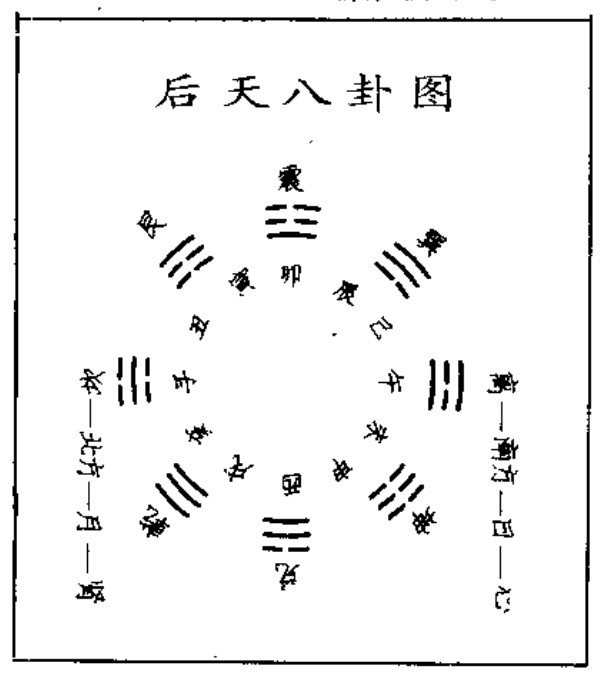
Inner Alchemy requires internal qi to circulate and revolve along the meridian pathways within the body. In earlier times it was called “Golden Fluid Returning to the Elixir” (金液还丹) (Song dynasty · Weng Baoguang, Preface to the Commentary on the Awakening to Reality), and also “River Cart Transport” (河车搬运) (Ming dynasty · Lu Qianxu, Treatise on the Superficial Principles of the Profound). Drawing on the principle of “correspondence between Heaven and humanity,” the term “Zhou Tian” (周天, Orbit) from astronomy was borrowed (Ming dynasty · Wu Zongyang, Correct Principles of the Heavenly Immortals). Some also referred to the circulating pathway as the “Heavenly Scripture” (天经) (Yuan dynasty · Yu Yuwu, Corrupt Discourse at the Banquet).
Post-Natal Bagua Diagram
Trigram Zhèn (震) — North — Moon — Kidney
Zǐ (子)
Yín (寅) — Mǎo (卯)
Post-Natal Bagua Diagram (continued)
Wǔ (午) — South — Sun — Heart
Schematic Diagram of the Microcosmic Orbit Circulation
The Microcosmic Orbit refers to internal qi starting from the lower Dantian, ascending along the Du meridian (Governor Vessel) in reverse, then descending along the Ren meridian (Conception Vessel), passing through the three passes—Weilü (尾闾, tailbone), Jiaji (夹脊, between the shoulder blades), and Yuzhen (玉枕, jade pillow)—as well as the three Dantians (upper, middle, and lower) and the upper and lower Magpie Bridges (the upper Magpie Bridge is at the Yintang and nasal orifice; the lower Magpie Bridge is at the Huiyin and the anal region), making a complete circuit.
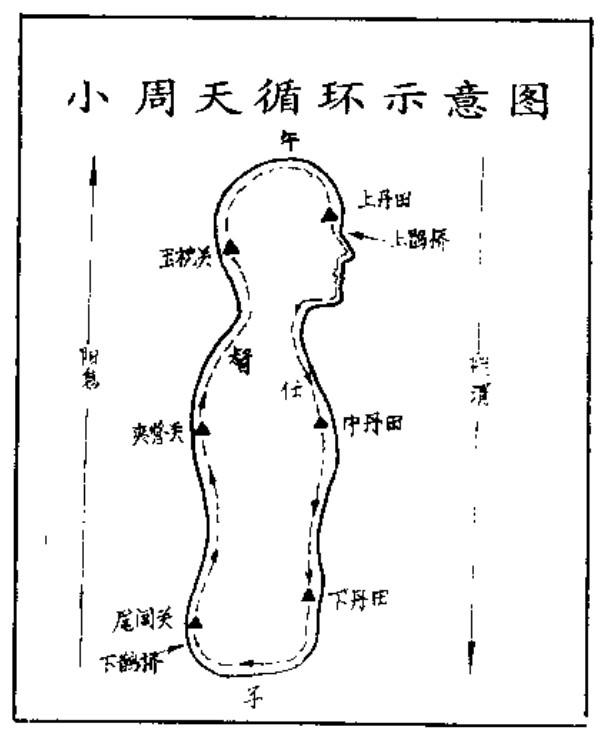
In Inner Alchemy, particular emphasis is placed on the Ren and Du meridians. As Li Shizhen pointed out in Examination of the Eight Extraordinary Meridians: “The Ren and Du meridians are the Zi and Wu of the human body. They are the pathways by which the Dan-school’s Yang fire and Yin talisman ascend and descend, the site where Kan and Li, Water and Fire, commune.” Hence the Microcosmic Orbit is also called the “Zi-Wu Orbit” (子午周天), or “drawing from Kan to fill Li” (取坎填离), “union of Kan and Li” (坎离交媾), “Water and Fire in harmony” (水火既济), and “communication between Heart and Kidney” (心肾相交). The Zi hour is the time when Yin qi has reached its extreme and Yang qi first stirs; the Wu hour is when Yang qi has reached its peak and begins to decline, and Yin qi first emerges. Therefore, Zi and Wu represent the sun and moon of celestial bodies, the heart and kidney of the human body, the trigrams Kan and Li in the hexagram system, and the directions south and north. In the Yuan dynasty, Xiao Tingzhi stated in Collected Achievements of the Golden Elixir that this could be represented using the Post-Natal Bagua diagram.
Because the Microcosmic Orbit requires the post-natal to return to the pre-natal, Inner Alchemy theory uses the Post-Natal Bagua diagram for guidance. Therefore, the focus is placed on the two trigrams Kan and Li. In the Post-Natal Bagua diagram, Kan and Li occupy the positions of Zi and Wu, Water and Fire, Sun and Moon, respectively—which is why the various names mentioned above exist.
Schematic Diagram of the Microcosmic Orbit Circulation (annotated)
| Direction / Position | Organ / Symbol |
|---|---|
| Wǔ (午) | South — Sun — Heart |
| Zǐ (子) | North — Moon — Kidney |
Key points along the orbit:
- Upper Dantian
- Upper Magpie Bridge
- Yuzhen Pass (Jade Pillow)
- Jiaji Pass (Between Shoulder Blades)
- Lower Dantian
- Weilü Pass (Tailbone)
- Lower Magpie Bridge
IV. This practice generally belongs to the category of “stillness practices” (静功). Spontaneous movements are not expected to occur during practice. If practitioners wish to increase their physical activity, they may supplement it with exercises such as Taijiquan, Yijinjing (Sinew-Transforming Classic), or Baduanjin (Eight Brocades), which can complement and enhance one another, improving results.
V. No qigong method can be a “panacea.” Those who are ill should not reject necessary medical treatments while practicing, so as not to delay their condition.
Excerpted from Martial Arts World (武林)
· 110 ·
This exercise method was created by Liu Guizhen based on previous practitioners’ methods, combined with his personal practice experience. It is simple and easy to perform. Each exercise posture provides excellent training for local blood vessels, nerves, and muscles, thereby enhancing resistance to disease. Moreover, it places minimal burden on the body, making it most suitable for elderly people and patients.
(1) Still Sitting Exercise
Sit cross-legged, gently close the eyes, focus the mind on the Dantian, lightly grasp the thumbs with both hands, and place them on the thighs. Straighten the chest and keep the back upright. Gently press the tongue against the upper palate. Breathe through the nose fifty times. After a certain period of training, you may switch to deep breathing. If time is insufficient, the number of breaths may be reduced.
(2) Ear Exercise
First, use both hands to massage the outer rim of the ears up and down (Figure 1), eighteen times on each side; then cover the ears with the hands, place the fingers on the back of the head, press the middle finger with the index finger, and let it slide down to lightly flick the back of the head twenty-four times. You will hear a “dong-dong” sound (commonly called “Beating the Heavenly Drum”). This exercise can relieve tinnitus, prevent deafness, and treat dizziness and headaches.
(3) Teeth Tapping Exercise
Concentrate the mind, and lightly tap the upper and lower teeth together thirty-six times. Do not clash them forcefully. This exercise can strengthen the teeth and prevent dental problems.
(4) Tongue Exercise
Commonly known as “Stirring the Ocean.” Use the tongue to stir around the outside of the teeth, eighteen times to each side; after saliva is produced, continue to swish it—close the mouth and puff the cheeks to rinse thirty-six times—then swallow in three small portions, using the mind to guide the saliva slowly down to the Dantian. Over time, a sound will be produced when swallowing. This exercise not only prevents bitter mouth, astringent tongue, and sore throat, but also cleans the oral cavity, lubricates the stomach and intestines, and promotes digestion.
(5) Nose Exercise
Rub the backs of both thumbs together until warm, then lightly rub both sides of the nasal bridge eighteen times each. This exercise can prevent colds.
(6) Eye Exercise
Gently close both eyes. Rub the backs of both thumbs together until warm, then lightly rub the eyelids eighteen times each. Also rub both eyebrows eighteen times each. Then rotate the eyeballs eighteen times to each side. This exercise can prevent eye diseases and improve vision.
(7) Face Rubbing Exercise
Rub both palms together until warm, then rub from the forehead down along both sides of the nose to the chin, and then back up along the cheeks to the forehead. Repeat this movement thirty-six times in each direction. This exercise can prevent or reduce facial wrinkles and improve complexion and facial nerve function.
(8) Neck Exercise
Cross both hands and clasp the back of the neck, look upward, and create resistance between the neck and both hands (Figure 2). Do this three to nine times. This exercise can relieve shoulder pain and blurred vision.
(9) Shoulder Rubbing Exercise
Use the left hand to rub the right shoulder eighteen times, then use the right hand to rub the left shoulder eighteen times. This exercise can prevent and treat periarthritis of the shoulder (frozen shoulder).
(10) Spine Squeezing Exercise
Lightly clench both fists, bend both upper limbs, and alternately swing forward and backward eighteen times each. This exercise can enhance the functional activity of internal organs.
(11) Waist Rubbing Exercise
Commonly known as “Rubbing the Inner Kidneys.” Rub both hands together until warm, then rub each side of the lower back eighteen times. This exercise can prevent and treat lower back pain and dysmenorrhea.
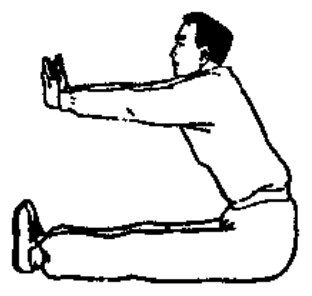
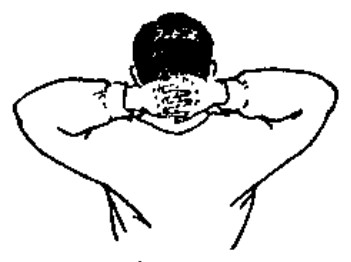
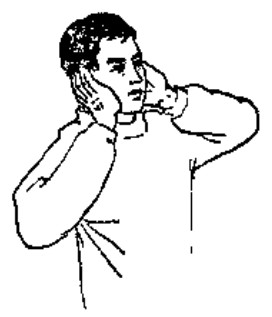
(12) Knee Rubbing Exercise
Use both palms to simultaneously rub the knee joints, one hundred times each. This exercise can prevent lower limb arthritis and strengthen leg power.
(13) Foot Rubbing Exercise
Use the left hand to rub the right Yongquan acupoint (the depression in the front third of the sole) one hundred times, then use the right hand to rub the left Yongquan acupoint one hundred times. This exercise can regulate cardiovascular function, and treat dizziness, insomnia, and hypertension.
(14) Weaving Cloth Exercise
Sit upright on the bed with both legs together and extended straight, toes pointing upward. With both palms facing outward, lean the upper body forward toward the feet in a pushing-pressing posture (Figure 3), and exhale; return after pushing fully, rub the palms together until warm, lightly rub both eyelids eighteen times each, then turn the palms inward and inhale. Repeat back and forth thirty-six times. This exercise can invigorate blood circulation and unblock the meridians.
(15) Belt Vessel Harmonizing Exercise
Sit cross-legged, place both hands on the knees, and rotate the upper body—sixteen times from left to right, then sixteen times from right to left. Inhale when expanding the chest, and exhale when contracting the chest. This exercise can strengthen the kidneys and invigorate the body.
Excerpted from Chinese Qigong, Volume 1, edited by Zhejiang Journal of Traditional Chinese Medicine
(Figure 2) (Figure 3) (Figure 1) ·111·
Meridian and Commonly Used Qigong Acupoint Diagram (Front)
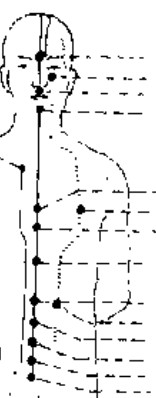
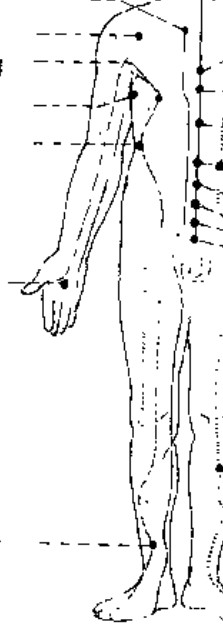
[The following acupoint labels are identifiable from the diagram:]
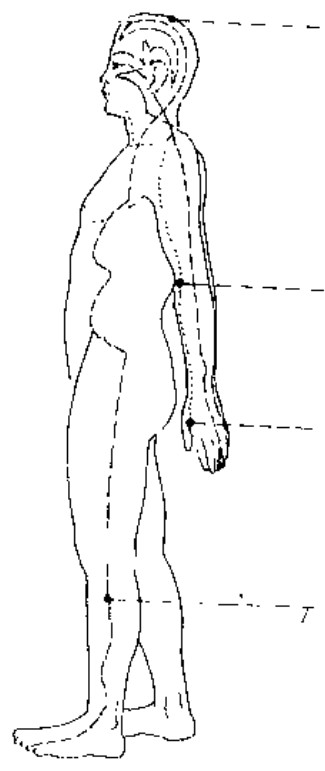
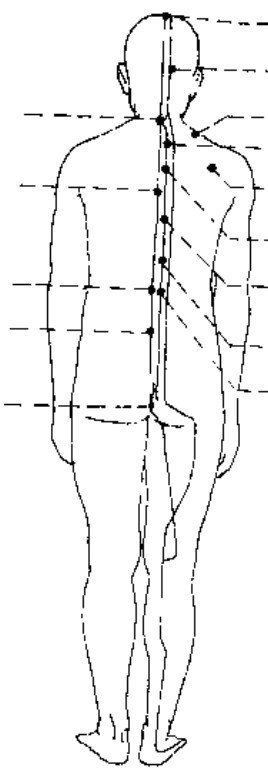
- Guanyuan (关元)
- Mingmen (命门)
- Changqiang (长强)
- Shenshu (肾俞)
- Zhongji (中极)
- Qihai (气海)
Meridian and Commonly Used Qigong Acupoint Diagram (Back/Front)
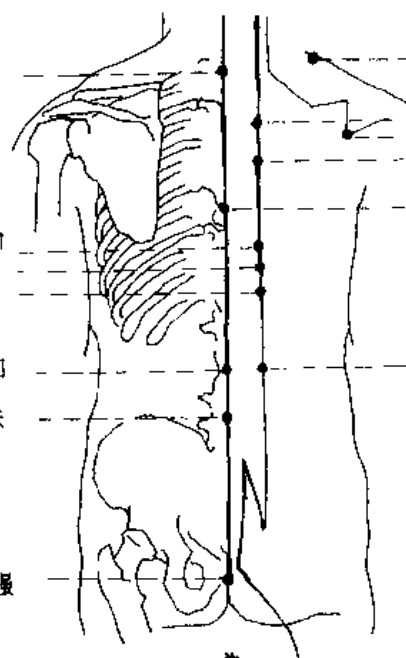
[The following acupoint labels are identifiable from the diagram:]
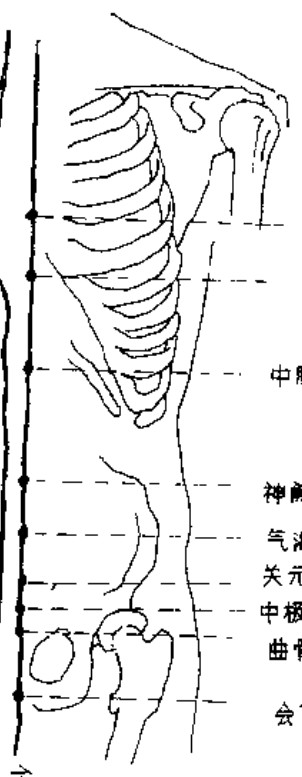

- Zhongfu (中府)
- Dabao (大包)
- Qimen (期门)
- Zhongwan (中脘)
- Qihai (气海)
- Guanyuan (关元)
- Zhangmen (章门)
- Riyue (日月)
·113·
This technique originated from Shaolin Temple and is also called “Breathing Art.” It was originally created to strengthen the monks’ physiques and increase their strength. The movements are simple; people of all ages, the elderly, the ill, and the weak can all practice it. The effects are remarkable—it cures illness and strengthens the body with great speed.
Legend has it that a monk at Shaolin entered the temple in his youth. He was frail and frequently ill, unable to endure the hardship of martial arts training. His master transmitted this technique to him. After persisting in practice for over ten years, he developed a robust physique and the strength of a thousand catties. Thus, this technique was passed down.
During the mid-Qing Dynasty, Cao Yuting of Shaanxi studied at Shaolin Temple and obtained this technique. He transmitted it to Teng Heizi, Teng transmitted it to Liu Gechen of Shouzhang County, Shandong, Liu transmitted it to Zhang Fengyan of Raoyang County, Hebei, Zhang transmitted it to my teacher, Niuh Hanzhang. In his later years, Teacher Niu widely taught this technique, and many benefited from it.
Principle of the Technique
The training method of this technique involves bending forward to compress the lungs while coordinating with exhalation, thereby achieving the goal of “expelling the old.” By extending the arms to expand the lungs while coordinating with inhalation, it achieves the goal of “taking in the new.” Through “expelling the old and taking in the new,” it regulates lung function.
Jia Yifu
Practice has proven that this technique can treat various lung diseases, such as spontaneous sweating, night sweats, coughing and wheezing, shortness of breath and weakness, chronic pleurisy, and pulmonary tuberculosis. Because the lungs assist the heart and regulate the body’s blood circulation, regular practice of this technique can also strengthen cardiac function, improve nervous system health, and reinvigorate the spirit.
(2) Press both hands down to within one to two inches of the ground. (The elderly or frail For those who cough and produce excessive phlegm due to over-smoking, the effects of practicing this technique are extremely may be slightly higher off the ground.) At this point, the air has been completely exhaled; pause the movement slightly. As in Figure 2, using the wrists as axes, lead with the little fingers to sweep outward in a flat half-circle. When the fingers point backward and outward, remarkable. After three or four days of practice, phlegm noticeably decreases and its color lightens. After persisting change the fingers to point downward, make fists with both palms facing each other. Lift upward with straight arms, for about a month, the above symptoms will disappear. imagining in your mind that you are lifting a heavy object of a thousand catties. At the same time, slowly straighten the waist while coordinating with inhalation. Lift until the upper body is upright; both arms remain For those with robust physiques practicing this technique, attention should be paid to “lifting and releasing.” During straight and move upward. When both fists rise above shoulder height, pause slightly. inhalation, lift the lower abdomen, testicles, and anus; during exhalation, relax them. By combining movement, breathing, (3) Bend both arms. Lead with both elbows driving the forearms to forcefully thrust backward, and neural control in this way, strength can be increased. expanding the chest. Coordinate with inhalation at the same time, as in Figure 3.
Practice Method
(4) Transform both fists into open palms. Using the wrists as axes, rotate toward the thumb side to form The time for practicing the Breathing Exchange Art is in the morning. Choose a practice location vertical palms with palms facing forward and fingers pointing upward. At the same time, forcefully push forward. with fresh air and a quiet environment. Coordinating with the forward push of both palms, open the mouth and forcefully produce a “Ha!” sound, then relax Preparation: both arms and pause slightly. This movement, coordinated with the palm push and vocalization, should expel all the air (1) Separate both feet slightly wider than shoulder width. Both toes point forward in parallel. inhaled into the chest. Make fists with both hands and place them at the waist area, palms facing upward. Stand naturally, (5) Rotate both palms outward, make fists, retract both arms, and place both fists at the waist, gazing forward with concentrated mind and even breathing. returning to the movement in step (1).
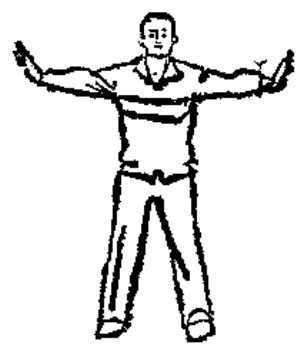
(2) Slowly inhale through the nose into the abdomen, feeling more full than a normal inhalation. The above is the Pushing Air movement. Repeat continuously twelve times.
Pause slightly, then exhale through the mouth. Do this three times, as in Figure 1. Key Points of the Pushing Air Movement:
First Movement — Pushing Air: (1) When pressing both palms down and lifting both fists, the speed should be slow. The backward thrust of both (1) After completing the preparation, inhale. Transform both fists into open palms, rotate them inward arms should be forceful. The forward push of both palms should use “inch power” (cun jin)—that is, at the same so the palms face downward. Slowly press downward. As both palms press down, bend the upper body time as producing the “Ha!” sound, both palms should thrust forcefully and then immediately relax. forward at the waist, coordinating with exhalation (exhale through the nose).
Figure 1
Figure 2
Figure 3
Figure 4
•114•
The downward momentum gradually bends the body forward, and the legs gradually straighten. When the palms descend to knee level, slowly turn the palms face upward and draw them inward, as if scooping up an object, as shown in Figure 7. From movement (2) through this point, all movements are coordinated with exhalation.
(4) When the palms draw together to a distance slightly narrower than the shoulders, turn the fingers forward, slowly extend the arms upward to lift them level, while coordinating with inhalation. As the arms lift, the waist gradually straightens, the hips slowly squat downward, returning to the horse stance. The palms continue to rise, raising high above the head, palms facing backward, fingers pointing upward, both arms vertical.
(5) Both hands form fists, the arms bend at the elbows and shake downward, returning to movement (1).
(6) The fists change to open palms, rotate inward so the palms face diagonally upward, fingers pointing backward, and push upward simultaneously. During the upward push, coordinate by opening the mouth wide and shouting “Ha!” loudly, as shown in Figure 8.
(7) Both hands form fists, bend at the elbows and lower, returning to movement (1).
Perform this form continuously twelve times.
Key points of movement:
(1) Movements (1) and (2) should be continuous without pause. The path of both hands scooping downward should form an arc.
(2) During the forward bending and pressing down, coordinate with exhalation; when straightening the body upward, coordinate with inhalation. The hands lifting upward all the way to above the head should also not pause in between. Breathing cannot be switched mid-way.
Second Form: Separating Qi
Precautions for Practice
(1) Continuing from the previous form, draw both fists back and place them between the ribs, then change to open palms, rotate inward and press down. The movement is the same as in the Pushing Qi form (1), same as Figure 1.
(1) Choose an elevated, open area with fresh air for practice. A forest or waterside is best. Heavily polluted air or enclosed pits and depressions are not suitable for practice.
(2) Movements (2), (3), and (4) are the same as movements (2), (3), and (4) of the Pushing Qi form. The Separating Qi form Figures 2, 3, and 4 are the same as Pushing Qi form Figures 2, 3, and 4.
(2) Strong wind, heavy fog, rain, and snow are all unsuitable for outdoor practice. You may practice indoors with doors and windows open, facing the doorway or window.
(3) For those without illness, the inhalation movements should be somewhat faster, while paying attention to the “three lifts.” Exhalation uses “explosive force.” After exhaling, relax the body. This can increase strength.
(5) Both fists change to open palms, rotate toward the thumb side, turning the fingers upward with palms facing left and right, and simultaneously push outward to both sides. Coordinate with the palm movement by opening the mouth and shouting “Ha!” loudly, as shown in Figure 6.
(4) The “Ha!” sound during exhalation: in the beginning stages of practice, it must be shouted aloud. After attaining a certain foundation, you may simply form the correct mouth shape for the sound without producing audible sound.
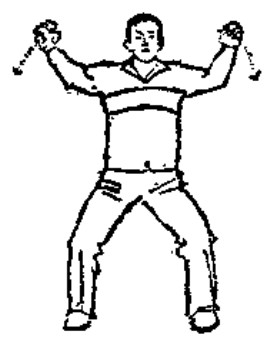
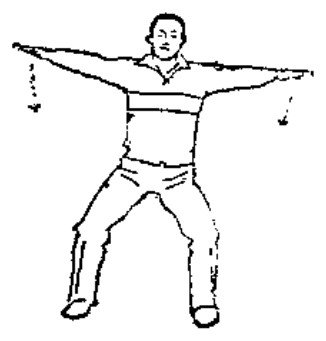
(6) Both palms rotate outward to form fists, bend the arms and draw them back, placing them at the waist with the fist palms facing upward, returning to movement (1).
(5) For each form, beginners should only perform twelve repetitions. Later, gradually increase, but do not exceed forty-nine repetitions.
Perform this form continuously twelve times.
(6) Practice times are generally after midnight and in the morning.
Key points of movement: Same as the Pushing Qi form.
(7) Practicing when too full, too hungry, after drinking alcohol, or when excessively fatigued is not advisable.
Third Form: Scooping Qi
(1) Separate the legs and squat into a horse stance. Both hands form fists, bending the arms upward to form a “mountain” (山) shape with the head, fist palms facing each other, as shown in Figure 5.
Excerpted from “Chinese Qigong”
(2) Both fists change to open palms and rotate inward, palms facing outward, extending the arms outward and downward to both sides. When the arms descend to shoulder level, both palms face downward, as shown in Figure 6.
Figure 5 Figure 6 Figure 7 Figure 8
·115·
When practicing general Qigong while carrying an illness, sometimes “the skill advances day by day, while the disease deepens day by day.” Once the old illness recurs, all prior efforts are wasted. Therefore, those who are ill should first practice medical Qigong. After the disease is cured, practicing other types of Qigong will be of great benefit.
“Peng Zu’s Medical Practice Qigong” has a history of approximately four thousand three hundred years. In the past, it was always “transmitted orally but never written down, kept secret and never passed on.” I inherited this practice through family tradition and master-to-disciple transmission from a young age. Beginning in 1958, I practiced medicine at a medical college, using this Qigong combined with Chinese and Western medicine to treat over fifty common diseases, achieving excellent results. From a summary of over one thousand clinical cases, the “Heart-Nourishing Qigong” has shown particularly remarkable results in treating various heart conditions. I now present the “Heart-Nourishing Qigong” from “Peng Zu’s Medical Practice Qigong” to the vast community of Qigong enthusiasts.
Part One: Morning Practice
When first waking up in the morning, do not get up immediately. Rising hastily from bed prevents the heart from adapting in time, making it prone to various insufficiencies of blood supply. However, one should also not oversleep, sleep drowsily, or linger in bed refusing to get up. This delays the brain from entering a proper state of arousal, and thus fails to produce appropriate regulatory effects on the internal organs, especially the cardiovascular system. Therefore, people often experience dizziness, nausea, palpitations, chest tightness, and similar symptoms when rising either too hastily or after oversleeping. For this reason, upon waking and before opening the eyes, one should begin practice first.
1. Reclining to Observe the Dipper Posture
It is best to sleep with the head pointing south and the feet pointing north, aligned with the Earth’s magnetic field. Upon waking, lie on the right side facing east. Place the right hand below and outside the precordial region, with the middle fingertip tucked into the armpit and the palm facing the heart. Place the left hand on the left thigh, with all ten fingers extended and the tiger’s mouth (web between thumb and index finger) rounded. Close both eyes gently, with the tongue tip pointing upward and pressing against the upper palate. Close the lips lightly and click the teeth together gently. Direct breathing to the upper abdomen at the Zhongwan acupoint, also known as the Middle Dantian. Both legs should be naturally half-extended and half-bent. (See Figure 1)
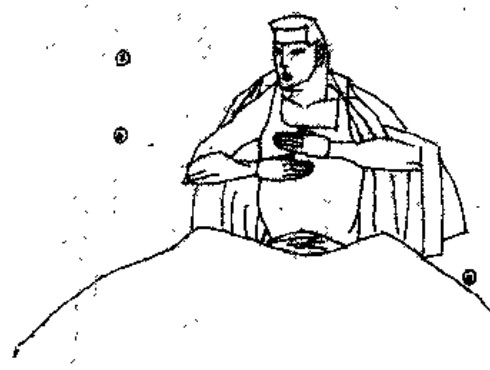
Focus the mind on the upper middle abdomen. Gradually, a warm and comfortable sensation will arise there. Slowly, you will feel the heart open and the qi flow smoothly. After approximately three minutes and about twenty breaths, once the breath has stabilized, slowly exhale through the nose, producing a melodic chanting sound:
(Tune determined by each individual’s voice) — gentle, soft, and unhurried:
En en en | En en — en en en | En en |
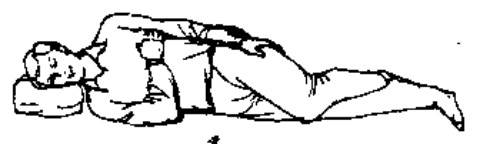
En en en en en en en
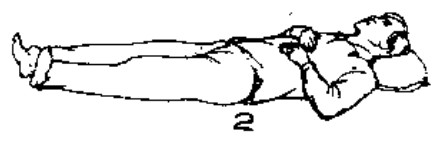
Recite repeatedly three to five times. Then turn to lie face up. Place the right palm on the upper abdomen and the left palm lightly on the lower part of the precordial region. Extend both legs naturally and flat. Raise the pillow slightly, so that abdominal breathing feels natural and comfortable. Open both eyes just slightly to perceive a thin line of light. Focus the mind on the upper abdomen and the precordial region. Concentrate approximately six-tenths on the upper abdomen and four-tenths on the precordial region. Allow warmth to first appear in the upper abdomen and gradually extend to the precordial region. You may adjust appropriately according to your personal sensation. In any case, the goal is for the precordial region to feel comfortable.
·116
3 5 4 should be smooth and unobstructed. (See Figure 2)
The sky is filled with stars, the momentum is magnificent, a colorful phoenix flies and sings in the highest heavens.
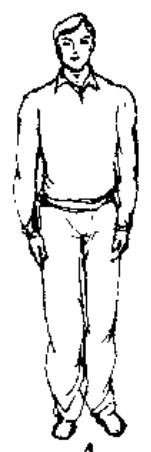
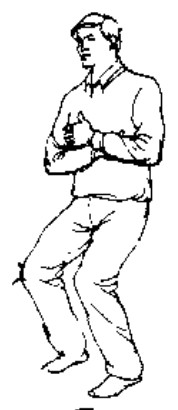
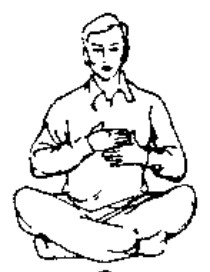
Breathing is still drawn to the upper abdomen. After about 3 minutes, once the breath is stable, use the
Secret Formula:
Nasal chanting:
4.4 Freely Singing at Will
4i4 2 2 3
Both hands protect the Dantian
: 5=2|0-.6 531213-2
212:
Repeat the chanting 3–5 times. Then visualize the practice state:
Practice State:
Chant 3–5 times
Visualize the body’s energy and momentum gradually expanding, extending to heaven and earth, merging with the Big Dipper.
Both hands rotate clockwise and counterclockwise at their original position, 16 circles each, then get out of bed and proceed to the next form.
The body shares one breath with heaven and earth; the mind shares one body with the Big Dipper. Starlight is like water, moonlight flows like a stream, illuminating the heart’s field, shining upon the heart.
3. Wuji Heart-Nourishing Form
Practice Method: Stand naturally, with the toes about two fist-widths apart and the heels about one fist-width apart. Let both arms hang down naturally, with the ten fingers extended, the tiger’s mouth (web between thumb and index finger) open, and the armpits hollow as if holding an egg beneath them. The body should be upright, with the head and neck lifted straight. Eyes slightly closed, eyelids lightly shut, and the tongue tip touching the upper palate. (See Figure 4)
Practice State:
The realm is lofty and far-reaching. On inhalation, silently think “expand”; on exhalation, silently think “lengthen.”
Practice Manifestation:
A five-colored phoenix soars ten thousand li, spreading its wings to cover the person and the earth. It sings atop the nine heavens, resonating with my heart’s voice—sound answering sound, tones harmonizing together.
Secret Formula:
33211216§1321613-211
Standing in Wuji, following the heart’s mechanism; moving the cosmos, generating the breath of the heart.
After about 2–3 minutes, you can feel the energy and momentum rise, the body growing tall and grand, expanding to fill heaven and earth. Slowly transition to the next form.
4. Wuji Heart-Pleasing Form
The entire body is leisurely and at ease. From head to foot, from hands to body, organs, abdomen and back—all perform gentle, even circular rotations. One inhalation and one exhalation completes one circle; rotate 36 circles each clockwise and counterclockwise. The practice state and manifestation are the same as the previous form.
2 5 3 2 1 5 . 3 2 - 1 3 . 2 2 1 3 1 2 . 3 1 6 5 1
Practice State:
Sitting as though atop a high mountain peak, as though sitting on the earth supporting the sky. Clouds and mist swirl and rise abundantly.
Practice Manifestation:
① The hands are like lotus leaves, the body like a willow; the Dantian rolls like a perfectly round sphere.
2 The palms drift like silk, the body flows like brocade; the heart is like the sun and moon illuminating the nine continents.
- 117 -
· Each person’s specific situation should be applied flexibly. Individual practitioners, often out of curiosity
How to Choose Qigong Practice Methods
or a lack of understanding of qigong, may try multiple practice methods—practicing one method today and another tomorrow. As a result, they fail to master any single method well; although their practice time may be long, the results are not significant. The process of mastering a practice method is essentially the process of forming a conditioned reflex. If one specializes in one or two methods, this conditioned reflex is easier to establish, and one can grasp the method more quickly.
There are many practice methods currently popular in society. If too many methods are practiced, they interfere with one another; before one conditioned reflex has been established, it is disrupted by another. Therefore, it is difficult to obtain the ideal qigong benefits.
Some emphasize physical exercise, others focus primarily on regulating the breath, and still others mainly train the mind and intention. Although all methods have holistic effects, they differ in their physiological responses. Therefore, one must, based on the practitioner’s specific situation, clearly identify the condition and choose methods rationally.
For example, the main manifestations in hypertension patients are heightened sympathetic nervous system excitability, elevated blood pressure, rapid heartbeat and pulse, mental tension, and a tendency toward emotional agitation. This condition calls for methods that relatively inhibit sympathetic nervous system excitation, such as Relaxation Exercise (Song Jing Gong), Inward-Listening Stillness Exercise, Method Two of the Inner Nourishing Exercise breathing technique, the Sinking Qi method of the Xuming Exercise, and other methods that strengthen exhalation. These methods help lower blood pressure and alleviate or cure the above symptoms.
For patients with headaches and dizziness, if one forcefully applies mental focus (yishou) to the upper dantian or other positions on the head, symptoms may worsen, which is detrimental to recovery. Conversely, directing mental activity or breathing to the lower region or the feet immediately produces a sensation of lightness in the head. Gastrointestinal patients should primarily use abdominal breathing and the technique of channeling qi to the dantian, as this directly regulates gastrointestinal function and achieves good results. For those with hyperactive gastrointestinal peristalsis, excessive acid, or loose stools, methods that strengthen inhalation should be chosen. For those with sluggish peristalsis, abdominal distension, or weakened digestive function, methods that strengthen exhalation are preferable. Patients with asthma, bronchitis, and other respiratory diseases should primarily practice breathing regulation, progressing from shallow to deep, gradually strengthening it, and combining it with mental training. Clinically, the Xuming Exercise has achieved excellent therapeutic results. For neurasthenia, post-concussion syndrome, menopausal syndrome, and other nervous and endocrine system disorders, the Strengthening Exercise (Qiang Zhuang Gong), Microcosmic Orbit Exercise (Zhou Tian Gong), or Standing Stake Exercise (Zhan Zhuang Gong) are often chosen. Many patients have achieved satisfactory results using Spontaneous Movement Exercise and Five Animal Frolics, as these methods are effective in regulating the nervous system. Cancer patients mostly choose Guo Lin Walking Exercise or Inner Nourishing Exercise. Patients with sexual neurasthenia mostly choose Iron Crotch Exercise (Iron Pants Exercise), Strengthening Exercise, or Return Exercise. For spinal disorders, the Divided Attention method is chosen. Those with weak constitutions should begin with the Inner Nourishing Exercise, which can rapidly improve digestive function, increase appetite and food intake, and improve physical constitution. Healthy people practice qigong for longevity. Older individuals may choose stillness exercises such as Relaxation Stillness Exercise, Strengthening Exercise, and Standing Stake Exercise. Younger individuals may choose dynamic-static combined methods such as the Five Animal Frolics and Spontaneous Exercise.
One practice method can be applicable to multiple diseases, and the same disease may warrant different methods depending on its manifestations. All of these should be flexibly applied according to each person’s specific situation.
It is clinically common for one person to suffer from multiple diseases. For instance, a patient with ulcers may also have hypertension, neurasthenia, or chronic hepatitis. A patient with gastroptosis may also have chronic gastritis, chronic enteritis, or gynecological conditions. In such cases, which practice method is most appropriate? Clinical experience suggests that practitioners can focus on the most prominent symptom. For example, a patient with ulcers combined with neurasthenia should first choose the Inner Nourishing Exercise. Once the ulcer improves or is cured, the neurasthenia will mostly improve or resolve accordingly. If the patient’s primary condition is hypertension, accompanied by chronic hepatitis, one should practice the Relaxation Stillness Exercise or Relaxation Exercise. After blood pressure stabilizes, one may switch to Method Two of the Inner Nourishing Exercise breathing technique. Alternatively, one may begin directly with Method Two of the Inner Nourishing Exercise, which simultaneously lowers blood pressure and regulates the digestive tract.
—Excerpted from China Qigong
As the qi sensation strengthens, the whole body feels light and floating, as though in water. Slowly transition into the next form.
6. Regulating Qi and Returning to the Heart Form
Keeping the hands in their original position, massage 16 circles clockwise and 16 circles counterclockwise. Then place both hands on the left and right sides of the face, massaging 16 circles in each direction. Next, starting from the back of the occipital bone, push along both sides of the cervical spine to the upper back, 16 times in each direction. Then relax the entire body and shake 16 times.
5. Hun Yuan Heart-Nourishing Form
Shift your body weight to the right, step to the left with the left foot half a step, with both feet parallel and apart, and bend the knees into a squat to a degree that does not feel too strenuous. Place the right palm lightly over the heart area, and the left palm over the upper abdomen at the Zhongwan acupoint. Extend the fingers, and round the tiger’s mouth (webbed area between thumb and index finger). Rest quietly and focus the mind for 2–3 minutes. (See Figure 5)
As in the previous form, massage the entire body, completing one circle per breath–exhalation cycle. Rotate 36 circles in each direction.
Key points: The waist serves as the axis, the shoulder leads the elbow, the elbow leads the hand; the waist serves as the axis, the shoulder leads the elbow, the knee leads the hand.
Focus your intention on the fifth thoracic vertebra of the upper back, and gradually feel warm qi flowing from the upper back through to the upper abdomen and into the heart. The qi sensation transitions from expansive to gradually concentrated, from external to internal, gathering from between heaven and earth into the chest and heart region, gradually dissolving into the field of the heart. After approximately 10–15 minutes, once the qi state stabilizes, transition to the next form (closing form).
II. Noon Practice and Evening Practice
Heart disease patients must take a midday nap. After meals, practice for 5–10 minutes. Entering the nap from a practice state will result in better rest. In the evening, one should go to bed earlier. The duration of sleep depends on personal habits, but it should be regular.
Before the midday nap and before bedtime, practice in front of the bed. The method is the same as the morning practice, but the order should be reversed: 1 Wuji Heart-Nourishing Form, 2 Wuji Joyful Heart Form, 3 Hun Yuan Joyful Heart Form, 4 Regulating Qi and Returning to the Heart Form, 5 Sitting and Observing the Heart Field Form, 6 Reclining and Observing the Big Dipper Form (first do the face-up observation, then the side-lying observation).
The morning practice transitions from stillness to movement, and after closing the practice, one begins the day’s activities. The noon practice and evening practice transition from movement to stillness, followed by sleep.
—Excerpted from Contemporary Sports
·118·
“Lying Stance Qigong” Dedicated to Middle-Aged and Elderly People
Song Hongbin
Lying Stance Qigong is a form of qigong therapy suitable for middle-aged and elderly people. It is characterized by rapid qi sensation and safe qi collection.
As people enter old age, the functions of various internal organs weaken to varying degrees, and chronic diseases such as hypertension, coronary heart disease, diabetes, and hemiplegia follow one after another. Drug treatments often produce slow results, while exercise therapies of greater intensity are unsuitable for elderly individuals who are frail, chronically ill, and lack a foundation of physical training. For this reason, based on many years of practical experience, I have created this set of training methods suitable for middle-aged and elderly practitioners. I have introduced this method to over a hundred elderly individuals, all of whom have achieved varying degrees of benefit.
Illustrated Guide to the Practice
Posture (Figure ①)
Lie supine on a bed (preferably a hard-board bed), gaze at the ceiling, relax the entire body, and breathe naturally. Place both hands palms-down on the bed with fingers slightly bent, and relax both feet as if pushing against an object. Lie quietly for 3–5 minutes.
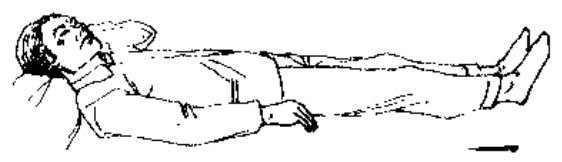
Upper Limb Exercise (Figure ②)
- Raise the left hand slowly from the base of the palm, taking approximately half a minute;
- Slowly raise the forearm in sequence from the palm to the elbow joint, taking approximately one minute;
- Slowly raise the upper arm; when it is lifted 2–3 cm off the bed, extend it forward horizontally, taking approximately one minute;
- Slowly return the arm to the side of the body.
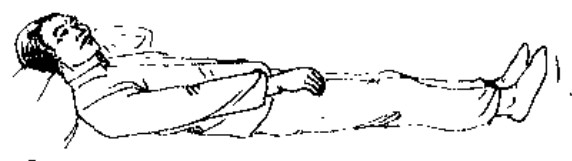
Note: When raising the arm, keep the palm facing downward at all times, with the mind focused on the Laogong acupoint. The angle between the arm and the bed should ideally be 15°–18°.
If the practice is performed correctly, the qi sensation will be pronounced. The raised arm will feel as though lifting a heavy object, and the five fingers will experience a sensation of swelling and warmth. After completing the left arm, proceed to the right arm using the same method and sequence.
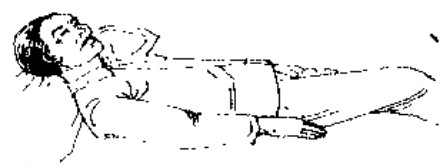
Lower Limb Exercise (Figures ③ and ④)
- Slowly raise the left heel, lifting it approximately 1–2 cm off the bed;
- Raise the lower leg in sequence;
- Slowly raise the upper leg; the optimal angle between the leg and the bed is 15°–18°.
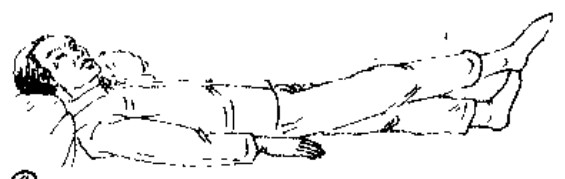
Note: When raising the upper leg, let the toes relax and droop downward, with the mind focused on the Yongquan acupoint.
Beginners may experience soreness in the leg muscles or trembling of the thighs. At this point, you may first lower the leg, rest briefly, and then resume. After completing the left leg, proceed to the right leg using the same method and sequence.
Massage Exercise (Figure ⑤)
After completing all four limbs, rest quietly for one minute. Then:
- Place both hands together and gently push downward from the chest to the Dantian area 15 times;
Selected Qigong Methods
. 6II.
Essential Knowledge for Beginners
“One must understand the nature of water before wading in” — this is the summary of our predecessors’ experience.
Under normal circumstances, deviations will not occur.
A Brief Discussion on Preventing Qigong Deviations
- It is best to learn qigong under the guidance of an instructor. Those who practice according to books and periodicals should carefully comprehend the essential points of the method. When problems arise during self-practice, one should consult experienced practitioners to obtain correct guidance.
-
Avoid the “Three Tensions” in practice, namely: bodily tension, mental tension, and respiratory tension. Deviations are often caused by one or more of these three tensions. Generally, all qigong methods require the body and limbs to be relaxed yet not slack; the mind should be light — as if present, as if absent, neither deliberately held nor abandoned; breathing should be natural, slow and gentle, never forced or held. These three principles must be carried through the entire course of practice.
-
Avoid the “Three Malpractices” in practice, namely: concurrent practice, mixed practice, and reckless practice. These three malpractices are important causes of qigong deviation. “Concurrent practice” means studying multiple methods at the same time — practicing Method A in the morning, Method B at noon, and Method C in the evening. As a result, none of the methods is practiced well, and it is easy to damage one’s health instead. “Mixed practice” means arbitrarily combining different essential points and requirements from different methods. For example: using the focal point of Method A in Method B, applying the breathing requirements of Method B to Method C — the result is A within B, and B within C. The outcome of mixed practice is that it neglects the distinct characteristics of each method, disregards the useful experience of our predecessors, backfires, and easily leads to deviation. “Reckless practice” means being overly eager for results, rushing for success, not practicing according to one’s ability, practicing while fatigued — failing to nourish qi and instead depleting it, pursuing practice duration alone without regard for quality. This will certainly not yield the desired results.
-
Avoid deliberate pursuit — that is, pursuing the circulation of internal qi, pursuing certain internal energies, pursuing certain effects, and so forth. All the positive reactions and positive effects that arise during practice occur naturally and spontaneously in the course of correct practice, by “letting nature take its course.” What is obtained through arbitrary pursuit is artificial, imposed, unnatural, and disruptive. Various false phenomena will arise from this, leading to deviation.
The phenomenon of qigong deviation is occasional and isolated, but every effort should be made to prevent it, so as to achieve the purpose of practice. Those who teach qigong should strengthen the transmission of methods for preventing and correcting deviations.
Once a deviation occurs during practice, one must remember not to panic. Mild deviations can be resolved by oneself; for more serious ones, promptly seek help from a qigong master for correction — recovery to normal is entirely possible. One need not give up eating for fear of choking, nor be afraid to practice again.
Recently, we have encountered several patients who developed deviations from practice. We studied their processes of deviation in order to prevent them — this is of no small benefit to the vast number of qigong enthusiasts.
Case One: A female teacher was practicing a type of spontaneous movement qigong. The range and quantity of movements grew increasingly large and numerous. After one session, both ears felt swollen and blocked, resulting in hearing impairment.
Case Two: A young man practicing the Zhou Tian (Microcosmic Orbit) method was overly eager for quick results. As a result, qi gathered in his head; his head felt as heavy as lead, with unbearable swelling and pain.
Case Three: A male factory worker practiced spontaneous movement qigong and lost self-control, resulting in mental abnormalities.
Case Four: A female cadre practiced multiple methods concurrently. After a single session of spontaneous movements lasting two hours, she felt her qi and blood declining, her feet felt as soft as cotton, and she was unable to speak.
For the above four cases: In the first case, we applied external qi treatment to the affected area — one session basically resolved the pain, and a second session restored normalcy. In the second case, we used a qigong guidance instrument for treatment, and she recovered after two sessions. In the third case, we simultaneously directed qi through the Baihui and Laogong acupoints — the patient returned to normal after four sessions. In the fourth case, we simultaneously directed qi through the Dazhui and Laogong acupoints — one session produced marked results, followed by symptomatic treatment for her residual conditions of severe insomnia and chest and rib pain, enabling her to gradually return to normal.
The common characteristics of these four practitioners were: they all wanted to relieve illness through qigong training, but none practiced under the guidance of a skilled instructor. Eagerness for results, blind pursuit, and lack of correct guidance were the main reasons for the deviations in these cases.
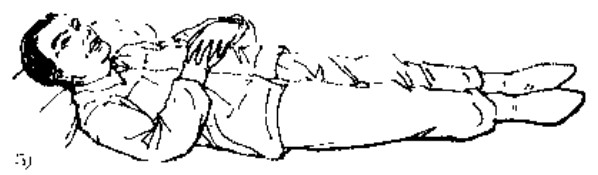
In our view, beginning qigong students will benefit from paying attention to the following points.
— Excerpted from Chinese Qigong (Zhonghua Qigong)
-
Using the left and right palms respectively, push along both sides of the navel down to the Zhongji point on the lower abdomen, 10 times.
-
Take 5 deep breaths and conclude the practice.
After concluding, additionally press and hold the Neiguan acupoint on the inner side of the left and right forearms, 3 times each.
— Excerpted from Chinese Martial Arts (Zhonghua Wushu)
Precautions
-
Those who practice the Reclining Post (躺桩) qigong before sleep may add pressing the Shenmen acupoint 30–50 times, which has a remarkable therapeutic effect on insomnia.
-
Elderly persons suffering from hemiplegia or limited hand and foot mobility may ask others to assist with the exercises. After completion, the assistant may repeatedly massage the patient from shoulder to hand and from leg to foot, 3 times each. This greatly aids in restoring flexibility to the affected limbs.
-
During practice, remember: first, stillness; second, slowness; third, perseverance. Avoid impatience or giving up halfway. As long as one persists without slackening, results will surely follow.
·120
Martial Arts Qigong for Strengthening the Body and Curing Diseases
Authors: Yang Huazeng, Gao Ping, Zang Yuxing
Martial arts qigong has a long history; it integrates martial arts and qigong into one, belonging to the internal family (Neijia) of practices. With the changes of the times, it has gradually evolved into an effective means to enhance physical fitness and treat diseases. Martial arts qigong combines techniques such as vocalization, stepping, movement, stillness, hardness, softness, contraction, extension, rising, and falling to balance yin and yang, circulate qi and blood, strengthen muscles and bones, and dissipate chronic ailments. To facilitate self-study and practice for the masses, we have extracted the essence and arranged seven sets of movements that are simple, easy to learn, and yield good results. One can practice the entire routine to strengthen both the internal and external five forms, or practice specific movements individually according to one’s own illness. For example, those with lower back and leg pain can solely practice “Golden Rooster Stretching Its Legs,” and those with insomnia can solely practice the “Vocalization Exercise.”
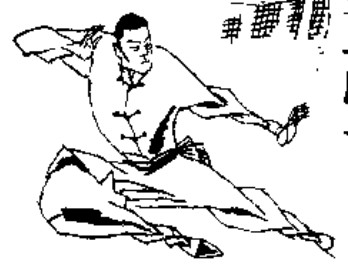
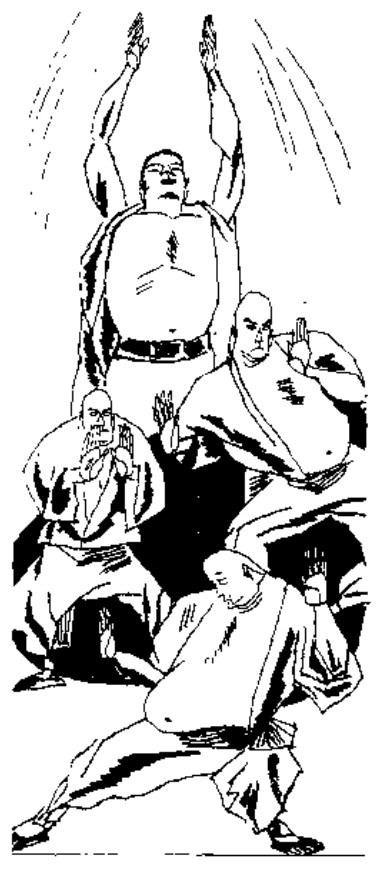
Since the winter of 1981, we have held more than a dozen martial arts qigong training classes at locations including the Luwan District Workers’ Stadium in Shanghai, and the Sports Committee and Cultural Station of Qibao Town, Shanghai County, with over 3,000 participants in total. Through guided and self-practice, many students suffering from various chronic conditions such as arthritis, neurasthenia, insomnia, lower back and leg pain, convalescent hepatitis, vertigo, chronic enteritis, memory decline, enuresis, and hypertension have seen their symptoms significantly alleviated or completely cured. Facts prove that martial arts qigong is not only suitable for the elderly, the weak, and the sick to practice for curing diseases and preserving health, but it is also highly suitable for teenagers and healthy individuals to further improve their physiques, prevent diseases, and fully exert the body’s latent potential.
Section 1: Golden Rooster Stretching Its Legs
Preparatory Posture: Stand at attention. Make a fist with the right hand; form a palm with the left hand, and let them hang naturally on either side of the hips.
Actions:
- Raise the fist and palm to the waist and thrust them forward, slightly bending them, while stepping the left foot forward into a bow stance (Figure 1).
- Step the right foot next to the left foot, toes touching the ground to form an empty stance. At the same time, retract both elbows to the ribs. The knee bend should not extend past the toes (Figure 2).
- Slowly extend the left palm forward and upward using internal strength (Neijin). Simultaneously, change the right fist into a palm and slowly extend it straight backward and downward using internal strength (foot off the ground), while straightening the left leg as well (Figure 3). Hold for a moment until there is a sore and swelling qi sensation in the lower back and back.
- Lower the right foot to form a left bow stance.
- Turn 180 degrees backward to the right. At the same time, protect the crotch with the right hand (palm facing left), sink the elbow to protect beside the right cheek with the left hand, and form a right bow stance (Figure 4).
- Step the left foot next to the right foot to form an empty stance (Figure 5).

- Lift the right hand, passing it by the right cheek, and slowly extend it forward and upward using internal strength. At the same time, place the left hand beside the left leg, slowly extending it straight backward and downward using internal strength (foot off the ground) as the left leg straightens (posture is the same as Action 3, but in the opposite direction).
- Plant the left foot to form a right bow stance. If you need to practice continuously, turn 180 degrees backward to the left and repeat the above Actions 5-8 (with opposite movements) for several cycles.
Key Points:
- When performing movements 3 and 7, move slowly and use internal strength so that the lower back feels a sore and swelling sensation.
- Breathe naturally.
Effect: Relaxes the muscles and tendons, promotes blood circulation. Mainly treats chronic lower back and leg pain.
Section 2: Chopping Palm and Stepping Foot
Preparatory Posture: Stand at attention.
Actions:
- Raise both palms forward from the sides to chest level, elbows slightly bent, fingers pointing down, palms facing each other. At the same time, take a deep breath to fill the lower abdomen until it feels full. As you inhale, lift the right leg to a horizontal position, bend the knee, and let the foot hang naturally (Figure 6).
- Relax the whole body. Forcefully and quickly chop both palms downward from top to bottom. Stomp the right foot forcefully on the ground, and at the same time, forcefully shout “Hai” from the Dantian, lifting the left foot slightly and naturally (Figure 7).
- Step forward with the left foot into a left bow stance, simultaneously thrusting the palms forward with force (Figure 8).
- Step the right foot next to the left foot, keeping the feet shoulder-width apart, and let both hands hang naturally.
Key Points:
- When stepping the foot, the entire sole should exert force; avoid using the heel alone.
- When vocalizing, project the sound loudly, shortly, and forcefully.
Effect: Promotes the circulation of qi and blood, and clears the meridians. Mainly treats hypertension, vertigo, blurred vision, and chronic enteritis.
Section 3: Three-Dropping Stance
Preparatory Posture: Stand naturally, with the feet separated slightly less than shoulder-width apart.
Actions:
- Turn both palms to face forward and slowly raise them to chest level while taking a deep breath (Figure 9).
- Turn the palms over (palms facing down) and slowly drop both hands to the sides of the hips (palms facing backward). As the hands drop, sink the body, forming a horse stance with both feet (Figure 10).
- Turn the palms over (palms facing up). As the hands rise, lift the body, straightening both legs until the hands reach chest level.
- With palms facing each other, slowly drop them to the sides of the legs. Bend the knees slightly, not exceeding the toes. Close the eyes slightly and focus your mind on an external object (focus exclusively on a specific scenery around you). Shift the body’s center of gravity to the Yongquan acupoint on the front soles of both feet (Figure 11) and hold for about 20 minutes.
Key Points:
- Breathe naturally; keep the movements soft and the whole body relaxed.
- When holding the stance, keep the eyes empty and slightly retract the fingers inward. Concentrate your mind and maintain a relaxed and happy mood.
Effect: Strengthens the kidneys and consolidates the root, invigorating the spirit. Mainly treats neurasthenia.
Section 4: Tendon-Tip Exercise
Preparatory Posture: Continue from the previous section.
Actions:
- Step the left foot forward half a step. With both palms facing each other, slowly raise them from the sides to abdomen level (Figure 12).
- Turn the upper body 90 degrees to the right while turning the palms over (palms facing down). Retract the right hand to the upper abdomen (Figure 13).
- Squat down following the movement of the hands. Keep the left leg parallel to the ground, with the front shoulder lower than the rear shoulder. Take a slow, deep breath, and use internal strength to hook the fingers into eagle claws (Figure 14).
- As the body is lifted with effort, simultaneously exhale slowly; the right leg straightens, and the left heel rises to form an empty stance (Figure 15). This should be done to the extent that the head does not feel swollen or distended.
- Return to the preparatory posture.
Effect: Invigorates the spirit, improves appetite, and strengthens the sinews and bones of the upper limbs. Primarily treats neurasthenia, insomnia, chronic bronchitis, upper limb arthritis, and similar conditions.
Section 6: Vocal Exercise (发声功)
Preparatory posture: Stand upright.
Movements:
- Step the right foot forward into a bow stance. The right hand swiftly flicks upward overhead, while the left hand guards the groin area, palm facing down, fingers pointing forward (Figure 17).
- Raise the left hand, palm facing right, sliding along the right forearm to the tiger’s mouth (web) of the right hand. The left foot steps forward to beside the right foot (Figure 18).
- Step the left foot forward into a bow stance. Simultaneously, both hands turn so the palms face forward. The left palm presses forcefully to about one inch above the left knee, while the right palm pulls forcefully to below the navel. The upper torso rotates approximately 90 degrees (Figure 19).
- Inhale fully; the right hand rises with the shoulder to the level of the navel.
- When the lower abdomen feels full and distended, the right hand presses down forcefully. At the same time, the dantian exerts force and produces a loud “Hai” (嗨) sound.
Key Points:
- In Movement 3, the tiger’s mouths (webs) of both hands should form a single line; the front shoulder should be lower than the rear shoulder.
- When producing the sound, the eyes should glare and the eyebrows should be raised.
Effect: Strengthens the kidneys and consolidates the foundation, promotes the circulation of qi and blood, strengthens the sinews and bones of the four limbs, makes the finger strength solid and hard, and steadies the joints. Primarily treats general weakness, arthritis of the four limbs, and similar conditions.
Section 7: Sunlight Circulating Qi (阳光循环气)
Preparatory posture: Stand upright.
Movements:
- Separate the left foot to the left, slightly narrower than shoulder width. Both hands form fists with the backs of the fists facing forward (Figure 20).
- Inhale; at the same time, lift the heels off the ground. Hollow the chest and pull up the back.
- Clench the fists tightly. Hold the breath still. Use internal strength (内劲) to lift the qi, directing the qi (through intention) from the waist (Mingmen acupoint) upward along the spine to the crown of the head (Baihui acupoint).
- When a sensation of fullness in the head is felt, relax the entire body. Slowly lower the heels to the ground while exhaling (during exhalation, direct your intention to the dantian).

Key Points:
- When lifting the qi, the breath must be held still.
- Practice only to the extent of not becoming fatigued.
Effect: Nourishes the brain and brightens the eyes, opens and clears the meridians. Primarily treats hypertension, dizziness, migraine, blurred vision, and similar conditions.
Key Points for Practice: During practice, the forearms should develop a sensation of soreness and distension.
Excerpted from Dazhong Yixue (Popular Medicine)
·123·
Qigong training focuses on regulating the spirit (调神), regulating the breath (调息), and regulating the body (调身). The application of intention and the cultivation of morality belong to regulating the spirit (i.e., regulating the mind); adjusting the breath belongs to regulating the breath; guiding the physical form and the requirements for each part of the body belong to regulating the body. The requirements for each part of the body in practice are the fundamental content of body regulation. All schools of qigong (except for spontaneous qigong) maintain strict and detailed requirements in this regard, because correct posture can promote the circulation of qi and blood, while incorrect posture (including movements) will obstruct the free flow of the qi pathways. The following describes the requirements for each part of the body, using standing post (站桩) as an example.
(1) Requirements for the Head Region
Requirements: The head should be suspended as if from above, also called “the head suspended like a bell” (头如悬磬). This means the head should be centered and upright, empty and lightly lifted upward, as if a string were attached to the Baihui point (located one centimeter posterior to the midpoint of the line connecting the tips of both ears, corresponding to the hair whorl in most people—which differs from the standard acupuncture point), suspending the person in mid-air.
Specific Method: The common approach is to push the head upward and elongate the neck, but this tends to make the neck stiff. Our method is: place the head in a centered position, draw the throat inward (formerly called “locking the magpie gate” 锁住喜鹊关), tuck the chin inward, and direct intention from the throat upward to find the Baihui point. Relax the cheeks. In this way, the neck naturally curves slightly backward at the rear, and the crown achieves a state of empty suspension.
Function: The head is the highest, most clear and empty region of the body, and the brain resides within it. Chinese medicine holds that “the brain is the sea of marrow; when the sea of marrow is sufficient, one is light, strong, and energetic, surpassing ordinary limits. When the sea is insufficient, there is dizziness, tinnitus, atrophy and weakness of the legs, blurred vision, and lethargic drowsiness” (Lingshu: Hai Lun Pian — Spiritual Pivot: Treatise on the Seas). Therefore, keeping the head upright and the neck empty and suspended is not only the key to overall bodily centeredness, but also guides the qi mechanism upward to nourish the brain and sustain the spirit. This enhances the function of the “spirit” (神) in governing all activities of the body, manifesting as vigorous and spirited energy. If the head tilts or loses its suspension, the spirit becomes listless, and the body cannot achieve the requirements of balance. When forward leaning, backward tilting, or lateral leaning occurs, one should seek correction through the crown of the head.
(2) The Eyes
Requirements: The eyes should be like lowered blinds — containing light in silence. This actually means the eyelids droop, leaving only a slit of light. The eyeballs gaze straight ahead internally, and the gaze is drawn inward.
Specific Method: Look straight forward, then slowly and gently close the eyelids at an even pace, beginning the closure from the outer corners of the eyes. The gaze follows the closing of the eyelids inward, merging with intention into a unity, which is called “spirit light” (神光). Those focusing on the upper dantian direct the spirit light upward; those focusing on the lower dantian direct the spirit light downward. Directing it upward was called in ancient times “facing south to view the Big Dipper” (面南观北斗) — an excellent method for withdrawing the gaze and turning inward. Directing it downward was called in ancient times “the spirit light shining down upon the primal sea” (神光下照元海) — a wondrous technique for replenishing qi and adding essence.
When using visual focus (including internal visualization with closed eyes), focusing upward involves turning the eyeballs upward to gaze at the crown; focusing downward involves turning the eyeballs downward to gaze at the primal sea. Focusing downward must be adapted to the individual and the condition; otherwise, deviation may occur. The guarding of the spirit light involves the light moving with the spirit, and the spirit and qi following each other. The qi thus engaged connects with the prenatal (actually the unified/hunyuan qi), so whether guarding above or below, there is no harm.
Function: Qigong practitioners regard “the eyes as the vanguard of the heart/mind” and “the mechanism lies in the eyes.” Therefore, closing the eyes and lowering the lids is an important means of calming the spirit and guarding internally. Furthermore, the eyes are the meeting place of the yin qiao and yang qiao meridians, so all qigong practitioners place great importance on the regulation and care of the eyes.
(3) The Tongue
Requirements: The tongue should rest against the upper palate, also called “pillar tongue” (拄舌), formerly known as “building the bridge” (搭桥) (lowering the tongue was called “removing the bridge” 拆桥).
Specific Method: Beginning practitioners should gently close the lips and teeth together, with the teeth neither fully closed nor fully open. The molars on both sides should be as if biting down on something. The tip of the tongue naturally rests against the inner side of the upper front teeth and
124
At the junction of the gums. Only a slight intention is needed; do not use force, otherwise the tongue will become stiff and adverse effects will arise. Once you have some foundation, you may place the tongue at the junction of the hard and soft palate.
Function: The Conception Vessel (Rèn Mài) originates at the perineum, ascends along the anterior midline, and terminates at Chéngjiāng below the lips; the Governing Vessel (Dū Mài) originates at the perineum, ascends along the spine to the crown of the head, turns forward, passes through the center of the eyebrows and the tip of the nose, and terminates at the inner side of the upper lip. Placing the tongue against the upper palate serves to connect the Conception and Governing Vessels. Thus, the qi ascending along the Governing Vessel transforms into fluid (saliva) and descends into the mouth. When the qi flows through, it feels as though water is flowing from the lips (in reality it will not flow out). At this point, do not open your mouth; instead, calm your spirit and wait quietly, allowing it to flow downward naturally.
Ancient and Modern Time Correspondence Table
Qigong books and texts frequently reference the ancient Chinese time periods (shíchén). A special table of ancient and modern time correspondences is provided here for reference.
| Time Period (Shíchén) | Ancient Name | Modern Time |
|---|---|---|
| Zǐ shí (子时) | Yèbàn (夜半, Night’s Middle) | 23:00–01:00 |
| Chǒu shí (丑时) | Jīmíng (鸡鸣, Cockcrow) | 01:00–03:00 |
| Yín shí (寅时) | Píngdàn (平旦, Dawn) | 03:00–05:00 |
| Mǎo shí (卯时) | Rìchū (日出, Sunrise) | 05:00–07:00 |
| Chén shí (辰时) | Shíshí (食时, Mealtime) | 07:00–09:00 |
| Sì shí (巳时) | Yúzhōng (隅中, Mid-morning) | 09:00–11:00 |
| Wǔ shí (午时) | Rìzhōng (日中, Midday) | 11:00–13:00 |
| Wèi shí (未时) | Rìdié (日昃, Sun Slanting) | 13:00–15:00 |
| Shēn shí (申时) | Būshí (晡时, Late Afternoon) | 15:00–17:00 |
| Yǒu shí (酉时) | Rìrù (日入, Sunset) | 17:00–19:00 |
| Xū shí (戌时) | Huánghūn (黄昏, Dusk) | 19:00–21:00 |
| Hài shí (亥时) | Réndìng (人定, Night Stillness) | 21:00–23:00 |
(IV) Neck and Nape
Most qigong practice manuals use the term “raise the neck upright” (竖项, shù xiàng). This has already been discussed in Section (I) above and will not be repeated here.
(V) Chest and Back
Requirement: Contain the chest and pull up the back (含胸拔背, hán xiōng bá bèi). “Containing the chest” does not mean rolling the shoulders forward; rather, the front of the chest is slightly drawn inward. “Pulling up the back” means the spinal column of the back is held naturally upright.
Specific method: To contain the chest, first exhale, and slightly draw inward the triangular area at the front of the chest—between the manubrium of the sternum (the bone below the depression at the front center of the neck) and the two nipples. Note that this is not about rolling both shoulders forward and inward, much less collapsing the chest together; rather, it is about relaxing the chest. Therefore, containing the chest must be combined with opening the chest. “Opening the chest” means expanding the chest outward to both sides. The method is to open outward at the shoulder points (the acromioclavicular joints), which complements the containing of the chest, achieving the effect of relaxing the chest.
The method for pulling up the back is to lead upward from the Dàzhuī acupoint (GV-14, the prominent bone at the back of the neck—the seventh cervical vertebra), connecting straight through to the Bǎihuì acupoint (GV-20, at the crown), so as to extend the spine straight. To avoid the faults of protruding the back and raising the shoulders, one must let the shoulder blades settle—in other words, let the two scapulae naturally relax and sink. Combining pulling up the back with settling the shoulder blades makes the back and shoulder blades flexible.
Function: The heart and lungs both reside in the chest. The heart governes mental activity (shénmíng) and also governes the circulation of blood throughout the body. The lungs govern the qi of the entire body and have the function of “converging all vessels” (朝百脉, cháo bǎi mài). Combining containing the chest with opening the chest can expand the thoracic cavity, allowing the heart and lungs to rest peacefully within the chest, so that qi and blood flow smoothly and freely. Moreover, relaxing the chest and back facilitates the passage of the Conception and Governing Vessels. Furthermore, the Dàzhuī acupoint was known in ancient times as the “Heavenly Ladder” (上天梯, shàng tiān tī), meaning it is difficult for qi to ascend past it; pulling up the back can assist its passage. In addition, the chest is the meeting place of the six yin meridians; relaxing the chest and back can maintain smooth continuity among the six yin meridians connected to the five viscera (and actually also the pericardium—so it should be called the six viscera), thereby ensuring normal functioning of the five viscera.
(VI) Shoulders
Requirement: Relax the shoulders (松肩, sōng jiān) and hollow the armpits (空腋, kōng yè).
Method: Relax the shoulder joints and the acromioclavicular joints (the connection between the outer end of the clavicle and the coracoid process of the scapula—where the two bones at the outer front and back of the shoulder meet), letting them hang down naturally. At the same time, slightly open and support the armpit area, making the armpits hollow and empty, as if holding a “qi pancake”—with a gap of 2–3 centimeters between the arm and the armpit. The key to achieving hollowed armpits is relaxing the Jiānyù acupoint (LI-15, the depression at the shoulder point) and the Jiānliáo acupoint (TE-14, the depression external to the Jiānyù acupoint), gently lifting them slightly upward and outward. In this way, relaxing the shoulders and hollowing the armpits form a natural unity. Otherwise, if one only talks about relaxing the shoulders and lets them droop down indiscriminately, it results in “sloping shoulders” (溜肩膀, liū jiānbǎng), which not only affects the aesthetic appearance of the body but also has a certain adverse effect on the flow of qi and the lightness and agility of the upper limbs.
(VII) Elbows
Requirement: The elbows should sink (drop) yet be suspended (肘坠而悬, zhǒu zhuì ér xuán).
Method: Relax both elbows, with the elbow tips having the intention of hanging downward. The key points (guānqiào) are the Tiānjǐng acupoint (TE-10, at the back of the elbow on the large bone) and the Xiǎohǎi acupoint (SI-8, at the “numbness point” behind the elbow). Also, the Qūchí acupoint (LI-11, at the outer end of the elbow crease) and the Zhōuliáo acupoint. However, the elbows must not be forced downward, otherwise the shoulders and elbows will become heavy and sluggish. At the same time as the elbows are sinking, they must also be suspended—that is, the elbows have a sense of being vacuously suspended. The key points are as above. The ancients said, “There is a cavity within the elbow” (肘中窍, zhǒu zhōng qiào), meaning that these key points must all be open and expanded. To achieve this, the upper limbs must maintain a certain degree of bend and not be extended too straight.
(VIII) Wrist, Palm, and Fingers
Requirement: The wrist should be seated (坐, zuò), the palm should be contained (含, hán), and the fingers should be comfortably extended (舒, shū).
Method: The key to seating the wrist is to direct intention downward at the Shénmén acupoint (HT-7, at the ulnar end of the wrist crease); the wrist will naturally assume a downward-seated posture. Containing the palm means drawing the center of the palm inward, as if holding a balloon—if you open your hand, the balloon would fall. By using intention in this way, the contained palm will naturally be correct. Extending the fingers means the five fingers spread naturally, with a certain gap between the four fingers. The thumb and little finger meet on the outer side of the palm through intention.
Function: The upper limbs have six meridians: the three yin meridians of the hand and the three yang meridians of the hand (the Hand Taiyin Lung Meridian, Hand Jueyin Pericardium Meridian, Hand Shaoyin Heart Meridian; the Hand Yangming Large Intestine Meridian, Hand Shaoyang Triple Burner Meridian, and Hand Taiyang Small Intestine Meridian). By properly performing the relaxation of the shoulders, hollowing of the armpits, sinking and suspending of the elbows, and seating of the wrists, the six meridians will be harmonized and unobstructed, qi will flow freely, and upper limb movements will have a sense of lightness; the sensation of qi can extend directly to the fingertips.
Moreover, hands play an extremely important role in human life (including qigong practice). The Yīnfújīng (Classic of the Hidden Talisman) states: “The universe is in the hand” (宇宙存乎手), meaning that a qigong practitioner can grasp the changes of all things in the universe through the hands. This is because, over the course of human evolutionary history, the development of the hands and the brain mutually promoted each other, forming important connections. Modern science has also confirmed the significant linkage between consciousness and
·125·
The activity of the hands has the most significant influence on bioelectricity.
Method: Withdrawing the abdomen does not mean tensing the abdominal muscles. Starting from the anterior superior iliac spine (the small bony prominence at the front of the hip), draw backward toward the Yangguan acupoint on the sacrum, straightening and supporting the lower back. (Beginners may feel soreness in the lower back.) This achieves the effect of withdrawing the abdomen without tensing the abdominal muscles; otherwise, qi will not easily sink, resulting in a sensation of stifled qi.
Therefore, during qigong practice, it is very important to ensure the proper functioning of the hands. Perform the postures of the shoulder, elbow, and wrist correctly. This lays the foundation for realizing the wondrous functions of the hands.
(9) Waist (腰)
Requirement: Relax the waist—the lumbar vertebrae and their ligaments, as well as the muscles on either side of the lumbar spine—so as to gradually alter the natural curvature of the lower back. When standing, the lower back should be straightened and may even curve slightly backward; when sitting, it should be straightened and may even flatten slightly forward. When straightening, do not force it stiffly, but rather stretch gently up and down, as if the vertebrae were lightly stacking one upon another.
Method: The waist is the most difficult part to relax. It requires dedicated practice of waist-relaxation methods. For those who have not undertaken specialized training, one may first straighten the waist naturally, then slightly raise both shoulders and gently lower them (while simultaneously maintaining a conscious intention to relax the waist).
Function: The waist is the outer dwelling of the kidneys. The kidneys store the original yin and original yang, which generate primal qi that is infused into the Qihai (Sea of Qi) to nourish the whole body. The waist is also an important pillar supporting the human body, so qigong practitioners pay special attention to it. Relaxing the waist makes the lumbar region flexible—not only capable of rotating in horizontal circles, but also in “vertical circles” and “mixed spiraling circles.” On the one hand, this strengthens kidney function and makes primal qi abundant. On the other hand, relaxing the waist allows qi and blood to flow freely, thereby ensuring its role of governing the activities of the entire body. The ancients said: “Power originates from the feet, is governed by the waist, and manifests in the four limbs.” They also said: “Force is issued from the spine.” If the waist cannot relax, one cannot attain this level.
(10) Hip (胯)
Requirement: Relaxing the hip has two layers of meaning: first, relaxing the hip joint; second, relaxing the sacroiliac joint (traditionally called “fan-ting,” or spreading the buttocks).
Method: There are specialized methods for relaxing the hips, which are only briefly introduced here. Squat down slightly with the buttocks, assuming a “half-seated” posture. Maintain a certain angle between the torso and the legs. Keep a hollow triangular space at the root of the thighs. The buttocks spread outward and backward, but should not tilt upward or rearward.
Function: When the hip joint is relaxed, the lower limbs move freely and naturally. Additionally, the sacroiliac joint in ordinary people is a false joint that cannot move; only in the late stages of a woman’s pregnancy does this joint loosen. Through the practice of spreading the buttocks and sufficiency of Dantian qi, a practitioner can also open this joint. Once this joint opens, the boundaries of the Dantian can expand, the accumulation of primal qi can increase, and the foundation is laid for clearing all joints throughout the body.
(11) Abdomen (腹)
Requirement: Draw the lower abdomen inward so that the chest and abdomen form a straight line.
Function: Withdrawing the abdomen helps primal qi converge inward to the Dantian, increases internal pressure, and promotes its circulation throughout the body. All qigong practice emphasizes “filling the abdomen.” While “filling the abdomen” is certainly achieved through whole-body training that suffuses the abdomen with essence and qi, withdrawing the abdomen is also an important component of this process.
(12) Tailbone (尾闾)
Requirement: Step one: let it hang down; Step two: tuck it forward; Step three: rotate the tailbone. Only step one is introduced here.
Method: Following the relaxation of the hips and the squatting of the buttocks, visualize in your mind that the tailbone is connected to a stick propping you up from below. Practice this for a long time and the tailbone will naturally hang downward (there are also specialized training methods).
Function: The tailbone is the starting point of the Du Mai (Governing Vessel). Letting the tailbone hang exercises the Du Mai and promotes the upward flow of its qi. Additionally, relaxing the tailbone can loosen the Yaoshu acupoint (where the sacrum and coccyx connect), which is key to relaxing the waist.
(13) Perineum (裆)
Requirement: Lift the crotch, round the crotch, form a round crotch, and ensure the scrotum does not touch the inner thigh skin.
Method: In ancient times this was called “binding the waist, sinking the qi, and spreading the crotch,” meaning to open the crotch. It includes three actions:
(1) Lifting the crotch: drawing the perineum upward. This action has three components: 1. The anus (also called the posterior yin or “gu dao”): gently contract the external anal sphincter to lift the anus slightly, as if holding in a bowel movement. 2. The anterior yin (urethral area): gently contract the muscles of the anterior yin, as if holding in urine, creating a sensation of “almost urinating but not quite.” 3. The perineum (traditionally called the “seabed”): gently contract the perineal muscles, connecting to the inner roots of both thighs.
(2) Rounding the crotch: round the crotch area. This action is combined with relaxing the hips, spreading the buttocks, and letting the tailbone hang, forming—centered on the contraction of the perineum—a round, lively, and spacious crotch on all sides.
(3) Tucking the knees: knees tucked inward is another condition for achieving a round crotch (see the section on knees).
Function: The perineum is the starting point of the Ren Mai (Conception Vessel), Du Mai (Governing Vessel), and Chong Mai (Penetrating Vessel). When properly adjusted, the perineum remains free of compression (note: only when other areas are relaxed can the qi mechanisms flow freely, and the perineum requires a certain degree of tension to ensure it is not compressed), thereby ensuring the circulation of qi through the Ren and Du vessels. Lifting the crotch not only prevents leakage of qi from the anterior and posterior yin and stores up yin essence, but when combined with breathing exercises, it is also key to the practice of transforming essence into qi. The ancients required: “The Heavenly Gate should remain ever open; the Earthly Door should remain ever closed”—this is what they meant.
(14) Knees (膝)
Requirement: Relax the knees and tuck them slightly inward.
Method: Squat down slightly and gently, tucking the knees lightly inward and bending them slightly forward (the knees should not extend past the toes). Relax and sink downward, but maintain a subtle intention of lifting the kneecap slightly upward. Otherwise, merely sinking downward gives a feeling of heaviness and stagnation.
Function: Tucking the knees combined with the outward rotation of the femoral head and the spreading of the buttocks allows the internal force of the upper body to descend in a spiral from the outside inward, down to the feet. Additionally, tucking the knees is a supplementary action to forming a round crotch, and lifting the knees is the essential element for keeping the lower limbs light and agile.
(15) Feet (足)
Requirement: Both feet spread flat on the ground; distribute the body’s weight evenly across both feet, without favoring any one spot.
Method: First adjust the entire body to a centered and upright position, then gently contract the big toes with intention and guide qi downward. The body’s weight travels along both shoulders, the sides of the torso, and the outer thighs down to the centers of the soles. Coordinating with the lifting of the knees, the force of gravity passes from the hips to the soles and even to the five toes. This cannot be achieved in a single day; it requires coordination with the relaxation of the waist, hips, and knees before both feet can gradually spread flat. This differs from the martial arts concept of “five toes gripping the ground.” Martial artists emphasize martial presence and killing intent; for health cultivation, one need not focus on this.
Function: When both feet are spread flat, achieving “force uniting the five toes and the Yongquan acupoint” (not the physical action of five toes gripping the ground) is one of the important markers of whole-body relaxation. Only then can qi truly flow downward to connect with the feet and the earth’s qi, and only then can the qi throughout the body become truly unobstructed. The ancients said: “Power originates from the feet” and “The sage’s breathing reaches to the heels”—this is exactly what they meant.
The above is only a brief description of the essential points of each body part’s posture and form, and the functions have been introduced only superficially. As for the subtle internal changes, they can only be personally experienced through practice. Moreover, each person’s own sensations are not entirely the same, so they are omitted here.
These requirements for body posture cannot be achieved properly all at once; they require repeated practice. Furthermore, the practice of correcting posture should not be undertaken during formal qigong sessions. Rather, one should carefully examine each posture during informal practice. Otherwise, it would violate the requirement of maintaining focused concentration (entering stillness) during practice, thereby affecting the results of training.
Excerpted from Eastern Qigong (《东方气功》)
Selection of Qigong Methods
”Student Stance” Qigong Movement Essentials
Student Stance Qigong (Promoted by Jiangxi Institute of Metallurgy) by Li Yonglian
Before enrollment, students at our institute all underwent strict medical examinations, and their health conditions were basically good. However, after enrollment, due to heavy schoolwork, prolonged sitting and studying, and less physical activity, some students gradually developed neurasthenia and diseases of the digestive system. For these diseases, drug therapy was either only temporarily effective or completely useless; some students’ health deteriorated continuously, and they either could not persist in normal studies or had to take a leave of absence and leave school. Based on this situation, we referred to ancient qigong materials and compiled a set of “Student Stance” qigong to be promoted among students. After practicing this routine, the cure rate for neurasthenia reached 100%, gastrointestinal diseases also showed significant results, and the cardiovascular and respiratory functions of 94.1% of the practitioners were enhanced. This set of exercises is briefly introduced below.
I. Preparatory Posture: Stand naturally with feet apart left and right at shoulder-width, head straight and neck upright. Look straight ahead with both eyes, place the tongue against the palate, relax the shoulders, let both arms hang naturally, relax the waist and tuck in the hips, relax the hips and retract the abdomen, and slightly bend the knees. Eliminate distracting thoughts, calm the mind and concentrate the spirit, and breathe naturally (Figure 1).
II. Nine Rotations of the Heavenly Orbit: On the basis of the preparatory posture, close the eyes slightly, focus the mind on the Dantian, and breathe nine times (one inhale and exhale counts as one time). Then: ① When inhaling, guide the intention down from the “Dantian”, passing the “Huiyin” (perineum) and ascending along the Du Meridian (inside the spine) to the “Dazhui” acupoint; ② When exhaling, guide the intention down through the shoulders and along the inner arms to the centers of both palms, the “Neilaogong” acupoints; ③ When inhaling, slowly raise both arms forward to shoulder height, with palms facing each other and shoulder-width apart (Figure 2); ④ When exhaling, turn palms downward, lower both arms, passing through both sides (inhale) to a lateral raise (Figure 3); ⑤ When exhaling, slowly lower both hands from the sides of the body, while slightly squatting down with both knees (Figure 4); ⑥ When inhaling, bring both hands together toward the lower abdomen (Dantian), while slowly straightening both legs, then exhale. Repeat movements ① to ⑥ nine times.
III. Independent Guarding of the Spirit: On the basis of the preparatory posture, close the eyes slightly. Lightly press the left palm (“Neilaogong”) against the Dantian area, and place the right hand over the back of the left hand (“Wailaogong”). Breathe evenly, slowly, deeply, and long for dozens of times (Figure 5).
IV. Turning the Universe: On the basis of the previous posture, press both palms and rub in a counterclockwise direction—leftward and upward (inhale), then rightward and downward (exhale)—from small to large circles, nine times. Pause slightly below the “Xiphoid process”, switch hands so the right hand is inside and the left hand is outside, and rub in a clockwise direction from large to small circles, nine times, returning to the Dantian. Throughout the abdominal rubbing process, the mind moves along with the palms.
V. Teeth Tapping and Saliva Swallowing: Continue from the previous posture. ① When inhaling, guide the intention downward from the Dantian, passing through the “Huiyin” (perineum), ascending along the Du Meridian, circling around the “Baihui”, and passing down through the “Qianting” and “Yintang” to the mouth; ② Keep the intention in the mouth, breathe naturally, and gently tap the teeth thirty-six times; ③ After tapping the teeth, sweep the tip of the tongue outside the teeth but inside the lips, first circling counterclockwise three times, then clockwise three times; ④ Swallow the accumulated saliva in the mouth slowly with intention, sending it down to the Dantian.
VI. Looking Left and Right: Slowly and naturally relax both hands and let them fall beside the thighs, returning to the preparatory posture. Slowly open both eyes and look straight ahead. Then, slowly move the eyes to the left to look around, followed by slowly looking to the right. Alternate looking left and right six times before concluding the exercise.
A Brief Discussion on Qigong Breathing
The Role of Breathing
Qigong Practice Guidance
Breathing is the continuous process of gas exchange between the body and the external environment. Any tissue in the body must undergo the process of oxidation to maintain its life activities. Nutrients taken in from the outside can only release the energy necessary for tissue activities after being oxidized. Once this oxidation process stops, the body can no longer continue to live.
This oxidation process within the tissues is physiologically called tissue respiration. Only by continuously supplying oxygen and constantly dissipating the carbon dioxide produced during the oxidation process can the process of tissue respiration proceed. In the respiratory organs, gas exchange occurs between the blood and the outside environment; that is, carbon dioxide is expelled from the blood, while a large amount of oxygen enters the blood. After acquiring oxygen in the respiratory organs, the blood transports it to the body’s tissues, and then carries the carbon dioxide produced by the tissues to the respiratory organs to be expelled from the body. The completion of the aforementioned respiratory process is due to the presence of spinal cord neurons that govern the movement of respiratory muscles and the medulla oblongata, and the cells of the medulla oblongata are constantly influenced by the higher centers of the brain to accomplish this.
The Purpose of Breathing Exercises in Qigong
Breathing exercise is a crucial part of practicing Qigong well. Through training, chest breathing is transformed into abdominal breathing, and shallow breathing into deep breathing, fully utilizing the role of the respiratory muscles to achieve the goal of healthcare and medical treatment. Many people believe that adjusting breathing can produce a massaging effect on the abdominal organs. This mechanical action causes alternating high and low pressure changes within the abdominal cavity, promoting the flow of blood and lymph fluid. It helps reduce blood stasis in the abdominal organs, assists the abdominal aorta in transporting blood to the peripheral parts of the body, and simultaneously helps the blood in the main abdominal veins return to the heart, thereby reducing the heart’s burden.
It can also enhance digestion and the absorption of nutrients. More importantly, breathing exercises affect the interaction among the various centers of the entire nervous system, particularly the interaction between the central nervous system and the autonomic nervous system. Breathing movement is the movement of the respiratory muscles under the control of the respiratory center. Breathing movement during Qigong practice is an activity under the control of cortical consciousness. Once practice becomes highly proficient, without the need for conscious control, simply sitting down to practice allows the breathing movement to proceed gently, evenly, naturally, finely, lengthily, comfortably, and effectively.
If breathing is proper, the practitioner will feel the joy of regulating the breath. It is evident that the role of adjusting breathing during practice is not only in regulating the relationship between the central nervous system and the autonomic nervous system, but it is also of great significance for entering a state of quietude.
In summary, the breathing method of Qigong is a primary means in practice. After selecting a breathing method for practice based on the condition of the illness, one must also pay attention to adjusting it at any time to ensure the breathing method adapts to the body’s conditions. Knowing only how to utilize breathing without knowing how to adjust it according to the objective conditions of the human body is as dangerous as ignoring tactics in war. For example, if male and female patients suffer from the same disease, the chosen breathing method is often the same, but its specific application differs. Because physiological habits of men and women are not exactly the same, and women are mostly accustomed to thoracic breathing, when practicing abdominal breathing, they often start by focusing their mind on the Danzhong (chest center), slowly moving from Danzhong to Dantian, and then to the lower Dantian. During menstruation, focusing on the Dantian should be temporarily abandoned, changing to focus on Danzhong or the Yongquan acupoint (center of the sole); otherwise, side effects often occur. As another example, using the breath-holding method to treat peptic ulcers is effective, but applying this method to pulmonary tuberculosis is harmful and can cause severe hemoptysis. From this, it can be seen that breathing exercises must be comprehensively considered based on the specific characteristics of the illness and the current objective conditions of the individual’s body to have positive significance.
Types of Breathing
Breathing is an important part of Qigong therapy. Through exercise, chest breathing is changed to abdominal breathing, and shallow breathing to deep breathing, eventually developing into spontaneous Dantian breathing, expanding lung capacity, promoting gas metabolism and blood circulation, and “massaging” the internal organs to aid digestion and absorption, thereby achieving the goal of strengthening the body and curing diseases. There are eight commonly used breathing methods:
- Natural Breathing Method: This is the physiological breathing everyone possesses after birth, without any intentional mind control. The breathing is natural, soft, and even, but its drawback is that it is not deep and long enough.
- Forward Breathing Method: When inhaling, the diaphragm descends and the abdomen protrudes outward; when exhaling, the diaphragm ascends and the abdomen retracts inward. The up-and-down movement amplitude of the diaphragm is large, and the front-to-back movement of the abdominal muscles is significant, gradually developing into abdominal breathing.
- Reverse Breathing Method: Opposite to the forward breathing method, when inhaling, the diaphragm ascends and the abdomen retracts inward; when exhaling, the diaphragm descends and the abdomen protrudes outward. Its range of motion and intensity are greater than those of the forward breathing method.
- Breath-Retention Breathing Method: There are two types. One is between an exhale and an inhale; the exhalation time is deliberately lengthened. The other is between an exhale and an inhale, where the inhalation time is deliberately lengthened.
Author: Hu Bin
·128·
Nose-Inhale, Mouth-Exhale Method
Normal human breathing involves inhaling and exhaling through the nose. However, when there is illness in the respiratory tract, the internal cavity narrows and breathing becomes labored, this method may be adopted.
Qi Circulating Through the Ren and Du Meridians Method
This employs the reverse breathing method: inhale through the nose while simultaneously guiding the qi with the mind, visualizing the qi reaching the Dantian, then descending to the Huiyin (perineum). On exhalation, guide the qi with the mind, visualizing it traveling from the Huiyin along the spine to the Baihui (crown of the head), and exhaling through the nose. Hence it is also called the Microcosmic Orbit Breathing Method.
Latent Breathing Method
This is a breathing pattern that naturally emerges after practicing either the forward breathing method or the reverse breathing method. Its characteristics are: the inhalation is continuous and subtle, the exhalation is faint and barely perceptible. When testing the airflow at the nose with the hand, there is no obvious sensation—hence it is also called the Latent Breath Method.
True Breath Method
The ancients said: “When ordinary breath ceases, true breath arises spontaneously.” The so-called cessation of breath does not mean forcibly holding it in; rather, it refers to reaching a state of profound emptiness and stillness—the more settled the mind, the more subtle the breath, the spirit concentrates and the qi consolidates, until there is but this single breath. At this point, from the outside it appears as though breathing has stopped, but in reality one is still breathing through the navel, and the abdomen rotates and pulses—hence it is also called “embryonic breathing.” This represents a relatively advanced stage of practice.
Among the eight breathing methods described above: the forward breathing method yields better therapeutic results for cardiovascular and cerebrovascular diseases; the breath-holding method and reverse breathing method are more effective for diseases of the digestive system; the nose-inhale, mouth-exhale method is more effective for diseases of the respiratory system; and the qi circulating through the Ren and Du meridians method is more effective for diseases of the nervous system. Each breathing method should be selected according to the specific condition through differential diagnosis, so as to avoid deviations. Regardless of which breathing method is used, after every 10–20 minutes of practice, one should switch to natural breathing to prevent overexertion of the respiratory muscles, which could lead to paralysis, distress, or even danger—what the ancients referred to as “entering demonic states and catching fire.” Therefore, qigong practice must combine cultivation with nourishment—that is, combine breathing exercises with breathing rest. Breathing exercises should be guided by the fundamental principles of softness and naturalness, progressively achieving depth, length, fineness, evenness, and slowness. One must never rush for quick results.
Steps for Training the Breath
First stage: When first learning qigong, one transitions from thoracic breathing to abdominal breathing, from shallow breathing to deep breathing, and from involuntary breathing to voluntary breathing. The breath is gradually drawn deeper and longer. Although one must not violate the principles of softness, naturalness, comfort, and effectiveness, some unevenness in breathing and strong heartbeat (though without an increase in heart rate) is more or less unavoidable. This stage lasts approximately 3–5 minutes.
Second stage: Through regulating the breath, breathing becomes naturally smooth and even. The respiratory rate gradually decreases, the heartbeat becomes weaker or imperceptible, and a comfortable sensation arises. This stage appears after approximately 10–20 minutes.
Third stage: The inhalation becomes continuous and unbroken, the exhalation faint and subtle. Each inhale and exhale feels effortless and content. The respiratory rate decreases further, the heartbeat is no longer felt, and the mood becomes pleasant. This stage appears after approximately 30–40 minutes.
Fourth stage: Mind and breath merge into one, with no awareness of the coming and going of breath. This appears at 50–60 minutes. The four stages described above vary from person to person; some practitioners may take longer, others shorter. The intervals between each stage are also flexible, and as skill advances and improves, the third and fourth stages gradually appear earlier.
Training the Respiratory Muscles
First period: During the initial stage of practice, the diaphragm, intercostal muscles, and abdominal muscles of most practitioners do not move freely. Thoracic breathing primarily relies on rib movement, while abdominal breathing primarily relies on diaphragmatic movement. Ordinary breathing is generally of a mixed type. When first beginning practice, diaphragmatic movement is mostly in the upper abdomen. After 1–2 months of breathing training, the diaphragm descends to the lower upper abdomen, abdominal pressure increases, and the abdomen visibly protrudes or retracts, most noticeably in the upper abdominal region. During this period, intercostal muscle movement is primary, and diaphragmatic movement is secondary.
Second period: After 3–4 months or more of practice, the movement of the diaphragm, intercostal muscles, and abdominal muscles during breathing exercises becomes more agile. Diaphragmatic movement is mostly at the level of the navel, abdominal pressure increases, and abdominal protrusion or retraction is most noticeable at the navel. During this period, intercostal muscle movement and diaphragmatic movement are roughly equal.
Third period: After half a year to more than one year of breathing training, respiratory muscle movement becomes further lively and natural. During inhalation, the diaphragm descends to the mid-abdomen, compressing the abdominal viscera and raising the abdominal pressure; during exhalation, the abdominal viscera return to their original positions, and abdominal pressure decreases. During this period, diaphragmatic movement is primary, with intercostal muscle movement as secondary; abdominal muscle movement is most noticeable below the navel.
Fourth period: After approximately 1–2 years of practice, or during quiet states, spontaneous movements occur within the abdomen—rotating forward and backward or left and right, sometimes moving back and forth like a weaver’s shuttle, or moving up and down. During this period, diaphragmatic movement is primary, and abdominal muscle movement is secondary. (This is a manifestation of enhanced gastrointestinal peristalsis.)
Specific Manifestations After Mastering Abdominal Breathing
The specific manifestations after mastering abdominal breathing can be divided into two types: external manifestations and internal changes, introduced below:
(1) External manifestations: Through long-term qigong breathing training (1–2 years), thoracic breathing has transformed into abdominal breathing, shallow breathing has become deep breathing, and the diaphragm has descended from the upper abdomen to the lower abdomen. Therefore, during breathing, the rise and fall of the abdominal muscles below the navel is quite noticeable. When using the reverse breathing method, during inhalation the abdominal muscles draw inward, nearly touching the posterior abdominal wall—because the powerful contraction of the lower abdominal muscles pushes the internal organs upward, the upper abdomen protrudes noticeably. During exhalation, the abdominal muscles relax, the lower abdomen protrudes noticeably, and the upper abdomen returns to its original state. This is because the prolonged breathing training has made the diaphragm, abdominal muscles, stomach, intestines, and other tissues firm, enhanced their elasticity, and invigorated their functions, enabling voluntary changes in abdominal pressure. This is the manifestation of external changes.
(2) Internal changes: In the initial stage, there is frequent belching of gas from the stomach and frequent passing of gas from the intestines. This is very pronounced for patients with liver disease, heart disease, and gastrointestinal disorders. After the gas is expelled, one feels extremely comfortable. In the middle stage, intestinal borborygmi become very loud—gurgle—gurgle—gurgle—pleasantly loud, but without diarrhea. In the later stage, pulsation within the abdomen becomes pronounced, as if there were a small motor inside the abdomen, moving comfortably and rhythmically; appetite increases, and digestion improves. This is because prolonged qigong breathing training results in strong and forceful diaphragmatic contraction, with a range of motion 3–4 times greater than that of a normal person. The diaphragm’s movement can descend from the upper abdomen to the lower abdomen, squeezing the stomach, intestines, and abdominal aorta. The peristalsis of the stomach and intestines, along with the pulsation of the abdominal aorta, drives the diaphragmatic movement, forming a wheel-like zone of respiratory excitation. During abdominal breathing, when entering a state of tranquility, one is unaware of breath coming in and going out; instead, one feels as though a wheel is turning from the middle Dantian to the nostrils—extremely comfortable and leisurely content. If one places a hand on the abdominal wall, one can feel the internal pulsation rotating in a wheel-like pattern with an even rhythm, resembling pregnancy—hence the ancients called it embryonic breathing.
How to Determine Breathing Volume
When practicing breathing, nose-inhale and nose-exhale are required, but for patients with respiratory tract conditions, nose-inhale and mouth-exhale may be used. Because the pressure within the chest cavity is low, exhaling is more difficult, while external atmospheric pressure is higher, making inhalation easier. This is especially important for patients with emphysema or chronic bronchitis, who should consciously inhale through the nose and exhale through the mouth. When practicing breathing, gentleness and naturalness are required—slightly deeper and longer than natural breathing. The number and duration of breaths should be determined according to each person’s breathing contraction mark. From the upper edge of the navel to the lower edge of the xiphoid process, the area is divided into upper, middle, and lower sections. If the breathing mark is in the upper abdomen, each breathing session may last about 10 minutes; if the breathing mark is in the upper abdomen, each session may last about 20 minutes; if the breathing mark is below the navel, each session may last about 30 minutes. Everyone has a breathing mark on their abdomen—with clothing removed, a horizontal line appears on the abdominal wall during breathing practice—hence it is called the breathing mark. Breathing volume is determined based on the breathing mark.
Excerpted from Wulin (Martial Arts World)
·129·
Selected Qigong Methods
The Harmony of Blood Qigong (He Xue Gong)
(Figure 1) (Figure 2) (Figure 3)
This qigong was created by Mr. Deng Zhongshan, a martial artist from the Daoguang and Xianfeng reigns of the Qing Dynasty. He authored the book Treasury of Secret Methods of the Martial Lineage (《功家秘法宝藏》). In Volume One, Illustrated Explanations of the Harmony of Blood Qigong (《和血功图说》), it is stated: “When one practices, if qi and blood are in harmony, then a hundred illnesses will not arise; conversely, external pathogenic factors will invade internally, and a hundred illnesses will all arise… I have one method called the Harmony of Blood Qigong… it is suitable for all—the elderly, the young, women, and children. If one practices according to the method… a hundred illnesses will not arise. This qigong not only has the effect of dispelling illness and prolonging life, but it is also the foundation for practicing hard qigong and achieving ‘striking resistance’ (i.e., types such as ‘Iron Cloth Shirt’ and ‘Golden Bell Cover’).” The complete set of nine postures of this qigong is introduced below:
(I) Preparatory Posture
Stand with the feet apart in an outward “eight-character” stance, distance equal to shoulder width. Hollow the chest and let the shoulders hang down. Let both arms hang naturally at the sides with the palms facing downward, as if lightly pressing floating objects on water. Close the mouth and teeth gently, tongue resting against the teeth. Look forward at a nearby point, concentrate the mind, and avoid tension (Figure 1).
(II) Three-Linked Pushing and Wiping
-
Inhale through the nose, evenly, finely, and lengthily (beginners should not force this; after a period of training, breathing can become deep and long). Both hands trace arcs from the sides of the body, lifting upward above the head into a pushing and raising position, palms facing up, fingers pointing toward each other, about three to four inches apart. The head tilts upward and the eyes look at both hands (Figure 2).
-
Both hands turn the palms and descend to the chest, crossing in an X-shape, left hand over right. Use both palms to wipe and stroke the chest and abdomen in a clockwise direction for three circles. At the same time, the head faces east (in the evening, face west), and the face follows the hands downward, looking down at both hands (Figure 3).
-
Both hands descend, palms facing downward. The head faces level and returns to the preparatory posture. Exhale through the nose, also evenly, finely, and lengthily. This completes one round. Continue for three rounds in total.
(III) Left-Right Swinging of the Torso
-
Continue from the previous posture. Breathing should be natural, to the point of being almost imperceptible—this is the characteristic of this posture. Both hands form hollow fists, backs of the fists facing forward, both arms slightly raised, elbows slightly bent outward to the sides (Figure 4).
-
Using the waist as the axis, rotate the upper body to the left to the maximum extent (Figure 5).
-
Using the waist as the axis, rotate the upper body to the right to the maximum extent. This left-right rotation counts as one round. Continue for ten rounds.
(Figure 4) (Figure 5) (Figure 6) (Figure 7)
(Figure 8) (Figure 9) (Figure 10) (Figure 11)
(IV) Single-Hand Pushing and Raising
- Stand with feet together, both arms hanging naturally. Using the nose, guide qi deeply with intention, then the right hand traces an arc from the right side, lifting upward to above the right side of the head in a pushing and raising motion, palm facing up. The head tilts upward to the right, eyes looking at the right hand. The right foot steps out to the right side, distance between the feet approximately two feet (Figure 6).
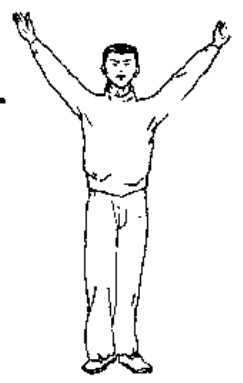
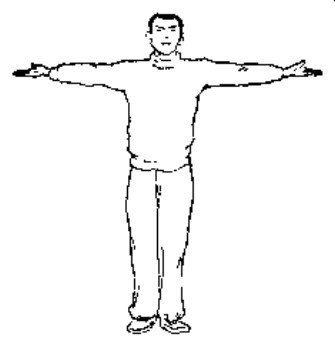
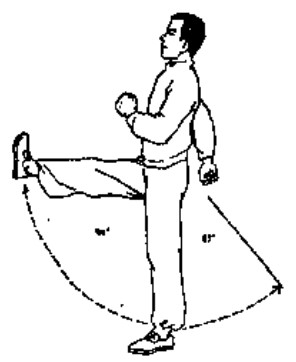
-
The right hand sweeps in an arc across the front of the body toward the left and downward; as it descends, the upper body bends forward accordingly. When the hand is between the feet, palm facing down, the gaze follows it (Figure 7).
-
The right hand then sweeps to the right and raises upward in an arc; the upper body returns to upright. The hand reaches above the right side of the head, palm facing up. The head tilts slightly to the right and back, eyes looking at the right hand. At the same time, the right foot returns to stand alongside the left foot. Using the nose, exhale evenly, finely, and lengthily. This completes one round for the right side. Then perform the left side in the same manner as the right. Perform three rounds each on the left and right, totaling six rounds.
(V) Forward-Backward Leg Swinging
-
Stand with legs together, breathing naturally. Swing the right leg forward and backward. When swinging forward, the leg forms a 90° angle with the supporting left leg (Figure 8); when swinging backward, it forms a 45° angle. One forward and one backward swing counts as one round. Perform twelve rounds.
-
Then swing the left leg in the same manner as the right. Also perform twelve rounds.
(VI) Bending Forward with Large Arm Sweeps
-
Stand with feet together, both arms hanging naturally. Using the nose, guide qi deeply with intention, then turn both palms and raise them to the sides to shoulder height (Figure 9).
-
Both arms extend further upward, each diagonally spread to the outer-upper region of the shoulders, palms facing forward (Figure 10).
-
Both arms swing forward and down. When they reach the front of the chest, the upper body bends forward accordingly. Finally, let the arms hang in front of the legs, bending the upper body to 90° (Figure 11).
-
Straighten the body, return both arms to the sides, and exhale evenly, finely, and lengthily through the nose. The above counts as one round. Perform six rounds.
(VII) Forward and Reverse Neck Rotation
Stand with legs apart in an outward “eight-character” stance, slightly wider than shoulder width. Both arms hang naturally, breathing naturally. Keeping the body still, rotate the head clockwise from left to right for twelve circles (Figure 12). Then reverse the direction, also rotating twelve circles.
(VIII) Left-Right “Ha” Exhalation
- Stand with feet apart at shoulder width. Lower the body into a horse stance. Extend both arms behind the back, fingers hooked backward, hook tips pointing upward (Figure 13).
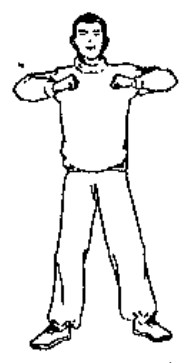
-
Using the nose, guide qi deeply with intention. Turn the head to the left, open the mouth sharply, and emit a “Ha” sound, expelling all the inhaled air (Figure 14). Then return the head to its original position. This is the left-side version.
-
Inhale again. Exhale to the right as the right-side version. Perform three rounds each on the left and right, totaling six rounds.
(IX) Wheel Turning
-
Stand with feet apart in an outward “eight-character” stance, slightly wider than shoulder width. Bend both arms at the elbows, elbow tips pointing to the sides, level with the shoulders. Hands form hollow fists, the eye of the fist (the opening between thumb and index finger) facing the shoulders (Figure 15).
-
Turn the head to the right, looking at the right elbow tip. Both bent arms remain in the same plane. The right elbow tip sinks down, moves backward, upward, and forward, tracing a circular rotation. Correspondingly, the left elbow tip rises up, moves forward, downward, and backward, also tracing a circular rotation (Figure 16). The above is the right-side version, rotating ten circles total.
(Figure 12) (Figure 13) (Figure 14) (Figure 15) (Figure 16)
two circles. 3. Turn your head to the left again, look at the tip of your left elbow, and rotate twelve circles just like the right-side posture.
Daoyin Standing Stake Qigong for the Treatment of Gastroptosis
When performing this posture, one should try to stretch the chest and abdomen as much as possible to make the qi and blood of the zang-fu organs flow smoothly, build up health, and prevent diseases. There is an old saying: “Learn the wheel rotation, and you won’t need to hold a medicine jar your whole life.”
Yang Guang, Longmen Sanatorium, Henan Province
Excerpted from Zhongguo Qigong (Chinese Qigong), compiled by Zhejiang Journal of Traditional Chinese Medicine Publishing House, Issue 1.
The characteristic of Daoyin Standing Stake Qigong is that it integrates Daoyin on the basis of Standing Stake Qigong (Zhanzhuang Gong). We used this qigong method to treat a total of 205 cases of gastroptosis, with 194 cases proving effective, achieving an efficacy rate of 94.6%. This qigong method is simple, easy to learn, and has remarkable curative effects. The specific practice method is as follows:
- Posture: Stand with your feet apart at shoulder width, knees slightly bent, and waist straight. The head should not lean forward or backward. Relax the whole body and keep quiet.
- Movement: Palms facing up, fingertips pointing toward each other, placed at the navel; as you inhale, raise both hands to the epigastrium, and as you exhale, lower them below the navel. Repeat this continuously.
- Breathing: Relaxed, quiet, fine, and slow. Do not hold your breath intentionally.
- Mind intent: When inhaling, as both hands rise, imagine your hands holding up the stomach to make it rise together; when exhaling, as both hands descend, relax your mind intent and let the qi sink to the Dantian.
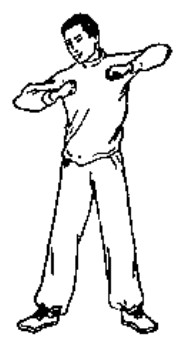
The practice time and frequency depend on individual physical constitution. Generally, practice two to three times a day for five to twenty minutes each time. Reactions after practice include heat in the hands, slight numbness in the feet, or a light and floating sensation. These are all normal phenomena; if you do not feel anything, there is no need to force it. If shortness of breath occurs, it is mainly caused by poor breath control and intentional breath-holding. Pay attention to achieving a relaxed, quiet, and natural breath, and the shortness of breath will disappear.
(Figure 16)
Excerpted from Qigong
Modern Latest Sanitary Ware
Rapid Hot and Cold Shower Since our factory introduced the latest foreign sanitary products and put them on the market, users everywhere have reported good performance and convenient usage. It is suitable for showers in hotels, factories, mines, hospitals, and homes. It has a three-gear water temperature adjustment switch. In summer, it can be used as a cold water shower. It has a tap water control switch inside and a small sprinkler outside, which can be freely rotated for local rinsing. This device is installed on a 3/4-inch tap water pipe. After connecting to the power supply, hot water will flow out in about 10 seconds, and the temperature can reach 36-45°C. Connect the ground wire properly for safe use. This device comes with a set of vulnerable parts.
JXI-6 Automatic Garment Buttonhole Machine This device is a dedicated tool for clothing buttonholes. Small household sewing machines can be equipped with it, increasing work efficiency by 40 times compared to manual buttonholes. It has stable performance, uniform horizontal needle swing, and both the hole size and stitch density can be adjusted. It is simple to install and convenient to use, making it an ideal piece of supporting equipment for sewing users. Unit price: 53 yuan.
K-Type Three-Thread Overlock Machine This machine is the newest three-thread overlock machine of the 1980s, repeatedly improved. It is suitable for overlocking (edge binding) of various fabrics. The stitches are even, and it comes with a cutter. The body is lightweight, the structure is precise, and the design is beautiful. It is extremely convenient to use and repair, and can be mounted on a sewing machine frame for overlocking. It is an essential tool for the garment industry and households. Unit price: 179.50 yuan. Ex-factory price: 26 yuan.
ZEF-1 Plastic Film Bag Making and Sealing Machine Based on the phenomenon of instantaneous heating, this machine uses a pulse heater. Plug it into a 220V power supply; no preheating is required. The operation is simple and safe. This machine is equipped with an electronic timer knob to adjust different sealing times to accommodate films of different thicknesses, providing a satisfactory seal. Each degree of electricity can heat-seal 8,000 times. It is an ideal tool for sealing and bag making. One-year warranty.
Business Office: 53 Xinkai New Street Contact: Huang Shengfu Jiangxi Linchuan Changkai Electrical Appliance Manufacturing Factory Telegram: 0992. Bank: Changkai Business Office. Account No.: 505033
·132·
If there is a sudden change in the condition, promptly investigate the cause, make a diagnosis, and provide timely treatment. Qigong is physical and mental training; it is not the same as medication, but when the condition changes, one should not exclude comprehensive treatment with drugs and other methods in order to shorten the course of treatment and improve therapeutic outcomes.
-
Units and families with the means to do so may incorporate “medicinal cuisine” (药膳) or “dietetic therapy” (食饵) during the practice period, preparing some therapeutic medicines as “dishes” and consuming some foods as “medicines.” However, one should eat small, frequent meals. By adding supplementary snacks between the morning and afternoon practice sessions each day, this benefits both practice and early recovery from illness. Those without such conditions may substitute with simple foods—for example, around 10 AM and 4 PM daily, one may have 1–2 eggs or slices of steamed bread, along with a small amount of plain boiled water. Avoid consuming spicy, overly sweet, excessively sour, or wind-generating (生风) foods, so as not to affect practice.
-
Pay attention to the differences between men and women in practice. For example, women during menstruation may continue practicing without interruption, but should reduce mental concentration activities (such as focusing on the lower Dantian), to avoid causing excessively heavy menstrual flow or prolonged periods. Women during pregnancy may continue practicing, which helps with childbirth and prevents pregnancy-induced hypertension.
-
Adopt a realistic and scientific attitude in researching and applying Qigong methods. Use historical materialism and dialectical materialism to inherit, research, experiment with, and promote Qigong. Do not blindly “superstitiously” follow any particular school, method, or person—the key criterion is therapeutic efficacy. Persist in eliminating the influence of quackery (江湖术) and charlatanism (江湖气) on the Qigong community.
-
In the integration of Qigong with physical education, Qigong with martial arts, Qigong with massage, Qigong with acupuncture, and Qigong with energy emission (布气), note that each has different training objectives, different characteristics, and different foundational methods of integration. It is best to have guidance from an experienced practitioner, so that failed integration does not instead lead to “catching fire and entering demonic states” (走火入魔).
Twenty-One Precautions for Qigong Practice
The precautions for Qigong practice refer to what should and should not be done before, during, and after practice. Different practice methods have different taboos. Whether a beginner or a long-term practitioner, all should observe these guidelines to ensure smooth practice and achieve health care and therapeutic results.
-
Practitioners should establish confidence in overcoming illness, eliminate worries, and not be half-hearted. Remove doubts and distracting thoughts, and enter a tranquil state as quickly as possible. The practitioner should simultaneously carry out educational and explanatory work to facilitate the practice.
-
Stop all strenuous physical activity and complex mental work half an hour before practice. Understand your own condition and the operational content of the chosen practice method, and make preparations for entering tranquility, such as drinking some warm water and emptying the bladder and bowels.
-
During practice, avoid wearing tight clothing and avoid sitting, lying, or standing in drafts, so as not to catch cold. Loosen clothing and belts, such as unbuttoning, loosening the belt, and removing shoes and socks. Remove jewelry, glasses, watches, dentures, wigs, and other items, so as not to affect the attainment of tranquility and the circulation of qi and blood during practice.
-
During practice, do not pursue the so-called “Eight Touches” (八触), do not let the mind follow external phenomena, and do not indulge in so-called “entering illusion” (入幻). If certain images or sensations appear during practice, there is no need to fear them—let them disappear naturally.
-
Practitioners should pay attention to dietary regulation. Nutrition should be rich but light. Avoid fatty, sweet, and spicy foods, as well as alcohol and smoking. Excessive consumption of rich meats and fish generates wind and phlegm, which is detrimental to practice.
-
Avoid excessive sexual activity. Those practicing Qigong for therapeutic purposes should abstain from sexual intercourse; after recovery, maintain moderation. From ancient times to the present, practitioners have all emphasized this point. At the same time, avoid lying down, sitting, standing, or walking for prolonged periods. Combine movement and stillness, interweave practice with nourishment (练养相兼), and maintain appropriate balance of work and rest.
-
The temperature in the practice room should not be too high or too low. Maintain air circulation. Avoid practicing in bad weather or noisy environments. On days with strong winds, heavy rain, or thunder and lightning, whether indoors or outdoors, it is not suitable to practice. Dynamic Qigong (动功) should be practiced in morning woods or sheltered flat ground.
-
It is forbidden to practice when overly full or hungry. Different methods have different taboos: for example, do not practice Neiyang Gong (内养功) on an empty stomach; do not practice Zhuangqi Gong (强壮功) when full; those with epilepsy should not practice spontaneous movement Qigong (自发功).
-
Do not practice when disturbed by excessive joy, anger, grief, worry, fear, or other emotional disturbances (the seven affects, 七情). Lack of mental concentration easily leads to deviations (偏差). Wait until the mind is calm before practicing.
-
Beginners should not arbitrarily use untested practice methods and oral formulas. Avoid learning something new in the morning and changing it by evening—do not carelessly experiment with different methods.
-
During practice, do not hold in urine or feces for long periods. Holding them can cause abdominal distension and bowel sounds, affecting entry into tranquility.
-
During the practice period, avoid watching thrillers and strongly stimulating movies, television programs, and novels, so as to facilitate entering tranquility.
-
During practice, avoid drowsiness, falling asleep, and becoming attached to pleasurable sensations experienced during practice. Drowsiness and sleep prevent therapeutic results. If feelings of joy and comfort arise during practice, do not arbitrarily extend the practice time. Generally, it should not exceed two hours at most. Once tranquility is achieved, others should not disturb the practitioner—maintain a peaceful environment.
-
Beginners of spontaneous-type Qigong should have guidance from a physician; the elderly should be especially careful. Select cases according to indications. Choose a spacious room or flat ground for practice, to avoid falls and injuries. Do not pursue spontaneous movement. After movement begins, do not stop suddenly—slowly reduce the movement before concluding practice (收功).
-
Note the difference between practicing for illness versus practicing for health preservation. The two have different requirements; one should not force uniformity. At the same time, note the distinctions between sports Qigong, martial arts Qigong, and medical Qigong—do not blindly experiment with different methods.
-
After recovery from illness, continue practicing to consolidate results and prevent relapse, though practice time may be appropriately reduced. Maintain at least one hour of practice daily.
-
If any discomfort arises during or after practice, promptly investigate the cause, make a diagnosis, and provide timely treatment. Qigong is physical and mental training—it is not the same as medication. However, when the condition changes, do not exclude comprehensive treatment with drugs and other methods, so as to shorten the treatment course and improve therapeutic outcomes.
Excerpted from “Qigong and Science” (《气功与科学》)
·133·
The special ability of Comrade Quan Guanliang to emit qi to the moon is disbelieved by all except those comrades who have seen it with their own eyes; they consider it an impossible thing. Some comrades mock those who saw it with their own eyes, saying they have crossed “wires” in their nervous system and have something wrong with their heads.
Although I have witnessed this bizarre phenomenon multiple times and organized students from Peking University to conduct detailed investigations and experiments, I am unable to explain this bizarre phenomenon using modern science.
Author
Parting the Clouds, the Moon Flashes
— Record of Quan Guanliang’s Qigong Experiments Pu Siming
Record of Quan Guanliang’s Qi Emission
On a night in early July 1984, when the Shanghai Qigong Science Research Association was conducting a qigong method exchange activity in the auditorium of the Shanghai Museum of Natural History, they invited Comrade Quan Guanliang to perform. Dozens of people watched this performance, including leading comrades from the Shanghai Qigong Science Research Association and some qigong masters. After Quan Guanliang emitted qi towards the sky for an hour, the dark clouds directly overhead were pushed away, forming a stark contrast with the surrounding cloud layers, but the moon did not flash or sparkle.
On a night in early August of the same year, Comrades Zhang Yuezhong and Zhang Yueming, disciples of Master Hai Deng, invited Quan Guanliang to perform at their home. The sky was densely covered with dark clouds that night. After he emitted qi for an hour, the dark clouds overhead were pushed away, revealing the stars, but the flashing effect on the moon was not significant. Ten minutes later, the dark clouds closed in again, remaining a dense, carpet-like cloud layer.
On a night late in that same month, Teachers Zhang Hekang and Shen Hanchang from Shanghai Jiao Tong University asked Quan Guanliang to emit qi into the sky to cause a rainstorm. Lao Quan stated that although he had conducted this experiment in the past, the success rate was very low, and he declined to do the experiment. Later, after repeated requests from Teachers Zhang and Shen, he agreed to give it a try. After emitting qi towards the sky for an hour, it did not succeed.
On the evening of September 9th, the wind was very strong, and a misty drizzle was falling. Teachers Zhang Hekang and Shen Hanchang from Shanghai Jiao Tong University invited Comrade Quan Guanliang to perform again. He began emitting qi towards the sky at 19:30. At 20:40, the sky suddenly flashed three times. At 20:50, the moon emerged from the dark clouds and sparkled. The nimbostratus clouds across the entire sky disappeared, leaving a sky full of stars. Teacher Shen Hanchang asked Quan Guanliang to restore the sky to its original state. Quan Guanliang emitted qi towards the sky again, and by 21:15, the dark clouds closed back together.
On September 15, 1986 (the twelfth day of the eighth lunar month), at 19:55, Comrade Quan Guanliang emitted qi towards the sky again near the Shanghai Stadium. It only took five minutes. By 20:00, a halo composed of red, green, and yellow appeared around the moon. At 20:15, this peculiar phenomenon disappeared on its own.
Investigation and Experiments by the Peking University Society for Natural Mysteries:
In 1985, Yan Qiming and Wu Wuchun from the Peking University Society for Natural Mysteries traveled south to conduct investigations and experiments.
According to Comrade Quan Guanliang’s own account, his ability to emit qi towards the sky was discovered during a chance opportunity. One day in 1982, while Quan Guanliang was practicing qigong, a colleague nearby noticed something unusual about the moon: three rings, composed successively of lake blue, orange-yellow, and purplish-red, had appeared around the moon. The colleague asked Quan if this was caused by his qi emission, which Quan could not confirm at the time. To distinguish whether this was a natural phenomenon or the result of his own qi emission, Quan and the colleague went to the playground of a primary school that same night to emit qi. As a result, the moon once again displayed the colors described earlier. Later, Quan conducted six experiments on his own, all of which were successful. Comrade Quan Guanliang believes that his abilities have the following characteristics:
- When the entire sky is covered by dense, seamless cloud layers, he can basically disperse the clouds near the zenith to reveal the starry sky. The small amount of cloud blocks within this area appear white, forming a sharp contrast with the turbid color of the surrounding cloud layers.
- If the moon is located at the zenith or at a large angle of elevation at the time, he can expose the moon from the clouds and make it emit flashes. If conditions are favorable, he can cause a colorful halo to appear around the moon. This ability has been successful in multiple experiments. In some other experiments, Comrade Quan Guanliang also possessed other special abilities, but these were not performed often.
Quan Guanliang’s first public experiment was conducted at 20:30 on November 29, 1982 (the fifteenth day of the tenth lunar month), at People’s Square in downtown Shanghai. It was initially agreed that Comrade Tang from the Shanghai Electrochemical Plant would be present, and four other comrades (Tang’s colleagues) would observe separately in four districts of Shanghai. However, that day, Tang and several others went together to Quan’s house. Quan said that he had only succeeded 6 times in total, and the weather was bad that day with the entire sky appearing red, so he was afraid he would not be able to produce the effect. At this time, Comrade Yang from the Municipal Party Committee Propaganda Department suggested that bad weather would better demonstrate the issue. Therefore, they first tried it out near Quan’s house and opened up a small patch of clouds. Afterward, Quan agreed to go along. When Quan Guanliang emitted qi at People’s Square and opened the cloud layer, white clouds and a few dark clouds first appeared, followed by the moon…
At 20:43, a halo appeared around the moon. Quan continued emitting qi to “strike” once more, and in the opened area, there was no cloud at all—only the moon and a few stars remained. Later, to verify whether this phenomenon was genuine, Quan Guanliang emitted qi for three consecutive days (the tenth, eleventh, and twelfth days of the lunar month) near the No. 17 trolleybus stop on Jiangxi Road, Shanghai. The same situation occurred on all three days: the moon bore a golden halo, and the moonlight trembled. Nearby residents and passersby all witnessed this incredible phenomenon.
Comrade Quan Guanliang’s technique of emitting qi toward the sky had been publicly demonstrated many times, each time with a considerable number of witnesses. During the investigation, they all affirmed that the event was genuine and that the anomalous phenomena appearing in the sky were caused by Quan Guanliang’s qi emission.
After the experiment, I wrote to the Shanghai Central Meteorological Observatory. They acknowledged that the phenomena that occurred were indeed anomalous in meteorological terms, but held that nature is infinitely variable and any bizarre phenomenon might occur naturally, and therefore could not confirm that this was the result of special abilities. However, from the perspective of meteorological principles, the phenomenon of cloud layers splitting open after Quan Guanliang’s qi emission is generally impossible (or at least extremely rare as a natural occurrence). Since this phenomenon shows a clear correlation with Quan Guanliang’s qi emission, it should not be denied that Quan Guanliang genuinely possesses such a special ability.
Comrade Quan Guanliang also conducted two qi-emission tests in February 1985.
The first was on February 10. Participants included Wu Wuchun, Zhu Qingyuan (Nanjing University student), Zhang Yueming, Qi Yongcan, Xu Zhiming (qigong master), and others. The test location was in a garden near the No. 17 trolleybus stop on Ruijin 2nd Road, Shanghai. From February 4 to 8, Shanghai had experienced continuous rain, turning overcast on the 9th. On the 10th, the daytime was cloudy with intervals of sunshine, and at night the sky was covered with opaque altostratus (ASop). At 21:06, Quan Guanliang began emitting qi. By 21:12, the clouds overhead began to split into stripe-like formations, running in a north-south direction. The spacing between cracks was approximately ten times the crack width. At 21:13, the first star appeared in the cloud gap, located toward the southwest. As Quan Guanliang continued emitting qi, the cloud layer overhead gradually thinned. By 21:20, a circular cloudless area appeared in the sky, with a very clear boundary against the surrounding gray clouds. After that, the sky in the cloud gap area grew progressively darker in color, and clear [stars appeared]—the 16 stars (according to Quan’s own account, there were seven, and they did not appear in cloud gaps but rather starlight directly penetrated the cloud layer; the opened gaps appeared rectangular in shape). At 21:46, Quan Guanliang ceased emitting qi, and the cloud layer gradually closed again.
The second experiment was conducted on February 27. Participants included Yan Qiming, Pu Siming, Shen Hanpin, Zhang Yueming, Qi Yongcan, Zhang Hong (second-year high school student at the High School Affiliated to Shanghai Normal University), and four classmates. The location was on Tailu Road outside the gate of Shanghai Normal University. That day was overcast with occasional light rain; by evening, the rain gradually stopped, and the sky was covered by a uniform layer of nimbostratus (NS). Comrade Quan Guanliang began emitting qi at 19:58. By approximately 21:00, no obvious change had been detected in the sky. Quan Guanliang began withdrawing his qi, ending at 21:20. The test was unsuccessful. According to Quan Guanliang, the reason was poor physical condition—“not enough qi.”
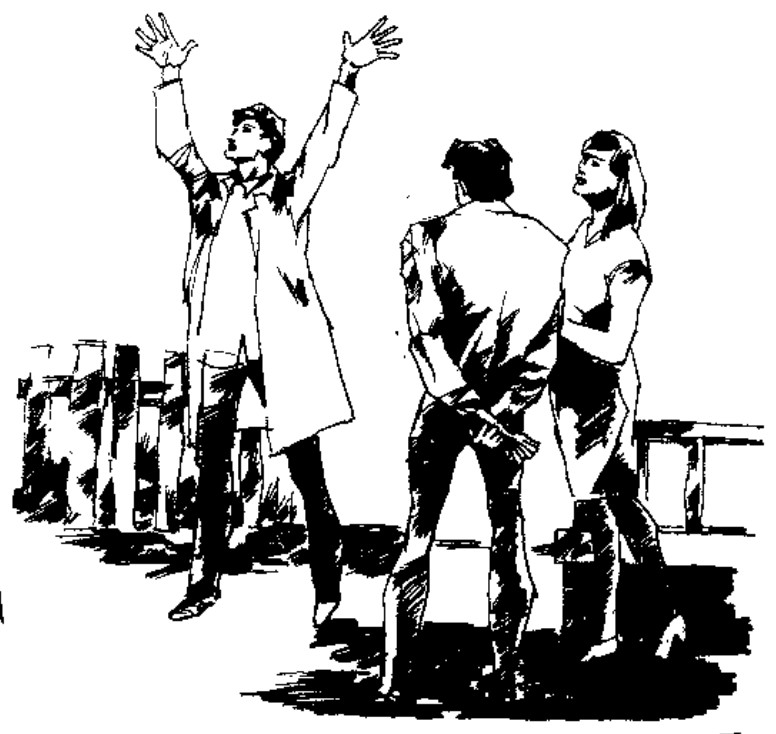
Based on the analysis of the above investigation and experimental results, the following conclusions can be drawn:
-
Quan Guanliang does indeed possess a special type of qigong technique. Its characteristic feature is the ability to open dense cloud layers to reveal the background sky. This phenomenon is impossible under ordinary meteorology or physics, and this has been confirmed by both experiments and witnesses.
-
Another characteristic of this technique is that after the cloud layer is opened, the revealed moon appears abnormally luminous. Whether this is due to Quan Guanliang’s ability acting upon the moon itself, or whether it is a hallucination produced by the ability acting upon the bodies of the on-site audience (including Quan Guanliang himself), cannot yet be determined (though such an ability would also fall within the category of special abilities).
-
This ability has not yet been subjected to rigorous scientific testing, and in particular has not received verification from scientists in the fields of meteorology, astronomy, physics, physiology, or related disciplines. Some individual cases lack detailed documentation and are difficult to verify. Therefore, the current conclusions still lack persuasiveness.
-
These qigong experiments lack controllability and are excessively susceptible to external interference. Moreover, they are influenced by the practitioner’s own physical condition, emotional state, and environmental conditions. Consequently, reproducibility is not strong.
-
The physical mechanism of this technique is currently unclear. The physical mechanism as described by Comrade Quan Guanliang himself cannot yet be explained in terms of modern physics.
-
If this ability is subjected to in-depth research, it could potentially be applied in national defense and meteorology.
-
Comrade Quan Guanliang’s other abilities still lack confirmed authenticity of results and recognized meteorological anomaly. Moreover, they lack reproducible individual cases. Therefore, they remain at the stage of investigation and verification.
Excerpted from Qigong and Science
• 135
Wang Bin’ai, Lecturer in the Department of Automatic Control, Beijing Institute of Aeronautics
Humanity — the “spirit of all creation” on Earth.
The answer is affirmative! Consider this: from the time China began developing artificial satellites in 1965 to the successful launch of the first artificial Earth satellite, Dongfanghong (“The East is Red”), on April 21, 1970, only a century was needed. After that, there was a breakthrough roughly every five years: on November 26, 1975, China launched its first recoverable remote-sensing satellite and successfully recovered it, becoming the third country in the world to master satellite recovery technology. On September 20, 1981, for the first time a single rocket carried three space physics探测 satellites of different purposes into space. On October 6, 1986, the eighth launch of a recoverable satellite succeeded, making China the only country in the world with a 100% recovery success rate. On October 11, 1986, the LF8 model ion rocket engine reached an internationally advanced level. China will soon implement a plan for crewed spaceflight with a manned spacecraft… In short, although China’s aerospace enterprise started late, its pace has been very rapid. It must especially be emphasized that if things are handled well, China’s crewed spaceflight technology may very quickly surpass both the United States and the Soviet Union in certain respects and take the lead in the world!
Where does this claim come from?
Comrade Qian Xuesen said at the inaugural conference of the China Qigong Science Research Association on April 30, 1986: “I believe that qigong and our traditional Chinese medicine (including Chinese medicine, Mongolian medicine, Tibetan medicine, and the medical traditions of other ethnic groups), together with the special human abilities of the human body — once these are integrated with modern science and technology — will certainly become Marxist science, that is, true science. At the same time, in the process of integration, it will also transform modern science… Once this matter is accomplished well, it will inevitably lead to the eruption of a scientific revolution… a scientific revolution of the East.” He also said: “Now foreign countries are all talking about improving technology, but I believe the highest technology should be the qigong science and technology that the China Qigong Research Association aims to study.”
How well Comrade Qian put it! Here is the foresight and profundity of a scientist, the courage and boldness of a military strategist — clearly pointing out to people the path of scientific and technological reform and revolution.
Let us begin the detonation starting from the world-recognized cutting-edge science and technology — aerospace science and technology!
The fuse for this detonation is the integration of qigong with aerospace!
Humanity’s Space Program — Flying Toward Space
The twentieth century was a century of highly advanced development in human science and technology. Aerospace technology, which symbolizes the high level of development of human civilization, achieved rapid progress in the twentieth century. Starting from 1903, when the American Wright brothers built the world’s first powered, controllable airplane, humanity has since come to possess high-performance aircraft of all kinds. People can now travel freely through the sky by airplane, and it can be said that complete freedom of aviation (flight within the atmosphere) has been achieved. The even higher domain of spaceflight (Spaceflight) — flying beyond the atmosphere (also called space travel or cosmic navigation), that is, flying toward space — has also developed rapidly.
It is a matter of shame and regret that, to this day, not a single crewed spacecraft or space station belongs to China. Among the hundreds of astronaut-missions, only one was an ethnic Chinese — Wang Ganzhun. On April 29, 1985, he entered space aboard the space shuttle Challenger. Regrettably, not only was he an American citizen — the Challenger itself was American.
The Challenger challenges us, the descendants of Yan and Huang: Can it really be that we Chinese cannot fill the gap of entering space?
From beautiful myths to humanity’s actual footsteps on the Moon, nearly two thousand years elapsed.
Humanity’s dream of “flying to the heavens” — people dreamed of it, and, to realize it, persevered tenaciously, generation after generation striving toward it… until success. Among these dreams, one has endured the longest, been the most beautiful and most wondrous: this is the great human “dream of flying to the heavens.”
Since ancient times, people have dreamed of “flying to the heavens” and fantasized about “soaring through the clouds.” Look at China’s Dunhuang murals, the story of Chang’e flying to the Moon… all reflect the rich imagination of people regarding “flying to the heavens.” Take the universally beloved Sun Wukong — does his somersault of 108,000 li not also embody humanity’s dream of flying into space?
Even more precious is the courageous and tenacious spirit with which humanity has turned the dream of flying into reality. To achieve it, people have struggled and fought almost since the beginning of history, leaving behind many moving stories.
Finally, the day came — on July 21, 1969, Armstrong, aboard Apollo 11, successfully landed on the Moon, becoming the real-life Chang’e and realizing the dream of “flying to the heavens.”
Aerospace and Qigong
At present, the most critical topics in aerospace science and technology revolve around nothing more than solving how to make crewed spacecraft fly farther, carry more people…
·136·
If this problem can be combined with qigong science, there will surely be unexpected breakthroughs, and may even truly ignite a revolution in aerospace technology.
Consider that sixteen years have passed since the first Moon landing in 1969. In those sixteen years, humanity has not only failed to fly farther, but even returning to the Moon remains greatly restricted. This is because many specific technical problems have held back the progress of crewed spaceflight. For example, the equipment needed solely to ensure human life safety in space — the life support system — is extremely complex and occupies a considerable volume and weight. The current reality is that a large portion of a spacecraft’s volume and weight is taken up by engines and fuel, leaving only a very limited effective portion for carrying crew and equipment.
Let us make a rough calculation: solely for the diet and air required to sustain the lives of astronauts (not including the weight of the life support system itself), each person per day needs:
- Specially dehydrated food: 540 grams (generating 3,000 calories of energy)
- Liquid oxygen, one liter: 1,150 grams
- Water, 2.5–3 liters: 2,700 grams
- Total weight: 4,390 grams
Thus, assuming a trip to the Moon takes sixteen days (including two days of exploration), each person would require 70 kilograms for this item alone. If we consider Mars — the nearest planet suitable for human landing — the journey time would be two and a half years (because one must wait until Mars is in the optimal orbital position for the return trip). Then this weight alone would reach five tons per person!
How can humanity fly freely into space carrying such a heavy burden? Moreover, the above weight is merely the intake needed to sustain life. There is also the collection and processing of corresponding waste output, which is quite complex under the weightless conditions of space. Together with the associated equipment, the weight and volume occupied are also considerable.
To fly farther and carry more people, there are only two approaches: (1) Reduce the weight of engines and fuel: build engines with higher thrust and greater specific impulse, such as nuclear rockets, photon rockets, and so on. (2) Economize on the use of effective volume and weight. To this end, various closed ecological systems have been designed to recycle and reuse waste, such as photosynthetic organic systems, hydrogen-bacteria systems, and others, with the aim of reducing the weight of the life support system. In short, although the concepts and proposals are many and excellent, they are still focused on devising various artificial devices — that is, the conventional path of current aerospace technology.
Why not think of solutions from the human body itself? Why not tap the potential within the human body itself?
This is not a flight of fancy. Reducing the basic material requirements for sustaining an astronaut’s life by half, two-thirds, or even more — is this really outlandish?
Have you heard of bigu (“avoiding grains”)? This is a term in qigong referring to a special state that certain individuals enter under the qigong state, in which the demand for food is greatly reduced compared to normal, or even ceases entirely. It can generally be divided into two types: (1) Complete abstention from all food and drink, or drinking only water without eating. In qigong this is called quegu shiqi (“abandoning grains and consuming qi”). (2) Consuming only very small amounts of simple foods, such as pine nuts, cypress seeds, lingzhi mushroom, Polygonatum (huangjing), and other Chinese medicinal herbs, or dried and fresh fruits. In qigong this is called jueli ru zhi (“abandoning grain and eating zhi”).
Bigu is not imagination or fabrication; it is an objectively existing fact. According to records, those whose qigong attainment has reached this level are not few, in both ancient and modern times, both in China and abroad.
I firmly believe that the phenomenon of bigu is real. Or, more precisely: “It is entirely possible for a person, within a certain period of time and to a certain degree, to reduce the demand for food while maintaining normal physical strength.”
Imagine: if bigu is genuine, why could it not be applied to aerospace? Once astronauts can be enabled to possess a certain degree of bigu capability, would that not fundamentally reduce the volume and weight of the life support system?
Experiments have also shown that the qigong state can reduce the human body’s oxygen consumption and regulate skin temperature. These effects would be beneficial for improving and adapting to hypoxia in aerospace physiology and the physiological effects of temperature in spaceflight, and would also have an impact on the corresponding environmental control systems, personal protection systems, and other equipment. Furthermore, various adverse physiological reactions of the human body under weightless conditions in space — especially the adverse psychological reactions caused by the isolation and loneliness of space — could also be expected to be adjusted through qigong…
Particularly worthy of mention is the problem of astronauts’ adaptation to excess gravity (supergravity). This was a stumbling block encountered from the very beginning of crewed spaceflight, and it remains unresolved to this day. The positive and negative accelerations experienced by a spacecraft during launch and landing produce physiological effects on the human body of positive excess gravity (+G) and negative excess gravity (−G): under positive excess gravity (+Gz), blood suddenly rushes to the lower limbs, causing blood deprivation in the head, which may result in “gray-out” (blackout); while under negative excess gravity (−Gz), blood suddenly rushes to the head, which may produce “red-out,” and even rupture blood vessels and eyeballs. Although the advent of the space shuttle has greatly reduced the magnitude of acceleration, generally keeping it within 3g, negative acceleration remains a difficult item for the human body to adapt to. According to the qigong principle that “when the yi (intent) arrives, the qi arrives,” and the traditional Chinese medical theory that “qi is the commander of blood, and blood is the mother of qi,” we may infer that if a person can achieve “where intent goes, qi goes,” then they can also achieve “where intent goes, blood goes” — that is, a person may be able to control their own blood flow to a certain extent. In fact, it has already been experimentally demonstrated by preliminary tests that the qigong state can influence blood flow and improve circulation. Imagine: if during launch the astronaut could “direct qi to the head” to increase blood supply to the head, and during landing could “lead qi downward” to reduce blood in the head — would this not effectively improve the physiological effects of excess gravity? Especially given that there is currently no effective method to prevent “red-out,” why not try and research this simplest approach?
In fact, the Soviet Union was the first to conduct experiments on applying qigong to aerospace. As early as 1984, the Soviet Union introduced yoga into spaceflight. Indian astronaut Sharma tested the muscular responses to practicing yoga under weightless conditions in space, as well as remote viewing capability. (Sharma launched aboard the Soviet Soyuz T-11 on April 3, 1984, and spent three days aboard Salyut-7.)
It must be remembered that qigong is China’s advantage! Chinese qigong has a solid mass foundation and countless highly accomplished masters. This advantage is extremely precious. Foreigners can be said to covet it greatly. We ourselves must never underestimate it! As long as we earnestly pursue qigong scientific research, we can make it a potential advantage for our country’s aerospace technology. If utilized well, our aerospace technology can benefit from both improvements to technical equipment and enhancements to the functions of the human body itself. Advancing on these two legs, we may be able to far surpass the world’s most advanced levels in the most cutting-edge aerospace technology, and restore the leading position in the “art of flying to the heavens” pioneered by our ancestors.
Excerpted from Qigong and Science
·137·
Roaring Tiger, Soaring Dragon
—Visiting Xie Shanling, Inheritor of the Authentic Western Han “Daoyin” Technique
Performing at the “Golden Hall”
Beijing, the CCCPC Advisory Commission Club.
He never dreamed that an ordinary peasant would be able to shake hands with over twenty leaders of the CCCPC Advisory Commission and perform the Daoyin breathing and guided energy work for them. His heart churned like the ocean.
On June 25, 1986, Xie Shanling got up early. Hearing that he was to perform for central senior leaders, he was so excited that he could not sleep all night. In the morning, he could neither sit still nor stand; he was at a loss for what to do with his hands and feet. To his mind, this was like entering the Golden Throne Hall, facing an imperial examination. All day long, he had only ever dealt with patients; where had he ever seen so many officials? The sudden change filled his heart with many strange sensations and cast a veil of mystery over things.
How should he walk this path? How should he place his hands? What should he say? He was afraid lest anything be inappropriate or undignified; afraid that his rough manners might displease the leaders. He cherished this performance opportunity very much. After two rounds of selection over the previous few days, dozens of qigong masters had been narrowed down to just a few. Having practiced qigong for twenty-three years, he never expected to see this day.
“The next performance is the ‘Daoyin Tu Na Gong,’ performed by the Shaanxi peasant qigong master Xie Shanling. This set of techniques is a new discovery related to the Changsha Mawangdui Daoyin.” A round of applause rose from the audience.
Xie Shanling, with a glowing red face, strode briskly into the arena. His sturdy frame, wrapped in a front-buttoned tunic, appeared even more dignified and unadorned under the lights. A ten-foot blue cloth sash was tied around his waist, closely resembling the practitioner in the “Western Han Daoyin Diagram.” He bowed deeply to the audience, then closed his eyes and drew his breath in. Suddenly, he crossed his arms, twisted his body, and exhaled through his nose like a hurricane, making the auditorium buzz and resonate. The spectators were baffled, whispering to each other, thinking it was a trick of “vocal mimicry.” While they were still wondering, they heard the narrator explain: “This is a unique method of forceful exhalation and inhalation. The resonant sound is emitted from within the nose, like the roar of a tiger or the cry of a dragon.” Before the words had finished, a wave of heat immediately swept through the auditorium. After a long
Comrade Zhang Zhenliang joked: “Your paper is really formidable — you’ve dragged Changsha Mawangdui all the way to Shaanxi!”
Amidst this lively scene, only one person said little, wearing a smile, and occasionally went up to the stage to pour tea and refill water for Xie Shanling. He was Tong Junjie, president of the Changsha Mawangdui Daoyin Research Society. A year earlier, at the society’s second academic annual conference, they had already crossed paths; this time they were again assigned to the same room. He had labored for ten years and only with great difficulty compiled a set of “health exercises” based on the “Daoyin Diagram,” only to have them shaken apart by that thunderous nasal breathing. “Shaanxi’s daoyin is the real thing” echoed throughout the hall. Mr. Tong was not discouraged; he renewed his intensive research, and his performance at this conference earned modest praise. Who could have foreseen that Xie Shanling would lob yet another heavy bombshell — the Quanzhen founding sect’s secret stele inscription, the twenty-three-posture comparison chart, and the theory of the origins of daoyin anmo (massage) from the Neijing — causing his “health exercises” to instantly lose their luster. Yet not only did he feel no jealousy, he wished to thank him — thanking him for his efforts and contributions to Mawangdui daoyin research, and thanking Shaanxi for its new discoveries. After the conference, the two sat knee to knee in animated conversation, not parting until late into the night.
The old man’s name was Lu Wenlong, from Su Village, Sanqiao, Xi’an. In his youth he entered the Daoist gate and trained to acquire a peerless mastery of qigong and acupuncture. Although he later returned to secular life, he adhered strictly to Daoist precepts and kept his arts absolutely secret, not transmitting them to anyone — keeping his lips sealed even before his wife and children. Now, seeing that Shanling was a good-hearted person afflicted by many hardships, he was moved by compassion and also wished to take him on as a disciple. Shanling proved to have discernment as well: the moment he entered the door, he bowed and requested to formally become a disciple. Master Lu tested him in every possible way, but nothing could stump him, so he had no choice but to allow him to light incense and swear an oath according to the rules of their lineage: to devote himself to cultivation and never transmit the art to outsiders…
A Narrow Escape from Death
The room in the Xijing Guesthouse was cold and damp; though it was late autumn, it felt like the dead of winter. Xie Shanling huddled under his quilt, coughing incessantly, drenched in night sweats, his face a waxy yellow, the blood streaks in his sputum bright red. The pitiful seventeen-year-old weighed less than eighty jin — a gust of wind could have carried him off.
“Young man, what illness do you have?” An elderly man of about sixty on the opposite bed studied him for a long while before finally asking.
“Consumption. It’s no good.” And it was not merely consumption (at the time, country folk did not yet clearly understand that this was tuberculosis) — the three years of natural disasters had also inflicted upon him severe gastric ulcers, pleurisy, and malnutrition-related anemia. He had barely finished his first year of junior high school before taking leave from his studies. The combination of urgent illnesses, alienation from family and friends, had left him almost completely stripped of confidence in life; he spent his days in silence, his mind in a daze. Seeing this, his mother was frantic with worry. In September 1964, she steeled herself, sold two bolts of cloth, and hurriedly brought her son into the city to see a doctor.
“Let me have a look.” The old man came closer, observed his complexion and sputum, and said: “This illness can be cured.”
Xie Shanling’s face was utterly expressionless; he did not move a muscle. After a long while, he blurted out something off-topic: “My stomach is badly bloated.”
“That’s easy to fix!” On hearing this, the old man immediately rubbed his two hands together briskly and began kneading his abdomen. Within five minutes, his insides were gurgling loudly, followed by several releases of gas.
“I’m better!” Xie Shanling sat up, his face transformed from distress to delight. “Uncle, do you have a miraculous art?” The old man smiled and said: “If you trust me, come to my home for treatment. I won’t charge you a cent.” Shanling’s family was so poor they could not even afford a single vial of streptomycin — where else could he find such a stroke of fortune! Without another word, he went along with him.
Sitting meditation was sheer torment.
The practice demanded extreme strictness: it required attention to both the time of day and the degree of exertion. Morning practice meant greeting the dew, facing east as the rising sun was about to ascend; evening practice meant bathed in the rosy glow of sunset, facing west as one settled into seated meditation. Above all, the first requirement of sitting meditation was to purify desires and clear the mind, sinking the intention and guarding the spirit. Each session required the duration of multiple sticks of incense. Xie Shanling, young and accustomed to activity, could hardly sit still. The moment he closed his eyes, a myriad of thoughts would arise; he truly could not settle into stillness. Thereupon, the master taught him the breath-counting method. Each time he practiced sitting, he would silently recite:
When the night is still and people quiet, all cares dissolve; The whole body relaxes, drifting with the wind. Hold intention at the dantian, seal the seven orifices; Content and at ease, soaring to the ninth heaven.
One character per inhalation, one character per exhalation; after each line, he was to silently hold the words “still — relax.” Practicing in this way, he gradually grew accustomed to it, and surprisingly attained the supreme state of “sitting and forgetting” (zuowang). Three months later, his condition had markedly improved: his mind was clear, his steps were light, and his coughing had diminished considerably. It was then that the master began teaching him dynamic qigong.
Master Lu’s set of practices differed from those of other schools. Apart from sitting meditation, the dynamic exercises were divided into beginning (foundation-building), intermediate (internal strengthening), and advanced levels. The breathing methods were further classified as even breathing, gentle breathing, and forceful breathing. During practice it was also necessary to bind the waist with a belt. The emphasis was on forceful exhalation and inhalation, expelling the breath with full effort. The “breathing method” and “waist binding” were unprecedented among the various qigong schools, whether domestic or foreign — yet they were entirely consistent with the “Daoyin Diagram” unearthed from the Han tomb at Changsha Mawangdui. Across two millennia, with dynasties rising and falling…
Tu Na Gong (Breathing Exercise) Sports World reporter Ke Changxu
139
recovered, and this practice exists safely and soundly — is this not immensely joyful! However, Xie Shanling only knew that this technique could cure illness and, with prolonged practice, build health. He devoted himself wholeheartedly to training with his master.
He began by cultivating his qigong. At first, practicing the “calm breathing” and “gentle breathing” methods produced no notable reactions, but when he practiced “forceful breathing,” he immediately felt chest tightness and shortness of breath, aching waist and legs, with tears and nasal discharge flowing all at once, and he began to lose heart. Yet when he thought of his own illness and recalled his master’s
Rare Large Shiitake Mushrooms
thunderous snorting breath and stern gaze, he gritted his teeth and persevered. After one week, he finally broke through this barrier. At that point he felt his spirits lifted, his appetite greatly increased, his sleep deep and sound, and his complexion gradually became rosy. He then practiced the three levels of dynamic methods: foundation-building, internal strengthening, and meridian-circulation. In less than two years, he had become “a broad-backed, sturdy-limbed golden arhat, with full qi, radiant spirit, and mountain-moving strength.” Those stubborn ailments also vanished without a trace. His weight increased to 120 jin, and he grew over ten centimeters taller.
In a modest laboratory at the Yunnan Provincial Institute of Human Body Science, an endless stream of visitors came and went, all lingering before clusters of extraordinarily large shiitake mushrooms, full of admiration and praise.
Shiitake mushrooms are an excellent edible fungus, also known as “xiangxun.” They grow on the dried and withered trunks of trees such as oak, chestnut, and chinquapin, and possess a unique savory flavor and high nutritional value. However, because their resistance to mold is very weak and they are highly selective about their environment, they are difficult to cultivate artificially. Wang Jialin, director of the Yunnan Provincial Institute of Human Body Science, together with his assistants, applied the principle of qigong “external qi” radiation to the cultivation of shiitake mushrooms, oyster mushrooms, wood ear fungus, and Gastrodia elata, blazing a new trail. Recently, they conducted “external qi” treatment experiments on shiitake mushroom spawn and achieved major results. Last year, at the end of February, shiitake spawn treated with “external qi” was “bedded” and, in just over a month, produced clusters of shiitake mushrooms as large as soup bowls. The harvesting time for the first batch of shiitake mushrooms treated with external qi was shortened by 41.5% compared to the control group of conventionally cultivated ones. Data obtained after harvesting on the afternoon of April 13 at 5:00 PM were as follows: the largest single mushroom weighed 159.7 grams, with a diameter of 19.2 cm and a height of 11.7 cm; the smallest weighed 95.5 grams, with a diameter of 16.3 cm and a height of 9.8 cm; the average per mushroom weighed 129.3 grams, with a diameter of 18.8 cm and a height of 10.5 cm. Shiitake mushrooms growing to such extraordinary sizes had never been reported in domestic or international literature.
Comrades from the Yunnan Provincial Committee of the CPPCC, the Provincial Science and Technology Commission, the Provincial Association for Science and Technology, the Provincial Ethnic Affairs Commission, and Yunnan Institute of Nationalities visited and viewed these large shiitake mushrooms, and one after another extended congratulations to the Yunnan Provincial Institute of Human Body Science. They held that human body science research is a vast new frontier of science and that greater care and support should be given to the research work of the Institute of Human Body Science.
(Li Wen)
Excerpted from China Qigong
After recovering from the brink of death through practicing “Daoyin,” he became even more devoted to this practice. Regardless of cold or heat, fair weather or rain, he practiced twice daily without interruption, and began studying traditional Chinese medicine and acupuncture with his master, reading medical texts and researching the theories of “Daoyin.” However, after the “Cultural Revolution” began, qigong was branded as “sorcery” and a heretical path, and a certain qigong master was even arrested and imprisoned, frightening his master into daring neither to teach him nor to practice anymore. During that period, Shanling felt utterly miserable. Being unable to practice his beloved qigong was like taking his life. Qigong could clearly cure illness — why was it forbidden to practice? Since channeling qi to “massage” the internal organs had its own mechanism, why was it called “sorcery”? He could not fathom it.
At this time, Dr. Liang Xiaoxian of Qingyuan in Zu’an Town, Huxian County, was openly teaching the “Tu Na Gong” (breathing exercises), calling it “Qigong Therapy.” His heart stirred, and he went again to his master, asking the master to secretly transmit the practice under the pretext of teaching Chinese medicine. His training became even more discreet, diligent, and assiduous. Over ten springs and autumns, Xie Shanling successively learned the complete set of “Daoyin Tu Na Gong” techniques as well as acupuncture, massage, and other medical skills.
Miraculous Efficacy of the Practice
In 1974, Master Lu unfortunately passed away from illness. For Xie Shanling, this was truly a devastating blow. For ten years, he had spent the vast majority of his time living in his master’s home, with all expenses borne by the master. “My master poured his heart and soul into transmitting the practice, teaching me medicine, and treating my illness — how can I ever repay him?” Whenever he thought of this, Xie Shanling felt deeply guilty. Support his master’s widow? With a family of eight, he lacked the means to supplement her support. Transmit the practice? His master had said it must not be passed on to outsiders. Yet whenever he recalled the circumstances of his own illness, he felt it would be better to transmit it — to cure illness and save people, to benefit humanity — what could be better! As long as the methods of his lineage could spread across the five continents, his master would also feel gratified in the afterlife. And so, he established a training class at Yuandian in his home village. After the first session, patients came in multiples, and Shanling taught with ever-growing enthusiasm.
Over six years later, Xie Shanling was engaged to work in the Qigong Research Office of the Xianyang College of Traditional Chinese Medicine. While transmitting the practice, he also conducted research, and in collaboration with comrades such as Xu Tinghan, he published four papers, including “Observation of Therapeutic Effects on 62 Cases of Coronary Heart Disease.” He held ten sessions of “Daoyin Tu Na Gong” training classes in Xianyang, Xi’an, Lintong, Weinan, Zhouzhi, and other locations, with approximately 500 participants in total. The largest single session had 89 people, with each session lasting one to three months. The practice showed definite therapeutic effects on various diseases, and was especially effective for digestive, respiratory, and circulatory system conditions such as gastroptosis, indigestion, pneumonia, pulmonary tuberculosis, coronary heart disease, and neurasthenia.
Consider the following:
Patient Tian Derong, male, with 9 cm gastroptosis. After one month of practice, the “navel projection” returned to normal.
Lu Shuqing, female, from Beisi Village, Zu’an. Suffered from “thrombocytopenic purpura” and was bedridden for two years. In severe episodes, her eyes, nose, mouth, and uterus all hemorrhaged. She had been treated by over a hundred doctors with no significant improvement. In 1982, after four months of practice, she was able to manage daily activities independently and could now hoe the ground, pull a cart, and stake sacks.
Xu Fengxian, female, a family member of the Zhouzhi County Agricultural Machinery Repair Factory. Suffered from rheumatic heart disease and congestive liver. Before practicing, she had generalized edema and a heart rate of 120 beats per minute. After 20 days of practice, the edema disappeared, and at 10 days the heart rate decreased to 80 beats per minute.
Kang Zhiying, male, a cadre at the Zhouzhi County Hospital. Suffered from gastric ulcer (with an 18-year history). He underwent surgery in 1975, with two-thirds of his stomach removed. Before practicing, he frequently experienced abdominal bloating and acid regurgitation, eating four meals a day totaling 8 liang. After one month of practice, he ate three meals a day totaling 1.2 jin, and all symptoms disappeared.
After returning from Beijing, Master Xie was engaged by our cooperative and immediately established a “Daoyin Tu Na Gong” training class. May this practice spread far and wide and benefit all directions. In his words: “If in the past Wang Chongyang could take in disciples and teach ten thousand followers, why can I not do the same!”
Excerpted from Sports World
·140·
Special abilities are phenomena that scientists cannot yet explain. However, ancient and modern anecdotal records contain no shortage of accounts of them. Below is an excerpt from an article titled “Research into the Mysteries,” published in a magazine in 1916, provided here for the reference of qigong enthusiasts.
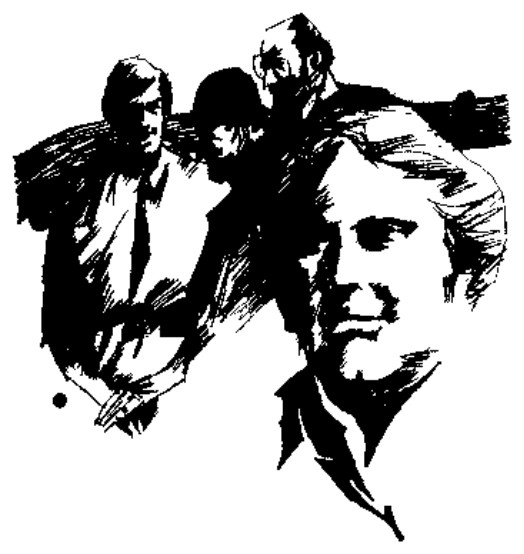
With the advancement of science, people wish to explain all the world’s marvels through science. Scientists argue that there are no miracles in the world. If any exist, they must be fabrications and false rumors. If one were to apply science to deal with them, like a sharp army advancing upon the enemy front, no fortress would remain unbroken, no enemy undefeated. There would be no dens of mystery left in the universe. Yet this is merely the narrow view of shortsighted scientists. Within the universe, nothing is without wonder. Today’s science is indeed refined, but there remains much it cannot explain. There are frequently facts evident to people that, when sought within our existing scientific knowledge, are deemed utterly impossible. It is perfectly acceptable to temporarily classify them as mysteries and preserve them for future analysis.
Edison was the supreme figure among scientists. Yet in his pursuit of truth, he never denied the existence of miracles. He sought, within miracles themselves, to advance science and to discover what his predecessors had not.
Ever since miracles first appeared in the world, what one era considers extraordinary, the next era will regard as commonplace. For instance, X-rays can penetrate a wooden board thirty-six inches thick and clearly perceive conditions on the other side. Were people of the seventeenth or eighteenth century to witness this, would they not have been astonished and called it a miracle? Today it is firmly recognized as a scientific capability.
There was a man named Lisi [Riis], a Norwegian, and a practitioner of occult arts. A friend of Edison’s introduced him, and Edison received him. Lisi claimed to be skilled at guessing objects, so Edison’s servant was instructed to secretly write several things on paper, fold it over, and hand it to him. The moment Lisi received it, he lifted his head and recited the contents—all were correct. Edison then tested him himself by writing a question on paper: “In a halogen battery, is there anything better than nickel hydroxide?” After writing it, fearing that Lisi might be able to probe thoughts in another person’s brain through his art, he immediately changed his thought to contemplating a difficult mathematical problem and posed that question instead. Unexpectedly, Lisi replied without hesitation: “Apart from nickel hydroxide, there is nothing better.” Edison was greatly astonished and received him with the utmost courtesy.
Two years later, Lisi came to his door seeking an audience. Before his arrival, Edison wrote an extremely obscure technical term, “Keno,” and hid it in his pocket. When Lisi entered, Edison suddenly asked him. Without hesitation, Lisi said: “Keno.”
As for Lisi’s art, will it perhaps become commonplace in the future? But upon investigation, Lisi’s technique is roughly similar to hypnotism, and hypnotism is advancing day by day. Thus Edison’s words are indeed credible and supported by evidence.
There was a man named Tom, a psychologist, who had never believed in this art. Edison introduced Lisi to him and described the miraculous nature of his abilities in full. Tom then wrote three difficult words on paper and hid them separately in different locations. After finishing, he requested the meeting and immediately put Lisi to the test. Lisi calmly said: in the leftmost drawer of the desk, the word is “Opsonee”; on the bookshelf, in the third book, the words are “Anbisptor” and “Antigen.” These three words were specialized technical terms—non-experts could not possibly know them—yet Lisi spoke them and further indicated their hiding places without the slightest error. Tom was utterly astounded, considering Lisi to be truly a supernatural and unfathomable person.
Regarding the matter of ghosts, research is even more difficult. Countries across Europe and America all have psychical societies dedicated to investigation, with the one established in London being the most active. All those who have experienced unusual events are gathered and asked to provide detailed accounts, which are compiled and analyzed. Based on what is currently known, there is likely an inherent relationship between humans and spirits. Their manifestation occurs for specific reasons and is by no means accidental. What those reasons are, though not yet discovered, can essentially confirm the actual existence of spirits, rather than being baseless.
Some say: this is the transmission of thought-waves. This explanation is no different from Edison’s concept of brainpower influence. One who substantiated this claim was the physicist John Moore, who once recounted his personal experience, saying: “The transmission of thought-waves is indeed a theory that is on the verge of being discovered but has not yet been fully established. I have personally experienced it and cannot help but acknowledge it as fact. One day, while touring the North Tower of Mount Osmi, as I was gazing at the view, a strange thought suddenly arose in my mind: it seemed that Mr. Buttel, the Latin professor from my alma mater, the University of Wisconsin, had also come to this mountain, and had already entered the mountain and stopped at a certain place. Now, although I had an especially good relationship with Buttel, we had not corresponded for a long time, and there was no thought of him in my mind. Why should I suddenly think of him—and not only think of him, but know that he had come to a certain place on this mountain? The mental image was quite clear, and was decidedly not a fantasy. So I resolved to go down the mountain to look for him. The place where Buttel had stopped was about ten-plus li from the North Tower. It was too late in the day, so I went the following morning. When I arrived, Mr. Buttel was indeed there. The time he had entered the mountain coincided exactly with the time my impression had occurred. The principle of thought-wave transmission is by no means unfounded talk.”
Edison once expressed his views regarding Lisi’s extraordinary abilities, saying: “The human brain will inevitably achieve great activity in the future and be capable of what is today impossible. Several years ago, I experimented with methods of mental communication, but without success. At first, I supposed that whenever a person’s brain is active, there must be corresponding vibrations in the surrounding area. So I applied electromagnetic induction coils outside the brain for testing. I had four people each wear an induction coil, seated in four separate rooms, and asked whether they could perceive one another’s thoughts. This was deemed ineffective because the distance was too great for the electrical force to reach. They were then placed at the four corners of a single room, still without effect. They were then moved gradually toward the center point, until they were knee-to-knee—still to no avail. That Lisi, without any apparatus, could achieve such miraculous results, while this experiment, despite using instruments, failed so completely—this indicates that there must be a spiritual force that we do not yet understand, and Lisi merely stumbled upon it. As humanity develops further, all manner of mysterious phenomena will be elucidated one after another. Some will be obtained through scholarly research; others will be triggered by chance. With each step the world advances, new needs arise to a higher level, and new discoveries emerge accordingly. Human faculties, under environmental pressure, will begin to manifest their latent potential. Thus, Lisi’s art may perhaps become something commonly achievable in the future.”
—Excerpted from Qigong and Science, 1987, No. 6
Wisdom Eye
Patients (with tuberculosis) were queuing there waiting for consultation. She opened her heavenly eye and stared at the qigong master. Suddenly, before her eyes lit up — that pair of miraculous hands of the qigong master actually emitted something white and hazy: like fog, and also like smoke, as if mixed with countless dancing particles of sunlight, sweeping over and impacting the patient’s body.
How enchanting it was. The qi emitted by the master’s apprentice appeared pale white, while the qi emitted by the master was apricot-yellow. It was probably due to the difference in skill level.
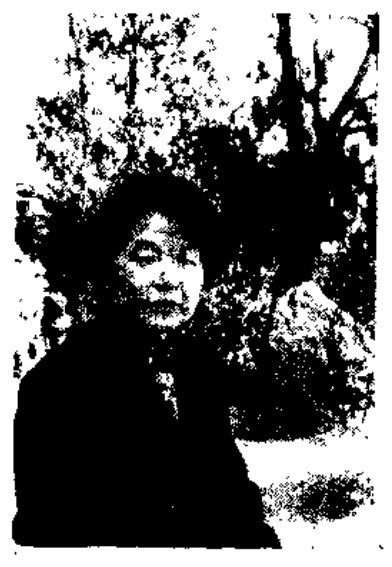
Observing Illness
“Your Heavenly Eye has opened.” At some point, the master walked up to her, leaned over, and said softly.
Heavenly Eye? She was somewhat bewildered. She did not know that the opening of the Heavenly Eye point meant having cultivated the Wisdom Eye, nor did she know that the Wisdom Eye was essentially a living “fluoroscope”…
The master’s apprentice, Wang Changying, led her in front of a patient and pointed to the gallbladder area, asking her to look carefully. She closed her eyes and concentrated. A faint fluorescent screen gradually appeared in her forehead. The gallbladder kept writhing with the power of the qigong. Several small stones attached to the gallbladder began to split apart, then detached. The crushed, residue-like fragments of stones gradually crawled toward the excretory opening of the bile duct.
Her eyesight was extraordinarily keen, like a high-powered fluoroscope — diagnosing conditions rapidly and accurately, often leaving people astonished…
She simply could not believe what she saw before her. They brought over the patient’s freshly taken ultrasound films and compared them carefully — they matched astonishingly. The ultrasound machine only produced cross-sectional images, whereas what she saw had a three-dimensional quality, even with a touch of color.
Not just one person had recommended I go interview her.
Those bright eyes of hers were like a high-powered fluoroscope, or a feedback information field from the diseased area — diagnosing conditions rapidly, accurately, and vividly.
Her name is Cai Zheng, fifty-six years old this year.
The female physician is the protagonist of this article, Cai Zheng.
First Impression
In fact, Cai Zheng was not a physician, but rather a strong-willed woman who had tenaciously struggled against illness.
In 1977, she underwent major surgery. After the operation, her body was extremely weak, but she persisted in exercising — practicing tai chi and so on — and took the veteran Chinese medicine practitioner Shang Yangzhong as her master to study Chinese medicine. Eventually she regained her health. From 1980 onward, she had consistently maintained her practice for seven consecutive years while continuing to work.
After retiring in 1987, she joined the ranks of elderly people strengthening their bodies and improving their health. She practiced tai chi and Yangsheng (health cultivation) qigong, performing every movement and posture with earnest dedication. Her spirits became even more vibrant.
In June 1987, the qigong master Li Zhengang brought several apprentices to set up a clinic in a retired cadres’ activity room not far from her home. Cai Zheng came as a patient (suffering from tuberculosis) and was queuing for consultation there.
A female reporter from the Beijing Evening News stood full of doubt in a certain ministry’s retired cadres’ activity room. She had heard from a friend that there was a female physician here who could see through the human body and diagnose conditions with complete accuracy. Regarding qigong, she had no doubts; but seeing through the human body — she dared not believe it, nor had she ever heard of such a thing.
Let me give it a try, then. The female reporter steadied herself.
Sitting opposite her was that female physician. She gently closed her eyes, leaned her forehead forward, and concentrated for less than two minutes before opening her eyes and said to the reporter with a smile:
“You have tachycardia, multiple areas of spinal hyperplasia, and you also suffer from chronic neurasthenia.”
The female reporter’s mouth dropped open in astonishment. This was faster than any diagnostic instrument in the world, and astonishingly accurate.
Marvellous Images
In fact, once the master’s apprentices learned that she possessed the Wisdom Eye, whenever they encountered patients with gallstones, they would invite her to take a look. Based on the position and path of the stones she provided, they would apply forceful massage a few times, and the stones would quickly be expelled. Efficiency improved several fold.
After seeing more patients, the images gradually became clearer. She could also see the affected areas of the internal organs and the entire body. Later, information feedback developed as well, and even conditions such as neurasthenia, high blood pressure, and headaches could be “seen.”
She became famous.
People, whether ill or not, came to her door one after another, standing reverently before her, as though passing through the “reconnaissance” of the Wisdom Eye would set their minds at ease.
“How many patients have you examined in total?”
“I can’t remember exactly. I mainly still practice qigong. There must be over a hundred or so — only ninety-seven are recorded.”
“What is your accuracy rate?”
·142·
“I’ve never really calculated, but it seems there haven’t been any major mistakes.”
Ji Yeli, a retired cadre from the Central Party School, had many doubts.
For years, his lower back had been tight and he could not sit—whenever he sat, his waist felt as if bound by a hoop. B-ultrasound, CT scans, and various examinations by both Chinese and Western medicine all said he was normal. Using China’s most advanced instrument newly imported from America—the nuclear magnetic resonance imager—to check for cellular abnormalities also found nothing. Zhang Zhenhuan, Chairman of the China Qigong Science Research Association, asked Cai Zheng to use her “Wisdom Eye” to take a look. When she looked, she discovered that the patient’s waist was tightly wrapped by something resembling a band of black qi. Dr. Wang Haoli (the protagonist of the series of reports, who was also present) then used acupuncture and emitted qi to treat him. Cai Zheng watched as the black qi on the patient’s waist hissed outward, and the black qi-like band gradually became lighter and narrower. The patient immediately felt much more comfortable.
“What is this black qi?”
“It is illness qi. Traditional Chinese medicine says that if a person is healthy, they are filled with upright qi. If evil qi invades the body, they will fall ill. I believe the black qi is this kind of evil qi—that is, illness qi. Once the black qi is expelled, the illness will improve.”
“For example, I often have pain under my left ribs,” Liu Ming chimed in from the side. “What she sees is a mass of black qi. I apply supplementing and draining needles according to meridian principles, and the black qi then exits the body from the draining needle point. The pain stops immediately.”
Recently, when her husband Liu Ming was performing acupuncture to treat others, Cai Zheng excitedly said: “I’ve discovered the pathways of the meridians. After the needle is inserted into an acupoint, I can see that meridian glowing. When the needle is twirled, the brightness intensifies. The ancient theory of meridians does indeed exist.”
“This discovery brings new ideas to our acupuncture,” another colleague continued. “We have done experiments comparing the use of qigong to drive out illness qi versus the method of inserting needles while infused with qi to drive out illness qi. The results are quite different—the latter is far more effective.”
In the summer of 1987, a cadre from a certain research institute under the Second Artillery Corps had a seventeen-year-old student who had been missing for half a month. The parents searched everywhere but could find no trace of him. They anxiously came to find Zhang Zhenhuan, who asked Cai Zheng to determine: was the child still alive, and in what direction? As usual when diagnosing, Cai Zheng slightly closed her eyes, raised her right hand above her head with the palm facing upward, then rotated it through several full turns. She withdrew her right hand, looked carefully at her palm, smiled, and said: “Don’t worry. The child is still alive. The direction is northwest. He will return before the end of the month.”
Sure enough, before the end of that month, colleagues from that unit joyfully called to report: the child had returned.
Could this be a ghost-sent, spirit-driven coincidence?
The mysteries of the Wisdom Eye are still numerous, yet Cai Zheng insisted on stopping the conversation, repeatedly saying that introducing these things to readers was not a good idea. Research within a certain scope was fine, but she steered the topic back to the subject of healing.
For instance, do meridians actually exist in the human body? From the perspective of anatomical examination, nothing has been found. From the perspective of traditional acupuncture theory, they do indeed exist. How can this be further confirmed?
On November 23, 1987, this author sat in Cai Zheng’s living room, chatting with the elderly couple about this popular topic.
Regarding the origin of her Wisdom Eye, she herself did not quite understand it. Fate had not been kind to her. As a nobody in a large institution, she could not avoid being shoved around and swept up in the tide. Add to that her frail and sickly condition—gossip, backbiting, and petty intrigues often left her with qi stagnating in her chest, melancholic and sighing. After several surgeries, her body became even more fragile, barely able to take a step. Her life had entered its lowest point. She could not even fold blankets or pour boiling water for herself…
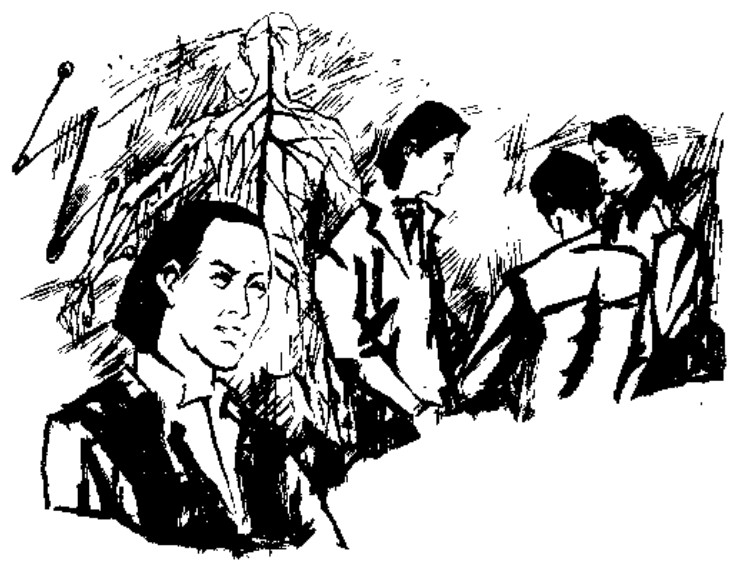
As luck would have it, Cai Zheng’s husband was an open-hearted and devoted partner. During the Cultural Revolution, they stood together through thick and thin. To heal Cai Zheng’s wounds and ailments, her husband diligently studied Chinese medicine and developed his own unique acupuncture methods while at the cadre school.
Fortunately, Cai Zheng encountered several doctors of superb skill and even higher medical ethics. Under their careful treatment, her condition improved day by day, and her willpower grew ever stronger.
By the end of 1979, Cai Zheng was transferred to a new unit, doing reference work—running to libraries, visiting factories, conducting interviews. She rode her half-worn bicycle everywhere and co-authored several hefty books with her colleagues, who came to regard her with new respect.
In fact, by this time she had already begun practicing qigong alongside her husband, following the Six-Character Formula of the great qigong master Ma Litang. She practiced with single-minded dedication—taking a turn through the park in the morning, strolling through groves and gardens in the evening. Miraculously, her body grew strong.
“Look!” Cai Zheng said, rising to her feet in excitement. She brought her legs together, bent forward and pressed down, placing both palms flat on the floor. Then, with a bit more effort, her forehead touched the knee of her straightened leg. For someone in her fifties, this level of skill was quite remarkable indeed.
“So when did you discover that you had the special ability of Wisdom Eye perception?”
“After practicing qigong, I sometimes sensed things, but I didn’t know what was happening. I thought it was something anyone would experience upon entering a certain gong state. Later, after Teacher Gao Zhengang gave me some pointers, and after further practice, my forehead gradually became clear and bright—somewhat like the fluorescent screen of an X-ray machine. Then colors appeared, and there was a strong sense of three-dimensionality. What I saw gradually became accurate and clear.”
Cai Zheng’s husband, Liu Ming, brought out a case record book from the inner room, found several diagnostic records of difficult cases, and handed them to Cai Zheng.
·143·
Not only does this make the practice less strenuous, but qi also flows more easily through the meridians.
She was still in so much pain that she could not stand, and could only walk with crutches. Because only a tiny blood vessel connected to the femoral head, the degree of necrosis was extremely difficult to detect with modern medical diagnostic methods. On November 12, Zhang Xueyan came by reputation and earnestly requested a diagnosis with the “wisdom eye.” Liu Ming inserted needles at acupoints along the meridians in standing, sitting, and reclining postures. When in the reclining posture, blood flow was restored, and the patient felt relaxed with less pain. This demonstrated that when the wisdom eye is combined with treatment for such difficult cases, the therapeutic effect is even more scientifically grounded.
As for treatments such as using qigong to expel stones, the efficacy goes without saying.
Near Elder Zhang, she met a senior master who imparted to her the “Natural Qigong” method, making her wisdom eye even sharper and more penetrating, and also enabling her to intercept information.
“Do you want to test and see if you have any illness?” Cai Zheng aimed her forehead at the author. “Hmm… of course.” “You must want to interview my senior master, right?” Cai Zheng revealed a mysterious gaze. “She just taught me a new method.”
Cai Zheng asked the author to put down his leg, then made a pinching motion in the air, as if catching a needle, and threw it forcefully toward the author’s right leg.
“Do you feel anything at the Zusanli acupoint?” “It seems a bit swollen,” the author replied. Cai Zheng’s hand, suspended in the air, began to twirl as if twisting a needle. The author’s right leg felt a spasm, a numbness like an electric current traveling down to the sole of the foot.
Truly miraculous!
From Zizi
A Soviet Boy with “Fire-Starting” Abilities
A 13-year-old boy named Sasha from Ukraine, Soviet Union, appears to possess an incredible paranormal ability: whenever he appears, the clothes and furniture in the room will catch fire for no apparent reason.
According to Sasha’s parents and relatives, since last November, Sasha’s uncontrollable paranormal ability has caused over a hundred fires, bringing disaster to his relatives and forcing them to move out and seek refuge.
Since last November, whenever Sasha appeared in any room of the house, the things inside would inexplicably burst into flames.
His mother, Anna, said that when Sasha enters a room, the carpets, furniture, and electrical appliances inside will ignite in an instant.
She told reporters that the family members dare not sleep together and must take turns keeping watch to guard against fires.
Left with no choice, the family moved in with Sasha’s grandmother. However, wherever Sasha went, baffling fires continued to occur.
Sasha has now been admitted to a hospital for examination and observation. The hospital’s chief physician, Dr. Kochenko, said he believes the boy has supernatural abilities.
Excerpted from Reference News
•144•
“I am willing to cooperate with scientific research departments for studies. Some people’s special abilities gradually disappear as they grow older. Even for five million, we would not go to that heaven-defying, harm-inflicting casino.” He earnestly hopes that relevant departments, such as a medical university, could admit Huang Xiaorong by special exception to cultivate her and allow her to develop her special talents. He deeply regrets that his younger daughter also had special abilities at the time, but due to financial difficulties, inadequate nutrition, and improper care, not only has her ability faded, but her vision has also sharply declined. Though she has eyes, she cannot read, and she has had to be sent to a school for blind children to learn Braille. This is truly a serious lesson.
The most regrettable thing is that some people simply refuse to acknowledge the existence of special abilities. Their reasoning is that they have seen Huang Xiaorong fail several tests. This is not surprising—everything has its conditions. This is just like how X-rays can only see through objects in a dark room, and a police dog’s nose can only achieve its sensitivity under special care.
Does Huang Xiaorong’s Special Ability Still Work?
By Si Wen
Whether the human body possesses special abilities is no longer a matter of debate. In recent years, both the United States and the Soviet Union have already applied human special abilities for military purposes. Regrettably, some people’s special abilities gradually disappear as they grow older. As the Qing Dynasty scholar and chief compiler of the Siku Quanshu (Complete Library of the Four Treasuries), Ji Xiaolan, stated in his own account: “When I was four or five years old, I could see objects at night just as clearly as in daylight. After age seven or eight, my vision gradually dimmed, and after age ten, I could no longer see at night at all.”
So then, has the special ability of Huang Xiaorong, which was discovered seven years ago, now disappeared? We recently made a special trip to visit her. After seven years apart, Huang Xiaorong is no longer that shy little girl who was bashful around strangers. Today, Huang Xiaorong is a second-year student at a middle school in Fuzhou. Wearing a sports outfit with short-cropped hair, she cuts a spirited and striking figure. When she smiles, she looks like a rose just beginning to bloom, radiating youthful vitality. She tells us that her special abilities have not faded at all—recognizing characters through her ears, seeing through the human body, and identifying residual information are all just the same as when they were first discovered seven years ago. For example: Tang Haimin, former council member of the Society for the Research of Extraordinary Natural Phenomena at Shanghai University of Science and Technology, read about Huang Xiaorong’s special abilities in Taiwan and Overseas Digest in 1985. He wrote a letter in an exploratory spirit, asking Huang Xiaorong to describe his appearance from his letter. Huang Xiaorong wrote back and told him: You are approximately 1.7 meters tall, weigh about 115 jin, wear glasses, have eyebrows like the upper-black and lower-white frames of your glasses, and your name sounds female, though you are actually male. Tang Haimin was astonished and then sent a half-body photograph of nine people for Huang Xiaorong to identify. Huang Xiaorong accurately pointed out that the second person from the left was Tang Haimin among the three heads wearing glasses. As a result, Huang Xiaorong was admitted as a member of the Society for the Research of Extraordinary Natural Phenomena, with membership number: Tx-8601.
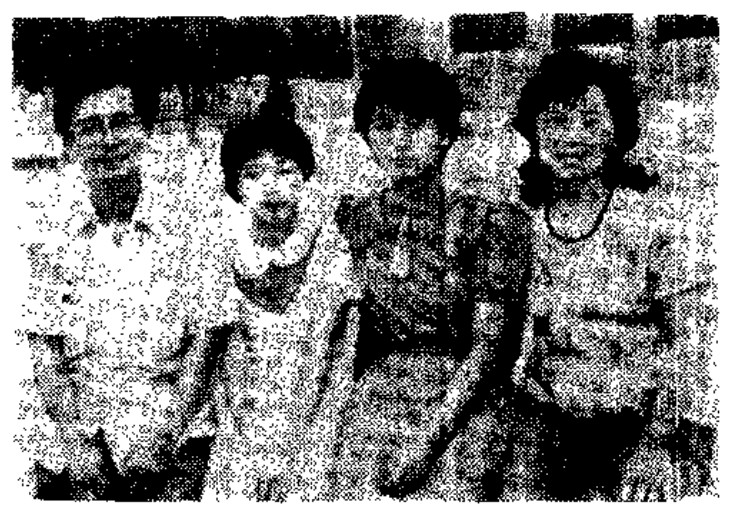
The news of Huang Xiaorong’s ability to see through the human body spread wider and wider, and many returned overseas Chinese sought her out for medical consultations. Some busybodies offered large sums of money, asking her to perform overseas, but all were politely declined by Huang Xiaorong’s father, Huang Chengpei. The most absurd case was when a wealthy Macau businessman used a huge sum of fifty thousand yuan as bait, asking her to go to a Macau casino to collaborate with him and split the winnings. Huang Chengpei sternly refused, saying: “My daughter has a special ability. I am willing to cooperate with scientific research departments for studies. Some people’s special abilities gradually disappear as they grow older. Even for five million, we would not go to that heaven-defying, harm-inflicting casino.” He earnestly hopes that relevant departments such as a medical university could admit Huang Xiaorong by special exception and cultivate her so she can develop her special talents to the fullest. He deeply regrets that his younger daughter also once had special abilities, but due to financial difficulties, inadequate nutrition, and improper care, not only has her ability faded, but her eyesight has also sharply declined—she has eyes yet cannot read, and has had to be sent to a school for blind children to learn Braille. This is truly a grave lesson.
The most regrettable thing is that some people simply refuse to acknowledge the existence of special abilities. Their reasoning is that they saw Huang Xiaorong fail to be accurate in several tests. This is not at all strange—everything requires conditions. Just as X-rays can only penetrate in a dark room, and a police dog’s nose must receive special care to achieve its keen effectiveness, Huang Xiaorong’s ability must operate under conditions of abundant energy, full emotional well-being, a relaxed and happy state of mind, and freedom from interference to perform well. Otherwise, the ability weakens—this is a fact verified in many tests. What should be done now is to strengthen care and conduct serious research to prevent the special ability from disappearing as she grows older. Once lost, it would be an irretrievable loss. Humanity’s understanding of itself is far from sufficient. How many unsolved mysteries still await our recognition and uncovering!
Excerpted from Science and Culture
Huang Xiaorong (second from right) with her family
·145·
Exploring the Wonders of Human Special Abilities
Wang Dexing
According to newspaper reports: On the afternoon of October 28, 1986, Beijing Mayor Chen Xitong visited the Guest House for Foreign Visitors at Beijing Teachers’ College. A young man “scrutinized” his pocket for a moment, then proceeded to state the contents of a letter that the Mayor had brought in advance and placed in his pocket. The Mayor took out the letter and discovered that the young man had also written several lines on the back of the envelope and had inserted a piece of candy into the sealed envelope. Then the young man “plucked” more than twenty pills from a factory-sealed medicine bottle, while the bottle’s seal remained perfectly intact. After witnessing this, Mayor Chen exclaimed in amazement and then and there “made the decision” to allocate 100,000 yuan for research on human special abilities.
(I)
The manifestations of human special abilities are diverse and varied, which can be broadly summarized into two major categories. One category is “extrasensory perception,” known abroad as ESP—that is, the ability to receive external information without using known sensory organs. For example, some people can recognize characters with their ears, noses, or foreheads, which is called “non-ocular visual ability.” Some people can vividly discern pathological conditions of human internal organs, identify human figures and gender through walls, or depict objects buried at shallow depths beneath the earth’s surface, which is called “clairvoyant ability.” If a rubber eraser is placed inside an empty box and then removed and the lid closed, some people can accurately state that an eraser was once placed in the empty box and can even describe its shape. After a beam of light is reflected off a mirror onto a wall and the light source is then extinguished, some people can correctly indicate the trace that the beam once passed through in space—this ability is called “residual information function.” Some people can describe what others are thinking or intend to do, which is called “remote viewing ability.”
The other category involves the ability to cause changes in objects without touching them, called “special movement,” known abroad as the PK phenomenon. For example, some people can cause macroscopic objects such as enamel mugs to move across a tabletop under the watchful eyes of many onlookers, cause a stationary pendulum to swing, cause watch hands to reverse, cause pressure sensors inside sealed containers to deform, cause goldfish swimming in a tank to lose their tails, cause compass needles to spin violently, cause television images to disappear, and cause text on computer terminal displays to fade away. This ability is called “telekinetic ability.” Some people can cause pills sealed inside a stoppered and capped medicine bottle to pass through the bottle wall intact, cause documents to fall out of a locked briefcase, or “slap” a bouquet of flowers intact into a bottle. Some people can cause tea leaves to fly out of a tin tea canister without removing its lid, and cause white sugar inside a heat-sealed plastic bag to “leak” out while the bag remains undamaged—this is called “object penetration ability.” Some people can use their own mental intention to write short sentences inside a hermetically sealed envelope, or write a passage of poetry on a designated blank page of a book—this is called “writing ability.” Some people can, in a very short time, restore torn and shattered pieces of paper to their original state, with all markings and text perfectly intact, leaving not the slightest trace of tearing—this is called “restoration ability”…
(II)
Human special abilities resemble magic but differ fundamentally from it. Although magicians’ performances are astonishing, they can only perform with props prepared in advance, and their performances do not allow others to observe using slow-motion playback. If slow-motion video recording methods were used, then tricks such as “fishing” would be exposed at once. Human special abilities are different: the objects upon which they act can be test samples prepared by others in advance; observation and recording using ultra-high-speed photography and other methods are permitted, and various modern scientific instruments can be used for testing and research. Therefore, human special abilities are not magic.
Some countries with advanced science and technology have already listed human special abilities as national scientific research projects. In 1982, Britain established its first Society for Psychical Research; the Parapsychological Association, established internationally in the United States in 1957, was accepted in 1969 as a division of the American Association for the Advancement of Science. In 1975, Japan established the PSI Society, organizing university professors to research human special abilities. The Soviet Union also had institutions engaged in parapsychological research, such as the Engineering Parapsychology Division under the Central Council of the Scientific and Technical Association of the Instrument Manufacturing Industry, established in 1967.
China’s research on human special abilities is also remarkable. For example, a certain scientific research institute in Beijing conducted multifaceted research on the wall-penetration actions of the young man mentioned at the beginning of this article. To ensure the uniqueness and irreversibility of the test samples, a specially designed bottle was selected (once broken, it could not be restored), and all pills were given special markings. Under strict surveillance, high-speed continuous photography equipment (four hundred frames per second) was used to capture the process of pills passing through the wall of the sealed bottle. Among them, three photographs respectively recorded the moments when a pill first emerged from the bottle wall, was mostly exposed, and had completely left the bottle wall, demonstrating the authenticity of the wall-penetration phenomenon. This achievement won this year’s ministerial-level scientific research second-class award.
The ancient Roman emperor Au— (continued on page 148)
·146·
Can the Human Body Spontaneously Combust?
On December 5, 1966, in the town of Couder’s Port, Pennsylvania, USA, a bizarre case occurred. Early in the morning, a gas meter inspector arrived at the home of 92-year-old Professor Beneventi to check the meter. Professor Beneventi was a doctor who had been practicing medicine in the area for half a century and was a highly respected figure. The weather was extraordinarily cold that day, and the worker assumed the elderly man had not yet risen, so he went straight to the basement to check the meter. Upon entering the basement, he discovered a pile of cooled ashes on the floor. In the ceiling directly above the ashes, a hole had been burned through. The worker was astonished and hurried upstairs to find the doctor. When he entered the bathroom, the sight before him made his hair stand on end. On the floor, which had been burned through, a right leg remained perfectly intact, still wearing a leather shoe. The rest of the old man’s body had been reduced to ashes. Aside from the area the deceased’s body had touched, there was not the slightest sign or smell of fire anywhere in the room. Soon, police arrived at the scene, but they could not understand the cause of death, and the case was hastily closed.
Scientists concluded that Professor Beneventi died from spontaneous human combustion. Spontaneous human combustion refers to the phenomenon in which the human body, without contact with any external flame, spontaneously ignites and is reduced to ashes, while all combustible materials surrounding the ashes remain completely intact. One scholar who studied the phenomenon of spontaneous human combustion said: “Spontaneous combustion generally produces smoke and fire, and burns very rapidly, but the area of burning is not large. This kind of fire is caused by a puzzling, unextinguishable fuel. Moreover, the way this fuel burns is extremely peculiar—some parts of the body are burned while other parts are not; that is, some limbs are reduced to ashes while other limbs remain intact. Even more strangely, in some cases the body is consumed by fire while the outer clothing remains perfectly undamaged, producing the phenomenon of clothes covering a pile of human ash.”
The first recorded case of spontaneous human combustion in history appeared in a 1673 Italian medical document. A man named Parisian was lying on a straw mattress and was reduced to ashes, leaving only a skull and a few finger bones, yet the straw mattress remained in its original condition except for the spot where he had been lying. In 1744, in the town of Ipswich, England, there was a 60-year-old Mrs. Patt. One morning, her daughter found her dead on the floor, looking like a piece of charred wood, while the clothing nearby was completely undamaged. There are over 200 similar historical records.
A man named Charles Fort also collected several cases of spontaneous human combustion that had occurred since 1861 in great detail. For example, on May 18, 1957, in Philadelphia, USA, a 68-year-old widow named Anna Martin was reduced to ashes in a room with no fire source, leaving only her shoes and a small portion of her torso. The most detailed case of spontaneous human combustion recorded by Fort occurred on July 1, 1951, in St. Petersburg, Florida. That evening, 67-year-old Mrs. Reeser was sitting comfortably in an armchair. When her son left, he saw that his mother was perfectly fine, but less than twelve hours later, when her son came to his mother’s room, he was confronted with a terrifying scene. In the sweltering room, his mother and the chair had vanished. On the floor were several corroded and deformed pieces of metal, indicating that there had once been a pile of hair. All that remained were a few small baked-dry vertebrae, a skull shrunk to the size of a baseball, and an intact left foot. A newspaper very close to the body and linen cloth just inches away showed no traces of burning.
Over the past three hundred-plus years, scientists have continuously explored this question. From more than 200 cases, scientists have found that the ratio of men to women is roughly equal, ages range from 4 months to 114 years, and both moderate drinkers and people of all body types are affected. Some cases occurred while walking, driving, rowing, or dancing.
In the 19th century, the German chemist Liebig hypothesized that spontaneous human combustion might be caused by an excess of alcohol in the body. He conducted an experiment to determine at what concentration alcohol-filled fresh meat could spontaneously ignite, but without success. Therefore, the claim that the human body can spontaneously combust was rejected by most scientists.
Later, some people proposed that spontaneous human combustion was related to excessive combustible fat in the body, comparing this fat to ignited candle oil, with clothing serving as the wick. Some believed there was a kind of natural “electric fluid” within the human body that could cause combustible substances inside the body to ignite, or even cause a “internal decomposition” of highly combustible material structures. Still others believed that excessive accumulation of phosphorus in the body produced a “luminous flame.” Some scientists explained it from a physics perspective, suggesting there might exist “combustion particles” smaller than atoms within the body that could cause ignition. However, none of these speculations were convincing.
In recent years, humanity has discovered plasma, also known as the fourth state of matter (beyond the three states of gas, liquid, and solid). Plasma is an object composed of positive ions and free electrons; it is a high-temperature ionized state of matter. It carries no net charge, has strong conductivity, and when a powerful current passes through it, it undergoes violent contraction due to electromagnetic forces, producing temperatures of millions of degrees. The Sun and most other stars contain plasma. The plasma state is one form in which matter exists. High temperatures, powerful ultraviolet rays, X-rays, and gamma radiation can all transform gaseous matter into the plasma state. The discovery of plasma led people to associate the phenomenon of spontaneous human combustion with the phenomenon of ball lightning.
Ball lightning is a concentrated, floating, bouncing ball of light that moves erratically and unpredictably, passing through—
On a plane in flight, a fireball about 20 centimetres in diameter moved from the cabin door rearward along the central aisle, then suddenly disappeared at the doorway to the lavatory at the back of the cabin. The passengers present were all stunned. Among those who witnessed the event was a deeply learned scientist; at the moment of observation, he expertly recorded data such as the dimensions and speed of the ball lightning. Shortly thereafter, the American journal Natural Science promptly published details of the above account. From that point on, the problem of ball lightning began to receive increasing attention from the scientific community.
Although the phenomenon of ball lightning remains a mystery, the discovery of plasma has offered an outline for explaining the ball lightning phenomenon — or at least an approximation of an explanation. Ball lightning is usually spherical in shape, sometimes pear-shaped, surrounded by a luminous halo with variegated colours. Before disappearing, it can emit crackling sounds and leave behind the smell of nitrogen oxide, ozone, or sulphur. Its average speed during movement is about 3 metres per second, and it can persist for several seconds or even minutes. When ball lightning vanishes, a violent explosion can occur.
History also records that Diane, the fiancée of the French King Henri II, was killed by fire when ball lightning suddenly entered her bedchamber on her wedding night in 1557.
The phenomenon of ball lightning had long failed to receive serious attention from the scientific community. When people discussed ball lightning, quite a few scientists routinely regarded the accounts of eyewitnesses as fabrication or hallucination. One ancient witness recalled seeing a luminous ball appear suddenly, flying toward him, intermittently emitting a hissing whistle, and burning him. The history of ball lightning can be traced back several centuries.
Therefore, some scientists believe that the phenomenon of human spontaneous combustion may be the result of ball lightning coming into contact with the human body. To date, the phenomenon of human spontaneous combustion has not yet been seriously studied from a medical perspective. This difficult puzzle is one that scientists are actively exploring.
Compiled by Song Zhicheng Excerpted from Fengliu Yidai (The Romantic Generation)
(Continued from p. 146) Augustine once said: “The miraculous does not violate nature; it violates only our understanding of nature.” The reason paranormal abilities of the human body seem so marvellous and incomprehensible is that they cannot yet be explained by science. However, their existence cannot be denied for that reason alone. Copernicus’s heliocentric theory and the genetic theories of Mendel and Morgan have become the foundations of certain scientific theories, yet in their own time they too were regarded as heresy.
Qian Xuesen, Chairman of the China Association for Science and Technology and a renowned scientist, considers paranormal abilities of the human body to be “a complex issue that bears on the development of modern science and technology yet seemingly contradicts existing scientific knowledge.” He asserts that once this matter is properly addressed, it will inevitably bring about a new scientific revolution. Its impact will be comparable to that of the European Renaissance of the sixteenth century, exerting an inestimable influence on society as a whole and on human progress.
(III)
Since the paranormal abilities of the human body were publicised in China, they were once vigorously attacked as “pseudoscience” and “sleight of hand.” This was unjust; the study of paranormal abilities of the human body is of great significance.
Up to the present, no modern scientific theory can precisely explain paranormal phenomena. Although people can describe paranormal phenomena using theories of sound, light, electricity, magnetism, or even quantum mechanics, none of these penetrate to the essence of the phenomenon. This demonstrates that modern scientific theory still has significant limitations, compelling people to further develop modern scientific theory — or to explore an entirely new theory. Once such a theory is established, it will break through conventional understanding of the structure and functions of the human body, and resolve the more profound interrelationships of energy, force, time, and space between human beings and their environment — approaching the problems of the human-cosmos relationship from a systems perspective. This new theory will inevitably lead to a tremendous new revolution.
The value of paranormal abilities of the human body is beyond estimation. Japan is preparing a “Human Frontier” programme to rival America’s “Star Wars” initiative, Western Europe’s “Eureka” programme, and the Council for Mutual Economic Assistance’s “Eastern Eureka” programme. The plan calls for an investment of one trillion Japanese yen over twenty years.
Excerpted from Nianqing Ren (Young People)
A Remarkable Man Who Eats Uranium
Last year America produced a remarkable individual: nuclear engineer Gary Wensole. He insists on eating uranium oxide every day, using this lifestyle to proclaim to the world that radioactive elements are harmless. At present, his entire body emits radiation; according to the regulatory standards for radioactive materials set by the United States, he should have been buried thousands of feet underground long ago.
Robert Alexander, who serves on the Atomic Energy Commission, opposes Wensole’s unusual diet. He believes that radiation will kill large numbers of kidney cells, and that once the kidneys can no longer hold out, the person will collapse immediately. Wensole, for his part, loudly proclaims: “The doctors cannot find anything wrong with me, which proves that uranium is not to be feared. No matter who you are, eating a bit of uranium won’t cause any problems.”
Wensole is thirty-six years old this year; his technical skills are accomplished, his thinking is clear, and he is by no means one of those “New Age fanatics.” His eccentricity has a certain background — it is a protest against the decision of the Atomic Energy Commission to bury nuclear waste deep underground.
(Excerpted from Zhongguo Rencai Bao [China Talent News])
Strange Tales of Special Abilities Abroad
A Man Who Could Move Chess Pieces with Psychokinetic Power
Special Ability User Finds Undersea Treasure
In Florida harbor, USA, there was a sunken treasure at the bottom of the sea from a shipwreck, estimated to be worth six hundred million US dollars. It was later located using a special ability user.
This treasure was cargo seized by a Spanish pirate fleet from South America in 1662, which sank in a storm. Historians have confirmed this event, but the treasure’s whereabouts remained unknown. Therefore, a treasure detection company hired a very famous special ability user named Oloff Guillen. On June 18, 1971, he rode a speedboat circling the harbor. When the boat reached a certain spot, he suddenly called for it to stop and declared: “I have already seen a vision of the ship and the treasure sinking — this is the place where they went down.”
After three days of thorough preparation, they returned to this location. At a depth of ten meters beneath the sea, they used a special pump to open a hole — gold ingots, silver pieces, and other precious artifacts glittered in the light. After expert appraisal, they were confirmed to be items from the seventeenth century.
The manager of the treasure detection company was delighted and said that previously, using this method, they had already discovered items worth over hundreds of millions of dollars, and Oloff predicted: “There is still much more.”
Croiset II Can Remotely Detect the Location of Bodies
Dutch special ability user Gérard Croiset II became famous overnight in May 1976 for accurately detecting the location of the body of a missing young woman in Chiba Prefecture. He had previously received acclaim when he solved a similar missing persons case in December 1975, and people said he was truly a worthy successor to his father.
Nine-year-old Janelle Gross from the village of Sundarley-Reyza went missing while out for a walk. In July 1975, police and military forces were mobilized for a search, but not a single clue was found.
Finally, her father, Mr. Bell, had exhausted all options and traveled thousands of miles to The Hague in the Netherlands, bringing his daughter’s photograph to seek help from Croiset II. Croiset II touched the photograph and said: “She is buried near a reservoir close to her home. There are stones and water there, and she has lost one of the shoes on her feet.” At the same time, he drew the scene he had remotely viewed on paper and gave it to Mr. Bell.
Mr. Bell hurried home and immediately went to the waterside with four friends. At the location marked on the map, they discovered his daughter’s body buried in the sand. It appeared she had been walking on the embankment in the middle of the pond when the soil unfortunately collapsed and buried her. Indeed, she was missing one shoe.
The “Radar Hand” Strange Man
In Johannesburg, South Africa, there was a man named Gideon Slabbert, who was a man with a “magic hand” that astonished local university professors.
He simply extended both hands into the air and moved them casually. No matter where objects were hidden, he could detect them. According to reports, when tested by the head of the physics department at the University of Witwatersrand, Professor Frank Malherbe, the professor personally hid cigarettes, playing cards, sand, oil, cotton, and various other items anywhere in any building (such as inside drawers or tucked between the pages of books), and he detected them all.
According to Gideon himself, his hands could sense a kind of inexplicable “vibration” emitted by all objects. He could detect items within a range of 25 miles. Therefore, some people said his hands were even more powerful than radar.
A newspaper, to verify this claim, hired a salvage boat. They sank a tin barrel containing polo shirts into Algoa Bay in Port Elizabeth. Then they brought Gideon to the shore. He extended both hands into the air and waved them for a moment, then detected the location of the sunken barrel. He then guided everyone by boat directly to the spot where the barrel had been sunk.
He Can Move Chess Pieces with Psychokinetic Power
In Mexico, a person appeared whose psychokinetic power was even stronger than Uri Geller’s — a man named Alejandro Paz, a civil engineer, 37 years old.
- 149
Those Who Know Before Asking
A Record of the Soviet Marvel Tofik Dadashev
Compiled and translated by Yao Weimin
“Think, please concentrate your thoughts…” Tofik Dadashev raised his voice and addressed a representative from the audience. His eyes were completely covered, and over his head was placed a black cloth bag made of dense fabric; both hands extended forward with fingers spread apart, as if groping in the air for invisible threads. A few paces behind Dadashev stood the audience representative who had volunteered to perform with him on stage—the representative was to think about a question of his own choosing, while Dadashev was to perceive and carry out the instructions that existed in the assistant’s mind.
Not a single person in the auditorium knew what the audience representative was thinking. The answer had been secretly written by the representative on a slip of paper, and would ultimately be read aloud by the judges—to see whether Dadashev’s response was correct.
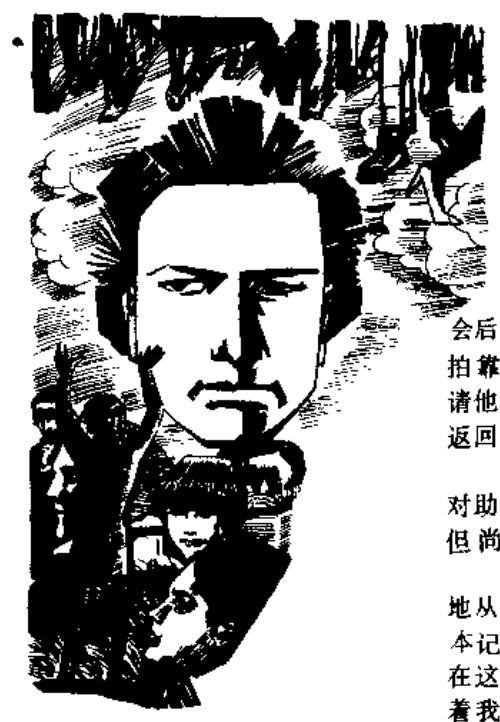
“Please continue thinking! Do not let your mind wander!” The air in the hall seemed to freeze. Dadashev walked down from the stage, and the assistant followed closely behind. Suddenly, Dadashev stopped in front of a seat, stood for a moment, then walked briskly past from the side, patted the shoulder of an audience member sitting against the wall, asked him to shift aside to let him pass, and returned to the stage.
“Please continue thinking!” Dadashev said to his assistant. “I can already sense the question, but I have not yet fully formed it. Please think harder!”
Suddenly, with a swift turn, he caught everyone off guard by pulling a notebook from his assistant’s right jacket pocket and rapidly flipping through it. “Here, on this page,” he stopped flipping, “is written the telephone number I was supposed to read out—but I cannot see it. Please read it yourself!”
Dadashev’s assistant, a complete stranger, was so excited that he was momentarily stunned and speechless. When he came to his senses, he spread his hands wide in amazement and nodded repeatedly: “Completely correct, completely correct…”
The hall erupted in enthusiastic cheers and applause. The chief judge stood up and carefully unfolded the written note: “Please quiet down. The note reads: I have copied my new office telephone number into my notebook, and the notebook is placed in my right jacket pocket.”
The performance above was merely a minor trick by Dadashev, a performer with the Moscow Song and Dance Troupe. He could accomplish even more complex feats. He had toured various places many times, performing his extraordinary ability of “mental communication” with others. However, for Tofik Dadashev to master such remarkable ability was by no means an overnight achievement or the work of a single day—though he was only twenty-five years old this year, he had already trained painstakingly for many years.
A “Mental Communication” Performance
The program described above was only one of Dadashev’s minor skills. He could also perform more complex tasks. He had traveled to many places on tour, demonstrating his extraordinary ability to achieve “mental communication” with others. However, for Tofik Dadashev to master this remarkable ability was by no means a one-day accomplishment or an instant success—although he was only twenty-five this year, he had already trained arduously for many years.
Discovering His Own Special Abilities
Dadashev was born into a large family in Baku. He did not know who his father was, and the family lived in poverty. But from a young age he was studious, with a special respect for his language teacher, listening to her recite classical works with the vividness and fluency of an actress. When Dadashev was fourteen or fifteen years old, a sudden thought occurred to him one day: “Could the teacher be reading incorrectly?” Of course, mistakes were hard to avoid! “There’s a mistake, there’s a mistake…” he muttered to himself over and over, and soon a sense of distrust arose. Strangely, the female teacher began to stutter and ultimately could no longer continue teaching; she left the class she had been teaching in bewilderment. This left Tofik terrified and at a loss: Could he really do things that even he himself was unaware of, yet which could affect other people? He was determined to uncover the secret within himself. Through experimentation, Tofik learned to predict each day what the homework assignments would be. “What is going on,” the young Dadashev pondered bitterly, “is it coincidence, or have I actually become able to use my own thoughts to influence others and read their minds?” However, this “mental communication” occasionally failed. Fearing he might make a fool of himself, Dadashev never spoke of his secret to anyone.
Tofik often secretly attempted to use his telepathic abilities to mediate disputes and conflicts among his peers, and the results were always that he could easily subdue those who enjoyed provoking others.
Subsequently, Dadashev developed an interest in billiards and frequently watched matches. But there were certain so-called billiards experts whose arrogant attitudes were simply unbearable to Dadashev—these people feigned poor skills while repeatedly bullying newcomers, forcing them to lose money again and again. Dadashev, who had always had a chivalrous heart, decided to teach these gambling addicts a lesson. Using his “mental communication” ability, he guessed these gamblers’ intentions and drove them to attempt shots beyond their capability, so that within ten to fifteen minutes not a single ball was pocketed.
The billiard ball could actually drop into the pocket. This unprecedented and disgraceful spectacle drove the “Billiard King” to roll frantically on the floor, stamping on his cue with his feet, while those novices cheered and jumped for joy.
By the time Dadashev reached the age of eighteen, he was already able to skillfully apply his “mental communication” ability. He could even perceive his opponent’s psychology during fierce boxing matches, thereby gaining the upper hand and securing victory with ease.
After watching a famous actor perform, he suddenly discovered that he too could do everything that celebrated actor could do—without any physical contact with the audience, he could see into the inner world of others. From then on, he entered the ranks of actors, habitually wearing a mask on stage to avoid being distracted by the sight of the audience.
Strict Assessment
In fact, Tofik Dadashev was a man of strict self-discipline who strove for self-improvement. He resolutely cast aside all hesitation and went to Moscow to seek his fortune, hoping to win society’s recognition and the attention of experts.
Dadashev’s astonishing ability lay in his capacity to perceive the thoughts of others. He once underwent assessment by criminal investigators. The detective spread fifty photographs across a table and asked him to find the photos of three people who had been arrested simultaneously. Dadashev reshuffled the photographs like playing cards, then took them to the window and began examining them carefully. He was surrounded by judging experts. Without the slightest panic, Tofik picked off the photographs one by one, then admitted that he could clearly “hear” the mental activity of the people around him. As a result, Dadashev set aside four photographs. He pointed to three of them and said: “These are the three people you arrested simultaneously.” Then, pointing to the fourth photograph, he said: “This person is your intended suspect; the investigation is currently underway.”
Dadashev’s startling pronouncement caused an uproar among all those present—his special abilities far exceeded everyone’s expectations.
The second assessment that followed involved blindfolding Dadashev and bringing him into a large room piled with miscellaneous objects, asking him to select the items the examiners had in mind. Dadashev made not a single error. Moreover, he could accurately and unfailingly retrieve from the shelves of a library vast as an ox-plentiful collection the very book the examiners had in mind, turn to the designated page, and read aloud the designated sentence or phrase. The so-called “designation” here referred purely to information within the examiners’ minds. Dadashev could also learn any confidential telephone number and call out the names of telephone subscribers he had never met.
The Human Potential Awaiting Discovery
By this point, the Moscow Song and Dance Troupe made a decision: to admit Dadashev and fully agree to let him perform his “mental communication” act on stage.
Whenever the announcer declared “The performance has ended,” audience members would swarm forward, bombarding Dadashev with a stream of questions.
“Can you sense the thoughts of someone located in another building or another city?”
“No. The effective range of my ‘mental communication’ is only a few meters, and I can sense the distance. When there are interfering factors in the hall, I ask my collaborator to move closer to me, so that the sensory signals become stronger.”
“What are these sensory signals?”
“They are a kind of emotional, symbolic, pulse-like signal. If the other person is thinking of numbers, then the sensory signal is something that even I myself cannot describe.”
“Then does this mean you can read the thoughts of foreigners who speak a language you do not understand?”
“Yes. Once I was invited to the Central Palace of Culture of Medical Workers, and American scholars were present at the time. Among these American guests, some had participated in telepathy experiments. This time they decided to test me. The female representative they chose did not understand Russian, and she gave me tasks in English, which I likewise did not understand. As a result, I nearly guessed correctly the names she silently recited in her mind—with one minor error: I said ‘Johns,’ whereas she was thinking of ‘John.’ Later, an American scientific magazine published a special and detailed report on this, calling me a ‘clairvoyant.’ In fact, I do not endorse certain supernatural and agnostic viewpoints. In my view, we should be bolder and more decisive in knocking on the doors of worlds that are still mysterious at present, and we should conduct psychological experiments in the manner that Pavlov and Mendeleev once advocated and personally practiced.”
Extraordinary Mental Training
Generally speaking, anyone who has seen one of Dadashev’s performances comes away with a deep impression. Even the most skeptical person, after watching two or three performances, will seriously ponder the latent capacities of the human organism—for it should be noted that Dadashev typically solves fifteen complex problems at each performance!
Of course, there are times when the performance fails. Delicate performances often fall short of their intended effects due to unexpected interference, and success is also related to one’s own emotional state, health, physical strength, and whether one has “entered the role”—that is, achieved a state of qigong emission. Therefore, Dadashev performs mental training every day.
…Breakfast is light, followed by going out into the streets—to the city center or the subway, those places where crowds bustle—to cultivate the ability to find tranquility amidst noise and concentrate one’s energy. This is followed by muscle contraction. Through tightening the masseter muscles, abdominal cavity muscles, neck muscles, and intra-abdominal pressure muscles, a so-called “internal bioelectric current” is generated, which in turn self-stimulates and makes the muscles contract more forcefully. At the same time, he captures the momentary thoughts of people walking past him (without any physical contact). Over time, Dadashev felt an unusual latent power within his body; when he walked, it was as though he were not stepping on the ground but floating like a “maglev”…
Indeed, Dadashev possesses a remarkable ability to control his own organism. He can enter a cataleptic state (trance state) at will: the entire body becomes rigid, sensation is lost, the muscles become completely unresponsive, injections cause no pain, the pulse nearly disappears, and breathing becomes undetectable; yet the brain’s alert center remains extremely vigilant, capable of restoring the body to its normal state at any moment. This is extremely similar to the artificial hibernation of Indian yoga masters.
Whenever the announcer declared “The performance has ended,” audience members would swarm forward, raising a barrage of questions. Some believe that special abilities represent a kind of human potential. Today, although humanity can ascend to the highest heavens and dive to the deepest oceans, our understanding of ourselves remains surprisingly superficial. Therefore, uncovering the potential of the human organism is an extremely urgent and profoundly significant subject.
Excerpted from Science Review
151
A Wonder of China
Broad-Ranging Abilities, Extraordinary Feats
Among those discovered in our country who possess special abilities, children and adolescents predominate, and they typically have only a single type of special ability. Wang Youcheng, however, is already a middle-aged adult. Nowadays, recognizing characters with his ears or discerning characters by touch are, for him, merely “minor tricks” unworthy of surprise. He is a versatile master of special abilities.
Wang Youcheng’s extrasensory perception is astonishing. When Yu Tianzhu from the Jilin City Transportation School watched his demonstration, Wang asked him: “Do you know how much money you are carrying? Don’t say the amount aloud.” Yu replied: “I know the whole number, but not the change.” Wang said: “That’s interesting. If you knew the change too, it wouldn’t be very interesting. I’ll write down the amount of money, and then you take the money out and let’s see if it’s right.” The amount he wrote was “15.35.” Yu knew he had 15 yuan in his pocket, but did not know the loose change in his coat and trouser pockets. When he took it out, it came to 0.3 yuan—one cent less than what Wang had written. Wang said: “You must have another cent on you somewhere. Look carefully.” In the end, Yu found a very worn one-cent bill beneath a soy product coupon inside a small green plastic wallet. The loose change was exactly 0.35 yuan—not a fraction different from what Wang had written.
Wang then handed Yu a small square piece of paper with “Work ID No. 43” written on it. Yu unfastened the small pocket on the left side of his shirt and took out his work ID—exactly right, not a single error.
Wang Youcheng’s coin performance was also unlike anything seen before. He placed some coins in an ordinary envelope, then had someone seal the envelope with glue. He pinched the coins with his hand and let others feel them as well. Once everyone agreed there was no trickery, he ran his hand along the envelope—and in an instant, the coins fell into his hand while the envelope remained completely intact. Next, he placed a coin on the glass top of a table. Then, with a slap of his hand on the table, the coin instantly passed through the glass and the tabletop and dropped to the floor. At this point, He Jian, the former Deputy Chairman of the Municipal People’s Congress Standing Committee, asked: “Can you pass it through other objects? Would a steel plate work?” Wang replied: “I’ve never tried a steel plate, but marble has been tested and works.”
There is another close-up scene that the author will never forget. Wang Youcheng found a relatively new one-jiao (ten-cent) banknote, then used scissors to make a small cut in it and handed it to me to examine. How could this be wrong? How could I doubt my own eyes? At that point, Wang held the torn bill between his two hands and covered it. After about half a minute, when he opened his hands, the bill was seamless—restored to its original state!
Money Vanishing into Thin Air
A colleague who works at a bank held a stack of money in his hand and asked Wang Youcheng: “Tell me, how much is this?” Wang said: “One hundred yuan.” Sure enough, it was exactly right. A moment later, Wang said: “Now you only have ninety yuan in your hand.” When the colleague counted, sure enough, there were only ninety yuan—the remaining ten yuan had vanished. Wang said: “It’s right here with me,” and then pulled the ten yuan out of his pocket. Wang continued: “Your money is now down to eighty yuan… seventy yuan… sixty yuan…” All of this money flew into Wang’s pocket. Then Wang added: “The money in your hand is now back to eighty yuan… ninety yuan… one hundred yuan.” When the colleague counted again, it was once again one hundred yuan. It was a truly superb performance.
All of this happened in the same room, as six or seven colleagues present watched with their own eyes as the money invisibly flew back and forth over a distance of several meters.
In fact, similar phenomena are far from rare. After Comrade Si Lice, the Municipal Public Security Bureau Chief, looked at the serial number on a banknote, Wang Youcheng gripped it tightly in his hand. But unexpectedly, without anyone noticing, it suddenly disappeared. Where was the money? Nobody knew. Wang said: “On top of the door outside.” Si Lice went out and looked—and there it was, that very bill.
Strange Events One After Another
Wang Youcheng’s special abilities are exceptional: he has many types of abilities, a broad range, a high level, and they continue to develop.
As early as his childhood, Wang Youcheng had a self-awareness of his special abilities. One summer night, he was wearing a tank top and casually placed a one-yuan bill against his chest. Interestingly, the money not only stuck to the tank top but could also move on its own—even when ten bills were placed there, the same thing happened. He thought: can the money move to the right side of his chest? As soon as he finished the thought, the money moved to the right chest. He then wondered: could he make the money go all the way around his chest and back? That wish, too, was granted. This was his earliest experience of psychokinesis.
On one occasion, Wang Youcheng was painting with quite a crowd of onlookers. Some people were smoking, which made him very uncomfortable, and he silently thought: why don’t they put out their cigarettes? Before long, the cigarettes in the smokers’ hands went out one by one. This was his earliest experience of remote control.
Wang Youcheng’s special abilities were not something he claimed for himself; rather, they were discovered in the course of daily life. Once, on the glass cover of a display case in the museum exhibition hall, there were a few cents’ worth of coins. When he reached beneath the glass cover to retrieve something, people noticed the coins moving along with his hand. Someone then said he could perform magic tricks and insisted that he give a demonstration. Since it was difficult to refuse such earnest requests, he had no choice but to perform for the audience. He held in his hand a medicine bottle with its cap sealed. He shook it, and suddenly some pills dropped out. Yet the medicine bottle remained perfectly intact. And so, the news that Wang Youcheng possessed special abilities spread like wildfire.
time, Provincial Advisory Committee Director Wang Daren looked at the serial number of the one-jiao note in the curator’s office. That slip of paper also bore “888.” “Truly divine! He can actually control my thoughts and actions—it is truly inconceivable!” sighed the propaganda department head. Yes, across a distance of several li, on opposite banks of the Songhua River, for one person to be able to control another’s thinking and actions—is this not a strange and baffling matter, leaving people utterly perplexed!
Under Wang Youcheng’s special ability, this one-jiao note actually flew from the curator’s office to the politics section. Wang Youcheng said: “It’s in the second desk, probably folded up, next to a box.” When people looked, it was indeed so.
Sensational Success That Shook the Capital
From March 5th to 17th this year, Wang Youcheng was invited by the national human body science research department and Beijing Film Studio to hold extraordinarily brilliant special ability performances in Beijing. His performances aroused keen interest among China’s human body science research experts and people from all walks of life. The former head of the National Defense Science and Technology Commission and chairman of the National Human Body Science Society, Zhang Zhenhuan, said happily: “People like Wang Youcheng, who possess both cultural refinement and professional knowledge along with special abilities, are extremely precious talents in our country. His experiences and insights provide an excellent and fresh inspiration for research into human special abilities.”
In Wang Youcheng’s living quarters, I personally witnessed: he placed a one-jiao note between his two hands and held it; in a short while, his right hand flicked outward, and the one-jiao note vanished without a trace. “Where is the money?” he asked me. “Upper right,” I said. He said: “Correct, how did you know?” I said: “I figured it out through analysis, but I don’t have special abilities, so I don’t know exactly where it is.” He said: “On top of the wardrobe in the outer room.” We went to look—and there it was! Then he had me take out a one-jin grain ration coupon and also asked me to write a character, so I wrote “X.” He covered it with his hand, and the grain coupon disappeared. He told me the grain coupon was underneath a small box on the table in the outer room. When we went to look, it was indeed that grain coupon bearing the “X.”
Some may ask: if paper currency can vanish into thin air, what about coins? In fact, the same holds true. Municipal Party Committee Deputy Secretary Li Qisheng personally witnessed such a performance. A coin in Wang Youcheng’s hand disappeared in the blink of an eye. Wang said the coin was in the security section office. From the curator’s office to the security section, the coin had to pass through two walls and more than ten meters of space. However, when people arrived at the security section office, they did not see the coin. Wang said: “In a large peach-colored box inside the left door of Comrade Xiao Cao’s filing cabinet.” Xiao Cao said: “There’s no money there.” But when they opened the box and looked, the coin was right there. When the coin was placed on the table and Secretary Li was about to reach for it, Wang said again: “Don’t touch it—the money has jumped again.” While everyone was still marveling, the coin had vanished once more. It turned out the money had gone into a book inside the right door of the filing cabinet. When someone took the book out, Wang said again: “Don’t move, let me see which page it’s on.” He felt it with his hand and said: “Page one hundred.” Opening the book, the coin was indeed tucked inside page one hundred. How extraordinary! How did the coin and the paper currency fly out? What force caused them to vanish into thin air and even pass through walls and cabinets?
Controlling Others’ Actions Through Thought
On March 10th, the performance at the Literature Department of Beijing Film Studio was also sensational. Beijing Film Studio Deputy Secretary Zhang Zhicai was accustomed to unconventional thinking. Yet the images forming in his mind were synchronously reflected in Wang Youcheng’s consciousness. Wang Youcheng described: “A circle within another circle; a horizontal line crossing through both circles; a vertical line crossing through both circles. In the end: a period”—every detail was perfectly accurate.
Playing cards can be called Wang Youcheng’s “signature act.” Almost everyone who watches his performance wants to test the playing cards. When the tester casually shuffles a deck of cards and arranges them in order on the table, he says: “Among these cards, you may draw any one, and what you draw will definitely match what I’ve written on paper.” I was half-doubting. Yet the card drawn—whether a 2, 3, J, or Q—was exactly the same as what Wang Youcheng had written. Finally, he had me blow out four cards, and coincidentally, all four were K’s. Looking at the characters on the paper in his hand, they too were four K’s.
At that point, a department head in the literature section said: “Can you make a one-jiao note fly into my safe?” Wang said: “I don’t know where you are—do you have the key to the cabinet?” The department head answered: “Yes.” In the time it takes to say this, in the blink of an eye, the money in Wang Youcheng’s hand was gone. When people opened the filing cabinet, the note was sandwiched between two file folders. At this, the onlookers burst into enthusiastic applause.
Wang Youcheng’s high-level special ability performance caused a sensation in the capital. Before long, Wang Youcheng will also go to Beijing to participate in filming movies and television programs about his special abilities, and to give lectures at universities.
Cases of Wang Youcheng controlling others’ thoughts and actions through intention are commonplace. On the afternoon of March 24, 1987, at approximately five o’clock, a friend of Wang Youcheng’s telephoned a department head of the Municipal Party Committee Propaganda Department, saying that Wang Youcheng’s special abilities had undergone new developments. After hearing this over the phone, he asked Wang Youcheng to take the call. Wang said: “I currently have four people around me. I’ll first write some characters here on paper and hand them to two comrades by the telephone. Then you also write some characters there. Let’s begin.” At that point, the comrades in the Propaganda Department wrote an Arabic numeral “8” on a small slip of paper, hesitated briefly, then wrote two more 8s in succession—making “888.” After finishing, Wang asked what he had written. He said “888.” At that moment, Wang Youcheng’s hearty laughter came through the telephone. It turned out that the four people beside him opened the note Wang Youcheng had written beforehand—
90
·153·
This country doctor performed surgical operations entirely without anesthesia, disinfection, or antiseptics. He would casually pick up a fruit knife—or even a kitchen knife—and cure the patient on the spot. Scientists conducted exhaustive investigations and research, yet failed to reach a satisfactory conclusion…
The Miraculous Doctor Arigo
First Visit to a Remarkable Man
In August 1943, four Americans, among them a physician named Puharich who held a medical degree from Northwestern University in the United States, arrived at a remote mining town in southern Brazil. They had come to find a man called Arigo. Arigo was originally a farmer with only a rudimentary education, but his medical skills had been portrayed in several Brazilian newspapers as almost miraculous.
Arigo’s “clinic” was originally a dilapidated old church. At 11 a.m., when the clinic doors opened, nearly 200 hopeful patients were already waiting outside. Among the crowd were a blind old man, a frail man with an abnormally enlarged thyroid, and a pale-faced child seated in a wheelchair.
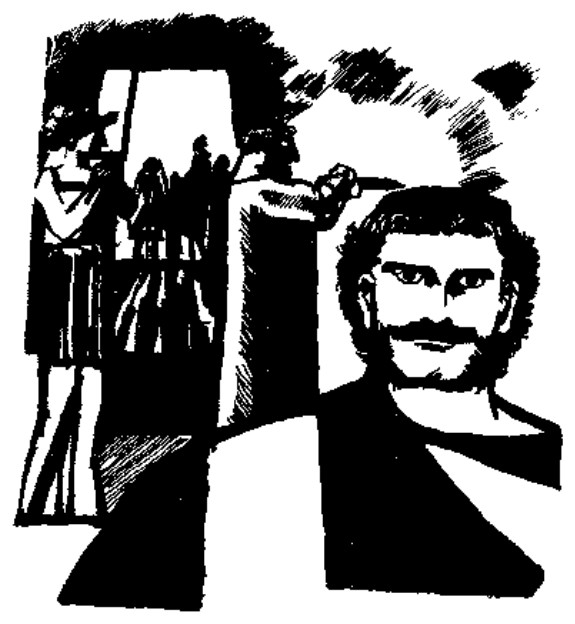
Inside, they saw a broad-chested, powerfully built man wearing a black sports shirt and loose casual trousers, his shoes caked with mud. He appeared to be in his early forties. He wore a thick black mustache, and his bronze-colored face was dominated by a pair of sharp, piercing eyes.
This was Arigo. Before the operations began, he invited Puharich and the others into the treatment room.
He had to report to work at a government welfare agency on time. He would return in the afternoon.
Suddenly, he pulled an old man out of the line of patients, roughly positioned him standing with his back against the wall. Without a word, he picked up a four-inch stainless steel fruit knife and plunged it into the man’s left eye, thrusting deep beneath the eyelid into the eye socket. The old man was fully conscious but showed no fear or retreat.
Puharich was momentarily stunned. When Arigo proceeded to scrape fiercely between the eyeball and eyelid, recklessly driving the knife upward into the socket region, he was even more dumbfounded. Arigo then pried the patient’s eyeball until it protruded from its socket. During this time, the patient felt only that something was bothering him—a fly resting on his face—and calmly brushed it away with his hand.
Puharich, who had graduated from medical school some fifteen years earlier, was by now practically in a state of shock. Arigo finally withdrew the knife from the patient’s eye, looked with satisfaction at the pus on the blade tip, wiped it clean with his shirt, and said to the man: “You will be well.” Then he called for the next patient.
Arigo barely glanced at most patients before hastily scribbling out a prescription at an almost incredible speed. From time to time, he would order a patient to stand against the wall, wipe his knife on his shirt, and plunge it into a tumor or cyst, an eye or an ear, excising whatever abnormal growth was present—without anesthesia, without hypnosis, without any antiseptic or antibacterial method, and with remarkably little bleeding.
At 11 o’clock sharp, Arigo announced that the consultation session was over, because he had to go work at a government welfare agency. He would return in the afternoon.
Puharich remained alone, pondering bitterly: What on earth was going on? How could he prove to himself and to his American colleagues, who were awaiting his news, that the entire sequence of events was not some hallucination?
Back in his hotel room, Puharich struggled to find a practical method to definitively measure Arigo’s abilities. He absent-mindedly scratched his own arm. It was precisely this gesture that gave him an inspiration: on the inner side of his right elbow, he had a lipoma. Though benign, it was an annoying tumor. He resolved to have Arigo operate on him.
The next day, Puharich asked Arigo whether he would be willing to perform surgery on his arm. Arigo smiled: “Of course I’m willing.” Then, unexpectedly, he turned and asked everyone: “Does anyone here have a good Brazilian switchblade? I want to use one on this American gentleman.”
Puharich was taken aback but had no way to back out—half a dozen knives had already been produced. Arigo selected one of them. “This American scientist is a fine fellow,” he said warmly. Puharich braced himself and watched intently to see how Arigo would operate. But Arigo ordered him to look away, and Puharich obeyed. In less than ten seconds, he felt something wet and sticky dropped into his hand. He looked down—it was a bloody lipoma. On his arm remained an incision about half an inch long, oozing a small amount of bloody fluid. The bulging tumor was gone.
After Puharich returned to São Paulo, he played back the footage of the operation over and over again.
154
footage of a surgery he had filmed. The film confirmed that from the initial incision to the removal of the fatty tumor, the time elapsed was 5 minutes. Arigo’s movements were so fast it was nearly impossible to discern how he made the incision. He forcefully pulled out a bloody tumor. He then returned to the kitchen, threw the growth into the sink, and collapsed into a chair. If Puharich had not brought back the tumor in the jar, even he would have suspected it was a sleight of hand. The patient was fully conscious and felt no pain. Later, doctors examined the tumor: it was uterine cancer.
Puharich was completely baffled. Even more bizarre was Arigo’s explanation of his own abilities. He claimed that the “spirits of several doctors were attached to him,” especially a doctor named Adolfo Fritz who had died in 1918. Arigo said it was this doctor who performed most of the surgeries, and it was he who dictated the complex prescriptions that Arigo transcribed at great speed.
Surgery in a Dreamlike Trance
Arigo performed his first surgery on someone in 1950.
That year, Brazilian Senator Lúcio Bitencourt came to the city of Belo Horizonte, near Congonhas, for a political campaign. He had lung cancer, and his doctors told him his only hope of a cure was to go to the United States immediately for surgery. There, he met the 32-year-old Arigo. They spent the night in the same hotel.
After returning to the hotel, the senator could not sleep for a long time and tossed and turned in bed. Just as he was drifting off, the door opened and the light snapped on. It was Arigo who came in.
His gaze was dull. As he approached the bedside, the senator saw that he held a razor in his hand. But for some unknown reason, Bitencourt was not afraid. He recalled being in a trance, hearing a voice with a German accent saying: “The situation is urgent; an operation must be performed.” Then the senator fainted.
When he regained consciousness, there was no one else in the room. He took off his pajamas and examined himself, discovering that the pajamas had been slashed and there was a stain of blood. He got out of bed, walked weakly to the mirror, turned his back to it, and saw a clear, smooth incision in the rib area of his back.
Although Arigo could not recall whether he had visited the senator’s room, he believed that what Bitencourt described was possible, because for years he had been troubled by recurring strange hallucinations.
After Bitencourt returned to Rio de Janeiro, he immediately found a doctor and only told him that he had undergone surgery. The doctor took X-rays, assuming this was the result of American surgical treatment, and looked satisfied. At that point, the senator told the doctor the truth and spread the story widely. Within days, the news reached all of Brazil through various newspapers and magazines.
Detailed Investigation
In August 1968, Puharich arrived in Congonhas with an assistant to conduct a preliminary study of Arigo’s medical skills. They found that among 1,000 randomly selected patients surveyed, 545 had brought their medical records; and Arigo’s verbal diagnoses for 518 of these cases matched the medical records—a consistency rate of 95%.
One evening while dining at Arigo’s home, Puharich asked him how he was able to state his diagnoses using modern medical terminology.
Arigo laughed and replied: “That’s easy. I just listen to the voice of Dr. Fritz speaking to me, and then I repeat it. I often hear this voice in my left ear.”
Dr. Puharich returned to New York and assembled an expedition team of four physicians. Also participating in this investigation were: a Portuguese-language professor, an experienced cinematographer, a medical statistician, and an acoustic equipment engineer. The equipment they brought included an electroencephalograph, an electrocardiograph, an X-ray machine, a blood-testing kit, a microscope, several cameras, and multiple tape and video recorders.
Arigo’s ability to make correct diagnoses without prior knowledge of the patient’s condition was confirmed once again. A paralyzed patient came in a wheelchair, and Arigo detailed that the man’s paralysis had been caused by breaking his cervical vertebrae during a diving accident at age 15. This was verified. A woman stepped forward, and after one glance, Arigo told the Americans that they would find her blood pressure was 230/140. The blood pressure monitor read exactly those numbers.
Dr. Robert Leichtman, former chief of psychiatry at Roosevelt Hospital, had also filmed Arigo performing surgery. After returning to New York, he played the color film several times. Leichtman made several interesting observations. He noted that Arigo’s facial expressions during surgery were completely different from his normal demeanor; the speed and accuracy of Arigo’s finger movements were astonishing, even when his head and eyes were turned away; the edges of his incisions seemed to “seal” on their own; and the proficiency of many of the routine surgical procedures Arigo performed even exceeded that of surgeons who had received quite advanced training.
Beyond His Own Control
In Congonhas, as news of the Bitencourt incident spread widely, Arigo had become a folk hero.
A friend of his was dying of uterine cancer. Arigo and his wife came to the dying woman’s bedside to bid her farewell. The priest had administered the last rites and quietly departed. Arigo bowed his head in prayer. At that moment, his head began to feel a prickling sensation and his vision blurred.
Without any warning, he suddenly rushed into the kitchen, grabbed a large cleaver, and ran back into the room. In a commanding tone, he ordered everyone to step back. He pulled back the shroud covering the female patient, spread her legs apart, and thrust the knife directly into her vagina, roughly and forcefully digging inside.
One woman screamed and ran out of the room; everyone else was frozen with terror. Arigo continued to slash and cut mercilessly, while the dying woman lay calmly, unstartled. Then he put down the knife and forcefully thrust his hand into the opening. Within a matter of seconds,
(Adapted from “Popular Science Digest”)
·155· .1
At the end of the last century, when classical physics had reached its extraordinarily brilliant pinnacle, a series of difficulties arose: the Michelson-Morley experiment struck at the root and negated the luminiferous ether—the foundation of wave optics; the classical equipartition theorem faced a predicament; black-body radiation, the photoelectric effect, atomic spectra… a whole series of experiments struck at the foundations of the edifice of classical physics like a torrential storm. A crisis emerged in physics.
The Crisis Facing Physics
Lanzhou University, Department of Physics, Wang Shui
But the crisis did not cause physics to collapse; rather, it triggered a revolution. The most epoch-making achievements of this revolution were the theory of relativity and quantum mechanics. They thoroughly repudiated the notion of absolute space-time and shattered mechanical causal determinism to pieces. The multiple cross-disciplinary and frontier fields that emerged therefrom, along with numerous advanced technologies, gave the world of science an entirely new face.
As Engels said: “Whatever is real in the domain of human history becomes, with the passage of time, irrational—that is, unreasonable in its very nature, and inherently irrational from the start.” Now, whether you are willing to believe it or not, physics has after all once again encountered a crisis: in the face of qigong—one of the traditional cultural treasures of China—and the long-standing special human abilities (extra-sensory functions), existing physical methods and laws have all proven powerless.
The crisis encompasses the following several principal aspects.
One remarkable ability of specially gifted individuals is the power to cause objects to pass through solid barriers, with both the objects and the barriers remaining completely undamaged. Pills “leak” out of a hermetically sealed and intact glass bottle—and high-speed photography can clearly show the pill emerging from inside. The entire process of passing through to the outside is an incomprehensible phenomenon. As we know, the impenetrability of macroscopic objects (in the case of the above experiment, the inability to be penetrated) is essentially electromagnetic in nature—it holds the molecules and atoms of an object together as an integral whole of a certain strength. Assuming there were no such electromagnetic force, objects would not disintegrate (though this is not permitted by physics!), and the atoms composing an object could be considered extremely sparse. Two objects could readily pass through each other; a few atoms might “collide,” meaning they would approach to the point where nuclear force—a powerful short-range force—comes into play. All of the above reasoning and assumptions belong to “semi-physics,” because it “does” many things that the laws of physics do not permit. Yet even so, it still cannot be used to imagine or explain the paranormal phenomenon, because in this phenomenon objects pass through each other without disintegrating, and there is no evidence whatsoever of the failure of electromagnetic information or nuclear forces—inherently contradictory facts are all crammed together. Moreover, experiments have shown that after living organisms (bodies composed of organic macromolecules) undergo penetration, their vitality is unaffected. This is an even more astonishing result.
To put it in a somewhat “metaphysical” tone: if the penetration phenomenon is related to hyperspace or time (as some have conjectured—that penetration is achieved by passing through another time or space), then why are we able to capture (such as photograph) information of an object’s movement in another space or time (such as the photons emitted by the object that make photography possible)? What, after all, is the mechanism behind all of this? Our theories of the structure of matter, electricity, force, and space-time are all under threat. If these problems are resolved, we can at least imagine what dramatic changes would occur in human transportation, materials technology, and device architecture.
Regarding time, some individuals with special abilities possess the capacity to know the past and the future, and not merely with regard to matters of health. According to the theory of relativity, the four dimensions of space-time are interconnected; the movement of any object along the time axis can only ever be one-directional—irreversible and insuperable. If we conservatively assume that material entities cannot move freely along the time axis, and the same holds for the course of events, then how do those with special abilities capture information that does not belong to our present time? And without matter, what could serve as the carrier of information? What are the information channels and reception mechanisms? The resolution of this question may ultimately lead humanity to understand the nature of information (which remains a hotly debated issue today). Perhaps the space-time framework of relativity will have to be revised, and people’s philosophical views will once again come under assault.
Those accomplished in qigong possess a special sensitivity to human information. They can obtain information from a sheet of white paper touched by someone’s hand and sent from thousands of miles away, or from someone’s photograph, or even from merely the pitifully scant information about a person obtained from another individual (such as age, location…)
The Remarkable Man of Guangzhou: His Entire Body Conducts Electricity Yet He Remains Unharmed
In Guangzhou there is a remarkable individual who can casually pinch two wires carrying 220 volts of alternating current as though nothing is happening.
This remarkable person is named Jiang Laiying, 46 years old this year, an electric welder in the maintenance workshop of the Guangzhou Tool Factory. When he uses one hand or both hands to touch the live wire and the neutral wire of a 220-volt power socket, his demeanor is completely natural—as if nothing has happened at all. Someone tested him with a voltage tester pen and indeed found that electric current ran through his entire body from hand to foot; the tester pen glowed with a strong red light.
Jiang Laiying said that after graduating from elementary school, he entered the Guangzhou Tool Factory as a mechanical apprentice. His hands are no different from those of an ordinary person. After discovering these special abilities, he can perform live electrical work at will without needing insulating gloves. He is normally in robust health and has never suffered any serious illness.
Excerpted from the Wenhui Bao
- 156 -
A hypothesis is the precursor to science; it requires a foundation in theory and/or experiment. Merely carrying out a purely mathematical derivation about hyperspace and then simply adding the relativistic view of spacetime, as simply as one plus one, cannot explain the problem, much less be regarded as a “thorough resolution.” The reason Bohr and Sommerfeld’s hypothesis of quantized electron angular momentum in the hydrogen atom was correct is that it accurately explained the spectral series of hydrogen, and was subsequently derived logically from quantum mechanics. Even with the aim of establishing a phenomenological theory, the “dragon seed” concept remains far from complete. A phenomenological theory of thermodynamics such as is correct because it possesses objective standards for describing the state of motion of the object under study—pressure , temperature , and volume —and the relationships among these objectively measurable standards can be quantitatively confirmed by experiment. However, the dragon seed concept relies excessively on intuition and lacks objective standards for describing its subject, which becomes its fatal flaw. Finding the necessary objective standards is therefore a matter of utmost urgency.
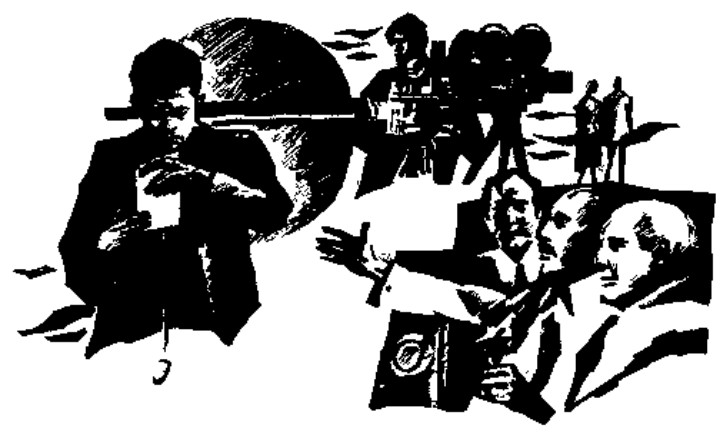
For those engaged in physics research, “qigong and special abilities” represent a direction, an opportunity. It is to be hoped that more people will take up this exploration.
Special abilities manifest in diverse ways: some can perceive a person’s health condition, medical history, and even their whereabouts over a certain period (given only their residential area and gender). How is this information translated and received? This would be a mode of information transmission entirely different from all those we know. Others possess a keen receptivity to natural signals and can accurately locate mineral deposits, groundwater, and so forth. Still others can precisely identify what exists at a certain point on the opposite side of the Earth. All of these bring thrilling questions to physics: If they detect information by emitting some kind of “ray,” then what exactly is this “ray” that possesses such superb penetrating or diffracting power and extremely low attenuation? How can it be more widely utilized? We should note that modern detection instruments possess no such miraculous capability. If it is simply that those with special abilities have an extraordinarily strong capacity to receive information, then what is the nature of such a sensitive receiving mechanism? What kind of carrier, carrying what form of information, passes through what kind of channel to be received and utilized by the recipient? The resolution of these questions will bring new enlightenment not only to physics but also to information science and life science.
In summary, the crisis in physics has long since begun, and revolution is imminent. This is an era that calls for giants and will surely produce them. Scientists throughout the world cannot afford to turn a blind eye or remain indifferent. It is noteworthy that many special abilities can be stimulated through qigong. The Chinese nation, with its long-standing qigong tradition, ought to be able to make a great contribution to this tremendous leap in human history. On the other hand, any theory can only be called correct when it can explain the processes of change in things, and when such explanation can be quantitatively confirmed by experiment.
Excerpted from Qigong and Science
Using Qigong for Health: An Introduction to Still Sitting Practice
There are many ways to use qigong to maintain health. Here we introduce a simple and accessible method of still sitting practice.
Still sitting practice generally has two postures: the “single cross-legged” posture and the “seated chair” posture. Their main postures and key points are as follows:
“Single cross-legged” posture: Place the lower left leg across the right thigh, and place the right foot under the left thigh. With this method, since the left knee cannot press firmly against the seat cushion, the body tends to lean left or right, so you must pay attention at all times to keeping the body upright. This posture is suitable for young and middle-aged practitioners.
“Seated chair” posture: Sit upright and steadily on a chair, with both legs naturally separated at shoulder width. The knee joints should be bent at a 90° angle. If the chair is too low, add a cushion; if the chair is too high, place a footrest under the feet. Place both palms facing downward, naturally flat on the front half of the thighs, with the elbow joints appropriately bent to a comfortable degree for the arms. This posture is suitable for middle-aged and elderly practitioners.
Key points of practice: Keep the head and upper body upright, with the head and neck straight. To avoid tension in the head and neck, the forehead may be inclined slightly forward, the chin slightly drawn inward, the chest also slightly drawn inward, and the abdomen gently extended forward. Place the back of the right hand on the left palm, and rest them gently on the lower abdomen in front of the navel. The lips should be naturally and lightly closed, the eyes gently closed while still leaving a narrow line of light, gazing at the tip of the nose. Press the tongue against the upper palate. When saliva accumulates, it may be swallowed slowly in small sips. Naturally focus your awareness on the Dantian (the point one cun and three fen below the navel), eliminate distracting thoughts, relax the entire body as much as possible, achieving a state of relaxation, stillness, and naturalness. Regulate the breathing to be even, and strictly avoid impatience and agitation.
Practice precautions: The environment should be quiet, the air fresh, and the interior simply furnished with moderate lighting. The diet should be light, avoiding rich foods as well as tobacco and alcohol. It is not advisable to practice during storms, thunder and lightning, extreme heat, or severe cold.
Practice time: Dawn is the best time for still sitting practice each day; it may also be done at any other time, but not immediately after meals. Each session should last from half an hour to one hour, practiced one to three times daily. Those who are frail or ill may begin with sessions of three to five minutes, stopping before feeling fatigued, and then gradually increase the practice time.
Excerpted from Wulin
·157·
Abundant Fruits Worth Cherishing — On Combining Qigong with Swimming Training
Mu Chengkuan, Head Swimming Coach of Hebei Province
A Call to Cherish Qigong — We Must Not Remain Indifferent
From a young age I loved sports such as wrestling and swimming. In my teens I apprenticed myself to a master and learned the Thirteen Forms of Shaolin Qigong. Throughout my life I have benefited immensely from this practice. For seventy years, whenever conditions permitted, I have never interrupted my training.
Combining Qigong with Training Yields Abundant Fruits
For decades I have advocated and experimented with combining qigong and swimming training. Although I met with considerable resistance, I never lost heart. Before the Cultural Revolution, I served as Deputy Director of the Sports Department of the Hebei Provincial Physical Culture Commission. After my political rehabilitation in 1978, I was appointed Deputy Director of the Swimming Hall and concurrently coach. Despite my advanced age, I rode my bicycle from Baoding to areas such as Baiyangdian to select talent and establish a swimming base, determined to contribute whatever remaining energy I had. Two years later, the Hebei provincial leadership appointed me Deputy Director of the Hebei Provincial Physical Culture Commission and concurrently Head Coach of the Hebei Provincial Swimming Team. Although my position was elevated, I remained at the Baoding Swimming Hall. I frequently traveled to Baiyangdian, Langfang, Xingtai, and Shijiazhuang to direct experiments combining qigong with training, and the facts proved that it produced excellent results.
My former students now serve as swimming coaches in over a dozen cities across the country. Several of these children went on to break national records. In particular, my second son, Mu Xiangxiong, broke the men’s 100-meter breaststroke world record three times between 1958 and 1959. Nearly ten of the students I trained achieved swimming results at the international level, and three earned the title of National Swimmer.
As early as 1959, the People’s Sports Publishing House published my book Breaststroke, in which I introduced this method. For decades I have used this method in training, but regrettably it failed to attract sufficient attention.
During the decade of turmoil, my advocacy of combining qigong with training was singled out for focused criticism, and I was accused of spreading feudal superstition. I merely laughed when I heard this, thinking to myself: “You criticize as you please; I will practice as I please.” I was subjected to dictatorship for twelve long years, until I was finally rehabilitated in 1978 — by then I was already seventy-two years old.
I am determined to continue practicing for the rest of my life. No matter how great the difficulties, my resolve remains unshakable. As long as I have a breath left in me, I will never give up halfway. I hope that physical education teachers and coaches nationwide will also catch up and forge a distinctly Chinese path for socialist physical culture.
We Must Cherish Qigong — We Must Not Remain Indifferent
I want to cry out at the top of my voice: We must fully cherish our nation’s precious heritage and apply qigong in physical education teaching and training. Other countries have already begun to take notice of qigong’s power: according to reports, sports powerhouses such as the United States, East Germany, the Soviet Union, and Japan are already employing qigong training methods. With decades of practical experience and proven results, I once again urge the relevant authorities to take vigorous measures and stride forward — we can no longer remain indifferent.
Excerpted from Sports World
The “Saint” Bharadā
Bharada Baba was a Hindu. In his youth, Bharadā was a soldier who campaigned far and wide and experienced the taste of death. Thus, after being demobilized, he became disillusioned with the world and turned to Buddhism, becoming a devout follower. In addition to chanting sutras and spiritual cultivation, Bharadā devoted himself even more earnestly to practicing an ancient, long-lost form of yoga meditation.
After approximately ten years of cultivation, Bharadā finally mastered this extraordinary feat. He could now enter a state at will in which he needed no sleep, no food, no drink, and not even air. From 1980 onward, he began giving public demonstrations everywhere.
At first, he adopted the method of confinement in a box — for one day, three days, five days, seven days… up to a maximum of thirty-two days on one occasion. During that month, he remained sealed inside the box, which was then buried underground at a depth of ten feet. Inside the box, apart from some bedding, there was nothing at all — no water, no food, not even air. He sat in a meditative posture with both eyes tightly shut, until a month later he was dug out.
Bharadā’s most astonishing performance took place in February 1986, when he performed in the city of Hisar, India. This demonstration differed from previous ones: he sat inside a large iron box filled with water. The iron box was large enough for a person to sit in meditation inside it. First, Bharadā used nylon ropes to secure his body to the bottom of the box. Clean water was then poured in, eventually submerging him completely and filling the entire box. Under the watchful eyes of journalists from many countries, workers placed the lid on the iron box and sealed it shut by welding.
Sure enough, one week later the great iron box was opened. Bharadā emerged from the water, his expression solemn and showing nothing unusual.
He sat in an iron box filled with water, the lid sealed shut, submerged entirely beneath the water for a full week…
Because his miraculous abilities were proven time and again, the Indian government regarded him as a national treasure and conferred upon him the honorific title of “Saint.”
Excerpted from Sports News
·158·
He picked up a cloth bundle from beside him; inside were…
With a single leap he was up on the wall — this he had seen with his own eyes.
Plum blossom needles of various sizes, and also a small, sharp knife.
They also said that the relevant departments in Shanxi Province, in recognition of the spirit of healing the sick and saving the dying, had recently presented…
Master Zangming first gathered internal qi in his fingers, then pressed them against the acupoints surrounding Xinwu’s injured area.
He was given a small minibus.
Afterward, he lightly scored the visibly red and swollen area with the small knife, then squeezed firmly. Several drops of purplish-black blood oozed out. He wiped them away with cotton paper, and only then sighed with relief, saying: “Now try breathing in again and see if it still hurts.”
That vehicle now belongs to the Buddhist temple at Mount Wutai.
Xinwu tried it, and sure enough, he felt much better, and thanked the Master repeatedly.
Master Zangming is the abbot of this temple.
Li Jie, a young literary critic from Shanghai, had injured his chest and found deep breathing very difficult. The Master massaged from his chest down to his abdomen.
Next was Jiang Zilong. After Zilong, it was my turn.
It was very laborious; after about five minutes or so, the Master was nearly drenched in sweat. Then he raised his body and helped Li up, patted him on the shoulder, and told him to get off the kang and walk around a little. I asked the Master why he had not bled him. The old man said slowly: “This young man’s injuries were severe — I have already transferred his injuries to his abdomen.”
When Master Zangming massaged me, I felt that his fingers were extremely powerful yet also very soft. I tried hard to hold my breath, wanting to resist the pressure he was applying to my body, but I could not. He massaged each area, and finally his fingers stopped at my ribs — precisely where my pain was concentrated! After he pressed the acupoint, the sensation of pain seemed to vanish entirely. Then the Master followed the same procedure, using the small knife to draw out the stagnant blood. Unfortunately, my blood was bright red, and only a tiny amount seeped out.
Master Zangming let out a long sigh and said: “After you were injured, did you drink any alcohol?” I nodded and told him I had drunk a bottle of beer at lunch.
The Master said: “You really should not have drunk alcohol after being injured! Beer is even worse. Alcohol seals up the blood vessels, and the stagnant blood from the internal injury cannot be squeezed out.”
He could actually “transfer injuries”! What a wondrous medical art! Yet one could not help but believe it, for by this time Li Jie was already walking about quite easily on the ground. When asked how he felt, he answered: “Much better.”
Where was Master Zangming from? When did he become a monk? From whom did he learn martial arts? I had no time to ask any of these questions in detail. Had it not been for this chance car accident, we would probably never have known for the rest of our lives that among the many temples of Mount Wutai, there lived a remarkable old monk; and we would never have imagined that on a certain evening, he would so kindly treat us, a group of worldly laypeople from the red dust of society, and would casually share so much little-known knowledge.
A group of poets and writers went to tour the Buddhist holy site of Mount Wutai. On the way, an accident occurred — the car overturned and people were injured… The party endured great hardship and finally reached their destination, where they encountered a Master of profound skill who treated their injuries…
He sat on the earthen kang, legs crossed, his eyes gleaming with vitality. Though over seventy years old, his spirit was astonishingly robust. As he treated our injuries, he was suffering from a cold and spoke with a heavy nasal tone, yet he treated six people in one continuous session — a testament to his extraordinary skill.
Liu Xinwu lay down on the kang.
Master Zangming extended his hand — the joints were thick and sturdy, the hand of someone who had trained in advanced martial arts. This large hand felt along Liu Xinwu’s injured area. With one press, Xinwu cried out in pain. The Master smiled slightly.
Excerpted from China Travel
Magical Qigong
· 159 ·
Editor’s Note:
“The Mawangdui Guided Hypnosis Qigong” is a method of guiding and circulating qi compiled and created by the renowned qigong master Mr. Tong Junjie. Practicing this method not only enables self-hypnosis but can also help hypnotize and calm others, providing sedation and pain relief. Practice has proven that this method not only prevents illness and prolongs life, resisting premature aging, but can also generate extraordinary abilities beyond those of ordinary people.
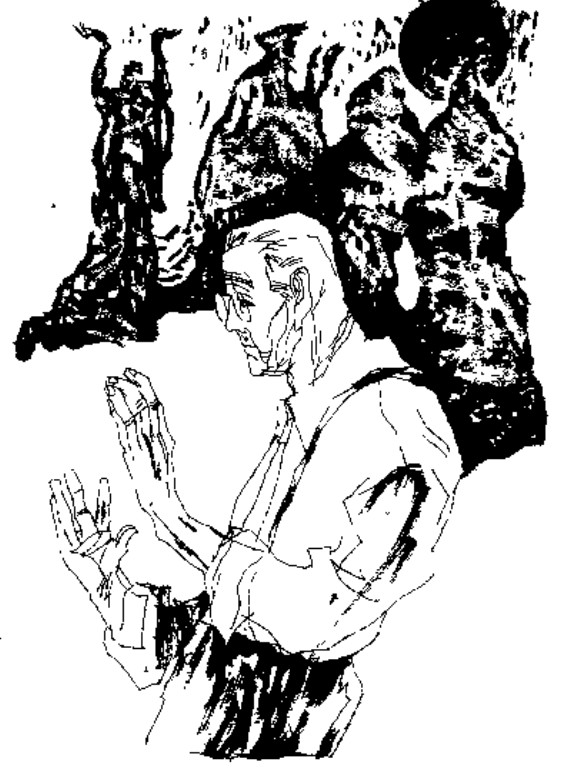
At the Qigong Principles and Methods Conference held in Xi’an, Mr. Tong’s demonstration of the hypnosis qigong was truly miraculous and drew endless admiration from all!
During the conference, the pamphlets on this method were snapped up immediately. In response to the repeated requests of qigong enthusiasts, our publication now presents The Mawangdui Guided Hypnosis Qigong along with illustrative photographs of the practice below, for our readers’ benefit.
“The Mawangdui Guided Hypnosis Qigong” (hereafter referred to as “Hypnosis Qigong”) is a method of guiding and circulating qi that the author compiled and created based on the color silk paintings Guided Exercise Chart (Daoyin Tu) and Treatise on Abstaining from Grain and Ingesting Qi (Quegu Shiqi Pian), unearthed in 1973 from Han Dynasty Tomb No. 3 at Mawangdui in Changsha, Hunan Province, China, as supplementary reference material, and by consulting both ancient and modern guided exercise forms.
This guided qi-circulation method is based by the author on the rich content of Mawangdui Guided Exercise Studies and the author’s own years of experience in guiding and circulating qi. The author believes that as long as one grasps the core principle of “the heart governs the spirit and consciousness,” all problems are readily resolved. The “heart” referred to here means the brain and brain-based thinking. When the brain is well maintained, body and mind are healthy, and extraordinary abilities may even emerge. This is what the ancient science of guided exercise meant by “the spirit and consciousness emerge.” The thinking functions of the human brain can be divided into two parts: one is the “conscious” part, and the other is the “non-conscious” part.
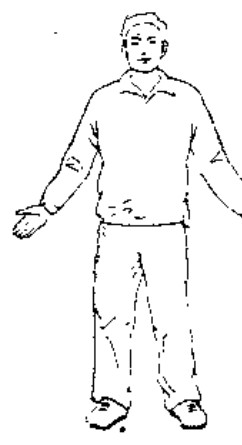
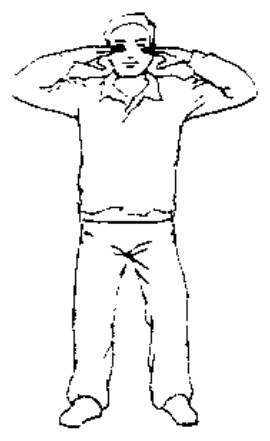
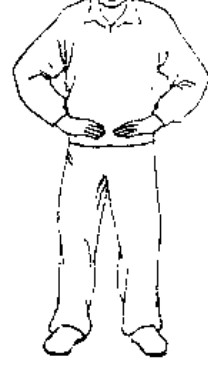
Mawangdui Qigong Academy Tong Junjie
The former occupies a relatively small portion, representing personality, outward demeanor, logical thinking, and so forth. This is what ancient scholars of guided health cultivation called the “acquired consciousness” (shishen). The latter occupies a larger portion and harbors boundless cognitive potential. This is what the ancient scholars of guided health cultivation called…
Illustrations of the Mawangdui Guided Hypnosis Qigong
· 160
Preparatory Guided Exercise (Figure 1)
Figure 2
Step One: Seamless as Heavenly Garment
(Figure 2)
(Figure 1)
Step Two: Folding Yin and Returning to Yang
(Figure 2) Figure 3 (Figure 4) Figure 1; 7 what the ancients called the “Original Spirit” (元神). The “Original Spirit” stores a vast amount of life draw it deep into the center of the earth to expel the turbid qi from the true qi, and simultaneously information; when properly adjusted and applied, the latent potential of life information is fully mobilized, cause the clear qi within the true qi to gather upward at the Zuqiao acupoint between the eyes. At this point, and can produce the wondrous function of hypnosis. varying degrees of the Illumination phenomenon may appear. The manifestation of this phenomenon is tranquil and natural, The reason Hypnosis Qigong produces hypnotic states is primarily that “Opening the Meridians as though dwelling in the Great Void, the mind returning to the Limitless (Wuji). There arises a transcendent state Guidance” plays a leading role—that is, using intention to guide a stream of qi and blood from the of unity of form and emptiness described in the renowned ancient Chinese guidance classic Zuqiao acupoint to the Shenque acupoint. If this opening guidance is practiced at the Zi hour (midnight) and Wu hour (noon), Huangting Jing: Detailed Commentary — Qingjing Jing: the effects are even better. Under correct guidance, practicing this technique for about two weeks “Observe the mind internally, observe the body externally—the body has no form; will generate varying degrees of the Shenque Consciousness Stream (hereafter “Shen-Intent Observe objects from afar—objects have no substance” Stream”). Once this Shen-Intent flows throughout the entire body, it opens up the channels and qi-blood of the zang-fu organs, the one hundred bones, and the four limbs, balances yin and yang, fuses Heaven, Earth, and Humanity into one unity, and enters a super-tranquil state of mental calm, expansive delight, stillness amid the cicadas’ song in the forest, Step One: Seamless Heavenly Garment and contentment. This allows the cerebral cortex to receive ample rest and regulation, thereby fully activating the life information stored in the “Original Spirit.”
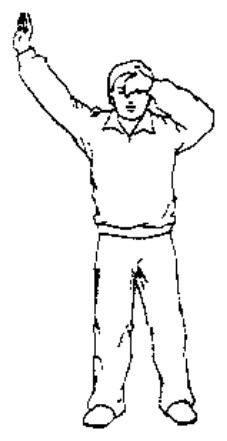
Guidance sequence: After practicing the preparatory guidance, turn both palms upward This practice consists of six steps, introduced separately below. I hope and raise them from the sides of the body, lifting all the way to the top of the head. First perform Baihui crown-infusion guidance, this serves as a modest contribution to invite better work, and I respectfully welcome correction from fellow practitioners. then guide along the following path: forward to the toes, back to the heels, then from behind the ears, along the neck, Preparatory Guidance: Before practicing, empty both bowels and bladder. Avoid horseplay with a hollow chest and solid abdomen down to Shenque and Huiyin, and finally guide into the center of the earth. and roughhousing before practice, and do not smoke, drink strong tea, or coffee. Use intention Guide nine times. to relax the cerebral cortex as much as possible, promoting physical and mental ease and pleasure. Concentrate Guidance essentials: Emphasize intention-guidance, appropriately combined with some physical the mind and avoid scattered thoughts. Once you have basically achieved the mental state of “a mind like still water,” begin guidance. Imagine that after work, labor, or study, you are completely unclothed, to follow the essential formula: “Intention leads qi; qi follows intention; form assists latent potential.” When placed in a bathhouse of suitable temperature, cleansing the heart and mind. Use true the guidance and qi circulation reach the appropriate level of maturity, begin the “removing turbidity and retaining clarity” guidance. The qi and the fresh air of nature to weave a garment of golden cicada silk and jade-threaded feathers, method is to guide the true qi from Baihui down to the Yongquan acupoint, then from Yongquan like a seamless heavenly garment, gently and comfortably enveloping body and mind. During guidance, the physical guide it back up. movements need not always precisely follow the intention to each location. For example, when covering the toes, (Figure 5) (Figure 6)
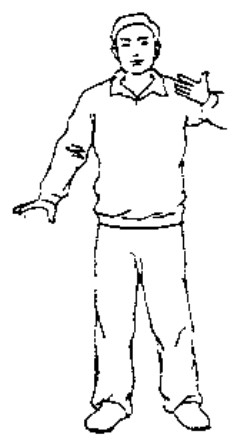
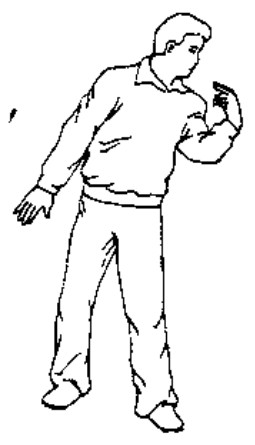
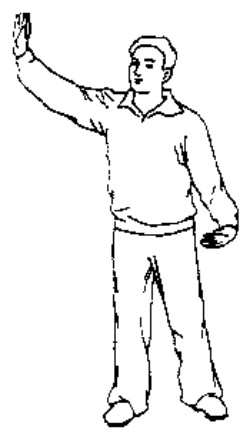
Step Three: Tai Chi Cosmic Orbit (Figure 2) Figure 1 ·161·
(Figure 6) (Figure 3) (Figure 4) (Figure 5) to the back of the occiput, then begin circling past the ears, through the front chest, Huiyin, Yongquan, and deep into the center of the earth. Guide nine times. Guidance essentials: During guidance, one must achieve an organic coordination between using intention to draw the Tai Chi and using the physical body to draw the Tai Chi. The Yin-Yang fish regulate the zang-fu organs and the Step Two: Folding Yin and Returning to Yang entire cosmic orbit of the four limbs and one hundred bones, so as to calm the spirit and settle the mind.
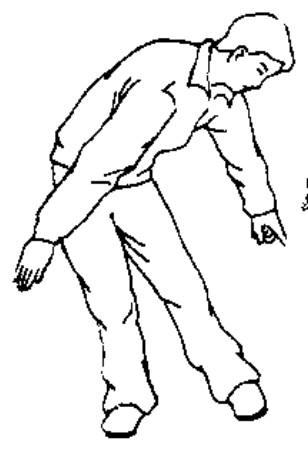
Guidance sequence: Continue directly from the previous posture. After completing the preparatory guidance,
Step Four: Direct Penetration of the Central Palace slowly raise the right hand from the right side, turning it into a Yang palm with the fingertips pointing maximally toward the stars, moon, electric lights, flowers, or beautiful scenery. The left hand Guidance sequence: Continue directly from the previous posture. After completing the preparatory guidance, at the starting position should form a Yin palm, circling from left to front and moving to the pubic symphysis area. draw back the extended hands. Following the sequence of the axillary glands and the mid-mammary glands, perform The Laogong acupoint faces the Huiyin acupoint, then lifts upward, passing through Shenque to the Zuqiao acupoint. Direct Penetration of the Central Palace along each line. Guide nine times. Pause there for a moment, then starting from Zuqiao, pass through Shenque to Huiyin, Guidance essentials: During guidance, move only from top to bottom; generally do not return upward. performing the Folding Yin and Returning to Yang guidance. The left-side guidance is similar to the right side. Connect above to celestial bodies, below to the depths of the earth’s center. This guidance not only achieves the fusion Repeat this guidance nine times. of Heaven, Earth, and Humanity into one, but also transforms the unfavorable condition of “upper repletion and lower vacuity” (heaviness in the head, lightness in the feet) Guidance essentials: This guidance technique originates from Figure Six, “Folding Yin,” of the colored silk painting into “upper vacuity and lower repletion,” producing steady footsteps and preventing cerebral Daoyin Tu excavated from the Han tomb at Mawangdui. When practicing, one must vascular accidents, hypertension, coronary heart disease, and similar conditions. further relax body and mind, achieving singular focus. For only in this way can the true qi circulate among the Zuqiao acupoint, Shenque, and Huiyin, further
Step Five: Nectar of Enlightenment Poured Upon the Crown
activating the qi mechanism and achieving the wondrous effect of balancing yin and yang. Guidance sequence: Continue directly from the previous posture. After completing the preparatory guidance, draw back the extended hands. Males draw back the left hand, females the right hand,
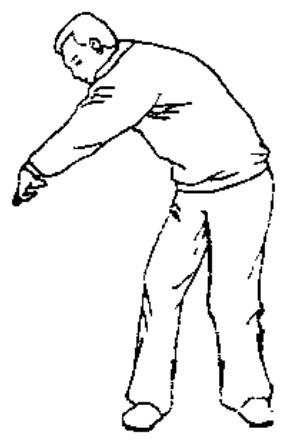
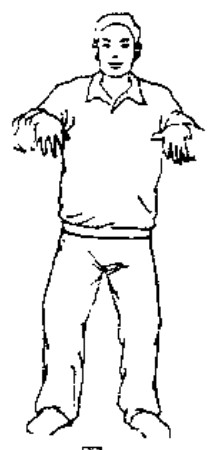
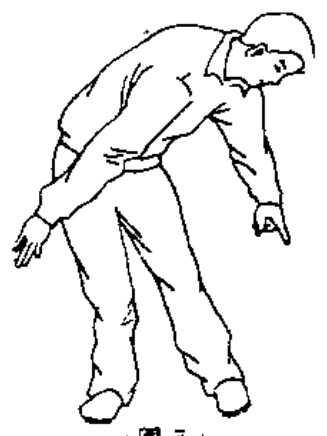
Step Three: Tai Chi Cosmic Orbit to the Baihui acupoint at the crown of the head, with the palm facing Baihui. The other hand (for males, Guidance sequence: Continue directly from the previous posture. After completing the preparatory guidance, the right hand; for females, the left hand) is drawn back to the Yuzhen acupoint, with the palm facing Yuzhen. following the male-left, female-right sequence, using the Baihui acupoint and Yongquan acupoint as the two poles and the Perform clockwise and counterclockwise spiraling guidance. Males go clockwise first, then counterclockwise; females go Shenque acupoint as the center point, and following the left-to-right sequence, use intention combined with physical counterclockwise first, then clockwise, performing each nine times. guidance to repeatedly draw the Tai Chi diagram, using intention to fuse the body with the Yin-Yang fish into one unity. Guidance essentials: When both hands cup and press against the Baihui acupoint, one must carefully gauge the degree of maturity. Guide nine times. Guide nine times.
Step Four: Direct Penetration of the Central Palace (Figure 7) Figure 3 Figure 4 Figure 21 ·162·
(Figure 3) (Figure 4) Figure 5:
Step Five: Purifying Nectar Crowning the Summit (醍醐灌顶)
Just right. The general requirement is that the Laogong point must align precisely with the acupoint being touched, achieving a state of “as if holding yet not holding, as if touching yet not touching.” When performing the clockwise and counterclockwise spiraling guidance, coordinate organically the spiraling on the body surface with the spiraling in the mind’s eye, taking care not to touch the hair, and even less to touch the scalp. After completing the clockwise and counterclockwise spiraling guidance, place both hands in the manner of “as if holding yet not holding, as if touching yet not touching,” fixed at the Baihui point and Yuzhen point, and perform the purifying nectar crowning guidance. Only in this way can the disordered cerebral sequences be rapidly regulated, enabling the stream of spirit-consciousness (神意流) to be continuously generated, further opening the original spirit (元神), allowing stored life information to become active, and fully mobilizing the body’s latent potential.
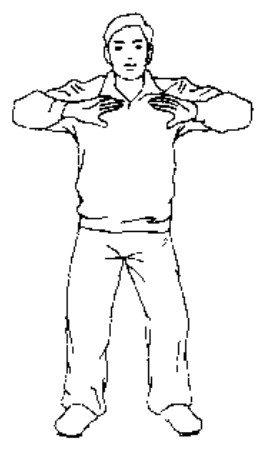
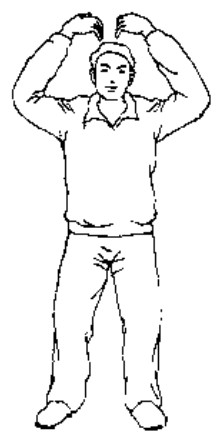
This is a high-level guidance step that can only be undertaken after completing foundation building (筑基). In addition to requiring oneself to be fully focused, indivisible in movement and stillness, and united with heaven and humanity, it also requires that the environment be absolutely tranquil with fresh air. Only in this way can the state of super-quiescent awareness (超静觉) be deepened, and the stream of spirit-consciousness become inexhaustible. By驯服 the active original spirit to return to its cavity, not only will there be no deviation, but some functions transcending ordinary people may also be produced.
The six-step guidance method of the Guided Hypnosis Qigong (《导引催眠功》) introductory practice has now been fully described. This guidance method can be used for self-hypnosis as well as for hypnotizing others. If time permits, it is best to practice the complete set of guidance methods; of course, following the principle of applying treatment according to pattern differentiation, one may also select a single guidance or several. As long as one persists—especially maintaining practice during the zi and wu hours (子午练功)—not only can one cure illness and strengthen health, and achieve hypnotic liberation oneself, but one can also help others to calm, relieve pain, tranquilize the spirit for hypnosis, and liberate to cure illness. Through observation of over 3,200 subjects, it was found that as long as the subject cooperates even slightly, information synchronization occurs, producing excellent effects. The longest hypnosis lasted 26 hours; generally, there is at least a sensation of drowsiness. For example, a female student surnamed Wang at a middle school in Beijing, due to her parents favoring her other sisters, developed mental depression to the point of running away from home. After receiving the information from the Guided Hypnosis, she fell peacefully asleep in less than a minute, and various strong stimuli were of no avail. After 13 hours of hypnosis, her depressive mood was resolved, her illness was cured, and she was like a different person before and after the hypnosis. A cadre surnamed Ruan, female, from the General Labor Union of Zhanjiang City, Guangdong Province—
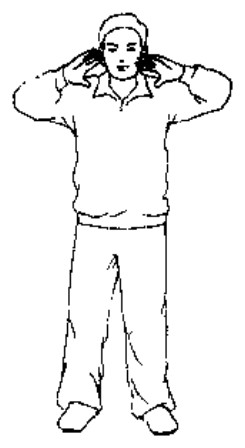
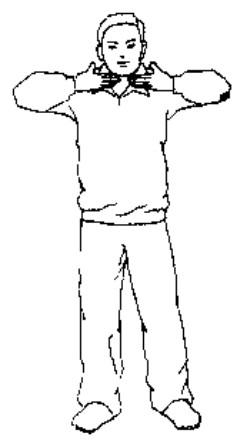
Step Six: Original Spirit Returning to Its Cavity (元神归窍)
Guidance sequence: Continuing directly from the previous form, after completing the preparatory guidance, withdraw the left hand and move it to the Shenque point, with the Laogong point lightly touching the Shenque; withdraw the right hand and use the tiger’s mouth (web between thumb and index finger) to support the right earlobe, performing side-lying, reclining, and relaxation guidance. Then follow the guidance sequence of: observing the orifices (from the Zuqiao point to the Shenque point), counting breaths (silently counting from one to nine, completing thirty-six counts), listening to breaths (with full concentration listening to the sound of one’s own breathing), and super-quiescent awareness (as if riding the river chariot, holding the Luo River diagram, crossing the River Map, drifting ethereally back and forth through the fairy pavilions of Penglai).
Guidance key points: This step of guidance is the sixth step in which the original spirit, from having been opened, returns to its cavity.
Gathering qi to close (Figure 1) (Figure 2) Figure 3, 163
(Figure 4) (Figure 5) (Figure 6) (Figure 7)
Cadre Ruan, female, from the General Labor Union, after receiving the information from the Guided Hypnosis Qigong, was helped into a car, went up three flights of stairs, and was helped into bed, all without waking from sleep. After 12 hours of sleep, her many years of high blood pressure returned to normal. However, an electronic watch on her wrist was damaged by the stream of consciousness produced by the guidance information. Extensive clinical practice has proven that the above six-step guidance method generally produces varying degrees of effect after about one week of practice. If accompanied by classical, antique-style music, the therapeutic effect will be even better. Practice has proven that not only can it cure illness, prolong life, and resist premature aging, but it can also produce extraordinary functions beyond those of ordinary people.
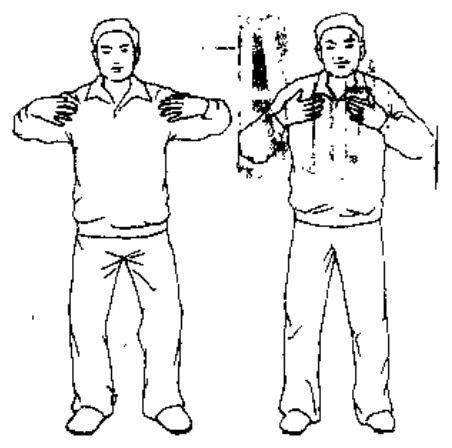
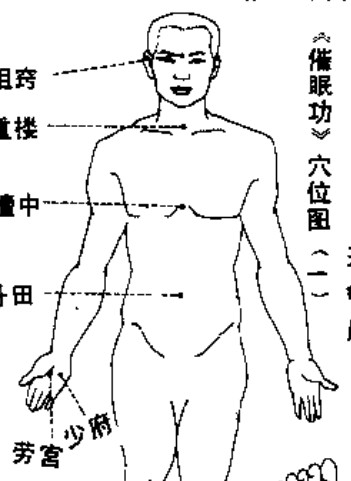
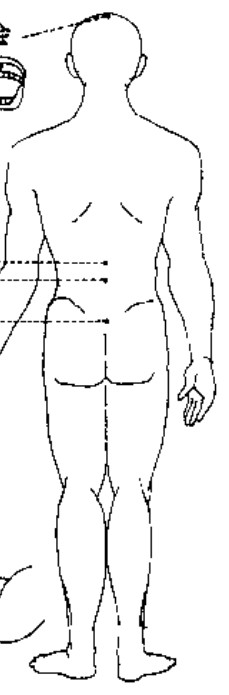
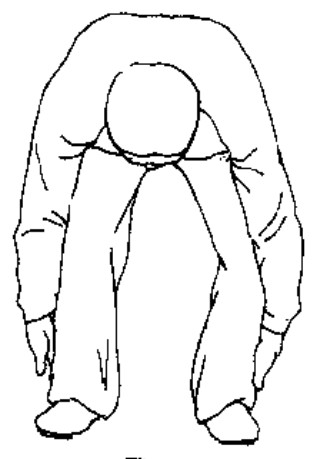
Hypnosis Qigong Acupoint Chart
Baihui (百会) Zhuqiao (祖窍) Zhonglou / Heavy Tower (重楼) Shanzhong (膻中) Jiaji (夹脊) Dantian (丹田) Mingmen (命门) Weilü (尾闾) Huiyin (会阴)
Queqiao / Magpie Bridge (鹊桥)
Hypnosis Qigong Acupoint Chart
Figure (1) Figure (2) (Figure 8) (Figure 9) (Figure 10)
·164
Hu Bin
Entering tranquility in qigong primarily involves adjusting one’s mental state to achieve stillness; this is also the most fundamental skill of qigong. The effectiveness of practice depends on the depth of tranquility attained: the deeper the stillness, the better the results, and vice versa. “Entering tranquility” refers to a stable state of quietude—free of distracting thoughts, with attention concentrated on a single point, that is, focusing the mind on the Dantian or attending to the breath. Sensitivity to external stimuli (such as sound, light, etc.) diminishes; even the sense of body position and weight may disappear, entering a state that is neither fully awake nor fully asleep, neither fully conscious nor fully unaware—in other words, the cerebral cortex enters a protective inhibitory state. For most people, entering tranquility is rather difficult and is often disrupted by wandering thoughts. Some individuals, after deep practice and profound tranquility, may experience certain hallucinations, auditory illusions, or visual illusions. At such times, one need not pay them any attention; they will naturally disappear.
There are five commonly used methods for entering tranquility:
Focus Method (Yishou Fa): Concentrate attention highly on a specific point of the body; the most common is focusing on the Dantian or Qihai (one cun and three fen below the navel). When focusing, eliminate distracting thoughts, but do not exert excessive mental effort—maintain a state of “seemingly focused yet not focused, neither clinging nor departing,” relaxed, calm, and natural—hitting just the right balance.
Following-the-Breath Method (Suixi Fa): Focus attention on the breathing, simply observing the rise and fall of abdominal breathing without deliberately directing it, so as to unify intention and breath and achieve tranquility.
Counting-the-Breath Method (Shuxi Fa): One exhalation and one inhalation constitute one breath. During practice, silently count the number of breaths, from one to ten, from ten to one hundred, counting until the ears hear nothing, the eyes see nothing, and the mind thinks of nothing—then tranquility is naturally achieved.
Silent Recitation Method (Monian Fa): The words or phrases silently recited should be simple. The purpose is to replace ten thousand thoughts with a single thought, replacing “evil thoughts” with righteous thoughts to aid in entering tranquility. For example, silently reciting the two characters “relax” (song) and “quiet” (jing)—many people can recite until the mind is undistracted, wandering thoughts cease, and they reach a state of open-heartedness, comfort, and tranquility.
Listening-to-the-Breath Method (Tingxi Fa): Use the ears to listen to the flow of one’s own breath in and out. It is best when nothing can be heard; listening under the condition of not hearing aids in entering tranquility.
Of the above five methods for regulating the mind and entering tranquility, beginners may start with the Focus Method and gradually transition to the Following-the-Breath Method or Listening-to-the-Breath Method, or they may practice one method throughout. This can vary from person to person.
Conditions for Entering Tranquility
(1) A cheerful and relaxed state of mind is essential. Free your thinking, lay down the burden of illness, do not fuss over personal reputation and status, and do not worry about gains and losses.
(2) The environment around the practice area should be quiet, the air fresh, and the temperature appropriate.
(3) Do not rush for quick results in practice. If you cannot enter tranquility, do not become irritable or restless; practice patiently.
(4) Do not practice when overly full or overly hungry. Do not practice immediately after becoming angry.
(5) Do not practice when excessively fatigued. After sexual activity, wait one to two days before resuming practice.
Standards for Entering Tranquility
First, the body must be still; if the body moves, the mind becomes disturbed. Second, thoughts must be still; if thoughts move, the mind is not calm. Third, forget the self; forgetting the self means entering a state that is neither quite sleep nor quite wakefulness, a vague and混沌 state—not knowing one has body and mind within, not knowing there is a universe without. Only when the mind is free of all distracting thoughts can it be said that tranquility has been achieved.
Stages of Entering Tranquility
The practice of entering tranquility can be divided into four different stages: First stage—little tranquility, many distracting thoughts (beginners), lasting one to two months. Second stage—tranquility and distracting thoughts are roughly equal (after three to four months of practice). Third stage—more tranquility, fewer distracting thoughts (after more than half a year of practice). Fourth stage—basically tranquil (after more than one year of practice). The above four stages represent the progression for most practitioners, but they are not absolute. For some people it takes longer; for others, shorter. As long as one persists in practice with dedication, one can sooner establish a complete conditioned reflex system and achieve the goal of fundamental tranquility.
The Role of Entering Tranquility
Entering tranquility through practice is an important component of qigong. It has a direct relationship with therapeutic efficacy; the level of efficacy depends on the quality of tranquility. Therefore, one must achieve tranquility in practice—the deeper the stillness, the higher the efficacy, and vice versa. The primary therapeutic action of qigong lies in forming a stable, quiet state during practice, eliminating distracting thoughts, and concentrating consciousness on a specific part of the body (such as focusing on the Dantian). Through the stimulation of consciousness as a signaling function, a new excitatory focus is established in the cerebral cortex and gradually strengthened until it gains dominance, thereby deepening the inhibition of other parts of the cerebral cortex and forming a “protective inhibitory state” of therapeutic value.
The brain is truly an organ that labors much for those who are capable. If the cells of the cerebral cortex are arbitrarily kept in a state of prolonged excitation or made to work under conditions of extreme tension, the brain cells can become exhausted and depleted, even suffering damage, resulting in adverse consequences for nerve cells. As is well known, many chronic diseases arise from excessive tension in cerebral cortex activity, leading to functional chaos. The various internal organs, which are controlled and regulated by the cerebral cortex throughout the body, also fall into functional imbalance—conditions such as hypertension, atherosclerosis, gastric and duodenal ulcers, and neurosis are all related to excessive nervous tension. Consequently, the internal organs controlled and regulated by subcortical centers become functionally imbalanced, and diseased internal organs in turn affect the activity of the cerebral cortex, forming a vicious cycle from which there is no escape. If we can enter tranquility through qigong practice, artificially strengthening inhibition so that the brain is frequently in a state of internal inhibition and receives ample rest—this is the self-directed strengthening of the inhibitory processes of the cerebral cortex. The result is the breaking of the vicious cycle, the regulation of the cortex-internal organ relationship, and the gradual restoration of normal function from the imbalanced state. Resistance is strengthened and the repair and recovery process is rapidly completed, thereby conquering disease and restoring health.
Excerpted from Wulin
· 165 ·
Wudang Bright Eye Qigong
● Lu Guozhu
Wudang martial arts are renowned both in China and abroad for their superior internal family skills and hard qigong. Practitioners focus on hands, eyes, body methods, and footwork. In combat, one is required to observe all four directions with the eyes and hear from all eight directions with the ears. Even at the age of seventy, one can still possess sharp hearing and keen vision — all of which are the effects of Wudang Bright Eye Qigong. This practice can protect vision and prevent myopia. It is introduced as follows:
1. Guarding Intention to Brighten the Eyes:
Stand naturally, with both legs parallel to both shoulders, breathing naturally. Look up at the sky for about 1 minute, then look down at the ground for 1 minute. Then close the eyes and sit quietly in meditation. When sitting, place one-third of the buttocks on the stool, with legs separated shoulder-width apart, knees forming a 90-degree angle, arms hanging naturally at the sides, palms resting naturally on the knees, fingers relaxed, and the Laogong points aligned above the kneecaps. When closing the eyes, gently lower the upper eyelids. Press the tongue against the upper palate, and focus intention on the upper Dantian (Yintang point). Close the eyes to nourish the spirit, making the eyes feel cool and refreshed, doubling visual acuity. After holding the intention for 2 minutes, open the eyes slightly and draw light into the eyes.
2. Viewing Objects to Brighten the Eyes:
Stand naturally, with the tongue against the upper palate to connect the Ren and Du meridians. Focus intention on the Tianmu point. Then look into the distance to find a target (a tree, building, or other large object) and gaze at it for half a minute, then look at a near object (also finding a target) for half a minute. Alternate in this manner, causing the crystalline lens to thicken and thin, stretching and stimulating the ciliary muscles of the lens, gradually making them supple and restoring their ability to adjust for near and far vision.
3. Guiding Qi to Warm the Eyes:
Sit quietly, breathing naturally. Inhale through the nose and exhale through the mouth. When inhaling, tighten the eyeballs; when exhaling, relax the eyeballs. Repeat 36 times.
Stand naturally, with feet shoulder-width apart. Press the tongue against the upper palate, with intention focused on both eyes.
[Translator’s note: The text continues with meditation instructions — pressing tongue against upper palate, focusing on both eyes, natural breathing.]
Stand naturally. Step the left foot forward and to the left in a wide stance, slightly wider than shoulder width. Slowly raise both arms from the sides of the body, press the tongue against the upper palate, then bring both arms to the front of the chest in a forward horizontal raise, palms facing up, fingers relaxed, focusing intention on the Laogong points. Slightly bend the elbows, then raise both arms toward the head, aligning the Laogong points of both palms with the Cuanzhu, Yuyao, and Sizhukong points, channeling external qi for 15 seconds, with palms 5 cm from the eyes. Close the eyes. Then slowly return the arms to the original position. Repeat 12 times. The external qi circulates through the eyeballs, and both palms and eyes produce a sensation of heat and swelling — this is the effect of external qi entering the eyes and unblocking qi and blood circulation. This can nourish the eyeballs.
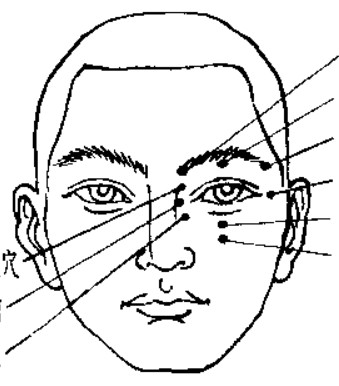
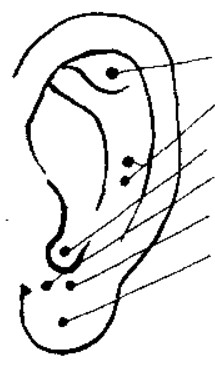
After completing the 12 rounds of channeling qi, cover both eyes with the palms, with fingers pointing upward, silently count to thirty, then conclude the exercise. To conclude: move the palms covering the eyes down along both cheeks to beneath the jaw, then press the palms together. The index fingers of both hands meet at the Chengjiang point, then move downward along the Ren meridian on the chest to the Daimai meridian at the waist, split left and right, and release downward along the sides of the legs. Open the eyes.
4. Relax-Tighten Breathing:
Stand naturally, with feet shoulder-width apart. Press the tongue against the upper palate, with intention focused on both eyes. Inhale through the nose and exhale through the mouth. When inhaling, tighten the eyeballs; when exhaling, relax the eyeballs. Repeat 36 times.
5. Acupoint Pressing and Breathing:
Close the eyes and sit quietly, with intention on both eyes, tongue against the upper palate, natural breathing.
-
Press Cuanzhu: Using the tips of both thumbs, locate the points and press from light to heavy pressure. Inhale when pressing, exhale when releasing. Repeat 36 times, then gently knead 36 times.
-
Press Jingming: Use the tips of the index fingers to press the Jingming point. Inhale when pressing, exhale when releasing. Repeat 36 times, then gently knead 36 times.
-
Press Sizhukong: Using both thumbs simultaneously, locate the points. Press from light to heavy. Inhale when pressing, exhale when releasing, 36 times, then gently knead 36 times.
| Cuanzhu | Shending | Yuyao | Sizhukong | Endocrine Zone |
|---|---|---|---|---|
| Tongziliao | Mu 1 | Chengqi | Mu 2 | Sibai |
| Tianying point (noted point) | Eye Ding |
|---|---|
| Jingming (noted point) | Jianming (main point) |
“Emotional Communication”
- Press Tongzi: Using the thumbs of both hands, locate the Tongziliao acupoint. Press clockwise 18 times, then press counterclockwise 18 times, using intention to channel true qi into this acupoint.
- Press Tianying: Use the thumbs of both hands to locate the acupoint simultaneously. Inhale as you press, exhale as you release, for 36 times, then gently knead 36 times.
- Press Jianming: Use the thumbs of both hands to locate the acupoint simultaneously. Inhale as you press, exhale as you release, for 36 times, then gently knead 36 times.
- Press Chengqi: Use the tips of the index fingers of both hands to press the Chengqi acupoint simultaneously. Inhale as you press, exhale as you release, for 36 times, then gently knead 36 times.
- Press Sibai: Use the tips of the thumbs of both hands to press the Sibai acupoint simultaneously. Inhale as you press, exhale as you release, for 36 times, then gently knead 36 times.
- Rotate, focus, and pierce the eyes: Close your eyes and concentrate. Rotate your eyeballs left and right 14 times. Focus for a moment, then suddenly open your eyes wide and stare at a point in front of you for about 30 seconds.
- Press Taiyang: Close your eyes and concentrate, breathing naturally. Use the thumbs of both hands to gently knead the bilateral Taiyang acupoints 36 times each.
- Wash the face: Rub the centers of both palms until warm. Inhale, and move both hands from the Chengjiang acupoint straight up along the bridge of the nose to the Baihui acupoint. Pass the back of the head to press the Fengchi acupoints, go across the back of the neck, and return to the Chengjiang acupoint along the cheeks. Exhale as one cycle. Do this 36 times. Closing posture: Close your eyes. Use the thumbs of both hands to hold down the Taiyang acupoints, keeping them still. Use the index fingers of both hands to gently knead your eyelids 16 times, then open your eyes and stand up.
VI. Auxiliary Practice
Press the ear acupoints using the thumbs of both hands on the following acupoints: Kidney acupoint for 1 minute, Liver acupoint for 2 minutes, Spleen acupoint for 2 minutes, Endocrine area for 1 minute, Eye acupoint for 1 minute, and Eye acupoint for 2 minutes. The times for pressing ear acupoints are morning, after dinner, and before bed. Practice three times a day, with one month as a treatment course.
Practice Requirements
- When practicing, you must concentrate your mind and be free of distracting thoughts. All styles are best performed with the eyes closed.
- Practice once after waking up early and once before going to sleep late. If your eyes are fatigued from viewing objects, you can increase the number of practice sessions at any time.
- Acupoint location must be accurate. After practice, the acupoints should reach a slight sensation of warmth, soreness, and numbness.
Excerpted from Qigong
My Emotional Communication with Plants
The human brain is highly developed and possesses rich emotions. Other animals (including lower animals) also have emotions, though they are much simpler. But people rarely consider whether plants have emotions. Perhaps some might think this proposition borders on the absurd.
Jin Yanbin
Having practiced qigong for many years, I can sense distant qi through intention, and I can see the qi of humans, animals, and plants. For instance, pathological qi is cold and turbid, whereas the qi of plants is also cold, but it is clear, non-irritating, and provides a sense of comfort. The aura color of a plant corresponds to its own leaves, supplemented by its qi. Once, I was at the Yinchuan train station to pick someone up. When the train arrived, a young man at the window and his girlfriend who was picking him up called out to each other loudly. I paid attention and observed that their auras radiated from their heads for about half a meter; the moment they held hands through the window, their two auras completely merged. From this, I thought of plants, especially trees, which have powerful auras—could they also have emotions? Driven by curiosity, I conducted an experiment:
There are not many trees in the Yinchuan station area. There was a large tree at the entrance of my workplace, and I would practice qigong beside it every morning and evening. My office was about 300 meters away from this tree. Whenever I opened the window upon arriving at work, I would fix my gaze on the tree with my intention, and my breath would quickly connect with it. Later, even if I didn’t use my intention or just worked facing the tree, occasional pulses of the tree’s qi would come over to me. Under a bright moon and a gentle night breeze, I gently hugged the big tree and muttered to myself: “What a quiet night! Big tree, how wonderful you are, green life, I like you very much!” Strangely enough, at that moment, the dense qi of the tree would pulse in waves, surging into my Dantian. The circulation of my Major and Minor Heavenly Orbits would suddenly accelerate. Is this not the emotion of the tree? An unprecedented blizzard in early winter struck the earth, and that tree could not escape its fate; it was nearly dead. Whenever I passed by that tree, there was no longer such a strong airflow, and I felt an indescribable discomfort in my heart.
Soon after, I found a large elm tree further away. When I walked past that tree, even without using my intention, the tree’s qi would follow me for a long way. Isn’t this also emotion? Yet I always felt that its qi was not as good as the original tree’s, and its color was not as vivid!
Flowers were planted in the courtyard of our unit. In late summer and early autumn, the flowers were in full bloom. I stood in Zhan Zhuang (stance) among the flowers, silently reciting: “Flowers! Flowers! Essence of all things, how I love you!” Strange to say, the vibrant and richly fragrant floral qi intensified in waves, refreshing my heart and chest. I believed it then—flowers also have emotions.
I also noticed in the park: the qi of pine and cypress are similar; when the two trees are adjacent, their qi interacts. Another tree that seemed to have the scent of clerodendrum was adjacent to a nanmu tree; their qi avoided each other, and the parts near the roots were clearly not flourishing. Therefore, I thought, just as humans have different blood types and different qi types, trees of closely related families and genera will also seek out those with similar qi.
In what form do plant emotions exist? This is a very complex question. Higher animals have brains and central nervous systems, their cells contain genetic factors, and they have an aura-like system. Plant cells reproduce offspring through division; besides what is seen under a microscope, there is probably also an aura system. As the saying goes, “Before heaven and earth existed, qi generated form; once heaven and earth existed, form housed qi.” Emotion is information and energy, so it also belongs to the material category. Plants have cells, can convert energy, and can emit information; therefore, they can also have emotions. My own experiments have also proven this point.
Excerpted from Qigong and Science
· 167 ·
came out to welcome us with a beaming smile. Upon close observation, one could not really detect any air of grandeur about the master… He was slightly plump, with a fair complexion, leaving the impression of being:
Believe It or Not
Frank, down-to-earth, and approachable.
Given the large number of people seeking treatment and observers, General Manager Hu specially opened the captain’s conference room, and the qigong treatment session began promptly. At this point, the renowned qigong master Wang Xinde was being interviewed.
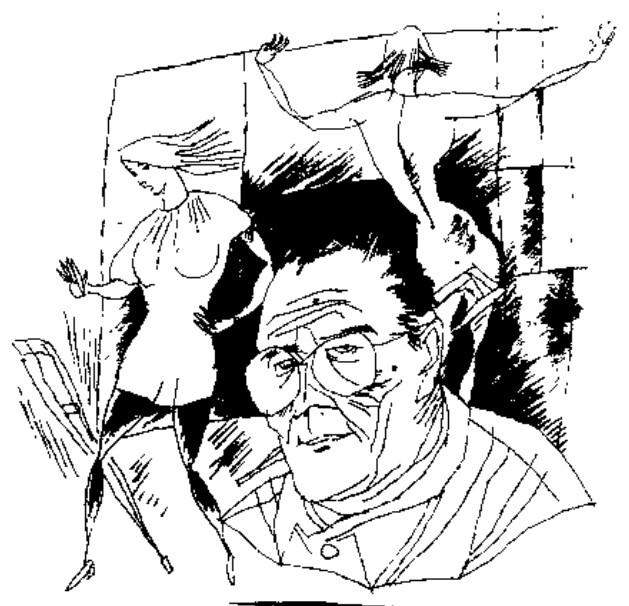
Standing before Wang Xinde were four patients: Mr. S and three other women, all with eyes closed in concentration, arms hanging at their sides, standing upright. One could only see the master’s eyes gleaming brightly as his hands swayed gently. The Mr. S on the left gradually raised both hands, moving them slowly in circles around his head; the middle-aged woman beside him rocked rhythmically back and forth; the young woman to the right waved her arms in small amplitudes and swayed her body, then suddenly fell backward onto the bed behind her and fell fast asleep; only the woman on the far right remained relatively still, standing with a slight trembling…
After about thirty minutes, Master Wang withdrew his power, and the four patients opened their eyes and returned to normal.
Interview Notes
”Belief” Makes “Attainment” Easy; “Attainment” Breeds “Belief”
“Qigong and other special abilities currently exceed general human common sense, making them difficult for people to believe,” Wang Xinde chatted with everyone after the performance. This qigong master, who now serves as Director of the Life Science Research Office in Nanning, began practicing with his father at age five and is now forty-one years old. He spoke with considerable cultural refinement in his conversation.
He said: The core of qigong is mental intention (yinian), and mental intention has levels. Generally, they are divided into three major levels: the Six Roots, Manas, and Oreiyas. A writer’s inspiration belongs to the lower level of mental intention. Therefore, both emitting and receiving power require purification of thought and a good emotional state; otherwise, psychological obstacles will arise.
At this point, another person present chimed in: “You could also say ‘sincerity brings efficacy, efficacy brings attainment, attainment brings belief.‘” Then, with no lack of humor, he said to Mr. Wang: “This is perhaps the reason why your name is ‘Xinde’ (Trustworthy Attainment).” Everyone laughed, and the author seemed to gain some understanding as well. Was this miraculous power and esoteric theory believable or not? Alas, let humanity come to know itself through exploration.
Hearing Is Believing—Hard to Credit; Seeing Is Believing—Impossible Not to Believe
Consider the media’s reports about Master Wang Xinde:
In Changzhou, a retired cadre named Sun Genqing, paralyzed for six years, suddenly rose from his wheelchair before Wang Xinde’s “miraculous power,” discarded his cane, and walked twenty meters, leaving many onlookers dumbfounded;
In Suzhou, Master Wang’s son Wang Daiyi emitted power to ten female patients, six of whom were sitting in the adjacent lounge. Moments after the emission, all ten without exception began waving their arms and stamping their feet;
In Nanjing, Wang Xinde applied a minor technique, and a girl named Weng Beihong, who had been paralyzed for two years after her lumbar spine was shattered in a fall, after a bout of violent trembling in both legs, suddenly stood up and walked, walking all the way out of the venue, as thunderous applause filled the hall;
In Shenzhen, Mr. Wang invoked the “Great Emptiness Method,” and his eight-year-old daughter Wang Daiwei suddenly rose into the air, soaring like an immortal…
Performance after performance, anecdote after anecdote—the accounts were told with such vivid detail that they seemed almost divine. True or false? Real or illusory?
Curiosity and professional habit finally led the author to make a decision: to follow Mr. S and see for himself. Seeing is believing, after all.
At 3:00 p.m. sharp, the visitor arrived at the residence on time. Wang Xinde, dressed in a blue uniform, came out to greet us with a beaming smile. Upon close observation, one could not detect any air of grandeur about the master…
(Excerpted from the Shekou News Bulletin, January 11, 1988)
·168·
experiments on the effects on bacteria and viruses, as well as multiple scientific studies including the effects of external qi on chromosomal aberrations in tumor cells, and the inhibitory and eliminative effects of external qi on tumor cells, thereby establishing the discipline of “Qigong Immunology.” Among these, experiments on the effects of external qi on cervical cancer cells showed an average single-exposure kill rate of 30.73%. Under the electron microscope, cancer cells treated with external qi exhibited obvious degeneration, swelling, nuclear dissolution, and cell necrosis. The average single-exposure kill rate of external qi on gastric adenocarcinoma cells was 25.02%. They referred to the encouraging clinical applications of qigong as the holistic immune function of external qi.
The Qigong Scientific Research Collaborative Group at Tsinghua University in Beijing adopted double-blind experiments to observe changes in “information water” after the eminent qigong physician Yan Xin emitted qi. They discovered that external qi can alter the molecular structure of certain substances that have physiological effects on living organisms, providing a preliminary revelation of the mechanism of qigong—namely, that the alteration of physiological effects is the reason qigong can cure disease. This discovery indicates that China’s qigong research has progressed from the cellular level to the molecular level. From December 1986 to mid-January 1987, seven experiments were conducted at different locations and over different distances. They placed sealed bottles containing tap water, physiological saline, glucose water, and medecamycin—substances with physiological effects—in a sealed dark room. When Yan Xin emitted qi by remote control at both close and long distances, they observed that a giant unknown peak appeared between the characteristic water peaks in the laser Raman spectrum of the tap water, indicating that it had transformed into another structural form of water. Similar significant changes also occurred in the physiological saline, glucose water, and medecamycin.
The involvement of the higher central nervous system in qigong activity has been confirmed by electroencephalography (EEG) research. Comrade Hou Shuli and others from the Institute of Space Medico-Engineering conducted “Observations on Motor Nerve Conduction Velocity in the Qigong Functional State,”
The miraculous effects of qigong in curing illness, strengthening the body, prolonging life, enlightening the mind, and activating latent potential are widely praised by the masses. However, truly comprehensive and in-depth experimental research on qigong—employing multidisciplinary, integrative, quantitative, and intuitive approaches, and adopting new theoretical methods and new experimental techniques—has only just begun.
They made an attempt at the level of the peripheral motor nervous system, below the higher central nervous system. Through 54 person-times of experimental observations, they found that compared with the quiet pre-practice state, when qigong masters focused their attention on the Laogong acupoint during the qigong functional state, the median nerve conduction velocity increased by 7 m/s, a highly significant difference. In contrast, 20 control subjects who simulated qigong practice in a relaxed and quiet state showed no change in motor nerve conduction velocity before and after the simulation.
Zinc is one of the more important among the 14 essential trace elements in the human body. Comrade Hu Songchang and others from the China Institute of Mining and Technology explored the secrets of qigong from the perspective of trace elements. Through tests and observations on 21 subjects, they found that qigong exercise can cause significant changes in serum zinc levels in the human body. This provided further research data on various physiological and biochemical parameters, as well as changes in enzyme activity during the qigong state.
Interferon is a powerful physiological antiviral substance. It possesses anti-tumor and immunomodulatory effects, can enhance the activity of natural killer cells and phagocytes, and is beneficial for controlling infections. The Jiangxi Provincial Institute of Traditional Chinese Medicine and the Nanchang No. 331 Hospital conducted research on the induction of interferon production through the True Qi Circulation Method. Through experimental testing of 56 qigong practitioners, they confirmed that qigong exercise can produce interferon, providing a scientific basis for qigong’s ability to prevent disease, cure illness, and prolong life. This added new content to interferon research.
In terms of research on the physical mechanisms of qigong, in recent years the use of modern scientific instruments to study the physical effects and characteristics of the “external qi” emitted by qigong masters has achieved breakthrough progress. Under existing conditions, many super-physiological phenomena and the physical characteristics of special mechanisms of qigong have been measured. The main results include infrared information, electrostatic information, magnetic information, particle flow information, biological force information, infrasound information, and qi information. For example: infrared measurements showed that when a qigong master emitted external qi, the infrared modulation amplitude at the Laogong acupoint in the center of the palm reached 80%, whereas in normal individuals it was less than 15%. Using an electrostatic incremental amplifier, the electrostatic charge collected at the Yintang acupoint when a qigong master emitted external qi was measured at 10⁻¹³ to 10⁻¹¹ coulombs, while in normal persons it was zero. When a qigong master emitted external qi, the bioelectrical resistance between the Lieque acupoints on both sides of the Lung Meridian was 10 MΩ, whereas when not directing qi, it was 100–1000 MΩ.
Comrade Wang Jialin, director of the Yunnan Provincial Institute of Human Body Science, with a spirit of self-sacrifice, conducted experiments on his own body and wrote several highly persuasive papers, including “Changes in Bile Secretion Volume and Bilirubin Concentration during the Qigong Functional State.” The theory he proposed, which Comrade Qian Xuesen called the “Theory of Qigong Internal Action,” touches upon major scientific issues involving the fundamental transformation of human life science. His successful research on the effects of external qi on the growth and mutational characteristics of edible fungus No. 9 oyster mushroom strains created a new path for the development of the cultivation industry.
Professor Feng Lida, Vice President of the General Hospital of the Chinese People’s Liberation Army Navy, took the lead in introducing traditional Chinese qigong into the field of modern immunology. Using biological immunology methods, she organized and conducted experiments on the use of external qi to inhibit bacteria and viruses, as well as multiple scientific studies including the effects of external qi on chromosomal aberrations in tumor cells, and the inhibitory and eliminative effects of external qi on tumor cells, thereby establishing the discipline of “Qigong Immunology.” Among these, experiments on the effects of external qi on cervical cancer cells showed an average single-exposure kill rate of 30.73%. Under the electron microscope, cancer cells treated with external qi exhibited obvious degeneration, swelling, nuclear dissolution, and cell necrosis. The average single-exposure kill rate of external qi on gastric adenocarcinoma cells was 25.02%. They referred to the encouraging clinical applications of qigong as the holistic immune function of external qi.
To verify the existence and effects of “external qi,” Comrade Li Caixi and others from the Xiyuan Hospital of the China Academy of Chinese Medical Sciences used physiological, immunological, and morphological methods to test and observe the biological effects of external qi on rabbits and discussed the results. The results showed that the animals in the qigong-treated group, compared with the control group, were more active and robust; their fur became whiter, shinier, denser, and less prone to shedding; their food intake decreased while their water consumption increased. The immune response of animals treated with external qi to foreign antigens was significantly enhanced, and their self-regulatory…
·169·
Some comrades have pointed out that most of the currently popular qigong methods involve complex movements, require a considerable amount of time to learn, and demand relatively long practice sessions each time. Many cadres and workers currently employed—especially middle-aged intellectuals and leading cadres—do not have major illnesses but suffer from numerous minor ailments. They carry heavy workloads, are burdened with household chores, and have relatively tight schedules, and are therefore unable to benefit from qigong. They suggest developing a simple, easy-to-practise method that takes little time, is easy to master, and produces good results, so that it can be widely promoted among cadres and workers. To this end, the author introduces to readers the following simple qigong method—Nourishing the Heart Qigong. Based on the results of small-scale promotion over a period of time, this method is not only simple and easy to practise, but also has relatively good effects in strengthening health and treating illness. It also has a strong effect on invigorating the spirit and developing intelligence. Interested readers may wish to give it a try.
A Ten-Minute Qigong Suitable for Staff and Workers
Wang Yonghuai
Nourishing the Heart Qigong derives its concept from the phrase “subduing the mind through non-action” in Lü Dongbin’s Hundred-Character Stele. All schools of qigong practice revolve around regulating the body, regulating the breath, and regulating the mind. This method emphasises regulating the mind in pursuit of simplicity. All schools of qigong distinguish between “civil” and “martial” degrees of intensity; this method balances cultivation and refinement, with an emphasis on nourishment. Hence it is called Nourishing the Heart Qigong.
Practising this qigong requires no special environmental conditions or appointed times. Regardless of when or where—whether in the morning, at noon, in the evening, during work breaks, between meetings, on the way to work, on a bus, and so on—as long as there is a brief gap in time, one can practise. The duration of each session is also not strictly prescribed: it may be as short as three to five minutes or as long as fifteen to twenty minutes. If one can manage at least one session per day, with the longest session reaching five to ten minutes, clear results will emerge.
This practice also requires no specific posture. One may sit, lean back, or lie down—whatever feels comfortable. Gently rest the tongue against the upper palate; there is no need to press hard against it—lightly touching is sufficient. Throughout the entire process, do not concern yourself with the breath; simply attend to relaxing the entire body naturally.
The practice method is as follows:
Prepare a colour photograph, an art postcard, or other colour photographic print (it should be a photograph of natural scenery, not a painting of people). The image should feature one or two flowers filling the frame (preferably peonies), accompanied by some green branches and leaves.
When beginning practice, one may first look at the colour photograph and memorise the image (if the image is already firmly remembered, this step may be omitted). Then gently and naturally close the eyes and visualise the image of the flower from the colour photograph. At the same time, silently recite three times, with elongated tones, “Hé——” (和——). Note: do not strain to visualise; visualise gently. It does not matter if the image is unclear—simply holding the thought is sufficient. Results will be achieved just the same.
After a while, the image of the flower will disappear and there will be no stray thoughts in the mind. This is an excellent state; simply maintain it. When concluding the session, visualise the flower image once more, then open the eyes and resume normal activities.
Points to Note:
-
Beginners often try desperately to produce a clear mental image. This is unnecessary and instead causes tension in the head, leading to discomfort such as head fullness and dizziness after practice. Pay attention to relaxing the mind; simply thinking of the image is enough—there is no need for it to be very clear.
-
A considerable number of comrades will experience various qigong-induced hallucinations within one month, manifesting as various lights, colours, and scenes. The principle for handling these is neither to pursue them nor to panic: do not linger on beautiful scenes, do not fear unpleasant ones, and remain relaxed and natural, maintaining the original state.
-
During practice, the usual associations and reasonings that arise in the mind are stray thoughts. The absence of stray thoughts constitutes entering stillness. Allow any sensations to arise and dissipate naturally; do not artificially interfere.
-
Those who practise this method may simultaneously practise other dynamic qigong (including T’ai Chi, Xingyi, Bagua, and other internal martial arts), but should not simultaneously practise spontaneous-movement qigong or other stillness practices.
Excerpted from Chinese Qigong
Qigong Methods: Selected Introductions
In order to study the changes in physiological functions induced by qigong in strengthening the body and curing illness, and to further understand the relationship between qi and blood circulation, Comrade Zhang Zuqi and colleagues of the Guangdong Qigong Science Research Association, through thirty-two observational experiments on the effects of external qi on blood flow in the mesenteric capillaries of frogs, preliminarily confirmed that after a qigong master emits external qi, the flow of red blood cells within the mesenteric capillaries of frogs is accelerated. Changes in capillary blood flow in the body are generally related to the heartbeat, cardiac output, vascular properties, and blood viscosity. Which specific links external qi acts upon to influence blood flow changes remains to be further studied and refined.
The therapeutic and protective effects of qigong against radiation damage are of definite significance for future military medicine, environmental protection, and the treatment of radiation-induced cancer. The experiment on “qigong against 800-roentgen r-ray damage in animals,” conducted by Sichuan University and other institutions, used external qi in experimental studies on mice irradiated with Rad. The results showed that compared with the control group, mice treated with external qi exhibited milder symptoms and a lower mortality rate, demonstrating that qigong can reduce radiation injury, improve survival rates, and delay the time of death. Furthermore, the heart, liver, spleen, adrenal glands, and other organ tissues of this group of animals showed marked changes in their histological responses.
Many Western scientists predict that the twenty-first century will be the era of life science. Qigong science opens new pathways for people to understand the laws of their own life processes. The in-depth study of qigong science will lay a solid foundation for China’s leading position in the field of life science in the future.
A Fine Method for Strengthening the Brain and Enhancing Intelligence
Throughout ancient and modern times, in China and abroad, it has been said that qigong can enhance human intelligence. Today, a great possibility has emerged before us: it can elevate the intelligence of our nation’s people to a higher level and further unleash human potential. The social benefits of this are truly profound.
——Qian Xuesen
Improved concentration, clearer thinking, enhanced memory, neater and more orderly coursework, strengthened self-control, and a general rise in academic performance.
Wei Zenan, former Party Secretary of the Ministry of Culture, began participating in a “Yang Qi Gong Training Class” organized by the Ministry in May 1982, learning and practicing “Yang Qi Gong” from Teacher Ma Litang of the Zhongshan Health Society. He practiced four times a day: from 5:30 to 7:30 in the morning and from 10:30 to 11:30 at night, plus an additional half hour each in the morning and afternoon, for a total daily practice time of four hours. Initial results appeared after one to two months of qigong cultivation, and significant results were achieved after three to four months.
When recounting his experiences with the practice, Wei Zenan listed ten benefits, of which three are:
First, calming of the nerves. He said: “I had long suffered from neurasthenia and frequently experienced insomnia at night. After practicing qigong, my nerves gradually calmed and normalized. After half a year, insomnia never recurred. Each time I sleep, I fall asleep quickly, sleep soundly, and do not dream.”
Second, abundant energy. He said: “In my old age, I suffered from qi deficiency, frequent dizziness, and often dozed off during meetings. After three months of practice, I felt a surge of vitality. To this day, I work and engage in activities for thirteen to fourteen hours daily without feeling fatigued. One could say my energy is no less than in my younger years.”
Third, enhanced memory. He said: “After suffering a myocardial infarction, my memory declined greatly, and I was constantly forgetting things. After practicing qigong for half a year, my memory gradually recovered and strengthened. After one year, my memory showed little difference from when I was in my prime. Now I deeply feel that my mental capacity is increasing day by day.”
The fact that qigong can strengthen the body and develop latent human potential is already obvious and well known. However, what is even more important is that qigong can also strengthen the brain—developing the potential of human intelligence. After reviewing a large body of relevant materials, the conclusion I have reached is that qigong does indeed have the efficacy of enhancing intelligence and improving memory.
Elderly people can enhance their intelligence and improve their memory through qigong cultivation, and middle-aged and young people can achieve the same effects.
A qigong research group in Beijing conducted qigong experiments in 1981 at Zhongguancun Primary School and the Primary School Affiliated with the Beijing Institute of Aeronautics in Beijing. The children being tested were asked to sit quietly in a comfortable posture with their eyes slightly closed, focusing single-mindedly on counting their own breaths, achieving relaxation of the limbs and muscles, a tranquil demeanor, and natural breathing. Generally, after ten to twenty minutes, a small sensation of “numbness” would propagate along the longitudinal axis of the limbs; in most cases, it could reach the head, accompanied by a flashing light sensation. After a period of training, all children who conscientiously followed the required techniques showed varying degrees of improvement in their ability to concentrate, and some children’s ability to memorize English vocabulary also improved.
Fuzhou University implemented qigong therapy. Students who practiced qigong universally reported improved sleep, vigorous appetite, abundant energy, and enhanced memory. Students were able to concentrate on listening during class, their comprehension ability increased, and they were filled with confidence in their studies.
Teachers Zhang Ganchang and others at the Wuhan Institute of Physical Education conducted some explorations into how qigong enhances the intelligence of young people. They found that after two weeks of qigong cultivation, students universally experienced a clear head, a refreshing sense of comfort, improved vision, and better sleep. After two months, various beneficial effects appeared, such as:
Luo Xiuwen, an editor at the Hunan Daily, began studying and practicing qigong in 1982 and achieved very significant results in less than half a year. In an article titled “Minor Success in Practice, Tireless Writing,” he wrote: “Previously, I often suffered from my poor memory. Although I read extensively, nothing left a trace on my memory screen, and my mind always felt empty. When it came to writing articles, I frequently found myself at my wit’s end, racking my brains for ideas, unable to complete a piece for a long time. After practicing qigong, my memory improved in an encouraging way— not only was my memory quick, but it was also lasting. How can I prove this? From September 1983, when I was admitted to the cadre training program at Hunan Normal University, up to the present, in just a year and a half, I have memorized over 200 classical prose pieces, more than 400 classical poems, and over 300 couplets. Of course, memorizing so much in such a short time was, subjectively speaking, due to the painstaking effort I put into memorization and some good memory methods I developed. But objectively speaking, it was indeed thanks to qigong. Why do I say this? Because I had always studied diligently and paid attention to methods, yet my memory results were always poor. After practicing qigong, my concentration improved and my memory strengthened, thus producing such excellent memory results. With a rich store of knowledge in my mind, writing became effortless and fluent. For example, every time there was an essay exam, I was always the first to——
·171·
…handing in the paper, and every time scoring above 90 points.”
profession was lawyer. After practicing qigong, he was able to memorize an arrangement of 18 digits in an instant and could correctly calculate which day of the week any date from 1901 to 1999 fell on. Given more than a dozen objects, he would turn his back and touch them, and in an instant could state the exact order in which they had been arranged.
Xie Xiangchuan, a student in the Electrical Engineering program at Wuhan Television University, had not paid attention to physical exercise. Within just two months of enrollment, he developed neurasthenia — dizziness, palpitations, insomnia, scattered attention, and declining memory — which seriously affected his studies. Inspired by qigong magazines, he began practicing qigong, training for two hours every morning after waking. In describing his experience, he wrote: “After practicing qigong for several months, my previous symptoms of dizziness and poor sleep vanished without a trace, and my memory became better than ever. On the final exams, I scored above 95 in all six specialized foundational courses, jumping to first place in the class.”
The role of qigong in invigorating the brain — developing human intellectual potential — has also been confirmed by research findings abroad.
In 1981, the Indian Ministry of Education officially announced that yoga classes would be offered in 320 central primary schools, with experienced yoga instructors appointed by the government to teach. The city of Chandigarh in the northern Indian state of Punjab also promoted the meditation method in all universities, secondary schools, and primary schools.
In recent years, a unique method for developing human intelligence has emerged abroad, known as “Transcendental Meditation technique.” It originated from what the Indian academic community calls “Creative Intelligence Science.” The founder was Indian-American physicist Maharishi, who combined ancient Indian yoga with modern physics’ unified field theory to create a complete system of meditation, gradually achieving stillness, transitioning the mind from an excited state of thinking activity to calmness, and progressively reaching a state of transcendence — that is, the state of “deep absorption” or “self-forgetfulness.” Everyone who has practiced this technique reports feeling clear-headed, sharp in hearing and sight, full of energy, calm and composed, and with enhanced memory.
Because “Transcendental Meditation” has the effect of invigorating the brain and boosting intelligence, it has become widely popular throughout the world. According to statistics, more than 120 countries are currently promoting this brain-training technique, with millions of people practicing it, and countless natural and social scientists engaged in researching it.
Indian yoga is very similar to Chinese qigong in its practice methods. Both require achieving physical relaxation and mental stillness, thereby realizing the goal of developing human potential — both physical and intellectual.
In India, there are quite a few people who have gained astonishing memory through yoga cultivation. The yoga practitioner Saa at the Sri Yogendra Ashram in Mumbai is one such person. He practiced daily for a full year and developed extraordinary memory.
Since “Transcendental Meditation” has the efficacy of invigorating the brain and enhancing intelligence, it has become widely practiced worldwide. According to statistics, over 120 countries are currently promoting this brain-training technique, with millions practicing it, and countless natural and social scientists engaged in this research.
In summary, whether from the perspectives of renowned scientists or of ordinary individuals, everything confirms: qigong genuinely possesses the miraculous efficacy of developing intelligence and enhancing memory!
— Excerpted from China Qigong
Yoga Levitation
India’s yoga is a puzzling and bewildering scientific mystery. After watching, one is left dumbfounded.
On the evening of September 20, 1986, Hong Kong’s Chen Huihua and Xiao Jiehuan came to Shanghai and performed a yoga levitation demonstration in the small auditorium of the East China Normal University office building for Shanghai’s news organizations and certain scientific research departments.
They sat cross-legged on a green carpet, their legs crossed in the lotus position. Chen Huihua wore a Chinese-style cloth top with a white base and blue floral round collar, and patterned silk trousers with lace trim. Xiao Jiehuan was dressed in a traditional outfit with embroidered edges.
At first, Chen Huihua sat still with her eyes closed, entering a state of meditation. Within moments, Chen Huihua’s head began to droop, then rise, then droop again, repeating this cycle many times. Xiao Jiehuan, however, was different — she kept her head raised and motionless throughout. After more than ten minutes, Chen Huihua’s body began to tremble, then her hands rose, and her body followed, rising upward. According to visual estimation, she rose approximately thirty centimeters off the ground and drifted forward sixty centimeters, then descended, rose again, and drifted further — this happened repeatedly. Meanwhile, Xiao Jiehuan’s entire body also began to shake, followed by leaping. According to records, within less than ten minutes, they each leaped fifty-six and fifty-two times respectively.
Afterward, when a reporter asked Chen Huihua about her sensations during the practice, she said: during Transcendental Meditation, the human body, mind, and various physiological functions reach a high degree of harmony and unity. She felt her body gradually become lighter, and with just a slight application of effort and intention, she could rise into the air.
Chen Huihua and Xiao Jiehuan stated: Transcendental Meditation levitation is only the first stage of yoga flight. The second stage of yoga practice can enable the human body to reach the sky, and when one reaches the third stage of yoga, the body can fly through the air — though to date, no one in the world has yet achieved this level of skill.
Chen Huihua expressed that their purpose in coming to Shanghai was, on one hand, to promote yoga qigong, and more importantly, through yoga qigong training, to harmonize brain function and improve human physical quality. They firmly believe that in the near future, more people in our country will learn and master the Transcendental Meditation system. They are confident that modern science and technology will gradually lift the veil of mystery surrounding yoga.
Currently, international qigong conferences are held every two years, and research into its mechanisms continues. It is certain that modern science and technology will gradually unveil the mysterious veil of yoga practice, enabling it to further benefit humanity.
— Excerpted from Friend of Science
- Feng Zejun
Traditional Chinese Medicine’s Understanding of “Qi”
Hu Bin
Traditional Chinese medicine holds that qi is the driving force behind the origination, development, and transformation of all things in the universe. For the human body, qi refers to the motive power that sustains physiological functions, and it is also an important substance that maintains human life activities. Therefore, it occupies an extremely important position in traditional Chinese medicine. Traditional Chinese medicine classifies “qi” into four types: Original Qi, Pectoral Qi, Nutritive Qi, and Defensive Qi, each described below:
Original Qi (Dantian Qi)
Traditional Chinese medicine holds that Original Qi is generated from the essence produced by congenital essence. When the embryo first forms, the single point of moving energy at its center is transformed from congenital essence; after birth, this becomes the Original Qi residing in the Qihai (Sea of Qi). This Original Qi, in its prenatal stage, receives nourishment from the mother and gradually becomes abundant, enabling it to continuously exert its effects. After birth, Original Qi depends on the constant nourishment of refined essence to maintain the body’s normal growth and development. Therefore, the more abundant the Original Qi, the stronger the viscera and bowels, and the more robust the body will be. Conversely, if there is congenital insufficiency, and postnatal malnutrition further depletes Original Qi, then internally the qi of the viscera declines, and externally the body lacks the strength to resist pathogenic factors; the body weakens and illness arises. Qigong practitioners pay great attention to cultivating Original Qi to secure the foundation (those who practice Qigong cultivate Original Qi by ensuring the free flow through the Ren and Du meridians, returning to the prenatal state—this is precisely “cultivating the origin and securing the foundation”; during treatment, attention is paid to replenishing Original Qi before successful results can be achieved).
Pectoral Qi (Lung Qi)
Pectoral Qi is also known as Great Qi. Traditional Chinese medicine holds that Pectoral Qi accumulates in the chest, supporting the respiration of the lungs and the blood circulation of the heart—hence it is called Pectoral Qi. It is also said that “half a day without food causes qi to decline, and a full day without food causes qi to diminish,” indicating that although Pectoral Qi in the chest can be nourished by drawing in the essence of heaven and earth through breathing, it must also be supplemented by dietary nutrition. The Lingshu: Keyei Pian states: “When the five grains enter the stomach, their waste products, body fluids, and Pectoral Qi are divided into three pathways. Thus Pectoral Qi accumulates in the chest, emerges from the throat, and penetrates the heart vessels to facilitate respiration.” From this it can be seen that Pectoral Qi is not only the guiding principle of lung respiration but also the guiding principle of blood circulation throughout the entire body.
Western medicine holds that the pons and medulla oblongata are the centers for respiration and vasomotor activity. The medulla oblongata has the functions of regulating respiration and blood circulation. Respiration is the process by which the body takes in oxygen from the outside, and oxygen enters the circulating blood while carbon dioxide moves from the blood to the alveoli to be expelled—this is the pulmonary respiratory process, also called external respiration. Internal respiration refers to tissue respiration, that is, the oxidation processes carried out within tissues. These processes cause the elimination of carbon dioxide into the blood and the absorption of oxygen from the blood. When hypoxia is severe, it causes serious damage to the higher respiratory centers and circulatory centers of the brain, manifested as shallow breathing, cyanosis, marked weakening of cardiac activity, drop in blood pressure, cessation of breathing, and rapid death. These are the discussions on respiration from both Chinese and Western medicine.
Nutritive Qi (Stomach Qi)
Traditional Chinese medicine holds that Nutritive Qi is the refined essence generated from the essential nutrients of food and drink. The Lingshu: Yingwei Shenghui Pian states: “When grain enters the stomach… the clear portion becomes Nutritive Qi.” This indicates that the generation of Nutritive Qi lies in the stomach, and it has the function of nourishing the entire body. Nutritive Qi resides in the stomach, where it assists in gastric peristalsis, the digestion of food, the expulsion of food, and moves up and down with respiratory movements. If there were no qi in the stomach, creating a vacuum, food would not be able to descend. When there is an excess of Nutritive Qi in the stomach, belching increases upward and flatulence increases downward. When one suffers from liver disease, heart disease, or stomach disease, the qi in the stomach becomes stagnant and constrained, causing fullness, distension, bloating, and labored breathing. Therefore, when treating illness with Qigong through abdominal breathing practice, there is often frequent belching, and the aforementioned symptoms are significantly alleviated. In a healthy person, when Nutritive Qi is expelled from the stomach through the esophagus, it is clear and odorless. Western medicine acknowledges that gas exists in the stomach; through X-ray imaging, an air bubble can be seen in the gastric fundus, beneath the left dome of the diaphragm. Its shape is affected by food intake volume, time after meals, degree of surrounding tension, amount of secretions, pressure from surrounding organs, etc.; normally, its lower border presents a crescent shape. In patients with gastric dilation, the gastric air bubble becomes enormous after eating, and the patient belches incessantly. In gastric atony, due to reduced gastric tone, the crescent-shaped gastric air bubble gradually assumes a funnel or pear shape; the patient experiences postprandial fullness, pressure, and heaviness in the stomach, with excessive belching. It is evident that stomach Nutritive Qi and the stomach are very closely related.
Defensive Qi (Intestinal Qi)
Traditional Chinese medicine holds that the generation of Defensive Qi also derives from the refined essence in food and drink. The Lingshu: Yingwei Shenghui Pian points out that Defensive Qi, like Nutritive Qi, “is born of water and grain”—“the turbid portion becomes Defensive Qi”—“Defensive Qi emerges from the lower burner.” In my understanding, Defensive Qi refers to the qi in the intestines; its function is to defend the various organs of the abdomen, promote intestinal peristalsis, digestion, and absorption, propel the movement of feces, absorb oxygen, and expel carbon dioxide from the body. Modern internal Qigong practitioners specifically practice Dantian breathing; after circulating qi, a steel plate is placed on the body and a small jeep can be driven over the body without causing injury. There are also martial artists who, after circulating qi, place a large stone on the abdomen while another person forcefully strikes the stone with a fifteen-pound sledgehammer—the stone shatters while the person remains uninjured. It can be asserted with certainty that if no gas were present, the human body would certainly be damaged. The internal qi of the human body is like a tire on an automobile: when the tire is inflated, it can carry heavy loads over long distances; without air, it cannot move an inch. Human Nutritive Qi and Defensive Qi not only nourish the body but also serve to protect it. External blunt force is resisted by the presence of internal qi, preventing damage to the internal organs. When a person suffers from intestinal paralysis, bowel sounds disappear, peristalsis ceases, the intestines become filled with gas, causing unbearable distension and fullness—forming a tympanitic abdomen—and the patient suffers enormously. Western medicine uses anal intubation to expel gas and reduce pressure to relieve the patient’s suffering. From this, the importance of Defensive Qi is evident.
Summary
In summary, traditional Chinese medicine has many discussions in its study of qi. Western medicine also acknowledges the existence of gases in the lungs, stomach, and intestines, but has not conducted experimental research on this topic—an area worthy of promotion in the future.
Excerpted from Wulin
·173·
Youth Qigong Method
Zhuang Guoren
Original Editor’s Note: A children’s qigong method must not only strengthen the body, develop children’s intelligence, and improve their self-control abilities, but it must also suit the physiological characteristics of children — this is truly no easy task. It is understood that Comrade Zhuang Guoren has been engaged in children’s qigong education for some time. His method is published here for reference only by those devoted to this field:
I. Building the Foundation at Dantian
- Stand with feet parallel, shoulder-width apart; knees slightly bent, not exceeding the toes; heels raised, with the balls of the feet and toes exerting force.
- Cross the tiger’s mouths (webbed areas between thumb and index finger) of both hands, left hand on top, right hand below — the same for both males and females. Press the Laogong points together, place the left thumb at the navel, and let both hands relax naturally at the lower Dantian. Breathe naturally.
- Turn 45° to the right side and repeat movement 1. Cycle three times.
- Cycle movements 1, 2, and 3 above three times. Open both eyes.
II. Closing the Eyes to Nourish Qi
- Keep feet still, heels on the ground, knees straight.
- Place both palms together against the chest, five fingers pointing upward. The bases of the palms exert slight force, creating a hollow space between the palms. Both elbows form a straight line, held level in front of the chest.
- Close both eyes gently. Lower the head slightly.
- Hold this posture for three minutes.
III. Stimulating Intelligence and Brightening the Eyes
- Continue to keep both eyes gently closed. Separate both hands and extend them straight forward as if holding a ball, palms facing upward beyond the top of the head. Then bring both hands downward and inward, palms facing the eyes, counting 1, 2… to 6 seconds. As you continue downward, the knees bend with the movement; when the hands reach the navel area, extend them straight forward again, straightening the knees, and bring both hands upward again to in front of the eyes. Cycle three times.
- Turn 45° to the left side and repeat movement 1. Cycle three times.
- Close the mouth naturally, with the tongue pressed against the upper palate. When outdoors, level your gaze and focus on a distant target. When indoors, focus on a small target directly ahead, trying not to blink.
- Hold this section for five minutes.
Sensations of soreness, fullness, numbness, or coolness in the eyes, lower legs, and other areas are normal reactions.
IV. Expanding the Chest and Resting the Eyes
- Stand upright with both feet. Place both hands behind the back, with the two elbows overlapping and held level. Expand the chest, draw in the abdomen, and look straight ahead.
- Focus your gaze on a distant target directly ahead. At this point, it will feel clearer than the first time.
- Hold for five minutes.
- Hold this section for five minutes.
V. Smoothing the Qi and Concluding
- Close both eyes gently. Place both thumbs on the left and right temples. Run the index fingers along the upper eyebrows ten times, then along the lower eyelids ten times. Run the five fingers up and down along the temples ten times. Pull the lower part of the ears left and right ten times. Pinch the center of the back of the neck ten times. Run the five fingers around the eye sockets, clockwise ten times and counterclockwise ten times. Wipe downward along the sides of the nose ten times, then wipe upward over the head, returning from behind the ears down to the lower Dantian. Return to the state of Section I, movement 2, and open both eyes.
- Concluding method: Cross both hands and place them at the lower Dantian. Raise both heels and stamp forcefully downward three to five times.
Notes on Practice
This method has the effect of finding tranquility amid noise in an unquiet environment, and the function of achieving purity amid chaotic emotions. This method does not use visualization (yinian), does not require focusing attention on any point (yishou), and will not cause deviations. It is simple and easy to learn, with good therapeutic effects. It can be practiced at any time and in any setting in modern life. This method is not affected by external interference; temporary talking is permitted, and letting the mind wander is allowed. It is especially suitable for youth who are restless and dislike stillness — hence it is named the Youth Qigong Method.
If only Section I plus the concluding method is practiced, it already has therapeutic and health-building effects. For children and adolescents with intellectual disabilities or hyperactivity, they may first practice Section I for a period of time. Once the five-minute requirement is met, they may then continue with the other sections.
Excerpted from “Qigong and Science”
·174
Hua Tuo and the Five-Animal Frolic
Hua Tuo attached great importance to the prevention of disease. He believed that disease is the result of gradual internal development and change within the body. By the time a disease is discovered, even early treatment is like digging a well when already thirsty or casting weapons only when battle is imminent—it is already a step too late. The superior physician prevents illness before it forms, as expressed in the principle: “The highest excellence treats what has not yet become disease.”
Preventing disease is extremely important, but disease prevention must have practical and feasible methods. Hua Tuo advocated using labor and Qigong exercise for health cultivation. He once told his disciple Wu Pu: “People should engage in physical labor; labor can strengthen the body.” He believed that appropriate exercise could aid digestion and promote the smooth flow of qi and blood, not only preventing disease but also extending life. He opposed the idealist views propagated by Confucians, such as “life and death are determined by fate” and “fortune and misfortune are unpredictable,” as well as their disdain for labor and physical exercise.
Based on the systematic and complete medical theory of the Huangdi Neijing (Inner Canon of the Yellow Emperor), and by synthesizing the experience of working people, absorbing the essence of ancient Daoyin (guiding and pulling) arts, and breaking through the reactionary ideological trends of his time, Hua Tuo created the “Five-Animal Frolic” (Wuqinxi). The Five-Animal Frolic imitates the movements and postures of five animals—the tiger, deer, bear, ape, and bird—allowing every part of the human body to receive appropriate exercise and fine regulation, thereby achieving excellent results in dispelling disease and prolonging life. Hua Tuo traveled everywhere to promote and teach the Five-Animal Frolic, helping the people cultivate health and eliminate illness, and was warmly welcomed by the masses. His disciple Wu Pu persisted in practicing the Five-Animal Frolic; at over ninety years of age, his hearing was acute, his vision was clear, and his teeth were intact. At over one hundred years old, in Xuchang, he personally taught the exercises every morning to weak and ailing people. He believed that only regular physical activity was the path to health and longevity, but one should not push to the extreme!
The Five-Animal Qigong left to us by Hua Tuo is not only a precious heritage for the Chinese people but also a wealth of health for the people of the world. As early as the Sui and Tang dynasties, it spread to Japan, Korea, and India, and then gradually propagated to Southeast Asia and throughout Europe.
—Chen Miaozi, Guo Xiaodong, Jiang Xiaobin
The Creation and Application of the Five-Animal Frolic Qigong
Hua Tuo (141–203 CE), courtesy name Yuanhua, was a native of Qiao in Pei State (present-day Bo County, Anhui). He lived during the late Eastern Han dynasty and the Three Kingdoms period. During that era, politics were corrupt, warlords fought incessantly, social production was severely damaged, and the broad masses of working people were displaced and destitute. The prevalence of epidemics deepened the suffering of the people. Shamans, quack doctors, and superstition ran rampant. Hua Tuo, a physician of simple materialist convictions, deeply cared about the suffering of the working people.
In terms of medical technique, he continuously absorbed the experience of predecessors and the masses, and he innovated and invented. He was not only proficient in internal medicine, external medicine, gynecology, pediatrics, and Tuina massage, and invented the world’s earliest anesthetic, but he was also a pioneer in physical therapy, intention-and-qi diagnosis, and sports psychology. With his miraculous skill, he cured many critical, acute, and various chronic diseases. His superb medical skills and noble medical ethics earned him the deep esteem and affection of the people.
In the late Eastern Han dynasty, the feudal ruler Cao Cao suffered from incessant migraine headaches; only Hua Tuo could relieve his pain. Cao Cao wished to keep him at his side as a personal attending physician. However, Hua Tuo refused to serve the ruler personally, and was ultimately killed by Cao Cao using cruel means, martyring this great medical scientist.
Hua Tuo would not bow to the powerful, nor did he covet fame and fortune. With his noble character and peerless medical skill, he earned the profound respect of later generations. Today, in Xuzhou, Jiangsu, there is a memorial tomb of Hua Tuo, and in Pei County there is a Hua Tuo Temple and the former Hua Family Village residence of Hua Tuo.
The “Six-Animal Frolic” and Hua Tuo
The name “Six-Animal Frolic” was coined by later generations in imitation of Hua Tuo’s Five-Animal Frolic. Did a Six-Animal Frolic routine ever actually exist in history? The Six-Animal Frolic that we can presently see consists merely of six Daoyin postures recorded in the Huainanzi: Jingxun Xun (Spiritual Training chapter of the Huainanzi), and most of these Daoyin postures are found in relevant ancient texts. It is particularly noteworthy that they are essentially identical to the Western Han silk painting Daoyin Tu (Daoyin Diagram) unearthed from Tomb No. 3 at Mawangdui, Changsha. After its excavation, historians examined and annotated it; the Daoyin Tu provides valuable reference material for the Six-Animal Frolic of the same period: First posture: Xiong Jing (Bear Reach); Second posture: Niao Shen (Bird Stretch); Third posture: Wan Yu (Duck Bathing); Fourth posture: Yuan (Ape, according to sources); Fifth posture: Hu Shi (Owl Gaze); Sixth posture: Hu Gu (Tiger Look). These predate the currently recognized Five-Animal Frolic—the earliest Daoyin routine created by Hua Tuo—by a full three centuries.
The theory of Daoyin is an integral part of traditional Chinese medicine. A careful examination of the exposition in the Huainanzi: Jingxun Xun regarding the correspondence between the organs and the cosmos reveals that the Six-Animal Frolic aligns the six animals with the spleen, kidney, lung, liver, heart, and gallbladder. Hua Tuo continued the achievements of his predecessors and made innovations: he removed the bathing posture and arranged the routine according to the five zang organs—liver, spleen, lung, kidney, and heart. The Fu Yu (Duck Bathing) posture that Hua Tuo removed was a concrete application of ancient biomimetic medicine in therapeutic physical culture. The main reason for its removal was that, although the water-play exercise was fascinating and popular among the masses, it was too difficult, and few were willing to try it themselves.
The Five-Animal Frolic created by Hua Tuo has been passed down without decline for over 1,700 years, and today it has developed into a renowned Daoyin lineage with numerous branches, famous throughout the world.
—Excerpted from Qigong and Physical Education
·175·
One-Minute Navel Secret Qigong
Gansu College of Traditional Chinese Medicine: Zhang Du, Hongwen, Qiang Jie
Practice Methods
- Wuji Navel Secret: Recite the incantation while visualizing. The incantation can be chanted in a low voice or recited silently. The incantation is: “Om, om, om! Namo navel, namo navel, spirit enters the navel, return to Wuji!” At the same time, visualize your spirit entering the center of the navel, forming a state of Wuji (Infinity), which then spreads throughout your entire body.
- Taiji Navel Secret: Recite the incantation while visualizing. The incantation can be chanted in a low voice or recited silently. The incantation is: “Om, om, om! Namo navel, namo navel, spirit enters the navel, manifest Taiji!” At the same time, visualize your spirit entering the center of the navel, forming a state of Taiji (Supreme Ultimate), which then spreads throughout your entire body.
- Reciting the incantation six times per practice session takes about one minute. You can practice this as few as several times, or as many as dozens of times a day.
Practice Rules
- Those who practice this qigong must be sincere, devoted, and persevere, but they must not forcefully pursue results or be anxious for quick success.
- Before and after practicing, you must calm your mind and relax your breathing. Do not practice in a hasty or tense manner. If you can maintain a constant state of calmness and tranquility in your daily life, the effects will be even better.
- You should not practice immediately when hungry, overly full, feeling the urge to urinate or defecate, during thunderstorms, or experiencing intense emotional fluctuations.
- The posture for practice is not strictly limited; walking, standing, sitting, or lying down are all acceptable, but you should ensure that you remain comfortable.
- Breathing should follow its natural course, but your eyes should be closed or slightly lowered like a curtain. Placing the tongue against the upper palate can be used during silent recitation.
- This qigong can be practiced alone, or it can be performed before other dynamic and static qigong practices as a method to reduce distracting thoughts and induce tranquility.
- Do not judge the effectiveness of your practice based solely on a specific subjective feeling; it requires a comprehensive and macro-level analysis.
Practice Effects
- After practicing for a few days, normal physiological changes such as slight warmth in the abdomen, the activation of qi dynamics, bowel sounds, and flatulence may occur. These are the expected effects of correct practice. If you feel excessive heat in the abdomen, it is caused by excessive pursuit and overly heavy intention. When practicing afterwards, you should lighten your intention, and it will naturally resolve itself after a certain period of time.
- With long-term practice, many other beneficial physiological changes will appear sooner or later. Do not mistakenly fear these as deviations; this qigong has the highest safety factor.
- This qigong is used to treat almost all chronic diseases, such as geriatric diseases, gynecological diseases, internal medicine diseases, and is even indicated for some surgical diseases. If you can simultaneously manage to reject the continued influence of pathogenic factors—such as natural factors, human factors, and emotional factors—the effects will be even more remarkable, and along with the accumulation of your practice, infinite benefits will emerge.
The Wonderful Uses of Swallowing Saliva
Jin Ye
Saliva is generally not highly valued by most people. However, in Chinese qigong practices, it is taken very seriously. Ancient practice methods strongly emphasized “swallowing saliva” (tun jin)—that is, after rinsing the mouth and stirring the tongue in the oral cavity, one swallows the saliva produced during the practice in three to several mouthfuls. Qigong masters and Traditional Chinese Medicine practitioners refer to saliva as “body fluids” (jin ye).
The reasoning behind this is exactly as explained in Traditional Chinese Medicine and qigong theory: the human body possesses both Pre-Heaven qi and Post-Heaven qi. Post-Heaven qi originates from the transformation of “grain and water qi” and air, and “grain and water qi” relies on digestion. Human saliva is the first digestive fluid. Large amounts of saliva travel to the stomach along with food, promoting the stomach’s extraction of essence from the “grain and water,” thereby enhancing human health.
In addition to various enzymes, saliva also contains vitamins, hormones, inorganic salts, and proteins. The functions of vitamins are already well known. Modern medical scientists have also discovered that the vitamin E within it has an anti-aging effect on the human body. Hormones, on the other hand, possess the function of regulating bodily mechanisms. Based on the composition of saliva, it is conceivable that it is precisely the action of these vitamins and hormones that enables qigong practitioners to have good digestion and absorption, a rosy complexion, and abundant energy.
Professor Nishioka from Japan discovered through experiments that saliva in the mouth is a frontline defense against cancer. Carcinogens first cause cell mutations to form cancer cells, but among the various enzymes contained in saliva, fifteen are particularly important. Among them, oxidase and peroxidase can eliminate the toxicity of certain carcinogenic substances. Professor Nishioka treated various carcinogens with saliva and then applied them to bacteria; as a result, the phenomenon of bacterial mutation was significantly reduced.
To keep yourself healthy and highly creative, please do not forget the ancients’ advice during your qigong practice: cherish this small mouthful of “body fluid”!
·176·
What kind of state is this? Cao Cao’s personal experience was first to “seal the mouth,” then one must deeply “cherish the qi” — only thus could there be the miraculous effect of “longevity of ten thousand years.” The Three Kingdoms’ extraordinary hero Cao Cao enthusiastically studied and promoted qigong. It appears that Cao Cao, while “sealing the mouth,” began even, rhythmic breathing; when “cherishing the qi,” he had already entered the stage of “embryonic breathing,” gradually even ceasing nasal respiration. As the saying goes, “The embryo forms from latent qi; qi breathes from within the embryo.” The internal elixir gradually takes shape; spirit and qi unite naturally, producing the sensation of “the po soul remaining in the body while the hun soul wanders to the heavens above.” In politics and military affairs, Cao Cao possessed grand talent and bold vision; yet in the microscopic domain of human health science, he was also able to distinguish clearly the boundary between “qi cut off means death; qi stilled means immortality.” He stripped away the mystical and illusory coloring of the “immortal” (仙), restoring its original face — the character for “person” (人) standing beside “mountain” (山) forms “immortal” (仙). No wonder the Taiqing Zhonghuang Taizang Lunlue states: “Embryonic breathing is attained by true immortals who consume qi; closing off true qi gives rise to embryonic breathing.” It turns out that the formula — gathering qi, “joining” with qi, “closing qi,” “cherishing qi,” and only then achieving “longevity of ten thousand years” — was actually Duke Cao’s outstanding discourse on the science of Chinese qigong.
The theory of “embryonic breathing” has been valued by health cultivators throughout the ages. Among various discussions, the Jiudao Wushen Jing is the most specific. The Daozang, the comprehensive collection of Daoist scriptures, includes both the Taixi Jing (Classic on Embryonic Breathing) and the Taixi Ming (Inscription on Embryonic Breathing). We absolutely must not disregard these discourses, much less dismiss them as reckless fabrications. These discourses are indeed experiential summaries of qigong practice and are extremely precious cultural heritage.
Cao Cao’s poem Qi Chu Chang (Song of Qi Emergence), also titled Qi Chu (Qi Emergence), is equally renowned as his famous piece Jing Lie (Fine Formations), which discourses on “at the very beginning of life, all things fashioned by creation all have their appointed end.” It was collected in Volume 26 of the Yuefu Shi Ji (Collection of Yuefu Poetry). Furthermore, in his poem Mo Shang Sang (Mulberries on the Path), Cao Cao also used visionary imagery to emphasize the importance of “paying respects to the Lord of the East, communicating with Chi Song, reaching the immortal Xianmen, and receiving the essential secret path of cherishing the spirit.” Where does this “secret path” lie? It lies in “cherishing the spirit.” “Eating iris blossoms and drinking from sweet springs” is metaphorical; “severing worldly affairs and roaming in the primordial” is real. As long as one practices daily, although “the shadows have not yet shifted” — communicating with Chi Song right before one’s eyes — one has already “traveled thousands of leagues,” embodying movement within stillness and entering the realm of “immortality.” With perseverance, one will naturally attain “longevity like the Southern Mountain, never to be forgotten.” Mo Shang Sang is also collected in the Yuefu Shi Ji, compiled in Volume 28.
Cao Cao of the Three Kingdoms period was not only a famous statesman and military strategist, but also an enthusiastic advocate and researcher of qigong and health cultivation.
According to the Tang dynasty physician Sun Simiao’s Bei Ji Qianjin Yao Fang (Essential Prescriptions Worth a Thousand Gold for Emergencies): During the Three Kingdoms period, there was an elderly man over one hundred years old named Huangfu Long, who was skilled in the way of health cultivation. Cao Cao, admiring his reputation, went to seek his instruction, asking the old man what qigong method he practiced to still possess undiminished physical strength, keen hearing, and clear vision at over one hundred years of age.
Huangfu Long told him: I have heard that “the Daoist practitioner Kuai Jing was already one hundred and seventy-eight years old, yet very robust and strong. He said that one should every morning consume the Jade Spring and tap the teeth, making a person robust and strong with good complexion, expelling the three worms and firming the teeth. The Jade Spring is the saliva in the mouth. Before rising at dawn, one should swish the saliva to fill the mouth, then swallow it; tap the teeth fourteen times. Doing thus is called ‘refining the essence.‘” Cao Cao, upon hearing this, followed the instructions, and after a period of practice, indeed experienced greatly increased appetite and doubled vigor.
During the brief respites from military campaigns, Cao Cao frequently discussed health cultivation methods with his subordinates. In his poem Qi Chu Chang, he summarized the health cultivation method as: “With a tranquil and calm heart, free from fearful desires, sit behind closed doors in self-containment, and heaven will bestow the qi upon you.” That is to say, one should calm the mind and settle the qi, control selfish desires, sit peacefully in inward contemplation, and harmonize the vital essence within the body.
Cao Cao’s Qi Chu Chang demonstrates that he attained a considerable level in both the theory and practice of qigong. He emphasized that “gathering qi” must take place in an objective environment of “facing Chi Song, gazing in all four directions, seeing it radiantly brilliant”; and he advocated that only when “the heart is upright” (i.e., rectifying the mind, concentrating intention, entering the state) and one “joins” (participates, extended to mean connecting with) the qi of the Great Purity being gathered, can “a hundred pathways arrive” — all meridians become unblocked — producing the effect of “endless transmission” and ceaseless benefit.
After Cao Cao became King of Wei, he frequently invited health cultivation scholars to Luoyang to jointly explore the way of prolonging life and extending years. One year, he personally dispatched men to invite some famous qigong masters of the time to the palace and had them perform qigong, making it a grand gathering of qigong in Chinese history. Among the performers, some could abstain from food for many days while behaving as usual; some were as still as Guanyin and moved like immortal cranes; some held their breath like a fetus hidden in the womb, then sprang forward like a hungry tiger pouncing on a sheep… The civil and military officials, Cao Cao included, could not help but exclaim in admiration. Through this qigong demonstration, the popularization of various methods including tu na (breathing exercises), dao yin (guiding and pulling), and xing qi (circulating qi) indeed produced no small impact at the time.
From this we can see that it was no accident that Cao Cao, as a statesman and military strategist, wrote in his Gui Sui Shou (Though the Turtle Is Long-Lived): “The span of life’s allotted time is not determined by heaven alone; the blessings of nourishment and harmony can bring eternal years” — enduring lines passed down through the ages.
(Compiled by Yue Zi)
Chinese Qigong — A National Treasure of the Motherland
·177·
Static Qigong
Lü Jitang
Through my many years of practice, qigong has an excellent therapeutic effect on chronic hepatitis. According to the theory of traditional Chinese medicine, qi is the foundation of life: when qi is vigorous, the body is healthy; when qi is deficient, illness is prevalent. The circulation of blood is driven by qi. Thus, when qi and blood are harmonious and smooth, all illnesses are prevented; when qi and blood are excessively hyperactive or stagnant, this becomes the root cause of disease. The treatment of illness in Chinese medicine consists precisely in cultivating true qi, unblocking the meridians and defensive qi, and harmonizing qi and blood, so that the transformation and transportation of qi and blood return to normal and bodily functions achieve coordinated balance, whereupon the disease heals itself. Based on this principle, I use the “Still Standing Qi-Nourishing Method” (jingli yangqi fa) and the “Swaying Ocean Qi-Regulating Method” (huanghai tiaoqi fa) as the foundational exercises for hepatitis patients to practice. “Still Standing” is used to cultivate the true primordial qi and raise the body’s disease resistance; “Swaying Ocean” is used to soothe the liver and invigorate the blood, open the meridians, and harmonize the balance of qi and blood transformation, thereby enhancing the body’s natural instinct to kill bacteria and eliminate toxins, in order to achieve the goal of curing illness. After many years of experimentation, a great number of patients with intractable persistent hepatitis and hepatitis B who had failed to recover after prolonged treatment returned to normal after two to three months of qigong practice. Persistent practice also has very good therapeutic effects on liver cirrhosis, cholecystitis, and similar conditions.
The “Still Standing Qi-Nourishing Method” and “Swaying Ocean Qi-Regulating Method” are easy to learn and easy to practice. As long as one has faith and persists in training, it will produce unexpected effects.
I now introduce the practice methods for “Still Standing” and “Swaying Ocean” as follows:
1. Still Standing Qi-Nourishing Method
Requirements of the posture: It resembles the position of attention (li正). The heels of both feet are joined together; the distance between the toes of the two feet is about four fingers’ width. The knees are relaxed, and the body weight is maintained at the centers of the soles, so that the feet are flat. The hip joints are tucked, with a slight sensation of sitting (without revealing this outwardly). The buttocks are drawn in and must not protrude, keeping the body upright. Tuck the chin in and straighten the neck. The eyelids are relaxed, with a reserved gaze directed inward. Breathing is natural. The mouth should be lightly closed, with the tongue touching the upper palate. The tip of the nose aligns with the navel, keeping the head upright. The shoulders are relaxed, and the arms hang naturally. The little fingers rest against the trouser seams; the backs of the hands face diagonally forward; the centers of the palms are hollowed; the middle fingers are extended; the awareness extends to the centers of the soles. Keep the arms stretched comfortably so that you achieve an upright head, a straight body, flat feet, and extended arms. This will naturally make the body posture correct, the upper and lower body connected, the inside and outside integrated, and the movement of qi natural.
Explanation: Still standing centers on gathering the mind and settling the intention. Intention is the master of the movements of form and qi. When the intention is tranquil, the body relaxes on its own; when the mind is calm, the qi becomes harmonious. Therefore, a tranquil intention is the foundation of nourishing qi. To achieve a tranquil intention, one must first make the form correct and the qi smooth. However, a tranquil intention does not mean not thinking or not moving; rather, it means eliminating all distracting thoughts and fantasies, concentrating the mind. Under conditions of pure stillness and non-action, the true primordial qi naturally flourishes and spreads throughout the entire body, bringing into play the human body’s natural instinct for regulation and balance, harmonizing qi and blood, and coordinating functions, thereby producing the effect of preventing and curing disease. Patients with liver disease may focus their attention slightly on the liver region, because wherever the intention goes, the activity of qi and blood in that area increases, producing the effects of removing stagnation, generating the new, killing bacteria, and reducing inflammation. However, the use of intention must not be too forceful; it should be between intention and non-intention.
When first beginning, due to the enhanced activity of qi and blood, sensations of soreness, numbness, heat, swelling, as well as borborygmus (intestinal gurgling) and swaying may occur. These are manifestations of the enhanced circulation of qi and blood. At such times, one should neither be afraid nor subjectively pursue or guide the sensation with the intention. Simply maintain relaxation of form and stillness of intention. The movement of qi will naturally tend toward balance, and all extraordinary sensations will gradually disappear and return to normal.
Practice duration: When first starting, practice for 15–30 minutes each session, gradually increasing to 45–60 minutes, to the extent that one feels comfortable and not tired. Those with suitable conditions may practice several times a day to further accelerate the therapeutic effect.
2. Swaying Ocean Qi-Regulating Method
Posture: This form is performed on the basis of still sitting. When practicing, sit on a flat bench, positioning yourself at the front one-third of the bench’s edge so that the body is straight and the qi flows smoothly. The feet are parallel and separated to shoulder width, with the toes slightly angled inward, to the degree that the outer edges of both feet are straight and even, so that the qi is consolidated and does not scatter. The angle between the lower legs, the feet, and the seat surface should ideally be maintained at 90°, so that the feet feel flat. Relax the arms, and place the hands naturally on the knees (the specific placement should be such that both arms feel comfortable). Keep the head upright and the neck straight, with the tip of the nose aligned with the navel. The other requirements are the same as those for the Still Standing method.
Movement: First practice still sitting. After feeling calm and peaceful, relax the entire body. Using the waist as an axis, first bend forward from the right diagonal direction, then rotate to the left, rising and stretching upward at the left diagonal, tracing a circle, and returning to the original position. Without pausing, continue rotating and repeat 36 times. After returning to the original position, pause briefly, then bend forward from the left diagonal direction and rotate to the right, rising and stretching upward at the right diagonal, tracing a circle, and returning to the original position. Without pausing, do another 36 repetitions, then return to the original position (returning to the still-sitting posture) and stop.
Explanation: This qigong method has a self-massaging effect. It reaches deep into the five zang and six fu organs, the four limbs, all the bones, and the spaces between cells, producing a slight friction movement. It has the function of opening the meridians, invigorating blood and smoothing qi, improving the functions of the internal organs, and balancing the transformation and transportation of qi and blood. Therefore, practicing the “Swaying Ocean Qi-Regulating Method” has a very good therapeutic effect on liver disease.
When practicing this exercise, pay attention to slowness, evenness, relaxation, and stillness. It is like being immersed in a sea of great qi, swaying naturally as if merging into one body with the qi of the ocean. One will naturally feel a sense of ease and joy.
When swaying, patients with liver disease should not bend forward too low; it is appropriate to feel only a slight sensation in the liver area, and one should not deliberately exert force to intensify it.
Excerpted from Friend of Health (Jiankang Zhiyou)
Take a semi-supine position. Use the five fingers of both hands to grasp the knees respectively. Bring the soles of the feet to face each other, and rub the soles back and forth against each other until you feel fatigue. Do not fix the number of repetitions; progress gradually.
Closing the Exercise — Repeat the massage movements from the preparatory phase once with both hands. Then straighten both feet, use both hands to grasp the feet, and try to use the five fingers to grip the five toes, performing a toe-relaxing movement (do not bend the knees), so that the toe joints produce a “cracking” sound. Then, following the pathway direction of the twelve meridians — the three yin and three yang (i.e., from chest and hands → head and feet → abdomen) — perform a self-massage along the meridians once. Overlap the palms of both hands and massage the abdomen around the navel several times. Move the pillow (or bedding, books, or newspapers) to the head of the bed (or the end of the stool), assume a supine position, and then rub the soles and surfaces of both feet against each other as if washing the feet.
After completing the exercise, you may lie quietly for a moment to rest and nourish the spirit, or fall asleep.
Efficacy
This exercise originally comes from the “Foot Rubbing” section of Teacher Li Peixian’s Three Treasures of Massage, and is particularly renowned for promoting vigorous walking. When Teacher Li taught this exercise, he specifically called it the Vigorous Walking Exercise (Jianbu Gong), as it truly has outstanding efficacy for strengthening one’s walking ability. Persistent practice ensures that the muscles and joints of the legs and waist receive thorough training. At the same time, it also trains willpower and perseverance. Combined with the above health-massage exercises and practiced before sleep, it can make the whole body comfortable, promote smooth blood circulation, eliminate fatigue, and make it easy to fall asleep. Practiced upon waking, it can refresh the mind, relax the muscles and bones, and leave one feeling invigorated.
Personal Experience
I have always been frail and sickly since childhood, and consequently had to drop out of school twice. Early in my medical studies, I was fortunate enough to receive instruction from Teacher Li Peixian in Tai Chi and health qigong, which barely enabled me to complete my studies. From the winter of 1963, Teacher Li specifically taught me this exercise, and I have practiced it persistently without interruption. After graduating in the summer of 1965, I participated in the “Four Cleanups” work team and still insisted on exercising morning and evening. By the autumn of 1966, when the work team had to walk back from the county town to our station, we set out at eight in the morning. Together with other team members, I walked barefoot for 80 li (approximately 40 km), not arriving until after seven in the evening. Although I felt tired that day, I was still able to work normally the next day without collapsing from exhaustion. This was the first time in my life that I had completed such a long journey in a single day (previously, the most I had walked was just over 30 li, which had already left me utterly exhausted). One can see that this was the result of persistently practicing the Vigorous Walking Exercise. Later, after arriving at my work post, I continued to practice without ceasing. I climbed Mount Dang, the largest in Fengkai County at an altitude of over 1,100 meters, four times to gather medicinal herbs (the mountain is steep and rugged; climbing the proper path from foot to summit takes a full four hours), and I handled it with ease.
— Huang Jianye
I began practicing the Vigorous Walking Exercise in 1963 under Teacher Li Peixian, a former member of the Shanghai Jingwu Athletic Association and a teacher at the Guangzhou College of Traditional Chinese Medicine. This exercise belongs to the category of health exercises; its primary function is to strengthen walking, while simultaneously providing training for the feet, legs, and waist.
Through my own practice, I deeply feel that the Vigorous Walking Exercise is truly a treasure for fitness. I now venture to present this introduction without presumption.
The Vigorous Walking Exercise also belongs to the dynamic exercise (donggong) category of qigong therapy. It possesses the basic characteristics and requirements of qigong, achieving the effect of “externally training the muscles, bones, and skin; internally nurturing the essence, qi, and spirit.” It emphasizes relaxation and tranquility, seeking stillness within movement, and furthermore trains willpower and perseverance.
The movements of the Vigorous Walking Exercise are relatively simple. If organically combined with other health exercises, it will yield even more ideal results.
Method
-
Practice time: Perform daily before sleep (including naps) and after rising. It may also be done during work or class breaks.
-
Preparation before practice: Perform on a bed (or on a stool is also acceptable). Use a pillow or bedding (or books/newspapers) as a lumbar support. Remove shoes and socks.
-
Specific procedure:
① Preparation — First, rub both hands together until warm; then perform supplementary health exercises including washing the face, massaging the eyes, rubbing the ears, rubbing the neck, rubbing the waist, rubbing the knees, rubbing Zusanli, and rubbing the soles of the feet.
② Main exercise — Place a pillow (or bedding, books, or newspapers) under the lumbar region.
× ×
(This article was reviewed and annotated by Teacher Li Peixian)
Teacher Li Peixian’s annotation —
The Vigorous Walking Exercise is one section of the Three Treasures of Massage. As you have described it, it can be widely transmitted without any additions. However, when I personally practice this form, I always rub one hundred and forty times per session. Overall, whether one rubs more or less depends on each person’s physical strength; rubbing more is better. Your method of practice is also acceptable. In reply, with best regards and salutations.
Li Peixian
Note: The article Three Treasures of Massage was written by Teacher Li Peixian and published in the August 1984 issue of Sports Spring magazine.
Excerpted from Martial Arts World
Selected Introduction to Exercise Methods
· 179
Approaches to Further Exploring Human Body Science
Traditional Chinese Medicine, Qigong, and Special Human Abilities Are Unified — A Complete Field of Scientific Research
It was in 1980, from Comrade Lü Bingkui, that I first came to recognize this issue: traditional Chinese medicine, qigong, and special human abilities are one integrated, unified whole. Why do I say this? I now have a somewhat deeper understanding and appreciation.
Broadening Our Horizon to View the Development of Human Body Science as a Whole
My core idea is this: the human being (the human body) is an extremely complex system — what we call a giant system, that is, a system even larger than a large-scale system. Moreover, this giant system is open, constantly interacting with the entire environment and even the cosmos, so it is an open giant system. To describe this system, we need to apply the methods of systems science. At any given time, the system exists in a particular functional state, and traditional Chinese medicine, qigong, and special human abilities are all related to the functional state of the human body in which a person resides. Functional states are not fixed; one functional state can transition into another.
Research on Qigong Science Is Extremely Important
On December 10, 1984, at an academic seminar held at the Institute of Space Medico-Engineering, Comrade Huang Jianping from Hunan Medical College delivered a report titled “Discussing the TCM Concept of Disease from the Perspective of Human Body Science.” He put forward an idea: the “zheng” (证, syndrome pattern) in the TCM principle of syndrome differentiation and treatment is not the same as the “zheng” (症, symptom) referred to in Western medicine, but is instead related to functional states. This gave me an inspiration: I believe that what TCM calls “zheng” (证) probably refers to the functional state of the human body. When a person is ill, they are no longer in a normal functional state but rather in a pathological functional state. TCM syndrome differentiation is the identification of different functional states. TCM treatment uses medication or other means to induce the human body from an abnormal functional state back to a normal functional state, and in this way the illness is cured, because the normal functional state is healthy and resistant. Beyond medication, TCM also includes psychological therapy, forming its own complete system.
But I Believe We Must Not Discuss Qigong Only in Terms of Qigong
What, then, is qigong? It is the use of intention (yinian) to transform a person’s functional state. The “electronic qigong master” uses information emitted by instruments to transform the human body’s functional state. Special human abilities, then, refer to the capacity of the human body to enter an extraordinary, anomalous functional state.
— Qian Xuesen
When we say that traditional Chinese medicine, qigong, and special human abilities are unified, we mean that their guiding philosophy is unified.
On December 29, 1986, I spoke at the Institute of Space Medico-Engineering: if the education system is done well, and with the addition of qigong for developing intelligence, truly unlocking human intellectual potential, we can achieve the ideal that “everyone can become a sage” — that is, possessing knowledge, virtue, and wisdom. Humanity should also have an even higher goal: truly advancing the research and application of traditional Chinese medicine, qigong, and special human abilities, so that every person can have special abilities (these are in fact latent potentials inherent in the human body — once research clarifies them, they can be induced). At that point, “everyone can become an immortal.” What the ancients described as the deeds of immortals were nothing other than special abilities; at the time, people did not understand what was going on, and so they simply called them immortals. I think this is precisely the prospect before us in this research, which is why it is an extremely important matter — yet another scientific revolution.
Qigong Is the “Stepping Stone” for Researching Human Body Science
Today, Beijing Institute of Technology is convening the Life Research Association, which is extremely important. In the entire history of the world, research on qigong science such as ours is, I am afraid, the first of its kind. Researching qigong science is an extremely important and very serious undertaking.
Human body science is the study of human beings and the functional states they occupy within their objective environment. It includes traditional Chinese medicine (as well as the medical traditions of all Chinese ethnic groups, such as Tibetan medicine and Mongolian medicine — that is, the “traditional medicine” referenced in Article 21 of the Constitution), qigong, and special human abilities.
But I believe we must not discuss qigong only in terms of qigong; we should broaden our horizon and view the development of human body science as a whole.
However, there are still many things we can draw upon. For example, regarding medicinal cuisine (yao shan), there is much…
·180·
much that can be researched. Bringing all of this together, we call it somatic science.8
In the work of researching somatic science, a very important aspect is the study of Qigong science. Many breakthroughs in the concept of somatic science were triggered by Qigong. Qigong is a “door-knocking brick” for somatic science; only by knocking open the door of this scientific hall can one enter and take a seat. How do we know this? The very concept of the human functional state arose from Qigong. In Qigong, what does it mean to enter quiescence? This state leads one to think about the problem of steady states in systems. To jump directly from the Chinese medicine concept of “syndrome patterns” (zhèng) to the concept of the human functional state is not something one can accomplish all at once; we must first arrive at it through Qigong. It can thus be seen that certain breakthrough points and the generation of correct concepts all began with Qigong. Qigong is a breakthrough point for research in somatic science. Recognizing this point is very beneficial for advancing our work.
Comrade Qian Xuesen in Guangzhou accepting a complimentary copy of the special supplement Principles presented by the magazine Qigong and Science.
How exactly should somatic science be pursued? Let me discuss my understanding below.
Then there is the matter of phenomenological Qigong studies. I already spoke about this on February 23, 1986, and will not repeat it. My recent impression is simply that comrades researching phenomenological Qigong studies should pay attention to one problem: Qigong practice likely needs to be tailored to the individual, and to change one person’s functional state, one should also consider what that person’s current human functional state actually is. I once used an analogy, saying that as an elderly person, I probably could not practice the set of exercises from Shaolin Temple. The present situation is that some Qigong masters emphasize their own school, claiming their set of methods is universally applicable—which runs counter to Chinese medicine theory. Does Chinese medicine not speak of “treatment based on syndrome differentiation”? One must first observe what functional state you are in, and only then determine how to practice Qigong. This matter needs someone to study it. We should consider how to apply Chinese medicine theory to guide the establishment of phenomenological Qigong studies.
For Chinese medicine research, this is a relatively feasible undertaking. Chinese medicine theory is quite comprehensive. In 1983, I published an article in Exploration of Nature in which I discussed how Chinese medicine possesses a wealth of experience, and practice has proven that its treatments are very successful. Summarizing these experiences yields a complete body of highly valuable knowledge. However, because this system of Chinese medicine theory cannot yet be incorporated into the modern scientific framework, I once said that Chinese medicine cannot yet be brought within the modern scientific theoretical system. Some people did not understand this meaning and complained, saying: Chinese medicine is already in a difficult position, and you still say it is unscientific—is that not making things even harder? What I meant is that Chinese medicine does have a theory, only it is a phenomenological theory. What is a phenomenological theory? It is the first step in studying objective phenomena—summarizing many phenomena, but only explaining what happens, not explaining why it happens. These are the main points I made in that 1983 article.
As everyone knows, Chinese medicine uses classical Chinese, which many young people today cannot understand. Even after mastering classical Chinese, the concepts (such as the concepts of yin-yang and the five phases) are still not familiar to modern people—they are awkward. The phenomenological theory of Chinese medicine that I am referring to should be articulated in modern language. That is, modern language should be used to explain what happens—this is what constitutes the phenomenological theory of Chinese medicine. I expressed this more clearly last March when I discussed the modern strategy for Chinese medicine. There now seems to be some hope for establishing a phenomenological theory of Chinese medicine. In several 1983 issues of Exploration of Nature, I noticed that Wu Xuemou of Wuhan proposed a mathematical theory—the pansystems theory—which uses modern mathematical language to express the universal rules of general systems. This resonates very well with Chinese medicine theory. Chinese medicine employs precisely the holistic perspective and the systems perspective. Over the long course of history, Chinese medicine could not undertake analytical approaches and could only study the human body holistically, discussing problems from an overall standpoint. This is very close to the pansystems theory proposed by Wu Xuemou. Last March, I suggested that for developing a phenomenological theory of Chinese medicine, Wu Xuemou’s theories and methods could be used. I hope someone will take up this work. However, Wu Xuemou is after all not a Chinese medicine practitioner; his teacher Li Guoping was knowledgeable in Chinese medicine and may have influenced him. It would be best for comrades in Chinese medicine and comrades in mathematics to join forces—this is the most practical work that can be done. Chinese medicine theory is comprehensive, and the mathematical tools are available, so a phenomenological Chinese medicine is entirely feasible.
Finally, there is the question: does human special ability (extrasensory perception) also have a phenomenological science? On this point, I previously did not dare to speak, but now I think it can be said: for human special abilities, a phenomenological theory can also be established. The question is how?
Is there a clue that should be considered? The manifestations of human special abilities may in fact involve interactions of electromagnetic fields and electromagnetic waves between humans and objects. Humans can emit electromagnetic waves and generate electromagnetic fields. When the state of an object changes, the object can also emit electromagnetic waves and electromagnetic fields, and humans can receive them—accepting the effects of environmental electromagnetic waves and electromagnetic fields. People who work at radar stations for extended periods can develop “microwave sickness,” which is caused by the human body absorbing electromagnetic waves and thereby altering its functional state. Professor Zhang Ruijun of the Aerospace Medical Engineering Research Institute considered microwave sickness sufferers from the perspective of the human functional state: what kind of functional state are they in? Which Chinese medicine “syndrome pattern” (zhèng) does it correspond to? Then he selected medicines targeted at that “syndrome pattern” for treatment, with excellent results. These facts demonstrate that electromagnetic waves and electromagnetic fields do indeed have effects on the human body. The electronic therapeutic devices invented by Comrade Gu Hansen and others, Comrade Gou Wenbin’s specific electromagnetic wave therapeutic device, various electronic Qigong therapeutic devices, and electronic stuttering correctors all demonstrate that electromagnetic fields and electromagnetic waves have effects on humans. As for the effects of electromagnetic waves on microorganisms, experimental results were published a year ago, but unfortunately they seem not to have attracted people’s attention.
Regarding the information and information-processing functions in human special abilities (extrasensory perception), could it be that a human emits electromagnetic waves that act upon an object, and the object then returns the information as input to the person, and finally the brain processes this information and reaches a conclusion? People without special abilities may fail to process all this information and simply discard it, whereas people with special abilities can process it.
can process it. There is a person named Zhu Dazheng who can sense earthquakes in advance; this is a matter of matter undergoing changes after receiving electromagnetic waves emitted by humans. It is also understandable that during the earthquake process, a great deal of electromagnetic wave information is emitted, along with electromagnetic waves simultaneously. From the above, it can be seen that not only animals can perceive such information — for example, some mice and snakes all flee from their holes — but Zhu Dazheng can also process this information, which belongs to the category of special perception. Not only can we establish a phenomenological theory, but we can also gain deeper insight into the mechanisms of human body science; we already have clues for penetrating to the essence, because electromagnetic field theory, including electrodynamics and quantum electrodynamics, is among the most robust physical theories of our time.
Special Thinking
All that has been discussed above relates to how human beings process information — that is, thinking. But thinking is inseparable from practical experience; it is formed through practice. Some people (those with special abilities) have practices different from ordinary people, and therefore have particular modes of thinking. They can process information that ordinary people discard. At the National Symposium on Thinking Science held in August 1984, the term “special thinking” was proposed. At that time I only mentioned: the concept of “special thinking” was put forward and could be studied. That which lies outside the thinking of normal persons may be called “special thinking.” Normal people have abstract thinking (logical thinking) and imagery thinking (intuitive thinking); in addition, there is also “inspirational thinking,” but it remains far from clearly explained. Now it appears that what we call inspiration is also a form of special thinking. We should study special thinking (as a special mode of human thinking), including inspirational thinking, the thinking in special perception, and the thinking in special psychokinesis. Furthermore, special-function individuals and qigong masters may all have their own special thinking. Sometimes, right in front of you, they can enter that state of special thinking, murmuring words from their mouths that ordinary people simply cannot understand. After a few minutes, when their special thinking process is complete, they can tell you the results of their special thinking in standard Mandarin. As for the process of special thinking itself, it cannot be expressed in conventional language, and even they themselves cannot articulate it clearly.
Inspirational thinking, the thinking involved in information processing during special perception, and the thinking processes during special psychokinesis are all special modes of thought in the brains of special-function individuals and should arouse research interest. This is one pathway toward making it possible for “everyone to become an immortal.”
Special Psychokinesis
There is also special psychokinesis, which causes changes in surrounding matter. Recently, Comrade Zhang Zhenhuan received a letter from Yao Hongjun in Yunnan, in which he raised the question of whether what was formerly called “haunting” might be linked to special psychokinesis. This represents a breakthrough in understanding. “Haunting” in German is Poltergeist, which in the past was transliterated in some unexplained way as “Boerdairuisi.” It refers to the phenomenon where, as soon as a person with special abilities enters a room, the objects in that room start moving about chaotically. This may be a form of special psychokinesis that the special-function person cannot consciously control — what was formerly called “haunting.” So it is really not “ghosts making trouble,” but “people making trouble” — it is special-function individuals who are “making trouble.” Even now, during experiments with special-function individuals, similar situations occur. For example, with an ashtray, a special-function person can make it disappear, but exactly which specific location it moves to is also beyond their control, or they may only have a general sense of which direction it moved.
Is special psychokinesis also related to electromagnetic waves? Some time ago, when Zhang Sheng was performing a demonstration of special abilities, he pointed with his hand and a hole was burned in Professor Zhang Wei’s clothing. Later, Professor Tang Aoqing said this could be explained: the burning of the clothing was likely the effect of electromagnetic waves — that is, the electromagnetic waves emitted by the special-function person activated the molecules in the clothing, which then reacted with the oxygen in the air, causing a hole to be burned. Professor Tang Aoqing’s proposal of this hypothesis, drawing on his professional expertise, is very enlightening, and in-depth research should be conducted on this matter. Special psychokinesis may indeed be the action of electromagnetic waves and electromagnetic fields.
During World War II, it was discovered that some personnel working at radar stations could “hear” microwave signals. This seemed incredible, but it was later clarified that the electromagnetic waves were unevenly absorbed by the human head, which generated acoustic waves that could be heard. This example dispelled the “specialness” of a special ability, demonstrating that special abilities can indeed be studied and explained.
Most recently, the most persuasive experiments are those conducted by Lu Zuyin and others (some results have already been published in journals such as Dongfang Qigong). They most clearly and convincingly demonstrated the effect of external qigong qi on material molecules, linking our work to molecular biology — a leading field in contemporary life science. This is undoubtedly a major breakthrough in human body science research and is truly encouraging. Moreover, the fact that humans can emit electromagnetic waves…
Nutrition Science
Earlier we already discussed medicinal cuisine (yaoshan). Combined with nutrition science, we should think even more broadly — are there other things that can be absorbed and utilized?
For example, the question of nutrition — this is the field in which people have the richest experience. The human being is a giant system that interacts with the external environment. One form of interaction…
·182·
Comrades from other fields should share experiences and exchange information with the State Education Commission more frequently, so as to promote the development of this work.
It is also very necessary to consider how to leverage the advantages of multidisciplinary comprehensive research in higher education institutions to conduct systematic research on the theoretical system and methods of Qigong science. The Commission is actively working to address this. In addition, regarding the issue of training personnel—especially to meet the need for training teachers—the physical education specialty has been enriched with relevant content. The State Education Commission has taken several measures in this regard.
In September 1986, the State Education Commission revised the teaching plan for physical education majors in normal (teacher-training) universities and colleges, adding health Qigong as a required course and incorporating theoretical knowledge related to Qigong into the physical education and health curriculum. During the summer of 1987, the State Education Commission held a conference at Shanxi University, which was attended by professors who shared experiences and put forward suggestions. After the conference, the State Education Commission distributed the conference minutes and related materials to educational administrative departments at all levels. Several institutions have already established research organizations—for example, Shanxi University established the Institute of Traditional National Sports, and East China Normal University established the Institute of School Physical Education Research. These institutions have taken the development of Qigong in schools as an important research topic. Several institutions are currently compiling health Qigong teaching materials, which will be tried out in a number of schools once completed. All these measures are conducive to the training of Qigong course instructors and the construction of teaching materials.
This is indicated in the document replying to the proposal made by Zhang Zhenhuan and other deputies at the Third Session of the Sixth National People’s Congress regarding the development of Qigong science in education starting from education:
Qigong Science Enters the Cradle of Knowledge
According to a report by Qing Feng from the Policy Research Office of the China Qigong Science Research Society: The State Education Commission has provided a reply to the several specific suggestions put forward by Zhang Zhenhuan and other deputies, such as making plans for the development of Qigong science in education.
The pathway I described above—bringing special thinking, nutrition science, new Chinese herbal medicines, and both Western and Chinese medicine into human body science—greatly broadens the horizons of human body research. The simplest approach is to take in food and expel waste. The field that studies this question is nutrition science, and this too must be studied from the perspective of human body science. In the past, nutrition science covered a narrow scope, yet the experiential knowledge and practical experience in nutrition were extremely rich. Applying the systematic methods of human body science to study it can, in turn, further develop human body science itself. This is how nutrition science is brought into human body science.
The scope of Chinese herbal medicine can be expanded. Wang Zhongdong of the Shaanxi Provincial Institute of Scientific and Technological Information wrote a book titled Development of Chinese Herbal Medicines in Shaanxi Province, which gives us some inspiration: Chinese herbal medicine is not a closed system. Two hundred years ago, there was no American ginseng in Chinese herbal medicine. It was later discovered in the United States by overseas Chinese and then introduced into the system. Its vitamin C content is very high, which goes beyond the medicinal properties originally described in Chinese herbal medicine theory. This shows that the system of Chinese herbal medicine can also be expanded, and many things can still be introduced into Chinese herbal medicine. With the expansion of the scope of Chinese herbal medicines, the horizons of human body science are also broadened.
Citing the Achievements of Integrative Chinese-Western Medicine and Western Medicine
From the perspective of medicine, human body science can be further expanded: not only can Chinese herbal medicine be brought into the research, but Western medicine can also be introduced. The experiences of integrating Chinese and Western medicine over the past thirty years can also be utilized. However, in the past, this was mostly done using Western medical theory to explain or transform Chinese medicine. Now, it is the Chinese medical system that absorbs or transforms Western medicine. The difference is that Chinese medical theory is used to explain and to understand the human body and the Western pharmacological system.
All these aspects must be interconnected—this is, I am afraid, the pathway to building the edifice of human body science. In this process, Qigong science plays a very key role. Those who research Qigong should pay attention to the entirety of human body science; the various aspects must be coordinated with one another. Once human body science is fully developed, I believe it will be truly remarkable. In this area, we will surely far surpass all other countries in the world—we must have confidence. In the past, I could not see this clearly either, but now I have a somewhat clearer understanding. I offer these thoughts for your consideration.
(This article is based on a speech delivered by Comrade Qian Xuesen at the symposium of the Life Science Research Association at Beijing Institute of Technology on May 6, 1987; organized by Qing Nian.)
Excerpted from China Qigong
causing the meridian pathways to be led astray, violating natural laws, preventing proper circulation along the meridians and normal flow, thereby resulting in deviation.
(IV) Failure to relax the entire body; the mind and various parts of the body remain excessively tense.
(V) Violation of the prohibited matters and precautions for qigong practice. The practice method is too rigid and mechanical, violating the principles of liveliness and spontaneity and the laws of nature.
(VI) Although one has chosen a suitable practice method, one then goes on to inquire about others’ practice methods and experiments haphazardly, thereby creating the problem of rigidly copying and mechanically applying them.
(VII) Holding superstitious attitudes toward illusory images seen during the process of entering quiescence, lacking scientific understanding, or developing feelings of fear.
From the above, it can be seen that the occurrence of deviation in qigong practice is entirely caused by the practitioner’s failure to properly master the practice method. Therefore, we should not one-sidedly negate the benefits of qigong simply because some people have developed deviations, or suspect that there are problems inherent in qigong itself.
Looking at the causes of deviation in practice described above, the most important factor is selecting a practice method suited to oneself. If there is no error on this fundamental issue, problems will naturally not arise. Secondly, practicing according to the method, observing the prohibited matters, and persisting in practice will naturally lead to success as water naturally finds its way, with clear results.
Even with every precaution, if a deviation does occur during practice, there is nothing to fear. It can be corrected using deviation-correction methods.
Methods for Correcting Deviations
Below are several deviation-correction methods that are simple to perform and proven effective.
The correction method was called Daoyin technique by the ancients. Daoyin techniques are further divided into internal-scene daoyin and external-scene daoyin. The so-called daoyin means guiding the qi pathways. Internal-scene daoyin uses prescribed movements to circulate the qi pathways within one’s own body, entering quiescence and returning to the origin. External-scene daoyin involves applying it to oneself or to others, following the meridians and pressing acupoints from outside the body to adjust deviations in the flow of the qi pathways, bringing about quiescence and return to the origin. Deviation correction should be applied immediately when it first appears. If it is delayed over time and the deviation becomes severe, correction will also be difficult.
External-scene daoyin techniques are further divided into major daoyin and minor daoyin. The minor daoyin technique is first and foremost suitable for use after one’s own practice, serving to make the internal qi pathways more properly regulated. It is a beneficial supplementary method for those practicing internal-scene techniques. Furthermore, it can also be used for deviation correction. When deviation first appears or is not severe, one can follow the method to make adjustments, guiding the qi to circulate along the meridians and return to the origin. It is a self-correction method that produces immediate results. Additionally, it can be used for treating illness by performing massage on others, making their qi pathways unobstructed, leaving them clear-headed, refreshed, relaxed, and joyful.
The daoyin knowledge and operational methods introduced here do not emphasize theory. They are straightforward and strive for simplicity in practical operation, so as to facilitate wider application.
One: Causes of Deviation in Qigong Practice
All those who practice qigong for the purpose of healing and health maintenance should not develop deviations. However, a small number of people do develop deviations. The causes can be summarized as follows:
(I) Rigidly adhering to one fixed practice method without differentiating syndromes, without regard to yin-yang deficiency-excess and the strength or weakness of the zang-fu organs, and mechanically copying. If one practices this way, if the method matches the person’s conditions, therapeutic results can be obtained. But if it unfortunately contradicts the conditions, deviation will occur.
(II) Blindly pursuing various sensory movement phenomena, craving the sensations of movement, and unconsciously intensifying the degree of movement until great movements occur and become uncontrollable. This is equivalent to creating deviation oneself. This is mostly caused by a lack of ability to differentiate syndromes, under the misguided ideological guidance of the fallacy that “movement is a good phenomenon,” causing one to fall into an abyss without realizing it. Some instructors or practitioners use movement phenomena as something to boast about, which also causes deviation or accelerates its development.
(III) Deliberately using consciousness to guide the circulation of qi pathways, thereby leading the meridian pathways astray, violating natural laws, and preventing proper circulation along the meridians and regular flow, thus resulting in deviation.
During practice, if the following movement-sensation phenomena are noticed, one should perform daoyin accordingly to return to the origin. The movement-sensation phenomena will then dissipate. If the deviation has already fully developed, a specialized qigong physician should handle it.
(I) Head Region
- Forehead: The movement-sensation phenomenon manifests as a sensation that qi gathers at the brow ridge and forehead and cannot descend, feeling as if a medicinal plaster has been applied, or as if insects are crawling.
The operation method uses the “leopard pounce force” technique (see figure), which means gently holding the head from both sides, with four fingers placed behind the ears on each side, and…
·184·
with the personal thumbs crossed and pressed against the center between the eyebrows, slightly above, at the Tianmu point, located about three fen [a traditional unit of measurement] back. This produces sounds inside the ears—the sound of charcoal, the sudden sound of blood—then it stops, and the mind becomes exceptionally clear and pleasant.
At the Tianmu acupoint, immediately use the thumbs alone to separate left and right, following along the supraorbital ridge (the edge of the eyebrow bone). Stop, and the mind will feel exceptionally clear and comfortable. Open horizontally to the temples on both sides (at the tail end of the eyebrow, in the depression where blue veins are visible). Using the tip of the thumb, perform circular kneading on the temple, rotating forward and backward 3-5 times, then return to the Tianmu point. Repeat this operation 3-5 times.
-
Bending Forward and Backward: While sitting in meditation, spontaneously bending forward or backward involuntarily, either bending forward alone, or bending backward alone. The operating method uses the “Dragon Holding a Pearl strength” (Long Xian Zhu Jin) hand technique (Figure 6). That is, standing behind the patient, take the Taiyang Sui point bilaterally (located about one finger’s breadth below the neck, within the hole beneath the large tendon). Use the thumb, index, middle, and ring fingers—four fingers in total—to deeply insert beneath the large tendon. Using the thumb, index finger, middle finger, and ring finger to grip and pull the large tendon upward, gently twisting and rolling it until it sticks and makes a sound. Simultaneously, both shoulders should use both hands to apply force; the deviation will respond accordingly and stop.
-
Vertex of the Head: Feeling that the qi mechanism is hovering at the crown of the head and cannot descend, or feeling as if a small melon-skin hat is resting on the crown, or experiencing swelling and pain at the top of the head. The operating method uses the “Duck Beak Strength” (Ya Zui Jin) hand technique (Figure 3). That is, solely applying pressure to the Baihui acupoint (near the swirling hair on the crown of the head, at the center directly aligned with the tips of both ears, in a small depression). Press the duck-beak-like thumb against the Baihui acupoint, using internal power, thrust downward, and simultaneously, with a rapid plucking motion, rotate the fingertip in a half-circle. Repeat this operation once.
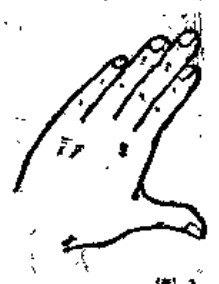
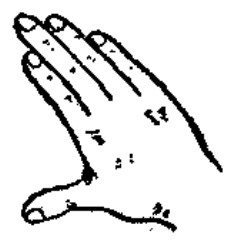
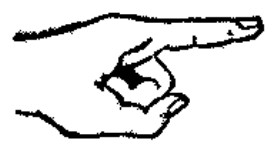
-
Back of the Head: Feeling the qi continuously lingering for many days below the Yuzhen Gate at the back of the head; the qi force is weak, approaching the gate, yet falling back down, unable to pass through the gate and ascend. At this time, the method of “consciousness guiding” can be adopted—that is, focusing the consciousness to guide it upward toward the crown of the head, which will allow it to break through the gate and ascend. However, it must be noted that this method is limited strictly to situations during normal qi circulation where the qi force is too weak to pass through the gate. It must never be used carelessly, and once the gate is passed, its continued use must be prohibited immediately.
-
Both Temples: Feeling the qi mechanism stagnating at both temples, neither advancing nor retreating, feeling somewhat swollen, coming and going, seeming painful yet not painful, occurring on both sides simultaneously or only on one side. The operating method uses the “Crane Beak Strength” (He Zui Jin) hand technique (Figure 1). That is, on the side with the issue, target the Longyao point (located directly above the tip of the ear, about three fen up). Press the tip of the index finger onto the point, applying internal power, causing the fingertip to vibrate, swaying gently about twenty times, then stop.
-
Shaking the Head: During the process of entering tranquility, the head shakes involuntarily, twisting slightly, symmetrically left and right, even reaching angles that normally cannot be twisted; at this time, it may twist past, and in severe cases, it can twist completely backward. The operating method uses the “Piercing Heaven Strength” (Tong Tian Jin) hand technique (Figure 5), solely targeting the Suowen point. This point is located in the center of both ears and is one of the nine great extraordinary acupoints. Gently insert the middle finger into the ear canal, rotating slightly forward, then rotating back and gently turning once or twice, while slightly vibrating the middle finger to create a drumming sound within the ear, rumbling dong dong long long. This can also produce string and wind instrument sounds within the ear, playing gong gong chi chi. Then, suddenly pull the two fingers out of the ear.
(2) Shoulders, Chest, Back, and Hands
-
Shaking the Shoulders: During meditation, the shoulders spontaneously sway left and right, or both shoulders rise and fall together, corresponding symmetrically left and right, very regular and symmetrical. The method is first to use the “Dragon Holding a Pearl Strength” (Long Xian Zhu Jin), applying pressure bilaterally to the “Taiyang Sui” points. Then, using the single-hand “Leopard Pounce Strength” (Bao Pu Jin), apply pressure solely to the “Dazhui” acupoint (located within the neck at the first vertebra; press the cervical vertebra with a finger, then rotate the neck—the cervical vertebra that does not move is the point). Use the pad of the thumb from the “Leopard Pounce Strength” technique, pressing the finger pad firmly against the Dazhui point (never use the tip of the thumb, or it will injure the person). After pressing the finger pad firmly, immediately rotate the thumb, pulling inward toward the center of the palm to pluck the fine tendons on both sides of the spine, like plucking a stringed instrument, repeating five times, causing that fine tendon to ring clearly. Both the practitioner and the recipient will hear this crisp, harp-like sound; this is the measure of success.
-
Hand Dancing: During meditation, the hands involuntarily rise, performing various dance-like postures, soft and flexible, beautiful as a nine-tailed fox; even experts marvel at the sight, feeling ashamed of their inferiority (but afterward, they cannot do it at all). ·185
The method uses the “Snake Head Jin” (Figure 8) or “Crane Beak Jin” technique, hooking downward. The thumb, index, middle, and ring fingers of the right palm are also lightly pinched into a fist, with the palm center facing the belly and the back of the hand facing directly forward, pointing skyward. The left palm is held vertically at a 90-degree angle, placed below the lower abdomen. This grip method was formerly called the “Golden Hook Seal” (金钩印). Those who do not practice the Heavenly Cycle Circulation Method need not concern themselves with the breath; instead, practice the Method of Returning to Unity and Stillness, and one can return to the origin without such phenomena occurring.
If helping another person relieve a temporary condition, use the “Sword Decree Opening Qi Jin” (剑诀开气劲) technique: bring the index and middle fingers together, use the middle fingertip to press the Quepen acupoint (located at the depression between the anterior clavicle and the collarbone head, near the clavicular head), vibrate the fingertip, simultaneously flick the wrist, pluck and roll the thick tendon in the depression, and it will stop immediately.
The Quchi acupoint can only be located accurately in a flexed-elbow posture, so during the patient’s movements, one must wait until the elbow joint is bent and then seize the opportunity to locate the point. The Quchi acupoint is located in the crevice of the elbow joint when bent.
III. Waist, Abdomen, Legs, and Feet
1. Twisting the Waist with Left-Right Swaying: During practice, the waist initially sways gently left and right, then rotates in circles alternately, with the left and right complementing each other. The number of rotations on each side should be equal. If one cannot control this and experiences dizziness:
The operation method is to first use the “Crane Beak Jin” technique, with the thumb and index finger tips pressing the “Tiancheng point” (at the tip of both ears — fold the ear forward and locate the crease tip), lift upward, then release, and lift again. Repeat this two to five times. Next, use the “Leopard Pounce Jin” technique to simultaneously grasp the “Lachi Pass” (獭驰关) from behind (located on the large tendons on either side of the fourteenth vertebra in the lumbar region). Lightly place the index finger against the last rib while first placing the thumb against the spine. The two fingers should lightly touch, with the index finger and thumb forming a parallel line. Then spread the thumb outward to the side. You will feel a thick tendon beneath the finger; press the thumb against the tendon and vibrate slightly. The rotation will immediately stop, and the qi mechanism will be balanced.
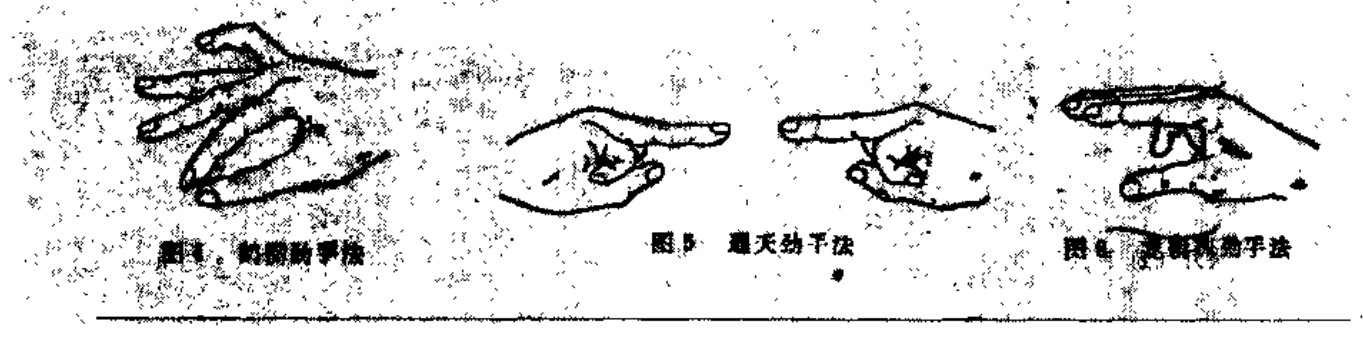
2. Lower Dantian Surging: During practice, one feels the lower Dantian surging intensely. With each inhalation, the Dantian correspondingly sinks inward like a deep pit, as if it were a bottomless cave. With exhalation, it bulges outward like an inflating balloon, as if one had a large belly.
The operation method uses the “Crane Beak Jin” technique to bilaterally grasp the “Front Lock Strips” (前锁条) of the Belt Vessel (located on either side of the navel, approximately 4–5 cun apart, i.e., below the tip of the floating ribs, at the lower end of the “Zhangmen” acupoint, where there is a thick tendon about the size of the little finger, roughly 4–5 cun long, slanting into the lower abdomen in an inverted V-shape). Using the thumb and index fingertips, aim parallel to the navel at a point about four to five cun to either side. Open the “crane beak” and tap the middle segment of the “Front Lock Strip,” as if a white crane were pecking at an eel. At the moment of contact, close the “crane beak,” grip the “lock strip,” and gently pull it outward, rolling the tendon so that it makes a gurgling sound. The surging phenomenon will then subside and normalcy will be restored. Additionally, adopt the “Spirit and Qi in Unity” (神与气合) practice method, in which one unifies the intention with the breath — going in and out, exhaling and inhaling as one. Do not continue using the “Intent Guarding the Dantian” (意守丹田) method, and thereafter this phenomenon will not recur.
3. Cold and Heat in the Back and Chest: During sitting practice, if one feels intolerable heat in the back or chest, one can use the “Ha” (哈) syllable formula — open the mouth and vocalize the sound “Ha” to exhale outward, and the heat will subside or dissipate. If cold chills occur, even to the point of shivering, one can use the “Weng” (嗡) syllable formula — close the mouth, hold the breath, silently recite the sound “Weng,” seal all seven orifices, produce the resonance of the “Weng” sound, rouse the true qi to permeate the chest and back and rise directly to the head, so that all seven orifices are filled with harmonious yang qi, and the sensation of cold will completely vanish.
The operation method described above pertains to the internal visualization method for personal practice. If helping another person practice, use the “Flat Finger Jin” (平指劲) technique (Figure 9), bilaterally targeting the Xinshu (心俞) and Geshu (膈俞) acupoints (located on either side of the spine at the fifth and seventh vertebrae, respectively, 1.5 cun from the spine). Use the thumb tip to press into the acupoint deeply while the other four fingers grip opposite the thumb, clasping a thick tendon and holding it firmly. Press inward with the thumb, then pull outward, lifting and rolling the grasped tendon. Repeat this three or four times, and the yin-yang cold-heat phenomenon will immediately be brought into balance. The person receiving treatment will feel very light and comfortable throughout the entire body.
4. Chest-Diaphragm Breathing: During practice, one feels qi rushing upward; upon exhalation, it is as thick as a finger, shooting out of the mouth to a distance of one or two feet, then being inhaled back inward, descending into the Dantian like a live snake darting in and out.
The operation method: when a general practitioner encounters this phenomenon, one should stop practicing this particular method, or change from the cross-legged posture to the Zhenwu sitting posture (Zhenwu sitting is also called the “Straddling Crane Sitting” — take a relatively tall stool, place a cushion on it, first place the left leg in the half-lotus position, relaxing the hip, knee, and ankle joints as much as possible; then turn the sole of the right foot to face upward and to the right, and gently rest the midpoint of the right thigh on the left sole; the right foot must rest firmly on the ground, not suspended in air; sit stably; then turn the left palm face upward, lightly pinch the thumb, index, middle, and ring fingers into a fist, hook only the little finger around the right hand’s little finger, interlocking them; do not practice the “Intent Guarding the Dantian” method again, and this phenomenon will not recur thereafter.
·186
it disappears.
① White Dragon Pill (白龙丹): The White Dragon Pill is refined through a special method and is not easily obtained. For convenience, one may directly use the “pill mother” (丹母), which is also effective. The main ingredient of the White Dragon Pill mother is saltpeter (皮硝). A piece about the size of a broad bean can be placed in the hollow of each palm, facing the center of the transverse crease below the ring finger. The palm may be extended or clenched into a fist at will. After a short while, the saltpeter will naturally dissolve and disappear, and the erection will subside.
② Yang-Retracting Pill (缩阳丹): The prescription for this medicine consists of leech (水蛭, roasted), musk (五分), storax/benzoin resin (苏合香, one qian), and honey (appropriate amount). Roast the leech thoroughly as prescribed, grind it into a fine powder, add the musk and storax, and grind again until well blended. Store in a porcelain vial. When an erection occurs, temporarily mix with honey to the right consistency—neither too wet nor too dry—shape it to the size of a copper coin, and apply it to the Yongquan acupoint (涌泉穴) on the sole of the foot. However, it should not be applied for too long; once the erection subsides, remove it immediately. If the erection recurs the next day, apply it again.
Leech collection and processing method: The leech (水蛭), also known as the horse leech (蚂蟥), grows in fields and marshes and belongs to the class of annelid worms. It is most appropriate to collect them on the seventh day of the seventh lunar month. Place them in a hemp cloth bag and hang them in a well-ventilated area to dry in the shade. Do not treat them with lime.
- Qi Leakage from the Front and Rear Yin: During sitting practice, one may consciously feel qi flowing in and out from the front yin (genitals) or the rear yin (anus). This is called “qi leakage.” If this condition persists for a long time, one may consciously experience this phenomenon at all times, even when not practicing. Although this is not greatly harmful, it easily leads to nocturnal emissions.
The corrective method is to have the patient lie supine. Using the “Sword-Signature Qi-Opening Power” (剑诀开气劲), single-target the Shenque acupoint (神阙穴, i.e., the navel). Press the tip of the middle finger into the center of the navel, initially using a yin hand (palm facing downward), then immediately flip the wrist to become a yang hand (palm facing upward), and then immediately flip the wrist again, returning to a yin hand sword-signature (剑诀). This method is quite difficult to master. The key points of operation are:
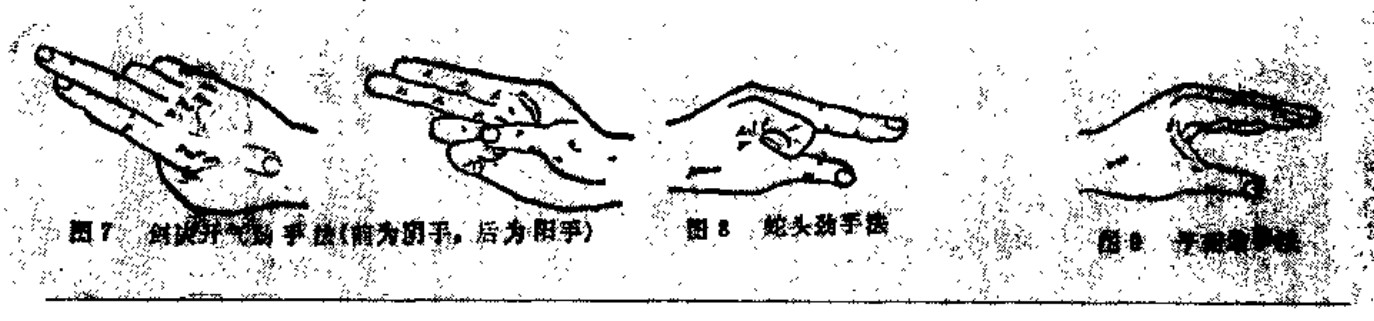
(1) Only the wrist may be flipped; do not arbitrarily rotate the elbow joint or forearm.
(2) The internal force when changing from yin to yang is on the fingerprint side of the middle finger; the internal force when changing from yang to yin is on the fingernail side of the middle finger. In both cases, use the outer edge of the middle finger.
(3) When the middle finger presses into the navel, it should not go too deep. The standard is: press in with the middle finger until the index finger touches the skin.
(4) The fingernail of the middle finger must be trimmed neatly and smooth. After performing this manipulation, have the patient lie prone. Then, separately using the “One-Finger Zen Power” (一指禅劲), single-target the “Yang Qiao Gate” (阳跷关, located in the joint between the second vertebra of the tailbone). Press the tip of the index finger precisely on the acupoint, applying the “wriggling power” (蛹动劲) of internal force—i.e., slightly flexing and extending the three joints of the index finger, like the movement of a silkworm pupa—until the patient feels a sore, aching sensation. It should not be too forceful or too light.
Additionally, the patient should frequently rub the two palms together to generate heat, then turn the palms and press them against the Mingmen acupoint (命门穴, located one and a half cun on either side of the fourteenth vertebra of the spine). At the same time, draw up the Huiyin acupoint (会阴穴), as if holding back urine and feces.
- Erection (兴阳): During practice, one may feel sexual desire arise with an erection that will not subside, or even upon waking at dawn, this phenomenon may occur when not practicing.
Some people have an inadequate understanding of qigong and mistakenly believe this is a good phenomenon. They even use methods to encourage this condition, leading people astray into the trap of “bedchamber arts” (房中术). Those who listen to such fallacies will not only fail to achieve longevity but will actually meet an early death.
When this phenomenon occurs, one should perform self-correction using the “Thousand-Catliff Gate” (千斤闸) hand-seal method: have the thumb pinch the inner side of the second section of the ring finger, near the intersection with the middle finger. Use the tip of the thumb to press on the point, and engage the first joint of the thumb to generate “wriggling power” (蛹动劲), so that the thumb tip slightly vibrates the key point on the ring finger. Inside this key point there is a thread-like fine tendon; flick it left and right, as if plucking a pipa, producing a gurgling sound, causing a sensation that is sore with a slightly burning, tingling mild pain. This can disperse the “ministerial fire” (相火) and subside the erection, returning to a state of quiescence.
For treating erection, in addition to proper self-correction, two types of medicinal pills may be selected for combined use. These are introduced separately below.
- Numbness When Sitting Cross-Legged: This is a phenomenon commonly experienced by beginning practitioners. In some cases, the numbness is so severe that one cannot stand up for several minutes. Although not greatly harmful, it will gradually disappear with continued practice. However, this is a hardship for beginners, so correction should be performed according to the following method.
The method is: when the legs and feet become numb, use the hands to extend both legs outward, sit with the legs hanging down, put the shoes back on, and then immediately take a relatively hard object (such as a pencil) and insert it along the inner side of the foot into the shoe, positioned at the center of the sole. At the same time, the inserted object should be slightly angled toward the sole of the foot. When this object is inserted, one will immediately feel the numbness retreating section by section from the toes and sole of the foot, dissipating like smoke.
(Excerpt from Qigong Medicinal and Dietary Therapy and Correction of Deviation Surgery, published by Shanxi People’s Publishing House)
·187·
Qigong and Nutrition
Weng Weijian
The Lunheng advocates “appropriately supplementing with medicinal guides.” Cao Pi, in his Dianlun, cited ancient health cultivators who “could abstain from grains and consume Poria (fu ling)” — all promoting such nutritional medicinals. Unlike modern medicine, Chinese nutritional medicine holds that food, beyond its role in sustaining the body and relieving hunger, functions above all — just as medicines do — in health preservation, disease prevention, treatment, anti-aging, and rehabilitation. Therefore, in the process of qigong health preservation and therapy, food and nutritional products can play an active, supporting role.
Throughout history, ancient qigong practitioners have held two attitudes toward their own dietary nutrition: one is juegu (abstaining from grains), the other is fushi (ingesting medicinals). The former maintains that health preservation, disease elimination, and longevity depend entirely on qigong exercise. For example, the silk manuscripts unearthed from Han Tomb No. 3 at Mawangdui include a chapter titled “On Abstaining from Grains and Consuming Qi,” which discusses the benefits of grain abstention for qigong. The Shiji (“Records of the Grand Historian”), in the chapter on the Marquis of Liu, also records that Zhang Liang, being prone to illness, “did not eat grains while practicing daoyin” and “then learned the practice of bigu [grain abstention] and daoyin to lighten the body.” Indian yoga practitioners embody this teaching: after completing their training, a qigong master may be buried in the earth for several days — even tens of days — without eating or drinking.
The dietary school, however, raised objections to the grain-abstention school. The Eastern Han philosopher Wang Chong, in his Lunheng, addressed those who abandoned food in favor of daoyin, saying: “Even if one is not full from grain, the qi may already be abundant — yet this is still a form of emptiness.” Ge Hong of the Jin dynasty, in the Baopuzi (“Master Who Embraces Simplicity”), chapter “Za Ying,” also refuted the school of breath-eating and grain abstention, calling it “the one-sided theory of a single school.”
Upon reviewing ancient medical and religious texts, one finds that successive generations of health cultivators all emphasized nutritional regulation, and those advocating the combination of daoyin with nutrition always constituted the majority. For instance, the esoteric scriptures of Buddhism, the Daoist texts on “inner landscapes” (neijing) and “ingested medicinals” (fu’er), almost universally advocate “seasonal ingestion of medicinals” and “ingestion of external alchemical preparations.” What exactly is er (饵)? It refers to certain natural nutritional products, not ordinary “worldly cooked food.” Indeed, health cultivators who daily consumed such er as Poria, Chinese yam (shanyao), pine pollen, and sesame would not go hungry. Looking further at the records of Buddhist and Daoist practitioners throughout history — whose cuisine was meticulously refined and whose delicacies were exquisitely prepared — one can appreciate the refinement of their nutritional health practices through the sophisticated techniques for preparing medicinal dew (lu), boiling tea, refining elixirs, preparing flying powders (feisan), and decocting medicinal pastes (ao gao).
Ancient health cultivators advocated that daoyin should be combined with dietary nourishment. Their theoretical basis is exactly as stated in the Lingshu: Wuwei Pian (“Spiritual Pivot: Chapter on the Five Flavors”): “The essence qi of Heaven and Earth generally exits three [parts] and enters one [part]. Therefore, if grain is not consumed, in half a day the qi declines; in a full day, the qi diminishes.” Thus, during the process of internally gathering energy through qigong practice, relatively refined nutritional supplements are required. When a qigong practitioner emits external qi, their energy metabolism involves an even greater output, further demanding nutritional substances to replenish the body.
For those practicing qigong, how should nutrition be managed? Two main questions must be discussed: first, what to eat; second, how to eat.
One of the distinctive features of Chinese nutritional medicine is that food and medicine share the same origin, the same principles, and the same applications. Therefore, what is food? What is medicine? It is very difficult to distinguish between them. Chinese medicine holds that since the two share the same principles and applications, distinguishing between them is essentially meaningless. Since ancient times, the selection of natural nutritional substances by health cultivators has not been constrained by the boundary between food and medicine, because both share the same functions of tonifying deficiency, draining excess, and regulating yin and yang. In terms of dosage and therapeutic efficacy, natural nutritional medicinals such as ginseng, deer antler velvet, wolfberry (gouqi), silver ear fungus (yin’er), Poria (fuling), and Polygonatum (huangjing) are all superior to ordinary foods. For this reason, ancient qigong practitioners commonly used these as er (medicinal preparations), taking them regularly to replenish the body.
Chinese medicine holds that the dietary intake of both healthy and ill individuals should not — and cannot — follow a single fixed pattern. There are issues of variation depending on the individual, locality, season, and illness. The dietary and nutritional perspective of modern practitioners of Chinese medicine is grounded in the assessment of what is appropriate and what is contraindicated. The nutritional value of a food should not be judged by its rarity, novelty, fame, or cost, but rather should focus on what is appropriate and what is contraindicated, in order to achieve the goal of “prescribing meals according to pattern differentiation” (bianzheng yongshan).
The appropriateness and contraindications of diet are reflected in terms of constitution, region, season, age, condition of illness, and therapeutic requirements.
Below, in connection with qigong health preservation and therapeutic circumstances, is a brief introduction to the principles for applying commonly used foods and nutritional medicinals.
I. Attention to the Relationship Between Constitution, Practice Method, and Foods/Nutritional Supplements
For those of ordinary constitution who practice general health-preservation qigong methods, one may consume foods and nutritional supplements of generally neutral and balanced nature and flavor, such as long-grain rice, wheat, corn, soybeans, sweet potatoes, pork, eggs, milk, Chinese cabbage, potatoes, carrots, honey, royal jelly, Chinese yam, wolfberry seeds, and Poria. However, one may also consume in moderation foods with slightly warming or cooling properties, or warming and tonifying nutritional supplements. For special constitutions, one must also pay attention to other dietary appropriateness and contraindications. For example, for those with a thin physique, irritability, tendency to anger, and a “wood-fire constitution” (mu huo zhi) or “yin-deficiency constitution” (yin xu zhi), light and bland categories such as fruits, vegetables, and grains, as well as moistening foods like dairy and eggs, are appropriate; whereas lamb, dog meat, scaleless fish, seafood, and [warm-natured items should be avoided].9
- 188 -
Spicy, heat-inducing, and yang-assisting foods should be avoided. For instance, individuals with a “phlegm-dampness constitution” (characterized by being overweight, feeling heavy, and having an abundance of phlegm) should eat light, dampness-draining foods such as fruits, vegetables, grains, and beans; fatty meats, animal fats, and dairy products should be contraindicated. Similarly, for those with a “yang-deficiency constitution,” fish, poultry, meat, eggs, and a moderate amount of spicy-warm foods are suitable; whereas cold meats, cold drinks, and excessive amounts of fruits and vegetables should be avoided.
Traditional Chinese Medicine (TCM) health preservation considers that the general elderly constitution has “often deficient yin and often excessive yang,” frequently manifesting as dry mouth, dry tongue, thirst, dizziness, flushed face, irritability, and constipation. Therefore, dietary regulation for elderly qigong practitioners should also be light. For tonification, it is advisable to consume neutral-nourishing and clear-nourishing products such as milk, eggs, and soy products. Mutton, dog meat, sea shrimp, deer antler velvet, deer fetus, ginseng, placenta, and various “whip wines” are all contraindicated for the elderly unless they have specific medical conditions.
How to Choose a Qigong Practice Venue
Diao Huanxiang
TCM qigong theory believes that the sky has heavenly qi, the earth has earthly qi, and humans have bodily qi; human qi connects with and corresponds to the qi of heaven and earth. Humans have a close relationship with their environment, and practicing qigong to cure diseases and strengthen the body requires an appropriate environment. According to relevant literature and the author’s own practical experience, qigong should be practiced in locations near mountains and water, featuring trees, flowers, and plants, quiet and silent, with fresh air, and flat terrain. These environments offer the following benefits:
- Mountain and water environments are beneficial for treating diseases and improving health: The humidity here is moderate, and its relative humidity is roughly equivalent to the human body’s water content (about 60%). Practicing in such an environment facilitates physical relaxation and clear pores.
- Flowers, plants, and trees: Lush vegetation here absorbs carbon dioxide and releases oxygen. This in itself creates a therapeutic environment, as the oxygen content in the air here far exceeds 2%. Qigong masters mostly prefer areas where pine and cypress trees grow, primarily because these plants are evergreen and can provide ample oxygen year-round.
- Quiet environment: When practicing, one is required to enter a state of tranquility (i.e., thinking of nothing, practicing qigong with self-intention). An elegant and quiet environment is ideal. If there is noisy human chatter or sudden shouting, it can easily cause a fright, disrupting the state of tranquility and physical relaxation to a certain extent, and thereby affecting the efficacy of the practice.
- Fresh air: This refers to relatively pure air, which the human body needs for its normal supply. If the air is polluted, containing large amounts of carbon dioxide (exhaled air, products of combustion), toxic gases like carbon monoxide (coal gas), or factory emissions and dust, it is detrimental to the body’s normal gas exchange and can even be toxic.
- Flat terrain: When practicing (especially dynamic qigong), a certain amount of space is required. During movement practice, one mostly moves with closed eyes; if the terrain is uneven and bumpy, there is a risk of stumbling.
II. Combining the Requirements of Health-Preserving Qigong, Leveraging the Unique Deficiency-Supplementing and Uprightness-Supporting Effects of Food
Food also has the positive effects of strengthening the body without disease and preventing aging. According to relevant literature, common foods possess over twenty health benefits. For example: round-grained rice sharpens hearing; pig liver brightens the eyes; black sesame blackens hair; pig skin promotes hair growth; buckwheat increases strength; walnuts enhance intelligence; milk moisturizes the skin; coix seed improves skin; lotus seeds beautify the complexion; lotus leaf lightens the body; winter melon seeds increase muscle; beef strengthens tendons; dog meat boosts yang; deer fetus replenishes essence; sparrow brain aids fertility; and Chinese yam prolongs life.
Ancient nutritional health products with health benefits, found among single-ingredient dietary formulas, include the method of consuming Polygonatum sibiricum for rejuvenation (from the Sheng Hui Fang); the Goji berry decoction for tonifying deficiency and prolonging life (from the Qian Jin Yao Fang); the method of consuming Polygonatum odoratum for beauty and wrinkle removal (from the Sheng Hui Fang); the method of consuming sesame to turn white hair black (from the Tai Shang Xuan Bian Jing); the method of consuming Cuscuta to brighten the eyes and prolong life (from the Bao Pu Zi); the method of consuming Schisandra chinensis to benefit the lungs and kidneys (from the Sheng Hui Fang); and the method of consuming chrysanthemum to regenerate lost teeth (from the Yu Han Fang), etc.
III. Coordinating with Qigong Reduction Methods, Leveraging the Purgative and Evil-Dispelling Effects of Food
Many individuals in poor health or suffering from chronic diseases hope to achieve the goal of supporting the upright qi, driving away evil qi, and restoring health through qigong practice. Clinically, many diseases characterized by excessive pathogenic factors require the application of reduction (purgative) methods first, and qigong therapy also includes reduction methods such as guiding upward, submerging downward, leading outward, and dispersing. To coordinate with the qigong reduction methods, here are some reducing (purgative) foods and nutritional health products:
- Relieving the Exterior: Ginger, scallion, mustard greens, coriander, perilla leaves, fermented soybeans, peppermint, mulberry leaves, chrysanthemum, etc.
- Clearing Heat and Purging Fire: Water bamboo, bracken fern, tea, bamboo leaves, etc.
- Clearing Heat and Cooling Blood: Pagoda tree flower, bitter greens, lotus root, eggplant, water spinach, wood ear mushroom, sunflower seeds, etc.
- Clearing Heat and Generating Fluids: Sugarcane, tofu, fermented bean curd, tomato, persimmon, citrus, olive, lemon, apple, raisin tree seeds, kudzu root, etc.
- Clearing Heat and Detoxifying: Purslane, leaf beet, soybean paste, mung bean, bitter melon, century egg, honeysuckle, elm flower, clam meat, etc.
- Clearing Heat and Dispelling Summer Heat: Watermelon, watermelon rind, melon, water caltrop, adzuki bean, mung bean, lotus leaf, sweet wormwood, etc.
- Clearing Heat and Resolving Phlegm: White radish, winter melon seed, loofah, water chestnut, laver, jellyfish, seaweed, kelp, Malva nut, Ganoderma, Trichosanthes, Platycodon, etc.
- Warming and Resolving Cold Phlegm: Onion, almond, silkworm pupa, mustard seed, etc.
- Stopping Cough and Calming Asthma: Lily bulb, pear, water chestnut, loquat, peanut, rock sugar, ginkgo nut, apricot kernel, etc.
- Invigorating Blood and Resolving Stasis: Peach, rapeseed, arrowhead, black soybean, wine, vinegar, earthworm, etc.
- Stopping Bleeding: Lotus node, field thistle, pagoda tree pod, cattail pollen, etc.
- Promoting Qi Movement: Citron, tangerine, tangerine peel, bergamot, spearmint, shallot, bamboo shoot, buckwheat, ham, etc.
- Promoting Urination: Chinese cabbage, amaranth, celery, winter melon, cucumber, alfalfa, plum, grape, carp, crucian carp, Poria, bottle gourd, etc.
- Lubricating the Intestines and Relieving Constipation: Plum pit, banana, peach, monk fruit, coconut meat, honey, dwarf flowering cherry, hemp seed, etc.
- Dispelling Wind-Dampness: Cherry, cat meat, quail, Acanthopanax bark, etc.
- Warming the Interior and Dispelling Cold: Cinnamon, chili, pepper, Sichuan pepper, fennel, blood clam, sword bean, leek, clove, star anise, dried ginger, etc.
- Anti-Cancer: Asparagus, carrot, mushroom, cabbage, turnip, cauliflower, bitter greens, coix seed, Apocynum tea, etc.
Other life-prolonging, body-lightening, and complexion-enhancing dietary treatments will be discussed later.
Extracted from “Chinese Qigong” ·189 Beginner’s Guide
At present, many countries around the world attach great importance to the research and promotion of qigong. We must strive relentlessly so that China’s scientific research on qigong not only keeps pace with the tide of the times but stands at the forefront of the world. This may be said to be the historical mission entrusted to us by our era.
On the eve of humanity’s entry into the “Century of Life Sciences” (the 21st century), qigong—this treasure of the Chinese nation—has cast off the outer garments of superstition and pseudoscience and restored its true scientific countenance, attracting serious attention from the international scientific community and ascending to the research stages of many nations. It may truly be called “new blossoms on an ancient tree, its renown spreading across the globe.”
Since the beginning of the 20th century, qigong has gradually been introduced to the West and has increasingly garnered the attention of Western scholars. In the 1930s, the French Sinologist Maspero introduced China’s qigong methods of “embryonic breathing,” “ingesting qi,” and “breath retention” in the Journal Asiatique. In the 1950s, the renowned British scientist Dr. Joseph Needham discussed Chinese qigong in his monumental work Science and Civilisation in China, analyzing it from a modern scientific perspective. Some European physicians also designed therapies similar to qigong based on the principles of Chinese qigong, such as Germany’s “autogenic respiratory training,” the United States’ “relaxation therapy” and “meditation therapy,” among others.
In the United States, the Parapsychology Association was established as early as the 1950s (Editor’s note: the international academic community generally classifies qigong within the scope of parapsychology), and in 1969 it was formally admitted to the American Association for the Advancement of Science. Its research scope includes Chinese acupuncture, qigong, martial arts, Indian yoga, modern biofeedback, and hypnosis. According to Professor Niu Manjiang, clinical application experiments of qigong in the United States are also very active. At Rockefeller University in New York alone, approximately 500 people participated in experiments using qigong to treat hypertension, and after half a year, over 75% of patients showed significant improvement. American scientist Chen Deren proposed collaborating with Chinese qigong physicians to study qigong therapy using scientific methods. By the 1970s, over a million Americans had completed “Transcendental Meditation” training, which is similar to qigong’s entering stillness, with nearly thousands of participants each month.
In the United Kingdom, Sir William Crookes (chemist and physicist), President of the Royal Society of London, was the first to use scientific methods to study the mechanism of qigong. After prolonged observation and experimentation, he announced that “psychic energy” indeed exists, and that qigong is not incomprehensible but has a material basis. In 1974, at Birkbeck College, University of London, two physics professors, Hasted and Bohm, conducted a groundbreaking experiment. An Israeli psychic named Geller (see the excerpt from Geller’s Own Account in this collection), under remote-controlled conditions, caused metal objects to visibly bend and fracture. Over a dozen scientists participated in and monitored this experiment, confirming its authenticity.
In the United Kingdom, one of the major factors causing illness and premature death is hypertension. Because qigong’s therapeutic effects are remarkable and long-lasting, it is very well received. It has also been studied as a component of healthcare. The authoritative British Broadcasting Corporation (BBC) published an article titled “Qigong Used in Medicine” in the combined issue of Modern English, No. 12, 1979, which had wide influence.
In Canada, there is a dedicated Chinese Qigong Institute. The Ontario Medical Association has over three hundred medical doctors interested in qigong therapy, and many have joined the research effort. The 1974 Nobel Laureate in Physics, Josephson, and the 1977 Nobel Laureate in Chemistry, Prigogine, among other internationally renowned scientists, have also participated in the research and discussion of qigong. In the city of Toronto, Canada, a Qigong Meditation and Health Society was established as early as 1979, offering day and evening classes, Chinese and English classes, and new classes each week. In addition to studying internal practice and seated meditation, they also study daoyin (guiding and pulling exercises). Los Angeles in the United States has also established a “University Students’ International Meditation Therapy Association.”
·190·
techniques, breathing exercises, and the external practice of the Eight Brocades. The society also published various qigong textbooks in both Chinese and English, such as: Discussions on the Foundations of Internal Cultivation and Stillness, Lecture Notes on Practical Methods of Sitting Meditation, A Simple Introduction to Sitting Meditation for Self-Learners, and Notes on Sitting Meditation. Clinical applications of qigong practice, according to early 1980s statistics from Canada, involved over 3,000 participants. They not only treated a number of functional illnesses caused by psychological factors but also cured some organic diseases. According to reports by Dr. Gate and Dr. Brown of Canada, they used “biofeedback”—monitoring patients with modern instruments to assist their qigong practice and improve training outcomes—to treat 200 patients, with the result that 60% experienced complete disappearance of symptoms, 32% showed improvement, and 8% were ineffective.
In West Germany, qigong was abbreviated as “TM,” meaning Transcendental Meditation—quiet contemplative sitting or “self-cultivation through seated meditation.” The practice involved sitting quietly twice daily for twenty minutes each time, requiring a tranquil posture and a still mind, entering a state of profound repose described as “neither sleeping, nor dreaming, nor waking,” which they called the “fourth state of consciousness.” According to a report from two years ago, over 100,000 people in West Germany were then participating in “TM” activities, belonging to 80 different centers. Participants included students, engineers, teachers, housewives, and the elderly. Notably, some athletes achieved excellent competitive results after joining “TM,” reporting optimal athletic form.
In Switzerland, an international qigong research center was established as early as the 1960s, focusing on physiological and biochemical research, and collaborated with India to train a number of senior qigong masters. Maharishi European Research University in Switzerland, beginning in 1975, conducted comprehensive research on qigong from the perspectives of physiology, biochemistry, psychology, and sociology. According to a 1978 report from this university, qigong masters at the university’s research center could cause their bodies to levitate when emitting qi. Using electroencephalography (EEG) for experiments, they detected abnormal brainwaves on the heads of Indian qigong practitioners (yoga masters), demonstrating that qigong could increase the amplitude of brainwaves threefold, and that brainwave activity across different regions tended toward synchrony—that is, the electromagnetic activity of brain cells became highly ordered. In 1978, this university held over 30 academic conferences and published a collection titled Transcendental Meditation and the Art of Flying. They also formulated an ambitious comprehensive research plan, inviting scientists from around the world to come and participate in joint research. Over several years, they cultivated several thousand university students and published over one hundred papers.
In Japan, as early as the Heian period (794–1192 CE), books on qigong had already been transmitted to Japan, such as: Techniques of Regulating the Breath and Guiding Qi, Illustrations of Guiding Methods, Prescriptions for Cultivating One’s Nature, and The Classic of the Pure Girl. From that time onward, qigong spread widely among the Japanese populace and was used as a means of treating illness. In modern times, Japan is also one of the countries with the most enthusiastic qigong activity. Currently, the most popular form of qigong in Japan is the “Relaxation Therapy.” Japan’s qigong research began relatively early and extensively; among its achievements, the clinical application of therapeutic information devices has been particularly noteworthy. They once sent personnel carrying instruments to the Shanghai Research Institute of Traditional Chinese Medicine in China for academic exchange and demonstrations, achieving a high level of proficiency.
In other Asian countries, such as India, Indonesia, Malaysia, and others, qigong activities have long been popular among the people. In India, for example, qigong was widely promoted among students, and an international qigong training center focused primarily on teaching yoga techniques was established to cultivate qigong talent for countries around the world and dispatch qigong experts abroad. In Malaysia, the capital city of Kuala Lumpur had the Bairi Gong Health Academy (this practice originated from Mount Emei in Sichuan, China). The academy had over 60 branch schools with numerous students and enjoyed a strong reputation in Southeast Asia.
The fact that other countries place such importance on the research and application of qigong is not only because qigong has the efficacy of preventing and treating illness and extending life, but also because, as research deepens and practical applications expand, it has become increasingly clear that scientific qigong is truly a golden key to unlocking the mysteries of life science. The extraordinary functions and miraculous effects demonstrated by qigong in scientific research in recent years, and the formidable challenges they pose, are presenting severe tests for modern science. As the birthplace of qigong, China has a responsibility to strengthen qigong scientific research, catch up rapidly, move to the forefront of the world, bring glory to the nation, bring benefit to the people, and make our contribution to the progress of all humanity!
- Compiled and translated by Li Jisheng
- Excerpted from Spring of Sports
- Compiled by Xin Er Si
Overseas Qigong News
Yoga Master: Zangweier Sinha
I had long heard people say that in the past, the ascetic monks of India cultivated a wondrous skill through practice, enabling them to walk barefoot over burning charcoal and sharp iron caltrops with ease, completely uninjured. If one trained in yoga from childhood as a youth cultivation practice, one could develop an even greater variety of skills. The actual performance of twenty-year-old Zangweier Sinha confirms that this is no mere legend! His hands could bend four finger-thick iron rods bound together as if coiling a rope; he could snap a 400-gram steel plate in half as though folding paper. With his knee, head, and palm, he could simultaneously break three solid bricks. When thick iron chains were wrapped around his body, a single exertion of force would cause them to snap apart. Furthermore, when a person weighing 70 kilograms was bound with rope, he could lift that person as lightly as a crane, using only his teeth.
Zangweier Sinha could also use his elbows to block two advancing jeeps. He said: “People all regard my abilities as magic. No! They are the result of my six years of persistent yoga practice, under the guidance of my teacher, India’s treasure—the yoga master Arjun.”
Zangweier Sinha was selected as a yoga master for both the 1982–83 and 1983–84 academic years. Born in a rural village, Zangweier Sinha is a strict vegetarian. His physique is upright and well-proportioned. He enjoys eating legumes, raw fruits, and vegetables.
Indian Yoga
Ma Jiren
(Concentration [Dharana], Meditation [Dhyana], and Absorption [Samadhi]) — the first five limbs constitute external yoga. The latter three limbs constitute internal yoga. Restraint and observance refer to eliminating external influences; posture quiets the body; breath control liberates the body; sensory withdrawal controls the sense organs, making them steady; concentration fixes the mind on a single point; meditation is reflection, sustaining the concentrated awareness toward higher states of consciousness; absorption leads to the even higher stage of Prajna (wisdom, Prajñā). Its training methods can currently be roughly divided into yoga meditation, yoga hard qigong, and yoga gymnastics, but in terms of health preservation, its practice can be divided into two major categories: static and dynamic.
Through training, every muscle in the human body is required to become capable of carrying out activities according to one’s will. Modern instrumental testing has shown that during static yoga exercises, the body’s basal metabolic rate decreases, blood circulation accelerates, oxygen consumption is reduced, and the oxygen concentration within the lungs increases. After practice, the nervous system and body can obtain full rest. Those who have practiced for many years can control their breathing so that they breathe only once every few minutes; some can even be buried underground for several hours without suffocating. In India, after certain schools promoted the yoga meditation method, practice has proven that yoga has remarkable effects on improving children’s physical health and promoting the development of brain intelligence. When yoga is applied clinically, many patients’ conditions have shown incredibly favorable improvements and recoveries.
Yoga is a method of body-mind cultivation from the Indian Yoga school. It shares similarities with Chinese qigong. They also require practitioners to focus their attention on a specific image, sound, or movement, and through meditation ultimately reach a state of selflessness. They also aim to achieve relaxation and similar goals. Therefore, it can serve as a reference for qigong practitioners in China.
I. Overview of Yoga
Yoga is a school of ancient Indian philosophy. It is neither a religion nor an art of sorcery. Its supreme classic is the Yoga Sutras. According to tradition, the author of the Yoga Sutras, Patañjali, is the founder of this school. The meaning of “yoga” is union or integration — signifying the unity of body, mind, and spirit. It is roughly divided into five schools: Hatha Yoga, Rāja Yoga, Jñāna Yoga, Karma Yoga, and Bhakti Yoga. Each has its own specialized texts, but the fundamental idea shared by all is that people need only undergo long-term discipline, cultivate a series of “virtues,” and adopt appropriate methods to train their own bodies — it seems one can thereby come to understand the essence of things. The virtues referred to are spiritual cultivation. Yogis are required not to envy others, not to surpass others, and to submit to their own fate, and so on. Content related to this aspect falls outside the scope of this article. This article only introduces its training methods, because in terms of yoga itself, the training methods not only occupy a great proportion in their related writings, but in people’s minds, it is also often not regarded as a philosophical system, but rather as a health and fitness art capable of training the body and strengthening the constitution. Thus it is simply called yoga, and it is a precious national heritage of India.
The training methods of yoga are divided into eight parts, known as the Eight Limbs (Aṣṭāṅga): Restraint (Yama), Observance (Niyama), Posture (Āsana), Breath Control (Prāṇāyāma), Sensory Withdrawal (Pratyāhāra), Concentration (Dharana), Meditation (Dhyana), and Absorption (Samadhi). The preliminary purpose is to clear the mind of ordinary distracting thoughts and to make every effort to restrain the flow of thoughts, preventing them from drifting aimlessly. Not only must the mind be stabilized, but it must also be truly settled upon the present moment, fixed and immovable. When first beginning, one will always notice that the mind resists this demand and often slips away from the present toward the past or the future. Therefore, one is required to be indomitable and persevering, even using strong effort to master it.
II. Static Training
1. Willpower Training
Those who practice yoga must clear away distracting thoughts, restrain the flow of ideas, and maintain stillness. Ancient Yoga Sutras once compared the human mind to a mad giant elephant. It must be calmed and tamed. This training method is called Samprajanya in yoga terminology — that is, willpower training. Yogis regard tranquility as the fundamental law of life, the foundation of a truly healthy body and increased wisdom.
The best method for practicing Samprajanya is to sit upright.
- 192 -
(3) Starting from the toes, relax all the muscles of the entire body. Guide your awareness to the feet, lower legs, knees, thighs, abdomen, chest, hands, arms, shoulders, head, and other areas, eliminating their tension and gradually relaxing them. When the localized sensation in each area’s muscles disappears, concentrate your awareness on the heart region.
5. Method of Clearing the Ghostly Lines
Yoga holds that at the center of the human body there is a tube-like line extending from the fontanelle at the crown of the head, along the spine, directly to the anus. The left ghostly line is called “Ida,” and the right is called “Pingala.” Ida transmits yin qi, while Pingala transmits yang qi. By practicing the method of clearing the ghostly lines, the body can attain extremely robust vitality; at this stage, the body may experience a sensation of anesthesia. The method is as follows:
(1) Sit cross-legged and practice mental stillness.
(2) Slowly inhale through the left nostril while closing the right nostril with the fingers of the right hand. When you can no longer inhale, close the left nostril with another finger and hold the breath for as long as possible.
(3) When you can no longer endure holding the breath, release the finger closing the right nostril and slowly exhale through the right nostril.
(4) Inhale through the right nostril; the procedure is the same as above.
(5) Alternate between the left and right nostrils. Practice three times daily, approximately one hour each session; three months constitutes one stage.
Note: The above is the preliminary method. More complex methods involve combining meditation on Sanskrit letter forms with the human form. Yoga also holds that along the front ghostly line of the human body there are a number of ghostly spheres (chakras) that cannot be observed by the naked eye. There are six primary ghostly spheres, also called ghostly wheels. From bottom to top, they are: the Muladhara (root) wheel, the Svadhisthana (generative) wheel, the Manipura (navel) wheel, the Anahata (heart) wheel, the Vishuddha (throat) wheel, and the Ajna (between-the-brows) wheel. At the very top there is also the Sahasrara (crown) wheel. Within the Muladhara wheel resides the ghostly serpent. Through a complete set of methods—meditative visualization and concentrating one’s thought between the eyebrows—one awakens the spiritual serpent, causing it to gradually rise upward until it reaches the crown wheel. Practicing this method requires considerable foundational training and specific guidance. The front and back ghostly lines are similar in pathway to the Ren and Du meridians in Chinese tradition. Some believe this may have resulted from mutual exchange with ancient Chinese qigong.
1. [Preliminary Practice]
[Find] an extremely quiet place and silently chant OM, OM, OM… OM is the sacred symbol of yoga worship, regarded as the divine sound emitted by the universal resonator. After about a month of this practice, one may then proceed to other forms of training.
2. Complete Breathing Method
This is a breathing method that enables all respiratory organs, the pulmonary alveoli, and the respiratory muscles to fully participate in activity. It is the foundation of yoga and must be learned and mastered thoroughly, serving as the basis for all other breathing methods. Beginners in yoga must first learn this breathing method until it becomes habitual and natural. This breathing method can expand the chest cavity, strengthen the lungs, and prevent and treat colds and nasal congestion. It is generally performed before other exercises. The method is as follows:
(1) Standing, sitting upright, or sitting cross-legged are all acceptable. Relax the upper body and keep the torso naturally upright.
(2) Close the mouth and breathe through the nose. Slowly inhale for eight seconds, filling the lower, middle, and upper portions of the lungs in sequence with the inhaled air. Finally, lower the diaphragm; then the lower ribs, sternum, and the entire chest cavity protrude further forward, expanding in all directions—front, back, left, and right.
(3) After the lungs are filled with air, hold the breath for eight seconds.
(4) Quietly exhale through the nostrils for eight seconds. Relax the chest, lower the shoulders, and contract the abdomen as much as possible to completely expel the air from the lungs.
(5) After the chest and abdomen are completely relaxed, repeat seven times.
3. Purification Breathing Method
This method can promote the regenerative capacity of lung tissue cells and can also eliminate fatigue. It is generally practiced after the complete breathing method, but can also be performed when feeling tired and exhausted. Actors and singers who practice it after a performance can quickly eliminate fatigue. The method is as follows:
(1) Stand with the feet naturally apart.
(2) Slowly inhale through the nose for eight seconds, then hold the breath for eight seconds, as in the complete breathing method.
(3) Press the lips tightly together, leaving a slight gap in the middle, so that the exhaled air escapes through the tiny opening. During the exhalation process, you may pause the breath two or three times. After pausing, continue exhaling until all the air is expelled. Repeat this process three times.
4. Relaxation Breathing Method
This method allows the nervous system to obtain complete rest. Practicing for ten minutes in a state of relaxation and tranquility may be more effective than an entire night’s sleep. It is generally scheduled after all other exercises are completed. The method is as follows:
(1) Lie on the back, with the feet separated approximately shoulder-width apart, and the hands placed at the sides with the palms facing upward.
(2) Breathe naturally, gradually slowing from a faster to a slower pace.
·193·
Effect: Strengthens the abdominal muscles; exercises the internal organs and strengthens the lower back; promotes bowel movements; can treat prolapse of internal organs.
(2) Toe-Grasping Forward Bend Exercise Method
(1) Lie supine, feet together and extended straight, hands placed at the sides of the body; inhale. (2) Slowly raise the hands while sitting up, exhaling gently at the same time. (3) Bend the upper body forward, fingers grasping the toes; inhale. (4) Continue bending at the waist, lowering the head until it touches the knees; exhale at the same time. (5) Relax the entire body, inhale while slowly straightening the upper body, and return to the supine position.
Effect: Exercises the abdominal and lower back muscles; can eliminate internal organ dysfunction; can treat lower back pain and backache, diabetes; eliminates abdominal fat; strengthens the spinal bones, making them supple and increasing elasticity.
(3) Plow Exercise Method
(1) Lie supine, feet together and extended straight, hands placed at both sides, palms against the ground; inhale. (2) While exhaling, slowly raise both legs to a right angle and hold for 10–15 seconds. (3) While inhaling, bring the feet over the head until the toes touch the ground; keep both arms in their original position with palms against the ground. (4) Stretch the feet straight so the toes are farther from the head, shifting the body weight onto the upper end of the spine. (5) Return to the original supine position. Beginners should repeat 3 times, gradually increasing to 10 times.
Effect: Exercises the spinal nerves, corrects misaligned vertebrae, improves internal organ function, regulates menstruation, treats diabetes and headaches caused by anemia, eliminates fat from the abdomen and waist, and quickly relieves fatigue.
(4) Cobra Exercise Method
(1) Lie prone, feet together and extended straight, shoulders relaxed, elbows bent and placed at the sides of the chest near the armpits, palms on the ground; inhale deeply.
III. Dynamic Exercises
In yogic practice, one category of dynamic exercises is named after various animals — such as the peacock, cobra, locust, and fish — by reference to their postures and movements; another category is named after everyday implements, such as the plow pose, bow pose, and bellows pose; yet another category is named after the characteristic features of the exercise posture, such as the kneeling pose, shoulder-stand pose, headstand pose, toe-grasping forward bend pose, and abdomen-to-back pose. This section introduces thirteen dynamic exercise methods. As for their effects, since they have not yet been subjected to clinical observation and practice in China, the following descriptions draw only on foreign reference materials and are provided for informational purposes only.
(2) While exhaling slowly, press firmly with both hands and slowly raise the upper body — first lifting the head, then the cervical vertebrae, then the chest, raising one vertebra at a time, lifting as high as possible. At this point, the area below the navel remains firmly pressed against the ground, while everything above the navel is lifted, face pointing upward; hold the breath for approximately 7–12 seconds. (3) While exhaling, slowly relax the entire body and return to the prone position.
Effect: Exercises the abdominal muscles; overcomes stiffness and obstruction of the vertebrae; can prevent kidney stones.
(5) Fish Exercise Method
(1) Sit in the double lotus position. (2) Move both hands backward, using the elbows as fulcrums, and lean the body backward. (3) Rest the crown of the head on the ground, arching the chest; body weight is supported by the crown of the head and the feet. (4) Grasp the toes with both hands and breathe quietly. (5) Return to the original position in reverse order.
Effect: Relieves tension in the neck, removes feelings of pressure in the head, expands the chest, and purifies the thyroid gland and tonsils.
(1) Yoga Mudra Exercise Method
(1) Sit in the double lotus position. (2) Extend both hands behind the back, grasping the right arm with the left hand, and slowly bend the upper body forward from the waist. (3) Bend while exhaling, until the forehead touches the ground. (4) Hold the breath, maintain this posture as long as possible, then slowly inhale while straightening the upper body.
Buried Alive for Twenty Years
The Holy Monk Is Still Alive
Excerpted from Digest Weekly
It is said that the relevant authorities are attempting to seek answers through medical and dental records.
In 1967, in India, the holy monk Baba Singh Vidashu10 ordered his faithful followers to bury him alive. This underground burial became a major news story that shocked the world at the time. By the end of last year, twenty years had passed. His followers brought him out of the coffin — now seeing daylight — and what astonished people was that this holy monk was still alive, his face looking exactly the same as twenty years before, without any change.
A physiologist, Dr. Jehan Air11, said: “There are some people in the world who can achieve this kind of death-like meditation state. As long as he enters this state, all the organ movements in his body can slow down, and he can survive without food or water.”
(VI) Bow Pose Exercise Method
(1) Lie prone, feet together and legs straight, relax the entire body, and slowly inhale. Extend both hands backward, bend both knees, soles facing upward, and grasp both ankles with the hands. (2) Raise the head and lift the chest, forming a bow shape with the chest. (3) While slowly exhaling, return to the prone position, focusing the intention on the pelvis. Repeat twice.
Effects: Exercises the abdominal muscles, corrects spinal curvature, strengthens the entire spine and central nervous system; has beneficial effects on the thymus, stomach, liver, kidneys, pancreas, and other organs; especially strengthens the gonads, and is therapeutically effective for diabetes, early-stage penile atrophy, infertility, and menstrual irregularities. It can also treat obesity.
Treating Constipation through Massage
For patients with senile constipation or habitual constipation: when using the toilet, calm the mind and use the index fingers of both hands to respectively massage the Yingxiang acupoints (LI20) on both sides; at the same time, mentally visualize the rectum slowly writhing downward from top to bottom. Alternatively, mentally visualize the movement beginning from the ascending colon, proceeding from the ascending colon to the transverse colon, descending colon, sigmoid colon, and finally to the rectum. Repeat multiple times; after several minutes, the urge to defecate will arise and the bowels will move freely.
— Lin Zhengping
(VII) Locust Pose Exercise Method
(1) Lie prone, legs straight, make fists with both hands, palms facing upward, placed at the sides of the body. (2) After inhaling, hold the breath; press the fists firmly against the ground and lift both legs straight upward, head held straight, chin touching the ground. (3) Hold this position as long as possible, exhale slowly, then return to the original position and inhale. (4) Focus the intention on the pelvis and lower spine.
Effects: Strengthens the abdominal muscles, develops the lower back, makes the spine strong and robust, corrects anterior spinal curvature, regulates the functions of the liver, pancreas, spleen, and kidneys, treats constipation, expands the lungs, and increases vital capacity.
(VIII) Kneeling Pose Exercise Method
(1) Kneel and sit, spread the feet apart, bend the knees, and sit on the ground between the feet. Place both hands at the sides of the body. (2) Extend both hands backward, support the body with both elbows, and lean backward, taking a deep breath. (3) Let the back of the head touch the ground, then let both shoulders touch the ground, with both arms extended straight on either side of the head. Focus the intention near the heart and stomach.
Effects: Exercises the feet, knees, and waist, making them strong and robust; can treat indigestion, constipation, sciatica, and insomnia.
(IX) Peacock Pose Exercise Method
(1) Separate the feet, bend both elbows, and kneel on the ground with palms on the floor, fingers pointing toward the feet. (2) Lean the upper body forward, apply force with both hands, support body weight with the hands, and slowly extend both legs straight backward while taking a deep breath. (3) After inhaling, hold the breath; shift the center of gravity forward, lean the upper body forward, lift the toes off the ground, and support the entire body weight with only the forearms, keeping the spine straight. From face to toes, the body is parallel to the ground, suspended in the air. (4) While exhaling, slowly return to the original position.
Effects: Strengthens digestive function, treats constipation, prevents diabetes, and expands the chest.
(X) Shoulder Stand Exercise Method
(1) Lie supine, legs straight, hands at the sides of the body, inhale. Keep both upper arms on the ground, lift both legs straight upward, and support the upper lower back with both hands. (2) From the shoulders downward, form a straight line, with the chin pressed against the chest. Maintain this posture without straining. (3) Exhale, slowly lower the body and both legs, and lie quietly for one minute.
Effects: Enhances sexual function, prevents reproductive organ disorders, corrects abnormal uterine position, treats indigestion, constipation, and rectal prolapse, and promotes vigorous metabolism.
(XI) Headstand Exercise Method
(1) Kneel, cross both hands on the ground, bend both elbows forward and place them on the ground, lean the body forward, raise the crossed hands to cradle the back of the head, and let the crown of the head touch the ground. (2) Lift the toes off the ground and draw the body upward. (3) Slowly extend both legs straight into a straight line. Maintain this position for five minutes, breathing naturally. (4) Lower both legs and return to the original kneeling position. This is one of the most difficult exercise methods.
Effects: Treats liver, spleen, and urinary system disorders; treats diabetes, constipation, uterine and ovarian disorders, infertility, and neurasthenia; and improves memory.
(XII) Abdominal-to-Back Breathing Method
(1) Sit in full lotus position or stand at attention, bend the upper body slightly forward, place both hands lightly on the knees, and inhale deeply. (2) Exhale forcefully through the mouth, raise the diaphragm as high as possible, tightly contract the abdominal wall, draw the internal organs up toward the chest, and simultaneously contract the rib cage as much as possible. (3) Hold the breath, then inhale quietly and deeply through the nose. Repeat several times. Beginners should perform this once daily, preferably on an empty stomach. This is considered an advanced yogic breathing method.
Effects: Promotes digestive function, especially stimulating intestinal peristalsis; also effective for rectal prolapse, gastroptosis, and uterine prolapse.
(XIII) Bellows Breathing Method
(1) Sit in full lotus position and breathe forcefully and rapidly ten times. (2) Close the left nostril with the ring finger of the right hand and slowly inhale through the right nostril. (3) Close the right nostril with the thumb, press the chin against the chest, and hold the breath. (4) Release the thumb and exhale rapidly through the right nostril. (5) Switch to inhaling and exhaling through the left nostril, with the same technique as the right nostril breathing. The above can be performed ten times for each nostril.
Effects: Treats rhinitis, pharyngitis, asthma, and lung diseases; prevents colds.
Excerpted from Selected Qigong, Continued Edition
Currently, scientists around the world have gained a fairly deep understanding of the human body. They believe that the data related to the human body could fill an entire library. The National Library of Medicine, located near Washington, D.C., the capital of the United States, is renowned as the world’s largest medical library. It holds over 3.1 million records related to the human body. Each year, it subscribes to 24,000 medical journals from around the world. This library is about to publish a Human Almanac. This almanac reveals some of the most astonishing and vitally important facts about the human body. Below is an excerpt from the book.
★ The throat is one of the body’s busiest passageways. Through the mouth and throat, a person consumes 40 tons of food and inhales 4.99 million cubic yards of air over a lifetime.
★ The human eye is extremely acute; standing on a mountaintop at night, a person can see the flame of a match from 50 miles away.
★ The human brain’s nervous system is 1,400 times more complex than today’s global telephone network. Currently, neurologists have mapped only a portion of it.
★ One square inch of human skin contains approximately 645 sweat glands, 77 feet of nerves, 1,000 nerve endings, 65 hair follicles, 75 sebaceous glands, and 19 feet of blood vessels.
★ Lack of sleep causes death more easily than starvation. If a person does not sleep for ten days, they may die; if starving, they might not die until several weeks later.
★ A tall person sheds 600,000 skin particles per hour. Calculated this way, they would lose 0.68 kilograms of skin in one year. If they live to age 70, they will lose 47.7 kilograms of skin over their lifetime.
★ The human brain contains 10 billion nerve cells and can record 86 million bits of information each day. It is estimated that the human memory system can hold 100 trillion bits of information over a lifetime.
★ If the metabolism of the human brain were converted into energy, the energy it produces would be equivalent to that emitted by a 20-watt light bulb.
★ When you lie in bed, you inhale about 8.8 liters of air per minute. If you sit, you consume 17.6 liters of air per minute. If you go for a walk, you breathe 26.4 liters of air per minute. If you run, your body may need 55 liters of air per minute.
★ One minute after darkness falls, the eye’s sensitivity to light increases 10-fold; after 20 minutes of darkness, it increases 6,000-fold; after 40 minutes of pitch darkness, the eye’s light sensitivity reaches its limit—25,000 times greater than before dark.
★ Your brain undergoes 100,000 different chemical reactions every second.
★ Of all the sensory data continuously received by our five senses (sight, hearing, smell, taste, and touch), only 1/100 is processed by the brain, while the remaining 95/100 is filtered out as irrelevant information.
★ The average square inch of the human body hosts 32 million bacteria, meaning the human body harbors a total of 100 billion bacteria.
★ The sensory patch responsible for the sense of smell is only 3/4 of a square inch in size. By comparison, a hound’s olfactory patch is at least 10 square inches, a shark’s is 24 square inches, and a mouse’s olfactory receptors cover its entire body surface.
★ A red blood cell in the human body can travel over 1,600 kilometers during its four-month lifespan.
★ The fastest nerve impulses in the human brain travel at approximately 250 miles per hour.
★ The human brain can recognize an object within 5/100 of a second after the reflected light from the object first enters the eye.
★ Every day, a person loses 45 hairs; some people lose 60 per day. However, since the human scalp naturally has over 120,000 hairs, this loss is of little consequence. Over a lifetime, a person may lose more than 1.5 million hairs.
★ The energy consumed by the human heart each day is equivalent to the energy needed to lift approximately 2,000 pounds to a height of 41 feet. By the time a person reaches age 50, the total work accomplished by their heart is equivalent to lifting 18,000 tons to a height of 142 miles.
★ If all 4.6 billion people in the world spoke simultaneously, the sound waves they produce would generate energy equal to the output of a small power station.
Compiled and translated by Li Chaobi
Based on Science Digest (USA)
Human Teeth Are Shrinking
According to a study by anthropologists at the University of Michigan in the United States, over the past 100,000 years, the surface area of human teeth has decreased by 45%.
Bruce and others measured the teeth of modern humans and prehistoric humans and found that the area of human teeth has noticeably shrunk: the area of the third molar decreased from an average of 260 mm² to 200 mm², and the average area of incisors decreased from 144 mm² to 80 mm². Since the beginning of the last Ice Age (approximately 100,000 years ago), human tooth area has shrunk by 1% every 2,000 years, continuing until the end of the last Ice Age (approximately 10,000 years ago). From then until the present day, the rate of human tooth shrinkage has doubled, that is, approximately 2% every 2,000 years.
Excerpted from Shanghai Translation Journal
·196
Strange People and Strange Events
A Person Who Carries Electricity
The incident occurred on the morning of November 28, 1983. Shi Jun, a nurse at the medical clinic of Haishiwan Station of the Lanzhou Railway Bureau, got up as usual and went to the washstand to get water to wash her face. The instant Shi Jun’s fingers touched the faucet, her arm went numb with a tingling sensation, as if she had received an electric shock. She then casually touched the heating radiator, and her arm had the same electric shock sensation. Shi Jun found this bizarre, so she told Meng Zhiyan, another young woman who shared her dormitory room. Then Shi Jun went to pick up a comb to comb her hair. Her right hand accidentally brushed the little finger of Meng Zhiyan’s left hand, and Meng Zhiyan felt her little finger go numb. Out of curiosity, she used her right index finger to touch Shi Jun’s finger, only to receive a powerful “electric shock” immediately. This sudden, strange occurrence left both of them bewildered. That day, the two of them made contact with each other unintentionally on multiple occasions, and each time Meng Zhiyan suffered an “electric shock” from Shi Jun.
At around seven o’clock that evening, Shi Jun went knitting in hand to visit the quarters of the train inspection crew chief. Four workers happened to be there watching television as well. Half an hour later, Shi Jun asked Song Xingfu, an inspection crew member sitting next to her, to help her wind yarn. While gathering the yarn, Song Xingfu’s right fingers touched Shi Jun’s left wrist, and Song Xingyu’s right arm immediately received an “electric shock.” Song Xingfu asked in puzzlement: Do you have something in your hand? Shi Jun replied, “My body carries electricity.” Everyone was half-believing, half-doubting. Someone jokingly told Shi Jun to stay away from them, saying they were afraid of getting “shocked.” Shi Jun smiled and walked out of the room; every time she lifted her foot, the plastic slippers and the ground produced a “squeaking” discharge sound. Everyone in the room heard this noise.
Within less than two hours, all the nearby residents knew about Shi Jun’s body carrying “electricity.” A young worker named Wang Lin did not believe it and gathered several people to go find Shi Jun for a test. Shi Jun used her right index finger to touch the back of Wang Lin’s right hand. At the point of skin contact, a series of continuous “squeaking” discharge sounds erupted. Wang Lin yelped “Ow!” and hastily withdrew his already-numb arm. Inspection crew member Qin Benke, crew chief Tian Jinzhong, and others all took turns testing it. No matter who it was, as long as they touched Shi Jun’s body, they immediately suffered a powerful “electric shock.” Everyone was astonished and alarmed by this. Overnight, Shi Jun became the newsmaker of Haishiwan Station.
Regrettably, by the time we met Shi Jun, the phenomenon of her body carrying “electricity” had already disappeared. According to Shi Jun herself, she had never experienced the phenomenon of her body carrying “electricity” before. The “electricity” was strongest on the twenty-eighth. She slept normally on the night of the twenty-eighth. The next morning, the “electricity” was slightly weaker, and it gradually disappeared by the afternoon. When her body carried “electricity,” she was wearing a Dacron shirt on her upper body, an acrylic sweater as an outer layer, black dacron serge trousers on her lower body, nylon socks, and ordinary foam plastic slippers. In the days before and after her body carried electricity, her mood, clothing, and diet were no different from usual. The only thing was that she felt physically uncomfortable when delivering an “electric shock” to others.
A Person Who Sprays Fire
In a barber shop on Rua do Tarrafeiro in Macau, at the end of November last year, a young customer was having his hair washed. He wore a nylon waterproof cloth draped from his neck down his front, and a towel around his neck to prevent his clothes from getting wet. Suddenly, he felt a stinging pain in his neck. Because hot water was being used to wash his hair at the time, he assumed that a bit of hot water had seeped through the towel or run down into his neck, causing the pain. When hot water was used to rinse again, he once again felt the pain in the same spot intensify even more. At this point, the hair-washing stylist noticed smoke emanating from the towel around the customer’s neck and cried out in alarm: “There’s smoke! There’s smoke!” The young customer immediately removed the towel and the waterproof nylon cloth and discovered that both pieces of fabric and his collar all had burn marks. His neck also showed a burn mark about the size of a coin, so he immediately applied medicine for treatment. All who witnessed this sudden, startling event were dumbfounded.
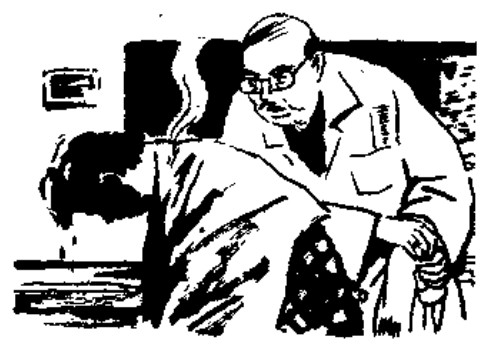
The injured person is surnamed Li and is a printing worker. He said that because his body emitted fire, it ignited the flammable clothing he was wearing, resulting in burns to his skin and flesh.
Early last spring, while passing through a shopping mall on Rua da Areia with his family, he noticed a weighing scale at the entrance and decided to weigh himself. When he took off his coat in order to get an accurate weight and handed it to his sister who was accompanying him, his right thumb and index finger suddenly emitted a fleeting spark. And when his sister touched his hand, she also felt a tremor like an electric shock. It turns out that during the dry weather of autumn and winter, he sometimes feels a slight sting and electric shock sensation when opening the door of his private car and touching the metal handle.
Why does the human body spray fire? This is a mystery of nature. Generally speaking, under specific environmental conditions—for example, in the dry winter—when people walk on carpets, anyone can accumulate thousands of volts of static electricity. Similarly, when a hand touches a car door, dry skin contacting a metal surface can also easily produce a stinging sensation and a feeling of electric shock. That is to say, static electricity has not only been proven to be emitted from hair, but it is also possible that one in forty thousand people may have their body spray fire due to static electricity. A person whose skin is abnormally dry and carries extremely high voltage is entirely possible.
Excerpted from Hong Kong’s Science and Technology World
My Special Abilities
[Israel] Uri Geller Translated by Lu Jinlin and Tan Shujie
Recommender’s Note: The world-famous psychic—Uri Geller—was born in 1946 in the city of Tel Aviv, Israel. During his childhood, his special abilities caused various doubts among his family and the people around him. As time passed, his special abilities caused a great sensation in many countries. Many radio stations, television networks, newspapers, and magazines reported his performances as headline news.
Even today, humanity is still unable to explain its own special abilities using modern scientific theories. However, in this world, there are only things that have not yet been cognized; there are no things that cannot be cognized. It can be firmly asserted that humanity will eventually use its own wisdom to uncover the mystery of the human body’s special abilities.
In order to help people better understand and care about the mystery of special abilities, I have specially selected and excerpted portions of the text from My Special Abilities, recently published by the Scientific and Technical Documents Publishing House, to dedicate to my unseen friends—the readers of Dongxi Nanbei (East, West, South, North) magazine.
Guan Yu, Changchun Second Hospital
Just like usual, with a touch of my hand… Just like usual, I placed my hand on the key, hoping it would bend. Keys, knives, and forks all bent.
When I moved my hand away from Jimmy Young’s key, the key began to bend, and continued to bend. Jimmy turned pale with fright, and he almost shouted: “The key is bending right in front of me, I simply can’t believe it!” His words, spoken with nervous excitement, were broadcast live across the British Isles.
On a morning in November 1973, I walked into a British Broadcasting Corporation (BBC) studio to be interviewed on the “Jimmy Young Show.” Jimmy was very warm and friendly; he made me feel completely at ease, just like at home.
At the beginning of the show, Jimmy asked some general questions. He asked when I first discovered that by just gently stroking a key, nail, or other metal object a few times, I could make these things bend; and when I knew I could make a clock or watch that hadn’t ticked for years start working again. I replied that I had noticed these things in my early years of elementary school. At that time, my classmates, teachers, parents, and even I myself were all amazed.
Then he asked me if I would be willing to perform a demonstration for him. Of course, I had already promised to do a demonstration before accepting the interview. Jimmy pulled a rather thick Yale lock key from his pocket and placed it in front of me. Just as usual, I placed my hand on the key, hoping it would bend.
When I moved my hand away from Jimmy Young’s key, the key began to bend, and continued to bend. Jimmy was terrified, and he almost shouted: “The key is bending right in front of me, I simply cannot believe it!” His words, spoken with tense excitement, were broadcast live across the British Isles.
The next evening, I went to the BBC again to perform in front of television cameras. There were two other guests on this television program. One was Professor John Taylor, a prominent mathematician in the Mathematics Department at King’s College, University of London. I heard he was very fair and unbiased. The other was Dr. Lyall Watson, a renowned biologist and the author of Supernature.
Various objects were spread out on the table: forks, spoons, broken watches, and keys. When I gently stroked a spoon with two fingers, the spoon almost folded in half after a short while. At the same time, a fork on the table bent without anyone touching it. I then stroked another fork, and the fork continued to bend until it finally snapped in two…
half, and the handle of the fork fell onto the table. I then concentrated fully and scanned the broken watches on the table; almost immediately, those malfunctioning watches began to tick again, while Lyle Watson’s watch, which had been keeping perfect time, suddenly stopped. Among those broken watches, the hands of one suddenly curled up and stuck to the watch face.
Professor Taylor had approached the program at the outset with a skeptical attitude, and now seemed shocked by everything that had happened; others were too. Among the articles published in British newspapers, one pleased me the most. It was written by Clifford Davis, the television commentary editor for the Daily Mirror, who was also a magician. He wrote in the Daily Mirror: “Any civilized magician could perform a similar demonstration, but that would merely be magic, whereas Uri’s performance was certainly the real thing.” Clifford Davis continued: “Anyone who can perform under such experimental conditions cannot be a fraud. Uri has undergone thirteen laboratory tests in the United States, proving that the power of thought in rare individuals can move inanimate objects or even bend them.”
Before I left London, a representative from the British newspaper The People on Sunday asked me to collaborate on what they considered a highly entertaining and astonishing performance. I would go to Paris, but I told them that at 12:30 p.m. London time, I would perform powerful gazing to see what would happen.
On Thursday, November 25, I was at Orly Airport in Paris, preparing to fly back to London. At 12:15 p.m., I began to focus my mind intently, hoping to transmit my thoughts and energy across the Channel. At exactly 12:30, I shouted: “Bend!” I have no idea whether the people in the airport thought I was crazy or what.
About ten minutes after my gazing, I told them the experiment would be very successful. In fact, it was extremely successful: before I had even finished speaking, the television bell in our room rang—the first call from the office of TV Picture Magazine in Copenhagen. The switchboard at TV Picture Magazine was already flooded with calls from readers reporting what had happened in their homes.
The most astonishing thing that happened this time was completely beyond my expectations. The magazine’s office in Copenhagen received a telephone call from the small island of Oro, located in Holbæk Fjord. A lady on the small island—a tendon that had been unable to bend for over two years was actually able to bend.
Afterward, I learned that within a few days the editor of The People on Sunday received over a thousand letters from readers. Several hundred discarded broken watches and clocks started running again, and all across Britain there were many forks and spoons that had bent.
What happened in Britain at the end of 1973 marked the first time this effect manifested in thousands of people, entering directly into their lives. Those who considered me an illusionist or a magician found themselves unable to explain it away—these things happened far away from me, and happened to other people.
The reaction of the British press at the end of 1973 was truly unforgettable. Brian Silcock wrote in The Sunday Times: “If people can really use the power of thought to bend metal, it would mean another revolution in science, far more profound than when Newton three centuries ago conceived of the universe as a clock.”
Strange Things Happened During My Performances
After those events in England at the end of 1973, I heard many more interesting reactions. During your performance at the BBC, several important timing and radio transmission devices malfunctioned strangely. These devices all seemed to stop working simultaneously during your live broadcast performance. I also heard that a project worth several million pounds was affected. That project was intended for “brain research”—this was truly marvelous. I had experienced similar situations before, so these events cannot be said to have completely stunned me. At the Stanford Research Institute in Menlo Park, California, when I was undergoing testing, rumor had it that a computer used for military engineering in the same building malfunctioned. This incident was never fully confirmed, but at the time it came to mind. I have traveled by air all over the world to give performances, and the planes have never had an accident—I am as glad of this as the pilots are—but there were three occasions when the movie projectors on Boeing 747 aircraft came loose for no reason, causing the film reels to fall out. Sometimes, an ashtray would suddenly jump off a table and fly to the other end of the cabin near the door.
On December 7, 1973, an editorial titled “A Challenge to Scientists” was published in the journal Nature. Because this journal enjoys a prestigious reputation among scientists, this editorial played an important role in resolving certain controversies and promoting research in this area.
Just before I was about to leave Denmark and return to England, a major Danish magazine, TV Picture Magazine, asked me whether I would be willing to collaborate on an experiment similar to the previous one, transmitting my energy from Paris to Britain: I would concentrate and gaze at a certain time, and the magazine would ask its readers to gaze simultaneously.
·199·
An old woman named Elizabeth Sorensen had just become a great-grandmother. I cannot say exactly when I began to notice some unusual things about myself. She was visiting her daughter-in-law, C. V. Bruhn, and her daughter on the island. The family decided, for fun, to try whether clairvoyance (as shown on television) could really make old watches start ticking again. According to the phone call they made, suddenly, Mrs. Sorensen discovered that her knee, which had been unable to bend for over two years, had actually begun to bend. A Danish reporter went there to interview her and found that she suffered from degenerative arthritis. She had not focused her attention on the broken watches, but rather on her knee.
I Can Transfer Numbers and Images on Paper into Another Person’s Mind
My mother noticed these unusual things before I did. She worked as a seamstress during the day, and although she hired a neighbor to look after me, I still had plenty of free time. My mother loved playing cards; her main entertainment was playing cards with friends. Even when I was in first grade, young as I was, I always waited for her to come home from playing cards before going to sleep, so I could say goodnight to her. Somehow, I was always able to tell whether she had won or lost at cards, or the exact amount of money won or lost — down to the precise number of pounds and shillings. I didn’t know how I knew, but I just knew her wins and losses. She was truly astonished because I could almost always tell her, and she didn’t know how to explain it, so she just shrugged it off.
Telepathy is also one of the performances I can do consciously. I can see covered-up pictures clearly in my mind. In a friendly, sympathetic atmosphere with little skepticism, I usually perform at my best. There were times when the pictures I reproduced were nearly identical to the ones I was asked to copy. I can write a three-digit number on a piece of paper or draw a picture, and, without letting another person see it, transfer that three-digit number or picture into that person’s mind. People tell me that the probability of guessing a three-digit number correctly is one in ten thousand, but I can frequently enable ordinary people without supernatural abilities to guess correctly.
These abilities also seem to give me supernormal vision. In one experiment at the Stanford Research Institute, researchers placed a die in a sealed iron box and shook it, then asked me to guess the number on the die. Out of ten trials, I was correct eight times. On two of those trials, I didn’t give an answer because the image of the die in my mind was unclear. The researchers told me that ordinarily, guessing correctly in this manner would happen only once in a million attempts.
I Had a Premonition That Something Would Go Wrong at the Zoo
Professor Taylor Says the Geller Effect May Destroy Modern Science
Once I went to the zoo with my mother. Although I was eager to go, as soon as I stepped through the zoo’s gate, a feeling of dread arose in my heart. I didn’t want to tell my mother, but I couldn’t control myself. I said, “Mom, I don’t want to visit the zoo today. We have to leave here.” My mother said, “But Uri, you’ve been clamoring to come all day today. Why do you want to rush to leave as soon as we arrive?”
“Mom, I have a bad premonition. I can’t explain why.”
“What do you mean, Uri?” my mother asked. “What’s wrong? Why exactly?”
I just said, “Mom, let’s leave, please?”
We walked toward the zoo’s entrance. As we were walking, suddenly an alarm bell rang — a lion had escaped from its cage. People were running and shouting; some climbed trees, others jumped into the river — panic was everywhere. The lion was strolling slowly back and forth, but by then we had already reached the entrance and safely exited the zoo. Fortunately, no one was hurt, and the zoo staff got the lion back into its cage. The thing is, I’m not normally one to change my mind so easily. When I insisted on leaving, my mother was very surprised.
In June 1974, after I was tested in the laboratory of Professor John Taylor at King’s College, University of London, Professor Taylor wrote the most emphatic of all declarations:
I Can See Exam Answers from the Back of a Classmate’s Head
In my laboratory at King’s College, University of London, I tested Uri Geller using specially designed instruments.
The Geller effect — bending metal — is clearly not achieved by trickery. The Geller effect is so anomalous that it poses a severe challenge to modern science. If no explanation can be found, the Geller effect could even destroy modern science.
As a scientist, I have investigated and studied about a dozen people who appear to possess the ability to bend metal. The ability to bend metal was first demonstrated very effectively by Uri Geller. Some of the people I tested could bend metal objects without touching them, just like Uri himself, while others could only bend metal when they heard or saw Geller performing on television.
The experimental results have been written up in two papers, with two more in preparation. In addition, a book will be published, titled: Supermind — An Investigation into the Paranormal.
I Often Blurt Out What My Mother Is About to Say
I was born on December 20, 1946, in Tel Aviv.
I was not a poor student, but neither was I a top student. During exams, I was often stumped by questions and didn’t know how to answer them. Once during a math exam, I looked at the back of Günther’s head — he was one of the best students in the class — and suddenly I saw his answers projected onto the screen of my mind. Just like that, I saw Günther’s answers on the screen, and I passed the exam with very good grades. After that, I relied on this method to get through exams. I would always pick the best student in the class for each subject and stare at the back of his head; his answers would then appear in my mind. I didn’t consider this cheating, but if you got right down to it, of course it was indeed cheating. The only problem I encountered was that I copied other people’s answers exactly, so the mistakes in my answers were exactly the same as those of the person I had copied from.
locked glass cabinet in the woman’s house, and she had never seen it before? These mysteries continue to exist, still without clear answers; only the number of times they receive experimental verification grows ever larger.
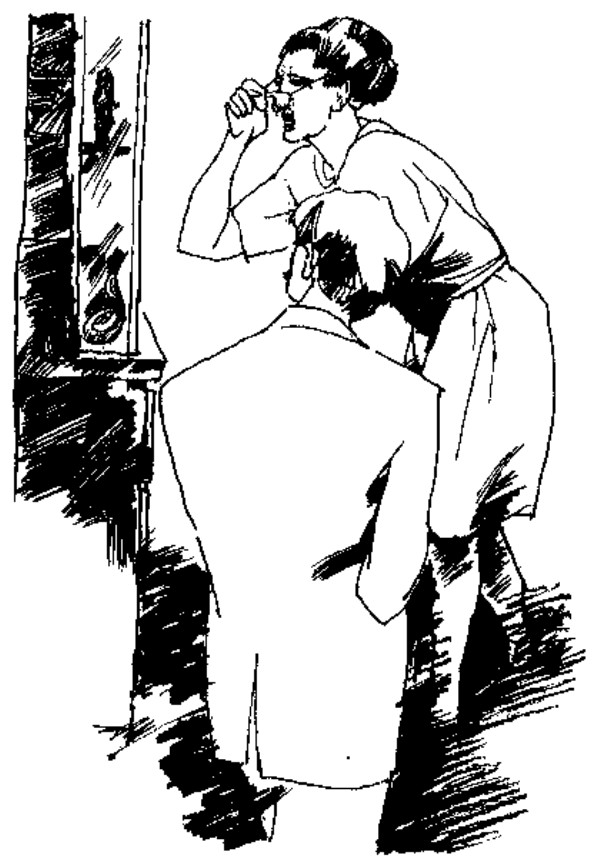
When all these things come together, I truly do not know what the deities ultimately wish to do. If there is one thing I do know, it is that these deities, no matter how difficult it is to make people believe in them, are still working diligently, communicating messages to people. My view is that this “energy” comes from a higher source and manifests through me. I am not talking about God here; I am talking about an “energy” that exists beneath God. To this day, I truly still do not understand those things that I have encountered or that have happened through me.
The goal I strive to achieve is this: I believe it is very important for the whole world to know about these deities, because they are real and will eventually be proven, although one must still wait some time. The alternative would be to hide everything away and keep it secret from people. I do not agree with this approach; I wish to make everything public. I know that this “energy” works only for the benefit of humanity and will never bring disaster. When that time comes, everything will function as a beneficial force.
I am certain that there are people on Earth who possess incredible power, but many among them have not yet realized it.
I think everyone receives some kind of message; the things that have happened to me, and that are happening to me, can also happen to you.
Excerpted from My Special Abilities, published by Scientific and Technical Documents Publishing House
When all these things come together, I am certain that there are people on Earth who possess incredible power
There was a very strange occurrence in an apartment in Italy where the mother of a friend of mine lived. One day in January 1975, I went to visit her. We had a long conversation about paranormal phenomena. Just as
Practical Pathways to Wealth
New Method for Making Sugar from Corn
Now that corn is piling up like mountains, turning corn into candy can be sold at several times the price. The new method for making sugar from corn is suitable for household and small enterprise production — no machinery, no electricity; production in large vats with manual operation suffices. Every one hundred kilograms of corn flour can yield 85 kilograms of sugar syrup, 55 kilograms of sugar blocks, and 50 kilograms of sugar residue. Sugar syrup is a high-quality ingredient used in the food industry for making bread and pastries, with extremely broad market demand. The sugar residue is excellent feed for raising pigs. The Wang siblings of Xingfu Village produced corn sugar and used the residue to raise pigs, earning 34,000 yuan last year — truly the best shortcut for farmers to become prosperous quickly. Our department transfers the complete set of technical materials; mail order is 8 yuan per copy. Please remit through the post office; materials will be sent upon receipt of payment, and we will also include introductions to over one hundred additional wealth-building techniques. We are responsible for arranging on-site visits and study. For training at our department, we guarantee teaching and mastery; tuition is 19 yuan.
Remittance address: No. 129 Lao Street, Luohe City, Henan Province. Attention: Yang Hui, Eastern Information Service Department, Yuanhui District.
we were talking, a small ashtray floated up from the table and then fell to the floor. A few minutes later, what we encountered became even more bizarre.
We heard a soft “snap,” as if it came from within a glass cabinet holding ceramics in the room. We walked over to look and found a small blue figurine placed on a shelf inside the cabinet. It was a miniature Egyptian statue, made of light blue ceramic material — so small it could fit in the palm of a hand. This terrified the lady of the house. The door to her glass cabinet had originally been locked, and there had never been such an object inside; she had never seen this little trinket anywhere before.
She opened the cabinet door, wanting to take it out. When she picked it up, the statue suddenly broke into two pieces. Startled, she dropped it. I was quick-eyed and quick-handed — before it could fall to the floor, I caught both pieces. The inside of the statue was made of brittle plaster of Paris. It was a statue of an Egyptian man, very much like the kind of cheap souvenir manufactured in Hong Kong or Taiwan, and it carried a strange, musty odor.
The lady of the house was somewhat frightened by this experience, and she asked me to take the statue away, so I did as she requested. After returning to New York, a friend of mine took it to the Metropolitan Museum, and then to the Brooklyn Museum. Both museums confirmed that it was an antiquity dating from 1200 to 700 BCE. At this point, one question still remained unanswered: how could such a rare and precious antiquity have ended up in the home of an Italian
·201
Pioneers Exploring the Strange World
Compiled and translated by Shen Yingjia
… and affixed his private seal. As a precaution, ink was then applied at the knot: if anyone attempted to open the box, the ink marks would show signs of disturbance.
Once everything was properly arranged, Dr. Yamakawa carried the box into the center of the experimental area, while Dr. Inoue monitored the experiment from an adjoining room. Everyone withdrew, and Chizuko began to concentrate with her eyes closed.
After settling her mind slightly, Chizuko opened her eyes and looked at the small box before her. She did not want to fail again. If she failed once more, people would regard her as a fraud, and she would have no face to return home. She had confidence in her own abilities, and her nervousness gradually relaxed. A cloud-like haze gradually suffused Chizuko’s mind; that elusive mass rotated and gathered, accompanied by a buzzing sound… After 10 minutes and 21 seconds had passed, Chizuko suddenly saw the characters on the calling card inside the tin pot. She nodded toward Dr. Inoue, and several scholars surged in, carefully inspecting the seals and knots for any irregularity. They asked Chizuko what characters she had seen. Chizuko said they were the three characters “道德天” (Dao De Tian). The scholars opened the still-sealed box, took out the calling card, and saw that it did indeed bear the three characters “道德天,” written in dignified script. This was in the handwriting of Dr. Genryō.
At this point, the scholars’ doubts vanished. They knew that using 500 Chinese characters to form any combination of three characters would yield over eighty million possible results, making it virtually impossible to guess correctly by luck. The scholars had witnessed a miracle with their own eyes and returned fully satisfied.
Chizuko could see through wooden boxes and tin tea pots, but she could not see through society and life. The successful outcome brought her tragic circumstances. People regarded her as a “freak” and mocked her at will. The very same scholars later felt that their conduct had been unbecoming, and so they dismissed Chizuko as merely “a stone” that “should have been taken out of the pocket and thrown away long ago.”
Yet there was one person who treated Chizuko, “this stone,” as a precious pearl. That person was Dr. Tomokichi Fukurai. He devoted himself to explaining the roots of these strange phenomena from a psychological perspective. But his ideas were too elevated for his audience, and Dr. Fukurai was fighting practically alone, ridiculed by eminent scholars as “not attending to his proper duties.”
Dr. Tomokichi Fukurai
The story to be told here took place in Tokyo, Japan.
On the morning of September 17, 1910, the Sekineya Inn at Awajichō in Tokyo was buzzing with excitement; passersby on the street could not help but stop and stare. Such lively scenes were not common in Tokyo at the time, and the fact that learned scholars from various fields had gathered at this small inn drew many journalists flocking to the scene.
Among those attending this gathering were several Doctors of Science, Doctors of Letters, and Doctors of Medicine. The host was Dr. Tomokichi Fukurai, a professor at Tokyo Imperial University. Although he held a doctorate in literature, he had developed a profound interest in extraordinary human abilities.
Dr. Fukurai’s purpose in inviting so many scholars was to have them authenticate the existence of latent human potential. He was rather naïve; he believed that with so many learned authorities present, they would be able to confirm Chizuko Mifune’s extraordinary abilities.
Sitting quietly to one side in a kimono, Chizuko Mifune was twenty-two years old that year. She was the first person with extraordinary abilities documented in Japanese written records. Born in 1888 in Matsuai Village, Uto District, Kumamoto Prefecture, Japan, her clairvoyant abilities made her widely known, and she became a celebrated oddity of the late Meiji era.
This experiment was Chizuko’s first time demonstrating her clairvoyant ability before “the foremost scholars of the land.” Starting from the 14th, the experiments had entered their fourth day. She had failed in the experiment the day before.
Given that the previous clairvoyance test using an object wrapped in lead sheeting had failed, this time a tin pot was used instead, with the same experimental procedure as before. First, six scholars, including Drs. Inoue and Genryō, each took out their own calling card and wrote three characters on it in regular script. Then Dr. Yamakawa took one of the cards and placed it inside the tin pot, and then placed the tin pot inside a box. The box was securely bound, and a seal was affixed at the knot. After the seal was applied, each scholar present verified it and affixed his private seal.
Meanwhile, at the same time that Dr. Fukurai was conducting his research on extraordinary abilities, on the other side of the globe, two other outstanding figures had also developed a keen interest in the subject. They were Albert Einstein and Sigmund Freud.
Just after the first decade of this century, a young Polish man named Wolf Messing came to prominence by demonstrating superhuman abilities. One day, Einstein invited Messing to his study and introduced him to the founder of psychoanalysis, Sigmund Freud. The master of psychoanalysis, fascinated by Messing’s inexplicable abilities, decided to conduct a series of experiments together with him.
During one experiment, Freud gave Messing a telepathic instruction: go to the cabinet in the bathroom, fetch the small tweezers, then return to Einstein and pluck three hairs from his luxuriant mustache. Messing then took the tweezers and timidly approached the great man, accurately carrying out Freud’s thought and asking for his forgiveness. Einstein smiled without saying a word and actually allowed Messing to pluck three hairs from his mustache.
In 1927, Messing met Mahatma Gandhi in India. The latter gave Messing a telepathic instruction during a thought-transmission experiment: hand the flute on the table to a certain person. Messing carried out the instruction flawlessly. In his later years, this “superman” Messing once told people that the thoughts of others…
…transmitted to me like images, and I usually only receive visual images of a certain event or a certain aspect. He emphasized that the ability to “read out” other people’s thoughts is not supernatural, nor is it anything mysterious; thought transmission is purely the application of natural laws. He said: “First I relax myself, and in this state of relaxation, my emotions overflow and my strength multiplies—at such times it becomes easy to carry out thought transmission. Generally speaking, I can receive anyone’s thoughts.”
Messing became renowned throughout the Western Hemisphere, yet at best he could only make a living through performances. In his final years, Einstein often told people that if he could begin his life anew, he would certainly devote his intellect to the study of parapsychology. But it was all too late. The human gifts that had simultaneously revealed themselves in both hemispheres were simultaneously overlooked. While Chizuko was struggling against worldly prejudice, Dr. Fukurai resolutely continued his explorations. He wrote several monographs, among them Clairvoyance and Thoughtography and The Mind and the Mysterious World. Beginning with Chizuko, Dr. Fukurai went on to conduct observations and experiments on several other individuals possessing special abilities, including Takahashi Sadako, Moritake Tetsuko, Watanabe Isai, and others.
On January 8, 1912, Dr. Fukurai conducted a “thoughtography” experiment at the home of Nagao Ikuko on the island of Shikoku. Dr. Yamakawa Kenjirō, lecturer Fujinori Atsushi of the Faculty of Science at Tōhoku Imperial University, Bachelor Fujiwara Kaehei, physics assistant Ono Suminosuke, Sekido Yūji, and others observed and participated in the experiment from the sidelines.
Nagao Ikuko sat facing Dr. Yamakawa, her expression focused and concentrated as in times past, gathering her mental intention. After approximately one minute and five seconds, Nagao Ikuko slowly raised her head, said “Excuse me,” and withdrew to a small room by the door. Suddenly Nagao Ikuko loudly called out to one of those present, saying she did not wish to continue the experiment. Someone asked why. Nagao Ikuko replied in an extremely agitated tone that she was about to write the character “Ken” (健) on photographic film using thought, but she “saw” that no film had been placed inside the paper package at all—she only saw a cross-shaped object inside the wrapping. Nagao Ikuko felt she had been “mocked” and refused to continue with Dr. Yamakawa’s experiment. It was Fujinori Atsushi who had failed to insert the film; acting on his own initiative, he had played a petty trick. Dr. Yamakawa Kenjirō went before Nagao Ikuko and bowed deeply in apology. By all accounts, this experiment should be considered quite successful.
However, after this experiment the media whipped up a veritable storm. On January 9, the Osaka Jiji Shimpō published an article calling the experiment an outright fraud, claiming that the experiments conducted by Nagao Ikuko and the others were all deceptions of fact, and implying that Nagao had let on that Dr. Yamakawa’s tricks had been exposed.
Dr. Yamakawa Kenjirō was incensed. He notified the Osaka Jiji Shimpō, demanding an apology and immediate retraction of the fabricated report. But the newspaper paid no attention. Before long, whether clairvoyance or thoughtography, everything evaporated into nothing—no one in society any longer believed in this “deceptive trickery.”
Dr. Fukurai’s experiments were socially condemned to “death” after Chizuko bid farewell to the world. Chizuko was a delicate woman; despite her superhuman innate gifts, she could not withstand the pressure from society. Before people’s eyes, she was transformed from a “marvel” into a “fraud.” Looking around, she could find no place to stand. Ten days after the article in the Jiji Shimpō appeared, Chizuko took her own life. Less than a month after her death, Nagao Ikuko also departed this world from “influenza” at the age of forty-four.
Dr. Fukurai, as a professor advocating “heterodox heresies,” was quickly “spurned” by society. He left Tokyo Imperial University in desolation, resigning and going elsewhere; what became of him afterward is unknown.
Half a century later, Dr. Fukurai and Chizuko and others were hailed as pioneers of special abilities research in Japan, having completed the leap from “stone” to “jade.” Regrettably, in the hometown of Mifune Chizuko, today no one any longer recalls this remarkably gifted, reserved young woman who rarely smiled or spoke lightly.
In recent years, the Japanese academic community seems to have once again taken up the debate over “stone” and “jade”—a new starting point in the infinite cycle of humanity’s understanding of nature and of itself.
Wanxiang, Issue No. 5, 1987
The “Clever Applications” of the Special Abilities Faction
Both the United States and the Soviet Union attach great importance to research on human special abilities and have applied them for military purposes. Not long ago, an American publication, Psychological Warfare, disclosed a considerable amount of information about the American and Soviet use of human special abilities in military contexts.
The Soviet Union has achieved satisfactory results in applying human special abilities for military purposes. According to reports, they have used the remote-viewing and clairvoyant abilities of certain “super-abled” individuals to reconnoiter the other side’s military installations and to obtain classified documents regarding military deployments; they have used clairvoyant special abilities to detect mines and underground ammunition depots; and they have used extrasensory perception to remotely ascertain the conditions of foreign personnel or missile operators.
The Soviet Union has also applied special abilities in international sporting competitions. During the 1987 World Chess Championship held in the Philippines, the Soviet Union dispatched hypnosis master Dr. Vladimir Zkhar to employ thought control against Krutch, who was playing against the Soviet contestant, and succeeded in disrupting his concentration. Not long ago, Soviet “psychic” Nina Kulagina successfully caused the heart of a distant frog to stop beating. It is said that this same “super ability” can “be used against human targets.”
The United States has also achieved results in applying special abilities for military purposes. The Central Intelligence Agency conducted “clairvoyance” experiments on two individuals with “super abilities”—Pat Price and Ingo Swann—asking them to use their clairvoyant perception to sketch the American secret military base on Diego Garcia Island in the Indian Ocean. The sketches they produced were as accurate as photographs taken by military satellites, leaving officials at the Department of Defense dumbfounded. The U.S. Department of Defense also had Uri Geller use psychokinetic power to control a remote electronic computer, resulting in the computer’s malfunction. This experiment caused the computer to lose its original functionality.
Excerpted from the Beijing Daily
As a professor advocating “heterodox heresies,” Dr. Fukurai was soon “spurned” by society. He left Tōhoku Imperial University in desolation, resigning to go elsewhere; what became of him afterward remains unknown.
Amazing Stories of Twins
Both Athletes, Each Scoring Five Thousand
The achievements of athlete twins are also remarkably similar. Former American National Basketball Association professional players, the twin Van Arsdale brothers (one named Dick, the other Tom), played for different teams for eleven out of their twelve-year sports careers. Despite receiving different training and employing different styles and tactics, their total scoring records were astonishingly similar. Over twelve years, Dick scored 5,413 points and Tom scored 5,505.
The “Life Clock” Theory
Between identical twins there exist many wondrous connections. These mysterious ties sometimes transcend physical boundaries, making them almost inconceivable. Why does such a connection exist between twins? Contemporary researchers have proposed a series of entirely new theories. Dr. Lewis Kahn of Northwestern University Medical School is himself a twin. Both he and his brother believe that telepathy exists between twins. Aldous Huxley, author of The Doors of Perception, believed it to be the result of the “valve” function performed by the “sieve” in the human brain.
Professor Luigi Gedda of the George Mendel Institute in Rome was the first to propose the “life clock” theory to explain the connections between identical twins. He said that from the moment the fertilized egg implants in the uterine wall, the life clock begins to tick. Thus, all the aforementioned mysterious phenomena of connection arise.
Identical Twin Brothers Reunited After Separation, Sharing the Same Experiences and Interests
A pair of twin brothers born in Ohio forty years ago were adopted by different families shortly after birth. A year ago, the brothers, separated for thirty-nine years, were reunited. Upon meeting, they discovered that both were named James; both had attended law enforcement training classes; both liked mechanical drawing and carpentry; both had married women named Linda; both had two sons—one named James Allen and the other named Alan James; both had later divorced and remarried women named Betty; and both had pet dogs named Toy.
I Feel Your Pain, I Die When You Die
John and Arthur Mowforth, brothers living at different addresses, both felt unbearable chest pain on the evening of May 22, 1975, and separately rushed to hospitals in Bristol and Windsor. Neither knew about the other, nor did their families know of the situation. Both died of heart disease shortly after arriving at the hospital.
A twin woman living in Los Angeles was one day seized by burning heat and agonizing pain throughout her entire body, along with an overwhelming sense of emptiness and loneliness, at the exact moment when her twin sister perished in an air disaster in the Canary Islands aboard the colliding jetliner.
Sisters Share the Same Sensation
A pair of young twin sisters: the elder sister developed appendicitis, and the younger sister also felt pain. When the elder sister was sent into the hospital operating room, the younger sister and mother waited in the waiting room. When the elder sister had not come out of the operating room for a long time, the mother anxiously asked the younger sister: “Her surgery should be done by now, shouldn’t it?” The younger sister replied: “No, Mom, the doctor has only just begun.” Sure enough, the doctor later confirmed that the surgery had been delayed.
The twin sisters Mary Brooks and Serena Strong also experienced this kind of information exchange years ago. Serena recalled: “Mary was sent to the hospital due to pulmonary complications. That noon, I also felt waves of chill. I looked up and seemed to see Mary’s apparition. I also heard her voice: ‘Linnie (Serena’s nickname), I have to go.’ I was so frightened I didn’t know what to do. No, no, don’t go—I’m coming. I later learned that Mary did not die that day, but her heart stopped beating for a moment at two-thirty.”
The Same Exam, the Same Answers
Even more interesting is the story of twin sisters from Staunton, Virginia, taking an exam. The elder sister Ruth Grover and the younger sister Nancy finished high school and took the state university entrance examination together. For the essay section, they had to choose one question out of six. The proctor, Dr. Sarah I. Rudy, noticed that the twin sisters had both chosen the same question and paid special attention to them. When they handed in their papers, Dr. Rudy called them over and wrote on both their exam papers: “Nancy and Ruth sat in opposite corners of the classroom, chose the same question, and recounted the same story word for word.”
Translated from the American Reader’s Digest
·204
Can Humans Be Frozen and Revived?
Ding Xiangdong
Ever since humanity ventured into space, freezing has become a hot topic, because achieving the goal of traveling to distant extraterrestrial planets is utterly impossible given our current short lifespans. Thus, the idea and practice of temporarily suspending human life activities and then reviving them when needed naturally came into being. Among these approaches, the most intriguing and most potentially feasible method is freezing.
In the animal kingdom, there is no lack of precedents for freezing followed by revival. For example, freshly caught fish can be preserved through rapid freezing and then scientifically thawed at the time of sale. It is said that a certain species of snake in northern regions naturally freezes every winter, looking like a colorful striped stick. Local residents pick them up and make them into decorative door curtains, but once spring arrives, these free decorations thaw on their own and quietly slip away. Therefore, the idea of freezing is by no means a fanciful delusion. Although, given the current state of scientific and technological means, it is still too early to conduct freezing experiments on living humans, scientists’ relentless efforts are effectively and successfully narrowing this gap.
Can Frozen Humans Be Revived?
There will always be someone to try anything first. Although the matter of freezing can hardly be said to have any clear prospects, there are already more than 100 frozen individuals in the world today, and this freezing trend is still in its ascendancy. In the United States alone, there are a bewildering variety of so-called cryonic preservation societies. China has also published many reports and promotional materials about these frozen individuals, and has awaited their revival.
The first person in the world to actually undergo freezing was Professor Pedford, a psychologist at the University of California, in 1967. The professor died of cancer, and in accordance with his dying wishes, antifreeze glycerol was injected into the blood vessels of his remains, which were then sealed and frozen in liquid nitrogen at minus 196°C, where they remain to this day. During his lifetime, Pedford firmly believed that on the day humanity conquered cancer, he could be revived, treated, and restored to life. Those who were frozen after him all shared the same wish as Pedford. But the problem is that their freezing was all carried out after death. How can the dead be brought back to life? This is the most basic common sense in medicine. Therefore, in this sense, the wishes of Pedford and those who followed in his footsteps amount to nothing more than spending money to preserve corpses, or leaving a name after death. It is currently unknown whether anyone would genuinely be willing to be frozen before death. Even if there were,恐怕恐怕恐怕 it is unlikely that anyone would be willing to carry it out, because doing so—even if it is not considered murder—still raises a moral issue. The crux of the matter is that modern science fundamentally cannot predict whether frozen humans will truly be able to be revived in the future.
The Key
In the human body, approximately 75% is water. Although the water in human tissues differs considerably from ordinary water before it was taken into the body, when the temperature drops to a certain level, it will still freeze. Therefore, during the freezing process, it is precisely this ice that poses a lethal threat to living tissue.
After water freezes, its volume increases. The water in the human body is no exception. Therefore, once the water inside cells freezes, it may rupture the cell membranes; and when the fluid outside cells freezes, the cells may be compressed, ruptured, or deformed. Furthermore, since the concentration of sodium ions in the extracellular fluid is much higher than inside the cells, when ice crystals form in the extracellular fluid, osmotic pressure can easily cause cellular dehydration. This will lead to cell death. Therefore, one of the key issues in freezing humans is that the rate of freezing must be fast. Water that is rapidly frozen may bypass the crystallization process, thereby avoiding damage to cells. Current freezing methods generally involve placing the object to be frozen directly in liquid nitrogen, causing the temperature to plummet to minus 196°C.
However, even so, it is very difficult to completely avoid the possible formation of partial ice crystals. Therefore, if living humans are to be truly frozen, glycerol and glucose must be added to the human tissues. Moreover, the concentration of these cryoprotectants should be matched with the freezing rate. This is another critical factor in improving the survival rate of frozen humans upon thawing.
However, what is perhaps the truly most thorny problem in freezing humans is that our understanding of the human body remains extremely inadequate. The human body is an extraordinarily complex and precise machine; even the slightest deviation can disrupt its coordinated functioning. Therefore, before scientists undertake the whole-body freezing of living humans,
Mysteries of the Human Body · 205 ·
Mysteries of the Human Body
[…] must first conduct freezing experiments on the local tissues and organs of the human body.
[…] progress […] has brought people hope. From 1984 onward, […] scientists froze and preserved 90 mouse hearts in liquid nitrogen at −196°C. By 1985, they thawed 10 of them, and all of them beat continuously with a thump-thump-thump […] What about a hundred years from now? By the twenty-second century? […] This is indeed a method and avenue worth considering […]
Excerpted from Science and Life
In 1917, when the First World War was raging at its fiercest, the French army and the Italian army were locked in battle in a small village at the foot of the Alps. Just then, a heavy snowstorm struck, forcing both sides to temporarily suspend hostilities. At this point, a French soldier named Pris went missing. Under the circumstances, the military treated it as a wartime death and closed the case.
Seventy years passed. A mountaineering team from Britain encountered something extraordinary last July in the perpetually snow-covered Alps! They discovered that a glacier downstream had formed a slope from an avalanche. At the bottom of the slope, they could faintly make out a human body, half-buried in blocks of snow. The clothing was clearly an old military uniform dating back decades. The mountaineering team, out of curiosity, immediately proceeded to the mountain marker and requested that personnel be dispatched to assist with the excavation.
After two hours of digging, the rescue team, at a depth of one metre […] excavated a male body from the depths of the glacier. He was wearing a set of ancient French military uniform. From the soldier’s manual on his person, they learned that his name was Pris — a corporal in the French Second Infantry Brigade, born in 1890.
When the mountaineering team had ascended to an altitude of 5,100 metres, they […]
He was still alive! On this point there can be no doubt. His cardiac function still existed; it was just that everything else had ceased — like a flash-frozen corpse. He still had a heartbeat […] By age reckoning, Pris should now be ninety-seven years old, yet from his appearance he looked only about sixty. It seems that the ice-sealed environment truly slows down the aging process of the human body!
When the corpse was transported to the mountaineering headquarters at the foot of the Alps, medical expert Dr. Libanu conducted a detailed examination and was astonished to discover that this corpse still had an extremely faint heartbeat […] In other words, he was still alive — he had not died.
Dr. Libanu immediately placed this still-living body into an oxygen chamber, then notified experts from several countries. After consultation, they all decided to transport the “living corpse” to a well-known biological research institute in England, where the authoritative expert Dr. Maharu would carry out the rescue work.
Dr. Maharu, who was in charge of the rescue and research, stated in a recent public report: “This case is truly a serious challenge for us. We have exhausted every available method and attempt, but cannot bring him back to consciousness. Yet he is still alive! This is beyond question.”
That a person buried in ice for seventy years could still survive — this is truly difficult to believe.
(Shen Zhao)
Excerpted from East, West, South, North12
·206·
attention and concern.
The Vice President of the Affiliated Hospital of Wuhan Tongji Medical University, renowned esophageal specialist Zhang Jinkun, expressed willingness to accept Xiong Zaiding for inpatient treatment.
Wang Yuantao, Secretary of the CPC Mashui City Municipal Committee, along with other leading comrades, all went to visit Xiong Zaiding, and allocated 1,000 yuan for her medical treatment.
During her hospitalization, many journalists came to the ward to visit her. A German medical specialist sent two boxes of a new drug called “Baile’erjing.” Mr. Chen Wenjian, a Hong Kong businessman, successively sent 4,500 RMB to subsidize her treatment. Over 600 readers from more than 20 provinces, municipalities, and autonomous regions across the country sent her letters of sympathy, treatment prescriptions, and medicines.
Because Miss Zaiding’s condition was truly peculiar — her complexion and speech were no different from those of a healthy person — during the early days of admission, the medical staff found it difficult to believe the claim that she had “not eaten for many years.” In order to ascertain the true situation, the medical staff took turns secretly observing her. The ward was staffed day and night without interruption. After more than 20 days of observation, they indeed found that Miss Zaiding had not eaten anything, and only then did they become convinced of her “strange illness.”
After more than four months of intensive treatment at Xiehe Hospital, Miss Zaiding’s physical condition and mental state showed some improvement. The hospital made every effort to study her condition, but ultimately was unable to reach a conclusion about the cause. The patient and her family then requested discharge. Xiehe Hospital agreed to suspend her treatment for observation.
In March of this year, I made a special trip to visit Xiong Zaiding.
The Mystery of a World-Rare Strange Illness
Chen Xinzhou
The great world holds all manner of wonders. Medical professionals say: a healthy person who neither eats nor drinks can survive at most five days if male, and seven days if female. Yet Xiong Zaiding has gone nine years without eating, and her life endures to this day.
This news reached Xinhua News Agency. The female editor on duty doubted the authenticity of the “strange illness” and placed a long-distance telephone call to inquire with the United Front Work Department of the CPC Mashui City Municipal Committee. The United Front Work Department replied: it is indeed true! In March 1986, Xinhua News Agency dispatched the news about Xiong Zaiding’s strange illness.
Xiong Zaiding is twenty-one years old this year, from Dianyu Bay, Yuexingtang Village, Biandian Township, Xiongjiapu District, Mashui City, Hubei Province. From elementary school through junior high, her academic performance was quite good in all subjects.
March 5, 1978, happened to be Zaiding’s fifteenth birthday. She was then in the second year of junior high school. She fell ill that afternoon — it began like a cold, followed by a high fever of 42 degrees Celsius that lasted for a full week. After a week, she developed a sore throat and could not swallow any food; as soon as anything reached her throat, she would hiccup and immediately vomit everything back up. She consulted over a dozen hospitals in and around Mashui City, with no conclusion. In July 1979, she went to Wuhan Second Hospital for diagnosis and treatment, but the hospital could reach no conclusion and refused to admit her. From the onset of her illness, the girl consumed neither rice nor water, relying on irregular glucose injections to sustain her life. Sometimes she received an injection once every day or two; sometimes once every ten days to half a month. The longest interval was one month between injections. Due to not ingesting food, her limbs were weak and her whole body ached; she lay in bed unable to turn over. Moreover, she had never had a bowel movement. Her urination was also very scant. However, she was not noticeably emaciated; her consciousness was clear, and her hearing, vision, memory, and other physiological conditions were all quite normal.
After nearly two years in bed without eating or drinking, by 1980, Zaiding’s condition suddenly improved — she could get out of bed, eat meals, and even work in the mountains.
No one expected that after improving for over three months, Zaiding’s illness would relapse. This time it was even more severe than before — she remained unconscious for seventeen consecutive days, breathing faintly, her hands and feet ice-cold, with warmth only at her chest, though her pulse still beat. Her parents wept bitterly, thinking there was no hope. But then Zaiding miraculously opened her eyes again…
From then until now, another seven years have passed. Adding the previous two years, she has been bedridden for nine years — nine years without eating any food, nine years without a single bowel movement.
She lay in the east room of the main hall, her complexion fair with a rosy flush, her eyes bright and spirited, her thinking agile, and her memory excellent. Her voice was not loud, but she spoke continuously for three to four hours without any sign of fatigue. She said she could walk slowly for about a hundred meters.
After nine years without food, not only did she survive, but she had even grown taller. Before her illness, she was less than 1.4 meters tall; now she has reached 1.5 meters.
According to doctors’ analysis, there are two possible causes of her illness: one is disseminated encephalitis, and the other is a neurological disorder. But why she can survive long-term without eating or drinking remains a mystery to this day.
Excerpted from Dongxi Nanbei (East, West, South, North)
·207·
Telepathy Over 3,000 Kilometers
—Soviet Parapsychology Research
Compiled and translated by Yan Yan
On April 19, 1966, Karl Nikolaev, a Moscow news reporter, flew to the science city of Novosibirsk. His purpose in coming here was to scientifically test the existence of paranormal powers. This is a fascinating place; the average age of the citizens of the science city is 30, and their IQs far exceed 130.
Nikolaev stayed at the “Golden Valley” Hotel, where he was welcomed by the committee of the Siberian Branch of Sciences. He was to describe to them something entirely new: that he could receive telepathic information sent all the way from Moscow.
Nikolaev was fully aware of people’s skepticism and agreed to let the examiners attach various instruments to him. For twenty years, he had always allowed people to test his claims. Now he had to prove: telepathy could enable remote communication between two mutually influential individuals.
The observers’ eyes watched him closely, and highly sophisticated instruments from the space age were probing the brain of the “receiver.”
Midnight in Siberia was exactly eight o’clock in the morning in Moscow. The sender there—biophysicist Yuri Kamensky—was similarly monitored by a group of scientists. They handed him a sealed package and then locked his door. Kamensky said:
“Up to this point, I still didn’t know what objects I was supposed to send to Nikolaev via telepathy; I only knew that the committee wanted me to send information about six objects in total, allowing only 10 minutes of transmission time for each object.
“The first small package they gave me was a metal spring with seven coils. I let the image of the spring induce a sensation in me, and at the same time, I thought of Nikolaev’s face. I imagined him as if he were sitting right in front of me, and then I changed the angle, as if I were looking at the spring over his shoulder, and finally, I tried to look at the spring through his eyes.”
Over 3,000 kilometers away, Nikolaev sat up straight. According to eyewitnesses, the monitoring instruments suddenly emitted a flash of light as if electrified, followed by blue and orange sparks, and finally ejected a massive burst of purple light. His fingers seemed to be touching something he could see. He wrote: “Round, metallic… shiny… with notches… like a tube.”
When Kamensky’s attention focused on a screwdriver with a black plastic handle, Nikolaev wrote: “Long and thin… metal… plastic… black plastic.”
Nikolaev also received telepathic information from another sender, Alrashin. Alrashin selected six images he wanted to send from among many objects placed before him by the scientists. He first picked up a dumbbell. After receiving it, Nikolaev said: “Metal, round, long, thick… not chrome-plated, the iron bar is gray, unpolished iron… very heavy. What is it? Could be a dumbbell…”
This famous experiment was called the “Moscow–Siberia Telepathy Experiment.”
Dr. Ippolit Kogan, a mathematician, commented in the magazine Radio Engineering: “If people view this or that experimental result objectively, without prejudice and without credulity, they will believe that parapsychology is not mysterious and unfathomable; it is, after all, a science.”
Professor Lazar Zukharebsky, a psychiatrist, stated in Pravda: “Nikolaev’s telepathic demonstration is of great significance for exploring new functions of the human body… Could we perhaps imagine that telepathy is related to a new organ not yet understood by science?”
To Prove the Existence of Telepathy
Geologists and biologists threw themselves directly into this line of work. They kept watch over all phenomena related to parapsychology and made the design of instruments capable of recording, testing, and analyzing extrasensory perception the focus of their research.
Nikolayev, in order to prove the reality of human telepathic special abilities, endured enormous pressure from opponents. Atheists and leaders of the scientific community had dogmatically denied its existence. For example, the Soviet Encyclopedia published in 1956 still stated unequivocally: “Telepathy is an anti-socialist, idealistic fantasy, because it groundlessly assumes that people possess supernatural powers.” One skeptical scientist wrote in the Literary Gazette: “Telepathy cannot exist. To transmit an image from one person’s brain to another’s would require a special kind of electromagnetic wave, but we have never found such a wave.”
Nikolayev could not tolerate such views. He issued a challenge: “I will conduct the experiment once more, and thereby prove the truth.” The professor accepted the challenge, and a date was set. The “duel” took place in an office, and the “witnesses to the duel” were journalists and scientists. In this “mental duel,” Nikolayev demonstrated everything he could do — he even “read” the thoughts of Kitaygorodsky.
The “ivory tower” was shattered. The defeated party had no choice but to publicly declare: “We must conduct scientific research on telepathy.”
Many scientists called for further research in this field. Among them were Nobel Prize laureate in Chemistry and Vice President of the Soviet Academy of Sciences Nikolai N. Semyonov; the renowned chemical physicist P. W. Rehbinder; and Grigory Frank, Director of Pushchino Science City.
Dr. V. Tugarinov, Head of the Philosophy Department at Leningrad University, criticized those so-called “materialists,” saying: “The critics of parapsychological research invoke Marxist-Leninist doctrine to defend their scientific conservatism. In this way, they always set up numerous obstacles to scientific progress. Every step forward we take will cost us even more.”
But from the mid-1960s onward, the era of unpleasant investigations into extrasensory perception in the Soviet Union was gone for good. Thanks to the use of testing instruments, those hostile to special abilities no longer needed to be subjected to body searches, no longer needed to be tied up, no longer needed to have balls stuffed in their mouths or their fingernails scraped with penknives — all practices that people with special abilities had endured in the past.
The unknown world of humanity is clearly far vaster than the known world. Scientists around the world have confirmed that changes in the brainwaves of one twin can produce similar changes in the other; a biological bond exists between mother and child — even when mother and infant are separated, when the child feels pain, the mother experiences a sense of fear. As early as 1937, Lenin Prize laureate Dr. Leonid Vasiliev enabled a woman suffering from left-side hysterical paralysis, under hypnotic suggestion, to repeatedly receive communicated information, after which she was able to move her paralyzed arm and leg again. Dr. Sherif and Dr. Troskin had already noted in 1956 that “thoughts” could penetrate blood cells. After giving patients positive emotional influence, their white blood cell count increased by 1,500, whereas after transmitting negative emotions, the white blood cell count decreased by 1,600. In 1968, a Leningrad housewife named Nelya Mikhailova was able, through psychokinesis, to cause objects to move. Over forty scientists (including two Nobel Prize laureates) conducted tests on her. Today, in the Soviet Union, there is a suddenly surging passion for researching special abilities; they not only monitor developments within the country but also closely follow reports of special abilities abroad.
At present, in the Soviet Union, there is a government-funded parapsychology laboratory at Leningrad University, with over twenty centers for extraordinary research. The budget for this field is at least 13 million rubles. The Soviet parapsychology research laboratories maintain close ties with national instrumentation engineering and science. Many renowned psychologists, engineers, physicists, and geologists have directly entered this work. They are watching all phenomena related to parapsychology and have made the design of instruments capable of recording, testing, and analyzing extrasensory perception their research priority.
Eduard Naumov, a leading figure in Soviet parapsychology, said: “Extrasensory perception is of vital importance. We must study this untapped resource by every possible method.”
Excerpted from Chinese Qigong (Zhonghua Qigong)
Painting in Dreams
Jing Xiang
Many people, even when exhausted and drowsy from work, must force themselves to stay alert. But the painter Curtis Waldens does not have this problem, because he works in his dreams.
This forty-year-old painter living in Michigan, USA, says: “I only need to repeat three words silently to put myself into a hypnotic state, but I won’t tell anyone what those three words are, lest they use them on me when I don’t want to work, hypnotizing me into working.”
“Only a few painters in the world can work under hypnosis, and I am one of them. It’s very much like sleepwalking. After I wake up, I have no memory at all of what I did in the dream.”
Curtis discovered this rare ability of his by chance in 1971, when he was working as a scene painter at a film studio.
“For years I had been using hypnosis as a way to relax myself,” he says. “One day, during afternoon tea time, I hypnotized myself to relax a bit. But when I woke up, I was surprised to find a charcoal drawing in front of me — a portrait of an old man. More than thirty colleagues unanimously confirmed that I had drawn this picture, but I had no recollection of having done so. They said that after I entered the hypnotic state, I suddenly began painting with both hands simultaneously, something I had never done before. At first, I thought my colleagues were playing a joke on me, because even my left hand doesn’t work — but the drawing did indeed bear my own signature, and both my hands were blackened with charcoal.”
The paintings Curtis creates while awake are completely different in style from those he produces under hypnosis. When awake, he mostly paints Impressionist landscapes and portraits, but after being hypnotized, his works take on a dreamlike quality.
The paintings he has created under hypnosis have won 150 awards, including the 1980 Italian Academy of Fine Arts Award. Art critics and peers alike consider his hypnotic works superior to those done while awake.
Excerpted from Overseas Star Cloud (Haiwai Xingyun)
·209·
Evaluation of Foreign Practices
Transcendental Meditation
Chen Guanhua
Transcendental Meditation is one of the most popular forms of yogic practice in the West. It resembles certain methods within Chinese qigong, and many scientists have conducted a great deal of scientific experimentation and research on it. The following evaluation is therefore provided for reference.
I. The Method
Transcendental Meditation is simple and easy to learn. It only requires sitting quietly with the eyes closed while silently and slowly repeating certain words. There is no requirement to focus attention on any object, no compulsion to do anything, and no attempt to produce any particular response. Breathing is kept natural. Practitioners of this method relatively easily enter the state of transcendent consciousness—that is, they enter a preliminary state of emptiness in which one feels one’s body no longer exists.
There is also a simple advanced practice. It requires performing certain thoughts and actions within the transcendent consciousness state, thereby accelerating the elevation of consciousness and one’s level of ability. Some people, when practicing this method, are able to levitate or acquire certain other abilities.
II. Transcendent Consciousness — The Fourth State of Consciousness
Transcendent consciousness is also called “pure consciousness,” “pure wisdom,” or “the Self.” It is a simple, natural state of consciousness with minimal excitation—a fourth state of consciousness distinct from waking, sleeping, and dreaming.
What Chinese qigong masters call “entering samadhi” (rùdìng), “original nature” (zìxìng), “original spirit” (yuánshén), “true intent” (zhēnyì), or “true awareness” (zhēnjué)—that is, it is a very high and profoundly mysterious realm.
One person described the experience of entering the transcendent consciousness state as follows:
“During meditation, my mental activity became ethereal and insubstantial, like a thin mist. Then, it dissipated like a cloud, and I entered the transcendent state. I felt that everything about me had disappeared; my relative self was gone, leaving only the solitary self. Then, I felt that I was boundless and eternal. I was supremely blissful. I am pure, tranquil consciousness. I am it.”
Seen in this light, the transcendent consciousness state appears to be a qigong state that we can reach when entering relatively deep stillness during qigong practice.
Some scientists have used modern scientific techniques to conduct many experimental studies on the transcendent consciousness state. They found that during transcendent consciousness, a person’s breathing periodically pauses (on average, once per minute, each pause lasting 18–35 seconds), and oxygen consumption decreases (by up to 60%). Autonomic stability increases, and brain waves become highly ordered over a large area. Thus, physiologically, it is fully demonstrated that the transcendent consciousness state is indeed a fourth state of consciousness distinct from waking, dreaming, sleeping, or other modes of rest. They also found that during the transcendent consciousness state, a person’s blood cortisol decreases, blood prolactin increases, and blood phenylalanine increases—all of which are beneficial for health promotion and disease treatment.
Some scientists, drawing analogies with certain concepts and conjectures from quantum mechanics, have termed transcendent consciousness the “ground state of consciousness” or the “ground state of all the laws of nature”—the “unified field of all the laws of nature.”
III. Cosmic Consciousness — The Fifth State of Consciousness
Cosmic consciousness is also called enlightenment. It is an even higher state of consciousness in which the transcendent awareness can be maintained during waking, sleeping, and dreaming—also called the fifth state of consciousness. This state can be achieved by alternating the practice of Transcendental Meditation with daily life over a certain period of training. Practicing this method can lead one to reach cosmic consciousness more quickly and more effectively.
The most reliable criterion for determining whether one has truly attained cosmic consciousness is: during nighttime sleep, one can consistently maintain transcendent awareness.
After a person attains cosmic consciousness, their physiology and psychology become even more stable, their adaptability becomes stronger, their self-control becomes greater, and their reasoning ability becomes higher.
One person described the feeling of entering the cosmic consciousness state as follows:
“I frequently and clearly experience pure consciousness; throughout the entire night’s sleep, I maintain inner vigilance; therefore, even while asleep, I remain awake.”
The cosmic consciousness state seems to correspond to what Chinese qigong masters call “in walking, dwelling, sitting, and reclining, never departing from this”—that is, whether working, resting, studying, walking, or sleeping, one can maintain the qigong state. It also corresponds to the realm that Buddhism calls “the union of śamatha and vipaśyanā” (zhǐguān shuāngyùn).
Scientific experiments have found that people who have attained the cosmic consciousness state can maintain certain physiological and psychological characteristics of the transcendent consciousness state even during non-practicing waking hours. For example: slower pulse and respiration, higher autonomic stability, more synchronized brain waves, more serum metabolites, and lower plasma cortisol. Furthermore, such people are found to sleep and dream more efficiently.
In addition, those who practice Transcendental Meditation over the long term may also reach the sixth and seventh states of consciousness. These states are even more advanced physiological conditions that develop further from the cosmic consciousness state through the elevation of consciousness.
Golden Thread Pulse Diagnosis · Golden Thread Qi Transmission
A Record of Teacher Li Yongde’s Qigong Demonstration
Do you still remember the episode from “The Pregnancy Pulse Case” broadcast on television? The imperial physicians in the palace were diagnosing a princess who had conceived. Due to feudal hierarchical conventions, the imperial physician dared not touch the skin of the “golden branch and jade leaf” to take her pulse. Instead, he could only do so through a curtain, separated by a gap of several meters, obtaining information via a length of silk thread. The method was: one end was tied to the princess’s hand, and the other end was placed under the physician’s fingers.
Diagnosing the pulse through a silk thread is called by physicians “Golden Thread Pulse Fishing,” commonly known as “thread-walking.” This was a peerless diagnostic technique in which ancient eminent physicians combined qigong with pulse studies. So, has the Golden Thread Pulse technique truly been lost to history?
Teacher Li Yongde of Harbin No. 2 Middle School, having mastered qigong remote sensing, applied qigong to Traditional Chinese Medicine pulse diagnosis, fully verifying the authenticity and reliability of the ancient Golden Thread Pulse method. He gave a public demonstration at a I Ching study class held at Xiangshan in Beijing, giving everyone a feast for the eyes. A silk thread several meters long, with one end tied to the wrist of a patient who had volunteered from the audience, and the other end placed under Li Yongde’s three fingers — and so this silk thread transmitted pulse information just as a wire conducts an electric current. He told everyone: the pulse diagrams that appeared under his fingers and in his mind fully conformed to the pulse theory of Traditional Chinese Medicine. That is to say, different pulse qualities have different forms. For example, in the case of an external contraction of wind-cold, a floating pulse would be detected on the silk thread; in the patient’s cun pulse, one breath produced five beats — in pulse studies this is called a “floating pulse,” and its primary indications are recorded as: “A floating pulse at the cun position indicates headache, dizziness, and the arising of wind, or wind-cold accumulating in the chest.”
When Li Yongde categorically stated the specific pulse diagram of the disease beneath his fingers, the patient who had volunteered to come on stage as the test subject was both astonished and delighted, nodding repeatedly and saying: “Correct, correct.” It turned out that the diagnosis was fundamentally accurate — truly marvelous beyond words.
The matter did not end there. Next, the physician emitted external qi from beneath his fingers, conducting treatment through the silk thread. The patient felt a stream of qi traveling along the thread into the arm — numb and distending. Then the patient felt heat and tightness in the chest, and a stream of cold qi was expelled from the feet. The physician explained that he had directed external qi toward the patient’s lungs. Diagnosing and treating in one — this skill was clearly a move higher than that of the imperial physician in the pregnancy pulse case.
It appears that the Golden Thread Pulse, which has existed since ancient times, is in fact an applied technique of qigong diagnosis — an advanced practice that applies qigong to sphygmology. This inevitably leads one to reflect that many research institutions have been developing “pulse instruments” for years without seeing them widely applied in clinical practice. If one does not believe that computers can replace the human brain, then it is regrettably evident that qigong research has been overlooked.
Riding the favorable winds of qigong, the Golden Thread Pulse has been brought back to light — a cause for celebration. But it deserves even deeper exploration, so as to develop medical arts and instruments with Chinese characteristics. (Hui Min)
Excerpted from China Electronics News
Regarding his own successful activities and his ability to respond to his environment with light and harmonious waves.”
IV. Principles
Transcendental Meditation was created by an Indian yogi, the American physicist Maharishi. He combined the ancient Hindu classic the Vedas with modern science, creating the Science of Creative Intelligence, which consists of three parts: ① personal direct experience; ② the systematic knowledge summarized from their practice experience by ancient “Vedic” sages; ③ the natural laws underlying the development of modern science, encompassing everything from physics to biology.
Maharishi said: “Our own understanding is simple: the unbounded pure consciousness — the pure and indeterminate field of consciousness — is the fundamental source of human creativity, energy, harmony, and growth. Just as in a flower, the pure, colorless sap is the fundamental basis of the pink petals, the green leaves, and the plant’s impulse to grow. This pure field of intelligence itself is the home of natural law. When a person learns to enter this field, his actions receive the support of all natural laws. His inner being becomes peaceful; his thoughts become productive;
— there exists in its foundation a vacuum state of minimal excitation — the pure spin state; knowledge of this state constitutes complete knowledge of the system as a whole. Low-temperature physics tells us that the characteristics of a superfluid are: infinite correlation, perfect order, and completely frictionless flow. And the deepest nature of human consciousness likewise possesses these same properties.”
Practicing Transcendental Meditation maximizes the coherence of brain waves and optimizes mental capacity, creating perfect conditions for consciousness to fulfill its desires without resistance. The advanced practice of Transcendental Meditation is the breakthrough point for developing human potential. When a person cultivates the habit of thinking and acting in a state of transcendental consciousness, his thoughts and actions will develop naturally and spontaneously: this provides every possibility for the realization of human aspirations. When a person enters the state of illumination, he can live without affliction and with satisfaction. This is the same realm described in the Tao Te Ching as “doing nothing yet leaving nothing undone.” Many scientists have investigated the physical basis of this realm. As Maharishi has stated: “Modern science cannot develop on its own alone; its development must be combined with the revival of the most ancient traditional thought. Modern science not only possesses the tools to measure these effects, but it also has many principles that can make the understanding of the elevation of world consciousness possible. Quantum field theory tells us that every system…”
V. Effects
Many scientists have studied the effects of Transcendental Meditation using statistical methods and other approaches, demonstrating that it genuinely improves students’ learning efficiency, workers’ labor productivity, and cadres’ work capacity. It has also been shown to have significant effects in prolonging life, enhancing athletic performance, and reforming prisoners. There is abundant material in this regard — from physiology, biochemistry, psychology, and health and healing perspectives — fully proving that Transcendental Meditation can indeed produce a reverse-aging effect.
Excerpted from Chinese Qigong
·211·
supporting Frances steadily with both hands as she stood on the ground. He asked her to take a step. Frances slowly raised her leg and took one step. Then she took several more. Tears of emotion streamed down her face as she sobbed
Mrs. Mark Twain’s
incoherently. Her family members were also moved to tears of joy. Then Newton said to Frances’s father: “From now on she will be able to walk several dozen steps.” After that, Frances was able to get out of bed and walk. At her best, she could walk more than a hundred meters.
A Fortunate Encounter
Years later, the already famous author Mark Twain asked Newton what he had used to cure Mrs. Frances’s illness. Newton replied: “I don’t know either, but when I treat people, I feel that something like an electric current flows from my body into the patient’s body. Perhaps this is what cures them.”
Liu Hui
The “electricity” that Newton sensed may well have been the “qi” latent within the human body manifesting in modern times. Emitting qi to treat illness is not particularly rare nowadays, but why is it that many people who have never practiced qigong and know nothing about qigong can also, under certain accidental conditions, emit external qi and cure others? This is indeed a very strange phenomenon, and it is unclear whether it conforms to qigong mechanisms.
Excerpted from Qigong and Science
In the late nineteenth century, there was a world traveler known as a “big bragger” — an Englishman named Newton, who claimed he could cure people’s illnesses with his hands. No matter what difficult or baffling ailment it was, a touch of his “hand” would eliminate the disease. He charged very high fees for treating wealthy people, but charged nothing at all for treating the poor. Some aristocrats cursed him as a braggart and a quack, while the common people welcomed him enthusiastically, calling his hands a pair of “magic hands.”
The famous American author Mark Twain wrote about him in his Autobiography, and Newton had once treated Miss Frances, who later became Mrs. Mark Twain.
Frances was the daughter of a major American business magnate. She had been paralyzed since childhood. Many doctors were helpless to treat her. By the time she was eighteen, she could only lie in bed, unable to move at all — even turning over required someone else’s help. Later, her father had a wooden frame installed above her bed, with bandages suspending her arms so that she could turn over freely in bed.
By the time her parents had lost all hope for Frances’s condition, Newton arrived in America during his world travels, practicing medicine while touring. Because his method of healing was so unusual — relying solely on touching patients with his hands — he was regarded as a remarkable figure. Many naturally curious Americans flocked to see him, eager to witness his medical skills firsthand. Upon seeing him in action, they could not help but marvel at the magic of his hands: he only needed to wave his hand twice in front of a blind person’s eyes to enable them to see, and with a few touches, he could make a lame person discard their crutch. As a result, Newton’s fame spread rapidly. Frances’s father, clutching at a glimmer of hope, invited Newton to their home.
Frances’s entire family gathered together to watch Newton administer treatment. Frances lay in bed with bandages suspending her shoulders. The moment Newton extended his hand and removed her bandages, the whole family was astonished. He said: “My girl, now let us sit up.” He pressed his right hand against Frances’s spine, supported her shoulder with his left hand, and slowly helped her sit up in bed. Even Frances herself opened her eyes wide in amazement, not knowing how she had managed to sit up. Newton then said calmly: “Let us get out of bed and take a few steps.”
JFIA-Type “Happy Brand” Handheld Mini Sewing Machine
- 45 yuan each
- Purchase a pack of 10 for 160 yuan
- 18 yuan each
This machine is used for sewing various types of underwear, outerwear, curtains, tablecloths, pillowcases, and more. It has an attractive appearance, is compact and exquisite, and is simple to operate — an essential item for home and travel. It brings convenience and adds fun to your life.
JFHK-Type Three-Thread Overlock Machine
- 145 yuan each
This machine is the latest improved 1980s-model three-thread overlock machine, suitable for overlock stitching (edge finishing) on all kinds of fabrics. It produces even stitches and comes equipped with a cutting blade. The body is lightweight, the structure precise, and the design attractive. It is extremely convenient to use and maintain, and can be mounted on a sewing machine frame for overlocking. It is an essential tool for the garment industry and for households.
This device is a specialized tool for buttonhole stitching on garments. It can be used with any household sewing machine, increasing work efficiency 40 times compared to manual buttonhole work. Its performance is stable, the horizontal needle oscillation is even, and the hole size and stitch density are both adjustable. Installation is simple and it is convenient to use — an ideal accessory for sewing machine users.
- Payment upon receipt of order; no postage charged. If quality is found unsatisfactory during use, the product may be returned to our factory within one month for a full refund.
Zhejiang Yongjia County Jiangbei Bofeng Machinery Factory
Mailing address: Yongjia P.O. Box 1625 | Factory address: 2 Hetian Street, Jiangbei | Contact person: Chen Shilu
Bank: Luofu Branch, County Agricultural Bank | Account number: 04059279 | Telegram: 0460
A Preliminary Exploration of Qigong for Developing Intelligence and Intellectual Levels
Wu
Qigong’s ability to enhance intelligence was recorded early in ancient Chinese literature. Regarding how to achieve the modernization of qigong, Comrade Qian Xuesen was the first to propose the principle of the qigong “functional state,” providing a scientific synthesis of qigong’s potential for developing the human brain’s intellectual capacities, based on phenomena such as “entering tranquility” (rujing) and “obtaining qi” (deqi). Numerous scientists both domestically and internationally have conducted multidisciplinary testing and research on the physiological mechanisms by which qigong influences the human body—from the perspectives of the brain, neurophysiology, psychology, cells, the cardiovascular system, genetic genes, and endocrinology—using modern experimental scientific methods. They have obtained a large body of scientific data that fully demonstrates qigong’s limitless potential for developing human brain intelligence.
I. Information Technology for Developing Brain Intelligence
The structure of the human brain is extremely complex. The human brain contains approximately 100 billion brain cells (neurons), and a single brain cell is equivalent to an electronic computer. According to the theory of brain “localization,” the human brain currently uses only a few percent of its functions. Qigong can stimulate the latent functions of the brain. The internal-emission information technology of “Taiji Qigong” applies the theories of Traditional Chinese Medicine meridians, acupoints, and the transformation of yin and yang qi. It draws upon the best techniques of the Five Animal Frolics (Wuqinxi), Taijiquan, Inner Nourishment Qigong (Neiyanggong), and Mental Intent Qigong (Yinian gong), and is compared against the foundational theories of modern human body science. Combined with my long-term qigong practice experience, it forms a new method that unites intent and qi, combining movement and stillness, used to mobilize the body’s internal-emission information and the “circulation of true qi,” enhance human physical constitution, and develop intelligence. The entire routine of “Taiji Qigong” is consistently centered on developing the brain’s latent intelligence in accordance with the pathways of the human meridian system.
The human brain is the central hub that controls and regulates the life activities of all organs throughout the body. It is the material basis for all intelligent behaviors, including human sensation, consciousness, emotion, and thought. The internal-emission information technology of “Taiji Qigong” works by mobilizing and stimulating brain information, providing beneficial stimulation and massage effects on various internal organs, helping to improve the nervous system, maintain emotional stability, promote blood circulation, improve the brain’s nutritional condition, and promote the metabolism of brain cells, so that brain functions are fully realized.
(1) The Internal-Emission Information Technology of “Taiji Qigong”
“Taiji Qigong” is divided into six steps. Along the pathway of “true qi (information) circulation,” the various exercise routines coordinate with each other and all contribute to the development of the brain’s potential.
-
Preparatory Exercise: Using the posture of “relaxed and quiet standing,” the body’s outer cortical layer is relaxed. Through the induction of natural breathing, the cerebral cortex’s control over various parts of the body is strengthened, while the cerebral cortex itself is simultaneously adjusted.
-
Mental Intent Exercise: Practiced according to the “Magpie Bridge Up and Down” technique, using mental intention to guide and promote human respiration—especially embryonic breathing—and enhance the function of the circulatory system, thereby ensuring an adequate supply of energy substances and oxygen needed by the brain during learning, keeping the mind clear and energetic when studying.
-
Essence Exercise: Using the posture of “Great Peng Spreading Its Wings,” developing imaginative thinking. Using the guidance of intent-form information helps regulate bodily functions. The Essence Exercise can achieve consolidation, strengthening, and abundance of essence (jing).
-
Bathing Exercise: Through the two routines of “Jade Pool Bathing” and “Swallowing the Rising Sun,” internal-emission information is mobilized, and the hands are used to massage the entire body. Especially during head massage, strengthening the training of the neck muscles can promote smooth blood flow to the head, enhance thyroid function, and remove obstructions in the circulatory system. The face and head also benefit, and intelligence is thereby developed. Massaging the ears, eyes, and nose separately can sharpen hearing, brighten vision, and enhance olfactory sensitivity.
-
Staff Exercise: Because the eyes are the brain’s windows for observing the outside world, through the “Green Game,” the eyes are trained with movements such as looking far and near, looking up and down, and looking left and right. This can release the ciliary muscles from spasmodic states, improve regulatory function, and thereby enhance visual function. By using the functions governed by meridian acupoints and benign mental intention guidance, qi is directed to massage acupoints such as Taiyang, Jingming, Yuyao, and Siming,13 strengthening blood circulation so that “the eyes gain the ability to see when nourished by blood.” Practicing under evergreen trees on green grass in the early morning—green being a color that makes one feel comfortable—and performing the “Green Game” after intense mental exertion can eliminate brain fatigue, restore vision, inspire creativity, and enrich imagination.
-
Closing Exercise: Concentrating the spirit and nourishing qi, the brain enters a highly settled, tranquil world, eliminating distracting thoughts and entering directed thinking. At this point, “sudden enlightenment,” “transcendent awareness,” or “inspiration” often emerges.
(2) Intelligence Development Training Methods
The intelligence development training methods and “Taiji Qigong”—internal-emission information technology—are complementary and mutually reinforcing.
-
Master Optimal Self-Control: Using qigong “entering tranquility” to improve the human body’s self-control ability. Qigong demands a very high level of mental refinement, requiring one to reach the state of “no-self.” For ideals, one should propose a long-term self-design based on overall needs and personal reality; for work and study, one should scientifically arrange time; the pace of life should have both tension and relaxation. The full utilization of time should be harmonized with the body’s adaptive capacity. In self-control, when encountering difficulties, one should comprehensively compare and analyze the experiences of success and the lessons of failure, and carry out self-adjustment.
-
Establish the Best Image: Qigong requires the emergence of the most beautiful image…
·213·
Choose outstanding individuals who have made contributions to humanity and the motherland, and take their glorious images as role models for your own learning, from which you can gain intellectual enlightenment.
-
Retain optimal memory: Qigong requires focusing the mind on the Dantian or on a specific part inside or outside the body. This cultivates the ability to concentrate attention, forms optimal memory, and strengthens the capacity to encode, retain, and recall information.
-
Conduct optimal feedback: At moments when it is difficult to fall asleep in a noisy dormitory, you can lie quietly on your back, close your eyes to rest, focus your mind on the Dantian, and breathe naturally for 5 to 10 minutes. This eliminates various distractions, at which point you can review the day’s lessons from beginning to end in your mind, thereby improving both sleep quality and learning effectiveness.
-
Create optimal emotions: When the preparatory bell rings as you enter the examination room, after sitting down quietly at your desk, you can spend one to two minutes performing the “Upper and Lower Magpie Bridge” segment of qigong. This can calm your emotions, prevent panic during the exam, and improve your test scores.
-
Develop optimal interests: Qigong brings about the most joyful interests and hope for success. During practice, developing associations and imagination can cultivate broad interests in things and knowledge, and facilitate multidimensional thinking and visual thinking.
-
Cultivate optimal character: Achieving tranquility in qigong requires eliminating distracting thoughts. Only those who are open and magnanimous, with fewer selfish and impure thoughts, can easily achieve tranquility. The qualities of qigong that one is required to possess include the ability to restrain emotional and desire-driven impulses.
I introduced qigong into schools and established a “Health and Intelligence” qigong training class at Susong Middle School as a second classroom, using “Taiji Qigong” and the “Intelligence Development Training Method” as the content for experimentation. Of the 30 people in the experimental group, 14 were able to persist in the exercises consistently. After three months of practice, observations showed clear effects: they could experience the “circulation of true qi” (a preliminary sensation of warmth), produce saliva, achieve mental clarity, feel energetic, enhance physical fitness, and improve learning efficiency. In terms of physical indicators, among the experimental group, 6 students had vision ranging from 0.3 to 0.7; of these, 2 recovered to 1.5 and 4 showed marked improvement. In terms of intelligence indicators, measured comprehensively by unified examination scores, the 14 students in the experimental group scored 6555.5, while the 14 students in the control group scored 6286. Statistical analysis showed that the impact of qigong on intelligence had a P value of less than 0.01.
II. The Levels of Intelligence Development
(1) The Fetal Period — The First Stage of Intelligence Development
Intelligence development should begin with the fetus awaiting birth in the mother’s womb. In ancient China, great importance was attached to prenatal education. According to the Records of the Grand Historian (Shiji): “When Tai Ren was pregnant, she did not look at evil colors, did not listen to licentious sounds, and did not speak arrogant words.” The ancients required pregnant women to maintain calmness of mind, avoid excess in the seven emotions (joy, anger, worry, thought, grief, fear, and fright), maintain a regular lifestyle, and strengthen their cultivation of temperament. Many of these requirements are similar to those found in the essential points of “Taiji Qigong.” Through the external environment, directly or indirectly through the mother’s physiological and psychological changes, the growth and development of the fetus can be influenced. Using methods such as qigong music, qigong massage (without touching the skin), and qigong walking can all achieve benefits for the fetus.
(2) Ages 1–17 — The Period of Vigorous Learning
Based on a longitudinal study of nearly a thousand people, American psychologist J. McVicker Hunt proposed a hypothesis about intelligence development. He believed that if an individual’s intelligence development reaches 100% of ordinary intelligence at age 17, then by age 4, 50% has already been achieved; from ages 4 to 8, it increases by another 30%, and the remaining 20% of intelligence is acquired between ages 8 and 17. After age 17, the development of intelligence begins to become very slow. This period is regarded as the optimal time for intelligence development.
(3) Ages 18–45 — The Period of Peak Creativity
Generally speaking, human intellectual development, based on age characteristics, has two different stages. Ages 1–17 constitute the most vigorous period for understanding the world and learning, while ages 17–45 constitute the most vigorous period for transforming the world and creating. According to statistics compiled by Harriet Zuckerman, an associate professor of sociology at Columbia University in the United States, from 1901 to 1972, a total of 93 Americans won the Nobel Prize, with an average age of 39.2 years. Statistical analysis revealed that the optimal age range for scientific invention is 25 to 45, with the peak age being approximately 37. This is because youth is the peak period of physical strength in life. After age 25, strength declines by 1% per year, but endurance continues to increase, sustaining the peak until around age 30.
(4) Ages 46–65 — The Period of Continued Learning, Creation, Consolidation, and Improvement
During the Warring States period, Xunzi did not begin his travels to study in various states until age 50, yet he became a great scholar. In the Han Dynasty, Sima Qian completed China’s first general history written in biographical form, the Records of the Grand Historian (Shiji), at approximately age 55. Stendhal, the author of The Red and the Black, did not begin learning to write until age 31, and at age 47 produced the renowned masterpiece The Red and the Black that shook the world of literature.…
The data cited above demonstrate that middle-aged and elderly people aged 46–65 are still at a stage of great potential during the course of intellectual development. It is a period of continued learning and creation, as well as a period of consolidation and improvement.
(5) The Second Youth — A Period of Relearning and Recreating
I believe that “life lies in movement.” Through qigong exercise and scientific health cultivation, a person’s biological age can be significantly delayed relative to their chronological age, achieving a state of late aging or vigorous old age. From age 65 onward, a person should experience a second youth.
Regarding the second youth, the concept of “old age” should be reinterpreted, and new theoretical concepts should be established. This “old age” is not an old age of inaction and mere longevity, but rather an invigorated aging process that remains youthful. Whether in physiological function, intelligence, or psychology, it is filled with the breath and vitality of youth. The extension of this “old age” life is not one of dementia and illness that increases the burden on society; rather, it is one of wisdom and health, continuing to make contributions to society.
We may compare the elderly in their second youth with young people in their first youth; each has its own characteristics and advantages. The elderly in their second youth are undoubtedly at a disadvantage compared to young people in their first youth in terms of physiological endurance and intellectual acuity — they are on a downward trajectory. However, young people in their first youth start from zero in scientific knowledge and must spend 20 years learning the foundational knowledge accumulated by humanity. The elderly in their second youth, by contrast, start from the commanding heights of scientific knowledge and can directly explore the frontiers of scientific knowledge without needing to relearn the ABCs of basic knowledge. This is precisely the advantage of the elderly.
The famous ancient Greek tragedian Sophocles was still writing plays at the age of 100. The world-renowned inventor Thomas Edison was still engaged in experimental work until his death at age 84. The famous Tang Dynasty medical scholars Zhen Quan, Sun Simiao, and Wang Bing continued to write books and treat patients well past the age of 100. The above facts prove that as long as one establishes ideals, rouses one’s spirits, and through qigong exercise and scientific health cultivation strengthens physical health, the human brain’s intelligence has unlimited potential, and opening up a second youth is entirely possible.
(Excerpted from Exploration of Nature, 1986, No. 3)
·214·
Critical Days of Human Biological Rhythms at Odds with Human Intent
Some have discovered that whether traffic accidents occur, illnesses develop, or even death happens, all are related to the periodicity of human physiological rhythms and the critical days within these rhythmic cycles.
Chen Fan
According to a report by the American transportation department, during the full moon (i.e., the fifteenth and sixteenth days of the lunar calendar in China), arson rates nationwide increased by 100% compared to the new moon period, and murder rates increased by 50%. American medical researchers also found that the incidence of cardiovascular and cerebrovascular diseases rose significantly during the full moon period. Furthermore, based on statistics from transportation and health departments in West Germany, Italy, Japan, Sweden, and other countries, similar phenomena exist.
Some have discovered that whether traffic accidents occur, illnesses develop, or even death happens, all are related to human physiological rhythm cycles and the critical days within these rhythm cycles. The renowned German physician Ferris and the Austrian physician Swoboda both discovered a kind of periodic change in human physiology, such as some patients visiting the doctor every 23 or 28 days. Swoboda also studied 500 families and found that the death dates of most people corresponded to his calculated total number of days each person had lived being exact multiples of 23 or 28 days.
Therefore, they concluded that the human body has rhythmic cycles of 23 and 28 days. The 23-day rhythm cycle was called the physical rhythm, and the 28-day rhythm cycle was called the emotional rhythm. Later, the Austrian teacher Trischer discovered that students’ intelligence was related to rhythmic cycles, with a period of 33 days, called the intellectual rhythm.
Swedish scholar Schwing analyzed 1,000 traffic accident cases and found that the number of accidents occurring on critical days of the rhythm cycle was 11 times higher than on non-critical days. Soviet scholars investigated the death dates of 315 historical figures and found that 137 died on single critical days, 139 died on double or triple critical days, and only 39 died on non-critical days.
What is a critical day of a rhythm cycle? It is the midpoint day of the rhythm cycle. For example, the 11.5th day of the 23-day rhythm cycle is the critical day; the 14th day of the 28-day rhythm cycle is the critical day; the 16.5th day of the 33-day rhythm cycle is the critical day. Scientists have discovered that in the first half of the cycle before the critical day, a person has abundant energy, is light and agile, optimistic in mood, quick in thinking, amicable, strong in comprehension, high in work efficiency, fast in accepting new things, strong in adaptability, strong in disease resistance, and able to control themselves when subjected to major shocks — this is the peak period of the rhythm. The latter half after the critical day is called the low period, during which all reactions and manifestations are exactly the opposite of the first half, such as listlessness, clumsiness, depressed mood, sluggish thinking, extreme irritability, low efficiency, frequent illness, and susceptibility to major accidents. Therefore, scientists are exploring how biological rhythms (physiological or biorhythms) and the critical days within rhythm cycles affect human health, behavior, success or failure, fortune or misfortune.
The calculation of human rhythm cycles starts from the day of birth, with cycles every 23, 28, and 33 days representing three different physical, emotional, and intellectual rhythms. The most dangerous for humans are the critical days. When the three critical days do not overlap, it is a single critical day; when two critical days overlap, it is a double critical day; when three critical days overlap, it is a triple critical day. The more critical days overlap, the greater the danger — that is, personal accidents, traffic accidents, workplace injuries, violent crimes, decision-making errors, declining competition performance, infectious diseases, and unexpected events are all more likely to occur, even leading to the end of life, all related to critical days.
Currently, many developed countries have used electronic computers to accurately store each person’s critical days in managers’ databases, controlling people’s daily work (especially for key personnel such as drivers, athletes, etc.), daily life, study, and social activities to prevent critical days and rhythm low periods from having various impacts on people and society. Some regions and departments in China have also begun research and practice in this area, achieving gratifying results.
Excerpted from “Science and Life”
twisted a 6 mm high-carbon steel drill bit into a bend. Her father possesses clairvoyant ability.
Writing by Mental Power
According to reports from the Special Abilities Research Group at Yunnan University, they have successfully induced children who can write using mental power. There was a girl named Xiao Yu who one night went to sleep before finishing her homework. The next morning, she found that all the exercises in her notebook had been completed. The handwriting was her own, only the ink color was different. From a distance of about one meter from the open notebook, she used telekinesis to make marks on the notebook (such as ×, √…) and complete words and sentences (such as “Happy Spring Festival” and “Hello, Teacher”).
Breaking Branches and Hastening Blooms by Mental Power
Shao Hongyan and Sun Liping, two young girls from Kunming, Yunnan, can use mental power to snap winter jasmine branches six to three-to-six meters away outdoors. Sun Liping can also cause winter jasmine buds to bloom within one minute.
Formidable “Supernatural Powers”
X-ray Vision of the Human Body
Yu Ruihua from Cang County, Hebei, besides being able to recognize characters and distinguish colors using her ear, nose, hand, toe, back, and armpit, can also see through people’s bodies, clearly determine the location of illnesses, see fetal position and gender, and even clearly observe a person’s meridians and cells. She can also see the geological structures deep underground. She can also remotely sense the activities of people far away in other locations, and can even know exactly what you are thinking through remote sensing. Xie Zhaohui from Wuhan, Wei Ruoyang from Gansu, and others also have similar abilities.
Juna Davitashvili of the Soviet Union can heal nutritional ulcers with her hands. The method is simply to pass her hand over the area a few times; within 20 minutes, the wound can dry out and new epidermal tissue grows.
Valentina Kurgina of the Soviet Union, when exercising her “supernatural power,” can cause burns and blisters on the body of a person two meters away.
The Magic Hand
Gideon Slabato of South Africa, simply by extending both hands into the air, can correctly and unerringly point out the location of hidden objects. A certain newspaper once placed miscellaneous items into an oil drum filled with oil and sank it to the bottom of the sea. Gideon came to the shore, waved both hands, determined the direction, and guided the boat directly to the hiding place.
French Super-ability Individual
John-Pierre Zilar, an 85-year-old Frenchman, can drive a car freely on a driver’s examination course filled with obstacles in the suburbs of Paris, according to the intentions of the person sitting beside him. Without touching them with his hands, he can bend aluminum alloy rods harder than steel and stretch them by one millimeter. According to experts: “If it were stretched one millimeter by mechanical means, it would require 1,000 kilograms of force.”
Making Small Objects Levitate by Mental Power
Boris Ermolaev, a 36-year-old Soviet citizen, can levitate small objects through mental power. During one experiment, he made a thrown ping-pong ball float in the air for several seconds, and then successively threw a matchbox and several pencils into the air with the same result. The larger the surface area, the longer the float time; the longest floated in the air for 20 seconds.
In Europe, there was a person named Daniel Douglas Home who, besides being able to make tables and pens float in the air, could also levitate his own body. Once, while performing at the London home of a man named Asherley How… he caused his body to float out the window, suspended at a height of 5 meters above the ground. He was 2 meters from the window with no support whatsoever. Those who witnessed his performances included the emperors of Russia and France, and many European aristocrats.
Telling Time from the Surface of the Sun
Zhang Cairui, a 16-year-old from Fenyang County, Shanxi, can accurately state the current Beijing time simply by looking at the sun with her eyes. The sun she sees is a transforming, soft, sometimes orange-yellow, sometimes pale-blue circular luminous image. Her eyes are unaffected by the sun’s strong light.
Dreams Come True
A woman named Cameron from California, USA, starting from the age of 9, always dreamed of a boy about one year older than herself, chasing after her while calling out “Jenny.” Strangely, as she grew up, the boy in her dream gradually grew larger too. At age 13, she learned from her parents that she was indeed an adopted daughter and originally had an older brother living in Paris. A professor at the University of San Diego learned of this and, through the World Salvation Army Investigation Department in London, located her 16-year-old brother Melix, who was a seaman in Portsmouth. Thus, they were reunited on August 16, 1976. Strangely, her brother had also consistently dreamed since around age 10 that someone was looking for him.
The Supernatural Ability of a Two-Year-Old Girl
Gloria Hawks, a girl from Los Angeles, USA, displayed supernatural abilities at the age of 2. When she picked up a spoon, the handle was instantly bent at a right angle. Once, during a dental checkup, she bent two treatment-use rods with a diameter of…
Foretelling an Aviation Disaster
On March 3, 1974, a large Turkish Airlines jetliner crashed in the suburbs of Paris. All 346 people on board died. What is astonishing is that twelve days before the accident, an American woman…
·216
The woman had already given the FBI a detailed advance warning of the incident. The woman, named Ye Muxing, had his remote viewing results reported. Later, the “Pioneer 10” space probe confirmed his remote viewing results. And the distance between Jupiter and Earth is 640 million kilometers! Not only that, he could also “see” a shipwreck 5,000 meters below the Pacific Ocean floor, finding for the CIA a submarine that had sunk due to an explosion, and recovering Soviet naval codes and advanced decryption machines.
A woman named Robbins, on February 16 at an experimental conference held in New York, made the prediction while in a sleep state. Her recording said: “A jumbo jet crash in London… hundreds dead, no survivors… the date will be in March or May…” On February 24 and 26 she again predicted that the accident would occur within a week.
Strange Cannon Sounds
In the early hours of August 4, 1951, two women vacationing in the village of Puys, France were suddenly awakened by bursts of deafening cannon fire. At first, they thought war had broken out, but there was no activity outside the house. The cannon fire boomed for three hours before subsiding.
The British Society for Psychical Research discovered, remarkably, that the sounds they described bore a striking resemblance to the battle of August 19 from nine years earlier, when British and Canadian forces launched a surprise attack on the German-occupied port of Dieppe in Normandy — and Puys village was precisely the Allied landing site. They consulted the military records of the time and found that the timing of the airplane sounds, artillery fire, and the sudden silence described by the two women nearly matched the timing of the landings, artillery support, aerial reinforcement, and the cessation of naval bombardment during the actual battle.
The Dream-Walking Spy Annie
British female spy Annie voluntarily served the British intelligence service during World War II. She could sit in a chair and “dream-walk,” seeing German intelligence documents and even the conversations among British officers serving overseas in distant locations. Annie not only possessed the ability to “dream-walk” but also had a photographic memory. When necessary, she could stare unblinkingly at a document in her dream until it was etched into her memory, and then recite it word for word as though holding the document in her hand. Annie was sent on multiple “dream-walking” missions, providing intelligence to the British espionage service.
The Extraordinary Dorothy
On November 6, 1975, American Iger’s 18-year-old daughter went missing. So he sought help from Dorothy Allison, a well-known woman in northern New Jersey. Dorothy listened to the reason for his visit, meditated silently, and soon said: “Rest assured, your daughter has not been killed. She simply eloped to her boyfriend’s house and is now living in New York.” Later, his daughter was indeed found there. On May 15, 1976, on Staten Island, New York, another 14-year-old girl, Susan, went missing. Susan’s father, Jacobson, sought out Dorothy by reputation. Once again, relevant images flashed through Dorothy’s mind. She said: “I see Susan’s body, right here on Staten Island, near three large red letters MAR.” Jacobson eventually discovered Susan’s body inside a large barrel near a round stone with three large red letters MAR on the island. The murderous killer was later captured.
Blindfolded Cycling
An experiment in human special abilities was conducted in New Jersey, USA. A man named Jill Ike, with both eyes sealed with black leather, rode a bicycle for five miles through a busy urban area without any accidents whatsoever. The secret of Ike’s blindfolded cycling lay in his extraordinarily sensitive brain perception — he could sense the thought waves of three companions following five to six meters behind him, and use them to detect the direction of travel.
Remote Viewing Across Hundreds of Millions of Miles
On April 27, 1973, American artist Ingo Swann announced that he had, within the famous Stanford Research Institute laboratory, remotely viewed…
Latest Hygiene Equipment — Providing You With:
9T51-Type Instant Water Heater (Multi-Function)
This product is manufactured based on the physiological functions of the brain, using real-time feedback signals to stimulate the cerebral cortex and memory centers, fully utilizing the memory potential of both hemispheres of the brain. Medical evaluation has confirmed that it has the effect of achieving twice the result with half the effort in learning and memory.
This product uses imported stereo headphones from abroad, with functions including enhancing memory, FM radio reception, and correcting pronunciation. It is suitable for all types of personnel studying foreign languages, mathematics, physics, chemistry, Chinese, and other subjects. The single-function version, apart from FM radio reception, has functions similar to the multi-function version — it is truly a powerful assistant for competitive college entrance examinations. Our factory has items in stock; welcome to purchase (shipment within one week of payment receipt).
Multi-function: ¥6 each; single-function: ¥2.20 each. Purchasing one pack of 20 waives packaging and shipping fees. Individual mail orders add ¥1.50 shipping.
Turn on the power and hot water flows within seconds.
In stock — one-year warranty — shipment upon payment — mail orders welcome
Address: 282 Nanjiang West Road, Qingshuiju | Phone: Qingshuiju 60 | Bank: ICBC Qingdao Branch | Account: 112167
Zhejiang Yongjia
Address: 282 Nanjiang West Road, Qingshuiju | Phone: Qingshuiju 60 | Bank: ICBC Qingdao Branch | Account: 112167
·217·
They Were Abducted by Aliens
People on Earth, from the terrifying Bermuda “Devil’s Triangle,” the dazzling and baffling “Pyramids,” and the peculiar yet highly advanced culture of the Maya, have been diligently seeking traces of extraterrestrials. In particular, from the hundreds of UFO (Unidentified Flying Object) reports submitted each year by countries around the world, they hope to find evidence of extraterrestrial beings and establish contact with them. Some consider this to be pure nonsense and a waste of effort; others present eloquent facts as proof. Neither side can convince the other, and extraterrestrials remain a mystery to this day.
1. President Carter Said He Saw a UFO
In 1973, Carter was in Thomson, Georgia. One evening, after delivering a speech to a local community organization, the Lions Club, he and about twenty other people saw a luminous object in the sky. Carter said: “It was the most amazing thing I had ever seen, very bright, and it changed color. It was about the size of the moon. We watched it for about ten minutes, but none of us knew what it was.” Although Carter rarely spoke of the matter afterward, his family and friends confirmed that it did happen. His twenty-three-year-old son Jeff said: “After my father gave his speech in Thomson, while walking to the club’s parking lot, we noticed a strange flying object. That thing had three balls of light, but they were clustered together, about the size of the moon. My father said the thing changed color, from red to green.” He said Carter knew it could not be any type of aircraft, because Carter was a nuclear physicist who had served in the Navy.
The Attorney General of Georgia also stated that he clearly remembered Carter mentioning the sighting of an extraterrestrial flying object. He said: “At the time, I expressed doubt about what he said. I had doubts about the existence of flying objects, but Carter was certain they existed.” It is worth noting that during his presidential campaign, Carter declared: “If I am elected president, I will make public every scrap of information our country has regarding UFO sightings to the public and to scientists.” Moreover, the White House press secretary at the time repeatedly confirmed that this was a fact known to the public. However, Carter later broke his campaign promise, reportedly because it involved a U.S. Air Force defense program. The U.S. government’s sealing of UFO investigation materials has been jokingly referred to as “Spacegate.” Yet what exactly lies within? That remains to be uncovered in the future.
2. She Has Communicated with Aliens for 20 Years
In 1978, Agence France-Presse dispatched a worldwide news report stating: In the city of Turin, there lives a highly respected spinster named Grosso, who is fifty-three years old this year. She is quiet and taciturn, with absolutely no tendency toward nervousness or unprovoked excitement of the kind associated with mental illness. Therefore, what she says should be credible.
She said that earlier, aliens had told her that the Earth would suffer a great catastrophe, and that terrible earthquakes would cause many people to suffer. On May 29, aliens again told her that a volcano on Earth would erupt with tremendous force. Looking at it now, this clearly referred to the Soufrière volcano on the French island of Guadeloupe. This was a prophetic
3. A Story That Is Not Fiction
instruction, and each one hit the mark.
Miss Grosso still lives with her mother, who confirms that over the past twenty-plus years, she has continuously recorded things on a typewriter, and to date
In recent years, there have been many incidents of people being abducted by aliens. For example, in Brazil, an eleven-year-old boy insisted that his cousin was taken last
she has produced thousands of pages. She showed a small portion to reporters, and it turned out that the content
Friday by a “little short man” believed to have come from an extraterrestrial flying saucer, and has still not been found. The boy, named Robaldo, told
described was profoundly unfathomable, employing highly advanced scientific and technical terminology,
people that his cousin Paulo was forced into a glowing machine.
Yet Grosso had never received a scientific education, nor did she read science and technology books.
Several short figures in red clothing came down from the machine.
At the same time, she also painted more than seventy surrealist pictures, depicting what appeared to be
They could not speak and gave orders only through the movement of their eyes. Meanwhile,
space bases and extraterrestrials. One of them depicted a scene from the era of the Egyptian Pharaoh,
some townspeople also reported seeing
with microscopic-level detail. Yet she had never
a strange glowing object the previous Friday, which suggests that Robaldo’s account is not likely fabricated.
received any training in painting.
It turns out that Miss Grosso has been able to “communicate” with extraterrestrial beings
As another example, in the United States, three women from Kentucky were driving on a quiet
for twenty years! In the beginning, a Tibetan lama taught her telepathy
country road when they witnessed an enormous flying saucer hurtling toward them.
and established contact with her, and later taught her to communicate with extraterrestrials through telepathy.
They were terrified into unconsciousness. They “lost” eighty minutes of their
These extraterrestrial beings had established bases on Earth. In addition to
lives; when they awoke, they were eight miles away from the scene,
being able to converse with extraterrestrial beings by recording on a typewriter, Miss Grosso could also see them as if on a television screen. Thus, she was able to
and they had no idea how they had gotten there. Later, after undergoing the deepest
paint those surrealist landscape images. However, for twenty years,
level of hypnosis, they were able to recall what had happened to them during those eighty minutes.
no one believed in her miraculous abilities. Of course, this was because people
One of them, Elaine, recalled lying in a long, narrow room resembling a premature infant incububator, while creatures about four feet tall, like streaks of shadow, moved around beside her.
considered the idea of aliens flying saucers to Earth to be pure nonsense. What about today? People have already begun to break through a boundary of thought (intelligence),
Unsolved Mysteries
The recall began to be lost from this point: when Benny fled to the car, stepped on the gas pedal, and sped away, he was intercepted not long after by a group of bizarre “extraterrestrial” beings who emerged from a flying saucer. The couple, having no power to resist, were carried into the saucer by the “extraterrestrial” beings. They caught a glimpse of her — she felt a heavy instrument pressing on her chest, causing considerable pain. At the same time, her neck seemed to be wrapped by something, rendering her unable to speak.
Louise said she lay in a dark, hot place, with something covering her face. Afterwards, she felt that the appearance of those creatures was extremely frightening.
Mona, on the other hand, felt as though she was lying on a surgical bed, surrounded by three or four people in white robes circling around her. She could not describe their appearance.
However, the most bizarre and yet most convincing case was the following incident.
One day in 1961, the “National Investigations Committee on Aerial Phenomena,” based in Maryland, USA, received a visit from a middle-aged couple who appeared nervous, exhausted, and seemingly having endured a period of mental torment. The husband was named Benny Hill, a postal worker from Boston; the wife was named Betty Hill, a child welfare worker. After thorough investigation from all sides, this couple was confirmed to be honest, reliable, and reputable people. Below is the peculiar experience they recounted to the “Investigations Committee.”
On the midnight of September 19th of that year, they were returning from a vacation in Canada, expecting to arrive at 3 a.m. They had already notified relatives and friends to wait for them. While passing through the small town of Lancaster, they suddenly saw a strange point of light moving in the star-studded night sky, growing larger and larger. At first, they did not pay it much attention. Betty, who had heard her sister speak of flying saucers, suddenly and acutely sensed that it was a “UFO” and asked her husband to stop the car so she could get a good look.
Benny never believed in such things as “flying saucers.” He initially thought it was an airplane and that his wife was simply mistaken. So he stopped the car and listened carefully for the sound of the aircraft’s engine and jets, hoping to prove it was a jet plane. However, he heard nothing. When he looked through binoculars, he was frightened out of his wits — that “thing” was indeed not an airplane. It was a disc-shaped saucer with rows of windows along its rim. Many figures could be seen inside the windows, moving back and forth, and one figure was actually looking directly at him. Benny trembled with fear all over and scrambled back to the car. By then, Betty, still in the car, had also seen everything on the saucer and was so terrified her blood nearly froze. Betty’s little dog, Daisy, was also frightened, cowering under the seat, trembling and whining incessantly. Benny jumped into the car and drove away at full speed without looking back.
When they arrived home, it was already 5 a.m. Their friends and family had been waiting for an extra two hours, yet no one particularly noticed why they were two hours late, as travelers returning from trips are not always punctual everywhere. The two of them could never recall where the lost two hours had gone or what they had done during that time.
However, those two hours attracted the attention of the experts at the “National Investigations Committee on Aerial Phenomena.” The experts believed that something must have happened during those lost two hours, but the Hills had lost their memory of it and could not articulate it. The experts used hypnosis to help them recover the memory of the lost two hours.
The hypnotic recall was conducted by Dr. Simon, a renowned psychoanalyst in Boston. She separated the Hills and hypnotized only one person at a time, repeatedly inquiring about what they had experienced. After a complex and intricate process of individual hypnotic recall, the wall of lost memory was finally opened. Professor Simon found their respective recollections from over a hundred audiotapes — records that were yet completely consistent with each other.
The Hills recalled that after Benny sped away in the car, it was not long before they were intercepted by a group of “extraterrestrial” beings who had emerged from the saucer. The couple, with no ability to resist, were carried aboard the saucer by the “extraterrestrial” beings.
The “extraterrestrials” they saw resembled people of the Mongoloid race, with no ears, brown eyes, and grayish skin — quite ugly in appearance. Inside the saucer, they were separately stripped naked for physical examinations. The “extraterrestrial” beings used many bizarre instruments to examine various parts of their bodies and also took small samples of hair, nails, skin, blood, and other specimens. When examining Benny’s mouth, the “extraterrestrials” were astonished by a set of dentures.
The entire examination process lasted about two hours. The Hills recalled that those were two hours of extreme humiliation and terror, for they constantly feared being dissected alive by the “spacemen” like mice or frogs. This experience was undoubtedly terrifying, so much so that their subconscious minds refused to recall it. Yet fragments would occasionally surface in their minds, which at times made them extremely nervous, nearly to the point of mental breakdown. This was presumably one of the reasons they sought out the “National Investigations Committee on Aerial Phenomena.”
Some researchers speculated that the “extraterrestrial” beings used some medical or hypnotic method to cause the Hills to lose that segment of memory. Such cases commonly occurred in many “extraterrestrial” abduction incidents.
On the midnight of December 6, 1978, in Genoa, Italy, a similar “extraterrestrial” abduction case occurred. The abductee was also subjected to hypnosis by people to awaken his memory. The basic circumstances were similar to those described by the Hills. It is said that hypnotic recall has scientific basis in Western psychiatric medicine.
The Hills’ recollections were later carefully reviewed by many prominent scholars and doctors, deemed authentic, and ultimately published in an American medical journal, instantly causing a sensation worldwide. Opinions were sharply divided, with both praise and criticism coming forth. However, for the Hills, whose lives had originally been peaceful and stable, the greatest impact was yet to come.
219
Unfortunately, they suffered the scorn of society’s traditional forces, who considered their talk to be demonic deception that misled the public. As a result, they lost their professions and their friends. Betty, under enormous mental stress, nearly ended up in a psychiatric hospital.
However, while no one could definitively judge right from wrong, a 28-year-old secondary school teacher and astronomy enthusiast named Marjorie discovered an astonishing “miracle” from Betty’s recollections, thereby leaving skeptics speechless.
Among Betty’s recollections was the following passage: while she lay flat on a table being examined by the extraterrestrials, she saw on the wall what appeared to be a map-like image, upon which were drawn star-like objects connected to one another by thick lines. According to the later recovery of her lost memories with the help of Dr. Simon, she recalled that the extraterrestrials used a form of telepathy to tell her it was a “star map,” and she was able to draw it. Dr. Simon published it in a medical journal.
This “star map” was met with ridicule, dismissed as sheer nonsense—just her scribbling. Yet the determined Marjorie spent four years consulting tens of thousands of star charts, searching through nearly all the materials in the national astronomy archives, and even constructing twenty celestial models by hand. Then she proved that Betty had told the truth: it was indeed a flight chart for flying saucers.
Of the twelve stars in Betty’s star map, Marjorie identified nine of them—all of them being stars recognized by astronomers of the time, with highly precise positions. Yet the remaining three small stars remained a puzzle. At this point, some people suspected that the nine stars were merely coincidental hits from Betty’s random scribbling. But no—just two years later, two of the remaining stars appeared in the catalogs and images of the world’s observatories, and when compared with Betty’s original drawing, they were identical. It seemed they were not coincidental hits after all.
Thus only one star remained, one that astronomers could not find, and people once again began to think it was Betty’s fabrication. It was not until 1969—eight years after Betty’s drawing and five years after Marjorie’s research—that the “missing star” was finally found by astronomers! Its position and distance were exactly as Betty had drawn them. It was indeed no random scribble! The Western world was shaken once again, and people from all walks of life marveled. One could doubt the existence of “extraterrestrials” or doubt the arrival of “unidentified flying objects,” yet who could overturn this drawing by Betty? One must consider that Betty had only a junior high school education—with that level of knowledge, how could she possibly have drawn a star chart that would take astronomers over a decade to produce?
This story ends here. Our male protagonist, Barney, passed away long ago. Betty, despite repeated misfortunes, now miraculously engages in “flying saucer” research and is quite well-known in the United States.
IV. Drawing a Portrait of the Extraterrestrials
Finally, we should draw a portrait of the extraterrestrials. Based on materials submitted from various locations, UFO researchers believe that extraterrestrials should look like the following:
- Skin — gray, pale, wearing thin protective suits;
- Eyes — set widely apart, with a kind of weary look;
- Nose — cannot be确定, having two small breathing holes;
- Mouth — a slit, or very small, or completely absent;
- Behavior — alert, serious, very resolute; appearing numb and unfeeling;
- Sound — a low hum, like a breathing sound, from head to chest; buzzing like an electronic device;
- Clothing — with protection on the head, or full-body protection.
Among all reports, the most suspicious is their ability to float, never being touched.
The previous year, the American newspaper The Sun reprinted a famous article from a Swedish science magazine reporting that the Soviet space probe “Gorky” had discovered a city on the far side of the Moon, within which was a UFO base and several tall and bizarre structures, and had transmitted back over 2,000 laser photographs of this city surrounded by enormous walls. Dr. Abraham Wills, editor of the Soviet space magazine Outer Space, said: “This is the most significant space news since the Moon landing.” Even though reports from around the world variously claimed that “extraterrestrials” had been discovered making miracles, these materials still could not convince skeptics of the existence of “extraterrestrials.”
To this end, UFO researchers summarized and compiled the following reasons to explain the above doubts:
(1) They are merely passing through, using Earth as a rest stop, or a supply station for food and water.
(2) Their appearance and faces are ugly, not even human in form, and they feel deeply self-conscious and out of place. Alternatively, they are so beautiful that they are difficult to compare with humans, have incompatible dispositions, and find it hard to shake hands and socialize.
(3) They are merely robots, and naturally there is a barrier in language, emotion, movement, thought, and sensation, making interaction inconvenient.
(4) Flying saucers may not be physical entities but rather phenomena projected by extraterrestrials (such as combinations of light, electricity, magnetism, or certain physical particles) for reconnaissance or probing of Earth, because light or other particles can be dispersed and recombined, much like the principle of television.
(5) Coming to Earth is only the first step in their plan; the time for contact has not yet arrived.
(6) In our view, the invasion of Earth by flying saucers has been going on for decades, centuries, or thousands of years, but for them, it may be only a matter of days or months. Apart from changes in space-time, their lifespan may be twice or several times longer than ours.
(7) Humanity’s capabilities have entered the space age. Extraterrestrials have come to monitor us and surveil Earth’s communications and development, first sending a signal; if humanity’s speed one day reaches one-third the speed of light, they will issue a warning, and when it reaches half the speed of light, they will issue a final ultimatum. After that, when humanity’s speed can approach the speed of light, they will turn hostile.
(8) If they come with hostile intent, they naturally would not be willing to make contact with us.
(9) In their eyes, we are a warlike species, seeing enemies everywhere and quick to cry for battle and slaughter. They must act cautiously to avoid an inauspicious start.
(10) Flying saucer beings follow orders from extraterrestrial commanders and cannot act on their own initiative or make casual contact with humans.
(11) Their purpose is merely to collect specimens here, or some element they lack.
(12) They have already established bases in our ocean depths, deep mountains, or on the Moon, with easy access, merely waiting for the right opportunity (astronomers have observed shadows moving on the lunar surface).
(13) They come from other planets, using Earth’s electromagnetic forces, matter, or natural forces as an energy source for intergalactic travel en route, with no need to meet us. Because humans of other galaxies are superior to us, and life forms in the universe are in the millions and thousands, it is impossible to visit them all—too time-consuming and risky.
Aside from the various reasons above, there are of course other unknown factors.
Excerpted from “Culture and Entertainment”
Foreign and Chinese UFO Research: A Comprehensive Discussion
Guangdong UFO Research Association — Gong Hanxing
Difficult Puzzles
Yes, among the large number of reports we have collected, there exists a certain number of vivid cases that cannot be explained by existing scientific knowledge. The significance of the UFO phenomenon lies precisely in these cases.” Yet he had previously been a skeptic. He himself spoke of how he first became dedicated to UFO research, saying: “That was in 1948, when almost everyone thought flying saucers were nonsense—nothing more than a product of mass hysteria and absurd fantasy. At that time, everyone, including myself, thought this was a pointless fad—that is to say, a product of fanaticism that would be popular for a while and then quickly cool down. But we were wrong.”
I. Retrospective
A historical retrospective will make our minds clearer and provide us with more beneficial inspiration for our future actions.
First, we look back at the rise of international UFO research and the state of UFO research over the past thirty-plus years.
The rise of international UFO research began shortly after the end of World War II, in 1947. In June of that year, an American businessman named Kenneth Arnold was piloting his private plane over the Mount Rainier area of Washington State when he sighted nine flying saucers flying in formation. People subsequently continued to see these disc-shaped flying craft. From then on, the term “flying saucer” came into continued use. But what exactly are “flying saucers”? They can far exceed the limits of human-made aircraft on Earth, flying at high speeds, ascending and descending vertically, changing speed at will, even stopping suddenly to hover in midair, or making sharp 90-degree turns. Their entire flight is silent and noiseless, like a phantom, and they emit various intense lights, can interfere with radio waves, and in some cases even cause citywide blackouts. In summary, their capabilities are far beyond what Earth’s technology can match. This attracted worldwide attention. The United States in particular suspected they were Soviet secret weapons that would pose a serious threat to its national security. I recall that Europe once published a full-length novel titled Flying Saucers, which portrayed the appearance of flying saucers as Soviet secret weapons launching the Cold War. Given that historical context, from 1952 to 1966, the U.S. Air Force carried out a program called “Project Blue Book” to investigate flying saucers. The U.S. Air Force investigated over 13,000 reports related to flying saucers or unidentified flying objects, with these materials and cases coming from all over the world. Eventually, unable to prove the existence of UFOs or provide appropriate scientific explanations, the U.S. Air Force simply declared that UFOs did not exist, and “Project Blue Book” was brought to an end.
However, Dr. Hynek, who served as an advisor to the U.S. Air Force’s “Project Blue Book,” concluded after more than twenty years of investigation and research, having reviewed tens of thousands of UFO reports, that “UFOs are a real phenomenon.” He advocated studying the problem seriously with practical action and a scientific attitude. He later wrote in an article: “I do not wish to set myself up as an authority, nor do I wish to criticize others. Decades of personal research have convinced me that: 1. There do exist valuable UFO reports in the world; 2. Most erroneous reports are easily identifiable to personnel in relevant departments, and some fabricated materials are obvious at a glance to the discerning eye; 3. What is thought-provoking is…”
Eighty years later, in 1978, the 33rd session of the United Nations General Assembly passed a draft resolution proposed by the government of Grenada, recommending that member states coordinate scientific research and investigation into extraterrestrial life, including UFOs. At that time, China’s representative also voted in favor. The United Nations designated 1978 as “International UFO Year.” On November 27, 1978, the authoritative American flying saucer expert Dr. Hynek also attended the United Nations UFO conference. By this point, UFO research had received international recognition.
What has been the state of UFO research over the past thirty-plus years?
I believe there is no subject in the world with greater divergence of opinion than flying saucers. Among the affirmers, those who have studied and explored seriously like Dr. Hynek include Dr. Haines of the United States, a senior scientist at NASA who has studied UFOs for many years and possesses over 3,000 UFO reports from pilots around the world. Using computers to classify and analyze these UFO cases, he is firmly convinced that UFOs are a genuine phenomenon.
Mr. Friedman of the United States is a nuclear physicist who formerly served at NASA as an aerospace nuclear power engineer. He advocates nuclear-powered deep-space voyages and frequently criticizes the U.S. government for concealing UFO secrets. He later resigned to devote himself fully to UFO research, and is therefore known as a flying saucer physicist. He is one of the producers of the television film UFOs Are Real, and he firmly believes that UFOs are real.
Mr. Andrews is a leader of an American unidentified flying objects mutual organization. The scientific advisors of the association are all current scientists at NASA. He has personally witnessed UFO phenomena and believes that the UFO phenomenon is real.
Mr. Stevens of the United States is a retired Air Force lieutenant colonel who worked at the U.S. Air Force Technical Intelligence Agency. During World War II, while leading B-29 long-range bombers on air raids against Japan, he personally witnessed UFO phenomena. He is firmly convinced of the existence of UFOs.
·221·
Miss Panté of the United States is the archive manager of the American Aerial Phenomena Research Organization (APRO). All of the organization’s UFO materials pass through her hands for filing and processing.
All of this constitutes a new subject placed before humanity. Every person living on Earth is fascinated by these matters. Even more intriguing questions that follow concern determining humanity’s place in nature, the relationship between humanity and the universe, and where our ancestors originated. How great is humanity’s power to control nature? Within what limits do natural forces exert influence on humanity? And what are the goals of our efforts?
She has personally witnessed flying saucers and is firmly convinced of their existence.
Dr. Harder is a professor in the Department of Architectural Engineering at the University of California and a UFO expert. He served as Director of Research for the American Aerial Phenomena Research Organization. In July 1969, the U.S. House of Representatives and the U.S. Science and Space Travel Committee convened a “Flying Saucer Symposium,” and Dr. Harder was invited to attend. At the meeting, he emphasized that “the physical reality of UFOs is beyond doubt… to ignore the existence of UFOs would be a grave mistake.”
Mr. Bré is the deputy editor-in-chief of French national television channel TF1 and a French expert on the flying saucer question. In recent years, he has authored works including The New Wave of Flying Saucers, New Challenges from Flying Saucers, and Science Facing Extraterrestrials.
Mr. Tarade is a renowned French UFO expert and author of Unidentified Flying Objects: Geography—A Controlled Planet and I Found the Footprints of Extraterrestrials. He states: “At present, throughout the world, research on unidentified flying objects has become an integral part of a great cosmic exploration intimately linked to the destiny of humanity.”
Chinese astronomer Zheng Wenguang believes that China should also have its own UFO experts. He is confident that as long as UFO researchers worldwide unite and make concerted efforts to explore this mystery of nature, there will certainly be positive results. He says: “Prejudice is farther from truth than ignorance.”
“Among the numerous flying saucer cases, I believe some are indeed atmospheric optical phenomena, large swarms of insects, or observer hallucinations, but it is impossible that all of them are. I have seen many photographs of flying saucers—of course, some may be faked, but not all of them can be fake photographs. Those who claim to have seen flying saucers or even seen extraterrestrials emerge from them have all been subjected to police investigation and interrogation afterward. It is inconceivable that police forces in many countries could all be easily fooled.”
Shen Hengyan of the Chinese Academy of Social Sciences was the first to publish a positive article advocating the unraveling of the UFO mystery in People’s Daily on November 13, 1978, titled “UFO—An Unsolved ‘World Mystery.‘” After its publication, it immediately spread worldwide. Newspapers in Japan, the United States, Hong Kong, and Macao successively reported on it. Various UFO organizations in the United States also translated the article into English for archival purposes.
Sun Chengli, a member of the China UFO Research Society, personally witnessed a flying saucer in Henan in 1968. As a result, he is firmly convinced of the existence of unidentified flying objects. At the invitation of the National Association for Science and Technology, he has delivered numerous lectures on flying saucers. He has made certain contributions to flying saucer research.
Zou Xinyan of the Science and Technology Editorial Department of China National Radio published an article about UFOs in Guangming Daily, and provided detailed introductions to flying saucers in two books he co-authored, Mysteries of Nature and Four Great Wonders of the World. As Zou Xinyan aptly states: “Of all things in the world, none generates as much divergence of opinion as flying saucers. The views of proponents and skeptics are diametrically opposed, poles apart. Each side often feels as if a fishbone is stuck in its throat, urgently wanting to speak out.”
Now let us examine the views of the skeptics:
In addition to the U.S. Air Force’s “Project Blue Book” declaring that UFOs do not exist, the most representative skeptical work is the “Condon Report.” This research report cost $500,000 and was conducted by the University of Colorado under the direction of Dr. Condon. He had served as president of the American Association for the Advancement of Science and president of the American Physical Society, and had overseen the National Bureau of Standards.
This report concludes: There is no basis to confirm that UFOs are extraterrestrial visitors entering our skies, nor is there sufficient justification to warrant further investigation. As Dr. Condon anticipated, this will not please UFO enthusiasts—there was never really an issue; it is simply that the majority of people wish to believe the extraterrestrial visitation hypothesis.
Dr. Condon states even more bluntly: “The title of the report has already indicated: the focus of this study has been the hope of learning from UFO incident reports from all over anything that we believe could advance scientific knowledge. Our overall conclusion is that over the past 21 years, nothing has been obtained from UFO research that could advance scientific knowledge. We have carefully examined the records in our possession and thereby concluded: there is no reason to further expand UFO research, as it cannot promote scientific progress.”
The In pseudoscience written by American author Martin Gardner in 1952 directly attacked and accused flying saucer research as “pseudoscience.” Later, the book Bizarre Again co-authored by Americans Cazeau and Scott more comprehensively rejected UFO research.
American Carl Sagan was the director of the Laboratory for Planetary Studies at Cornell University. In his book The Dragons of Eden: Speculations on the Evolution of Human Intelligence, he writes: “Regarding research into extraterrestrial intelligence, some say telepathy is the best means of interstellar conversation. In my view, this is at most a humorous remark—at the very least, this viewpoint lacks convincing evidence. For me to believe this claim, I would have to personally see convincing evidence; first, it would have to be proven that telepathy genuinely exists on Earth. Even though there may be advanced civilizations beyond Earth, we currently cannot undertake infinitely distant interstellar flights. This…”
·222·
In addition, people today talk about many UFOs of unknown origin and circulate legends of ancient spacecraft, but none of this have we personally seen or directly experienced.”
We should think about problems from this higher level, and we must expand our creative thinking and not be bound by “modern scientific superstition.” The weakness of modern science in areas such as UFOs and human special abilities phenomena only proves the limited nature of current human knowledge and the limitations of our understanding. The French mathematician and astronomer Laplace once said: What we know is limited; what we do not know is infinite.
An article by the American James Oberg titled “The ‘Scientific’ Bankruptcy of UFOs” fundamentally sidesteps the question of whether UFOs exist as an objective phenomenon, and instead uses mocking language to call UFO research a case of “hope triumphing over experience.” He argues that the phenomenon of UFO research should be examined through sociology, noting that “it cannot be ignored that ufology appears to have already moved beyond the portion of hobbyists it should attract; in this regard, it should control its own status.” Look—UFO research is nothing but the hobby of eccentrics!
To sum up, the two diametrically opposed tendencies in UFO research reveal how sharp and antagonistic the viewpoints are. Therefore, we must make a serious choice.
China’s UFO research has developed under precisely this complicated situation. Given the experience and lessons of international UFO research, we should follow our own path—a path of UFO research with Chinese characteristics. This path means fully excavating the brilliant thought of our ancient Chinese civilization—the view of the unity of Heaven and Humanity—and using dialectical methods to understand the world. Within ancient brilliant thought, the theories of Yin-Yang and the Bagua embody the crystallized wisdom of our ancestors; we must apply the rational core of these brilliant ideas to UFO research.
Second, we must study UFOs in connection with PSI (i.e., parapsychology) phenomena. In this regard, the Chinese UFO Research Organization has already conducted preliminary and fruitful research. We can expect major breakthroughs in the near future.
Comrade Xiao Guangda, a member of the Chinese UFO Research Organization, reported in an article titled “The Same Laws Above and Below: On Flying Saucers and Earthlings” a case of using mental intention to summon flying saucers (see UFO Research, No. 13). The article states: “Although UFO phenomena and human special ability phenomena are bizarre, difficult to explain, and thought-provoking—one is in the sky, the other on the ground—these two phenomena seem to share common objective laws. I believe that research into the special phenomena of Earthlings themselves will help us understand flying saucer phenomena. It is entirely possible that those with the strongest human special abilities will become the people who directly communicate with extraterrestrials in the future.”
In our UFO research over the past few years, we have discovered that UFO phenomena and human special ability phenomena share many strikingly similar manifestations. We must continue to study this line of inquiry in depth, hoping for a major breakthrough in this area in the future. Perhaps the labyrinth of the UFO mystery will have its gates opened through this breakthrough, and the truth will be revealed to the world.
Excerpted from UFO Exploration
II. Prospects
We look back earnestly on the past precisely in order to better look forward to the future.
We must deeply understand the profound significance of UFO research, because the UFO question is directly related to a series of major issues facing humanity, most prominently the question of extraterrestrial civilization. If extraterrestrial civilization were discovered, it would have an enormous impact on human science and technology. As Lenin once pointed out: “The day on which we establish interstellar communication, all our philosophy, morality, and social thought will have to be revised.” If we humans truly one day establish contact with an extraterrestrial civilization superior to ours, it will be the most significant event in the history of human civilization. Human civilization will undergo an unimaginable leap forward—how wonderful the prospects will be then! UFO research is precisely the major scientific exploration aimed at resolving the relationship between humanity and the cosmos, between human civilization and extraterrestrial civilizations. This question, as Huxley pointed out, is the great question of determining humanity’s place in nature and the relationship between humanity and the universe.
A Good Method for Enhancing Memory and a Stepping Stone for All Types of College Entrance Exams
A Sharp Weapon for Conquering Foreign Languages
Essential for Excavating Wisdom
The First Memory Research Association in the Nation Hosts Nationwide Correspondence Courses
”Practical Memory” Series Correspondence Course
The Jinzhou Memory Research Association is the first memory research association in the nation. In the three years since its establishment, it has promoted and popularized memory science across the whole country, achieving remarkable results and provoking strong social repercussions. In particular, after Comrade Wang Wei’s performance of rapid memory at the 1986 National Day Gala, it aroused even greater interest and attention from all walks of life. The “Practical Memory” series correspondence courses currently offered by our association include:
“Practical Memory”: 10 textbooks, 5 issues of newsletters. Main contents include Overview of Memory, Various Factors Affecting Memory, Memory Enhancement Exercises, Rapid Memory Methods, Rote Memory Methods, Logical Memory Methods, English Memory Methods, Number Memory Methods, Name Memory Methods, Memory Training, etc. The term is 5 months, and the tuition fee is 17 yuan. After completion, students can comprehensively master the knowledge of “Practical Mnemonics” and significantly improve their learning and work efficiency.
“Practical Memory” Adult Liberal Arts College Entrance Exam Tutoring: Tutoring is provided question-by-question according to the review syllabus formulated by the National Education Commission. It is unconventional and easy to remember. Verified by more than two years of running the school, the effect is remarkable and can improve exam scores. The textbooks total 27 volumes, 1.1 million words, with an attached liberal arts college entrance exam review syllabus. The term is 5 months, and the total cost is 18 yuan.
“Practical Memory” Adult Science College Entrance Exam Tutoring: Tutoring is provided item-by-item according to the review syllabus formulated by the National Education Commission. It explains profound theories in simple language, focuses on understanding, and is easy to remember. It can help you improve your comprehension ability, review efficiently, and increase exam scores. The textbooks total 21 volumes, over 1 million words. The term is 5 months, and the total cost is 20 yuan.
“English Vocabulary Rapid Memory Tutoring”: This textbook synthesizes the latest achievements in memory research at home and abroad. Its concept is novel and its structure is scientific. Student feedback: excellent results. In a 15-week term, you can master over 4,000 words. The textbooks total 9 volumes, over 700,000 words. The total cost is 19 yuan.
“Japanese Vocabulary Rapid Memory Tutoring”: This textbook takes super memory as its guiding ideology. Its structure is novel, utilizing various methods to quickly memorize 5,000 words, with appended grammar, source texts, reading, and exercises. The term is 15 weeks. The textbooks total 11 volumes, over 900,000 words. The total cost is 25 yuan.
”Practical Creativity” Series Correspondence Course
This correspondence course is jointly organized by the Jinzhou Memory Research Association and the Jinzhou Creatology Research Association, and is authored by experts and scholars in the domestic fields of creatology and economics. Creativity is the sublimation of memory and the excavation of wisdom. This correspondence course aims to develop creative ability and raise the level of competitiveness. Young students taking this course will develop agile thinking and adapt with ease; scientific and technological personnel and enterprise leaders taking this course will be helped to open up new sources of wealth and revitalize their enterprises.
First Term, Creativity Development Class: Textbooks include Introduction to Invention and Creation, A Brief Discussion on the Psychology of Creativity, Practical Creative Techniques, Overview of Practical Creatology, and Creative Ability Training, totaling five books, plus 5 issues of correspondence newsletters. The term is half a year, and the total cost is 19.50 yuan.
Second Term, New Product Development Class: Textbooks include Methods for Conceiving New Products, Practical Market Forecasting, New Product Development and Management, Practical Selling Techniques, and 800 Latest National Patents, totaling five books, plus 5 issues of correspondence newsletters. The term is half a year, and the total cost is 29.50 yuan.
The content of the two terms is organically connected. Registering for both terms at once is calculated at 45 yuan.
Our association handles patent application affairs on behalf of students participating in this correspondence course.
Higher Education Self-Study Rapid Memory Correspondence Tutoring Class
University Self-Study Examination Rapid Memory Tutoring Class: The textbooks for this class are compiled under the auspices of famous professors from various departments of Liaoning University, and the memory methods are written by the famous memory expert Wang Wei. Characteristics of this set of textbooks: detailed materials, concise and comprehensive, helpful for learning and exams, practical and effective. It can help students smoothly pass the university self-study exams. Subjects currently offered: Marxist Philosophy, Political Economy, Modern World History, and History of the Chinese Communist Party. Registration method: Send a registration fee of 5 yuan (includes admissions brochure, student registration form, student communication card, and 8 special albums of correspondence communication methods). Each individual subject is 17.5 yuan; registering for four subjects at once is calculated at 48 yuan.
For all the above correspondence courses, textbooks will be sent upon receipt of payment. Learning is primarily self-study, supplemented by correspondence tutoring. Exams are open-book, and those who pass will be issued a completion certificate.
To register, students should send money orders via the post office to: Chenguang, P.O. Box 53, Jinzhou. For bank transfers, remit to: Jinzhou Intelligence Development Institute, Opening Bank: Ling Ban [Linghe Office], Account Number: 1442164. Please write your address and correspondence category clearly. Telegraphic transfers are declined.
[ General Inf or mat i on] Title = Magical Qigong and Special Abilities (神奇的气功与特异功能) Author = Dongxi Nanbei Magazine Agency (东西南北杂志社) Pages = 224 SS Number = 10058624 Publication Date = First Edition, June 1988
Footnotes
-
Reference to the famous story “The Taoist Priest of Mount Lao” (崂山道士) from Pu Songling’s Liaozhai Zhiyi (Strange Tales from a Chinese Studio), in which a Taoist priest possesses magical powers including the ability to pass through walls. ↩
-
The original text appears to contain OCR artifacts and some repeated passages; the translation follows the source as faithfully as possible. ↩
-
The text contains interspersed fragments likely originating from image captions, voting marks, or page headings, which have been translated and placed in italics or at the end to faithfully preserve the OCR content. ↩
-
Bigu (辟谷): the practice of abstaining from grains, a traditional Daoist dietary and cultivation technique. ↩
-
Daoyin (导引): a traditional system of breathing exercises and physical movements, a precursor to modern qigong. ↩
-
The source text reads “公元6910年,” which is an obvious error for 690 CE (公元690年), the year Wu Zetian ascended the throne. ↩
-
The text has 咽 (swallow); the standard Six Healing Sounds formula uses 嘶 (Si) for the lungs. Translated as it appears in the source. ↩
-
人体科学 (réntǐ kēxué), sometimes rendered as “human body science” or “somatic science,” is a field proposed by Qian Xuesen encompassing the study of Qigong, special abilities, Chinese medicine, and other human potential phenomena. ↩
-
The text is truncated at the bottom of the page; the passage continues on the following page. ↩
-
圣僧巴巴星·维达殊 — Holy Monk Baba Singh Vidashu. ↩
-
捷汉·爱尔博士 — Dr. Jehan Air; exact romanization uncertain. ↩
-
《东西南北》 (Dōng Xī Nán Běi), a Chinese general-interest magazine. ↩
-
These are traditional acupoint names: Taiyang (太阳), Jingming (睛明), Yuyao (鱼腰), and Siming (四明). ↩